
CAPE CANAVERAL, Fla. -- At NASA's Kennedy Space Center in Florida, a left-side main separation bolt attaches the bottom of space shuttle Discovery to its external fuel tank in the Vehicle Assembly Building. As technicians were attaching the bolt Sept. 10, a bolt nut slipped back into Discovery's aft compartment. To retrieve it, technicians entered Discovery’s aft section through an access door. They then moved the nut back into position to finish attaching the bolt, which is used to separate Discovery from the external tank once the shuttle is in orbit. Discovery is scheduled to roll out to Launch Pad 39A later this month for its STS-133 launch to the International Space Station. Targeted to lift off Nov. 1, Discovery will take the Permanent Multipurpose Module (PMM) packed with supplies and critical spare parts, as well as Robonaut 2 (R2) to the station. Photo credit: NASA/Dimitri Gerondidakis
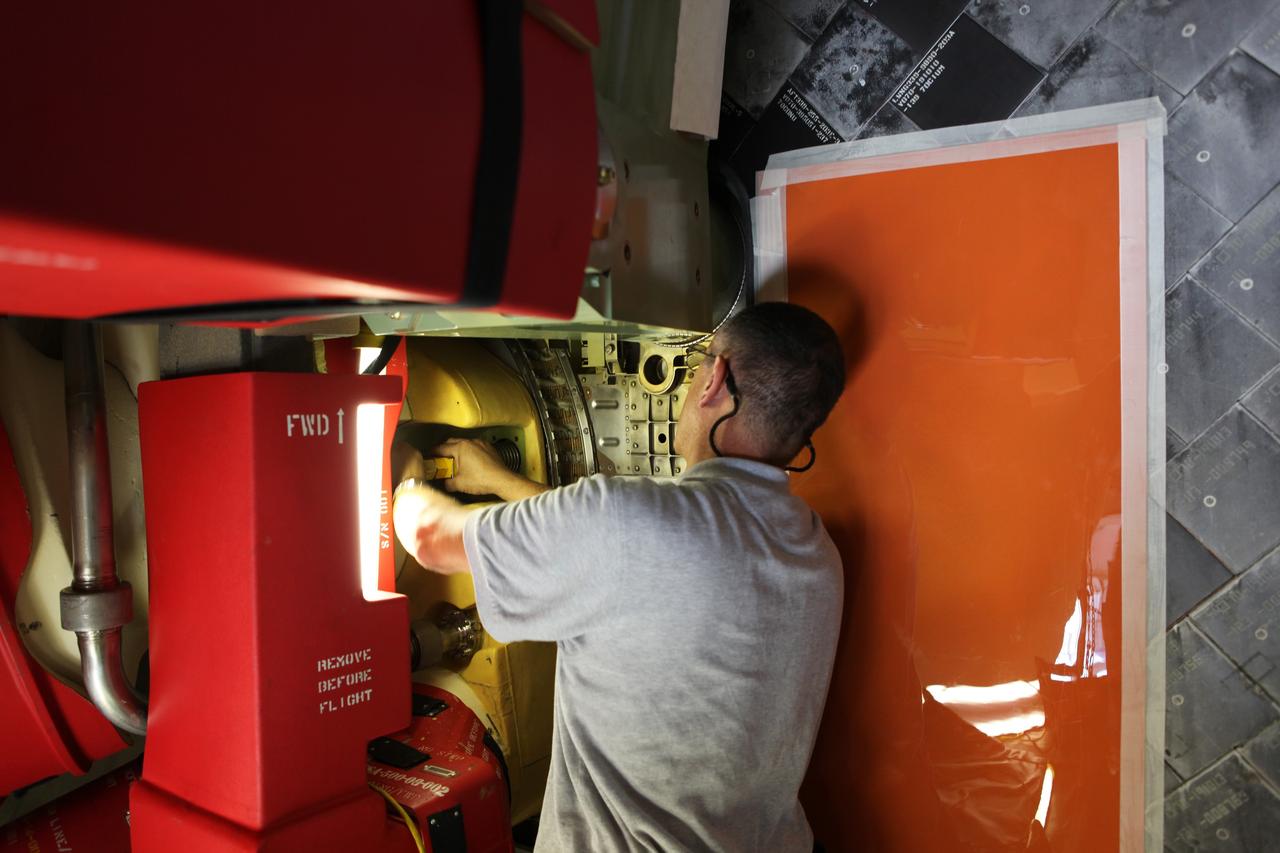
CAPE CANAVERAL, Fla. -- At NASA's Kennedy Space Center in Florida, a Vehicle Assembly Building technician adjusts a left-side main separation bolt that attaches the bottom of space shuttle Discovery to its external fuel tank. As technicians were attaching the bolt Sept. 10, a bolt nut slipped back into Discovery's aft compartment. To retrieve it, technicians entered Discovery’s aft section through an access door. They then moved the nut back into position to finish attaching the bolt, which is used to separate Discovery from the external tank once the shuttle is in orbit. Discovery is scheduled to roll out to Launch Pad 39A later this month for its STS-133 launch to the International Space Station. Targeted to lift off Nov. 1, Discovery will take the Permanent Multipurpose Module (PMM) packed with supplies and critical spare parts, as well as Robonaut 2 (R2) to the station. Photo credit: NASA/Dimitri Gerondidakis
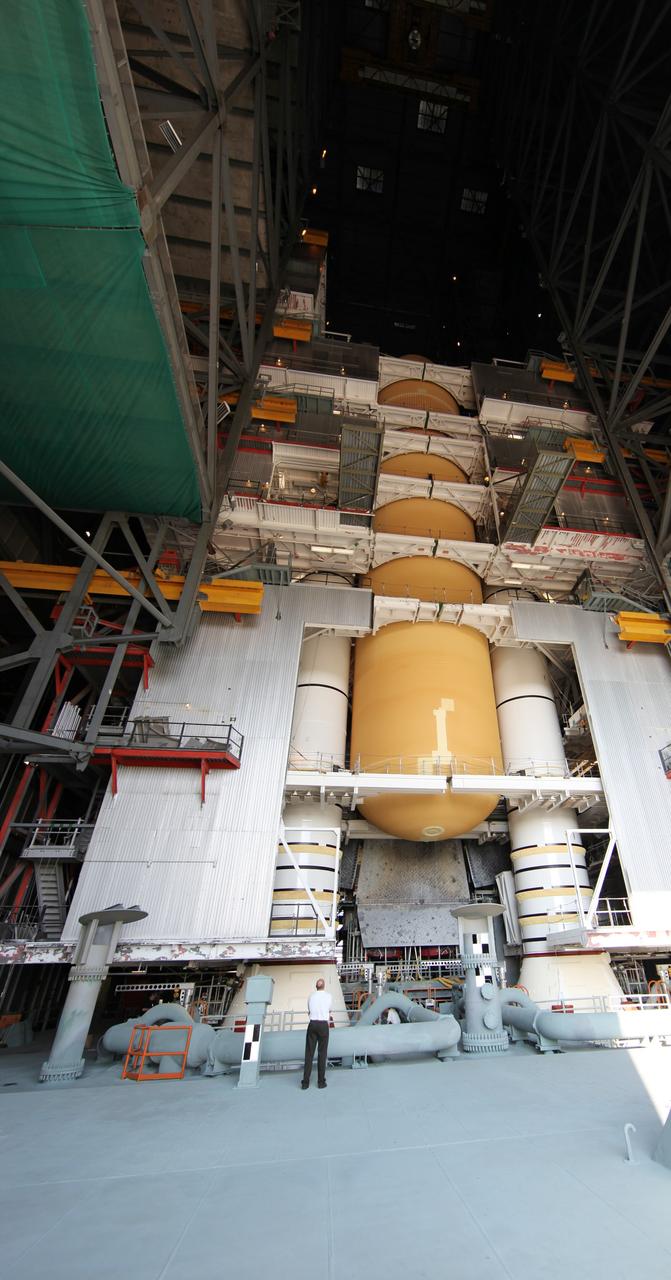
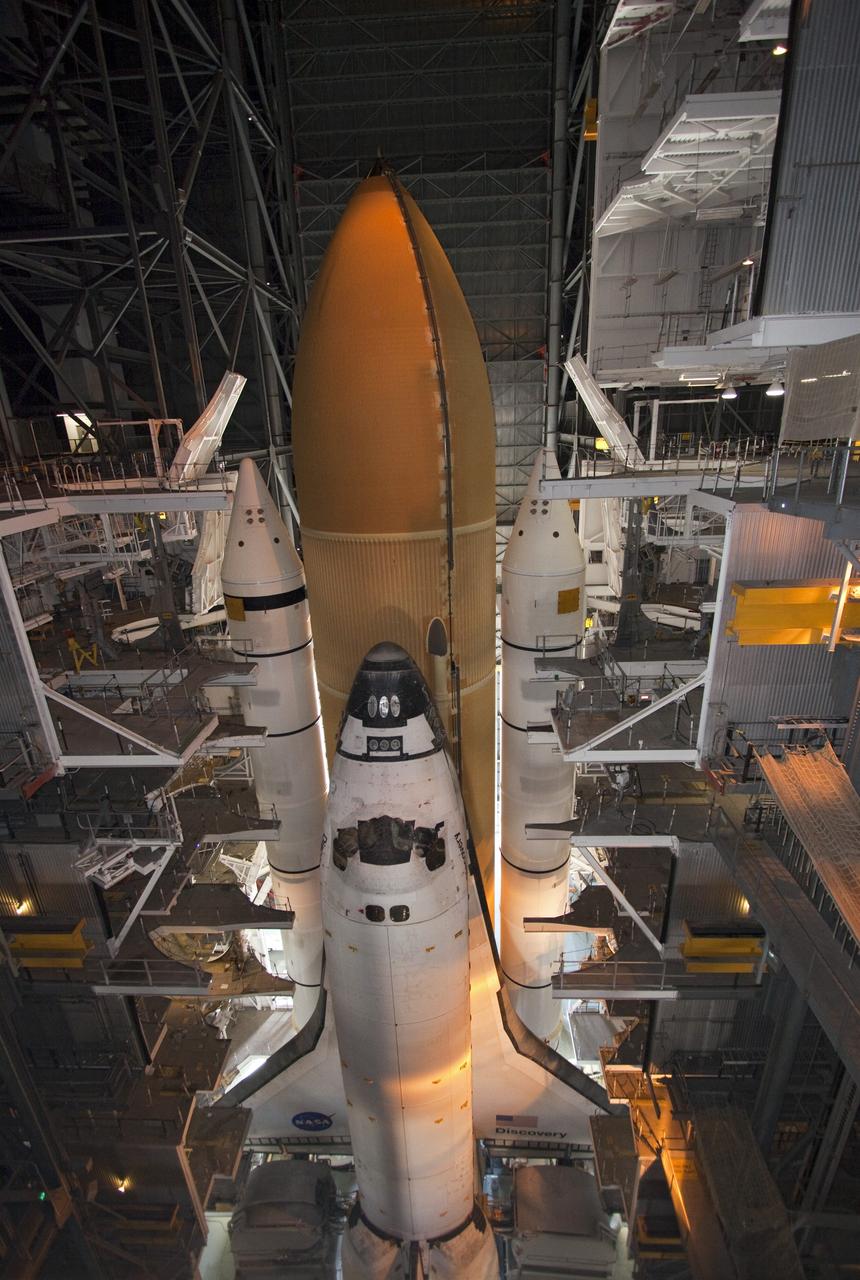
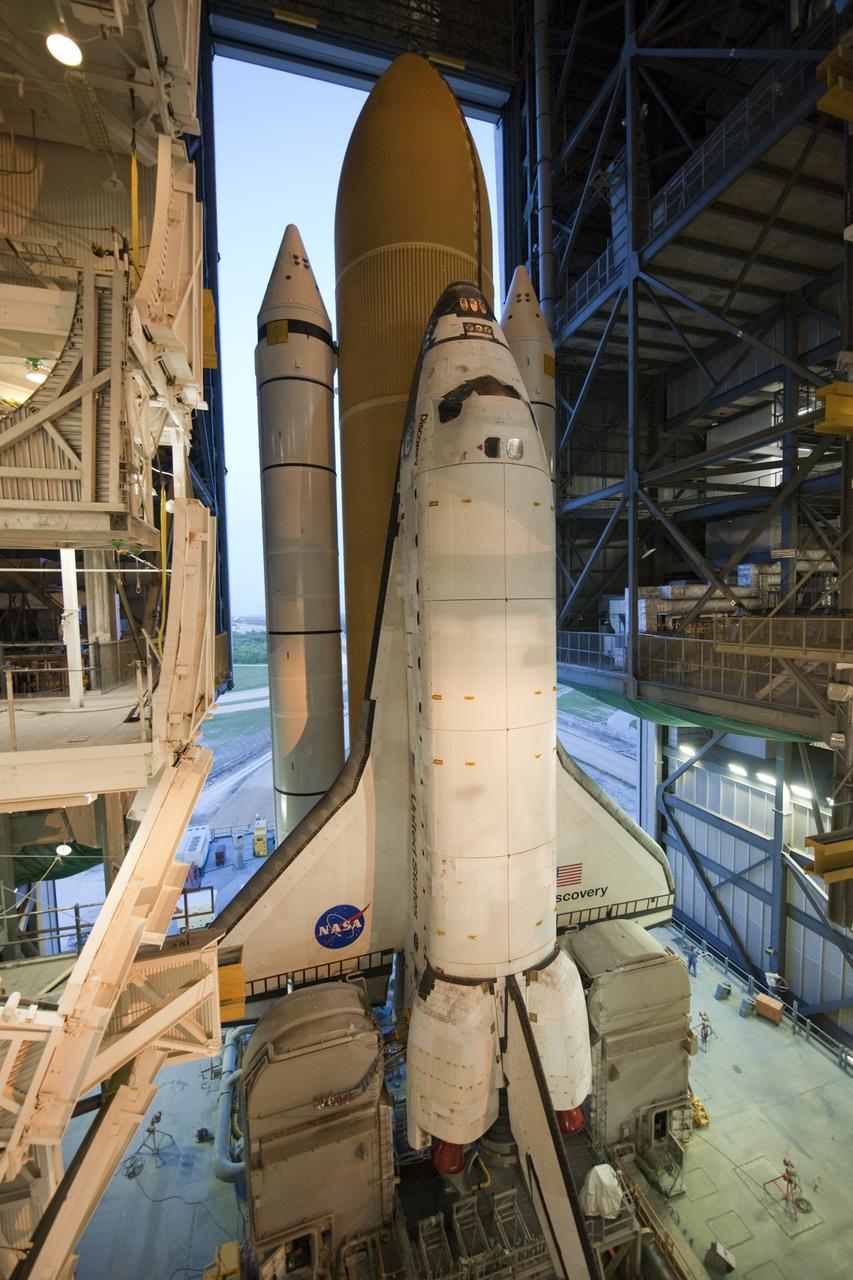
CAPE CANAVERAL, Fla. -- At NASA's Kennedy Space Center in Florida, space shuttle Discovery is attached to its external fuel tank and solid rocket boosters in the Vehicle Assembly Building. As technicians were attaching the left-side main separation bolt on the bottom of the shuttle to the external tank Sept. 10 a bolt nut slipped back into Discovery's aft compartment. To retrieve it, technicians entered Discovery’s aft section through an access door. They then moved the nut back into position to finish attaching the bolt, which is used to separate Discovery from the external tank once the shuttle is in orbit. Discovery is scheduled to roll out to Launch Pad 39A later this month for its STS-133 launch to the International Space Station. Targeted to lift off Nov. 1, Discovery will take the Permanent Multipurpose Module (PMM) packed with supplies and critical spare parts, as well as Robonaut 2 (R2) to the station. Photo credit: NASA/Dimitri Gerondidakis

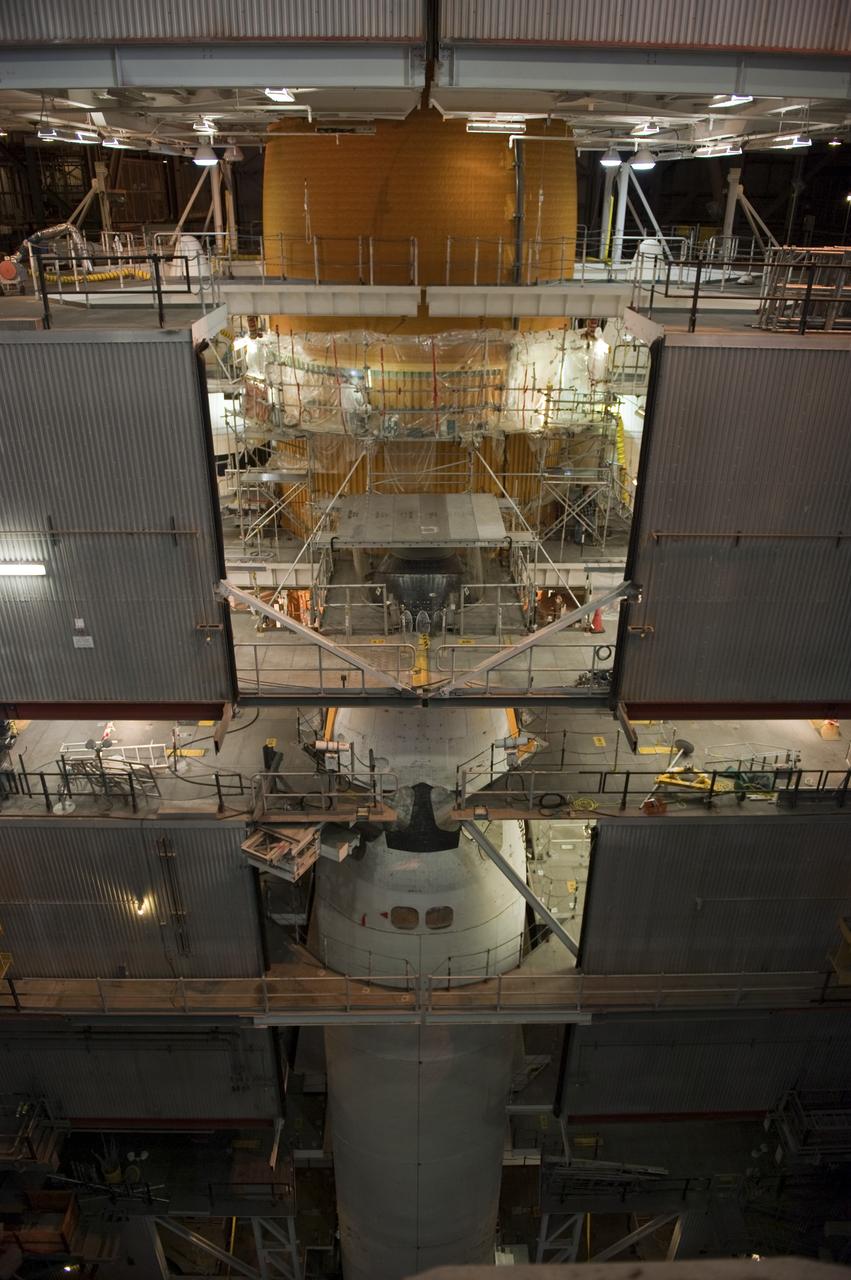
CAPE CANAVERAL, Fla. -- At NASA's Kennedy Space Center in Florida, technicians in the Vehicle Assembly Building inspect space shuttle Discovery, its external fuel tank and solid rocket boosters. As technicians were attaching the left-side main separation bolt on the bottom of the shuttle to the external tank Sept. 10 a bolt nut slipped back into Discovery's aft compartment. To retrieve it, technicians entered Discovery’s aft section through an access door. They then moved the nut back into position to finish attaching the bolt, which is used to separate Discovery from the external tank once the shuttle is in orbit. Discovery is scheduled to roll out to Launch Pad 39A later this month for its STS-133 launch to the International Space Station. Targeted to lift off Nov. 1, Discovery will take the Permanent Multipurpose Module (PMM) packed with supplies and critical spare parts, as well as Robonaut 2 (R2) to the station. Photo credit: NASA/Dimitri Gerondidakis
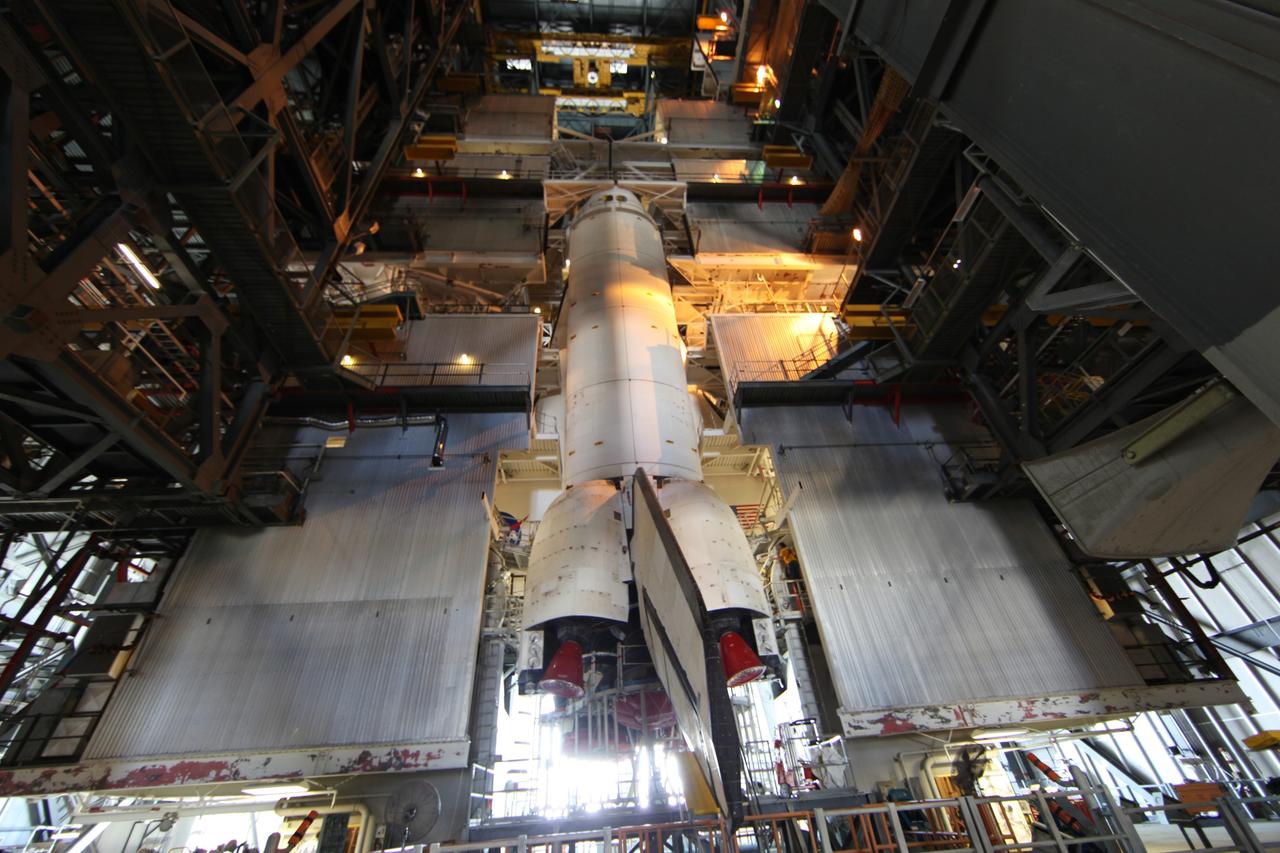
CAPE CANAVERAL, Fla. -- At NASA's Kennedy Space Center in Florida, space shuttle Discovery is attached to its external fuel tank and solid rocket boosters in the Vehicle Assembly Building. As technicians were attaching the left-side main separation bolt on the bottom of the shuttle to the external tank Sept. 10 a bolt nut slipped back into Discovery's aft compartment. To retrieve it, technicians entered Discovery’s aft section through an access door. They then moved the nut back into position to finish attaching the bolt, which is used to separate Discovery from the external tank once the shuttle is in orbit. Discovery is scheduled to roll out to Launch Pad 39A later this month for its STS-133 launch to the International Space Station. Targeted to lift off Nov. 1, Discovery will take the Permanent Multipurpose Module (PMM) packed with supplies and critical spare parts, as well as Robonaut 2 (R2) to the station. Photo credit: NASA/Dimitri Gerondidakis
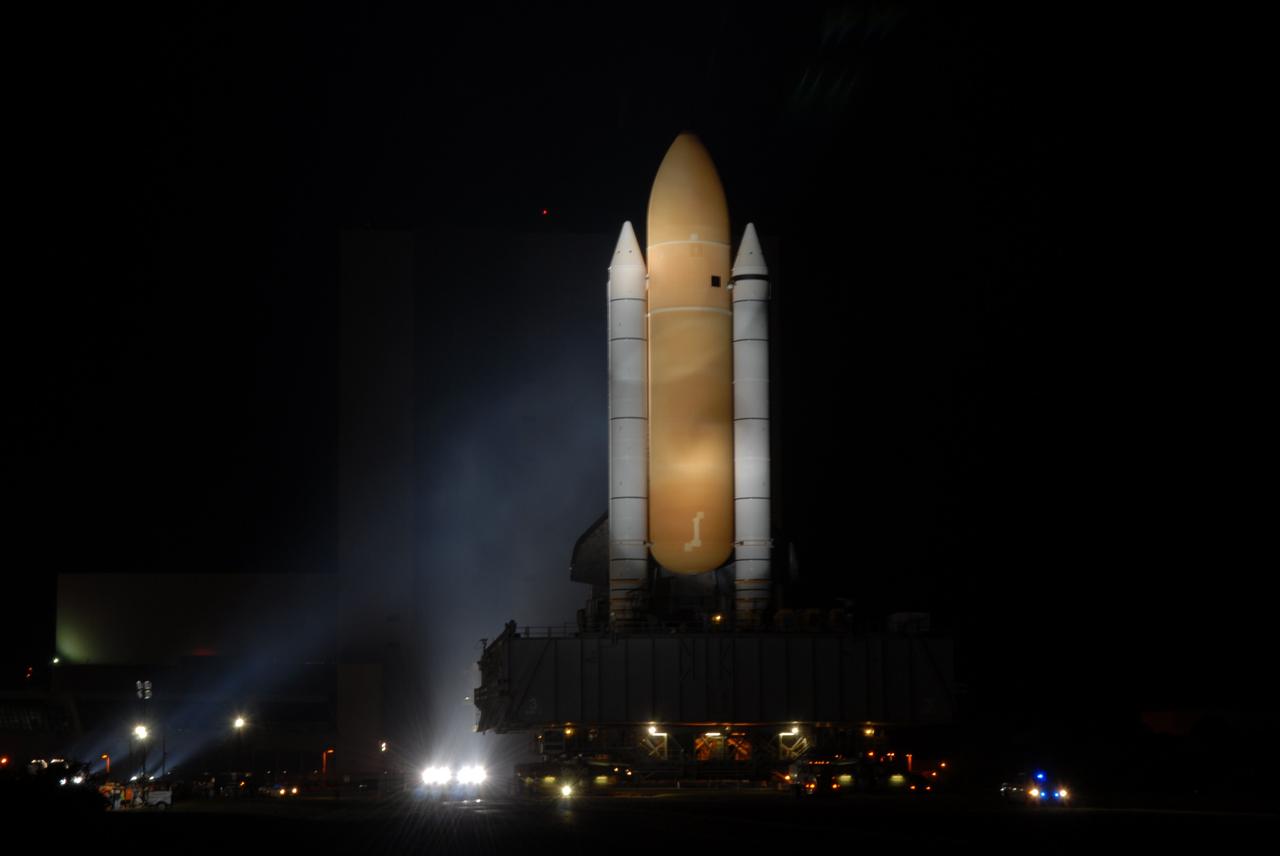
CAPE CANAVERAL, Fla. -- Bathed in bright xenon lights, space shuttle Discovery makes its nighttime trek, known as "rollout," from the Vehicle Assembly Building to Launch Pad 39A at NASA's Kennedy Space Center in Florida. It will take the shuttle, attached to its external fuel tank, twin solid rocket boosters and mobile launcher platform, about six hours to complete the move atop a crawler-transporter. Rollout sets the stage for Discovery's STS-133 crew to practice countdown and launch procedures during the Terminal Countdown Demonstration Test in mid-October. Targeted to liftoff Nov. 1, Discovery will take the Permanent Multipurpose Module (PMM) packed with supplies and critical spare parts, as well as Robonaut 2 (R2) to the International Space Station. Photo credit: NASA/Jim Grossmann
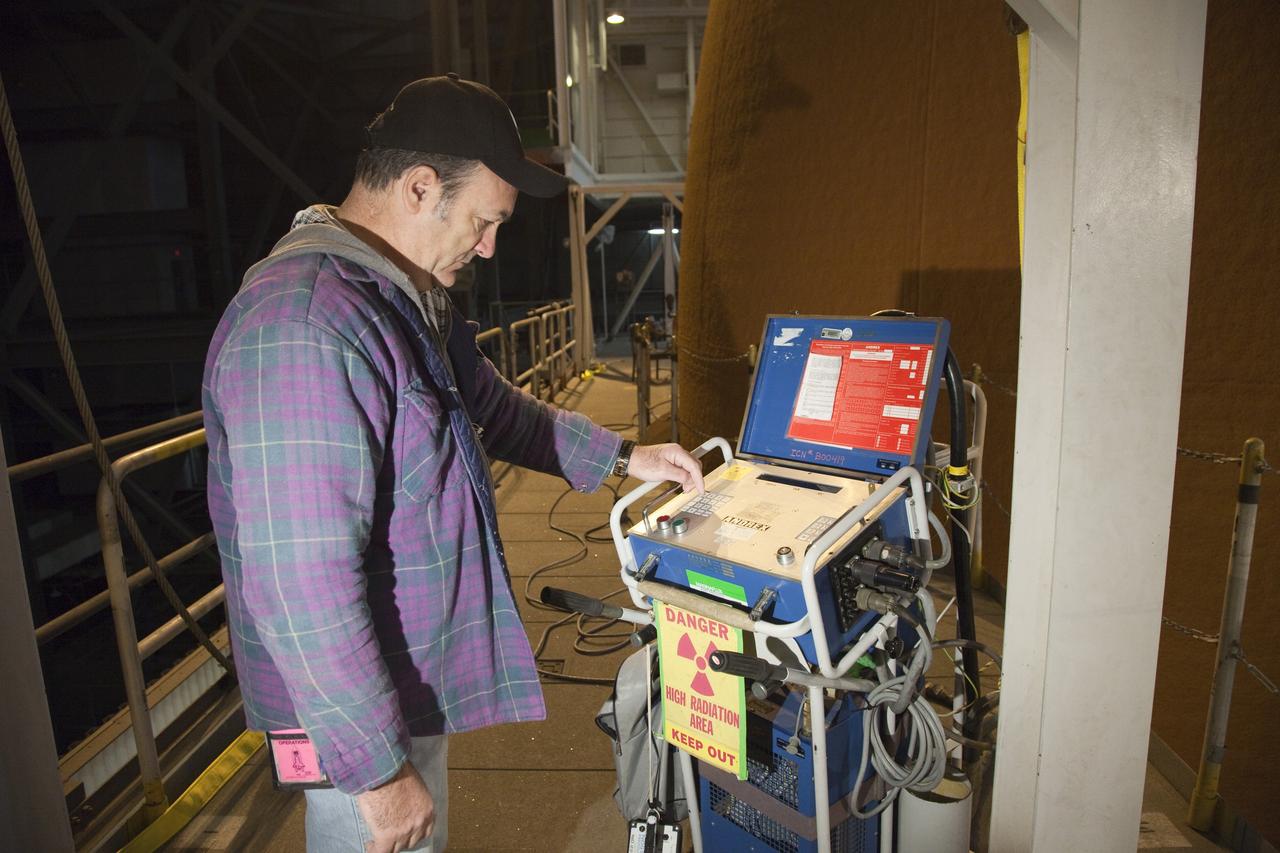
CAPE CANAVERAL, Fla. -- A technician takes computed radiography scans of space shuttle Discovery's external fuel tank. The shuttle stack, consisting of the shuttle, external tank and solid rocket boosters, was moved from Launch Pad 39A to the Vehicle Assembly Building at NASA's Kennedy Space Center in Florida so technicians could examine 21-foot-long support beams, called stringers, on the outside of the tank's intertank and re-apply foam insulation. Discovery's next launch opportunity to the International Space Station on the STS-133 mission is no earlier than Feb. 3, 2011. For more information on STS-133, visit www.nasa.gov/mission_pages/shuttle/shuttlemissions/sts133/. Photo credit: NASA/Frankie Martin
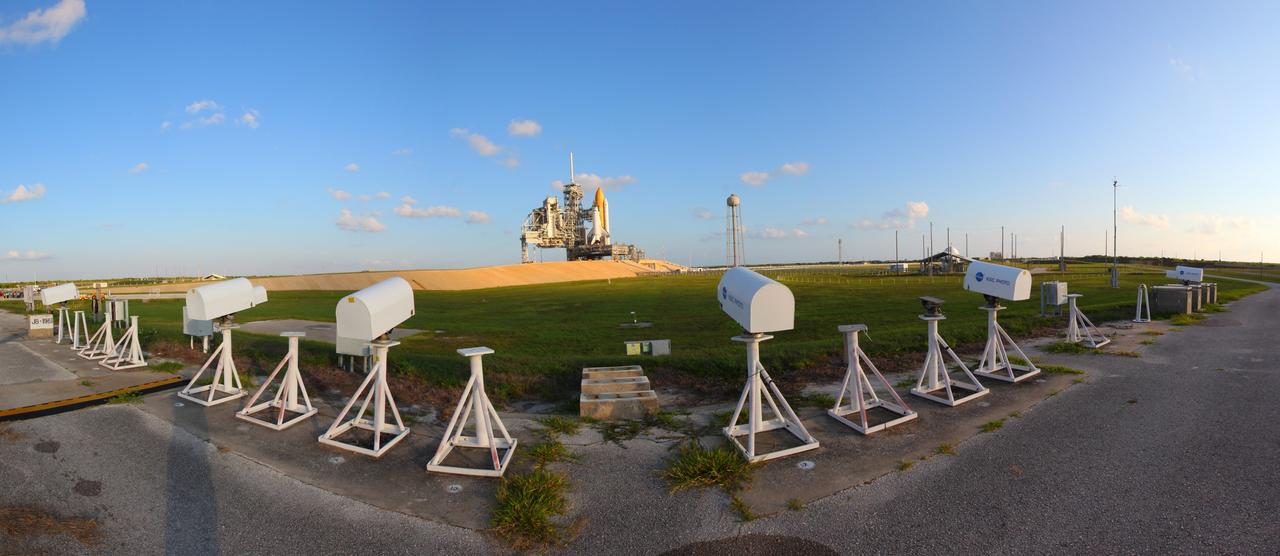
CAPE CANAVERAL, Fla. -- Space shuttle Discovery is attached to Launch Pad 39A at NASA's Kennedy Space Center in Florida. Later, the rotating service structure that protects the shuttle from the elements and provides access inside the vehicle will be moved into place. It took the spacecraft about six hours to make the journey, known as "rollout," from the Vehicle Assembly Building to the pad. Rollout sets the stage for Discovery's STS-133 crew to practice countdown and launch procedures during the Terminal Countdown Demonstration Test in mid-October. Targeted to liftoff Nov. 1, Discovery will take the Permanent Multipurpose Module (PMM) packed with supplies and critical spare parts, as well as Robonaut 2 (R2) to the International Space Station. Photo credit: NASA/Frankie Martin
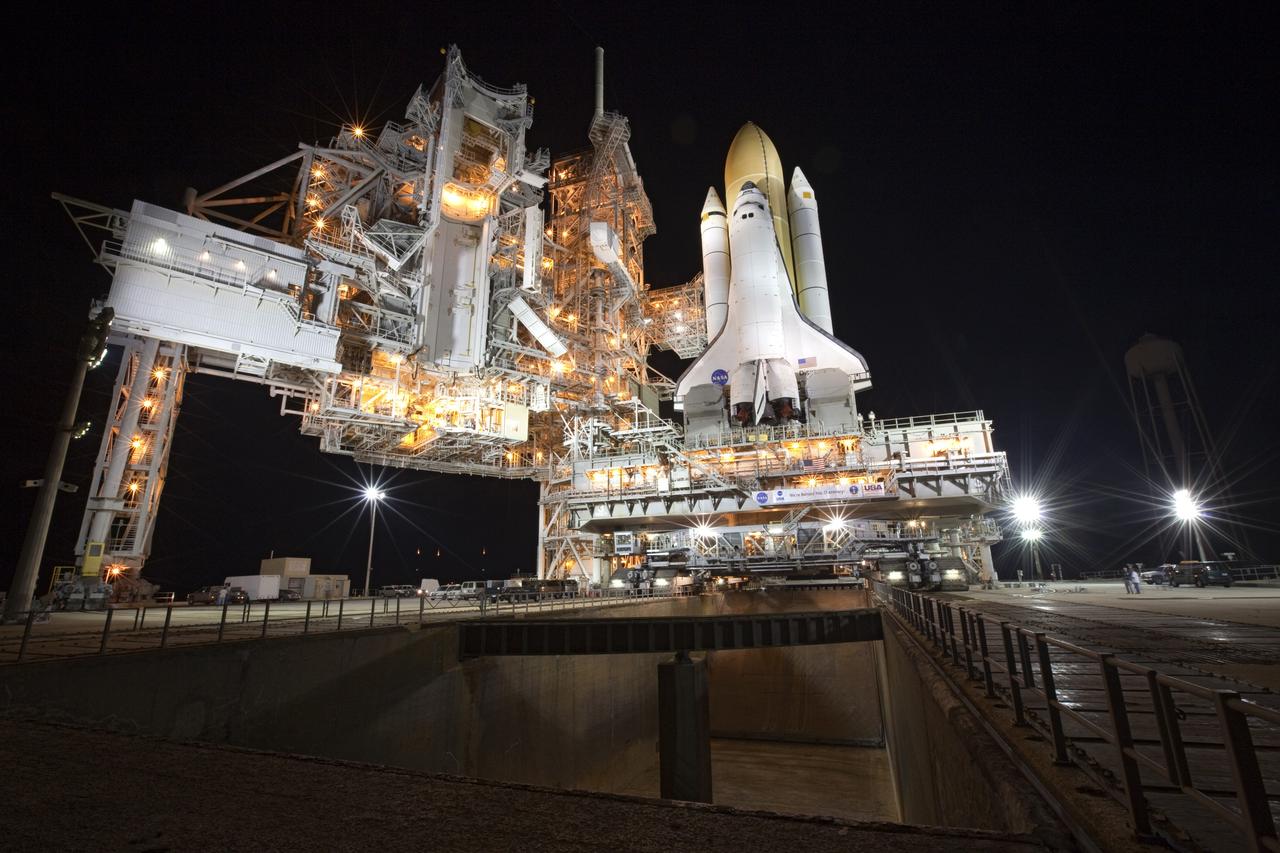
CAPE CANAVERAL, Fla. -- At NASA's Kennedy Space Center in Florida, space shuttle Discovery is attached to Launch Pad 39A, completing "rollout" from the Vehicle Assembly Building to Launch Pad 39A. It took the shuttle, attached to its external fuel tank, twin solid rocket boosters and mobile launcher platform, about six hours to complete the move atop a crawler-transporter. Rollout sets the stage for Discovery's STS-133 crew to practice countdown and launch procedures during the Terminal Countdown Demonstration Test in mid-October. Targeted to liftoff Nov. 1, Discovery will take the Permanent Multipurpose Module (PMM) packed with supplies and critical spare parts, as well as Robonaut 2 (R2) to the International Space Station. Photo credit: NASA/Frankie Martin

CAPE CANAVERAL, Fla. -- At NASA's Kennedy Space Center in Florida, space shuttle Discovery begins its nighttime trek, known as "rollout," from the Vehicle Assembly Building to Launch Pad 39A. It will take the shuttle, attached to its external fuel tank, twin solid rocket boosters and mobile launcher platform, about six hours to complete the move atop a crawler-transporter. Rollout sets the stage for Discovery's STS-133 crew to practice countdown and launch procedures during the Terminal Countdown Demonstration Test in mid-October. Targeted to liftoff Nov. 1, Discovery will take the Permanent Multipurpose Module (PMM) packed with supplies and critical spare parts, as well as Robonaut 2 (R2) to the International Space Station. Photo credit: NASA/Jack Pfaller
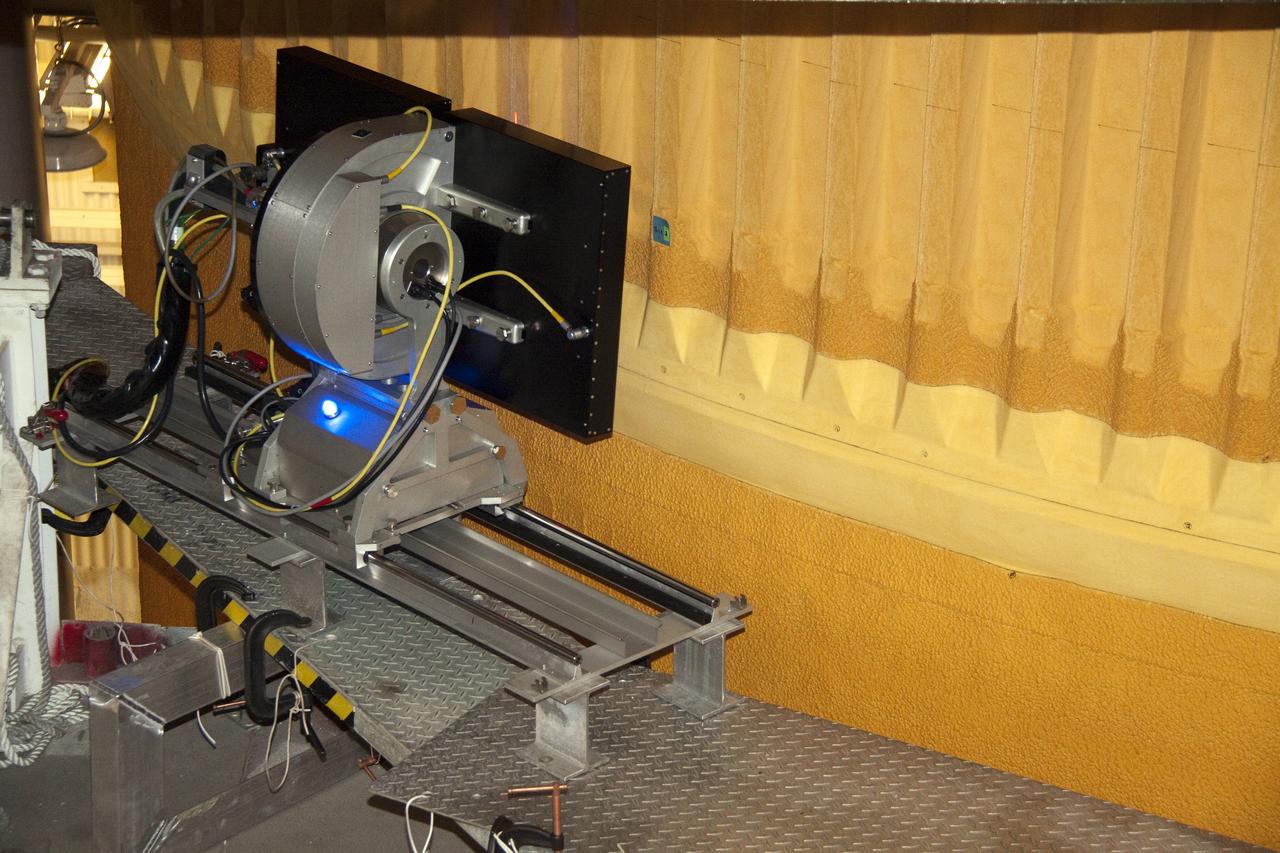
CAPE CANAVERAL, Fla. -- A backscatter device continues to give engineers data on the intertank region of space shuttle Discovery's external fuel tank while it is in the Vehicle Assembly Building at NASA's Kennedy Space Center in Florida. Engineers at various NASA centers are analyzing, testing and imaging the intertank's support beams, called stringers, to make sure the tank is structurally sound for flight. Discovery's next launch opportunity to the International Space Station on the STS-133 mission is no earlier than Feb. 3, 2011. For more information on STS-133, visit www.nasa.gov/mission_pages/shuttle/shuttlemissions/sts133/. Photo credit: NASA/Jack Pfaller
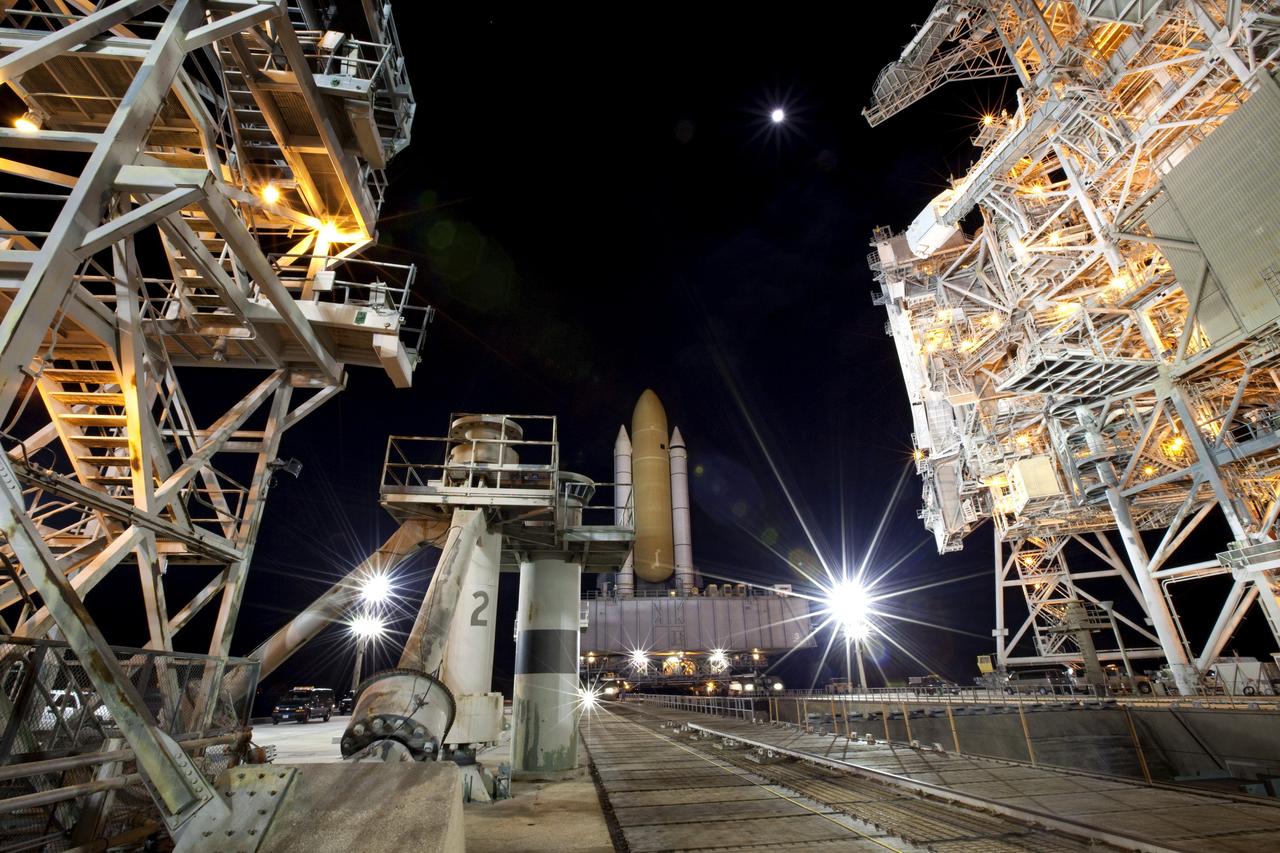
CAPE CANAVERAL, Fla. -- At NASA's Kennedy Space Center in Florida, space shuttle Discovery makes the last leg of its journey, known as "rollout," from the Vehicle Assembly Building to Launch Pad 39A. It took the shuttle, attached to its external fuel tank, twin solid rocket boosters and mobile launcher platform, about six hours to complete the move atop a crawler-transporter. Rollout sets the stage for Discovery's STS-133 crew to practice countdown and launch procedures during the Terminal Countdown Demonstration Test in mid-October. Targeted to liftoff Nov. 1, Discovery will take the Permanent Multipurpose Module (PMM) packed with supplies and critical spare parts, as well as Robonaut 2 (R2) to the International Space Station. Photo credit: NASA/Frankie Martin
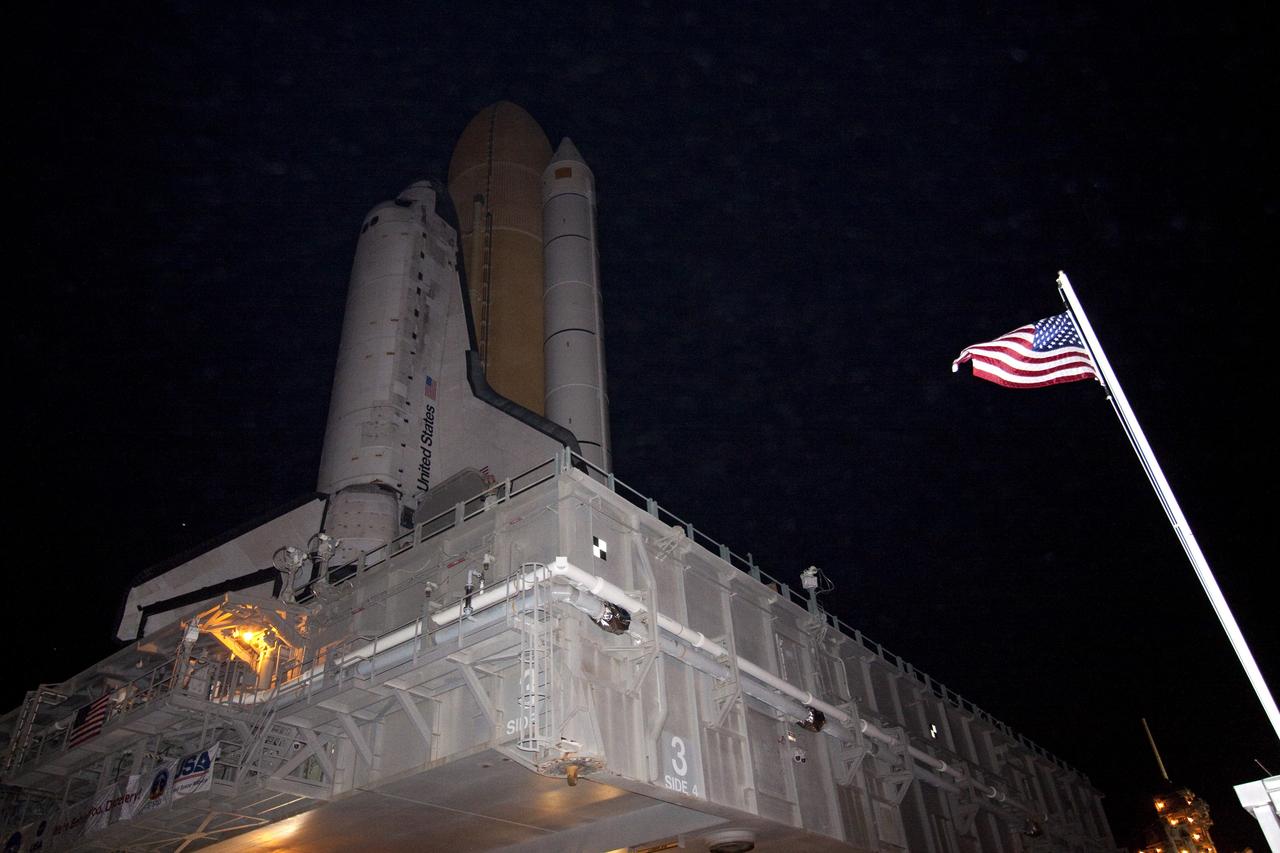
CAPE CANAVERAL, Fla. -- At NASA's Kennedy Space Center in Florida, the American flag is illuminated next to space shuttle Discovery as the spacecraft makes the last leg of its journey, known as "rollout," from the Vehicle Assembly Building to Launch Pad 39A. It took the shuttle, attached to its external fuel tank, twin solid rocket boosters and mobile launcher platform, about six hours to complete the move atop a crawler-transporter. Rollout sets the stage for Discovery's STS-133 crew to practice countdown and launch procedures during the Terminal Countdown Demonstration Test in mid-October. Targeted to liftoff Nov. 1, Discovery will take the Permanent Multipurpose Module (PMM) packed with supplies and critical spare parts, as well as Robonaut 2 (R2) to the International Space Station. Photo credit: NASA/Jack Pfaller
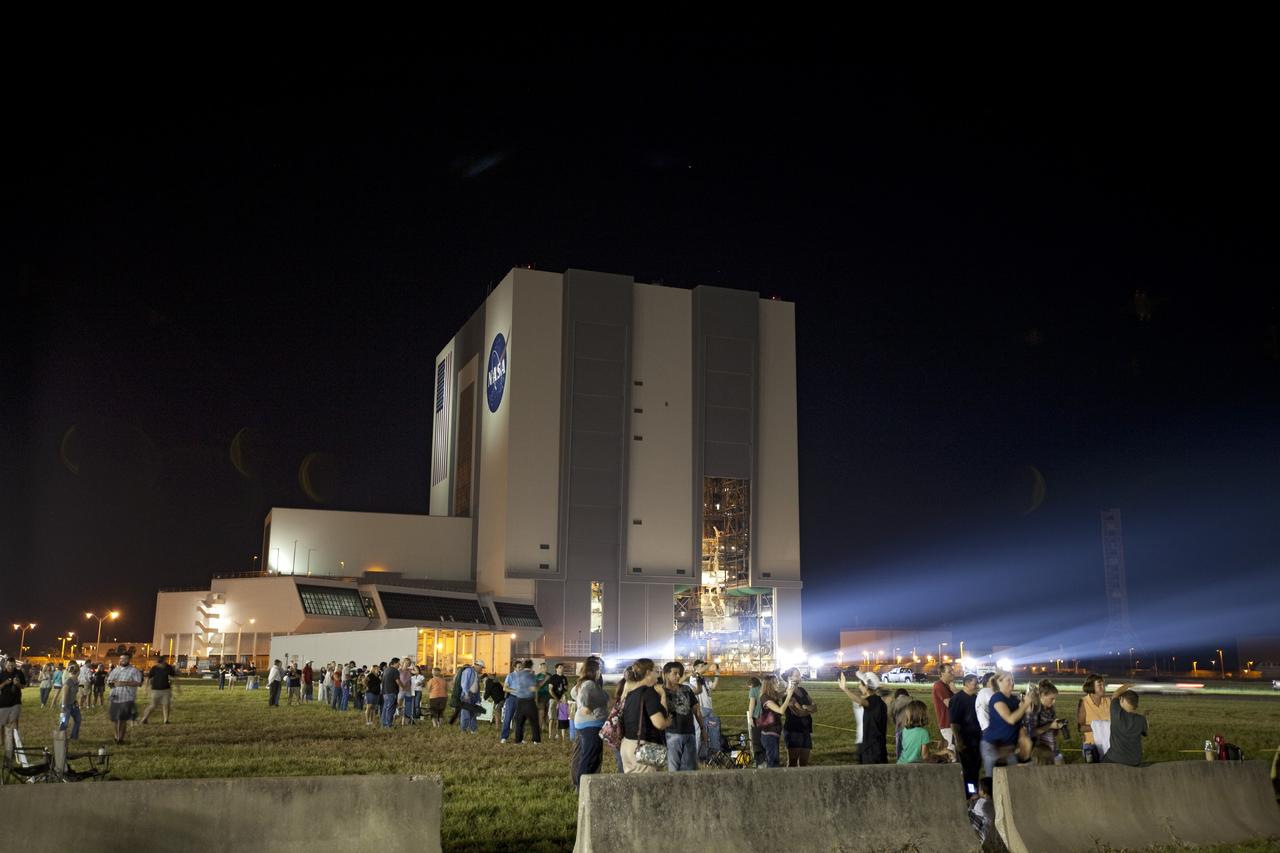
CAPE CANAVERAL, Fla. -- At NASA's Kennedy Space Center in Florida, workers and their friends and families watch as space shuttle Discovery begins its nighttime trek, known as "rollout," from the Vehicle Assembly Building to Launch Pad 39A. It will take the shuttle, attached to its external fuel tank, twin solid rocket boosters and mobile launcher platform, about six hours to complete the move atop a crawler-transporter. Rollout sets the stage for Discovery's STS-133 crew to practice countdown and launch procedures during the Terminal Countdown Demonstration Test in mid-October. Targeted to liftoff Nov. 1, Discovery will take the Permanent Multipurpose Module (PMM) packed with supplies and critical spare parts, as well as Robonaut 2 (R2) to the International Space Station. Photo credit: NASA/Frankie Martin
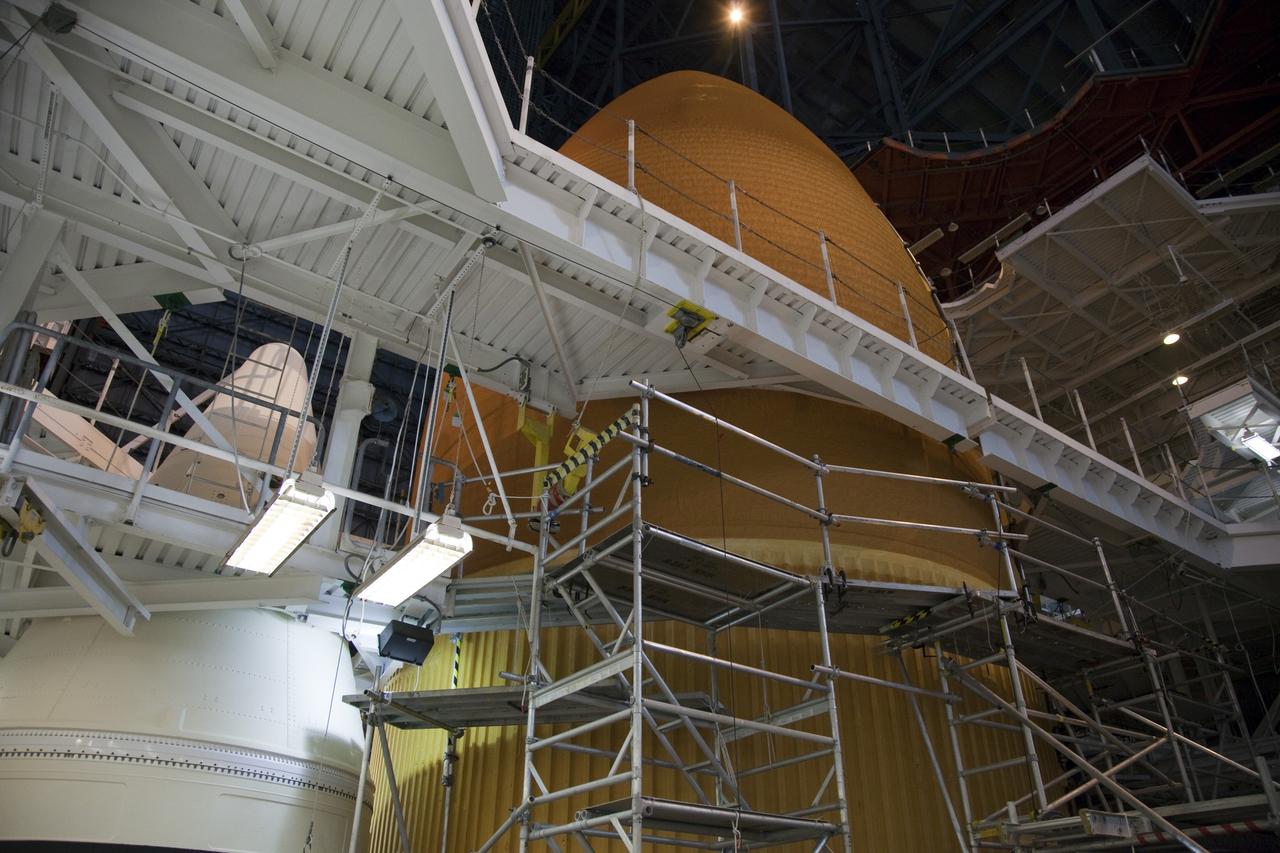
CAPE CANAVERAL, Fla. -- Space shuttle Discovery's external fuel tank is being prepared for computed radiography scans inside the Vehicle Assembly Building at NASA's Kennedy Space Center in Florida. The shuttle stack, consisting of the shuttle, external tank and solid rocket boosters, was moved off Launch Pad 39A so technicians could examine 21-foot-long support beams, called stringers, on the outside of the tank's intertank and re-apply foam insulation. Discovery's next launch opportunity to the International Space Station on the STS-133 mission is no earlier than Feb. 3, 2011. For more information on STS-133, visit www.nasa.gov/mission_pages/shuttle/shuttlemissions/sts133/. Photo credit: NASA/Frankie Martin
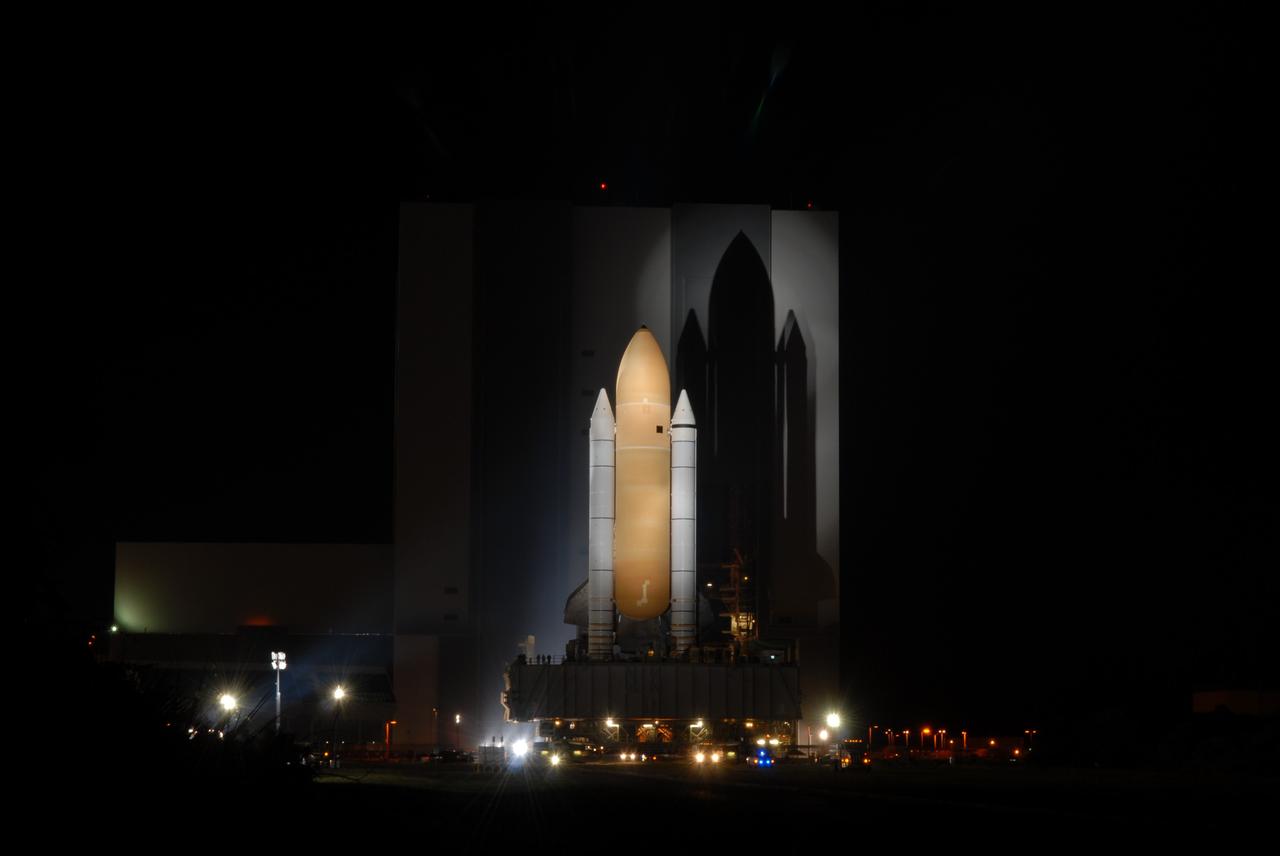
CAPE CANAVERAL, Fla. -- Bathed in bright xenon lights, space shuttle Discovery makes its nighttime trek, known as "rollout," from the Vehicle Assembly Building to Launch Pad 39A at NASA's Kennedy Space Center in Florida. It will take the shuttle, attached to its external fuel tank, twin solid rocket boosters and mobile launcher platform, about six hours to complete the move atop a crawler-transporter. Rollout sets the stage for Discovery's STS-133 crew to practice countdown and launch procedures during the Terminal Countdown Demonstration Test in mid-October. Targeted to liftoff Nov. 1, Discovery will take the Permanent Multipurpose Module (PMM) packed with supplies and critical spare parts, as well as Robonaut 2 (R2) to the International Space Station. Photo credit: NASA/Jim Grossmann
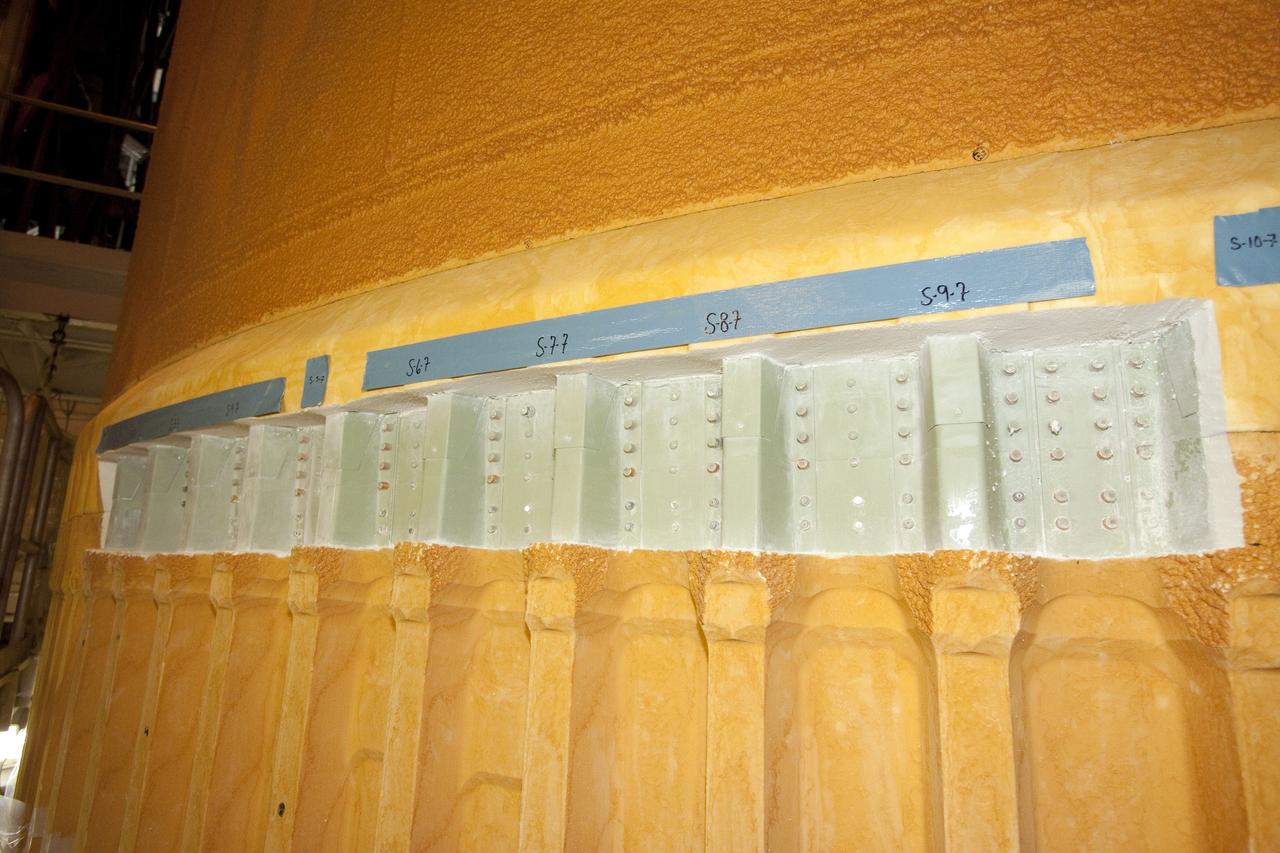
CAPE CANAVERAL, Fla. -- Repair work to space shuttle Discovery's external fuel tank begins in the Vehicle Assembly Building at NASA's Kennedy Space Center in Florida. Technicians will modify 32 support beams, called stringers, on the tank's intertank region by fitting pieces of metal, called radius blocks, over the stringers' edges where they attach to the thrust panel area. The thrust panel is where the tank meets the two solid rocket boosters and sees the most stress during the flight into orbit. After the modifications and additional scans of the stringers are complete, foam insulation will be re-applied. Discovery's next launch opportunity to the International Space Station on the STS-133 mission is no earlier than Feb. 3, 2011. For more information on STS-133, visit www.nasa.gov/mission_pages/shuttle/shuttlemissions/sts133/. Photo credit: NASA/Jack Pfaller
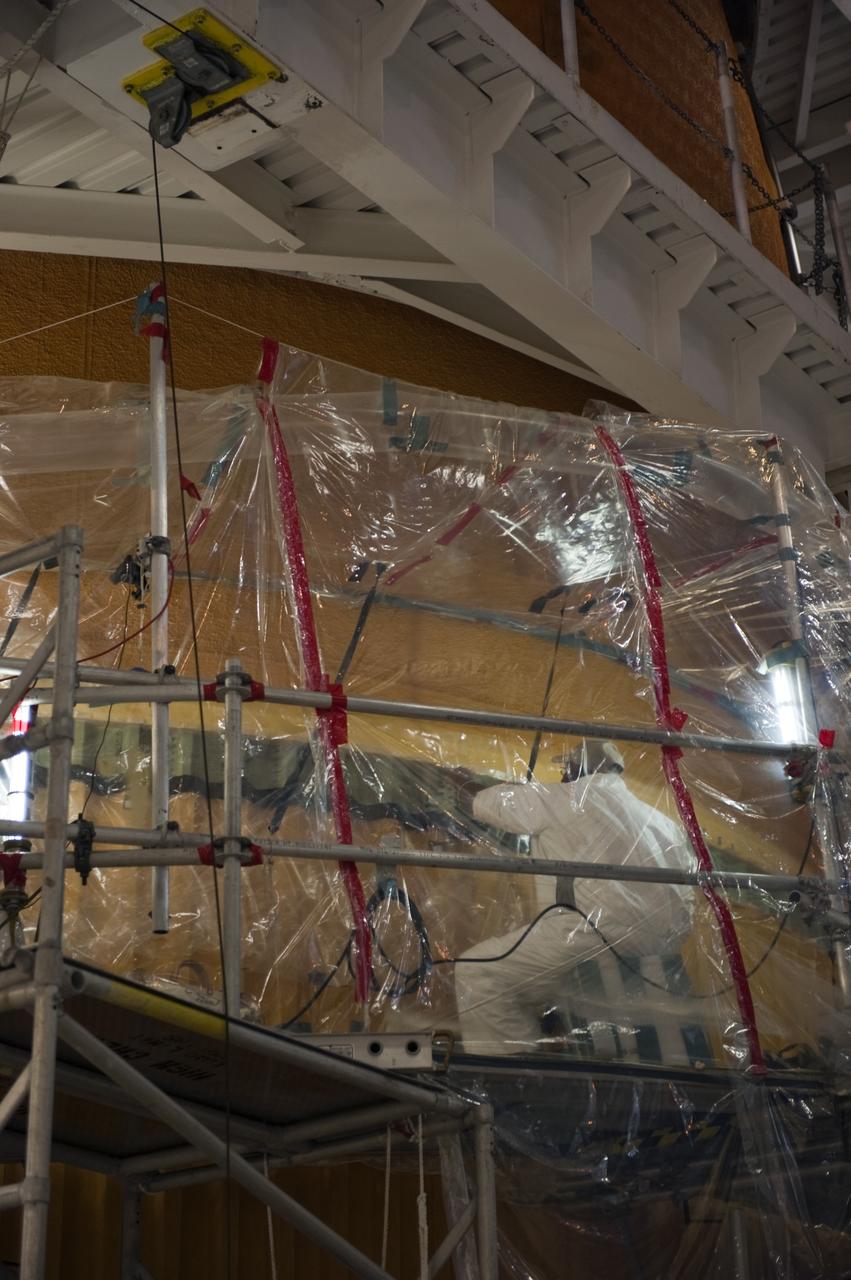
CAPE CANAVERAL, Fla. -- Repair work to space shuttle Discovery's external fuel tank continues in the Vehicle Assembly Building at NASA's Kennedy Space Center in Florida. Technicians are modifying 94 support beams, called stringers, on the tank's intertank region by fitting pieces of metal, called radius blocks, over the stringers' edges. After the modifications of the stringers are complete, foam insulation will be re-applied to the tank. Discovery's next launch opportunity to the International Space Station on the STS-133 mission is targeted for Feb. 24, 2011. For more information on STS-133, visit www.nasa.gov/mission_pages/shuttle/shuttlemissions/sts133/. Photo credit: NASA/Kim Shiflett
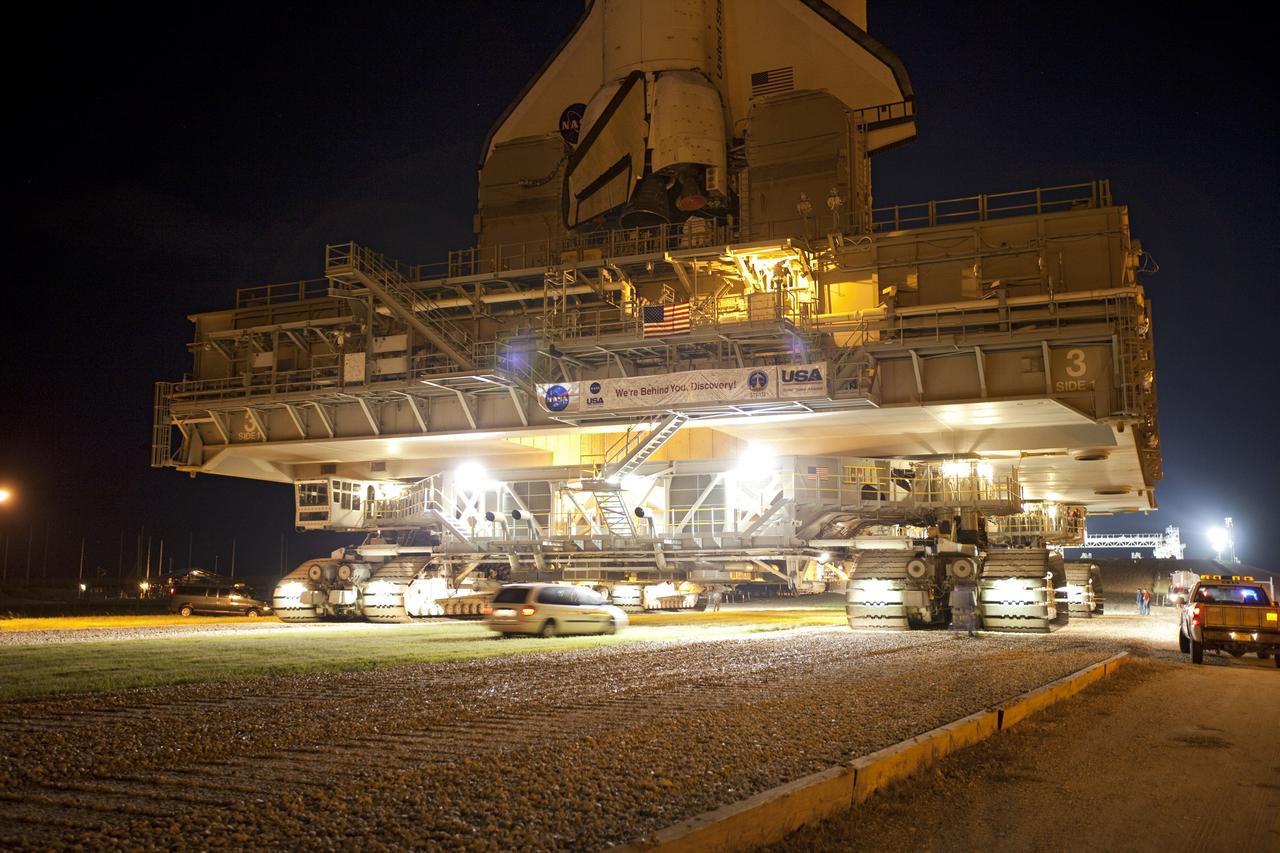
CAPE CANAVERAL, Fla. -- At NASA's Kennedy Space Center in Florida, space shuttle Discovery makes the last leg of its journey, known as "rollout," from the Vehicle Assembly Building to Launch Pad 39A. It took the shuttle, attached to its external fuel tank, twin solid rocket boosters and mobile launcher platform, about six hours to complete the move atop a crawler-transporter. Rollout sets the stage for Discovery's STS-133 crew to practice countdown and launch procedures during the Terminal Countdown Demonstration Test in mid-October. Targeted to liftoff Nov. 1, Discovery will take the Permanent Multipurpose Module (PMM) packed with supplies and critical spare parts, as well as Robonaut 2 (R2) to the International Space Station. Photo credit: NASA/Frankie Martin
CAPE CANAVERAL, Fla. -- Repair work to space shuttle Discovery's external fuel tank continues in the Vehicle Assembly Building at NASA's Kennedy Space Center in Florida. Technicians are modifying 94 support beams, called stringers, on the tank's intertank region by fitting pieces of metal, called radius blocks, over the stringers' edges. After the modifications of the stringers are complete, foam insulation will be re-applied to the tank. Discovery's next launch opportunity to the International Space Station on the STS-133 mission is targeted for Feb. 24, 2011. For more information on STS-133, visit www.nasa.gov/mission_pages/shuttle/shuttlemissions/sts133/. Photo credit: NASA/Kim Shiflett

CAPE CANAVERAL, Fla. -- At NASA's Kennedy Space Center in Florida, space shuttle Discovery begins its nighttime trek, known as "rollout," from the Vehicle Assembly Building to Launch Pad 39A. It will take the shuttle, attached to its external fuel tank, twin solid rocket boosters and mobile launcher platform, about six hours to complete the move atop a crawler-transporter. Rollout sets the stage for Discovery's STS-133 crew to practice countdown and launch procedures during the Terminal Countdown Demonstration Test in mid-October. Targeted to liftoff Nov. 1, Discovery will take the Permanent Multipurpose Module (PMM) packed with supplies and critical spare parts, as well as Robonaut 2 (R2) to the International Space Station. Photo credit: NASA/Jack Pfaller
CAPE CANAVERAL, Fla. -- At NASA's Kennedy Space Center in Florida, space shuttle Discovery is ready for its nighttime trek, known as "rollout," from the Vehicle Assembly Building to Launch Pad 39A. It will take the shuttle, attached to its external fuel tank, twin solid rocket boosters and mobile launcher platform, about six hours to complete the move atop a crawler-transporter. Rollout sets the stage for Discovery's STS-133 crew to practice countdown and launch procedures during the Terminal Countdown Demonstration Test in mid-October. Targeted to liftoff Nov. 1, Discovery will take the Permanent Multipurpose Module (PMM) packed with supplies and critical spare parts, as well as Robonaut 2 (R2) to the International Space Station. Photo credit: NASA/Jack Pfaller
CAPE CANAVERAL, Fla. -- At NASA's Kennedy Space Center in Florida, space shuttle Discovery begins its nighttime trek, known as "rollout," from the Vehicle Assembly Building to Launch Pad 39A. It will take the shuttle, attached to its external fuel tank, twin solid rocket boosters and mobile launcher platform, about six hours to complete the move atop a crawler-transporter. Rollout sets the stage for Discovery's STS-133 crew to practice countdown and launch procedures during the Terminal Countdown Demonstration Test in mid-October. Targeted to liftoff Nov. 1, Discovery will take the Permanent Multipurpose Module (PMM) packed with supplies and critical spare parts, as well as Robonaut 2 (R2) to the International Space Station. Photo credit: NASA/Tony Gray
CAPE CANAVERAL, Fla. -- Repair work to space shuttle Discovery's external fuel tank begins in the Vehicle Assembly Building at NASA's Kennedy Space Center in Florida. Technicians will modify 32 support beams, called stringers, on the tank's intertank region by fitting pieces of metal, called radius blocks, over the stringers' edges where they attach to the thrust panel area. The thrust panel is where the tank meets the two solid rocket boosters and sees the most stress during the flight into orbit. After the modifications and additional scans of the stringers are complete, foam insulation will be re-applied. Discovery's next launch opportunity to the International Space Station on the STS-133 mission is no earlier than Feb. 3, 2011. For more information on STS-133, visit www.nasa.gov/mission_pages/shuttle/shuttlemissions/sts133/. Photo credit: NASA/Jack Pfaller
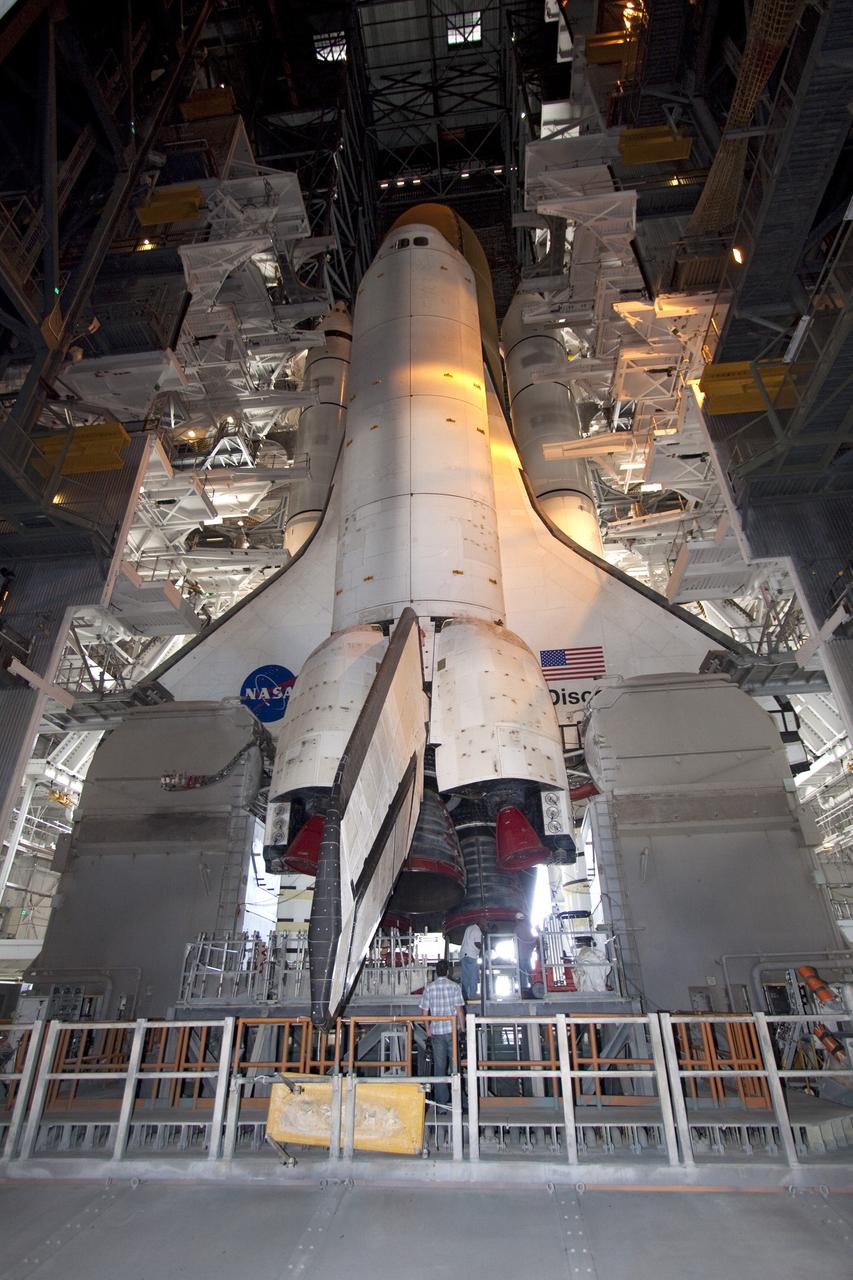
CAPE CANAVERAL, Fla. -- At NASA's Kennedy Space Center in Florida, space shuttle Discovery is ready for its nighttime trek, known as "rollout," from the Vehicle Assembly Building to Launch Pad 39A. It will take the shuttle, attached to its external fuel tank, twin solid rocket boosters and mobile launcher platform, about six hours to complete the move atop a crawler-transporter. Rollout sets the stage for Discovery's STS-133 crew to practice countdown and launch procedures during the Terminal Countdown Demonstration Test in mid-October. Targeted to liftoff Nov. 1, Discovery will take the Permanent Multipurpose Module (PMM) packed with supplies and critical spare parts, as well as Robonaut 2 (R2) to the International Space Station. Photo credit: NASA/Jack Pfaller
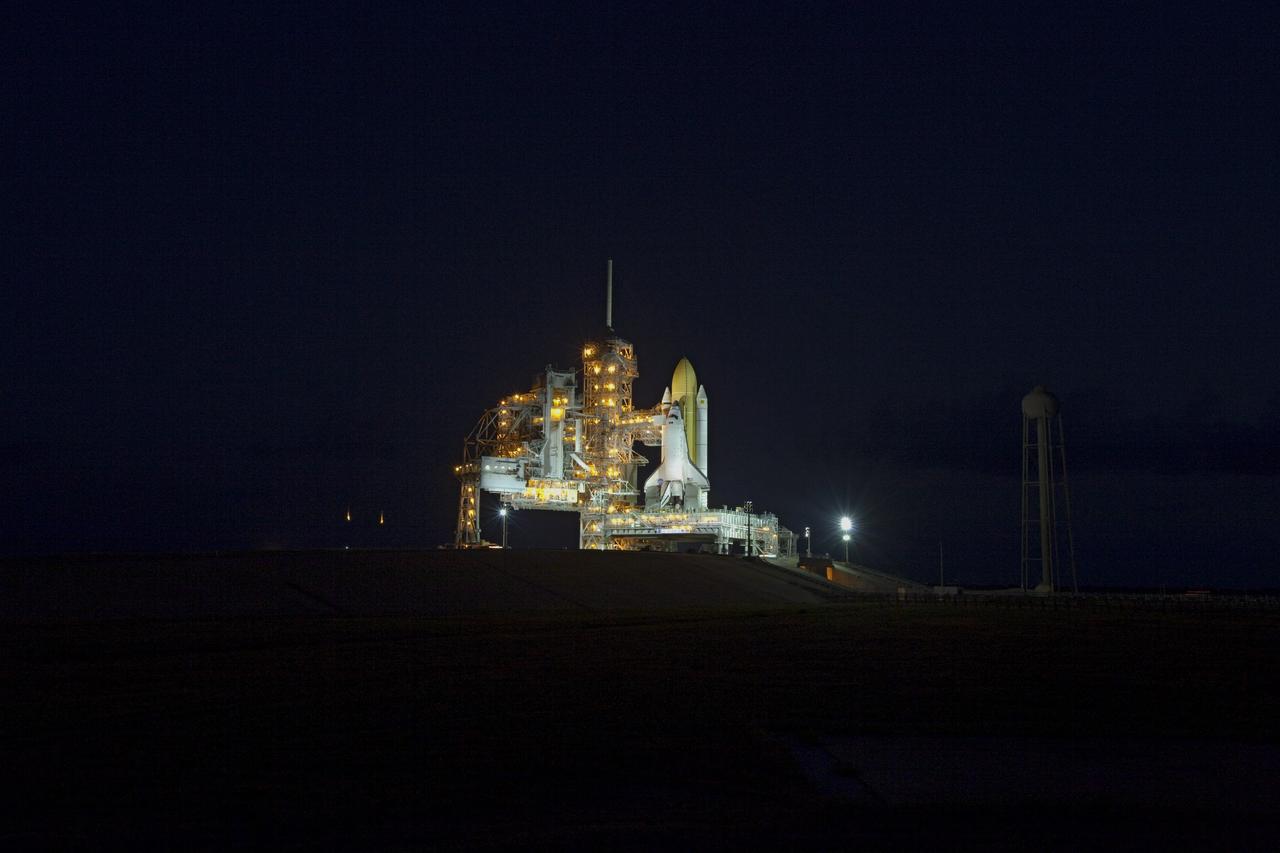
CAPE CANAVERAL, Fla. -- Just after sunset, space shuttle Discovery is attached to Launch Pad 39A at NASA's Kennedy Space Center in Florida. Meanwhile, workers prepare to move the rotating service structure, which protects the shuttle from the elements and provides access inside, into place. It took the spacecraft about six hours to make the journey, known as "rollout," from the Vehicle Assembly Building to the pad. Rollout sets the stage for Discovery's STS-133 crew to practice countdown and launch procedures during the Terminal Countdown Demonstration Test in mid-October. Targeted to liftoff Nov. 1, Discovery will take the Permanent Multipurpose Module (PMM) packed with supplies and critical spare parts, as well as Robonaut 2 (R2) to the International Space Station. Photo credit: NASA/Frankie Martin
CAPE CANAVERAL, Fla. -- Space shuttle Discovery is attached to Launch Pad 39A as the sun rises over NASA's Kennedy Space Center in Florida. Later, the rotating service structure that protects the shuttle from the elements and provides access inside the vehicle will be moved into place. It took the spacecraft about six hours to make the journey, known as "rollout," from the Vehicle Assembly Building to the pad. Rollout sets the stage for Discovery's STS-133 crew to practice countdown and launch procedures during the Terminal Countdown Demonstration Test in mid-October. Targeted to liftoff Nov. 1, Discovery will take the Permanent Multipurpose Module (PMM) packed with supplies and critical spare parts, as well as Robonaut 2 (R2) to the International Space Station. Photo credit: NASA/Frankie Martin

CAPE CANAVERAL, Fla. -- At NASA's Kennedy Space Center in Florida, the sun shines through Launch Pad 39A and hides space shuttle Discovery, which is secured to the pad structure. It took the spacecraft about six hours to make the journey, known as "rollout," from the Vehicle Assembly Building to the pad. Rollout sets the stage for Discovery's STS-133 crew to practice countdown and launch procedures during the Terminal Countdown Demonstration Test in mid-October. Targeted to liftoff Nov. 1, Discovery will take the Permanent Multipurpose Module (PMM) packed with supplies and critical spare parts, as well as Robonaut 2 (R2) to the International Space Station. Photo credit: NASA/Jack Pfaller
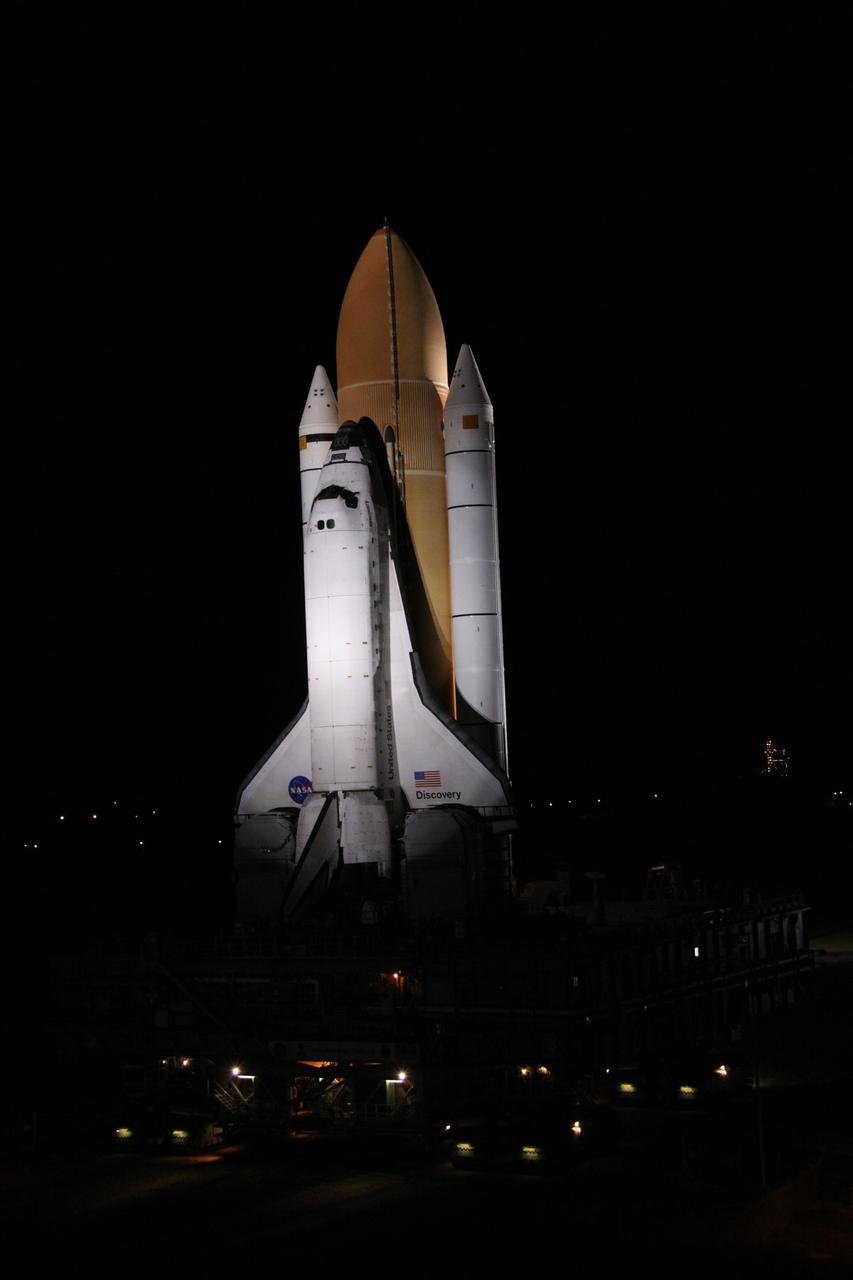
CAPE CANAVERAL, Fla. -- Bathed in bright xenon lights, space shuttle Discovery makes its nighttime trek, known as "rollout," from the Vehicle Assembly Building to Launch Pad 39A at NASA's Kennedy Space Center in Florida. It will take the shuttle, attached to its external fuel tank, twin solid rocket boosters and mobile launcher platform, about six hours to complete the move atop a crawler-transporter. Rollout sets the stage for Discovery's STS-133 crew to practice countdown and launch procedures during the Terminal Countdown Demonstration Test in mid-October. Targeted to liftoff Nov. 1, Discovery will take the Permanent Multipurpose Module (PMM) packed with supplies and critical spare parts, as well as Robonaut 2 (R2) to the International Space Station. Photo credit: NASA/Jack Pfaller
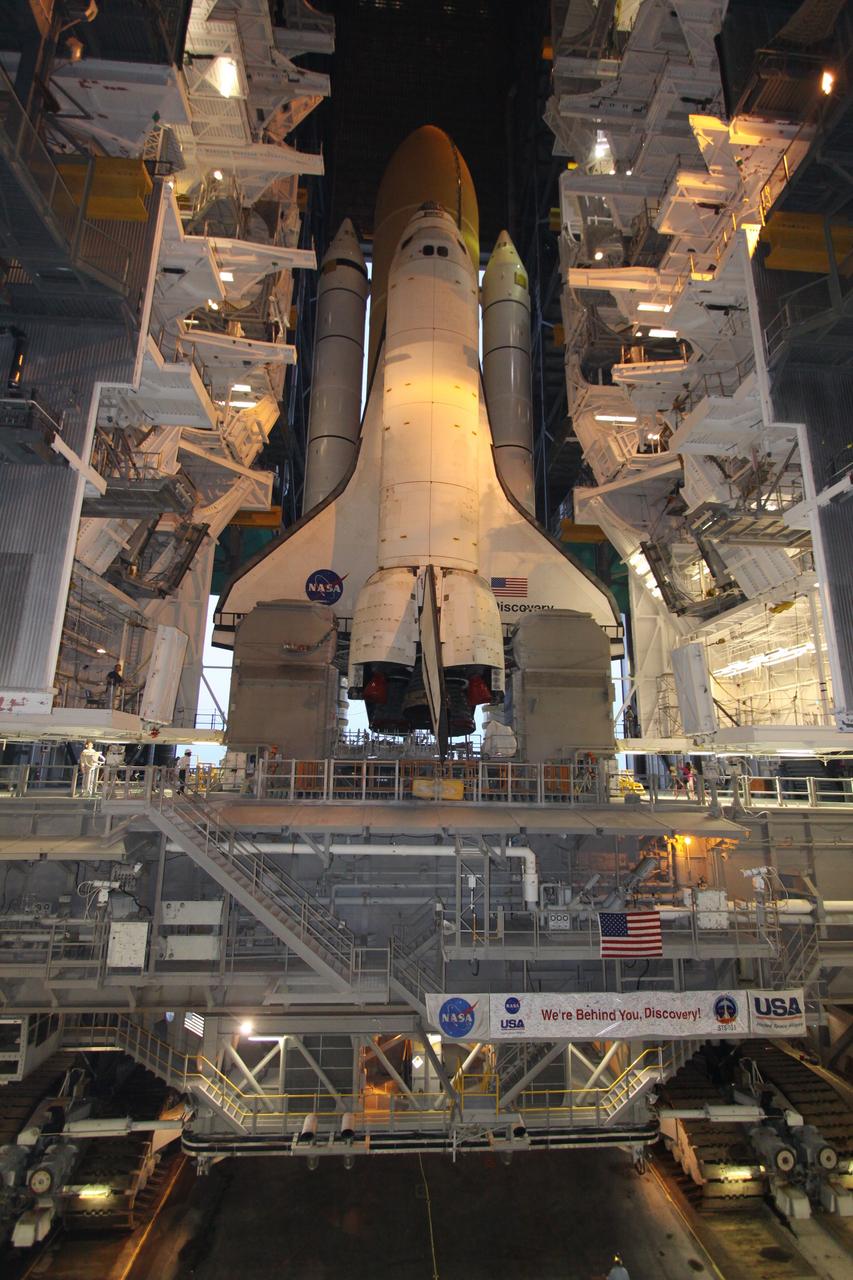
CAPE CANAVERAL, Fla. -- At NASA's Kennedy Space Center in Florida, space shuttle Discovery begins its nighttime trek, known as "rollout," from the Vehicle Assembly Building to Launch Pad 39A. It will take the shuttle, attached to its external fuel tank, twin solid rocket boosters and mobile launcher platform, about six hours to complete the move atop a crawler-transporter. Rollout sets the stage for Discovery's STS-133 crew to practice countdown and launch procedures during the Terminal Countdown Demonstration Test in mid-October. Targeted to liftoff Nov. 1, Discovery will take the Permanent Multipurpose Module (PMM) packed with supplies and critical spare parts, as well as Robonaut 2 (R2) to the International Space Station. Photo credit: NASA/Jack Pfaller
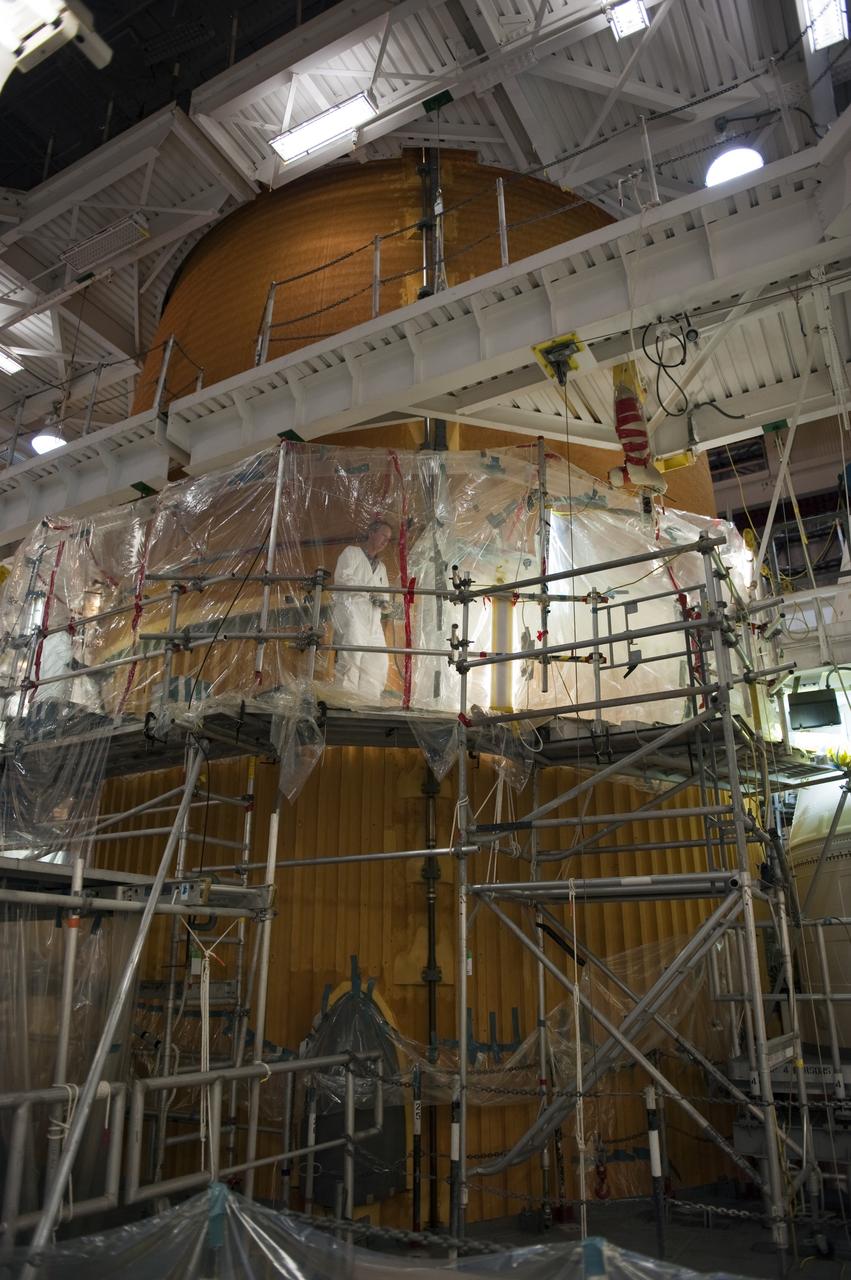
CAPE CANAVERAL, Fla. -- Repair work to space shuttle Discovery's external fuel tank continues in the Vehicle Assembly Building at NASA's Kennedy Space Center in Florida. Technicians are modifying 94 support beams, called stringers, on the tank's intertank region by fitting pieces of metal, called radius blocks, over the stringers' edges. After the modifications of the stringers are complete, foam insulation will be re-applied to the tank. Discovery's next launch opportunity to the International Space Station on the STS-133 mission is targeted for Feb. 24, 2011. For more information on STS-133, visit www.nasa.gov/mission_pages/shuttle/shuttlemissions/sts133/. Photo credit: NASA/Kim Shiflett
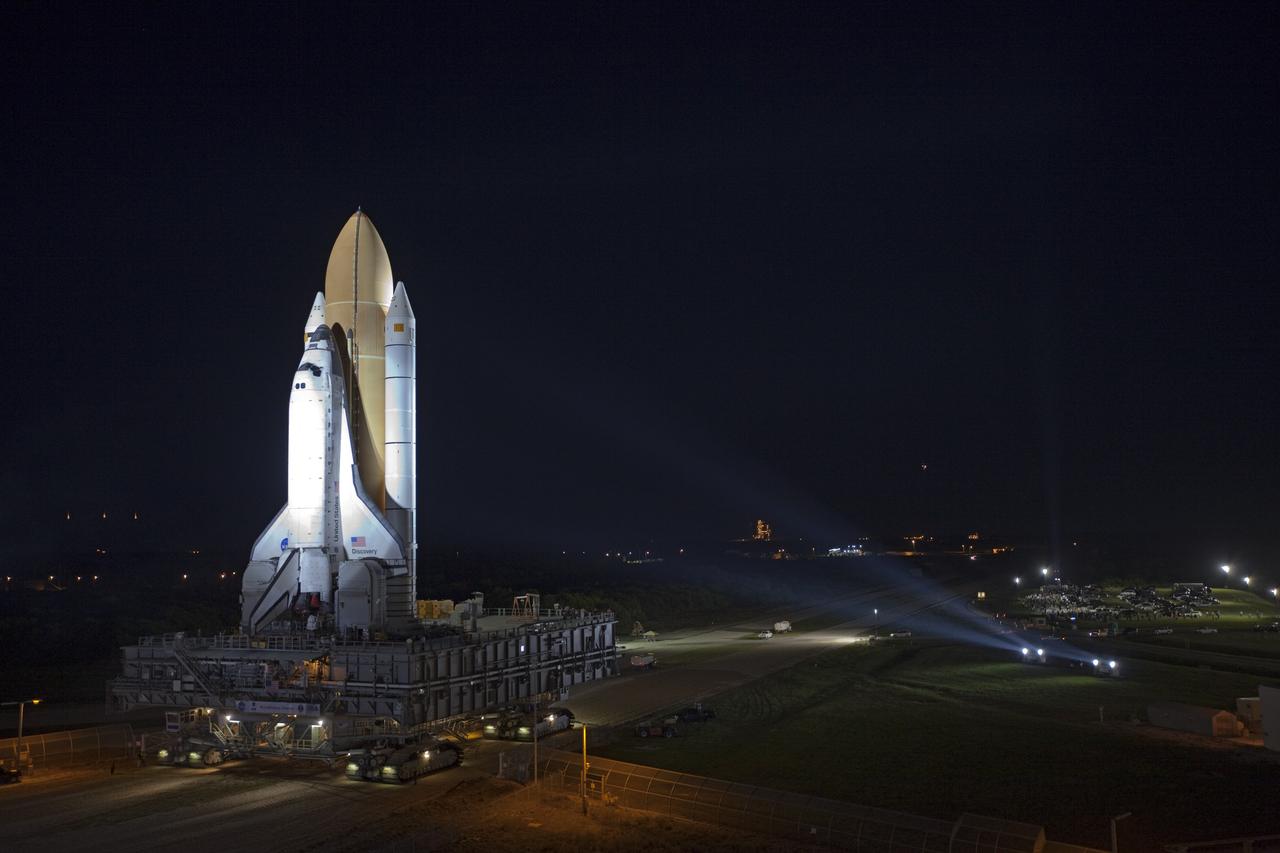
CAPE CANAVERAL, Fla. -- Bathed in bright xenon lights, space shuttle Discovery makes its nighttime trek, known as "rollout," from the Vehicle Assembly Building to Launch Pad 39A at NASA's Kennedy Space Center in Florida. It will take the shuttle, attached to its external fuel tank, twin solid rocket boosters and mobile launcher platform, about six hours to complete the move atop a crawler-transporter. Rollout sets the stage for Discovery's STS-133 crew to practice countdown and launch procedures during the Terminal Countdown Demonstration Test in mid-October. Targeted to liftoff Nov. 1, Discovery will take the Permanent Multipurpose Module (PMM) packed with supplies and critical spare parts, as well as Robonaut 2 (R2) to the International Space Station. Photo credit: NASA/Frankie Martin
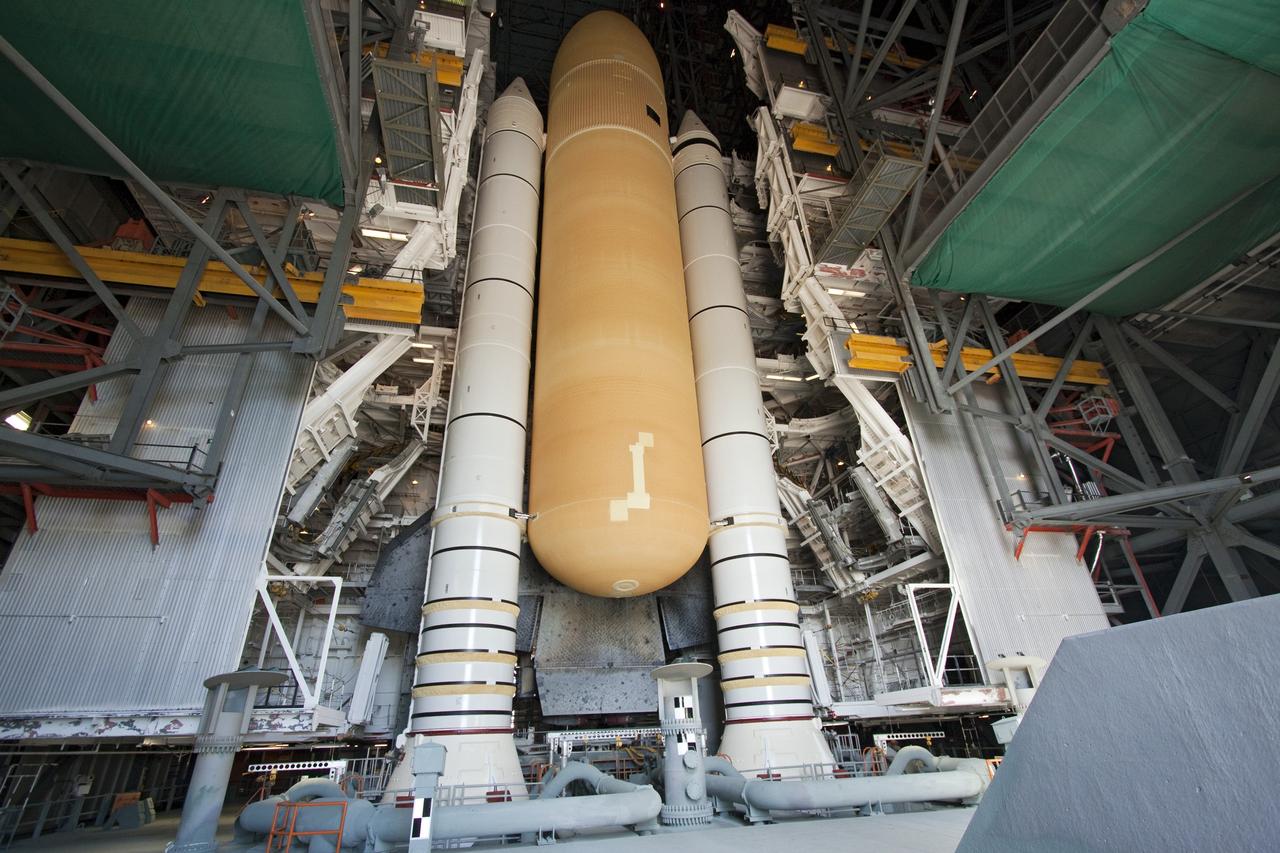
CAPE CANAVERAL, Fla. -- At NASA's Kennedy Space Center in Florida, space shuttle Discovery is ready for its nighttime trek, known as "rollout," from the Vehicle Assembly Building to Launch Pad 39A. It will take the shuttle, attached to its external fuel tank, twin solid rocket boosters and mobile launcher platform, about six hours to complete the move atop a crawler-transporter. Rollout sets the stage for Discovery's STS-133 crew to practice countdown and launch procedures during the Terminal Countdown Demonstration Test in mid-October. Targeted to liftoff Nov. 1, Discovery will take the Permanent Multipurpose Module (PMM) packed with supplies and critical spare parts, as well as Robonaut 2 (R2) to the International Space Station. Photo credit: NASA/Jack Pfaller
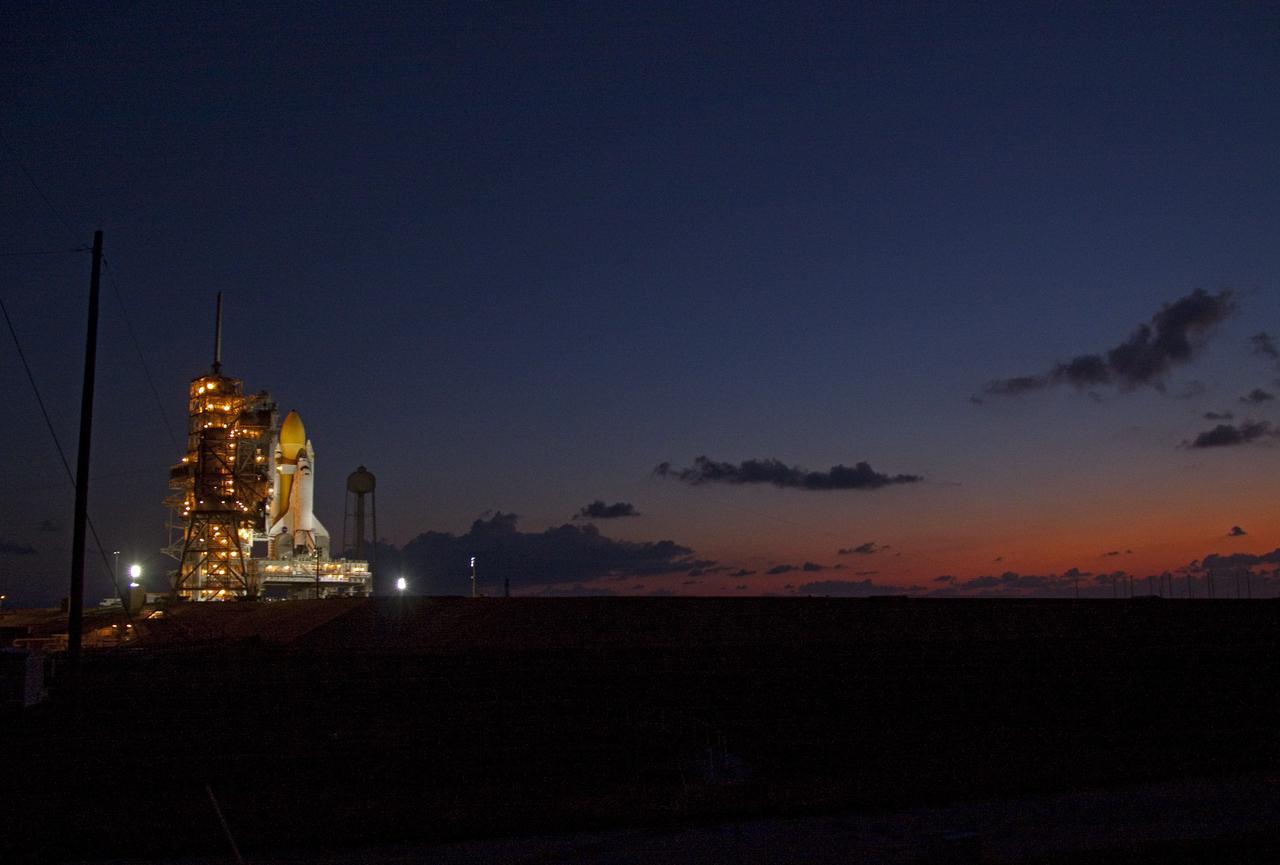
CAPE CANAVERAL, Fla. -- Space shuttle Discovery is attached to Launch Pad 39A as the sun rises over NASA's Kennedy Space Center in Florida. It took the spacecraft about six hours to make the journey, known as "rollout," from the Vehicle Assembly Building to the pad. Rollout sets the stage for Discovery's STS-133 crew to practice countdown and launch procedures during the Terminal Countdown Demonstration Test in mid-October. Targeted to liftoff Nov. 1, Discovery will take the Permanent Multipurpose Module (PMM) packed with supplies and critical spare parts, as well as Robonaut 2 (R2) to the International Space Station. Photo credit: NASA/Jack Pfaller
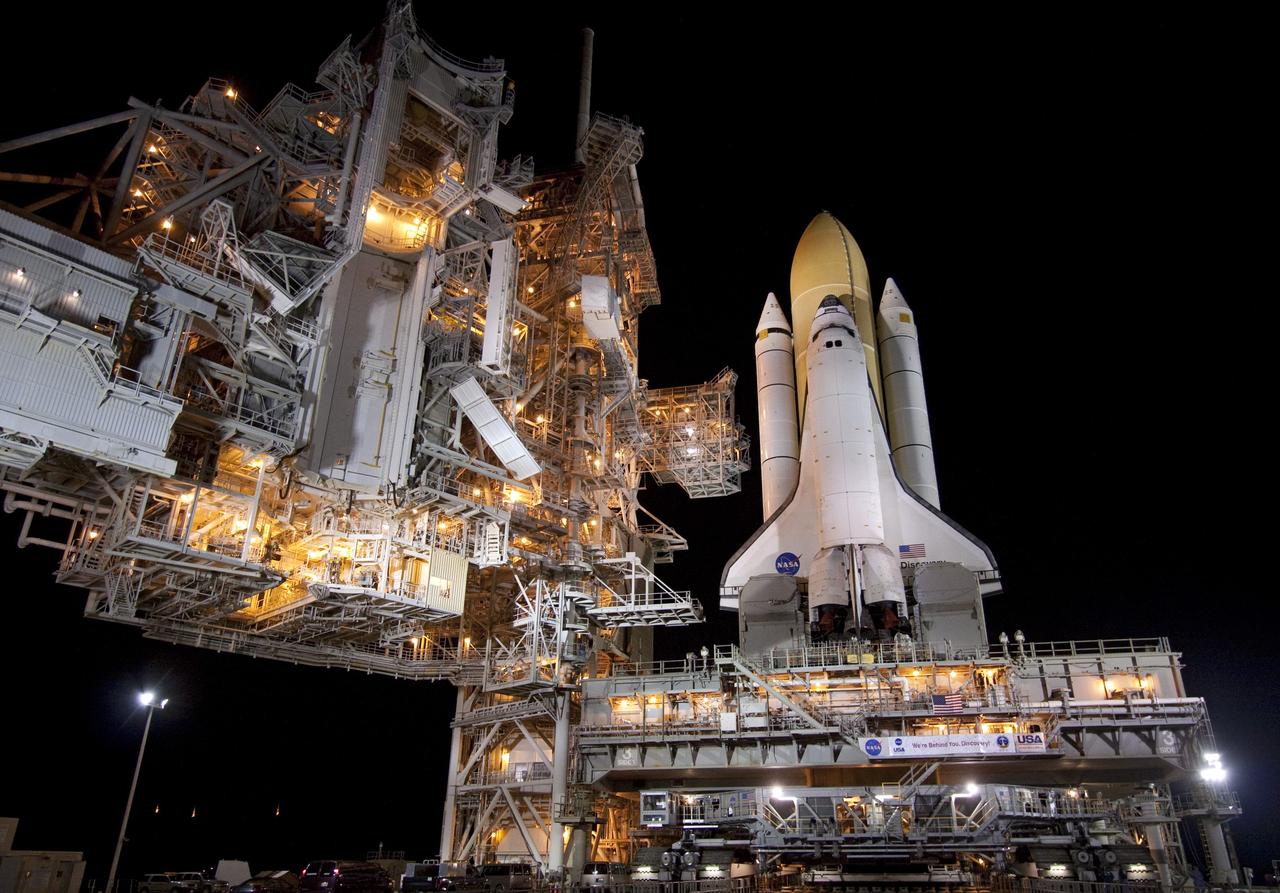
CAPE CANAVERAL, Fla. -- At NASA's Kennedy Space Center in Florida, space shuttle Discovery is attached to Launch Pad 39A, completing "rollout" from the Vehicle Assembly Building to Launch Pad 39A. It took the shuttle, attached to its external fuel tank, twin solid rocket boosters and mobile launcher platform, about six hours to complete the move atop a crawler-transporter. Rollout sets the stage for Discovery's STS-133 crew to practice countdown and launch procedures during the Terminal Countdown Demonstration Test in mid-October. Targeted to liftoff Nov. 1, Discovery will take the Permanent Multipurpose Module (PMM) packed with supplies and critical spare parts, as well as Robonaut 2 (R2) to the International Space Station. Photo credit: NASA/Jack Pfaller
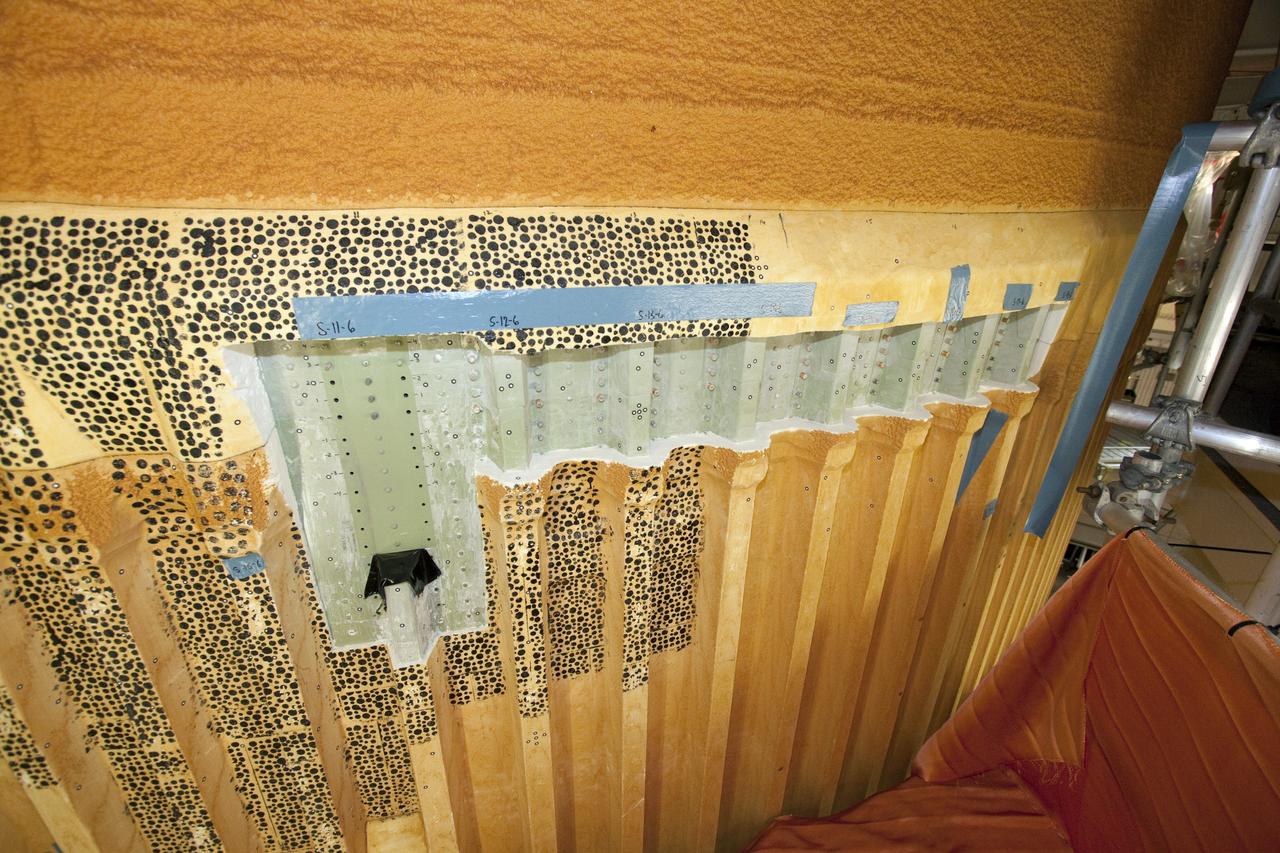
CAPE CANAVERAL, Fla. -- Repair work to space shuttle Discovery's external fuel tank begins in the Vehicle Assembly Building at NASA's Kennedy Space Center in Florida. Technicians will modify 32 support beams, called stringers, on the tank's intertank region by fitting pieces of metal, called radius blocks, over the stringers' edges where they attach to the thrust panel area. The thrust panel is where the tank meets the two solid rocket boosters and sees the most stress during the flight into orbit. After the modifications and additional scans of the stringers are complete, foam insulation will be re-applied. Discovery's next launch opportunity to the International Space Station on the STS-133 mission is no earlier than Feb. 3, 2011. For more information on STS-133, visit www.nasa.gov/mission_pages/shuttle/shuttlemissions/sts133/. Photo credit: NASA/Jack Pfaller
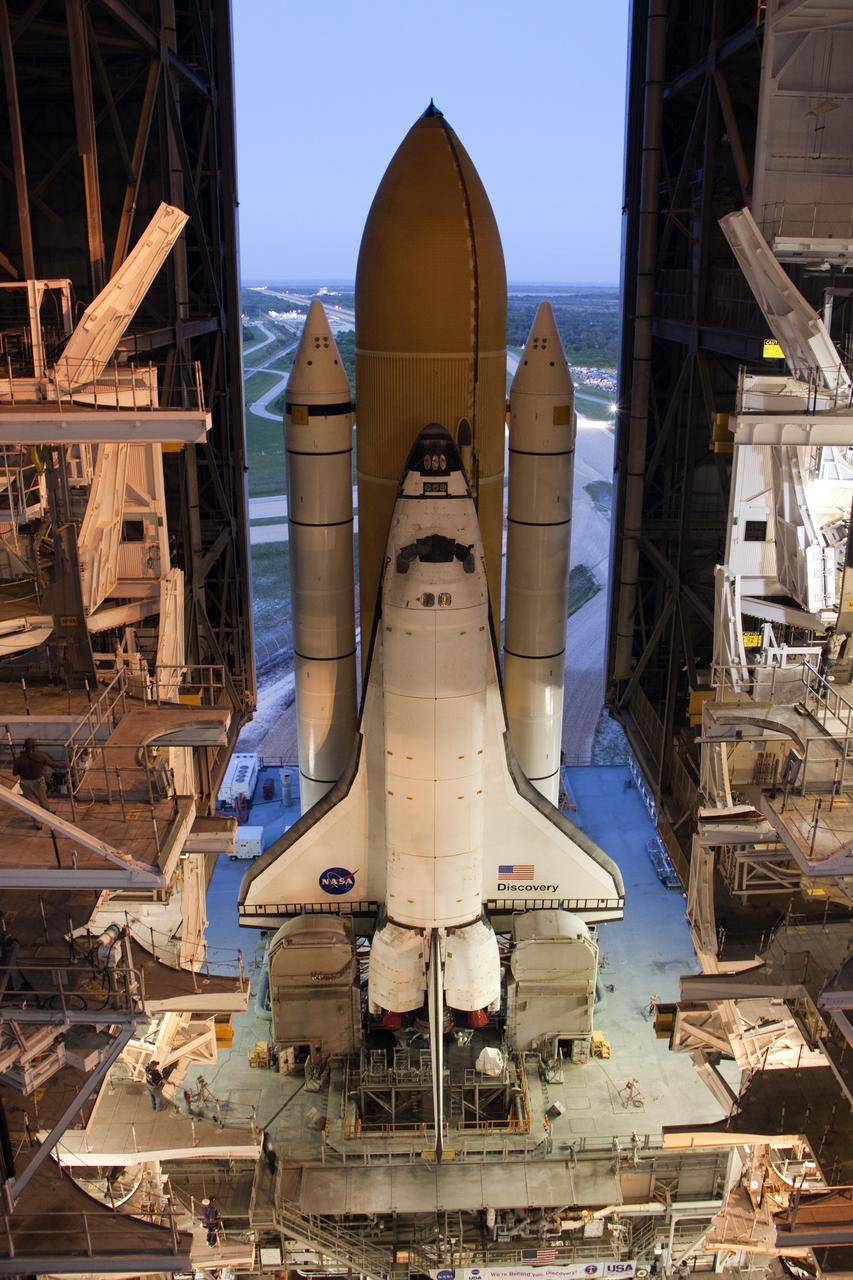
CAPE CANAVERAL, Fla. -- At NASA's Kennedy Space Center in Florida, space shuttle Discovery begins its nighttime trek, known as "rollout," from the Vehicle Assembly Building to Launch Pad 39A. It will take the shuttle, attached to its external fuel tank, twin solid rocket boosters and mobile launcher platform, about six hours to complete the move atop a crawler-transporter. Rollout sets the stage for Discovery's STS-133 crew to practice countdown and launch procedures during the Terminal Countdown Demonstration Test in mid-October. Targeted to liftoff Nov. 1, Discovery will take the Permanent Multipurpose Module (PMM) packed with supplies and critical spare parts, as well as Robonaut 2 (R2) to the International Space Station. Photo credit: NASA/Mic Miracle
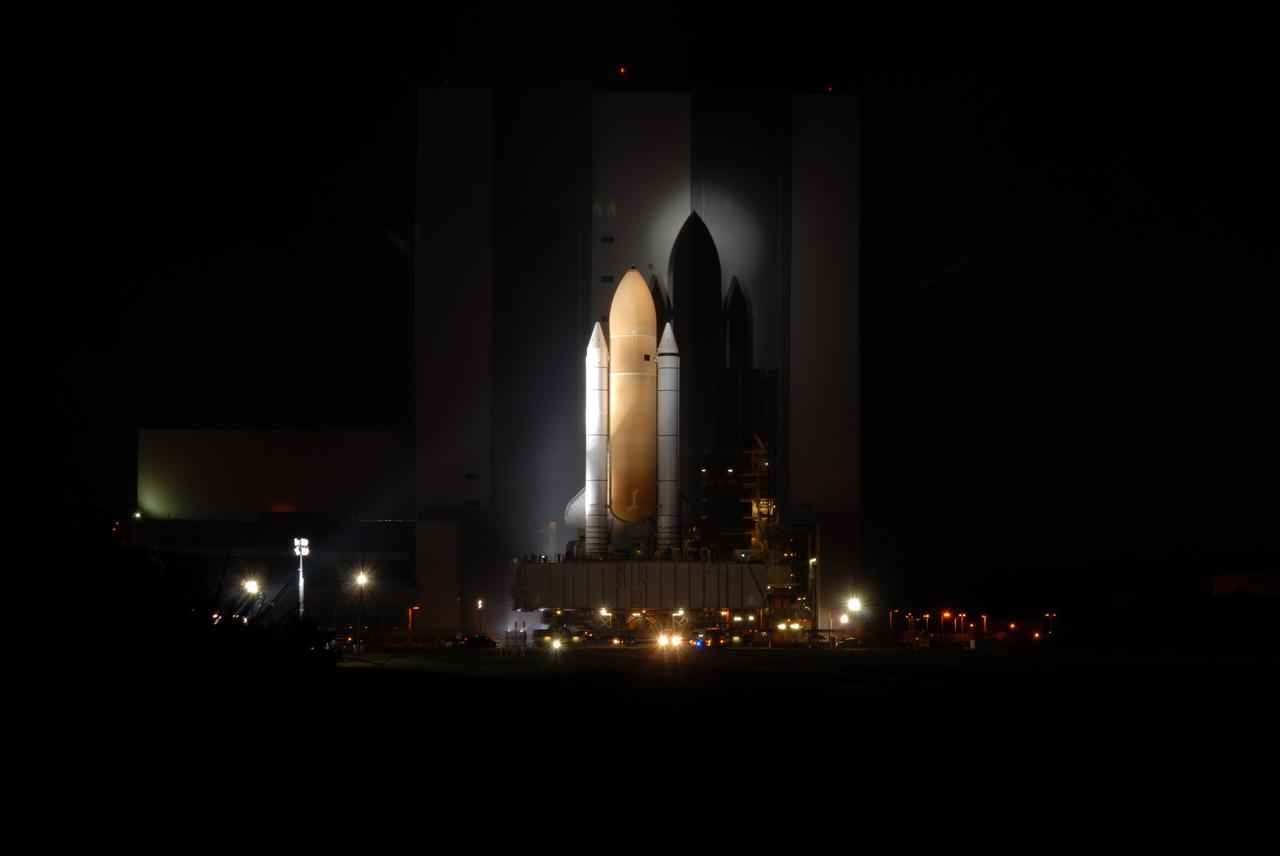
CAPE CANAVERAL, Fla. -- Bathed in bright xenon lights, space shuttle Discovery makes its nighttime trek, known as "rollout," from the Vehicle Assembly Building to Launch Pad 39A at NASA's Kennedy Space Center in Florida. It will take the shuttle, attached to its external fuel tank, twin solid rocket boosters and mobile launcher platform, about six hours to complete the move atop a crawler-transporter. Rollout sets the stage for Discovery's STS-133 crew to practice countdown and launch procedures during the Terminal Countdown Demonstration Test in mid-October. Targeted to liftoff Nov. 1, Discovery will take the Permanent Multipurpose Module (PMM) packed with supplies and critical spare parts, as well as Robonaut 2 (R2) to the International Space Station. Photo credit: NASA/Jim Grossmann
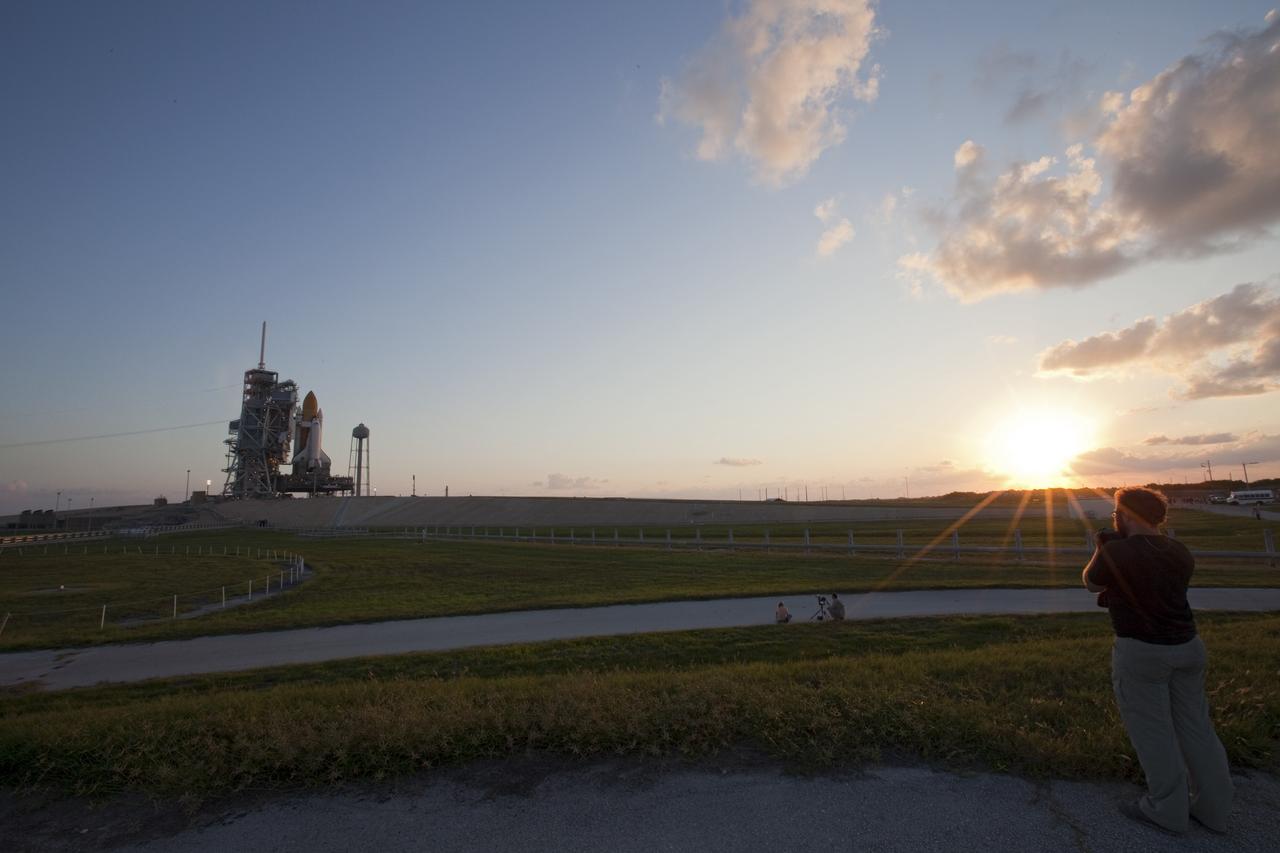
CAPE CANAVERAL, Fla. -- Space shuttle Discovery is attached to Launch Pad 39A as the sun rises over NASA's Kennedy Space Center in Florida. Later, the rotating service structure that protects the shuttle from the elements and provides access inside the vehicle will be moved into place. It took the spacecraft about six hours to make the journey, known as "rollout," from the Vehicle Assembly Building to the pad. Rollout sets the stage for Discovery's STS-133 crew to practice countdown and launch procedures during the Terminal Countdown Demonstration Test in mid-October. Targeted to liftoff Nov. 1, Discovery will take the Permanent Multipurpose Module (PMM) packed with supplies and critical spare parts, as well as Robonaut 2 (R2) to the International Space Station. Photo credit: NASA/Frankie Martin
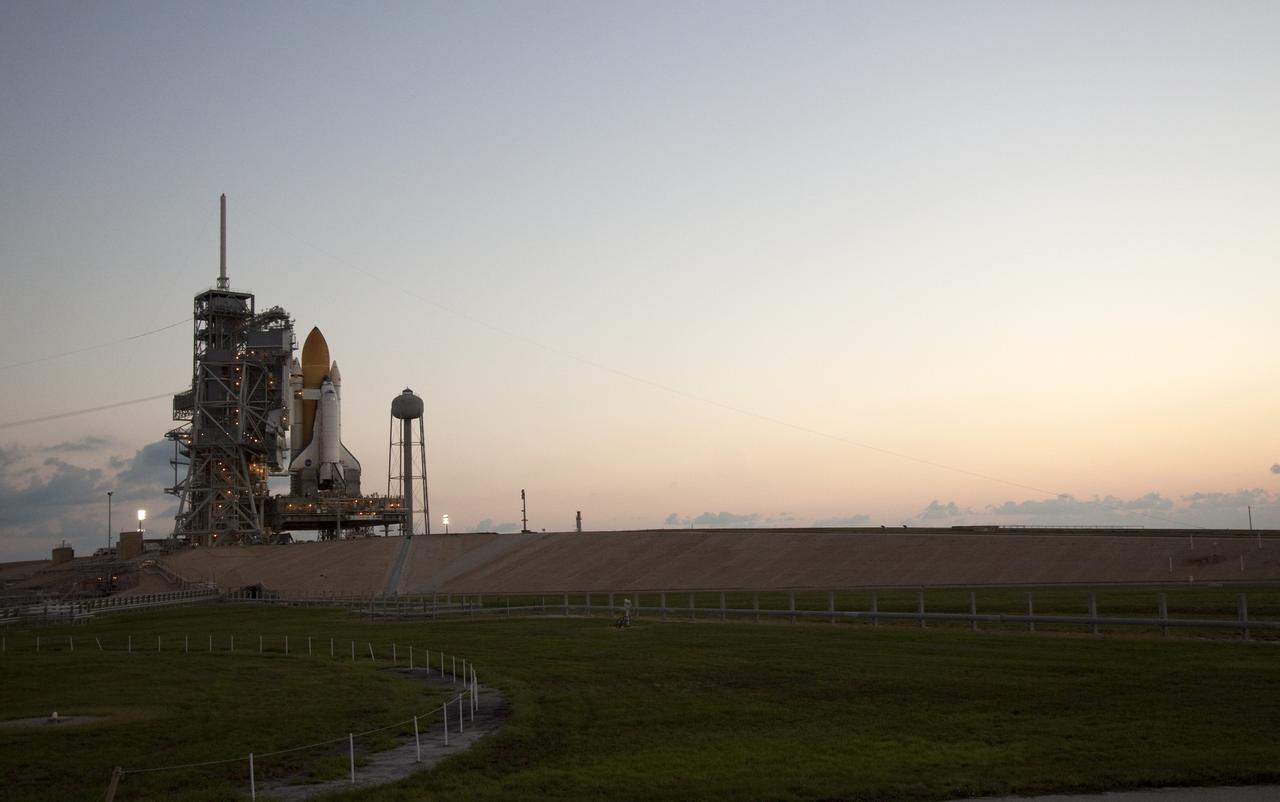
CAPE CANAVERAL, Fla. -- Space shuttle Discovery is attached to Launch Pad 39A as the sun rises over NASA's Kennedy Space Center in Florida. It took the spacecraft about six hours to make the journey, known as "rollout," from the Vehicle Assembly Building to the pad. Rollout sets the stage for Discovery's STS-133 crew to practice countdown and launch procedures during the Terminal Countdown Demonstration Test in mid-October. Targeted to liftoff Nov. 1, Discovery will take the Permanent Multipurpose Module (PMM) packed with supplies and critical spare parts, as well as Robonaut 2 (R2) to the International Space Station. Photo credit: NASA/Jack Pfaller
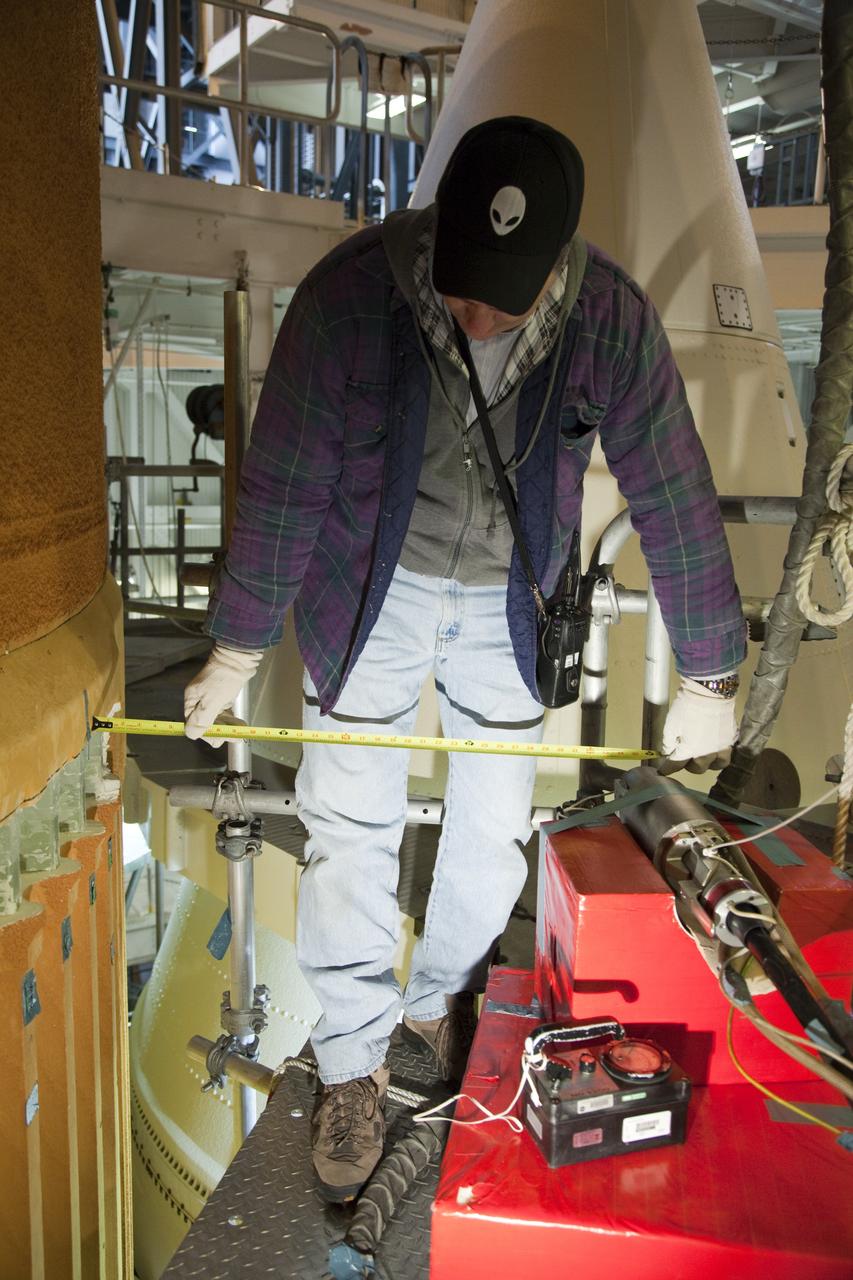
CAPE CANAVERAL, Fla. -- A technician measures the distance between space shuttle Discovery's external fuel tank and a computed radiography scanning device. The shuttle stack, consisting of the shuttle, external tank and solid rocket boosters, was moved from Launch Pad 39A to the Vehicle Assembly Building at NASA's Kennedy Space Center in Florida so technicians could examine 21-foot-long support beams, called stringers, on the outside of the tank's intertank and re-apply foam insulation. Discovery's next launch opportunity to the International Space Station on the STS-133 mission is no earlier than Feb. 3, 2011. For more information on STS-133, visit www.nasa.gov/mission_pages/shuttle/shuttlemissions/sts133/. Photo credit: NASA/Frankie Martin
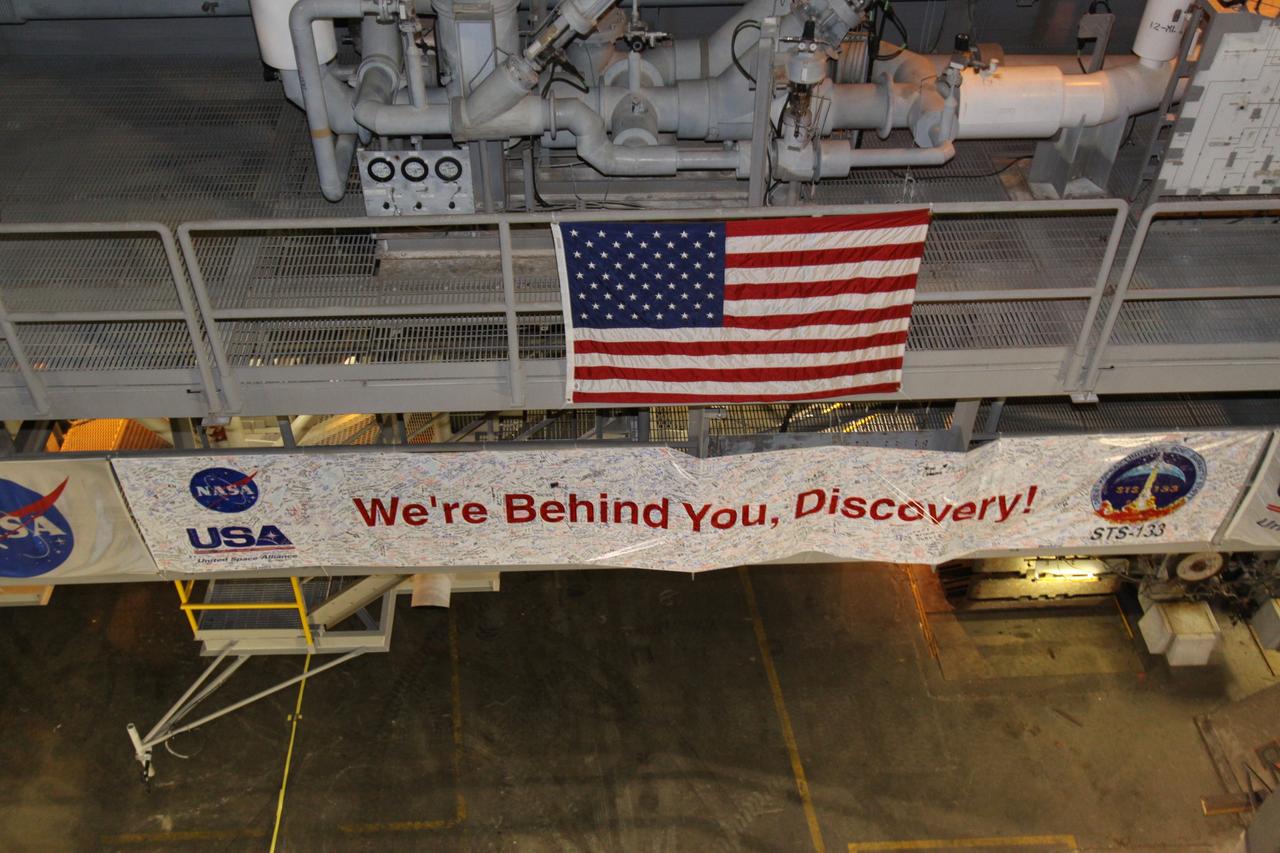
CAPE CANAVERAL, Fla. -- At NASA's Kennedy Space Center in Florida, an American flag and a sign supporting space shuttle Discovery with signatures of space center workers hang on its crawler-transporter mobile launcher as it begins the nighttime trek, known as "rollout," from the Vehicle Assembly Building to Launch Pad 39A. It will take the shuttle about six hours to complete the move. Rollout sets the stage for Discovery's STS-133 crew to practice countdown and launch procedures during the Terminal Countdown Demonstration Test in mid-October. Targeted to liftoff Nov. 1, Discovery will take the Permanent Multipurpose Module (PMM) packed with supplies and critical spare parts, as well as Robonaut 2 (R2) to the International Space Station. Photo credit: NASA/Jack Pfaller
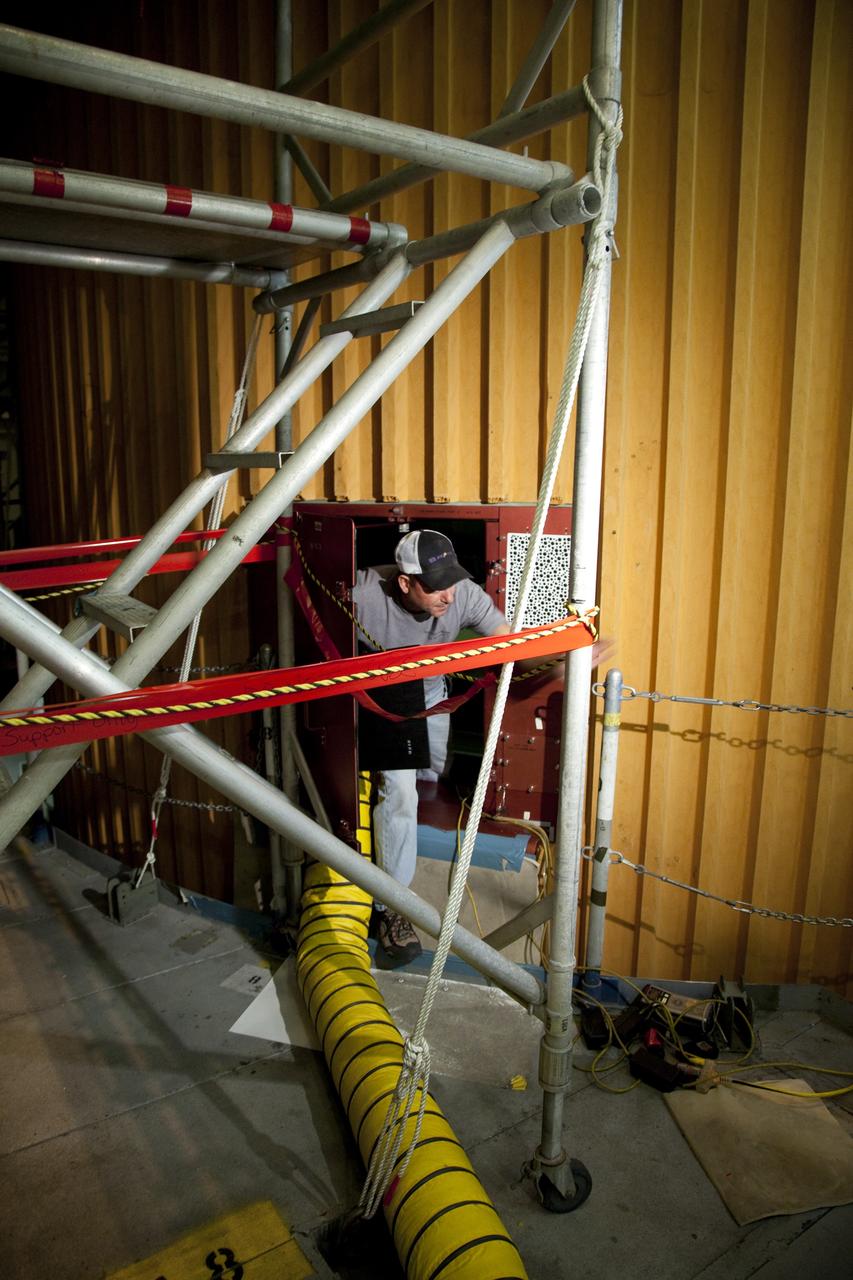
CAPE CANAVERAL, Fla. -- A technician exits the intertank of space shuttle Discovery's external fuel tank holding the film used to project computed radiography scans. The shuttle stack was moved from Launch Pad 39A to the Vehicle Assembly Building at NASA's Kennedy Space Center in Florida so technicians could examine 21-foot-long support beams, called stringers, on the outside of the tank's intertank and re-apply foam insulation. Discovery's next launch opportunity to the International Space Station on the STS-133 mission is no earlier than Feb. 3, 2011. For more information on STS-133, visit www.nasa.gov/mission_pages/shuttle/shuttlemissions/sts133/. Photo credit: NASA/Frankie Martin
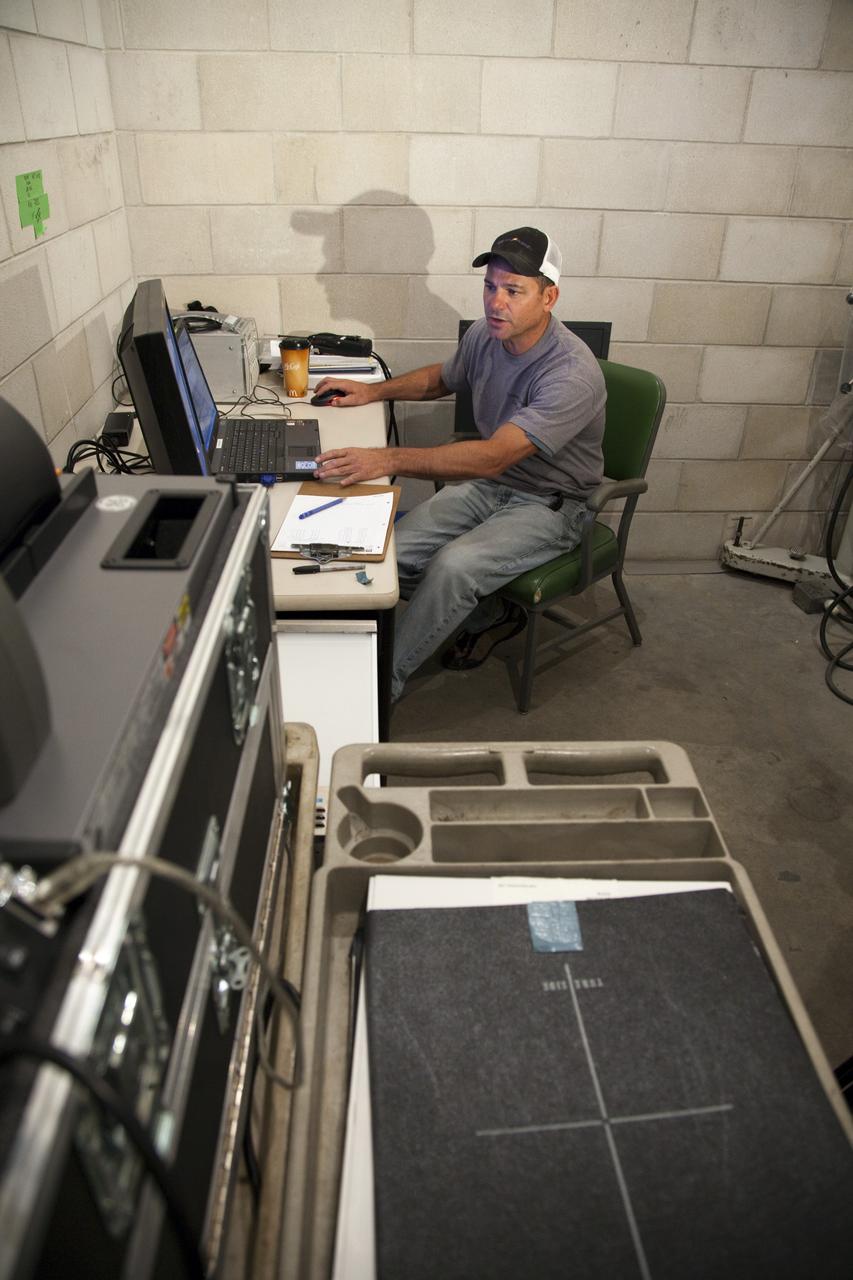
CAPE CANAVERAL, Fla. -- A technician prepares to monitor computed radiography scans of space shuttle Discovery's external fuel tank. The shuttle stack, consisting of the shuttle, external tank and solid rocket boosters, was moved from Launch Pad 39A to the Vehicle Assembly Building at NASA's Kennedy Space Center in Florida so technicians could examine 21-foot-long support beams, called stringers, on the outside of the tank's intertank and re-apply foam insulation. Discovery's next launch opportunity to the International Space Station on the STS-133 mission is no earlier than Feb. 3, 2011. For more information on STS-133, visit www.nasa.gov/mission_pages/shuttle/shuttlemissions/sts133/. Photo credit: NASA/Frankie Martin
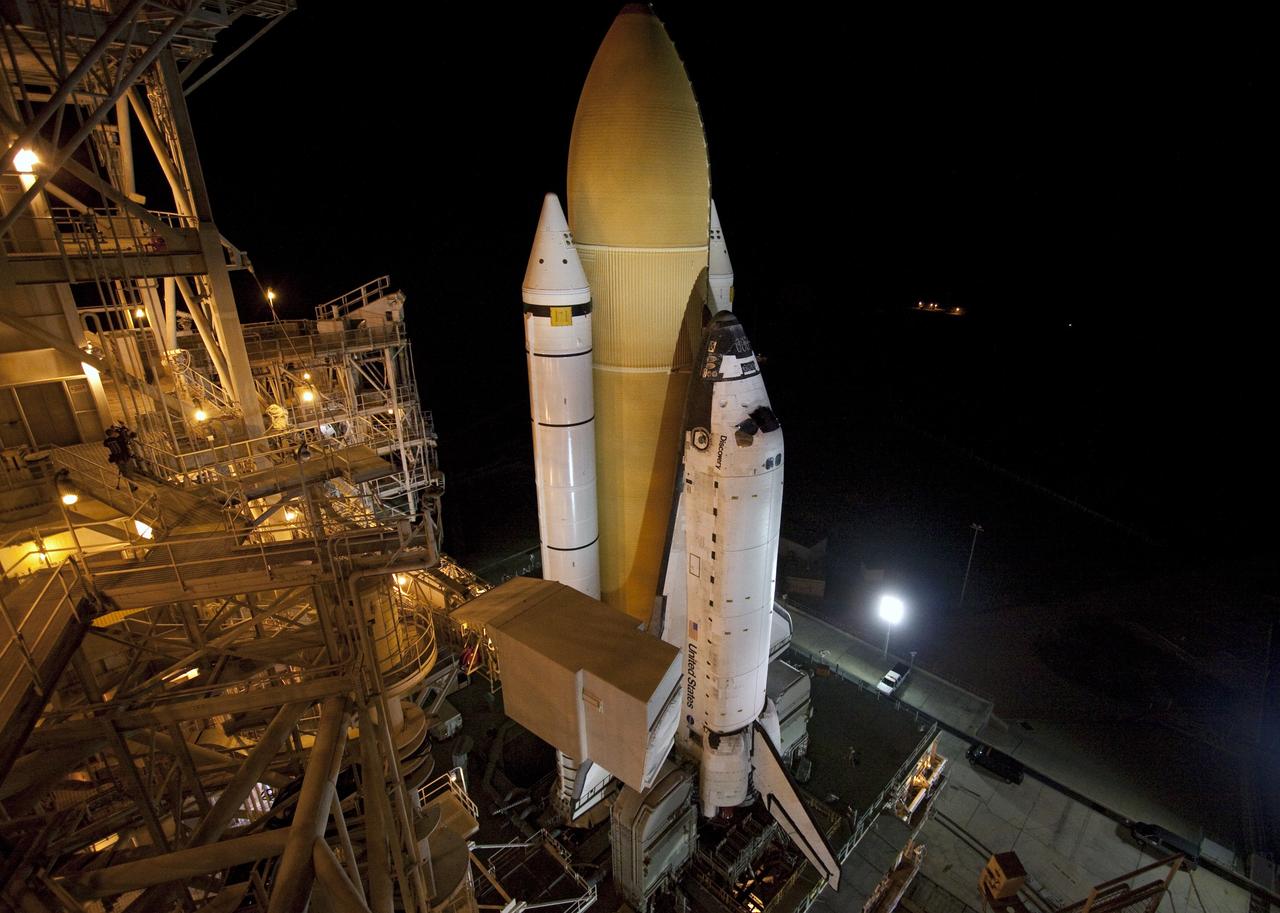
CAPE CANAVERAL, Fla. -- At NASA's Kennedy Space Center in Florida, space shuttle Discovery is attached to Launch Pad 39A, completing "rollout" from the Vehicle Assembly Building to Launch Pad 39A. It took the shuttle, attached to its external fuel tank, twin solid rocket boosters and mobile launcher platform, about six hours to complete the move atop a crawler-transporter. Rollout sets the stage for Discovery's STS-133 crew to practice countdown and launch procedures during the Terminal Countdown Demonstration Test in mid-October. Targeted to liftoff Nov. 1, Discovery will take the Permanent Multipurpose Module (PMM) packed with supplies and critical spare parts, as well as Robonaut 2 (R2) to the International Space Station. Photo credit: NASA/Jack Pfaller
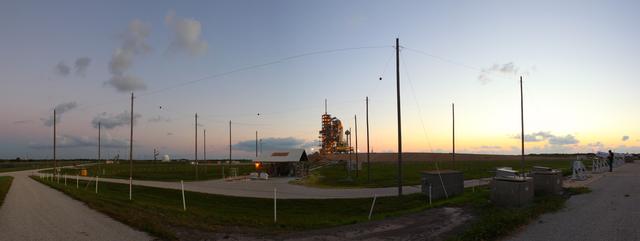
CAPE CANAVERAL, Fla. -- Space shuttle Discovery is attached to Launch Pad 39A as the sun rises over NASA's Kennedy Space Center in Florida. Later, the rotating service structure that protects the shuttle from the elements and provides access inside the vehicle will be moved into place. It took the spacecraft about six hours to make the journey, known as "rollout," from the Vehicle Assembly Building to the pad. Rollout sets the stage for Discovery's STS-133 crew to practice countdown and launch procedures during the Terminal Countdown Demonstration Test in mid-October. Targeted to liftoff Nov. 1, Discovery will take the Permanent Multipurpose Module (PMM) packed with supplies and critical spare parts, as well as Robonaut 2 (R2) to the International Space Station. Photo credit: NASA/Frankie Martin
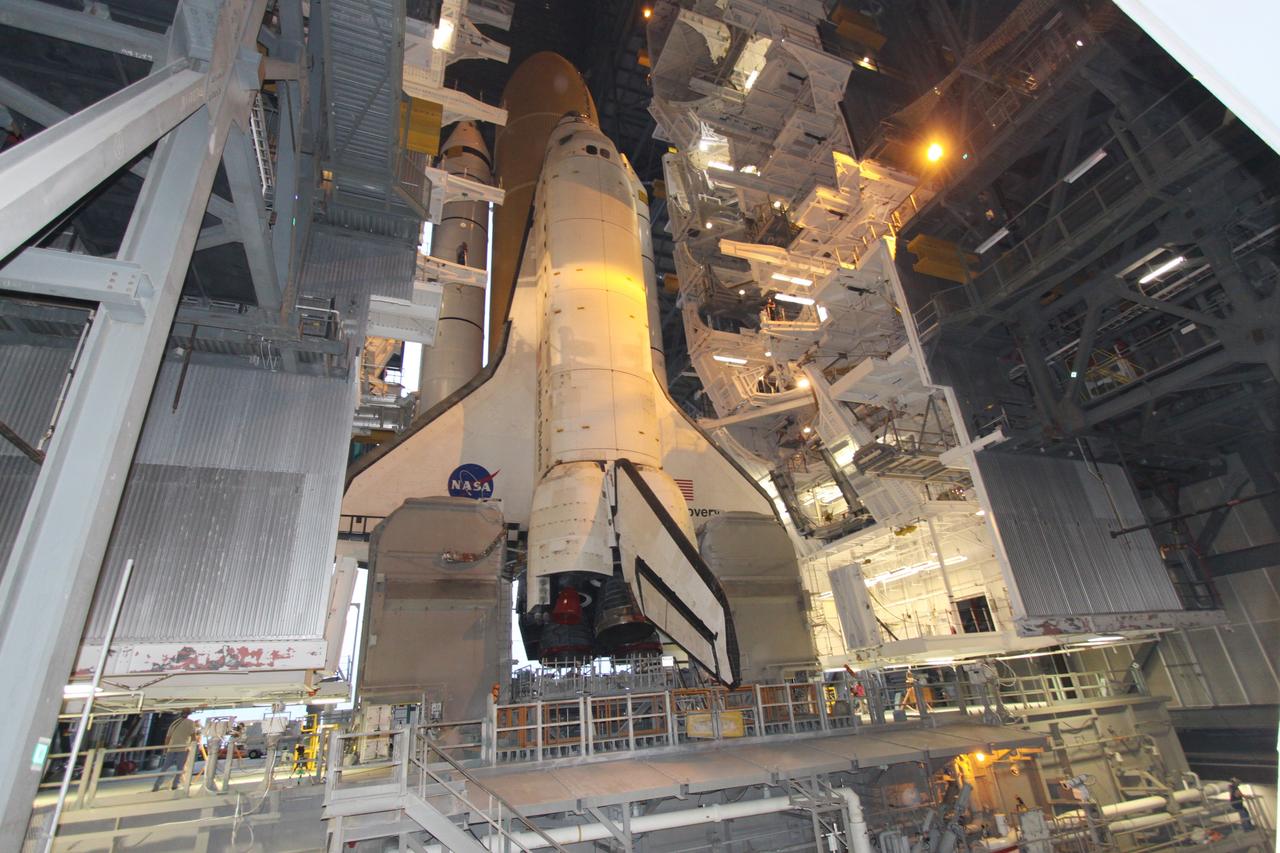
CAPE CANAVERAL, Fla. -- At NASA's Kennedy Space Center in Florida, space shuttle Discovery begins its nighttime trek, known as "rollout," from the Vehicle Assembly Building to Launch Pad 39A. It will take the shuttle, attached to its external fuel tank, twin solid rocket boosters and mobile launcher platform, about six hours to complete the move atop a crawler-transporter. Rollout sets the stage for Discovery's STS-133 crew to practice countdown and launch procedures during the Terminal Countdown Demonstration Test in mid-October. Targeted to liftoff Nov. 1, Discovery will take the Permanent Multipurpose Module (PMM) packed with supplies and critical spare parts, as well as Robonaut 2 (R2) to the International Space Station. Photo credit: NASA/Jack Pfaller
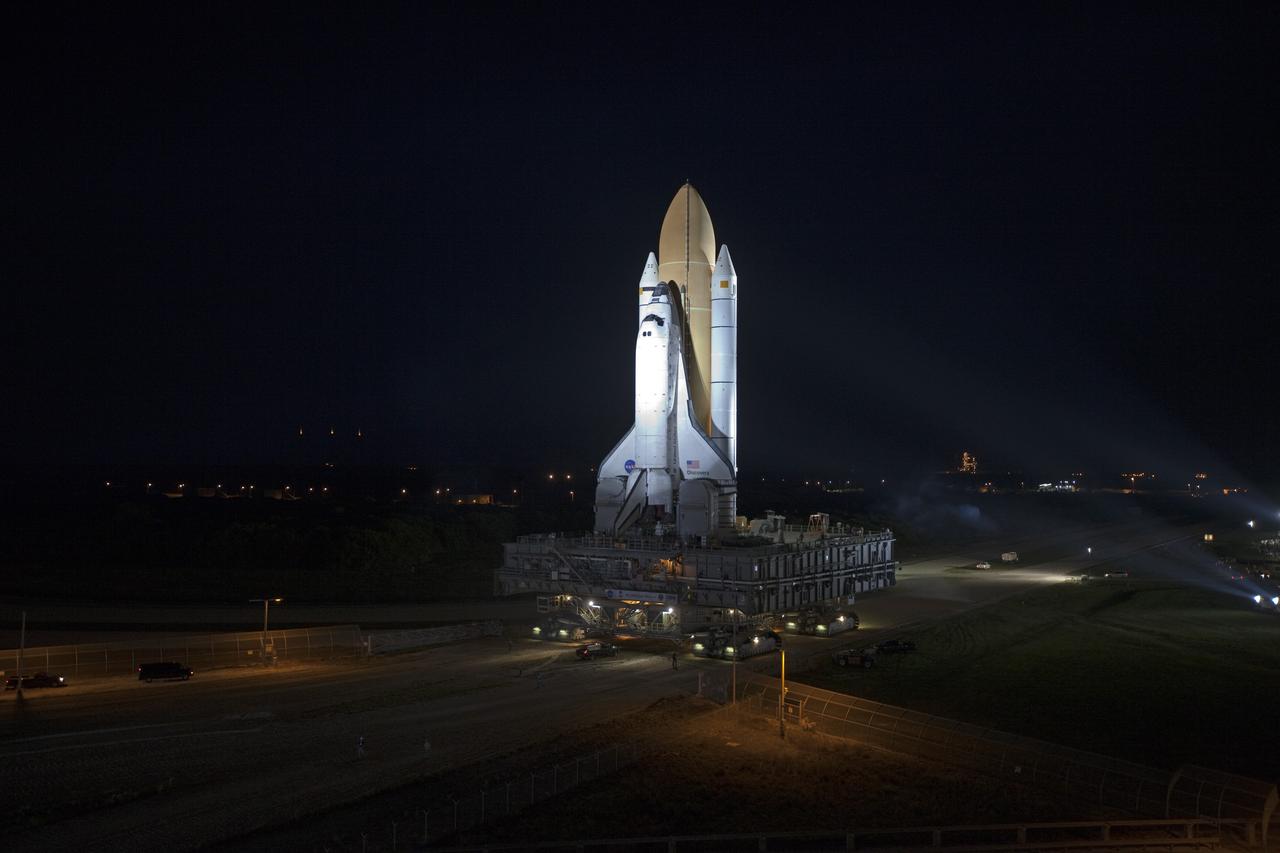
CAPE CANAVERAL, Fla. -- Bathed in bright xenon lights, space shuttle Discovery makes its nighttime trek, known as "rollout," from the Vehicle Assembly Building to Launch Pad 39A at NASA's Kennedy Space Center in Florida. It will take the shuttle, attached to its external fuel tank, twin solid rocket boosters and mobile launcher platform, about six hours to complete the move atop a crawler-transporter. Rollout sets the stage for Discovery's STS-133 crew to practice countdown and launch procedures during the Terminal Countdown Demonstration Test in mid-October. Targeted to liftoff Nov. 1, Discovery will take the Permanent Multipurpose Module (PMM) packed with supplies and critical spare parts, as well as Robonaut 2 (R2) to the International Space Station. Photo credit: NASA/Frankie Martin
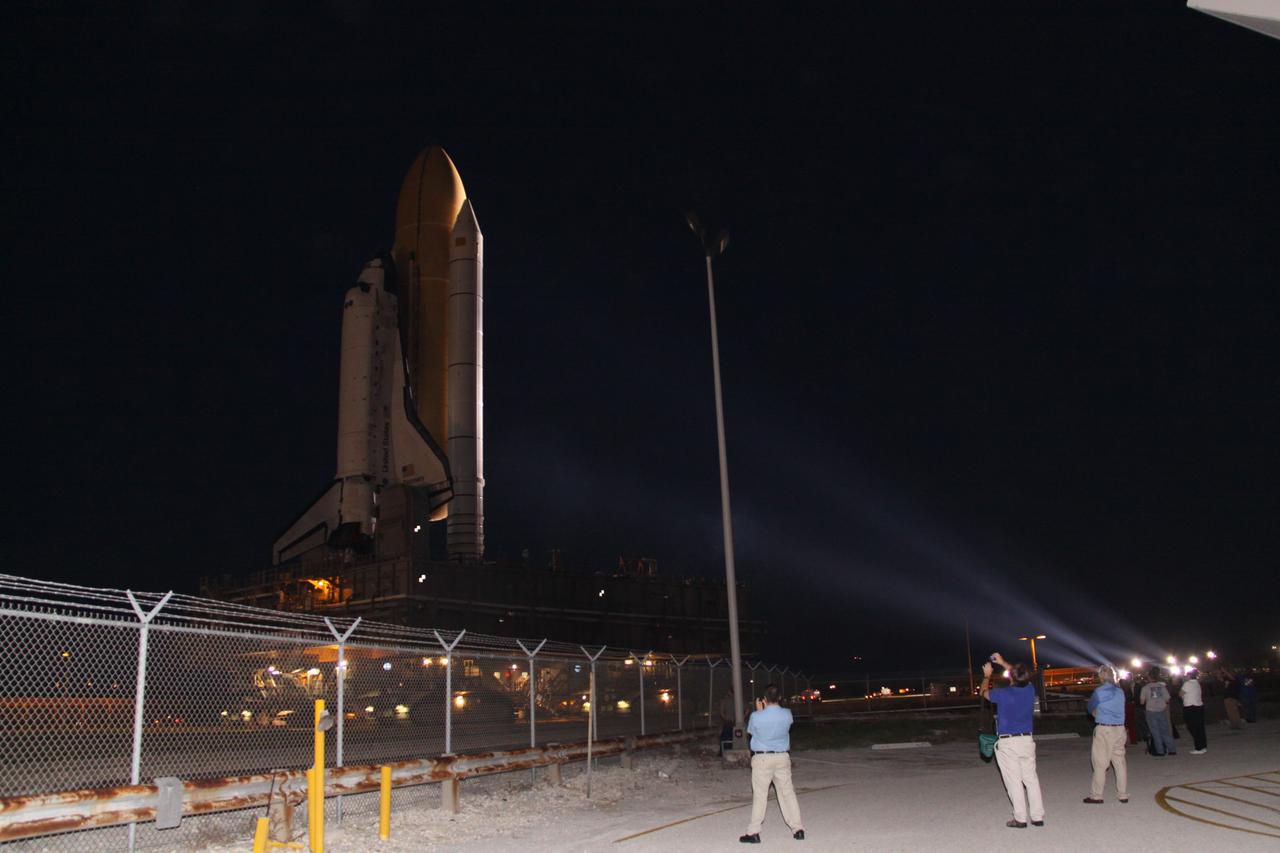
CAPE CANAVERAL, Fla. -- Bathed in bright xenon lights, space shuttle Discovery makes its nighttime trek, known as "rollout," from the Vehicle Assembly Building to Launch Pad 39A at NASA's Kennedy Space Center in Florida as employees snap photos. It will take the shuttle, attached to its external fuel tank, twin solid rocket boosters and mobile launcher platform, about six hours to complete the move atop a crawler-transporter. Rollout sets the stage for Discovery's STS-133 crew to practice countdown and launch procedures during the Terminal Countdown Demonstration Test in mid-October. Targeted to liftoff Nov. 1, Discovery will take the Permanent Multipurpose Module (PMM) packed with supplies and critical spare parts, as well as Robonaut 2 (R2) to the International Space Station. Photo credit: NASA/Jack Pfaller
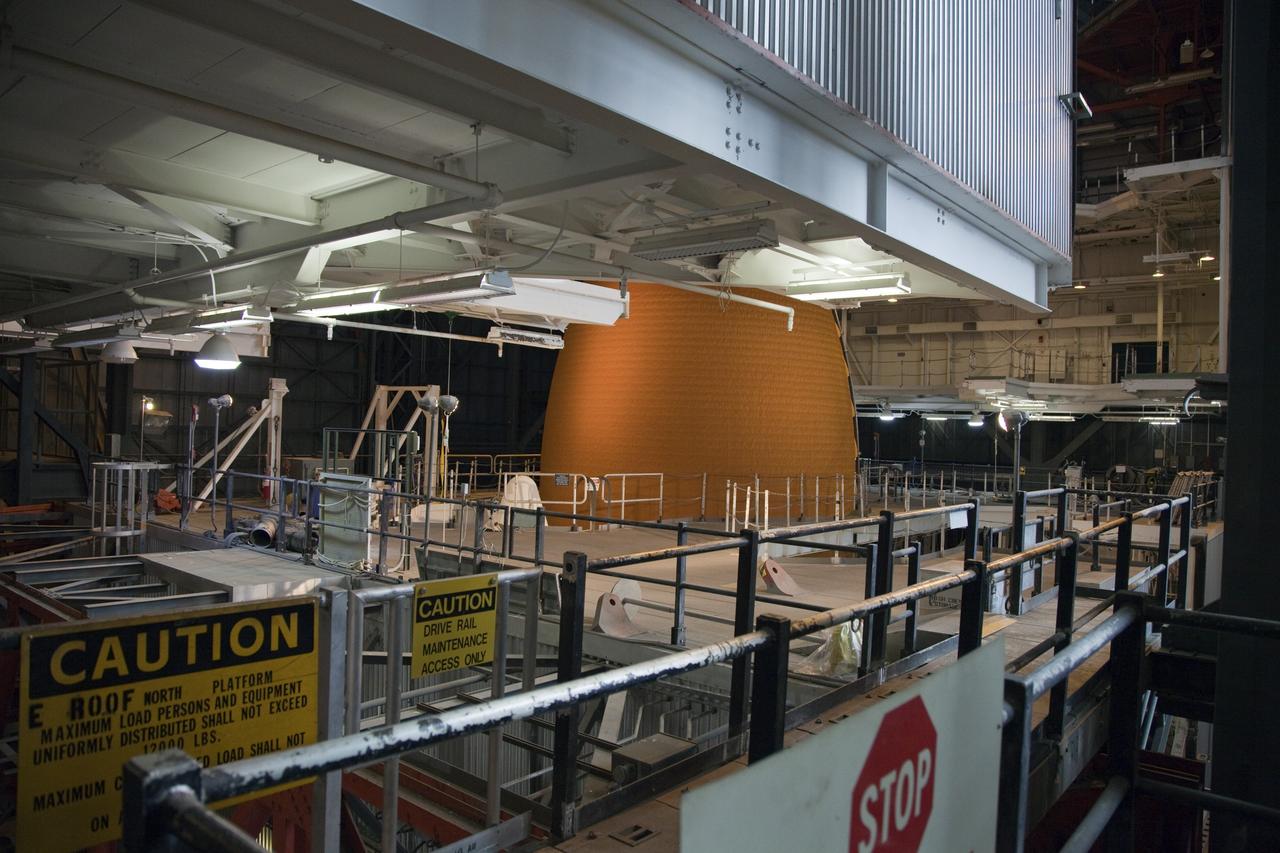
CAPE CANAVERAL, Fla. -- Space shuttle Discovery's external fuel tank is being prepared for computed radiography scans inside the Vehicle Assembly Building at NASA's Kennedy Space Center in Florida. The shuttle stack, consisting of the shuttle, external tank and solid rocket boosters, was moved off Launch Pad 39A so technicians could examine 21-foot-long support beams, called stringers, on the outside of the tank's intertank and re-apply foam insulation. Discovery's next launch opportunity to the International Space Station on the STS-133 mission is no earlier than Feb. 3, 2011. For more information on STS-133, visit www.nasa.gov/mission_pages/shuttle/shuttlemissions/sts133/. Photo credit: NASA/Frankie Martin
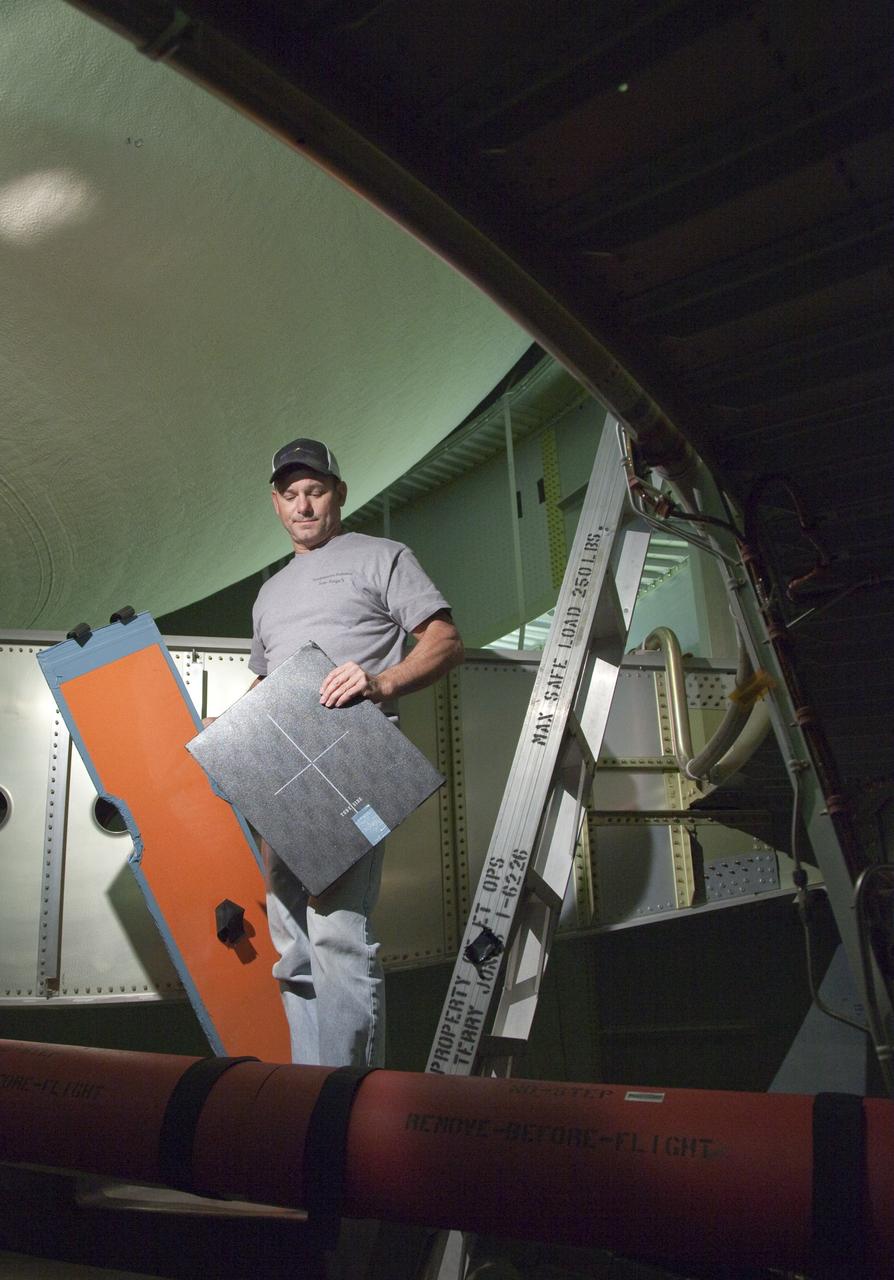
CAPE CANAVERAL, Fla. -- Inside the intertank of space shuttle Discovery's external fuel tank, a technician holds the film used to project computed radiography scans. The shuttle stack, consisting of the shuttle, external tank and solid rocket boosters, was moved from Launch Pad 39A to the Vehicle Assembly Building at NASA's Kennedy Space Center in Florida so technicians could examine 21-foot-long support beams, called stringers, on the outside of the tank's intertank and re-apply foam insulation. Discovery's next launch opportunity to the International Space Station on the STS-133 mission is no earlier than Feb. 3, 2011. For more information on STS-133, visit www.nasa.gov/mission_pages/shuttle/shuttlemissions/sts133/. Photo credit: NASA/Frankie Martin
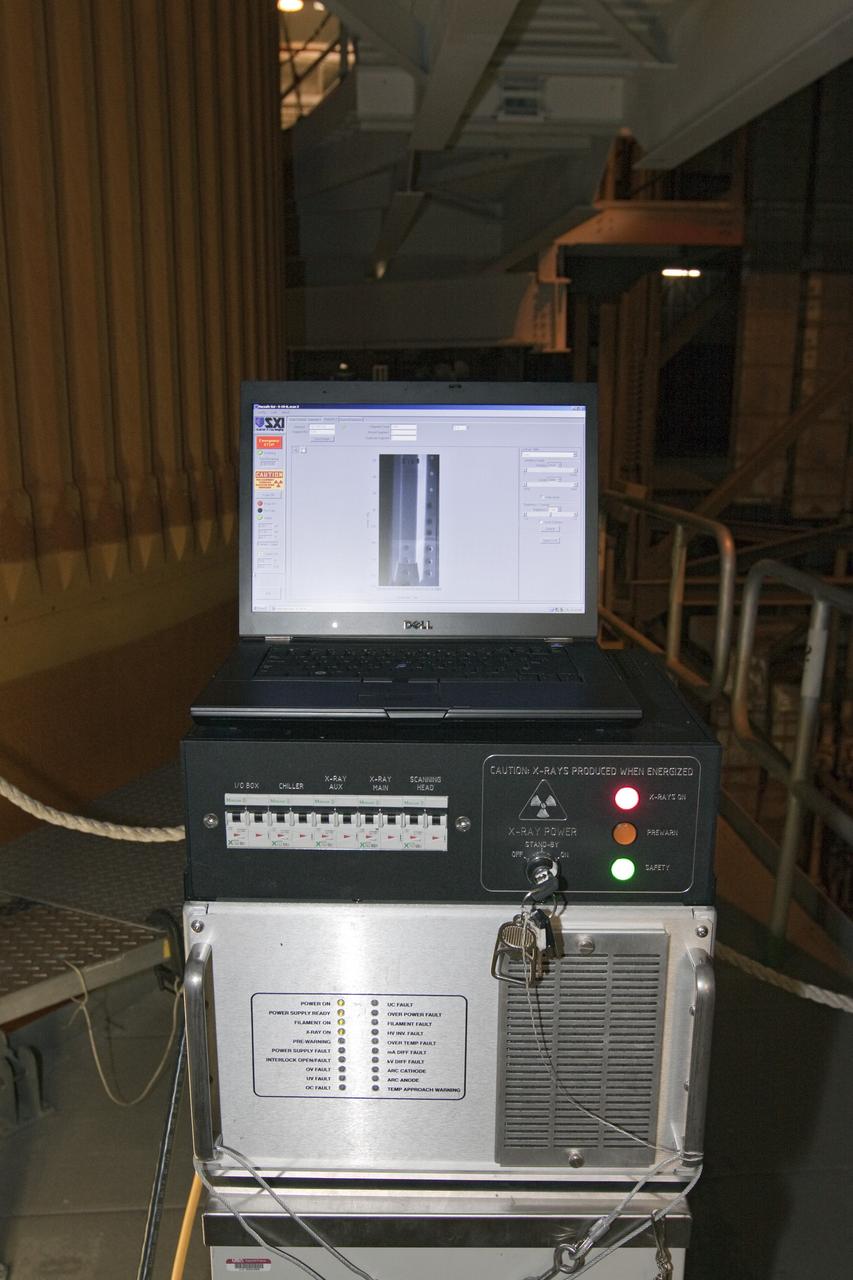
CAPE CANAVERAL, Fla. -- A backscatter device continues to give engineers data on the intertank region of space shuttle Discovery's external fuel tank while it is in the Vehicle Assembly Building at NASA's Kennedy Space Center in Florida. Engineers at various NASA centers are analyzing, testing and imaging the intertank's support beams, called stringers, to make sure the tank is structurally sound for flight. Discovery's next launch opportunity to the International Space Station on the STS-133 mission is no earlier than Feb. 3, 2011. For more information on STS-133, visit www.nasa.gov/mission_pages/shuttle/shuttlemissions/sts133/. Photo credit: NASA/Jack Pfaller
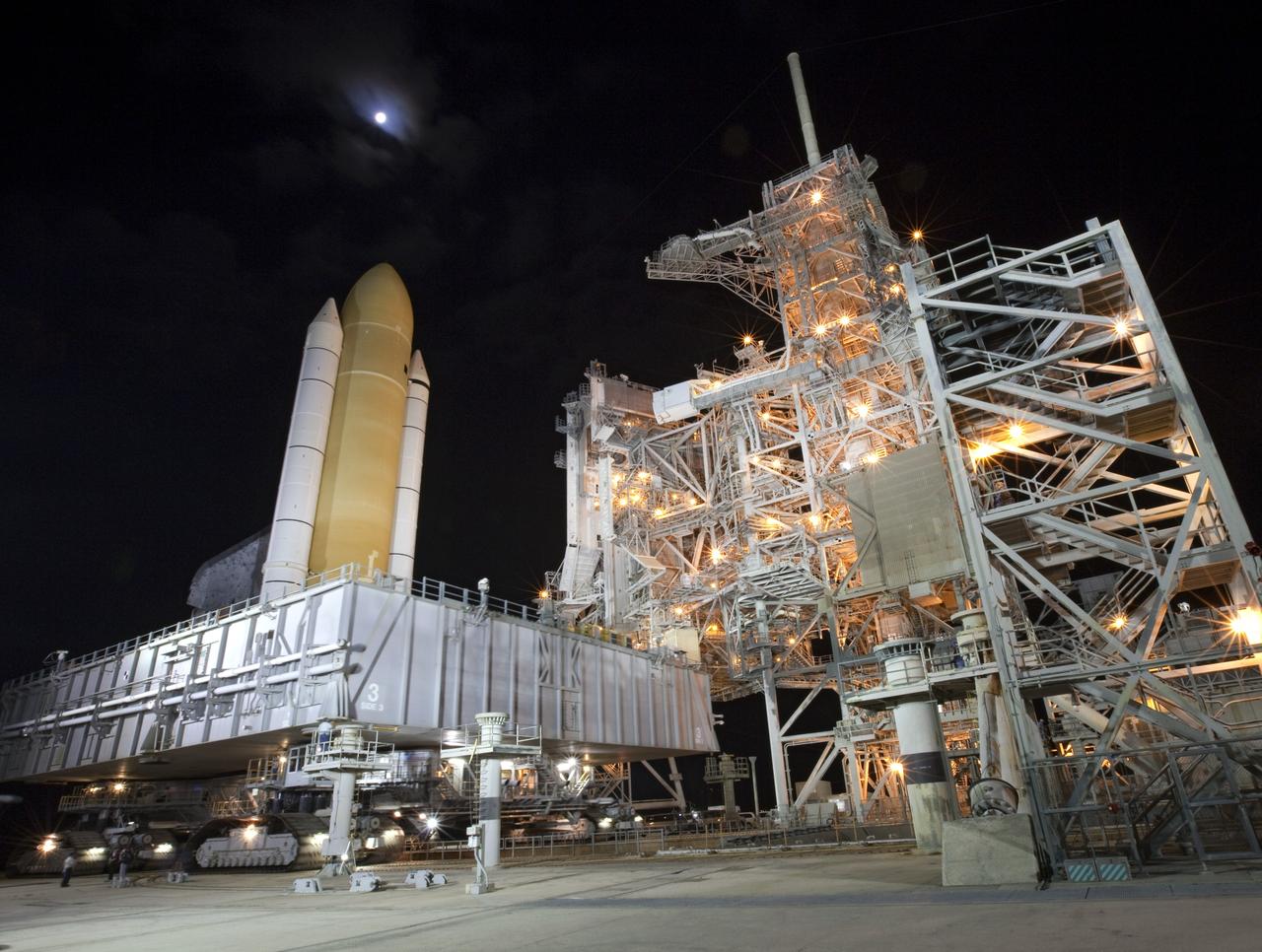
CAPE CANAVERAL, Fla. -- At NASA's Kennedy Space Center in Florida, space shuttle Discovery approaches Launch Pad 39A during "rollout" from the Vehicle Assembly Building to Launch Pad 39A. It took the shuttle, attached to its external fuel tank, twin solid rocket boosters and mobile launcher platform, about six hours to complete the move atop a crawler-transporter. Rollout sets the stage for Discovery's STS-133 crew to practice countdown and launch procedures during the Terminal Countdown Demonstration Test in mid-October. Targeted to liftoff Nov. 1, Discovery will take the Permanent Multipurpose Module (PMM) packed with supplies and critical spare parts, as well as Robonaut 2 (R2) to the International Space Station. Photo credit: NASA/Frankie Martin
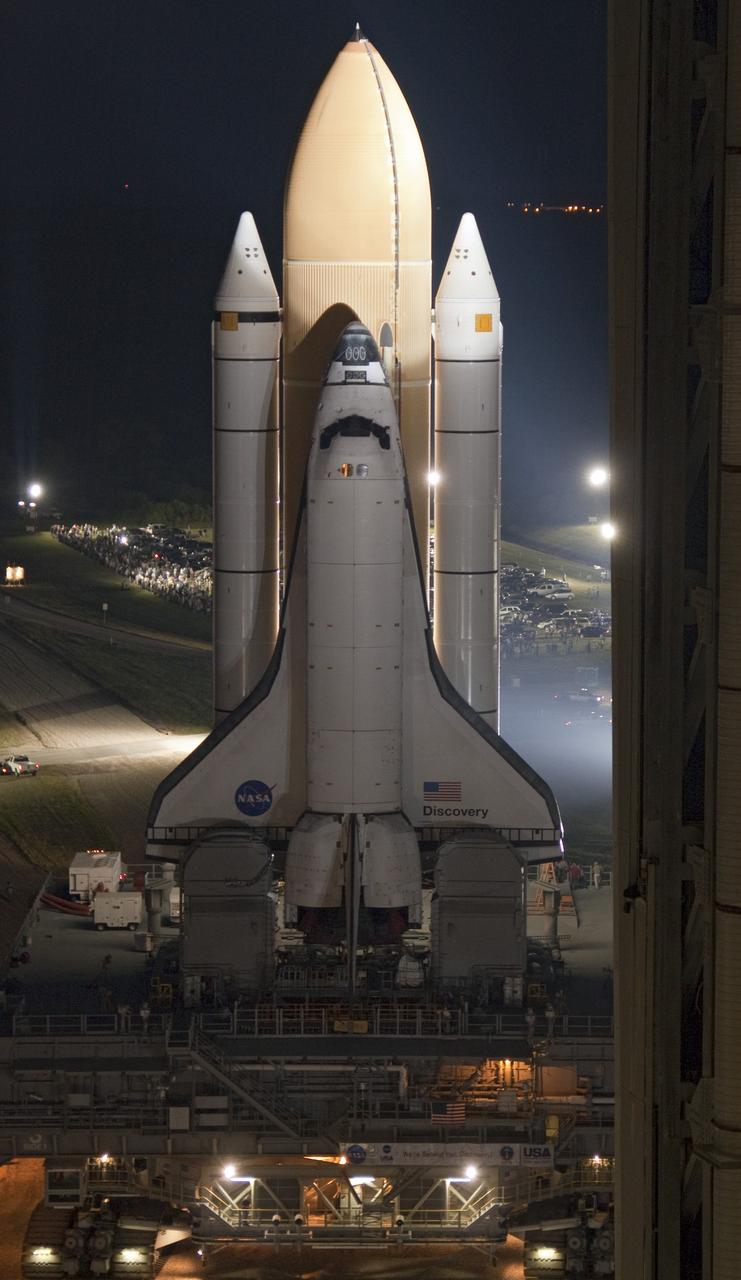
CAPE CANAVERAL, Fla. -- Bathed in bright xenon lights, space shuttle Discovery makes its nighttime trek, known as "rollout," from the Vehicle Assembly Building to Launch Pad 39A at NASA's Kennedy Space Center in Florida. It will take the shuttle, attached to its external fuel tank, twin solid rocket boosters and mobile launcher platform, about six hours to complete the move atop a crawler-transporter. Rollout sets the stage for Discovery's STS-133 crew to practice countdown and launch procedures during the Terminal Countdown Demonstration Test in mid-October. Targeted to liftoff Nov. 1, Discovery will take the Permanent Multipurpose Module (PMM) packed with supplies and critical spare parts, as well as Robonaut 2 (R2) to the International Space Station. Photo credit: NASA/Mic Miracle
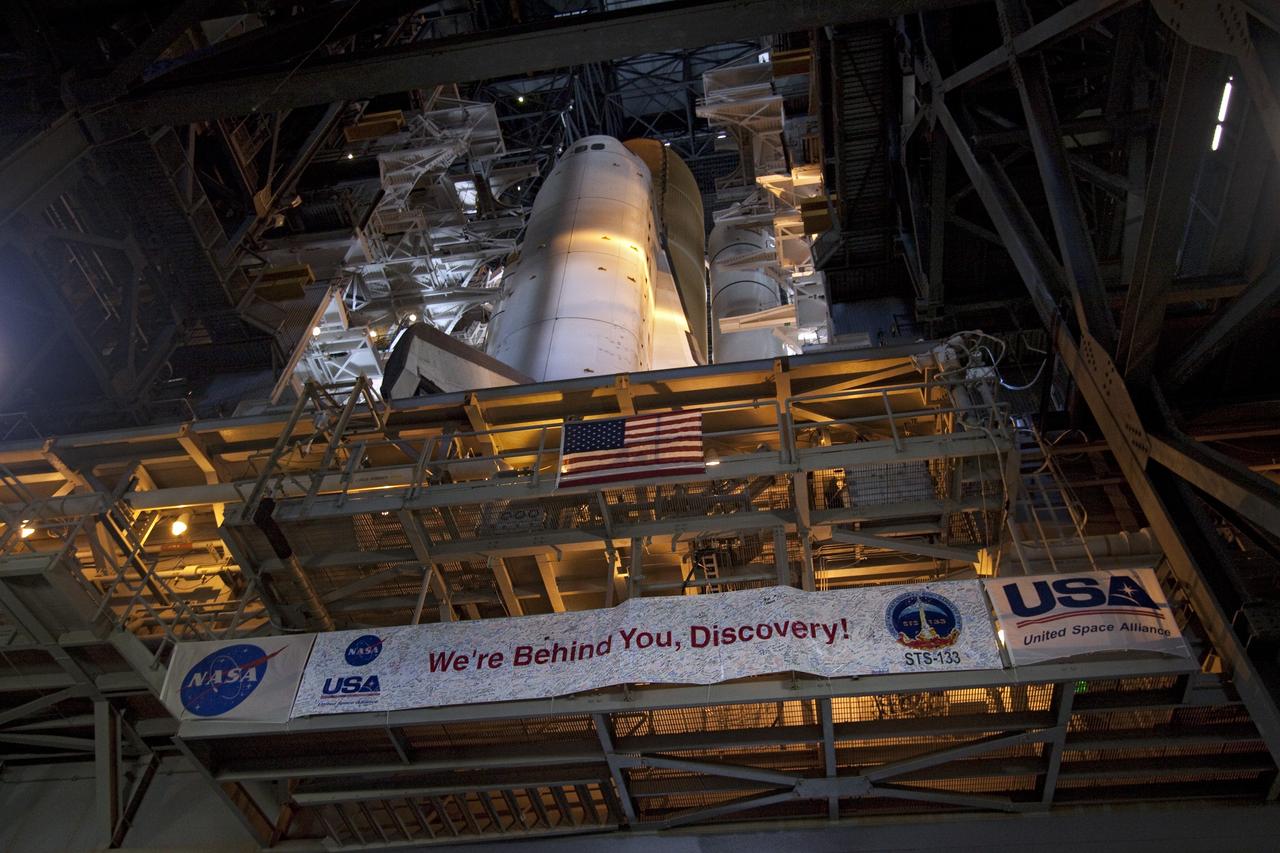
CAPE CANAVERAL, Fla. -- At NASA's Kennedy Space Center in Florida, space shuttle Discovery is ready for its nighttime trek, known as "rollout," from the Vehicle Assembly Building to Launch Pad 39A. It will take the shuttle, attached to its external fuel tank, twin solid rocket boosters and mobile launcher platform, about six hours to complete the move atop a crawler-transporter. Rollout sets the stage for Discovery's STS-133 crew to practice countdown and launch procedures during the Terminal Countdown Demonstration Test in mid-October. Targeted to liftoff Nov. 1, Discovery will take the Permanent Multipurpose Module (PMM) packed with supplies and critical spare parts, as well as Robonaut 2 (R2) to the International Space Station. Photo credit: NASA/Jack Pfaller

CAPE CANAVERAL, Fla. -- Repair work to space shuttle Discovery's external fuel tank continues in the Vehicle Assembly Building at NASA's Kennedy Space Center in Florida. Technicians are modifying 94 support beams, called stringers, on the tank's intertank region by fitting pieces of metal, called radius blocks, over the stringers' edges. After the modifications of the stringers are complete, foam insulation will be re-applied to the tank. Discovery's next launch opportunity to the International Space Station on the STS-133 mission is targeted for Feb. 24, 2011. For more information on STS-133, visit www.nasa.gov/mission_pages/shuttle/shuttlemissions/sts133/. Photo credit: NASA/Kim Shiflett
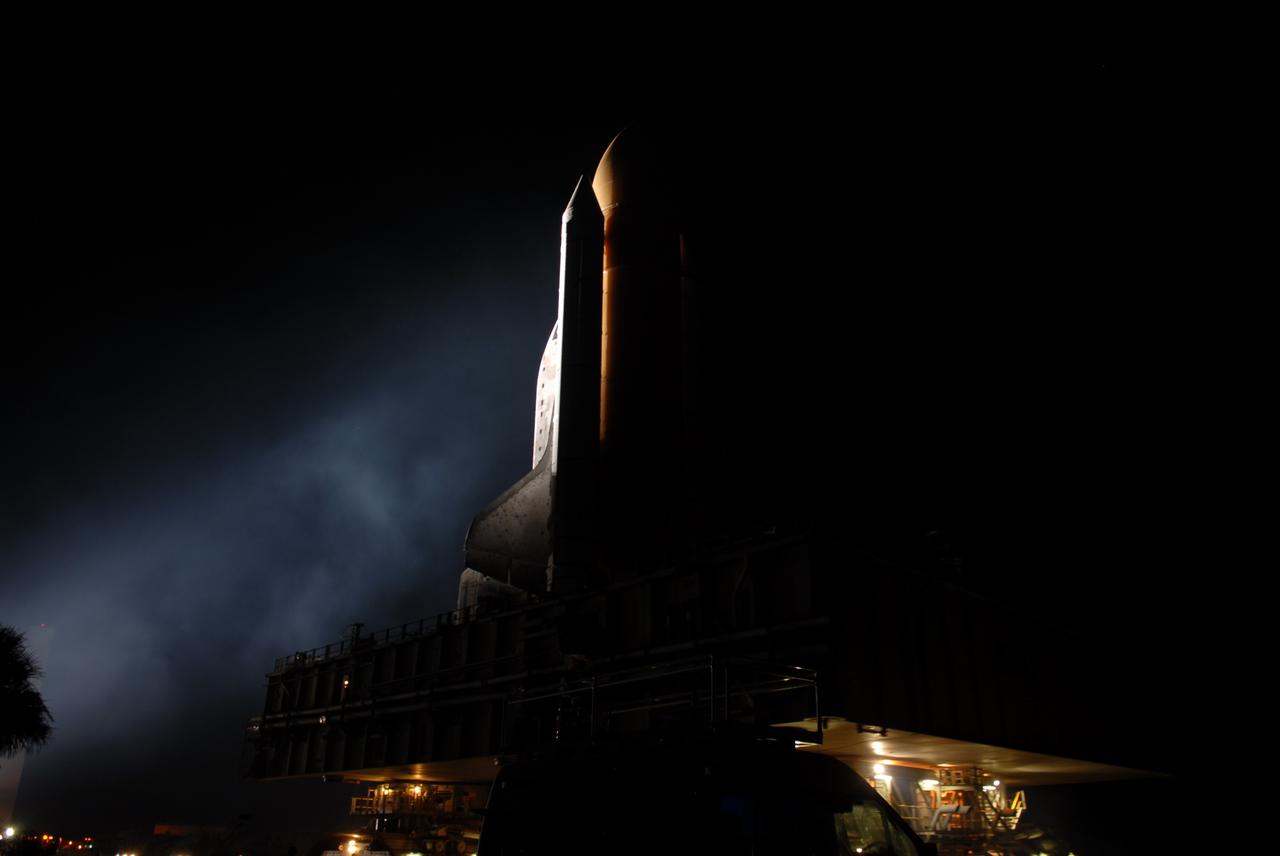
CAPE CANAVERAL, Fla. -- Bathed in bright xenon lights, space shuttle Discovery makes its nighttime trek, known as "rollout," from the Vehicle Assembly Building to Launch Pad 39A at NASA's Kennedy Space Center in Florida. It will take the shuttle, attached to its external fuel tank, twin solid rocket boosters and mobile launcher platform, about six hours to complete the move atop a crawler-transporter. Rollout sets the stage for Discovery's STS-133 crew to practice countdown and launch procedures during the Terminal Countdown Demonstration Test in mid-October. Targeted to liftoff Nov. 1, Discovery will take the Permanent Multipurpose Module (PMM) packed with supplies and critical spare parts, as well as Robonaut 2 (R2) to the International Space Station. Photo credit: NASA/Jim Grossmann
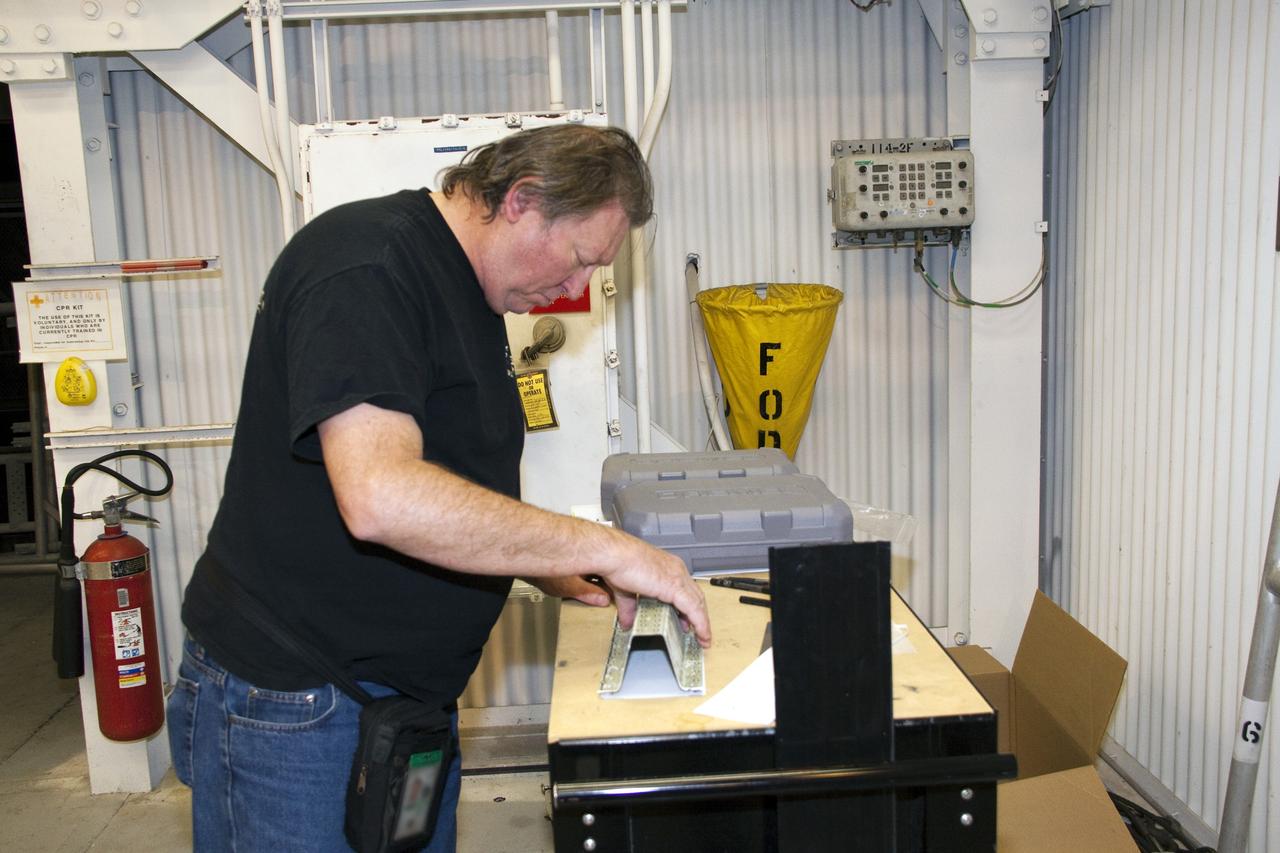
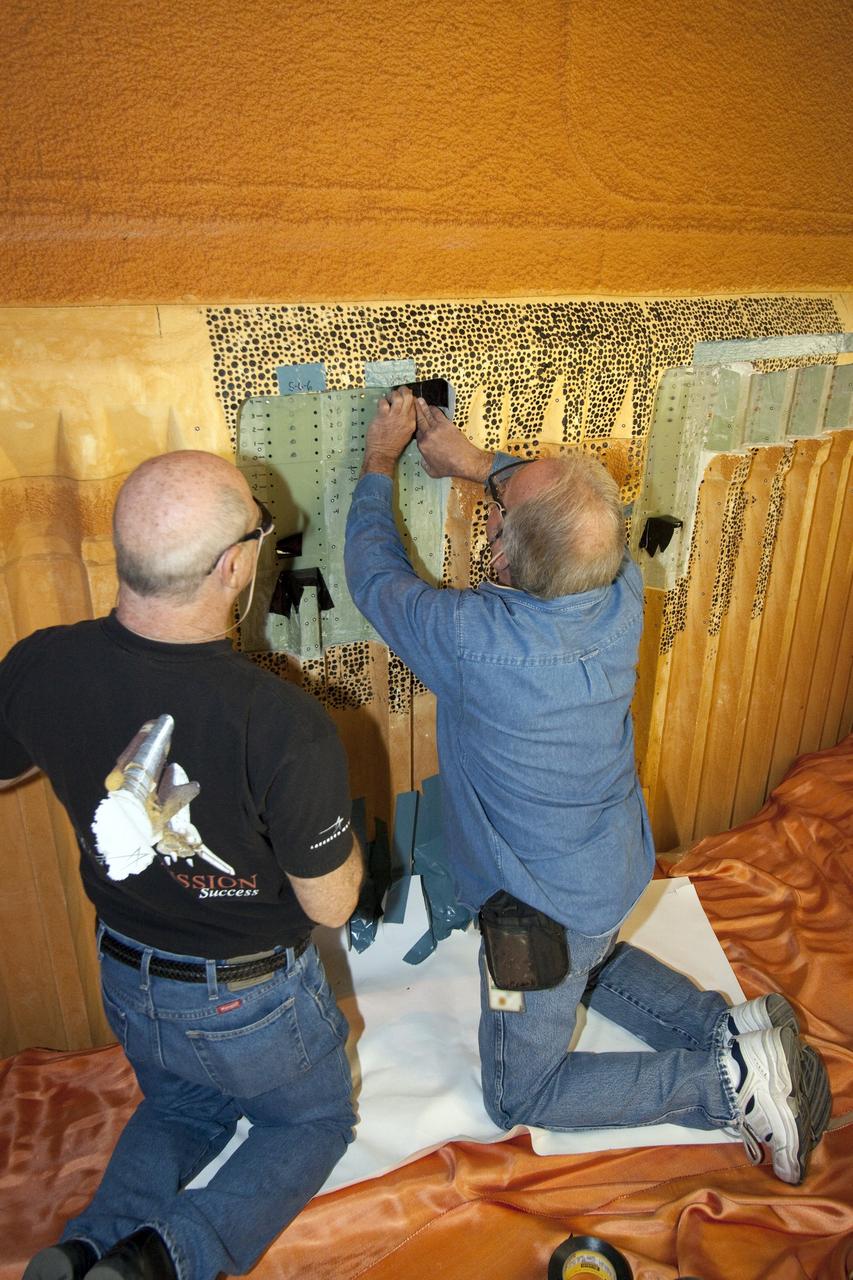
CAPE CANAVERAL, Fla. – As part of the repair work to space shuttle Discovery's external fuel tank, a technician measures a fitted piece of metal, called a radius block, which will be attached to an intertank support beam, called a stringer. Technicians in the Vehicle Assembly Building at NASA’s Kennedy Space Center in Florida are modifying 32 stringers with the radius blocks near the intertank’s thrust panel area. The thrust panel is where the tank meets the two solid rocket boosters and sees the most stress during the flight into orbit. After the modifications and additional scans of the stringers are complete, foam insulation will be re-applied. Discovery's next launch opportunity to the International Space Station on the STS-133 mission is no earlier than Feb. 3, 2011. For more information on STS-133, visit www.nasa.gov/mission_pages/shuttle/shuttlemissions/sts133/. Photo credit: NASA/Jack Pfaller
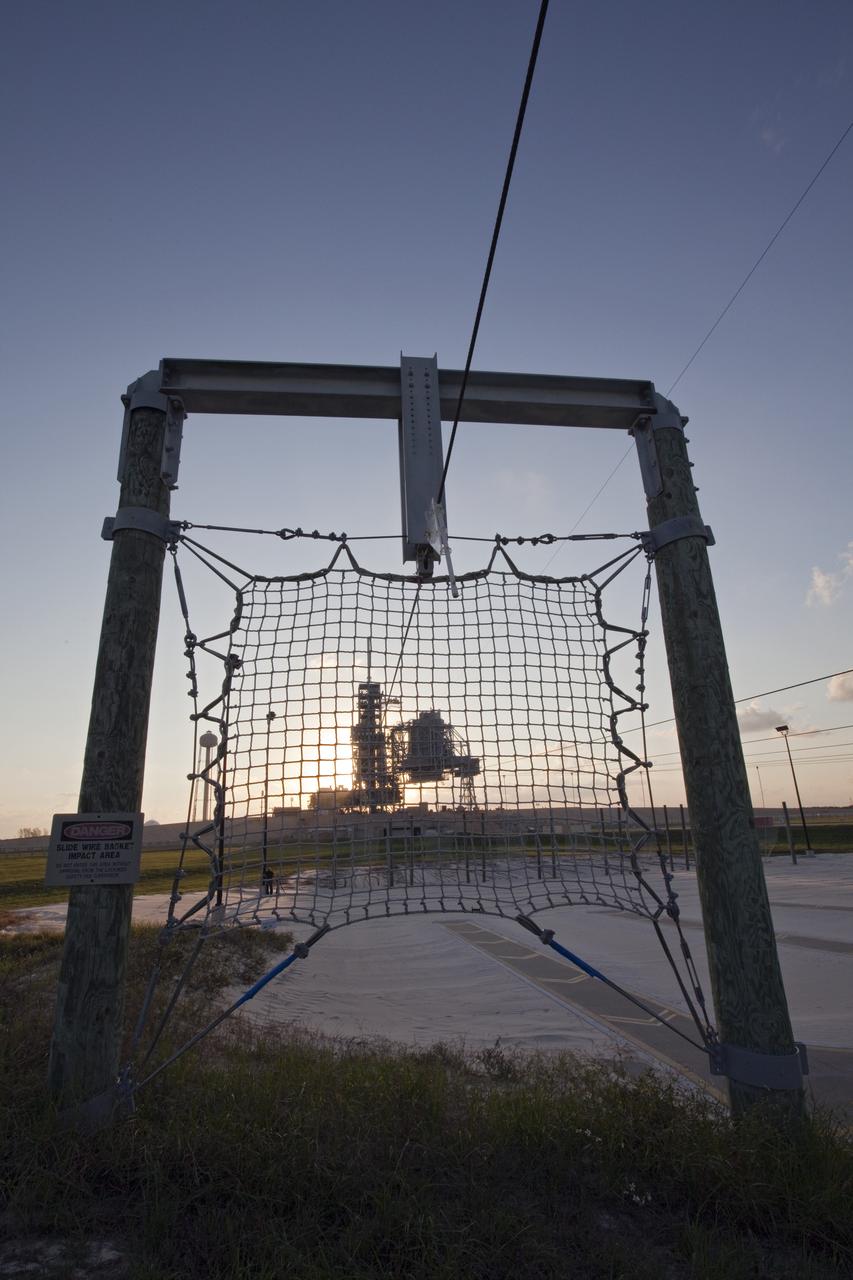
CAPE CANAVERAL, Fla. -- Launch Pad 39A, which is attached to space shuttle Discovery, is seen through a slide wire basket as the sun rises over NASA's Kennedy Space Center in Florida. Later, the rotating service structure that protects the shuttle from the elements and provides access inside the vehicle will be moved into place. It took the spacecraft about six hours to make the journey, known as "rollout," from the Vehicle Assembly Building to the pad. Rollout sets the stage for Discovery's STS-133 crew to practice countdown and launch procedures during the Terminal Countdown Demonstration Test in mid-October. Targeted to liftoff Nov. 1, Discovery will take the Permanent Multipurpose Module (PMM) packed with supplies and critical spare parts, as well as Robonaut 2 (R2) to the International Space Station. Photo credit: NASA/Frankie Martin

CAPE CANAVERAL, Fla. -- At NASA's Kennedy Space Center in Florida, a crawler-transporter is ready to carry space shuttle Discovery from the Vehicle Assembly Building to Launch Pad 39A in a move known as "rollout." It will take the shuttle, attached to its external fuel tank, twin solid rocket boosters and mobile launcher platform, about six hours to complete the move. Rollout sets the stage for Discovery's STS-133 crew to practice countdown and launch procedures during the Terminal Countdown Demonstration Test in mid-October. Targeted to liftoff Nov. 1, Discovery will take the Permanent Multipurpose Module (PMM) packed with supplies and critical spare parts, as well as Robonaut 2 (R2) to the International Space Station. Photo credit: NASA/Jack Pfaller
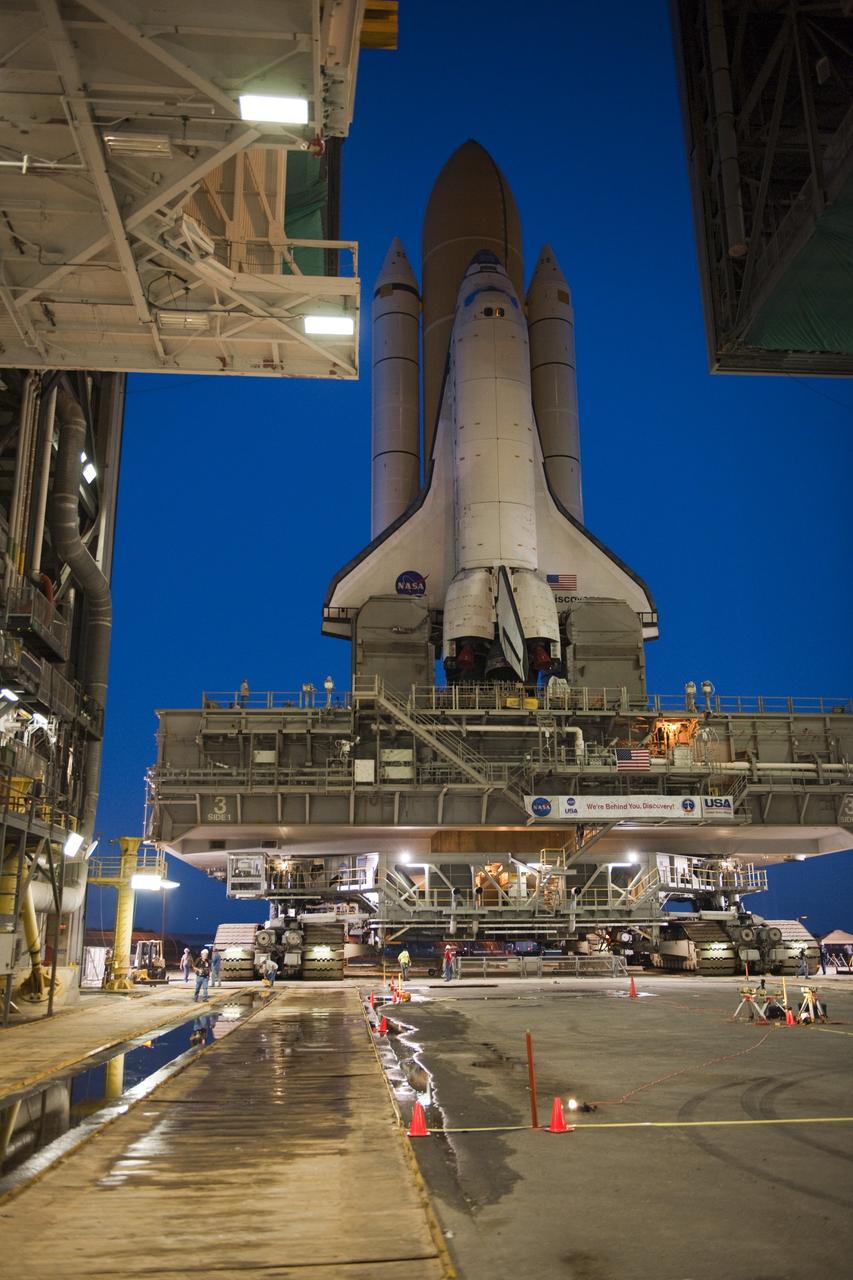
CAPE CANAVERAL, Fla. -- Space shuttle Discovery makes its nighttime trek, known as "rollout," from the Vehicle Assembly Building to Launch Pad 39A at NASA's Kennedy Space Center in Florida. It will take the shuttle, attached to its external fuel tank, twin solid rocket boosters and mobile launcher platform, about six hours to complete the move atop a crawler-transporter. Rollout sets the stage for Discovery's STS-133 crew to practice countdown and launch procedures during the Terminal Countdown Demonstration Test in mid-October. Targeted to liftoff Nov. 1, Discovery will take the Permanent Multipurpose Module (PMM) packed with supplies and critical spare parts, as well as Robonaut 2 (R2) to the International Space Station. Photo credit: NASA/Tony Gray
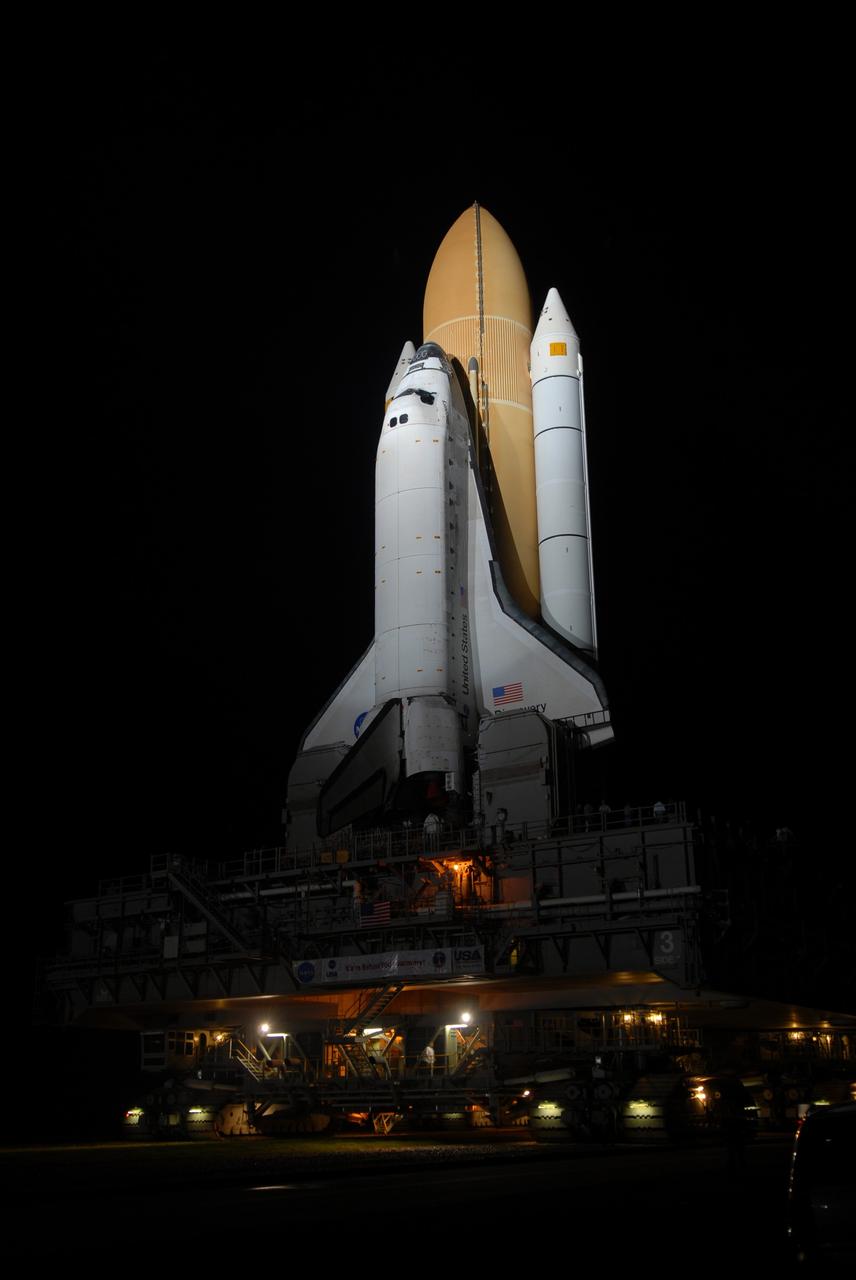
CAPE CANAVERAL, Fla. -- Bathed in bright xenon lights, space shuttle Discovery makes its nighttime trek, known as "rollout," from the Vehicle Assembly Building to Launch Pad 39A at NASA's Kennedy Space Center in Florida. It will take the shuttle, attached to its external fuel tank, twin solid rocket boosters and mobile launcher platform, about six hours to complete the move atop a crawler-transporter. Rollout sets the stage for Discovery's STS-133 crew to practice countdown and launch procedures during the Terminal Countdown Demonstration Test in mid-October. Targeted to liftoff Nov. 1, Discovery will take the Permanent Multipurpose Module (PMM) packed with supplies and critical spare parts, as well as Robonaut 2 (R2) to the International Space Station. Photo credit: NASA/Jim Grossmann
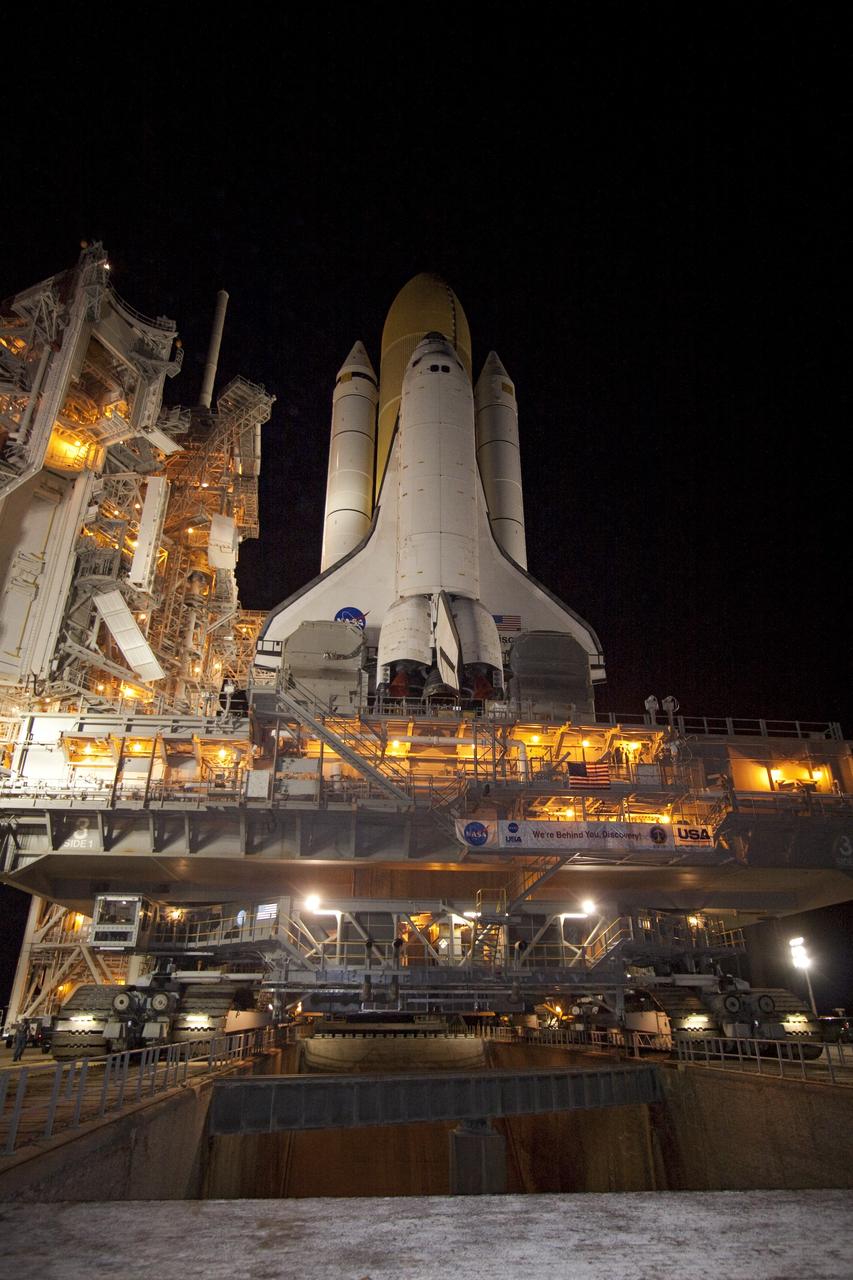
CAPE CANAVERAL, Fla. -- At NASA's Kennedy Space Center in Florida, space shuttle Discovery makes the last leg of its journey, known as "rollout," from the Vehicle Assembly Building to Launch Pad 39A. It took the shuttle, attached to its external fuel tank, twin solid rocket boosters and mobile launcher platform, about six hours to complete the move atop a crawler-transporter. Rollout sets the stage for Discovery's STS-133 crew to practice countdown and launch procedures during the Terminal Countdown Demonstration Test in mid-October. Targeted to liftoff Nov. 1, Discovery will take the Permanent Multipurpose Module (PMM) packed with supplies and critical spare parts, as well as Robonaut 2 (R2) to the International Space Station. Photo credit: NASA/Jack Pfaller
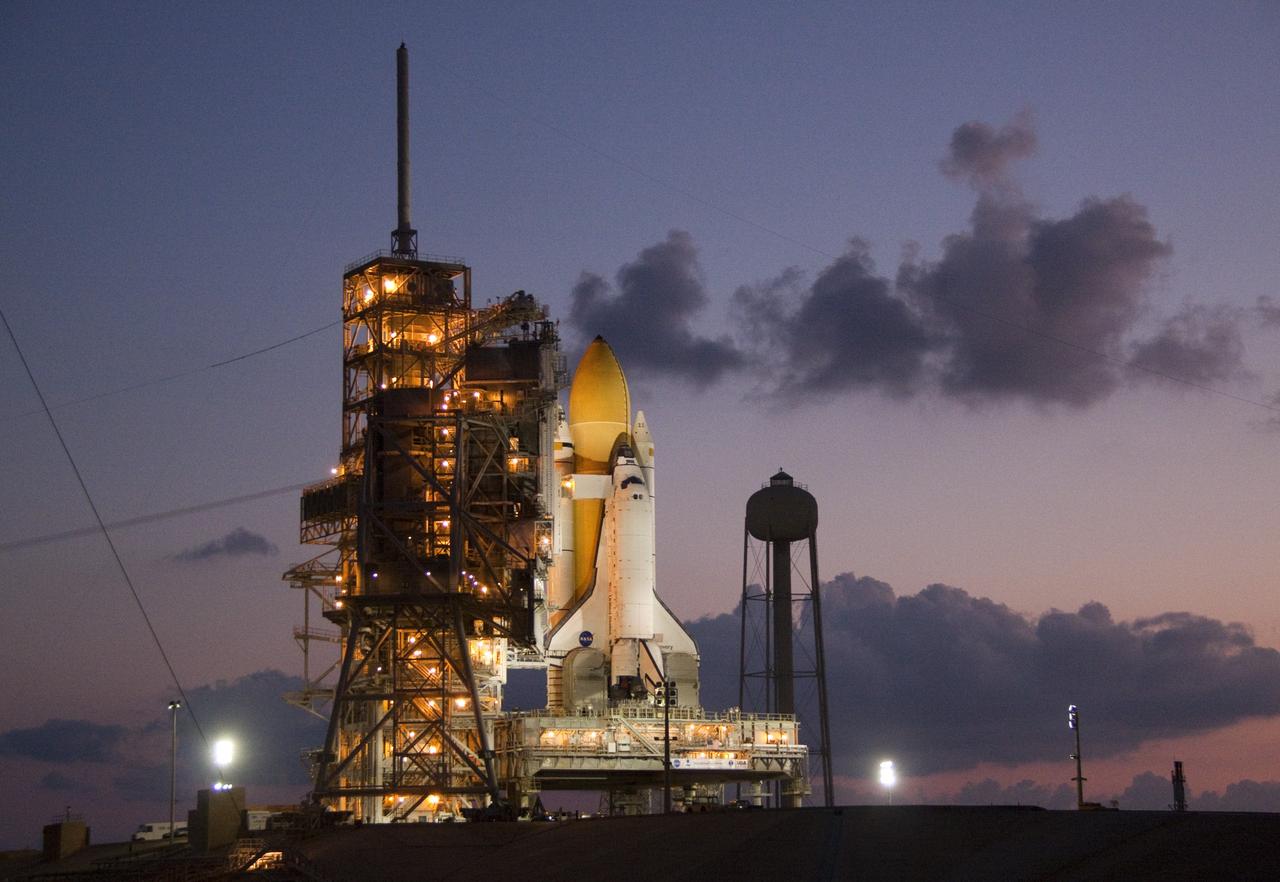
CAPE CANAVERAL, Fla. -- Space shuttle Discovery is attached to Launch Pad 39A as the sun rises over NASA's Kennedy Space Center in Florida. It took the spacecraft about six hours to make the journey, known as "rollout," from the Vehicle Assembly Building to the pad. Rollout sets the stage for Discovery's STS-133 crew to practice countdown and launch procedures during the Terminal Countdown Demonstration Test in mid-October. Targeted to liftoff Nov. 1, Discovery will take the Permanent Multipurpose Module (PMM) packed with supplies and critical spare parts, as well as Robonaut 2 (R2) to the International Space Station. Photo credit: NASA/Jack Pfaller
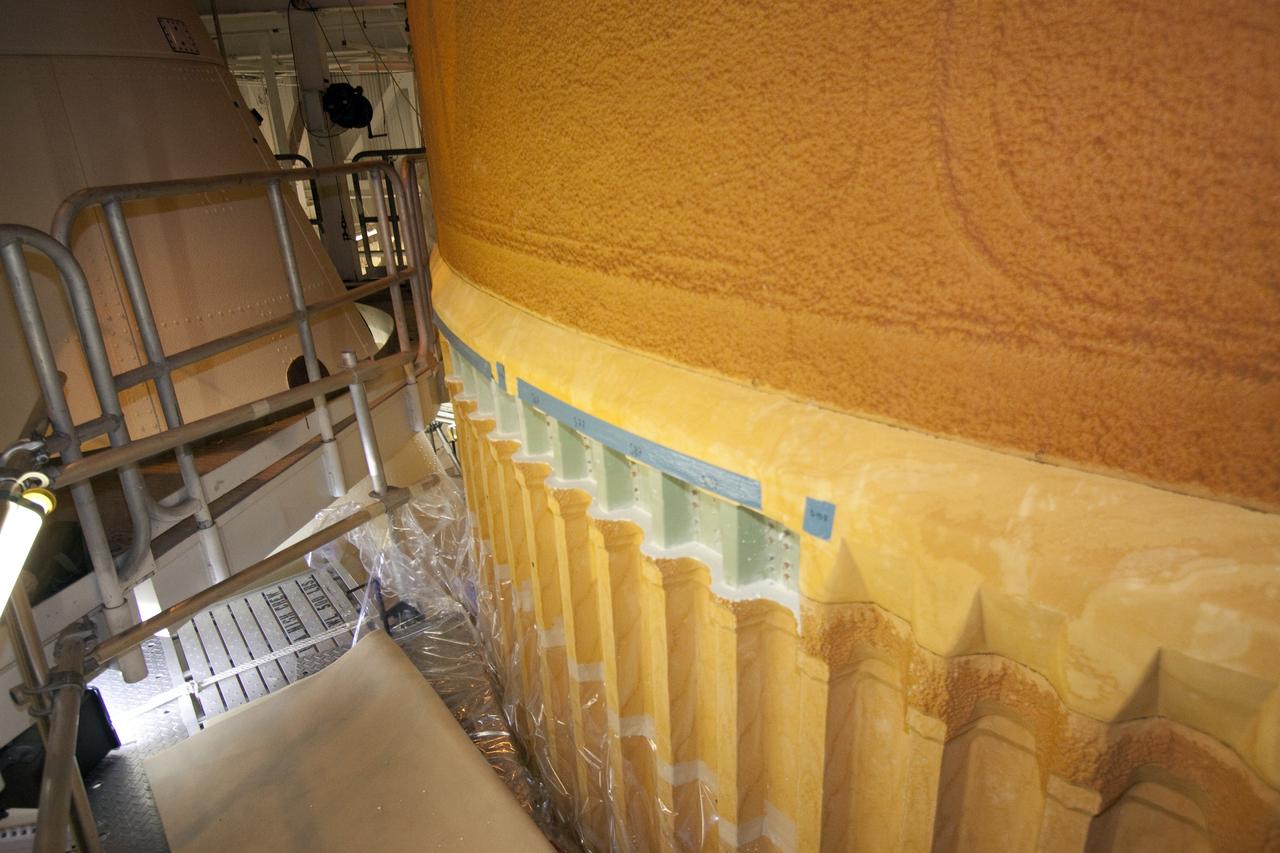
CAPE CANAVERAL, Fla. -- Repair work to space shuttle Discovery's external fuel tank begins in the Vehicle Assembly Building at NASA's Kennedy Space Center in Florida. Technicians will modify 32 support beams, called stringers, on the tank's intertank region by fitting pieces of metal, called radius blocks, over the stringers' edges where they attach to the thrust panel area. The thrust panel is where the tank meets the two solid rocket boosters and sees the most stress during the flight into orbit. After the modifications and additional scans of the stringers are complete, foam insulation will be re-applied. Discovery's next launch opportunity to the International Space Station on the STS-133 mission is no earlier than Feb. 3, 2011. For more information on STS-133, visit www.nasa.gov/mission_pages/shuttle/shuttlemissions/sts133/. Photo credit: NASA/Jack Pfaller
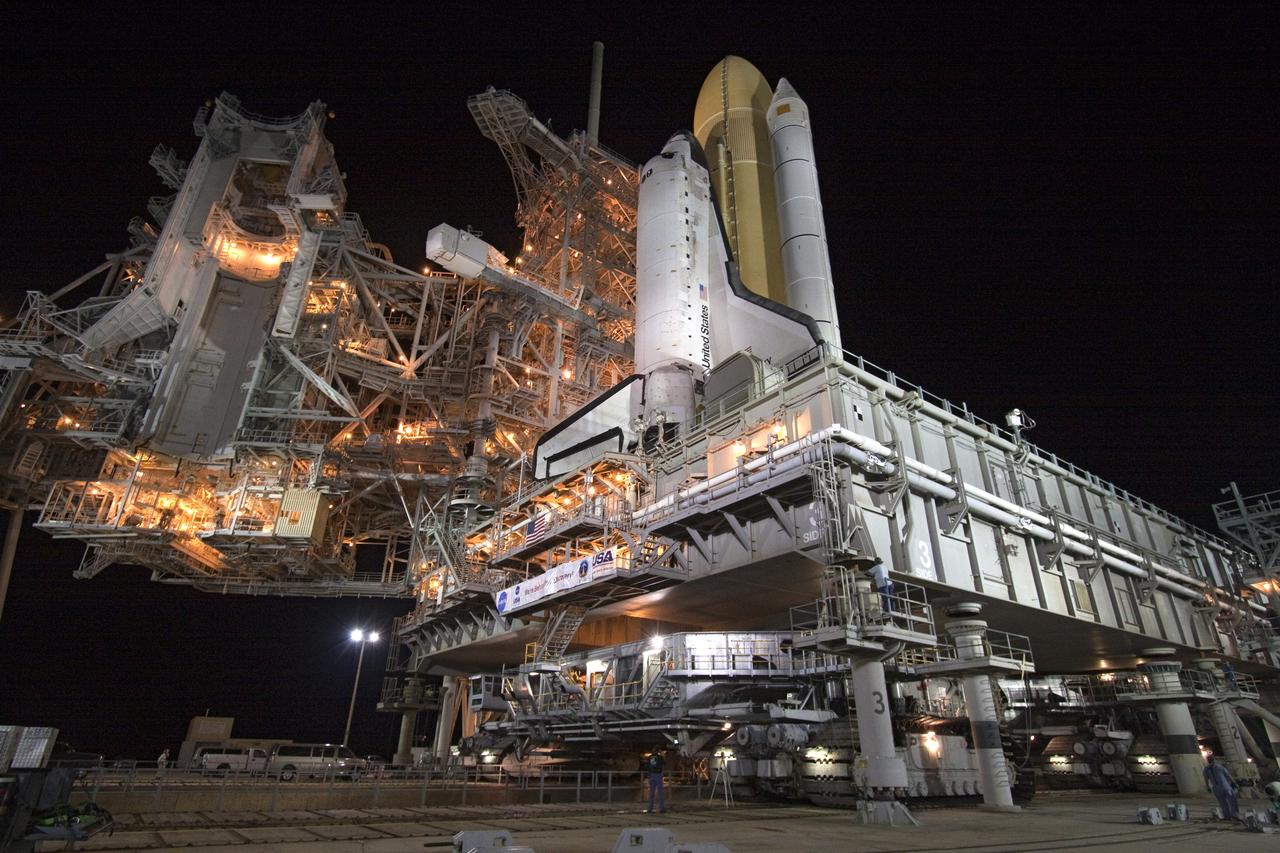
CAPE CANAVERAL, Fla. -- At NASA's Kennedy Space Center in Florida, space shuttle Discovery is attached to Launch Pad 39A, completing "rollout" from the Vehicle Assembly Building to Launch Pad 39A. It took the shuttle, attached to its external fuel tank, twin solid rocket boosters and mobile launcher platform, about six hours to complete the move atop a crawler-transporter. Rollout sets the stage for Discovery's STS-133 crew to practice countdown and launch procedures during the Terminal Countdown Demonstration Test in mid-October. Targeted to liftoff Nov. 1, Discovery will take the Permanent Multipurpose Module (PMM) packed with supplies and critical spare parts, as well as Robonaut 2 (R2) to the International Space Station. Photo credit: NASA/Jack Pfaller

CAPE CANAVERAL, Fla. -- Space shuttle Discovery makes its nighttime trek, known as "rollout," from the Vehicle Assembly Building to Launch Pad 39A at NASA's Kennedy Space Center in Florida. It will take the shuttle, attached to its external fuel tank, twin solid rocket boosters and mobile launcher platform, about six hours to complete the move atop a crawler-transporter. Rollout sets the stage for Discovery's STS-133 crew to practice countdown and launch procedures during the Terminal Countdown Demonstration Test in mid-October. Targeted to liftoff Nov. 1, Discovery will take the Permanent Multipurpose Module (PMM) packed with supplies and critical spare parts, as well as Robonaut 2 (R2) to the International Space Station. Photo credit: NASA/Tony Gray
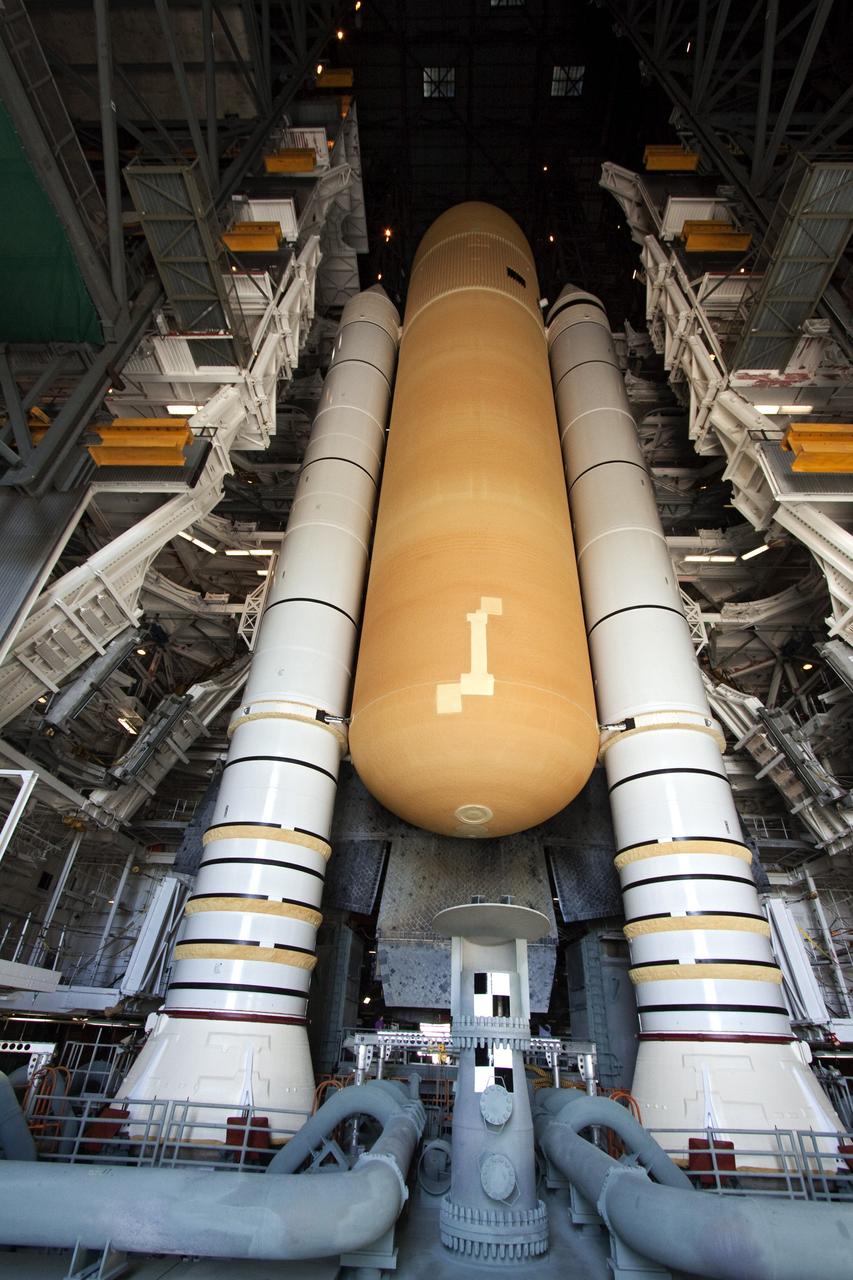
CAPE CANAVERAL, Fla. -- At NASA's Kennedy Space Center in Florida, space shuttle Discovery is ready for its nighttime trek, known as "rollout," from the Vehicle Assembly Building to Launch Pad 39A. It will take the shuttle, attached to its external fuel tank, twin solid rocket boosters and mobile launcher platform, about six hours to complete the move atop a crawler-transporter. Rollout sets the stage for Discovery's STS-133 crew to practice countdown and launch procedures during the Terminal Countdown Demonstration Test in mid-October. Targeted to liftoff Nov. 1, Discovery will take the Permanent Multipurpose Module (PMM) packed with supplies and critical spare parts, as well as Robonaut 2 (R2) to the International Space Station. Photo credit: NASA/Jack Pfaller
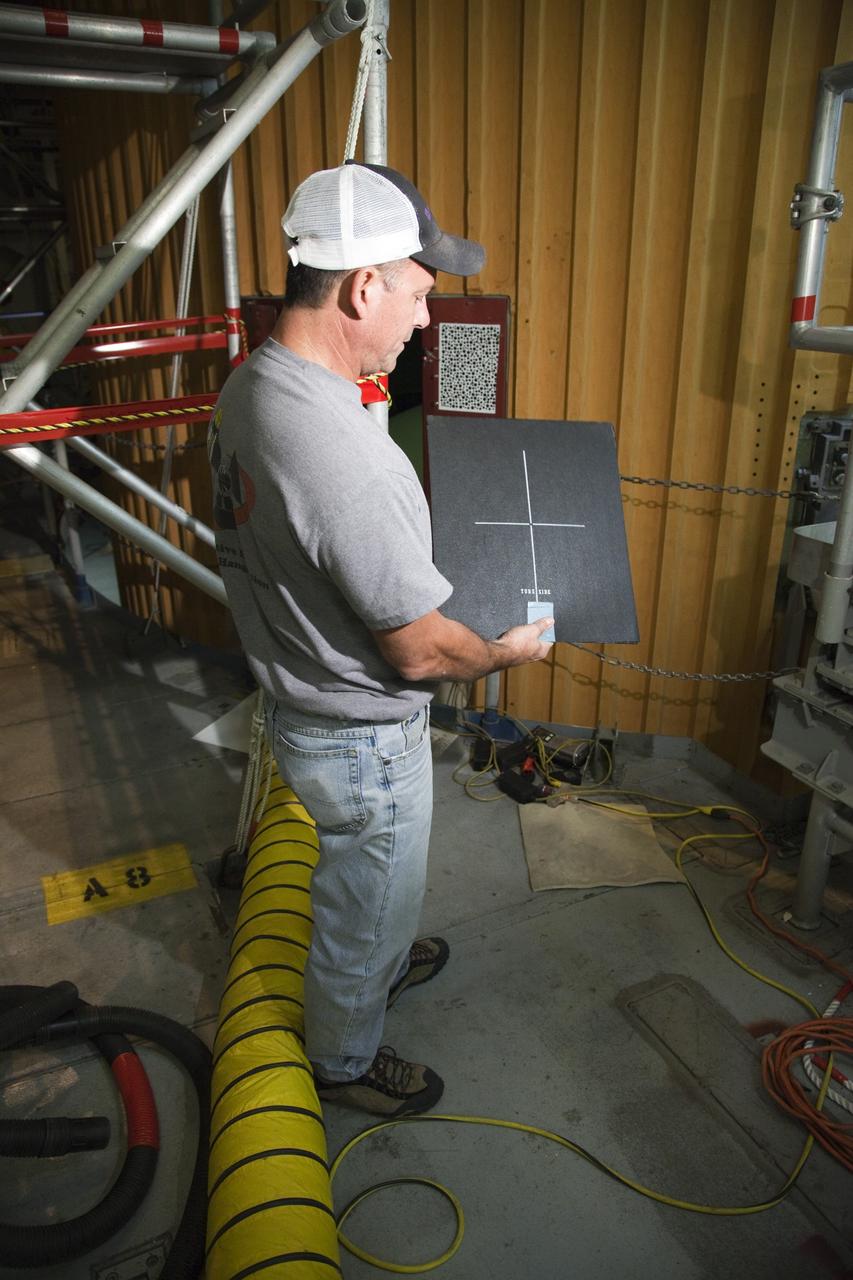
CAPE CANAVERAL, Fla. -- Inside the Vehicle Assembly Building at NASA's Kennedy Space Center in Florida, a technician holds the film used to project computed radiography scans of space shuttle Discovery's external fuel tank. The shuttle stack was moved from Launch Pad 39A to the Vehicle Assembly Building at NASA's Kennedy Space Center in Florida so technicians could examine 21-foot-long support beams, called stringers, on the outside of the tank's intertank and re-apply foam insulation. Discovery's next launch opportunity to the International Space Station on the STS-133 mission is no earlier than Feb. 3, 2011. For more information on STS-133, visit www.nasa.gov/mission_pages/shuttle/shuttlemissions/sts133/. Photo credit: NASA/Frankie Martin
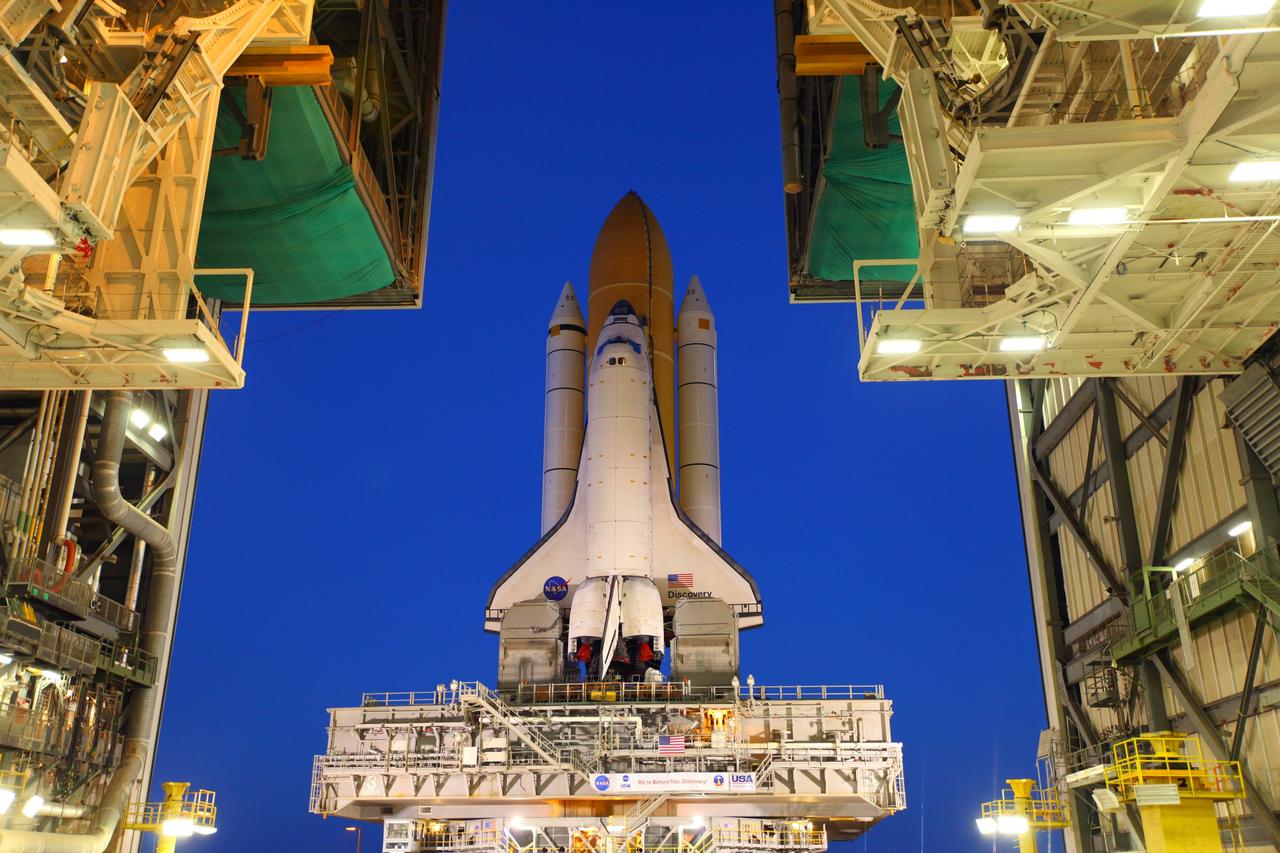
CAPE CANAVERAL, Fla. -- At NASA's Kennedy Space Center in Florida, space shuttle Discovery begins its nighttime trek, known as "rollout," from the Vehicle Assembly Building to Launch Pad 39A. It will take the shuttle, attached to its external fuel tank, twin solid rocket boosters and mobile launcher platform, about six hours to complete the move atop a crawler-transporter. Rollout sets the stage for Discovery's STS-133 crew to practice countdown and launch procedures during the Terminal Countdown Demonstration Test in mid-October. Targeted to liftoff Nov. 1, Discovery will take the Permanent Multipurpose Module (PMM) packed with supplies and critical spare parts, as well as Robonaut 2 (R2) to the International Space Station. Photo credit: NASA/Frankie Martin
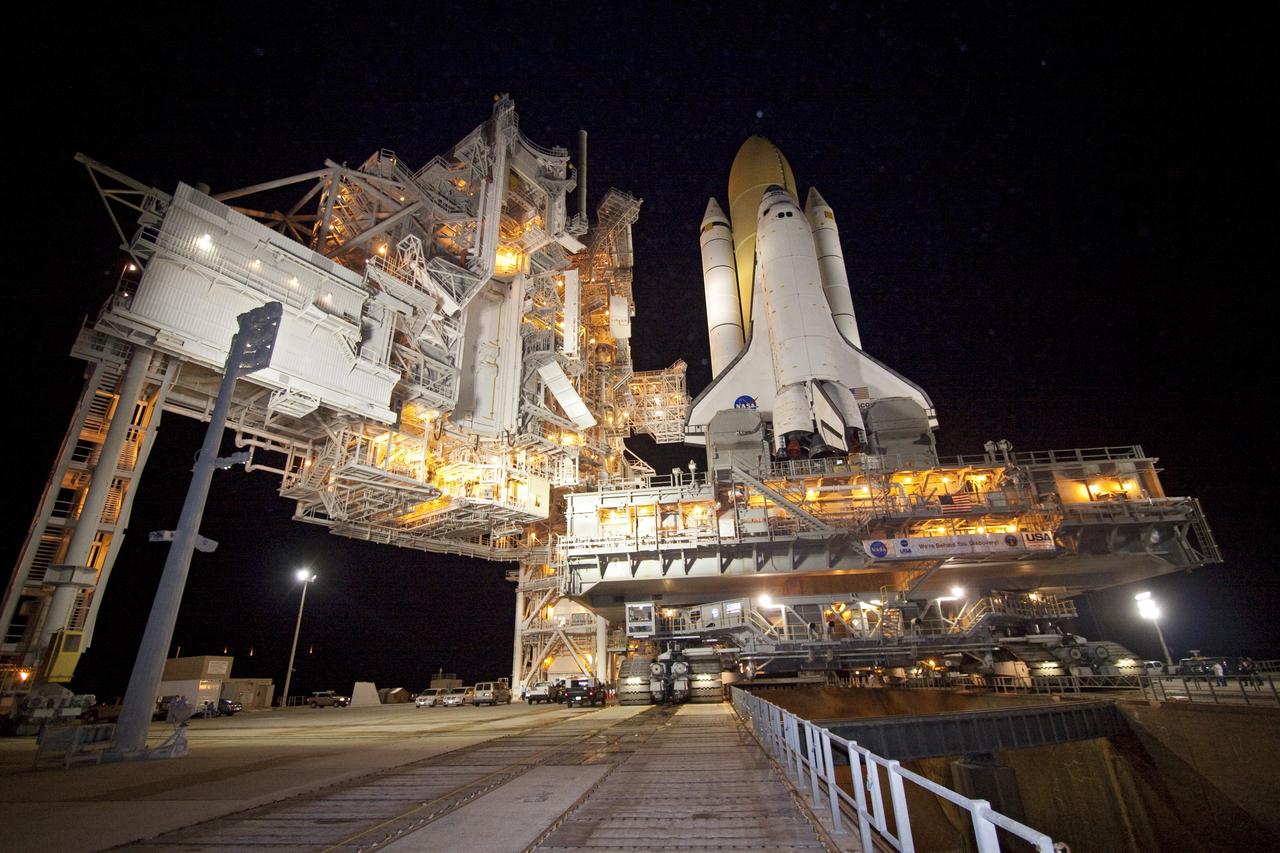
CAPE CANAVERAL, Fla. -- At NASA's Kennedy Space Center in Florida, space shuttle Discovery makes the last leg of its journey, known as "rollout," from the Vehicle Assembly Building to Launch Pad 39A. It took the shuttle, attached to its external fuel tank, twin solid rocket boosters and mobile launcher platform, about six hours to complete the move atop a crawler-transporter. Rollout sets the stage for Discovery's STS-133 crew to practice countdown and launch procedures during the Terminal Countdown Demonstration Test in mid-October. Targeted to liftoff Nov. 1, Discovery will take the Permanent Multipurpose Module (PMM) packed with supplies and critical spare parts, as well as Robonaut 2 (R2) to the International Space Station. Photo credit: NASA/Jack Pfaller
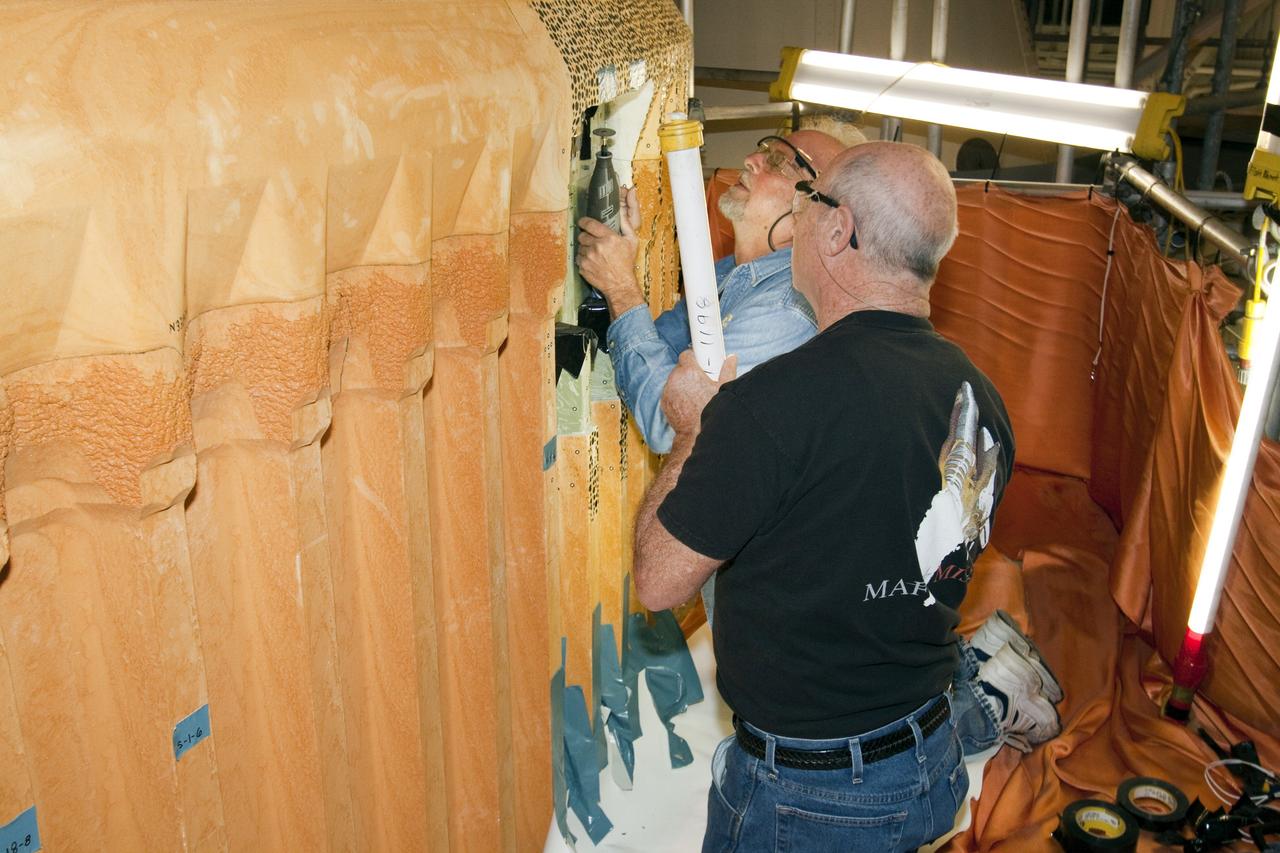
CAPE CANAVERAL, Fla. -- Repair work to space shuttle Discovery's external fuel tank begins in the Vehicle Assembly Building at NASA's Kennedy Space Center in Florida. Technicians will modify 32 support beams, called stringers, on the tank's intertank region by fitting pieces of metal, called radius blocks, over the stringers' edges where they attach to the thrust panel area. The thrust panel is where the tank meets the two solid rocket boosters and sees the most stress during the flight into orbit. After the modifications and additional scans of the stringers are complete, foam insulation will be re-applied. Discovery's next launch opportunity to the International Space Station on the STS-133 mission is no earlier than Feb. 3, 2011. For more information on STS-133, visit www.nasa.gov/mission_pages/shuttle/shuttlemissions/sts133/. Photo credit: NASA/Jack Pfaller

CAPE CANAVERAL, Fla. -- At NASA's Kennedy Space Center in Florida, space shuttle Discovery begins its nighttime trek, known as "rollout," from the Vehicle Assembly Building to Launch Pad 39A. It will take the shuttle, attached to its external fuel tank, twin solid rocket boosters and mobile launcher platform, about six hours to complete the move atop a crawler-transporter. Rollout sets the stage for Discovery's STS-133 crew to practice countdown and launch procedures during the Terminal Countdown Demonstration Test in mid-October. Targeted to liftoff Nov. 1, Discovery will take the Permanent Multipurpose Module (PMM) packed with supplies and critical spare parts, as well as Robonaut 2 (R2) to the International Space Station. Photo credit: NASA/Jack Pfaller
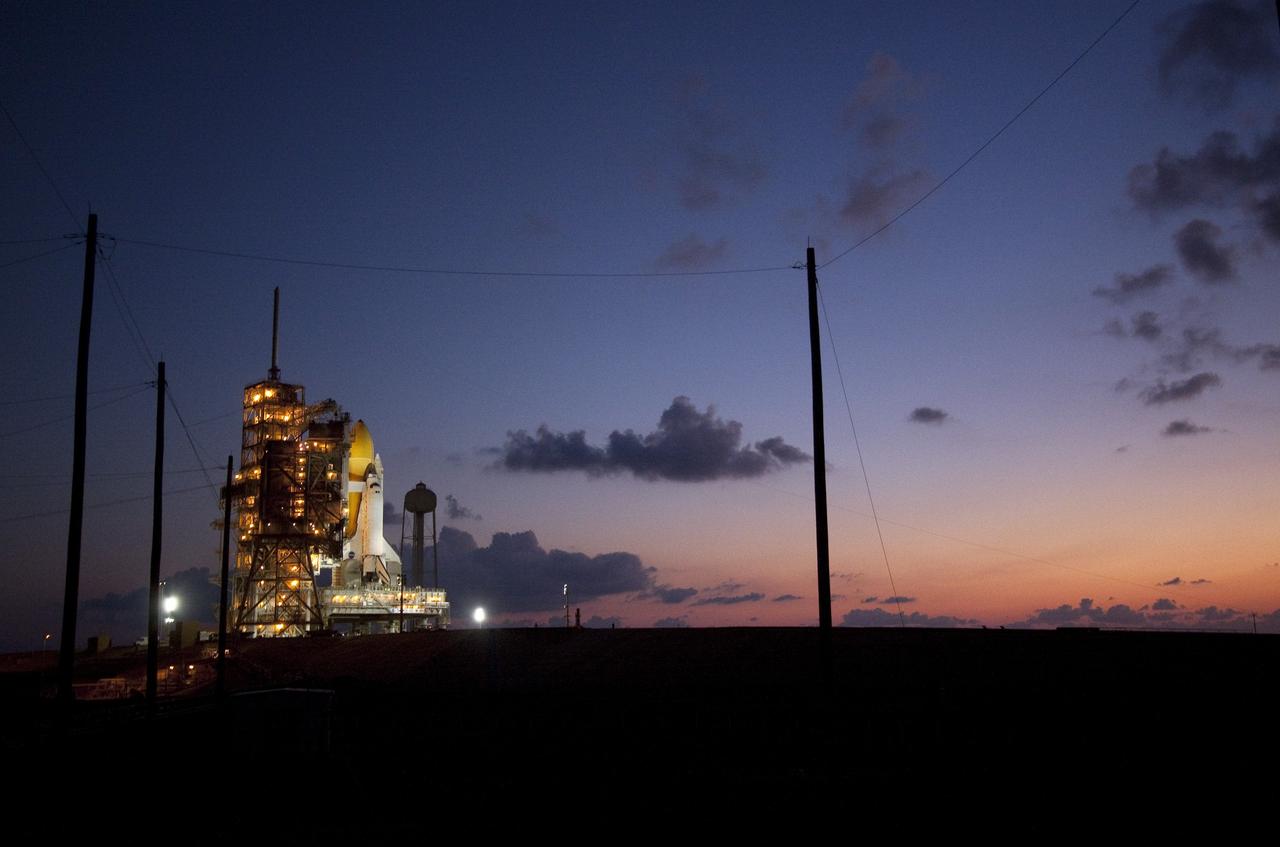
CAPE CANAVERAL, Fla. -- Space shuttle Discovery is attached to Launch Pad 39A as the sun rises over NASA's Kennedy Space Center in Florida. It took the spacecraft about six hours to make the journey, known as "rollout," from the Vehicle Assembly Building to the pad. Rollout sets the stage for Discovery's STS-133 crew to practice countdown and launch procedures during the Terminal Countdown Demonstration Test in mid-October. Targeted to liftoff Nov. 1, Discovery will take the Permanent Multipurpose Module (PMM) packed with supplies and critical spare parts, as well as Robonaut 2 (R2) to the International Space Station. Photo credit: NASA/Jack Pfaller
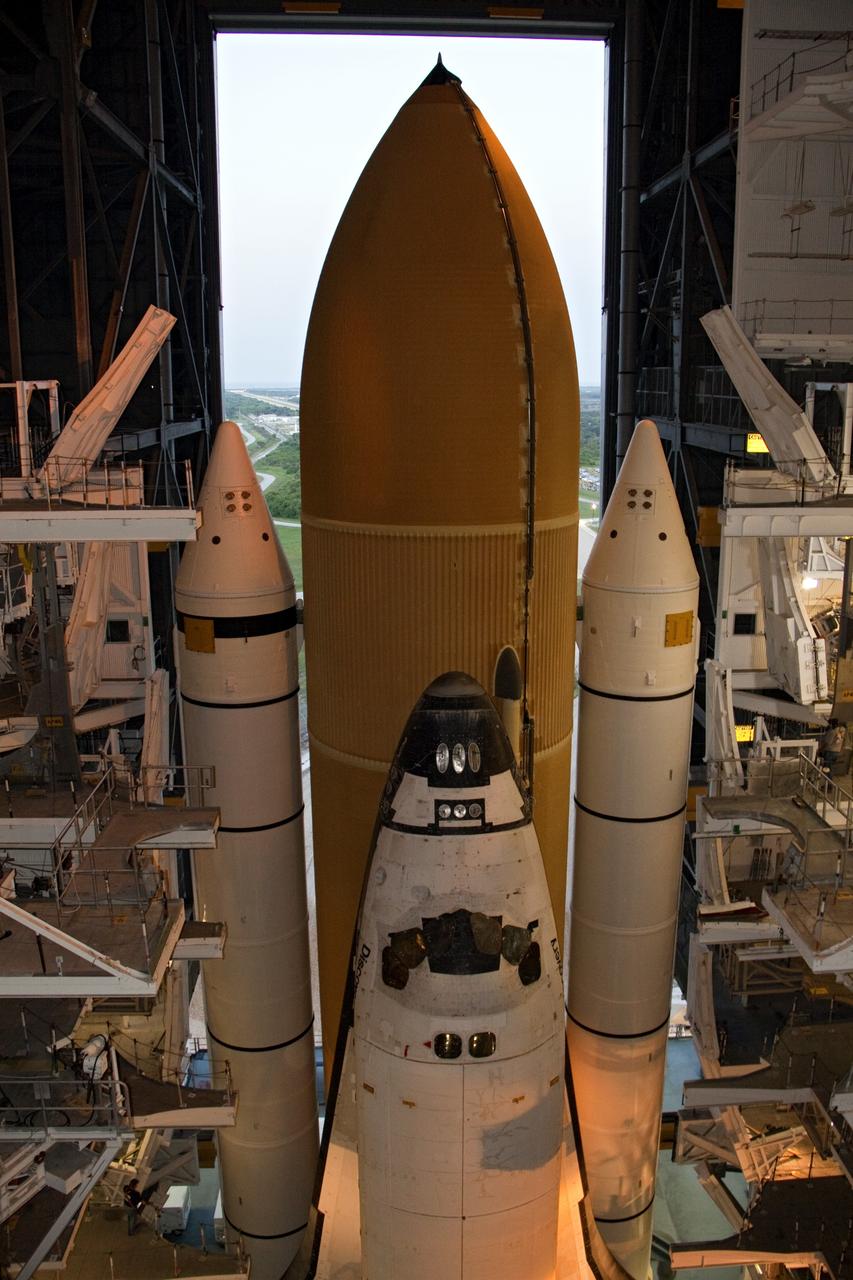
CAPE CANAVERAL, Fla. -- At NASA's Kennedy Space Center in Florida, space shuttle Discovery is ready for its nighttime trek, known as "rollout," from the Vehicle Assembly Building to Launch Pad 39A. It will take the shuttle, attached to its external fuel tank, twin solid rocket boosters and mobile launcher platform, about six hours to complete the move atop a crawler-transporter. Rollout sets the stage for Discovery's STS-133 crew to practice countdown and launch procedures during the Terminal Countdown Demonstration Test in mid-October. Targeted to liftoff Nov. 1, Discovery will take the Permanent Multipurpose Module (PMM) packed with supplies and critical spare parts, as well as Robonaut 2 (R2) to the International Space Station. Photo credit: NASA/Mic Miracle
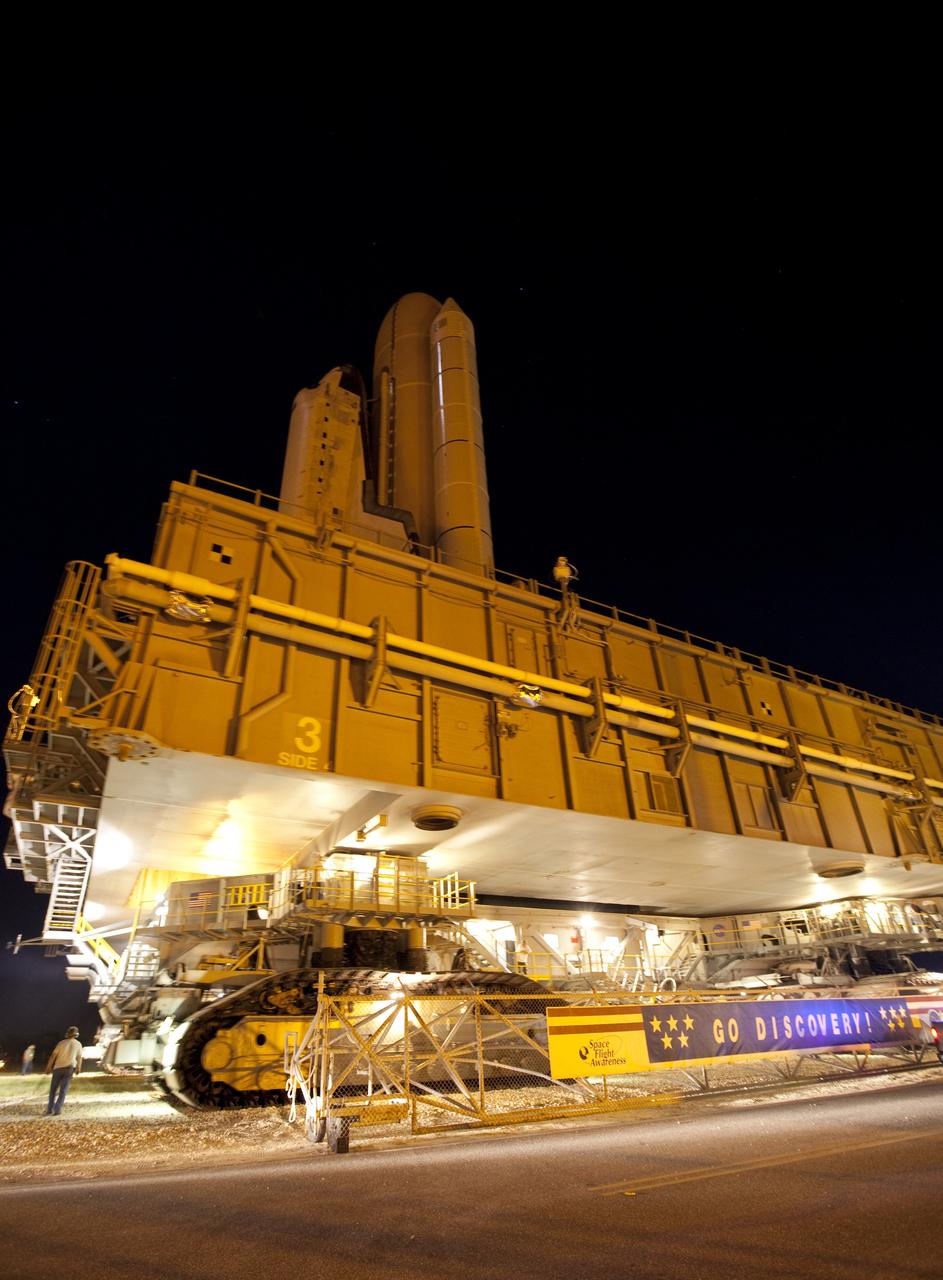
CAPE CANAVERAL, Fla. -- At NASA's Kennedy Space Center in Florida, space shuttle Discovery makes the last leg of its journey, known as "rollout," from the Vehicle Assembly Building to Launch Pad 39A. It took the shuttle, attached to its external fuel tank, twin solid rocket boosters and mobile launcher platform, about six hours to complete the move atop a crawler-transporter. Rollout sets the stage for Discovery's STS-133 crew to practice countdown and launch procedures during the Terminal Countdown Demonstration Test in mid-October. Targeted to liftoff Nov. 1, Discovery will take the Permanent Multipurpose Module (PMM) packed with supplies and critical spare parts, as well as Robonaut 2 (R2) to the International Space Station. Photo credit: NASA/Frankie Martin
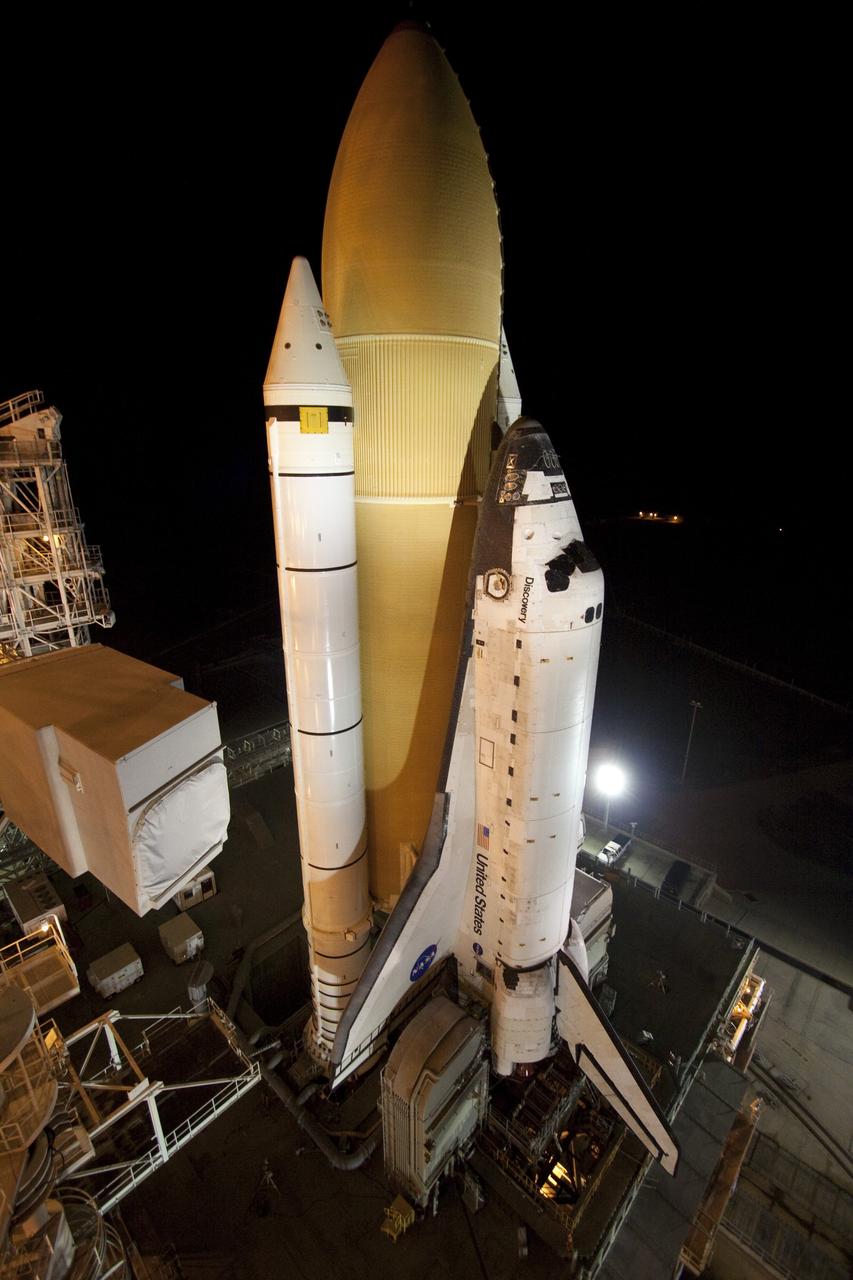
CAPE CANAVERAL, Fla. -- At NASA's Kennedy Space Center in Florida, space shuttle Discovery is attached to Launch Pad 39A, completing "rollout" from the Vehicle Assembly Building to Launch Pad 39A. It took the shuttle, attached to its external fuel tank, twin solid rocket boosters and mobile launcher platform, about six hours to complete the move atop a crawler-transporter. Rollout sets the stage for Discovery's STS-133 crew to practice countdown and launch procedures during the Terminal Countdown Demonstration Test in mid-October. Targeted to liftoff Nov. 1, Discovery will take the Permanent Multipurpose Module (PMM) packed with supplies and critical spare parts, as well as Robonaut 2 (R2) to the International Space Station. Photo credit: NASA/Jack Pfaller
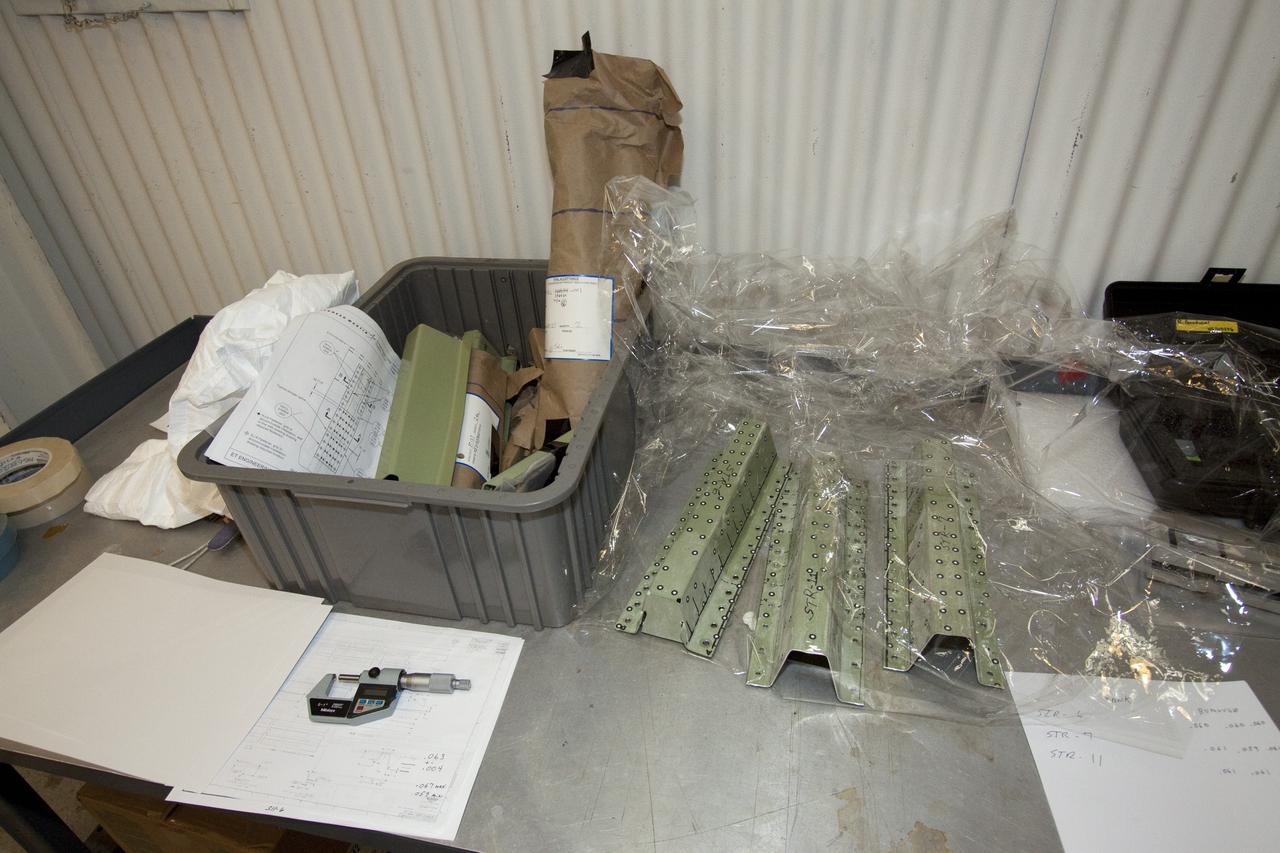
CAPE CANAVERAL, Fla. -- Repair work to space shuttle Discovery's external fuel tank begins in the Vehicle Assembly Building at NASA's Kennedy Space Center in Florida. Technicians will modify 32 support beams, called stringers, on the tank's intertank region by fitting pieces of metal, called radius blocks, over the stringers' edges where they attach to the thrust panel area. The thrust panel is where the tank meets the two solid rocket boosters and sees the most stress during the flight into orbit. After the modifications and additional scans of the stringers are complete, foam insulation will be re-applied. Discovery's next launch opportunity to the International Space Station on the STS-133 mission is no earlier than Feb. 3, 2011. For more information on STS-133, visit www.nasa.gov/mission_pages/shuttle/shuttlemissions/sts133/. Photo credit: NASA/Jack Pfaller
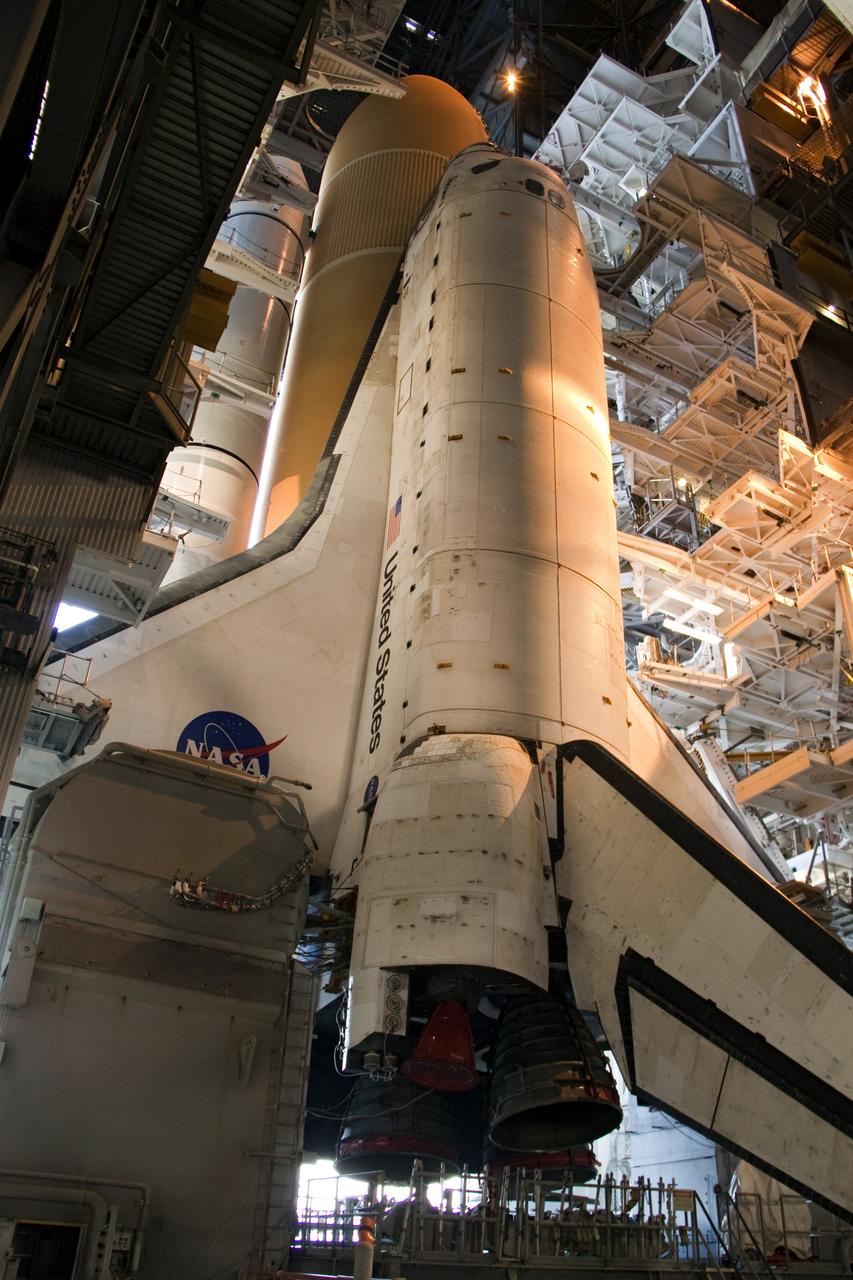
CAPE CANAVERAL, Fla. -- At NASA's Kennedy Space Center in Florida, space shuttle Discovery is prepared for its nighttime trek, known as "rollout," from the Vehicle Assembly Building to Launch Pad 39A. It will take the shuttle, attached to its external fuel tank, twin solid rocket boosters and mobile launcher platform, about six hours to complete the move atop a crawler-transporter. Rollout sets the stage for Discovery's STS-133 crew to practice countdown and launch procedures during the Terminal Countdown Demonstration Test in mid-October. Targeted to liftoff Nov. 1, Discovery will take the Permanent Multipurpose Module (PMM) packed with supplies and critical spare parts, as well as Robonaut 2 (R2) to the International Space Station. Photo credit: NASA/Mic Miracle
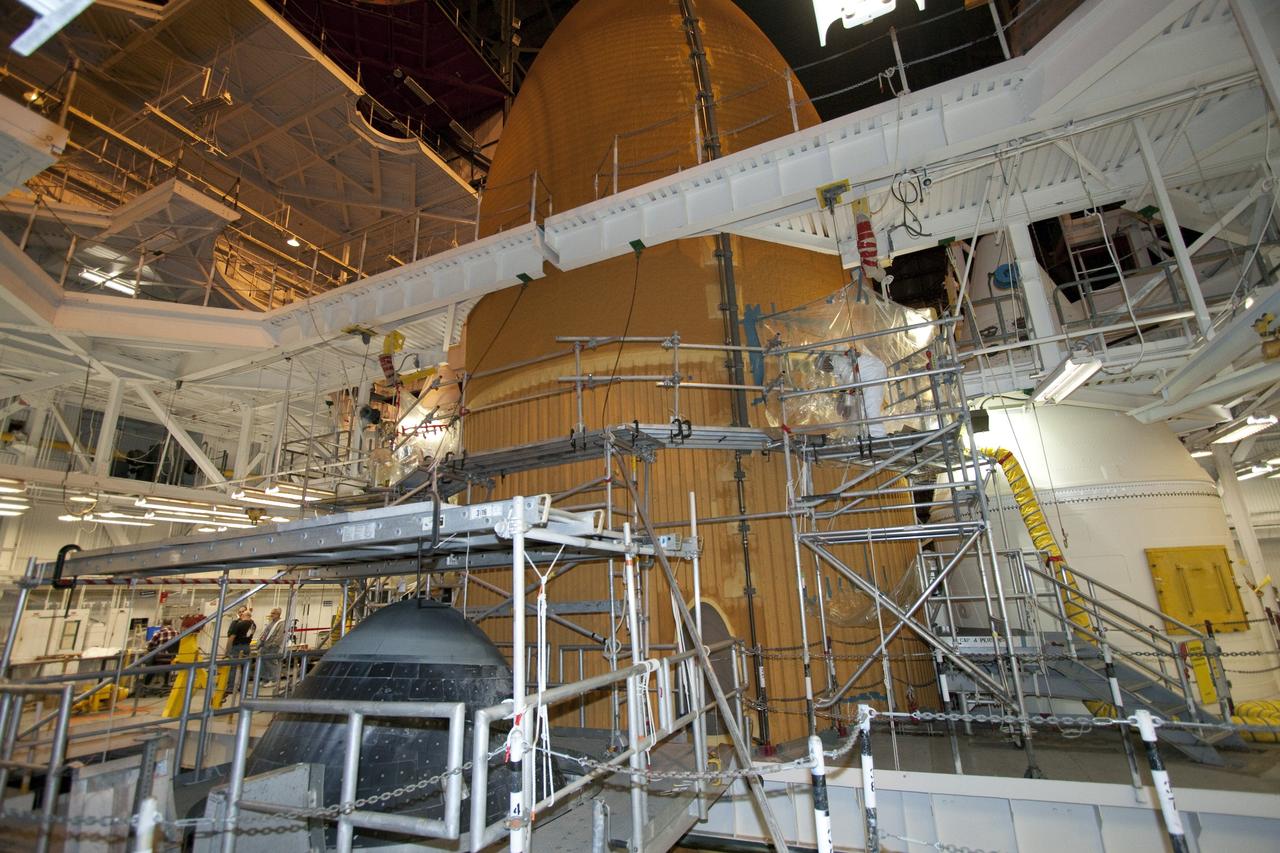
CAPE CANAVERAL, Fla. -- Repair work to space shuttle Discovery's external fuel tank begins in the Vehicle Assembly Building at NASA's Kennedy Space Center in Florida. Technicians will modify 32 support beams, called stringers, on the tank's intertank region by fitting pieces of metal, called radius blocks, over the stringers' edges where they attach to the thrust panel area. The thrust panel is where the tank meets the two solid rocket boosters and sees the most stress during the flight into orbit. After the modifications and additional scans of the stringers are complete, foam insulation will be re-applied. Discovery's next launch opportunity to the International Space Station on the STS-133 mission is no earlier than Feb. 3, 2011. For more information on STS-133, visit www.nasa.gov/mission_pages/shuttle/shuttlemissions/sts133/. Photo credit: NASA/Jack Pfaller
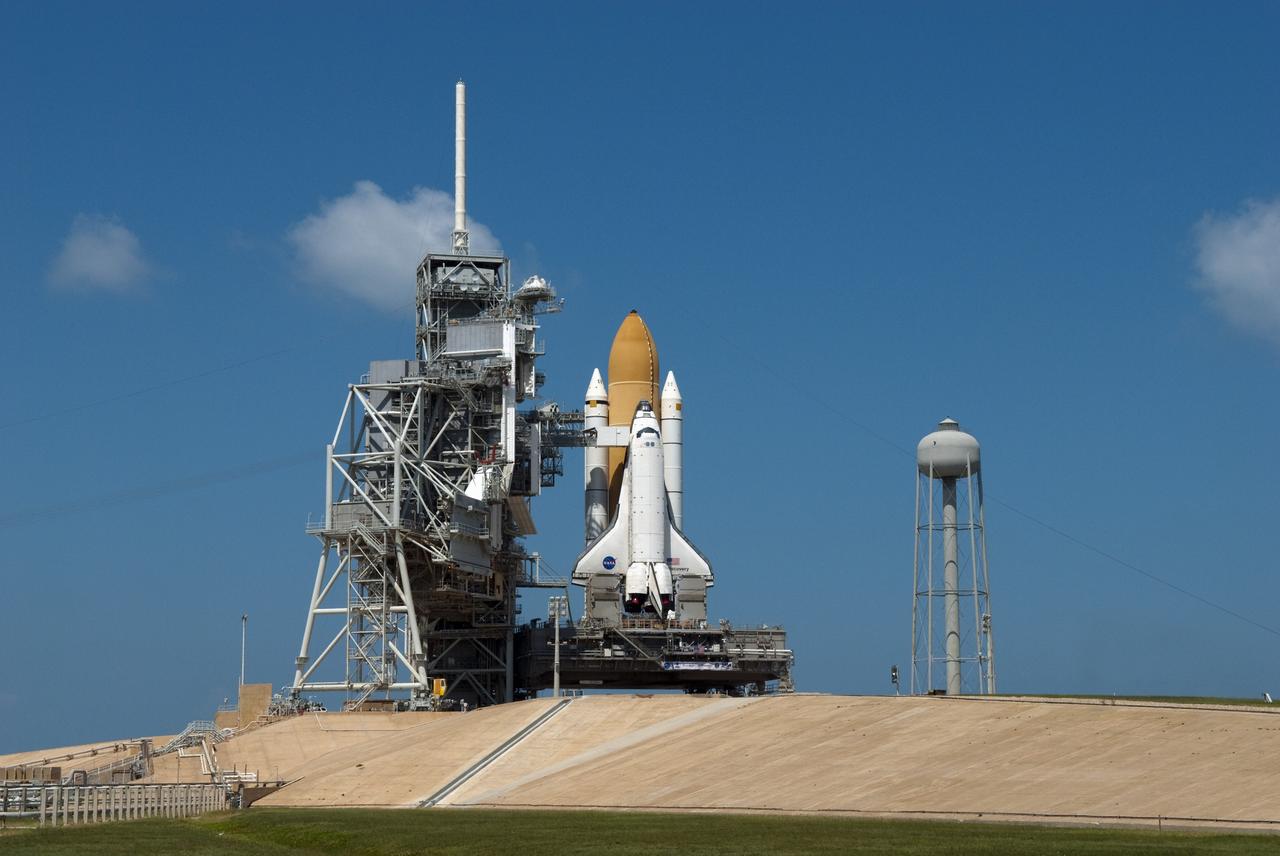
CAPE CANAVERAL, Fla. -- At NASA's Kennedy Space Center in Florida, space shuttle Discovery is visible on Launch Pad 39A before the rotating service structure, which protects it from the elements and provides access to the shuttle, is moved into place. It took the spacecraft about six hours to make the journey, known as "rollout," from the Vehicle Assembly Building to the pad. Rollout sets the stage for Discovery's STS-133 crew to practice countdown and launch procedures during the Terminal Countdown Demonstration Test in mid-October. Targeted to liftoff Nov. 1, Discovery will take the Permanent Multipurpose Module (PMM) packed with supplies and critical spare parts, as well as Robonaut 2 (R2) to the International Space Station. Photo credit: NASA/Jim Grossmann
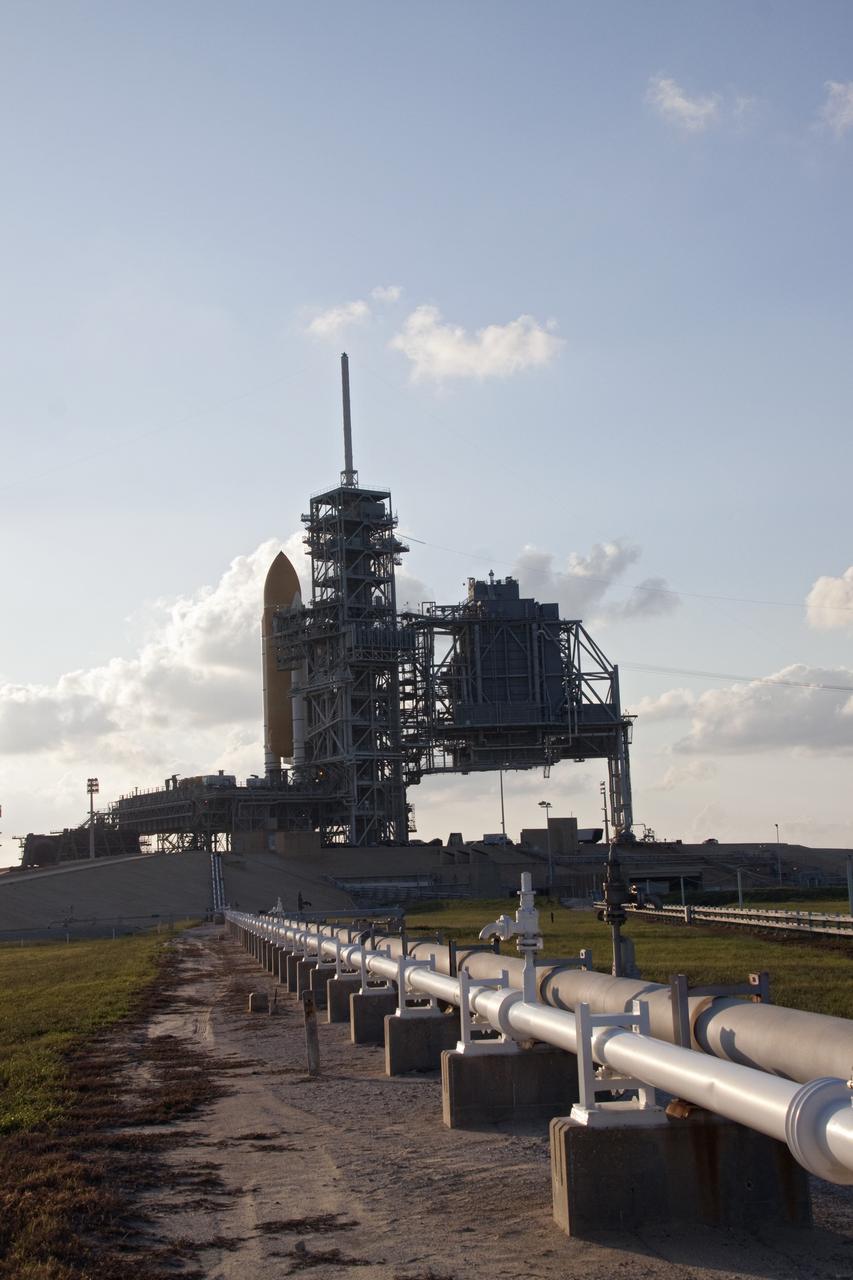
CAPE CANAVERAL, Fla. -- Space shuttle Discovery is visible on Launch Pad 39A at NASA's Kennedy Space Center in Florida before the rotating service structure, which protects it from the elements, is moved into place. It took the spacecraft about six hours to make the journey, known as "rollout," from the Vehicle Assembly Building to the pad. Rollout sets the stage for Discovery's STS-133 crew to practice countdown and launch procedures during the Terminal Countdown Demonstration Test in mid-October. Targeted to liftoff Nov. 1, Discovery will take the Permanent Multipurpose Module (PMM) packed with supplies and critical spare parts, as well as Robonaut 2 (R2) to the International Space Station. Photo credit: NASA/Jack Pfaller

CAPE CANAVERAL, Fla. -- Xenon lights illuminate space shuttle Discovery and create a mirror image in the Turn Basin at NASA's Kennedy Space Center in Florida as the space vehicle rolls out to Launch Pad 39A from the Vehicle Assembly Building. It will take the shuttle, attached to its external fuel tank, twin solid rocket boosters and mobile launcher platform, about seven hours to complete the move atop a crawler-transporter. This is the second time Discovery has rolled out to the pad for the STS-133 mission, and comes after a thorough check and modifications to the shuttle's external tank. Targeted to liftoff Feb. 24, Discovery will take the Permanent Multipurpose Module (PMM) packed with supplies and critical spare parts, as well as Robonaut 2 (R2) to the International Space Station. For more information on STS-133, visit www.nasa.gov/mission_pages/shuttle/shuttlemissions/sts133/. Photo credit: NASA/Kim Shiflett
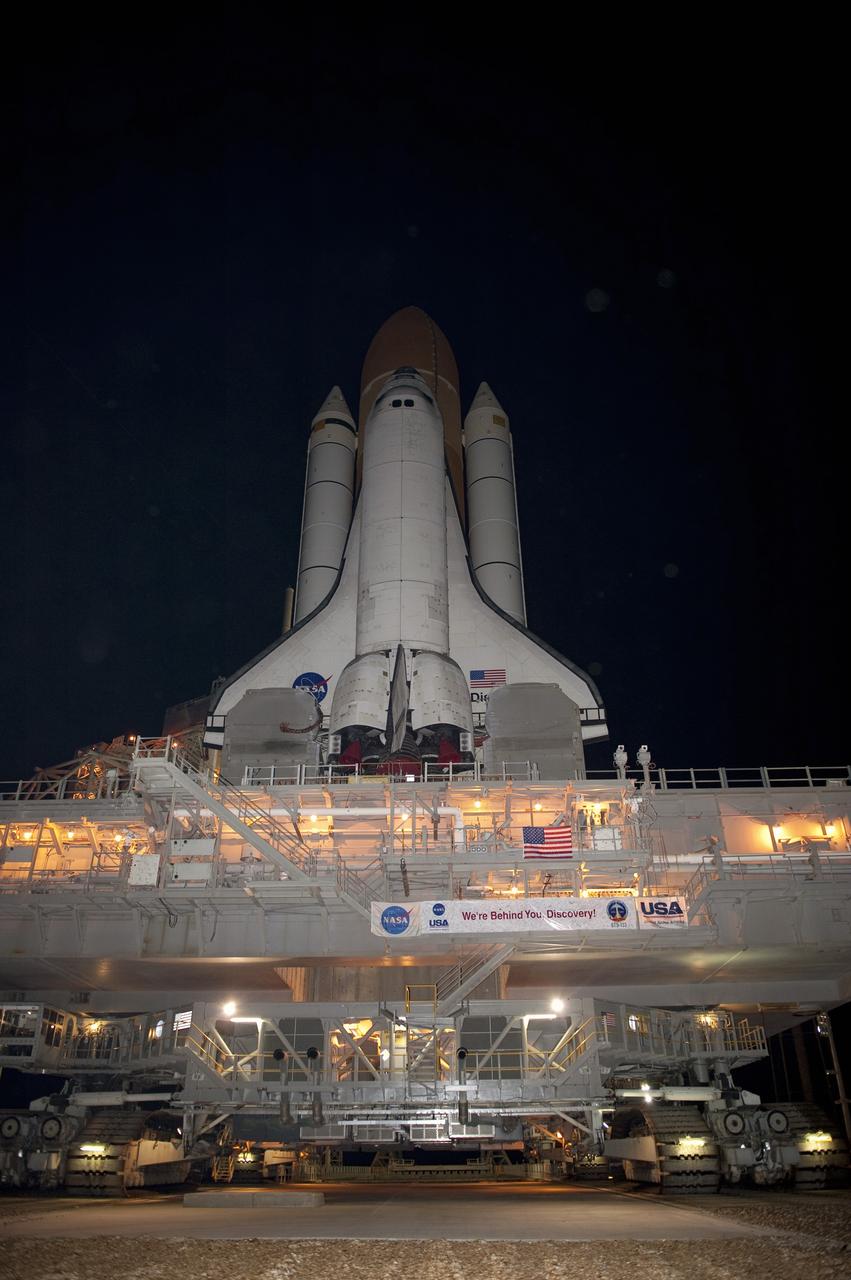
CAPE CANAVERAL, Fla. -- Space shuttle Discovery arrives at Launch Pad 39A from the Vehicle Assembly Building at NASA's Kennedy Space Center in Florida. It took the shuttle, attached to its external fuel tank, twin solid rocket boosters and mobile launcher platform, about seven hours to complete the move atop a crawler-transporter. This is the second time Discovery has rolled out to the pad for the STS-133 mission, and comes after a thorough check and modifications to the shuttle's external tank. Targeted to liftoff Feb. 24, Discovery will take the Permanent Multipurpose Module (PMM) packed with supplies and critical spare parts, as well as Robonaut 2 (R2) to the International Space Station. For more information on STS-133, visit www.nasa.gov/mission_pages/shuttle/shuttlemissions/sts133/. Photo credit: NASA/Kim Shiflett

CAPE CANAVERAL, Fla. -- At NASA's Kennedy Space Center in Florida, space shuttle Discovery is visible on Launch Pad 39A before the rotating service structure, which protects it from the elements and provides access to the shuttle, is moved into place. The illusion of the crawler-transporter that carried the spacecraft from the Vehicle Assembly Building to the pad sits outside the perimeter gate. Rollout sets the stage for Discovery's STS-133 crew to practice countdown and launch procedures during the Terminal Countdown Demonstration Test in mid-October. Targeted to liftoff Nov. 1, Discovery will take the Permanent Multipurpose Module (PMM) packed with supplies and critical spare parts, as well as Robonaut 2 (R2) to the International Space Station. Photo credit: NASA/Jim Grossmann
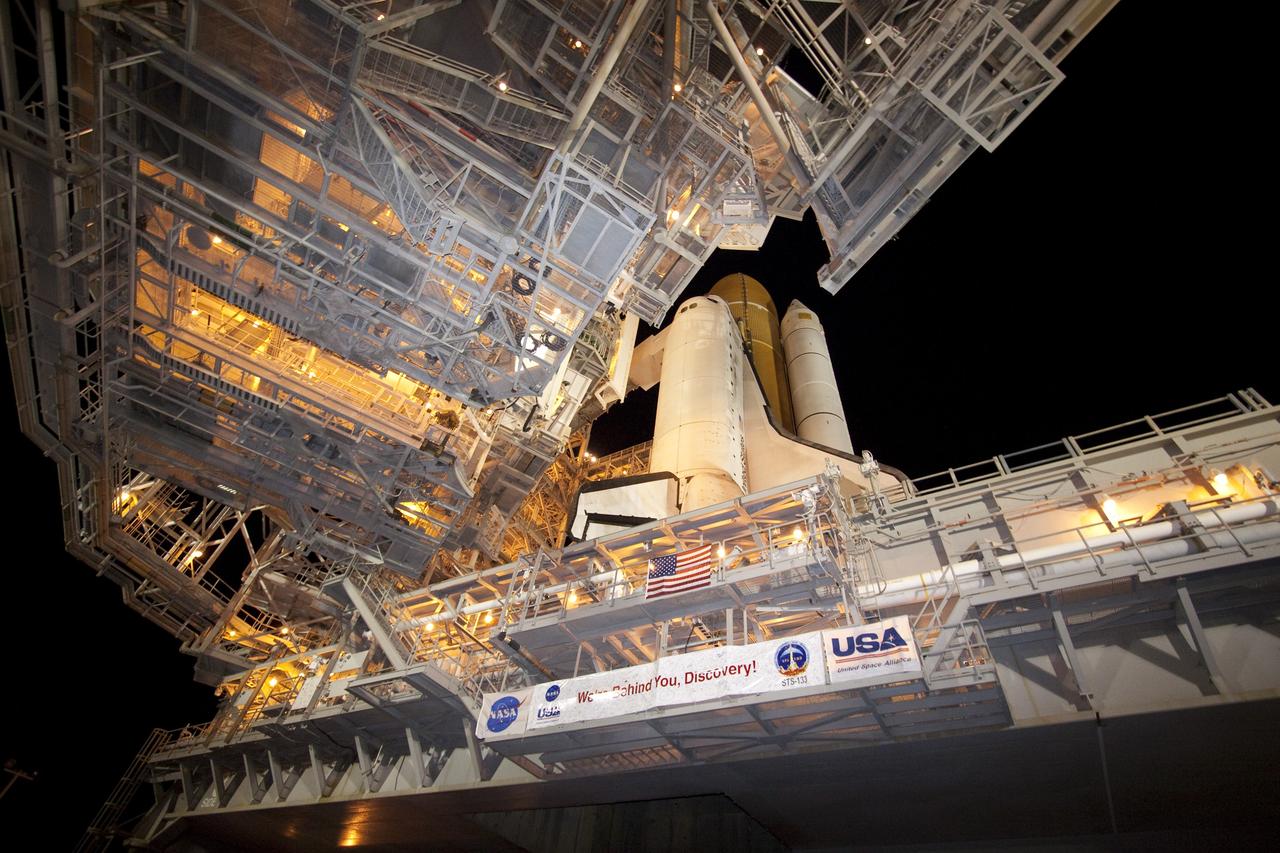
CAPE CANAVERAL, Fla. -- The rotating service structure (RSS), which provides weather protection and access to the shuttle, moves into place around space shuttle Discovery on Launch Pad 39A at NASA's Kennedy Space Center in Florida. This comes after Discovery, attached to its external fuel tank, twin solid rocket boosters and mobile launcher platform, rolled out to the pad from the Vehicle Assembly Building during the overnight hours. Rollout to the pad is a significant shuttle processing milestone for the upcoming STS-133 mission, and comes after a thorough check and modifications to the shuttle's external fuel tank. Targeted to liftoff Feb. 24, Discovery will take the Permanent Multipurpose Module (PMM) packed with supplies and critical spare parts, as well as Robonaut 2 (R2) to the International Space Station. For more information on STS-133, visit www.nasa.gov/mission_pages/shuttle/shuttlemissions/sts133/. Photo credit: NASA/Jack Pfaller
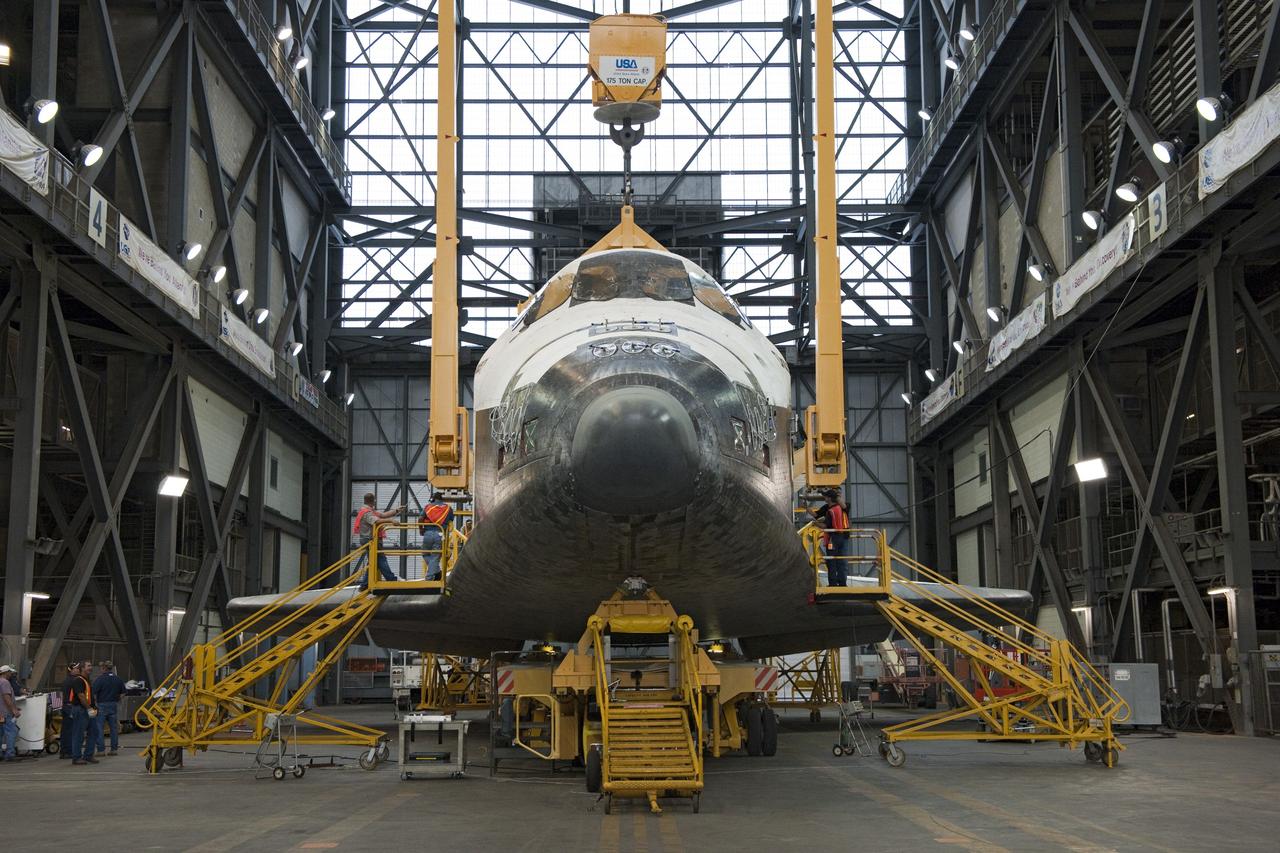
CAPE CANAVERAL, Fla. -- At NASA's Kennedy Space Center in Florida, workers in the Vehicle Assembly Building begin to secure a large yellow, metal sling to shuttle Discovery for its lift from the transfer aisle into High Bay 3. In the bay, the shuttle will be attached to its external fuel tank and solid rocket boosters. The operation began Sept. 9 and wrapped up early Sept. 10. Later, Discovery will "roll out" to Launch Pad 39A in preparation for its launch to the International Space Station on the STS-133 mission. Targeted to liftoff Nov. 1, Discovery will take the Permanent Multipurpose Module (PMM) packed with supplies and critical spare parts, as well as Robonaut 2 (R2) to the station. Photo credit: NASA/Ben Cooper
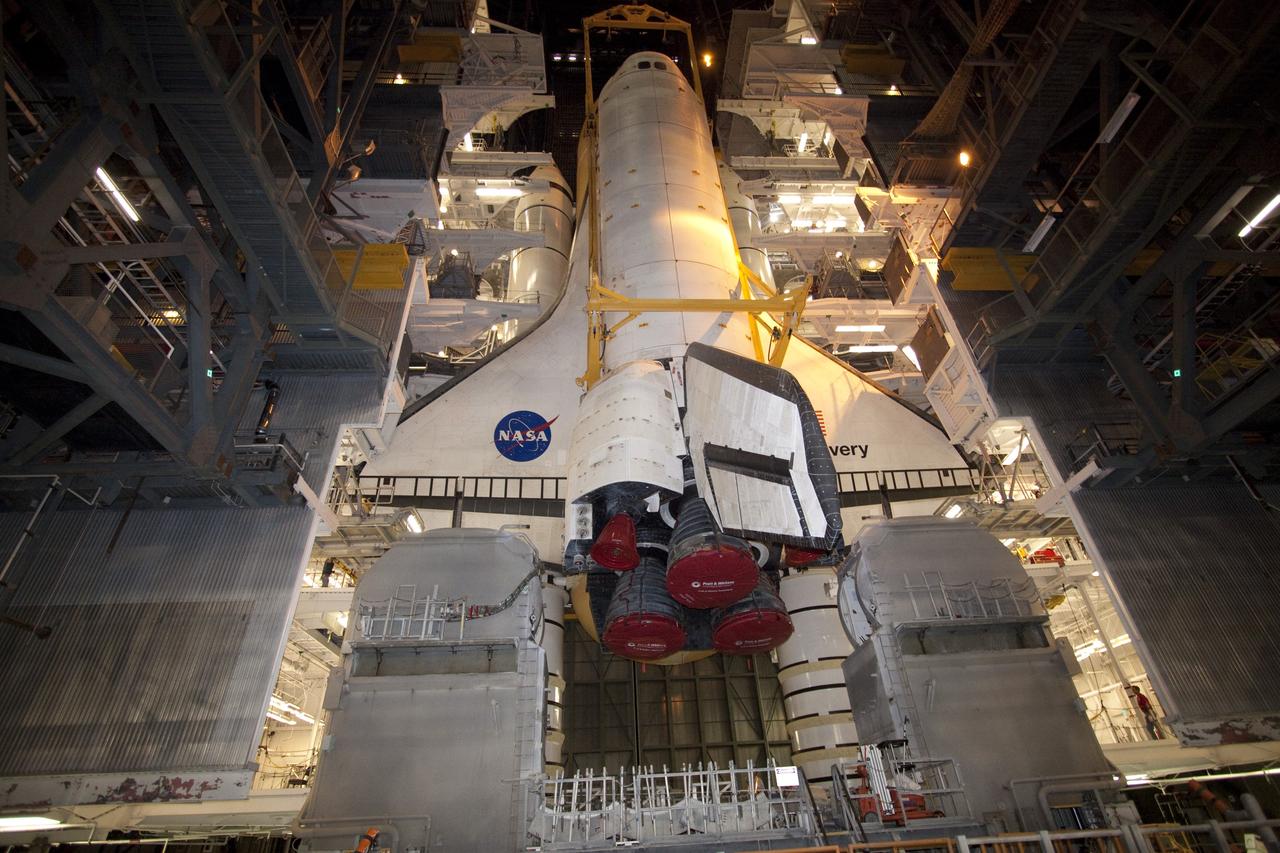
CAPE CANAVERAL, Fla. -- In High Bay 3 of the Vehicle Assembly Building at NASA's Kennedy Space Center in Florida, a large yellow, metal sling lowers shuttle Discovery to its external fuel tank and solid rocket boosters. The lift and mate operation began Sept. 9 and wrapped up early Sept. 10. Discovery is scheduled to roll out to Launch Pad 39A later this month in preparation for its launch to the International Space Station on the STS-133 mission. Targeted to lift off Nov. 1, Discovery will take the Permanent Multipurpose Module (PMM) packed with supplies and critical spare parts, as well as Robonaut 2 (R2) to the station. Photo credit: NASA/Jack Pfaller
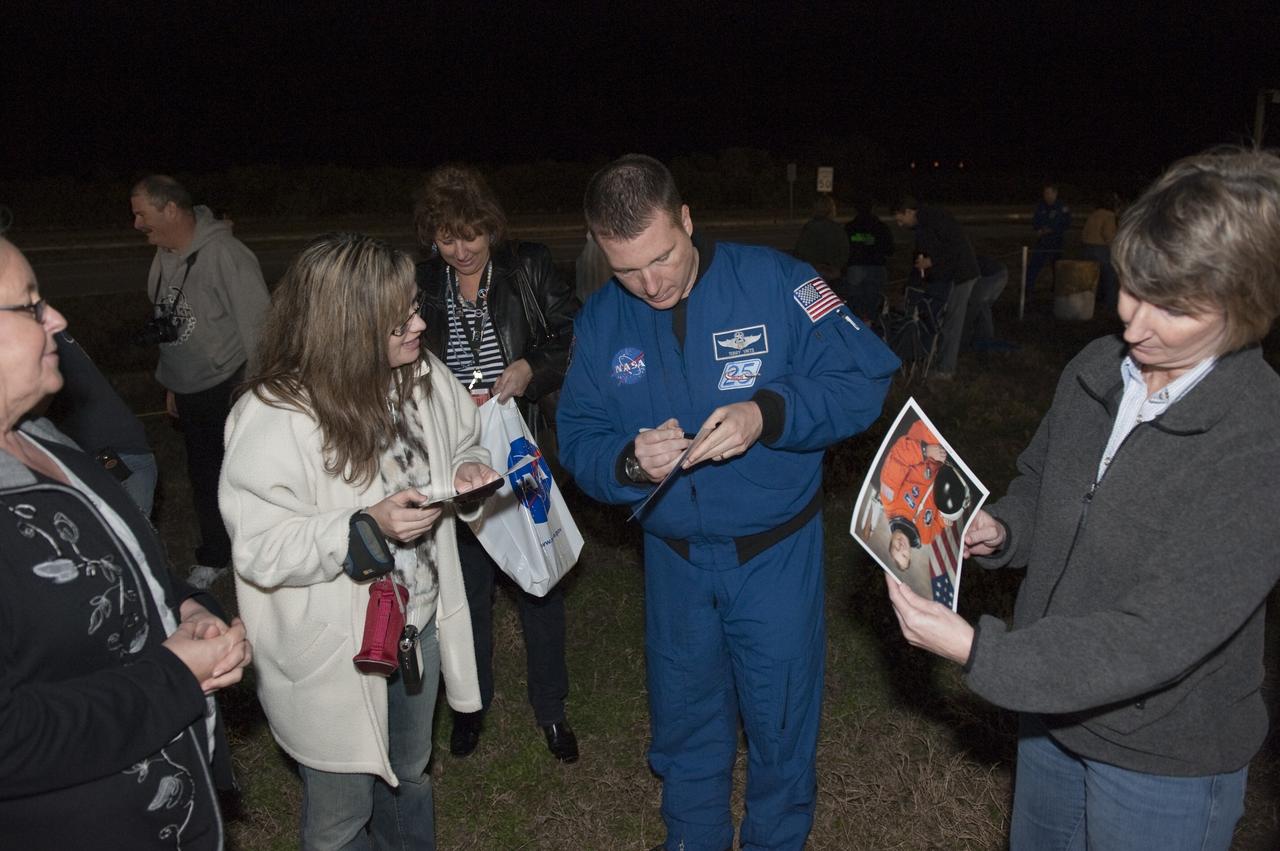
CAPE CANAVERAL, Fla. -- NASA astronaut Terry Virts signs autographs outside the Vehicle Assembly Building at NASA's Kennedy Space Center in Florida while space shuttle Discovery rolls out to Launch Pad 39A. It will take the shuttle, attached to its external fuel tank, twin solid rocket boosters and mobile launcher platform, about seven hours to complete the move atop a crawler-transporter. This is the second time Discovery has rolled out to the pad for the STS-133 mission, and comes after a thorough check and modifications to the shuttle's external tank. Virts was pilot on the STS-130 mission that took the seven-windowed cupola to the International Space Station in 2010. Targeted to liftoff Feb. 24, Discovery will take the Permanent Multipurpose Module (PMM) packed with supplies and critical spare parts, as well as Robonaut 2 (R2) to the International Space Station. For more information on STS-133, visit www.nasa.gov/mission_pages/shuttle/shuttlemissions/sts133/. Photo credit: NASA/Kim Shiflett
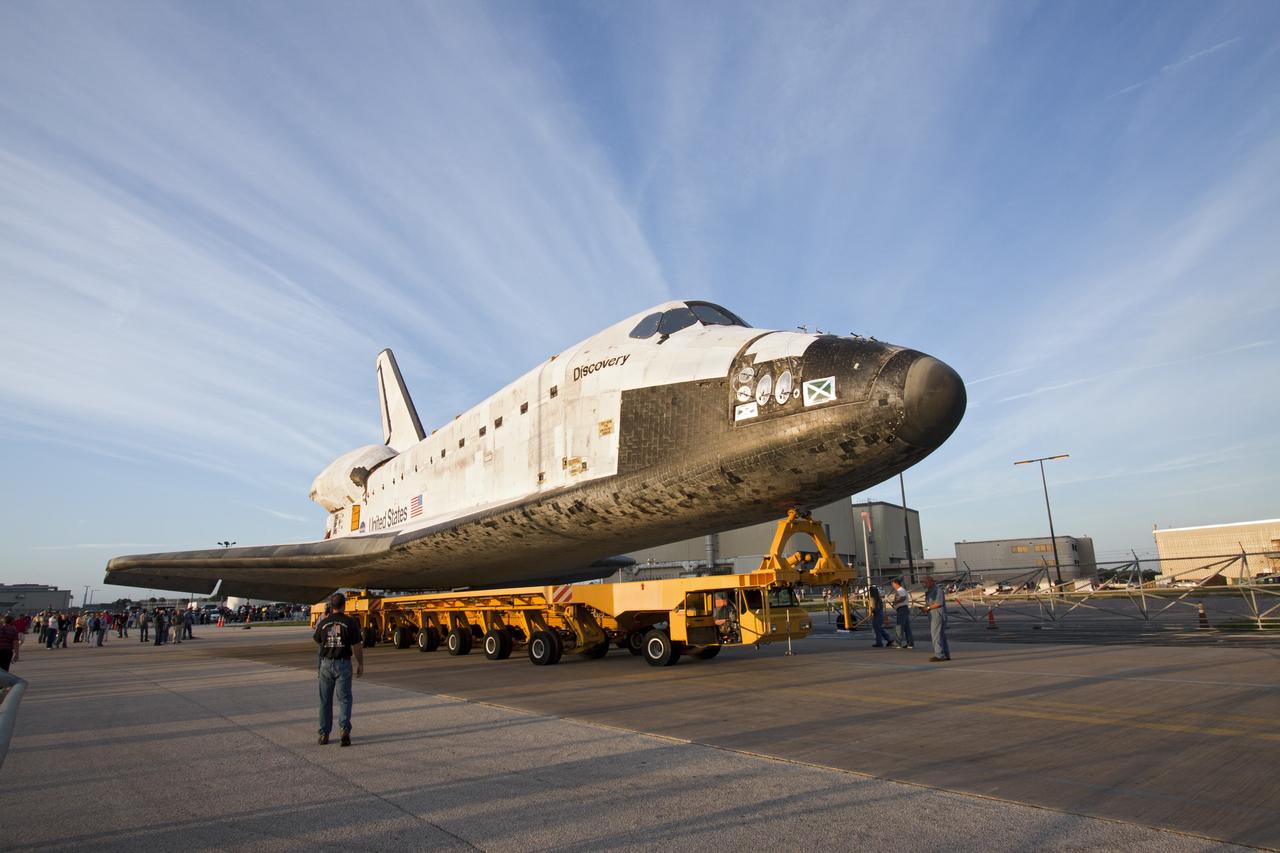
CAPE CANAVERAL, Fla. -- At NASA's Kennedy Space Center in Florida, shuttle Discovery pauses in between Orbiter Processing Facility-3 and the Vehicle Assembly Building (VAB) during a move called "rollover." Once inside the VAB, the shuttle will be joined to its solid rocket boosters and external fuel tank. Later this month, Discovery is scheduled to "rollout" to Launch Pad 39A for its launch to the International Space Station on the STS-133 mission. Targeted to liftoff Nov. 1, Discovery will take the Permanent Multipurpose Module (PMM) packed with supplies and critical spare parts, as well as Robonaut 2 (R2) to the station. Photo credit: NASA/Jack Pfaller
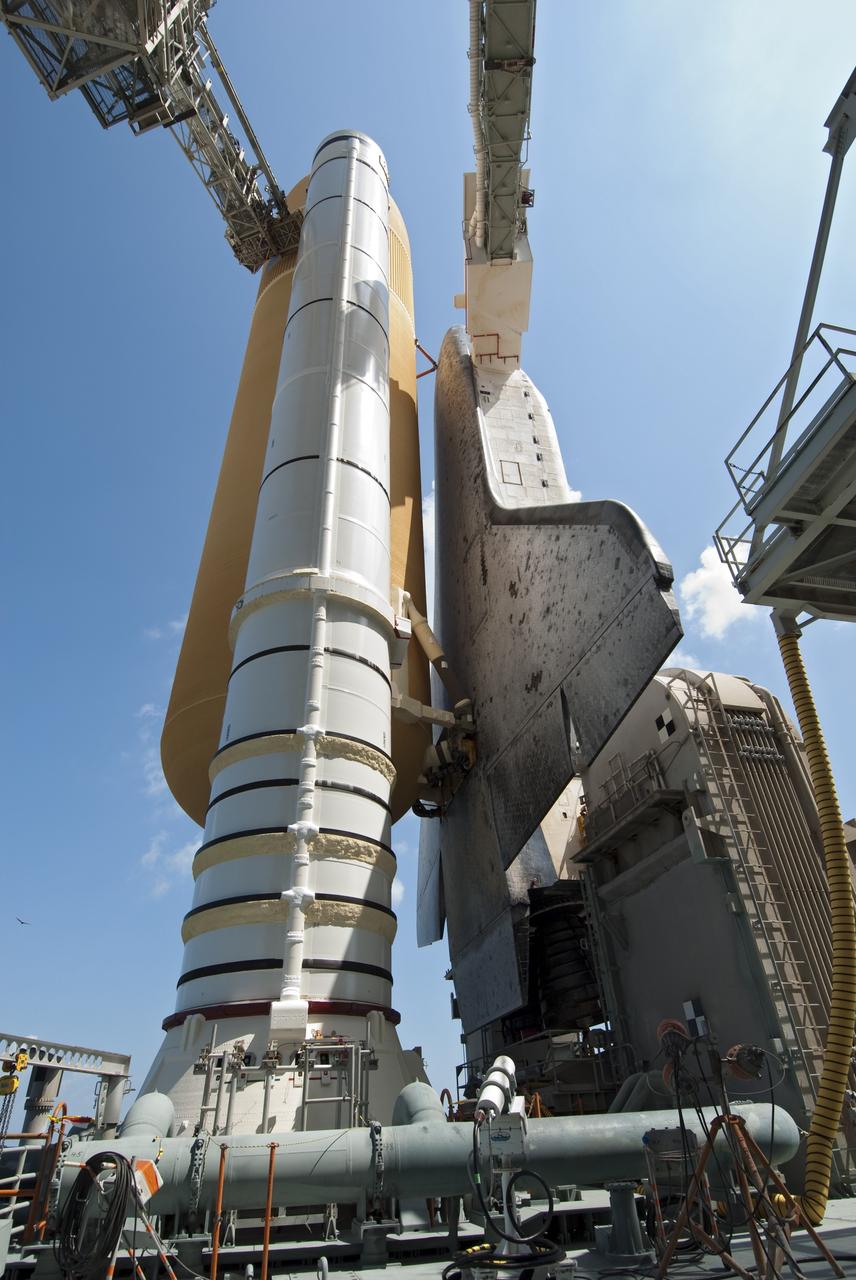
CAPE CANAVERAL, Fla. -- At NASA's Kennedy Space Center in Florida, space shuttle Discovery is visible on Launch Pad 39A before the rotating service structure, which protects it from the elements and provides access to the shuttle, is moved into place. It took the spacecraft about six hours to make the journey, known as "rollout," from the Vehicle Assembly Building to the pad. Rollout sets the stage for Discovery's STS-133 crew to practice countdown and launch procedures during the Terminal Countdown Demonstration Test in mid-October. Targeted to liftoff Nov. 1, Discovery will take the Permanent Multipurpose Module (PMM) packed with supplies and critical spare parts, as well as Robonaut 2 (R2) to the International Space Station. Photo credit: NASA/Jim Grossmann
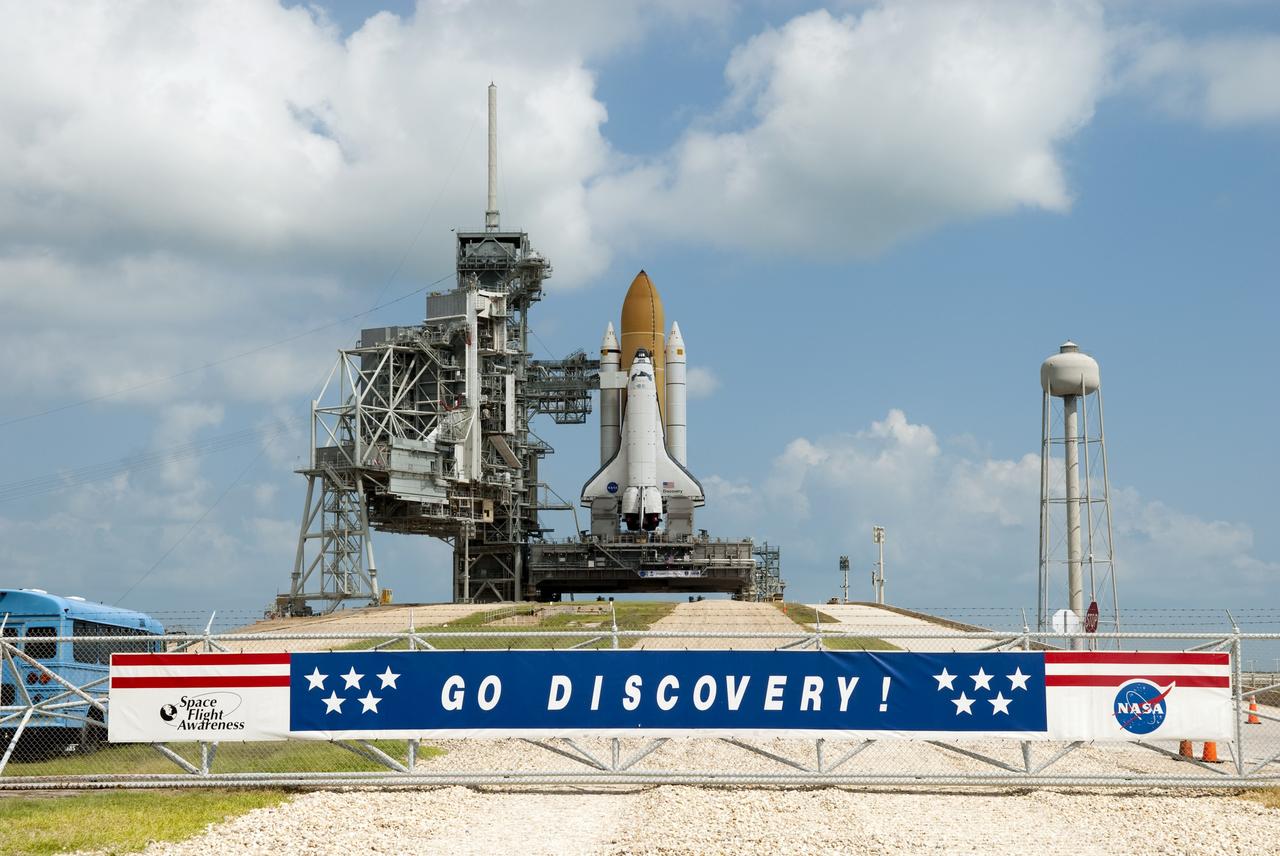
CAPE CANAVERAL, Fla. -- At NASA's Kennedy Space Center in Florida, space shuttle Discovery is visible on Launch Pad 39A and a sign supporting the vehicle hangs on the pad perimeter gate. Later, the rotating service structure that protects the shuttle from the elements will be moved into place. It took the spacecraft about six hours to make the journey, known as "rollout," from the Vehicle Assembly Building to the pad. Rollout sets the stage for Discovery's STS-133 crew to practice countdown and launch procedures during the Terminal Countdown Demonstration Test in mid-October. Targeted to liftoff Nov. 1, Discovery will take the Permanent Multipurpose Module (PMM) packed with supplies and critical spare parts, as well as Robonaut 2 (R2) to the International Space Station. Photo credit: NASA/Jim Grossmann
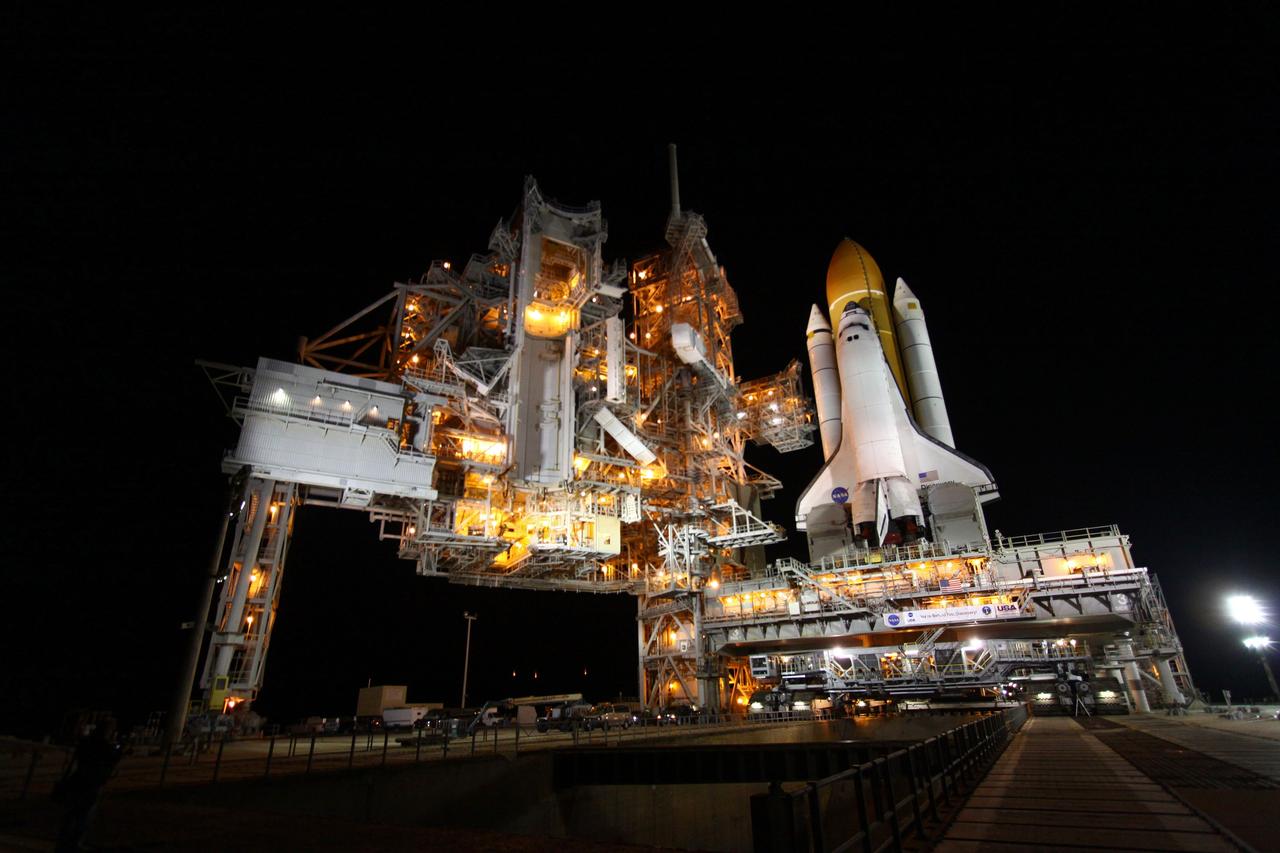
CAPE CANAVERAL, Fla. -- Space shuttle Discovery arrives at Launch Pad 39A from the Vehicle Assembly Building at NASA's Kennedy Space Center in Florida. It took the shuttle, attached to its external fuel tank, twin solid rocket boosters and mobile launcher platform, about seven hours to complete the move atop a crawler-transporter. This is the second time Discovery has rolled out to the pad for the STS-133 mission, and comes after a thorough check and modifications to the shuttle's external tank. Targeted to liftoff Feb. 24, Discovery will take the Permanent Multipurpose Module (PMM) packed with supplies and critical spare parts, as well as Robonaut 2 (R2) to the International Space Station. For more information on STS-133, visit www.nasa.gov/mission_pages/shuttle/shuttlemissions/sts133/. Photo credit: NASA/Jack Pfaller
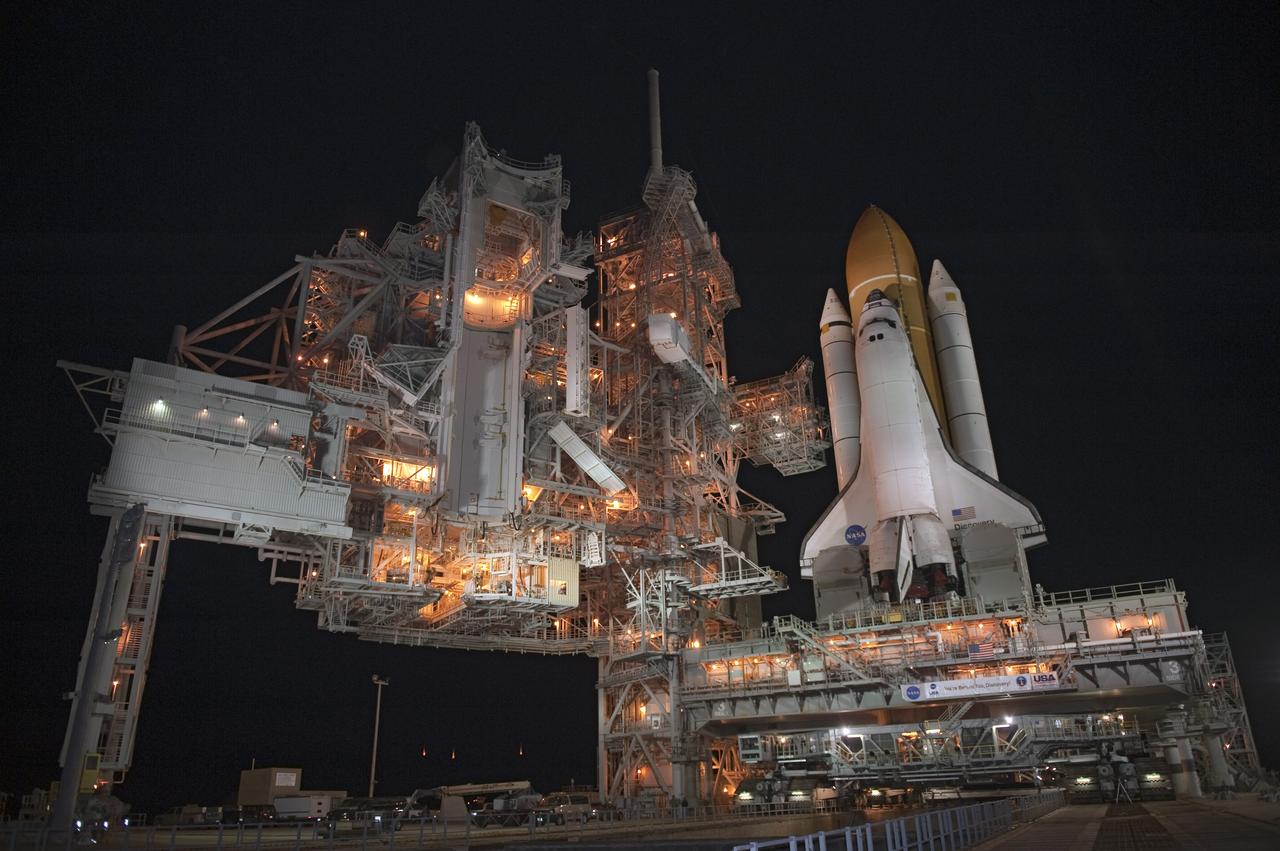
CAPE CANAVERAL, Fla. -- Space shuttle Discovery arrives at Launch Pad 39A from the Vehicle Assembly Building at NASA's Kennedy Space Center in Florida. It took the shuttle, attached to its external fuel tank, twin solid rocket boosters and mobile launcher platform, about seven hours to complete the move atop a crawler-transporter. This is the second time Discovery has rolled out to the pad for the STS-133 mission, and comes after a thorough check and modifications to the shuttle's external tank. Targeted to liftoff Feb. 24, Discovery will take the Permanent Multipurpose Module (PMM) packed with supplies and critical spare parts, as well as Robonaut 2 (R2) to the International Space Station. For more information on STS-133, visit www.nasa.gov/mission_pages/shuttle/shuttlemissions/sts133/. Photo credit: NASA/Kim Shiflett
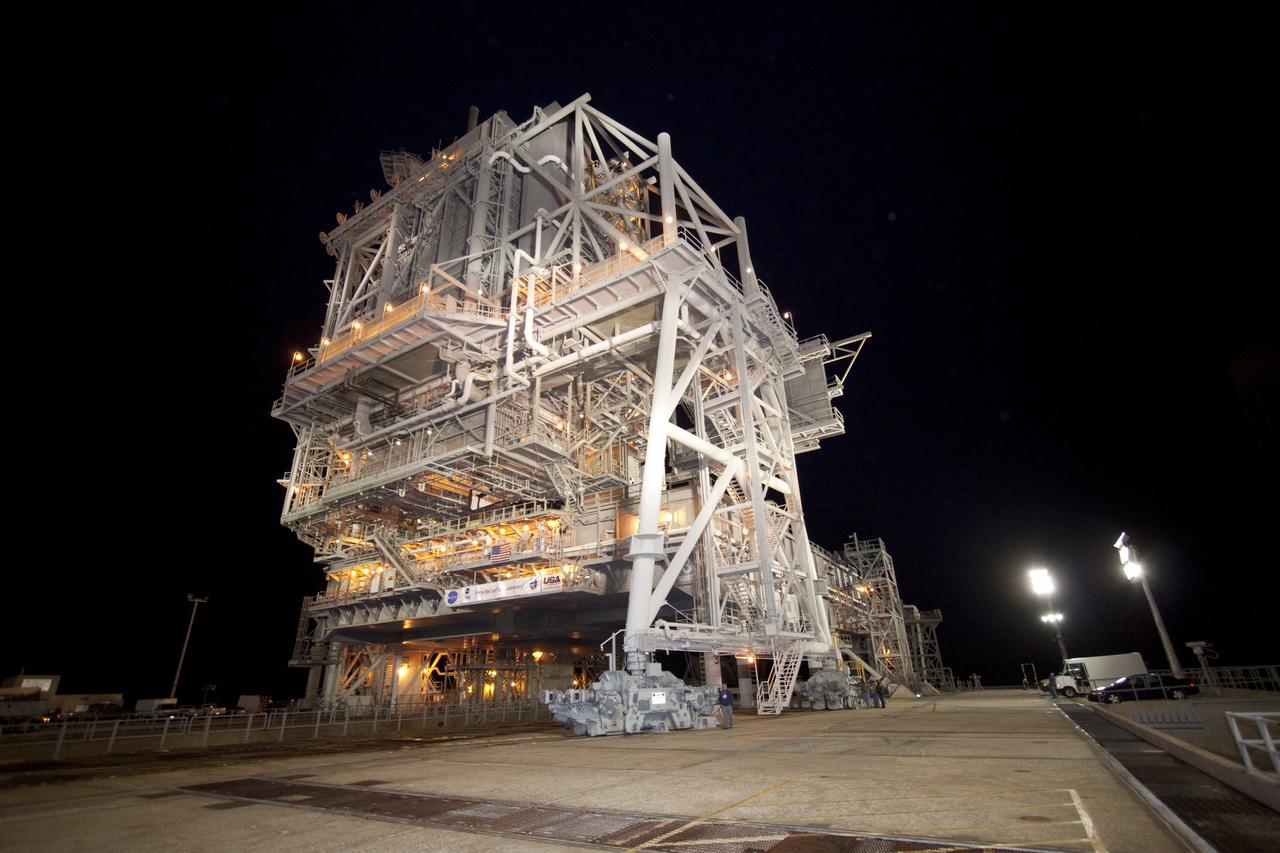
CAPE CANAVERAL, Fla. -- The rotating service structure (RSS), which provides weather protection and access to the shuttle, surrounds space shuttle Discovery on Launch Pad 39A at NASA's Kennedy Space Center in Florida. This comes after Discovery, attached to its external fuel tank, twin solid rocket boosters and mobile launcher platform, rolled out to the pad from the Vehicle Assembly Building during the overnight hours. Rollout to the pad is a significant shuttle processing milestone for the upcoming STS-133 mission, and comes after a thorough check and modifications to the shuttle's external fuel tank. Targeted to liftoff Feb. 24, Discovery will take the Permanent Multipurpose Module (PMM) packed with supplies and critical spare parts, as well as Robonaut 2 (R2) to the International Space Station. For more information on STS-133, visit www.nasa.gov/mission_pages/shuttle/shuttlemissions/sts133/. Photo credit: NASA/Jack Pfaller
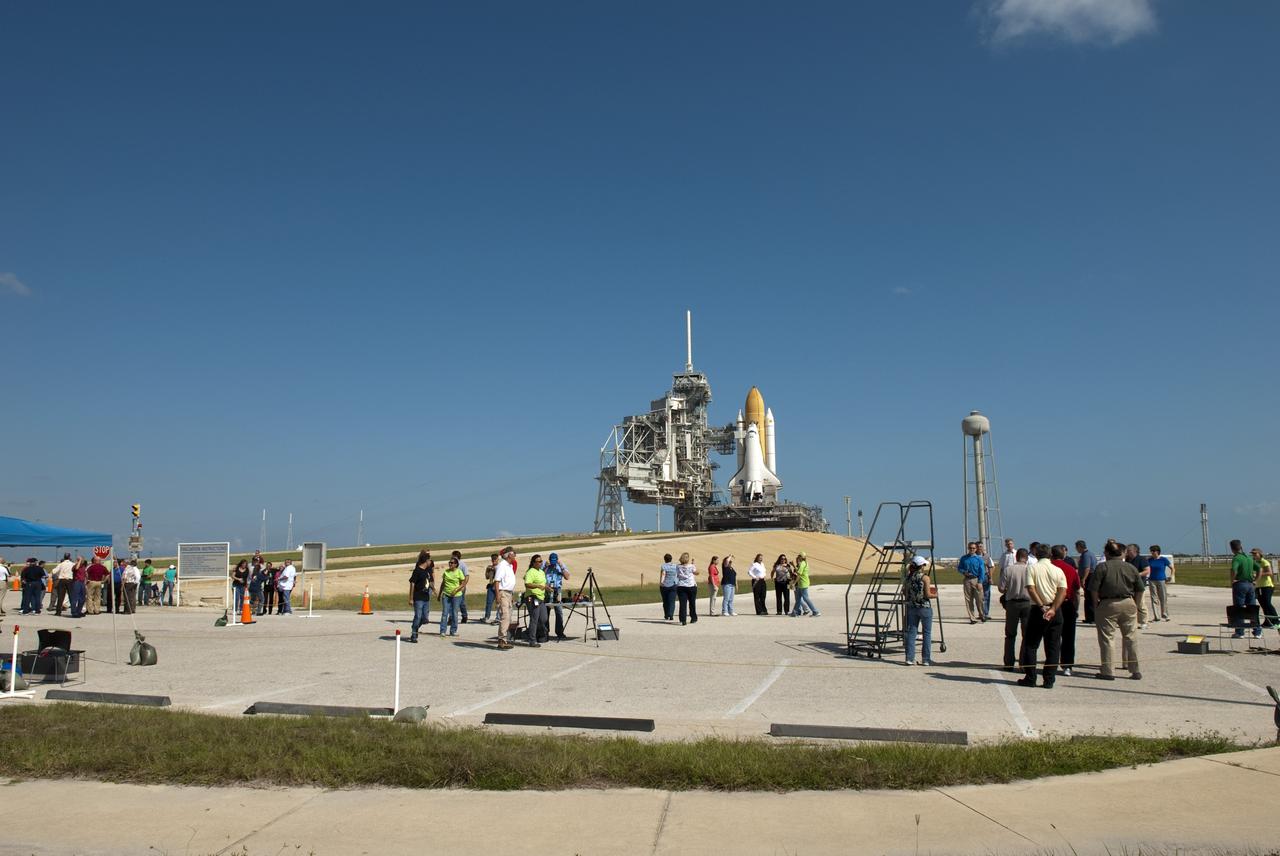
CAPE CANAVERAL, Fla. -- At NASA's Kennedy Space Center in Florida, space center employees snap photos and prepare to take group shots in front of space shuttle Discovery, which is visible on Launch Pad 39A. Later, the rotating service structure that protects the shuttle from the elements will be moved into place. It took the spacecraft about six hours to make the journey, known as "rollout," from the Vehicle Assembly Building to the pad. Rollout sets the stage for Discovery's STS-133 crew to practice countdown and launch procedures during the Terminal Countdown Demonstration Test in mid-October. Targeted to liftoff Nov. 1, Discovery will take the Permanent Multipurpose Module (PMM) packed with supplies and critical spare parts, as well as Robonaut 2 (R2) to the International Space Station. Photo credit: NASA/Jim Grossmann
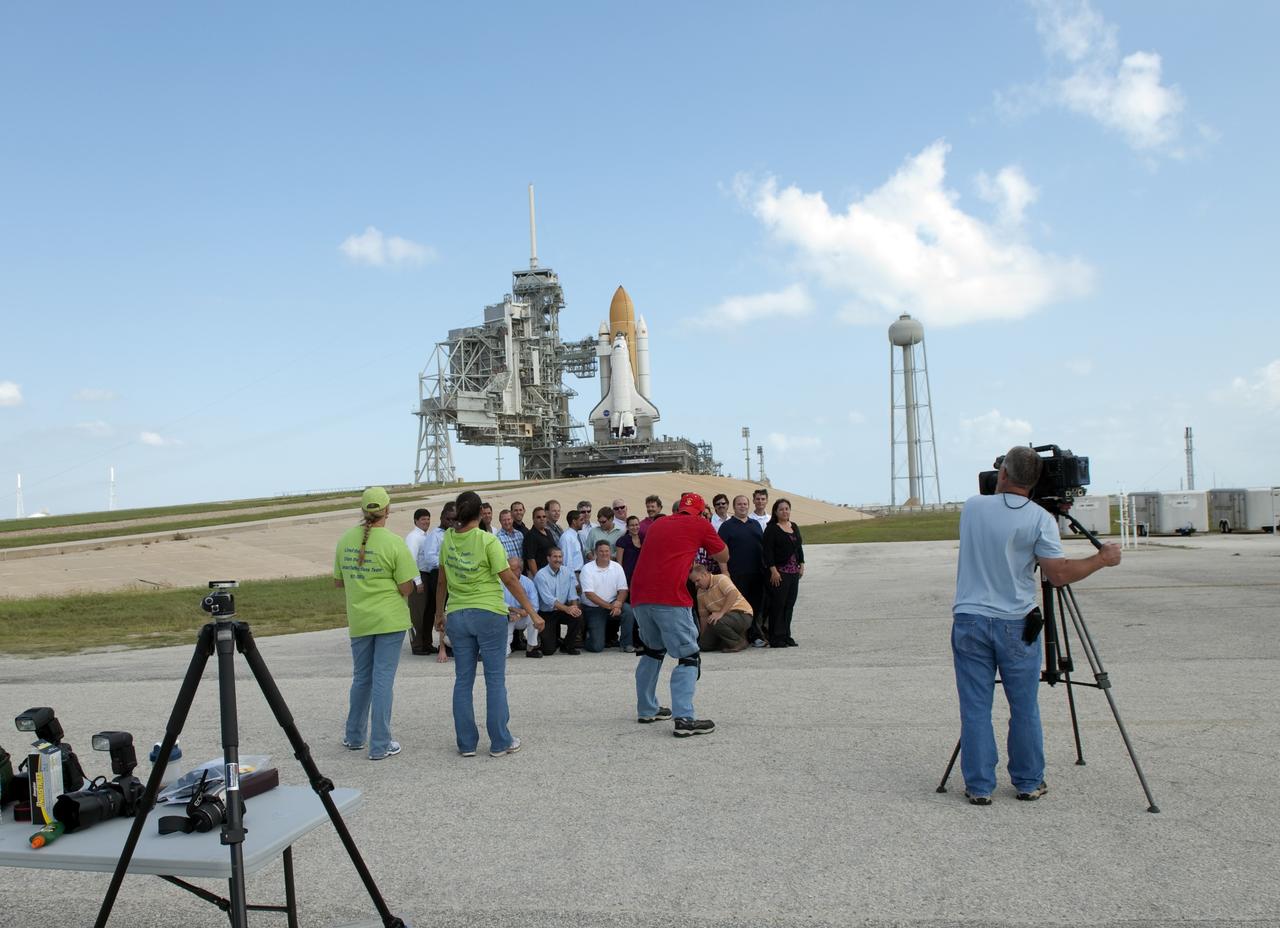
CAPE CANAVERAL, Fla. -- At NASA's Kennedy Space Center in Florida, space center workers pose for a group photo in front of space shuttle Discovery, which is visible on Launch Pad 39A. Later, the rotating service structure that protects the shuttle from the elements will be moved into place. It took the spacecraft about six hours to make the journey, known as "rollout," from the Vehicle Assembly Building to the pad. Rollout sets the stage for Discovery's STS-133 crew to practice countdown and launch procedures during the Terminal Countdown Demonstration Test in mid-October. Targeted to liftoff Nov. 1, Discovery will take the Permanent Multipurpose Module (PMM) packed with supplies and critical spare parts, as well as Robonaut 2 (R2) to the International Space Station. Photo credit: NASA/Jim Grossmann
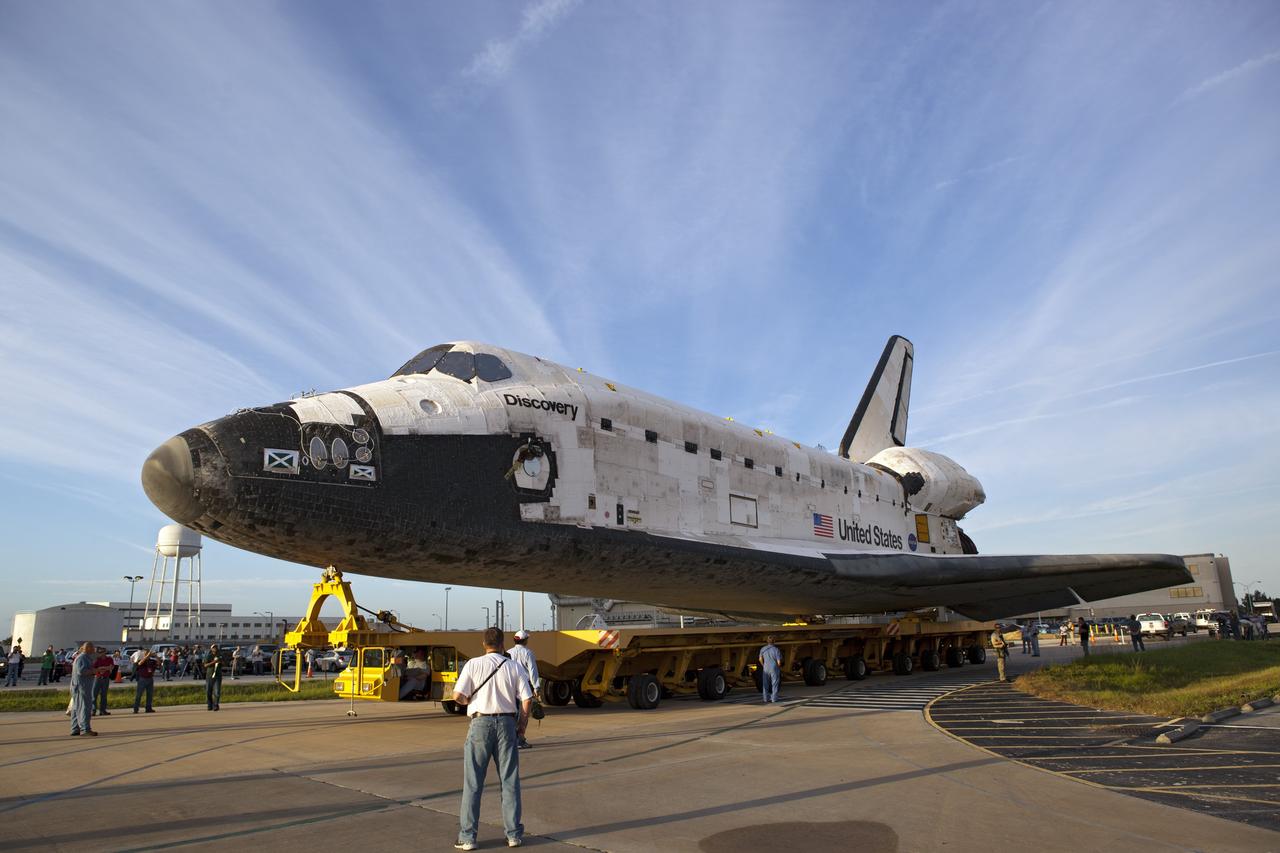
CAPE CANAVERAL, Fla. -- At NASA's Kennedy Space Center in Florida, shuttle Discovery pauses in between Orbiter Processing Facility-3 and the Vehicle Assembly Building (VAB) during a move called "rollover." Once inside the VAB, the shuttle will be joined to its solid rocket boosters and external fuel tank. Later this month, Discovery is scheduled to "rollout" to Launch Pad 39A for its launch to the International Space Station on the STS-133 mission. Targeted to liftoff Nov. 1, Discovery will take the Permanent Multipurpose Module (PMM) packed with supplies and critical spare parts, as well as Robonaut 2 (R2) to the station. Photo credit: NASA/Dimitri Gerondidakis
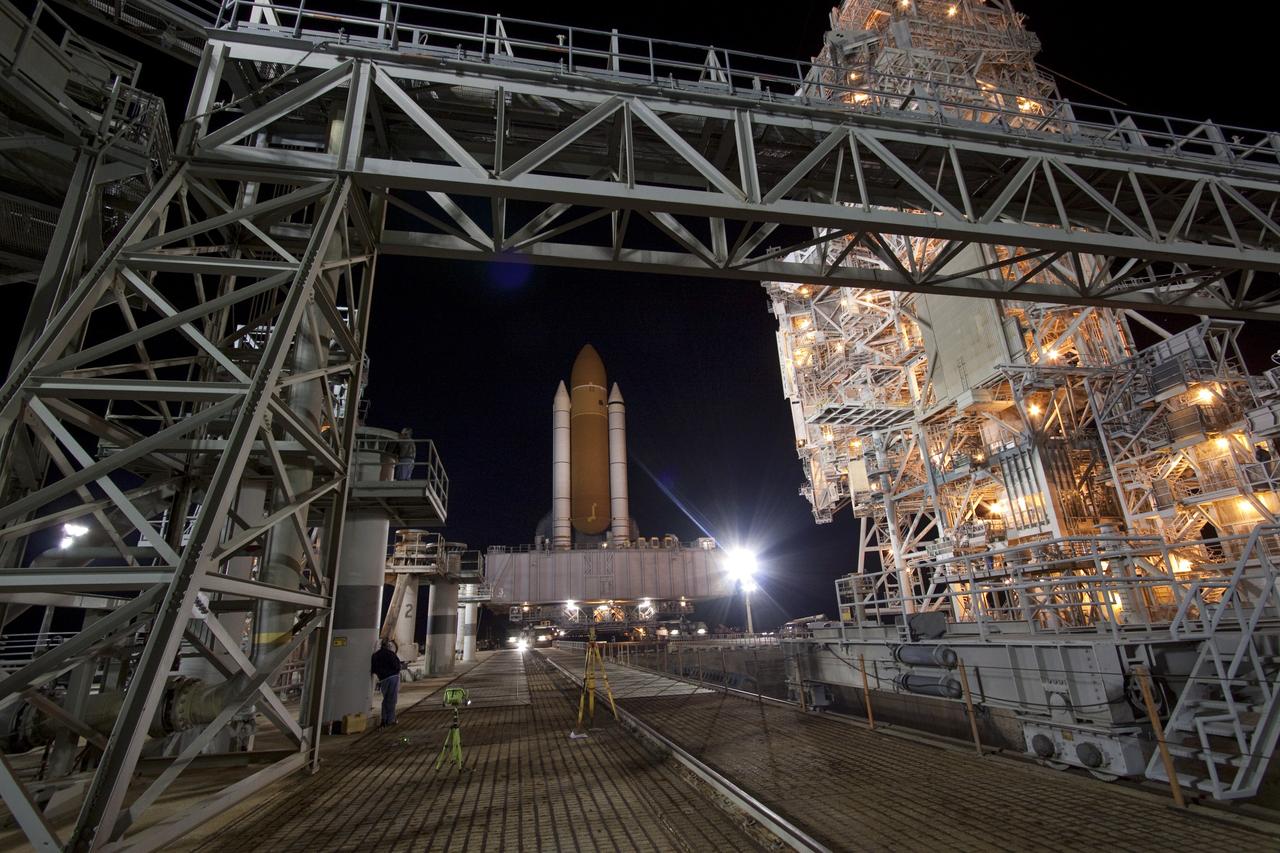
CAPE CANAVERAL, Fla. -- A worker monitors space shuttle Discovery as it arrives at Launch Pad 39A from the Vehicle Assembly Building at NASA's Kennedy Space Center in Florida. It took the shuttle, attached to its external fuel tank, twin solid rocket boosters and mobile launcher platform, about seven hours to complete the move atop a crawler-transporter. This is the second time Discovery has rolled out to the pad for the STS-133 mission, and comes after a thorough check and modifications to the shuttle's external tank. Targeted to liftoff Feb. 24, Discovery will take the Permanent Multipurpose Module (PMM) packed with supplies and critical spare parts, as well as Robonaut 2 (R2) to the International Space Station. For more information on STS-133, visit www.nasa.gov/mission_pages/shuttle/shuttlemissions/sts133/. Photo credit: NASA/Jack Pfaller
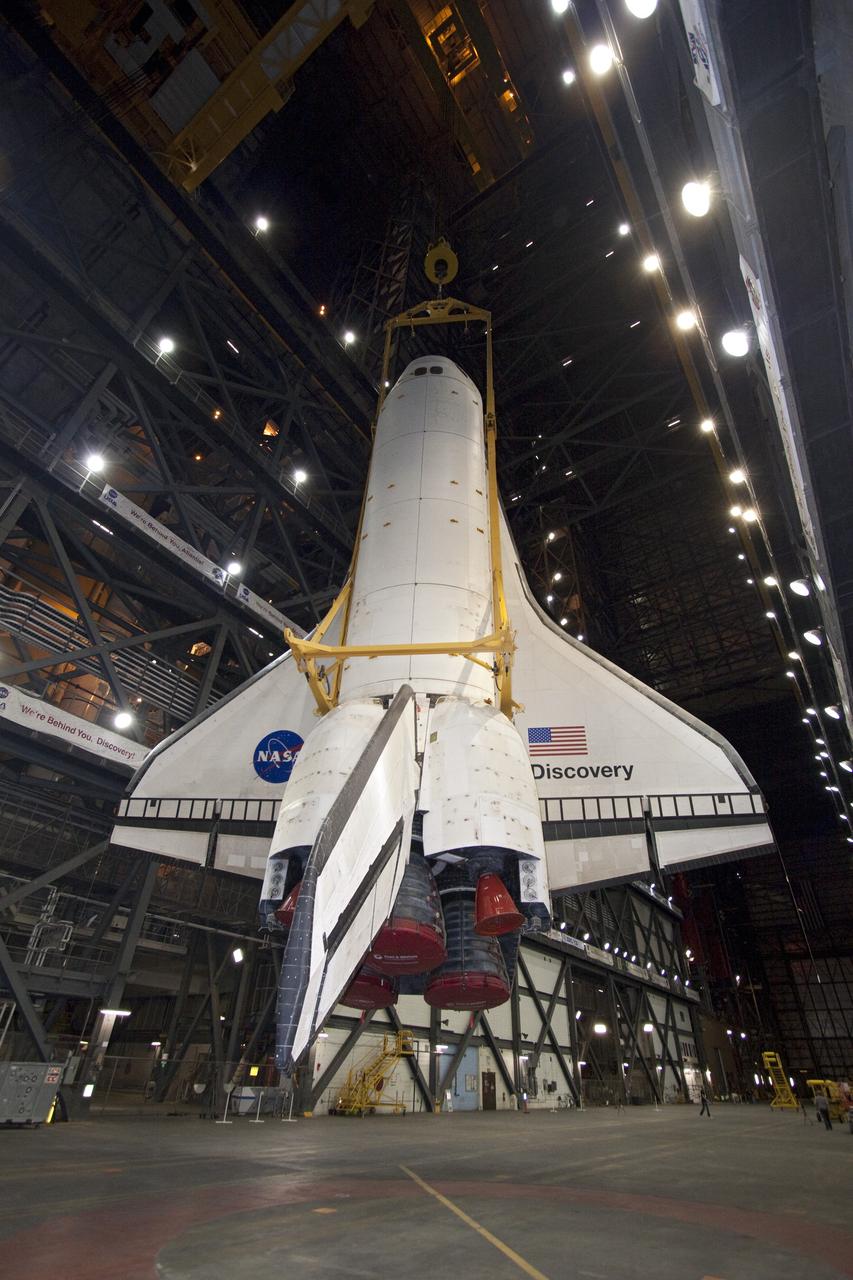
CAPE CANAVERAL, Fla. -- At NASA's Kennedy Space Center in Florida, a large yellow, metal sling lifts shuttle Discovery from the transfer aisle into High Bay 3 of the Vehicle Assembly Building. In the bay, the shuttle will be attached to its external fuel tank and solid rocket boosters. The operation began Sept. 9 and wrapped up early Sept. 10. Discovery is scheduled to roll out to Launch Pad 39A later this month in preparation for its launch to the International Space Station on the STS-133 mission. Targeted to lift off Nov. 1, Discovery will take the Permanent Multipurpose Module (PMM) packed with supplies and critical spare parts, as well as Robonaut 2 (R2) to the station. Photo credit: NASA/Jack Pfaller