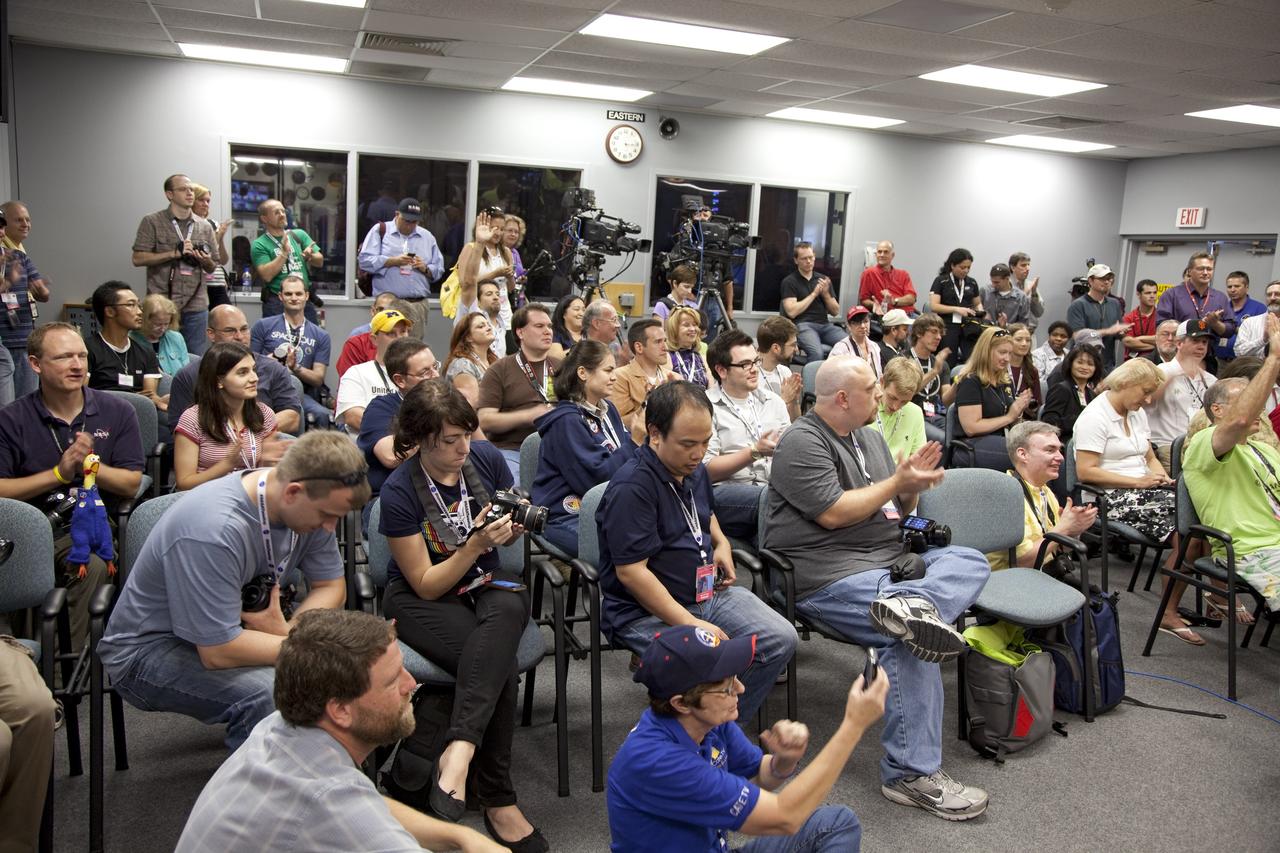
CAPE CANAVERAL, Fla. -- At NASA's Kennedy Space Center in Florida, participants of the STS-133 Tweetup snap photos and watch intently as a dexterous humanoid astronaut helper, known as Robonaut, shows off its talents. Robonaut 2 (R2) will be delivered to the International Space Station on space shuttle Discovery's STS-133 mission. Although R2 will initially only participate in operational tests, upgrades could eventually allow the robot to realize its true purpose -- helping spacewalking astronauts with tasks outside the orbiting laboratory. NASA is hosting about 150 of its Twitter followers from around the world and several dozen states and providing them with a behind-the-scenes perspective to share with their own followers on the social networking service. The "Tweeps," as NASA calls them, will have a chance to tour Kennedy, meet with shuttle technicians, managers, engineers and astronauts, and witness Discovery's launch. Discovery and its STS-133 crew are scheduled to lift off Nov. 3 at 3:52 p.m. EDT. For more information on the upcoming mission, visit www.nasa.gov/mission_pages/shuttle/shuttlemissions/sts133/. Photo credit: NASA/Frank Michaux
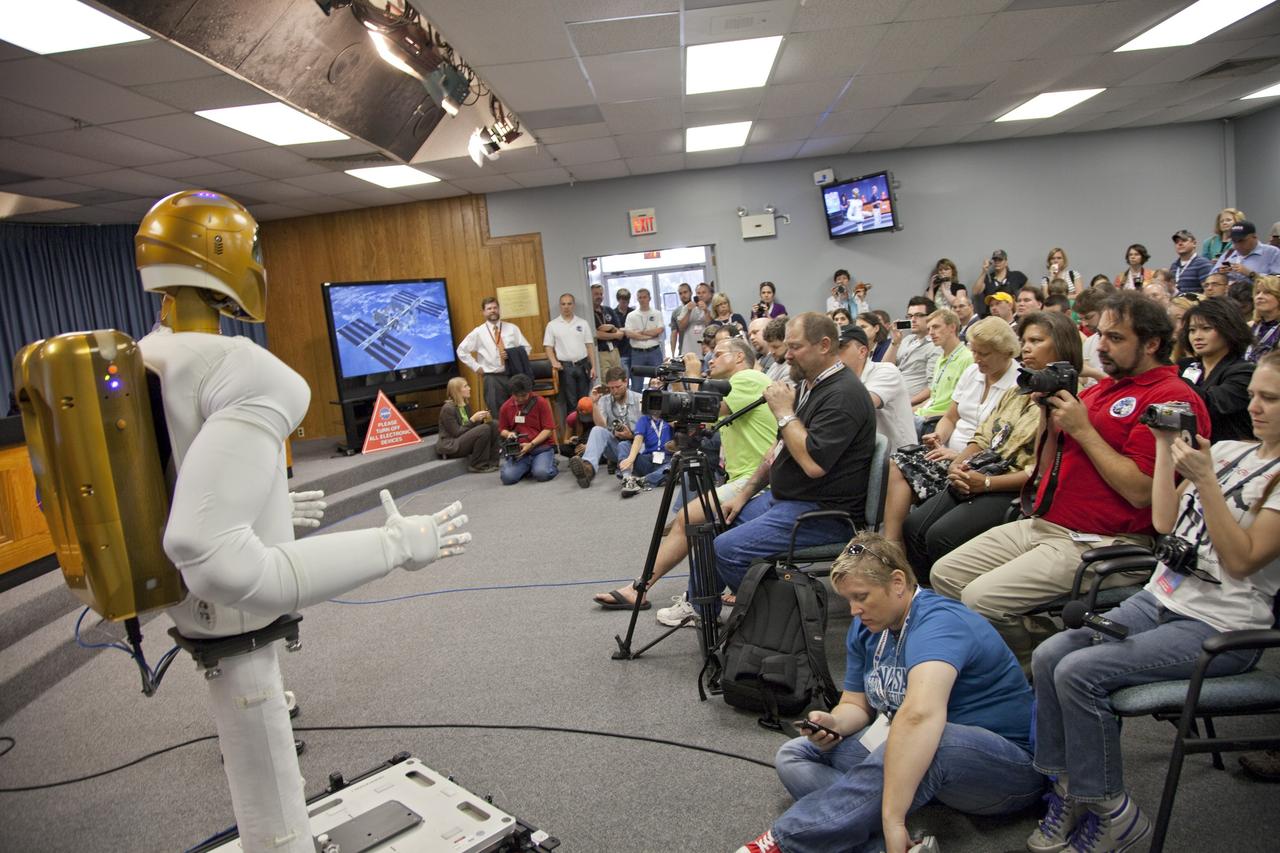
CAPE CANAVERAL, Fla. -- At NASA's Kennedy Space Center in Florida, a dexterous humanoid astronaut helper, known as Robonaut, is on display for participants of the STS-133 Tweetup. Robonaut 2 (R2) will be delivered to the International Space Station on space shuttle Discovery's STS-133 mission. Although R2 will initially only participate in operational tests, upgrades could eventually allow the robot to realize its true purpose -- helping spacewalking astronauts with tasks outside the orbiting laboratory. NASA is hosting about 150 of its Twitter followers from around the world and several dozen states and providing them with a behind-the-scenes perspective to share with their own followers on the social networking service. The "Tweeps," as NASA calls them, will have a chance to tour Kennedy, meet with shuttle technicians, managers, engineers and astronauts, and witness Discovery's launch. Discovery and its STS-133 crew are scheduled to lift off Nov. 3 at 3:52 p.m. EDT. For more information on the upcoming mission, visit www.nasa.gov/mission_pages/shuttle/shuttlemissions/sts133/. Photo credit: NASA/Frank Michaux
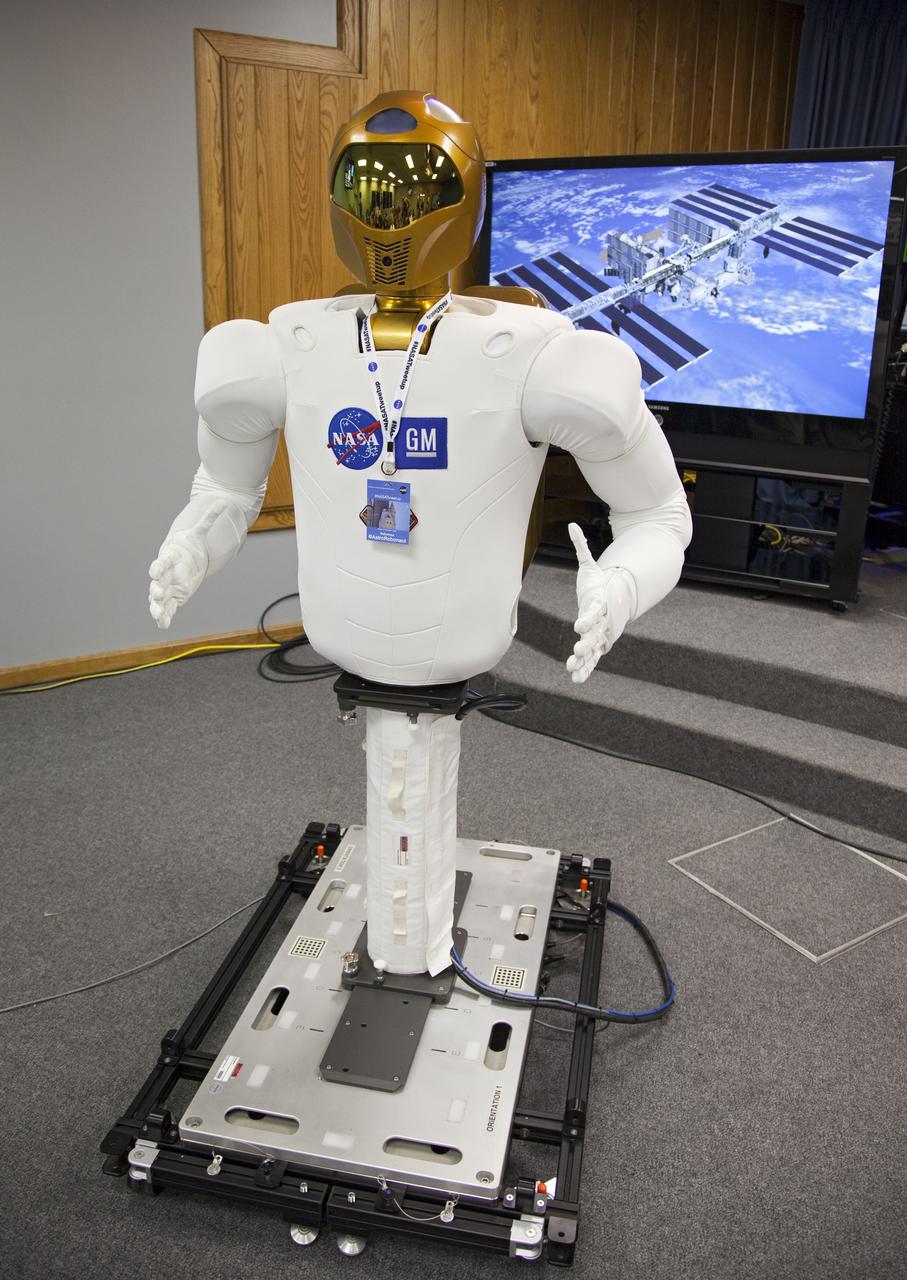
CAPE CANAVERAL, Fla. -- At NASA's Kennedy Space Center in Florida, a dexterous humanoid astronaut helper, known as Robonaut, is on display for participants of the STS-133 Tweetup. Robonaut 2 (R2) will be delivered to the International Space Station on space shuttle Discovery's STS-133 mission. Although R2 will initially only participate in operational tests, upgrades could eventually allow the robot to realize its true purpose -- helping spacewalking astronauts with tasks outside the orbiting laboratory. NASA is hosting about 150 of its Twitter followers from around the world and several dozen states and providing them with a behind-the-scenes perspective to share with their own followers on the social networking service. The "Tweeps," as NASA calls them, will have a chance to tour Kennedy, meet with shuttle technicians, managers, engineers and astronauts, and witness Discovery's launch. Discovery and its STS-133 crew are scheduled to lift off Nov. 3 at 3:52 p.m. EDT. For more information on the upcoming mission, visit www.nasa.gov/mission_pages/shuttle/shuttlemissions/sts133/. Photo credit: NASA/Frank Michaux
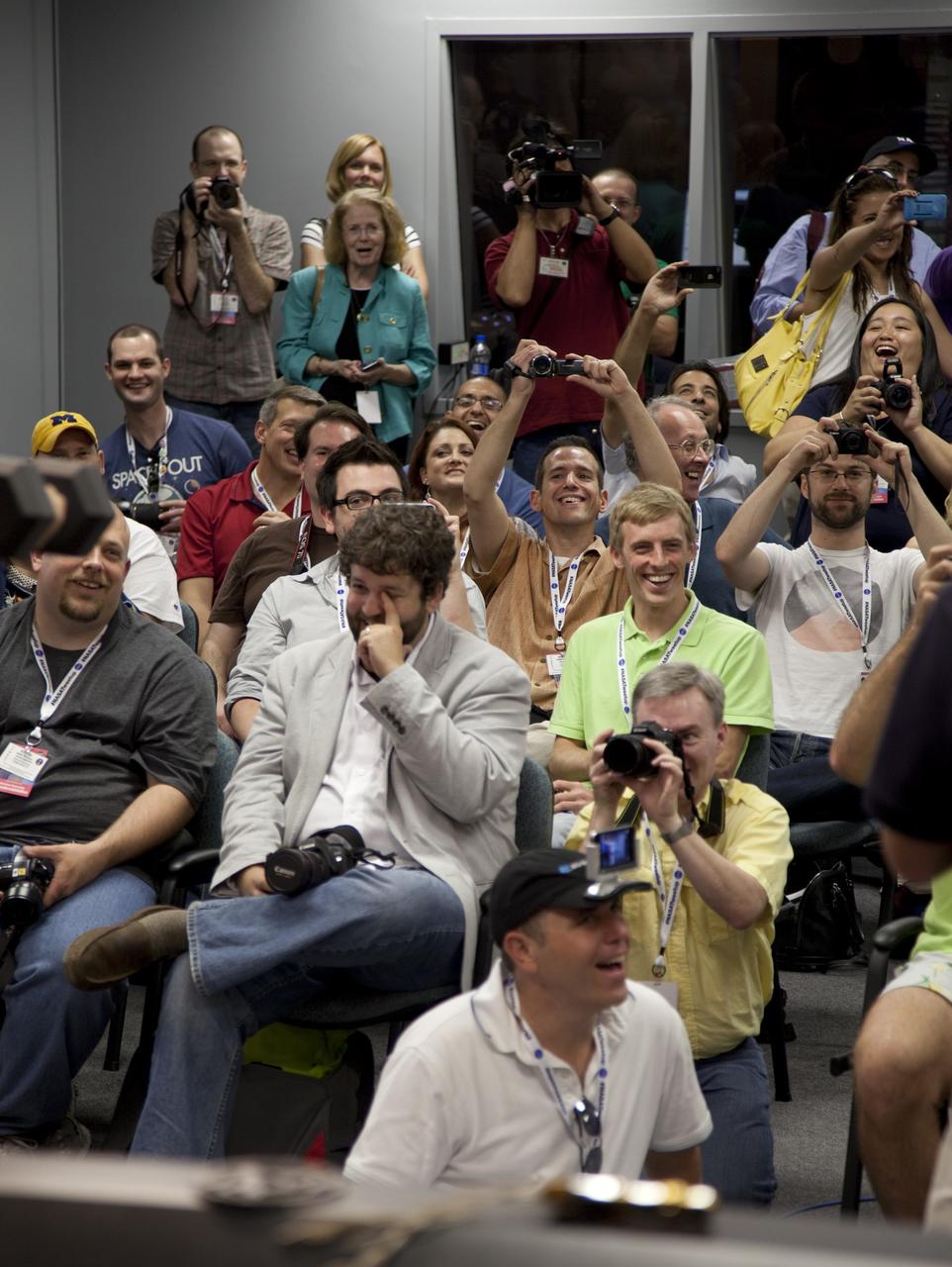
CAPE CANAVERAL, Fla. -- At NASA's Kennedy Space Center in Florida, participants of the STS-133 Tweetup snap photos and watch intently as a dexterous humanoid astronaut helper, known as Robonaut, shows off its talents. Robonaut 2 (R2) will be delivered to the International Space Station on space shuttle Discovery's STS-133 mission. Although R2 will initially only participate in operational tests, upgrades could eventually allow the robot to realize its true purpose -- helping spacewalking astronauts with tasks outside the orbiting laboratory. NASA is hosting about 150 of its Twitter followers from around the world and several dozen states and providing them with a behind-the-scenes perspective to share with their own followers on the social networking service. The "Tweeps," as NASA calls them, will have a chance to tour Kennedy, meet with shuttle technicians, managers, engineers and astronauts, and witness Discovery's launch. Discovery and its STS-133 crew are scheduled to lift off Nov. 3 at 3:52 p.m. EDT. For more information on the upcoming mission, visit www.nasa.gov/mission_pages/shuttle/shuttlemissions/sts133/. Photo credit: NASA/Frank Michaux
CAPE CANAVERAL, Fla. -- At NASA's Kennedy Space Center in Florida, a dexterous humanoid astronaut helper, known as Robonaut, is on display for participants of the STS-133 Tweetup. Robonaut 2 (R2) will be delivered to the International Space Station on space shuttle Discovery's STS-133 mission. Although R2 will initially only participate in operational tests, upgrades could eventually allow the robot to realize its true purpose -- helping spacewalking astronauts with tasks outside the orbiting laboratory. NASA is hosting about 150 of its Twitter followers from around the world and several dozen states and providing them with a behind-the-scenes perspective to share with their own followers on the social networking service. The "Tweeps," as NASA calls them, will have a chance to tour Kennedy, meet with shuttle technicians, managers, engineers and astronauts, and witness Discovery's launch. Discovery and its STS-133 crew are scheduled to lift off Nov. 3 at 3:52 p.m. EDT. For more information on the upcoming mission, visit www.nasa.gov/mission_pages/shuttle/shuttlemissions/sts133/. Photo credit: NASA/Frank Michaux
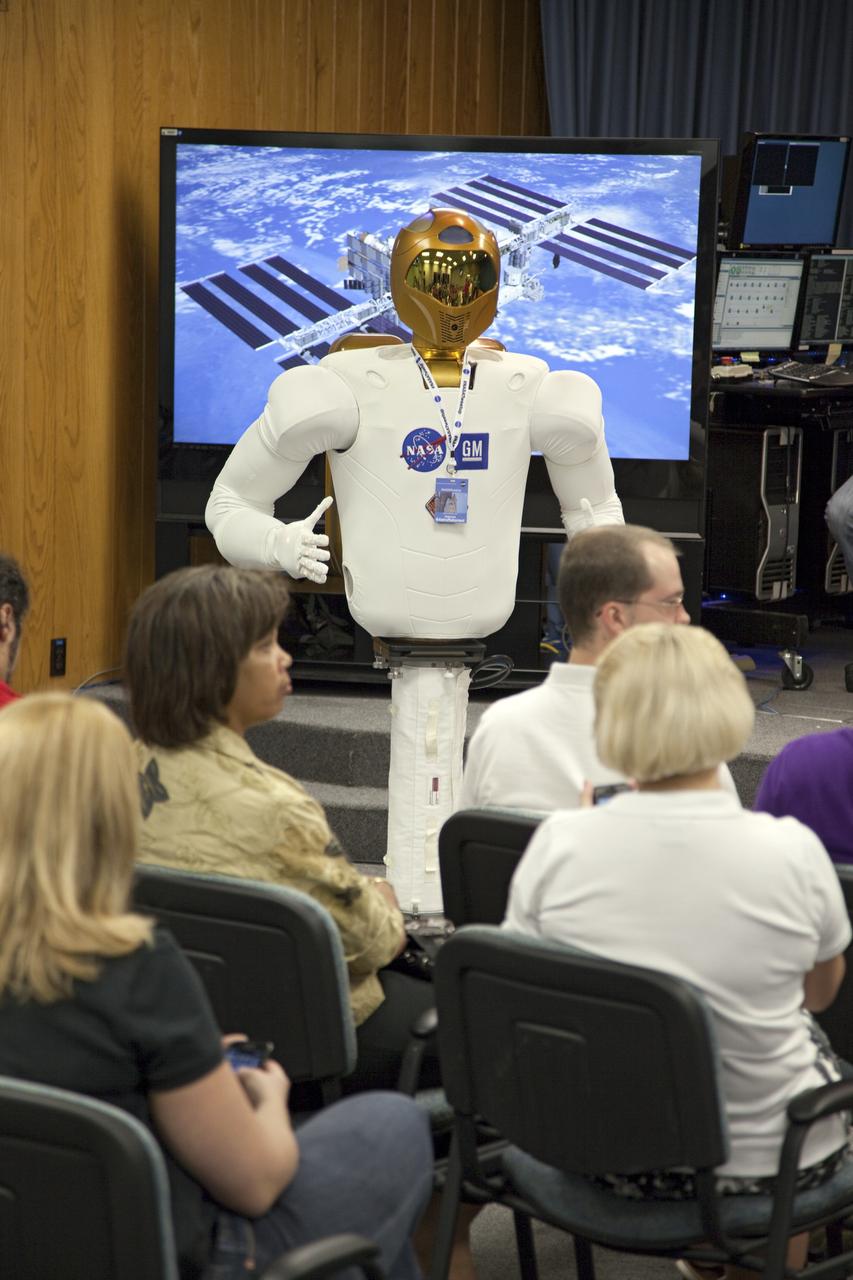
CAPE CANAVERAL, Fla. -- At NASA's Kennedy Space Center in Florida, a dexterous humanoid astronaut helper, known as Robonaut, is on display for participants of the STS-133 Tweetup. Robonaut 2 (R2) will be delivered to the International Space Station on space shuttle Discovery's STS-133 mission. Although R2 will initially only participate in operational tests, upgrades could eventually allow the robot to realize its true purpose -- helping spacewalking astronauts with tasks outside the orbiting laboratory. NASA is hosting about 150 of its Twitter followers from around the world and several dozen states and providing them with a behind-the-scenes perspective to share with their own followers on the social networking service. The "Tweeps," as NASA calls them, will have a chance to tour Kennedy, meet with shuttle technicians, managers, engineers and astronauts, and witness Discovery's launch. Discovery and its STS-133 crew are scheduled to lift off Nov. 3 at 3:52 p.m. EDT. For more information on the upcoming mission, visit www.nasa.gov/mission_pages/shuttle/shuttlemissions/sts133/. Photo credit: NASA/Frank Michaux

CAPE CANAVERAL, Fla. -- At NASA's Kennedy Space Center in Florida, participants of the STS-133 Tweetup snap photos and watch intently as a dexterous humanoid astronaut helper, known as Robonaut, shows off its talents. Robonaut 2 (R2) will be delivered to the International Space Station on space shuttle Discovery's STS-133 mission. Although R2 will initially only participate in operational tests, upgrades could eventually allow the robot to realize its true purpose -- helping spacewalking astronauts with tasks outside the orbiting laboratory. NASA is hosting about 150 of its Twitter followers from around the world and several dozen states and providing them with a behind-the-scenes perspective to share with their own followers on the social networking service. The "Tweeps," as NASA calls them, will have a chance to tour Kennedy, meet with shuttle technicians, managers, engineers and astronauts, and witness Discovery's launch. Discovery and its STS-133 crew are scheduled to lift off Nov. 3 at 3:52 p.m. EDT. For more information on the upcoming mission, visit www.nasa.gov/mission_pages/shuttle/shuttlemissions/sts133/. Photo credit: NASA/Frank Michaux
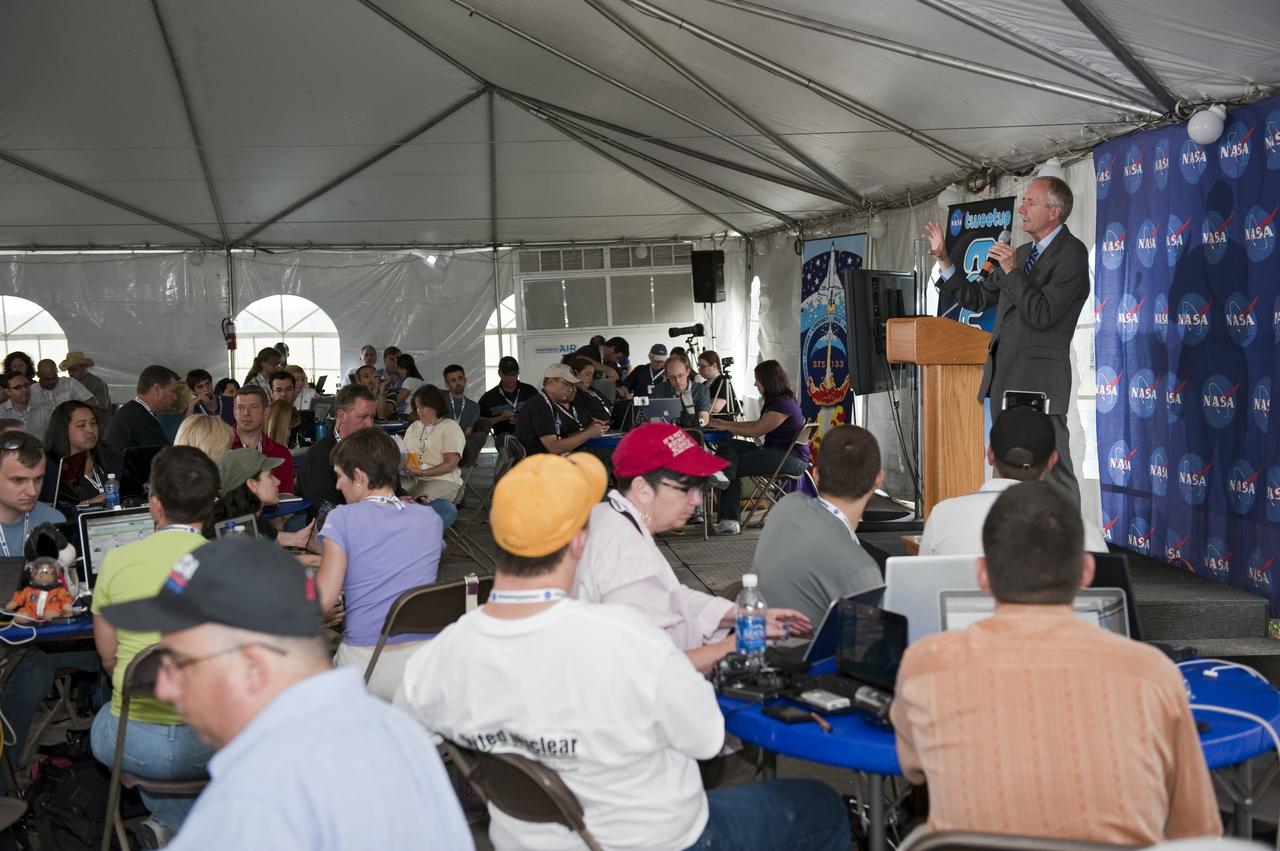
CAPE CANAVERAL, Fla. -- At NASA's Kennedy Space Center in Florida, NASA Associate Administrator for Space Operations Bill Gerstenmaier addresses participants of the STS-133 Tweetup. NASA is hosting about 150 of its Twitter followers from around the world and several dozen states and providing them with a behind-the-scenes perspective to share with their own followers on the social networking service. The "Tweeps," as NASA calls them, will have a chance to tour Kennedy and meet with shuttle technicians, managers, engineers and astronauts. They also will receive a demonstration of Robonaut, a human-like robot similar to the one that will be delivered to the International Space Station on the STS-133 mission. Space shuttle Discovery and its STS-133 crew are scheduled to launch Nov. 3 at 3:52 p.m. EDT. For more information on the upcoming mission, visit www.nasa.gov/mission_pages/shuttle/shuttlemissions/sts133/. Photo credit: NASA/Kim Shiflett
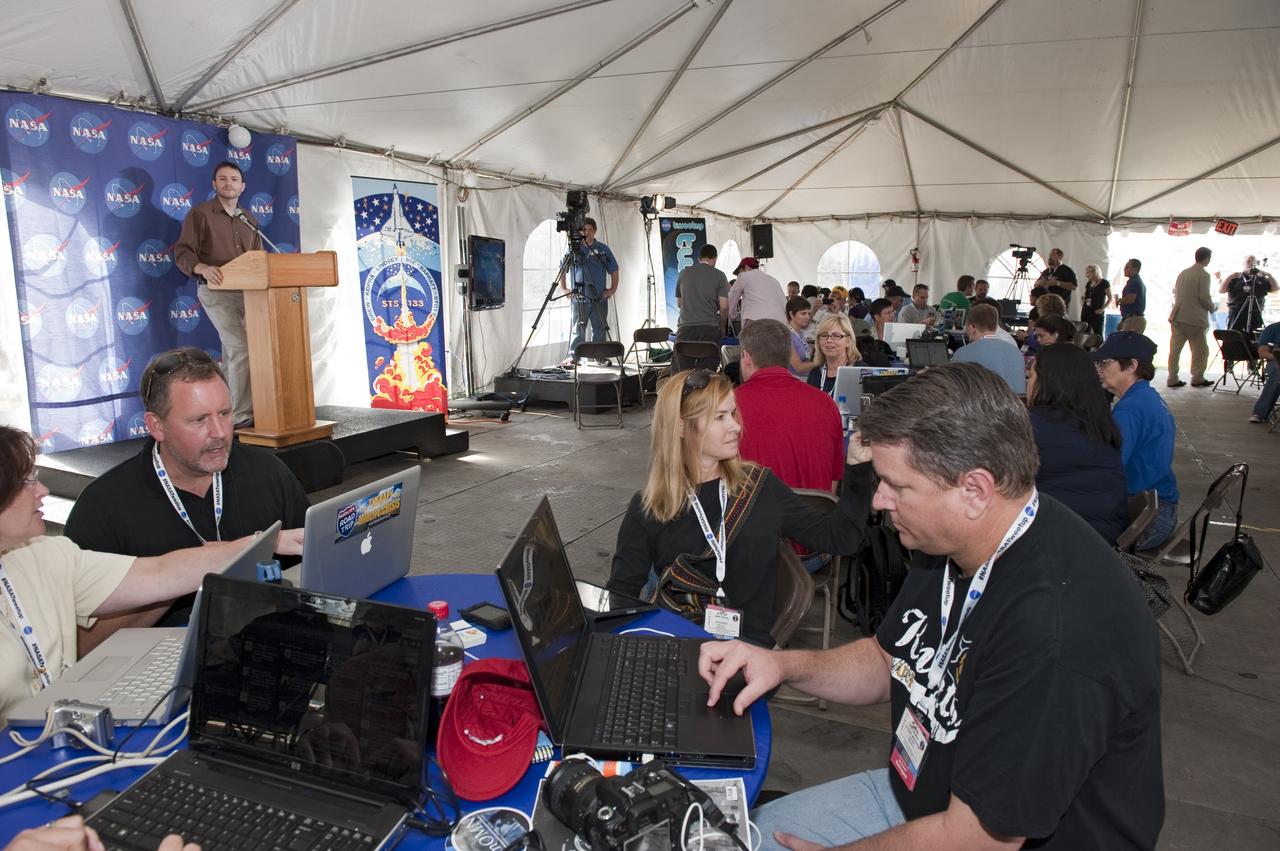
CAPE CANAVERAL, Fla. -- At NASA's Kennedy Space Center in Florida, NASA Public Affairs Officer John Yembrick welcomes participants to the STS-133 Tweetup. NASA is hosting about 150 of its Twitter followers from around the world and several dozen states and providing them with a behind-the-scenes perspective to share with their own followers on the social networking service. The "Tweeps," as NASA calls them, will have a chance to tour Kennedy and meet with shuttle technicians, managers, engineers and astronauts. They also will receive a demonstration of Robonaut, a human-like robot similar to the one that will be delivered to the International Space Station on the STS-133 mission. Space shuttle Discovery and its STS-133 crew are scheduled to launch Nov. 3 at 3:52 p.m. EDT. For more information on the upcoming mission, visit www.nasa.gov/mission_pages/shuttle/shuttlemissions/sts133/. Photo credit: NASA/Kim Shiflett

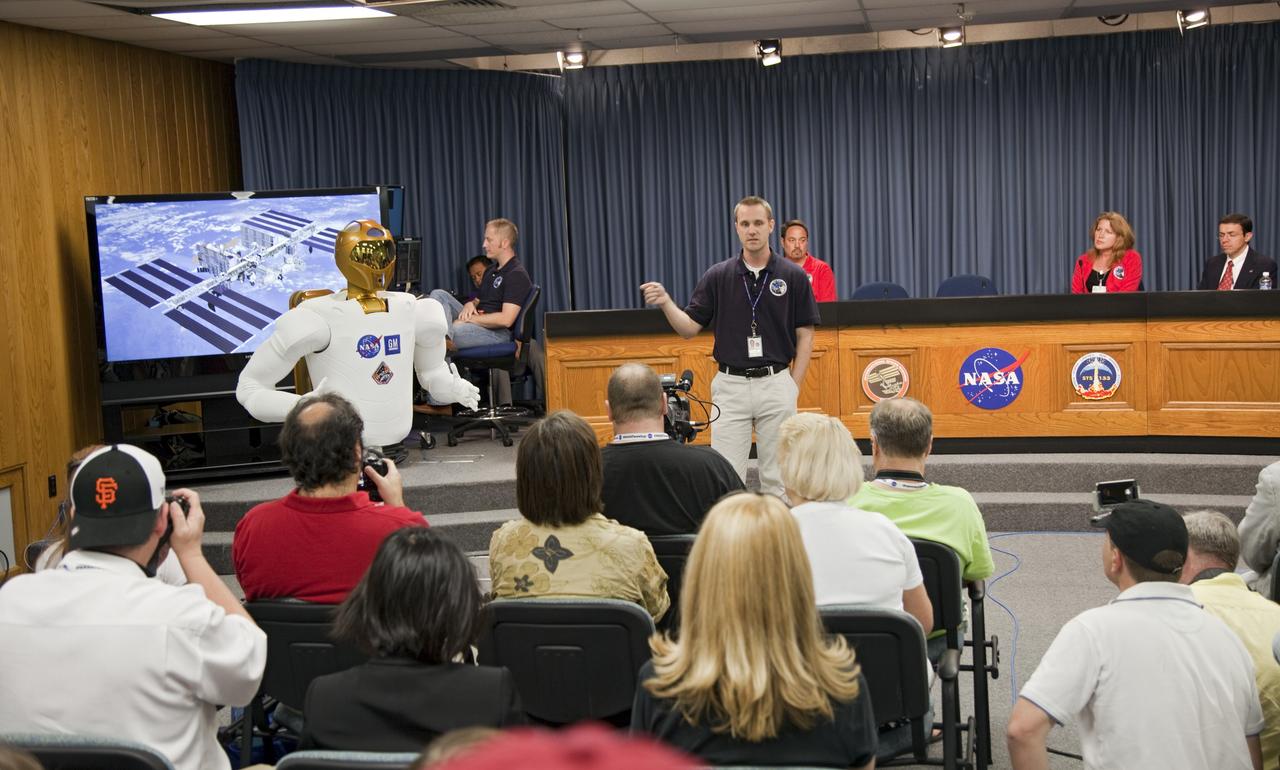
CAPE CANAVERAL, Fla. -- At NASA's Kennedy Space Center in Florida, a dexterous humanoid astronaut helper, known as Robonaut, demonstrates its talents to media. Robonaut 2 (R2) will be delivered to the International Space Station on space shuttle Discovery's STS-133 mission. Although R2 will initially only participate in operational tests, upgrades could eventually allow the robot to realize its true purpose -- helping spacewalking astronauts with tasks outside the orbiting laboratory. For more information on the upcoming STS-133 mission, visit www.nasa.gov/mission_pages/shuttle/shuttlemissions/sts133/. Photo credit: NASA/Jack Pfaller
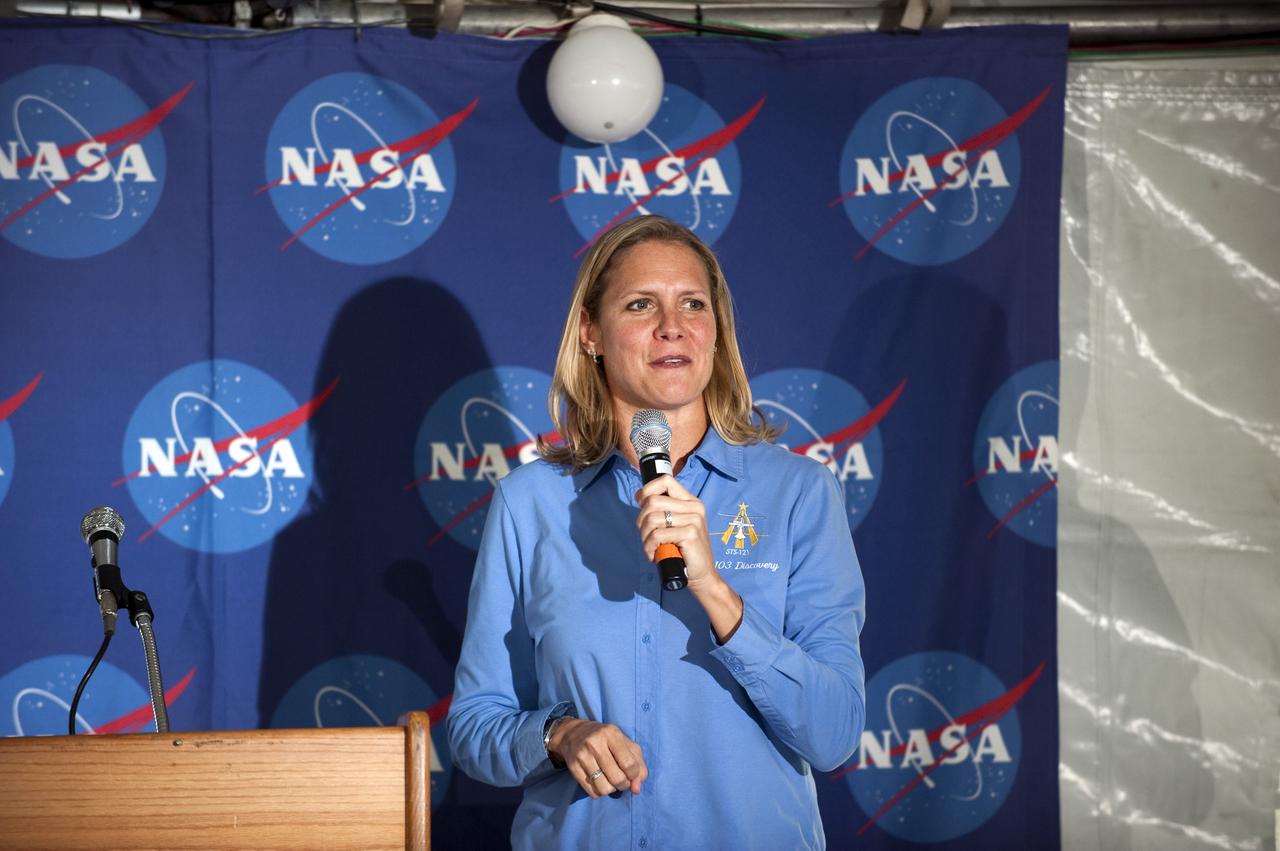
CAPE CANAVERAL, Fla. -- At NASA's Kennedy Space Center in Florida, space shuttle Discovery Flow Director Stephanie Stilson addresses participants of the STS-133 Tweetup. NASA is hosting about 150 of its Twitter followers from around the world and several dozen states and providing them with a behind-the-scenes perspective to share with their own followers on the social networking service. The "Tweeps," as NASA calls them, will have a chance to tour Kennedy and meet with shuttle technicians, managers, engineers and astronauts. They also will receive a demonstration of Robonaut, a human-like robot similar to the one that will be delivered to the International Space Station on the STS-133 mission. Space shuttle Discovery and its STS-133 crew are scheduled to launch Nov. 3 at 3:52 p.m. EDT. For more information on the upcoming mission, visit www.nasa.gov/mission_pages/shuttle/shuttlemissions/sts133/. Photo credit: NASA/Kim Shiflett
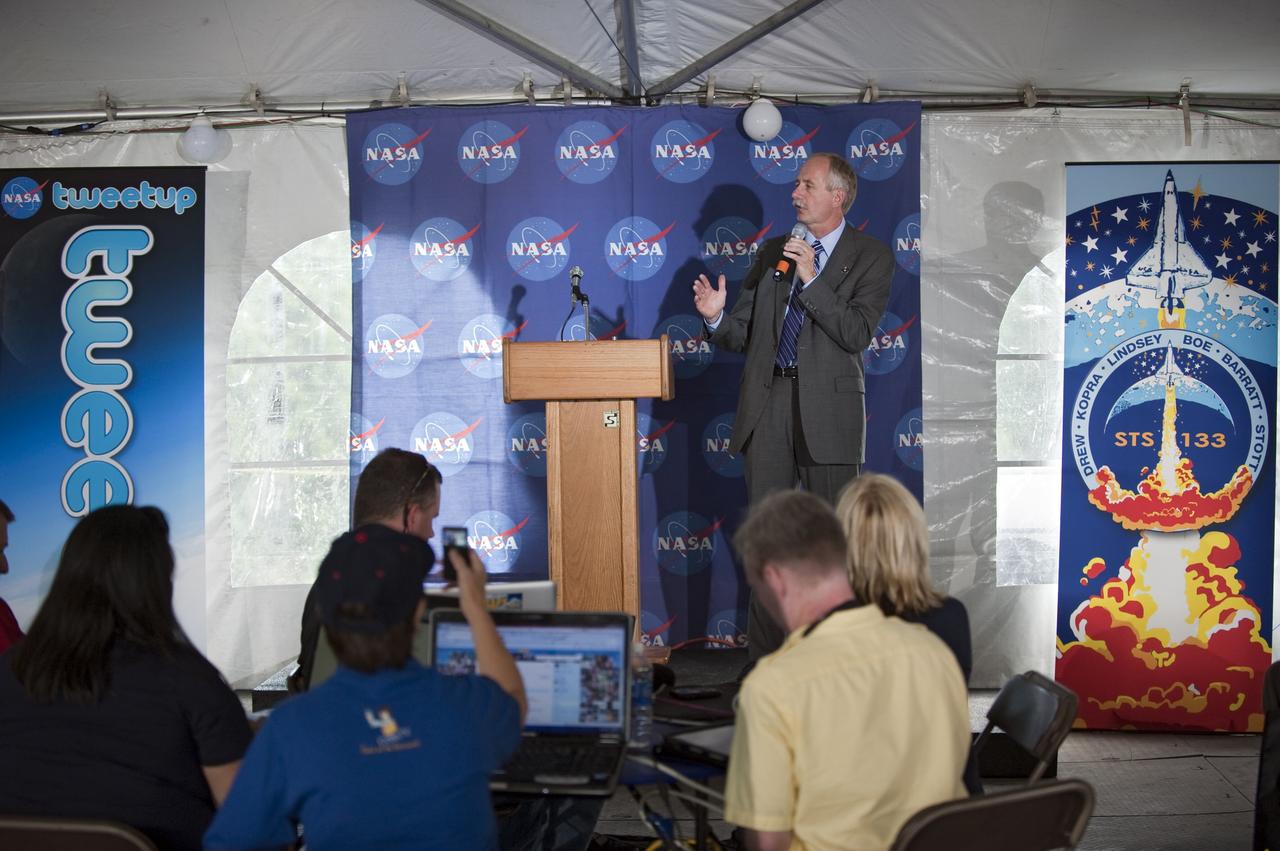
CAPE CANAVERAL, Fla. -- At NASA's Kennedy Space Center in Florida, NASA Associate Administrator for Space Operations Bill Gerstenmaier addresses participants of the STS-133 Tweetup. NASA is hosting about 150 of its Twitter followers from around the world and several dozen states and providing them with a behind-the-scenes perspective to share with their own followers on the social networking service. The "Tweeps," as NASA calls them, will have a chance to tour Kennedy and meet with shuttle technicians, managers, engineers and astronauts. They also will receive a demonstration of Robonaut, a human-like robot similar to the one that will be delivered to the International Space Station on the STS-133 mission. Space shuttle Discovery and its STS-133 crew are scheduled to launch Nov. 3 at 3:52 p.m. EDT. For more information on the upcoming mission, visit www.nasa.gov/mission_pages/shuttle/shuttlemissions/sts133/. Photo credit: NASA/Kim Shiflett
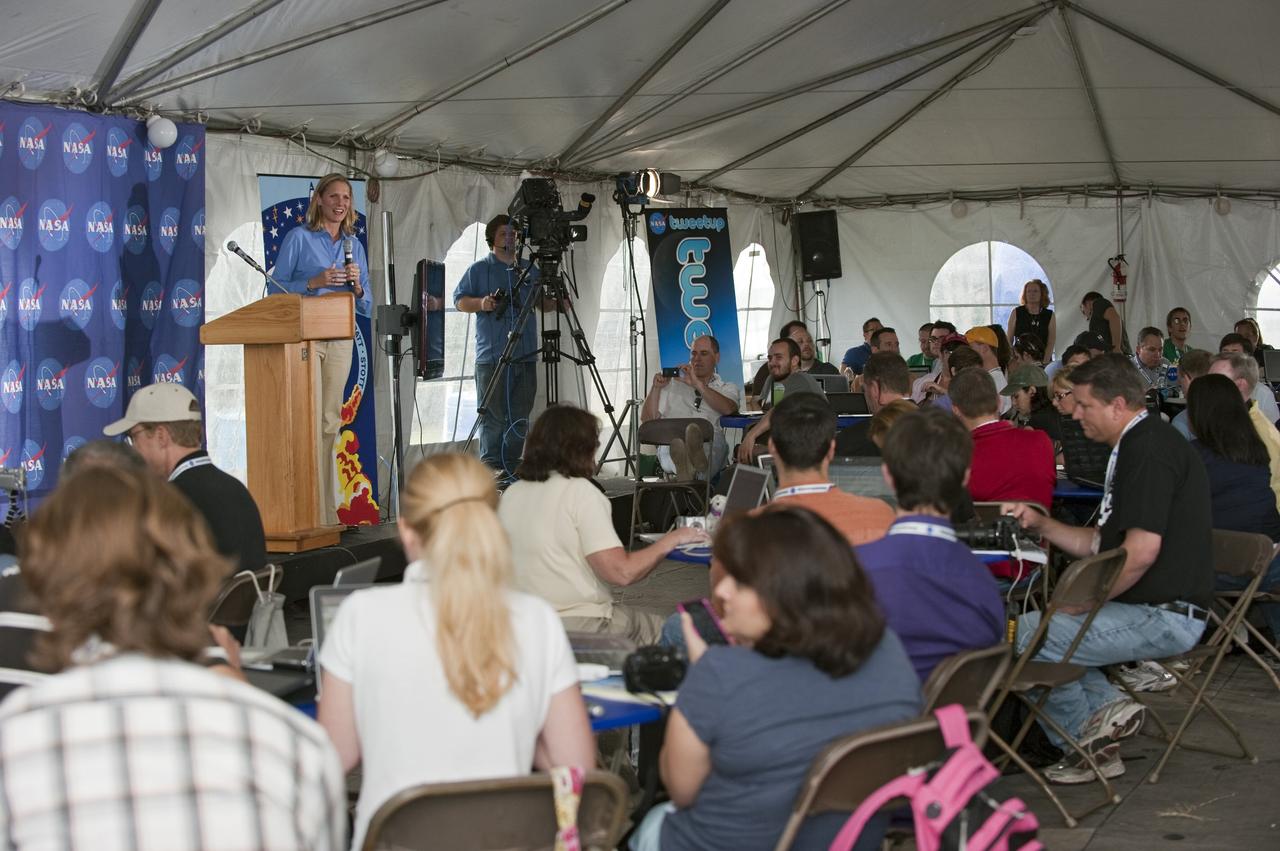
CAPE CANAVERAL, Fla. -- At NASA's Kennedy Space Center in Florida, space shuttle Discovery Flow Director Stephanie Stilson addresses participants of the STS-133 Tweetup. NASA is hosting about 150 of its Twitter followers from around the world and several dozen states and providing them with a behind-the-scenes perspective to share with their own followers on the social networking service. The "Tweeps," as NASA calls them, will have a chance to tour Kennedy and meet with shuttle technicians, managers, engineers and astronauts. They also will receive a demonstration of Robonaut, a human-like robot similar to the one that will be delivered to the International Space Station on the STS-133 mission. Space shuttle Discovery and its STS-133 crew are scheduled to launch Nov. 3 at 3:52 p.m. EDT. For more information on the upcoming mission, visit www.nasa.gov/mission_pages/shuttle/shuttlemissions/sts133/. Photo credit: NASA/Kim Shiflett

CAPE CANAVERAL, Fla. -- At NASA's Kennedy Space Center in Florida, a dexterous humanoid astronaut helper, known as Robonaut, demonstrates its talents to media with Ron Diftler, NASA's Robonaut 2 (R2) project manager. R2 will be delivered to the International Space Station on space shuttle Discovery's STS-133 mission. Although R2 will initially only participate in operational tests, upgrades could eventually allow the robot to realize its true purpose -- helping spacewalking astronauts with tasks outside the orbiting laboratory. For more information on the upcoming STS-133 mission, visit www.nasa.gov/mission_pages/shuttle/shuttlemissions/sts133/. Photo credit: NASA/Jack Pfaller
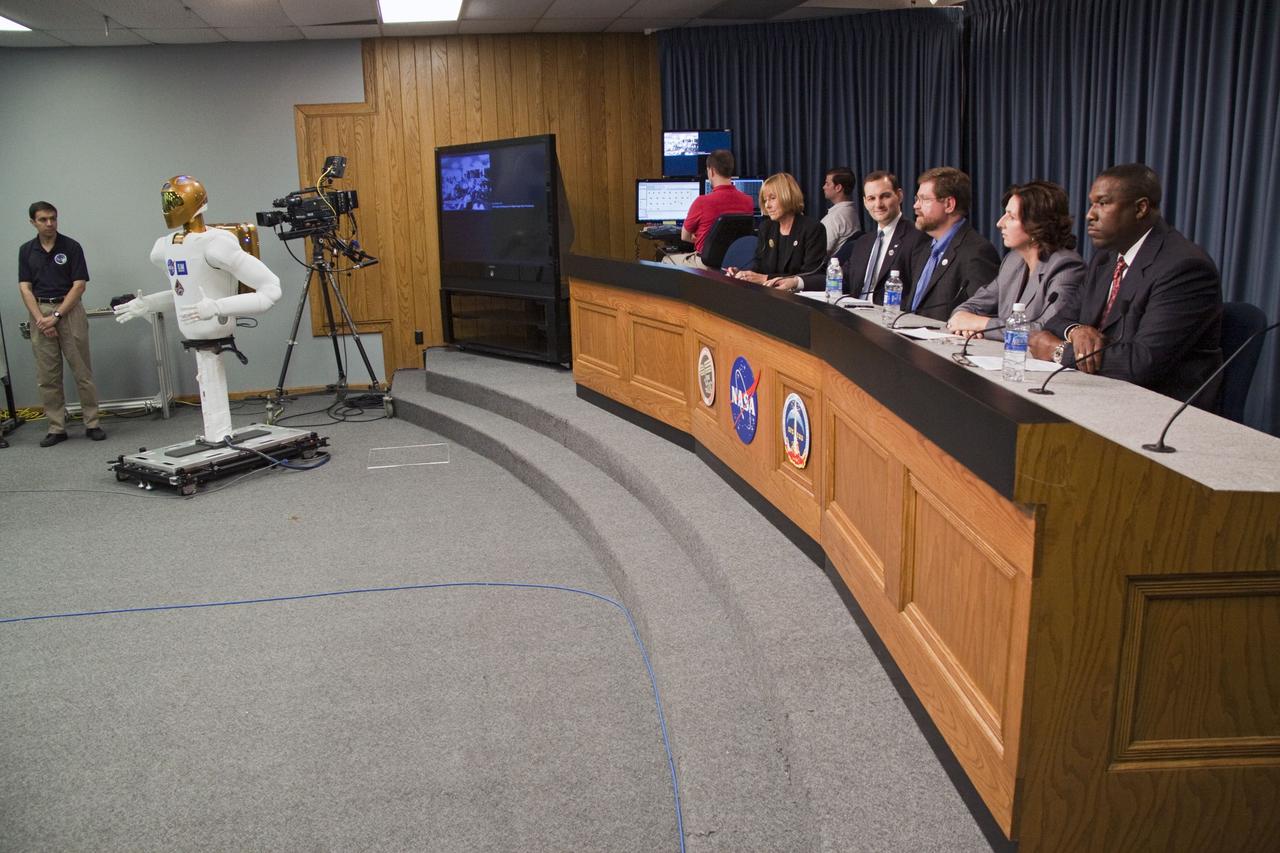
CAPE CANAVERAL, Fla. -- At NASA's Kennedy Space Center in Florida, managers from NASA and General Motors answer media questions on the dexterous humanoid astronaut helper, known as Robonaut. Robonaut 2 (R2) will be delivered to the International Space Station on space shuttle Discovery's STS-133 mission. Although R2 will initially only participate in operational tests, upgrades could eventually allow the robot to realize its true purpose -- helping spacewalking astronauts with tasks outside the orbiting laboratory. For more information on the upcoming STS-133 mission, visit www.nasa.gov/mission_pages/shuttle/shuttlemissions/sts133/. Photo credit: NASA/Jack Pfaller
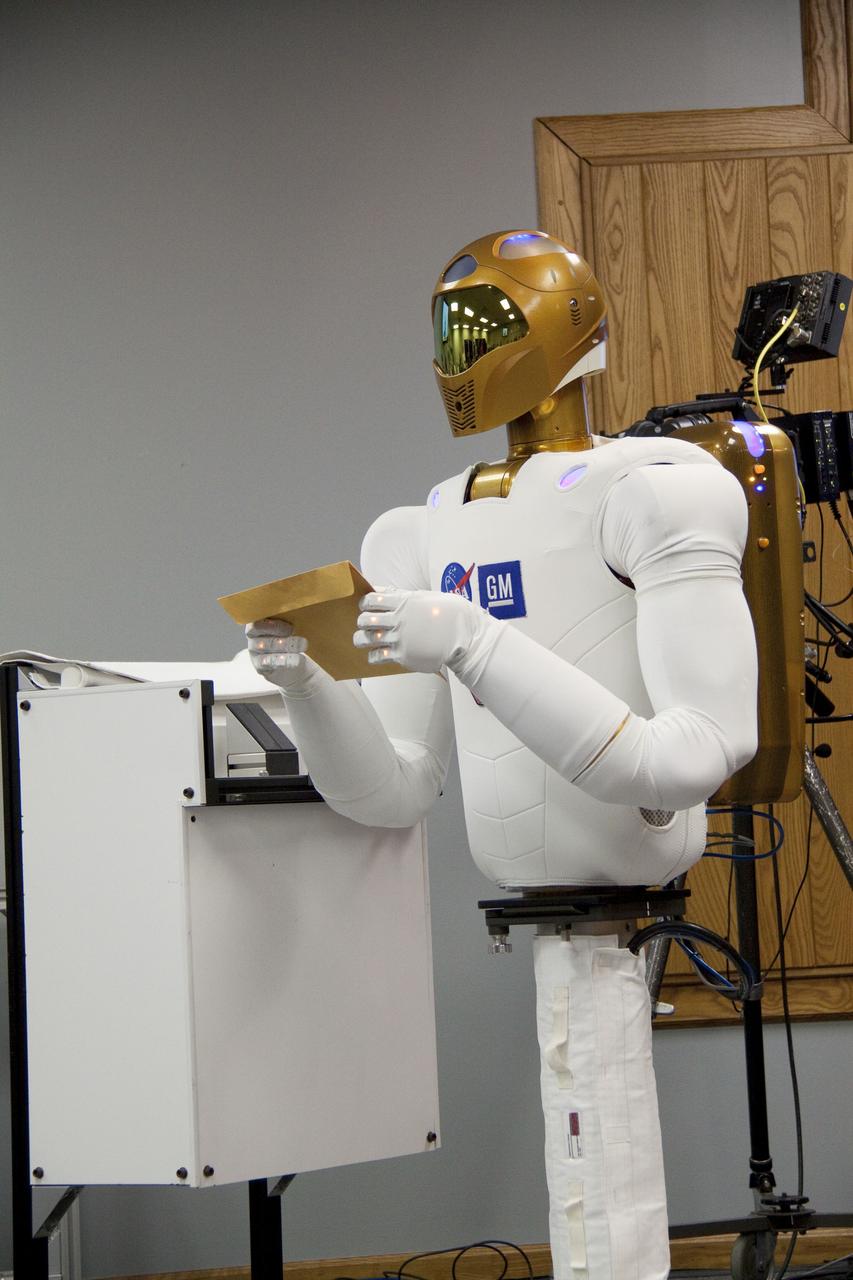
CAPE CANAVERAL, Fla. -- At NASA's Kennedy Space Center in Florida, a dexterous humanoid astronaut helper, known as Robonaut, demonstrates its talents to media. Robonaut 2 (R2) will be delivered to the International Space Station on space shuttle Discovery's STS-133 mission. Although R2 will initially only participate in operational tests, upgrades could eventually allow the robot to realize its true purpose -- helping spacewalking astronauts with tasks outside the orbiting laboratory. For more information on the upcoming STS-133 mission, visit www.nasa.gov/mission_pages/shuttle/shuttlemissions/sts133/. Photo credit: NASA/Jack Pfaller
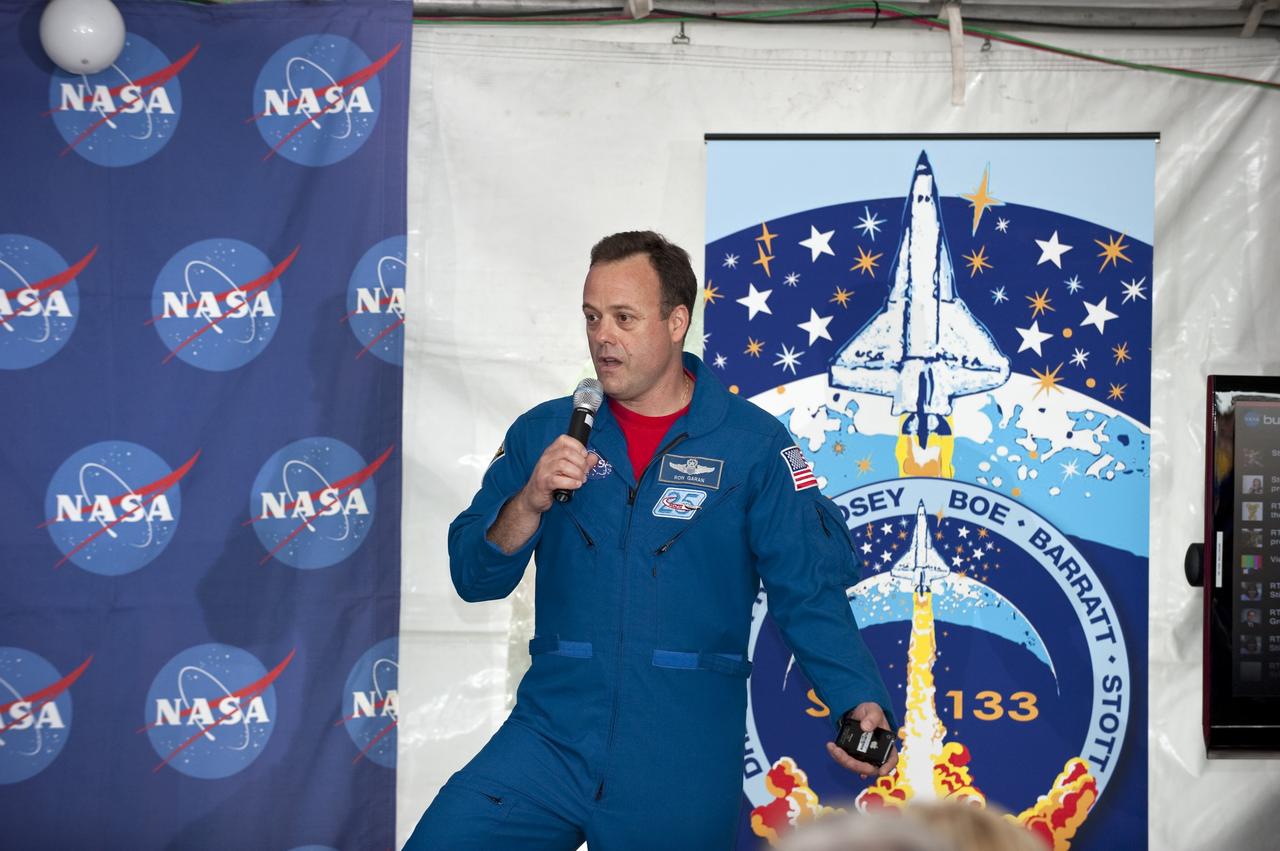
CAPE CANAVERAL, Fla. -- At NASA's Kennedy Space Center in Florida, NASA astronaut Ron Garan addresses participants of the STS-133 Tweetup. NASA is hosting about 150 of its Twitter followers from around the world and several dozen states and providing them with a behind-the-scenes perspective to share with their own followers on the social networking service. The "Tweeps," as NASA calls them, will have a chance to tour Kennedy and meet with shuttle technicians, managers, engineers and astronauts. They also will receive a demonstration of Robonaut, a human-like robot similar to the one that will be delivered to the International Space Station on the STS-133 mission. Space shuttle Discovery and its STS-133 crew are scheduled to launch Nov. 3 at 3:52 p.m. EDT. For more information on the upcoming mission, visit www.nasa.gov/mission_pages/shuttle/shuttlemissions/sts133/. Photo credit: NASA/Kim Shiflett
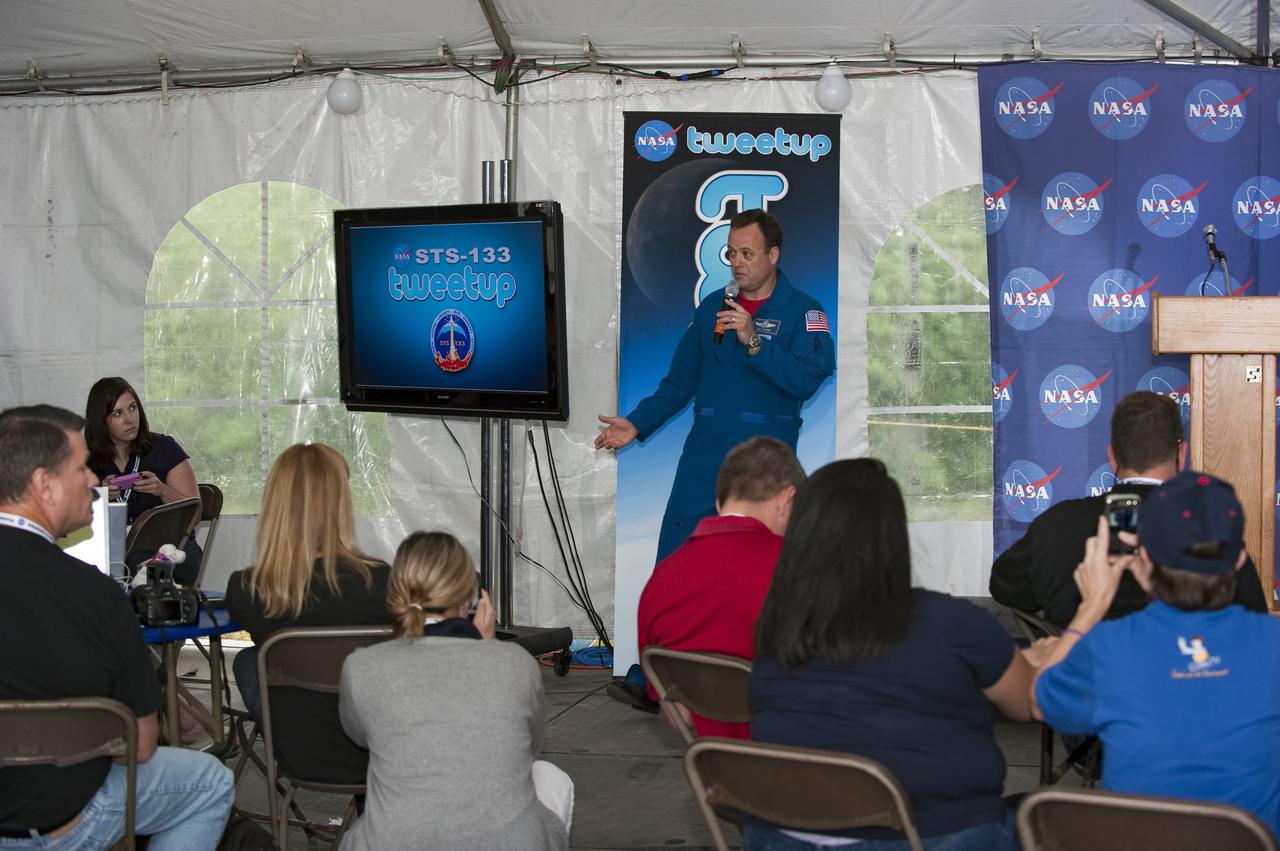
CAPE CANAVERAL, Fla. -- At NASA's Kennedy Space Center in Florida, NASA astronaut Ron Garan addresses participants of the STS-133 Tweetup. NASA is hosting about 150 of its Twitter followers from around the world and several dozen states and providing them with a behind-the-scenes perspective to share with their own followers on the social networking service. The "Tweeps," as NASA calls them, will have a chance to tour Kennedy and meet with shuttle technicians, managers, engineers and astronauts. They also will receive a demonstration of Robonaut, a human-like robot similar to the one that will be delivered to the International Space Station on the STS-133 mission. Space shuttle Discovery and its STS-133 crew are scheduled to launch Nov. 3 at 3:52 p.m. EDT. For more information on the upcoming mission, visit www.nasa.gov/mission_pages/shuttle/shuttlemissions/sts133/. Photo credit: NASA/Kim Shiflett
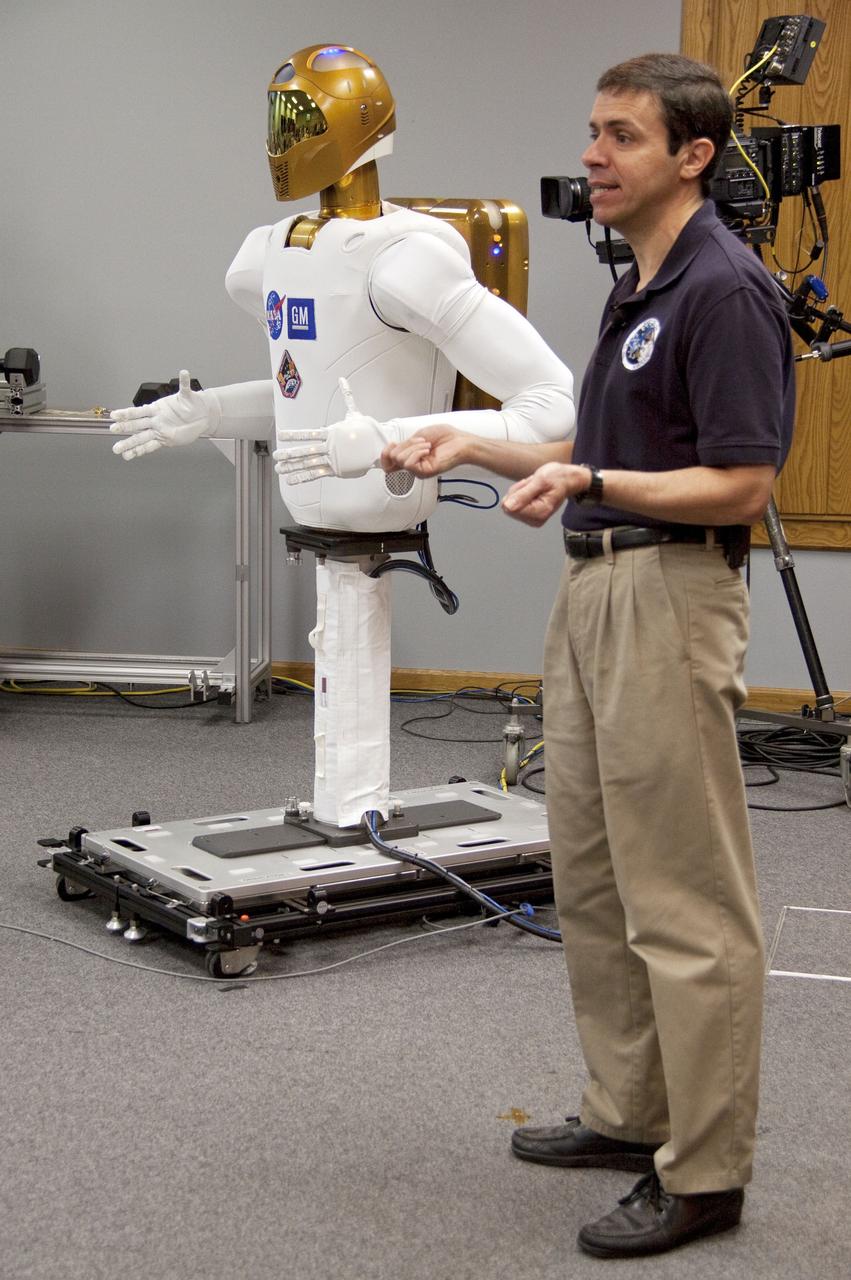
CAPE CANAVERAL, Fla. -- At NASA's Kennedy Space Center in Florida, Ron Diftler, NASA's Robonaut 2 (R2) project manager, shows media the capabilities of a dexterous humanoid astronaut helper. R2 will be delivered to the International Space Station on space shuttle Discovery's STS-133 mission. Although R2 will initially only participate in operational tests, upgrades could eventually allow the robot to realize its true purpose -- helping spacewalking astronauts with tasks outside the orbiting laboratory. For more information on the upcoming STS-133 mission, visit www.nasa.gov/mission_pages/shuttle/shuttlemissions/sts133/. Photo credit: NASA/Jack Pfaller
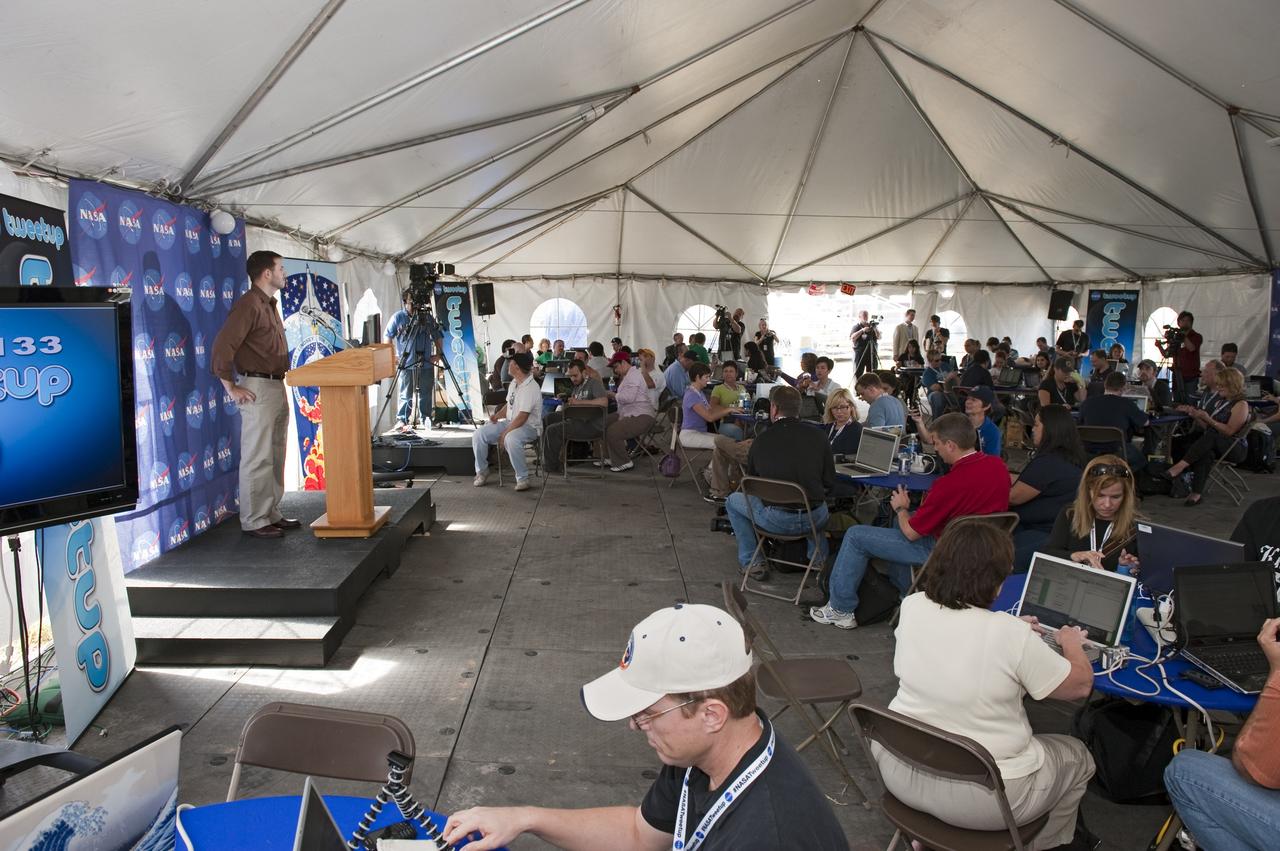
CAPE CANAVERAL, Fla. -- At NASA's Kennedy Space Center in Florida, NASA Public Affairs Officer John Yembrick welcomes participants to the STS-133 Tweetup. NASA is hosting about 150 of its Twitter followers from around the world and several dozen states and providing them with a behind-the-scenes perspective to share with their own followers on the social networking service. The "Tweeps," as NASA calls them, will have a chance to tour Kennedy and meet with shuttle technicians, managers, engineers and astronauts. They also will receive a demonstration of Robonaut, a human-like robot similar to the one that will be delivered to the International Space Station on the STS-133 mission. Space shuttle Discovery and its STS-133 crew are scheduled to launch Nov. 3 at 3:52 p.m. EDT. For more information on the upcoming mission, visit www.nasa.gov/mission_pages/shuttle/shuttlemissions/sts133/. Photo credit: NASA/Kim Shiflett
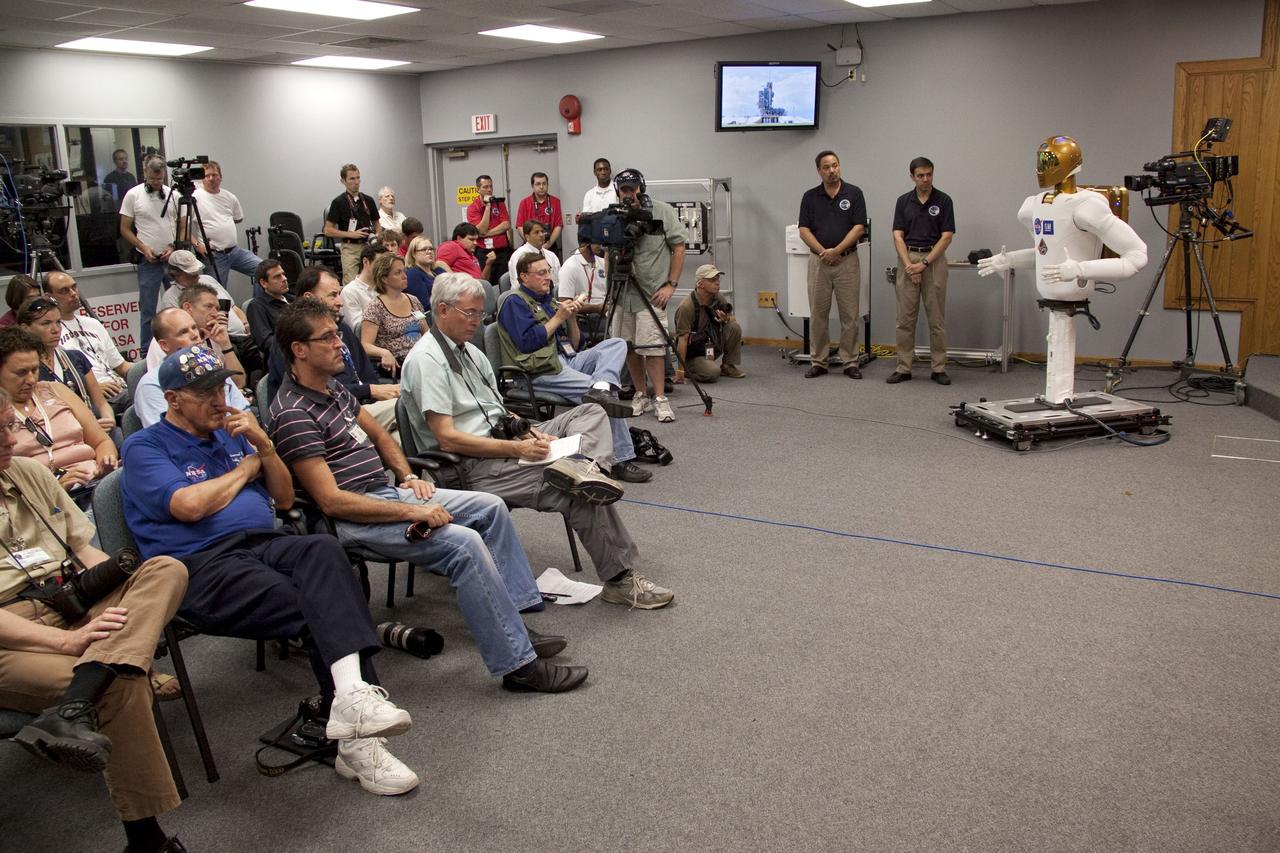
CAPE CANAVERAL, Fla. -- At NASA's Kennedy Space Center in Florida, a dexterous humanoid astronaut helper, known as Robonaut, is on display for media. Robonaut 2 (R2) will be delivered to the International Space Station on space shuttle Discovery's STS-133 mission. Although R2 will initially only participate in operational tests, upgrades could eventually allow the robot to realize its true purpose -- helping spacewalking astronauts with tasks outside the orbiting laboratory. For more information on the upcoming STS-133 mission, visit www.nasa.gov/mission_pages/shuttle/shuttlemissions/sts133/. Photo credit: NASA/Jack Pfaller
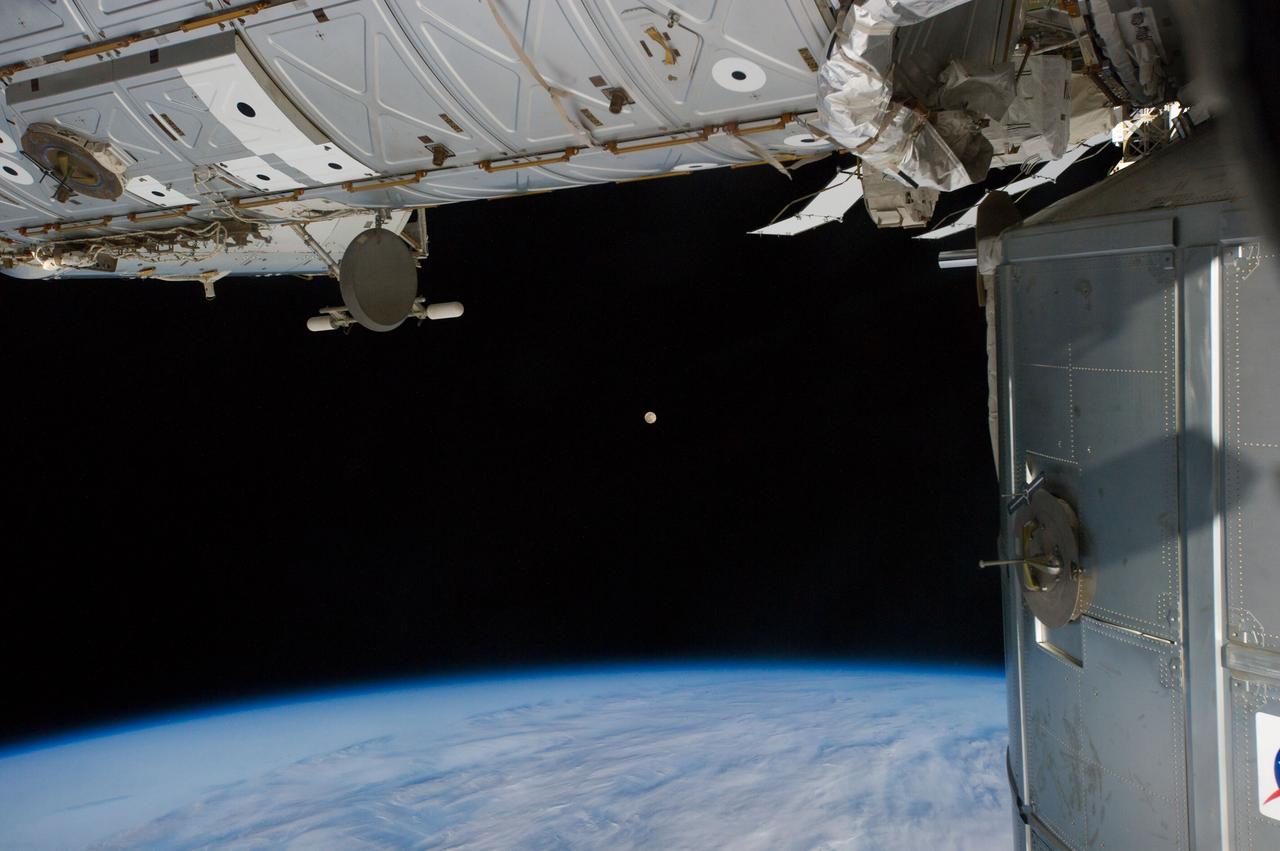
Earth Observation taken during a day pass by the Expedition 40 crew aboard the International Space Station (ISS). Folder lists this as: Moon, Japan, Kamchatka with a wild cloud. Part of the U.S. Lab and PMM are also visible.
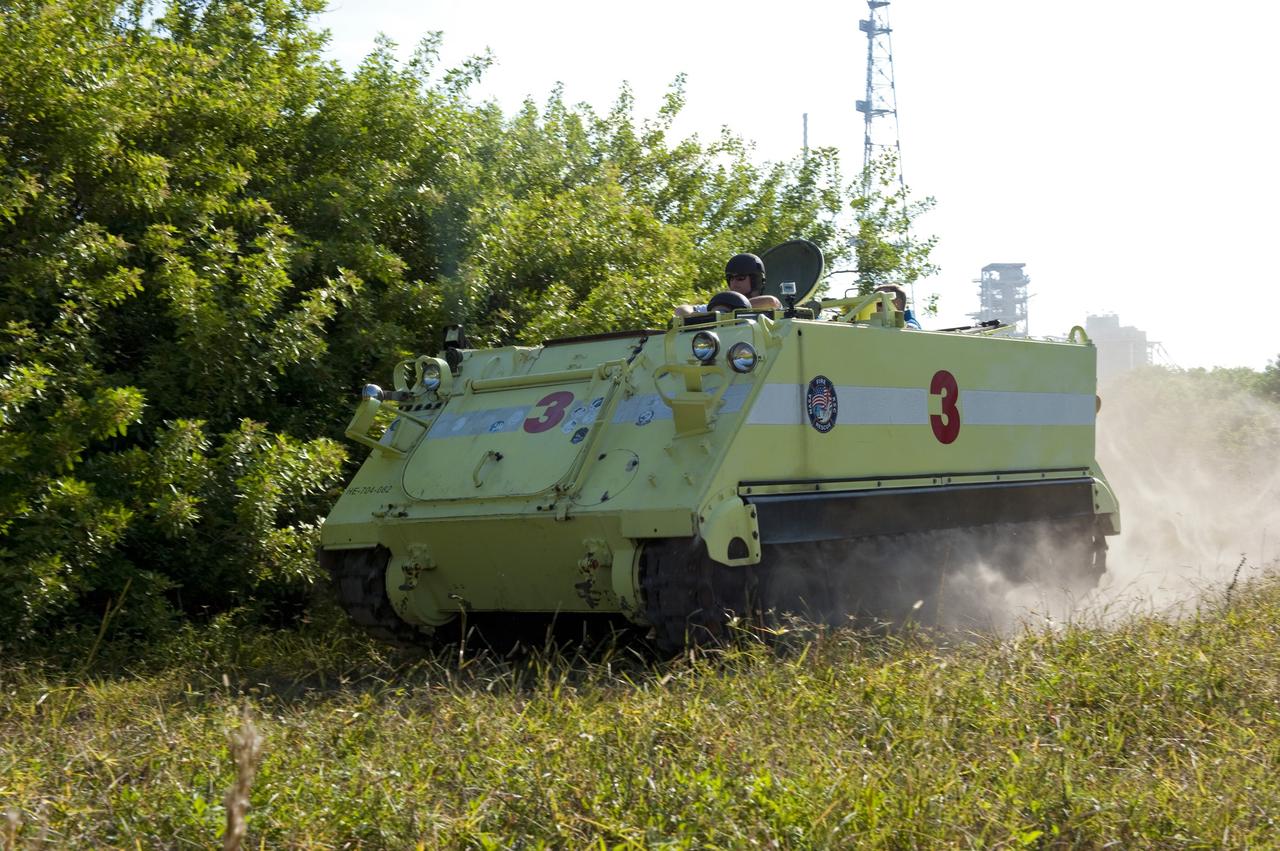
CAPE CANAVERAL, Fla. -- At NASA's Kennedy Space Center in Florida, the crew members of space shuttle Discovery's STS-133 mission go for a ride in an M-113 armored personnel carrier with Battalion Chief David Seymour. An M-113 is kept at the foot of the launch pad in case an emergency egress from the vicinity of the pad is needed, and training on the vehicle is part of the Terminal Countdown Demonstration Test (TCDT). TCDT provides each shuttle crew and launch team an opportunity to participate in various simulated activities, including equipment familiarization and a launch countdown. Space shuttle Discovery and its STS-133 crew will deliver the Permanent Multipurpose Module, packed with supplies and critical spare parts, as well as Robonaut 2, the dexterous humanoid astronaut helper, to the International Space Station. Launch is targeted for Nov. 1 at 4:40 p.m. For more information on the STS-133 mission, visit www.nasa.gov/mission_pages/shuttle/shuttlemissions/sts133/. Photo credit: NASA/Kim Shiflett
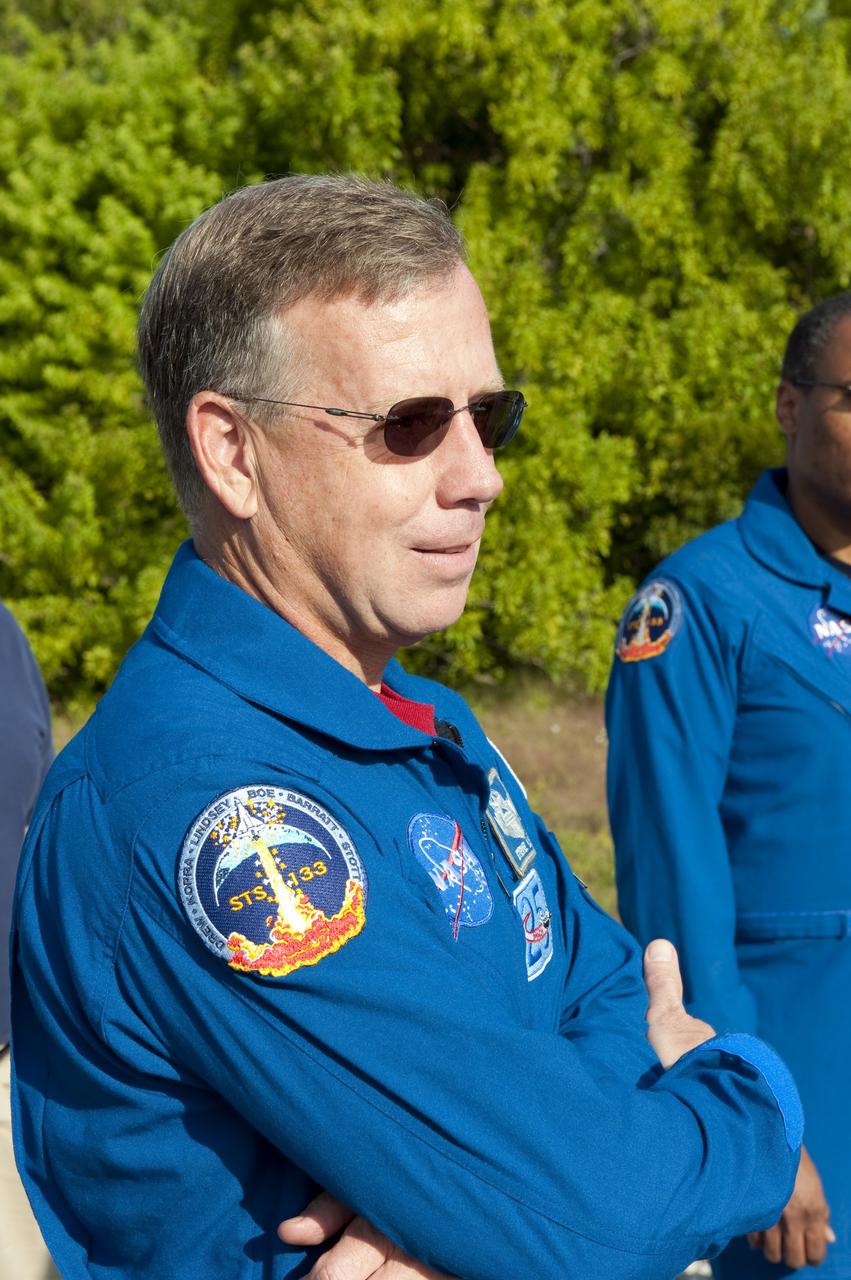
CAPE CANAVERAL, Fla. -- At NASA's Kennedy Space Center in Florida, STS-133 Commander Steve Lindsey prepares to drive the M-113 armored personnel carrier. An M-113 is kept at the foot of the launch pad in case an emergency egress from the vicinity of the pad is needed, and training on the vehicle is part of the Terminal Countdown Demonstration Test (TCDT). TCDT provides each shuttle crew and launch team an opportunity to participate in various simulated activities, including equipment familiarization and a launch countdown. Space shuttle Discovery and its STS-133 crew will deliver the Permanent Multipurpose Module, packed with supplies and critical spare parts, as well as Robonaut 2, the dexterous humanoid astronaut helper, to the International Space Station. Launch is targeted for Nov. 1 at 4:40 p.m. For more information on the STS-133 mission, visit www.nasa.gov/mission_pages/shuttle/shuttlemissions/sts133/. Photo credit: NASA/Kim Shiflett

CAPE CANAVERAL, Fla. -- A Shuttle Training Aircraft (STA) is ready for flight on the Shuttle Landing Facility runway at NASA's Kennedy Space Center in Florida. STS-133 Commander Steve Lindsey and Pilot Eric Boe will fly two Gulfstream II business jets that are modified to mimic the shuttle's handling during the final phase of landing. Practice landings are part of the Terminal Countdown Demonstration Test (TCDT), which provides each shuttle crew and launch team an opportunity to participate in various simulated activities, including equipment familiarization and emergency training at the launch pad. Space shuttle Discovery and its STS-133 crew will deliver the Permanent Multipurpose Module, packed with supplies and critical spare parts, as well as Robonaut 2, the dexterous humanoid astronaut helper, to the International Space Station. Launch is targeted for Nov. 1 at 4:40 p.m. For more information on the STS-133 mission, visit www.nasa.gov/mission_pages/shuttle/shuttlemissions/sts133/. Photo credit: NASA/Amanda Diller
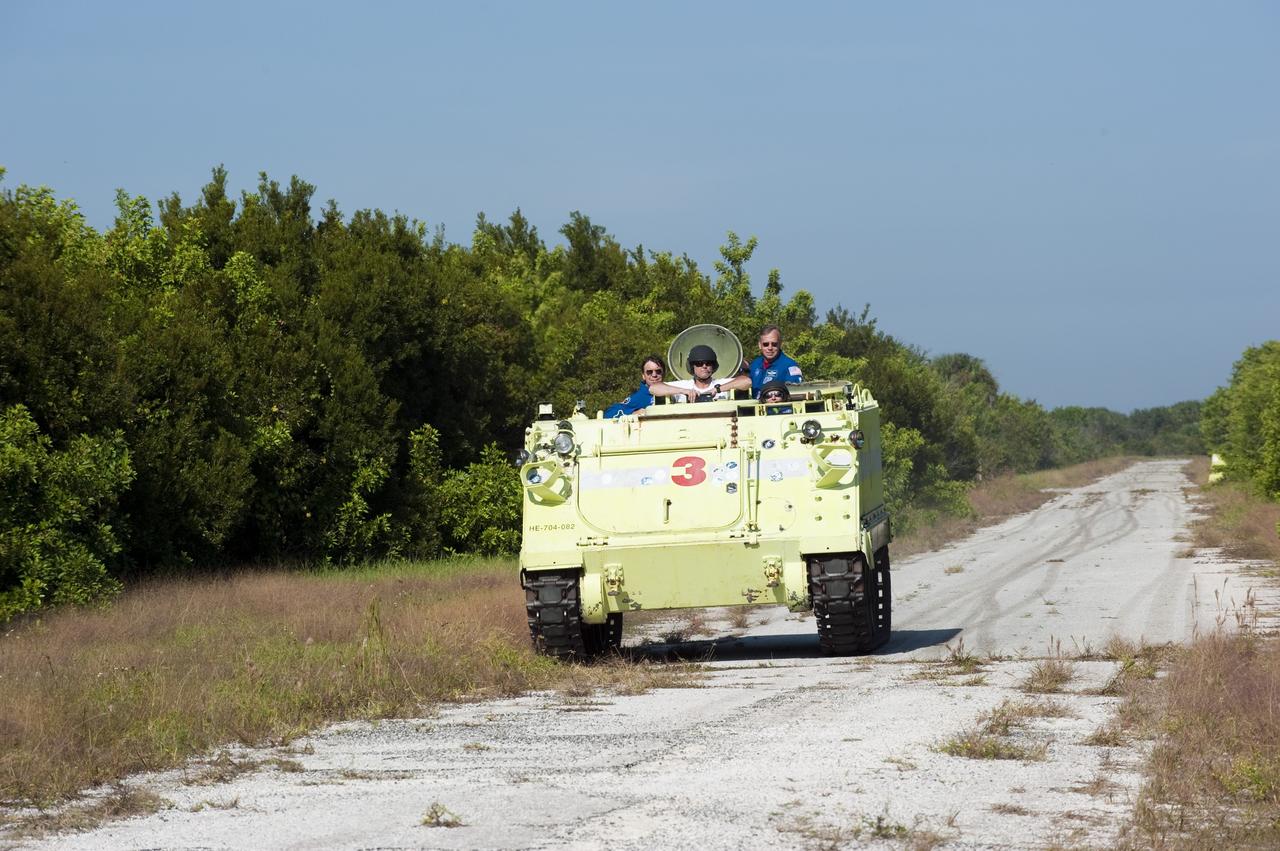
CAPE CANAVERAL, Fla. -- At NASA's Kennedy Space Center in Florida, the crew members of space shuttle Discovery's STS-133 mission go for a ride in an M-113 armored personnel carrier with Battalion Chief David Seymour. An M-113 is kept at the foot of the launch pad in case an emergency egress from the vicinity of the pad is needed, and training on the vehicle is part of the Terminal Countdown Demonstration Test (TCDT). TCDT provides each shuttle crew and launch team an opportunity to participate in various simulated activities, including equipment familiarization and a launch countdown. Space shuttle Discovery and its STS-133 crew will deliver the Permanent Multipurpose Module, packed with supplies and critical spare parts, as well as Robonaut 2, the dexterous humanoid astronaut helper, to the International Space Station. Launch is targeted for Nov. 1 at 4:40 p.m. For more information on the STS-133 mission, visit www.nasa.gov/mission_pages/shuttle/shuttlemissions/sts133/. Photo credit: NASA/Kim Shiflett
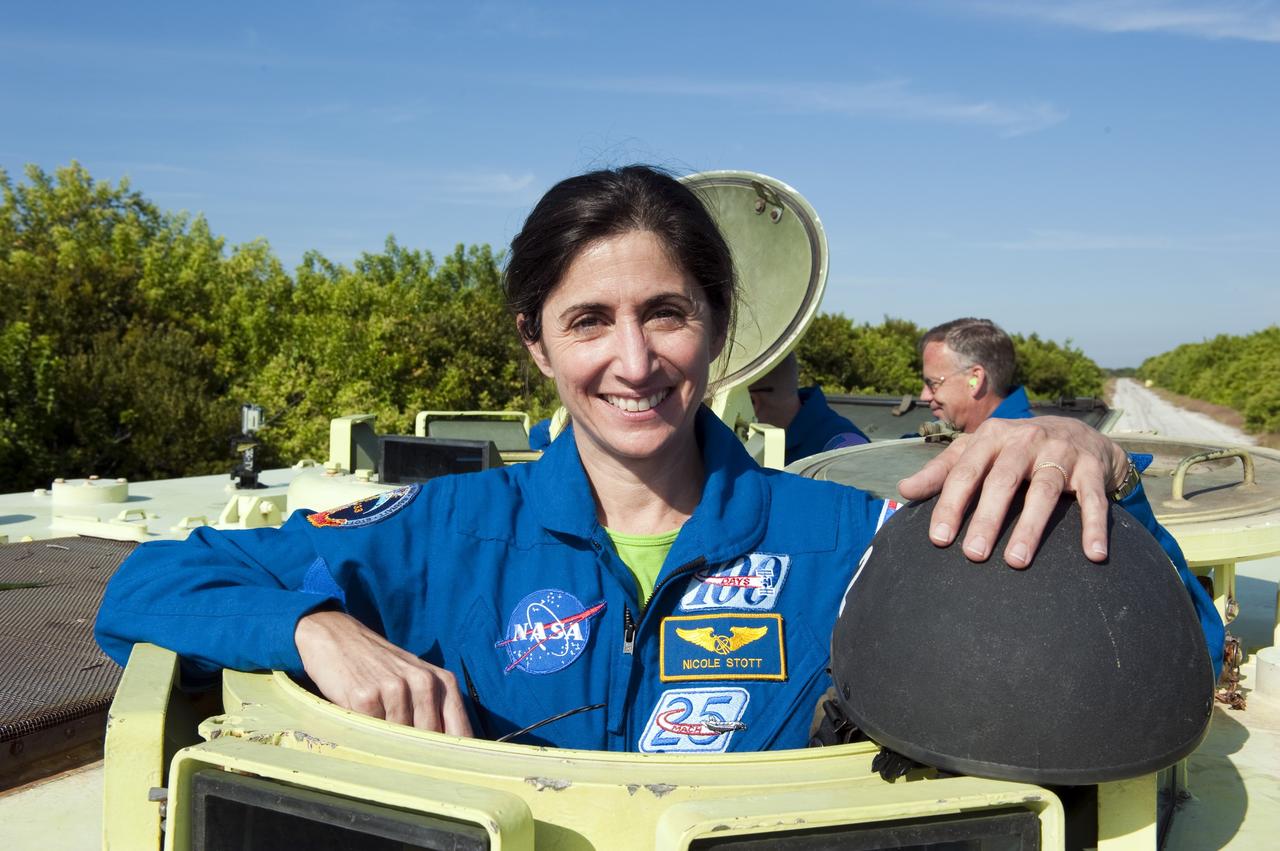
CAPE CANAVERAL, Fla. -- At NASA's Kennedy Space Center in Florida, STS-133 Mission Specialist Nicole Stott prepares to practice driving an M-113 armored personnel carrier. Behind her is Commander Steve Lindsey. An M-113 is kept at the foot of the launch pad in case an emergency egress from the vicinity of the pad is needed, and training on the vehicle is part of the Terminal Countdown Demonstration Test (TCDT). TCDT provides each shuttle crew and launch team an opportunity to participate in various simulated activities, including equipment familiarization and a launch countdown. Space shuttle Discovery and its STS-133 crew will deliver the Permanent Multipurpose Module, packed with supplies and critical spare parts, as well as Robonaut 2, the dexterous humanoid astronaut helper, to the International Space Station. Launch is targeted for Nov. 1 at 4:40 p.m. For more information on the STS-133 mission, visit www.nasa.gov/mission_pages/shuttle/shuttlemissions/sts133/. Photo credit: NASA/Kim Shiflett

CAPE CANAVERAL, Fla. -- At NASA's Kennedy Space Center in Florida, the crew members of space shuttle Discovery's STS-133 mission go for a ride in an M-113 armored personnel carrier with Battalion Chief David Seymour. An M-113 is kept at the foot of the launch pad in case an emergency egress from the vicinity of the pad is needed, and training on the vehicle is part of the Terminal Countdown Demonstration Test (TCDT). TCDT provides each shuttle crew and launch team an opportunity to participate in various simulated activities, including equipment familiarization and a launch countdown. Space shuttle Discovery and its STS-133 crew will deliver the Permanent Multipurpose Module, packed with supplies and critical spare parts, as well as Robonaut 2, the dexterous humanoid astronaut helper, to the International Space Station. Launch is targeted for Nov. 1 at 4:40 p.m. For more information on the STS-133 mission, visit www.nasa.gov/mission_pages/shuttle/shuttlemissions/sts133/. Photo credit: NASA/Kim Shiflett
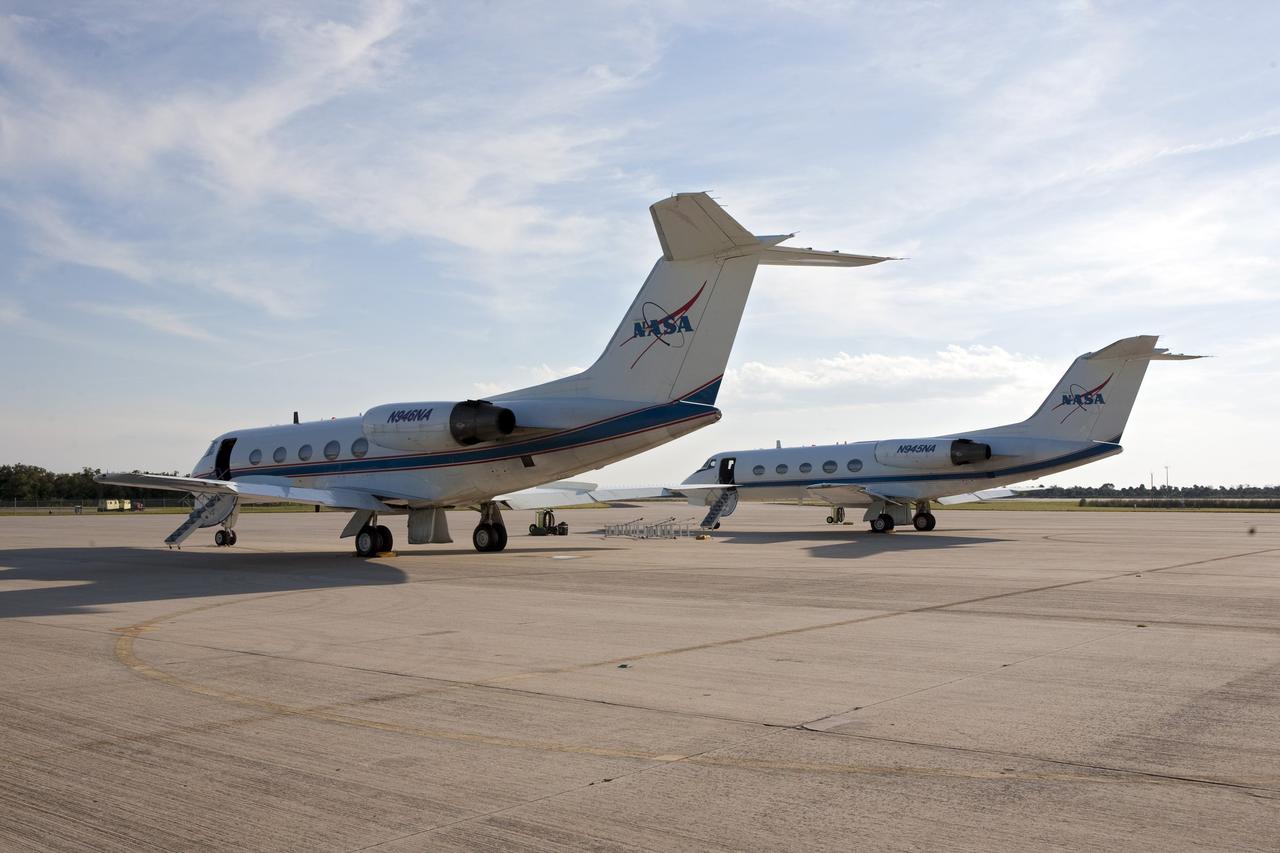
CAPE CANAVERAL, Fla. -- Two Shuttle Training Aircraft (STA) are ready for flight on the Shuttle Landing Facility runway at NASA's Kennedy Space Center in Florida. STS-133 Commander Steve Lindsey and Pilot Eric Boe will fly the two Gulfstream II business jets that are modified to mimic the shuttle's handling during the final phase of landing. Practice landings are part of the Terminal Countdown Demonstration Test (TCDT), which provides each shuttle crew and launch team an opportunity to participate in various simulated activities, including equipment familiarization and emergency training at the launch pad. Space shuttle Discovery and its STS-133 crew will deliver the Permanent Multipurpose Module, packed with supplies and critical spare parts, as well as Robonaut 2, the dexterous humanoid astronaut helper, to the International Space Station. Launch is targeted for Nov. 1 at 4:40 p.m. For more information on the STS-133 mission, visit www.nasa.gov/mission_pages/shuttle/shuttlemissions/sts133/. Photo credit: NASA/Amanda Diller
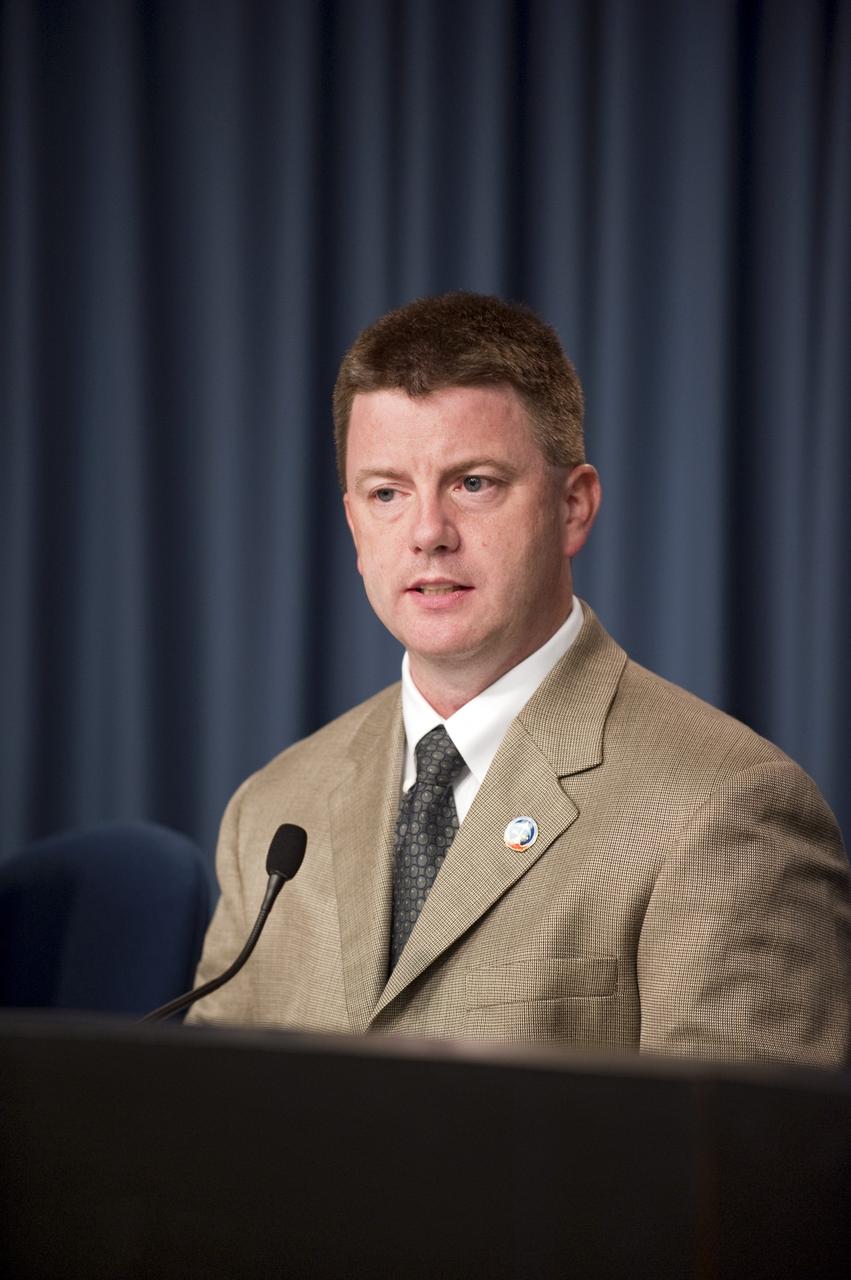
CAPE CANAVERAL, Fla. -- At NASA's Kennedy Space Center in Florida, Prelaunch Mission Management Team Chair Mike Moses talks to media about proceeding with space shuttle Discovery's launch countdown. Lift off had been postponed to evaluate a controller that showed an irregular power drop in Discovery's No. 3 engine. Now scheduled to launch Nov. 4 at 3:29 p.m. EDT, Discovery and its STS-133 crew will deliver the Permanent Multipurpose Module, packed with supplies and critical spare parts, as well as Robonaut 2, the dexterous humanoid astronaut helper, to the orbiting laboratory. For more information on the STS-133 mission, visit www.nasa.gov/mission_pages/shuttle/shuttlemissions/sts133/. Photo credit: NASA/Kim Shiflett
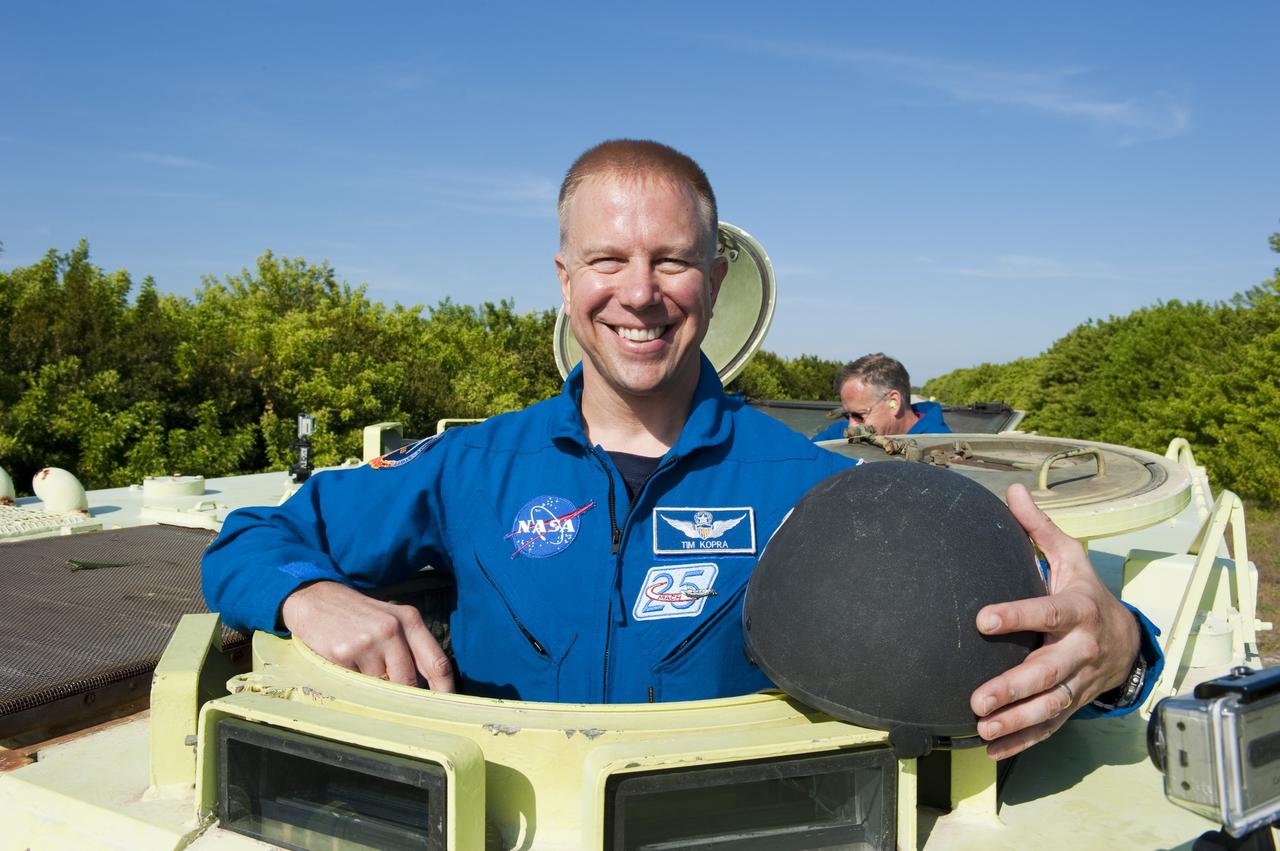
CAPE CANAVERAL, Fla. -- At NASA's Kennedy Space Center in Florida, STS-133 Mission Specialist Tim Kopra prepares to practice driving an M-113 armored personnel carrier. Behind him is Commander Steve Lindsey. An M-113 is kept at the foot of the launch pad in case an emergency egress from the vicinity of the pad is needed, and training on the vehicle is part of the Terminal Countdown Demonstration Test (TCDT). TCDT provides each shuttle crew and launch team an opportunity to participate in various simulated activities, including equipment familiarization and a launch countdown. Space shuttle Discovery and its STS-133 crew will deliver the Permanent Multipurpose Module, packed with supplies and critical spare parts, as well as Robonaut 2, the dexterous humanoid astronaut helper, to the International Space Station. Launch is targeted for Nov. 1 at 4:40 p.m. For more information on the STS-133 mission, visit www.nasa.gov/mission_pages/shuttle/shuttlemissions/sts133/. Photo credit: NASA/Kim Shiflett
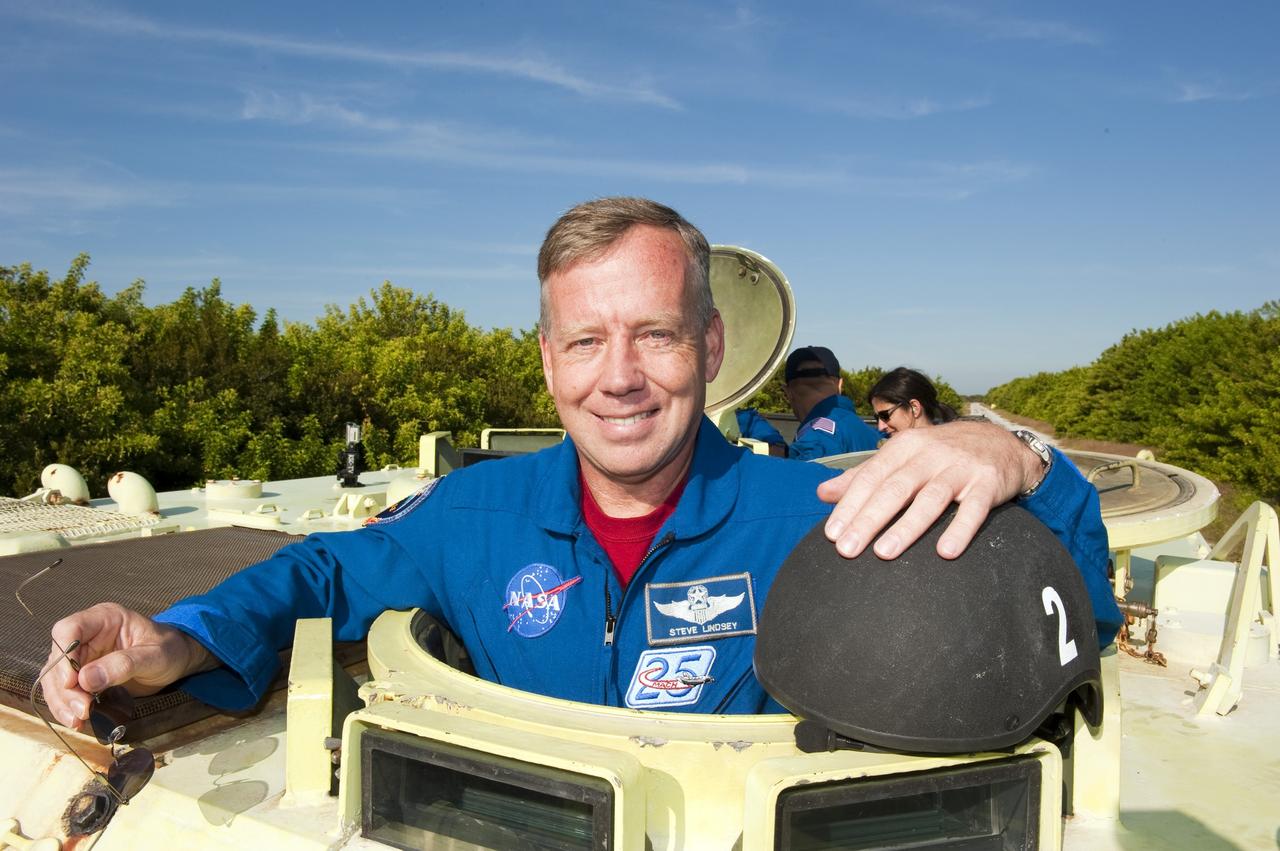
CAPE CANAVERAL, Fla. -- At NASA's Kennedy Space Center in Florida, STS-133 Commander Steve Lindsey prepares to practice driving an M-113 armored personnel carrier. Behind him are Mission Specialist Tim Kopra and Pilot Eric Boe. An M-113 is kept at the foot of the launch pad in case an emergency egress from the vicinity of the pad is needed, and training on the vehicle is part of the Terminal Countdown Demonstration Test (TCDT). TCDT provides each shuttle crew and launch team an opportunity to participate in various simulated activities, including equipment familiarization and a launch countdown. Space shuttle Discovery and its STS-133 crew will deliver the Permanent Multipurpose Module, packed with supplies and critical spare parts, as well as Robonaut 2, the dexterous humanoid astronaut helper, to the International Space Station. Launch is targeted for Nov. 1 at 4:40 p.m. For more information on the STS-133 mission, visit www.nasa.gov/mission_pages/shuttle/shuttlemissions/sts133/. Photo credit: NASA/Kim Shiflett
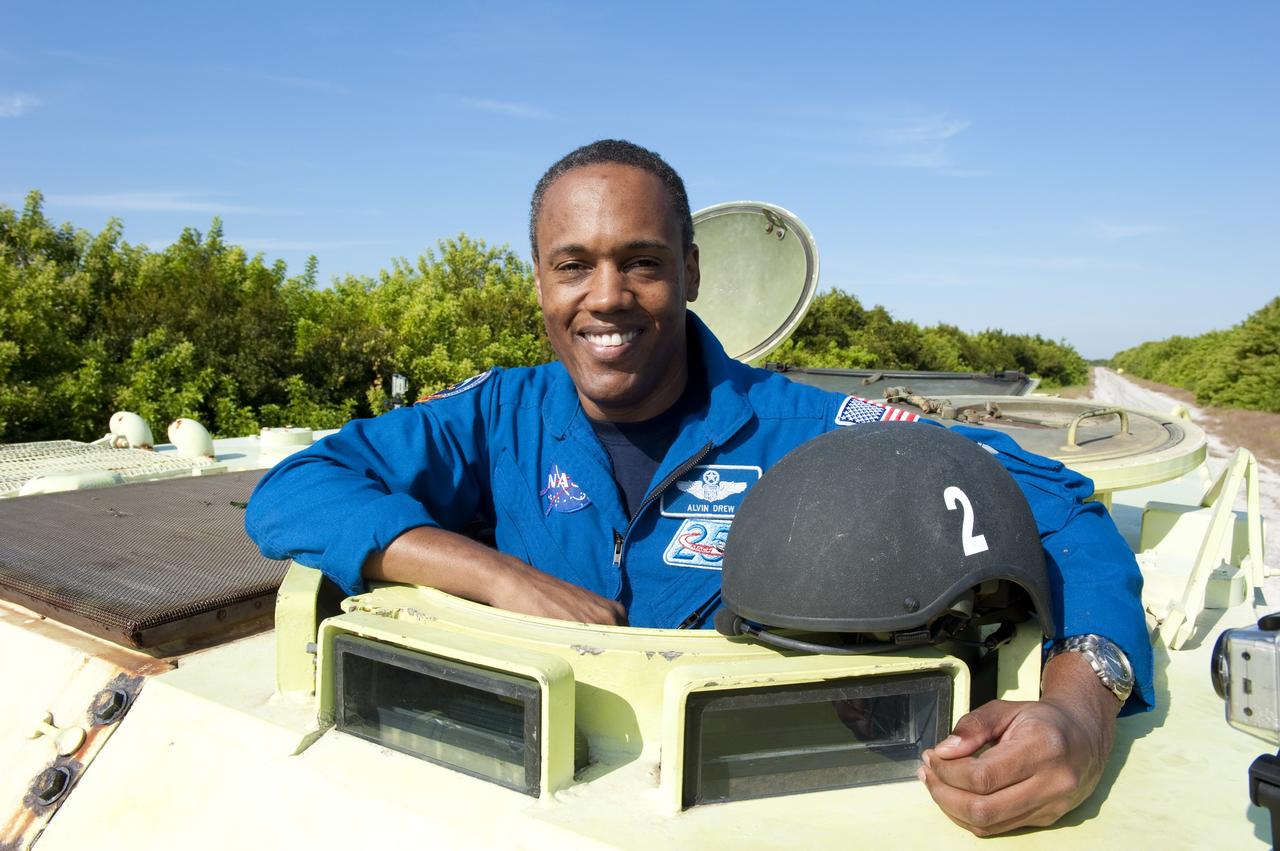
CAPE CANAVERAL, Fla. -- At NASA's Kennedy Space Center in Florida, STS-133 Mission Specialist Alvin Drew prepares to practice driving an M-113 armored personnel carrier. Behind him is Commander Steve Lindsey. An M-113 is kept at the foot of the launch pad in case an emergency egress from the vicinity of the pad is needed, and training on the vehicle is part of the Terminal Countdown Demonstration Test (TCDT). TCDT provides each shuttle crew and launch team an opportunity to participate in various simulated activities, including equipment familiarization and a launch countdown. Space shuttle Discovery and its STS-133 crew will deliver the Permanent Multipurpose Module, packed with supplies and critical spare parts, as well as Robonaut 2, the dexterous humanoid astronaut helper, to the International Space Station. Launch is targeted for Nov. 1 at 4:40 p.m. For more information on the STS-133 mission, visit www.nasa.gov/mission_pages/shuttle/shuttlemissions/sts133/. Photo credit: NASA/Kim Shiflett
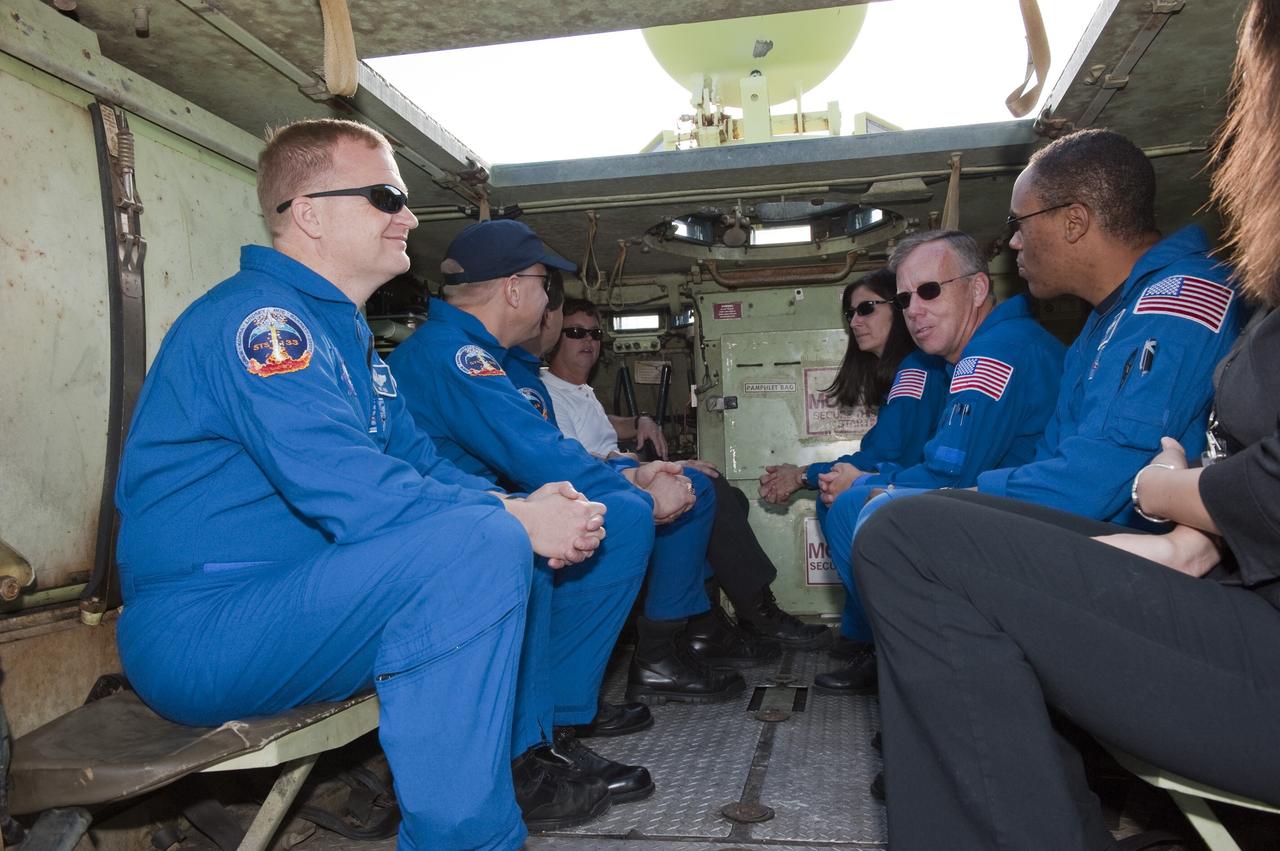
CAPE CANAVERAL, Fla. -- At NASA's Kennedy Space Center in Florida, the crew members of space shuttle Discovery's STS-133 mission experience the interior of an M-113 armored personnel carrier. From left are Pilot Eric Boe, Mission Specialists Tim Kopra and Michael Barratt, Battalion Chief David Seymour, Mission Specialist Nicole Stott, Commander Steve Lindsey and Mission Specialist Alvin Drew. An M-113 is kept at the foot of the launch pad in case an emergency egress from the vicinity of the pad is needed, and training on the vehicle is part of the Terminal Countdown Demonstration Test (TCDT). TCDT provides each shuttle crew and launch team an opportunity to participate in various simulated activities, including equipment familiarization and a launch countdown. Space shuttle Discovery and its STS-133 crew will deliver the Permanent Multipurpose Module, packed with supplies and critical spare parts, as well as Robonaut 2, the dexterous humanoid astronaut helper, to the International Space Station. Launch is targeted for Nov. 1 at 4:40 p.m. For more information on the STS-133 mission, visit www.nasa.gov/mission_pages/shuttle/shuttlemissions/sts133/. Photo credit: NASA/Kim Shiflett
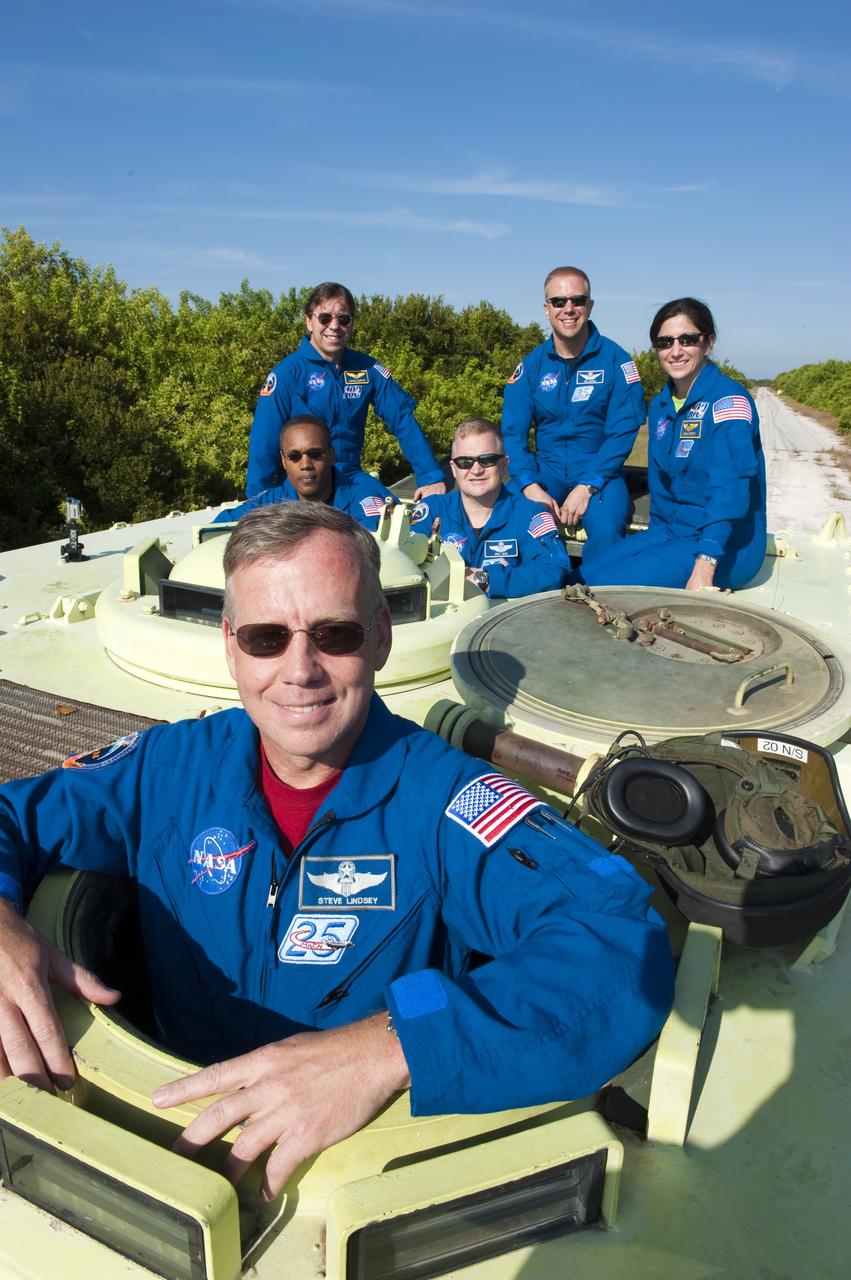
CAPE CANAVERAL, Fla. -- At NASA's Kennedy Space Center in Florida, STS-133 Commander Steve Lindsey prepares to practice driving an M-113 armored personnel carrier. Behind him, from left are Mission Specialists Michael Barratt and Alvin Drew, Pilot Eric Boe, and Mission Specialists Tim Kopra and Nicole Stott. An M-113 is kept at the foot of the launch pad in case an emergency egress from the vicinity of the pad is needed, and training on the vehicle is part of the Terminal Countdown Demonstration Test (TCDT). TCDT provides each shuttle crew and launch team an opportunity to participate in various simulated activities, including equipment familiarization and a launch countdown. Space shuttle Discovery and its STS-133 crew will deliver the Permanent Multipurpose Module, packed with supplies and critical spare parts, as well as Robonaut 2, the dexterous humanoid astronaut helper, to the International Space Station. Launch is targeted for Nov. 1 at 4:40 p.m. For more information on the STS-133 mission, visit www.nasa.gov/mission_pages/shuttle/shuttlemissions/sts133/. Photo credit: NASA/Kim Shiflett
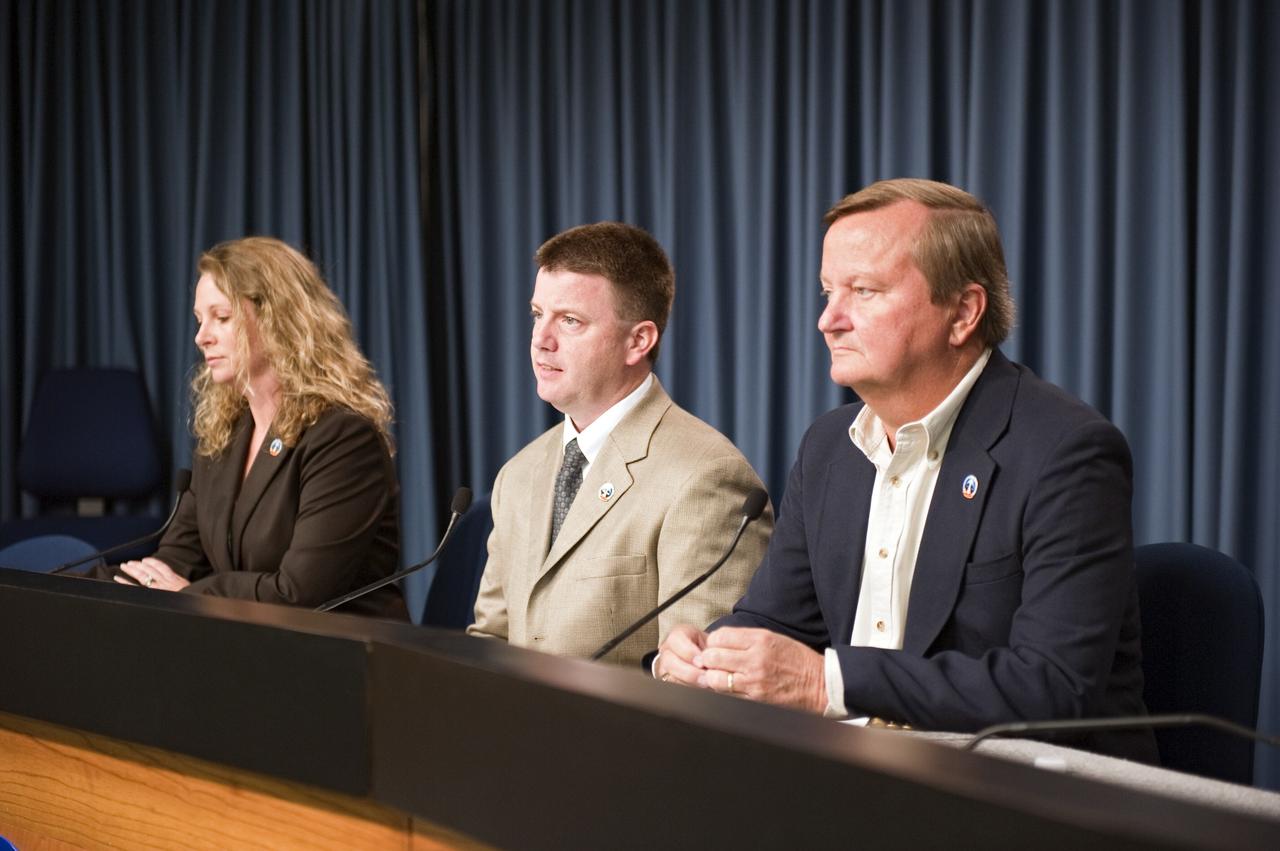
CAPE CANAVERAL, Fla. -- At NASA's Kennedy Space Center in Florida, NASA Public Affairs Officer Candrea Thomas, left, Prelaunch Mission Management Team Chair Mike Moses and Shuttle Launch Director Mike Leinbach talk to media about proceeding with space shuttle Discovery's launch countdown. Lift off had been postponed to evaluate a controller that showed an irregular power drop in Discovery's No. 3 engine. Now scheduled to launch Nov. 4 at 3:29 p.m. EDT, Discovery and its STS-133 crew will deliver the Permanent Multipurpose Module, packed with supplies and critical spare parts, as well as Robonaut 2, the dexterous humanoid astronaut helper, to the orbiting laboratory. For more information on the STS-133 mission, visit www.nasa.gov/mission_pages/shuttle/shuttlemissions/sts133/. Photo credit: NASA/Kim Shiflett
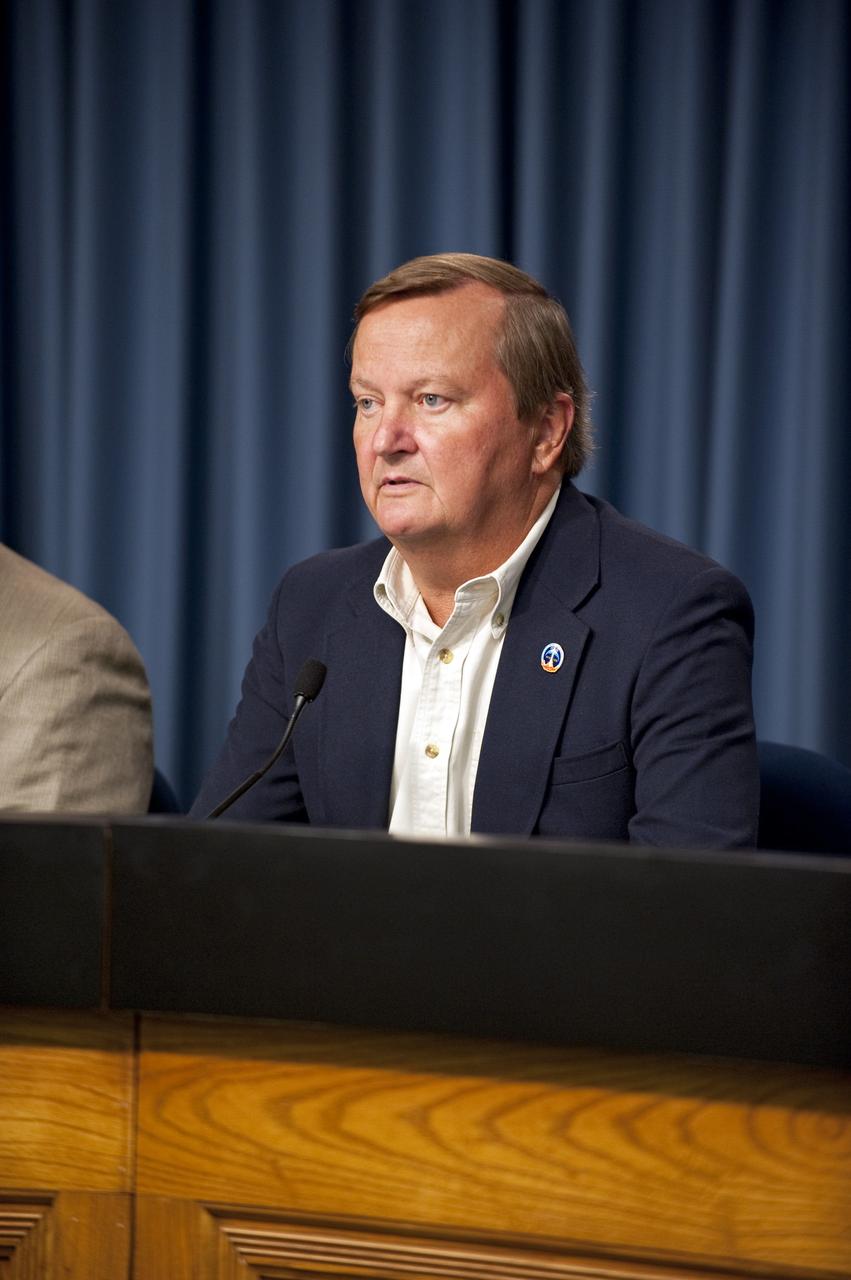
CAPE CANAVERAL, Fla. -- At NASA's Kennedy Space Center in Florida, Shuttle Launch Director Mike Leinbach talks to media about proceeding with space shuttle Discovery's launch countdown. Lift off had been postponed to evaluate a controller that showed an irregular power drop in Discovery's No. 3 engine. Now scheduled to launch Nov. 4 at 3:29 p.m. EDT, Discovery and its STS-133 crew will deliver the Permanent Multipurpose Module, packed with supplies and critical spare parts, as well as Robonaut 2, the dexterous humanoid astronaut helper, to the orbiting laboratory. For more information on the STS-133 mission, visit www.nasa.gov/mission_pages/shuttle/shuttlemissions/sts133/. Photo credit: NASA/Kim Shiflett
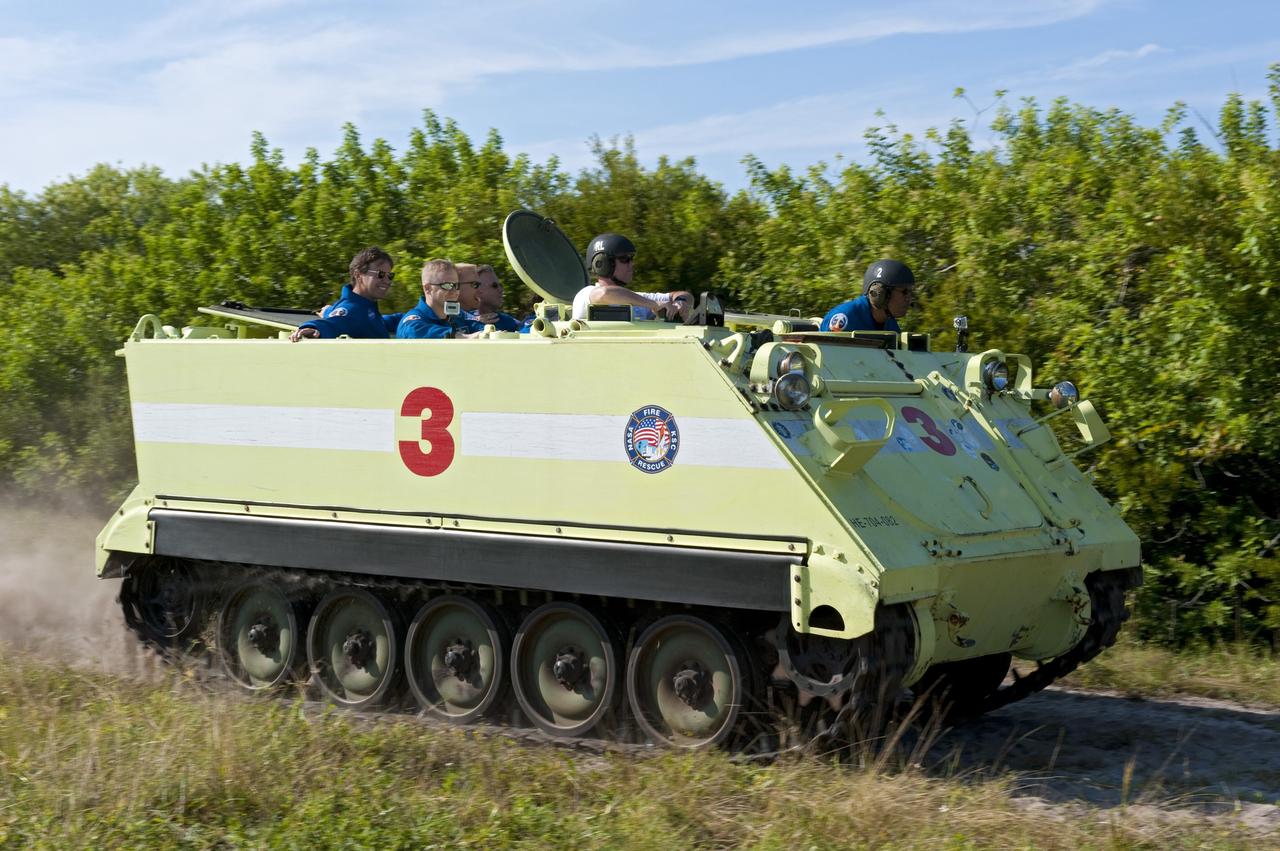
CAPE CANAVERAL, Fla. -- At NASA's Kennedy Space Center in Florida, the crew members of space shuttle Discovery's STS-133 mission go for a ride in an M-113 armored personnel carrier with Battalion Chief David Seymour. An M-113 is kept at the foot of the launch pad in case an emergency egress from the vicinity of the pad is needed, and training on the vehicle is part of the Terminal Countdown Demonstration Test (TCDT). TCDT provides each shuttle crew and launch team an opportunity to participate in various simulated activities, including equipment familiarization and a launch countdown. Space shuttle Discovery and its STS-133 crew will deliver the Permanent Multipurpose Module, packed with supplies and critical spare parts, as well as Robonaut 2, the dexterous humanoid astronaut helper, to the International Space Station. Launch is targeted for Nov. 1 at 4:40 p.m. For more information on the STS-133 mission, visit www.nasa.gov/mission_pages/shuttle/shuttlemissions/sts133/. Photo credit: NASA/Kim Shiflett
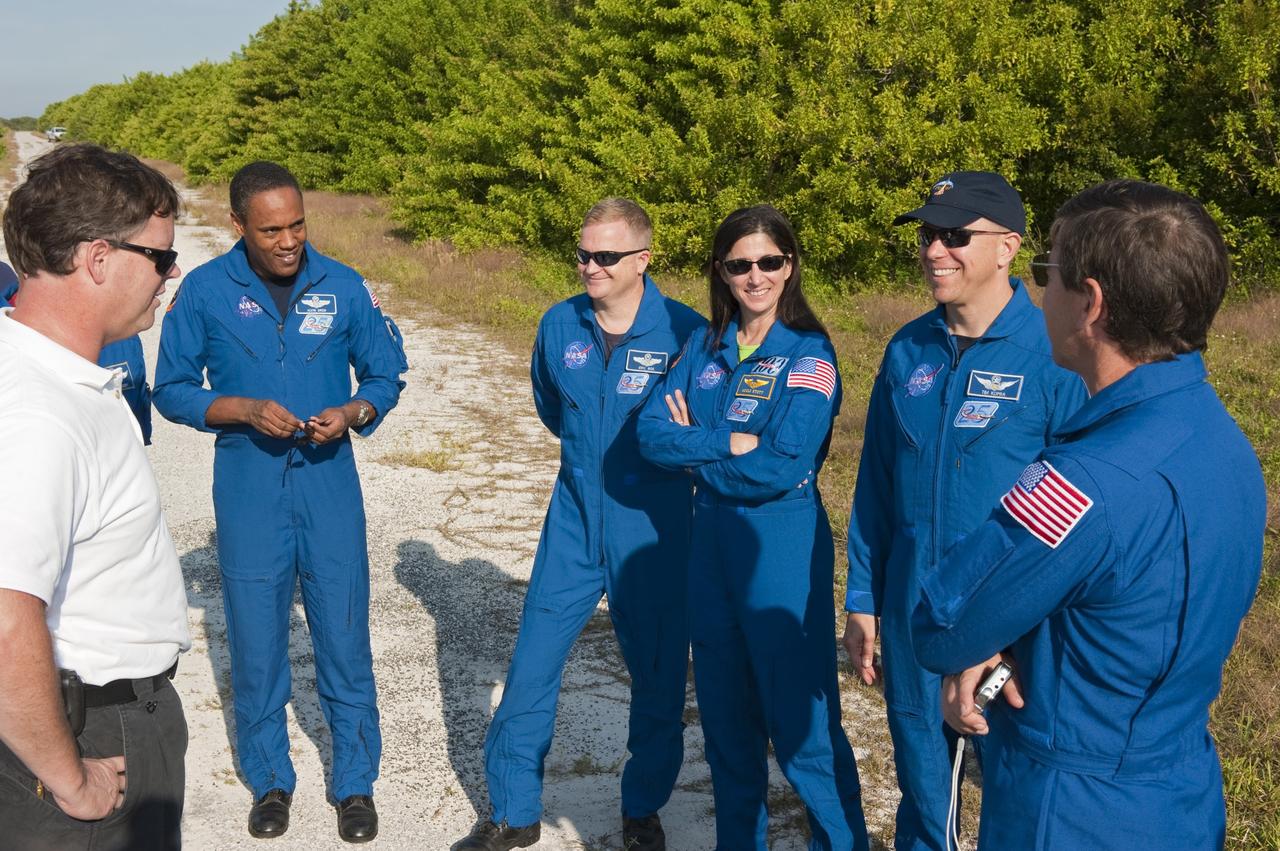
CAPE CANAVERAL, Fla. -- At NASA's Kennedy Space Center in Florida, the STS-133 crew shares a light moment with Battalion Chief David Seymour, left, during training on the M-113 armored personnel carrier. An M-113 is kept at the foot of the launch pad in case an emergency egress from the vicinity of the pad is needed, and driving the vehicle is part of the Terminal Countdown Demonstration Test (TCDT). TCDT provides each shuttle crew and launch team an opportunity to participate in various simulated activities, including equipment familiarization and a launch countdown. Space shuttle Discovery and its STS-133 crew will deliver the Permanent Multipurpose Module, packed with supplies and critical spare parts, as well as Robonaut 2, the dexterous humanoid astronaut helper, to the International Space Station. Launch is targeted for Nov. 1 at 4:40 p.m. For more information on the STS-133 mission, visit www.nasa.gov/mission_pages/shuttle/shuttlemissions/sts133/. Photo credit: NASA/Kim Shiflett
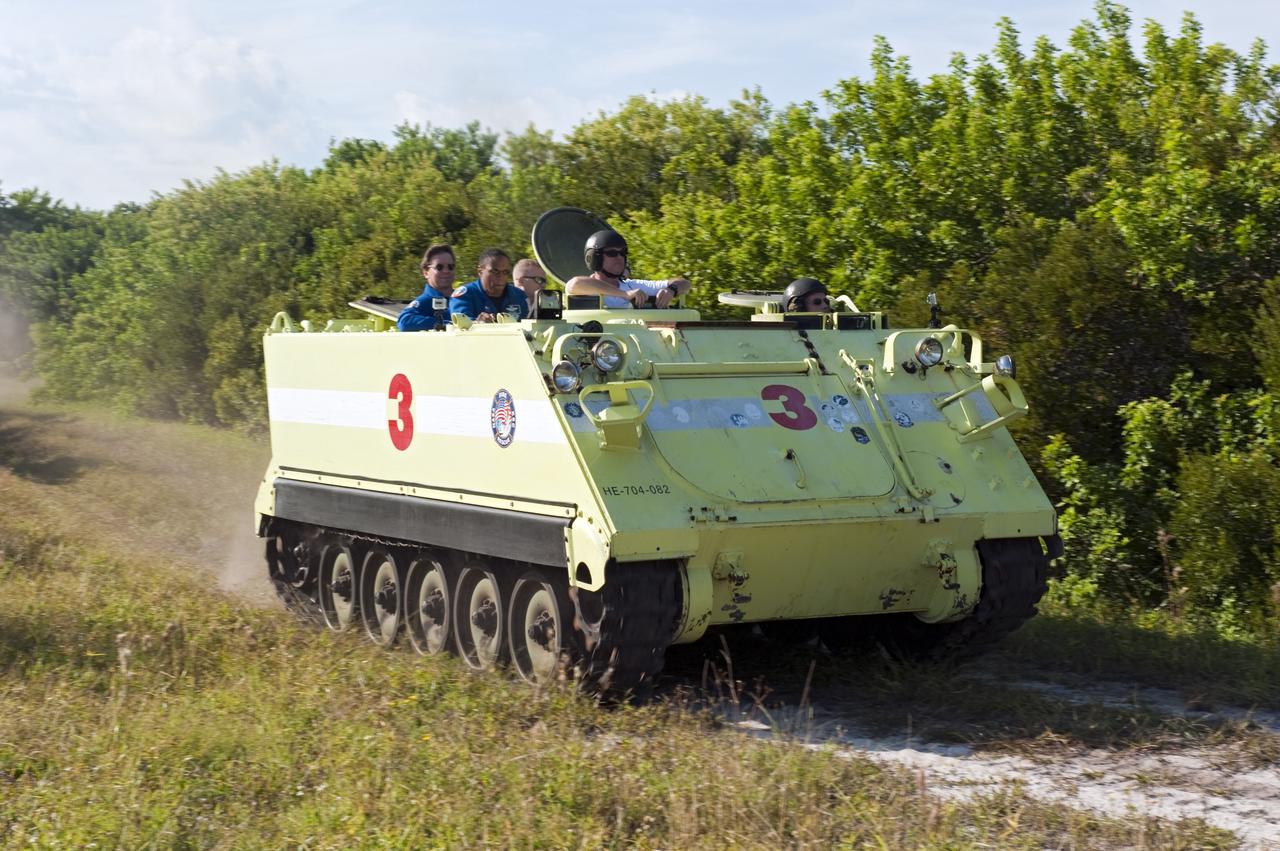
CAPE CANAVERAL, Fla. -- At NASA's Kennedy Space Center in Florida, the crew members of space shuttle Discovery's STS-133 mission go for a ride in an M-113 armored personnel carrier with Battalion Chief David Seymour. An M-113 is kept at the foot of the launch pad in case an emergency egress from the vicinity of the pad is needed, and training on the vehicle is part of the Terminal Countdown Demonstration Test (TCDT). TCDT provides each shuttle crew and launch team an opportunity to participate in various simulated activities, including equipment familiarization and a launch countdown. Space shuttle Discovery and its STS-133 crew will deliver the Permanent Multipurpose Module, packed with supplies and critical spare parts, as well as Robonaut 2, the dexterous humanoid astronaut helper, to the International Space Station. Launch is targeted for Nov. 1 at 4:40 p.m. For more information on the STS-133 mission, visit www.nasa.gov/mission_pages/shuttle/shuttlemissions/sts133/. Photo credit: NASA/Kim Shiflett
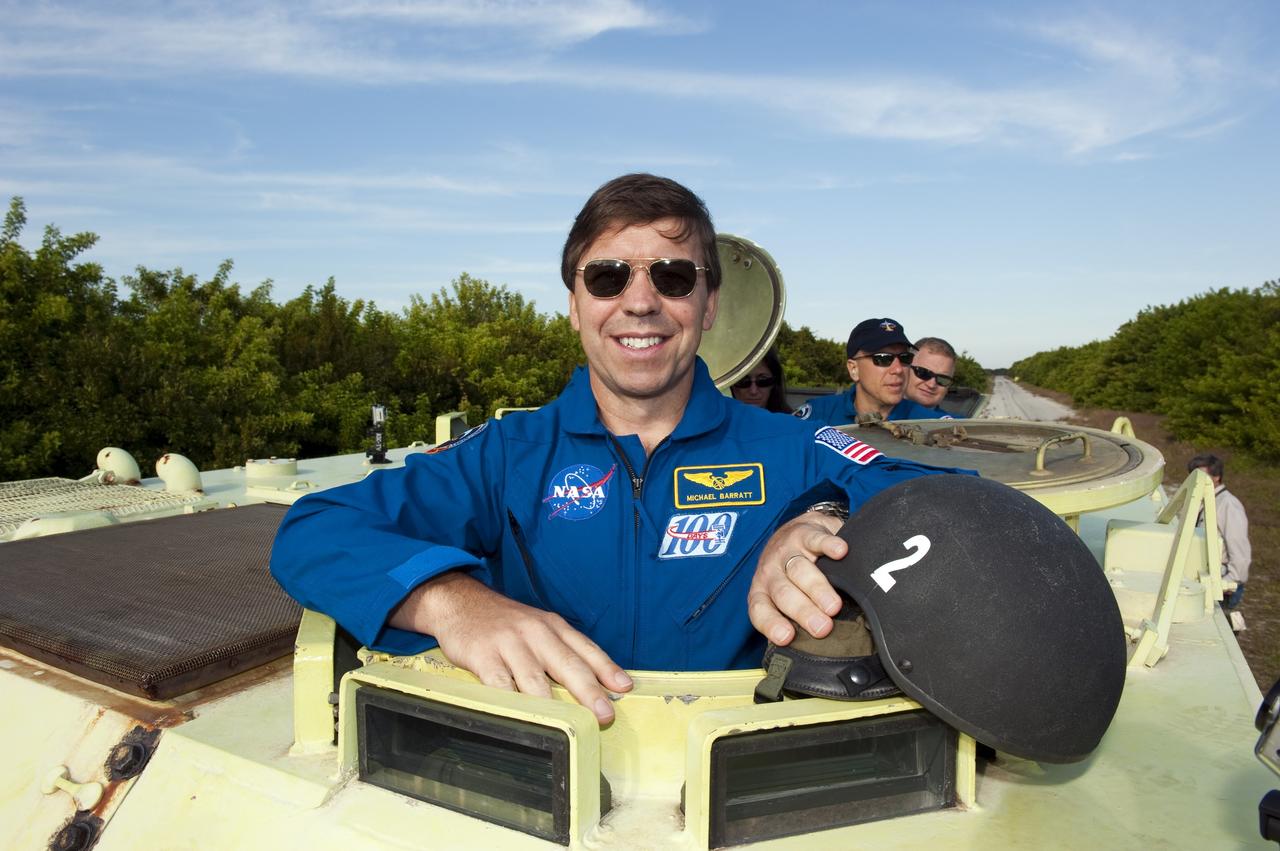
CAPE CANAVERAL, Fla. -- At NASA's Kennedy Space Center in Florida, STS-133 Mission Specialist Michael Barratt prepares to practice driving an M-113 armored personnel carrier. Behind him are Mission Specialist Tim Kopra and Pilot Eric Boe. An M-113 is kept at the foot of the launch pad in case an emergency egress from the vicinity of the pad is needed, and training on the vehicle is part of the Terminal Countdown Demonstration Test (TCDT). TCDT provides each shuttle crew and launch team an opportunity to participate in various simulated activities, including equipment familiarization and a launch countdown. Space shuttle Discovery and its STS-133 crew will deliver the Permanent Multipurpose Module, packed with supplies and critical spare parts, as well as Robonaut 2, the dexterous humanoid astronaut helper, to the International Space Station. Launch is targeted for Nov. 1 at 4:40 p.m. For more information on the STS-133 mission, visit www.nasa.gov/mission_pages/shuttle/shuttlemissions/sts133/. Photo credit: NASA/Kim Shiflett
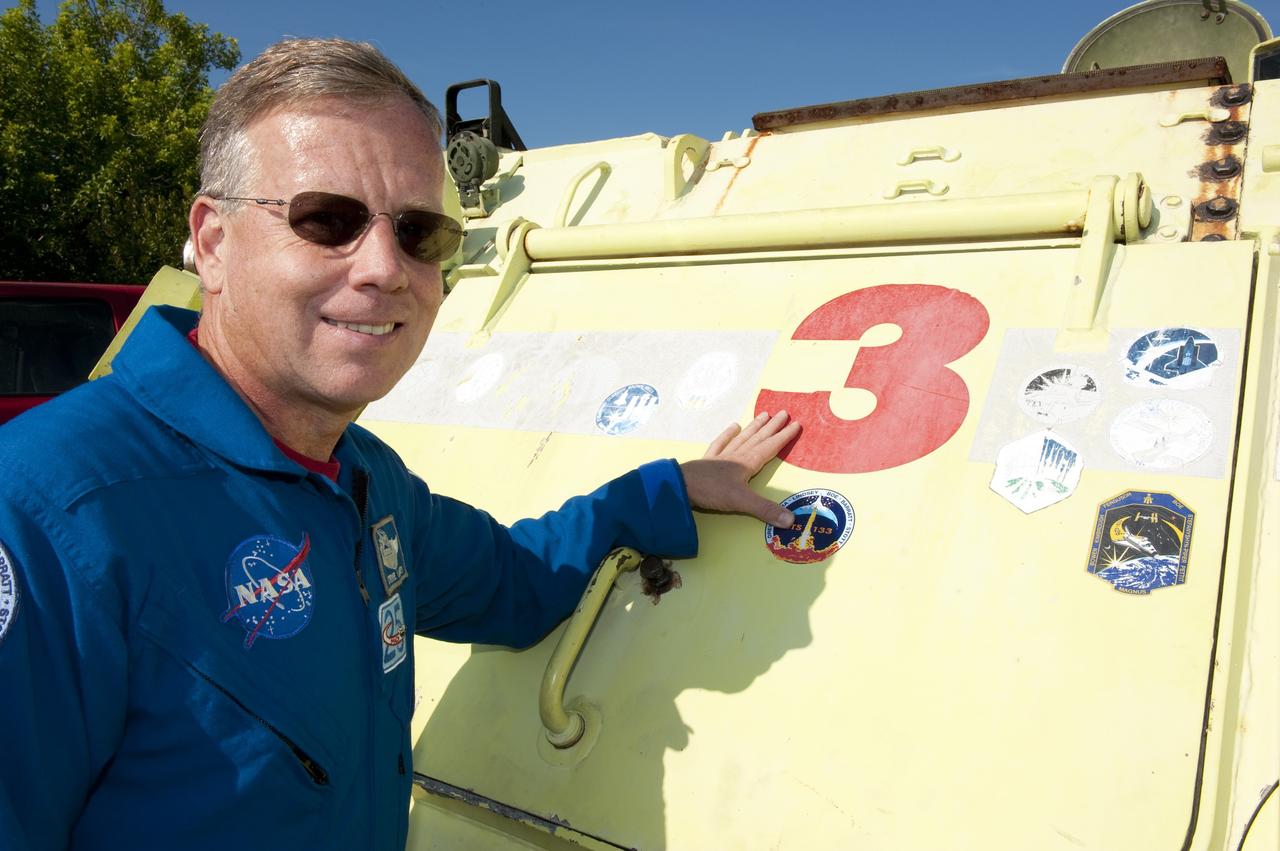
CAPE CANAVERAL, Fla. -- At NASA's Kennedy Space Center in Florida, STS-133 Mission Commander Steve Lindsey points out his crew's mission patch on an M-113 armored personnel carrier. An M-113 is kept at the foot of the launch pad in case an emergency egress from the vicinity of the pad is needed, and driving the vehicle is part of the Terminal Countdown Demonstration Test (TCDT). TCDT provides each shuttle crew and launch team an opportunity to participate in various simulated activities, including equipment familiarization and a launch countdown. Space shuttle Discovery and its STS-133 crew will deliver the Permanent Multipurpose Module, packed with supplies and critical spare parts, as well as Robonaut 2, the dexterous humanoid astronaut helper, to the International Space Station. Launch is targeted for Nov. 1 at 4:40 p.m. For more information on the STS-133 mission, visit www.nasa.gov/mission_pages/shuttle/shuttlemissions/sts133/. Photo credit: NASA/Kim Shiflett
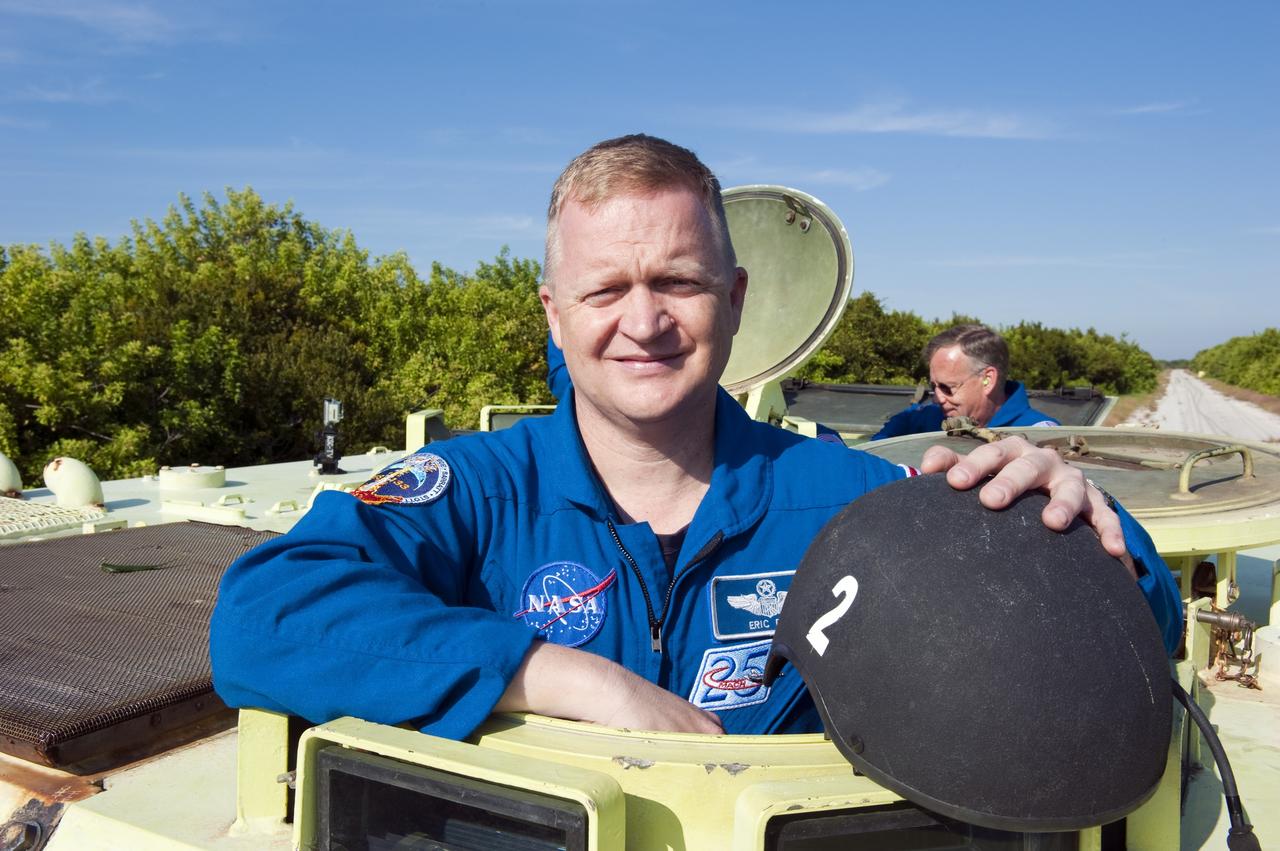
CAPE CANAVERAL, Fla. -- At NASA's Kennedy Space Center in Florida, STS-133 Pilot Eric Boe prepares to practice driving an M-113 armored personnel carrier. Behind him is Commander Steve Lindsey. An M-113 is kept at the foot of the launch pad in case an emergency egress from the vicinity of the pad is needed, and training on the vehicle is part of the Terminal Countdown Demonstration Test (TCDT). TCDT provides each shuttle crew and launch team an opportunity to participate in various simulated activities, including equipment familiarization and a launch countdown. Space shuttle Discovery and its STS-133 crew will deliver the Permanent Multipurpose Module, packed with supplies and critical spare parts, as well as Robonaut 2, the dexterous humanoid astronaut helper, to the International Space Station. Launch is targeted for Nov. 1 at 4:40 p.m. For more information on the STS-133 mission, visit www.nasa.gov/mission_pages/shuttle/shuttlemissions/sts133/. Photo credit: NASA/Kim Shiflett
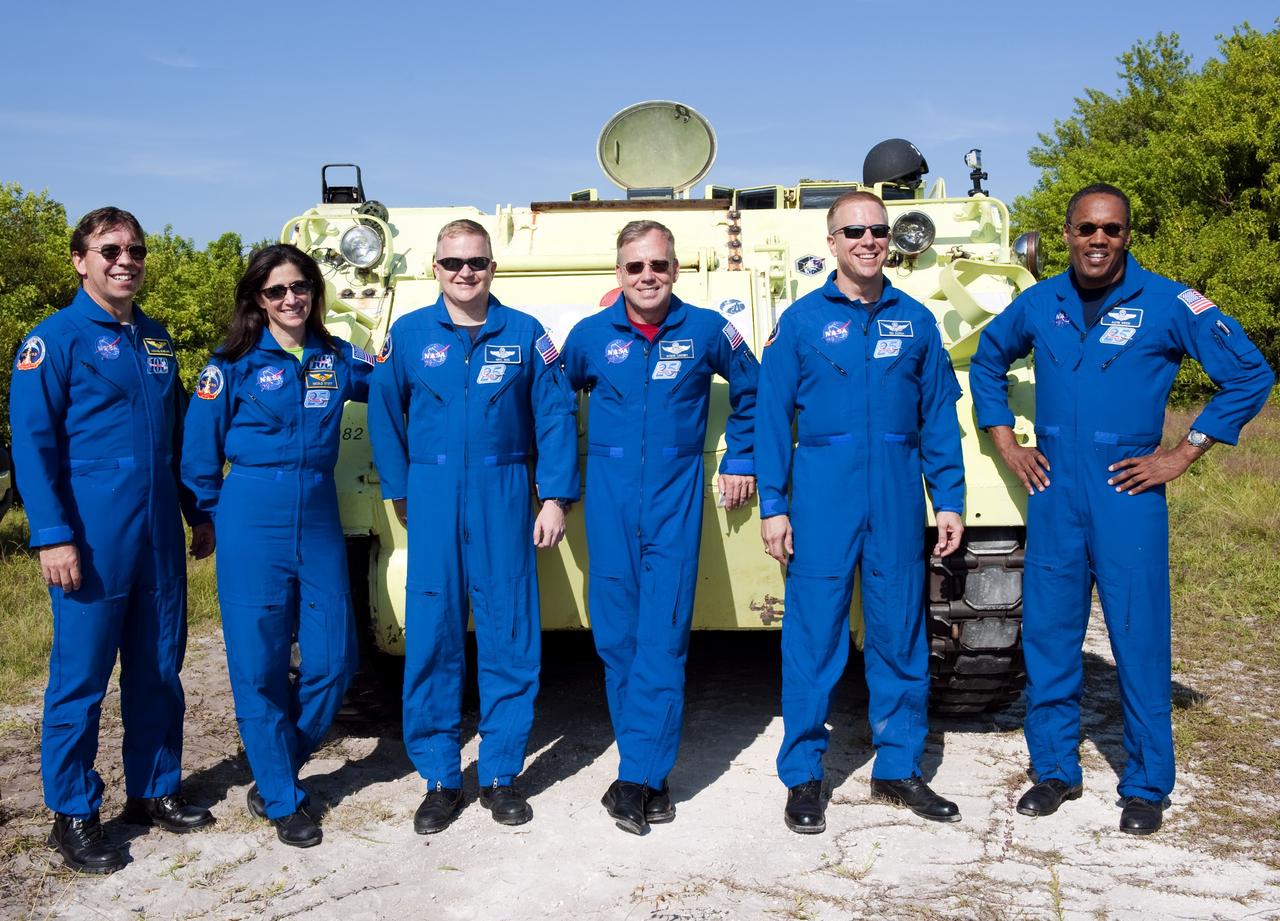
CAPE CANAVERAL, Fla. -- At NASA's Kennedy Space Center in Florida, the crew members of space shuttle Discovery's STS-133 pose in front of an M-113 armored personnel carrier. From left, are Mission Specialists Michael Barratt and Nicole Stott, Pilot Eric Boe, Commander Steve Lindsey, and Mission Specialists Tim Kopra and Alvin Drew. An M-113 is kept at the foot of the launch pad in case an emergency egress from the vicinity of the pad is needed, and training on the vehicle is part of the Terminal Countdown Demonstration Test (TCDT). TCDT provides each shuttle crew and launch team an opportunity to participate in various simulated activities, including equipment familiarization and a launch countdown. Space shuttle Discovery and its STS-133 crew will deliver the Permanent Multipurpose Module, packed with supplies and critical spare parts, as well as Robonaut 2, the dexterous humanoid astronaut helper, to the International Space Station. Launch is targeted for Nov. 1 at 4:40 p.m. For more information on the STS-133 mission, visit www.nasa.gov/mission_pages/shuttle/shuttlemissions/sts133/. Photo credit: NASA/Kim Shiflett
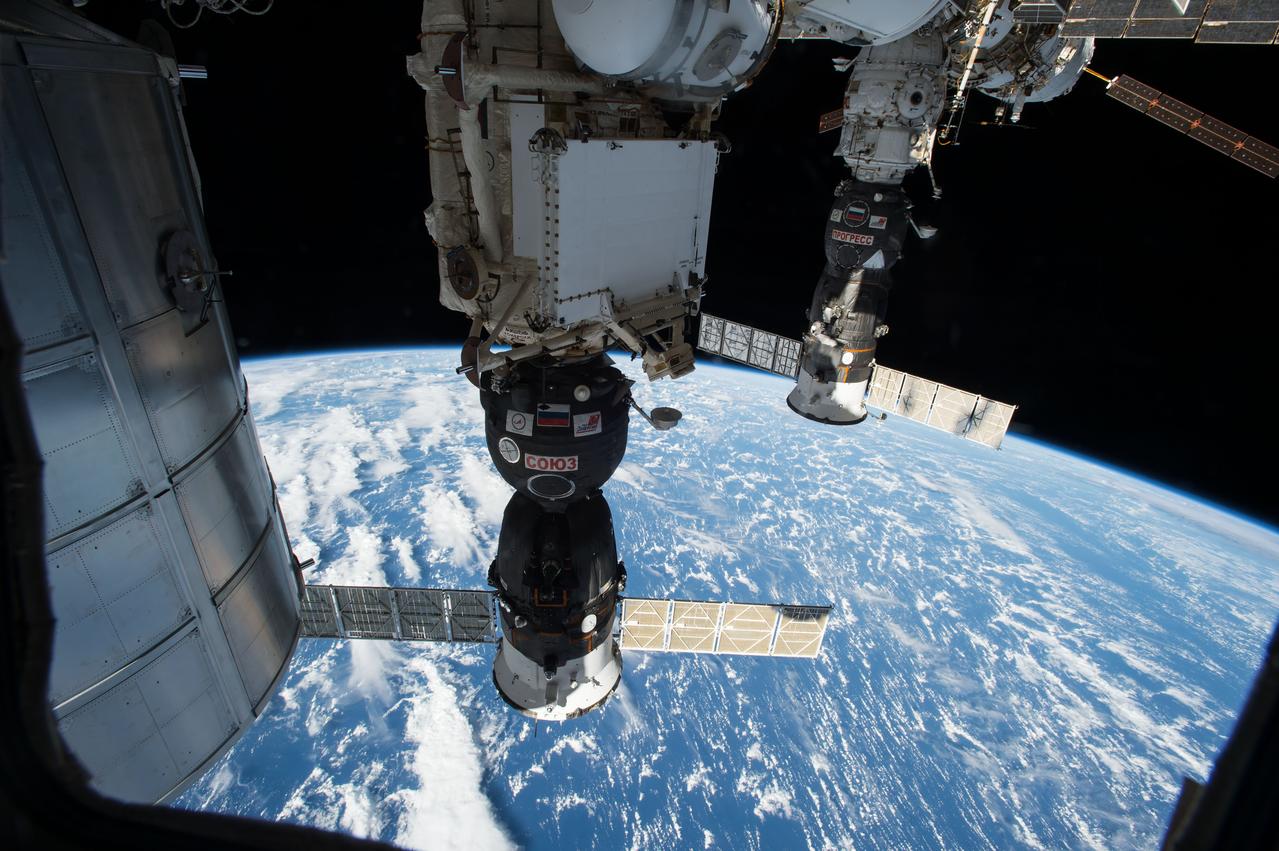
View of the Soyuz TMA-15M spacecraft docked to Rassvet Mini-Research Module 1 (MRM1) and the Progress 57P spacecraft docked to Pirs Docking Compartment (DC1). Portions of the Leonardo Permanent Multipurpose Module (PMM), aft ISS, and an Earth limb are in view. Image was released by astronaut on Twitter.
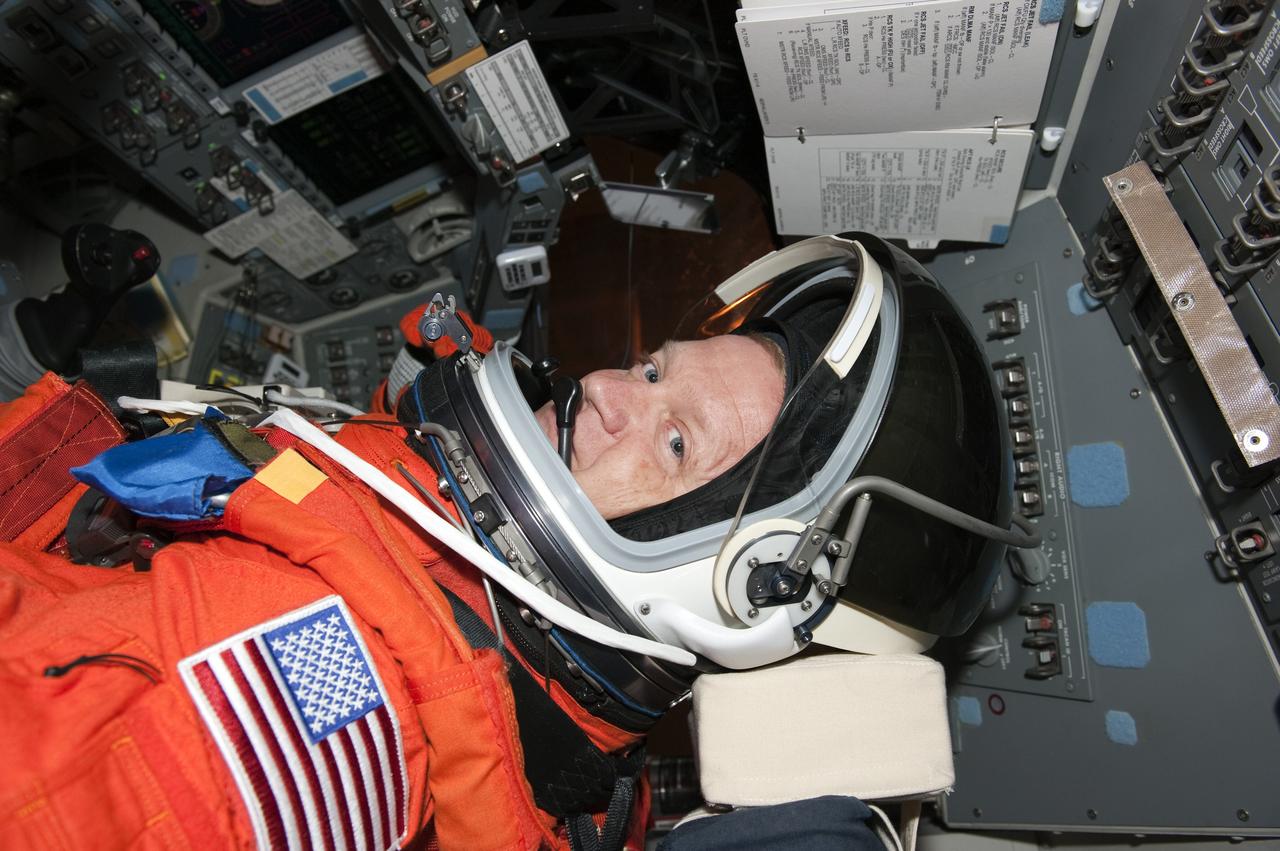
CAPE CANAVERAL, Fla. -- During a simulated launch countdown on Launch Pad 39A at NASA's Kennedy Space Center in Florida, STS-133 Pilot Eric Boe is strapped into his seat on space shuttle Discovery. Next, the crew members will practice escaping the shuttle, in preparation for an unlikely emergency at the pad on launch day. The simulated launch countdown and emergency exit training are part of a week-long Terminal Countdown Demonstration Test (TCDT). Discovery and its STS-133 crew will deliver the Permanent Multipurpose Module, packed with supplies and critical spare parts, as well as Robonaut 2, the dexterous humanoid astronaut helper, to the International Space Station. Launch is targeted for Nov. 1 at 4:40 p.m. For more information on the STS-133 mission, visit www.nasa.gov/mission_pages/shuttle/shuttlemissions/sts133/. Photo credit: NASA/Kim Shiflett
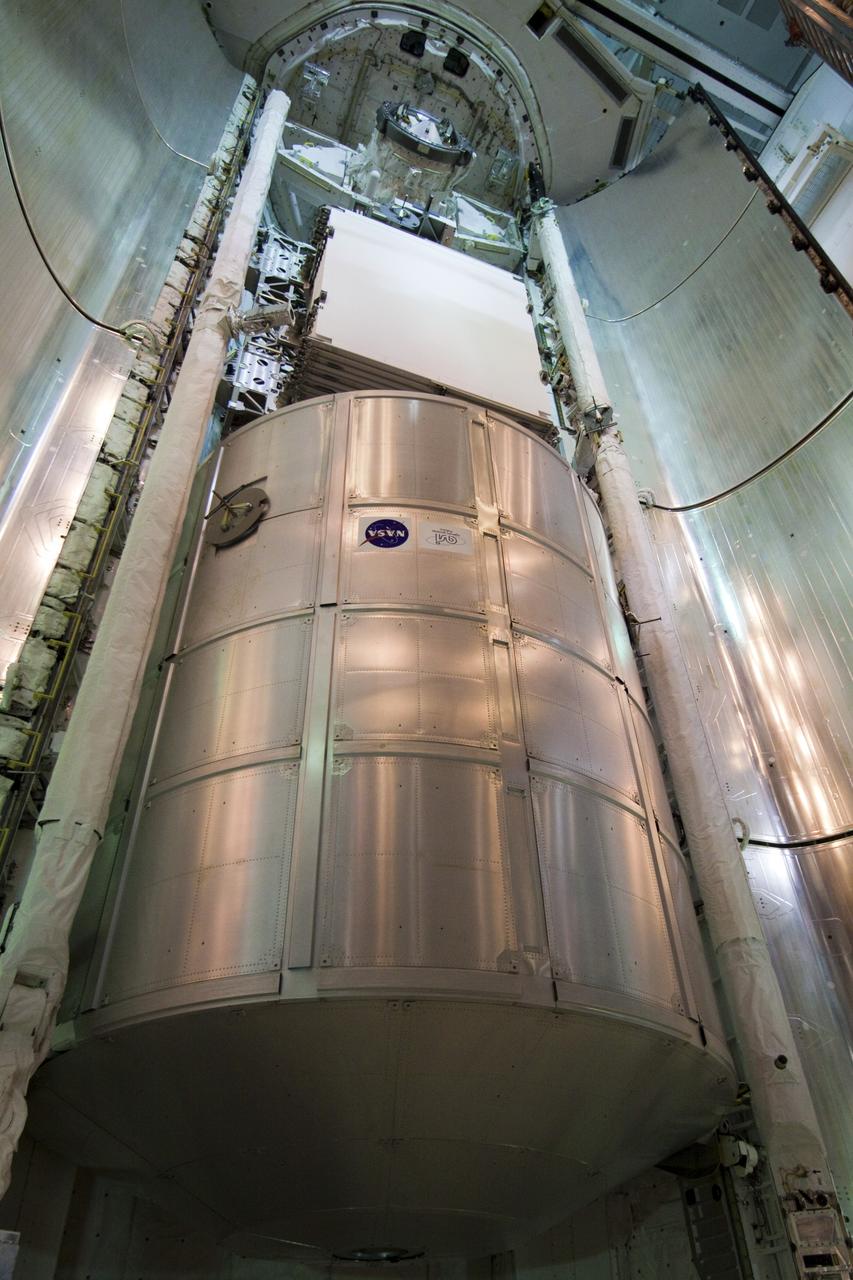
CAPE CANAVERAL, Fla. -- On Launch Pad 39A at NASA's Kennedy Space Center in Florida, the clamshell doors of space shuttle Discovery's payload bay are ready to be closed in preparation for the STS-133 launch to the International Space Station. Targeted to launch Nov. 1, STS-133 will carry the Permanent Multipurpose Module (PMM) packed with supplies and critical spare parts, as well as Robonaut 2 (R2) to the station. Photo credit: NASA/Jack Pfaller
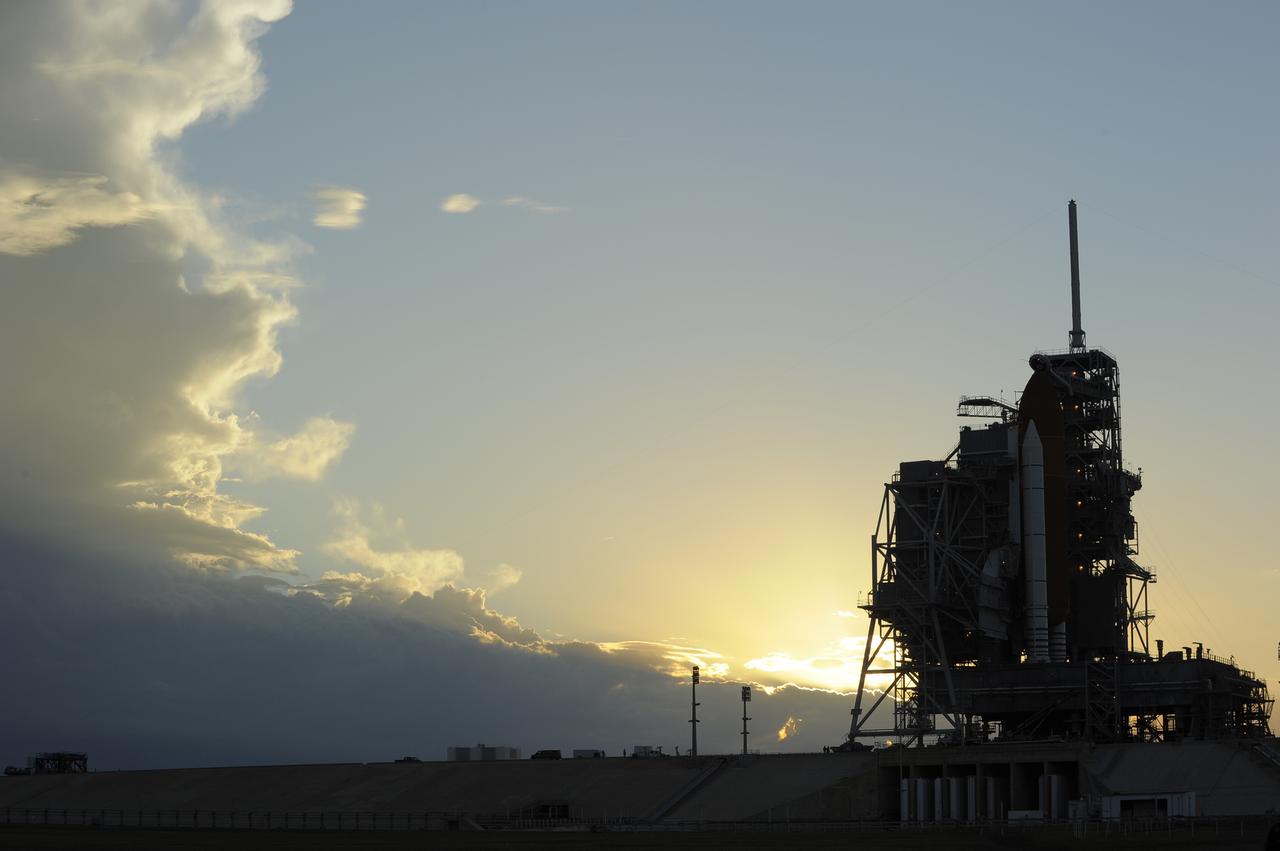
CAPE CANAVERAL, Fla. -- Storm clouds begin to move in over Launch Pad 39A at NASA's Kennedy Space Center in Florida, postponing the retraction of the pad's rotating service structure, which would reveal space shuttle Discovery. The structure provides weather protection and access to the shuttle while it awaits lift off on the pad. RSS "rollback," as it's called, will begin again after the lightning-producing clouds pass. Launch of Discovery on the STS-133 mission to the International Space Station is set for 3:29 p.m. on Nov. 4. During the 11-day mission, Discovery and its six crew members will deliver the Permanent Multipurpose Module, packed with supplies and critical spare parts, as well as Robonaut 2, to the orbiting laboratory. Discovery, which will fly its 39th mission, is scheduled to be retired following STS-133. This will be the 133rd Space Shuttle Program mission and the 35th shuttle voyage to the space station. For more information on STS-133, visit www.nasa.gov/mission_pages/shuttle/shuttlemissions/sts133/. Photo credit: NASA/Kim Shiflett
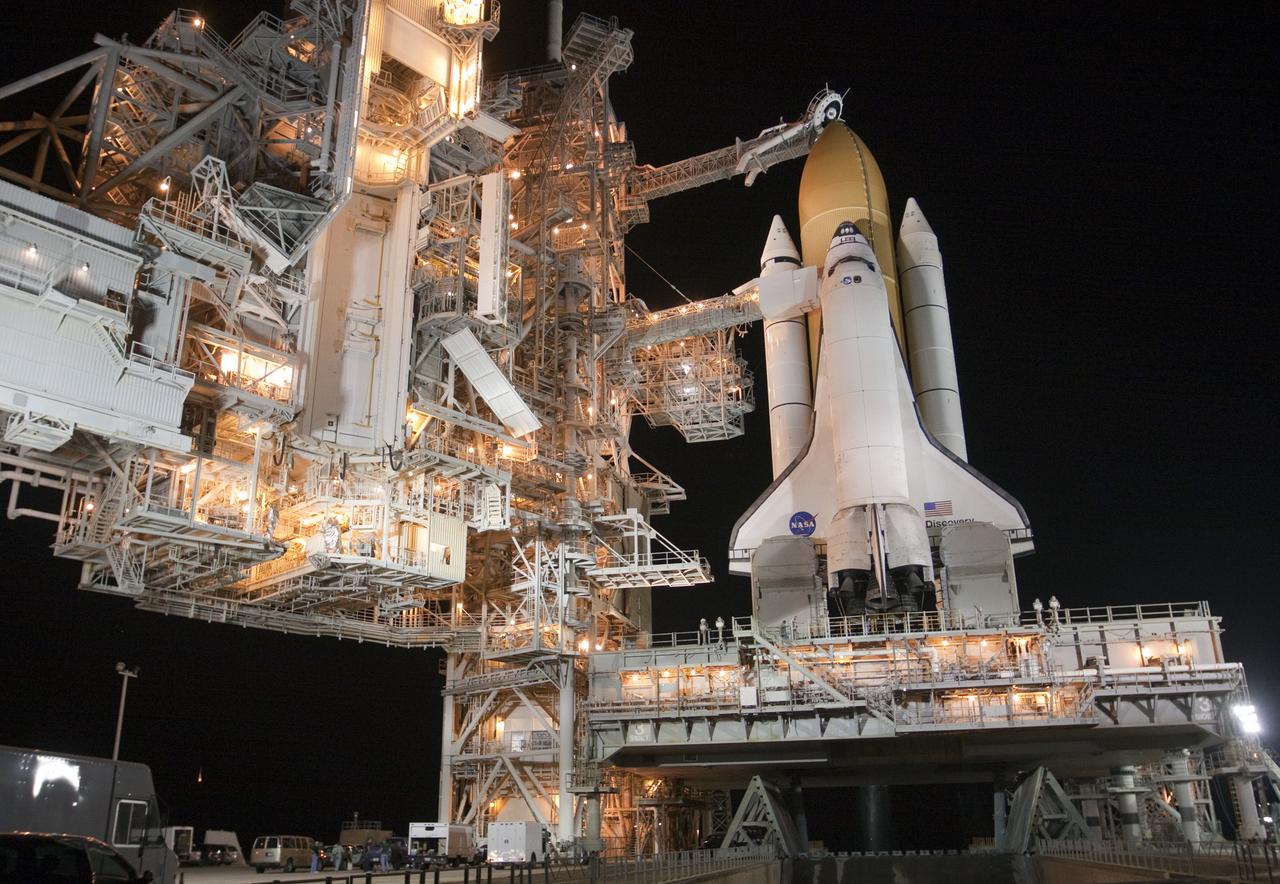
CAPE CANAVERAL, Fla. -- At NASA's Kennedy Space Center in Florida, space shuttle Discovery is visible on Launch Pad 39A following the retraction of the rotating service structure. The structure provides weather protection and access to the shuttle while it awaits lift off on the pad. RSS "rollback," as it's called, was delayed for a few hours to allow a lightning-producing storm cloud to pass. Launch of Discovery on the STS-133 mission to the International Space Station is set for 3:29 p.m. on Nov. 4. During the 11-day mission, Discovery and its six crew members will deliver the Permanent Multipurpose Module, packed with supplies and critical spare parts, as well as Robonaut 2, to the orbiting laboratory. Discovery, which will fly its 39th mission, is scheduled to be retired following STS-133. This will be the 133rd Space Shuttle Program mission and the 35th shuttle voyage to the space station. For more information on STS-133, visit www.nasa.gov/mission_pages/shuttle/shuttlemissions/sts133/. Photo credit: NASA/Jack Pfaller
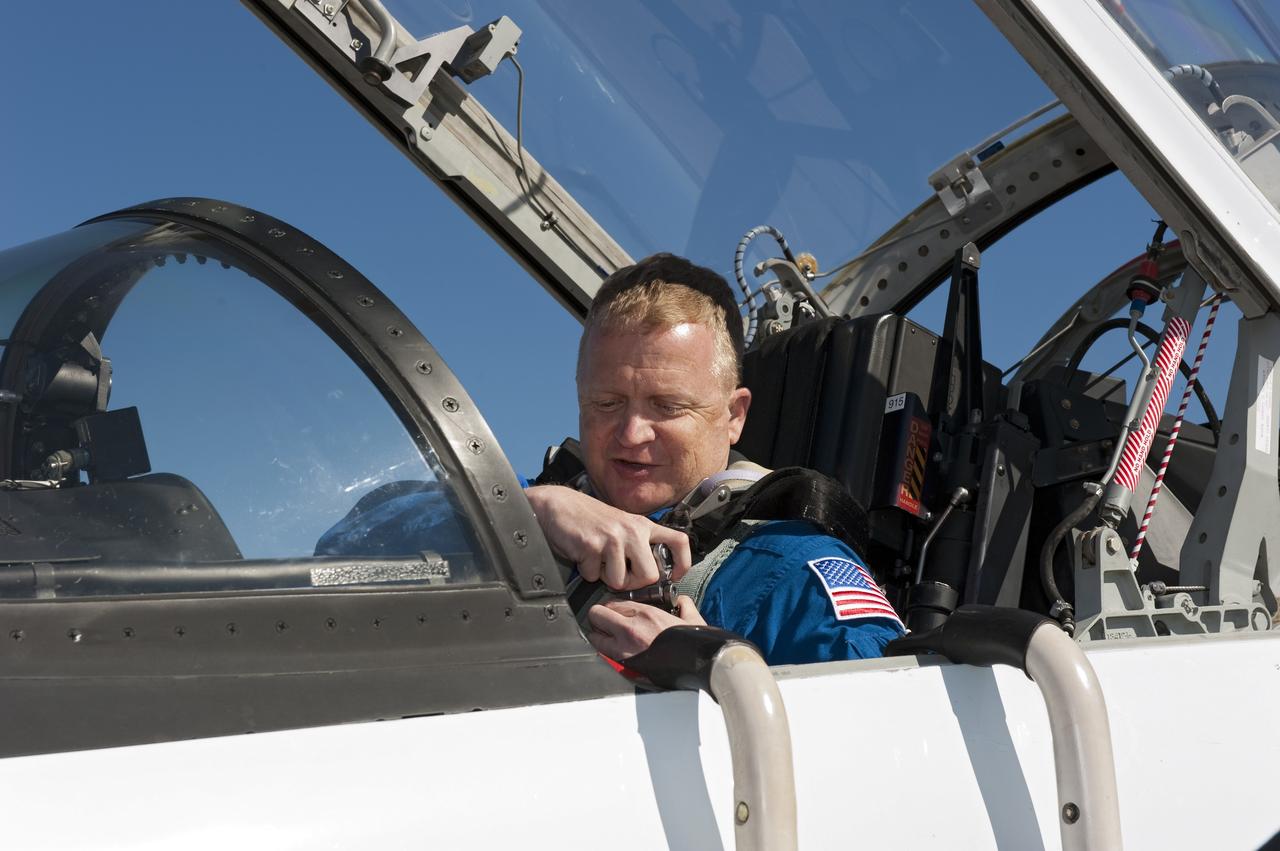
CAPE CANAVERAL, Fla. -- Space shuttle Discovery's STS-133 Pilot Eric Boe prepares to depart NASA's Kennedy Space Center in Florida in a T-38 training jet. Boe and his five crewmates will wait until at least Nov. 30 to launch to the International Space Station because a leak was detected at the Ground Umbilical Carrier Plate (GUCP) while Discovery's external fuel tank was being loaded for launch on Nov. 5. The GUCP is an attachment point between the external tank and a pipe that carries gaseous hydrogen safely away from the shuttle to the flare stack, where it is burned off. Engineers and managers also will evaluate a crack in the foam on the external tank. During the 11-day mission, STS-133 will deliver the Permanent Multipurpose Module, packed with supplies and critical spare parts, as well as Robonaut 2, to the orbiting laboratory. Discovery, which will fly its 39th mission, is scheduled to be retired following STS-133. This will be the 133rd Space Shuttle Program mission and the 35th shuttle voyage to the space station. For more information on STS-133, visit www.nasa.gov/mission_pages/shuttle/shuttlemissions/sts133/. Photo credit: NASA/Kim Shiflett

CAPE CANAVERAL, Fla. -- While performing touch-and-go landings over the Shuttle Landing Facility runway, STS-133 Commander Steve Lindsey and Pilot Eric Boe enjoyed a perfect sunset over NASA's Kennedy Space Center in Florida. Lindsey and Boe flew two Shuttle Training Aircraft (STA), which are Gulfstream II business jets modified to mimic the shuttle's handling during the final phase of landing. Practice landings are part of the Terminal Countdown Demonstration Test (TCDT), which provides each shuttle crew and launch team an opportunity to participate in various simulated activities, including equipment familiarization and emergency training at the launch pad. Space shuttle Discovery and its STS-133 crew will deliver the Permanent Multipurpose Module, packed with supplies and critical spare parts, as well as Robonaut 2, the dexterous humanoid astronaut helper, to the International Space Station. Launch is targeted for Nov. 1 at 4:40 p.m. For more information on the STS-133 mission, visit www.nasa.gov/mission_pages/shuttle/shuttlemissions/sts133/. Photo credit: NASA/Jack Pfaller
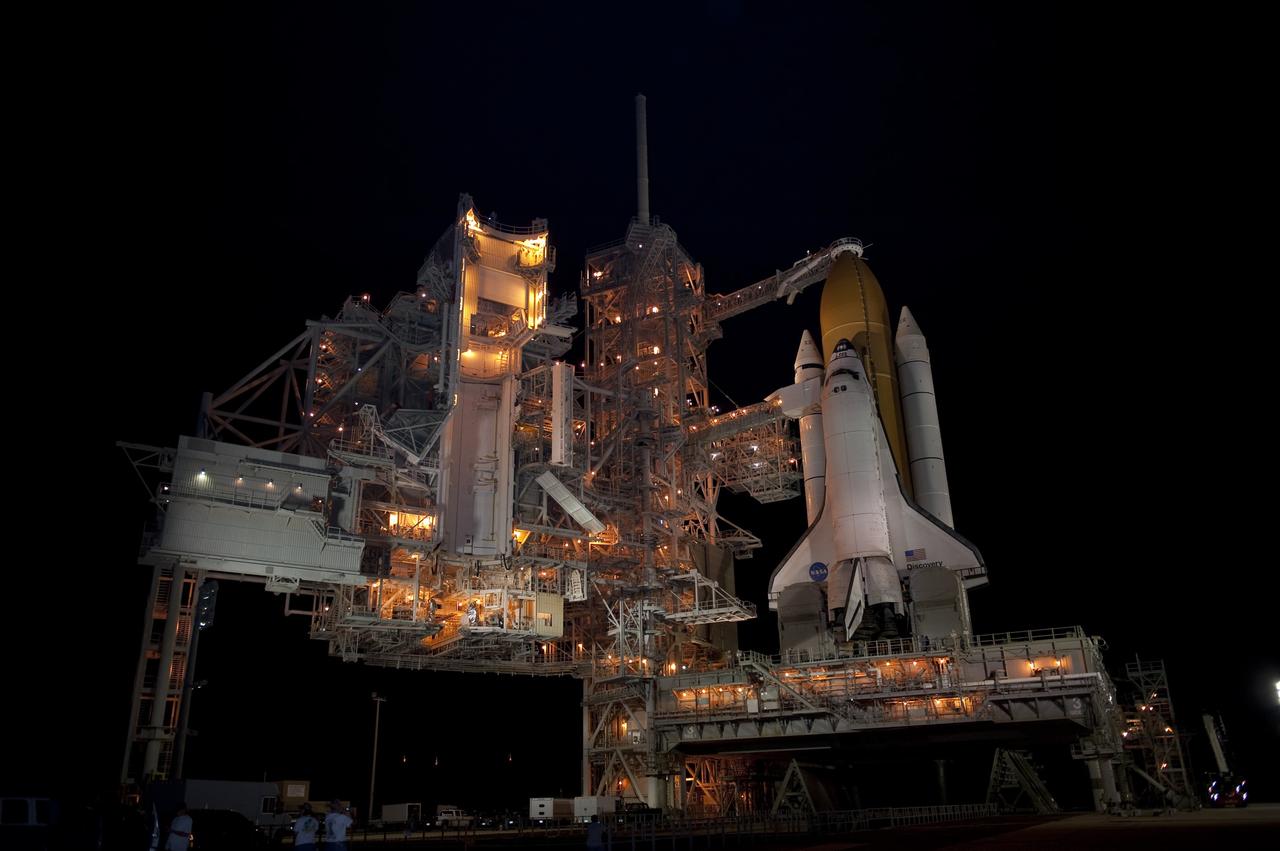
CAPE CANAVERAL, Fla. -- At NASA's Kennedy Space Center in Florida, space shuttle Discovery is visible on Launch Pad 39A following the retraction of the rotating service structure. The structure provides weather protection and access to the shuttle while it awaits lift off on the pad. RSS "rollback," as it's called, was delayed for a few hours to allow a lightning-producing storm cloud to pass. Launch of Discovery on the STS-133 mission to the International Space Station is set for 3:29 p.m. on Nov. 4. During the 11-day mission, Discovery and its six crew members will deliver the Permanent Multipurpose Module, packed with supplies and critical spare parts, as well as Robonaut 2, to the orbiting laboratory. Discovery, which will fly its 39th mission, is scheduled to be retired following STS-133. This will be the 133rd Space Shuttle Program mission and the 35th shuttle voyage to the space station. For more information on STS-133, visit www.nasa.gov/mission_pages/shuttle/shuttlemissions/sts133/. Photo credit: NASA/Kim Shiflett
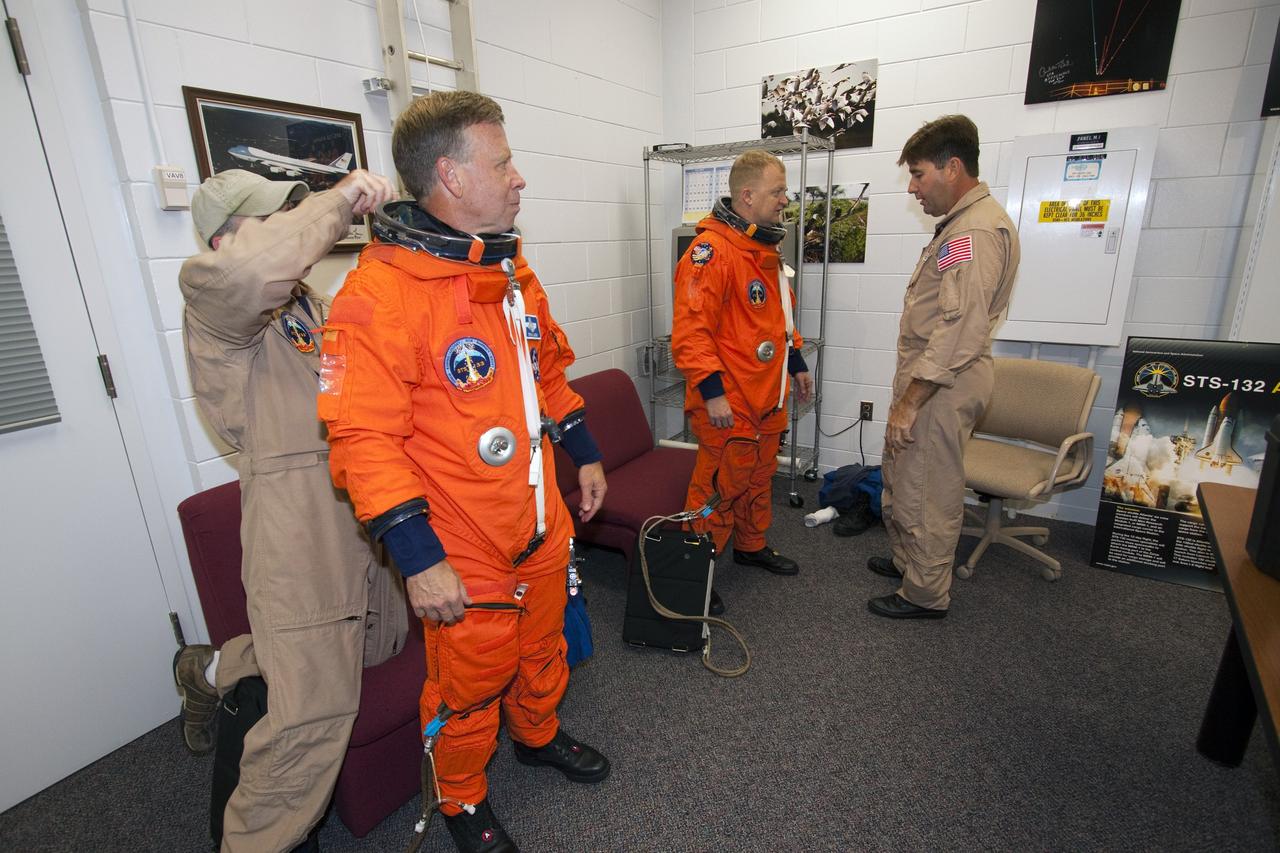
CAPE CANAVERAL, Fla. -- At NASA's Kennedy Space Center in Florida, STS-133 Commander Steve Lindsey and Pilot Eric Boe put on their orange flight suits in the Shuttle Landing Facility's Landing Aids Control Building, which is on the south end of the facility's runway. They are preparing to practice landings in Shuttle Training Aircraft, modified Gulfstream II business jets that mimic the shuttle's handling during the final phase of landing. Practice landings are part of the Terminal Countdown Demonstration Test (TCDT), which provides each shuttle crew and launch team an opportunity to participate in various simulated activities, including equipment familiarization and emergency training at the launch pad. Space shuttle Discovery and its STS-133 crew will deliver the Permanent Multipurpose Module, packed with supplies and critical spare parts, as well as Robonaut 2, the dexterous humanoid astronaut helper, to the International Space Station. Launch is targeted for Nov. 1 at 4:40 p.m. For more information on the STS-133 mission, visit www.nasa.gov/mission_pages/shuttle/shuttlemissions/sts133/. Photo credit: NASA/Jack Pfaller
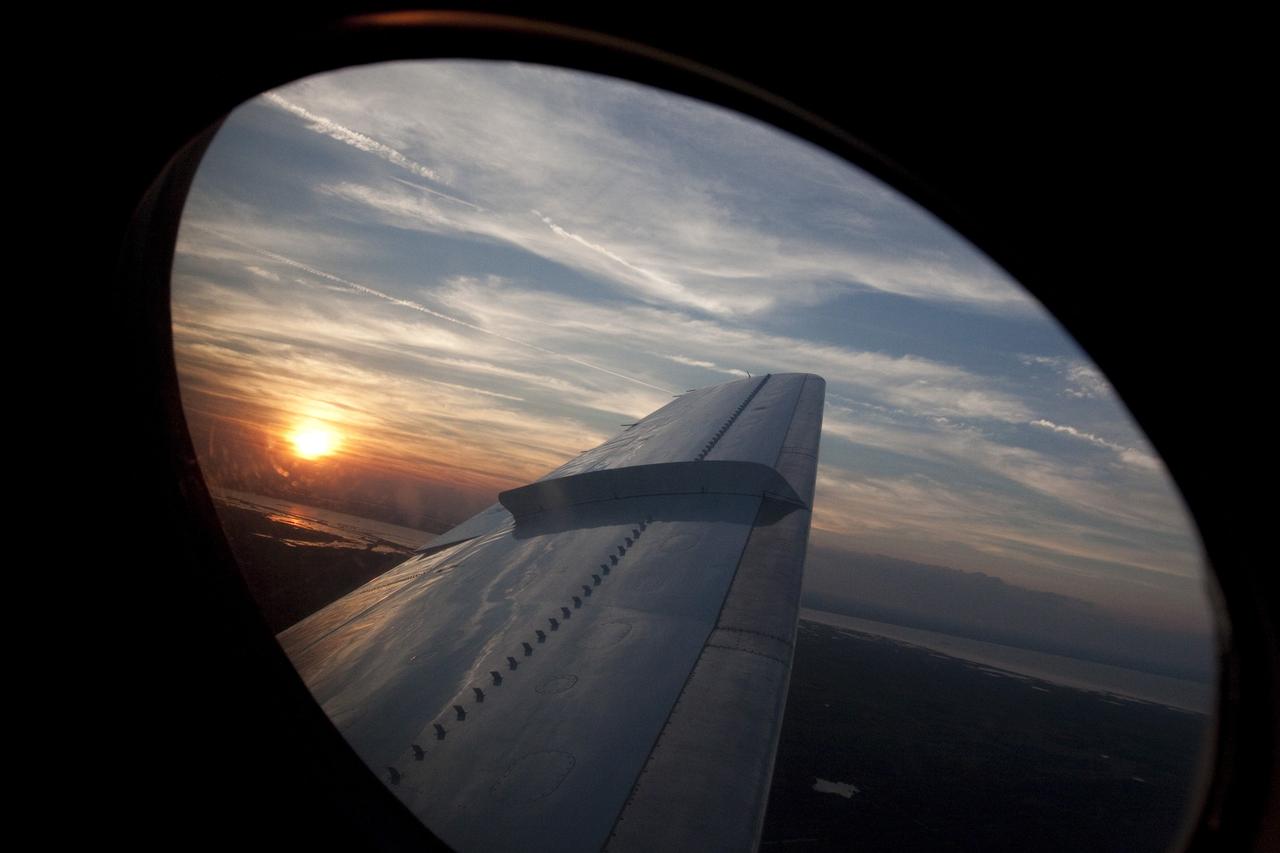
CAPE CANAVERAL, Fla. -- This photo shows the wing of A Shuttle Training Aircraft (STA) as it performs touch-and-go landings on the Shuttle Landing Facility runway at NASA's Kennedy Space Center in Florida. STS-133 Commander Steve Lindsey and Pilot Eric Boe flew two of the Gulfstream II business jets that are modified to mimic the shuttle's handling during the final phase of landing. Practice landings are part of the Terminal Countdown Demonstration Test (TCDT), which provides each shuttle crew and launch team an opportunity to participate in various simulated activities, including equipment familiarization and emergency training at the launch pad. Space shuttle Discovery and its STS-133 crew will deliver the Permanent Multipurpose Module, packed with supplies and critical spare parts, as well as Robonaut 2, the dexterous humanoid astronaut helper, to the International Space Station. Launch is targeted for Nov. 1 at 4:40 p.m. For more information on the STS-133 mission, visit www.nasa.gov/mission_pages/shuttle/shuttlemissions/sts133/. Photo credit: NASA/Jack Pfaller
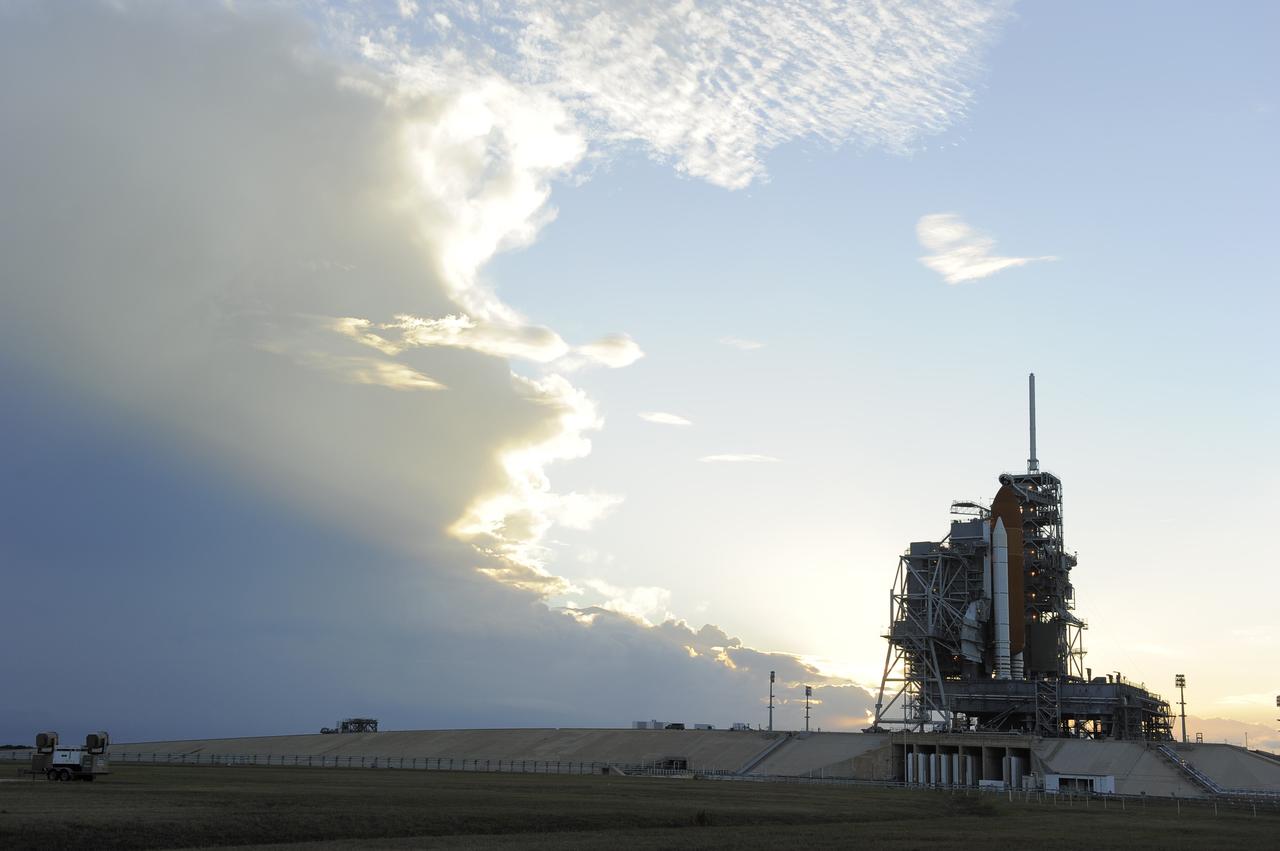
CAPE CANAVERAL, Fla. -- Storm clouds move in over Launch Pad 39A at NASA's Kennedy Space Center in Florida, postponing the retraction of the pad's rotating service structure, which would reveal space shuttle Discovery. The structure provides weather protection and access to the shuttle while it awaits lift off on the pad. RSS "rollback," as it's called, will begin again after the lightning-producing clouds pass. Launch of Discovery on the STS-133 mission to the International Space Station is set for 3:29 p.m. on Nov. 4. During the 11-day mission, Discovery and its six crew members will deliver the Permanent Multipurpose Module, packed with supplies and critical spare parts, as well as Robonaut 2, to the orbiting laboratory. Discovery, which will fly its 39th mission, is scheduled to be retired following STS-133. This will be the 133rd Space Shuttle Program mission and the 35th shuttle voyage to the space station. For more information on STS-133, visit www.nasa.gov/mission_pages/shuttle/shuttlemissions/sts133/. Photo credit: NASA/Kim Shiflett
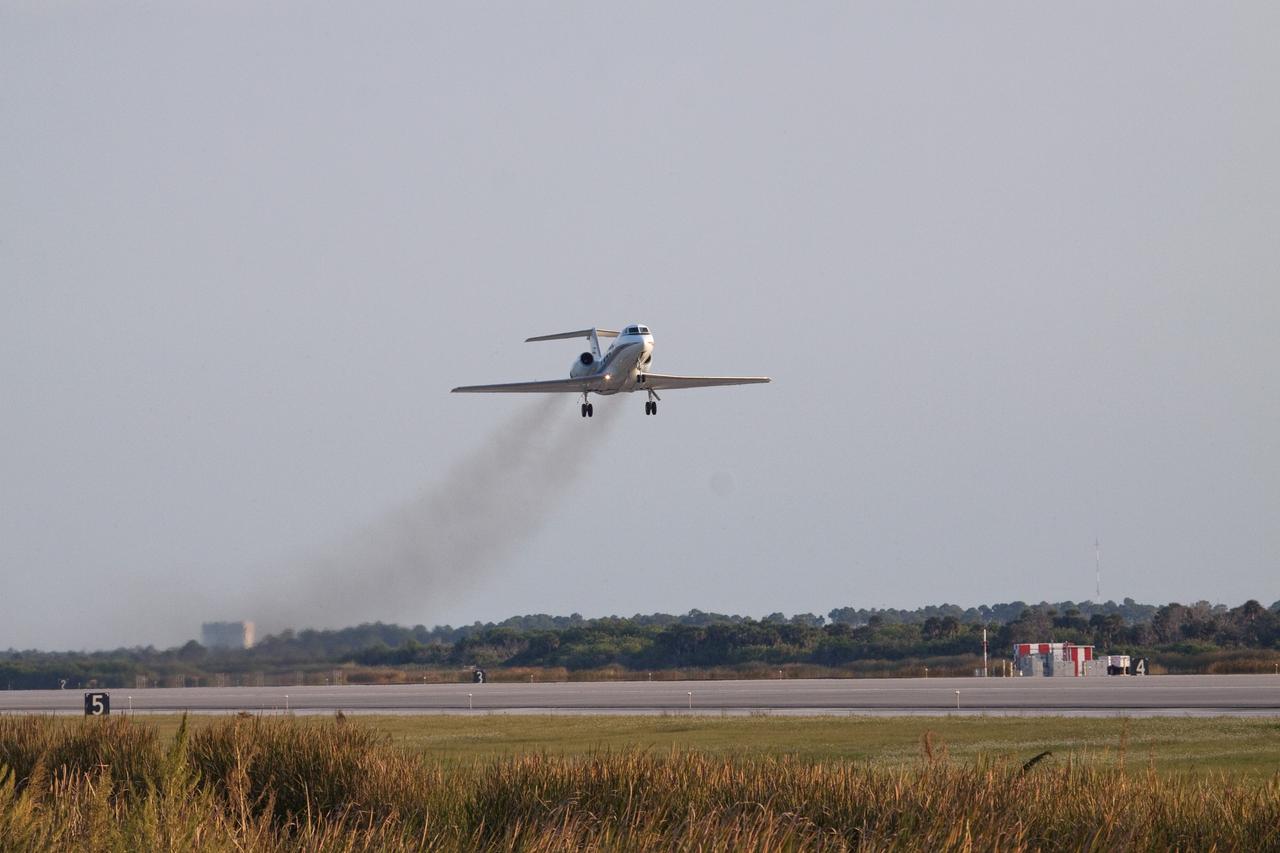
CAPE CANAVERAL, Fla. -- A Shuttle Training Aircraft (STA) takes off the Shuttle Landing Facility runway at NASA's Kennedy Space Center in Florida. STS-133 Commander Steve Lindsey and Pilot Eric Boe are flying the modified Gulfstream II business jets to mimic the shuttle's handling during the final phase of landing. Practice landings are part of the Terminal Countdown Demonstration Test (TCDT), which provides each shuttle crew and launch team an opportunity to participate in various simulated activities, including equipment familiarization and emergency training at the launch pad. Space shuttle Discovery and its STS-133 crew will deliver the Permanent Multipurpose Module, packed with supplies and critical spare parts, as well as Robonaut 2, the dexterous humanoid astronaut helper, to the International Space Station. Launch is targeted for Nov. 1 at 4:40 p.m. For more information on the STS-133 mission, visit www.nasa.gov/mission_pages/shuttle/shuttlemissions/sts133/. Photo credit: NASA/Jack Pfaller
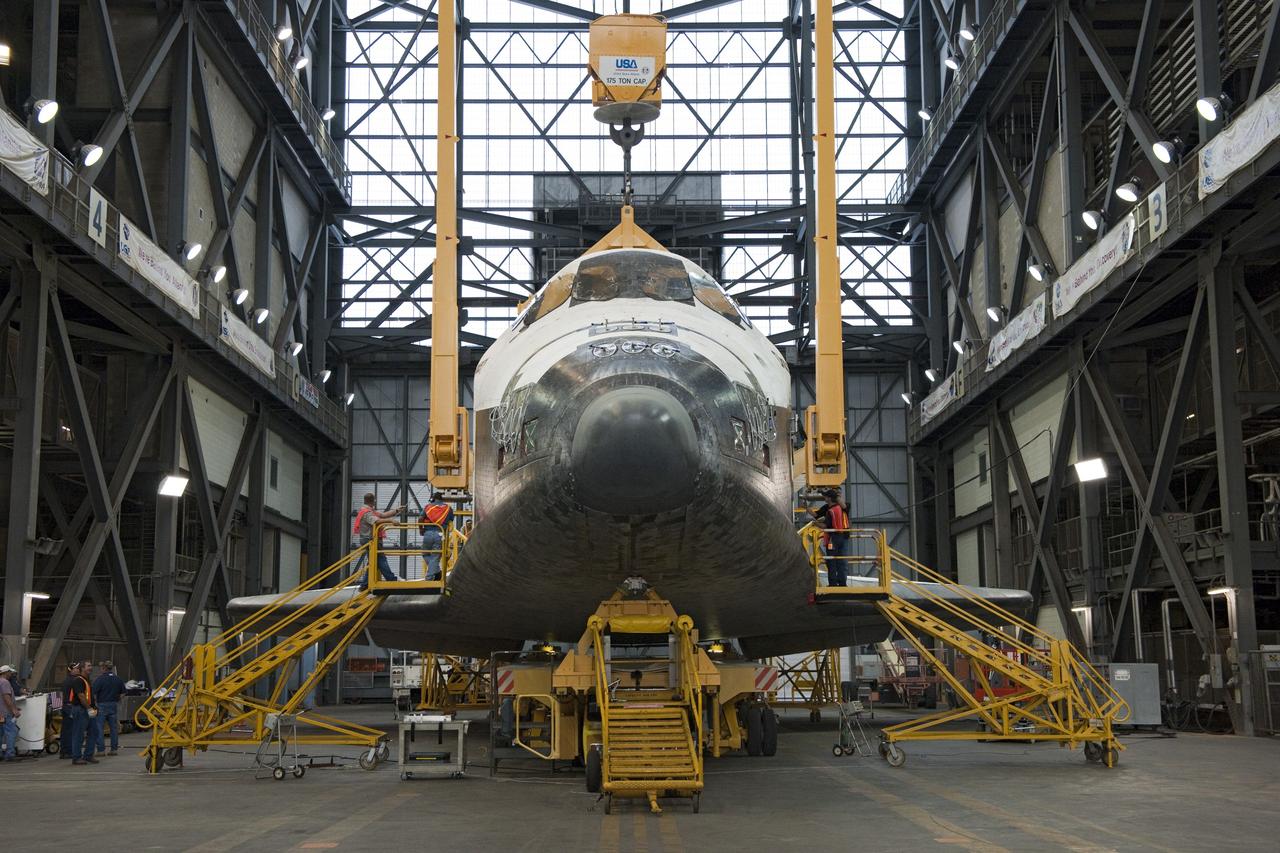
CAPE CANAVERAL, Fla. -- At NASA's Kennedy Space Center in Florida, workers in the Vehicle Assembly Building begin to secure a large yellow, metal sling to shuttle Discovery for its lift from the transfer aisle into High Bay 3. In the bay, the shuttle will be attached to its external fuel tank and solid rocket boosters. The operation began Sept. 9 and wrapped up early Sept. 10. Later, Discovery will "roll out" to Launch Pad 39A in preparation for its launch to the International Space Station on the STS-133 mission. Targeted to liftoff Nov. 1, Discovery will take the Permanent Multipurpose Module (PMM) packed with supplies and critical spare parts, as well as Robonaut 2 (R2) to the station. Photo credit: NASA/Ben Cooper
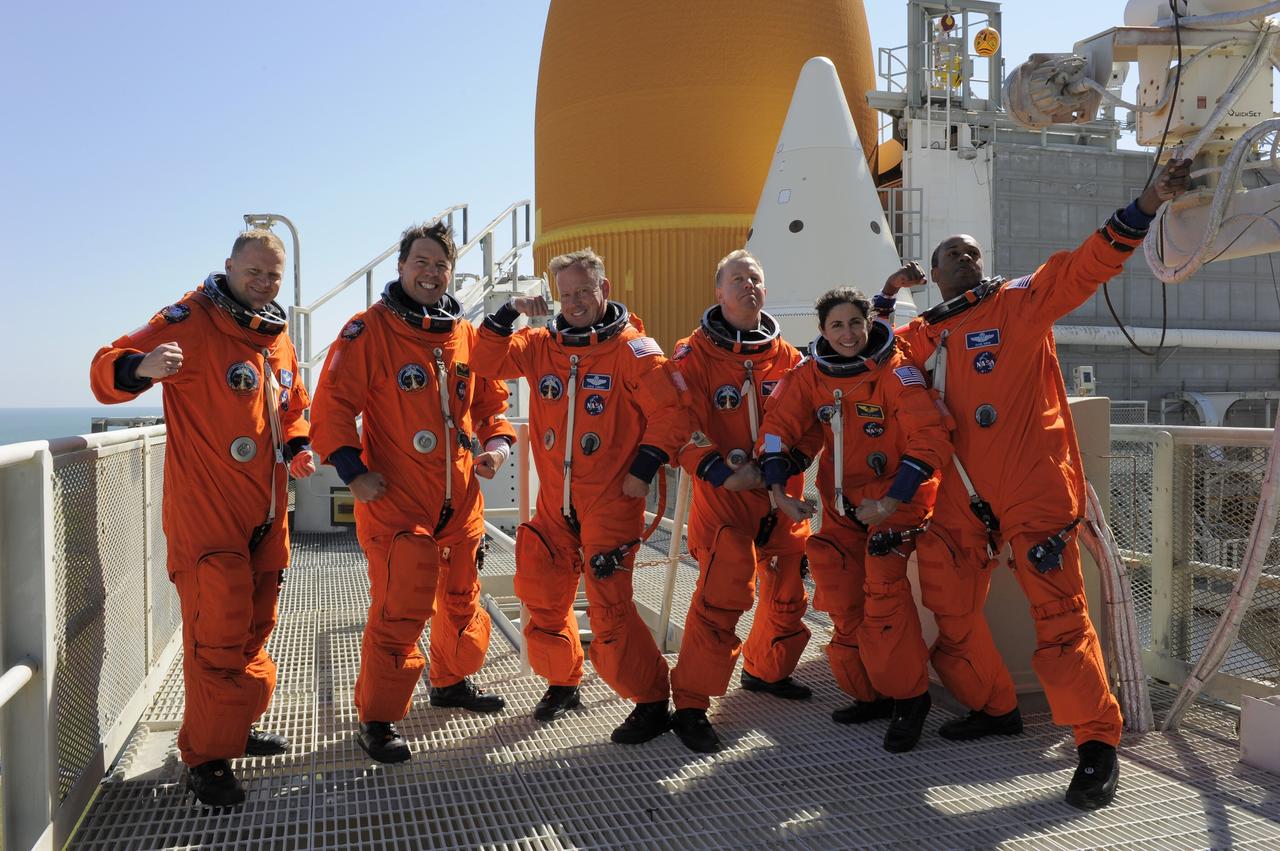
CAPE CANAVERAL, Fla. -- At NASA's Kennedy Space Center in Florida, the STS-133 crew takes a break from a simulated launch countdown to ham it up on the 195-foot level of Launch Pad 39A. From left are, Pilot Eric Boe, Mission Specialist Michael Barratt, Commander Steve Lindsey, and Mission Specialists Tim Kopra, Nicole Stott, and Alvin Drew. The simulation is part of a week-long Terminal Countdown Demonstration Test (TCDT). Discovery and its STS-133 crew will deliver the Permanent Multipurpose Module, packed with supplies and critical spare parts, as well as Robonaut 2, the dexterous humanoid astronaut helper, to the International Space Station. Launch is targeted for Nov. 1 at 4:40 p.m. For more information on the STS-133 mission, visit www.nasa.gov/mission_pages/shuttle/shuttlemissions/sts133/. Photo credit: NASA/Kim Shiflett
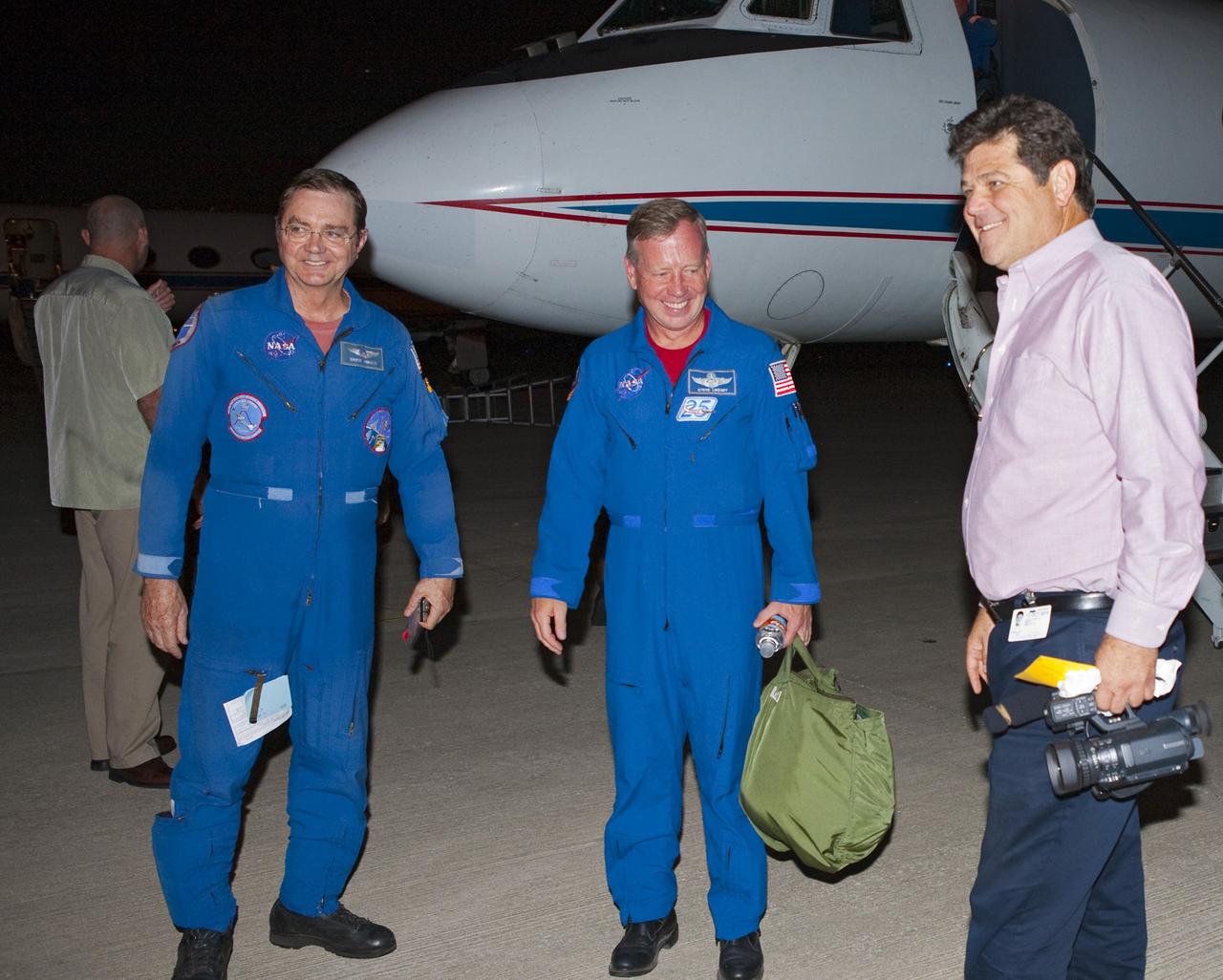
CAPE CANAVERAL, Fla. -- Instructor pilot Bruce Arnold, left, STS-133 Commander Steve Lindsey and space reporter John Zarrella exit a Shuttle Training Aircraft (STA) on the Shuttle Landing Facility runway at NASA's Kennedy Space Center in Florida. Lindsey and Pilot Eric Boe flew two Gulfstream II business jets that are modified to mimic the shuttle's handling during the final phase of landing. Practice landings are part of the Terminal Countdown Demonstration Test (TCDT), which provides each shuttle crew and launch team an opportunity to participate in various simulated activities, including equipment familiarization and emergency training at the launch pad. Space shuttle Discovery and its STS-133 crew will deliver the Permanent Multipurpose Module, packed with supplies and critical spare parts, as well as Robonaut 2, the dexterous humanoid astronaut helper, to the International Space Station. Launch is targeted for Nov. 1 at 4:40 p.m. For more information on the STS-133 mission, visit www.nasa.gov/mission_pages/shuttle/shuttlemissions/sts133/. Photo credit: NASA/Amanda Diller
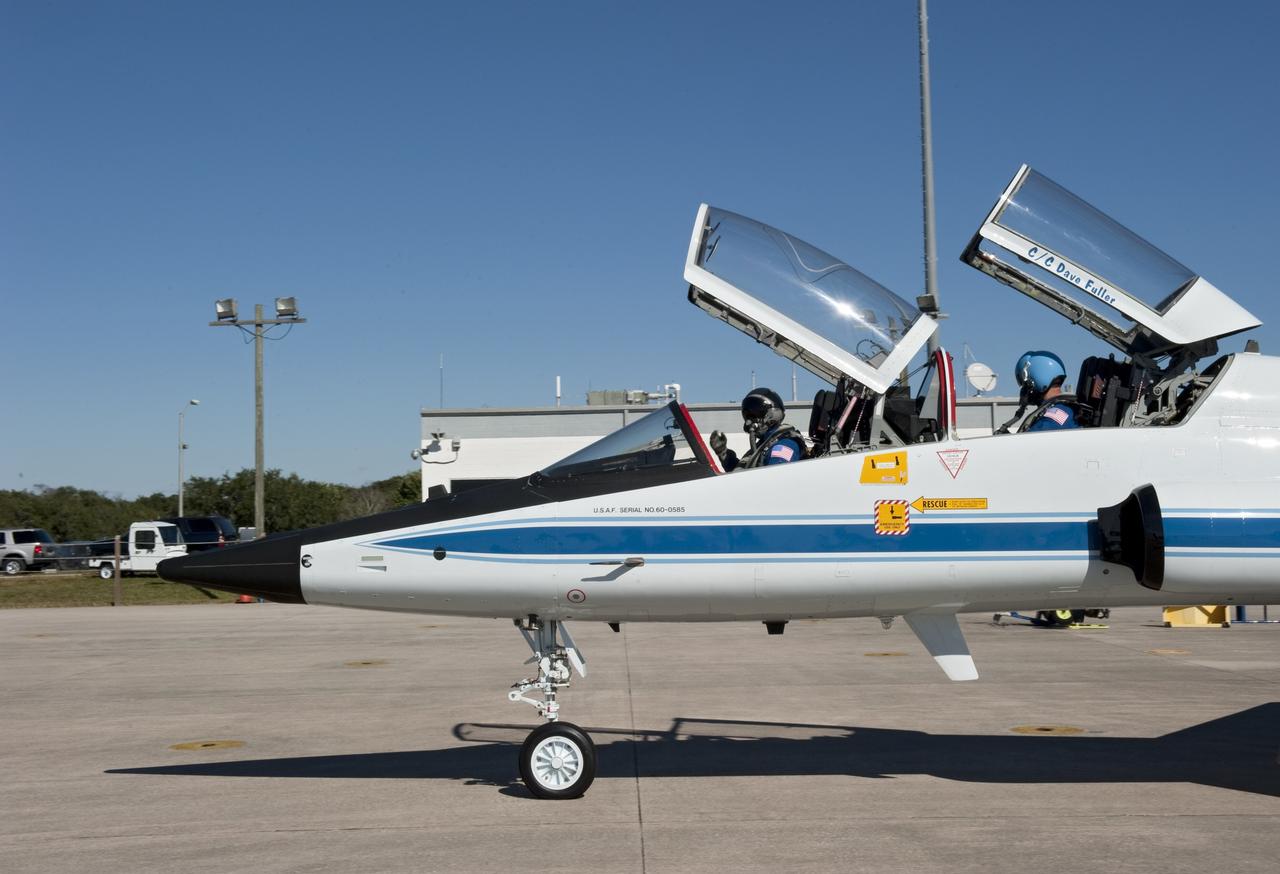
CAPE CANAVERAL, Fla. -- Space shuttle Discovery's STS-133 crew members depart NASA's Kennedy Space Center in Florida in a T-38 training jet. The six-member crew will wait until at least Nov. 30 to launch to the International Space Station because a leak was detected at the Ground Umbilical Carrier Plate (GUCP) while Discovery's external fuel tank was being loaded for launch on Nov. 5. The GUCP is an attachment point between the external tank and a pipe that carries gaseous hydrogen safely away from the shuttle to the flare stack, where it is burned off. Engineers and managers also will evaluate a crack in the foam on the external tank. During the 11-day mission, STS-133 will deliver the Permanent Multipurpose Module, packed with supplies and critical spare parts, as well as Robonaut 2, to the orbiting laboratory. Discovery, which will fly its 39th mission, is scheduled to be retired following STS-133. This will be the 133rd Space Shuttle Program mission and the 35th shuttle voyage to the space station. For more information on STS-133, visit www.nasa.gov/mission_pages/shuttle/shuttlemissions/sts133/. Photo credit: NASA/Kim Shiflett
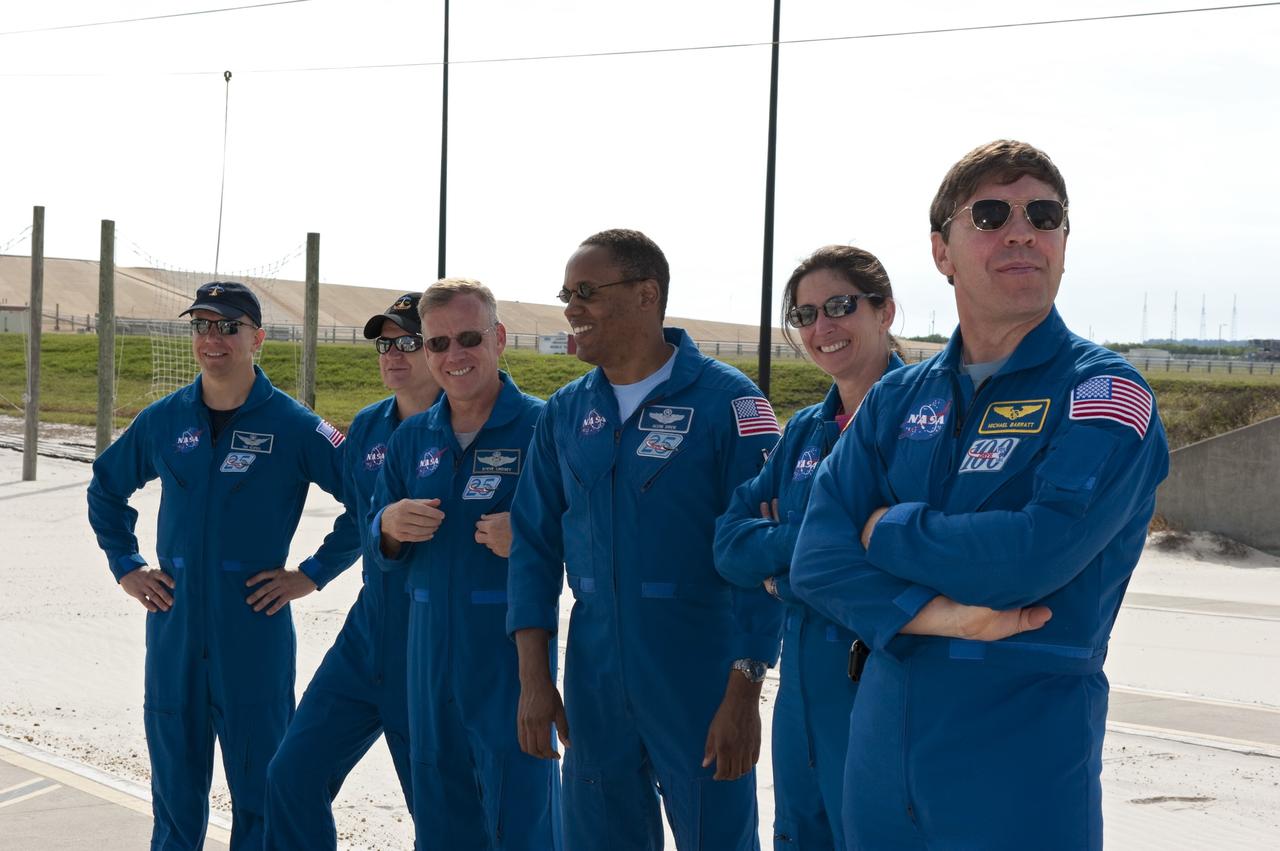
CAPE CANAVERAL, Fla. -- At Launch Pad 39A at NASA's Kennedy Space Center in Florida, members of the STS-133 crew receive instruction by the catch nets for the slidewire baskets at the base of the pad as part of the Terminal Countdown Demonstration Test (TCDT) emergency exit training. From left are Mission Specialist Tim Kopra, Pilot Eric Boe, Commander Steve Lindsey, and Mission Specialists Alvin Drew, Nicole Stott and Michael Barratt. TCDT provides each shuttle crew and launch team an opportunity to participate in various simulated activities, including equipment familiarization and a launch countdown. Space shuttle Discovery and its STS-133 crew will deliver the Permanent Multipurpose Module, packed with supplies and critical spare parts, as well as Robonaut 2, the dexterous humanoid astronaut helper, to the International Space Station. Launch is targeted for Nov. 1 at 4:40 p.m. For more information on the STS-133 mission, visit www.nasa.gov/mission_pages/shuttle/shuttlemissions/sts133/. Photo credit: NASA/Kim Shiflett
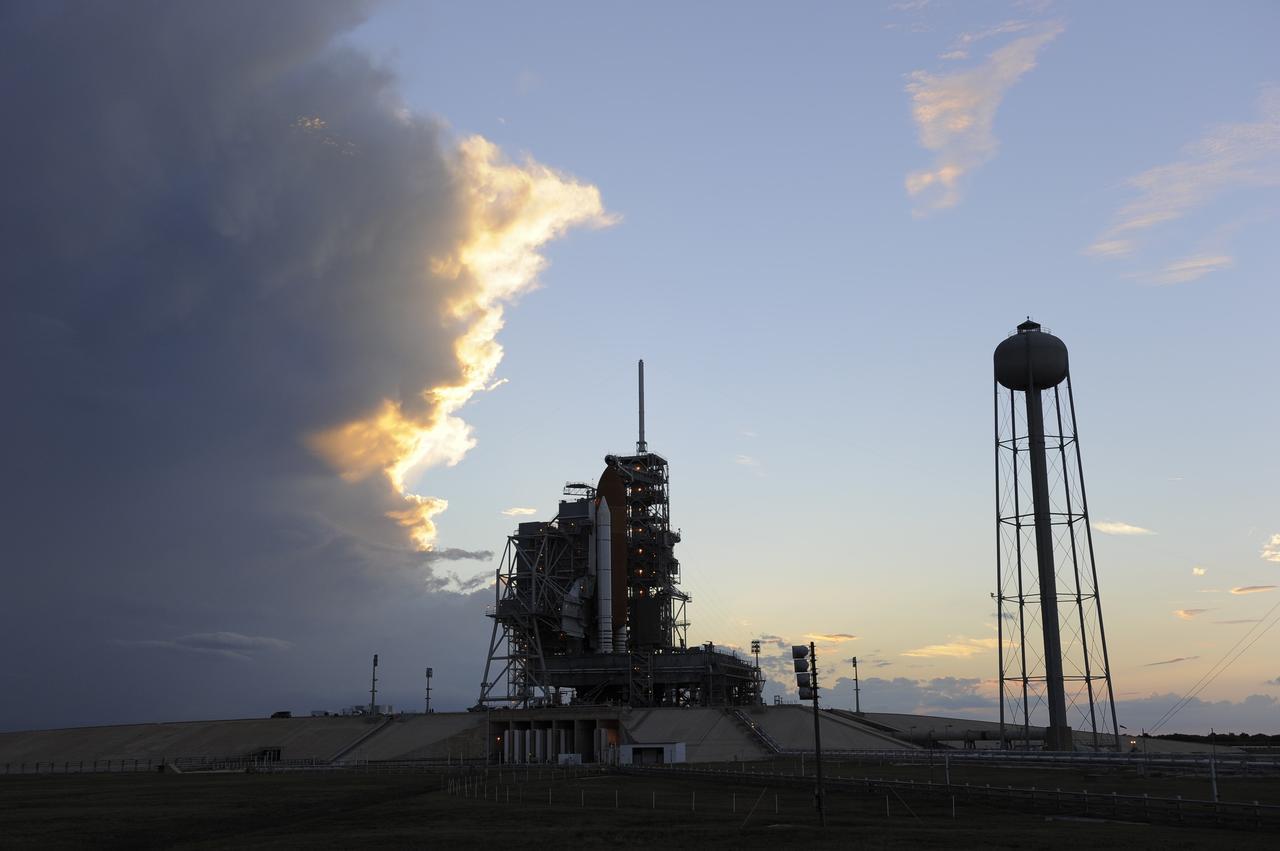
CAPE CANAVERAL, Fla. -- Storm clouds move over Launch Pad 39A at NASA's Kennedy Space Center in Florida, postponing the retraction of the pad's rotating service structure, which would reveal space shuttle Discovery. The structure provides weather protection and access to the shuttle while it awaits lift off on the pad. RSS "rollback," as it's called, will begin again after the lightning-producing clouds pass. Launch of Discovery on the STS-133 mission to the International Space Station is set for 3:29 p.m. on Nov. 4. During the 11-day mission, Discovery and its six crew members will deliver the Permanent Multipurpose Module, packed with supplies and critical spare parts, as well as Robonaut 2, to the orbiting laboratory. Discovery, which will fly its 39th mission, is scheduled to be retired following STS-133. This will be the 133rd Space Shuttle Program mission and the 35th shuttle voyage to the space station. For more information on STS-133, visit www.nasa.gov/mission_pages/shuttle/shuttlemissions/sts133/. Photo credit: NASA/Kim Shiflett
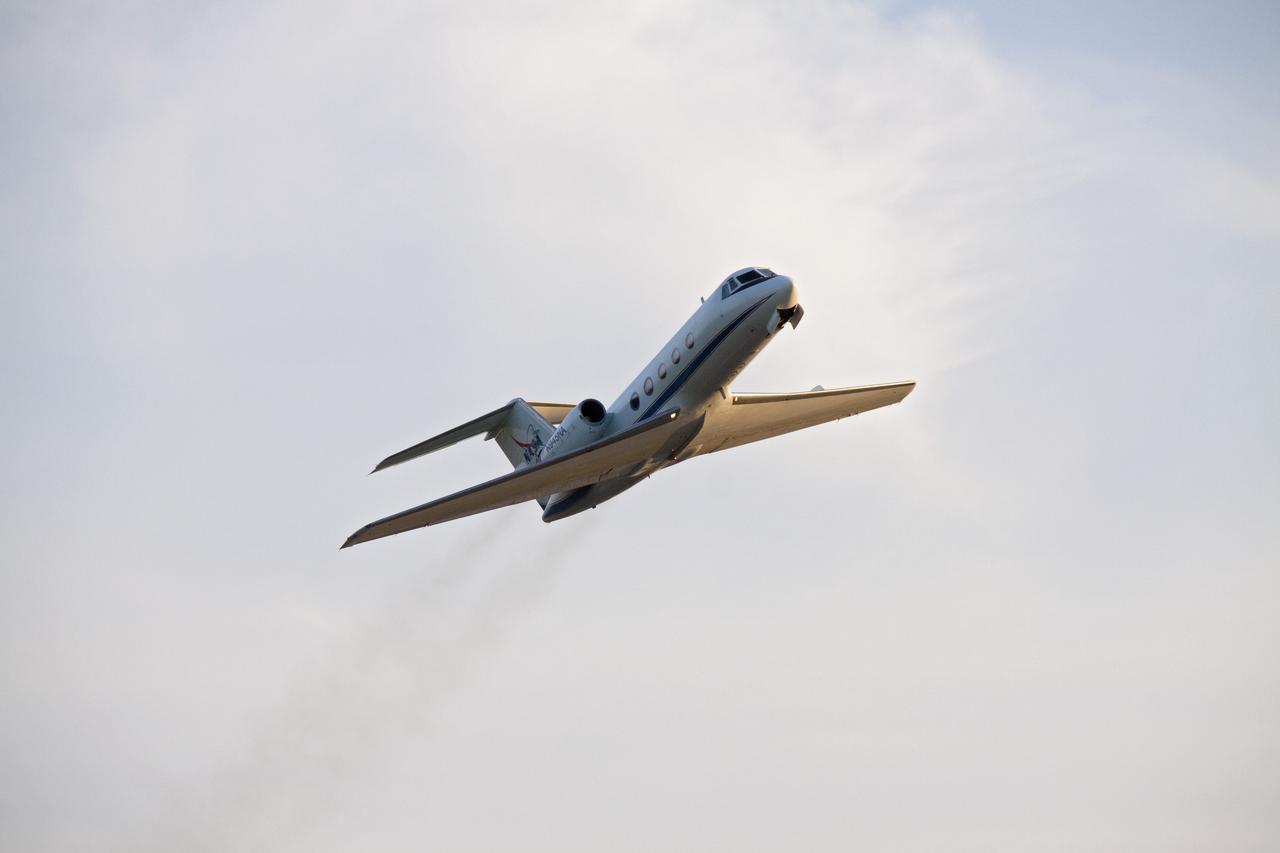
CAPE CANAVERAL, Fla. -- A Shuttle Training Aircraft (STA) performs touch-and-go landings over the Shuttle Landing Facility runway at NASA's Kennedy Space Center in Florida. STS-133 Commander Steve Lindsey and Pilot Eric Boe are flying the modified Gulfstream II business jet to mimic the shuttle's handling during the final phase of landing. Practice landings are part of the Terminal Countdown Demonstration Test (TCDT), which provides each shuttle crew and launch team an opportunity to participate in various simulated activities, including equipment familiarization and emergency training at the launch pad. Space shuttle Discovery and its STS-133 crew will deliver the Permanent Multipurpose Module, packed with supplies and critical spare parts, as well as Robonaut 2, the dexterous humanoid astronaut helper, to the International Space Station. Launch is targeted for Nov. 1 at 4:40 p.m. For more information on the STS-133 mission, visit www.nasa.gov/mission_pages/shuttle/shuttlemissions/sts133/. Photo credit: NASA/Jack Pfaller
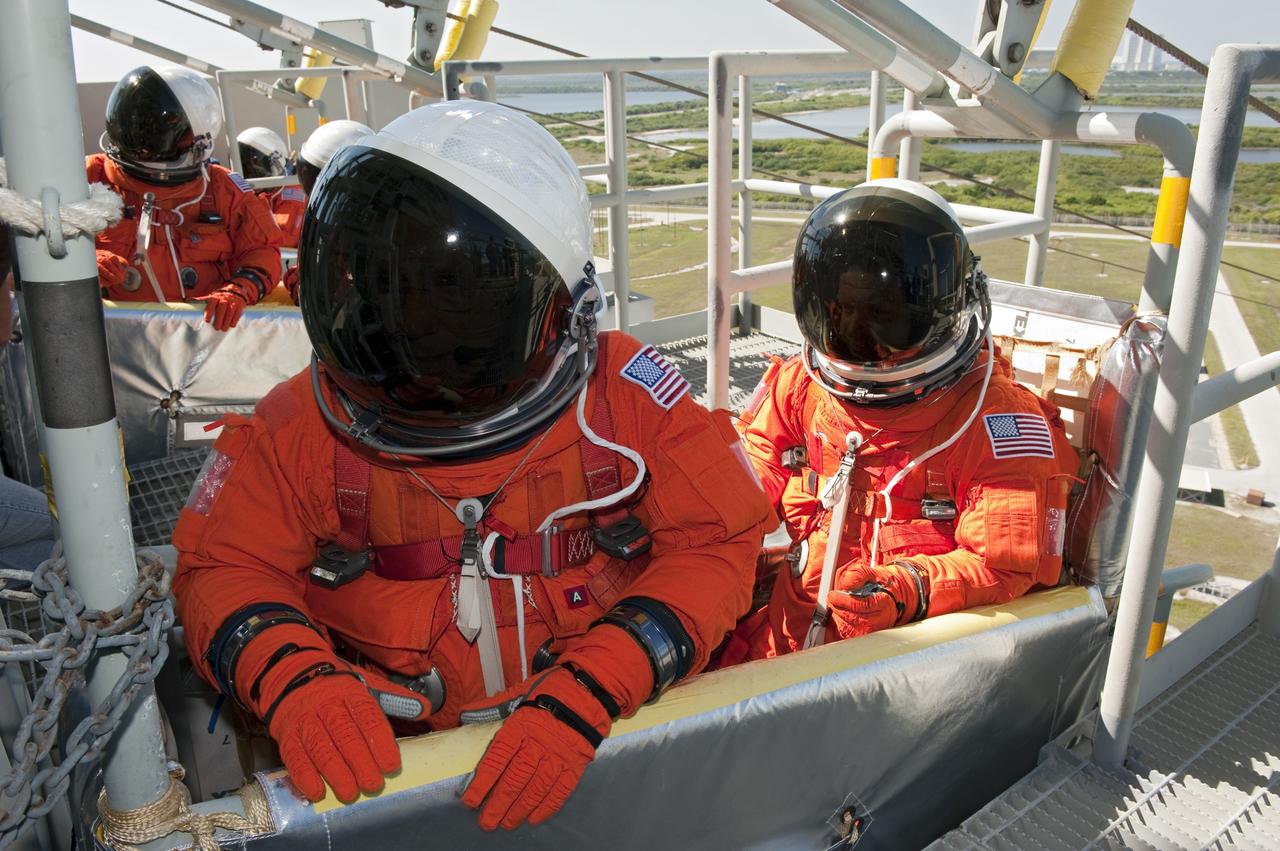
CAPE CANAVERAL, Fla. -- During a simulated pad emergency on Launch Pad 39A at NASA's Kennedy Space Center in Florida, STS-133 Commander Steve Lindsey, front left, and Pilot Eric Boe hop in a slidewire basket that would take them to a safe bunker below the pad in an unlikely emergency situation. The emergency training while aboard space shuttle Discovery is part of a week-long Terminal Countdown Demonstration Test (TCDT). Discovery and its STS-133 crew will deliver the Permanent Multipurpose Module, packed with supplies and critical spare parts, as well as Robonaut 2, the dexterous humanoid astronaut helper, to the International Space Station. Launch is targeted for Nov. 1 at 4:40 p.m. For more information on the STS-133 mission, visit www.nasa.gov/mission_pages/shuttle/shuttlemissions/sts133/. Photo credit: NASA/Kim Shiflett
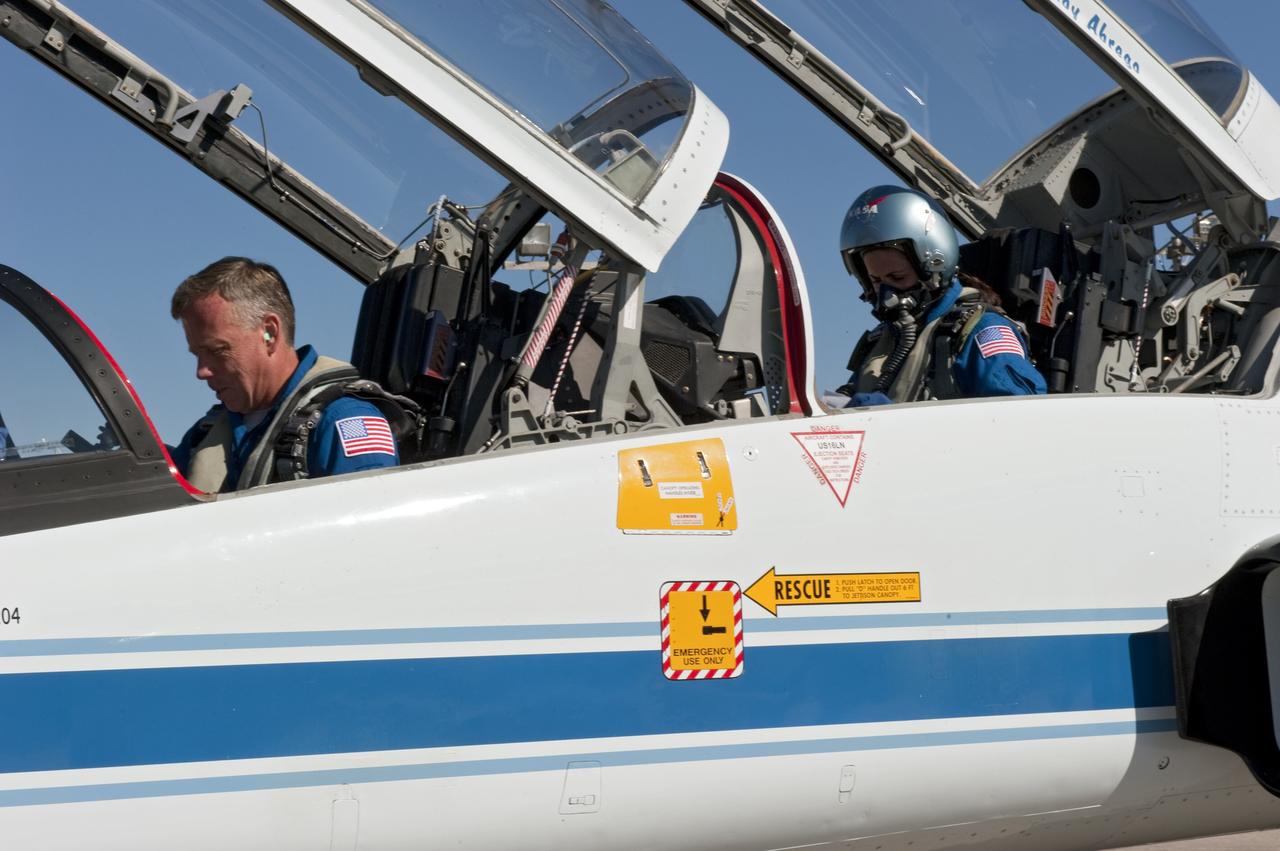
CAPE CANAVERAL, Fla. -- Space shuttle Discovery's STS-133 Commander Steve Lindsey, left, and Mission Specialist Nicole Stott prepare to depart NASA's Kennedy Space Center in Florida in a T-38 training jet. The six-member crew will wait until at least Nov. 30 to launch to the International Space Station because a leak was detected at the Ground Umbilical Carrier Plate (GUCP) while Discovery's external fuel tank was being loaded for launch on Nov. 5. The GUCP is an attachment point between the external tank and a pipe that carries gaseous hydrogen safely away from the shuttle to the flare stack, where it is burned off. Engineers and managers also will evaluate a crack in the foam on the external tank. During the 11-day mission, STS-133 will deliver the Permanent Multipurpose Module, packed with supplies and critical spare parts, as well as Robonaut 2, to the orbiting laboratory. Discovery, which will fly its 39th mission, is scheduled to be retired following STS-133. This will be the 133rd Space Shuttle Program mission and the 35th shuttle voyage to the space station. For more information on STS-133, visit www.nasa.gov/mission_pages/shuttle/shuttlemissions/sts133/. Photo credit: NASA/Kim Shiflett
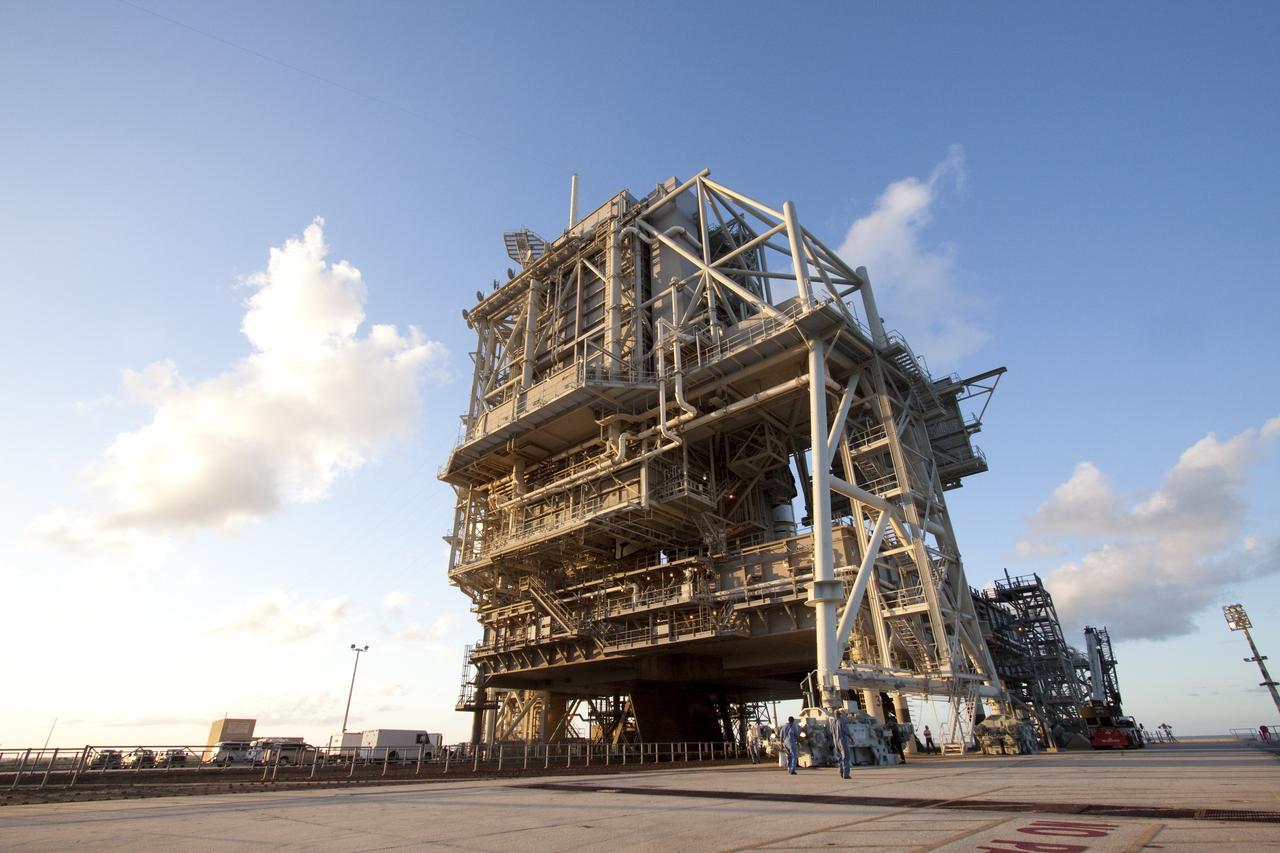
CAPE CANAVERAL, Fla. -- Before the sun sets on Launch Pad 39A at NASA's Kennedy Space Center in Florida, space shuttle Discovery is concealed by the pad's rotating service structure. Retraction of the structure, which provides weather protection and access to the shuttle, is scheduled to occur tonight. RSS "rollback," as it's called, is a significant milestone in the launch countdown. Launch of Discovery on the STS-133 mission to the International Space Station is set for 3:29 p.m. on Nov. 4. During the 11-day mission, Discovery and its six crew members will deliver the Permanent Multipurpose Module, packed with supplies and critical spare parts, as well as Robonaut 2, to the orbiting laboratory. Discovery, which will fly its 39th mission, is scheduled to be retired following STS-133. This will be the 133rd Space Shuttle Program mission and the 35th shuttle voyage to the space station. For more information on STS-133, visit www.nasa.gov/mission_pages/shuttle/shuttlemissions/sts133/. Photo credit: NASA/Jack Pfaller
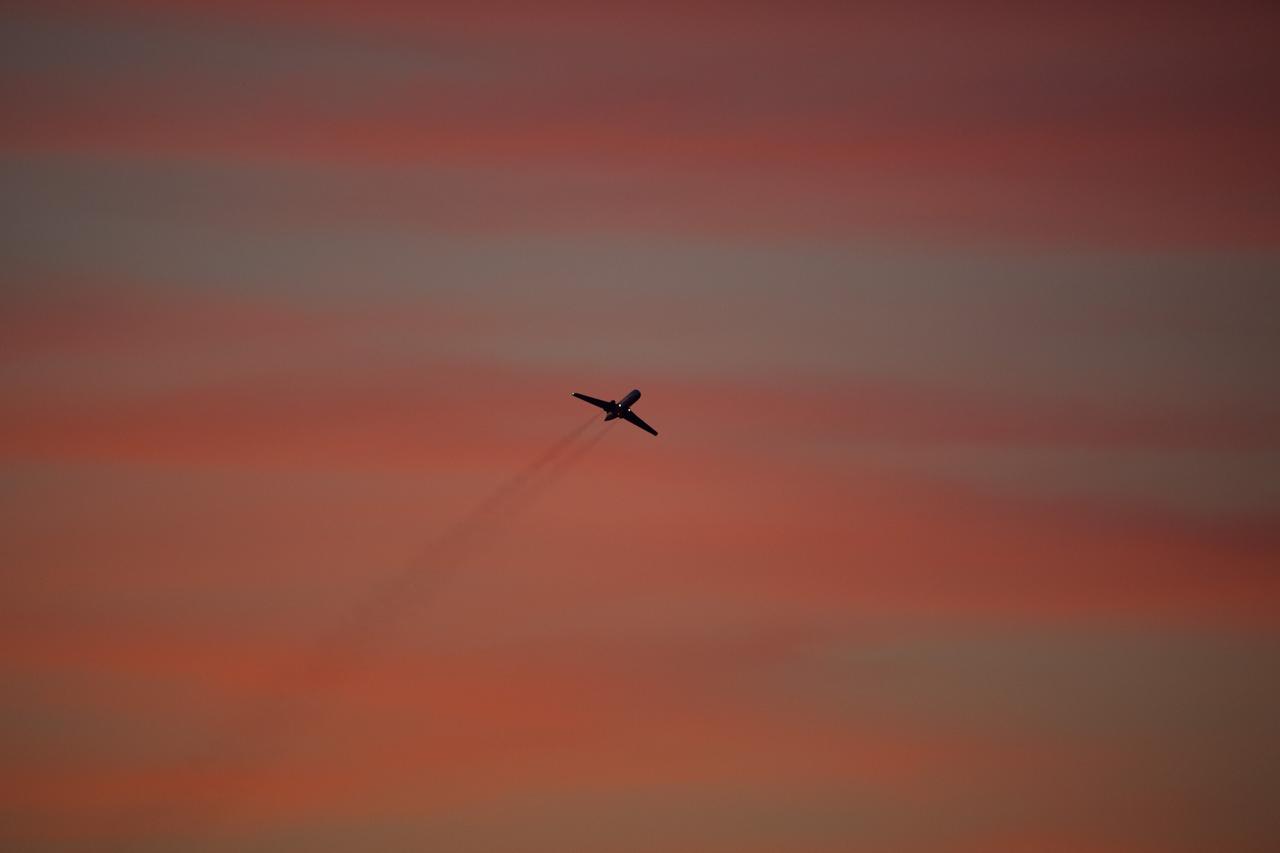
CAPE CANAVERAL, Fla. -- A Shuttle Training Aircraft (STA) performs touch-and-go landings as the sun sets over the Shuttle Landing Facility runway at NASA's Kennedy Space Center in Florida. STS-133 Commander Steve Lindsey and Pilot Eric Boe are flying two Gulfstream II business jets that are modified to mimic the shuttle's handling during the final phase of landing. Practice landings are part of the Terminal Countdown Demonstration Test (TCDT), which provides each shuttle crew and launch team an opportunity to participate in various simulated activities, including equipment familiarization and emergency training at the launch pad. Space shuttle Discovery and its STS-133 crew will deliver the Permanent Multipurpose Module, packed with supplies and critical spare parts, as well as Robonaut 2, the dexterous humanoid astronaut helper, to the International Space Station. Launch is targeted for Nov. 1 at 4:40 p.m. For more information on the STS-133 mission, visit www.nasa.gov/mission_pages/shuttle/shuttlemissions/sts133/. Photo credit: NASA/Dimitri Gerondidakis
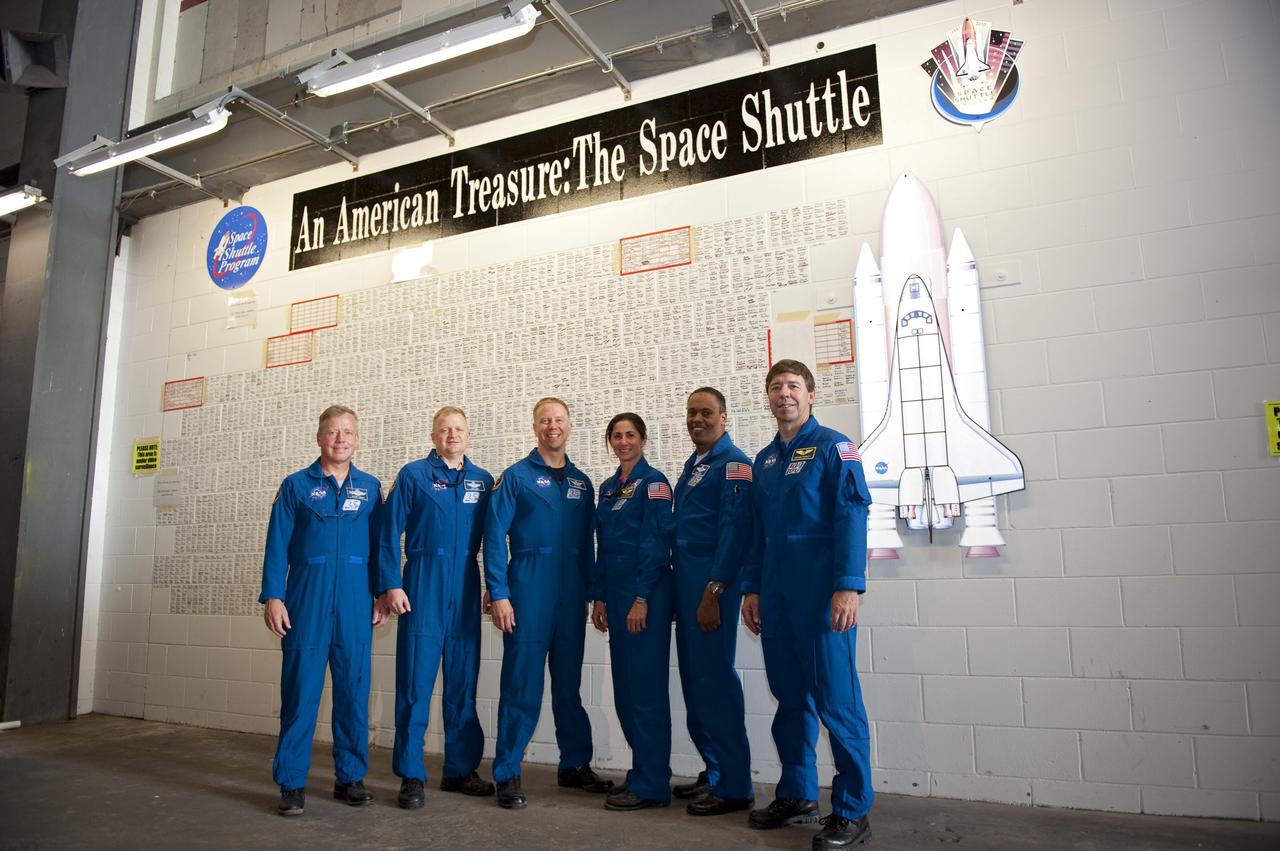
CAPE CANAVERAL, Fla. -- At NASA's Kennedy Space Center in Florida, STS-133 crew members pose in front of the space shuttle wall tribute in the Vehicle Assembly Building. Kennedy employees who have supported the Space Shuttle Program throughout the last 30 years have been signing the wall as a tribute to the program. From left are Commander Steve Lindsey, Pilot Eric Boe, and Mission Specialists Tim Kopra, Nicole Stott, Alvin Drew, and Michael Barratt. TCDT provides each shuttle crew and launch team an opportunity to participate in various simulated activities, including equipment familiarization and a launch countdown. Space shuttle Discovery and its STS-133 crew will deliver the Permanent Multipurpose Module, packed with supplies and critical spare parts, as well as Robonaut 2, the dexterous humanoid astronaut helper, to the International Space Station. Launch is targeted for Nov. 1 at 4:40 p.m. For more information on the STS-133 mission, visit www.nasa.gov/mission_pages/shuttle/shuttlemissions/sts133/. Photo credit: NASA/Kim Shiflett
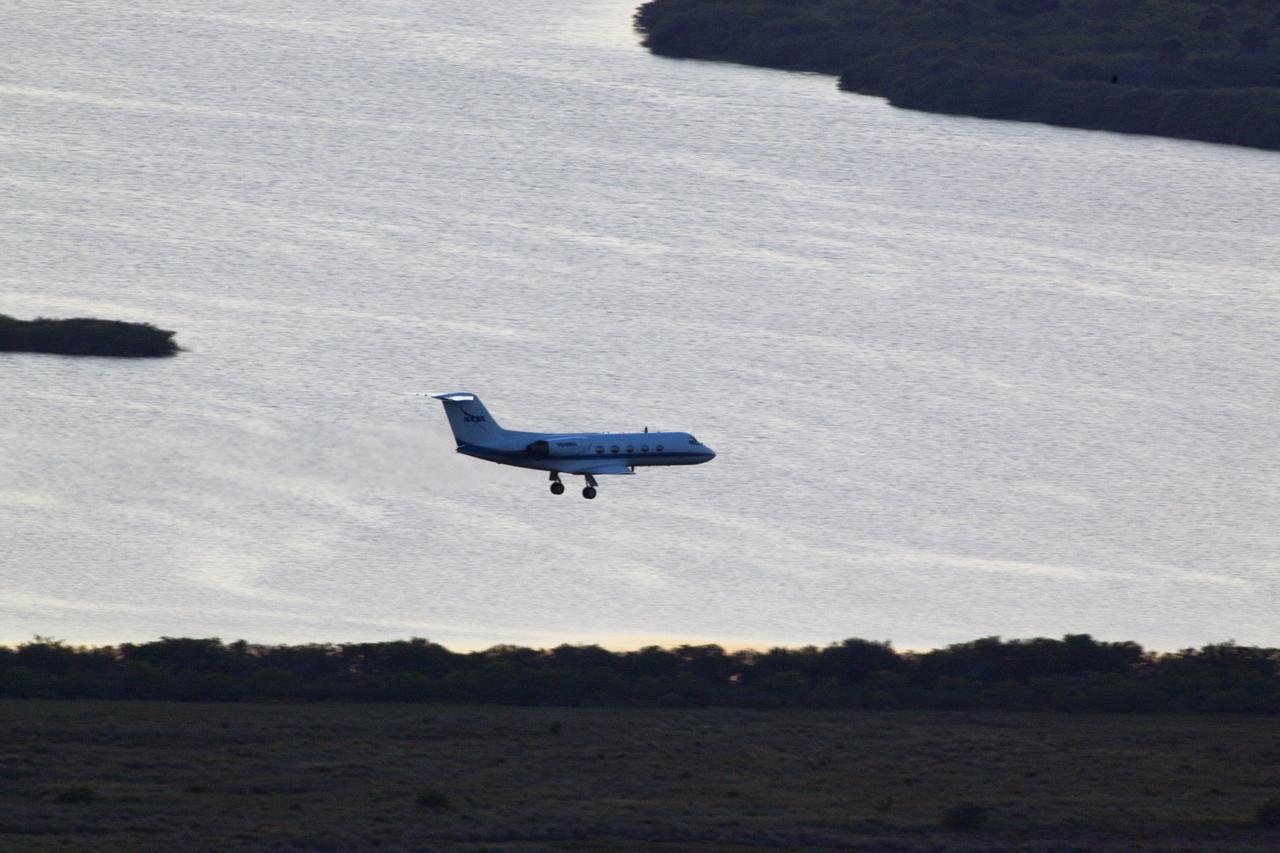
CAPE CANAVERAL, Fla. -- A Shuttle Training Aircraft (STA) performs touch-and-go landings over the Shuttle Landing Facility runway at NASA's Kennedy Space Center in Florida. STS-133 Commander Steve Lindsey and Pilot Eric Boe are flying two Gulfstream II business jets that are modified to mimic the shuttle's handling during the final phase of landing. Practice landings are part of the Terminal Countdown Demonstration Test (TCDT), which provides each shuttle crew and launch team an opportunity to participate in various simulated activities, including equipment familiarization and emergency training at the launch pad. Space shuttle Discovery and its STS-133 crew will deliver the Permanent Multipurpose Module, packed with supplies and critical spare parts, as well as Robonaut 2, the dexterous humanoid astronaut helper, to the International Space Station. Launch is targeted for Nov. 1 at 4:40 p.m. For more information on the STS-133 mission, visit www.nasa.gov/mission_pages/shuttle/shuttlemissions/sts133/. Photo credit: NASA/Dimitri Gerondidakis
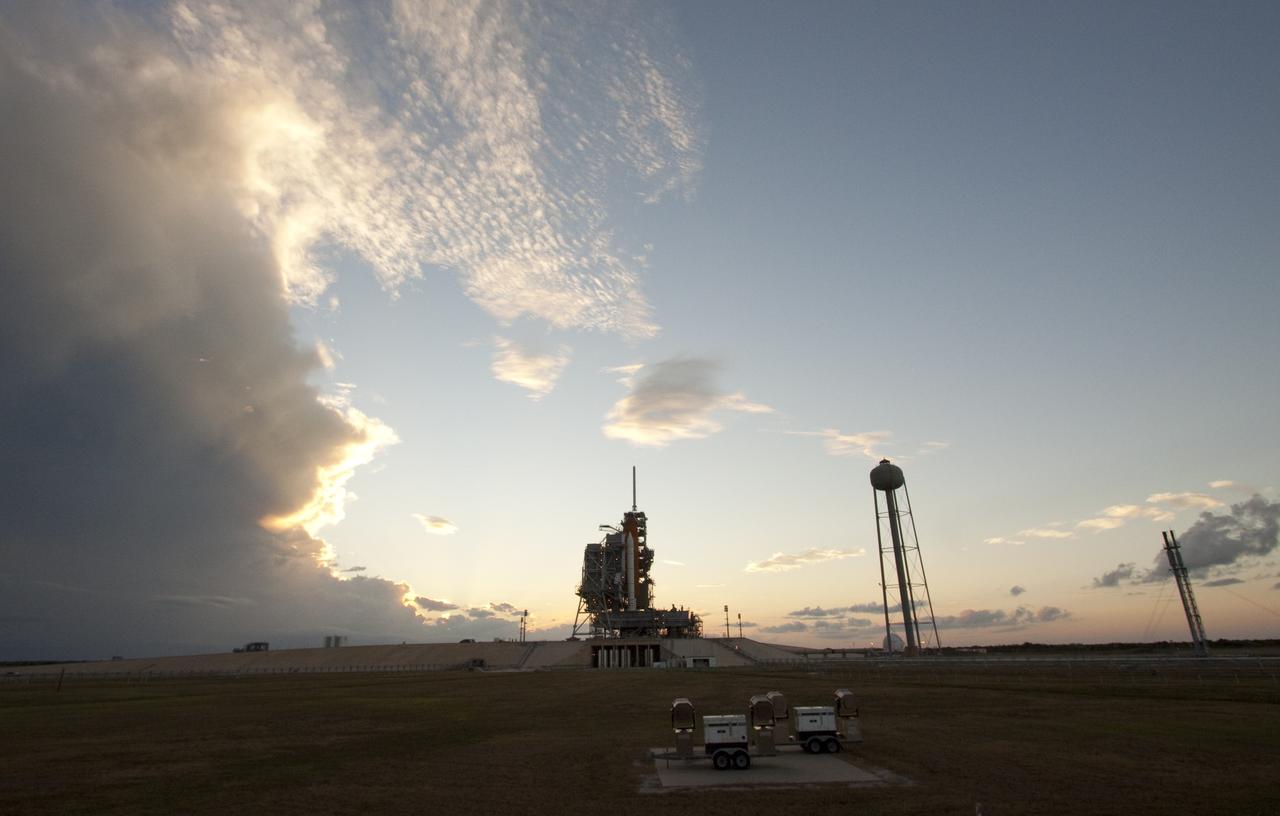
CAPE CANAVERAL, Fla. -- A lightning-producing storm cloud moves in over NASA's Kennedy Space Center in Florida as the rotating service structure on Launch Pad 39A is scheduled to be moved away from space shuttle Discovery. The structure provides weather protection and access to the shuttle. RSS "rollback," as it's called, was delayed for a few hours to allow that cloud to pass. Launch of Discovery on the STS-133 mission to the International Space Station is set for 3:29 p.m. on Nov. 4. During the 11-day mission, Discovery and its six crew members will deliver the Permanent Multipurpose Module, packed with supplies and critical spare parts, as well as Robonaut 2, to the orbiting laboratory. Discovery, which will fly its 39th mission, is scheduled to be retired following STS-133. This will be the 133rd Space Shuttle Program mission and the 35th shuttle voyage to the space station. For more information on STS-133, visit www.nasa.gov/mission_pages/shuttle/shuttlemissions/sts133/. Photo credit: NASA/Troy Cryder
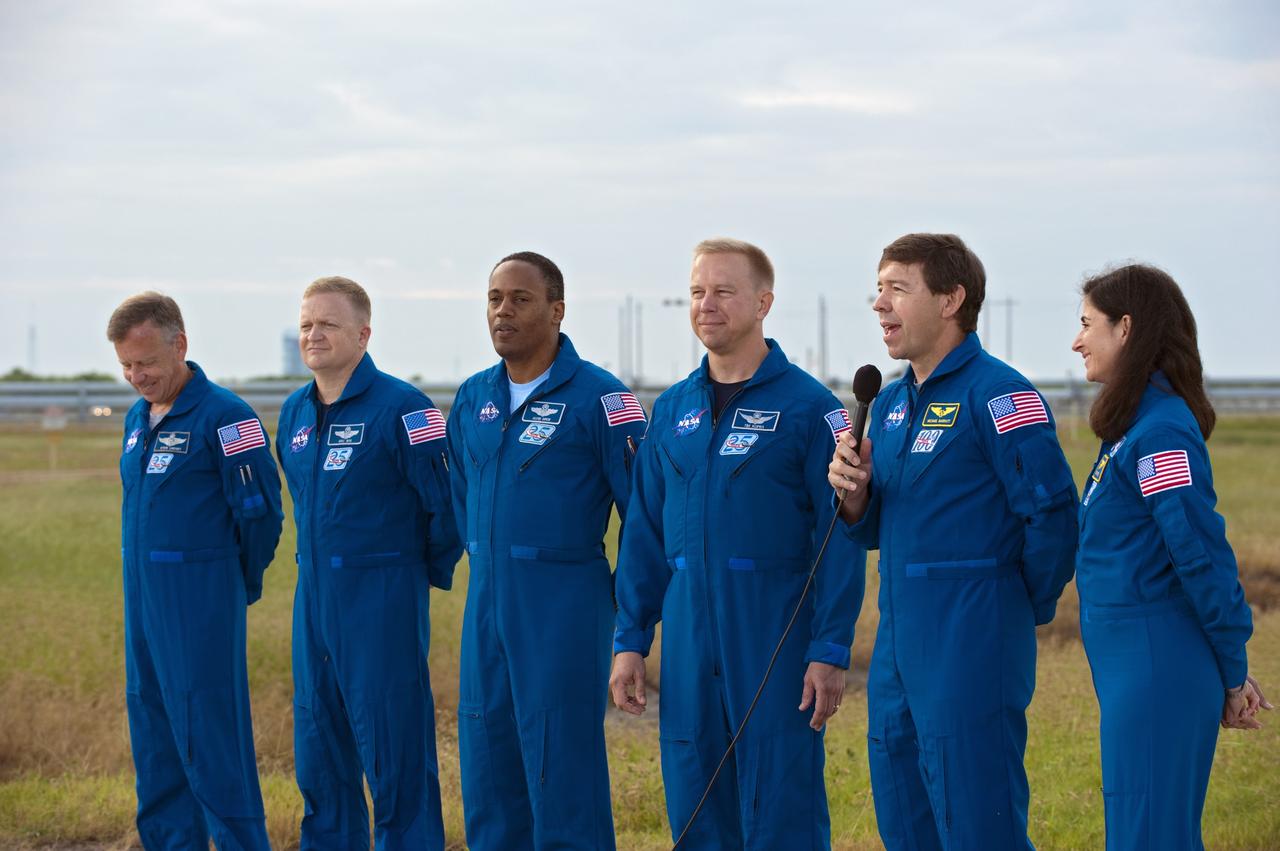
CAPE CANAVERAL, Fla. -- At NASA's Kennedy Space Center in Florida, STS-133 Mission Specialist Michael Barratt talks to media at Launch Pad 39A, where space shuttle Discovery is poised for launch next month. The six STS-133 crew members, from left, are Commander Steve Lindsey, Pilot Eric Boe, and Mission Specialists Alvin Drew, Tim Kopra, Barratt, and Nicole Stott. The crew is at Kennedy for the Terminal Countdown Demonstration Test (TCDT), which provides each shuttle crew and launch team an opportunity to participate in various simulated activities, including equipment familiarization and emergency training at the launch pad. Discovery and its crew will deliver the Permanent Multipurpose Module, packed with supplies and critical spare parts, as well as Robonaut 2, the dexterous humanoid astronaut helper, to the International Space Station. Launch is targeted for Nov. 1 at 4:40 p.m. For more information on the STS-133 mission, visit www.nasa.gov/mission_pages/shuttle/shuttlemissions/sts133/. Photo credit: NASA/Kim Shiflett
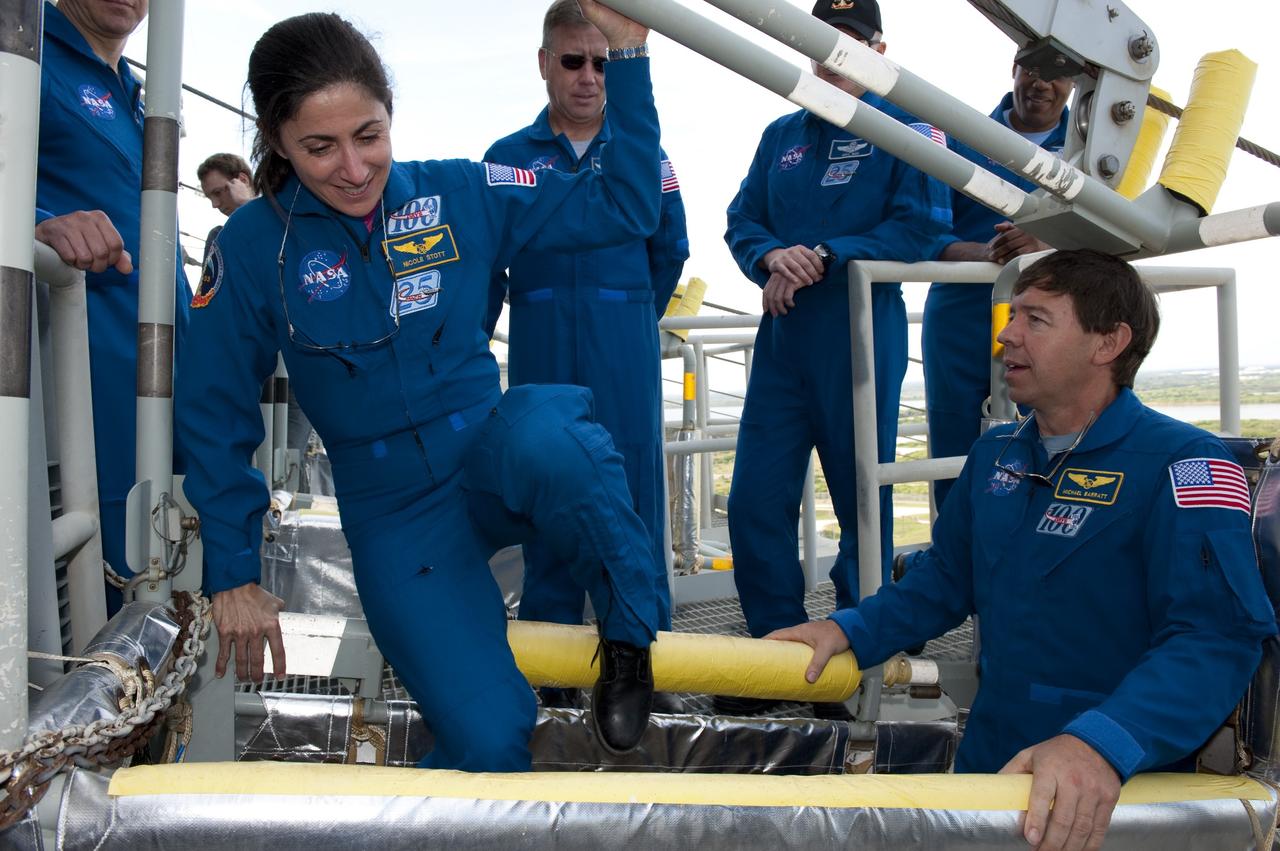
CAPE CANAVERAL, Fla. -- On Launch Pad 39A at NASA's Kennedy Space Center, STS-133 crew members receive instruction on the operation of the pad's slidewire basket system emergency exit training as part of the Terminal Countdown Demonstration Test (TCDT). Inside the basket are Mission Specialists Nicole Stott, left, and Michael Barratt. TCDT provides each shuttle crew and launch team an opportunity to participate in various simulated activities, including equipment familiarization and a launch countdown. Space shuttle Discovery and its STS-133 crew will deliver the Permanent Multipurpose Module, packed with supplies and critical spare parts, as well as Robonaut 2, the dexterous humanoid astronaut helper, to the International Space Station. Launch is targeted for Nov. 1 at 4:40 p.m. For more information on the STS-133 mission, visit www.nasa.gov/mission_pages/shuttle/shuttlemissions/sts133/. Photo credit: NASA/Kim Shiflett
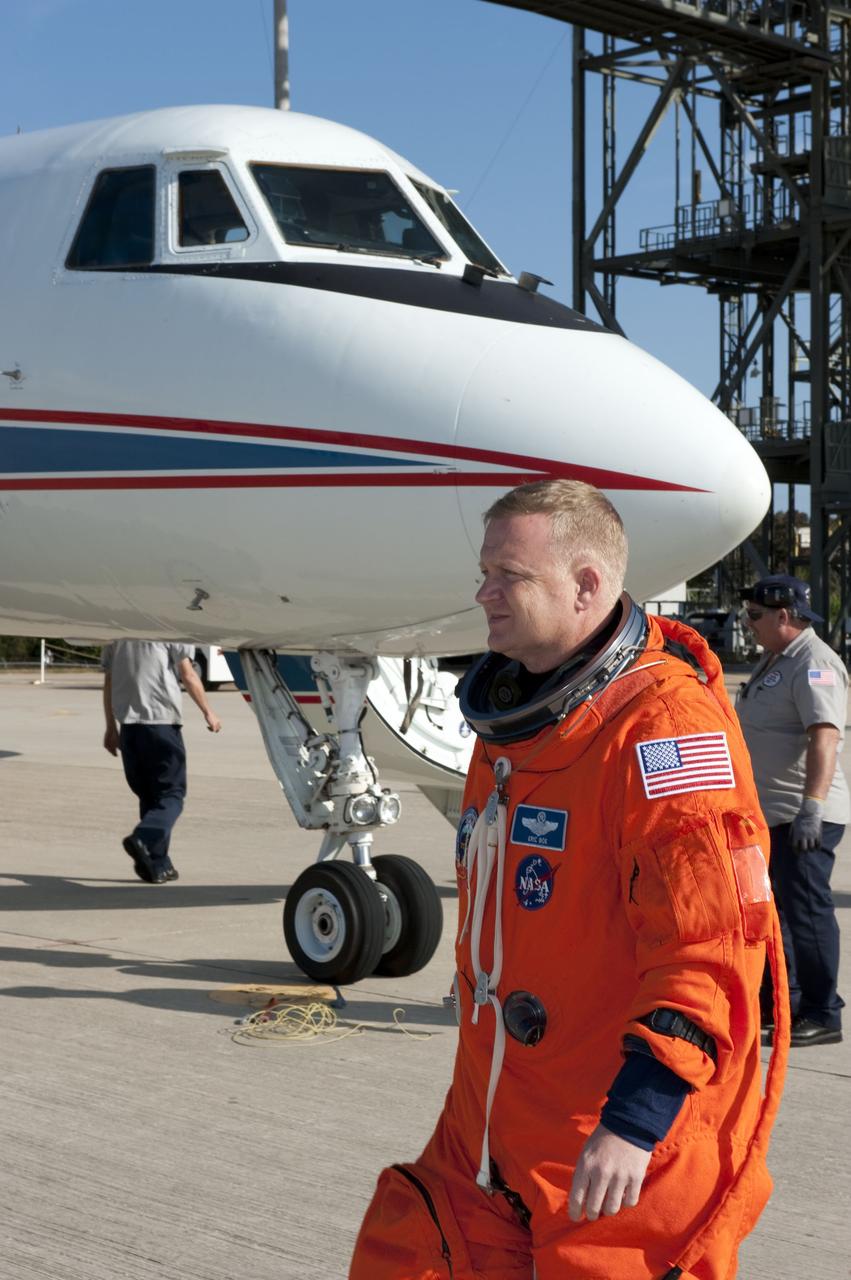
CANAVERAL, Fla. -- At NASA's Kennedy Space Center in Florida, STS-133 Pilot Eric Boe returns from flying touch-and-go landings in a Shuttle Training Aircraft (STA) over the Shuttle Landing Facility runway. The Gulfstream II business jet is modified to mimic the shuttle's handling during the final phase of landing. Space shuttle Discovery's crew members are at Kennedy for their upcoming launch to the International Space Station. In the days leading up to lift off, they will check the fit of their spacesuits, review launch-day procedures, receive weather briefings and remain medically quarantined to prevent sickness. STS-133 will deliver the Permanent Multipurpose Module, packed with supplies and critical spare parts, as well as Robonaut 2, the dexterous humanoid astronaut helper, to the orbiting outpost. For more information on the STS-133 mission, visit www.nasa.gov/mission_pages/shuttle/shuttlemissions/sts133/. Photo credit: NASA/Kim Shiflett
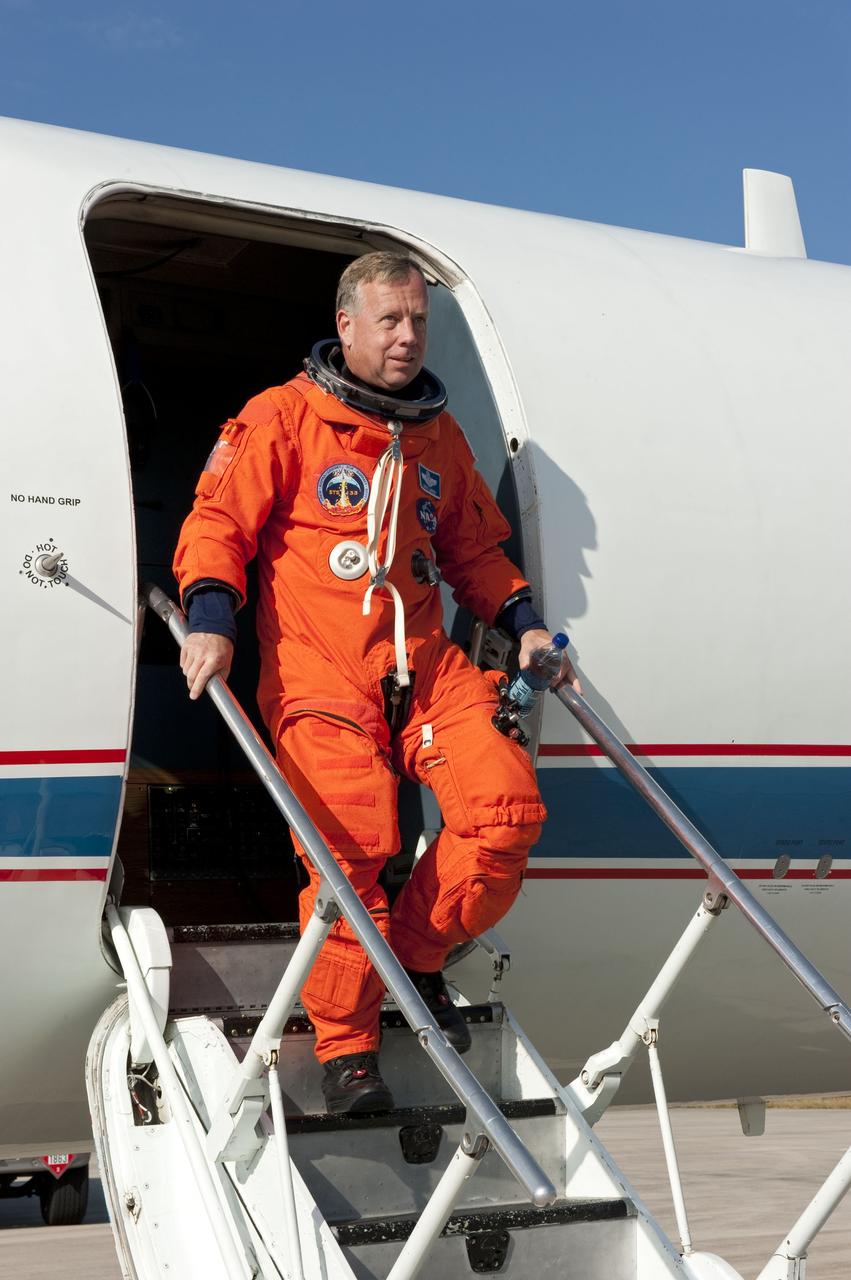
CANAVERAL, Fla. -- At NASA's Kennedy Space Center in Florida, STS-133 Commander Steve Lindsey returns from flying touch-and-go landings in a Shuttle Training Aircraft (STA) over the Shuttle Landing Facility runway. The Gulfstream II business jet is modified to mimic the shuttle's handling during the final phase of landing. Space shuttle Discovery's crew members are at Kennedy for their upcoming launch to the International Space Station. In the days leading up to lift off, they will check the fit of their spacesuits, review launch-day procedures, receive weather briefings and remain medically quarantined to prevent sickness. STS-133 will deliver the Permanent Multipurpose Module, packed with supplies and critical spare parts, as well as Robonaut 2, the dexterous humanoid astronaut helper, to the orbiting outpost. For more information on the STS-133 mission, visit www.nasa.gov/mission_pages/shuttle/shuttlemissions/sts133/. Photo credit: NASA/Kim Shiflett
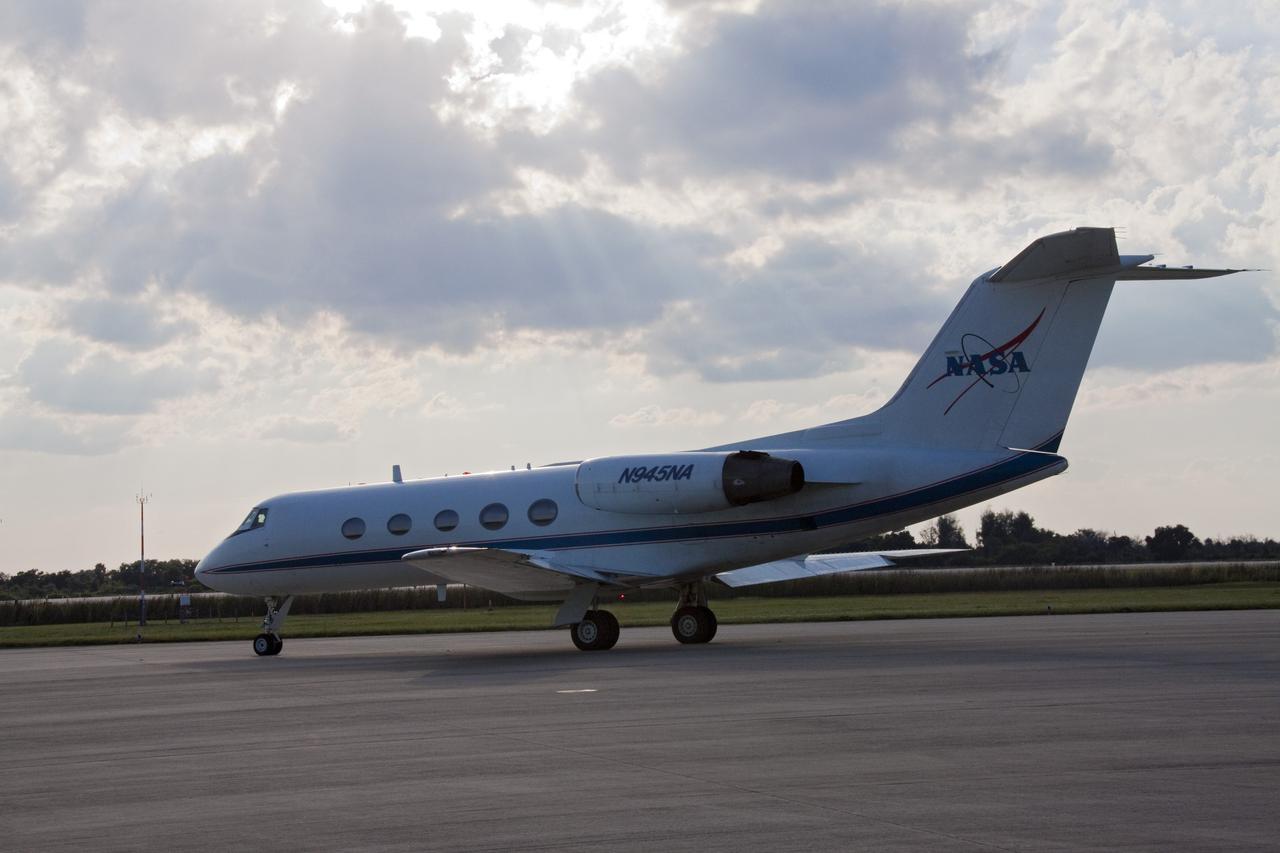
CAPE CANAVERAL, Fla. -- A Shuttle Training Aircraft (STA) is ready for flight on the Shuttle Landing Facility runway at NASA's Kennedy Space Center in Florida. STS-133 Commander Steve Lindsey and Pilot Eric Boe will fly the modified Gulfstream II business jets to mimic the shuttle's handling during the final phase of landing. Practice landings are part of the Terminal Countdown Demonstration Test (TCDT), which provides each shuttle crew and launch team an opportunity to participate in various simulated activities, including equipment familiarization and emergency training at the launch pad. Space shuttle Discovery and its STS-133 crew will deliver the Permanent Multipurpose Module, packed with supplies and critical spare parts, as well as Robonaut 2, the dexterous humanoid astronaut helper, to the International Space Station. Launch is targeted for Nov. 1 at 4:40 p.m. For more information on the STS-133 mission, visit www.nasa.gov/mission_pages/shuttle/shuttlemissions/sts133/. Photo credit: NASA/Jack Pfaller
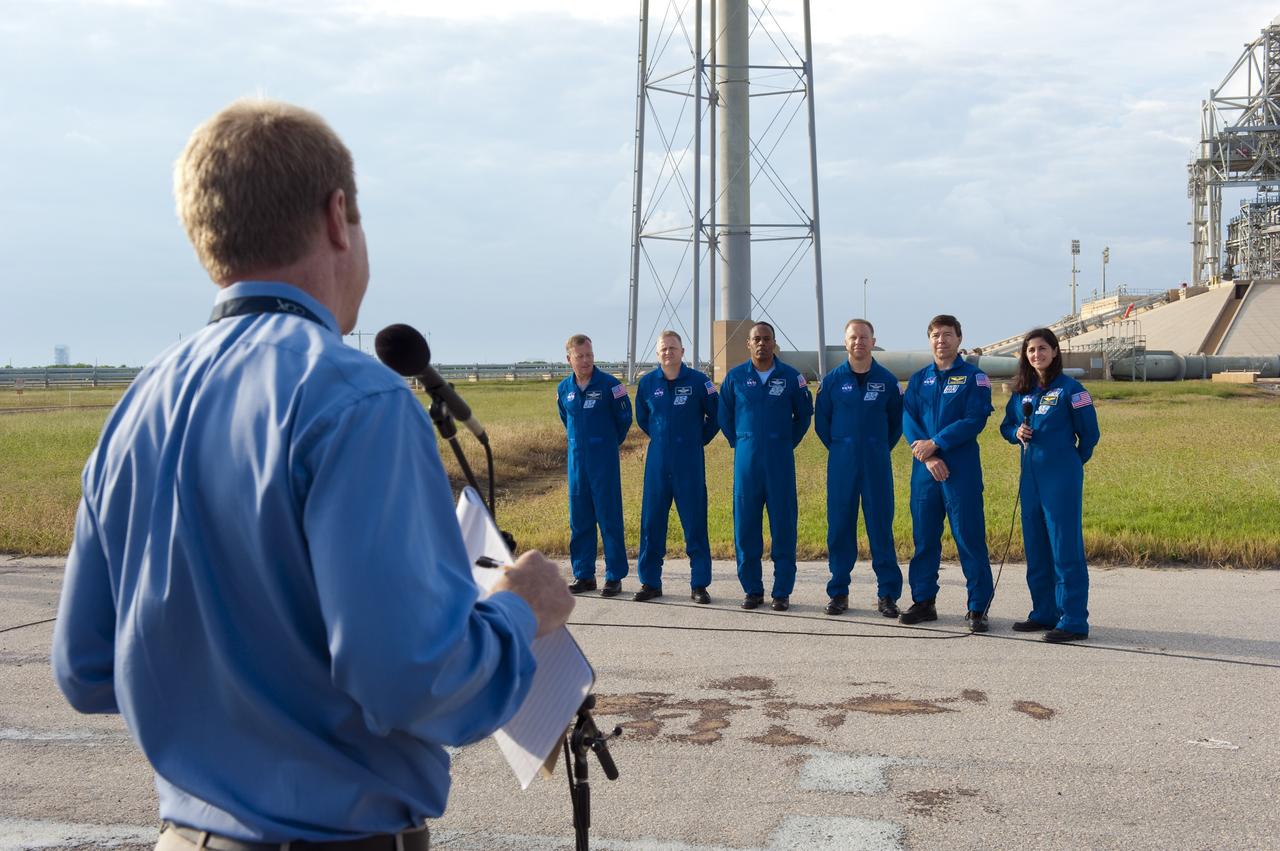
CAPE CANAVERAL, Fla. -- At NASA's Kennedy Space Center in Florida, media ask STS-133 Mission Specialist Nicole Stott questions at Launch Pad 39A, where space shuttle Discovery is poised for launch next month. The six STS-133 crew members, from left, are Commander Steve Lindsey, Pilot Eric Boe, and Mission Specialists Alvin Drew, Tim Kopra, Michael Barratt, and Stott. The crew is at Kennedy for the Terminal Countdown Demonstration Test (TCDT), which provides each shuttle crew and launch team an opportunity to participate in various simulated activities, including equipment familiarization and emergency training at the launch pad. Discovery and its crew will deliver the Permanent Multipurpose Module, packed with supplies and critical spare parts, as well as Robonaut 2, the dexterous humanoid astronaut helper, to the International Space Station. Launch is targeted for Nov. 1 at 4:40 p.m. For more information on the STS-133 mission, visit www.nasa.gov/mission_pages/shuttle/shuttlemissions/sts133/. Photo credit: NASA/Kim Shiflett
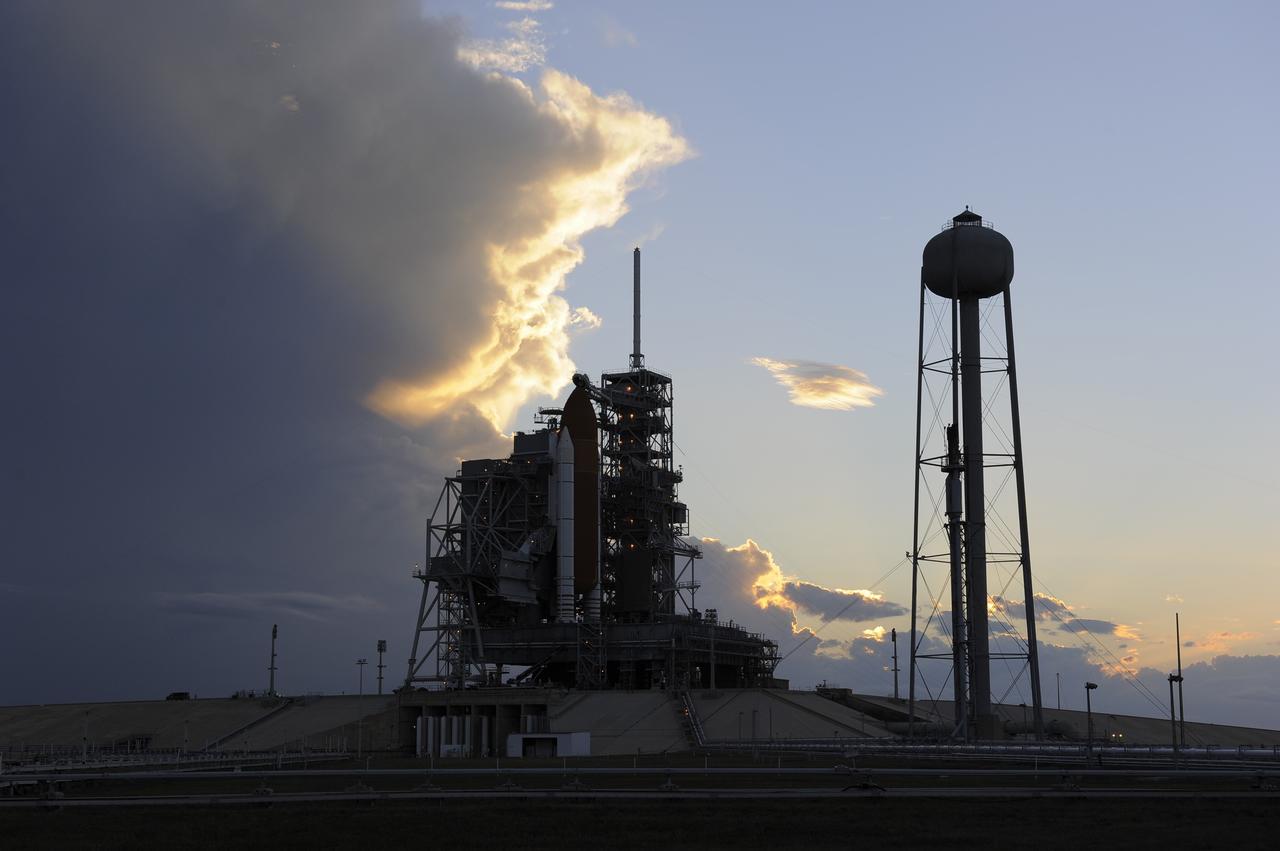
CAPE CANAVERAL, Fla. -- Storm clouds move over Launch Pad 39A at NASA's Kennedy Space Center in Florida, postponing the retraction of the pad's rotating service structure, which would reveal space shuttle Discovery. The structure provides weather protection and access to the shuttle while it awaits lift off on the pad. RSS "rollback," as it's called, will begin again after the lightning-producing clouds pass. Launch of Discovery on the STS-133 mission to the International Space Station is set for 3:29 p.m. on Nov. 4. During the 11-day mission, Discovery and its six crew members will deliver the Permanent Multipurpose Module, packed with supplies and critical spare parts, as well as Robonaut 2, to the orbiting laboratory. Discovery, which will fly its 39th mission, is scheduled to be retired following STS-133. This will be the 133rd Space Shuttle Program mission and the 35th shuttle voyage to the space station. For more information on STS-133, visit www.nasa.gov/mission_pages/shuttle/shuttlemissions/sts133/. Photo credit: NASA/Kim Shiflett
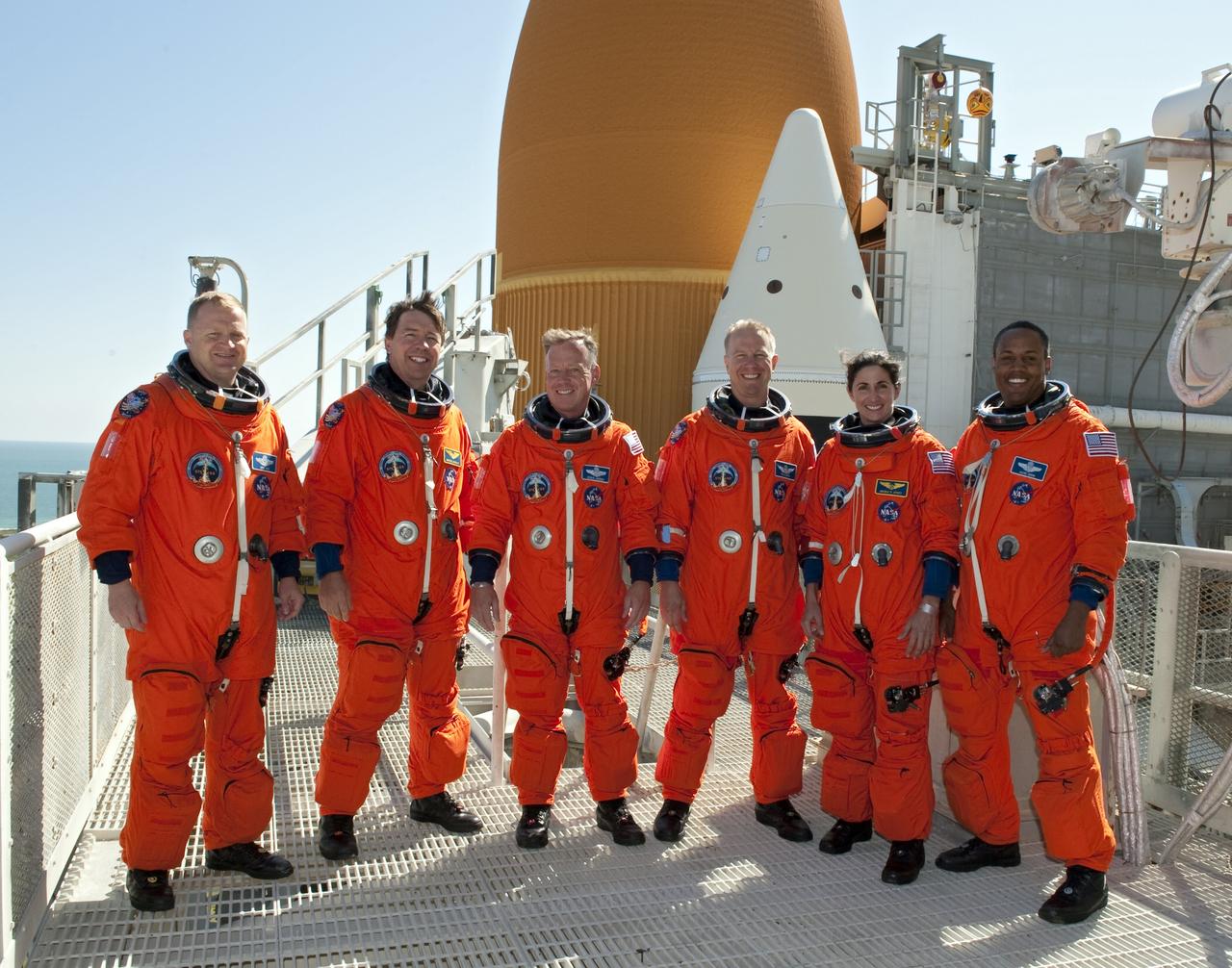
CAPE CANAVERAL, Fla. -- At NASA's Kennedy Space Center in Florida, the STS-133 crew takes a break from a simulated launch countdown and simulated pad emergency to take a group photo on the 195-foot level of Launch Pad 39A. From left are, Pilot Eric Boe, Mission Specialist Michael Barratt, Commander Steve Lindsey, and Mission Specialists Tim Kopra, Nicole Stott, and Alvin Drew. The simulations are part of a week-long Terminal Countdown Demonstration Test (TCDT). Discovery and its STS-133 crew will deliver the Permanent Multipurpose Module, packed with supplies and critical spare parts, as well as Robonaut 2, the dexterous humanoid astronaut helper, to the International Space Station. Launch is targeted for Nov. 1 at 4:40 p.m. For more information on the STS-133 mission, visit www.nasa.gov/mission_pages/shuttle/shuttlemissions/sts133/. Photo credit: NASA/Kim Shiflett
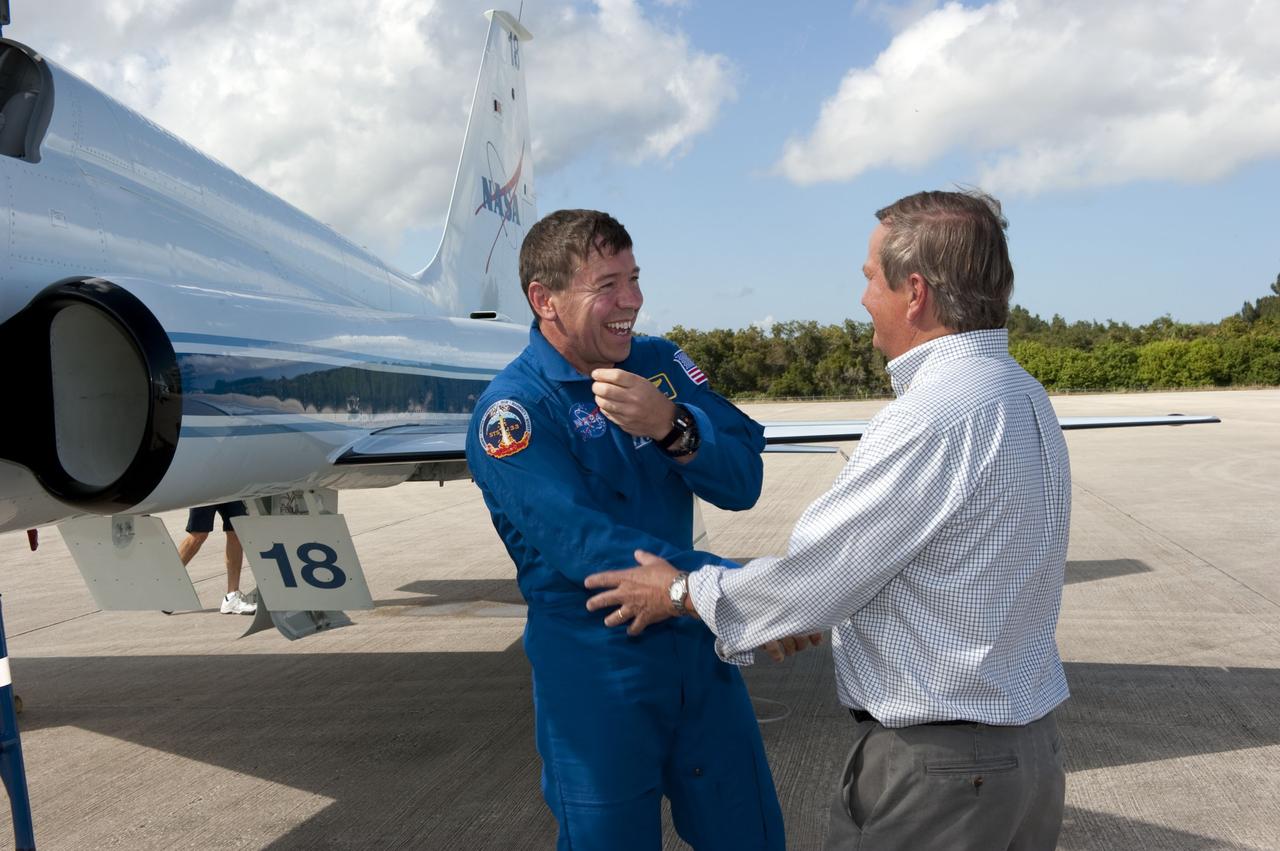
CAPE CANAVERAL, Fla. -- At NASA's Kennedy Space Center in Florida, space shuttle Discovery's STS-133 Mission Specialist Michael Barratt, left, is greeted by Shuttle Launch Director Mike Leinbach on the Shuttle Landing Facility runway after arriving in a T-38 training jet. In the days leading up to their launch to the International Space Station, Barratt and his crew members will check the fit of their launch-and-entry suits, review launch-day procedures, receive weather briefings and remain medically quarantined to prevent sickness. Scheduled to lift off Nov. 1 at 4:40 p.m., Discovery and crew will deliver the Permanent Multipurpose Module, packed with supplies and critical spare parts, as well as Robonaut 2, the dexterous humanoid astronaut helper, to the orbiting outpost. For more information on the STS-133 mission, visit www.nasa.gov/mission_pages/shuttle/shuttlemissions/sts133/. Photo credit: NASA/Kim Shiflett
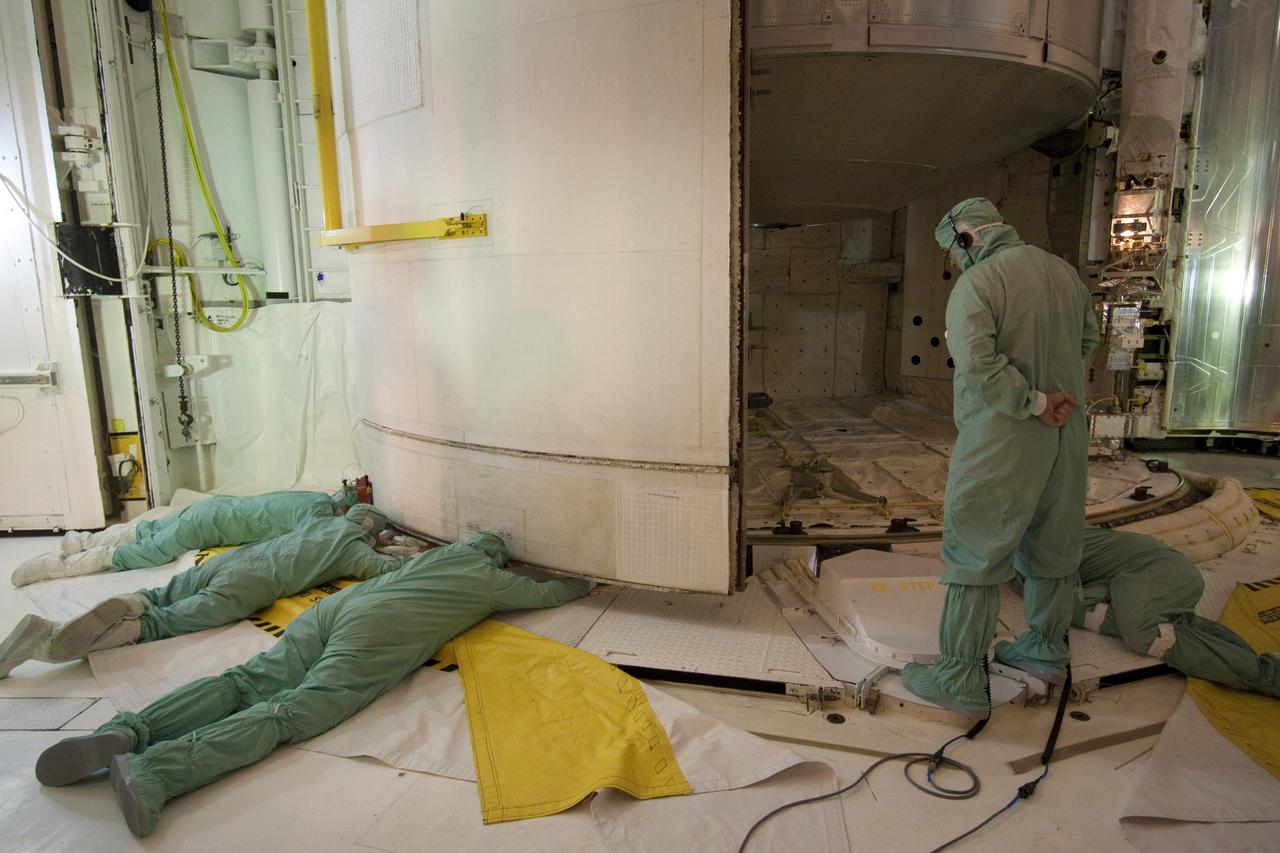
CAPE CANAVERAL, Fla. -- On Launch Pad 39A at NASA's Kennedy Space Center in Florida, technicians close the clamshell doors of space shuttle Discovery's payload bay in preparation for the STS-133 launch to the International Space Station. Targeted to launch Nov. 1, STS-133 will carry the Permanent Multipurpose Module (PMM) packed with supplies and critical spare parts, as well as Robonaut 2 (R2) to the station. Photo credit: NASA/Jack Pfaller
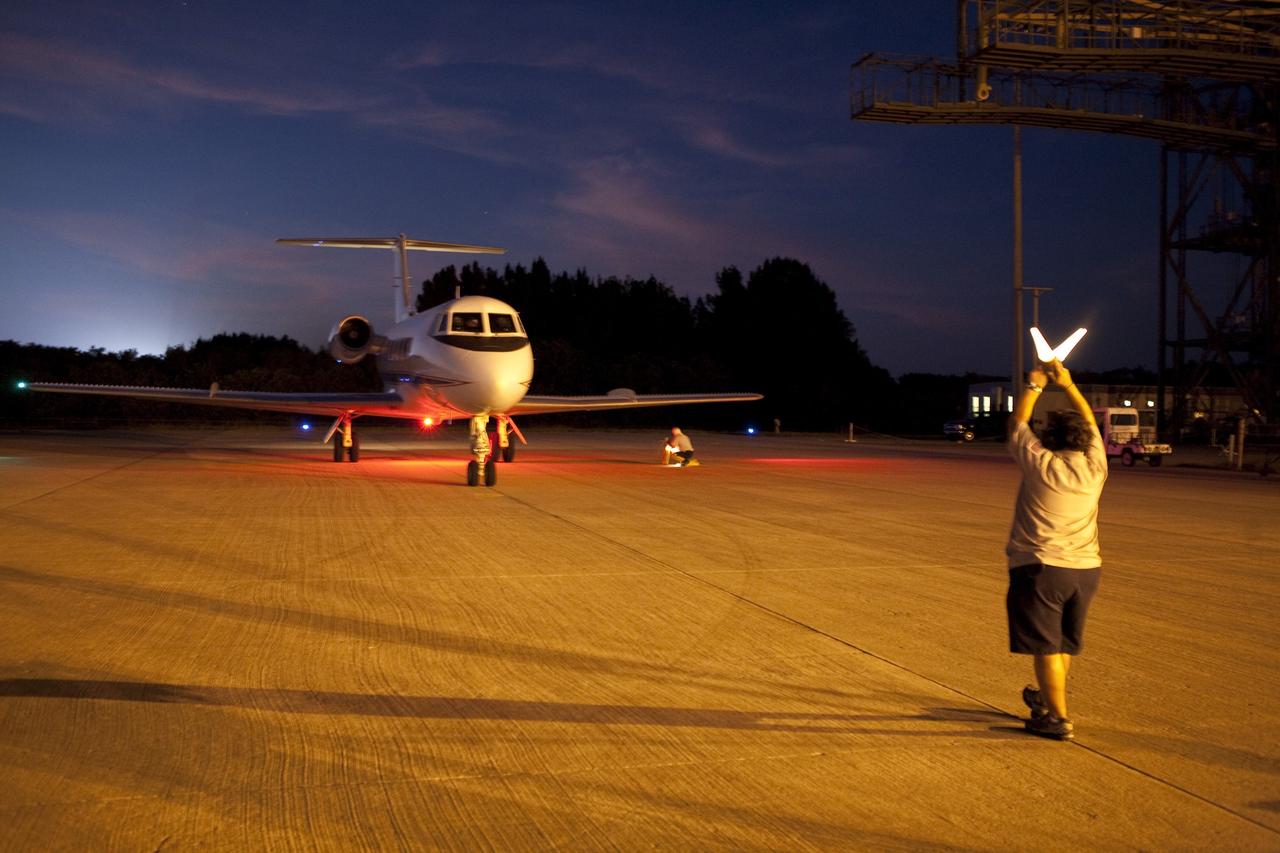
CAPE CANAVERAL, Fla. -- An aircraft servicer marshals a Shuttle Training Aircraft (STA) on the Shuttle Landing Facility runway at NASA's Kennedy Space Center in Florida. STS-133 Commander Steve Lindsey and Pilot Eric Boe flew two Gulfstream II business jets that are modified to mimic the shuttle's handling during the final phase of landing. Practice landings are part of the Terminal Countdown Demonstration Test (TCDT), which provides each shuttle crew and launch team an opportunity to participate in various simulated activities, including equipment familiarization and emergency training at the launch pad. Space shuttle Discovery and its STS-133 crew will deliver the Permanent Multipurpose Module, packed with supplies and critical spare parts, as well as Robonaut 2, the dexterous humanoid astronaut helper, to the International Space Station. Launch is targeted for Nov. 1 at 4:40 p.m. For more information on the STS-133 mission, visit www.nasa.gov/mission_pages/shuttle/shuttlemissions/sts133/. Photo credit: NASA/Amanda Diller

CAPE CANAVERAL, Fla. -- While performing touch-and-go landings over the Shuttle Landing Facility runway, STS-133 Commander Steve Lindsey and Pilot Eric Boe enjoyed a perfect sunset over NASA's Kennedy Space Center in Florida. Lindsey and Boe flew two Shuttle Training Aircraft (STA), which are Gulfstream II business jets modified to mimic the shuttle's handling during the final phase of landing. Practice landings are part of the Terminal Countdown Demonstration Test (TCDT), which provides each shuttle crew and launch team an opportunity to participate in various simulated activities, including equipment familiarization and emergency training at the launch pad. Space shuttle Discovery and its STS-133 crew will deliver the Permanent Multipurpose Module, packed with supplies and critical spare parts, as well as Robonaut 2, the dexterous humanoid astronaut helper, to the International Space Station. Launch is targeted for Nov. 1 at 4:40 p.m. For more information on the STS-133 mission, visit www.nasa.gov/mission_pages/shuttle/shuttlemissions/sts133/. Photo credit: NASA/Dimitri Gerondidakis
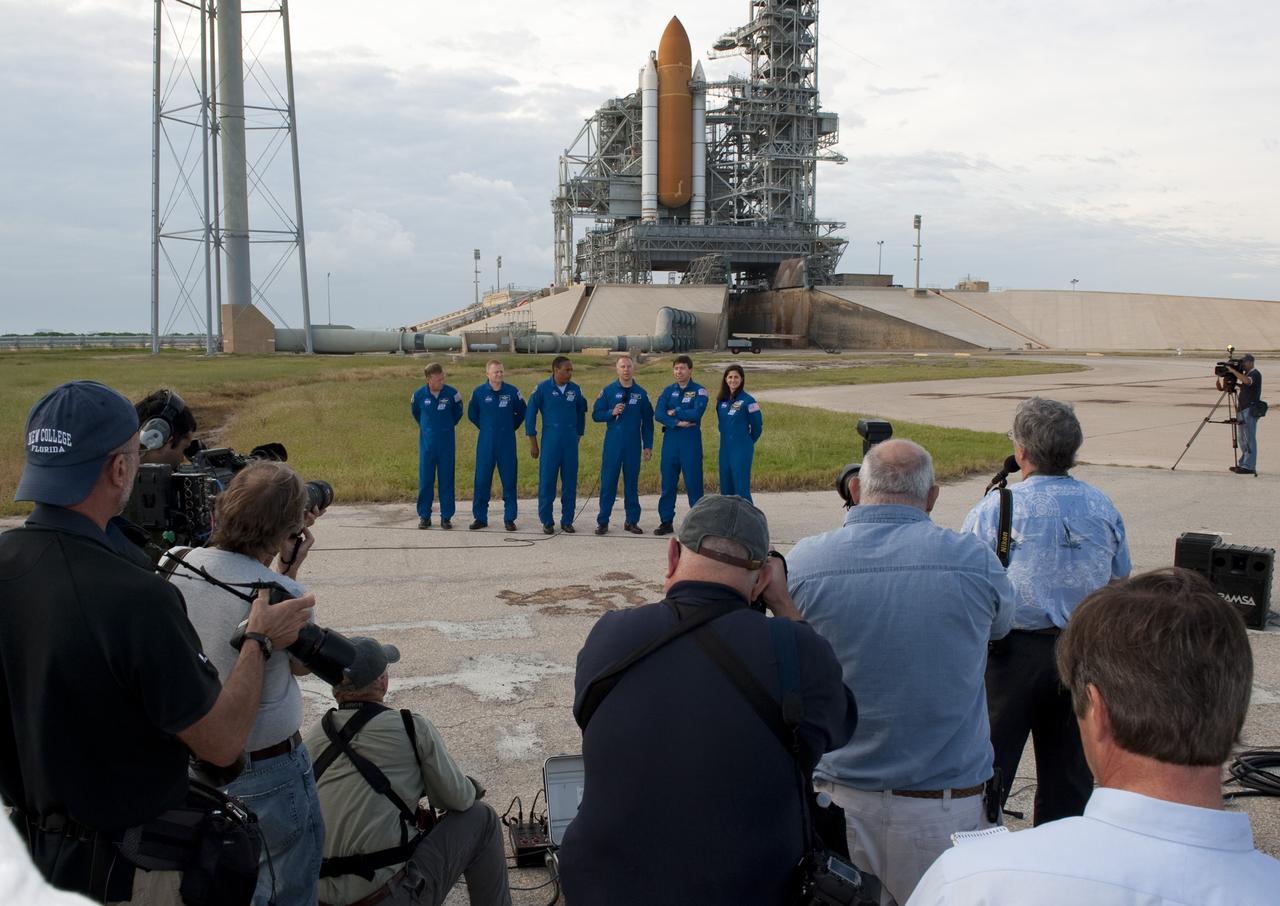
CAPE CANAVERAL, Fla. -- At NASA's Kennedy Space Center in Florida, media ask STS-133 Mission Specialist Tim Kopra questions at Launch Pad 39A, where space shuttle Discovery is poised for launch next month. The six STS-133 crew members, from left, are Commander Steve Lindsey, Pilot Eric Boe, and Mission Specialists Alvin Drew, Kopra, Michael Barratt, and Nicole Stott. The crew is at Kennedy for the Terminal Countdown Demonstration Test (TCDT), which provides each shuttle crew and launch team an opportunity to participate in various simulated activities, including equipment familiarization and emergency training at the launch pad. Discovery and its crew will deliver the Permanent Multipurpose Module, packed with supplies and critical spare parts, as well as Robonaut 2, the dexterous humanoid astronaut helper, to the International Space Station. Launch is targeted for Nov. 1 at 4:40 p.m. For more information on the STS-133 mission, visit www.nasa.gov/mission_pages/shuttle/shuttlemissions/sts133/. Photo credit: NASA/Kim Shiflett
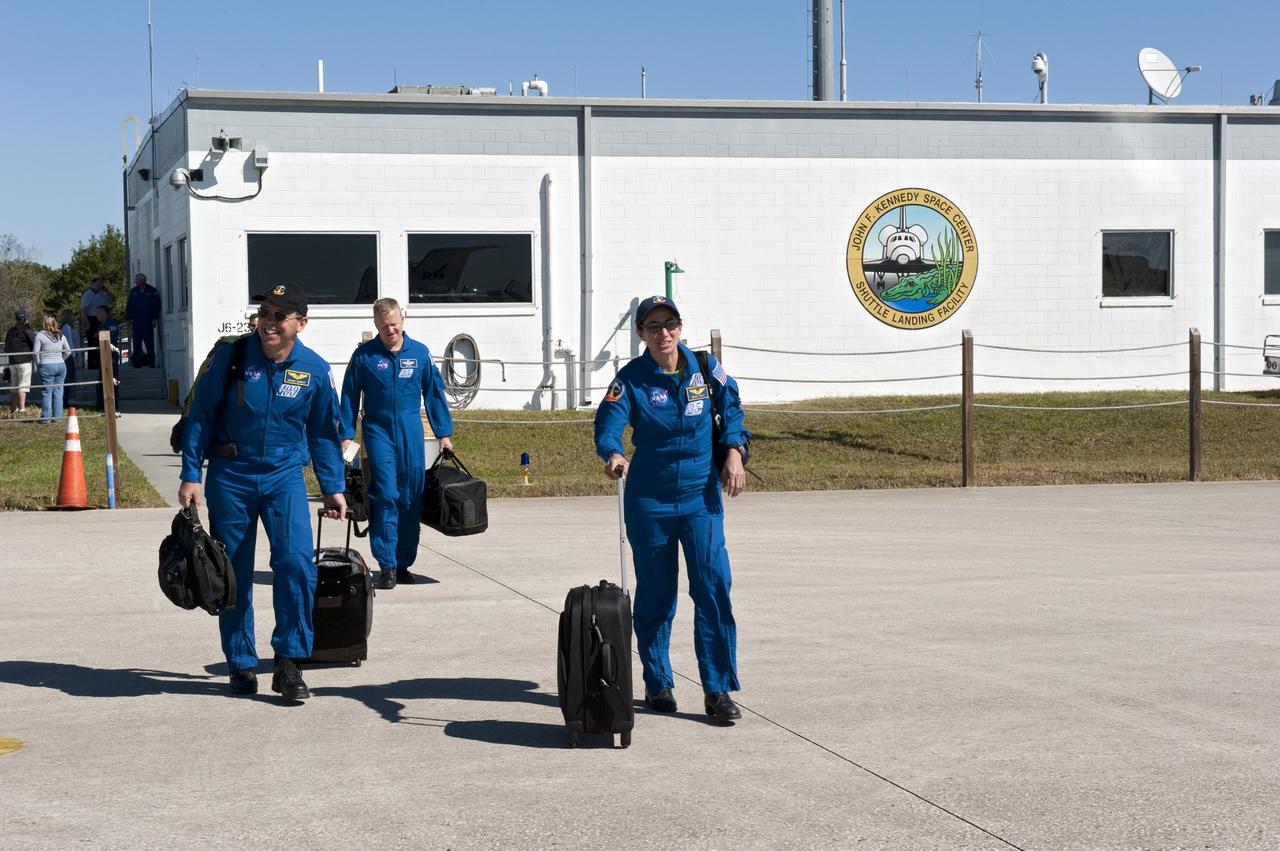
CAPE CANAVERAL, Fla. -- Space shuttle Discovery's STS-133 crew prepares to depart NASA's Kennedy Space Center in Florida in T-38 training jets. Mission Specialist Michael Barratt, left, Pilot Eric Boe and Mission Specialist Nicole Stott and their three crewmates will wait until at least Nov. 30 to launch to the International Space Station because a leak was detected at the Ground Umbilical Carrier Plate (GUCP) while Discovery's external fuel tank was being loaded for launch on Nov. 5. The GUCP is an attachment point between the external tank and a pipe that carries gaseous hydrogen safely away from the shuttle to the flare stack, where it is burned off. Engineers and managers also will evaluate a crack in the foam on the external tank. During the 11-day mission, STS-133 will deliver the Permanent Multipurpose Module, packed with supplies and critical spare parts, as well as Robonaut 2, to the orbiting laboratory. Discovery, which will fly its 39th mission, is scheduled to be retired following STS-133. This will be the 133rd Space Shuttle Program mission and the 35th shuttle voyage to the space station. For more information on STS-133, visit www.nasa.gov/mission_pages/shuttle/shuttlemissions/sts133/. Photo credit: NASA/Kim Shiflett
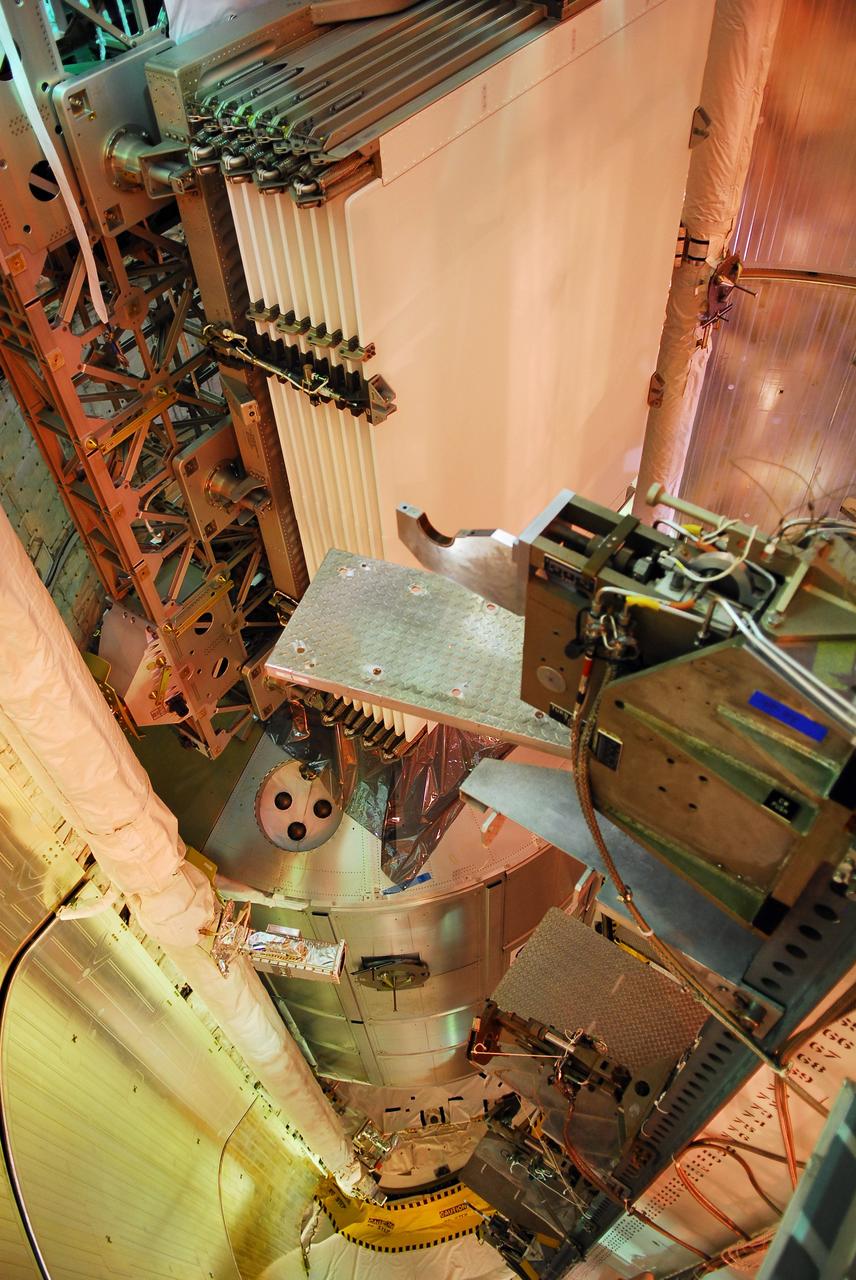
CAPE CANAVERAL, Fla. -- At NASA's Kennedy Space Center in Florida, space shuttle Discovery's payload bay is open for the STS-133 crew members to take a look at their payload while at Launch Pad 39A for the Terminal Countdown Demonstration Test (TCDT). Discovery and its STS-133 crew will deliver the Permanent Multipurpose Module, packed with supplies and critical spare parts, as well as Robonaut 2, the dexterous humanoid astronaut helper, to the International Space Station. Launch is targeted for 4:40 p.m. EDT, Nov. 1. Photo credit: NASA/Jim Grossmann
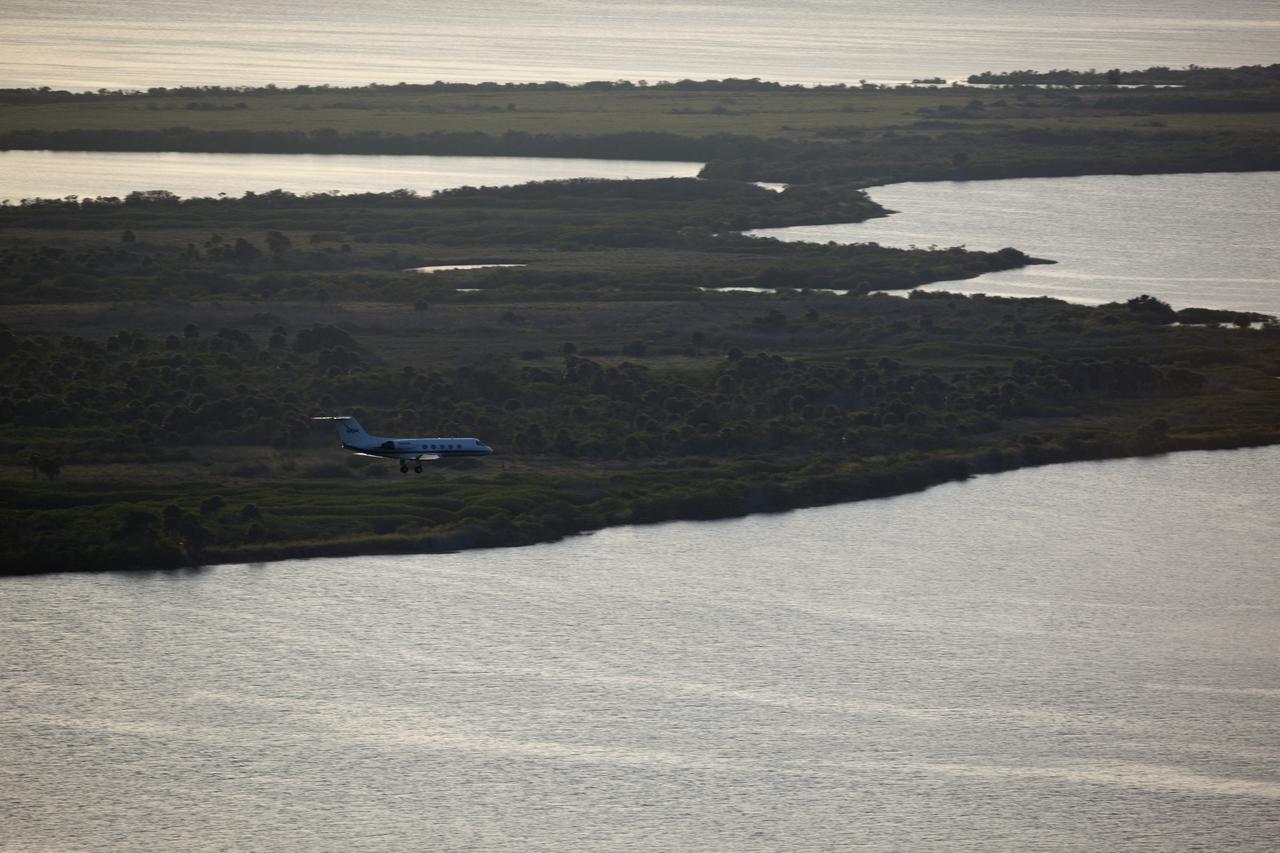
CAPE CANAVERAL, Fla. -- A Shuttle Training Aircraft (STA) performs touch-and-go landings as the sun sets over the Shuttle Landing Facility runway at NASA's Kennedy Space Center in Florida. STS-133 Commander Steve Lindsey and Pilot Eric Boe are flying two Gulfstream II business jets that are modified to mimic the shuttle's handling during the final phase of landing. Practice landings are part of the Terminal Countdown Demonstration Test (TCDT), which provides each shuttle crew and launch team an opportunity to participate in various simulated activities, including equipment familiarization and emergency training at the launch pad. Space shuttle Discovery and its STS-133 crew will deliver the Permanent Multipurpose Module, packed with supplies and critical spare parts, as well as Robonaut 2, the dexterous humanoid astronaut helper, to the International Space Station. Launch is targeted for Nov. 1 at 4:40 p.m. For more information on the STS-133 mission, visit www.nasa.gov/mission_pages/shuttle/shuttlemissions/sts133/. Photo credit: NASA/Dimitri Gerondidakis
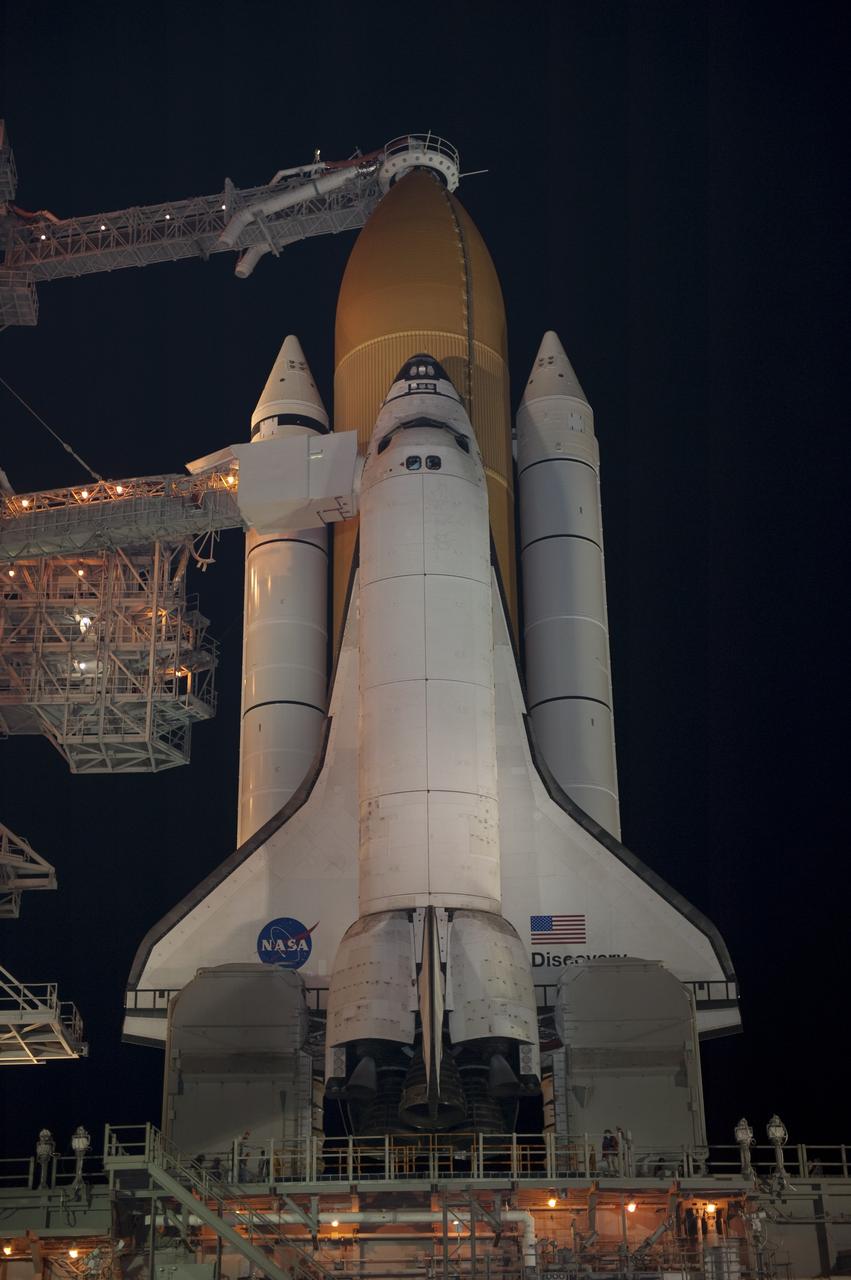
CAPE CANAVERAL, Fla. -- At NASA's Kennedy Space Center in Florida, space shuttle Discovery is visible on Launch Pad 39A following the retraction of the rotating service structure. The structure provides weather protection and access to the shuttle while it awaits lift off on the pad. RSS "rollback," as it's called, was delayed for a few hours to allow a lightning-producing storm cloud to pass. Launch of Discovery on the STS-133 mission to the International Space Station is set for 3:29 p.m. on Nov. 4. During the 11-day mission, Discovery and its six crew members will deliver the Permanent Multipurpose Module, packed with supplies and critical spare parts, as well as Robonaut 2, to the orbiting laboratory. Discovery, which will fly its 39th mission, is scheduled to be retired following STS-133. This will be the 133rd Space Shuttle Program mission and the 35th shuttle voyage to the space station. For more information on STS-133, visit www.nasa.gov/mission_pages/shuttle/shuttlemissions/sts133/. Photo credit: NASA/Kim Shiflett
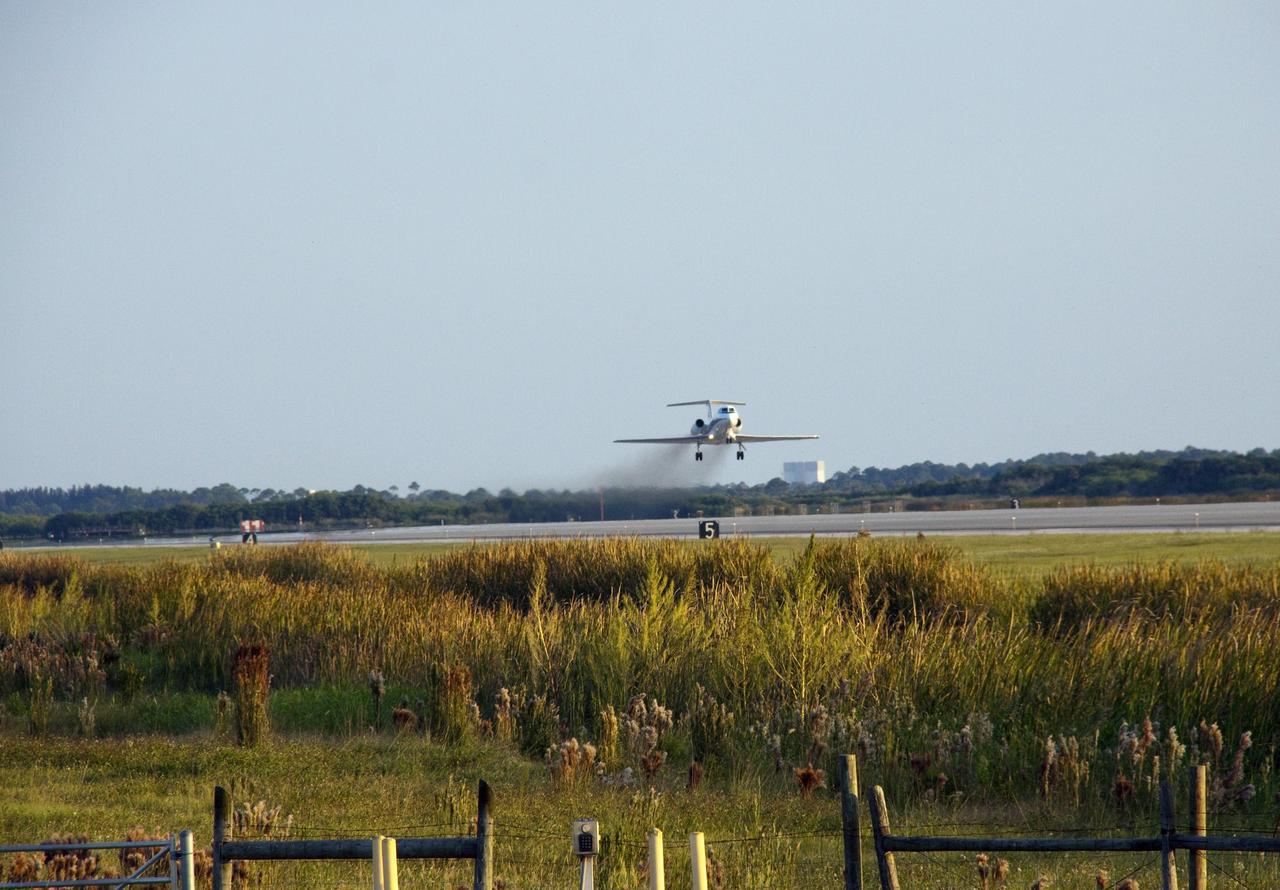
CAPE CANAVERAL, Fla. -- A Shuttle Training Aircraft (STA) performs touch-and-go landings on the Shuttle Landing Facility runway at NASA's Kennedy Space Center in Florida. STS-133 Commander Steve Lindsey and Pilot Eric Boe are flying the modified Gulfstream II business jets to mimic the shuttle's handling during the final phase of landing. Practice landings are part of the Terminal Countdown Demonstration Test (TCDT), which provides each shuttle crew and launch team an opportunity to participate in various simulated activities, including equipment familiarization and emergency training at the launch pad. Space shuttle Discovery and its STS-133 crew will deliver the Permanent Multipurpose Module, packed with supplies and critical spare parts, as well as Robonaut 2, the dexterous humanoid astronaut helper, to the International Space Station. Launch is targeted for Nov. 1 at 4:40 p.m. For more information on the STS-133 mission, visit www.nasa.gov/mission_pages/shuttle/shuttlemissions/sts133/. Photo credit: NASA/Jack Pfaller
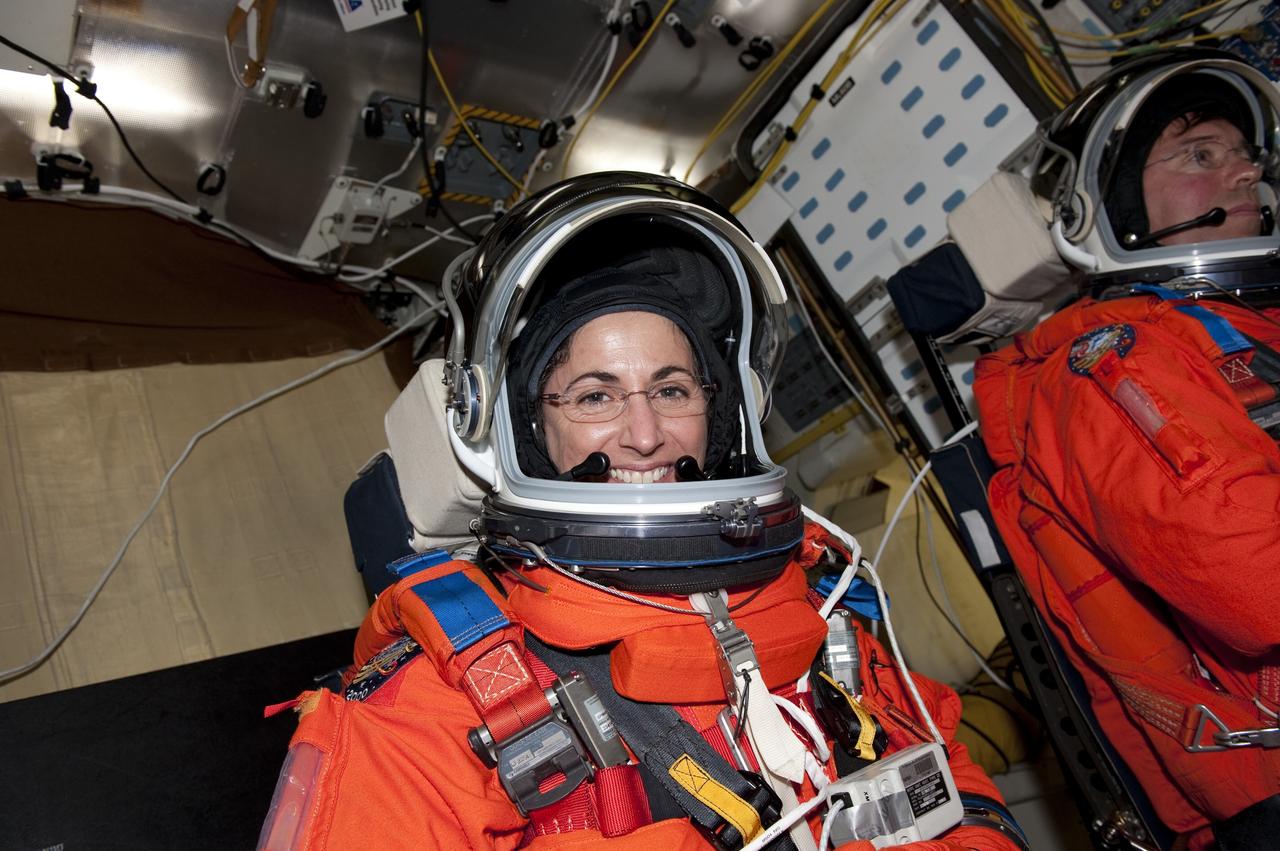
CAPE CANAVERAL, Fla. -- During a simulated launch countdown on Launch Pad 39A at NASA's Kennedy Space Center in Florida, STS-133 Mission Specialists Nicole Stott, left, and Michael Barratt are strapped into their seats on space shuttle Discovery. Next, they will practice escaping the shuttle, in preparation for an unlikely emergency at the pad on launch day. The simulated launch countdown and emergency exit training are part of a week-long Terminal Countdown Demonstration Test (TCDT). Discovery and its STS-133 crew will deliver the Permanent Multipurpose Module, packed with supplies and critical spare parts, as well as Robonaut 2, the dexterous humanoid astronaut helper, to the International Space Station. Launch is targeted for Nov. 1 at 4:40 p.m. For more information on the STS-133 mission, visit www.nasa.gov/mission_pages/shuttle/shuttlemissions/sts133/. Photo credit: NASA/Kim Shiflett
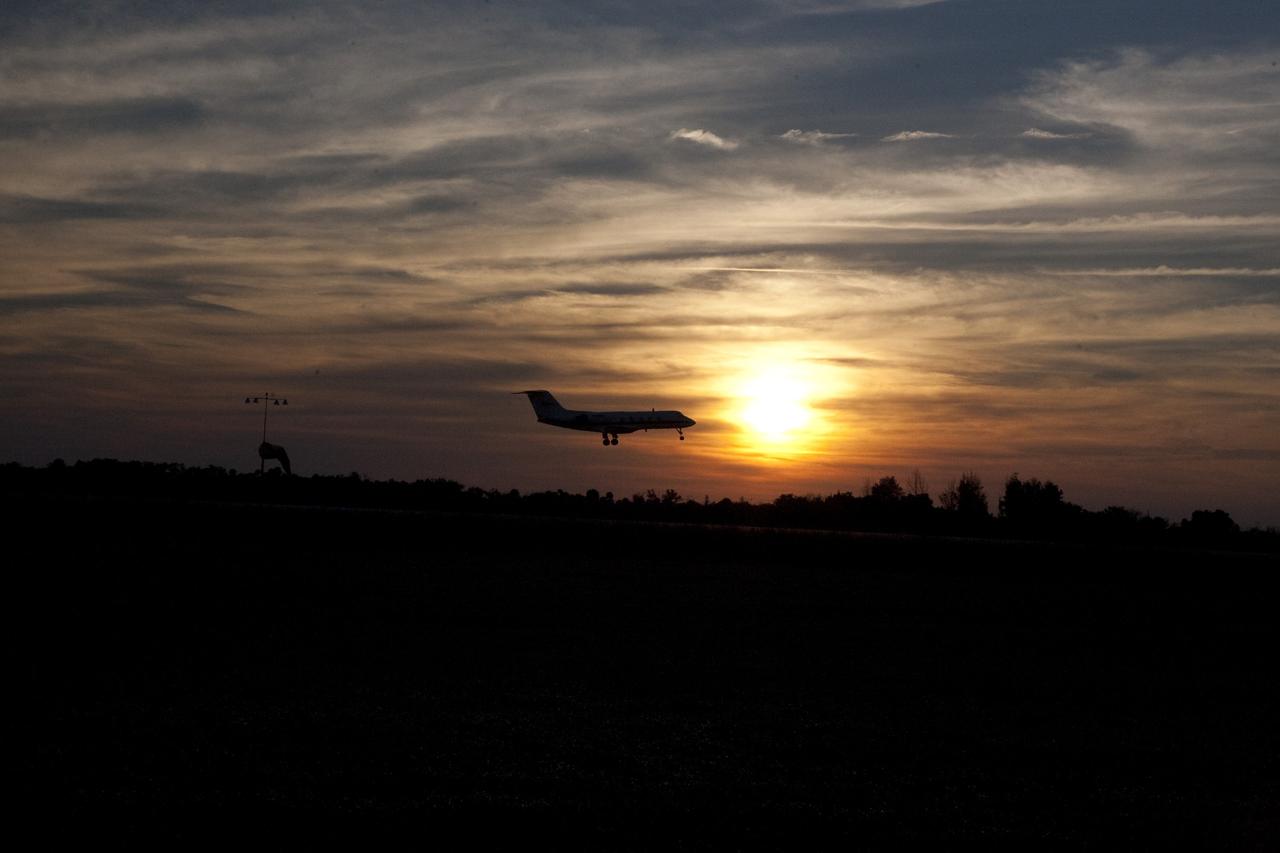
CAPE CANAVERAL, Fla. -- A Shuttle Training Aircraft (STA) performs touch-and-go landings as the sun sets over the Shuttle Landing Facility runway at NASA's Kennedy Space Center in Florida. STS-133 Commander Steve Lindsey and Pilot Eric Boe are flying two Gulfstream II business jets that are modified to mimic the shuttle's handling during the final phase of landing. Practice landings are part of the Terminal Countdown Demonstration Test (TCDT), which provides each shuttle crew and launch team an opportunity to participate in various simulated activities, including equipment familiarization and emergency training at the launch pad. Space shuttle Discovery and its STS-133 crew will deliver the Permanent Multipurpose Module, packed with supplies and critical spare parts, as well as Robonaut 2, the dexterous humanoid astronaut helper, to the International Space Station. Launch is targeted for Nov. 1 at 4:40 p.m. For more information on the STS-133 mission, visit www.nasa.gov/mission_pages/shuttle/shuttlemissions/sts133/. Photo credit: NASA/Amanda Diller
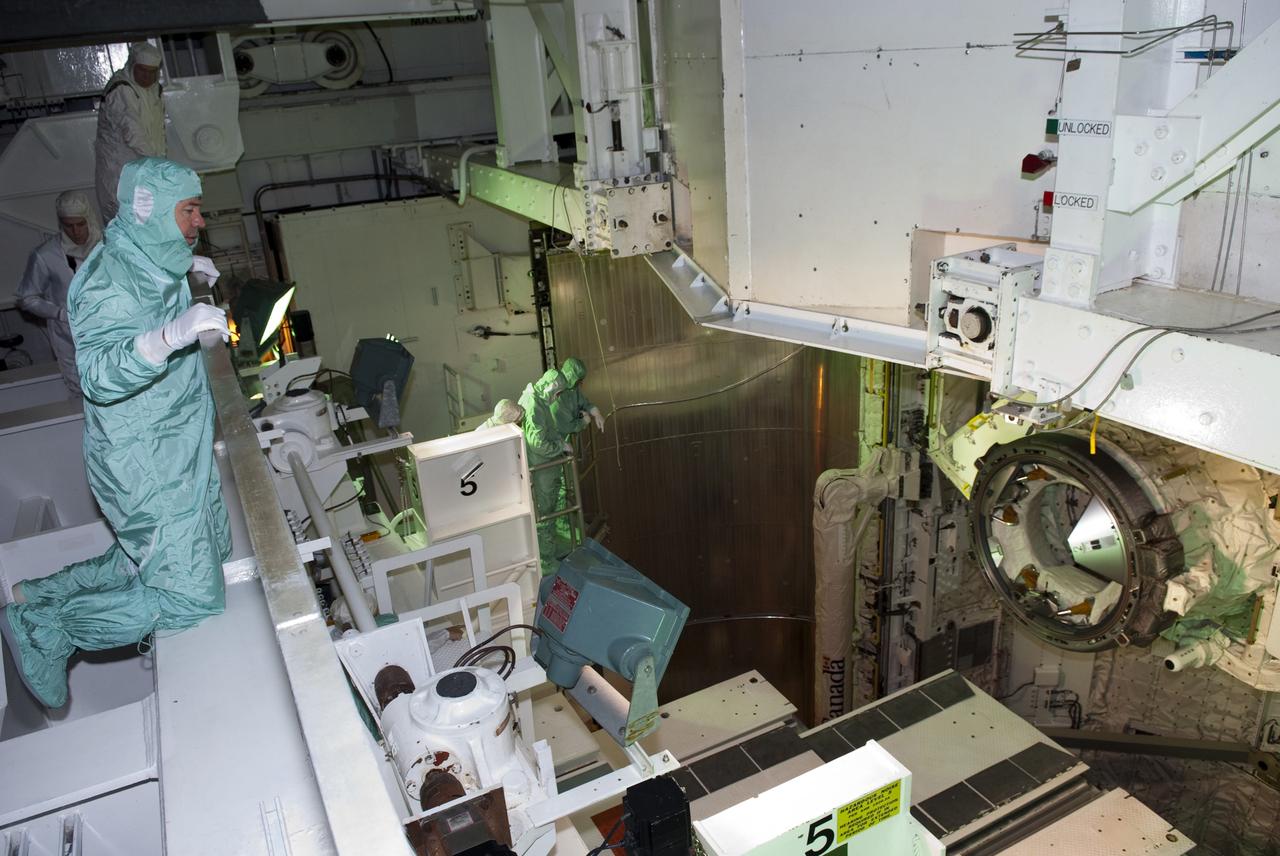
CAPE CANAVERAL, Fla. -- At NASA's Kennedy Space Center in Florida, STS-133 Mission Specialist Michael Barratt, foreground, checks out his mission's payload while at Launch Pad 39A for the Terminal Countdown Demonstration Test (TCDT). Discovery and its STS-133 crew will deliver the Permanent Multipurpose Module, packed with supplies and critical spare parts, as well as Robonaut 2, the dexterous humanoid astronaut helper, to the International Space Station. Launch is targeted for 4:40 p.m. EDT, Nov. 1. Photo credit: NASA/Jim Grossmann
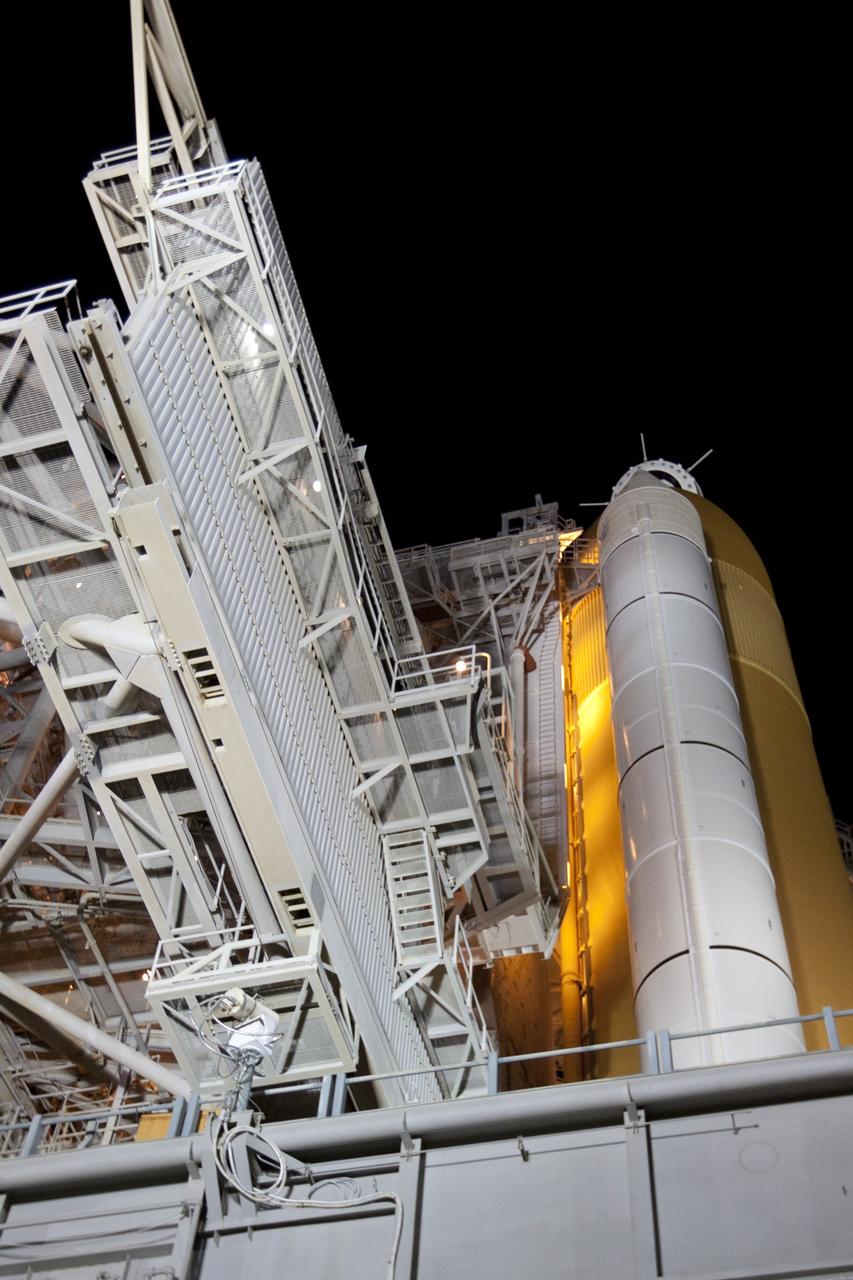
CAPE CANAVERAL, Fla. -- At NASA's Kennedy Space Center in Florida, the rotating service structure on Launch Pad 39A moves away from space shuttle Discovery. The structure provides weather protection and access to the shuttle while it awaits lift off on the pad. RSS "rollback," as it's called, was delayed for a few hours to allow a lightning-producing storm cloud to pass. Launch of Discovery on the STS-133 mission to the International Space Station is set for 3:29 p.m. on Nov. 4. During the 11-day mission, Discovery and its six crew members will deliver the Permanent Multipurpose Module, packed with supplies and critical spare parts, as well as Robonaut 2, to the orbiting laboratory. Discovery, which will fly its 39th mission, is scheduled to be retired following STS-133. This will be the 133rd Space Shuttle Program mission and the 35th shuttle voyage to the space station. For more information on STS-133, visit www.nasa.gov/mission_pages/shuttle/shuttlemissions/sts133/. Photo credit: NASA/Jack Pfaller
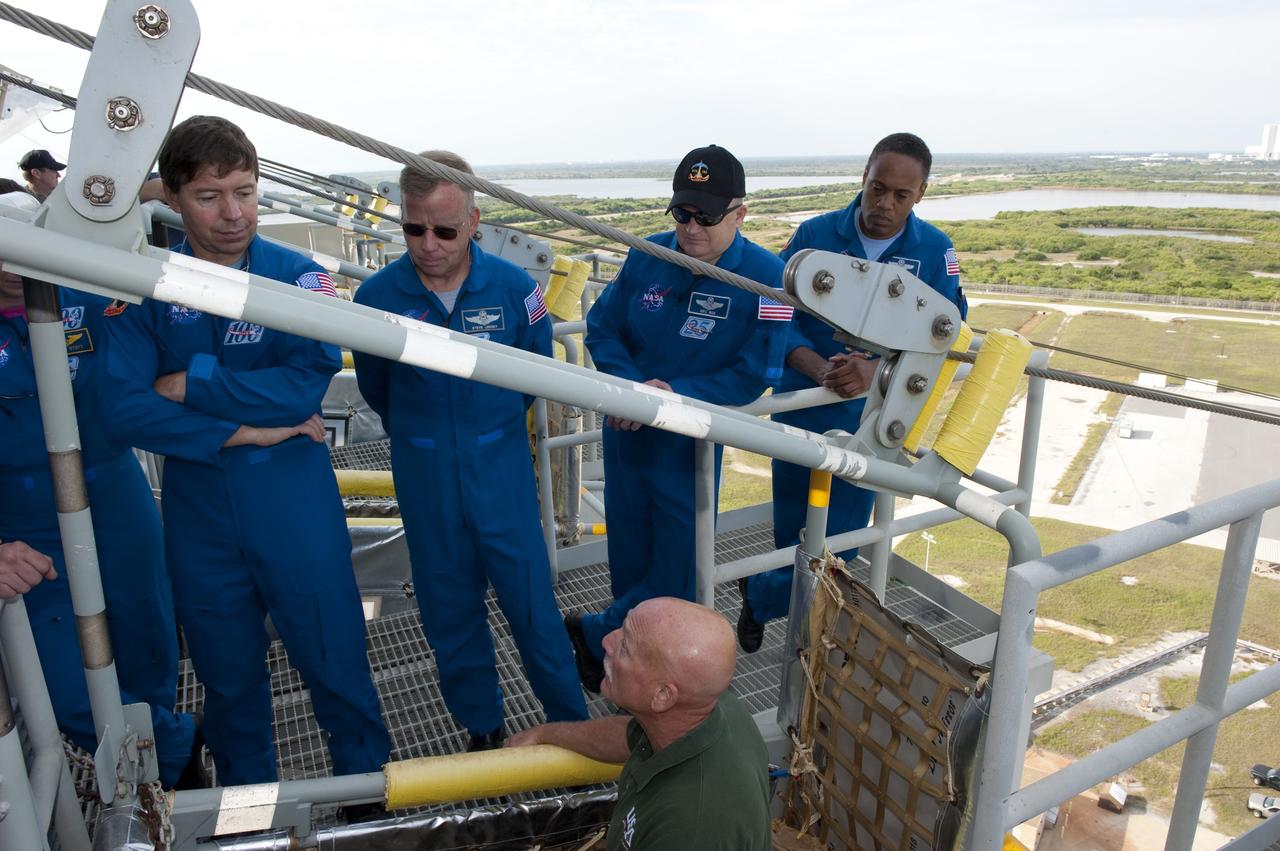
CAPE CANAVERAL, Fla. -- On Launch Pad 39A at NASA's Kennedy Space Center, STS-133 crew members receive instruction on the operation of the pad's slidewire basket system emergency exit training as part of the Terminal Countdown Demonstration Test (TCDT). From left are Mission Specialist Michael Barratt, Commander Steve Lindsey, Pilot Eric Boe and Mission Specialist Alvin Drew. TCDT provides each shuttle crew and launch team an opportunity to participate in various simulated activities, including equipment familiarization and a launch countdown. Space shuttle Discovery and its STS-133 crew will deliver the Permanent Multipurpose Module, packed with supplies and critical spare parts, as well as Robonaut 2, the dexterous humanoid astronaut helper, to the International Space Station. Launch is targeted for Nov. 1 at 4:40 p.m. For more information on the STS-133 mission, visit www.nasa.gov/mission_pages/shuttle/shuttlemissions/sts133/. Photo credit: NASA/Kim Shiflett
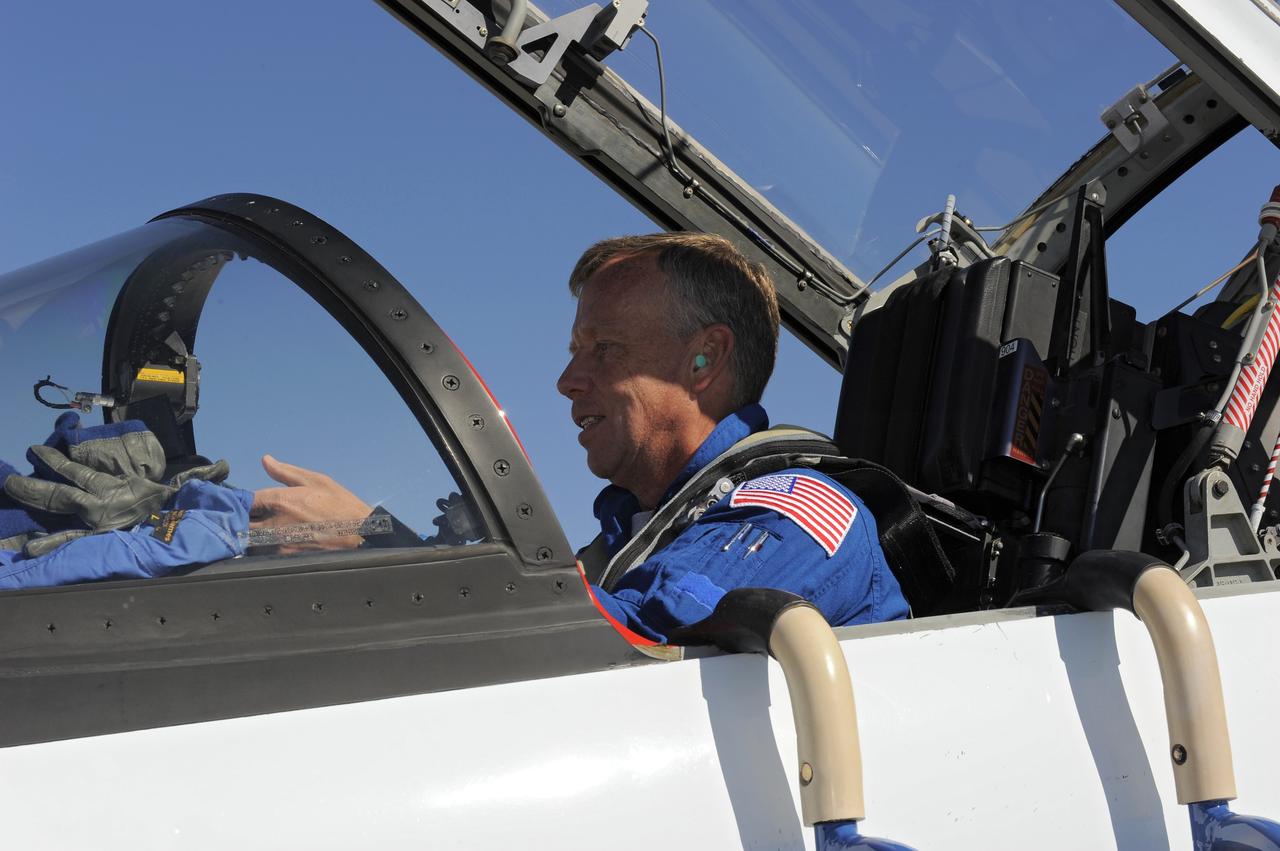
CAPE CANAVERAL, Fla. -- Space shuttle Discovery's STS-133 Commander Steve Lindsey prepares to depart NASA's Kennedy Space Center in Florida in a T-38 training jet. Lindsey and his five crewmates will wait until at least Nov. 30 to launch to the International Space Station because a leak was detected at the Ground Umbilical Carrier Plate (GUCP) while Discovery's external fuel tank was being loaded for launch on Nov. 5. The GUCP is an attachment point between the external tank and a pipe that carries gaseous hydrogen safely away from the shuttle to the flare stack, where it is burned off. Engineers and managers also will evaluate a crack in the foam on the external tank. During the 11-day mission, STS-133 will deliver the Permanent Multipurpose Module, packed with supplies and critical spare parts, as well as Robonaut 2, to the orbiting laboratory. Discovery, which will fly its 39th mission, is scheduled to be retired following STS-133. This will be the 133rd Space Shuttle Program mission and the 35th shuttle voyage to the space station. For more information on STS-133, visit www.nasa.gov/mission_pages/shuttle/shuttlemissions/sts133/. Photo credit: NASA/Kim Shiflett
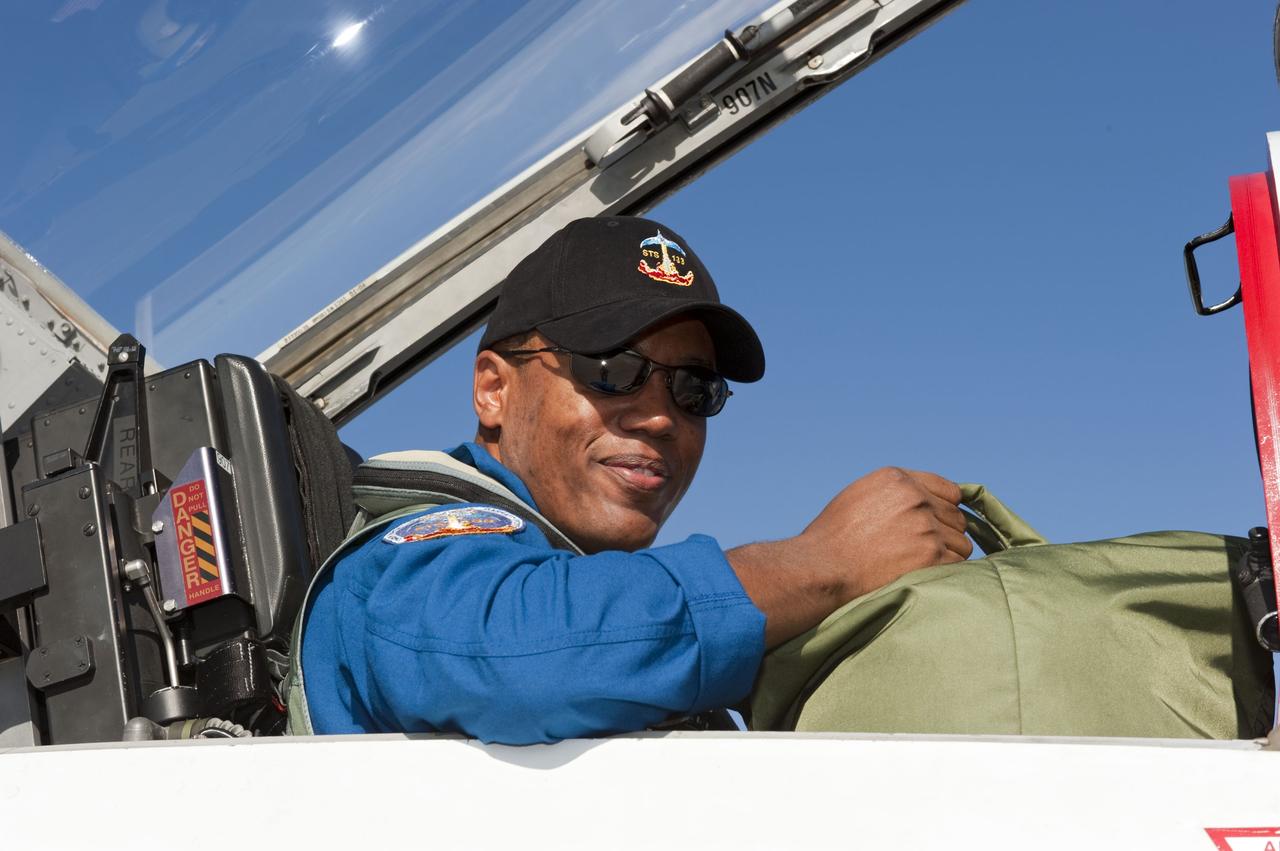
CAPE CANAVERAL, Fla. -- At NASA's Kennedy Space Center in Florida, space shuttle Discovery's STS-133 Mission Specialist Alvin Drew arrives on the Shuttle Landing Facility runway aboard a T-38 training jet. In the days leading up to their launch to the International Space Station, Drew and his crew members will check the fit of their launch-and-entry suits, review launch-day procedures, receive weather briefings and remain medically quarantined to prevent sickness. Scheduled to lift off Nov. 1 at 4:40 p.m., Discovery and crew will deliver the Permanent Multipurpose Module, packed with supplies and critical spare parts, as well as Robonaut 2, the dexterous humanoid astronaut helper, to the orbiting outpost. For more information on the STS-133 mission, visit www.nasa.gov/mission_pages/shuttle/shuttlemissions/sts133/. Photo credit: NASA/Kim Shiflett
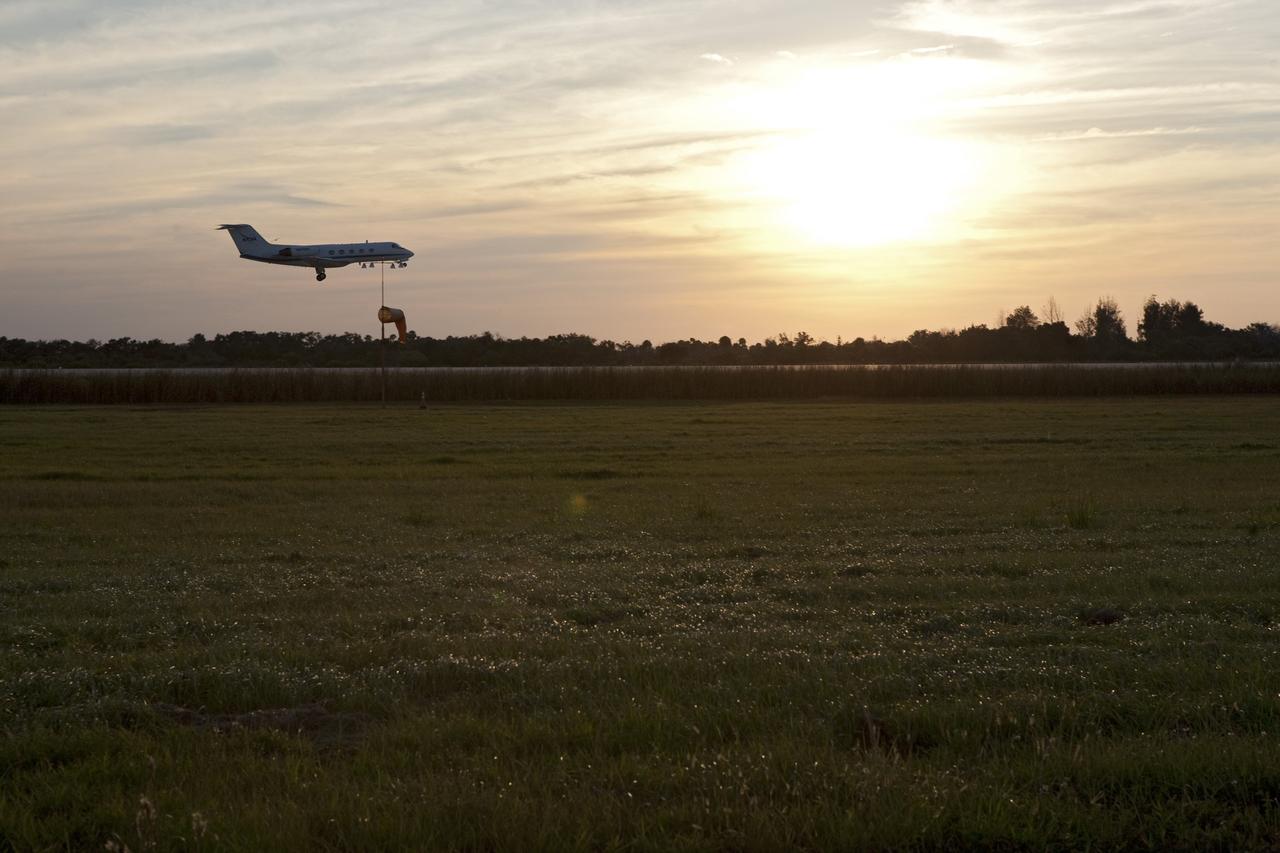
CAPE CANAVERAL, Fla. -- A Shuttle Training Aircraft (STA) performs touch-and-go landings as the sun sets over the Shuttle Landing Facility runway at NASA's Kennedy Space Center in Florida. STS-133 Commander Steve Lindsey and Pilot Eric Boe are flying two Gulfstream II business jets that are modified to mimic the shuttle's handling during the final phase of landing. Practice landings are part of the Terminal Countdown Demonstration Test (TCDT), which provides each shuttle crew and launch team an opportunity to participate in various simulated activities, including equipment familiarization and emergency training at the launch pad. Space shuttle Discovery and its STS-133 crew will deliver the Permanent Multipurpose Module, packed with supplies and critical spare parts, as well as Robonaut 2, the dexterous humanoid astronaut helper, to the International Space Station. Launch is targeted for Nov. 1 at 4:40 p.m. For more information on the STS-133 mission, visit www.nasa.gov/mission_pages/shuttle/shuttlemissions/sts133/. Photo credit: NASA/Amanda Diller
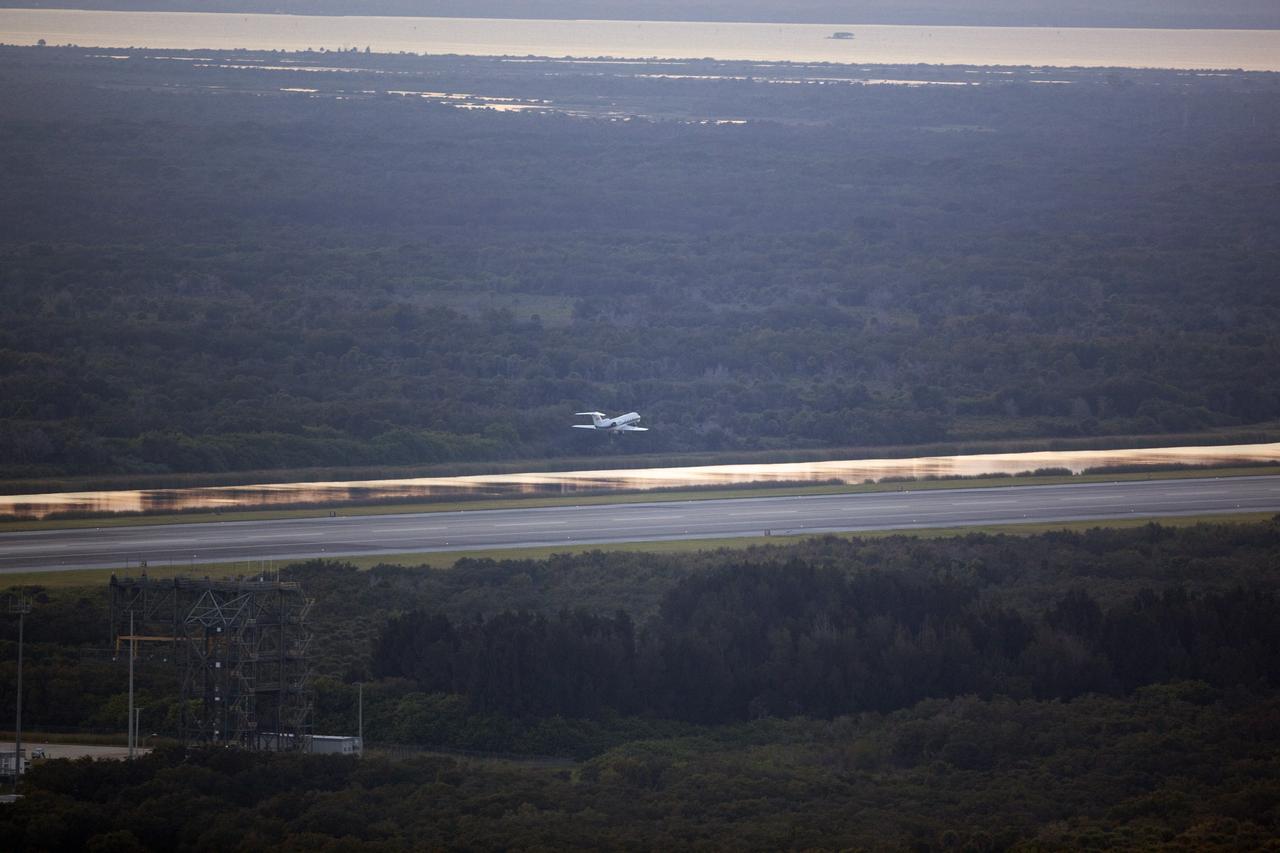
CAPE CANAVERAL, Fla. -- A Shuttle Training Aircraft (STA) performs touch-and-go landings over the Shuttle Landing Facility runway at NASA's Kennedy Space Center in Florida. STS-133 Commander Steve Lindsey and Pilot Eric Boe are flying two Gulfstream II business jets that are modified to mimic the shuttle's handling during the final phase of landing. Practice landings are part of the Terminal Countdown Demonstration Test (TCDT), which provides each shuttle crew and launch team an opportunity to participate in various simulated activities, including equipment familiarization and emergency training at the launch pad. Space shuttle Discovery and its STS-133 crew will deliver the Permanent Multipurpose Module, packed with supplies and critical spare parts, as well as Robonaut 2, the dexterous humanoid astronaut helper, to the International Space Station. Launch is targeted for Nov. 1 at 4:40 p.m. For more information on the STS-133 mission, visit www.nasa.gov/mission_pages/shuttle/shuttlemissions/sts133/. Photo credit: NASA/Dimitri Gerondidakis
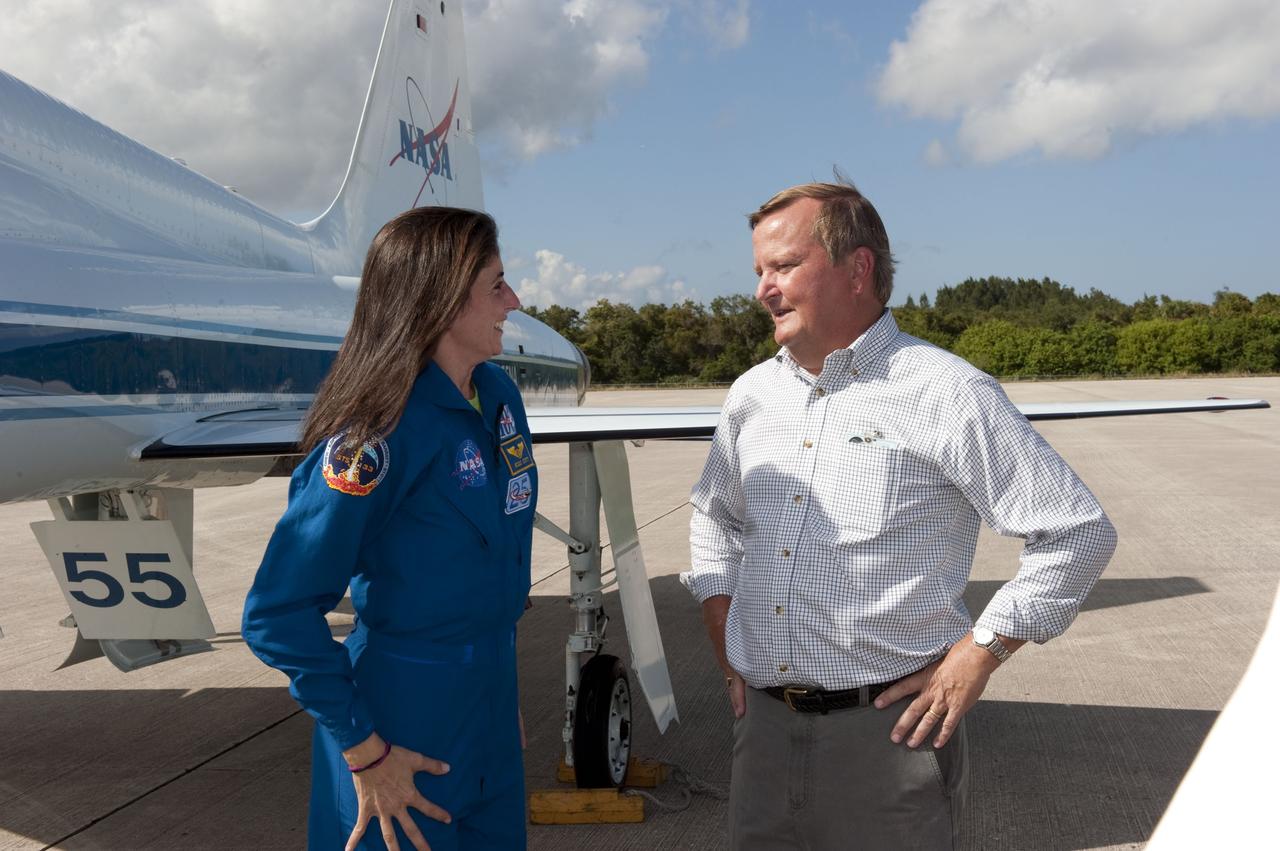
CAPE CANAVERAL, Fla. -- At NASA's Kennedy Space Center in Florida, space shuttle Discovery's STS-133 Mission Specialist Nicole Stott, left, is greeted by Shuttle Launch Director Mike Leinbach on the Shuttle Landing Facility runway after arriving in a T-38 training jet. In the days leading up to their launch to the International Space Station, Stott and her crew members will check the fit of their launch-and-entry suits, review launch-day procedures, receive weather briefings and remain medically quarantined to prevent sickness. Scheduled to lift off Nov. 1 at 4:40 p.m., Discovery and crew will deliver the Permanent Multipurpose Module, packed with supplies and critical spare parts, as well as Robonaut 2, the dexterous humanoid astronaut helper, to the orbiting outpost. For more information on the STS-133 mission, visit www.nasa.gov/mission_pages/shuttle/shuttlemissions/sts133/. Photo credit: NASA/Jack Pfaller
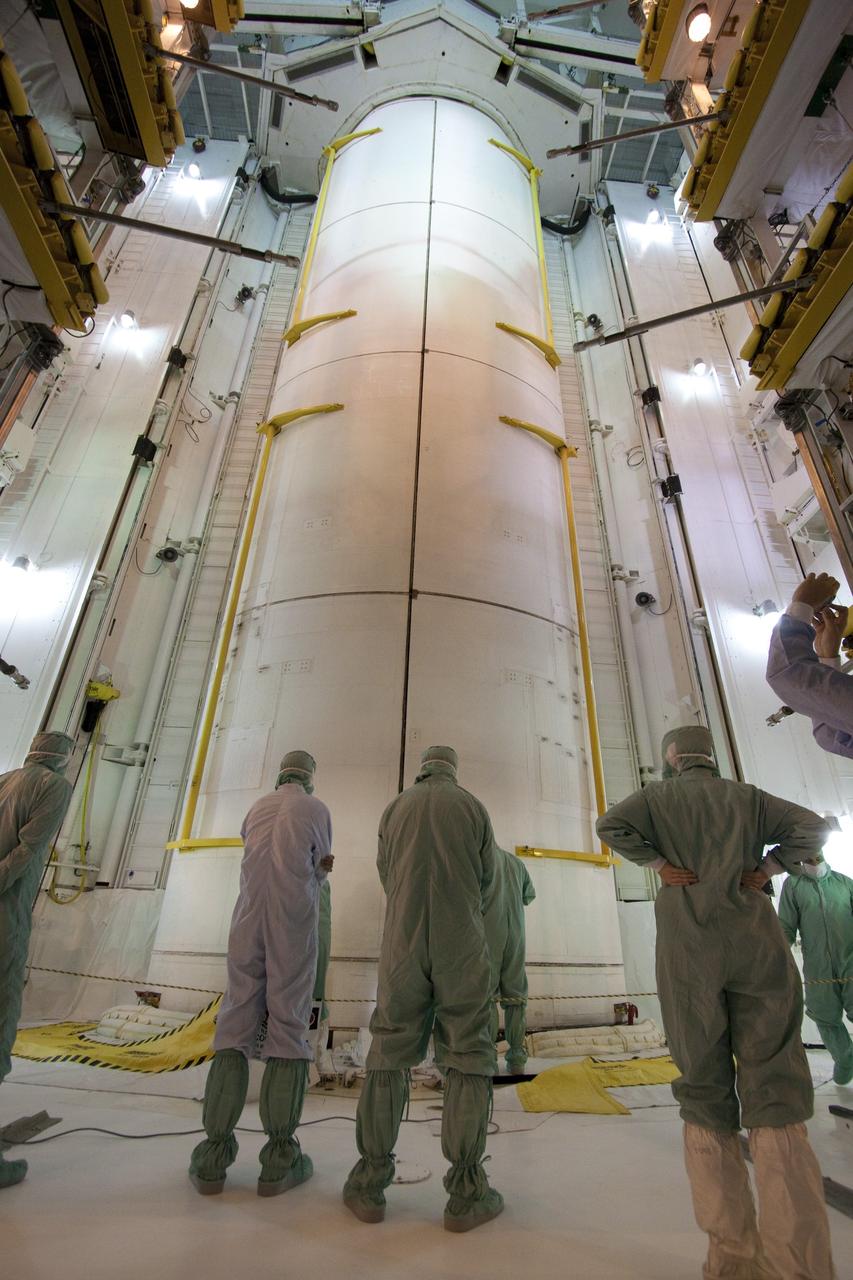
CAPE CANAVERAL, Fla. -- On Launch Pad 39A at NASA's Kennedy Space Center in Florida, the clamshell doors of space shuttle Discovery's payload bay are closed in preparation for the STS-133 launch to the International Space Station. Targeted to launch Nov. 1, STS-133 will carry the Permanent Multipurpose Module (PMM) packed with supplies and critical spare parts, as well as Robonaut 2 (R2) to the station. Photo credit: NASA/Jack Pfaller
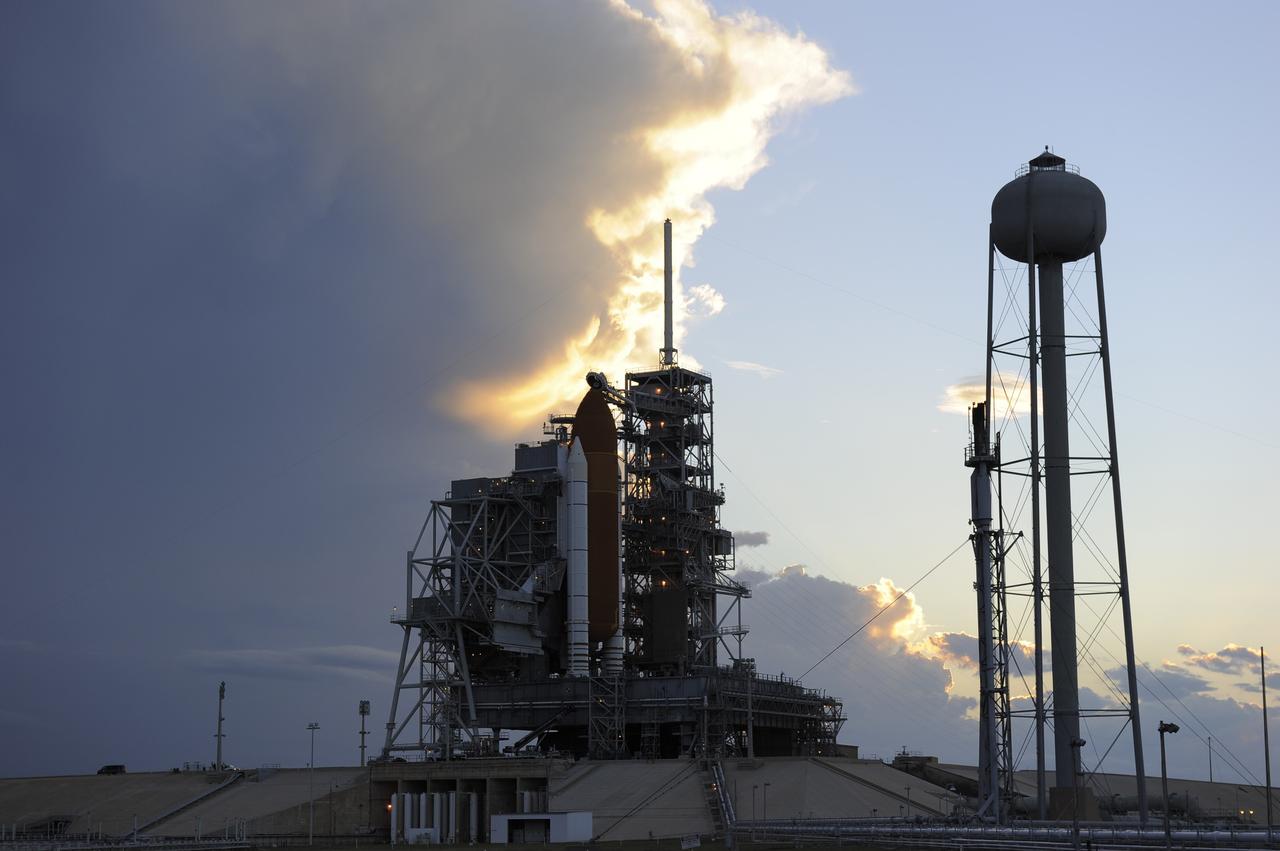
CAPE CANAVERAL, Fla. -- Storm clouds move over Launch Pad 39A at NASA's Kennedy Space Center in Florida, postponing the retraction of the pad's rotating service structure, which would reveal space shuttle Discovery. The structure provides weather protection and access to the shuttle while it awaits lift off on the pad. RSS "rollback," as it's called, will begin again after the lightning-producing clouds pass. Launch of Discovery on the STS-133 mission to the International Space Station is set for 3:29 p.m. on Nov. 4. During the 11-day mission, Discovery and its six crew members will deliver the Permanent Multipurpose Module, packed with supplies and critical spare parts, as well as Robonaut 2, to the orbiting laboratory. Discovery, which will fly its 39th mission, is scheduled to be retired following STS-133. This will be the 133rd Space Shuttle Program mission and the 35th shuttle voyage to the space station. For more information on STS-133, visit www.nasa.gov/mission_pages/shuttle/shuttlemissions/sts133/. Photo credit: NASA/Kim Shiflett