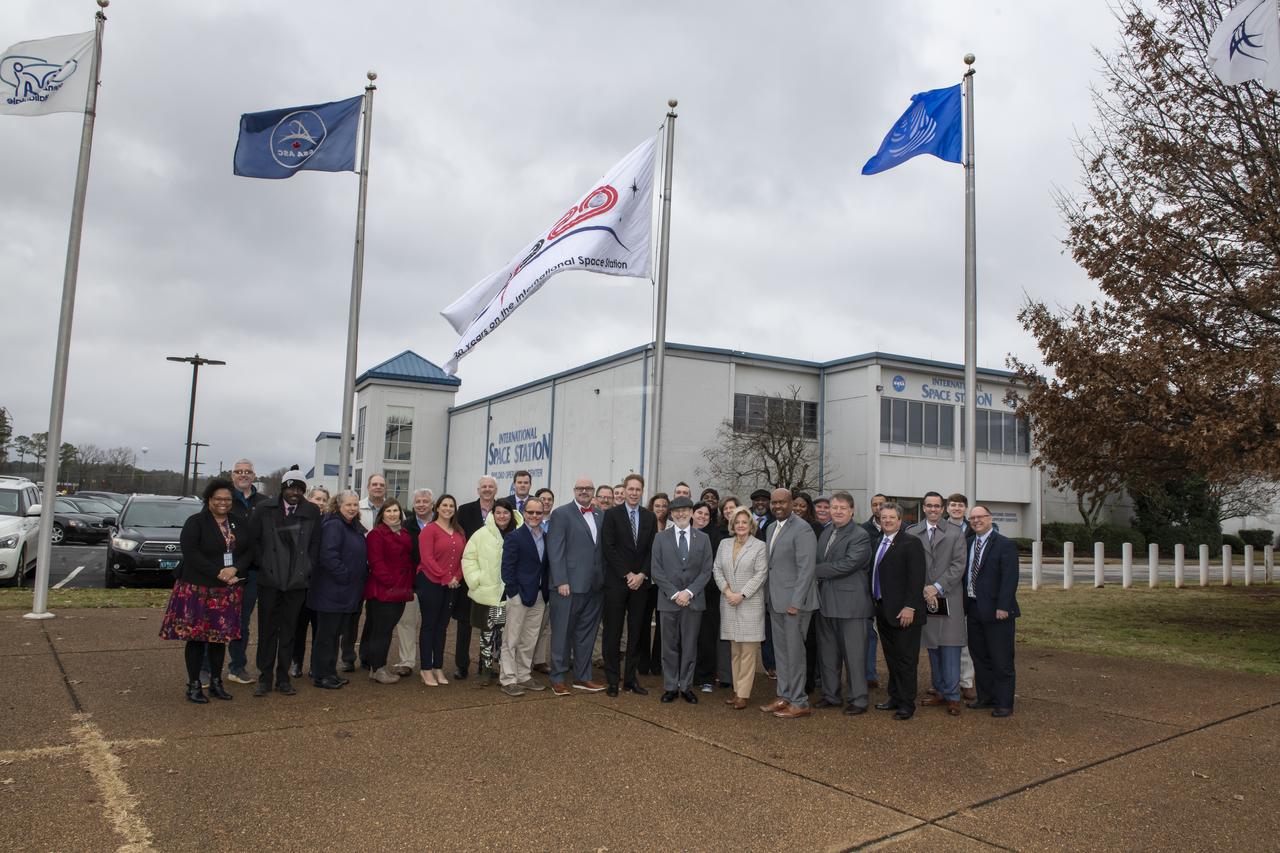
NASA Associate Administrator for the Human Exploration and Operations Mission Directorate and Marshall Center Director Jody Singer participate in the hanging of a new International Space Station flag out side of the Huntsville Operations Support Center (HOSC). Also participating were employees of the support center and the Payload Operations Integration Center.
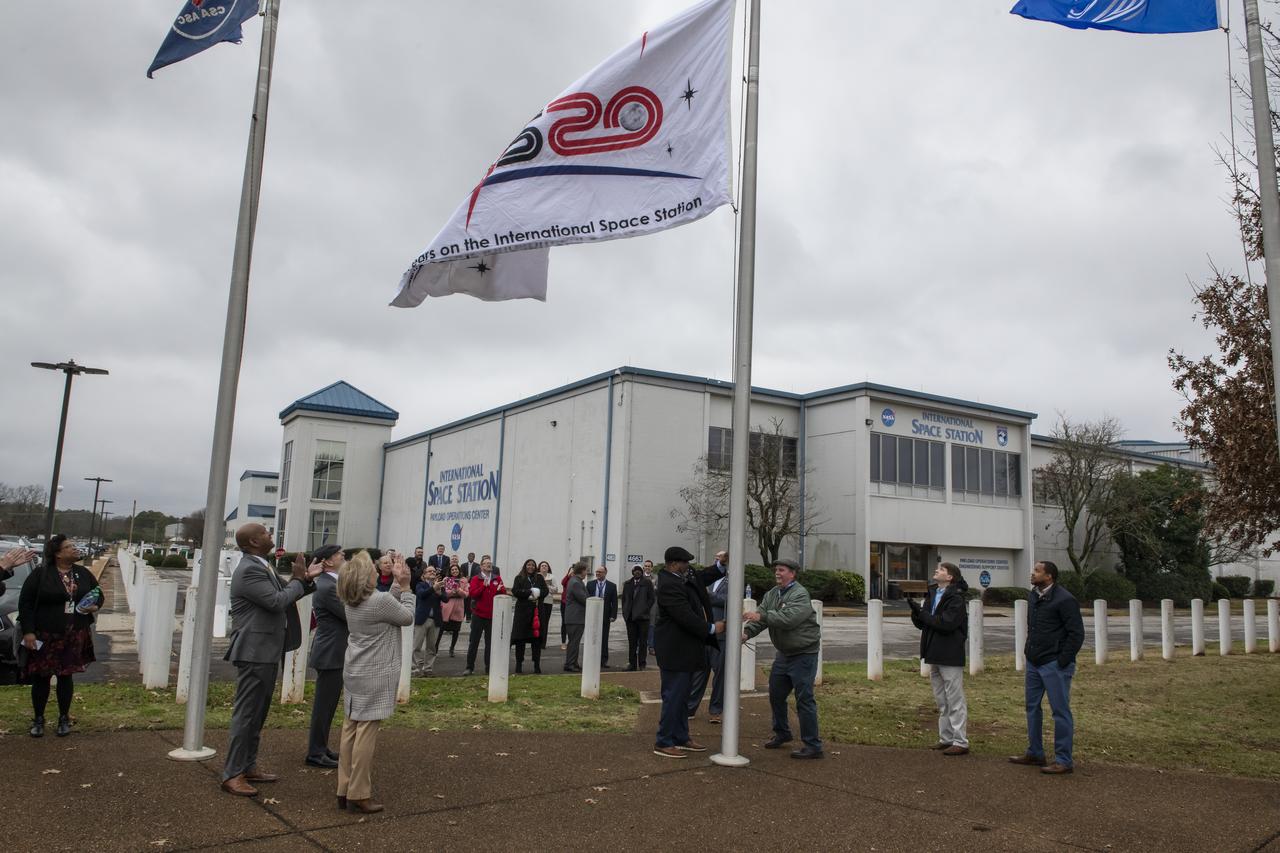
NASA Associate Administrator for the Human Exploration and Operations Mission Directorate and Marshall Center Director Jody Singer participate in the hanging of a new International Space Station flag out side of the Huntsville Operations Support Center (HOSC). Also participating were employees of the support center and the Payload Operations Integration Center.
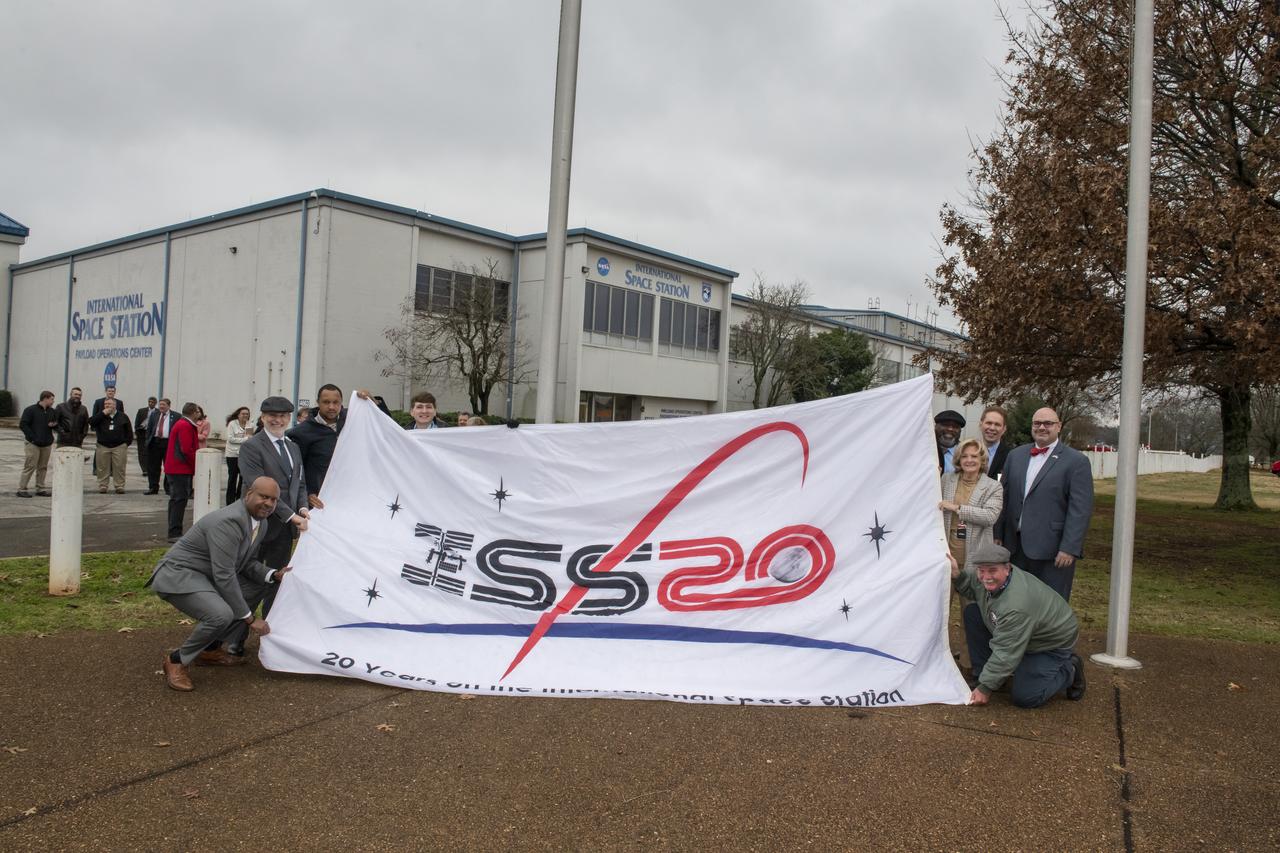
NASA Associate Administrator for the Human Exploration and Operations Mission Directorate and Marshall Center Director Jody Singer participate in the hanging of a new International Space Station flag out side of the Huntsville Operations Support Center (HOSC). Also participating were employees of the support center and the Payload Operations Integration Center.
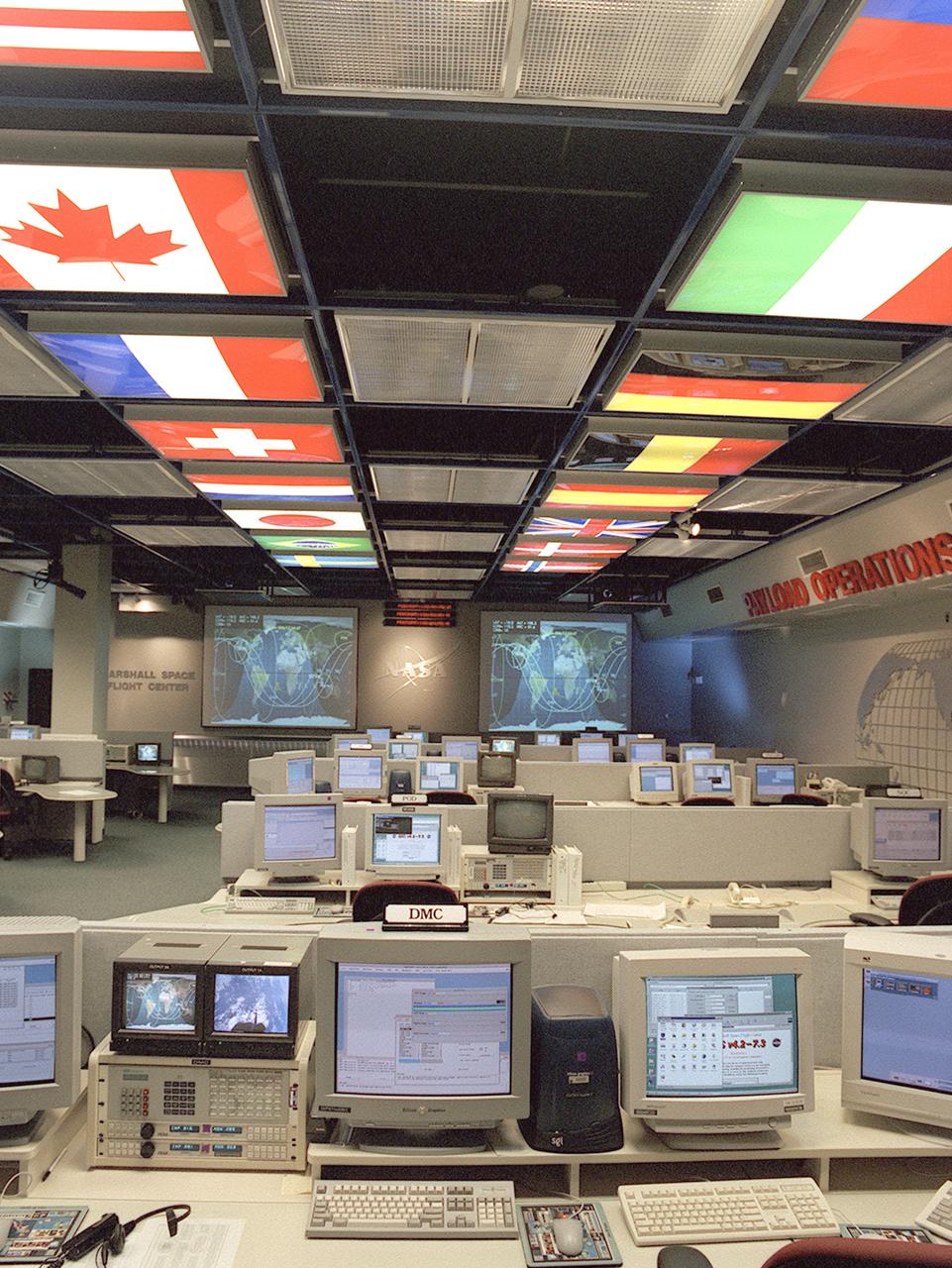
The International Space Station (ISS) Payload Operations Center (POC) at NASA's Marshall Space Flight Center (MSFC) in Huntsville, Alabama, is the world's primary science command post for the (ISS), the most ambitious space research facility in human history. The Payload Operations team is responsible for managing all science research experiments aboard the Station. The center is also home for coordination of the mission-plarning work of variety of international sources, all science payload deliveries and retrieval, and payload training and safety programs for the Station crew and all ground personnel. Within the POC, critical payload information from the ISS is displayed on a dedicated workstation, reading both S-band (low data rate) and Ku-band (high data rate) signals from a variety of experiments and procedures operated by the ISS crew and their colleagues on Earth. The POC is the focal point for incorporating research and experiment requirements from all international partners into an integrated ISS payload mission plan. This photograph is an overall view of the MSFC Payload Operations Center displaying the flags of the countries participating in the ISS. The flags at the left portray The United States, Canada, France, Switzerland, Netherlands, Japan, Brazil, and Sweden. The flags at the right portray The Russian Federation, Italy, Germany, Belgium, Spain, United Kingdom, Denmark, and Norway.
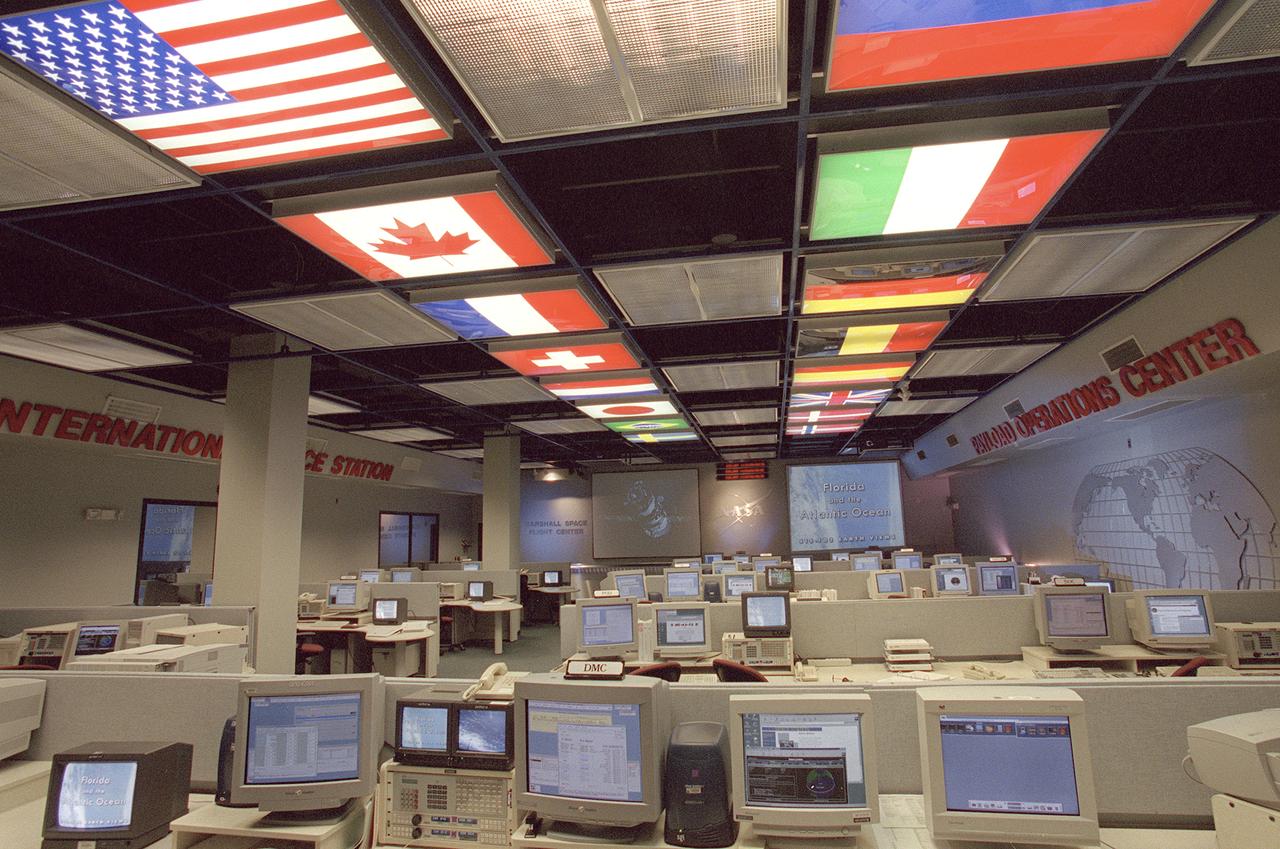
The International Space Station (ISS) Payload Operations Center (POC) at NASA's Marshall Space Flight Center (MSFC) in Huntsville, Alabama, is the world's primary science command post for the International Space Station (ISS), the most ambitious space research facility in human history. The Payload Operations team is responsible for managing all science research experiments aboard the Station. The center is also home for coordination of the mission-plarning work of variety of international sources, all science payload deliveries and retrieval, and payload training and safety programs for the Station crew and all ground personnel. Within the POC, critical payload information from the ISS is displayed on a dedicated workstation, reading both S-band (low data rate) and Ku-band (high data rate) signals from a variety of experiments and procedures operated by the ISS crew and their colleagues on Earth. The POC is the focal point for incorporating research and experiment requirements from all international partners into an integrated ISS payload mission plan. This photograph is an overall view of the MSFC Payload Operations Center displaying the flags of the countries participating the ISS. The flags at the left portray The United States, Canada, France, Switzerland, Netherlands, Japan, Brazil, and Sweden. The flags at the right portray The Russian Federation, Italy, Germany, Belgium, Spain, United Kingdom, Denmark, and Norway.
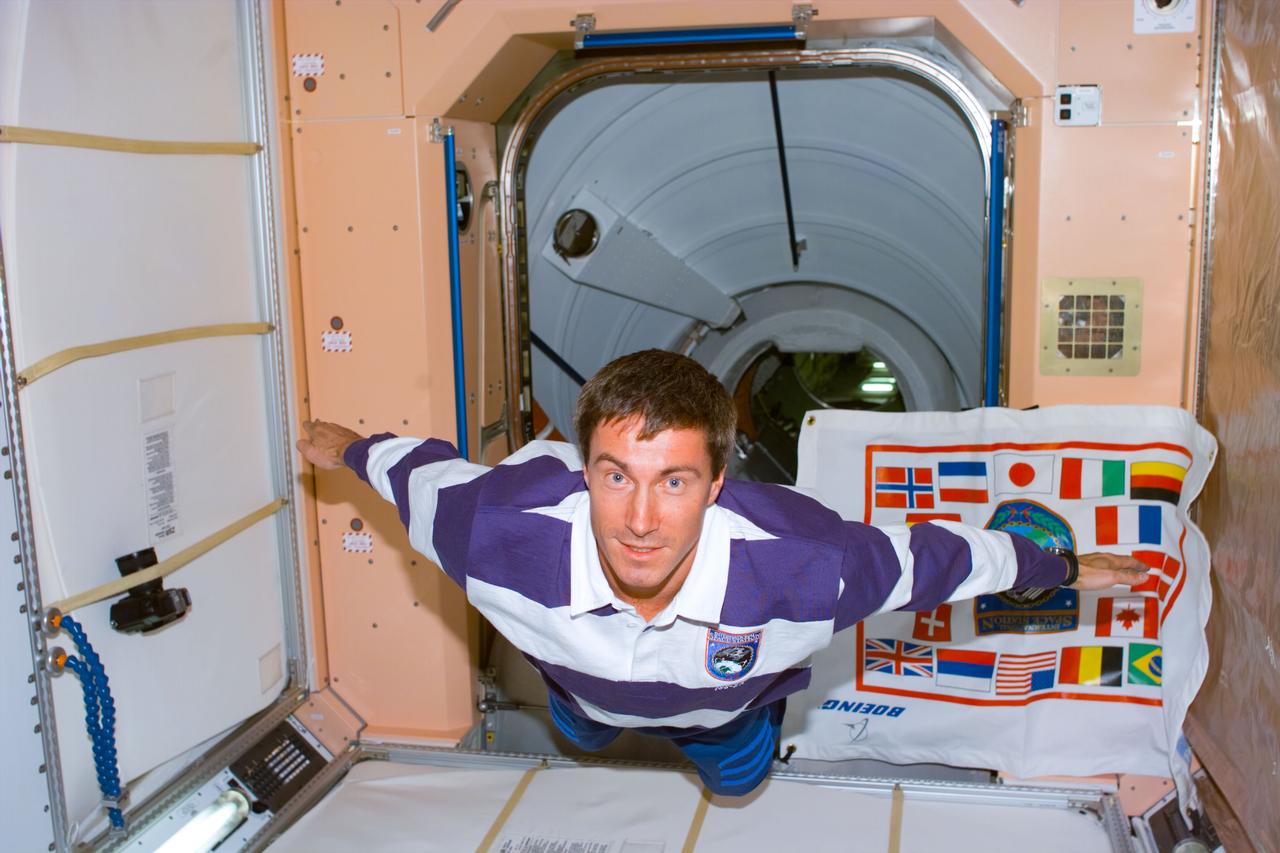
S88-E-5089 (12-11-98) --- Sergei Krikalev, mission specialist representing the Russian Space Agency (RSA), floats in the Unity module on Flight Day 8. A banner displaying the flags of all the ISS participants is at right.
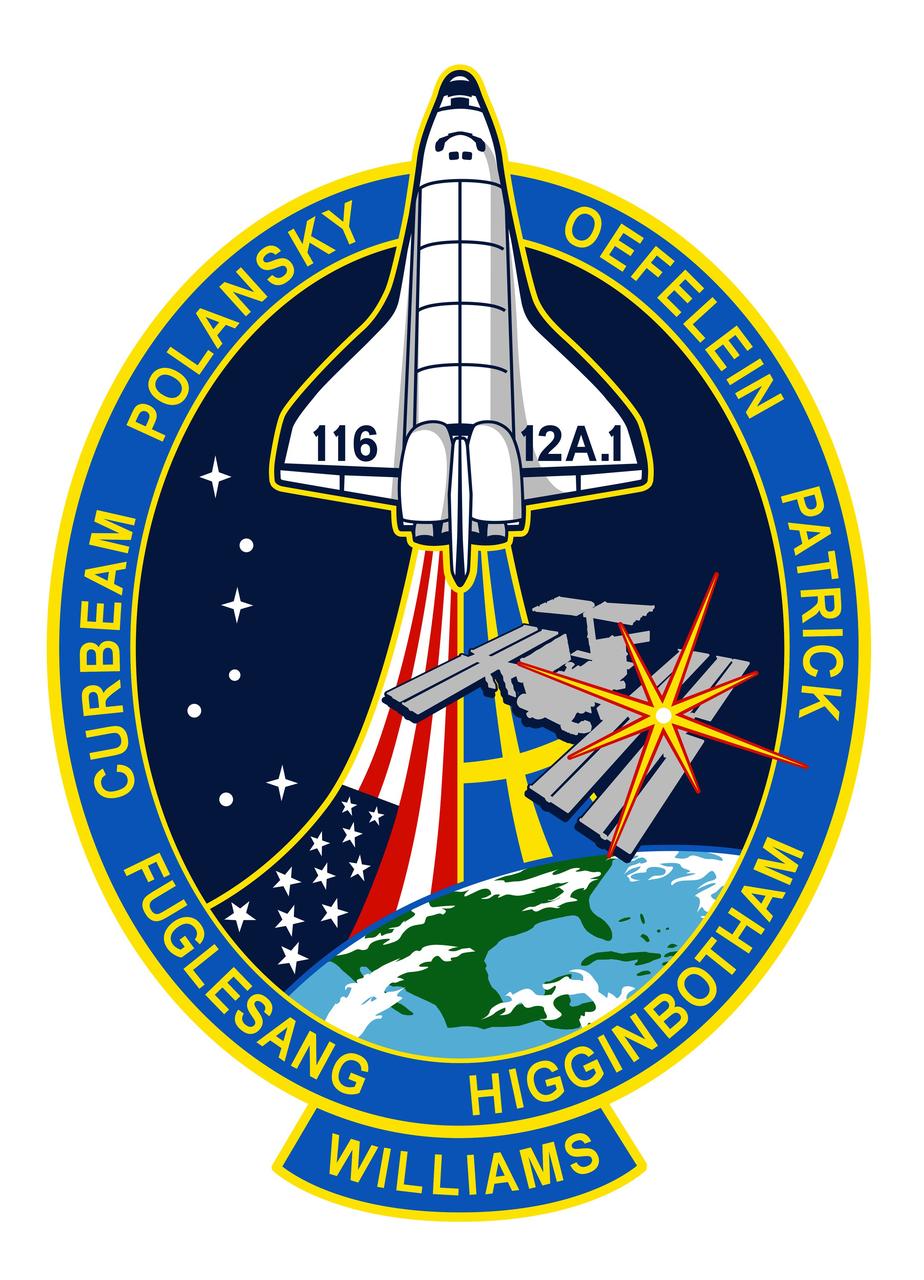
Signifying the continuing assembly of the International Space Station (ISS), the STS-116 crew patch depicts the space shuttle rising above the Earth and the ISS. The United States and Swedish flags trail the orbiter, depicting the international composition of the STS-116 crew. The seven stars of the constellation Ursa Major are used to provide direction to the North Star, which is superimposed over the installation location of the P5 truss on ISS.
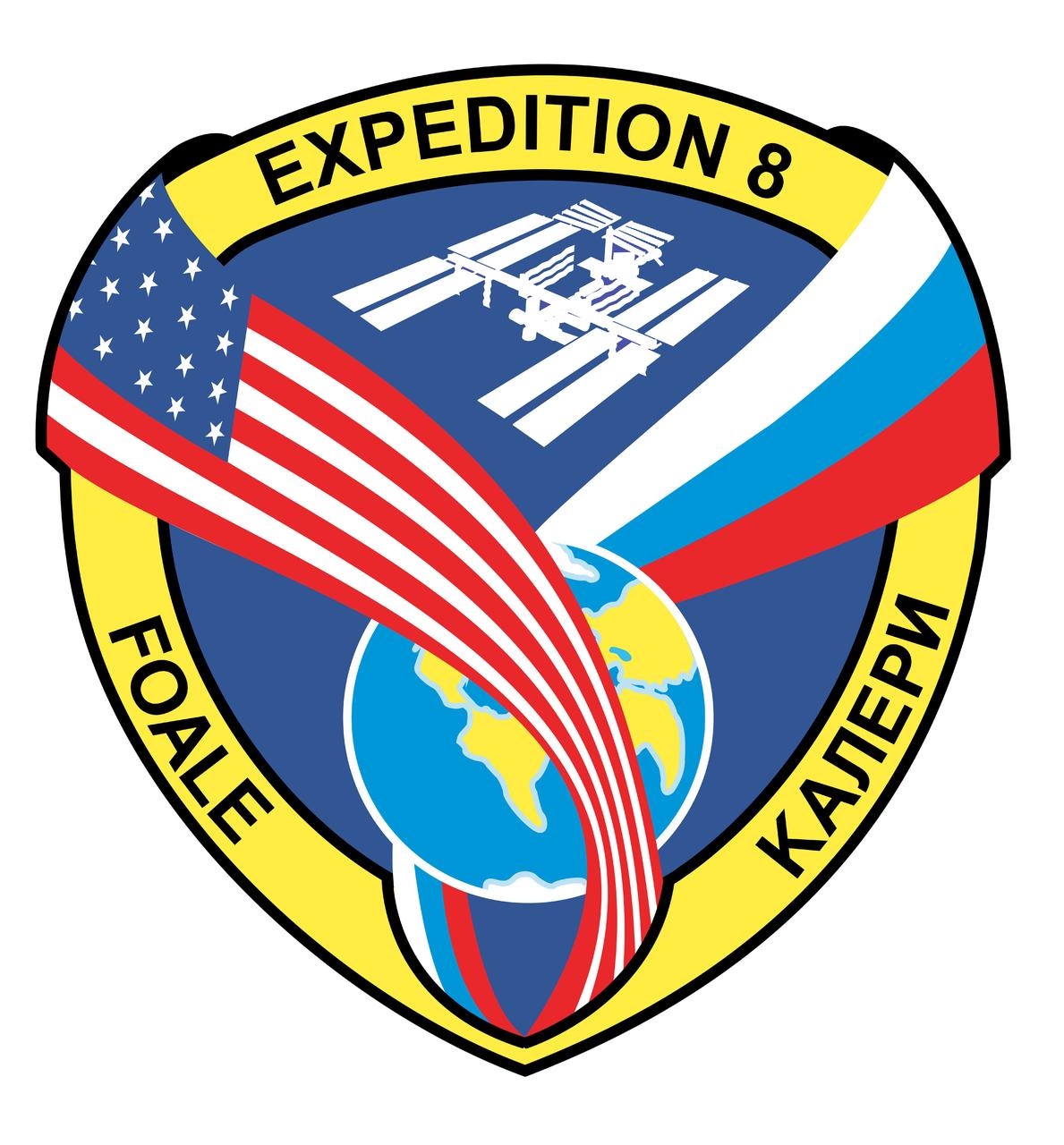
This emblem represents the eighth long-duration expedition to the International Space Station (ISS). The figure eight barner encircling the Earth combines the flags of the Nations represented by the two man crew. The ISS is portrayed above the Earth in its completed configuration. The names of the crew members, Michael Foale of the United States, and Alexander Kaleri of Russia, flank the outer border.
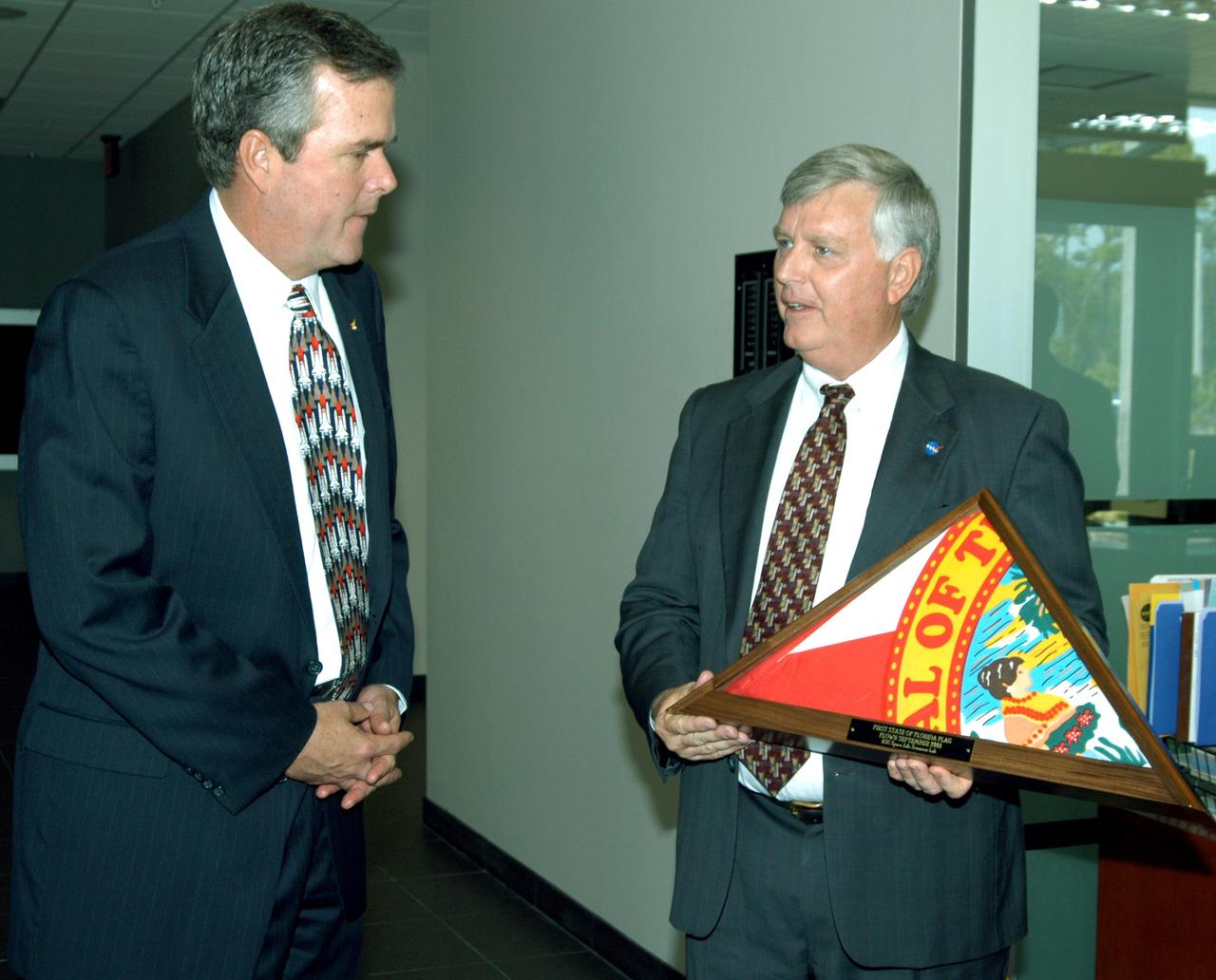
KENNEDY SPACE CENTER, FLA. -- Center Director Jim Kennedy presents a Florida flag to Florida Gov. Jeb Bush. The flag was flown during construction of the Space Life Sciences Lab through dedication of the Lab. The presentation was during a tour of the Lab following the launching ceremony at the KSC Visitor Complex for the new Florida quarter issued by the U.S. Mint. The ceremony was emceed by Center Director Jim Kennedy and included remarks by NASA Administrator Sean O’Keefe, Bush, U.S. Mint Director Henrietta Holsman Fore and Deputy Secretary of the Treasury Samuel W. Bodman. The new lab is a state-of-the-art facility built for ISS biotechnology research. It was developed as a partnership between NASA-KSC and the State of Florida.
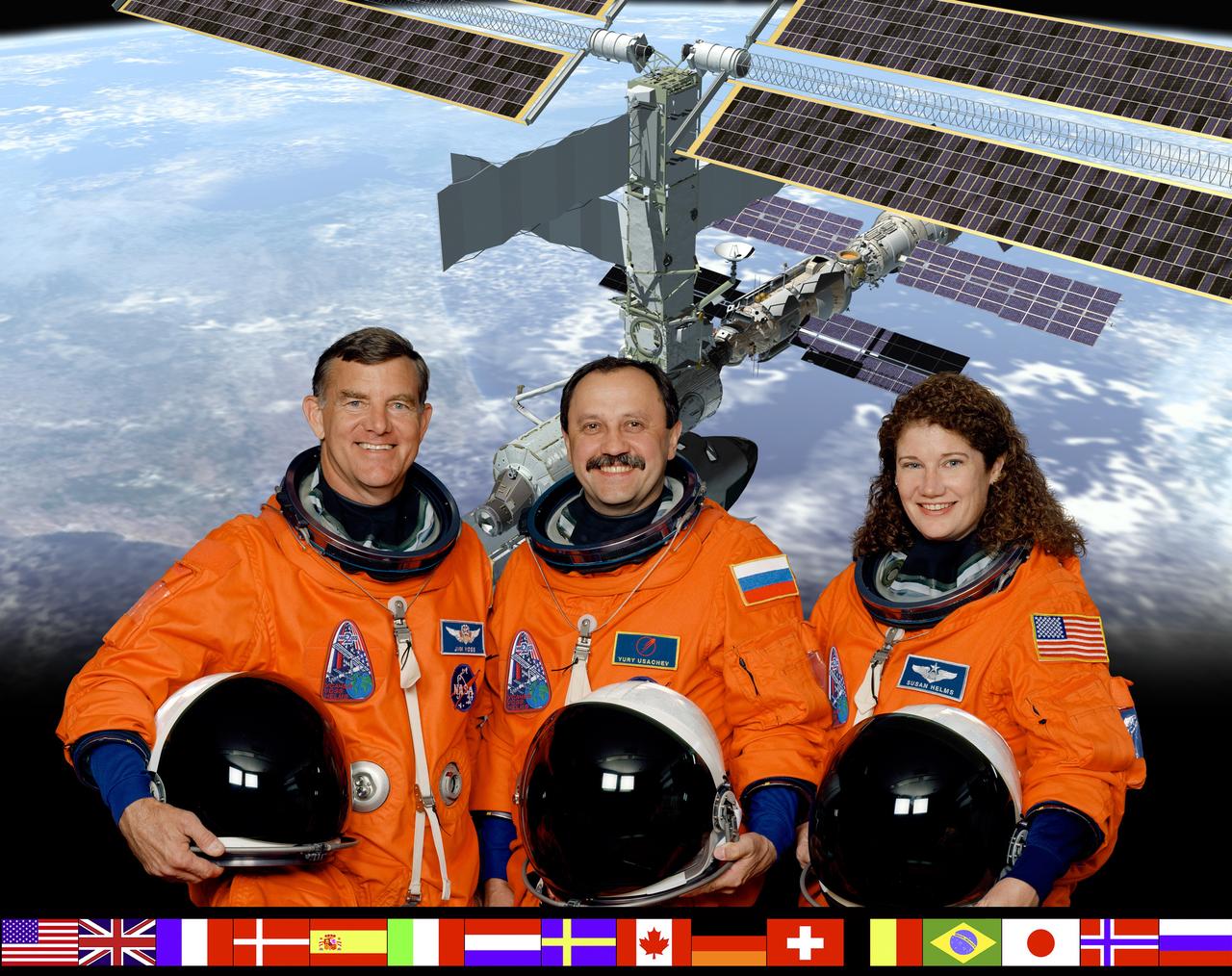
This is a crew portrait of the International Space Station (ISS) Expedition Two. Left to right are Astronaut James S. Voss, flight engineer; Cosmonaut Yury V. Usachev, commander; and Astronaut Susan J. Helms, flight engineer. The crew was launched on March 8, 2001 aboard the STS-102 mission Space Shuttle Orbiter Discovery for an extended stay on the ISS. After living and working on the ISS for the duration of 165 days, the crew returned to Earth on August 22, 2001 aboard the STS-105 mission Space Shuttle Orbiter Discovery. Cosmonaut Usachev represents the Russian Aviation and Space Agency. The flags representing all the international partners are arrayed at bottom.
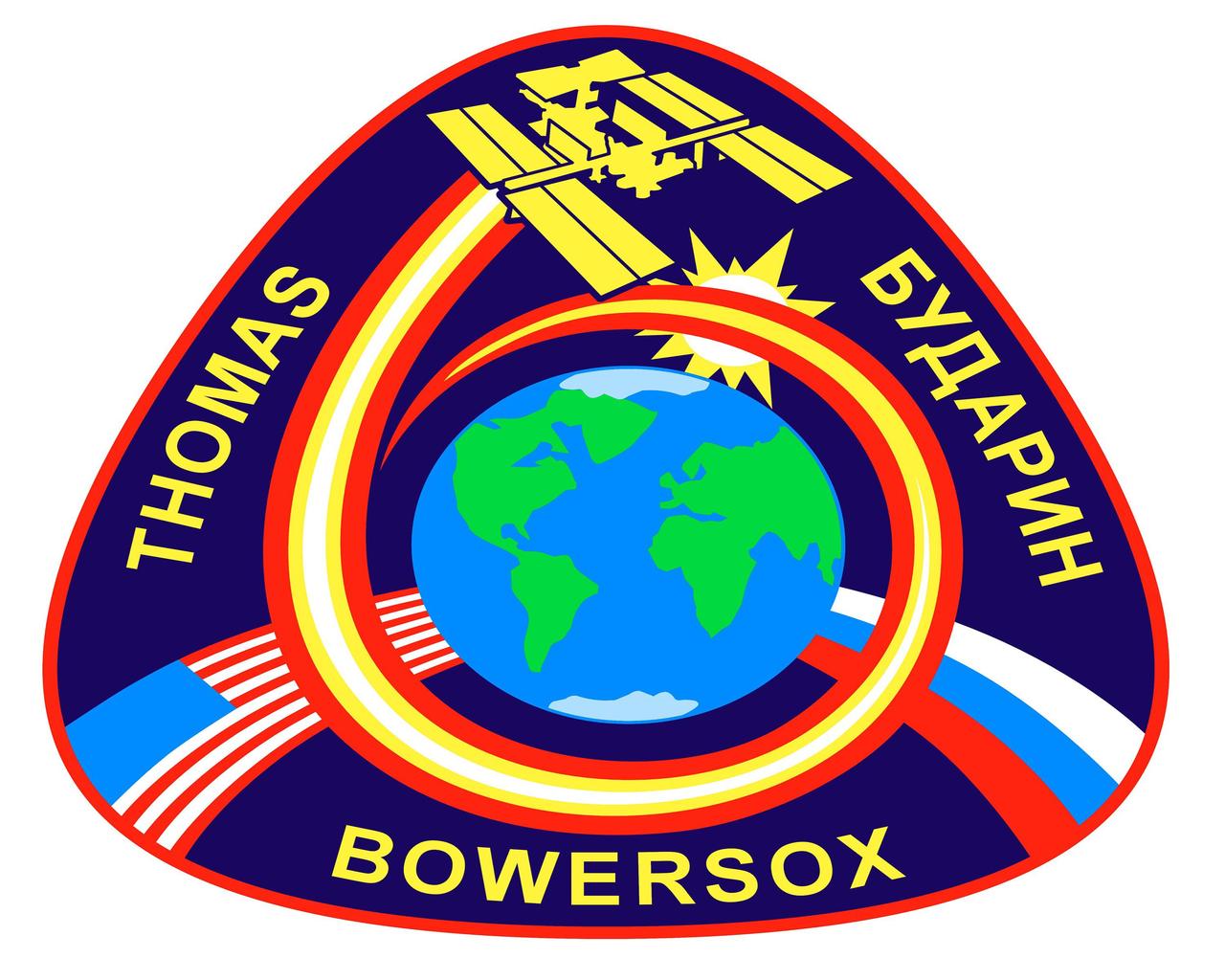
The International Space Station (ISS) Expedition 6 crew patch depicts the station orbiting the Earth on its mission of international cooperation and scientific research. The Earth is placed in the center of the patch to emphasize that work conducted aboard this orbiting laboratory is intended to improve life on our home planet. The shape of the Space Station’s orbit symbolizes the role that experience gained from ISS will have on future exploration of our solar system and beyond. The American and Russian flags encircling the Earth represent the native countries of the Expedition 6 crew members, which are just two of the many participant countries contributing to the ISS and committed to the peaceful exploration of space.
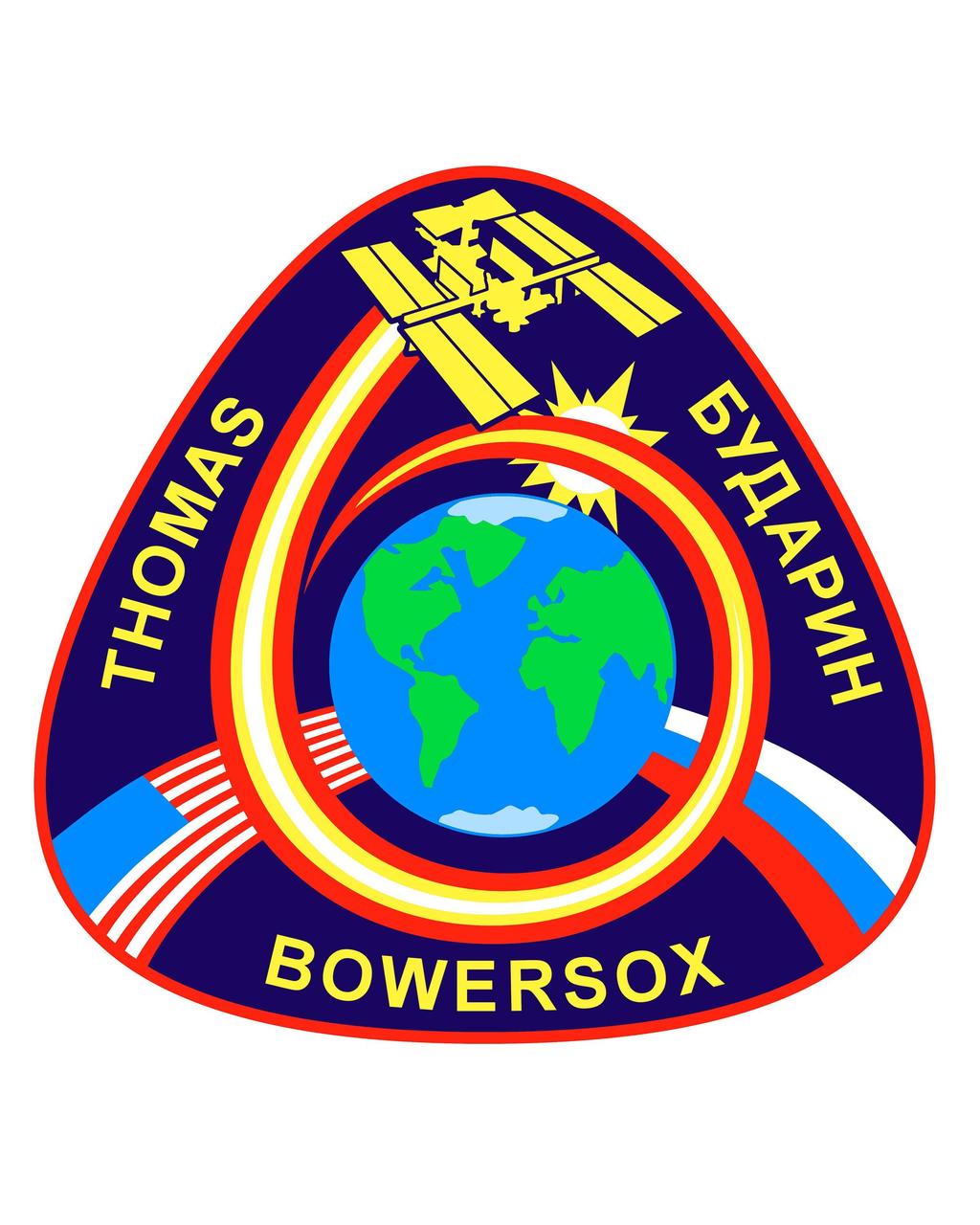
The International Space Station (ISS) Expedition 6 crew patch depicts the station orbiting the Earth on its mission of international cooperation and scientific research. The Earth is placed in the center of the patch to emphasize that work conducted aboard this orbiting laboratory is intended to improve life on our home planet. The shape of the Space Station’s orbit symbolizes the role that experience gained from ISS will have on future exploration of our solar system and beyond. The American and Russian flags encircling the Earth represent the native countries of the Expedition 6 crew members, which are just two of the many participant countries contributing to the ISS and committed to the peaceful exploration of space.
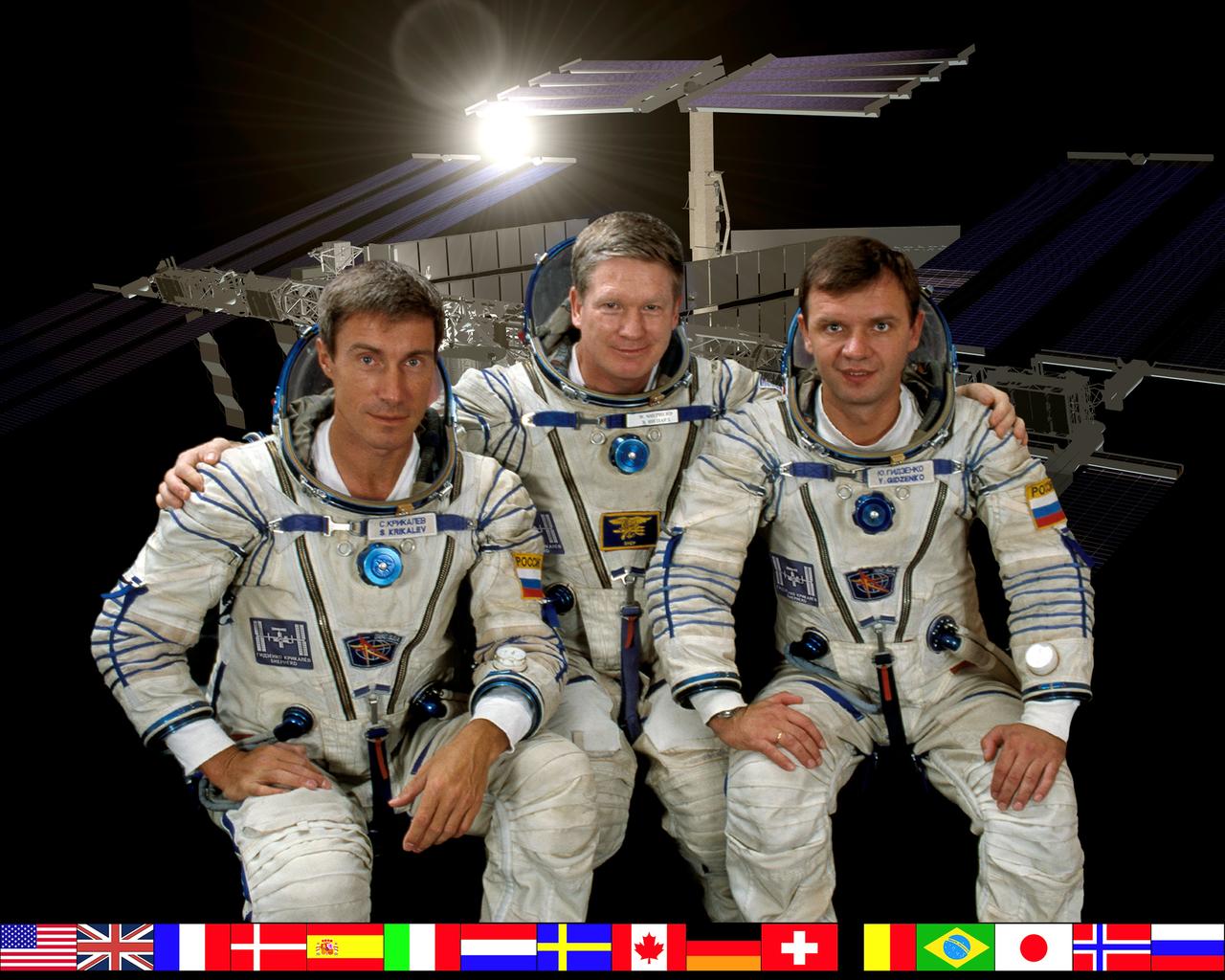
ISS001-S-002 (October 2000)--- International Space Station (ISS) Expedition One Commander William M. (Bill) Shepherd (center) is flanked by Soyuz Commander Yuri P. Gidzenko (right) and Flight Engineer Sergei K. Krikalev (left) in this crew photograph taken during a break in training in Russia. The three, posed in front of a rendition of the ISS, are wearing the Sokol space suits like those they will don for their Soyuz-provided trip to ISS later this month. National flags representing all the international partners run along the bottom of the portrait.
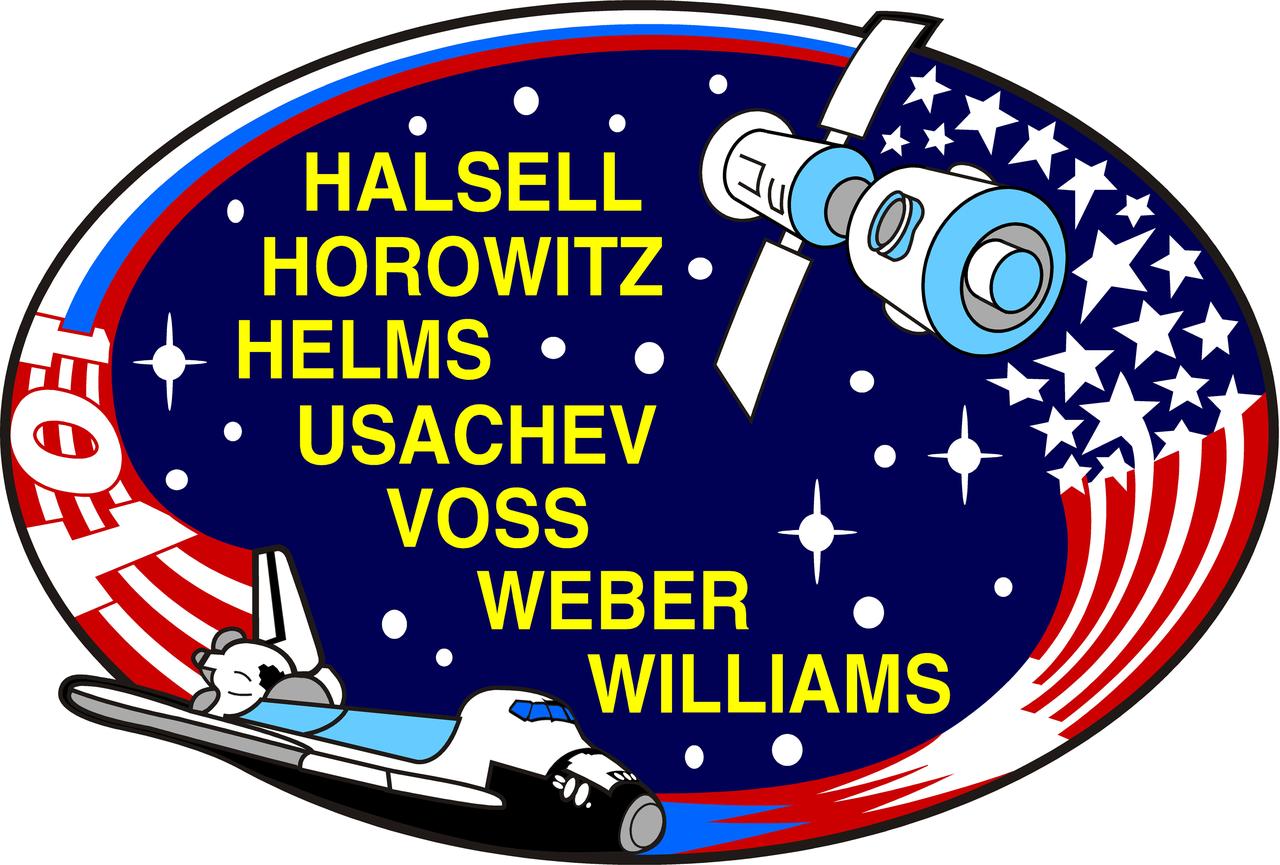
The STS-101 mission patch commemorates the third Space Shuttle flight supporting the assembly of the International Space Station (ISS). This flight's primary tasks were to outfit the ISS and extend its lifetime, to conduct a space walk to install external components in preparation for the docking of the Russian Service Module, Zvezda, and the arrival of the first ISS crew. The Space Shuttle is depicted in an orbit configuration prior to docking with the ISS. The ISS is depicted in the stage of assembly completed for the STS-101 mission, which consists of the United States built Unity module and the Russian-built Zarya module. The three large stars represent the third ISS mission in the assembly sequence. The elements and colors of the border reflect the flags of the nations represented by the STS-101 crew members, the United States, and Russia.
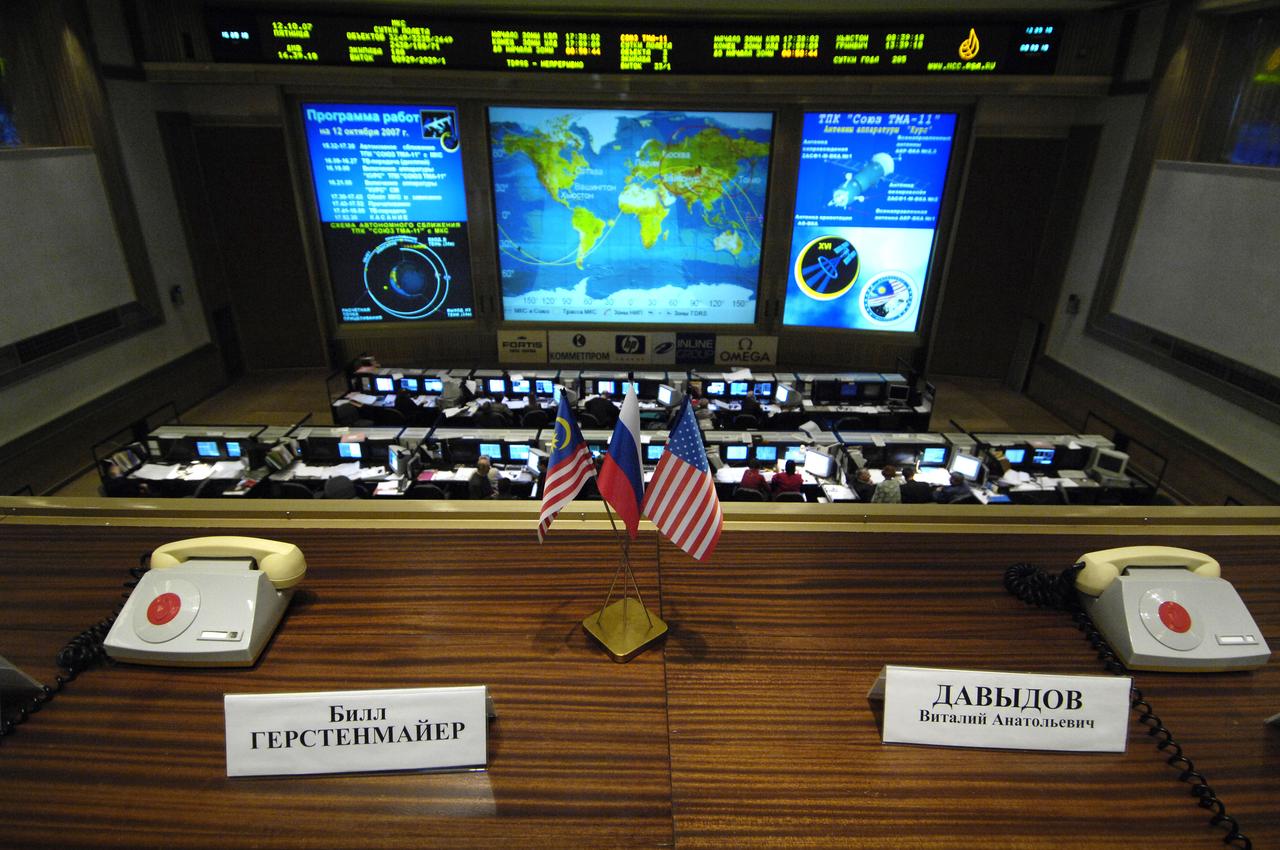
The flags of Malaysia, Russia and the United States sit between the phones used by officials to speak with the crew of the International Space Station (ISS) in the Russian Mission Control Center in Korolev, outside Moscow, Friday, Oct. 12, 2007. Expedition 16 Commander Peggy Whitson, Soyuz Commander and Flight Engineer Yuri Malenchenko and Malaysian spaceflight participant Sheikh Muszaphar Shukor docked their Soyuz TMA-11 spacecraft to the ISS at 10:50 a.m. EDT, October 12. The crew launched on Wednesday from the Baikonur Cosmodrome in Kazakhstan. Photo Credit: (NASA/Bill Ingalls)
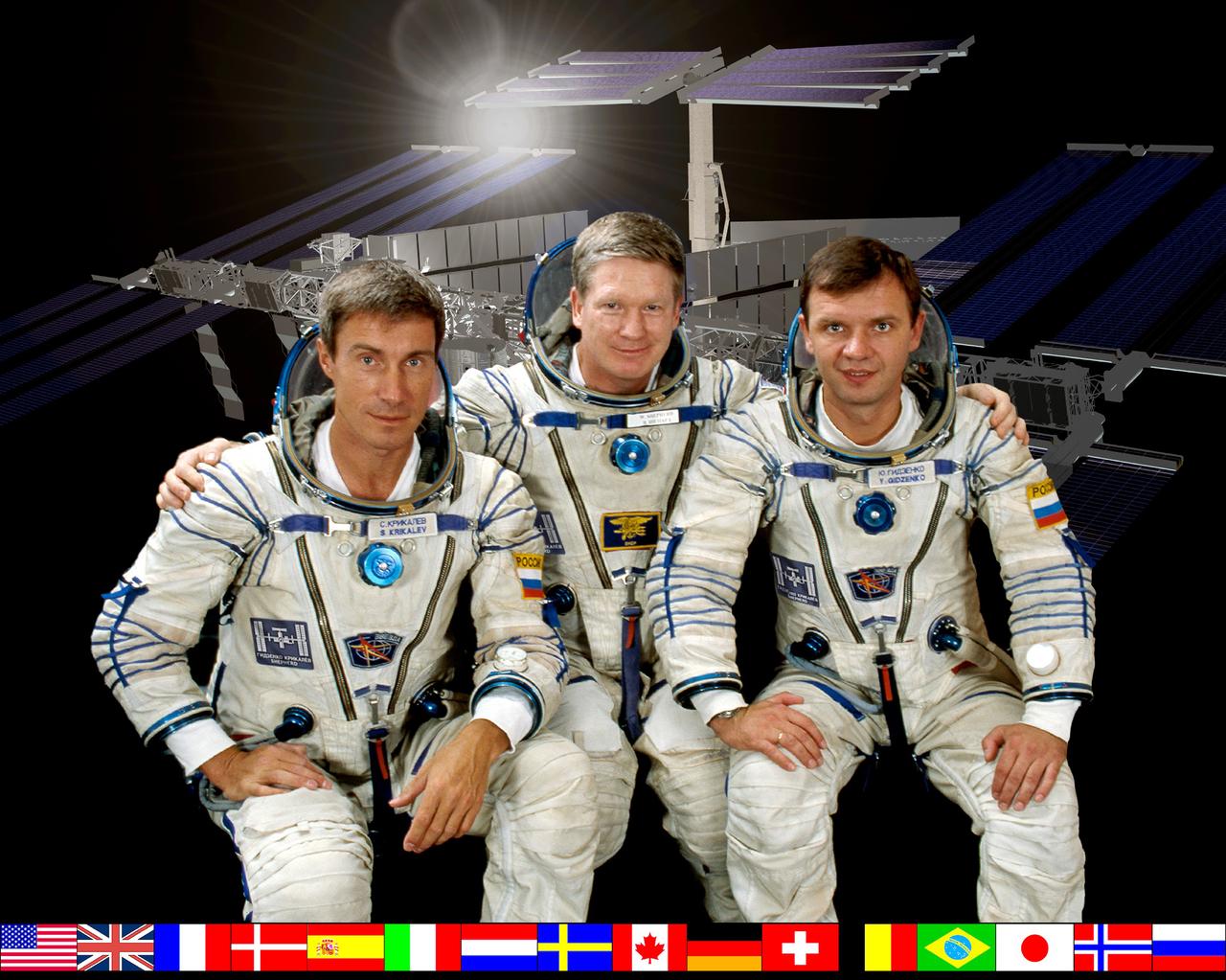
This is a crew portrait of the International Space Station (ISS) Expedition One. Left to right are flight engineer Sergei K. Krikalev, commander William M. (Bill) Shepherd, and Soyuz commander Yuri P. Gidzenko. They are wearing the Russian Sokol space suits. The Russian Soyuz rocket carrying the Expedition One crew was launched from the Baikonur Cosmodrome, Kazakhstan on October 31, 2000. The crew returned to the Kennedy Space Center on March 21, 2002 aboard the Space Shuttle Orbiter Discovery (STS-102 mission). The crew's duration on the ISS was 138 days. National flags representing all the international partners run along the bottom of the portrait.
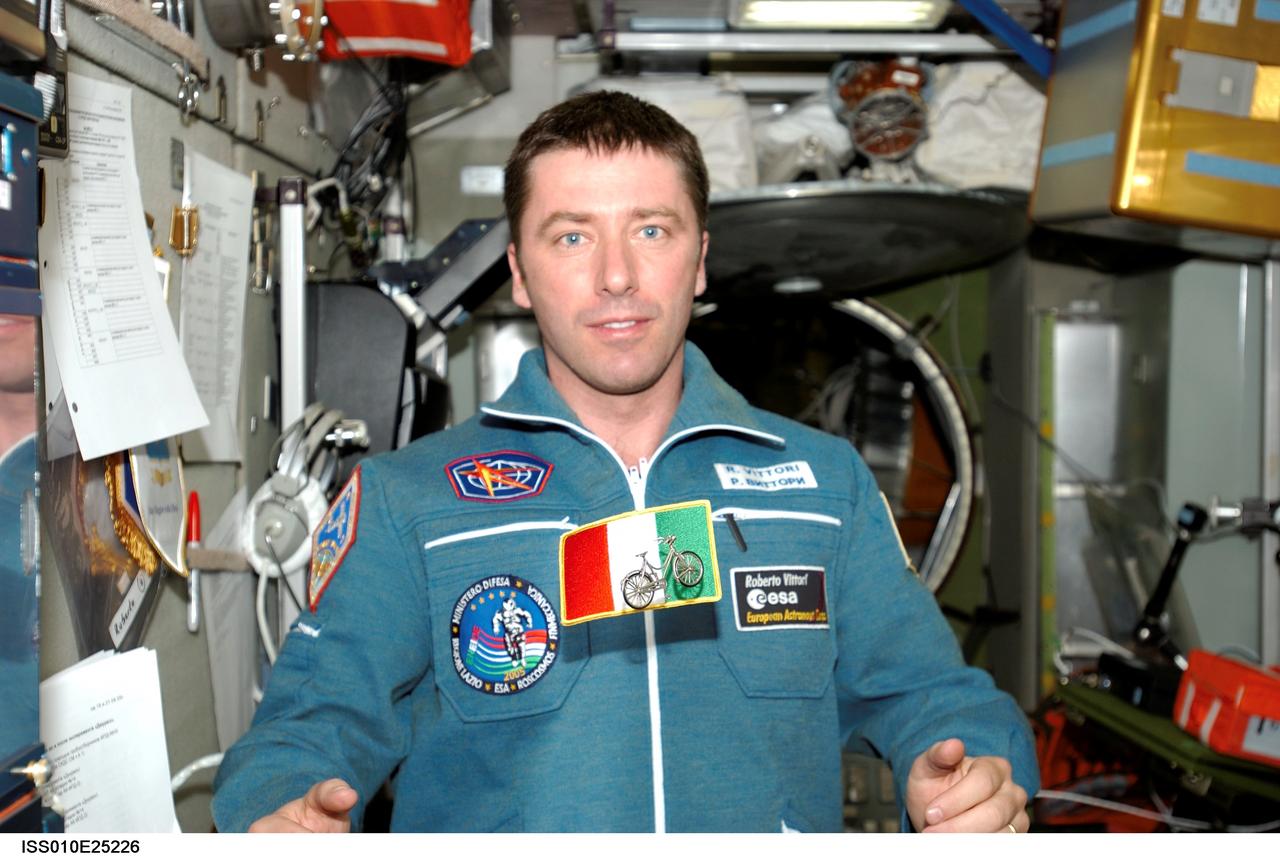
ISS010-E-25226 (20 April 2005) --- European Space Agency (ESA) astronaut Roberto Vittori of Italy is pictured in the Zvezda Service Module of the International Space Station (ISS). A patch representing the Italian flag and a toy bicycle float freely near Vittori. After spending eight days on the Station under a commercial contract between ESA and the Russian Federal Space Agency, Vittori will return to Earth with the Expedition 10 crew on April 24 (CDT).
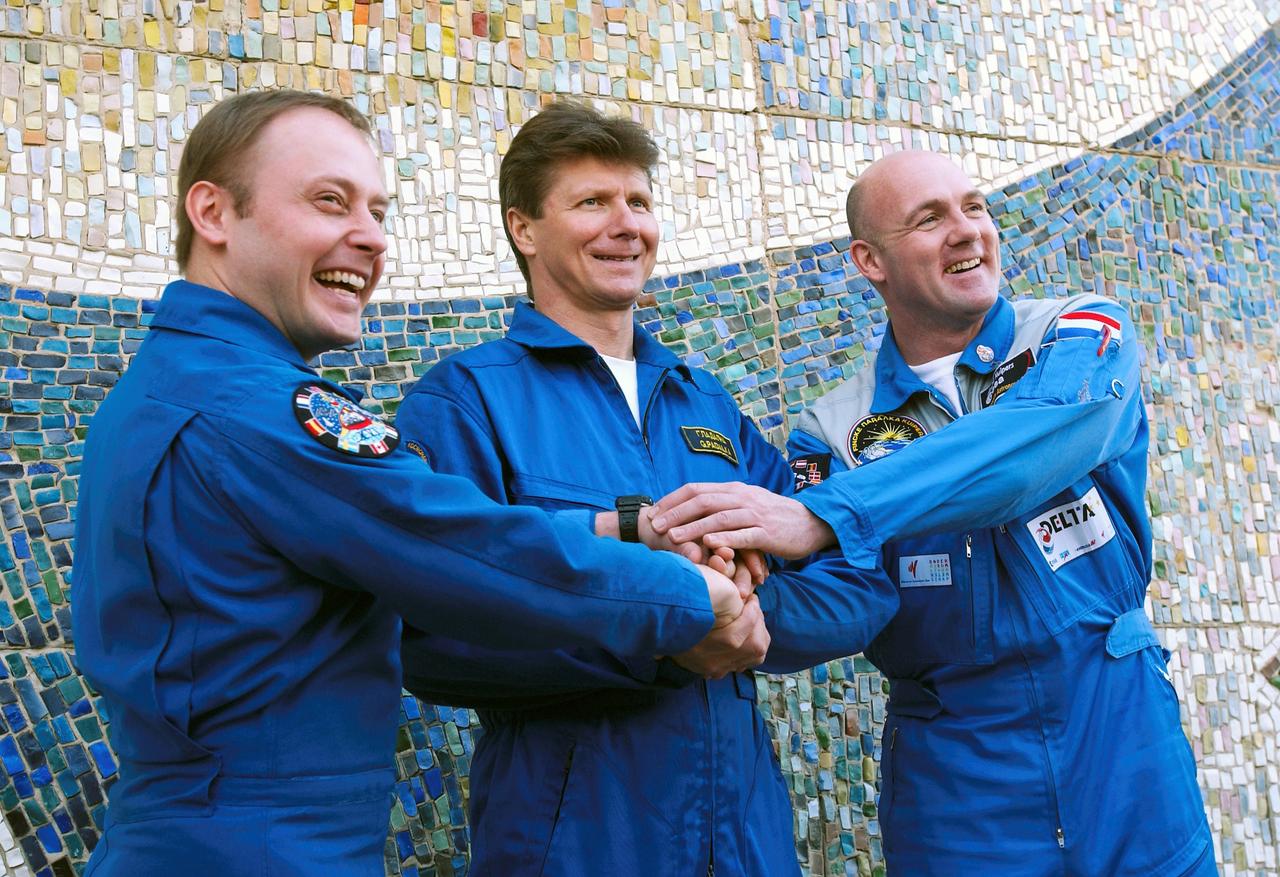
JSC2004-E-19914 (15 April 2004) --- Astronaut Edward M. (Mike) Fincke (left), NASA International Space Station (ISS) science officer and flight engineer; cosmonaut Gennady I. Padalka (center), Russia’s Federal Space Agency Expedition 9 mission commander; and European Space Agency (ESA) astronaut Andre Kuipers (right) of the Netherlands pose for a group photo after the flag raising ceremony at the Cosmonaut Hotel, Baikonur, Kazakhstan. Photo Credit: NASA/Bill Ingalls
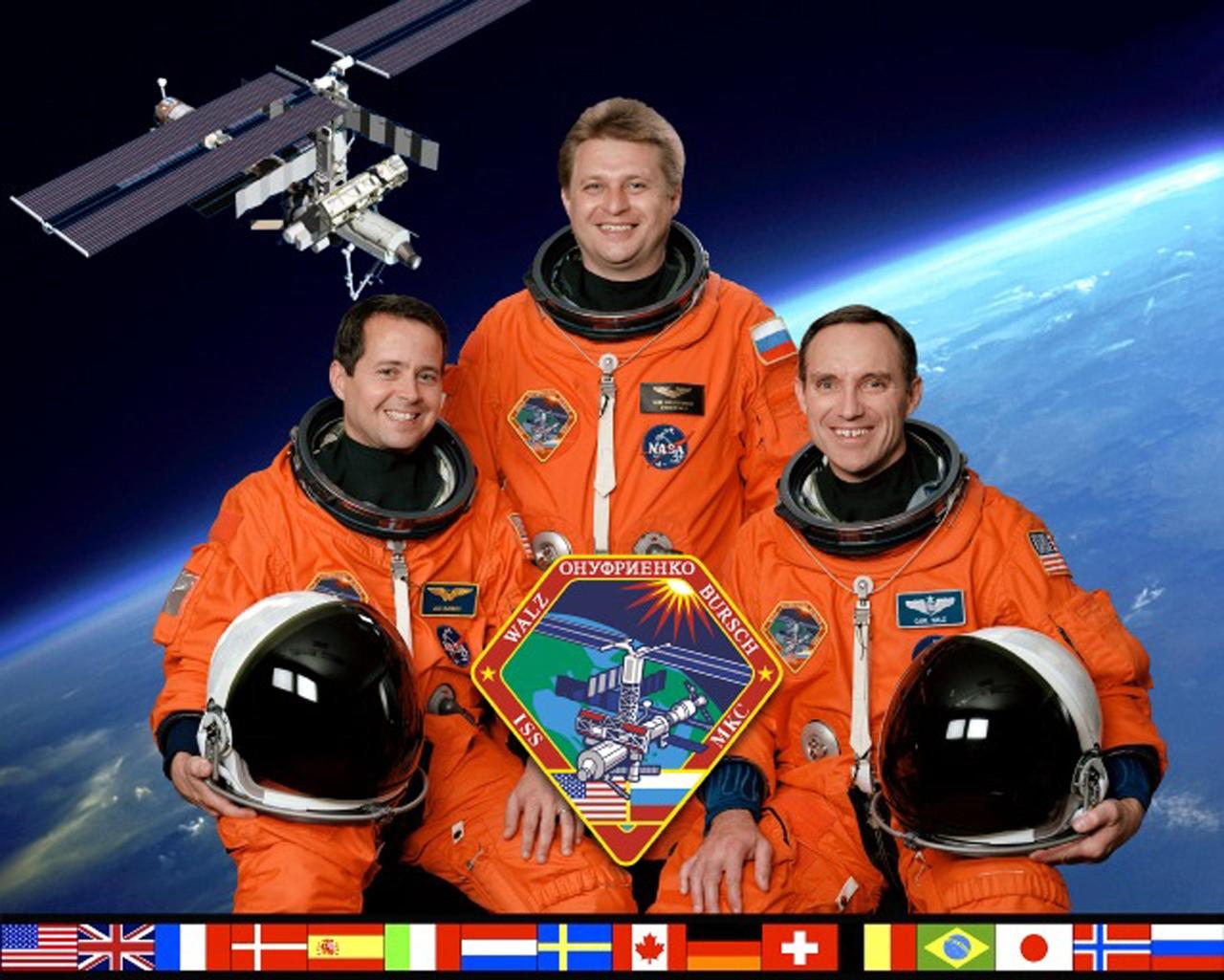
JOHNSON SPACE CENTER, HOUSTON, TEXAS -- EXPEDITION FOUR CREW PORTRAIT -- (ISS04-5-002) -- Expedition Four crew members take a break from training for their scheduled upcoming stay aboard the International Space Station (ISS) to pose for the traditional pre-flight crew portrait. Cosmonaut Yuri I. Onufrienko (standing at center), mission commander, is flanked by astronauts Daniel W. Bursch (left) and Carl E. Walz, both flight engineers. The national flags of the International Partners are at the bottom of the portrait
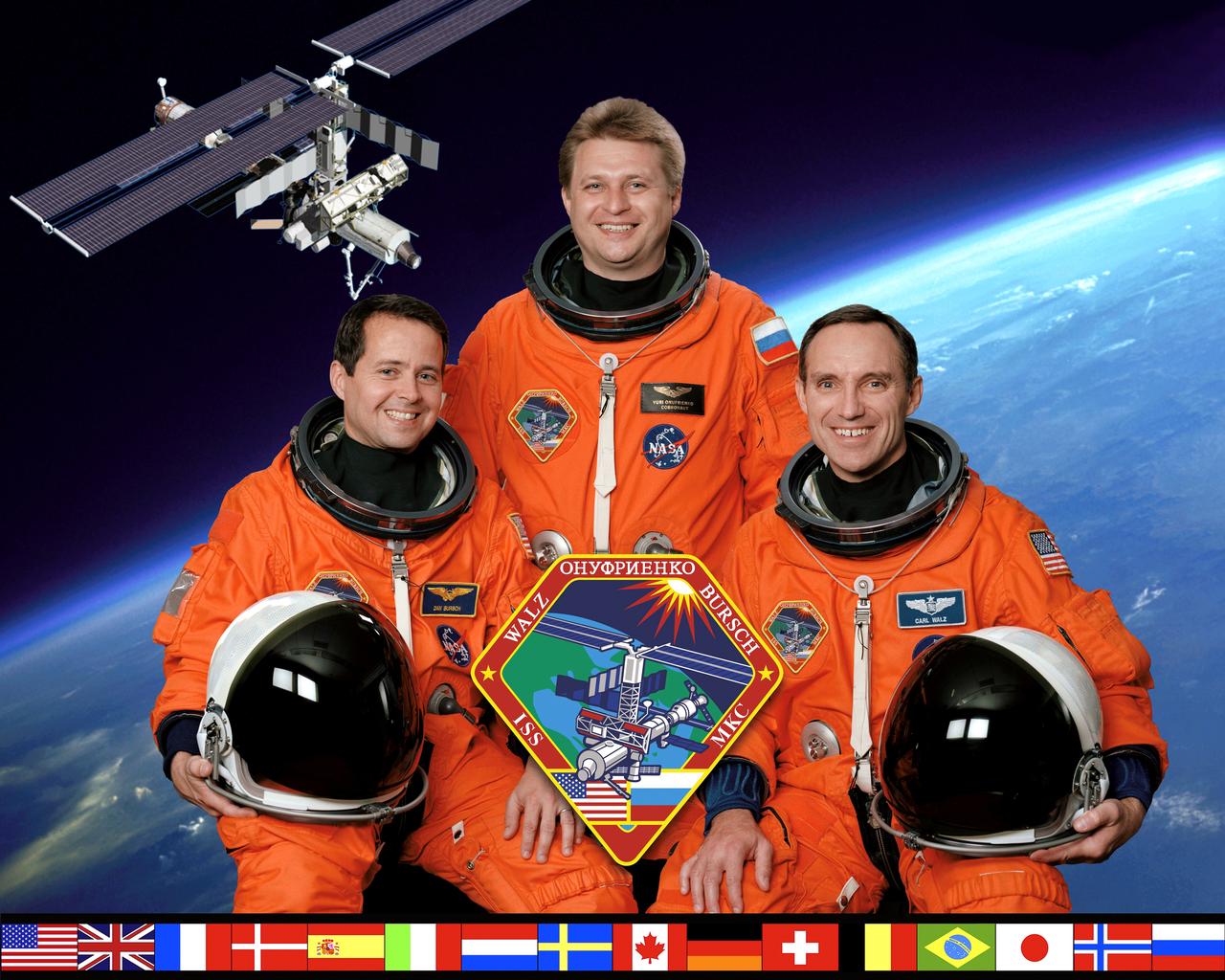
ISS004-S-002 (October 2001) --- Expedition Four crew members take a break from training for their scheduled upcoming stay aboard the International Space Station (ISS) to pose for the traditional pre-flight crew portrait. Cosmonaut Yuri I. Onufrienko (standing at center), mission commander, is flanked by astronauts Daniel W. Bursch (left) and Carl E. Walz, both flight engineers. The national flags of the International Partners are at the bottom of the portrait.
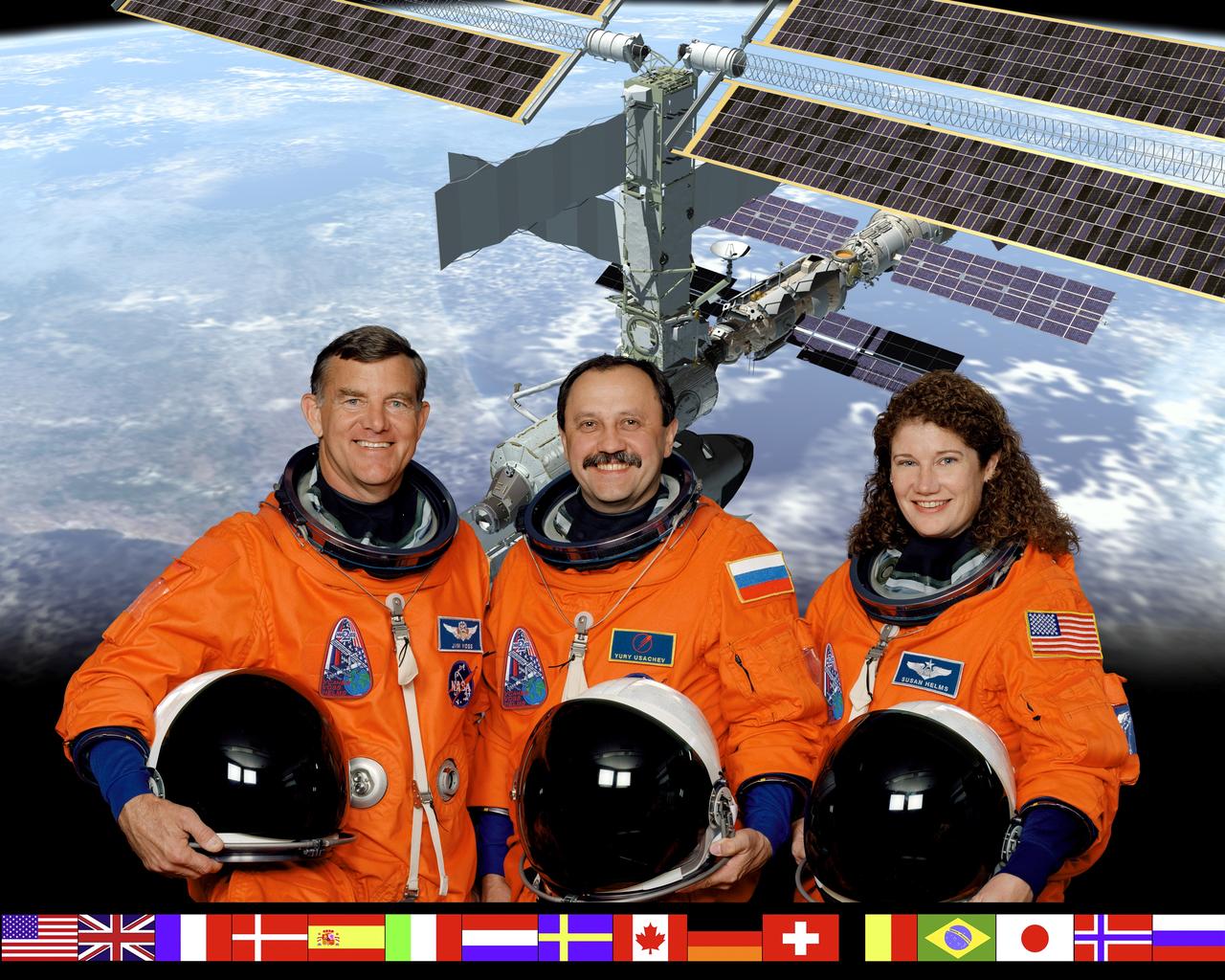
ISS002-S-002 (February 2001) --- Cosmonaut Yury V. Usachev (center), Expedition Two mission commander, is flanked by the other crew members -- astronauts James S. Voss and Susan J. Helms -- who will join him for an extended stay aboard the International Space Station (ISS), beginning in March of this year. Usachev represents the Russian Aviation and Space Agency. The flags representing all the international partners are arrayed at bottom.
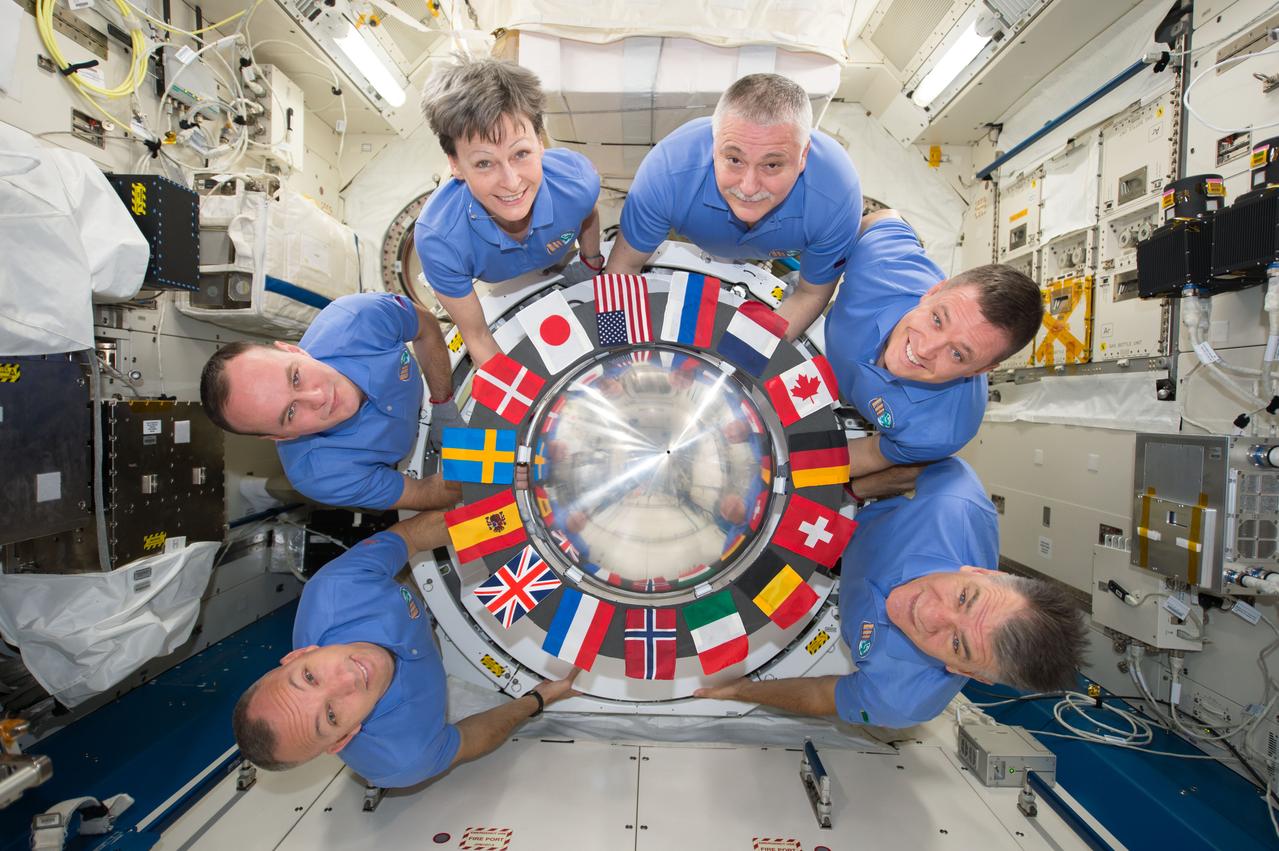
iss052e031832 (8/5/2017) --- Expedition 52 crew pose for their on-orbit crew portrait gathered around the Japanese Experiment Module (JEM) internal airlock aboard the International Space Station (ISS). Flags from all the International Partners are visible around the airlock hatch. From left to right: Astronaut Randy Bresnik, Cosmonaut Sergey Ryzanskiy, Astronaut Peggy Whitson, Cosmonaut Fyodor Yurchikhin, Astronaut Jack Fischer and European Space Agency (ESA) astronaut Paolo Nespoli.

KENNEDY SPACE CENTER, FLA. -- Former astronaut Winston Scott (left) presents a NASA flag flown at the KSC Space Life Sciences Lab to NASA Administrator Sean O’Keefe. The flag was flown during construction through the dedication of the Lab. The presentation was during a tour of the Lab following the launching ceremony at the KSC Visitor Complex for the new Florida quarter issued by the U.S. Mint. The ceremony was emceed by Center Director Jim Kennedy and included remarks by O’Keefe, Florida Gov. Jeb Bush, U.S. Mint Director Henrietta Holsman Fore and Deputy Secretary of the Treasury Samuel W. Bodman. The new lab is a state-of-the-art facility built for ISS biotechnology research. It was developed as a partnership between NASA-KSC and the State of Florida.

KENNEDY SPACE CENTER, FLA. -- Former astronaut Winston Scott (left) presents a NASA flag flown at the KSC Space Life Sciences Lab to NASA Administrator Sean O’Keefe. The flag was flown during construction through the dedication of the Lab. The presentation was during a tour of the Lab following the launching ceremony at the KSC Visitor Complex for the new Florida quarter issued by the U.S. Mint. The ceremony was emceed by Center Director Jim Kennedy and included remarks by O’Keefe, Florida Gov. Jeb Bush, U.S. Mint Director Henrietta Holsman Fore and Deputy Secretary of the Treasury Samuel W. Bodman. The new lab is a state-of-the-art facility built for ISS biotechnology research. It was developed as a partnership between NASA-KSC and the State of Florida.
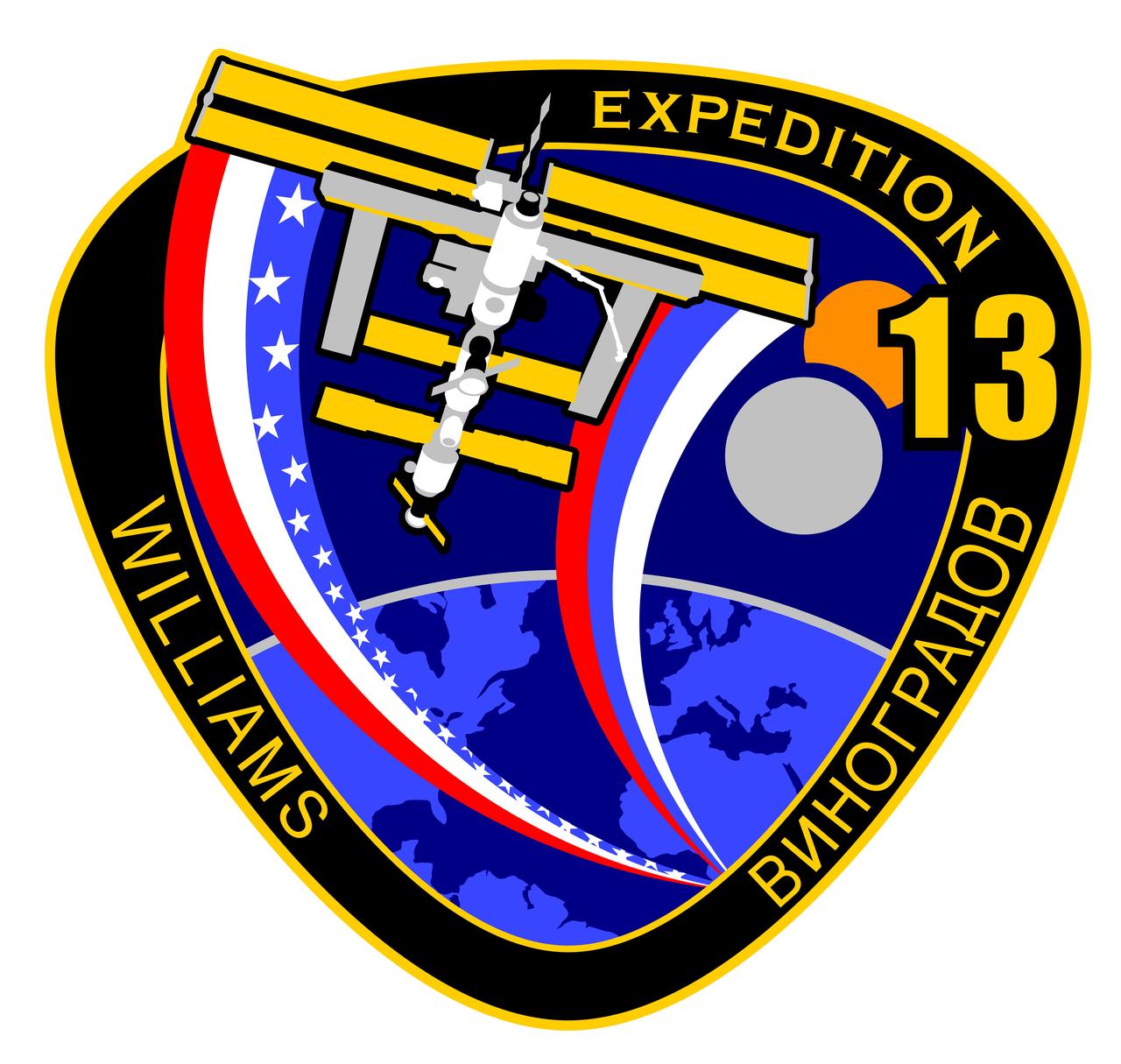
ISS013-S-001 (January 2006) --- This patch commemorates the thirteenth expeditionary mission to the International Space Station (ISS) which continues the permanent human presence in space. The ISS is depicted in its configuration at the start of the six-month expedition with trailing elements from the country flags representing both of the crew members--cosmonaut Pavel V. Vinogradov and astronaut Jeffrey N. Williams. The crew members made the following statement about their patch: "The dynamic trajectory of the space station against the background of the Earth, Mars, and the Moon symbolizes the vision for human space exploration beyond Earth orbit and the critical role that the ISS plays in the fulfillment of that vision." The NASA insignia design for shuttle flights and station increments is reserved for use by the astronauts and for other official use as the NASA Administrator may authorize. Public availability has been approved only in the forms of illustrations by the various news media. When and if there is any change in this policy, which is not anticipated, the change will be publicly announced.

ISS010-S-001 (May 2004) --- The Expedition 10 patch uses simple symbolism to describe the mission. The large Roman numeral "X," formed by the American and Russian flags, symbolizes the joint nature of this mission, as well as the fact that this flight is the 10th mission to stay on the International Space Station (ISS). The current configuration of the ISS is next to the name of the ISS Commander, while the Soyuz vehicle is placed next to the name of the Soyuz Commander. The single star and the black background signify this is a space mission. The NASA insignia design for shuttle flights and station increments is reserved for use by the astronauts and for other official use as the NASA Administrator may authorize. Public availability has been approved only in the forms of illustrations by the various news media. When and if there is any change in this policy, which is not anticipated, the change will be publicly announced.
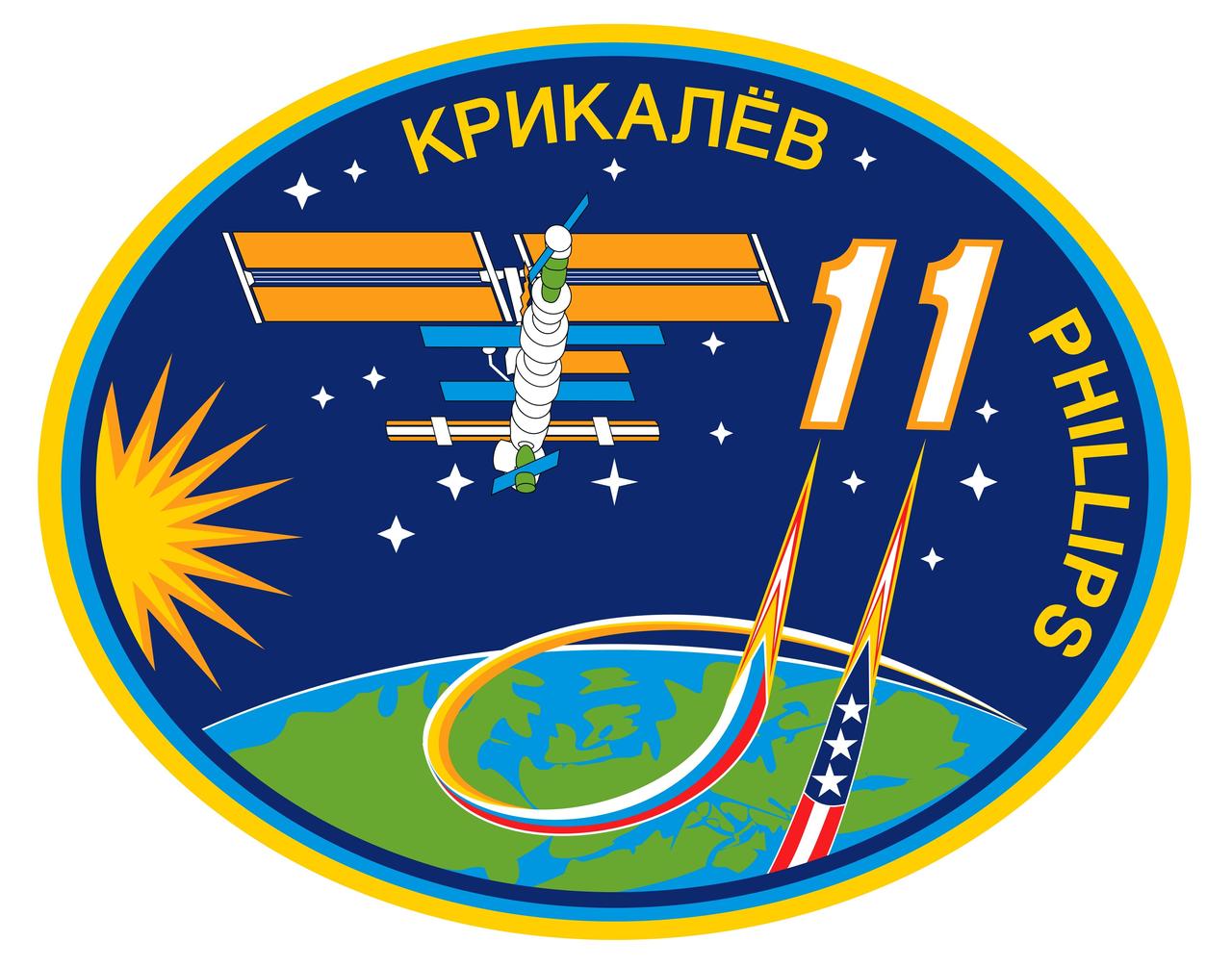
ISS011-S-001 (January 2005) --- The emblem of the eleventh expedition to the International Space Station (ISS) emphasizes the roles of the United States and the Russian Federation in the multinational ISS partnership. The two rocket plumes, in the style of the flags of these two nations, represent the Russian Soyuz vehicles and the American space shuttles. The ISS image shows the configuration of the orbiting station at the start of the expedition, with docked Soyuz and Progress vehicles and the huge American solar panels. The names of the two crew members are shown on the margin of the patch. ISS Commander Sergei Krikalev and John Phillips, NASA ISS science officer and flight engineer, are expected to launch on a Soyuz vehicle and to be in orbit during the return to flight of the space shuttle. The crew explains, “The beauty of our home planet and the vivid contrasts of the space environment are shown by the blue and green Earth with the space station orbiting overhead, and by the bright stars, dark sky, and dazzling sun.” The NASA insignia design for shuttle flights and station increments is reserved for use by the astronauts and for other official use as the NASA Administrator may authorize. Public availability has been approved only in the forms of illustrations by the various news media. When and if there is any change in this policy, which is not anticipated, the change will be publicly announced.
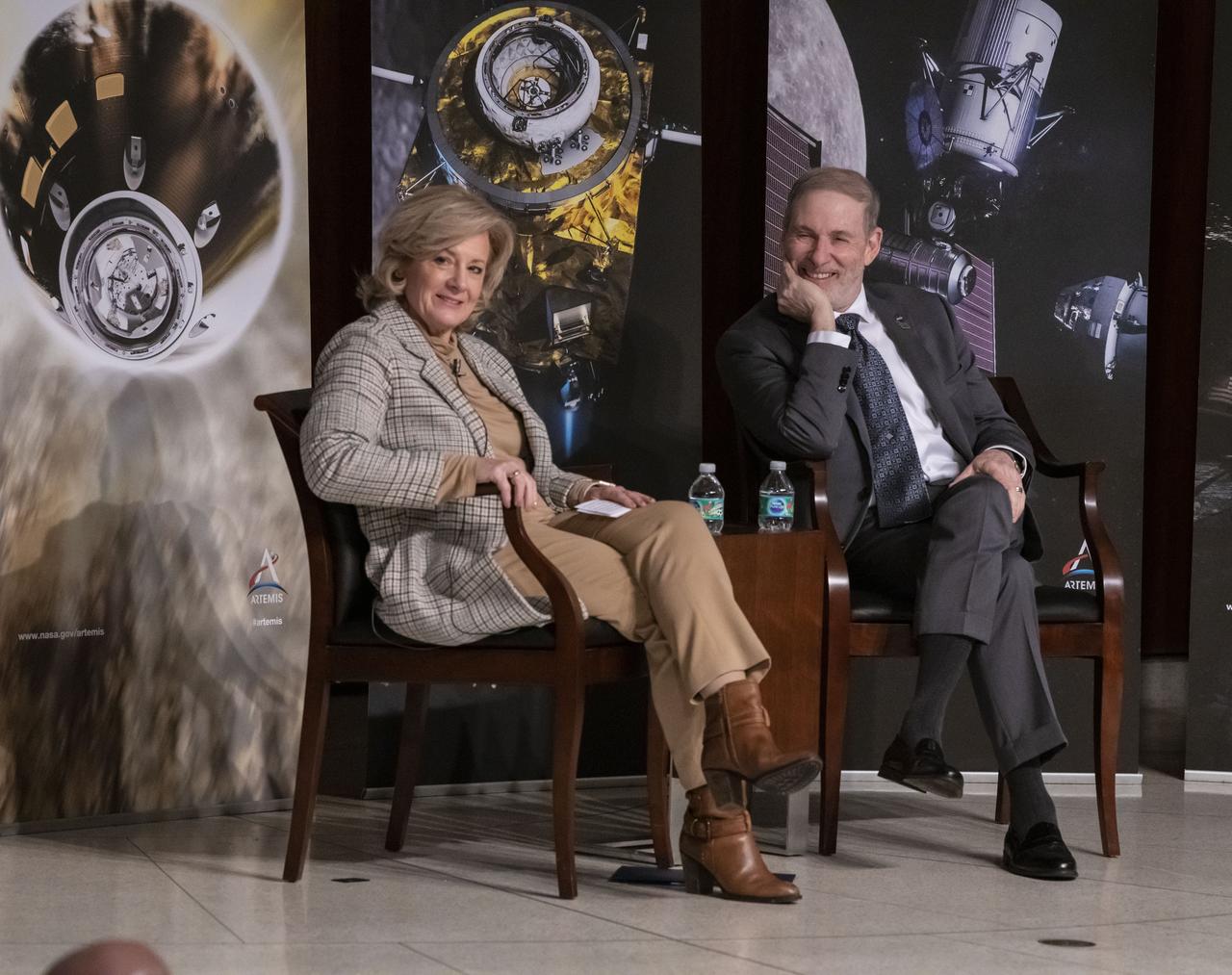
Douglas Loverro, NASA Associate Administrator for the Human Exploration and Operations Mission Directorate, and Marshall Center Director Jody Singer participate in a Town Hall with Marshall Space Flight Center employees
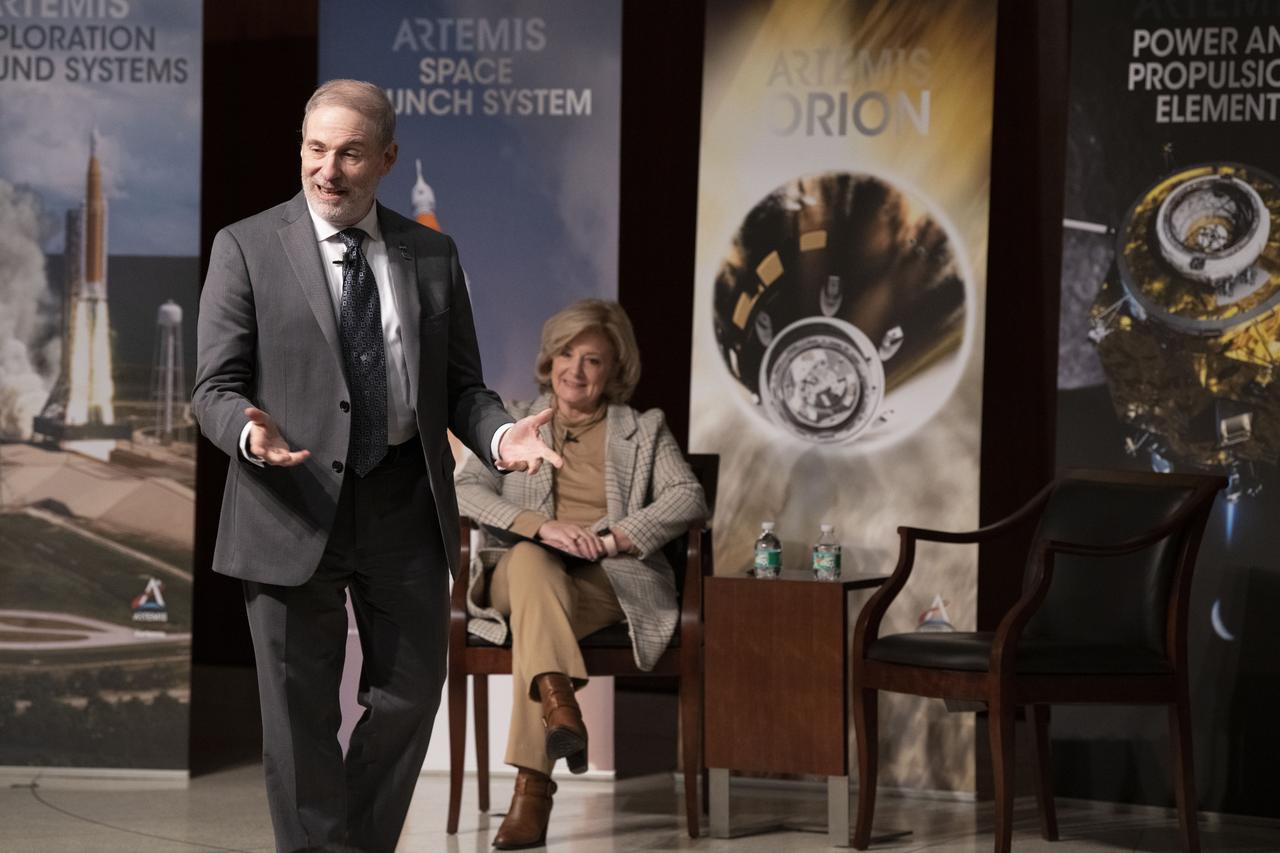
Douglas Loverro, NASA Associate Administrator for the Human Exploration and Operations Mission Directorate, and Marshall Center Director Jody Singer participate in a Town Hall with Marshall Space Flight Center employees
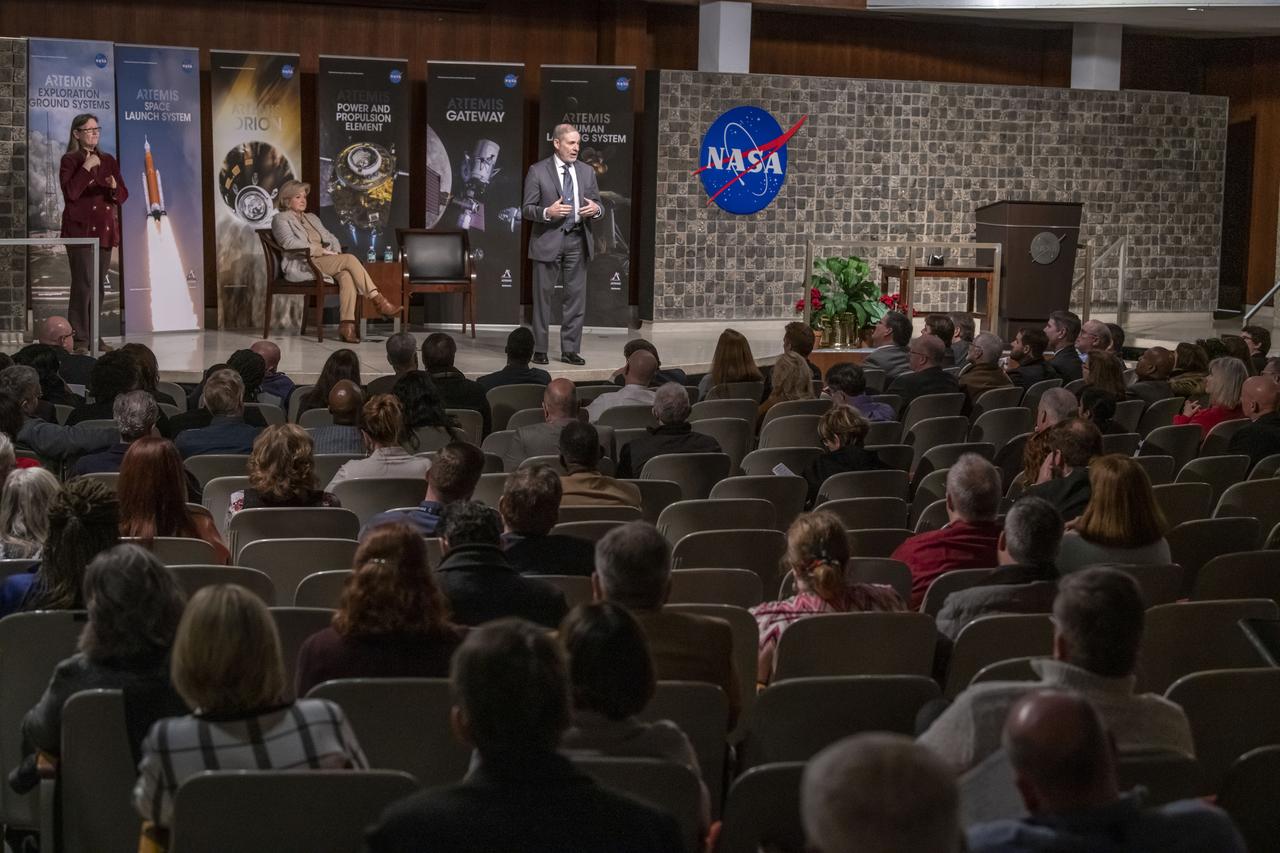
Douglas Loverro, NASA Associate Administrator for the Human Exploration and Operations Mission Directorate, and Marshall Center Director Jody Singer participate in a Town Hall with Marshall Space Flight Center employees
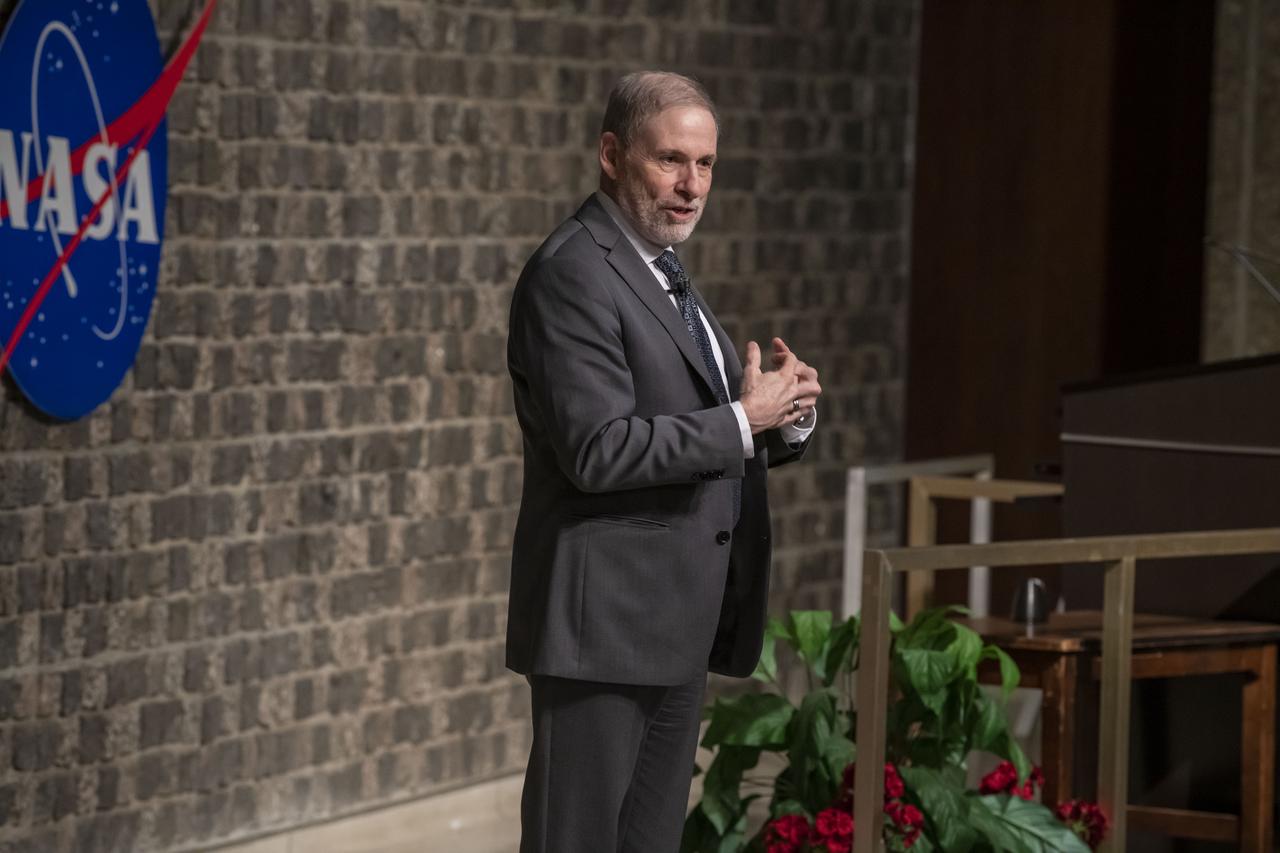
Douglas Loverro, NASA Associate Administrator for the Human Exploration and Operations Mission Directorate, and Marshall Center Director Jody Singer participate in a Town Hall with Marshall Space Flight Center employees
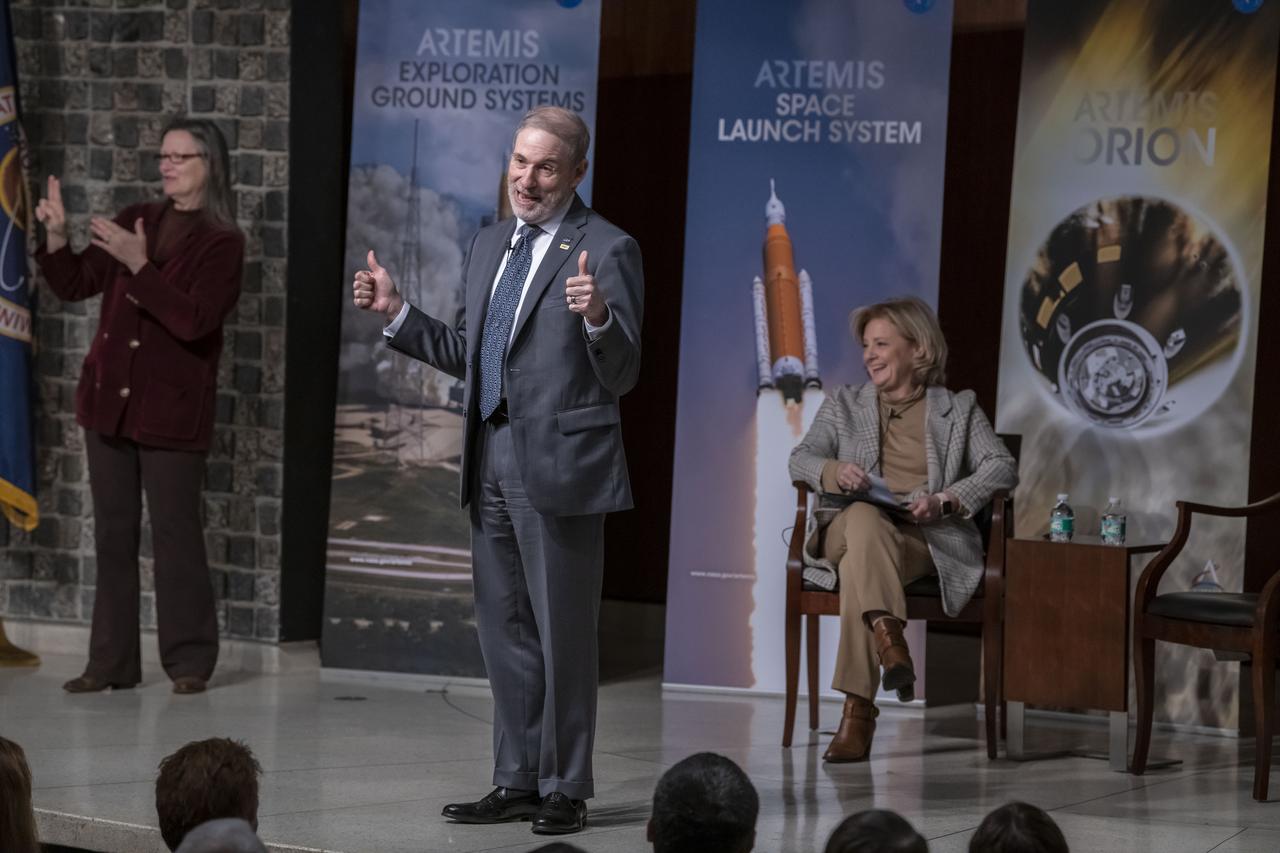
Douglas Loverro, NASA Associate Administrator for the Human Exploration and Operations Mission Directorate, and Marshall Center Director Jody Singer participate in a Town Hall with Marshall Space Flight Center employees
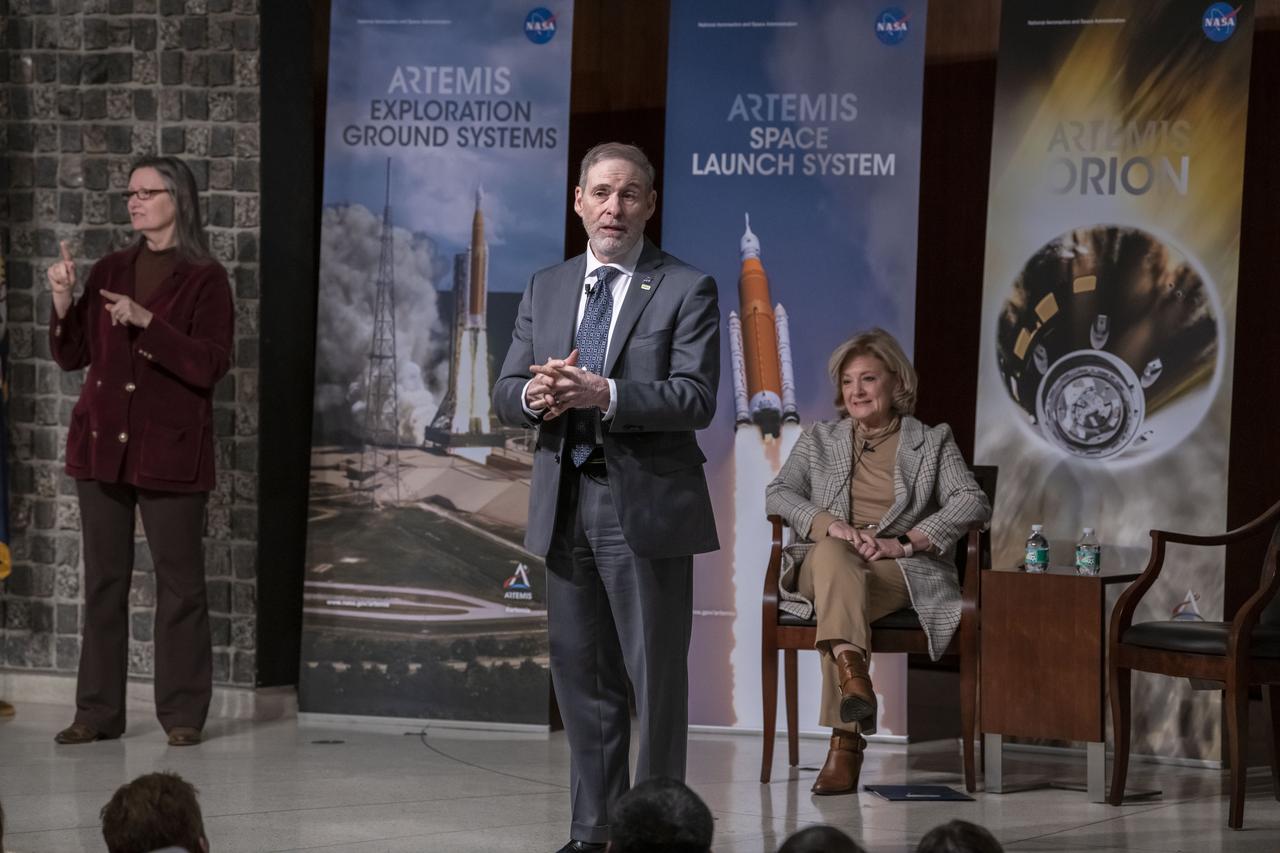
Douglas Loverro, NASA Associate Administrator for the Human Exploration and Operations Mission Directorate, and Marshall Center Director Jody Singer participate in a Town Hall with Marshall Space Flight Center employees
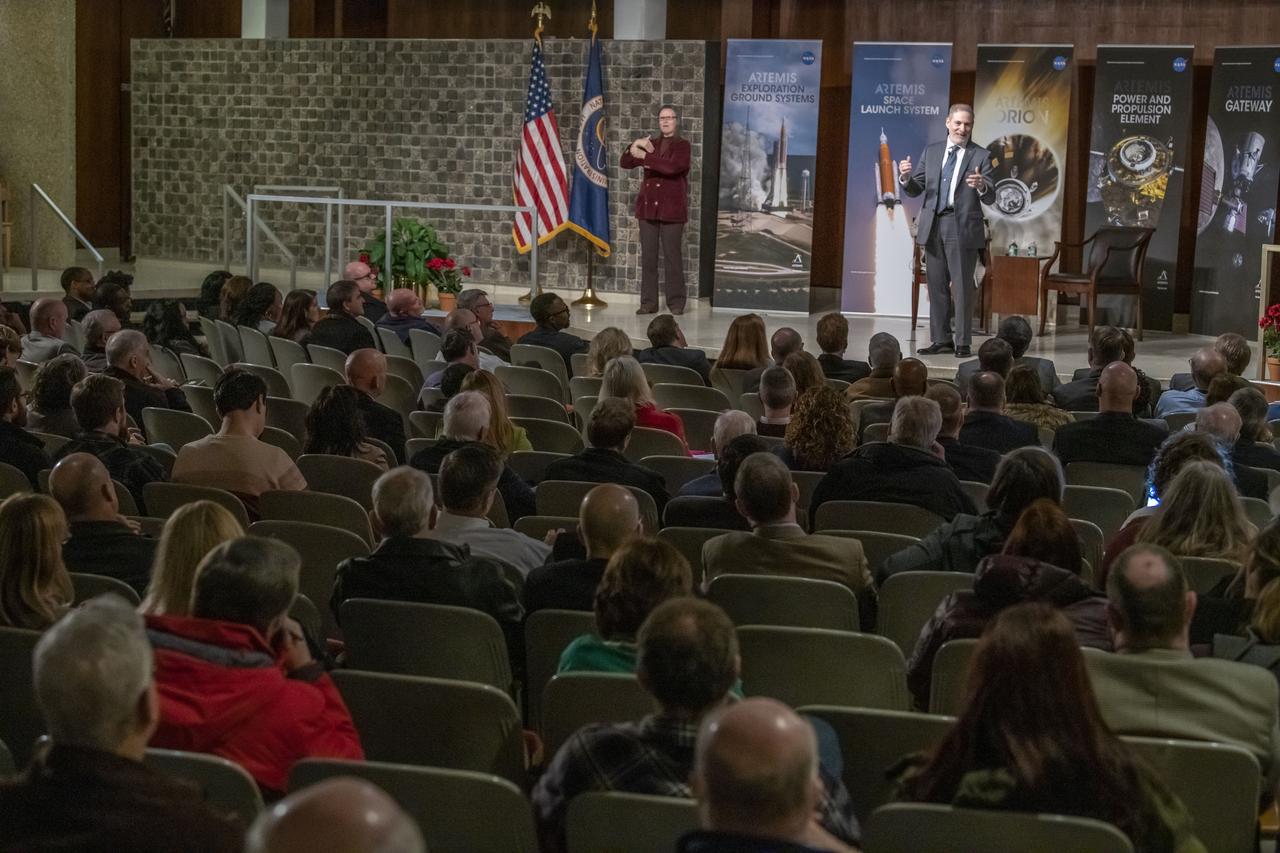
Douglas Loverro, NASA Associate Administrator for the Human Exploration and Operations Mission Directorate, and Marshall Center Director Jody Singer participate in a Town Hall with Marshall Space Flight Center employees

Douglas Loverro, NASA Associate Administrator for the Human Exploration and Operations Mission Directorate, and Marshall Center Director Jody Singer participate in a Town Hall with Marshall Space Flight Center employees

David L. Iverson of NASA Ames Research Center, Moffett Field, California (in foreground) led development of computer software to monitor the conditions of the gyroscopes that keep the International Space Station (ISS) properly oriented in space as the ISS orbits Earth. Also, Charles Lee is pictured. During its develoment, researchers used the software to analyze archived gyroscope records. In these tests, users noticed problems with the gyroscopes long before the current systems flagged glitches. Testers trained using several months of normal space station gyroscope data collected by the International Space Station Mission Control Center at NASA Johnson Space Center, Houston. Promising tests results convinced officials to start using the software in 2007.
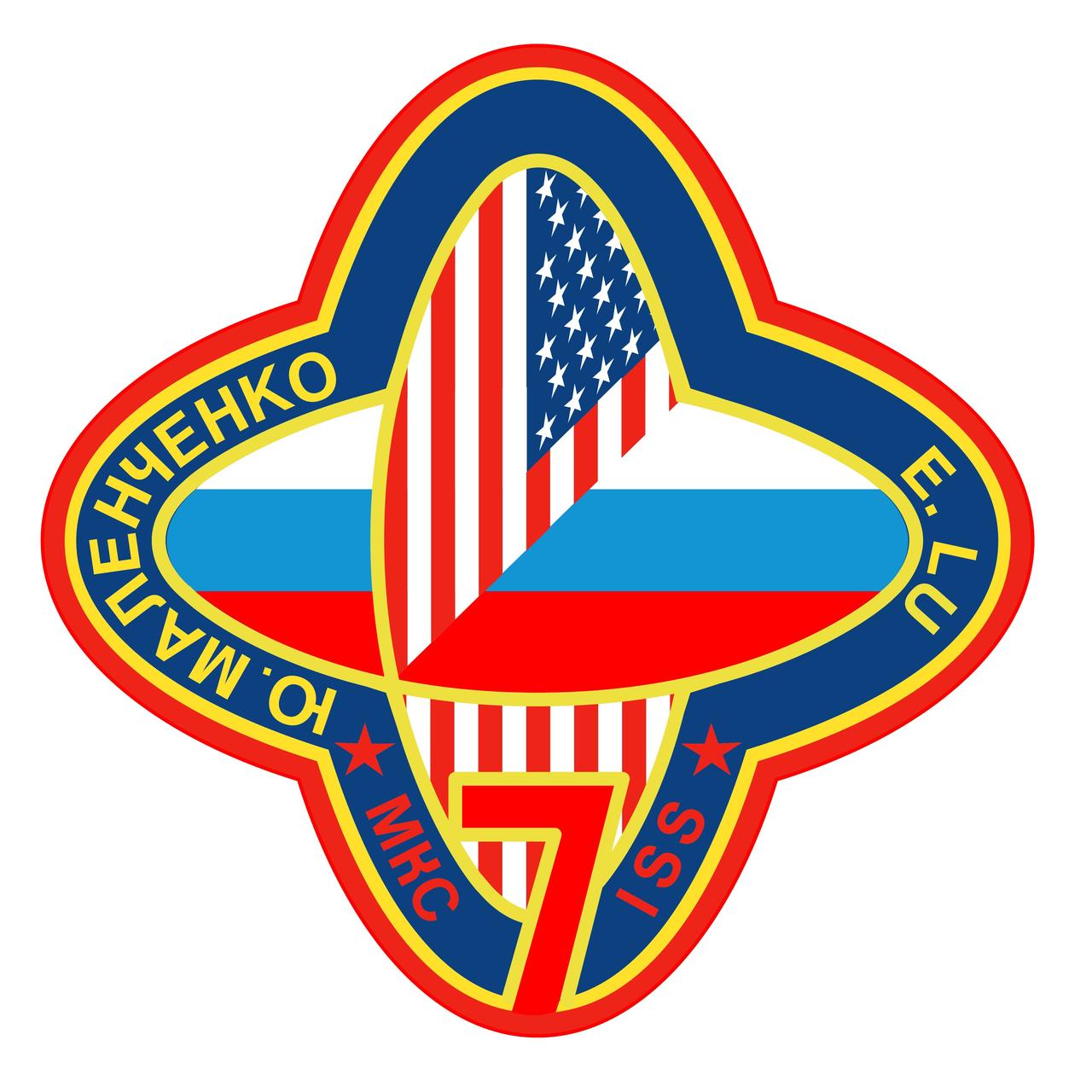
ISS007-S-001 (March 2003) --- The International Space Station (ISS) Expedition Seven patch consists of two elliptical orbits which evoke the histories of the two space programs from which the crew is drawn. The Russian and American flags are intersecting, representing the peaceful cooperation of the many countries contributing to the ISS. Two stars indicate the station's goals of contributing to life on Earth through science and commerce. The NASA insignia design for station space flights is reserved for use by the crew members and other official use as the NASA Administrator may authorize. Public availability has been approved only in the form of illustrations by the various news media. When and if there is any change in this policy, which is not anticipated, such will be publicly announced.
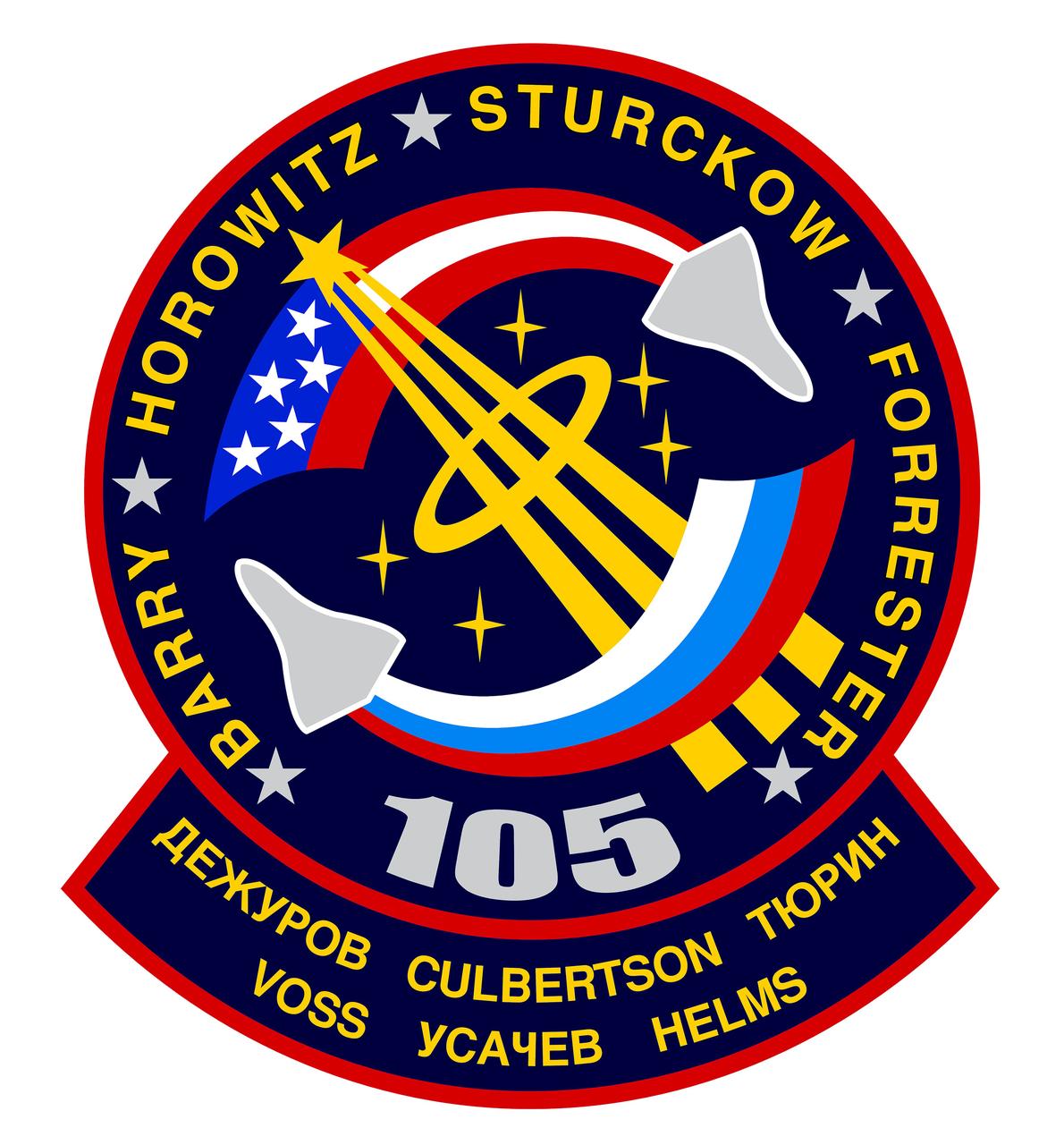
The STS-105 crew patch symbolizes the exchange of the Expedition Two and Expedition Three crews aboard the International Space Station (ISS). The three gold stars near the ascending orbiter represent the U.S. commanded Expedition Three Crew journeying into space, while the two gold stars near the descending orbiter represent the Russian commanded Expedition Two crew on their return to Earth. The ascending and descending Orbiters form a circle that represents both the crew rotation and the continuous presence in space aboard the station. The plumes of each orbiter represent the flags of the U.S. and Russia, symbolizing the close cooperation between the two nations. The Astronaut office symbol, a star with three rays of light, depicts the unbroken link between Earth and the brightest star on the horizon, the ISS. The names of Discovery's crew of four astronauts are shown along the border of the patch while the names of the Expedition crews are shown on the chevron at the bottom of the patch.
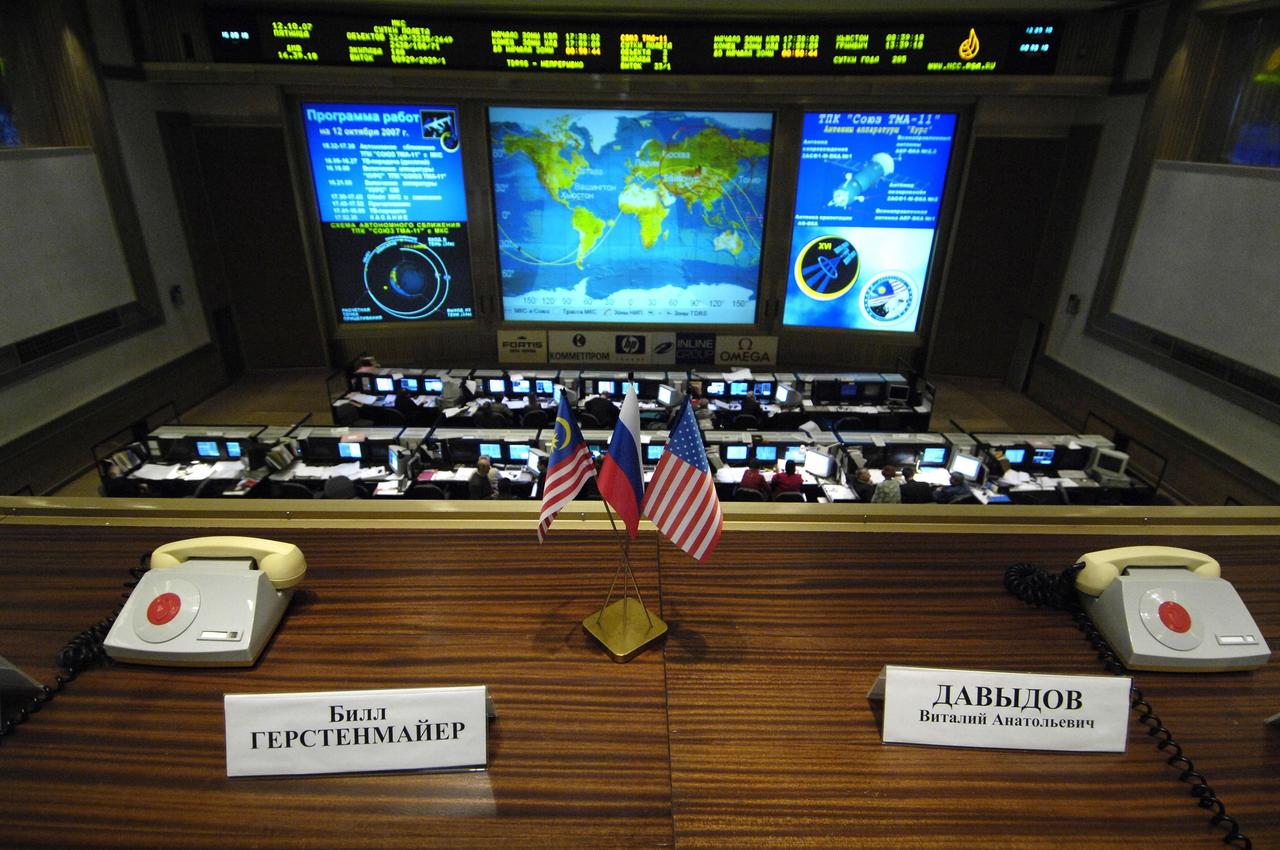
Korolev, Russia -- The flags of Malaysia, Russia and the United States sit between the phones used by officials to talk to the crew of the International Space Station (ISS) in the Russian Mission Control Center, Korolev, outside Moscow. Expedition 16 Commander Peggy Whitson, Flight Engineer and Soyuz Commander Yuri Malenchenko and Malaysian Spaceflight Participant Sheikh Muszaphar Shukor docked their Soyuz TMA-11 spacecraft to the station at 10:50 a.m. EDT Oct. 12, 2007. The crew launched Wednesday from the Baikonur Cosmodrome in Kazakhstan. Photo credit: NASA/Bill Ingalls
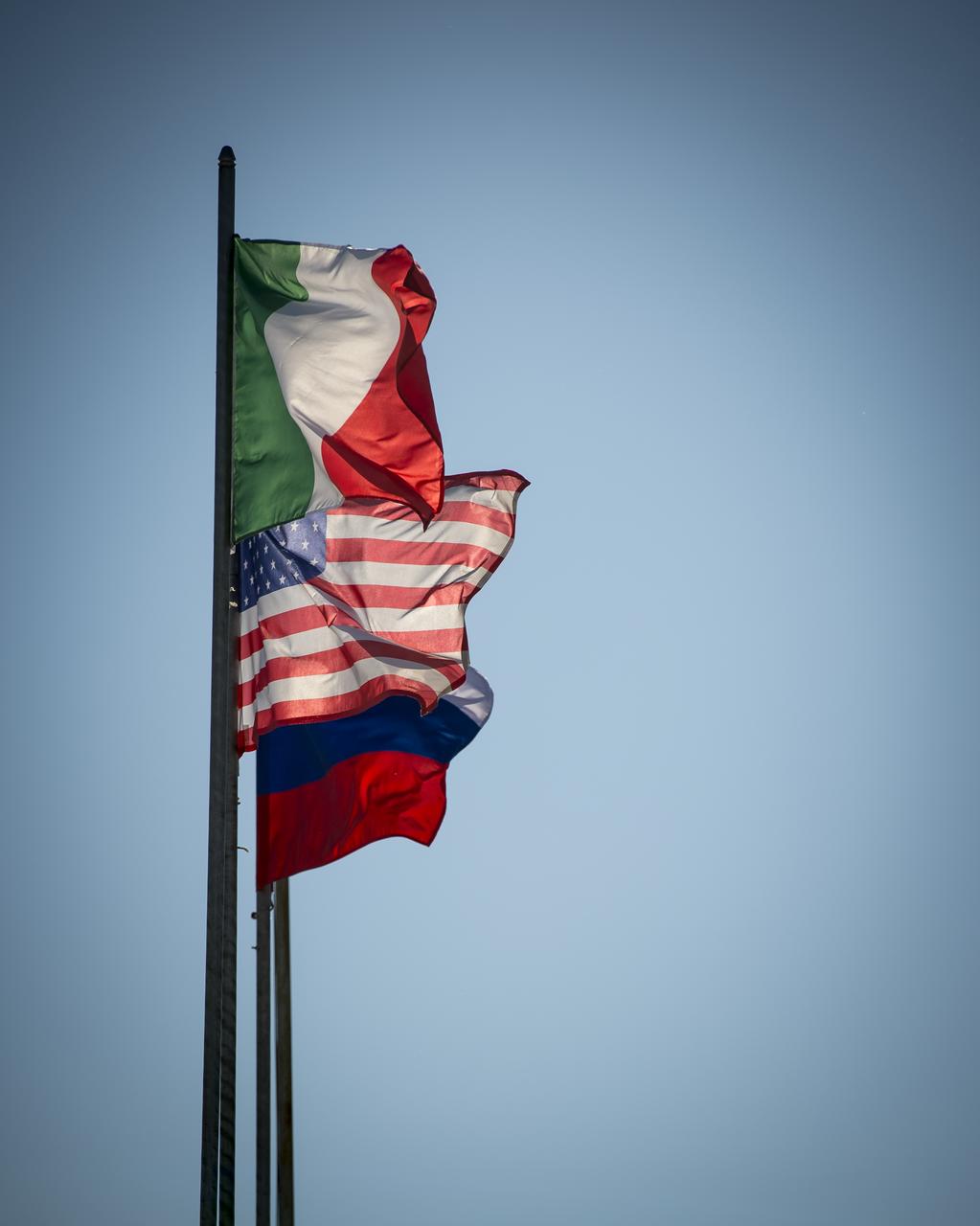
The flags of Italy, U.S.A., and Russia, are seen as they fly at the Baikonur Cosmodrome launch pad shortly after the Soyuz TMA-09M spacecraft was rolled out and placed raised into position, Sunday, May 26, 2013, in Kazakhstan. The launch of the Soyuz rocket to the International Space Station (ISS) with Expedition 36/37 Soyuz Commander Fyodor Yurchikhin of the Russian Federal Space Agency (Roscosmos), Flight Engineers; Luca Parmitano of the European Space Agency, and Karen Nyberg of NASA, is scheduled for Wednesday May 29, Kazakh time. Yurchikhin, Nyberg, and, Parmitano, will remain aboard the station until mid-November. Photo credit: (NASA/Bill Ingalls)
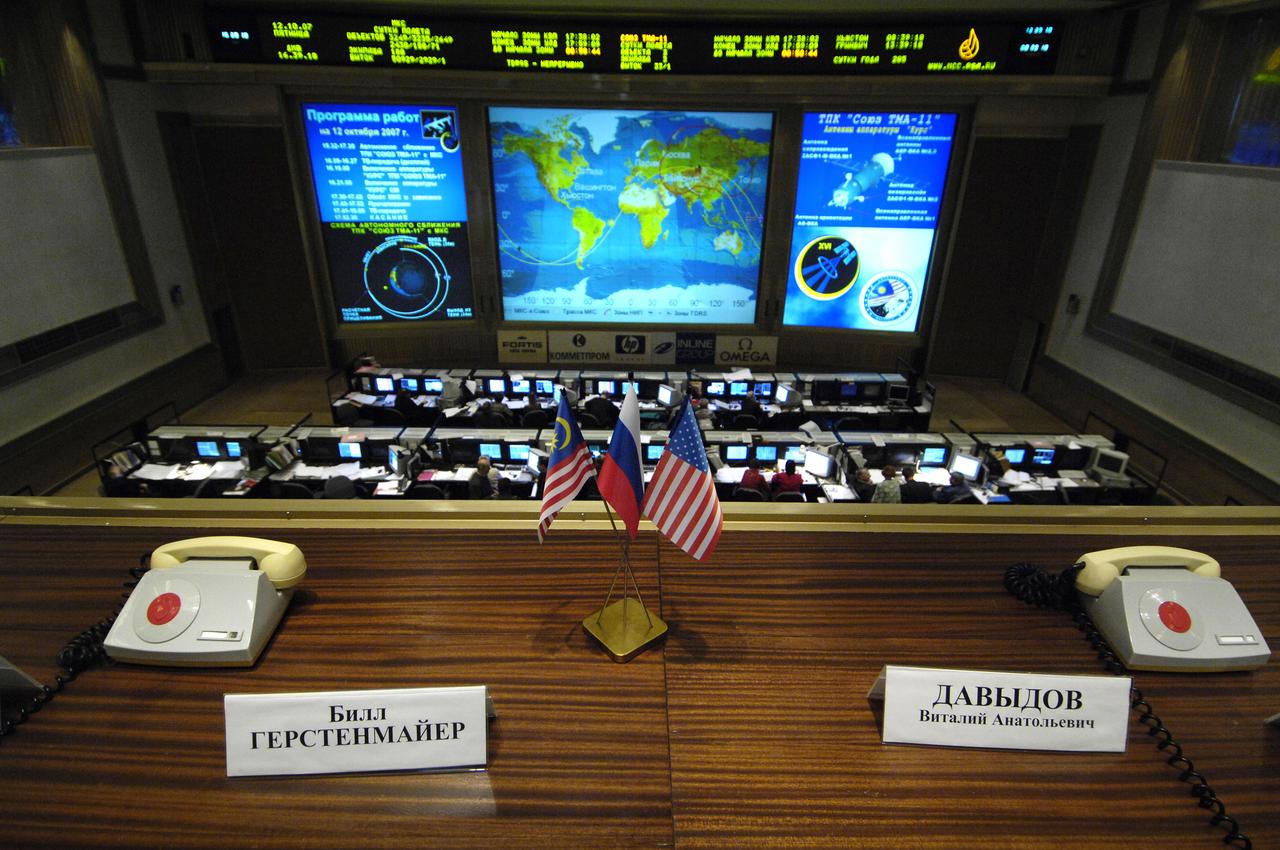
The flags of Malaysia, Russia and the United States sit between the phones used by officials to talk to the crew of the International Space Station (ISS) in the Russian Mission Control Center in Korolev, outside Moscow. Expedition 16 Commander Peggy Whitson, Soyuz Commander and Flight Engineer Yuri Malenchenko and Malaysian Spaceflight Participant Sheikh Muszaphar Shukor docked their Soyuz TMA-11 spacecraft to the station at 10:50 a.m. EDT. Oct. 12, 2007. The crew launched on Wednesday from the Baikonur Cosmodrome in Kazakhstan. Photo Credit: "NASA/Bill Ingalls"
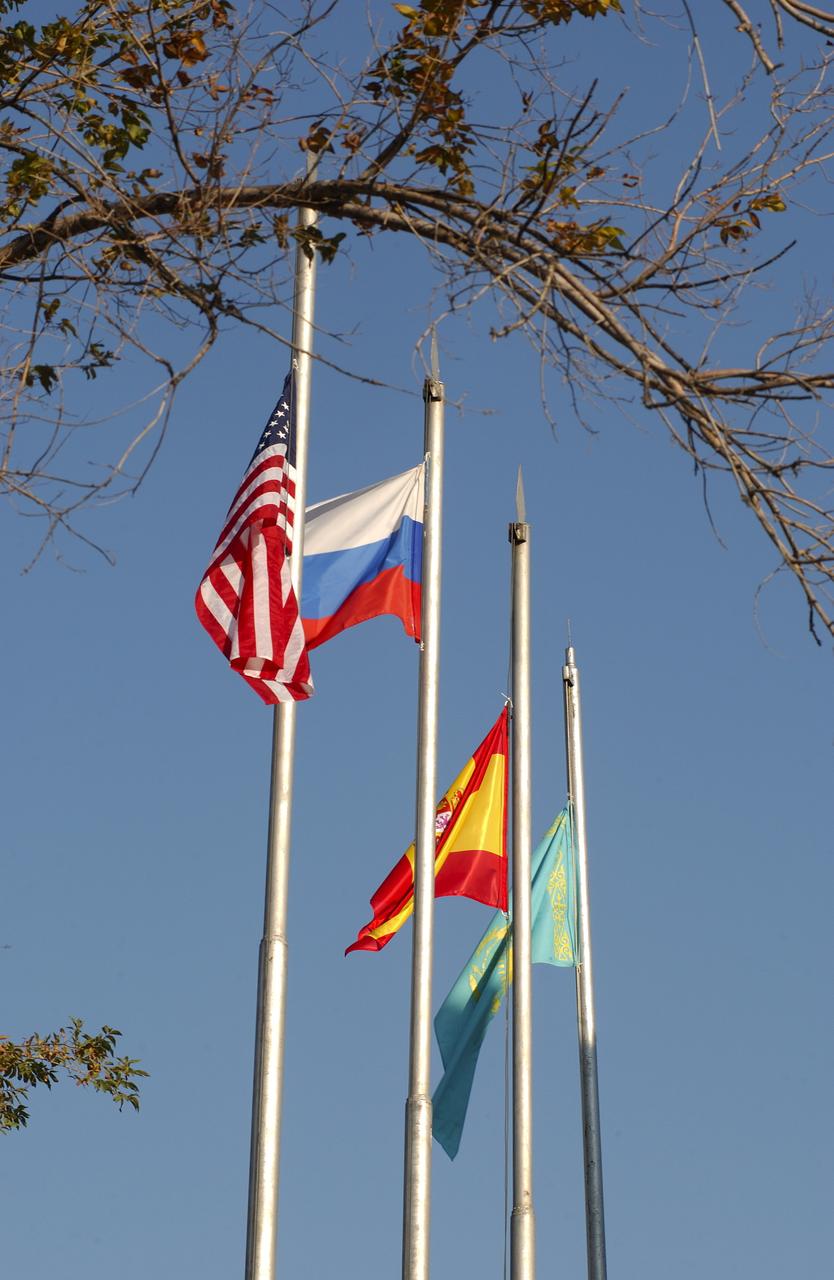
October 14, 2003. Cosmonaut Hotel, Baikonur, Kazakhstan. The flags of the United States, Russia, Spain and Kazakhstan fly outside the Cosmonaut Hotel Oct. 14, 2003 after they were raised by astronauts and cosmonauts in a traditional prelaunch ritual prior to the launch Saturday of the Soyuz TMA-3 vehicle to the International Space Station. The Soyuz will carry Expedition 8 Commander and NASA Science Officer Mike Foale, Expedition 8 Soyuz Commander Alexander Kaleri and European Space Agency Astronaut Pedro Duque of Spain to the ISS. Photo Credit: "NASA/Bill Ingalls"
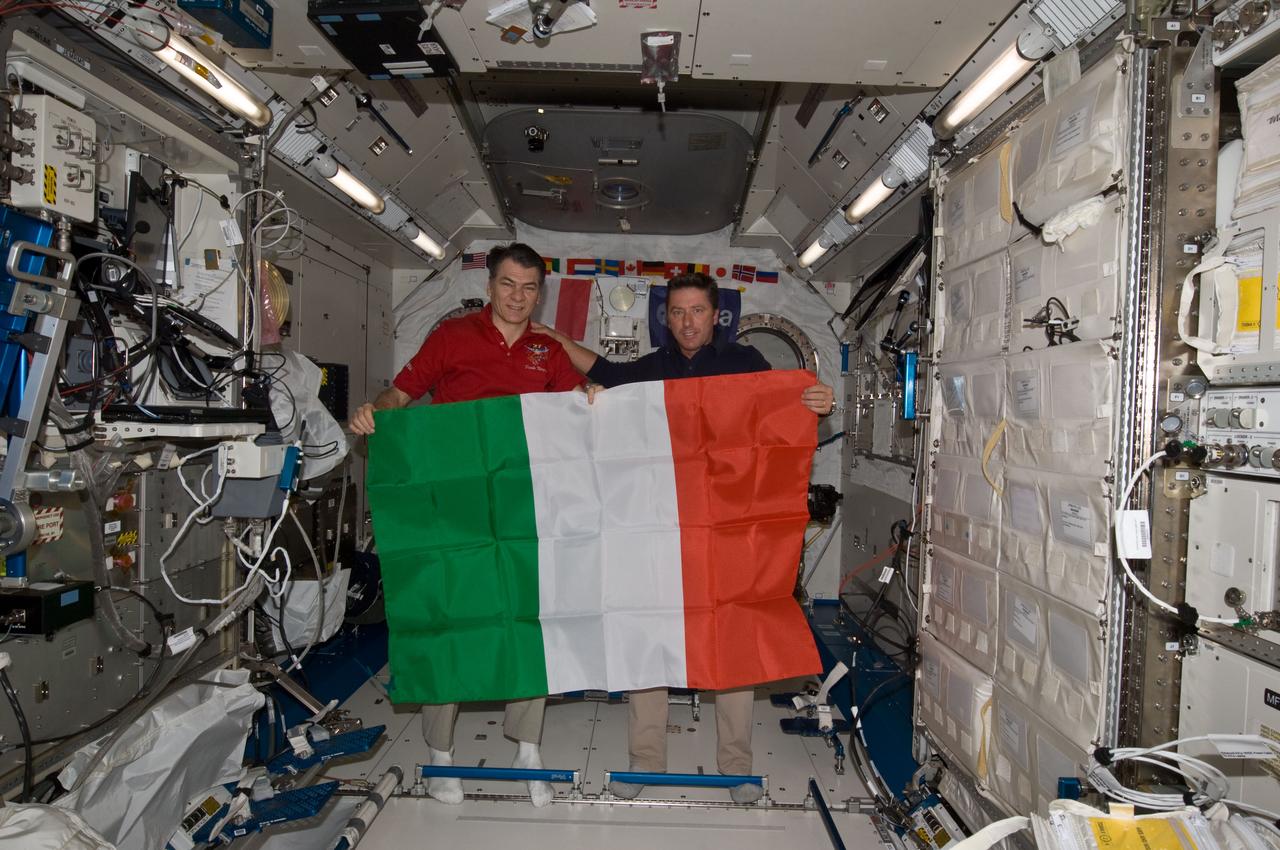
ISS027-E-036175 (23 May 2011) --- Inside the Japan Aerospace Exploration Agency's Kibo lab on the International Space Station (ISS), European Space Agency astronauts Paolo Nespoli (left) and Roberto Vittori display the Italian flag during an Earth-to-space phone tag-up with Italian President Giorgio Napolitano. Nespoli has been on the station for over five months and is due to return to Earth in less than 24 hours. Vittori is on a 16-day mission of the space shuttle Endeavour, joined by five NASA astronauts. This occasion is the second time two Italian astronauts have been in space together and the first time in the last 15 years.

ISS006-S-001 (September 2002) --- The International Space Station (ISS) Expedition Six crew patch depicts the station orbiting the Earth on its mission of international cooperation and scientific research. The Earth is placed in the center of the patch to emphasize that work conducted aboard this orbiting laboratory is intended to improve life on our home planet. The shape of the space station’s orbit symbolizes the role that experience gained from ISS will have on future exploration of our solar system and beyond. The American and Russian flags encircling the Earth represent the native countries of the Expedition 6 crew members, which are just two of the many participant countries contributing to the ISS and committed to the peaceful exploration of space. The NASA insignia design for International Space Station (ISS) missions is reserved for use by the crew members and for other official use as the NASA Administrator may authorize. Public availability has been approved only in the forms of illustrations by the various news media. When and if there is any change in this policy, which is not anticipated, the change will be publicly announced.
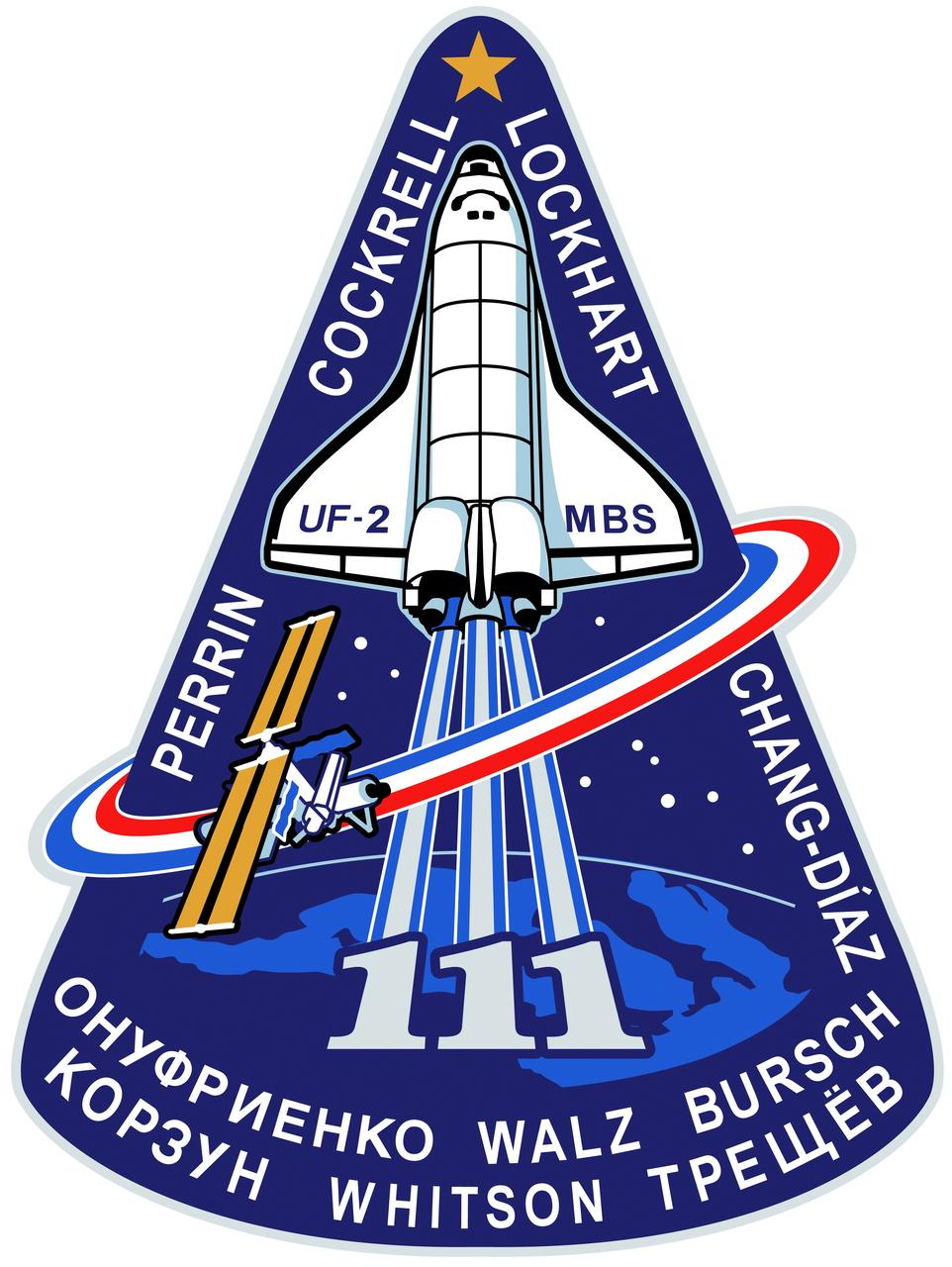
STS111-S-001 (January 2002) --- The STS-111 patch symbolizes the hardware, people, and partner nations that contribute to the flight. The space shuttle rises on the plume of the Astronaut Office symbol, carrying the Canadian Mobile Base System (MBS) for installation while docked to the International Space Station (ISS). The mission is named UF-2 for ISS Utilization Flight number two. The ISS orbit completes the Astronaut Office symbol and is colored red, white, and blue to represent the flags of the United States, Russia, France, and Costa Rica. The Earth background shows Italy, which contributes the Multi Purpose Logistics Module (MPLM) used on this flight to re-supply ISS. The ten stars in the sky represent the ten astronauts and cosmonauts on orbit during the flight, and the star at the top of the patch represents the Johnson Space Center, in the state of Texas, from which the flight is managed. The names of the STS-111 crew border the upper part of the patch, and the Expedition Five (going up) and Expedition Four (coming down) crews? names form the bottom of the patch. The NASA insignia design for space shuttle flights is reserved for use by the astronauts and for other official use as the NASA Administrator may authorize. Public availability has been approved only in the forms of illustrations by the various news media. When and if there is any change in this policy, which is not anticipated, the change will be publicly announced. Photo credit: NASA
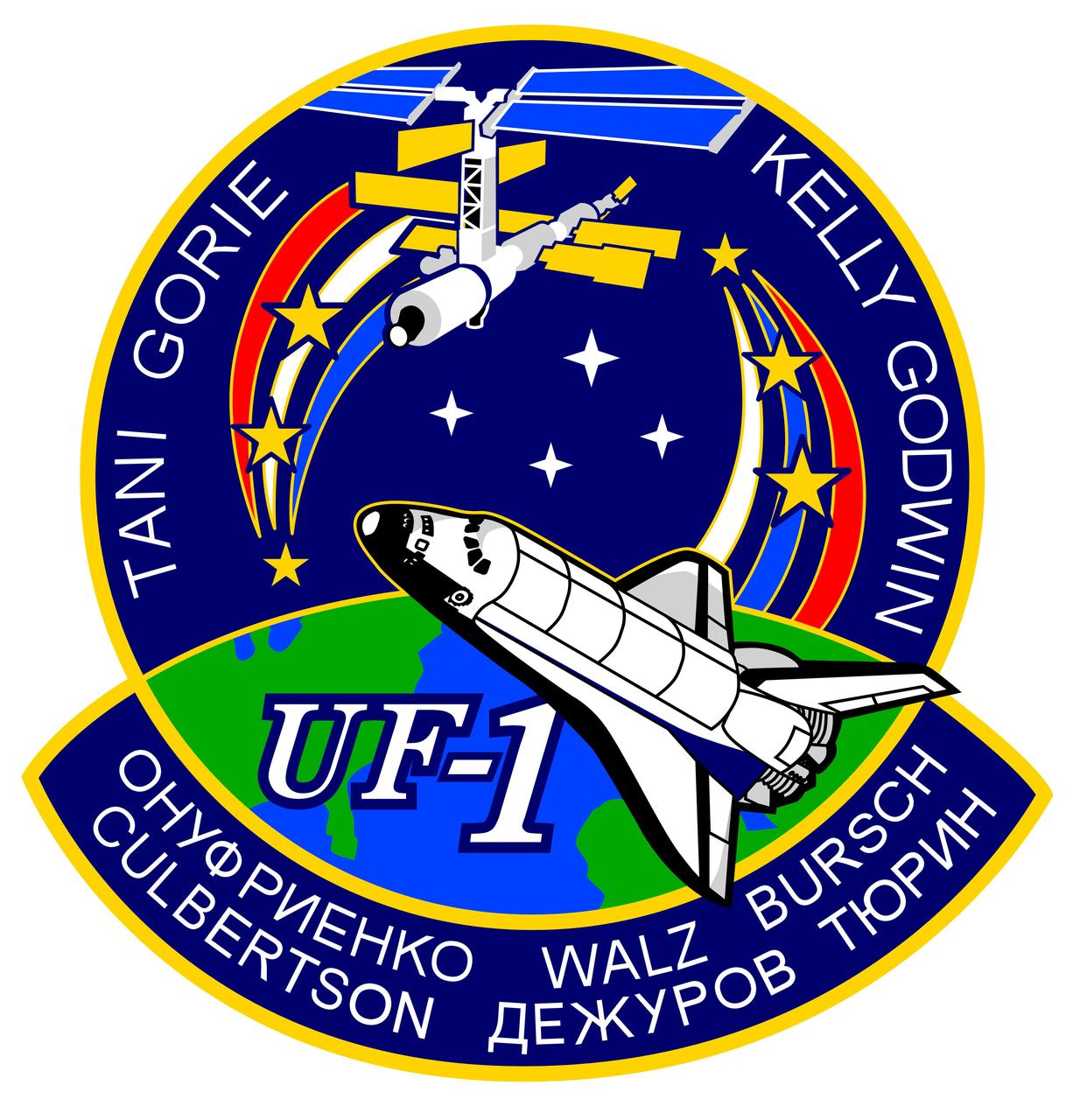
This is the insignia for the STS-108 mission, which marked a major milestone in the assembly of the International Space Station (ISS) as the first designated Utilization Flight, UF-1. The crew of Endeavour delivered the Expedition Four crew to ISS and returned the Expedition Three crew to Earth. Endeavour launched with a Multi-Purpose Logistics Module (MPLM) that was berthed to the ISS and unloaded. The MPLM was returned to Endeavour for the trip home and used again on a later flight. The crew patch depicts Endeavour and the ISS in the configuration at the time of arrival and docking. The Station is shown viewed along the direction of flight as seen by the Shuttle crew during their final approach and docking along the X-axis. The three ribbons and stars on the left side of the patch signify the returning Expedition Three crew. The red, white and blue order of the ribbons represents the American commander for that mission. The three ribbons and stars on the right depict the arriving Expedition Four crew. The white, blue, and red order of the Expedition Four ribbon matches the color of the Russian flag and signifies that the commander of Expedition Four is a Russian cosmonaut. Each white star in the center of the patch represents the four Endeavour crew members. The names of the four astronauts who crewed Endeavour are shown along the top border of the patch. The three astronauts and three cosmonauts of the two expedition crews are shown on the chevron at the bottom of the patch.

HOUSTON, Texas -- STS119-S-001: The shape of the STS-119/15A patch comes from the shape of a solar array viewed at an angle. The International Space Station (ISS), which is the destination of the mission, is placed accordingly in the center of the patch just below the gold astronaut symbol. The gold solar array of the ISS highlights the main cargo and task of STS-119/15A -- the installation of the S6 truss segment and deployment of the S6's solar arrays, the last to be delivered to the ISS. Under the Japanese Kibo module, marked by a red circle, is the name of Japanese astronaut Koichi Wakata, who goes up to the ISS to serve as flight engineer representing JAXA. The rest of the STS-119/15A crew members are denoted on the outer band of the patch. The 17 white stars on the patch represent, in the crew's words, "the enormous sacrifice the crews of Apollo1, Challenger, and Columbia have given to our space program." The U.S. flag flowing into the Space Shuttle signifies the support the people of the United States have given our space program over the years, along with pride the U.S. astronauts have in representing the United States on this mission. The NASA insignia for design for Shuttle flights is reserved for use by the astronauts and for other official use as the NASA Administrator may authorize. Public availability has been approved only in the form of illustrations by the various news media. When and if there is any change in this policy, it will be publicly announced.
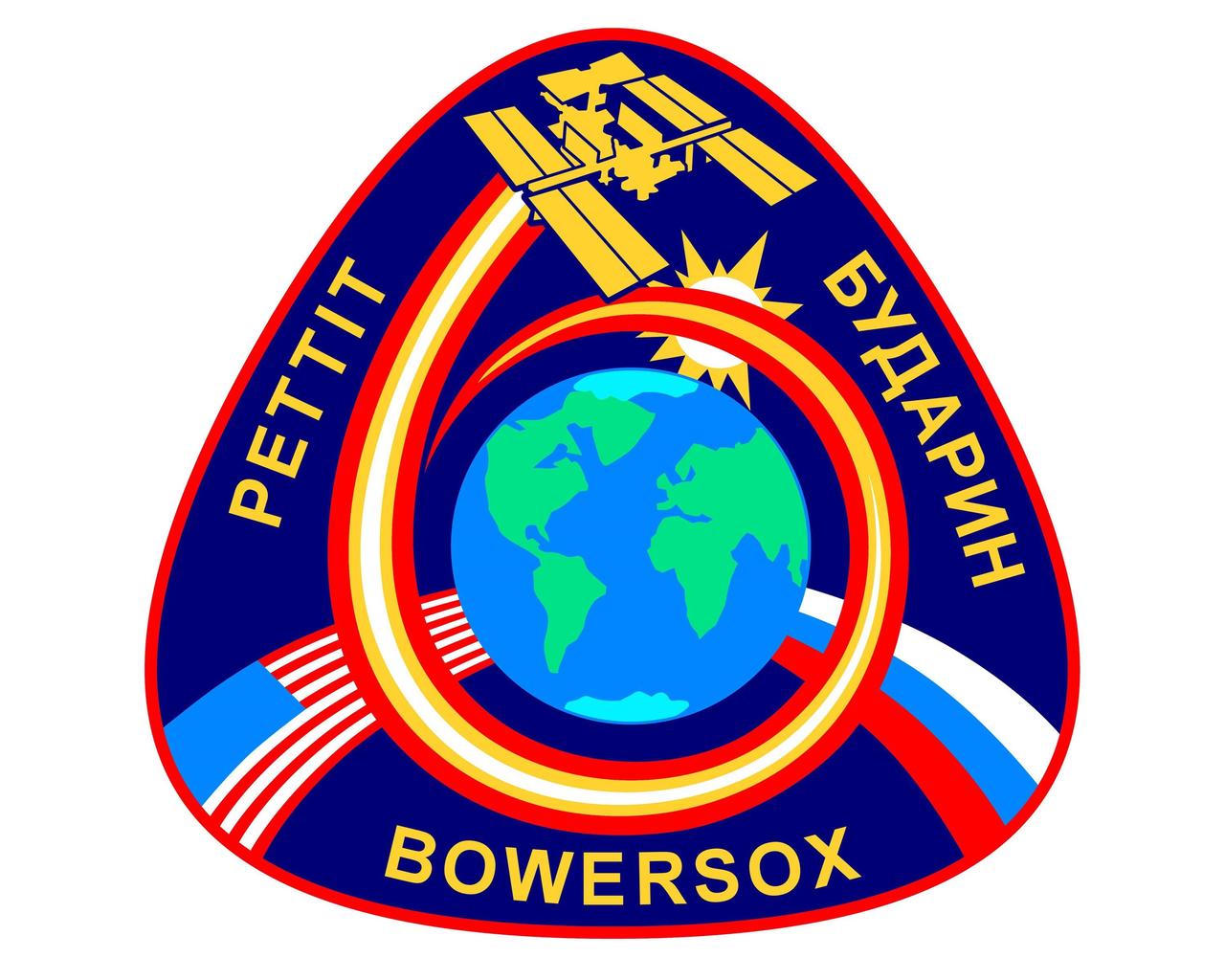
JOHNSON SPACE CENTER, HOUSTON, TEXAS -- (ISS006-S-001) Revised -- The International Space Station (ISS) Expedition 6 crew patch depicts the Station orbiting the Earth on its mission of international cooperation and scientific research. The Earth is placed in the center of the patch to emphasize that work conducted aboard this orbiting laboratory is intended to improve life on our home planet. The shape of the Space Station's orbit symbolizes the role that experience gained from ISS will have on future exploration of our solar system and behond. The American and Russian flags encircling the Earth represent the native countries of the Expedition 6 crew members, which are just two of the many participant countries contributing to the ISS and committed to the peaceful exploration of space. The NASA insignia design for International Space Station missions is reserved for use by the crew members and for other official use as the NASA Administrator may authorize. Public availability has been approved only in the forms of illustrations by the various news media. When and if there is any change in this policy, which is not anticipated, the change will be publicly announced.
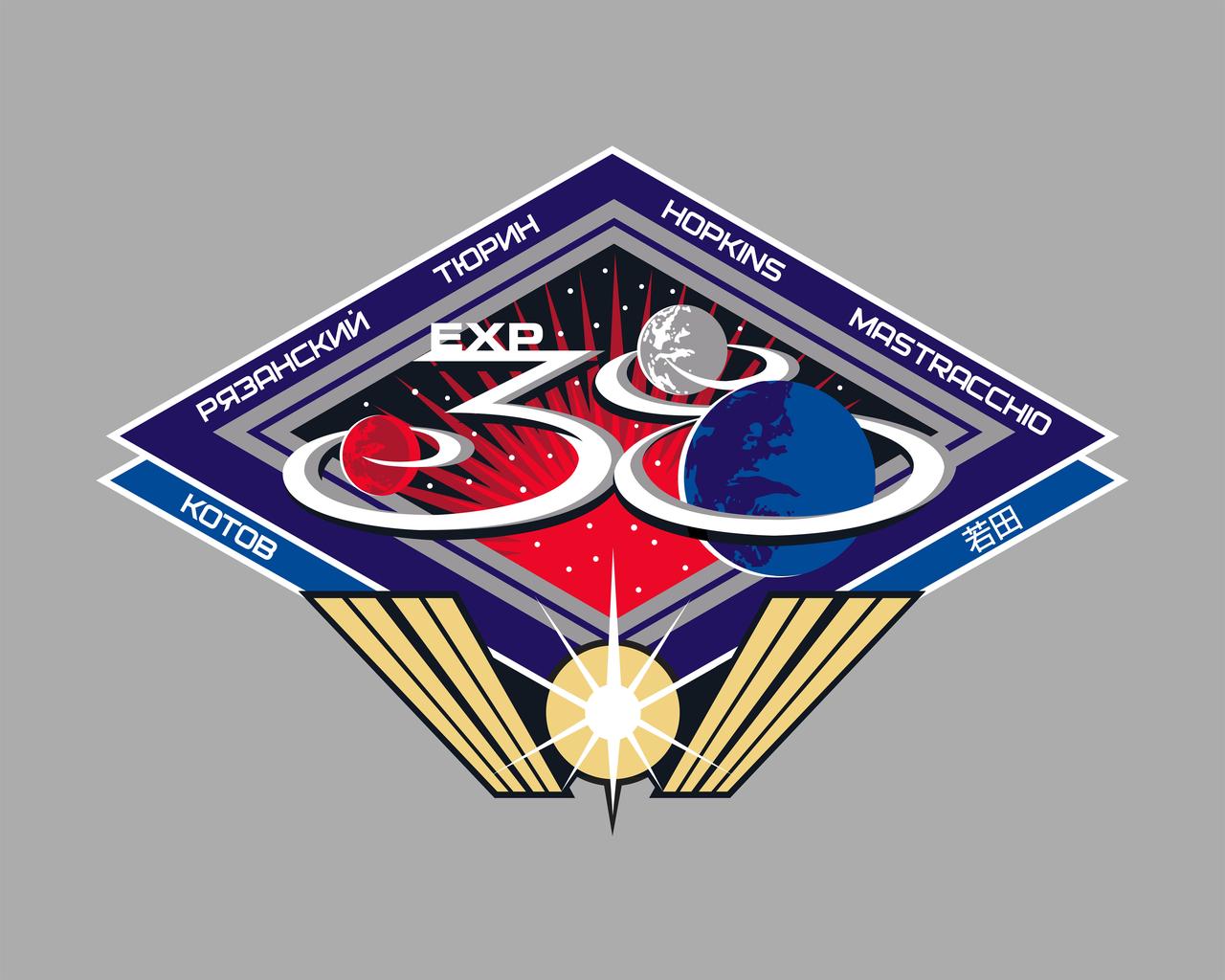
ISS038-S-001 (April 2013) --- As the International Space Station (ISS) has become a stepping stone to future space exploration, the Expedition 38 mission patch design paints a visual roadmap of exploration beyond low Earth orbit, most prominently represented by the design?s flowing Expedition 38 mission numbers that wrap around Earth, the moon and Mars. Just as the sun is a guiding light in the galaxy, the ISS illuminates the bottom of the design as it is a shining beacon of the advancement of science, knowledge, and technology carried out aboard the Space Station. To visually capture the idea of the ISS being a foundation for infinite discovery, the space station?s iconic solar arrays span upwards, providing the number 38 and its exploration roadmap a symbolic pedestal to rest on. Finally, the overall use of red, white, and blue in the design acknowledges the flags of the countries of origin for Expedition 38?s crew ? the United States, Russia, and Japan. The NASA insignia design for space shuttle flights is reserved for use by the astronauts and for other official use as the NASA Administrator may authorize. Public availability has been approved only in the forms of illustrations by the various news media. When and if there is any change in this policy, which is not anticipated, the change will be publicly announced. Photo credit: NASA
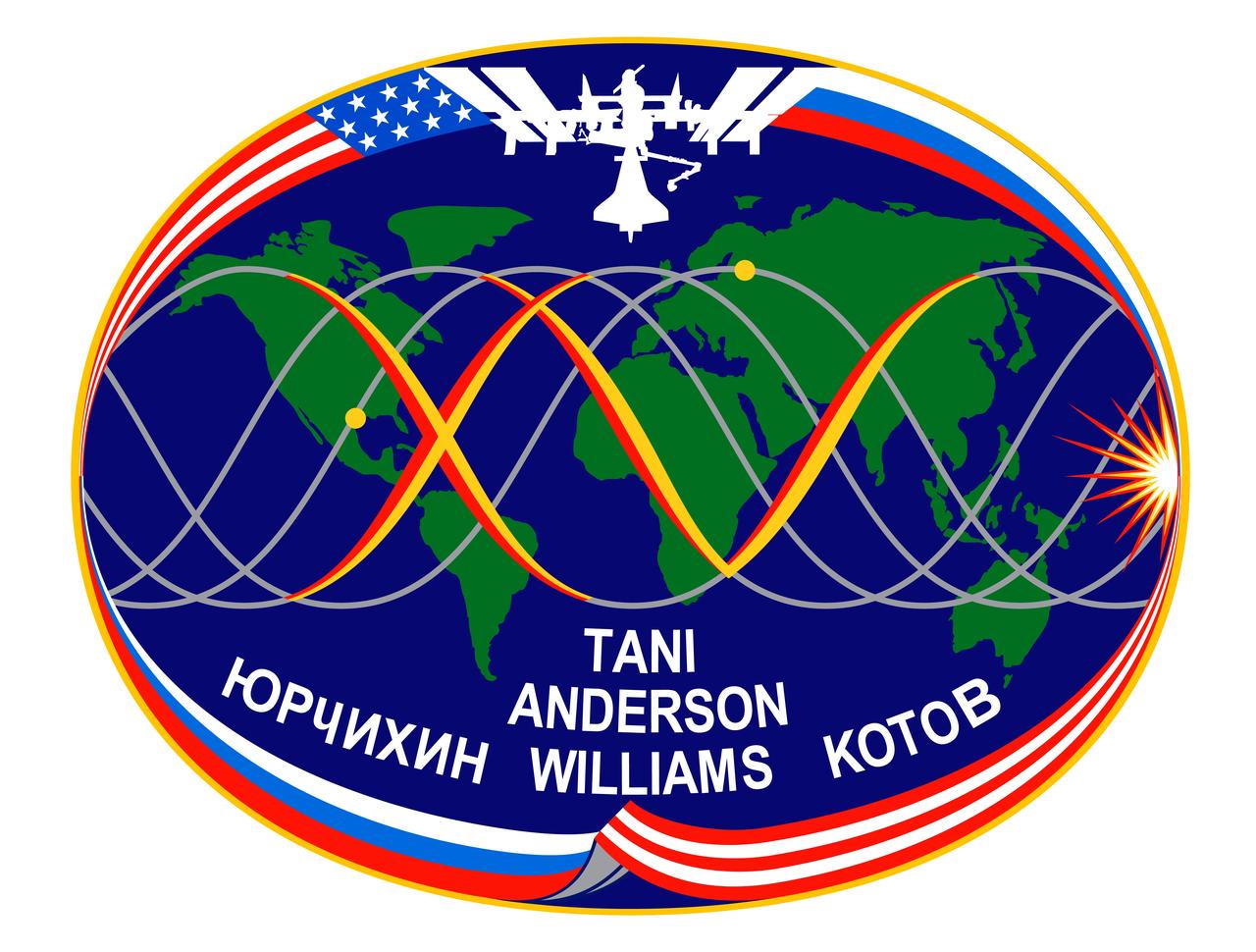
ISS015-S-001F (November 2006) --- The operational teamwork between human space flight controllers and the on-orbit crew take center stage in this emblem. Against a backdrop familiar to all flight controllers, past and present, independent of any nationality, the fifteenth expedition to the ISS is represented in Roman numeral form as part of the ground track traces emblazoned on the Mercator projection of the home planet Earth. The ISS, shown in its fully operational, assembly complete configuration, unfurls and then reunites the flags of this Russian and American crew in a show of our continuing international cooperation. Golden spheres placed strategically on the ground track near the flight control centers of the United States and Russia serve to symbolize both the joint efforts from each nation's team of flight controllers and the shuttle and Soyuz crew vehicles in their chase orbit as they rendezvous with the ISS. A rising sun provides a classic touch to the emblem signifying the perpetual nature of manned space flight operations and their origin in these two space-faring nations. The NASA insignia design for shuttle and space station flights is reserved for use by the astronauts and for other official use as the NASA Administrator may authorize. Public availability has been approved only in the forms of illustrations by the various news media. When and if there is any change in this policy, which is not anticipated, the change will be publicly announced.
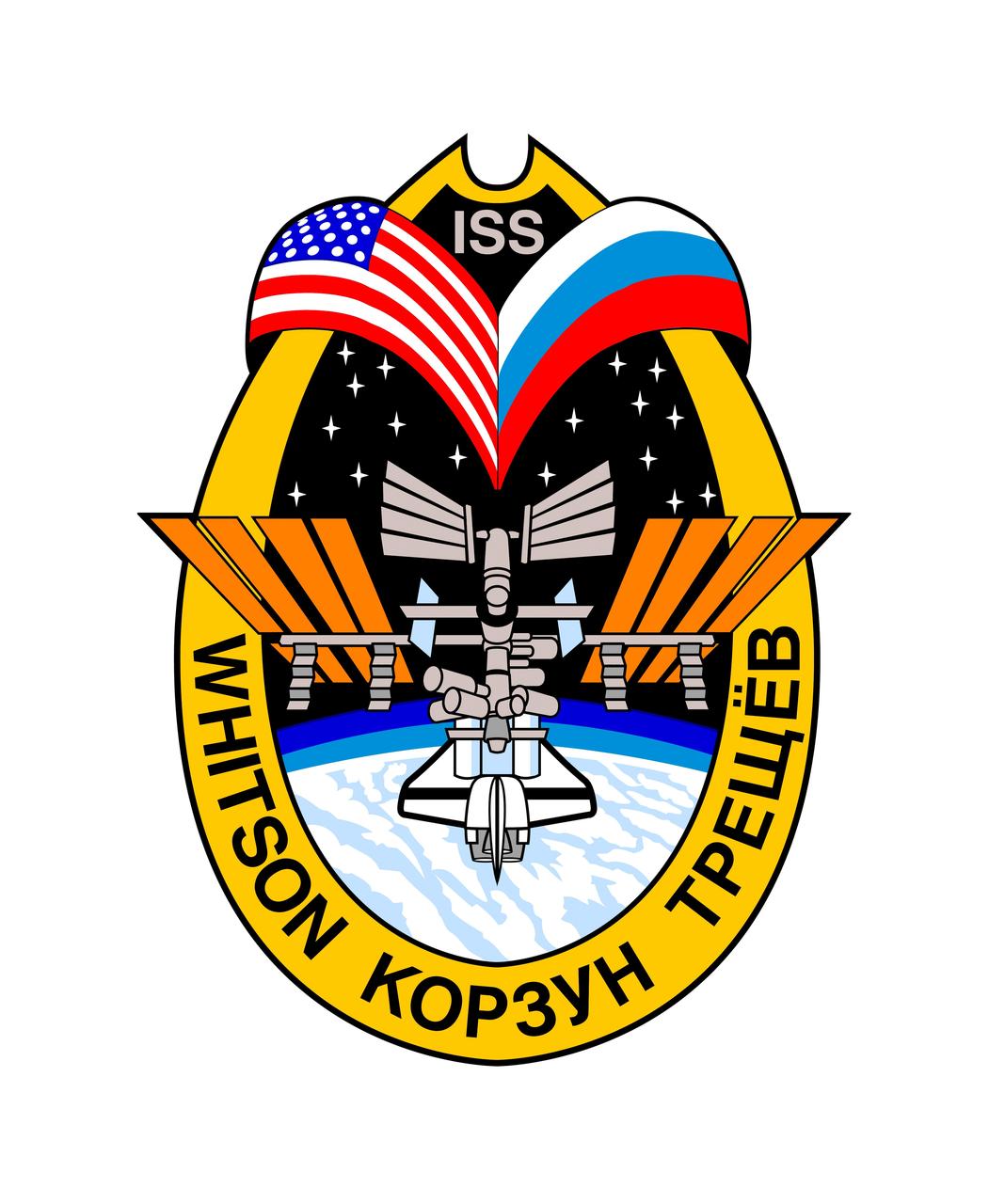
ISS005-S-001 (January 2002) -- The International Space Station (ISS) Expedition Five patch depicts the station in its completed configuration and represents the vision of mankind's first step as a permanent human presence in space. The United States and Russian flags are joined together in a Roman numeral V to represent both the nationalities of the crew and the fifth crew to live aboard the ISS. Crew members? names are shown in the border of this patch. This increment encompasses a new phase in growth for the station, with three shuttle crews delivering critical components and building blocks to the ISS. To signify the participation of each crew member, the shuttle is docked to the station beneath a constellation of 17 stars symbolizing all those visiting and living aboard station during this increment. The NASA insignia design for shuttle flights and station increments is reserved for use by the astronauts and for other official use as the NASA Administrator may authorize. Public availability has been approved only in the forms of illustrations by the various news media. When and if there is any change in this policy, which is not anticipated, the change will be publicly announced.
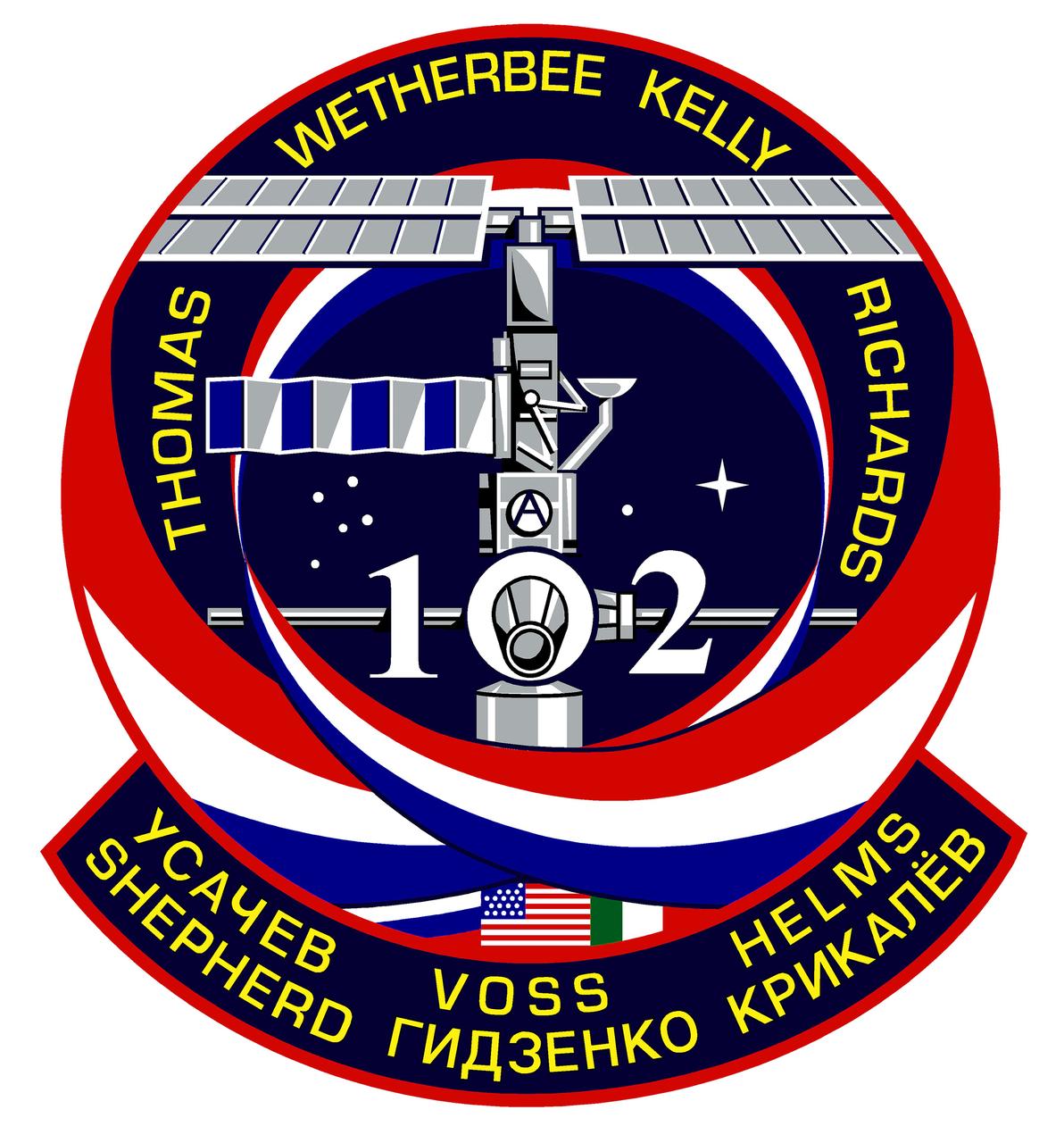
This is the STS-102 mission crew insignia. The central image on the crew patch depicts the International Space Station (ISS) in the build configuration that it had at the time of the arrival and docking of Discovery during the STS-102 mission, the first crew exchange flight to the Space Station. The station is shown along the direction of the flight as was seen by the shuttle crew during their final approach and docking, the so-called V-bar approach. The names of the shuttle crew members are depicted in gold around the top of the patch, and surnames of the Expedition crew members being exchanged are shown in the lower barner. The three ribbons swirling up to and around the station signify the rotation of these ISS crew members. The number 2 is for the Expedition 2 crew who flew up to the station, and the number 1 is for the Expedition 1 crew who then returned down to Earth. In conjunction with the face of the Lab module of the Station, these Expedition numbers create the shuttle mission number 102. Shown mated below the ISS is the Italian-built Multipurpose Logistics Module, Leonardo, that flew for the first time on this flight. The flags of the countries that were the major contributors to this effort, the United States, Russia, and Italy are also shown in the lower part of the patch. The build-sequence number of this flight in the overall station assembly sequence, 5A.1, is captured by the constellations in the background.
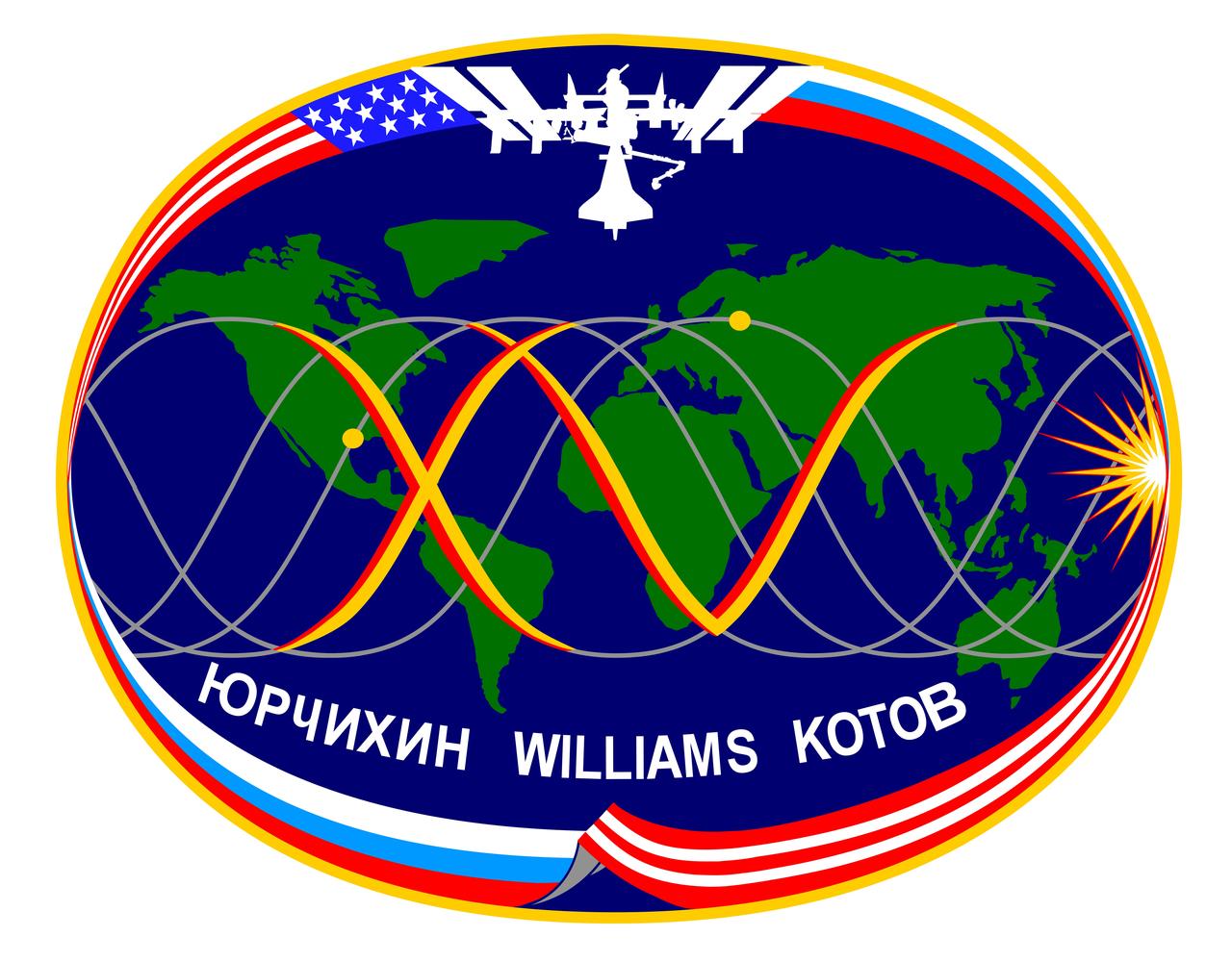
ISS015-S-001A (Nov. 2006) --- The operational teamwork between human space flight controllers and the on-orbit crew take center stage in this emblem. Against a backdrop familiar to all flight controllers, past and present, independent of any nationality, the fifteenth expedition to the ISS is represented in Roman numeral form as part of the ground track traces emblazoned on the Mercator projection of the home planet Earth. The ISS, shown in its fully operational, assembly complete configuration, unfurls and then reunites the flags of this Russian and American crew in a show of our continuing international cooperation. Golden spheres placed strategically on the ground track near the flight control centers of the United States and Russia serve to symbolize both the joint efforts from each nation's team of flight controllers and the shuttle and Soyuz crew vehicles in their chase orbit as they rendezvous with the ISS. A rising sun provides a classic touch to the emblem signifying the perpetual nature of manned space flight operations and their origin in these two space-faring nations. The NASA insignia design for shuttle and space station flights is reserved for use by the astronauts and for other official use as the NASA Administrator may authorize. Public availability has been approved only in the forms of illustrations by the various news media. When and if there is any change in this policy, which is not anticipated, the change will be publicly announced.
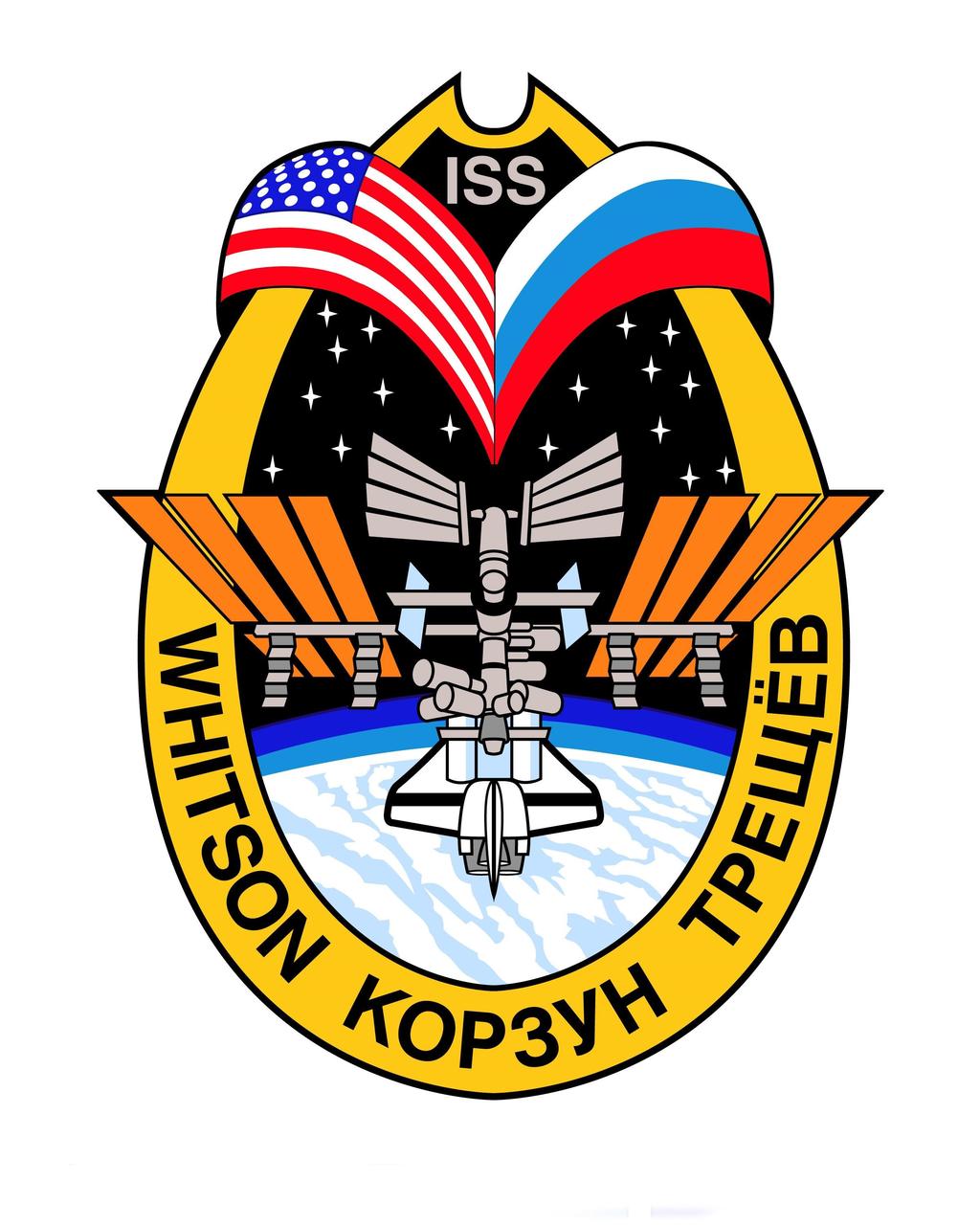
JOHNSON SPACE CENTER, HOUSTON, TEXAS -- EXPEDITION FIVE CREW INSIGNIA (ISS05-S-001) -- The International Space Station (ISS) Expedition Five patch depicts the Station in its completed configuration and represents the vision of mankind's first step as a permanent human presence in space. The United States and Russian flags are joined together in a Roman numeral V to represent both the nationalities of the crew and the fifth crew to live aboard the ISS. Crew members' names are shown in the border of this patch. This increment encompasses a new phase in growth for the Station, with three Shuttle crews delivering critical components and building blocks to the ISS. To signify the participation of each crew member, the Shuttle is docked to the Station beneath a constellation of 17 stars symbolizing all those visiting and living aboard Station during this increment. The NASA insignia design for Shuttle flights is reserved for use by the astronauts and for other official use as the NASA Administrator may authorize. Public availability has been approved only in the forms of illustrations by the various news media. When and if there is any change in this policy, which is not anticipated, the change will be publicly announced.
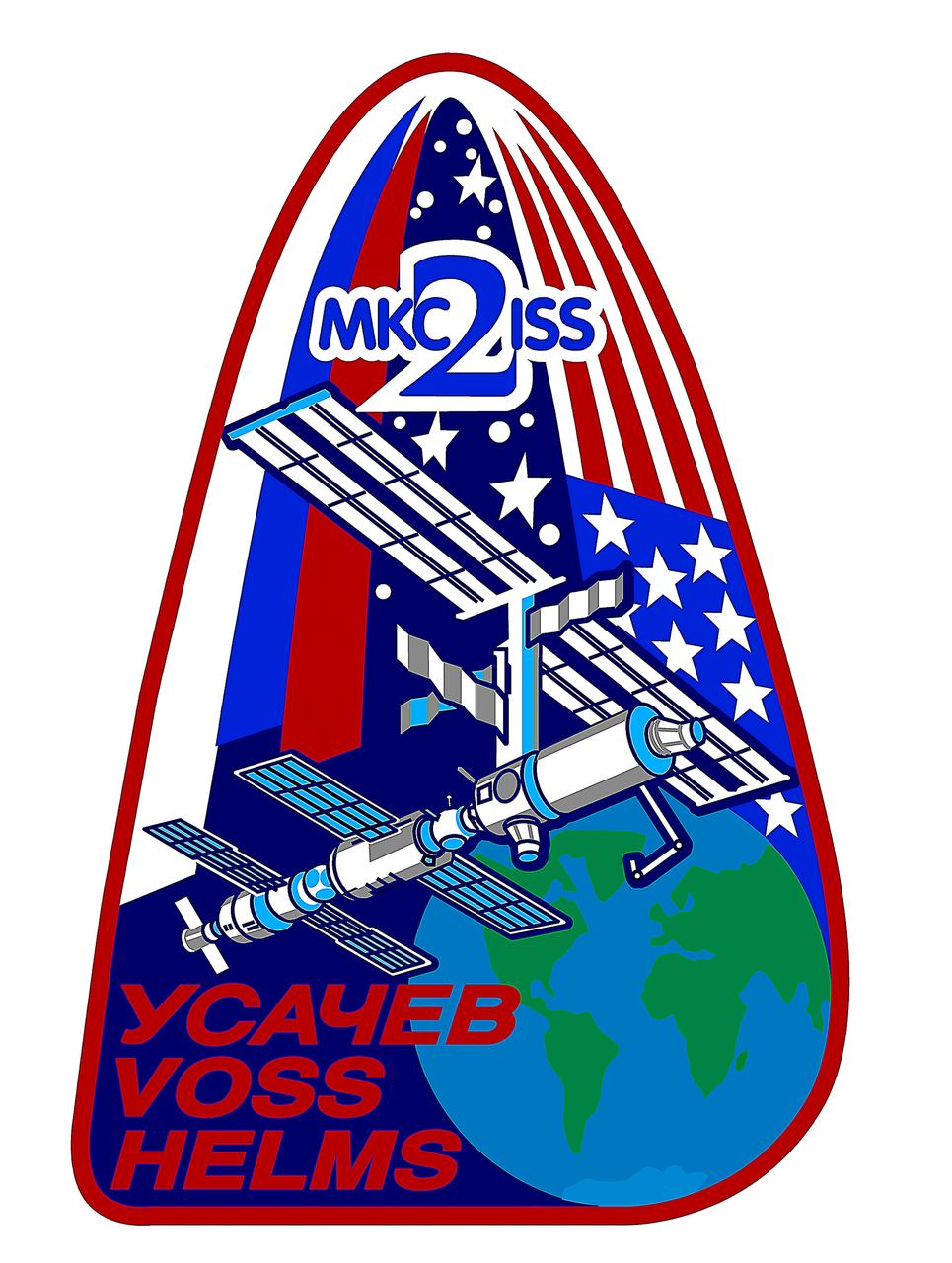
ISS002-S-001 (January 2001) --- The International Space Station Expedition Two patch depicts the Space Station as it appears during the time the second crew will be on board. The Station flying over the Earth represents the overall reason for having a space station: to benefit the world through scientific research and international cooperation in space. The number 2 is for the second expedition and is enclosed in the Cyrillic MKS and Latin ISS which are the respective Russian and English abbreviations for the International Space Station. The United States and Russian flags show the nationalities of the crew indicating the joint nature of the program. When asked about the stars in the background, a crew spokesman said they "...represent the thousands of space workers throughout the ISS partnership who have contributed to the successful construction of our International Space Station." The insignia design for ISS flights is reserved for use by the astronauts and cosmonauts and for other official use as the NASA Administrator and NASA's international partners may authorize. Public availability has been approved only in the form of illustrations by the various news media. When and if there is any change in this policy, which we do not anticipate, it will be publicly announced.
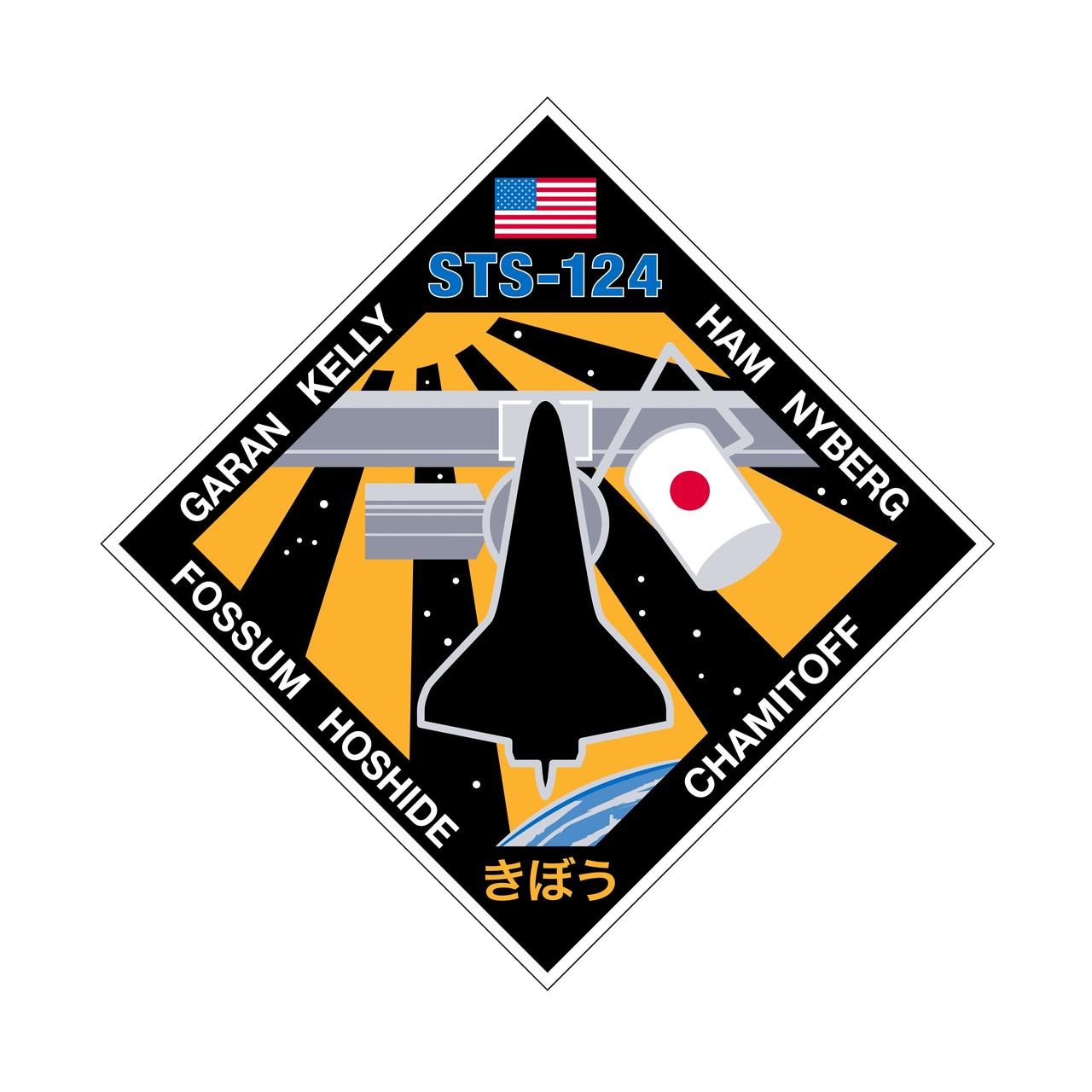
STS124-S-001 (October 2007) --- The STS-124/1J patch depicts the space shuttle Discovery docked with the International Space Station (ISS). STS-124/1J is dedicated to delivering and installing the Japanese Experiment Module (JEM) known as Kibo (Hope) to the ISS. The significance of the mission and the Japanese contribution to the ISS is recognized by the Japanese flag depicted on the JEM Pressurized Module (JPM) and the word Kibo written in Japanese at the bottom of the patch. The view of the sun shining down upon Earth represents the increased "hope" that the entire world will benefit from the JEM's scientific discoveries. The JPM will be the largest habitable module on the ISS and is equipped with its own airlock and robotic arm for external experiments. In addition to delivering and installing the JPM, the STS-124 crew will relocate the JEM Logistics Pressurized (JLP) module to its permanent home on the zenith side of the JPM. During three planned spacewalks, the crew will perform external ISS maintenance and JPM outfitting, as well as extensive robotic operations by the ISS, space shuttle, and JEM robotic arms. It will be the first time that three different robotic arms will be operated during a single spaceflight mission. The NASA insignia design for space shuttle flights is reserved for use by the astronauts and for other official use as the NASA Administrator may authorize. Public availability has been approved only in the forms of illustrations by the various news media. When and if there is any change in this policy, which is not anticipated, the change will be publicly announced. Photo credit: NASA
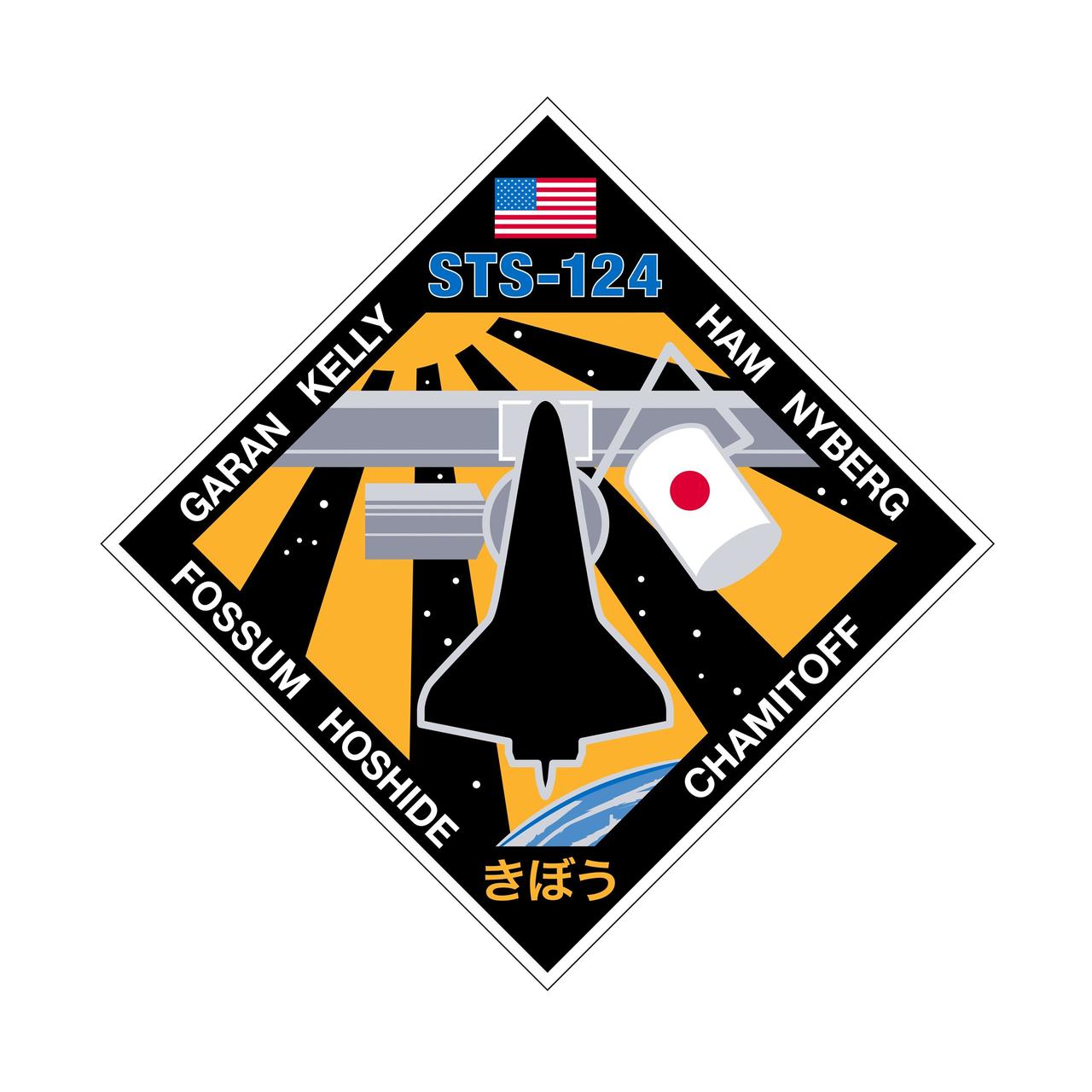
JOHNSON SPACE CENTER, Houston --- STS124-S-001 --- The STS-124/1J patch depicts the Space Shuttle Discovery docked with the International Space Station (ISS). STS-124/1J is dedicated to delivering and installing the Japanese Experiment Module (JEM) known as Kibo (Hope) to the ISS. The significance of the mission and the Japanese contribution to the ISS is recognized by the Japanese flag depicted on the JEM Pressurized Module (JPM) and the word Kibo written in Japanese at the bottom of the patch. The view of the sun shining down upon the Earth represents the increased "hope" that the entire world will benefit from the JEM's scientific discoveries. The JPM will be the largest habitable module on the ISS and is equipped with its own airlock and robotic arm for external experiments. In addition to delivering and installing the JPM, the STS-124 crew will relocate the JEM Logistics Pressurized (JLP) module to its permanent home on the zenith side of the JPM. During three planned space walks, the crew will perform external ISS maintenance and JPM outfitting, as well as extensive robotic operations by the ISS, space shuttle, and JEM robotic arms. It will be the first time that three different robotic arms will be operated during a single space flight mission. The NASA insignia design for shuttle flights is reserved for use by the astronauts and for other official use as the NASA Administrator may authorize. Public availability has been approved only in the form of illustrations by the various news media. When and if there is any change in this policy, which is not anticipated, it will be publicly announced.
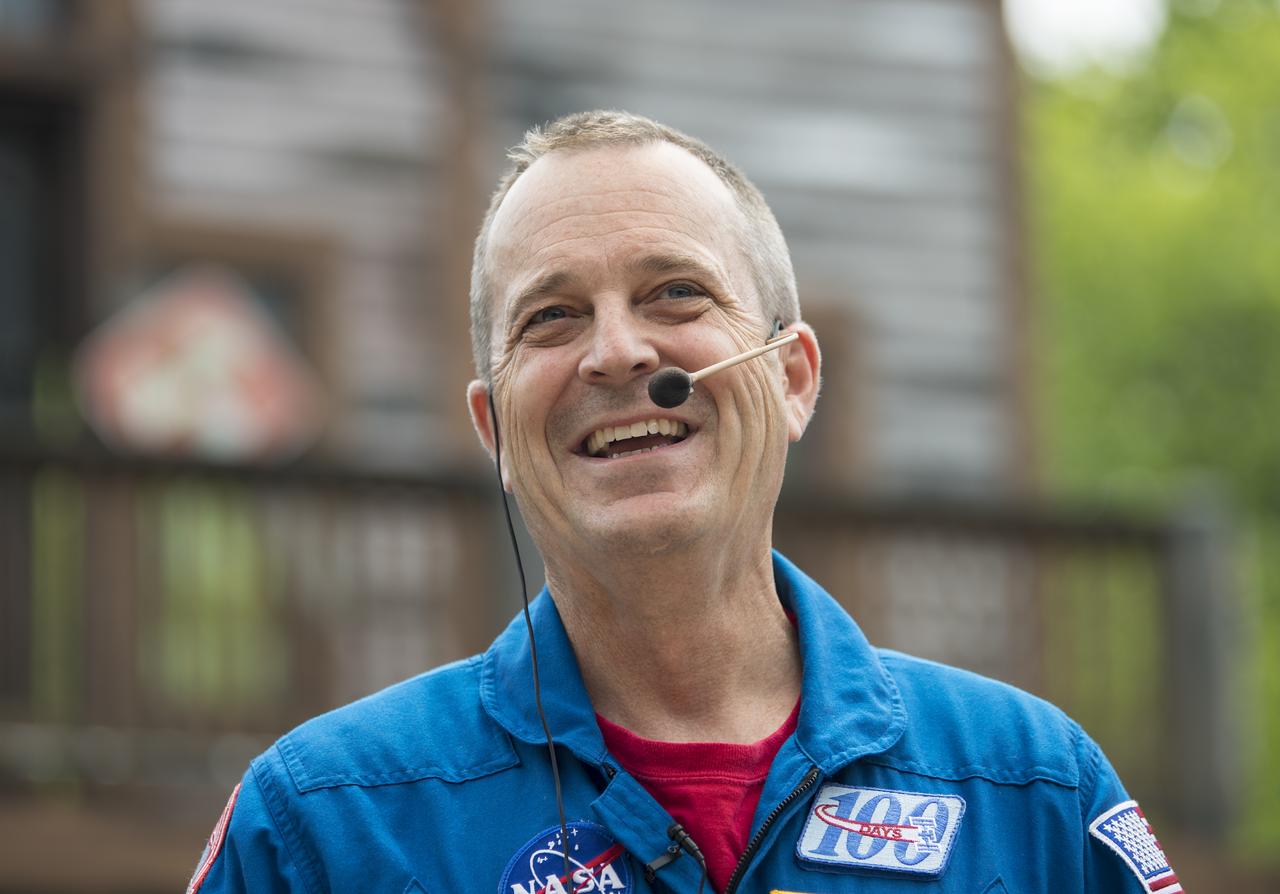
NASA astronaut Ricky Arnold answers questions from the audience about his time onboard the International Space Station (ISS) during a Smithsonian National Air and Space Museum production of Stem in 30, Friday, May 3, 2019 at Six Flags America theme park in Upper Marlboro, MD. During Expedition 55/56, Arnold completed three spacewalks for a total of 19.5 hours outside the space station, and concluded his 197 day mission when he landed in a remote area near the town of Zhezkazgan, Kazakhstan in Oct. 2018. He also flew to the space station on shuttle mission STS-119 to deliver the final pair of power-generating solar array wings. Photo Credit: (NASA/Aubrey Gemignani)
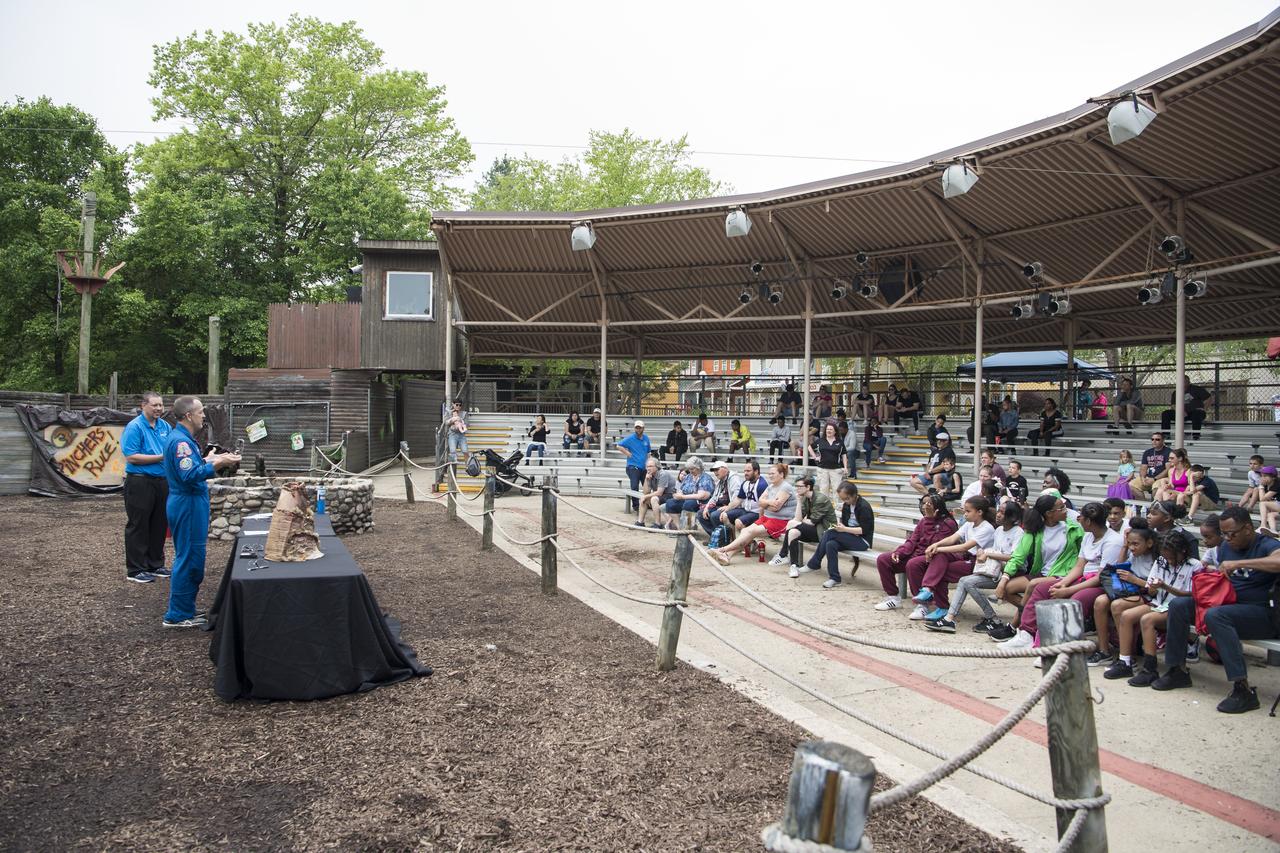
NASA astronaut Ricky Arnold answers questions from the audience about his time onboard the International Space Station (ISS) during a Smithsonian National Air and Space Museum production of Stem in 30, Friday, May 3, 2019 at Six Flags America theme park in Upper Marlboro, MD. During Expedition 55/56, Arnold completed three spacewalks for a total of 19.5 hours outside the space station, and concluded his 197 day mission when he landed in a remote area near the town of Zhezkazgan, Kazakhstan in Oct. 2018. He also flew to the space station on shuttle mission STS-119 to deliver the final pair of power-generating solar array wings. Photo Credit: (NASA/Aubrey Gemignani)
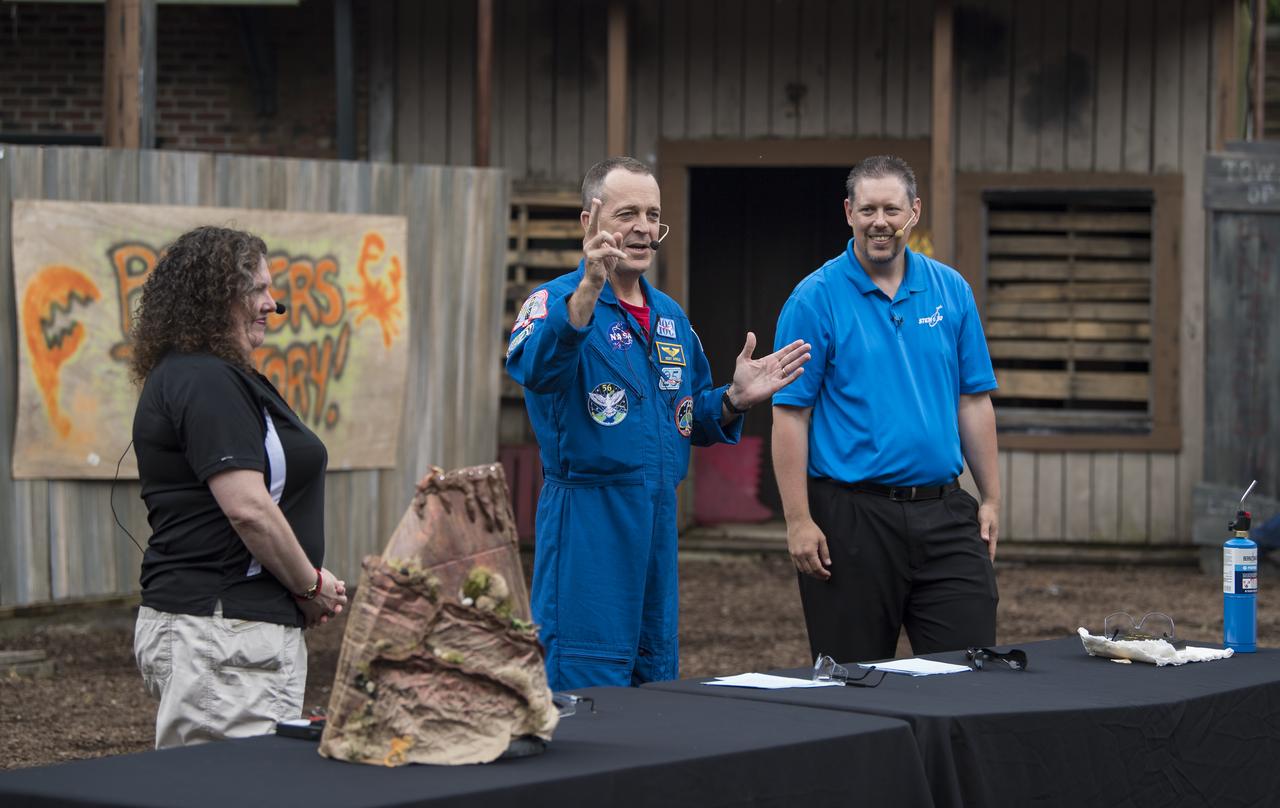
NASA astronaut Ricky Arnold answers questions from the audience about his time onboard the International Space Station (ISS) during a Smithsonian National Air and Space Museum production of Stem in 30, Friday, May 3, 2019 at Six Flags America theme park in Upper Marlboro, MD. During Expedition 55/56, Arnold completed three spacewalks for a total of 19.5 hours outside the space station, and concluded his 197 day mission when he landed in a remote area near the town of Zhezkazgan, Kazakhstan in Oct. 2018. He also flew to the space station on shuttle mission STS-119 to deliver the final pair of power-generating solar array wings. Photo Credit: (NASA/Aubrey Gemignani)
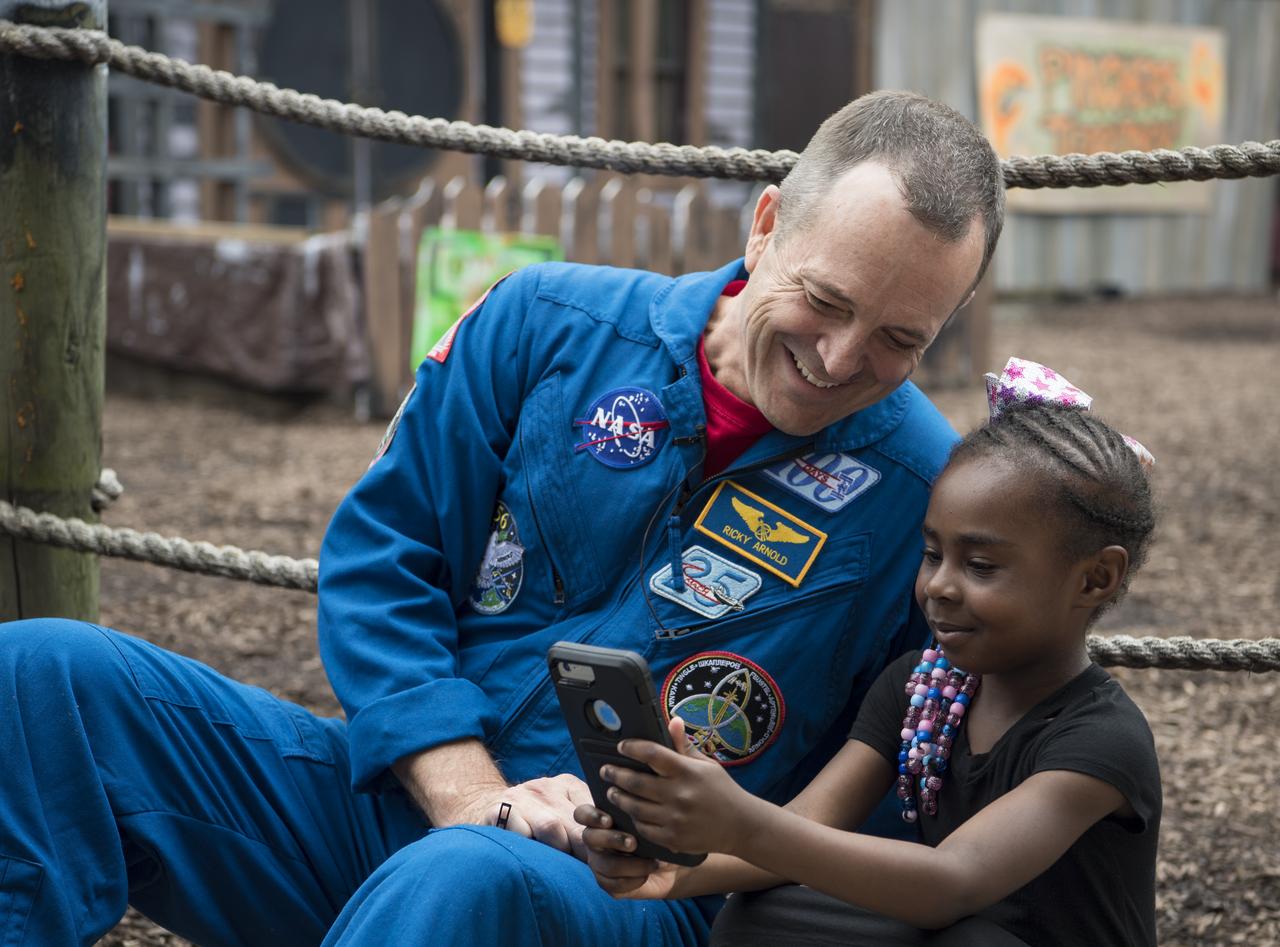
NASA astronaut Ricky Arnold poses for a selfie with an audience member after speaking about his time onboard the International Space Station (ISS) during a Smithsonian National Air and Space Museum production of Stem in 30, Friday, May 3, 2019 at Six Flags America theme park in Upper Marlboro, MD. During Expedition 55/56, Arnold completed three spacewalks for a total of 19.5 hours outside the space station, and concluded his 197 day mission when he landed in a remote area near the town of Zhezkazgan, Kazakhstan in Oct. 2018. He also flew to the space station on shuttle mission STS-119 to deliver the final pair of power-generating solar array wings. Photo Credit: (NASA/Aubrey Gemignani)
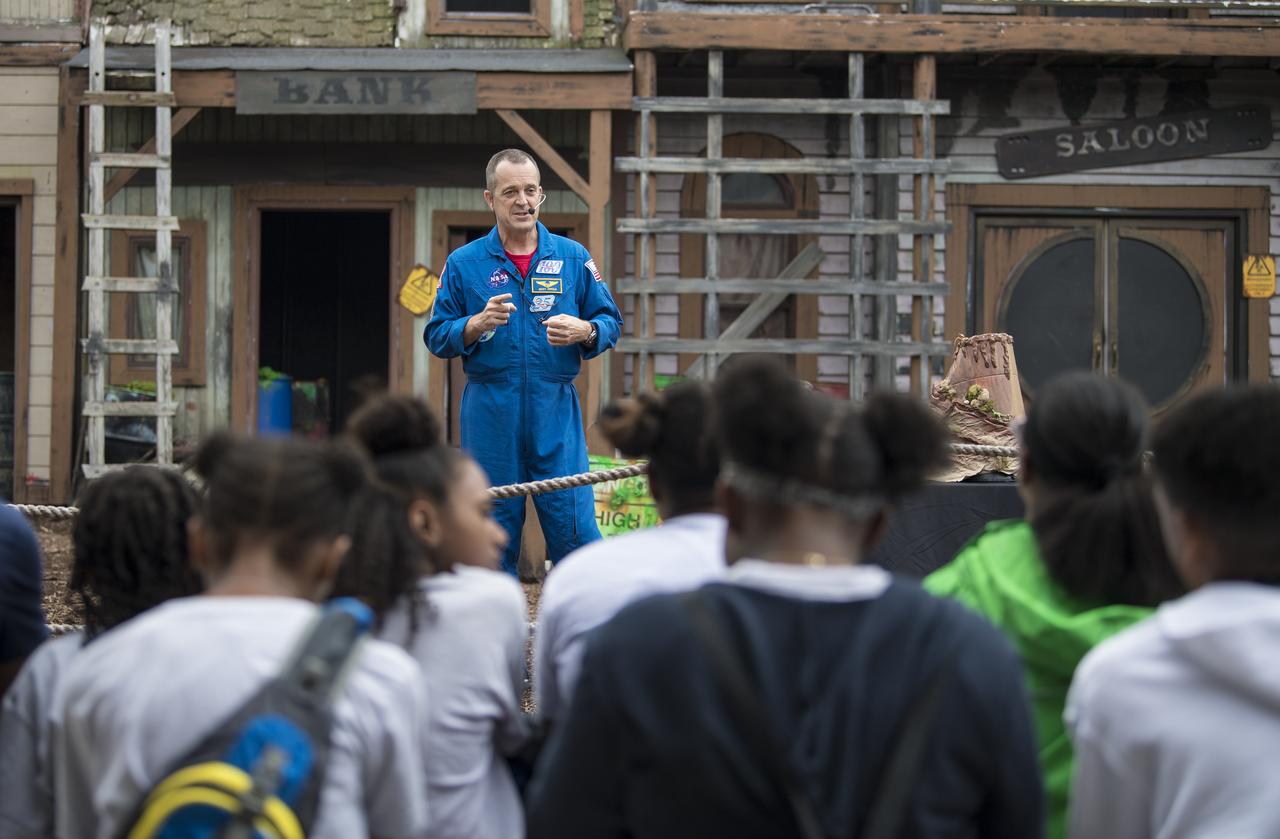
NASA astronaut Ricky Arnold answers questions from the audience about his time onboard the International Space Station (ISS) during a Smithsonian National Air and Space Museum production of Stem in 30, Friday, May 3, 2019 at Six Flags America theme park in Upper Marlboro, MD. During Expedition 55/56, Arnold completed three spacewalks for a total of 19.5 hours outside the space station, and concluded his 197 day mission when he landed in a remote area near the town of Zhezkazgan, Kazakhstan in Oct. 2018. He also flew to the space station on shuttle mission STS-119 to deliver the final pair of power-generating solar array wings. Photo Credit: (NASA/Aubrey Gemignani)
NASA astronaut Ricky Arnold answers questions from the audience about his time onboard the International Space Station (ISS) during a Smithsonian National Air and Space Museum production of Stem in 30, Friday, May 3, 2019 at Six Flags America theme park in Upper Marlboro, MD. During Expedition 55/56, Arnold completed three spacewalks for a total of 19.5 hours outside the space station, and concluded his 197 day mission when he landed in a remote area near the town of Zhezkazgan, Kazakhstan in Oct. 2018. He also flew to the space station on shuttle mission STS-119 to deliver the final pair of power-generating solar array wings. Photo Credit: (NASA/Aubrey Gemignani)

NASA employees and contractors wave flags and make pictures as space shuttle Atlantis (STS-135) rolls toward the Orbiter Processing Facility (OPF) at a wheels stop event, Thursday, July 21, 2011, at NASA's Kennedy Space Center in Cape Canaveral, Fla. Atlantis returned to Kennedy early Thursday following a 13-day mission to the International Space Station (ISS) and marking the end of the 30-year Space Shuttle Program. Overall, Atlantis spent 307 days in space and traveled nearly 126 million miles during its 33 flights. Atlantis, the fourth orbiter built, launched on its first mission on Oct. 3, 1985. Photo Credit: (NASA/Paul E. Alers)
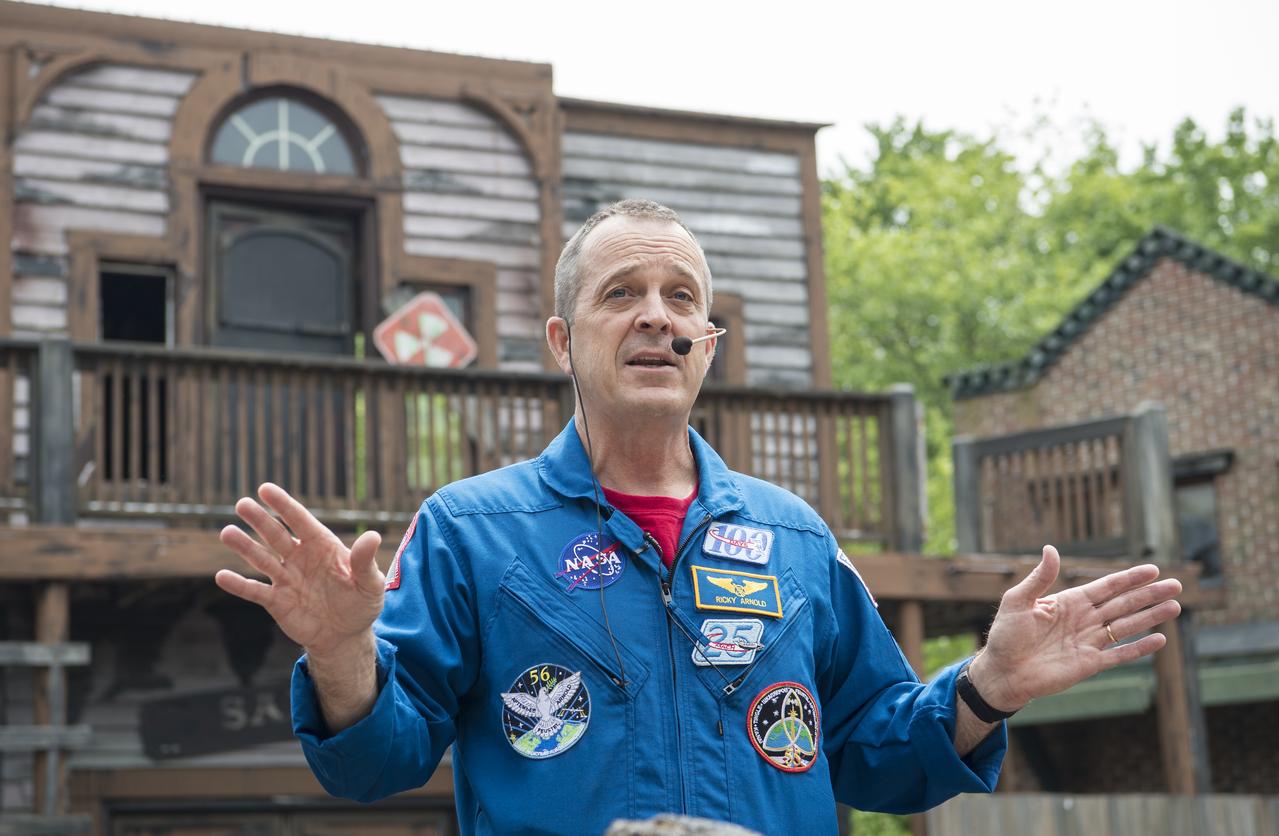
NASA astronaut Ricky Arnold answers questions from the audience about his time onboard the International Space Station (ISS) during a Smithsonian National Air and Space Museum production of Stem in 30, Friday, May 3, 2019 at Six Flags America theme park in Upper Marlboro, MD. During Expedition 55/56, Arnold completed three spacewalks for a total of 19.5 hours outside the space station, and concluded his 197 day mission when he landed in a remote area near the town of Zhezkazgan, Kazakhstan in Oct. 2018. He also flew to the space station on shuttle mission STS-119 to deliver the final pair of power-generating solar array wings. Photo Credit: (NASA/Aubrey Gemignani)
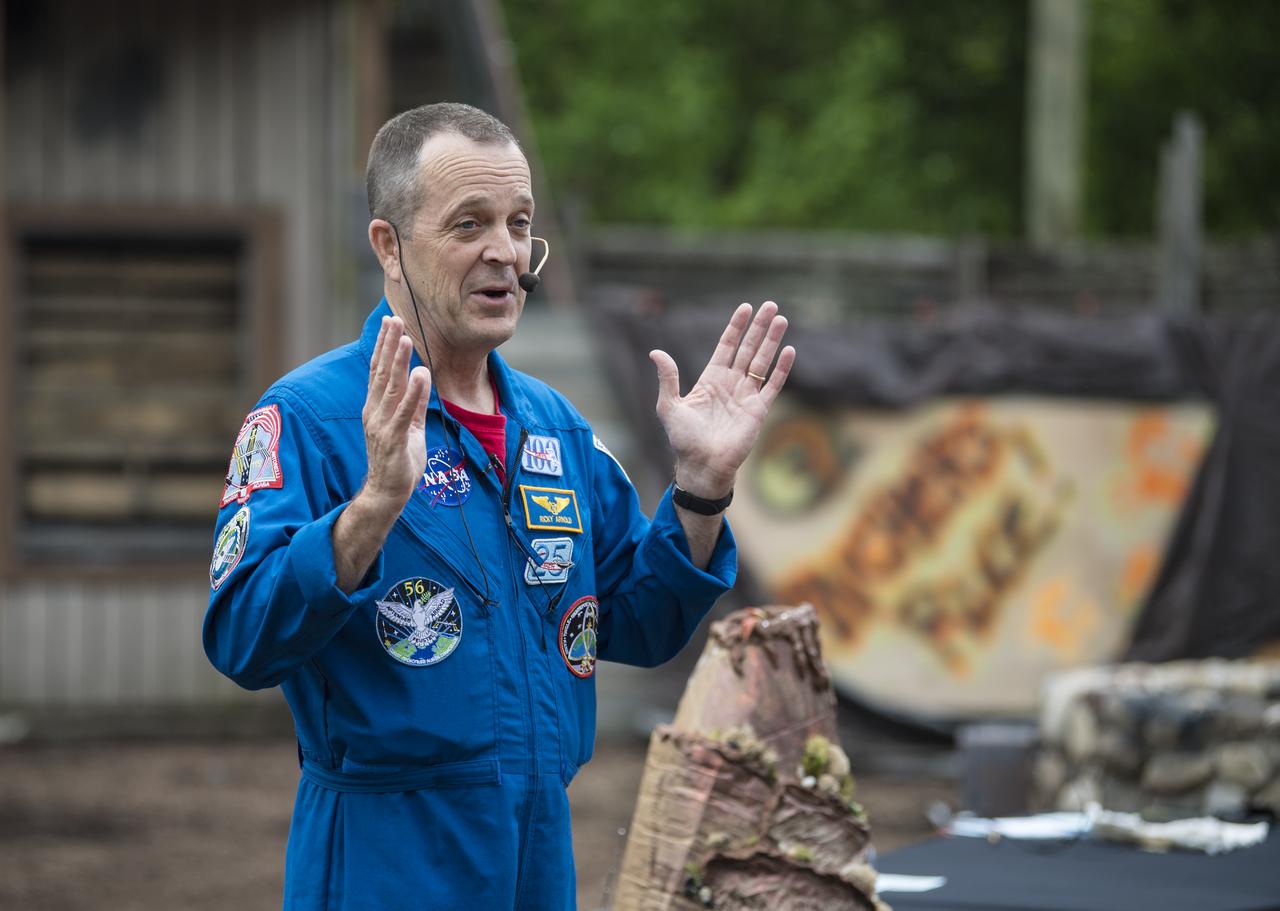
NASA astronaut Ricky Arnold answers questions from the audience about his time onboard the International Space Station (ISS) during a Smithsonian National Air and Space Museum production of Stem in 30, Friday, May 3, 2019 at Six Flags America theme park in Upper Marlboro, MD. During Expedition 55/56, Arnold completed three spacewalks for a total of 19.5 hours outside the space station, and concluded his 197 day mission when he landed in a remote area near the town of Zhezkazgan, Kazakhstan in Oct. 2018. He also flew to the space station on shuttle mission STS-119 to deliver the final pair of power-generating solar array wings. Photo Credit: (NASA/Aubrey Gemignani)
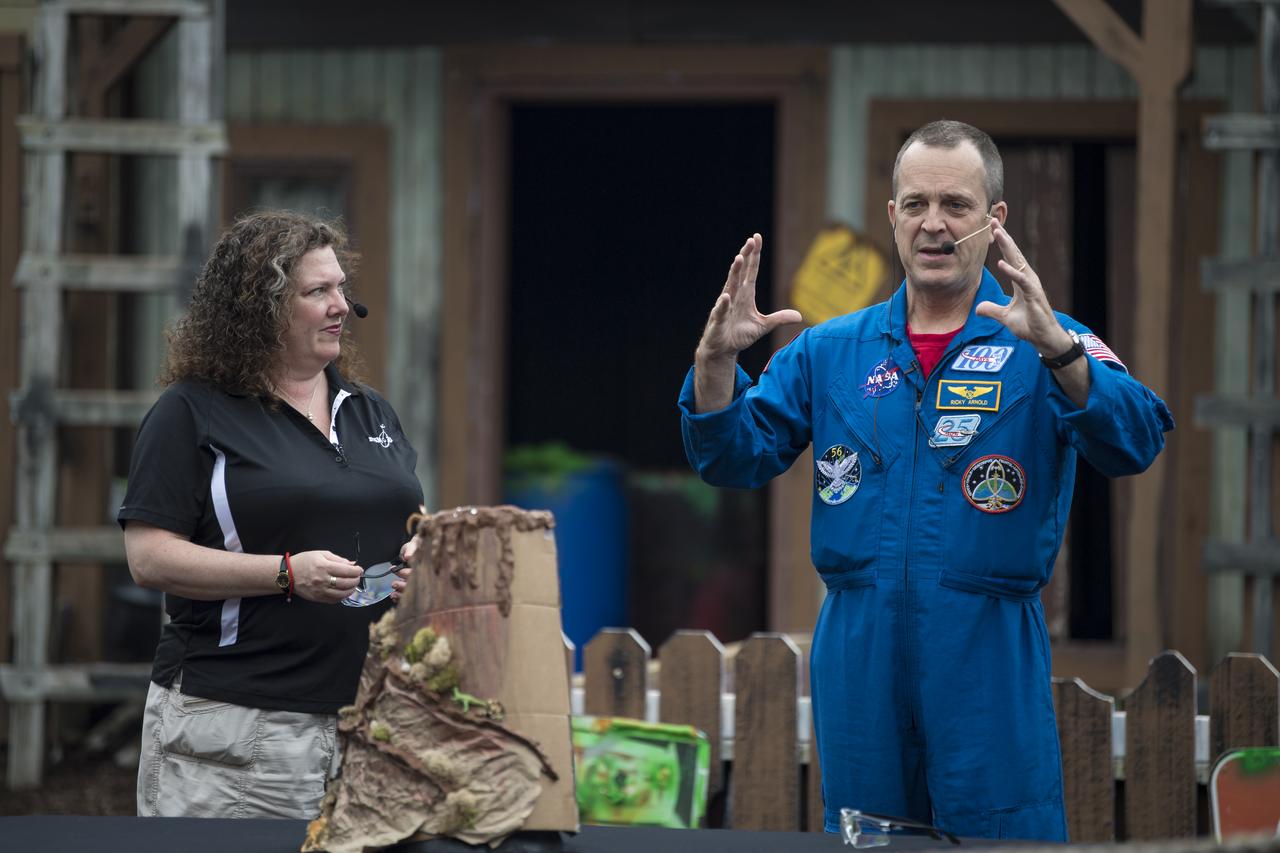
NASA astronaut Ricky Arnold answers questions from the audience about his time onboard the International Space Station (ISS) during a Smithsonian National Air and Space Museum production of Stem in 30, Friday, May 3, 2019 at Six Flags America theme park in Upper Marlboro, MD. During Expedition 55/56, Arnold completed three spacewalks for a total of 19.5 hours outside the space station, and concluded his 197 day mission when he landed in a remote area near the town of Zhezkazgan, Kazakhstan in Oct. 2018. He also flew to the space station on shuttle mission STS-119 to deliver the final pair of power-generating solar array wings. Photo Credit: (NASA/Aubrey Gemignani)
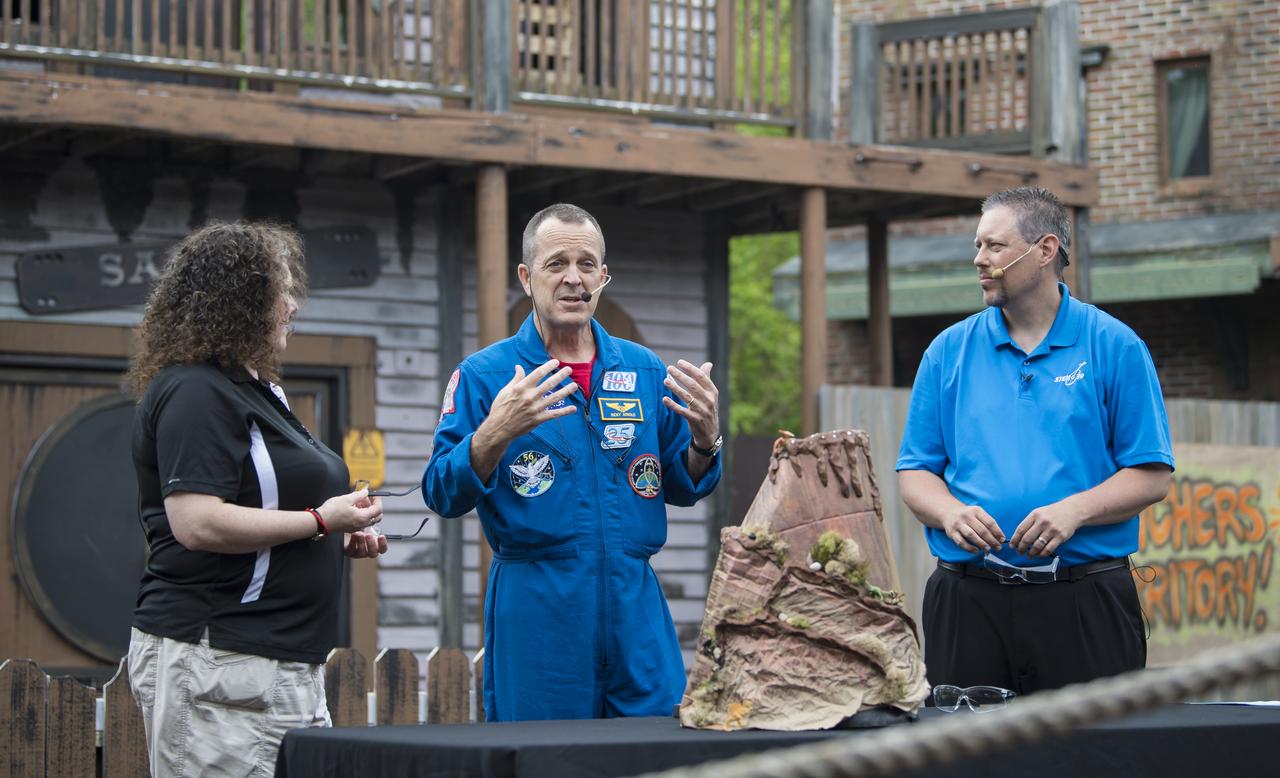
NASA astronaut Ricky Arnold answers questions from the audience about his time onboard the International Space Station (ISS) during a Smithsonian National Air and Space Museum production of Stem in 30, Friday, May 3, 2019 at Six Flags America theme park in Upper Marlboro, MD. During Expedition 55/56, Arnold completed three spacewalks for a total of 19.5 hours outside the space station, and concluded his 197 day mission when he landed in a remote area near the town of Zhezkazgan, Kazakhstan in Oct. 2018. He also flew to the space station on shuttle mission STS-119 to deliver the final pair of power-generating solar array wings. Photo Credit: (NASA/Aubrey Gemignani)
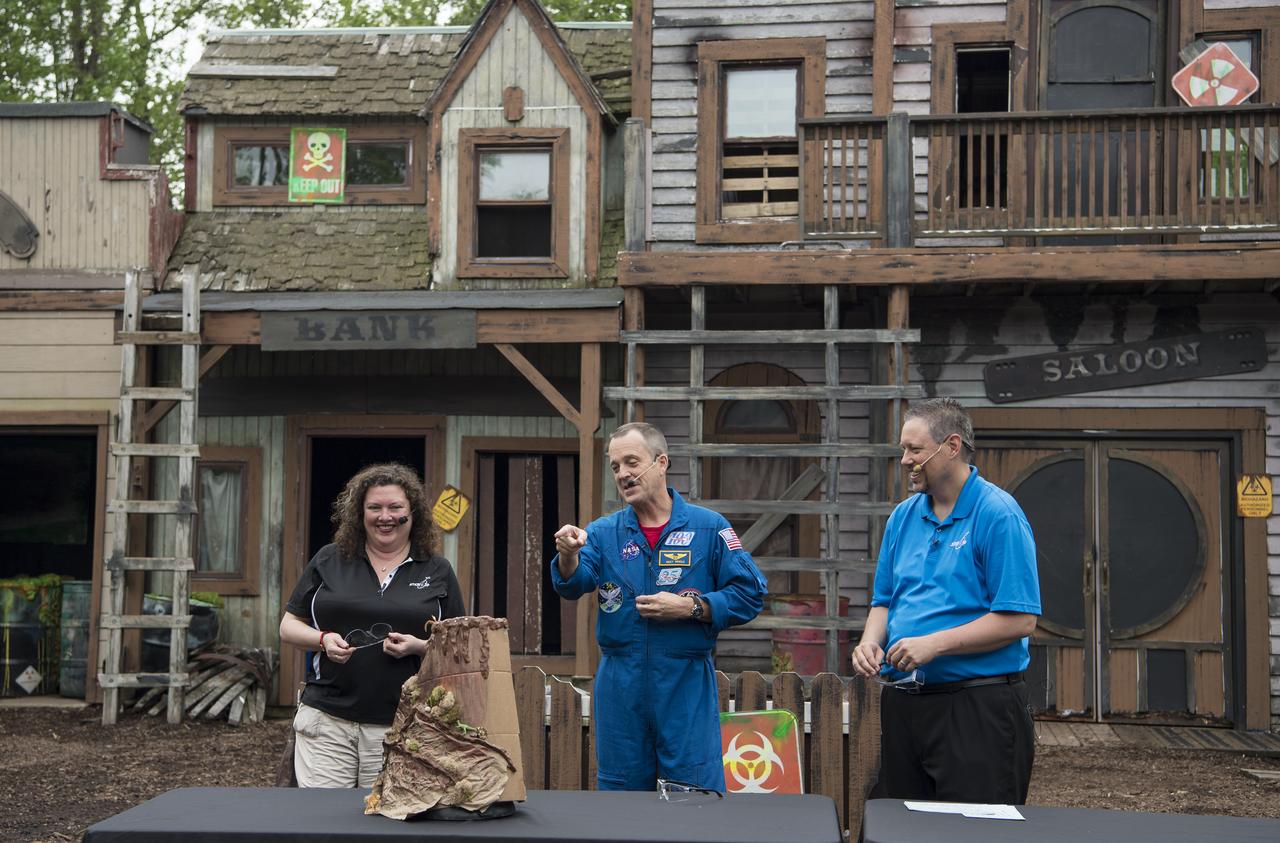
NASA astronaut Ricky Arnold answers questions from the audience about his time onboard the International Space Station (ISS) during a Smithsonian National Air and Space Museum production of Stem in 30, Friday, May 3, 2019 at Six Flags America theme park in Upper Marlboro, MD. During Expedition 55/56, Arnold completed three spacewalks for a total of 19.5 hours outside the space station, and concluded his 197 day mission when he landed in a remote area near the town of Zhezkazgan, Kazakhstan in Oct. 2018. He also flew to the space station on shuttle mission STS-119 to deliver the final pair of power-generating solar array wings. Photo Credit: (NASA/Aubrey Gemignani)
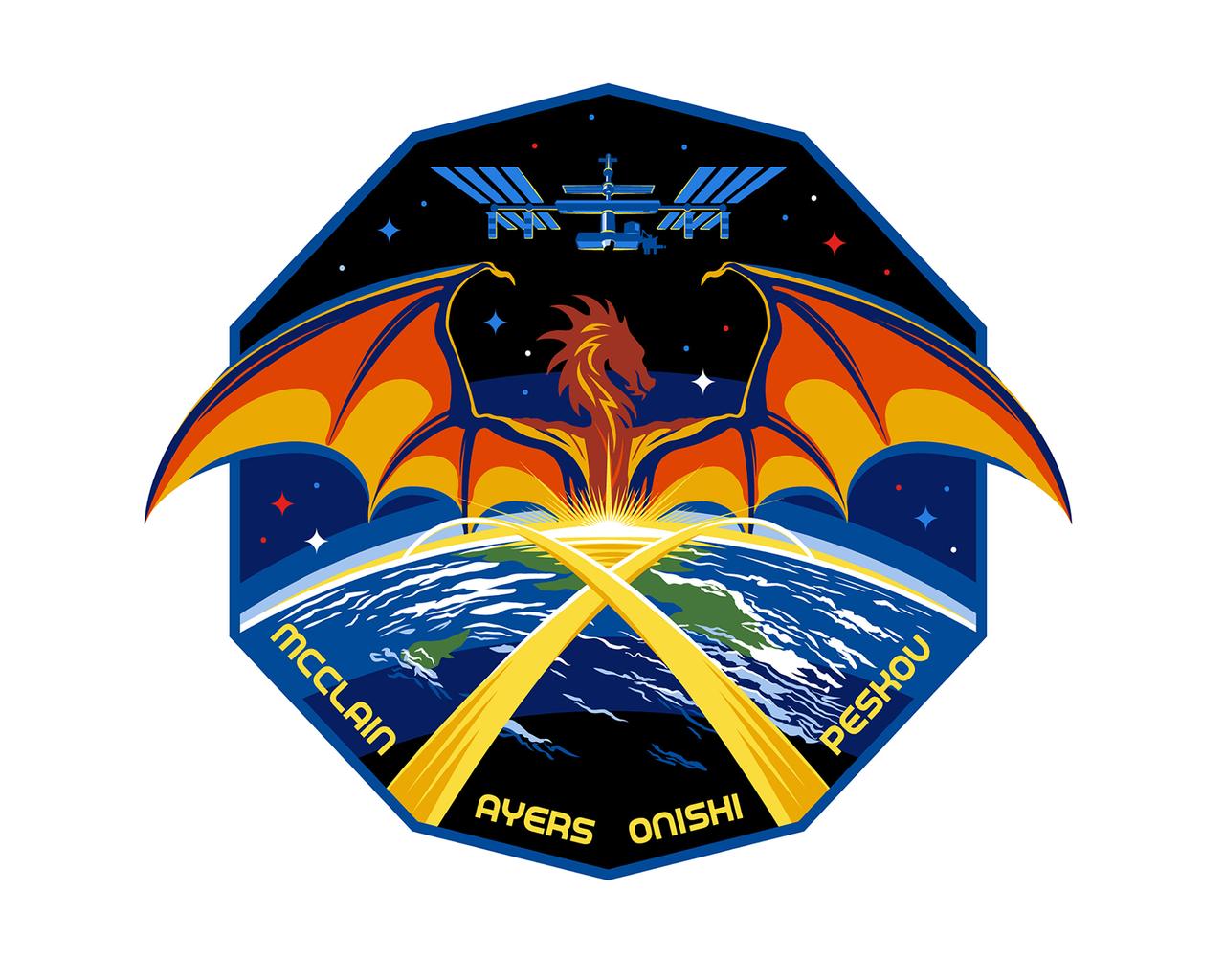
jsc2024e060607 (Sept. 4, 2024) --- The SpaceX Crew-10 patch was thoughtfully designed by the four-person crew. They used AI for initial inspiration, while the ever-irreplaceable human perfected the design and brought the patch to fruition. It is a 10-sided patch with the roman numeral X boldly in the center, representing the 10th operational flight of the Crew Dragon spacecraft. The Dragon, also the capsule’s namesake, is wings out in full flight, representing the four professional pilots that make up the crew complement. The Dragon, illuminated by one of Earth’s stunning and beautiful sunrises, is focused on the ISS and its mission, while keeping a watchful position above Earth. The stars are red, white, and blue for the flag colors of each crew members’ home country, and the brightest stars represent the crew’s closest family members and support system.

NASA astronaut Ricky Arnold answers questions from the audience about his time onboard the International Space Station (ISS) during a Smithsonian National Air and Space Museum production of Stem in 30, Friday, May 3, 2019 at Six Flags America theme park in Upper Marlboro, MD. During Expedition 55/56, Arnold completed three spacewalks for a total of 19.5 hours outside the space station, and concluded his 197 day mission when he landed in a remote area near the town of Zhezkazgan, Kazakhstan in Oct. 2018. He also flew to the space station on shuttle mission STS-119 to deliver the final pair of power-generating solar array wings. Photo Credit: (NASA/Aubrey Gemignani)
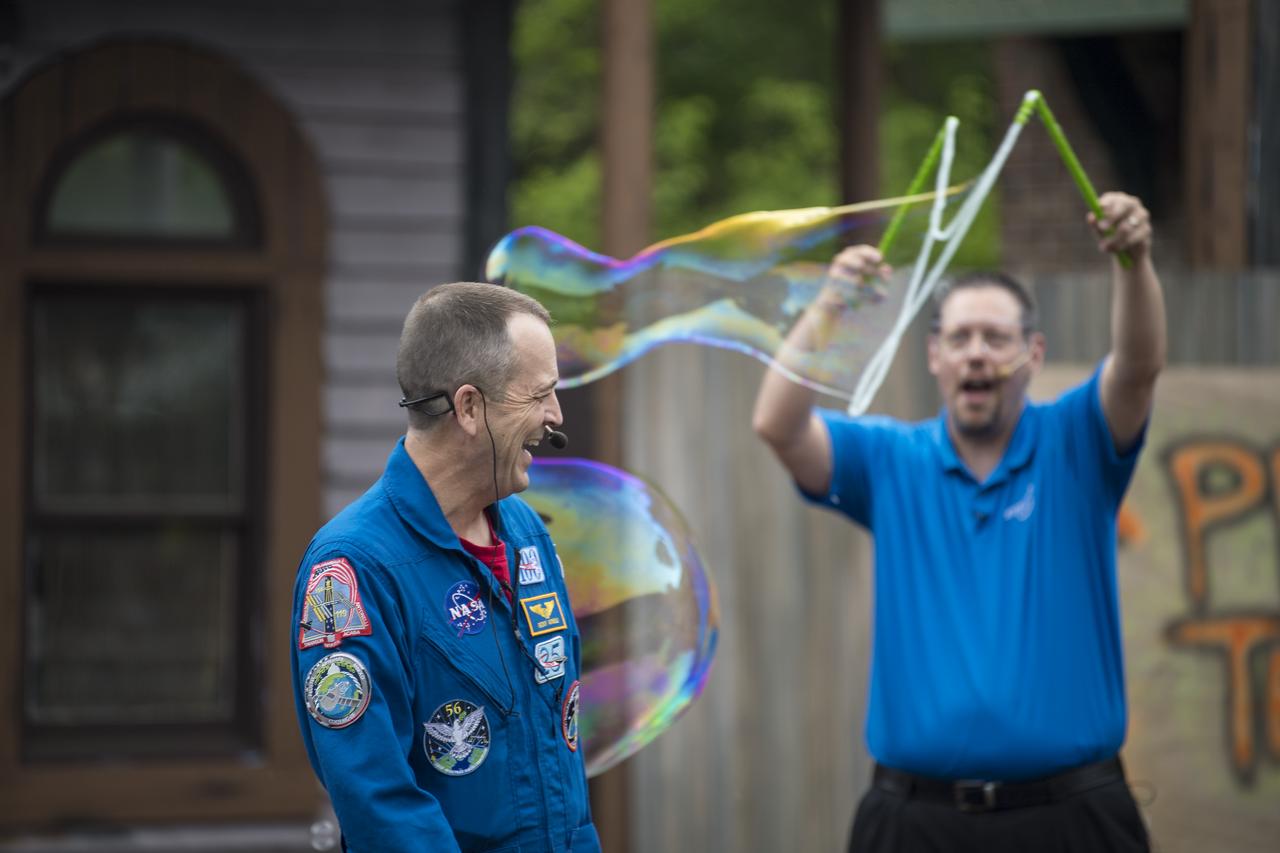
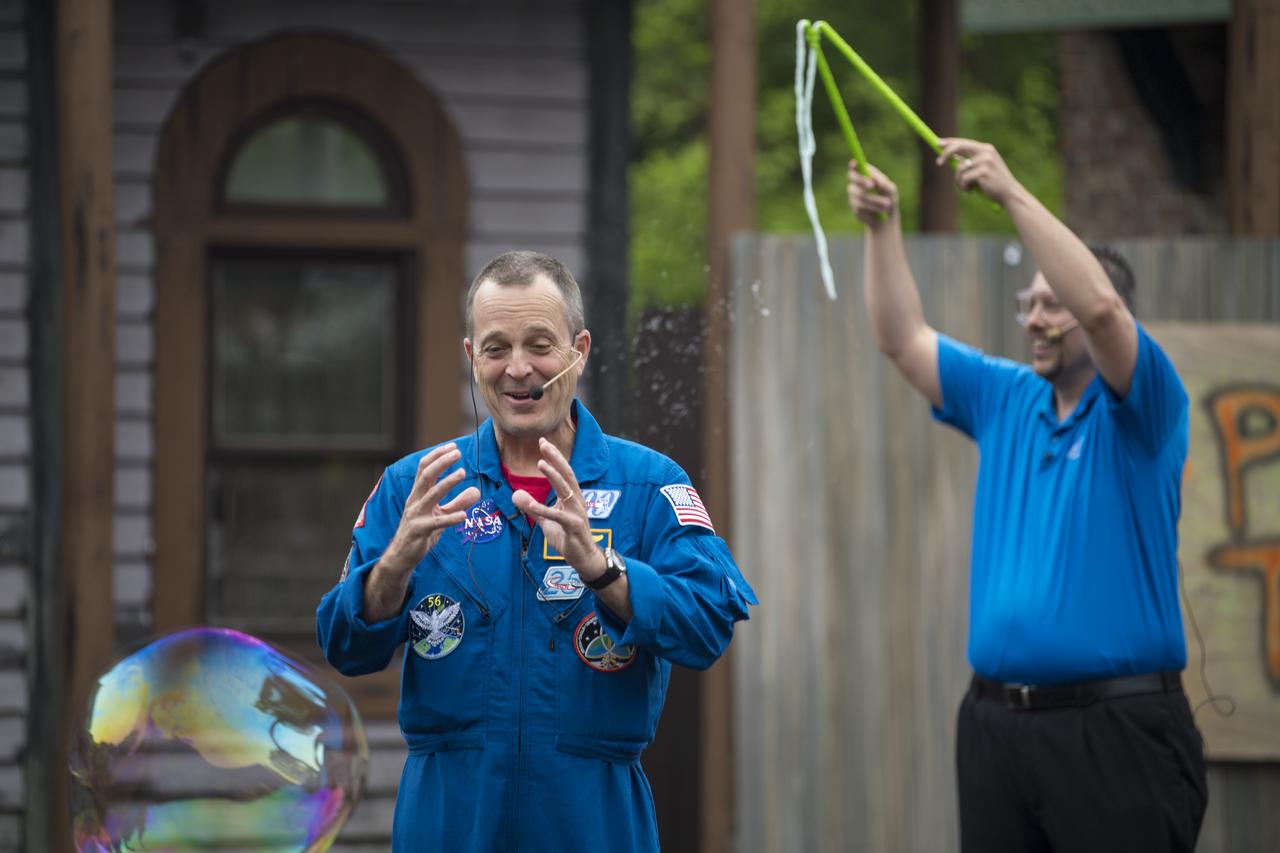
NASA astronaut Ricky Arnold reacts as Marty Kelsey from Smithsonian National Air and Space Museum's production, Stem in 30, makes large bubbles behind him, while he speaks about his time onboard the International Space Station (ISS), Friday, May 3, 2019 at Six Flags America theme park in Upper Marlboro, MD. During Expedition 55/56, Arnold completed three spacewalks for a total of 19.5 hours outside the space station, and concluded his 197 day mission when he landed in a remote area near the town of Zhezkazgan, Kazakhstan in Oct. 2018. He also flew to the space station on shuttle mission STS-119 to deliver the final pair of power-generating solar array wings. Photo Credit: (NASA/Aubrey Gemignani)

STS116-S-001 (July 2006) --- The STS-116 patch design signifies the continuing assembly of the International Space Station (ISS). The primary mission objective is to deliver and install the P5 truss element. The P5 installation will be conducted during the first of three planned spacewalks, and will involve use of both the shuttle and station robotic arms. The remainder of the mission will include a major reconfiguration and activation of the ISS electrical and thermal control systems, as well as delivery of Zvezda Service Module debris panels, which will increase ISS protection from potential impacts of micro-meteorites and orbital debris. In addition, a single expedition crewmember will launch on STS-116 to remain onboard the station, replacing an expedition crew member that will fly home with the shuttle crew. The crew patch depicts the space shuttle rising above the Earth and ISS. The United States and Swedish flags trail the orbiter, depicting the international composition of the STS-116 crew. The seven stars of the constellation Ursa Major are used to provide direction to the North Star, which is superimposed over the installation location of the P5 truss on ISS. The NASA insignia design for space shuttle flights is reserved for use by the astronauts and for other official use as the NASA Administrator may authorize. Public availability has been approved only in the forms of illustrations by the various news media. When and if there is any change in this policy, which is not anticipated, the change will be publicly announced. Photo credit: NASA
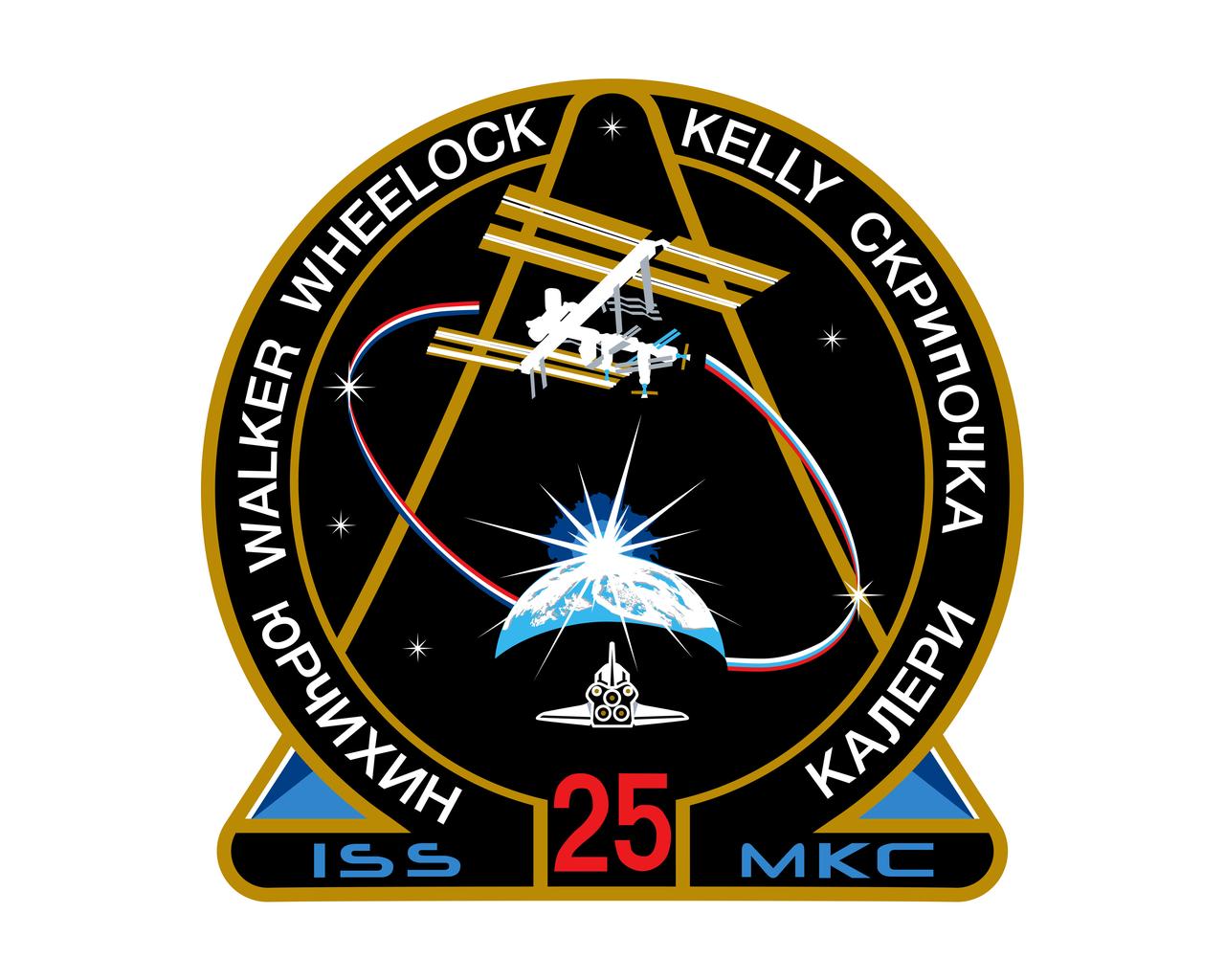
ISS025-S-001 (June 2010) --- The mission patch design for the 25th Expedition to the International Space Station (ISS) pays tribute to the rich history of innovation and bold engineering in the quest for knowledge, exploration and discovery in space. The patch highlights the symbolic passing of the torch to the ISS, as the vehicle that will carry us into the future of space exploration. The Space Shuttle Program emblem is the foundation of the patch and forms the Greek letter Omega?, paying tribute to the culmination of the Space Shuttle Program. The mission designation 25? and the Earth crescent, the orbiter is shown returning to Earth on its final journey, during the Expedition 25 mission. Above Earth and the breaking dawn, the ISS takes center-stage, completed and fully equipped to carry us beyond this new dawn to new voyages and discoveries. The orbit connecting the ISS and the Earth is drawn in the colors of the United States and Russian flags; paying tribute to the blended heritage of the crew. The two largest stars in the field represent the arrival and departure of the crews in separate Russian Soyuz vehicles. The six stars in the field represent the six crew members. The International Space Station abbreviation MKC? ? in English and Russian, respectively- flank the mission number designation, and the names of the crew members in their native languages border the ISS symbol. The NASA insignia design for shuttle and space station flights is reserved for use by the astronauts and for other official use as the NASA Administrator may authorize. Public availability has been approved only in the form of illustrations by the various news media. When and if there is any change in this policy, which is not anticipated, it will be publicly announced.
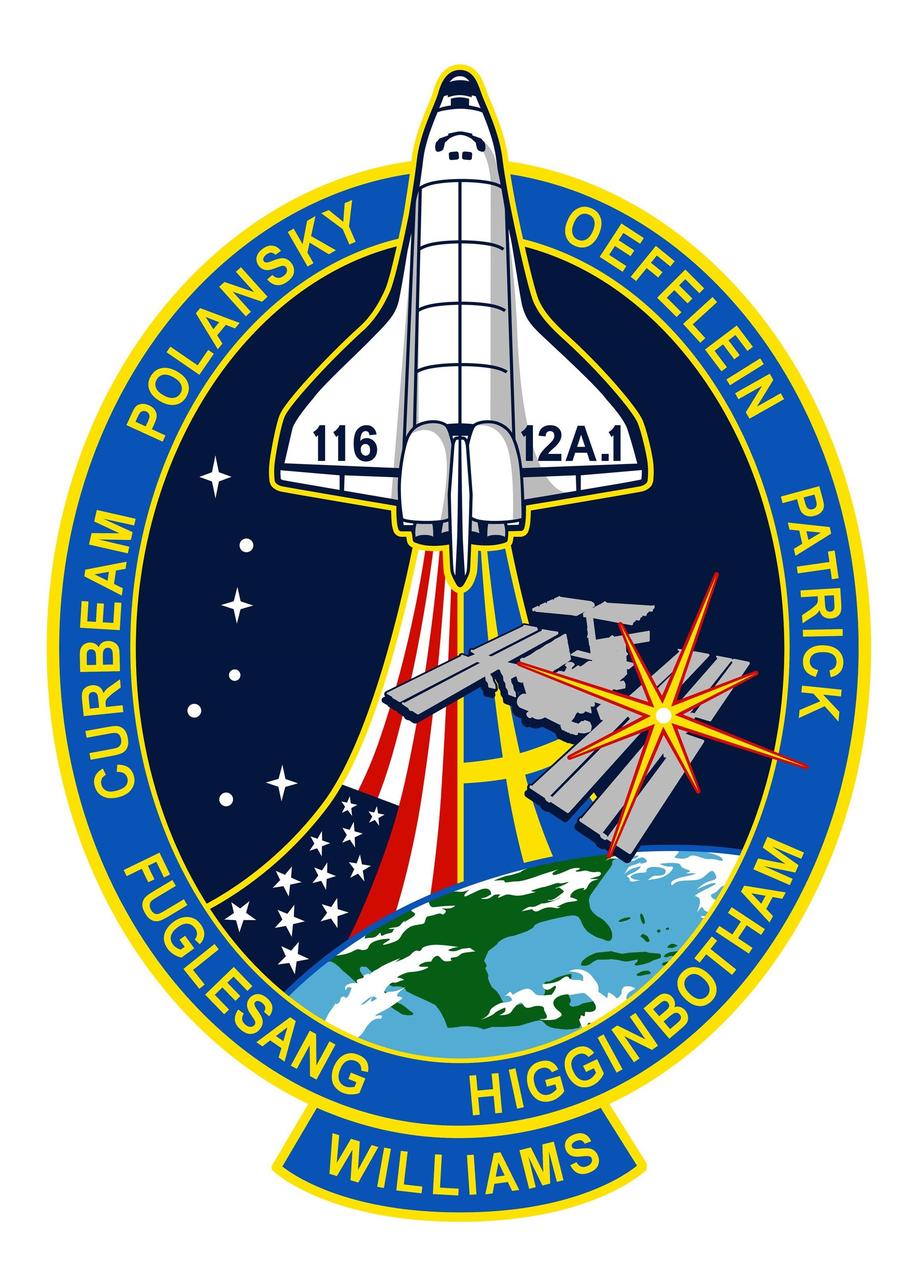
JOHNSON SPACE CENTER, Houston, Texas -- STS116-S-001 (July 2006) - The STS-116 patch design signifies the continuing assembly of the International Space Station (ISS). The primary mission objective is to deliver and install the P5 truss element. The P5 installation will be conducted during the first of three planned spacewalks, and will involve use of both the shuttle and station robotic arms. The remainder of the mission will include a major reconfiguration and activation of the ISS electrical and thermal control systems, as well as delivery of Zvezda Service Module debris panels, which will increase ISS protection from potential impacts of micro-meteorites and orbital debris. In addition, a single expedition crew member will launch on STS-116 to remain onboard the station, replacing an expedition crew member who will fly home with the shuttle crew. The crew patch depicts the space shuttle rising above the Earth and ISS. The United States and Swedish flags trail the orbiter, depicting the international composition of the STS-116 crew. The seven stars of the constellation Ursa Major are used to provide direction to the North Star, which is superimposed over the installation location of the P5 truss on ISS. The NASA insignia design for space shuttle space flights is reserved for use by the astronauts and other official use as the NASA Administrator may authorize. Public availability has been approved only in the form of illustrations by the various news media. When and if there is any change in this policy, which is not anticipated, such will be publicly announced.
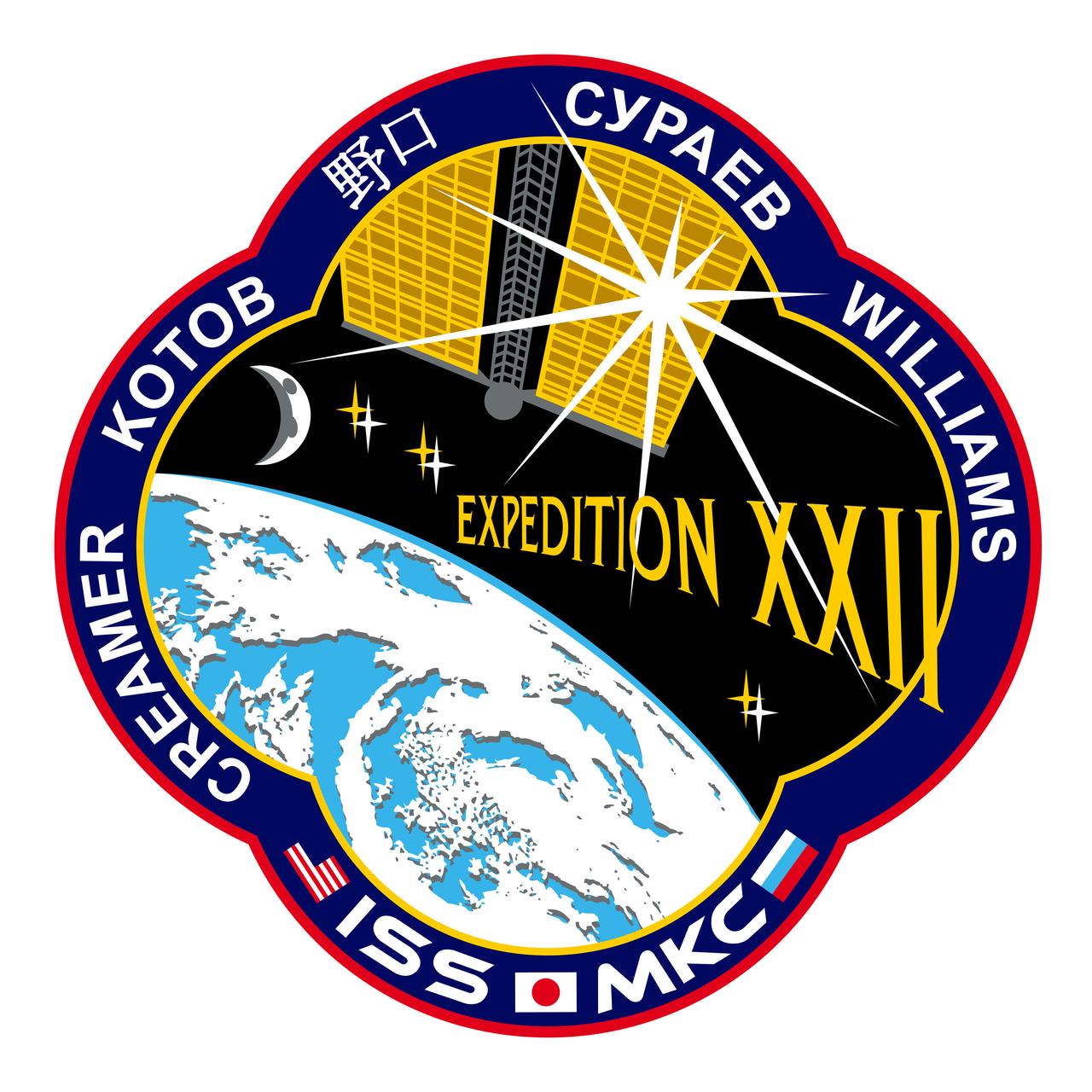
ISS022-S-001 (February 2009) --- The 22nd Expedition to the International Space Station is dedicated to the final stages of assembly and the transition to full utilization as an orbiting laboratory. The sun, providing power and life support to the space station, shines through one of the solar arrays as the ISS orbits above Earth. The oceans and atmosphere, providing life support to Earth, are shown in all their beauty. The moon hovers in the distance as the goal of the next era of exploration. The six stars illustrate the increased capability of the crew complement. In the border are the national flags of the crew members as well as their surnames in their native languages. Expedition XXII continues the effort to acquire the knowledge necessary to extend the reach of exploration from Earth, to the moon and beyond. The insignia design for ISS flights is reserved for use by the astronauts and cosmonauts and for other official use as the NASA Administrator and NASA's international partners may authorize. Public availability has been approved only in the form of illustrations by the various news media. When and if there is any change in this policy, which we do not anticipate, it will be publicly announced
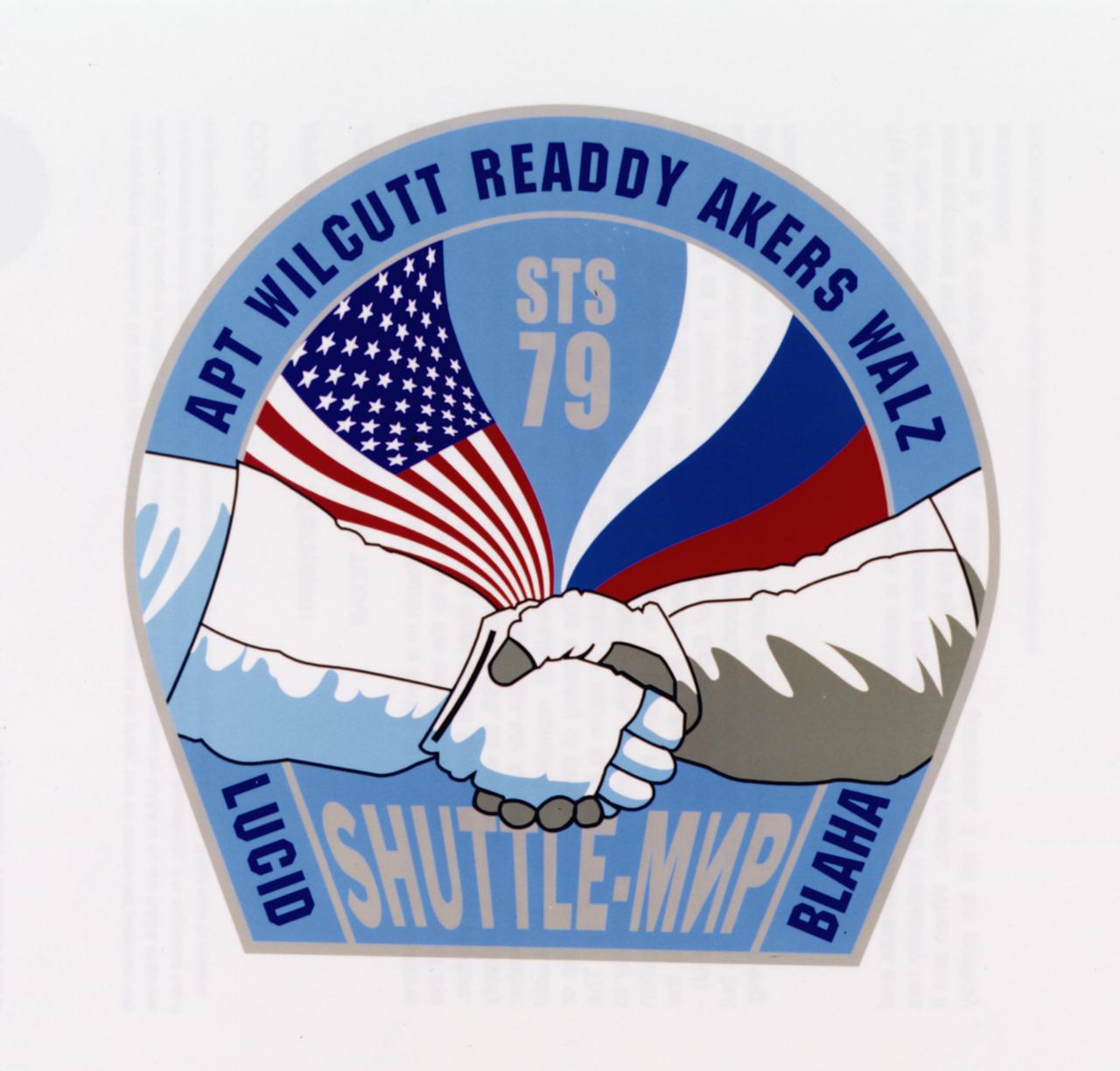
STS-79 was the fourth in a series of NASA docking missions to the Russian Mir Space Station, leading up to the construction and operation of the International Space Station (ISS). As the first flight of the Spacehab Double Module, STS-79 encompassed research, test and evaluation of ISS, as well as logistics resupply for the Mir Space Station. STS-79 was also the first NASA-Mir American crew member exchange mission, with John E. Blaha (NASA-Mir-3) replacing Shannon W. Lucid (NASA-Mir-2) aboard the Mir Space Station. The lettering of their names either up or down denotes transport up to the Mir Space Station or return to Earth on STS-79. The patch is in the shape of the Space Shuttle’s airlock hatch, symbolizing the gateway to international cooperation in space. The patch illustrates the historic cooperation between the United States and Russia in space. With the flags of Russia and the United States as a backdrop, the handshake of Extravehicular Mobility Unit (EMU) which are suited crew members symbolizes mission teamwork, not only of the crew members but also the teamwork between both countries space personnel in science, engineering, medicine and logistics.
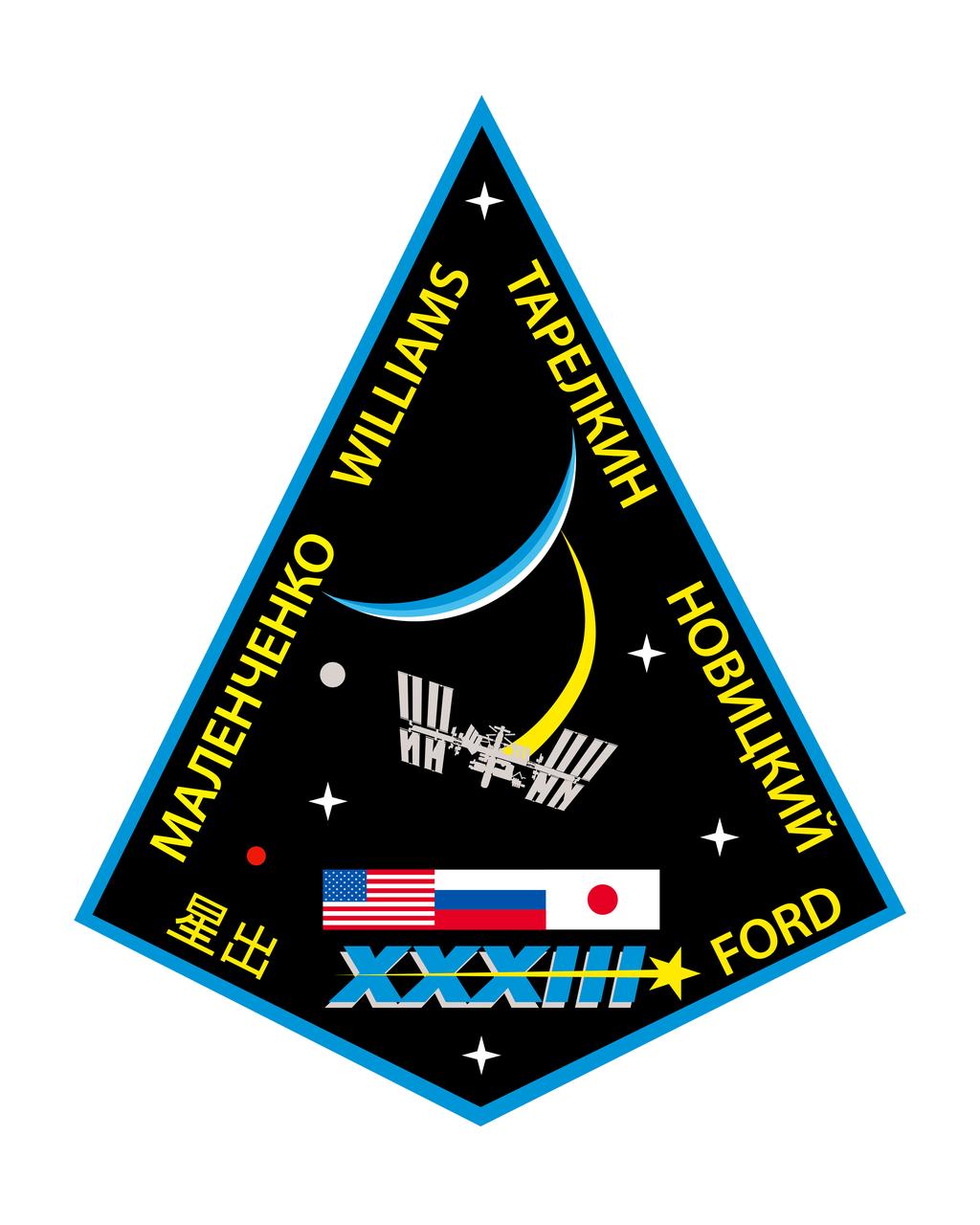
ISS033-S-001 (Dec. 2011) ---The Expedition 33 patch depicts the International Space Station (ISS) orbiting around the Earth, and into the future. The national flags of Japan, Russia, and the United States of America represent the crew of Expedition 33, which consists of six astronauts and cosmonauts from Japan, Russia and the United States. The five white stars represent the partners participating in the ISS Program - Canada, European countries, Japan, Russia and the United States. Expedition 33 will continue the work of the previous thirty-two expedition crews on board the multi-national laboratory in areas such as biology and biotechnology, earth and space science, educational activities, human research, physical and material sciences, and technology development and demonstration. The NASA insignia design for shuttle and space station flights is reserved for use by the astronauts and for other official use as the NASA Administrator may authorize. Public availability has been approved only in the form of illustrations by the various news media. When and if there is any change in this policy, which is not anticipated, it will be publicly announced. Photo credit: NASA
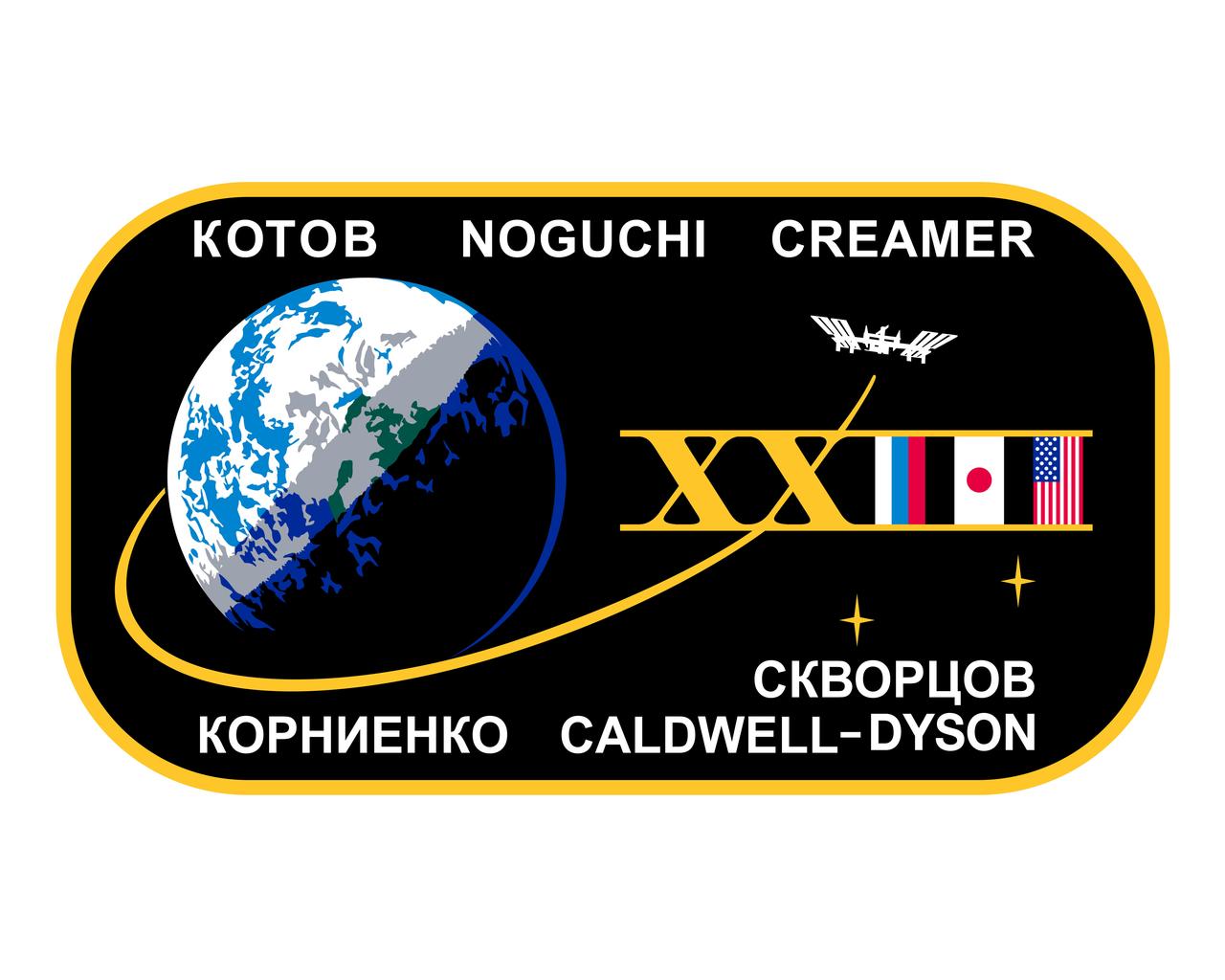
ISS023-S-001B (November 2009) --- The focal point of the Expedition XXIII emblem illustrates the beautiful planet Earth in the black expanse of space. The International Space Station (ISS) is shown traveling in its orbit around Earth. The ISS orbital path flies through the XXIII to show that this increment is building upon the missions that have gone on before and laying the groundwork for future missions. This illustrates the work being performed aboard the orbiting complex that will lead the way to eventual missions to the moon, Mars and beyond. The mission designation uses Roman numerals to illustrate the home nations of the crew, which are also represented by their national flags. The two stars represent the two teams that make up this expedition crew. The NASA insignia design for shuttle and space station flights is reserved for use by the astronauts and for other official use as the NASA Administrator may authorize. Public availability has been approved only in the form of illustrations by the various news media. When and if there is any change in this policy, which is not anticipated, it will be publicly announced.

ISS023-S-001A (November 2009) --- The focal point of the Expedition XXIII emblem illustrates the beautiful planet Earth in the black expanse of space. The International Space Station (ISS) is shown traveling in its orbit around Earth. The ISS orbital path flies through the XXIII to show that this increment is building upon the missions that have gone on before and laying the groundwork for future missions. This illustrates the work being performed aboard the orbiting complex that will lead the way to eventual missions to the moon, Mars and beyond. The mission designation uses Roman numerals to illustrate the home nations of the crew, which are also represented by their national flags. The two stars represent the two teams that make up this expedition crew. The NASA insignia design for shuttle and space station flights is reserved for use by the astronauts and for other official use as the NASA Administrator may authorize. Public availability has been approved only in the form of illustrations by the various news media. When and if there is any change in this policy, which is not anticipated, it will be publicly announced.
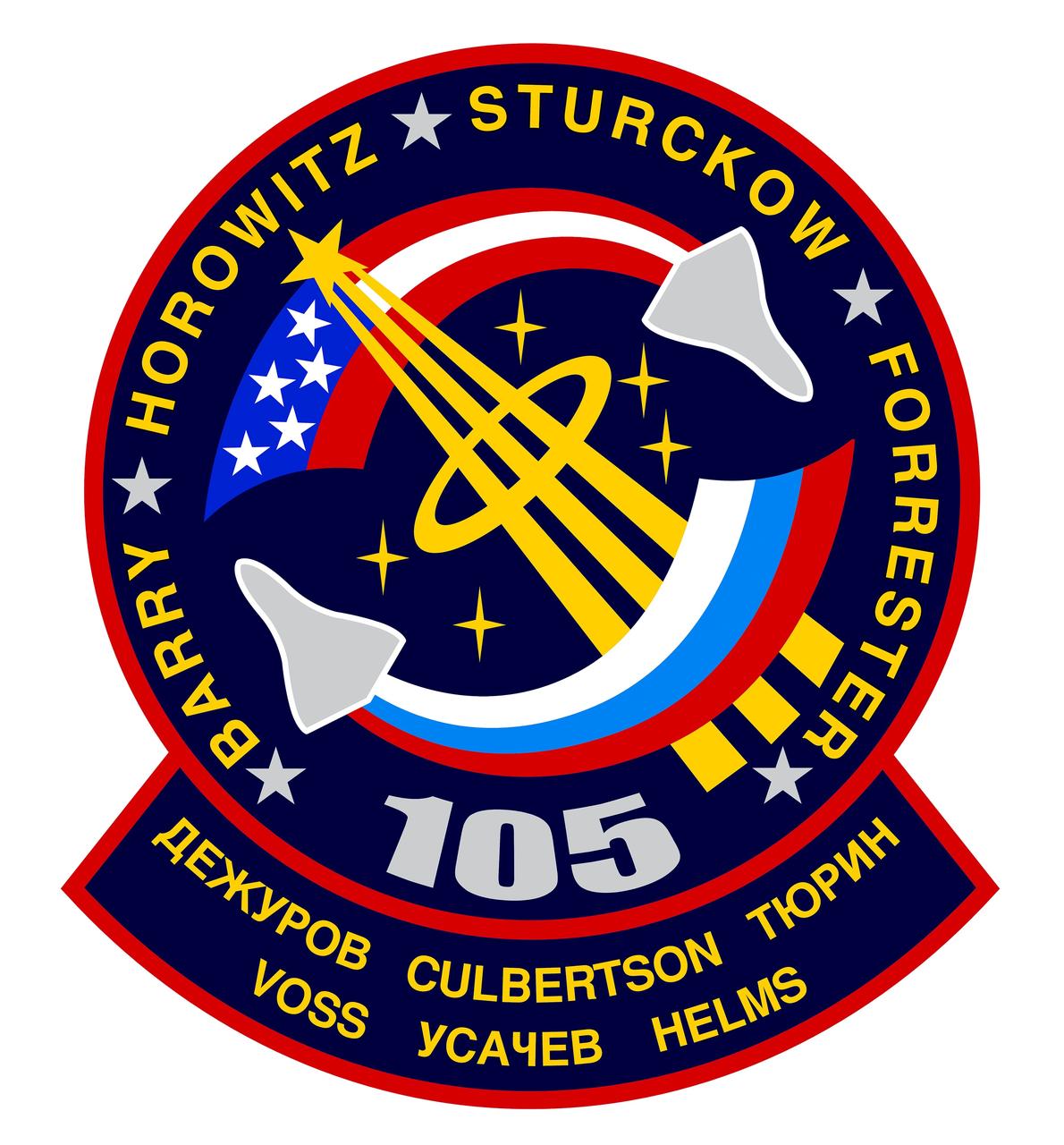
STS105-S-001 (April 2001) --- The STS-105 crew patch symbolizes the exchange of the Expedition Two and Expedition Three crews aboard the International Space Station. The three gold stars near the ascending orbiter represent the U.S. commanded Expedition Three crew as they journey into space, while the two gold stars near the descending orbiter represent the Russian commanded Expedition Two crew and their return to Earth. The plumes of each orbiter represent the flags of the United States and Russia and symbolize the close cooperation between the two countries. The Astronaut Office symbol, a star with three rays of light, depicts the unbroken link between Earth and the newest and brightest star on the horizon, the International Space Station (ISS). The ascending and descending orbiters form a circle that represents both the crew rotation and the continuous presence in space aboard the ISS. The names of the four astronauts who will crew Discovery are shown along the border of the patch. The names of the Expedition Three and Expedition Two crews are shown on the chevron at the bottom of the patch. The NASA insignia design for space shuttle flights is reserved for use by the astronauts and for other official use as the NASA Administrator may authorize. Public availability has been approved only in the forms of illustrations by the various news media. When and if there is any change in this policy, which is not anticipated, the change will be publicly announced. Photo credit: NASA
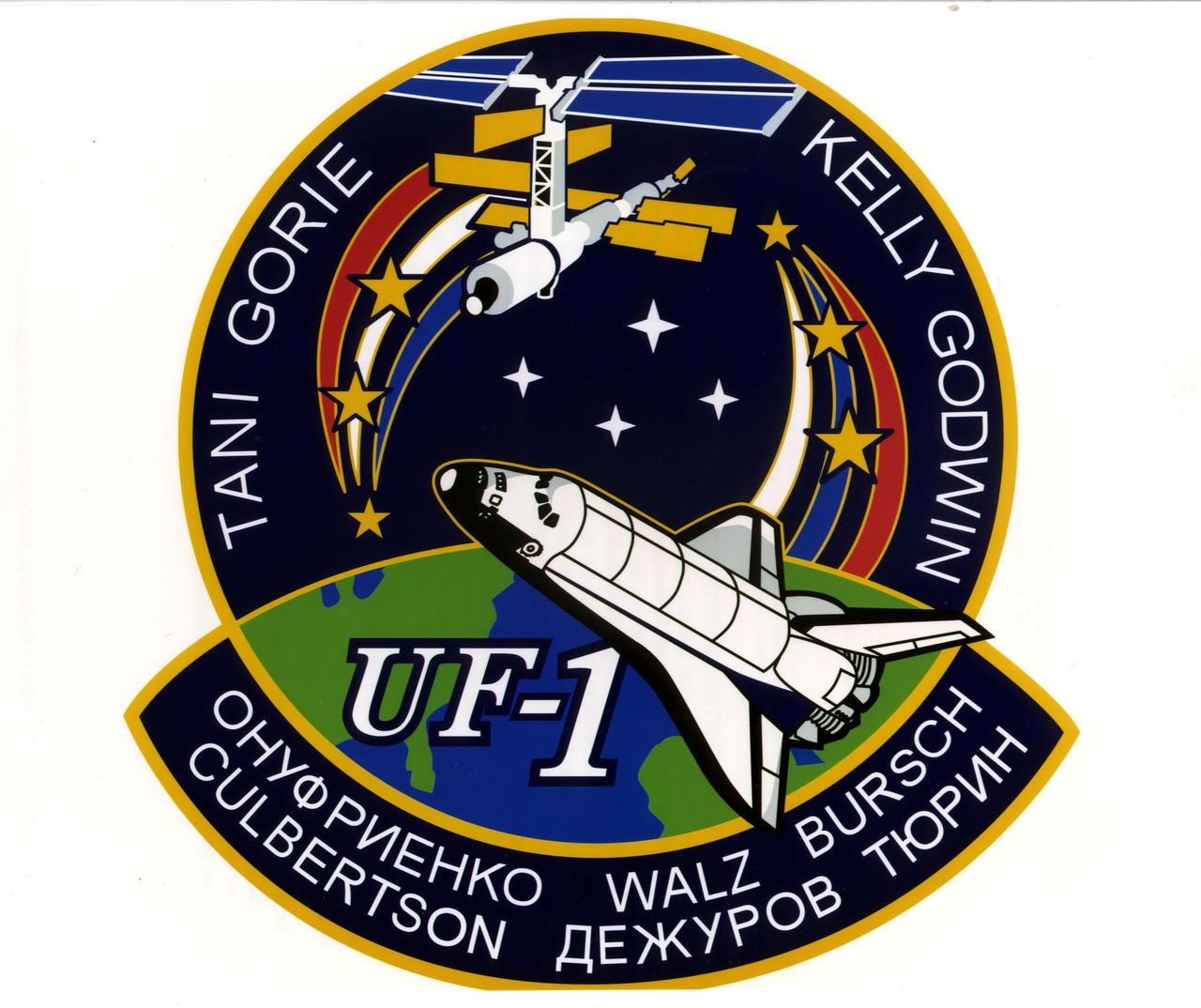
JOHNSON SPACE CENTER, HOUSTON, TEXAS -- STS-108 INSIGNIA -- This is the insignia for the STS-108 mission, which marks a major milestone in the assembly of the International Space Station (ISS) as the first designated Utilization Flight, UF-1. The crew of Endeavour will bring the Expedition Four crew to ISS and return the Expedition Three crew to Earth. Endeavour will also launch with a Multi-Purpose Logistics Module (MPLM) that will be berthed to ISS and unloaded. The MPLM will be returned to Endeavour for the trip home and used again on a later flight. The crew patch depicts Endeavour and the ISS in the configuration at the time of arrival and docking. The Station is shown viewed along the direction of flight as will be seen by the Shuttle crew during their final approach and docking along the X-axis. The three ribbons and stars on the left side of the patch signify the returning Expedition Three crew. The red, white and blue order of the ribbons represents the American commander for that mission. The three ribbons and stars on the right depict the arriving Expedition Four crew. The white, blue, red order of the Expedition Four ribbon matches the color of the Russian flag and signifies that the commander of Expedition Four is a Russian cosmonaut. Each white star in the center of the patch represents the four Endeavour crew members. The names of the four astronauts who will crew Endeavour are shown along th e top border of the patch. The three astronauts and three cosmonauts of the two expedition crews are shown on the chevron at the bottom of the patch. The NASA insignia design for Space Shuttle flights is reserved for use by the astronauts and for other official use as the NASA Administrator may authorize. Public availability has been approved only in form of illlustrations by the various news media. When and if there is any change in this policy, which we do not anticipate, it will be publicly announced
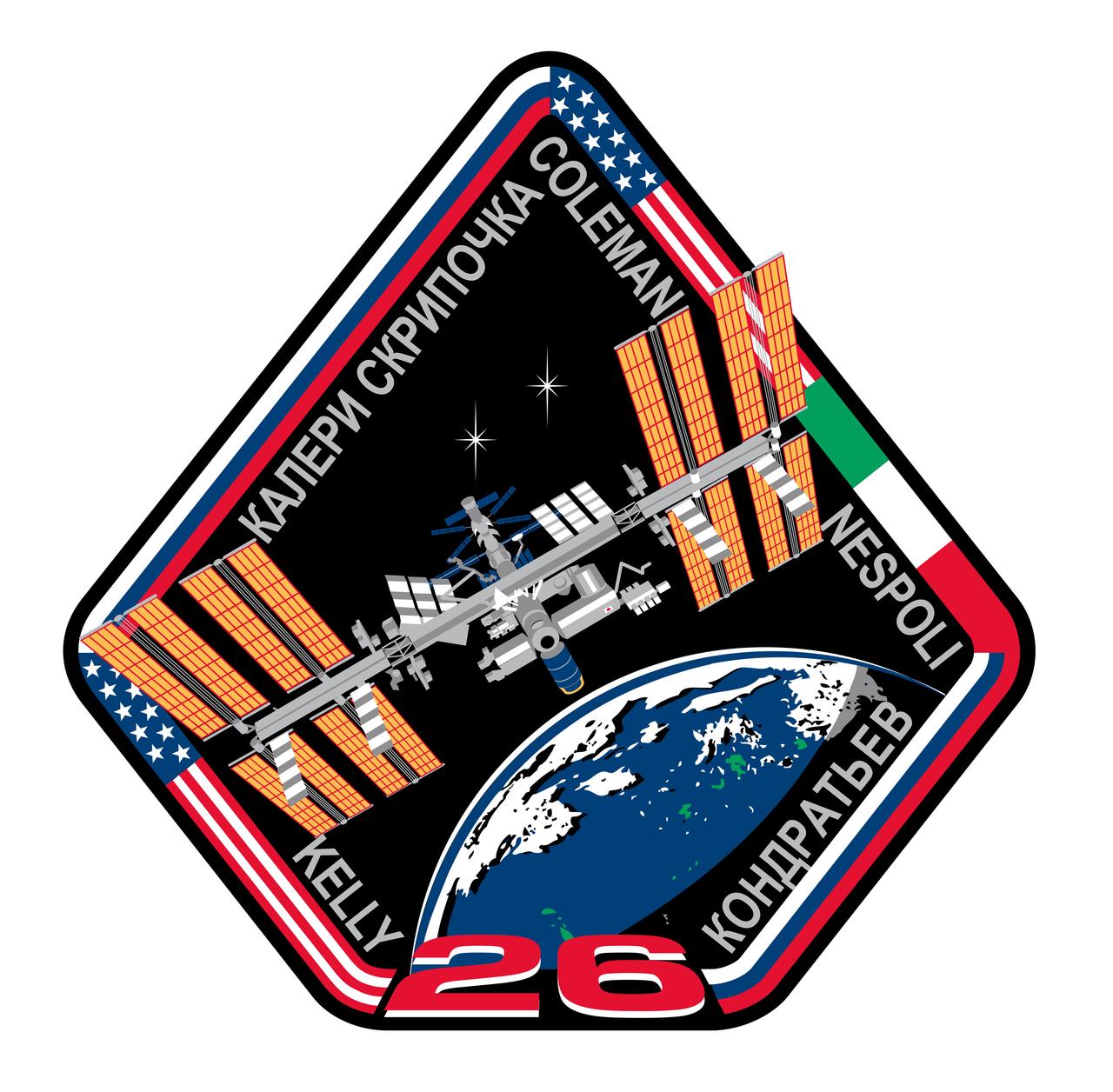
ISS026-S-001 (June 2010) --- In the foreground of the patch, the International Space Station is prominently displayed to acknowledge the efforts of the entire International Space Station (ISS) team - both the crews who have built and operated it, and the team of scientists, engineers, and support personnel on Earth who have provided a foundation for each successful mission. Their efforts and accomplishments have demonstrated the space station?s capabilities as a technology test bed and a science laboratory, as well as a path to the human exploration of our solar system and beyond. The ISS is shown with the European Space Agency?s (ESA) Automated Transfer Vehicle (ATV-2), the Johannes Kepler, docked to resupply it with experiments, food, water, and fuel for Expedition 26 and beyond. This Expedition 26 patch represents the teamwork among the international partners ? USA, Russia, Japan, Canada, and the ESA - and the ongoing commitment from each partner to build, improve, and utilize the ISS. Prominently displayed in the background is our home planet, Earth - the focus of much of our exploration and research on our outpost in space. The two stars symbolize two Soyuz spacecraft, each one carrying a three -member crew, who for four months will work and live together aboard the ISS as Expedition 26. The patch shows the crewmembers? names, and it?s framed with the flags of their countries of origin - United States, Russia, and Italy. The NASA insignia design for shuttle and space station flights is reserved for use by the astronauts and for other official use as the NASA Administrator may authorize. Public availability has been approved only in the form of illustrations by the various news media. When and if there is any change in this policy, which is not anticipated, it will be publicly announced.

JOHNSON SPACE CENTER, HOUSTON, TEXAS - STS-111 INSIGNIA -- The STS-111 patch symbolizes the hardware, people, and partner nations that contribute to the flight. The Space Shuttle rises on the plume of the Astronaut Office symbol, carrying the Canadian Mobile Base System (MBS) for installation while docked to the International Space Station (ISS). The mission is named UF-2 for ISS Utilization Flight number two. The ISS orbit completes the Astronaut Office symbol and is colored red, white, and blue to represent the flags of the United States, Russia, France, and Costa Rica. The Earth background shows Italy, which contributes the Multi Purpose Logistics Module (MPLM) used on this flight to re-supply ISS. The ten stars in the sky represent the ten astronauts and cosmonauts on orbit during the flight, and the star at the top of the patch represents the Johnson Space Center, in the state of Texas, from which the flight is managed. The names of the STS-111 crew border the upper part of the patch, and the Expedition Five (going up) and Expedition Four (coming down) crews' names form the bottom of the patch. The NASA insignia design for Shuttle flights is reserved for use by the astronauts and for other official use as the NASA Administrator may authorize. Public availability has been approved only in the forms of illustrations by the various news media. When and if there is any change in this policy, which is not anticipated, the change will be publicly announced. The NASA insignia design for Space Shuttle flights is reserved for use by the astronauts and for other official use as the NASA Administrator may authorize. Public availability has been approved only in the form of illustrations by the various news media. When and if there is any change in this policy, which we do not anticipate, it will be publicly announced
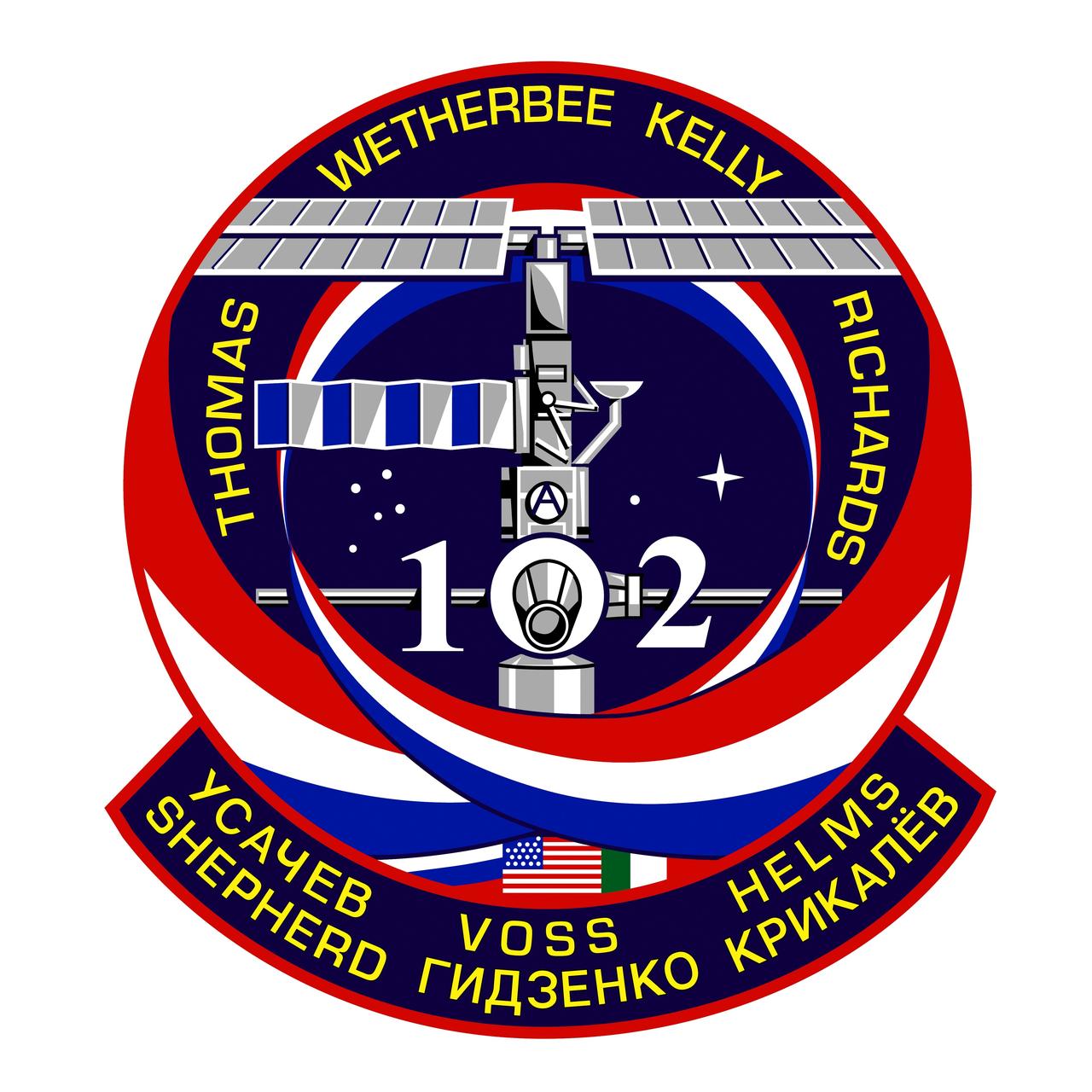
STS102-S-001 (January 2001) --- The central image on the STS-102 crew patch depicts the International Space Station (ISS) in the build configuration that it will have at the time of the arrival and docking of Discovery during the STS-102 mission, the first crew exchange flight to the space station. The station is shown along the direction of the flight as will be seen by the shuttle crew during their final approach and docking, the so-called V-bar approach. The names of the shuttle crew members are depicted in gold around the top of the patch, and surnames of the Expedition crew members being exchanged are shown in the lower banner. The three ribbons swirling up to and around the station signify the rotation of these ISS crew members. The number two is for the Expedition Two crew who fly up to the station, and the number one is for the Expedition One crew who then return down to Earth. In conjunction with the face of the Lab module of the station, these Expedition numbers create the shuttle mission number 102. Shown mated below the ISS is the Italian-built Multi-Purpose Logistics Module, Leonardo, that will fly for the first time on this flight, and which will be attached to the station by the shuttle crew during the docked phase of the mission. The flags of the countries that are the major contributors to this effort, the United States, Russia, and Italy are also shown in the lower part of the patch. The build-sequence number of this flight in the overall station assembly sequence, 5A.1, is captured by the constellations in the background. The NASA insignia design for space shuttle flights is reserved for use by the astronauts and for other official use as the NASA Administrator may authorize. Public availability has been approved only in the forms of illustrations by the various news media. When and if there is any change in this policy, which is not anticipated, the change will be publicly announced. Photo credit: NASA
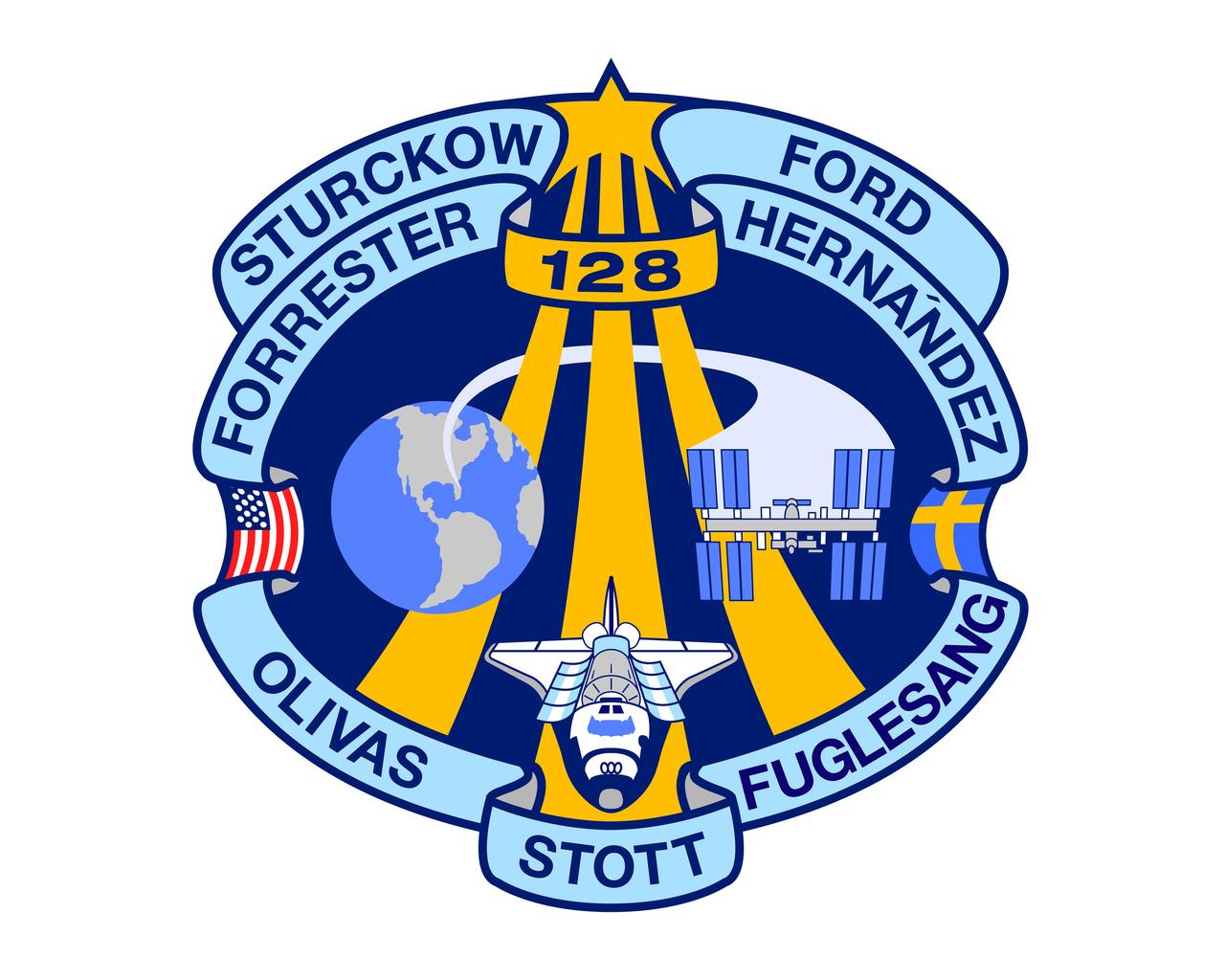
STS128-S-001 (April 2009) --- The STS-128 patch symbolizes the 17A mission and represents the hardware, people and partner nations that contribute to the flight. The Space shuttle Discovery is shown in the orbit configuration with the Multi-Purpose Logistics Module (MPLM) Leonardo in the payload bay. Earth and the International Space Station wrap around the Astronaut Office symbol reminding us of the continuous human presence in space. The names of the STS-128 crew members border the patch in an unfurled manner. Included in the names is the expedition crew member who will launch on STS-128 and remain on board ISS, replacing another Expedition crew member who will return home with STS-128. The banner also completes the Astronaut Office symbol and contains the U.S. and Swedish flags representing the countries of the STS-128 crew. The NASA insignia design for space shuttle flights is reserved for use by the astronauts and for other official use as the NASA Administrator may authorize. Public availability has been approved only in the forms of illustrations by the various news media. When and if there is any change in this policy, which is not anticipated, the change will be publicly announced. Photo credit: NASA
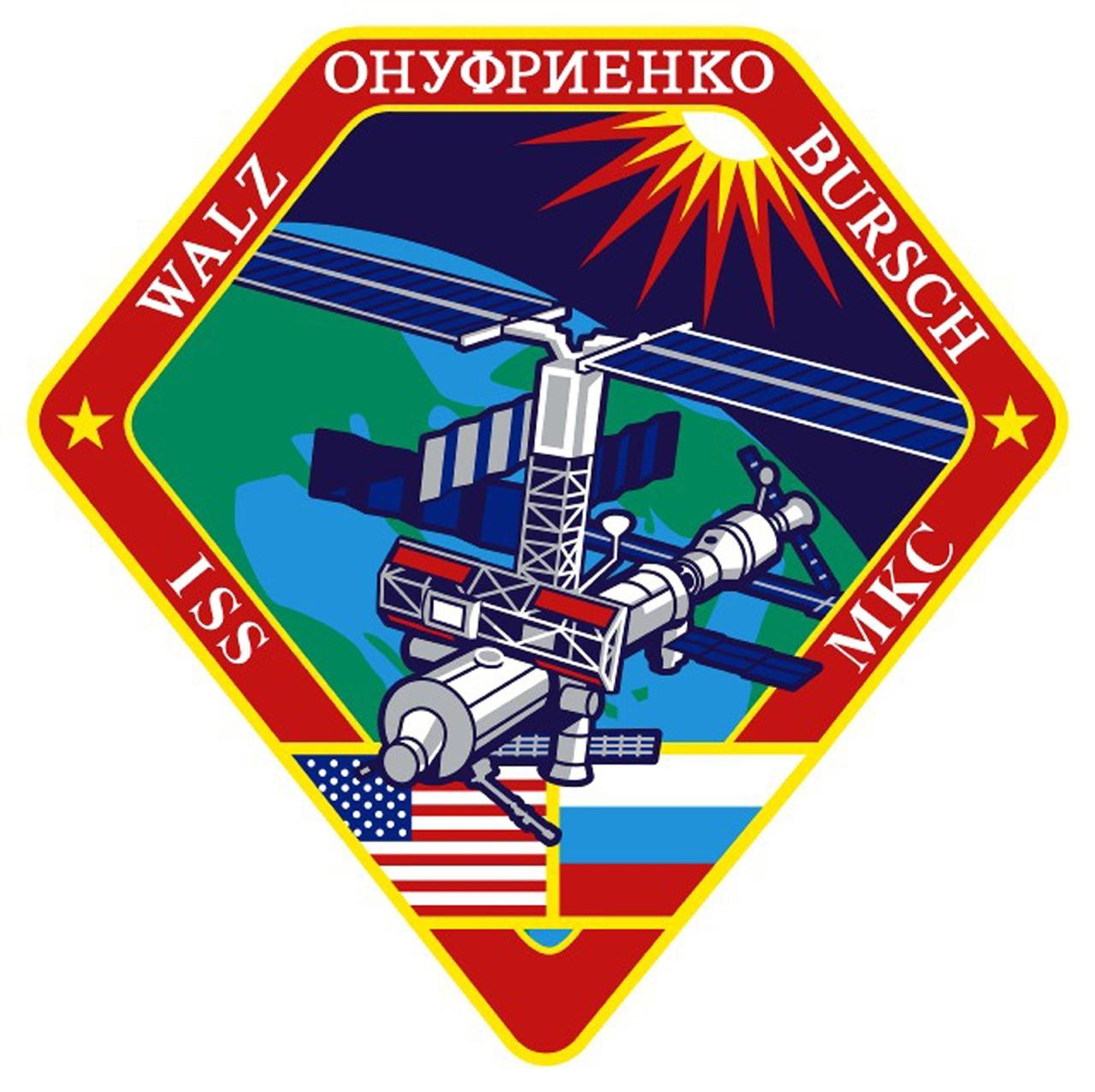
JOHNSON SPACE CENTER, HOUSTON, TEXAS -- EXPEDITION FOUR INSIGNIA -- The International Space Station (ISS) Expedition Four crew patch has an overall diamond shape, showing the "diamond in the rough" configuration of the Station during expedition four. The red hexagonal shape with stylized American and Russian flags represents the cross-sectional view of the S0 truss segment, which the crew will attach to the U.S. Lab Destiny. The persistent Sun shining on the Earth and Station represents the constant challenges that the crew and ground support team will face every day while operating the International Space Station, while shedding new light through daily research. The green portion of the Earth represents the fourth color in the visible spectrum and the black void of space represents humankind's constant quest to explore the unknown. The NASA insignia design for Shuttle flights ts is reserved for use by the astronauts and for other official use as the NASA Administrator may authorize. Public availability has been approved only in the forms of illustrations by the various news media. When and if there is any change in this policy, which we do not anticipate, it will be publicly announced
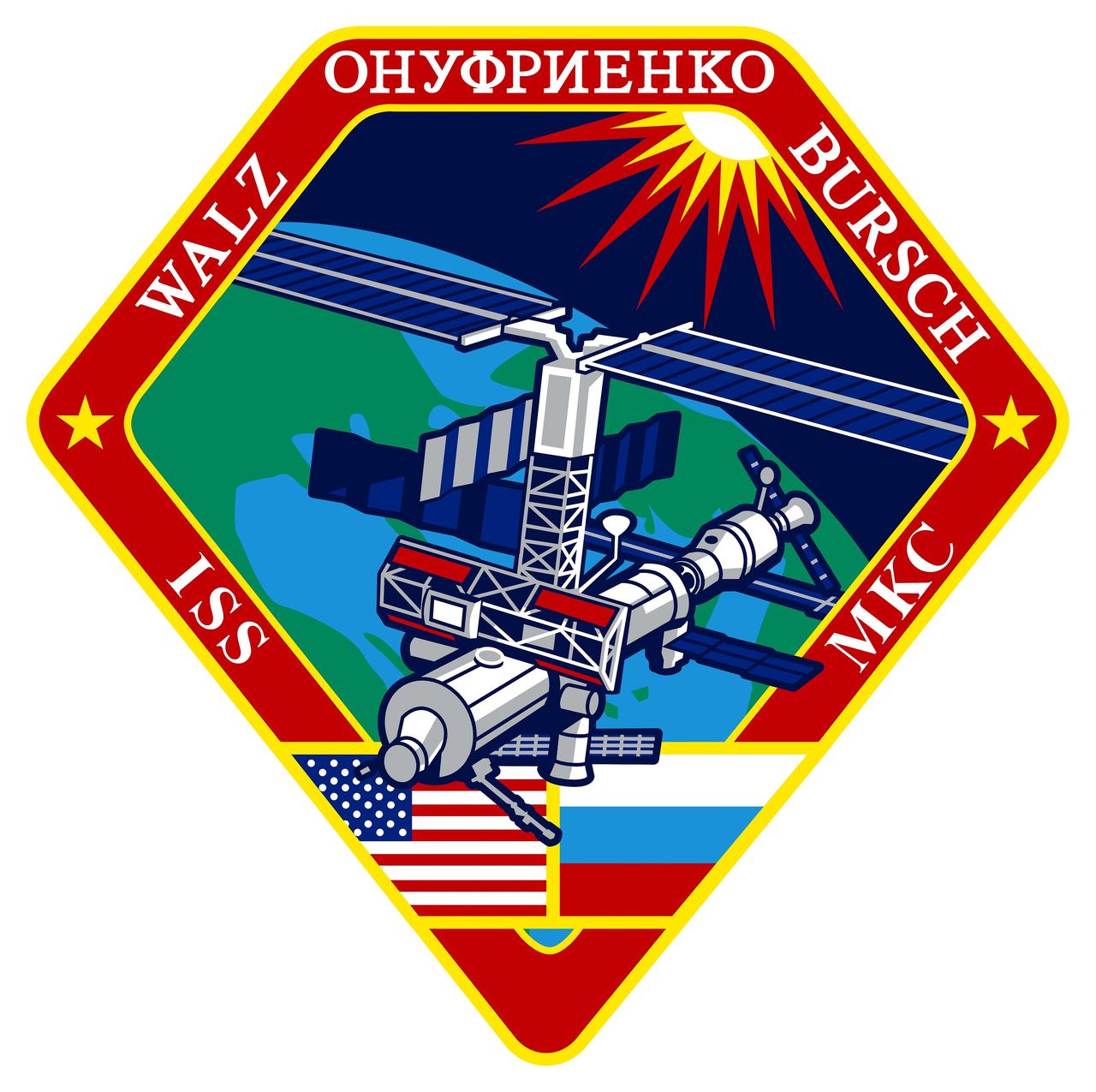
ISS004-S-001 (August 2001) --- The International Space Station (ISS) Expedition 4 crew patch has an overall diamond shape, showing the “diamond in the rough” configuration of the Station during expedition 4. The red hexagonal shape with stylized American and Russian flags represents the cross-sectional view of the S0 truss segment, which the crew will attach to the U.S. Lab Destiny. The persistent Sun shining on the Earth and Station represents the constant challenges that the crew and ground support team will face every day while operating the International Space Station, while shedding new light through daily research. The green portion of the Earth represents the fourth color in the visible spectrum and the black void of space represents humankind’s constant quest to explore the unknown. The NASA insignia design for Shuttle flights is reserved for use by the astronauts and for other official use as the NASA Administrator may authorize. Public availability has been approved only in the forms of illustrations by the various news media. When and if there is any change in this policy, which is not anticipated, the change will be publicly announced.
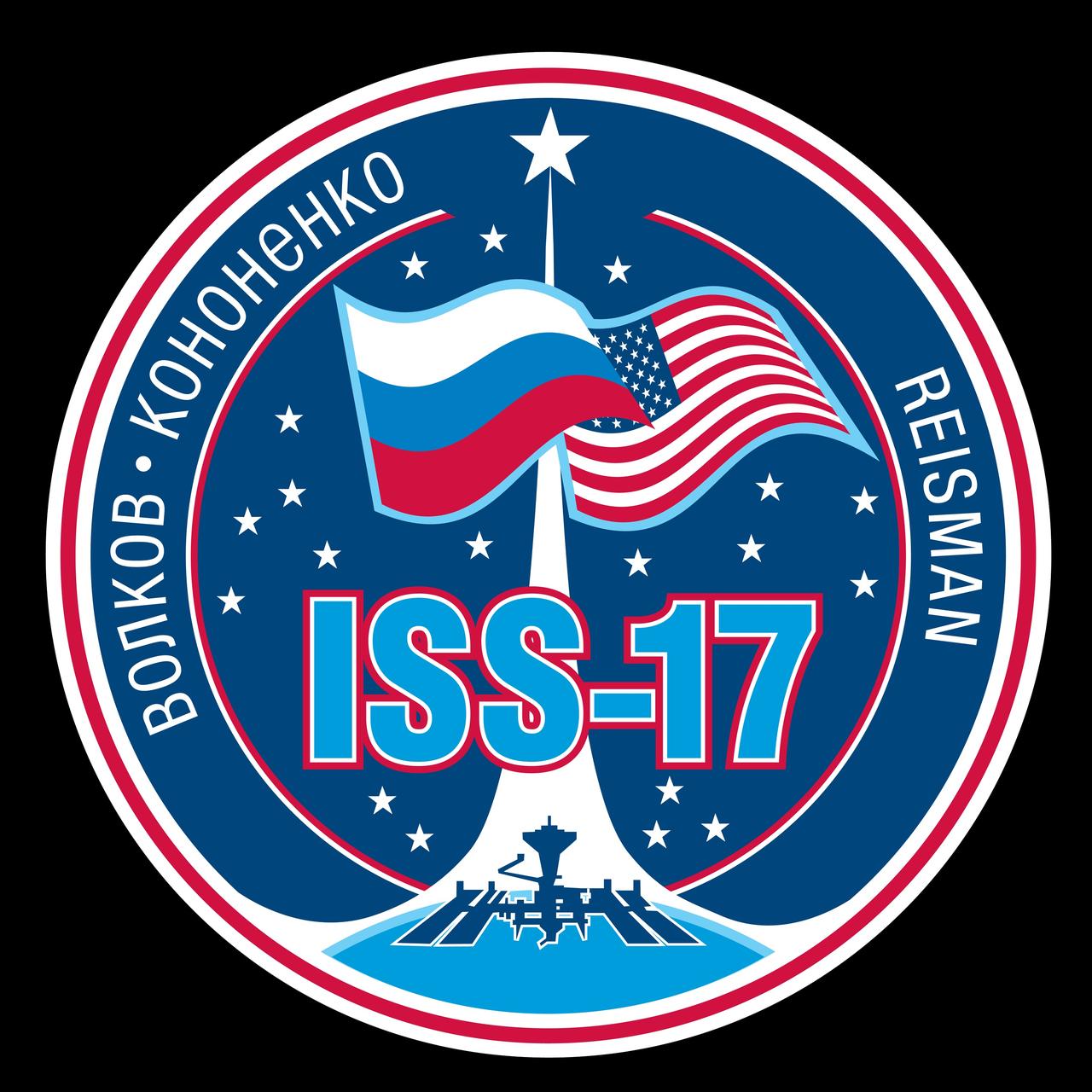
ISS017-S-001D (Oct. 2007) --- The Expedition 17 patch is meant to celebrate current human achievements in space as well as symbolize the future potential for continuing exploration. The Earth, represented at the bottom of the patch, is the base from which all space exploration activities initiate. The International Space Station (ISS), shown in low Earth orbit, illustrates the current level of space operations. The arrow and star point outwards, away from the Earth, towards the wider universe indicating the direction of future activities as human beings build on what has already been accomplished. The flags, representing the home countries of the crew members, Russia and the United States, are touching, highlighting the cooperative nature of the space program and symbolizing the merger of science and technical knowledge of these two experienced space-faring nations. The NASA insignia design for space station flights is reserved for use by the astronauts and for other official use as the NASA Administrator may authorize. Public availability has been approved only in the form of illustrations by the various news media. When and if there is any change in this policy, which is not anticipated, it will be publicly announced.
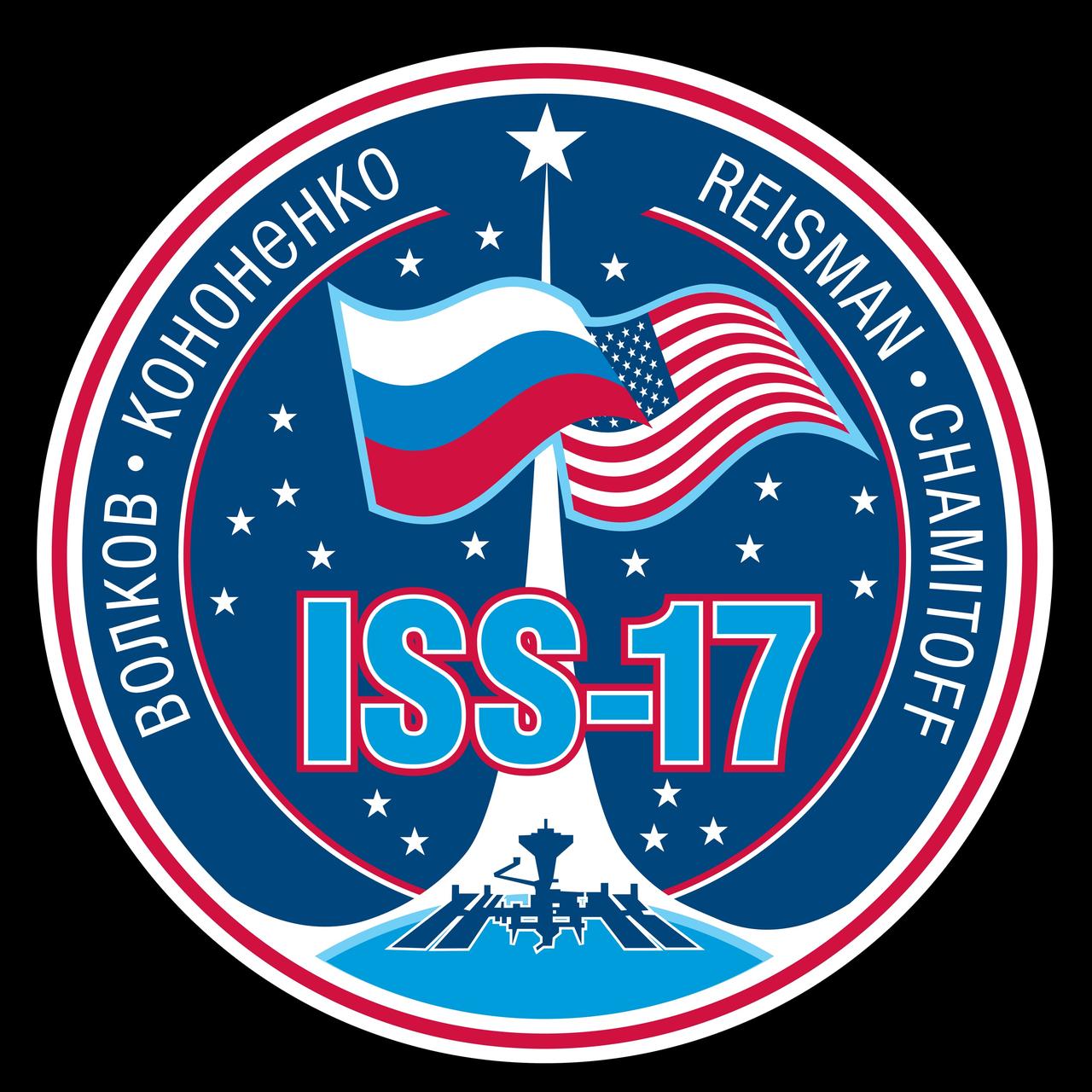
ISS017-S-001C (Oct. 2007) --- The Expedition 17 patch is meant to celebrate current human achievements in space as well as symbolize the future potential for continuing exploration. The Earth, represented at the bottom of the patch, is the base from which all space exploration activities initiate. The International Space Station (ISS), shown in low Earth orbit, illustrates the current level of space operations. The arrow and star point outwards, away from the Earth, towards the wider universe indicating the direction of future activities as human beings build on what has already been accomplished. The flags, representing the home countries of the crew members, Russia and the United States, are touching, highlighting the cooperative nature of the space program and symbolizing the merger of science and technical knowledge of these two experienced space-faring nations. The NASA insignia design for space station flights is reserved for use by the astronauts and for other official use as the NASA Administrator may authorize. Public availability has been approved only in the form of illustrations by the various news media. When and if there is any change in this policy, which is not anticipated, it will be publicly announced.
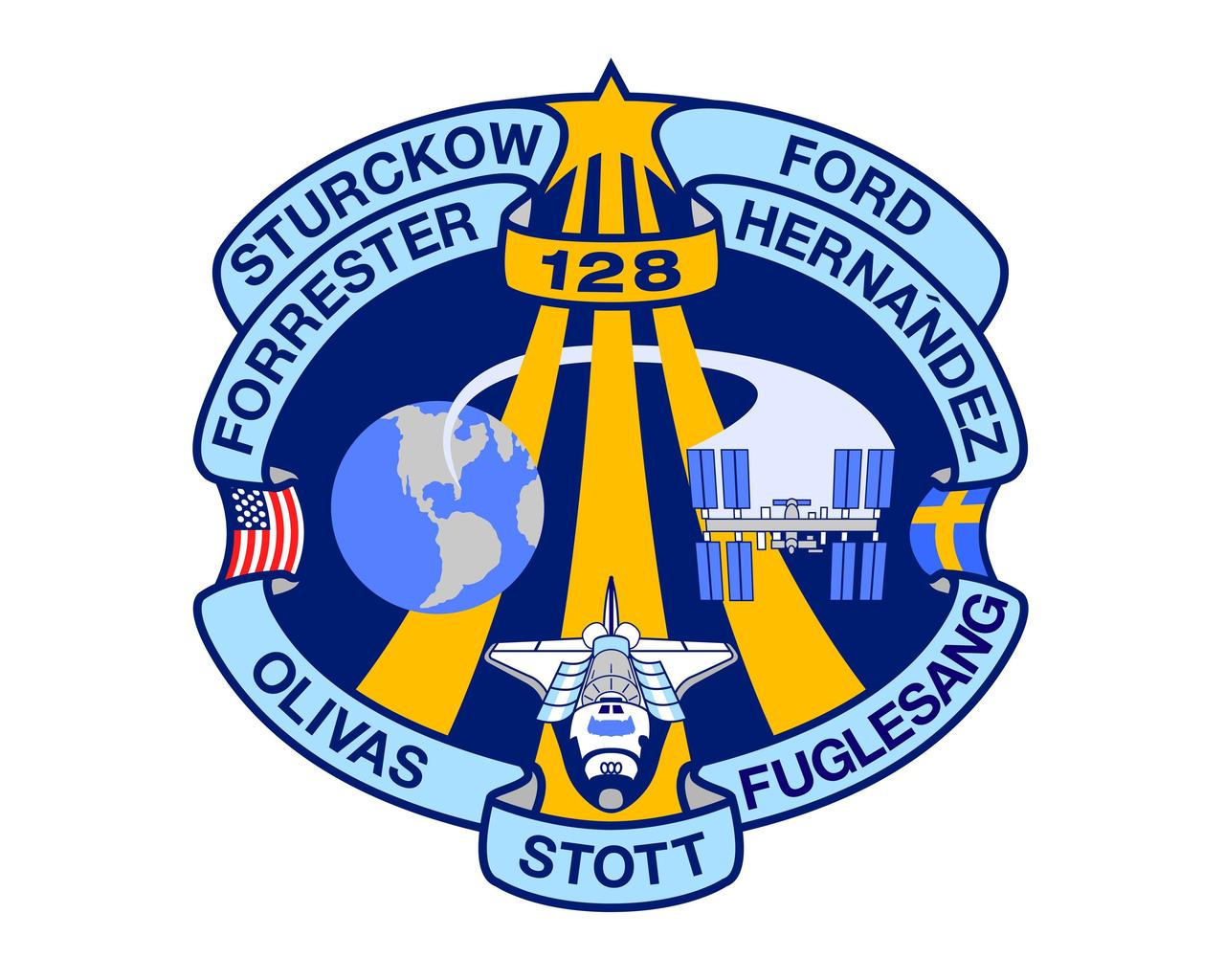
JOHNSON SPACE CENTER, Houston – STS128-S-001 -- The STS-128 patch symbolizes the 17A mission and represents the hardware, people and partner nations that contribute to the flight. The Space Shuttle Discovery is shown in the orbit configuration with the Multi Purpose Logistics Module (MPLM) Leonardo in the payload bay. Earth and the International Space Station wrap around the Astronaut Office symbol reminding us of the continuous human presence in space. The names of the STS-128 crew members border the patch in an unfurled manner. Included in the names is the expedition crew member who will launch on STS-128 and remain on board ISS, replacing another Expedition crew member who will return home with STS-128. The banner also completes the Astronaut Office symbol and contains the U.S. and Swedish flags representing the countries of the STS-128 crew. The NASA insignia design for Space Shuttle flights is reserved for use by the astronauts and for other official use as the NASA Administrator may authorize. Public availability has been approved only in the form of illustrations by the various news media. When and if there is any change in this policy, which we do not anticipate, it will be publicly announced.
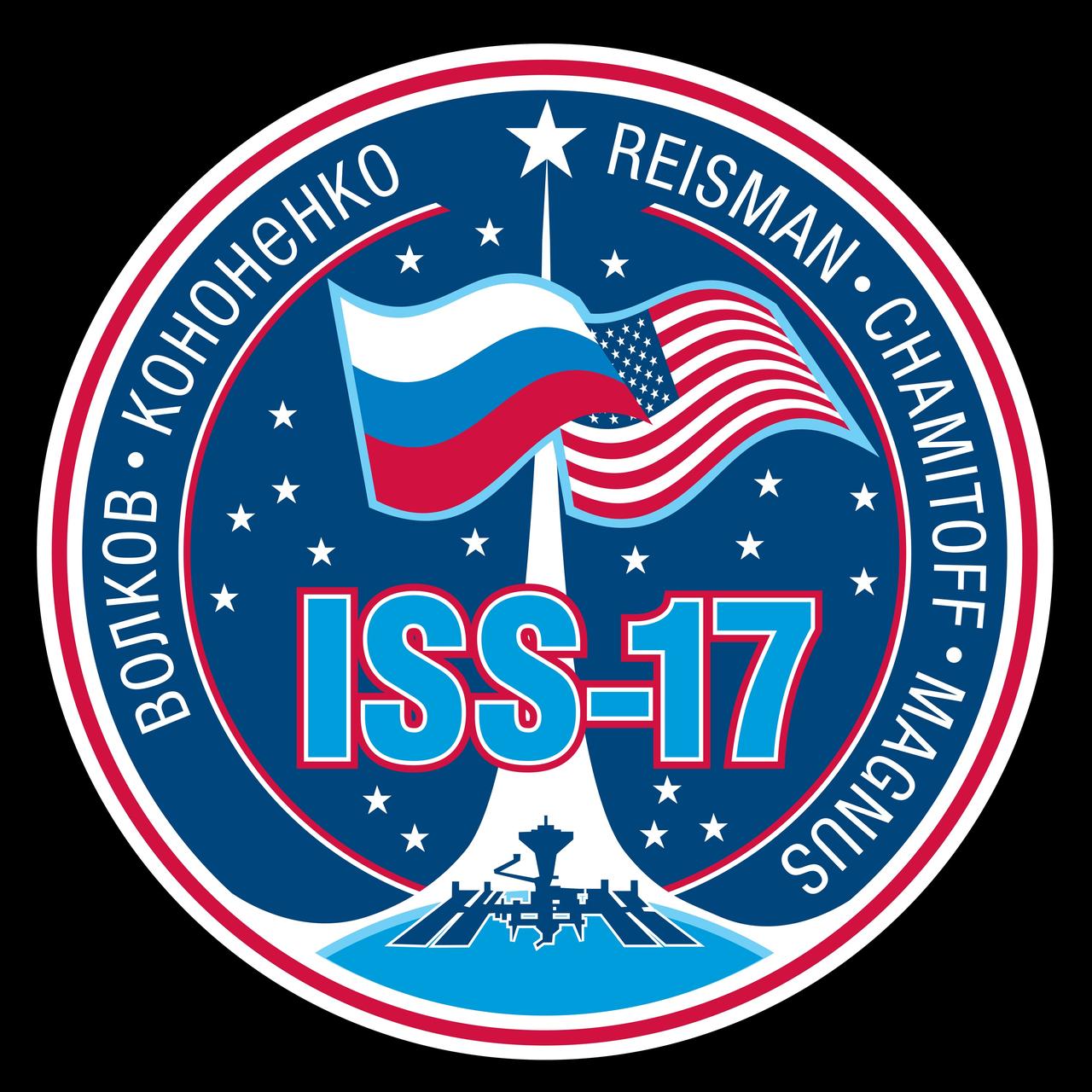
ISS017-S-001B (Oct. 2007) --- The Expedition 17 patch is meant to celebrate current human achievements in space as well as symbolize the future potential for continuing exploration. The Earth, represented at the bottom of the patch, is the base from which all space exploration activities initiate. The International Space Station (ISS), shown in low Earth orbit, illustrates the current level of space operations. The arrow and star point outwards, away from the Earth, towards the wider universe indicating the direction of future activities as human beings build on what has already been accomplished. The flags, representing the home countries of the crew members, Russia and the United States, are touching, highlighting the cooperative nature of the space program and symbolizing the merger of science and technical knowledge of these two experienced space-faring nations. The NASA insignia design for space station flights is reserved for use by the astronauts and for other official use as the NASA Administrator may authorize. Public availability has been approved only in the form of illustrations by the various news media. When and if there is any change in this policy, which is not anticipated, it will be publicly announced.
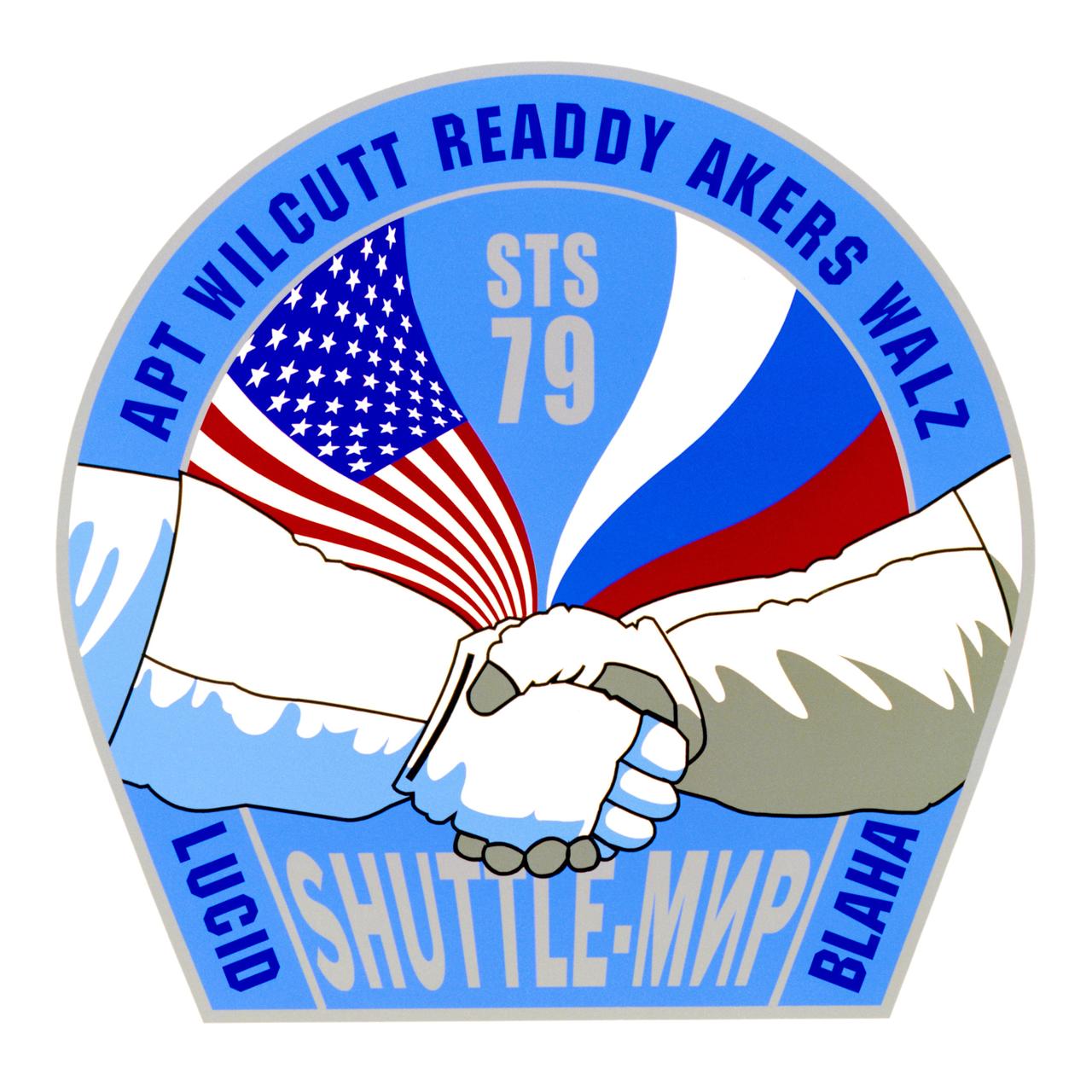
STS79-S-001 (April 1996) --- STS-79 is the fourth in a series of NASA docking missions to the Russian Mir Space Station, leading up to the construction and operation of the International Space Station (ISS). As the first flight of the Spacehab Double Module, STS-79 encompasses research, test and evaluation of ISS, as well as logistics resupply for the Mir Space Station. STS-79 is also the first NASA-Mir American crew member exchange mission, with John E. Blaha (NASA-Mir-3) replacing Shannon W. Lucid (NASA-Mir-2) aboard the Mir Space Station. The lettering of their names either up or down denotes transport up to the Mir Space Station or return to Earth on STS-79. The patch is in the shape of the space shuttle?s airlock hatch, symbolizing the gateway to international cooperation in space. The patch illustrates the historic cooperation between the United States and Russia in space. With the flags of Russia and the United States as a backdrop, the handshake of Extravehicular Mobility Unit (EMU) - suited crew members symbolizes mission teamwork, not only of the crew members but also the teamwork between both countries? space personnel in science, engineering, medicine and logistics. The NASA insignia design for space shuttle flights is reserved for use by the astronauts and for other official use as the NASA Administrator may authorize. Public availability has been approved only in the forms of illustrations by the various news media. When and if there is any change in this policy, which is not anticipated, the change will be publicly announced. Photo credit: NASA
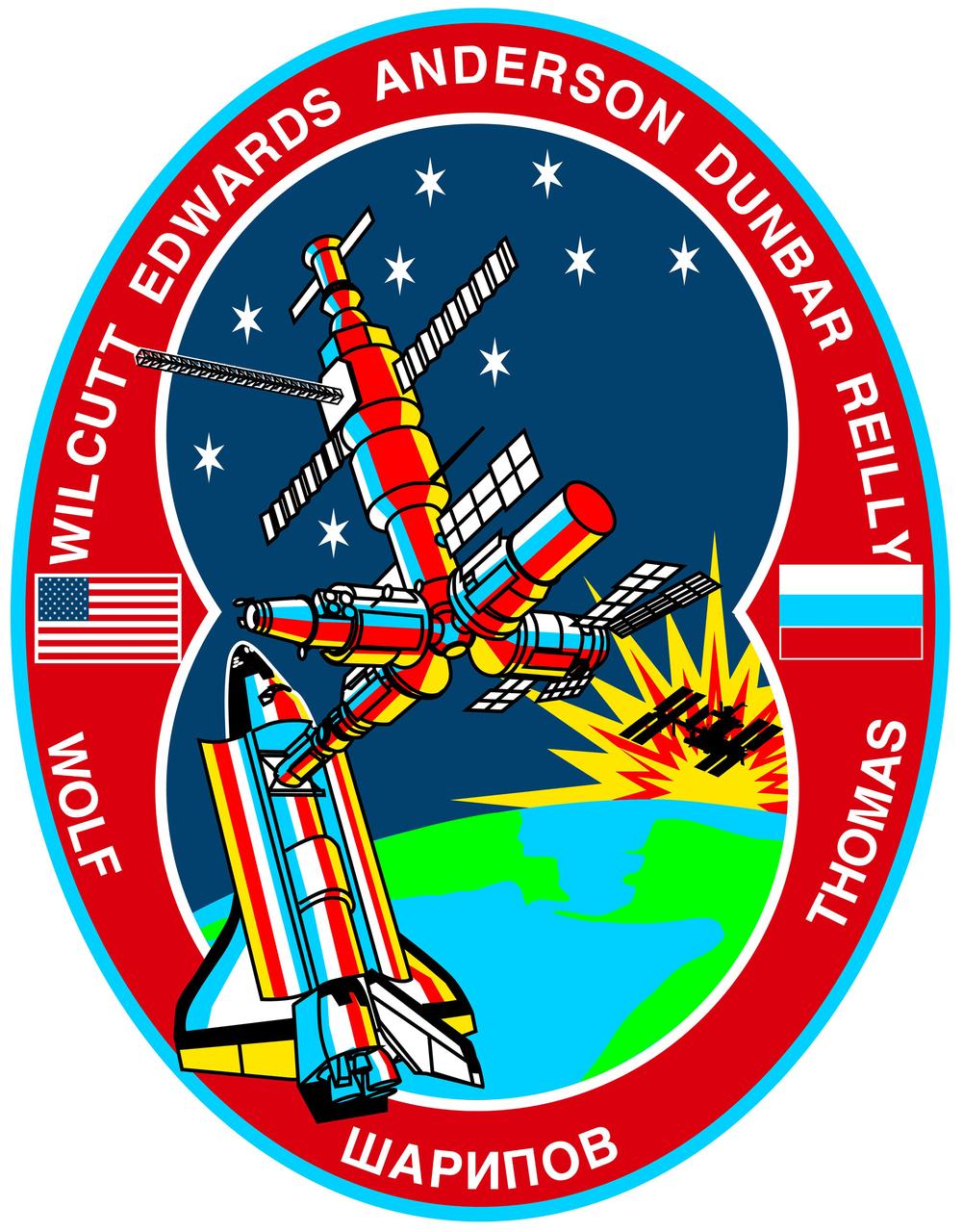
In the STS-89 crew insignia, the link between the United States and Russia is symbolically represented by the Space Shuttle Endeavour and Russia's Mir Space Station orbiting above the Bering Strait between Siberia and Alaska. The success of the joint United States-Russian missions is depicted by the Space Shuttle and Mir colored by the rising sun in the background. A shadowed representation of the International Space Station (ISS) rising with the sun represents the future program for which the Shuttle-Mir missions are prototypes. The inside rim of the insignia describes the outline of the number eight representing STS-89 as the eighth Shuttle/Mir docking mission. The nine stars represent the nine joint missions to be flown of the program and when combined with the number eight in the rim, reflect the mission number. The nine stars also symbolize the children of the crew members who will be the future beneficiaries of the joint development work of the space programs of the two countries. Along the rim are the crew members' names with David A. Wolf's name on the left and Andrew S. W. Thomas' name on the right, the returning and upgoing cosmonaut guest researcher crew members. In between and at the bottom is the name of Salizan S. Sharipov, payload specialist representing Russian Space Agency (RSA), in Cyrillic alphabet. The other crew members are Terrence W. Wilcutt, commander; Joe F. Edwards, Jr., pilot; and mission specialists Michael P. Anderson, Bonnie J. Dunbar, and James F. Reilly. The red, white and blue of the rim reflect the colors of the American and Russian flags which are also represented in the rim on either side of the joined spacecraft.
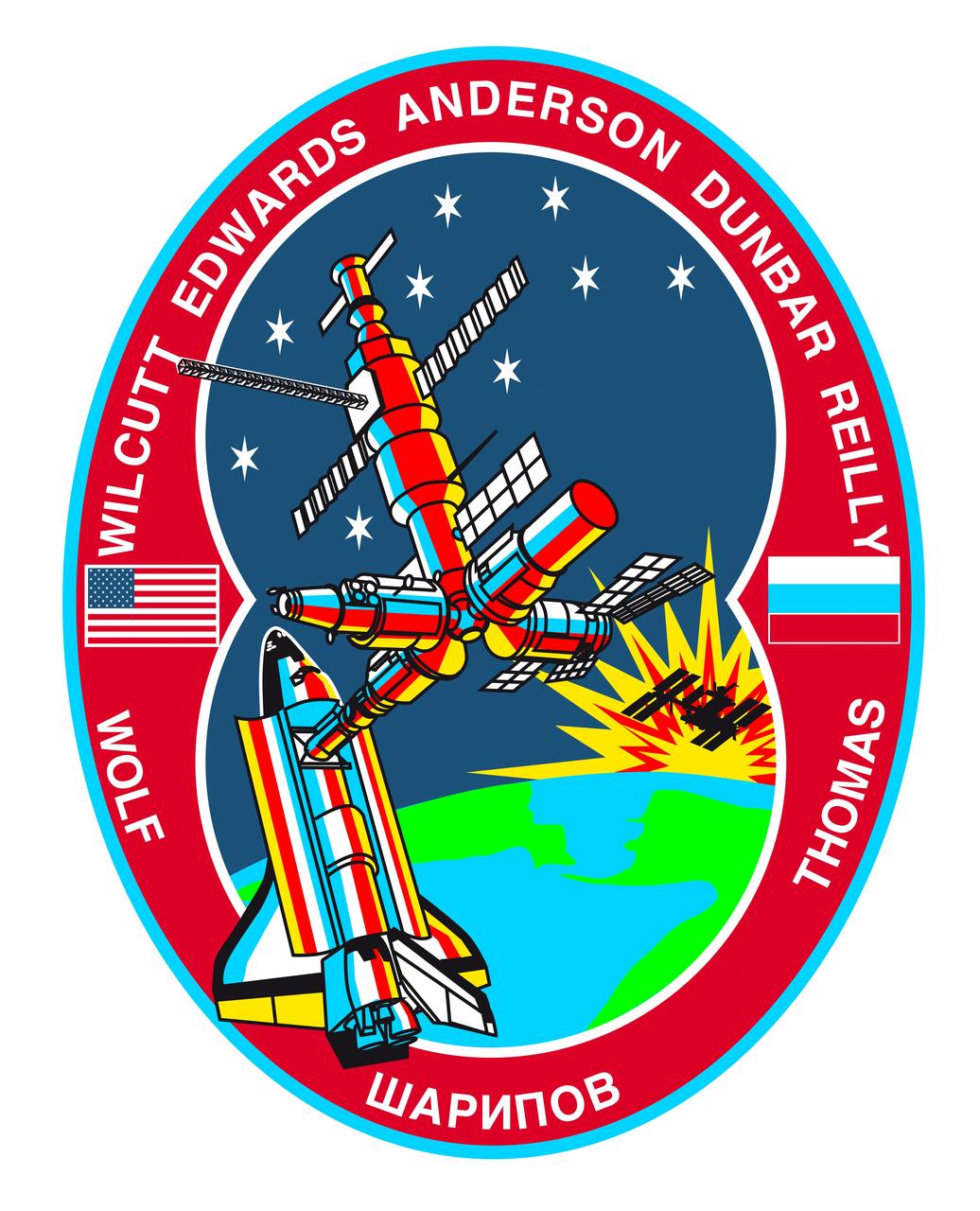
STS089-S-001 (October 1997) --- The link between the United States and Russia is symbolically represented by the space shuttle Endeavour and Russia?s Mir Space Station orbiting above the Bering Strait between Siberia and Alaska. The success of the joint United States-Russian missions is depicted by the space shuttle and Mir colored by the rising sun in the background. A shadowed representation of the International Space Station (ISS) rising with the sun represents the future program for which the Shuttle-Mir missions are prototypes. The inside rim of the insignia describes the outline of the number eight representing STS-89 as the eighth Shuttle/Mir docking mission. The nine stars represent the nine joint missions to be flown of the program and ? when combined with the number eight in the rim -- reflect the mission number. The nine stars also symbolize the children of the crew members who will be the future beneficiaries of the joint development work of the space programs of the two countries. Along the rim are the crew members? names with David A. Wolf?s name on the left and Andrew S. W. Thomas? name on the right, the returning and upgoing cosmonaut guest researcher crew members. In between and at the bottom is the name of Salizan S. Sharipov, mission specialist representing Russian Space Agency (RSA), in Cyrillic alphabet. The other crew members are Terrence W. Wilcutt, commander; Joe F. Edwards Jr., pilot; and mission specialists Michael P. Anderson, Bonnie J. Dunbar, and James F. Reilly. The red, white and blue of the rim reflect the colors of the American and Russian flags which are also represented in the rim on either side of the joined spacecraft. The NASA insignia design for space shuttle flights is reserved for use by the astronauts and for other official use as the NASA Administrator may authorize. Public availability has been approved only in the forms of illustrations by the various news media. When and if there is any change in this policy, which is not anticipated, the change will be publicly announced. Photo credit: NASA

This patch represents the essential elements associated with pressurized Earth science research aboard the International Space Station. At the top of the patch Klingon script spells out the acronym WORF making reference to the famed Star Trek character of the same name. In doing so it attests to the foresight, honor, integrity, and persistence of all those who made the WORF possible. To the right of the Klingon script is a single four pointed star in the form of a cross to honor the late Dr. Jack Estes and Dr. Dave Amsbury, the individuals most responsible for seeing to it that an optical quality, Earth science research window was added to the United States laboratory module, Destiny. The "flying eyeball" represents the ability of the ISS to allow scientists and astronauts to make and record continuous observations of natural and manmade processes on the surface of the Earth. The Destiny laboratory is depicted on the right of the patch above the Flag of the United States of America and highlights the position of the nadir looking, optical quality, science window in the module. The light emanating from the window from the lighted interior of the module appropriately illuminates the National Ensign for display during both day and night time. In the center of the patch, below the flying eyeball is a graphic representation of the WORF rack. A science instrument is mounted on the WORF payload shelf and is recording data of the Earth's surface through the nadir looking, science window over which the WORF rack is mounted. An astronaut represented by Mario Runco Jr., a designer, developer, and manager of the WORF and depicted as Star Trek's Mr. Spock, is to the left of the WORF rack and is shown in his flight suit with his STS-44 mission patch operating an imaging instrument, emphasizing the importance of astronaut participation to achieve the maximum scientific return from orbital research.