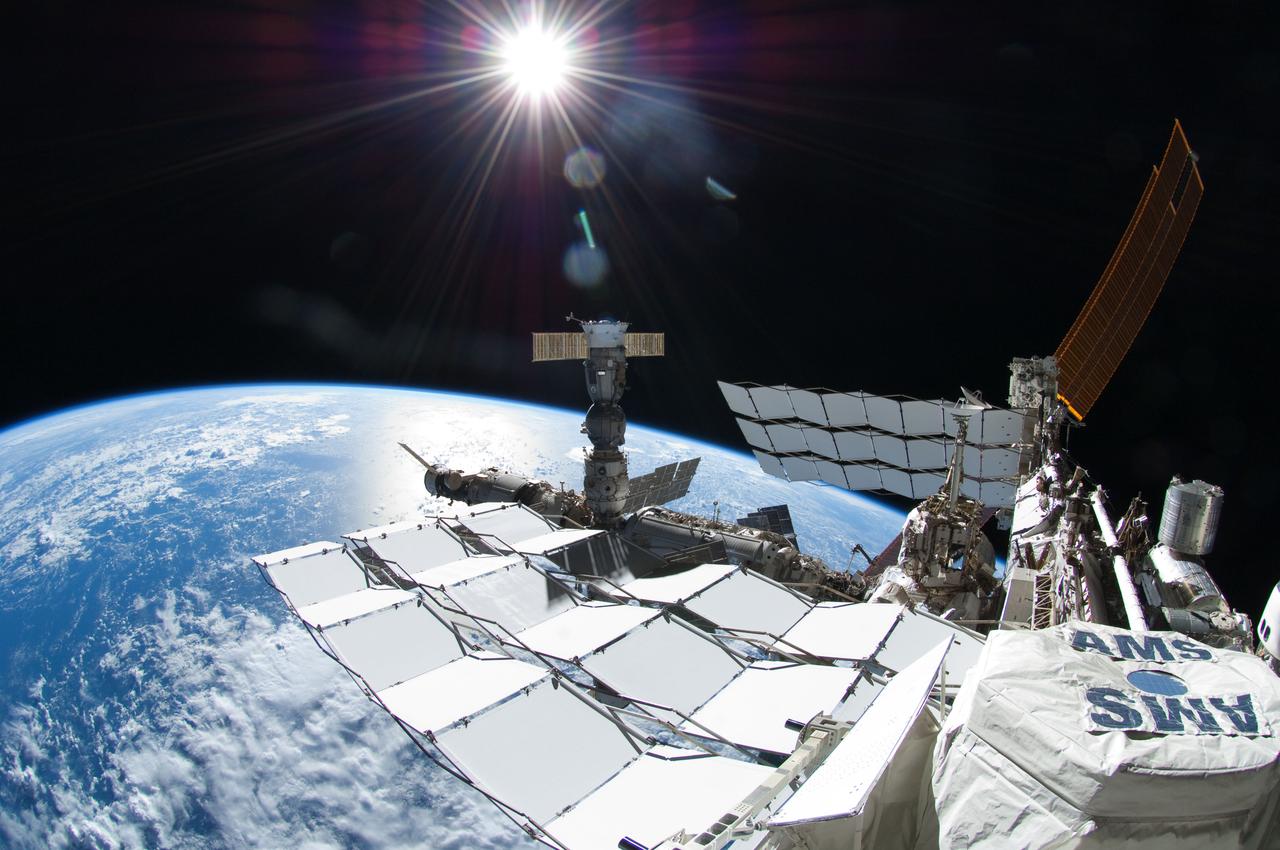
iss028e016135 (7/12/2011) --- Exterior view of the International Space Station (ISS) taken during a session of Extravehicular Activity (EVA) with a fisheye camera. The Alpha Magnetic Spectrometer - 2 (AMS-2) is visible in the right foreground and a Soyuz spacecraft is visible docked to the Pirs Docking Compartment (DC1/CO1). The Alpha Magnetic Spectrometer - 02 (AMS-02) is a high profile space-based particle physics experiment. As the largest and most advanced magnetic spectrometer in space, AMS-02 will collect information from cosmic sources emanating from stars and galaxies millions of light years beyond the Milky Way.
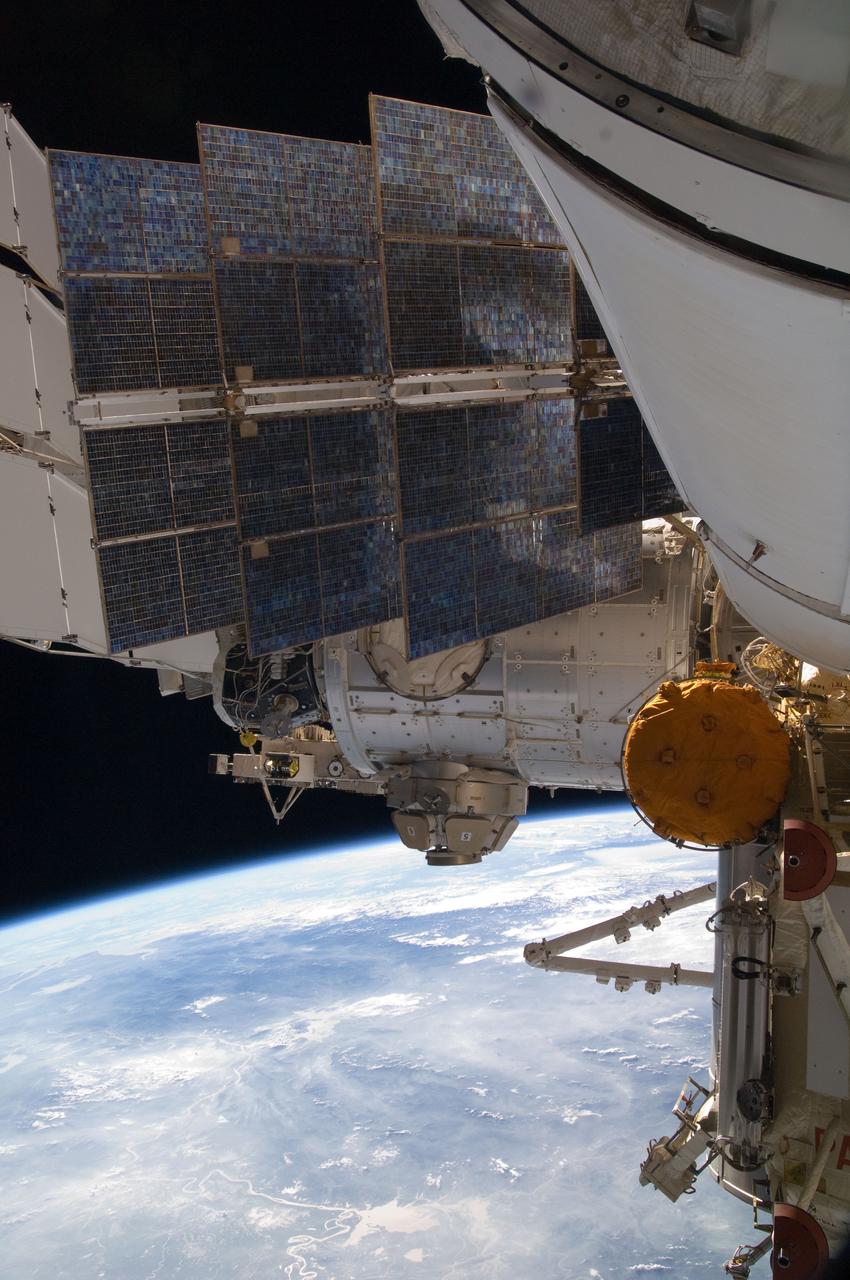
ISS032-E-010639 (28 July 2012) --- A portion of the International Space Station is photographed by an Expedition 32 crew member on the station. Earth?s horizon and the blackness of space provide the backdrop for the scene.
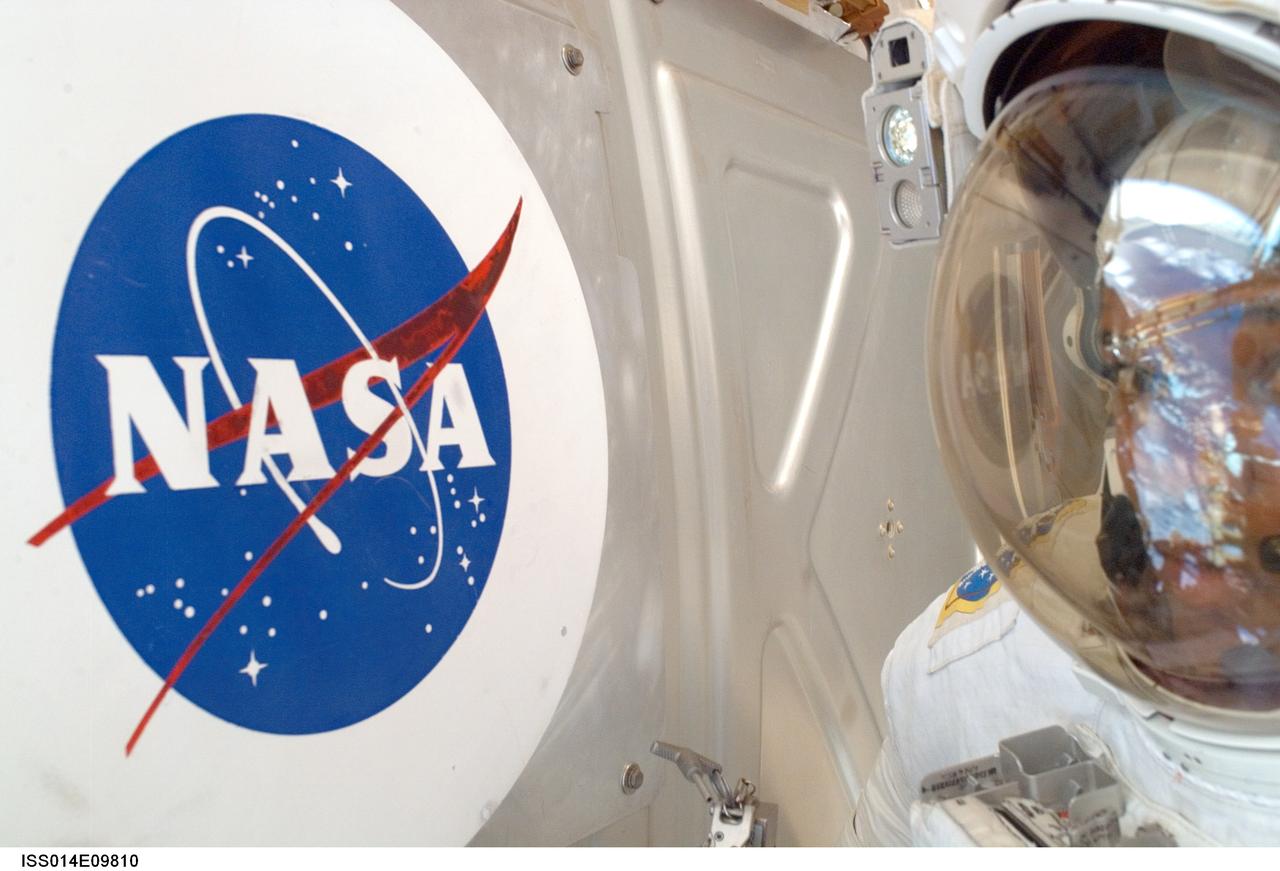
ISS014-E-09810 (14 Dec. 2006) --- Astronaut Robert L. Curbeam Jr., STS-116 mission specialist, meets the NASA logo up close during the Dec. 14 space walk to perform ISS work, which he shared with European Space Agency astronaut Christer Fuglesang.
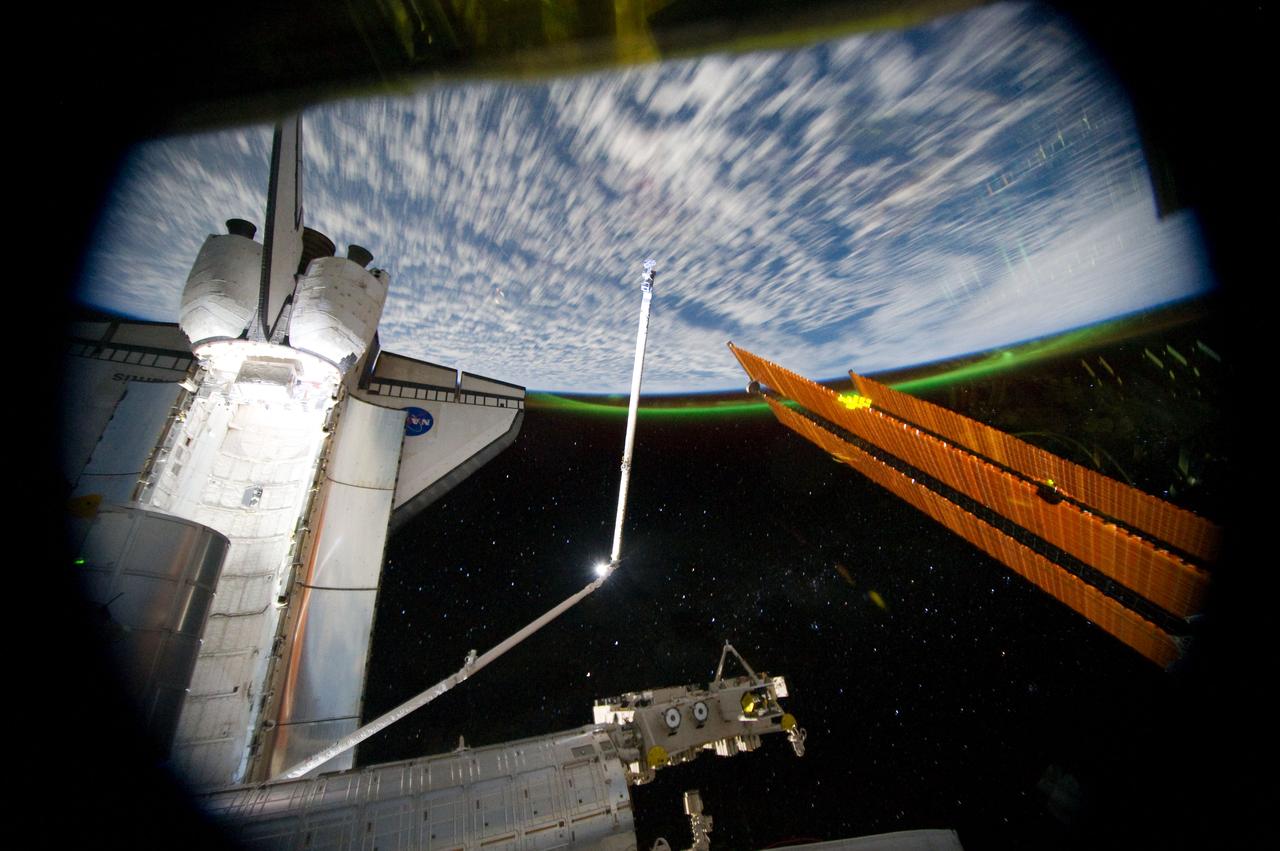
ISS028-E-016368 (14 July 2011) --- This panoramic view, photographed from the International Space Station, looking past the docked space shuttle Atlantis' cargo bay and part of the station including a solar array panel toward Earth, was taken on July 14 as the joint complex passed over the southern hemisphere. Aurora Australis or the Southern Lights can be seen on Earth's horizon and a number of stars are visible also.
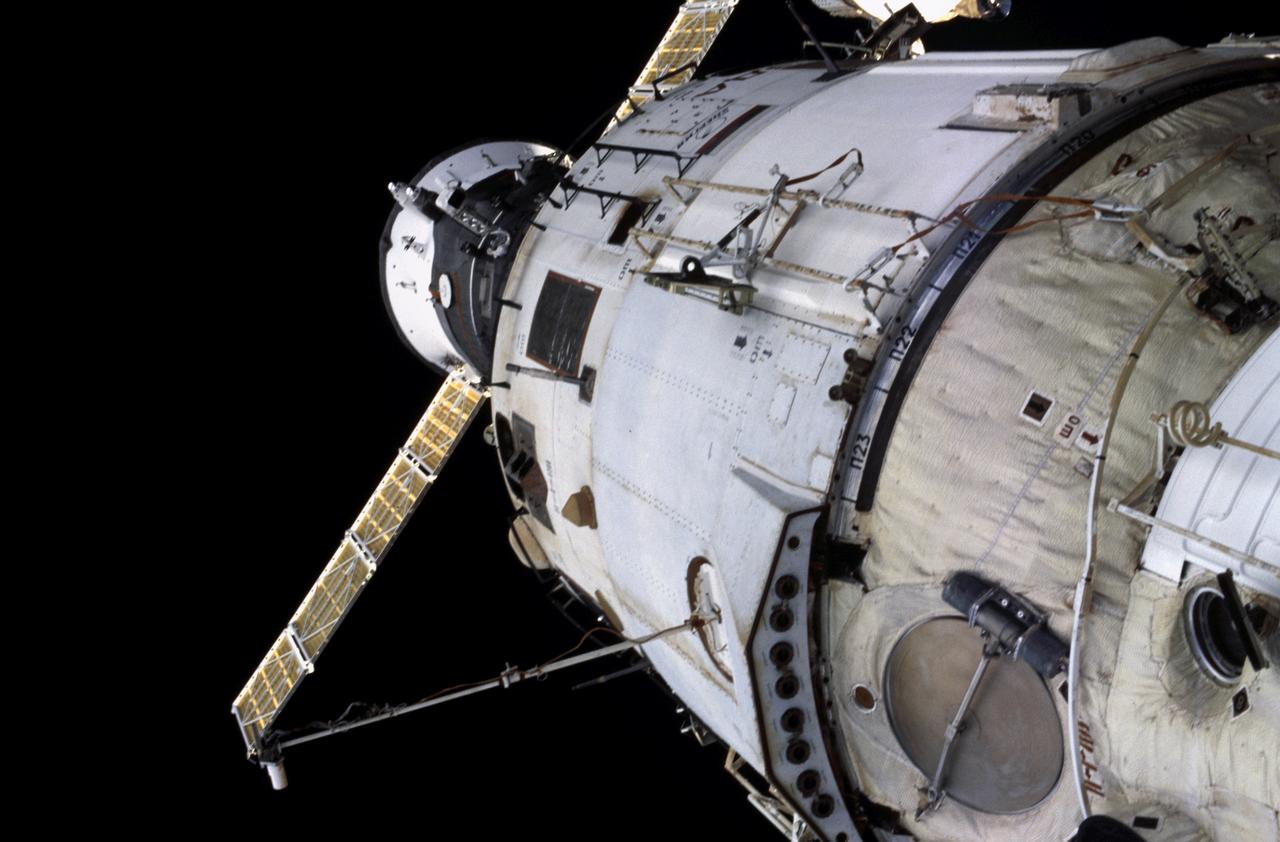
ISS003-301-023 (8 October 2001) --- Backdropped by the blackness of space, a close-up exterior view of the International Space Station (ISS) shows a Progress supply vehicle docked to the Zvezda Service Module.
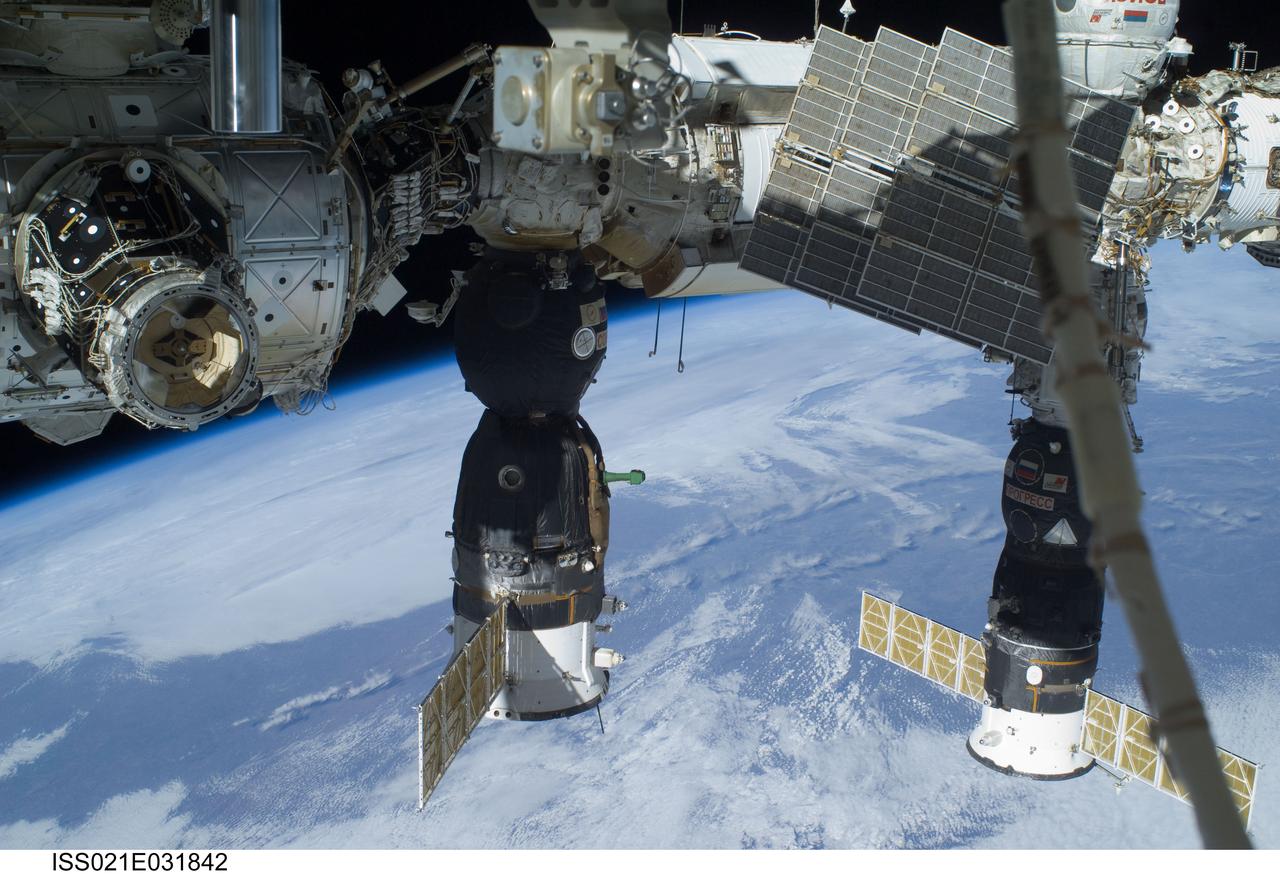
ISS021-E-031842 (23 Nov. 2009) --- A portion of the Russian segment of the International Space Station is featured in this image photographed by a space-walking astronaut during the third and final spacewalk for the STS-129 mission. A docked Soyuz spacecraft is at center and a Progress resupply vehicle is docked to the Pirs Docking Compartment. Earth’s horizon and the blackness of space provide the backdrop for the scene.

ISS028-E-005416 (25 May 2011) --- The forward section of the space shuttle Endeavour is pictured with two components of the International Space Station (ISS) -- the Harmony node (left) and the European Space Agency's Columbus laboratory. Nine astronauts and cosmonauts continue to work inside the shirt-sleeve environment of the ISS and preparing for the final of four spacewalks on May 26.
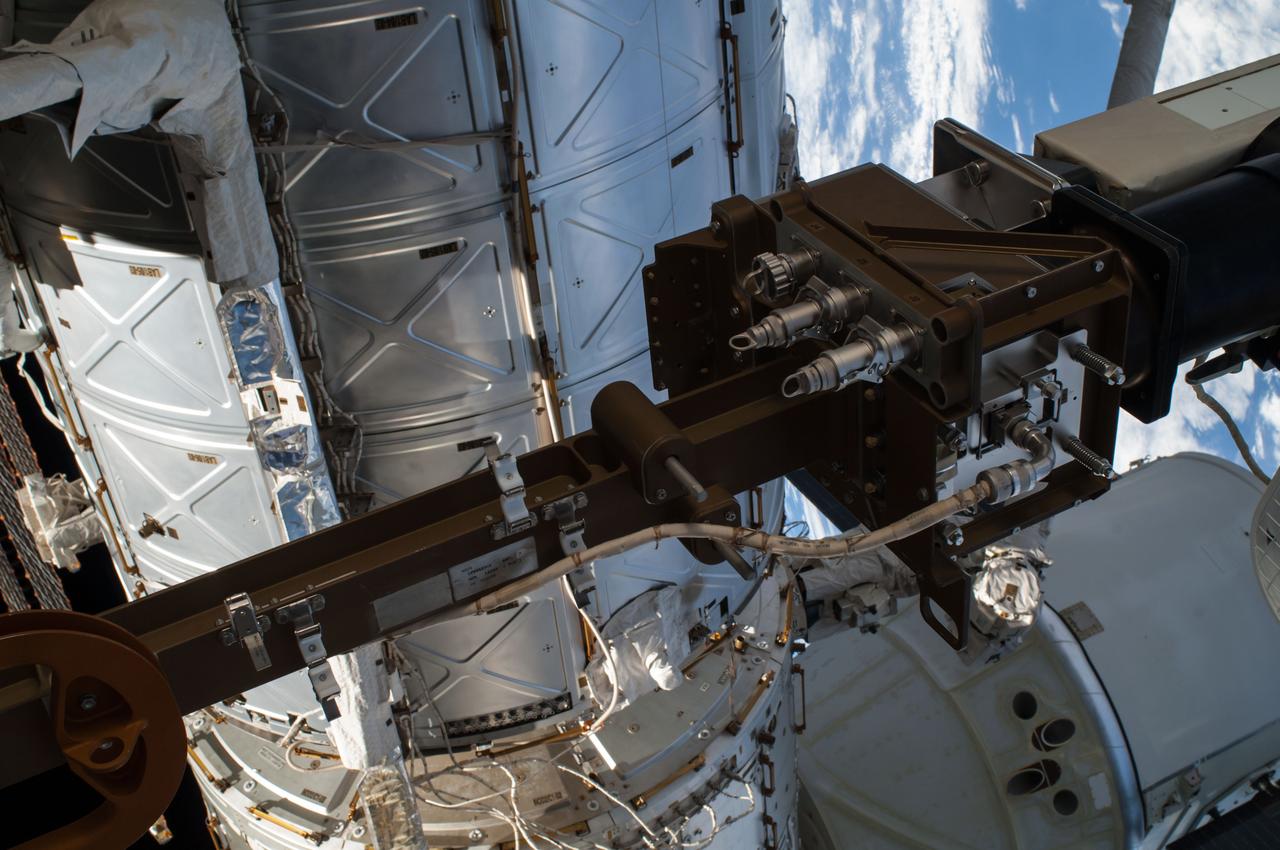
ISS041-E-067002 (7 Oct. 2014) --- NASA astronaut Reid Wiseman, Expedition 41 flight engineer, participates in a session of extravehicular activity (EVA) as work continues on the International Space Station. During the six-hour, 13-minute spacewalk, Wiseman and European Space Agency astronaut Alexander Gerst (out of frame), flight engineer, worked outside the space station's Quest airlock relocating a failed cooling pump to external stowage and installing gear that provides back up power to external robotics equipment.
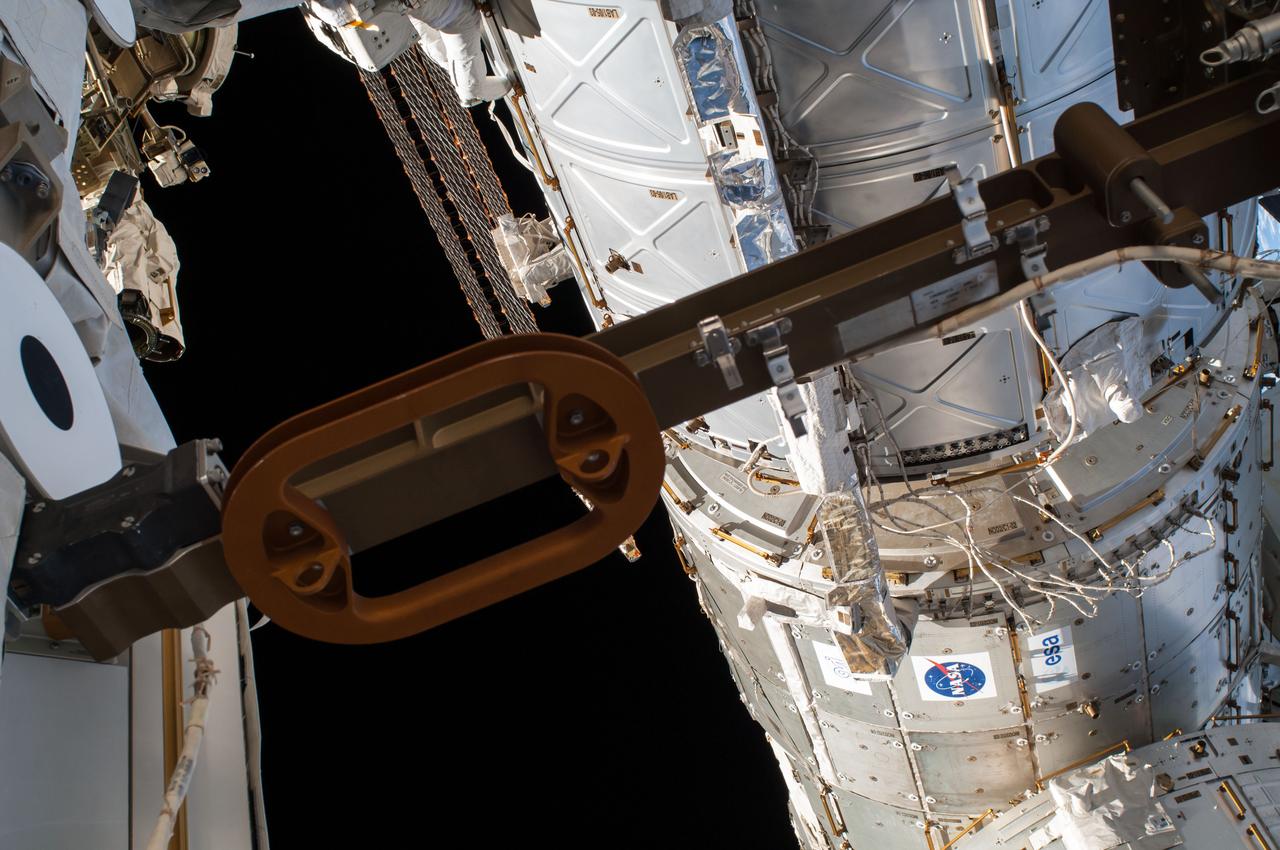
ISS041-E-067002 (7 Oct. 2014) --- NASA astronaut Reid Wiseman, Expedition 41 flight engineer, participates in a session of extravehicular activity (EVA) as work continues on the International Space Station. During the six-hour, 13-minute spacewalk, Wiseman and European Space Agency astronaut Alexander Gerst (out of frame), flight engineer, worked outside the space station's Quest airlock relocating a failed cooling pump to external stowage and installing gear that provides back up power to external robotics equipment.
ISS041-E-067002 (7 Oct. 2014) --- NASA astronaut Reid Wiseman, Expedition 41 flight engineer, participates in a session of extravehicular activity (EVA) as work continues on the International Space Station. During the six-hour, 13-minute spacewalk, Wiseman and European Space Agency astronaut Alexander Gerst (out of frame), flight engineer, worked outside the space station's Quest airlock relocating a failed cooling pump to external stowage and installing gear that provides back up power to external robotics equipment.
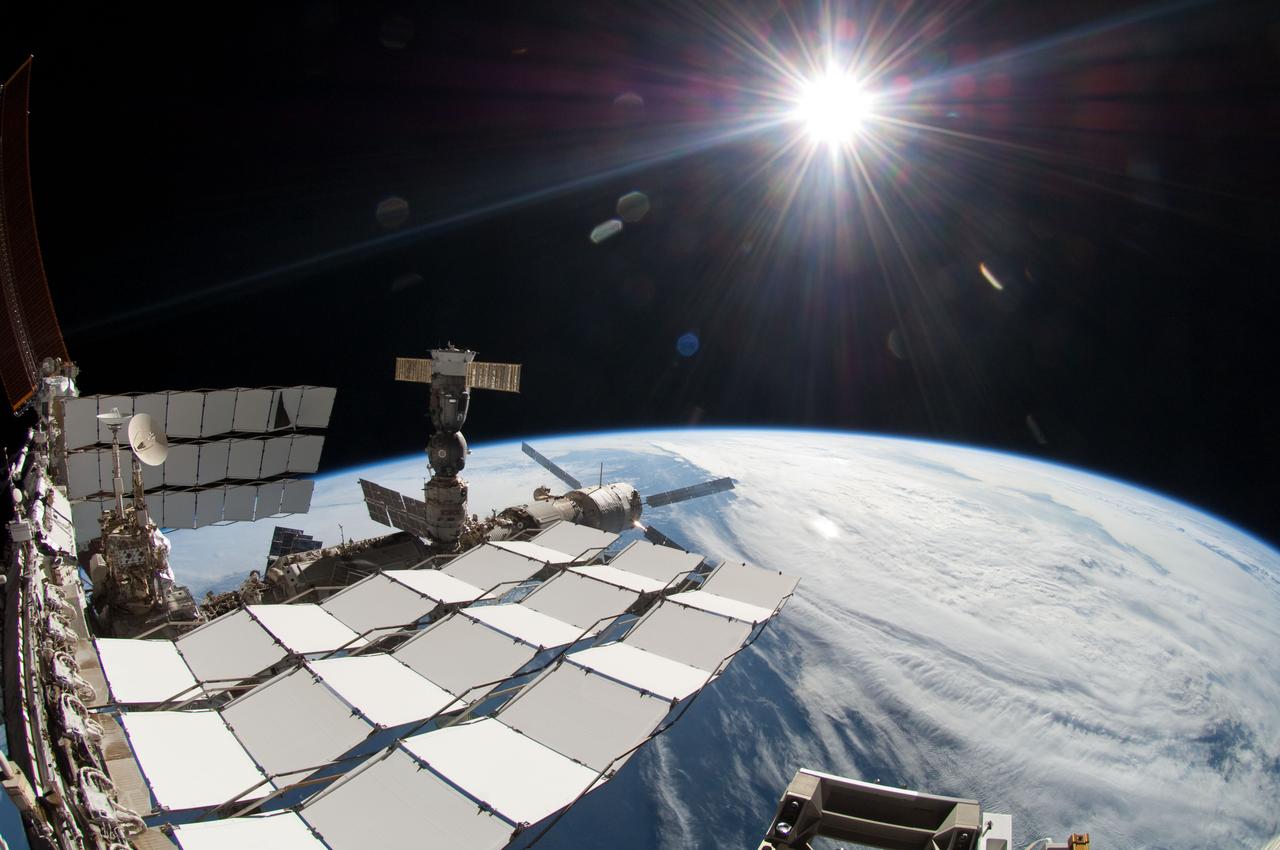
ISS028-E-005671 (27 May 2011) --- A bright sun, a portion of the International Space Station and Earth?s horizon are featured in this image photographed by a spacewalker, using a fish-eye lens attached to an electronic still camera, during the STS-134 mission?s fourth session of extravehicular activity (EVA).
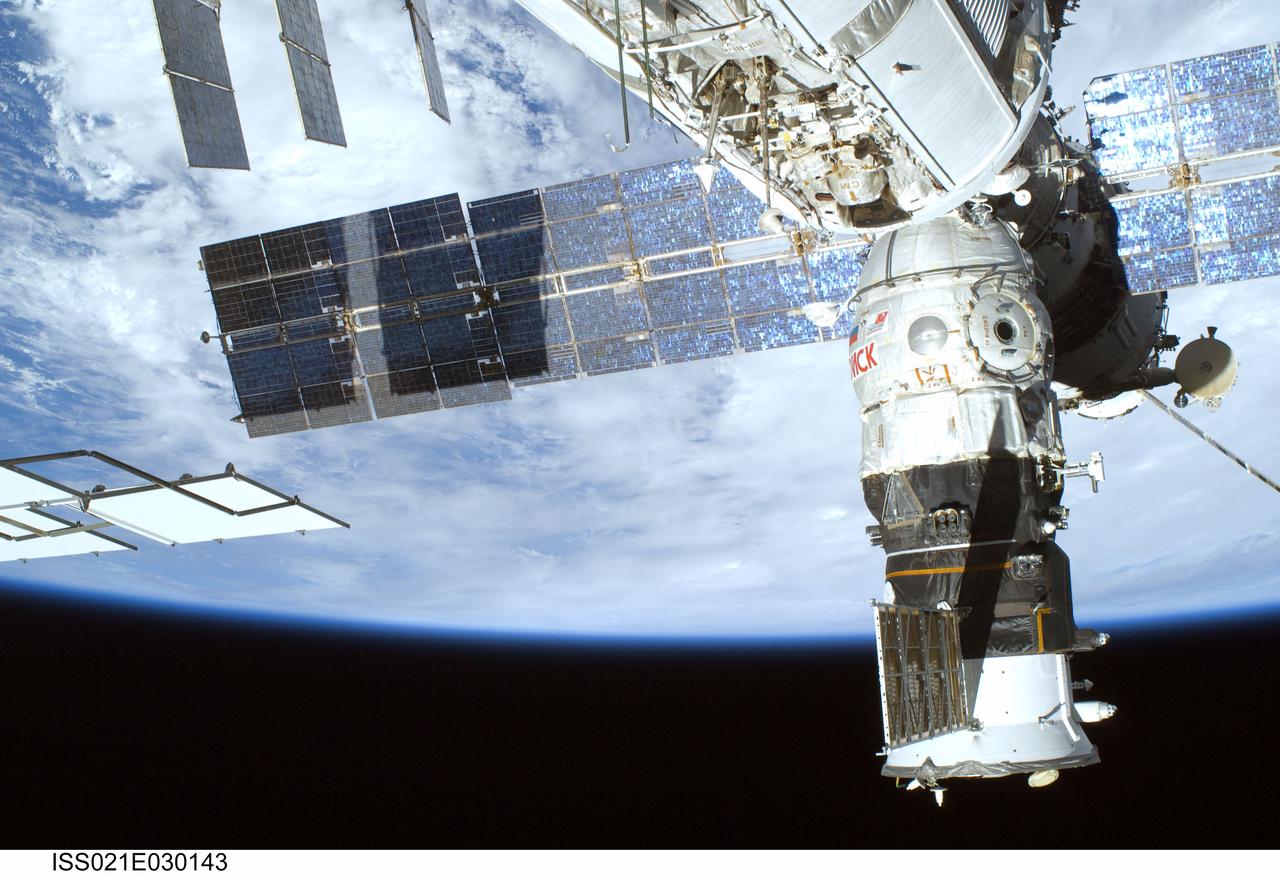
iss021e030143 (Nov. 19, 2009) --- The newly-arrived Poisk Mini-Research Module-2 is seen docked to the space-facing port of the forward section of the Zvezda service module. Attached to the rear of Poisk is the last stage of a Russian spacecraft that automatically guided and docked the module to the International Space Station. The Russian spacecraft would later undock from Poisk and deorbit for a fiery but safe destruction in Earth's atmosphere over the Pacific Ocean.
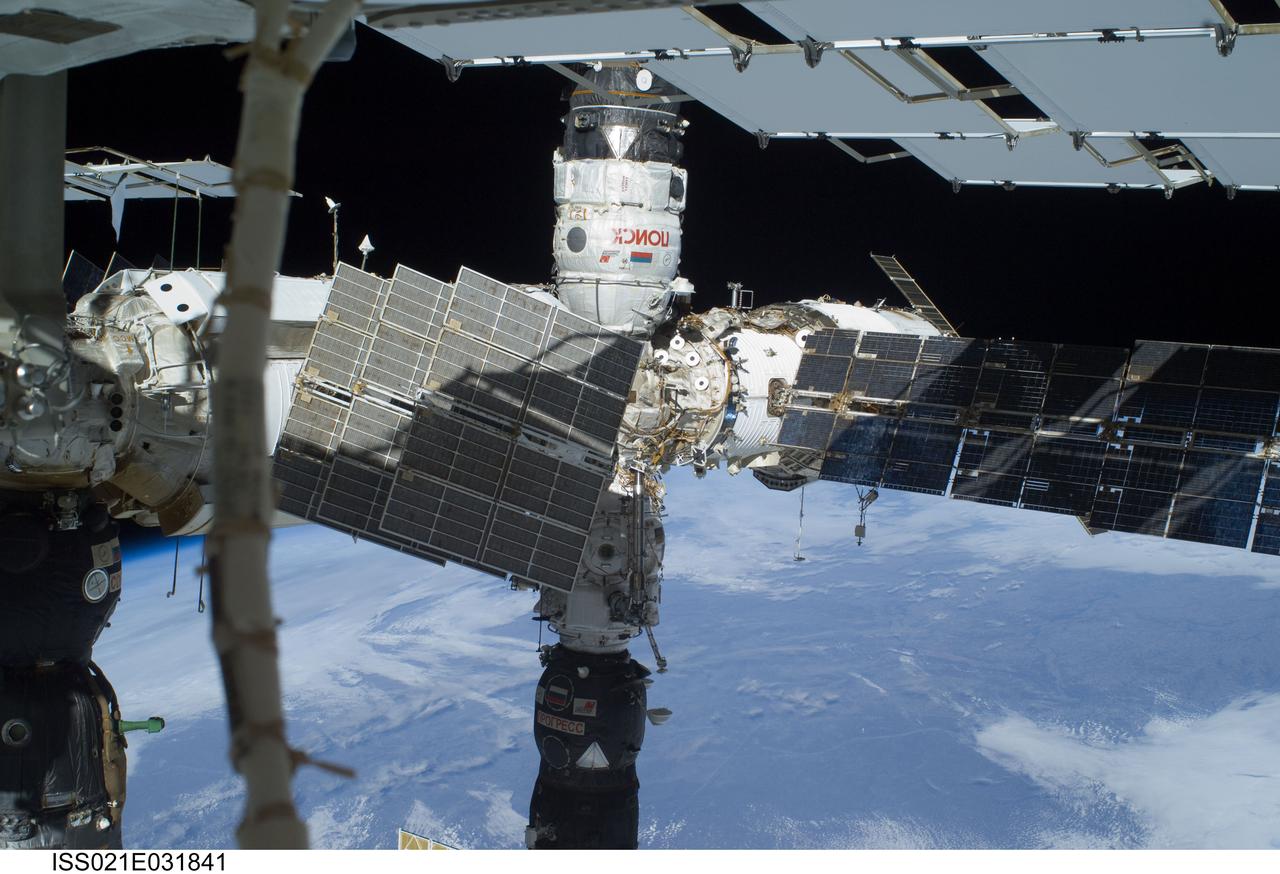
ISS021-E-031841 (23 Nov. 2009) --- The Russian segment of the International Space Station is featured in this image photographed by a space-walking astronaut during the third and final spacewalk for the STS-129 mission. The Poisk Mini Research Module 2 (MRM2), docked to the space-facing port of the Zvezda Service Module, is at top center; and a Progress resupply vehicle is docked to the Pirs Docking Compartment at bottom center. Zarya (partially obscured by solar panels) is at right center. Earth’s horizon and the blackness of space provide the backdrop for the scene.

ISS041-E-067002 (7 Oct. 2014) --- NASA astronaut Reid Wiseman, Expedition 41 flight engineer, participates in a session of extravehicular activity (EVA) as work continues on the International Space Station. During the six-hour, 13-minute spacewalk, Wiseman and European Space Agency astronaut Alexander Gerst (out of frame), flight engineer, worked outside the space station's Quest airlock relocating a failed cooling pump to external stowage and installing gear that provides back up power to external robotics equipment.
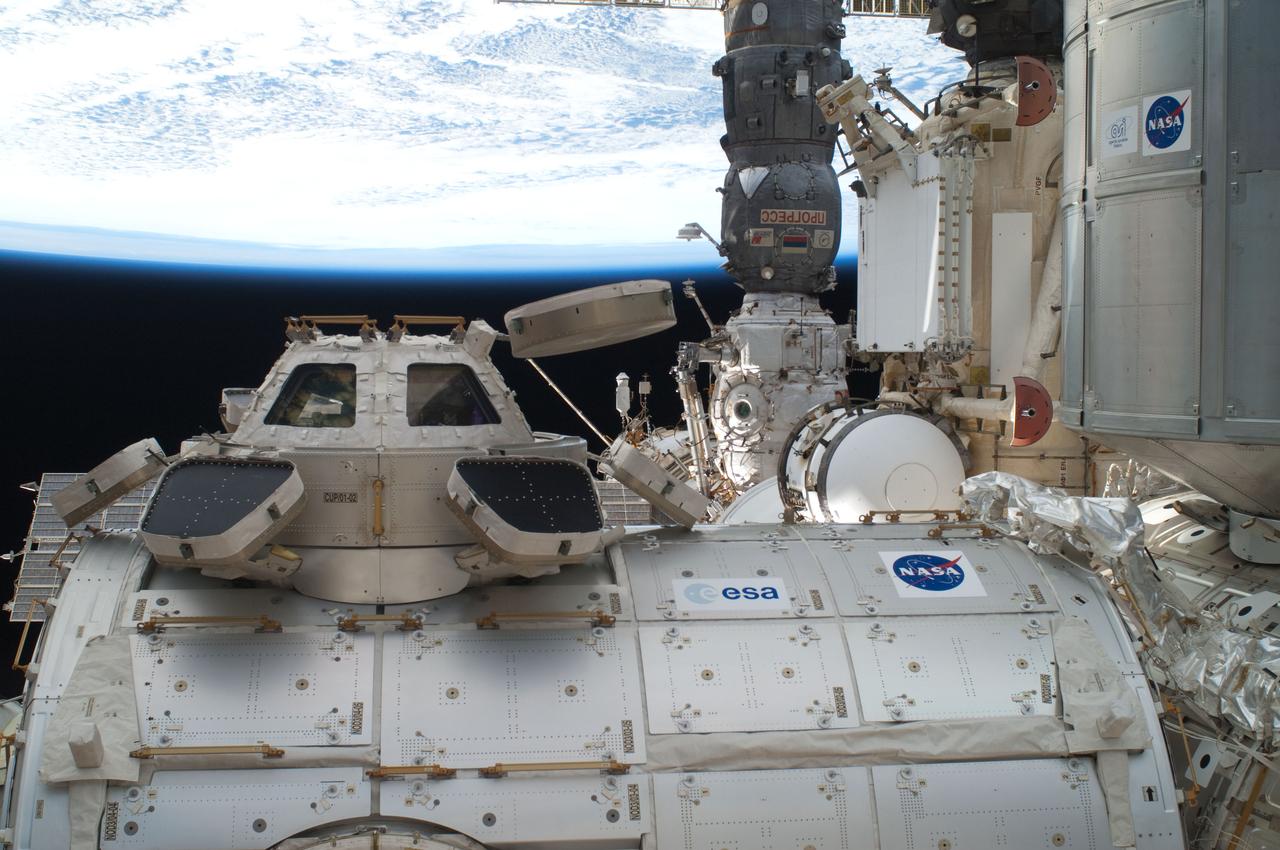
ISS028-E-016200 (12 July 2011) --- This medium wide view, photographed during a July 12 spacewalk, showing the International Space Station's Cupola, backdropped against black space, a horizon scene array and various components of the orbiting outpost, including Node 3 or Tranquility (on which the Cupola is mounted) and the Leonardo Permanent Multipurpose Module.
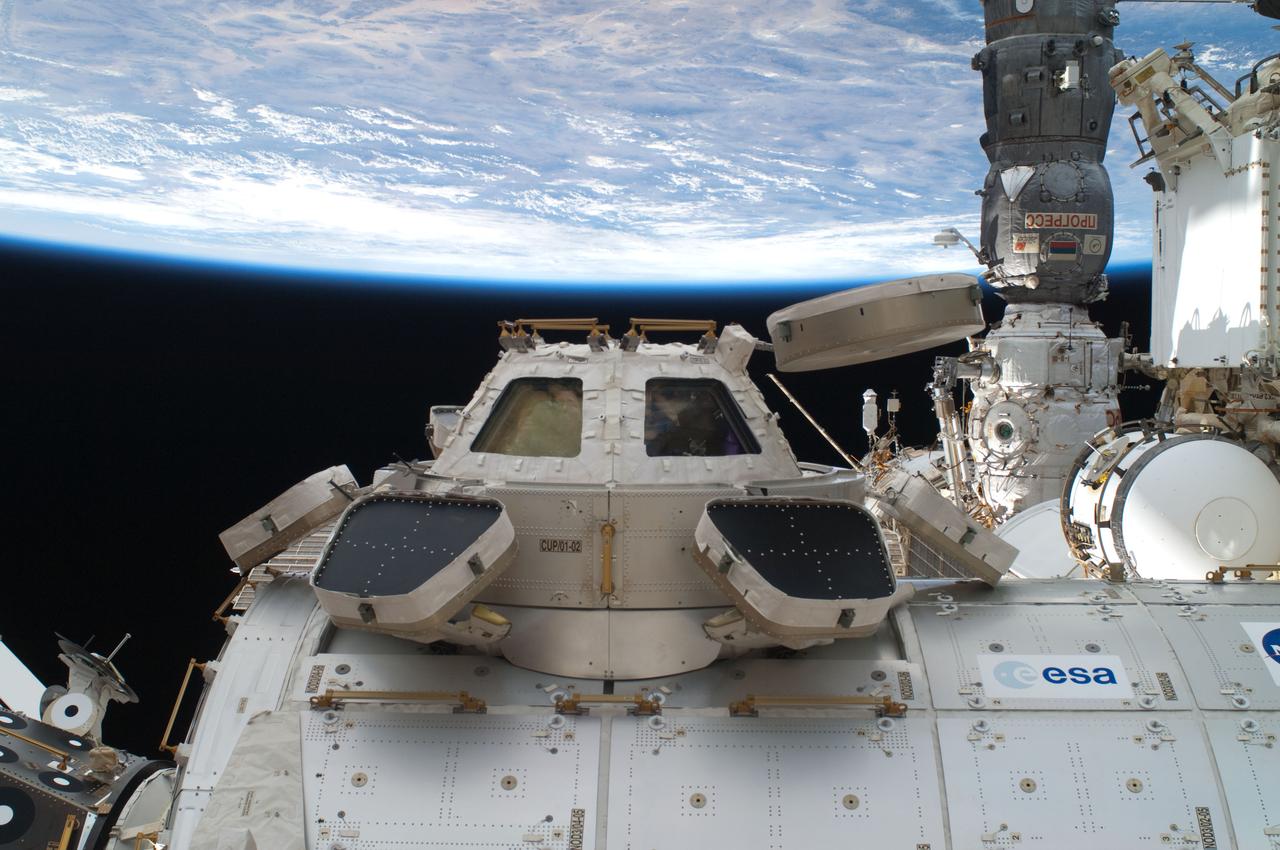
ISS028-E-016227 (12 July 2011) --- This is a high angle view showing the Cupola, backdropped against the darkness of space and Earth's horizon, and some components of the International Space Station. In some of the images in this series, faces of several of the Atlantis STS-135 and Expedition 28 crew members can be seen in the Cupola's windows.
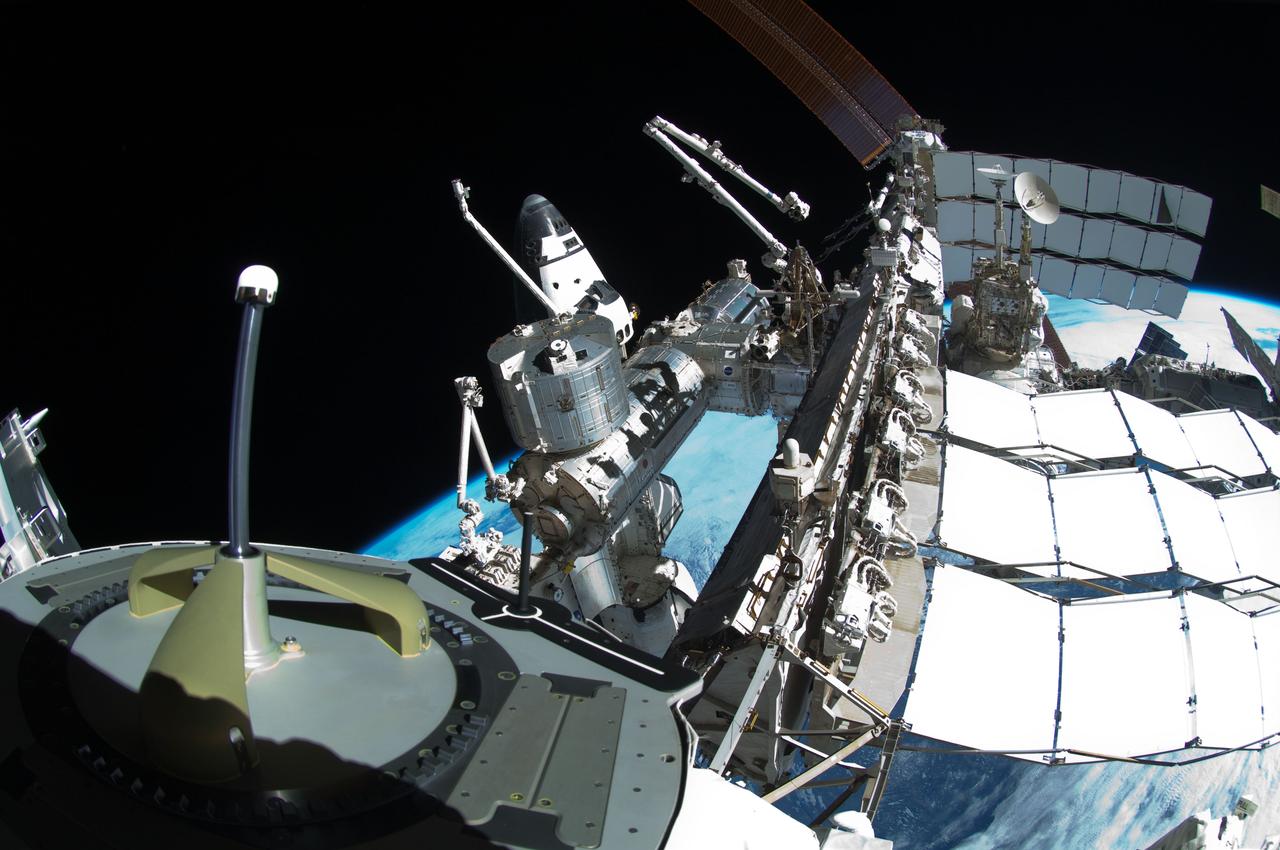
ISS028-E-005680 (27 May 2011) --- A portion of the International Space Station and the docked space shuttle Endeavour are featured in this image photographed by a spacewalker, using a fish-eye lens attached to an electronic still camera, during the STS-134 mission?s fourth session of extravehicular activity (EVA).

S118-E-07242 (14 Aug. 2007) --- Backdropped by the blackness of space and Earth's horizon, solar array wing panels on the International Space Station are featured in this image photographed by a crewmember while Space Shuttle Endeavour (STS-118) remains docked with the station.
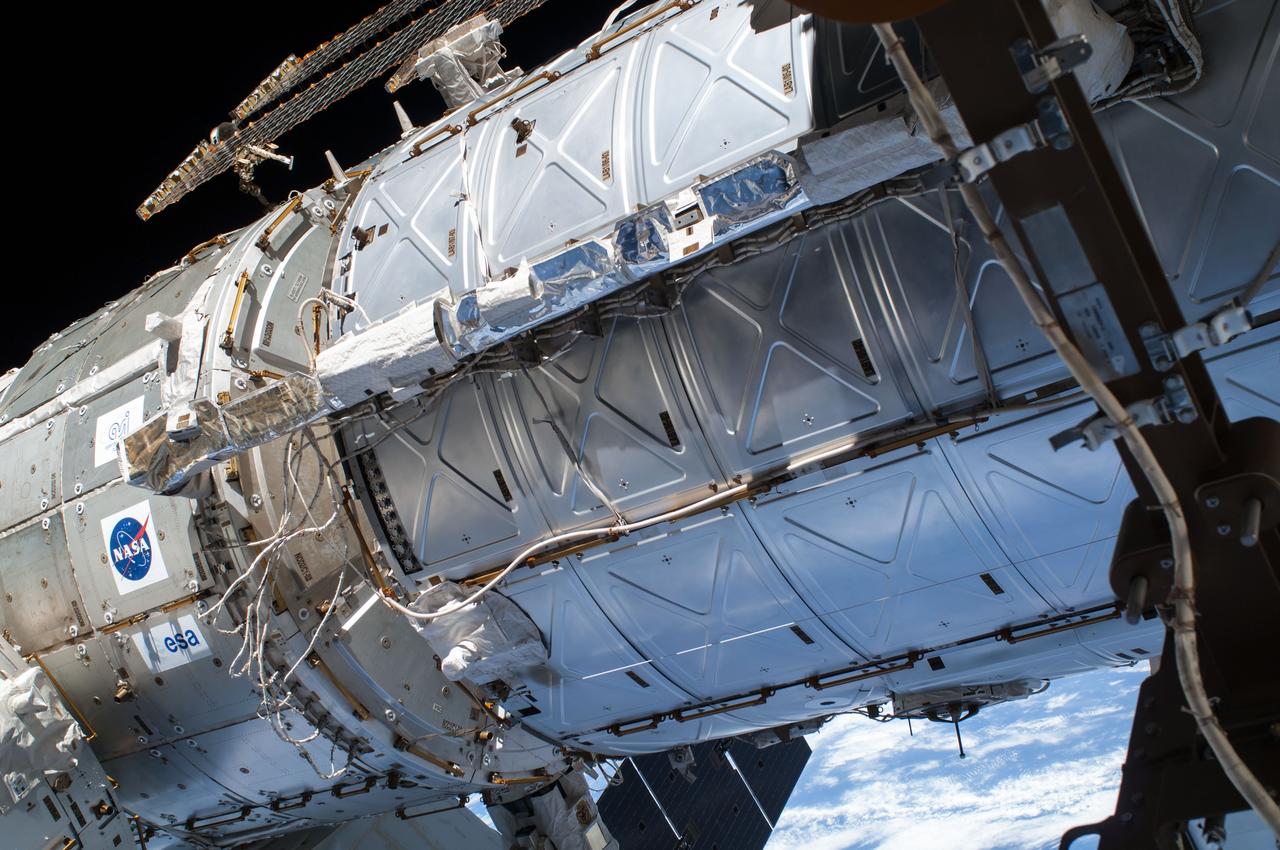
ISS041-E-067002 (7 Oct. 2014) --- NASA astronaut Reid Wiseman, Expedition 41 flight engineer, participates in a session of extravehicular activity (EVA) as work continues on the International Space Station. During the six-hour, 13-minute spacewalk, Wiseman and European Space Agency astronaut Alexander Gerst (out of frame), flight engineer, worked outside the space station's Quest airlock relocating a failed cooling pump to external stowage and installing gear that provides back up power to external robotics equipment.
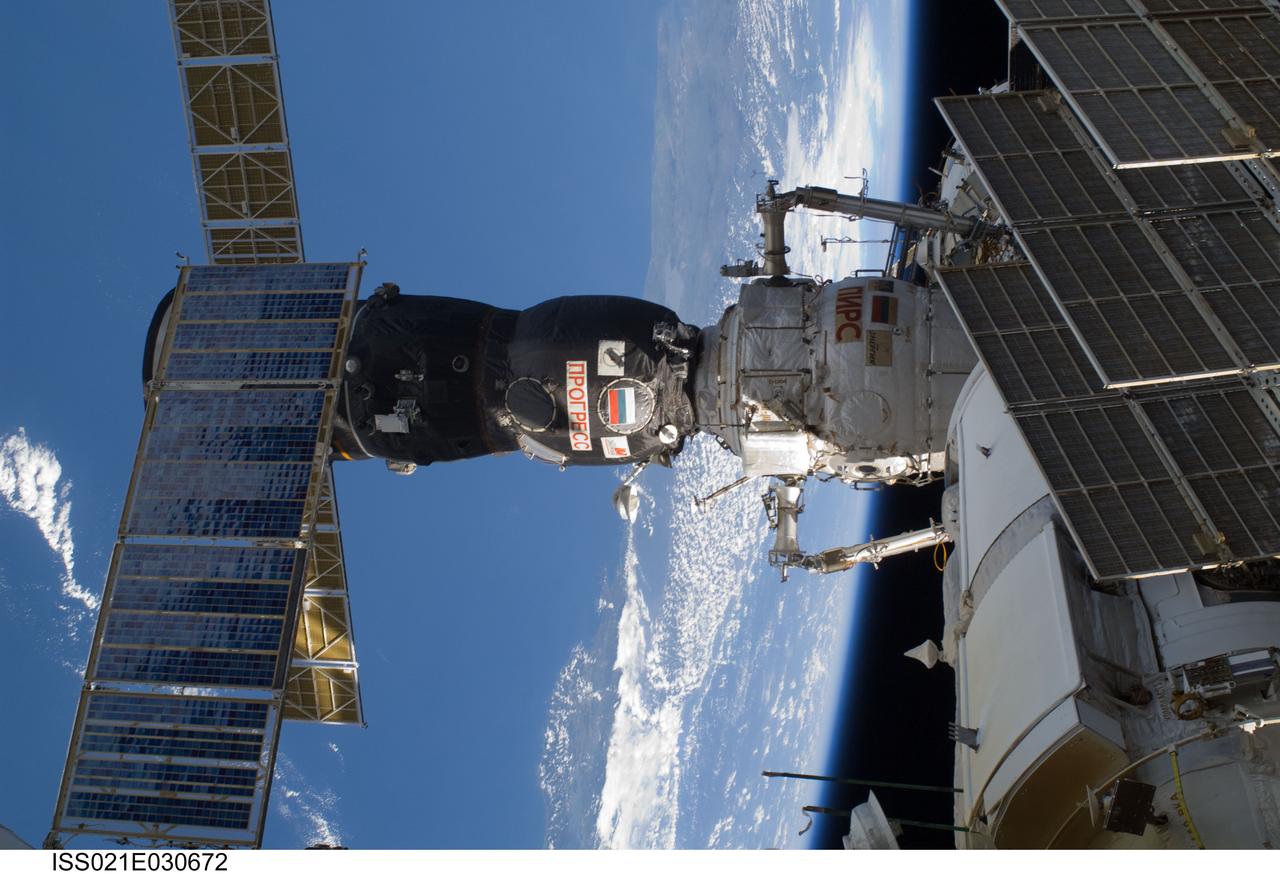
ISS021-E-030672 (21 Nov. 2009) --- Russia’s Progress 35P is docked to the Pirs Docking Compartment, photographed during the middle of three scheduled sessions of extravehicular activity (EVA) shared by the Atlantis STS-129 crew and the five crew members of Expedition 21.
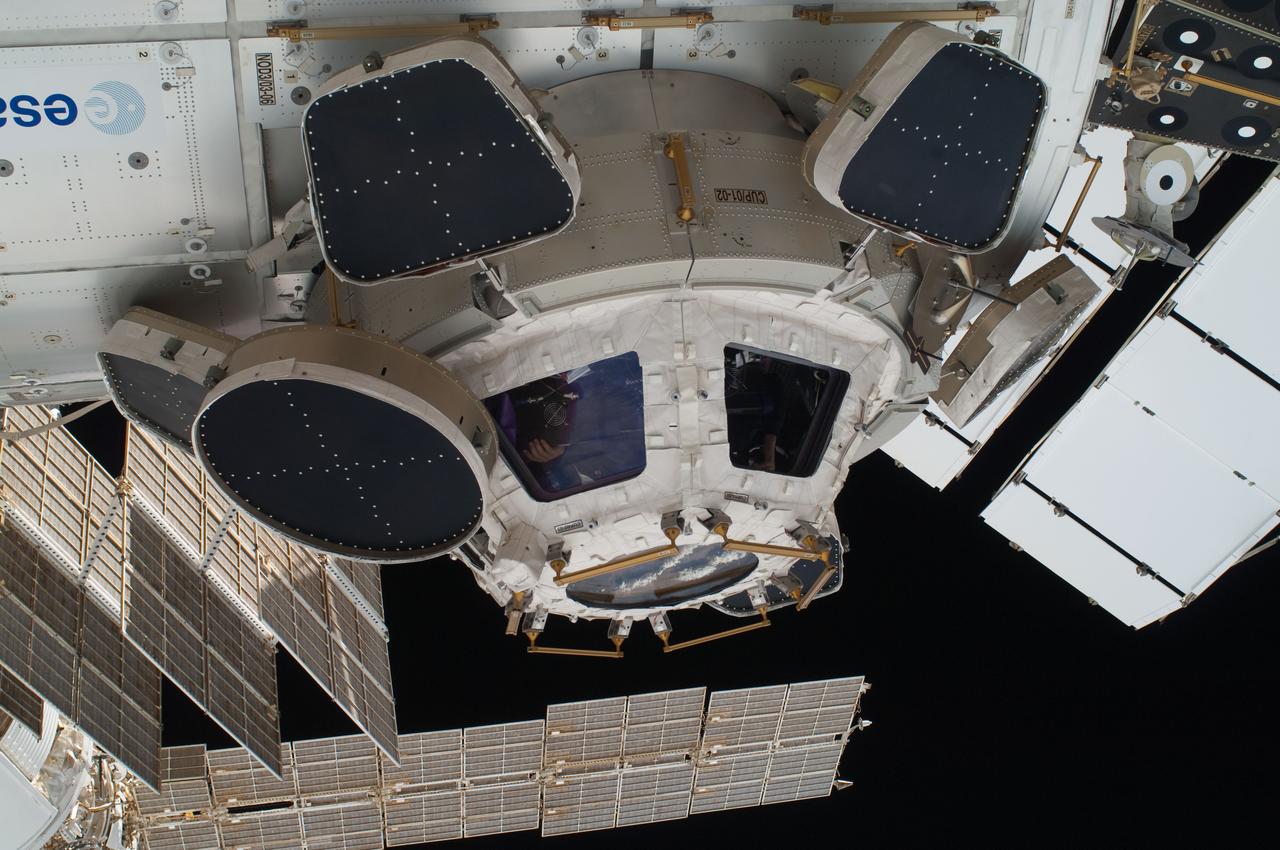
ISS028-E-016231 (12 July 2011) --- This July 12 view shows the Cupola, backdropped against the darkness of space and some parts of solar array panels, on the International Space Station. In some of the images in this series, faces of several of the Atlantis STS-135 and Expedition 28 crew members can be seen in the Cupola's windows.
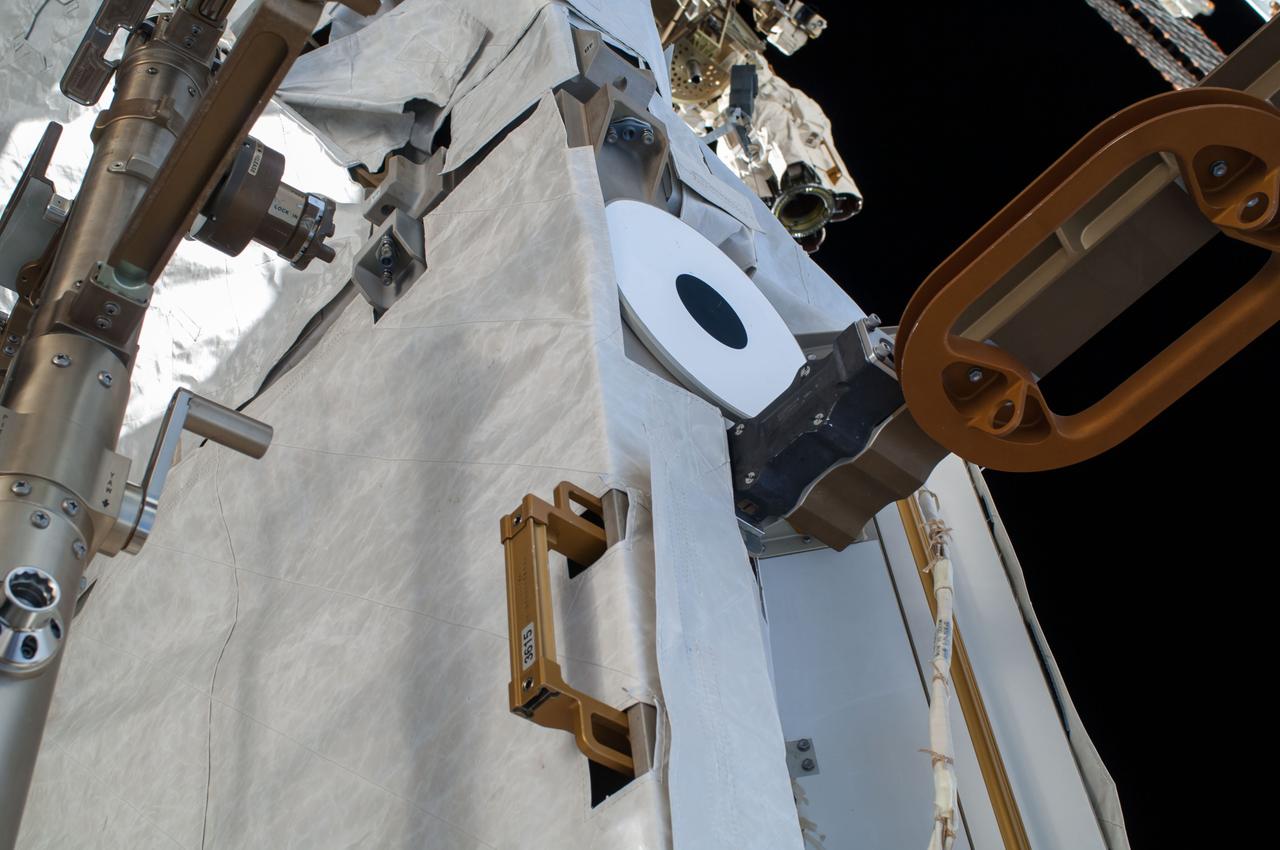
ISS041-E-067002 (7 Oct. 2014) --- NASA astronaut Reid Wiseman, Expedition 41 flight engineer, participates in a session of extravehicular activity (EVA) as work continues on the International Space Station. During the six-hour, 13-minute spacewalk, Wiseman and European Space Agency astronaut Alexander Gerst (out of frame), flight engineer, worked outside the space station's Quest airlock relocating a failed cooling pump to external stowage and installing gear that provides back up power to external robotics equipment.
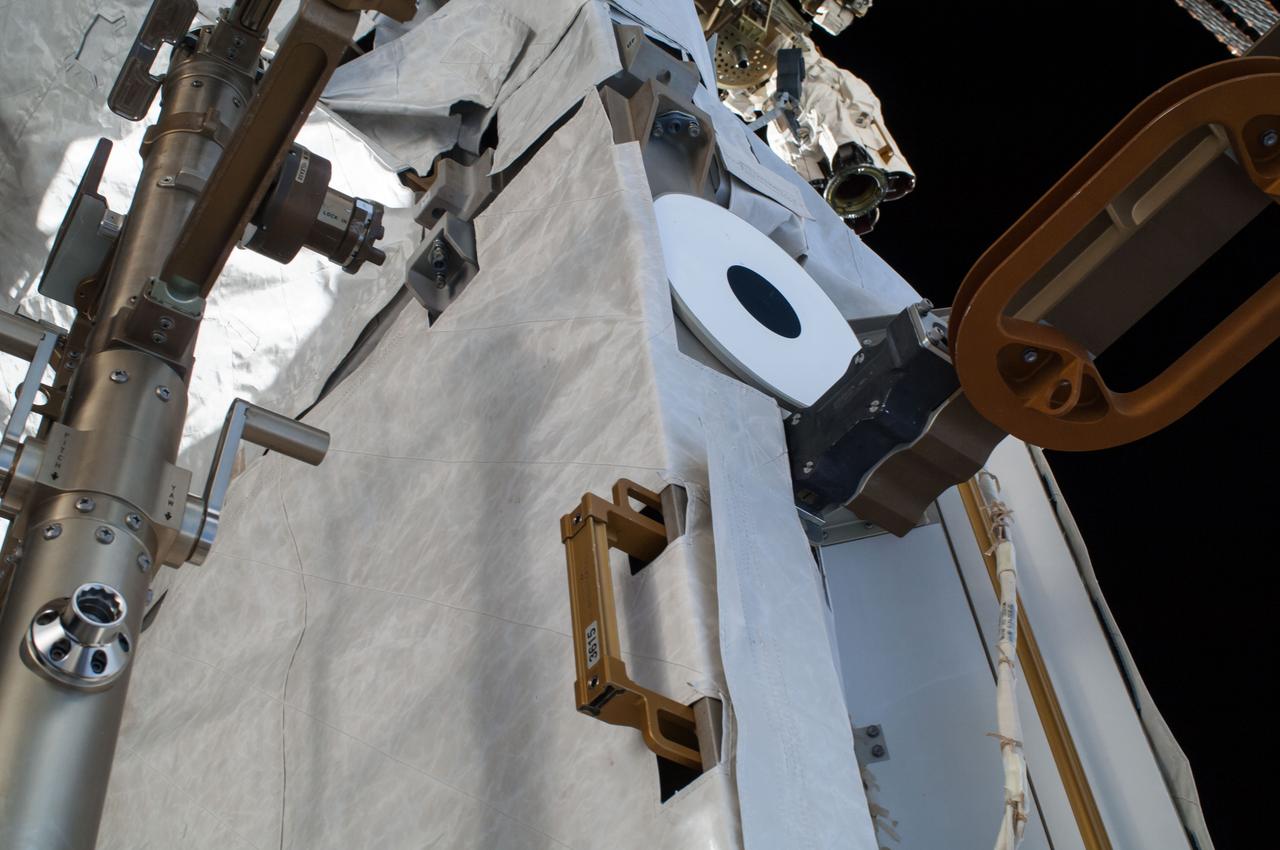
ISS041-E-067002 (7 Oct. 2014) --- NASA astronaut Reid Wiseman, Expedition 41 flight engineer, participates in a session of extravehicular activity (EVA) as work continues on the International Space Station. During the six-hour, 13-minute spacewalk, Wiseman and European Space Agency astronaut Alexander Gerst (out of frame), flight engineer, worked outside the space station's Quest airlock relocating a failed cooling pump to external stowage and installing gear that provides back up power to external robotics equipment.
ISS041-E-067002 (7 Oct. 2014) --- NASA astronaut Reid Wiseman, Expedition 41 flight engineer, participates in a session of extravehicular activity (EVA) as work continues on the International Space Station. During the six-hour, 13-minute spacewalk, Wiseman and European Space Agency astronaut Alexander Gerst (out of frame), flight engineer, worked outside the space station's Quest airlock relocating a failed cooling pump to external stowage and installing gear that provides back up power to external robotics equipment.
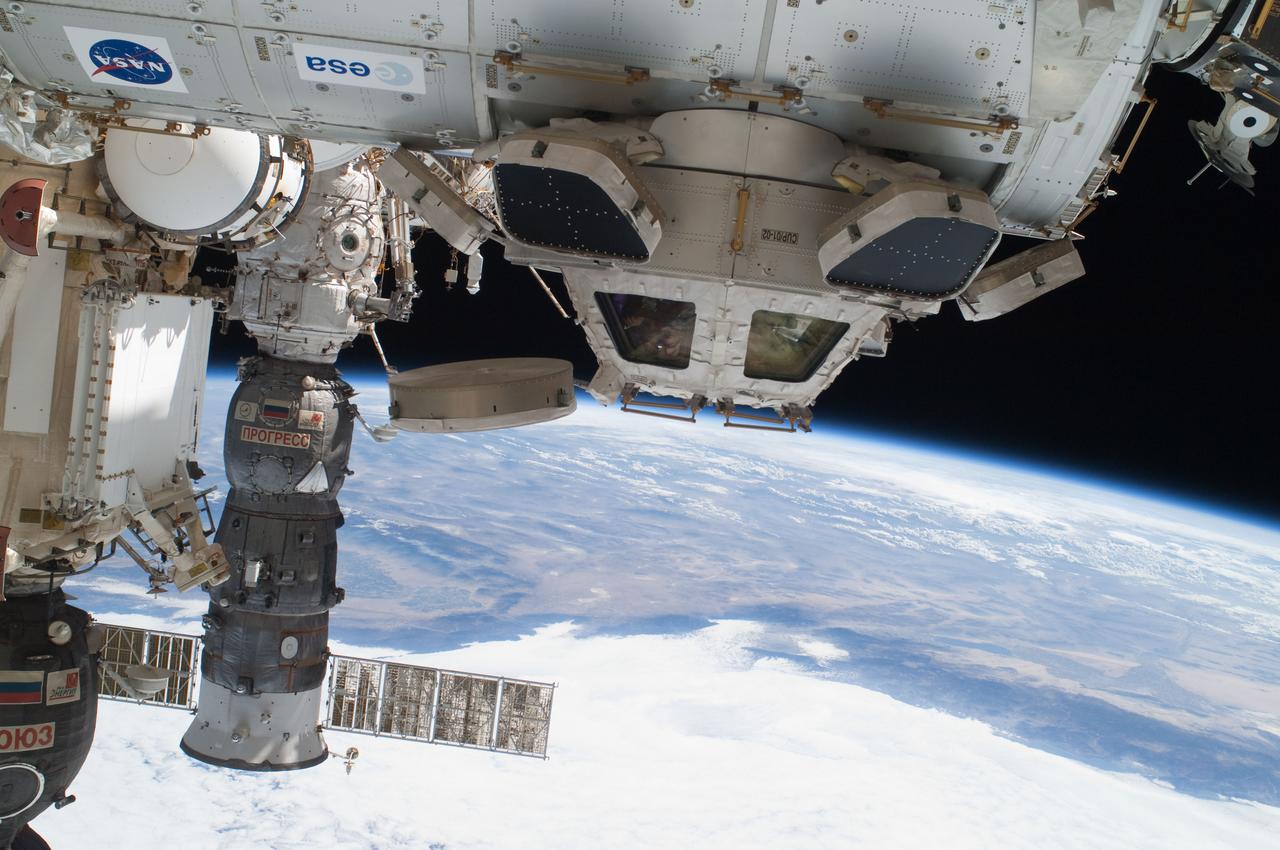
ISS028-E-016225 (12 July 2011) --- Components of the International Space Station, though moving along at 17,500 miles per hour, appear to hover above the Pacific Ocean just off the California coast. Ten cosmonauts and astronauts were working together when this photo was taken -- four of them as STS-135 visitors from the docked space shuttle Atlantis and six as members of the Expedition 28 crew. The Cupola, near center of frame, is attached to Node 3 or Tranquility. A Russian Soyuz and a Russian Progress spacecraft are parked at the station, left side of frame. While much of the coast is obscured by clouds, just inland from left to right, one can see the agriculture of the San Joaquin Valley, the southern Sierra Nevada, the Los Angeles Basin (center), the Mojave Desert, coastal mountains of southern California, the Salton Sea, the Imperial Valley, and the mouth of the Colorado River on the extreme right edge.
ISS041-E-067002 (7 Oct. 2014) --- NASA astronaut Reid Wiseman, Expedition 41 flight engineer, participates in a session of extravehicular activity (EVA) as work continues on the International Space Station. During the six-hour, 13-minute spacewalk, Wiseman and European Space Agency astronaut Alexander Gerst (out of frame), flight engineer, worked outside the space station's Quest airlock relocating a failed cooling pump to external stowage and installing gear that provides back up power to external robotics equipment.
ISS041-E-067002 (7 Oct. 2014) --- NASA astronaut Reid Wiseman, Expedition 41 flight engineer, participates in a session of extravehicular activity (EVA) as work continues on the International Space Station. During the six-hour, 13-minute spacewalk, Wiseman and European Space Agency astronaut Alexander Gerst (out of frame), flight engineer, worked outside the space station's Quest airlock relocating a failed cooling pump to external stowage and installing gear that provides back up power to external robotics equipment.
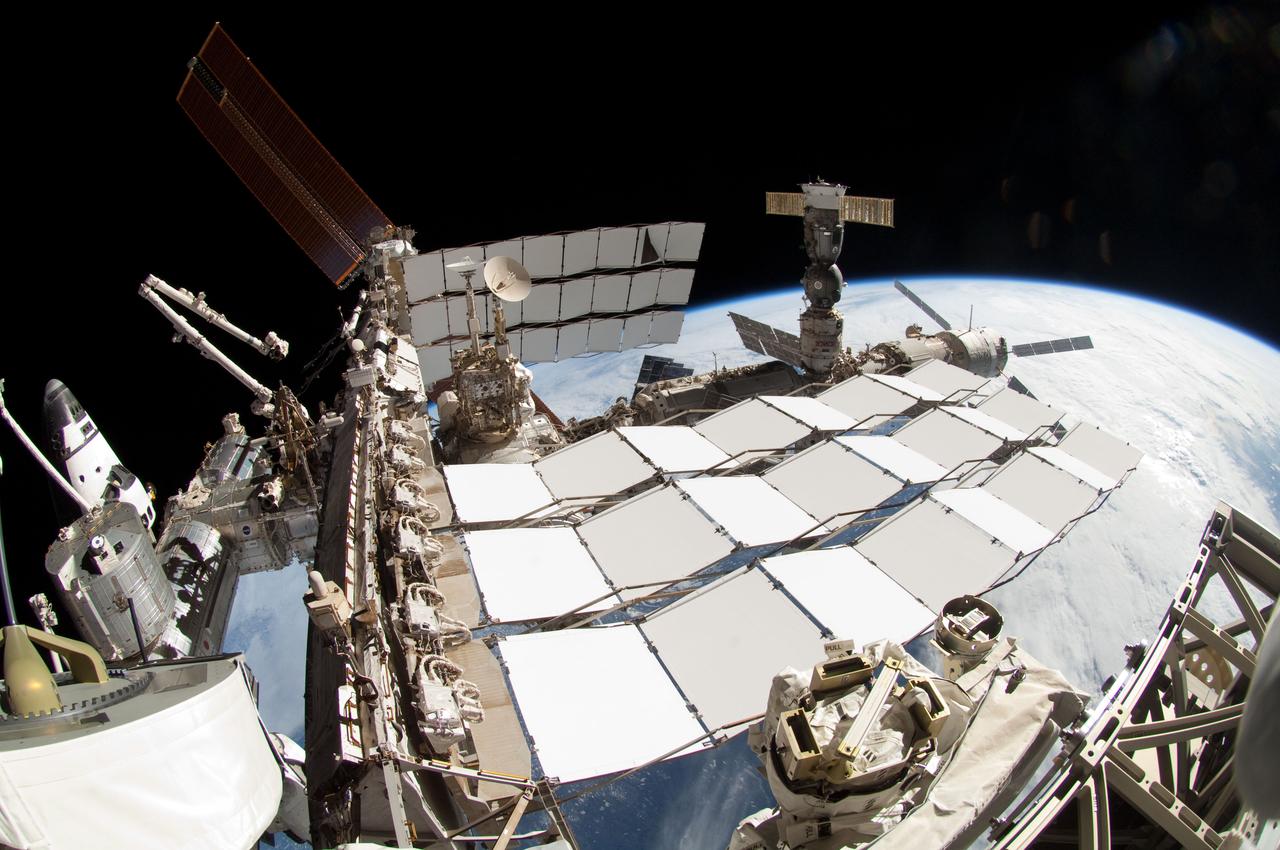
ISS028-E-005676 (27 May 2011) --- A portion of the International Space Station and the docked space shuttle Endeavour (left) are featured in this image photographed by a spacewalker, using a fish-eye lens attached to an electronic still camera, during the STS-134 mission?s fourth session of extravehicular activity (EVA). Earth?s horizon and the blackness of space provide the backdrop for the scene.
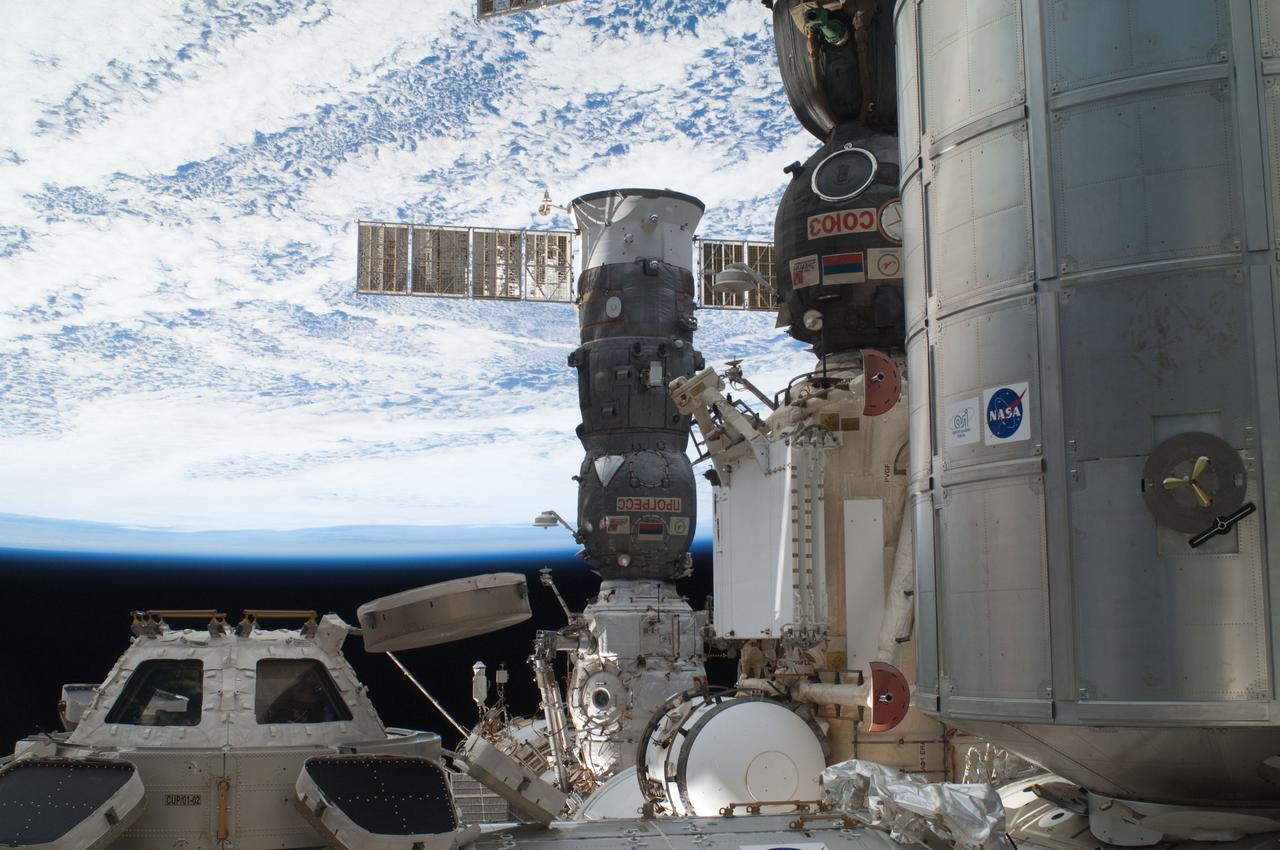
ISS028-E-016202 (12 July 2011) --- This medium wide view, photographed during a July 12 spacewalk, shows the International Space Station's Cupola, backdropped against black space, a horizon scene and various components of the orbiting outpost, including the Leonardo Permanent Multipurpose Module, right, along with two "parked" Russian spacecraft -- a Soyuz and a progress supply ship. Node 3 or Tranquility (on which the Cupola is mounted) is just out of frame, bottom.
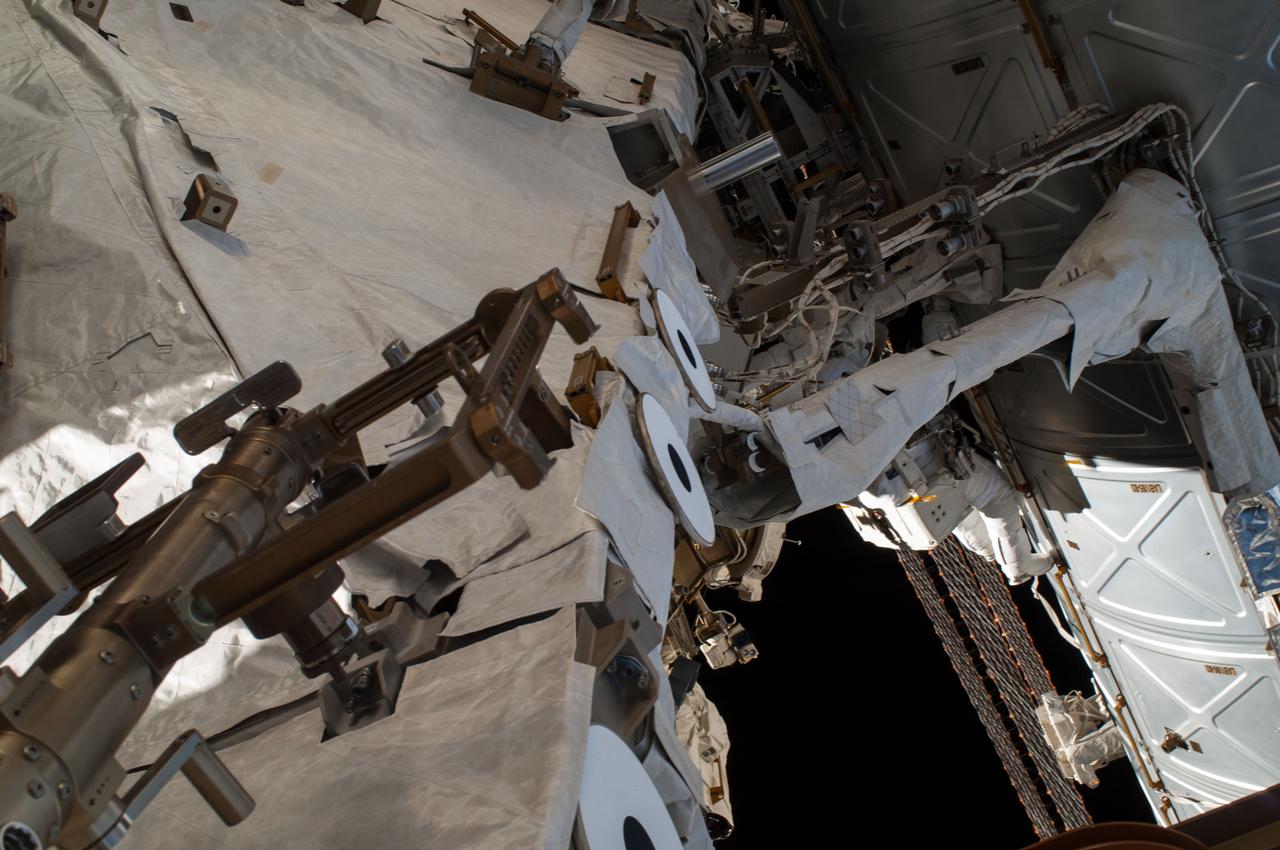
ISS041-E-067002 (7 Oct. 2014) --- NASA astronaut Reid Wiseman, Expedition 41 flight engineer, participates in a session of extravehicular activity (EVA) as work continues on the International Space Station. During the six-hour, 13-minute spacewalk, Wiseman and European Space Agency astronaut Alexander Gerst (out of frame), flight engineer, worked outside the space station's Quest airlock relocating a failed cooling pump to external stowage and installing gear that provides back up power to external robotics equipment.
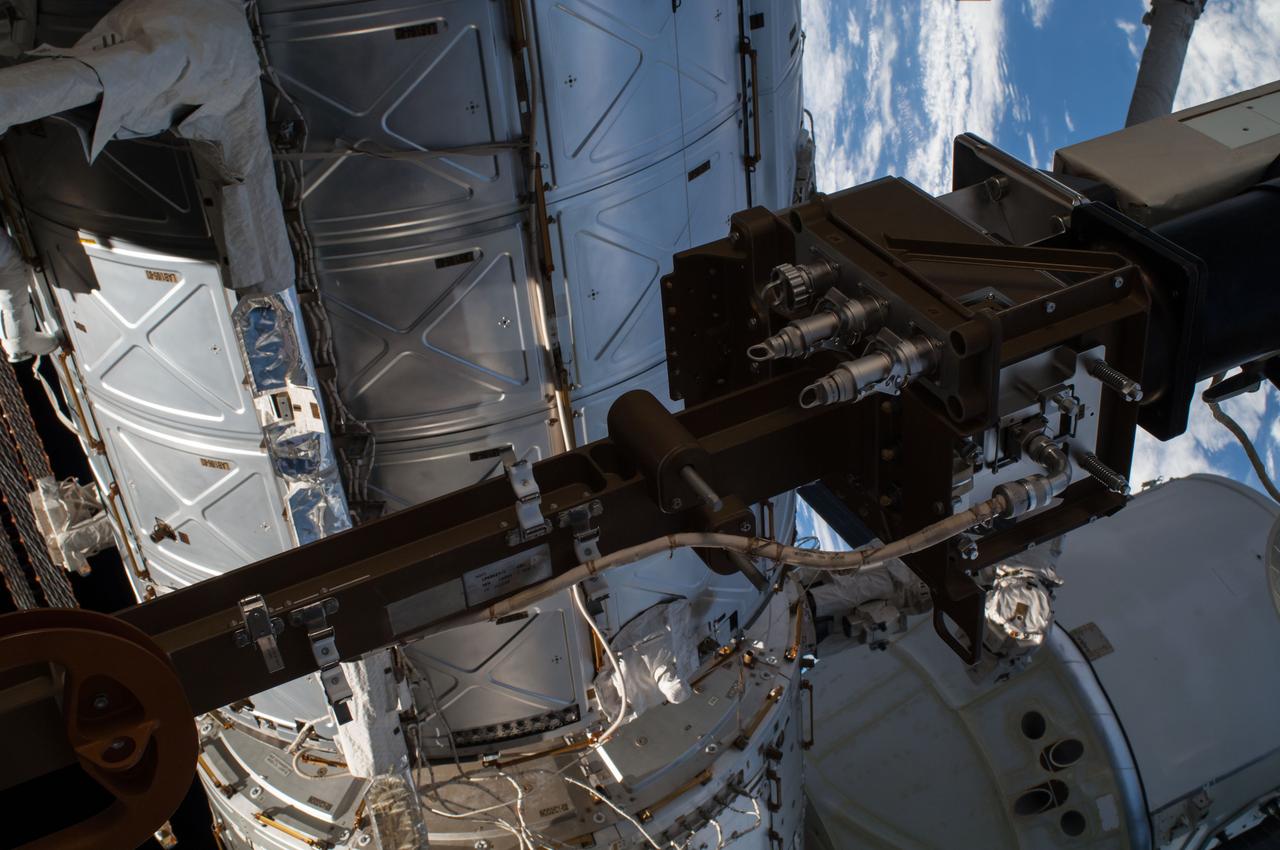
ISS041-E-067002 (7 Oct. 2014) --- NASA astronaut Reid Wiseman, Expedition 41 flight engineer, participates in a session of extravehicular activity (EVA) as work continues on the International Space Station. During the six-hour, 13-minute spacewalk, Wiseman and European Space Agency astronaut Alexander Gerst (out of frame), flight engineer, worked outside the space station's Quest airlock relocating a failed cooling pump to external stowage and installing gear that provides back up power to external robotics equipment.

S118-E-05984 (10 Aug. 2007) --- A crewmember on the Space Shuttle Endeavour took this picture of a portion of the International Space Station or the STS-118 crewmembers' home for the next several days during rendezvous and docking activities. The Canadarm2 or robot arm supporting the space station is the focal feature in the frame.
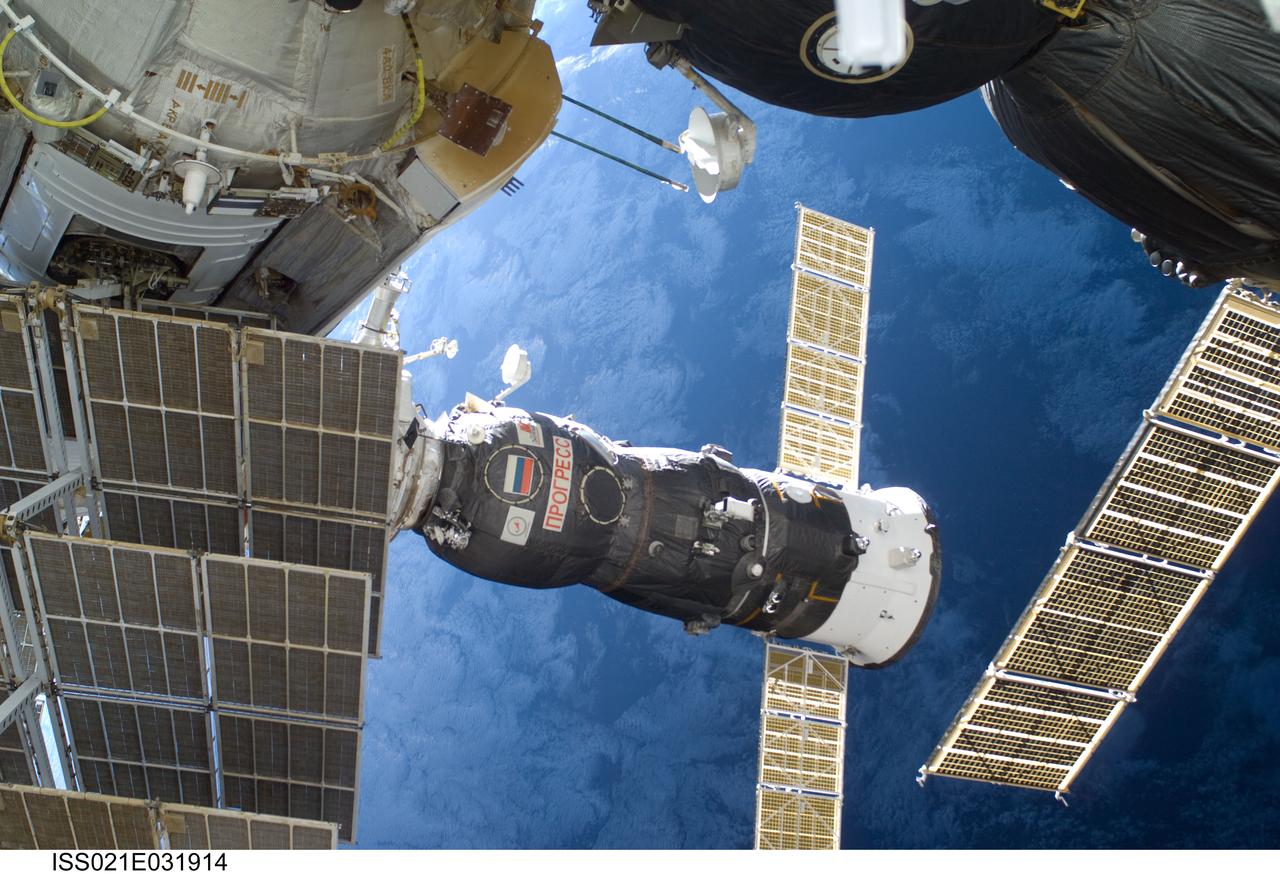
ISS021-E-031914 (23 Nov. 2009) --- A Russian Progress resupply vehicle docked to the International Space Station is featured in this image photographed by an Expedition 21 crew member while space shuttle Atlantis (STS-129) remains docked with the station. A blue part of Earth provides the backdrop for the scene.
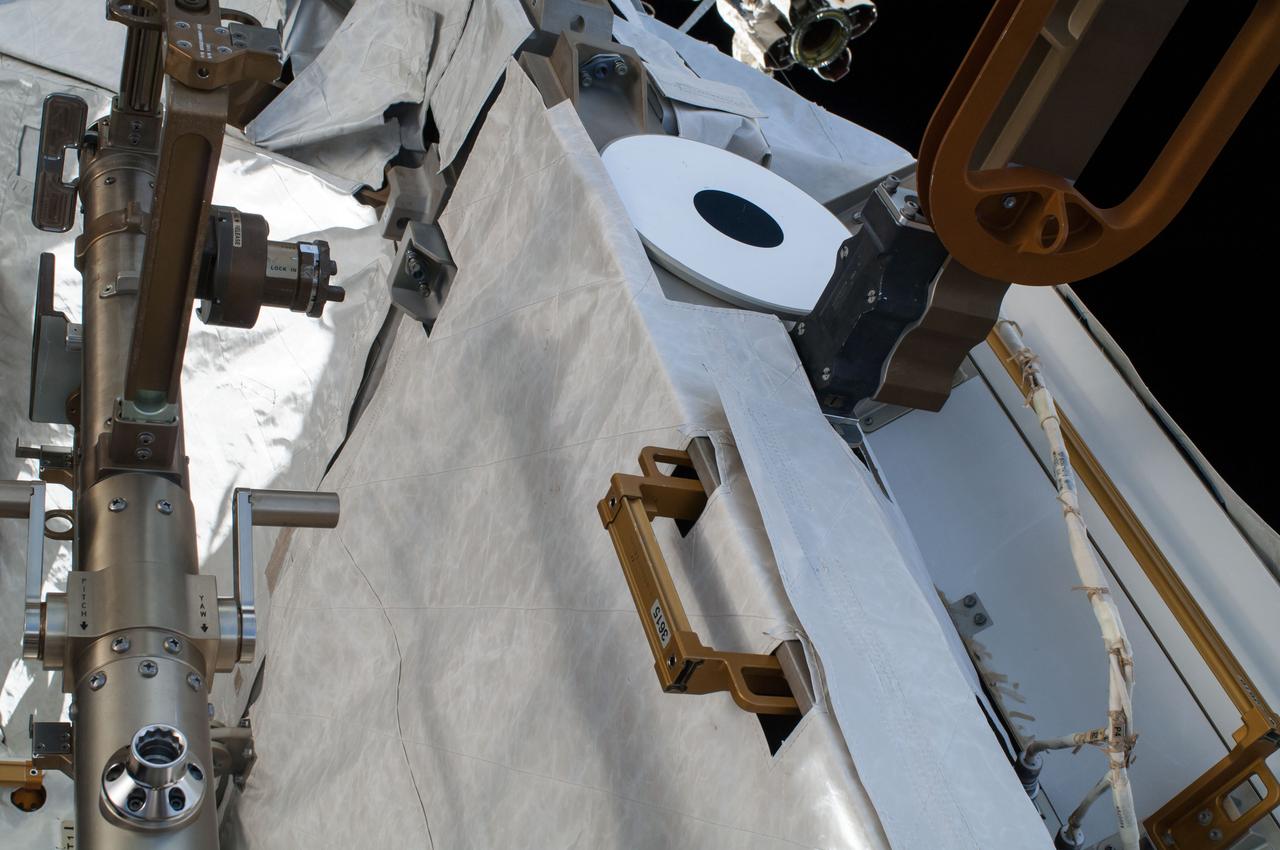
ISS041-E-067002 (7 Oct. 2014) --- NASA astronaut Reid Wiseman, Expedition 41 flight engineer, participates in a session of extravehicular activity (EVA) as work continues on the International Space Station. During the six-hour, 13-minute spacewalk, Wiseman and European Space Agency astronaut Alexander Gerst (out of frame), flight engineer, worked outside the space station's Quest airlock relocating a failed cooling pump to external stowage and installing gear that provides back up power to external robotics equipment.
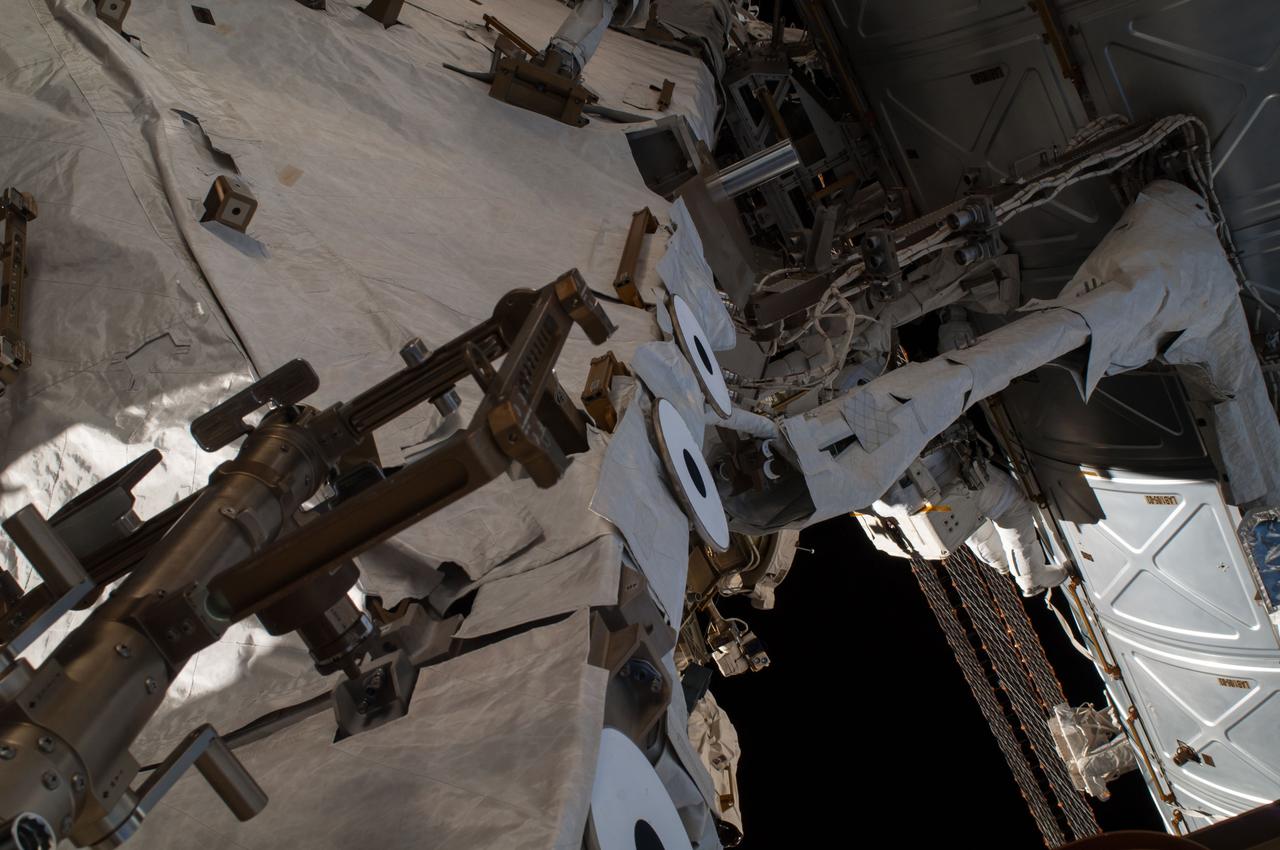
ISS041-E-067002 (7 Oct. 2014) --- NASA astronaut Reid Wiseman, Expedition 41 flight engineer, participates in a session of extravehicular activity (EVA) as work continues on the International Space Station. During the six-hour, 13-minute spacewalk, Wiseman and European Space Agency astronaut Alexander Gerst (out of frame), flight engineer, worked outside the space station's Quest airlock relocating a failed cooling pump to external stowage and installing gear that provides back up power to external robotics equipment.
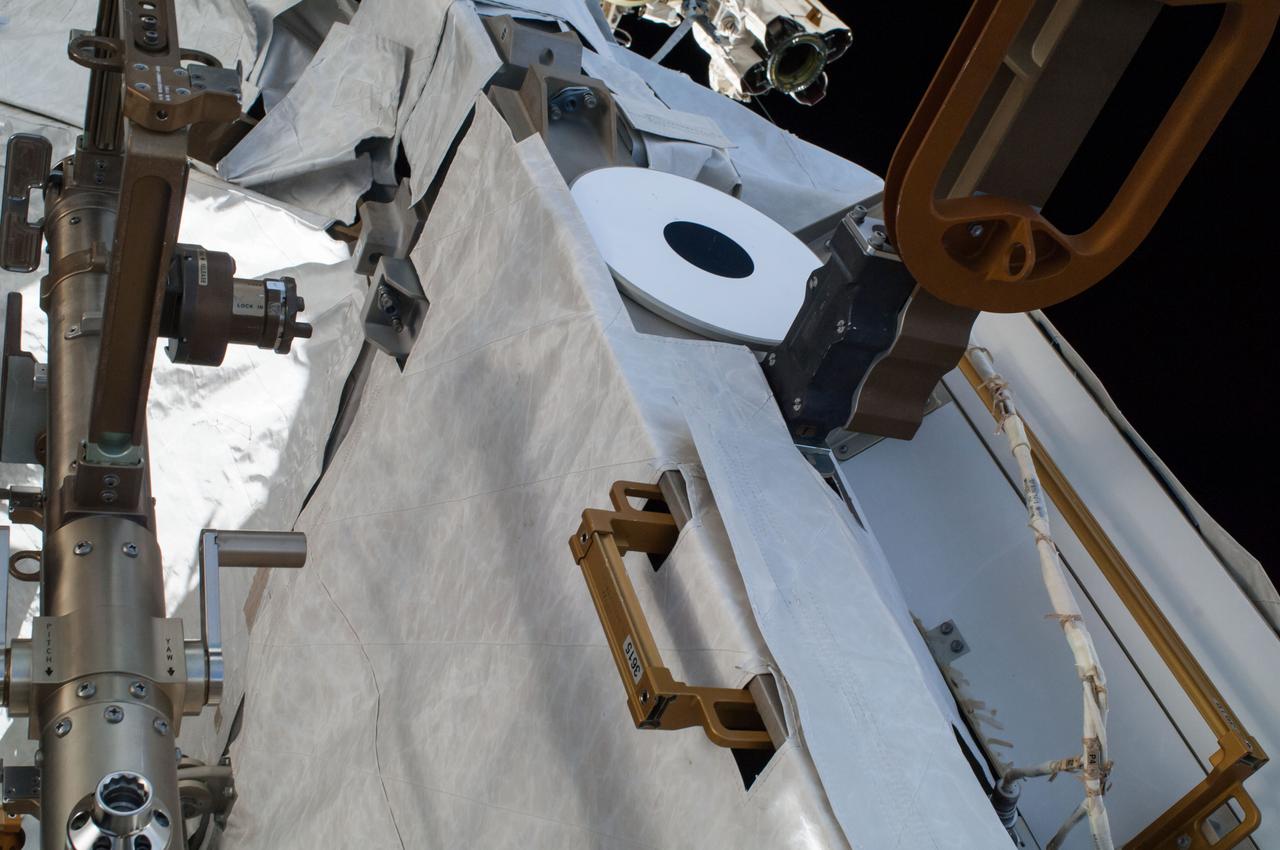
ISS041-E-067002 (7 Oct. 2014) --- NASA astronaut Reid Wiseman, Expedition 41 flight engineer, participates in a session of extravehicular activity (EVA) as work continues on the International Space Station. During the six-hour, 13-minute spacewalk, Wiseman and European Space Agency astronaut Alexander Gerst (out of frame), flight engineer, worked outside the space station's Quest airlock relocating a failed cooling pump to external stowage and installing gear that provides back up power to external robotics equipment.
ISS041-E-067002 (7 Oct. 2014) --- NASA astronaut Reid Wiseman, Expedition 41 flight engineer, participates in a session of extravehicular activity (EVA) as work continues on the International Space Station. During the six-hour, 13-minute spacewalk, Wiseman and European Space Agency astronaut Alexander Gerst (out of frame), flight engineer, worked outside the space station's Quest airlock relocating a failed cooling pump to external stowage and installing gear that provides back up power to external robotics equipment.

ISS028-E-016274 (12 July 2011) --- Parked vehicles on the International Space Station are a constant scene, often numbering several at a time. Here, a Russian Soyuz is seen in the foreground and a Russian Progress supply ship in the background. The Permanent Multipurpose Module is at the bottom of the frame. Out of frame, another vehicle -- the space shuttle Atlantis --is also parked to the orbital outpost, as its four STS-135 crewmembers work inside the station and shuttle.
ISS041-E-067002 (7 Oct. 2014) --- NASA astronaut Reid Wiseman, Expedition 41 flight engineer, participates in a session of extravehicular activity (EVA) as work continues on the International Space Station. During the six-hour, 13-minute spacewalk, Wiseman and European Space Agency astronaut Alexander Gerst (out of frame), flight engineer, worked outside the space station's Quest airlock relocating a failed cooling pump to external stowage and installing gear that provides back up power to external robotics equipment.
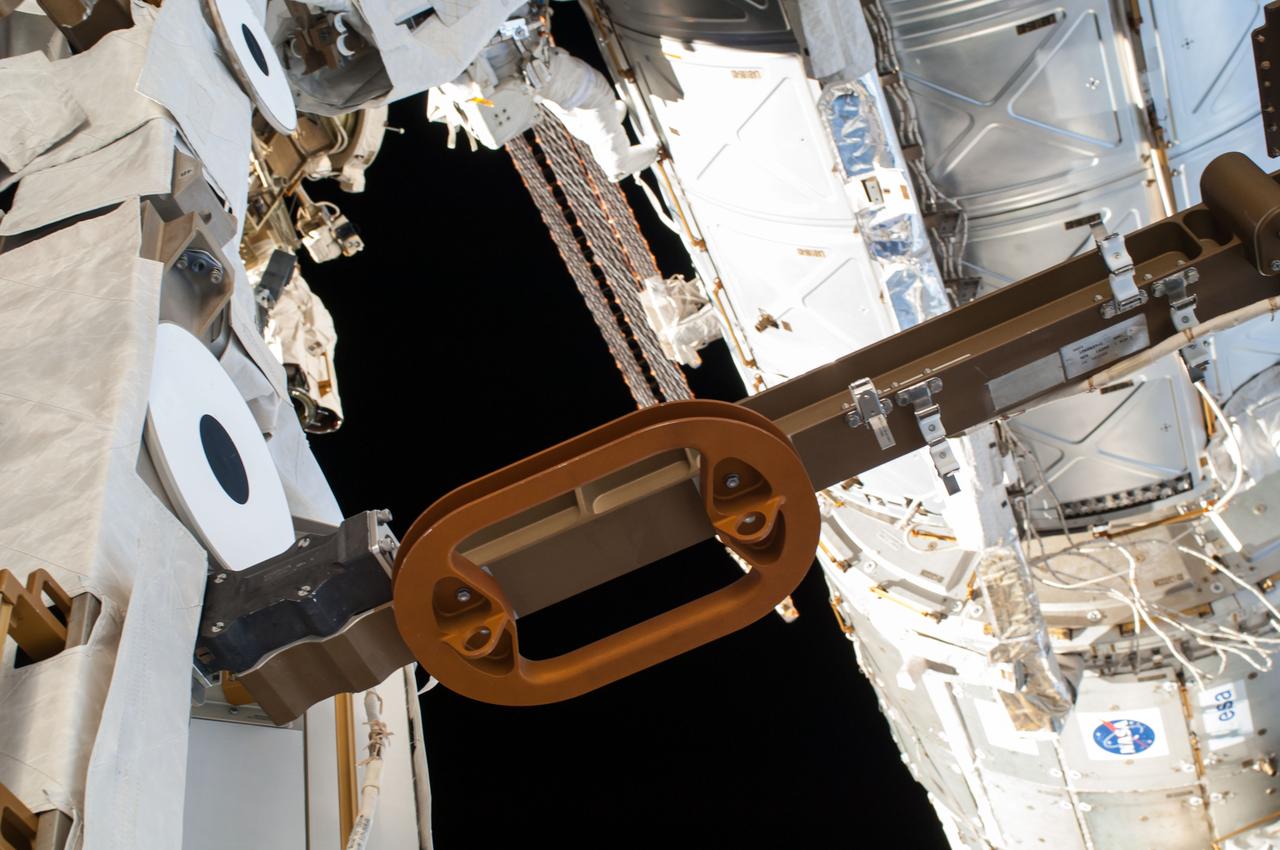
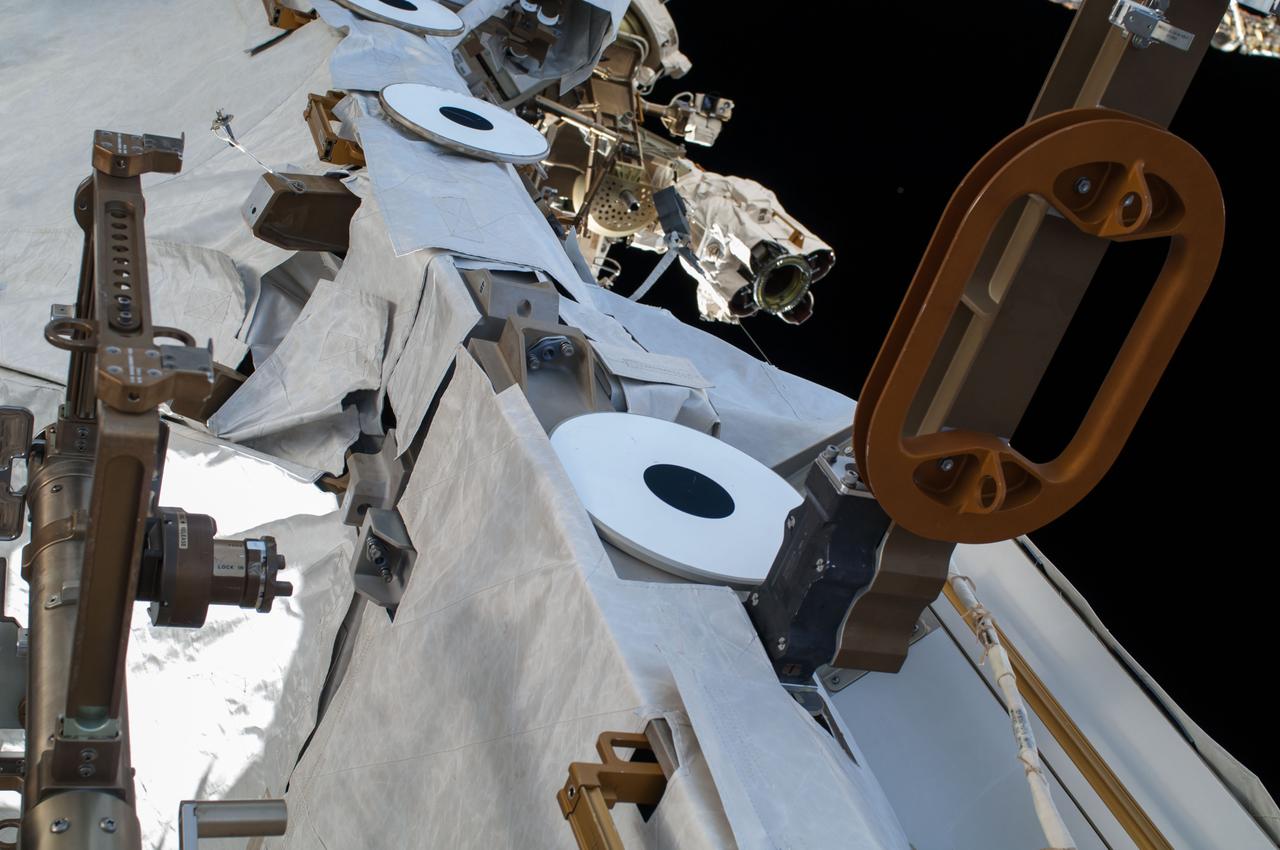
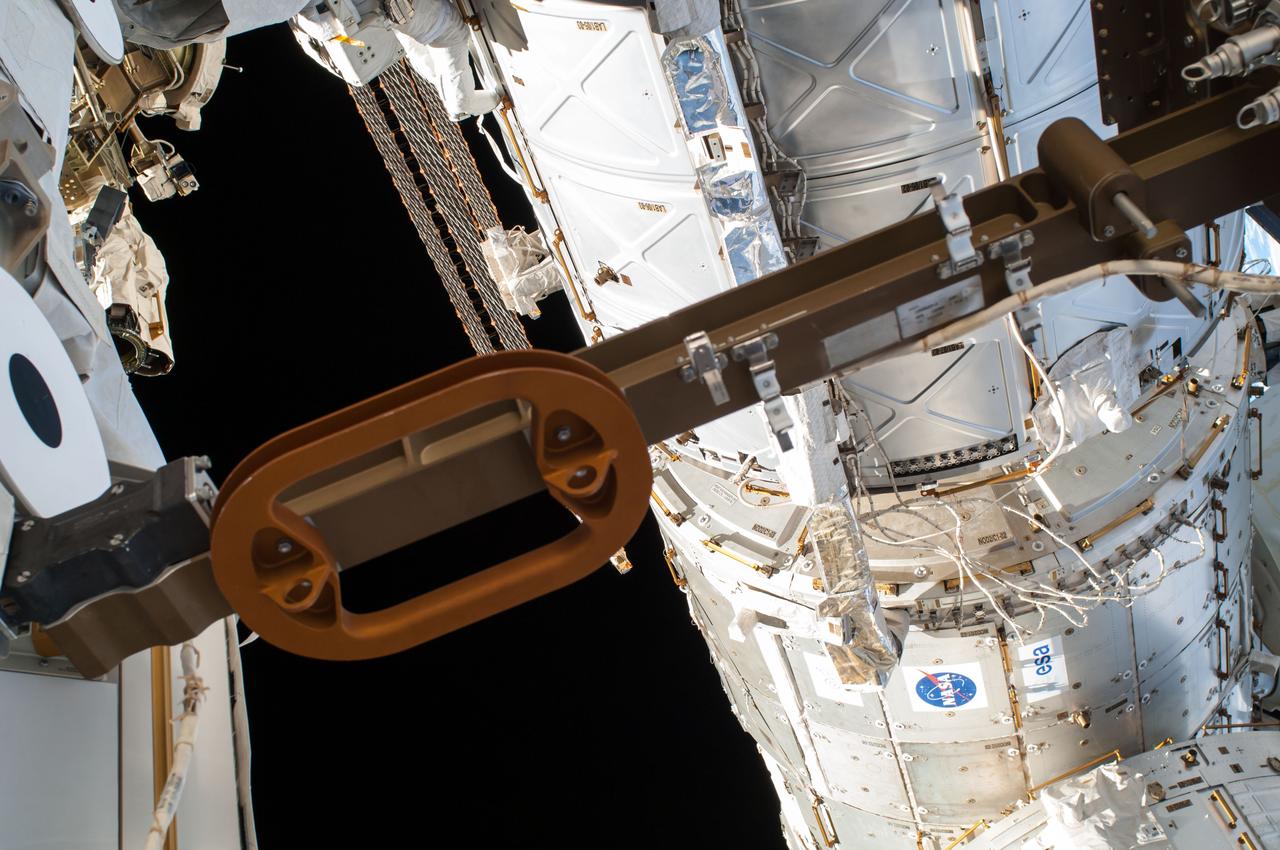
![iss028e020313 (8/2/2011) --- A view of the Biorisk-[MSN] platform with three containers to be installed on the exterior of the Pirs Docking Compartment (DC1) during Russian EVA-29 (Extravehicular Activity). The Influence of Factors of the Space Environment on the Condition of the System of Microorganisms-Hosts Relating to the Problem of Environmental Safety of Flight Techniques and Planetary Quarantine (Biorisk) investigation aims to obtain new data on physical and genetic changes in bacteria and fungi typically found on spacecraft equipment, and also in various biological test objects (higher plant seeds, dormant forms of lower crustaceans) under exposure in the interior ISS compartments and on the exterior ISS surfaces.](https://images-assets.nasa.gov/image/iss028e020313/iss028e020313~medium.jpg)
iss028e020313 (8/2/2011) --- A view of the Biorisk-[MSN] platform with three containers to be installed on the exterior of the Pirs Docking Compartment (DC1) during Russian EVA-29 (Extravehicular Activity). The Influence of Factors of the Space Environment on the Condition of the System of Microorganisms-Hosts Relating to the Problem of Environmental Safety of Flight Techniques and Planetary Quarantine (Biorisk) investigation aims to obtain new data on physical and genetic changes in bacteria and fungi typically found on spacecraft equipment, and also in various biological test objects (higher plant seeds, dormant forms of lower crustaceans) under exposure in the interior ISS compartments and on the exterior ISS surfaces.
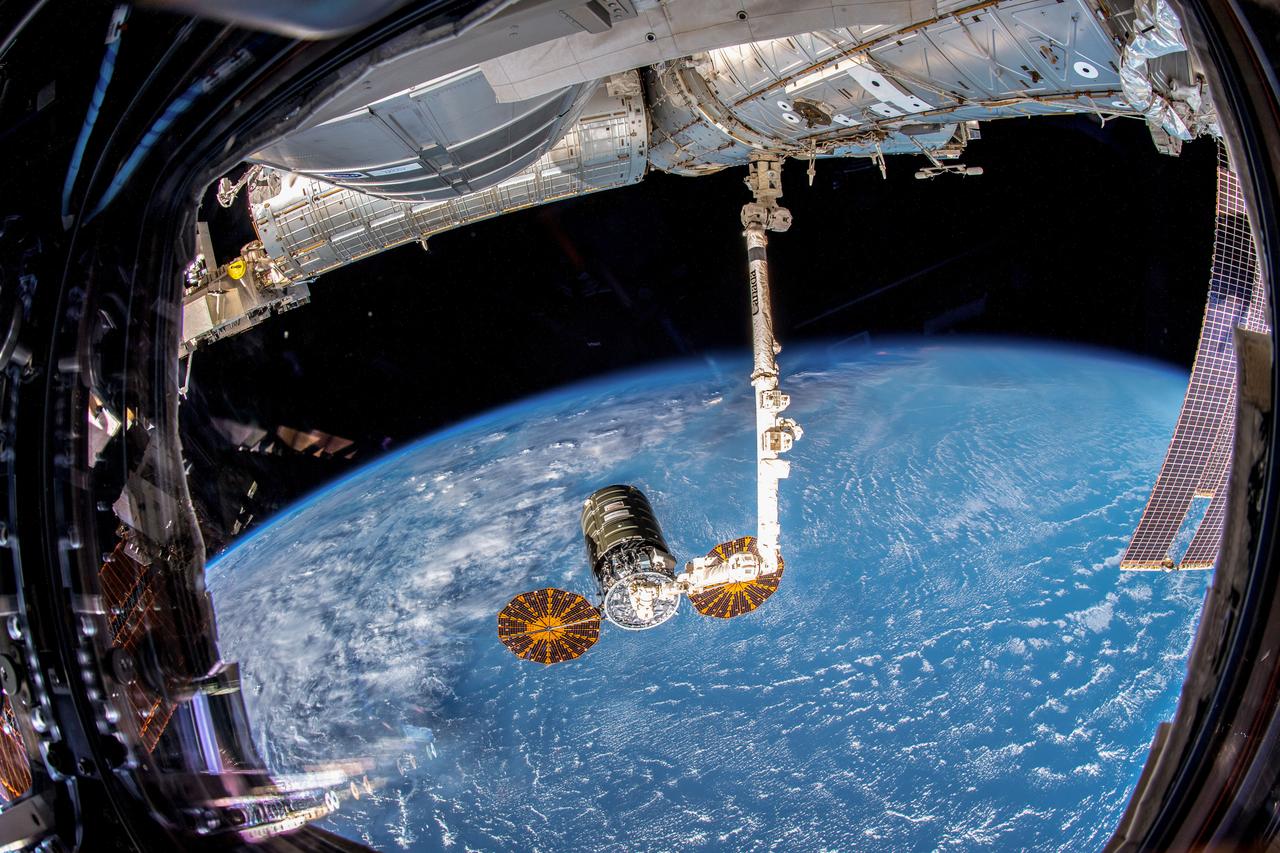
iss057e105337 (Nov. 19, 2018) --- Northrop Grumman's Cygnus space freighter with its prominent cymbal-shaped UltraFlex solar arrays is pictured in the grips of the Canadarm2 robotic arm after it was captured by Expedition 57 Flight Engineer Serena Auñón-Chancellor and ESA (European Space Agency) astronaut Alexander Gerst.
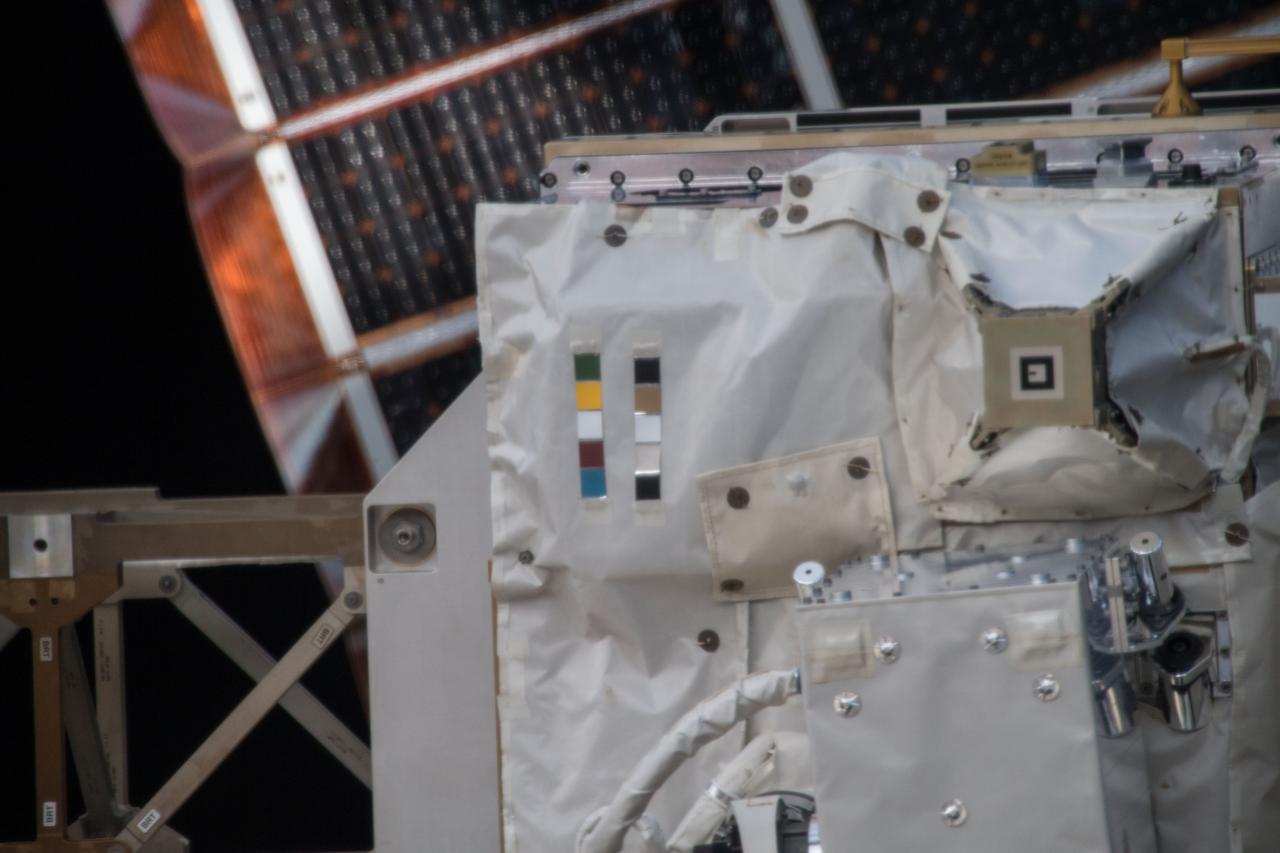
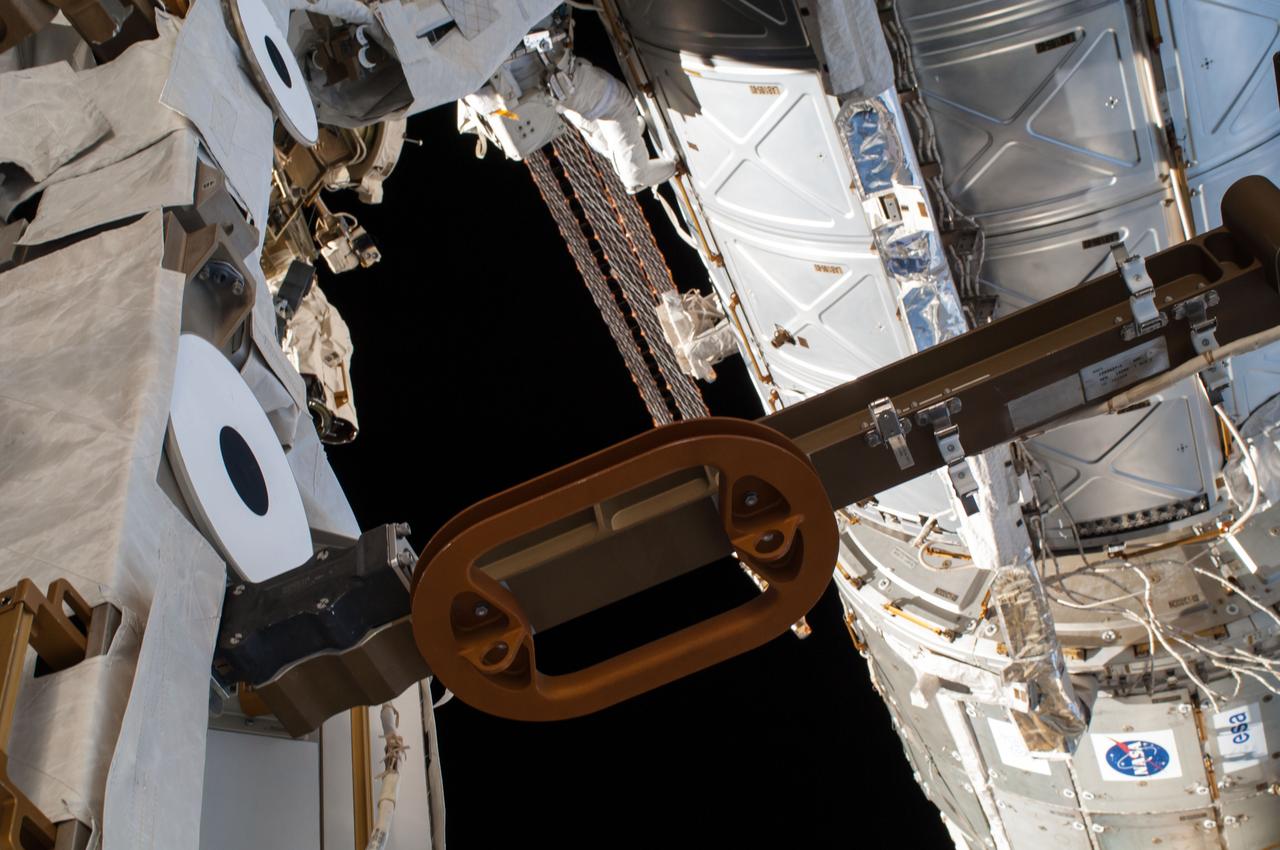
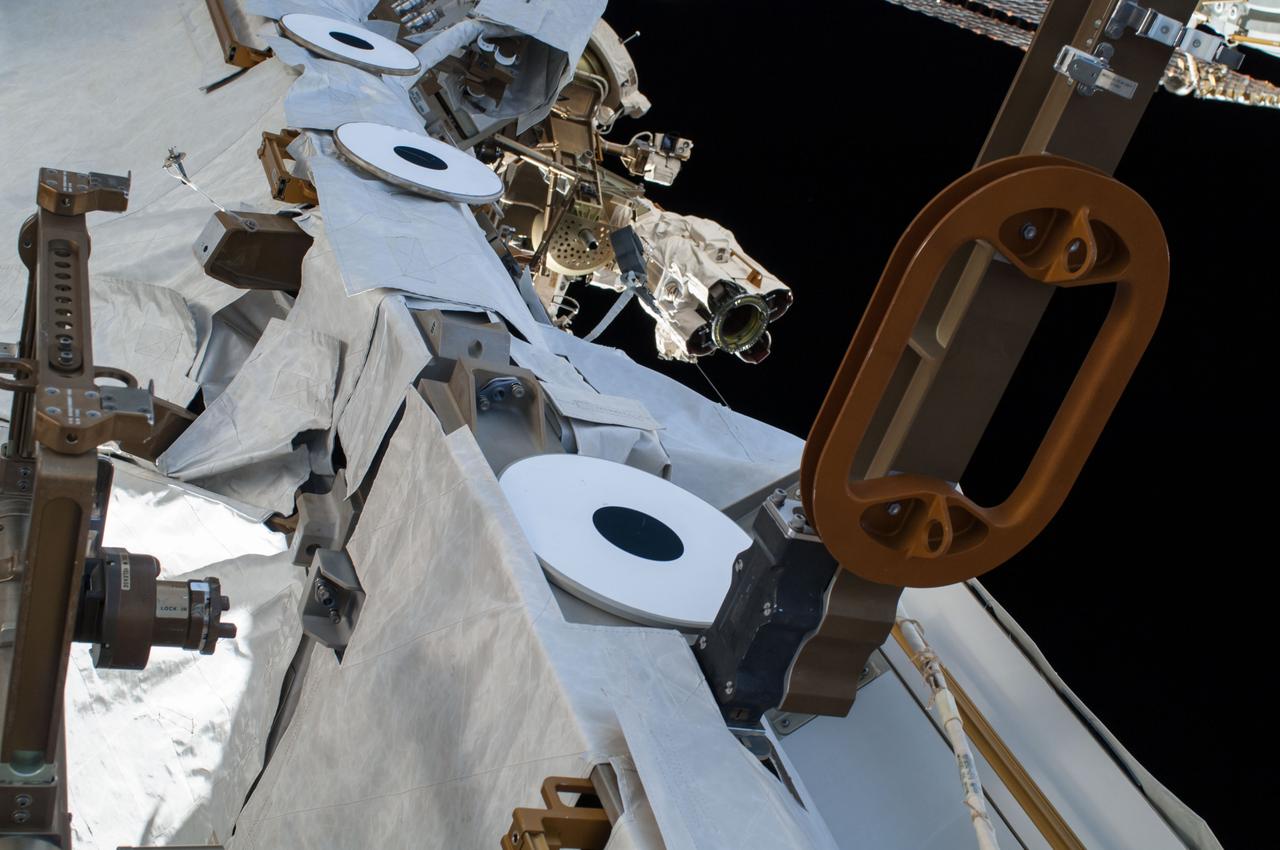
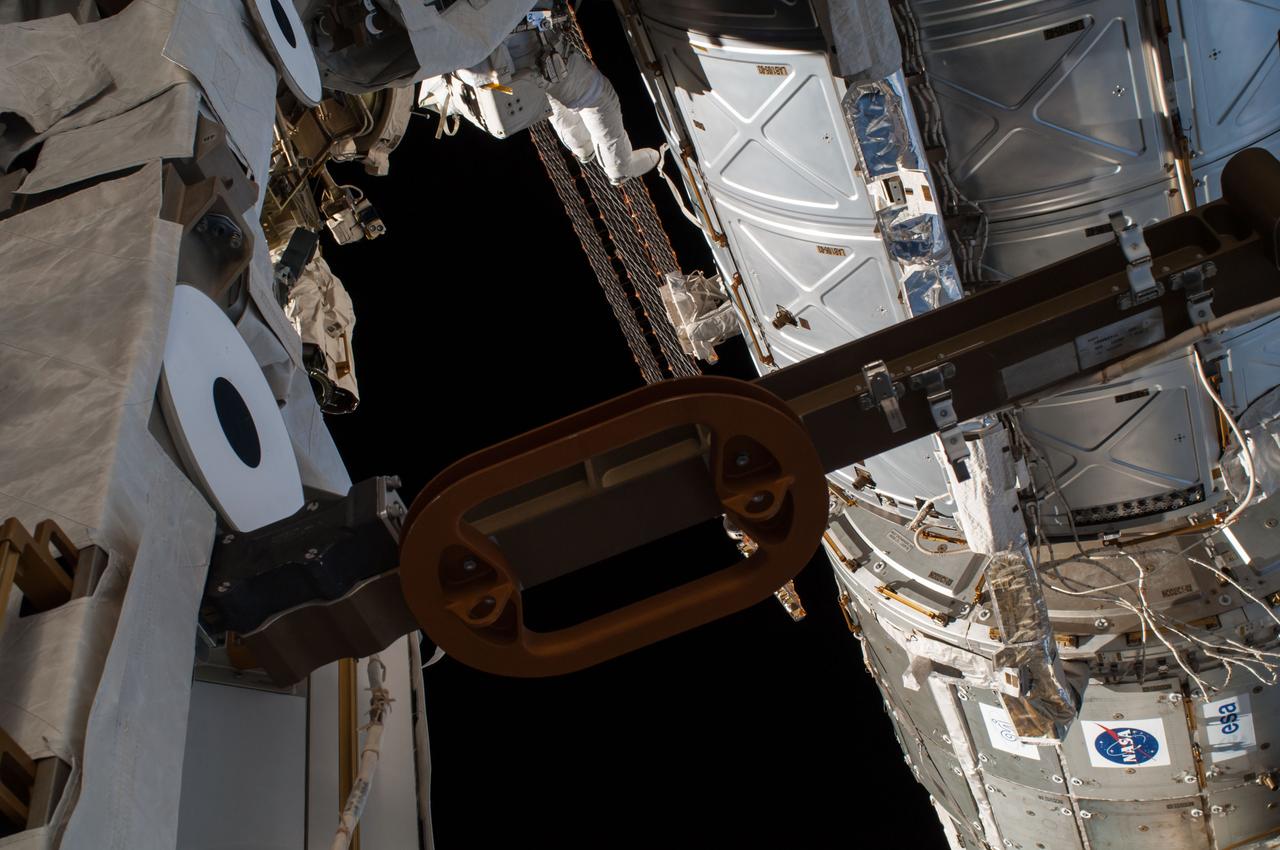
iss054e004111 (Dec. 26, 2017) --- Space Test Program - Houston 5 - Innovative Coatings Experiment (STP-H5-ICE) with International Space Station (ISS) solar panels in the background. A spacecraft’s exterior coating protects against extreme temperatures, shields the spacecraft from radiation, prevents contamination, and guides cameras that help robots or humans capture and service the spacecraft. STP-H5-ICE studies different paints and coatings that protext spacecraft exteriors.
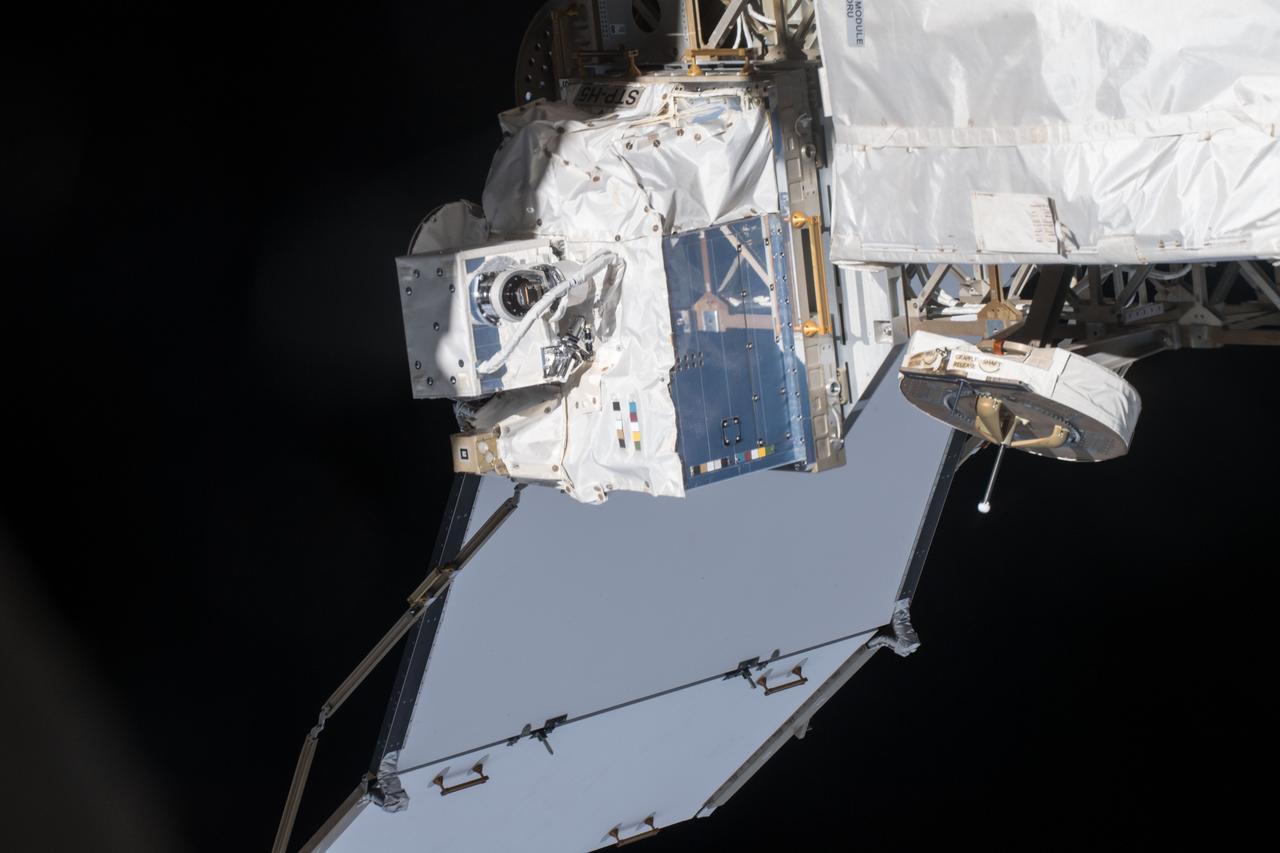
iss054e004116 (Dec. 26, 2017) --- Space Test Program - Houston 5 - Innovative Coatings Experiment (STP-H5-ICE) in front of International Space Station (ISS) radiator. A spacecraft’s exterior coating protects against extreme temperatures, shields the spacecraft from radiation, prevents contamination, and guides cameras that help robots or humans capture and service the spacecraft. STP-H5-ICE studies different paints and coatings that protect spacecraft exteriors.
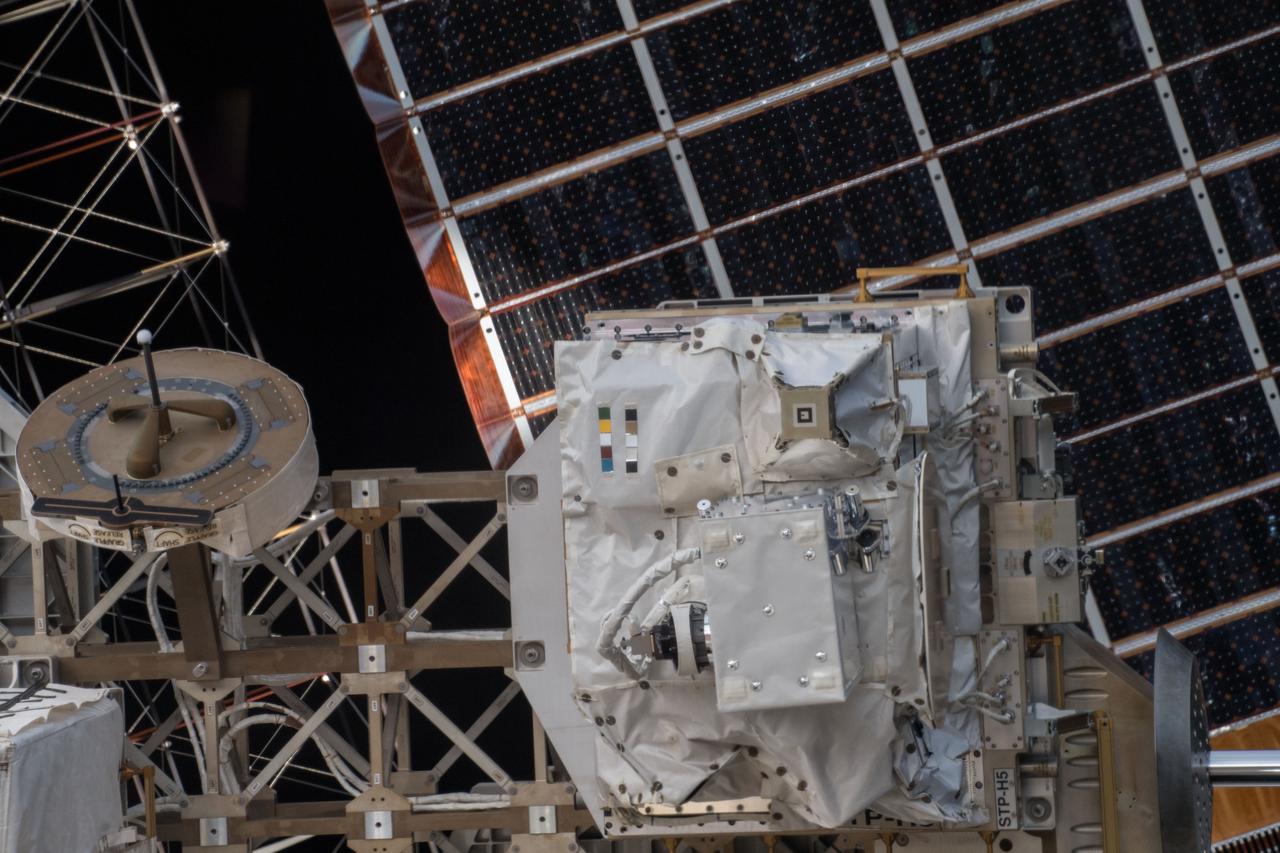
iss054e004105 (Dec. 26, 2017) --- Space Test Program - Houston 5 - Innovative Coatings Experiment (STP-H5-ICE) in front of International Space Station (ISS) solar panels. A spacecraft’s exterior coating protects against extreme temperatures, shields the spacecraft from radiation, prevents contamination, and guides cameras that help robots or humans capture and service the spacecraft. STP-H5-ICE studies different paints and coatings that protect spacecraft exteriors.
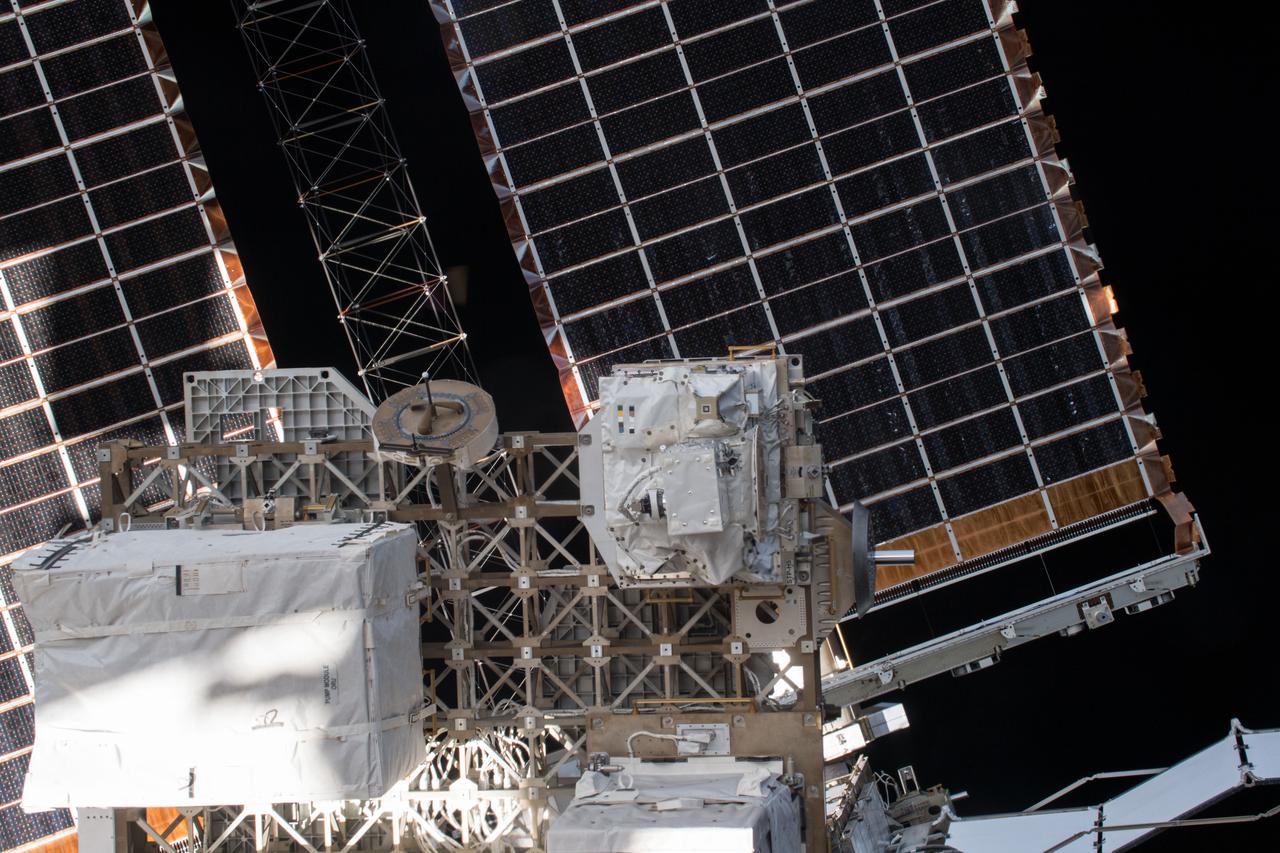
iss054e004101 (Dec. 26, 2017) --- Space Test Program - Houston 5 - Innovative Coatings Experiment (STP-H5-ICE) in front of International Space Station (ISS) solar panels. A spacecraft’s exterior coating protects against extreme temperatures, shields the spacecraft from radiation, prevents contamination, and guides cameras that help robots or humans capture and service the spacecraft. STP-H5-ICE studies different paints and coatings that protect spacecraft exteriors.
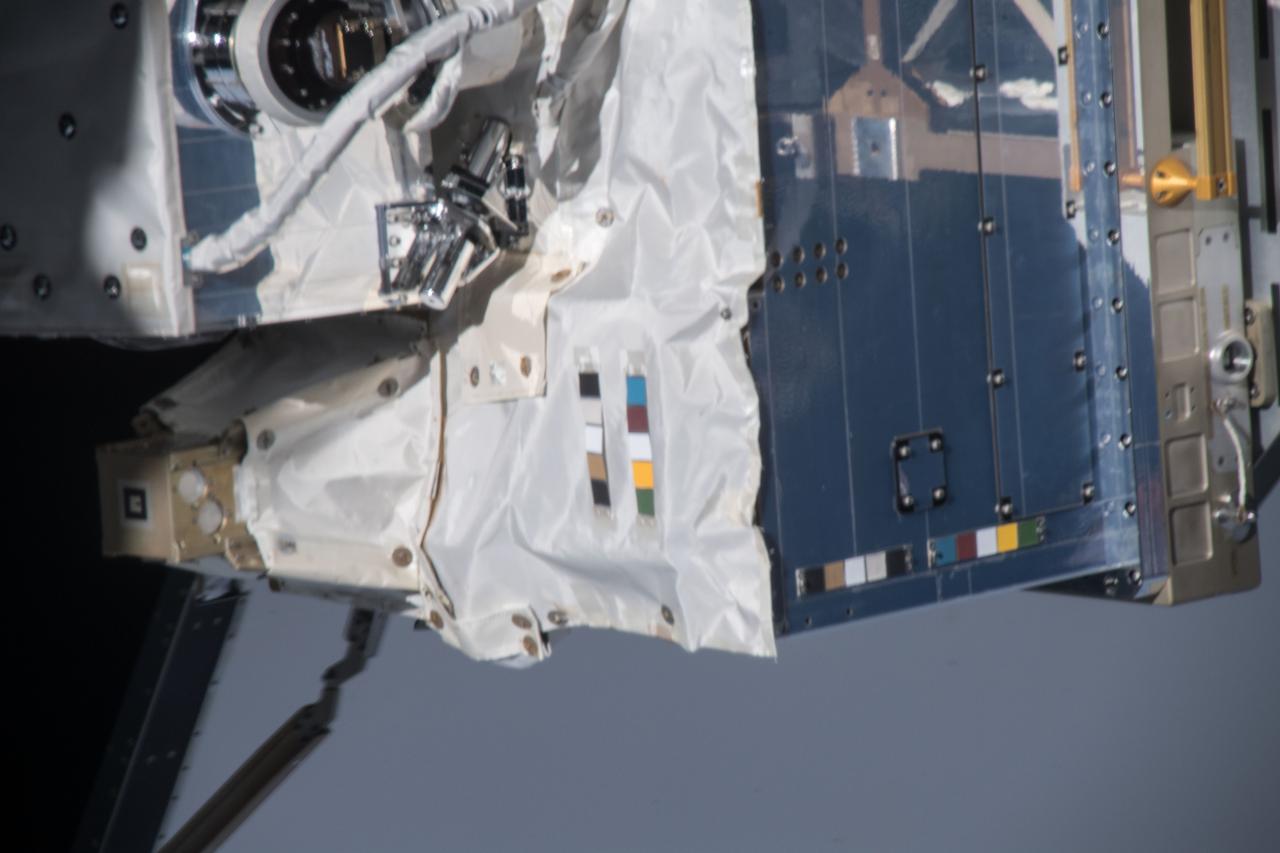
iss054e004119 (Dec. 26, 2017) --- Space Test Program - Houston 5 - Innovative Coatings Experiment (STP-H5-ICE) with International Space Station (ISS) radiator in the background. A spacecraft’s exterior coating protects against extreme temperatures, shields the spacecraft from radiation, prevents contamination, and guides cameras that help robots or humans capture and service the spacecraft. STP-H5-ICE studies different paints and coatings that protect spacecraft exteriors.
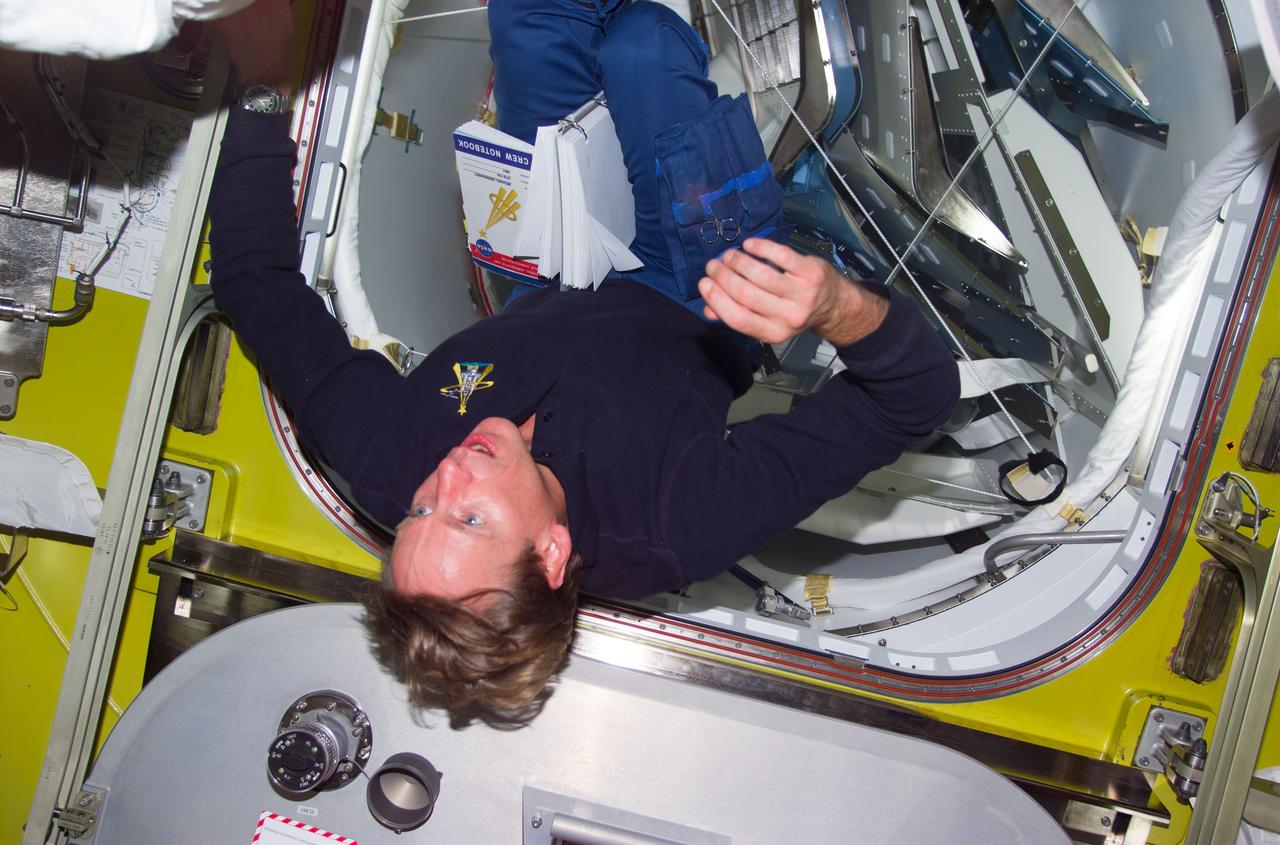
STS104-E-5164 (19 July 2001) --- Astronaut Michael L. Gernhardt, STS-104 mission specialist, floats in the Quest Airlock prior to getting suited for the second of three scheduled STS104 space walks to work on the exterior of the International Space Station (ISS). The image was recorded with a digital still camera.
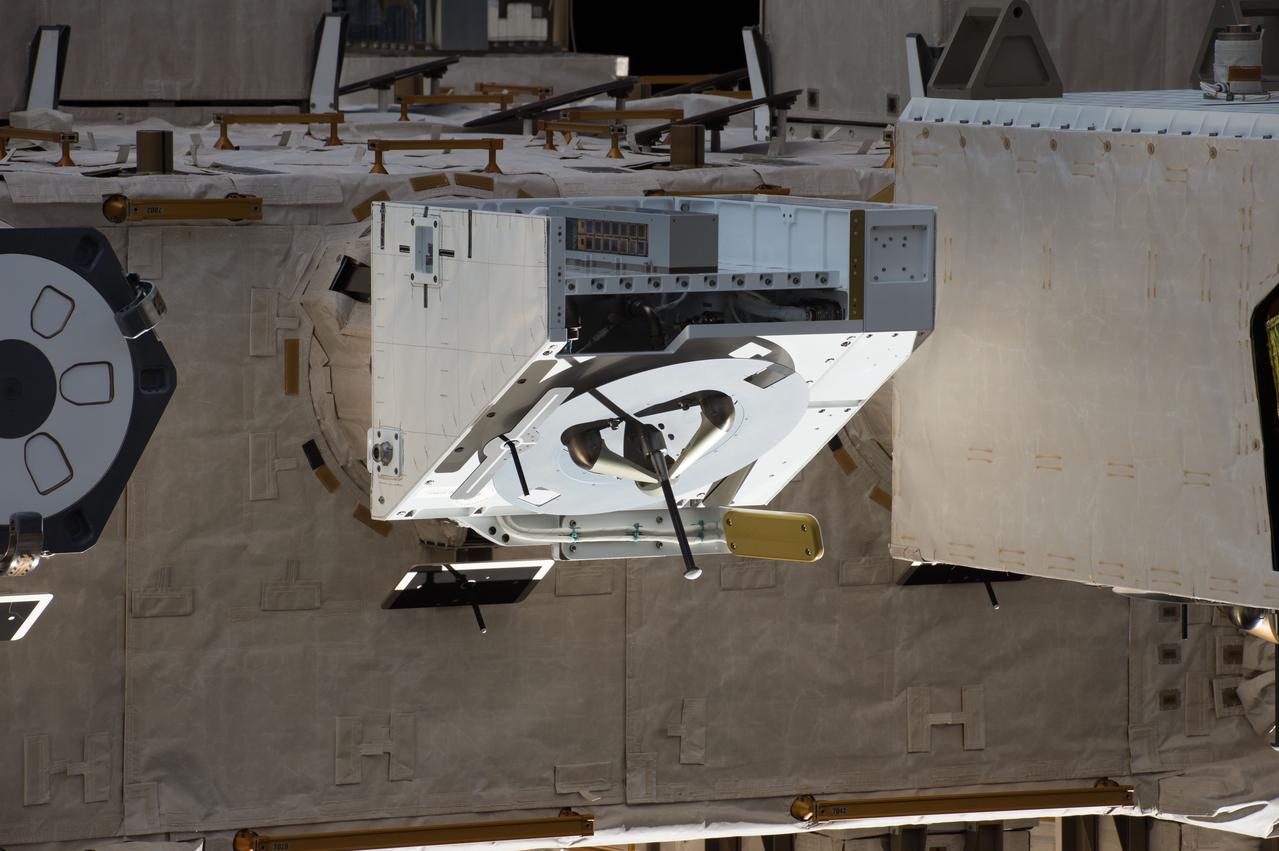
iss048e050816 (8/5/2016) --- A view of the NanoRacks External Platform (NREP), containing the NanoRacks-Gumstix and NanoRacks NanoTube Solar Cell payloads, installed on the JEM (Japanese Experiment Module) Exposed Facility (JEF). The NanoRacks External Platform is a compact research platform fitted for versatile use on the exterior of the International Space Station (ISS).
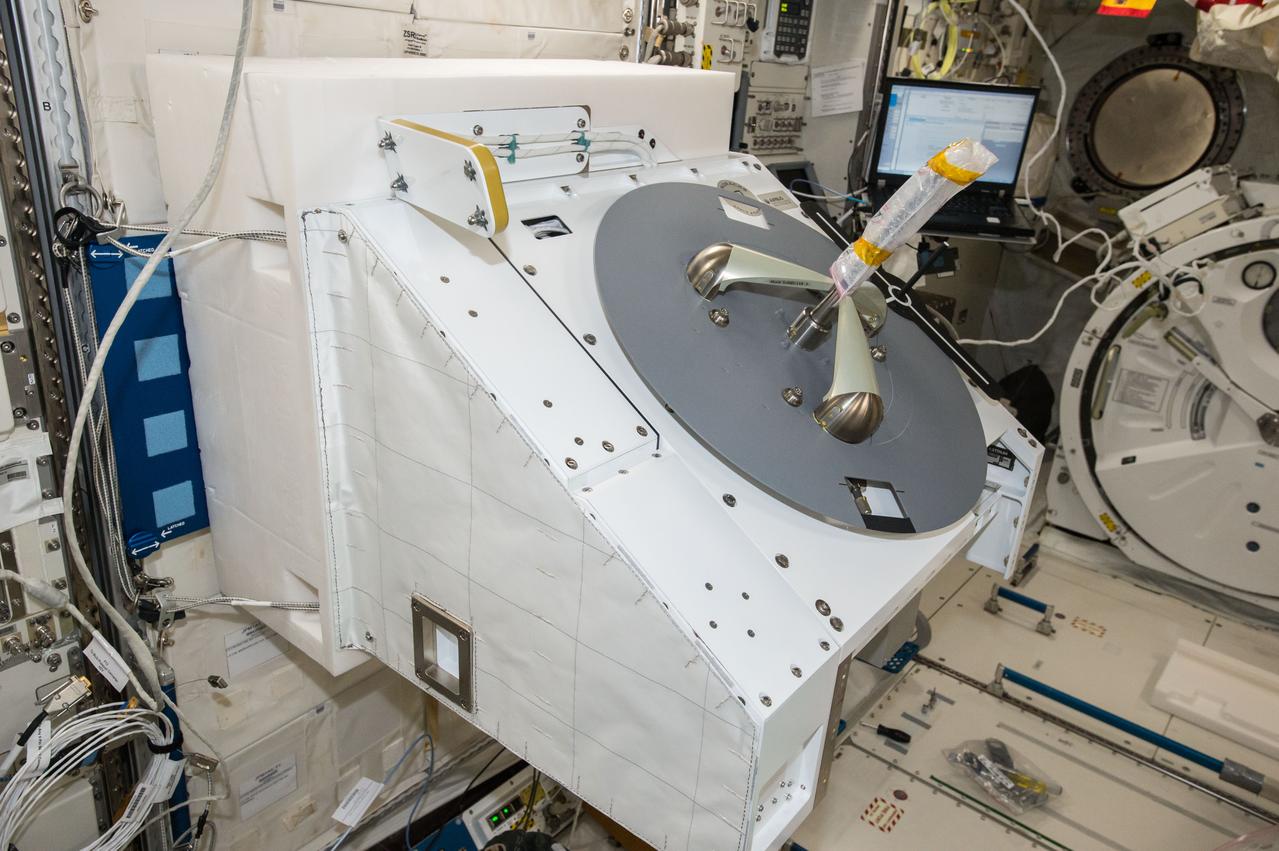
iss048e049168 (8/4/2016) --- A view of the assembled NanoRacks External Platform (NREP) on the Platform Cover attached to JPM1A5 in the Kibo Japanese Experiment Pressurized Module (JPM). The NanoRacks External Platform is a compact research platform fitted for versatile use on the exterior of the International Space Station (ISS).
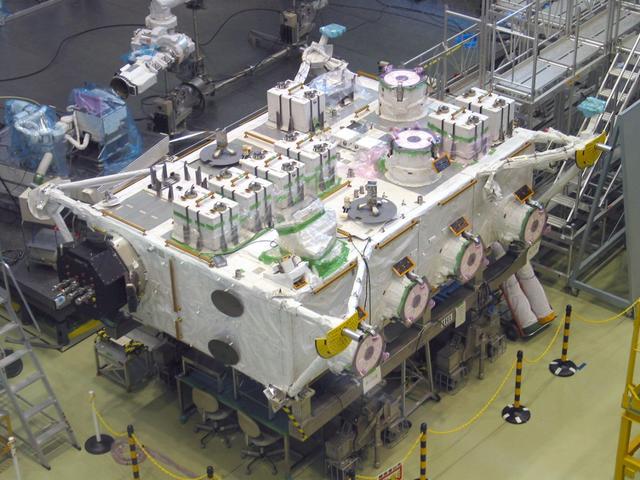
JSC2003-E-42544 (June 2003 ) --- The Exposed Facility (EF) of the Japanese Experiment Module (JEM), Japan's primary contribution to the International Space Station (ISS), is shown in a processing facility. The EF is a unique platform on the ISS that is located outside of the Pressurized Module and is continuously exposed to the space environment. Items positioned on the exterior platform focus on Earth observation as well as communication, scientific, engineering and materials science experiments. Photo Credit: NASA

This image of the International Space Station (ISS) was photographed by one of the crewmembers of the STS-105 mission from the Shuttle Orbiter Discovery after separating from the ISS. The STS-105 mission was the 11th ISS assembly flight and its goals were the rotation of the ISS Expedition Two crew with Expedition Three crew, and the delivery of supplies utilizing the Italian-built Multipurpose Logistic Module (MPLM) Leonardo. Aboard Leonardo were six resupply stowage racks, four resupply stowage supply platforms, and two new scientific experiment racks, EXPRESS (Expedite the Processing of Experiments to the Space Station) Racks 4 and 5, which added science capabilities to the ISS. Another payload was the Materials International Space Station Experiment (MISSE), which included materials and other types of space exposure experiments mounted on the exterior of the ISS.
CAPE CANAVERAL, Fla. – NASA's International Space Station-RapidScat scatterometer instrument arrives at the Space Station Processing Facility at Kennedy Space Center in Florida. ISS-RapidScat is the first scientific Earth-observing instrument designed to operate from the exterior of the space station. It will measure Earth's ocean surface wind speed and direction, providing data to be used in weather and marine forecasting. Built at NASA's Jet Propulsion Laboratory, ISS-RapidScat is slated to fly on the SpaceX-4 commercial cargo resupply flight in 2014. For more information, visit http://www.jpl.nasa.gov/missions/iss-rapidscat. Photo credit: NASA/Dimitri Gerondidakis

CAPE CANAVERAL, Fla. – NASA's International Space Station-RapidScat scatterometer instrument is revealed inside Kennedy Space Center's Space Station Processing Facility. ISS-RapidScat is the first scientific Earth-observing instrument designed to operate from the exterior of the space station. It will measure Earth's ocean surface wind speed and direction, providing data to be used in weather and marine forecasting. Built at NASA's Jet Propulsion Laboratory, ISS-RapidScat is slated to fly on the SpaceX-4 commercial cargo resupply flight in 2014. For more information, visit http://www.jpl.nasa.gov/missions/iss-rapidscat. Photo credit: NASA/Dimitri Gerondidakis
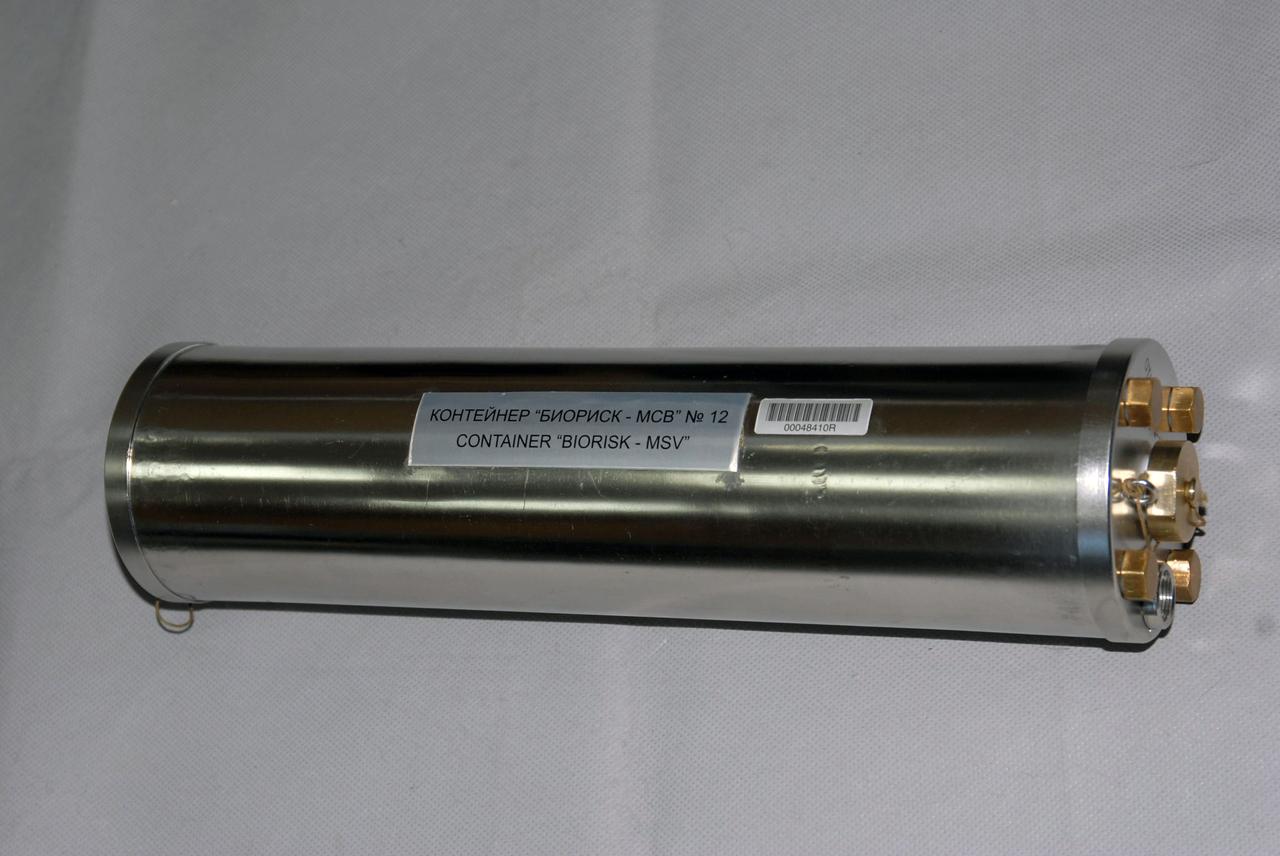
jsc2008e152661 (12/8/2008) --- A preflight view of a Biorisk-MSV container, part of the Biorisk experiment equipment to be delivered to the ISS during the 31P flight. The Influence of Factors of the Space Environment on the Condition of the System of Microorganisms-Hosts Relating to the Problem of Environmental Safety of Flight Techniques and Planetary Quarantine (Biorisk) investigation aims to obtain new data on physical and genetic changes in bacteria and fungi typically found on spacecraft equipment, and also in various biological test objects (higher plant seeds, dormant forms of lower crustaceans) under exposure in the interior ISS compartments and on the exterior ISS surfaces.
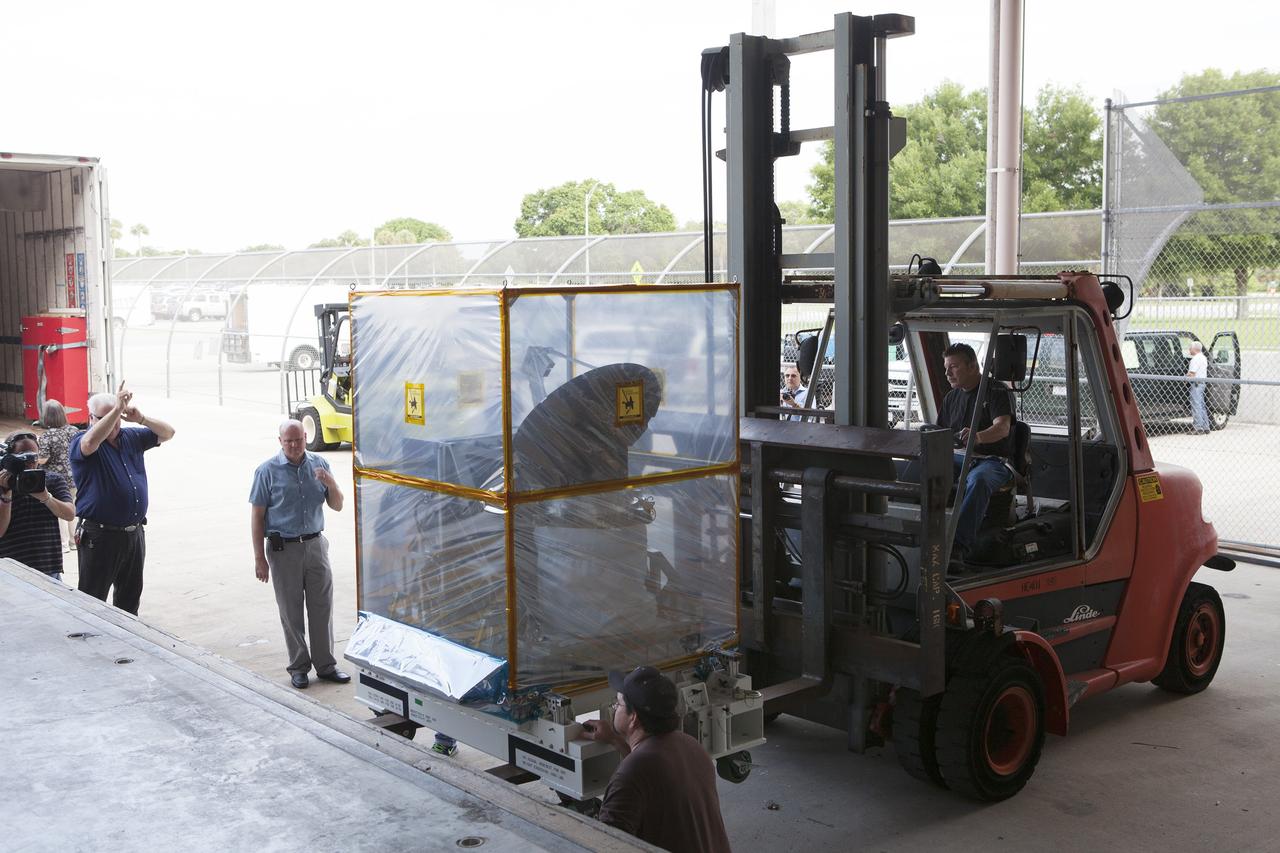
CAPE CANAVERAL, Fla. – A component of NASA's International Space Station-RapidScat scatterometer instrument is removed from a truck at the Space Station Processing Facility at Kennedy Space Center in Florida. ISS-RapidScat is the first scientific Earth-observing instrument designed to operate from the exterior of the space station. It will measure Earth's ocean surface wind speed and direction, providing data to be used in weather and marine forecasting. Built at NASA's Jet Propulsion Laboratory, ISS-RapidScat is slated to fly on the SpaceX-4 commercial cargo resupply flight in 2014. For more information, visit http://www.jpl.nasa.gov/missions/iss-rapidscat. Photo credit: NASA/Dimitri Gerondidakis
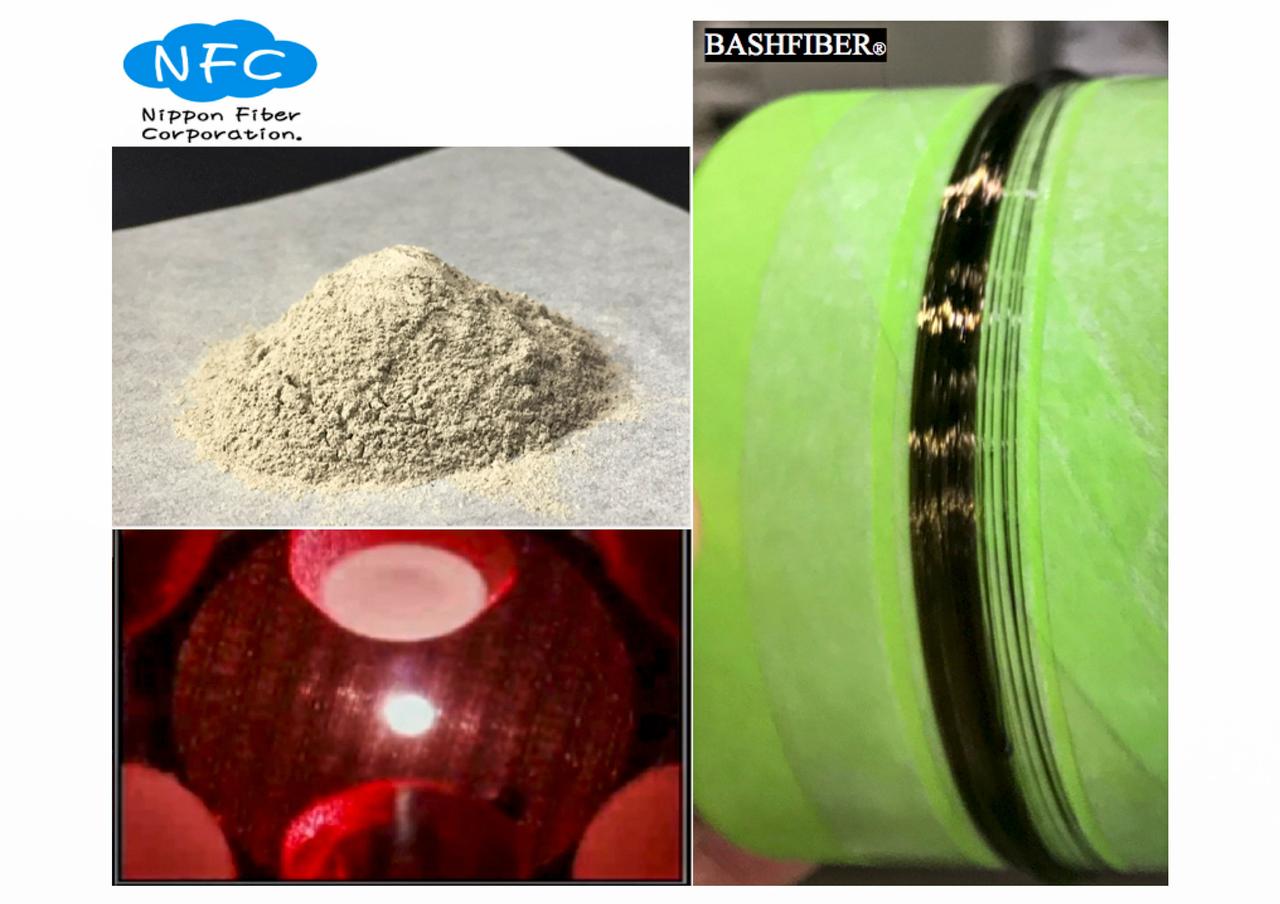
jsc2020e040946 (9/10/2020) --- A picture of roving fiber (right), which is made from fly ash (upper left) in a Japanese thermal power station. A mass production project for this fiber is in progress. Detailed properties are being investigated on the ISS. One of the tests was conducted at the Electrostatic Levitation Furnace (ELF) aboard the ISS from April to May 2020 (lower left). The Exposure test of of BASHFIBER® (ExHAM-Nippon Fiber-2) tests the resistance of a thread-like fiber to cosmic rays on the exterior of the International Space Station (ISS). BASHFIBER is a mixture of basalt rock and fly ash, with high resistance to acid and salt. The fiber has the potential for a variety of applications making use of an abundant byproduct.
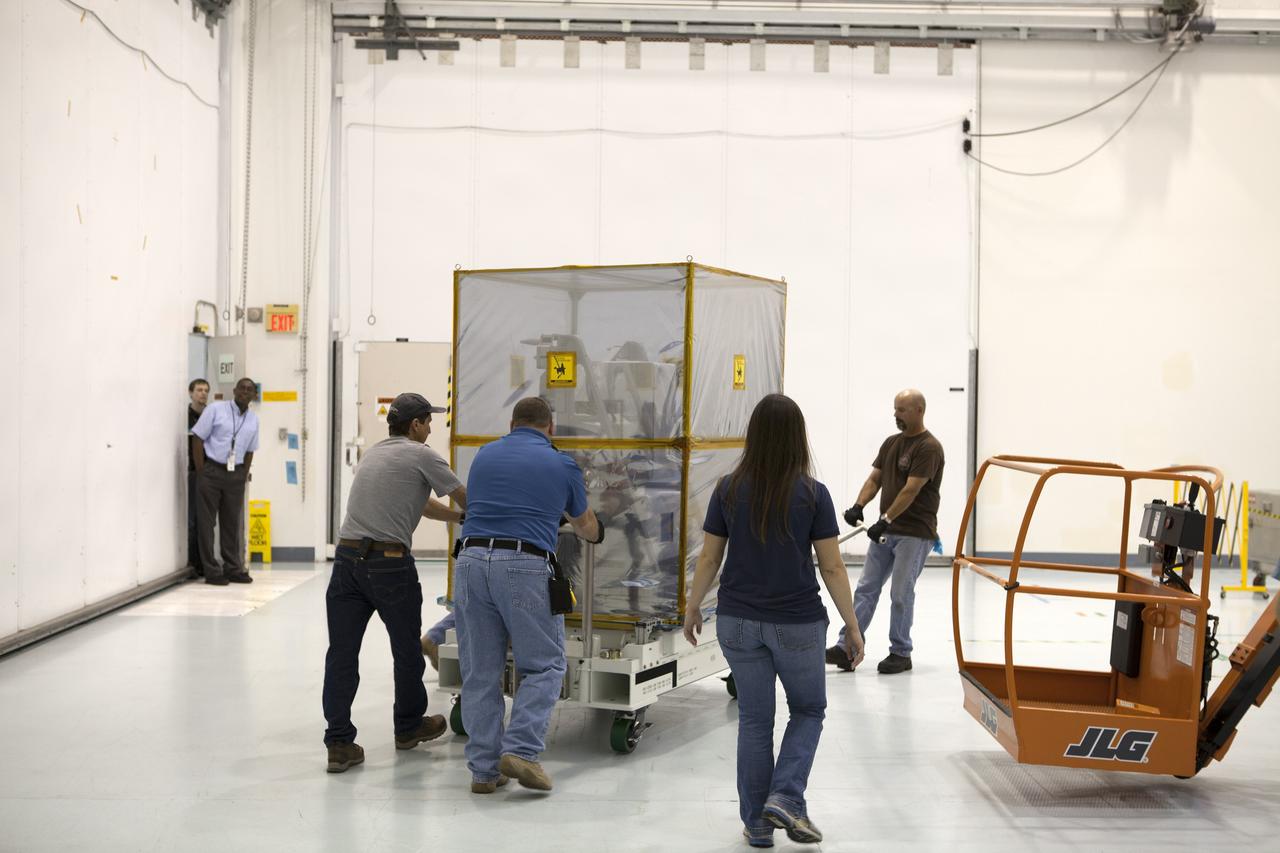
CAPE CANAVERAL, Fla. – Part of NASA's International Space Station-RapidScat scatterometer instrument is moved into Space Station Processing Facility at Kennedy Space Center in Florida. ISS-RapidScat is the first scientific Earth-observing instrument designed to operate from the exterior of the space station. It will measure Earth's ocean surface wind speed and direction, providing data to be used in weather and marine forecasting. Built at NASA's Jet Propulsion Laboratory, ISS-RapidScat is slated to fly on the SpaceX-4 commercial cargo resupply flight in 2014. For more information, visit http://www.jpl.nasa.gov/missions/iss-rapidscat. Photo credit: NASA/Dimitri Gerondidakis
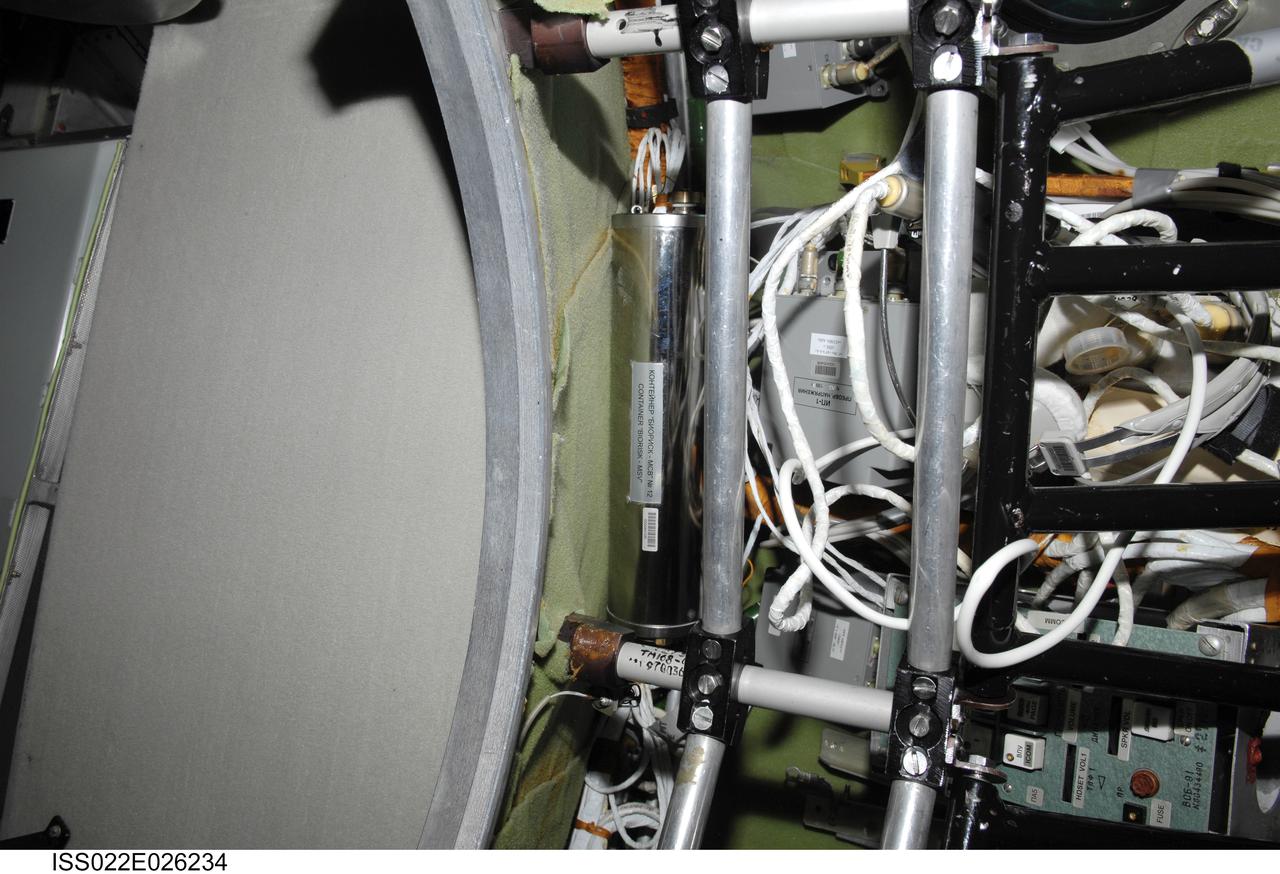
iss022e026234 (1/20/2010) --- A view of Container Biorisk MSV No. 12, in the Service Module (SM) aboard the International Space Station (ISS). The Influence of Factors of the Space Environment on the Condition of the System of Microorganisms-Hosts Relating to the Problem of Environmental Safety of Flight Techniques and Planetary Quarantine (Biorisk) investigation aims to obtain new data on physical and genetic changes in bacteria and fungi typically found on spacecraft equipment, and also in various biological test objects (higher plant seeds, dormant forms of lower crustaceans) under exposure in the interior ISS compartments and on the exterior ISS surfaces.

CAPE CANAVERAL, Fla. – The components of NASA's International Space Station-RapidScat scatterometer instrument rest side by side after removal of their shipping cover inside Kennedy Space Center's Space Station Processing Facility. ISS-RapidScat is the first scientific Earth-observing instrument designed to operate from the exterior of the space station. It will measure Earth's ocean surface wind speed and direction, providing data to be used in weather and marine forecasting. Built at NASA's Jet Propulsion Laboratory, ISS-RapidScat is slated to fly on the SpaceX-4 commercial cargo resupply flight in 2014. For more information, visit http://www.jpl.nasa.gov/missions/iss-rapidscat. Photo credit: NASA/Dimitri Gerondidakis

CAPE CANAVERAL, Fla. – A component of NASA's International Space Station-RapidScat scatterometer instrument is removed from the truck that delivered it to the Space Station Processing Facility at Kennedy Space Center in Florida. ISS-RapidScat is the first scientific Earth-observing instrument designed to operate from the exterior of the space station. It will measure Earth's ocean surface wind speed and direction, providing data to be used in weather and marine forecasting. Built at NASA's Jet Propulsion Laboratory, ISS-RapidScat is slated to fly on the SpaceX-4 commercial cargo resupply flight in 2014. For more information, visit http://www.jpl.nasa.gov/missions/iss-rapidscat. Photo credit: NASA/Dimitri Gerondidakis
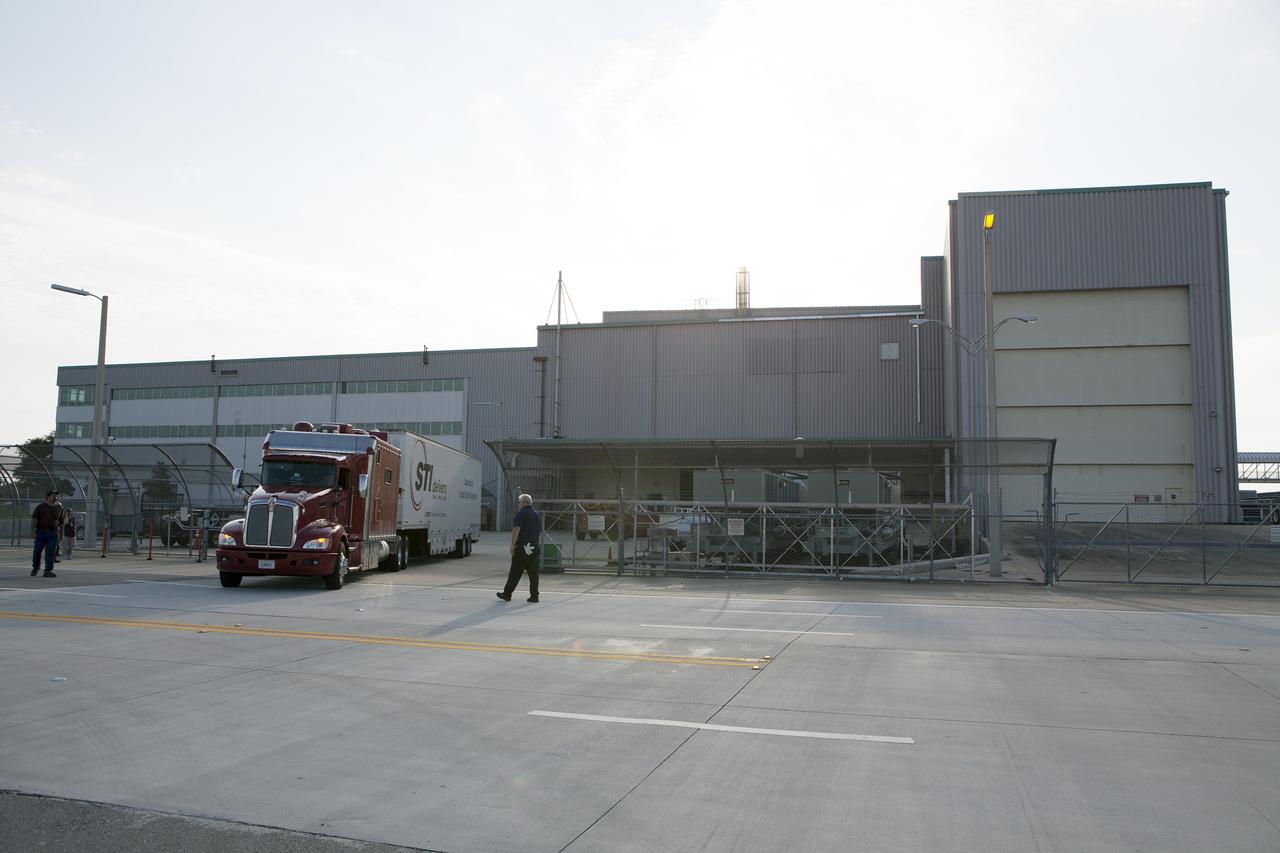
CAPE CANAVERAL, Fla. – A truck carrying NASA's International Space Station-RapidScat scatterometer instrument arrives outside the Space Station Processing Facility at Kennedy Space Center in Florida. ISS-RapidScat is the first scientific Earth-observing instrument designed to operate from the exterior of the space station. It will measure Earth's ocean surface wind speed and direction, providing data to be used in weather and marine forecasting. Built at NASA's Jet Propulsion Laboratory, ISS-RapidScat is slated to fly on the SpaceX-4 commercial cargo resupply flight in 2014. For more information, visit http://www.jpl.nasa.gov/missions/iss-rapidscat. Photo credit: NASA/Dimitri Gerondidakis
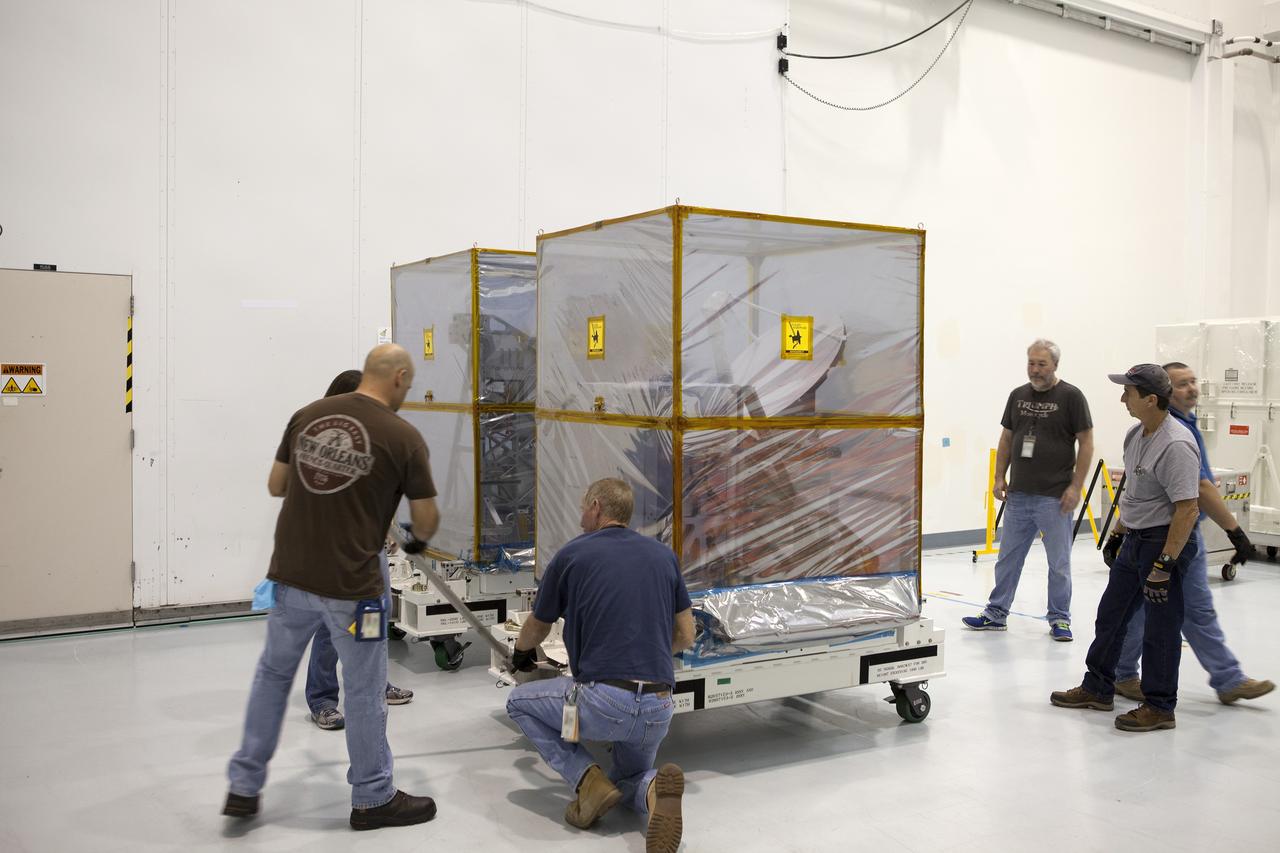
CAPE CANAVERAL, Fla. – The components of NASA's International Space Station-RapidScat scatterometer instrument are moved into a laboratory inside Kennedy Space Center's Space Station Processing Facility. ISS-RapidScat is the first scientific Earth-observing instrument designed to operate from the exterior of the space station. It will measure Earth's ocean surface wind speed and direction, providing data to be used in weather and marine forecasting. Built at NASA's Jet Propulsion Laboratory, ISS-RapidScat is slated to fly on the SpaceX-4 commercial cargo resupply flight in 2014. For more information, visit http://www.jpl.nasa.gov/missions/iss-rapidscat. Photo credit: NASA/Dimitri Gerondidakis
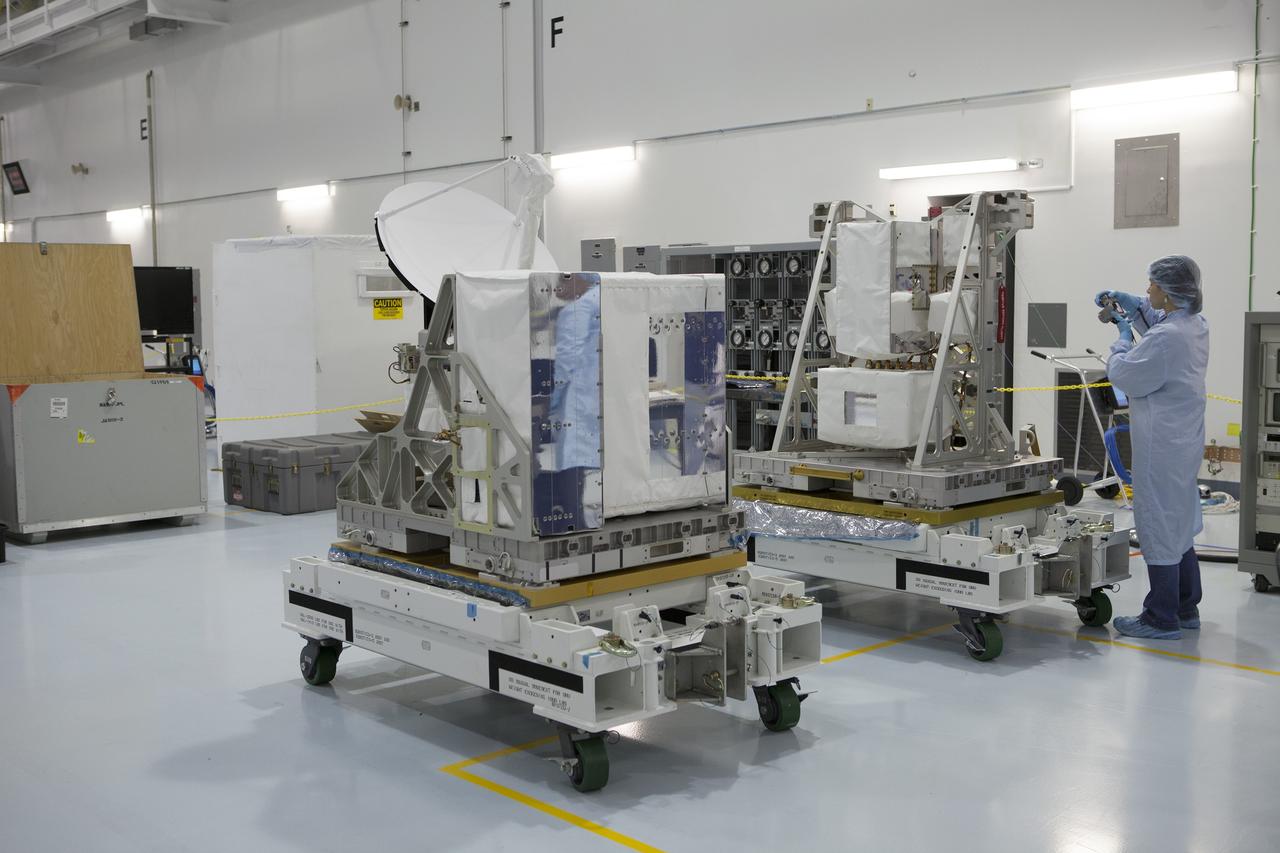
CAPE CANAVERAL, Fla. – NASA's International Space Station-RapidScat scatterometer instrument is revealed inside Kennedy Space Center's Space Station Processing Facility. ISS-RapidScat is the first scientific Earth-observing instrument designed to operate from the exterior of the space station. It will measure Earth's ocean surface wind speed and direction, providing data to be used in weather and marine forecasting. Built at NASA's Jet Propulsion Laboratory, ISS-RapidScat is slated to fly on the SpaceX-4 commercial cargo resupply flight in 2014. For more information, visit http://www.jpl.nasa.gov/missions/iss-rapidscat. Photo credit: NASA/Dimitri Gerondidakis
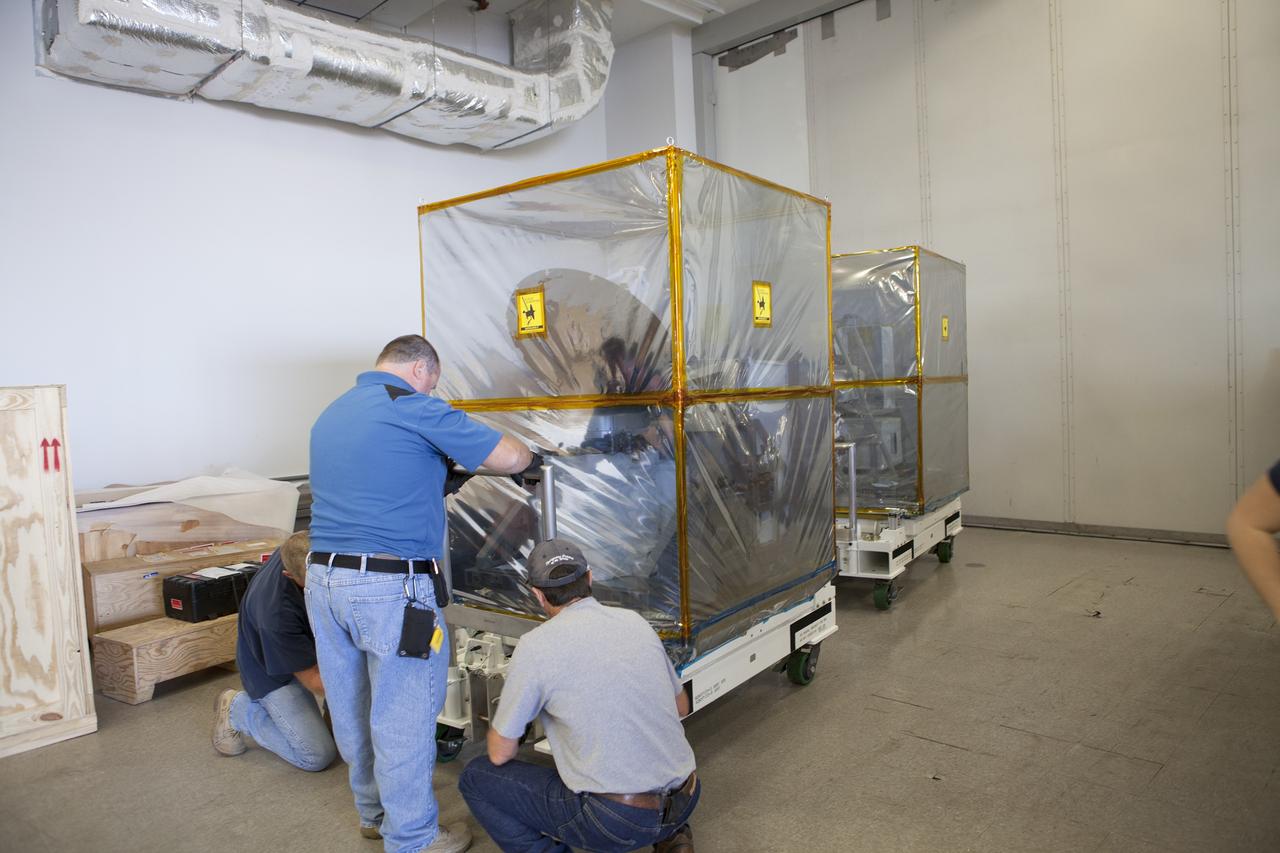
CAPE CANAVERAL, Fla. – The components of NASA's International Space Station-RapidScat scatterometer instrument arrive at the Space Station Processing Facility at Kennedy Space Center in Florida. ISS-RapidScat is the first scientific Earth-observing instrument designed to operate from the exterior of the space station. It will measure Earth's ocean surface wind speed and direction, providing data to be used in weather and marine forecasting. Built at NASA's Jet Propulsion Laboratory, ISS-RapidScat is slated to fly on the SpaceX-4 commercial cargo resupply flight in 2014. For more information, visit http://www.jpl.nasa.gov/missions/iss-rapidscat. Photo credit: NASA/Dimitri Gerondidakis
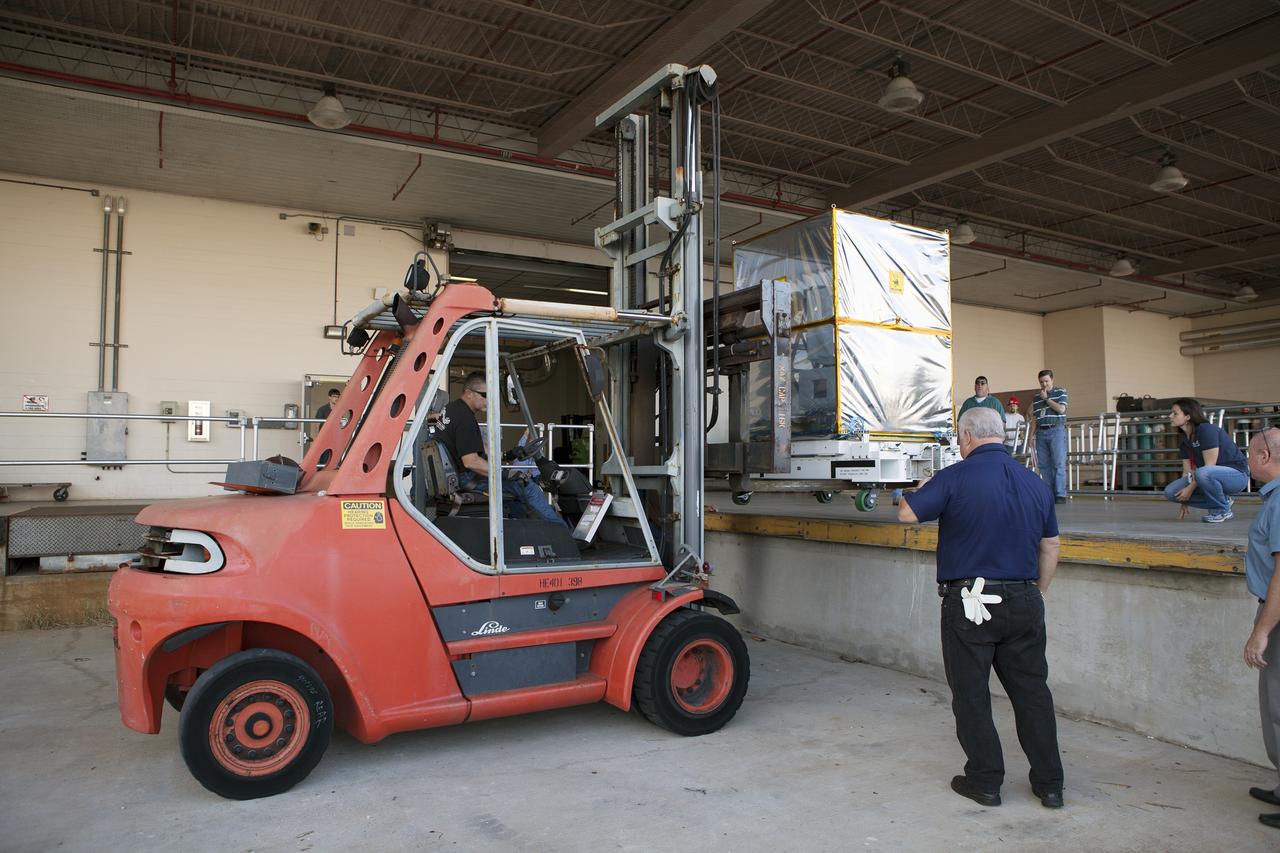
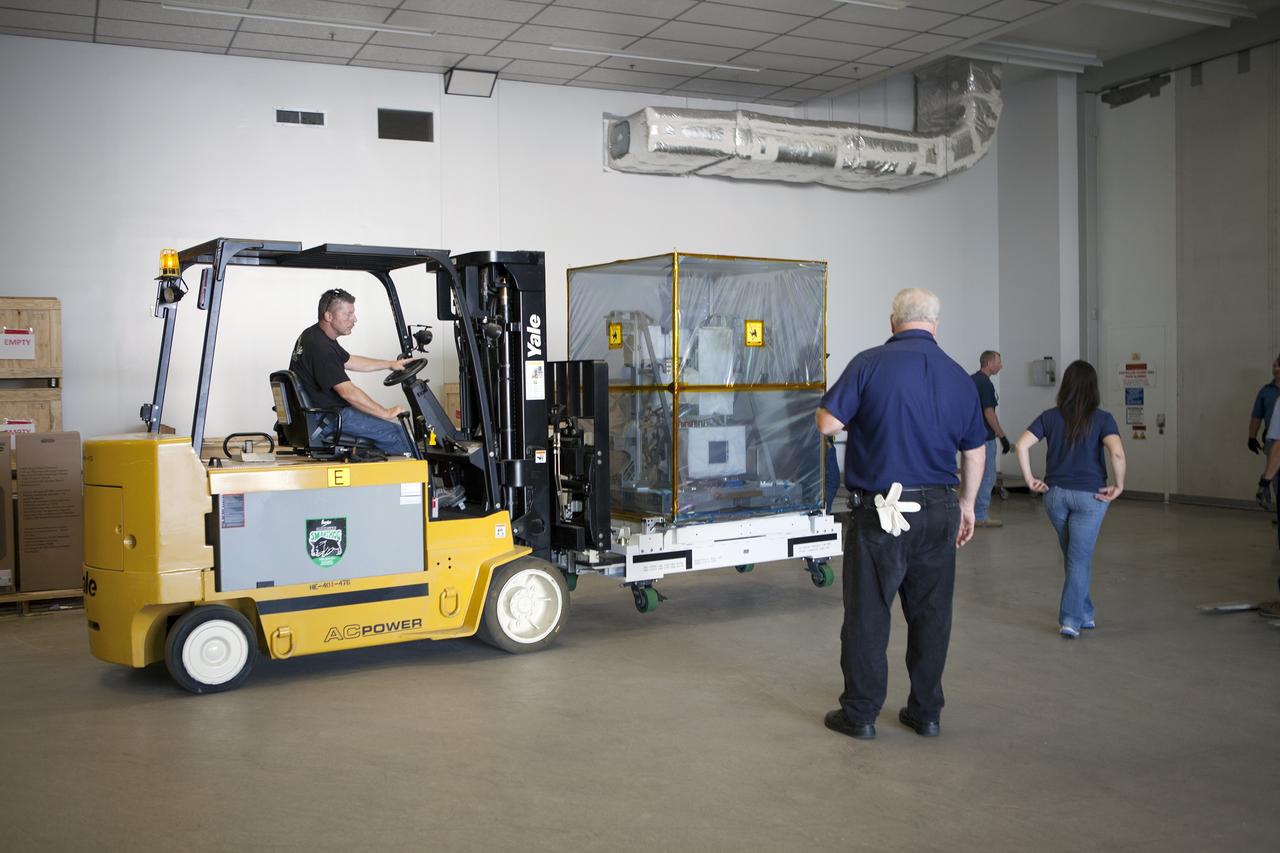
CAPE CANAVERAL, Fla. – A component of NASA's International Space Station-RapidScat scatterometer instrument is moved via forklift into the Space Station Processing Facility at Kennedy Space Center in Florida. ISS-RapidScat is the first scientific Earth-observing instrument designed to operate from the exterior of the space station. It will measure Earth's ocean surface wind speed and direction, providing data to be used in weather and marine forecasting. Built at NASA's Jet Propulsion Laboratory, ISS-RapidScat is slated to fly on the SpaceX-4 commercial cargo resupply flight in 2014. For more information, visit http://www.jpl.nasa.gov/missions/iss-rapidscat. Photo credit: NASA/Dimitri Gerondidakis
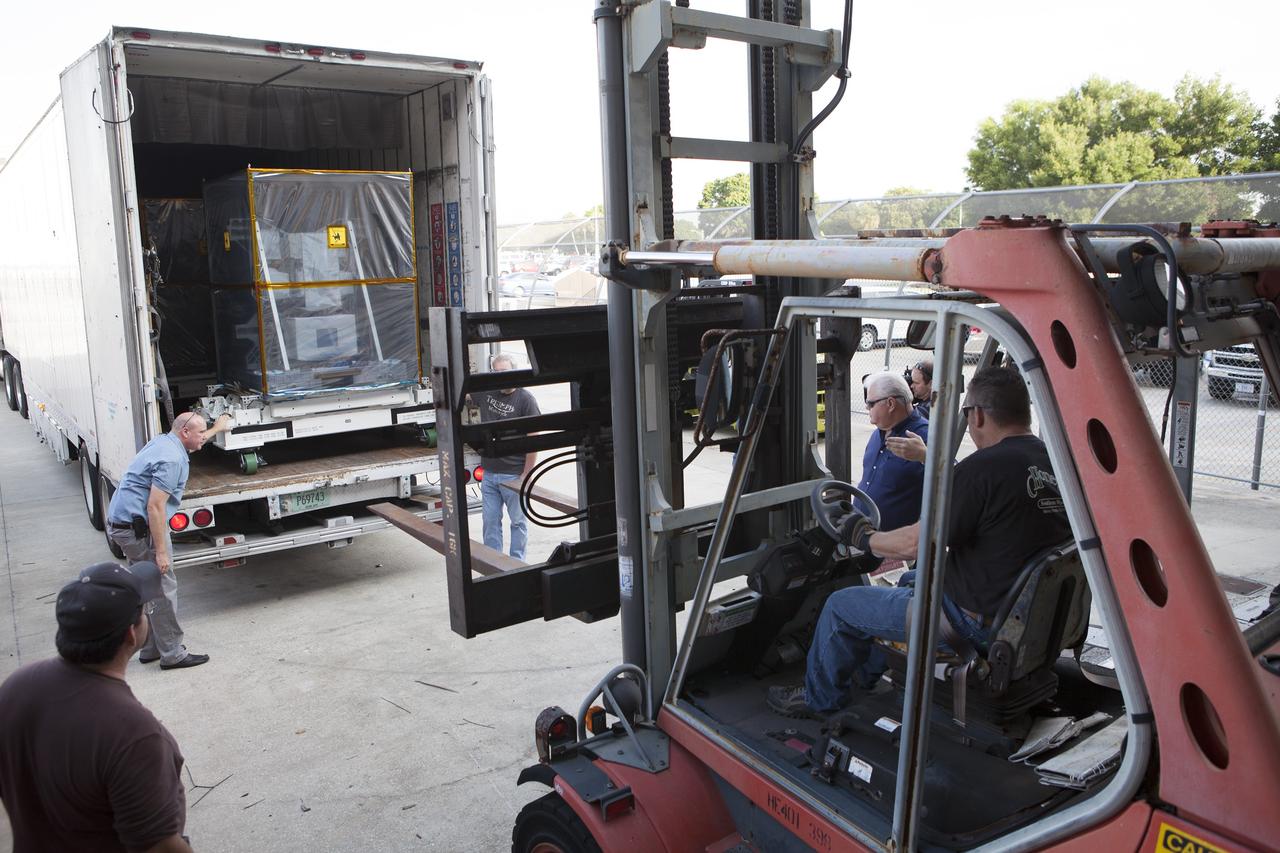
CAPE CANAVERAL, Fla. – NASA's International Space Station-RapidScat scatterometer instrument waits to be removed from the truck that delivered it to the Space Station Processing Facility at Kennedy Space Center in Florida. ISS-RapidScat is the first scientific Earth-observing instrument designed to operate from the exterior of the space station. It will measure Earth's ocean surface wind speed and direction, providing data to be used in weather and marine forecasting. Built at NASA's Jet Propulsion Laboratory, ISS-RapidScat is slated to fly on the SpaceX-4 commercial cargo resupply flight in 2014. For more information, visit http://www.jpl.nasa.gov/missions/iss-rapidscat. Photo credit: NASA/Dimitri Gerondidakis
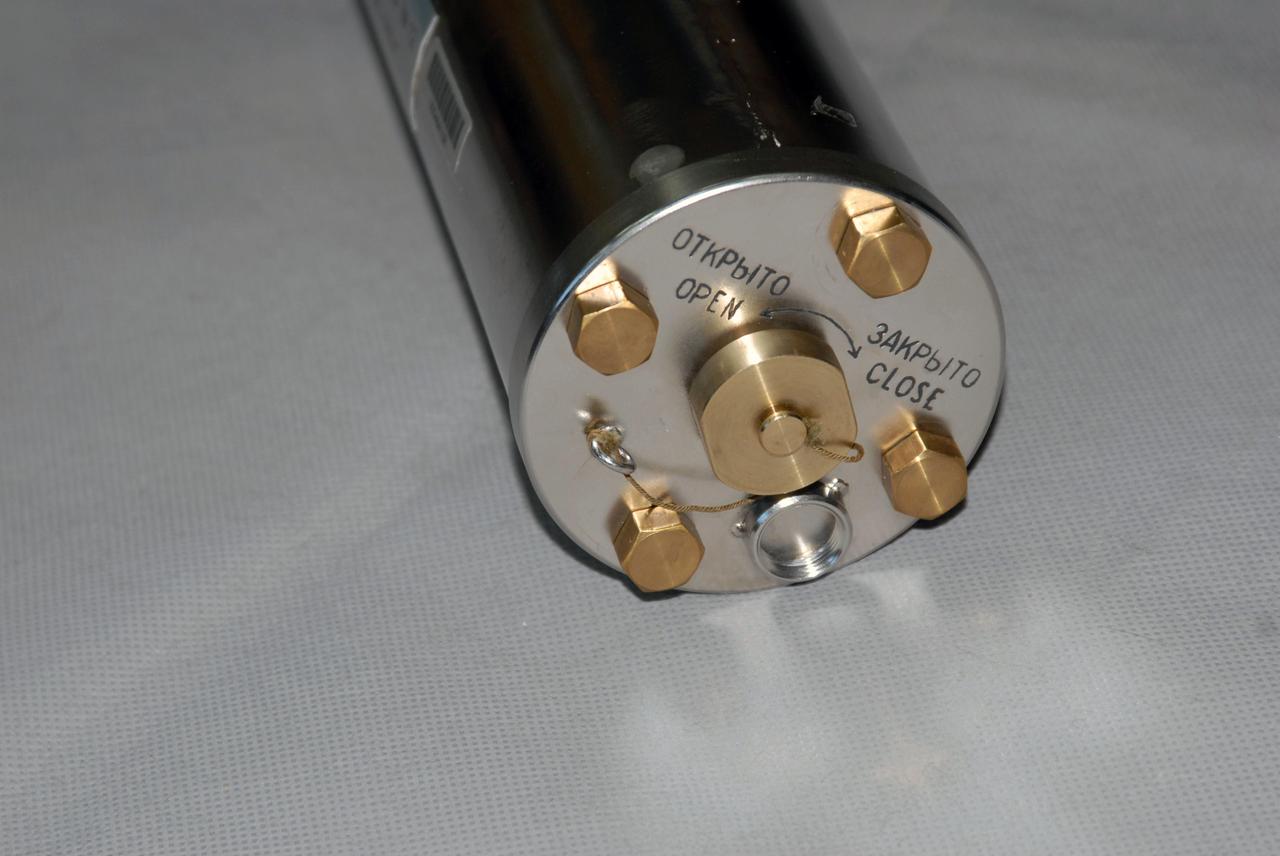
jsc2008e152662 (12/10/2008) --- A preflight view of connectors on a Biorisk-MSV container, part of the Biorisk experiment equipment to be delivered to the ISS during the 31P flight. The Influence of Factors of the Space Environment on the Condition of the System of Microorganisms-Hosts Relating to the Problem of Environmental Safety of Flight Techniques and Planetary Quarantine (Biorisk) investigation aims to obtain new data on physical and genetic changes in bacteria and fungi typically found on spacecraft equipment, and also in various biological test objects (higher plant seeds, dormant forms of lower crustaceans) under exposure in the interior ISS compartments and on the exterior ISS surfaces.
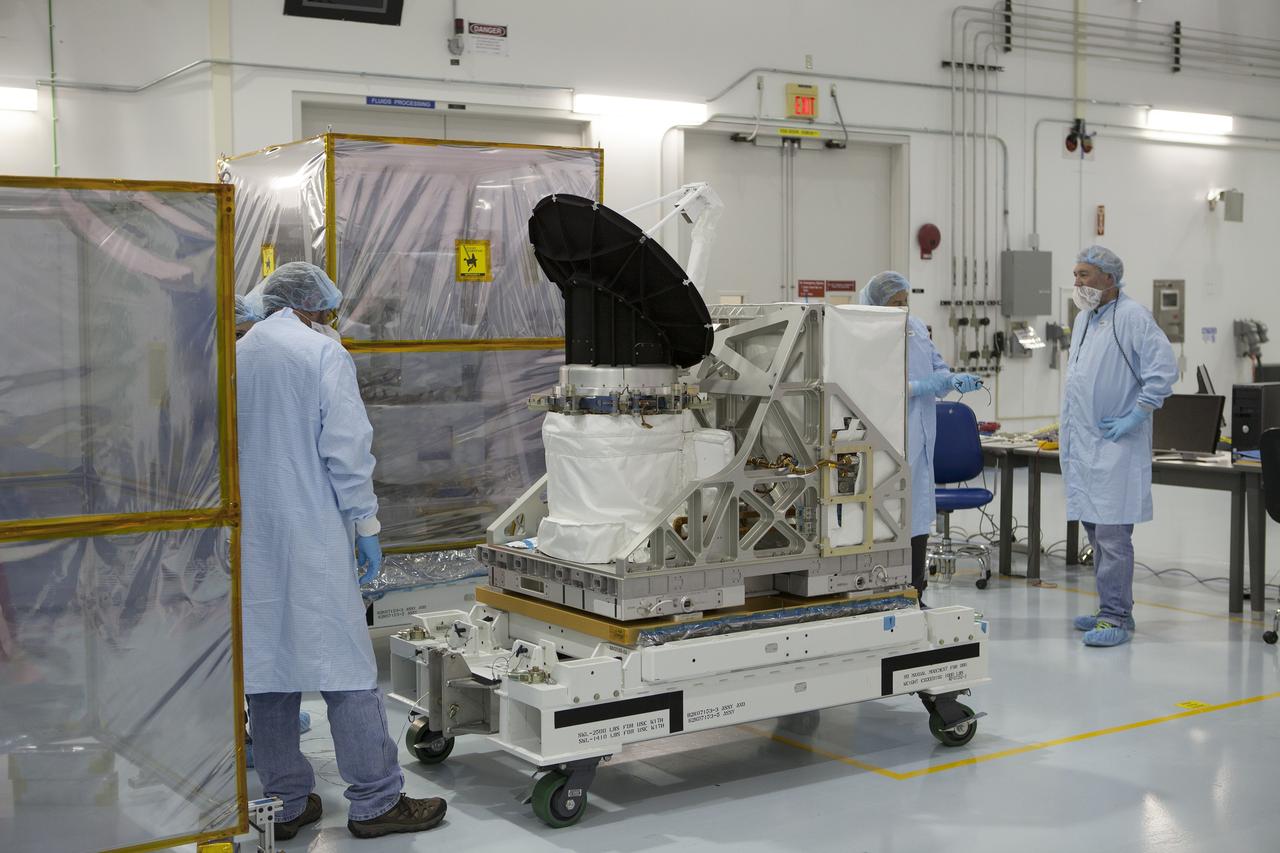
CAPE CANAVERAL, Fla. – Part of NASA's International Space Station-RapidScat scatterometer instrument is revealed after removal of its shipping container inside Kennedy Space Center's Space Station Processing Facility. ISS-RapidScat is the first scientific Earth-observing instrument designed to operate from the exterior of the space station. It will measure Earth's ocean surface wind speed and direction, providing data to be used in weather and marine forecasting. Built at NASA's Jet Propulsion Laboratory, ISS-RapidScat is slated to fly on the SpaceX-4 commercial cargo resupply flight in 2014. For more information, visit http://www.jpl.nasa.gov/missions/iss-rapidscat. Photo credit: NASA/Dimitri Gerondidakis
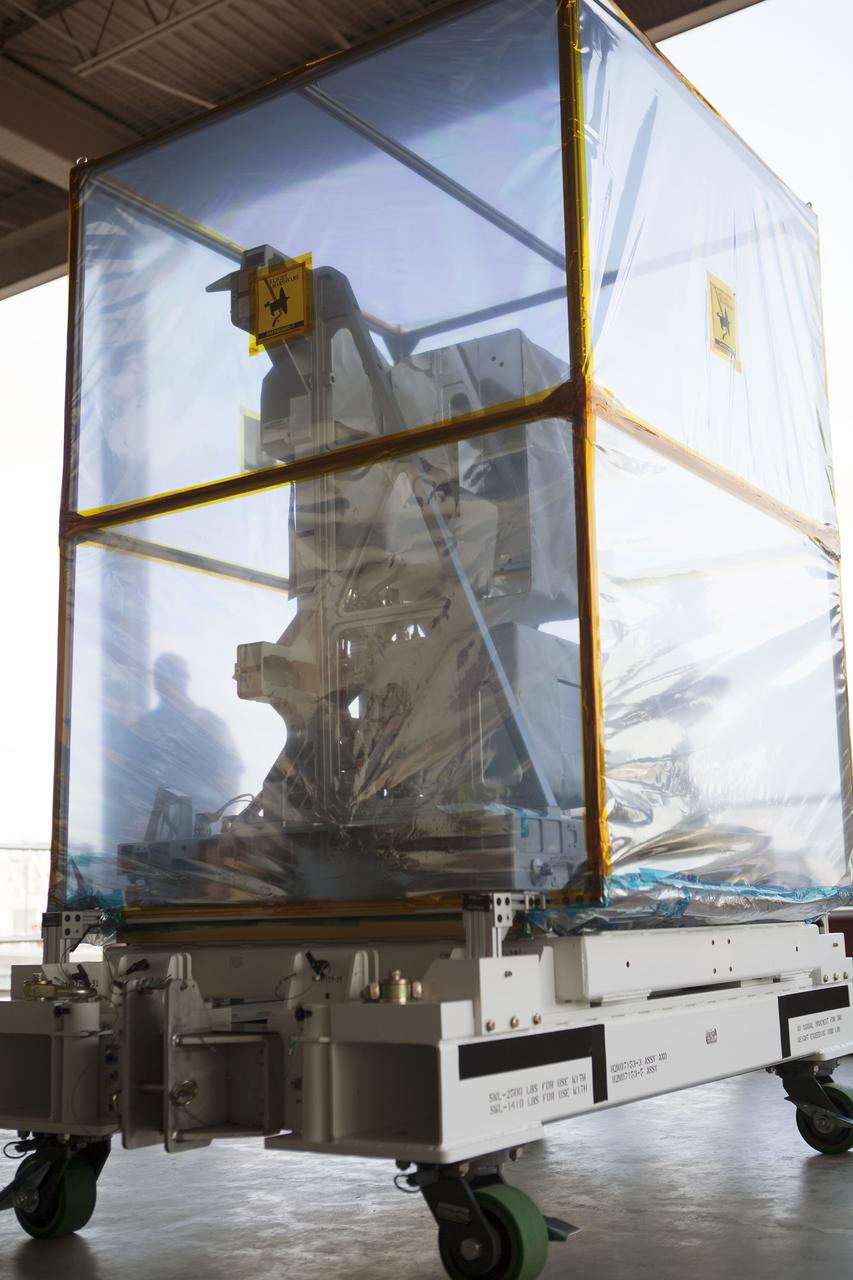
CAPE CANAVERAL, Fla. – A component of NASA's International Space Station-RapidScat scatterometer instrument is moved via forklift into the Space Station Processing Facility at Kennedy Space Center in Florida. ISS-RapidScat is the first scientific Earth-observing instrument designed to operate from the exterior of the space station. It will measure Earth's ocean surface wind speed and direction, providing data to be used in weather and marine forecasting. Built at NASA's Jet Propulsion Laboratory, ISS-RapidScat is slated to fly on the SpaceX-4 commercial cargo resupply flight in 2014. For more information, visit http://www.jpl.nasa.gov/missions/iss-rapidscat. Photo credit: NASA/Dimitri Gerondidakis
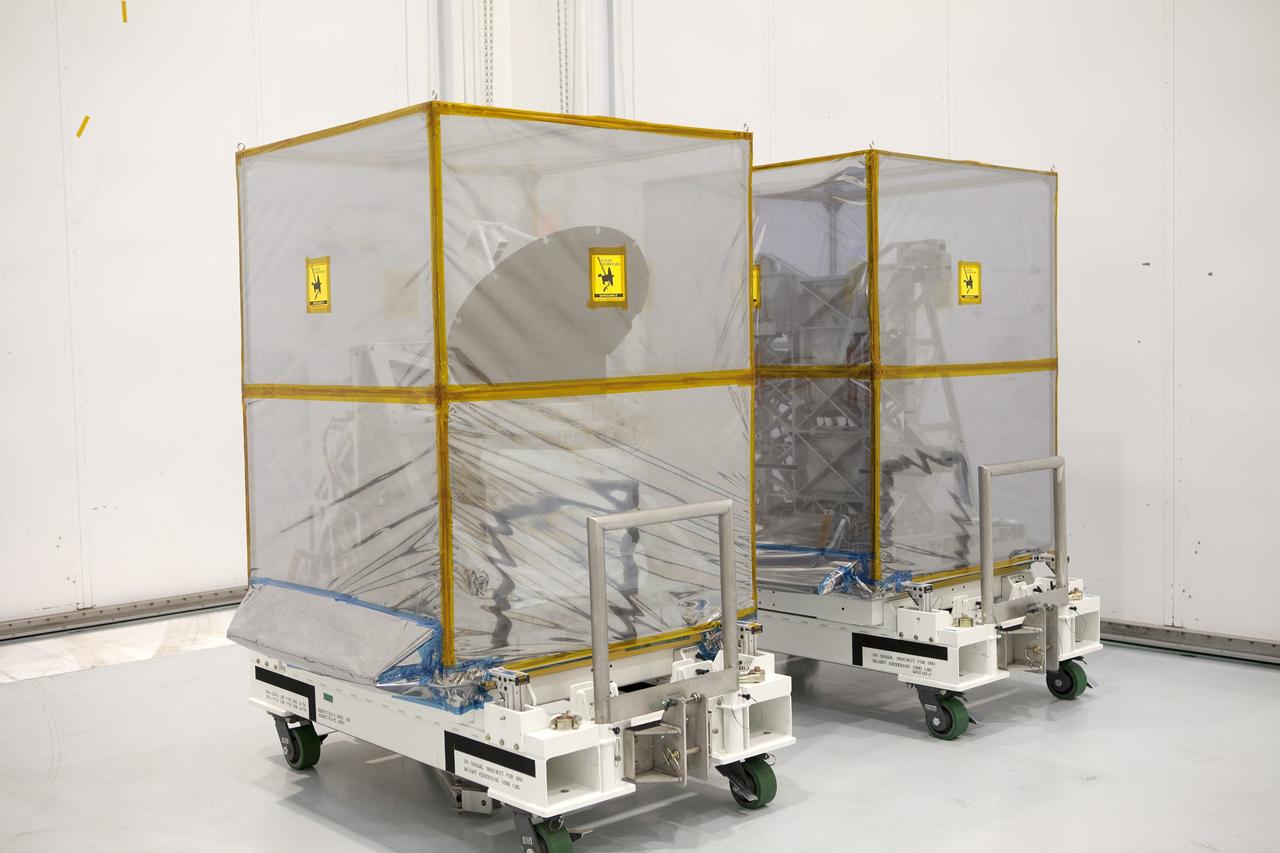
CAPE CANAVERAL, Fla. – The components of NASA's International Space Station-RapidScat scatterometer instrument await processing inside Kennedy Space Center's Space Station Processing Facility. ISS-RapidScat is the first scientific Earth-observing instrument designed to operate from the exterior of the space station. It will measure Earth's ocean surface wind speed and direction, providing data to be used in weather and marine forecasting. Built at NASA's Jet Propulsion Laboratory, ISS-RapidScat is slated to fly on the SpaceX-4 commercial cargo resupply flight in 2014. For more information, visit http://www.jpl.nasa.gov/missions/iss-rapidscat. Photo credit: NASA/Dimitri Gerondidakis

CAPE CANAVERAL, Fla. – Part of NASA's International Space Station-RapidScat scatterometer instrument is visible inside its protective enclosure as it arrives at the Space Station Processing Facility at Kennedy Space Center in Florida. ISS-RapidScat is the first scientific Earth-observing instrument designed to operate from the exterior of the space station. It will measure Earth's ocean surface wind speed and direction, providing data to be used in weather and marine forecasting. Built at NASA's Jet Propulsion Laboratory, ISS-RapidScat is slated to fly on the SpaceX-4 commercial cargo resupply flight in 2014. For more information, visit http://www.jpl.nasa.gov/missions/iss-rapidscat. Photo credit: NASA/Dimitri Gerondidakis
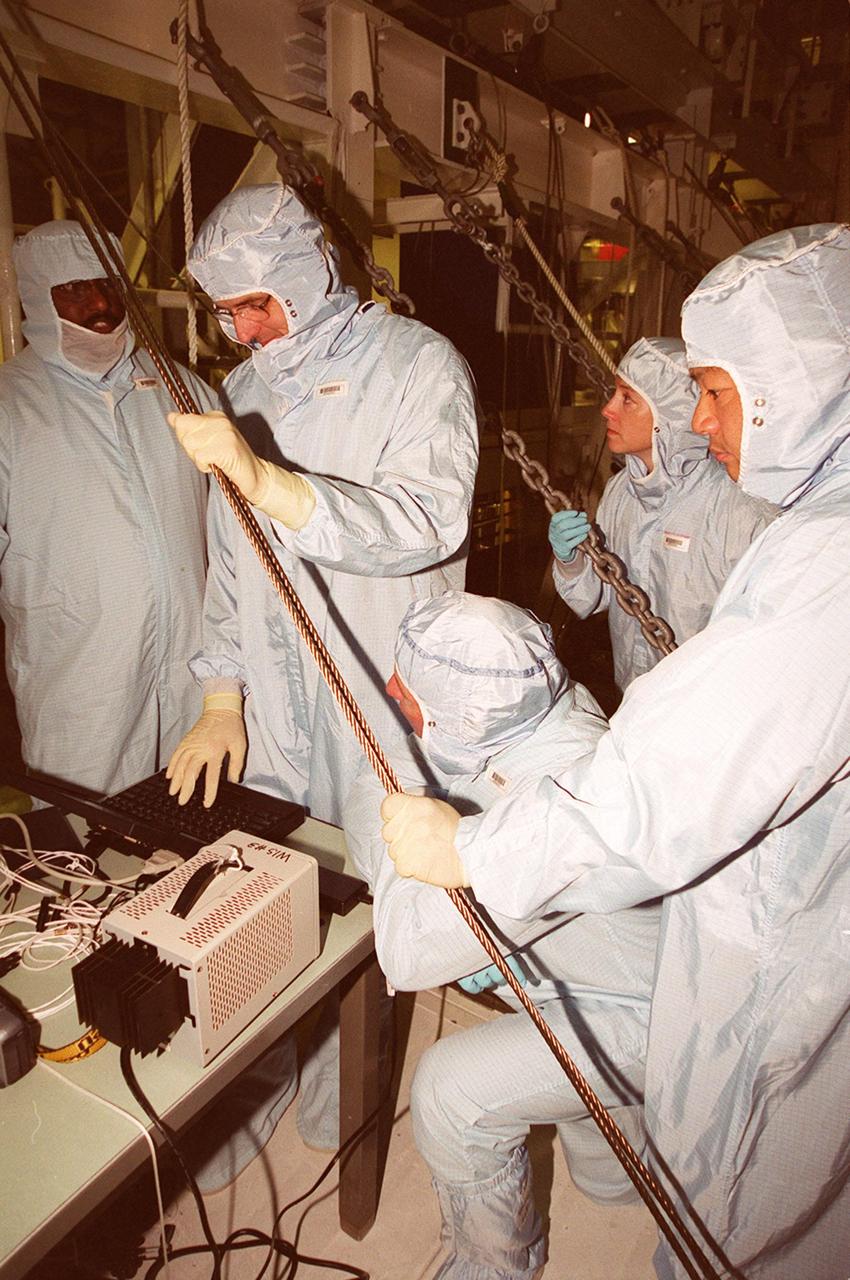
KENNEDY SPACE CENTER, FLA. -- In the Orbiter Processing Facility bay 1, members of the STS-92 crew examine equipment that will be part of their mission to the International Space Station (ISS). The fourth U.S. flight to the ISS, the mission payload includes the Integrated Truss Structure Z1, an early exterior framework to allow the first U.S. solar arrays on a future flight to be temporarily installed on Unity for early power; Ku-band communication to support early science capability and U.S. television; and PMA-3 to provide a Shuttle docking port for solar array installation on the sixth ISS flight and Lab installation on the seventh ISS flight. The crew comprises Mission Commander Brian Duffy, Pilot Pamela Melroy, and Mission Specialists Koichi Wakata, Leroy Chiao, Peter "Jeff" Wisoff, Michael Lopez-Alegria, and William McArthur. Launch of STS-92 is scheduled for Sept. 21, 2000. Wakata is with the National Space Development Agency of Japan
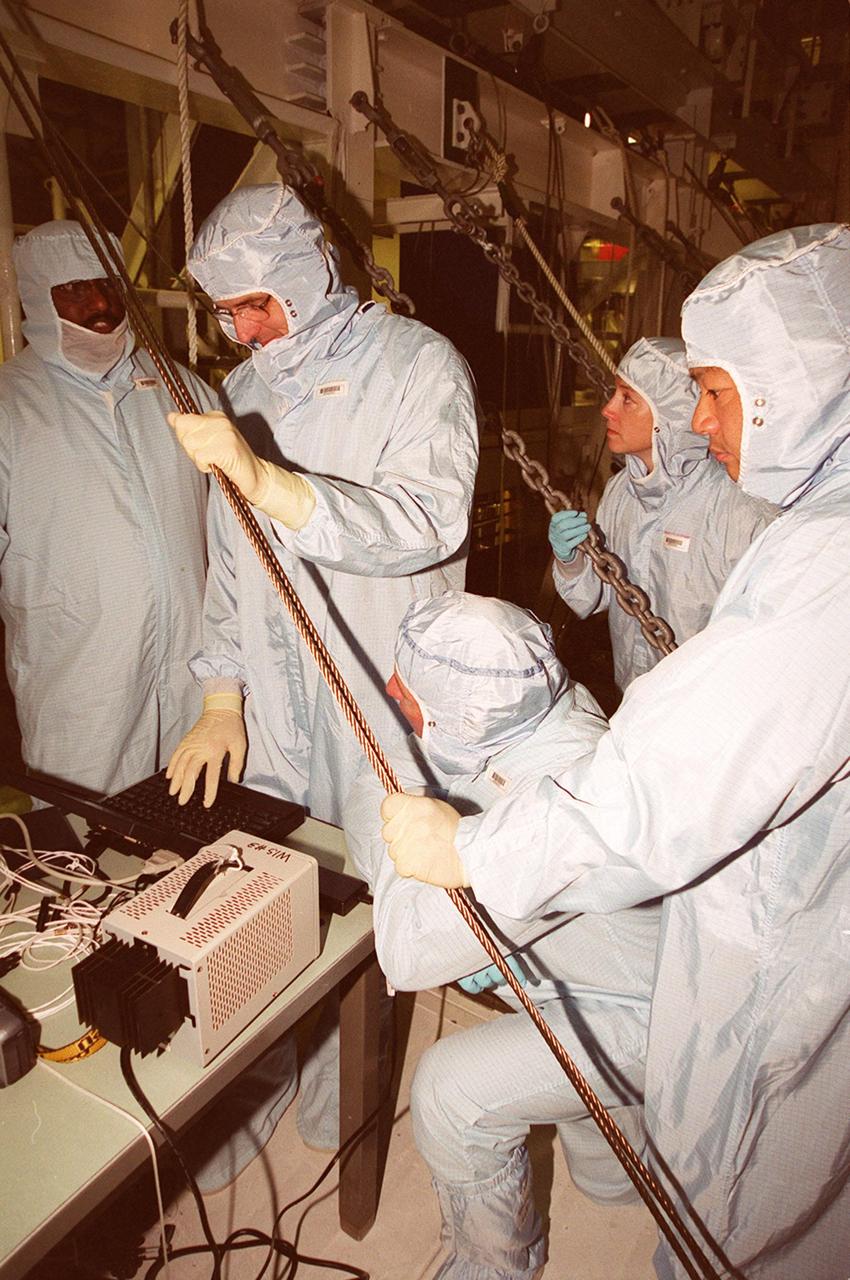
KENNEDY SPACE CENTER, FLA. -- In the Orbiter Processing Facility bay 1, members of the STS-92 crew examine equipment that will be part of their mission to the International Space Station (ISS). The fourth U.S. flight to the ISS, the mission payload includes the Integrated Truss Structure Z1, an early exterior framework to allow the first U.S. solar arrays on a future flight to be temporarily installed on Unity for early power; Ku-band communication to support early science capability and U.S. television; and PMA-3 to provide a Shuttle docking port for solar array installation on the sixth ISS flight and Lab installation on the seventh ISS flight. The crew comprises Mission Commander Brian Duffy, Pilot Pamela Melroy, and Mission Specialists Koichi Wakata, Leroy Chiao, Peter "Jeff" Wisoff, Michael Lopez-Alegria, and William McArthur. Launch of STS-92 is scheduled for Sept. 21, 2000. Wakata is with the National Space Development Agency of Japan
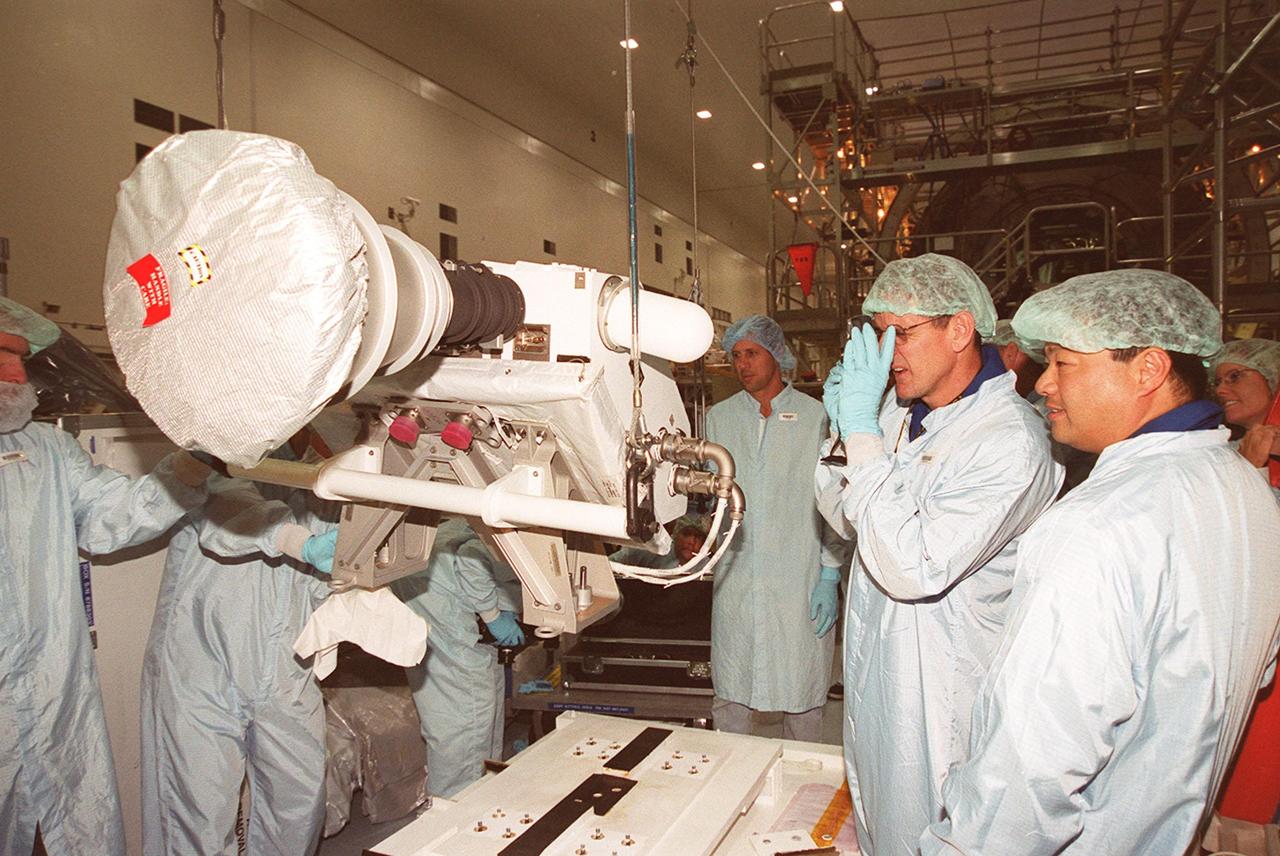
KENNEDY SPACE CENTER, FLA. -- In the Space Station Processing Facility, members of the STS-92 crew examine equipment that will be part of their mission to the International Space Station (ISS). The fourth U.S. flight to the ISS, the mission payload includes the Integrated Truss Structure Z1, an early exterior framework to allow the first U.S. solar arrays on a future flight to be temporarily installed on Unity for early power; Ku-band communication to support early science capability and U.S. television; and PMA-3 to provide a Shuttle docking port for solar array installation on the sixth ISS flight and Lab installation on the seventh ISS flight. The crew comprises Mission Commander Brian Duffy, Pilot Pamela Melroy, and Mission Specialists Koichi Wakata, Leroy Chiao, Peter "Jeff" Wisoff, Michael Lopez-Alegria, and William McArthur. Launch of STS-92 is scheduled for Sept. 21, 2000. Wakata is with the National Space Development Agency of Japan.
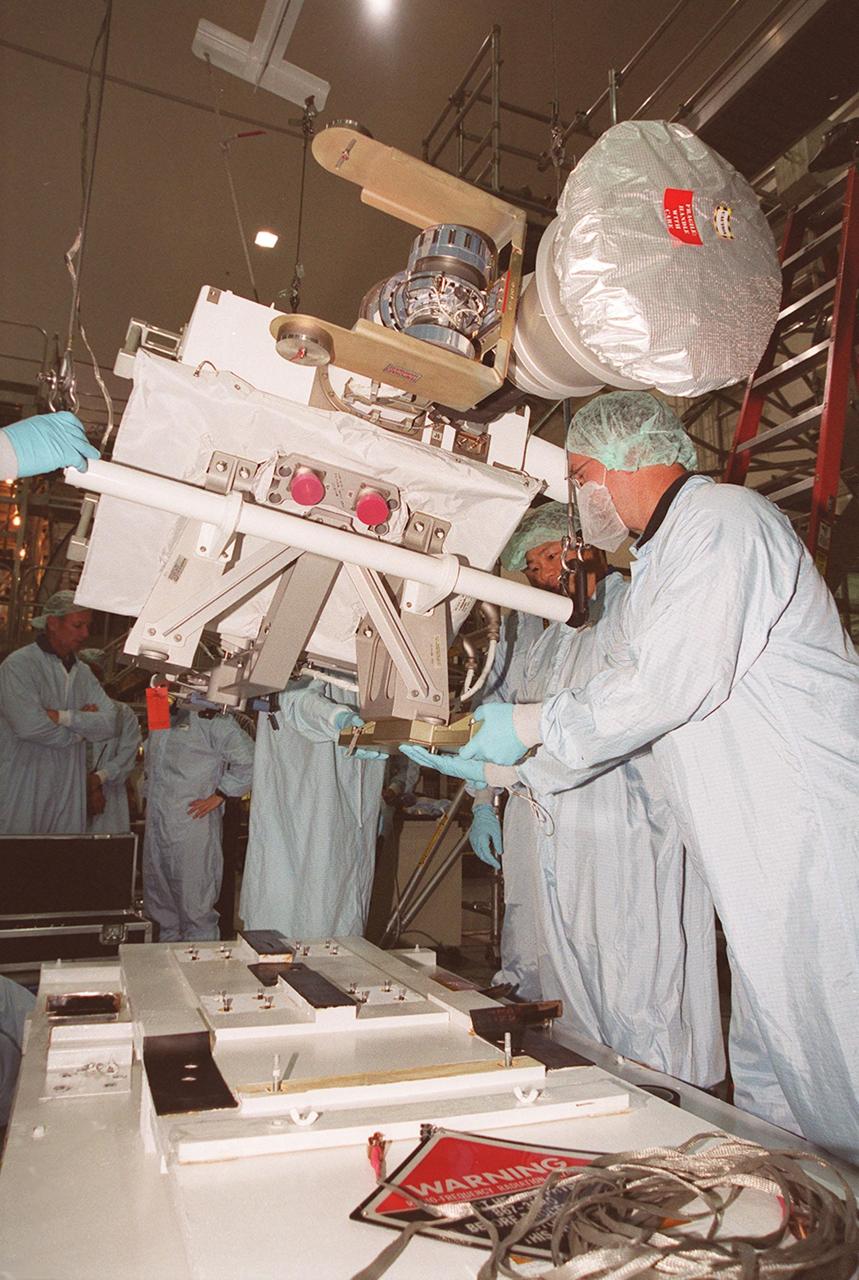
KENNEDY SPACE CENTER, FLA. -- In the Space Station Processing Facility, members of the STS-92 crew examine equipment that will be part of their mission to the International Space Station (ISS). The fourth U.S. flight to the ISS, the mission payload includes the Integrated Truss Structure Z1, an early exterior framework to allow the first U.S. solar arrays on a future flight to be temporarily installed on Unity for early power; Ku-band communication to support early science capability and U.S. television; and PMA-3 to provide a Shuttle docking port for solar array installation on the sixth ISS flight and Lab installation on the seventh ISS flight. The crew comprises Mission Commander Brian Duffy, Pilot Pamela Melroy, and Mission Specialists Koichi Wakata, Leroy Chiao, Peter "Jeff" Wisoff, Michael Lopez-Alegria, and William McArthur. Launch of STS-92 is scheduled for Sept. 21, 2000. Wakata is with the National Space Development Agency of Japan
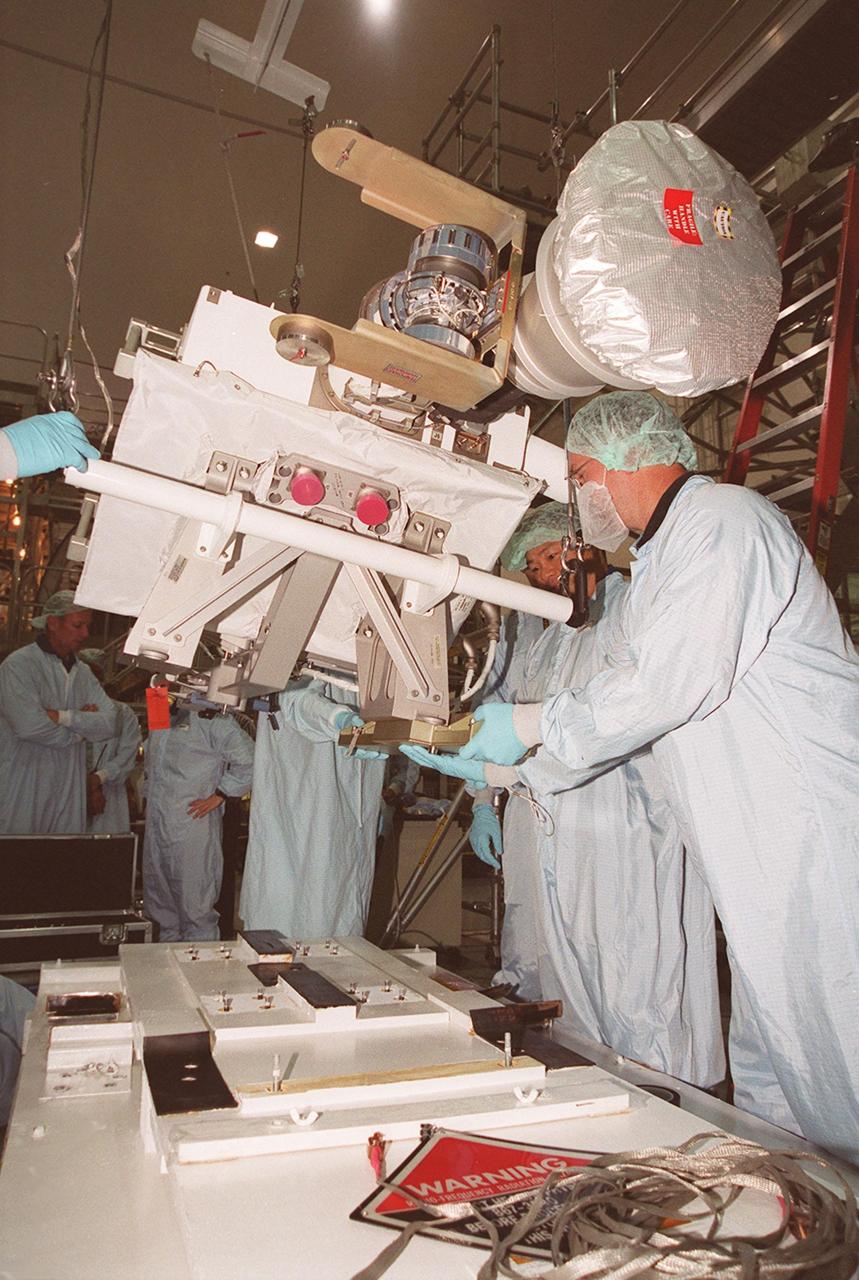
KENNEDY SPACE CENTER, FLA. -- In the Space Station Processing Facility, members of the STS-92 crew examine equipment that will be part of their mission to the International Space Station (ISS). The fourth U.S. flight to the ISS, the mission payload includes the Integrated Truss Structure Z1, an early exterior framework to allow the first U.S. solar arrays on a future flight to be temporarily installed on Unity for early power; Ku-band communication to support early science capability and U.S. television; and PMA-3 to provide a Shuttle docking port for solar array installation on the sixth ISS flight and Lab installation on the seventh ISS flight. The crew comprises Mission Commander Brian Duffy, Pilot Pamela Melroy, and Mission Specialists Koichi Wakata, Leroy Chiao, Peter "Jeff" Wisoff, Michael Lopez-Alegria, and William McArthur. Launch of STS-92 is scheduled for Sept. 21, 2000. Wakata is with the National Space Development Agency of Japan
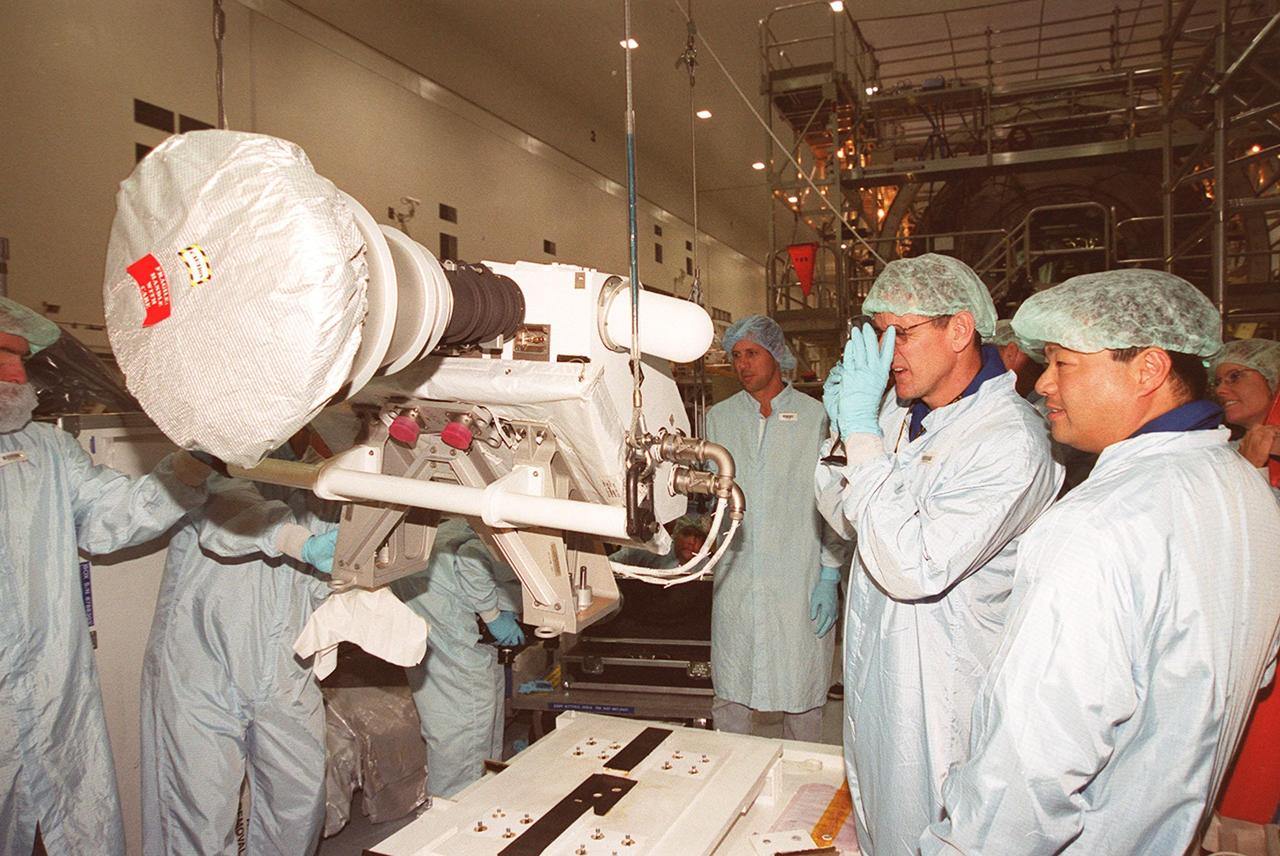
KENNEDY SPACE CENTER, FLA. -- In the Space Station Processing Facility, members of the STS-92 crew examine equipment that will be part of their mission to the International Space Station (ISS). The fourth U.S. flight to the ISS, the mission payload includes the Integrated Truss Structure Z1, an early exterior framework to allow the first U.S. solar arrays on a future flight to be temporarily installed on Unity for early power; Ku-band communication to support early science capability and U.S. television; and PMA-3 to provide a Shuttle docking port for solar array installation on the sixth ISS flight and Lab installation on the seventh ISS flight. The crew comprises Mission Commander Brian Duffy, Pilot Pamela Melroy, and Mission Specialists Koichi Wakata, Leroy Chiao, Peter "Jeff" Wisoff, Michael Lopez-Alegria, and William McArthur. Launch of STS-92 is scheduled for Sept. 21, 2000. Wakata is with the National Space Development Agency of Japan.
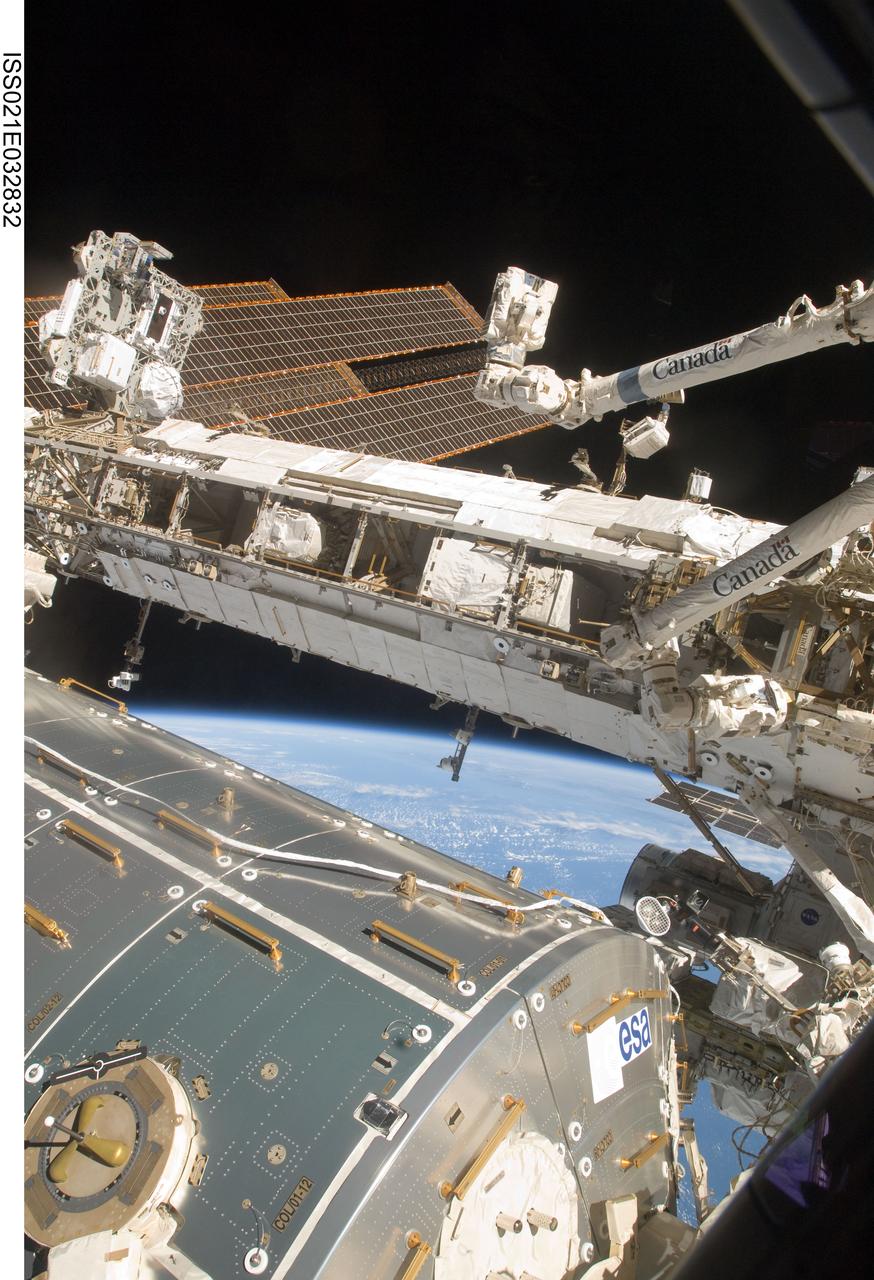
ISS021-E-032832 (24 Nov. 2009) --- Various segments of the International Space Station are featured in this image photographed by an Expedition 21 crew member while space shuttle Atlantis (STS-129) remains docked with the station. A portion of the Columbus laboratory is at bottom. Earth’s horizon and the blackness of space provide the backdrop for the scene.

S118-E-09448 (19 Aug. 2007) --- Backdropped by a colorful Earth, the International Space Station moves away from Space Shuttle Endeavour. Earlier the STS-118 and Expedition 15 crews concluded nearly nine days of cooperative work onboard the shuttle and station. Undocking of the two spacecraft occurred at 6:56 a.m. (CDT) on Aug. 19, 2007.

S118-E-09447 (19 Aug. 2007) --- Backdropped by a colorful Earth, the International Space Station moves away from the Space Shuttle Endeavour. Earlier the STS-118 and Expedition 15 crews concluded nearly nine days of cooperative work onboard the shuttle and station. Undocking of the two spacecraft occurred at 6:56 a.m. (CDT) on Aug. 19, 2007.

ISS028-E-016142 (12 July 2011) --- This picture, photographed by NASA astronaut Ron Garan during the spacewalk conducted on July 12, 2011, shows the International Space Station with space shuttle Atlantis docked at the edge of the frame on the far right and a Russian Soyuz docked to Pirs, below the sun. In the foreground is the Alpha Magnetic Spectrometer (AMS) experiment installed during the STS-134 mission. AMS is a state-of-the-art particle physics detector designed to use the unique environment of space to advance knowledge of the universe and lead to the understanding of the universe's origin by searching for antimatter and dark matter, and measuring cosmic rays.

ISS028-E-016138 (12 July 2011) --- This picture, photographed by NASA astronaut Ron Garan during the spacewalk conducted on July 12, 2011, shows the International Space Station with space shuttle Atlantis docked at right and a Russian Soyuz docked to Pirs, below the sun (partially out of frame) at upper left. In the lower right foreground is the Alpha Magnetic Spectrometer (AMS) experiment installed during the STS-134 mission. AMS is a state-of-the-art particle physics detector designed to use the unique environment of space to advance knowledge of the universe and lead to the understanding of the universe's origin by searching for antimatter and dark matter, and measuring cosmic rays.
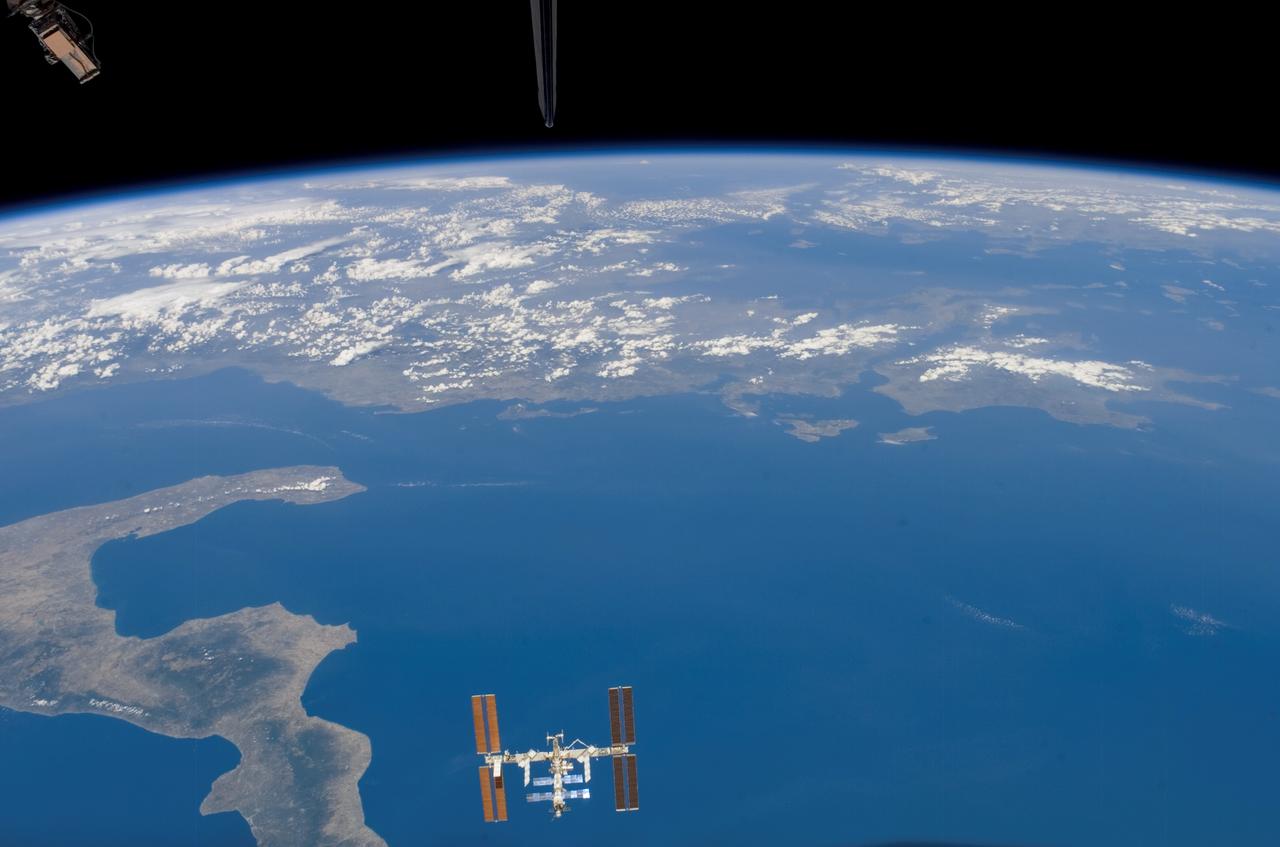
S118-E-09467 (19 Aug. 2007) --- The International Space Station is featured in this image photographed by a STS-118 crewmember on the Space Shuttle Endeavour following the undocking of the two spacecraft, which occurred at 6:56 a.m. (CDT) on Aug. 19, 2007. The image was acquired through one of the crew cabin windows, looking back over the length of the shuttle. Endeavour had undocked from the station, and the crew had begun late inspection of the orbiter's Thermal Protection System (wing leading edges, nosecap, and belly tiles) prior to landing. The late inspection is performed using sensors mounted on the Orbiter Boom Sensor System (OBSS) in order to assess whether micrometeorite or orbiting debris impacts had compromised the Thermal Protection System of the shuttle while it was docked with the station. This oblique image was acquired almost one hour after late inspection activities had begun. The sensor head of the OBSS is visible at top left. The entirety of the orbital outpost is visible at bottom center, set against the backdrop of the Ionian Sea approximately 330 kilometers below it. Other visible features of the southeastern Mediterranean region include the toe and heel features of Italy's "boot" at lower left, and the western coastlines of Albania and Greece extend across the center. Further towards the horizon, the Aegean and Black Seas are also visible.

S118-E-09416 (19 Aug. 2007) --- Backdropped by a blue and white Earth, the International Space Station moves away from Space Shuttle Endeavour. Earlier the STS-118 and Expedition 15 crews concluded nearly nine days of cooperative work onboard the shuttle and station. Undocking of the two spacecraft occurred at 6:56 a.m. (CDT) on Aug. 19, 2007.
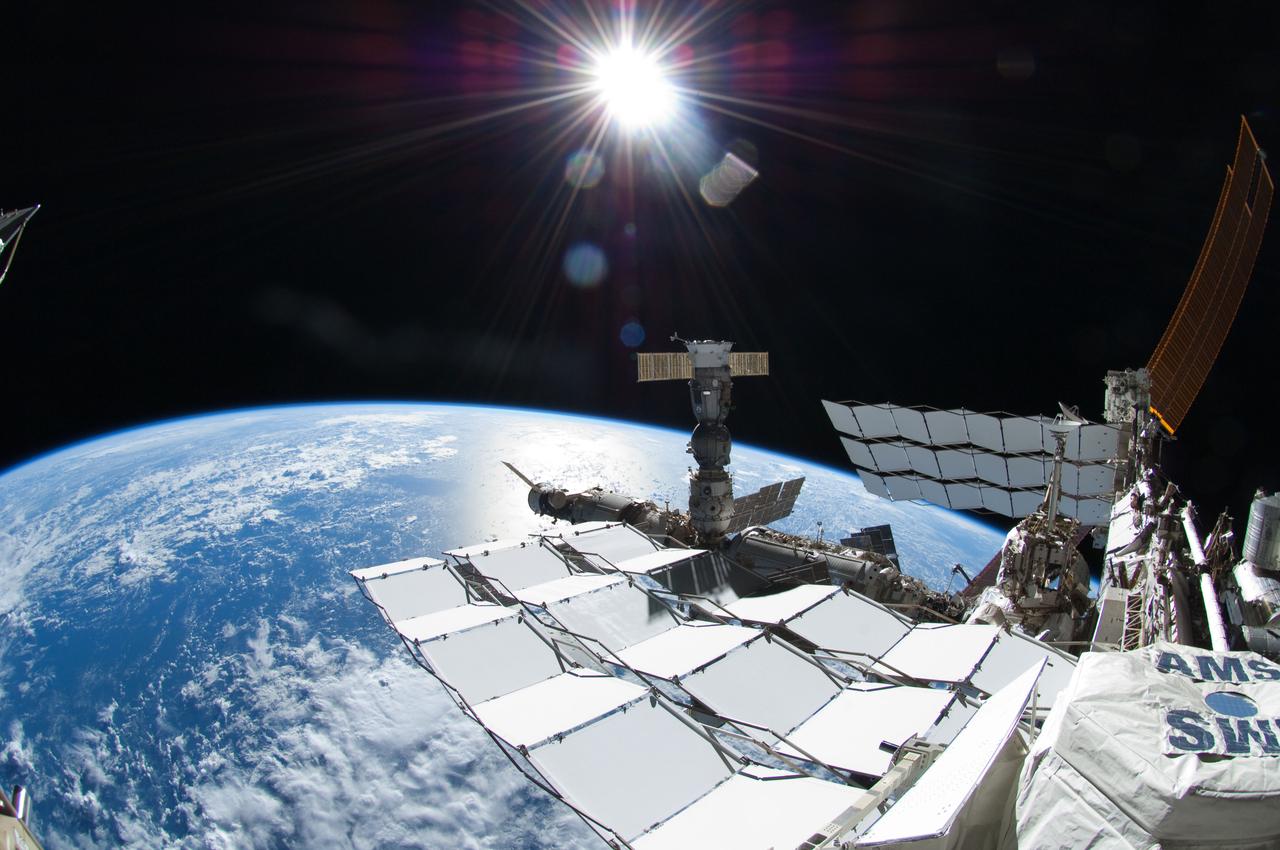
ISS028-E-016140 (12 July 2011) --- This picture, photographed by NASA astronaut Ron Garan during the spacewalk conducted on July 12, 2011, shows the sun and many components of the International Space Station. In this frame the space shuttle Atlantis cannot be seen but is docked just out of frame right and a Russian Soyuz docked to Pirs, below the sun. In the lower right foreground is the Alpha Magnetic Spectrometer (AMS) experiment installed during the STS-134 mission. AMS is a state-of-the-art particle physics detector designed to use the unique environment of space to advance knowledge of the universe and lead to the understanding of the universe's origin by searching for antimatter and dark matter, and measuring cosmic rays.
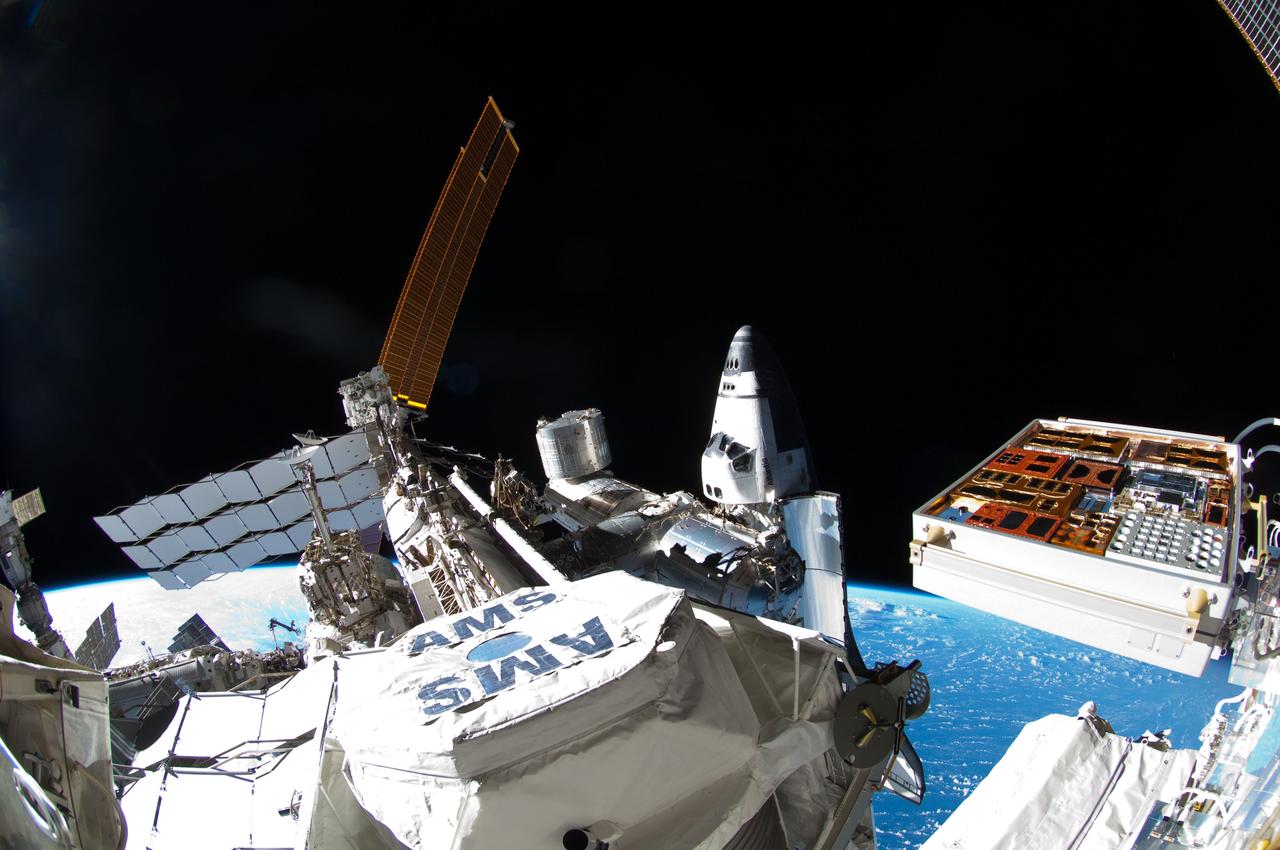
ISS028-E-016128 (12 July 2011) --- This picture, photographed by NASA astronaut Ron Garan during the spacewalk conducted on July 12, 2011, shows the International Space Station with space shuttle Atlantis docked at center frame and a Russian Soyuz docked to Pirs, at left. In the center foreground is the Alpha Magnetic Spectrometer (AMS) experiment installed during the STS-134 mission. AMS is a state-of-the-art particle physics detector designed to use the unique environment of space to advance knowledge of the universe and lead to the understanding of the universe's origin by searching for antimatter and dark matter, and measuring cosmic rays.
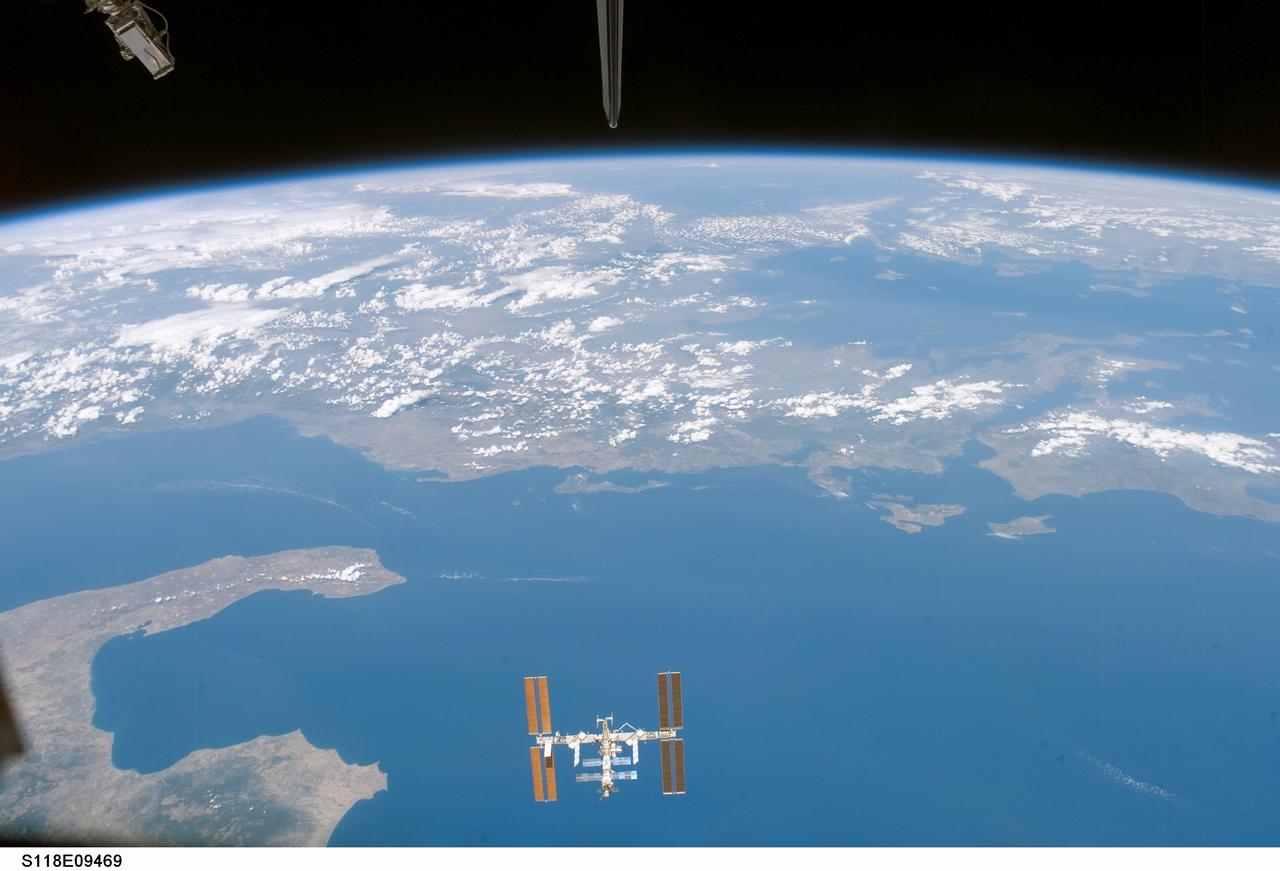
S118-E-09469 (19 Aug. 2007) --- The International Space Station is featured in this image photographed by a STS-118 crewmember on the Space Shuttle Endeavour following the undocking of the two spacecraft, which occurred at 6:56 a.m. (CDT) on Aug. 19, 2007. The image was acquired through one of the crew cabin windows, looking back over the length of the shuttle. Endeavour had undocked from the station, and the crew had begun late inspection of the orbiter's Thermal Protection System (wing leading edges, nosecap, and belly tiles) prior to landing. The late inspection is performed using sensors mounted on the Orbiter Boom Sensor System (OBSS) in order to assess whether micrometeorite or orbiting debris impacts had compromised the Thermal Protection System of the shuttle while it was docked with the station. This oblique image was acquired almost one hour after late inspection activities had begun. The sensor head of the OBSS is visible at top left. The entirety of the orbital outpost is visible at bottom center, set against the backdrop of the Ionian Sea approximately 330 kilometers below it. Other visible features of the southeastern Mediterranean region include the toe and heel features of Italy's "boot" at lower left, and the western coastlines of Albania and Greece extend across the center. Further towards the horizon, the Aegean and Black Seas are also visible.

STS113-336-015 (2 December 2002) --- Backdropped by a blue and white Earth, this full view of the International Space Station (ISS) was photographed by a crewmember on board the Space Shuttle Endeavour following the undocking of the two spacecraft. Endeavour pulled away from the complex at 2:05 p.m. (CST) on December 2, 2002 as the two spacecraft flew over northwestern Australia. The newly installed Port One (P1) truss now complements the Starboard One (S1) truss in center frame.
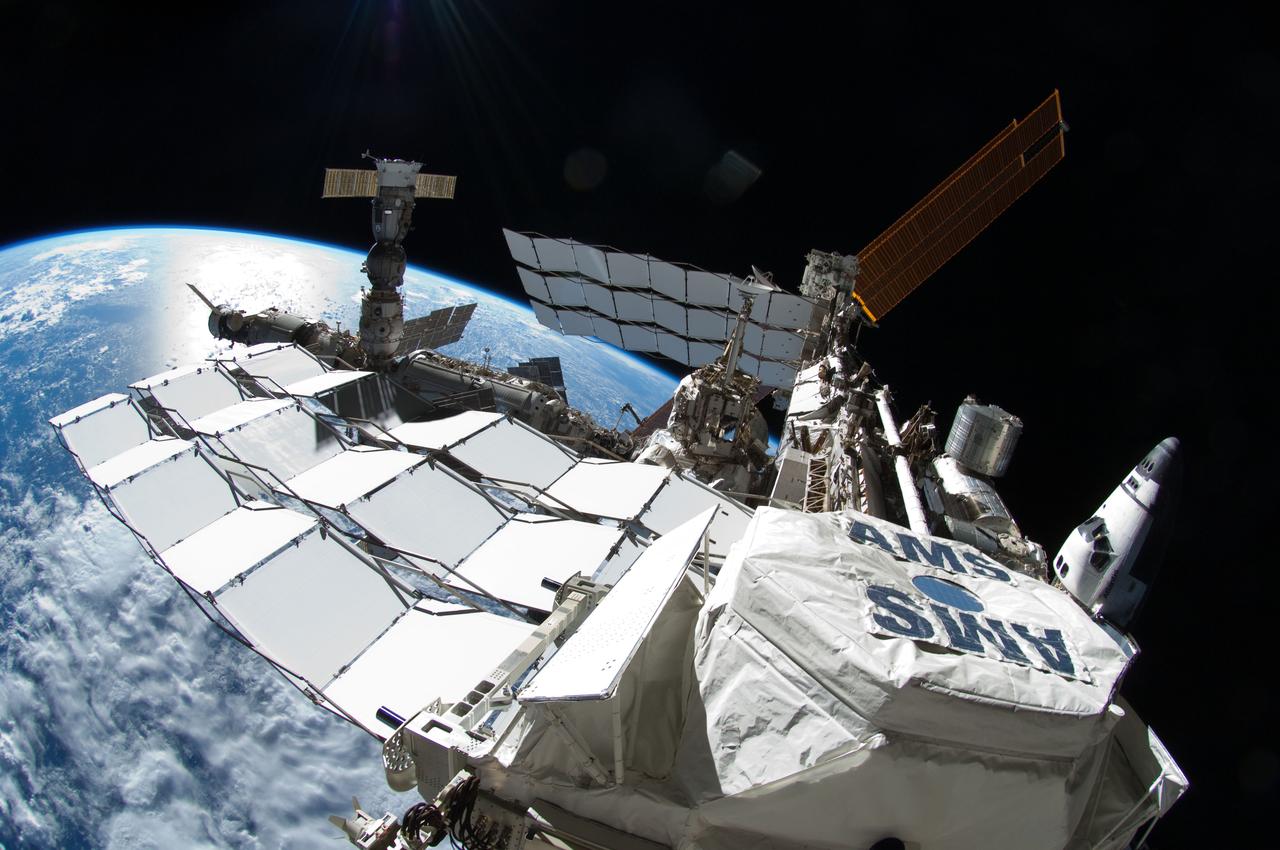
ISS028-E-016137 (12 July 2011) --- This picture, photographed by NASA astronaut Ron Garan during the spacewalk conducted on July 12, 2011, shows the International Space Station with space shuttle Atlantis docked at right and a Russian Soyuz docked to Pirs, at upper left. In the lower right foreground is the Alpha Magnetic Spectrometer (AMS) experiment installed during the STS-134 mission. AMS is a state-of-the-art particle physics detector designed to use the unique environment of space to advance knowledge of the universe and lead to the understanding of the universe's origin by searching for antimatter and dark matter, and measuring cosmic rays.

S118-E-09418 (19 Aug. 2007) --- Backdropped by a blue and white Earth, the International Space Station moves away from Space Shuttle Endeavour. Earlier the STS-118 and Expedition 15 crews concluded nearly nine days of cooperative work onboard the shuttle and station. Undocking of the two spacecraft occurred at 6:56 a.m. (CDT) on Aug. 19, 2007.
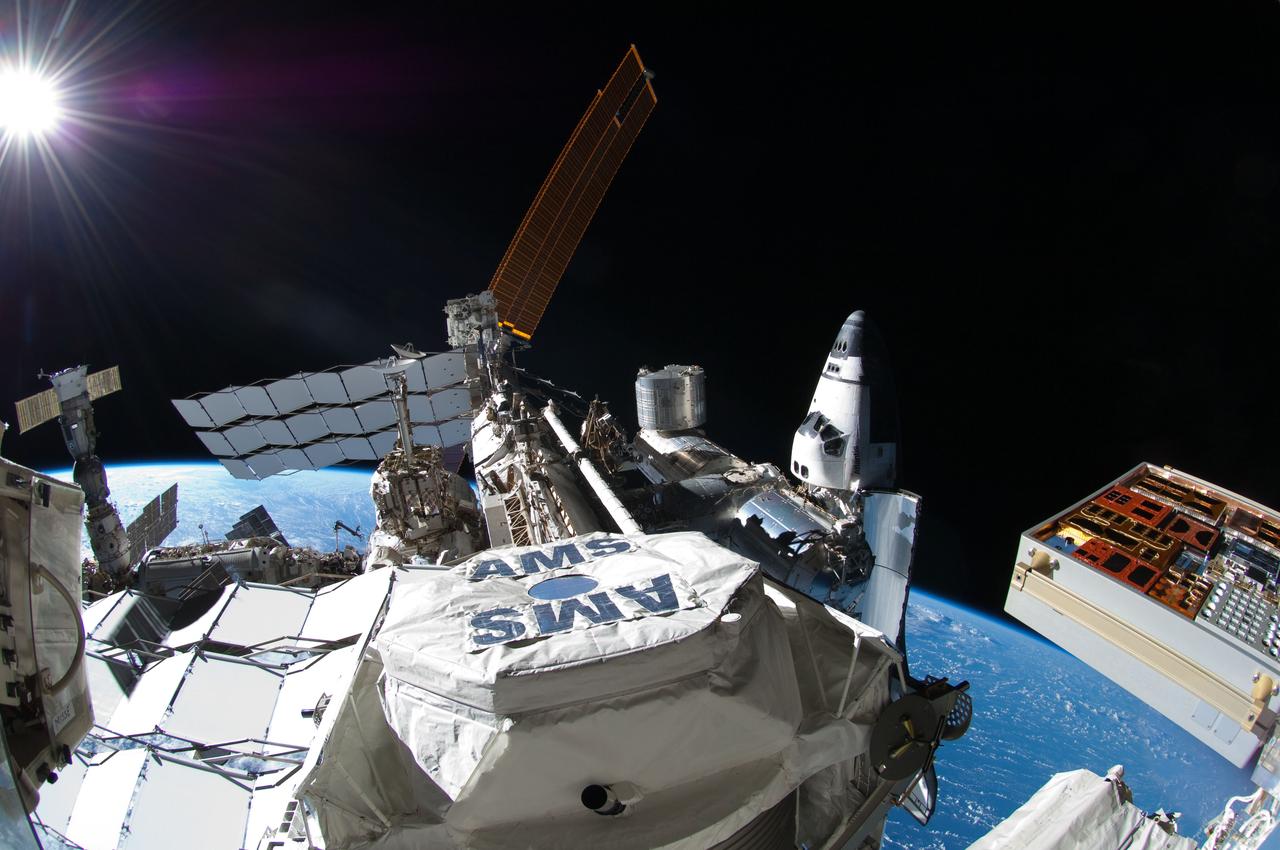
ISS028-E-016131 (12 July 2011) --- This picture, photographed by NASA astronaut Ron Garan during the spacewalk conducted on July 12, 2011, shows the International Space Station with space shuttle Atlantis docked at right and a Russian Soyuz docked to Pirs, below the sun at far left. In the center foreground is the Alpha Magnetic Spectrometer (AMS) experiment installed during the STS-134 mission. AMS is a state-of-the-art particle physics detector designed to use the unique environment of space to advance knowledge of the universe and lead to the understanding of the universe's origin by searching for antimatter and dark matter, and measuring cosmic rays.

S118-E-09435 (19 Aug. 2007) --- Backdropped by a blue Earth, the International Space Station moves away from Space Shuttle Endeavour. Earlier the STS-118 and Expedition 15 crews concluded nearly nine days of cooperative work onboard the shuttle and station. Undocking of the two spacecraft occurred at 6:56 a.m. (CDT) on Aug. 19, 2007.

S114-E-5676 (28 July 2005) --- This image of the International Space Station easing toward the Space Shuttle Discovery was photographed by one of the STS-114 astronauts in the orbiter's crew cabin.
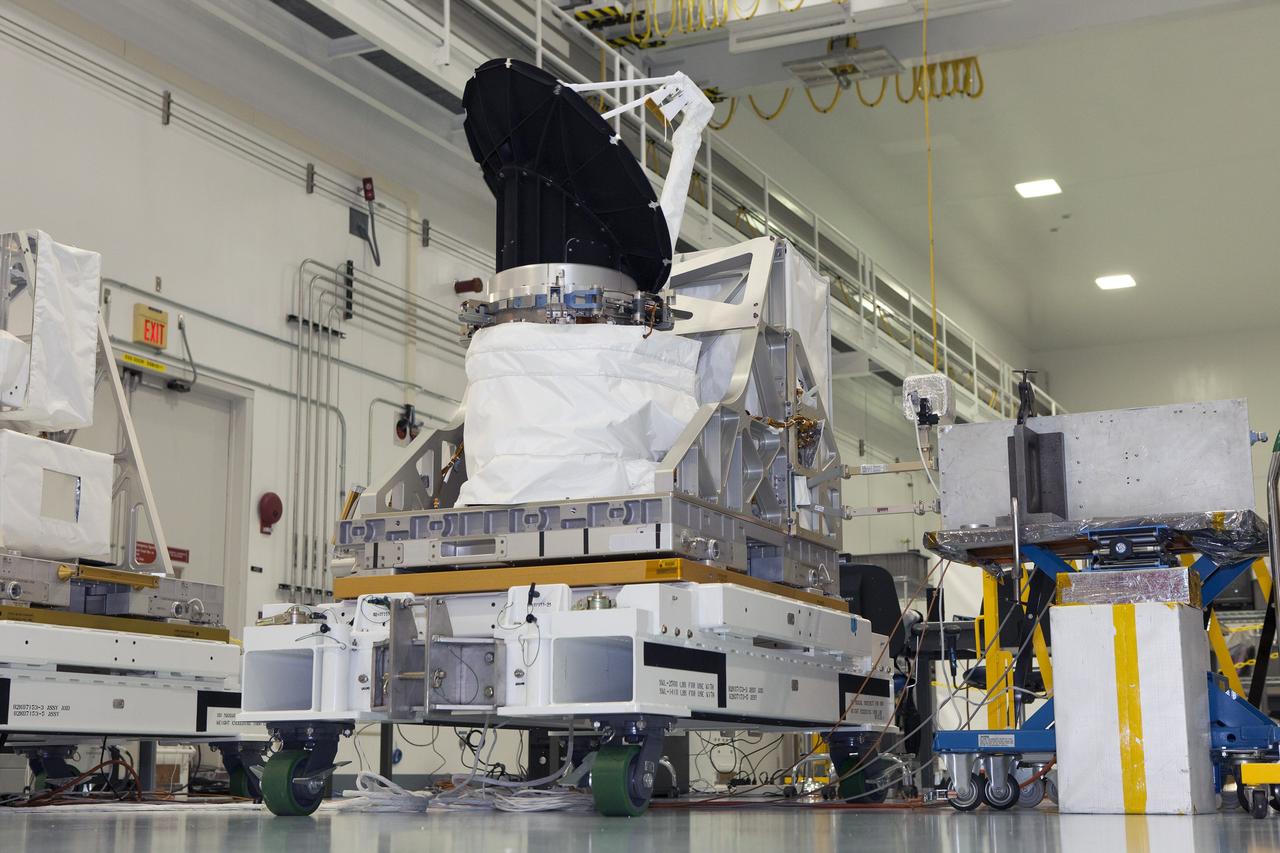
CAPE CANAVERAL, Fla. – NASA's International Space Station-RapidScat undergoes testing of its rotating radar antenna in the Space Station Processing Facility at NASA's Kennedy Space Center in Florida. Built at NASA's Jet Propulsion Laboratory JPL in California, the radar scatterometer is the first scientific Earth-observing instrument designed to operate from the exterior of the space station. It will measure Earth's ocean surface wind speed and direction, providing data to be used in weather and marine forecasting. ISS-RapidScat will be delivered to the station on the SpaceX-4 commercial cargo resupply flight targeted for August 2014. For more information, visit http://www.jpl.nasa.gov/missions/iss-rapidscat. Photo credit: NASA/Daniel Casper
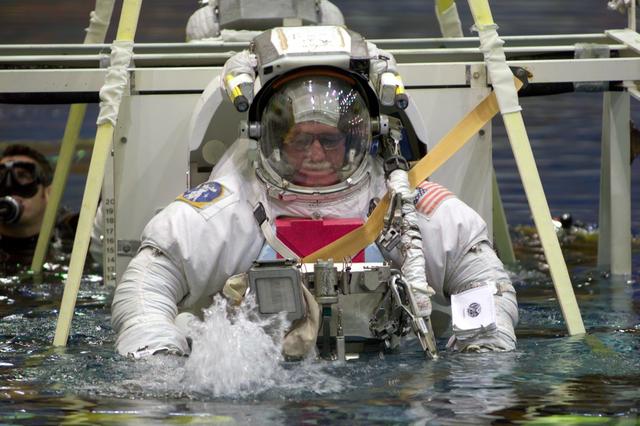
JSC2004-E-27324 (30 June 2004) --- Astronaut John L. Phillips, Expedition 11 NASA ISS science officer, and cosmonaut Sergei K. Krikalev (partially obscured), commander representing Russia’s Federal Space Agency, are submerged in the waters of the Neutral Buoyancy Laboratory (NBL) near Johnson Space Center (JSC). Phillips and Krikalev are wearing training versions of the Extravehicular Mobility Unit (EMU) space suit. Divers are in the water to assist the crewmembers in their rehearsal, intended to help prepare them for work on the exterior of the International Space Station (ISS).
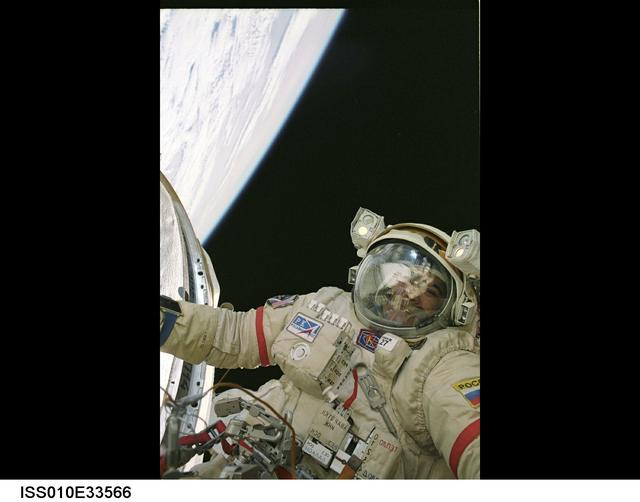
ISS010-E-33566 (26 January 2005) --- Cosmonaut Salizhan S. Sharipov, Expedition 10 flight engineer representing Russia's Federal Space Agency, wearing a Russian Orlan spacesuit, participates in the first of two sessions of extravehicular activities (EVA) performed by the Expedition 10 crew during their six-month mission. Sharipov and astronaut Leroy Chiao (out of frame), mission commander and NASA ISS science officer, spent 5 ½ hours outside the International Space Station (ISS) installing a work platform, cables and robotic and scientific experiments on the exterior of the Zvezda Service Module. Earth’s horizon and the blackness of space provided the backdrop for the image.
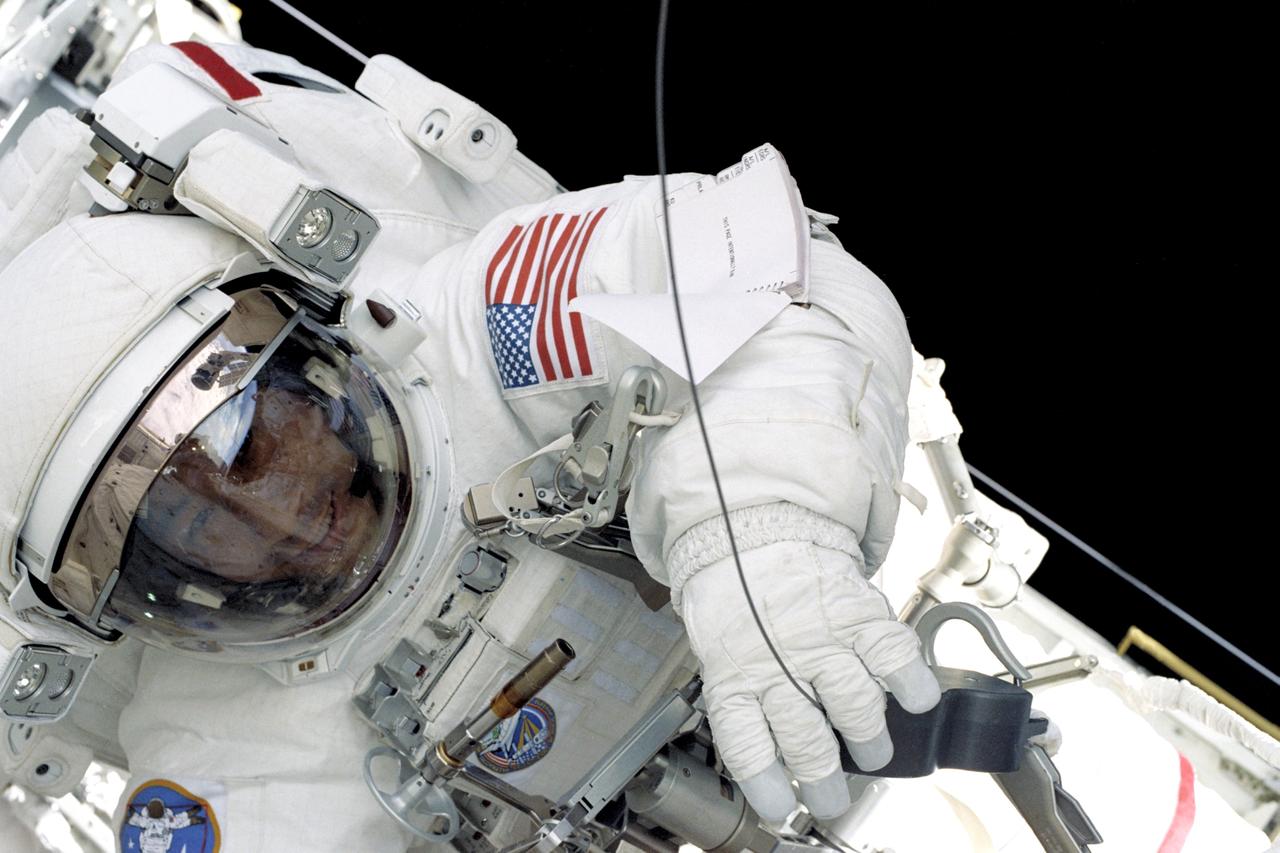
S106-349-026 (11 September 2000) --- Astronaut Edward T. Lu, mission specialist, was captured on film by his spacewalking colleague, cosmonaut Yuri I. Malenchenko, during the 6-hour-plus space walk the two performed on the exterior of the International Space Station (ISS). Lu, although he spent the majority of the space walk several meters away on the other end of International Space Station (ISS) is near the cargo bay longerons of the Space Shuttle Atlantis in this scene. Malenchenko was one of two mission specialists on the 12-day flight who represented the Russian Aviation and Space Agency.
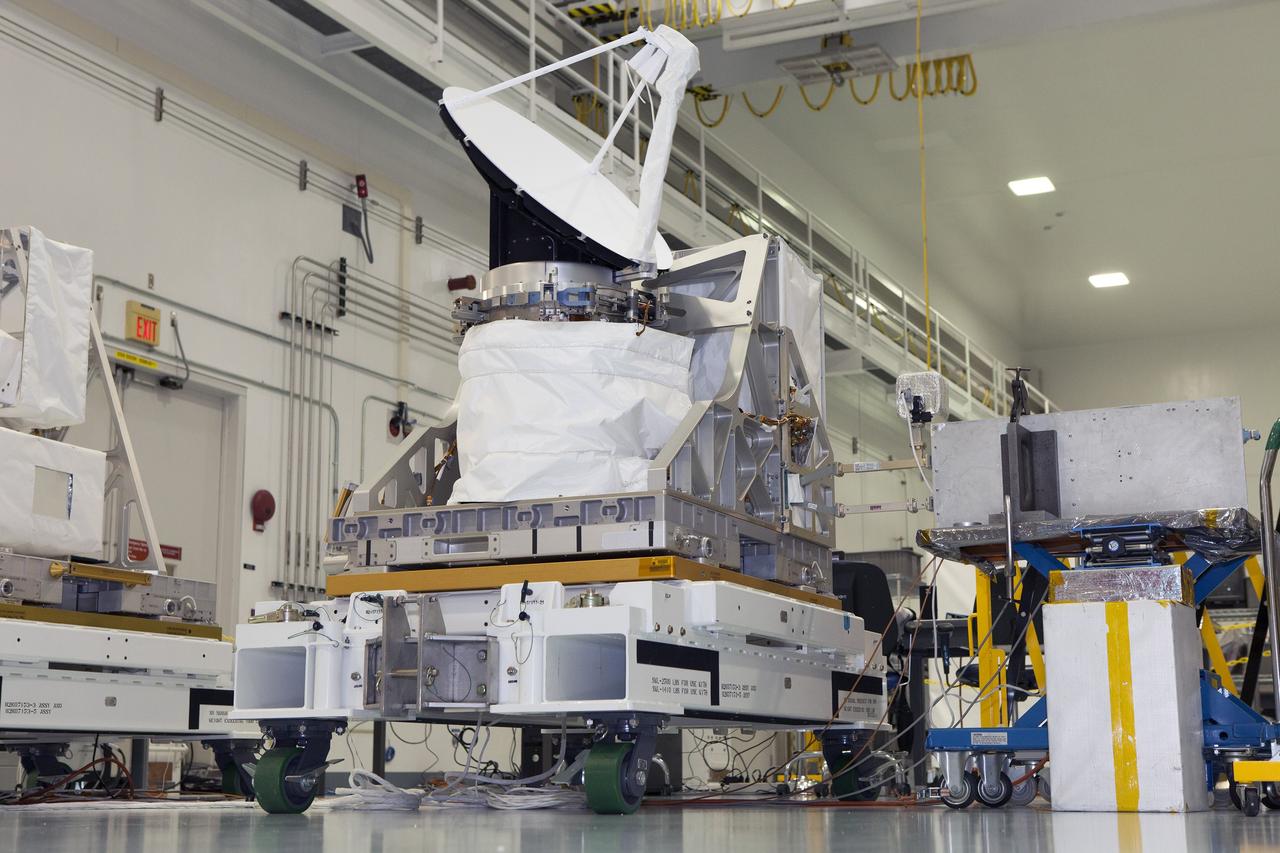
CAPE CANAVERAL, Fla. – Testing of the rotating radar antenna on NASA's International Space Station-RapidScat concludes in the Space Station Processing Facility at NASA's Kennedy Space Center in Florida. Built at NASA's Jet Propulsion Laboratory JPL in California, the radar scatterometer is the first scientific Earth-observing instrument designed to operate from the exterior of the space station. It will measure Earth's ocean surface wind speed and direction, providing data to be used in weather and marine forecasting. ISS-RapidScat will be delivered to the station on the SpaceX-4 commercial cargo resupply flight targeted for August 2014. For more information, visit http://www.jpl.nasa.gov/missions/iss-rapidscat. Photo credit: NASA/Daniel Casper
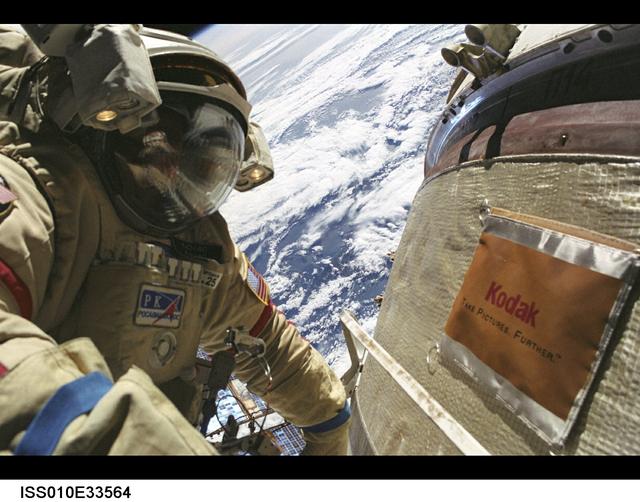
ISS010-E-33564 (26 January 2005) --- Astronaut Leroy Chiao, Expedition 10 commander and NASA ISS science officer, wearing a Russian Orlan spacesuit, participates in the first of two sessions of extravehicular activities (EVA) performed by the Expedition 10 crew during their six-month mission. Chiao and cosmonaut Salizhan S. Sharipov (out of frame), flight engineer representing Russia's Federal Space Agency, spent 5 ½ hours outside the International Space Station (ISS) installing a work platform, cables and robotic and scientific experiments on the exterior of the Zvezda Service Module. A cloudy Earth provided the backdrop for the image.
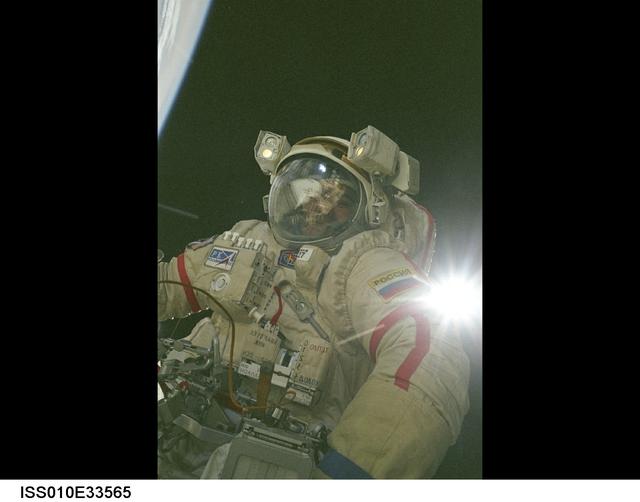
ISS010-E-33565 (26 January 2005) --- Cosmonaut Salizhan S. Sharipov, Expedition 10 flight engineer representing Russia's Federal Space Agency, wearing a Russian Orlan spacesuit, participates in the first of two sessions of extravehicular activities (EVA) performed by the Expedition 10 crew during their six-month mission. Sharipov and astronaut Leroy Chiao (out of frame), mission commander and NASA ISS science officer, spent 5 ½ hours outside the International Space Station (ISS) installing a work platform, cables and robotic and scientific experiments on the exterior of the Zvezda Service Module.