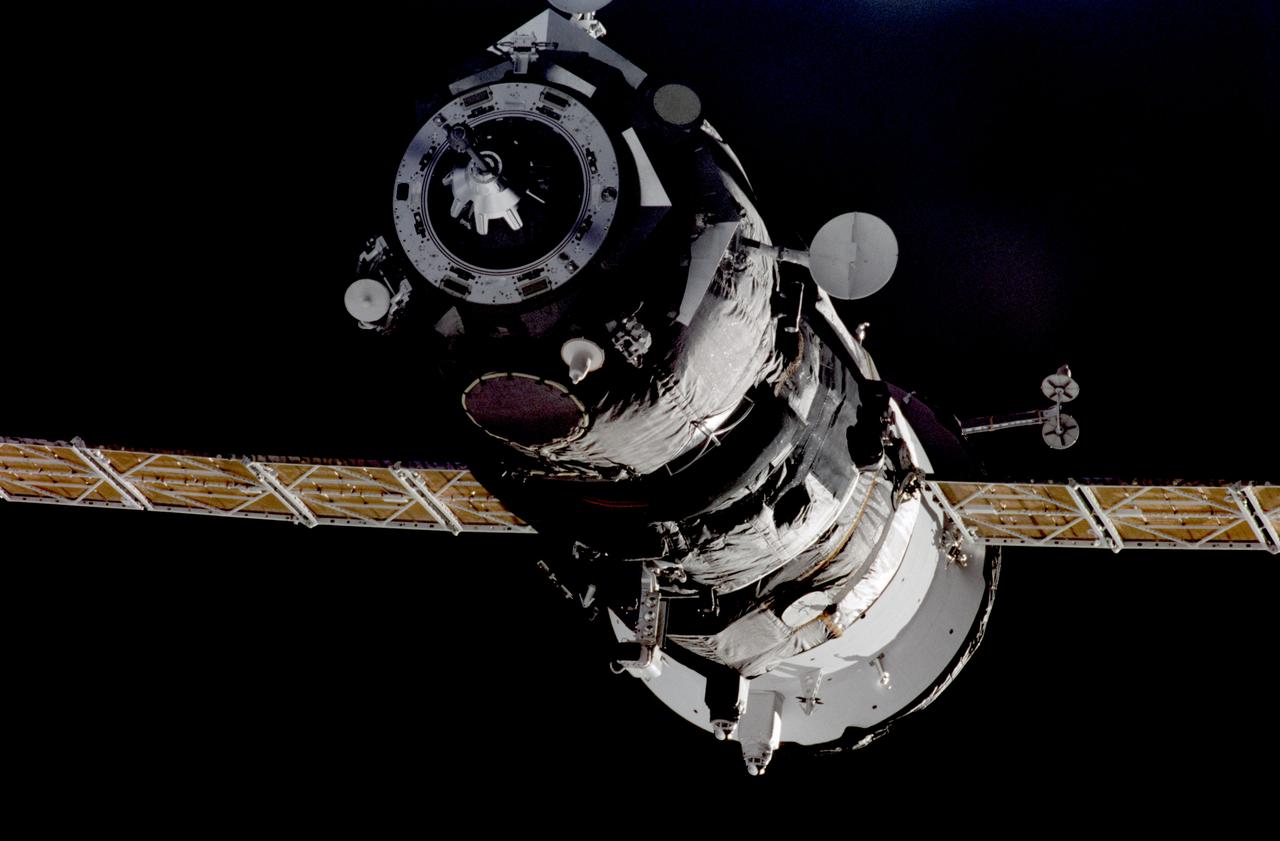
ISS01-324-002 (18 November 2000) --- A Progress supply ship linked up to the orbiting International Space Station (ISS) at 3:48 GMT, November 18, bringing Expedition 1 commander William M. Shepherd, pilot Yuri P. Gidzenko and flight engineer Sergei K. Krikalev two tons of food, clothing, hardware and holiday gifts from their families. The photograph was taken with a 35mm camera and the film was later handed over to the STS-97 crew members for return to Earth and subsequent processing.
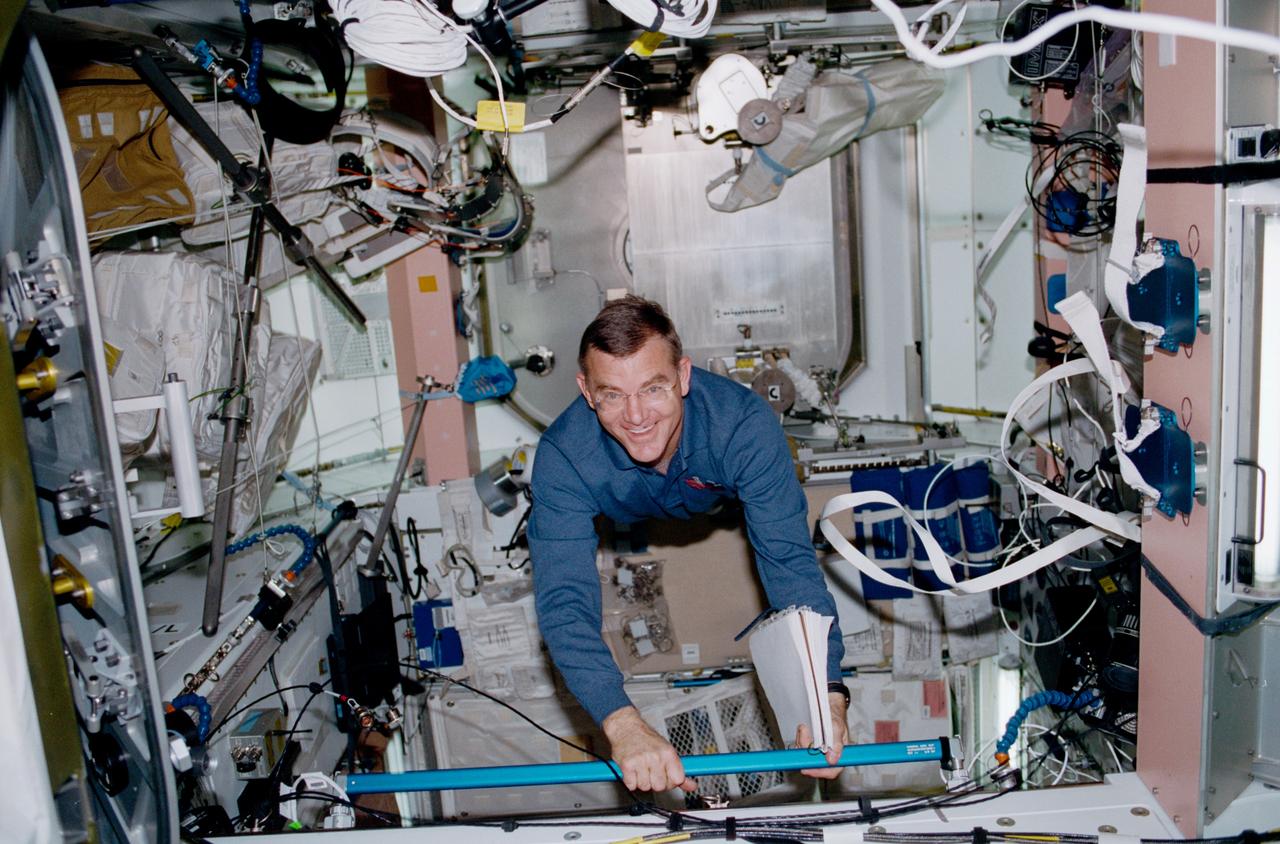
STS102-319-001 (8-21 March 2001)--- Astronaut James S. Voss, Expedition Two flight engineer, is photographed in the U.S.-built Unity node on the International Space Station (ISS) during the STS-102 mission.
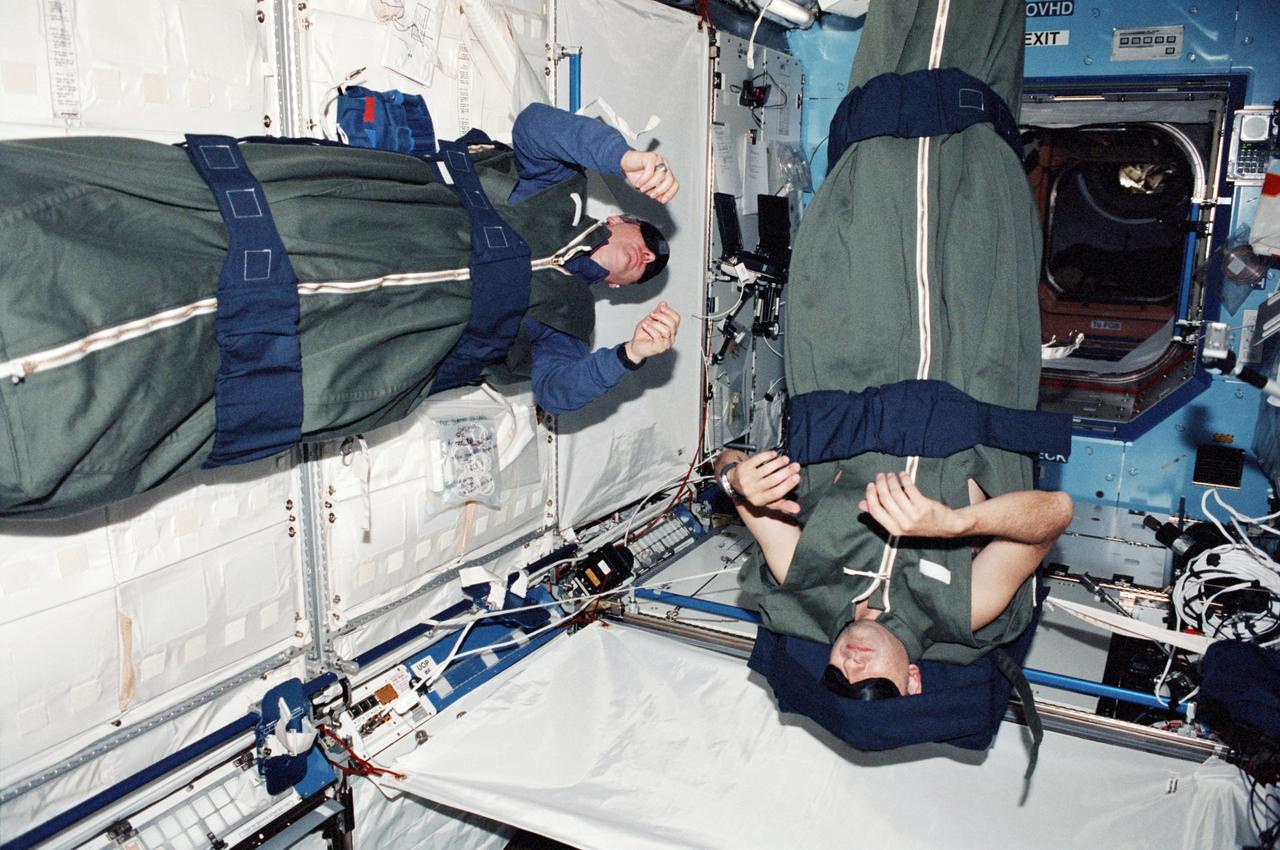
STS098-355-001 (7-20 February 2001) --- Astronauts Thomas D. Jones and Mark L. Polansky, STS-98 mission specialists, are photographed during their sleep shift in the newly-attached Destiny laboratory on the International Space Station (ISS).
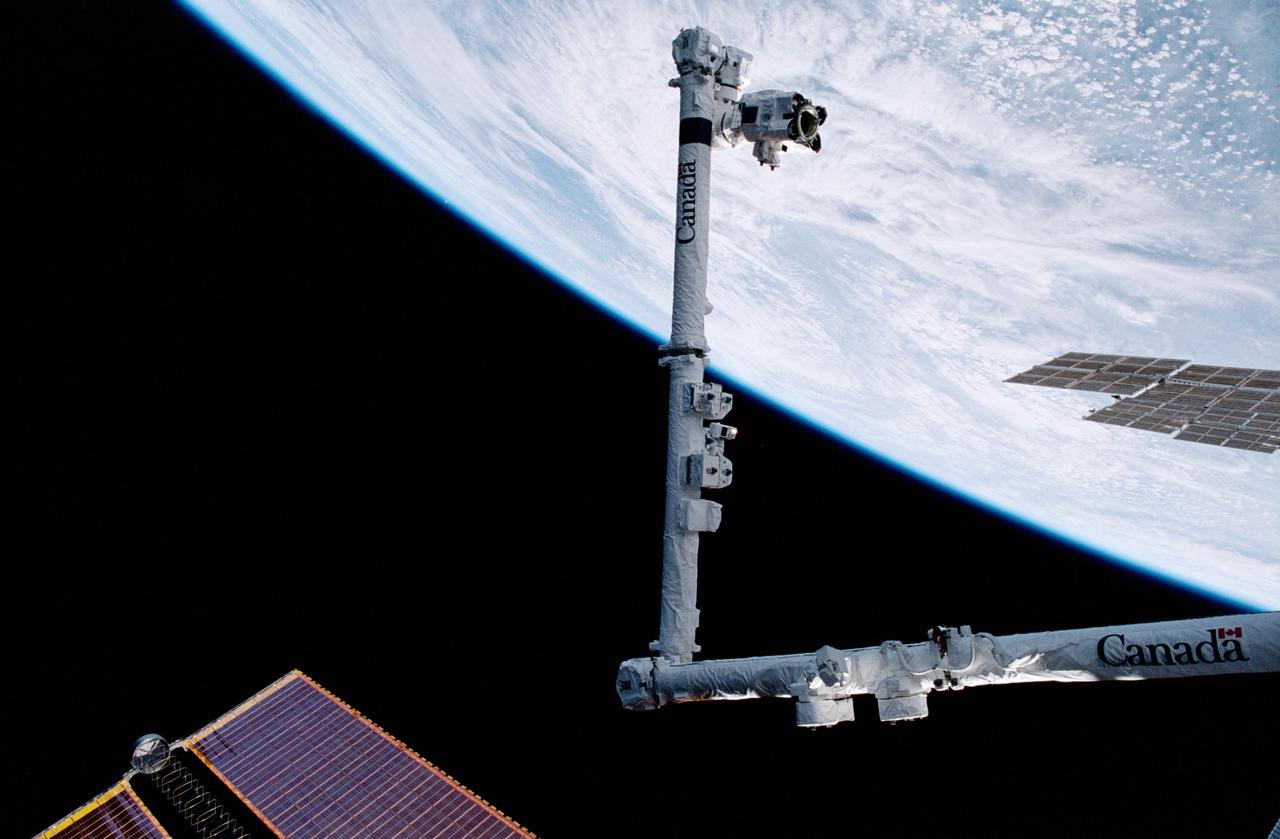
STS100-343-001 (19 April-1 May 2001) --- Extended by a crewmember on the International Space Station (ISS), the Space Station Remote Manipulator System (SSRMS) is backdropped by the blackness of space and the Earth's horizon. A portion of the International Space Station's solar array can be seen in the lower left.
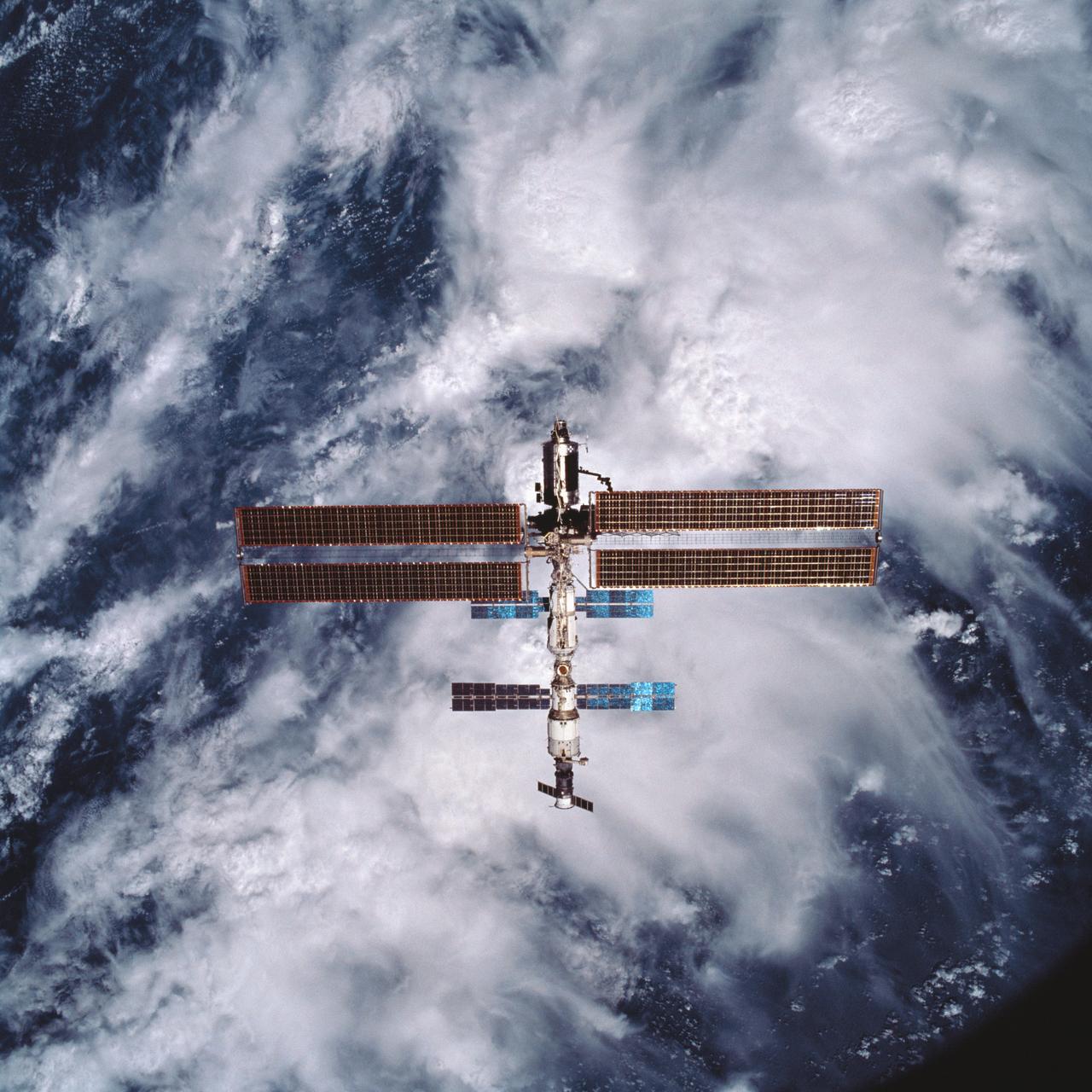
STS105-707-001 (20 August 2001) --- Backdropped against water and clouds, the International Space Station (ISS) is now separated from the Space Station Discovery after several days of joint activities and crew exchange. One of the astronauts aboard Discovery took this 70mm photograph from the aft flight deck.
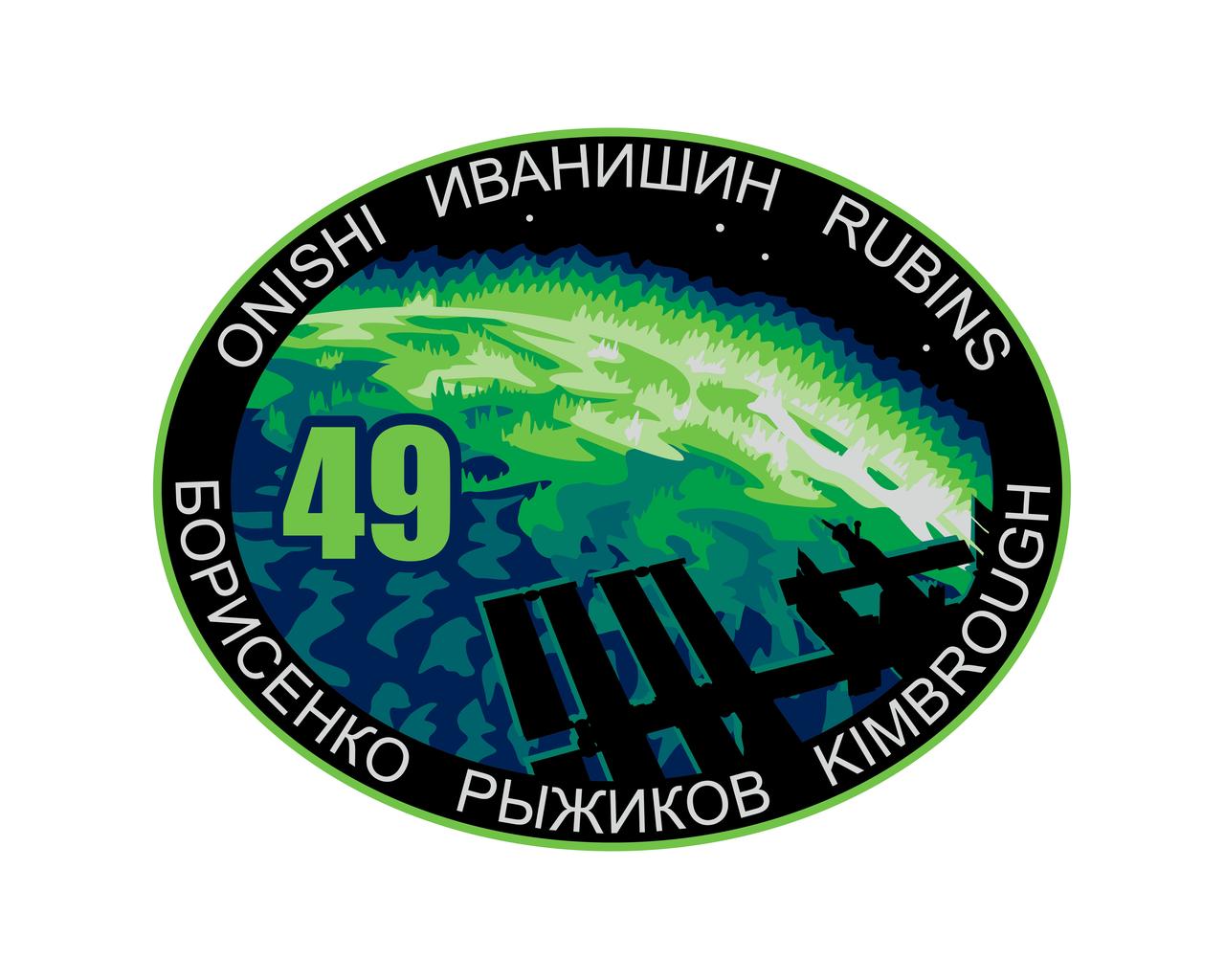
ISS049-S-001 --- The Expedition 49 patch shows the International Space Station (ISS) coming into view over an aurora extending past Earth’s horizon. This depiction emphasizes the benefits to Earth of research conducted on the ISS as well as the global nature of the international partnerships vital to this endeavor. The green hue in the aurora is symbolic of life on our home planet. The crew of Expedition 49 will be working “Off the Earth, for the Earth.”
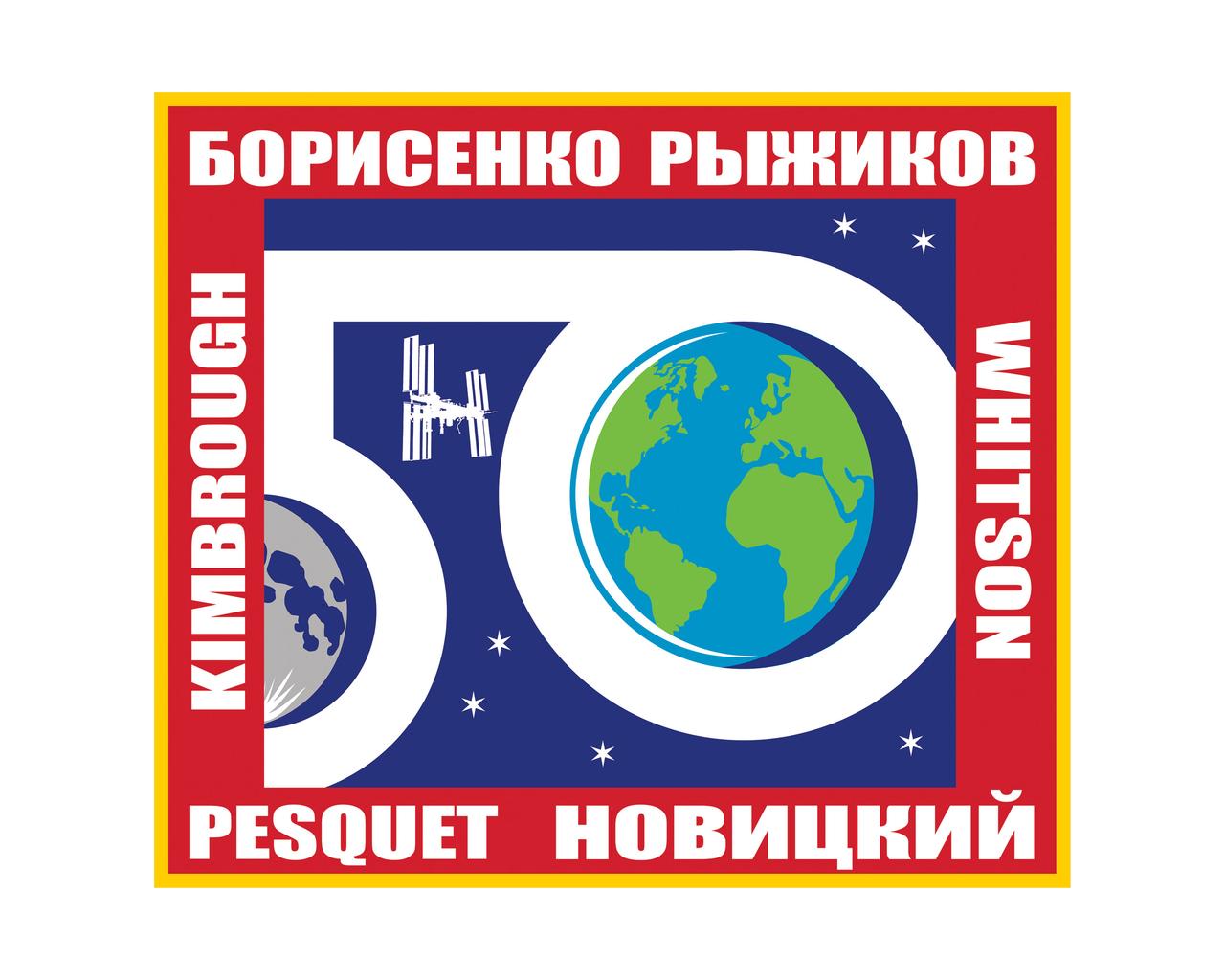
ISS050-S-001 (01/27/2016) --- The Expedition 50 patch encompasses the spirit of human exploration from previous missions to the Moon to current exploration on the International Space Station (ISS). The red border symbolizes future human exploration of Mars – the Red Planet. Our home planet Earth is prominent in the patch to remind us that everything done on the mission is to help people on Earth – “Off the Earth, For the Earth.” The background colors of red, white, and blue represent the national colors of all six crewmembers – United States, Russia, and France. The six stars represent the families of all six crewmembers. Finally, the ‘50’ signifies the 50th Expedition to the ISS.
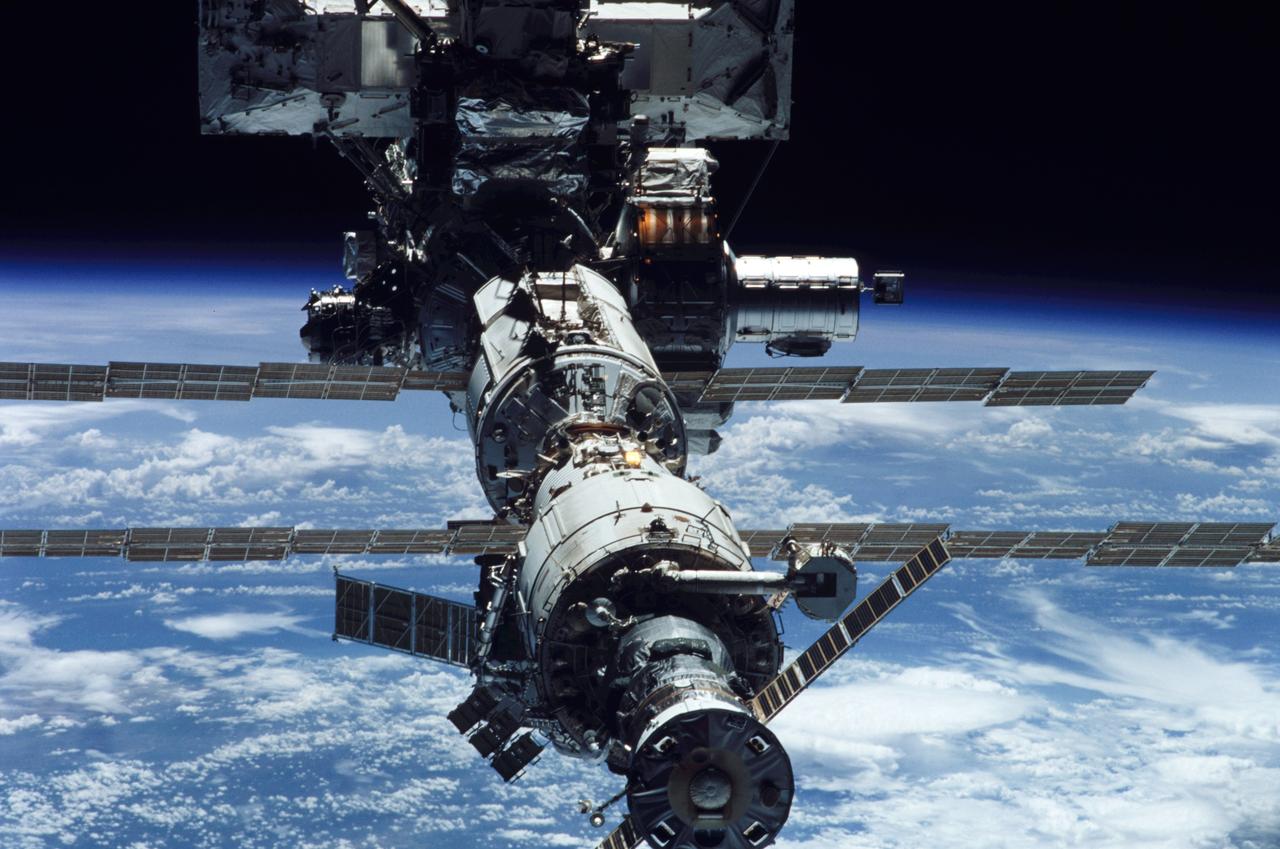
STS111-373-001 (15 June 2002) --- Backdropped by the blackness of space and a blue and white Earth, the International Space Station (ISS) is now separated from the Space Shuttle Endeavour following the undocking of the two spacecraft over western Kazakhstan. Endeavour pulled away from the complex at 9:32 a.m. (CDT) on June 15, 2002.
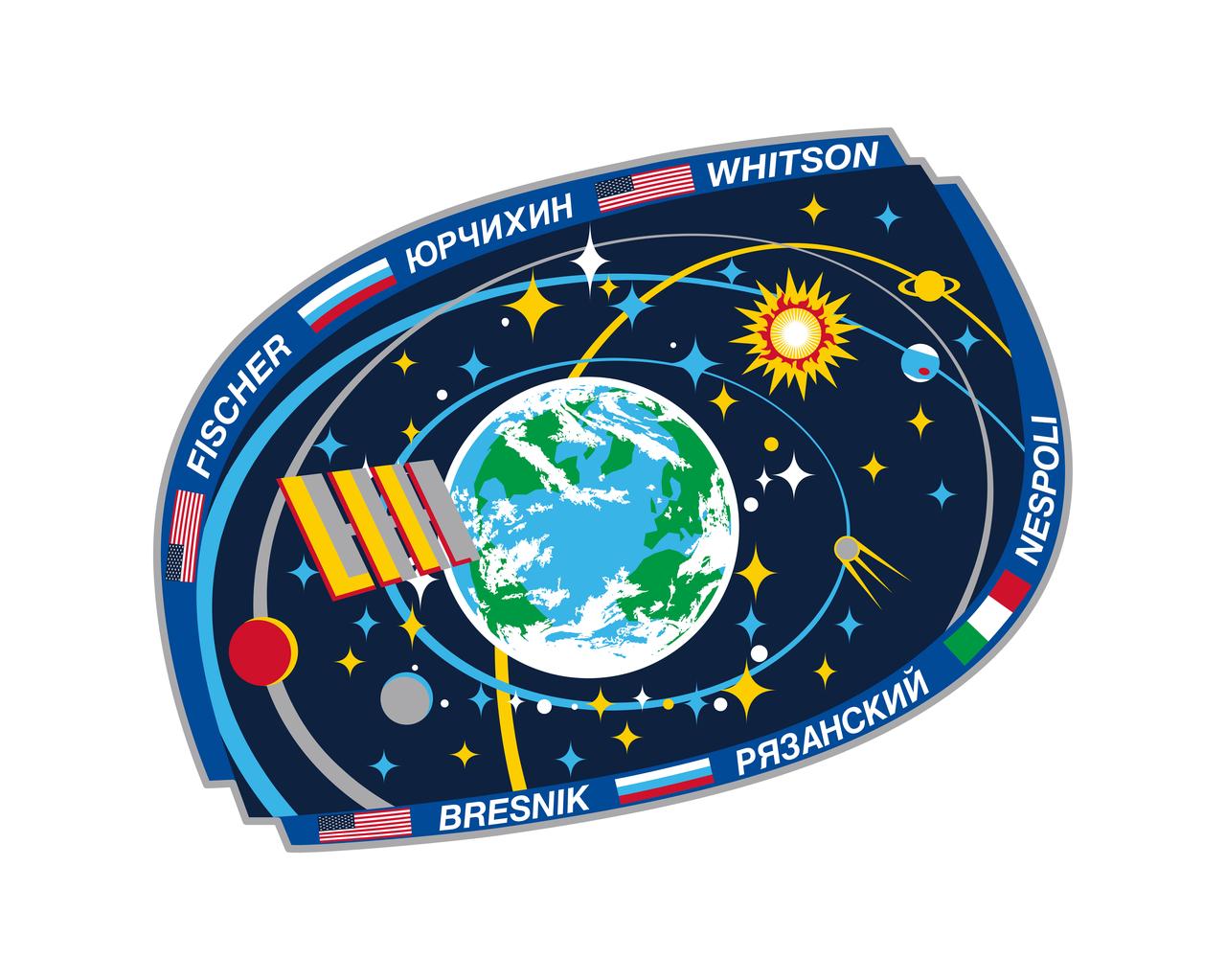
ISS052-s-001 (01/27/2016) --- Orbiting the Earth continuously since 1998, the International Space Station (ISS) is one of our greatest engineering achievements. It is depicted in gold, symbolic of constancy and excellence. Flying directly toward a sunrise represents the ISS’s contributions to a bright future. That sunrise and the Earth beneath ituses blue, white, red, and green, the combined national colors of Italy, Russia, and the United States, symbolizing the crew’s cohesiveness. Crewmember names are in blue symbolizing devotion and loyalty. The white border represents sunlight unscattered by the Earth’s atmosphere. Symbolic of new Russian and U.S. spacecraft that will further human exploration, the patch is shaped as a capsule. The number 52 is drawn as a path eventually leading to Mars. Finally, the stars symbolize the values of leadership, trust, teamwork, and excellence lived by mission control teams throughout the history of human space programs, as well as their global vigilance in operating the ISS.

ISS010-S-001 (May 2004) --- The Expedition 10 patch uses simple symbolism to describe the mission. The large Roman numeral "X," formed by the American and Russian flags, symbolizes the joint nature of this mission, as well as the fact that this flight is the 10th mission to stay on the International Space Station (ISS). The current configuration of the ISS is next to the name of the ISS Commander, while the Soyuz vehicle is placed next to the name of the Soyuz Commander. The single star and the black background signify this is a space mission. The NASA insignia design for shuttle flights and station increments is reserved for use by the astronauts and for other official use as the NASA Administrator may authorize. Public availability has been approved only in the forms of illustrations by the various news media. When and if there is any change in this policy, which is not anticipated, the change will be publicly announced.

ISS013-S-001 (January 2006) --- This patch commemorates the thirteenth expeditionary mission to the International Space Station (ISS) which continues the permanent human presence in space. The ISS is depicted in its configuration at the start of the six-month expedition with trailing elements from the country flags representing both of the crew members--cosmonaut Pavel V. Vinogradov and astronaut Jeffrey N. Williams. The crew members made the following statement about their patch: "The dynamic trajectory of the space station against the background of the Earth, Mars, and the Moon symbolizes the vision for human space exploration beyond Earth orbit and the critical role that the ISS plays in the fulfillment of that vision." The NASA insignia design for shuttle flights and station increments is reserved for use by the astronauts and for other official use as the NASA Administrator may authorize. Public availability has been approved only in the forms of illustrations by the various news media. When and if there is any change in this policy, which is not anticipated, the change will be publicly announced.
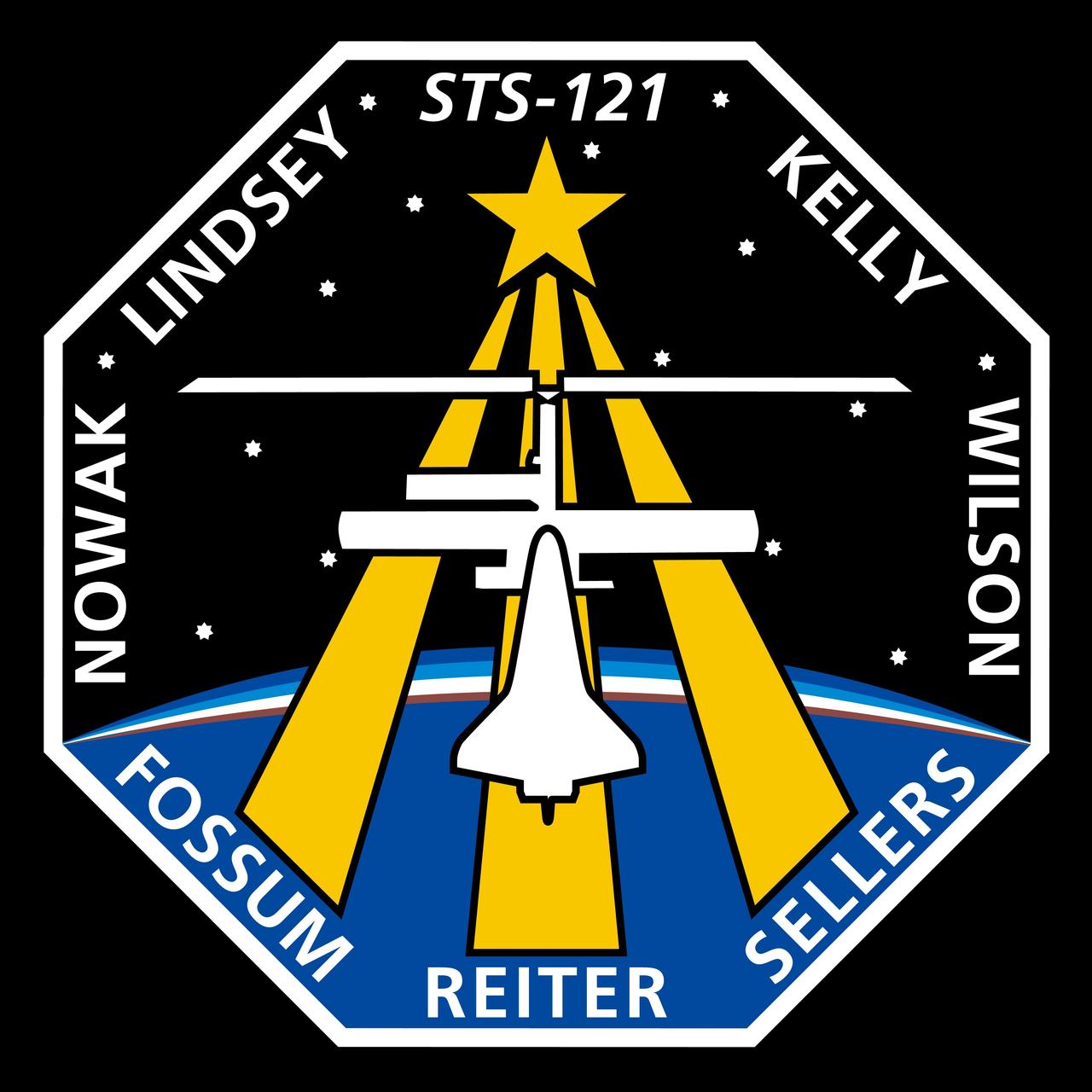
STS121-S-001 (June 2005) --- The STS-121 patch depicts the space shuttle docked with the International Space Station (ISS) in the foreground, overlaying the astronaut symbol with three gold columns and a gold star. The ISS is shown in the configuration that it will be in during the STS-121 mission. The background shows the nighttime Earth with a dawn breaking over the horizon. STS-121, ISS mission ULF1.1, is the final Shuttle Return to Flight test mission. This utilization and logistics flight will bring a multipurpose logistics module (MPLM) to the ISS with several thousand pounds of new supplies and experiments. In addition, some new orbital replacement units (ORUs) will be delivered and stowed externally on ISS on a special pallet. These ORUs are spares for critical machinery located on the outside of the ISS. During this mission the crew will also carry out testing of shuttle inspection and repair hardware, as well as evaluate operational techniques and concepts for conducting on-orbit inspection and repair. The NASA insignia design for space shuttle flights is reserved for use by the astronauts and for other official use as the NASA Administrator may authorize. Public availability has been approved only in the forms of illustrations by the various news media. When and if there is any change in this policy, which is not anticipated, the change will be publicly announced. Photo credit: NASA
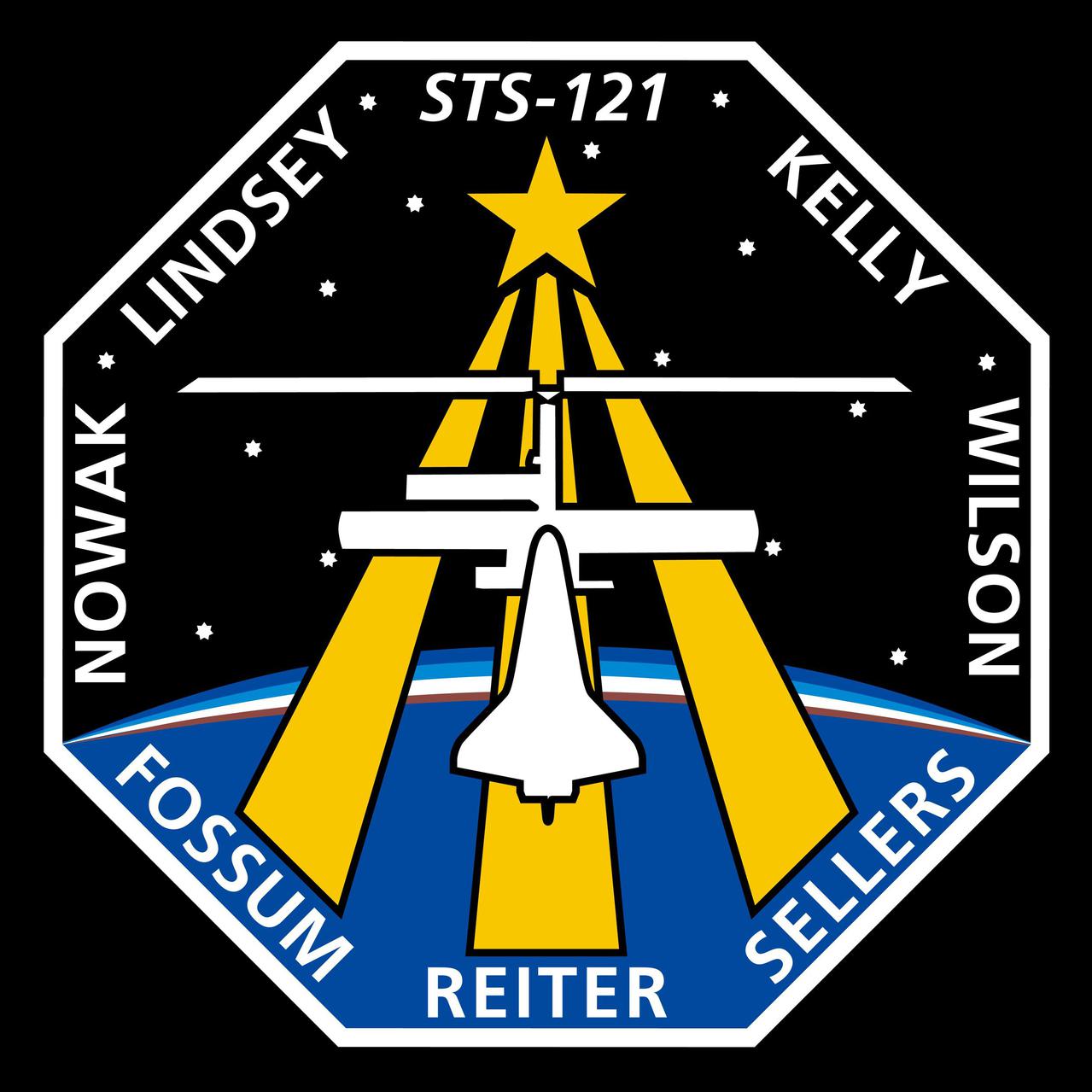
JOHNSON SPACE CENTER, HOUSTON - STS121-S-001 (June 2005) --- The STS-121 patch depicts the Space Shuttle Atlantis docked with the International Space Station (ISS) in the foreground, overlaying the astronaut symbol with three gold columns and a gold star. The ISS is shown in the configuration that it will be in during the STS-121 mission. The background shows the nighttime Earth with a dawn breaking over the horizon. STS-121, ISS mission ULF1.1, is the final Shuttle Return to Flight test mission. This utilization and logistics flight will bring a Multi-Purpose Logistics Module (MPLM) to the ISS with several thousand pounds of new supplies and experiments. In addition, some new Orbital Replacement Units (ORUs) will be delivered and stowed externally on ISS on a special pallet. These ORUs are spares for critical machinery located on the outside of the ISS. During this mission the crew will also carry out testing of Shuttle inspection and repair hardware, as well as evaluate operational techniques and concepts for conducting on-orbit inspection and repair. The NASA insignia design for Shuttle space flights is reserved for use by the astronauts and other official use as the NASA Administrator may authorize. Public availability has been approved only in the form of illustrations by the various news media. When and if there is any change in this policy, which is not anticipated, such will be publicly announced.
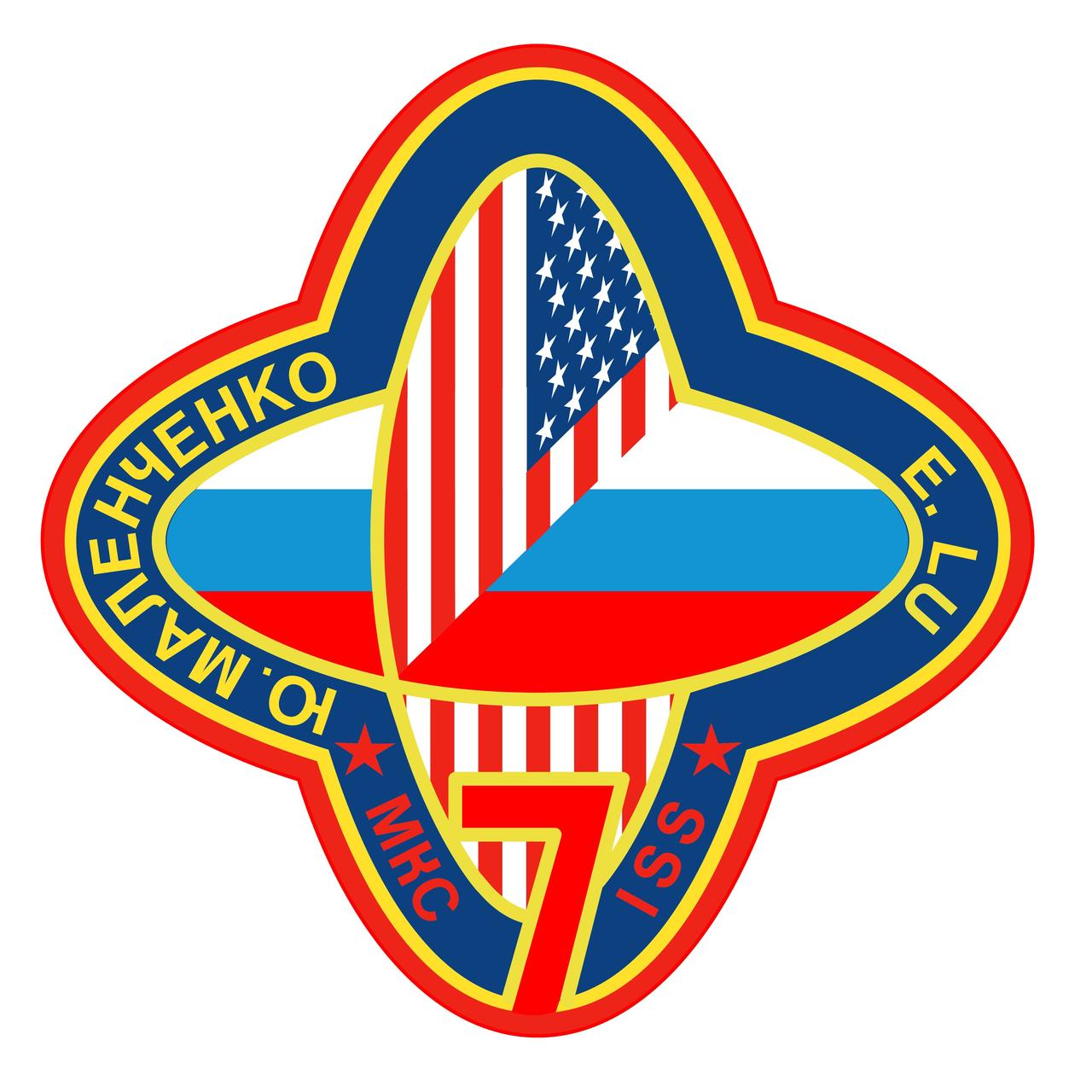
ISS007-S-001 (March 2003) --- The International Space Station (ISS) Expedition Seven patch consists of two elliptical orbits which evoke the histories of the two space programs from which the crew is drawn. The Russian and American flags are intersecting, representing the peaceful cooperation of the many countries contributing to the ISS. Two stars indicate the station's goals of contributing to life on Earth through science and commerce. The NASA insignia design for station space flights is reserved for use by the crew members and other official use as the NASA Administrator may authorize. Public availability has been approved only in the form of illustrations by the various news media. When and if there is any change in this policy, which is not anticipated, such will be publicly announced.

ISS001-S-001 (October 2000) --- The first International Space Station (ISS) crew patch is a simplified graphic of the station complex when fully completed. The station is seen with solar arrays turned forward. The last names of the Expedition One crew, Soyuz pilot Yuri Gidzenko, flight engineer Sergei Krikalev, and expedition commander William (Bill) Shepherd, appear under the station symbol. The insignia design for ISS flights is reserved for use by the astronauts and cosmonauts and for other official use as the NASA Administrator and NASA's international partners may authorize. Public availability has been approved only in the form of illustrations by the various news media. When and if there is any change in this policy, which we do not anticipate, it will be publicly announced.
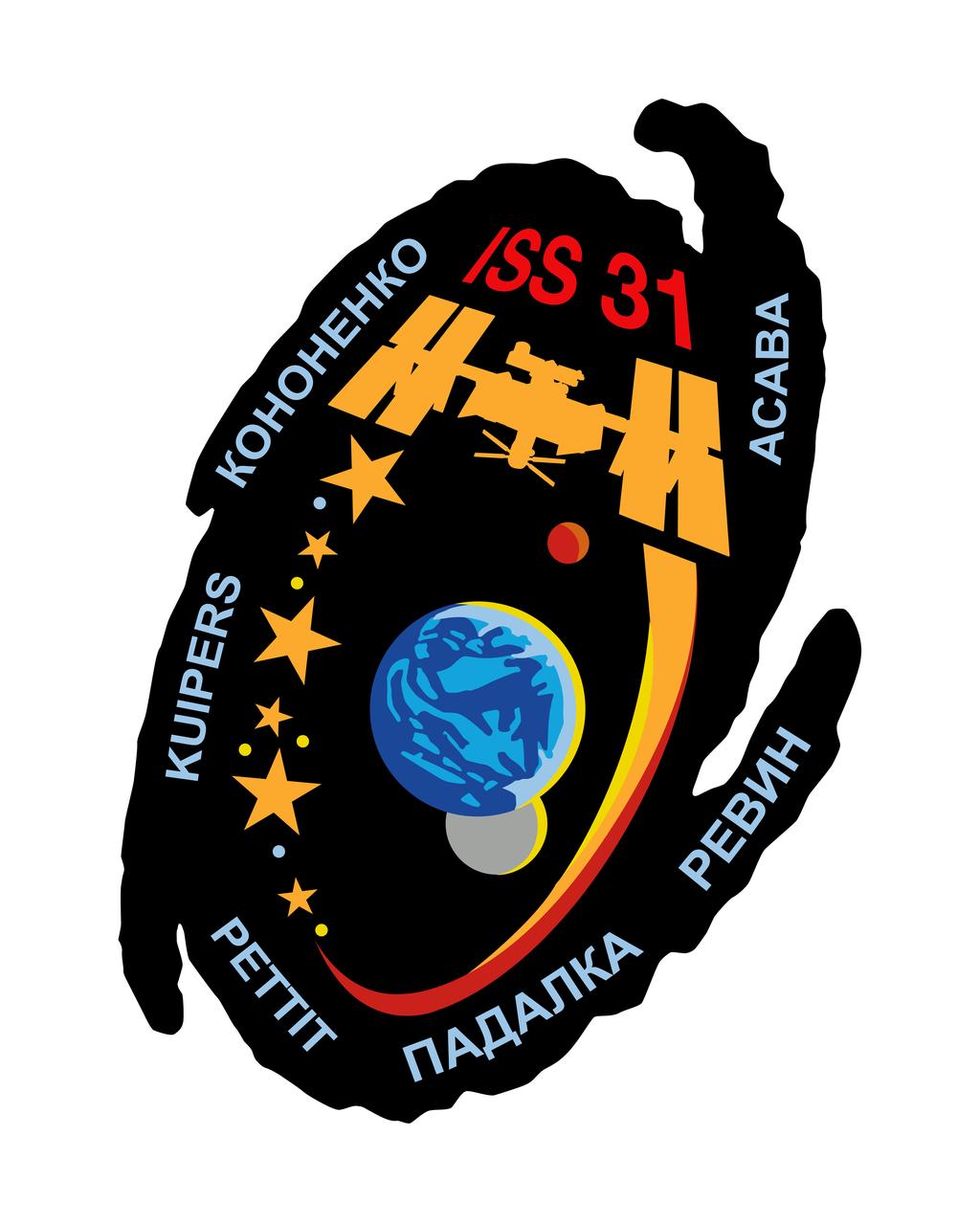
ISS031-S-001 (September 2011) --- Thin crescents along the horizons of Earth and its moon depict International Space Station (ISS) Expedition 31. The shape of the patch represents a view of our galaxy. The black background symbolizes the research into dark matter, one of the scientific objectives of Expedition 31. At the heart of the patch are Earth, its moon, Mars, and asteroids, the focus of current and future exploration. The ISS is shown in an orbit around Earth, with a collection of stars for the Expedition 30 and 31 crews. The small stars symbolize the visiting vehicles that will dock with the complex during this expedition. The NASA insignia design for shuttle and space station flights is reserved for use by the astronauts and for other official use as the NASA Administrator may authorize. Public availability has been approved only in the forms of illustrations by the various news media. When and if there is any change in this policy, which is not anticipated, the change will be publicly announced. Photo credit: NASA and Its International Partners
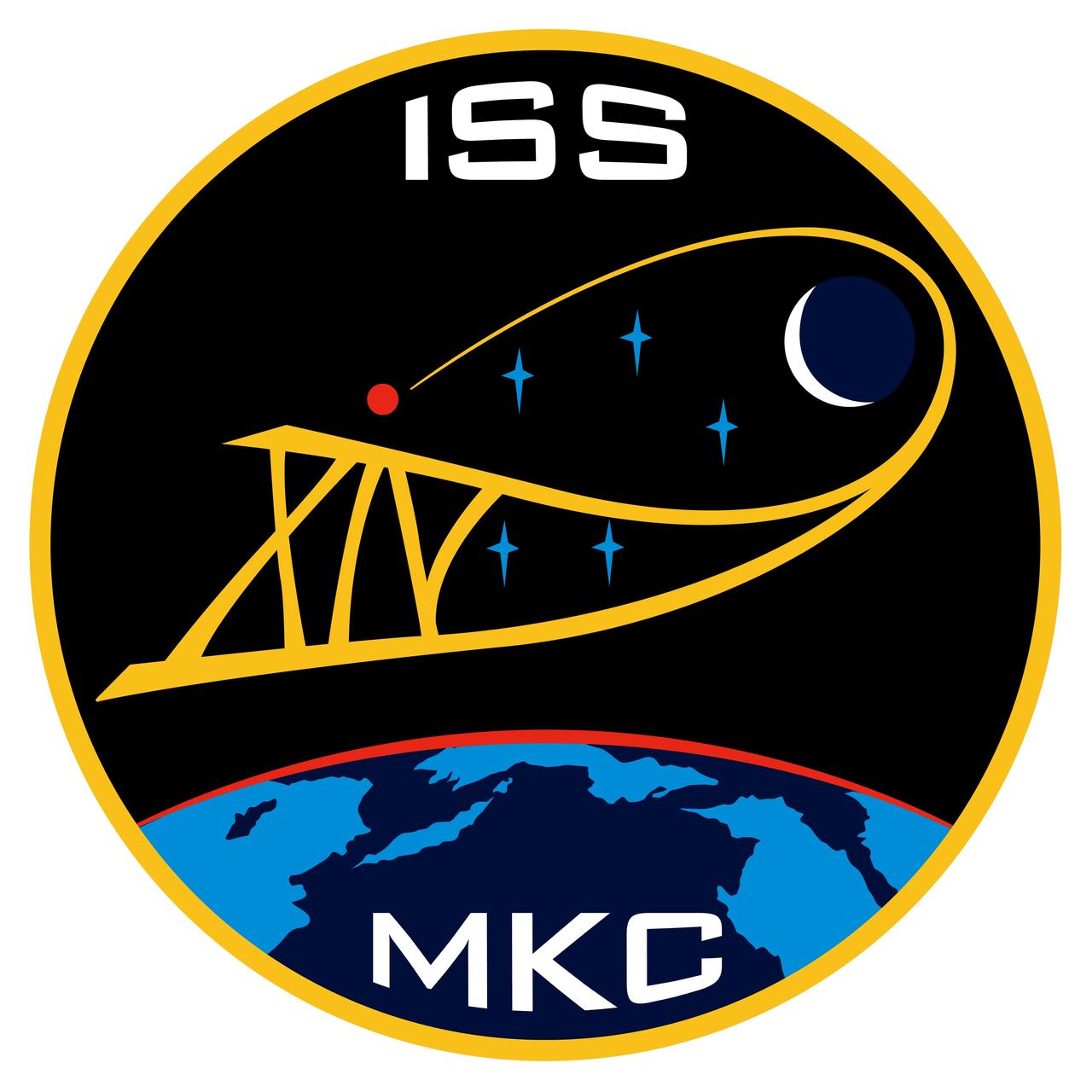
ISS014-S-001 (May 2006) --- This emblem embodies the past, present, and future of human space exploration. The Roman numeral XIV suspended above the Earth against the black background of space symbolizes the fourteenth expeditionary mission to the International Space Station (ISS). Elements of this symbol merge into a unified trajectory destined for the moon, Mars, and beyond, much as science and operations aboard the ISS today will pave the way for future missions to our celestial neighbors. The five stars honor the astronauts and cosmonauts of missions Apollo 1, Soyuz 1, Soyuz 11, Challenger, and Columbia, who gave their lives in the pursuit of knowledge and discovery. The NASA insignia for design for shuttle flights and station increments is reserved for use by the astronauts and for other official use as the NASA Administrator may authorize. Public availability has been approved only in the form of illustrations by the various news media. When and if there is any change in this policy which is not anticipated, it will be publicly announced.
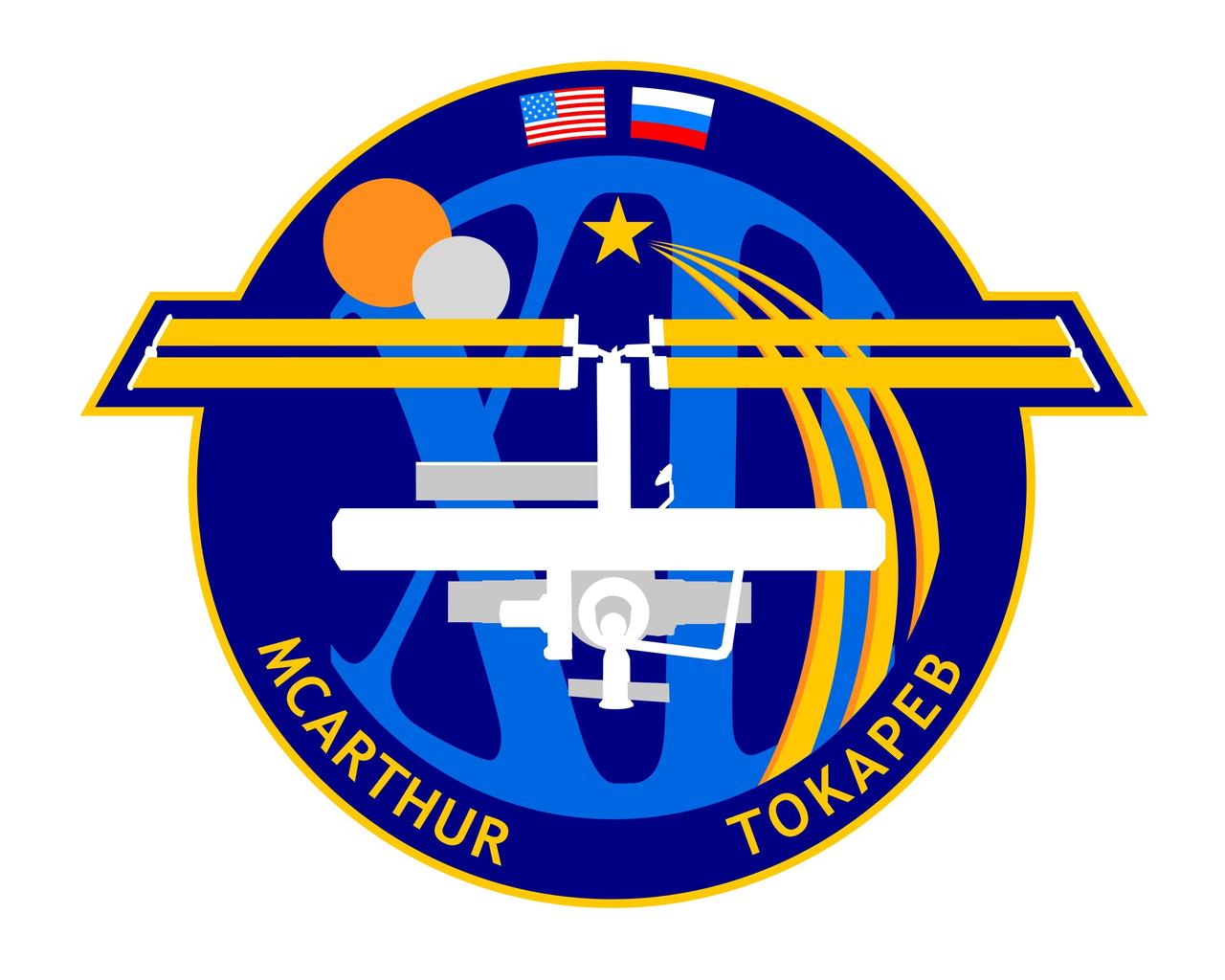
ISS012-S-001 (September 2005) --- The Expedition 12 patch represents both mankind’s permanent presence in space and future dreams of exploration. The International Space Station (ISS), featured prominently in the center, will continue to grow in its capability as a world-class laboratory and test bed for exploration. The vision of exploration is depicted by the moon and Mars. The star symbolizes mankind's destiny in space and is a tribute to the space explorers who have been lost in its pursuit. The Roman numeral XII in the background signifies the 12th expeditionary mission to the ISS. The NASA insignia design for Shuttle flights and Space Station increments is reserved for use by the astronauts and cosmonauts and for other official use as the NASA Administrator may authorize. Public availability has been approved only in the form of illustrations by the various news media. When and if there is any change in this policy, which is not anticipated, it will be publicly announced.
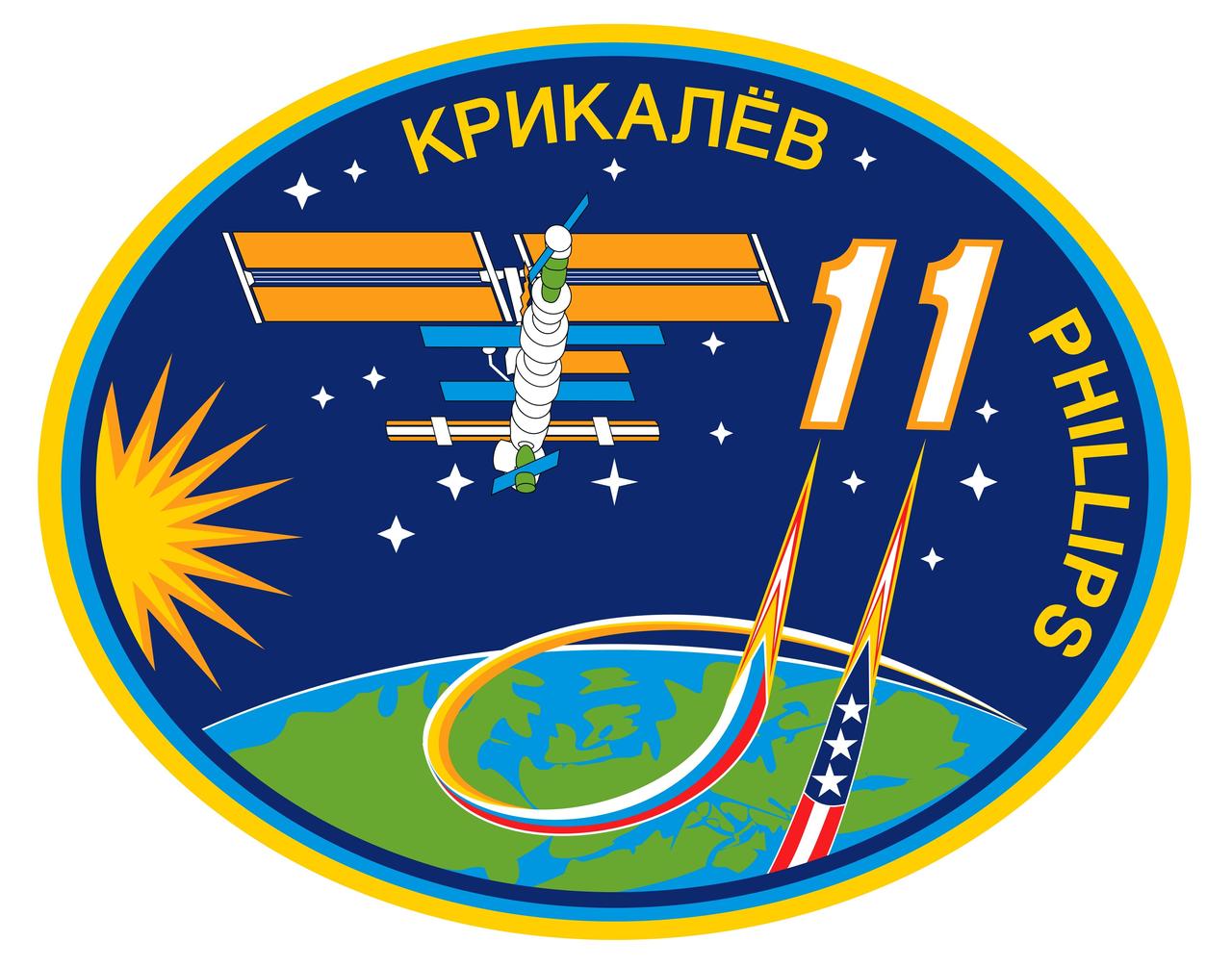
ISS011-S-001 (January 2005) --- The emblem of the eleventh expedition to the International Space Station (ISS) emphasizes the roles of the United States and the Russian Federation in the multinational ISS partnership. The two rocket plumes, in the style of the flags of these two nations, represent the Russian Soyuz vehicles and the American space shuttles. The ISS image shows the configuration of the orbiting station at the start of the expedition, with docked Soyuz and Progress vehicles and the huge American solar panels. The names of the two crew members are shown on the margin of the patch. ISS Commander Sergei Krikalev and John Phillips, NASA ISS science officer and flight engineer, are expected to launch on a Soyuz vehicle and to be in orbit during the return to flight of the space shuttle. The crew explains, “The beauty of our home planet and the vivid contrasts of the space environment are shown by the blue and green Earth with the space station orbiting overhead, and by the bright stars, dark sky, and dazzling sun.” The NASA insignia design for shuttle flights and station increments is reserved for use by the astronauts and for other official use as the NASA Administrator may authorize. Public availability has been approved only in the forms of illustrations by the various news media. When and if there is any change in this policy, which is not anticipated, the change will be publicly announced.
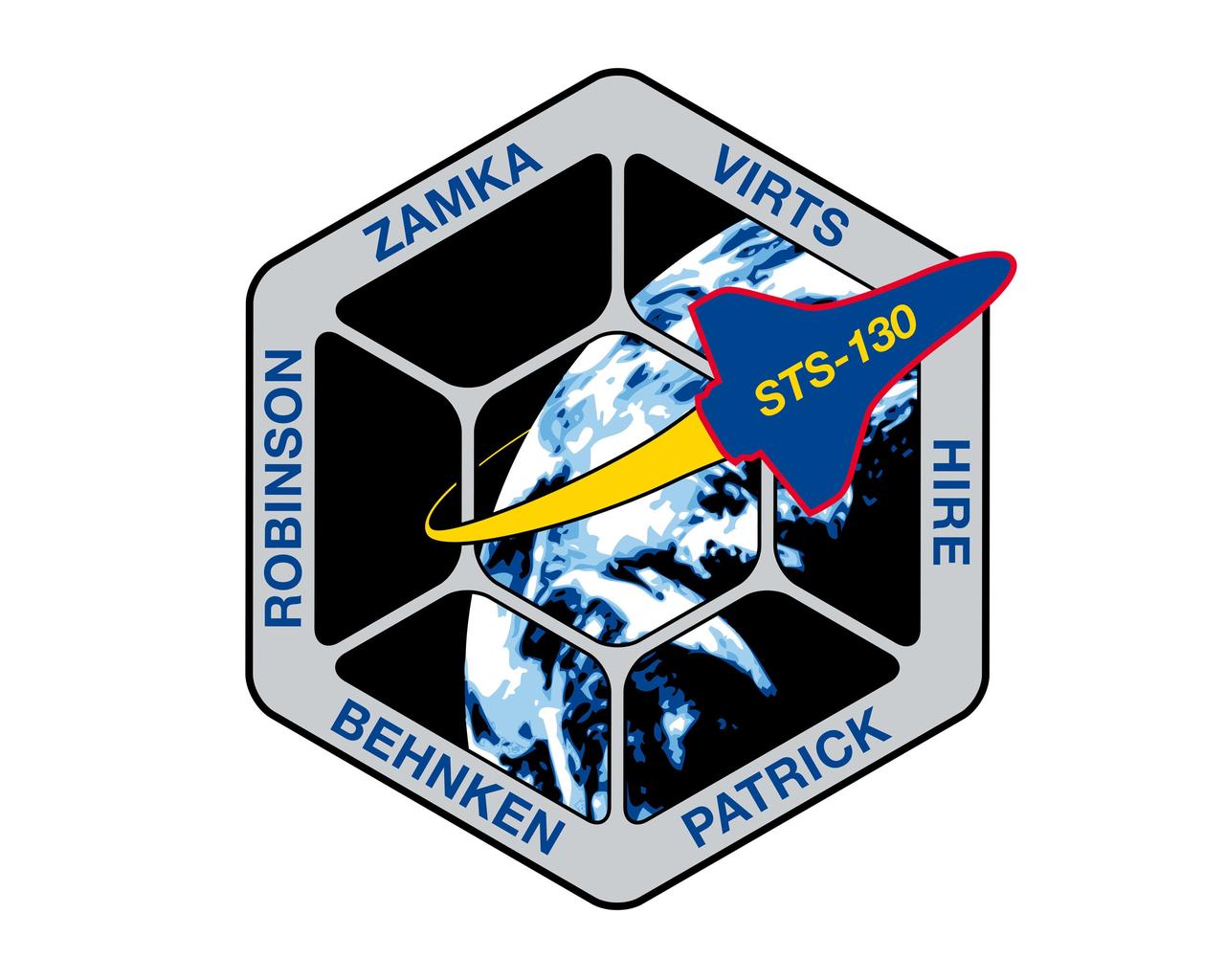
JOHNSON SPACE CENTER, Houston - STS130-S-001 - The STS-130 patch was designed by the crew to reflect both the objectives of the mission and its place in the history of human spaceflight. The main goal of the mission is to deliver Node 3 and the Cupola to the International Space Station (ISS). Node 3, named "Tranquility," will contain life support systems enabling continued human presence in orbit aboard the ISS. The shape of the patch represents the Cupola, which is the windowed robotics viewing station, from which astronauts will have the opportunity not only to monitor a variety of ISS operations, but also to study our home planet. The image of Earth depicted in the patch is the first photograph of the Earth taken from the moon by Lunar Orbiter I on August 23, 1966. As both a past and a future destination for explorers from the planet Earth, the moon is thus represented symbolically in the STS-130 patch. The Space Shuttle Endeavour is pictured approaching the ISS, symbolizing the Space Shuttle's role as the prime construction vehicle for the ISS. The NASA insignia design for shuttle flights is reserved for use by the astronauts and for other official use as the NASA Administrator may authorize. Public availability has been approved only in the form of illustrations by the various news media. When and if there is any change in this policy, which we do not anticipate, it will be publicly announced.
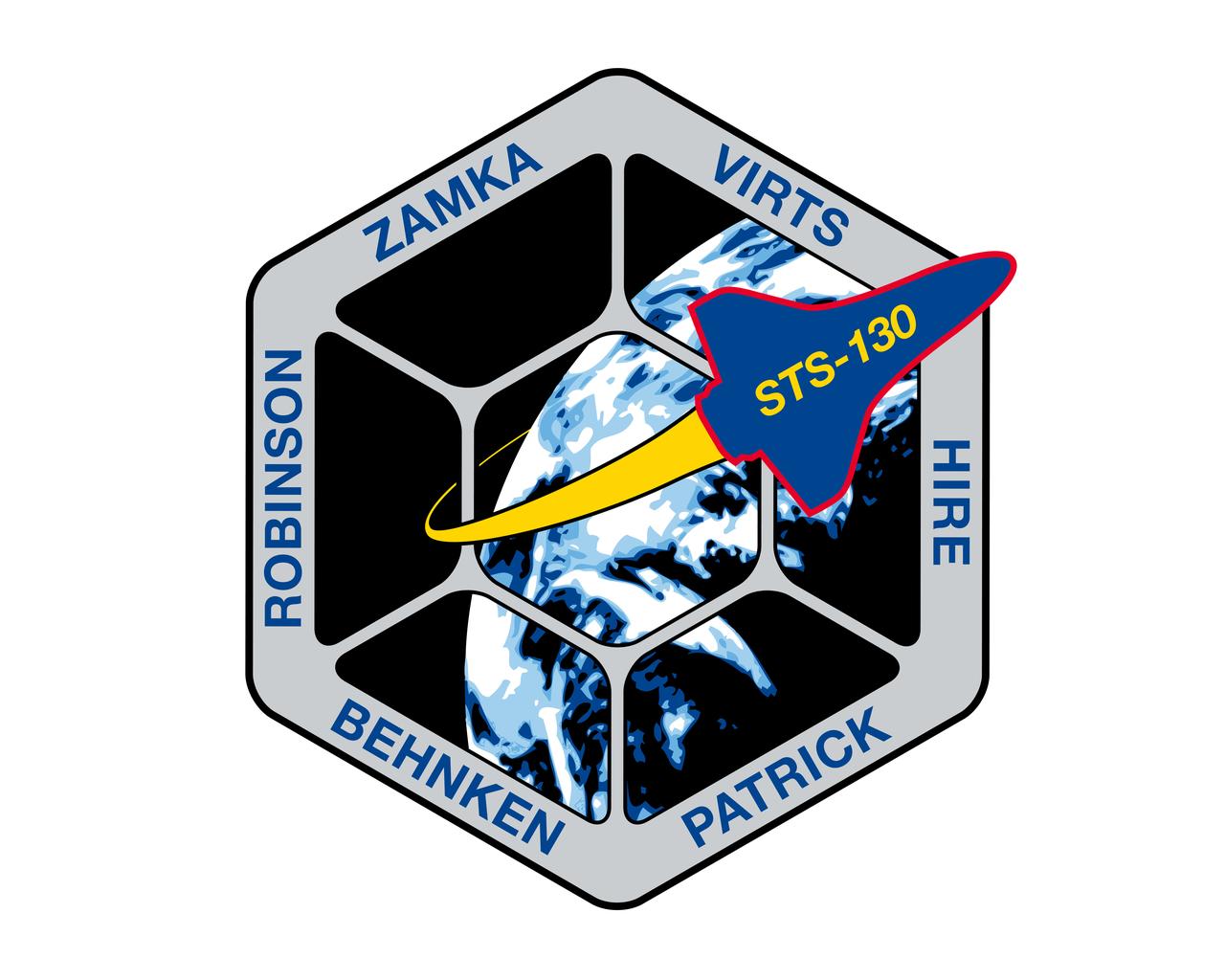
STS130-S-001 (September 2009) --- The STS-130 patch was designed by the crew to reflect both the objectives of the mission and its place in the history of human spaceflight. The main goal of the mission is to deliver Node 3 and the Cupola to the International Space Station (ISS). Node 3, named ?Tranquility,? will contain life support systems enabling continued human presence in orbit aboard the ISS. The shape of the patch represents the Cupola, which is the windowed robotics viewing station, from which astronauts will have the opportunity not only to monitor a variety of ISS operations, but also to study our home planet. The image of Earth depicted in the patch is the first photograph of Earth taken from the moon by Lunar Orbiter I on Aug. 23, 1966. As both a past and a future destination for explorers from planet Earth, the moon is thus represented symbolically in the STS-130 patch. The space shuttle Endeavour is pictured approaching the ISS, symbolizing the space shuttle's role as the prime construction vehicle for the ISS. The NASA insignia design for space shuttle flights is reserved for use by the astronauts and for other official use as the NASA Administrator may authorize. Public availability has been approved only in the forms of illustrations by the various news media. When and if there is any change in this policy, which is not anticipated, the change will be publicly announced. Photo credit: NASA

STS097-S-001 (January 2000) --- This is the crew insignia for STS-97, which will deliver, assemble, and activate the U.S. electrical power system on board the International Space Station (ISS). The electrical power system, which is built into a 47-foot integrated truss structure known as P6, consists of solar arrays, radiators, batteries, and electronics. P6 will be attached to the station using the shuttle's robotic arm in coordination with spacewalking crew members that will make the final connections. The spacewalkers will then prepare P6 for the subsequent deployments of the large solar arrays and radiator, which are critical steps in the activation of the electrical power system. The 120-foot solar arrays will provide the power necessary for the first ISS crews to live and work in the U.S. segment. The crew patch depicts the space shuttle docked to ISS in low Earth orbit after the activation of the P6 electrical power system. Gold and silver are used to highlight the portion of ISS that will be installed by the STS-97 crew. The Sun, central to the design, is the source of energy for ISS. The NASA insignia design for space shuttle flights is reserved for use by the astronauts and for other official use as the NASA Administrator may authorize. Public availability has been approved only in the forms of illustrations by the various news media. When and if there is any change in this policy, which is not anticipated, the change will be publicly announced. Photo credit: NASA
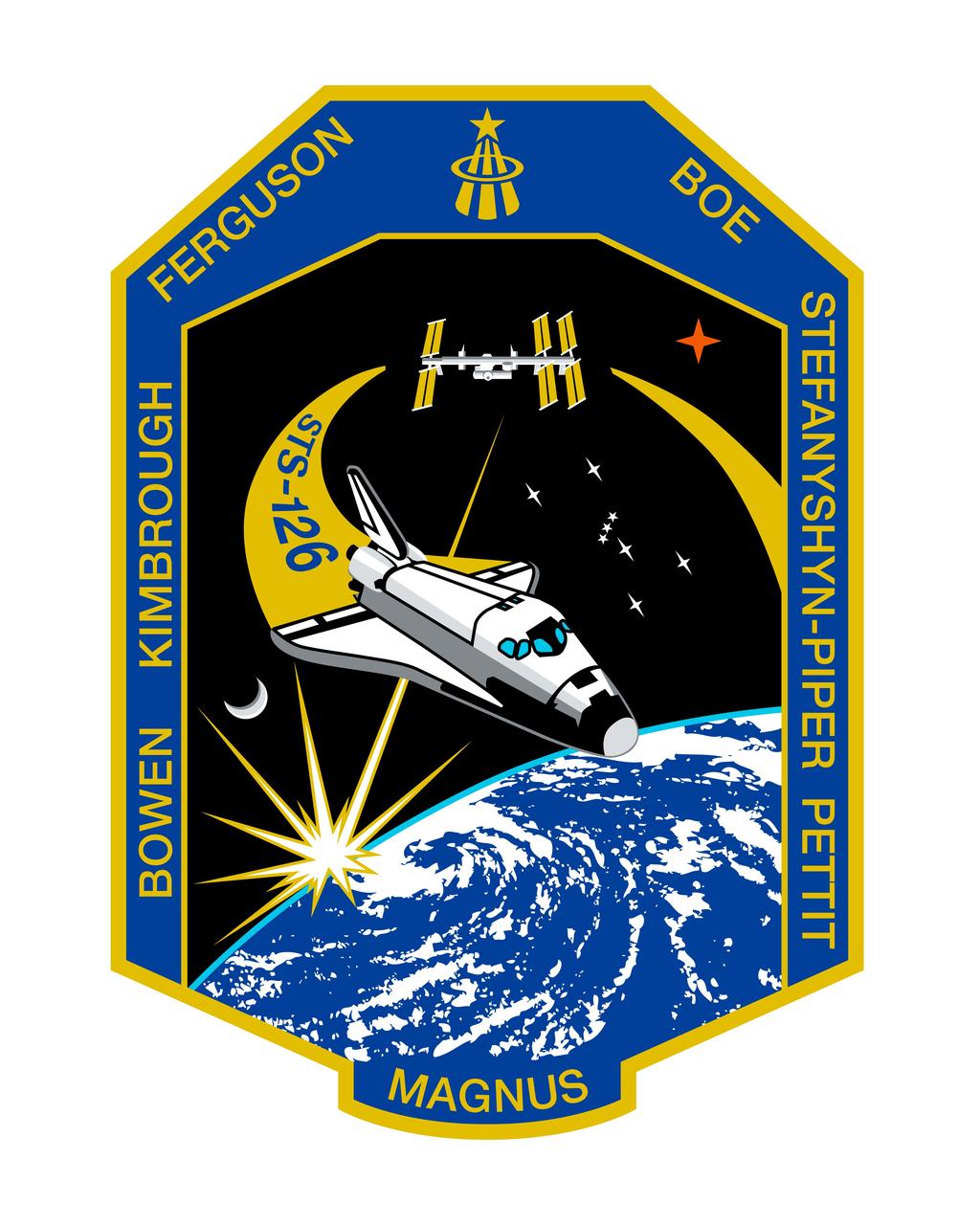
STS126-S-001 (April 2008) --- The STS-126 patch represents space shuttle Endeavour on its mission to help complete the assembly of the International Space Station (ISS). The inner patch outline depicts the Multi-Purpose Logistics Module (MPLM) Leonardo. This reusable logistics module will carry the equipment necessary to sustain a crew of six onboard the ISS and will include additional crew quarters, exercise equipment, galley, and life support equipment. In addition, a single expedition crew member will launch on STS-126 to remain on board ISS, replacing an expedition crew member who will return home with the shuttle crew. Near the center of the patch, the constellation Orion reflects the goals of the human spaceflight program, returning us to the moon and on to Mars, the red planet, which are also shown. At the top of the patch is the gold symbol of the astronaut office. The sunburst, just clearing the horizon of the magnificent Earth, powers all these efforts through the solar arrays of the ISS current configuration orbiting high above. The NASA insignia design for space shuttle flights is reserved for use by the astronauts and for other official use as the NASA Administrator may authorize. Public availability has been approved only in the forms of illustrations by the various news media. When and if there is any change in this policy, which is not anticipated, the change will be publicly announced. Photo credit: NASA

ISS006-S-001 (September 2002) --- The International Space Station (ISS) Expedition Six crew patch depicts the station orbiting the Earth on its mission of international cooperation and scientific research. The Earth is placed in the center of the patch to emphasize that work conducted aboard this orbiting laboratory is intended to improve life on our home planet. The shape of the space station’s orbit symbolizes the role that experience gained from ISS will have on future exploration of our solar system and beyond. The American and Russian flags encircling the Earth represent the native countries of the Expedition 6 crew members, which are just two of the many participant countries contributing to the ISS and committed to the peaceful exploration of space. The NASA insignia design for International Space Station (ISS) missions is reserved for use by the crew members and for other official use as the NASA Administrator may authorize. Public availability has been approved only in the forms of illustrations by the various news media. When and if there is any change in this policy, which is not anticipated, the change will be publicly announced.
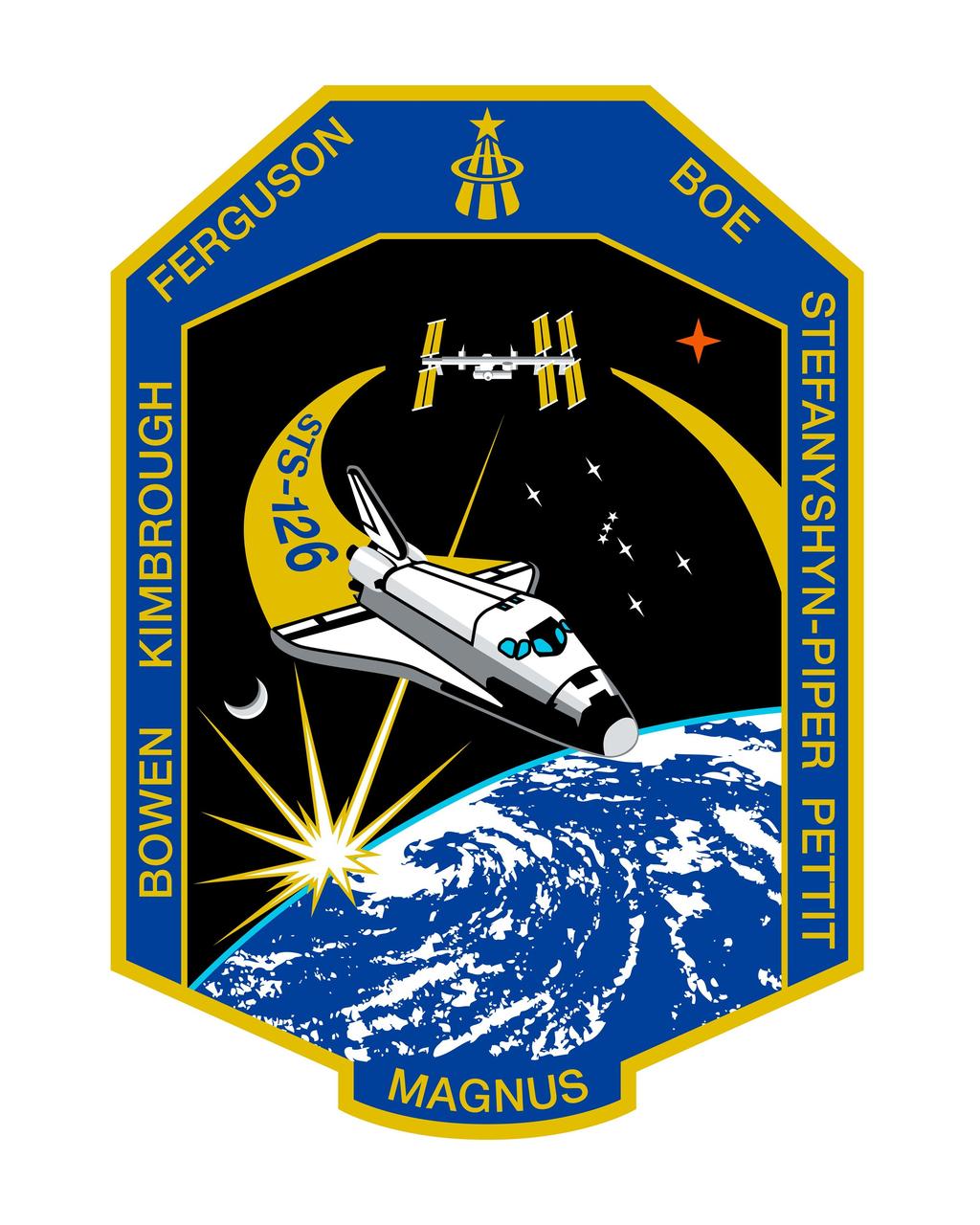
JOHNSON SPACE CENTER, Houston – STS126-S-001 -- The STS-126 patch represents space shuttle Endeavour on its mission to help complete the assembly of the International Space Station (ISS). The inner patch outline depicts the Multi-Purpose Logistics Module (MPLM) Leonardo. This reusable logistics module will carry the equipment necessary to sustain a crew of six on board the ISS and will include additional crew quarters, exercise equipment, galley, and life support equipment. In addition, a single expedition crew member will launch on STS-126 to remain on board ISS, replacing an expedition crew member who will return home with the shuttle crew. Near the center of the patch, the constellation Orion reflects the goals of the human spaceflight program, returning us to the Moon and on to Mars, the red planet, which are also shown. At the top of the patch is the gold symbol of the astronaut office. The sunburst, just clearing the horizon of the magnificent Earth, powers all these efforts through the solar arrays of the ISS current configuration orbiting high above. The NASA insignia for design for shuttle flights is reserved for use by the astronauts and for other official use as the NASA Administrator may authorize. Public availability has been approved only in the form of illustrations by the various news Media. When and if there is any change in this policy, it will be publicly announced.
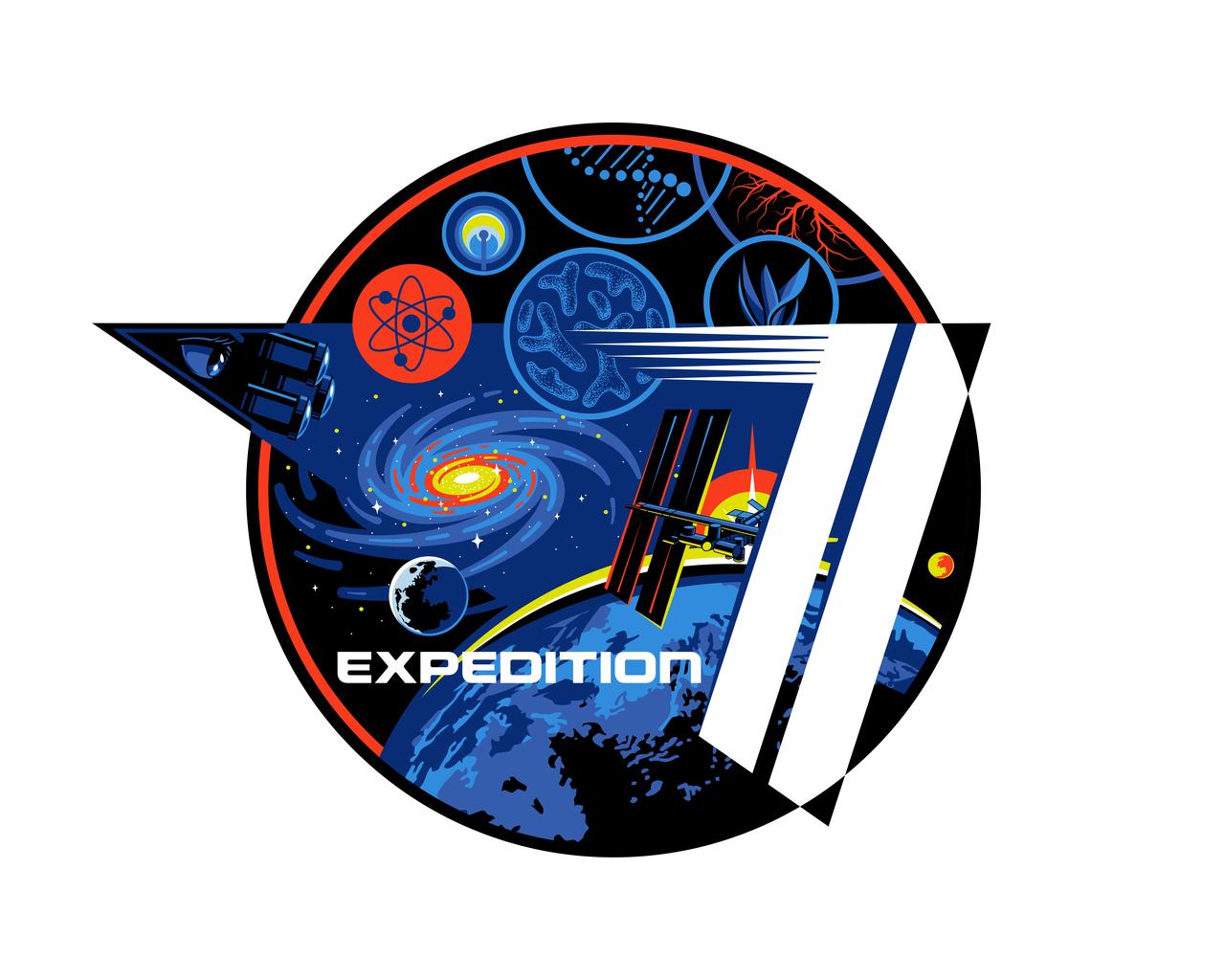
iss071-s-001 (Aug. 31, 2023) --- For nearly a quarter of a century the International Space Station (ISS) has hosted crews and accommodated science experiments even as it has continued to evolve into the highly capable orbiting laboratory of today. With its unique vantage point, the ISS serves as an intersection for discoveries ranging from the vast, such as the search for dark matter and cosmological origins, to the near, such as detailed observation of our home planet and its atmosphere, to the microscopic, including behavior of microbial life, DNA sequencing, and molecular biology in the microgravity environment. The Expedition 71 patch celebrates this science as well as the thousands of multinational scientists and technicians that have contributed to numerous groundbreaking experiments. The ISS is the ultimate destination for the scientifically curious. The symbology represents onboard research into quantum behavior of novel states of matter, antibodies and immune function, the search for dark matter, flame and combustion physics, DNA expression, plant growth and root behavior, and direct earth observation. The human eye and microscope objectives at upper left form the apex of a cone of vision culminating in the Expedition number 71, and represents the deliberate and disciplined practice of scientific observation. Earth’s moon and Mars are also depicted as next steps for exploration, with an anticipation of further rich scientific discovery using many techniques and skills honed aboard the ISS.
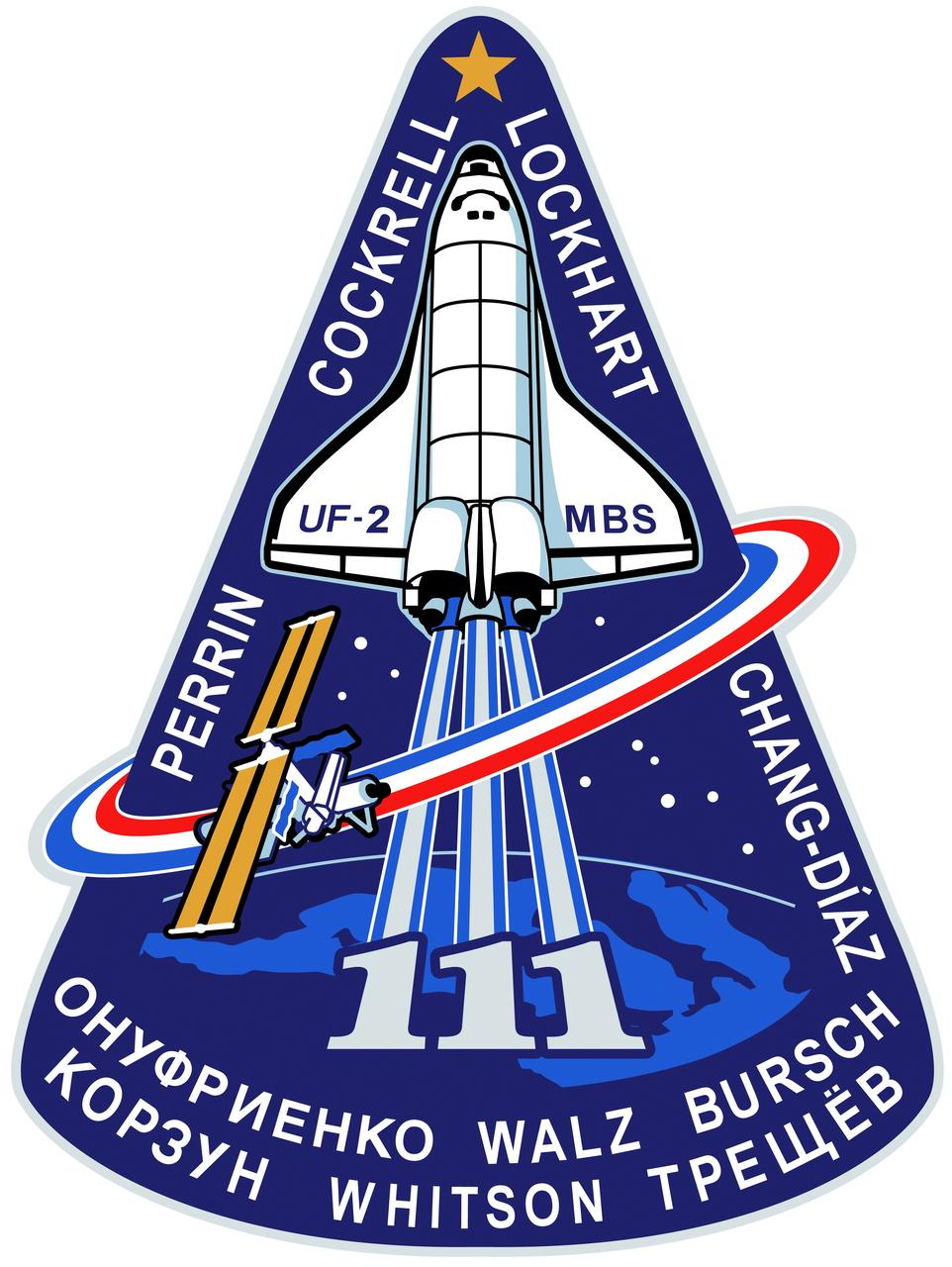
STS111-S-001 (January 2002) --- The STS-111 patch symbolizes the hardware, people, and partner nations that contribute to the flight. The space shuttle rises on the plume of the Astronaut Office symbol, carrying the Canadian Mobile Base System (MBS) for installation while docked to the International Space Station (ISS). The mission is named UF-2 for ISS Utilization Flight number two. The ISS orbit completes the Astronaut Office symbol and is colored red, white, and blue to represent the flags of the United States, Russia, France, and Costa Rica. The Earth background shows Italy, which contributes the Multi Purpose Logistics Module (MPLM) used on this flight to re-supply ISS. The ten stars in the sky represent the ten astronauts and cosmonauts on orbit during the flight, and the star at the top of the patch represents the Johnson Space Center, in the state of Texas, from which the flight is managed. The names of the STS-111 crew border the upper part of the patch, and the Expedition Five (going up) and Expedition Four (coming down) crews? names form the bottom of the patch. The NASA insignia design for space shuttle flights is reserved for use by the astronauts and for other official use as the NASA Administrator may authorize. Public availability has been approved only in the forms of illustrations by the various news media. When and if there is any change in this policy, which is not anticipated, the change will be publicly announced. Photo credit: NASA

HOUSTON, Texas -- STS119-S-001: The shape of the STS-119/15A patch comes from the shape of a solar array viewed at an angle. The International Space Station (ISS), which is the destination of the mission, is placed accordingly in the center of the patch just below the gold astronaut symbol. The gold solar array of the ISS highlights the main cargo and task of STS-119/15A -- the installation of the S6 truss segment and deployment of the S6's solar arrays, the last to be delivered to the ISS. Under the Japanese Kibo module, marked by a red circle, is the name of Japanese astronaut Koichi Wakata, who goes up to the ISS to serve as flight engineer representing JAXA. The rest of the STS-119/15A crew members are denoted on the outer band of the patch. The 17 white stars on the patch represent, in the crew's words, "the enormous sacrifice the crews of Apollo1, Challenger, and Columbia have given to our space program." The U.S. flag flowing into the Space Shuttle signifies the support the people of the United States have given our space program over the years, along with pride the U.S. astronauts have in representing the United States on this mission. The NASA insignia for design for Shuttle flights is reserved for use by the astronauts and for other official use as the NASA Administrator may authorize. Public availability has been approved only in the form of illustrations by the various news media. When and if there is any change in this policy, it will be publicly announced.
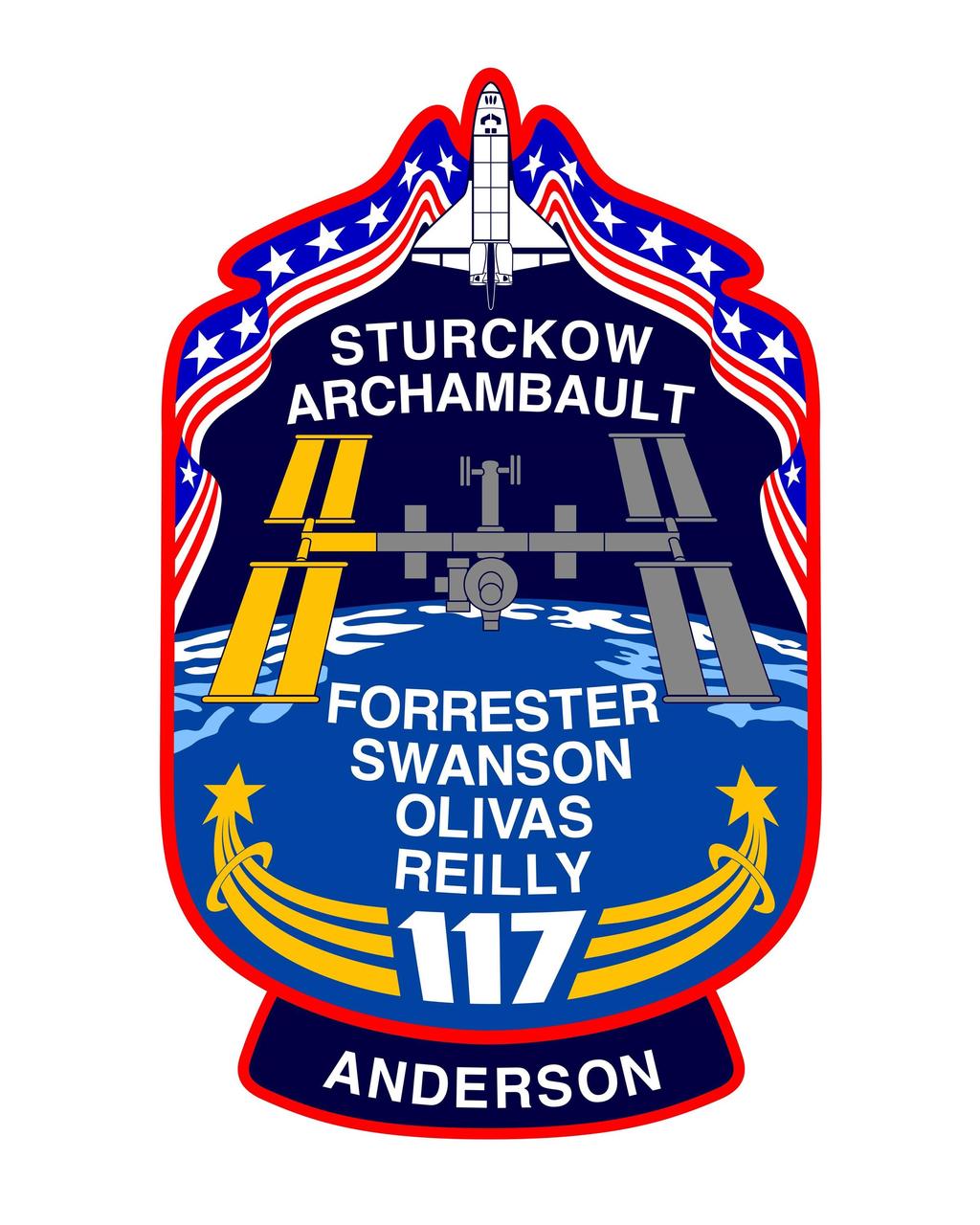
JOHNSON SPACE CENTER, Houston -- STS117-S-001 -- The STS-117 crew patch symbolizes the continued construction of the International Space Station (ISS) and our ongoing human presence in space. The ISS is shown orbiting high above the Earth. Gold is used to highlight the portion of the ISS that will be installed by the STS-117 crew. It consists of the second starboard truss section, S3/S4, and a set of solar arrays. The names of the STS-117 crew are located above and below the orbiting outpost. The two gold astronaut office symbols, emanating from the '117' at the bottom of the patch represent the concerted efforts of the shuttle and station programs toward the completion of the station. The orbiter and unfurled banner of red, white and blue represent our Nation's renewed patriotism as we continue to explore the universe. The NASA insignia design for shuttle space flights is reserved for use by the astronauts and other official use as the NASA Administrator may authorize. Public availability has been approved only in the form of illustrations by the various news media. When and if there is any change in this policy, which is not anticipated, such will be publicly announced.
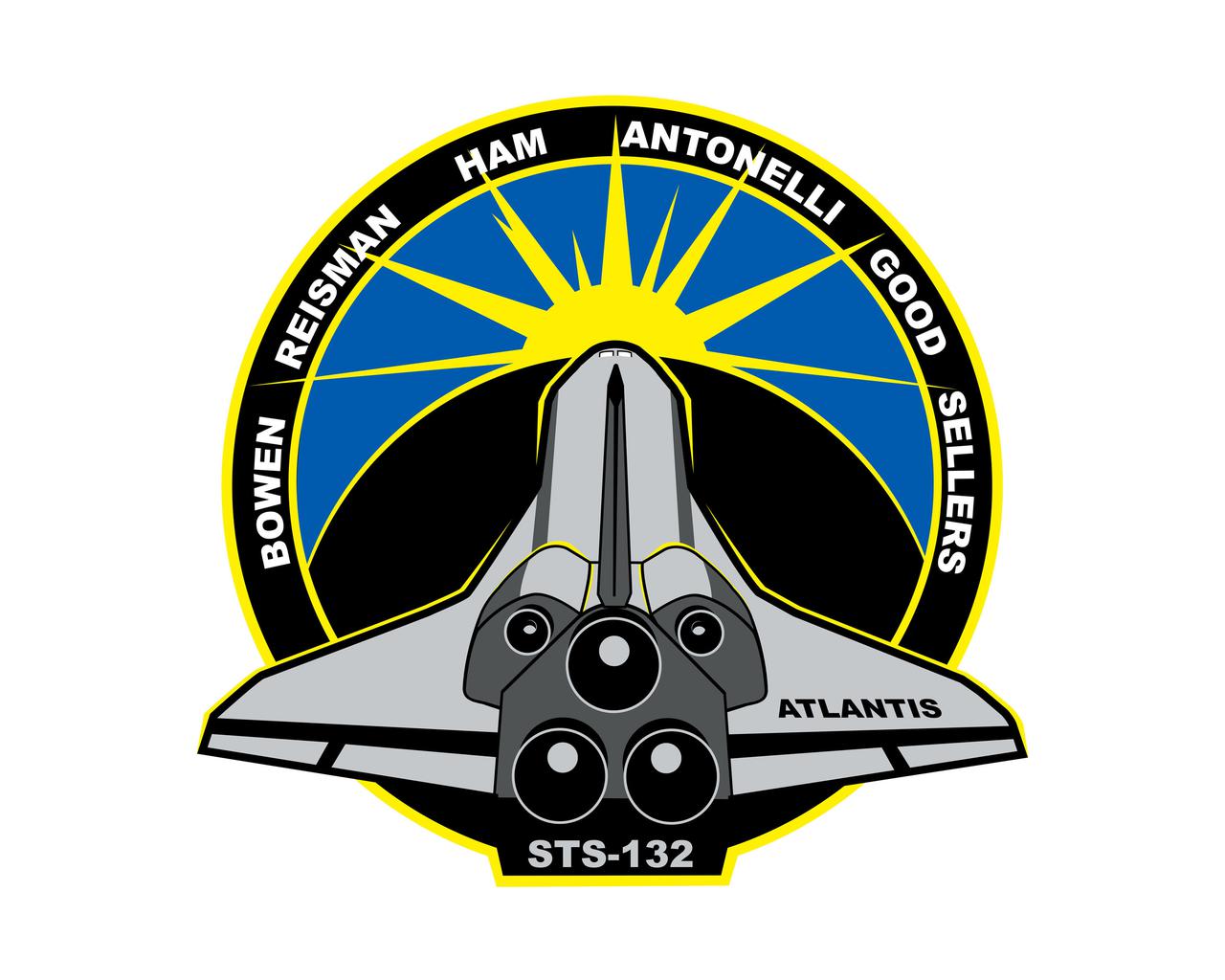
JOHNSON SPACE CENTER, Houston, Texas --- STS132-S-001 (February 2010) --- The STS-132 mission will be the 32nd flight of the space shuttle Atlantis. The primary STS-132 mission objective is to deliver the Russian-made MRM-1 (Mini Research Module) to the International Space Station (ISS). Atlantis will also deliver a new communications antenna and a new set of batteries for one of the ISS solar arrays. The STS-132 mission patch features Atlantis flying off into the sunset as the end of the Space Shuttle Program approaches. However the sun is also heralding the promise of a new day as it rises for the first time on a new ISS module, the MRM-1, which is also named “Rassvet,” the Russian word for dawn. The NASA insignia design for shuttle and space station flights is reserved for use by the astronauts and for other official use as the NASA Administrator may authorize. Public availability has been approved only in the form of illustrations by the various news media. When and if there is any change in this policy, which is not anticipated, it will be publicly announced.
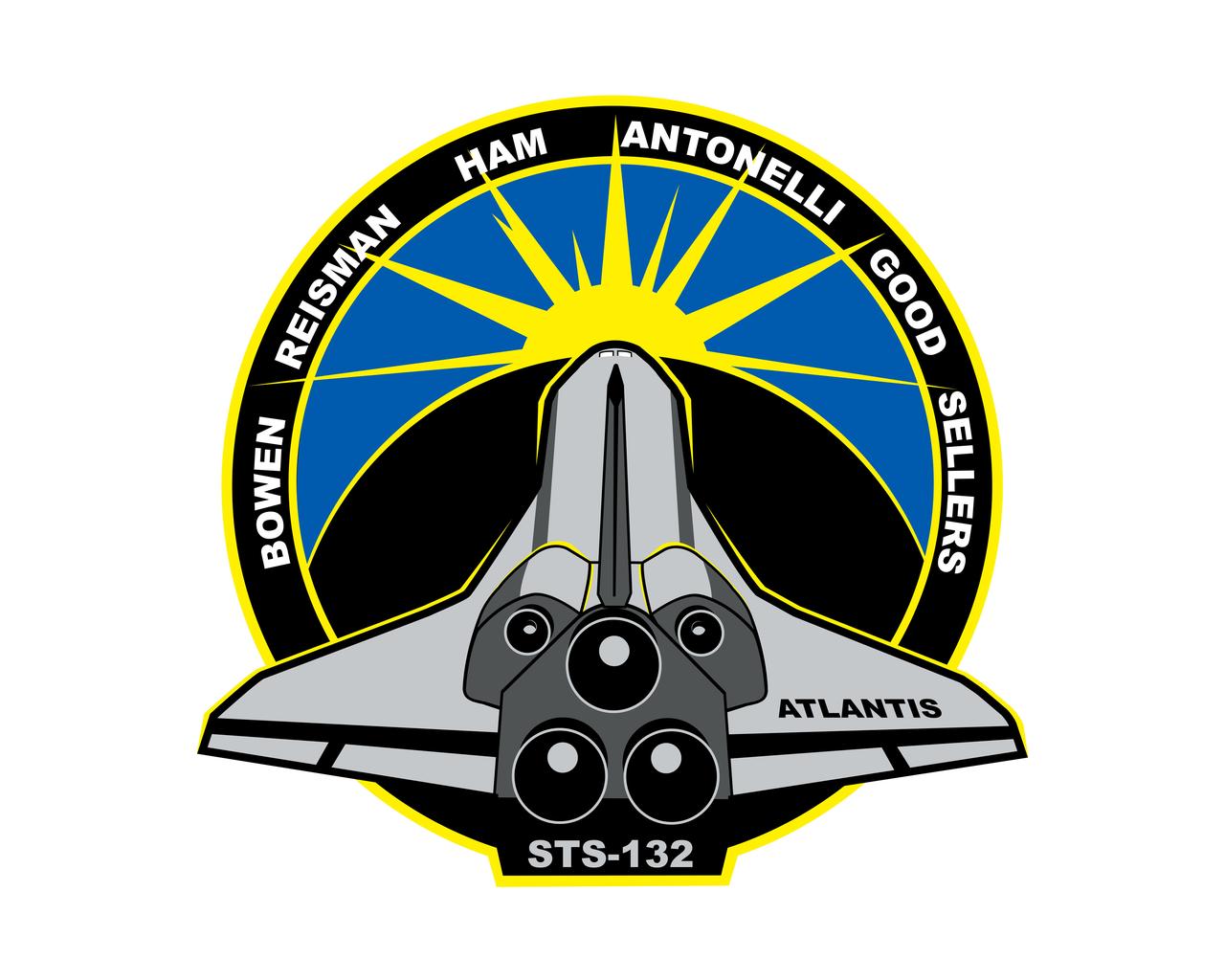
STS132-S-001 (February 2010) --- The STS-132 mission will be the 32nd flight of the space shuttle Atlantis. The primary STS-132 mission objective is to deliver the Russian-made MRM-1 (Mini Research Module) to the International Space Station (ISS). Atlantis will also deliver a new communications antenna and a new set of batteries for one of the ISS solar arrays. The STS-132 mission patch features Atlantis flying off into the sunset as the end of the Space Shuttle Program approaches. However the sun is also heralding the promise of a new day as it rises for the first time on a new ISS module, the MRM-1, which is also named ?Rassvet,? the Russian word for dawn. The NASA insignia design for space shuttle flights is reserved for use by the astronauts and for other official use as the NASA Administrator may authorize. Public availability has been approved only in the forms of illustrations by the various news media. When and if there is any change in this policy, which is not anticipated, the change will be publicly announced. Photo credit: NASA
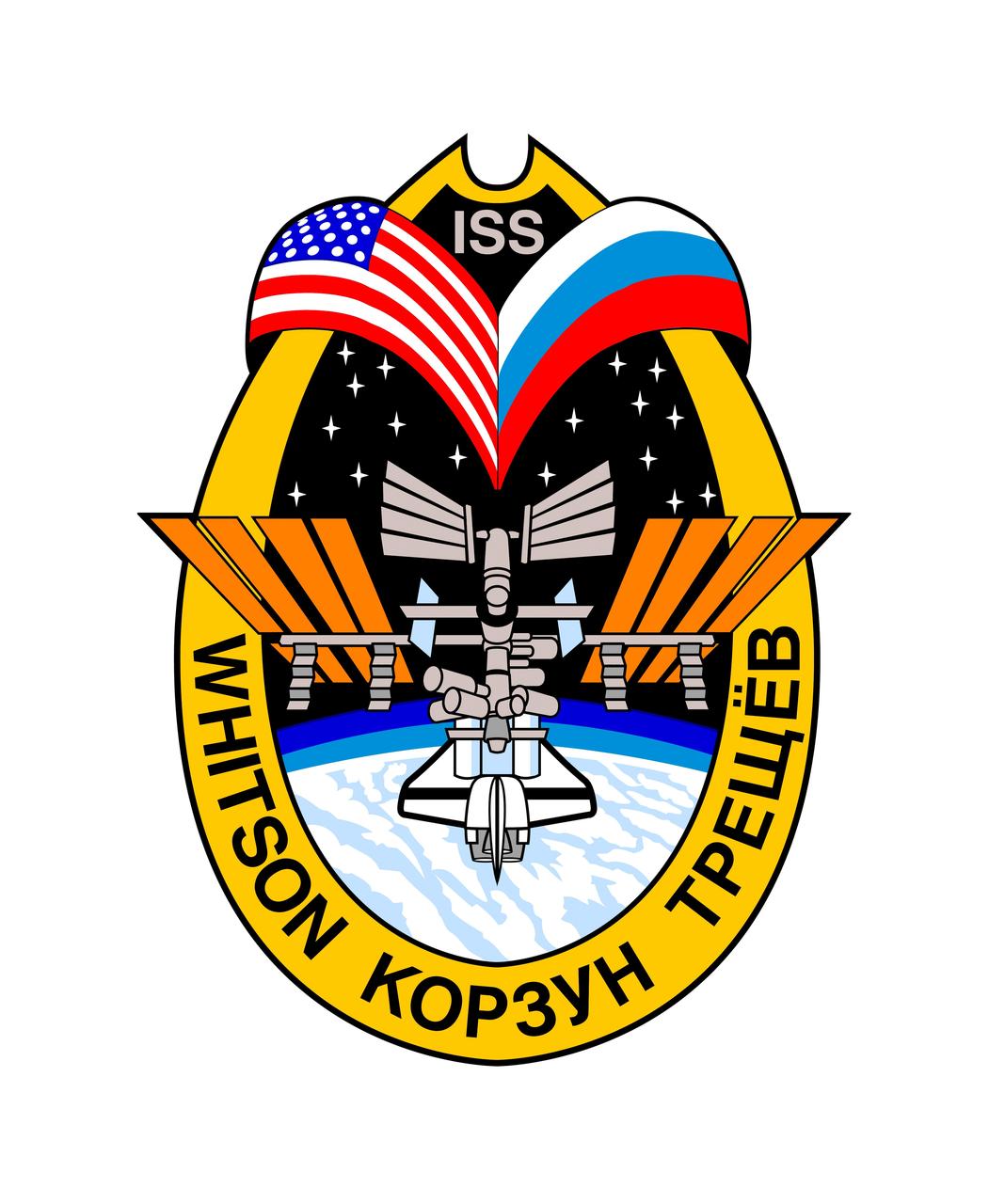
ISS005-S-001 (January 2002) -- The International Space Station (ISS) Expedition Five patch depicts the station in its completed configuration and represents the vision of mankind's first step as a permanent human presence in space. The United States and Russian flags are joined together in a Roman numeral V to represent both the nationalities of the crew and the fifth crew to live aboard the ISS. Crew members? names are shown in the border of this patch. This increment encompasses a new phase in growth for the station, with three shuttle crews delivering critical components and building blocks to the ISS. To signify the participation of each crew member, the shuttle is docked to the station beneath a constellation of 17 stars symbolizing all those visiting and living aboard station during this increment. The NASA insignia design for shuttle flights and station increments is reserved for use by the astronauts and for other official use as the NASA Administrator may authorize. Public availability has been approved only in the forms of illustrations by the various news media. When and if there is any change in this policy, which is not anticipated, the change will be publicly announced.
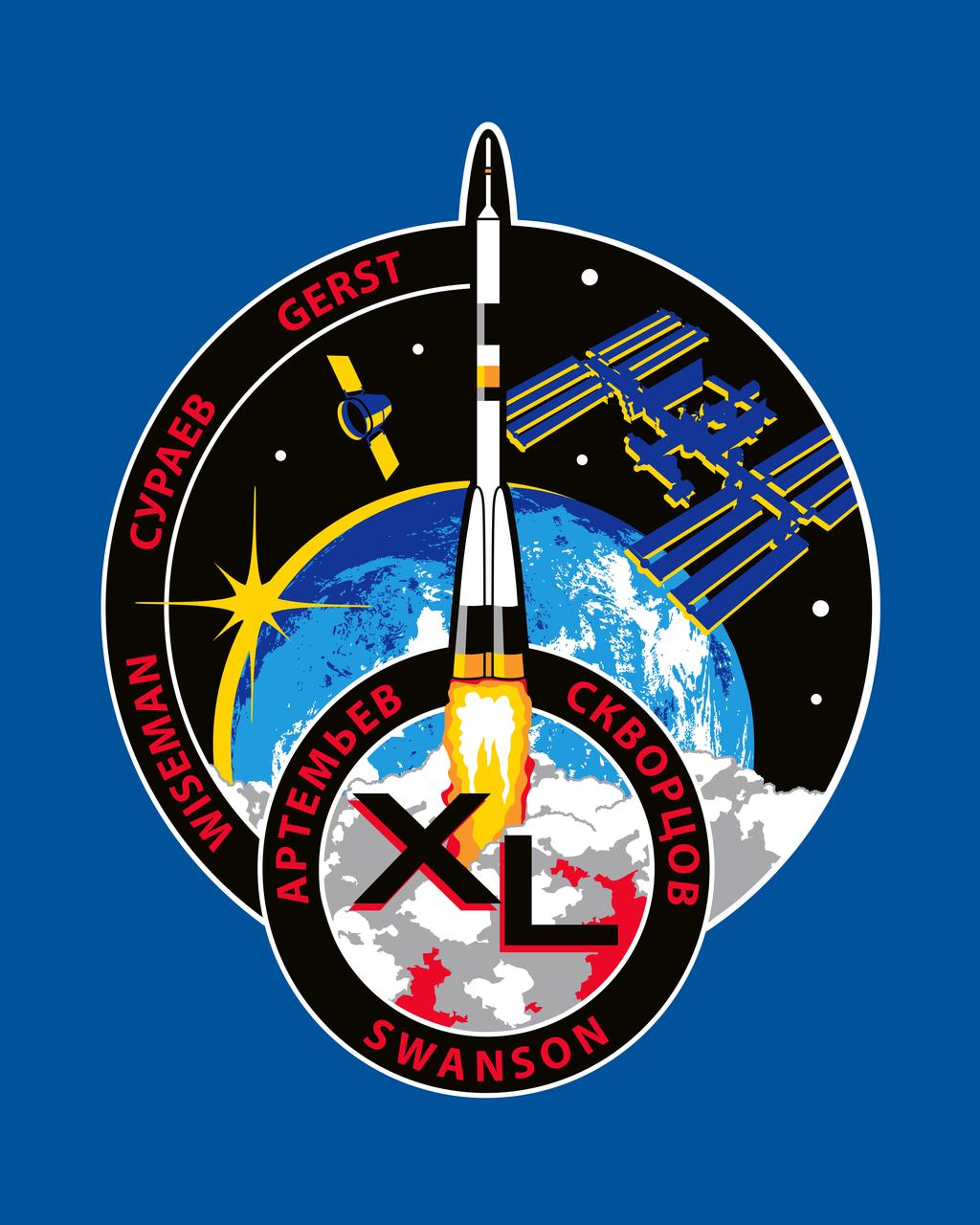
ISS040-S-001 (April 2013) --- The Expedition 40 patch depicts the past, present, and future of human space exploration. The crew wrote the description that follows: The reliable and proven Soyuz, our ride to the International Space Station (ISS), is a part of the past, present, and future. The ISS is the culmination of an enormous effort by many countries partnering to produce a first-class orbiting laboratory, and its image represents the current state of space exploration. The ISS is immensely significant to us as our home away from home and our oasis in the sky. The commercial cargo vehicle is also part of the current human space exploration and is a link to the future. A blend of legacy and future technologies is being used to create the next spacecrafts which will carry humans from our planet to destinations beyond. The sun on Earth?s horizon represents the new achievements and technologies that will come about due to our continued effort in space exploration. The NASA insignia design for shuttle and space station flights is reserved for use by the astronauts and for other official use as the NASA Administrator may authorize. Public availability has been approved only in the form of illustrations by the various news media. When and if there is any change in this policy, which is not anticipated, it will be publicly announced. Photo credit: NASA
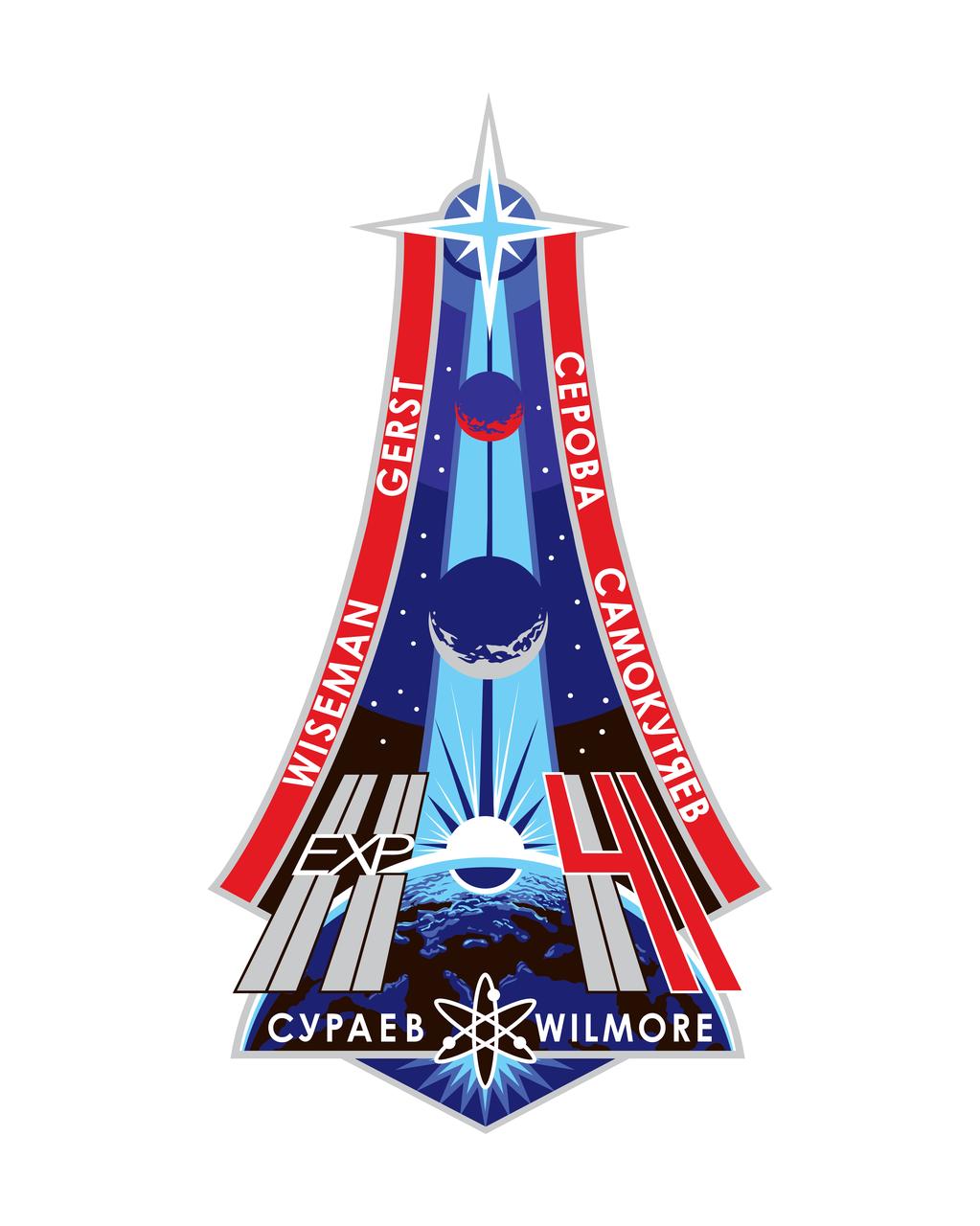
ISS041-S-001 (July 2013) --- The Expedition 41 crew members have released their patch and have written some text to go along with it: ?Portraying the road of human exploration into our vastly unknown universe, all elements of the Expedition 41 patch build from the foundation, our Earth, to the stars beyond our solar system. The focus of our six-month expedition to the International Space Station (ISS) is Earth and its inhabitants as well as a scientific look out into our universe. The distinguishing ISS solar arrays reach onward and serve as the central element, with the icon of an atom underneath representing the multitude of research onboard that will bring new discoveries for the benefit of humanity. The sun is rising over Earth?s horizon, spreading its light along the road of human exploration. Equipped with the knowledge and inspiration gained from ISS, our successful multinational cooperation will lead human space exploration to the moon, Mars, and ultimately, the stars. We are Expedition 41. Join us for the adventure.? Photo credit: NASA Note: The NASA insignia design for shuttle and space station flights is reserved for use by the astronauts and for other official use as the NASA Administrator may authorize. Public availability has been approved only in the form of illustrations by the various news media. When and if there is any change in this policy, which is not anticipated, it will be publicly announced.
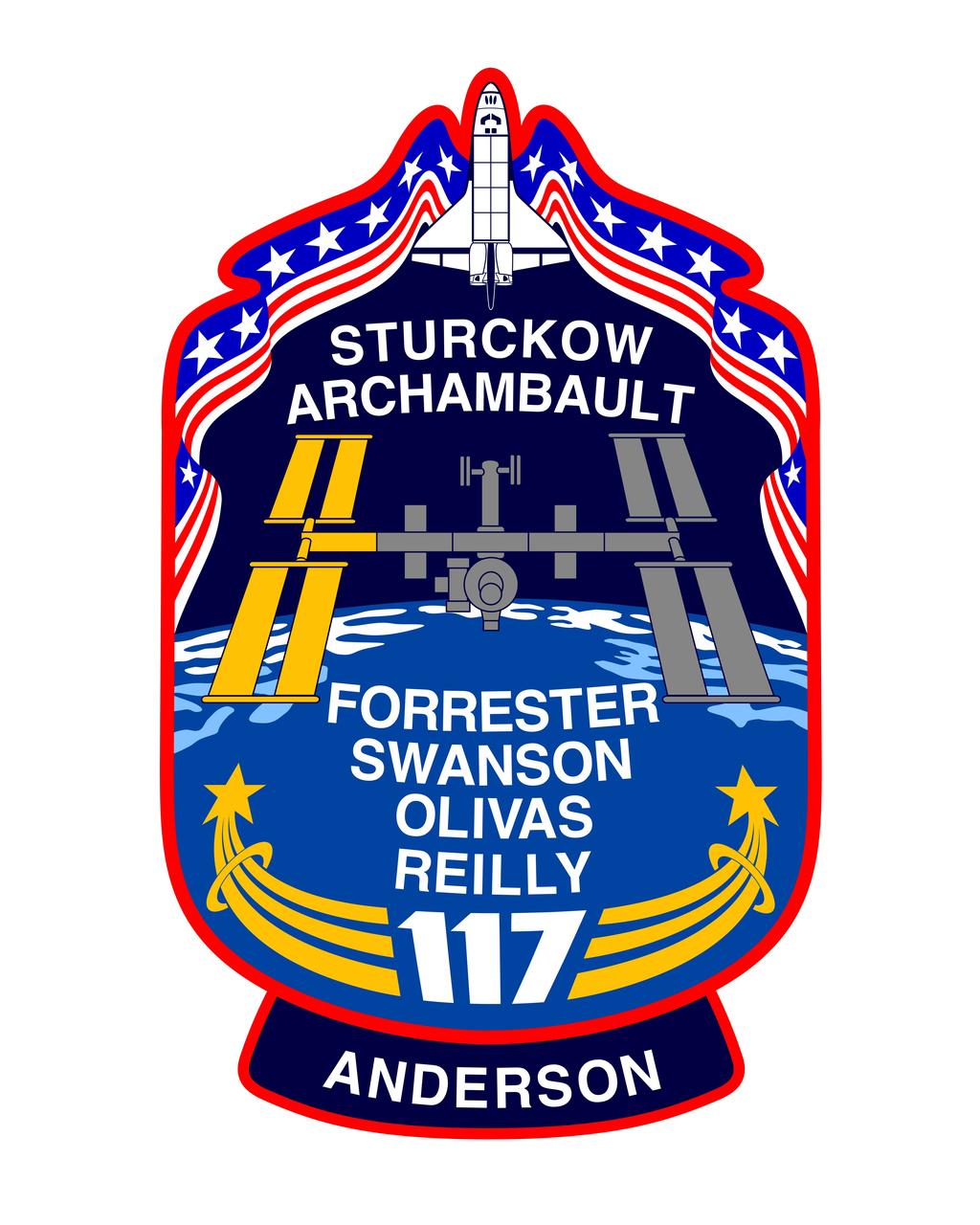
STS117-S-001 (May 2007) --- The STS-117 crew patch symbolizes the continued construction of the International Space Station (ISS) and our ongoing human presence in space. The ISS is shown orbiting high above Earth. Gold is used to highlight the portion of the ISS that will be installed by the STS-117 crew. It consists of the second starboard truss section, S3/S4, and a set of solar arrays. The names of the STS-117 crew are located above and below the orbiting outpost. The two gold astronaut office symbols, emanating from the '117' at the bottom of the patch, represent the concerted efforts of the shuttle and station programs toward the completion of the station. The orbiter and unfurled banner of red, white, and blue represent our Nation's renewed patriotism as we continue to explore the universe. The NASA insignia design for space shuttle flights is reserved for use by the astronauts and for other official use as the NASA Administrator may authorize. Public availability has been approved only in the forms of illustrations by the various news media. When and if there is any change in this policy, which is not anticipated, the change will be publicly announced. Photo credit: NASA
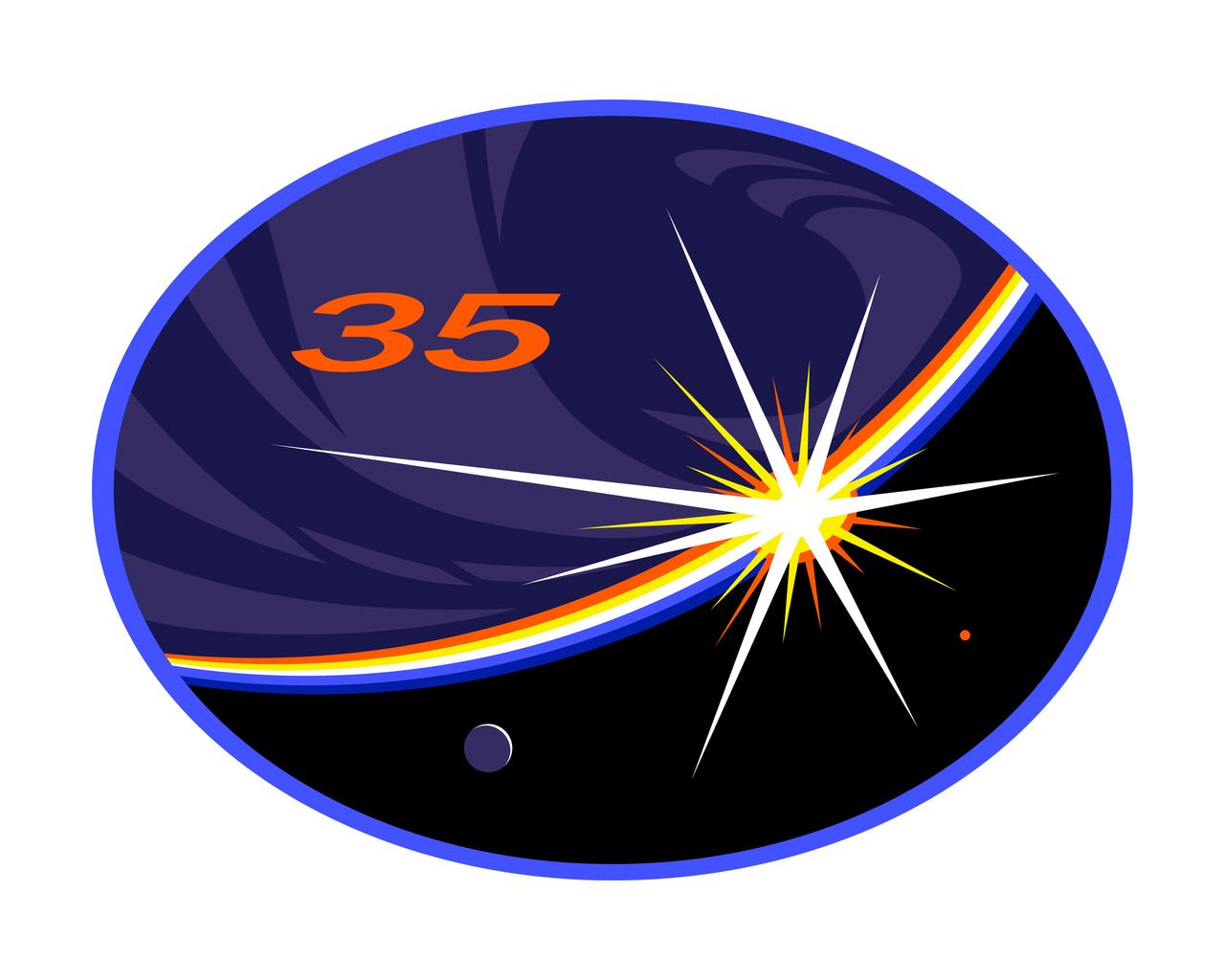
ISS035-S-001 (April 2011) --- Emblazoned with a bold 35 for the 35th expedition to the International Space Station (ISS), this patch portrays a natural moonlit view of the Earth from the ISS at the moment of sunrise, one of the sixteen that occur each day at orbital velocity, with glowing bands of Earth's atmosphere dispersing the sun's bright light into primary colors. The Earth is depicted as it often appears from space, without recognizable coastlines or boundaries - just as the international endeavor of living and working together in space blurs technical and cultural boundaries between nations. The ISS is the unseen central figure of the image, since the view is from a window of the Space Station itself, commemorating full use of the Space Station as a long-duration dwelling from which humans can develop techniques and technologies to further explore. The crew points out, ?The arc of the Earth?s horizon with the sun?s arrows of light imply a bow shooting the imagination to Mars and the cosmos where our species may one day thrive.? The NASA insignia design for shuttle and space station flights is reserved for use by the astronauts and for other official use as the NASA Administrator may authorize. Public availability has been approved only in the form of illustrations by the various news media. When and if there is any change in this policy, which is not anticipated, it will be publicly announced.
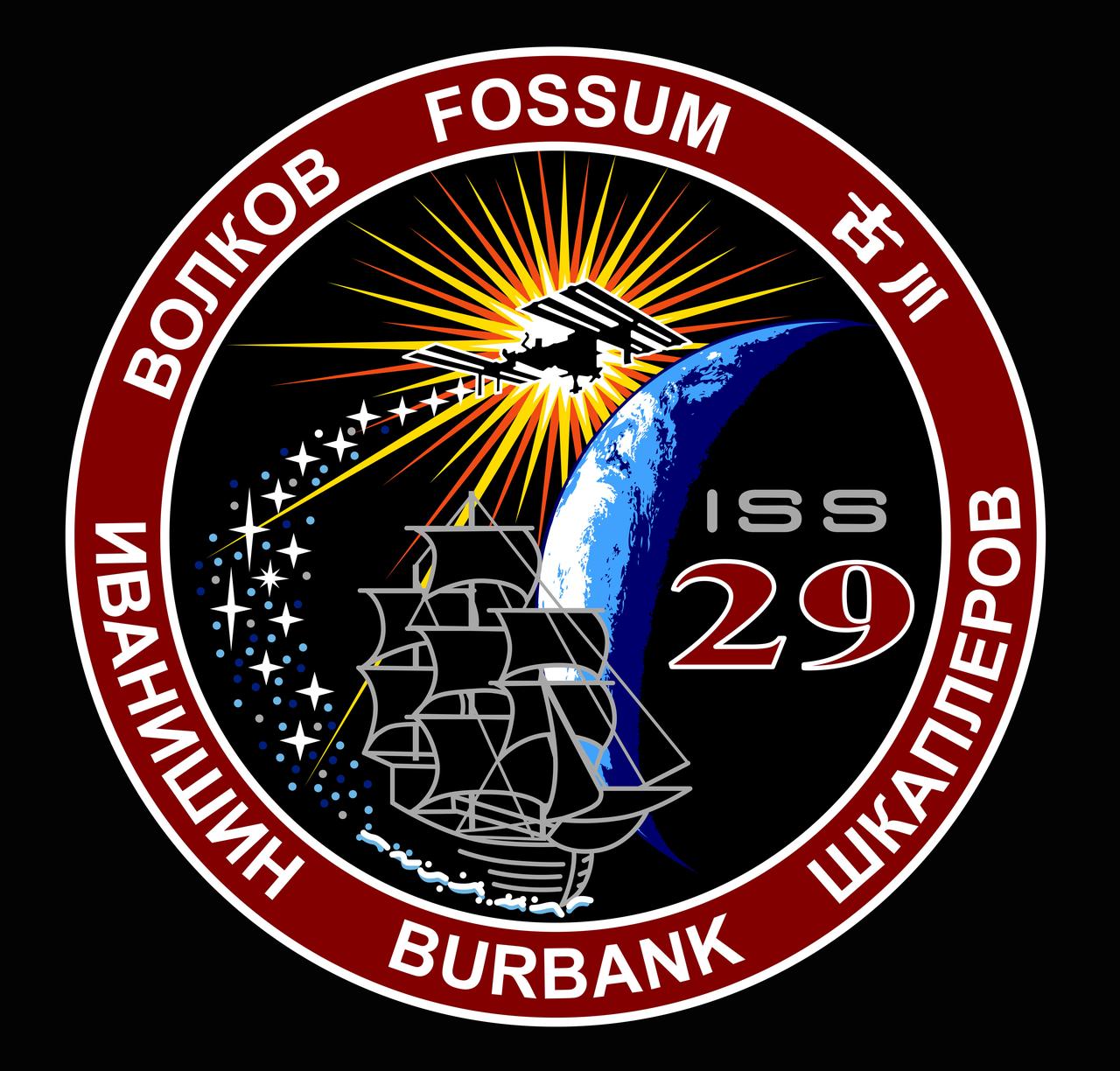
ISS029-S-001 (23 March 2011) --- On the Expedition 29 patch, the International Space Station (ISS) is shown following the path of the historic 18th century explorer, Captain James Cook, and his ship, Endeavour. During Cook?s three main voyages, he explored and mapped major portions of the oceans and coastlines under the flight path of the ISS and added immeasurably to the body of knowledge of that time. As the ISS sails a stardust trail ? following the spirit of Endeavour sailing toward the dark unknown and new discoveries ? it enlightens Earth below. Through the centuries, the quest for new discoveries has been a significant element of the human character, inspiring us to endure hardships and separation to be part of a mission which is greater than any individual. A spokesman for the crew stated, ?The crew of Expedition 29 is proud to continue the journey in this greatest of all human endeavors.? The NASA insignia design for shuttle and space station flights is reserved for use by the astronauts and for other official use as the NASA Administrator may authorize. Public availability has been approved only in the form of illustrations by the various news media. When and if there is any change in this policy, which is not anticipated, it will be publicly announced. Photo credit: NASA or National Aeronautics and Space Administration
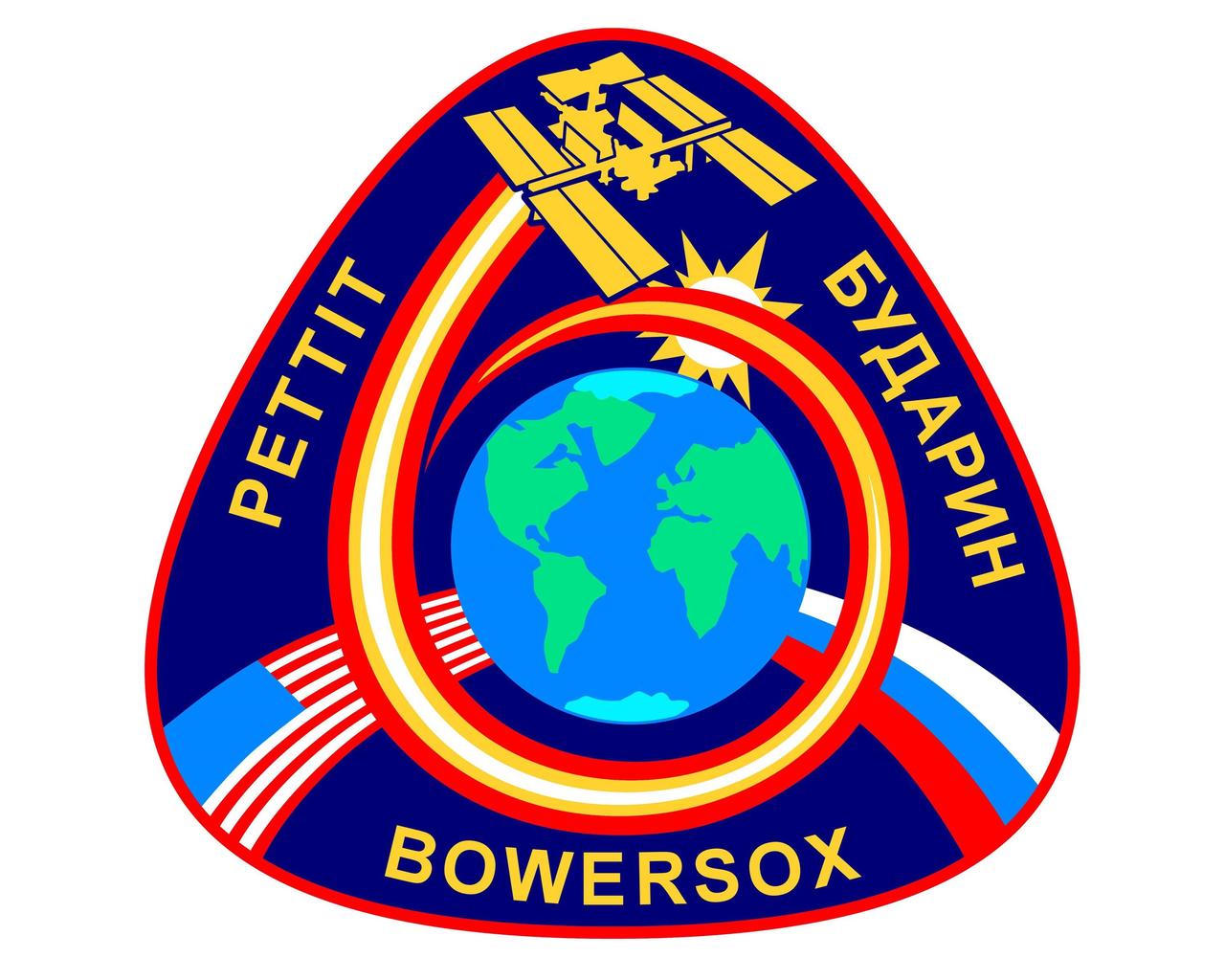
JOHNSON SPACE CENTER, HOUSTON, TEXAS -- (ISS006-S-001) Revised -- The International Space Station (ISS) Expedition 6 crew patch depicts the Station orbiting the Earth on its mission of international cooperation and scientific research. The Earth is placed in the center of the patch to emphasize that work conducted aboard this orbiting laboratory is intended to improve life on our home planet. The shape of the Space Station's orbit symbolizes the role that experience gained from ISS will have on future exploration of our solar system and behond. The American and Russian flags encircling the Earth represent the native countries of the Expedition 6 crew members, which are just two of the many participant countries contributing to the ISS and committed to the peaceful exploration of space. The NASA insignia design for International Space Station missions is reserved for use by the crew members and for other official use as the NASA Administrator may authorize. Public availability has been approved only in the forms of illustrations by the various news media. When and if there is any change in this policy, which is not anticipated, the change will be publicly announced.
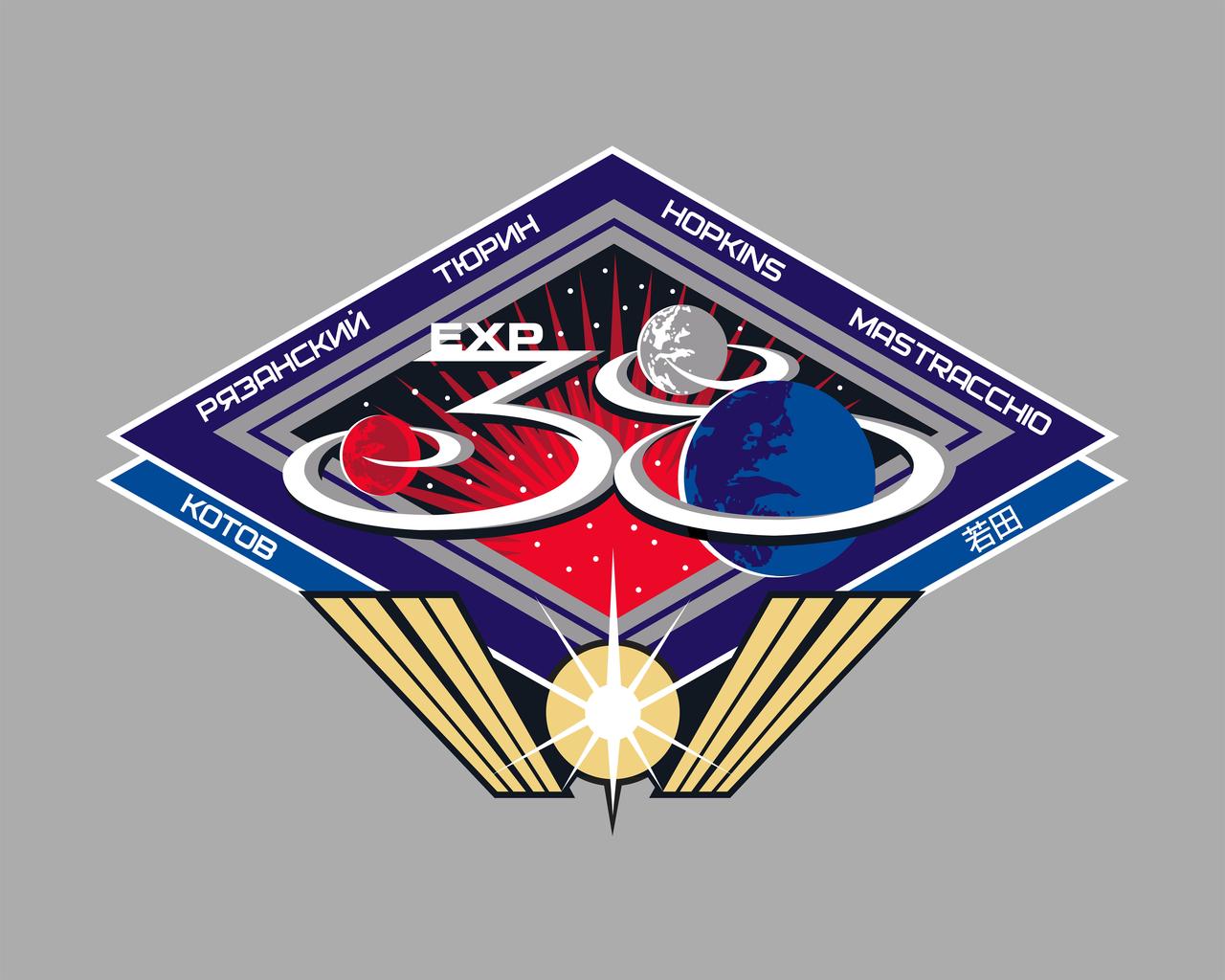
ISS038-S-001 (April 2013) --- As the International Space Station (ISS) has become a stepping stone to future space exploration, the Expedition 38 mission patch design paints a visual roadmap of exploration beyond low Earth orbit, most prominently represented by the design?s flowing Expedition 38 mission numbers that wrap around Earth, the moon and Mars. Just as the sun is a guiding light in the galaxy, the ISS illuminates the bottom of the design as it is a shining beacon of the advancement of science, knowledge, and technology carried out aboard the Space Station. To visually capture the idea of the ISS being a foundation for infinite discovery, the space station?s iconic solar arrays span upwards, providing the number 38 and its exploration roadmap a symbolic pedestal to rest on. Finally, the overall use of red, white, and blue in the design acknowledges the flags of the countries of origin for Expedition 38?s crew ? the United States, Russia, and Japan. The NASA insignia design for space shuttle flights is reserved for use by the astronauts and for other official use as the NASA Administrator may authorize. Public availability has been approved only in the forms of illustrations by the various news media. When and if there is any change in this policy, which is not anticipated, the change will be publicly announced. Photo credit: NASA
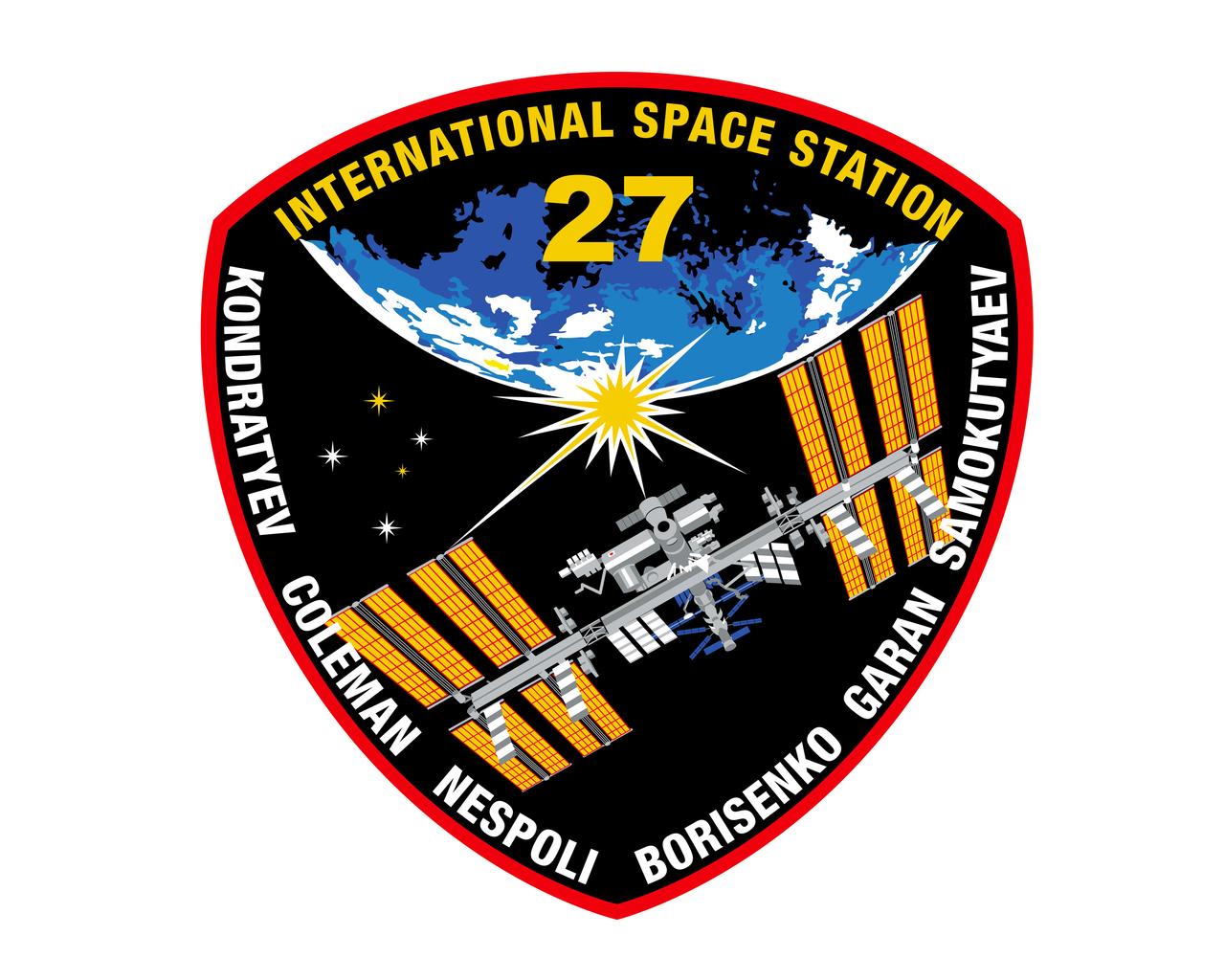
ISS027-S-001 (August 2010) --- The Expedition 27 patch depicts the International Space Station (ISS) prominently orbiting Earth, continuing its mission for science, technology and education. The ISS is an ever-present reminder of the cooperation between the United States, Russia, Japan, Canada, and the European Space Agency (ESA) ? and of the scientific, technical, and cultural achievements that have resulted from that unique teamwork. The ISS is shown in its completed status with the latest addition of the Alpha Magnetic Spectrometer (AMS), and with two resupply vehicles docked at each end of the station. The Southern Cross Constellation is also show in the foreground and its five stars, along with the sun, symbolize the six international crew members that live and work on the space station. The Southern Cross is one of the smallest modern constellations, and also one of the most distinctive. It has cultural significance all over the world and inspires teams to push the boundaries of their worlds, both in space and on the ground. The NASA insignia design for shuttle and space station flights is reserved for use by the astronauts and for other official use as the NASA Administrator may authorize. Public availability has been approved only in the form of illustrations by the various news media. When and if there is any change in this policy, which is not anticipated, it will be publicly announced.
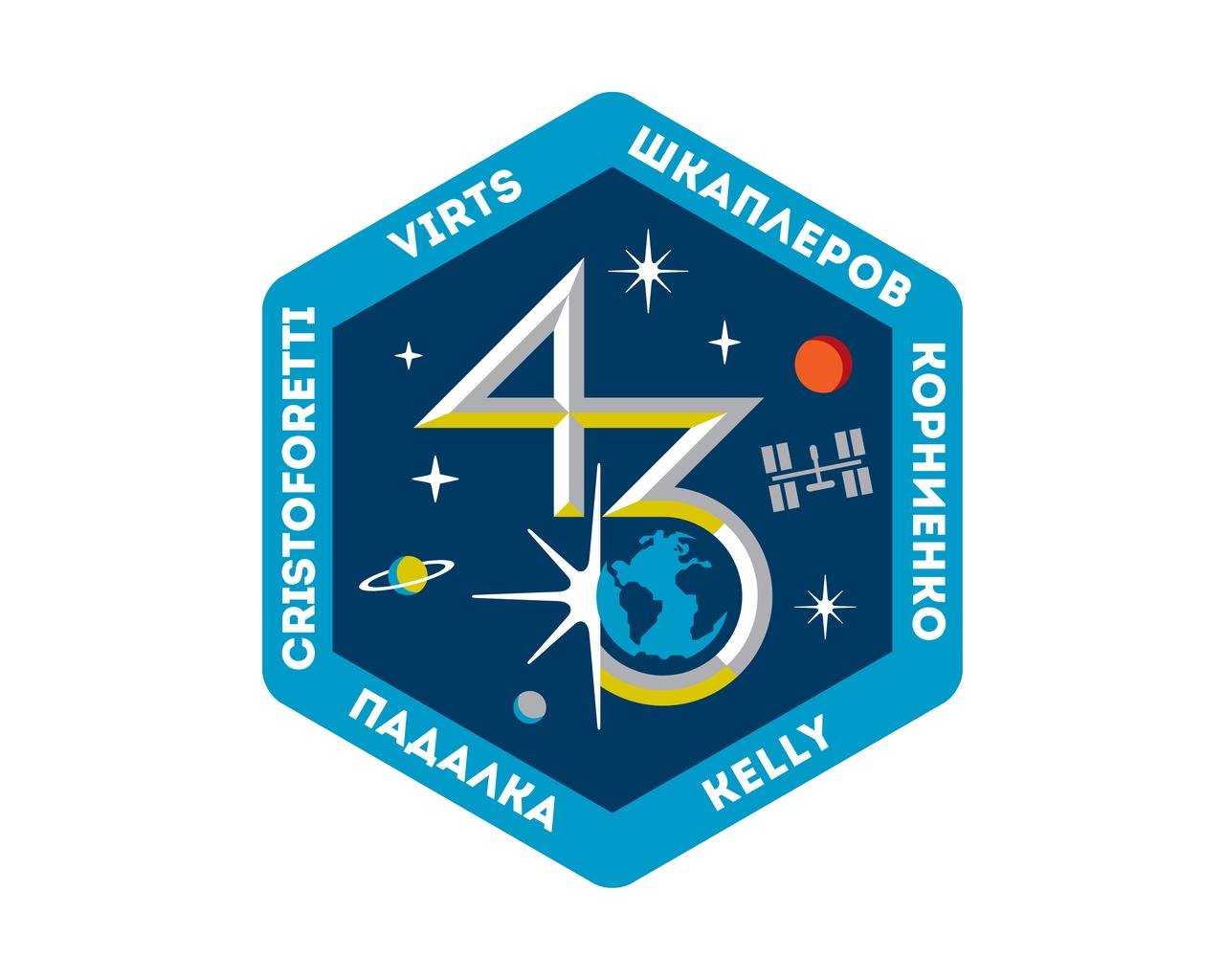
ISS043-S-001 (April 2013) --- The hexagon (six-sided) shape of the Expedition 43 patch represents the six crew members living and working onboard the orbital outpost. The International Space Station (ISS) is portrayed in orbit around the Earth, representing the multi-national partnership that has constructed, developed, and continues to operate the ISS for the benefit of all humankind. The sunrise marks the beginning of a new day, reflecting the fact that we're at the dawn of our history as a space faring species. The moon and planets represent future exploration of our solar system, for which the ISS is a stepping stone. Finally, the five stars honor the crews who have lost their lives during the pursuit of human spaceflight. The NASA insignia design for shuttle flights and station increments is reserved for use by the astronauts and for other official use as the NASA Administrator may authorize. Public availability has been approved only in the forms of illustrations by the various news media. When and if there is any change in this policy, which is not anticipated, the change will be publicly announced. Photo credit: NASA
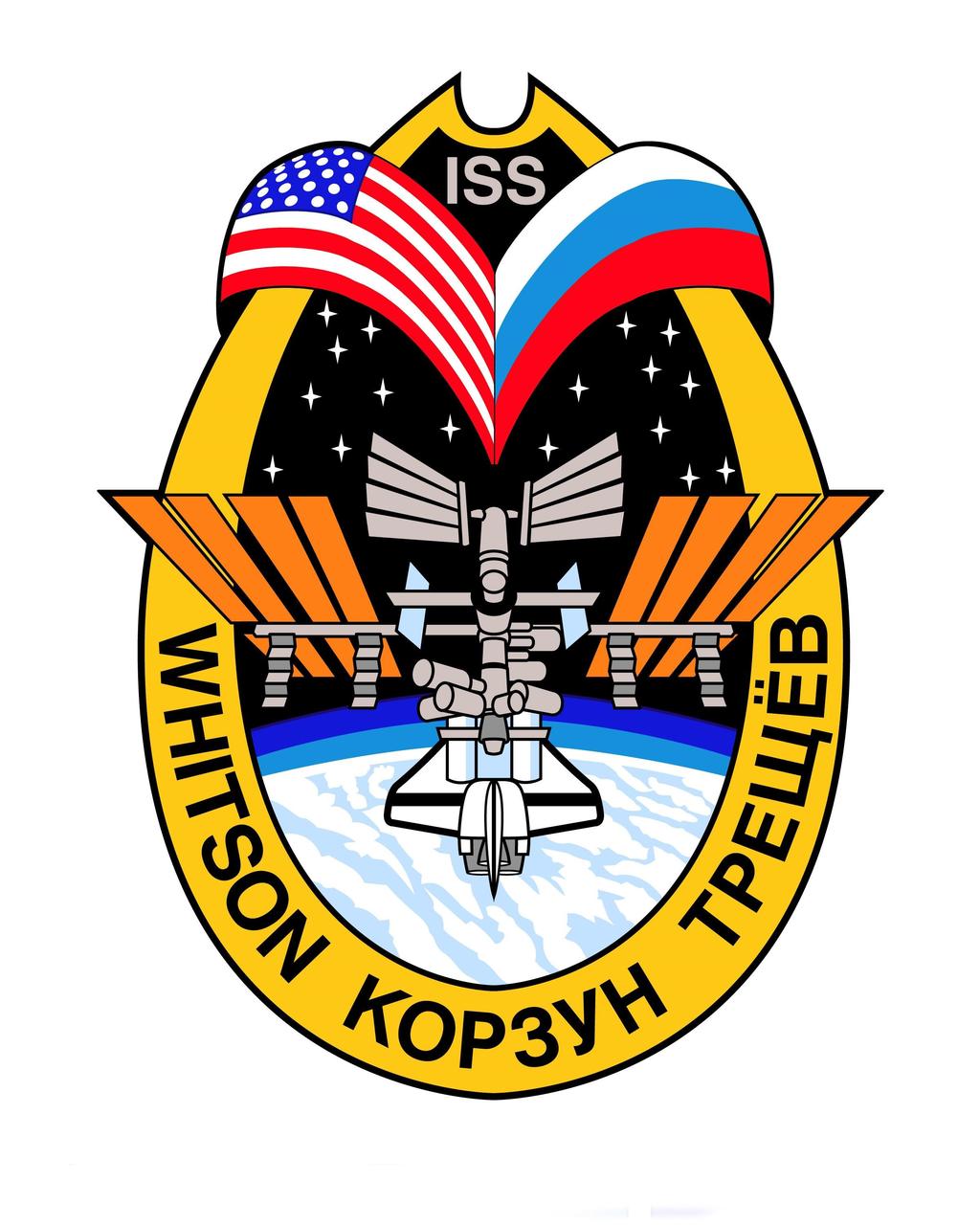
JOHNSON SPACE CENTER, HOUSTON, TEXAS -- EXPEDITION FIVE CREW INSIGNIA (ISS05-S-001) -- The International Space Station (ISS) Expedition Five patch depicts the Station in its completed configuration and represents the vision of mankind's first step as a permanent human presence in space. The United States and Russian flags are joined together in a Roman numeral V to represent both the nationalities of the crew and the fifth crew to live aboard the ISS. Crew members' names are shown in the border of this patch. This increment encompasses a new phase in growth for the Station, with three Shuttle crews delivering critical components and building blocks to the ISS. To signify the participation of each crew member, the Shuttle is docked to the Station beneath a constellation of 17 stars symbolizing all those visiting and living aboard Station during this increment. The NASA insignia design for Shuttle flights is reserved for use by the astronauts and for other official use as the NASA Administrator may authorize. Public availability has been approved only in the forms of illustrations by the various news media. When and if there is any change in this policy, which is not anticipated, the change will be publicly announced.
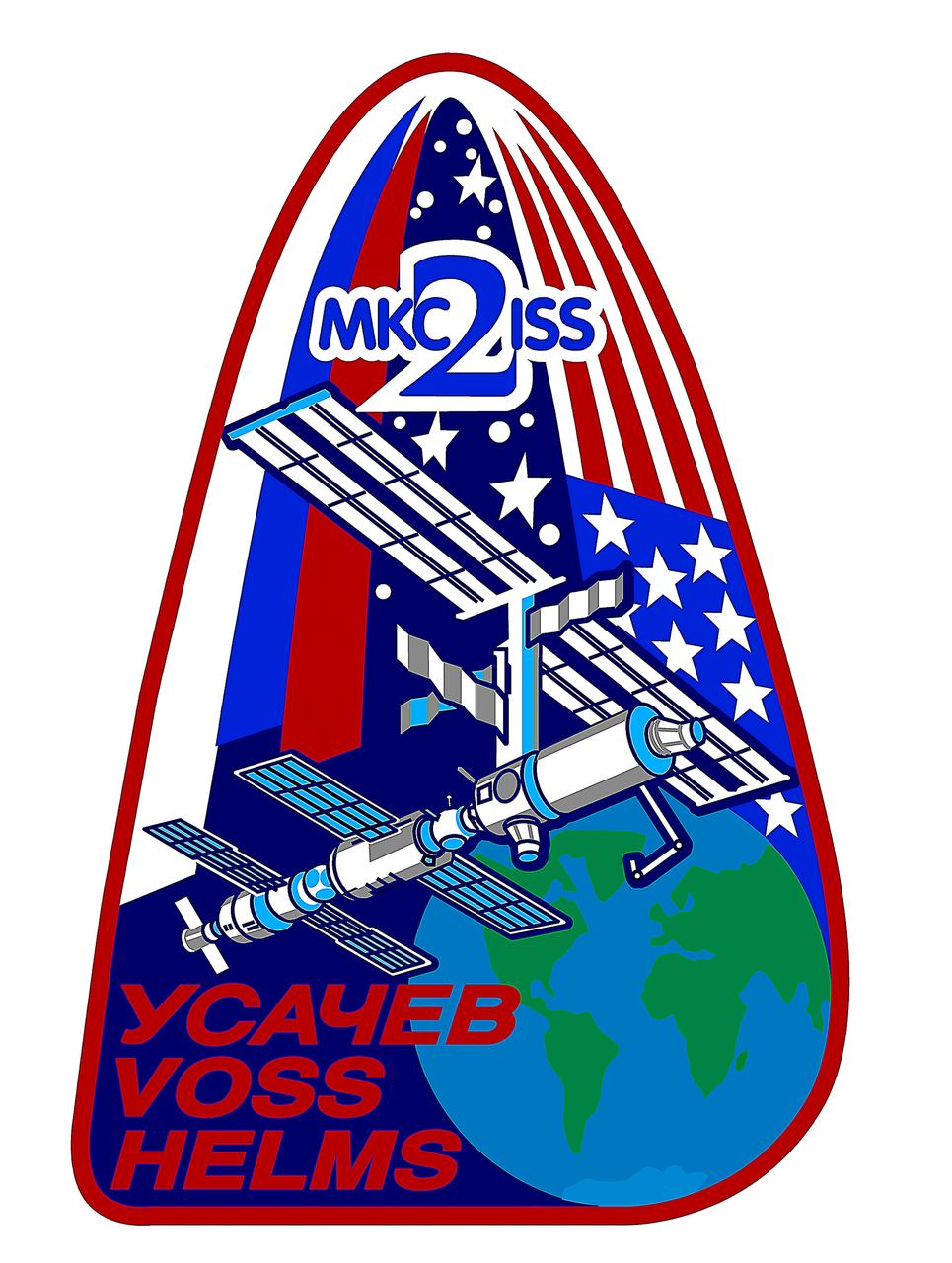
ISS002-S-001 (January 2001) --- The International Space Station Expedition Two patch depicts the Space Station as it appears during the time the second crew will be on board. The Station flying over the Earth represents the overall reason for having a space station: to benefit the world through scientific research and international cooperation in space. The number 2 is for the second expedition and is enclosed in the Cyrillic MKS and Latin ISS which are the respective Russian and English abbreviations for the International Space Station. The United States and Russian flags show the nationalities of the crew indicating the joint nature of the program. When asked about the stars in the background, a crew spokesman said they "...represent the thousands of space workers throughout the ISS partnership who have contributed to the successful construction of our International Space Station." The insignia design for ISS flights is reserved for use by the astronauts and cosmonauts and for other official use as the NASA Administrator and NASA's international partners may authorize. Public availability has been approved only in the form of illustrations by the various news media. When and if there is any change in this policy, which we do not anticipate, it will be publicly announced.
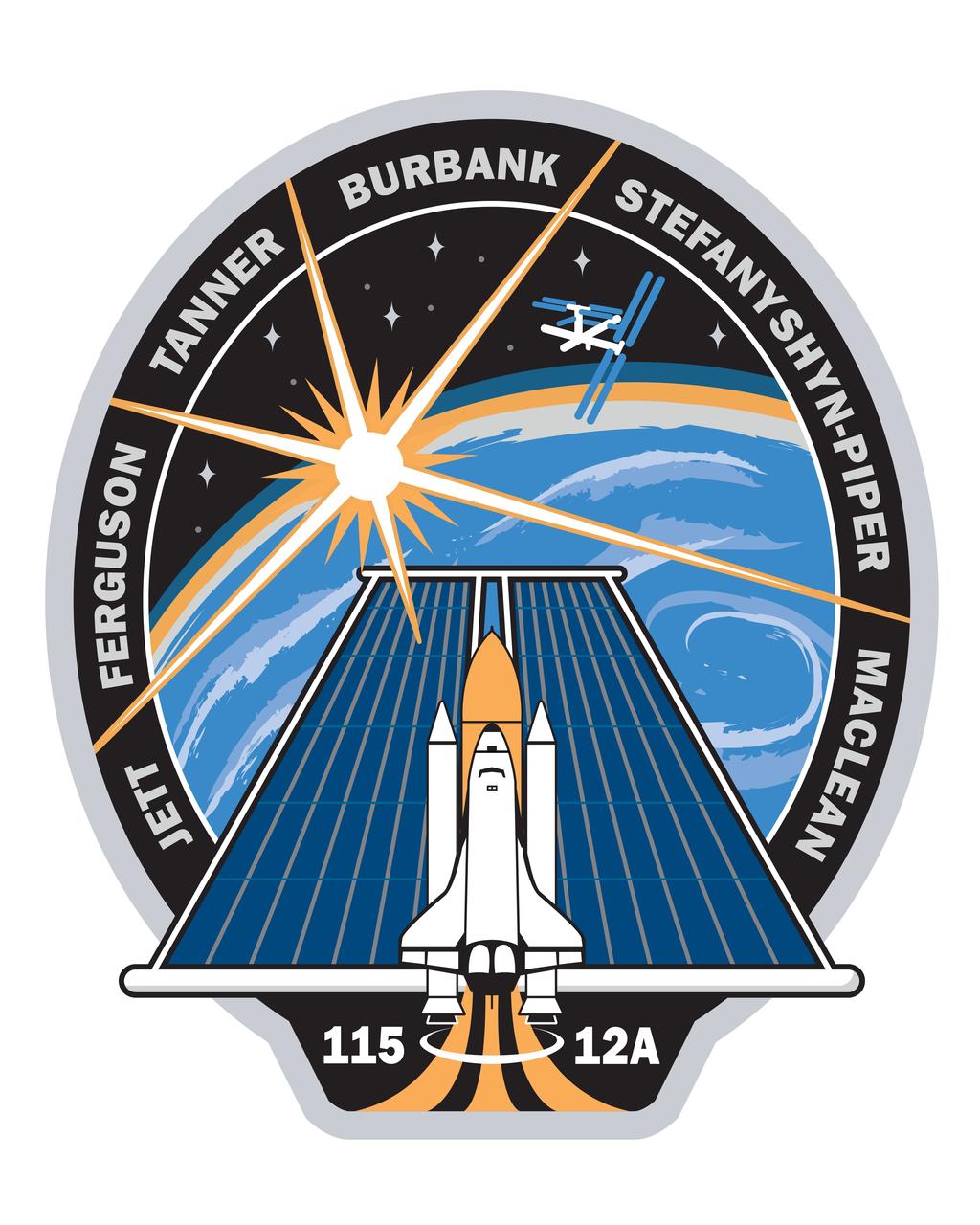
STS115-S-001 (February 2003) --- This is the STS-115 insignia. This mission continues the assembly of the International Space Station (ISS) with the installation of the truss segments P3 and P4. Following the installation of the segments utilizing both the shuttle and the station robotic arms, a series of three spacewalks will complete the final connections and prepare for the deployment of the station's second set of solar arrays. To reflect the primary mission of the flight, the patch depicts a solar panel as the main element. As the space shuttle Atlantis launches towards the ISS, its trail depicts the symbol of the Astronaut Office. The starburst, representing the power of the sun, rises over the Earth and shines on the solar panel. The shuttle flight number 115 is shown at the bottom of the patch, along with the ISS assembly designation 12A (the 12th American assembly mission). The blue Earth in the background reminds us of the importance of space exploration and research to all of Earth's inhabitants. The NASA insignia design for space shuttle flights is reserved for use by the astronauts and for other official use as the NASA Administrator may authorize. Public availability has been approved only in the forms of illustrations by the various news media. When and if there is any change in this policy, which is not anticipated, the change will be publicly announced. Photo credit: NASA
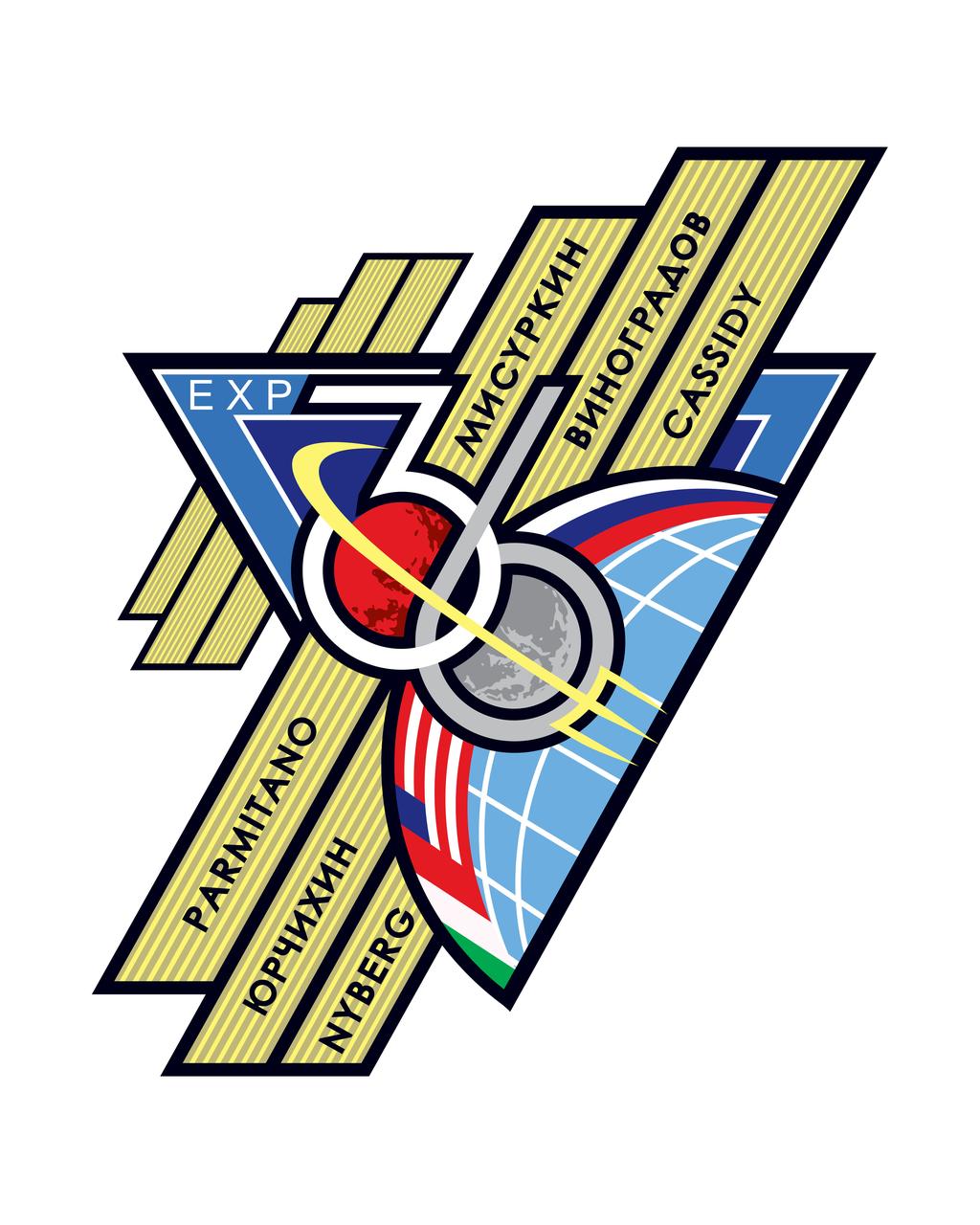
ISS036-S-001 (January 2012) --- The dynamic design of the Expedition 36 patch portrays the International Space Station?s (ISS) iconic solar arrays. The slanted angles denote a kinetic energy leading from the Earth in the lower right to the upper left tip of the triangular shape of the patch, representing the infinite scientific research, education, and long-duration spaceflight capabilities the ISS provides with each mission, as well as our goal for future exploration beyond the Space Station. The numbers 3 and 6 harmoniously intertwine to form expedition number 36 and its gray coloration signifies the unity and neutrality among all of the international partners of the ISS. The blue and gold color scheme of the patch represents the subtle way the central gold orbit wraps around the number 36 to form a trident at its lower right tip. The trident also symbolizes the sea, air, and land, all of which make up the Earth from where the trident originates in the design. The NASA insignia design for shuttle and space station flights is reserved for use by the astronauts and for other official use as the NASA Administrator may authorize. Public availability has been approved only in the form of illustrations by the various news media. When and if there is any change in this policy, which is not anticipated, it will be publicly announced. Photo credit: NASA
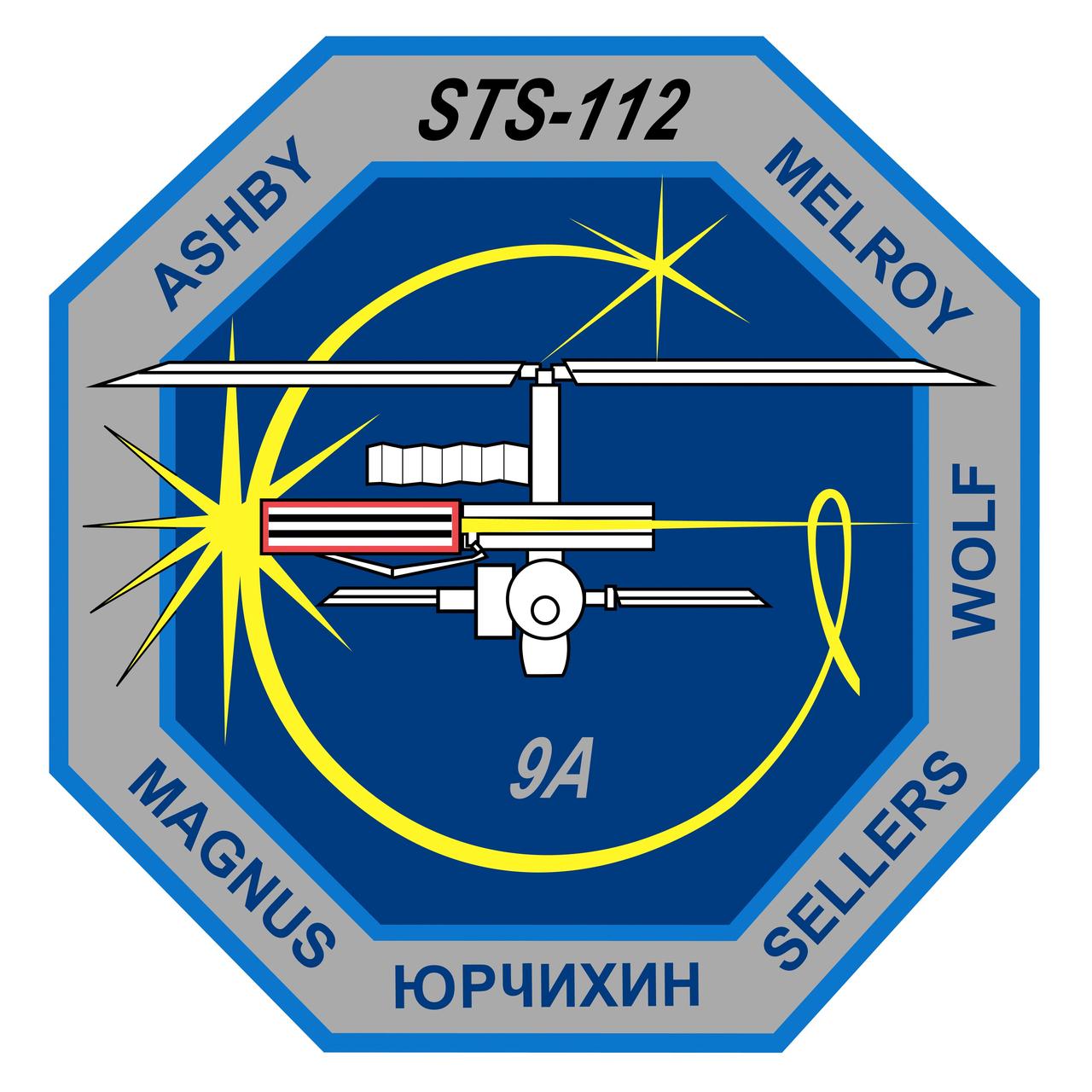
STS112-S-001 (March 2002) --- The STS-112 emblem symbolizes the ninth assembly mission (9A) to the International Space Station (ISS), a flight which is designed to deliver the Starboard 1 (S1) truss segment. The 30,000 pound truss segment will be lifted to orbit in the payload bay of the space shuttle Atlantis and installed using the ISS robotic arm. Three spacewalks will then be carried out to complete connections between the truss and ISS. Future missions will extend the truss structure to a span of over 350 feet so that it can support the solar arrays and radiators which provide the electrical power and cooling for ISS. The STS-112 emblem depicts ISS from the viewpoint of a departing shuttle, with the installed S1 truss segment outlined in red. A gold trail represents a portion of the shuttle rendezvous trajectory. Where the trajectory meets ISS, a nine-pointed star represents the combined on-orbit team of six shuttle and three ISS crew members who together will complete the S1 truss installation. The trajectory continues beyond the ISS, ending in a six-pointed star representing the Atlantis and the STS-112 crew. The NASA insignia design for space shuttle flights is reserved for use by the astronauts and for other official use as the NASA Administrator may authorize. Public availability has been approved only in the forms of illustrations by the various news media. When and if there is any change in this policy, which is not anticipated, the change will be publicly announced. Photo credit: NASA
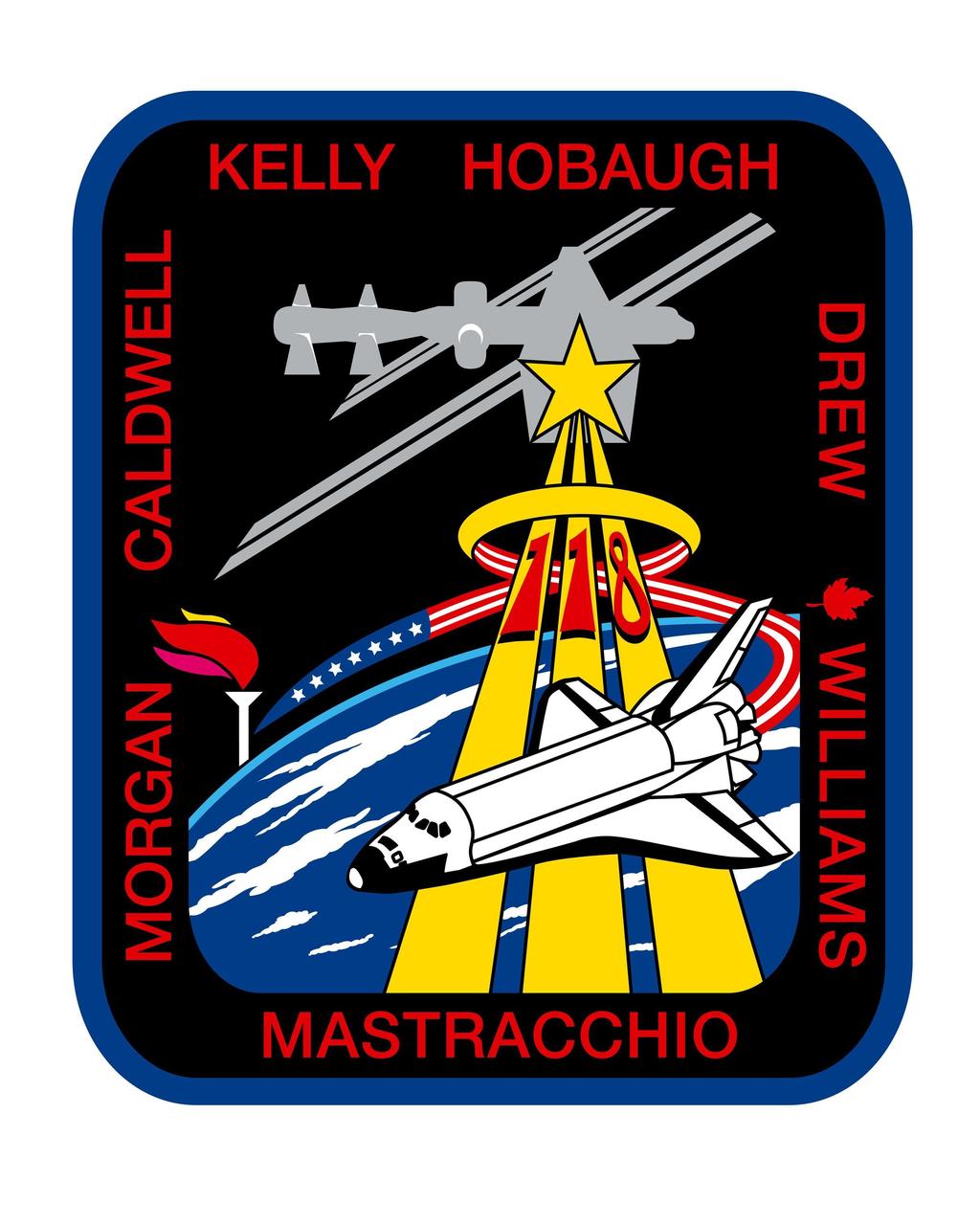
JOHNSON SPACE CENTER, Houston -- STS118-S-001 -- The STS-118 patch represents Space Shuttle Endeavour on its mission to help complete the assembly of the International Space Station and symbolizes the pursuit of knowledge through space exploration. The flight will accomplish its ISS 13A.1 assembly tasks through a series of spacewalks, robotic operations, logistics transfers and the exchange of one of the three long-duration expedition crew members. On the patch, the top of the gold astronaut symbol overlays the starboard S-5 truss segment, highlighting its installation during the mission. The flame of knowledge represents the importance of education, and honors teachers and students everywhere. The seven white stars and the red maple leaf signify the American and Canadian crew members flying aboard Endeavour.
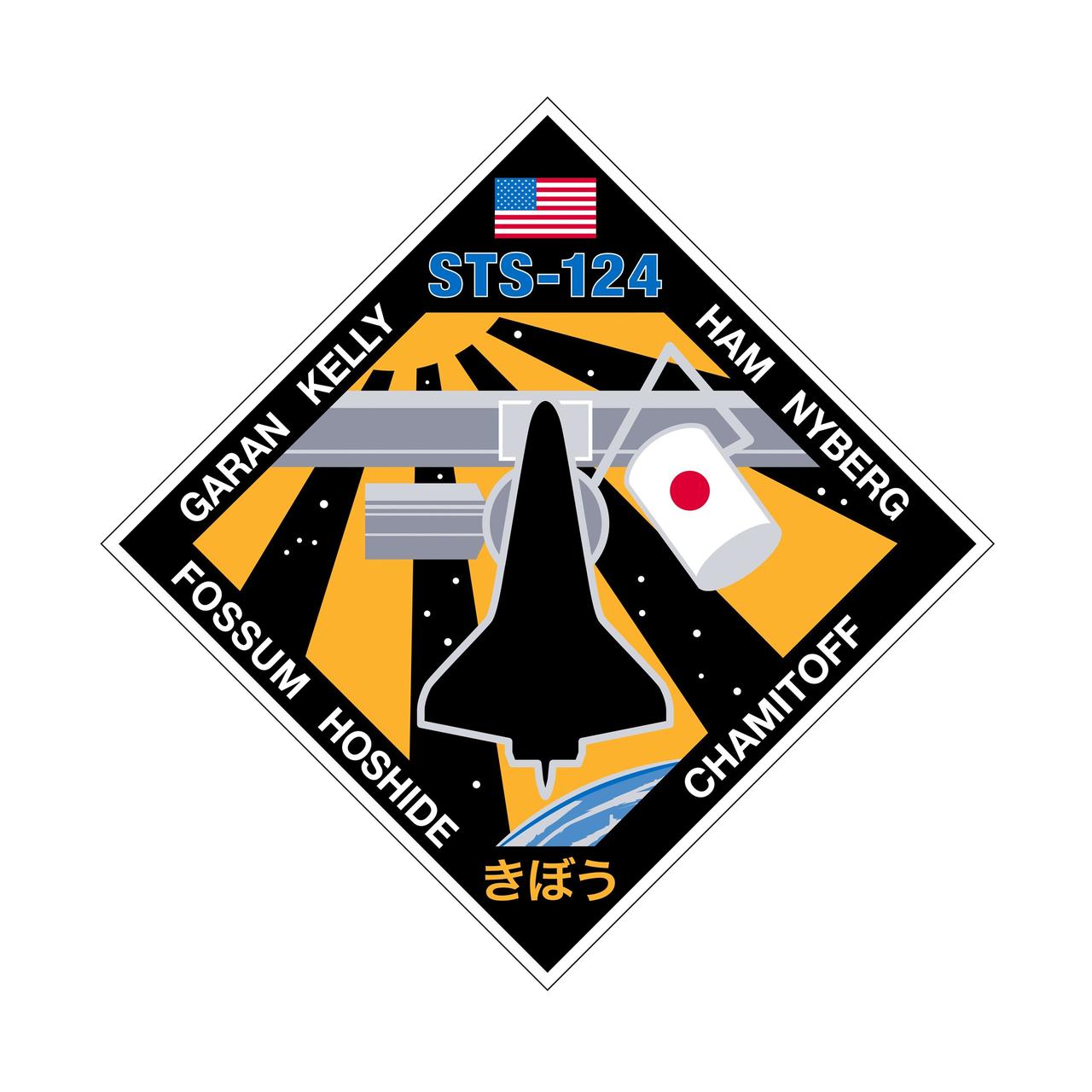
JOHNSON SPACE CENTER, Houston --- STS124-S-001 --- The STS-124/1J patch depicts the Space Shuttle Discovery docked with the International Space Station (ISS). STS-124/1J is dedicated to delivering and installing the Japanese Experiment Module (JEM) known as Kibo (Hope) to the ISS. The significance of the mission and the Japanese contribution to the ISS is recognized by the Japanese flag depicted on the JEM Pressurized Module (JPM) and the word Kibo written in Japanese at the bottom of the patch. The view of the sun shining down upon the Earth represents the increased "hope" that the entire world will benefit from the JEM's scientific discoveries. The JPM will be the largest habitable module on the ISS and is equipped with its own airlock and robotic arm for external experiments. In addition to delivering and installing the JPM, the STS-124 crew will relocate the JEM Logistics Pressurized (JLP) module to its permanent home on the zenith side of the JPM. During three planned space walks, the crew will perform external ISS maintenance and JPM outfitting, as well as extensive robotic operations by the ISS, space shuttle, and JEM robotic arms. It will be the first time that three different robotic arms will be operated during a single space flight mission. The NASA insignia design for shuttle flights is reserved for use by the astronauts and for other official use as the NASA Administrator may authorize. Public availability has been approved only in the form of illustrations by the various news media. When and if there is any change in this policy, which is not anticipated, it will be publicly announced.
![JOHNSON SPACE CENTER, HOUSTON -- STS123-S-001-- STS-123 continues assembly of the International Space Station (ISS). The primary mission objectives include rotating an expedition crew member and installing both the first component of the Japanese Experimental Module (the Experimental Logistics Module - Pressurized Section [ELM-PS]) and the Canadian Special Purpose Dexterous Manipulator (SPDM). In addition, STS-123 will deliver various spare ISS components and leave behind the sensor boom used for inspecting the shuttle's thermal protection system. A follow-on mission to ISS will utilize and then return home with this sensor boom. A total of four spacewalks are planned to accomplish these tasks. The mission will also require the use of both the shuttle and ISS robotic arms. STS-123 will utilize the Station-Shuttle Power Transfer System to extend the docked portion of the mission to 11 days, with a total planned duration of 15 days. The crew patch depicts the space shuttle in orbit with the crew names trailing behind. STS-123's major additions to ISS (the ELM-PS installation with the shuttle robotic arm and the fully constructed SPDM) are both illustrated. The ISS is shown in the configuration that the STS-123 crew will encounter when they arrive. The NASA insignia design for shuttle flights is reserved for use by the astronauts and for other official use as the NASA Administrator may authorize. Public availability has been approved only in the form of illustrations by the various news media. When and if there is any change in this policy, which is not anticipated, it will be publicly announced.](https://images-assets.nasa.gov/image/KSC-08pd0363/KSC-08pd0363~medium.jpg)
JOHNSON SPACE CENTER, HOUSTON -- STS123-S-001-- STS-123 continues assembly of the International Space Station (ISS). The primary mission objectives include rotating an expedition crew member and installing both the first component of the Japanese Experimental Module (the Experimental Logistics Module - Pressurized Section [ELM-PS]) and the Canadian Special Purpose Dexterous Manipulator (SPDM). In addition, STS-123 will deliver various spare ISS components and leave behind the sensor boom used for inspecting the shuttle's thermal protection system. A follow-on mission to ISS will utilize and then return home with this sensor boom. A total of four spacewalks are planned to accomplish these tasks. The mission will also require the use of both the shuttle and ISS robotic arms. STS-123 will utilize the Station-Shuttle Power Transfer System to extend the docked portion of the mission to 11 days, with a total planned duration of 15 days. The crew patch depicts the space shuttle in orbit with the crew names trailing behind. STS-123's major additions to ISS (the ELM-PS installation with the shuttle robotic arm and the fully constructed SPDM) are both illustrated. The ISS is shown in the configuration that the STS-123 crew will encounter when they arrive. The NASA insignia design for shuttle flights is reserved for use by the astronauts and for other official use as the NASA Administrator may authorize. Public availability has been approved only in the form of illustrations by the various news media. When and if there is any change in this policy, which is not anticipated, it will be publicly announced.
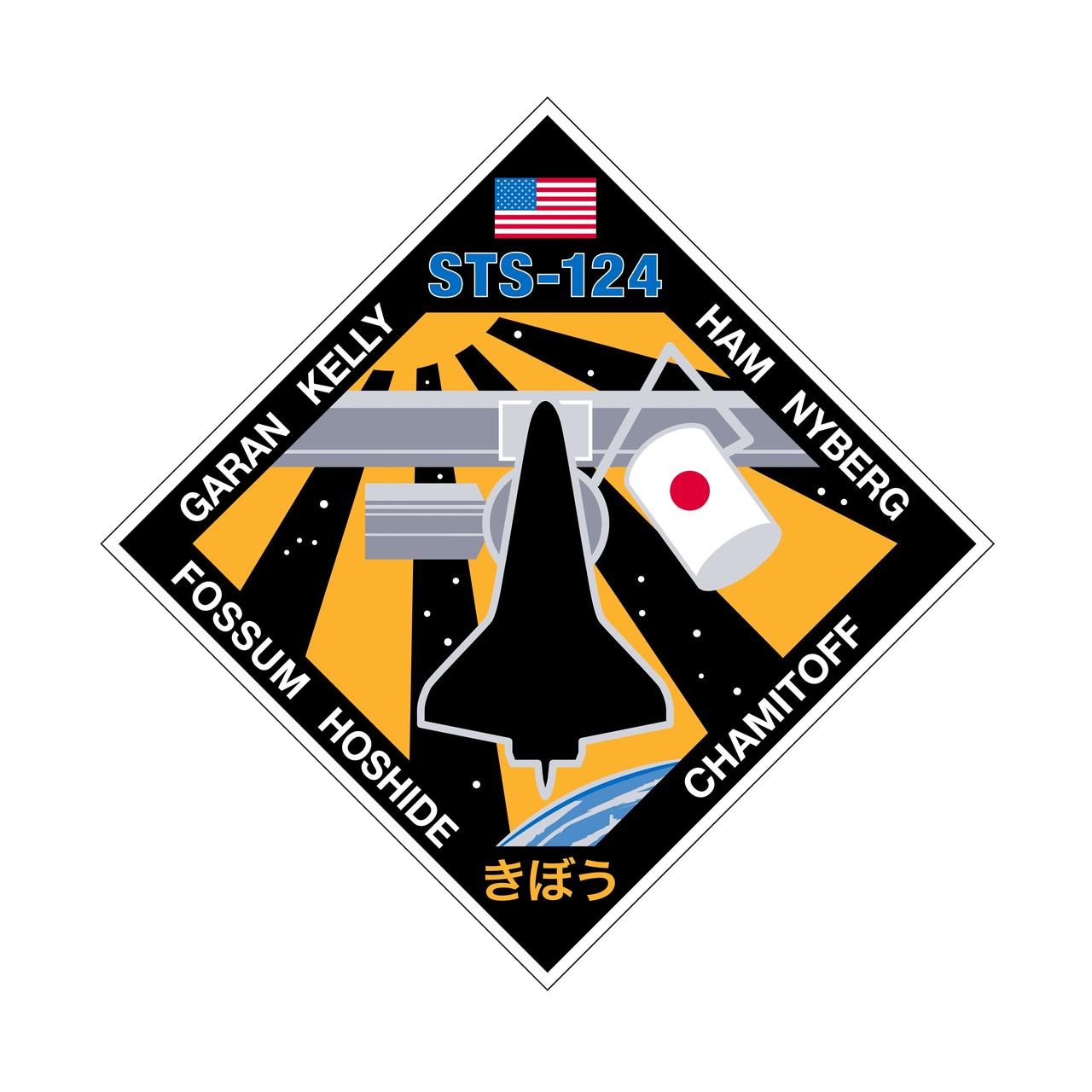
STS124-S-001 (October 2007) --- The STS-124/1J patch depicts the space shuttle Discovery docked with the International Space Station (ISS). STS-124/1J is dedicated to delivering and installing the Japanese Experiment Module (JEM) known as Kibo (Hope) to the ISS. The significance of the mission and the Japanese contribution to the ISS is recognized by the Japanese flag depicted on the JEM Pressurized Module (JPM) and the word Kibo written in Japanese at the bottom of the patch. The view of the sun shining down upon Earth represents the increased "hope" that the entire world will benefit from the JEM's scientific discoveries. The JPM will be the largest habitable module on the ISS and is equipped with its own airlock and robotic arm for external experiments. In addition to delivering and installing the JPM, the STS-124 crew will relocate the JEM Logistics Pressurized (JLP) module to its permanent home on the zenith side of the JPM. During three planned spacewalks, the crew will perform external ISS maintenance and JPM outfitting, as well as extensive robotic operations by the ISS, space shuttle, and JEM robotic arms. It will be the first time that three different robotic arms will be operated during a single spaceflight mission. The NASA insignia design for space shuttle flights is reserved for use by the astronauts and for other official use as the NASA Administrator may authorize. Public availability has been approved only in the forms of illustrations by the various news media. When and if there is any change in this policy, which is not anticipated, the change will be publicly announced. Photo credit: NASA
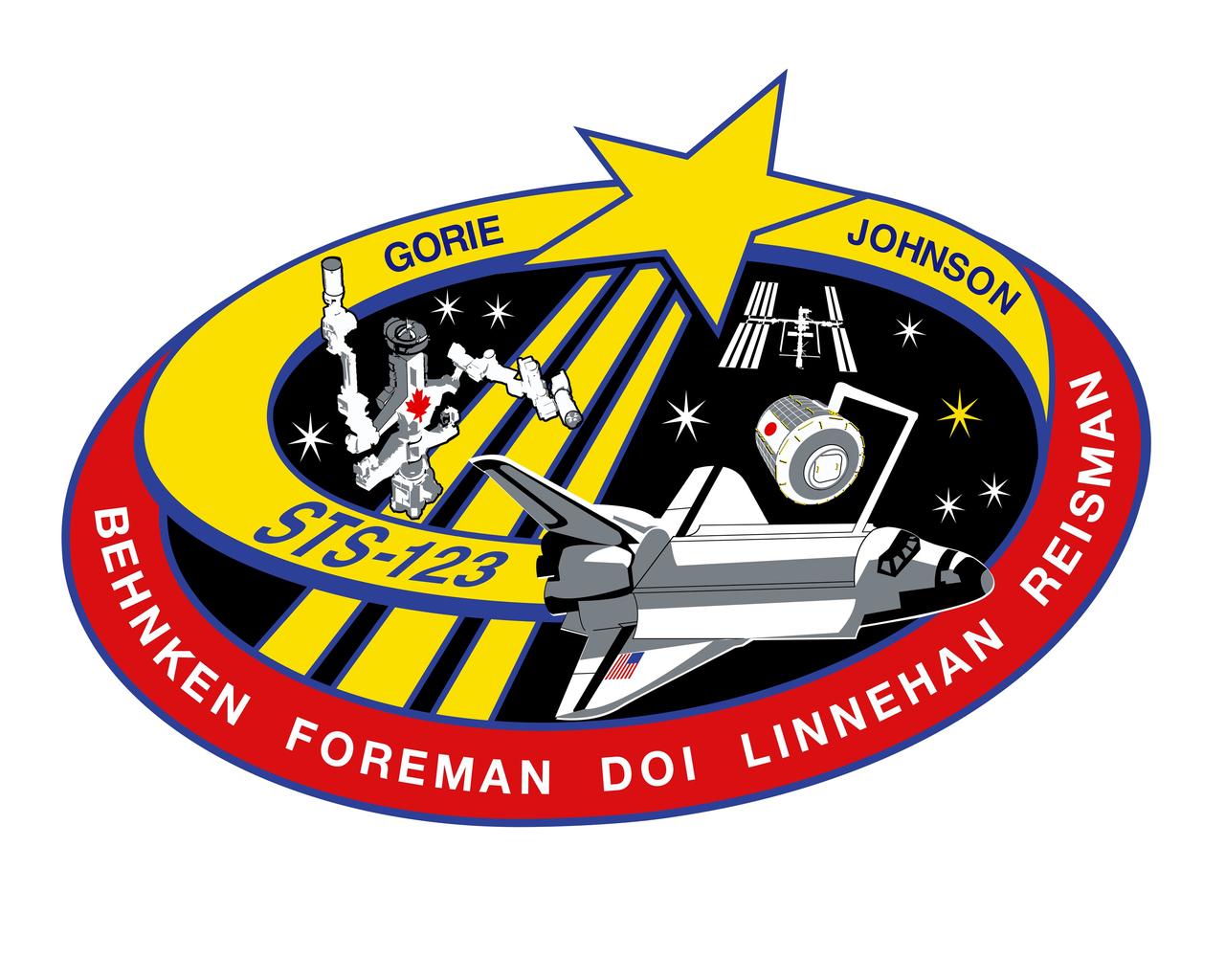
STS123-S-001 (Oct. 2007) --- STS-123 continues assembly of the International Space Station (ISS). The primary mission objectives include rotating an expedition crew member and installing both the first component of the Japanese Experimental Module (the Experimental Logistics Module - Pressurized Section (ELM-PS)) and the Canadian Special Purpose Dexterous Manipulator (SPDM). In addition, STS-123 will deliver various spare ISS components and leave behind the sensor boom used for inspecting the shuttle's thermal protection system. A follow-on mission to ISS will utilize and then return home with this sensor boom. A total of four spacewalks are planned to accomplish these tasks. The mission will also require the use of both the shuttle and ISS robotic arms. STS-123 will utilize the Station-Shuttle Power Transfer System to extend the docked portion of the mission to eleven days, with a total planned duration of 15 days. The crew patch depicts the space shuttle in orbit with the crew names trailing behind. STS-123's major additions to ISS (the ELM-PS installation with the shuttle robotic arm and the fully constructed SPDM) are both illustrated. The ISS is shown in the configuration that the STS-123 crew will encounter when they arrive. The NASA insignia design for space shuttle flights is reserved for use by the astronauts and for other official use as the NASA Administrator may authorize. Public availability has been approved only in the forms of illustrations by the various news media. When and if there is any change in this policy, which is not anticipated, the change will be publicly announced. Photo credit: NASA
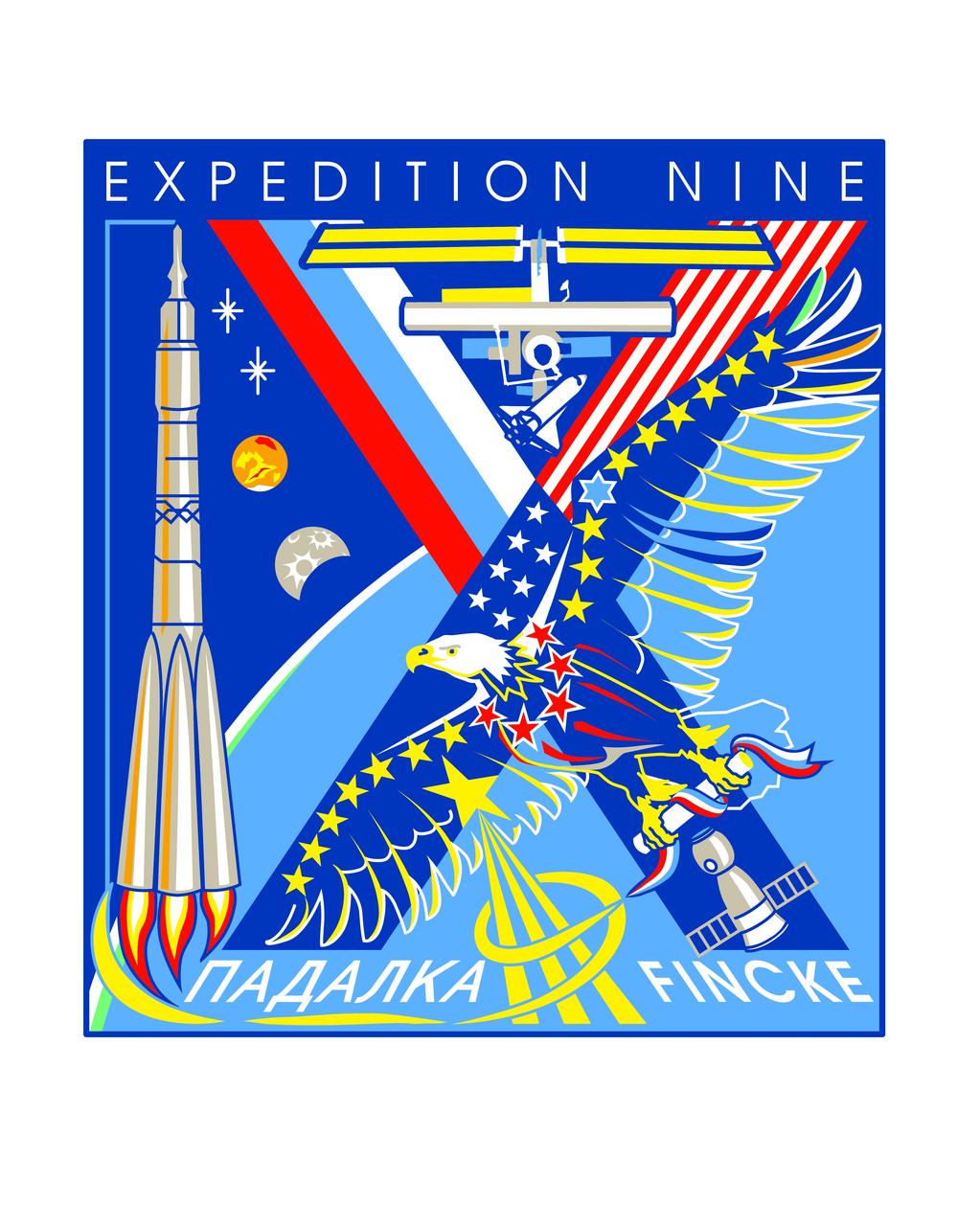
ISS009-S-001 (6 April 2004) --- This emblem represents the Ninth Expedition to the International Space Station (ISS). The Soyuz rocket and letter "X" combine into the Roman numeral IX. The "X" evokes Exploration, which is at the core of the indivisible partnership of the two space pioneering nations. Research aboard ISS will lead to human exploration of the Moon and Mars. This pursuit is strengthened by the common memory of the astronauts and cosmonauts who gave their lives in this valiant endeavor. Their stars form the leading edge of the wings of the eagle spirit that embodies Human Space Flight. The Astronaut symbol is flanked by the Expedition Nine crew names leaning together, with a "9" stylized as the plume of their rocket. The baton of great discovery is passed to the crew of the spaceship advancing to their orbital outpost. The NASA insignia design for shuttle flights and station increments is reserved for use by the astronauts and for other official use as the NASA Administrator may authorize. Public availability has been approved only in the forms of illustrations by the various news media. When and if there is any change in this policy, which is not anticipated, the change will be publicly announced.
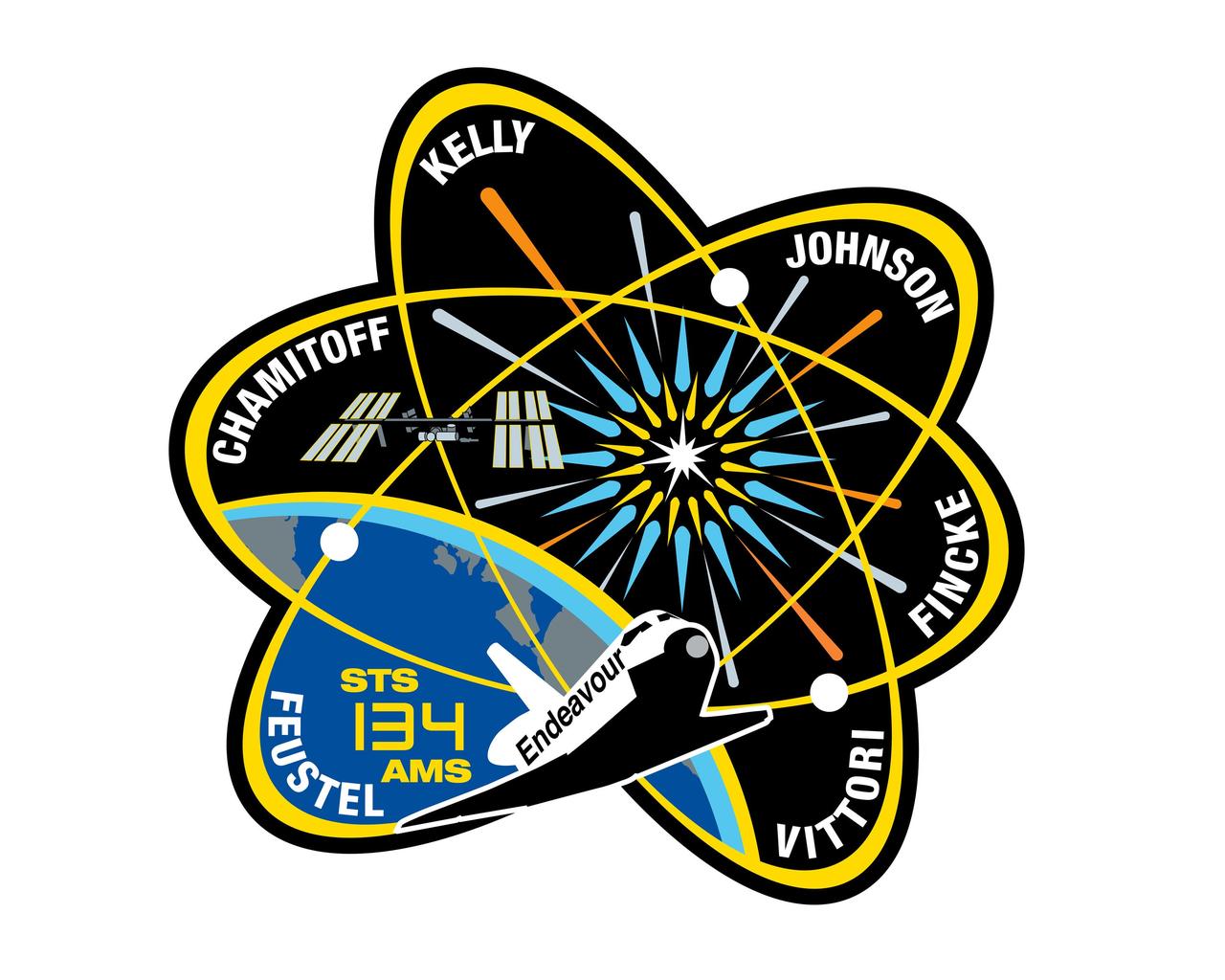
STS134-S-001 (March 2010) --- The design of the STS-134 crew patch highlights research on the International Space Station (ISS) focusing on the fundamental physics of the universe. On this mission, the crew of space shuttle Endeavour will install the Alpha Magnetic Spectrometer-2 (AMS) experiment -- a cosmic particle detector that utilizes the first-ever superconducting magnet to be flown in space. By studying sub-atomic particles in the background cosmic radiation, and searching for anti-matter and dark-matter, it will help scientists better understand the evolution and properties of our universe. The shape of the patch is inspired by the international atomic symbol, and represents the atom with orbiting electrons around the nucleus. The burst near the center refers to the big-bang theory and the origin of the universe. The shuttle Endeavour and ISS fly together into the sunrise over the limb of Earth, representing the dawn of a new age, understanding the nature of the universe. The NASA insignia design for shuttle flights is reserved for use by the astronauts and for other official use as the NASA administrator may authorize. Public availability has been approved only in the form of illustrations by the various news media. When and if there is any change in this policy, which we do not anticipate, it will be publicly announced.

STS134-S-001 (March 2010) --- The design of the STS-134 crew patch highlights research on the International Space Station (ISS) focusing on the fundamental physics of the universe. On this mission, the crew of the space shuttle Endeavour will install the Alpha Magnetic Spectrometer (AMS) experiment - a cosmic particle detector. By studying subatomic particles in the background cosmic radiation and searching for antimatter, dark-matter, and dark energy, it will help scientists better understand the evolution and properties of our universe. The shape of the patch is inspired by the international atomic symbol, and represents the atom with orbiting electrons around the nucleus. The burst near the center refers to the origin of the universe. The space shuttle Endeavour and ISS fly together into the sunrise over the limb of the Earth, representing the dawn of a new age?understanding the nature of the universe. The NASA insignia design for space shuttle flights is reserved for use by the astronauts and for other official use as the NASA Administrator may authorize. Public availability has been approved only in the forms of illustrations by the various news media. When and if there is any change in this policy, which is not anticipated, the change will be publicly announced. Photo credit: NASA
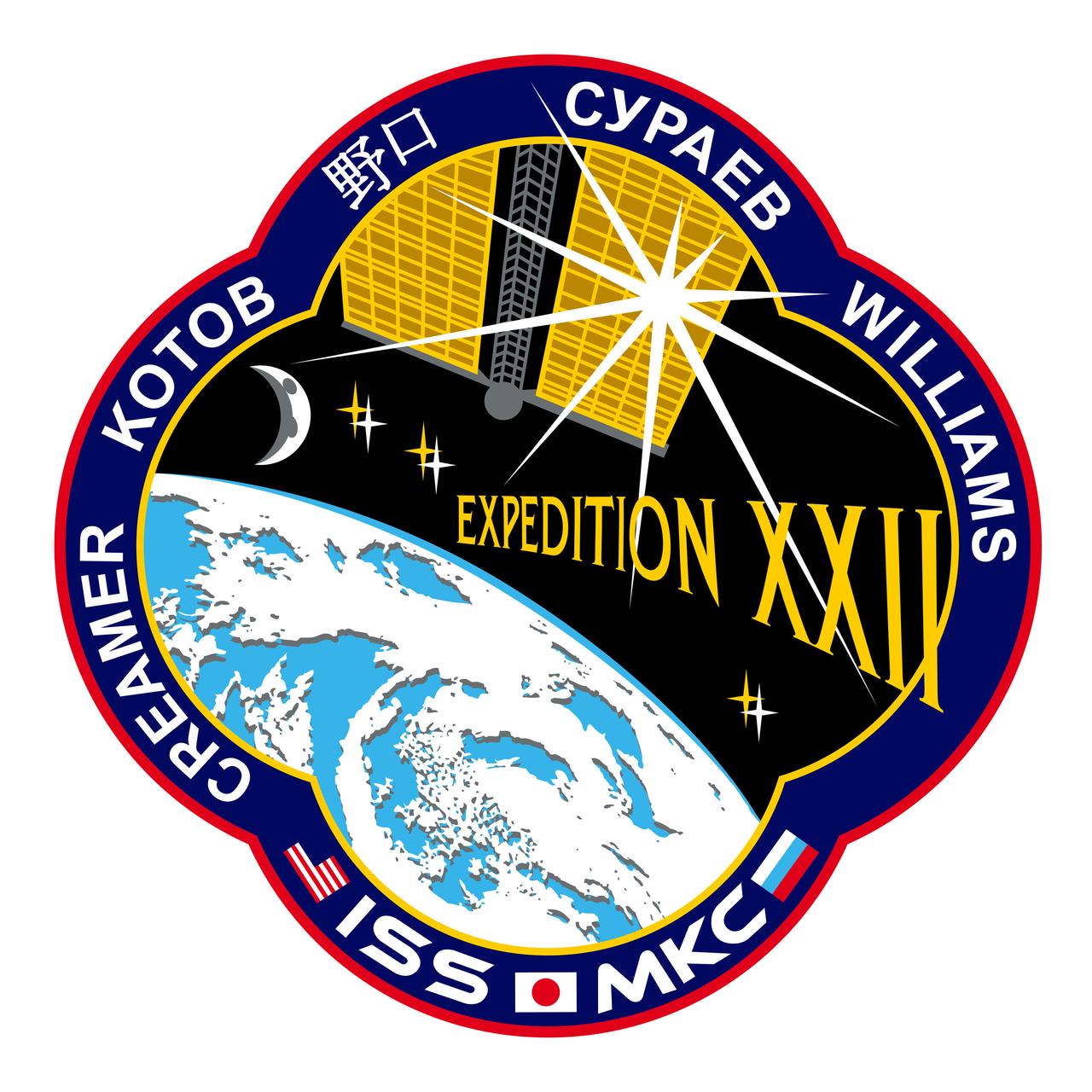
ISS022-S-001 (February 2009) --- The 22nd Expedition to the International Space Station is dedicated to the final stages of assembly and the transition to full utilization as an orbiting laboratory. The sun, providing power and life support to the space station, shines through one of the solar arrays as the ISS orbits above Earth. The oceans and atmosphere, providing life support to Earth, are shown in all their beauty. The moon hovers in the distance as the goal of the next era of exploration. The six stars illustrate the increased capability of the crew complement. In the border are the national flags of the crew members as well as their surnames in their native languages. Expedition XXII continues the effort to acquire the knowledge necessary to extend the reach of exploration from Earth, to the moon and beyond. The insignia design for ISS flights is reserved for use by the astronauts and cosmonauts and for other official use as the NASA Administrator and NASA's international partners may authorize. Public availability has been approved only in the form of illustrations by the various news media. When and if there is any change in this policy, which we do not anticipate, it will be publicly announced
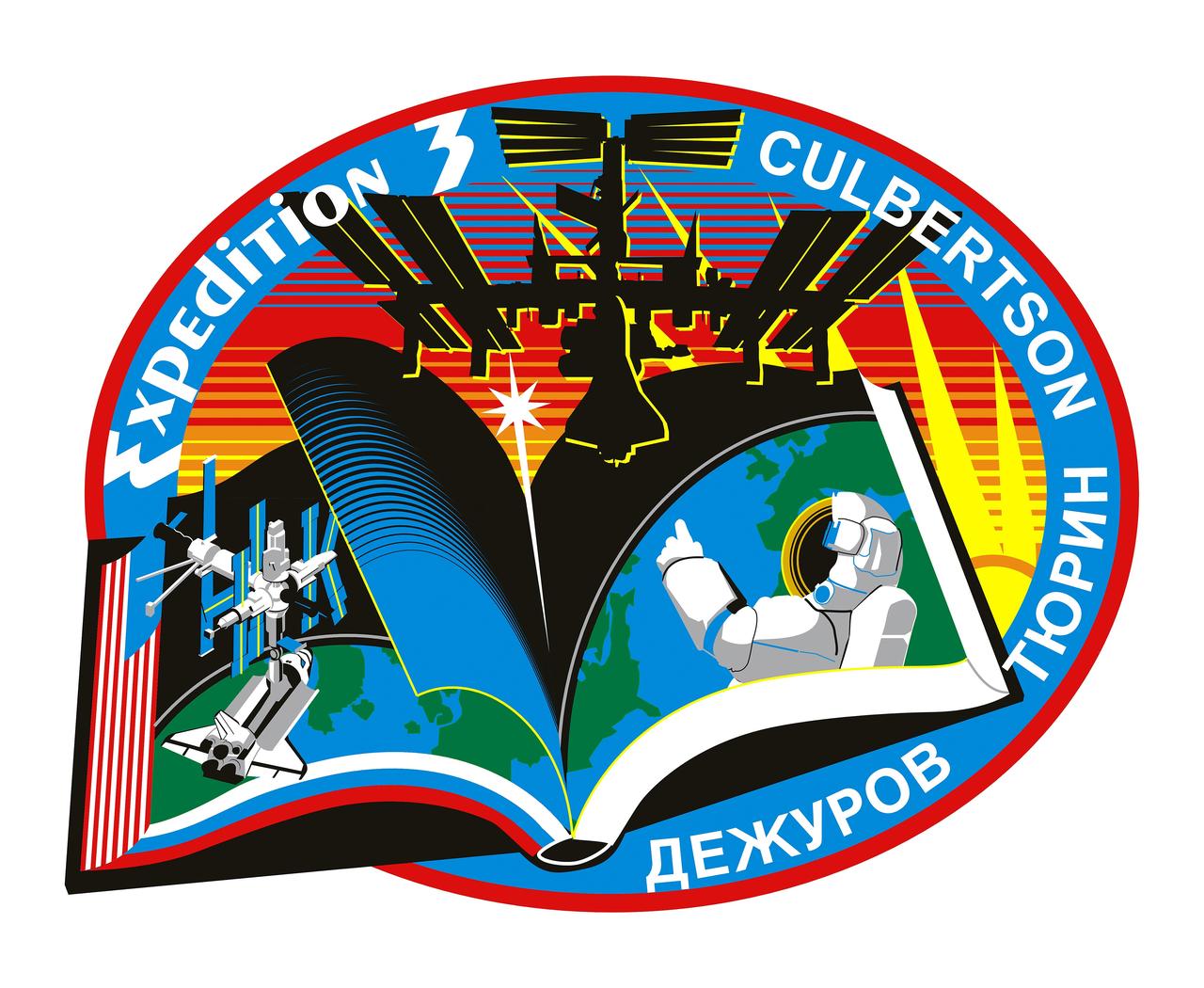
ISS003-S-001 (June 2001) --- The Expedition Three crew members--astronaut Frank L. Culbertson, Jr., commander, and cosmonauts Vladimir N. Dezhurov and Mikhail Tyurin, flight engineers--had the following to say about the insignia for their scheduled mission aboard the International Space Station (ISS): “The book of space history turns from the chapter written onboard the Russian Mir Station and the U.S. Space Shuttle to the next new chapter, one that will be written on the blank pages of the future by space explorers working for the benefit of the entire world. The space walker signifies the human element of this endeavor. The star representing the members of the third expedition, and the entire multi-national space station building team, streaks into the dawning era of cooperative space exploration, represented by the image of the International Space Station as it nears completion.” The insignia design for ISS flights is reserved for use by the astronauts and cosmonauts and for other official use as the NASA Administrator and NASA's international partners may authorize. Public availability has been approved only in the form of illustrations by the various news media. When and if there is any change in this policy, which we do not anticipate, it will be publicly announced.
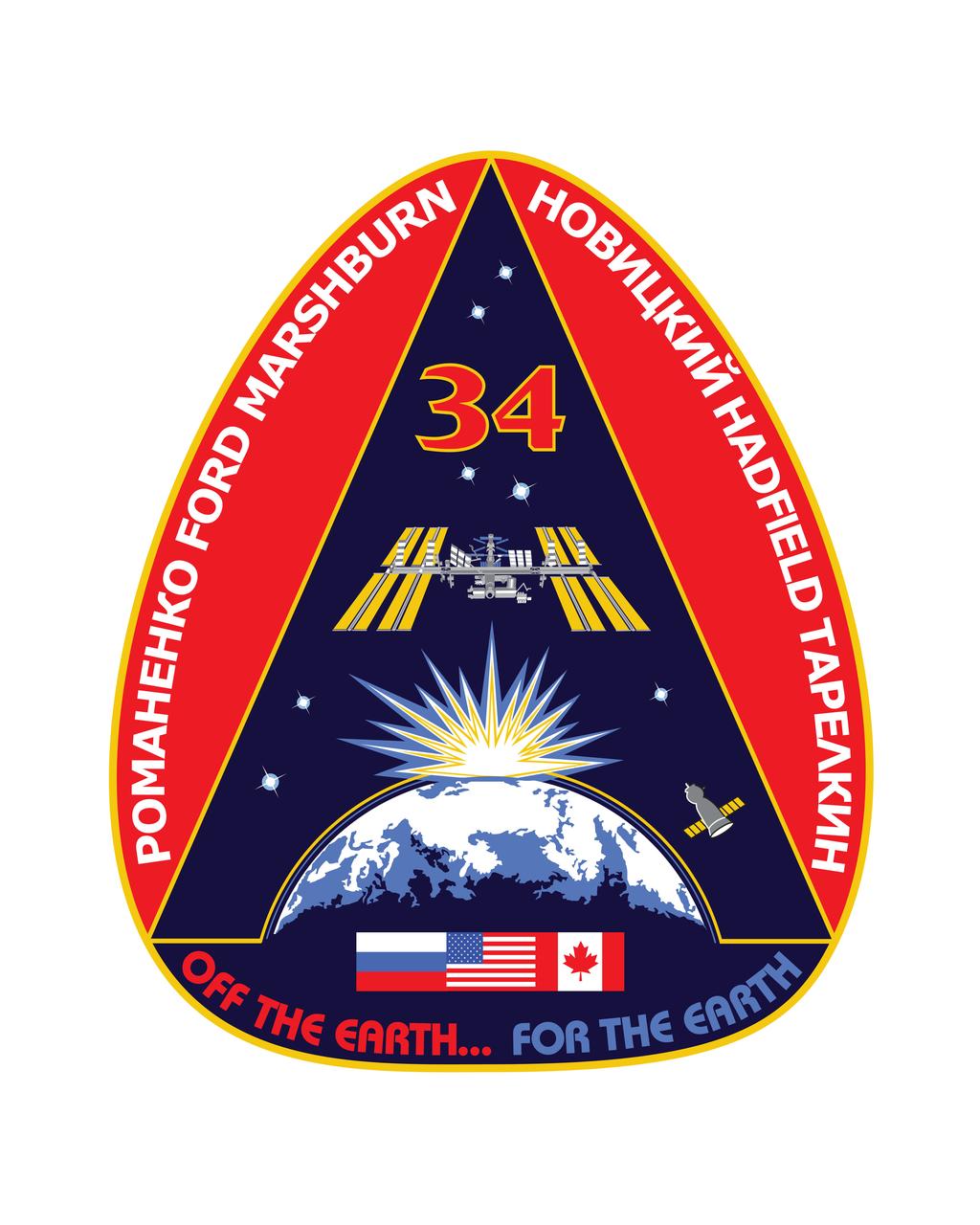
ISS034-S-001 (December 2011) --- The crew members of the Expedition 34 mission put together the following description of their patch: ?The outer border of the Expedition 34 patch takes the mold line of a crew transfer or generic resupply vehicle which will form our bridge to the orbiting outpost throughout the second half of its operational lifetime. Inscribed inside in gold is a craft symbolizing future extra-terrestrial landers that will someday open other celestial destinations to human exploration. Our Sun, which enables the miracle of the only known life in our universe, radiates above the rich and colorful orb of Earth. Its 15 rays represent the countries of the International Space Station (ISS) Partnership whose foresight and sacrifice have enabled the first small steps into our universe. The ISS in flight represents the dedication, ingenuity, and cooperation amongst the thousands and thousands of workers around the globe who have successfully designed and built a wonder of our modern world. The distant stars, like those visible in our night sky, beckon us to come further into the depths of space.
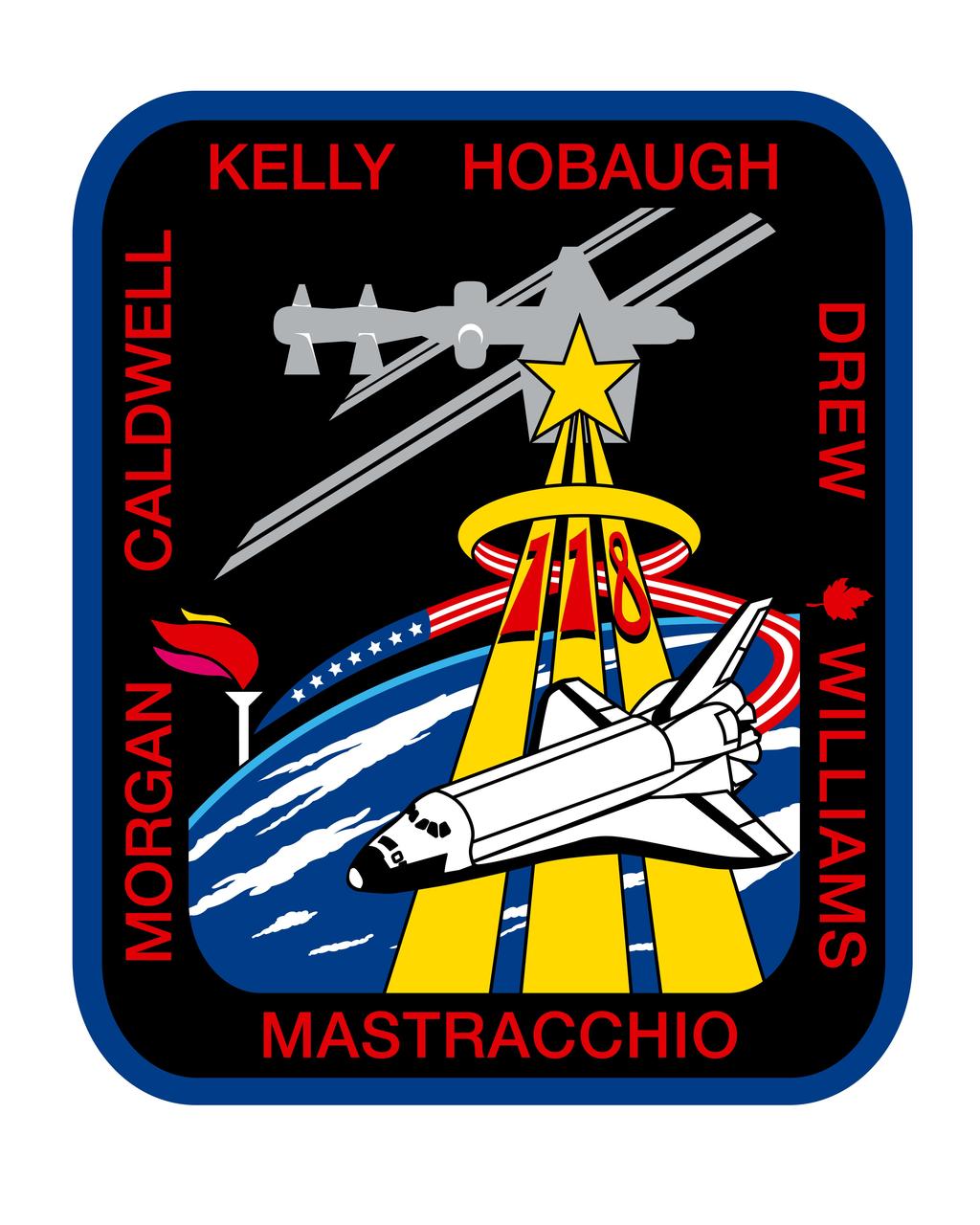
STS118-S-001 (May 2007) --- The STS-118 patch represents space shuttle Endeavour on its mission to help complete the assembly of the International Space Station (ISS), and symbolizes the pursuit of knowledge through space exploration. The flight will accomplish its ISS 13A.1 assembly tasks through a series of spacewalks, robotic operations, logistics transfers, and the exchange of one of the three long-duration expedition crew members. On the patch, the top of the gold astronaut symbol overlays the starboard S-5 truss segment, highlighting its installation during the mission. The flame of knowledge represents the importance of education, and honors teachers and students everywhere. The seven white stars and the red maple leaf signify the American and Canadian crew members, respectively, flying aboard Endeavour. The NASA insignia design for space shuttle flights is reserved for use by the astronauts and for other official use as the NASA Administrator may authorize. Public availability has been approved only in the forms of illustrations by the various news media. When and if there is any change in this policy, which is not anticipated, the change will be publicly announced. Photo credit: NASA
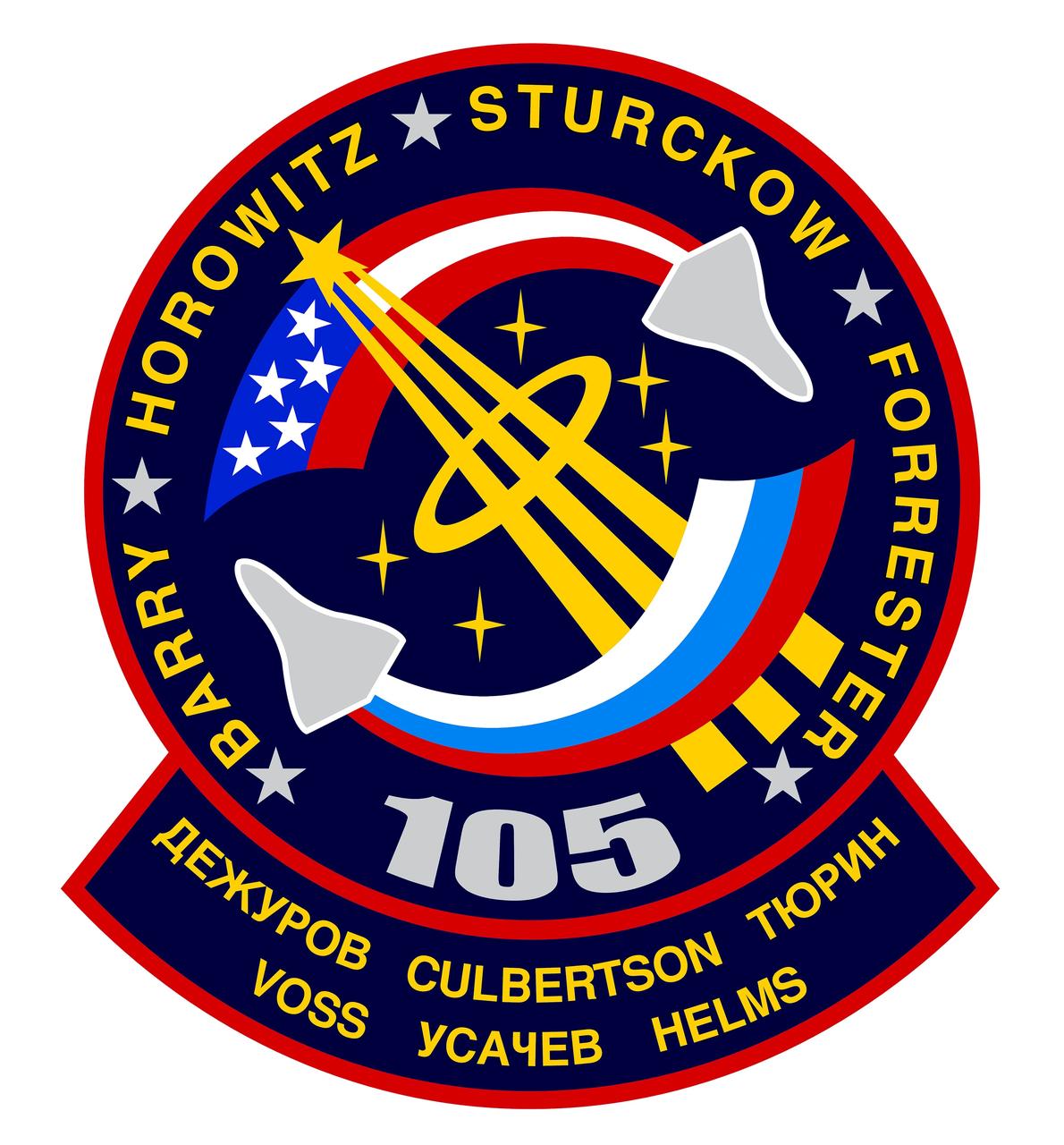
STS105-S-001 (April 2001) --- The STS-105 crew patch symbolizes the exchange of the Expedition Two and Expedition Three crews aboard the International Space Station. The three gold stars near the ascending orbiter represent the U.S. commanded Expedition Three crew as they journey into space, while the two gold stars near the descending orbiter represent the Russian commanded Expedition Two crew and their return to Earth. The plumes of each orbiter represent the flags of the United States and Russia and symbolize the close cooperation between the two countries. The Astronaut Office symbol, a star with three rays of light, depicts the unbroken link between Earth and the newest and brightest star on the horizon, the International Space Station (ISS). The ascending and descending orbiters form a circle that represents both the crew rotation and the continuous presence in space aboard the ISS. The names of the four astronauts who will crew Discovery are shown along the border of the patch. The names of the Expedition Three and Expedition Two crews are shown on the chevron at the bottom of the patch. The NASA insignia design for space shuttle flights is reserved for use by the astronauts and for other official use as the NASA Administrator may authorize. Public availability has been approved only in the forms of illustrations by the various news media. When and if there is any change in this policy, which is not anticipated, the change will be publicly announced. Photo credit: NASA
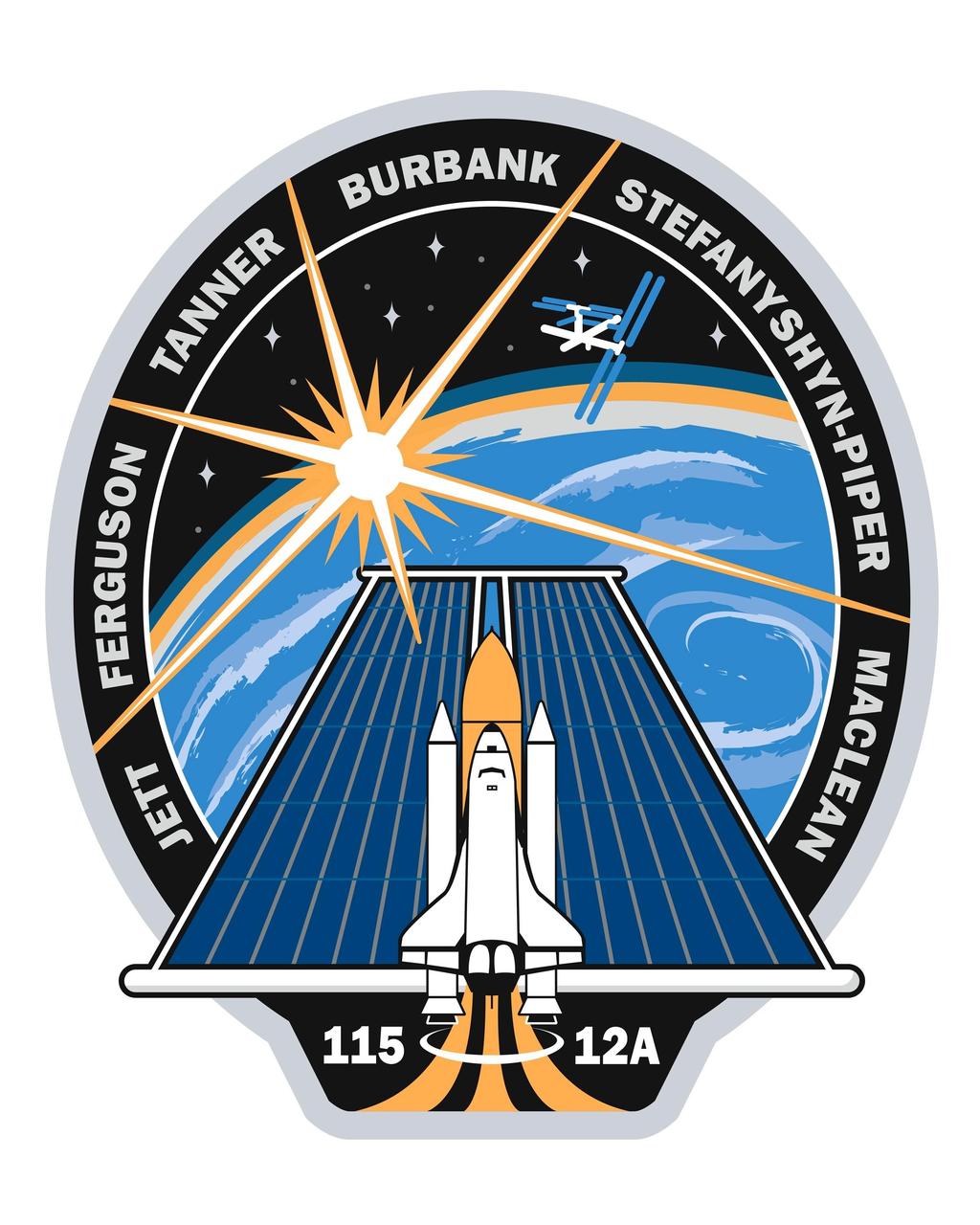
JOHNSON SPACE CENTER, TX - STS115-S-001 (February 2003) -- This is the STS-115 insignia. This mission continues the assembly of the International Space Station with the installation of the truss segments P3 and P4. Following the installation of the segments utilizing both the shuttle and the station robotic arms, a series of four space walks will complete the final connections and prepare for the deployment of the station's second set of solar arrays. To reflect the primary mission of the flight, the patch depicts a solar panel as the main element. As the Space Shuttle Atlantis launches towards the ISS, its trail depicts the symbol of the Astronaut Office. The starburst, representing the power of the sun, rises over the Earth and shines on the solar panel. The shuttle flight number 115 is shown at the bottom of the patch, along with the ISS assembly designation 12A (the 12th American assembly mission). The blue Earth in the background reminds us of the importance of space exploration and research to all of Earth's inhabitants. The NASA insignia design for shuttle flights is reserved for use by the astronauts and for other official use as the NASA Administrator may authorize. Public availability has been approved only in the forms of illustrations by the various news media. When and if there is any change in this policy, which is not anticipated, the change will be publicly announced.
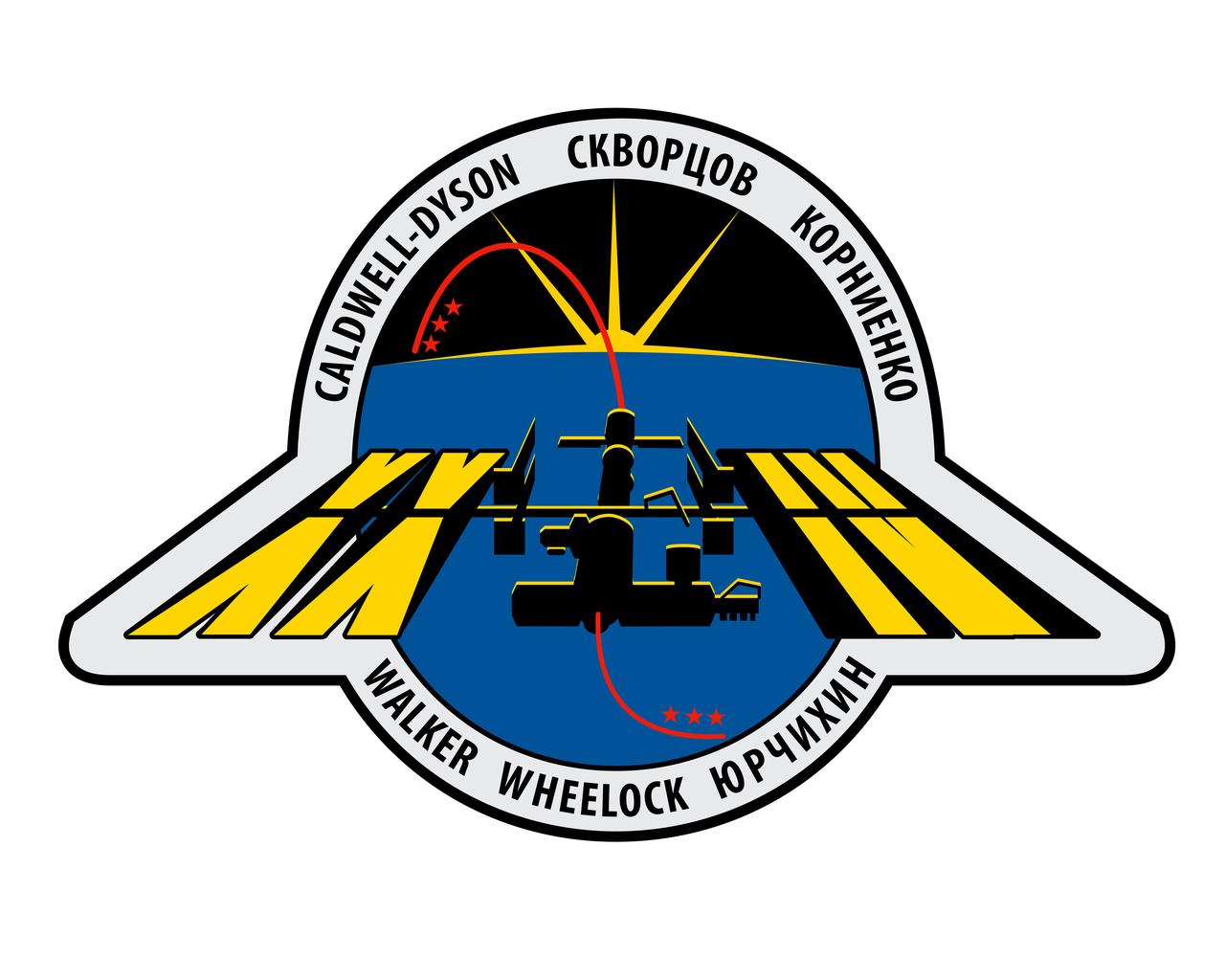
ISS024-S-001 (January 2010) --- Science and Exploration are the cornerstones of NASA?s mission onboard the International Space Station (ISS). This emblem signifies the dawn of a new era in our program?s history. With each new expedition, as we approach assembly complete, our focus shifts toward the research nature of this world-class facility. Prominently placed in the foreground, the ISS silhouette leads the horizon. Each ray of the sun represents the five international partner organizations that encompass this cooperative program. Expedition 24 is one of the first missions expanding to a crew of six. These crews, symbolized here as stars arranged in two groups of three, will launch on Soyuz vehicles. The unbroken flight track symbolizes our continuous human presence in space, representing all who have and will dedicate themselves as crew and citizens of the International Space Station. The NASA insignia design for shuttle flights and station increments is reserved for use by the astronauts and for other official use as the NASA Administrator may authorize. Public availability has been approved only in the forms of illustrations by the various news media. When and if there is any change in this policy, which is not anticipated, the change will be publicly announced.
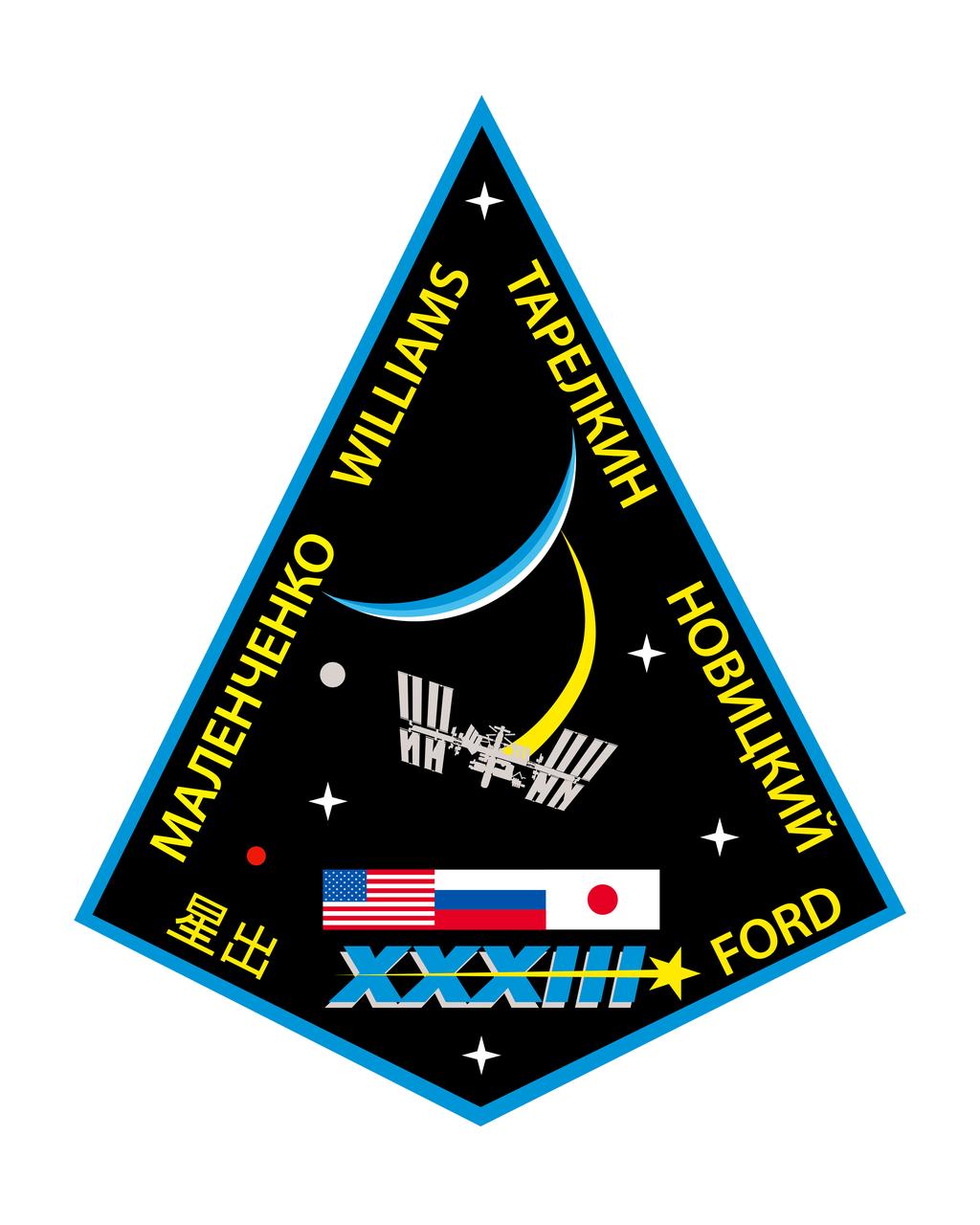
ISS033-S-001 (Dec. 2011) ---The Expedition 33 patch depicts the International Space Station (ISS) orbiting around the Earth, and into the future. The national flags of Japan, Russia, and the United States of America represent the crew of Expedition 33, which consists of six astronauts and cosmonauts from Japan, Russia and the United States. The five white stars represent the partners participating in the ISS Program - Canada, European countries, Japan, Russia and the United States. Expedition 33 will continue the work of the previous thirty-two expedition crews on board the multi-national laboratory in areas such as biology and biotechnology, earth and space science, educational activities, human research, physical and material sciences, and technology development and demonstration. The NASA insignia design for shuttle and space station flights is reserved for use by the astronauts and for other official use as the NASA Administrator may authorize. Public availability has been approved only in the form of illustrations by the various news media. When and if there is any change in this policy, which is not anticipated, it will be publicly announced. Photo credit: NASA
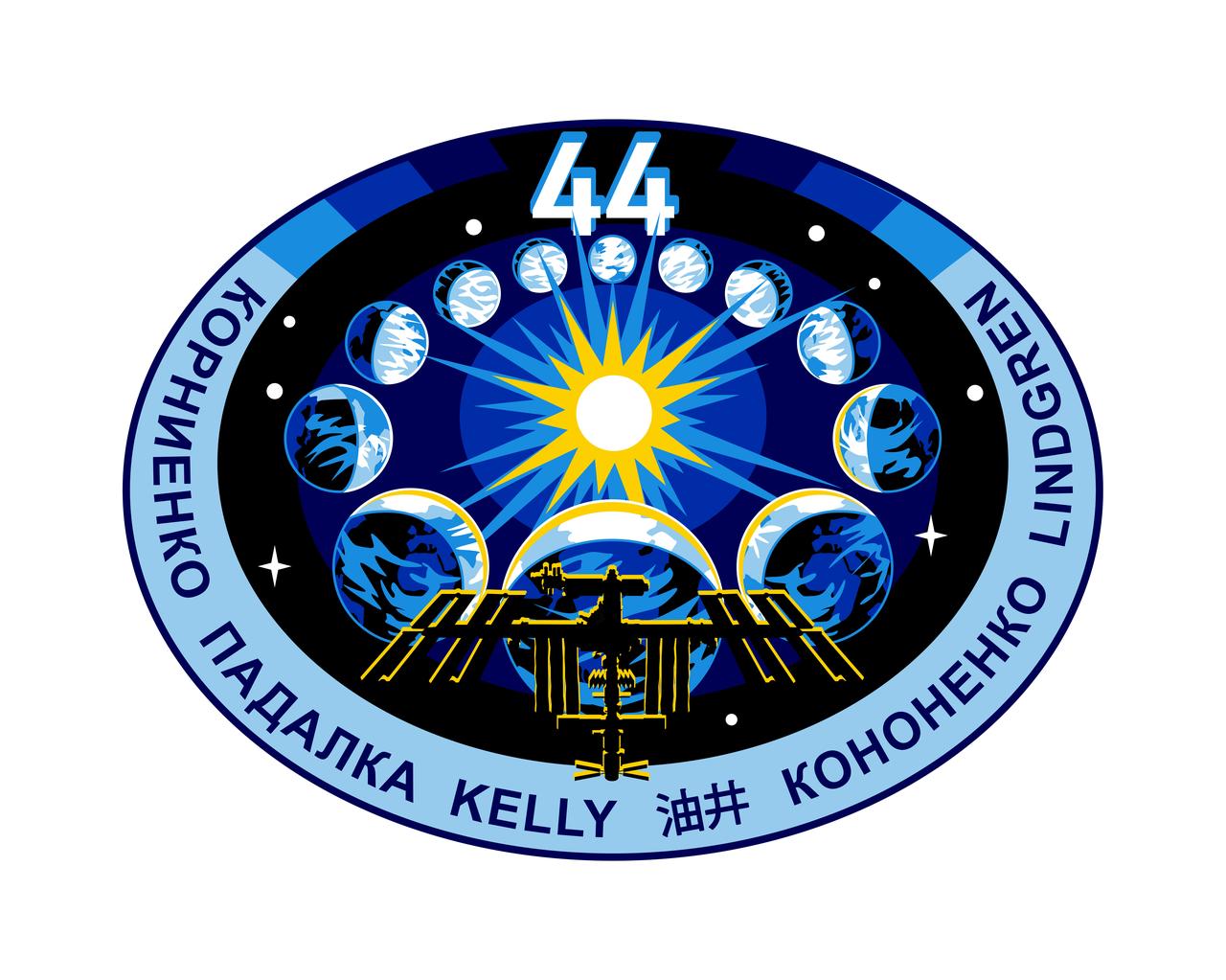
ISS044-S-001 (February 2014) --- This is the insignia for the Expedition 44 mission. The International Space Station is positioned in the foreground poised to study Earth, the sun and cosmos that lie beyond. Two members of the Expedition 44 crew will spend a full year on the ISS - providing valuable experience for future long duration missions into deep space. The 12 Earths represent the planet's position around the sun over the course of that year. Four of the Earths are silhouetted in sunlight representing the four month duration of Expedition 44. The nine stars in the background represent the nine individuals that will visit and work on the ISS during the course of the expedition, including the six-member crew, whose names are inscribed around the patch's border, and the three-person Soyuz "taxi" crew. The use of ellipses and circles throughout the patch reflect a theme of "completion" or "return," as investments made in this orbiting laboratory return benefit to the Earth and its inhabitants. The NASA insignia design for shuttle flights and station increments is reserved for use by the astronauts and for other official use as the NASA Administrator may authorize. Public availability has been approved only in the forms of illustrations by the various news media. When and if there is any change in this policy, which is not anticipated, the change will be publicly announced. Photo credit: NASA
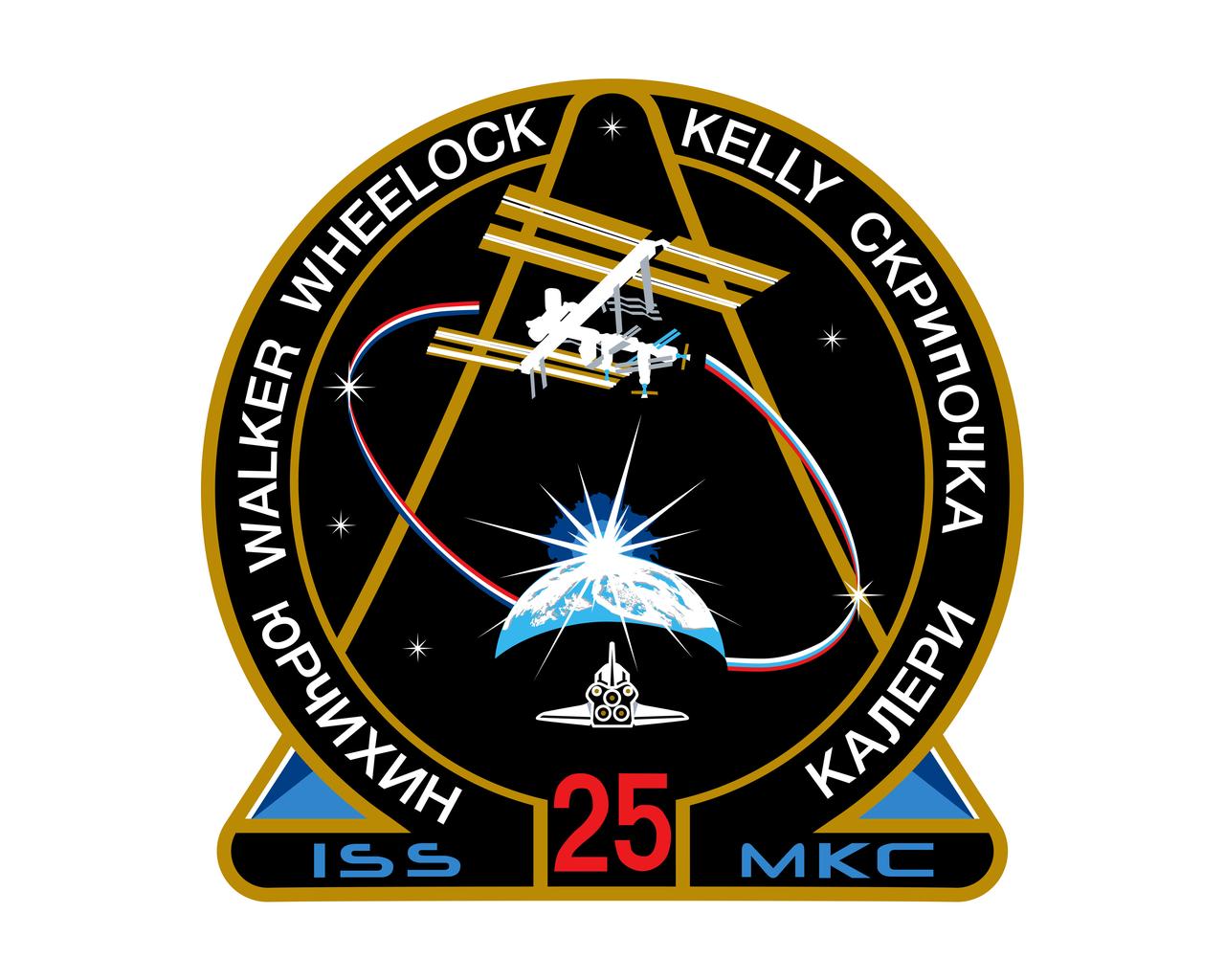
ISS025-S-001 (June 2010) --- The mission patch design for the 25th Expedition to the International Space Station (ISS) pays tribute to the rich history of innovation and bold engineering in the quest for knowledge, exploration and discovery in space. The patch highlights the symbolic passing of the torch to the ISS, as the vehicle that will carry us into the future of space exploration. The Space Shuttle Program emblem is the foundation of the patch and forms the Greek letter Omega?, paying tribute to the culmination of the Space Shuttle Program. The mission designation 25? and the Earth crescent, the orbiter is shown returning to Earth on its final journey, during the Expedition 25 mission. Above Earth and the breaking dawn, the ISS takes center-stage, completed and fully equipped to carry us beyond this new dawn to new voyages and discoveries. The orbit connecting the ISS and the Earth is drawn in the colors of the United States and Russian flags; paying tribute to the blended heritage of the crew. The two largest stars in the field represent the arrival and departure of the crews in separate Russian Soyuz vehicles. The six stars in the field represent the six crew members. The International Space Station abbreviation MKC? ? in English and Russian, respectively- flank the mission number designation, and the names of the crew members in their native languages border the ISS symbol. The NASA insignia design for shuttle and space station flights is reserved for use by the astronauts and for other official use as the NASA Administrator may authorize. Public availability has been approved only in the form of illustrations by the various news media. When and if there is any change in this policy, which is not anticipated, it will be publicly announced.

STS116-S-001 (July 2006) --- The STS-116 patch design signifies the continuing assembly of the International Space Station (ISS). The primary mission objective is to deliver and install the P5 truss element. The P5 installation will be conducted during the first of three planned spacewalks, and will involve use of both the shuttle and station robotic arms. The remainder of the mission will include a major reconfiguration and activation of the ISS electrical and thermal control systems, as well as delivery of Zvezda Service Module debris panels, which will increase ISS protection from potential impacts of micro-meteorites and orbital debris. In addition, a single expedition crewmember will launch on STS-116 to remain onboard the station, replacing an expedition crew member that will fly home with the shuttle crew. The crew patch depicts the space shuttle rising above the Earth and ISS. The United States and Swedish flags trail the orbiter, depicting the international composition of the STS-116 crew. The seven stars of the constellation Ursa Major are used to provide direction to the North Star, which is superimposed over the installation location of the P5 truss on ISS. The NASA insignia design for space shuttle flights is reserved for use by the astronauts and for other official use as the NASA Administrator may authorize. Public availability has been approved only in the forms of illustrations by the various news media. When and if there is any change in this policy, which is not anticipated, the change will be publicly announced. Photo credit: NASA
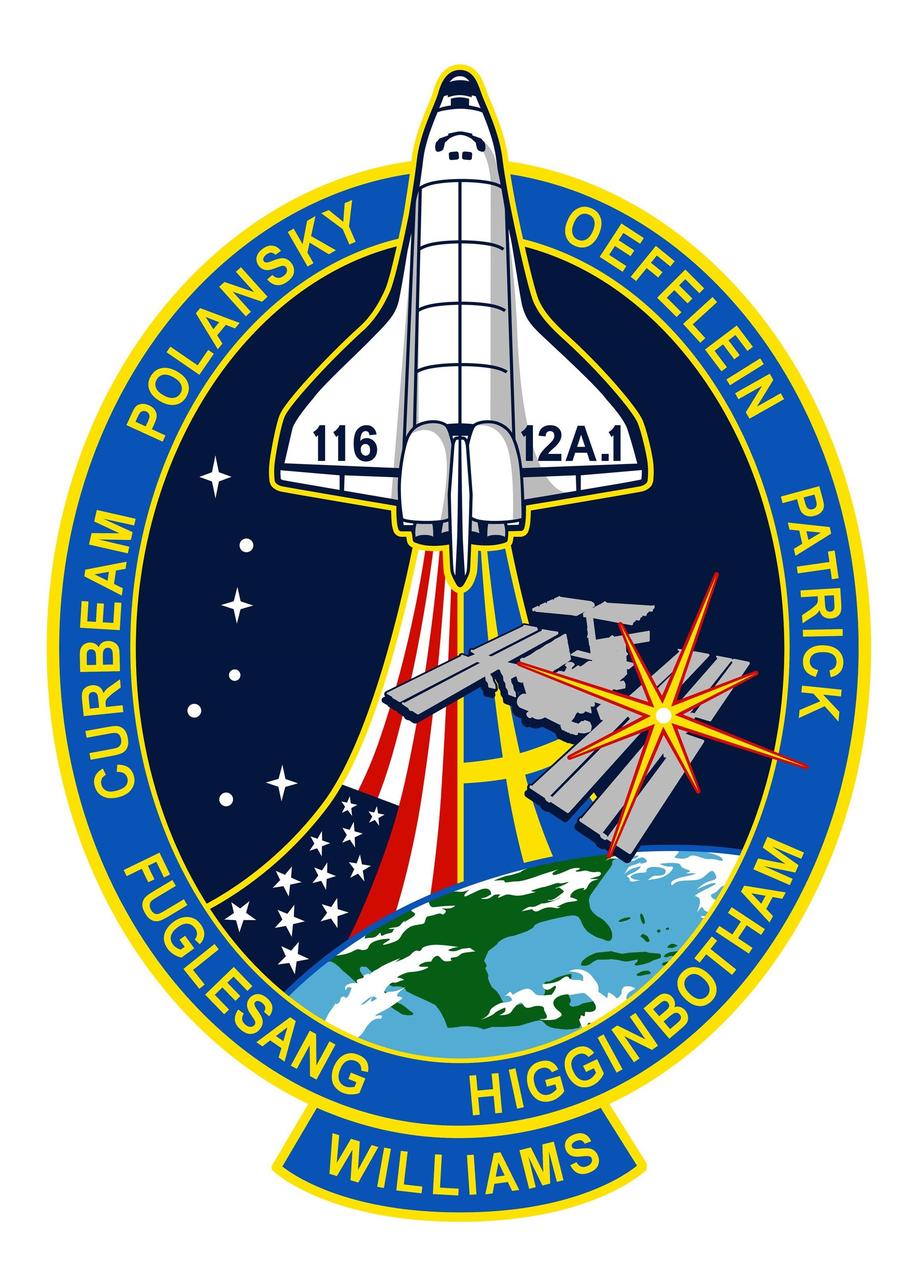
JOHNSON SPACE CENTER, Houston, Texas -- STS116-S-001 (July 2006) - The STS-116 patch design signifies the continuing assembly of the International Space Station (ISS). The primary mission objective is to deliver and install the P5 truss element. The P5 installation will be conducted during the first of three planned spacewalks, and will involve use of both the shuttle and station robotic arms. The remainder of the mission will include a major reconfiguration and activation of the ISS electrical and thermal control systems, as well as delivery of Zvezda Service Module debris panels, which will increase ISS protection from potential impacts of micro-meteorites and orbital debris. In addition, a single expedition crew member will launch on STS-116 to remain onboard the station, replacing an expedition crew member who will fly home with the shuttle crew. The crew patch depicts the space shuttle rising above the Earth and ISS. The United States and Swedish flags trail the orbiter, depicting the international composition of the STS-116 crew. The seven stars of the constellation Ursa Major are used to provide direction to the North Star, which is superimposed over the installation location of the P5 truss on ISS. The NASA insignia design for space shuttle space flights is reserved for use by the astronauts and other official use as the NASA Administrator may authorize. Public availability has been approved only in the form of illustrations by the various news media. When and if there is any change in this policy, which is not anticipated, such will be publicly announced.
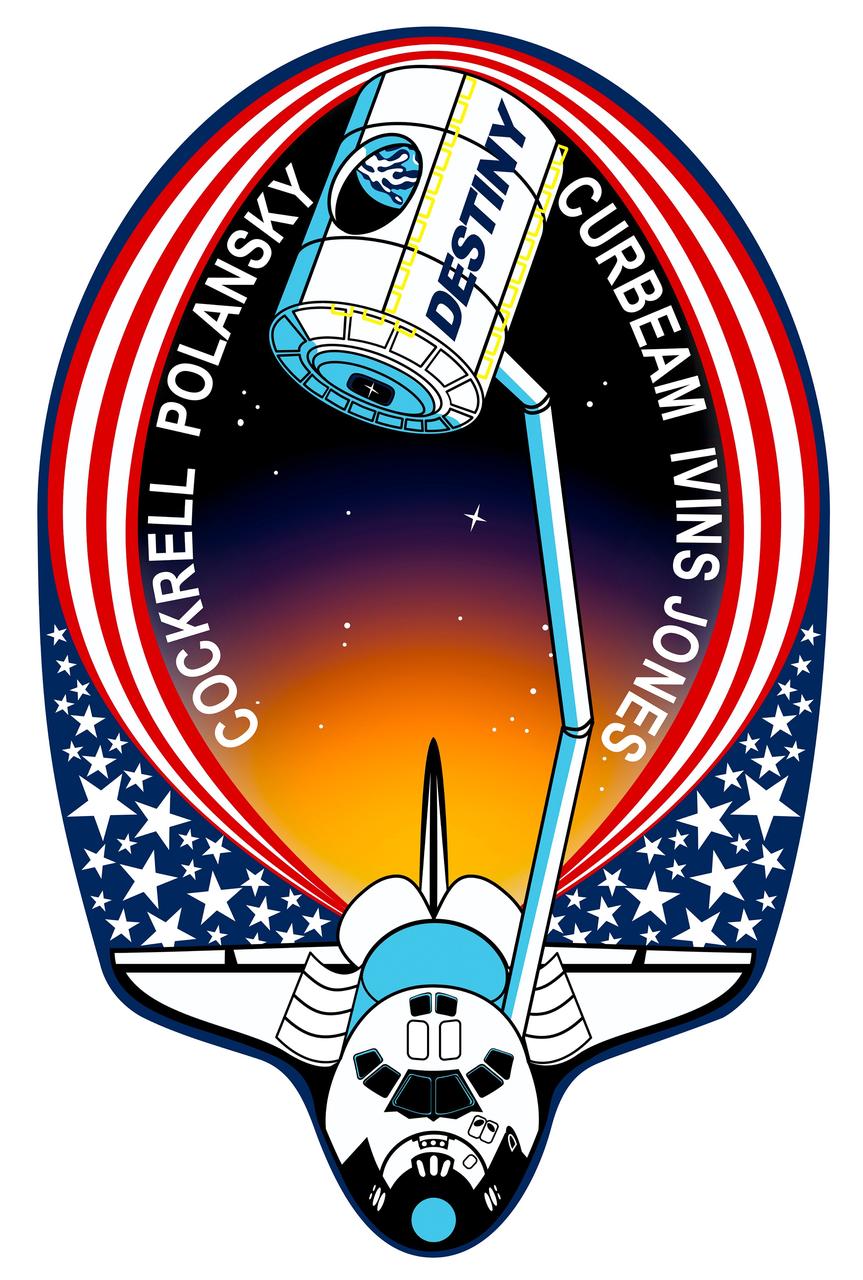
STS098-S-001 (November 2000) --- This is the insignia for STS-98, which marks a major milestone in assembly of the International Space Station (ISS). Atlantis' crew will deliver the United States Laboratory, Destiny, to the ISS. Destiny will be the centerpiece of the ISS, a weightless laboratory where expedition crews will perform unprecedented research in the life sciences, materials sciences, Earth sciences, and microgravity sciences. The laboratory is also the nerve center of the station, performing guidance, control, power distribution, and life support functions. With Destiny's arrival, the station will begin to fulfill its promise of returning the benefits of space research to Earth's citizens. The crew patch depicts the space shuttle with Destiny held high above the payload bay just before its attachment to the ISS. Red and white stripes, with a deep blue field of white stars, border the shuttle and Destiny to symbolize the continuing contribution of the United States to the ISS. The constellation Hercules, seen just below Destiny, captures the shuttle and station's team efforts in bringing the promise of orbital scientific research to life. The reflection of Earth in Destiny's window emphasizes the connection between space exploration and life on Earth. The NASA insignia design for space shuttle flights is reserved for use by the astronauts and for other official use as the NASA Administrator may authorize. Public availability has been approved only in the forms of illustrations by the various news media. When and if there is any change in this policy, which is not anticipated, the change will be publicly announced. Photo credit: NASA
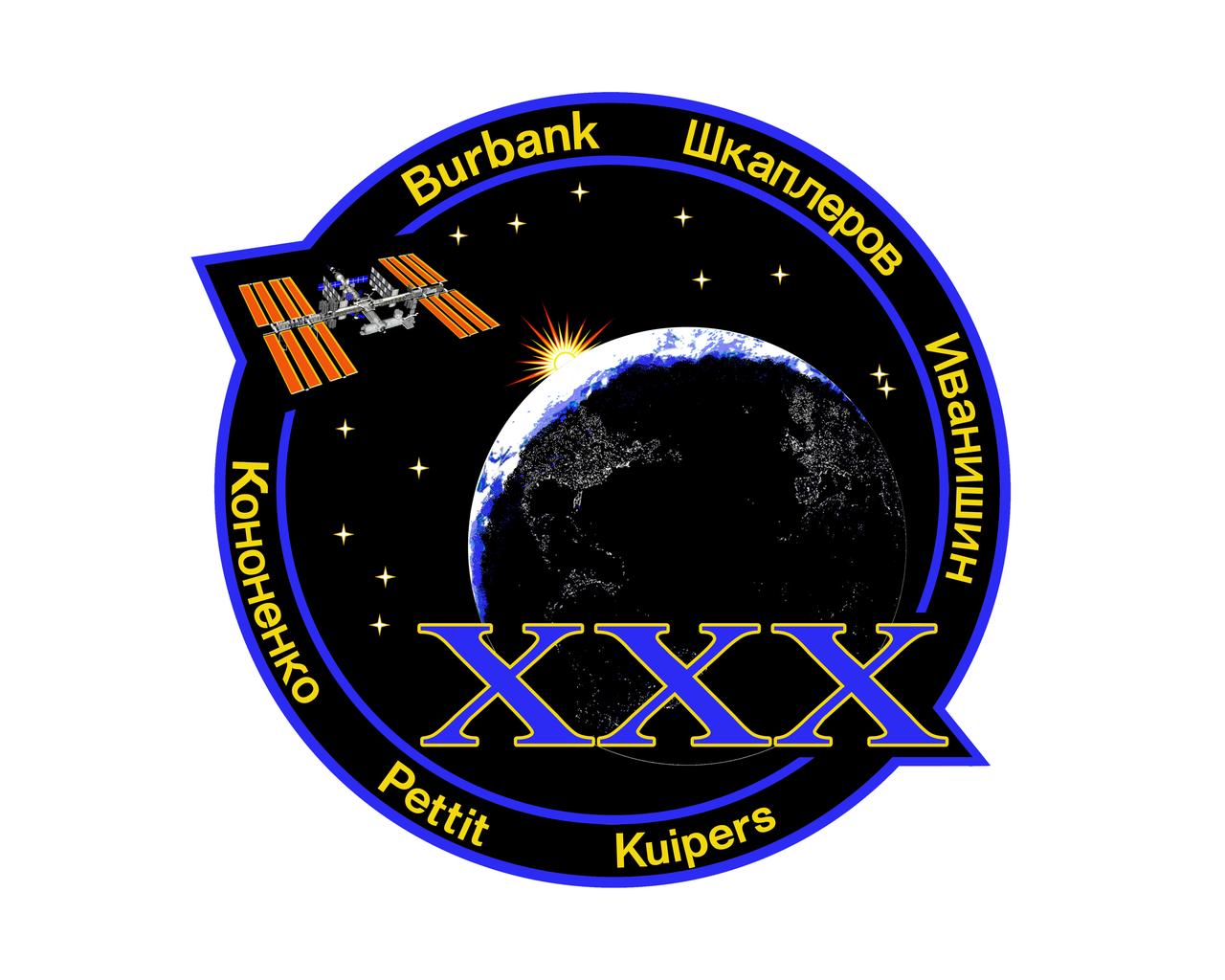
ISS030-S-001 (April 2011) --- The International Space Station (ISS) program is completing the transition from assembly to full utilization as humankind celebrates the golden anniversary of human space exploration. In recognition of these milestones and especially of the contribution of those whose dedication and ingenuity make spaceflight possible, a fully assembled ISS is depicted rising above a sunlit Earth limb. Eastward of the sunlit limb, the distinctive portrayal of Earth?s surface illuminated by nighttime city lights is a reminder of mankind?s presence on the planet, most readily apparent from space only by night, and commemorates how human beings have transcended their early bonds throughout the previous 50 years of space exploration. The ISS, a unique space-based outpost for research in biological, physical, space and Earth sciences, in the words of the crew members, is an impressive testament to the tremendous teamwork of the engineers, scientists and technicians from 15 countries and five national space agencies. The six crew members of Expedition 30, like those who have gone before them, express that they are honored to represent their countries and the ISS team in conducting research aboard the station and adding to the body of knowledge that will enable the world?s space faring countries to more safely and more productively live, work and explore outer space, paving the way for future missions beyond low Earth orbit, and inspiring young people to join in this great adventure. The NASA insignia design for shuttle and space station flights is reserved for use by the astronauts and for other official use as the NASA Administrator may authorize. Public availability has been approved only in the form of illustrations by the various news media. When and if there is any change in this policy, which is not anticipated, it will be publicly announced. Photo credit: NASA
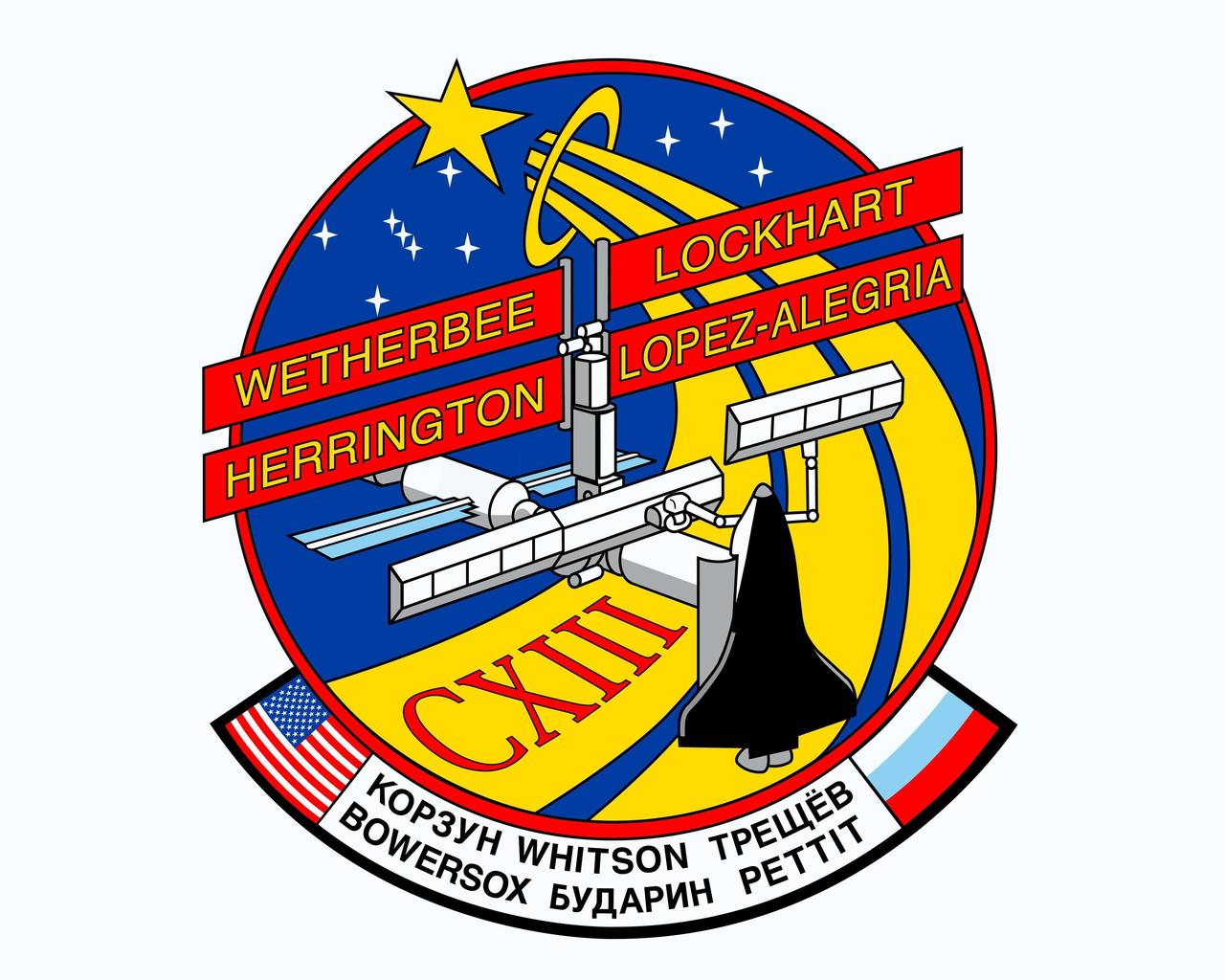
JOHNSON SPACE CENTER, HOUSTON, TEXAS - (STS113-S-001 September 2002) -- This is the crew patch for the STS-113 mission, which will be the 11th American (11A) assembly flight to the International Space Station (ISS). The primary mission will be to take the Expedition Six crew to the ISS and return the Expedition Five crew to Earth. STS-113 will be the first flight in the assembly sequence to install a major component in addition to performing a crew exchange. The Port 1 Integrated Truss Assembly (P1) will be the first truss segment on the left side of the ISS. P1 will provide an additinal three External Thermal Control System radiators, adding to the three radiators on the Starboard 1 (S1) Integrated Truss Assembly. The installation and outfitting of P1 will require three extravehicular activities (spacewalks) as well as coordination between the Shuttle Robotic Manipulator System and the Space Station Robotic Manipulator System. The patch depicts the Space Shuttle Endeavour docked to the ISS during the installation of the P1 truss withthe gold astronaut symbol in the background. The seven stars at the top left center of the patch are the seven brightest stars in the constellation Orion. They represent the combined seven crew members (four Shuttle and three Expedition Six). The three stars to the right of the astronaut symbol represent the returning Expedition Five crew members. The Roman Numeral CXIII represents the mission number 113. The NASA insignia design for Shuttle space flights is reserved for use by the astronauts and other official use as the NASA Administrator may authorize. Public availability has been approved only in the form of illustrations by the various news media. When and if there is any change in this policy, which is not anticipated, such will be publicly announced.
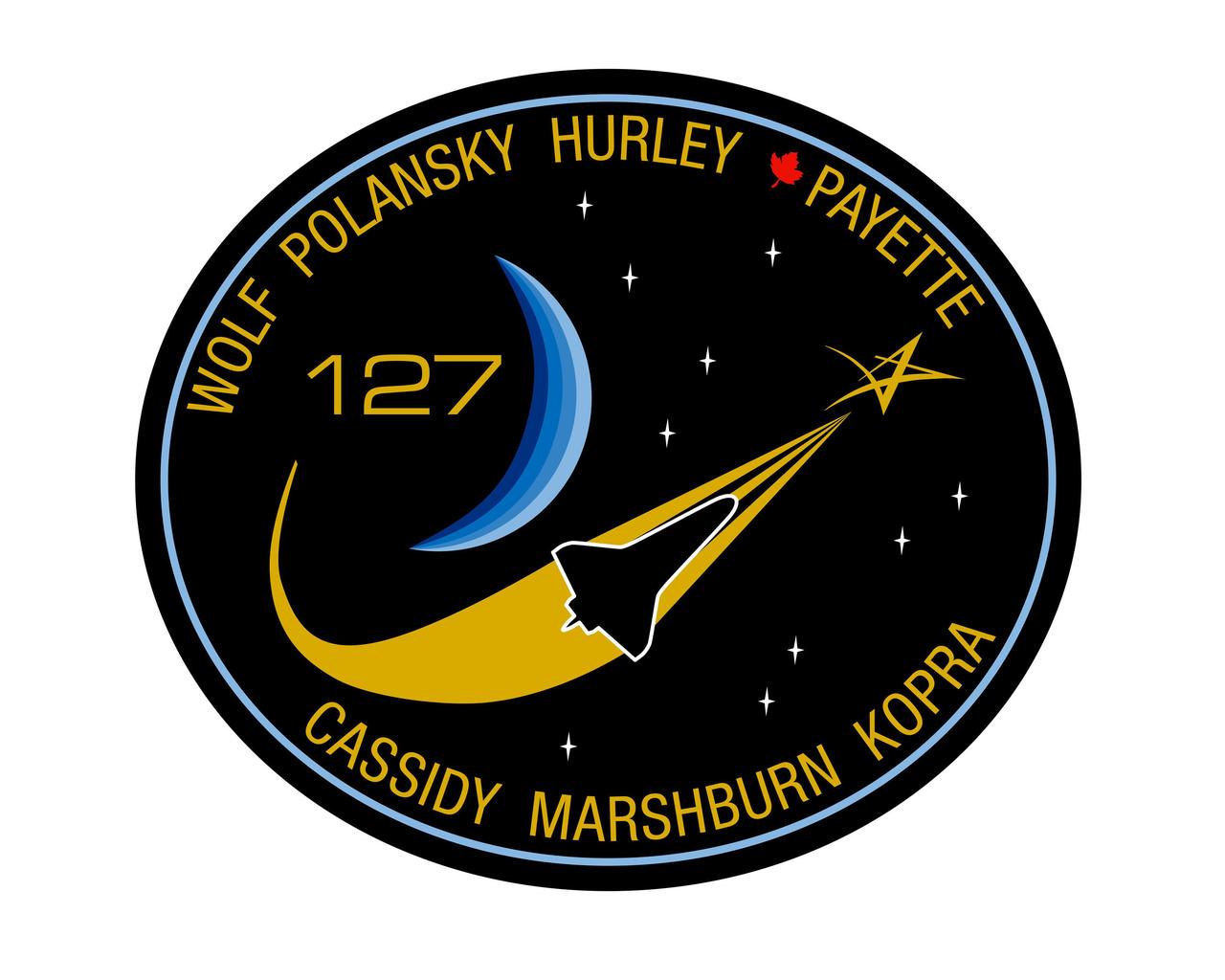
JOHNSON SPACE CENTER, Houston – STS127-S-001 (JSC) -- Space shuttle mission STS-127 is the 32nd construction flight of the International Space Station, or ISS, and the final of a series of three flights dedicated to the assembly of the Japanese "Kibo" laboratory complex. In addition to delivering, installing and servicing an external scientific platform that will be attached to the end of the Japanese module, STS-127 will bring up a new ISS crew member and return another one to Earth, replace vital components of the ISS electrical production system, and transfer various pieces of hardware to ISS. Five spacewalks and the operation of four different robotic arms will be required to accomplish these tasks over 10 days. A crew spokesperson had the following words for the patch: "Bathed in sunlight, the blue Earth is represented without boundaries to remind us that we all share this world. In the center, the golden flight path of the space shuttle turns into the three distinctive rays of the astronaut symbol culminating in the star-like emblem characteristic of the Japanese space agency, yet soaring further into space as it paves the way for future voyages and discoveries for all humankind." The NASA insignia design for shuttle flights is reserved for use by the astronauts and for other official use as the NASA Administrator may authorize. Public availability has been approved only in the form of illustrations by the various news media. When and if there is any change in this policy, which we do not anticipate, it will be publicly announced.
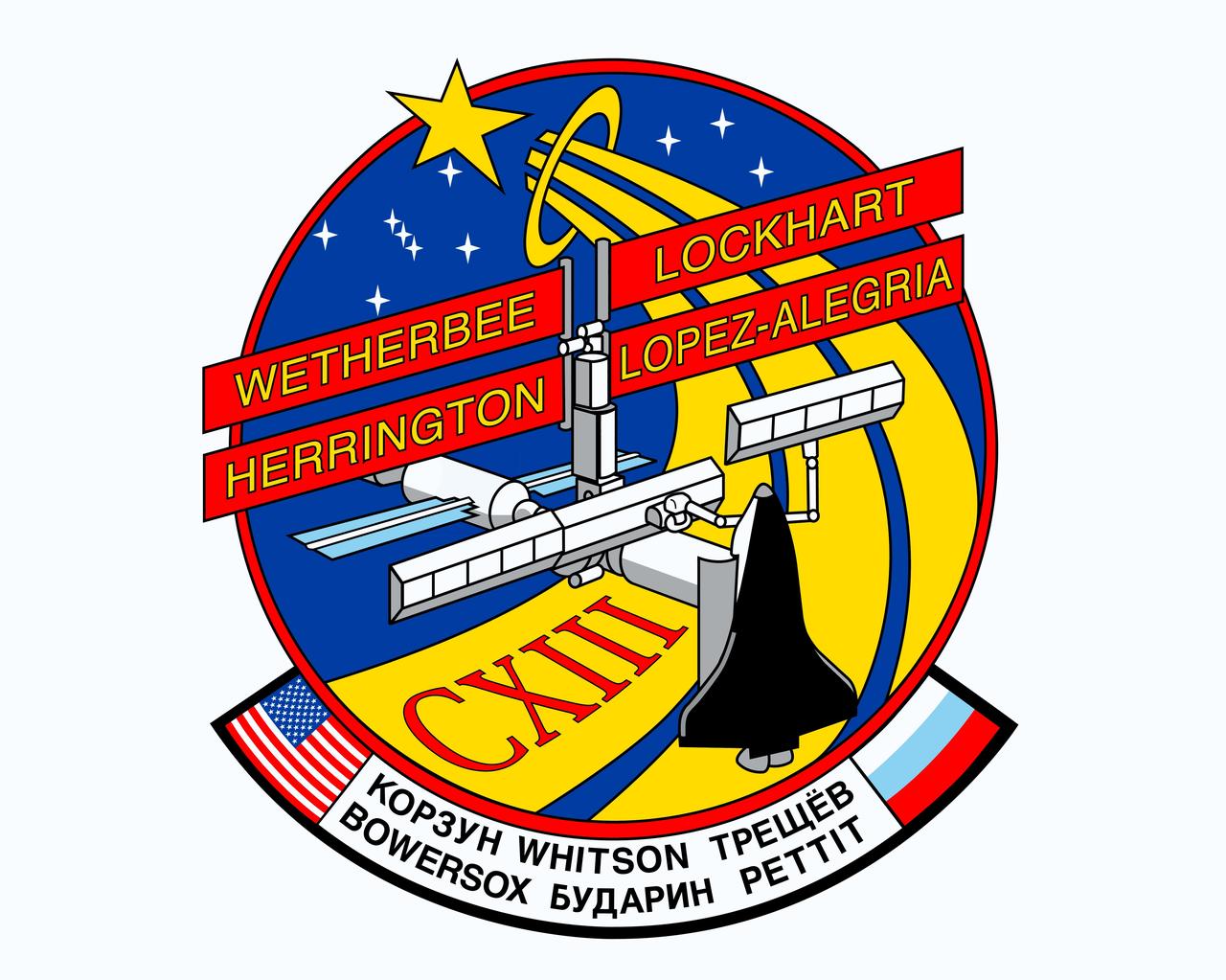
STS113-S-001 (September 2002) --- This is the crew patch for the STS-113 mission, which will be the eleventh American (11A) assembly flight to the International Space Station (ISS). The primary mission will be to take the Expedition Six crew to the ISS and return the Expedition Five crew to Earth. STS-113 will be the first flight in the assembly sequence to install a major component in addition to performing a crew exchange. The Port 1 Integrated Truss Assembly (P1) will be the first truss segment on the left side of the ISS. P1 will provide an additional three External Thermal Control System radiators, adding to the three radiators on the Starboard 1 (S1) Integrated Truss Assembly. The installation and outfitting of P1 will require three extravehicular activities (spacewalks) as well as coordination between the Shuttle Robotic Manipulator System and the Space Station Robotic Manipulator System. The patch depicts the space shuttle Endeavour docked to the ISS during the installation of the P1 truss with the gold astronaut symbol in the background. The seven stars at the top left center of the patch are the seven brightest stars in the constellation Orion. They represent the combined seven crew members (four shuttle and three Expedition Six). The three stars to the right of the astronaut symbol represent the returning Expedition Five crew members. The Roman Numeral CXIII represents the mission number 113. The NASA insignia design for space shuttle flights is reserved for use by the astronauts and for other official use as the NASA Administrator may authorize. Public availability has been approved only in the forms of illustrations by the various news media. When and if there is any change in this policy, which is not anticipated, the change will be publicly announced. Photo credit: NASA
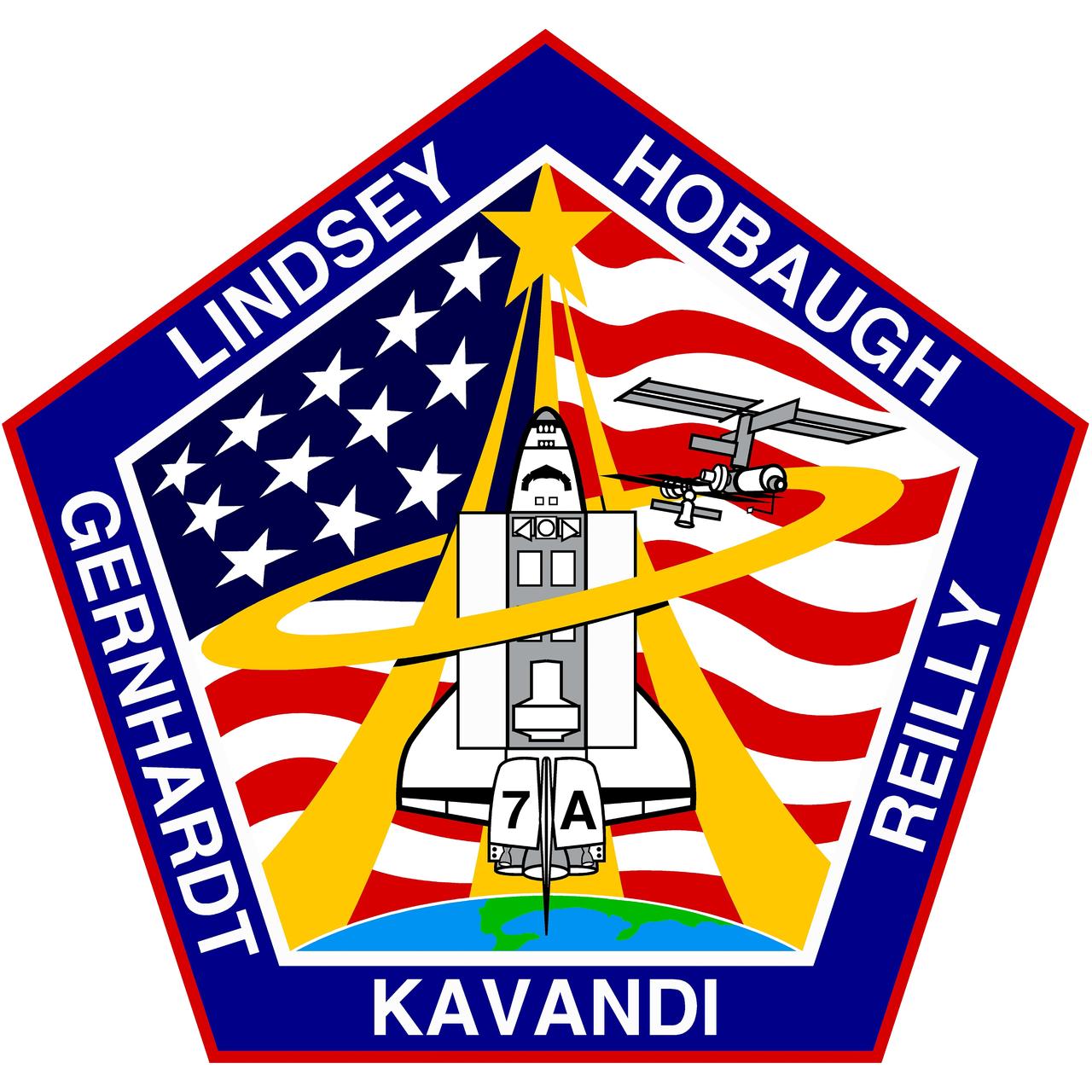
STS104-S-001 (March 2001) --- STS-104, International Space Station (ISS) assembly mission 7A, marks the completion of the initial assembly phase of ISS. The 7A crew will install, activate, and perform the first spacewalk from the Joint Airlock. The Joint Airlock will enable crews to perform spacewalks in either United States or Russian spacesuits while recovering over 90 percent of the gases that were previously lost when airlocks were vented to the vacuum of space. This patch depicts the launch of space shuttle Atlantis and the successful completion of the mission objectives as signified by the view of the ISS with the airlock installed. The astronaut symbol is displayed behind Atlantis as a tribute to the many crews that have gone before. The hard work, dedication, and teamwork of the airlock team is represented by the ISS components inside the payload bay which include the Joint Airlock and four high pressure gas tanks containing nitrogen and oxygen. In the words of a STS-104 crew spokesperson, "The stars and stripes background is symbolic of the commitment of a nation to this challenging international endeavor and to our children who represent its future." The NASA insignia design for space shuttle flights is reserved for use by the astronauts and for other official use as the NASA Administrator may authorize. Public availability has been approved only in the forms of illustrations by the various news media. When and if there is any change in this policy, which is not anticipated, the change will be publicly announced. Photo credit: NASA
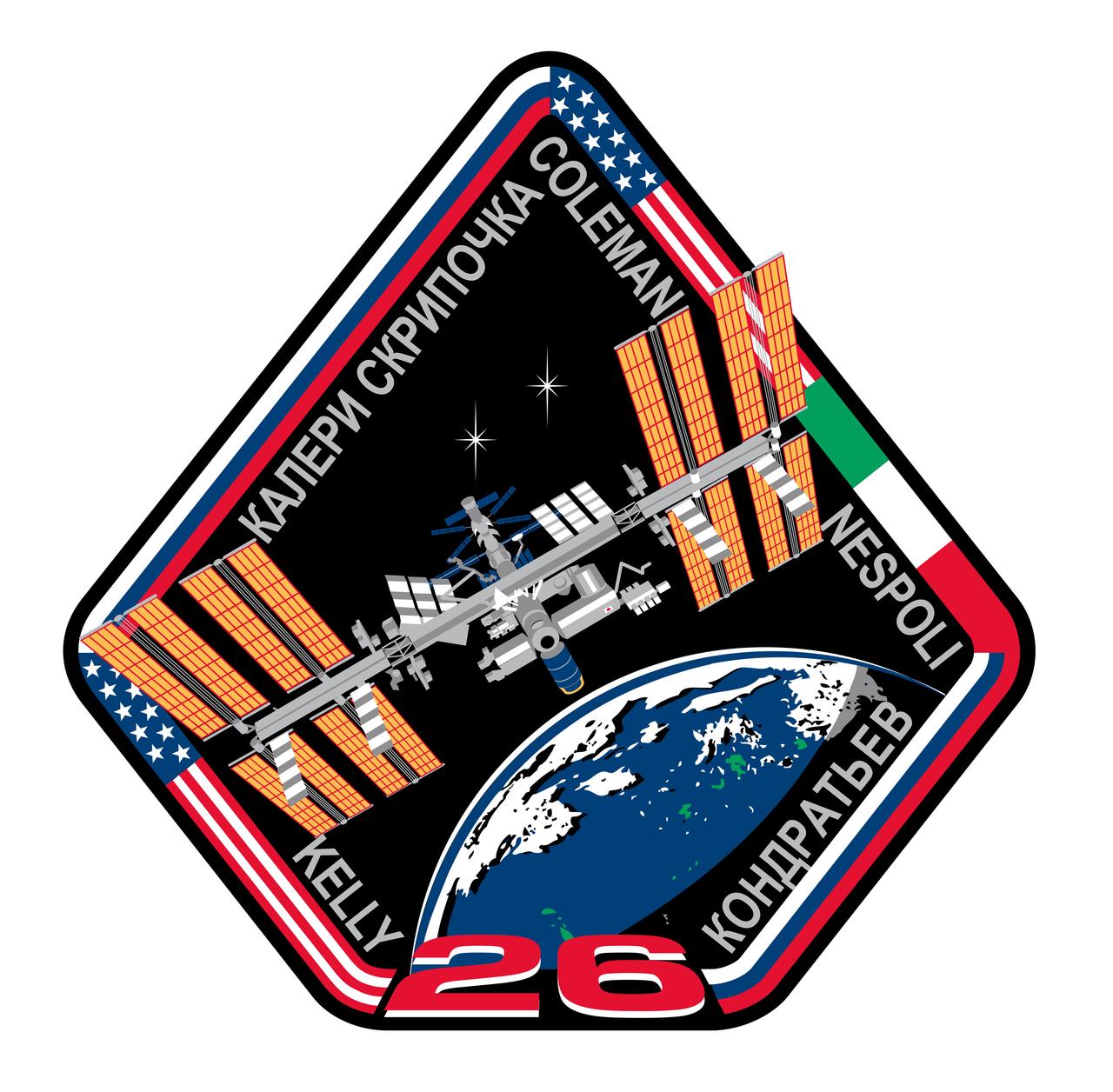
ISS026-S-001 (June 2010) --- In the foreground of the patch, the International Space Station is prominently displayed to acknowledge the efforts of the entire International Space Station (ISS) team - both the crews who have built and operated it, and the team of scientists, engineers, and support personnel on Earth who have provided a foundation for each successful mission. Their efforts and accomplishments have demonstrated the space station?s capabilities as a technology test bed and a science laboratory, as well as a path to the human exploration of our solar system and beyond. The ISS is shown with the European Space Agency?s (ESA) Automated Transfer Vehicle (ATV-2), the Johannes Kepler, docked to resupply it with experiments, food, water, and fuel for Expedition 26 and beyond. This Expedition 26 patch represents the teamwork among the international partners ? USA, Russia, Japan, Canada, and the ESA - and the ongoing commitment from each partner to build, improve, and utilize the ISS. Prominently displayed in the background is our home planet, Earth - the focus of much of our exploration and research on our outpost in space. The two stars symbolize two Soyuz spacecraft, each one carrying a three -member crew, who for four months will work and live together aboard the ISS as Expedition 26. The patch shows the crewmembers? names, and it?s framed with the flags of their countries of origin - United States, Russia, and Italy. The NASA insignia design for shuttle and space station flights is reserved for use by the astronauts and for other official use as the NASA Administrator may authorize. Public availability has been approved only in the form of illustrations by the various news media. When and if there is any change in this policy, which is not anticipated, it will be publicly announced.

ISS021-S-001 (February 2009) --- The central element of the patch is inspired by a fractal of six, symbolizing the teamwork of the six-person crew. From the basic element of one person, together six people form a much more complex and multifaceted entity, toward the infinity of the universe. The patch shows children, on Earth in the bright Sun, as our future and the reason we explore. The Soyuz and Shuttle are the vehicles that enable human space exploration today, while the International Space Station is leading to our next goals, the moon and Mars. The patch shape has six tips, geometrically sound yet reminiscent of a leaf, representing symmetry and ecological harmony, while the six stars in deep space represent the current crew and future exploration crews. The insignia design for ISS flights is reserved for use by the astronauts and cosmonauts and for other official use as the NASA Administrator and NASA's international partners may authorize. Public availability has been approved only in the form of illustrations by the various news media. When and if there is any change in this policy, which we do not anticipate, it will be publicly announced
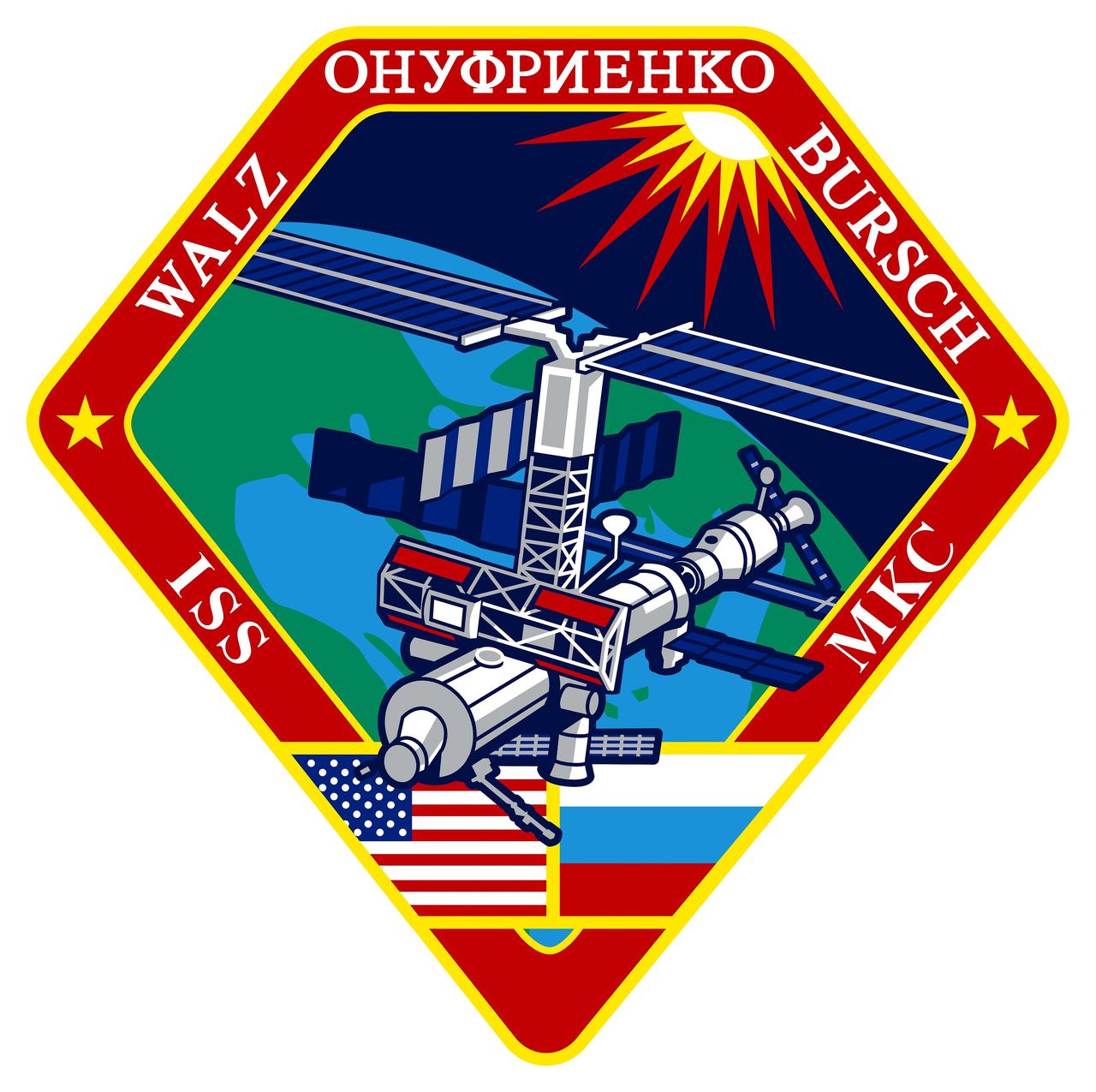
ISS004-S-001 (August 2001) --- The International Space Station (ISS) Expedition 4 crew patch has an overall diamond shape, showing the “diamond in the rough” configuration of the Station during expedition 4. The red hexagonal shape with stylized American and Russian flags represents the cross-sectional view of the S0 truss segment, which the crew will attach to the U.S. Lab Destiny. The persistent Sun shining on the Earth and Station represents the constant challenges that the crew and ground support team will face every day while operating the International Space Station, while shedding new light through daily research. The green portion of the Earth represents the fourth color in the visible spectrum and the black void of space represents humankind’s constant quest to explore the unknown. The NASA insignia design for Shuttle flights is reserved for use by the astronauts and for other official use as the NASA Administrator may authorize. Public availability has been approved only in the forms of illustrations by the various news media. When and if there is any change in this policy, which is not anticipated, the change will be publicly announced.

STS128-S-001 (April 2009) --- The STS-128 patch symbolizes the 17A mission and represents the hardware, people and partner nations that contribute to the flight. The Space shuttle Discovery is shown in the orbit configuration with the Multi-Purpose Logistics Module (MPLM) Leonardo in the payload bay. Earth and the International Space Station wrap around the Astronaut Office symbol reminding us of the continuous human presence in space. The names of the STS-128 crew members border the patch in an unfurled manner. Included in the names is the expedition crew member who will launch on STS-128 and remain on board ISS, replacing another Expedition crew member who will return home with STS-128. The banner also completes the Astronaut Office symbol and contains the U.S. and Swedish flags representing the countries of the STS-128 crew. The NASA insignia design for space shuttle flights is reserved for use by the astronauts and for other official use as the NASA Administrator may authorize. Public availability has been approved only in the forms of illustrations by the various news media. When and if there is any change in this policy, which is not anticipated, the change will be publicly announced. Photo credit: NASA

JOHNSON SPACE CENTER, Houston – STS128-S-001 -- The STS-128 patch symbolizes the 17A mission and represents the hardware, people and partner nations that contribute to the flight. The Space Shuttle Discovery is shown in the orbit configuration with the Multi Purpose Logistics Module (MPLM) Leonardo in the payload bay. Earth and the International Space Station wrap around the Astronaut Office symbol reminding us of the continuous human presence in space. The names of the STS-128 crew members border the patch in an unfurled manner. Included in the names is the expedition crew member who will launch on STS-128 and remain on board ISS, replacing another Expedition crew member who will return home with STS-128. The banner also completes the Astronaut Office symbol and contains the U.S. and Swedish flags representing the countries of the STS-128 crew. The NASA insignia design for Space Shuttle flights is reserved for use by the astronauts and for other official use as the NASA Administrator may authorize. Public availability has been approved only in the form of illustrations by the various news media. When and if there is any change in this policy, which we do not anticipate, it will be publicly announced.
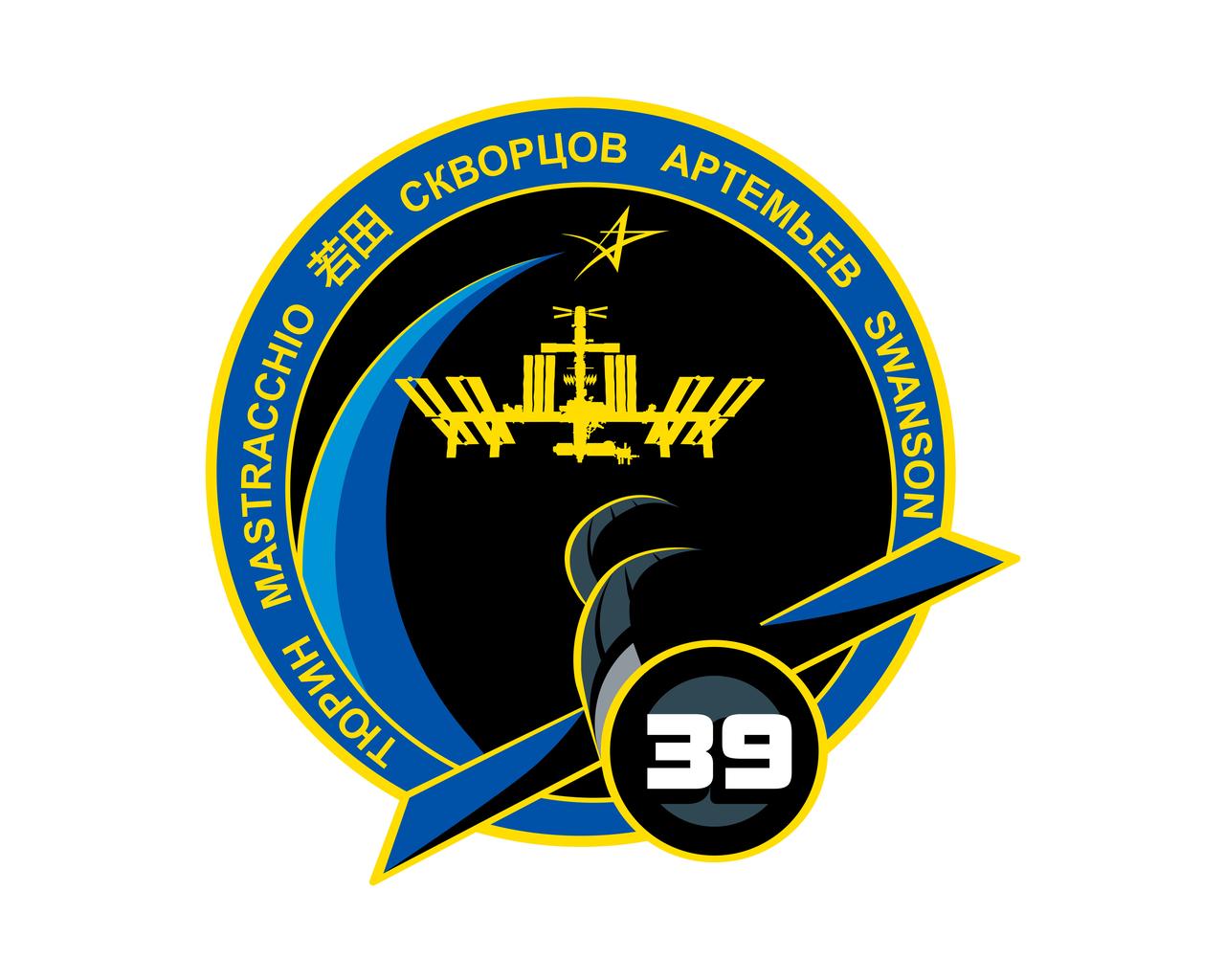
ISS039-S-001 (April 2013) --- Increment 39 of the International Space Station Program marks the 15th year of operation since the start of the space laboratory assembly. Today, the U.S., Russia, Japan, Canada and the European Space Agency are partnering in the operation of the largest ever orbital outpost managed by humankind. The names of the six crew members are depicted in their native languages. For Expedition 39, the Soyuz spacecraft serves as transport vehicle for the crew members to and from the station. During this expedition, the ISS will serve as a platform for scientific research, Earth and astronomical observation, education, as well as a stage for the development of new technologies used for the exploration beyond low Earth orbit. The star above the complex signifies human space exploration towards new frontiers. The crew members added these words: "The crew of Expedition 39 is proud to serve the international community in furthering our scientific knowledge and in expanding human presence in space." Photo credit: NASA The NASA insignia design for shuttle and space station flights is reserved for use by the astronauts and for other official use as the NASA Administrator may authorize. Public availability has been approved only in the form of illustrations by the various news media. When and if there is any change in this policy, which is not anticipated, it will be publicly announced.

STS097-712-001 (9 December 2000) --- This picture of the distant International Space Station (ISS) blended against the darkness of space and the blue Earth at its horizon is one of a series of 70mm frames exposed of the station following undocking at 1:13 p.m. (CST), December 9, 2000. This series of images, as well as video and digital still imagery taken at the same time, represent the first imagery of the entire station with its new solar array panels deployed. Before separation, the shuttle and space station had been docked to one another for 6 days, 23 hours and 13 minutes. Endeavour moved downward from the space station, then began a tail-first circle at a distance of about 500 feet. The maneuver, with pilot Michael J. Bloomfield at the controls, took about an hour. While Endeavour flew that circle, the two spacecraft, moving at five miles a second, navigated about two-thirds of the way around the Earth. Undocking took place 235 statute miles above the border of Kazakhstan and China. When Endeavour made its final separation burn, the orbiter and the space station were near the northeastern coast of South America.
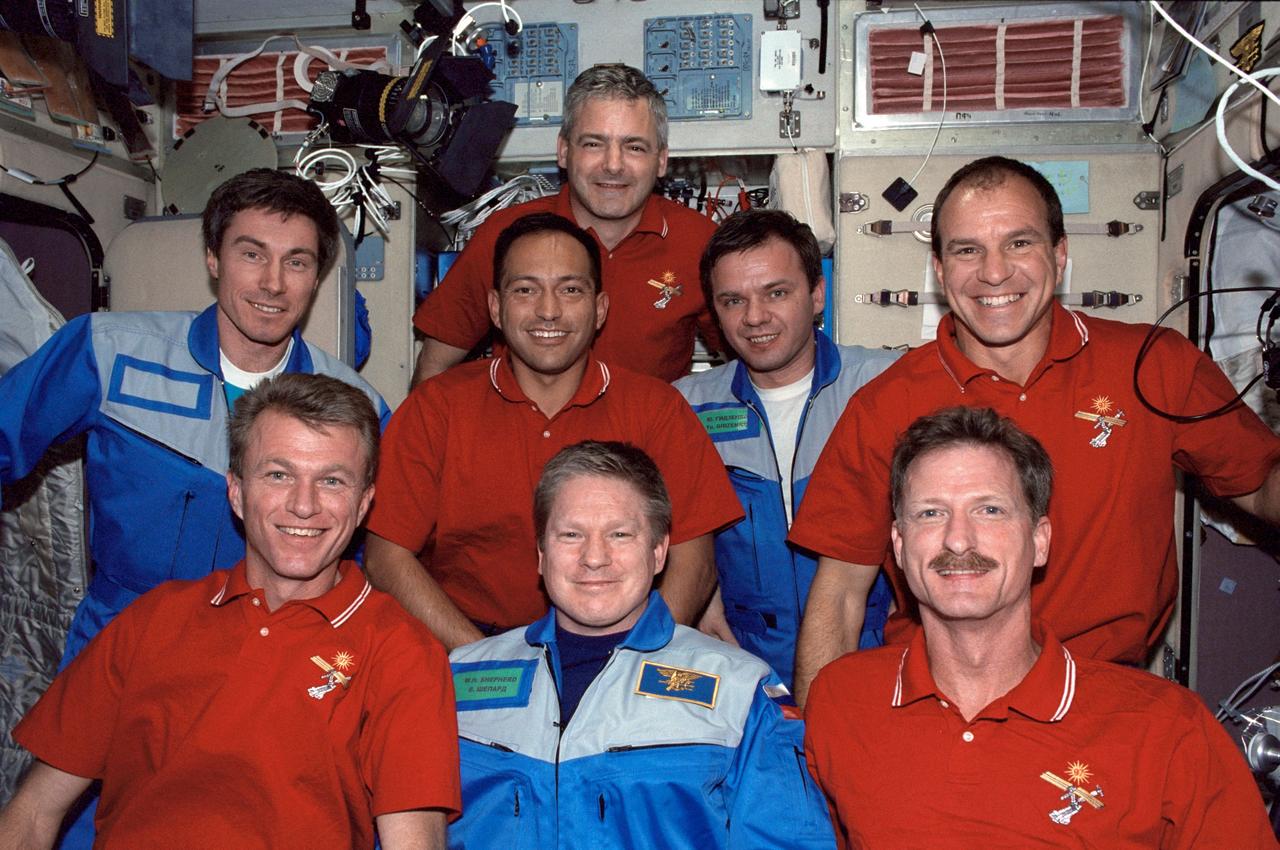
STS097-313-001 (8 December 2000)--- When the five STS-97 astronauts paid a visit to the three Expedition 1 crew members onboard the International Space Station (ISS), they all posed for a traditional in-flight portrait, albeit for the first time in the Zvezda Service Module. On the front row are (left to right) astronauts Brent W. Jett, Jr., STS-97 commander; William M. Shepherd, Expedition 1 mission commander; and Joseph R. Tanner, STS-97 mission specialist. On the second row are (from the left) cosmonaut Sergei K. Krikalev, Expedition 1 flight engineer; astronaut Carlos I. Noriega, STS-97 mission specialist; cosmonaut Yuri P. Gidzenko, Expedition 1 Soyuz commander; and astronaut Michael J. Bloomfield, STS-97 pilot. Behind them is astronaut Marc Garneau, STS-97 mission specialist representing the Canadian Space Agency (CSA). Krikalev and Gidzenko represent the Russian Aviation and Space Agency.
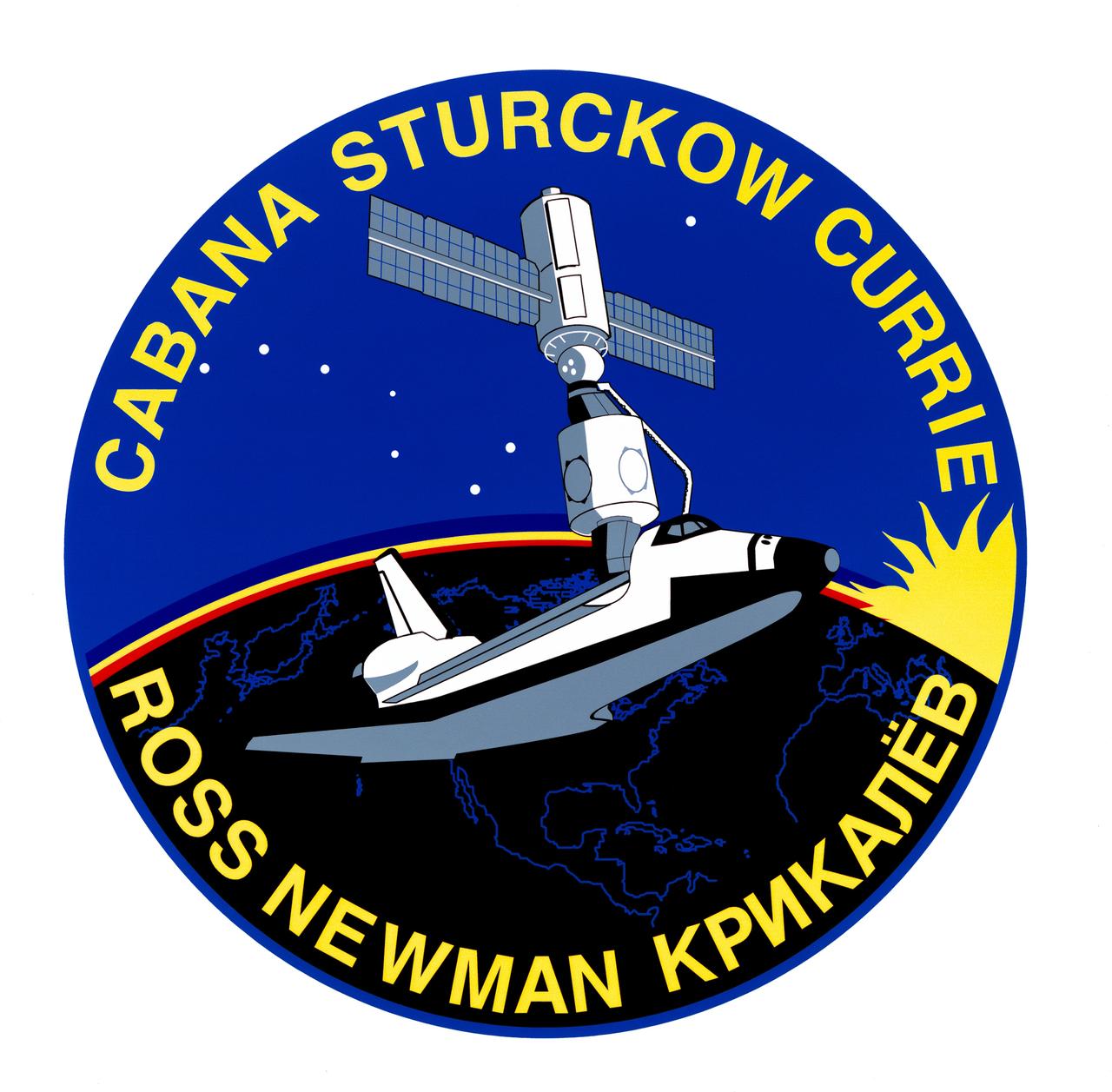
STS088-S-001 (September 1998) --- Designed by the crew members, this STS-88 patch commemorates the first assembly flight to carry United States-built hardware for constructing the International Space Station (ISS). This flight's primary task is to assemble the cornerstone of the space station: the Node with the Functional Cargo Block (FGB). The rising sun symbolizes the dawning of a new era of international cooperation in space and the beginning of a new program: the International Space Station. The Earth scene outlines the countries of the Station Partners: the United States, Russia, those of the European Space Agency (ESA), Japan, and Canada. Along with the Pressurized Mating Adapters (PMA) and the Functional Cargo Block, the Node is shown in the final mated configuration while berthed to the space shuttle during the STS-88/2A mission. The Big Dipper Constellation points the way to the North Star, a guiding light for pioneers and explorers for generations. In the words of the crew, "These stars symbolize the efforts of everyone, including all the countries involved in the design and construction of the International Space Station, guiding us into the future." The NASA insignia design for space shuttle flights is reserved for use by the astronauts and for other official use as the NASA Administrator may authorize. Public availability has been approved only in the forms of illustrations by the various news media. When and if there is any change in this policy, which is not anticipated, the change will be publicly announced. Photo credit: NASA
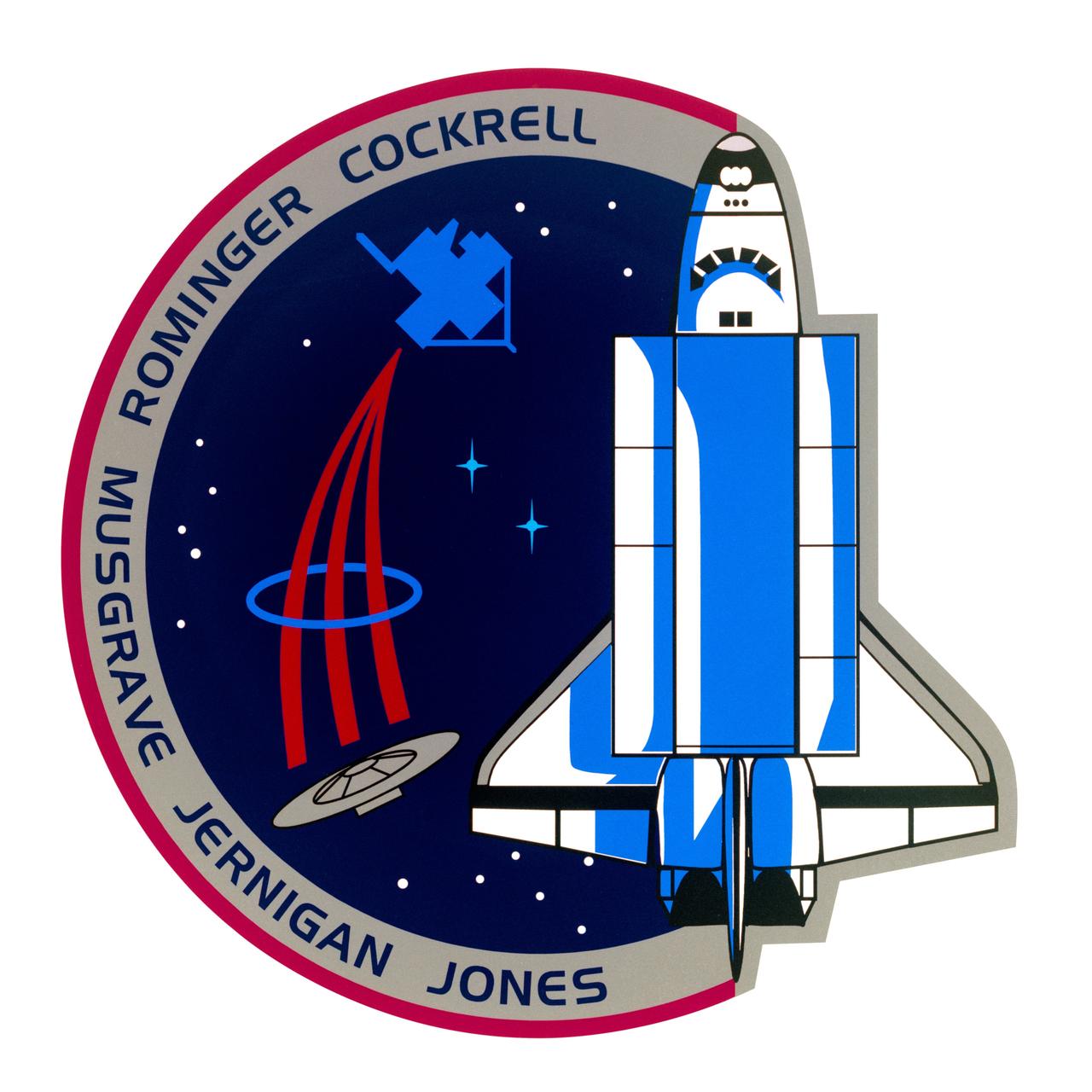
STS080-S-001 (August 1996) --- This STS-80 mission patch depicts the space shuttle Columbia and the two research satellites its crew will deploy into the blue field of space. The uppermost satellite is the Orbiting Retrievable Far and Extreme Ultraviolet Spectrograph-Shuttle Pallet Satellite (ORFEUS-SPAS), a telescope aimed at unraveling the life cycles of stars and understanding the gases that drift between them. The lower satellite is the Wake Shield Facility (WSF), flying for the third time. It will use the vacuum of space to create advanced semiconductors for the nation’s electronics industry. ORFEUS and WSF are joined by the symbol of the Astronaut Corps, representing the human contribution to scientific progress in space. The two bright blue stars represent the mission’s extravehicular activities (EVA), final rehearsals for techniques and tools to be used in assembly of the International Space Station (ISS). Surrounding Columbia is a constellation of 16 stars, one for each day of the mission, representing the stellar talents of the ground and flight teams that share the goal of expanding knowledge through a permanent human presence in space. The NASA insignia design for space shuttle flights is reserved for use by the astronauts and for other official use as the NASA Administrator may authorize. Public availability has been approved only in the forms of illustrations by the various news media. When and if there is any change in this policy, which is not anticipated, the change will be publicly announced. Photo credit: NASA
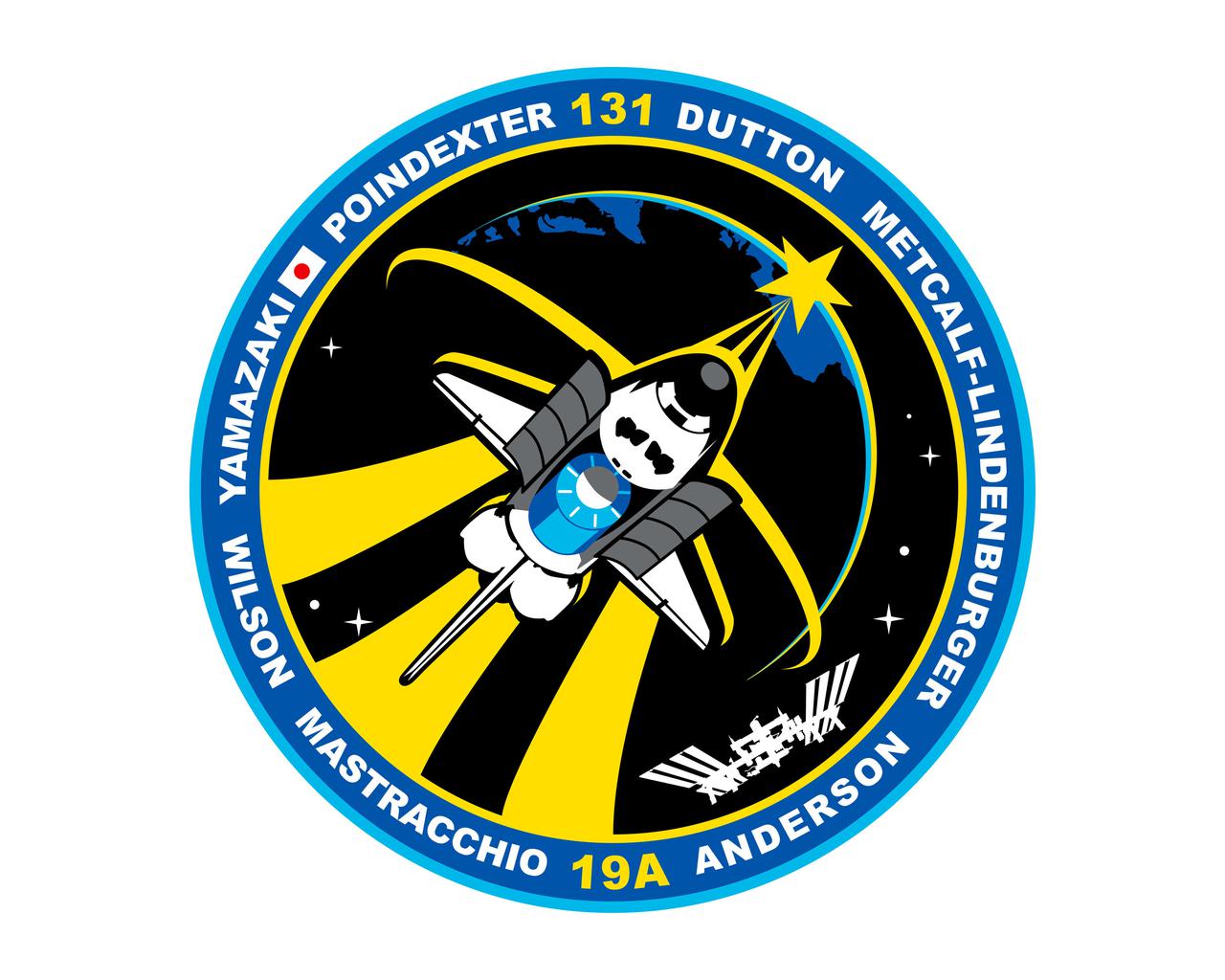
JOHNSON SPACE CENTER, Houston - STS131-S-001 - The STS-131_19A crew patch highlights the Space Shuttle in the Rendezvous Pitch Maneuver (RPM). This maneuver is heavily photographed by the International Space Station (ISS) astronauts, and the photos are analyzed back on earth to clear the Space Shuttle's thermal protection system for re-entry. The RPM illustrates the teamwork and safety process behind each Space Shuttle launch. In the Space Shuttle's cargo bay is the Multi-Purpose Logistics Module (MPLM), Leonardo, which is carrying several science racks, the last of the four crew quarters, and supplies for the ISS. Out of view and directly behind the MPLM, is the Ammonia Tank Assembly (ATA) that will be used to replace the current ATA. This will take place during three Extra Vehicular Activities (EVAs). The 51.6° Space Shuttle orbit is illustrated by the three gold bars of the astronaut symbol, and its elliptical wreath contains the orbit of the ISS. The star atop the astronaut symbol is the dawning sun, which is spreading its early light across the Earth. The background star field contains seven stars, one for each crewmember; they are proud to represent the United States and Japan during this mission. The NASA insignia design for shuttle flights is reserved for use by the astronauts and for other official use as the NASA Administrator may authorize. Public availability has been approved only in the form of illustrations by the various news media. When and if there is any change in this policy, which we do not anticipate, it will be publicly announced.
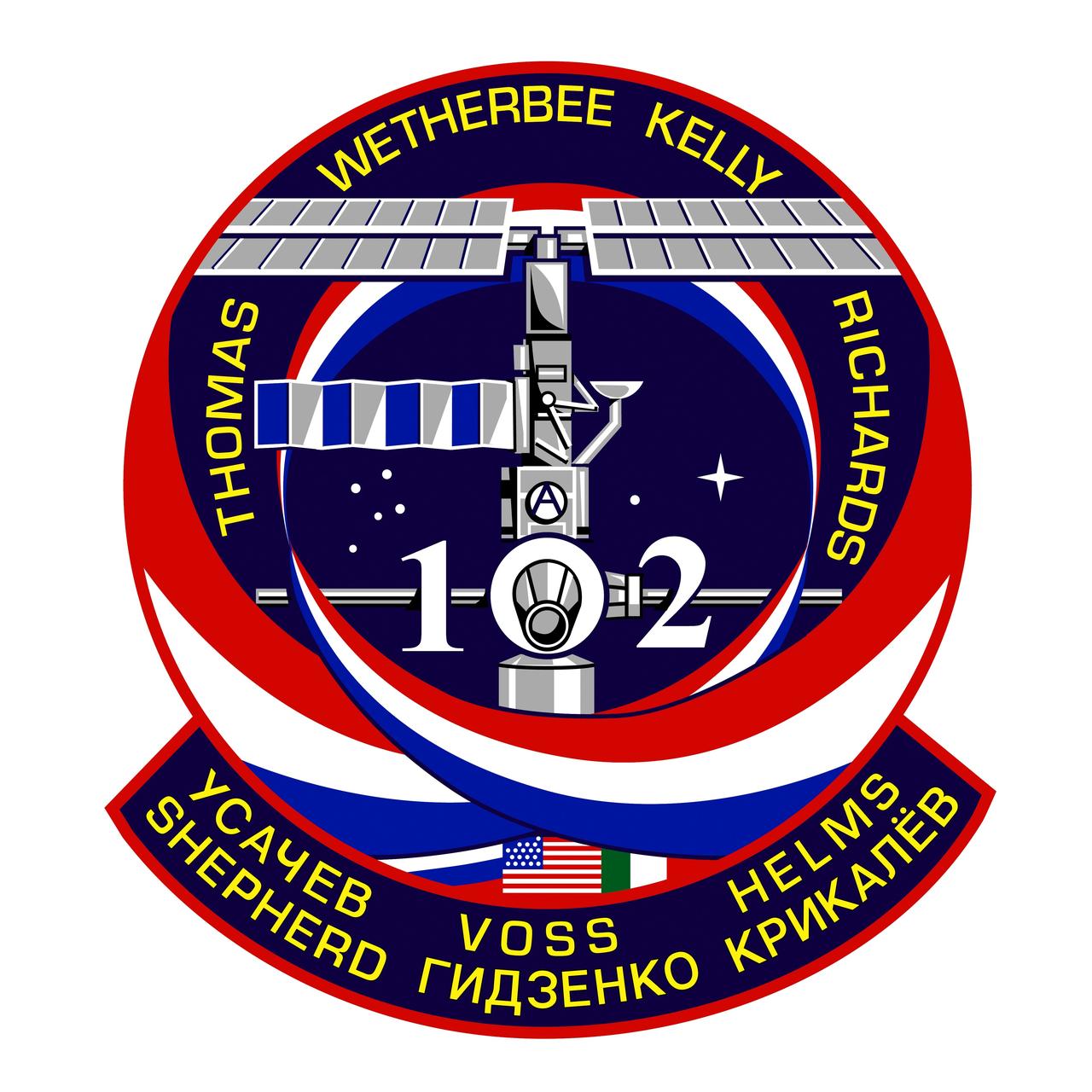
STS102-S-001 (January 2001) --- The central image on the STS-102 crew patch depicts the International Space Station (ISS) in the build configuration that it will have at the time of the arrival and docking of Discovery during the STS-102 mission, the first crew exchange flight to the space station. The station is shown along the direction of the flight as will be seen by the shuttle crew during their final approach and docking, the so-called V-bar approach. The names of the shuttle crew members are depicted in gold around the top of the patch, and surnames of the Expedition crew members being exchanged are shown in the lower banner. The three ribbons swirling up to and around the station signify the rotation of these ISS crew members. The number two is for the Expedition Two crew who fly up to the station, and the number one is for the Expedition One crew who then return down to Earth. In conjunction with the face of the Lab module of the station, these Expedition numbers create the shuttle mission number 102. Shown mated below the ISS is the Italian-built Multi-Purpose Logistics Module, Leonardo, that will fly for the first time on this flight, and which will be attached to the station by the shuttle crew during the docked phase of the mission. The flags of the countries that are the major contributors to this effort, the United States, Russia, and Italy are also shown in the lower part of the patch. The build-sequence number of this flight in the overall station assembly sequence, 5A.1, is captured by the constellations in the background. The NASA insignia design for space shuttle flights is reserved for use by the astronauts and for other official use as the NASA Administrator may authorize. Public availability has been approved only in the forms of illustrations by the various news media. When and if there is any change in this policy, which is not anticipated, the change will be publicly announced. Photo credit: NASA
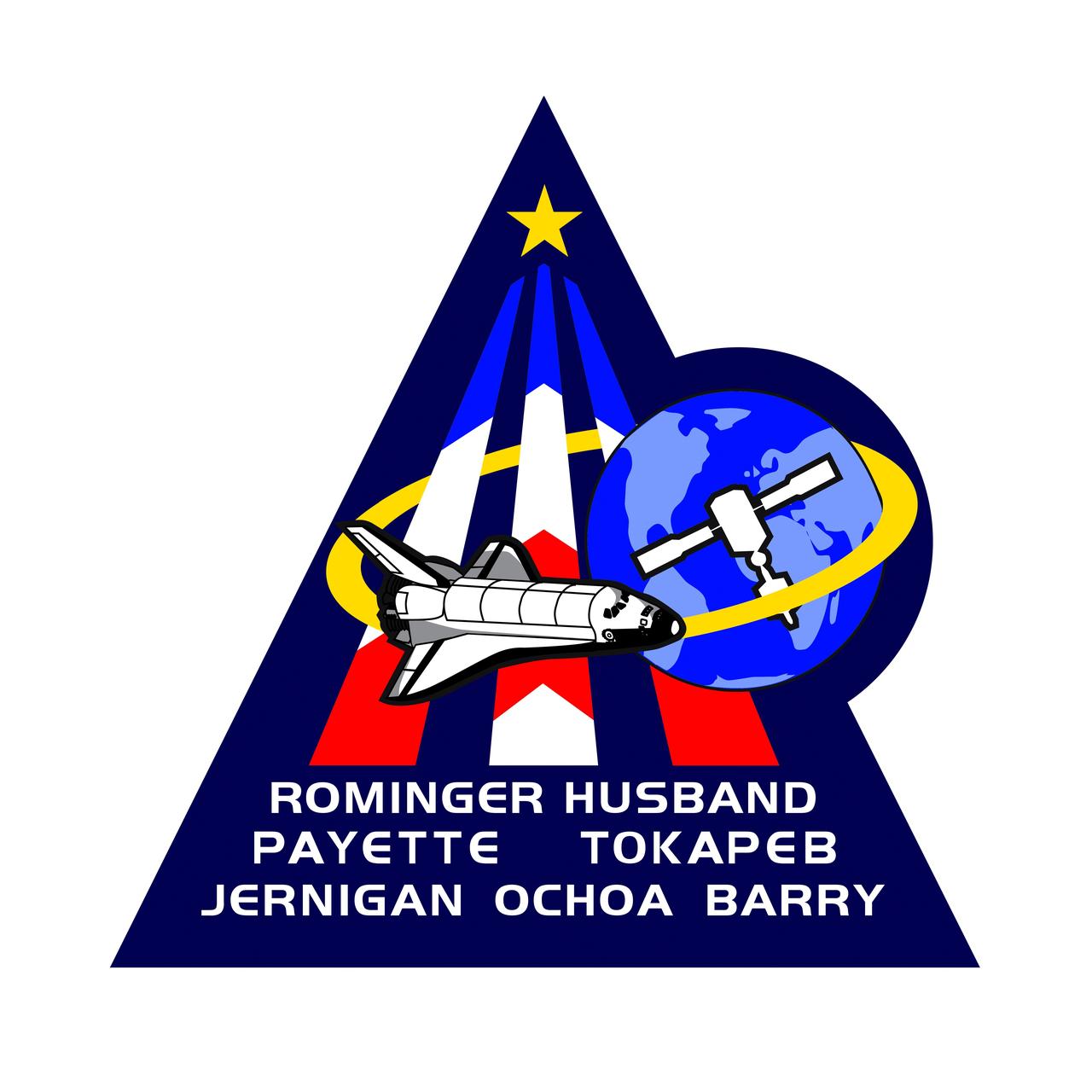
STS96-S-001 (February 1999) --- Designed by the crew members, this is the mission insignia for the STS-96 spaceflight, the second space shuttle mission dedicated to the assembly of the International Space Station (ISS). The crew patch highlights the major themes of the Station Program: Earth-directed research, the advancement of human space exploration, and international cooperation. The space shuttle Discovery is depicted shortly after reaching orbit as the crew prepares to carry out the first docking with the new space station. At this early stage in its construction, ISS consists of two modules: Zarya and Unity, shown orbiting Earth. The triangular shape of the patch represents building on the knowledge and experience of earlier missions, while the three vertical bars of the astronaut emblem point toward future human endeavors in space. The five-pointed star that tops the astronaut emblem in this depiction is symbolic of the five space agencies participating in the development of ISS: National Aeronautics and Space Administration (NASA), the Russian Space Agency (RSA), the European Space Agency (ESA), the National Space Development Agency of Japan (NASDA), and the Canadian Space Agency (CSA). The blend of red, white, and blue is a tribute to the nationalities of the crew members who are from the United States, Canada, and Russia. The NASA insignia design for space shuttle flights is reserved for use by the astronauts and for other official use as the NASA Administrator may authorize. Public availability has been approved only in the forms of illustrations by the various news media. When and if there is any change in this policy, which is not anticipated, the change will be publicly announced. Photo credit: NASA
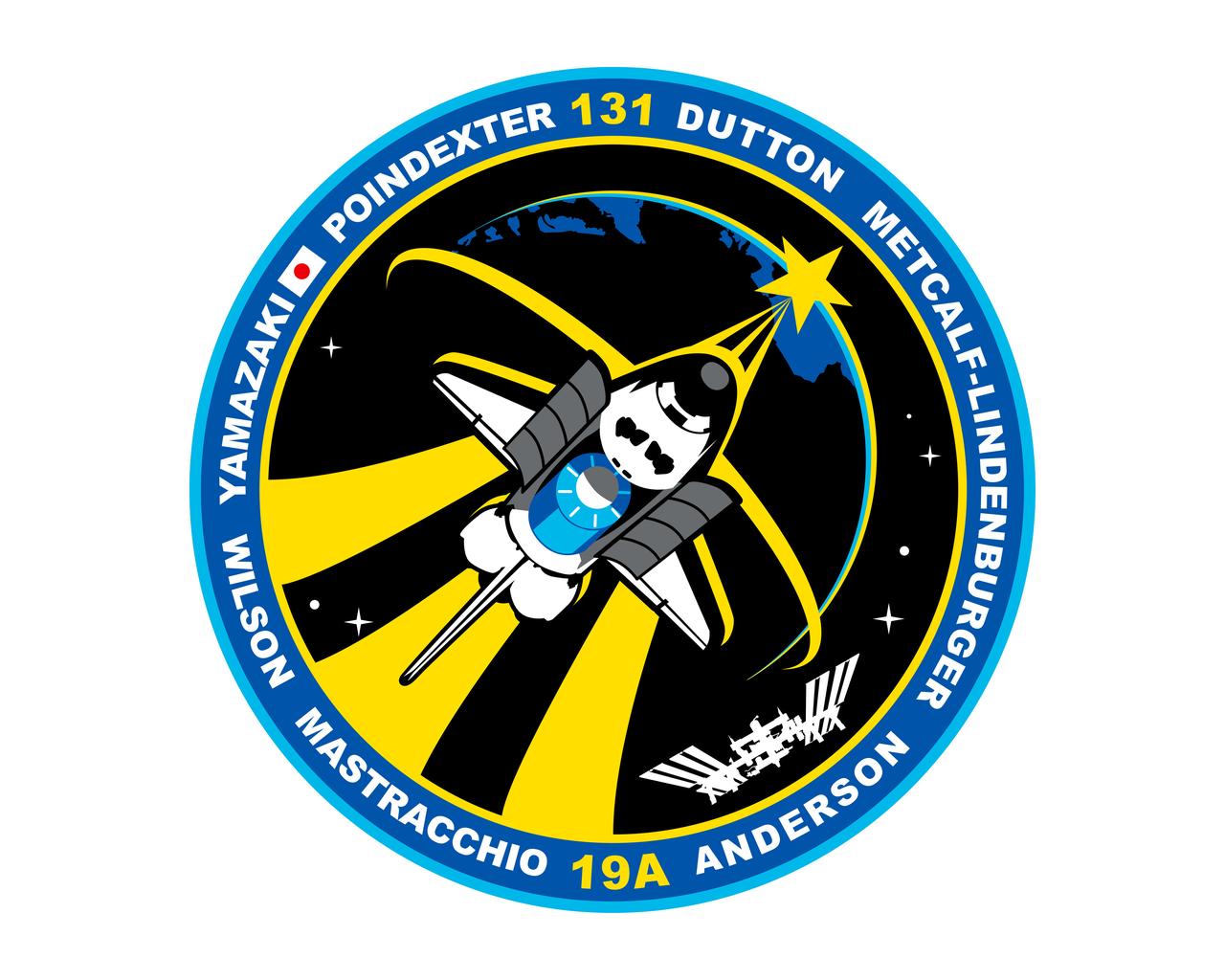
STS131-S-001 (September 2009) --- The STS-131/19A crew patch highlights the space shuttle in the Rendezvous Pitch Maneuver (RPM). This maneuver is heavily photographed by the International Space Station (ISS) crew members, and the photos are analyzed back on Earth to clear the space shuttle?s thermal protection system for re-entry. The RPM illustrates the teamwork and safety process behind each space shuttle launch. In the space shuttle?s cargo bay is the Multi-Purpose Logistics Module (MPLM), Leonardo, which is carrying several science racks, the last of the four crew quarters, and supplies for the ISS. Out of view and directly behind the MPLM, is the Ammonia Tank Assembly (ATA) that will be used to replace the current ATA. This will take place during three extravehicular activities (EVA). The 51.6? space shuttle orbit is illustrated by the three gold bars of the astronaut symbol, and its elliptical wreath contains the orbit of the ISS. The star atop the astronaut symbol is the dawning sun, which is spreading its early light across Earth. The background starfield contains seven stars, one for each crew member; they are proud to represent the United States and Japan during this mission. The NASA insignia design for space shuttle flights is reserved for use by the astronauts and for other official use as the NASA Administrator may authorize. Public availability has been approved only in the forms of illustrations by the various news media. When and if there is any change in this policy, which is not anticipated, the change will be publicly announced. Photo credit: NASA
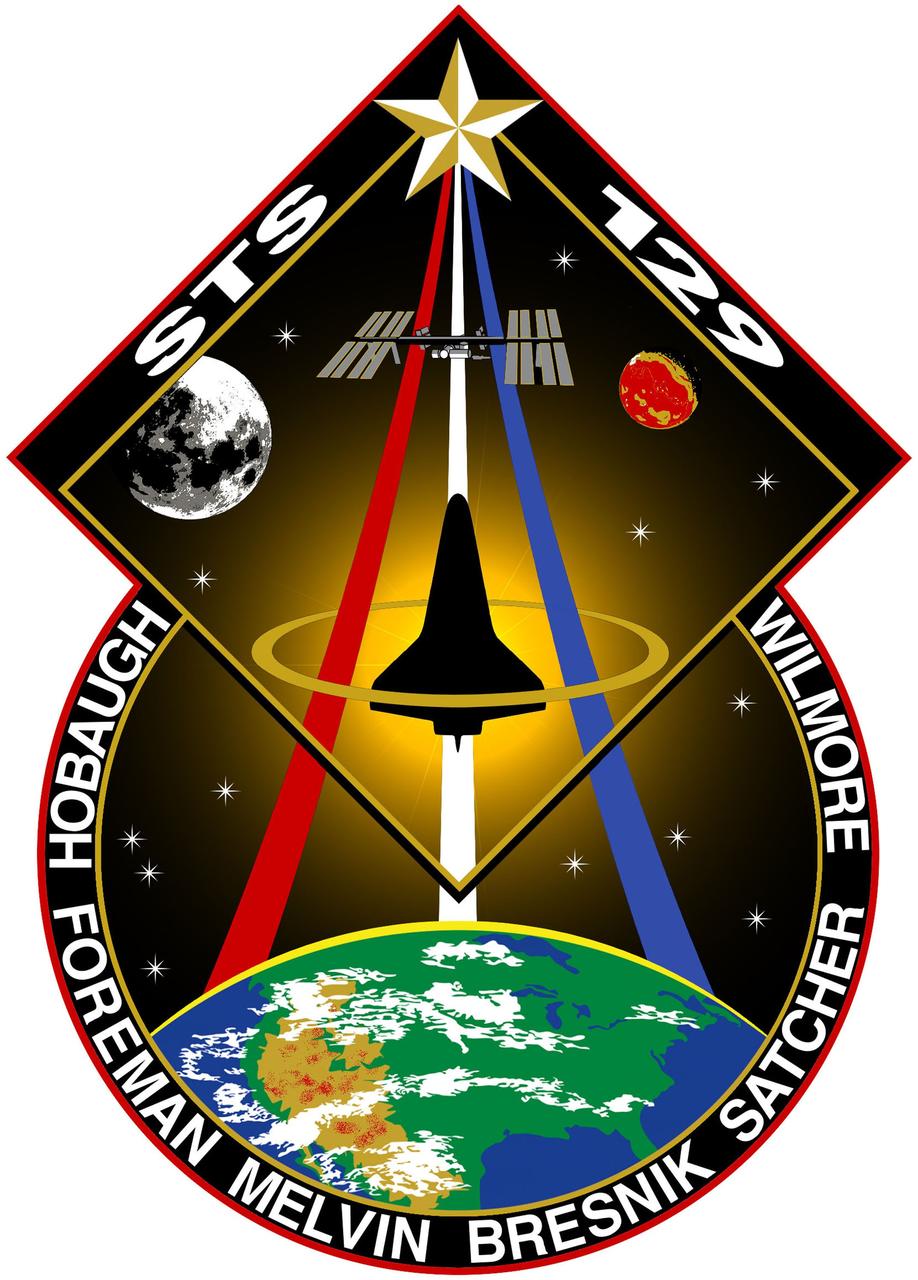
JOHNSON SPACE CENTER, Houston - STS129-S-001 -- For STS-129 the sun shines brightly on the International Space Station (ISS) above and the United States below representing the bright future of U.S. human spaceflight. The contiguous U.S., Rocky Mountains, and Great Desert Southwest are clearly visible on the earth below encompassing all the NASA centers and the homes of the many dedicated people that work to make our Space Program possible. The integrated shapes of the patch signifying the two Express Logistics Carriers that will be delivered by STS-129 providing valuable equipment ensuring the longevity of the ISS. The Space Shuttle is vividly silhouetted by the sun highlighting how brightly the Orbiters have performed as a workhorse for the U.S. Space Program over the past 3 decades. The Space Shuttle ascends on the Astronaut symbol portrayed by the Red, White and Blue swoosh bounded by the gold halo. This symbol is worn with pride by this U.S. crew representing their country on STS-129. The names of the crew members are denoted on the outer band of the patch. As STS-129 launches, the Space Shuttle is in its twilight years. This fact is juxtaposed by the 13 stars on the patch which are symbolic of our children who are the future. The Moon and Mars feature predominantly to represent just how close humankind is to reaching further exploration of those heavenly bodies and how the current Space Shuttle and ISS missions are laying the essential ground work for those future endeavors. The NASA insignia for design for Shuttle flights is reserved for use by the astronauts and for other official use as the NASA Administrator may authorize. Public availability has been approved only in the form of illustrations by the various news media. When and if there is any change in this policy which is not anticipated, it will be publicly announced. (Note: the description is provided by the crew members).
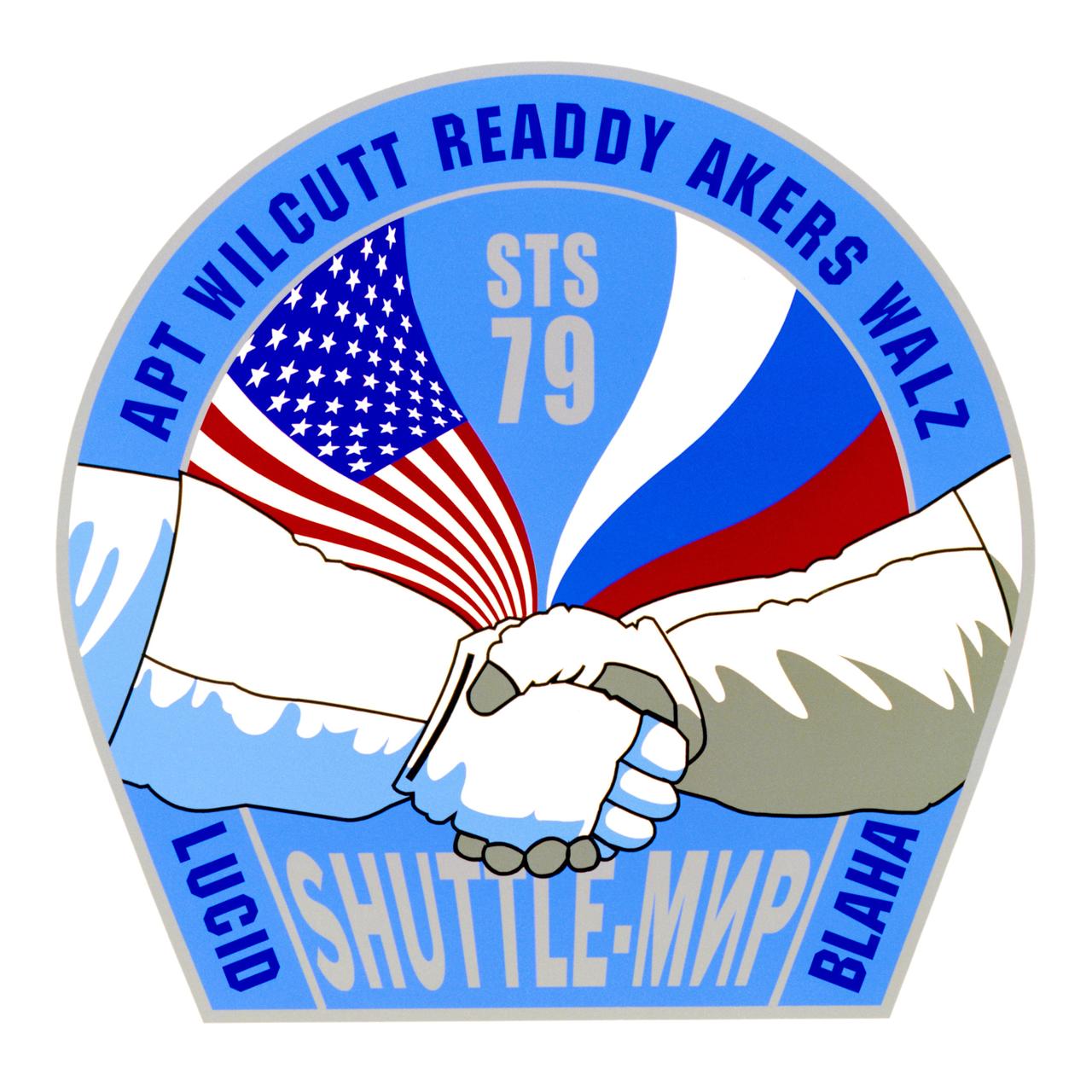
STS79-S-001 (April 1996) --- STS-79 is the fourth in a series of NASA docking missions to the Russian Mir Space Station, leading up to the construction and operation of the International Space Station (ISS). As the first flight of the Spacehab Double Module, STS-79 encompasses research, test and evaluation of ISS, as well as logistics resupply for the Mir Space Station. STS-79 is also the first NASA-Mir American crew member exchange mission, with John E. Blaha (NASA-Mir-3) replacing Shannon W. Lucid (NASA-Mir-2) aboard the Mir Space Station. The lettering of their names either up or down denotes transport up to the Mir Space Station or return to Earth on STS-79. The patch is in the shape of the space shuttle?s airlock hatch, symbolizing the gateway to international cooperation in space. The patch illustrates the historic cooperation between the United States and Russia in space. With the flags of Russia and the United States as a backdrop, the handshake of Extravehicular Mobility Unit (EMU) - suited crew members symbolizes mission teamwork, not only of the crew members but also the teamwork between both countries? space personnel in science, engineering, medicine and logistics. The NASA insignia design for space shuttle flights is reserved for use by the astronauts and for other official use as the NASA Administrator may authorize. Public availability has been approved only in the forms of illustrations by the various news media. When and if there is any change in this policy, which is not anticipated, the change will be publicly announced. Photo credit: NASA
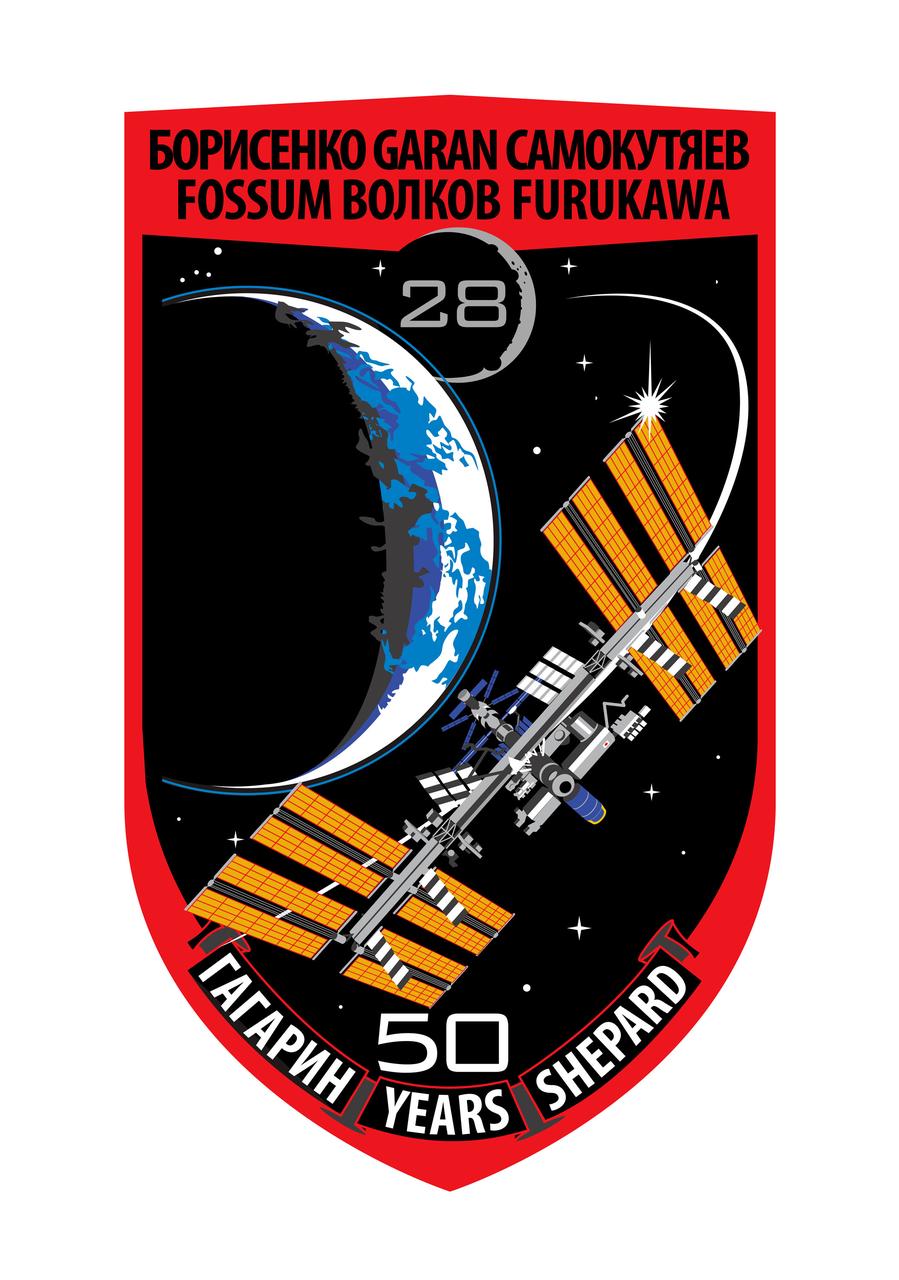
ISS028-S-001 (September 2010) --- In the foreground of the Expedition 28 patch, the International Space Station is prominently displayed to acknowledge the efforts of the entire International Space Station (ISS) team - both the crews who have assembled and operated it, and the team of scientists, engineers, and support personnel on Earth who have provided a foundation for each successful mission. Their efforts and accomplishments have demonstrated the Space Station?s capabilities as a technology test bed and a science laboratory, as well as a path to the human exploration of our solar system and beyond. This Expedition 28 patch represents the teamwork among the international partners ? USA, Russia, Japan, Canada, and the ESA - and the ongoing commitment from each partner to build, improve, and utilize the ISS. Prominently displayed in the background is our home planet, Earth - the focus of much of our exploration and research on our outpost in space. Also prominently displayed in the background is the Moon. The Moon is included in the design to stress the importance of our planet?s closest neighbor to the future of our world. Expedition 28 is scheduled to occur during the timeframe of the 50th anniversary of both the first human in space, Russian cosmonaut Yuri Gagarin and the first American in space, astronaut, Alan Shepard. To acknowledge the significant milestone of 50 years of human spaceflight, the names ????????? and ?Shepard? as well as ?50 Years? are included in the patch design. The NASA insignia design for shuttle and space station flights is reserved for use by the astronauts and for other official use as the NASA Administrator may authorize. Public availability has been approved only in the forms of illustrations by the various news media. When and if there is any change in this policy, which is not anticipated, the change will be publicly announced. Photo credit: NASA and its international partners.
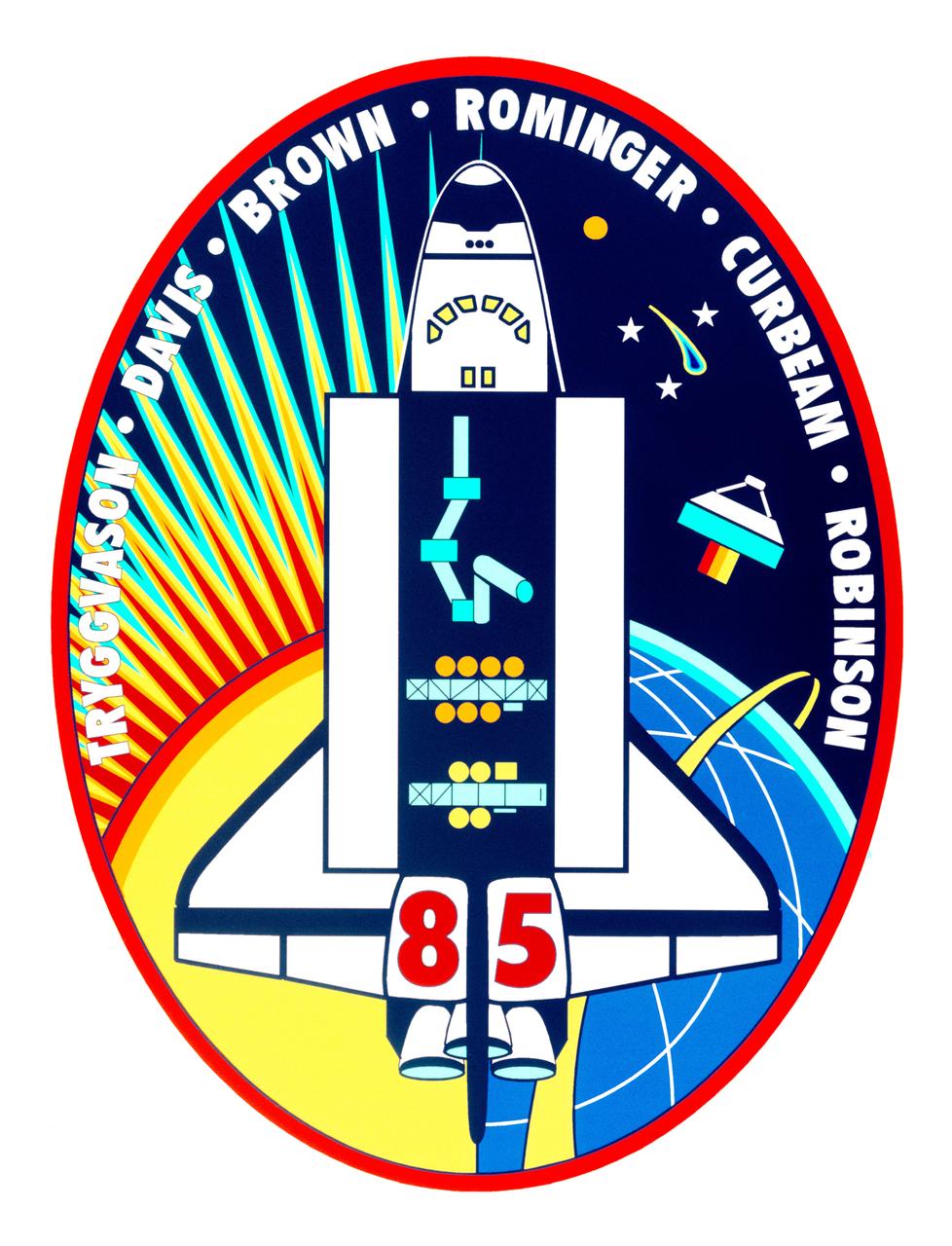
STS085-S-001 (May 1997) --- The mission patch for STS-85 is designed to reflect the broad range of science and engineering payloads on the flight. The primary objectives of the mission are to measure chemical constituents in Earth?s atmosphere with a free-flying satellite and to flight-test a new Japanese robotic arm designed for use on the International Space Station (ISS). STS-85 is the second flight of the satellite known as CRISTA-SPAS-02. CRISTA, depicted on the right side of the patch pointing its trio of infrared telescopes at Earth?s atmosphere, stands for Cryogenic Infrared Spectrometers and Telescopes for the Atmosphere. The high inclination orbit is shown as a yellow band over Earth?s northern latitudes. In the space shuttle Discovery?s open payload bay an enlarged version of the Japanese National Space Development Agency?s (NASDA) Manipulator Flight Demonstration (MFD) robotic arm is shown. Also shown in the payload bay are two sets of multi-science experiments: the International Extreme Ultraviolet Hitchhiker (IEH-02) nearest the tail and the Technology Applications and Science (TAS-01) payload. Jupiter and three stars are shown to represent sources of ultraviolet energy in the universe. Comet Hale-Bopp, which will be visible from Earth during the mission, is depicted at upper right. The left side of the patch symbolizes daytime operations over the Northern Hemisphere of Earth and the solar science objectives of several of the payloads. The NASA insignia design for space shuttle flights is reserved for use by the astronauts and for other official use as the NASA Administrator may authorize. Public availability has been approved only in the forms of illustrations by the various news media. When and if there is any change in this policy, which is not anticipated, the change will be publicly announced. Photo credit: NASA
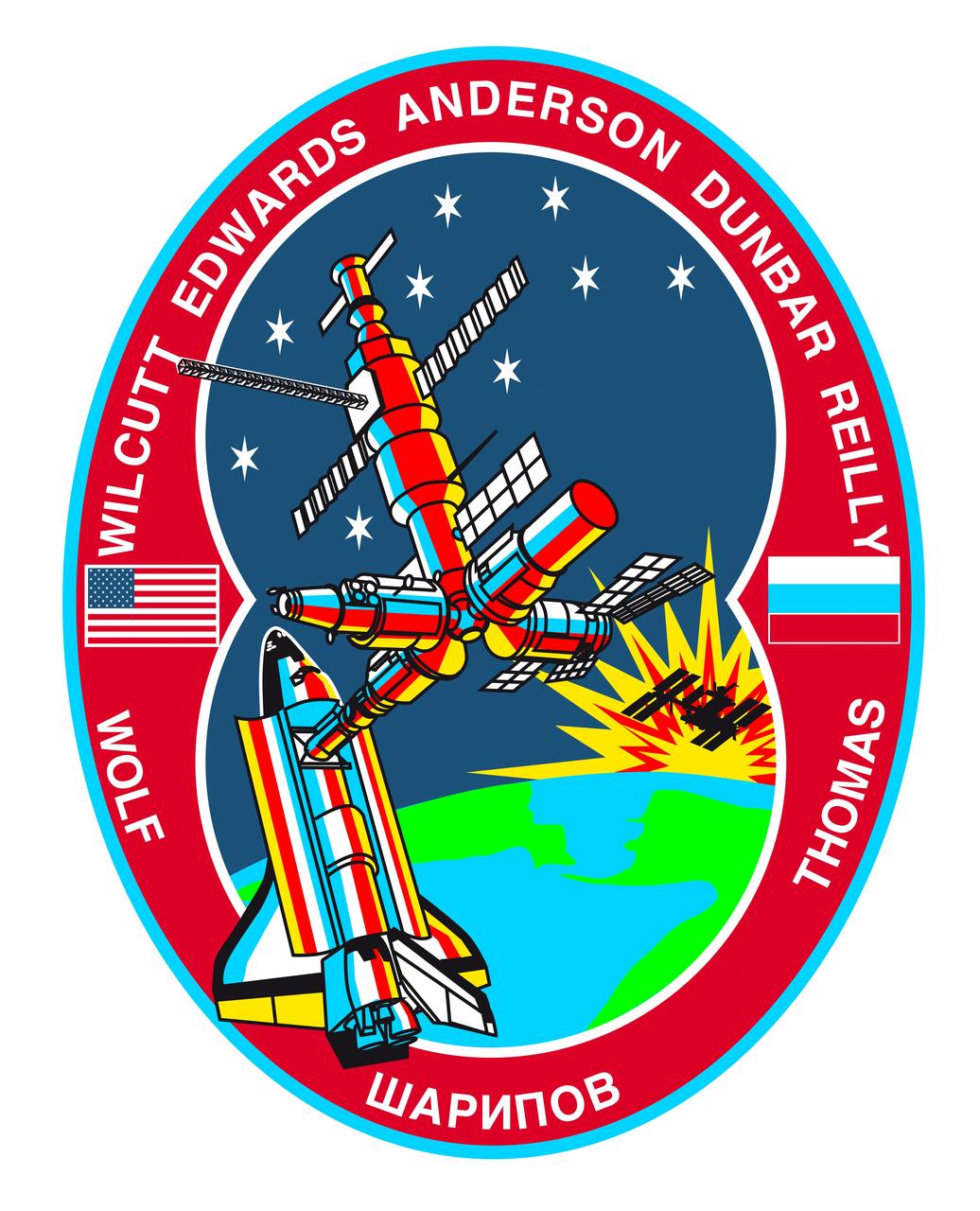
STS089-S-001 (October 1997) --- The link between the United States and Russia is symbolically represented by the space shuttle Endeavour and Russia?s Mir Space Station orbiting above the Bering Strait between Siberia and Alaska. The success of the joint United States-Russian missions is depicted by the space shuttle and Mir colored by the rising sun in the background. A shadowed representation of the International Space Station (ISS) rising with the sun represents the future program for which the Shuttle-Mir missions are prototypes. The inside rim of the insignia describes the outline of the number eight representing STS-89 as the eighth Shuttle/Mir docking mission. The nine stars represent the nine joint missions to be flown of the program and ? when combined with the number eight in the rim -- reflect the mission number. The nine stars also symbolize the children of the crew members who will be the future beneficiaries of the joint development work of the space programs of the two countries. Along the rim are the crew members? names with David A. Wolf?s name on the left and Andrew S. W. Thomas? name on the right, the returning and upgoing cosmonaut guest researcher crew members. In between and at the bottom is the name of Salizan S. Sharipov, mission specialist representing Russian Space Agency (RSA), in Cyrillic alphabet. The other crew members are Terrence W. Wilcutt, commander; Joe F. Edwards Jr., pilot; and mission specialists Michael P. Anderson, Bonnie J. Dunbar, and James F. Reilly. The red, white and blue of the rim reflect the colors of the American and Russian flags which are also represented in the rim on either side of the joined spacecraft. The NASA insignia design for space shuttle flights is reserved for use by the astronauts and for other official use as the NASA Administrator may authorize. Public availability has been approved only in the forms of illustrations by the various news media. When and if there is any change in this policy, which is not anticipated, the change will be publicly announced. Photo credit: NASA