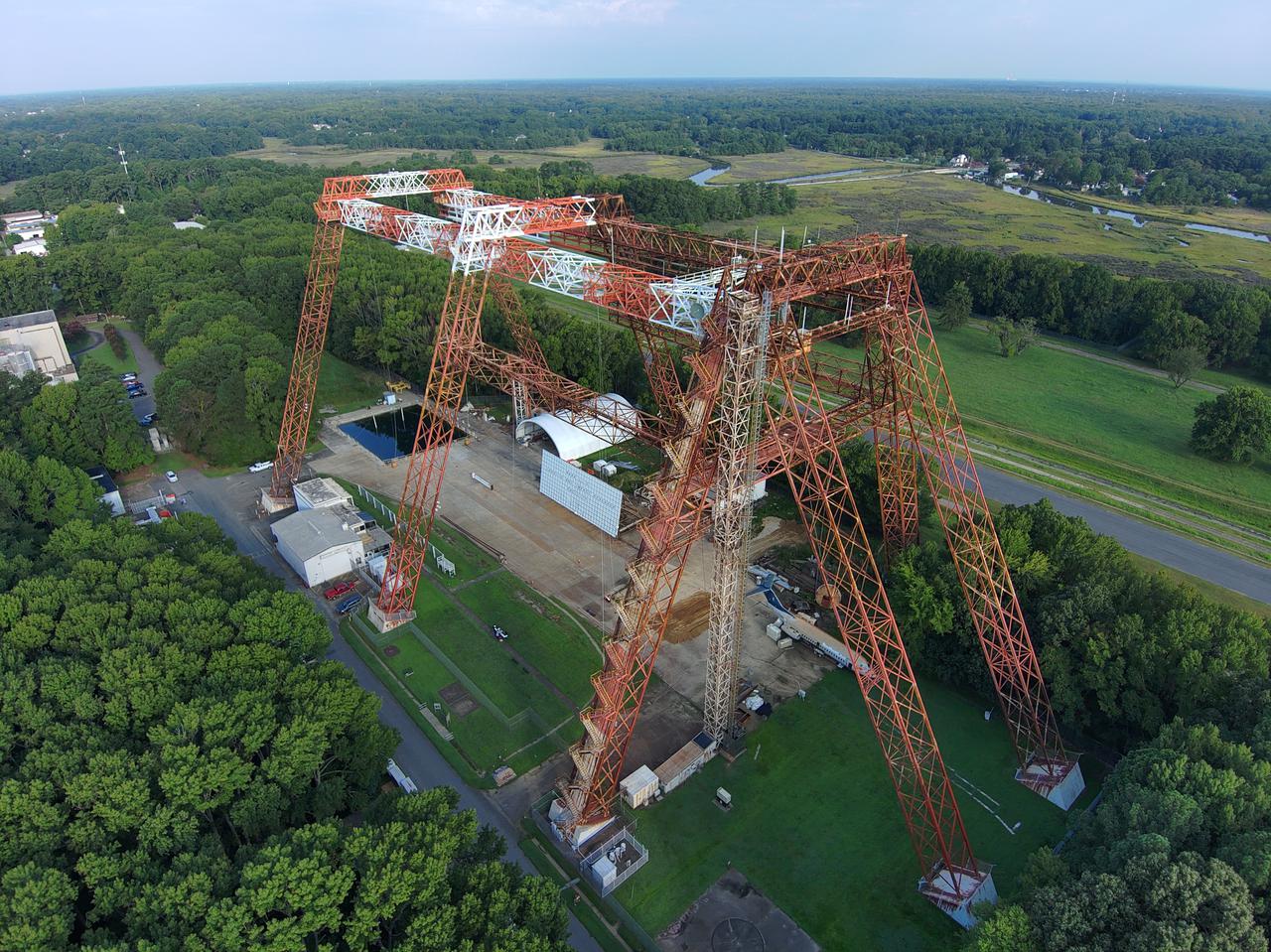
Langley’s historic Impact Dynamics Facility for full-scale aircraft crash testing stands on the western corner of the NASA Langley campus. In its original configuration, the “gantry” was used to train the Mercury 7
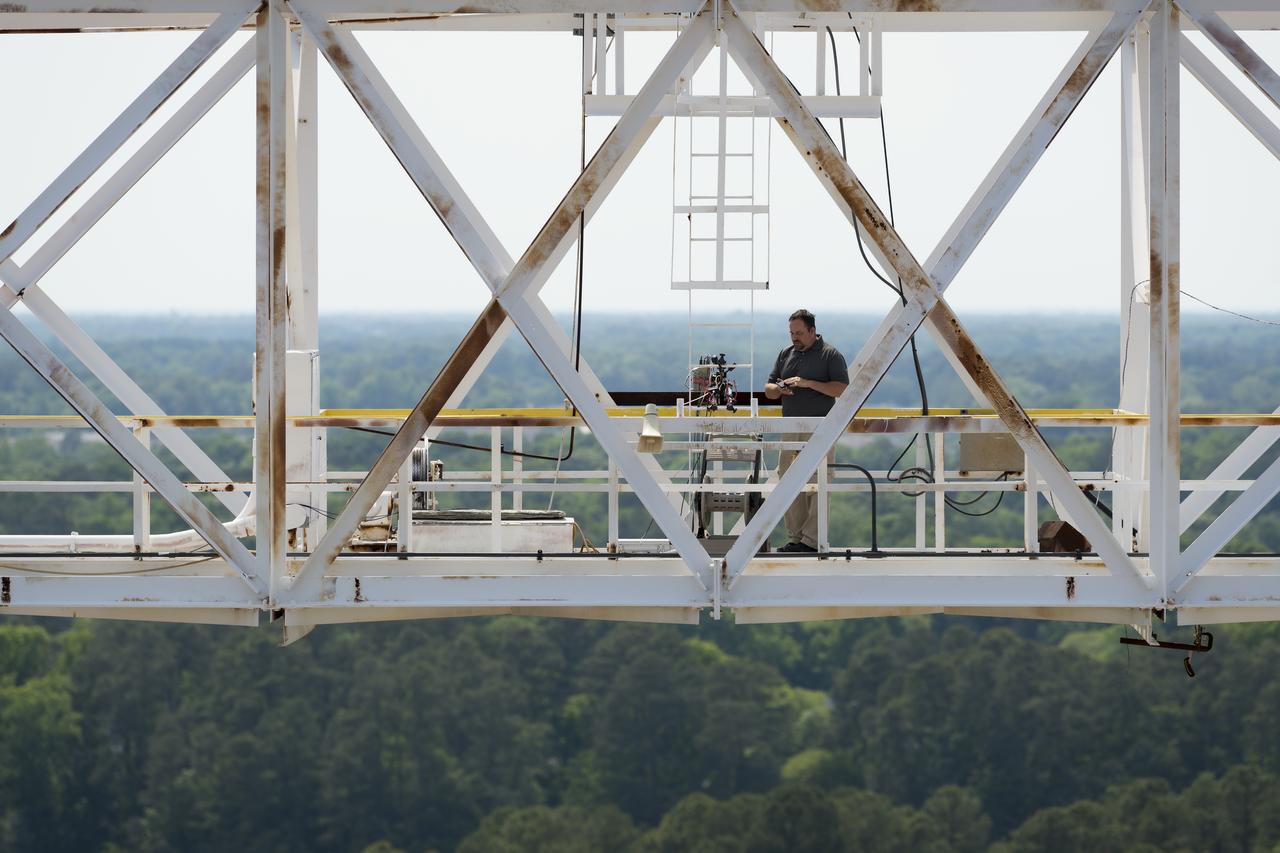
Images from Orion Structural Test Article (STA) vertical water impact testing (WIT) Swing Test 4, Photographer Harlen Capen at the top of the Impact Dynamics Facility or Gantry as it is know at NASA Langley Research Center.
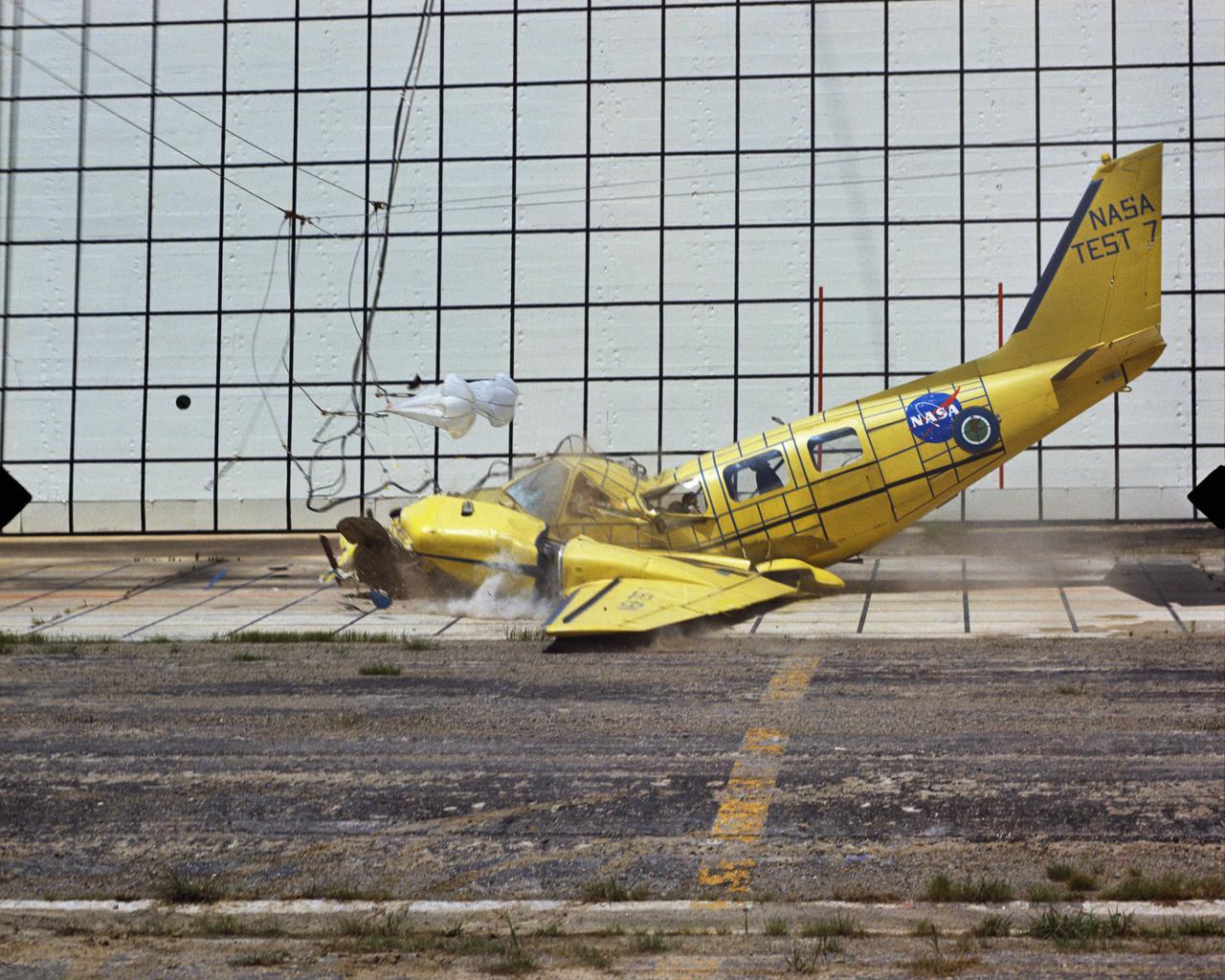
Photographed on: 08/03/75. -- By 1972 the Lunar Landing Research Facility was no longer in use for its original purpose. The 400-foot high structure was swiftly modified to allow engineers to study the dynamics of aircraft crashes. "The Impact Dynamics Research Facility is used to conduct crash testing of full-scale aircraft under controlled conditions. The aircraft are swung by cables from an A-frame structure that is approximately 400 ft. long and 230 foot high. The impact runway can be modified to simulate other grand crash environments, such as packed dirt, to meet a specific test requirement." "In 1972, NASA and the FAA embarked on a cooperative effort to develop technology for improved crashworthiness and passenger survivability in general aviation aircraft with little or no increase in weight and acceptable cost. Since then, NASA has "crashed" dozens of GA aircraft by using the lunar excursion module (LEM) facility originally built for the Apollo program." This photograph shows Crash Test No. 7. Crash Test: Test #7
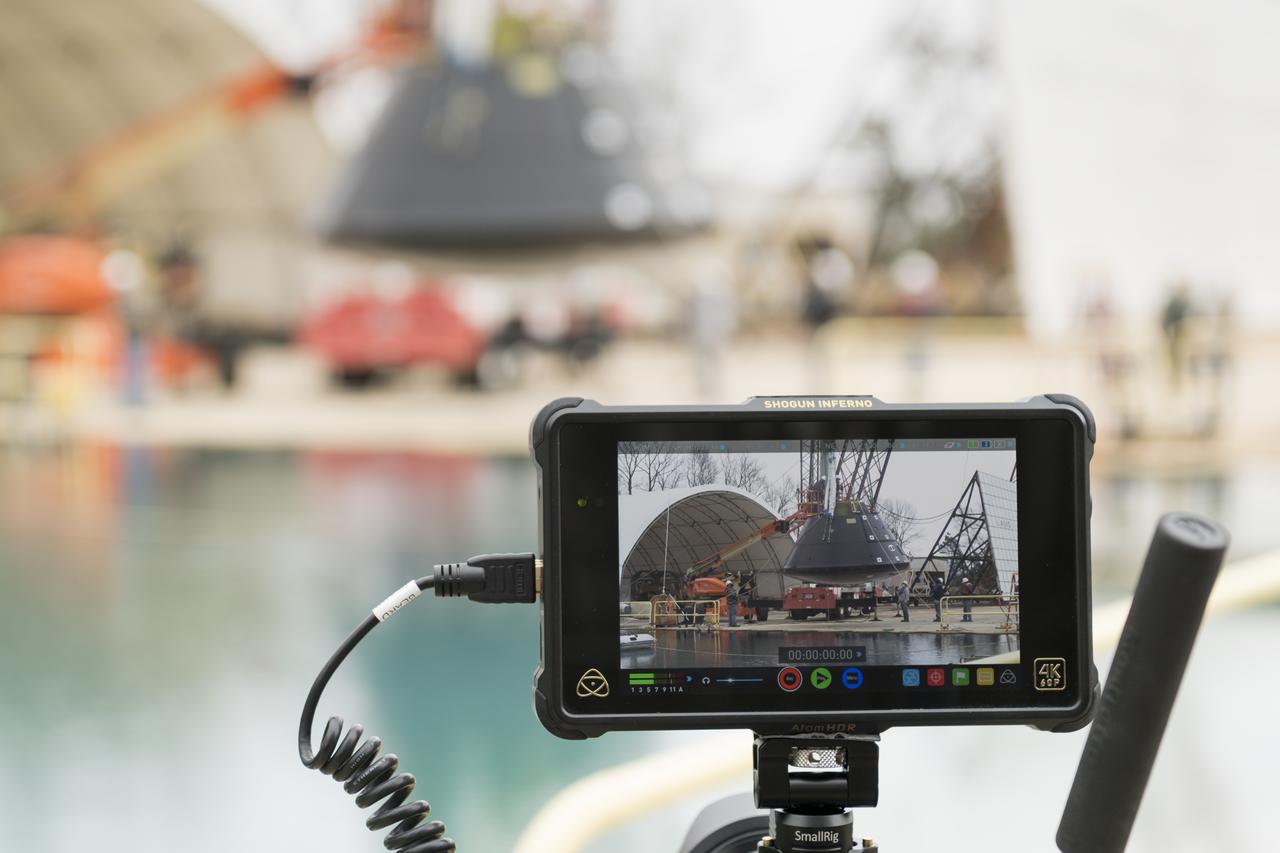
Images of Structural Test Article (STA) vertical water impact testing (WIT) testing at Impact Dynamics Facility NASA Langley Research Center.
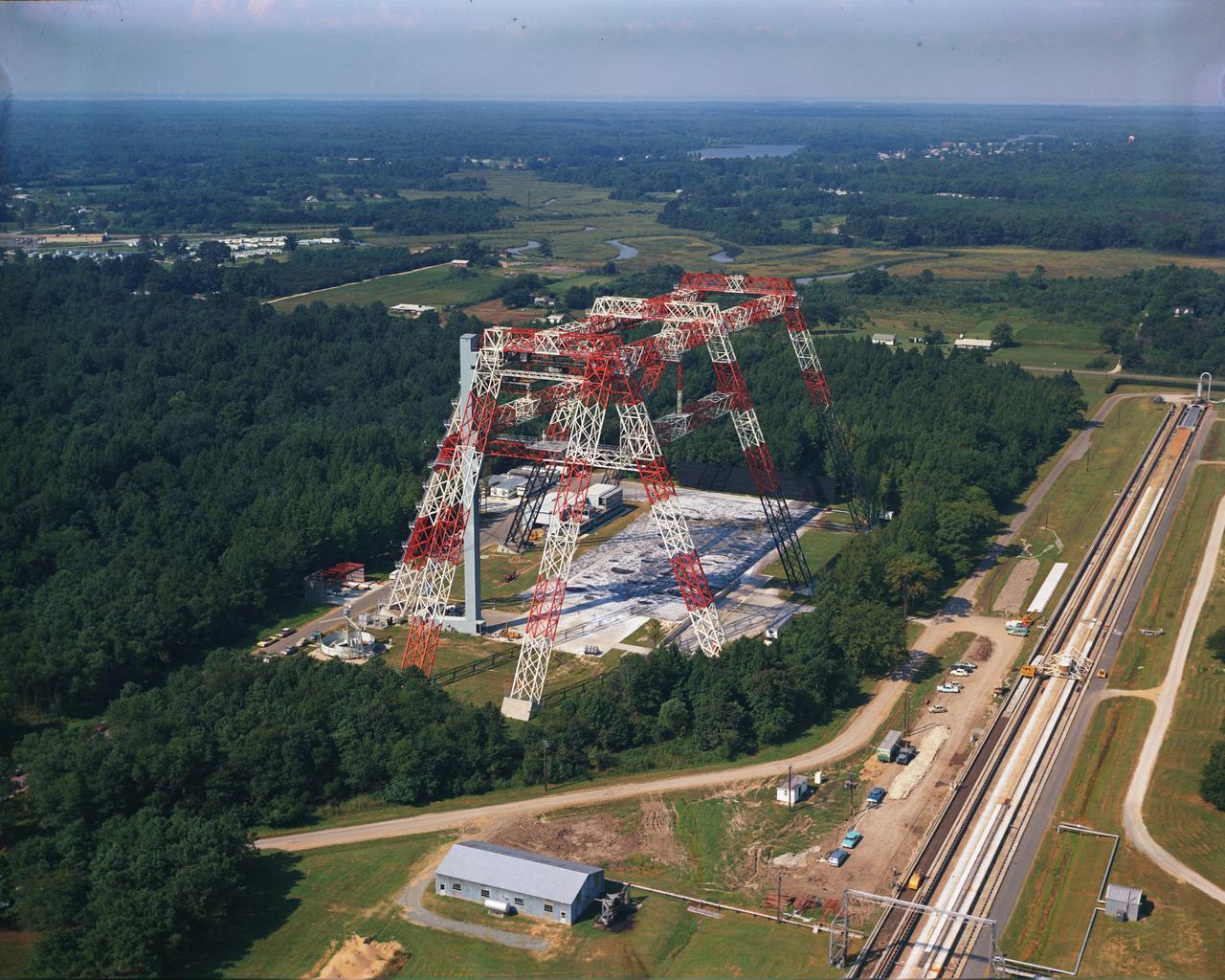
Aerial views of Gantry and moonscape pavement below. Building 1297 Impact Dynamic Research Facility
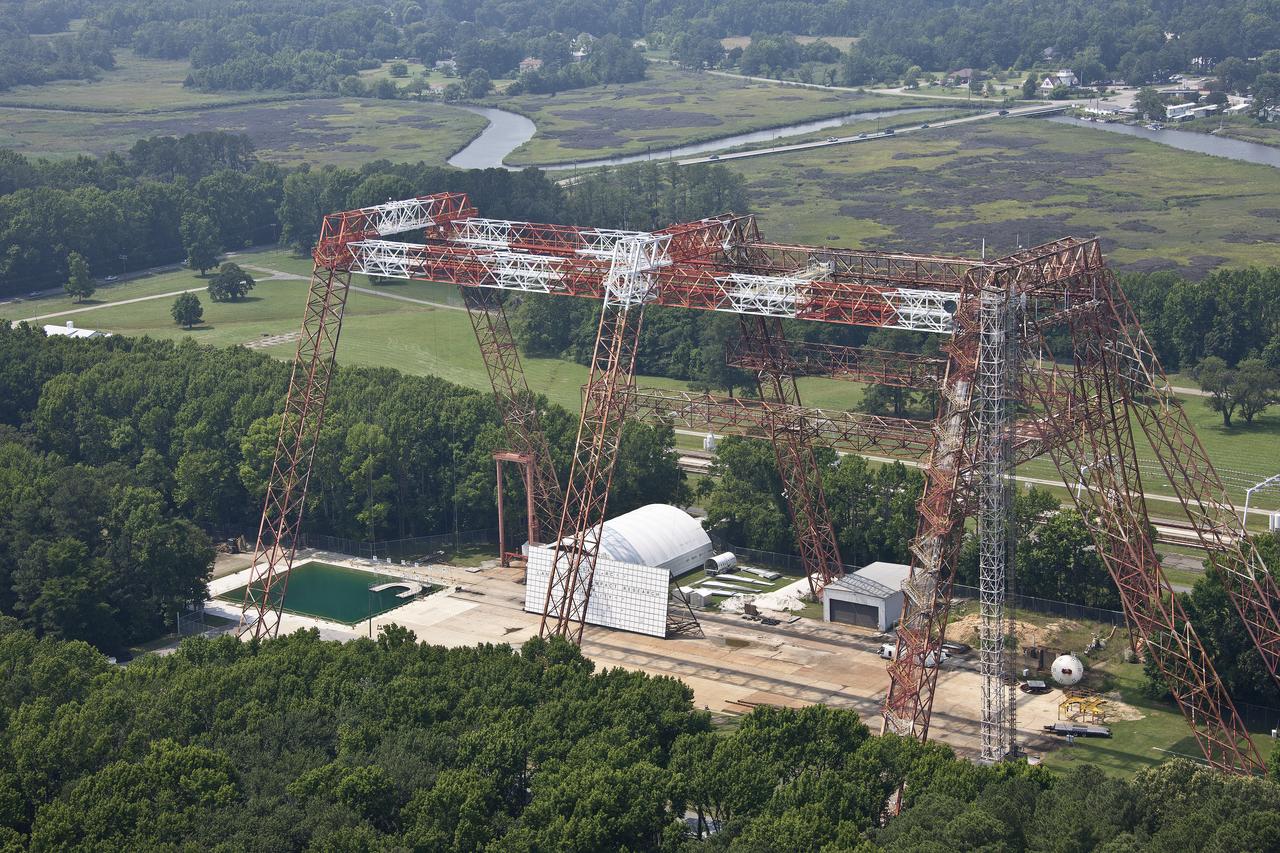
Aerial of NASA Langley's Gantry and slashdown pool also known as Impact Dynamic Faciltiy
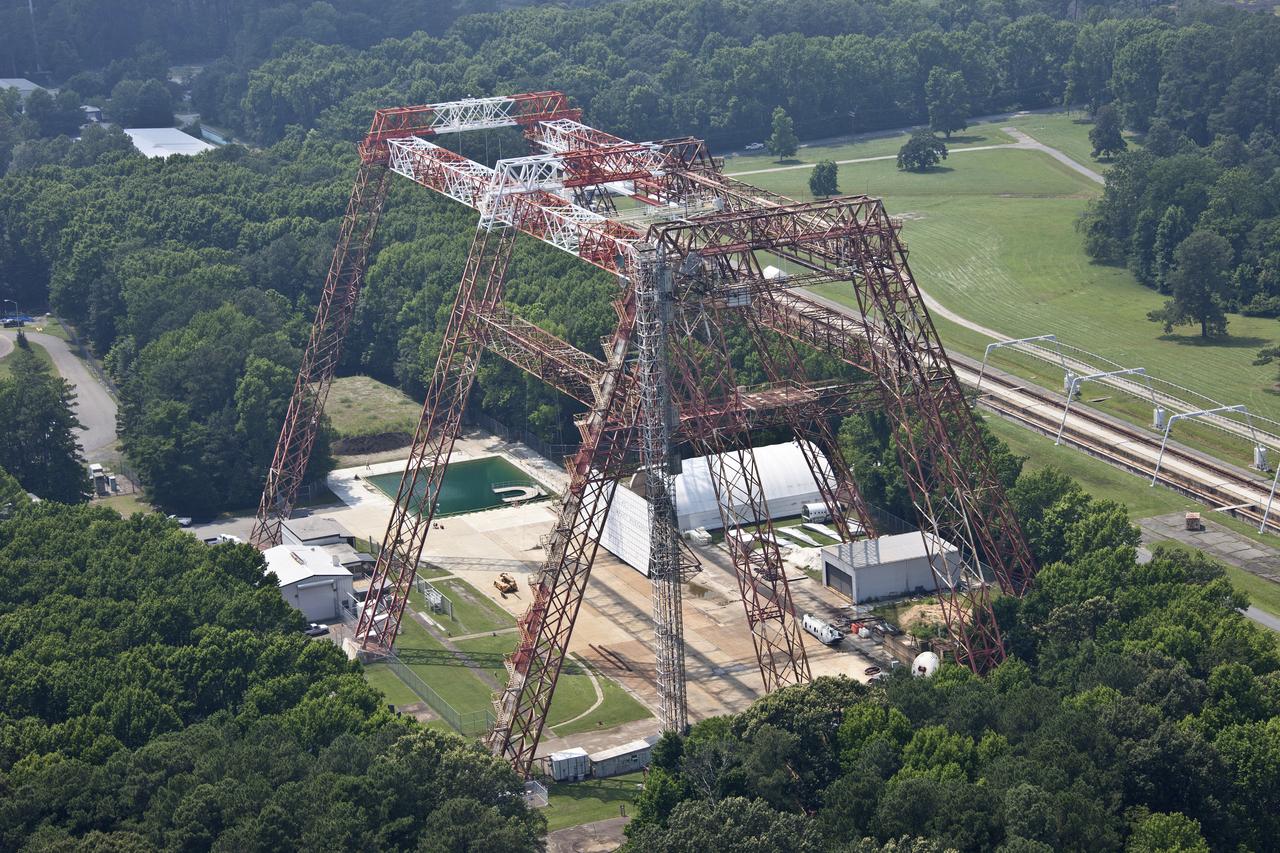
Aerial of NASA Langley's Gantry and slashdown pool also known as Impact Dynamic Faciltiy
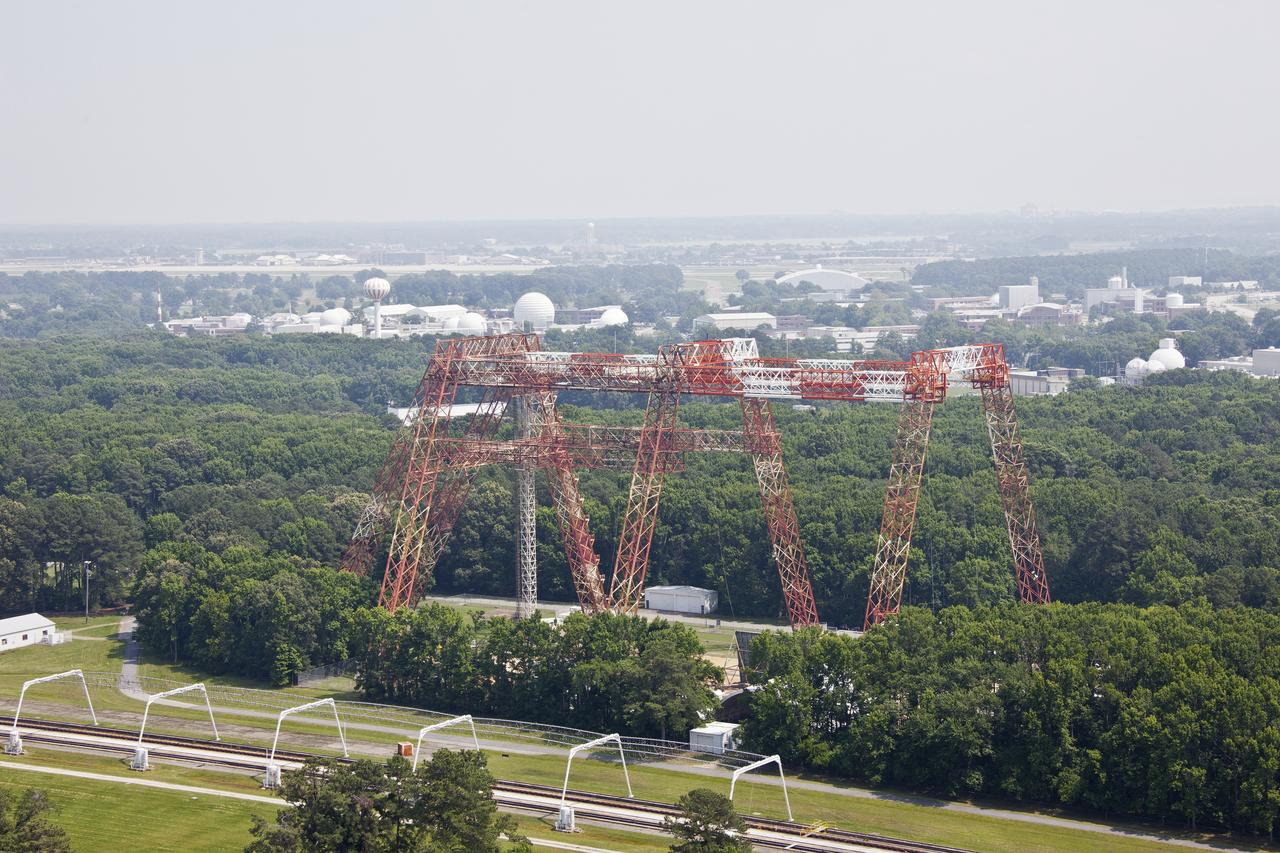
Aerial of NASA Langley's Gantry and slashdown pool also known as Impact Dynamic Faciltiy
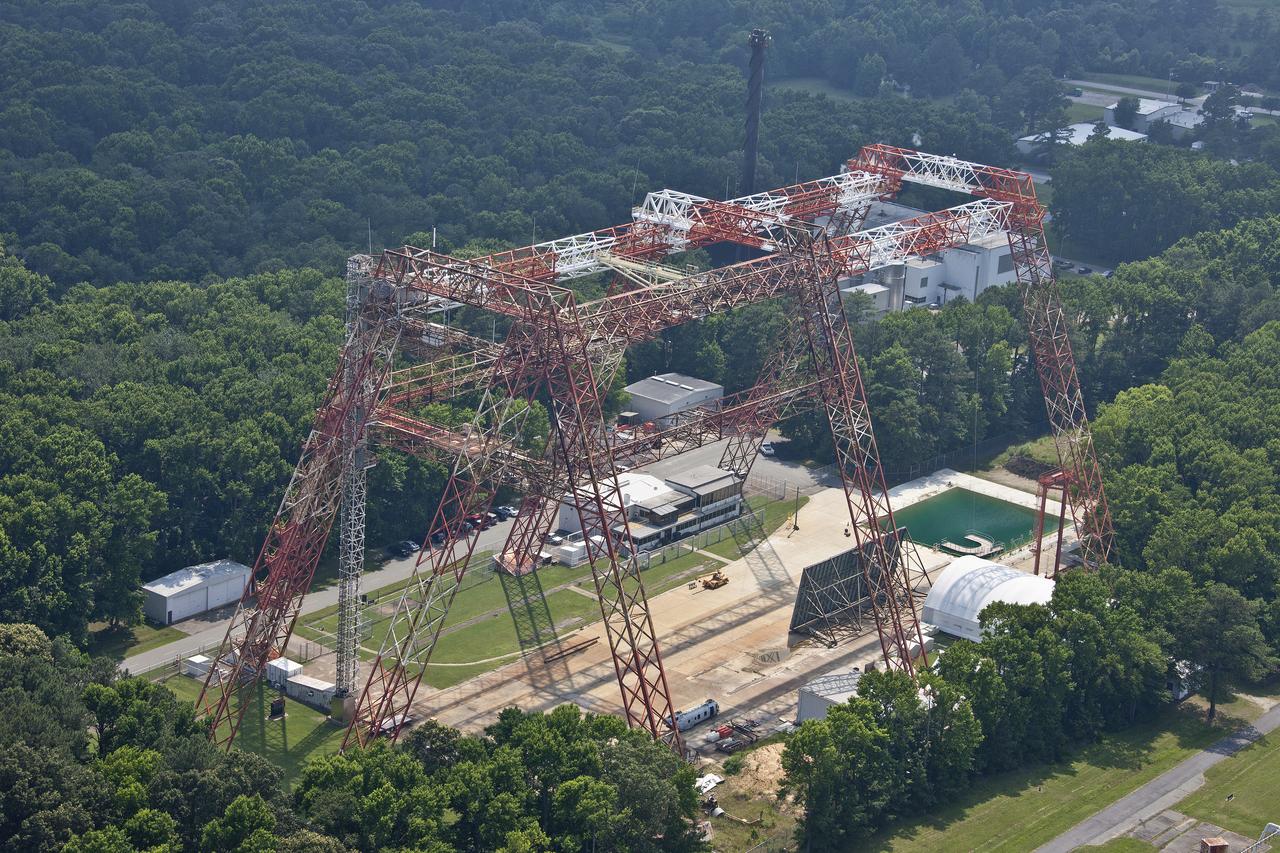
Aerial of NASA Langley's Gantry and slashdown pool also known as Impact Dynamic Faciltiy
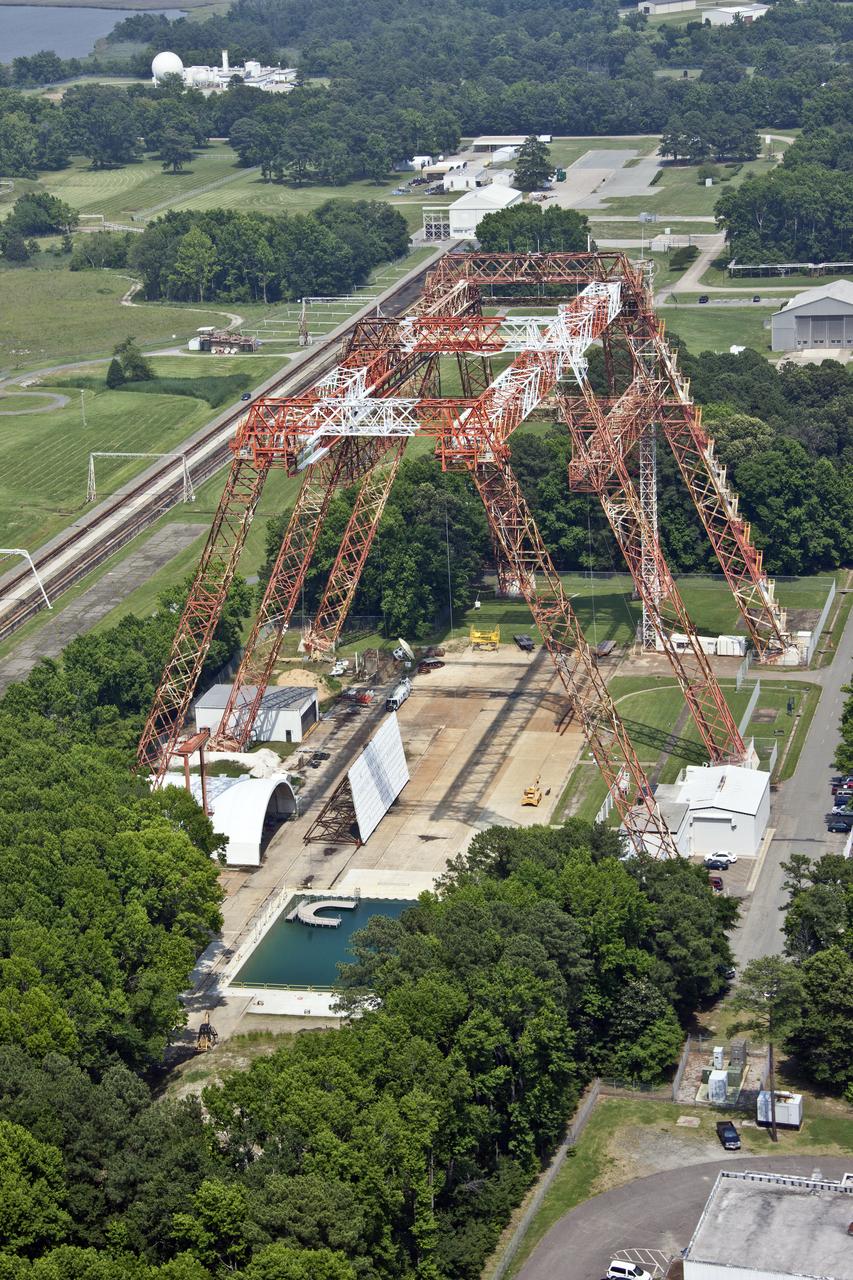
Aerial of NASA Langley's Gantry and slashdown pool also known as Impact Dynamic Faciltiy
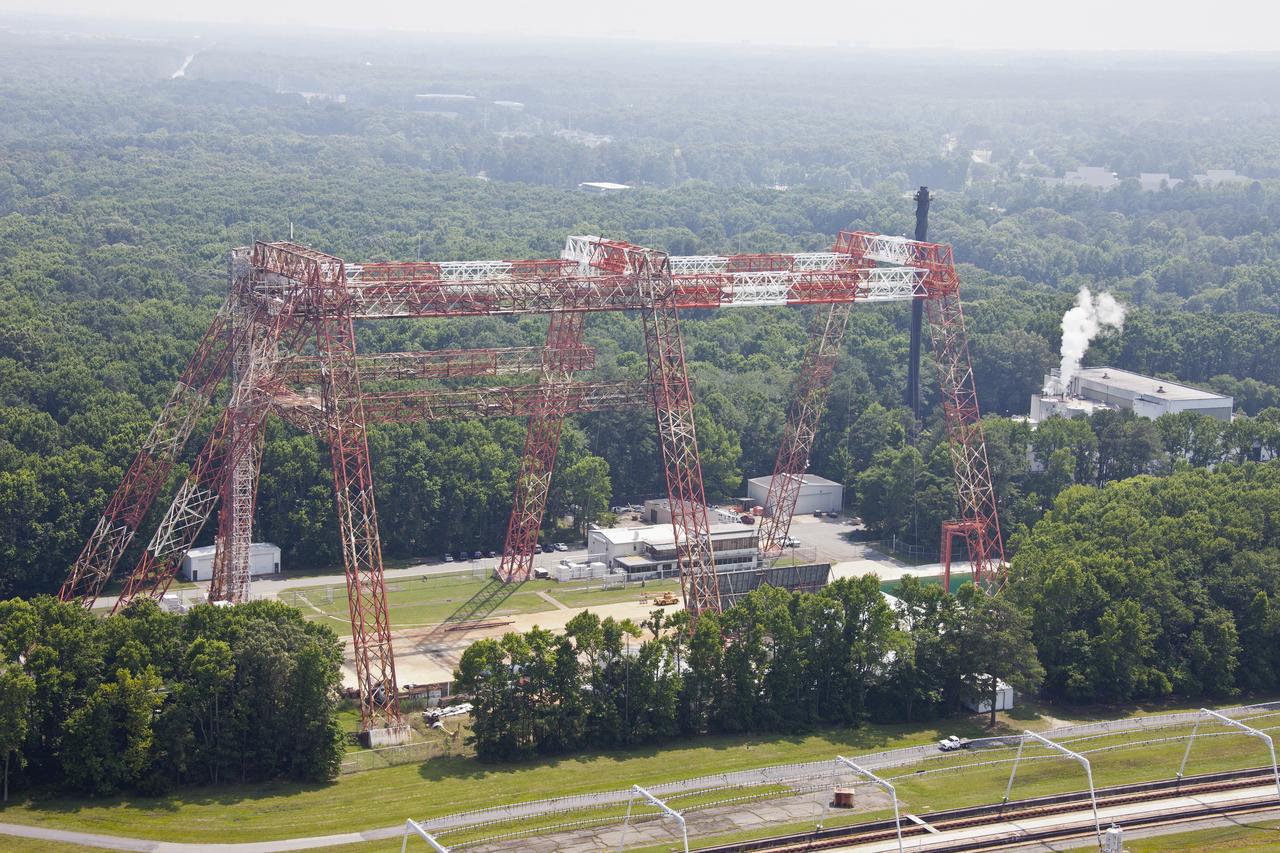
Aerial of NASA Langley's Gantry and slashdown pool also known as Impact Dynamic Faciltiy
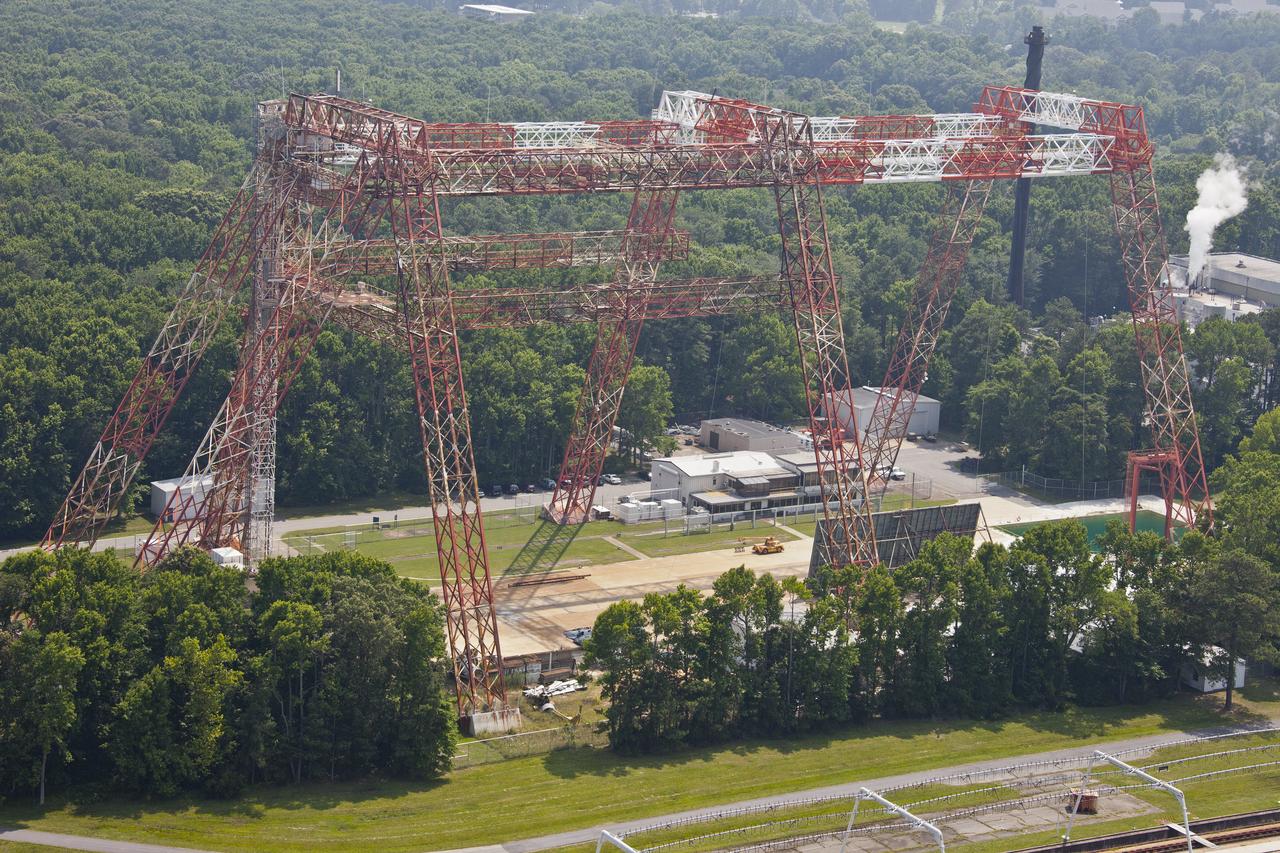
Aerial of NASA Langley's Gantry and slashdown pool also known as Impact Dynamic Faciltiy
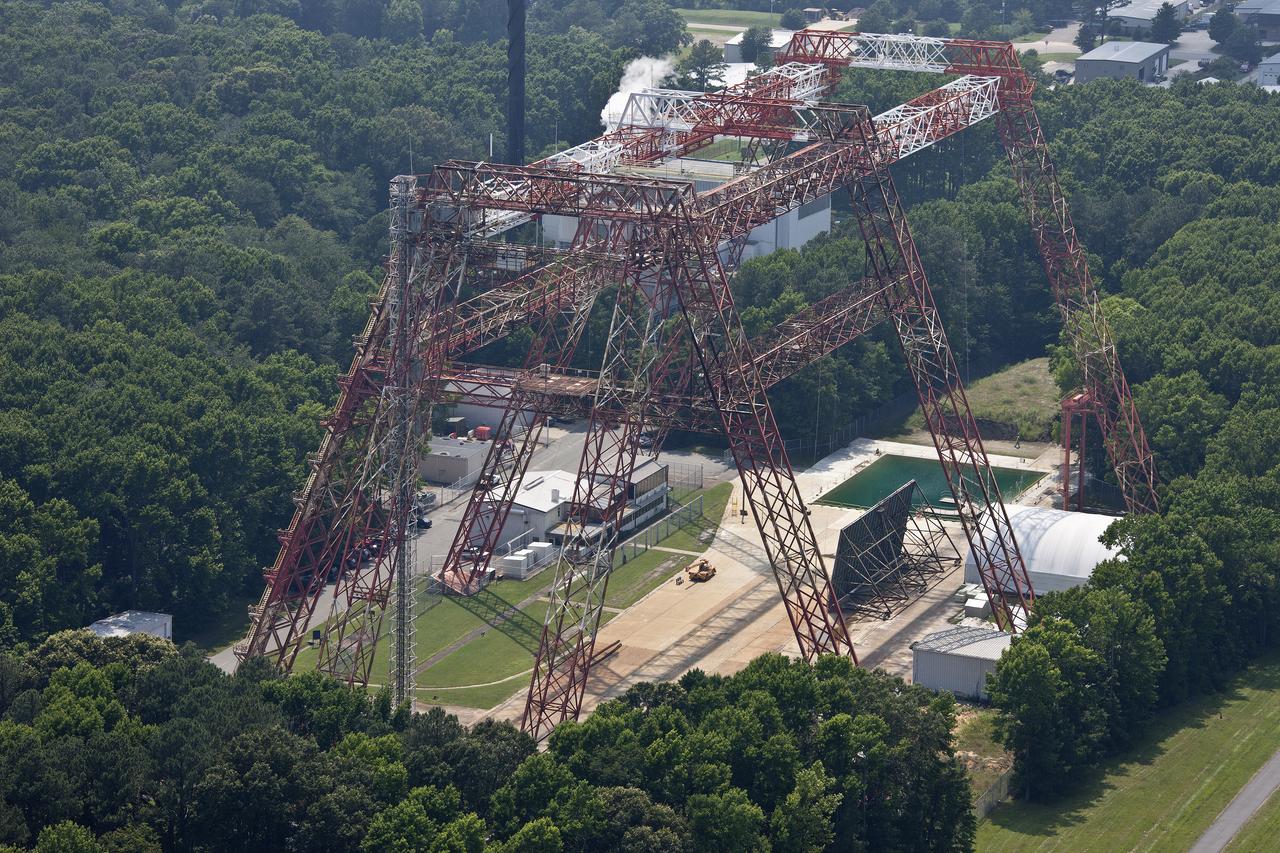
Aerial of NASA Langley's Gantry and slashdown pool also known as Impact Dynamic Faciltiy
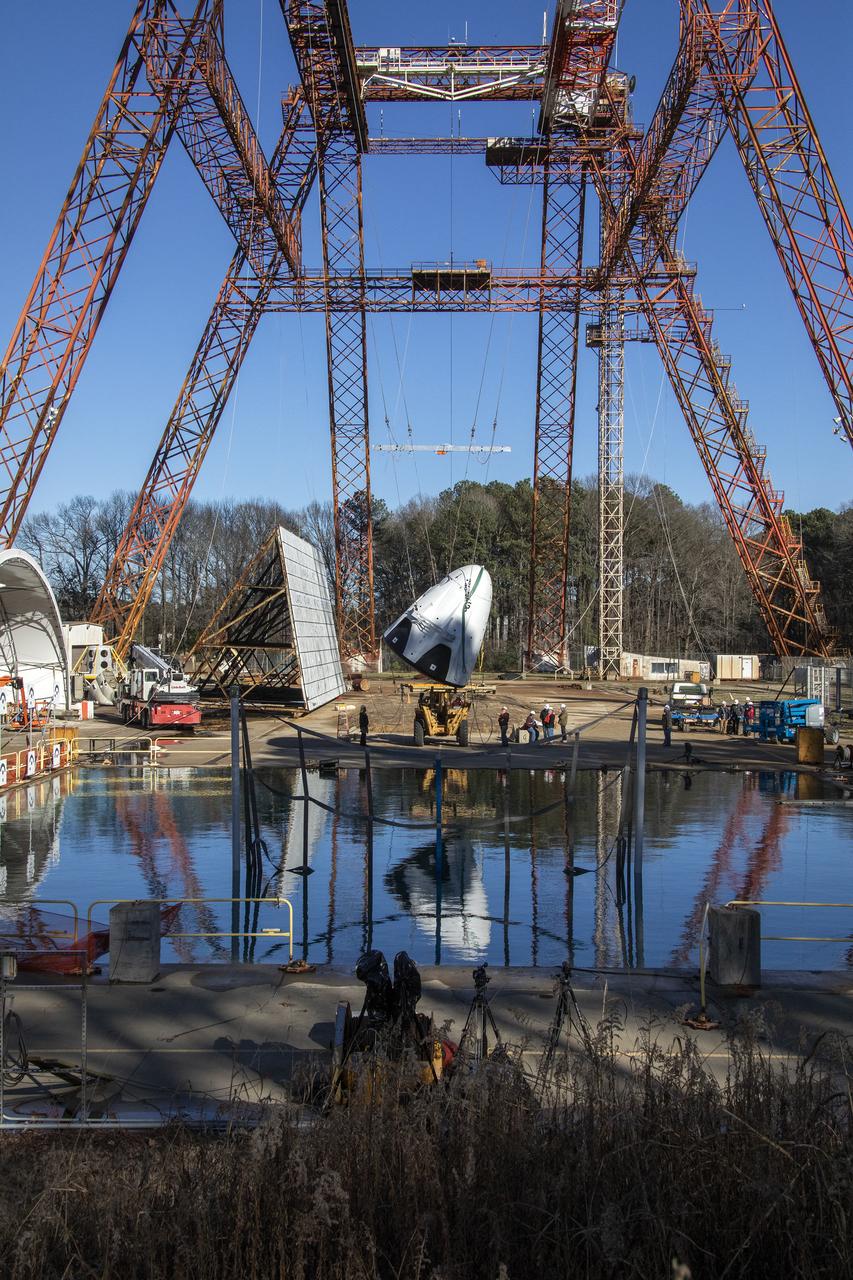
The Space X capsule being tested at NASA Langley’s Splash Test Basin. A series of drop tests into the Hydro Impact Basin at the Landing and Impact Research Facility at NASA’s Langley Research Center in Hampton, Virginia helped SpaceX’s Crew Dragon capsule prepare to safely land astronauts. A mock-up of the capsule with two instrumented crash test devices seated inside was tested in March 2019, representing how the capsule may impact the water during splashdown with different wind and parachute dynamics. Data collected helps understand pressures on the capsule and how those forces affect the spacecraft and occupants. Crew Dragon will carry NASA astronauts Bob Behnken and Doug Hurley to the International Space Station in the Demo-2 mission, the final SpaceX flight test for NASA’s Commercial Crew Program and the first flight of astronauts to orbit from U.S. soil since the space shuttle’s retirement in 2011. (NASA/ David C. Bowman)
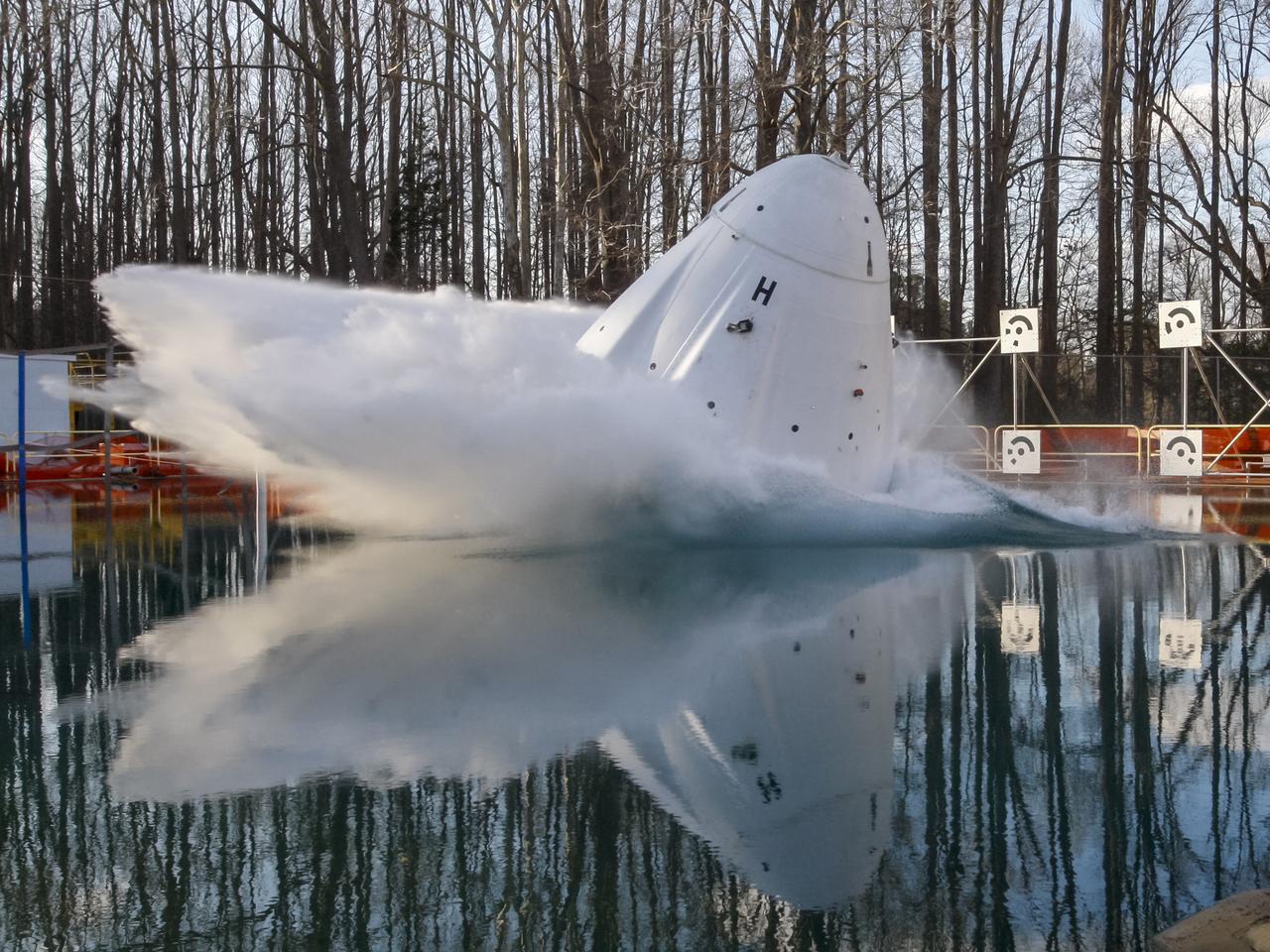
The Space X capsule being tested at NASA Langley’s Splash Test Basin. A series of drop tests into the Hydro Impact Basin at the Landing and Impact Research Facility at NASA’s Langley Research Center in Hampton, Virginia helped SpaceX’s Crew Dragon capsule prepare to safely land astronauts. A mock-up of the capsule with two instrumented crash test devices seated inside was tested in March 2019, representing how the capsule may impact the water during splashdown with different wind and parachute dynamics. Data collected helps understand pressures on the capsule and how those forces affect the spacecraft and occupants. Crew Dragon will carry NASA astronauts Bob Behnken and Doug Hurley to the International Space Station in the Demo-2 mission, the final SpaceX flight test for NASA’s Commercial Crew Program and the first flight of astronauts to orbit from U.S. soil since the space shuttle’s retirement in 2011. (NASA/ David C. Bowman)
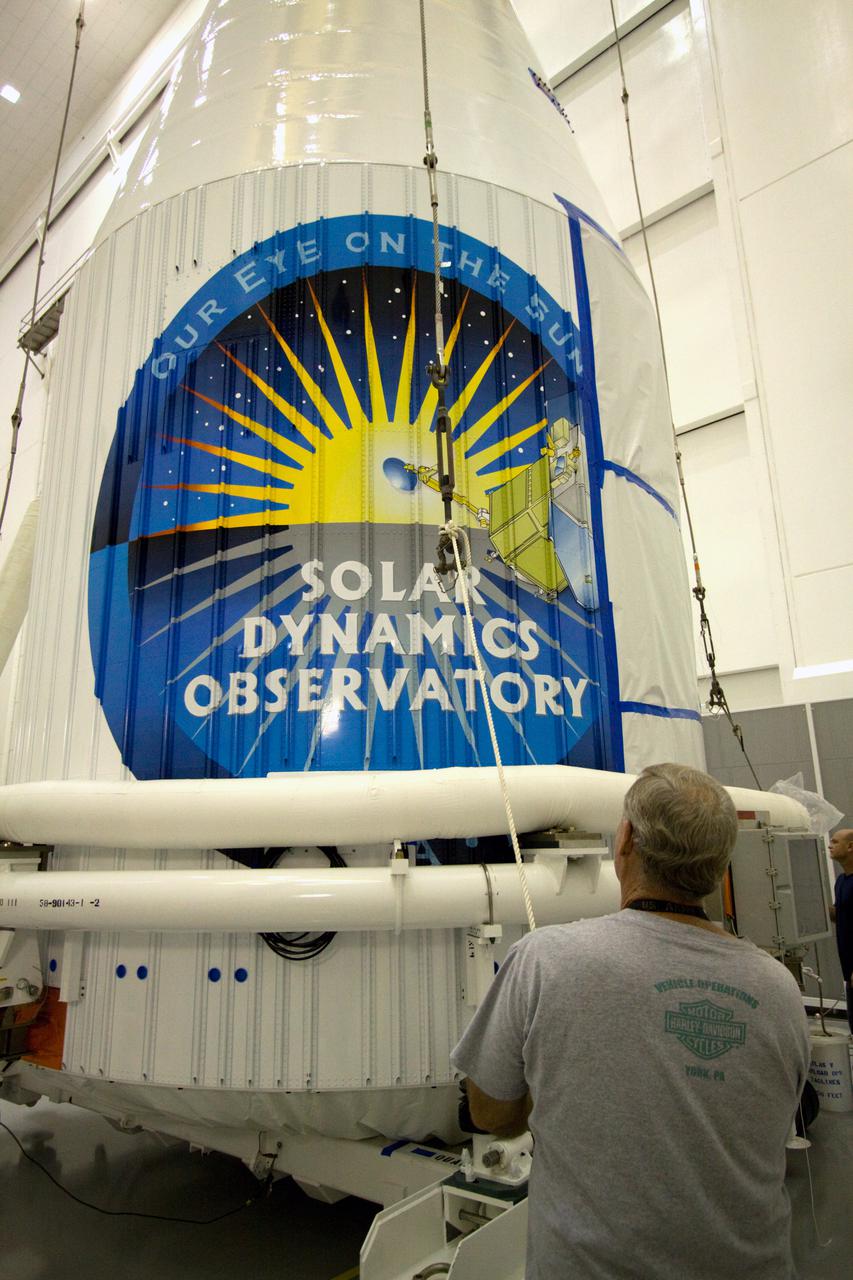
CAPE CANAVERAL, Fla. – At the Astrotech Space Operations facility in Titusville, Fla., the logo on the outside of the Atlas V payload fairing identifies the spacecraft enclosed within as NASA's Solar Dynamics Observatory, or SDO. Workers are preparing to lift SDO onto a transporter in the airlock. SDO is the first mission in NASA's Living With a Star Program and is designed to study the causes of solar variability and its impacts on Earth. The spacecraft's long-term measurements will give solar scientists in-depth information to help characterize the interior of the Sun, the Sun's magnetic field, the hot plasma of the solar corona, and the density of radiation that creates the ionosphere of the planets. The information will be used to create better forecasts of space weather needed to protect the aircraft, satellites and astronauts living and working in space. Liftoff aboard an Atlas V rocket is targeted for Feb. 9 from Launch Complex 41 on Cape Canaveral Air Force Station. For information on SDO, visit http:__www.nasa.gov_sdo. Photo credit: NASA_Jack Pfaller
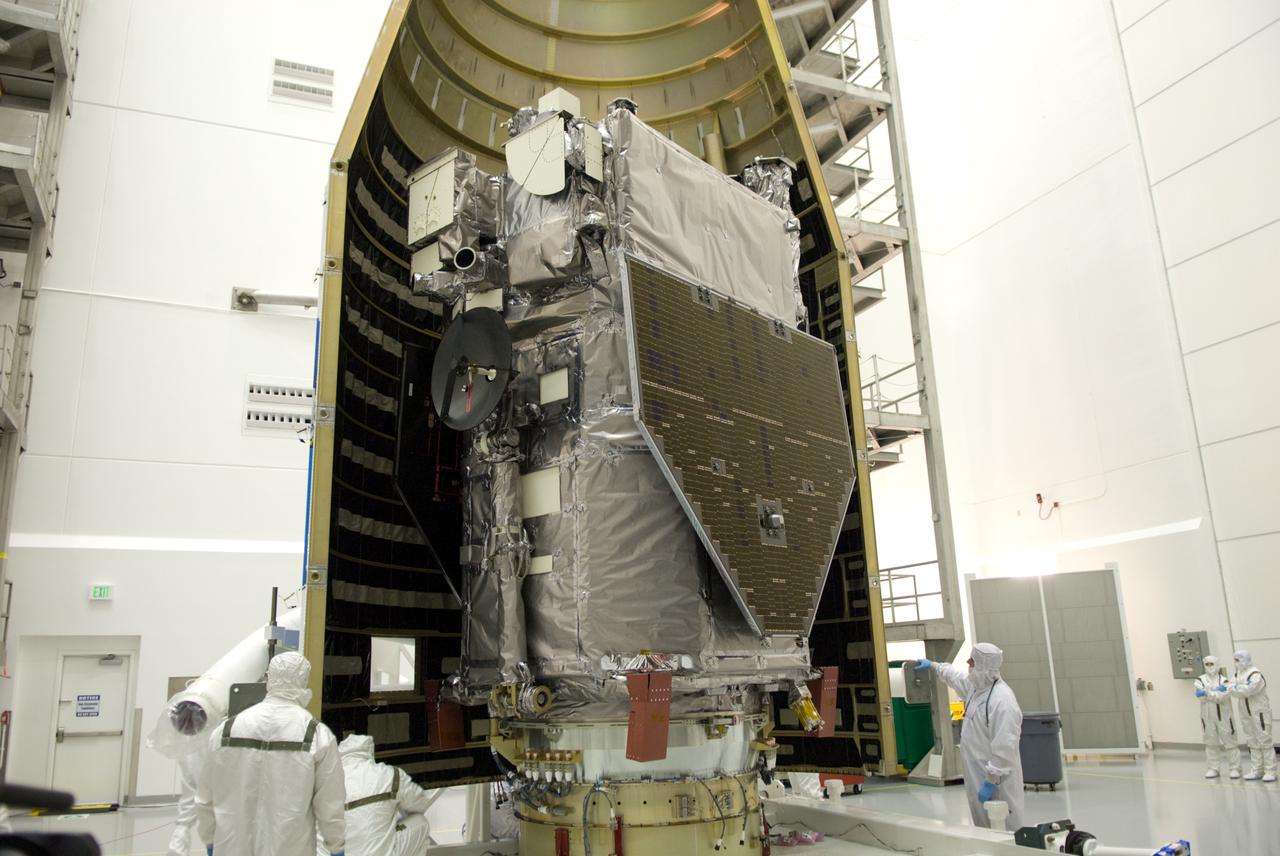
CAPE CANAVERAL, Fla. – At the Astrotech Space Operations facility in Titusville, Fla., NASA's Solar Dynamics Observatory, or SDO, is enclosed in one half of an Atlas V payload fairing. SDO is the first mission in NASA's Living With a Star Program and is designed to study the causes of solar variability and its impacts on Earth. The spacecraft's long-term measurements will give solar scientists in-depth information to help characterize the interior of the Sun, the Sun's magnetic field, the hot plasma of the solar corona, and the density of radiation that creates the ionosphere of the planets. The information will be used to create better forecasts of space weather needed to protect the aircraft, satellites and astronauts living and working in space. Liftoff aboard an Atlas V rocket is targeted for Feb. 9 from Launch Complex 41 on Cape Canaveral Air Force Station. For information on SDO, visit http:__www.nasa.gov_sdo. Photo credit: NASA_Jim Grossmann
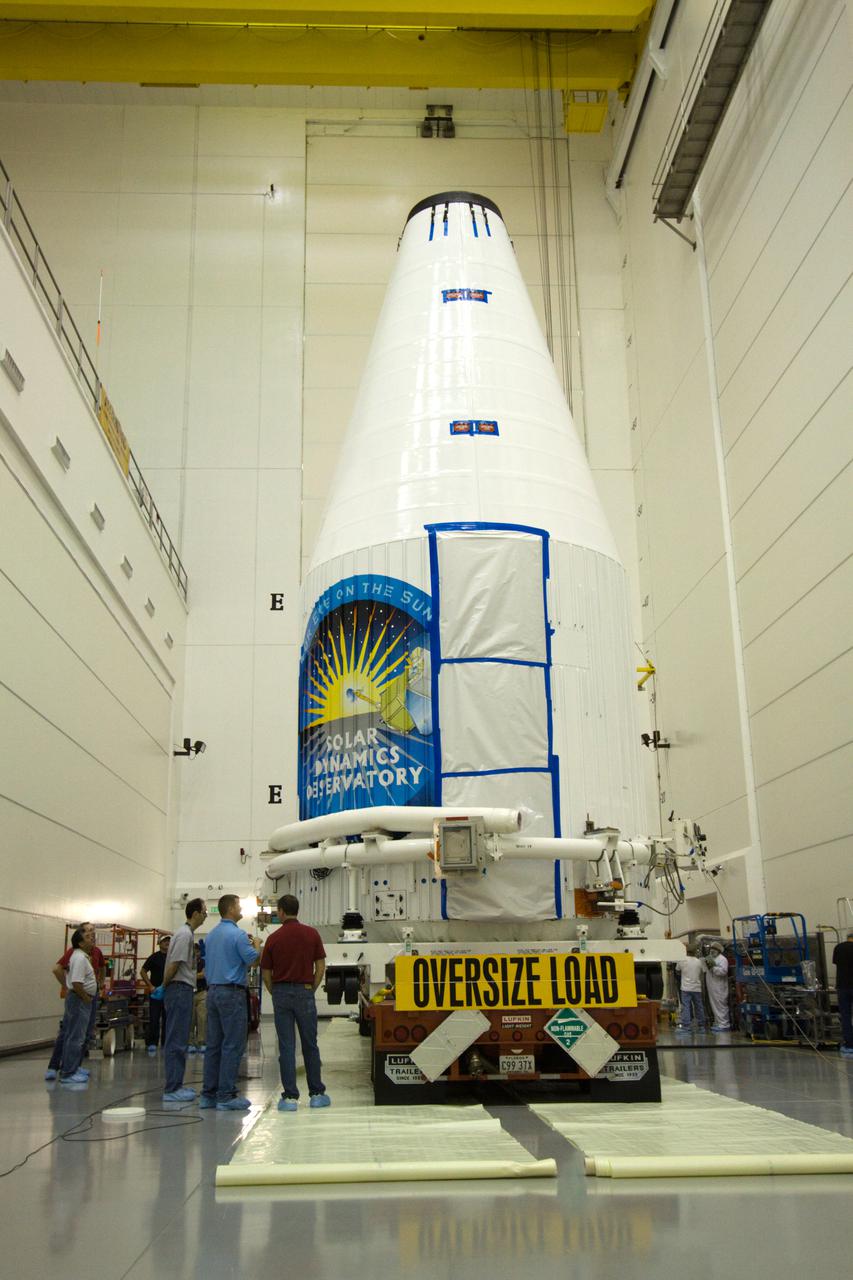
CAPE CANAVERAL, Fla. – At the Astrotech Space Operations facility in Titusville, Fla., NASA's Solar Dynamics Observatory, or SDO, enclosed in the Atlas V payload fairing, is secured onto a transporter in the airlock in preparation for its move to the pad. SDO is the first mission in NASA's Living With a Star Program and is designed to study the causes of solar variability and its impacts on Earth. The spacecraft's long-term measurements will give solar scientists in-depth information to help characterize the interior of the Sun, the Sun's magnetic field, the hot plasma of the solar corona, and the density of radiation that creates the ionosphere of the planets. The information will be used to create better forecasts of space weather needed to protect the aircraft, satellites and astronauts living and working in space. Liftoff aboard an Atlas V rocket is targeted for Feb. 9 from Launch Complex 41 on Cape Canaveral Air Force Station. For information on SDO, visit http:__www.nasa.gov_sdo. Photo credit: NASA_Jack Pfaller
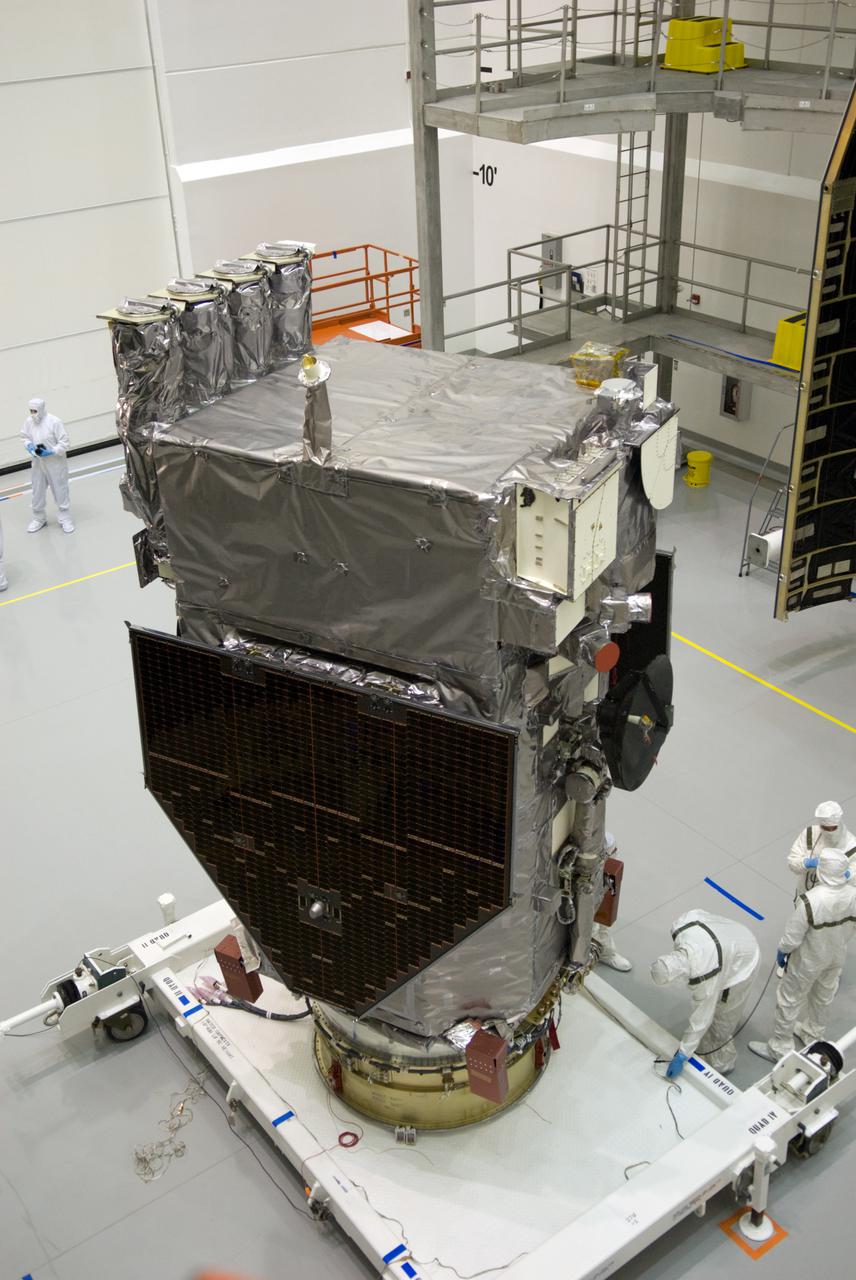
CAPE CANAVERAL, Fla. – At the Astrotech Space Operations facility in Titusville, Fla., processing of NASA's Solar Dynamics Observatory, or SDO, is complete, and it is ready to be installed into an Atlas V payload fairing. SDO is the first mission in NASA's Living With a Star Program and is designed to study the causes of solar variability and its impacts on Earth. The spacecraft's long-term measurements will give solar scientists in-depth information to help characterize the interior of the Sun, the Sun's magnetic field, the hot plasma of the solar corona, and the density of radiation that creates the ionosphere of the planets. The information will be used to create better forecasts of space weather needed to protect the aircraft, satellites and astronauts living and working in space. Liftoff aboard an Atlas V rocket is targeted for Feb. 9 from Launch Complex 41 on Cape Canaveral Air Force Station. For information on SDO, visit http:__www.nasa.gov_sdo. Photo credit: NASA_Jim Grossmann
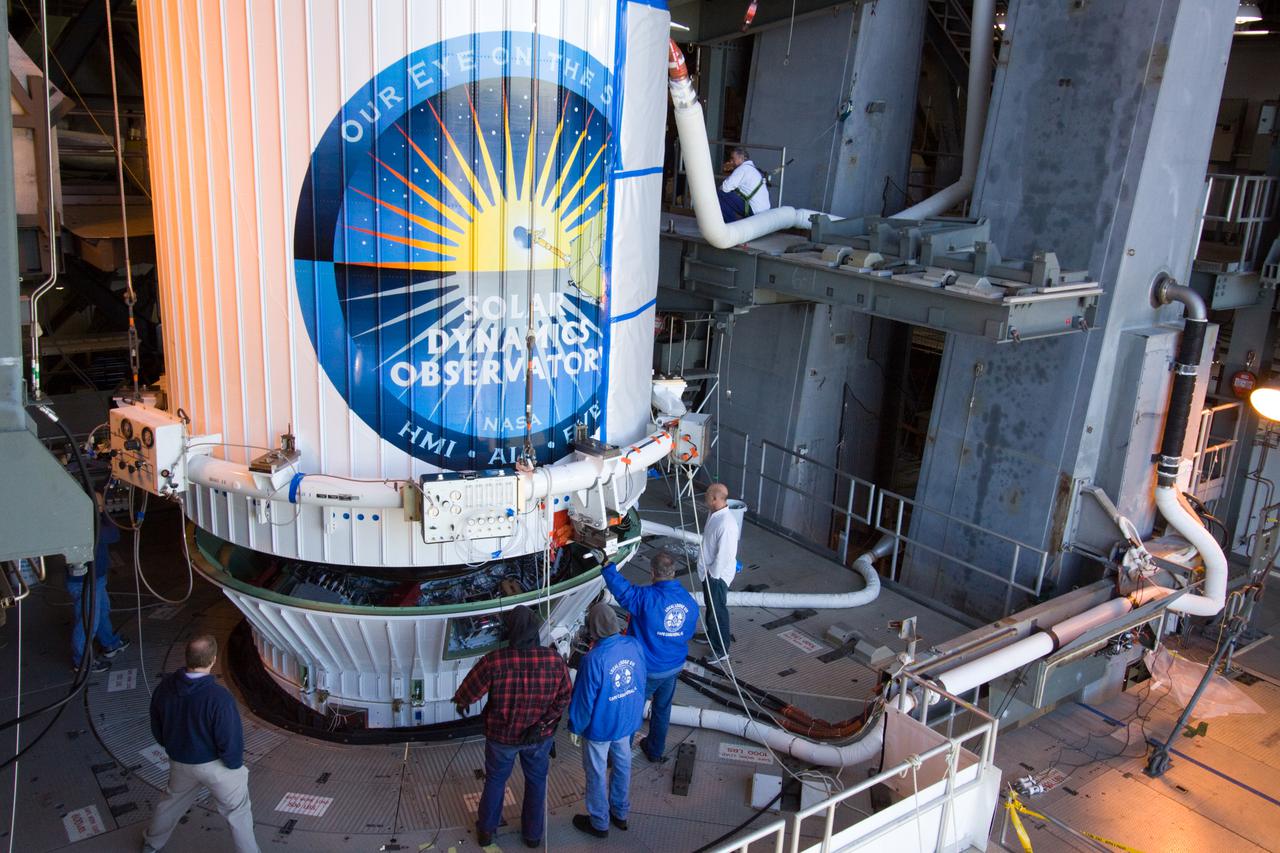
CAPE CANAVERAL, Fla. – In the Vertical Integration Facility at Launch Complex 41 on Cape Canaveral Air Force Station, workers prepare to secure the payload fairing enclosing NASA's Solar Dynamics Observatory, or SDO, to the Atlas V rocket. SDO is the first mission in NASA's Living With a Star Program and is designed to study the causes of solar variability and its impacts on Earth. The spacecraft's long-term measurements will give solar scientists in-depth information to help characterize the interior of the Sun, the Sun's magnetic field, the hot plasma of the solar corona, and the density of radiation that creates the ionosphere of the planets. The information will be used to create better forecasts of space weather needed to protect the aircraft, satellites and astronauts living and working in space. Liftoff is targeted for Feb. 9. For information on SDO, visit http:__www.nasa.gov_sdo. Photo credit: NASA_Jack Pfaller
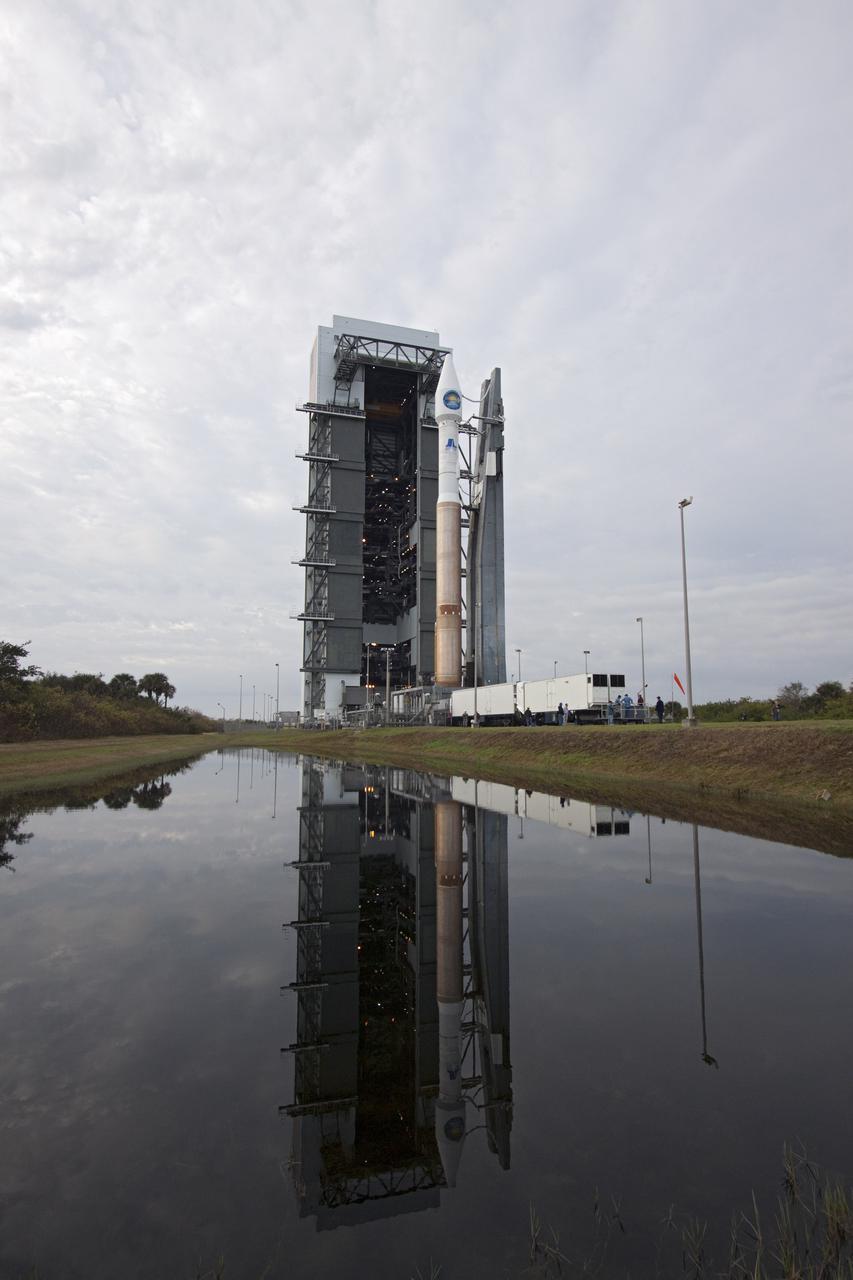
CAPE CANAVERAL, Fla. – The United Launch Alliance Atlas V rocket, with NASA's Solar Dynamics Observatory atop, emerges from the Vertical Integration Facility on its move to Launch Complex 41 on Cape Canaveral Air Force Station. The observatory, known as SDO, is the first mission in NASA's Living With a Star Program and is designed to study the causes of solar variability and its impacts on Earth. The spacecraft's long-term measurements will give solar scientists in-depth information to help characterize the interior of the Sun, the Sun's magnetic field, the hot plasma of the solar corona, and the density of radiation that creates the ionosphere of the planets. The information will be used to create better forecasts of space weather needed to protect the aircraft, satellites and astronauts living and working in space. Liftoff is set for 10:26 a.m. EST Feb. 10. For information on SDO, visit http:__www.nasa.gov_sdo. Photo credit: NASA_Jack Pfaller
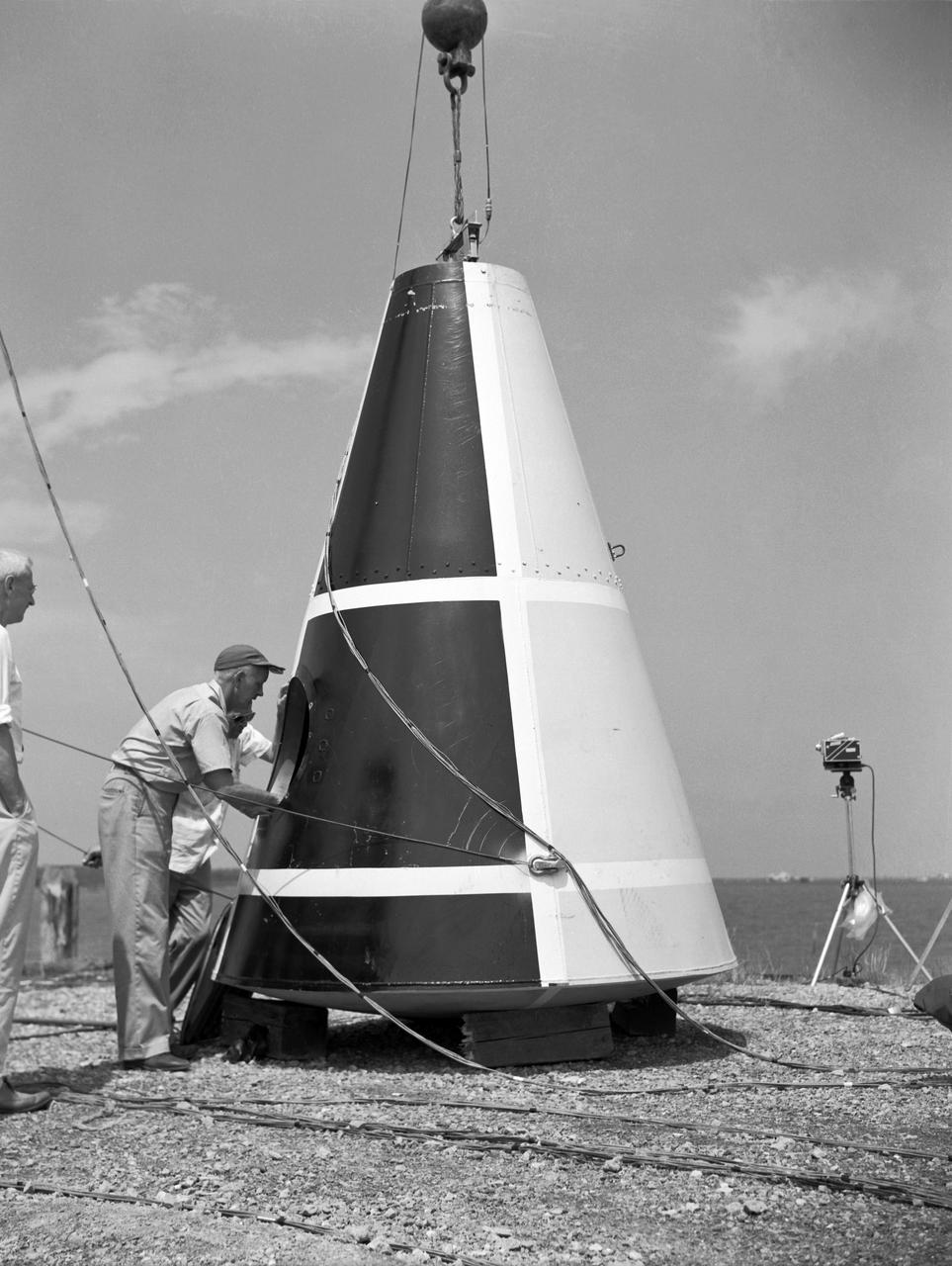
Photographed on: 08 05 1958. -- Impact test conducted by Langley's Hydrodynamics Division. The Division conducted a series of impact studies with full scale and model capsules of the original capsule shape A. Joseph Shortal wrote (Vol. 3, p. 16): The basic design of the capsule was made by M.A. Faget and his coworkers at PARD during the winter of 1957-1958. It was natural, then, that extensive use was made of the facilities at Wallops during the development of the spacecraft. The tests at Wallops consisted of 26 full-size capsules, either launched from the ground by rocket power or dropped from airplanes at high altitude and 28 scaled models, either rocket boosted or released from balloons. Emphasis in the Wallops program was on dynamic stability and aerodynamic heating of the capsule, and effectiveness of the pilot-escape and parachute-recovery systems. The biggest part of the Wallops program was the series of full-size capsules, rocket launched with the Little Joe booster, developed especially for Mercury. -- Published in Joseph A. Shortal, History of Wallops Station: Origins and Activities Through 1949, (Wallops Island, VA: National Aeronautics and Space Administration, Wallops Station, nd), Comment Edition.
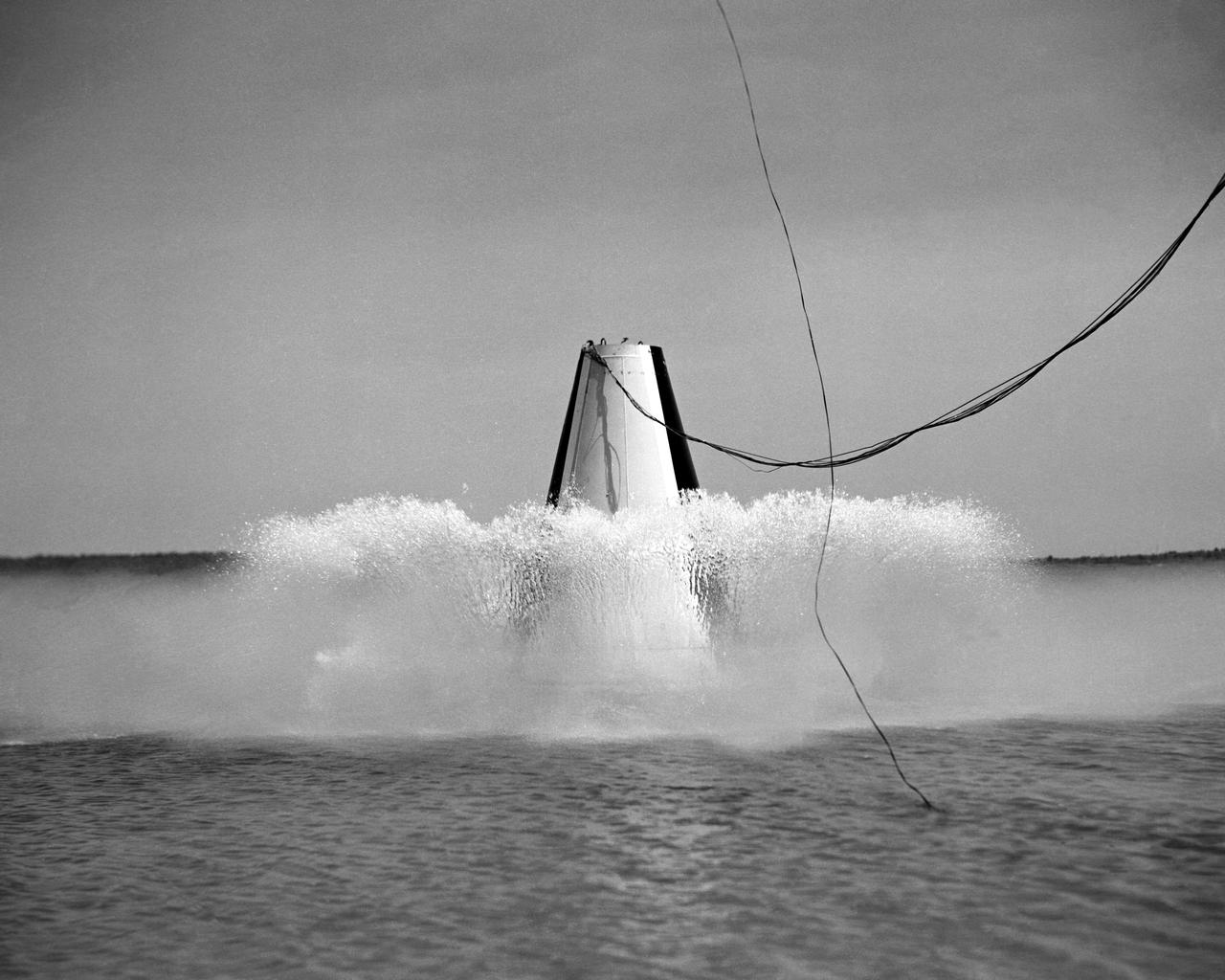
Photographed on: 08 05 1958. -- Impact test conducted by Langley's Hydrodynamics Division. The Division conducted a series of impact studies with full scale and model capsules of the original capsule shape A. Joseph Shortal wrote (Vol. 3, p. 16): The basic design of the capsule was made by M.A. Faget and his coworkers at PARD during the winter of 1957-1958. It was natural, then, that extensive use was made of the facilities at Wallops during the development of the spacecraft. The tests at Wallops consisted of 26 full-size capsules, either launched from the ground by rocket power or dropped from airplanes at high altitude and 28 scaled models, either rocket boosted or released from balloons. Emphasis in the Wallops program was on dynamic stability and aerodynamic heating of the capsule, and effectiveness of the pilot-escape and parachute-recovery systems. The biggest part of the Wallops program was the series of full-size capsules, rocket launched with the Little Joe booster, developed especially for Mercury. -- Published in Joseph A. Shortal, History of Wallops Station: Origins and Activities Through 1949, (Wallops Island, VA: National Aeronautics and Space Administration, Wallops Station, nd), Comment Edition.
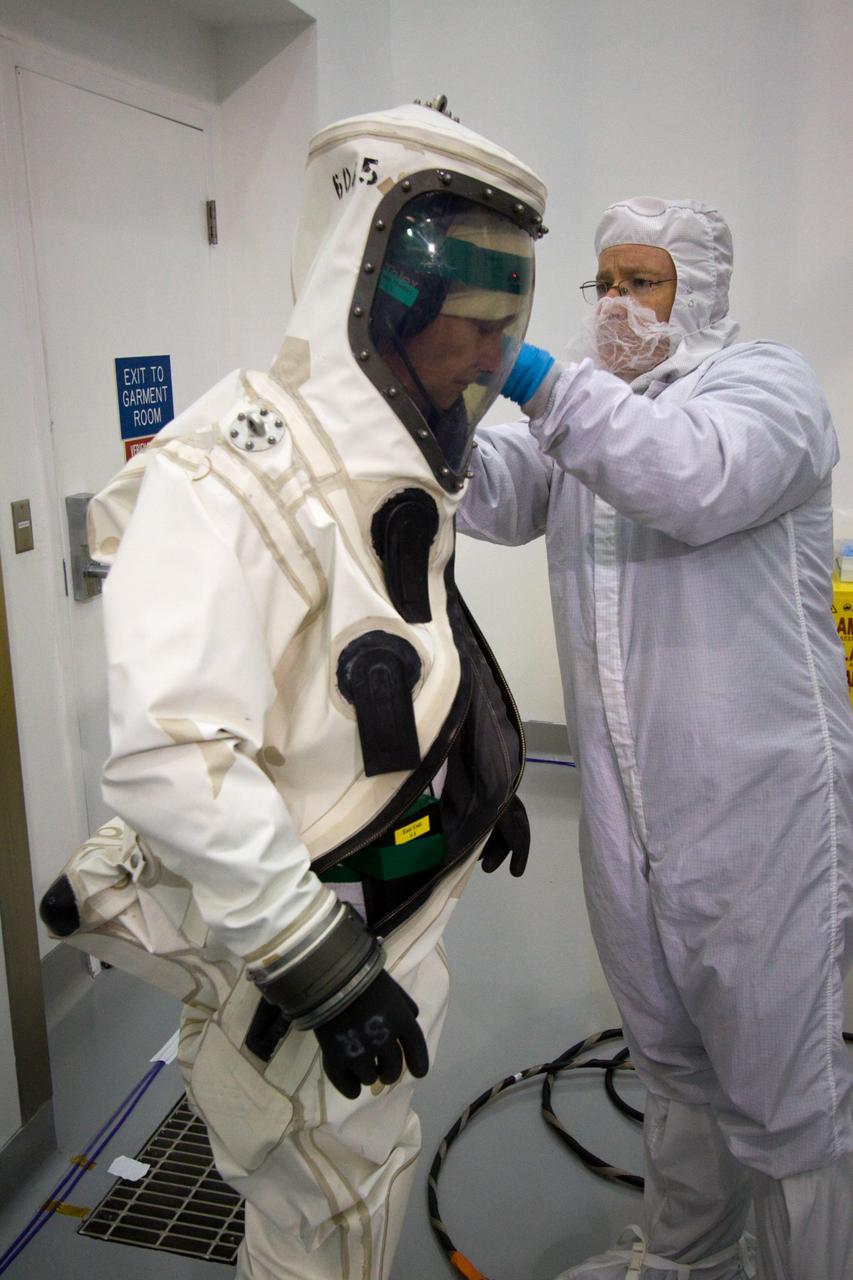
CAPE CANAVERAL, Fla. – At the Astrotech Space Operations facility in Titusville, Fla., spacecraft fueling technicians from Kennedy Space Center prepare to sample the monomethylhydrazine propellant that will be loaded aboard the Solar Dynamics Observatory, or SDO. From left are SDO technician Brian Kittle and ASTROTECH mission/facility manager Gerard Gleeson. The hydrazine fuel is being sampled for purity before it is loaded aboard the spacecraft. The technicians are dressed in self-contained atmospheric protective ensemble suits, or SCAPE suits, as a safety precaution in the unlikely event that any of the highly toxic chemical should escape from the storage tank. The nitrogen tetroxide oxidizer was loaded earlier in the week which is customarily followed by loading of the fuel. Propellant loading is one of the final processing milestones before the spacecraft is encapsulated in its fairing for launch. SDO is the first mission in NASA's Living With a Star Program and is designed to study the causes of solar variability and its impacts on Earth. The spacecraft's long-term measurements will give solar scientists in-depth information to help characterize the interior of the Sun, the Sun's magnetic field, the hot plasma of the solar corona, and the density of radiation that creates the ionosphere of the planets. The information will be used to create better forecasts of space weather needed to protect the aircraft, satellites and astronauts living and working in space. Liftoff aboard an Atlas V rocket is targeted for Feb. 9 from Launch Complex 41 on Cape Canaveral Air Force Station. For information on SDO, visit http://www.nasa.gov/sdo. Photo credit: NASA/Jack Pfaller
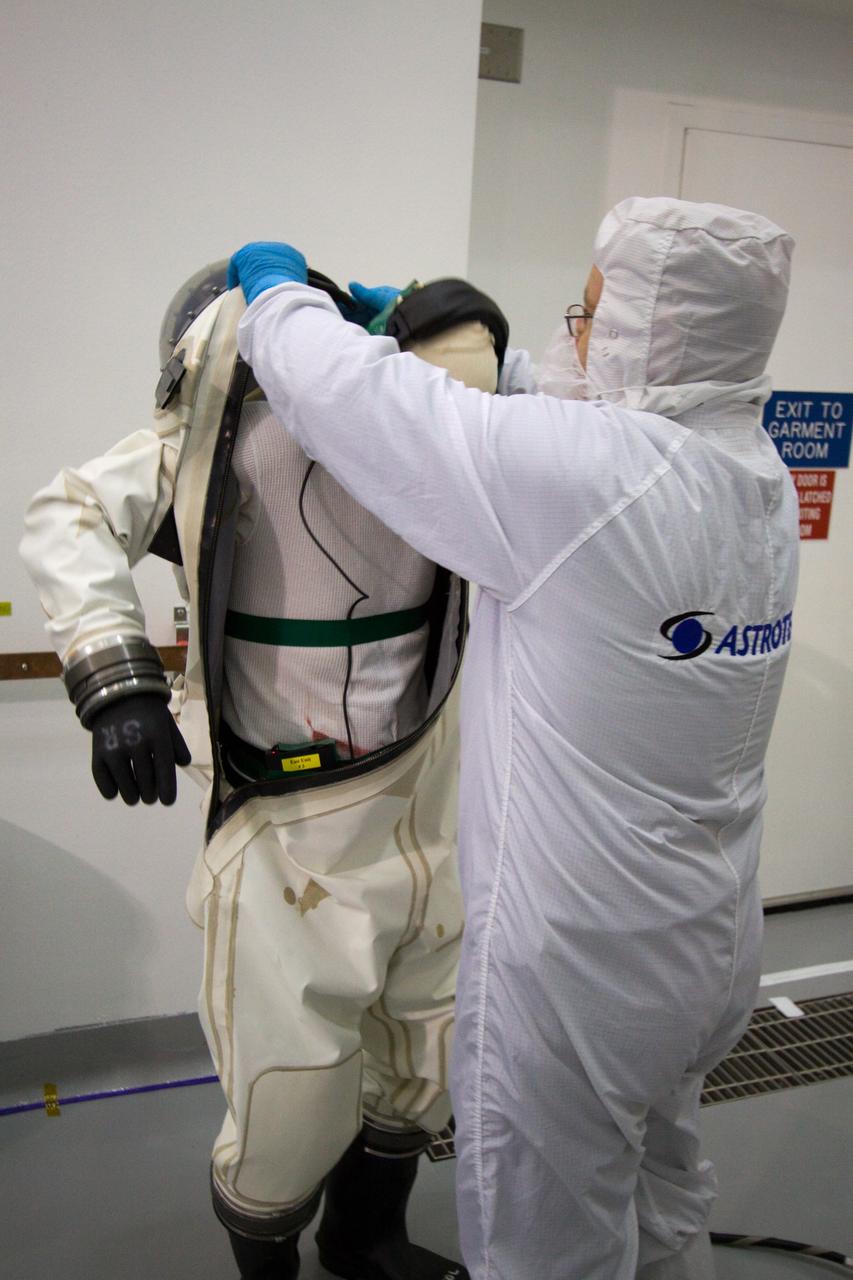
CAPE CANAVERAL, Fla. – At the Astrotech Space Operations facility in Titusville, Fla., spacecraft fueling technicians from Kennedy Space Center prepare to sample the monomethylhydrazine propellant that will be loaded aboard the Solar Dynamics Observatory, or SDO. From left are Boeing technician Steve Lay and ASTROTECH mission/facility manager Gerard Gleeson. The hydrazine fuel is being sampled for purity before it is loaded aboard the spacecraft. The technicians are dressed in self-contained atmospheric protective ensemble suits, or SCAPE suits, as a safety precaution in the unlikely event that any of the highly toxic chemical should escape from the storage tank. The nitrogen tetroxide oxidizer was loaded earlier in the week which is customarily followed by loading of the fuel. Propellant loading is one of the final processing milestones before the spacecraft is encapsulated in its fairing for launch. SDO is the first mission in NASA's Living With a Star Program and is designed to study the causes of solar variability and its impacts on Earth. The spacecraft's long-term measurements will give solar scientists in-depth information to help characterize the interior of the Sun, the Sun's magnetic field, the hot plasma of the solar corona, and the density of radiation that creates the ionosphere of the planets. The information will be used to create better forecasts of space weather needed to protect the aircraft, satellites and astronauts living and working in space. Liftoff aboard an Atlas V rocket is targeted for Feb. 9 from Launch Complex 41 on Cape Canaveral Air Force Station. For information on SDO, visit http://www.nasa.gov/sdo. Photo credit: NASA/Jack Pfaller

A truck arrives at NASA's Jet Propulsion Laboratory in Southern California on June 3, 2024, to deliver the Medium Articulating Transportation System (MATS), which will be used during the construction and transportation of components for NASA's Near-Earth Object Surveyor mission. Originating at the aerospace company Beyond Gravity in Vienna, Austria, the MATS traveled via ship through the Panama Canal to Port Hueneme, California, before arriving by road at JPL. Construction has begun on NEO Surveyor's instrument enclosure in the High Bay 1 clean room at JPL's Spacecraft Assembly Facility. When the enclosure is complete later this year, it will be moved inside the MATS to NASA's Johnson Space Center in Houston for environmental testing. The MATS is a transportable clean room with its own filtration and climate control systems that keep the spacecraft and components clean, stable, and safe while being moved between facilities. NEO Surveyor's instrument enclosure contains the spacecraft's telescope, mirrors, and infrared sensors that will be used to detect, track, and characterize the most hazardous near-Earth objects. BAE Systems, Space Dynamics Laboratory, and Teledyne are among the aerospace and engineering companies contracted to build the spacecraft and its instrumentation. The Laboratory for Atmospheric and Space Physics at the University of Colorado, Boulder will support operations, and IPAC at Caltech in Pasadena, California, is responsible for processing survey data and producing the mission's data products. JPL manages the project; Caltech manages JPL for NASA. Launching no earlier than 2027, NEO Surveyor supports the objectives of NASA's Planetary Defense Coordination Office (PDCO) at NASA Headquarters in Washington. The NASA Authorization Act of 2005 directed NASA to discover and characterize at least 90% of the near-Earth objects more than 140 meters (460 feet) across that come within 30 million miles (48 million kilometers) of our planet's orbit. Objects of this size can cause significant regional damage, or worse, should they impact the Earth. https://photojournal.jpl.nasa.gov/catalog/PIA26381
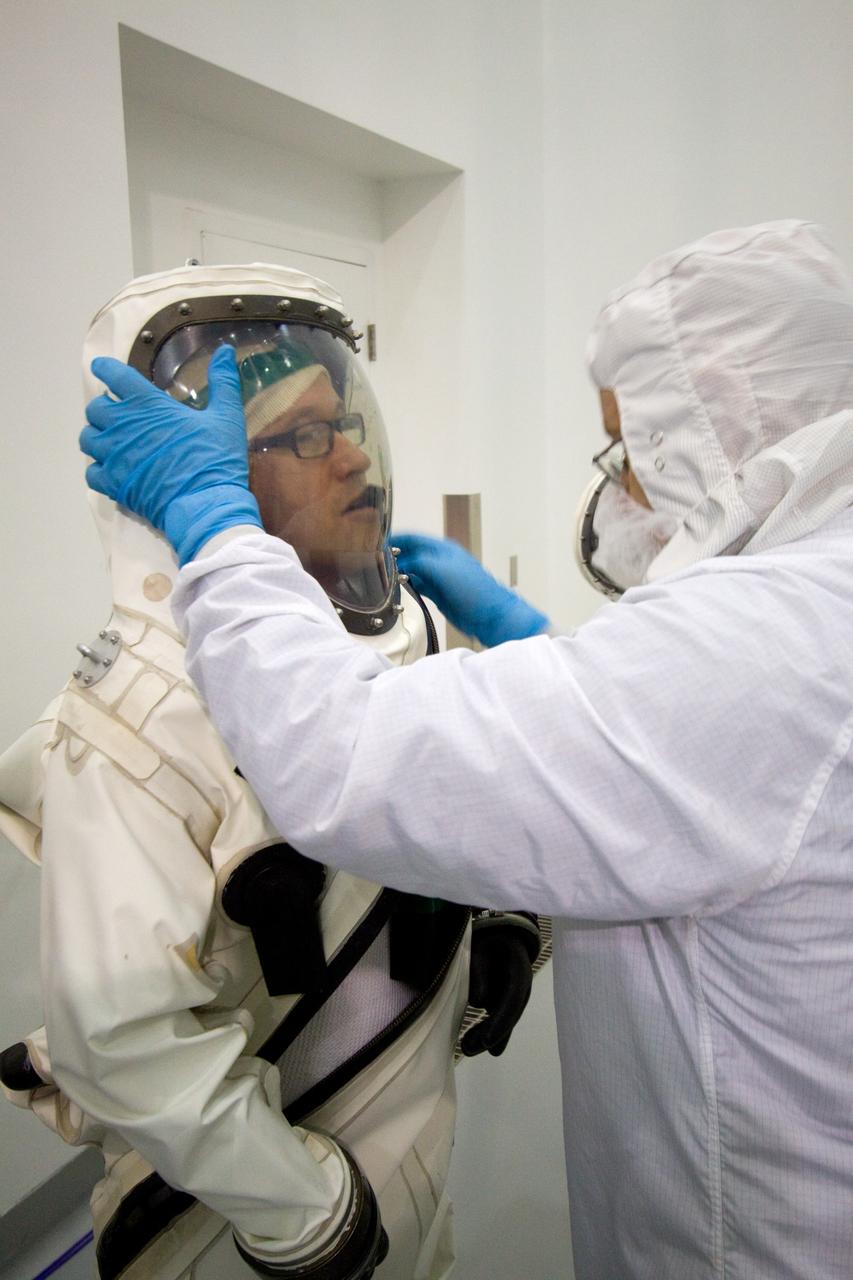
CAPE CANAVERAL, Fla. – At the Astrotech Space Operations facility in Titusville, Fla., spacecraft fueling technicians from Kennedy Space Center prepare to sample the monomethylhydrazine propellant that will be loaded aboard the Solar Dynamics Observatory, or SDO. From left are Boeing technician Steve Lay and ASTROTECH mission/facility manager Gerard Gleeson. The hydrazine fuel is being sampled for purity before it is loaded aboard the spacecraft. The technicians are dressed in self-contained atmospheric protective ensemble suits, or SCAPE suits, as a safety precaution in the unlikely event that any of the highly toxic chemical should escape from the storage tank. The nitrogen tetroxide oxidizer was loaded earlier in the week which is customarily followed by loading of the fuel. Propellant loading is one of the final processing milestones before the spacecraft is encapsulated in its fairing for launch. SDO is the first mission in NASA's Living With a Star Program and is designed to study the causes of solar variability and its impacts on Earth. The spacecraft's long-term measurements will give solar scientists in-depth information to help characterize the interior of the Sun, the Sun's magnetic field, the hot plasma of the solar corona, and the density of radiation that creates the ionosphere of the planets. The information will be used to create better forecasts of space weather needed to protect the aircraft, satellites and astronauts living and working in space. Liftoff aboard an Atlas V rocket is targeted for Feb. 9 from Launch Complex 41 on Cape Canaveral Air Force Station. For information on SDO, visit http://www.nasa.gov/sdo. Photo credit: NASA/Jack Pfaller
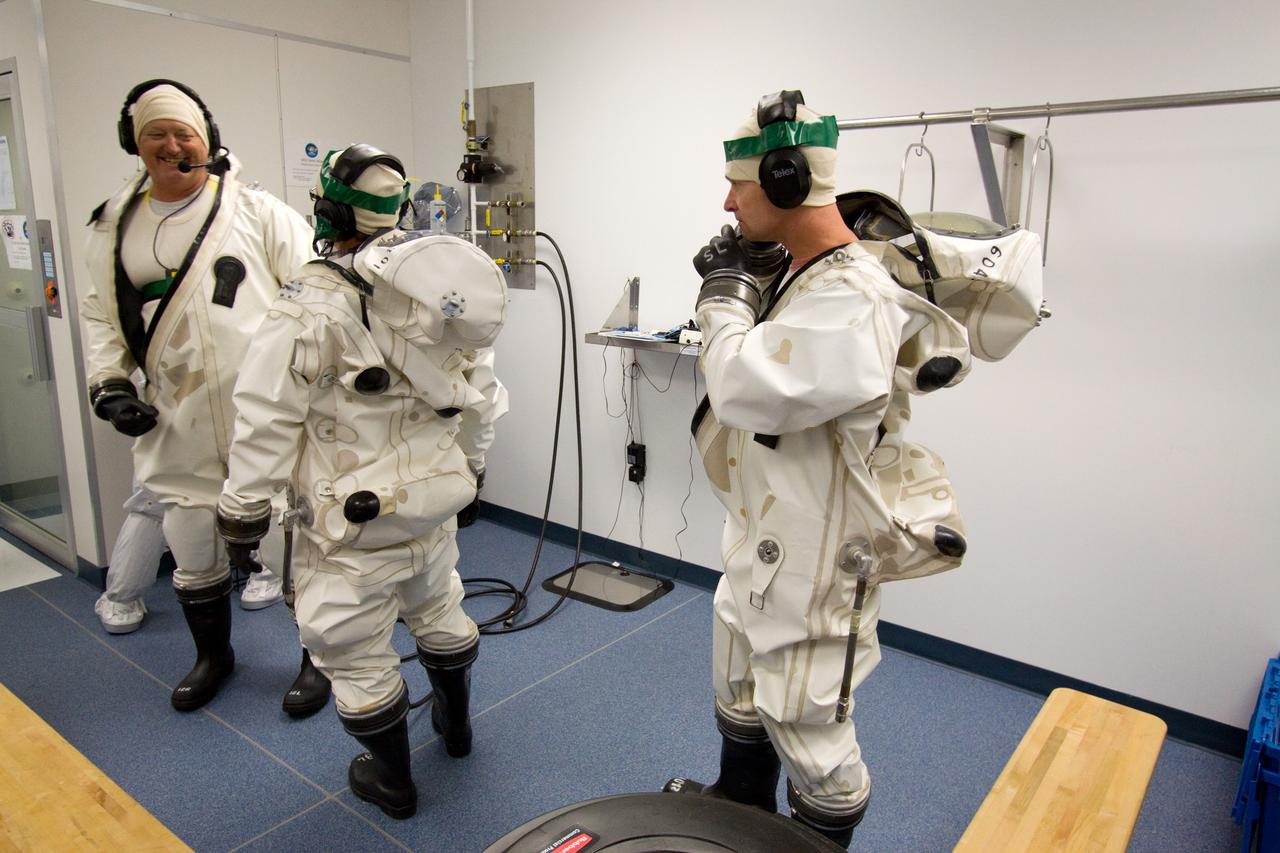
CAPE CANAVERAL, Fla. – At the Astrotech Space Operations facility in Titusville, Fla., spacecraft fueling technicians from Kennedy Space Center prepare to sample the monomethylhydrazine propellant that will be loaded aboard the Solar Dynamics Observatory, or SDO. From left are Boeing technicians Richard Gillman and Steve Lay, and SDO technician Brian Kittle. The hydrazine fuel is being sampled for purity before it is loaded aboard the spacecraft. The technicians are dressed in self-contained atmospheric protective ensemble suits, or SCAPE suits, as a safety precaution in the unlikely event that any of the highly toxic chemical should escape from the storage tank. The nitrogen tetroxide oxidizer was loaded earlier in the week which is customarily followed by loading of the fuel. Propellant loading is one of the final processing milestones before the spacecraft is encapsulated in its fairing for launch. SDO is the first mission in NASA's Living With a Star Program and is designed to study the causes of solar variability and its impacts on Earth. The spacecraft's long-term measurements will give solar scientists in-depth information to help characterize the interior of the Sun, the Sun's magnetic field, the hot plasma of the solar corona, and the density of radiation that creates the ionosphere of the planets. The information will be used to create better forecasts of space weather needed to protect the aircraft, satellites and astronauts living and working in space. Liftoff aboard an Atlas V rocket is targeted for Feb. 9 from Launch Complex 41 on Cape Canaveral Air Force Station. For information on SDO, visit http://www.nasa.gov/sdo. Photo credit: NASA/Jack Pfaller
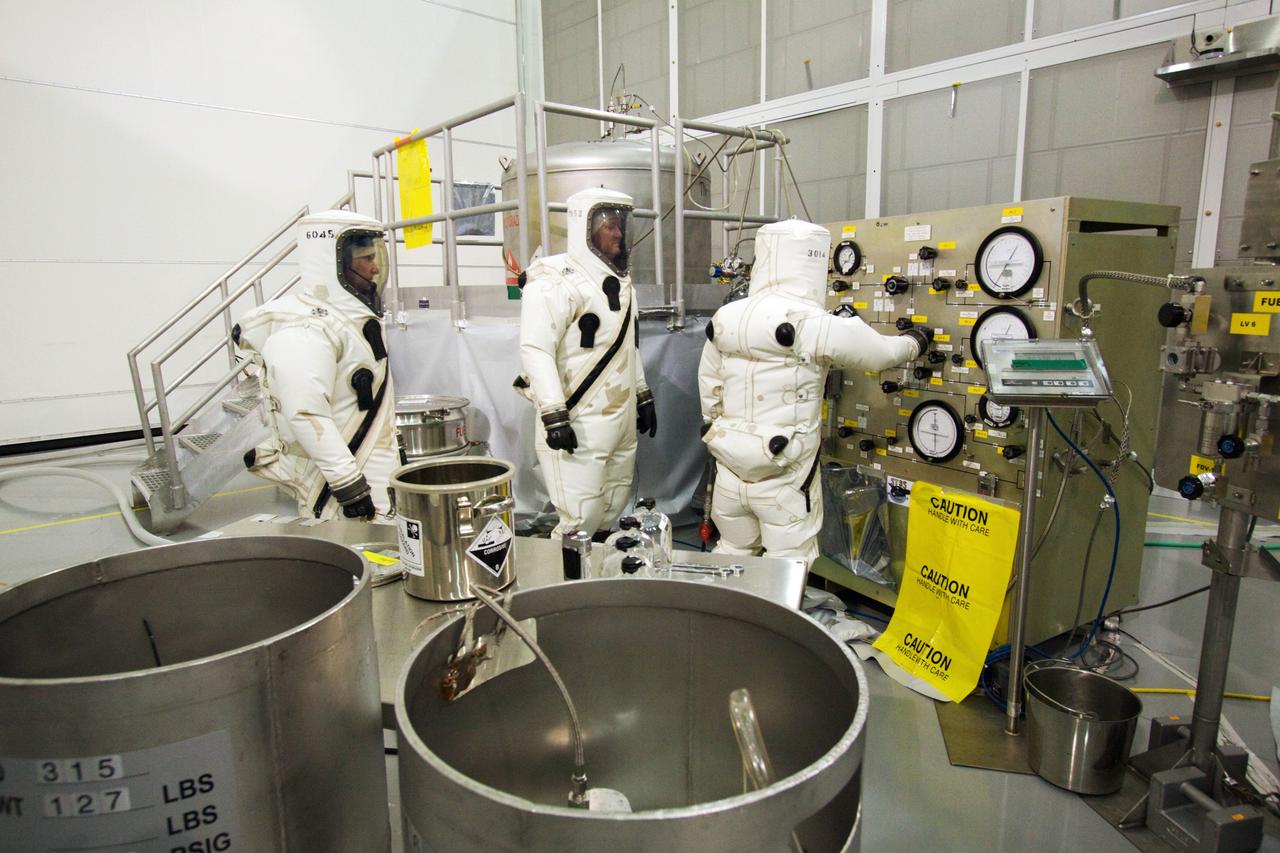
CAPE CANAVERAL, Fla. – At the Astrotech Space Operations facility in Titusville, Fla., Boeing spacecraft fueling technicians from Kennedy Space Center prepare the equipment necessary to sample the monomethylhydrazine propellant that will be loaded aboard the Solar Dynamics Observatory, or SDO. The hydrazine fuel is being sampled for purity before it is loaded aboard the spacecraft. The technicians are dressed in self-contained atmospheric protective ensemble suits, or SCAPE suits, as a safety precaution in the unlikely event that any of the highly toxic chemical should escape from the storage tank. The nitrogen tetroxide oxidizer was loaded earlier in the week which is customarily followed by loading of the fuel. Propellant loading is one of the final processing milestones before the spacecraft is encapsulated in its fairing for launch. SDO is the first mission in NASA's Living With a Star Program and is designed to study the causes of solar variability and its impacts on Earth. The spacecraft's long-term measurements will give solar scientists in-depth information to help characterize the interior of the Sun, the Sun's magnetic field, the hot plasma of the solar corona, and the density of radiation that creates the ionosphere of the planets. The information will be used to create better forecasts of space weather needed to protect the aircraft, satellites and astronauts living and working in space. Liftoff aboard an Atlas V rocket is targeted for Feb. 9 from Launch Complex 41 on Cape Canaveral Air Force Station. For information on SDO, visit http://www.nasa.gov/sdo. Photo credit: NASA/Jack Pfaller
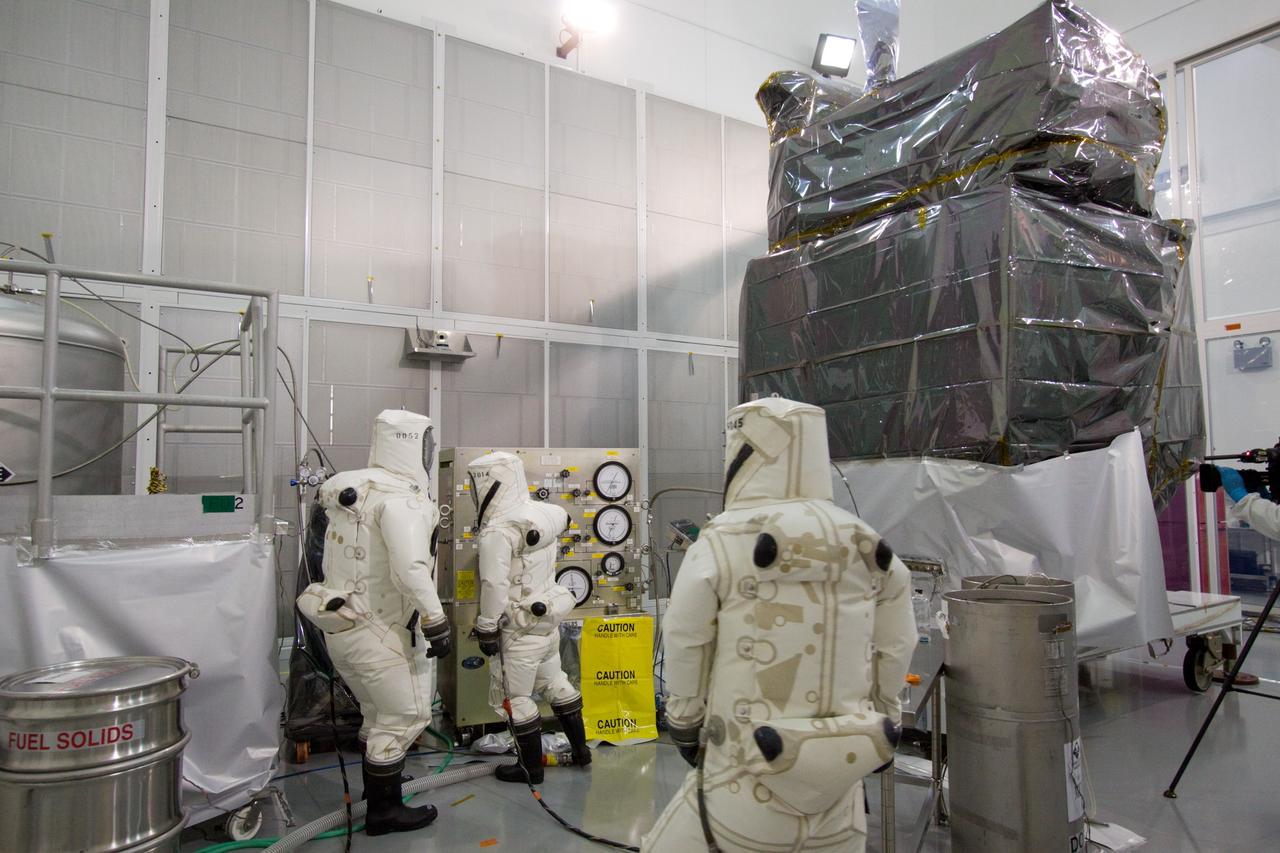
CAPE CANAVERAL, Fla. – At the Astrotech Space Operations facility in Titusville, Fla., Boeing spacecraft fueling technicians from Kennedy Space Center prepare to sample the monomethylhydrazine propellant that will be loaded aboard the Solar Dynamics Observatory, or SDO, which is protectively covered. The hydrazine fuel is being sampled for purity before it is loaded aboard the spacecraft. The technicians are dressed in self-contained atmospheric protective ensemble suits, or SCAPE suits, as a safety precaution in the unlikely event that any of the highly toxic chemical should escape from the storage tank. The nitrogen tetroxide oxidizer was loaded earlier in the week which is customarily followed by loading of the fuel. Propellant loading is one of the final processing milestones before the spacecraft is encapsulated in its fairing for launch. SDO is the first mission in NASA's Living With a Star Program and is designed to study the causes of solar variability and its impacts on Earth. The spacecraft's long-term measurements will give solar scientists in-depth information to help characterize the interior of the Sun, the Sun's magnetic field, the hot plasma of the solar corona, and the density of radiation that creates the ionosphere of the planets. The information will be used to create better forecasts of space weather needed to protect the aircraft, satellites and astronauts living and working in space. Liftoff aboard an Atlas V rocket is targeted for Feb. 9 from Launch Complex 41 on Cape Canaveral Air Force Station. For information on SDO, visit http://www.nasa.gov/sdo. Photo credit: NASA/Jack Pfaller
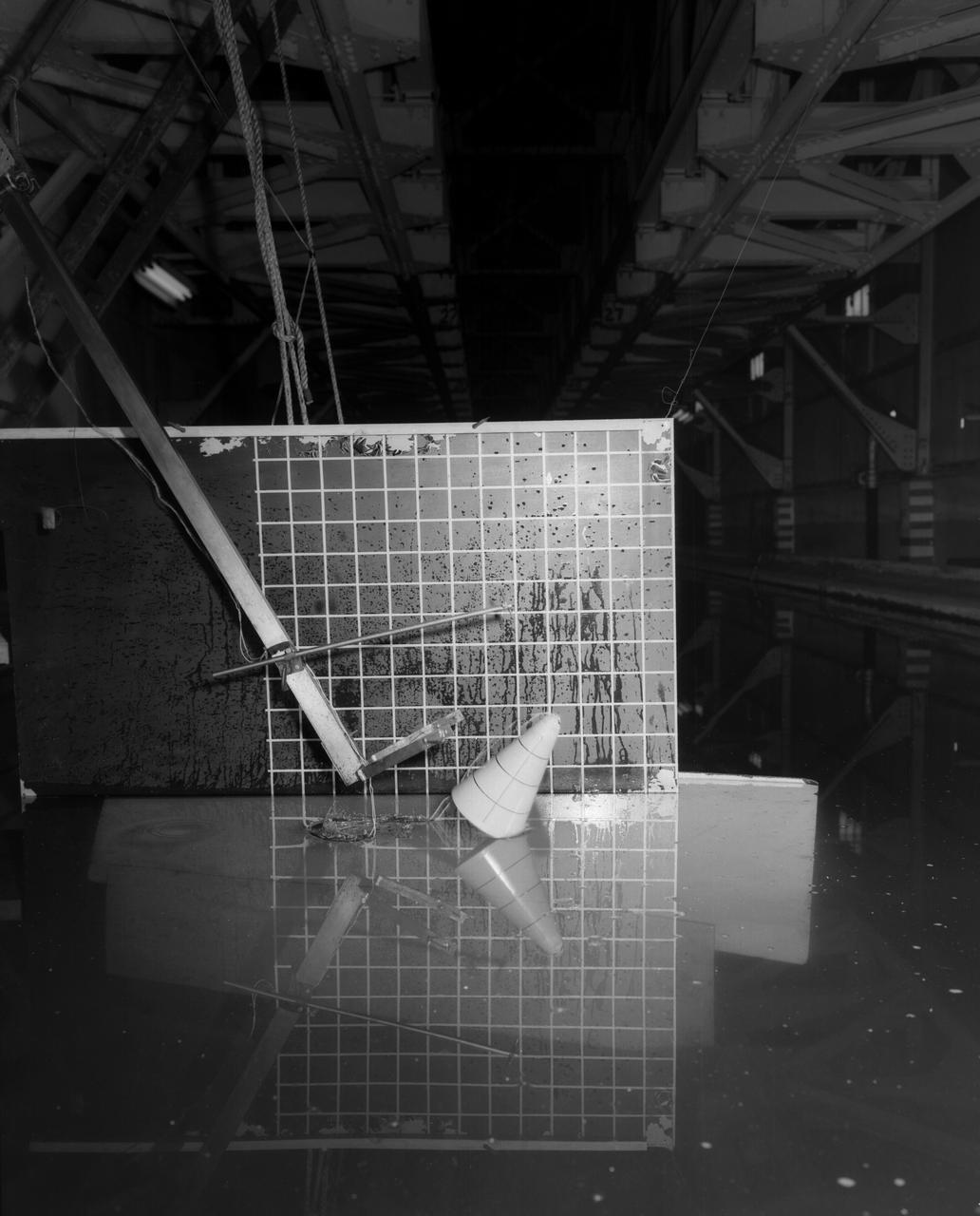
Testing of Mercury Capsule Shape A by the Hydrodynamics Division of Langley. Joseph Shortal wrote (vol. 3, p. 19): The Hydrodynamics Division provided assistance in determining landing loads. In this connection, after PARD engineers had unofficially approached that division to make some water impact tests with the boilerplate capsule, J.B. Parkinson, Hydrodynamics Chief visited Shortal to find out if the request had his support. Finding out that it did, Parkinson said, Its your capsule. If you want us to drop it in the water, we will do it. From Shortal (Vol. 3, p. 16): The basic design of the capsule was made by M.A. Faget and his coworkers at PARD during the winter of 1957-1958. It was natural, then, that extensive use was made of the facilities at Wallops during the development of the spacecraft. The tests at Wallops consisted of 26 full-size capsules, either launched from the ground by rocket power or dropped from airplanes at high altitude and 28 scaled models, either rocket boosted or released from balloons. Emphasis in the Wallops program was on dynamic stability and aerodynamic heating of the capsule, and effectiveness of the pilot-escape and parachute-recovery systems. The biggest part of the Wallops program was the series of full-size capsules, rocket launched with the Little Joe booster, developed especially for Mercury. -- Published in Joseph A. Shortal, History of Wallops Station: Origins and Activities Through 1949, (Wallops Island, VA: National Aeronautics and Space Administration, Wallops Station, nd), Comment Edition.
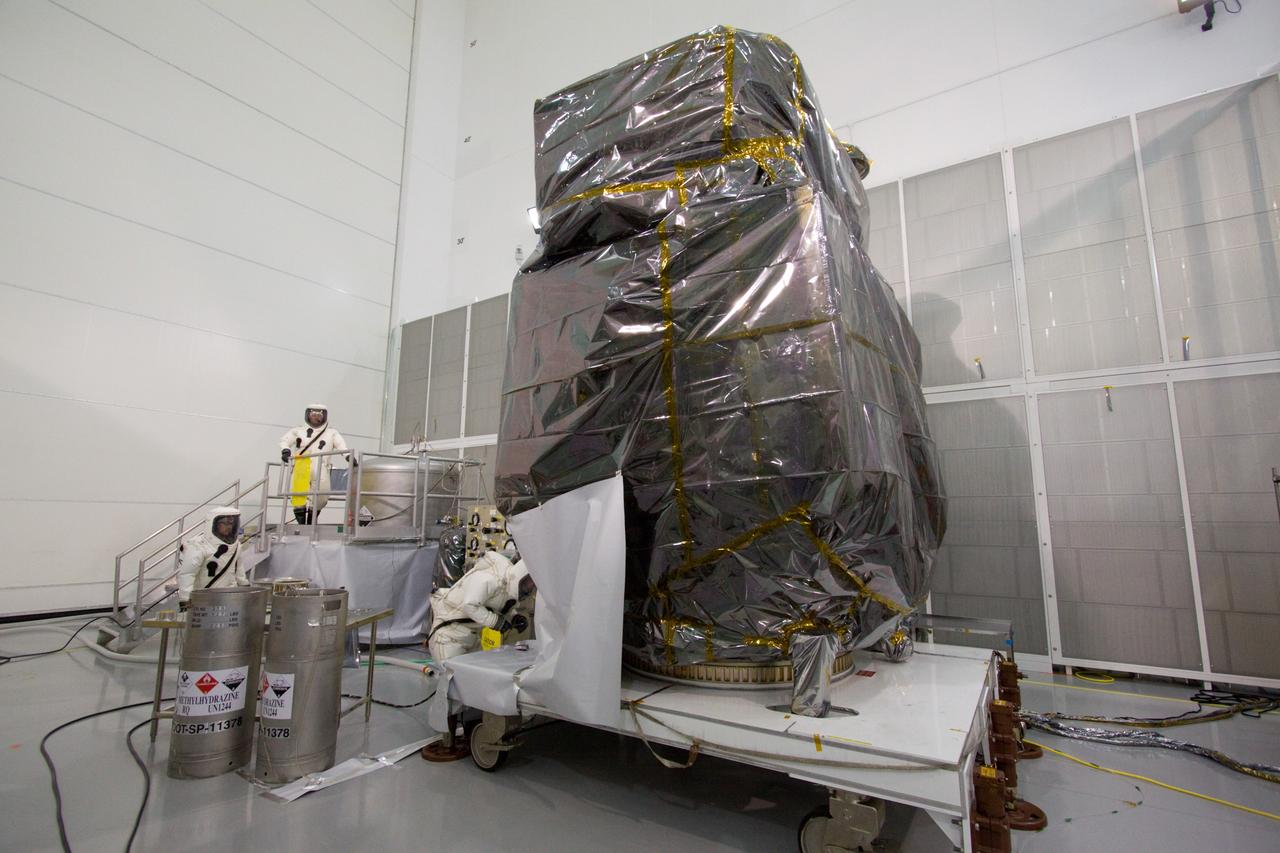
CAPE CANAVERAL, Fla. – At the Astrotech Space Operations facility in Titusville, Fla., Boeing spacecraft fueling technicians from Kennedy Space Center take a sample of the monomethylhydrazine propellant that will be loaded aboard the Solar Dynamics Observatory, or SDO, which is protectively covered. The hydrazine fuel is being sampled for purity before it is loaded aboard the spacecraft. The technicians are dressed in self-contained atmospheric protective ensemble suits, or SCAPE suits, as a safety precaution in the unlikely event that any of the highly toxic chemical should escape from the storage tank. The nitrogen tetroxide oxidizer was loaded earlier in the week which is customarily followed by loading of the fuel. Propellant loading is one of the final processing milestones before the spacecraft is encapsulated in its fairing for launch. SDO is the first mission in NASA's Living With a Star Program and is designed to study the causes of solar variability and its impacts on Earth. The spacecraft's long-term measurements will give solar scientists in-depth information to help characterize the interior of the Sun, the Sun's magnetic field, the hot plasma of the solar corona, and the density of radiation that creates the ionosphere of the planets. The information will be used to create better forecasts of space weather needed to protect the aircraft, satellites and astronauts living and working in space. Liftoff aboard an Atlas V rocket is targeted for Feb. 9 from Launch Complex 41 on Cape Canaveral Air Force Station. For information on SDO, visit http://www.nasa.gov/sdo. Photo credit: NASA/Jack Pfaller
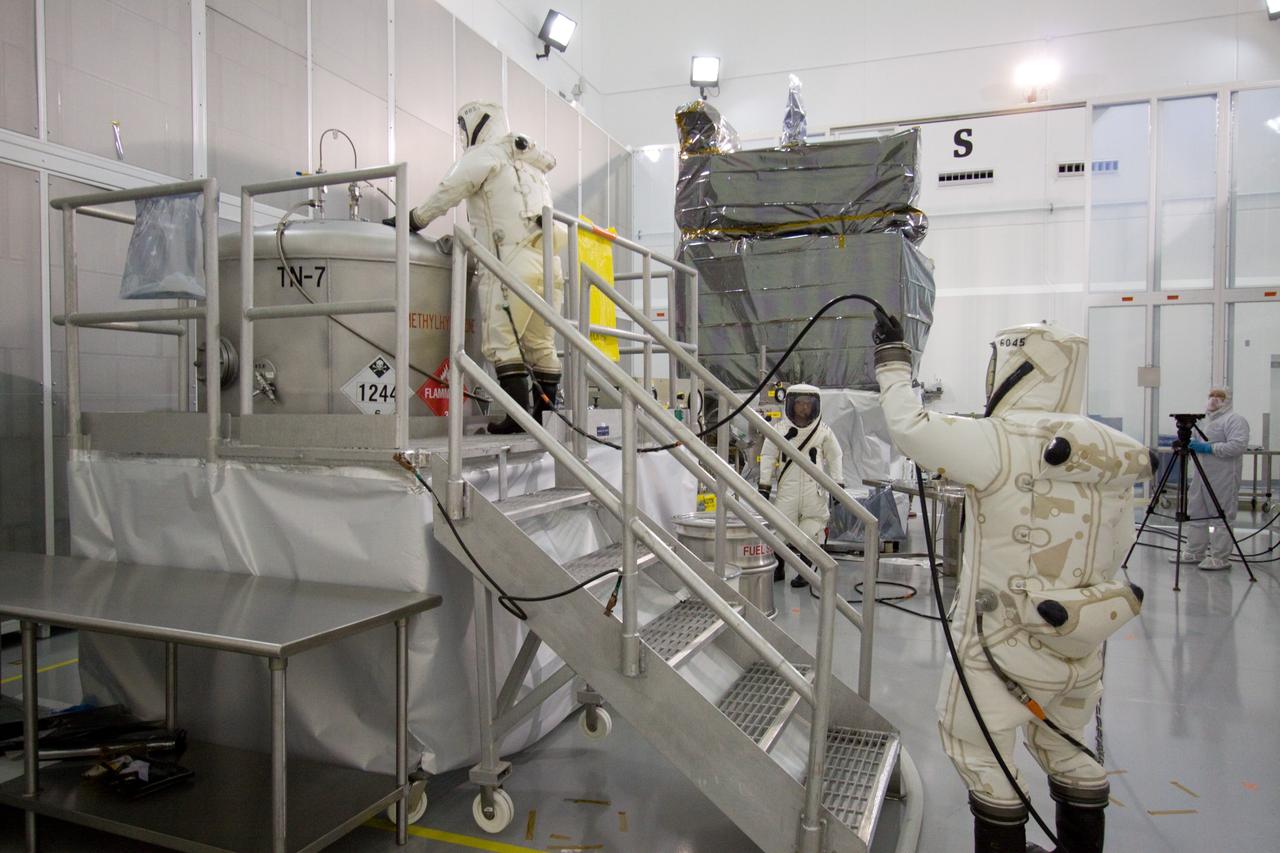
CAPE CANAVERAL, Fla. – At the Astrotech Space Operations facility in Titusville, Fla., Boeing spacecraft fueling technicians from Kennedy Space Center take a sample of the monomethylhydrazine propellant that will be loaded aboard the Solar Dynamics Observatory, or SDO, which is protectively covered. The hydrazine fuel is being sampled for purity before it is loaded aboard the spacecraft. The technicians are dressed in self-contained atmospheric protective ensemble suits, or SCAPE suits, as a safety precaution in the unlikely event that any of the highly toxic chemical should escape from the storage tank. The nitrogen tetroxide oxidizer was loaded earlier in the week which is customarily followed by loading of the fuel. Propellant loading is one of the final processing milestones before the spacecraft is encapsulated in its fairing for launch. SDO is the first mission in NASA's Living With a Star Program and is designed to study the causes of solar variability and its impacts on Earth. The spacecraft's long-term measurements will give solar scientists in-depth information to help characterize the interior of the Sun, the Sun's magnetic field, the hot plasma of the solar corona, and the density of radiation that creates the ionosphere of the planets. The information will be used to create better forecasts of space weather needed to protect the aircraft, satellites and astronauts living and working in space. Liftoff aboard an Atlas V rocket is targeted for Feb. 9 from Launch Complex 41 on Cape Canaveral Air Force Station. For information on SDO, visit http://www.nasa.gov/sdo. Photo credit: NASA/Jack Pfaller

At NASA's Jet Propulsion Laboratory in Southern California, on June 7, 2024, clean room technicians use a crane to lift the lid of the Medium Articulating Transportation System (MATS) that will be used during the construction and transportation of components for NASA's Near-Earth Object Surveyor mission. Inside the MATS is the Medium Articulating Assembly Dolly (MAAD), a platform that will support the spacecraft's instrument enclosure, which is being constructed inside the High Bay 1 clean room at JPL's Spacecraft Assembly Facility. The MAAD is an articulating platform on which a spacecraft (or spacecraft components) can be mounted securely and positioned as required during assembly. It can tilt a spacecraft vertically and horizontally, rotating it 360 degrees. JPL plans to use the MAAD for future missions to reduce the number of crane lifts during assembly, test, and launch operations, known as ATLO. NEO Surveyor is the first mission to use the platform. NEO Surveyor's instrument enclosure contains the spacecraft's telescope, mirrors, and infrared sensors that will be used to detect, track, and characterize the most hazardous near-Earth objects. BAE Systems, Space Dynamics Laboratory, and Teledyne are among the aerospace and engineering companies contracted to build the spacecraft and its instrumentation. The Laboratory for Atmospheric and Space Physics at the University of Colorado, Boulder will support operations, and IPAC at Caltech in Pasadena, California, is responsible for processing survey data and producing the mission's data products. JPL manages the project; Caltech manages JPL for NASA. Launching no earlier than 2027, NEO Surveyor supports the objectives of NASA's Planetary Defense Coordination Office (PDCO) at NASA Headquarters in Washington. The NASA Authorization Act of 2005 directed NASA to discover and characterize at least 90% of the near-Earth objects more than 140 meters (460 feet) across that come within 30 million miles (48 million kilometers) of our planet's orbit. Objects of this size can cause significant regional damage, or worse, should they impact the Earth. https://photojournal.jpl.nasa.gov/catalog/PIA26382

CAPE CANAVERAL, Fla. – In the control room at the Astrotech Space Operations facility in Titusville, Fla., test conductors from ASTROTECH and Kennedy Space Center monitor data received from the clean room as technicians sample the monomethylhydrazine propellant that will be loaded aboard the Solar Dynamics Observatory, or SDO. The hydrazine fuel is being sampled for purity before it is loaded aboard the spacecraft. The technicians are dressed in self-contained atmospheric protective ensemble suits, or SCAPE suits, as a safety precaution in the unlikely event that any of the highly toxic chemical should escape from the storage tank. The nitrogen tetroxide oxidizer was loaded earlier in the week which is customarily followed by loading of the fuel. Propellant loading is one of the final processing milestones before the spacecraft is encapsulated in its fairing for launch. SDO is the first mission in NASA's Living With a Star Program and is designed to study the causes of solar variability and its impacts on Earth. The spacecraft's long-term measurements will give solar scientists in-depth information to help characterize the interior of the Sun, the Sun's magnetic field, the hot plasma of the solar corona, and the density of radiation that creates the ionosphere of the planets. The information will be used to create better forecasts of space weather needed to protect the aircraft, satellites and astronauts living and working in space. Liftoff aboard an Atlas V rocket is targeted for Feb. 9 from Launch Complex 41 on Cape Canaveral Air Force Station. For information on SDO, visit http://www.nasa.gov/sdo. Photo credit: NASA/Jack Pfaller
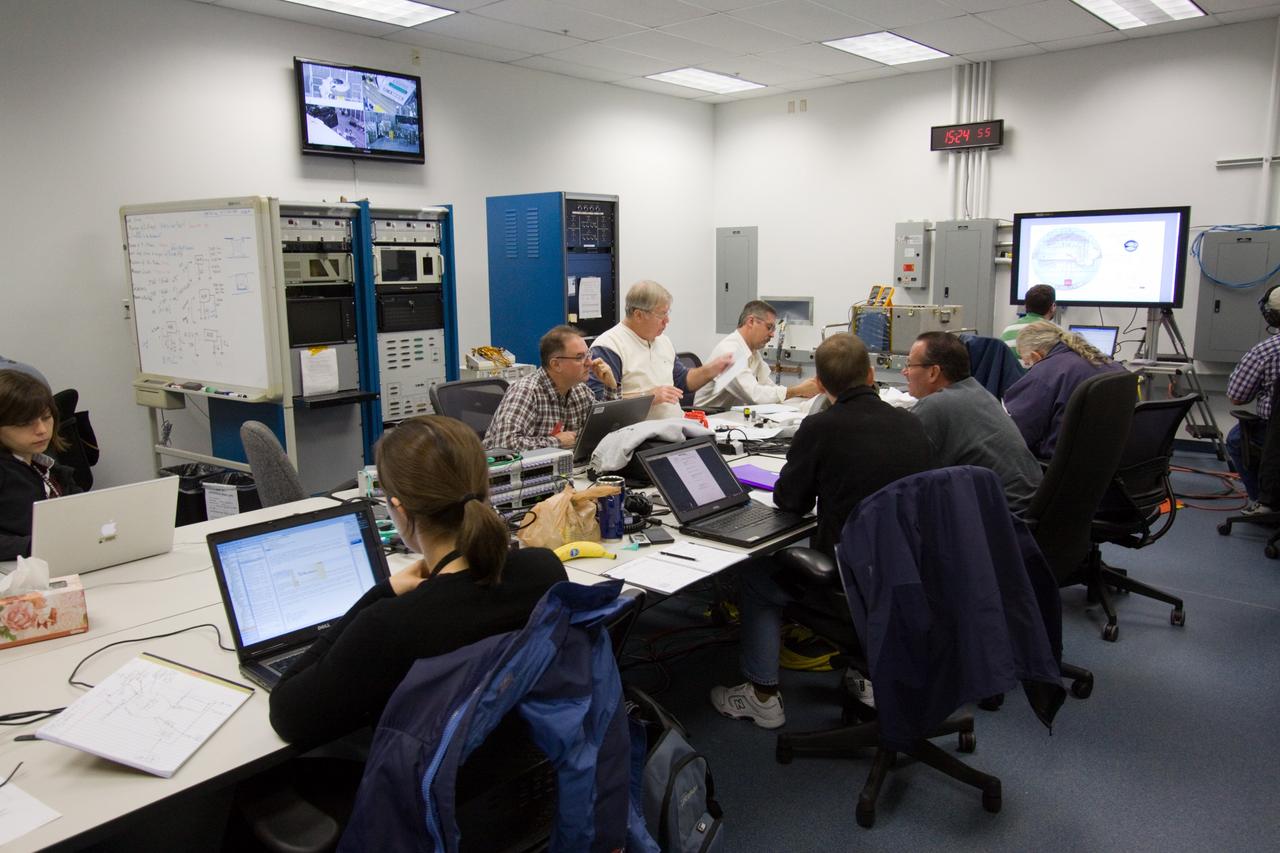
CAPE CANAVERAL, Fla. – In the control room at the Astrotech Space Operations facility in Titusville, Fla., a team of Kennedy Space Center spacecraft fueling specialists and engineers monitors data received from the clean room as technicians sample the monomethylhydrazine propellant that will be loaded aboard the Solar Dynamics Observatory, or SDO. The hydrazine fuel is being sampled for purity before it is loaded aboard the spacecraft. The technicians are dressed in self-contained atmospheric protective ensemble suits, or SCAPE suits, as a safety precaution in the unlikely event that any of the highly toxic chemical should escape from the storage tank. The nitrogen tetroxide oxidizer was loaded earlier in the week which is customarily followed by loading of the fuel. Propellant loading is one of the final processing milestones before the spacecraft is encapsulated in its fairing for launch. SDO is the first mission in NASA's Living With a Star Program and is designed to study the causes of solar variability and its impacts on Earth. The spacecraft's long-term measurements will give solar scientists in-depth information to help characterize the interior of the Sun, the Sun's magnetic field, the hot plasma of the solar corona, and the density of radiation that creates the ionosphere of the planets. The information will be used to create better forecasts of space weather needed to protect the aircraft, satellites and astronauts living and working in space. Liftoff aboard an Atlas V rocket is targeted for Feb. 9 from Launch Complex 41 on Cape Canaveral Air Force Station. For information on SDO, visit http://www.nasa.gov/sdo. Photo credit: NASA/Jack Pfaller