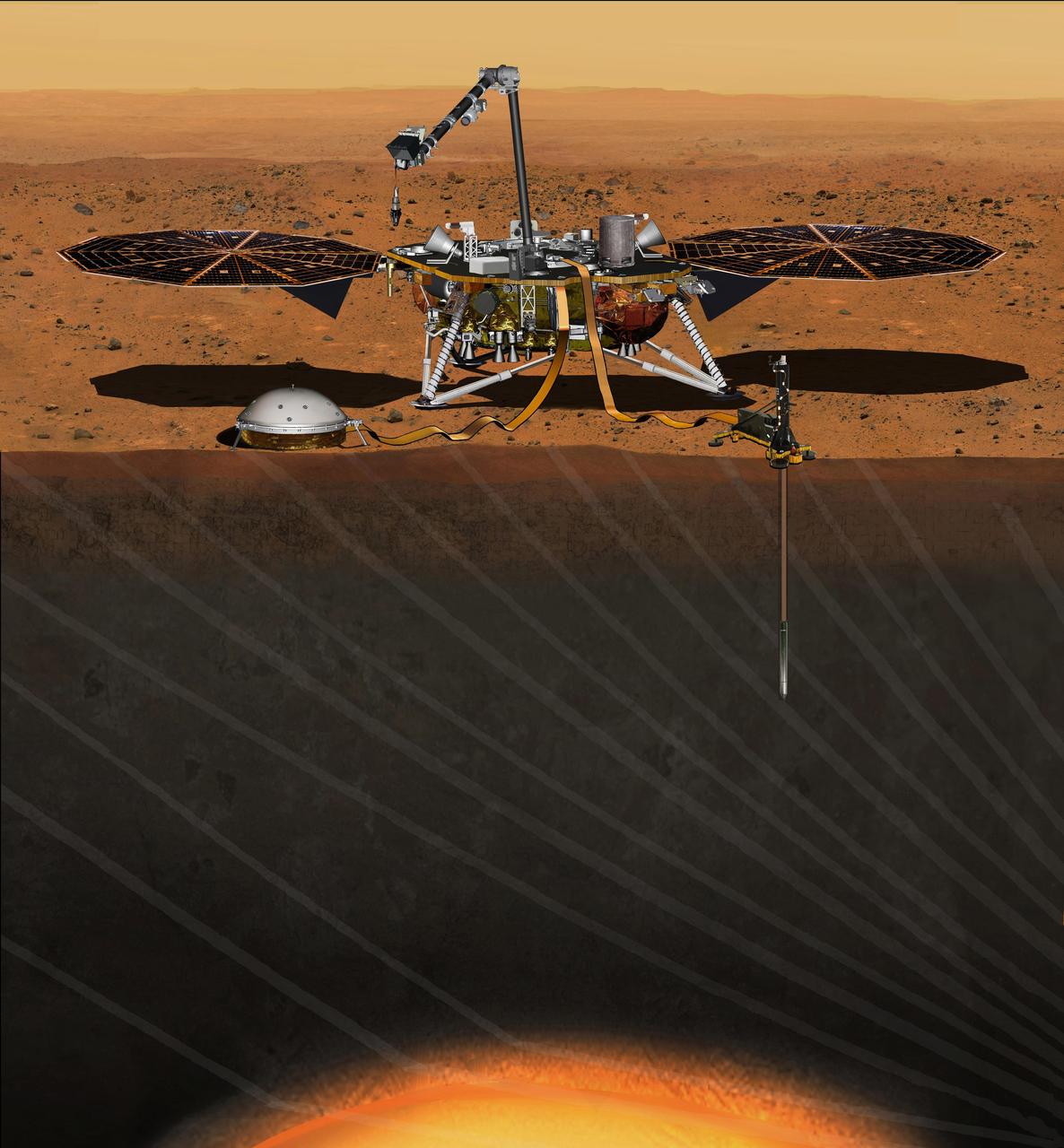
This artist's concept from August 2015 depicts NASA's InSight Mars lander fully deployed for studying the deep interior of Mars. This illustration updates the correct placement and look of Insight's main instruments. For an earlier artist rendition, see PIA17358. InSight, short for Interior Exploration using Seismic Investigations, Geodesy and Heat Transport, will investigate processes that formed and shaped Mars. Its findings will improve understanding about the evolution of our inner solar system's rocky planets, including Earth. The lander will be the first mission to permanently deploy instruments directly onto Martian ground using a robotic arm. The two instruments to be placed into a work area in front of the lander are a seismometer (contributed by the French space agency Centre National d'Études Spatiales, or CNES) to measure the microscopic ground motions from distant marsquakes providing information about the interior structure of Mars, and a heat-flow probe (contributed by the German Aerospace Center, or DLR) designed to hammer itself 3 to 5 meters (about 16 feet) deep and monitor heat coming from the planet's interior. The mission will also track the lander's radio to measure wobbles in the planet's rotation that relate to the size of its core and a suite of environmental sensors to monitor the weather and variations in the magnetic field. Two cameras will aid in instrument deployment and monitoring the local environment. Note: After thorough examination, NASA managers have decided to suspend the planned March 2016 launch of the Interior Exploration using Seismic Investigations Geodesy and Heat Transport (InSight) mission. The decision follows unsuccessful attempts to repair a leak in a section of the prime instrument in the science payload. http://photojournal.jpl.nasa.gov/catalog/PIA19811
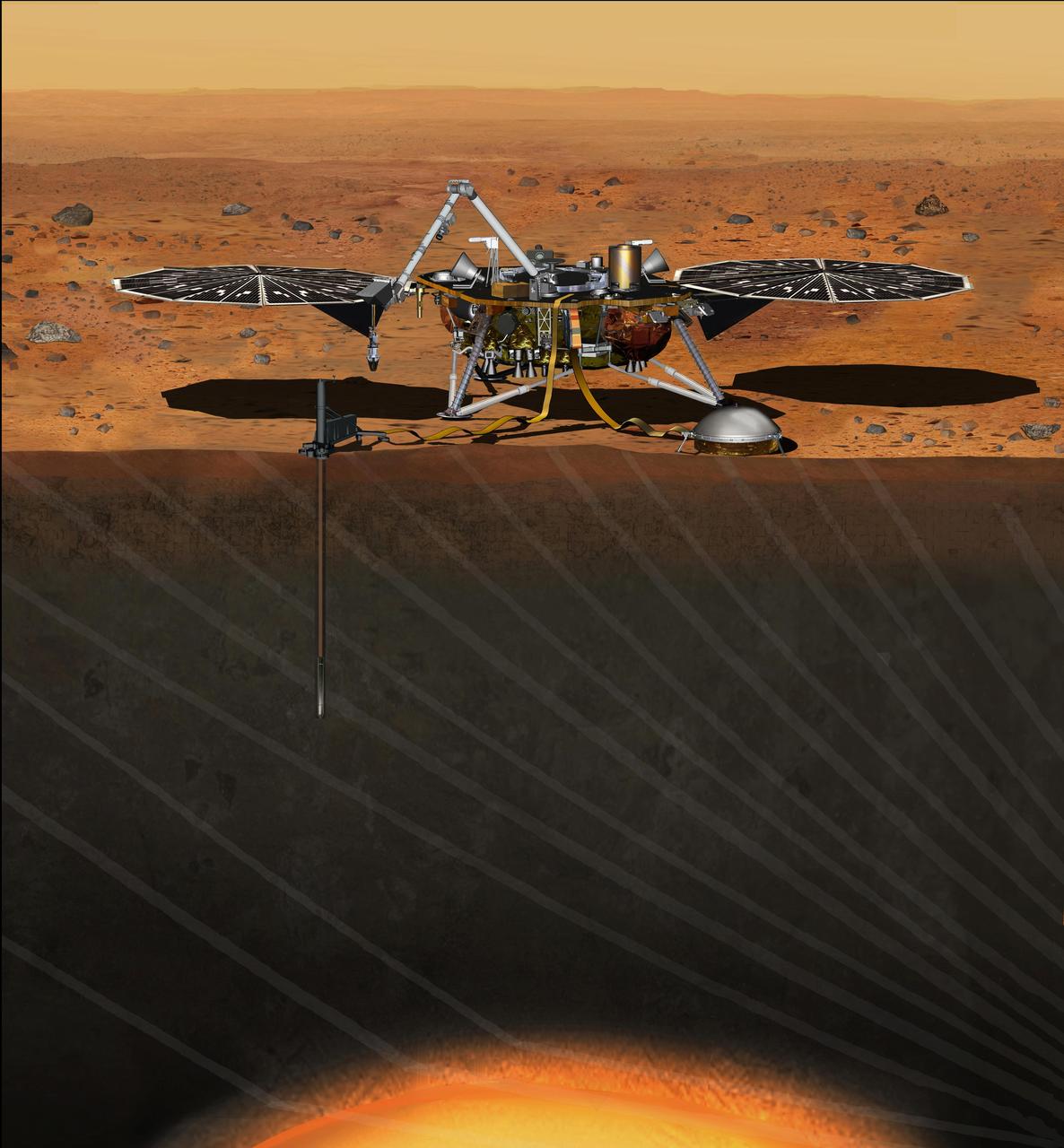
This artist's concept depicts the stationary NASA Mars lander known by the acronym InSight at work studying the interior of Mars. The InSight mission (for Interior Exploration using Seismic Investigations, Geodesy and Heat Transport) is scheduled to launch in March 2016 and land on Mars six months later. It will investigate processes that formed and shaped Mars and will help scientists better understand the evolution of our inner solar system's rocky planets, including Earth. InSight will deploy two instruments to the ground using a robotic arm: a seismometer (contributed by the French space agency Centre National d'Etudes Spatiales, or CNES) to measure the microscopic ground motions from distant marsquakes, providing detailed information about the interior structure of Mars; and a heat-flow probe (contributed by the German Aerospace Center, or DLR) designed to hammer itself 3 to 5 meters (about 16 feet) deep and monitor heat coming from the planet's interior. The mission will also track the lander's radio to measure wobbles in the planet's rotation that relate to the size of its core and will include a camera and a suite of environmental sensors to monitor the weather and variations in the magnetic field. Lockheed Martin Space Systems, Denver, is building the spacecraft. Note: After thorough examination, NASA managers have decided to suspend the planned March 2016 launch of the Interior Exploration using Seismic Investigations Geodesy and Heat Transport (InSight) mission. The decision follows unsuccessful attempts to repair a leak in a section of the prime instrument in the science payload. http://photojournal.jpl.nasa.gov/catalog/PIA17358
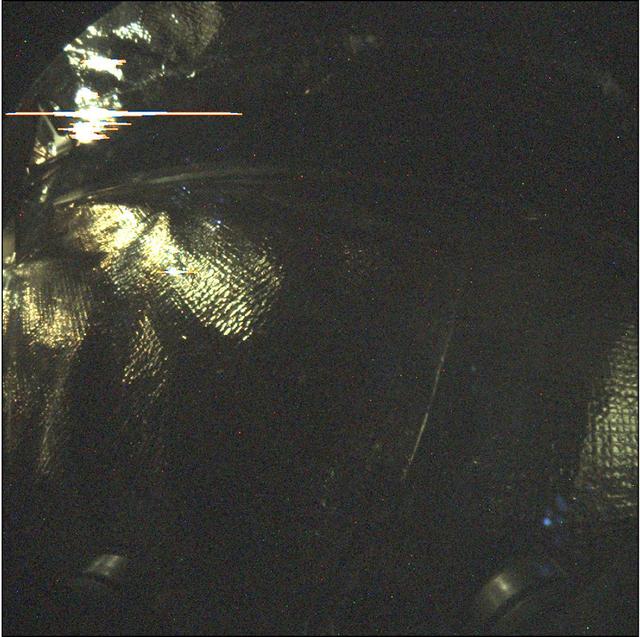
This long-exposure image (24 seconds) was taken by Instrument Context Camera (ICC) of NASA's InSight Mars lander. The image shows some of the interior features of the backshell that encapsulates the spacecraft. The backshell carries the parachute and several components used during later stages of entry, descent, and landing. Along with the heatshield, the backshell protects NASA's InSight Mars lander during its commute to and entry into the Martian atmosphere. The annotations in this image call out discernable components in the backshell -- the heatshield blanket, harness tie-downs, and cover bolts for the ICC. The heat shield blanket provides thermal protection from the hot and cold temperature swings encountered during cruise, and the high heat that will occur during Mars atmospheric entry. The tie-downs are used to secure harnesses (or other objects) so they do not move around inside the aeroshell while in flight. The ICC cover bolts secure a protective transparent window to the camera during cruise and entry, descent and landing. The cover is opened after landing and is not visible during surface operations. This image has been stretched to bring out details in the dimly lit scene. The illumination of the components on the inside of the backshell comes from sunlight entering around the edges of cutouts in the backshell to accommodate steering thrusters. An annotated image is available at https://photojournal.jpl.nasa.gov/catalog/PIA22647
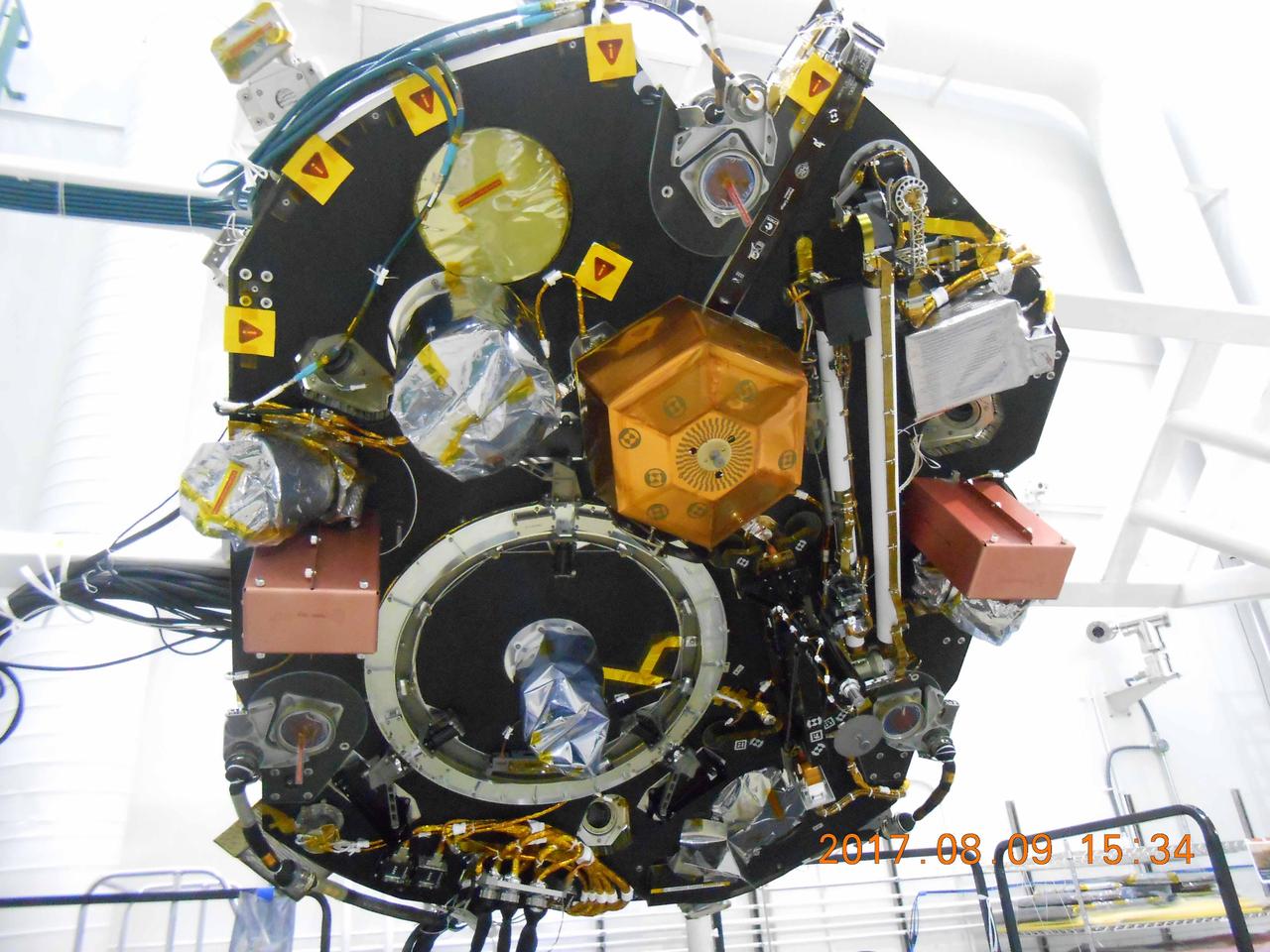
This view looks upward toward the InSight Mars lander suspended upside down. It shows the top of the lander's science deck with the mission's two main science instruments -- the Seismic Experiment for Interior Structure (SEIS) and the Heat Flow and Physical Properties Probe (HP3) -- plus the robotic arm and other subsystems installed. The photo was taken Aug. 9, 2017, in a Lockheed Martin clean room facility in Littleton, Colorado. The InSight mission (for Interior Exploration using Seismic Investigations, Geodesy and Heat Transport) is scheduled to launch in May 2018 and land on Mars Nov. 26, 2018. It will investigate processes that formed and shaped Mars and will help scientists better understand the evolution of our inner solar system's rocky planets, including Earth. https://photojournal.jpl.nasa.gov/catalog/PIA21847
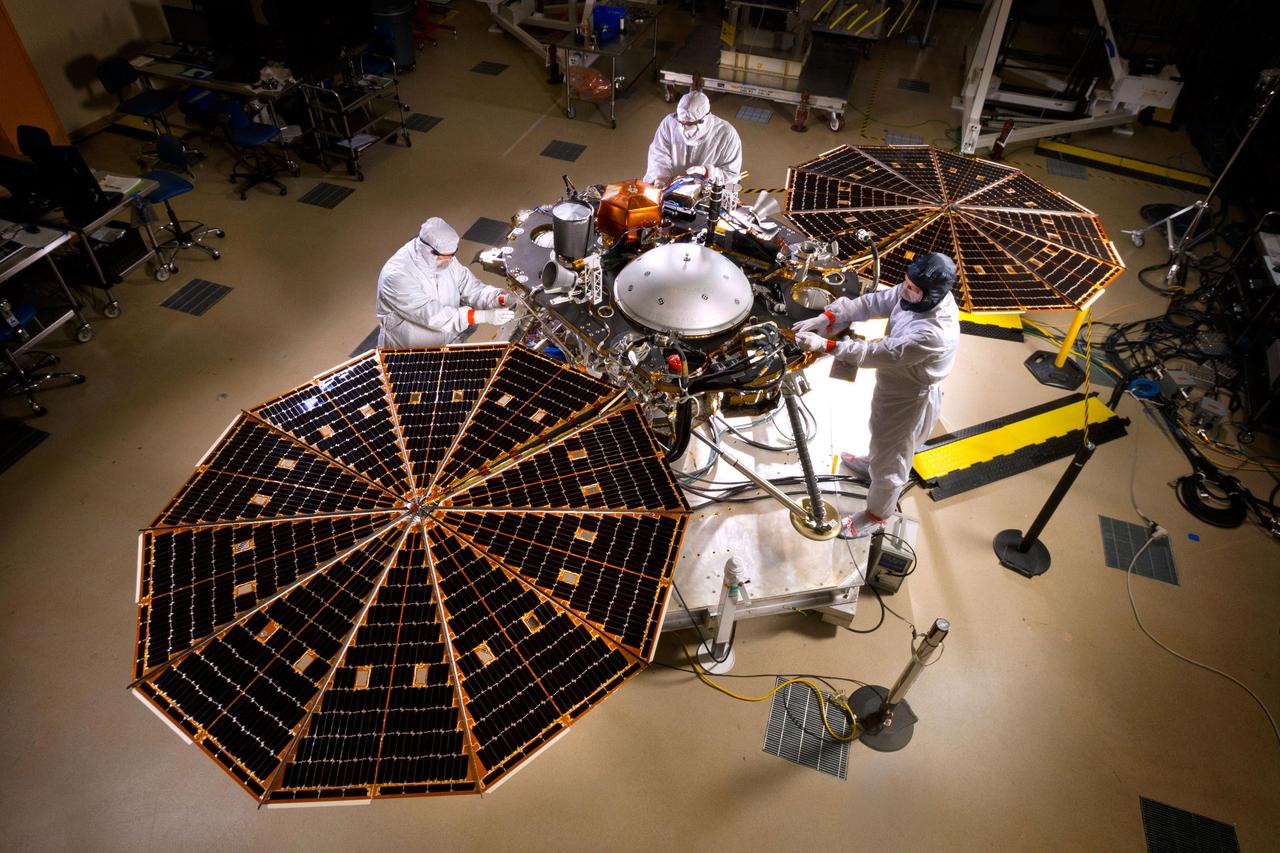
The solar arrays on NASA's InSight lander are deployed in this test inside a clean room at Lockheed Martin Space Systems, Denver. This configuration is how the spacecraft will look on the surface of Mars. The image was taken on April 30, 2015. InSight, for Interior Exploration Using Seismic Investigations, Geodesy and Heat Transport, is scheduled for launch in March 2016 and landing in September 2016. It will study the deep interior of Mars to advance understanding of the early history of all rocky planets, including Earth. Note: After thorough examination, NASA managers have decided to suspend the planned March 2016 launch of the Interior Exploration using Seismic Investigations Geodesy and Heat Transport (InSight) mission. The decision follows unsuccessful attempts to repair a leak in a section of the prime instrument in the science payload. http://photojournal.jpl.nasa.gov/catalog/PIA19664
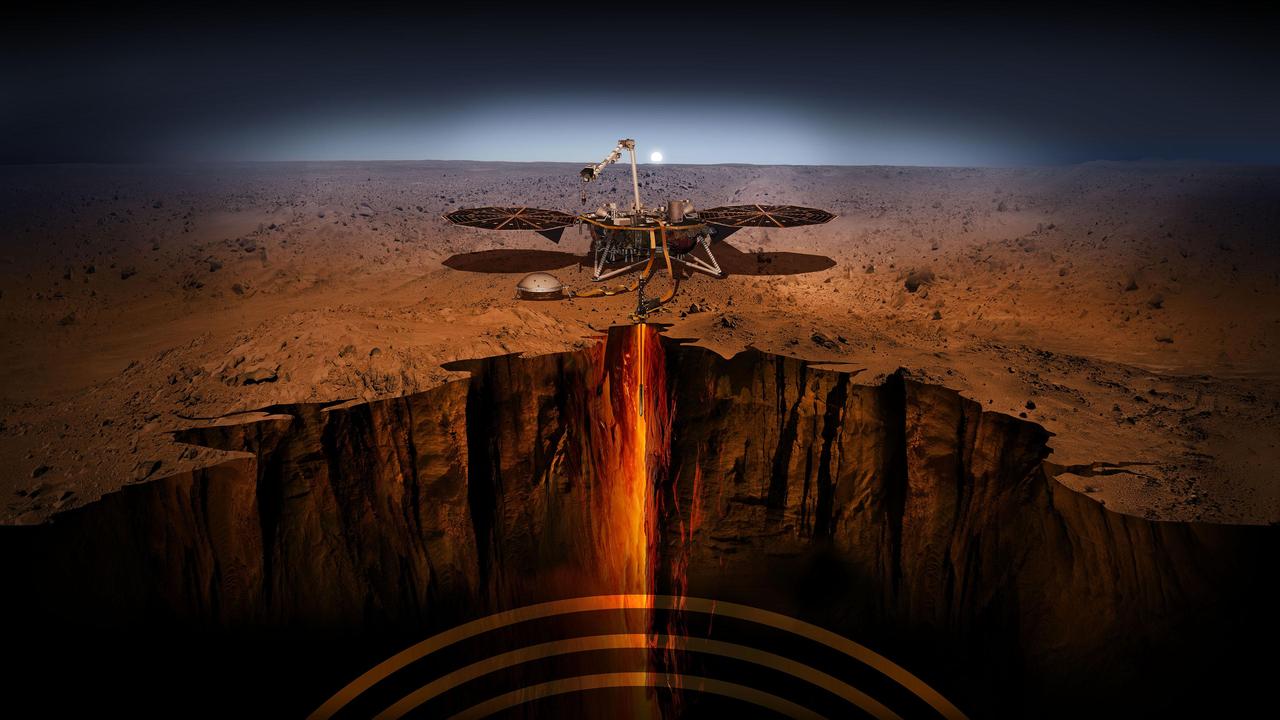
An artist illustration of the InSight lander on Mars. InSight, short for Interior Exploration using Seismic Investigations, Geodesy and Heat Transport, is designed to give the Red Planet its first thorough check up since it formed 4.5 billion years ago. The mission will look for tectonic activity and meteorite impacts, study how much heat is still flowing through the planet, and track Mars' wobble as it orbits the sun. While InSight is a Mars mission, it's more than a Mars mission. InSight will help answer key questions about the formation of the rocky planets of the solar system. https://photojournal.jpl.nasa.gov/catalog/PIA22745
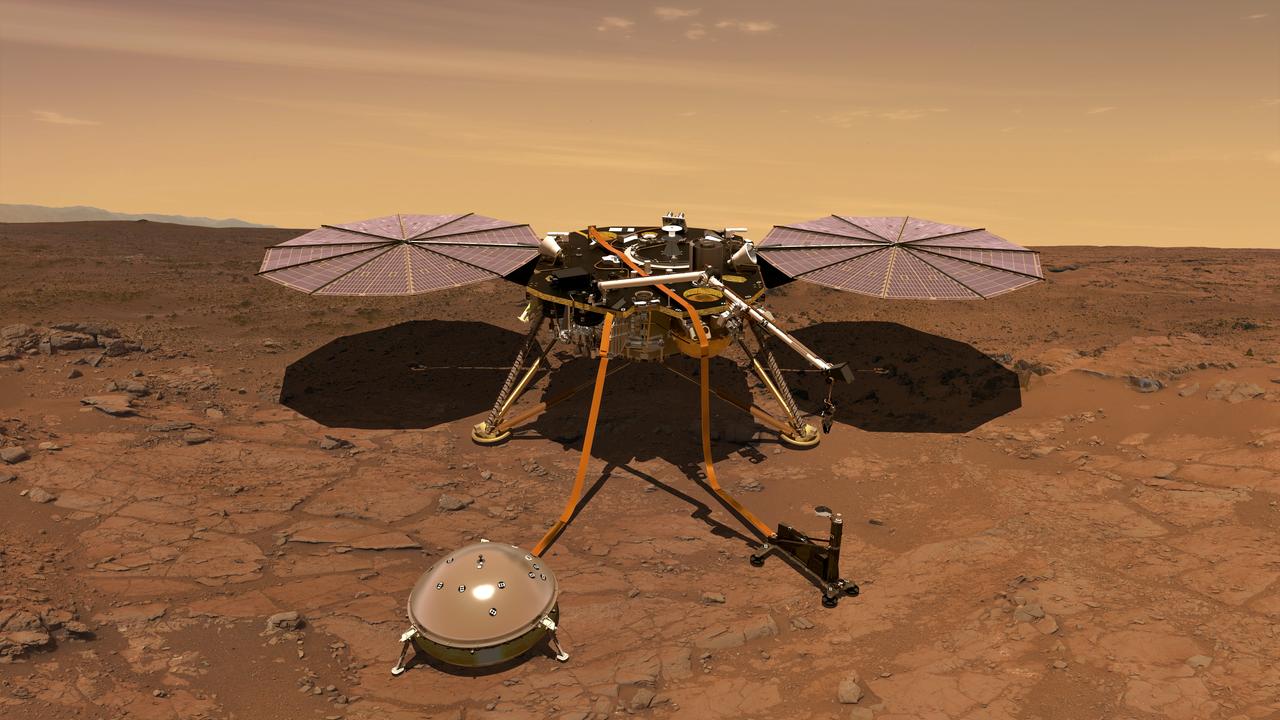
An artist's rendition of the InSight lander operating on the surface of Mars. InSight, short for Interior Exploration using Seismic Investigations, Geodesy and Heat Transport, is a lander designed to give Mars its first thorough check up since it formed 4.5 billion years ago. It is scheduled to launch from Vandenberg Air Force Base on the California coast between May 5 through June 8, 2018, and land on Mars six months later, on Nov. 26, 2018. InSight complements missions orbiting Mars and roving around on the planet's surface. The lander's science instruments look for tectonic activity and meteorite impacts on Mars, study how much heat is still flowing through the planet, and track the planet's wobble as it orbits the sun. This helps answer key questions about how the rocky planets of the solar system formed. So while InSight is a Mars mission, it's also more than a Mars mission. Surface operations begin a minute after landing at Elysium Planitia. The lander's prime mission is one Mars year (approximately two Earth years). https://photojournal.jpl.nasa.gov/catalog/PIA22228
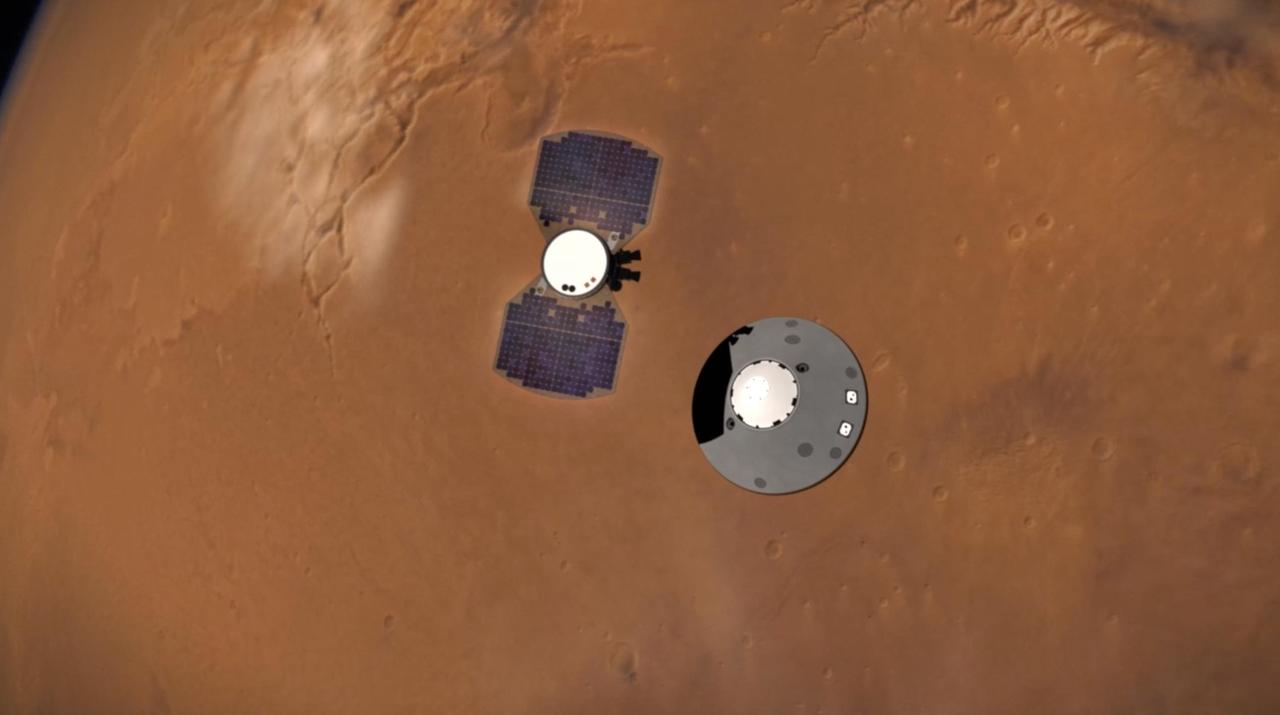
This illustration shows NASA's InSight lander separating from its cruise stage as it prepares to enter Mars' atmosphere. The InSight lander is on the right, tucked inside a protective heat shield and back shell. The cruise stage with solar panels is on the left. https://photojournal.jpl.nasa.gov/catalog/PIA22828
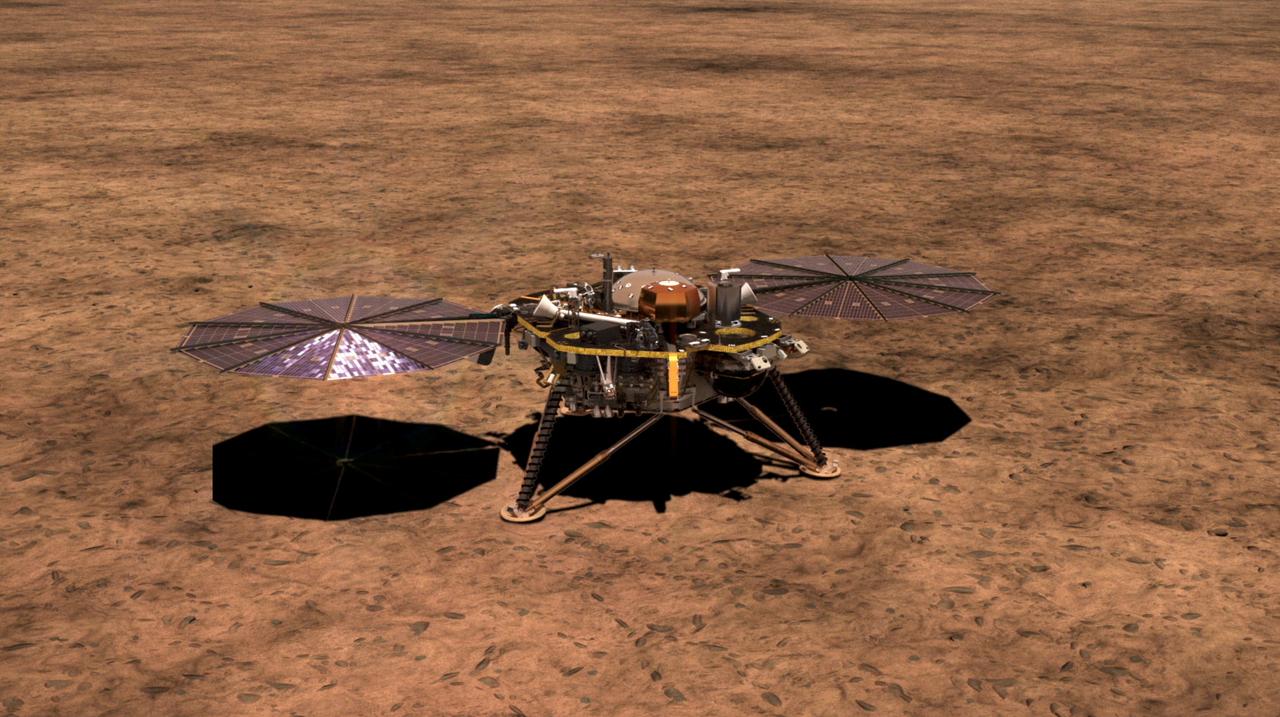
This artist's illustration shows NASA's InSight lander on the surface of Mars, with its solar arrays deployed. https://photojournal.jpl.nasa.gov/catalog/PIA22571
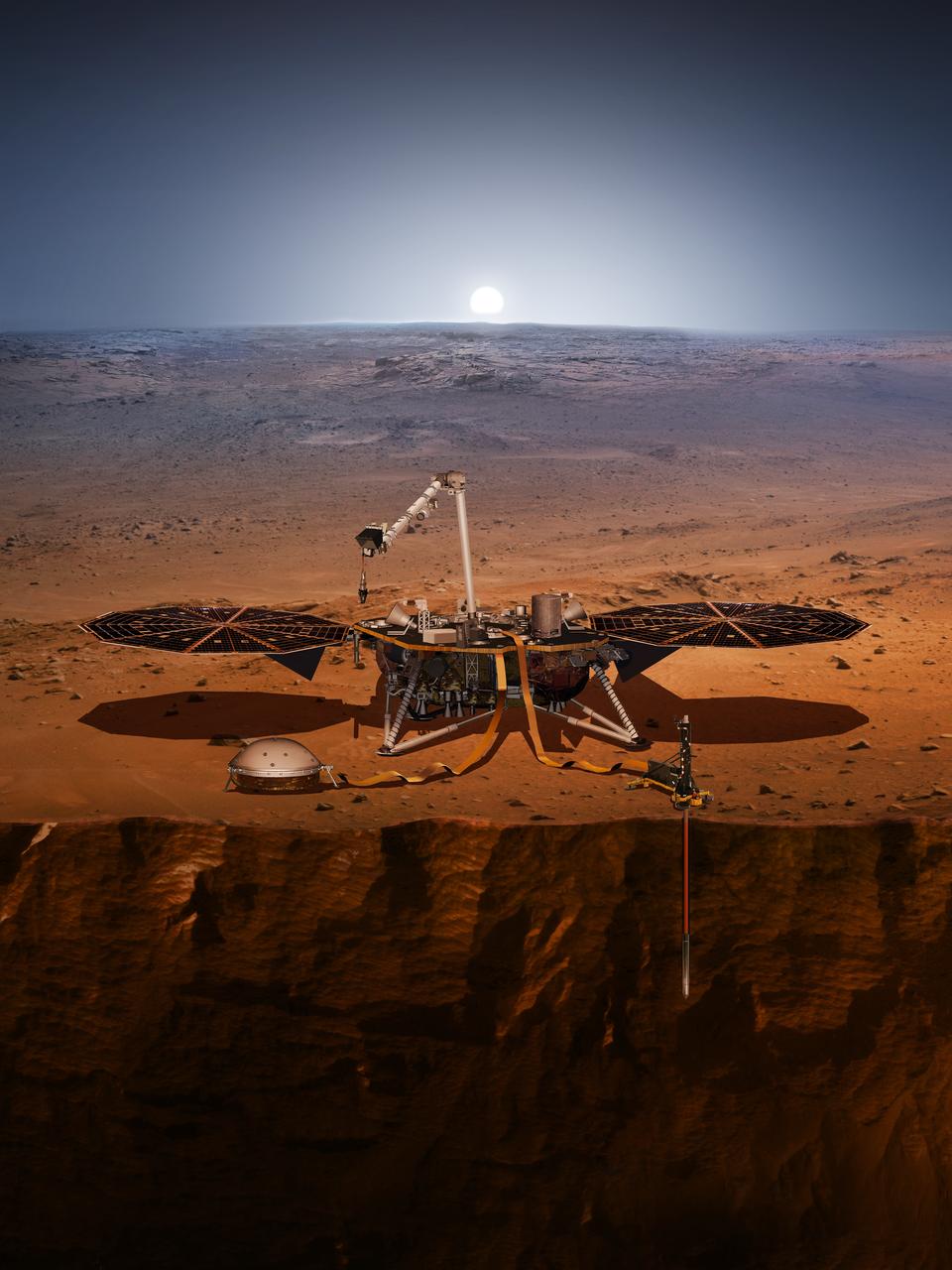
An artist's impression of the InSight lander on Mars. InSight, short for Interior Exploration using Seismic Investigations, Geodesy and Heat Transport, is designed to give the Red Planet its first thorough check up since it formed 4.5 billion years ago. It is scheduled to launch from Vandenberg Air Force Base on the California coast between May 5 through June 8, 2018, and land on Mars six months later. InSight will look for tectonic activity and meteorite impacts, study how much heat is still flowing through the planet, and track Mars' wobble as it orbits the sun. While InSight is a Mars mission, it's more than a Mars mission. InSight will help answer key questions about the formation of the rocky planets of the solar system. https://photojournal.jpl.nasa.gov/catalog/PIA22226
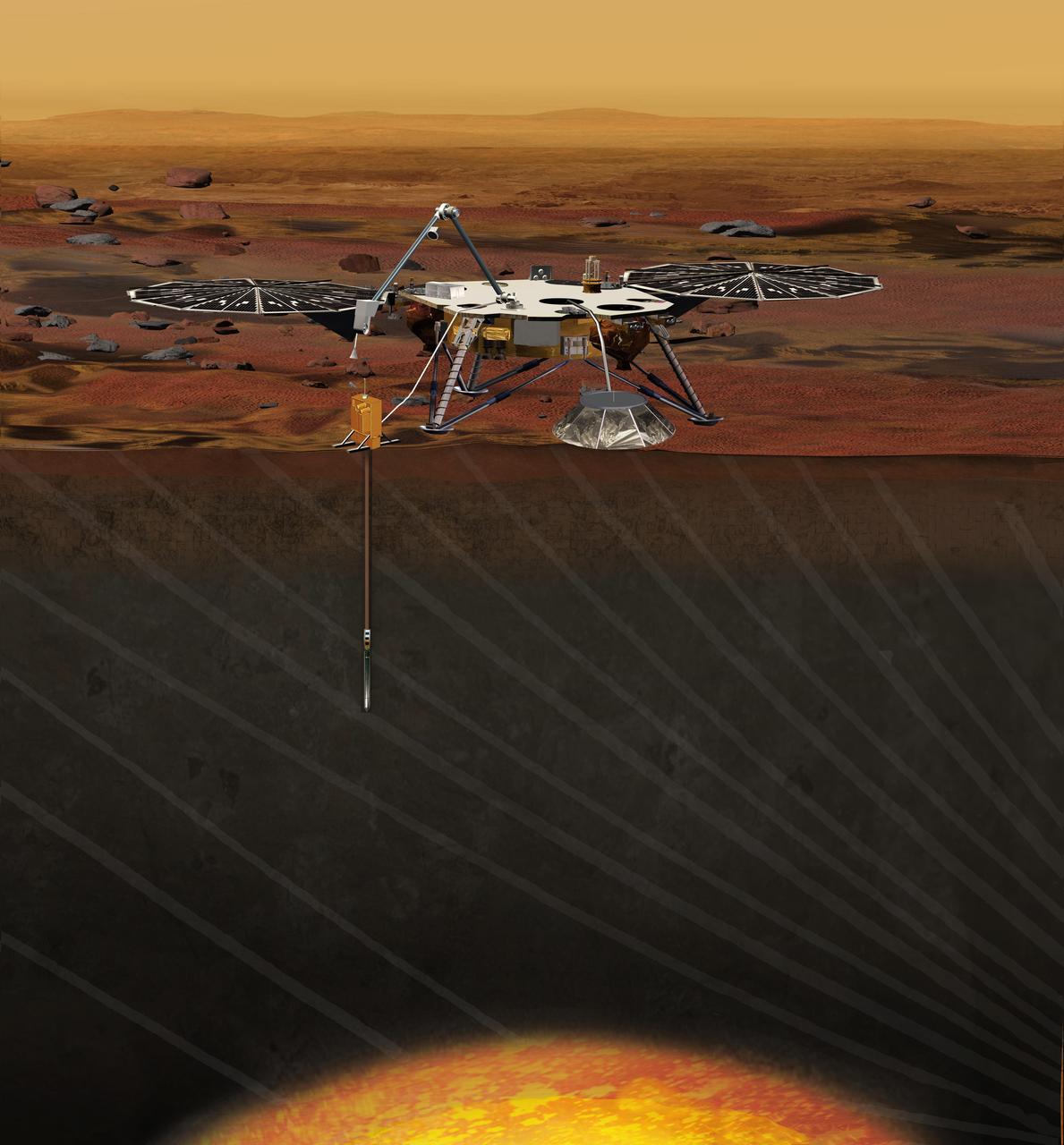
This artist rendition is of the Interior exploration using Seismic Investigations, Geodesy and Heat Transport InSight Lander. InSight proposes to place a single geophysical lander on Mars to study its deep interior. Note: After thorough examination, NASA managers have decided to suspend the planned March 2016 launch of the Interior Exploration using Seismic Investigations Geodesy and Heat Transport (InSight) mission. The decision follows unsuccessful attempts to repair a leak in a section of the prime instrument in the science payload. http://photojournal.jpl.nasa.gov/catalog/PIA13958
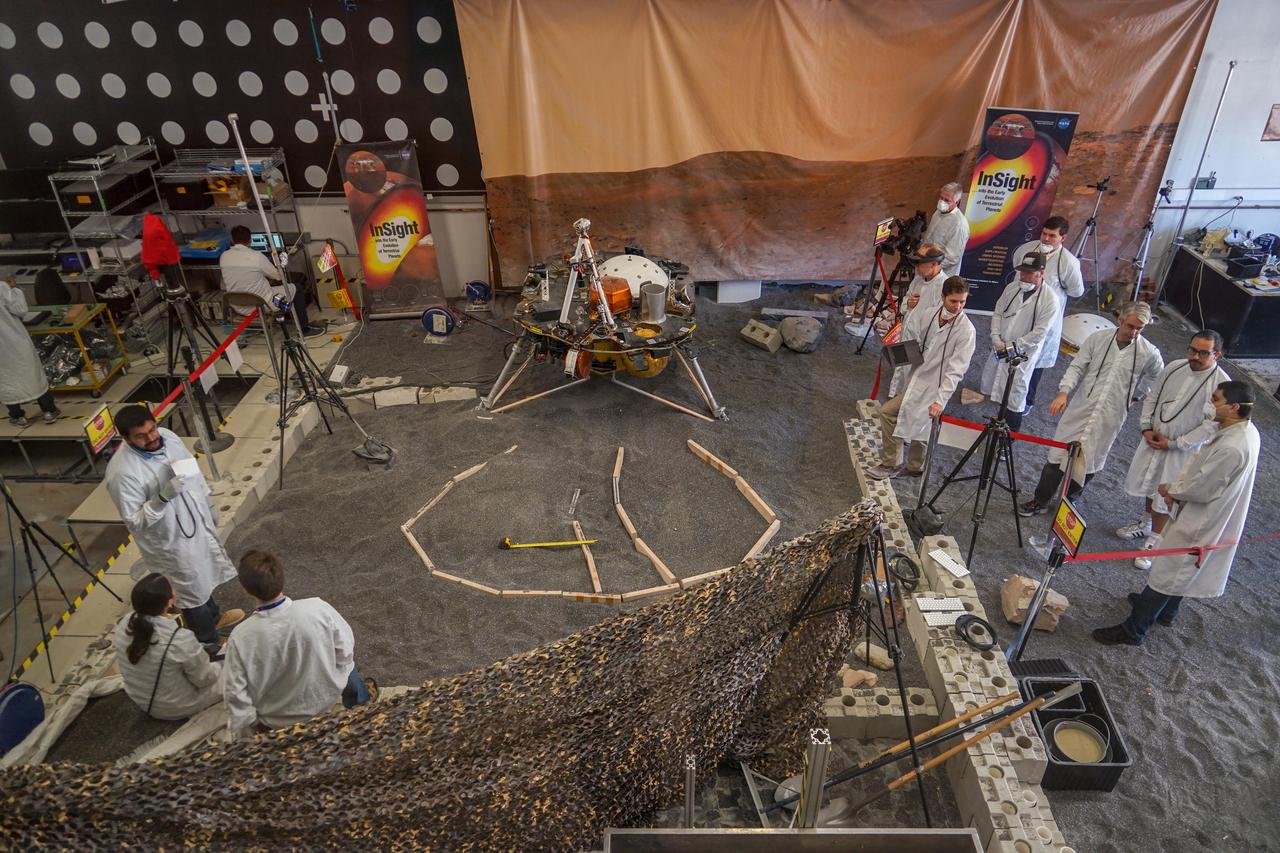
Engineers in Pasadena, California, sculpt a gravel-like material to mimic the terrain in front of NASA's InSight lander on Mars. Recreating the exact conditions will allow them to practice setting down the lander's instruments here on Earth (at NASA's Jet Propulsion Laboratory) before it's done on Mars. https://photojournal.jpl.nasa.gov/catalog/PIA22879
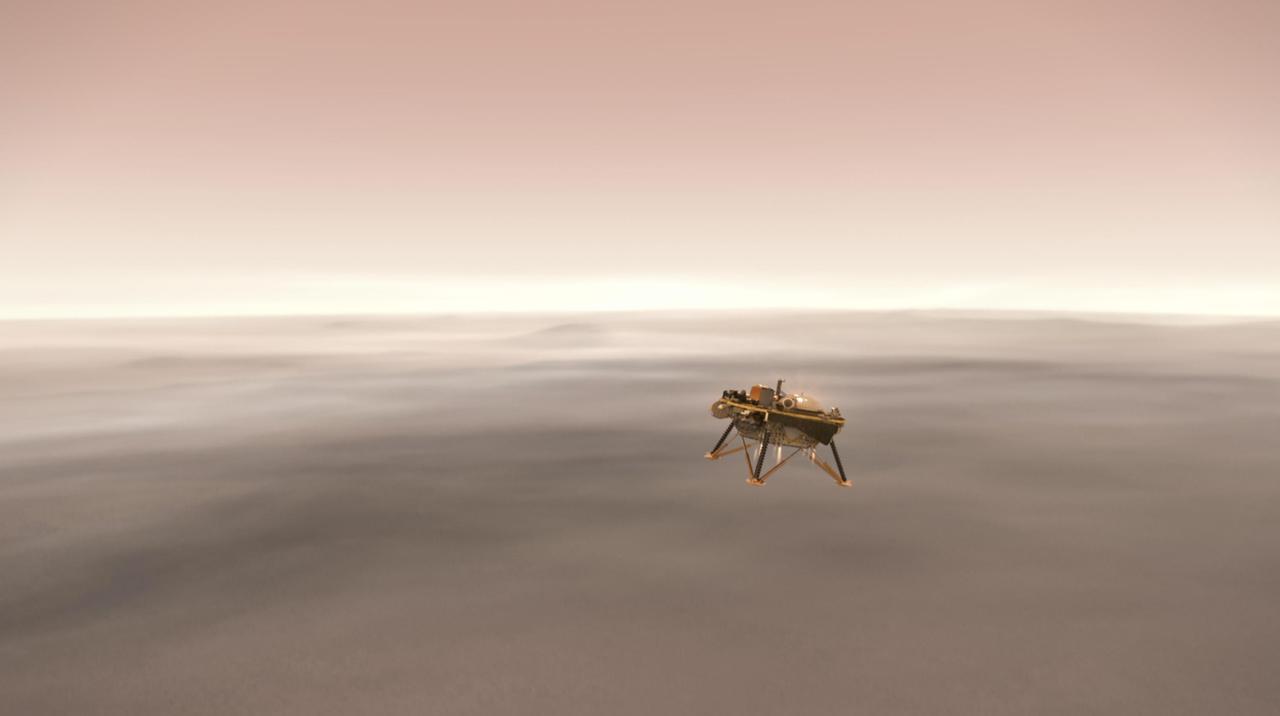
This is an illustration showing a simulated view of NASA's InSight lander about to land on the surface of Mars. This view shows the underside of the spacecraft. https://photojournal.jpl.nasa.gov/catalog/PIA22812
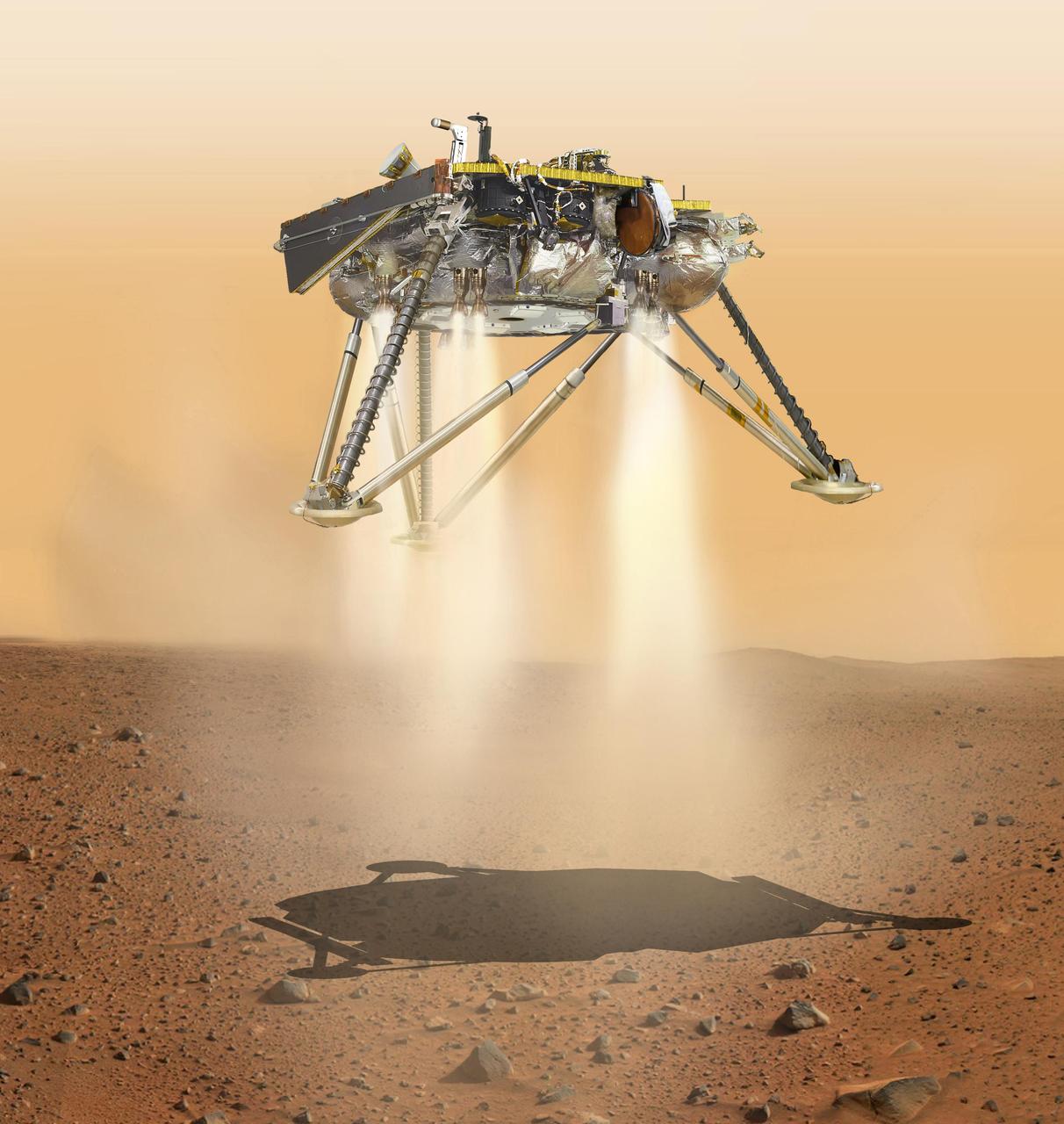
This illustration shows a simulated view of NASA's InSight lander firing retrorockets to slow down as it descends toward the surface of Mars. https://photojournal.jpl.nasa.gov/catalog/PIA22810
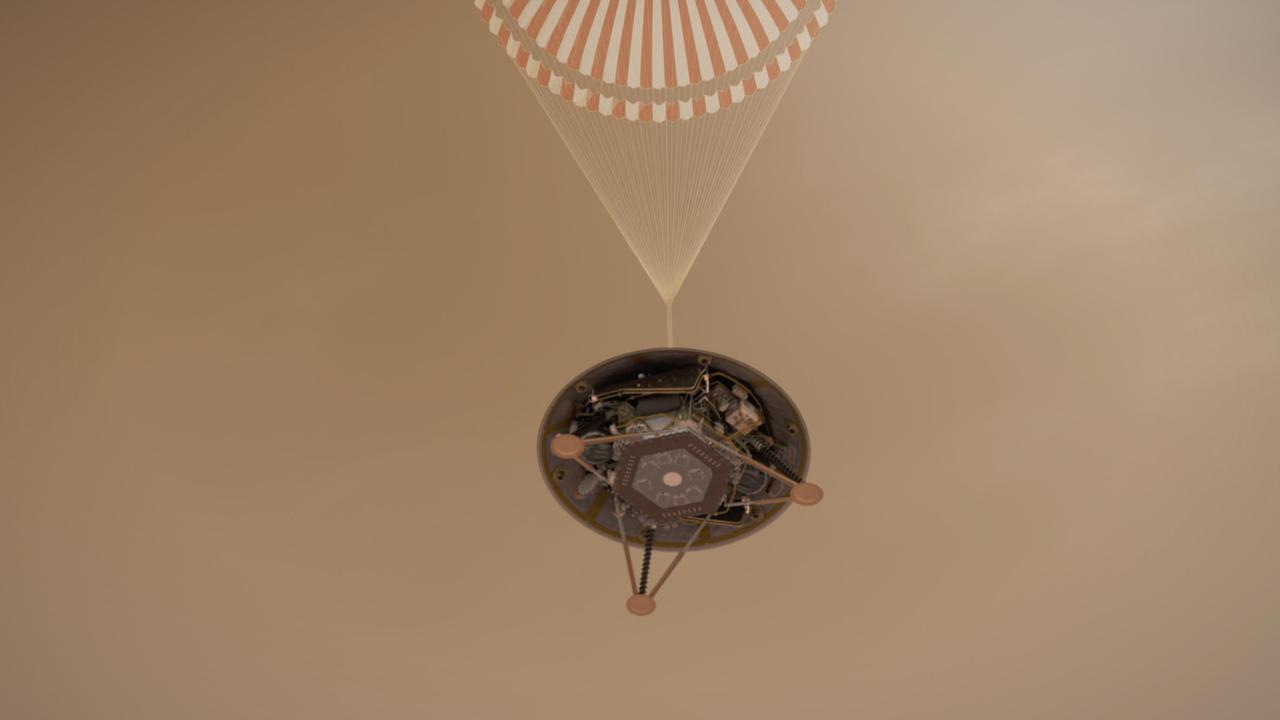
This illustration shows a simulated view of NASA's InSight lander descending towards the surface of Mars on its parachute. https://photojournal.jpl.nasa.gov/catalog/PIA22809

This is one of the last images ever taken by NASA's InSight Mars lander. Captured on Dec. 11, 2022, the 1,436th Martian day, or sol, of the mission, it shows InSight's seismometer on the Red Planet's surface. https://photojournal.jpl.nasa.gov/catalog/PIA25680
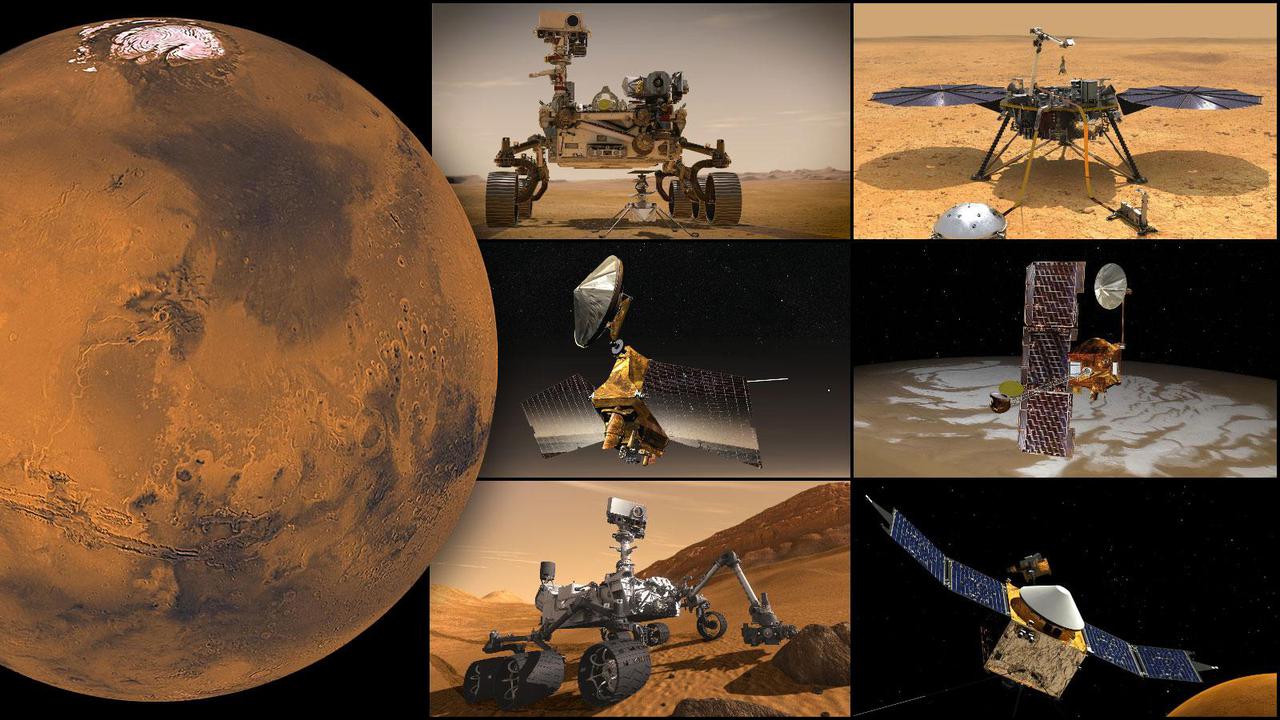
NASA's Mars missions, clockwise from top left: Perseverance rover and Ingenuity Mars Helicopter, InSight lander, Odyssey orbiter, MAVEN orbiter, Curiosity rover, and Mars Reconnaissance Orbiter. https://photojournal.jpl.nasa.gov/catalog/PIA24838
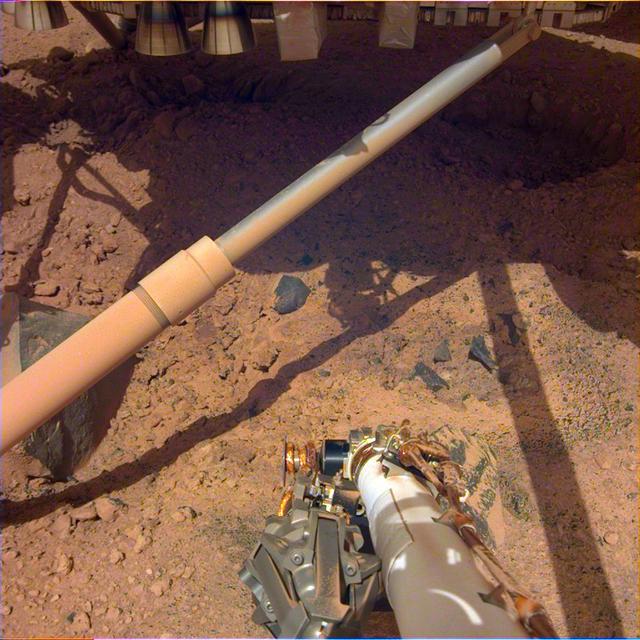
Thrusters under NASA's InSight lander churned up soil during landing on Mars. This image shows two pits excavated by the thrusters. https://photojournal.jpl.nasa.gov/catalog/PIA23301
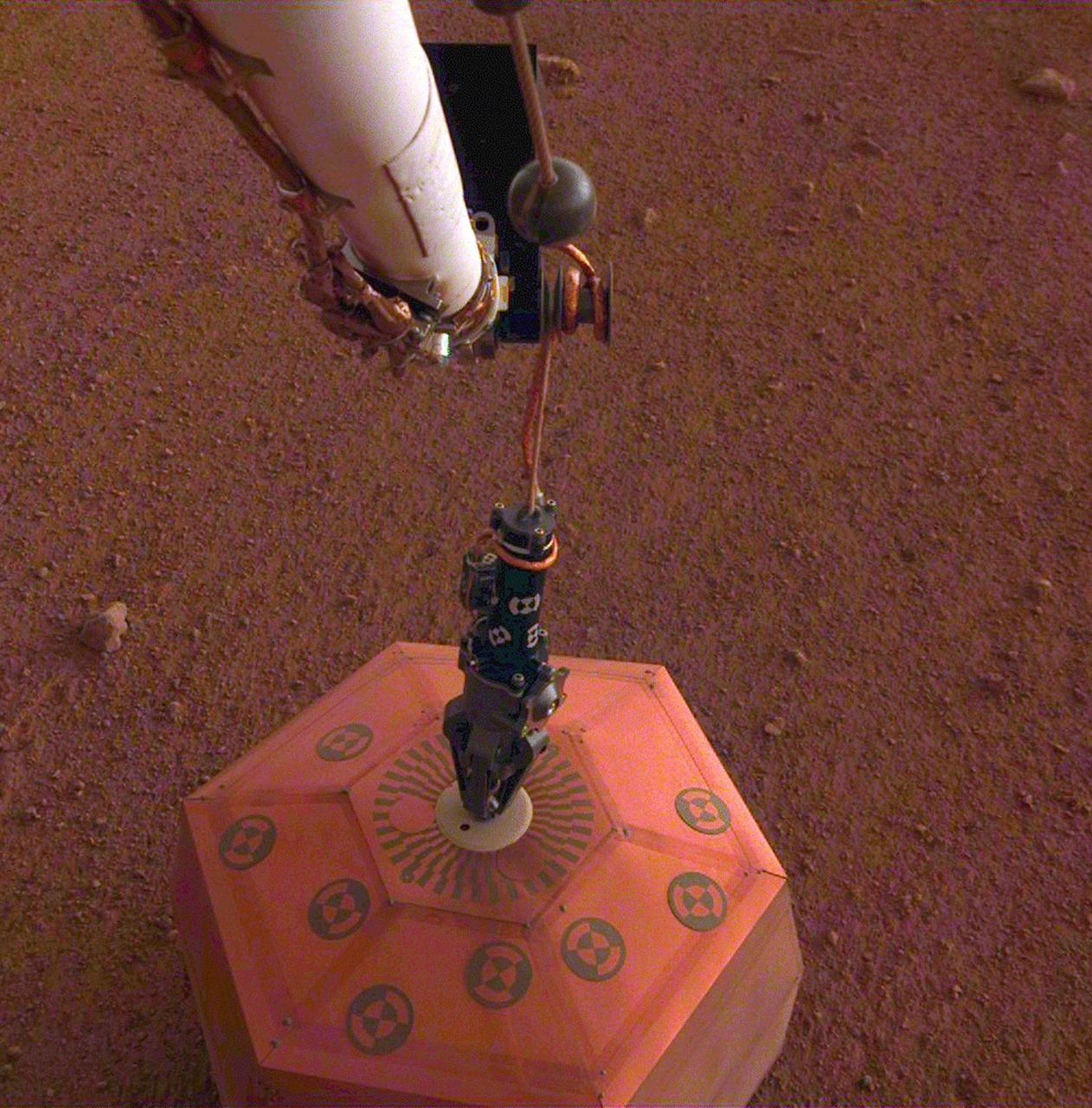
This set of images shows NASA's InSight lander deploying its first instrument onto the surface of Mars, completing a major mission milestone. InSight's robotic arm is white, with a black, handlike grapple at the end. The grapple is holding onto the copper-colored seismometer. The color-calibrated image was taken on Dec. 19, 2018, around dusk on Mars, with InSight's Instrument Deployment Camera (IDC), which is on the lander's robotic arm. Animation available at https://photojournal.jpl.nasa.gov/catalog/PIA22977
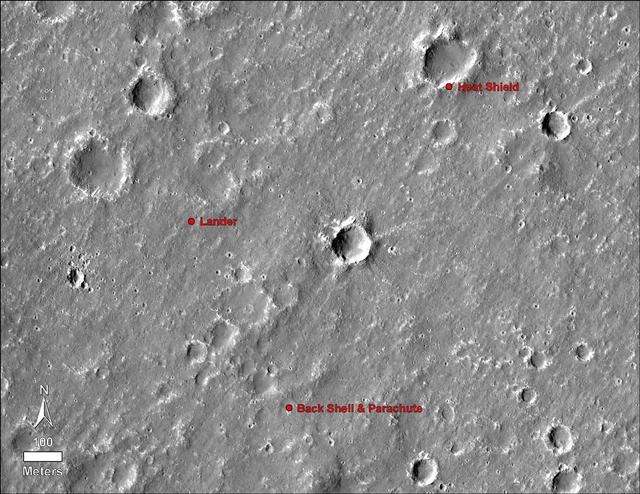
An annotated image of the surface of Mars, taken by the HiRISE camera on NASA's Mars Reconnaissance Orbiter (MRO) on May 30, 2014. The annotations - added after InSight landed on Nov. 26, 2018 - display the locations of NASA's InSight lander, its heat shield and parachute. https://photojournal.jpl.nasa.gov/catalog/PIA22877
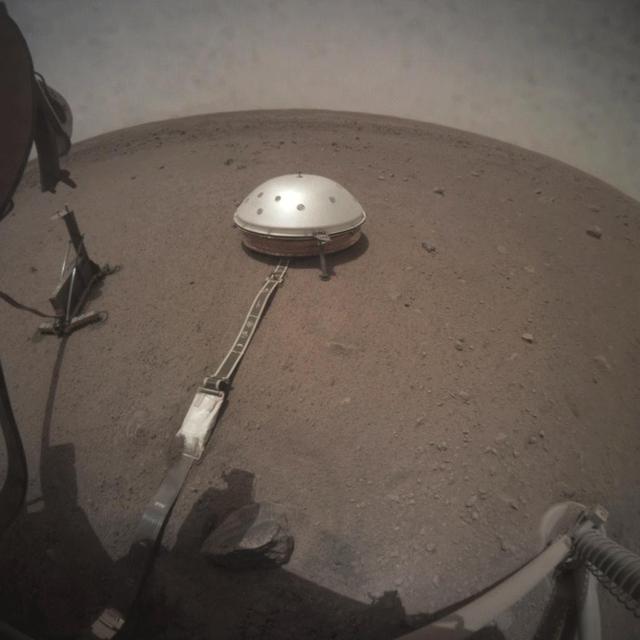
NASA's InSight lander took this series of images on Wednesday, March 6, 2019, capturing the moment when Phobos, one of Mars' moons, crossed in front of the Sun and darkened the ground around the lander. These images were taken by InSight's Instrument Context Camera (ICC), located under the lander's deck. The images were taken at intervals of about 50 seconds in order to capture the eclipse, which on this day lasted 26.7 seconds. The shadow of the lander can be seen moving to the right before the entire scene darkened during the moment of the eclipse. Movie available at https://photojournal.jpl.nasa.gov/catalog/PIA23048
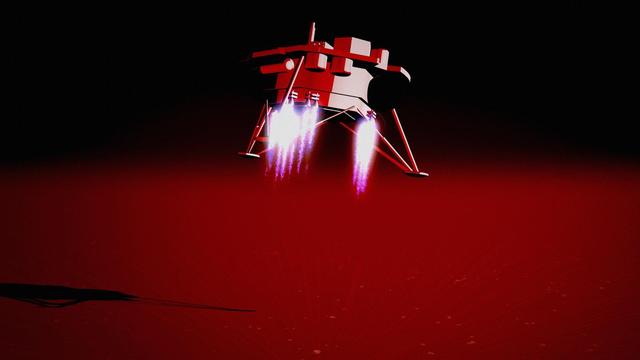
This animation illustrates NASA's InSight lander touching down on Mars, causing a rock to roll 3 feet (1 meter) as the lander touched down on Mars on Nov. 26, 2018. A little bigger than a golf ball, the rock was later nicknamed "Rolling Stones Rock" by the InSight team in honor of The Rolling Stones. A series of 10 or so divots marked the rock's course after being set in motion by the landing. It's the farthest NASA has seen a rock roll after landing a spacecraft on another planet. Though fitting, "Rolling Stones Rock" is not an official designation by the International Astronomical Union, which is responsible to approving the names given to geographical and geological features on other planets. The rock was imaged by the Instrument Deployment Camera (IDC) on InSight's robotic arm, which is not visible here. Movie available at https://photojournal.jpl.nasa.gov/catalog/PIA23345
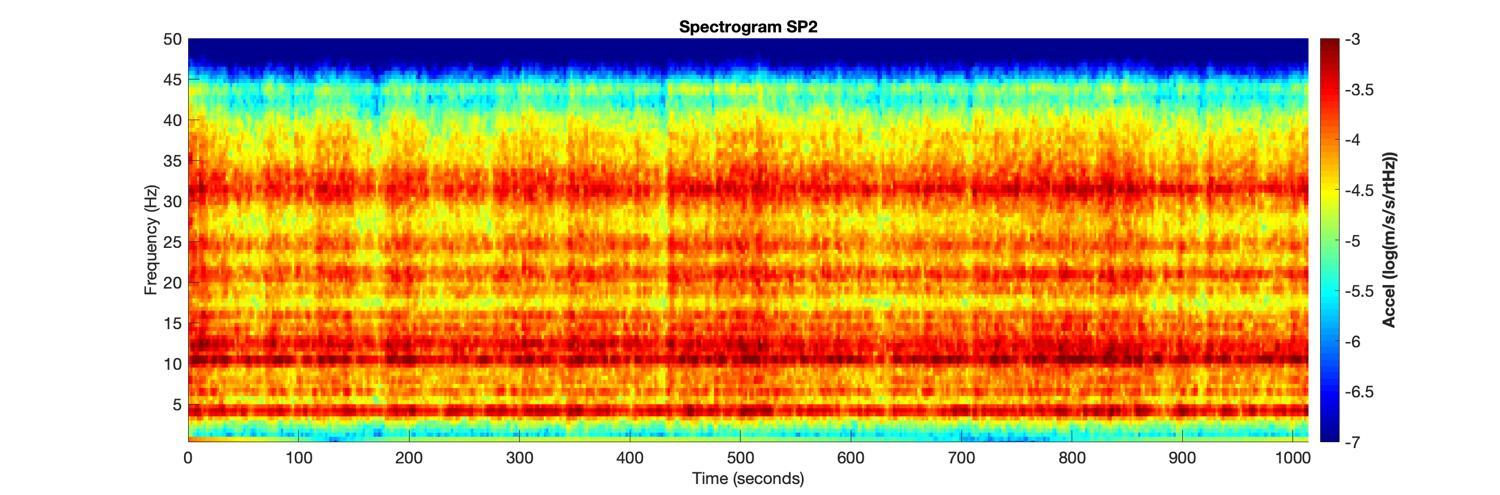
The spectrogram of vibrations (frequency spectrum over time) recorded by two of the three sensors of the short period seismometer on NASA's InSight lander on Mars. This spectrogram shows the first 1,000 seconds, roughly 20 minutes, of InSight's first seismic data from the Red Planet. The vibrations of the lander are due to the wind passing over the spacecraft, particularly the large solar arrays. https://photojournal.jpl.nasa.gov/catalog/PIA22925
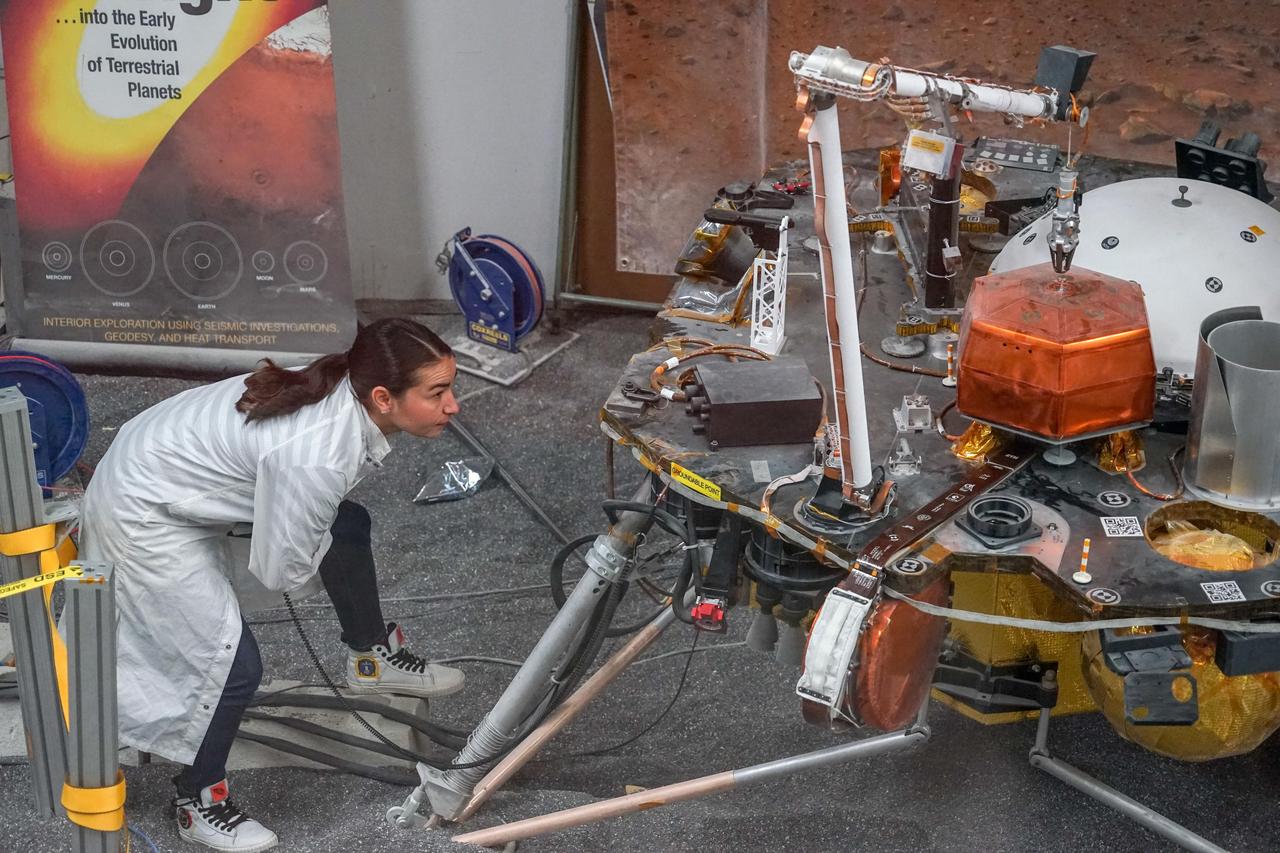
Engineer Marleen Sundgaard watches as a test version of NASA's Mars InSight lander grasps a model of the spacecraft's seismometer. This work was done at NASA's Jet Propulsion Laboratory in Pasadena, California. https://photojournal.jpl.nasa.gov/catalog/PIA22952
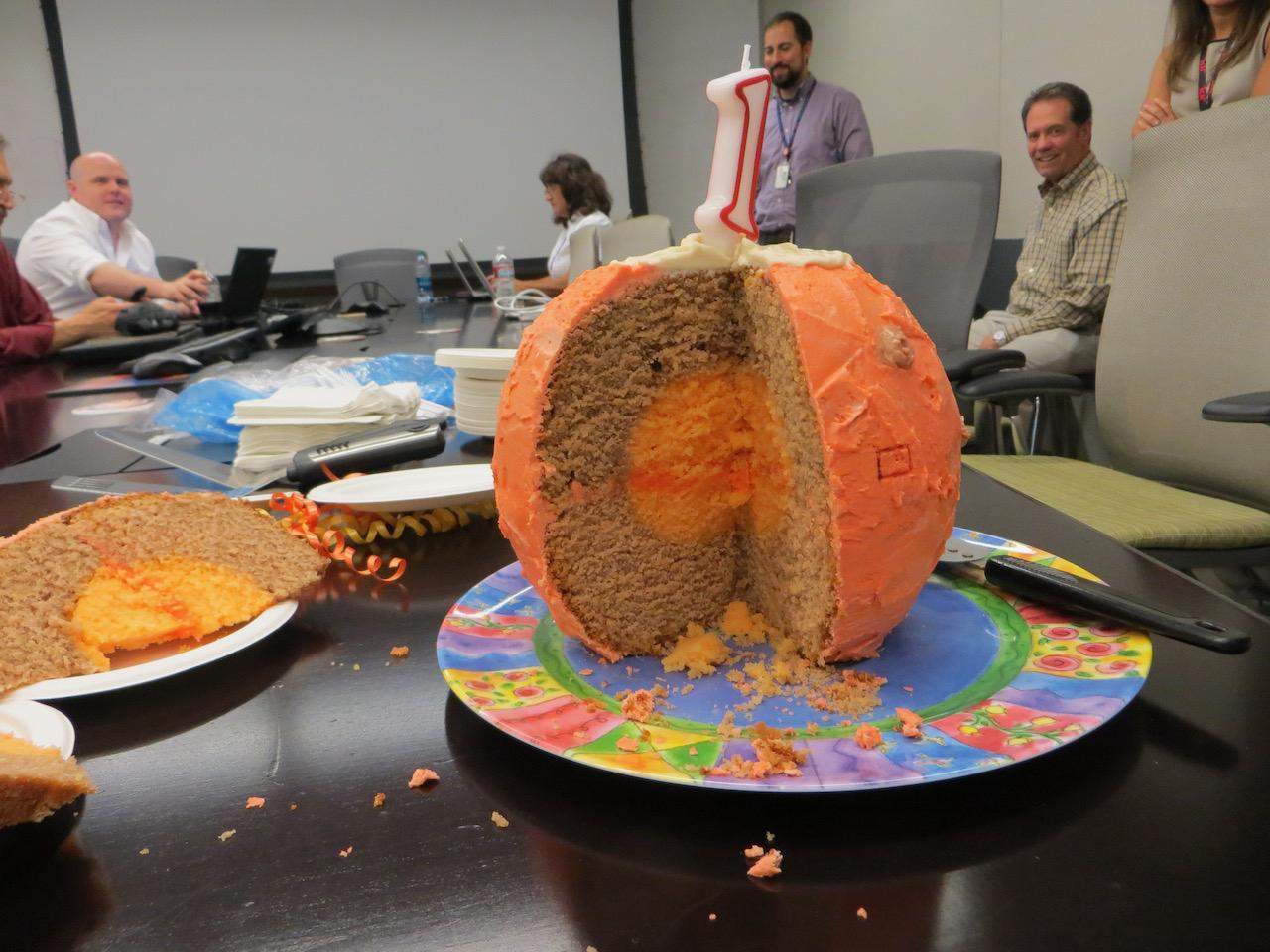
NASA's InSight lander team enjoyed this Mars-shaped cake on the first anniversary of the spacecraft's Nov. 26, 2018, landing. The cake came complete with its own inner layers – just like the Red Planet. https://photojournal.jpl.nasa.gov/catalog/PIA25283
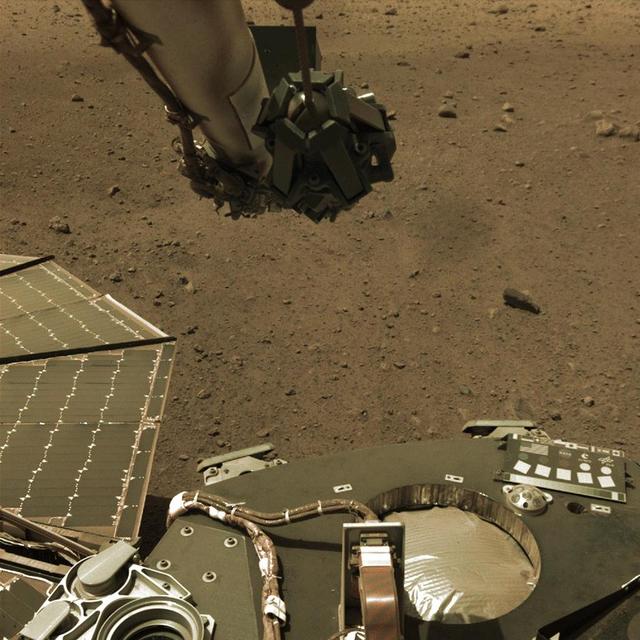
NASA's InSight lander took this series of images on Tuesday, March 5, 2019, capturing the moment when Phobos, one of Mars' moons, crossed in front of the Sun and darkened the ground around the lander. The images were taken by InSight's Instrument Deployment Camera (IDC), located on the lander's robotic arm. The images were taken at intervals of about 50 seconds in order to capture the eclipse, which on this day lasted 24.3 seconds. In the lower right corner of the frame, the shadow of the robotic arm can be seen moving to the right before the entire scene darkened during the moment of the eclipse. Movie available at https://photojournal.jpl.nasa.gov/catalog/PIA23049
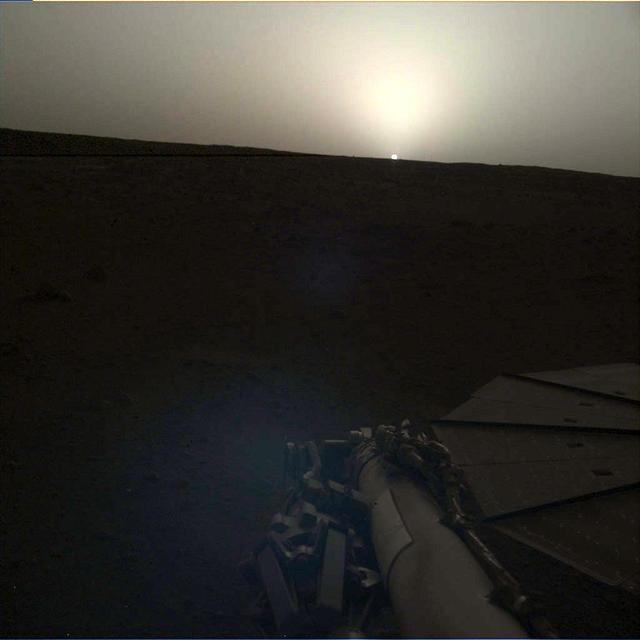
NASA's InSight lander used the Instrument Deployment Camera (IDC) on the end of its robotic arm to image this sunset on Mars on April 25, 2019, the 145th Martian day, or sol, of the mission. This was taken around 6:30 p.m. Mars local time. https://photojournal.jpl.nasa.gov/catalog/PIA23202
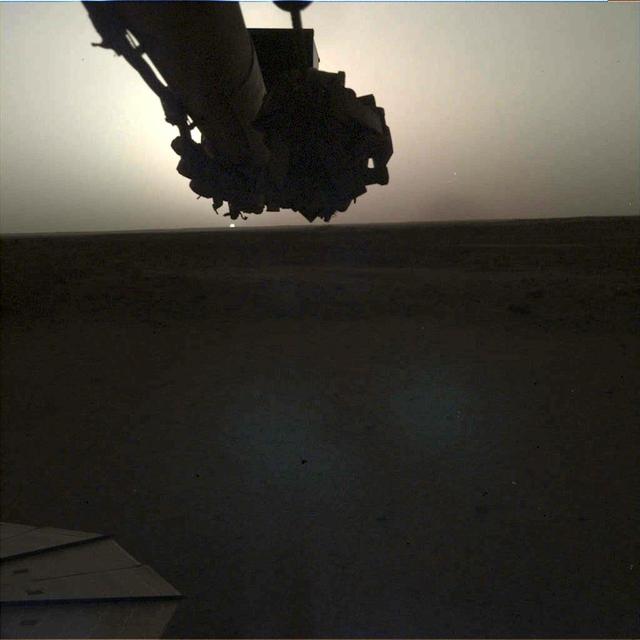
NASA's InSight lander used its Instrument Deployment Camera (IDC) on the spacecraft's robotic arm to image this sunrise on Mars on April 24, 2019, the 145th Martian day (or sol) of the mission. This was taken around 5:30 a.m. Mars local time. https://photojournal.jpl.nasa.gov/catalog/PIA23201
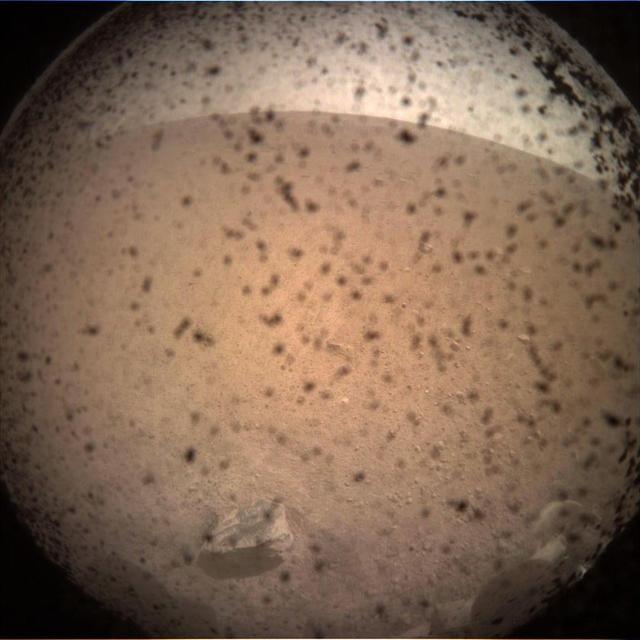
This is the first image taken by NASA's InSight lander on the surface of Mars. The instrument context camera (ICC) mounted below the lander deck obtained this image on Nov. 26, 2018, shortly after landing. The transparent lens cover was still in place to protect the lens from any dust kicked up during landing. https://photojournal.jpl.nasa.gov/catalog/PIA22829
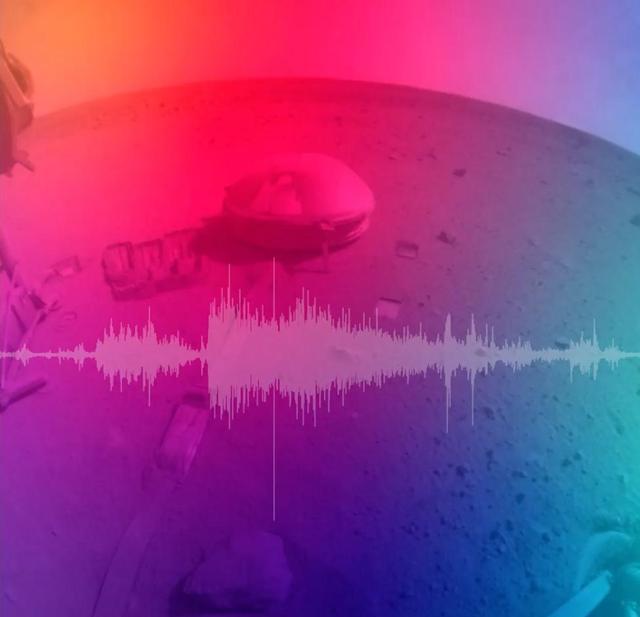
NASA's InSight Mars lander detected a giant meteoroid strike on Dec. 24, 2021, the 1,094th Martian day, or sol, of the mission. InSight's seismometer recorded seismic signals that are not in the range of human hearing. In order to make the signals audible, the data was sped up 100 times. Animation available at https://photojournal.jpl.nasa.gov/catalog/PIA25582
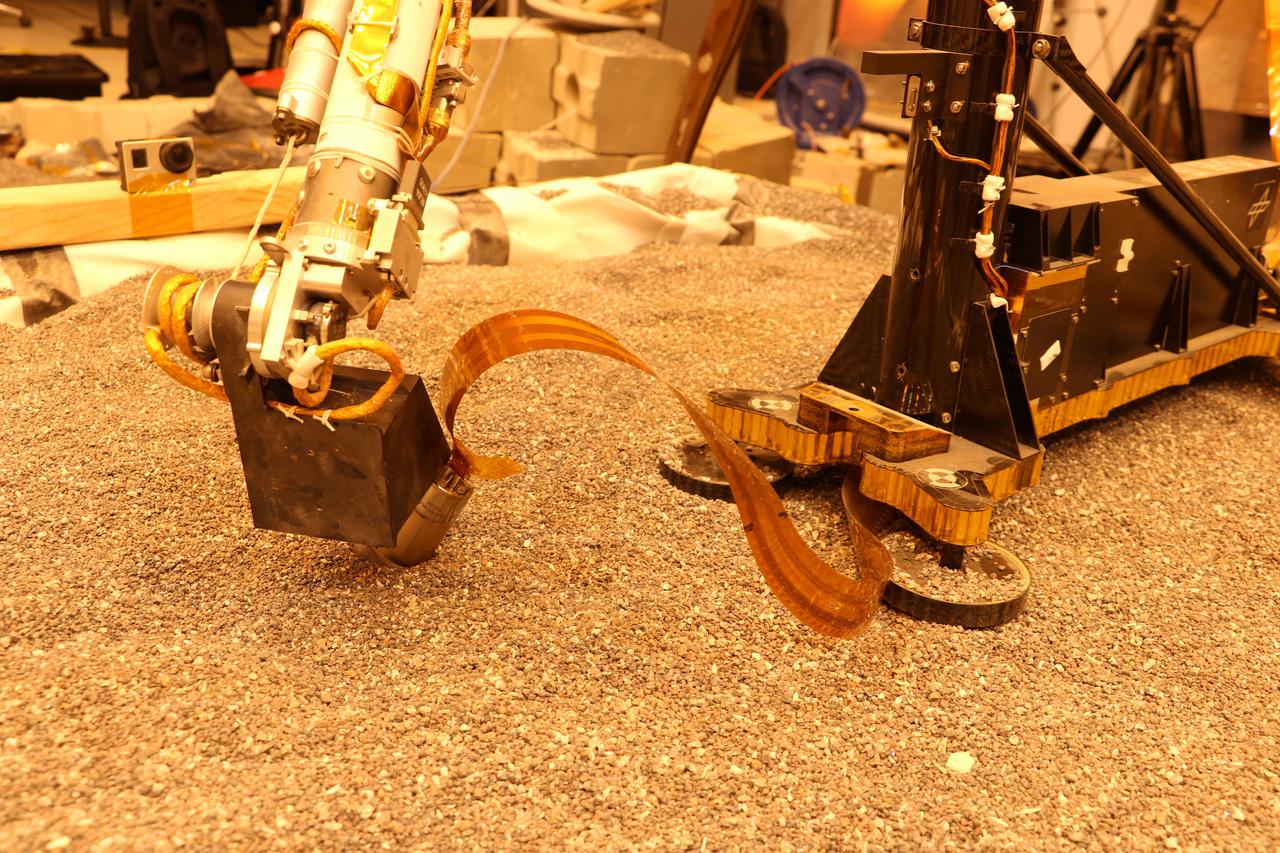
This test using an engineering model of the InSight lander here on Earth shows how the spacecraft on Mars will use its robotic arm to press on a digging device, called the "mole." https://photojournal.jpl.nasa.gov/catalog/PIA23619
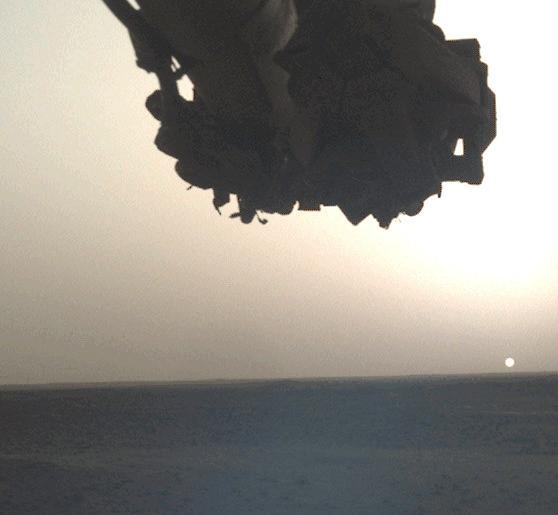
NASA's InSight lander snapped a series of images of the Sun rising and setting on Mars using the camera on its robotic arm on April 10, 2022, the 1,198th Martian day, or sol, of the mission. https://photojournal.jpl.nasa.gov/catalog/PIA25178
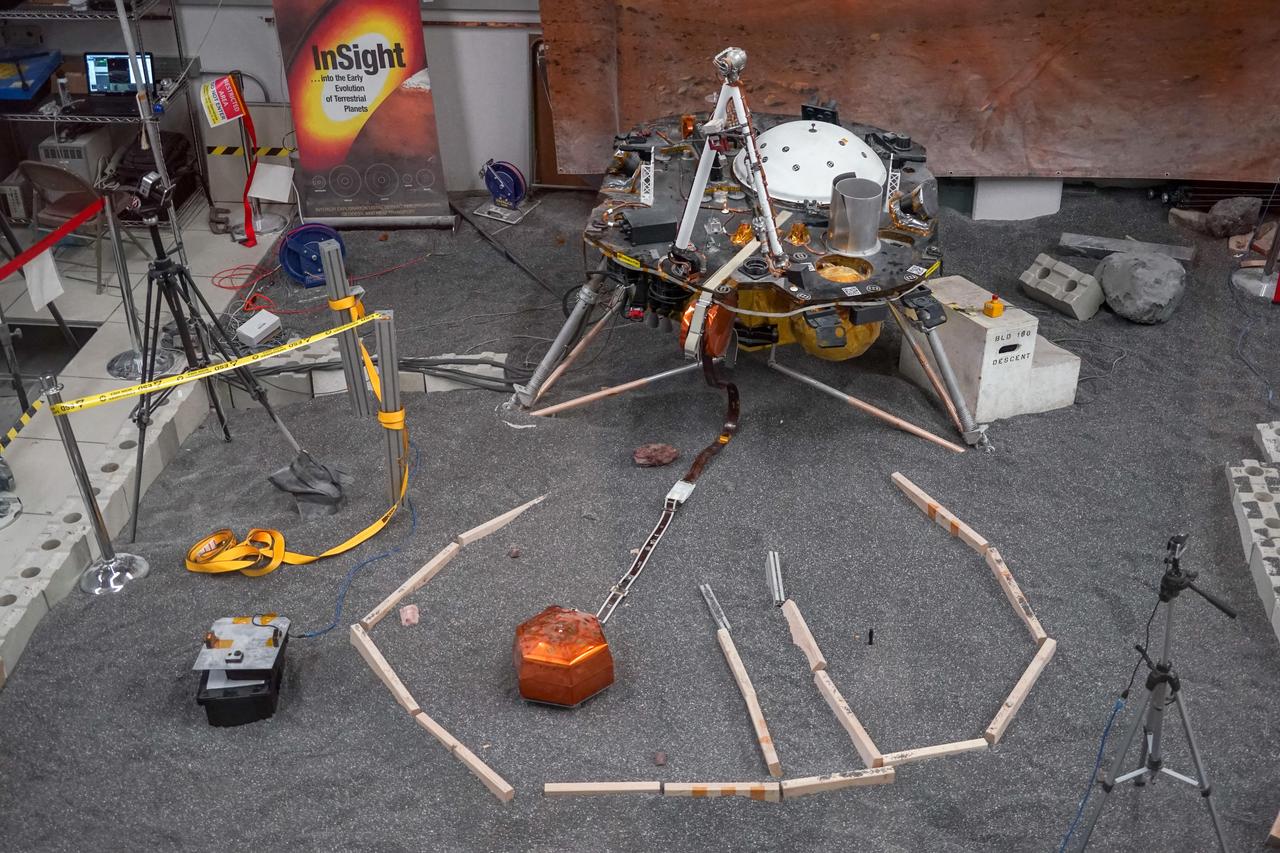
ForeSight, a fully functional, full-size model of NASA's InSight lander, sits in a lab space that has been sculpted to match terrain in front of the real lander on Mars. This work was done at NASA's Jet Propulsion Laboratory in Pasadena, California. https://photojournal.jpl.nasa.gov/catalog/PIA22953
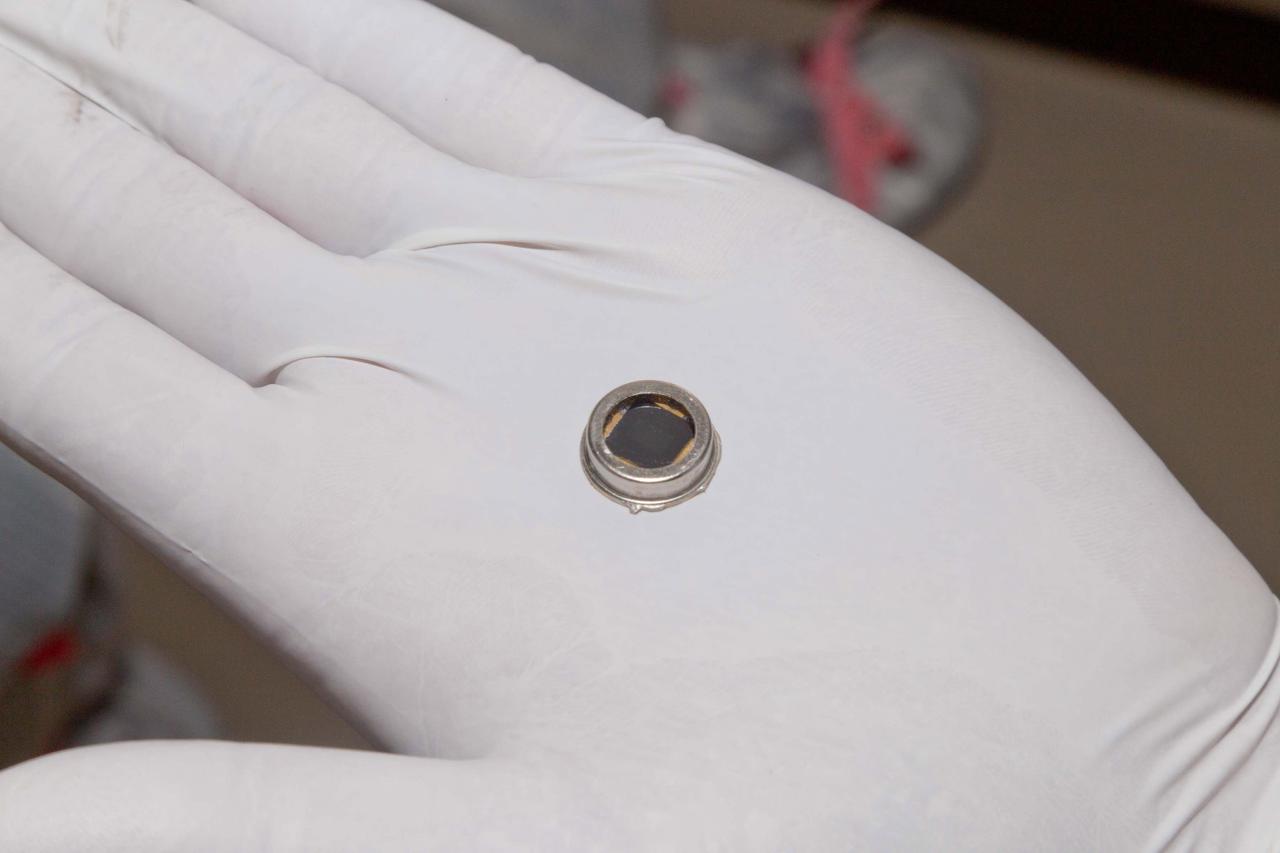
The dime-size microchip in this close-up image carries 826,923 names that will go to Mars on NASA InSight lander. The image was taken in November 2015 inside a clean room at Lockheed Martin Space Systems, Denver, where the lander was built.
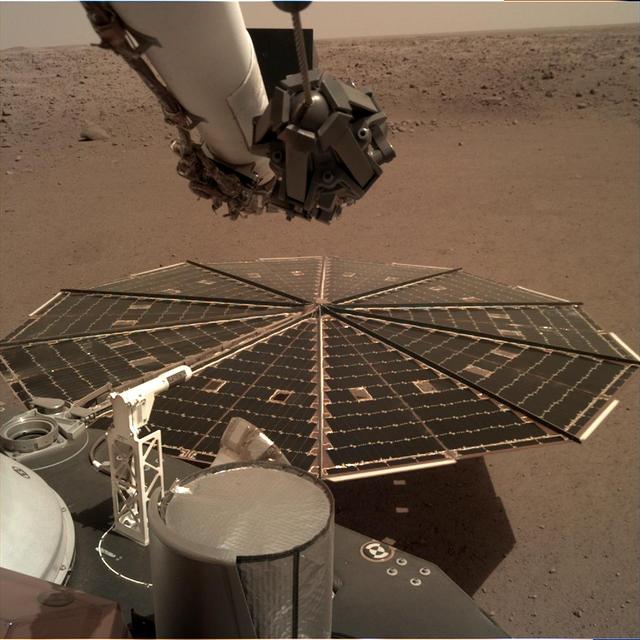
One of InSight's 7-foot (2.2 meter) wide solar panels was imaged by the lander's Instrument Deployment Camera, which is fixed to the elbow of its robotic arm. https://photojournal.jpl.nasa.gov/catalog/PIA22736
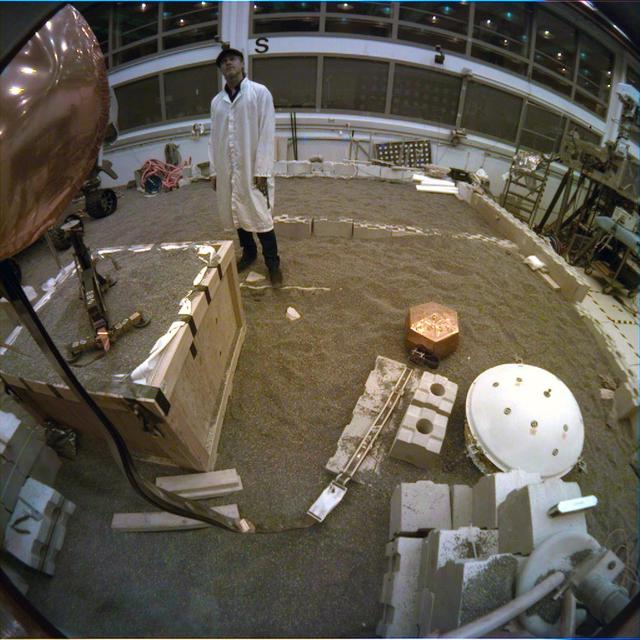
In a Mars-like environment at NASA's Jet Propulsion Laboratory, the fish-eye camera aboard the engineering model of NASA's InSight lander snapped this image of the actor Brad Pitt on Sept. 6, 2019. This picture, which has been white-balanced to remove the orange-red tint of the Mars lights in the room, was taken by the instrument context camera, bolted to the deck of the lander model. The InSight replica is located in JPL's In-Situ Instrument Laboratory and used for test purposes. Pitt visited JPL to learn about real space technology after filming his space-themed movie "Ad Astra." https://photojournal.jpl.nasa.gov/catalog/PIA23278
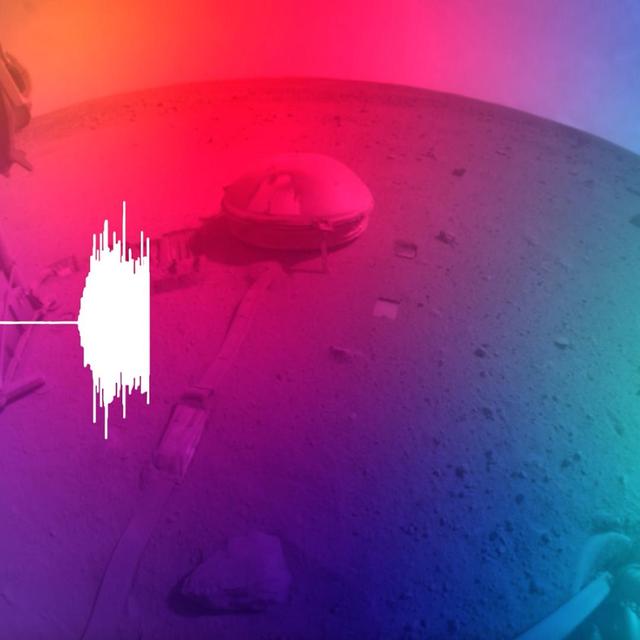
This video includes a seismogram and sonification of the signals recorded by NASA's InSight Mars lander, which detected an estimated magnitude 5 quake on May 4, 2022, the 1,222nd Martian day, or sol, of the mission. Animation available at https://photojournal.jpl.nasa.gov/catalog/PIA25281
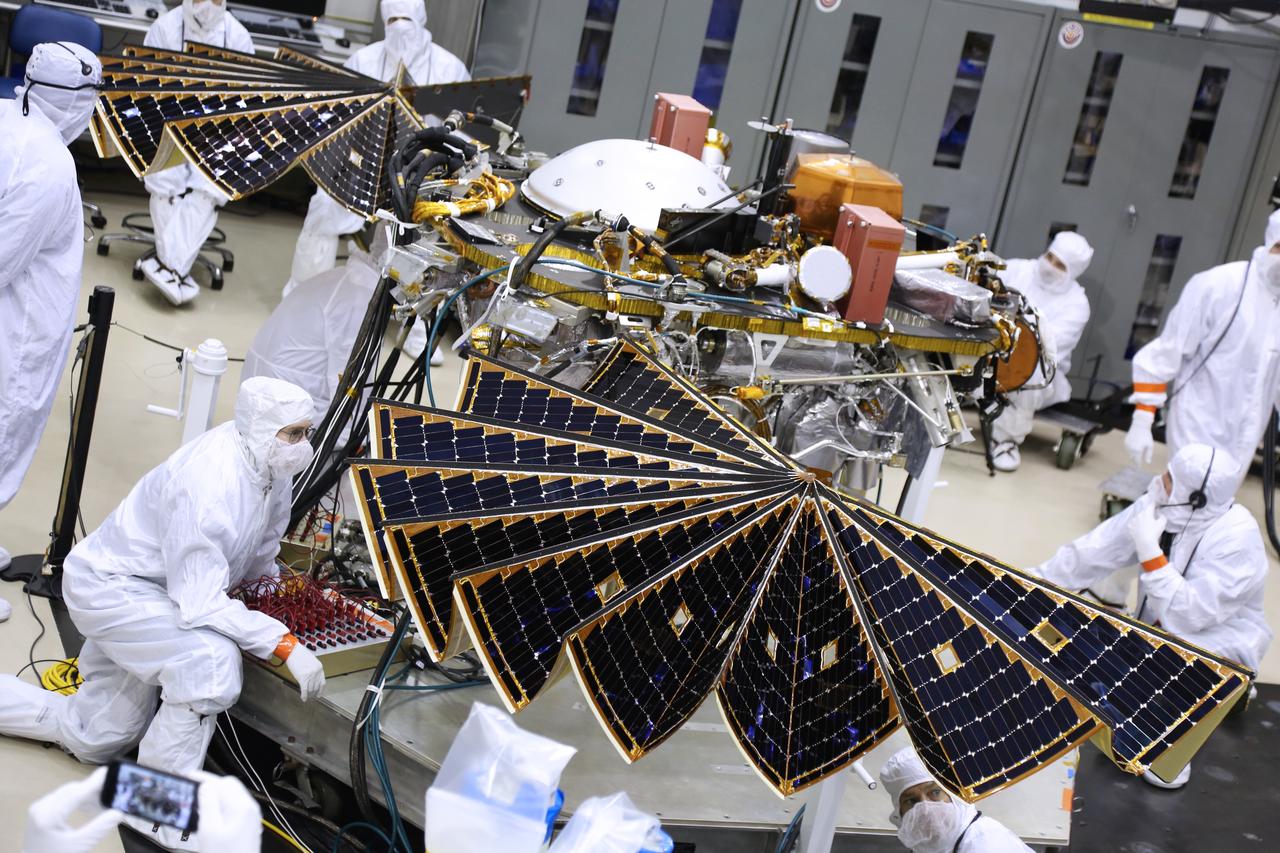
The solar arrays on NASA's InSight Mars lander were deployed as part of testing conducted Jan. 23, 2018, at Lockheed Martin Space in Littleton, Colorado. Engineers and technicians evaluated the solar arrays and performed an illumination test to confirm that the solar cells were collecting power. The launch window for InSight opens May 5, 2018. A video is available at https://photojournal.jpl.nasa.gov/catalog/PIA22205
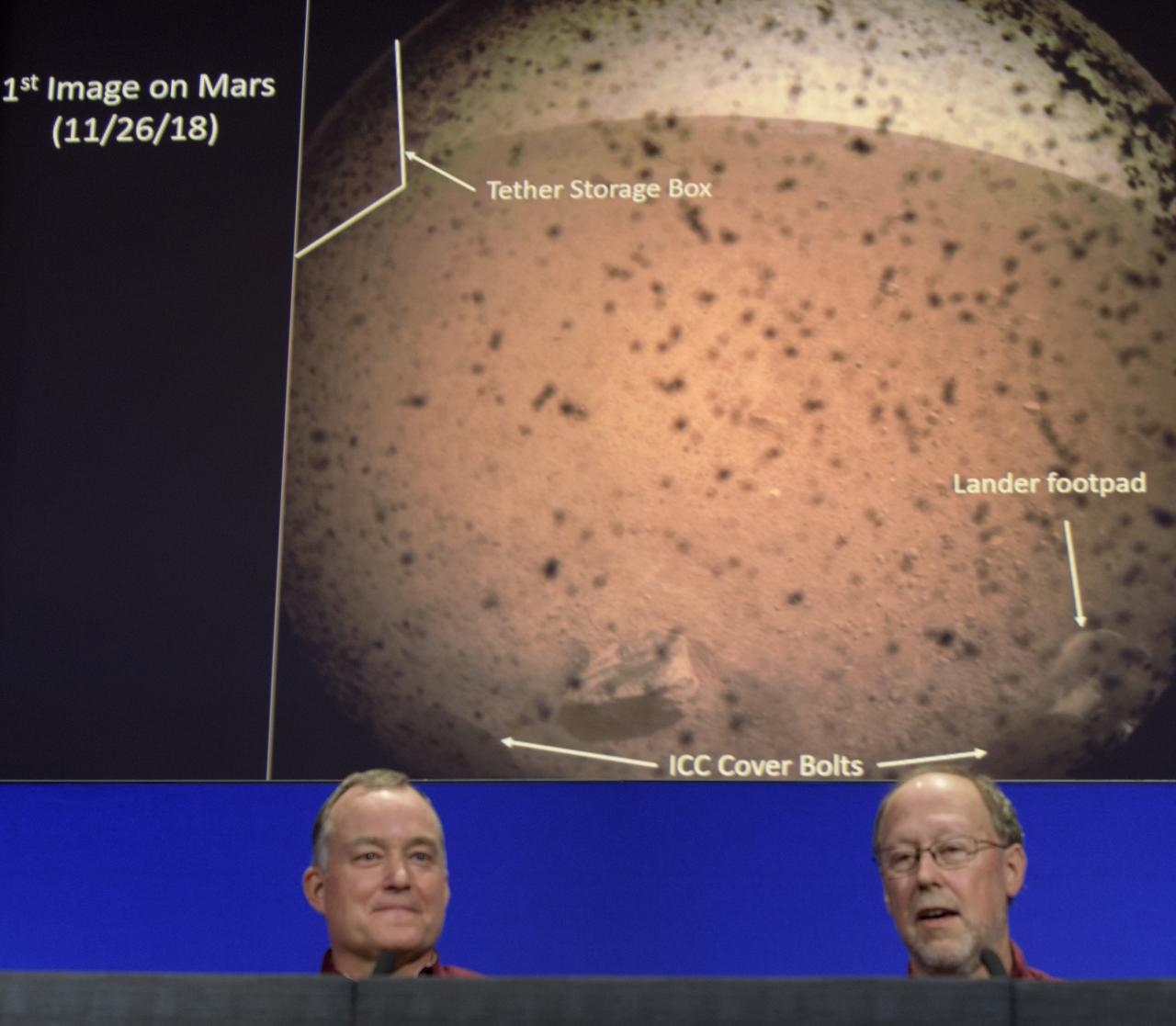
Tom Hoffman, InSight Project Manager, NASA JPL, left, and Bruce Banerdt, InSight Principal Investigator, NASA JPL, describe the first image sent back by the Mars InSight lander during a post-landing press conference, Monday, Nov. 26, 2018 at NASA's Jet Propulsion Laboratory in Pasadena, California. InSight, short for Interior Exploration using Seismic Investigations, Geodesy and Heat Transport, is a Mars lander designed to study the "inner space" of Mars: its crust, mantle, and core. Photo Credit: (NASA/Bill Ingalls)
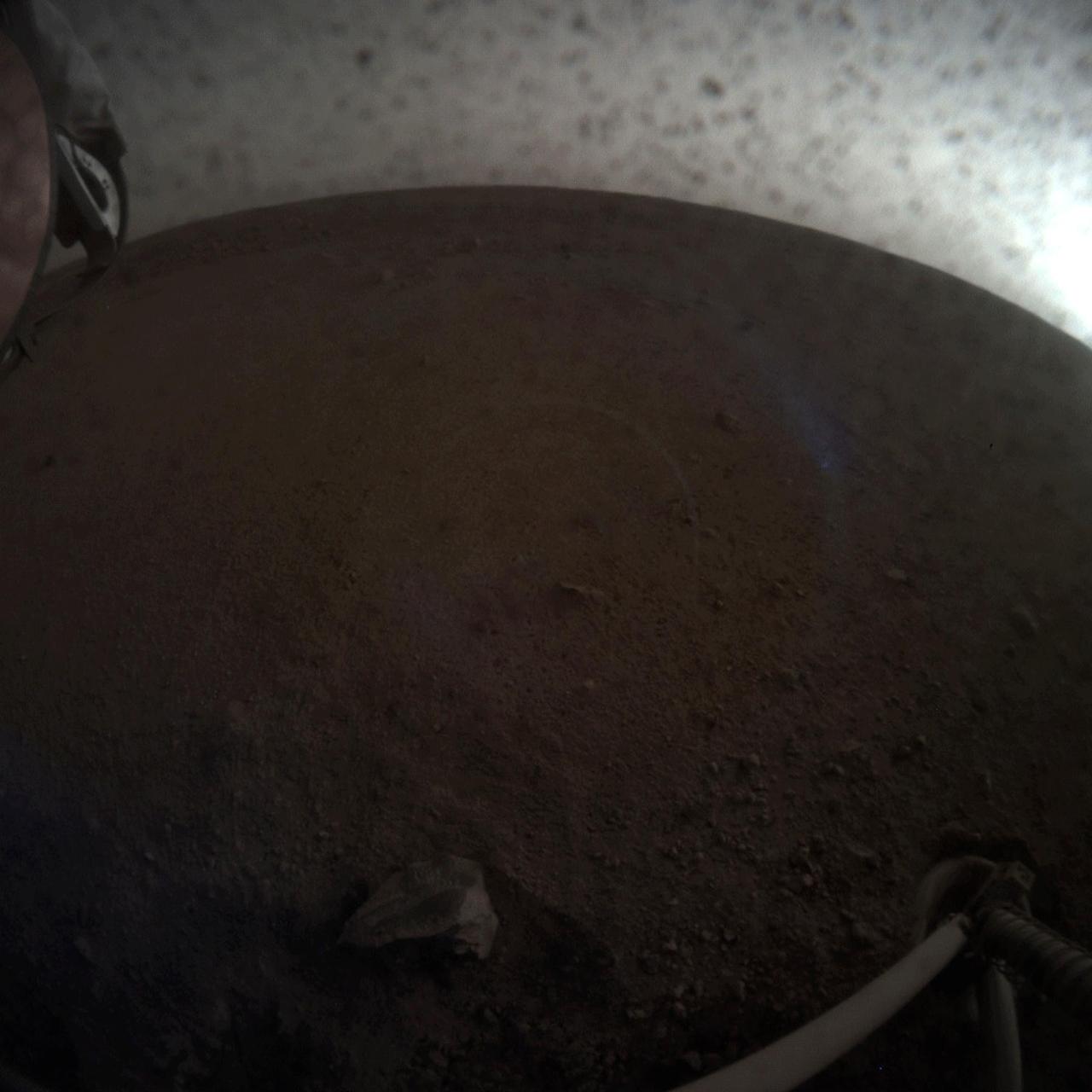
A fish-eye view of NASA's InSight lander deploying its first instrument onto the surface of Mars. InSight's robotic arm placed the seismometer on Dec. 19, 2018, around the time of dusk on Mars. These images were taken by the Instrument Context Camera (ICC), a fish-eye camera under the spacecraft's deck. Animation available at https://photojournal.jpl.nasa.gov/catalog/PIA22978
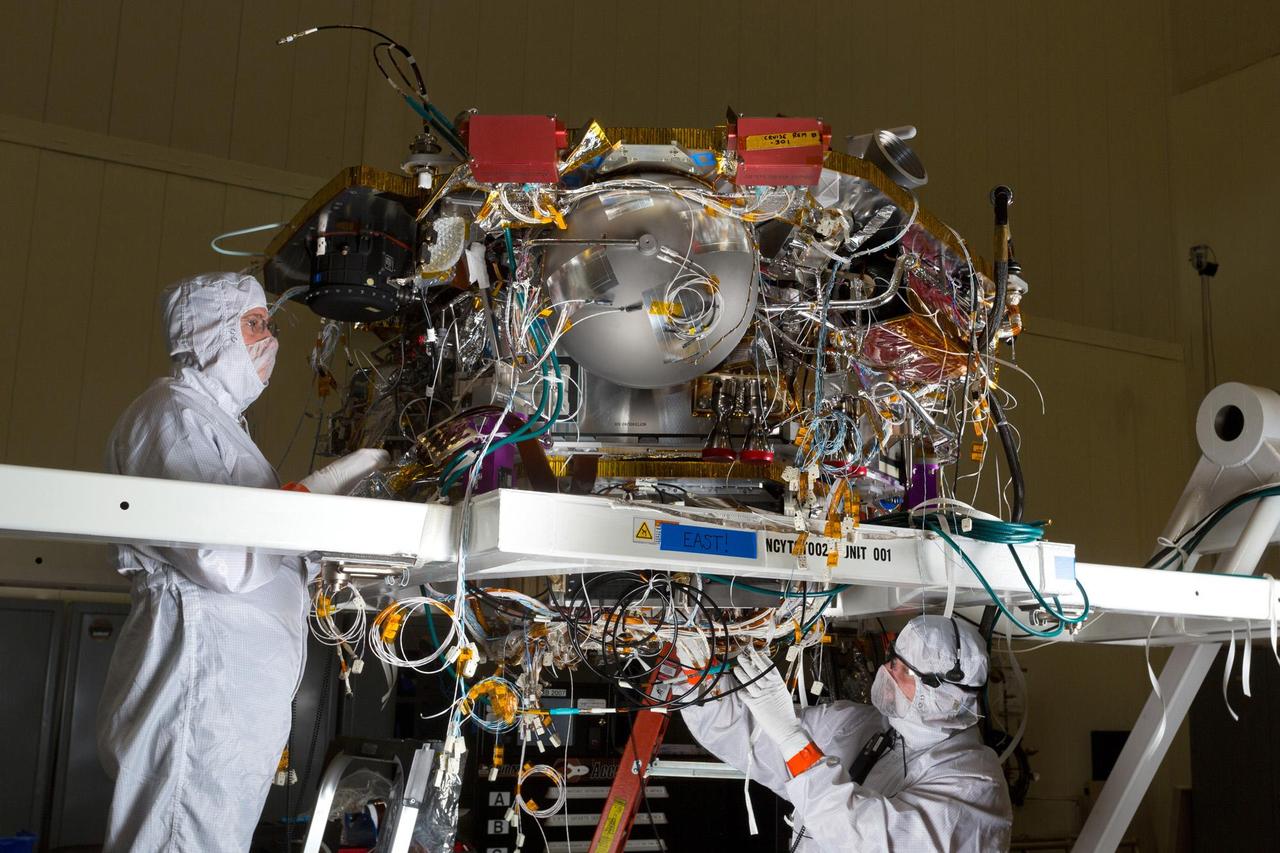
The Mars lander that NASA's InSight mission will use for investigating how rocky planets formed and evolved is being assembled by Lockheed Martin Space Systems, Denver. In this scene from January 2015, Lockheed Martin spacecraft specialists are working on the lander in a clean room. InSight, for Interior Exploration Using Seismic Investigations, Geodesy and Heat Transport, is scheduled for launch in March 2016 and landing in September 2016. Note: After thorough examination, NASA managers have decided to suspend the planned March 2016 launch of the Interior Exploration using Seismic Investigations Geodesy and Heat Transport (InSight) mission. The decision follows unsuccessful attempts to repair a leak in a section of the prime instrument in the science payload. http://photojournal.jpl.nasa.gov/catalog/PIA19402
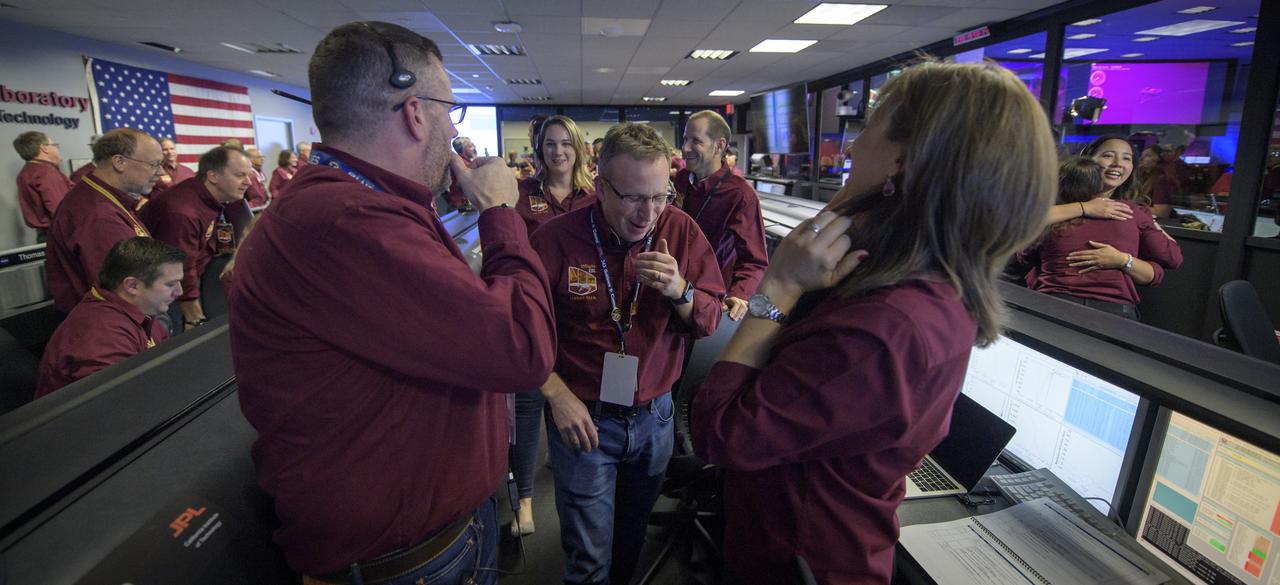
Mars InSight team members all react after receiving confirmation that the Mars InSight lander successfully touched down on the surface of Mars, Monday, Nov. 26, 2018 inside the Mission Support Area at NASA's Jet Propulsion Laboratory in Pasadena, California. InSight, short for Interior Exploration using Seismic Investigations, Geodesy and Heat Transport, is a Mars lander designed to study the "inner space" of Mars: its crust, mantle, and core. Photo Credit: (NASA/Bill Ingalls)
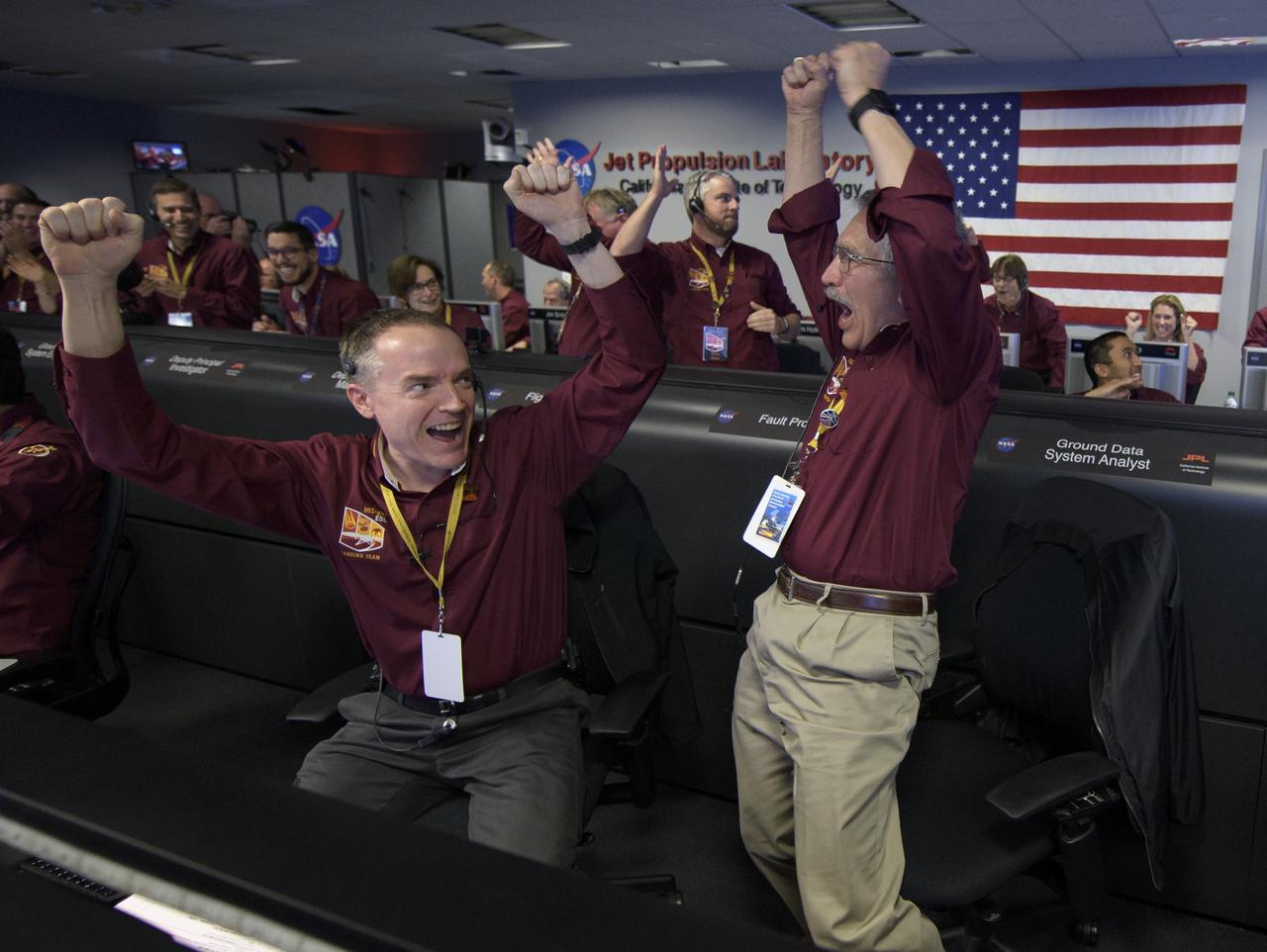
Mars InSight team members Kris Bruvold, left, and Sandy Krasner react after receiving confirmation that the Mars InSight lander successfully touched down on the surface of Mars, Monday, Nov. 26, 2018 inside the Mission Support Area at NASA's Jet Propulsion Laboratory in Pasadena, California. InSight, short for Interior Exploration using Seismic Investigations, Geodesy and Heat Transport, is a Mars lander designed to study the "inner space" of Mars: its crust, mantle, and core. Photo Credit: (NASA/Bill Ingalls)
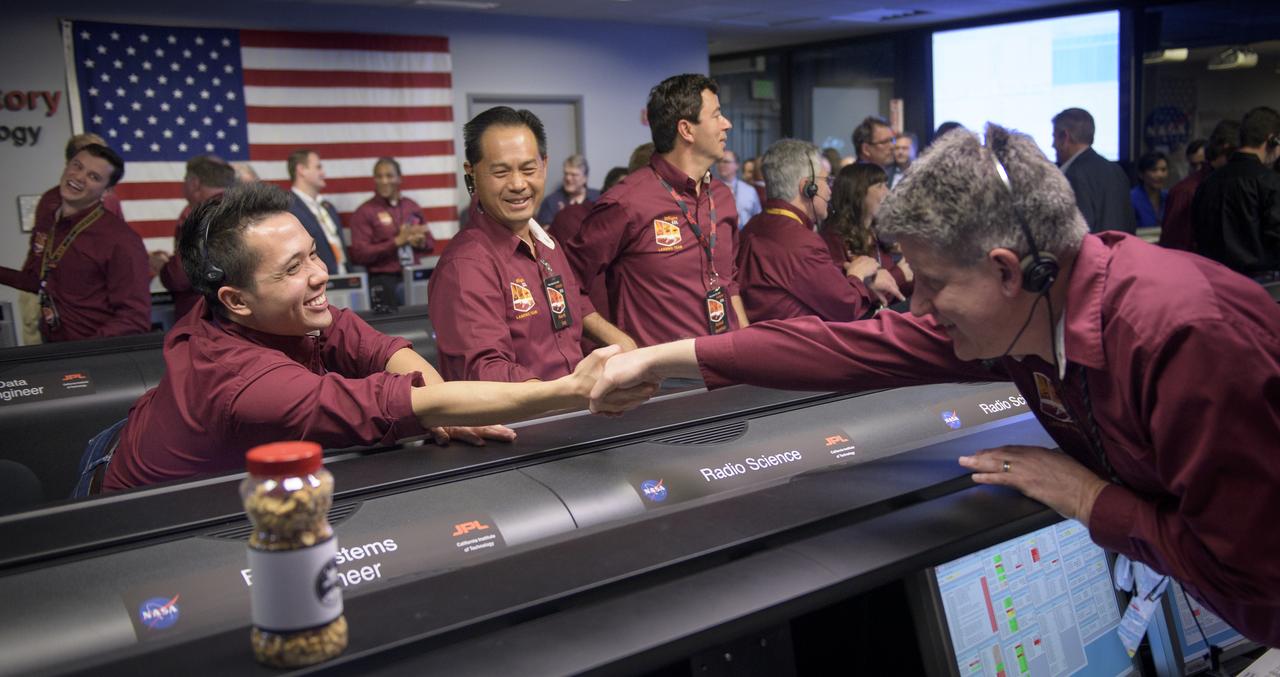
Mars InSight team members all react after receiving confirmation that the Mars InSight lander successfully touched down on the surface of Mars, Monday, Nov. 26, 2018 inside the Mission Support Area at NASA's Jet Propulsion Laboratory in Pasadena, California. InSight, short for Interior Exploration using Seismic Investigations, Geodesy and Heat Transport, is a Mars lander designed to study the "inner space" of Mars: its crust, mantle, and core. Photo Credit: (NASA/Bill Ingalls)
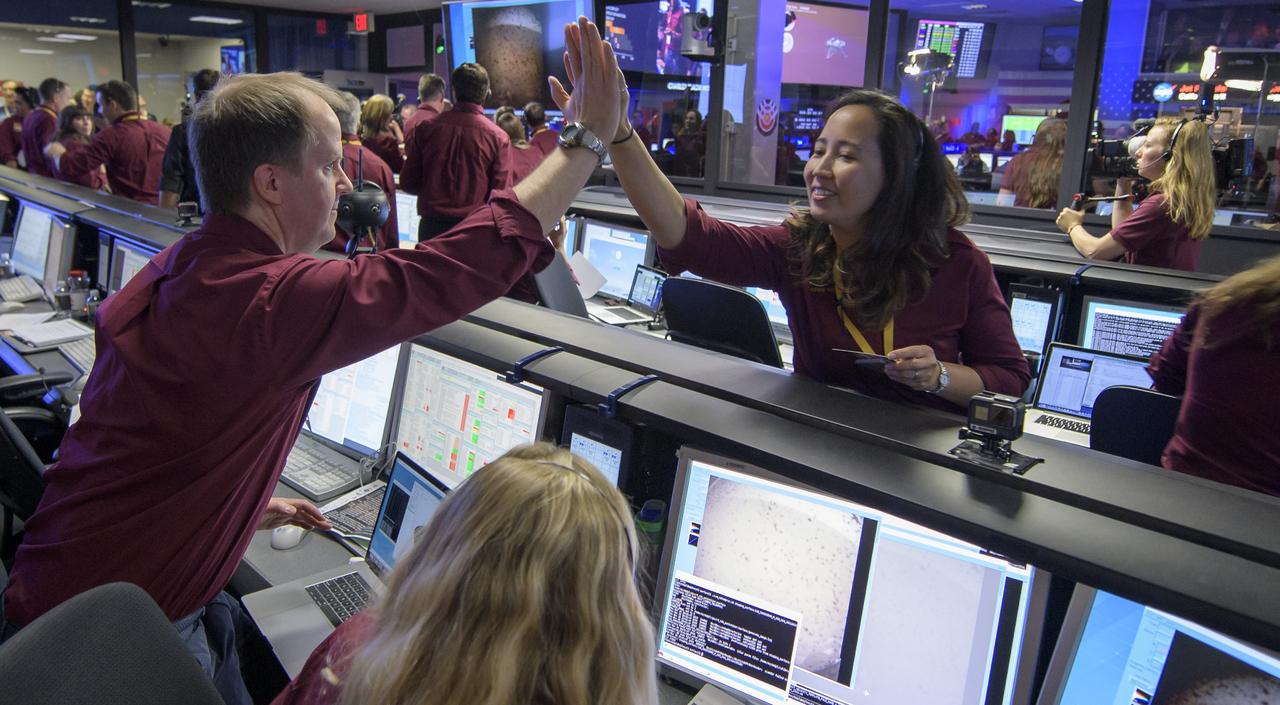
Mars InSight team members all react after receiving confirmation that the Mars InSight lander successfully touched down on the surface of Mars, Monday, Nov. 26, 2018 inside the Mission Support Area at NASA's Jet Propulsion Laboratory in Pasadena, California. InSight, short for Interior Exploration using Seismic Investigations, Geodesy and Heat Transport, is a Mars lander designed to study the "inner space" of Mars: its crust, mantle, and core. Photo Credit: (NASA/Bill Ingalls)

This not-to-scale artist's concept depicts a cutaway view of Mars' interior, revealing the crust, mantle, and core. Debris from ancient impacts lies scattered in the mantle in the form of lumps that are as large as 2.5 miles (4 kilometers) across, data from NASA's InSight Mars lander shows. On the Martian surface at left, a meteoroid impact sends seismic signals (shown as curving concentric lines) through the planet; InSight is depicted at right. InSight placed the first seismometer on Mars' surface in 2018. The extremely sensitive instrument recorded 1,319 marsquakes before the lander ran out of power in 2022, the result of dust caked on its solar panels. Quakes produce seismic waves that change as they pass through different kinds of material, providing scientists with a way to study the interior of a planetary body. To date, the InSight team has measured the size, depth, and composition of Mars' crust, mantle, and core. The impact debris in the Martian mantle offers a geologic record that could be preserved only on worlds like Mars, whose lack of tectonic plates has kept its interior from being churned up the way Earth's is through a process known as convection. https://photojournal.jpl.nasa.gov/catalog/PIA26636
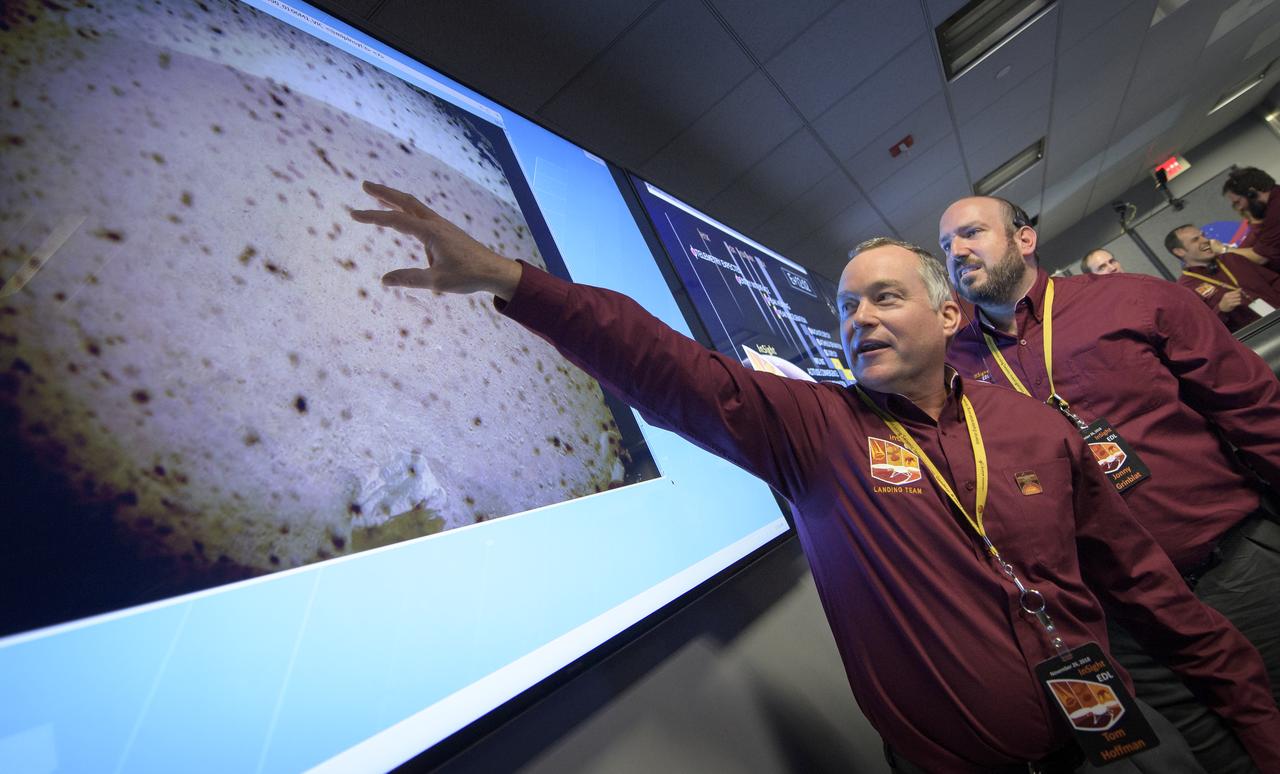
Tom Hoffman, InSight Project Manager, NASA JPL reacts to the first image to be seen from the Mars InSight lander shortly after confirmation of a successful touch down on the surface of Mars, Monday, Nov. 26, 2018 inside the Mission Support Area at NASA's Jet Propulsion Laboratory in Pasadena, California. InSight, short for Interior Exploration using Seismic Investigations, Geodesy and Heat Transport, is a Mars lander designed to study the "inner space" of Mars: its crust, mantle, and core. Photo Credit: (NASA/Bill Ingalls)

Sue Smrekar, InSight deputy principal investigator, NASA JPL, and other Mars InSight team members monitor the status of the lander prior to it touching down on Mars, Monday, Nov. 26, 2018 inside the Mission Support Area at NASA's Jet Propulsion Laboratory in Pasadena, California. InSight, short for Interior Exploration using Seismic Investigations, Geodesy and Heat Transport, is a Mars lander designed to study the "inner space" of Mars: its crust, mantle, and core. Photo Credit: (NASA/Bill Ingalls)
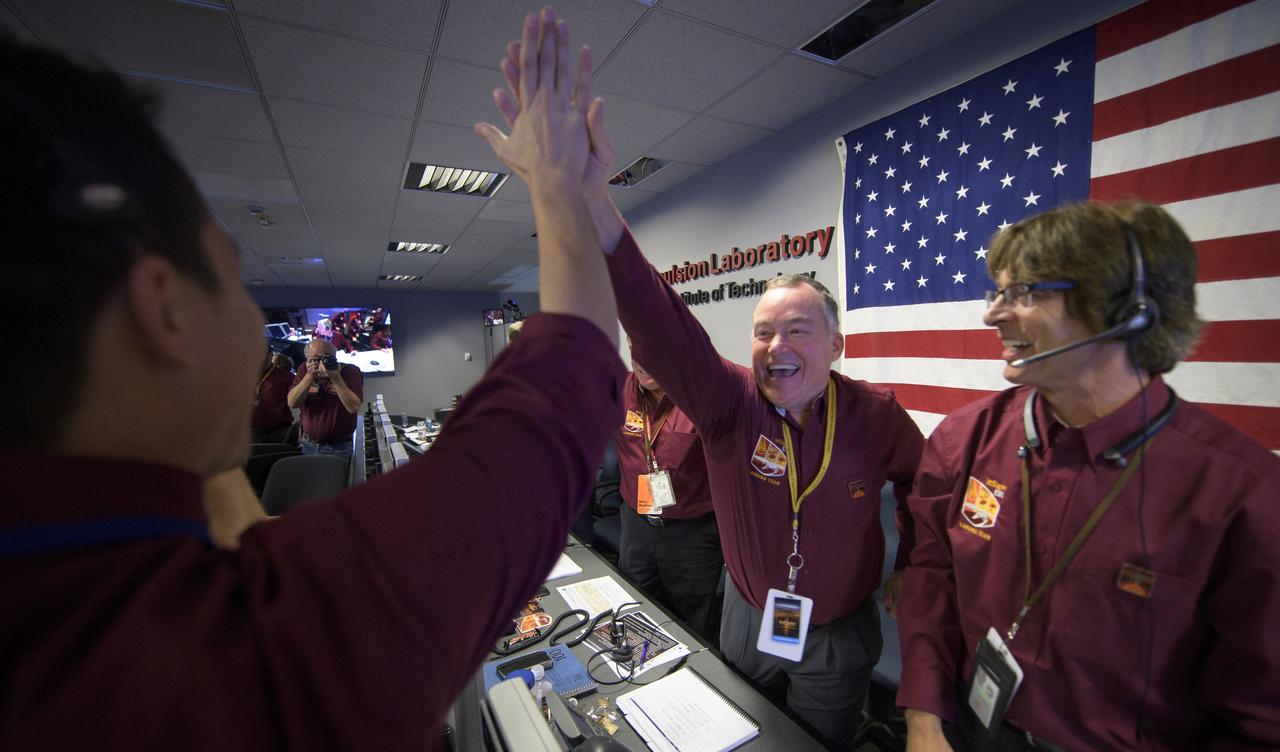
Tom Hoffman, InSight Project Manager, NASA JPL, gives a high-five to other Mars InSight team members after receiving confirmation that the Mars InSight lander successfully touched down on the surface of Mars, Monday, Nov. 26, 2018 inside the Mission Support Area at NASA's Jet Propulsion Laboratory in Pasadena, California. InSight, short for Interior Exploration using Seismic Investigations, Geodesy and Heat Transport, is a Mars lander designed to study the "inner space" of Mars: its crust, mantle, and core. Photo Credit: (NASA/Bill Ingalls)
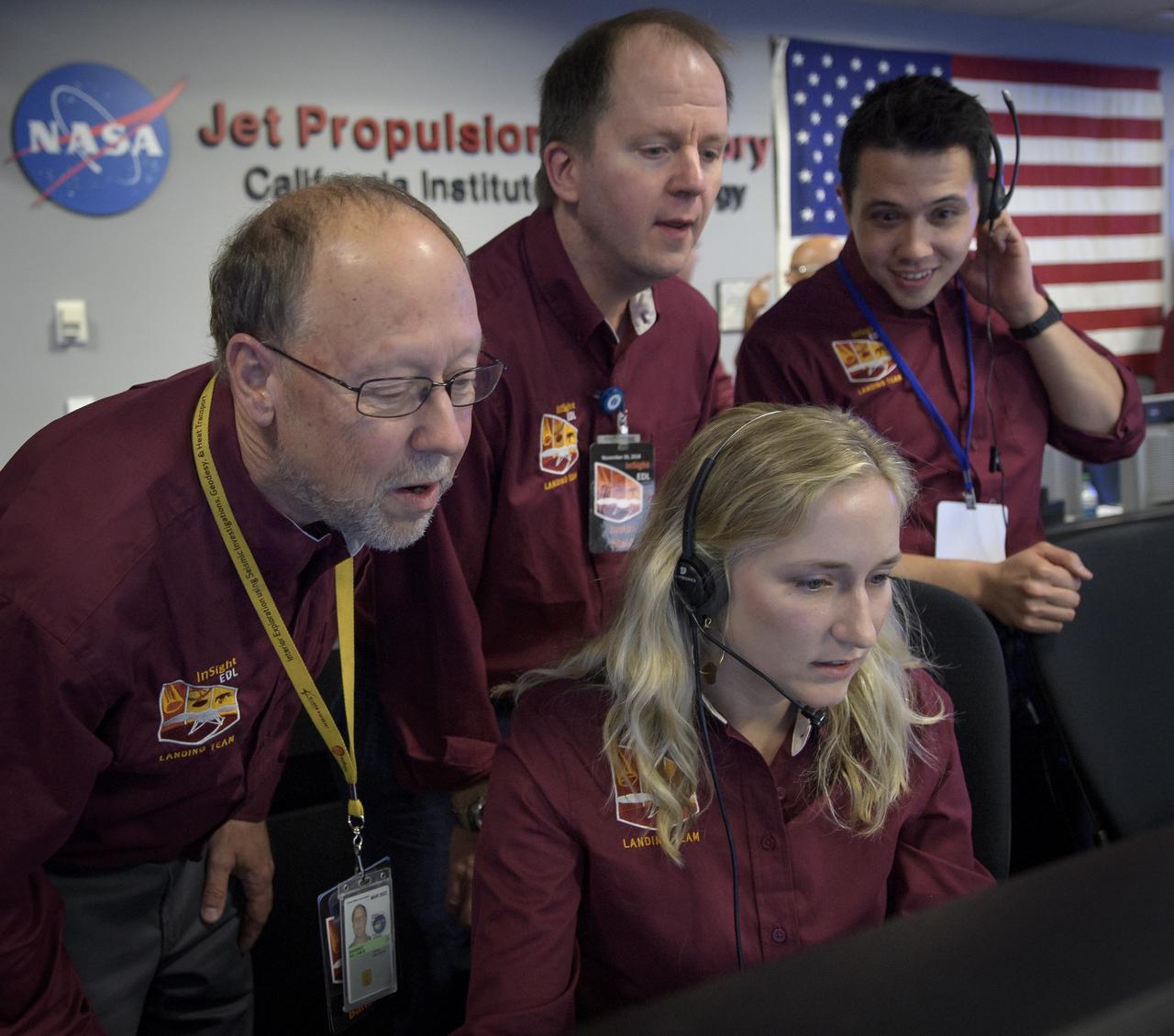
Bruce Banerdt, InSight Principal Investigator, NASA JPL, left, Hallie Gengl, Data Visualization Developer, seated, and other Mars InSight team members, anxiously watch for the first image to be received from the Mars InSight lander after it touched down on the surface of Mars, Monday, Nov. 26, 2018 inside the Mission Support Area at NASA's Jet Propulsion Laboratory in Pasadena, California. InSight, short for Interior Exploration using Seismic Investigations, Geodesy and Heat Transport, is a Mars lander designed to study the "inner space" of Mars: its crust, mantle, and core. Photo Credit: (NASA/Bill Ingalls)
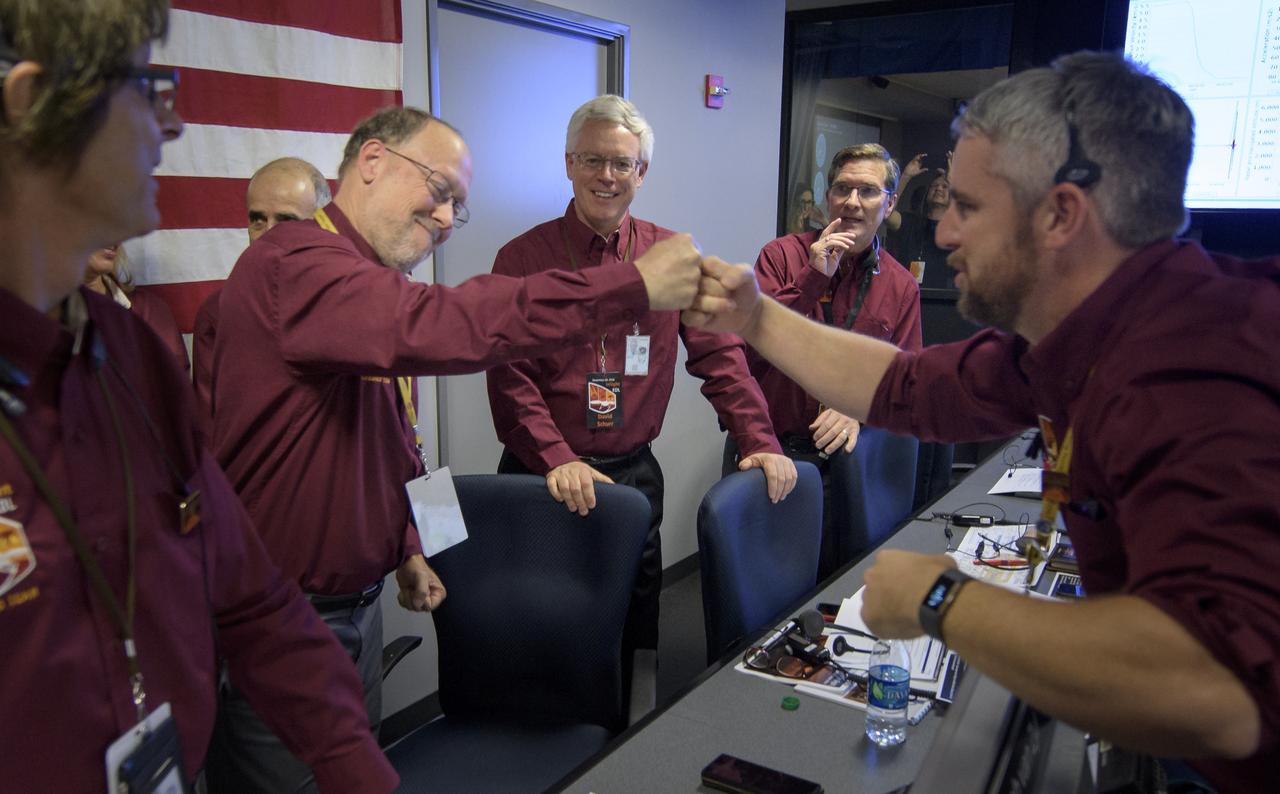
Bruce Banerdt, InSight Principal Investigator, NASA JPL, gives a fist-pump to another Mars InSight team member after receiving confirmation that the Mars InSight lander successfully touched down on the surface of Mars, Monday, Nov. 26, 2018 inside the Mission Support Area at NASA's Jet Propulsion Laboratory in Pasadena, California. InSight, short for Interior Exploration using Seismic Investigations, Geodesy and Heat Transport, is a Mars lander designed to study the "inner space" of Mars: its crust, mantle, and core. Photo Credit: (NASA/Bill Ingalls)
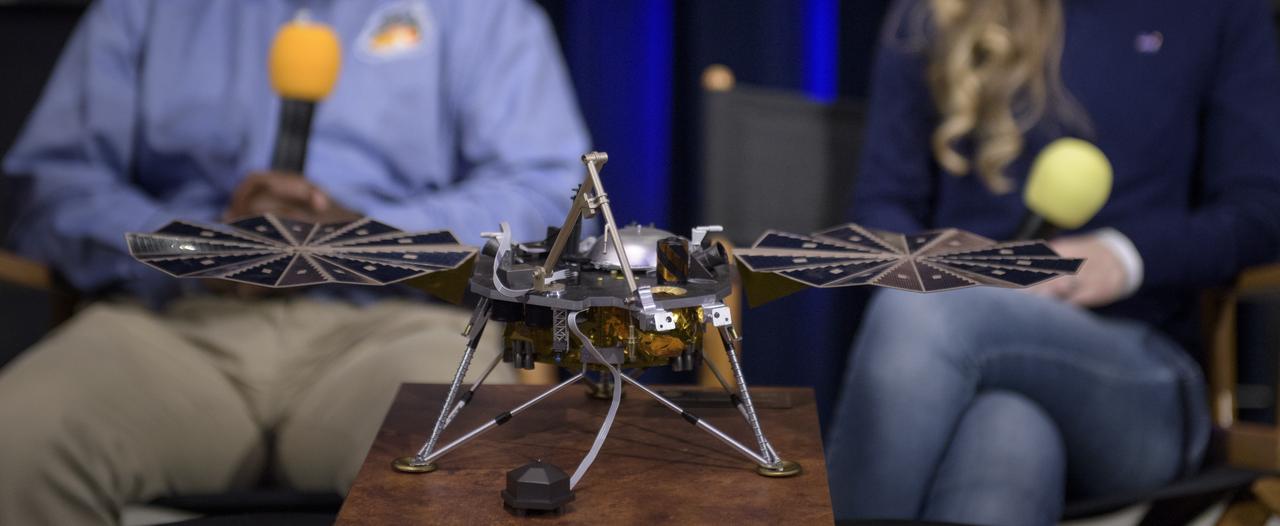
A model of the Mars InSight lander is on display during a social media briefing, Sunday, Nov. 25, 2018 at NASA's Jet Propulsion Laboratory in Pasadena, California. InSight, short for Interior Exploration using Seismic Investigations, Geodesy and Heat Transport, is a Mars lander designed to study the "inner space" of Mars: its crust, mantle, and core. InSight is scheduled to touch down on the Red Planet at approximately noon PST (3 p.m. EST) on Nov. 26. Photo Credit: (NASA/Bill Ingalls)
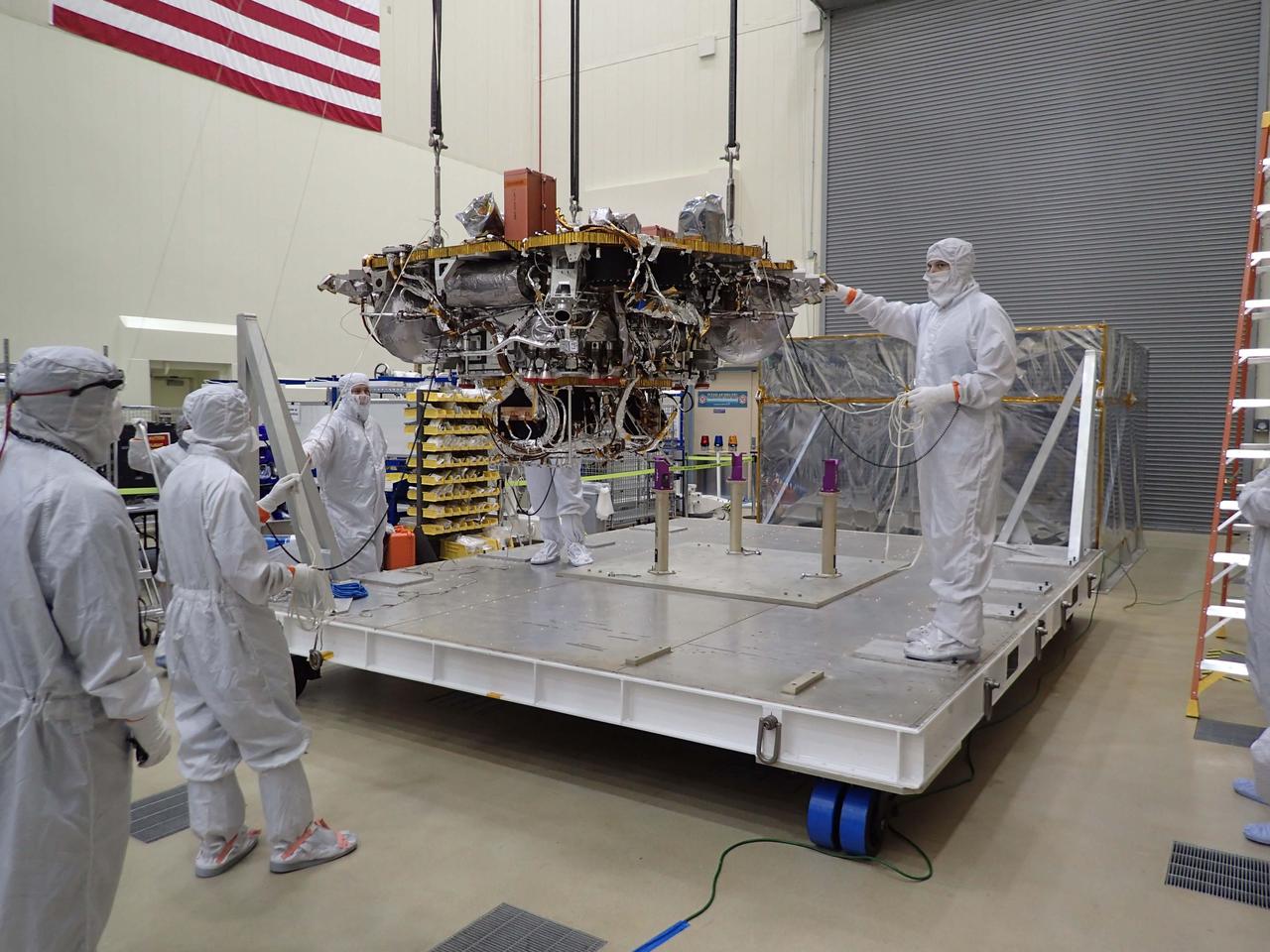
The Mars lander portion of NASA's InSight spacecraft is lifted from the base of a storage container in preparation for testing, in this photo taken June 20, 2017, in a Lockheed Martin clean room facility in Littleton, Colorado. The InSight mission (for Interior Exploration using Seismic Investigations, Geodesy and Heat Transport) is scheduled to launch in May 2018 and land on Mars Nov. 26, 2018. It will investigate processes that formed and shaped Mars and will help scientists better understand the evolution of our inner solar system's rocky planets, including Earth. https://photojournal.jpl.nasa.gov/catalog/PIA21844
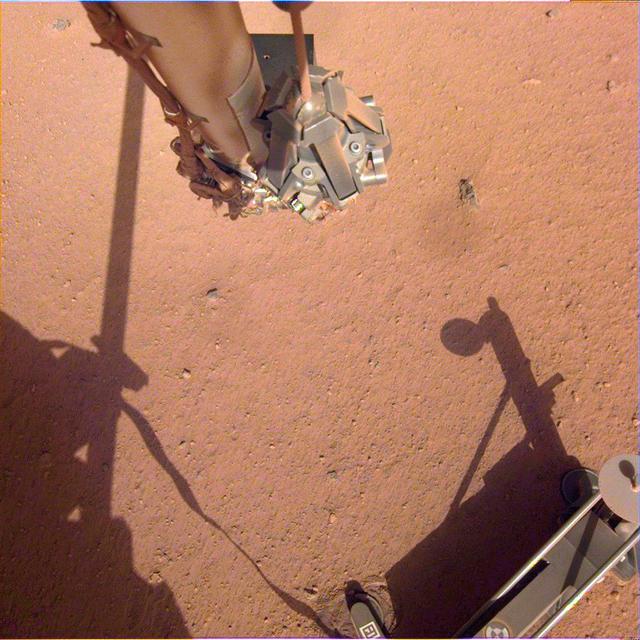
The robotic arm on NASA's Mars InSight lander moves in place over the Heat Flow and Physical Properties Package (HP3) and opens the fingers of its grapple in this series of images from June 1, 2019. Using the robotic arm, InSight engineers are preparing to lift the HP3 support structure -- the black device with four footpads pressed into the soil -- from where it was placed a few months ago on Mars. The instrument's self-hammering "mole" is partially buried beneath it. Engineers hope that by moving the support structure, they can use the robotic arm to help the mole dig deeper into the soil and take the temperature of Mars. Movie available at https://photojournal.jpl.nasa.gov/catalog/PIA23277
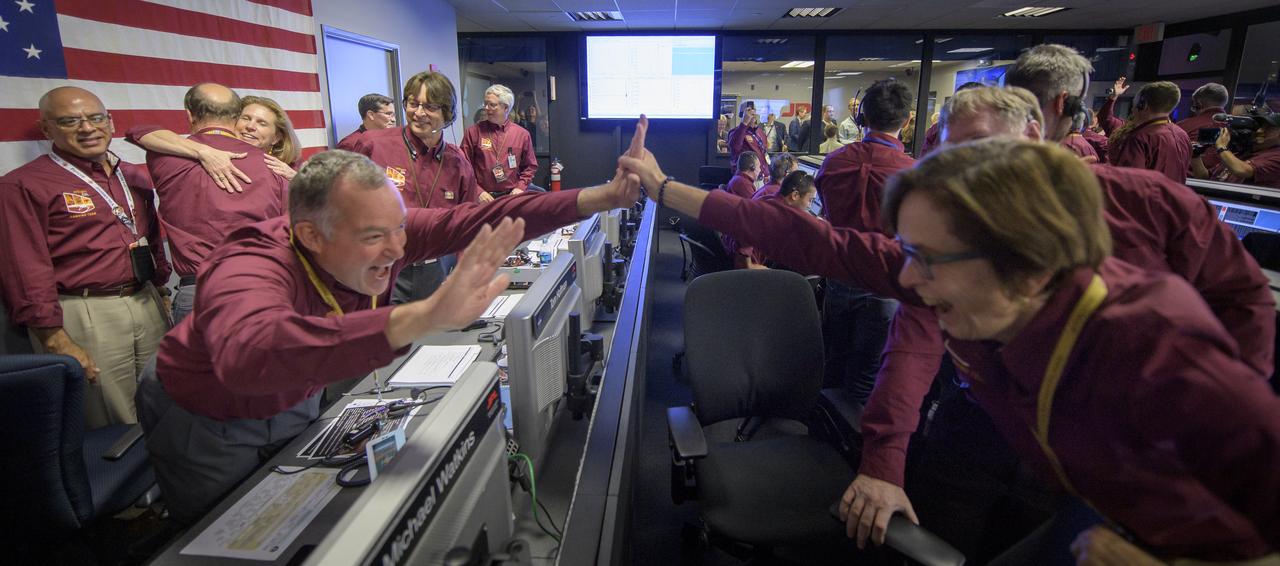
Tom Hoffman, InSight Project Manager, NASA JPL, left, and Sue Smrekar, InSight deputy principal investigator, NASA JPL, react after receiving confirmation that the Mars InSight lander successfully touched down on the surface of Mars, Monday, Nov. 26, 2018 inside the Mission Support Area at NASA's Jet Propulsion Laboratory in Pasadena, California. InSight, short for Interior Exploration using Seismic Investigations, Geodesy and Heat Transport, is a Mars lander designed to study the "inner space" of Mars: its crust, mantle, and core. Photo Credit: (NASA/Bill Ingalls)
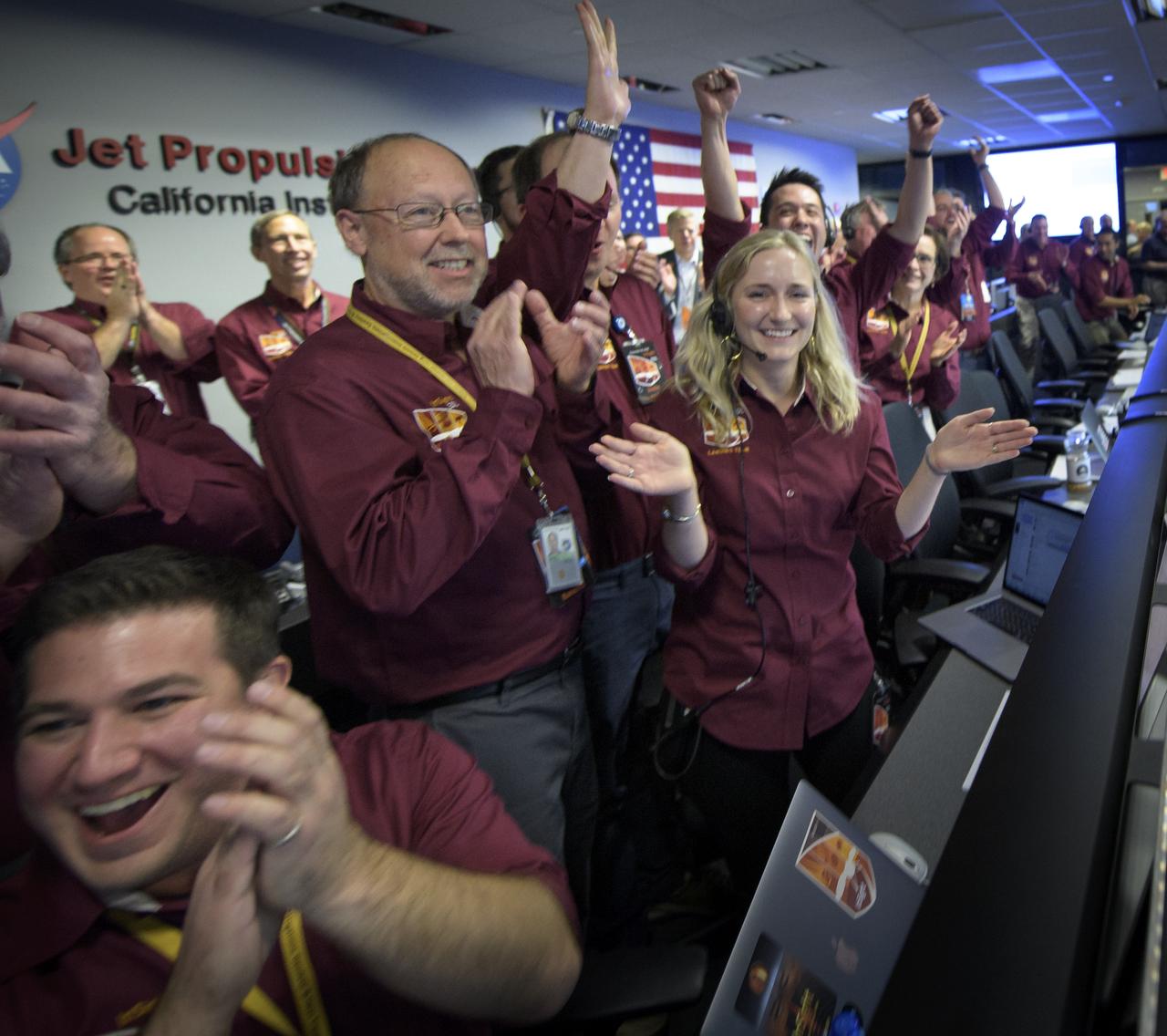
Bruce Banerdt, InSight Principal Investigator, NASA JPL, left, Hallie Gengl, Data Visualization Developer, NASA JPL, right, and other NASA InSight team members celebrate after the first image of Mars from the Mars InSight lander, Monday, Nov. 26, 2018 inside the Mission Support Area at NASA's Jet Propulsion Laboratory in Pasadena, California. InSight, short for Interior Exploration using Seismic Investigations, Geodesy and Heat Transport, is a Mars lander designed to study the "inner space" of Mars: its crust, mantle, and core. Photo Credit: (NASA/Bill Ingalls)
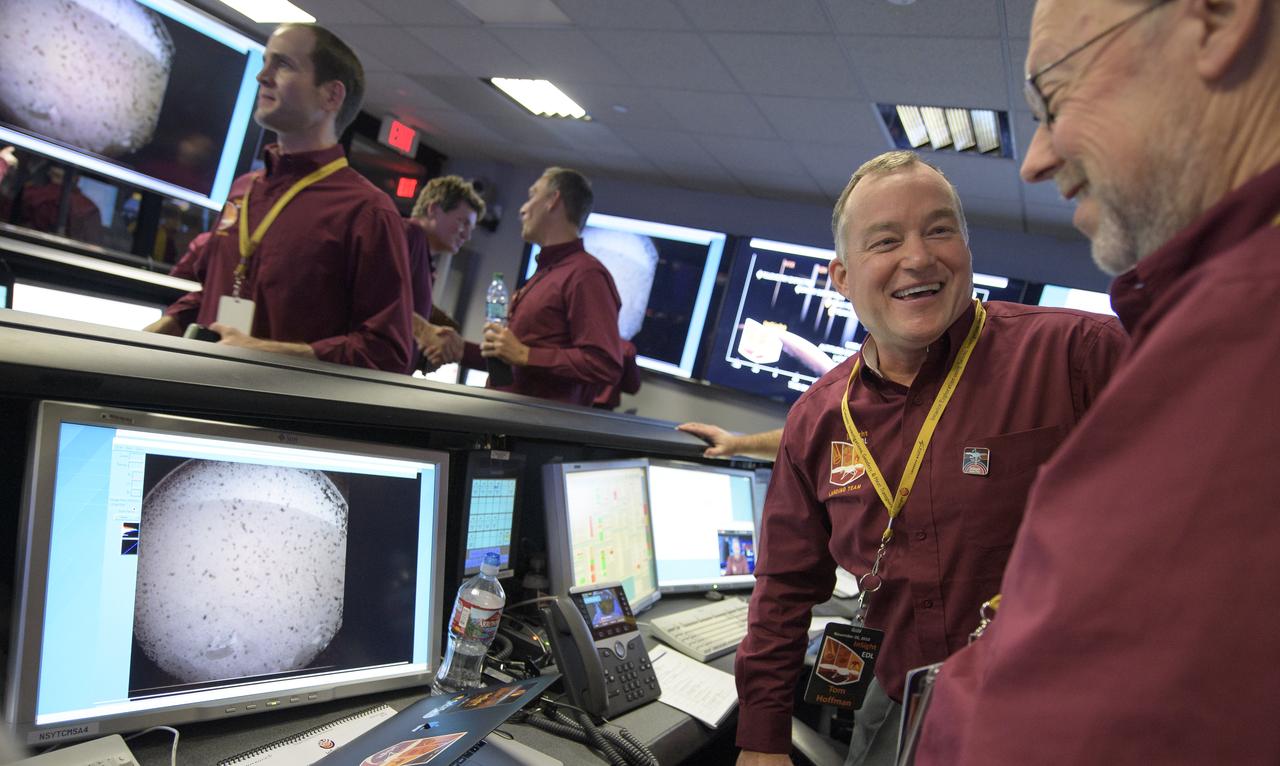
Tom Hoffman, InSight Project Manager, NASA JPL, left, and Bruce Banerdt, InSight Principal Investigator, NASA JPL, laugh together after reviewing the first image of Mars taken by the Mars InSight lander, Monday, Nov. 26, 2018 inside the Mission Support Area at NASA's Jet Propulsion Laboratory in Pasadena, California. InSight, short for Interior Exploration using Seismic Investigations, Geodesy and Heat Transport, is a Mars lander designed to study the "inner space" of Mars: its crust, mantle, and core. Photo Credit: (NASA/Bill Ingalls)
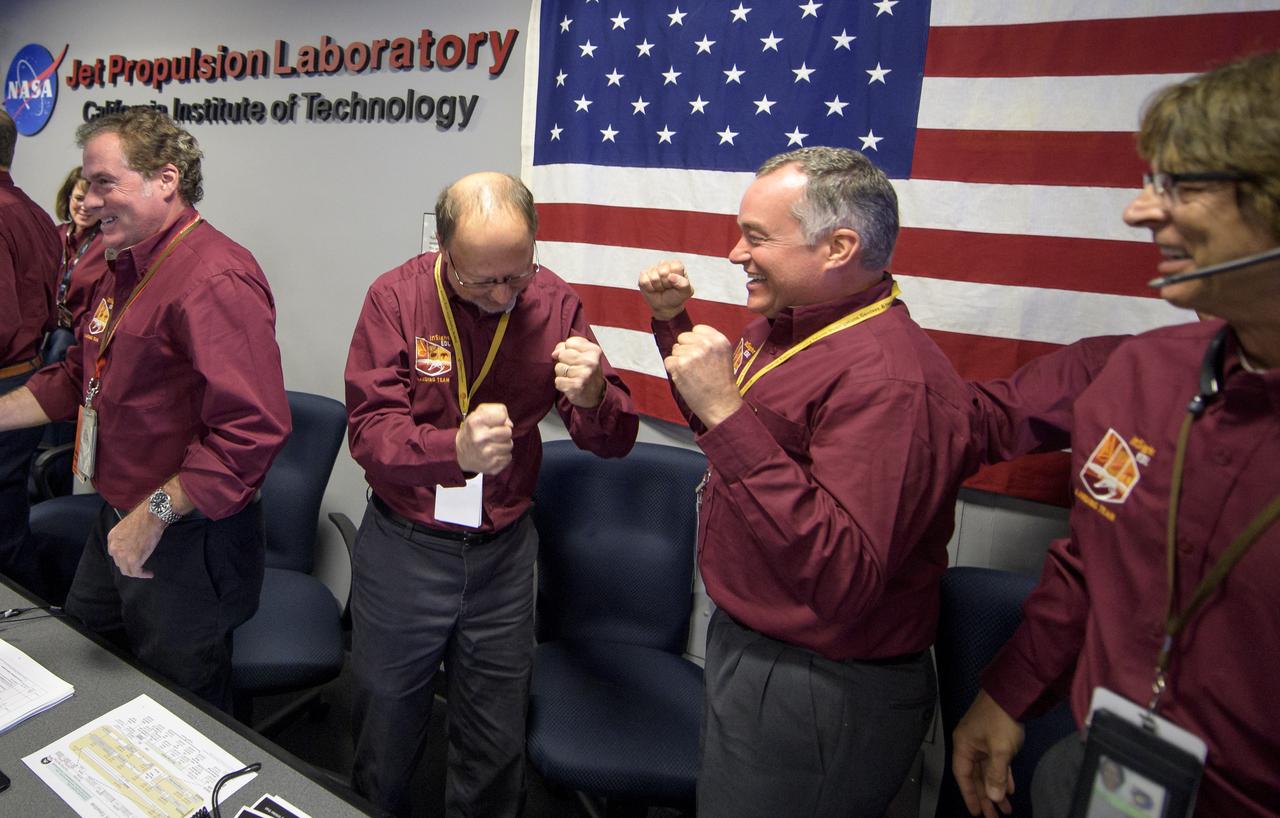
Bruce Banerdt, InSight Principal Investigator, NASA JPL, center left, and Tom Hoffman, InSight Project Manager, NASA JPL, rejoice after receiving confirmation that the Mars InSight lander successfully touched down on the surface of Mars, Monday, Nov. 26, 2018 inside the Mission Support Area at NASA's Jet Propulsion Laboratory in Pasadena, California. InSight, short for Interior Exploration using Seismic Investigations, Geodesy and Heat Transport, is a Mars lander designed to study the "inner space" of Mars: its crust, mantle, and core. Photo Credit: (NASA/Bill Ingalls)

This is an artist's rendition of the InSight lander. InSight is short for Interior Exploration using Seismic Investigations, Geodesy and Heat Transport. InSight is a Mars mission, but it's more than a Mars mission. The lander seeks the fingerprints of the processes that formed the rocky planets of the solar system, more than 4 billion years ago. It measures the planet's "vital signs:" its "pulse" (seismology), "temperature" (heat flow) and "reflexes" (precision tracking). https://photojournal.jpl.nasa.gov/catalog/PIA22229
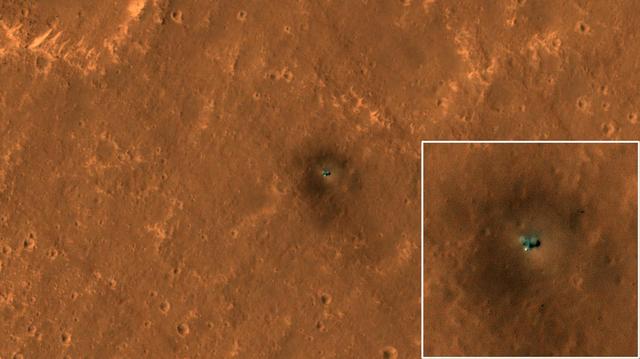
The HiRISE camera on NASA's Mars Reconnaissance Orbiter got its best view yet of the agency's InSight lander on Sept. 23, 2019. HiRISE has been monitoring InSight's landing site on the Red Planet for changes such as dust-devil tracks (the slightly dark diagonals streaks crisscrossing the surface). This new image clearly shows the two circular solar panels on either side of the lander body. From end to end, the panels span 20 feet (6 meters); the image was taken from an elevation of 169 miles (272 kilometers) above the surface. The bright spot on the lower side of the spacecraft is the dome-shaped protective cover over InSight's seismometer. Surrounding the spacecraft is a dark halo created by retrorocket thrusters scouring the surface during landing. Dark streaks seen crossing diagonally across the surface are dust-devil tracks. Several factors make this image crisper than past images. For one thing, there's less dust in the air this time of year compared to before. And shadows are offset from the lander because this is an oblique view looking west. Moreover, the lighting was better for avoiding the bright reflections from the lander or its solar panels that have obscured surrounding pixels in other images. The seismometer cover to the south of the lander is still bright because its dome shape always produces a mirror-like reflection over some small area. https://photojournal.jpl.nasa.gov/catalog/PIA23376
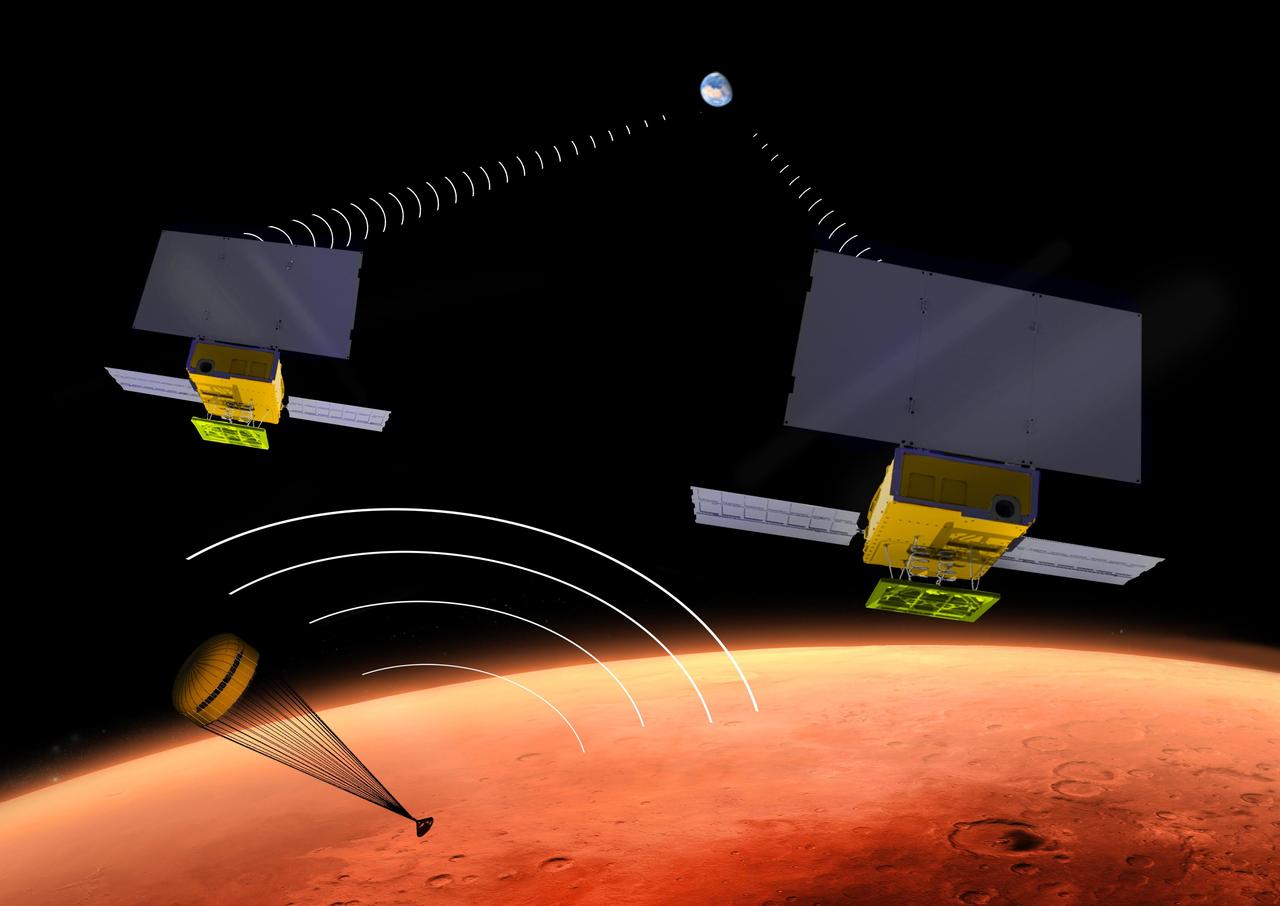
NASA's two MarCO CubeSats will be flying past Mars in September 2016 just as NASA's next Mars lander, InSight, is descending through the Martian atmosphere and landing on the surface. MarCO, for Mars Cube One, will provide an experimental communications relay to inform Earth quickly about the landing. This illustration depicts a moment during the lander's descent when it is transmitting data in the UHF radio band, and the twin MarCO craft are receiving those transmissions while simultaneously relaying the data to Earth in a different radio band. Each of the MarCO twins carries two solar panels for power, and both UHF-band and X-band radio antennas. As a technology demonstration, MarCO could lead to other "bring-your-own-relay" mission designs and also to use of miniature spacecraft for a wide diversity of interplanetary missions. MarCO is the first interplanetary use of CubeSat technologies for small spacecraft. CubeSats are a class of spacecraft based on a standardized small size and modular use of off-the-shelf technologies to streamline development. Many have been made by university students, and dozens have been launched into Earth orbit using extra payload mass available on launches of larger spacecraft. The two briefcase-size MarCO CubeSats will ride along with InSight on an Atlas V launch vehicle lifting off in March 2016 from Vandenberg Air Force Base, California. MarCO is a technology demonstration aspect of the InSight mission and not needed for that mission's success. InSight, an acronym for Interior Exploration using Seismic Investigations, Geodesy and Heat Transport, will investigate the deep interior of Mars to advance understanding of how rocky planets, including Earth, formed and evolved. After launch, the MarCO twins and InSight will be navigated separately to Mars. Note: After thorough examination, NASA managers have decided to suspend the planned March 2016 launch of the Interior Exploration using Seismic Investigations Geodesy and Heat Transport (InSight) mission. The decision follows unsuccessful attempts to repair a leak in a section of the prime instrument in the science payload. http://photojournal.jpl.nasa.gov/catalog/PIA19388
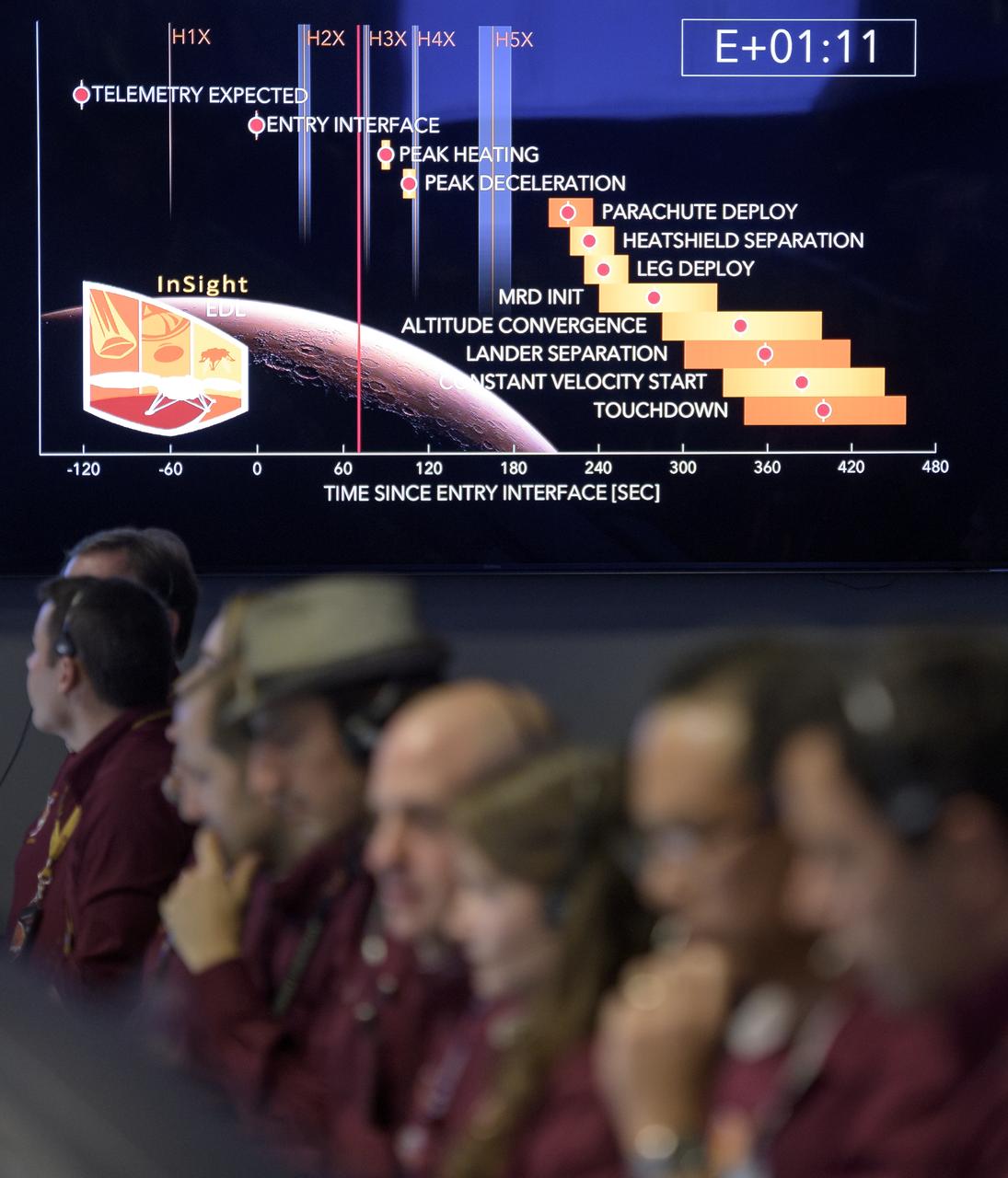
Mars InSight team members monitor the status of the lander prior to it touching down on Mars, Monday, Nov. 26, 2018 inside the Mission Support Area at NASA's Jet Propulsion Laboratory in Pasadena, California. InSight, short for Interior Exploration using Seismic Investigations, Geodesy and Heat Transport, is a Mars lander designed to study the "inner space" of Mars: its crust, mantle, and core. Photo Credit: (NASA/Bill Ingalls)
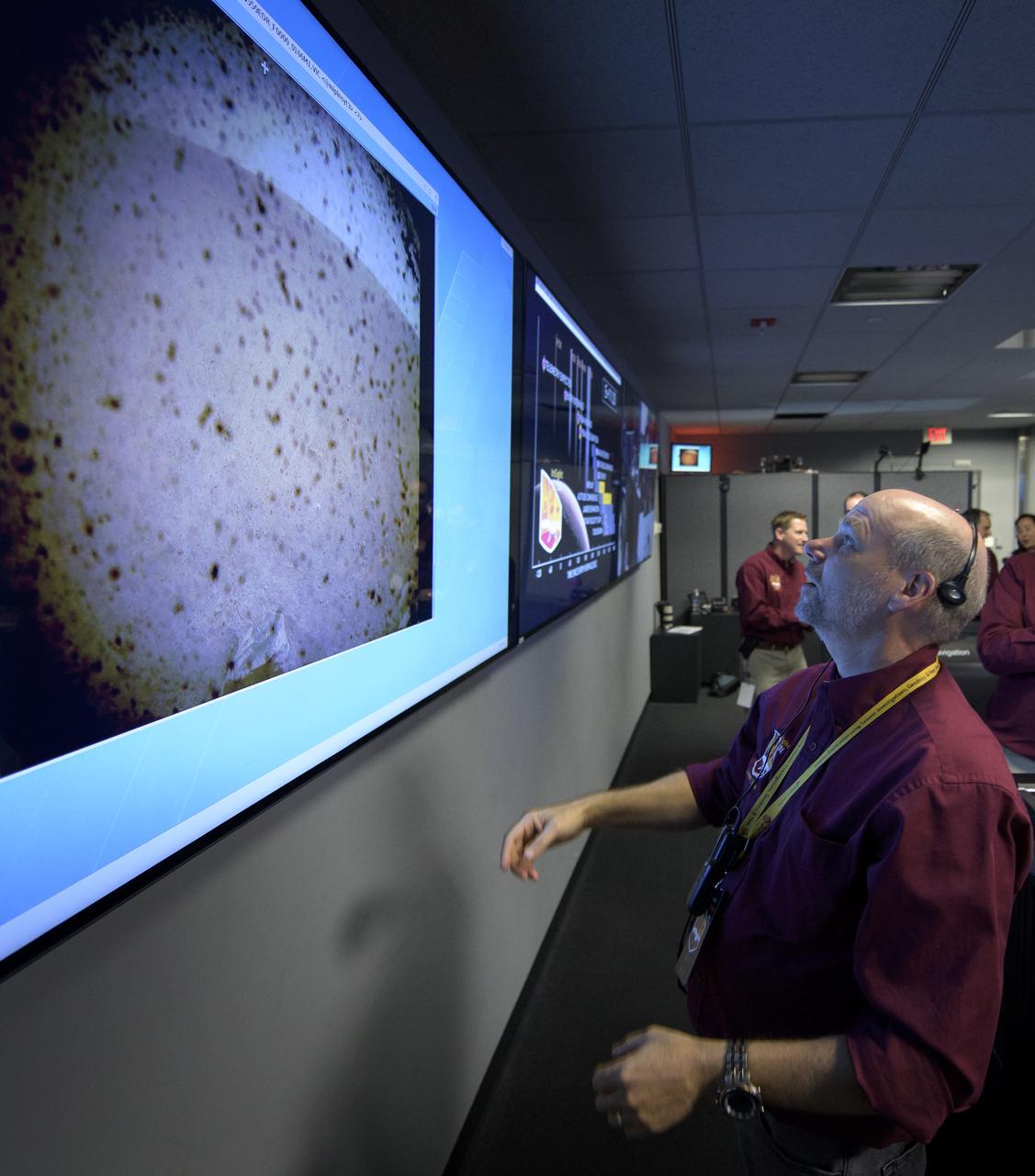
Rick Welch, System Manager, NASA JPL reacts to the first image to be seen from the Mars InSight lander shortly after confirmation of a successful touch down on the surface of Mars, Monday, Nov. 26, 2018 inside the Mission Support Area at NASA's Jet Propulsion Laboratory in Pasadena, California. InSight, short for Interior Exploration using Seismic Investigations, Geodesy and Heat Transport, is a Mars lander designed to study the "inner space" of Mars: its crust, mantle, and core. Photo Credit: (NASA/Bill Ingalls)
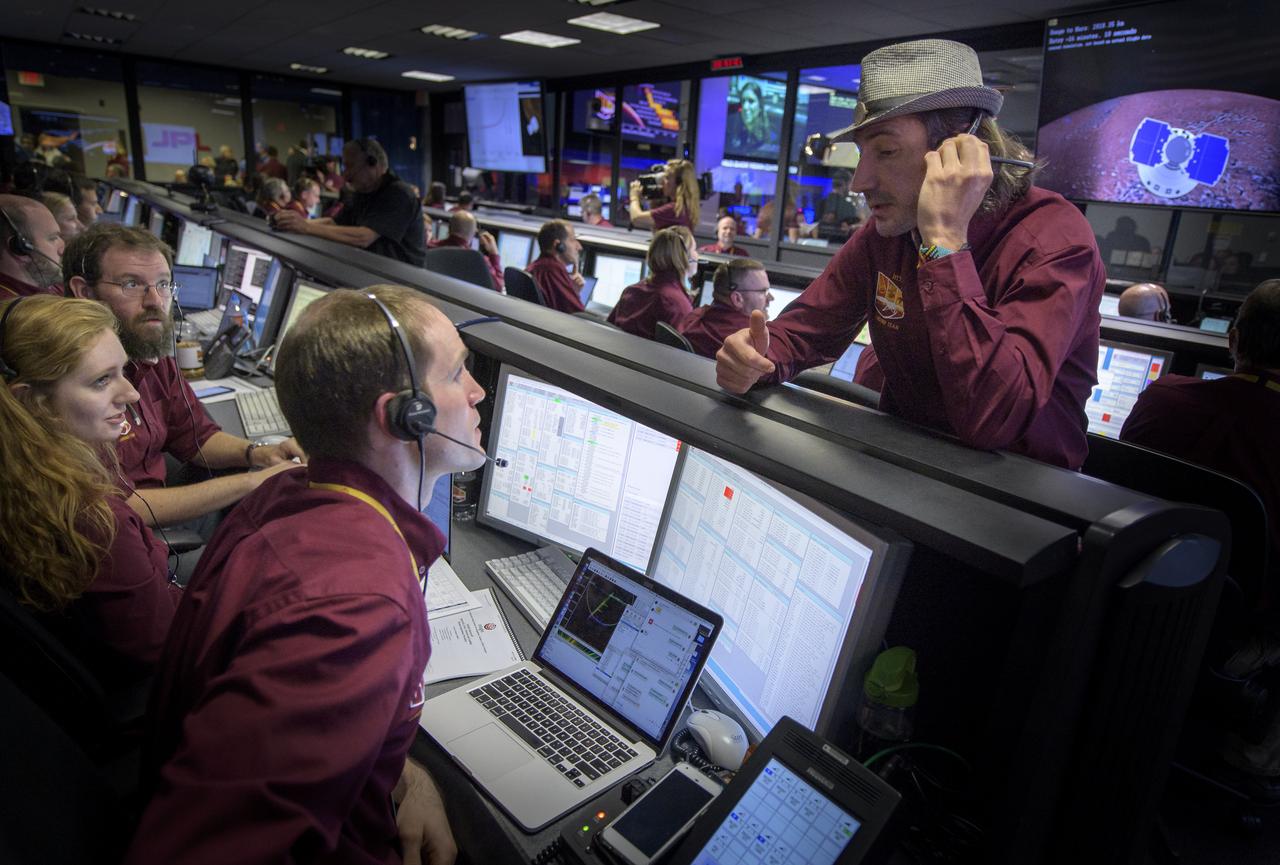
Mars InSight team members monitor the status of the lander prior to it touching down on Mars, Monday, Nov. 26, 2018 inside the Mission Support Area at NASA's Jet Propulsion Laboratory in Pasadena, California. InSight, short for Interior Exploration using Seismic Investigations, Geodesy and Heat Transport, is a Mars lander designed to study the "inner space" of Mars: its crust, mantle, and core. Photo Credit: (NASA/Bill Ingalls)
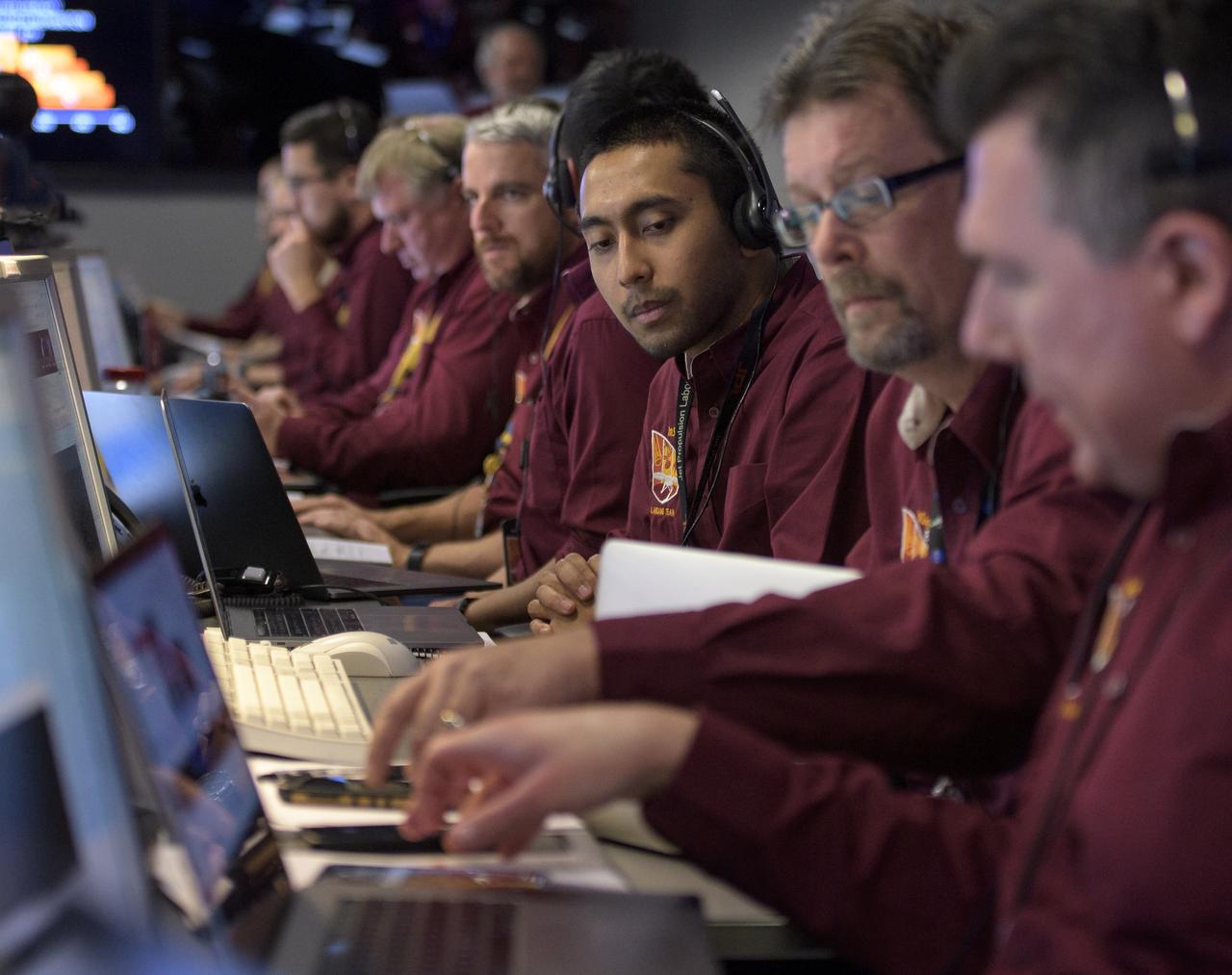
Mars InSight team members monitor the status of the lander prior to it touching down on Mars, Monday, Nov. 26, 2018 inside the Mission Support Area at NASA's Jet Propulsion Laboratory in Pasadena, California. InSight, short for Interior Exploration using Seismic Investigations, Geodesy and Heat Transport, is a Mars lander designed to study the "inner space" of Mars: its crust, mantle, and core. Photo Credit: (NASA/Bill Ingalls)

Thomas Zurbuchen, Associate Administrator of NASA’s Science Mission Directorate, NASA Headquarters and other Mars InSight team members monitor the status of the lander prior to it touching down on Mars, Monday, Nov. 26, 2018 inside the Mission Support Area at NASA's Jet Propulsion Laboratory in Pasadena, California. InSight, short for Interior Exploration using Seismic Investigations, Geodesy and Heat Transport, is a Mars lander designed to study the "inner space" of Mars: its crust, mantle, and core. Photo Credit: (NASA/Bill Ingalls)
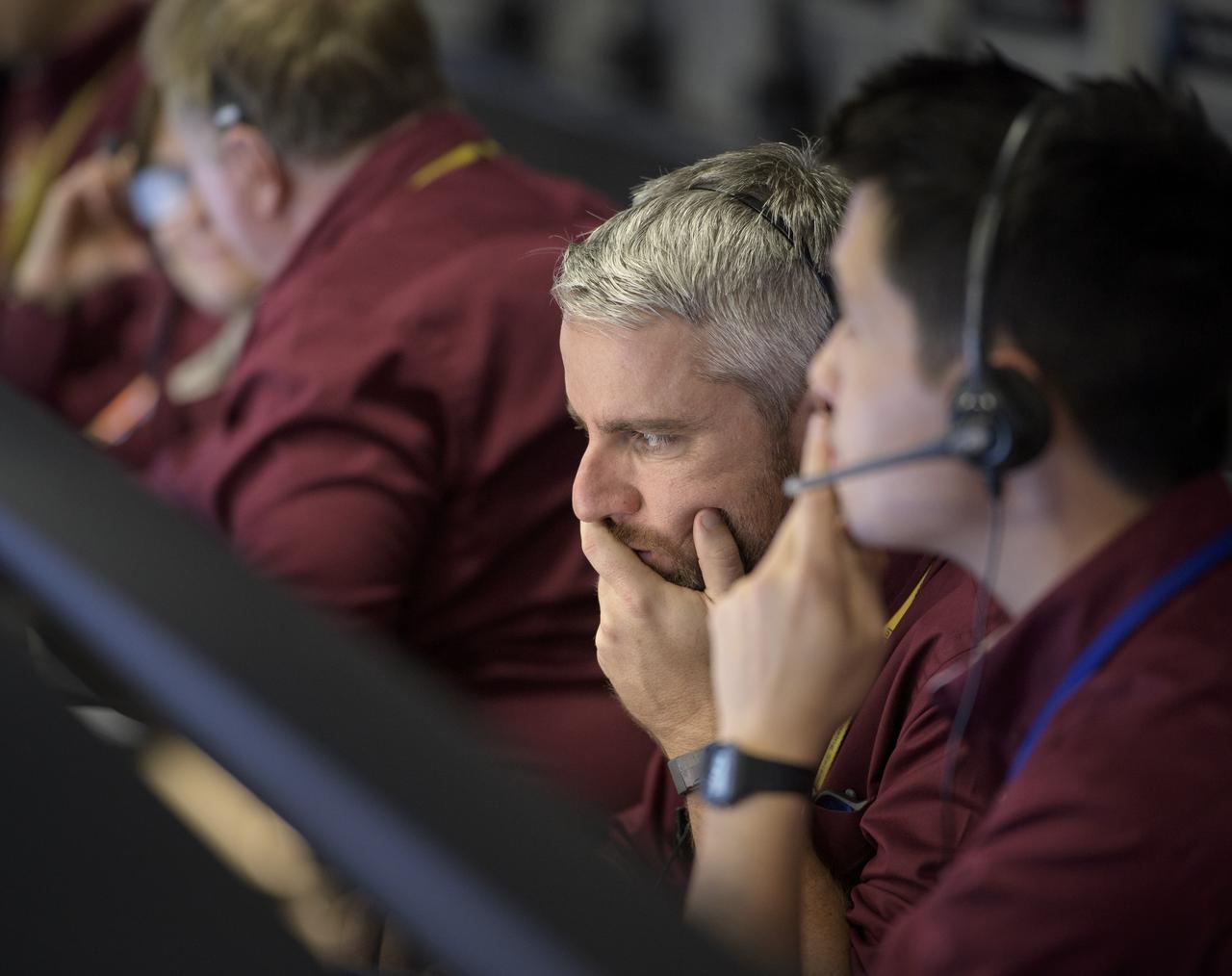
Mars InSight team members monitor the status of the lander prior to it touching down on Mars, Monday, Nov. 26, 2018 inside the Mission Support Area at NASA's Jet Propulsion Laboratory in Pasadena, California. InSight, short for Interior Exploration using Seismic Investigations, Geodesy and Heat Transport, is a Mars lander designed to study the "inner space" of Mars: its crust, mantle, and core. Photo Credit: (NASA/Bill Ingalls)

Mars InSight team members share good-luck peanuts as they monitor the status of the lander prior to it touching down on Mars, Monday, Nov. 26, 2018 inside the Mission Support Area at NASA's Jet Propulsion Laboratory in Pasadena, California. InSight, short for Interior Exploration using Seismic Investigations, Geodesy and Heat Transport, is a Mars lander designed to study the "inner space" of Mars: its crust, mantle, and core. Photo Credit: (NASA/Bill Ingalls)
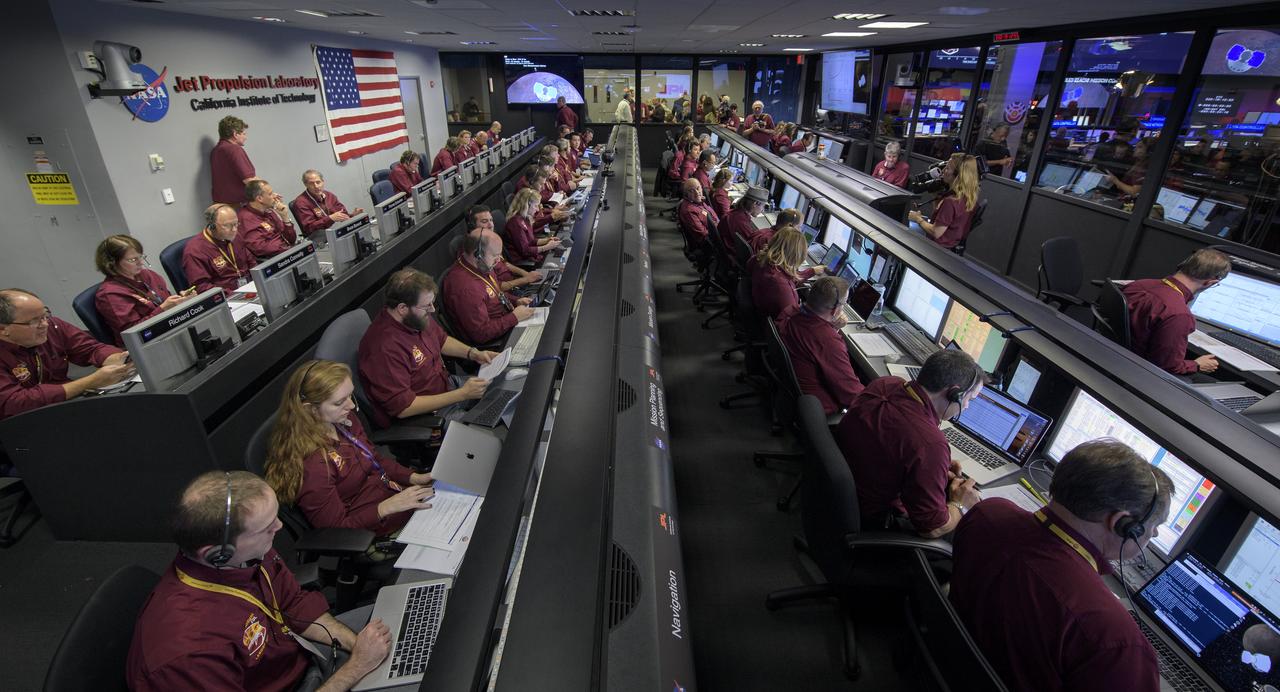
Mars InSight team members monitor the status of the lander prior to it touching down on Mars, Monday, Nov. 26, 2018 inside the Mission Support Area at NASA's Jet Propulsion Laboratory in Pasadena, California. InSight, short for Interior Exploration using Seismic Investigations, Geodesy and Heat Transport, is a Mars lander designed to study the "inner space" of Mars: its crust, mantle, and core. Photo Credit: (NASA/Bill Ingalls)
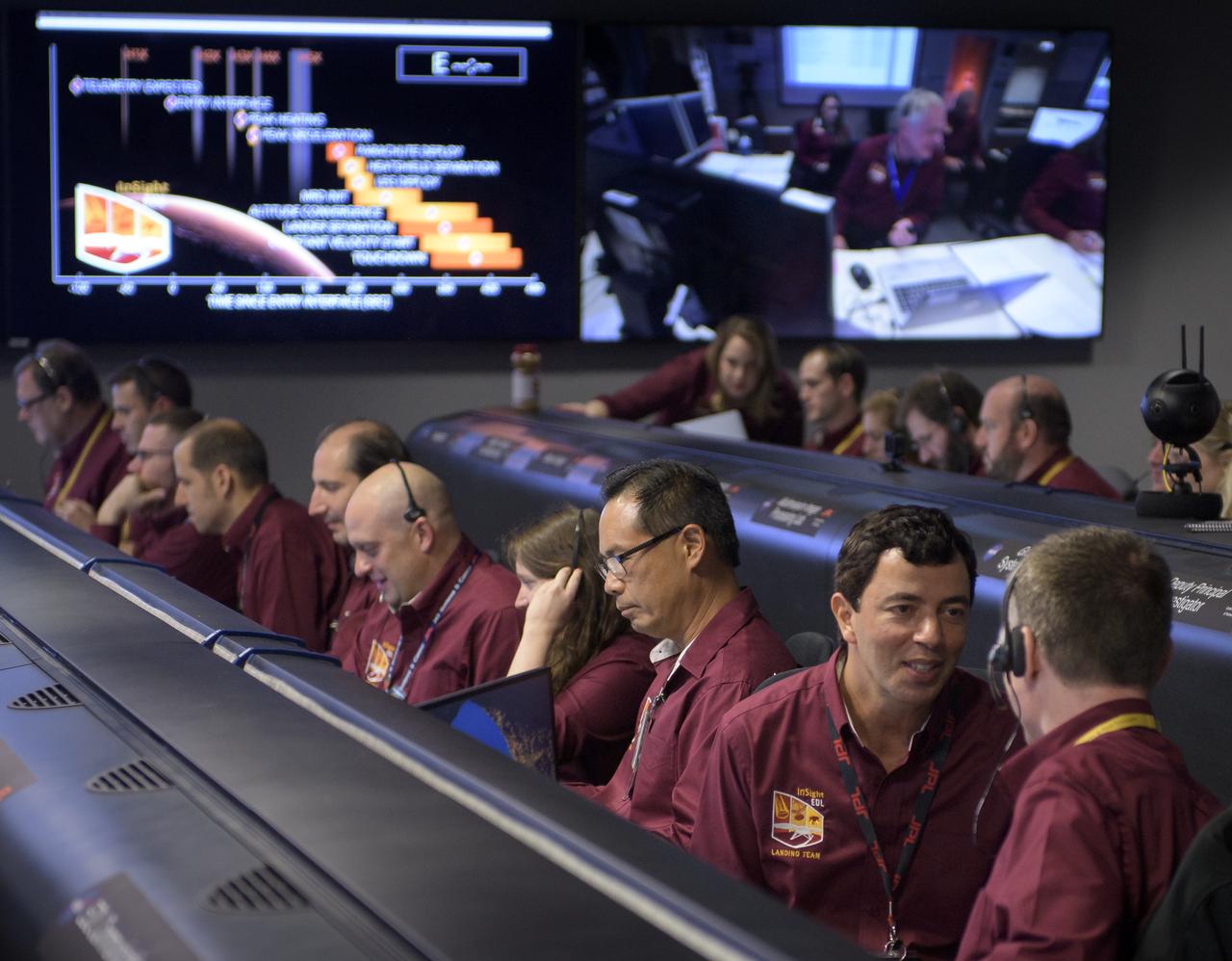
Mars InSight team members monitor the status of the lander prior to it touching down on Mars, Monday, Nov. 26, 2018 inside the Mission Support Area at NASA's Jet Propulsion Laboratory in Pasadena, California. InSight, short for Interior Exploration using Seismic Investigations, Geodesy and Heat Transport, is a Mars lander designed to study the "inner space" of Mars: its crust, mantle, and core. Photo Credit: (NASA/Bill Ingalls)
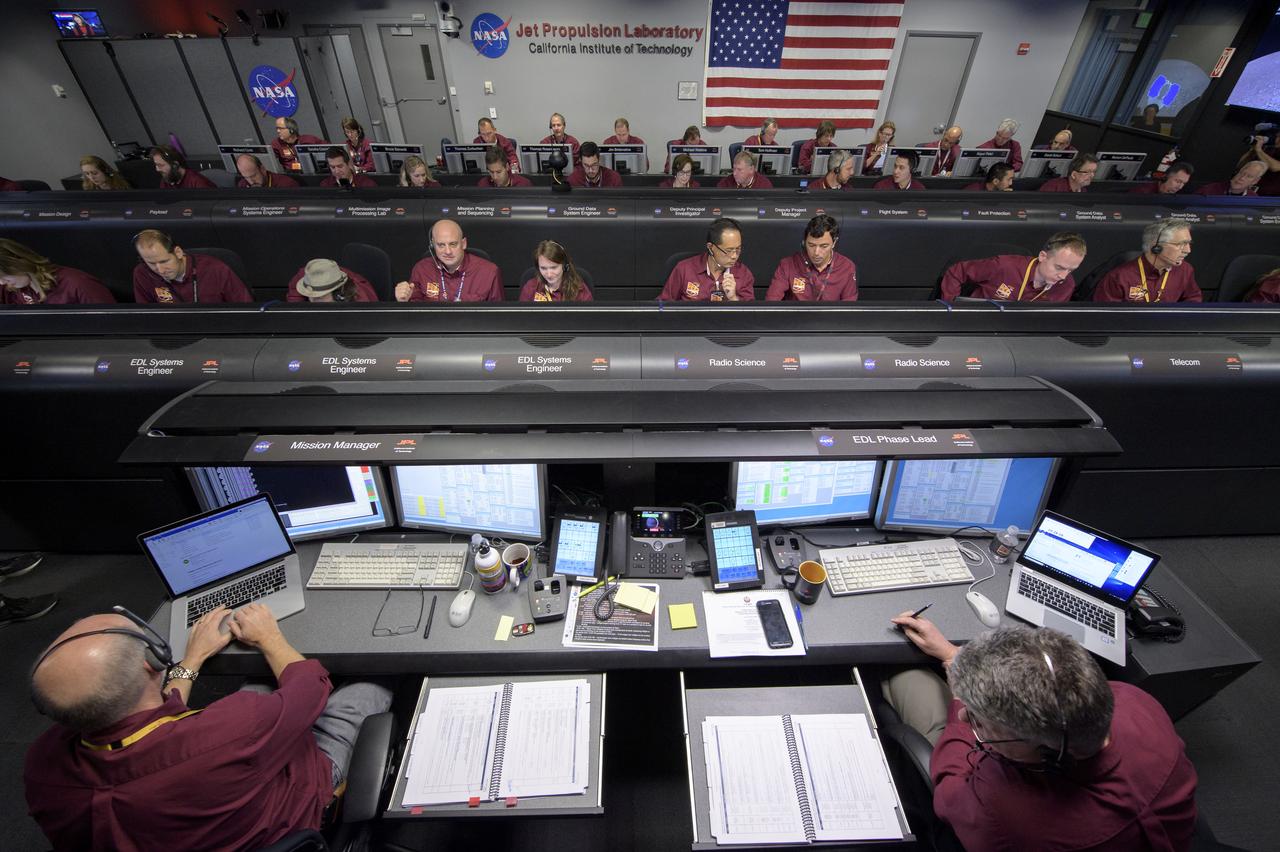
Mars InSight team members monitor the status of the lander prior to it touching down on Mars, Monday, Nov. 26, 2018 inside the Mission Support Area at NASA's Jet Propulsion Laboratory in Pasadena, California. InSight, short for Interior Exploration using Seismic Investigations, Geodesy and Heat Transport, is a Mars lander designed to study the "inner space" of Mars: its crust, mantle, and core. Photo Credit: (NASA/Bill Ingalls)
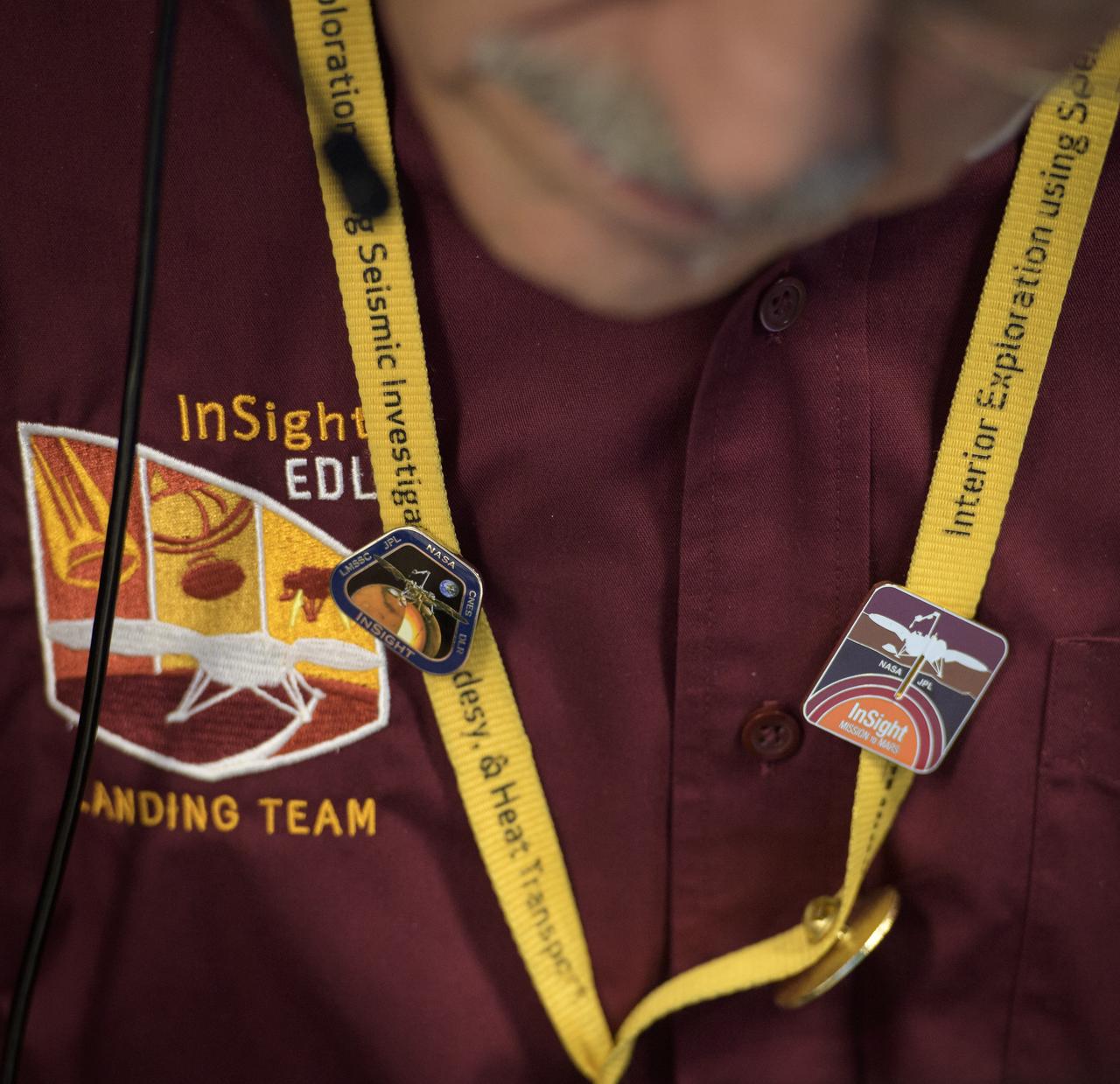
Shirt, lanyard, and mission pins are seen on a Mars InSight team member as they monitor the status of the lander prior to it touching down on Mars, Monday, Nov. 26, 2018 inside the Mission Support Area at NASA's Jet Propulsion Laboratory in Pasadena, California. InSight, short for Interior Exploration using Seismic Investigations, Geodesy and Heat Transport, is a Mars lander designed to study the "inner space" of Mars: its crust, mantle, and core. Photo Credit: (NASA/Bill Ingalls)
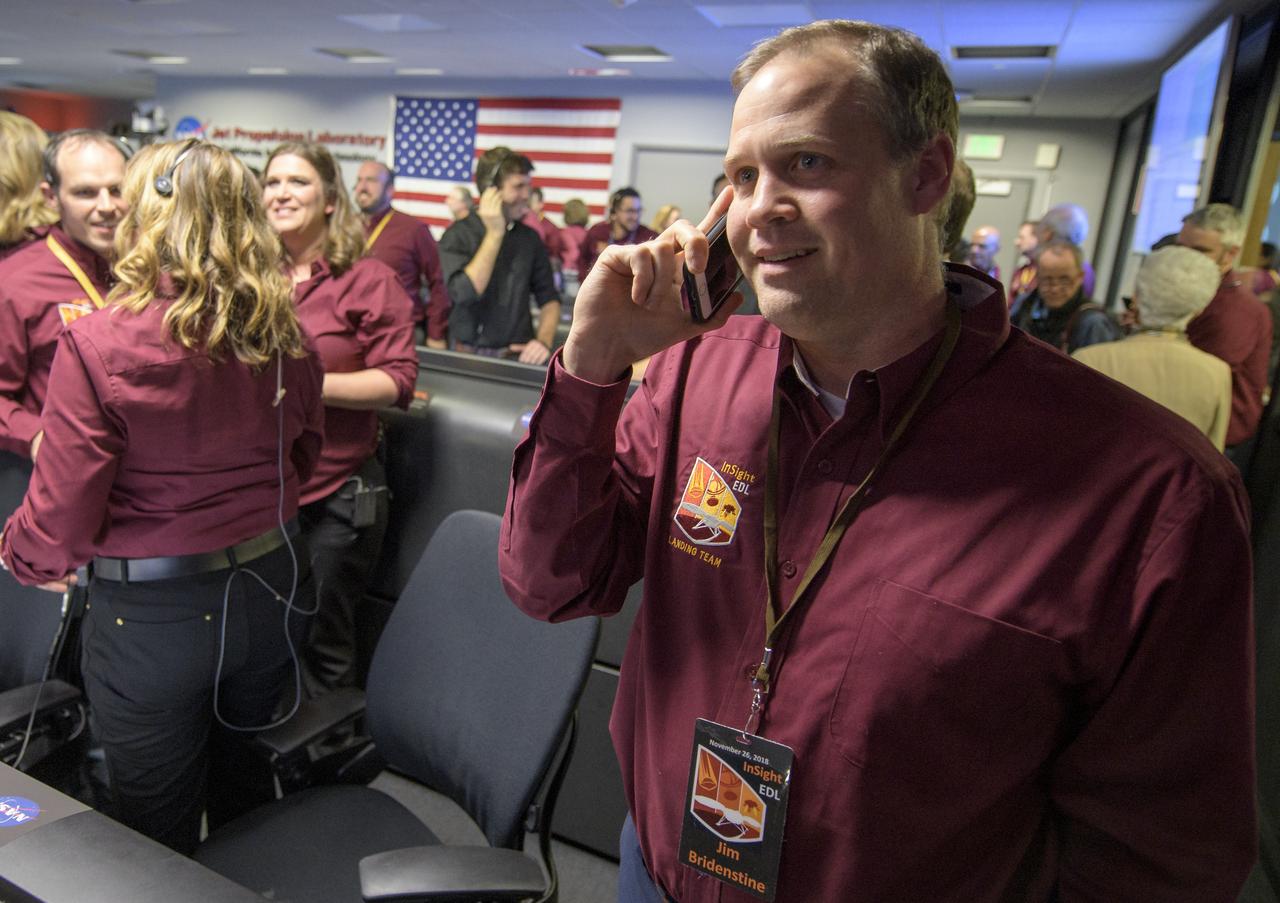
NASA Administrator Jim Bridenstine receives a congratulatory call from Vice President Mike Pence after receiving confirmation that the Mars InSight lander successfully touched down on the surface of Mars, Monday, Nov. 26, 2018 inside the Mission Support Area at NASA's Jet Propulsion Laboratory in Pasadena, California. InSight, short for Interior Exploration using Seismic Investigations, Geodesy and Heat Transport, is a Mars lander designed to study the "inner space" of Mars: its crust, mantle, and core. Photo Credit: (NASA/Bill Ingalls)
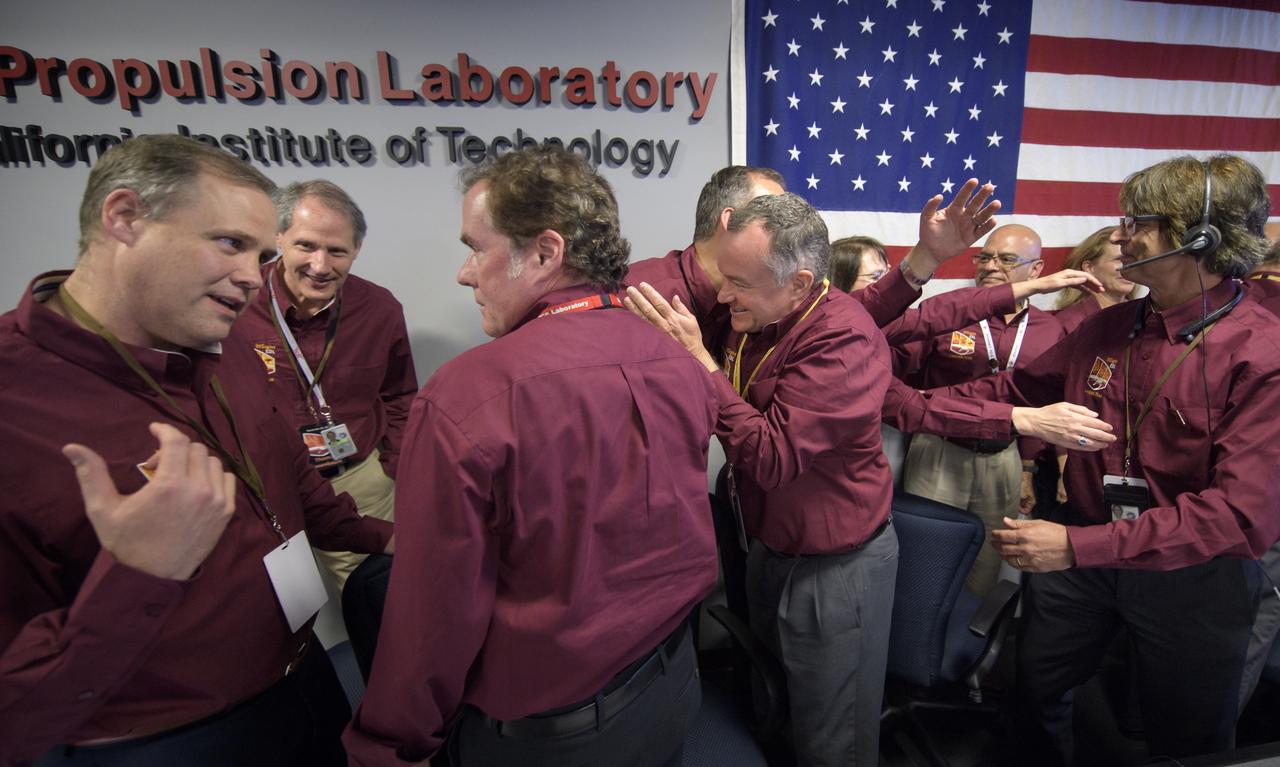
NASA Administrator Jim Bridenstine, left, celebrates with other managers after receiving confirmation that the Mars InSight lander successfully touched down on the surface of Mars, Monday, Nov. 26, 2018 inside the Mission Support Area at NASA's Jet Propulsion Laboratory in Pasadena, California. InSight, short for Interior Exploration using Seismic Investigations, Geodesy and Heat Transport, is a Mars lander designed to study the "inner space" of Mars: its crust, mantle, and core. Photo Credit: (NASA/Bill Ingalls)
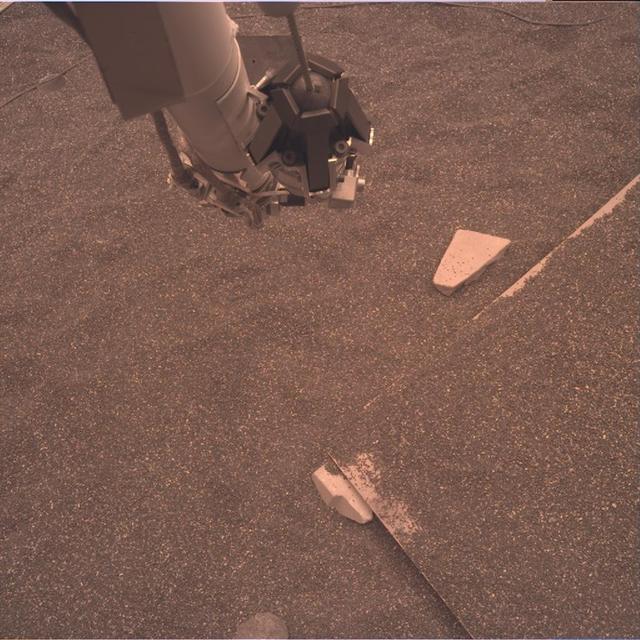
This test image from an engineering model of NASA's InSight lander shows part of the lander's robotic arm and the simulated Martian ground at a testbed at NASA's Jet Propulsion Laboratory in Pasadena, California. The testbed aims to mimic the environment InSight will encounter at Mars so engineers can prepare for the spacecraft operations to come. This image is expected to be similar to the raw or unprocessed images that InSight will send back to Earth. It was taken by the instrument deployment camera attached to InSight's robotic arm. https://photojournal.jpl.nasa.gov/catalog/PIA22827

NASA Headquarters acting director of the Planetary Science Division Lori Glaze, left, talks with Sue Smrekar, InSight deputy principal investigator, NASA JPL, as they and other Mars InSight team members monitor the status of the lander prior to it touching down on Mars, Monday, Nov. 26, 2018 inside the Mission Support Area at NASA's Jet Propulsion Laboratory in Pasadena, California. InSight, short for Interior Exploration using Seismic Investigations, Geodesy and Heat Transport, is a Mars lander designed to study the "inner space" of Mars: its crust, mantle, and core. Photo Credit: (NASA/Bill Ingalls)
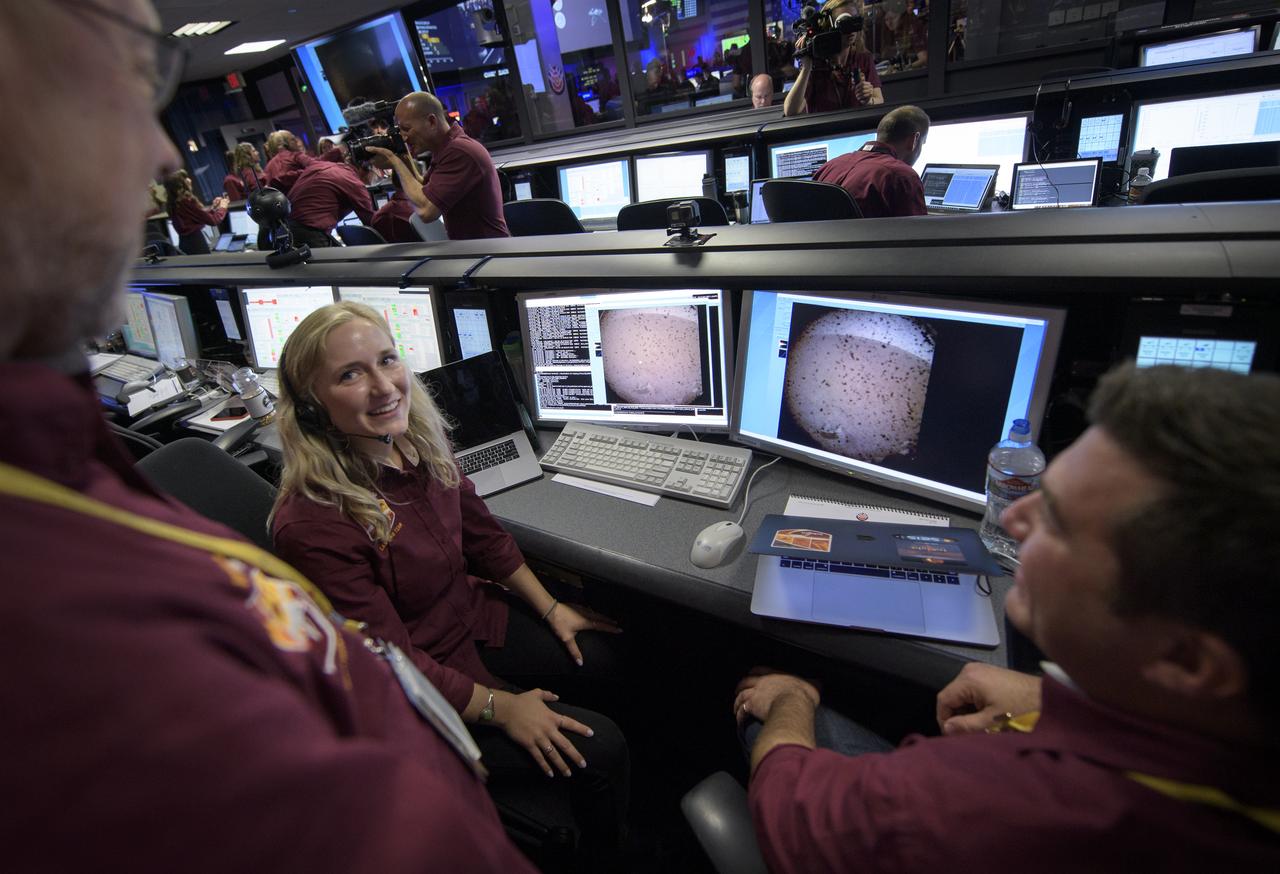
Hallie Gengl, Data Visualization Developer, NASA JPL, left, and Brent Shockley, Systems Engineer, NASA, APL, right, talk with Bruce Banerdt, InSight Principal Investigator, NASA JPL, after reviewing the first image of Mars from the Mars InSight lander, Monday, Nov. 26, 2018 inside the Mission Support Area at NASA's Jet Propulsion Laboratory in Pasadena, California. InSight, short for Interior Exploration using Seismic Investigations, Geodesy and Heat Transport, is a Mars lander designed to study the "inner space" of Mars: its crust, mantle, and core. Photo Credit: (NASA/Bill Ingalls)

Journalist Mika McKinnon takes notes during a Mars InSight post-landing press conference while wearing a small model of the lander in her hair, Monday, Nov. 26, 2018 at NASA's Jet Propulsion Laboratory in Pasadena, California. InSight, short for Interior Exploration using Seismic Investigations, Geodesy and Heat Transport, is a Mars lander designed to study the "inner space" of Mars: its crust, mantle, and core. Photo Credit: (NASA/Bill Ingalls)

NASA's Jet Propulsion Laboratory InSight deputy principal investigator Sue Smrekar gives remarks during a NASA InSight Mars Lander (Interior Exploration using Seismic Investigations, Geodesy and Heat Transport) media briefing, Wednesday, Oct. 31, 2018 at NASA Headquarters in Washington. InSIght will land on the Red Planet at approximately 3 p.m. EST (noon PST) Monday, Nov. 26. InSight will study the deep interior of Mars to learn how all celestial bodies with rocky surfaces, including Earth and the Moon, formed. The lander’s instruments include a seismometer to detect marsquakes and a probe to monitor the flow of heat in the planet's subsurface. Photo Credit: (NASA/Bill Ingalls)

NASA's Jet Propulsion Laboratory InSight project manager Tom Hoffman gives remarks during a media briefing regarding the NASA InSight Mars Lander (Interior Exploration using Seismic Investigations, Geodesy and Heat Transport), Wednesday, Oct. 31, 2018 at NASA Headquarters in Washington. InSIght will land on the Red Planet at approximately 3 p.m. EST (noon PST) Monday, Nov. 26. InSight will study the deep interior of Mars to learn how all celestial bodies with rocky surfaces, including Earth and the Moon, formed. The lander’s instruments include a seismometer to detect marsquakes and a probe to monitor the flow of heat in the planet's subsurface. Photo Credit: (NASA/Bill Ingalls)

NASA's Jet Propulsion Laboratory InSight principal investigator Bruce Banerdt gives remarks during the NASA InSight Mars Lander (Interior Exploration using Seismic Investigations, Geodesy and Heat Transport) media briefing, Wednesday, Oct. 31, 2018 at NASA Headquarters in Washington. InSIght will land on the Red Planet at approximately 3 p.m. EST (noon PST) Monday, Nov. 26. InSight will study the deep interior of Mars to learn how all celestial bodies with rocky surfaces, including Earth and the Moon, formed. The lander’s instruments include a seismometer to detect marsquakes and a probe to monitor the flow of heat in the planet's subsurface. Photo Credit: (NASA/Bill Ingalls)
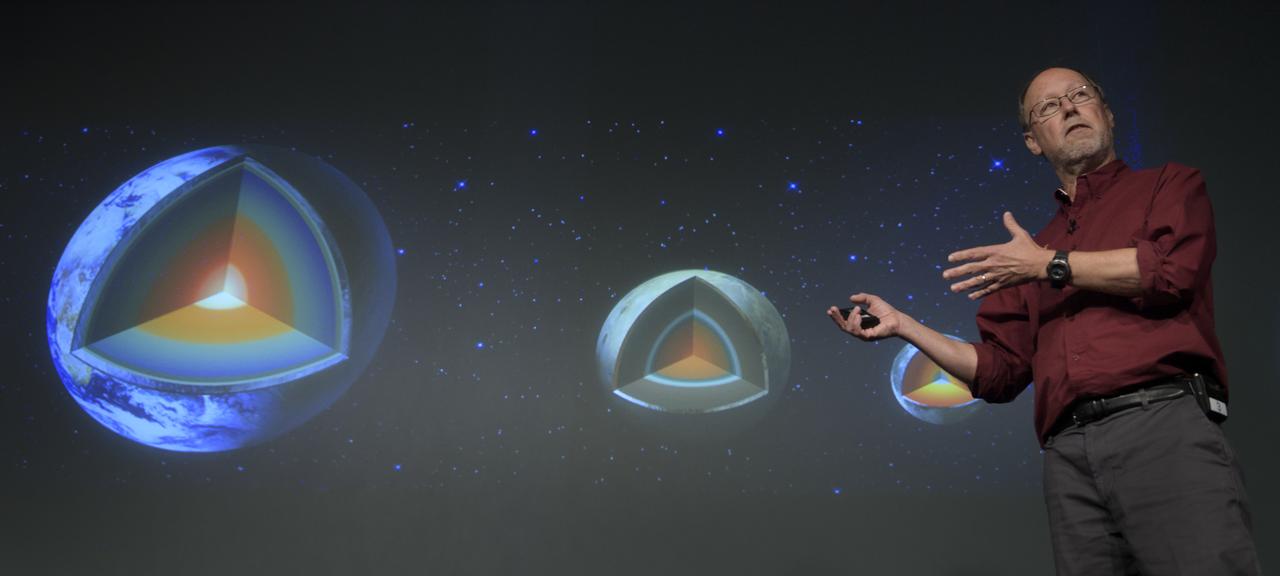
NASA's Jet Propulsion Laboratory InSight principal investigator Bruce Banerdt gives remarks during the NASA InSight Mars Lander (Interior Exploration using Seismic Investigations, Geodesy and Heat Transport) media briefing, Wednesday, Oct. 31, 2018 at NASA Headquarters in Washington. InSIght will land on the Red Planet at approximately 3 p.m. EST (noon PST) Monday, Nov. 26. InSight will study the deep interior of Mars to learn how all celestial bodies with rocky surfaces, including Earth and the Moon, formed. The lander’s instruments include a seismometer to detect marsquakes and a probe to monitor the flow of heat in the planet's subsurface. Photo Credit: (NASA/Bill Ingalls)
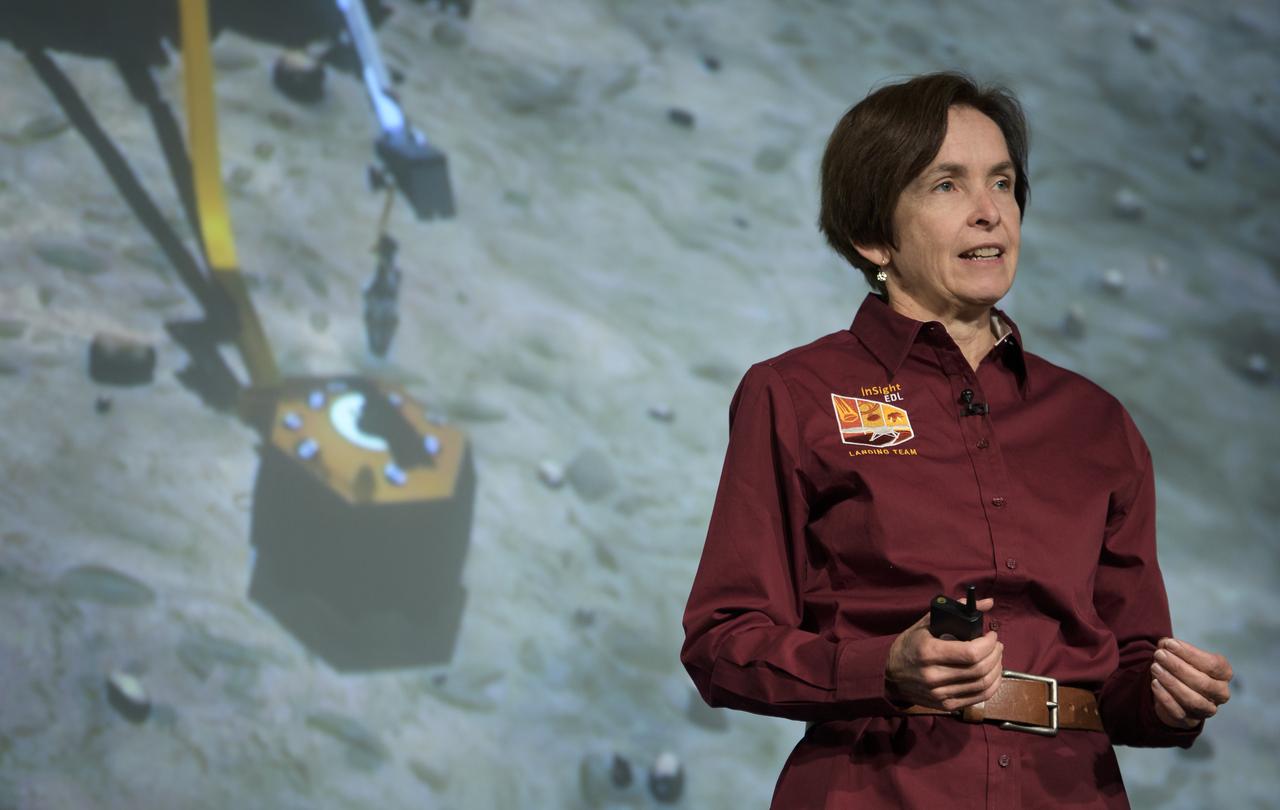
NASA's Jet Propulsion Laboratory InSight deputy principal investigator Sue Smrekar gives remarks during a NASA InSight Mars Lander (Interior Exploration using Seismic Investigations, Geodesy and Heat Transport) media briefing, Wednesday, Oct. 31, 2018 at NASA Headquarters in Washington. InSIght will land on the Red Planet at approximately 3 p.m. EST (noon PST) Monday, Nov. 26. InSight will study the deep interior of Mars to learn how all celestial bodies with rocky surfaces, including Earth and the Moon, formed. The lander’s instruments include a seismometer to detect marsquakes and a probe to monitor the flow of heat in the planet's subsurface. Photo Credit: (NASA/Bill Ingalls)
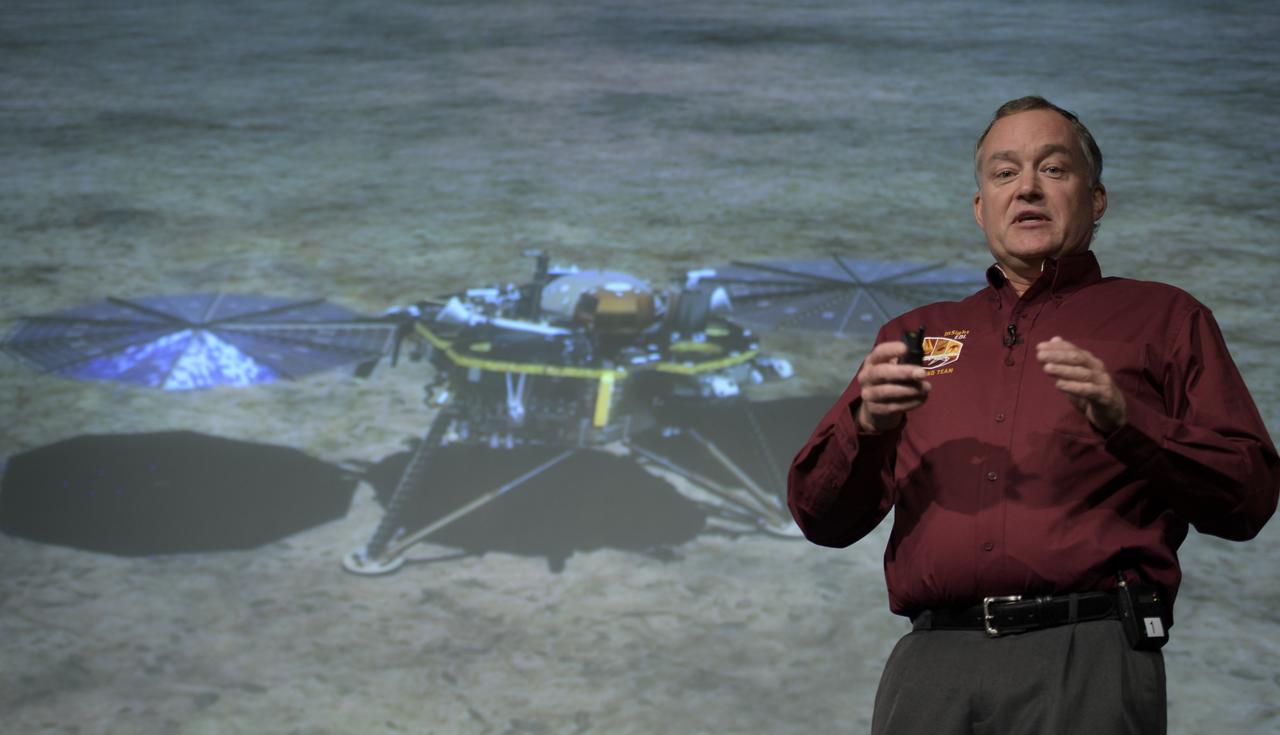
NASA's Jet Propulsion Laboratory InSight project manager Tom Hoffman gives remarks during a NASA InSight Mars Lander (Interior Exploration using Seismic Investigations, Geodesy and Heat Transport) media briefing, Wednesday, Oct. 31, 2018 at NASA Headquarters in Washington. InSIght will land on the Red Planet at approximately 3 p.m. EST (noon PST) Monday, Nov. 26. InSight will study the deep interior of Mars to learn how all celestial bodies with rocky surfaces, including Earth and the Moon, formed. The lander’s instruments include a seismometer to detect marsquakes and a probe to monitor the flow of heat in the planet's subsurface. Photo Credit: (NASA/Bill Ingalls)
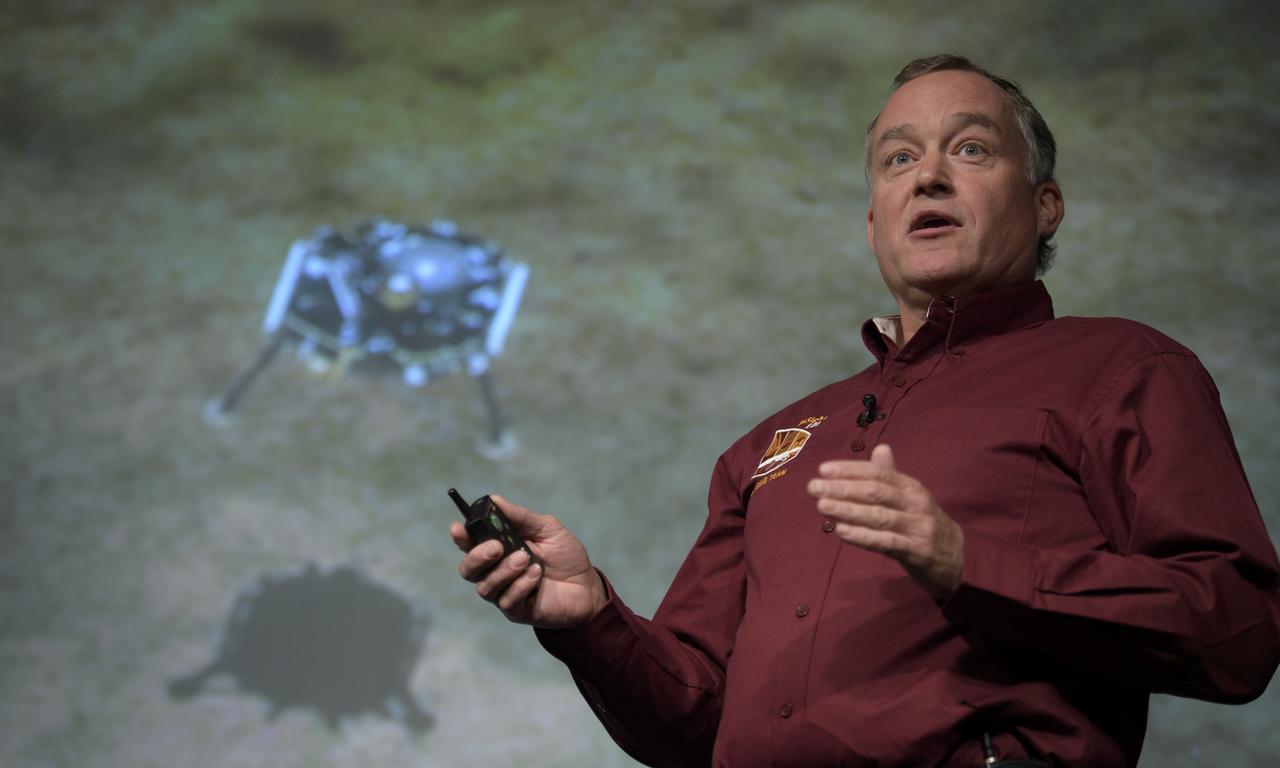
NASA's Jet Propulsion Laboratory InSight project manager Tom Hoffman gives remarks during a NASA InSight Mars Lander (Interior Exploration using Seismic Investigations, Geodesy and Heat Transport) media briefing, Wednesday, Oct. 31, 2018 at NASA Headquarters in Washington. InSIght will land on the Red Planet at approximately 3 p.m. EST (noon PST) Monday, Nov. 26. InSight will study the deep interior of Mars to learn how all celestial bodies with rocky surfaces, including Earth and the Moon, formed. The lander’s instruments include a seismometer to detect marsquakes and a probe to monitor the flow of heat in the planet's subsurface. Photo Credit: (NASA/Bill Ingalls)
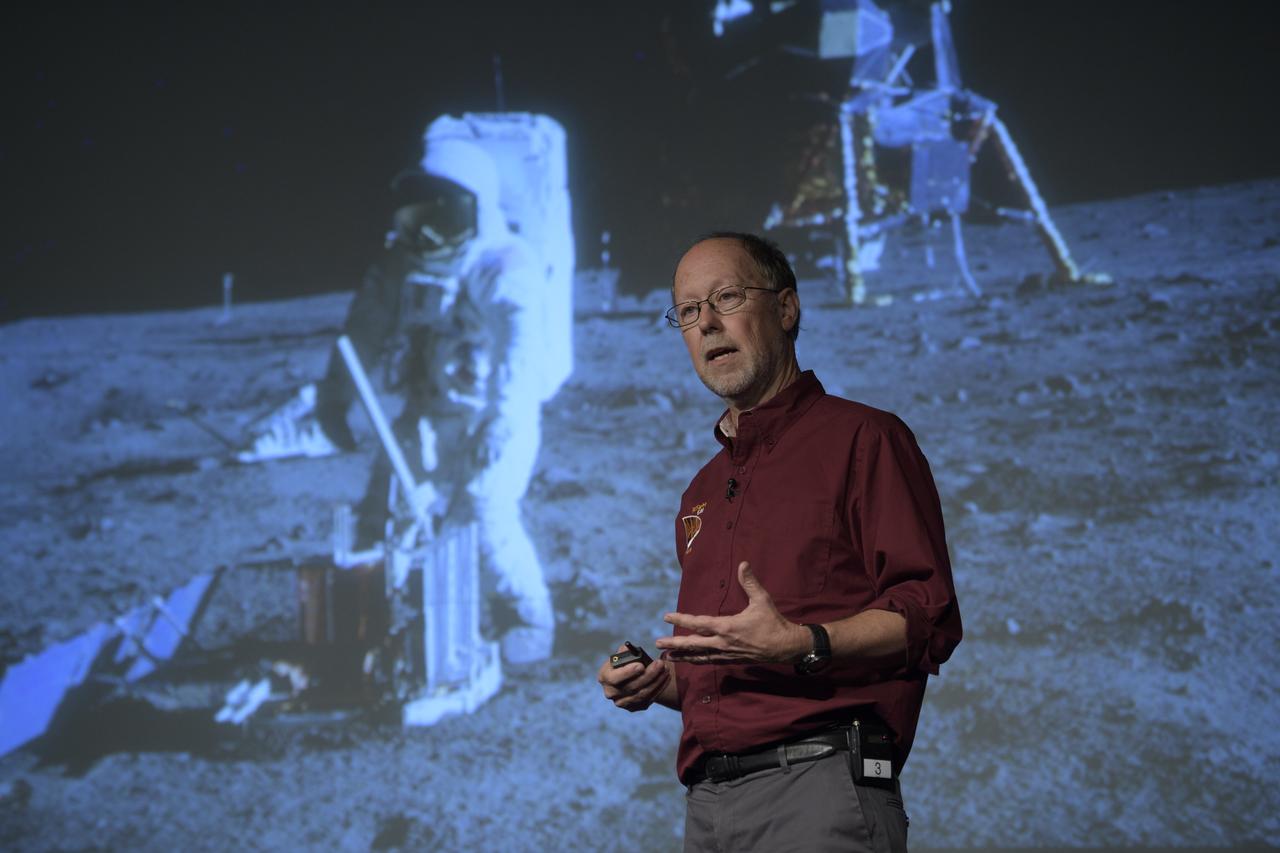
NASA's Jet Propulsion Laboratory InSight principal investigator Bruce Banerdt gives remarks during the NASA InSight Mars Lander (Interior Exploration using Seismic Investigations, Geodesy and Heat Transport) media briefing, Wednesday, Oct. 31, 2018 at NASA Headquarters in Washington. InSIght will land on the Red Planet at approximately 3 p.m. EST (noon PST) Monday, Nov. 26. InSight will study the deep interior of Mars to learn how all celestial bodies with rocky surfaces, including Earth and the Moon, formed. The lander’s instruments include a seismometer to detect marsquakes and a probe to monitor the flow of heat in the planet's subsurface. Photo Credit: (NASA/Bill Ingalls)
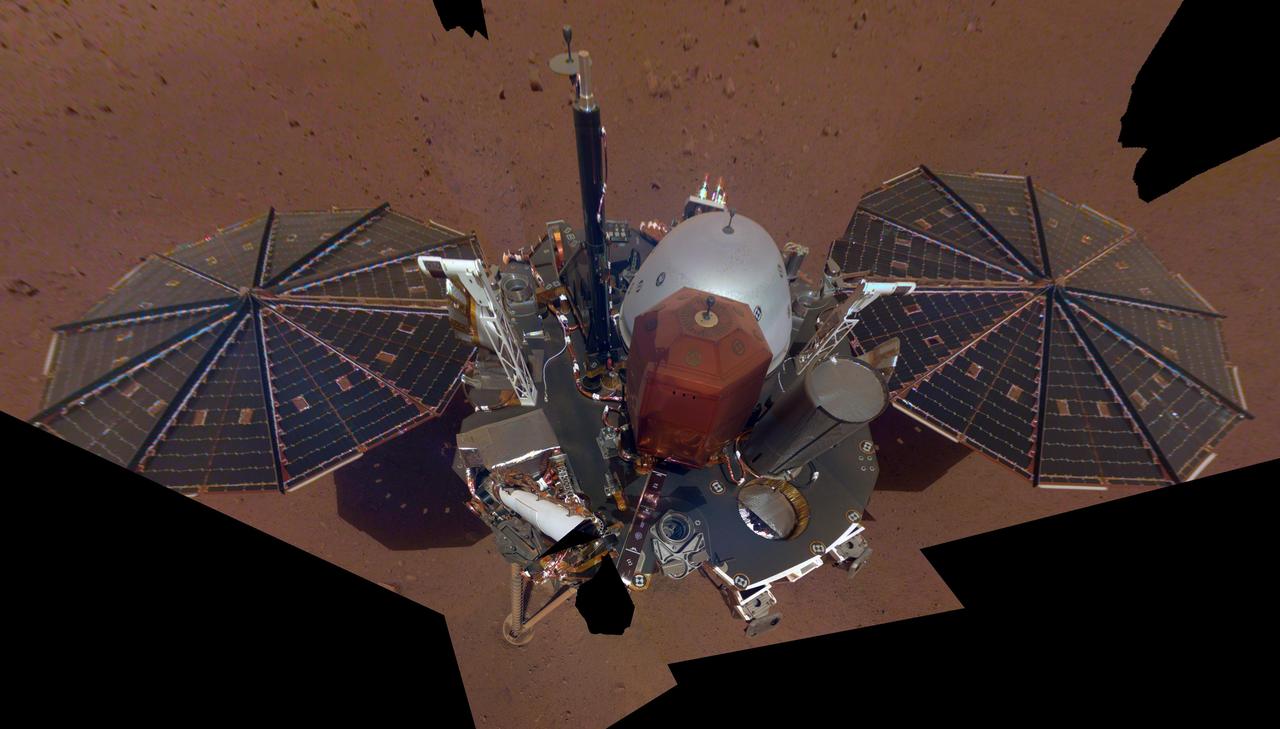
This is NASA InSight's first full selfie on Mars. It displays the lander's solar panels and deck. On top of the deck are its science instruments, weather sensor booms and UHF antenna. The selfie was taken on Dec. 6, 2018 (Sol 10). The selfie is made up of 11 images which were taken by its Instrument Deployment Camera, located on the elbow of its robotic arm. Those images are then stitched together into a mosaic. https://photojournal.jpl.nasa.gov/catalog/PIA22876
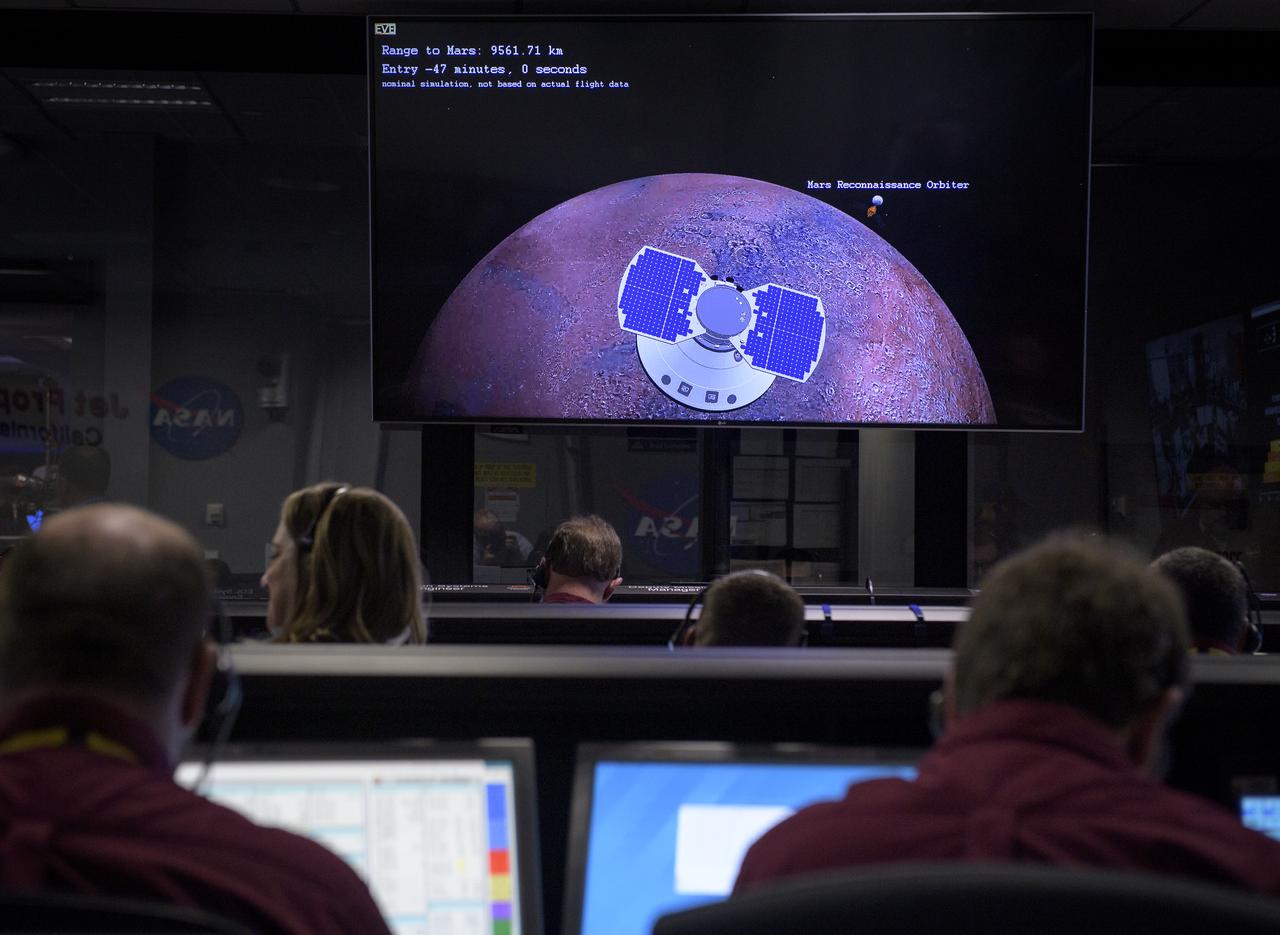
A monitor inside the Mission Support Area displays the status of Mars InSight and the Mars Cube One (MarCO) CubeSats prior to InSight touching down on Mars, Monday, Nov. 26, 2018 at NASA's Jet Propulsion Laboratory in Pasadena, California. InSight, short for Interior Exploration using Seismic Investigations, Geodesy and Heat Transport, is a Mars lander designed to study the "inner space" of Mars: its crust, mantle, and core. Photo Credit: (NASA/Bill Ingalls)
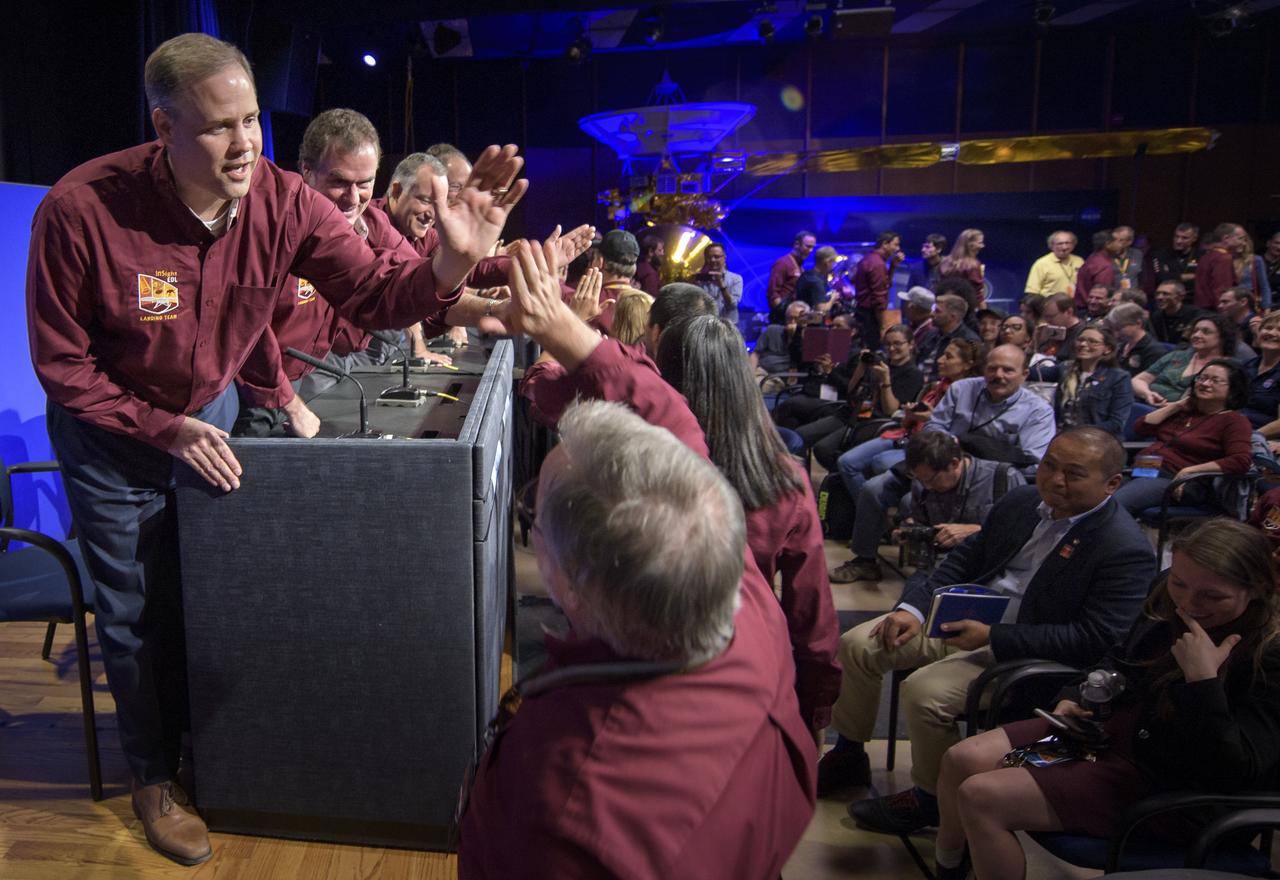
NASA Administrator Jim Bridenstine, left, Mars Cube One, and Mars InSight team members, give each other high fives at the conclusion of a Mars InSight post-landing press conference, Monday, Nov. 26, 2018 at NASA's Jet Propulsion Laboratory in Pasadena, California. InSight, short for Interior Exploration using Seismic Investigations, Geodesy and Heat Transport, is a Mars lander designed to study the "inner space" of Mars: its crust, mantle, and core. Photo Credit: (NASA/Bill Ingalls)

Mars Cube One and Mars InSight team members give each other high fives at the conclusion of a Mars InSight post-landing press conference, Monday, Nov. 26, 2018 at NASA's Jet Propulsion Laboratory in Pasadena, California. InSight, short for Interior Exploration using Seismic Investigations, Geodesy and Heat Transport, is a Mars lander designed to study the "inner space" of Mars: its crust, mantle, and core. Photo Credit: (NASA/Bill Ingalls)
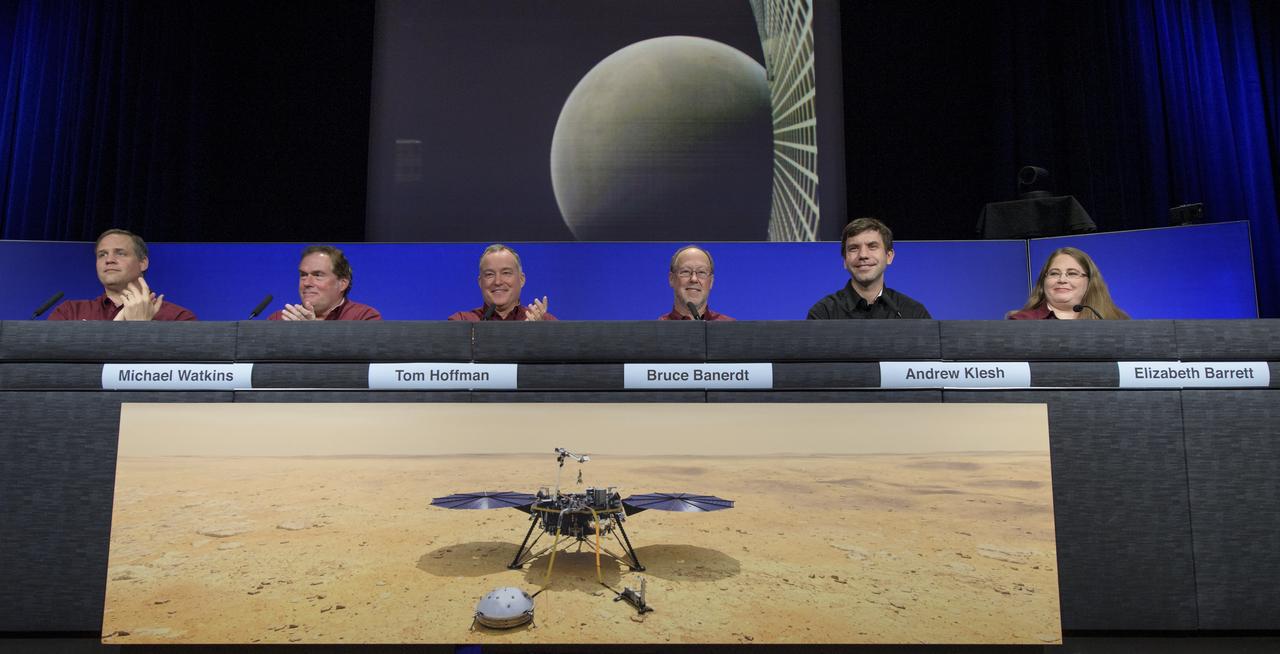
NASA Administrator Jim Bridenstine, left, JPL Director Michael Watkins, InSight Project Manager Tom Hoffman, InSight Principal Investigator Bruce Banerdt, MarCO chief engineer Andy Klesh, and InSight Instrument Operations Lead Elizabeth Barrett, show an image of Mars made by one of the Mars Cube One CubeSats during a Mars InSight post-landing press conference, Monday, Nov. 26, 2018 at NASA's Jet Propulsion Laboratory in Pasadena, California. InSight, short for Interior Exploration using Seismic Investigations, Geodesy and Heat Transport, is a Mars lander designed to study the "inner space" of Mars: its crust, mantle, and core. Photo Credit: (NASA/Bill Ingalls)
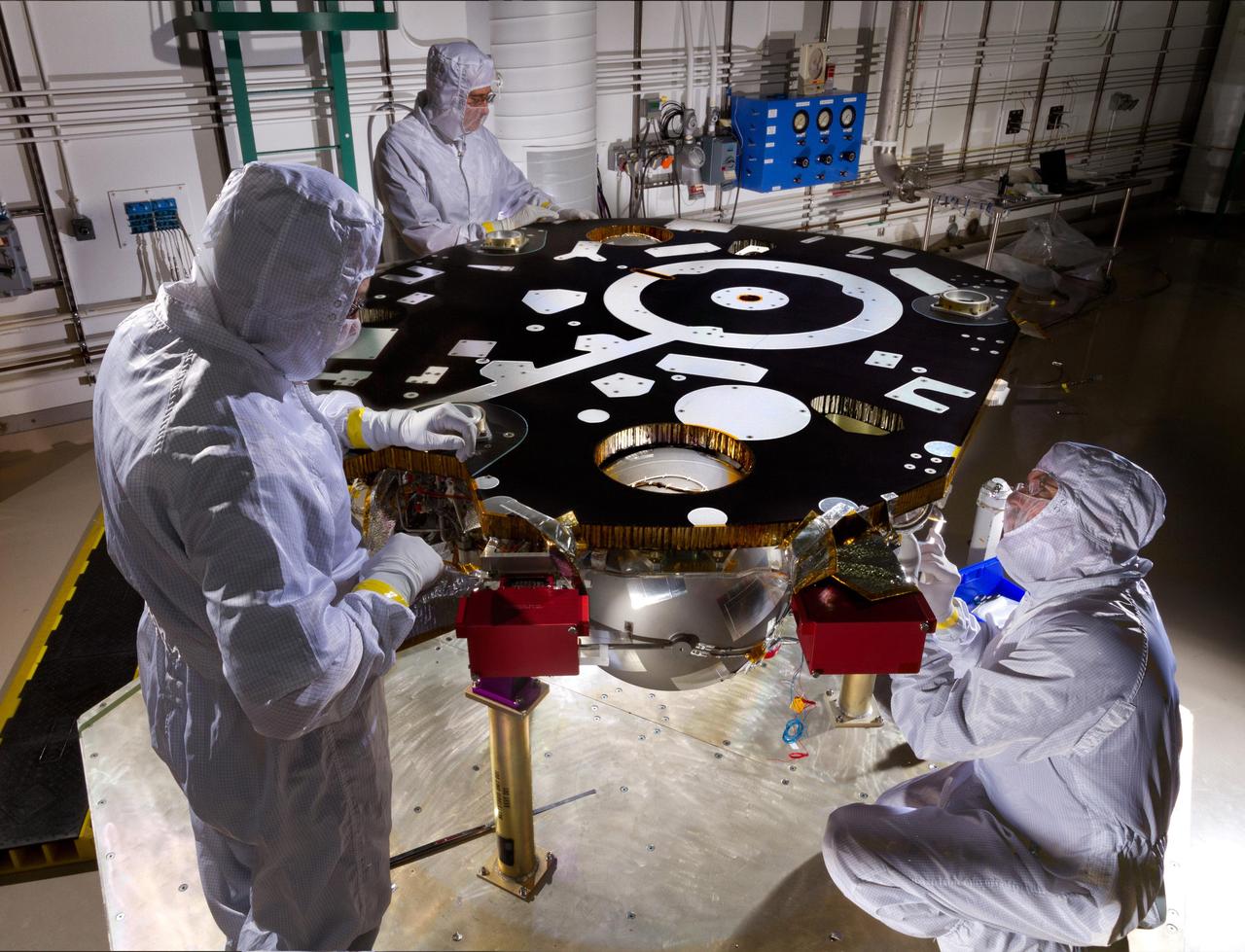
Technicians in a Lockheed Martin clean room near Denver prepare NASA's InSight Mars lander for propulsion proof and leak testing on Oct. 31, 2014. Following the test, the lander was moved to another clean room for the start of the mission's assembly, test and launch operations (ATLO) phase. The assembly portion of ATLO will last about six months. The InSight mission (for Interior Exploration using Seismic Investigations, Geodesy and Heat Transport) is scheduled to launch in March 2016 and land on Mars six months later. It will investigate processes that formed and shaped Mars and will help scientists better understand the evolution of our inner solar system's rocky planets, including Earth. Note: After thorough examination, NASA managers have decided to suspend the planned March 2016 launch of the Interior Exploration using Seismic Investigations Geodesy and Heat Transport (InSight) mission. The decision follows unsuccessful attempts to repair a leak in a section of the prime instrument in the science payload. http://photojournal.jpl.nasa.gov/catalog/PIA18884
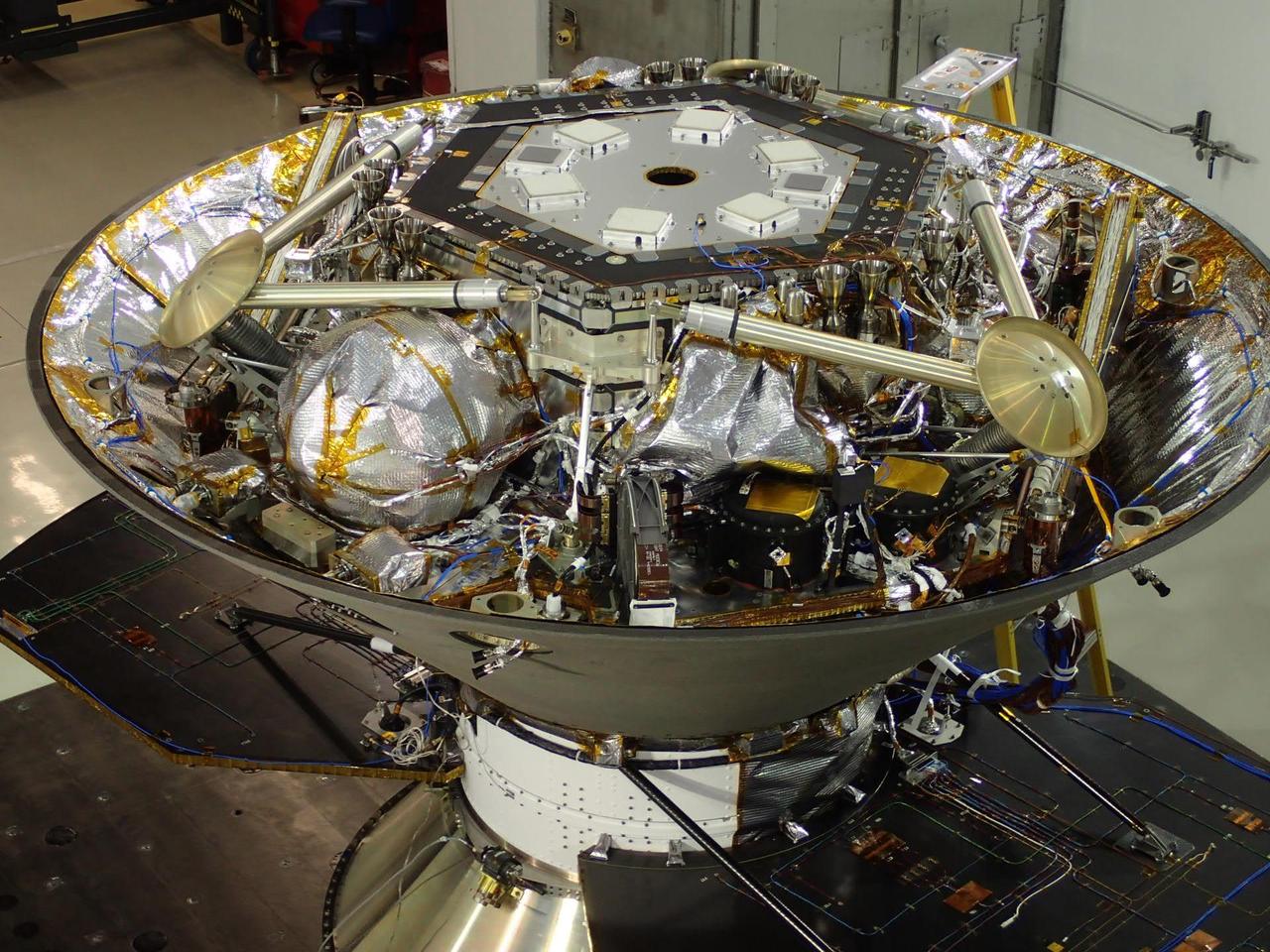
In this photo, NASA's InSight Mars lander is stowed inside the inverted back shell of the spacecraft's protective aeroshell. It was taken on July 13, 2015, in a clean room of spacecraft assembly and test facilities at Lockheed Martin Space Systems, Denver, during preparation for vibration testing of the spacecraft. InSight, for Interior Exploration Using Seismic Investigations, Geodesy and Heat Transport, is scheduled for launch in March 2016 and landing in September 2016. It will study the deep interior of Mars to advance understanding of the early history of all rocky planets, including Earth. Note: After thorough examination, NASA managers have decided to suspend the planned March 2016 launch of the Interior Exploration using Seismic Investigations Geodesy and Heat Transport (InSight) mission. The decision follows unsuccessful attempts to repair a leak in a section of the prime instrument in the science payload. http://photojournal.jpl.nasa.gov/catalog/PIA19813
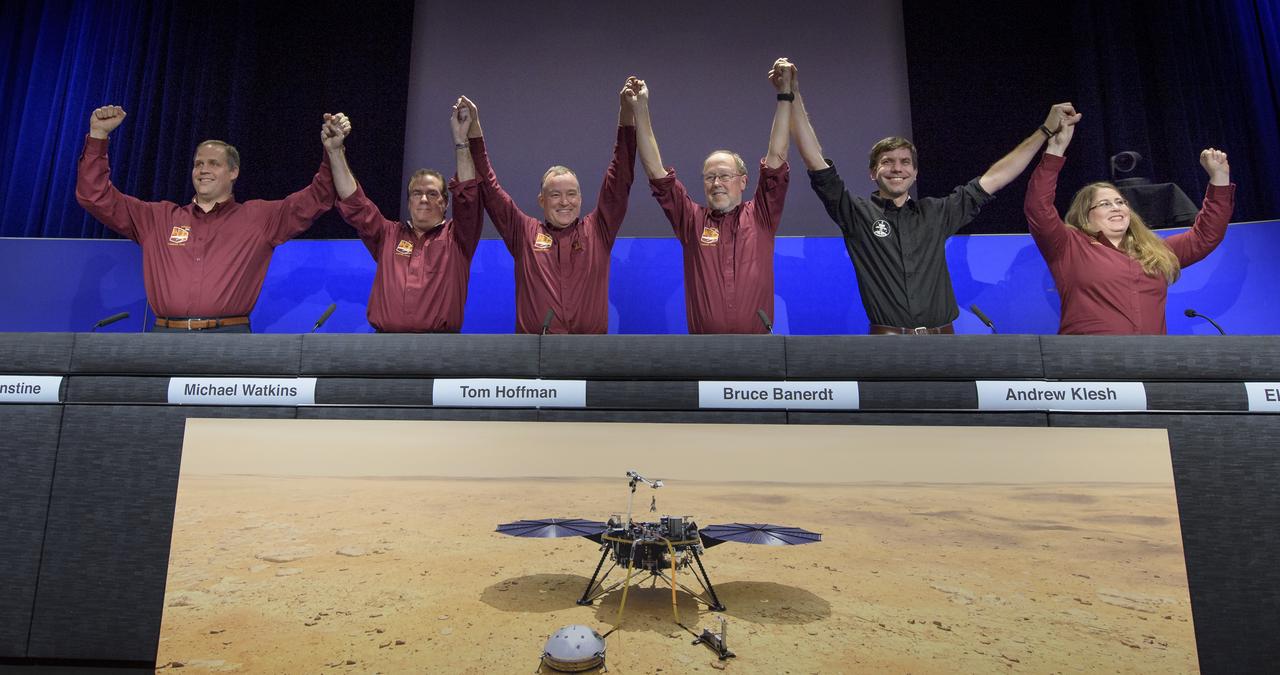
NASA Administrator Jim Bridenstine, left, JPL Director Michael Watkins, InSight Project Manager Tom Hoffman, InSight Principal Investigator Bruce Banerdt, MarCO chief engineer Andy Klesh, and InSight Instrument Operations Lead Elizabeth Barrett, celebrate Mars InSight landing successfully on Mars during a press conference, Monday, Nov. 26, 2018 at NASA's Jet Propulsion Laboratory in Pasadena, California. InSight, short for Interior Exploration using Seismic Investigations, Geodesy and Heat Transport, is a Mars lander designed to study the "inner space" of Mars: its crust, mantle, and core. Photo Credit: (NASA/Bill Ingalls)
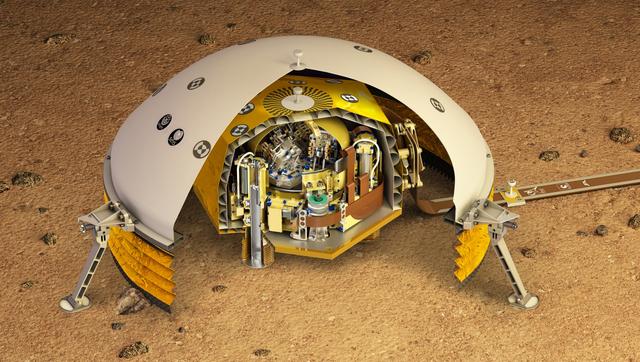
This artist's rendering shows a cutaway of the Seismic Experiment for Interior Structure instrument, or SEIS, which will fly as part of NASA's Mars InSight lander. SEIS is a highly sensitive seismometer that will be used to detect marsquakes from the Red Planet's surface for the first time. There are two layers in this cutaway. The outer layer is the Wind and Thermal Shield -- a covering that protects the seismometer from the Martian environment. The wind on Mars, as well as extreme temperature changes, could affect the highly sensitive instrument. The inside layer is SEIS itself, a brass-colored dome that houses the instrument's three pendulums. These insides are inside a titanium vacuum chamber to further isolate them from temperature changes on the Martian surface. https://photojournal.jpl.nasa.gov/catalog/PIA22320
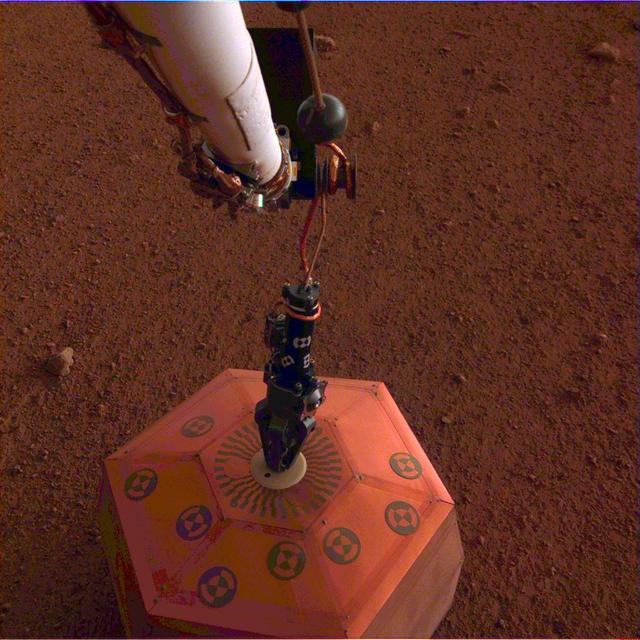
NASA's InSight lander placed its seismometer onto Mars on Dec. 19, 2018. This was the first time a seismometer had ever been placed onto the surface of another planet. The seismometer is the copper-colored object in this image, which was taken around Martian dusk. The seismometer, called Seismic Explorations for Interior Structure (SEIS), will measure seismic waves caused by marsquakes, meteorite strikes and other phenomena. Watching how these waves travel through Mars' interior will let scientists study how the planet's crust, mantle and core are layered. It will also reveal more about how all rocky bodies are formed, including Earth and its Moon. https://photojournal.jpl.nasa.gov/catalog/PIA22956
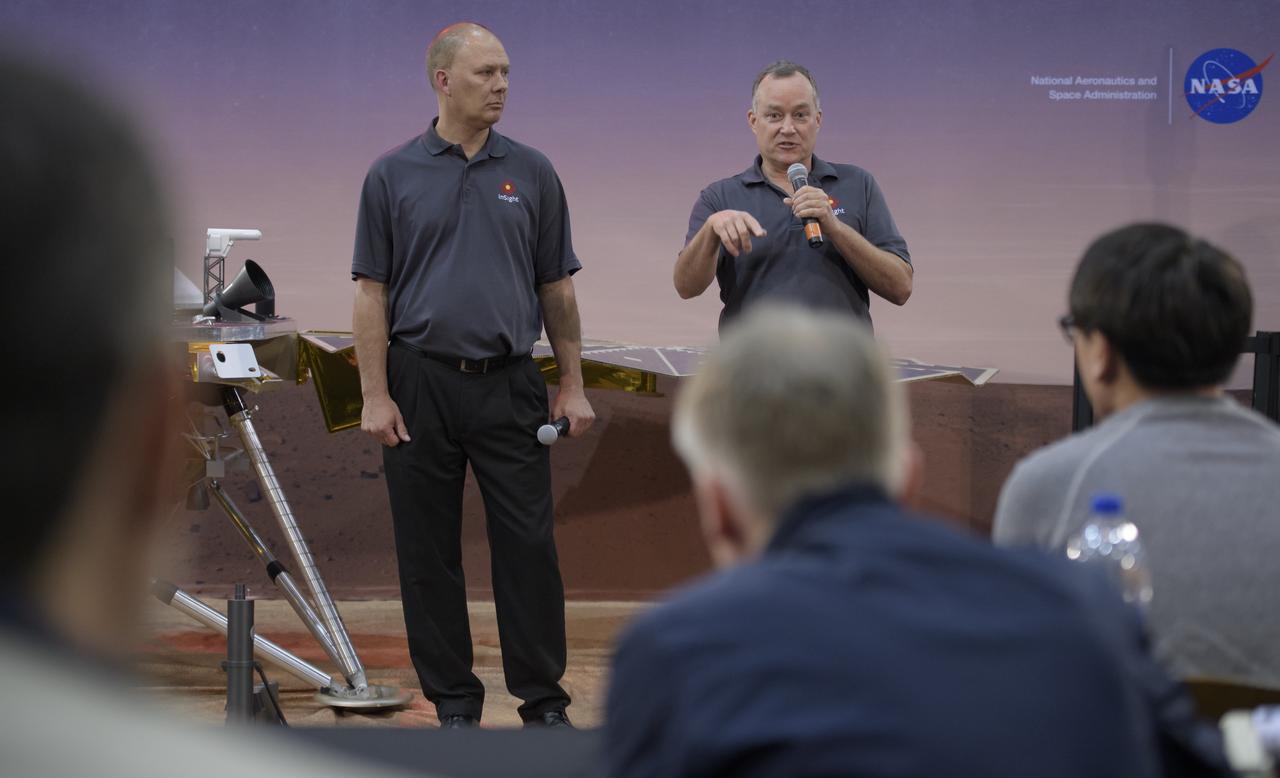
Stu Spath, InSight program manager, Lockheed Martin Space, left, and Tom Hoffman, InSight project manager, NASA JPL, discuss NASA's InSight mission during a prelaunch media briefing, Thursday, May 3, 2018, at Vandenberg Air Force Base in California. InSight, short for Interior Exploration using Seismic Investigations, Geodesy and Heat Transport, is a Mars lander designed to study the "inner space" of Mars: its crust, mantle, and core. Photo Credit: (NASA/Bill Ingalls)
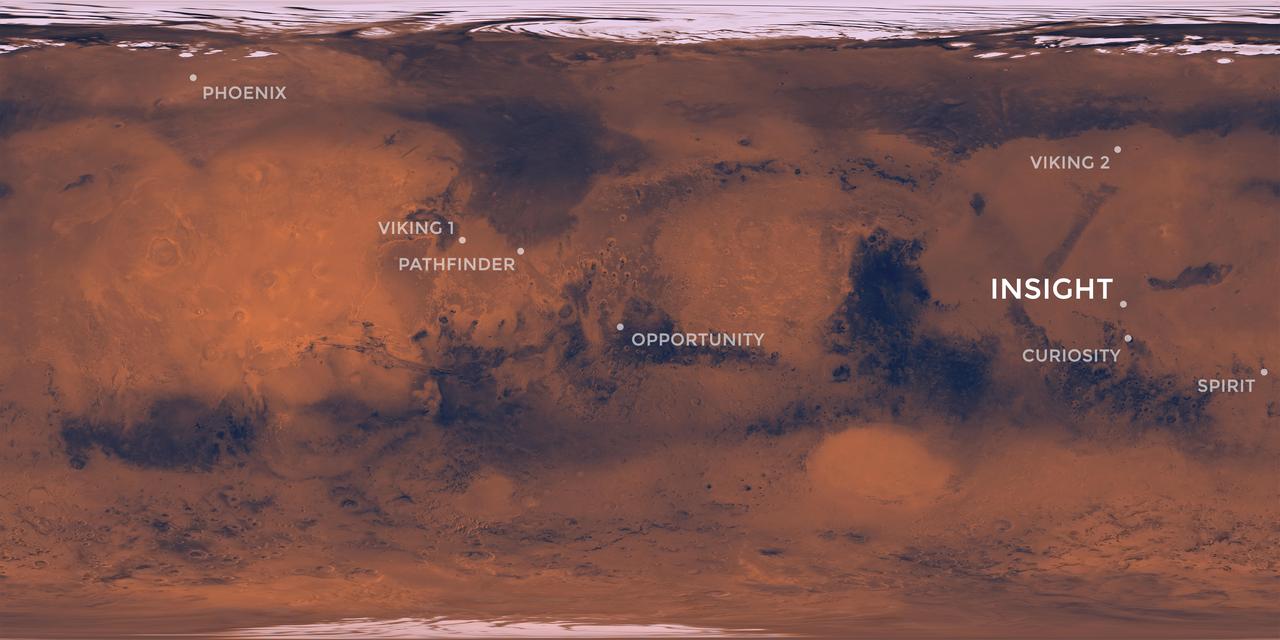
Elysium Planitia, a flat-smooth plain just north of the equator makes for the perfect location from which to study the deep Martian interior. Interior Exploration using Seismic Investigations, Geodesy and Heat Transport, or InSight, is designed to study the deep interior of Mars. The mission seeks the fingerprints of the processes that formed the rocky planets of the solar system. Its landing site, Elysium Planitia, was picked from 22 candidates, and is centered at about 4.5 degrees north latitude and 135.9 degrees east longitude; about 373 miles (600 kilometers) from Curiosity's landing site, Gale Crater. The locations of other Mars landers and rovers are labeled. InSight's scientific success and safe landing depends on landing in a relatively flat area, with an elevation low enough to have sufficient atmosphere above the site for a safe landing. It also depends on landing in an area where rocks are few in number. Elysium Planitia has just the right surface for the instruments to be able to probe the deep interior, and its proximity to the equator ensures that the solar-powered lander is exposed to plenty of sunlight. https://photojournal.jpl.nasa.gov/catalog/PIA22232

Veronica McGregor, JPL Media Relations Manager, NASA JPL, moderates a Mars InSight pre-landing briefing, Sunday, Nov. 25, 2018 at NASA's Jet Propulsion Laboratory in Pasadena, California. InSight, short for Interior Exploration using Seismic Investigations, Geodesy and Heat Transport, is a Mars lander designed to study the "inner space" of Mars: its crust, mantle, and core. InSight is scheduled to touch down on the Red Planet at approximately noon PST (3 p.m. EST) on Nov. 26. Photo Credit: (NASA/Bill Ingalls)
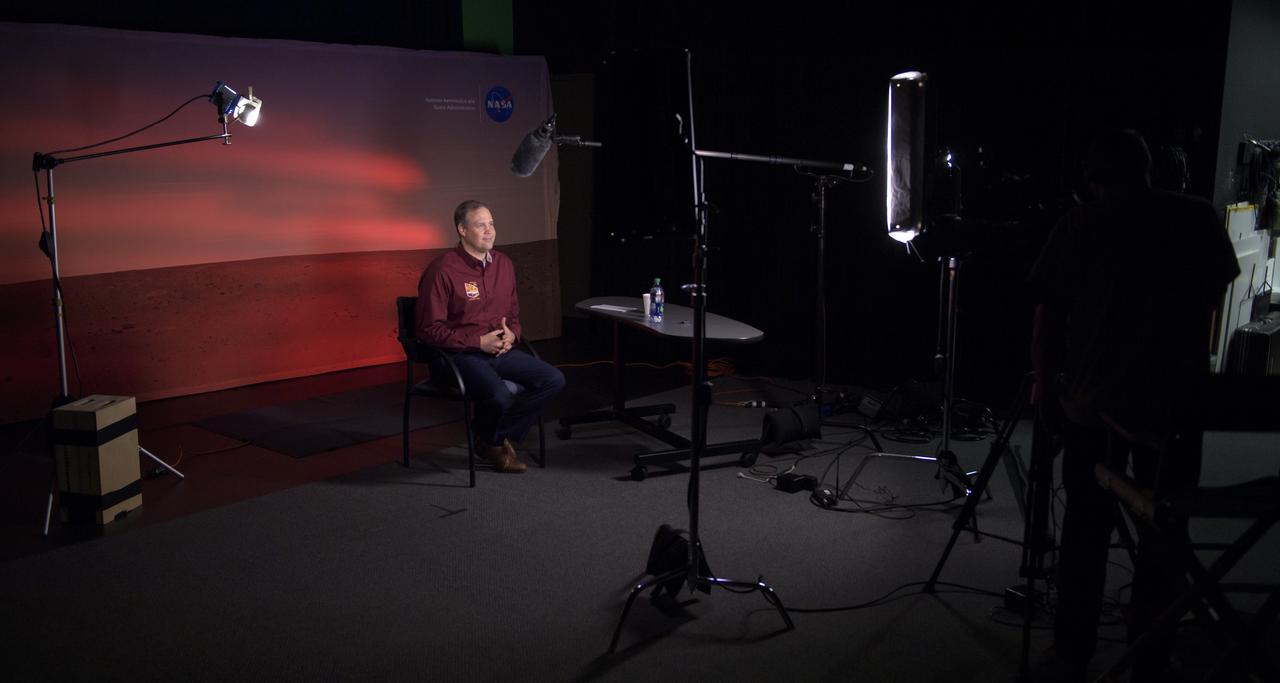
NASA Administrator Jim Bridenstine talks to multiple media outlets about Mars InSight, Monday, Nov. 26, 2018 at NASA's Jet Propulsion Laboratory in Pasadena, California. InSight, short for Interior Exploration using Seismic Investigations, Geodesy and Heat Transport, is a Mars lander designed to study the "inner space" of Mars: its crust, mantle, and core. InSight is scheduled to touch down on the Red Planet at approximately noon PST (3 p.m. EST) on Nov. 26. Photo Credit: (NASA/Bill Ingalls)