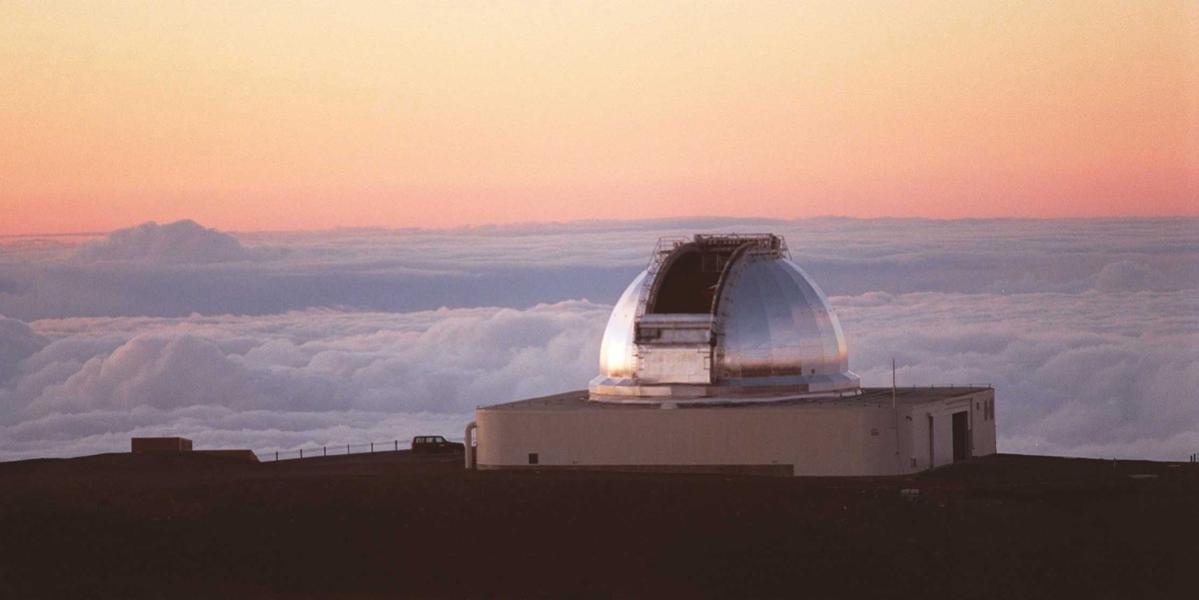
NASA Infrared Telescope Facility atop Mauna Kea, Hawaii. The IRTF is a venerable 30-year-old, 3-meter-diameter 10-foot telescope that ranks 40th among ground-based telescopes.
NASA Infrared Telescope Facility atop Mauna Kea, Hawaii
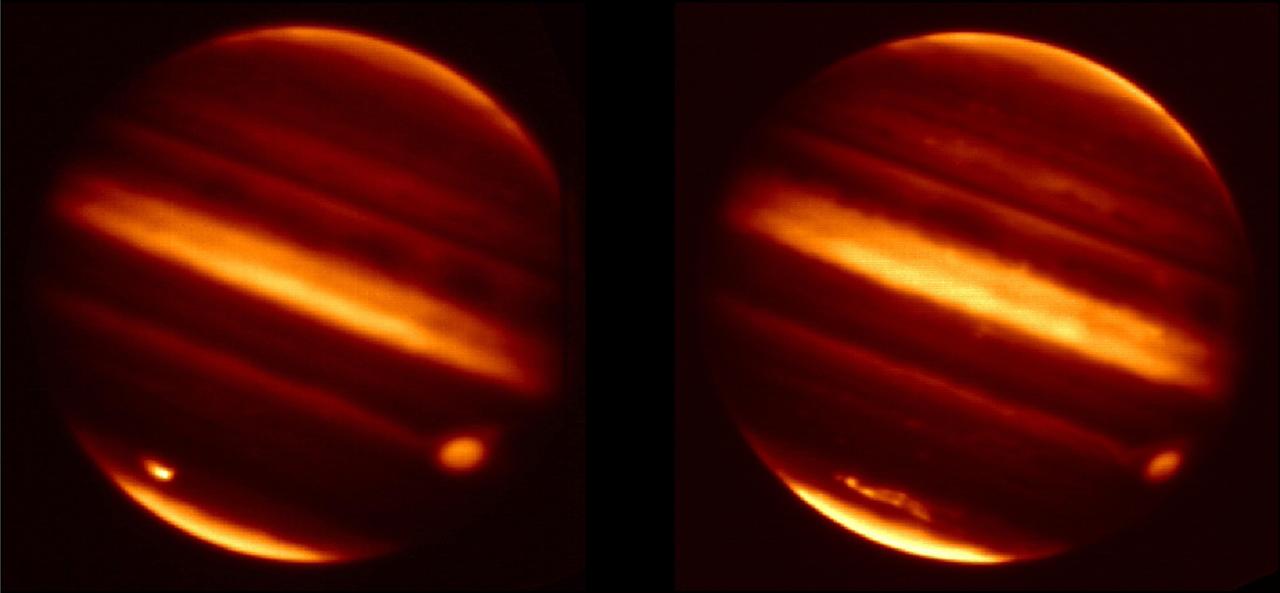
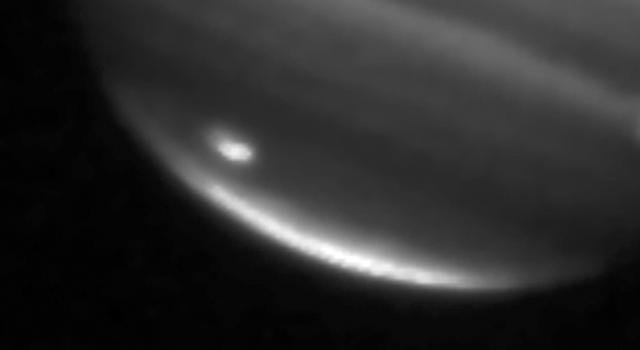
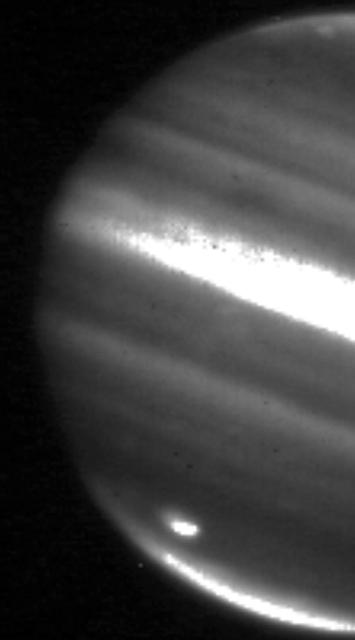
These infrared images obtained from NASA Infrared Telescope Facility in Mauna Kea, Hawaii, show before and aftereffects from particle debris in Jupiter atmosphere after an object hurtled into the atmosphere on July 19, 2009.
Jupiter Scar in Infrared
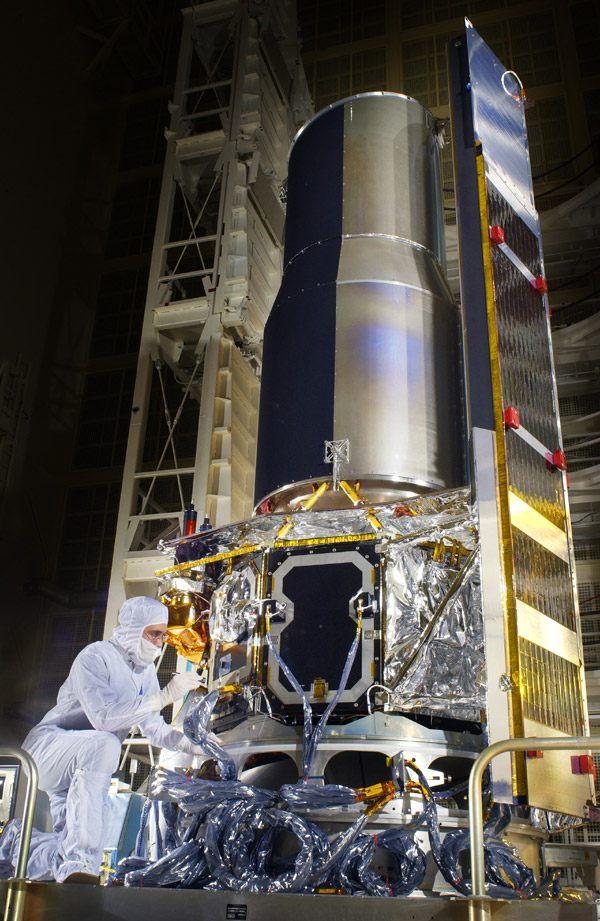
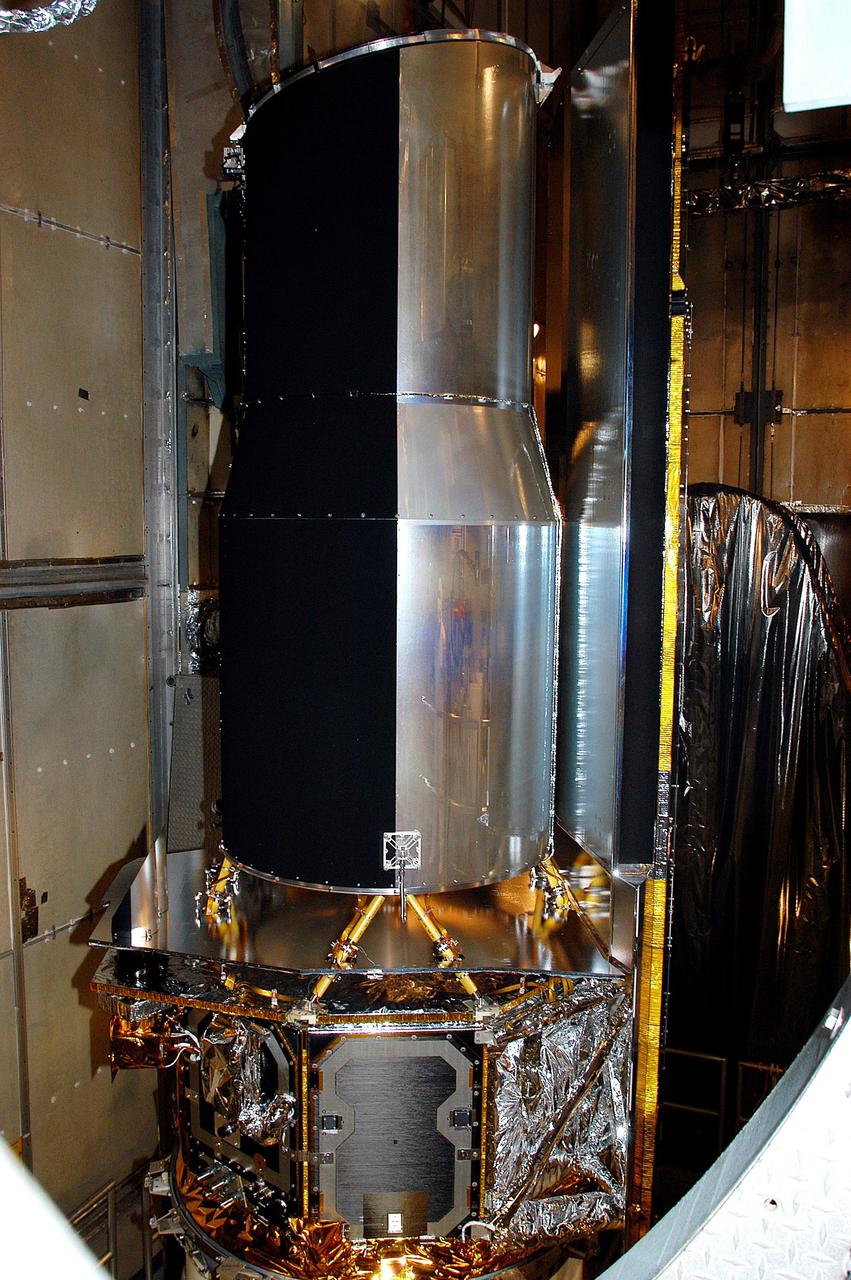
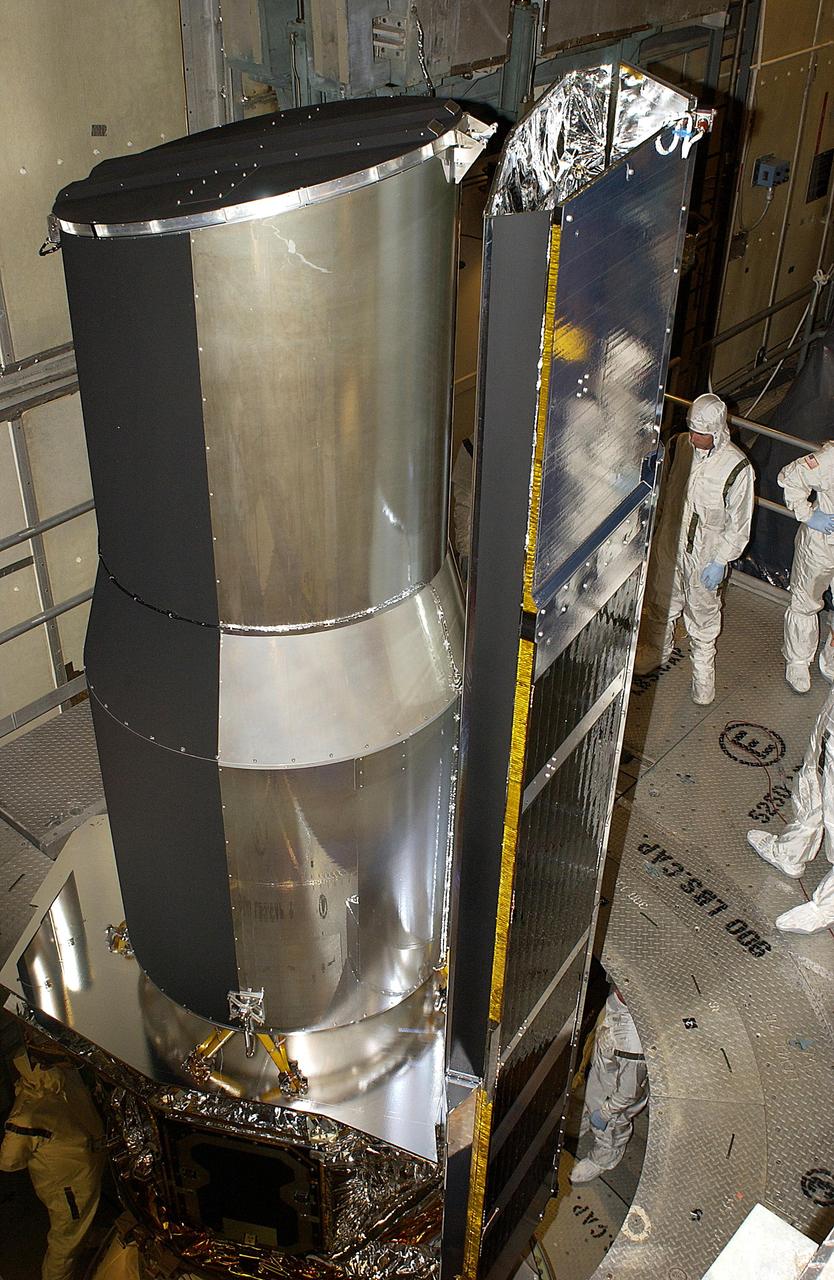
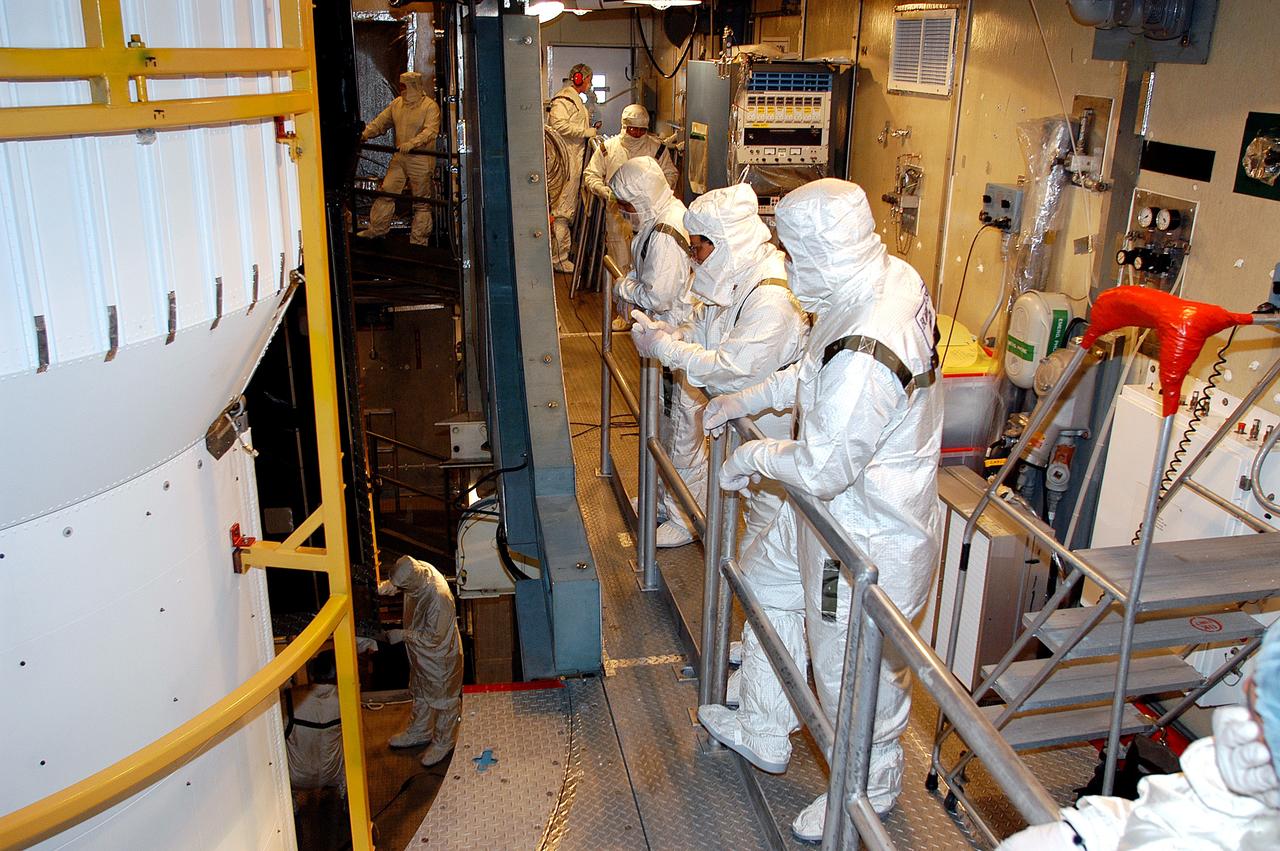
Technicians put final touches on NASA Space Infrared Telescope Facility at Lockheed Martin Aeronautics in Sunnyvale, Calif., which launched on August 25, 2003. The telescope is now known as the Spitzer Space Telescope.
Finishing Touches for Space Infrared Telescope Facility SIRTF
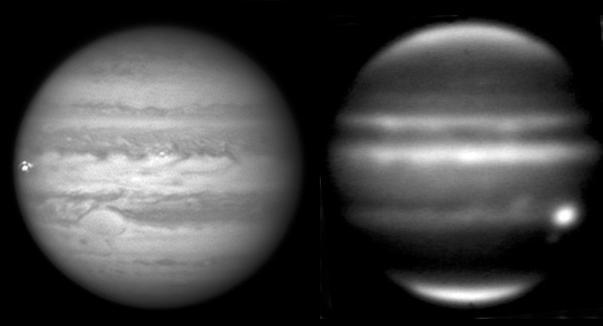
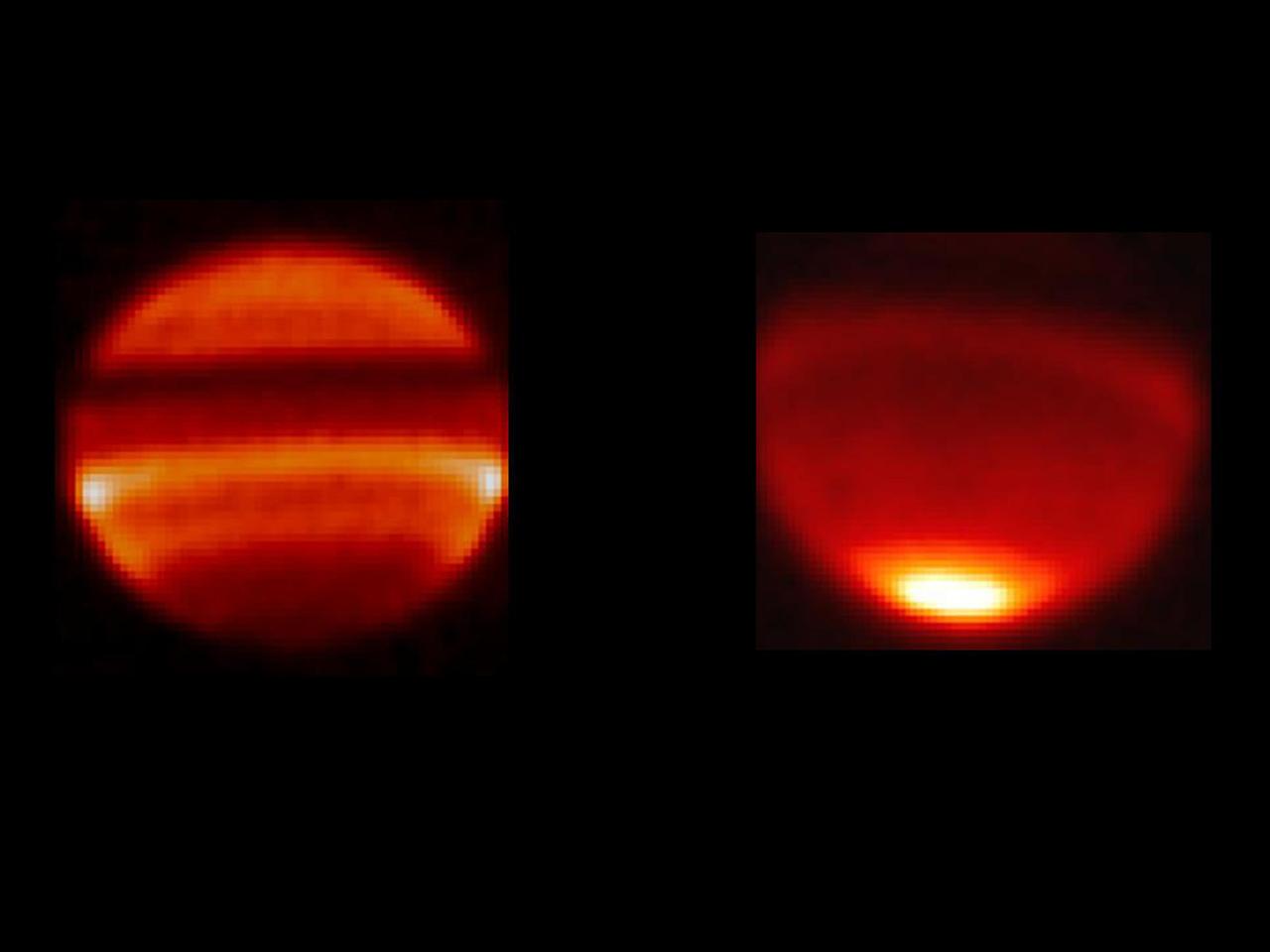
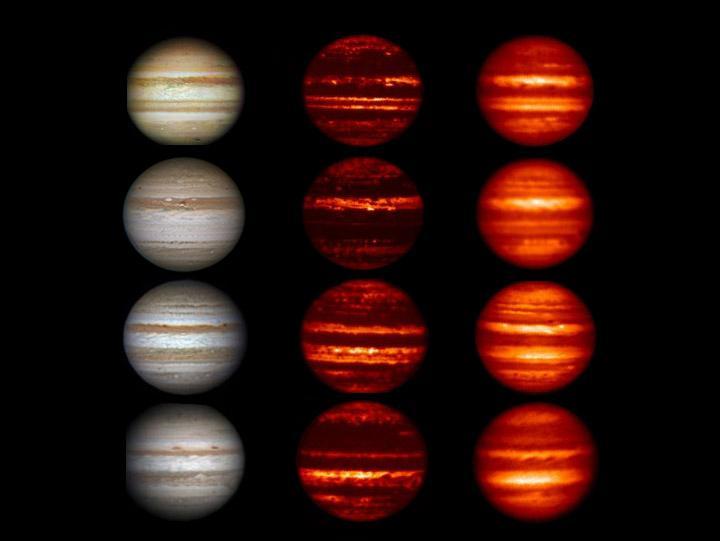
Jupiter has been suffering more impacts over the last four years than ever previously observed, including this meteoroid impact on Sept. 10, 2012. Right-hand image is an infrared image NASA Infrared Telescope Facility on Mauna Kea, Hawaii.
Jupiter Shakes it Off
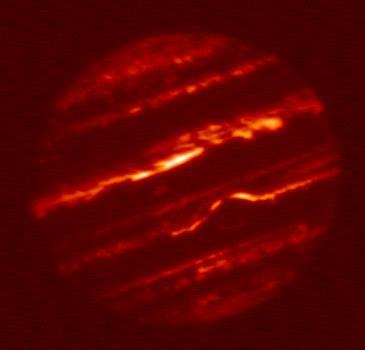
This still from an animation of four images shows Jupiter in infrared light as seen by NASA InfraRed Telescope Facility, or IRTF, on May 16, 2015. The observations were obtained in support of NASA's Juno mission by a team headed by Juno scientist Glenn Orton.  Observations like these are helping to provide spatial and temporal context for what the science instruments on board Juno will see once the spacecraft arrives at the giant planet in mid-2016. Juno will pass very close to the planet -- coming within just a few thousand miles (or kilometers) of the cloud tops every two weeks. That up-close vantage point will be balanced by distant views of the planet that show how different features move and change over time in relation to each other.  The IRTF is a three-meter telescope, optimized for infrared observations, and located at the summit of Mauna Kea, Hawaii. The observatory is operated and managed for NASA by the University of Hawaii Institute for Astronomy, Honolulu.  http://photojournal.jpl.nasa.gov/catalog/PIA19640
Jupiter Infrared Glow
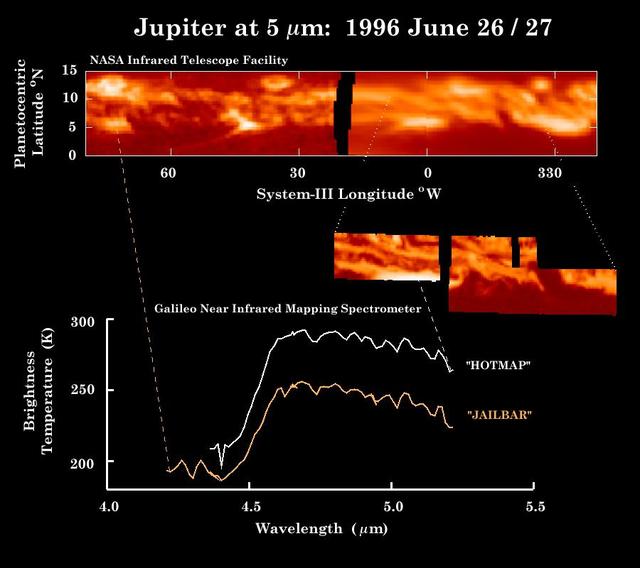
These observations of Jupiter equator in thermal heat emission were made by NASA Infrared Telescope Facility top panel within hours of the Near-Infrared Mapping Spectrometer NIMS instrument image middle inset and the spectra bottom.
Observations of Jupiter thermal emission made by the Infrared Telescope Facility and the Galileo NIMS instrument
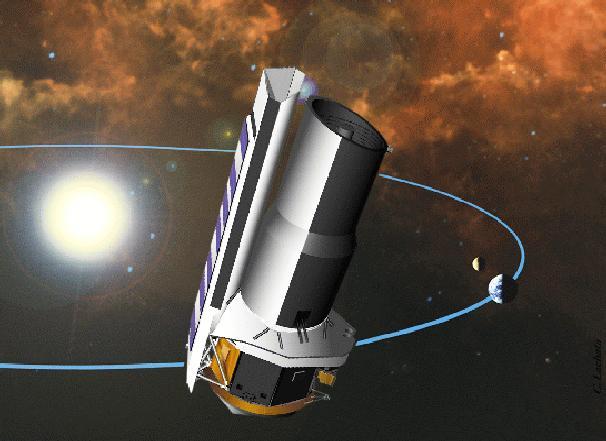
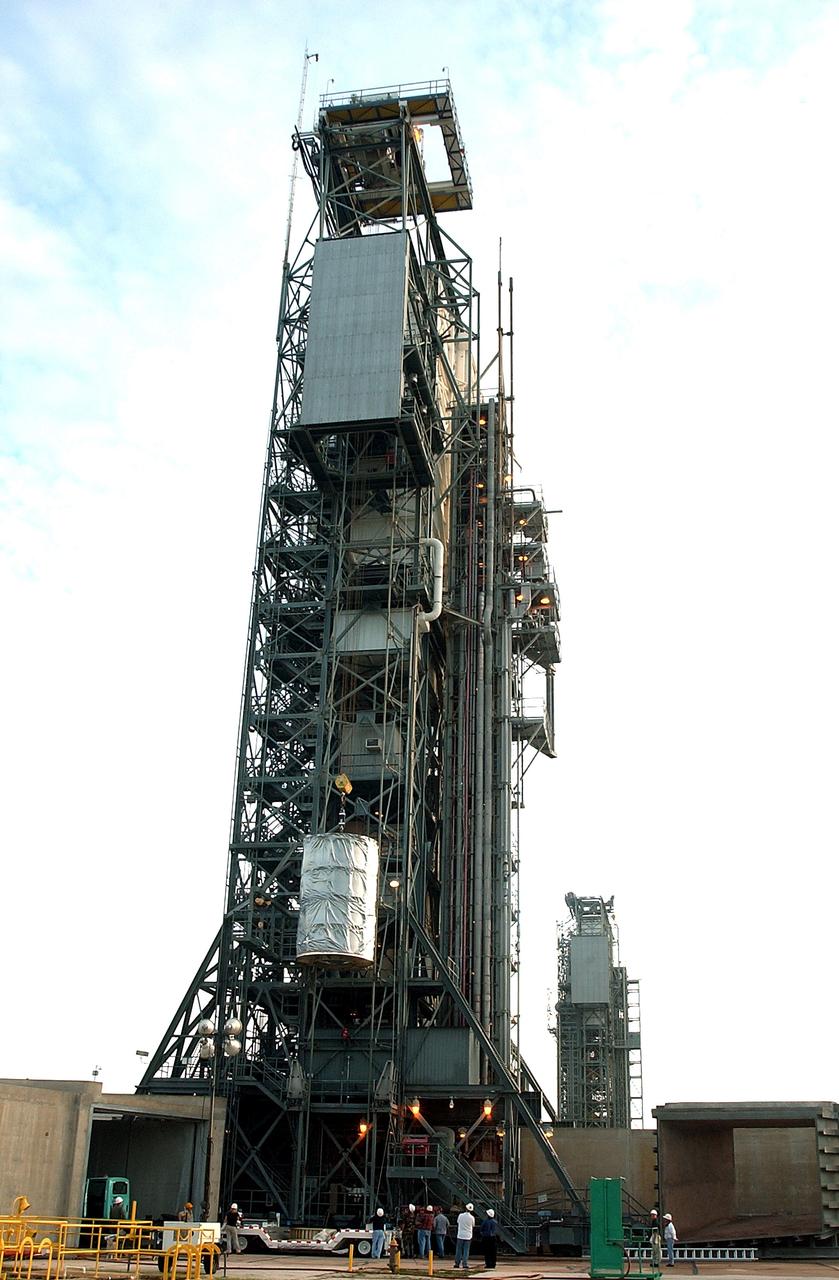
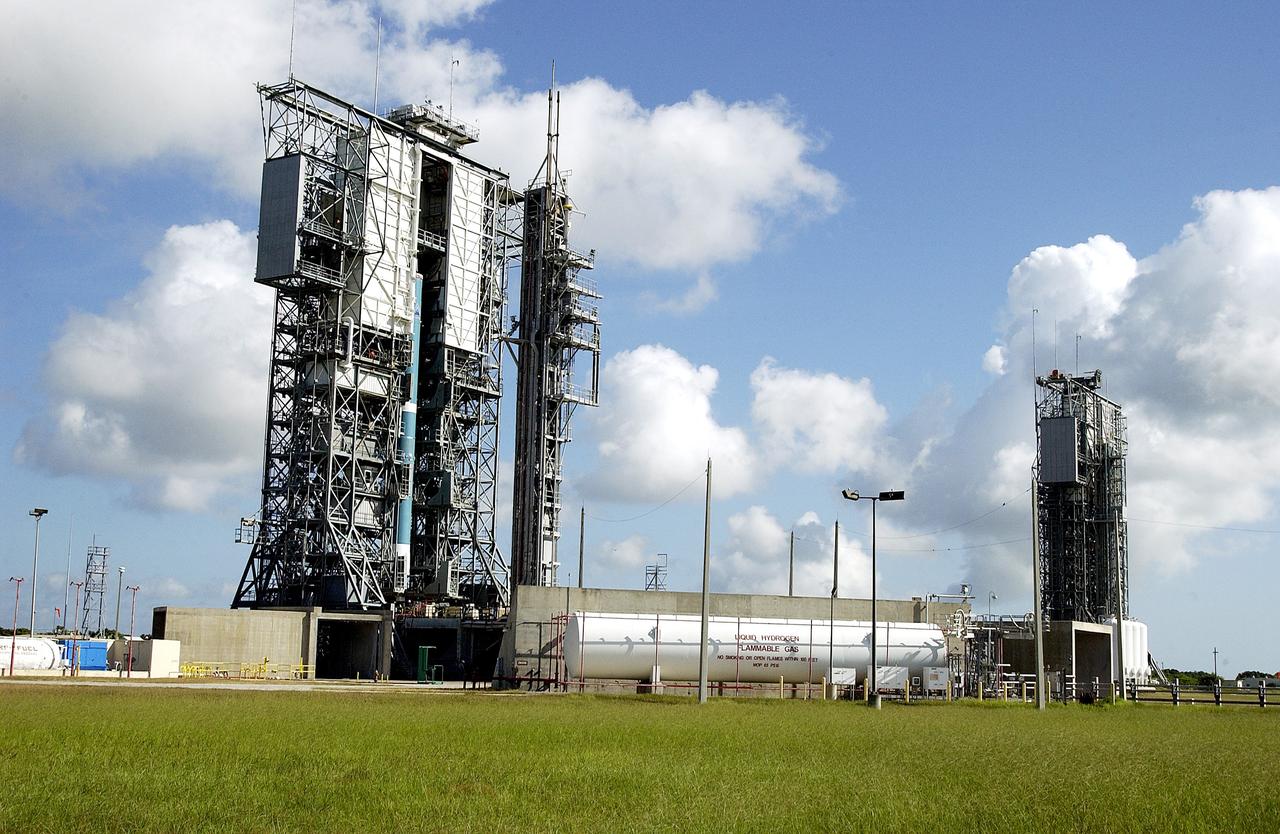
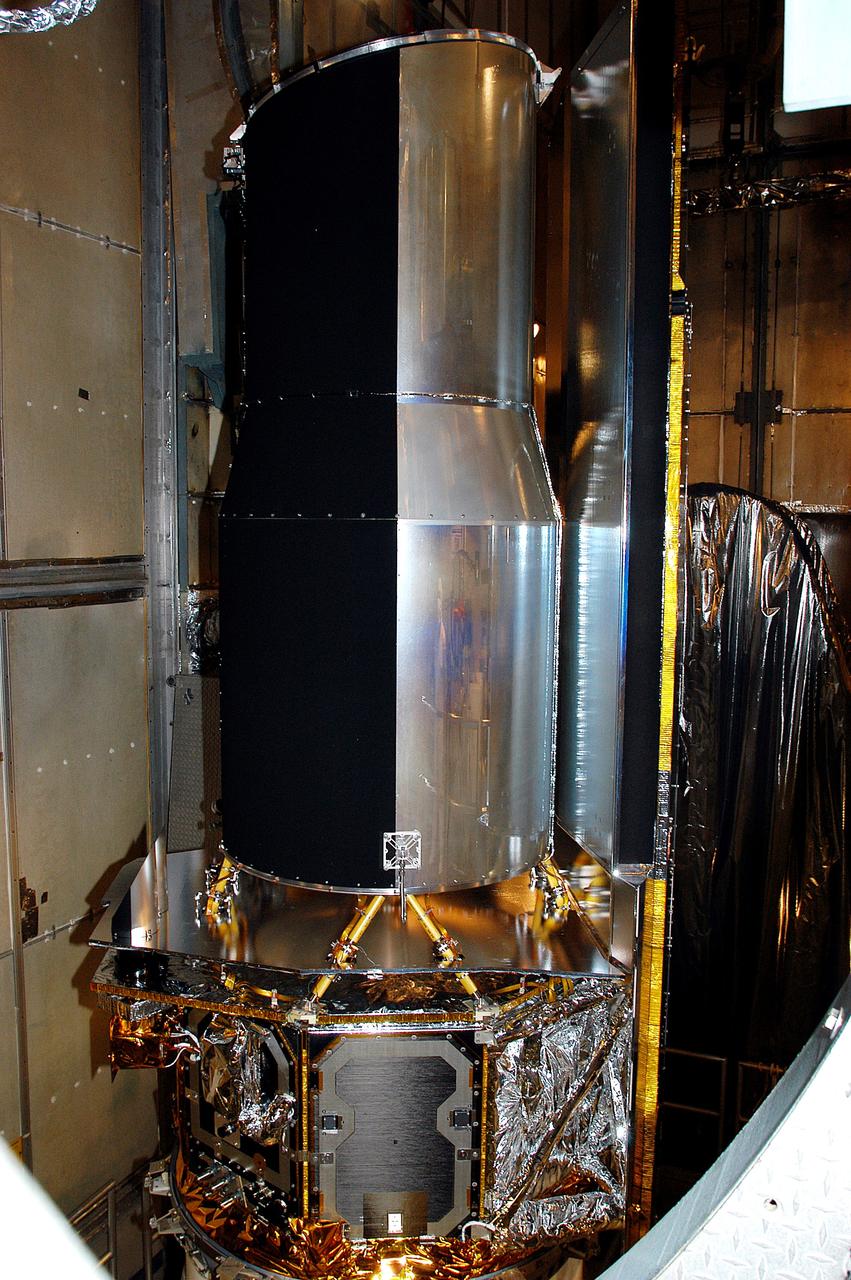
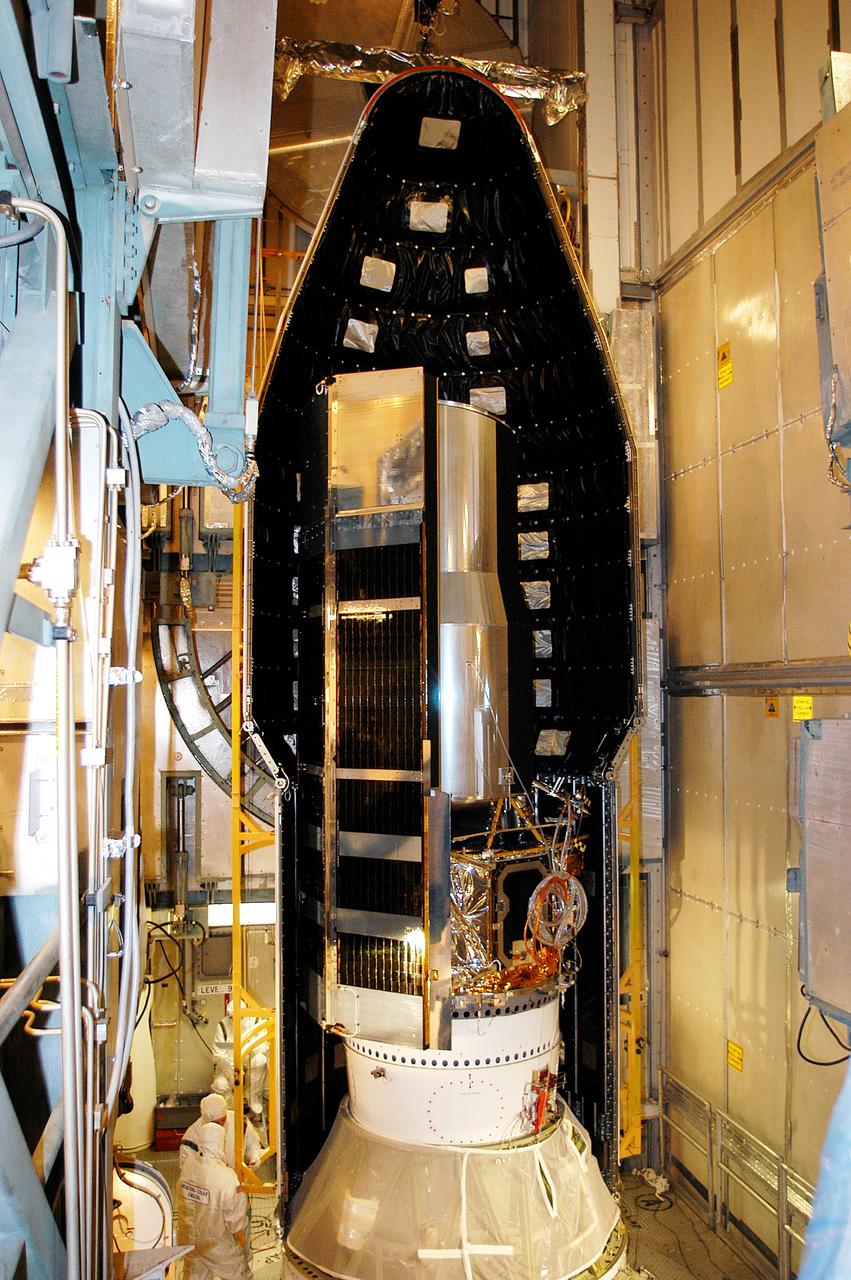
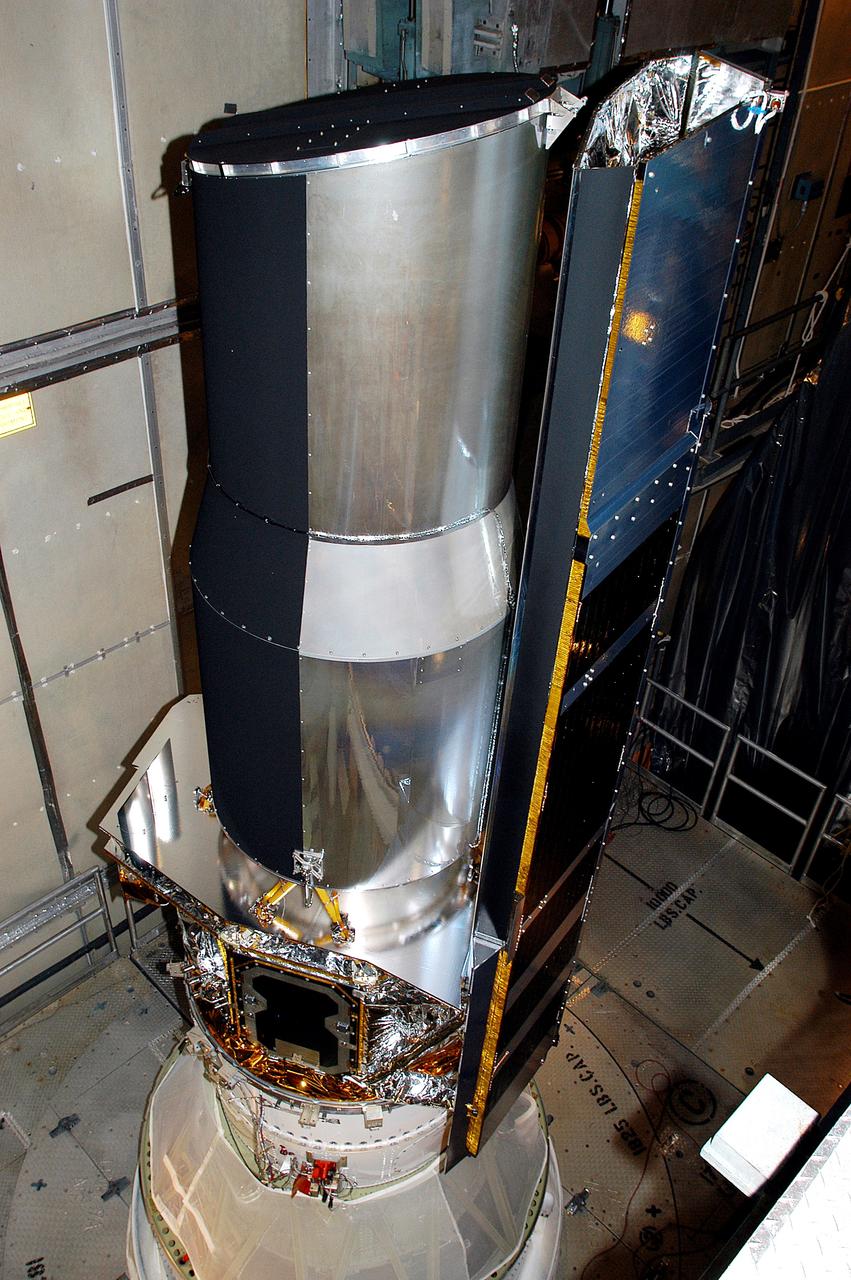
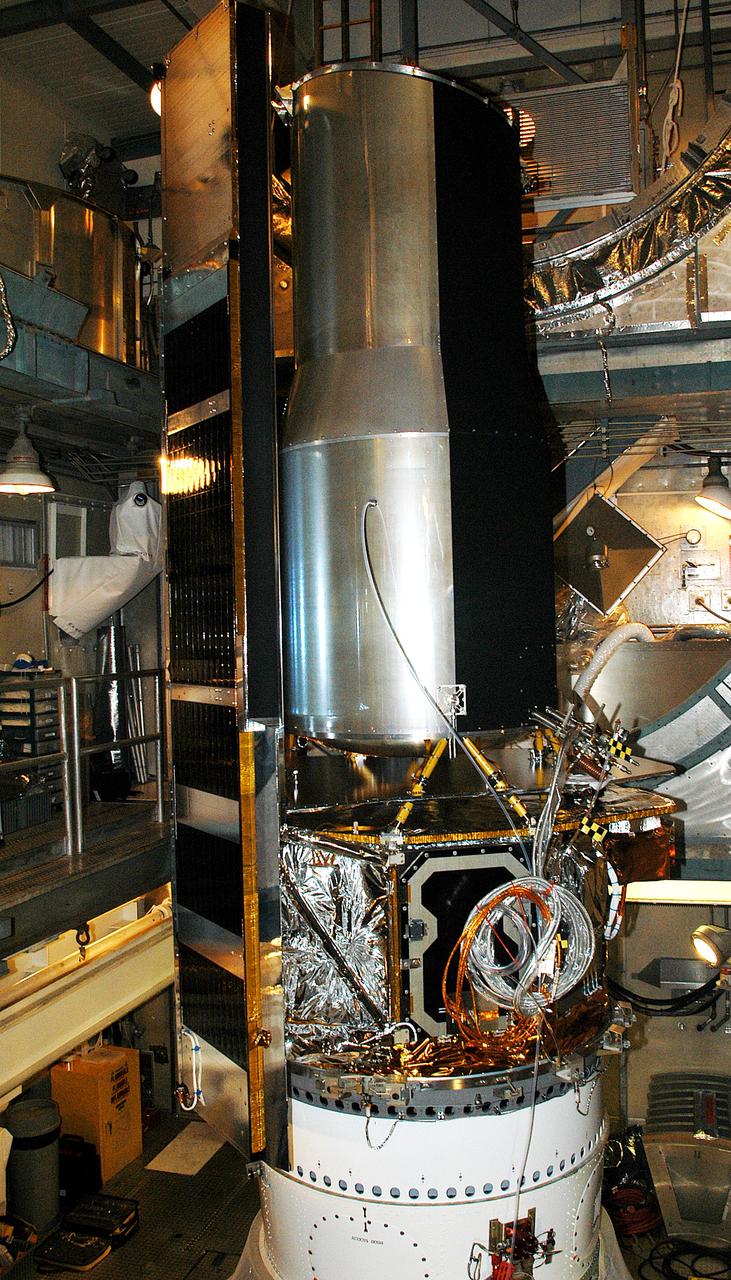
At the time of launch, the Spitzer Space Telescope bore its original name: the Space Infrared Telescope Facility (SIRTF). It's shown here in the mobile service tower on Launch Pad 17-B, Cape Canaveral Air Force Station, waiting for encapsulation.  https://photojournal.jpl.nasa.gov/catalog/PIA23649
Space Infrared Telescope Facility (SIRTF) Before Launch
This image shows a large impact on Jupiter south polar region captured on July 20, 2009, by NASA Infrared Telescope Facility in Mauna Kea, Hawaii.
Jupiter Impact Scar
These two images, taken with NASA Infrared Telescope Facility in Mauna Kea, Hawaii, capture two different phases of this wave oscillation at Saturn equator.
Saturn Infrared Temperature Snapshot
This image shows a large impact shown on the bottom left on Jupiter south polar region captured on July 20, 2009, by NASA Infrared Telescope Facility in Mauna Kea, Hawaii.
Jupiter Impact Scar
This image was used in a contest to rename the Space InfraRed Telescope Facility SIRTF, now known as the Spitzer Space Telescope.
Help Stamp Out Boring Space Acronyms
The Spitzer Space Telescope (formerly the Space Infrared Telescope Facility or SIRTF) is readied for launch at Cape Canaveral Air Force Station, in 2003.  https://photojournal.jpl.nasa.gov/catalog/PIA23644
Spitzer Space Telescope Ready for Launch
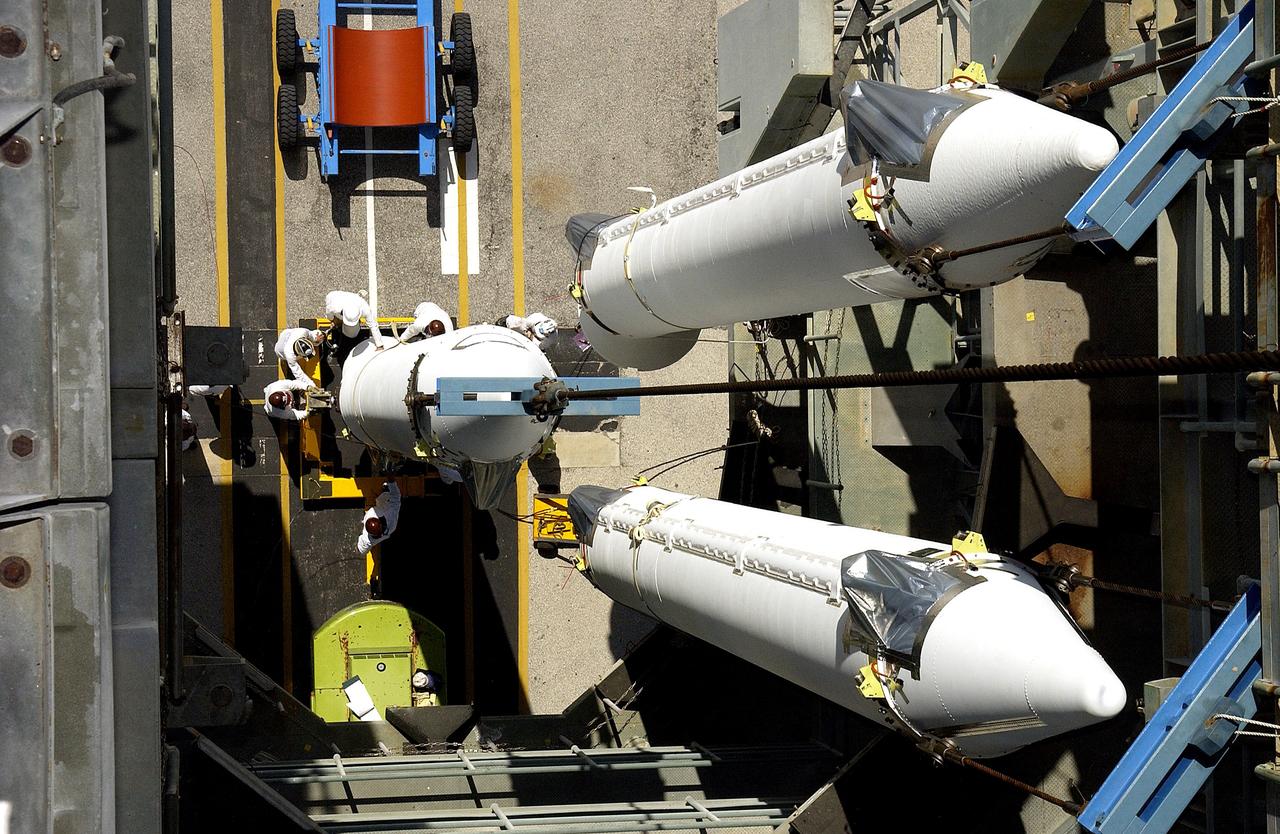
KENNEDY SPACE CENTER, FLA. -   Workers on Launch Complex 17-B, Cape Canaveral Air Force Station, help steady a solid rocket booster (SRB) being lifted into the mobile service tower.  It is one of nine  46-inch-diameter, stretched SRBs that are being attached to the Delta II Heavy rocket that will launch the Space Infrared Telescope Facility (SIRTF).  Consisting of three cryogenically cooled science instruments and an 0.85-meter telescope, SIRTF is one of NASA's largest infrared telescopes to be launched.  SIRTF will obtain images and spectra by detecting the infrared energy, or heat, radiated by objects in space. Most of this infrared radiation is blocked by the Earth's atmosphere and cannot be observed from the ground.
KENNEDY SPACE CENTER, FLA. - Workers on Launch Complex 17-B, Cape Canaveral Air Force Station, help steady a solid rocket booster (SRB) being lifted into the mobile service tower. It is one of nine 46-inch-diameter, stretched SRBs that are being attached to the Delta II Heavy rocket that will launch the Space Infrared Telescope Facility (SIRTF). Consisting of three cryogenically cooled science instruments and an 0.85-meter telescope, SIRTF is one of NASA's largest infrared telescopes to be launched. SIRTF will obtain images and spectra by detecting the infrared energy, or heat, radiated by objects in space. Most of this infrared radiation is blocked by the Earth's atmosphere and cannot be observed from the ground.
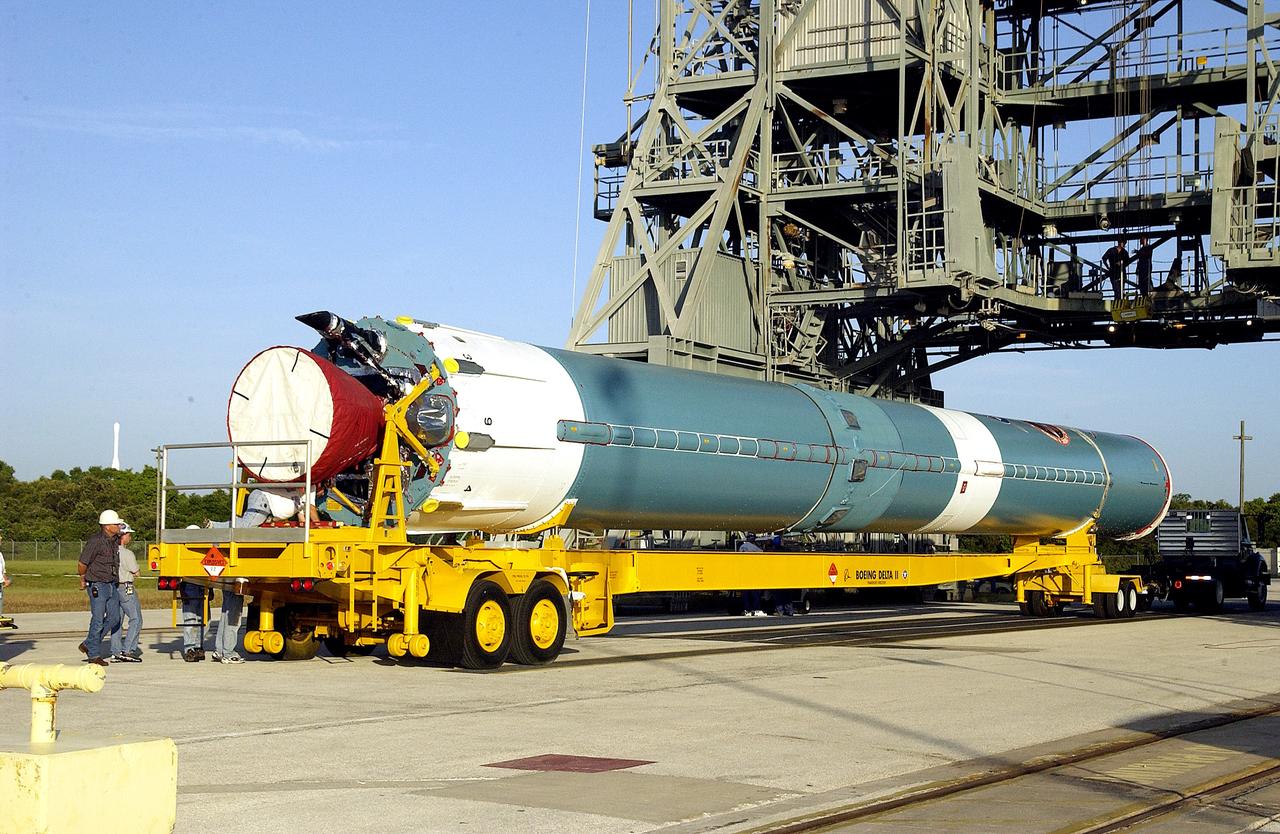
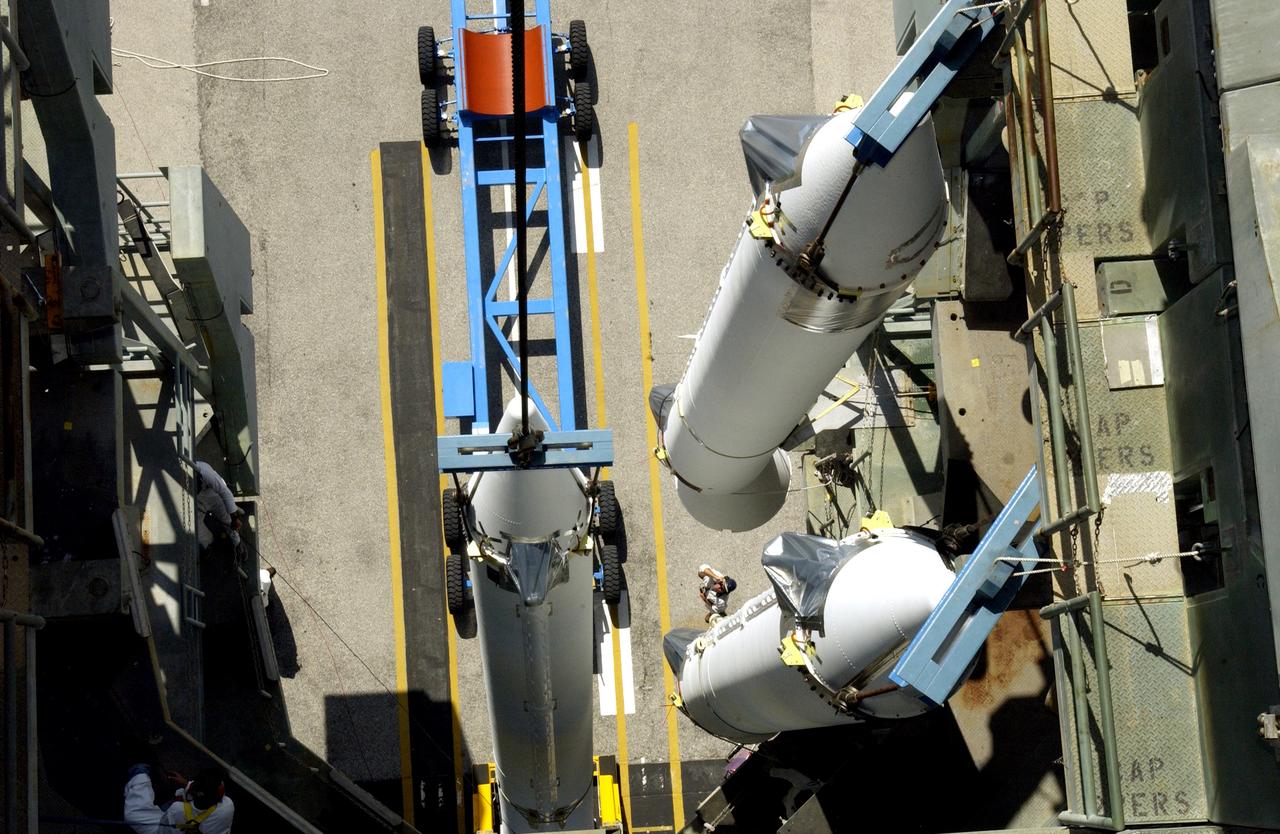
KENNEDY SPACE CENTER, FLA. -  Workers on Launch Complex 17-B, Cape Canaveral Air Force Station, prepare the first stage of a Delta II rocket for its lift up the mobile service tower.  The rocket is being erected to launch the Space InfraRed Telescope Facility (SIRTF).  Consisting of an 0.85-meter telescope and three cryogenically cooled science instruments, SIRTF is one of NASA's largest infrared telescopes to be launched.  SIRTF will obtain images and spectra by detecting the infrared energy, or heat, radiated by objects in space. Most of this infrared radiation is blocked by the Earth's atmosphere and cannot be observed from the ground.
KENNEDY SPACE CENTER, FLA. - Workers on Launch Complex 17-B, Cape Canaveral Air Force Station, prepare the first stage of a Delta II rocket for its lift up the mobile service tower. The rocket is being erected to launch the Space InfraRed Telescope Facility (SIRTF). Consisting of an 0.85-meter telescope and three cryogenically cooled science instruments, SIRTF is one of NASA's largest infrared telescopes to be launched. SIRTF will obtain images and spectra by detecting the infrared energy, or heat, radiated by objects in space. Most of this infrared radiation is blocked by the Earth's atmosphere and cannot be observed from the ground.
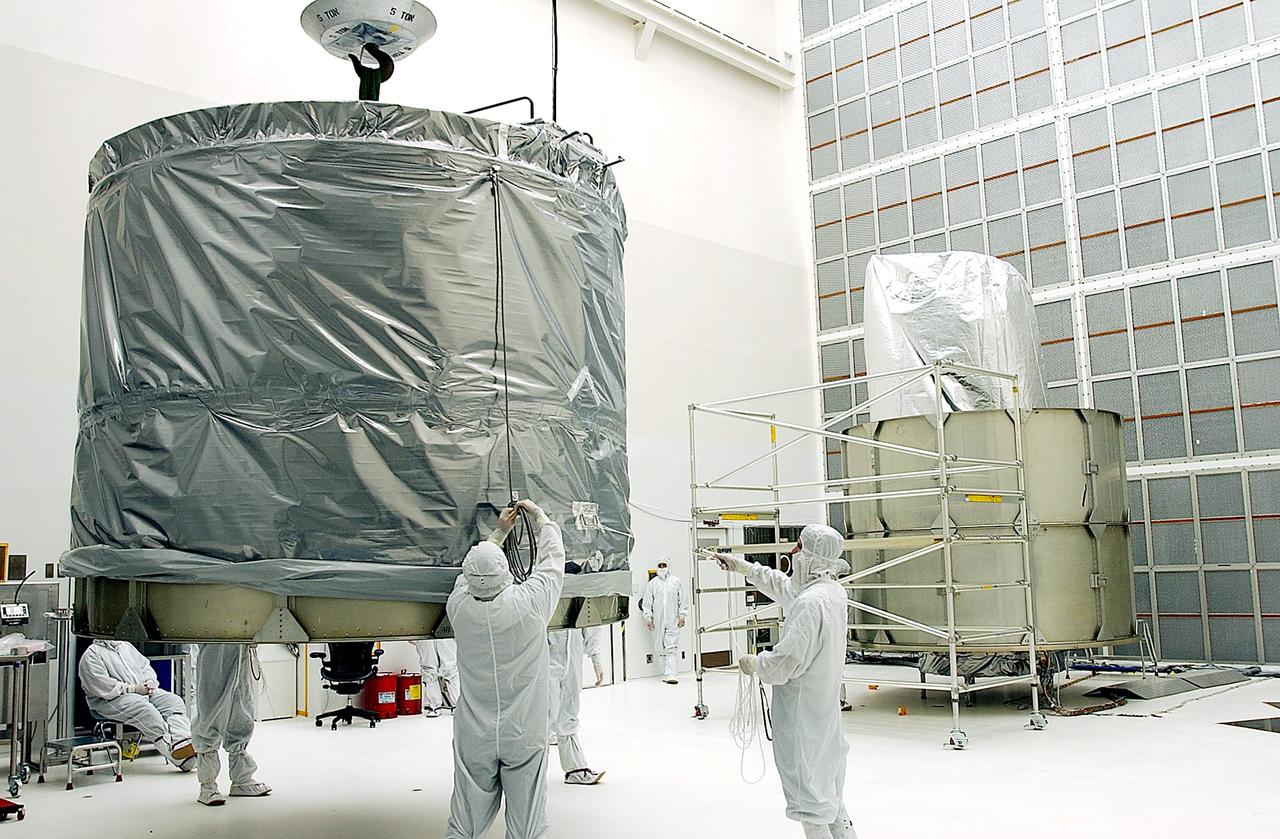
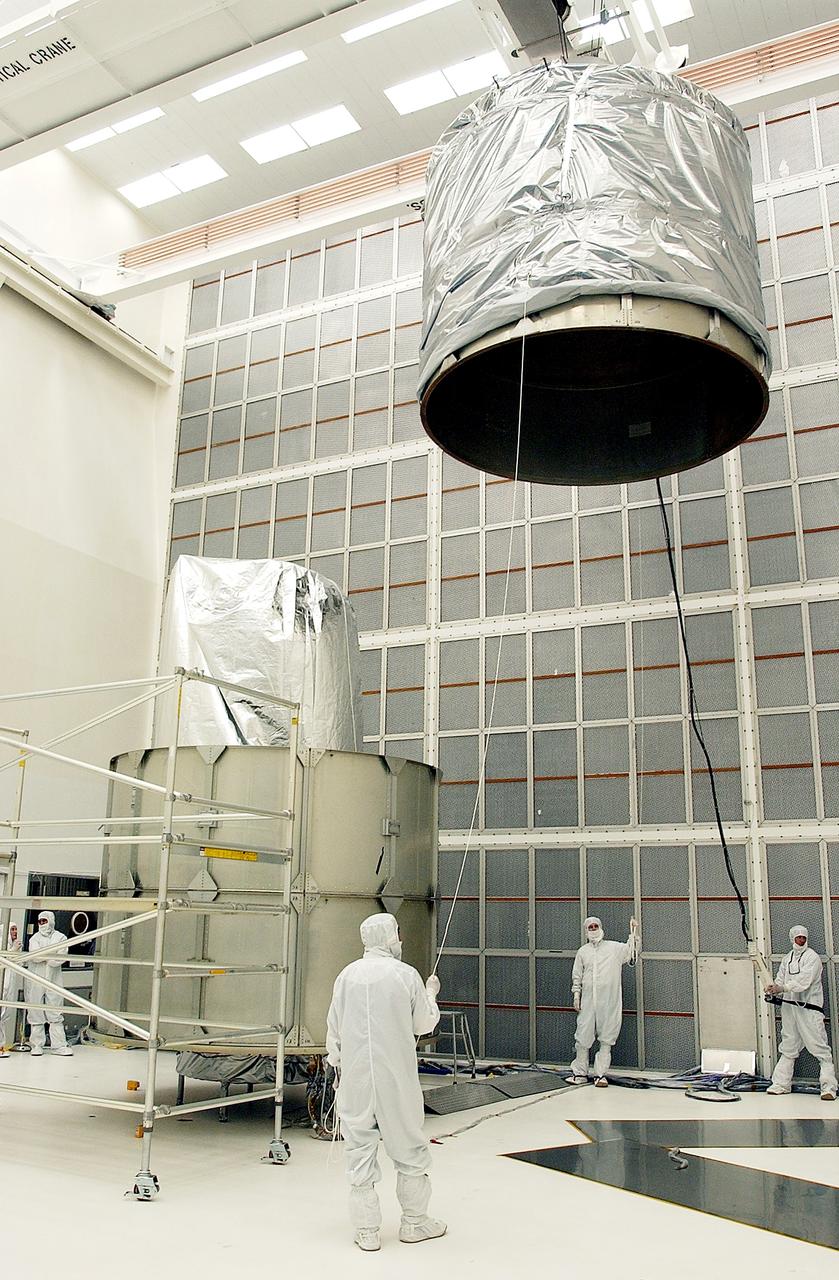
KENNEDY SPACE CENTER, FLA.  - Workers at Hangar A&E, Cape Canaveral Air Force Station, lift the upper canister to move it to the Space Infrared Telescope Facility (SIRTF) at right.  After encapsulation, the spacecraft will be transported to Launch Complex 17-B for mating with its launch vehicle, the Delta II rocket.   SIRTF consists of three cryogenically cooled science instruments and an 0.85-meter telescope, and is one of NASA's largest infrared telescopes to be launched.  SIRTF will obtain images and spectra by detecting the infrared energy, or heat, radiated by objects in space. Most of this infrared radiation is blocked by the Earth's atmosphere and cannot be observed from the ground.
KENNEDY SPACE CENTER, FLA. - Workers at Hangar A&E, Cape Canaveral Air Force Station, lift the upper canister to move it to the Space Infrared Telescope Facility (SIRTF) at right. After encapsulation, the spacecraft will be transported to Launch Complex 17-B for mating with its launch vehicle, the Delta II rocket. SIRTF consists of three cryogenically cooled science instruments and an 0.85-meter telescope, and is one of NASA's largest infrared telescopes to be launched. SIRTF will obtain images and spectra by detecting the infrared energy, or heat, radiated by objects in space. Most of this infrared radiation is blocked by the Earth's atmosphere and cannot be observed from the ground.
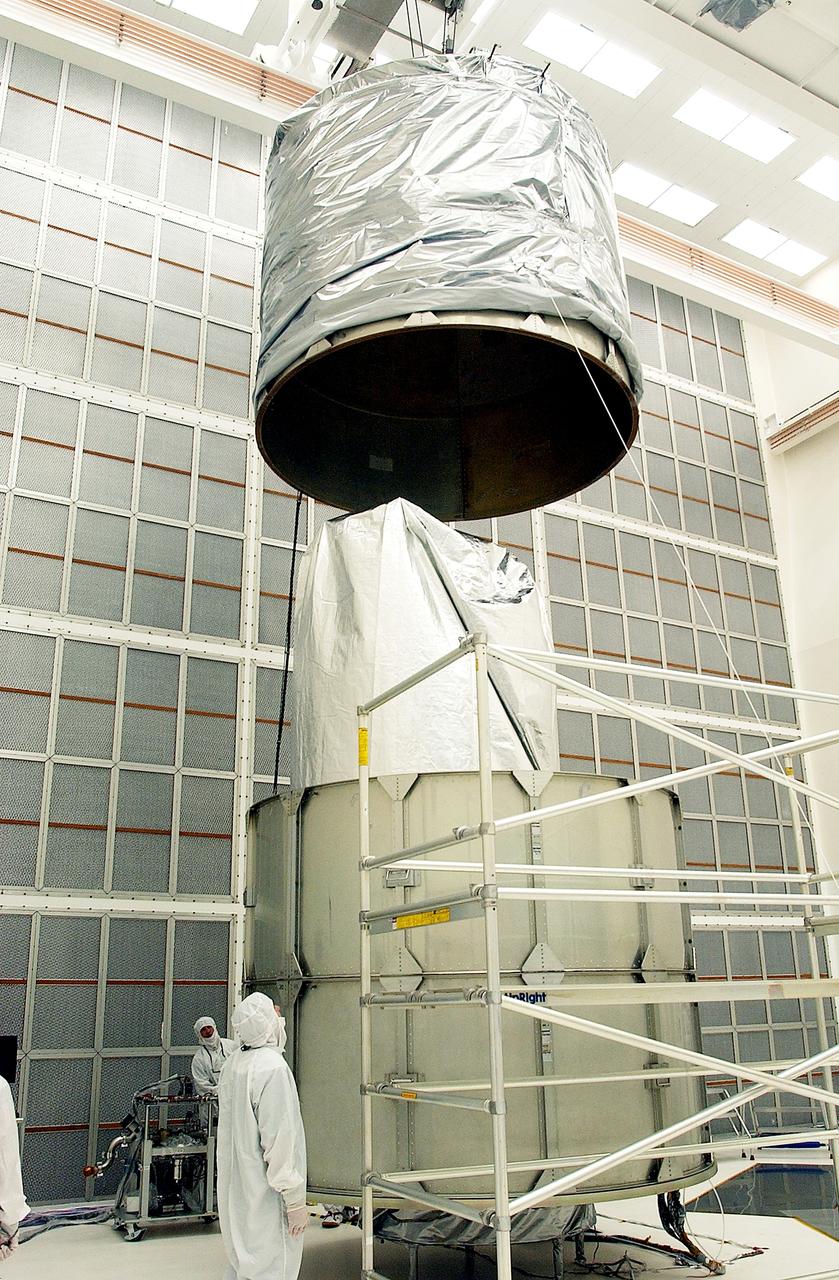
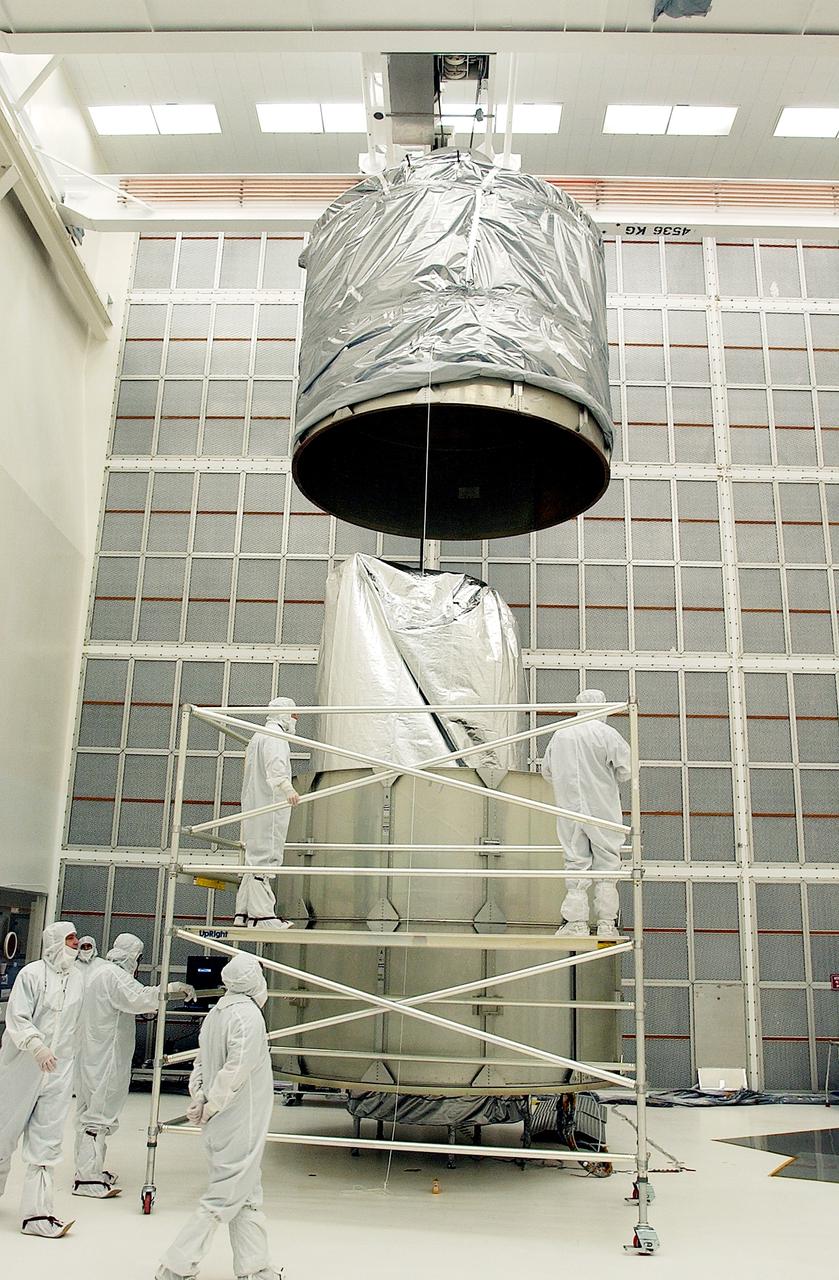
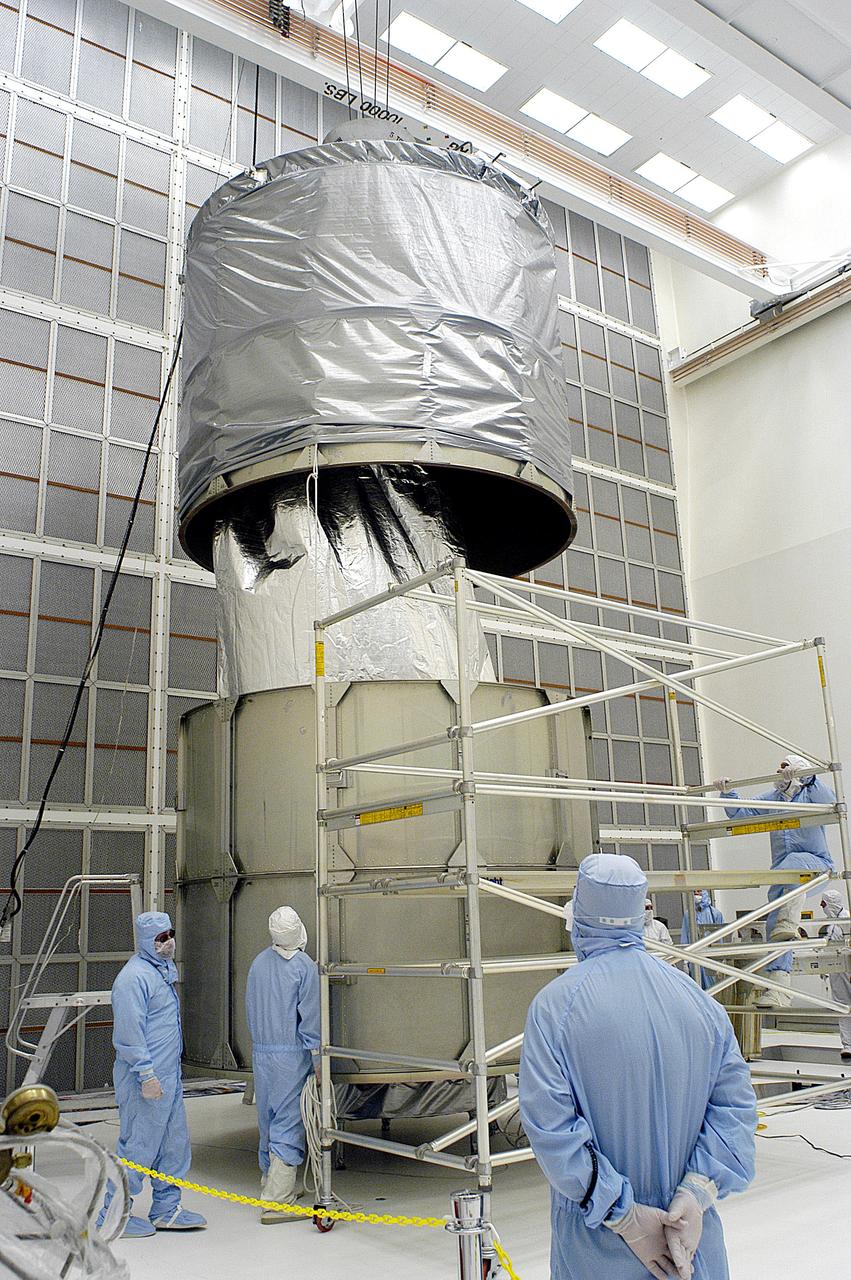
KENNEDY SPACE CENTER, FLA.  -  In Hangar A&E, Cape Canaveral Air Force Station, the upper canister is lowered toward the Space Infrared Telescope Facility (SIRTF) below.  After encapsulation is complete, the spacecraft will be transported to Launch Complex 17-B for mating with its launch vehicle, the Delta II rocket.   SIRTF consists of three cryogenically cooled science instruments and an 0.85-meter telescope, and is one of NASA's largest infrared telescopes to be launched.  SIRTF will obtain images and spectra by detecting the infrared energy, or heat, radiated by objects in space. Most of this infrared radiation is blocked by the Earth's atmosphere and cannot be observed from the ground.
KENNEDY SPACE CENTER, FLA. - In Hangar A&E, Cape Canaveral Air Force Station, the upper canister is lowered toward the Space Infrared Telescope Facility (SIRTF) below. After encapsulation is complete, the spacecraft will be transported to Launch Complex 17-B for mating with its launch vehicle, the Delta II rocket. SIRTF consists of three cryogenically cooled science instruments and an 0.85-meter telescope, and is one of NASA's largest infrared telescopes to be launched. SIRTF will obtain images and spectra by detecting the infrared energy, or heat, radiated by objects in space. Most of this infrared radiation is blocked by the Earth's atmosphere and cannot be observed from the ground.
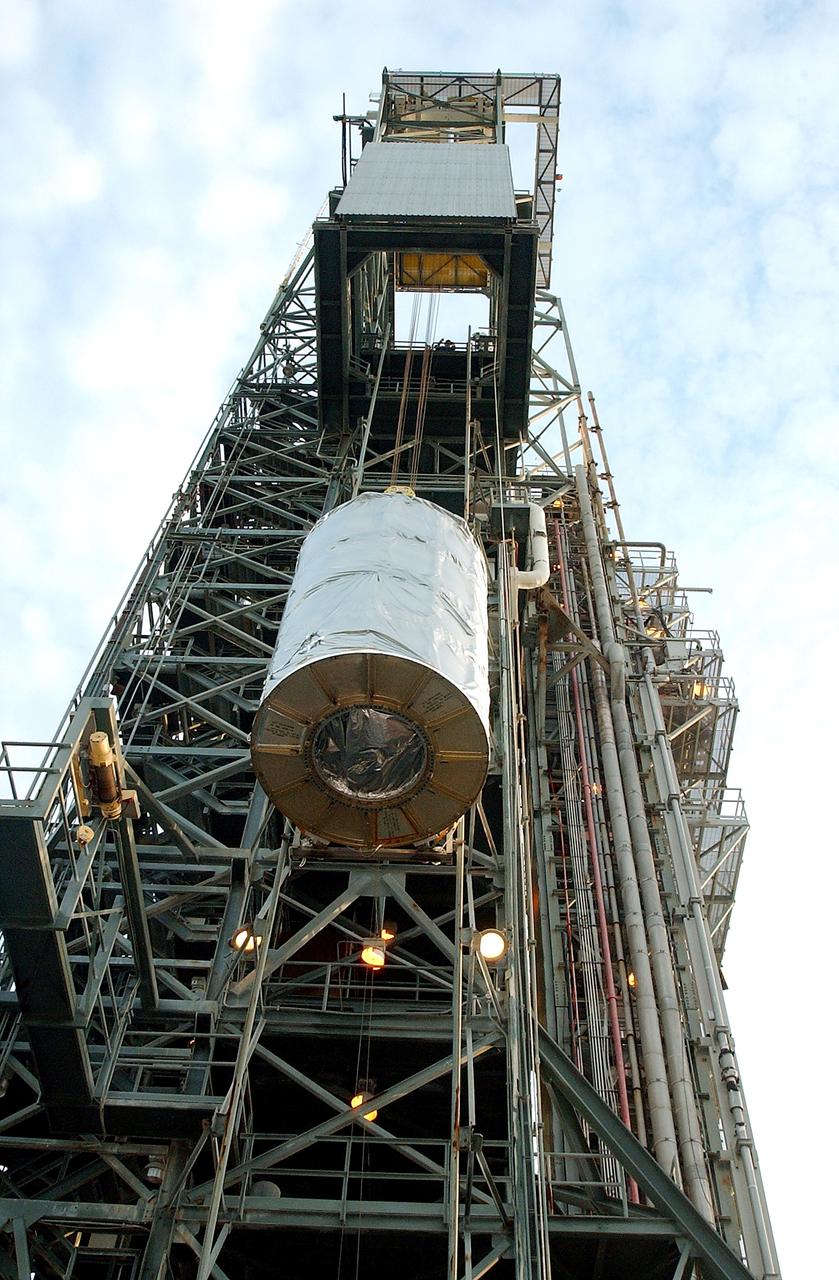
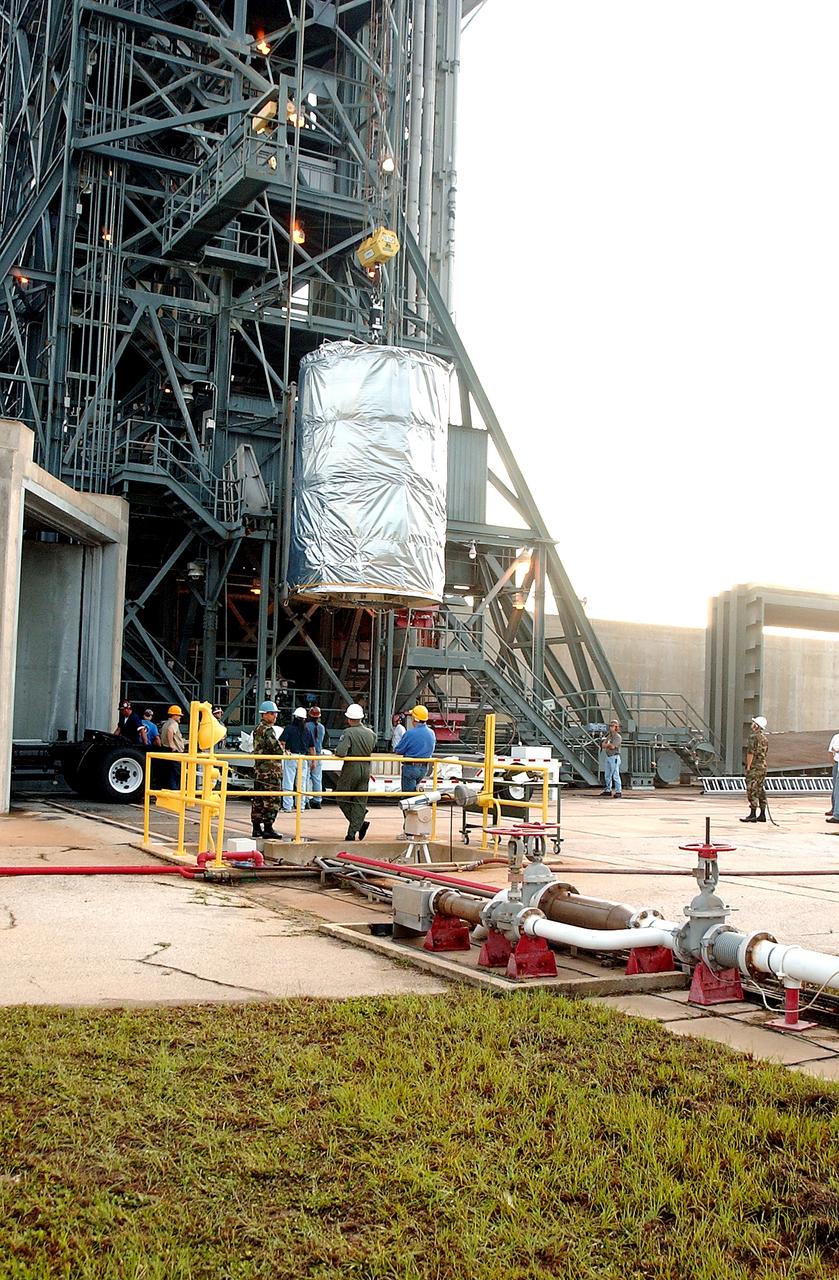
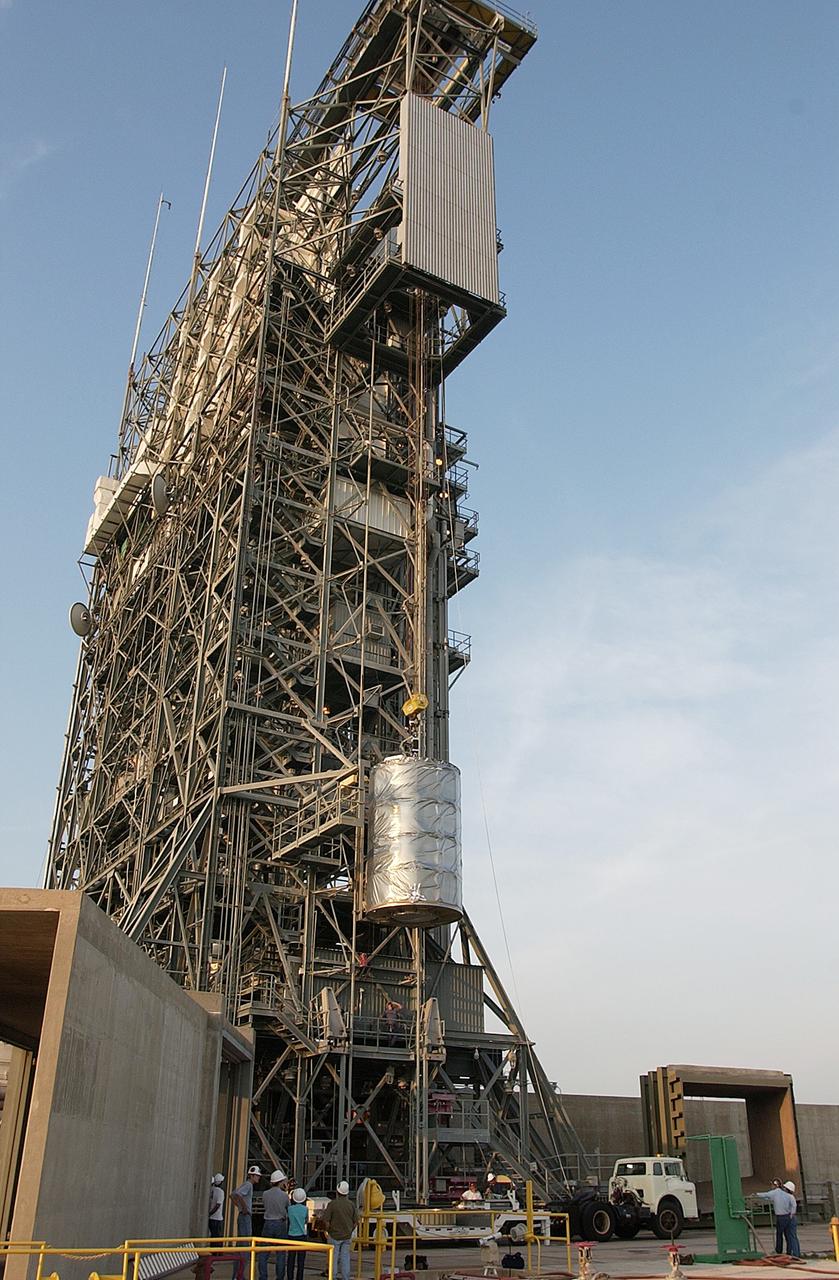
KENNEDY SPACE CENTER, FLA.  -  After dawn,  the Space Infrared Telescope Facility (SIRTF) is lifted up the mobile service tower on Launch Pad 17-B, Cape Canaveral Air Force Station.  SIRTF will be attached to the Delta II rocket and encapsulated in its fairing before launch.   Consisting of three cryogenically cooled science instruments and an 0.85-meter telescope, SIRTF is one of NASA’s largest infrared telescopes to be launched.  It is the fourth and final element in NASA’s family of orbiting “Great Observatories.”  SIRTF will obtain images and spectra by detecting the infrared energy, or heat, radiated by objects in space. Most of this infrared radiation is blocked by the Earth's atmosphere and cannot be observed from the ground.
KENNEDY SPACE CENTER, FLA. - After dawn, the Space Infrared Telescope Facility (SIRTF) is lifted up the mobile service tower on Launch Pad 17-B, Cape Canaveral Air Force Station. SIRTF will be attached to the Delta II rocket and encapsulated in its fairing before launch. Consisting of three cryogenically cooled science instruments and an 0.85-meter telescope, SIRTF is one of NASA’s largest infrared telescopes to be launched. It is the fourth and final element in NASA’s family of orbiting “Great Observatories.” SIRTF will obtain images and spectra by detecting the infrared energy, or heat, radiated by objects in space. Most of this infrared radiation is blocked by the Earth's atmosphere and cannot be observed from the ground.
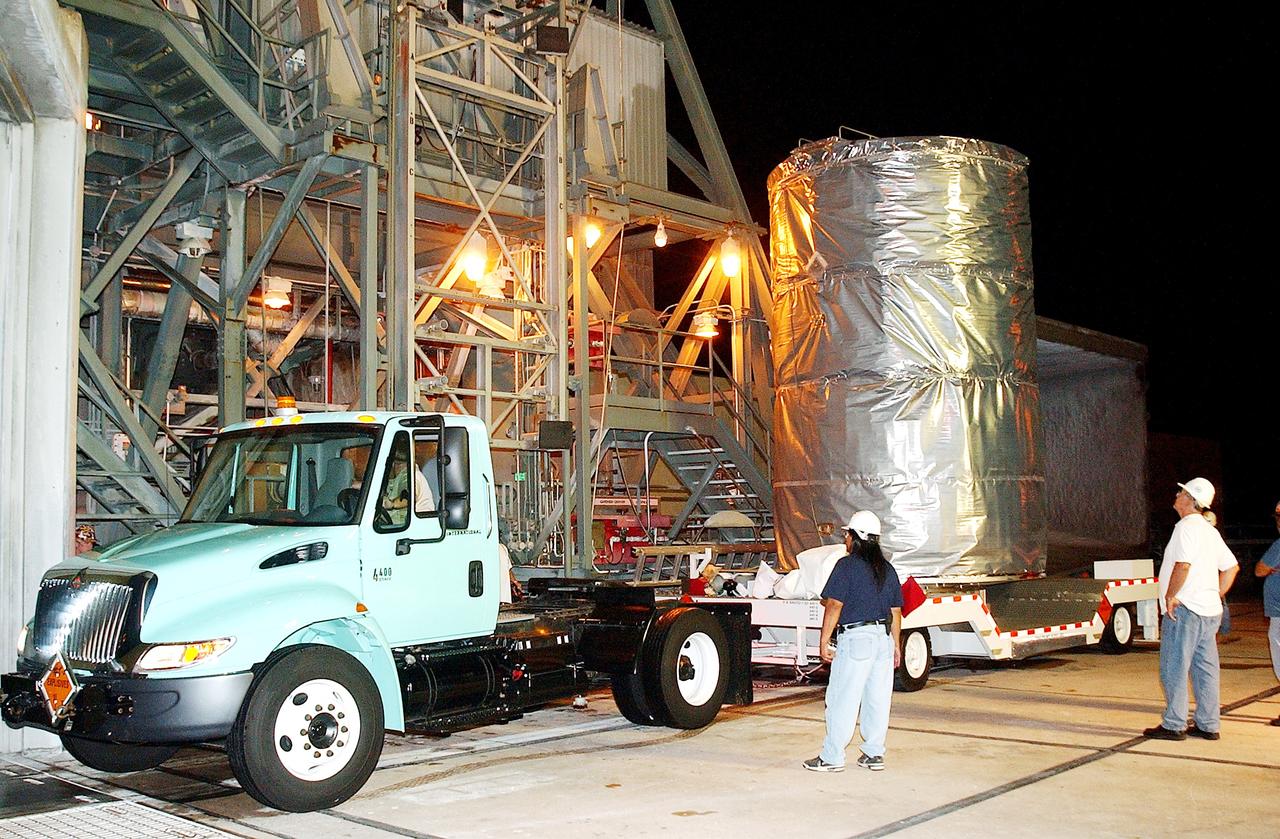
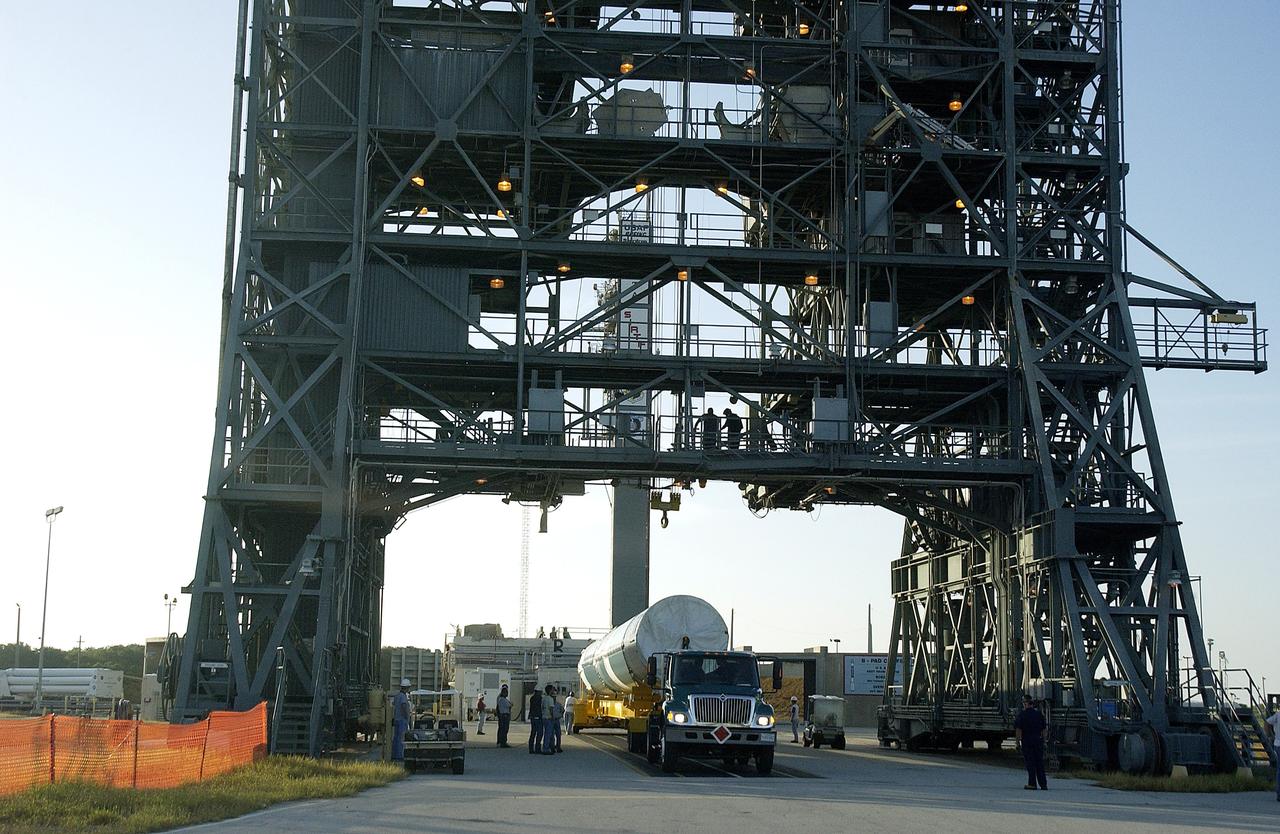
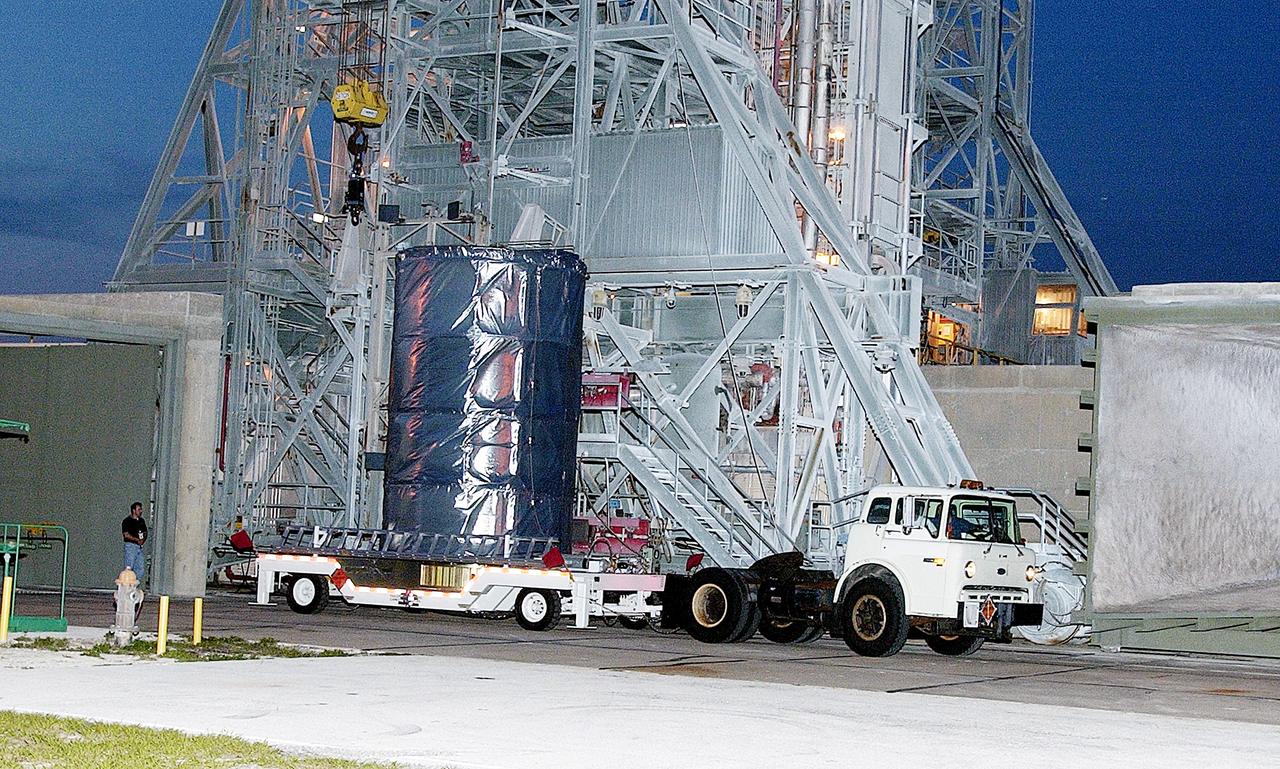
KENNEDY SPACE CENTER, FLA.  -  Before dawn, the Space Infrared Telescope Facility (SIRTF) arrives at Launch Pad 17-B, Cape Canaveral Air Force Station, where it will be lifted into the mobile service tower and prepared for launch.  SIRTF consists of three cryogenically cooled science instruments and an 0.85-meter telescope, and is one of NASA’s largest infrared telescopes to be launched.  It is the fourth and final element in NASA’s family of orbiting “Great Observatories.”  SIRTF will obtain images and spectra by detecting the infrared energy, or heat, radiated by objects in space. Most of this infrared radiation is blocked by the Earth's atmosphere and cannot be observed from the ground.
KENNEDY SPACE CENTER, FLA. - Before dawn, the Space Infrared Telescope Facility (SIRTF) arrives at Launch Pad 17-B, Cape Canaveral Air Force Station, where it will be lifted into the mobile service tower and prepared for launch. SIRTF consists of three cryogenically cooled science instruments and an 0.85-meter telescope, and is one of NASA’s largest infrared telescopes to be launched. It is the fourth and final element in NASA’s family of orbiting “Great Observatories.” SIRTF will obtain images and spectra by detecting the infrared energy, or heat, radiated by objects in space. Most of this infrared radiation is blocked by the Earth's atmosphere and cannot be observed from the ground.
KENNEDY SPACE CENTER, FLA. -   On Launch Complex 17-B, Cape Canaveral Air Force Station, the first stage of a Delta II rocket is raised off the transporter before lifting it up and moved into the mobile service tower.  The rocket is being erected to launch the Space InfraRed Telescope Facility (SIRTF).  Consisting of an 0.85-meter telescope and three cryogenically cooled science instruments, SIRTF is one of NASA's largest infrared telescopes to be launched.  SIRTF will obtain images and spectra by detecting the infrared energy, or heat, radiated by objects in space. Most of this infrared radiation is blocked by the Earth's atmosphere and cannot be observed from the ground.
KENNEDY SPACE CENTER, FLA. - On Launch Complex 17-B, Cape Canaveral Air Force Station, the first stage of a Delta II rocket is raised off the transporter before lifting it up and moved into the mobile service tower. The rocket is being erected to launch the Space InfraRed Telescope Facility (SIRTF). Consisting of an 0.85-meter telescope and three cryogenically cooled science instruments, SIRTF is one of NASA's largest infrared telescopes to be launched. SIRTF will obtain images and spectra by detecting the infrared energy, or heat, radiated by objects in space. Most of this infrared radiation is blocked by the Earth's atmosphere and cannot be observed from the ground.
KENNEDY SPACE CENTER, FLA.  -  After dawn,  the Space Infrared Telescope Facility (SIRTF) is lifted up the mobile service tower on Launch Pad 17-B, Cape Canaveral Air Force Station.  SIRTF will be attached to the Delta II rocket and encapsulated in its fairing before launch.   Consisting of three cryogenically cooled science instruments and an 0.85-meter telescope, SIRTF is one of NASA’s largest infrared telescopes to be launched.  It is the fourth and final element in NASA’s family of orbiting “Great Observatories.”  SIRTF will obtain images and spectra by detecting the infrared energy, or heat, radiated by objects in space. Most of this infrared radiation is blocked by the Earth's atmosphere and cannot be observed from the ground.
KENNEDY SPACE CENTER, FLA. - After dawn, the Space Infrared Telescope Facility (SIRTF) is lifted up the mobile service tower on Launch Pad 17-B, Cape Canaveral Air Force Station. SIRTF will be attached to the Delta II rocket and encapsulated in its fairing before launch. Consisting of three cryogenically cooled science instruments and an 0.85-meter telescope, SIRTF is one of NASA’s largest infrared telescopes to be launched. It is the fourth and final element in NASA’s family of orbiting “Great Observatories.” SIRTF will obtain images and spectra by detecting the infrared energy, or heat, radiated by objects in space. Most of this infrared radiation is blocked by the Earth's atmosphere and cannot be observed from the ground.
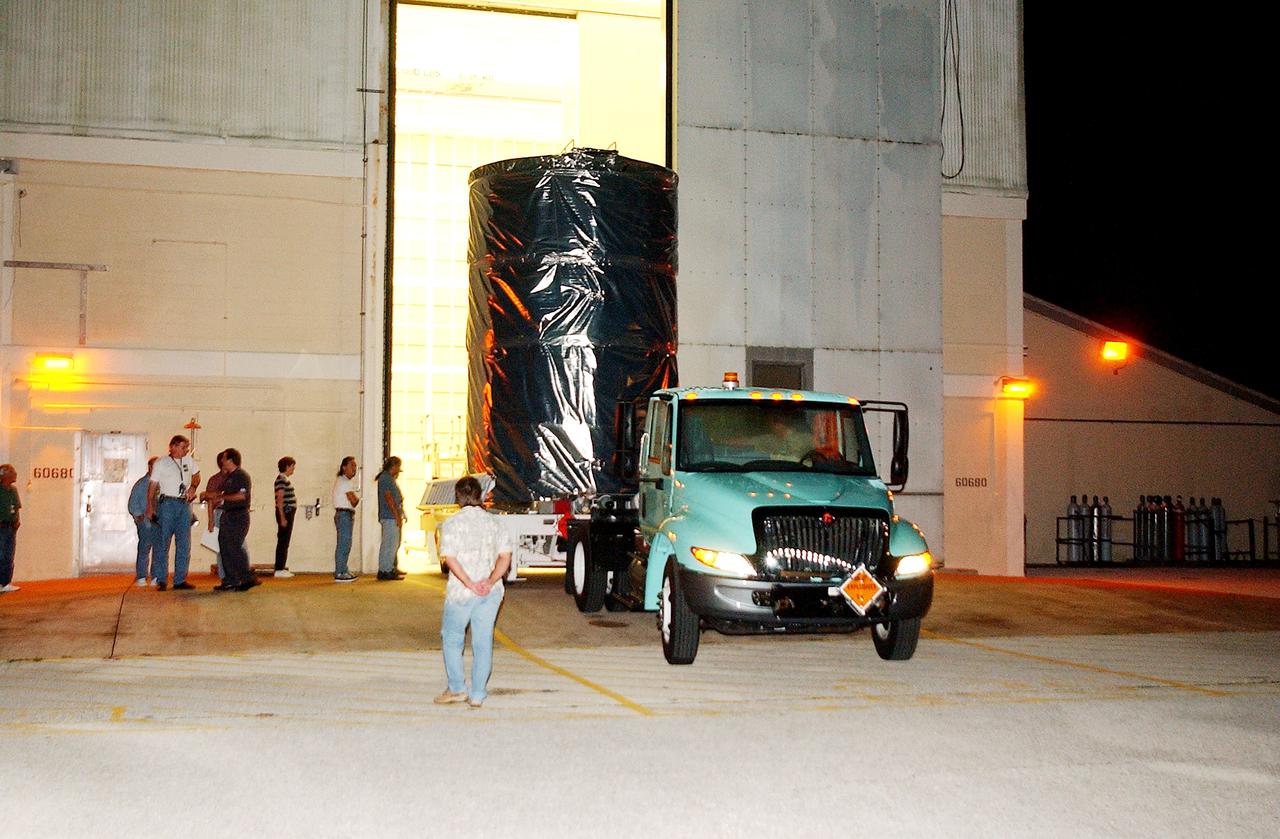
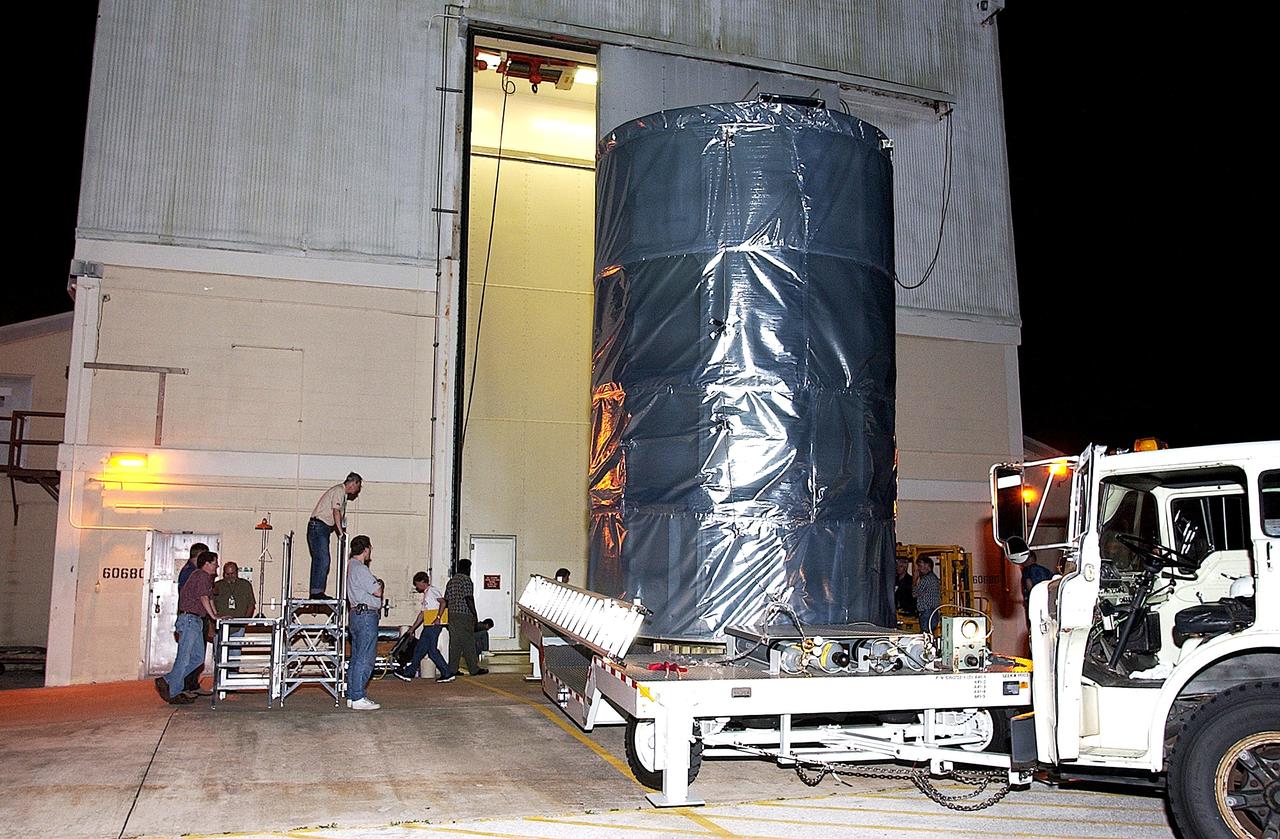
KENNEDY SPACE CENTER, FLA.  -  The Space Infrared Telescope Facility (SIRTF) is rolled out of the hangar at Cape Canaveral Air Force Station during pre-dawn hours.  It is being transported to Launch Pad 17-B where it will be lifted into the mobile service tower and prepared for launch.  SIRTF consists of three cryogenically cooled science instruments and an 0.85-meter telescope, and is one of NASA’s largest infrared telescopes to be launched.  It is the fourth and final element in NASA’s family of orbiting “Great Observatories.”  SIRTF will obtain images and spectra by detecting the infrared energy, or heat, radiated by objects in space. Most of this infrared radiation is blocked by the Earth's atmosphere and cannot be observed from the ground.
KENNEDY SPACE CENTER, FLA. - The Space Infrared Telescope Facility (SIRTF) is rolled out of the hangar at Cape Canaveral Air Force Station during pre-dawn hours. It is being transported to Launch Pad 17-B where it will be lifted into the mobile service tower and prepared for launch. SIRTF consists of three cryogenically cooled science instruments and an 0.85-meter telescope, and is one of NASA’s largest infrared telescopes to be launched. It is the fourth and final element in NASA’s family of orbiting “Great Observatories.” SIRTF will obtain images and spectra by detecting the infrared energy, or heat, radiated by objects in space. Most of this infrared radiation is blocked by the Earth's atmosphere and cannot be observed from the ground.
KENNEDY SPACE CENTER, FLA.  -  Workers on the mobile service tower on Launch Pad 17-B, Cape Canaveral Air Force Station, wait for the Space Infrared Telescope Facility (SIRTF) to reach their level.  SIRTF will be attached to the Delta II rocket and encapsulated in its fairing before launch.   Consisting of three cryogenically cooled science instruments and an 0.85-meter telescope, SIRTF is one of NASA’s largest infrared telescopes to be launched.  It is the fourth and final element in NASA’s family of orbiting “Great Observatories.”  SIRTF will obtain images and spectra by detecting the infrared energy, or heat, radiated by objects in space. Most of this infrared radiation is blocked by the Earth's atmosphere and cannot be observed from the ground.
KENNEDY SPACE CENTER, FLA. - Workers on the mobile service tower on Launch Pad 17-B, Cape Canaveral Air Force Station, wait for the Space Infrared Telescope Facility (SIRTF) to reach their level. SIRTF will be attached to the Delta II rocket and encapsulated in its fairing before launch. Consisting of three cryogenically cooled science instruments and an 0.85-meter telescope, SIRTF is one of NASA’s largest infrared telescopes to be launched. It is the fourth and final element in NASA’s family of orbiting “Great Observatories.” SIRTF will obtain images and spectra by detecting the infrared energy, or heat, radiated by objects in space. Most of this infrared radiation is blocked by the Earth's atmosphere and cannot be observed from the ground.
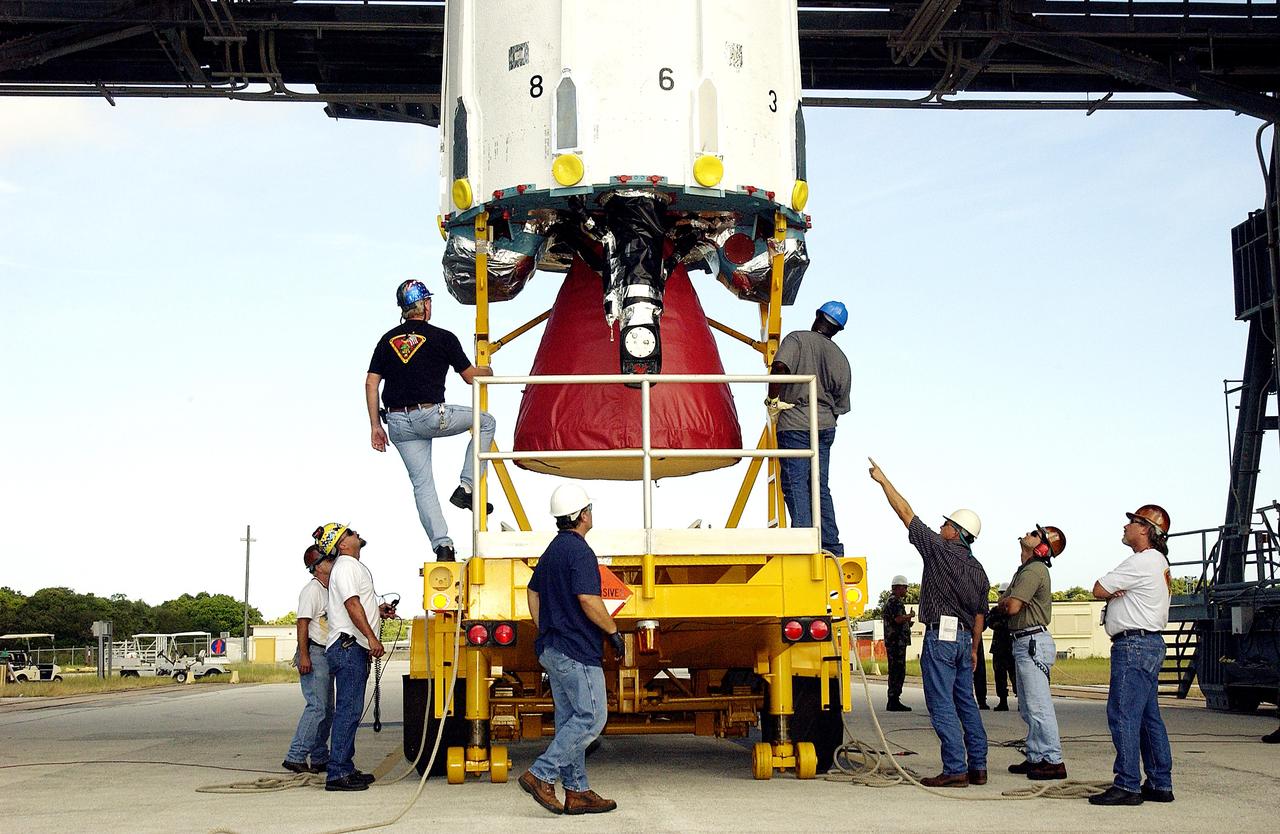
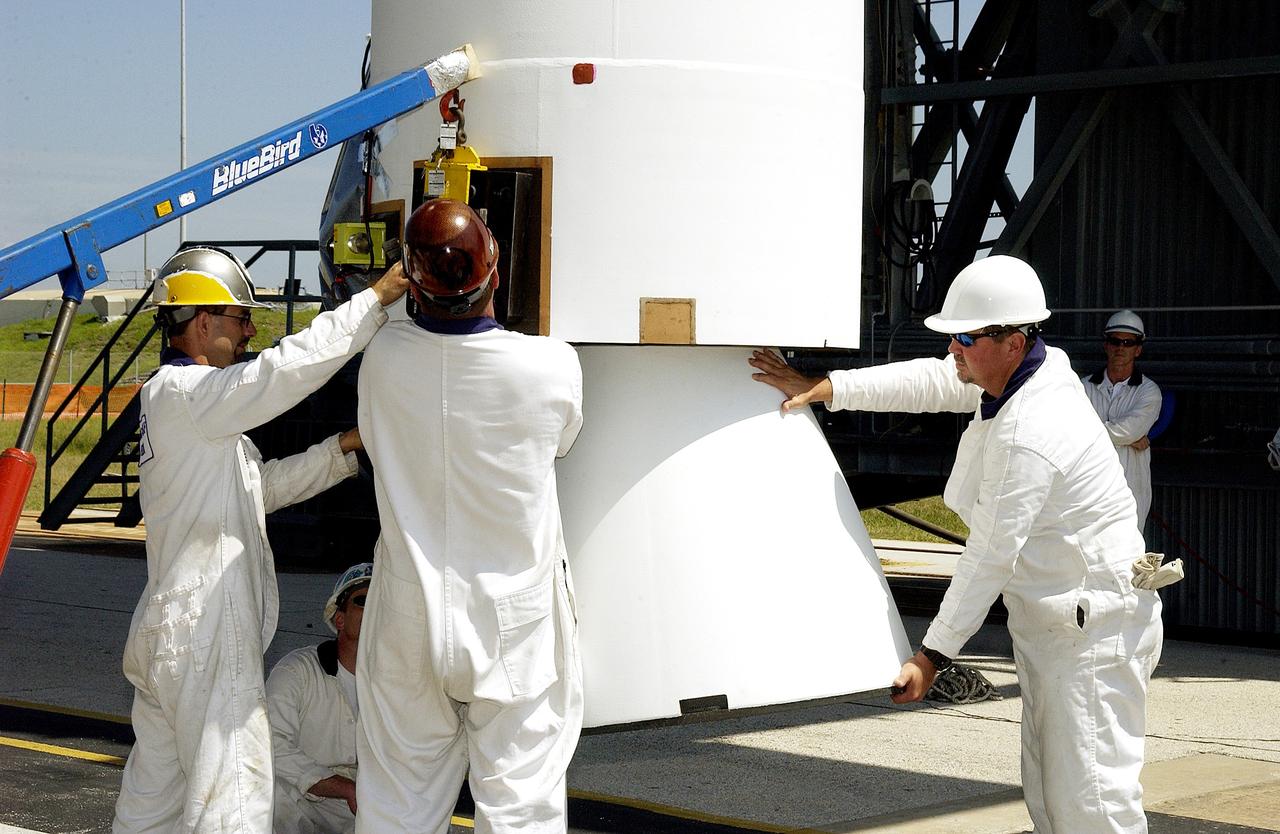
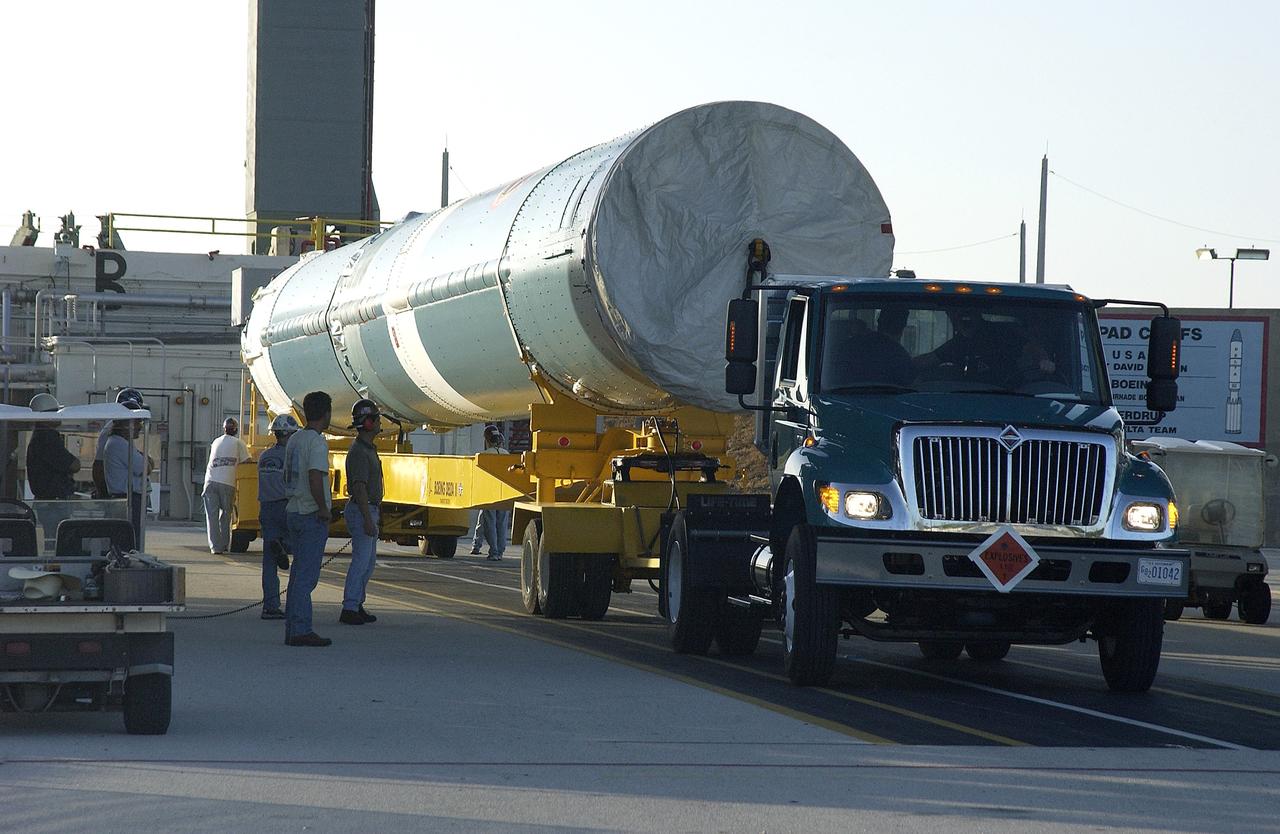
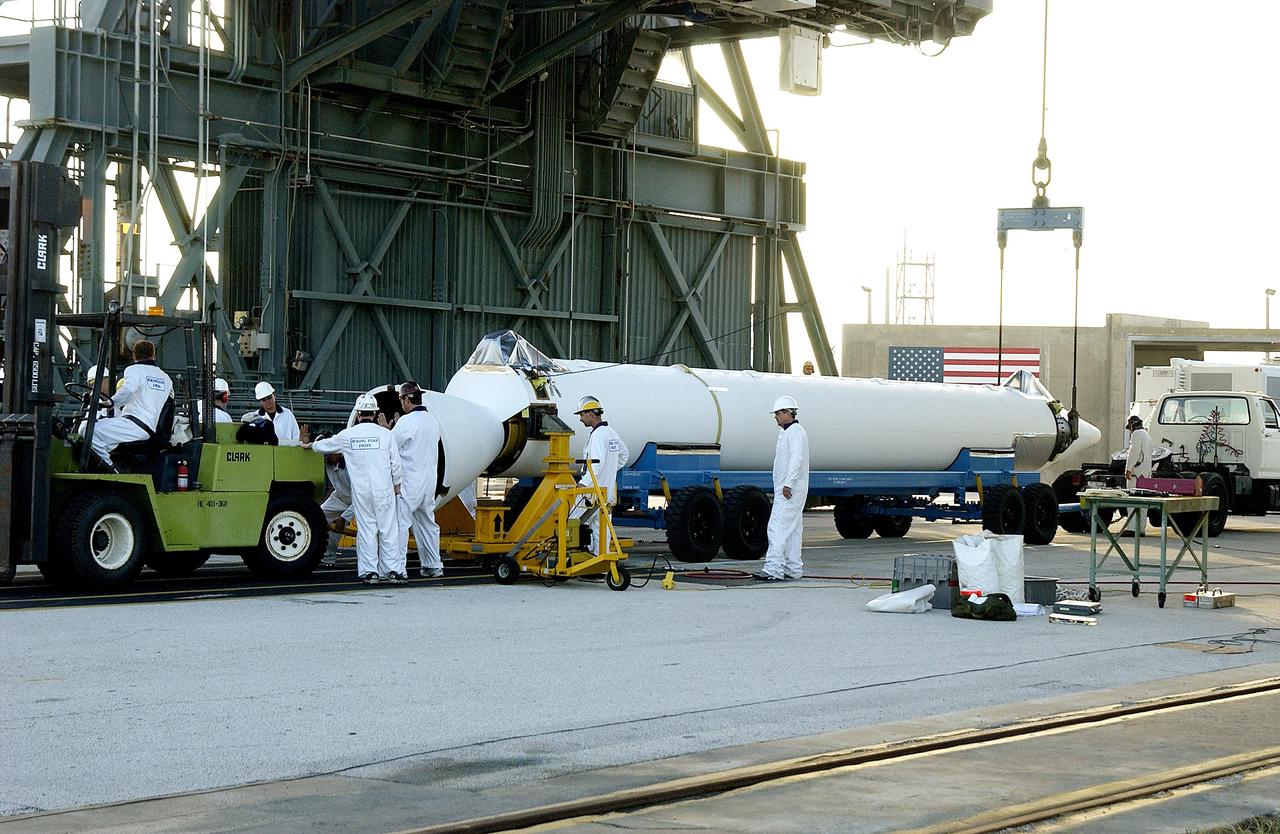
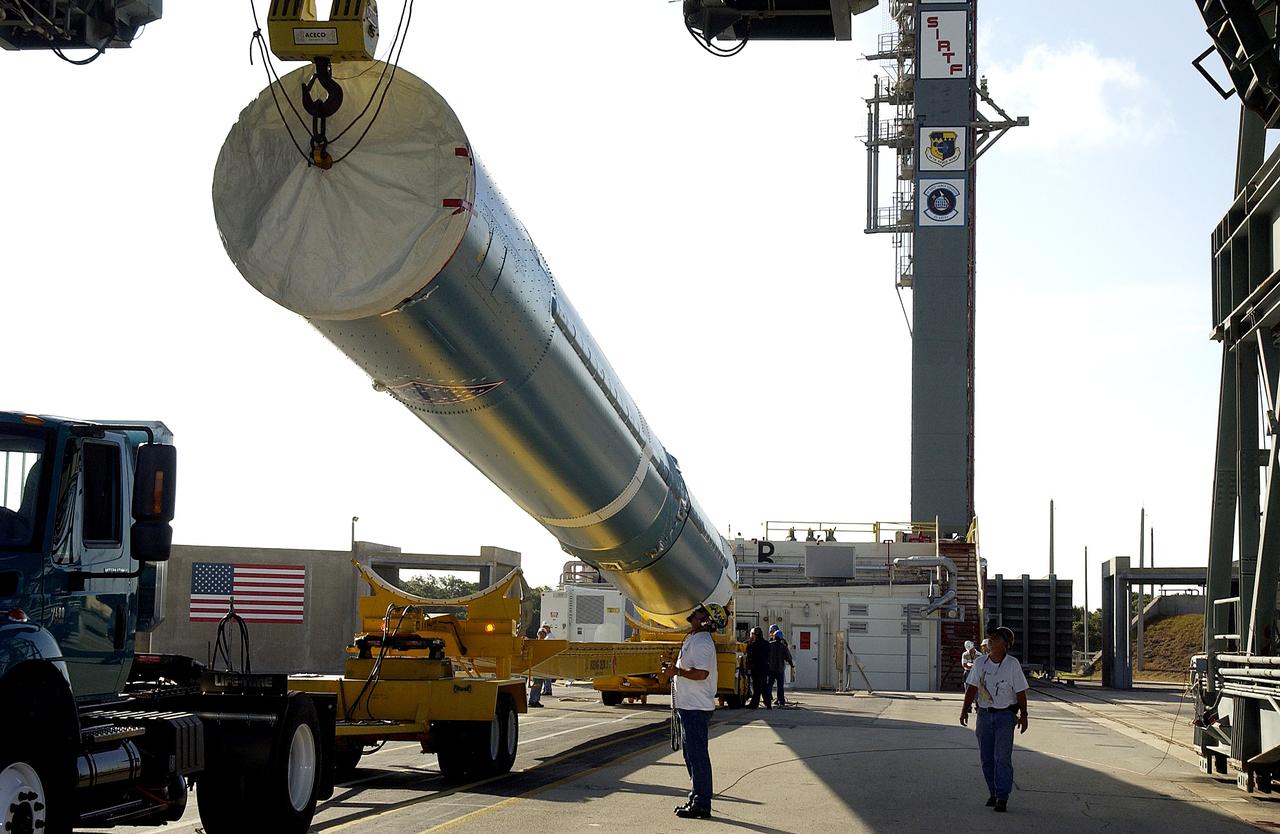
KENNEDY SPACE CENTER, FLA. -   A solid rocket booster (SRB) for the Delta II Heavy rocket that will launch the Space Infrared Telescope Facility (SIRTF) arrives at Launch Complex 17-B, Cape Canaveral Air Force Station.  The Delta II Heavy features nine 46-inch-diameter, stretched SRBs.  Consisting of three cryogenically cooled science instruments and an 0.85-meter telescope, SIRTF is one of NASA's largest infrared telescopes to be launched.  SIRTF will obtain images and spectra by detecting the infrared energy, or heat, radiated by objects in space. Most of this infrared radiation is blocked by the Earth's atmosphere and cannot be observed from the ground.
KENNEDY SPACE CENTER, FLA. - A solid rocket booster (SRB) for the Delta II Heavy rocket that will launch the Space Infrared Telescope Facility (SIRTF) arrives at Launch Complex 17-B, Cape Canaveral Air Force Station. The Delta II Heavy features nine 46-inch-diameter, stretched SRBs. Consisting of three cryogenically cooled science instruments and an 0.85-meter telescope, SIRTF is one of NASA's largest infrared telescopes to be launched. SIRTF will obtain images and spectra by detecting the infrared energy, or heat, radiated by objects in space. Most of this infrared radiation is blocked by the Earth's atmosphere and cannot be observed from the ground.
KENNEDY SPACE CENTER, FLA. -   On Launch Complex 17-B, Cape Canaveral Air Force Station, the first stage of a Delta II rocket waits to be lifted up into the mobile service tower.  The rocket is being erected to launch the Space InfraRed Telescope Facility (SIRTF).  Consisting of an 0.85-meter telescope and three cryogenically cooled science instruments, SIRTF is one of NASA's largest infrared telescopes to be launched.  SIRTF will obtain images and spectra by detecting the infrared energy, or heat, radiated by objects in space. Most of this infrared radiation is blocked by the Earth's atmosphere and cannot be observed from the ground.
KENNEDY SPACE CENTER, FLA. - On Launch Complex 17-B, Cape Canaveral Air Force Station, the first stage of a Delta II rocket waits to be lifted up into the mobile service tower. The rocket is being erected to launch the Space InfraRed Telescope Facility (SIRTF). Consisting of an 0.85-meter telescope and three cryogenically cooled science instruments, SIRTF is one of NASA's largest infrared telescopes to be launched. SIRTF will obtain images and spectra by detecting the infrared energy, or heat, radiated by objects in space. Most of this infrared radiation is blocked by the Earth's atmosphere and cannot be observed from the ground.
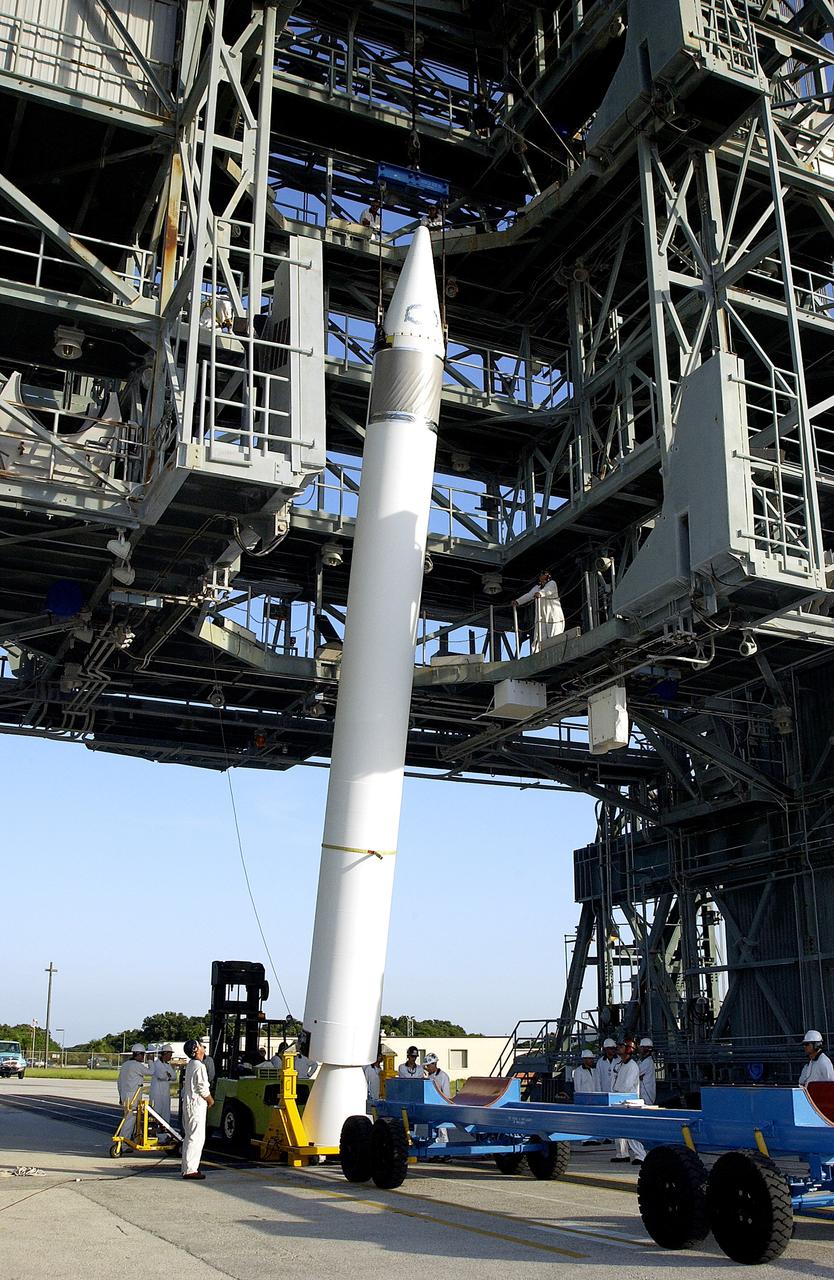
KENNEDY SPACE CENTER, FLA. -   A solid rocket booster (SRB) is lifted to vertical on Launch Complex 17-B, Cape Canaveral Air Force Station. The SRB will be attached to the Delta II Heavy rocket that will launch the Space Infrared Telescope Facility (SIRTF).  The Delta II Heavy features nine 46-inch-diameter, stretched SRBs.  Consisting of three cryogenically cooled science instruments and an 0.85-meter telescope, SIRTF is one of NASA's largest infrared telescopes to be launched.  SIRTF will obtain images and spectra by detecting the infrared energy, or heat, radiated by objects in space. Most of this infrared radiation is blocked by the Earth's atmosphere and cannot be observed from the ground.
KENNEDY SPACE CENTER, FLA. - A solid rocket booster (SRB) is lifted to vertical on Launch Complex 17-B, Cape Canaveral Air Force Station. The SRB will be attached to the Delta II Heavy rocket that will launch the Space Infrared Telescope Facility (SIRTF). The Delta II Heavy features nine 46-inch-diameter, stretched SRBs. Consisting of three cryogenically cooled science instruments and an 0.85-meter telescope, SIRTF is one of NASA's largest infrared telescopes to be launched. SIRTF will obtain images and spectra by detecting the infrared energy, or heat, radiated by objects in space. Most of this infrared radiation is blocked by the Earth's atmosphere and cannot be observed from the ground.
KENNEDY SPACE CENTER, FLA.  - Workers at Hangar A&E, Cape Canaveral Air Force Station, help guide the upper canister toward the Space Infrared Telescope Facility (SIRTF) at left.  After encapsulation is complete, the spacecraft will be transported to Launch Complex 17-B for mating with its launch vehicle, the Delta II rocket.   SIRTF consists of three cryogenically cooled science instruments and an 0.85-meter telescope, and is one of NASA's largest infrared telescopes to be launched.  SIRTF will obtain images and spectra by detecting the infrared energy, or heat, radiated by objects in space. Most of this infrared radiation is blocked by the Earth's atmosphere and cannot be observed from the ground.
KENNEDY SPACE CENTER, FLA. - Workers at Hangar A&E, Cape Canaveral Air Force Station, help guide the upper canister toward the Space Infrared Telescope Facility (SIRTF) at left. After encapsulation is complete, the spacecraft will be transported to Launch Complex 17-B for mating with its launch vehicle, the Delta II rocket. SIRTF consists of three cryogenically cooled science instruments and an 0.85-meter telescope, and is one of NASA's largest infrared telescopes to be launched. SIRTF will obtain images and spectra by detecting the infrared energy, or heat, radiated by objects in space. Most of this infrared radiation is blocked by the Earth's atmosphere and cannot be observed from the ground.
KENNEDY SPACE CENTER, FLA.  -  Viewed from below, the Space Infrared Telescope Facility (SIRTF) is lifted up the mobile service tower on Launch Pad 17-B, Cape Canaveral Air Force Station.  SIRTF will be attached to the Delta II rocket and encapsulated in its fairing before launch.   Consisting of three cryogenically cooled science instruments and an 0.85-meter telescope, SIRTF is one of NASA’s largest infrared telescopes to be launched.  It is the fourth and final element in NASA’s family of orbiting “Great Observatories.”  SIRTF will obtain images and spectra by detecting the infrared energy, or heat, radiated by objects in space. Most of this infrared radiation is blocked by the Earth's atmosphere and cannot be observed from the ground.
KENNEDY SPACE CENTER, FLA. - Viewed from below, the Space Infrared Telescope Facility (SIRTF) is lifted up the mobile service tower on Launch Pad 17-B, Cape Canaveral Air Force Station. SIRTF will be attached to the Delta II rocket and encapsulated in its fairing before launch. Consisting of three cryogenically cooled science instruments and an 0.85-meter telescope, SIRTF is one of NASA’s largest infrared telescopes to be launched. It is the fourth and final element in NASA’s family of orbiting “Great Observatories.” SIRTF will obtain images and spectra by detecting the infrared energy, or heat, radiated by objects in space. Most of this infrared radiation is blocked by the Earth's atmosphere and cannot be observed from the ground.
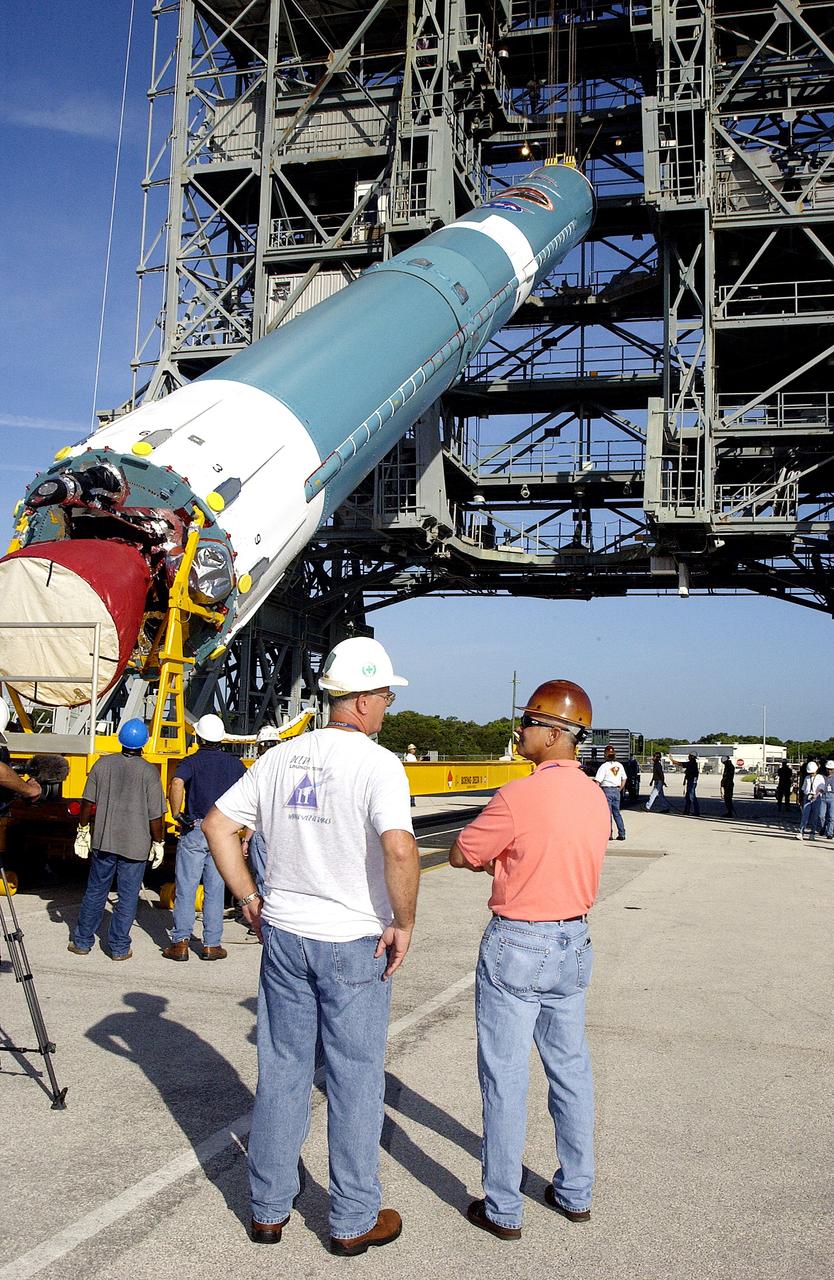
KENNEDY SPACE CENTER, FLA. -   On Launch Complex 17-B, Cape Canaveral Air Force Station, the first stage of a Delta II rocket is raised off the transporter before lifting and moving it into the mobile service tower.  The rocket is being erected to launch the Space InfraRed Telescope Facility (SIRTF).  Consisting of an 0.85-meter telescope and three cryogenically cooled science instruments, SIRTF is one of NASA's largest infrared telescopes to be launched.  SIRTF will obtain images and spectra by detecting the infrared energy, or heat, radiated by objects in space. Most of this infrared radiation is blocked by the Earth's atmosphere and cannot be observed from the ground.
KENNEDY SPACE CENTER, FLA. - On Launch Complex 17-B, Cape Canaveral Air Force Station, the first stage of a Delta II rocket is raised off the transporter before lifting and moving it into the mobile service tower. The rocket is being erected to launch the Space InfraRed Telescope Facility (SIRTF). Consisting of an 0.85-meter telescope and three cryogenically cooled science instruments, SIRTF is one of NASA's largest infrared telescopes to be launched. SIRTF will obtain images and spectra by detecting the infrared energy, or heat, radiated by objects in space. Most of this infrared radiation is blocked by the Earth's atmosphere and cannot be observed from the ground.
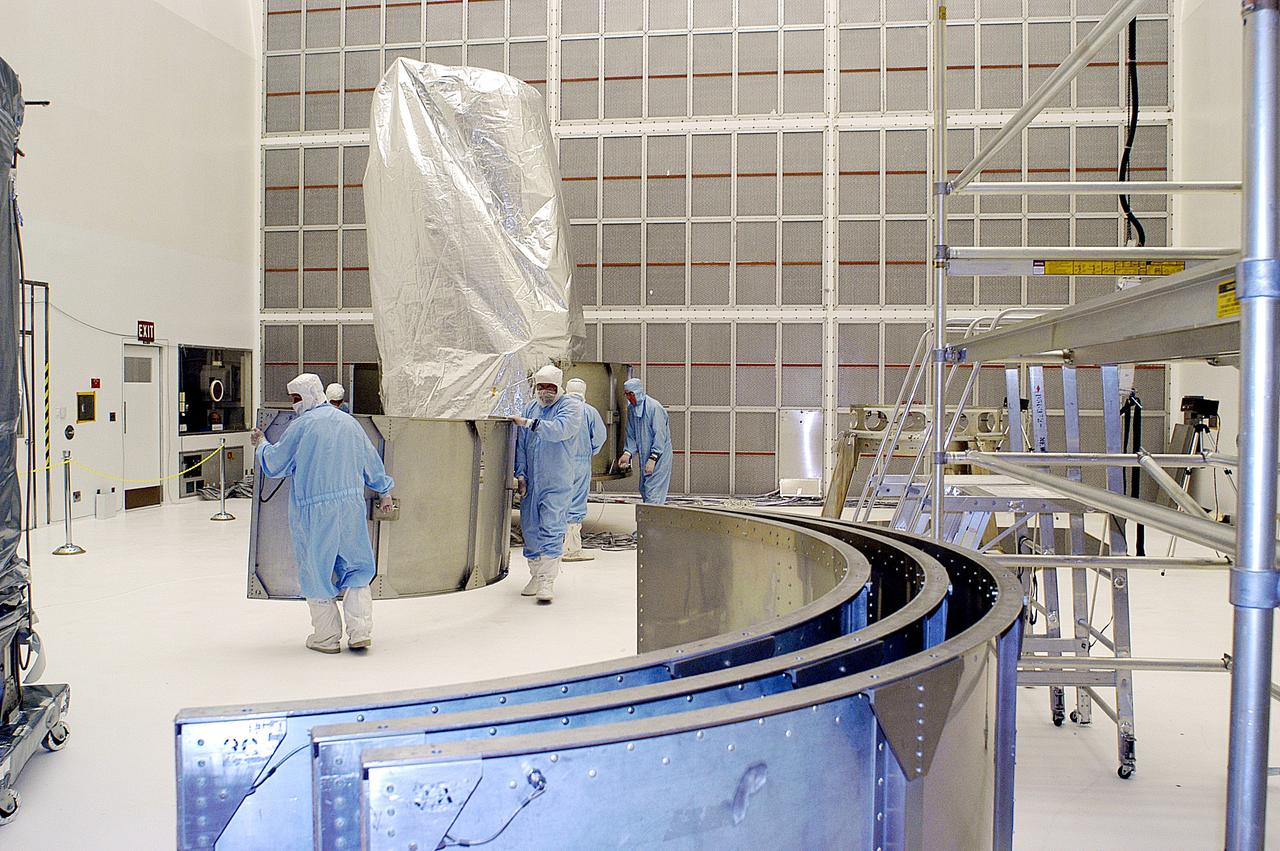
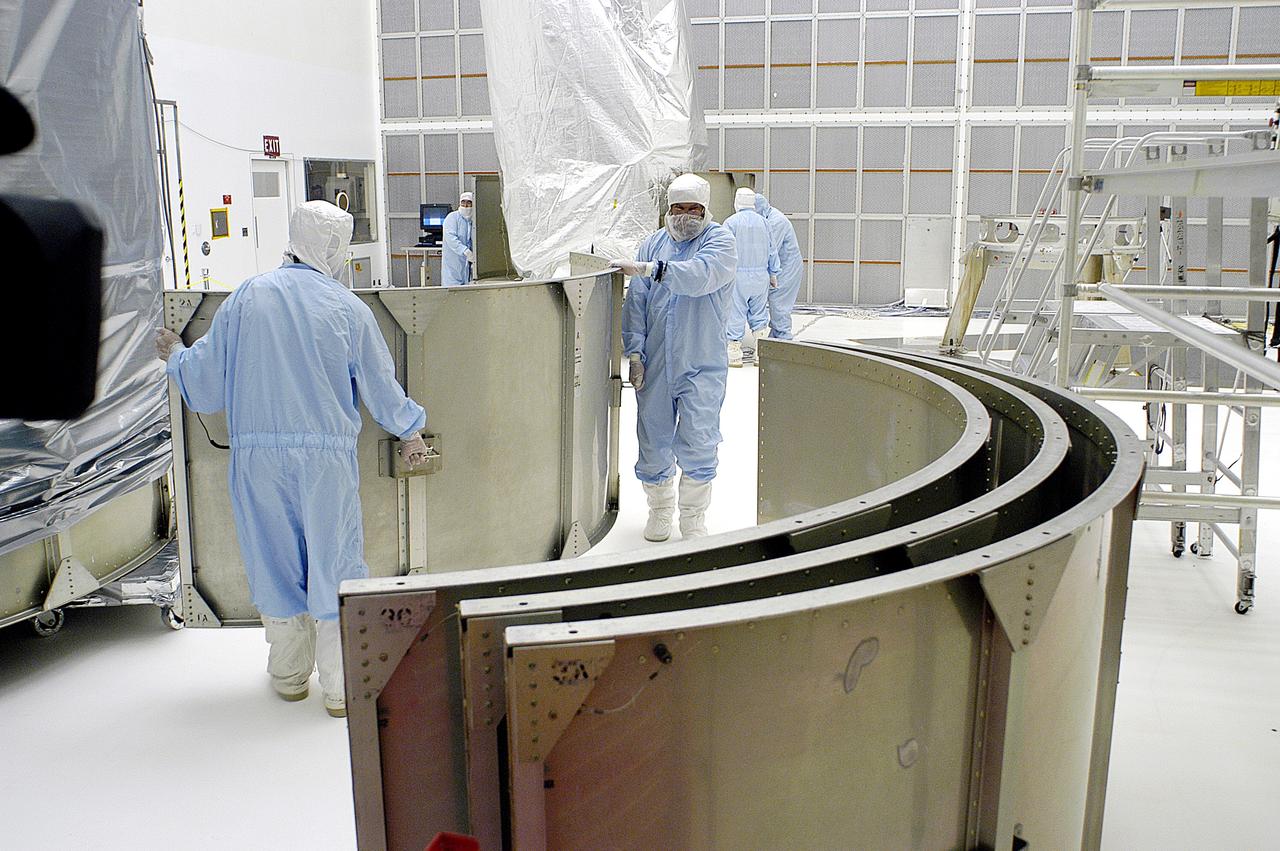
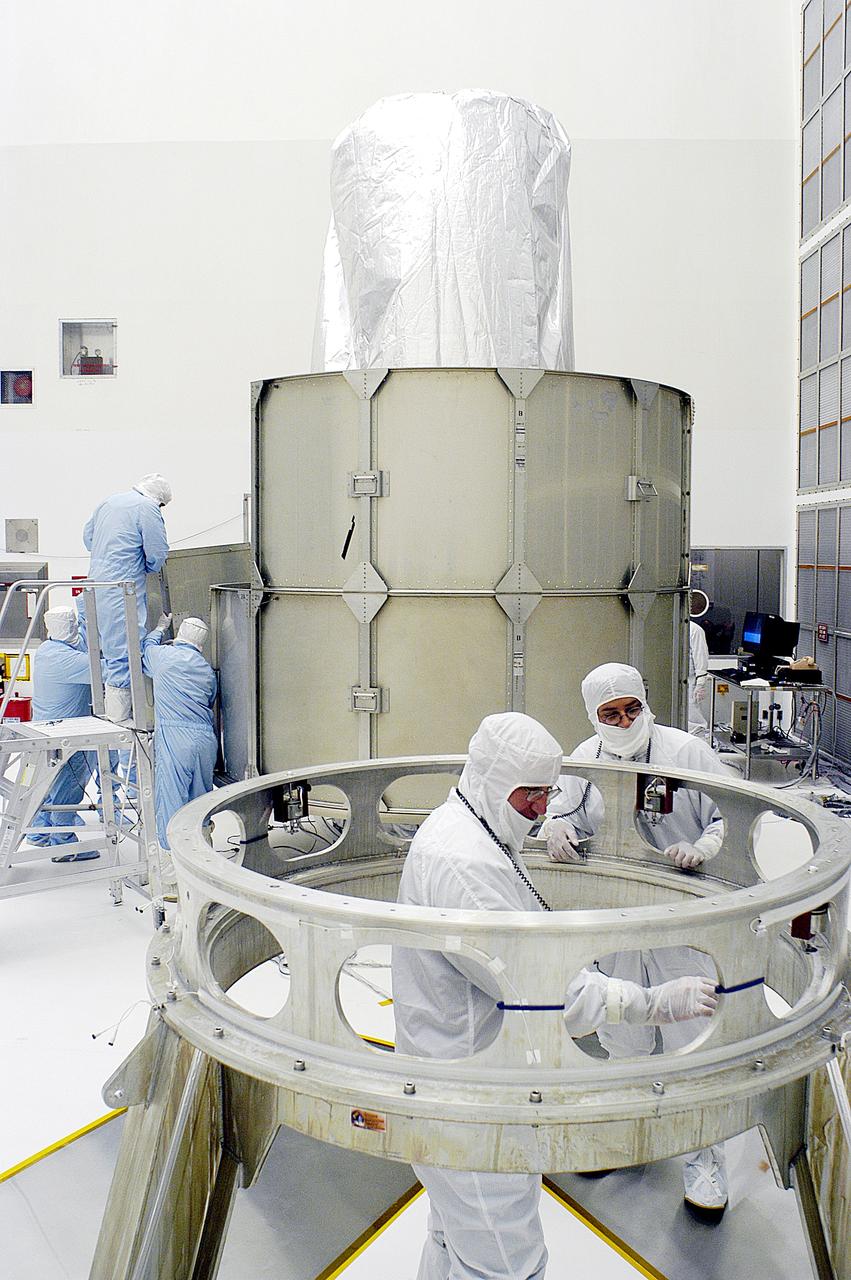
KENNEDY SPACE CENTER, FLA.  -  A worker at Hangar A&E, Cape Canaveral Air Force Station, place the lower panels of the canister around the Space Infrared Telescope Facility (SIRTF).  The spacecraft will be transported to Launch Complex 17-B for mating with its launch vehicle, the Delta II rocket.   SIRTF consists of three cryogenically cooled science instruments and an 0.85-meter telescope, and is one of NASA's largest infrared telescopes to be launched.  SIRTF will obtain images and spectra by detecting the infrared energy, or heat, radiated by objects in space. Most of this infrared radiation is blocked by the Earth's atmosphere and cannot be observed from the ground.
KENNEDY SPACE CENTER, FLA. - A worker at Hangar A&E, Cape Canaveral Air Force Station, place the lower panels of the canister around the Space Infrared Telescope Facility (SIRTF). The spacecraft will be transported to Launch Complex 17-B for mating with its launch vehicle, the Delta II rocket. SIRTF consists of three cryogenically cooled science instruments and an 0.85-meter telescope, and is one of NASA's largest infrared telescopes to be launched. SIRTF will obtain images and spectra by detecting the infrared energy, or heat, radiated by objects in space. Most of this infrared radiation is blocked by the Earth's atmosphere and cannot be observed from the ground.
KENNEDY SPACE CENTER, FLA. -   On Launch Complex 17-B, Cape Canaveral Air Force Station, the first stage of a Delta II rocket waits to be lifted up and moved into the mobile service tower.  The rocket is being erected to launch the Space InfraRed Telescope Facility (SIRTF).  Consisting of an 0.85-meter telescope and three cryogenically cooled science instruments, SIRTF is one of NASA's largest infrared telescopes to be launched.  SIRTF will obtain images and spectra by detecting the infrared energy, or heat, radiated by objects in space. Most of this infrared radiation is blocked by the Earth's atmosphere and cannot be observed from the ground.
KENNEDY SPACE CENTER, FLA. - On Launch Complex 17-B, Cape Canaveral Air Force Station, the first stage of a Delta II rocket waits to be lifted up and moved into the mobile service tower. The rocket is being erected to launch the Space InfraRed Telescope Facility (SIRTF). Consisting of an 0.85-meter telescope and three cryogenically cooled science instruments, SIRTF is one of NASA's largest infrared telescopes to be launched. SIRTF will obtain images and spectra by detecting the infrared energy, or heat, radiated by objects in space. Most of this infrared radiation is blocked by the Earth's atmosphere and cannot be observed from the ground.
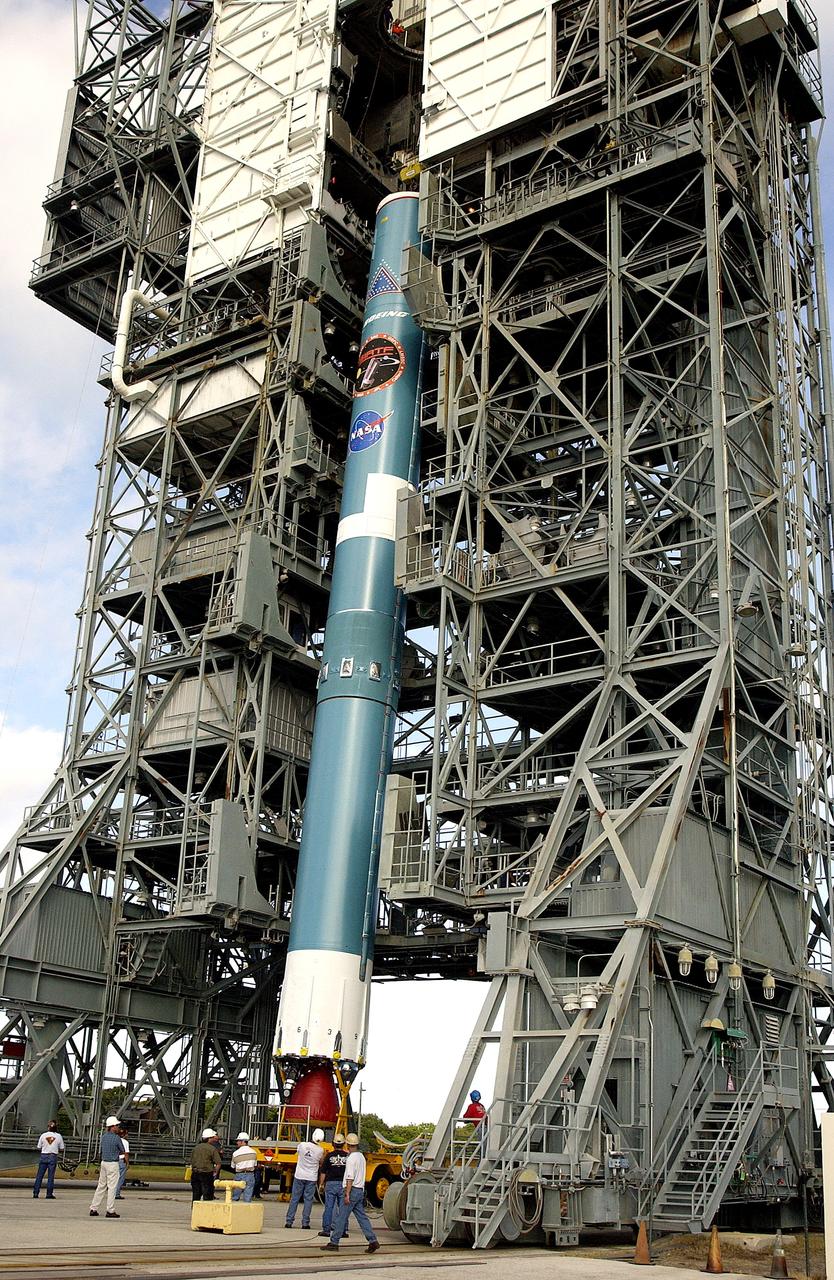
KENNEDY SPACE CENTER, FLA. -   On Launch Complex 17-B, Cape Canaveral Air Force Station, the first stage of a Delta II rocket is nearly erect for its move into the mobile service tower.  The rocket is being erected to launch the Space InfraRed Telescope Facility (SIRTF).  Consisting of an 0.85-meter telescope and three cryogenically cooled science instruments, SIRTF is one of NASA's largest infrared telescopes to be launched.  SIRTF will obtain images and spectra by detecting the infrared energy, or heat, radiated by objects in space. Most of this infrared radiation is blocked by the Earth's atmosphere and cannot be observed from the ground.
KENNEDY SPACE CENTER, FLA. - On Launch Complex 17-B, Cape Canaveral Air Force Station, the first stage of a Delta II rocket is nearly erect for its move into the mobile service tower. The rocket is being erected to launch the Space InfraRed Telescope Facility (SIRTF). Consisting of an 0.85-meter telescope and three cryogenically cooled science instruments, SIRTF is one of NASA's largest infrared telescopes to be launched. SIRTF will obtain images and spectra by detecting the infrared energy, or heat, radiated by objects in space. Most of this infrared radiation is blocked by the Earth's atmosphere and cannot be observed from the ground.
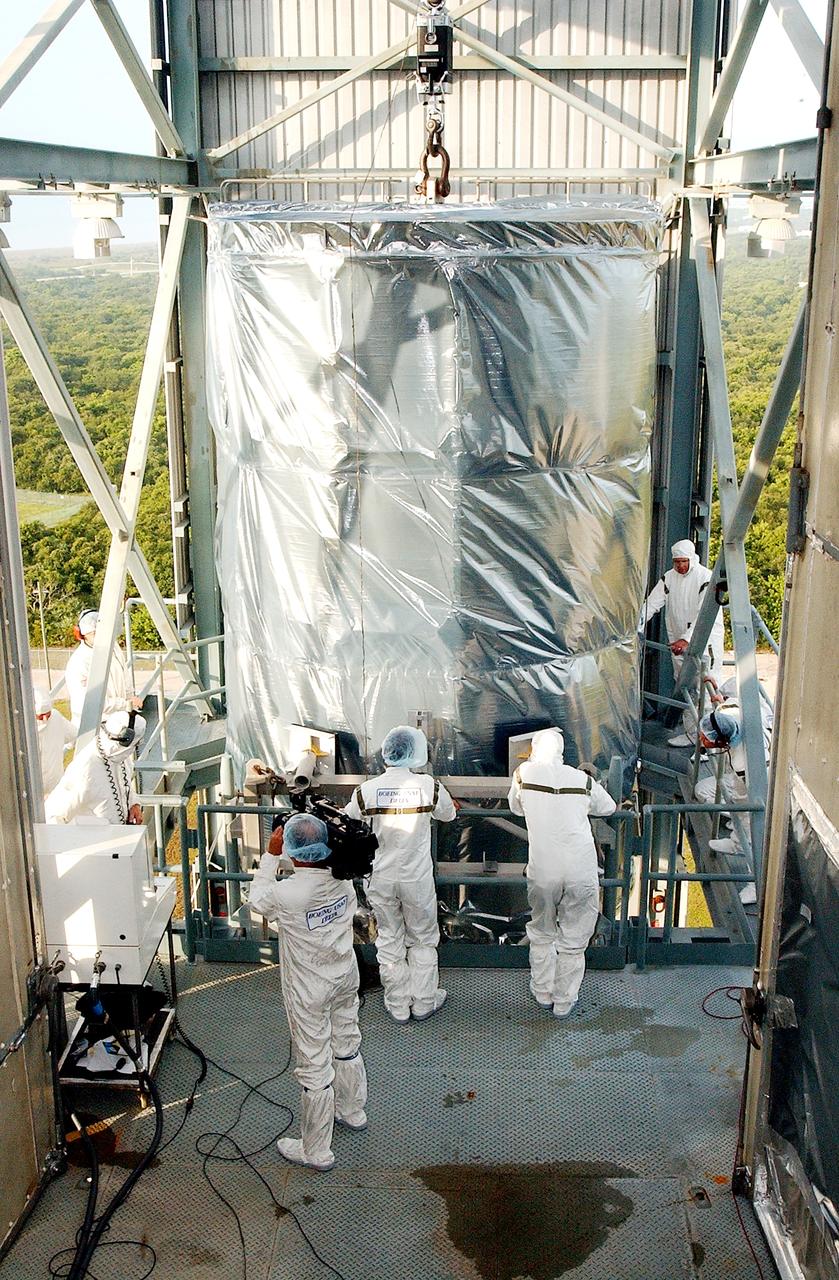
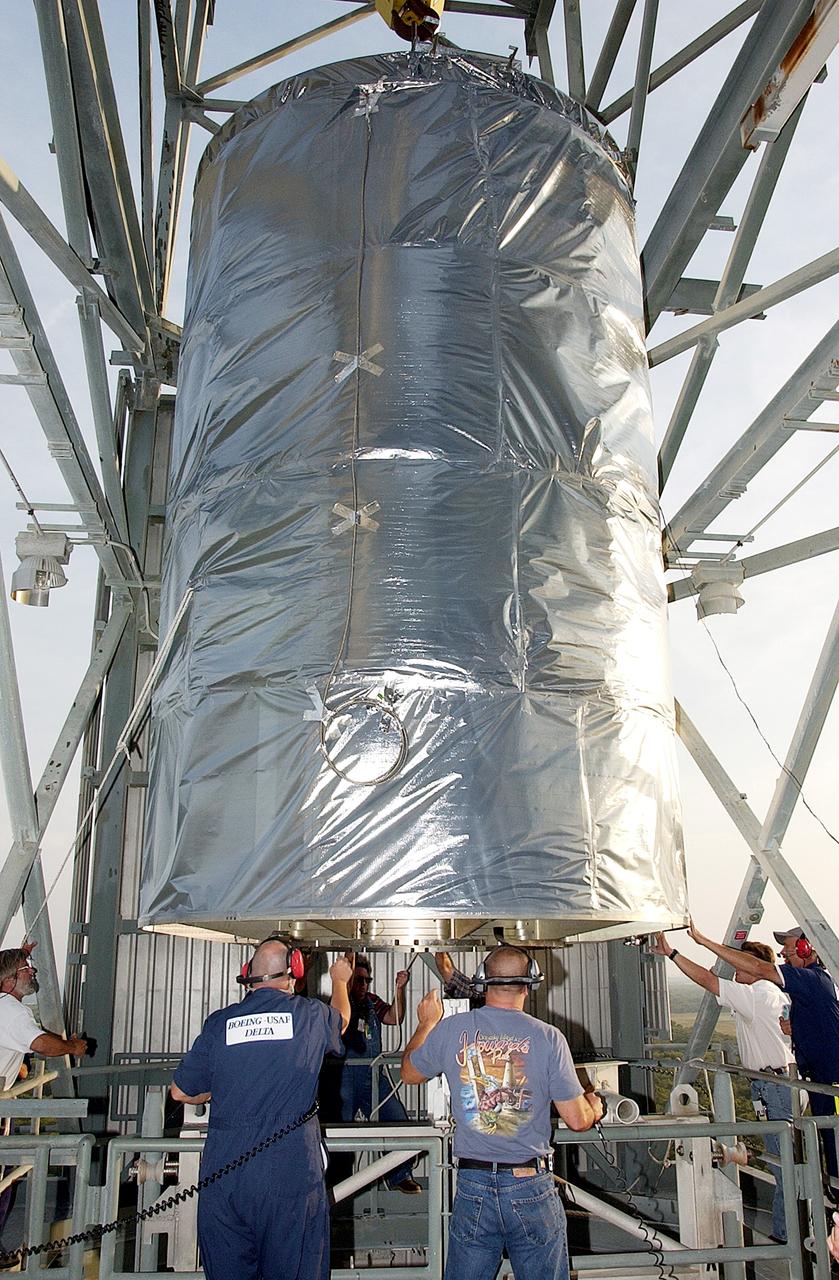
KENNEDY SPACE CENTER, FLA.  -  Workers on the mobile service tower on Launch Pad 17-B, Cape Canaveral Air Force Station, help guide the Space Infrared Telescope Facility (SIRTF) toward the opening in the foreground.  SIRTF will be attached to the Delta II rocket and encapsulated in its fairing before launch.   Consisting of three cryogenically cooled science instruments and an 0.85-meter telescope, SIRTF is one of NASA’s largest infrared telescopes to be launched.  It is the fourth and final element in NASA’s family of orbiting “Great Observatories.”  SIRTF will obtain images and spectra by detecting the infrared energy, or heat, radiated by objects in space. Most of this infrared radiation is blocked by the Earth's atmosphere and cannot be observed from the ground.
KENNEDY SPACE CENTER, FLA. - Workers on the mobile service tower on Launch Pad 17-B, Cape Canaveral Air Force Station, help guide the Space Infrared Telescope Facility (SIRTF) toward the opening in the foreground. SIRTF will be attached to the Delta II rocket and encapsulated in its fairing before launch. Consisting of three cryogenically cooled science instruments and an 0.85-meter telescope, SIRTF is one of NASA’s largest infrared telescopes to be launched. It is the fourth and final element in NASA’s family of orbiting “Great Observatories.” SIRTF will obtain images and spectra by detecting the infrared energy, or heat, radiated by objects in space. Most of this infrared radiation is blocked by the Earth's atmosphere and cannot be observed from the ground.
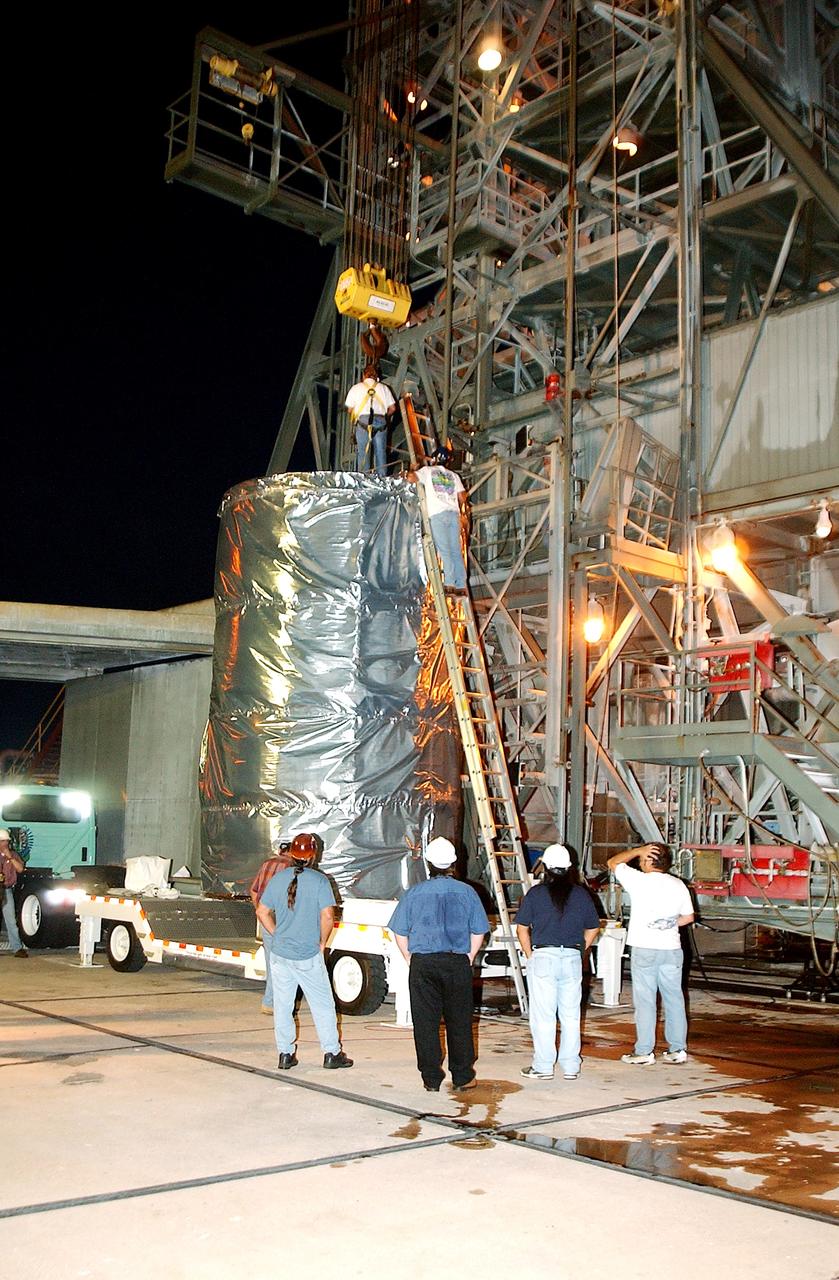
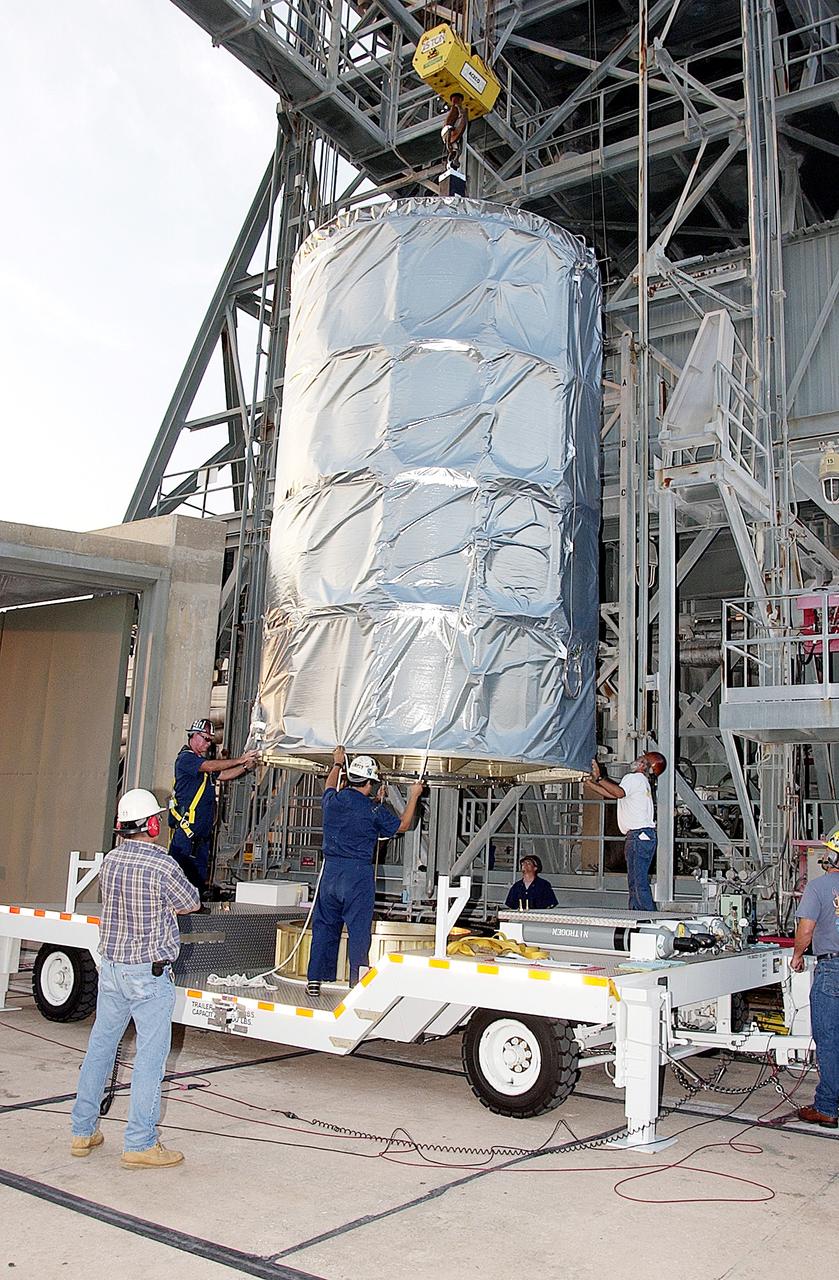
KENNEDY SPACE CENTER, FLA.  -  Before dawn, the Space Infrared Telescope Facility (SIRTF) is attached to an overhead crane that will lift it up the mobile service tower on Launch Pad 17-B, Cape Canaveral Air Force Station.  SIRTF will be attached to the Delta II rocket and encapsulated in its fairing before launch.   Consisting of three cryogenically cooled science instruments and an 0.85-meter telescope, SIRTF is one of NASA’s largest infrared telescopes to be launched.  It is the fourth and final element in NASA’s family of orbiting “Great Observatories.”  SIRTF will obtain images and spectra by detecting the infrared energy, or heat, radiated by objects in space. Most of this infrared radiation is blocked by the Earth's atmosphere and cannot be observed from the ground.
KENNEDY SPACE CENTER, FLA. - Before dawn, the Space Infrared Telescope Facility (SIRTF) is attached to an overhead crane that will lift it up the mobile service tower on Launch Pad 17-B, Cape Canaveral Air Force Station. SIRTF will be attached to the Delta II rocket and encapsulated in its fairing before launch. Consisting of three cryogenically cooled science instruments and an 0.85-meter telescope, SIRTF is one of NASA’s largest infrared telescopes to be launched. It is the fourth and final element in NASA’s family of orbiting “Great Observatories.” SIRTF will obtain images and spectra by detecting the infrared energy, or heat, radiated by objects in space. Most of this infrared radiation is blocked by the Earth's atmosphere and cannot be observed from the ground.
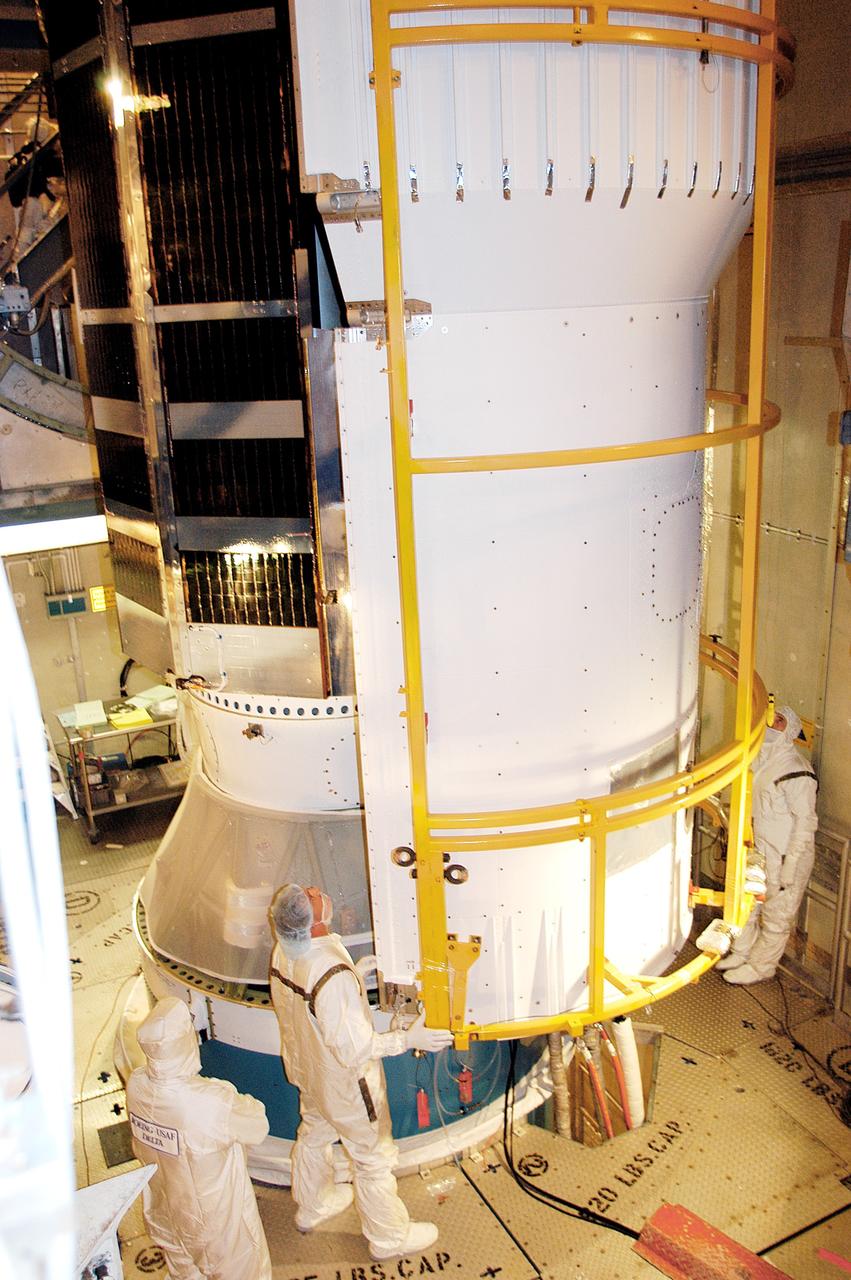
KENNEDY SPACE CENTER, FLA.  - Workers at Hangar A&E, Cape Canaveral Air Force Station, place the middle row of panels to encapsulate the Space Infrared Telescope Facility (SIRTF).  The spacecraft will be transported to Launch Complex 17-B for mating with its launch vehicle, the Delta II rocket.   SIRTF consists of three cryogenically cooled science instruments and an 0.85-meter telescope, and is one of NASA's largest infrared telescopes to be launched.  SIRTF will obtain images and spectra by detecting the infrared energy, or heat, radiated by objects in space. Most of this infrared radiation is blocked by the Earth's atmosphere and cannot be observed from the ground.
KENNEDY SPACE CENTER, FLA. - Workers at Hangar A&E, Cape Canaveral Air Force Station, place the middle row of panels to encapsulate the Space Infrared Telescope Facility (SIRTF). The spacecraft will be transported to Launch Complex 17-B for mating with its launch vehicle, the Delta II rocket. SIRTF consists of three cryogenically cooled science instruments and an 0.85-meter telescope, and is one of NASA's largest infrared telescopes to be launched. SIRTF will obtain images and spectra by detecting the infrared energy, or heat, radiated by objects in space. Most of this infrared radiation is blocked by the Earth's atmosphere and cannot be observed from the ground.
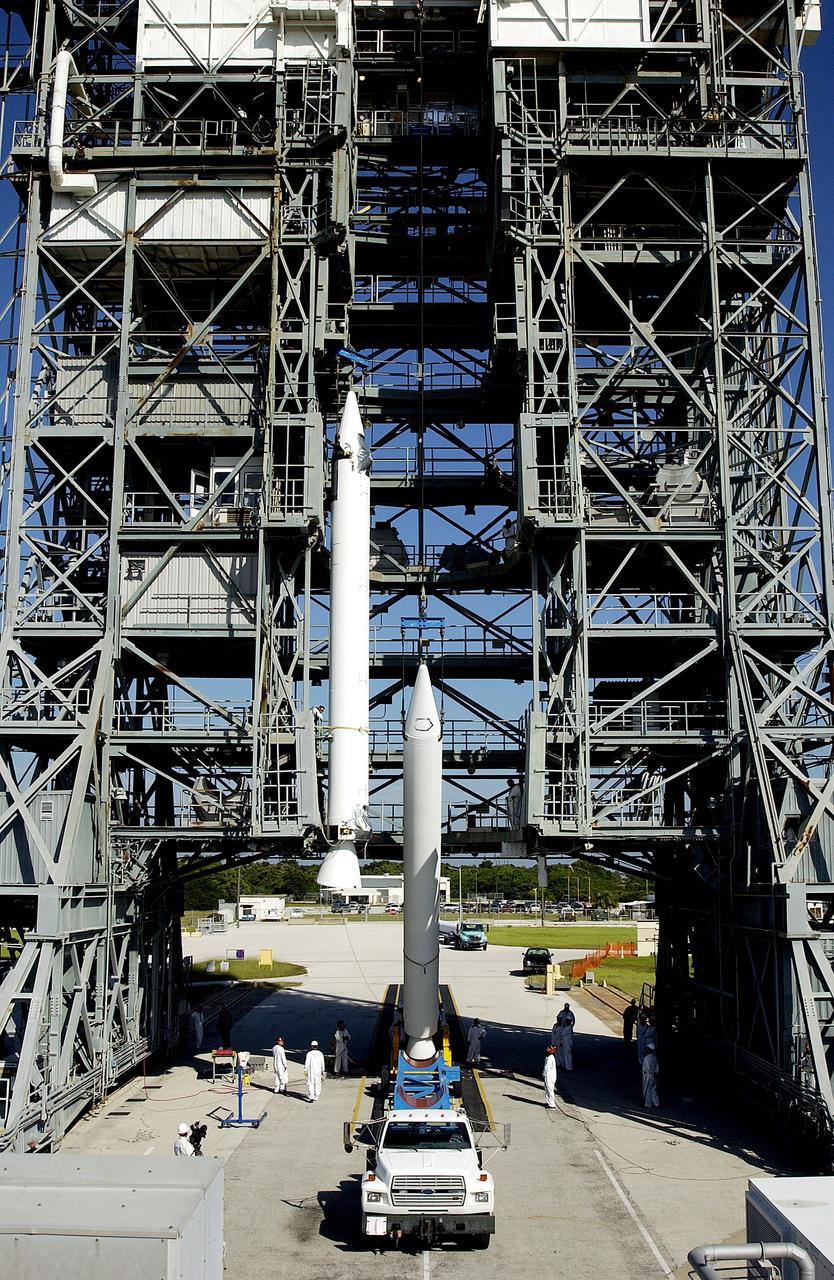
KENNEDY SPACE CENTER, FLA. -  On Launch Complex 17-B, Cape Canaveral Air Force Station, the first stage of a Delta II rocket is lifted up the mobile service tower.  Below the rocket is the flame trench, and in the foreground is the overflow pool.  The rocket is being erected to launch the Space InfraRed Telescope Facility (SIRTF).  Consisting of an 0.85-meter telescope and three cryogenically cooled science instruments, SIRTF is one of NASA's largest infrared telescopes to be launched.  SIRTF will obtain images and spectra by detecting the infrared energy, or heat, radiated by objects in space. Most of this infrared radiation is blocked by the Earth's atmosphere and cannot be observed from the ground.
KENNEDY SPACE CENTER, FLA. - On Launch Complex 17-B, Cape Canaveral Air Force Station, the first stage of a Delta II rocket is lifted up the mobile service tower. Below the rocket is the flame trench, and in the foreground is the overflow pool. The rocket is being erected to launch the Space InfraRed Telescope Facility (SIRTF). Consisting of an 0.85-meter telescope and three cryogenically cooled science instruments, SIRTF is one of NASA's largest infrared telescopes to be launched. SIRTF will obtain images and spectra by detecting the infrared energy, or heat, radiated by objects in space. Most of this infrared radiation is blocked by the Earth's atmosphere and cannot be observed from the ground.
KENNEDY SPACE CENTER, FLA. -  On Launch Complex 17-B, Cape Canaveral Air Force Station, the first stage of a Delta II rocket is lifted up the mobile service tower.  In the background is pad 17-A.   The rocket is being erected to launch the Space InfraRed Telescope Facility (SIRTF).  Consisting of an 0.85-meter telescope and three cryogenically cooled science instruments, SIRTF is one of NASA's largest infrared telescopes to be launched.  SIRTF will obtain images and spectra by detecting the infrared energy, or heat, radiated by objects in space. Most of this infrared radiation is blocked by the Earth's atmosphere and cannot be observed from the ground.
KENNEDY SPACE CENTER, FLA. - On Launch Complex 17-B, Cape Canaveral Air Force Station, the first stage of a Delta II rocket is lifted up the mobile service tower. In the background is pad 17-A. The rocket is being erected to launch the Space InfraRed Telescope Facility (SIRTF). Consisting of an 0.85-meter telescope and three cryogenically cooled science instruments, SIRTF is one of NASA's largest infrared telescopes to be launched. SIRTF will obtain images and spectra by detecting the infrared energy, or heat, radiated by objects in space. Most of this infrared radiation is blocked by the Earth's atmosphere and cannot be observed from the ground.
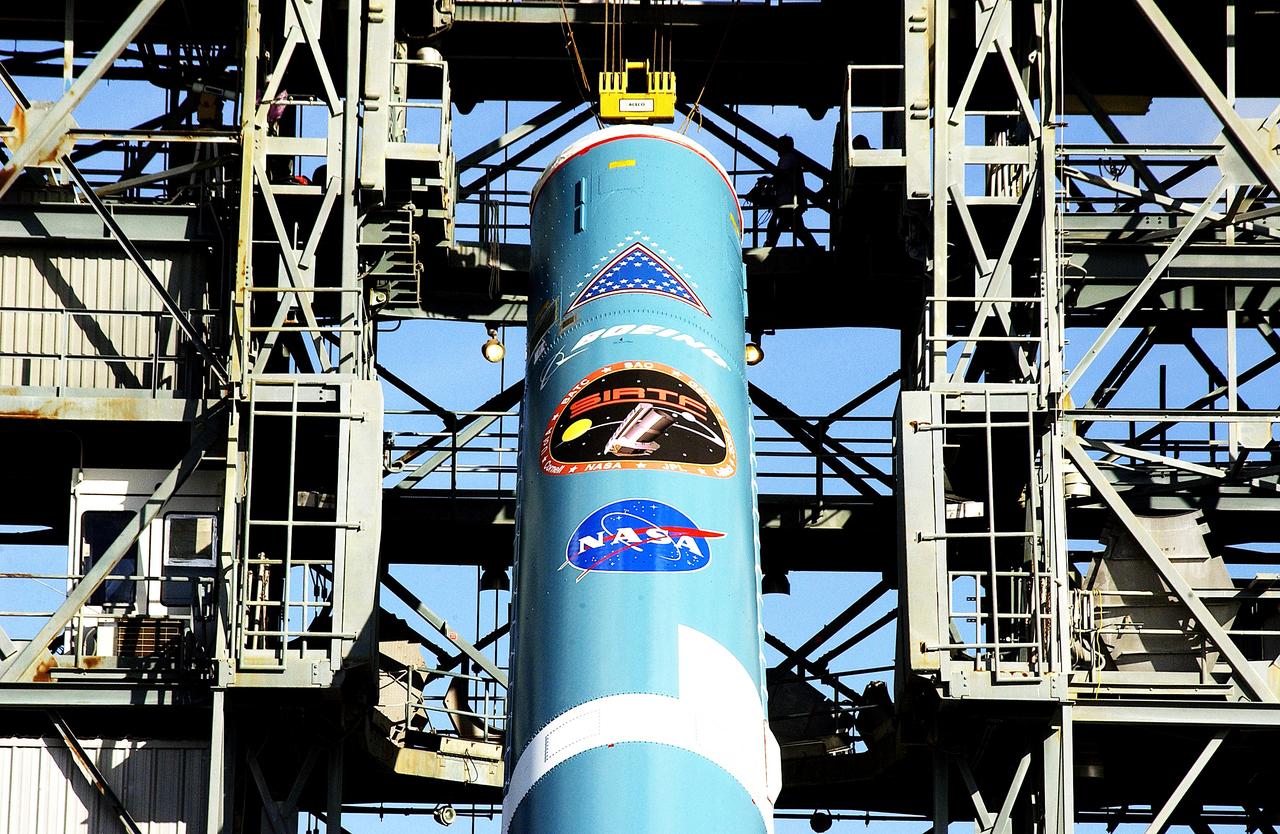
KENNEDY SPACE CENTER, FLA. -   On Launch Complex 17-B, Cape Canaveral Air Force Station, a solid rocket booster (SRB) is lifted into the mobile service tower, joining two others.  They are three of nine  46-inch-diameter, stretched SRBs that are being attached to the Delta II Heavy rocket that will launch the Space Infrared Telescope Facility (SIRTF).  Consisting of three cryogenically cooled science instruments and an 0.85-meter telescope, SIRTF is one of NASA's largest infrared telescopes to be launched.  SIRTF will obtain images and spectra by detecting the infrared energy, or heat, radiated by objects in space. Most of this infrared radiation is blocked by the Earth's atmosphere and cannot be observed from the ground.
KENNEDY SPACE CENTER, FLA. - On Launch Complex 17-B, Cape Canaveral Air Force Station, a solid rocket booster (SRB) is lifted into the mobile service tower, joining two others. They are three of nine 46-inch-diameter, stretched SRBs that are being attached to the Delta II Heavy rocket that will launch the Space Infrared Telescope Facility (SIRTF). Consisting of three cryogenically cooled science instruments and an 0.85-meter telescope, SIRTF is one of NASA's largest infrared telescopes to be launched. SIRTF will obtain images and spectra by detecting the infrared energy, or heat, radiated by objects in space. Most of this infrared radiation is blocked by the Earth's atmosphere and cannot be observed from the ground.
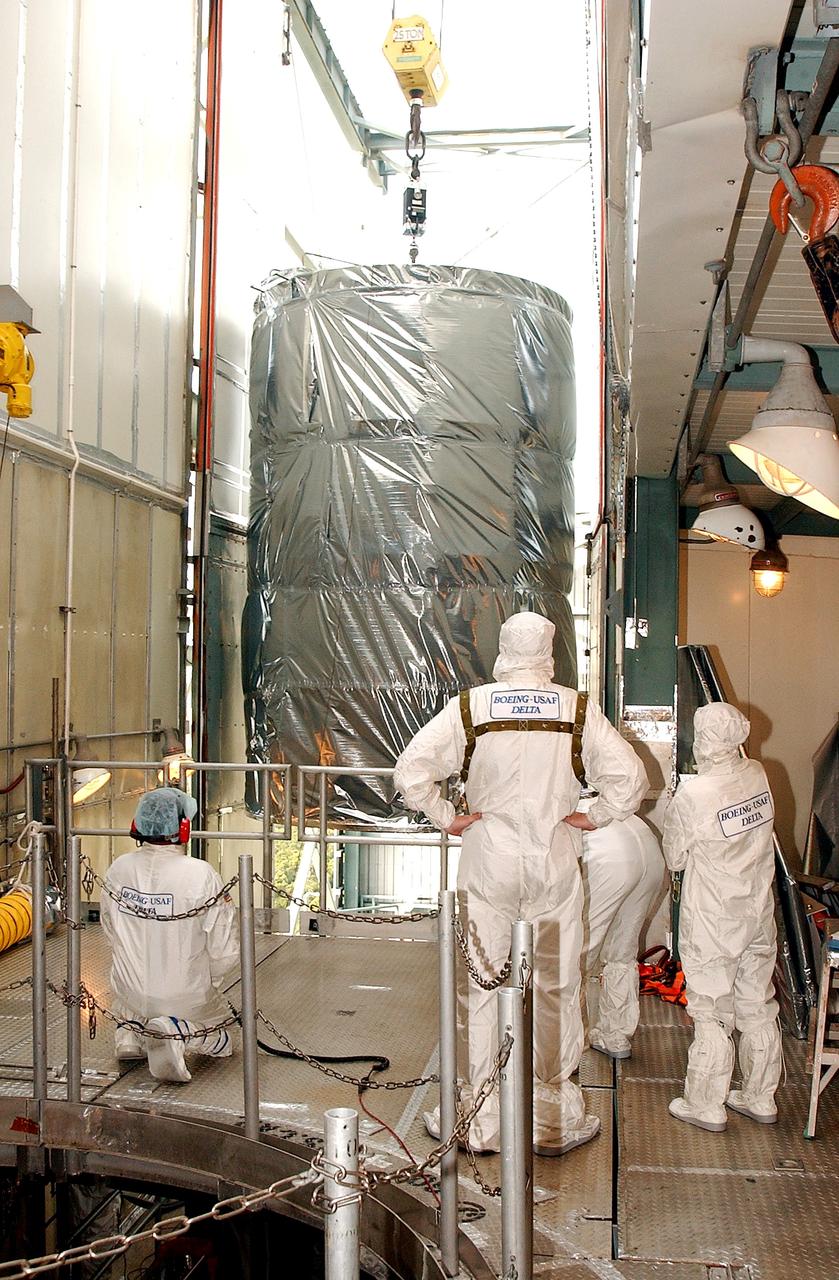
KENNEDY SPACE CENTER, FLA.  -  The Space Infrared Telescope Facility (SIRTF) is lowered into the opening of the mobile service tower on Launch Pad 17-B, Cape Canaveral Air Force Station.  SIRTF will be attached to the Delta II rocket and encapsulated in its fairing before launch.   Consisting of three cryogenically cooled science instruments and an 0.85-meter telescope, SIRTF is one of NASA’s largest infrared telescopes to be launched.  It is the fourth and final element in NASA’s family of orbiting “Great Observatories.”  SIRTF will obtain images and spectra by detecting the infrared energy, or heat, radiated by objects in space. Most of this infrared radiation is blocked by the Earth's atmosphere and cannot be observed from the ground.
KENNEDY SPACE CENTER, FLA. - The Space Infrared Telescope Facility (SIRTF) is lowered into the opening of the mobile service tower on Launch Pad 17-B, Cape Canaveral Air Force Station. SIRTF will be attached to the Delta II rocket and encapsulated in its fairing before launch. Consisting of three cryogenically cooled science instruments and an 0.85-meter telescope, SIRTF is one of NASA’s largest infrared telescopes to be launched. It is the fourth and final element in NASA’s family of orbiting “Great Observatories.” SIRTF will obtain images and spectra by detecting the infrared energy, or heat, radiated by objects in space. Most of this infrared radiation is blocked by the Earth's atmosphere and cannot be observed from the ground.
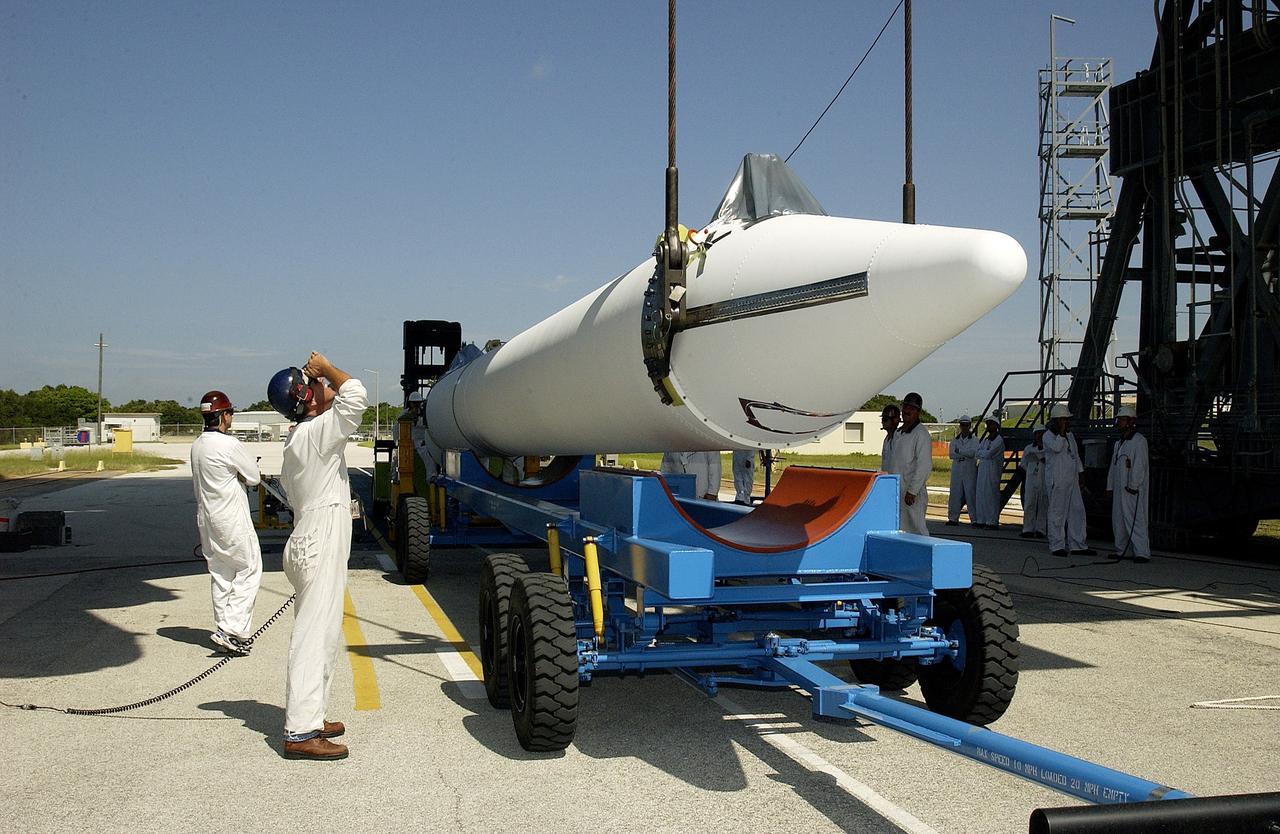
KENNEDY SPACE CENTER, FLA. -   On Launch Complex 17-B, Cape Canaveral Air Force Station, another solid rocket booster (SRB) is being raised from its transporter to lift it to vertical.  It is one of nine  46-inch-diameter, stretched SRBs that are being attached to the Delta II Heavy rocket that will launch the Space Infrared Telescope Facility (SIRTF).  Consisting of three cryogenically cooled science instruments and an 0.85-meter telescope, SIRTF is one of NASA's largest infrared telescopes to be launched.  SIRTF will obtain images and spectra by detecting the infrared energy, or heat, radiated by objects in space. Most of this infrared radiation is blocked by the Earth's atmosphere and cannot be observed from the ground.
KENNEDY SPACE CENTER, FLA. - On Launch Complex 17-B, Cape Canaveral Air Force Station, another solid rocket booster (SRB) is being raised from its transporter to lift it to vertical. It is one of nine 46-inch-diameter, stretched SRBs that are being attached to the Delta II Heavy rocket that will launch the Space Infrared Telescope Facility (SIRTF). Consisting of three cryogenically cooled science instruments and an 0.85-meter telescope, SIRTF is one of NASA's largest infrared telescopes to be launched. SIRTF will obtain images and spectra by detecting the infrared energy, or heat, radiated by objects in space. Most of this infrared radiation is blocked by the Earth's atmosphere and cannot be observed from the ground.
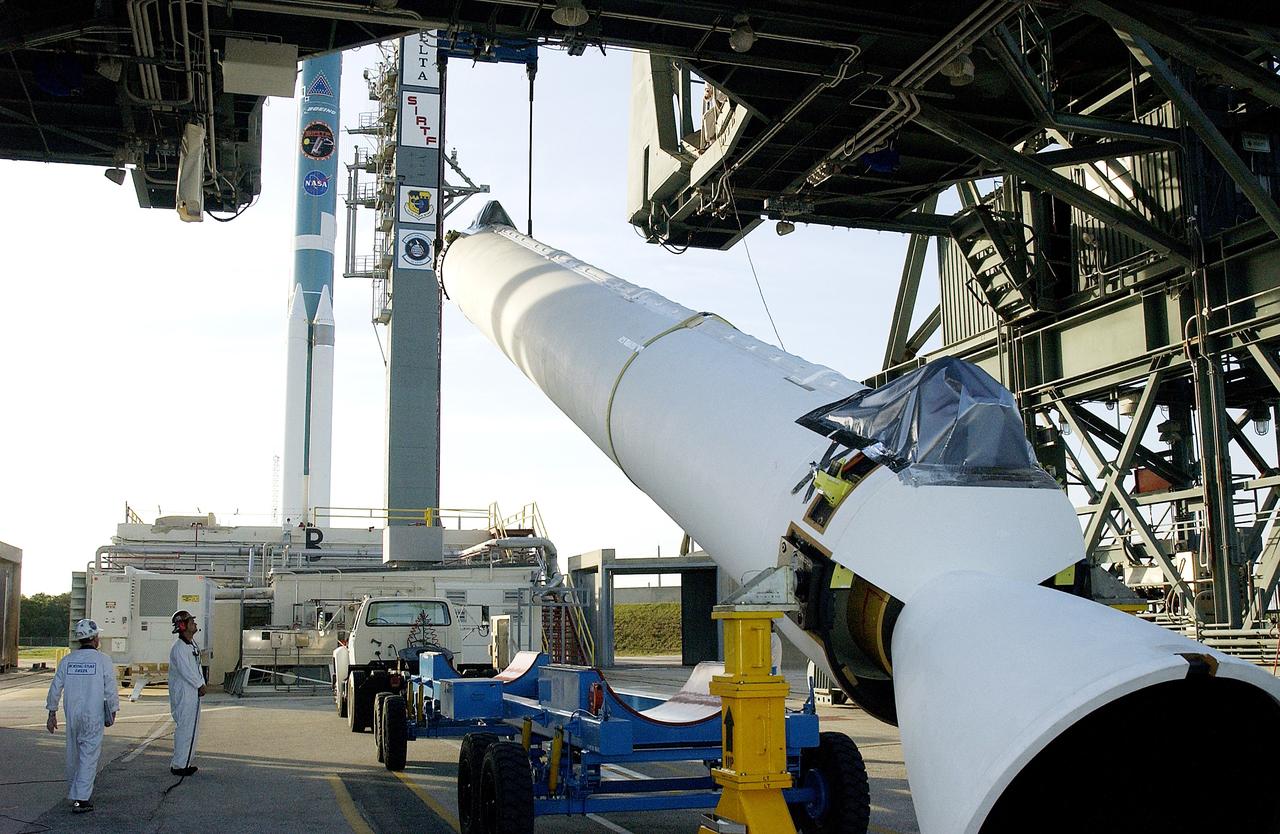
KENNEDY SPACE CENTER, FLA. -   A solid rocket booster (SRB) for the Delta II Heavy rocket that will launch the Space Infrared Telescope Facility (SIRTF) is lifted off its transporter on Launch Complex 17-B, Cape Canaveral Air Force Station.  The SRB will be added to the launch vehicle in the background.  The Delta II Heavy features nine 46-inch-diameter, stretched SRBs.  SIRTF, consisting of three cryogenically cooled science instruments and an 0.85-meter telescope, is one of NASA's largest infrared telescopes to be launched.  SIRTF will obtain images and spectra by detecting the infrared energy, or heat, radiated by objects in space. Most of this infrared radiation is blocked by the Earth's atmosphere and cannot be observed from the ground.
KENNEDY SPACE CENTER, FLA. - A solid rocket booster (SRB) for the Delta II Heavy rocket that will launch the Space Infrared Telescope Facility (SIRTF) is lifted off its transporter on Launch Complex 17-B, Cape Canaveral Air Force Station. The SRB will be added to the launch vehicle in the background. The Delta II Heavy features nine 46-inch-diameter, stretched SRBs. SIRTF, consisting of three cryogenically cooled science instruments and an 0.85-meter telescope, is one of NASA's largest infrared telescopes to be launched. SIRTF will obtain images and spectra by detecting the infrared energy, or heat, radiated by objects in space. Most of this infrared radiation is blocked by the Earth's atmosphere and cannot be observed from the ground.
KENNEDY SPACE CENTER, FLA.  - A worker at Hangar A&E, Cape Canaveral Air Force Station, tightens the canister around the Space Infrared Telescope Facility (SIRTF).  The spacecraft will be transported to Launch Complex 17-B for mating with its launch vehicle, the Delta II rocket.   SIRTF consists of three cryogenically cooled science instruments and an 0.85-meter telescope, and is one of NASA's largest infrared telescopes to be launched.  SIRTF will obtain images and spectra by detecting the infrared energy, or heat, radiated by objects in space. Most of this infrared radiation is blocked by the Earth's atmosphere and cannot be observed from the ground.
KENNEDY SPACE CENTER, FLA. - A worker at Hangar A&E, Cape Canaveral Air Force Station, tightens the canister around the Space Infrared Telescope Facility (SIRTF). The spacecraft will be transported to Launch Complex 17-B for mating with its launch vehicle, the Delta II rocket. SIRTF consists of three cryogenically cooled science instruments and an 0.85-meter telescope, and is one of NASA's largest infrared telescopes to be launched. SIRTF will obtain images and spectra by detecting the infrared energy, or heat, radiated by objects in space. Most of this infrared radiation is blocked by the Earth's atmosphere and cannot be observed from the ground.
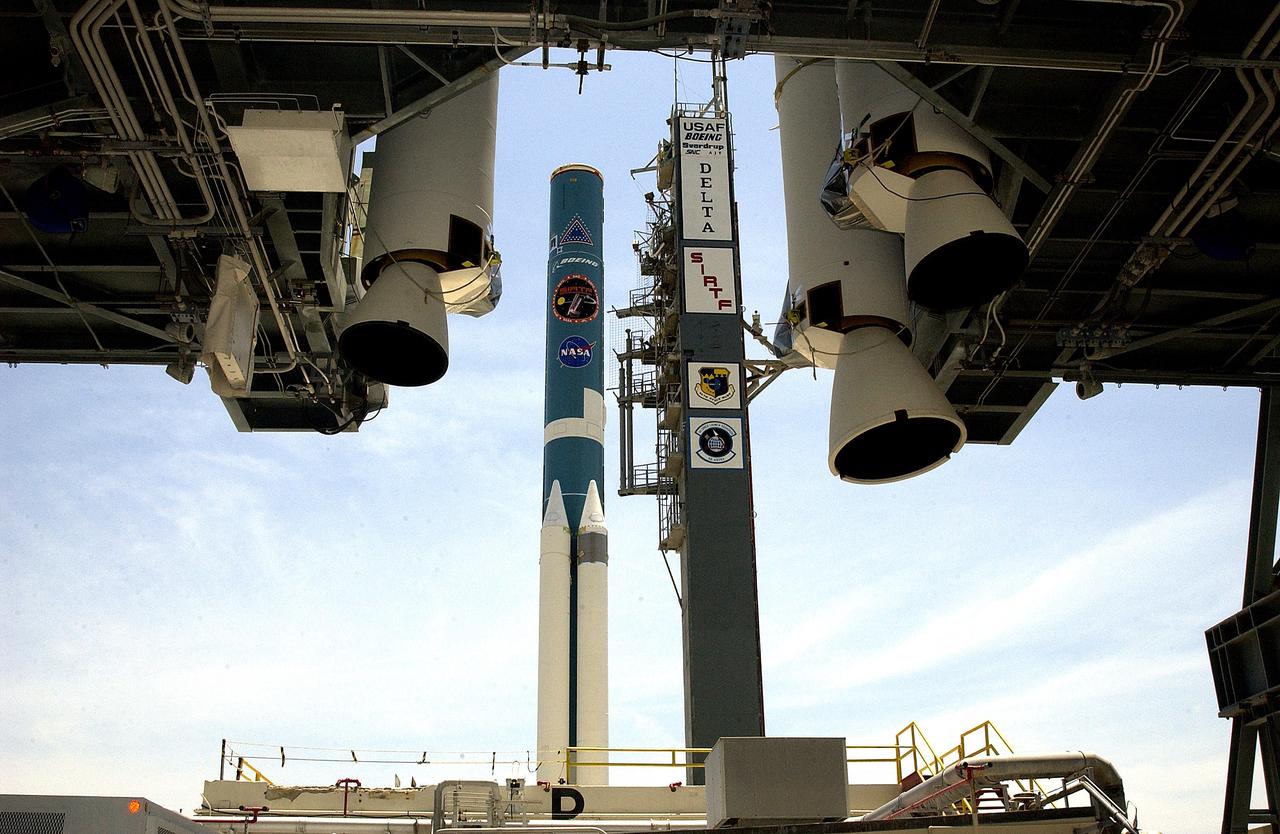
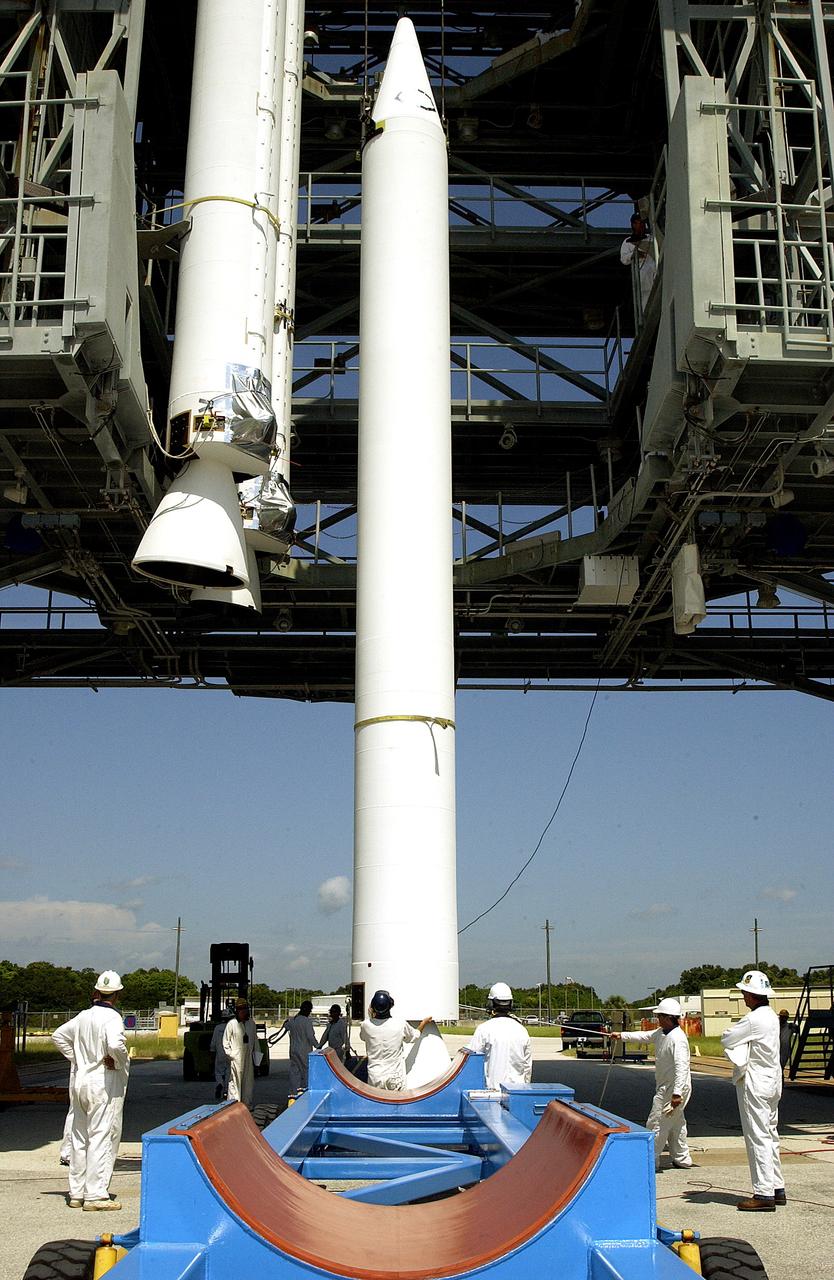
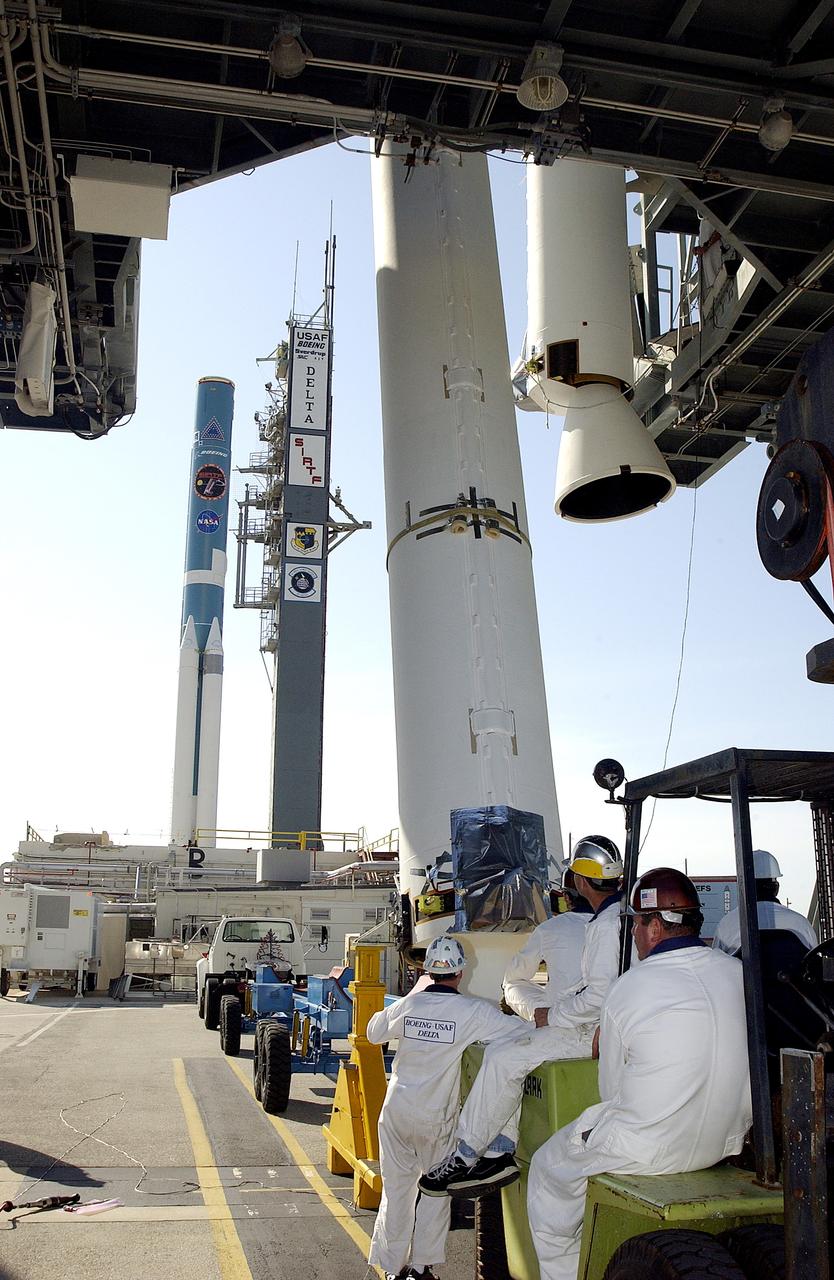
KENNEDY SPACE CENTER, FLA. -   On Launch Complex 17-B, Cape Canaveral Air Force Station, the Delta II Heavy rocket  (background) is framed by the solid rocket boosters (foreground) suspended in the mobile service tower.  The SRBs will be added to those already attached to the rocket.  The Delta II Heavy will launch the Space Infrared Telescope Facility (SIRTF).  Consisting of three cryogenically cooled science instruments and an 0.85-meter telescope, SIRTF is one of NASA's largest infrared telescopes to be launched.  SIRTF will obtain images and spectra by detecting the infrared energy, or heat, radiated by objects in space. Most of this infrared radiation is blocked by the Earth's atmosphere and cannot be observed from the ground.
KENNEDY SPACE CENTER, FLA. - On Launch Complex 17-B, Cape Canaveral Air Force Station, the Delta II Heavy rocket (background) is framed by the solid rocket boosters (foreground) suspended in the mobile service tower. The SRBs will be added to those already attached to the rocket. The Delta II Heavy will launch the Space Infrared Telescope Facility (SIRTF). Consisting of three cryogenically cooled science instruments and an 0.85-meter telescope, SIRTF is one of NASA's largest infrared telescopes to be launched. SIRTF will obtain images and spectra by detecting the infrared energy, or heat, radiated by objects in space. Most of this infrared radiation is blocked by the Earth's atmosphere and cannot be observed from the ground.
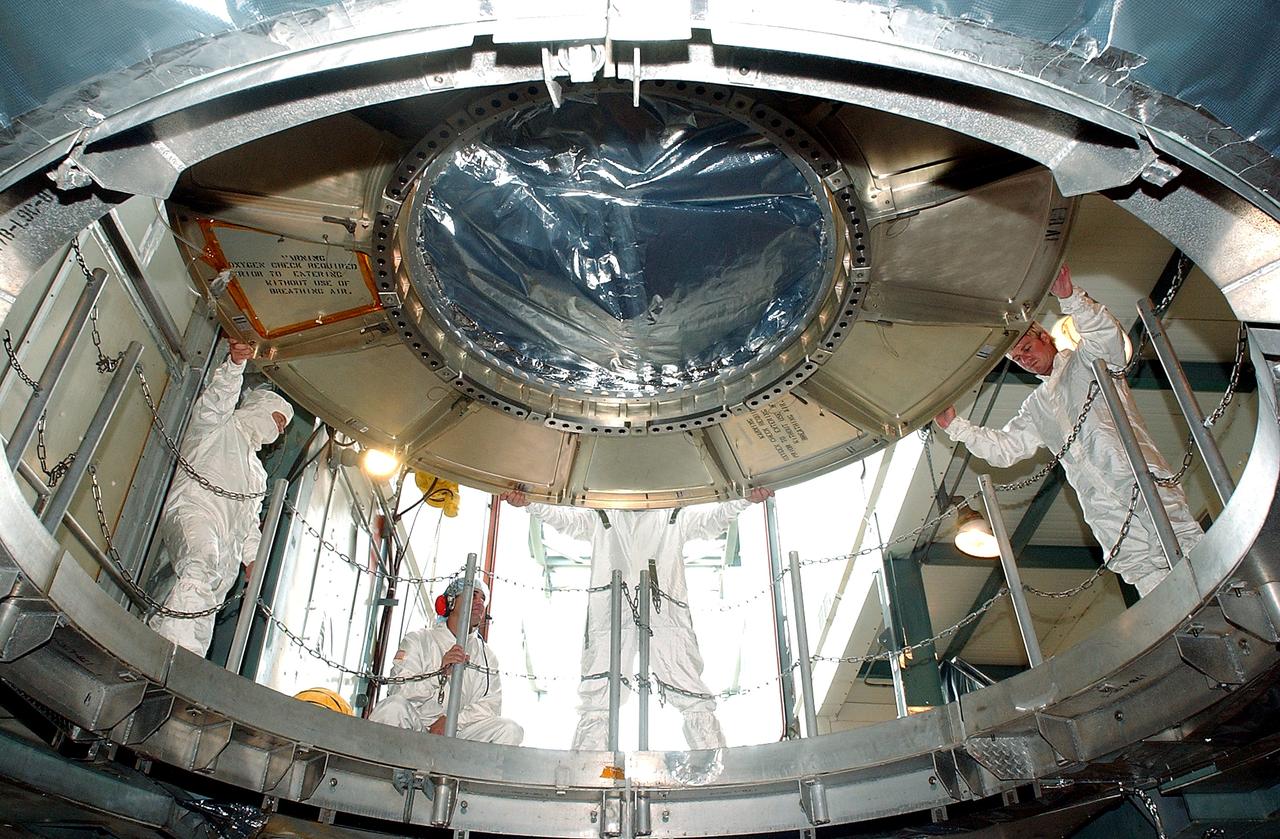
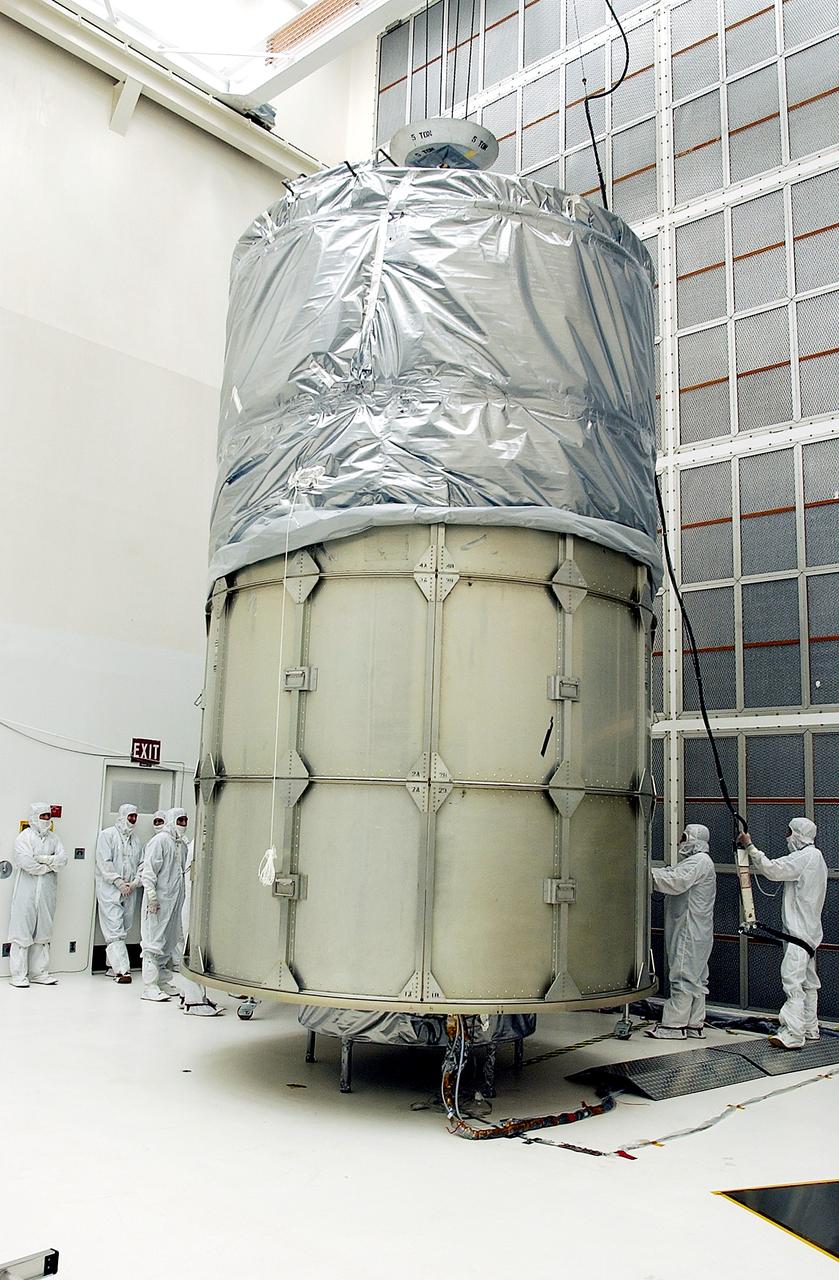
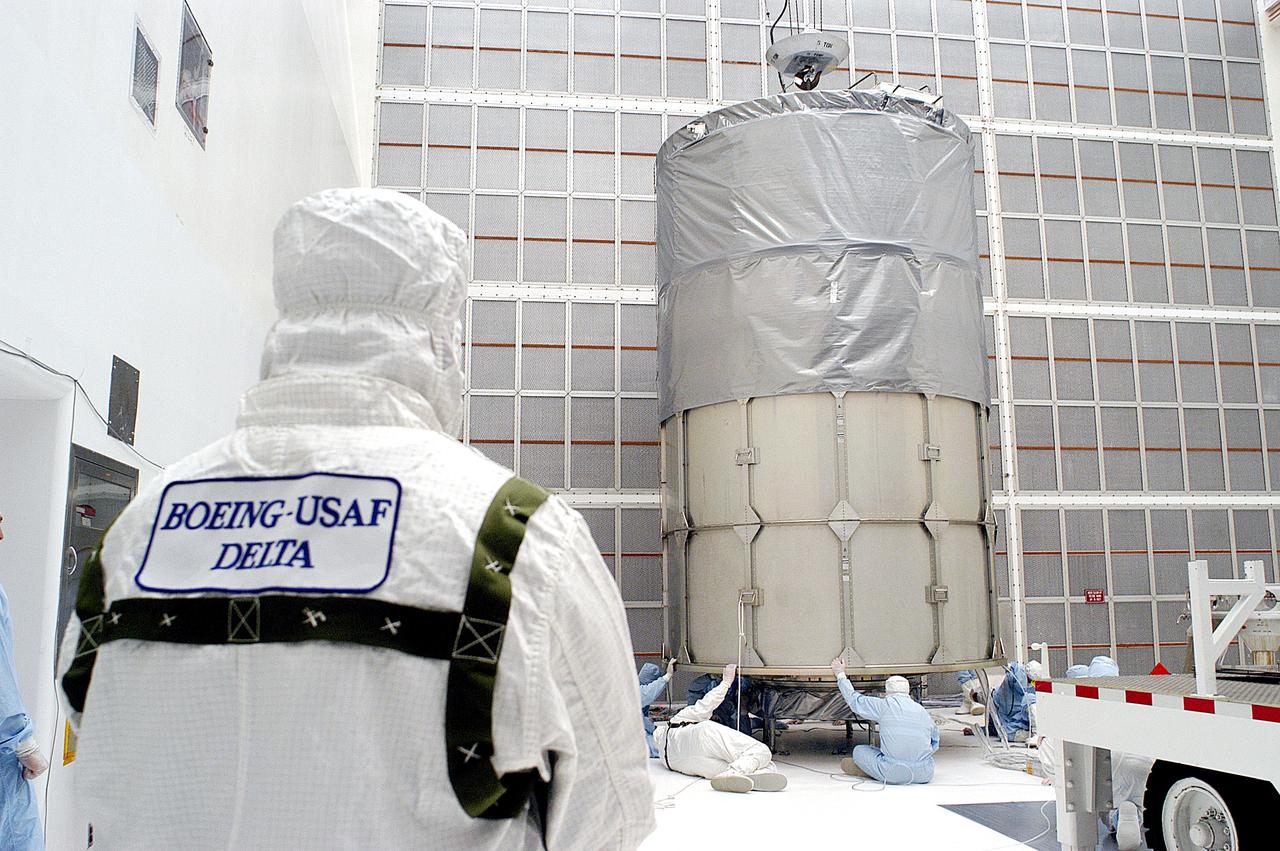
KENNEDY SPACE CENTER, FLA.  -  In Hangar A&E, Cape Canaveral Air Force Station, the upper canister is mated to the middle panels around the Space Infrared Telescope Facility (SIRTF).  The spacecraft will be transported to Launch Complex 17-B for mating with its launch vehicle, the Delta II rocket.   SIRTF consists of three cryogenically cooled science instruments and an 0.85-meter telescope, and is one of NASA's largest infrared telescopes to be launched.  SIRTF will obtain images and spectra by detecting the infrared energy, or heat, radiated by objects in space. Most of this infrared radiation is blocked by the Earth's atmosphere and cannot be observed from the ground.
KENNEDY SPACE CENTER, FLA. - In Hangar A&E, Cape Canaveral Air Force Station, the upper canister is mated to the middle panels around the Space Infrared Telescope Facility (SIRTF). The spacecraft will be transported to Launch Complex 17-B for mating with its launch vehicle, the Delta II rocket. SIRTF consists of three cryogenically cooled science instruments and an 0.85-meter telescope, and is one of NASA's largest infrared telescopes to be launched. SIRTF will obtain images and spectra by detecting the infrared energy, or heat, radiated by objects in space. Most of this infrared radiation is blocked by the Earth's atmosphere and cannot be observed from the ground.
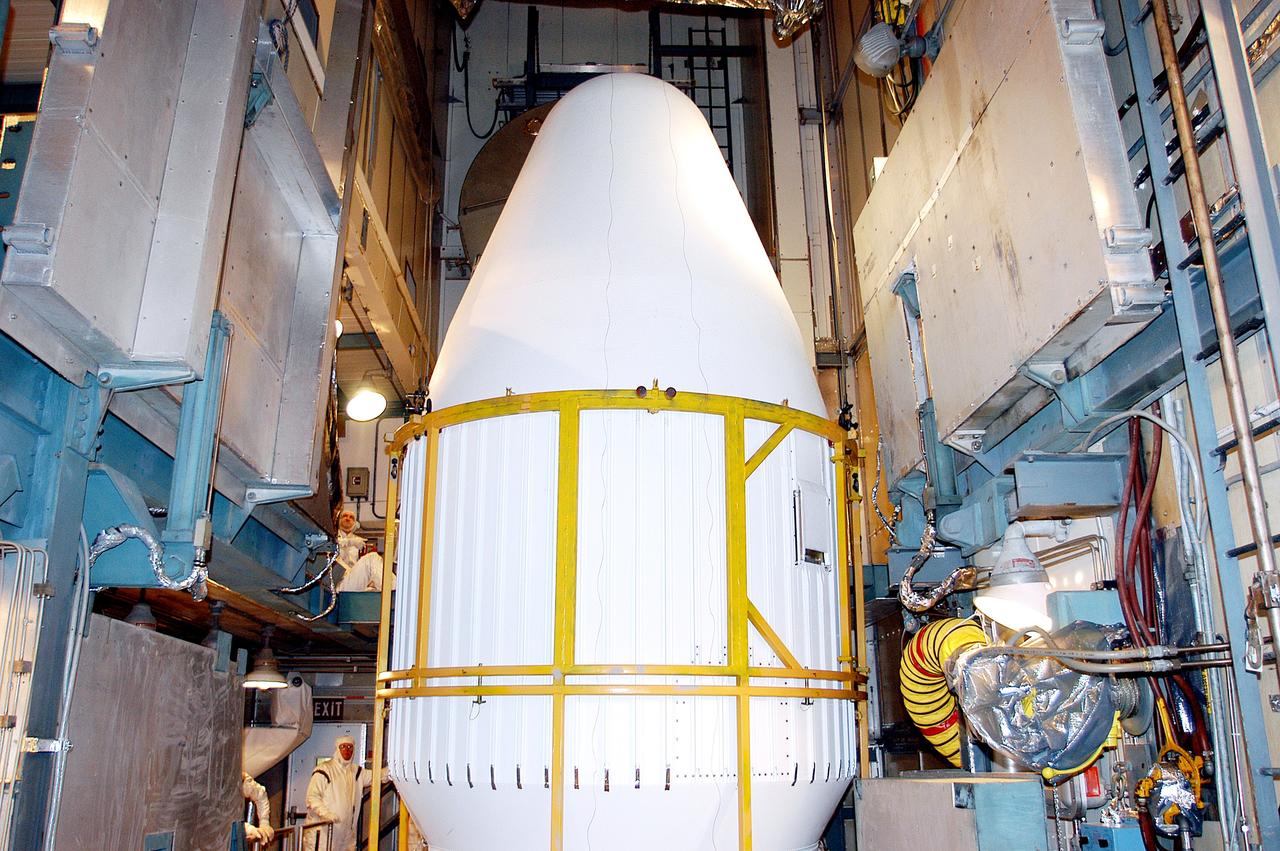
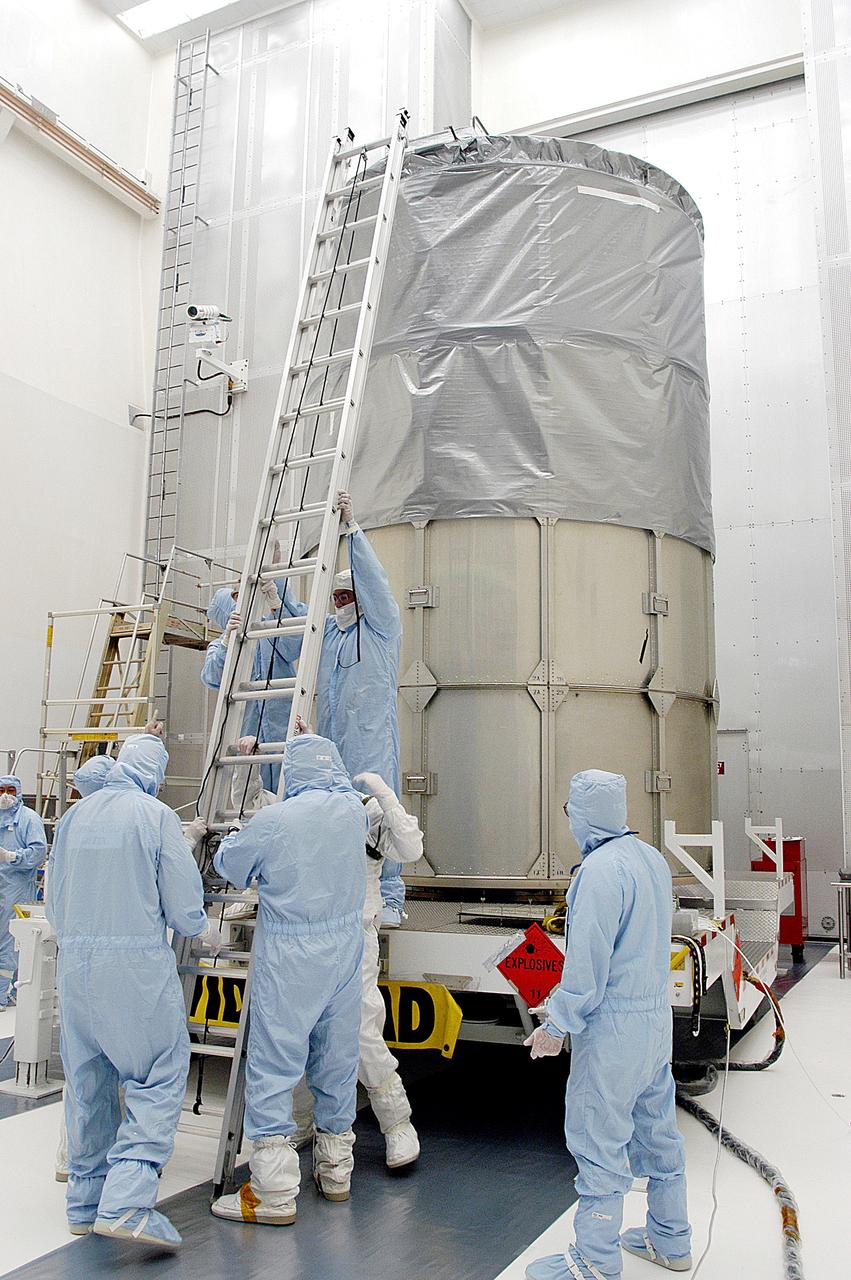
KENNEDY SPACE CENTER, FLA.  -  In Hangar A&E, Cape Canaveral Air Force Station, encapsulation of the Space Infrared Telescope Facility (SIRTF) is complete.  The spacecraft will be transported to Launch Complex 17-B for mating with its launch vehicle, the Delta II rocket.   SIRTF consists of three cryogenically cooled science instruments and an 0.85-meter telescope, and is one of NASA's largest infrared telescopes to be launched.  SIRTF will obtain images and spectra by detecting the infrared energy, or heat, radiated by objects in space. Most of this infrared radiation is blocked by the Earth's atmosphere and cannot be observed from the ground.
KENNEDY SPACE CENTER, FLA. - In Hangar A&E, Cape Canaveral Air Force Station, encapsulation of the Space Infrared Telescope Facility (SIRTF) is complete. The spacecraft will be transported to Launch Complex 17-B for mating with its launch vehicle, the Delta II rocket. SIRTF consists of three cryogenically cooled science instruments and an 0.85-meter telescope, and is one of NASA's largest infrared telescopes to be launched. SIRTF will obtain images and spectra by detecting the infrared energy, or heat, radiated by objects in space. Most of this infrared radiation is blocked by the Earth's atmosphere and cannot be observed from the ground.
KENNEDY SPACE CENTER, FLA.  -  Workers on the mobile service tower on Launch Pad 17-B, Cape Canaveral Air Force Station, watch as the Space Infrared Telescope Facility (SIRTF) clears the platform.   SIRTF will be attached to the Delta II rocket and encapsulated in its fairing before launch.   Consisting of three cryogenically cooled science instruments and an 0.85-meter telescope, SIRTF is one of NASA’s largest infrared telescopes to be launched.  It is the fourth and final element in NASA’s family of orbiting “Great Observatories.”  SIRTF will obtain images and spectra by detecting the infrared energy, or heat, radiated by objects in space. Most of this infrared radiation is blocked by the Earth's atmosphere and cannot be observed from the ground.
KENNEDY SPACE CENTER, FLA. - Workers on the mobile service tower on Launch Pad 17-B, Cape Canaveral Air Force Station, watch as the Space Infrared Telescope Facility (SIRTF) clears the platform. SIRTF will be attached to the Delta II rocket and encapsulated in its fairing before launch. Consisting of three cryogenically cooled science instruments and an 0.85-meter telescope, SIRTF is one of NASA’s largest infrared telescopes to be launched. It is the fourth and final element in NASA’s family of orbiting “Great Observatories.” SIRTF will obtain images and spectra by detecting the infrared energy, or heat, radiated by objects in space. Most of this infrared radiation is blocked by the Earth's atmosphere and cannot be observed from the ground.
KENNEDY SPACE CENTER, FLA. -   On Launch Complex 17-B, Cape Canaveral Air Force Station, the first stage of a Delta II rocket is moved into the mobile service tower.  The rocket is being erected to launch the Space InfraRed Telescope Facility (SIRTF).  Consisting of an 0.85-meter telescope and three cryogenically cooled science instruments, SIRTF is one of NASA's largest infrared telescopes to be launched.  SIRTF will obtain images and spectra by detecting the infrared energy, or heat, radiated by objects in space. Most of this infrared radiation is blocked by the Earth's atmosphere and cannot be observed from the ground.
KENNEDY SPACE CENTER, FLA. - On Launch Complex 17-B, Cape Canaveral Air Force Station, the first stage of a Delta II rocket is moved into the mobile service tower. The rocket is being erected to launch the Space InfraRed Telescope Facility (SIRTF). Consisting of an 0.85-meter telescope and three cryogenically cooled science instruments, SIRTF is one of NASA's largest infrared telescopes to be launched. SIRTF will obtain images and spectra by detecting the infrared energy, or heat, radiated by objects in space. Most of this infrared radiation is blocked by the Earth's atmosphere and cannot be observed from the ground.
KENNEDY SPACE CENTER, FLA. -   On Launch Complex 17-B, Cape Canaveral Air Force Station, the first stage of a Delta II rocket arrives at the pad.  The rocket is being erected to launch the Space InfraRed Telescope Facility (SIRTF).  Consisting of an 0.85-meter telescope and three cryogenically cooled science instruments, SIRTF is one of NASA's largest infrared telescopes to be launched.  SIRTF will obtain images and spectra by detecting the infrared energy, or heat, radiated by objects in space. Most of this infrared radiation is blocked by the Earth's atmosphere and cannot be observed from the ground.
KENNEDY SPACE CENTER, FLA. - On Launch Complex 17-B, Cape Canaveral Air Force Station, the first stage of a Delta II rocket arrives at the pad. The rocket is being erected to launch the Space InfraRed Telescope Facility (SIRTF). Consisting of an 0.85-meter telescope and three cryogenically cooled science instruments, SIRTF is one of NASA's largest infrared telescopes to be launched. SIRTF will obtain images and spectra by detecting the infrared energy, or heat, radiated by objects in space. Most of this infrared radiation is blocked by the Earth's atmosphere and cannot be observed from the ground.
KENNEDY SPACE CENTER, FLA.  - Workers at Hangar A&E, Cape Canaveral Air Force Station, lower the upper canister toward the Space Infrared Telescope Facility (SIRTF) below.  After encapsulation is complete, the spacecraft will be transported to Launch Complex 17-B for mating with its launch vehicle, the Delta II rocket.   SIRTF consists of three cryogenically cooled science instruments and an 0.85-meter telescope, and is one of NASA's largest infrared telescopes to be launched.  SIRTF will obtain images and spectra by detecting the infrared energy, or heat, radiated by objects in space. Most of this infrared radiation is blocked by the Earth's atmosphere and cannot be observed from the ground.
KENNEDY SPACE CENTER, FLA. - Workers at Hangar A&E, Cape Canaveral Air Force Station, lower the upper canister toward the Space Infrared Telescope Facility (SIRTF) below. After encapsulation is complete, the spacecraft will be transported to Launch Complex 17-B for mating with its launch vehicle, the Delta II rocket. SIRTF consists of three cryogenically cooled science instruments and an 0.85-meter telescope, and is one of NASA's largest infrared telescopes to be launched. SIRTF will obtain images and spectra by detecting the infrared energy, or heat, radiated by objects in space. Most of this infrared radiation is blocked by the Earth's atmosphere and cannot be observed from the ground.
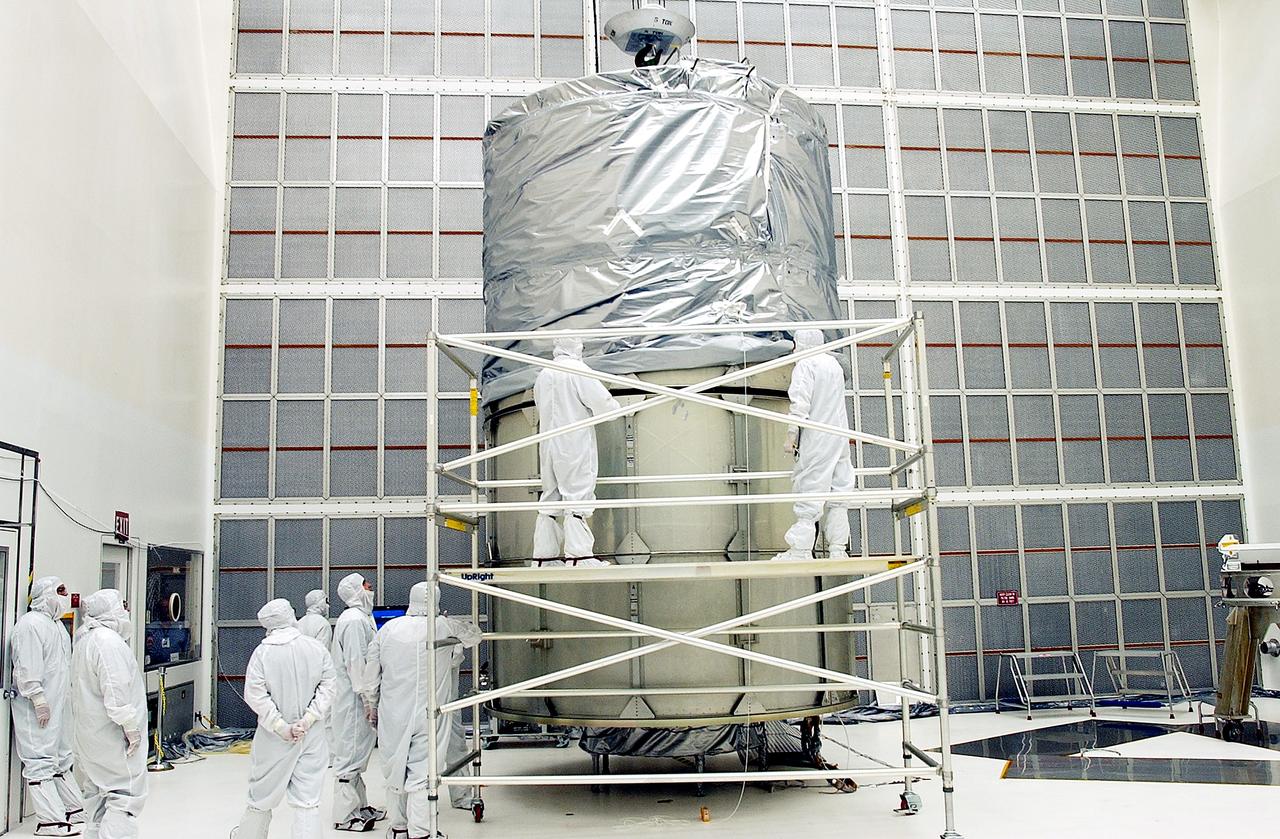
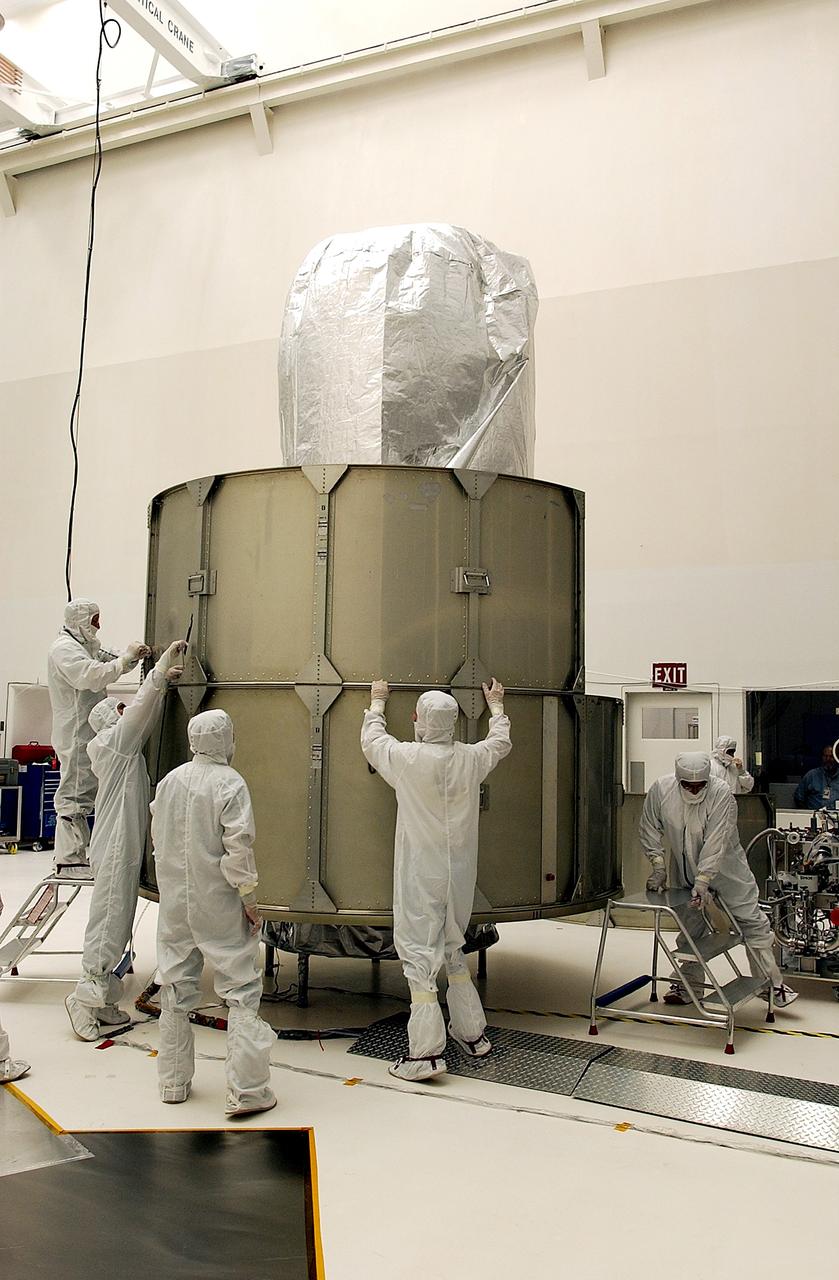
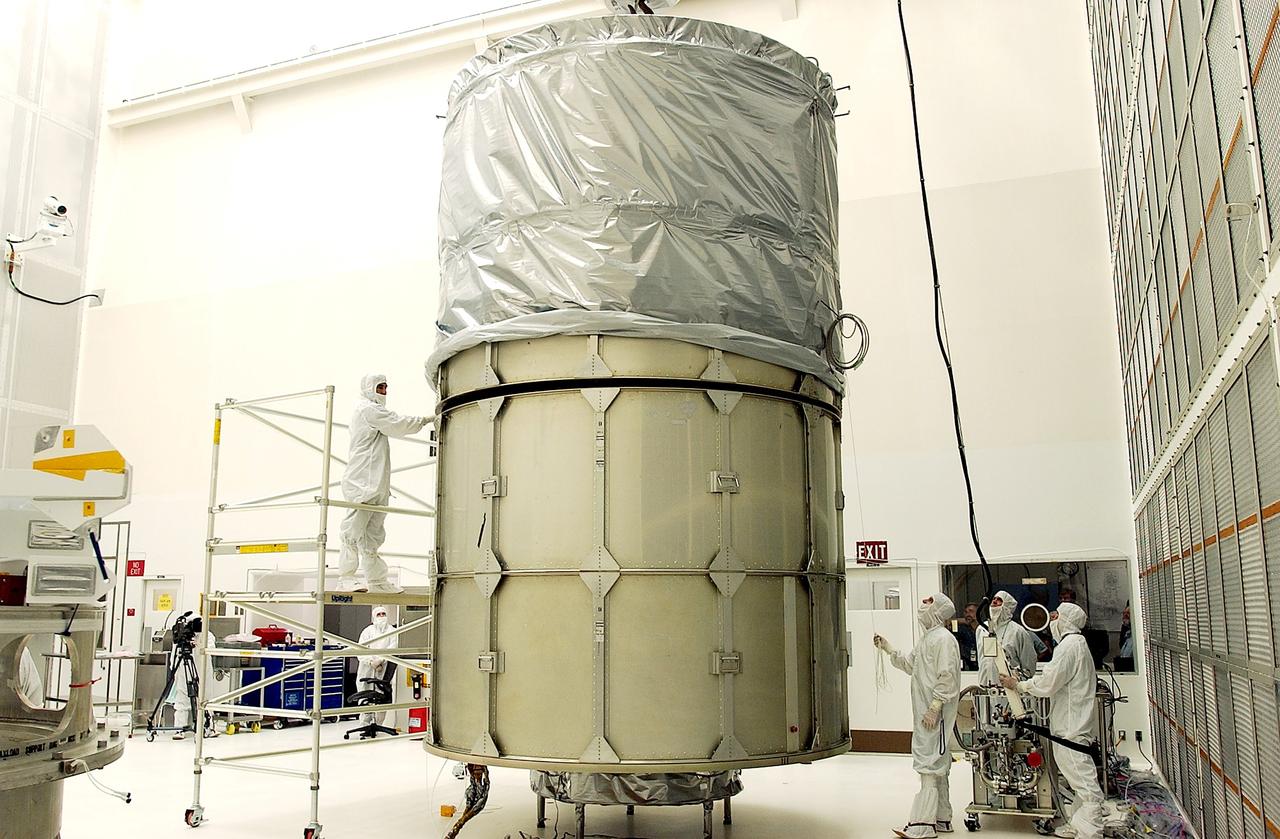
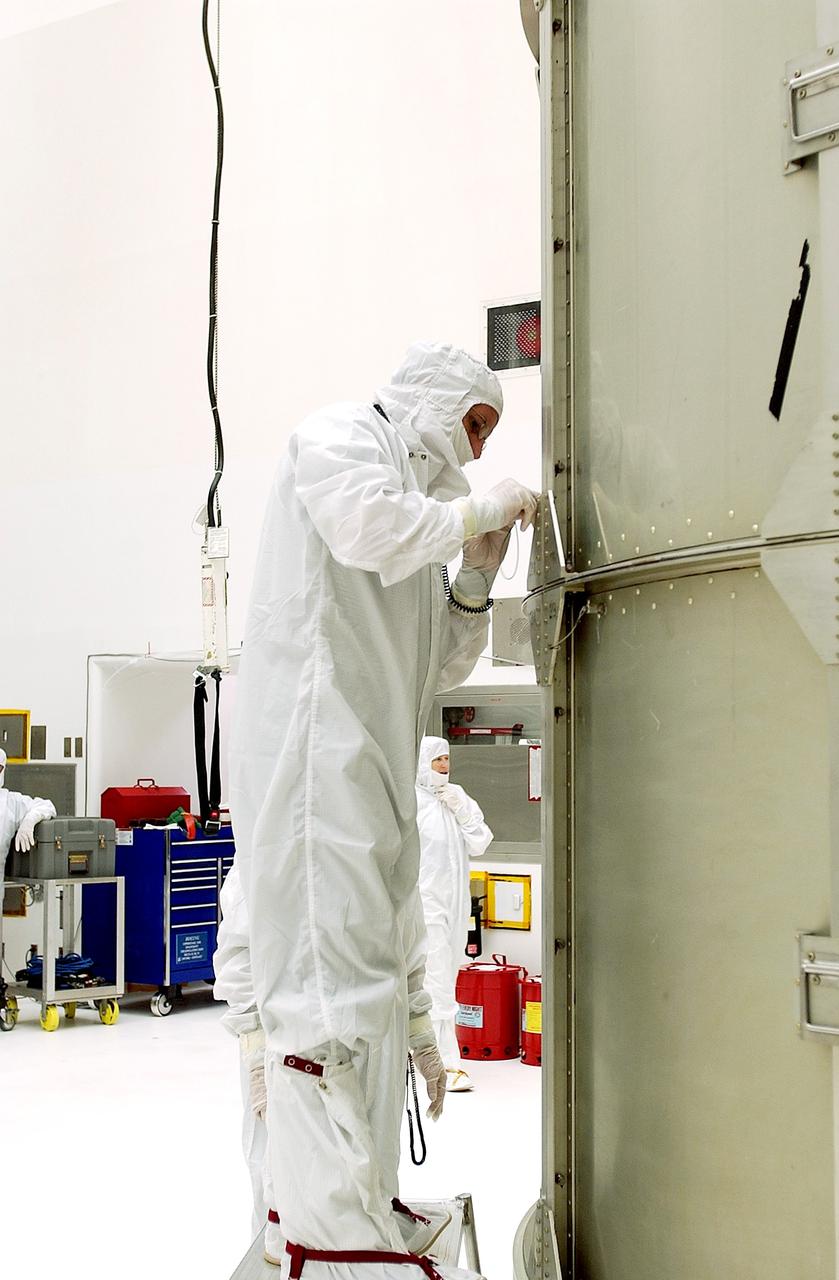
KENNEDY SPACE CENTER, FLA.  -  Working from a stand, technicians fasten the upper portion of the canister to the middle panels around the Space Infrared Telescope Facility (SIRTF).  The spacecraft will be transported to Launch Complex 17-B for mating with its launch vehicle, the Delta II rocket.   SIRTF consists of three cryogenically cooled science instruments and an 0.85-meter telescope, and is one of NASA's largest infrared telescopes to be launched.  SIRTF will obtain images and spectra by detecting the infrared energy, or heat, radiated by objects in space. Most of this infrared radiation is blocked by the Earth's atmosphere and cannot be observed from the ground.
KENNEDY SPACE CENTER, FLA. - Working from a stand, technicians fasten the upper portion of the canister to the middle panels around the Space Infrared Telescope Facility (SIRTF). The spacecraft will be transported to Launch Complex 17-B for mating with its launch vehicle, the Delta II rocket. SIRTF consists of three cryogenically cooled science instruments and an 0.85-meter telescope, and is one of NASA's largest infrared telescopes to be launched. SIRTF will obtain images and spectra by detecting the infrared energy, or heat, radiated by objects in space. Most of this infrared radiation is blocked by the Earth's atmosphere and cannot be observed from the ground.
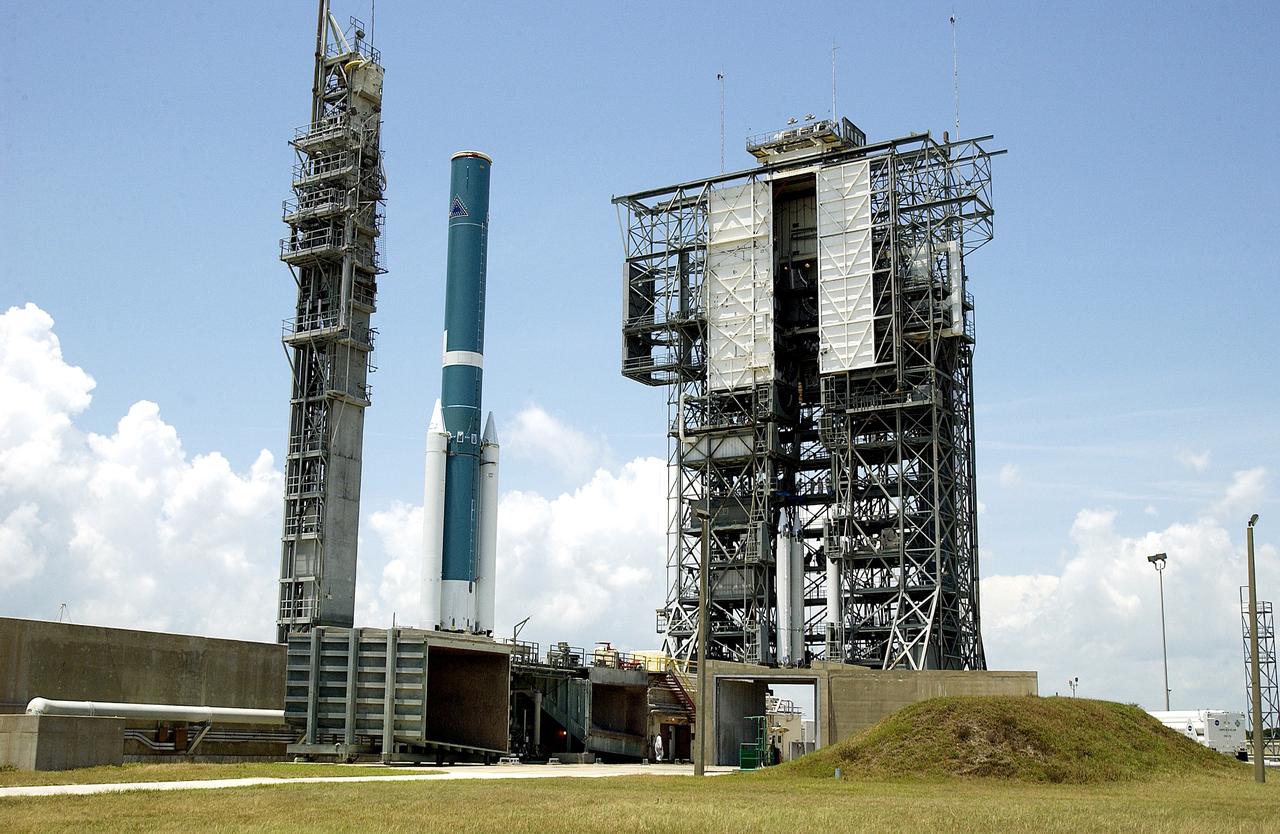
KENNEDY SPACE CENTER, FLA. -   On Launch Complex 17-B, Cape Canaveral Air Force Station, the Delta II Heavy rocket waits the arrival of the mobile service tower with three additional solid rocket boosters (SRBs).  Nine 46-inch-diameter, stretched SRBs will help launch the Space Infrared Telescope Facility (SIRTF).  Consisting of three cryogenically cooled science instruments and an 0.85-meter telescope, SIRTF is one of NASA's largest infrared telescopes to be launched.  SIRTF will obtain images and spectra by detecting the infrared energy, or heat, radiated by objects in space. Most of this infrared radiation is blocked by the Earth's atmosphere and cannot be observed from the ground.
KENNEDY SPACE CENTER, FLA. - On Launch Complex 17-B, Cape Canaveral Air Force Station, the Delta II Heavy rocket waits the arrival of the mobile service tower with three additional solid rocket boosters (SRBs). Nine 46-inch-diameter, stretched SRBs will help launch the Space Infrared Telescope Facility (SIRTF). Consisting of three cryogenically cooled science instruments and an 0.85-meter telescope, SIRTF is one of NASA's largest infrared telescopes to be launched. SIRTF will obtain images and spectra by detecting the infrared energy, or heat, radiated by objects in space. Most of this infrared radiation is blocked by the Earth's atmosphere and cannot be observed from the ground.
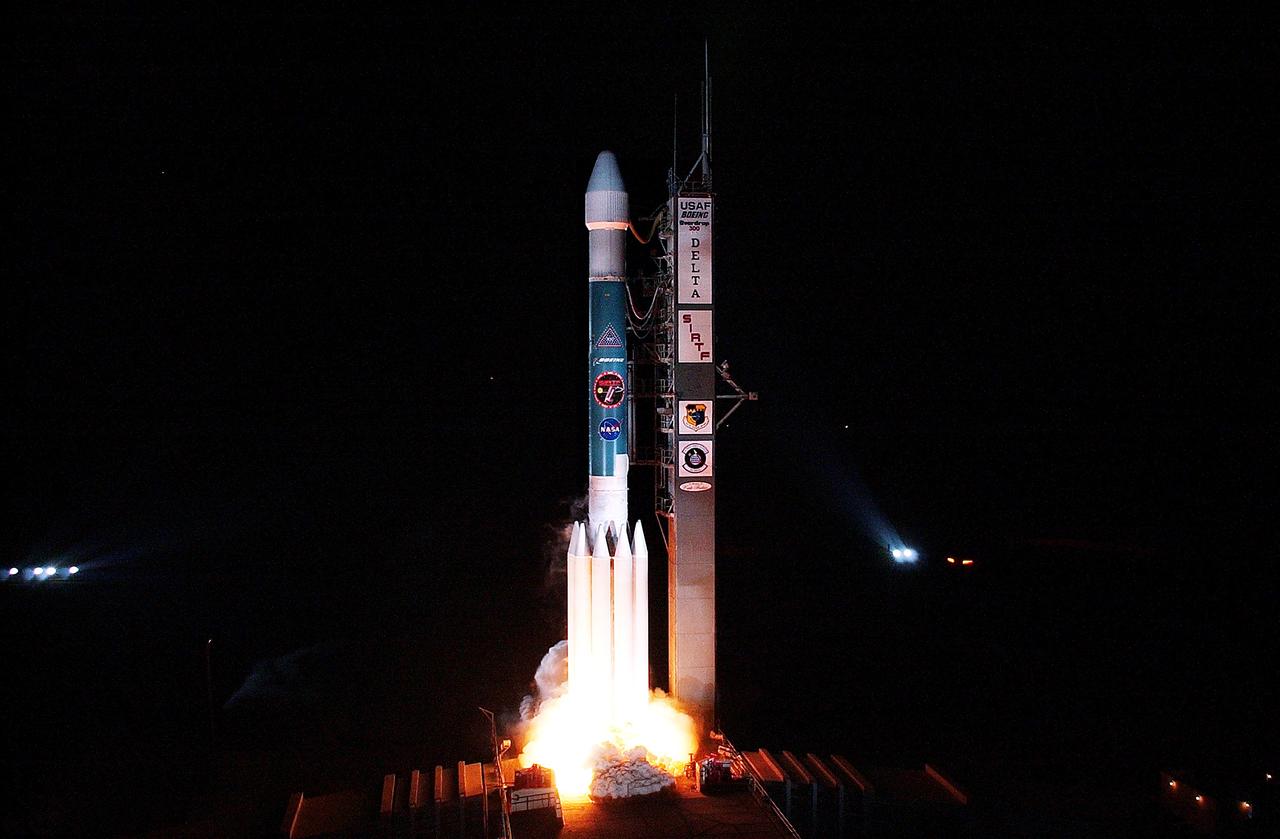
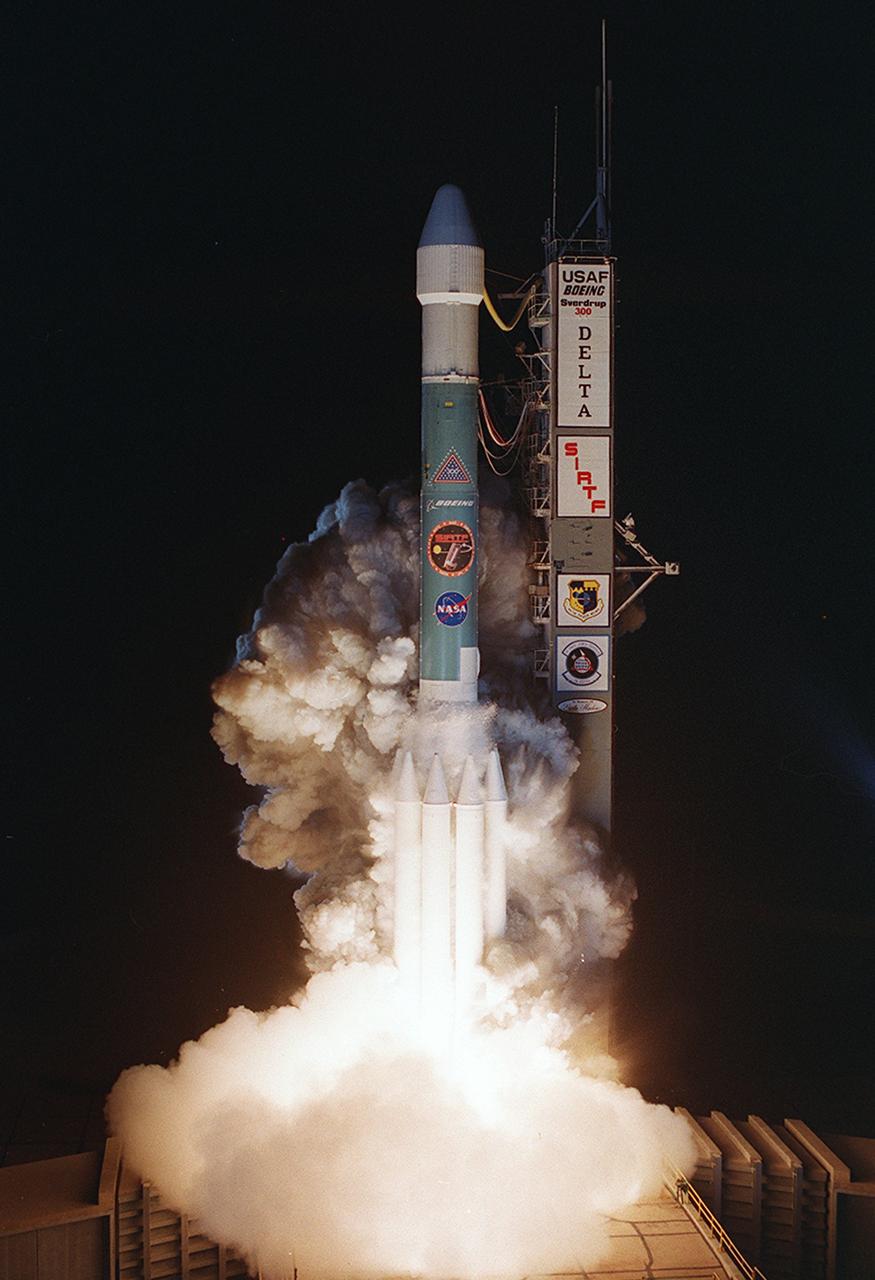
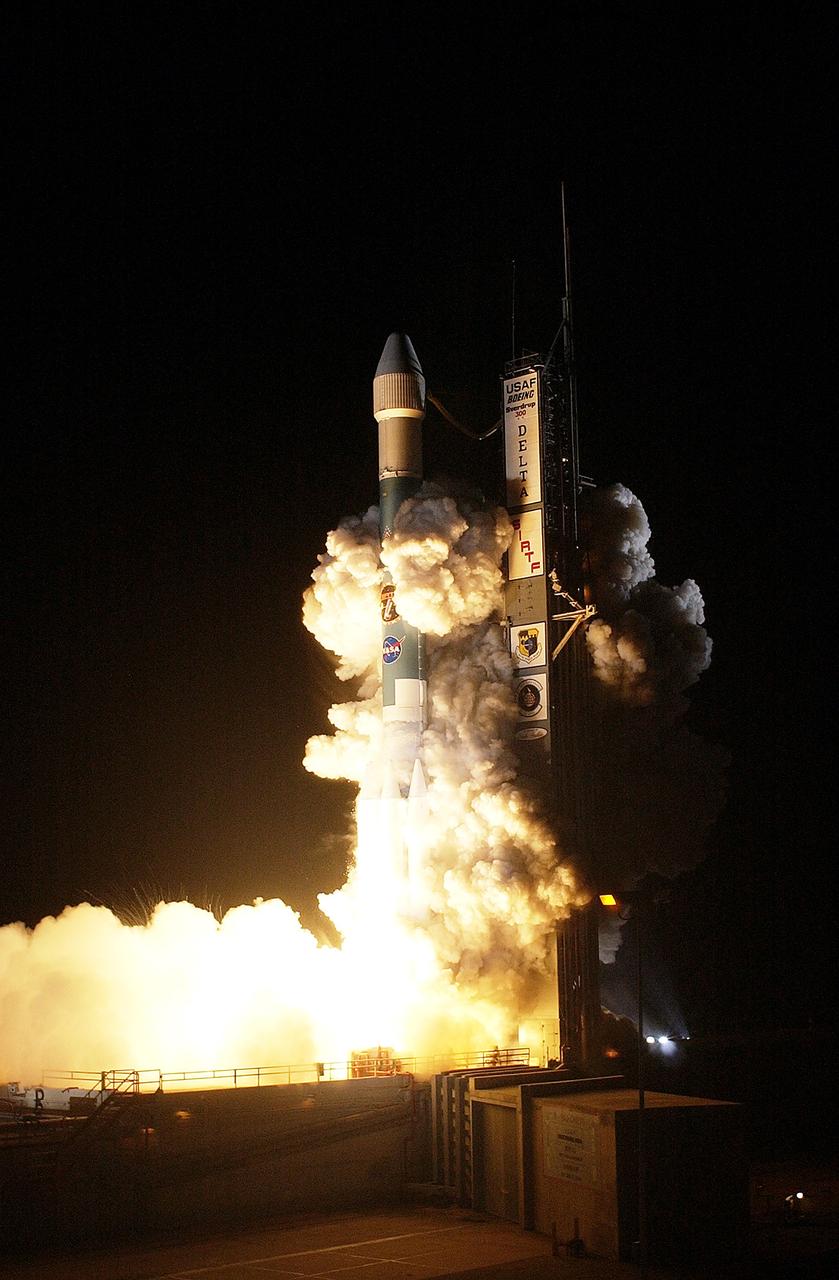
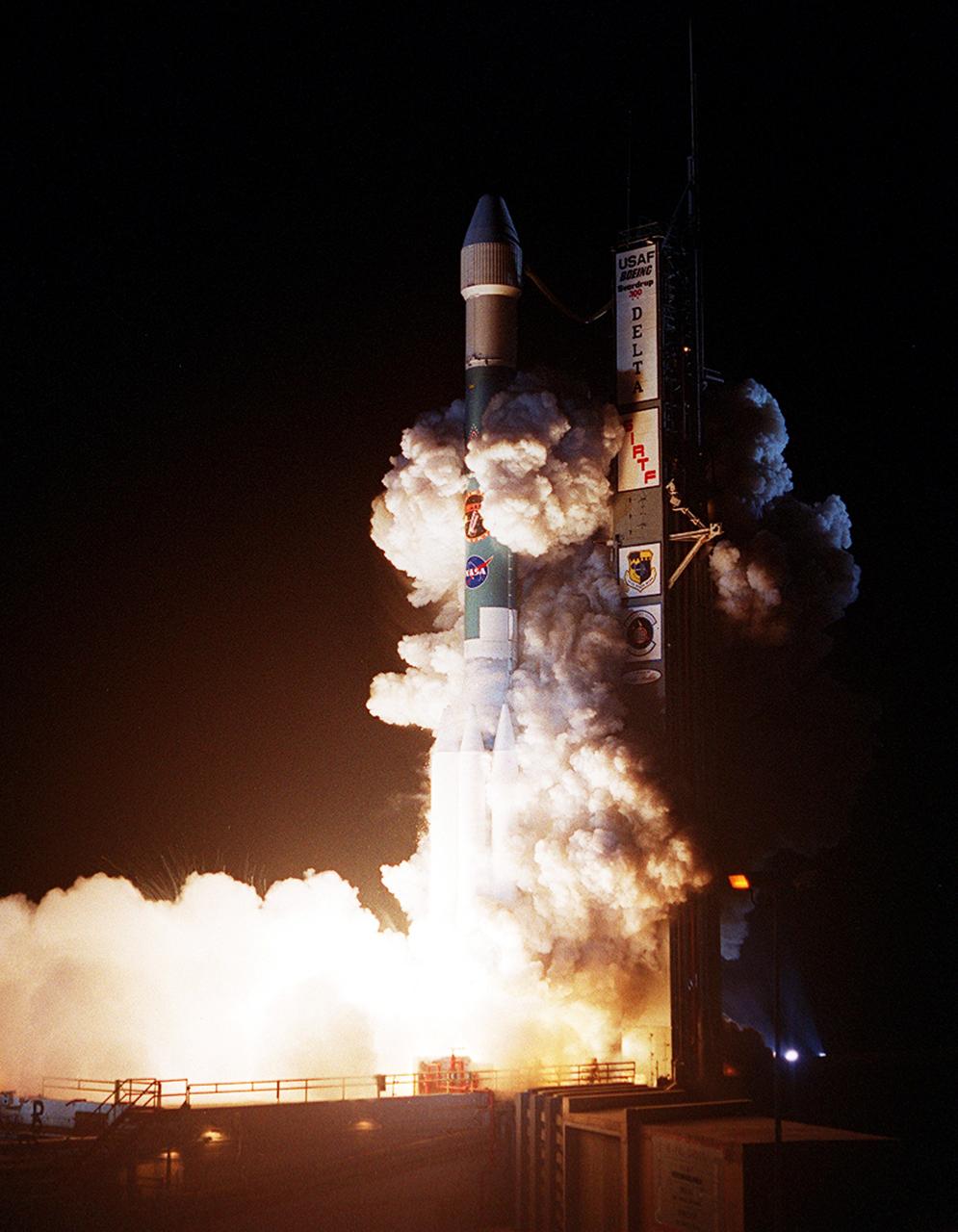
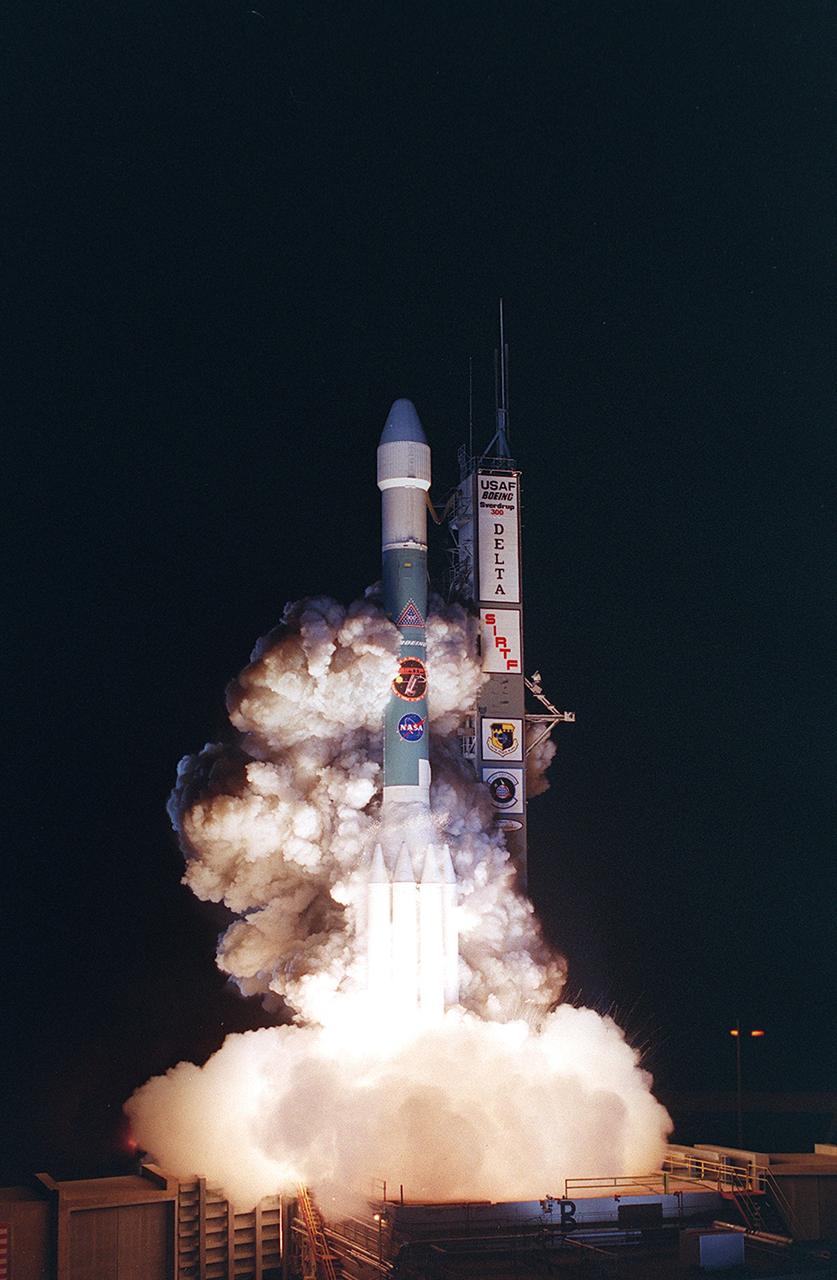
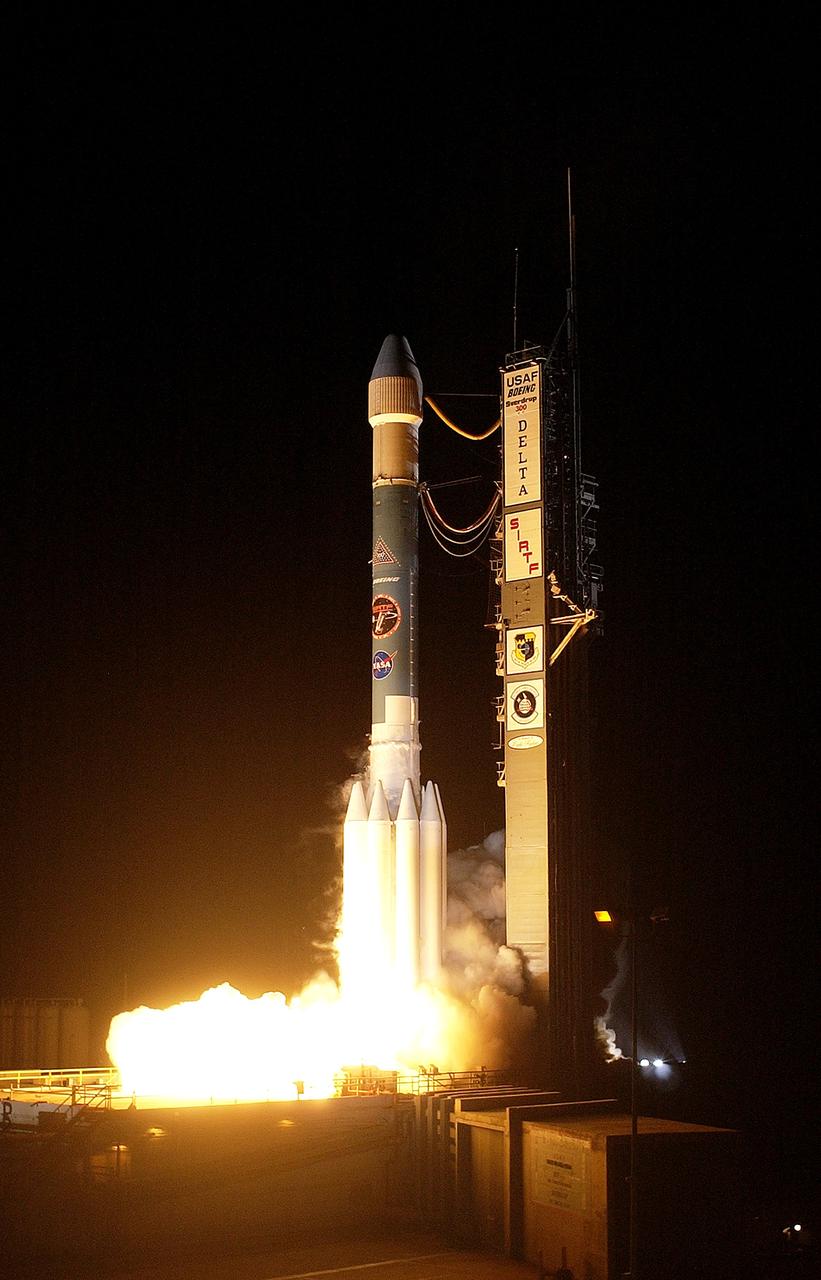
KENNEDY SPACE CENTER, FLA.  -  NASA's Space Infrared Telescope Facility (SIRTF) lifts off from Launch Pad 17-B, Cape Canaveral Air Force Station, on Aug. 25 at 1:35:39 a.m. EDT. SIRTF will obtain images and spectra by detecting the infrared energy, or heat, radiated by objects in space. Consisting of a 0.85-meter telescope and three cryogenically cooled science instruments, SIRTF will be the largest infrared telescope ever launched into space. It is the fourth and final element in NASA’s family of orbiting “Great Observatories.” Its highly sensitive instruments will give a unique view of the Universe and peer into regions of space that are hidden from optical telescopes.
KENNEDY SPACE CENTER, FLA. - NASA's Space Infrared Telescope Facility (SIRTF) lifts off from Launch Pad 17-B, Cape Canaveral Air Force Station, on Aug. 25 at 1:35:39 a.m. EDT. SIRTF will obtain images and spectra by detecting the infrared energy, or heat, radiated by objects in space. Consisting of a 0.85-meter telescope and three cryogenically cooled science instruments, SIRTF will be the largest infrared telescope ever launched into space. It is the fourth and final element in NASA’s family of orbiting “Great Observatories.” Its highly sensitive instruments will give a unique view of the Universe and peer into regions of space that are hidden from optical telescopes.
KENNEDY SPACE CENTER, FLA.  -  NASA's Space Infrared Telescope Facility (SIRTF) lifts off from Launch Pad 17-B, Cape Canaveral Air Force Station, on Aug. 25 at 1:35:39 a.m. EDT. SIRTF will obtain images and spectra by detecting the infrared energy, or heat, radiated by objects in space. Consisting of a 0.85-meter telescope and three cryogenically cooled science instruments, SIRTF will be the largest infrared telescope ever launched into space. It is the fourth and final element in NASA’s family of orbiting “Great Observatories.” Its highly sensitive instruments will give a unique view of the Universe and peer into regions of space that are hidden from optical telescopes.
KENNEDY SPACE CENTER, FLA. - NASA's Space Infrared Telescope Facility (SIRTF) lifts off from Launch Pad 17-B, Cape Canaveral Air Force Station, on Aug. 25 at 1:35:39 a.m. EDT. SIRTF will obtain images and spectra by detecting the infrared energy, or heat, radiated by objects in space. Consisting of a 0.85-meter telescope and three cryogenically cooled science instruments, SIRTF will be the largest infrared telescope ever launched into space. It is the fourth and final element in NASA’s family of orbiting “Great Observatories.” Its highly sensitive instruments will give a unique view of the Universe and peer into regions of space that are hidden from optical telescopes.
KENNEDY SPACE CENTER, FLA.  -  NASA's Space Infrared Telescope Facility (SIRTF) lifts off from Launch Pad 17-B, Cape Canaveral Air Force Station, on Aug. 25 at 1:35:39 a.m. EDT. SIRTF will obtain images and spectra by detecting the infrared energy, or heat, radiated by objects in space. Consisting of a 0.85-meter telescope and three cryogenically cooled science instruments, SIRTF will be the largest infrared telescope ever launched into space. It is the fourth and final element in NASA’s family of orbiting “Great Observatories.” Its highly sensitive instruments will give a unique view of the Universe and peer into regions of space that are hidden from optical telescopes.
KENNEDY SPACE CENTER, FLA. - NASA's Space Infrared Telescope Facility (SIRTF) lifts off from Launch Pad 17-B, Cape Canaveral Air Force Station, on Aug. 25 at 1:35:39 a.m. EDT. SIRTF will obtain images and spectra by detecting the infrared energy, or heat, radiated by objects in space. Consisting of a 0.85-meter telescope and three cryogenically cooled science instruments, SIRTF will be the largest infrared telescope ever launched into space. It is the fourth and final element in NASA’s family of orbiting “Great Observatories.” Its highly sensitive instruments will give a unique view of the Universe and peer into regions of space that are hidden from optical telescopes.
KENNEDY SPACE CENTER, FLA.  - In the mobile service tower on Launch Pad 17-B, Cape Canaveral Air Force Station, the Space Infrared Telescope Facility (SIRTF) waits for encapsulation. SIRTF will obtain images and spectra by detecting the infrared energy, or heat, radiated by objects in space. Consisting of a 0.85-meter telescope and three cryogenically cooled science instruments, SIRTF will be the largest infrared telescope ever launched into space. It is the fourth and final element in NASA’s family of orbiting “Great Observatories.” Its highly sensitive instruments will give a unique view of the Universe and peer into regions of space that are hidden from optical telescopes.
KENNEDY SPACE CENTER, FLA. - In the mobile service tower on Launch Pad 17-B, Cape Canaveral Air Force Station, the Space Infrared Telescope Facility (SIRTF) waits for encapsulation. SIRTF will obtain images and spectra by detecting the infrared energy, or heat, radiated by objects in space. Consisting of a 0.85-meter telescope and three cryogenically cooled science instruments, SIRTF will be the largest infrared telescope ever launched into space. It is the fourth and final element in NASA’s family of orbiting “Great Observatories.” Its highly sensitive instruments will give a unique view of the Universe and peer into regions of space that are hidden from optical telescopes.
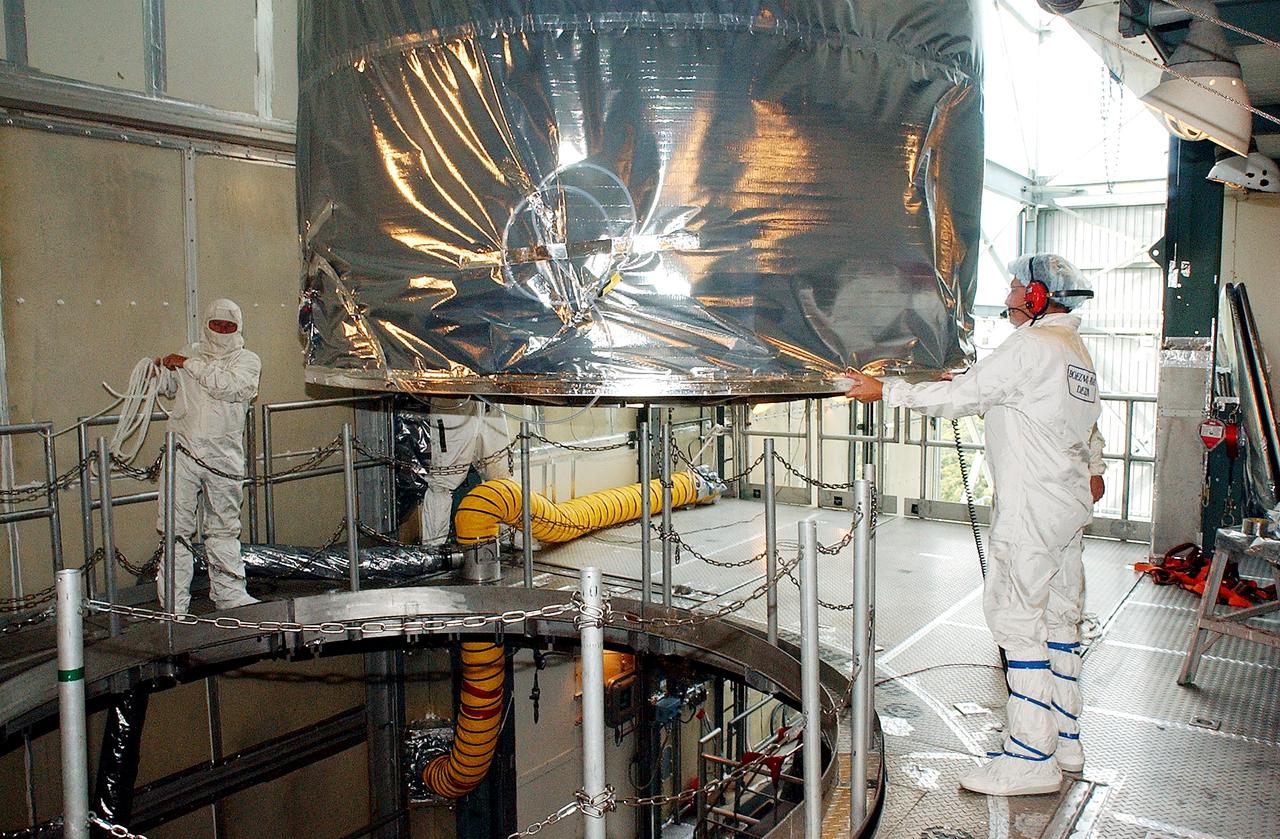
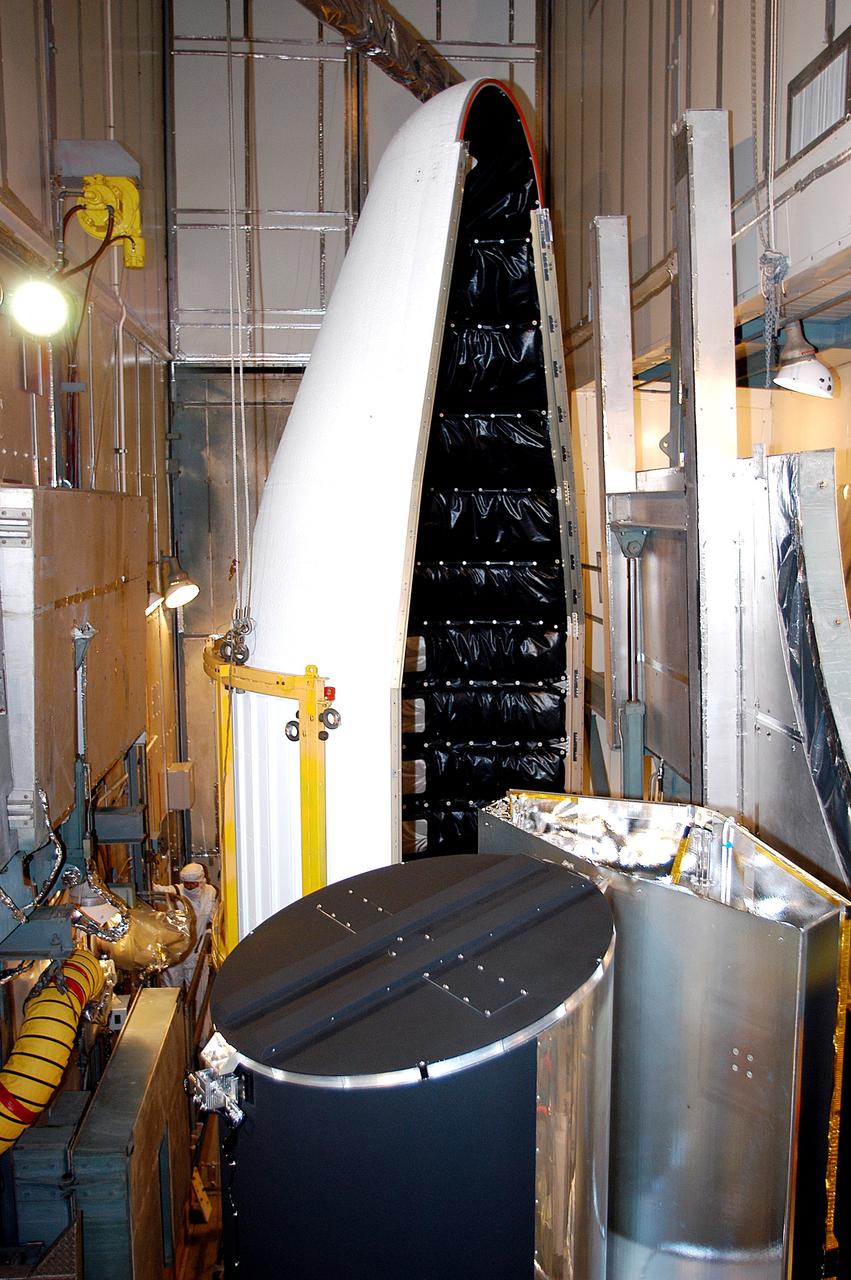
KENNEDY SPACE CENTER, FLA.  - In the mobile service tower on Launch Pad 17-B, Cape Canaveral Air Force Station, the first half of the fairing (background) moves toward the Space Infrared Telescope Facility (foreground) for encapsulation. SIRTF will obtain images and spectra by detecting the infrared energy, or heat, radiated by objects in space. Consisting of a 0.85-meter telescope and three cryogenically cooled science instruments, SIRTF will be the largest infrared telescope ever launched into space. It is the fourth and final element in NASA’s family of orbiting “Great Observatories.” Its highly sensitive instruments will give a unique view of the Universe and peer into regions of space that are hidden from optical telescopes.
KENNEDY SPACE CENTER, FLA. - In the mobile service tower on Launch Pad 17-B, Cape Canaveral Air Force Station, the first half of the fairing (background) moves toward the Space Infrared Telescope Facility (foreground) for encapsulation. SIRTF will obtain images and spectra by detecting the infrared energy, or heat, radiated by objects in space. Consisting of a 0.85-meter telescope and three cryogenically cooled science instruments, SIRTF will be the largest infrared telescope ever launched into space. It is the fourth and final element in NASA’s family of orbiting “Great Observatories.” Its highly sensitive instruments will give a unique view of the Universe and peer into regions of space that are hidden from optical telescopes.
KENNEDY SPACE CENTER, FLA.  - In the mobile service tower on Launch Pad 17-B, Cape Canaveral Air Force Station, the top of the fairing is seen as it moves into place around the Space Infrared Telescope Facility (SIRTF). SIRTF will obtain images and spectra by detecting the infrared energy, or heat, radiated by objects in space. Consisting of a 0.85-meter telescope and three cryogenically cooled science instruments, SIRTF will be the largest infrared telescope ever launched into space. It is the fourth and final element in NASA’s family of orbiting “Great Observatories.” Its highly sensitive instruments will give a unique view of the Universe and peer into regions of space that are hidden from optical telescopes.
KENNEDY SPACE CENTER, FLA. - In the mobile service tower on Launch Pad 17-B, Cape Canaveral Air Force Station, the top of the fairing is seen as it moves into place around the Space Infrared Telescope Facility (SIRTF). SIRTF will obtain images and spectra by detecting the infrared energy, or heat, radiated by objects in space. Consisting of a 0.85-meter telescope and three cryogenically cooled science instruments, SIRTF will be the largest infrared telescope ever launched into space. It is the fourth and final element in NASA’s family of orbiting “Great Observatories.” Its highly sensitive instruments will give a unique view of the Universe and peer into regions of space that are hidden from optical telescopes.
KENNEDY SPACE CENTER, FLA.  -  NASA's Space Infrared Telescope Facility (SIRTF) lifts off from Launch Pad 17-B, Cape Canaveral Air Force Station, on Aug. 25 at 1:35:39 a.m. EDT. SIRTF will obtain images and spectra by detecting the infrared energy, or heat, radiated by objects in space. Consisting of a 0.85-meter telescope and three cryogenically cooled science instruments, SIRTF will be the largest infrared telescope ever launched into space. It is the fourth and final element in NASA’s family of orbiting “Great Observatories.” Its highly sensitive instruments will give a unique view of the Universe and peer into regions of space that are hidden from optical telescopes.
KENNEDY SPACE CENTER, FLA. - NASA's Space Infrared Telescope Facility (SIRTF) lifts off from Launch Pad 17-B, Cape Canaveral Air Force Station, on Aug. 25 at 1:35:39 a.m. EDT. SIRTF will obtain images and spectra by detecting the infrared energy, or heat, radiated by objects in space. Consisting of a 0.85-meter telescope and three cryogenically cooled science instruments, SIRTF will be the largest infrared telescope ever launched into space. It is the fourth and final element in NASA’s family of orbiting “Great Observatories.” Its highly sensitive instruments will give a unique view of the Universe and peer into regions of space that are hidden from optical telescopes.
KENNEDY SPACE CENTER, FLA.  - In the mobile service tower on Launch Pad 17-B, Cape Canaveral Air Force Station, workers watch as the first half of the fairing moves closer around the Space Infrared Telescope Facility (SIRTF). SIRTF will obtain images and spectra by detecting the infrared energy, or heat, radiated by objects in space. Consisting of a 0.85-meter telescope and three cryogenically cooled science instruments, SIRTF will be the largest infrared telescope ever launched into space. It is the fourth and final element in NASA’s family of orbiting “Great Observatories.” Its highly sensitive instruments will give a unique view of the Universe and peer into regions of space that are hidden from optical telescopes.
KENNEDY SPACE CENTER, FLA. - In the mobile service tower on Launch Pad 17-B, Cape Canaveral Air Force Station, workers watch as the first half of the fairing moves closer around the Space Infrared Telescope Facility (SIRTF). SIRTF will obtain images and spectra by detecting the infrared energy, or heat, radiated by objects in space. Consisting of a 0.85-meter telescope and three cryogenically cooled science instruments, SIRTF will be the largest infrared telescope ever launched into space. It is the fourth and final element in NASA’s family of orbiting “Great Observatories.” Its highly sensitive instruments will give a unique view of the Universe and peer into regions of space that are hidden from optical telescopes.
KENNEDY SPACE CENTER, FLA.  - In the mobile service tower on Launch Pad 17-B, Cape Canaveral Air Force Station, the Space Infrared Telescope Facility (SIRTF) waits for encapsulation. SIRTF will obtain images and spectra by detecting the infrared energy, or heat, radiated by objects in space. Consisting of a 0.85-meter telescope and three cryogenically cooled science instruments, SIRTF will be the largest infrared telescope ever launched into space. It is the fourth and final element in NASA’s family of orbiting “Great Observatories.” Its highly sensitive instruments will give a unique view of the Universe and peer into regions of space that are hidden from optical telescopes.
KENNEDY SPACE CENTER, FLA. - In the mobile service tower on Launch Pad 17-B, Cape Canaveral Air Force Station, the Space Infrared Telescope Facility (SIRTF) waits for encapsulation. SIRTF will obtain images and spectra by detecting the infrared energy, or heat, radiated by objects in space. Consisting of a 0.85-meter telescope and three cryogenically cooled science instruments, SIRTF will be the largest infrared telescope ever launched into space. It is the fourth and final element in NASA’s family of orbiting “Great Observatories.” Its highly sensitive instruments will give a unique view of the Universe and peer into regions of space that are hidden from optical telescopes.
KENNEDY SPACE CENTER, FLA.  -  NASA's Space Infrared Telescope Facility (SIRTF) lifts off from Launch Pad 17-B, Cape Canaveral Air Force Station, on Aug. 25 at 1:35:39 a.m. EDT. SIRTF will obtain images and spectra by detecting the infrared energy, or heat, radiated by objects in space. Consisting of a 0.85-meter telescope and three cryogenically cooled science instruments, SIRTF will be the largest infrared telescope ever launched into space. It is the fourth and final element in NASA’s family of orbiting “Great Observatories.” Its highly sensitive instruments will give a unique view of the Universe and peer into regions of space that are hidden from optical telescopes.
KENNEDY SPACE CENTER, FLA. - NASA's Space Infrared Telescope Facility (SIRTF) lifts off from Launch Pad 17-B, Cape Canaveral Air Force Station, on Aug. 25 at 1:35:39 a.m. EDT. SIRTF will obtain images and spectra by detecting the infrared energy, or heat, radiated by objects in space. Consisting of a 0.85-meter telescope and three cryogenically cooled science instruments, SIRTF will be the largest infrared telescope ever launched into space. It is the fourth and final element in NASA’s family of orbiting “Great Observatories.” Its highly sensitive instruments will give a unique view of the Universe and peer into regions of space that are hidden from optical telescopes.
KENNEDY SPACE CENTER, FLA.  - In the mobile service tower on Launch Pad 17-B, Cape Canaveral Air Force Station, workers move the first half of the fairing around the Space Infrared Telescope Facility (SIRTF) behind it for encapsulation. SIRTF will obtain images and spectra by detecting the infrared energy, or heat, radiated by objects in space. Consisting of a 0.85-meter telescope and three cryogenically cooled science instruments, SIRTF will be the largest infrared telescope ever launched into space. It is the fourth and final element in NASA’s family of orbiting “Great Observatories.” Its highly sensitive instruments will give a unique view of the Universe and peer into regions of space that are hidden from optical telescopes.
KENNEDY SPACE CENTER, FLA. - In the mobile service tower on Launch Pad 17-B, Cape Canaveral Air Force Station, workers move the first half of the fairing around the Space Infrared Telescope Facility (SIRTF) behind it for encapsulation. SIRTF will obtain images and spectra by detecting the infrared energy, or heat, radiated by objects in space. Consisting of a 0.85-meter telescope and three cryogenically cooled science instruments, SIRTF will be the largest infrared telescope ever launched into space. It is the fourth and final element in NASA’s family of orbiting “Great Observatories.” Its highly sensitive instruments will give a unique view of the Universe and peer into regions of space that are hidden from optical telescopes.
KENNEDY SPACE CENTER, FLA.  - In the mobile service tower on Launch Pad 17-B, Cape Canaveral Air Force Station, the first half of the fairing is moved around the Space Infrared Telescope Facility (SIRTF). SIRTF will obtain images and spectra by detecting the infrared energy, or heat, radiated by objects in space. Consisting of a 0.85-meter telescope and three cryogenically cooled science instruments, SIRTF will be the largest infrared telescope ever launched into space. It is the fourth and final element in NASA’s family of orbiting “Great Observatories.” Its highly sensitive instruments will give a unique view of the Universe and peer into regions of space that are hidden from optical telescopes.
KENNEDY SPACE CENTER, FLA. - In the mobile service tower on Launch Pad 17-B, Cape Canaveral Air Force Station, the first half of the fairing is moved around the Space Infrared Telescope Facility (SIRTF). SIRTF will obtain images and spectra by detecting the infrared energy, or heat, radiated by objects in space. Consisting of a 0.85-meter telescope and three cryogenically cooled science instruments, SIRTF will be the largest infrared telescope ever launched into space. It is the fourth and final element in NASA’s family of orbiting “Great Observatories.” Its highly sensitive instruments will give a unique view of the Universe and peer into regions of space that are hidden from optical telescopes.
KENNEDY SPACE CENTER, FLA.  -  NASA's Space Infrared Telescope Facility (SIRTF) lifts off from Launch Pad 17-B, Cape Canaveral Air Force Station, on Aug. 25 at 1:35:39 a.m. EDT. SIRTF will obtain images and spectra by detecting the infrared energy, or heat, radiated by objects in space. Consisting of a 0.85-meter telescope and three cryogenically cooled science instruments, SIRTF will be the largest infrared telescope ever launched into space. It is the fourth and final element in NASA’s family of orbiting “Great Observatories.” Its highly sensitive instruments will give a unique view of the Universe and peer into regions of space that are hidden from optical telescopes.
KENNEDY SPACE CENTER, FLA. - NASA's Space Infrared Telescope Facility (SIRTF) lifts off from Launch Pad 17-B, Cape Canaveral Air Force Station, on Aug. 25 at 1:35:39 a.m. EDT. SIRTF will obtain images and spectra by detecting the infrared energy, or heat, radiated by objects in space. Consisting of a 0.85-meter telescope and three cryogenically cooled science instruments, SIRTF will be the largest infrared telescope ever launched into space. It is the fourth and final element in NASA’s family of orbiting “Great Observatories.” Its highly sensitive instruments will give a unique view of the Universe and peer into regions of space that are hidden from optical telescopes.
KENNEDY SPACE CENTER, FLA.  - In the mobile service tower on Launch Pad 17-B, Cape Canaveral Air Force Station, the Space Infrared Telescope Facility (SIRTF) waits for encapsulation. SIRTF will obtain images and spectra by detecting the infrared energy, or heat, radiated by objects in space. Consisting of a 0.85-meter telescope and three cryogenically cooled science instruments, SIRTF will be the largest infrared telescope ever launched into space. It is the fourth and final element in NASA’s family of orbiting “Great Observatories.” Its highly sensitive instruments will give a unique view of the Universe and peer into regions of space that are hidden from optical telescopes.
KENNEDY SPACE CENTER, FLA. - In the mobile service tower on Launch Pad 17-B, Cape Canaveral Air Force Station, the Space Infrared Telescope Facility (SIRTF) waits for encapsulation. SIRTF will obtain images and spectra by detecting the infrared energy, or heat, radiated by objects in space. Consisting of a 0.85-meter telescope and three cryogenically cooled science instruments, SIRTF will be the largest infrared telescope ever launched into space. It is the fourth and final element in NASA’s family of orbiting “Great Observatories.” Its highly sensitive instruments will give a unique view of the Universe and peer into regions of space that are hidden from optical telescopes.
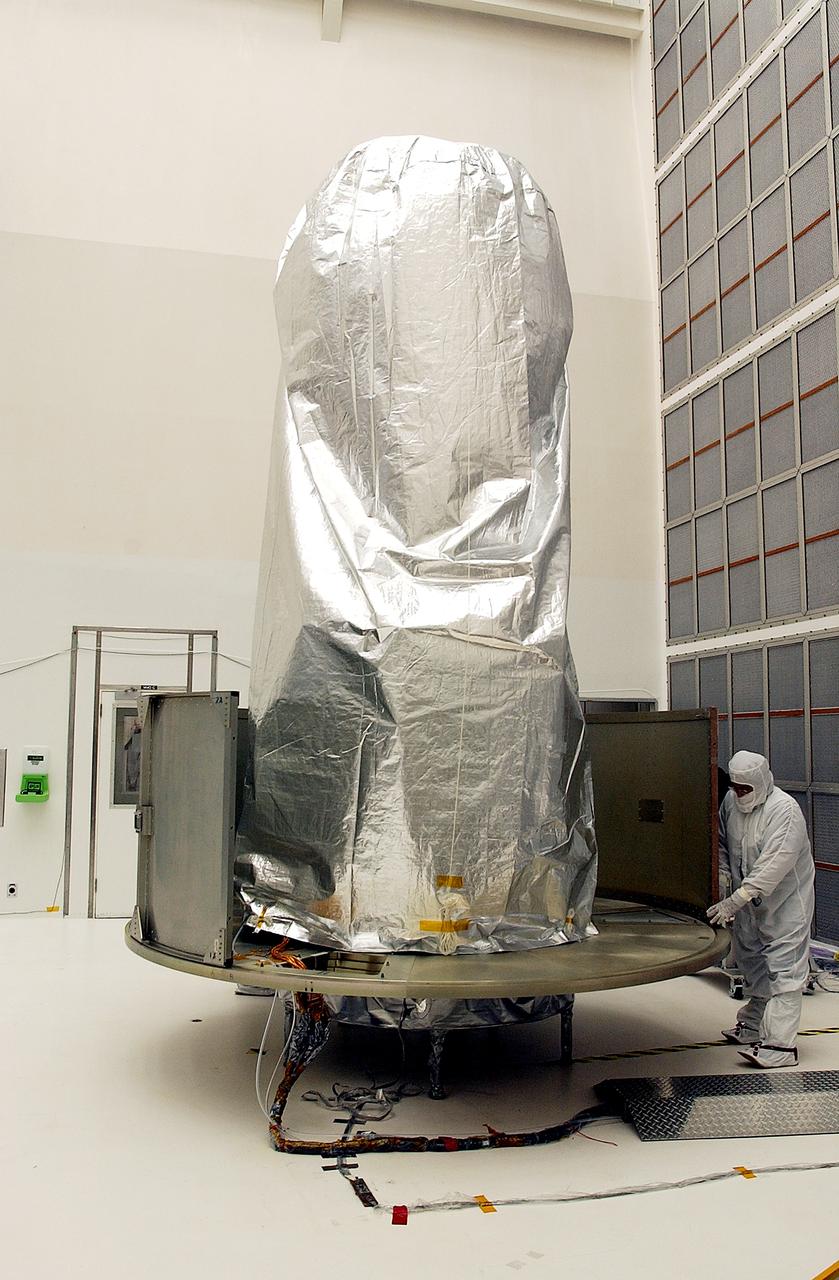
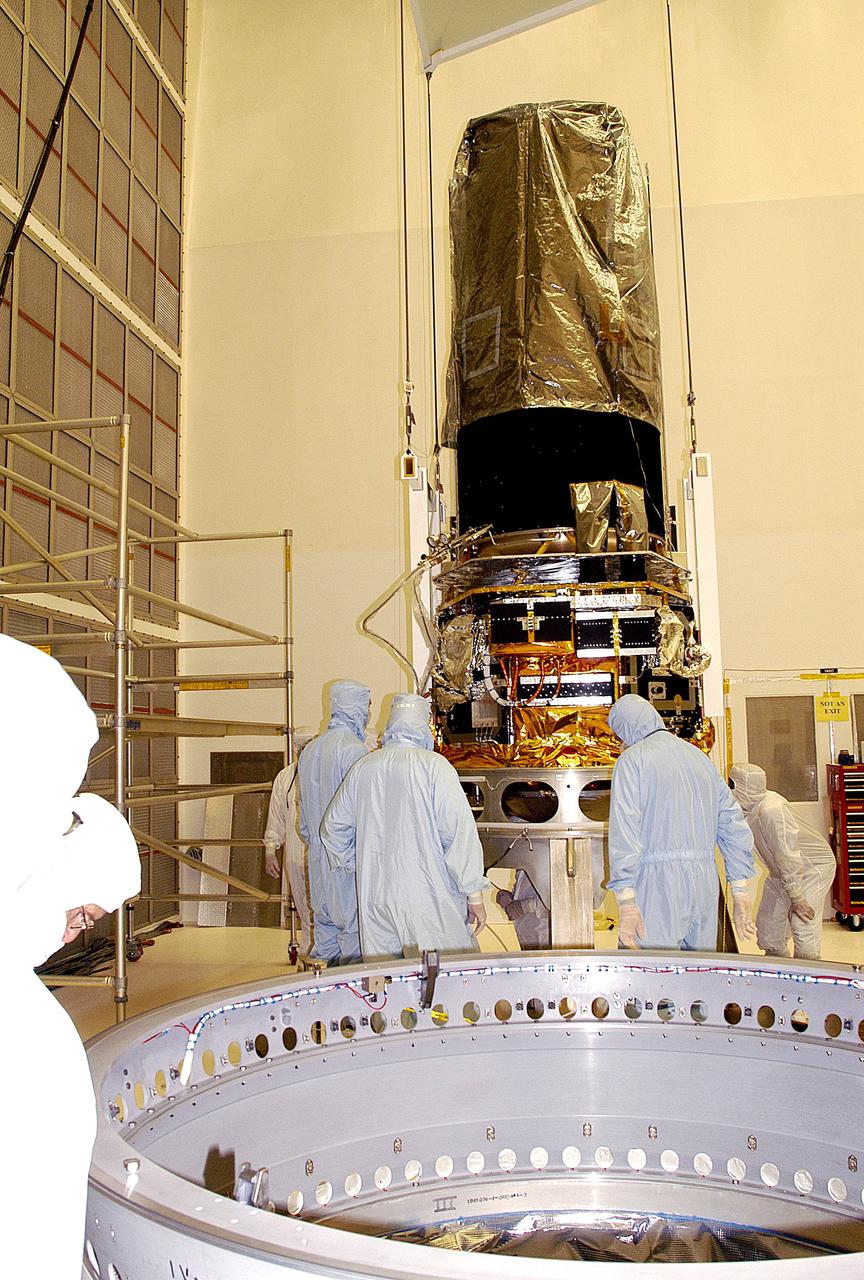
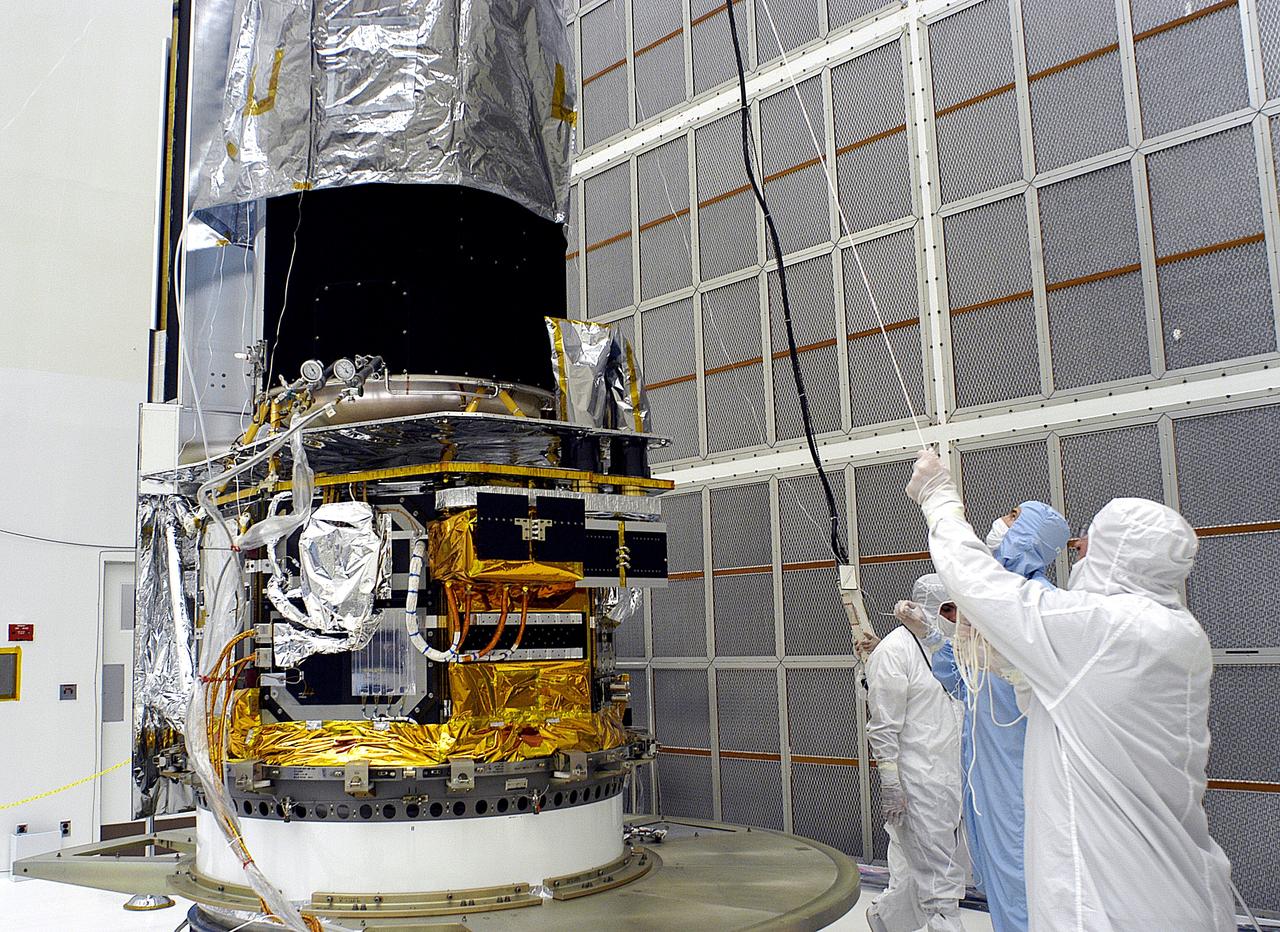
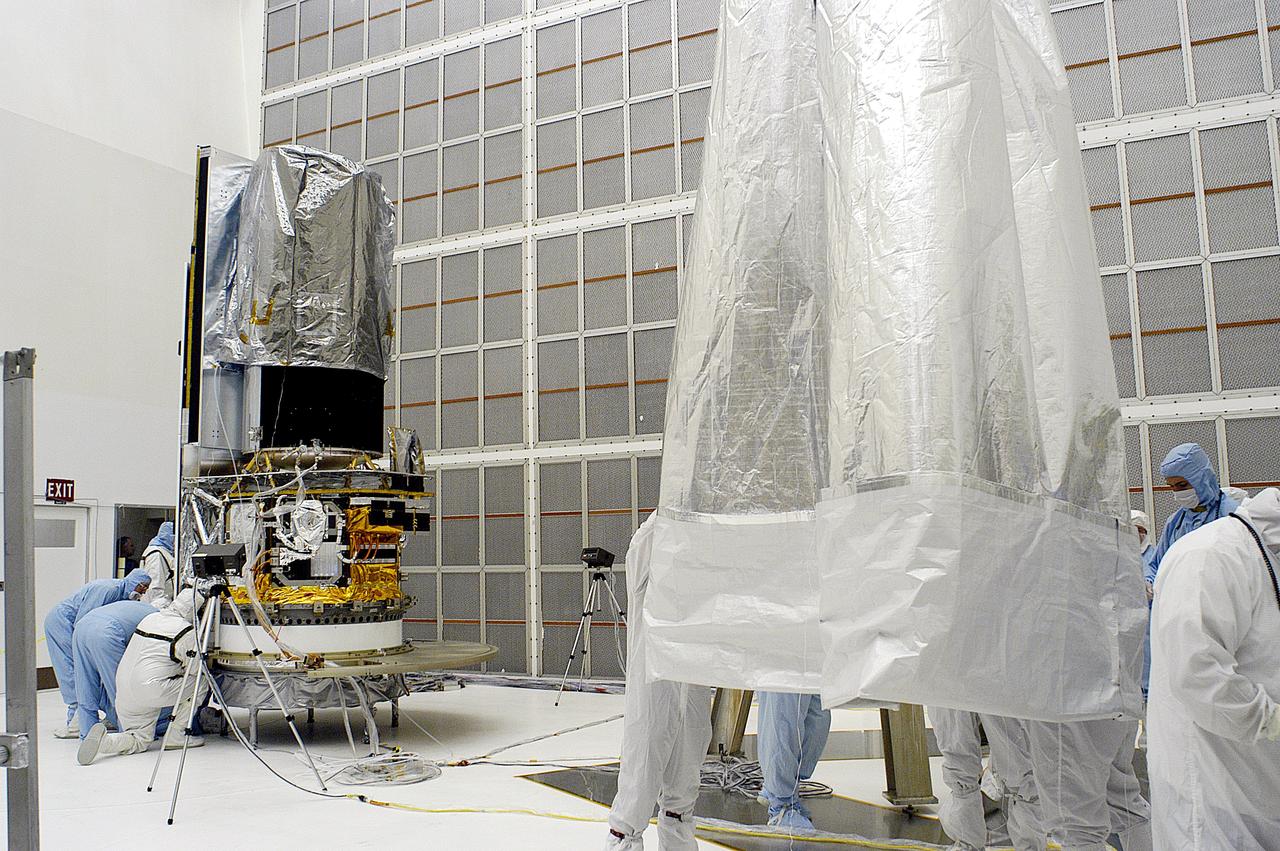
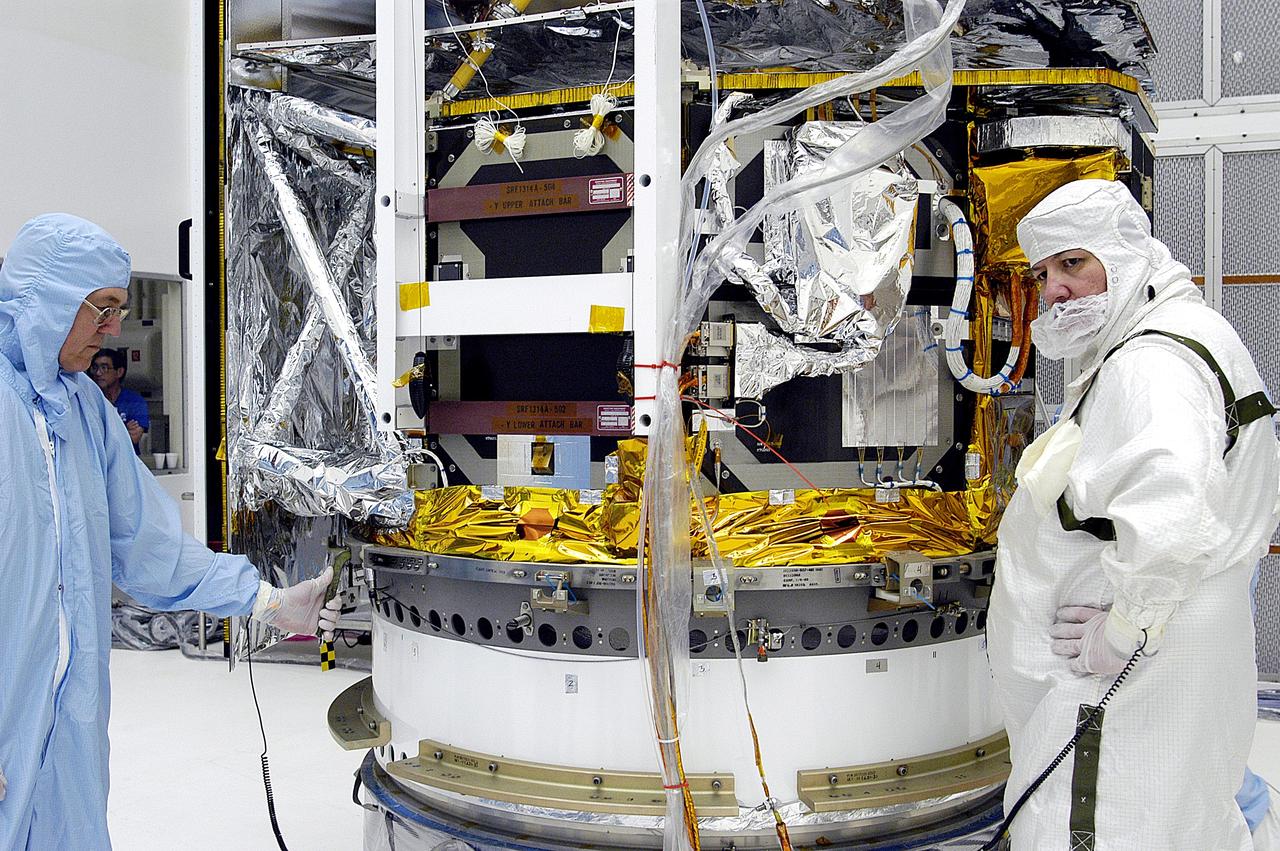
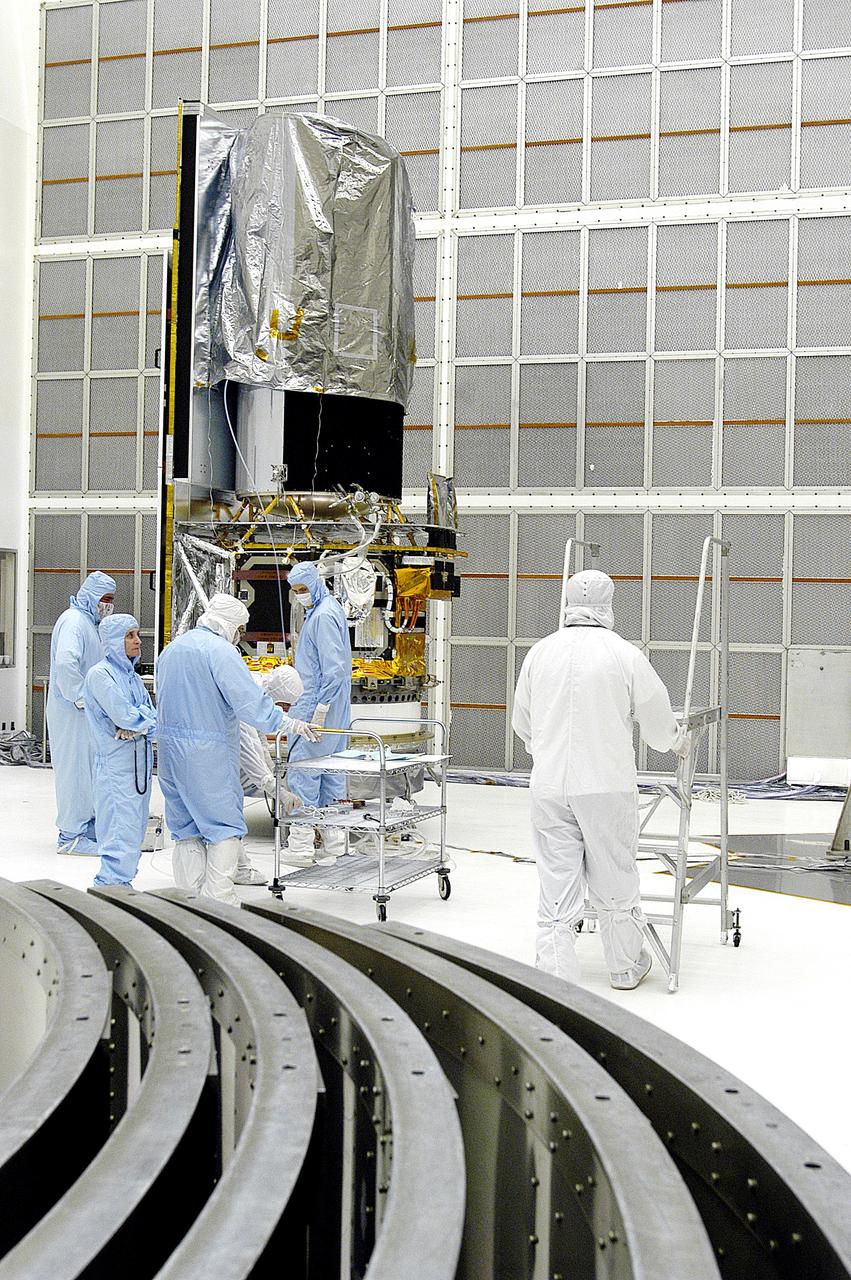
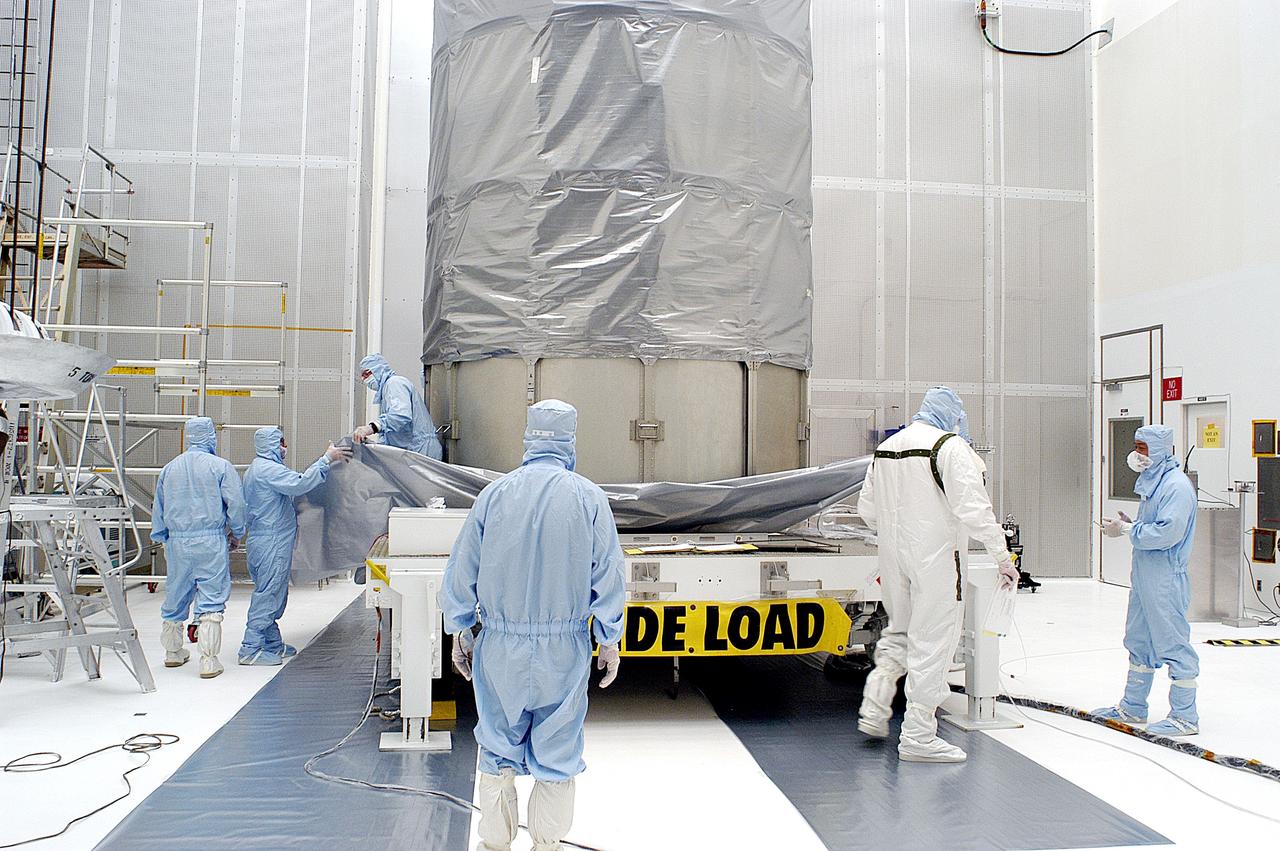
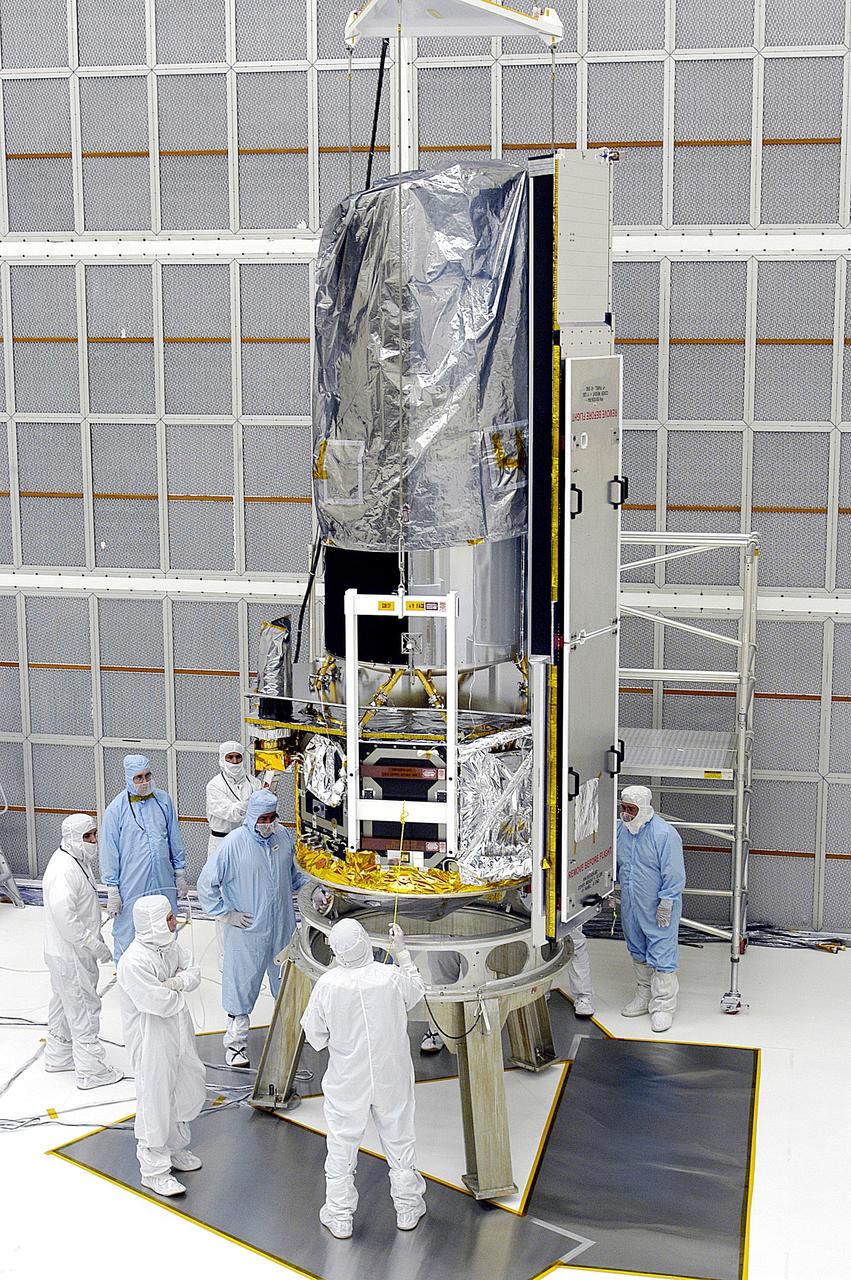
KENNEDY SPACE CENTER, FLA. -  Workers in NASA Spacecraft Hangar AE remove the protective cover from around the Space Infrared Telescope Facility (SIRTF), which has been returned to the hangar from the launch pad.   SIRTF will remain in the clean room until it returns to the pad in early August. One of NASA's largest infrared telescopes to be launched, SIRTF will obtain images and spectra by detecting the infrared energy, or heat, radiated by objects in space.
KENNEDY SPACE CENTER, FLA. - Workers in NASA Spacecraft Hangar AE remove the protective cover from around the Space Infrared Telescope Facility (SIRTF), which has been returned to the hangar from the launch pad. SIRTF will remain in the clean room until it returns to the pad in early August. One of NASA's largest infrared telescopes to be launched, SIRTF will obtain images and spectra by detecting the infrared energy, or heat, radiated by objects in space.
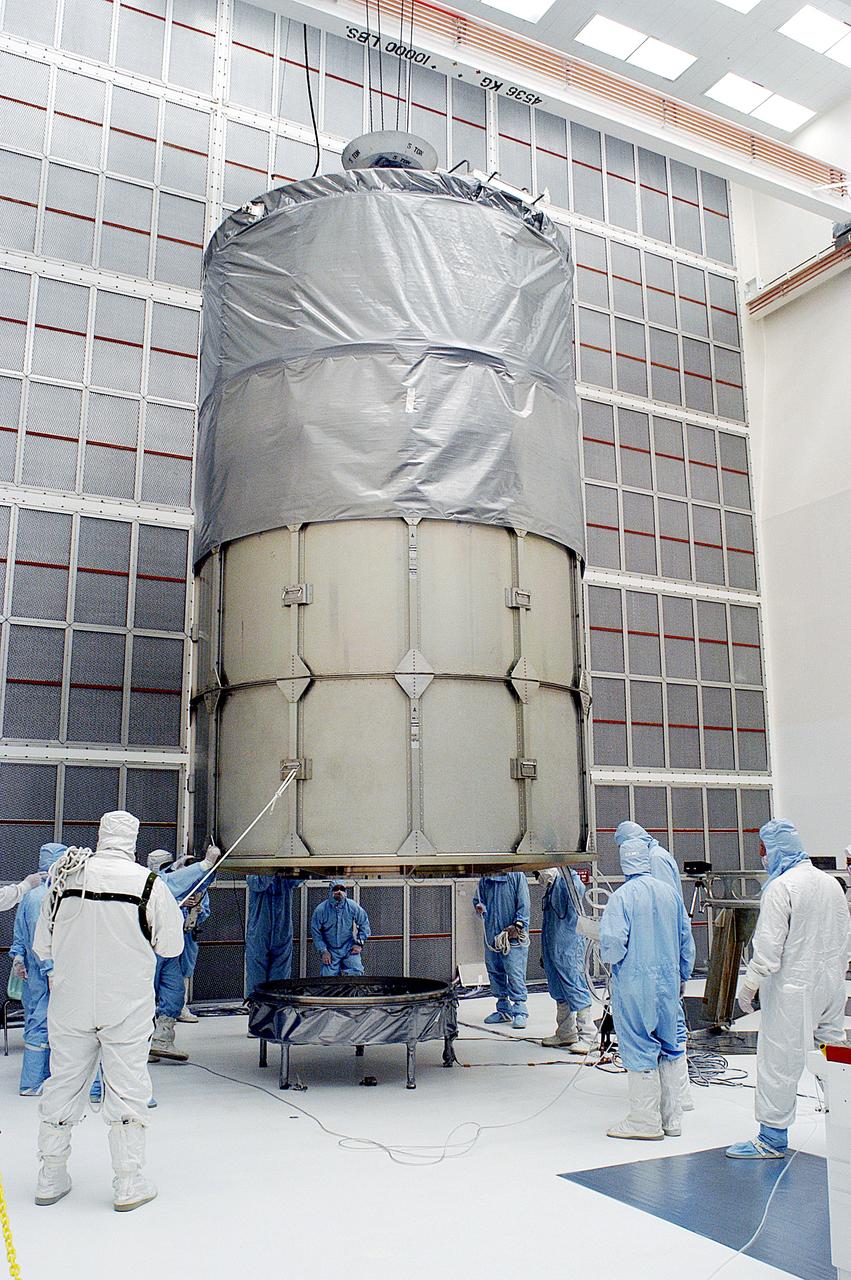
KENNEDY SPACE CENTER, FLA. -  Workers in NASA Spacecraft Hangar AE prepare to remove the canister from around the Space Infrared Telescope Facility (SIRTF), which has been returned to the hangar from the launch pad.   SIRTF will remain in the clean room until it returns to the pad in early August. One of NASA's largest infrared telescopes to be launched, SIRTF will obtain images and spectra by detecting the infrared energy, or heat, radiated by objects in space.
KENNEDY SPACE CENTER, FLA. - Workers in NASA Spacecraft Hangar AE prepare to remove the canister from around the Space Infrared Telescope Facility (SIRTF), which has been returned to the hangar from the launch pad. SIRTF will remain in the clean room until it returns to the pad in early August. One of NASA's largest infrared telescopes to be launched, SIRTF will obtain images and spectra by detecting the infrared energy, or heat, radiated by objects in space.
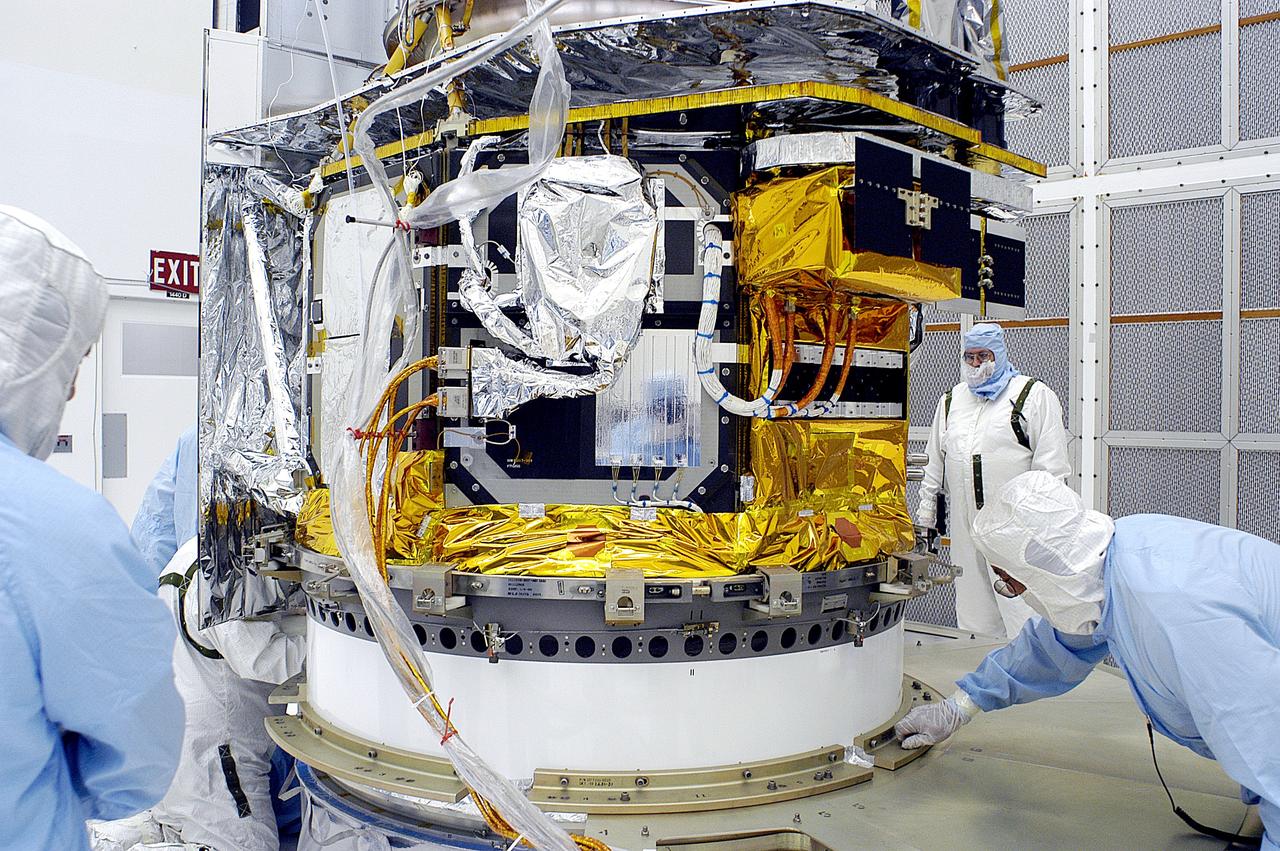
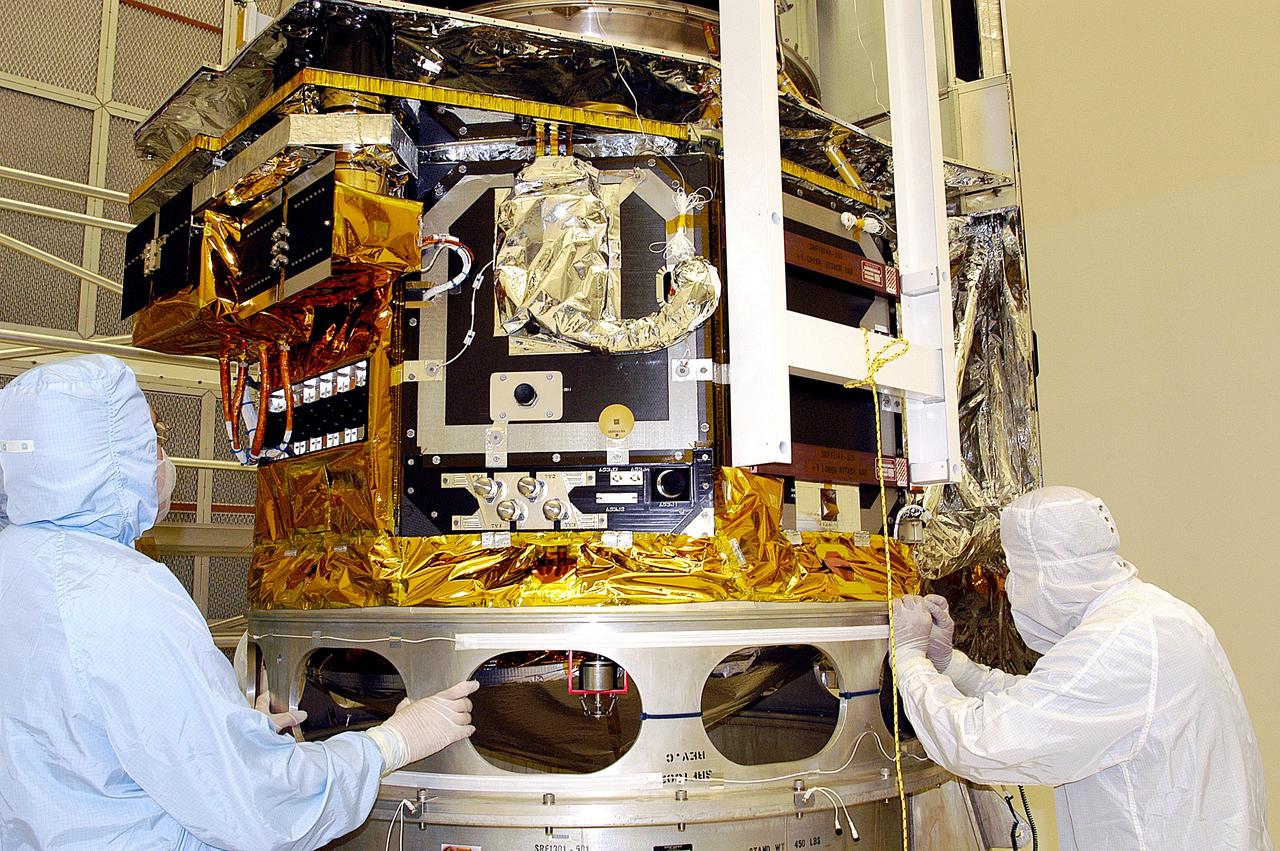
KENNEDY SPACE CENTER, FLA. -  Workers in NASA Spacecraft Hangar AE begin the next phase of processing of the Space Infrared Telescope Facility (SIRTF), which has been returned to the hangar from the launch pad. SIRTF will remain in the clean room until it returns to the pad in early August. One of NASA's largest infrared telescopes to be launched, SIRTF will obtain images and spectra by detecting the infrared energy, or heat, radiated by objects in space.
KENNEDY SPACE CENTER, FLA. - Workers in NASA Spacecraft Hangar AE begin the next phase of processing of the Space Infrared Telescope Facility (SIRTF), which has been returned to the hangar from the launch pad. SIRTF will remain in the clean room until it returns to the pad in early August. One of NASA's largest infrared telescopes to be launched, SIRTF will obtain images and spectra by detecting the infrared energy, or heat, radiated by objects in space.
KENNEDY SPACE CENTER, FLA. -  Workers in NASA Spacecraft Hangar AE position the Space Infrared Telescope Facility (SIRTF), which has been returned to the hangar from the launch pad, for further processing. SIRTF will remain in the clean room until it returns to the pad in early August. One of NASA's largest infrared telescopes to be launched, SIRTF will obtain images and spectra by detecting the infrared energy, or heat, radiated by objects in space.
KENNEDY SPACE CENTER, FLA. - Workers in NASA Spacecraft Hangar AE position the Space Infrared Telescope Facility (SIRTF), which has been returned to the hangar from the launch pad, for further processing. SIRTF will remain in the clean room until it returns to the pad in early August. One of NASA's largest infrared telescopes to be launched, SIRTF will obtain images and spectra by detecting the infrared energy, or heat, radiated by objects in space.
KENNEDY SPACE CENTER, FLA. -  Workers in NASA Spacecraft Hangar AE prepare to remove the canister from around the Space Infrared Telescope Facility (SIRTF), which has been returned to the hangar from the launch pad.   SIRTF will remain in the clean room until it returns to the pad in early August. One of NASA's largest infrared telescopes to be launched, SIRTF will obtain images and spectra by detecting the infrared energy, or heat, radiated by objects in space.
KENNEDY SPACE CENTER, FLA. - Workers in NASA Spacecraft Hangar AE prepare to remove the canister from around the Space Infrared Telescope Facility (SIRTF), which has been returned to the hangar from the launch pad. SIRTF will remain in the clean room until it returns to the pad in early August. One of NASA's largest infrared telescopes to be launched, SIRTF will obtain images and spectra by detecting the infrared energy, or heat, radiated by objects in space.
KENNEDY SPACE CENTER, FLA. -  Workers in NASA Spacecraft Hangar AE remove sections of the transportation canister from around the Space Infrared Telescope Facility (SIRTF), which has been returned to the hangar from the launch pad.   SIRTF will remain in the clean room until it returns to the pad in early August. One of NASA's largest infrared telescopes to be launched, SIRTF will obtain images and spectra by detecting the infrared energy, or heat, radiated by objects in space.
KENNEDY SPACE CENTER, FLA. - Workers in NASA Spacecraft Hangar AE remove sections of the transportation canister from around the Space Infrared Telescope Facility (SIRTF), which has been returned to the hangar from the launch pad. SIRTF will remain in the clean room until it returns to the pad in early August. One of NASA's largest infrared telescopes to be launched, SIRTF will obtain images and spectra by detecting the infrared energy, or heat, radiated by objects in space.
KENNEDY SPACE CENTER, FLA. -  In the NASA Spacecraft Hangar AE, the Space Infrared Telescope Facility (SIRTF), which has been returned to the hangar from the launch pad, is uncovered by workers following its arrival.   SIRTF will remain in the clean room until it returns to the pad in early August. One of NASA's largest infrared telescopes to be launched, SIRTF will obtain images and spectra by detecting the infrared energy, or heat, radiated by objects in space.
KENNEDY SPACE CENTER, FLA. - In the NASA Spacecraft Hangar AE, the Space Infrared Telescope Facility (SIRTF), which has been returned to the hangar from the launch pad, is uncovered by workers following its arrival. SIRTF will remain in the clean room until it returns to the pad in early August. One of NASA's largest infrared telescopes to be launched, SIRTF will obtain images and spectra by detecting the infrared energy, or heat, radiated by objects in space.
KENNEDY SPACE CENTER, FLA. -  Workers in NASA Spacecraft Hangar AE lift the protective cover from around the Space Infrared Telescope Facility (SIRTF), which has been returned to the hangar from the launch pad.   SIRTF will remain in the clean room until it returns to the pad in early August. One of NASA's largest infrared telescopes to be launched, SIRTF will obtain images and spectra by detecting the infrared energy, or heat, radiated by objects in space.
KENNEDY SPACE CENTER, FLA. - Workers in NASA Spacecraft Hangar AE lift the protective cover from around the Space Infrared Telescope Facility (SIRTF), which has been returned to the hangar from the launch pad. SIRTF will remain in the clean room until it returns to the pad in early August. One of NASA's largest infrared telescopes to be launched, SIRTF will obtain images and spectra by detecting the infrared energy, or heat, radiated by objects in space.
KENNEDY SPACE CENTER, FLA. -  The Space Infrared Telescope Facility (SIRTF) has been returned to NASA Spacecraft Hangar AE from the launch pad.   It will remain in the clean room until it returns to the pad in early August.  One of NASA's largest infrared telescopes to be launched, SIRTF will obtain images and spectra by detecting the infrared energy, or heat, radiated by objects in space.
KENNEDY SPACE CENTER, FLA. - The Space Infrared Telescope Facility (SIRTF) has been returned to NASA Spacecraft Hangar AE from the launch pad. It will remain in the clean room until it returns to the pad in early August. One of NASA's largest infrared telescopes to be launched, SIRTF will obtain images and spectra by detecting the infrared energy, or heat, radiated by objects in space.
KENNEDY SPACE CENTER, FLA. -  Workers in NASA Spacecraft Hangar AE erect a ladder to reach the top of the Space Infrared Telescope Facility (SIRTF), which has been returned to the hangar from the launch pad.   SIRTF will remain in the clean room until it returns to the pad in early August.  One of NASA's largest infrared telescopes to be launched, SIRTF will obtain images and spectra by detecting the infrared energy, or heat, radiated by objects in space.
KENNEDY SPACE CENTER, FLA. - Workers in NASA Spacecraft Hangar AE erect a ladder to reach the top of the Space Infrared Telescope Facility (SIRTF), which has been returned to the hangar from the launch pad. SIRTF will remain in the clean room until it returns to the pad in early August. One of NASA's largest infrared telescopes to be launched, SIRTF will obtain images and spectra by detecting the infrared energy, or heat, radiated by objects in space.
KENNEDY SPACE CENTER, FLA. -  Workers in NASA Spacecraft Hangar AE remove a portion of a transportation canister from around the Space Infrared Telescope Facility (SIRTF), which has been returned to the hangar from the launch pad.   SIRTF will remain in the clean room until it returns to the pad in early August. One of NASA's largest infrared telescopes to be launched, SIRTF will obtain images and spectra by detecting the infrared energy, or heat, radiated by objects in space.
KENNEDY SPACE CENTER, FLA. - Workers in NASA Spacecraft Hangar AE remove a portion of a transportation canister from around the Space Infrared Telescope Facility (SIRTF), which has been returned to the hangar from the launch pad. SIRTF will remain in the clean room until it returns to the pad in early August. One of NASA's largest infrared telescopes to be launched, SIRTF will obtain images and spectra by detecting the infrared energy, or heat, radiated by objects in space.
KENNEDY SPACE CENTER, FLA. -  Workers in NASA Spacecraft Hangar AE remove sections of the transportation canister from around the Space Infrared Telescope Facility (SIRTF), which has been returned to the hangar from the launch pad.   SIRTF will remain in the clean room until it returns to the pad in early August. One of NASA's largest infrared telescopes to be launched, SIRTF will obtain images and spectra by detecting the infrared energy, or heat, radiated by objects in space.
KENNEDY SPACE CENTER, FLA. - Workers in NASA Spacecraft Hangar AE remove sections of the transportation canister from around the Space Infrared Telescope Facility (SIRTF), which has been returned to the hangar from the launch pad. SIRTF will remain in the clean room until it returns to the pad in early August. One of NASA's largest infrared telescopes to be launched, SIRTF will obtain images and spectra by detecting the infrared energy, or heat, radiated by objects in space.
KENNEDY SPACE CENTER, FLA. -  Workers in NASA Spacecraft Hangar AE check the placement of the Space Infrared Telescope Facility (SIRTF), which has been returned to the hangar from the launch pad for further processing. SIRTF will remain in the clean room until it returns to the pad in early August. One of NASA's largest infrared telescopes to be launched, SIRTF will obtain images and spectra by detecting the infrared energy, or heat, radiated by objects in space.
KENNEDY SPACE CENTER, FLA. - Workers in NASA Spacecraft Hangar AE check the placement of the Space Infrared Telescope Facility (SIRTF), which has been returned to the hangar from the launch pad for further processing. SIRTF will remain in the clean room until it returns to the pad in early August. One of NASA's largest infrared telescopes to be launched, SIRTF will obtain images and spectra by detecting the infrared energy, or heat, radiated by objects in space.
KENNEDY SPACE CENTER, FLA. -  Workers in NASA Spacecraft Hangar AE prepare to begin further processing of the Space Infrared Telescope Facility (SIRTF), which has been returned to the hangar from the launch pad. Sections of the transportation canister used in the move are in the foreground.  SIRTF will remain in the clean room until it returns to the pad in early August. One of NASA's largest infrared telescopes to be launched, SIRTF will obtain images and spectra by detecting the infrared energy, or heat, radiated by objects in space.
KENNEDY SPACE CENTER, FLA. - Workers in NASA Spacecraft Hangar AE prepare to begin further processing of the Space Infrared Telescope Facility (SIRTF), which has been returned to the hangar from the launch pad. Sections of the transportation canister used in the move are in the foreground. SIRTF will remain in the clean room until it returns to the pad in early August. One of NASA's largest infrared telescopes to be launched, SIRTF will obtain images and spectra by detecting the infrared energy, or heat, radiated by objects in space.
KENNEDY SPACE CENTER, FLA. -  Workers in NASA Spacecraft Hangar AE check the placement of the Space Infrared Telescope Facility (SIRTF), which has been returned to the hangar from the launch pad for further processing. SIRTF will remain in the clean room until it returns to the pad in early August. One of NASA's largest infrared telescopes to be launched, SIRTF will obtain images and spectra by detecting the infrared energy, or heat, radiated by objects in space.
KENNEDY SPACE CENTER, FLA. - Workers in NASA Spacecraft Hangar AE check the placement of the Space Infrared Telescope Facility (SIRTF), which has been returned to the hangar from the launch pad for further processing. SIRTF will remain in the clean room until it returns to the pad in early August. One of NASA's largest infrared telescopes to be launched, SIRTF will obtain images and spectra by detecting the infrared energy, or heat, radiated by objects in space.
This engineering image derives from 100 seconds of observing time on one of the three science instruments aboard the Space InfraRed Telescope Facility (SIRTF). SIRTF was launched on August 25, and opened up its focal plane to starlight on August 30. This image was obtained as part of the instrument power-on sequence on September 1, one week after launch and a full month before the telescope is expected to reach optimal operating temperature and focus. The stars and galaxies seen in this image already attest to the observatory's great sensitivity in the infrared and to its proper operation.  The Space Infrared Telescope Facility (SIRTF) telescope was renamed the Spitzer Space Telescope on December 18, 2003, after the late Dr. Lyman Spitzer, in a contest which was open to the general public.   http://photojournal.jpl.nasa.gov/catalog/PIA04724
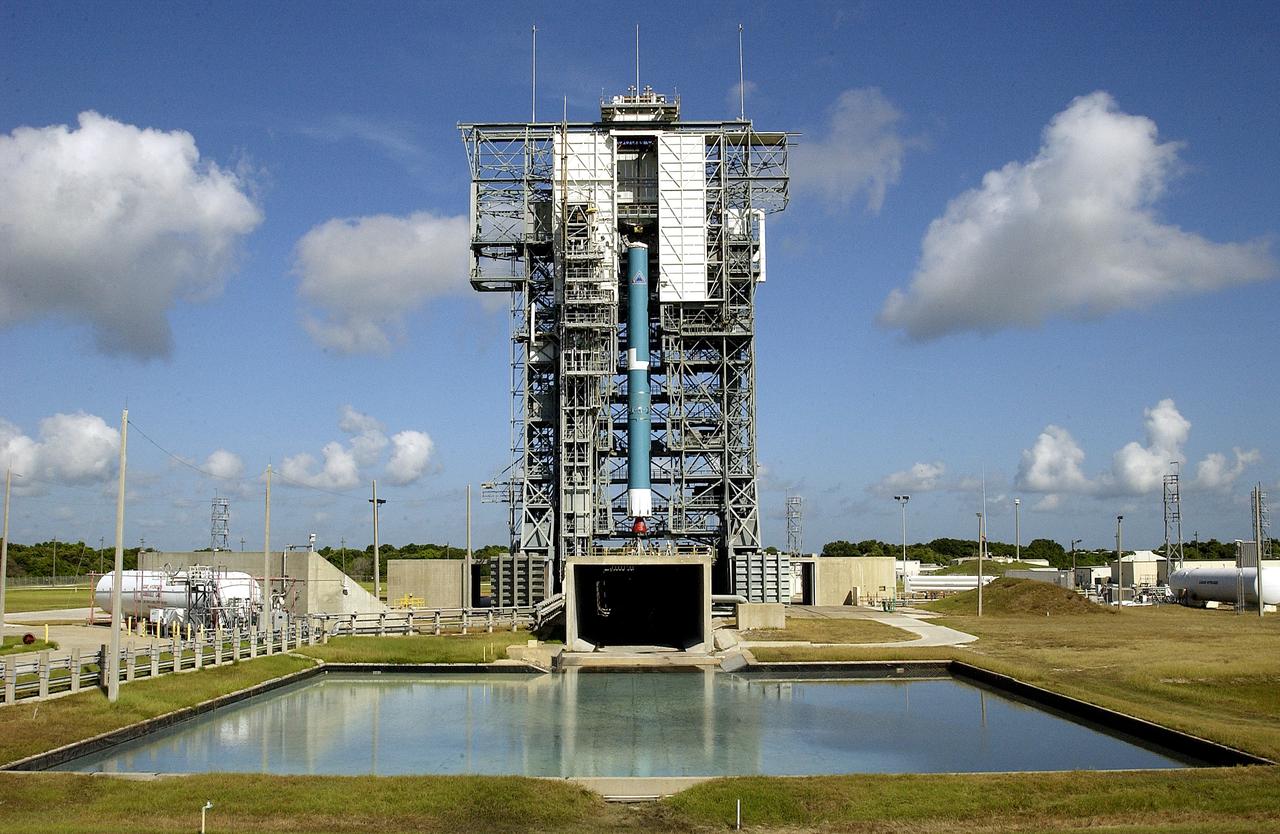
SIRTF Aliveness
In these images obtained by amateur astronomers, Jupiter can be seen losing a brown-colored belt south of the equator called the South Equatorial Belt SEB from 2009 to 2010.
Global Upheaval at Jupiter
Eight Looks at the Jupiter Impact
The SOFIA telescope team collected baseline operational measurements during several nights of characterization testing in March 2008 while the SOFIA 747SP aircraft that houses the German-built infrared telescope was parked on an unlit ramp next to its hangar at the NASA Dryden Flight Operations Facility in Palmdale, Calif. The primary celestial target was Polaris, the North Star. The activity provided the team with a working knowledge of how telescope operating systems interact and the experience of tracking celestial targets from the ground.
NASA's SOFIA flying observatory was captured in striking relief during nighttime telescope characterization tests in Palmdale, Calif., in March 2008
The SOFIA telescope team collected baseline operational measurements during several nights of characterization testing in March 2008 while the SOFIA 747SP aircraft that houses the German-built infrared telescope was parked on an unlit ramp next to its hangar at the NASA Dryden Flight Operations Facility in Palmdale, Calif. The primary celestial target was Polaris, the North Star. The activity provided the team with a working knowledge of how telescope operating systems interact and the experience of tracking celestial targets from the ground.
Scientists and telescope operators focus on data readouts set up inside NASA's SOFIA airborne observatory during telescope characterization tracking tests
The SOFIA telescope team collected baseline operational measurements during several nights of characterization testing in March 2008 while the SOFIA 747SP aircraft that houses the German-built infrared telescope was parked on an unlit ramp next to its hangar at the NASA Dryden Flight Operations Facility in Palmdale, Calif. The primary celestial target was Polaris, the North Star. The activity provided the team with a working knowledge of how telescope operating systems interact and the experience of tracking celestial targets from the ground.
The 2.5-meter infrared telescope in the rear fuselage of NASA's SOFIA flying observatory tracked the star Polaris during characterization tests in March 2008
The SOFIA telescope team collected baseline operational measurements during several nights of characterization testing in March 2008 while the SOFIA 747SP aircraft that houses the German-built infrared telescope was parked on an unlit ramp next to its hangar at the NASA Dryden Flight Operations Facility in Palmdale, Calif. The primary celestial target was Polaris, the North Star. The activity provided the team with a working knowledge of how telescope operating systems interact and the experience of tracking celestial targets from the ground.
Wispy clouds are illuminated by a bright quarter moon behind the tail of NASA's SOFIA flying observatory during telescope characterization testing in 2008
The SOFIA telescope team collected baseline operational measurements during several nights of characterization testing in March 2008 while the SOFIA 747SP aircraft that houses the German-built infrared telescope was parked on an unlit ramp next to its hangar at the NASA Dryden Flight Operations Facility in Palmdale, Calif. The primary celestial target was Polaris, the North Star. The activity provided the team with a working knowledge of how telescope operating systems interact and the experience of tracking celestial targets from the ground.
This backlit photo of SOFIA's infrared telescope during characterization testing shows the cell-like construction of the telescope's 2.5-meter primary mirror
The SOFIA telescope team collected baseline operational measurements during several nights of characterization testing in March 2008 while the SOFIA 747SP aircraft that houses the German-built infrared telescope was parked on an unlit ramp next to its hangar at the NASA Dryden Flight Operations Facility in Palmdale, Calif. The primary celestial target was Polaris, the North Star. The activity provided the team with a working knowledge of how telescope operating systems interact and the experience of tracking celestial targets from the ground.
As SOFIA's large telescope assembly slowly rotates, scientists and telescope operators review data readouts and imagery on their monitors during tracking tests
KENNEDY SPACE CENTER, FLA. -   This view from the mobile service tower on Launch Complex 17-B, Cape Canaveral Air Force Station, shows two solid rocket boosters (SRBs) already suspended in the tower while another is being lifted.  They are three of nine  46-inch-diameter, stretched SRBs that are being attached to the Delta II Heavy rocket that will launch the Space Infrared Telescope Facility (SIRTF).  Consisting of three cryogenically cooled science instruments and an 0.85-meter telescope, SIRTF is one of NASA's largest infrared telescopes to be launched.  SIRTF will obtain images and spectra by detecting the infrared energy, or heat, radiated by objects in space. Most of this infrared radiation is blocked by the Earth's atmosphere and cannot be observed from the ground.
KENNEDY SPACE CENTER, FLA. - This view from the mobile service tower on Launch Complex 17-B, Cape Canaveral Air Force Station, shows two solid rocket boosters (SRBs) already suspended in the tower while another is being lifted. They are three of nine 46-inch-diameter, stretched SRBs that are being attached to the Delta II Heavy rocket that will launch the Space Infrared Telescope Facility (SIRTF). Consisting of three cryogenically cooled science instruments and an 0.85-meter telescope, SIRTF is one of NASA's largest infrared telescopes to be launched. SIRTF will obtain images and spectra by detecting the infrared energy, or heat, radiated by objects in space. Most of this infrared radiation is blocked by the Earth's atmosphere and cannot be observed from the ground.
KENNEDY SPACE CENTER, FLA. -   This view from the mobile service tower on Launch Complex 17-B, Cape Canaveral Air Force Station, shows two solid rocket boosters (SRBs) already suspended in the tower while another is being lifted.  They are three of nine  46-inch-diameter, stretched SRBs that are being attached to the Delta II Heavy rocket that will launch the Space Infrared Telescope Facility (SIRTF).  Consisting of three cryogenically cooled science instruments and an 0.85-meter telescope, SIRTF is one of NASA's largest infrared telescopes to be launched.  SIRTF will obtain images and spectra by detecting the infrared energy, or heat, radiated by objects in space. Most of this infrared radiation is blocked by the Earth's atmosphere and cannot be observed from the ground.
KENNEDY SPACE CENTER, FLA. - This view from the mobile service tower on Launch Complex 17-B, Cape Canaveral Air Force Station, shows two solid rocket boosters (SRBs) already suspended in the tower while another is being lifted. They are three of nine 46-inch-diameter, stretched SRBs that are being attached to the Delta II Heavy rocket that will launch the Space Infrared Telescope Facility (SIRTF). Consisting of three cryogenically cooled science instruments and an 0.85-meter telescope, SIRTF is one of NASA's largest infrared telescopes to be launched. SIRTF will obtain images and spectra by detecting the infrared energy, or heat, radiated by objects in space. Most of this infrared radiation is blocked by the Earth's atmosphere and cannot be observed from the ground.
KENNEDY SPACE CENTER, FLA. -   Another solid rocket booster (SRB) is lifted to vertical on Launch Complex 17-B, Cape Canaveral Air Force Station, to join the one already in place in the mobile service tower.  The SRBs will be attached to the Delta II Heavy rocket in the background that will launch the Space Infrared Telescope Facility (SIRTF). The Delta II Heavy features nine 46-inch-diameter, stretched SRBs.  SIRTF, consisting of three cryogenically cooled science instruments and an 0.85-meter telescope, is one of NASA's largest infrared telescopes to be launched.  SIRTF will obtain images and spectra by detecting the infrared energy, or heat, radiated by objects in space. Most of this infrared radiation is blocked by the Earth's atmosphere and cannot be observed from the ground.
KENNEDY SPACE CENTER, FLA. - Another solid rocket booster (SRB) is lifted to vertical on Launch Complex 17-B, Cape Canaveral Air Force Station, to join the one already in place in the mobile service tower. The SRBs will be attached to the Delta II Heavy rocket in the background that will launch the Space Infrared Telescope Facility (SIRTF). The Delta II Heavy features nine 46-inch-diameter, stretched SRBs. SIRTF, consisting of three cryogenically cooled science instruments and an 0.85-meter telescope, is one of NASA's largest infrared telescopes to be launched. SIRTF will obtain images and spectra by detecting the infrared energy, or heat, radiated by objects in space. Most of this infrared radiation is blocked by the Earth's atmosphere and cannot be observed from the ground.
KENNEDY SPACE CENTER, FLA. -   Another solid rocket booster (SRB) is lifted to vertical on Launch Complex 17-B, Cape Canaveral Air Force Station, to join the one already in place in the mobile service tower.  The SRBs will be attached to the Delta II Heavy rocket that will launch the Space Infrared Telescope Facility (SIRTF).  The Delta II Heavy features nine 46-inch-diameter, stretched SRBs.  SIRTF, consisting of three cryogenically cooled science instruments and an 0.85-meter telescope, is one of NASA's largest infrared telescopes to be launched.  SIRTF will obtain images and spectra by detecting the infrared energy, or heat, radiated by objects in space. Most of this infrared radiation is blocked by the Earth's atmosphere and cannot be observed from the ground.
KENNEDY SPACE CENTER, FLA. - Another solid rocket booster (SRB) is lifted to vertical on Launch Complex 17-B, Cape Canaveral Air Force Station, to join the one already in place in the mobile service tower. The SRBs will be attached to the Delta II Heavy rocket that will launch the Space Infrared Telescope Facility (SIRTF). The Delta II Heavy features nine 46-inch-diameter, stretched SRBs. SIRTF, consisting of three cryogenically cooled science instruments and an 0.85-meter telescope, is one of NASA's largest infrared telescopes to be launched. SIRTF will obtain images and spectra by detecting the infrared energy, or heat, radiated by objects in space. Most of this infrared radiation is blocked by the Earth's atmosphere and cannot be observed from the ground.
KENNEDY SPACE CENTER, FLA. -  Workers in NASA Spacecraft Hangar AE (background) remove sections of the transportation canister from around the Space Infrared Telescope Facility (SIRTF), which has been returned to the hangar from the launch pad.   Additional workers (foreground) prepare the Delta payload attach fitting, from which SIRTF was demated, for further use.  SIRTF will remain in the clean room until it returns to the pad in early August. One of NASA's largest infrared telescopes to be launched, SIRTF will obtain images and spectra by detecting the infrared energy, or heat, radiated by objects in space.
KENNEDY SPACE CENTER, FLA. - Workers in NASA Spacecraft Hangar AE (background) remove sections of the transportation canister from around the Space Infrared Telescope Facility (SIRTF), which has been returned to the hangar from the launch pad. Additional workers (foreground) prepare the Delta payload attach fitting, from which SIRTF was demated, for further use. SIRTF will remain in the clean room until it returns to the pad in early August. One of NASA's largest infrared telescopes to be launched, SIRTF will obtain images and spectra by detecting the infrared energy, or heat, radiated by objects in space.
The Mid-Infrared Instrument, a component of NASA James Webb Space Telescope, underwent alignment testing at the Science and Technology Facilities Council Rutherford Appleton Laboratory Space in Oxfordshire, England.
Webb Instrument Undergoes Alignment Testing
The Mid-Infrared Instrument, a component of NASA James Webb Space Telescope, underwent testing inside the thermal space test chamber at the Science and Technology Facilities Council Rutherford Appleton Laboratory Space in Oxfordshire, England.
Webb Instrument Inside Test Chamber
KENNEDY SPACE CENTER, FLA. - On Launch Complex 17-B, Cape Canaveral Air Force Station, the Space Infrared Telescope Facility (SIRTF) observatory is on a transporter to be taken back to NASA Spacecraft Hangar AE. SIRTF will remain in the clean room at Hangar AE until it returns to the pad in early August.
KENNEDY SPACE CENTER, FLA. -  At Cape Canaveral Air Force Station, the Space Infrared Telescope Facility (SIRTF) observatory is moved into NASA Spacecraft Hangar AE. SIRTF will remain in the clean room at Hangar AE until it returns to the pad in early August.
KENNEDY SPACE CENTER, FLA. - At Cape Canaveral Air Force Station, the Space Infrared Telescope Facility (SIRTF) observatory is moved into NASA Spacecraft Hangar AE. SIRTF will remain in the clean room at Hangar AE until it returns to the pad in early August.
KENNEDY SPACE CENTER, FLA. - On Launch Complex 17-B, Cape Canaveral Air Force Station, the Space Infrared Telescope Facility (SIRTF) observatory is ready to be lowered to the ground and taken back to NASA Spacecraft Hangar AE. SIRTF will remain in the clean room at Hangar AE until it returns to the pad in early August.
KENNEDY SPACE CENTER, FLA. - On Launch Complex 17-B, Cape Canaveral Air Force Station, the Space Infrared Telescope Facility (SIRTF) observatory is lowered onto a transporter to be taken back to NASA Spacecraft Hangar AE. SIRTF will remain in the clean room at Hangar AE until it returns to the pad in early August.
KENNEDY SPACE CENTER, FLA. -  On Launch Complex 17-B, Cape Canaveral Air Force Station, the Space Infrared Telescope Facility (SIRTF) observatory is on a transporter to be taken back to NASA Spacecraft Hangar AE. SIRTF will remain in the clean room at Hangar AE until it returns to the pad in early August.
KENNEDY SPACE CENTER, FLA. - On Launch Complex 17-B, Cape Canaveral Air Force Station, the Space Infrared Telescope Facility (SIRTF) observatory is on a transporter to be taken back to NASA Spacecraft Hangar AE. SIRTF will remain in the clean room at Hangar AE until it returns to the pad in early August.