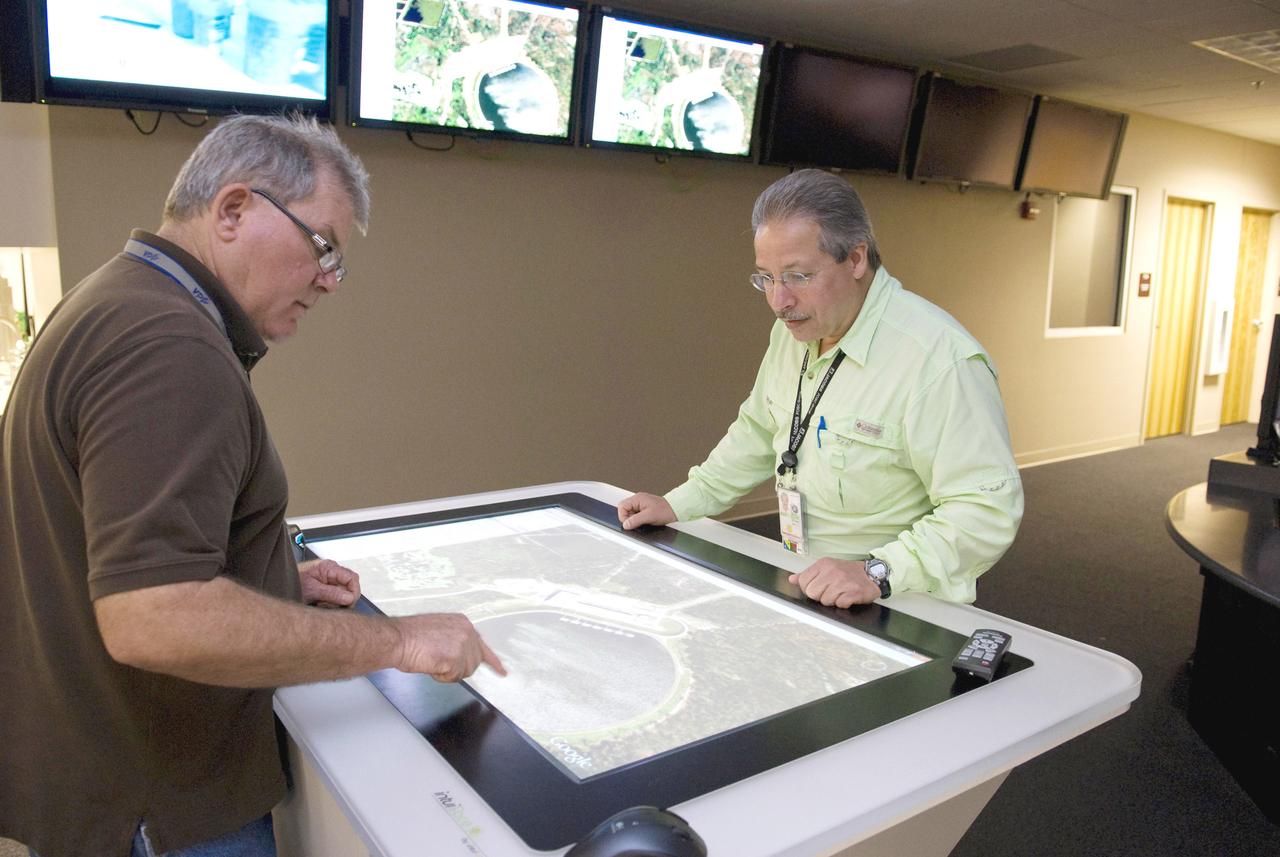
Stennis Space Center employees Mike McKinion (left), with Erica Lane Enterprises, and Luke Scianna, with the Jacobs Facility Operating Services Contract, monitor the facility and surrounding area on the 'all-hazards network' known as HazNet. The HazNet system at Stennis was developed by a local Mississippi company to help facilitate coordinated response during emergency and disaster situations. The system was installed in the new Emergency Operations Center built at Stennis before being implemented throughout NASA. HazNet was designed by NVision Solutions Inc. of Bay St. Louis, Miss., through NASA's Innovative Partnerships Program. In addition to being used at Stennis, it has been installed at other Gulf Coast communities to help coordinate response during emergencies and such natural disasters as hurricanes.
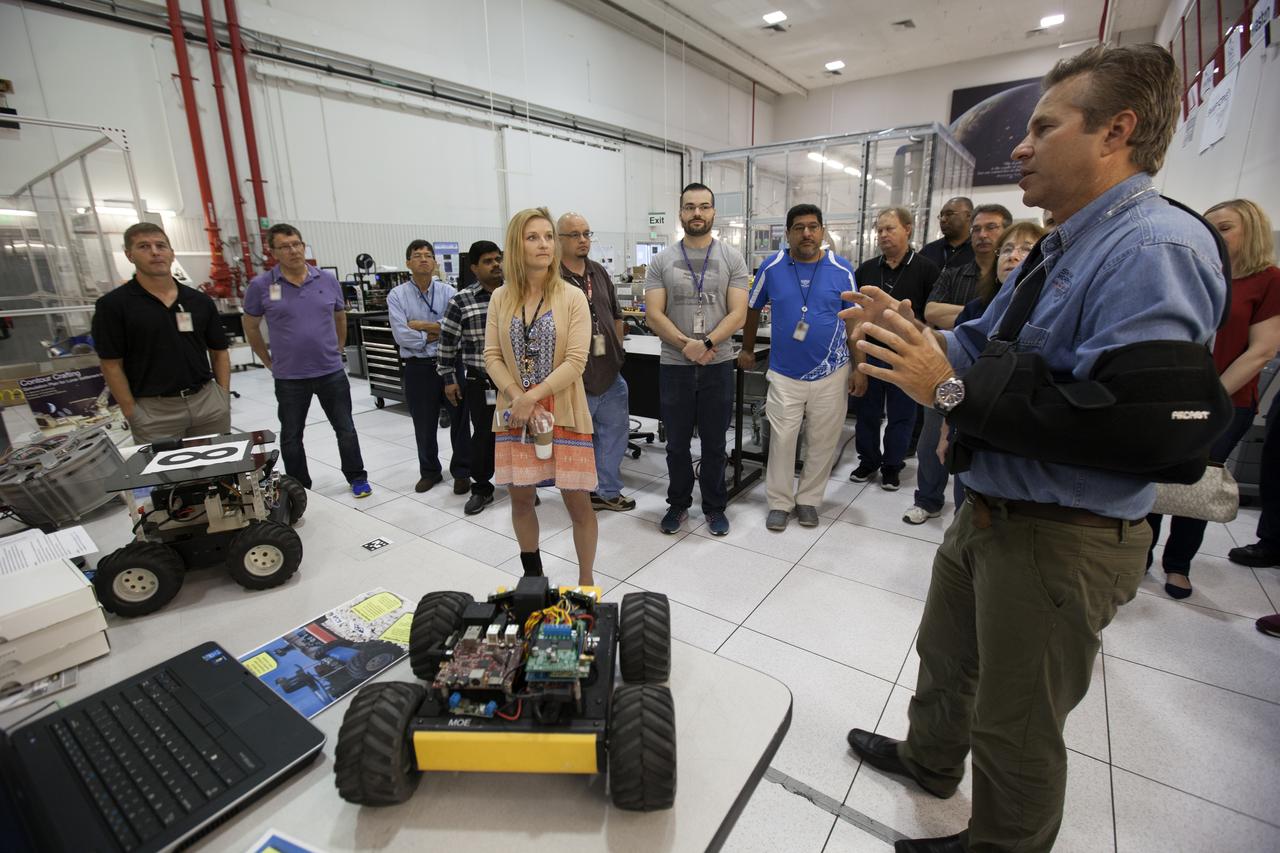
Jenn Gustetic, NASA's Small Business Innovation Research Program executive, talks with Rob Mueller, senior technologist and co-founder of Kennedy Space Center's Swamp Works. Gustetic met team members and viewed many of the pioneering technologies and innovations in development at Kennedy. Swamp Works is a hands-on, lean development environment for innovation following the philosophies pioneered in Kelly Johnson's Skunk Works and Werner von Braun's development shops. The Swamp Works establishes rapid, innovative and cost-effective exploration mission solutions through a highly collaborative, "no walls" approach, leveraging partnerships across NASA, industry and academia.
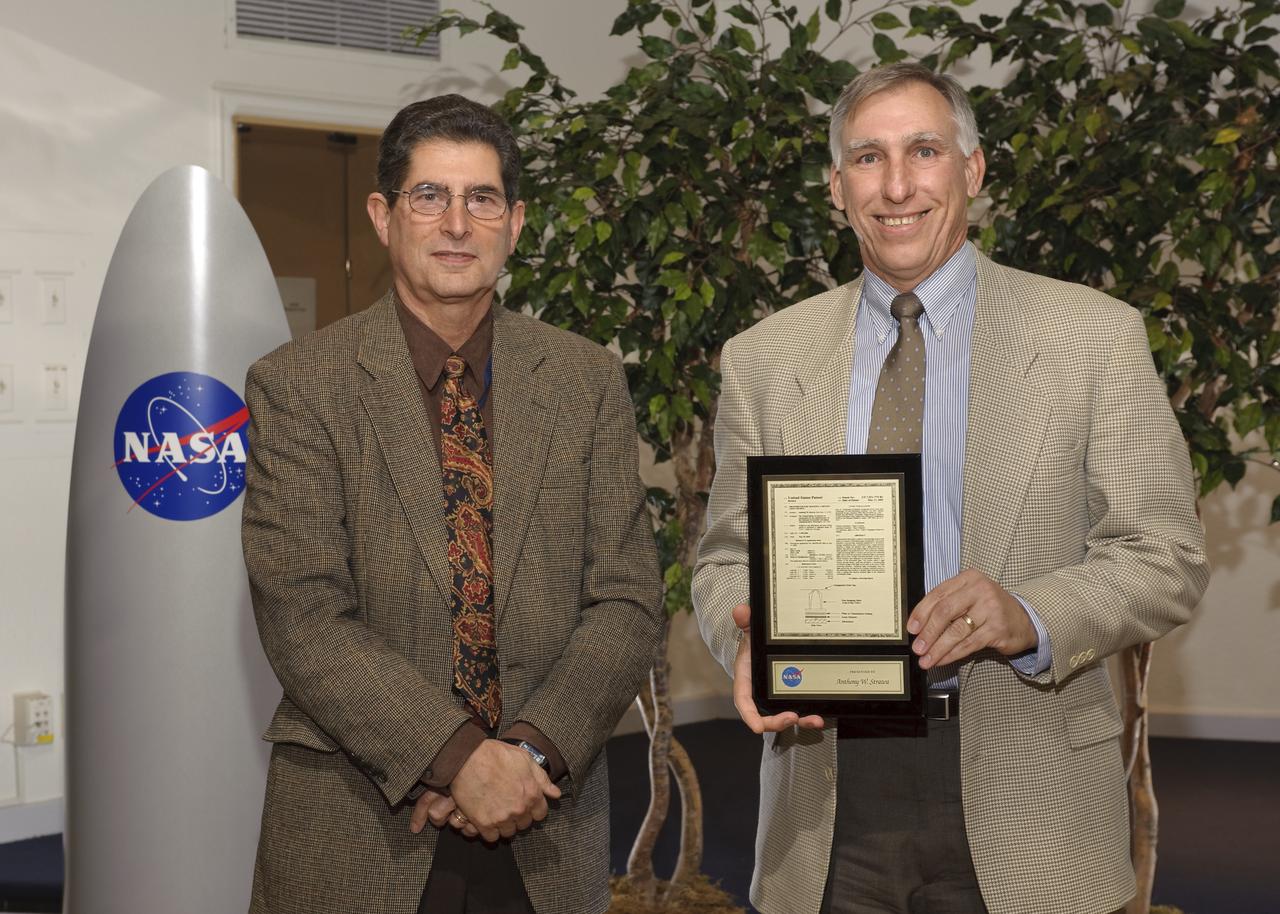
2009 Awards Ceremony; 2008 Government Invention of the Year Award, 2009 Software of the Year Award sponsored by Ames Innovative Partnerships Program Office. Patent Awards, Steve Zornetzer, Associate Director Ames Research Center presenting: Anthony Strawa for Photometer for Tracking a Moving Light Source.
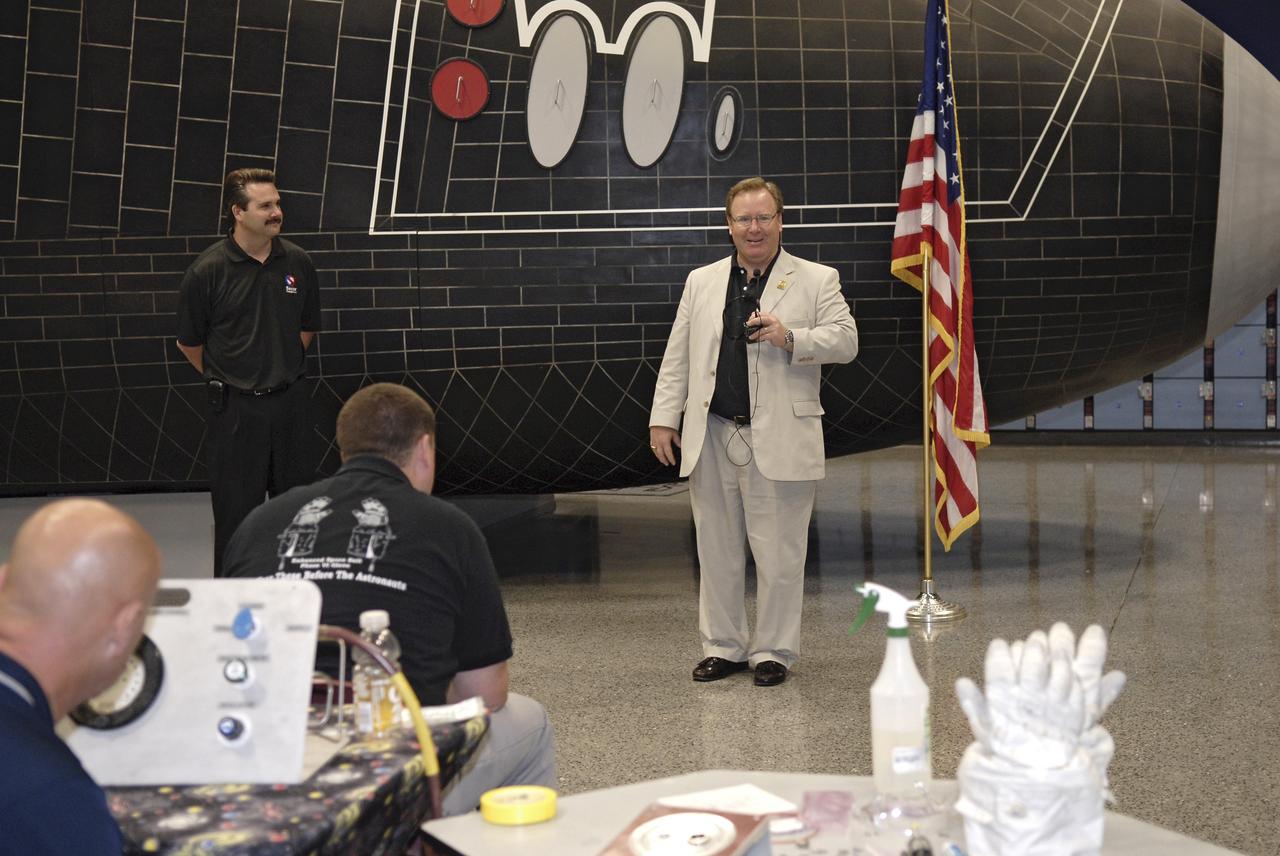
CAPE CANAVERAL, Fla. – Doug Comstock, at microphone, director of the NASA Innovative Partnerships Program, addresses the participants in the 2009 Astronaut Glove Challenge, part of NASA’s Centennial Challenges Program, at the Astronaut Hall of Fame near NASA’s Kennedy Space Center in Florida. The nationwide competition focused on developing improved pressure suit gloves for astronauts to use while working in space. During the challenge, inventors tested the gloves to measure dexterity and strength during operation in a glove box which simulates the vacuum of space. Centennial Challenges is NASA’s program of technology prizes for the citizen-inventor. The winning prize for the Glove Challenge is $250,000 provided by the Centennial Challenges Program. Photo credit: NASA/Kim Shiflett
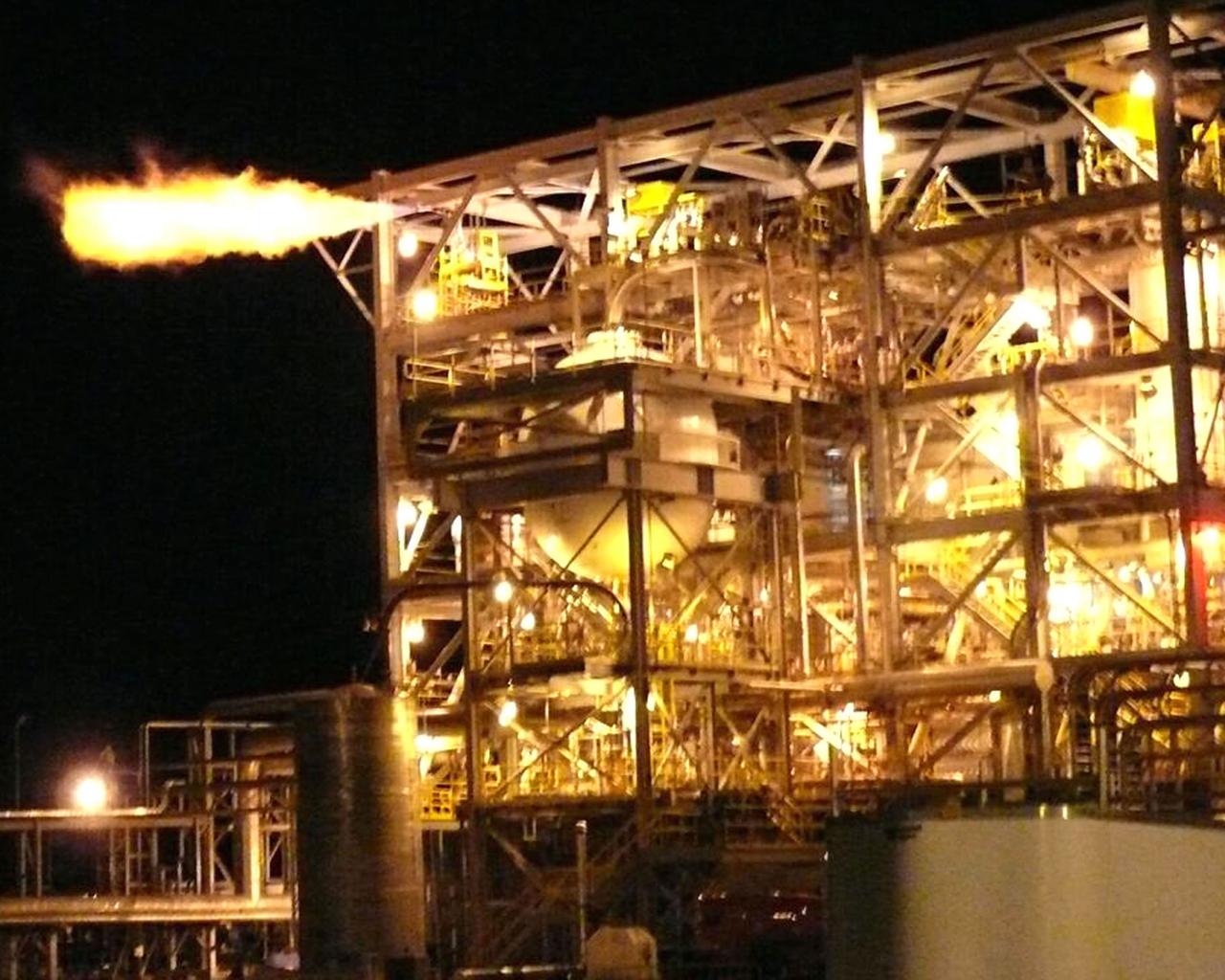
Flames burst from the E-1 Test Stand as Stennis Space Center engineers perform one of dozens of shuttle flow valve tests in early February. Stennis engineers teamed with Innovative Partnership Program partners to perform the tests after NASA officials delayed the launch of the STS-119 mission because of concerns with the shuttle part.
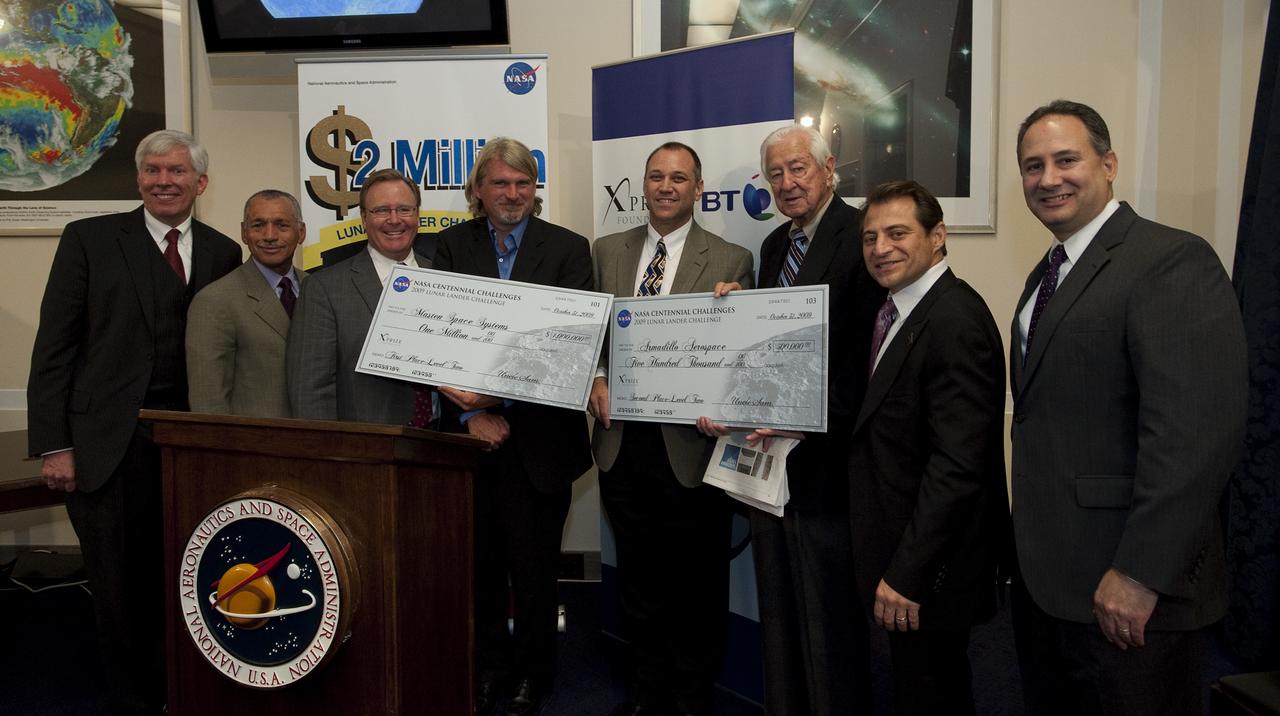
NASA and the X PRIZE Foundation announced the winners of the Northrop Grumman Lunar Lander Challenge at an awards ceremony at the Rayburn House Office Building, Thursday, Nov. 5, 2009 in Washington, DC. From left to right, George Nield, Associate Administrator of Commercial Space Transportation, FAA; Charles Bolden, NASA Administrator; Doug Comstock, Director, Innovative Partnerships Program, NASA; David Masten, CEO, Masten Space Systems; Phil Eaton, VP, Operations, Armadillo Aerospace; U.S. Rep. Ralph Hall (R-TX); Peter Diamandis, Chairman and CEO, X PRIZE Foundation and Mitch Waldman, VP, Advanced Programs & Technology, Northrop Grumman. Photo Credit: (NASA/Carla Cioffi)
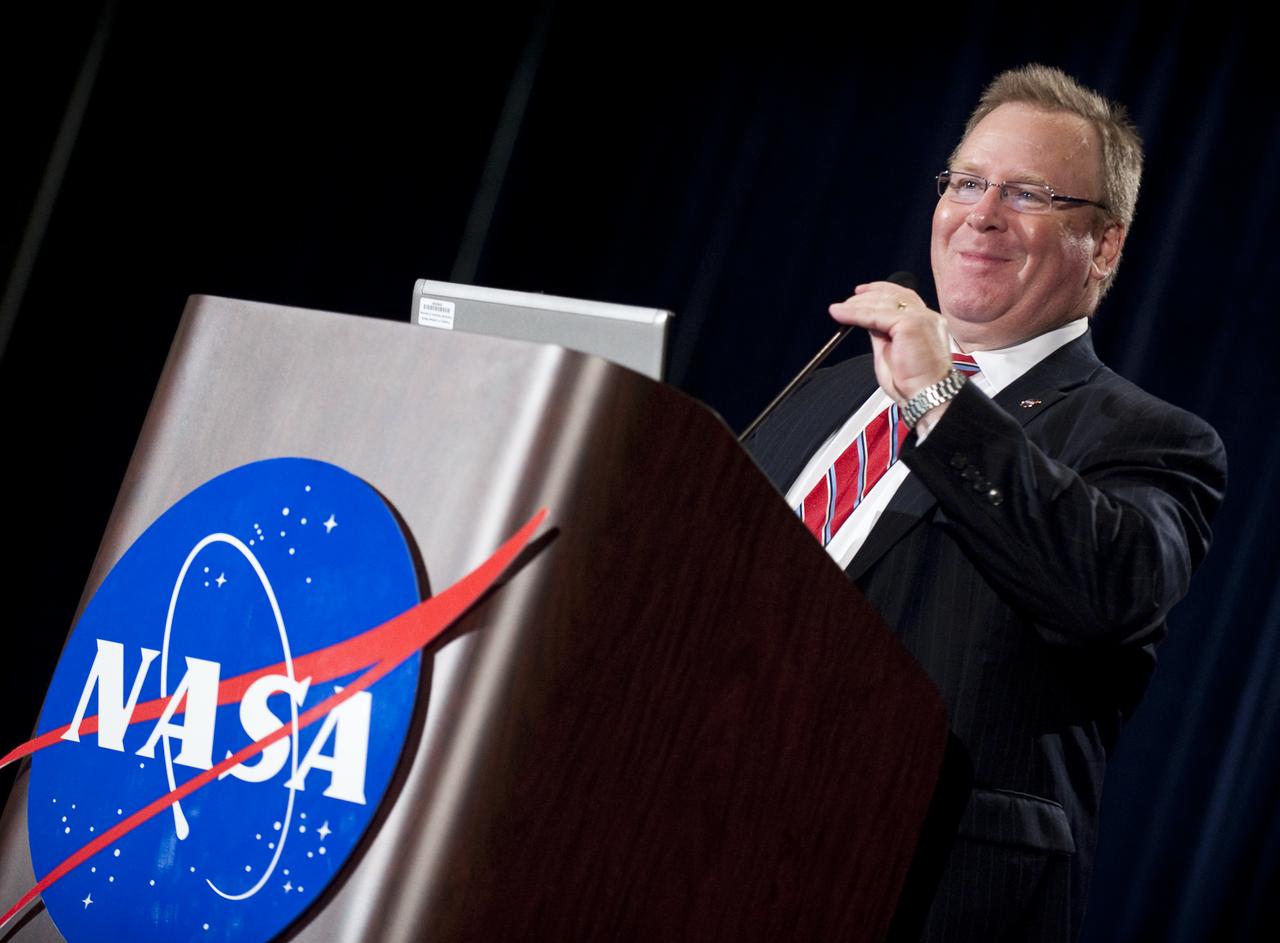
NASA's Partnership, Innovation & Commercial Space Director Doug Comstock speaks during the NASA New Space Technology Industry Forum being held at the University of Maryland in College Park on Tuesday, July 13, 2010. During the two-day event, speakers are focusing on the president's fiscal year 2011 budget request for NASA's new Space Technology Program. Representatives from industry, academia and the federal government are in attendance to discuss strategy, development and implementation of NASA's proposed new technology-enabled exploration. Photo Credit: (NASA/Bill Ingalls)
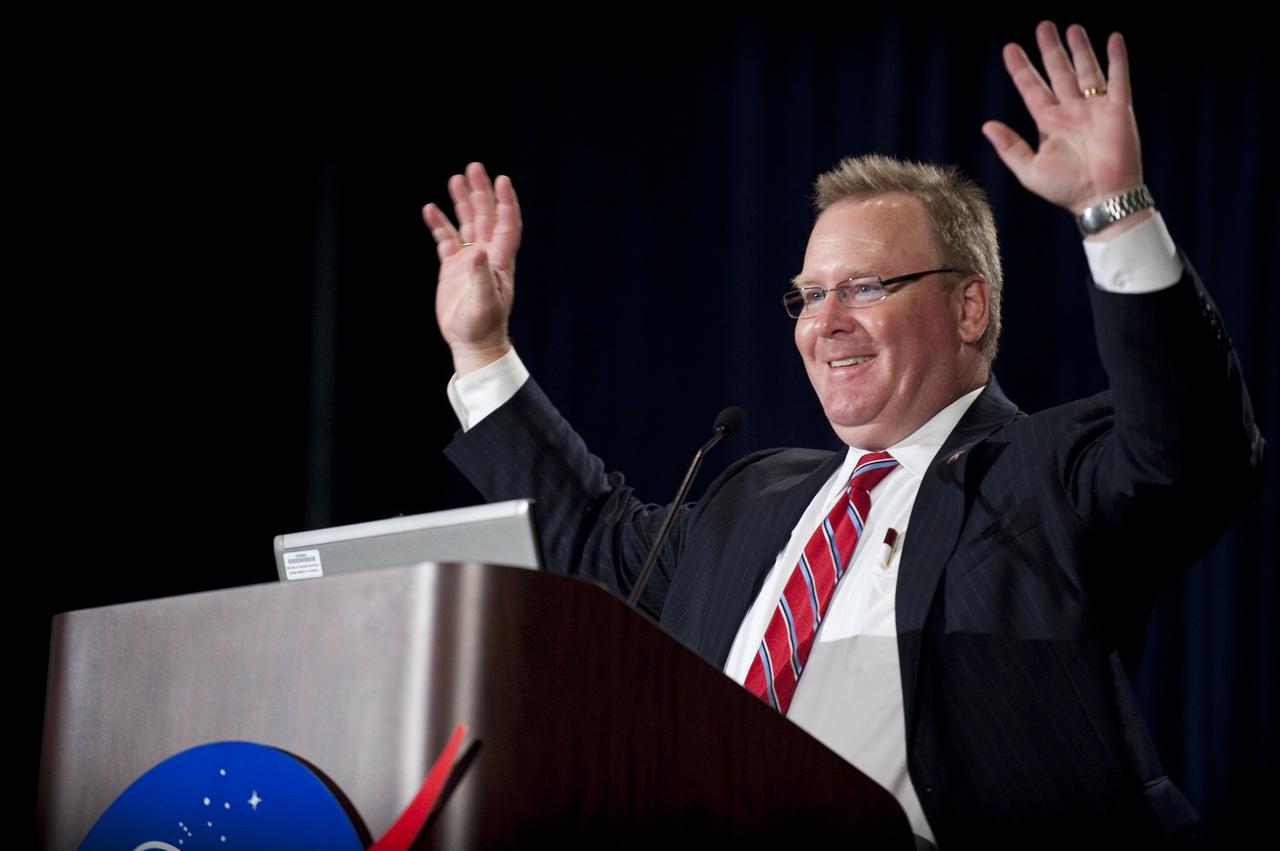
NASA's Partnership, Innovation & Commercial Space Director Doug Comstock speaks during the NASA New Space Technology Industry Forum being held at the University of Maryland in College Park on Tuesday, July 13, 2010. During the two-day event, speakers are focusing on the president's fiscal year 2011 budget request for NASA's new Space Technology Program. Representatives from industry, academia and the federal government are in attendance to discuss strategy, development and implementation of NASA's proposed new technology-enabled exploration. Photo Credit: (NASA/Bill Ingalls)
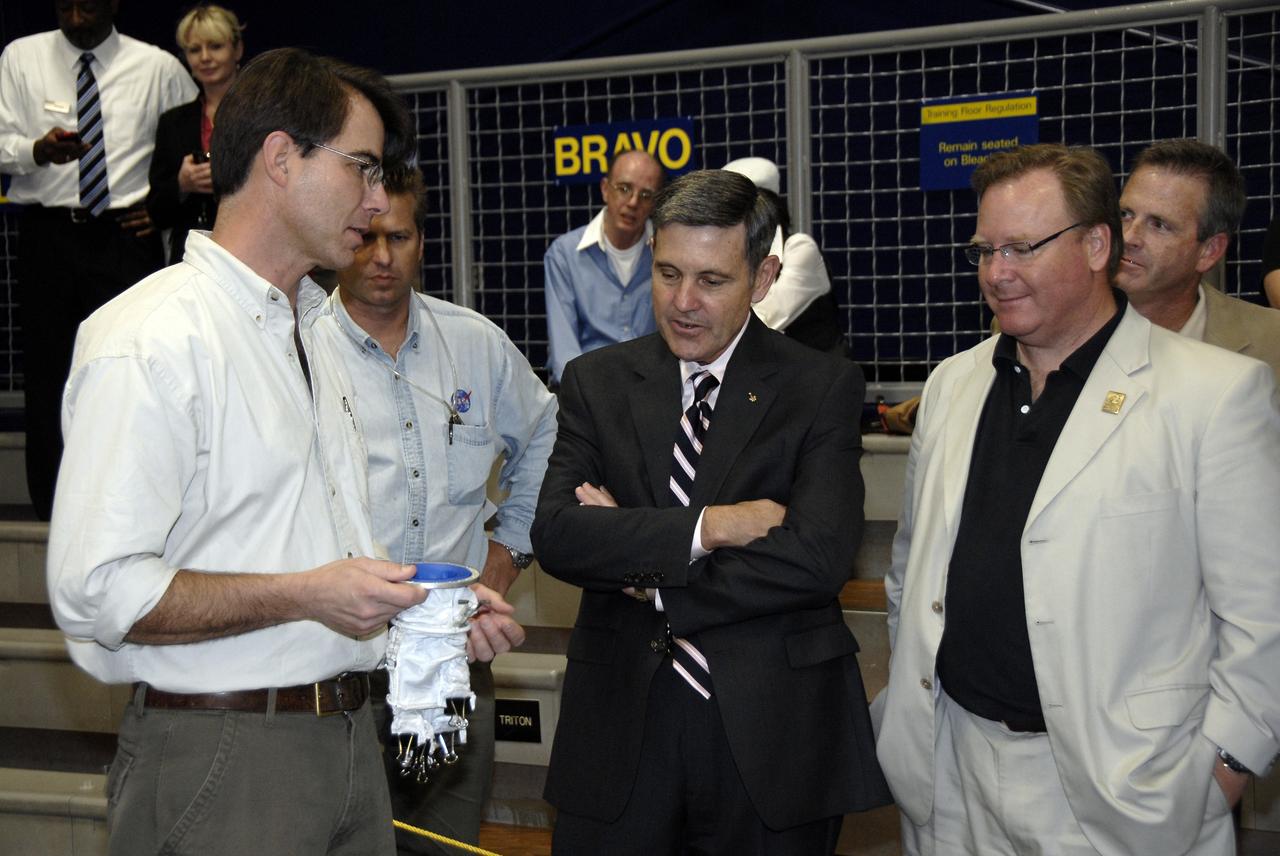
CAPE CANAVERAL, Fla. - At the Astronaut Hall of Fame near NASA’s Kennedy Space Center in Florida, first-prize winner Peter Homer, left, of Southwest Harbor, Maine, talks with Kennedy Director Bob Cabana and Doug Comstock, director of the NASA Innovative Partnerships Program, about his winning glove design in the 2009 Astronaut Glove Challenge, part of NASA’s Centennial Challenges Program. The nationwide competition focused on developing improved pressure suit gloves for astronauts to use while working in space. During the challenge, the gloves were submitted to burst tests, joint force tests and tests to measure their dexterity and strength during operation in a glove box which simulates the vacuum of space. Centennial Challenges is NASA’s program of technology prizes for the citizen-inventor. The winning prize for the Glove Challenge is $250,000 provided by the Centennial Challenges Program. Photo credit: NASA/Kim Shiflett
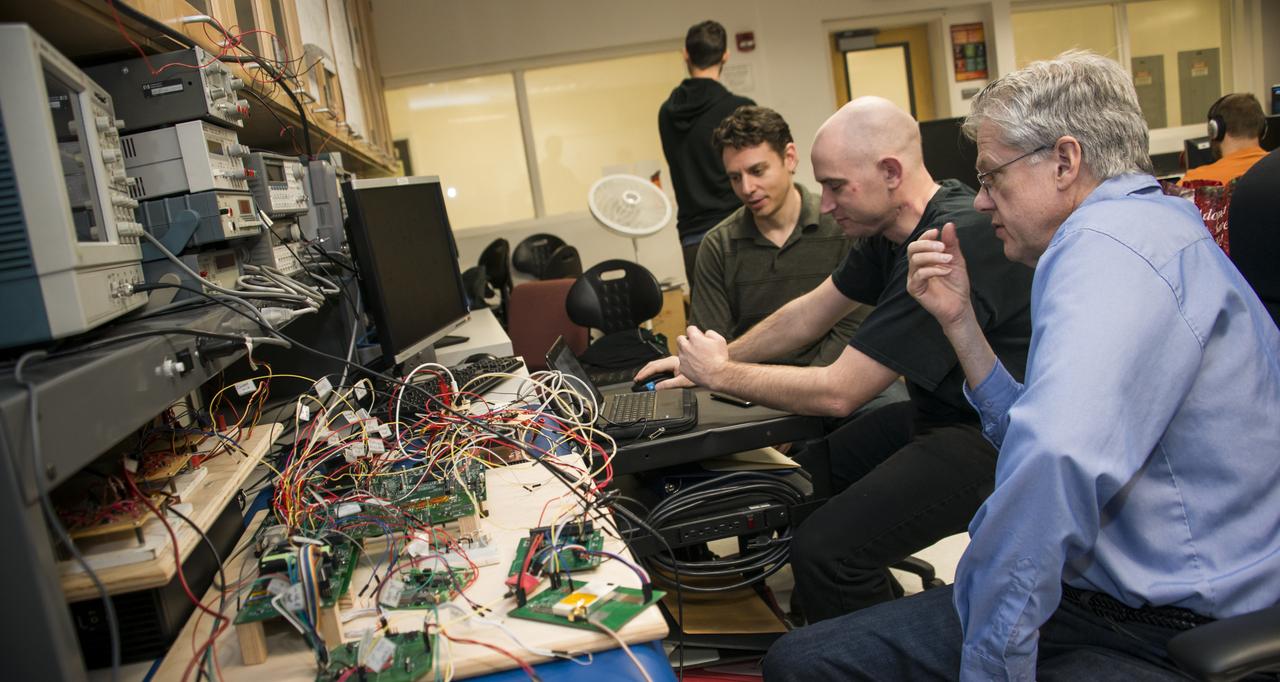
CSUNSat-1 Team (Adam Kaplan, James Flynn, Donald Eckels) working on their CubeSat at California State University Northridge. The primary mission of CSUNSat1 is to space test an innovative low temperature capable energy storage system developed by the Jet Propulsion Laboratory, raising its TRL level to 7 from 4 to 5. The success of this energy storage system will enable future missions, especially those in deep space to do more science while requiring less energy, mass and volume. This CubeSat was designed, built, programmed, and tested by a team of over 70 engineering and computer science students at CSUN. The primary source of funding for CSUNSat1 comes from NASA’s Smallest Technology Partnership program. Launched by NASA’s CubeSat Launch Initiative NET April 18, 2017 ELaNa XVII mission on the seventh Orbital-ATK Cygnus Commercial Resupply Services (OA-7) to the International Space Station and deployed on tbd.
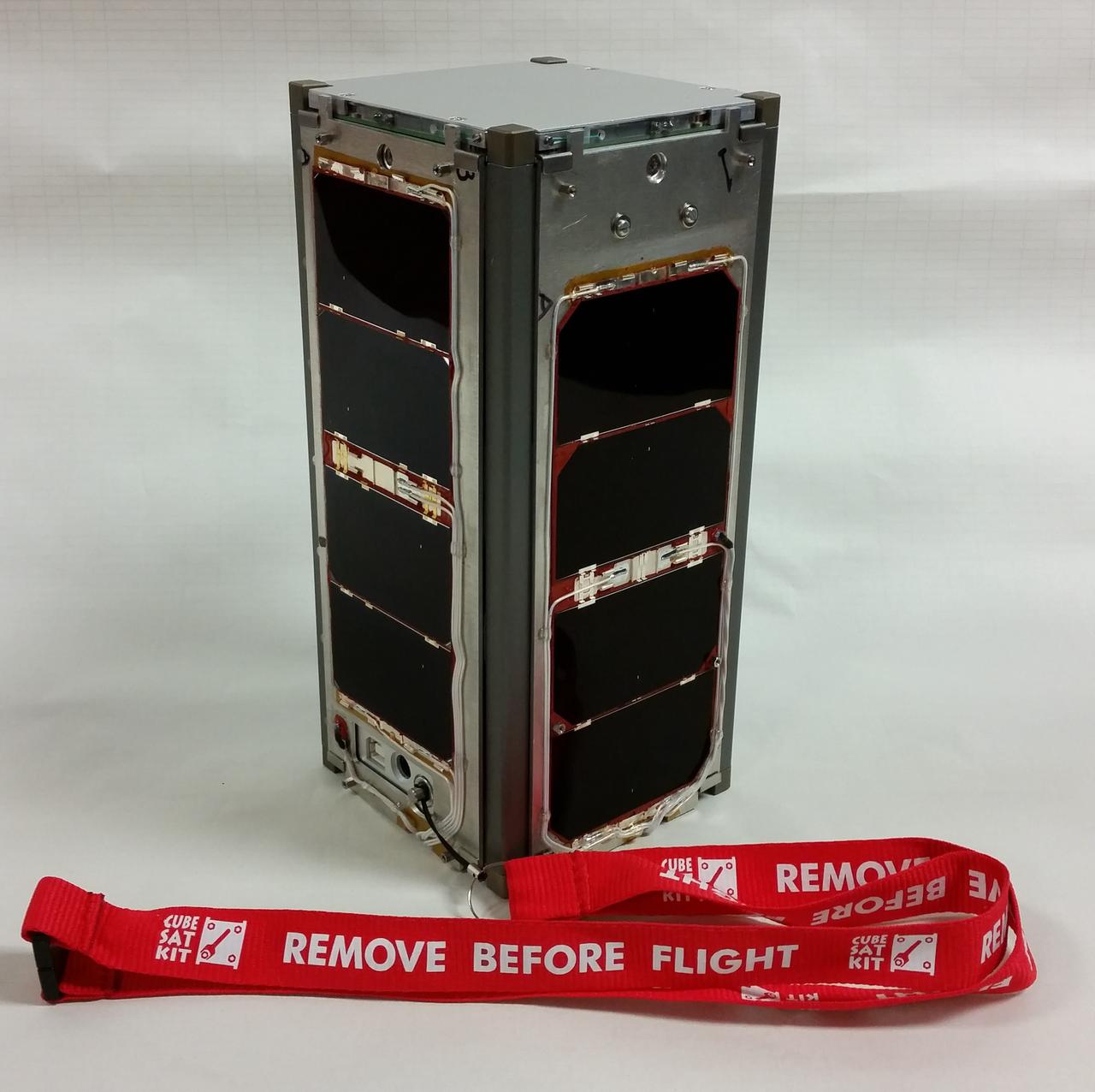
The primary mission of CSUNSat1 is to space test an innovative low temperature capable energy storage system developed by the Jet Propulsion Laboratory, raising its TRL level to 7 from 4 to 5. The success of this energy storage system will enable future missions, especially those in deep space to do more science while requiring less energy, mass and volume. This CubeSat was designed, built, programmed, and tested by a team of over 70 engineering and computer science students at CSUN. The primary source of funding for CSUNSat1 comes from NASA’s Smallest Technology Partnership program. Launched by NASA’s CubeSat Launch Initiative on the NET April 18, 2017 ELaNa XVII mission on the seventh Orbital-ATK Cygnus Commercial Resupply Services (OA-7) to the International Space Station and deployed on tbd.
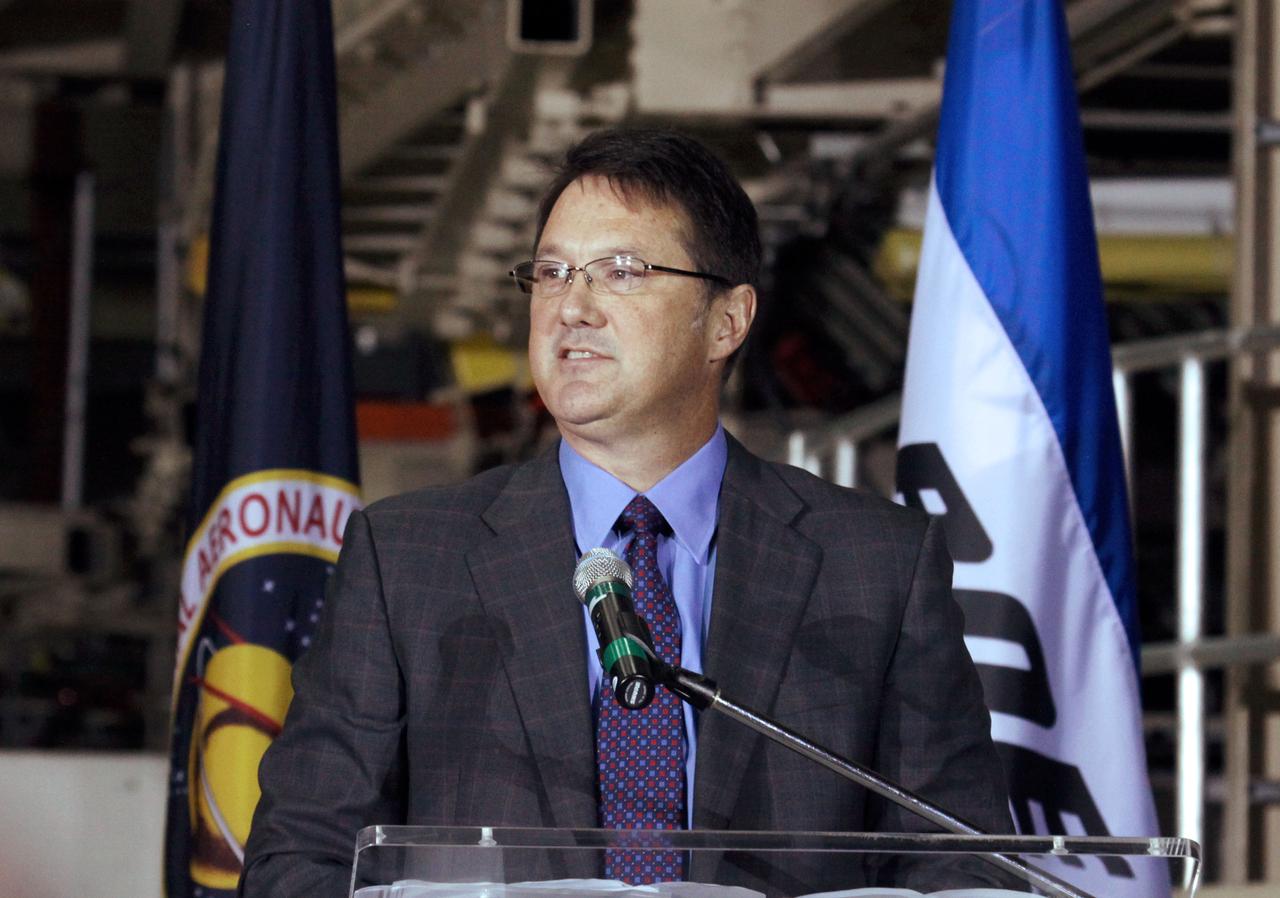
CAPE CANAVERAL, Fla. – In the Orbiter Processing Facility-3 (OPF-3) at NASA’s Kennedy Space Center in Florida, John Mulholland, vice president and program manager of Boeing's Commercial Crew Programs, speaks to the audience after announcing the signing of an innovative agreement between NASA and Space Florida. NASA announced a partnership with Space Florida to occupy, use and modify Kennedy Space Center's Orbiter Processing Facility-3 (OPF-3), the Space Shuttle Main Engine Processing Facility and Processing Control Center. Space Florida has an agreement for use of the OPF-3 with the Boeing Company to manufacture and test the company's Crew Space Transportation (CST-100) spacecraft. The 15-year use permit deal is the latest step Kennedy is making as the center transitions from a historically government-only launch complex to a multi-user spaceport. For more information, visit http:__www.nasa.gov_exploration_commercial_index.html. Photo credit: NASA_Ken Thornsley
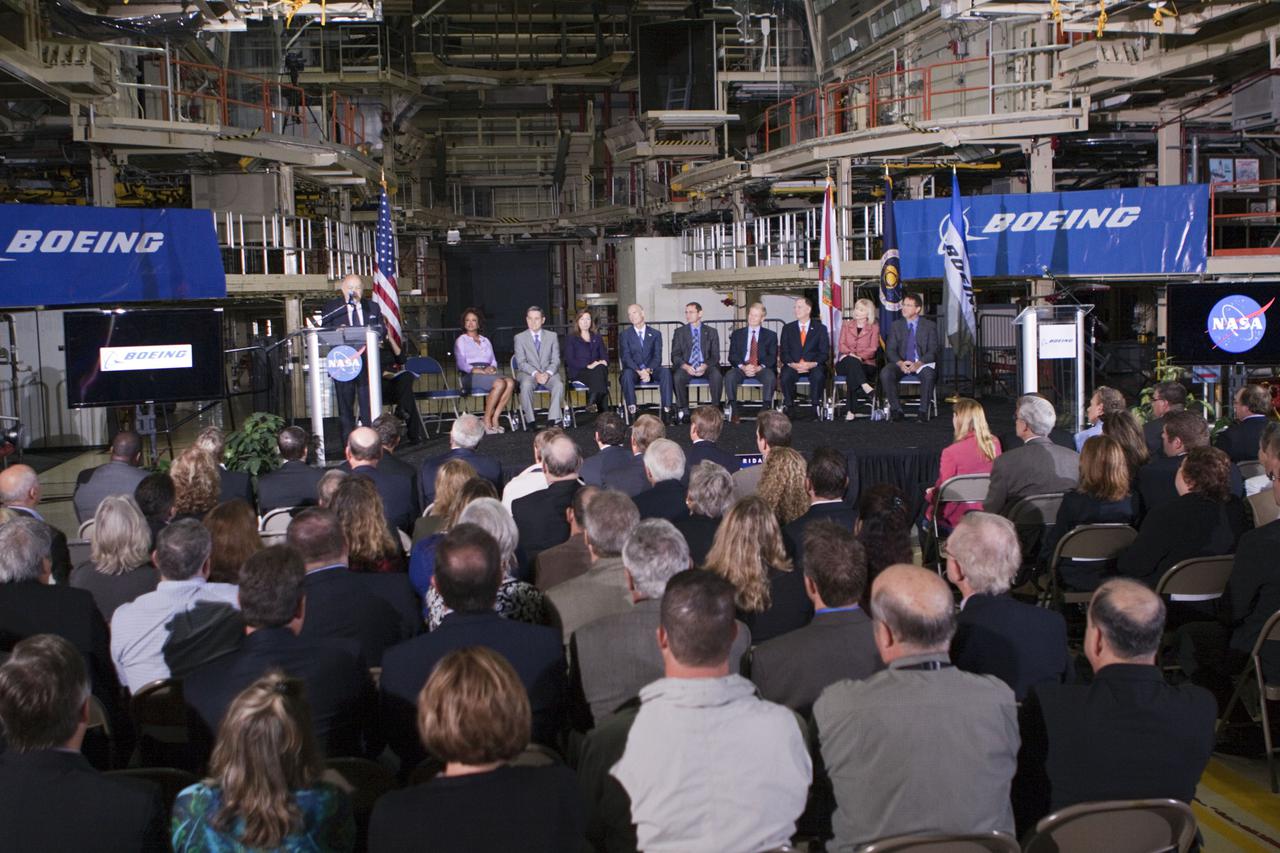
CAPE CANAVERAL, Fla. – In the Orbiter Processing Facility-3 (OPF-3) at NASA’s Kennedy Space Center in Florida, Frank DiBello, president of Space Florida, speaks to the audience after announcing the signing of an innovative agreement between NASA and Space Florida. From his left are, Florida Lt. Gov. Jennifer Carroll, chairwoman of Space Florida, Robert Cabana, Kennedy Space Center director, Lori Garver, NASA’s deputy administrator, Florida Gov. Rick Scott, John Elbon, vice president and general manager of Boeing's Space Exploration, Sen. Bill Nelson of Florida, Florida Congressman Bill Posey, Florida Representative Sandy Adams, and John Mulholland, vice president and program manager of Boeing's Commercial Crew Programs. NASA announced a partnership with Space Florida to occupy, use and modify Kennedy Space Center's Orbiter Processing Facility-3 (OPF-3), the Space Shuttle Main Engine Processing Facility and Processing Control Center. Space Florida has an agreement for use of the OPF-3 with the Boeing Company to manufacture and test the company's Crew Space Transportation (CST-100) spacecraft. The 15-year use permit deal is the latest step Kennedy is making as the center transitions from a historically government-only launch complex to a multi-user spaceport. For more information, visit http:__www.nasa.gov_exploration_commercial_index.html. Photo credit: NASA_Kim Shiflett
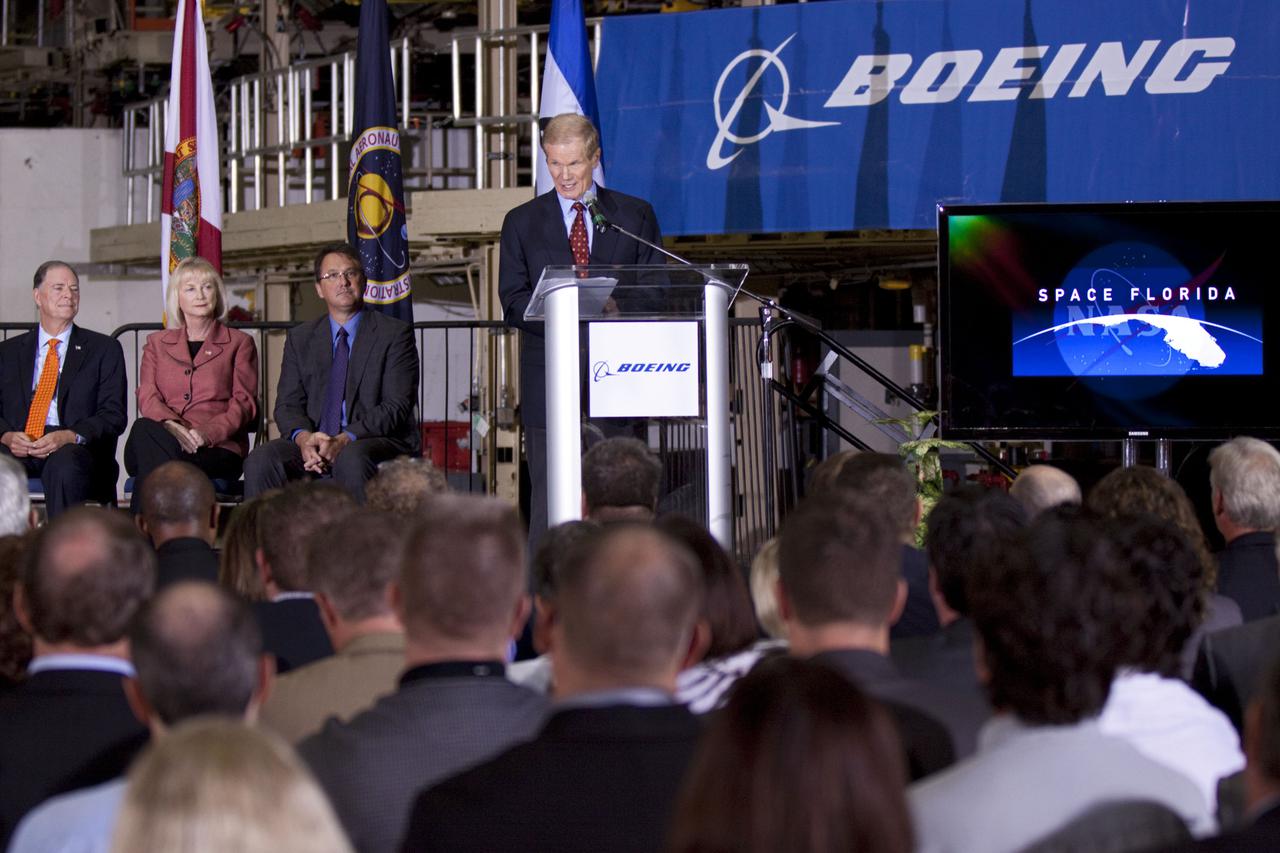
CAPE CANAVERAL, Fla. – In the Orbiter Processing Facility-3 (OPF-3) at NASA’s Kennedy Space Center in Florida, Sen. Bill Nelson of Florida speaks to the audience during the ceremony announcing the signing of an innovative agreement between NASA and Space Florida. Seated to his right are, Florida Congressman Bill Posey, Florida Representative Sandy Adams, and John Mulholland, vice president and program manager of Boeing's Commercial Crew Programs. NASA announced a partnership with Space Florida to occupy, use and modify Kennedy Space Center's Orbiter Processing Facility-3 (OPF-3), the Space Shuttle Main Engine Processing Facility and Processing Control Center. Space Florida has an agreement for use of the OPF-3 with the Boeing Company to manufacture and test the company's Crew Space Transportation (CST-100) spacecraft. The 15-year use permit deal is the latest step Kennedy is making as the center transitions from a historically government-only launch complex to a multi-user spaceport. For more information, visit http:__www.nasa.gov_exploration_commercial_index.html. Photo credit: NASA_Kim Shiflett
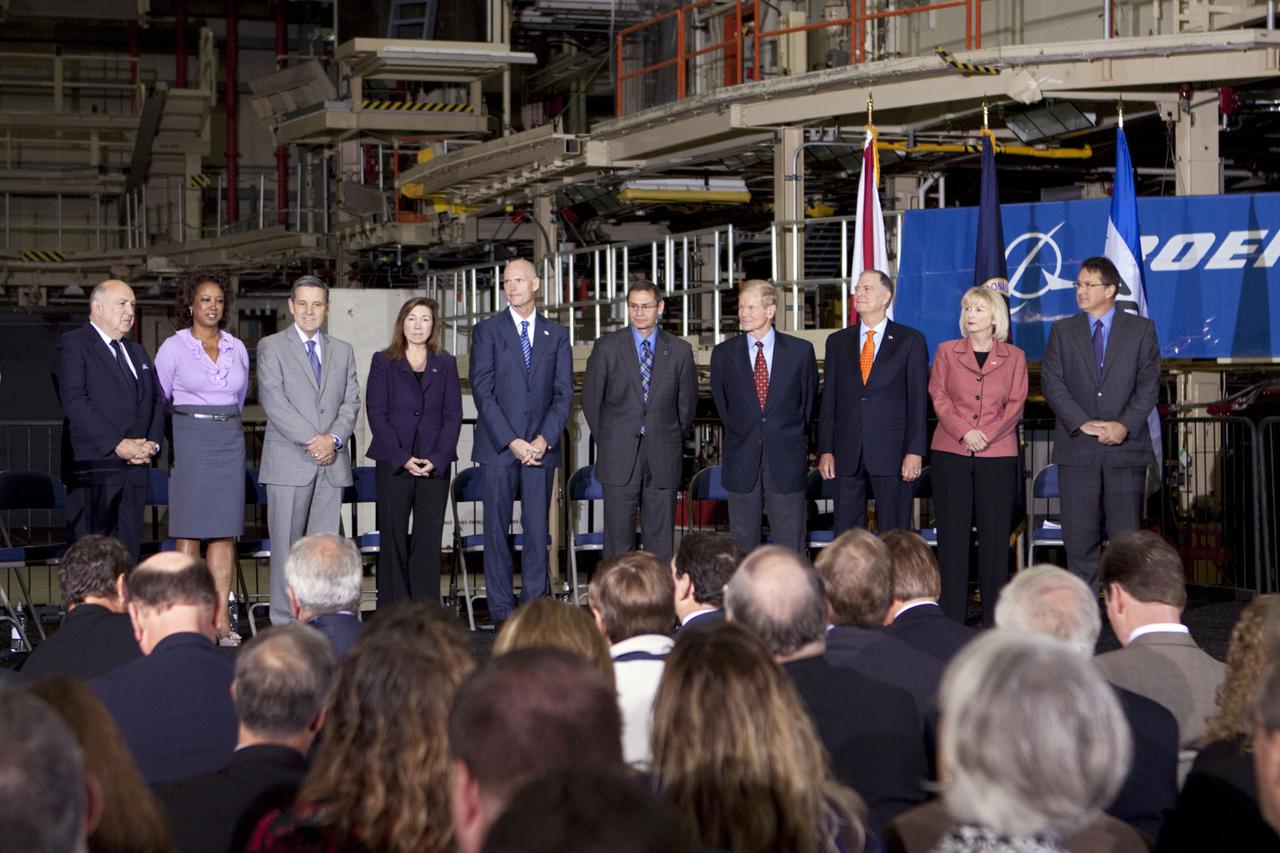
CAPE CANAVERAL, Fla. – In the Orbiter Processing Facility-3 (OPF-3) at NASA’s Kennedy Space Center in Florida, officials pose for a portrait proceeding the announcement of the signing of an innovative agreement between NASA and Space Florida. From left are, Frank DiBello, president of Space Florida, Florida Lt. Gov. Jennifer Carroll, chairwoman of Space Florida, Robert Cabana, Kennedy Space Center director, Lori Garver, NASA’s deputy administrator, Florida Gov. Rick Scott, John Elbon, vice president and general manager of Boeing's Space Exploration, Sen. Bill Nelson of Florida, Florida Congressman Bill Posey, Florida Representative Sandy Adams, and John Mulholland, vice president and program manager of Boeing's Commercial Crew Programs. NASA announced a partnership with Space Florida to occupy, use and modify Kennedy Space Center's Orbiter Processing Facility-3 (OPF-3), the Space Shuttle Main Engine Processing Facility and Processing Control Center. Space Florida has an agreement for use of the OPF-3 with the Boeing Company to manufacture and test the company's Crew Space Transportation (CST-100) spacecraft. The 15-year use permit deal is the latest step Kennedy is making as the center transitions from a historically government-only launch complex to a multi-user spaceport. For more information, visit http:__www.nasa.gov_exploration_commercial_index.html. Photo credit: NASA_Kim Shiflett
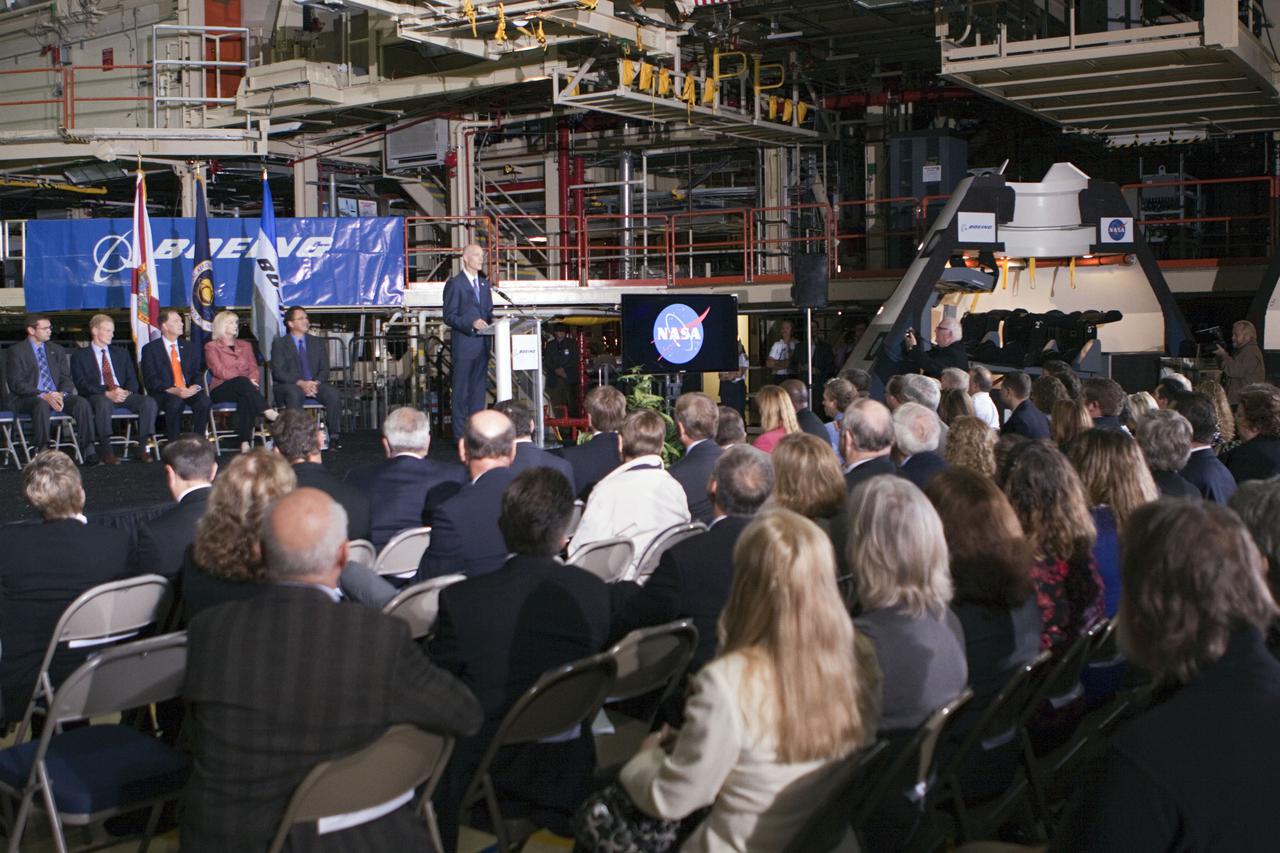
CAPE CANAVERAL, Fla. – In the Orbiter Processing Facility-3 (OPF-3) at NASA’s Kennedy Space Center in Florida, Florida Gov. Rick Scott speaks to the audience during the ceremony announcing the signing of an innovative agreement between NASA and Space Florida. Seated on the podium from left are, John Elbon, vice president and general manager of Boeing's Space Exploration, Sen. Bill Nelson of Florida, Florida Congressman Bill Posey, Florida Representative Sandy Adams, and John Mulholland, vice president and program manager of Boeing's Commercial Crew Programs. NASA announced a partnership with Space Florida to occupy, use and modify Kennedy Space Center's Orbiter Processing Facility-3 (OPF-3), the Space Shuttle Main Engine Processing Facility and Processing Control Center. Space Florida has an agreement for use of the OPF-3 with the Boeing Company to manufacture and test the company's Crew Space Transportation (CST-100) spacecraft. The 15-year use permit deal is the latest step Kennedy is making as the center transitions from a historically government-only launch complex to a multi-user spaceport. For more information, visit http:__www.nasa.gov_exploration_commercial_index.html. Photo credit: NASA_Kim Shiflett
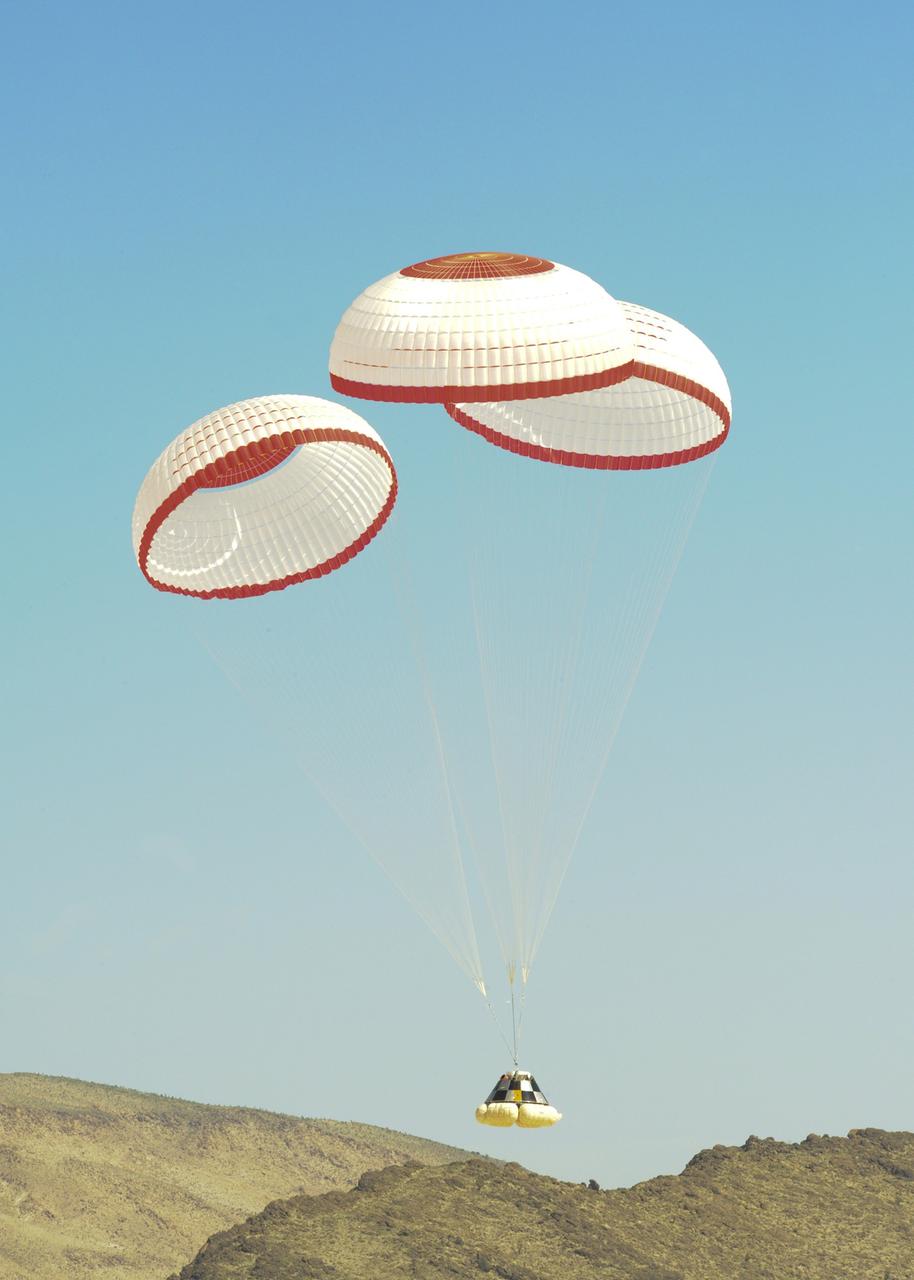
DELAMAR DRY LAKE BED, Nev. – The Boeing Company's CST-100 crew capsule floats to a smooth landing beneath three main parachutes over the Delamar Dry Lake Bed near Alamo, Nev. This is the second parachute test that Boeing performed under its partnership with NASA's Commercial Crew Program CCP. The first showed the parachute system’s deployment scheme worked and that it could be re-packed and re-used for this second test. In 2011, NASA selected Boeing during Commercial Crew Development Round 2 CCDev2) activities to mature the design and development of a crew transportation system with the overall goal of accelerating a United States-led capability to the International Space Station. The goal of CCP is to drive down the cost of space travel as well as open up space to more people than ever before by balancing industry’s own innovative capabilities with NASA's 50 years of human spaceflight experience. Six other aerospace companies also are maturing launch vehicle and spacecraft designs under CCDev2, including Alliant Techsystems Inc. ATK, Excalibur Almaz Inc., Blue Origin, Sierra Nevada, Space Exploration Technologies SpaceX, and United Launch Alliance ULA. For more information, visit www.nasa.gov/commercialcrew. Image credit: Boeing
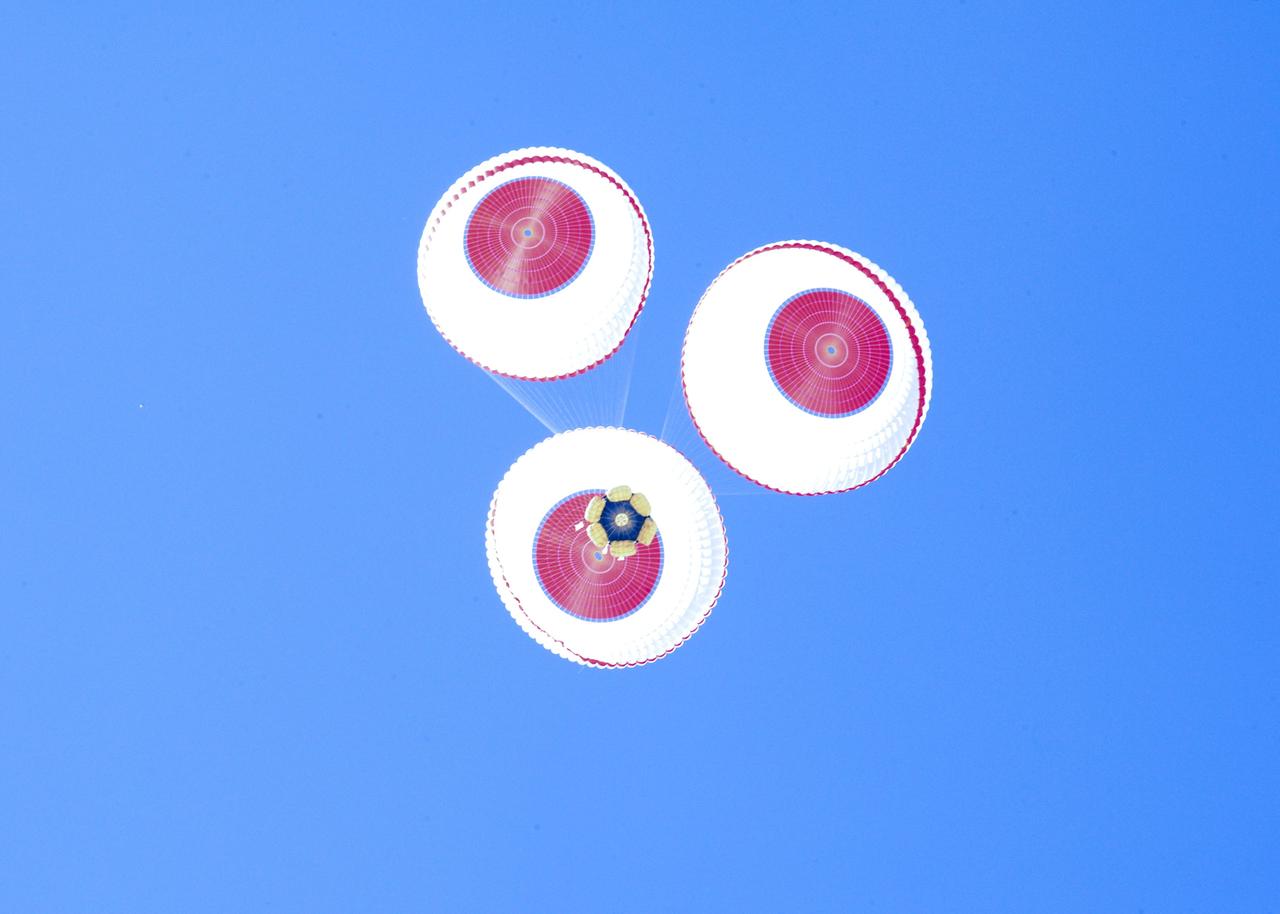
DELAMAR DRY LAKE BED, Nev. – The Boeing Company's CST-100 crew capsule floats to a smooth landing beneath three main parachutes over the Delamar Dry Lake Bed near Alamo, Nev. This is the second parachute test that Boeing performed under its partnership with NASA's Commercial Crew Program CCP. The first showed the parachute system’s deployment scheme worked and that it could be re-packed and re-used for this second test. In 2011, NASA selected Boeing during Commercial Crew Development Round 2 CCDev2) activities to mature the design and development of a crew transportation system with the overall goal of accelerating a United States-led capability to the International Space Station. The goal of CCP is to drive down the cost of space travel as well as open up space to more people than ever before by balancing industry’s own innovative capabilities with NASA's 50 years of human spaceflight experience. Six other aerospace companies also are maturing launch vehicle and spacecraft designs under CCDev2, including Alliant Techsystems Inc. ATK, Excalibur Almaz Inc., Blue Origin, Sierra Nevada, Space Exploration Technologies SpaceX, and United Launch Alliance ULA. For more information, visit www.nasa.gov/commercialcrew. Image credit: Boeing
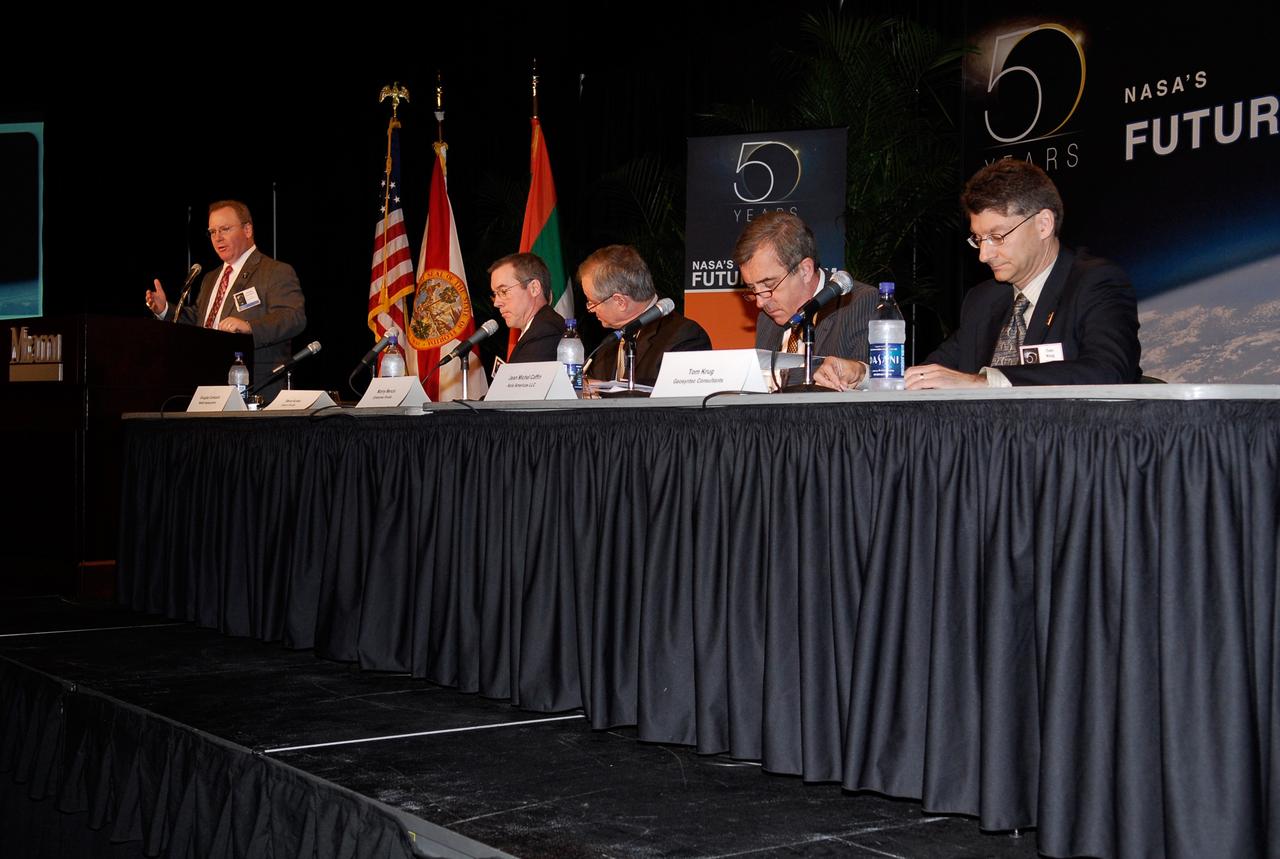
CAPE CANAVERAL, Fla. -- From the podium, Douglas Comstock, director of NASA's Innovative Partnership Program, moderates a panel presenting the topic “Unleashing the Power of Technology and Creativity” during NASA’s Future Forum in Miami. Others on the panel are (left to right), Steve Kohler, president and CEO of Space Florida; Manny Mencia Sr., vice president for international trade and business development of Enterprise Florida; Jean Michel Caffin, managing partner of Axis Americas and Beacon Council Executive Cabinet; and Tom Krug, associate and senior engineer with Geosyntec Consultants. The forum focused on how space exploration benefits Florida's economy. The event, which included presentations and panels, was held at the University of Miami's BankUnited Center. Among those participating were NASA Deputy Administrator Shana Dale, astronaut Carl Walz, director of the Advanced Capabilities Division in NASA's Exploration Systems Mission Directorate, and Russell Romanella, director, International Space Station and Spacecraft Processing. Photo credit: NASA/Kim Shiflett
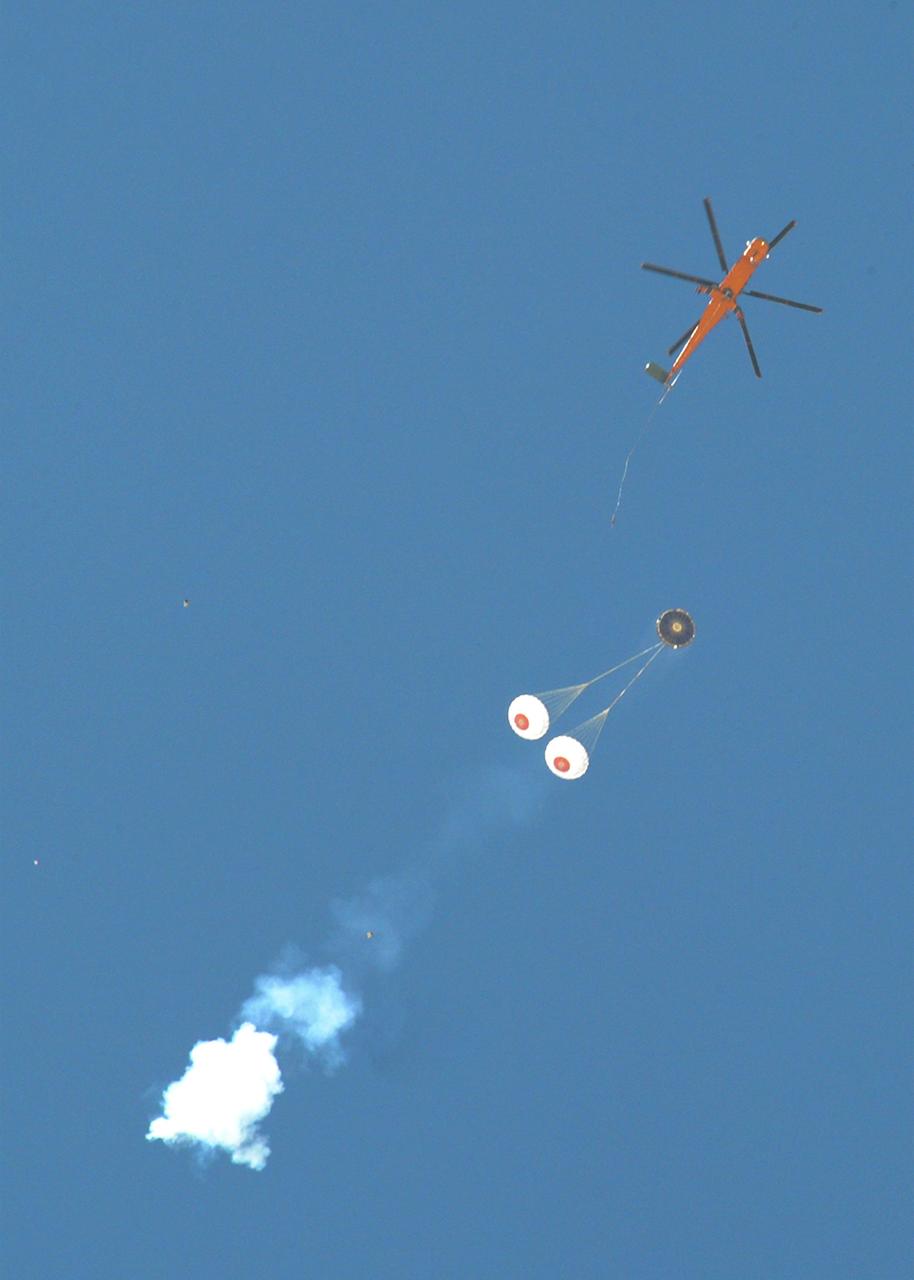
DELAMAR DRY LAKE BED, Nev. – An Erickson Sky Crane helicopter releases The Boeing Company's CST-100 crew capsule over the Delamar Dry Lake Bed near Alamo, Nev., where it floated to a smooth landing beneath its parachute system. This is the second parachute test that Boeing performed under its partnership with NASA's Commercial Crew Program CCP. The first showed the parachute system’s deployment scheme worked and that it could be re-packed and re-used for this second test. In 2011, NASA selected Boeing during Commercial Crew Development Round 2 CCDev2) activities to mature the design and development of a crew transportation system with the overall goal of accelerating a United States-led capability to the International Space Station. The goal of CCP is to drive down the cost of space travel as well as open up space to more people than ever before by balancing industry’s own innovative capabilities with NASA's 50 years of human spaceflight experience. Six other aerospace companies also are maturing launch vehicle and spacecraft designs under CCDev2, including Alliant Techsystems Inc. ATK, Excalibur Almaz Inc., Blue Origin, Sierra Nevada, Space Exploration Technologies SpaceX, and United Launch Alliance ULA. For more information, visit www.nasa.gov/commercialcrew. Image credit: Boeing
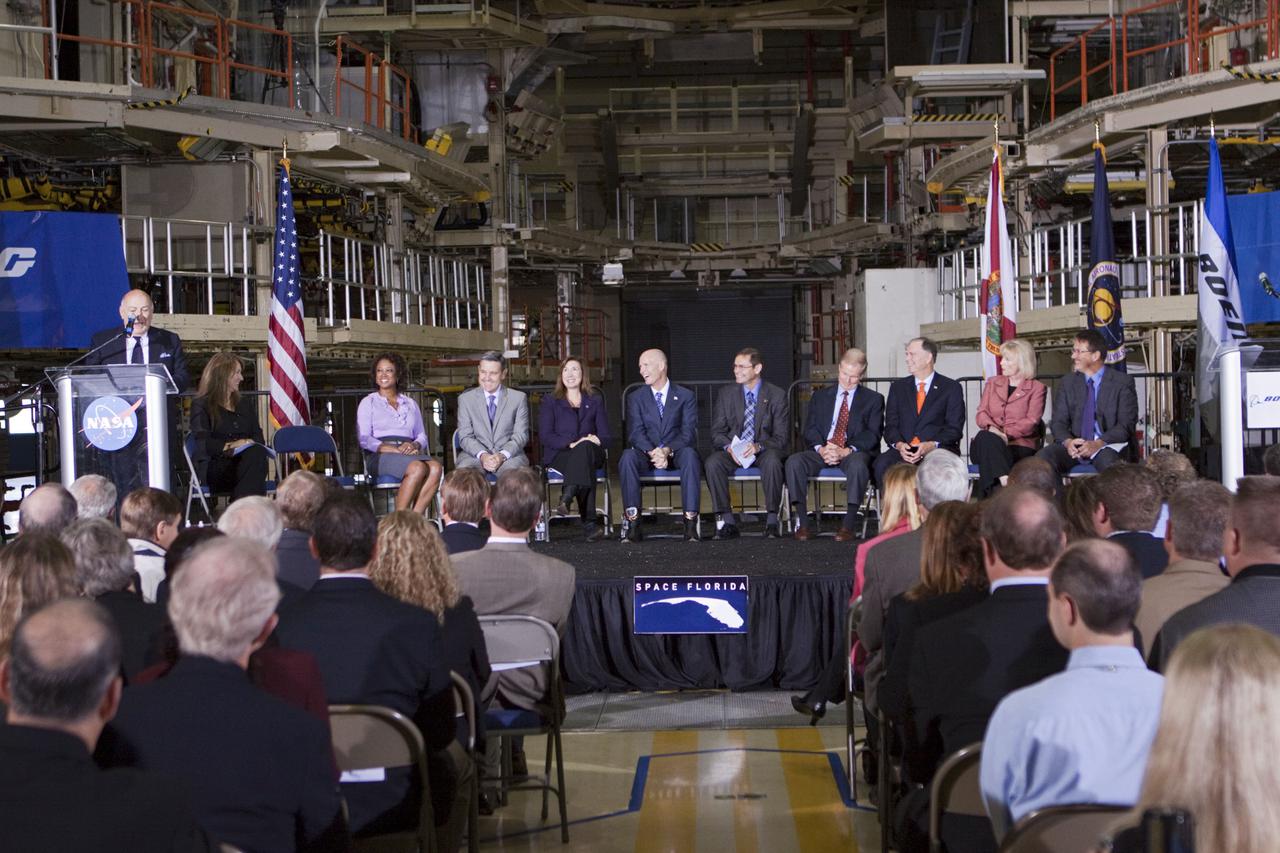
CAPE CANAVERAL, Fla. – In the Orbiter Processing Facility-3 (OPF-3) at NASA’s Kennedy Space Center in Florida, Frank DiBello, president of Space Florida, speaks to the audience after announcing the signing of an innovative agreement between NASA and Space Florida. From his left are, Joyce Riquelme, manager of Kennedy's Center Planning and Development Office, Florida Lt. Gov. Jennifer Carroll, chairwoman of Space Florida, Robert Cabana, Kennedy Space Center director, Lori Garver, NASA’s deputy administrator, Florida Gov. Rick Scott, John Elbon, vice president and general manager of Boeing's Space Exploration, Sen. Bill Nelson of Florida, Florida Congressman Bill Posey, Florida Representative Sandy Adams, and John Mulholland, vice president and program manager of Boeing's Commercial Crew Programs. NASA announced a partnership with Space Florida to occupy, use and modify Kennedy Space Center's Orbiter Processing Facility-3 (OPF-3), the Space Shuttle Main Engine Processing Facility and Processing Control Center. Space Florida has an agreement for use of the OPF-3 with the Boeing Company to manufacture and test the company's Crew Space Transportation (CST-100) spacecraft. The 15-year use permit deal is the latest step Kennedy is making as the center transitions from a historically government-only launch complex to a multi-user spaceport. For more information, visit http:__www.nasa.gov_exploration_commercial_index.html. Photo credit: NASA_Kim Shiflett
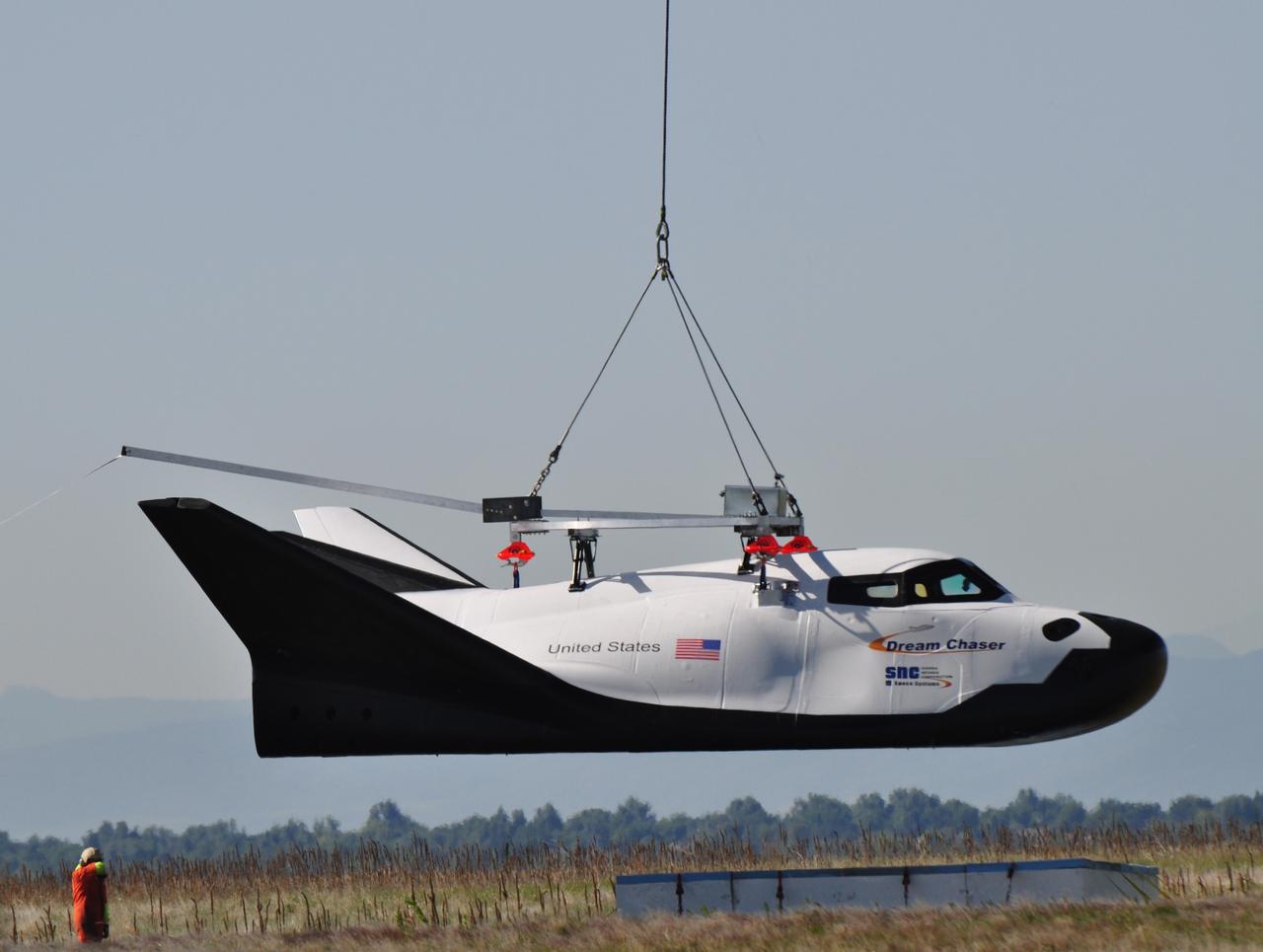
LOUISVILLE, Colo. – Sierra Nevada Corporation Space Systems’ Dream Chaser full-scale test vehicle is lifted by an Erickson Air-Crane helicopter to verify proper aerodynamic flight performance near the Rocky Mountain Metropolitan Airport in Jefferson County, Colo. This captive-carry test is one of several milestones the company is meeting during its partnership with NASA’s Commercial Crew Program CCP. Data from this test will provide SNC an early opportunity to evaluate and prove hardware, facilities and ground operations in preparation for approach and landing tests scheduled for later this year. In 2011, NASA selected Sierra Nevada during Commercial Crew Development Round 2 CCDev2) activities to mature the design and development of a crew transportation system with the overall goal of accelerating a United States-led capability to the International Space Station. The goal of CCP is to drive down the cost of space travel as well as open up space to more people than ever before by balancing industry’s own innovative capabilities with NASA's 50 years of human spaceflight experience. Six other aerospace companies also are maturing launch vehicle and spacecraft designs under CCDev2, including Alliant Techsystems Inc. ATK, The Boeing Co., Excalibur Almaz Inc., Blue Origin, Space Exploration Technologies SpaceX, and United Launch Alliance ULA. For more information, visit www.nasa.gov/commercialcrew. Image credit: Sierra Nevada Corp.
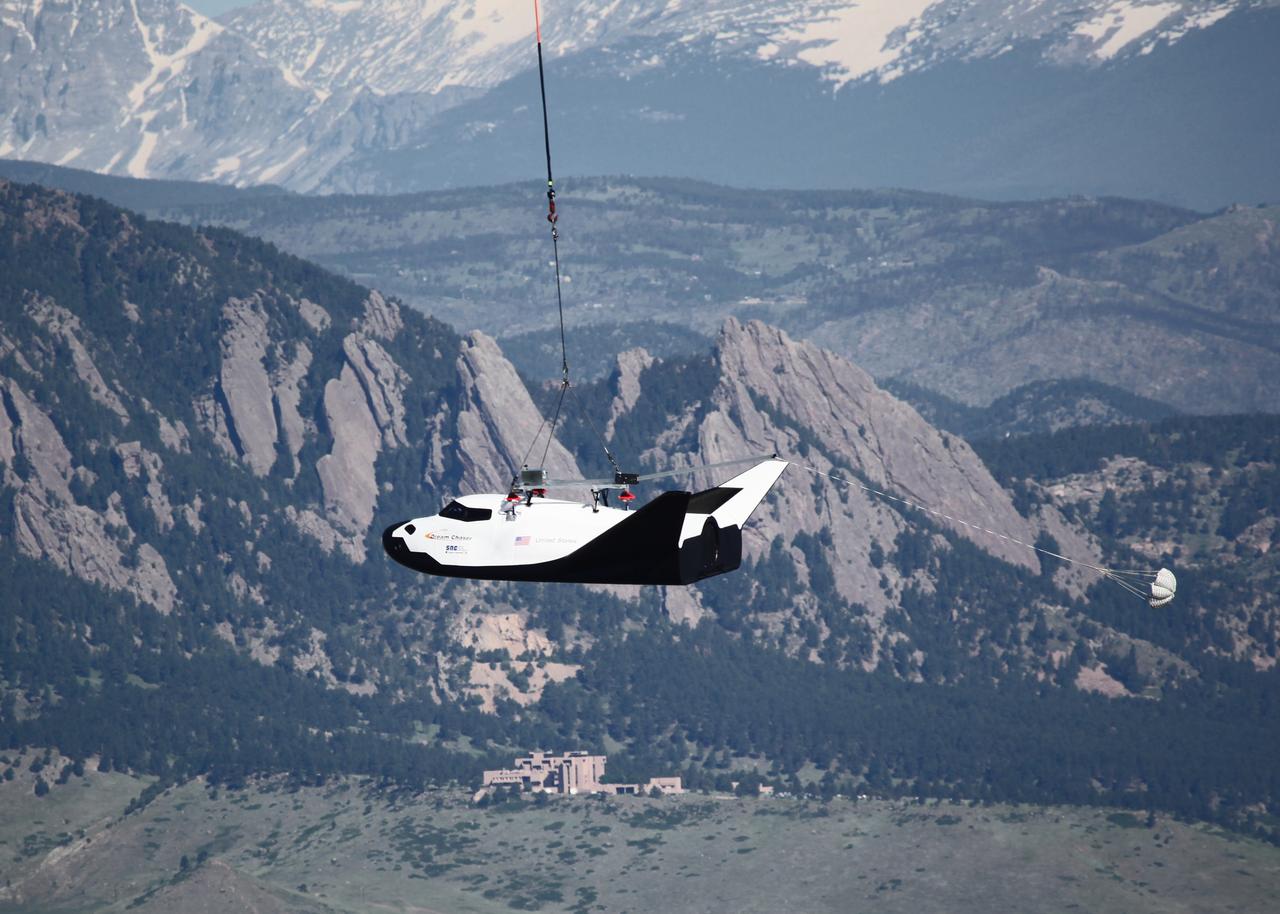
LOUISVILLE, Colo. – Sierra Nevada Corporation Space Systems’ Dream Chaser full-scale test vehicle is lifted by an Erickson Air-Crane helicopter to verify proper aerodynamic flight performance near the Rocky Mountain Metropolitan Airport in Jefferson County, Colo. This captive-carry test is one of several milestones the company is meeting during its partnership with NASA’s Commercial Crew Program CCP. Data from this test will provide SNC an early opportunity to evaluate and prove hardware, facilities and ground operations in preparation for approach and landing tests scheduled for later this year. In 2011, NASA selected Sierra Nevada during Commercial Crew Development Round 2 CCDev2) activities to mature the design and development of a crew transportation system with the overall goal of accelerating a United States-led capability to the International Space Station. The goal of CCP is to drive down the cost of space travel as well as open up space to more people than ever before by balancing industry’s own innovative capabilities with NASA's 50 years of human spaceflight experience. Six other aerospace companies also are maturing launch vehicle and spacecraft designs under CCDev2, including Alliant Techsystems Inc. ATK, The Boeing Co., Excalibur Almaz Inc., Blue Origin, Space Exploration Technologies SpaceX, and United Launch Alliance ULA. For more information, visit www.nasa.gov/commercialcrew. Image credit: Sierra Nevada Corp.
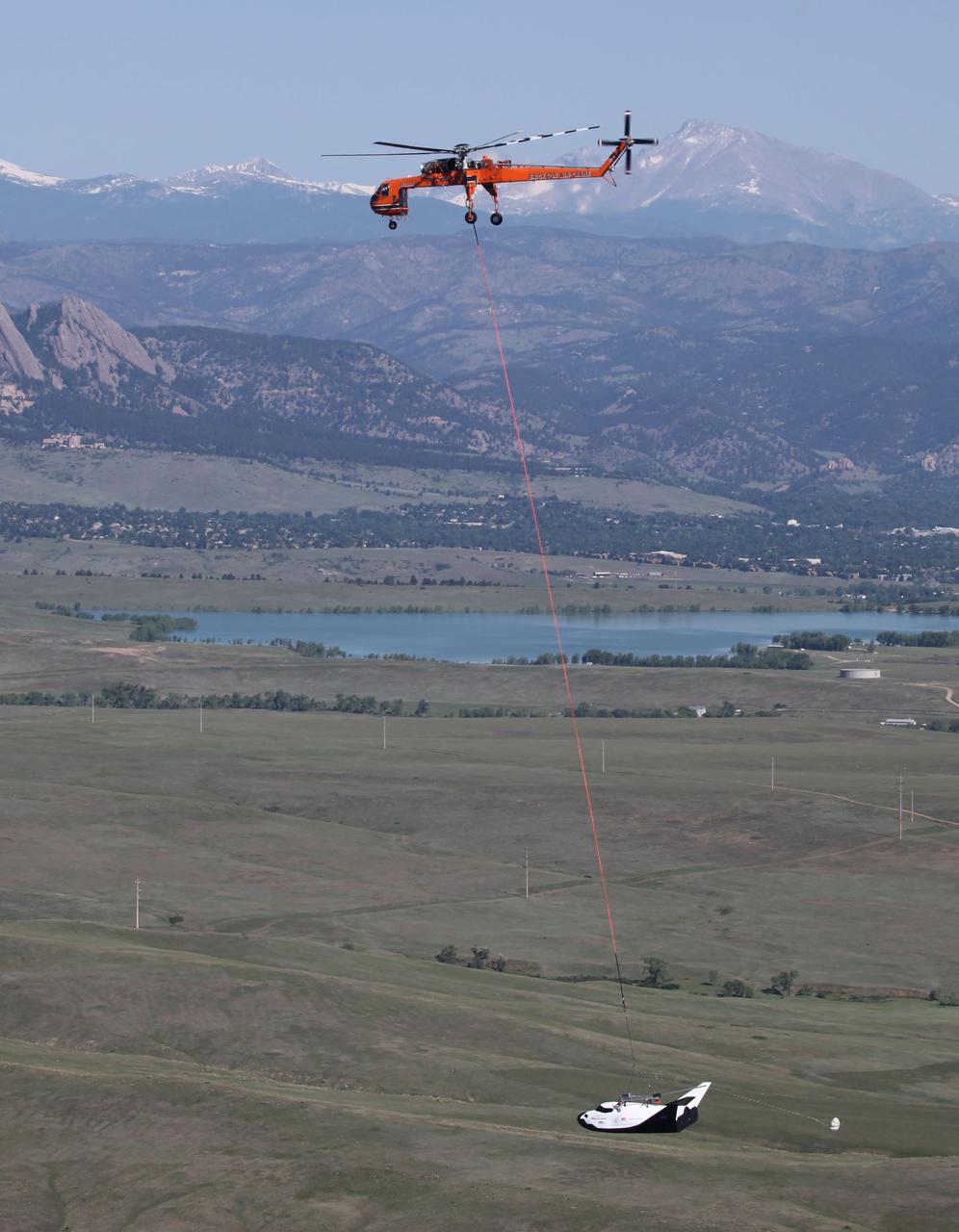
LOUISVILLE, Colo. – An Erickson Air-Crane helicopter lifts Sierra Nevada Corporation Space Systems’ Dream Chaser full-scale test vehicle to verify proper aerodynamic flight performance near the Rocky Mountain Metropolitan Airport in Jefferson County, Colo. This captive-carry test is one of several milestones the company is meeting during its partnership with NASA’s Commercial Crew Program CCP. Data from this test will provide SNC an early opportunity to evaluate and prove hardware, facilities and ground operations in preparation for approach and landing tests scheduled for later this year. In 2011, NASA selected Sierra Nevada during Commercial Crew Development Round 2 CCDev2) activities to mature the design and development of a crew transportation system with the overall goal of accelerating a United States-led capability to the International Space Station. The goal of CCP is to drive down the cost of space travel as well as open up space to more people than ever before by balancing industry’s own innovative capabilities with NASA's 50 years of human spaceflight experience. Six other aerospace companies also are maturing launch vehicle and spacecraft designs under CCDev2, including Alliant Techsystems Inc. ATK, The Boeing Co., Excalibur Almaz Inc., Blue Origin, Space Exploration Technologies SpaceX, and United Launch Alliance ULA. For more information, visit www.nasa.gov/commercialcrew. Image credit: Sierra Nevada Corp.