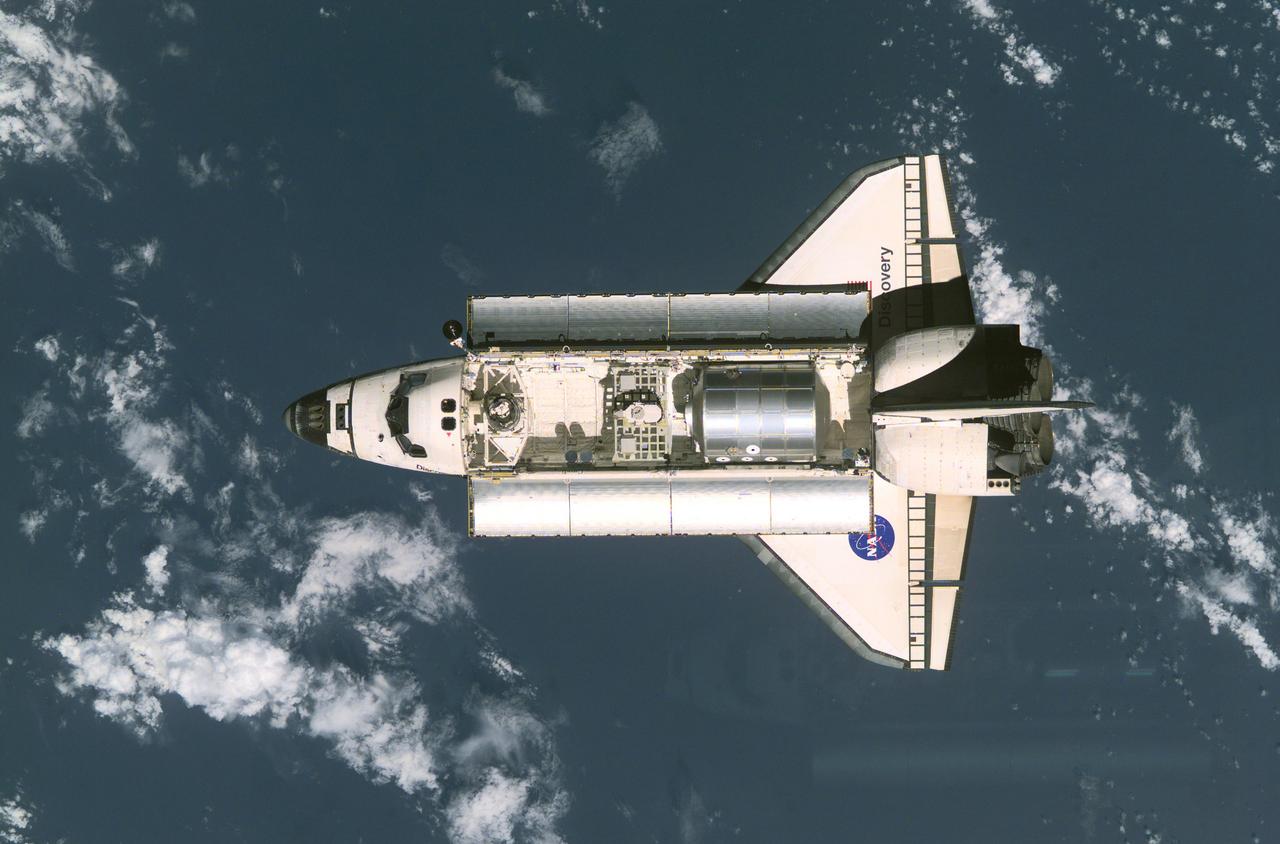
This is a view of the Space Shuttle Discovery as it approaches the International Space Station (ISS) during the STS-105 mission. Visible in the payload bay of Discovery are the Multipurpose Logistics Module (MPLM) Leonardo at right, which stores various supplies and experiments to be transferred into the ISS; at center, the Integrated Cargo Carrier (ICC) which carries the Early Ammonia Servicer (EAS); and two Materials International Space Station Experiment (MISSE) containers at left. Aboard Discovery were the ISS Expedition Three crew, who were to replace the Expedition Two crew that had been living on the ISS for the past five months.
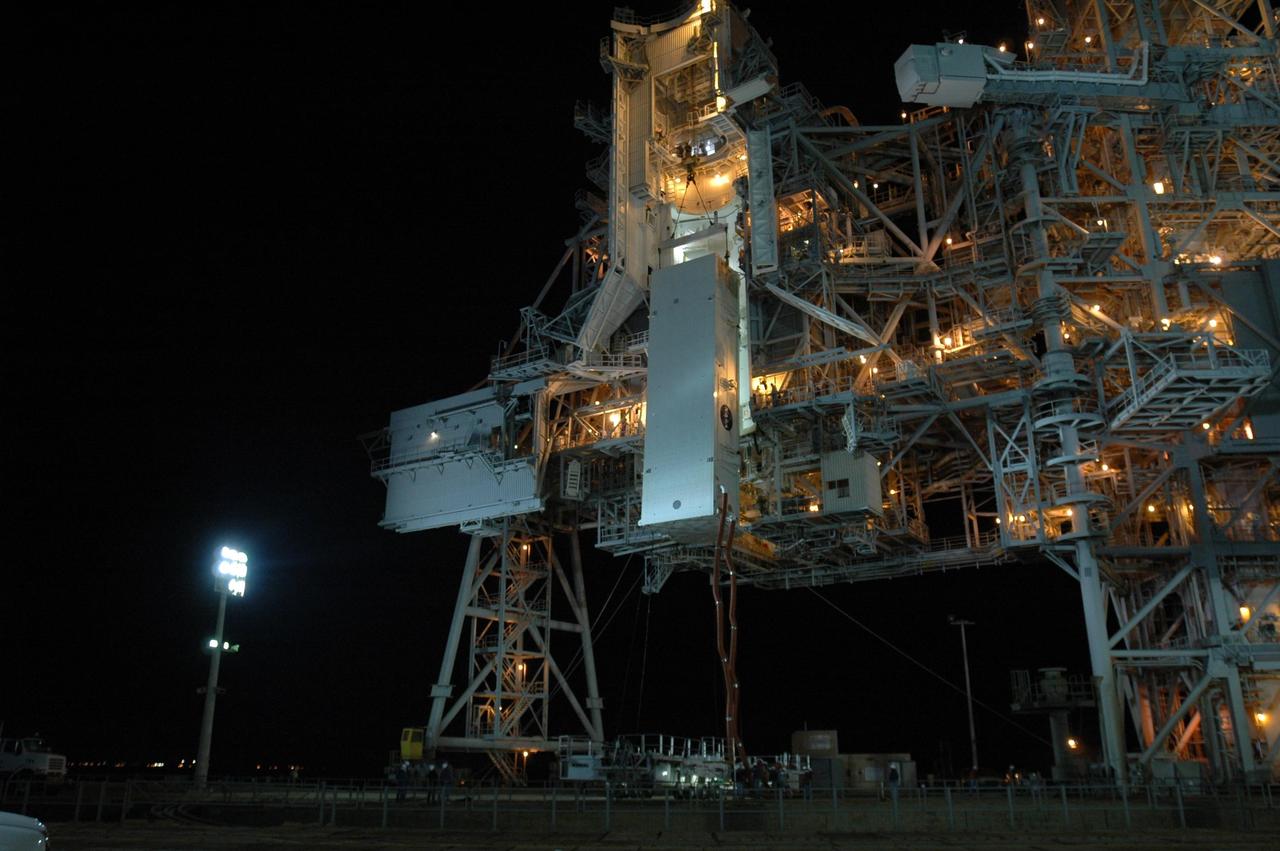
KENNEDY SPACE CENTER, FLA. -- The payload canister containing the Columbus Laboratory module and integrated cargo carrier-lite is lifted up toward the payload changeout room on Launch Pad 39A at NASA's Kennedy Space Center. Once in place, the canister will be opened and the cargo transferred inside the payload changeout room. The payload will be installed in space shuttle Atlantis' payload bay.The canister contains the Columbus Lab module and integrated cargo carrier-lite payloads for space shuttle Atlantis on mission STS-122. Atlantis is targeted to launch on Dec. 6. Photo credit: NASA/Dimitri Gerondidakis
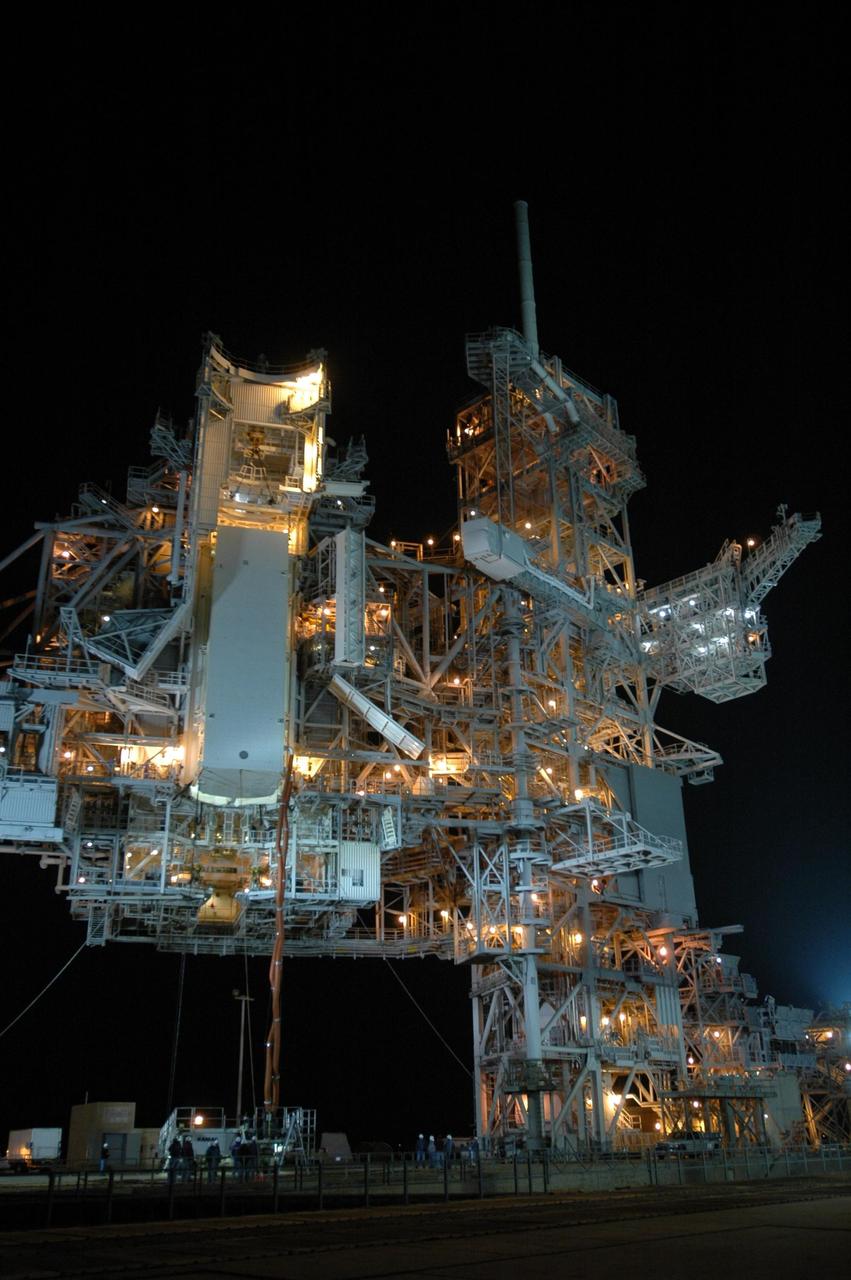
KENNEDY SPACE CENTER, FLA. -- With umbilical lines still attached, the payload canister containing the Columbus Laboratory module and integrated cargo carrier-lite is lifted up toward the payload changeout room on Launch Pad 39A at NASA's Kennedy Space Center. Once in place, the canister will be opened and the module transferred inside the payload changeout room. The payload will be installed in space shuttle Atlantis' payload bay. The canister contains the Columbus Lab module and integrated cargo carrier-lite payloads for space shuttle Atlantis on mission STS-122. Atlantis is targeted to launch on Dec. 6. Photo credit: NASA/Dimitri Gerondidakis
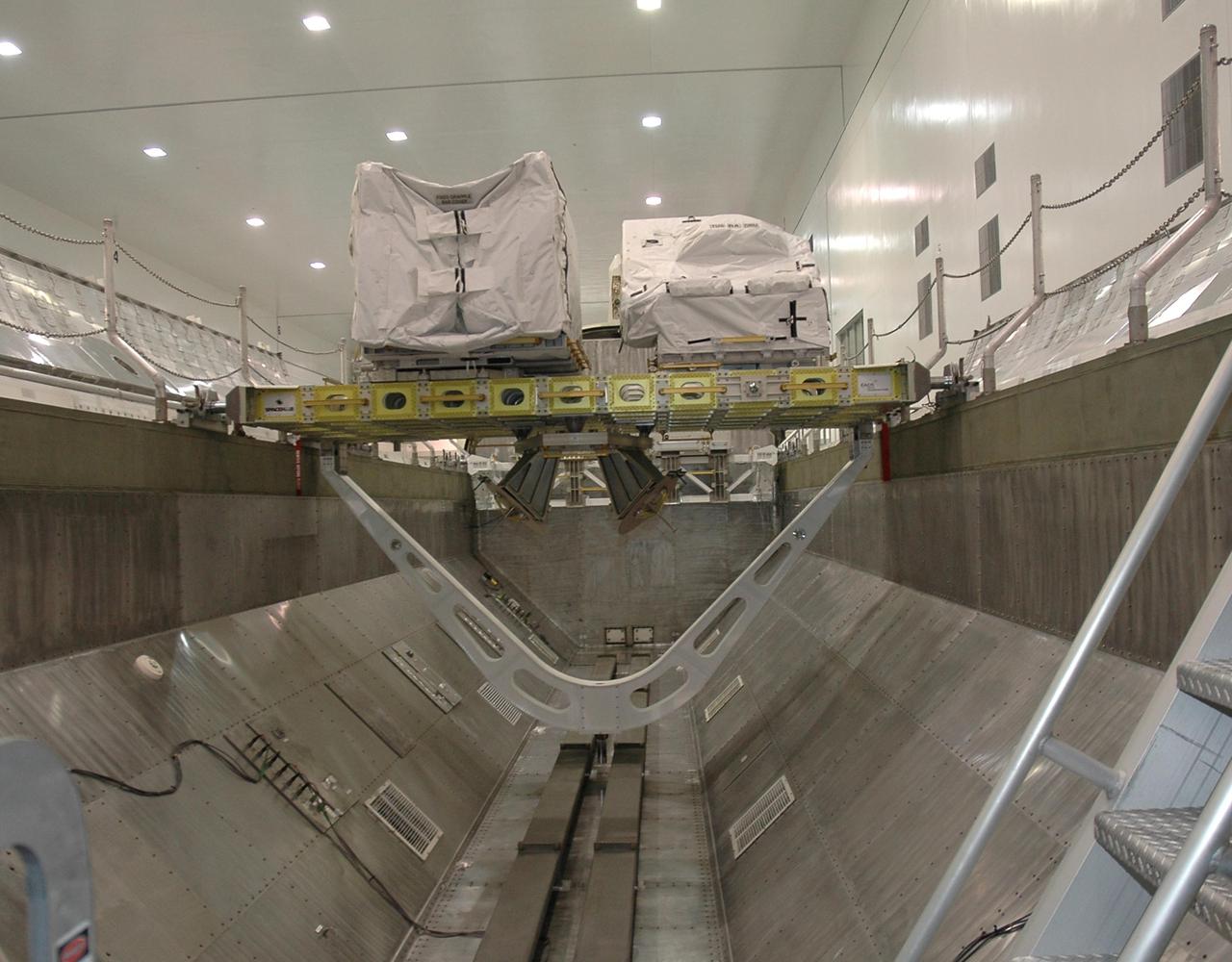
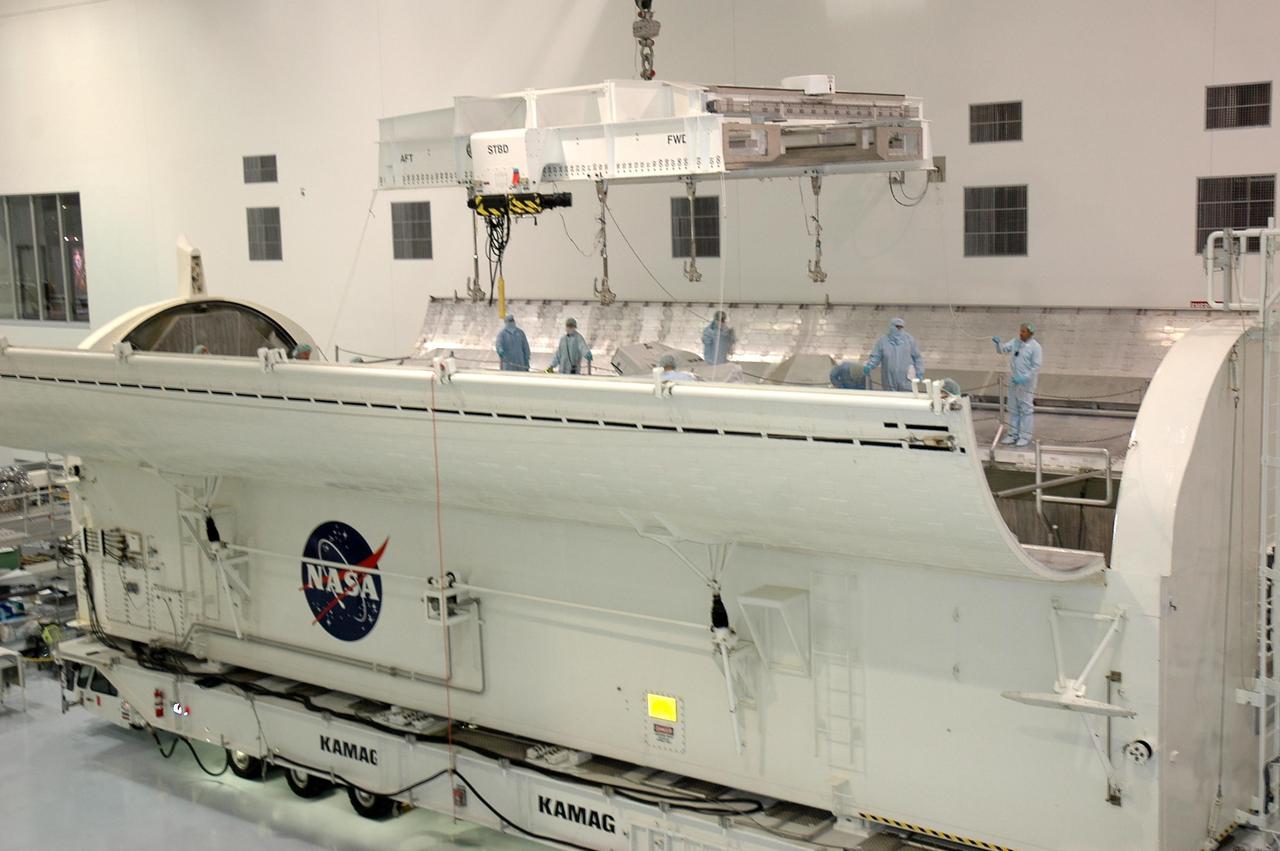
KENNEDY SPACE CENTER, FLA. - In NASA's Space Station Processing Facility, the Integrated Cargo Carrier (ICC) is seen inside the payload canister. The ICC is part of the payload on mission STS-121 to the International Space Station. The carrier holds the mobile transporter reel assembly that the astronauts will replace on the station and a spare pump module. The carrier and its cargo will be placed in Space Shuttle Discovery's payload bay at the pad. Discovery is scheduled to launch on mission STS-121 from Launch Pad 39B in a window that opens July 1 and extends to July 19. Photo credit: NASA/Cory Husten
KENNEDY SPACE CENTER, FLA. - In NASA's Space Station Processing Facility, an overhead crane has placed the Integrated Cargo Carrier (ICC) inside the payload canister. The ICC is part of the payload on mission STS-121 to the International Space Station. The carrier holds the mobile transporter reel assembly that the astronauts will replace on the station and a spare pump module. The carrier and its cargo will be placed in Space Shuttle Discovery's payload bay at the pad. Discovery is scheduled to launch on mission STS-121 from Launch Pad 39B in a window that opens July 1 and extends to July 19. Photo credit: NASA/Cory Husten
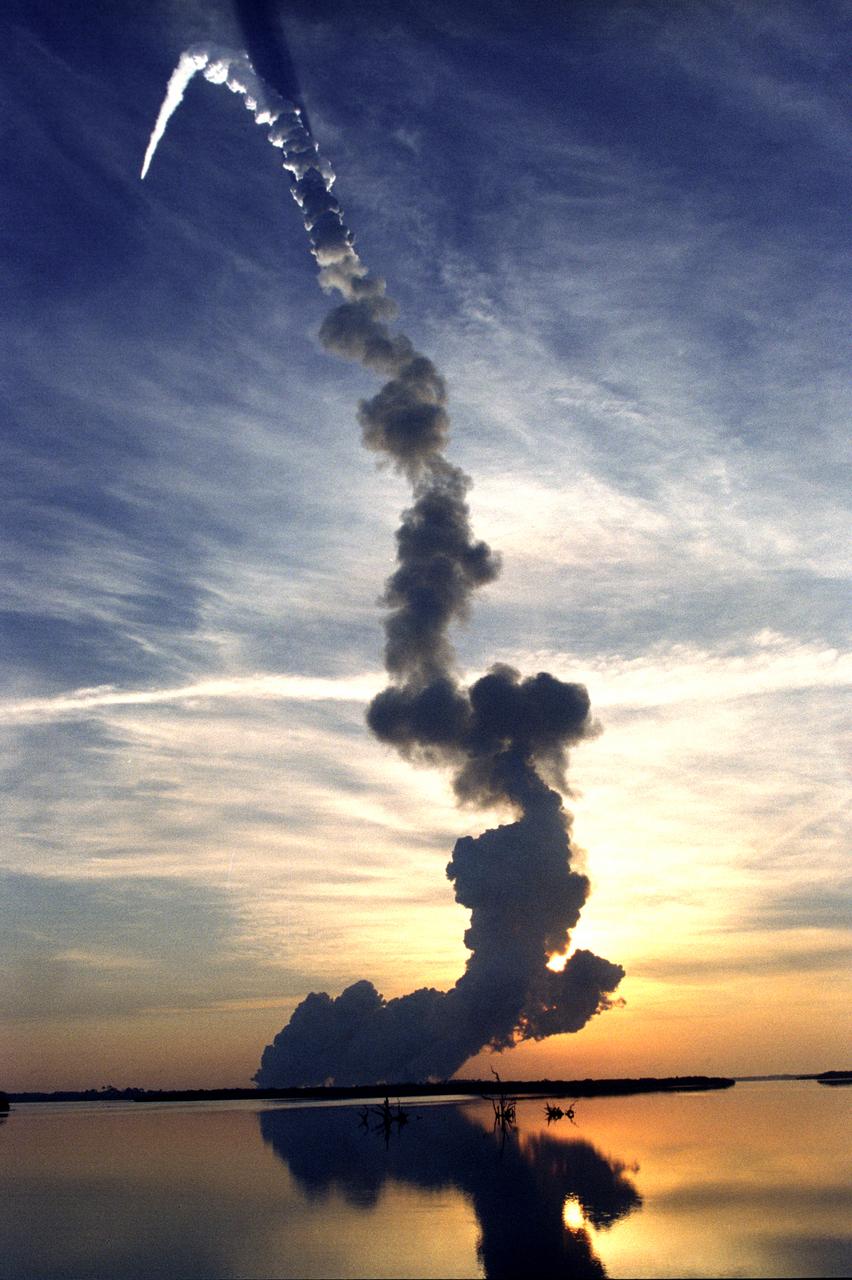
This spectacular photo is of the May 27, 1999 liftoff of the Orbiter Discovery (STS-96). The STS-96 mission, of almost 10 days, was the second International Space Station (ISS) assembly and resupply flight and the first flight to dock with the station. The crew installed foot restraints and the Russian built crane, STRELA. The Shuttle's SPACEHAB double module carried internal and resupply cargo for station outfitting and the Russian cargo crane was carried aboard the shuttle in the integrated Cargo Carrier (ICC).

S127-E-007978 (22 July 2009) Astronauts Christopher Cassidy (left) and Dave Wolf work with the Integrated Cargo Carrier-VLD, as they remove and replace batteries on the P6 truss during STS-127's third session of extravehicular activity.
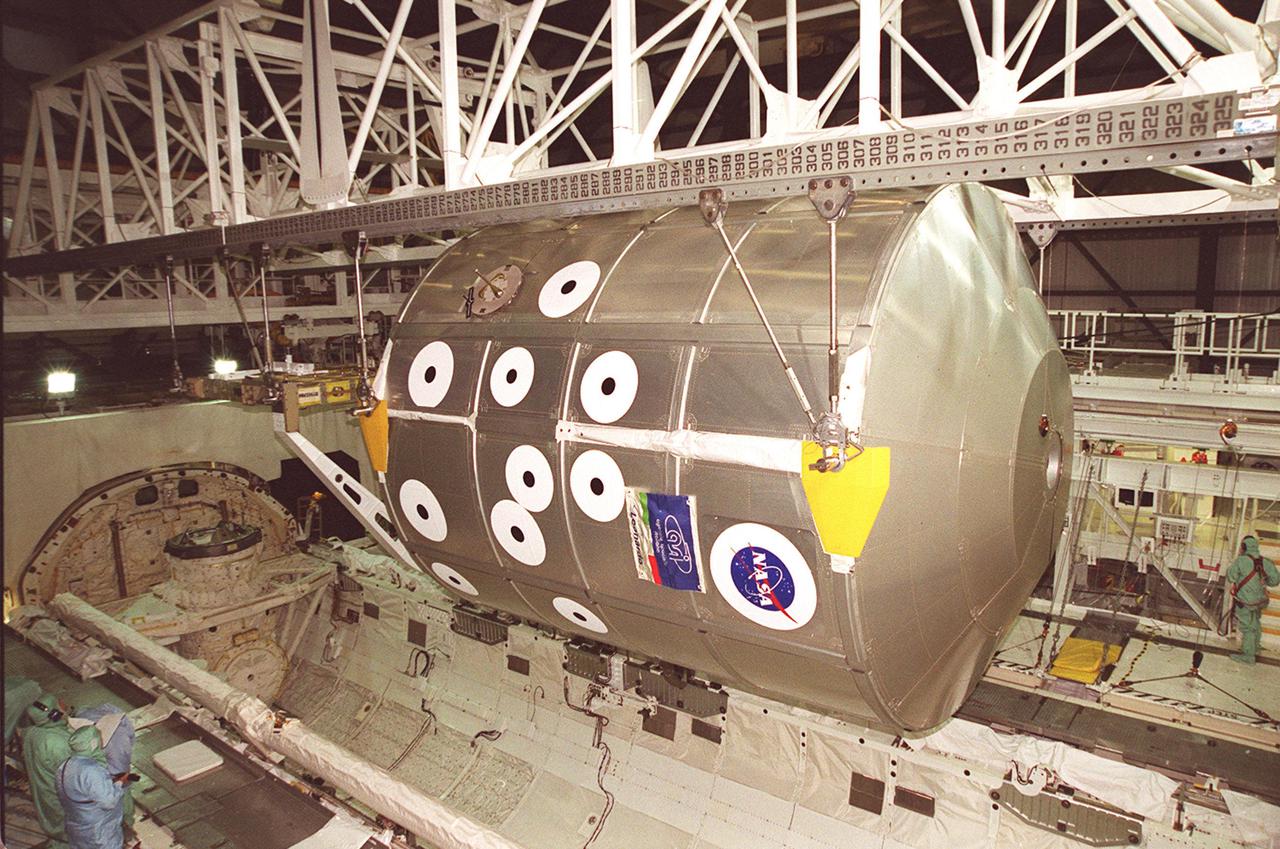
KENNEDY SPACE CENTER, FLA. -- In the Orbiter Processing Facility bay 2, an overhead crane lifts the Multi-Purpose Logistics Module Leonardo and the integrated cargo carrier behind it out of Discovery’s payload bay. The MPLM has just returned from its first round trip to the International Space Station on mission STS-102. Leonardo will be transferred to the SSPF to prepare it for future missions. The MPLM serves as a cargo van, carrying equipment and supplies to the Space Station
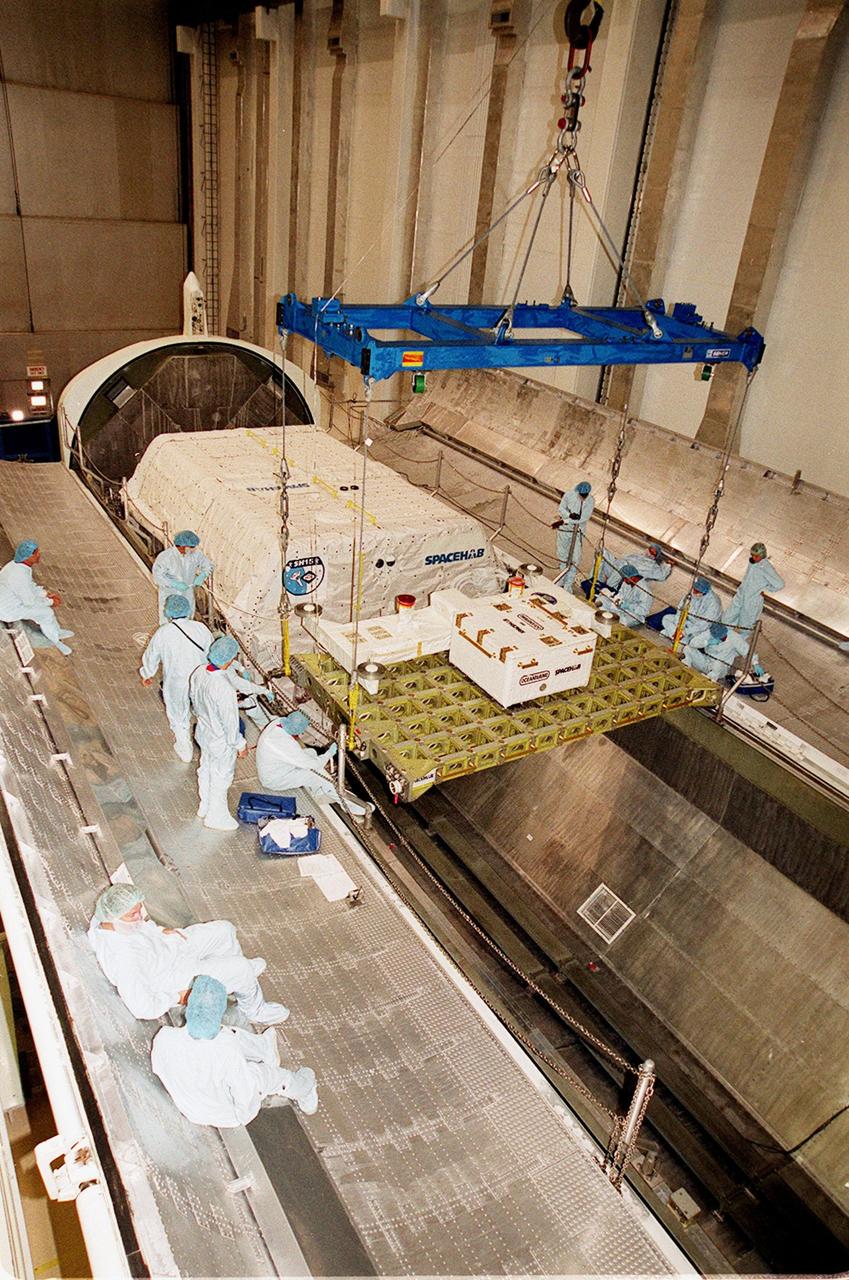
KENNEDY SPACE CENTER, FLA. -- Workers in the Space Station Processing Facility guide the Integrated Cargo Carrier (ICC) into place inside the payload canister. The canister already has the SPACEHAB module stowed. The canister will transport its cargo to Launch Pad 39B in preparation for mission STS-106, scheduled to launch Sept. 8 at 8:31 a.m. EDT. During the mission to the International Space Station, the crew will complete service module support tasks on orbit, transfer supplies and outfit the Space Station for the first long-duration crew
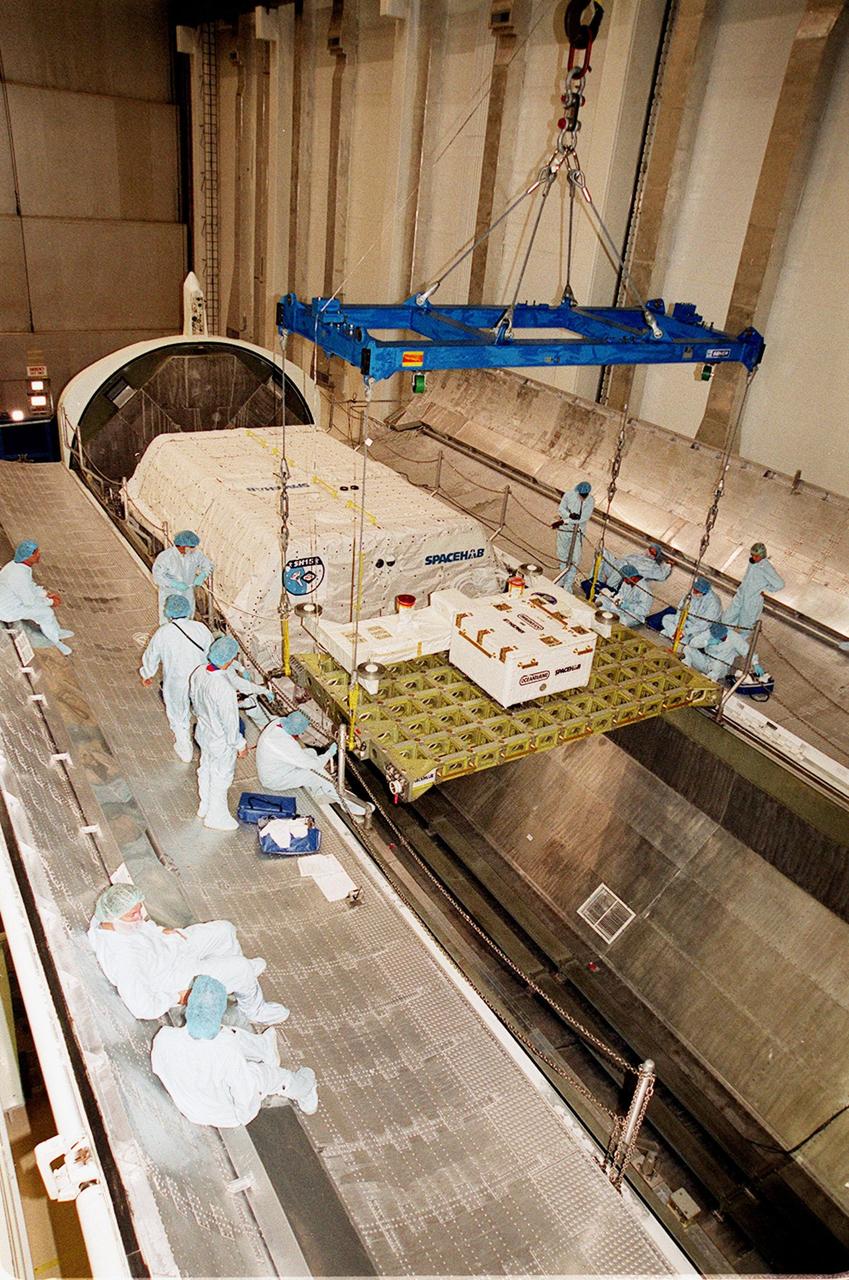
KENNEDY SPACE CENTER, FLA. -- Workers in the Space Station Processing Facility guide the Integrated Cargo Carrier (ICC) into place inside the payload canister. The canister already has the SPACEHAB module stowed. The canister will transport its cargo to Launch Pad 39B in preparation for mission STS-106, scheduled to launch Sept. 8 at 8:31 a.m. EDT. During the mission to the International Space Station, the crew will complete service module support tasks on orbit, transfer supplies and outfit the Space Station for the first long-duration crew
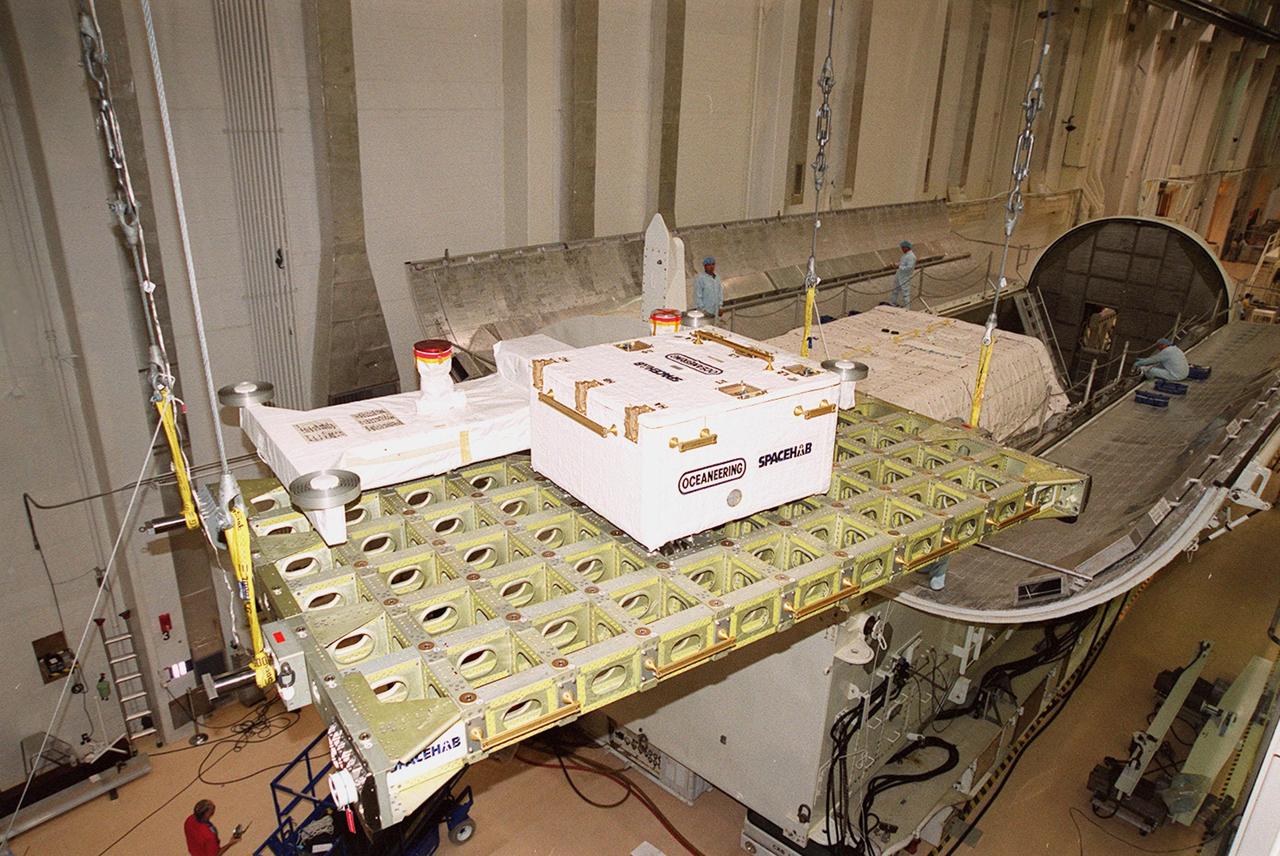
KENNEDY SPACE CENTER, FLA. -- An overhead crane moves the Integrated Cargo Carrier (ICC), with equipment on top, toward the payload canister below where the SPACEHAB module is already stowed. The canister will transport its cargo to Launch Pad 39B in preparation for mission STS-106, scheduled to launch Sept. 8 at 8:31 a.m. EDT. During the mission to the International Space Station, the crew will complete service module support tasks on orbit, transfer supplies and outfit the Space Station for the first long-duration crew

KENNEDY SPACE CENTER, FLA. -- An overhead crane lifts the Integrated Cargo Carrier (ICC), with equipment on top, toward the payload canister (right) where the SPACEHAB module is already stowed. The canister will transport its cargo to Launch Pad 39B in preparation for mission STS-106, scheduled to launch Sept. 8 at 8:31 a.m. EDT. During the mission to the International Space Station, the crew will complete service module support tasks on orbit, transfer supplies and outfit the Space Station for the first long-duration crew
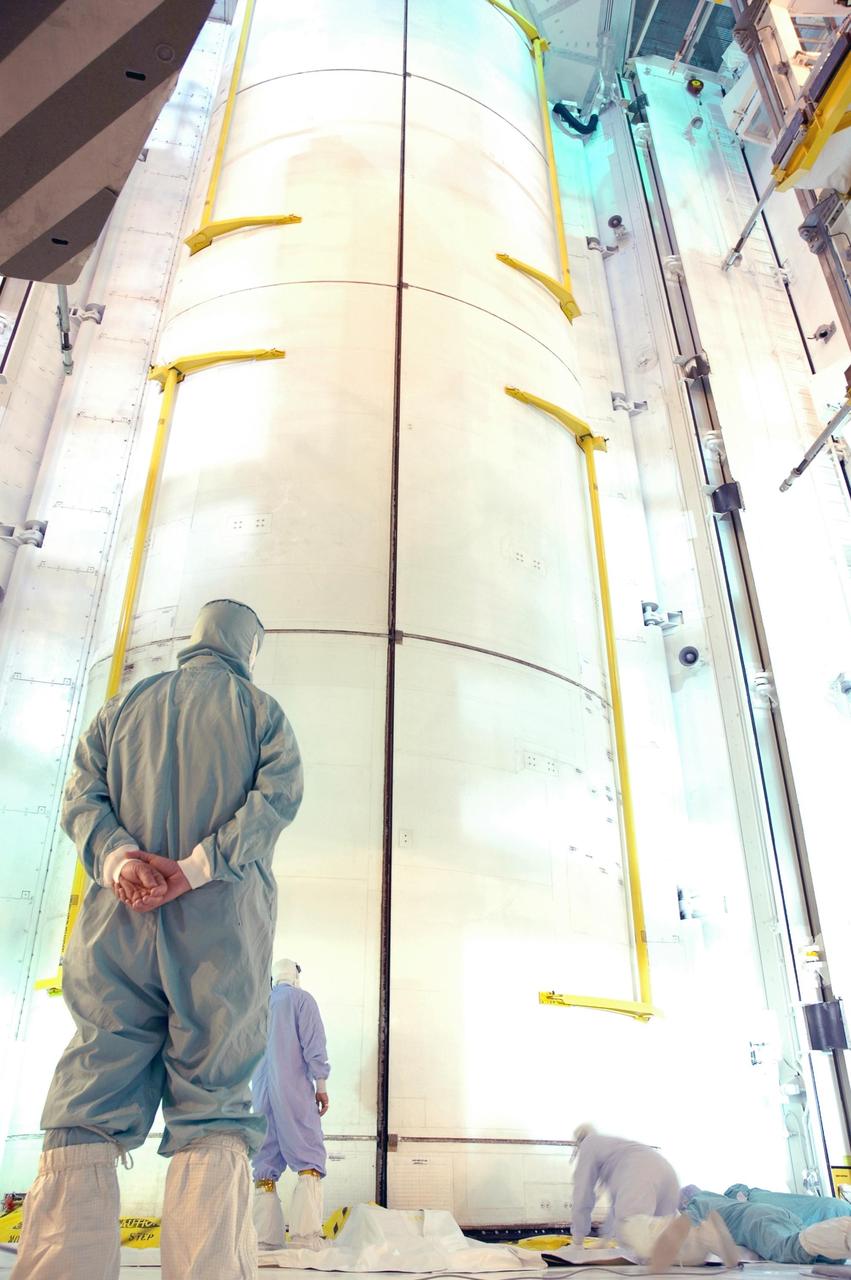
KENNEDY SPACE CENTER, FLA. - At Launch Pad 39B, both of Space Shuttle Discovery's payload bay doors are closing for launch. Inside the payload bay, the cargo includes the multi-purpose logistics module Leonardo and the integrated cargo carrier. Discovery is scheduled to launch on mission STS-121 at 3:49 p.m. July 1 carrying a crew of seven on the 12-day mission to the International Space Station. Photo credit: NASA/Jim Grossmann
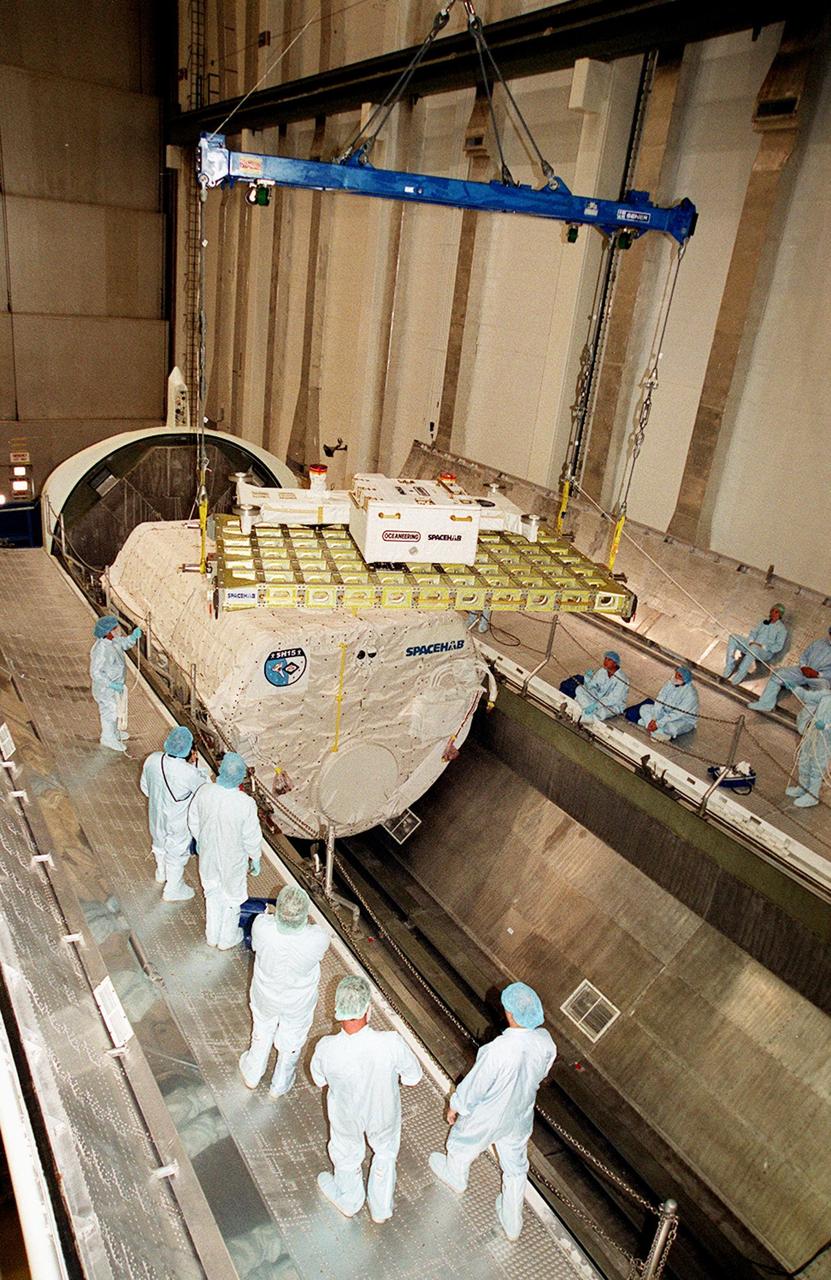
KENNEDY SPACE CENTER, FLA. -- In the Space Station Processing Facility, workers maneuver the Integrated Cargo Carrier (ICC) toward the opening in the payload canister. The canister already has the SPACEHAB module stowed. The canister will transport its cargo to Launch Pad 39B in preparation for mission STS-106, scheduled to launch Sept. 8 at 8:31 a.m. EDT. During the mission to the International Space Station, the crew will complete service module support tasks on orbit, transfer supplies and outfit the Space Station for the first long-duration crew

KENNEDY SPACE CENTER, FLA. -- An overhead crane lifts the Integrated Cargo Carrier (ICC), with equipment on top, toward the payload canister (right) where the SPACEHAB module is already stowed. The canister will transport its cargo to Launch Pad 39B in preparation for mission STS-106, scheduled to launch Sept. 8 at 8:31 a.m. EDT. During the mission to the International Space Station, the crew will complete service module support tasks on orbit, transfer supplies and outfit the Space Station for the first long-duration crew
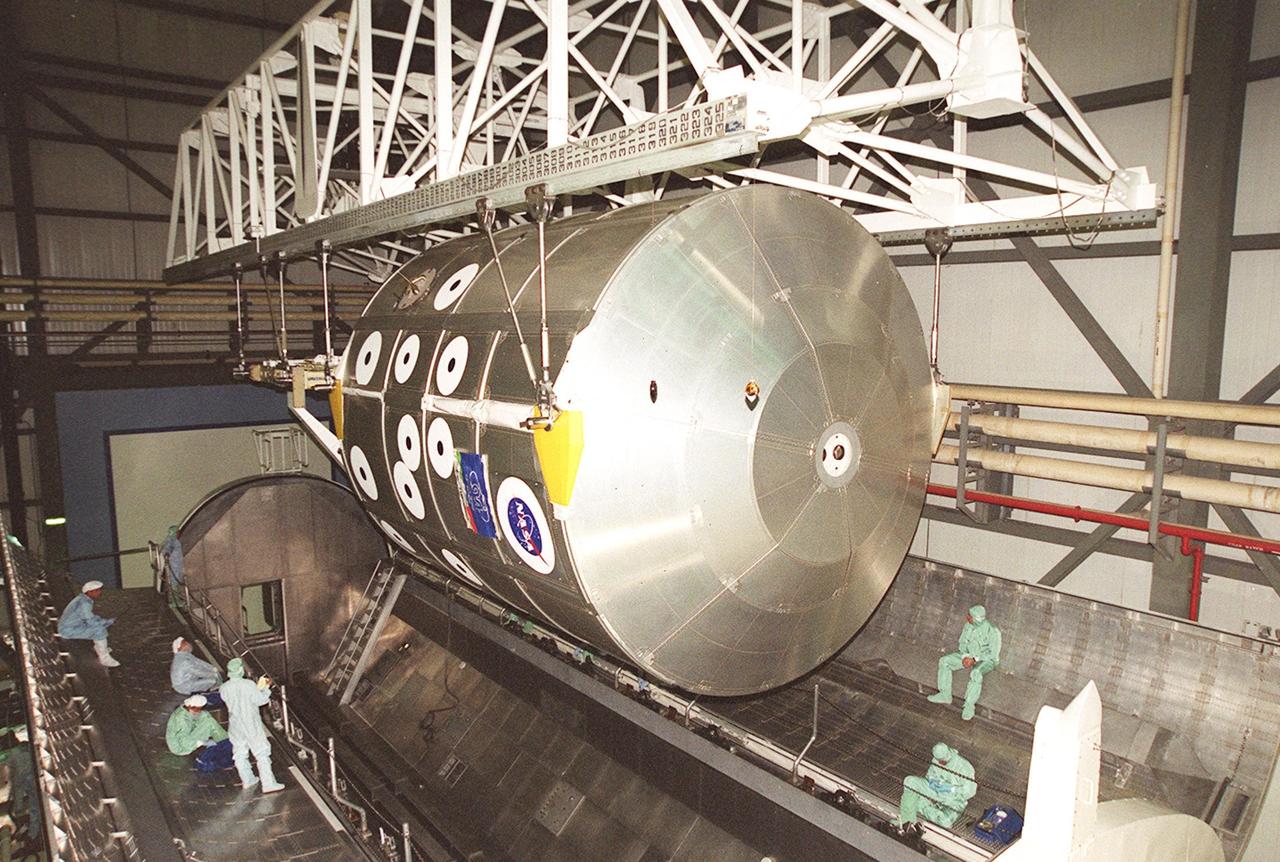
KENNEDY SPACE CENTER, FLA. -- In the Orbiter Processing Facility bay 2, an overhead crane positions the Multi-Purpose Logistics Module Leonardo and the integrated cargo carrier behind it above a payload canister. The MPLM has just returned from its first round trip to the International Space Station on mission STS-102. Leonardo will be transferred to the SSPF to prepare it for future missions. The MPLM serves as a cargo van, carrying equipment and supplies to the Space Station
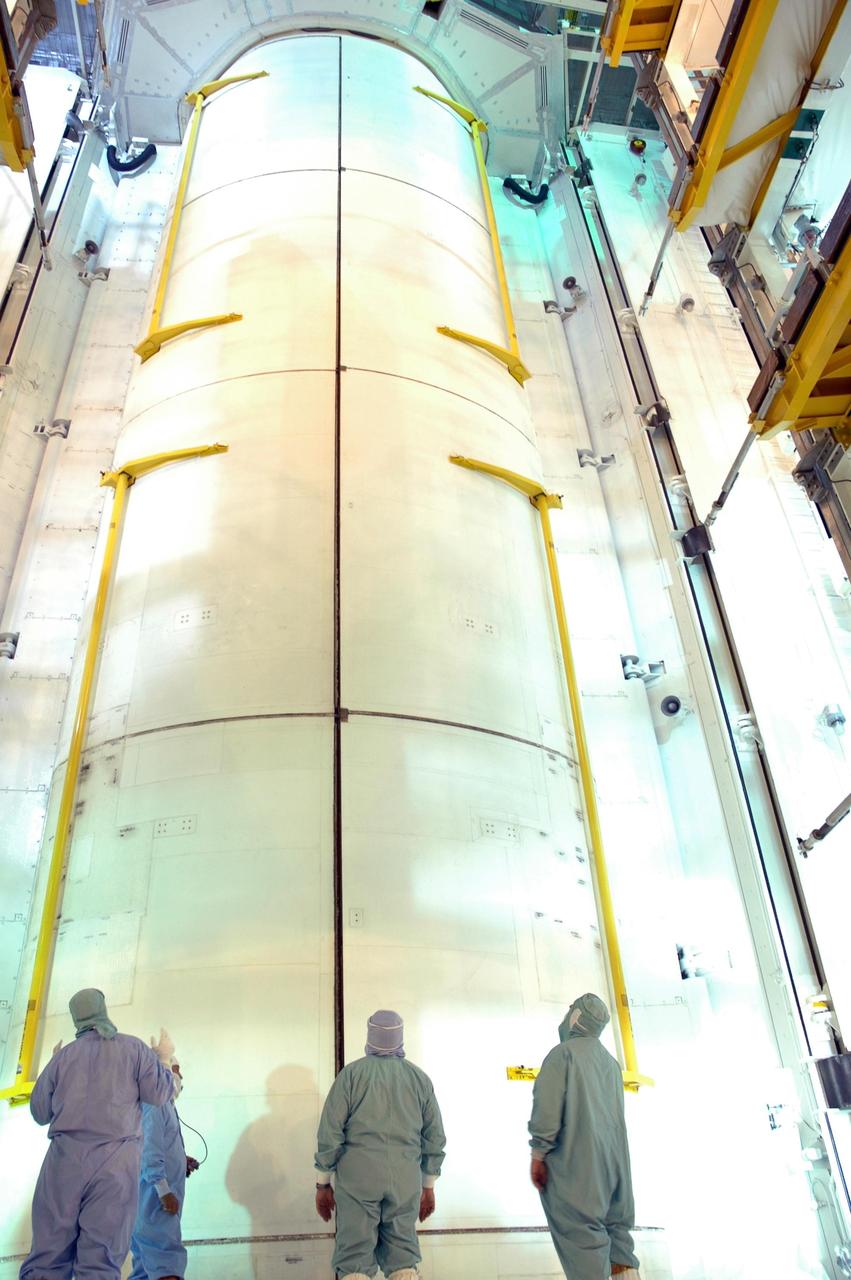
KENNEDY SPACE CENTER, FLA. - At Launch Pad 39B, both of Space Shuttle Discovery's payload bay doors are closed for launch. Inside the payload bay, the cargo includes the multi-purpose logistics module Leonardo and the integrated cargo carrier. Discovery is scheduled to launch on mission STS-121 at 3:49 p.m. July 1 carrying a crew of seven on the 12-day mission to the International Space Station. Photo credit: NASA/Jim Grossmann
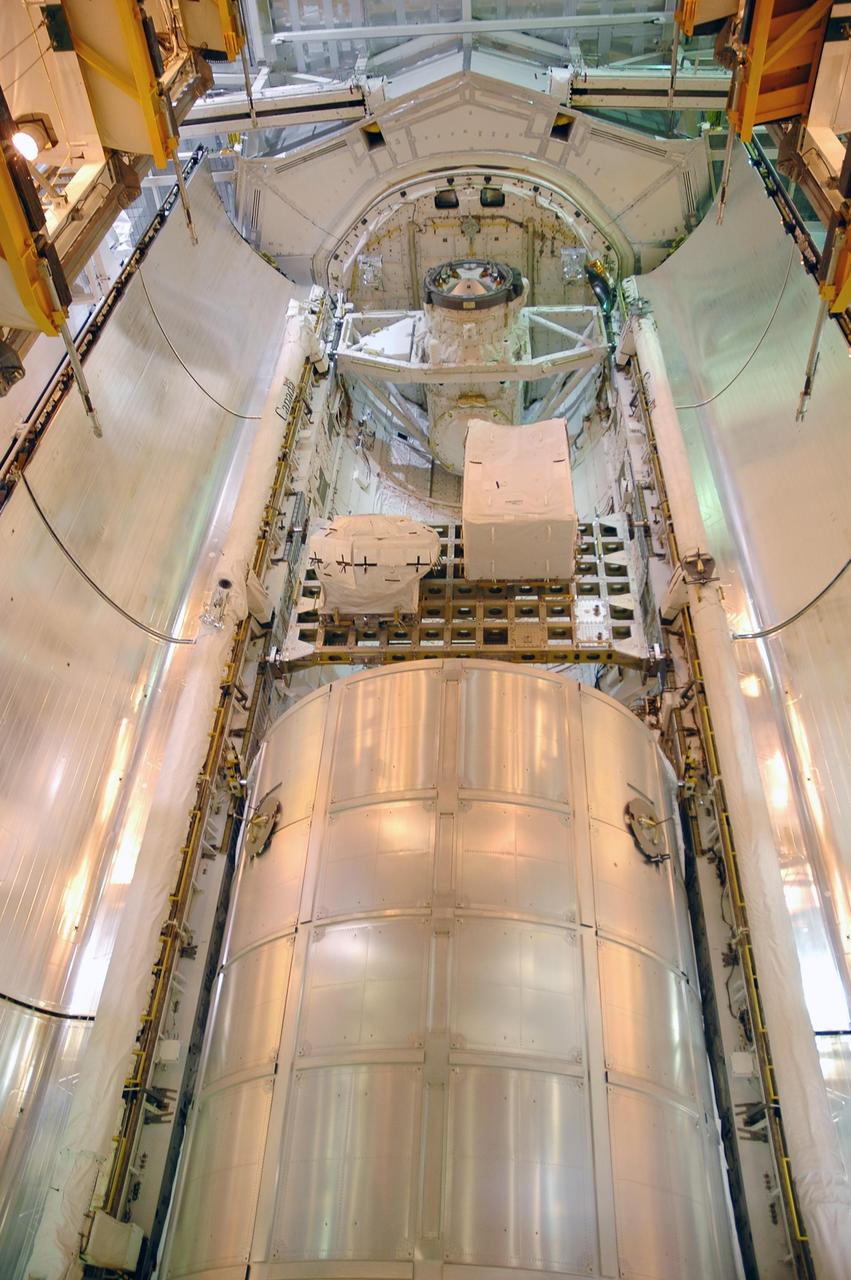
KENNEDY SPACE CENTER, FLA. - At Launch Pad 39B, the open doors of Space Shuttle Discovery's payload bay show the cargo the orbiter will carry into orbit. At the lower end is multi-purpose logistics module Leonardo. Above it is the integrated cargo carrier that holds the mobile transporter reel assembly the astronauts will replace on the station and a spare pump module. Discovery is scheduled to launch at 3:48 p.m. July 1 carrying a crew of seven on the 12-day mission to the International Space Station. Photo credit: NASA/Charisse Nahser
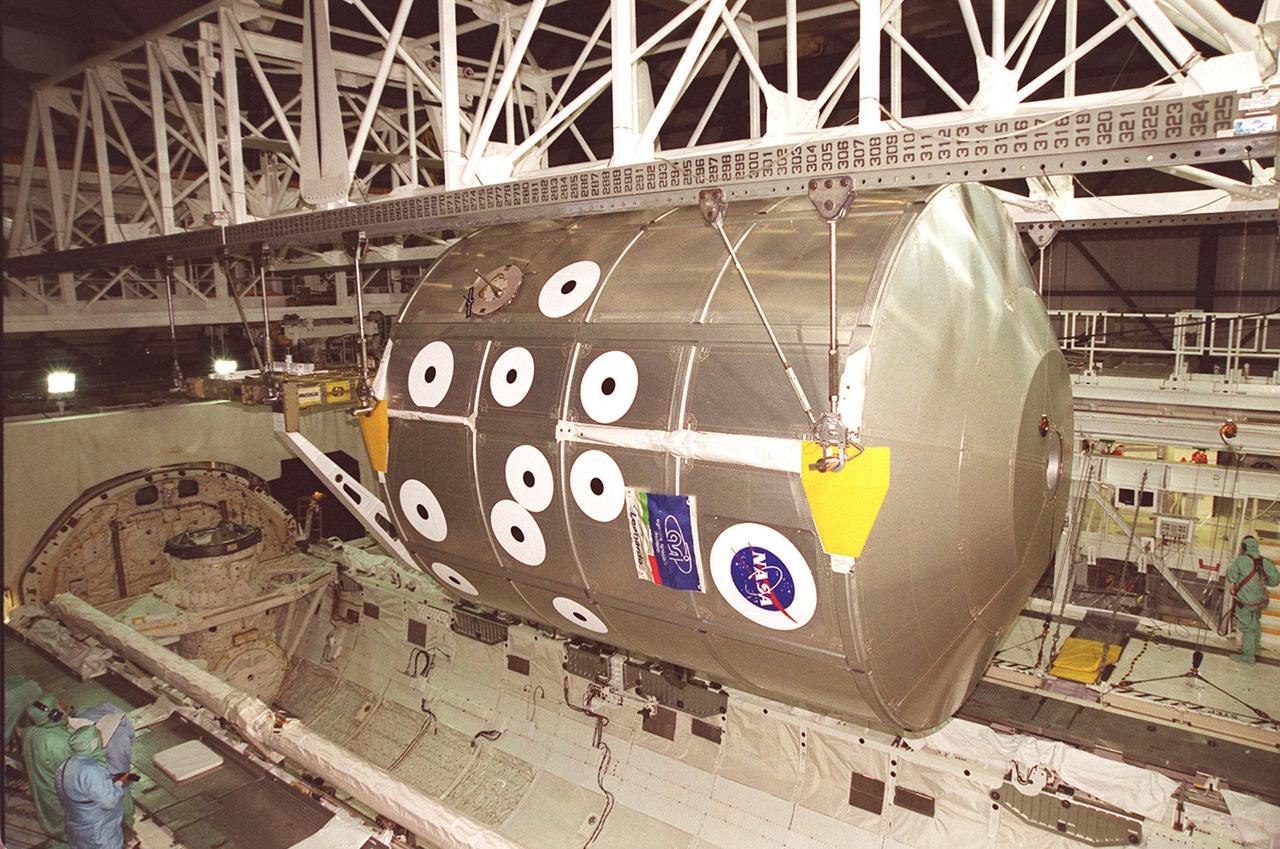
KENNEDY SPACE CENTER, FLA. -- In the Orbiter Processing Facility bay 2, an overhead crane lifts the Multi-Purpose Logistics Module Leonardo and the integrated cargo carrier behind it out of Discovery’s payload bay. The MPLM has just returned from its first round trip to the International Space Station on mission STS-102. Leonardo will be transferred to the SSPF to prepare it for future missions. The MPLM serves as a cargo van, carrying equipment and supplies to the Space Station
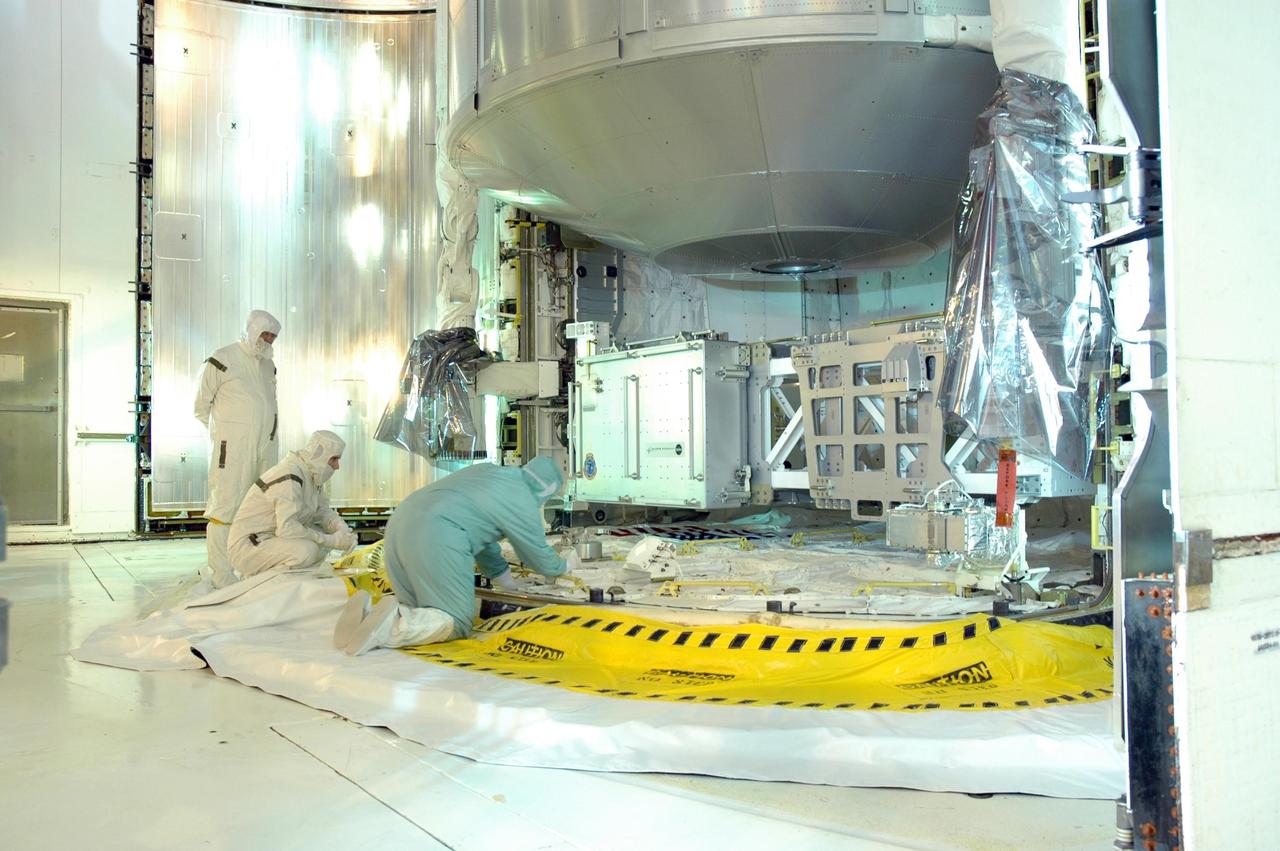
KENNEDY SPACE CENTER, FLA. - At Launch Pad 39B, technicians prepare for the closing of Space Shuttle Discovery's payload bay doors for launch. Above them is the multi-purpose logistics module Leonardo, part of the cargo that includes the integrated cargo carrier. Discovery is scheduled to launch on mission STS-121 at 3:49 p.m. July 1 carrying a crew of seven on the 12-day mission to the International Space Station. Photo credit: NASA/Jim Grossmann
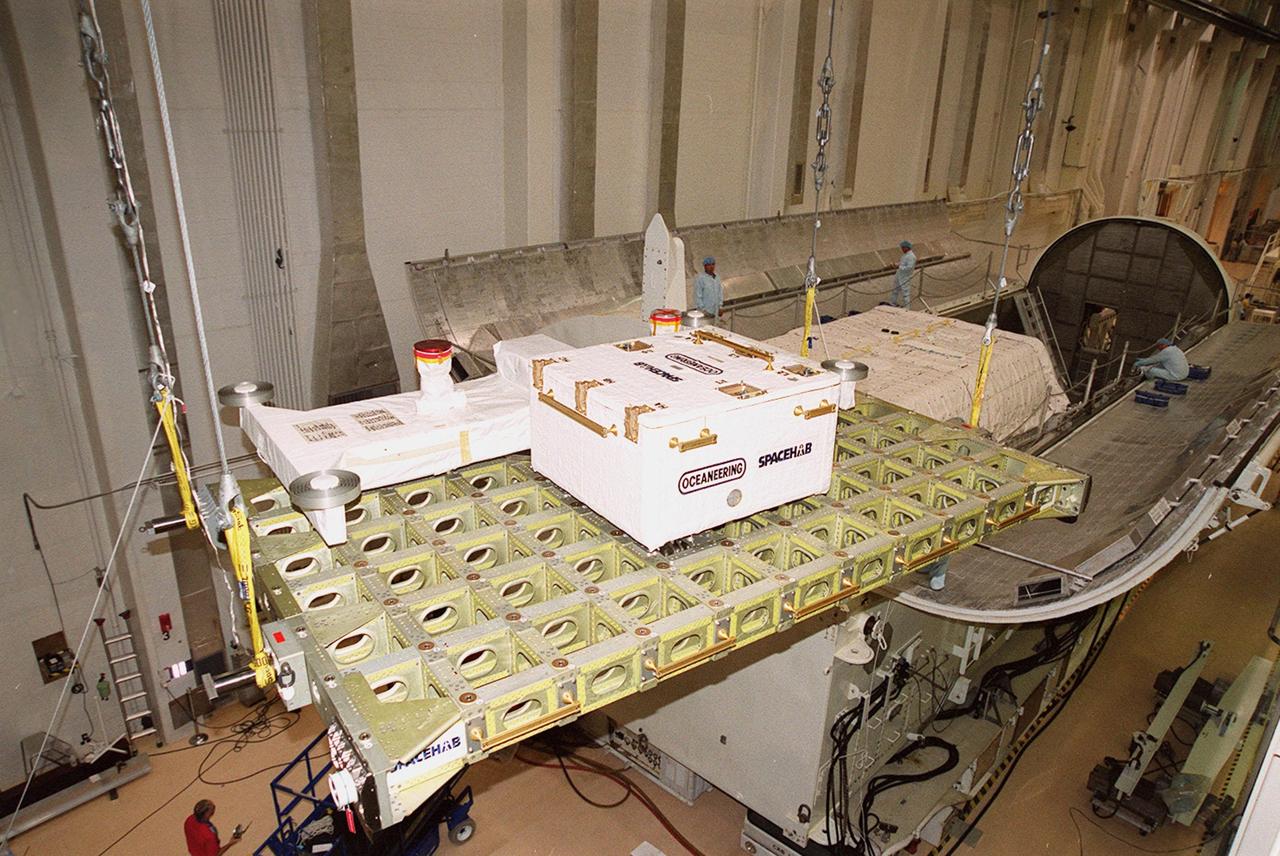
KENNEDY SPACE CENTER, FLA. -- An overhead crane moves the Integrated Cargo Carrier (ICC), with equipment on top, toward the payload canister below where the SPACEHAB module is already stowed. The canister will transport its cargo to Launch Pad 39B in preparation for mission STS-106, scheduled to launch Sept. 8 at 8:31 a.m. EDT. During the mission to the International Space Station, the crew will complete service module support tasks on orbit, transfer supplies and outfit the Space Station for the first long-duration crew
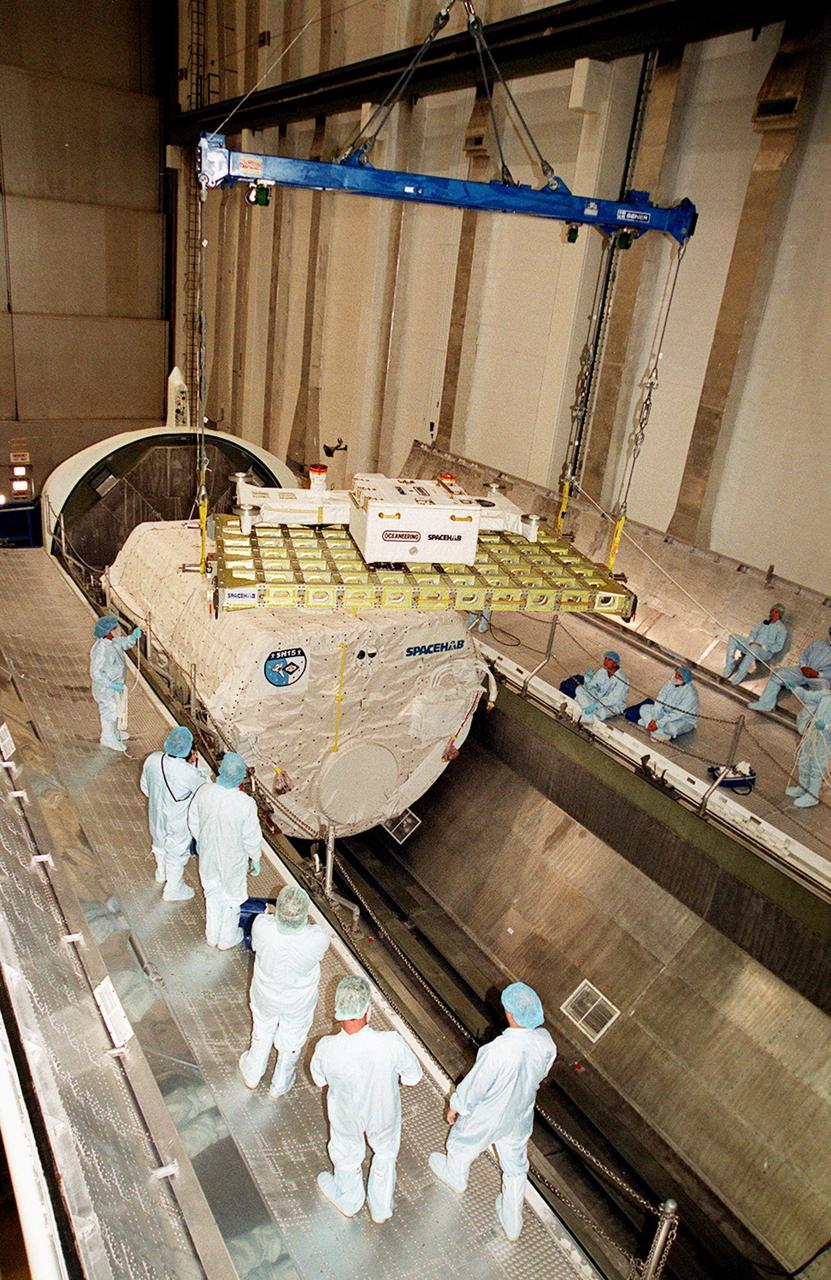
KENNEDY SPACE CENTER, FLA. -- In the Space Station Processing Facility, workers maneuver the Integrated Cargo Carrier (ICC) toward the opening in the payload canister. The canister already has the SPACEHAB module stowed. The canister will transport its cargo to Launch Pad 39B in preparation for mission STS-106, scheduled to launch Sept. 8 at 8:31 a.m. EDT. During the mission to the International Space Station, the crew will complete service module support tasks on orbit, transfer supplies and outfit the Space Station for the first long-duration crew
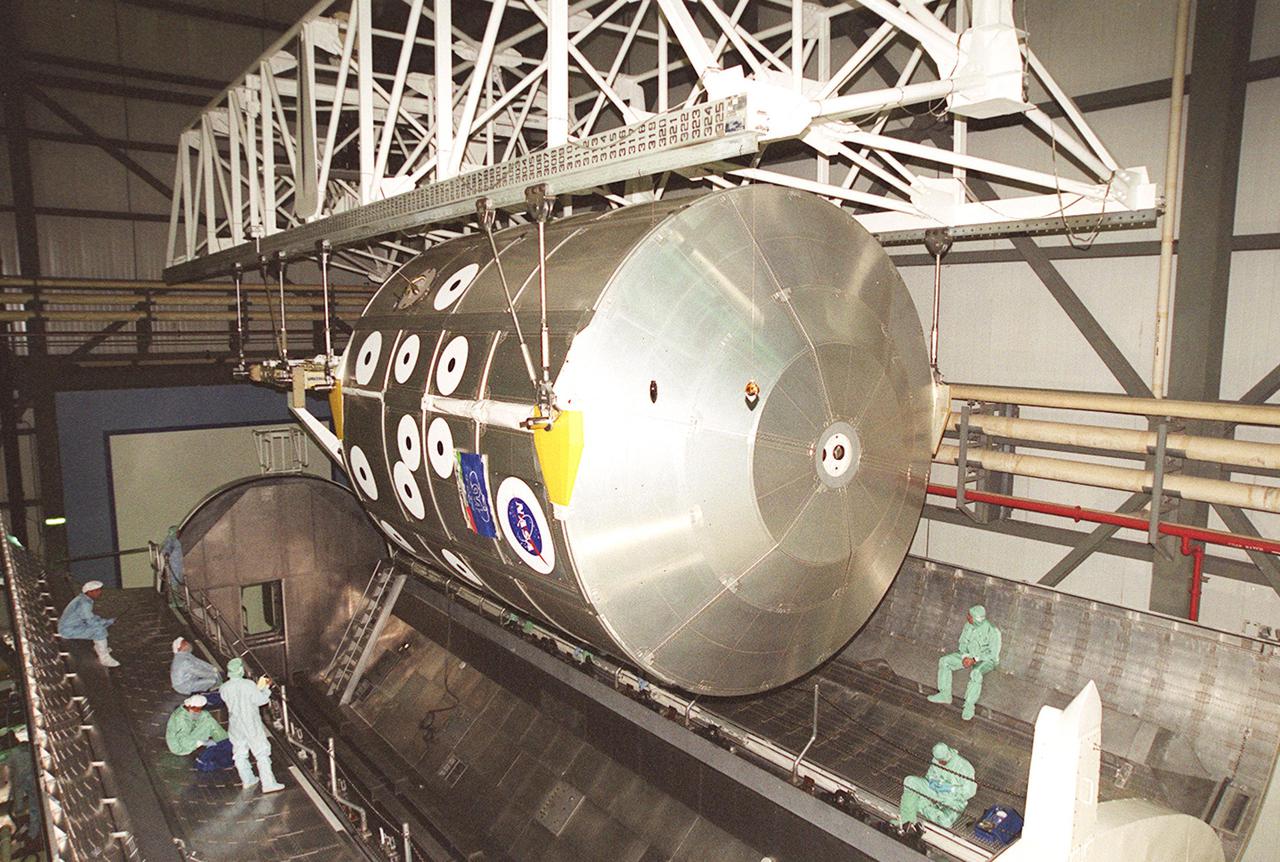
KENNEDY SPACE CENTER, FLA. -- In the Orbiter Processing Facility bay 2, an overhead crane positions the Multi-Purpose Logistics Module Leonardo and the integrated cargo carrier behind it above a payload canister. The MPLM has just returned from its first round trip to the International Space Station on mission STS-102. Leonardo will be transferred to the SSPF to prepare it for future missions. The MPLM serves as a cargo van, carrying equipment and supplies to the Space Station
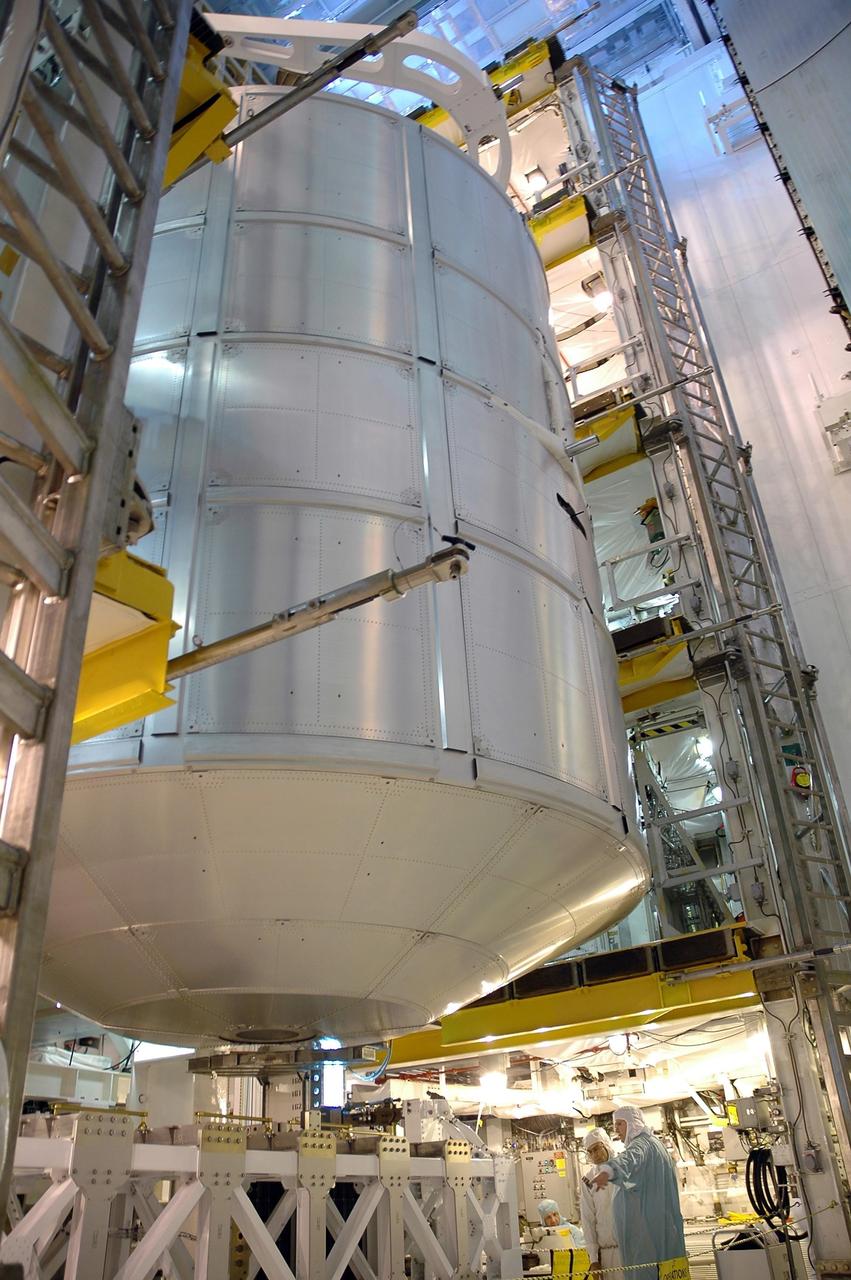
KENNEDY SPACE CENTER, FLA. -- From inside the payload changeout room on the rotating service structure on Launch Pad 39B, the multi-purpose logistics module Leonardo is being moved into Space Shuttle Discovery's payload bay. The payload ground-handling mechanism (PGHM) is used to transfer the module into the payload bay. Leonardo is a reusable logistics carrier. It is the primary delivery system used to resupply and return station cargo requiring a pressurized environment. Leonardo is part of the payload on mission STS-121. Other payloads include the integrated cargo carrier with the mobile transporter reel assembly and a spare pump module, and the lightweight multi-purpose experiment support structure carrier. Discovery is scheduled to launch in a window extending from July 1 through July 19. Photo credit: NASA/Jack Pfaller
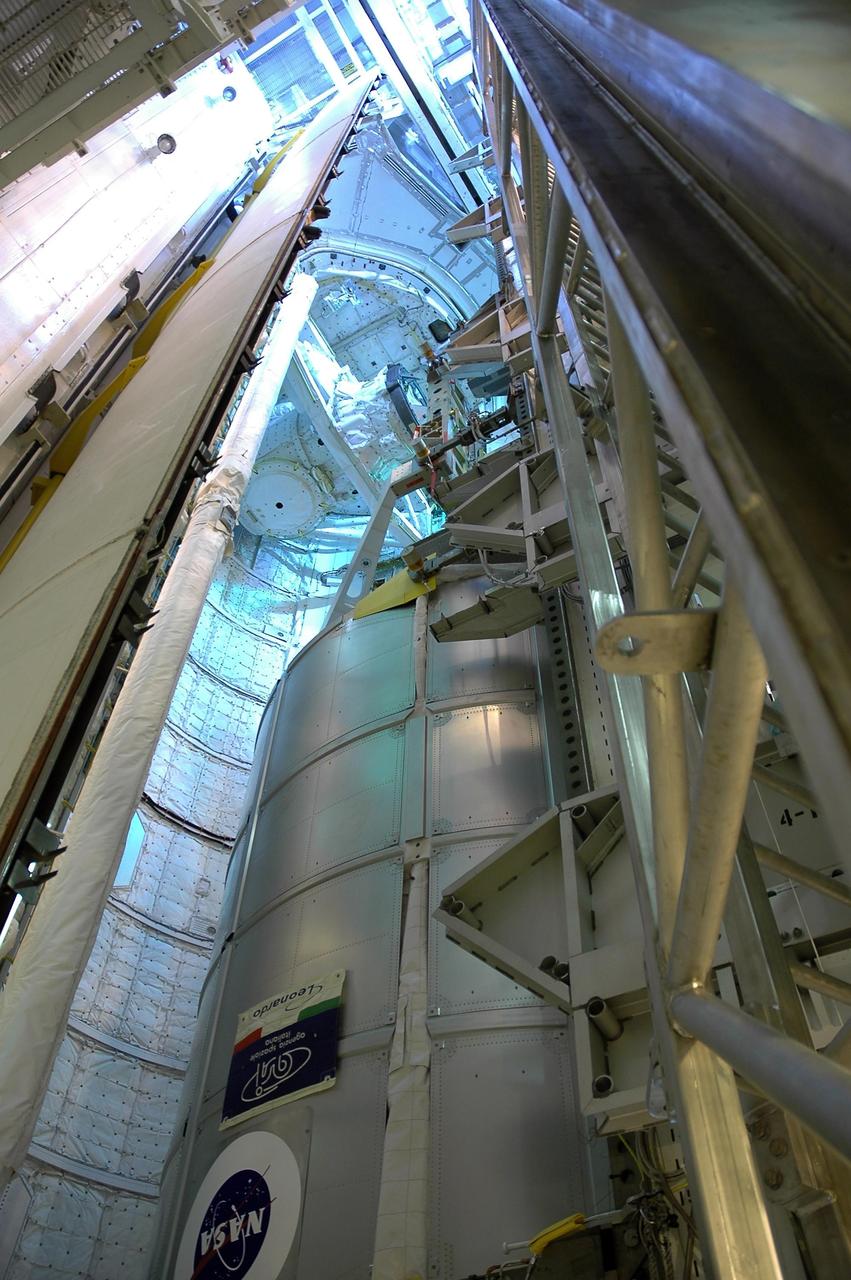
KENNEDY SPACE CENTER, FLA. -- From inside the payload changeout room on the rotating service structure on Launch Pad 39B, the multi-purpose logistics module Leonardo is lowered into Space Shuttle Discovery's payload bay. The payload ground-handling mechanism (PGHM) is used to transfer the module into the payload bay. Leonardo is a reusable logistics carrier. It is the primary delivery system used to resupply and return station cargo requiring a pressurized environment. Leonardo is part of the payload on mission STS-121. Other payloads include the integrated cargo carrier with the mobile transporter reel assembly and a spare pump module, and the lightweight multi-purpose experiment support structure carrier. Discovery is scheduled to launch in a window extending from July 1 through July 19. Photo credit: NASA/Jack Pfaller
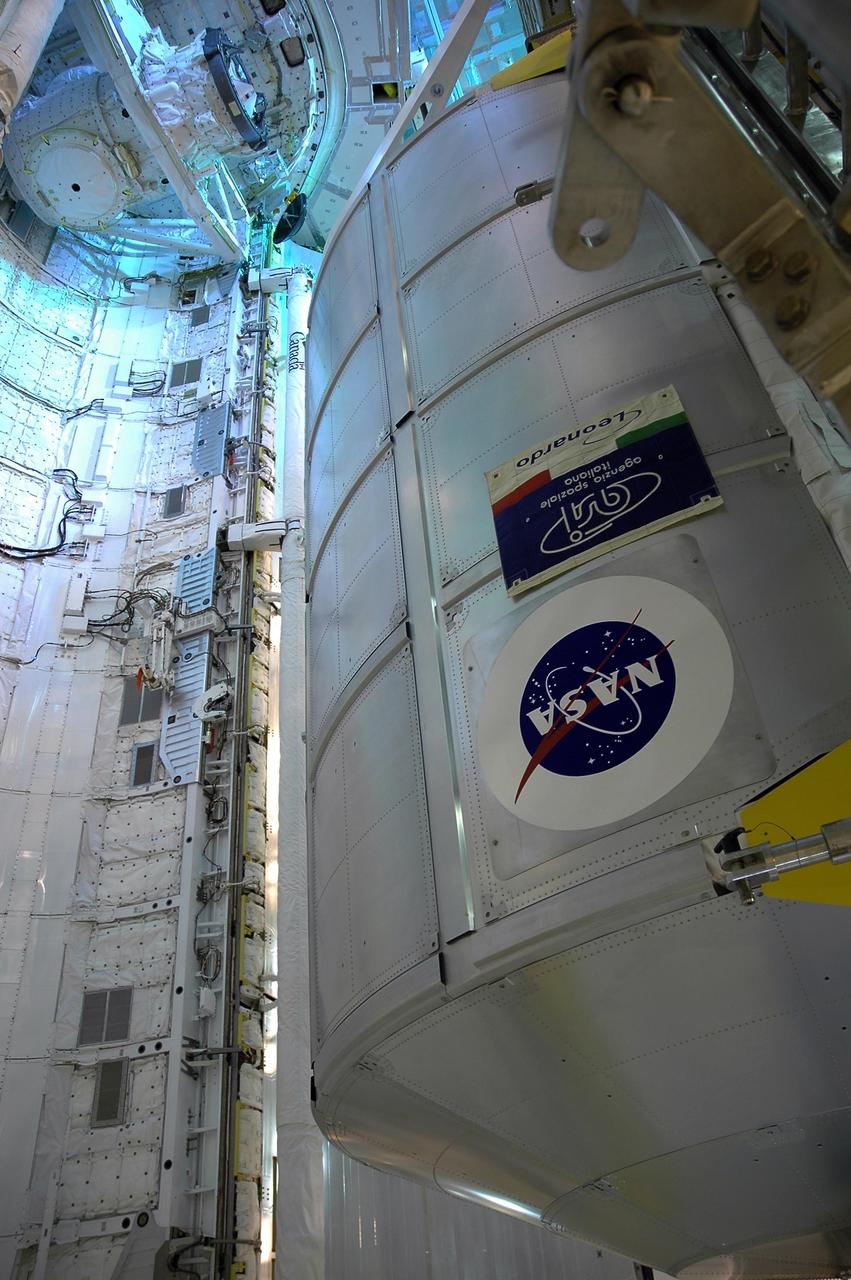
KENNEDY SPACE CENTER, FLA. -- From inside the payload changeout room on the rotating service structure on Launch Pad 39B, the multi-purpose logistics module Leonardo is being moved into Space Shuttle Discovery's payload bay (at left). The payload ground-handling mechanism (PGHM) is used to transfer the module into the payload bay. Leonardo is a reusable logistics carrier. It is the primary delivery system used to resupply and return station cargo requiring a pressurized environment. Leonardo is part of the payload on mission STS-121. Other payloads include the integrated cargo carrier with the mobile transporter reel assembly and a spare pump module, and the lightweight multi-purpose experiment support structure carrier. Discovery is scheduled to launch in a window extending from July 1 through July 19. Photo credit: NASA/Jack Pfaller
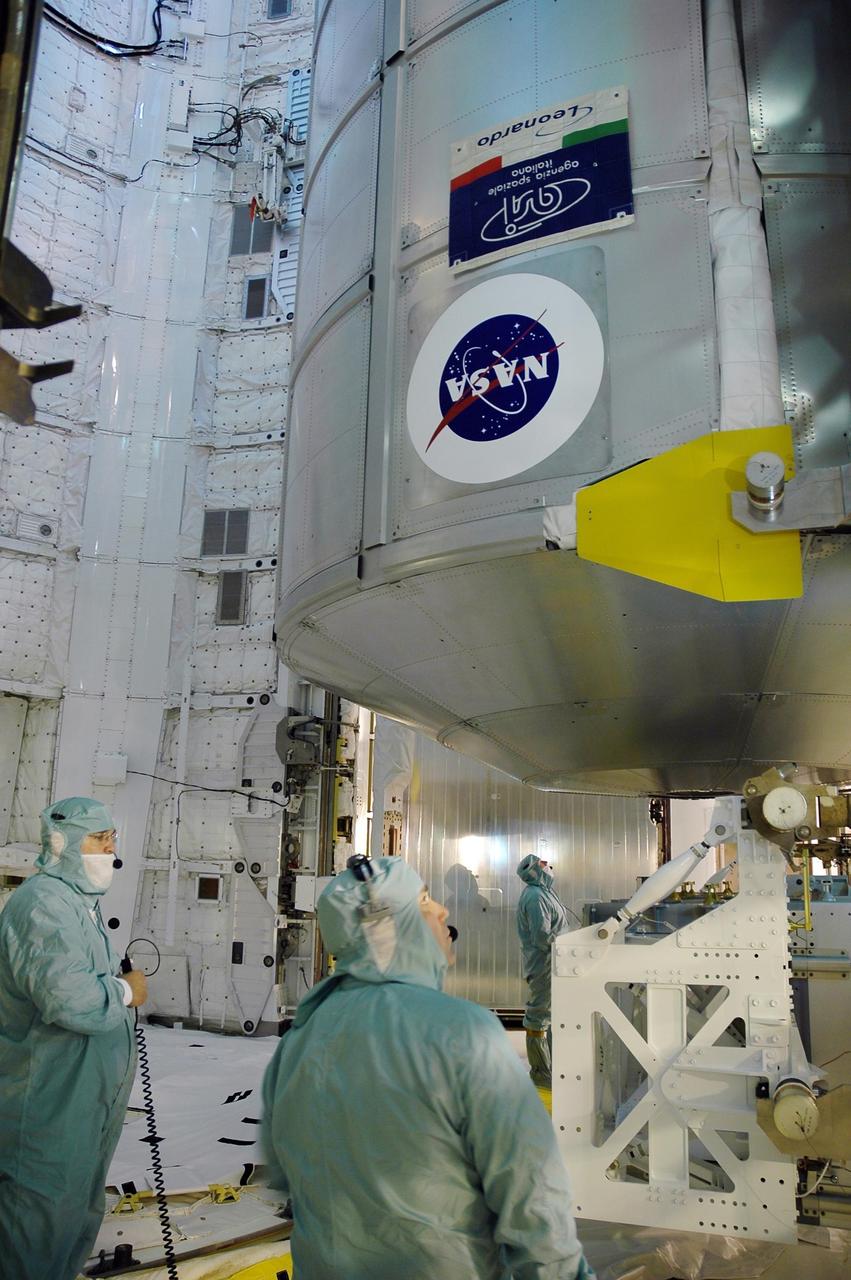
KENNEDY SPACE CENTER, FLA. -- From inside the payload changeout room on the rotating service structure on Launch Pad 39B, workers maneuver the multi-purpose logistics module Leonardo into Space Shuttle Discovery's payload bay (at left). The payload ground-handling mechanism (PGHM) is used to transfer the module into the payload bay. Leonardo is a reusable logistics carrier. It is the primary delivery system used to resupply and return station cargo requiring a pressurized environment. Leonardo is part of the payload on mission STS-121. Other payloads include the integrated cargo carrier with the mobile transporter reel assembly and a spare pump module, and the lightweight multi-purpose experiment support structure carrier. Discovery is scheduled to launch in a window extending from July 1 through July 19. Photo credit: NASA/Jack Pfaller
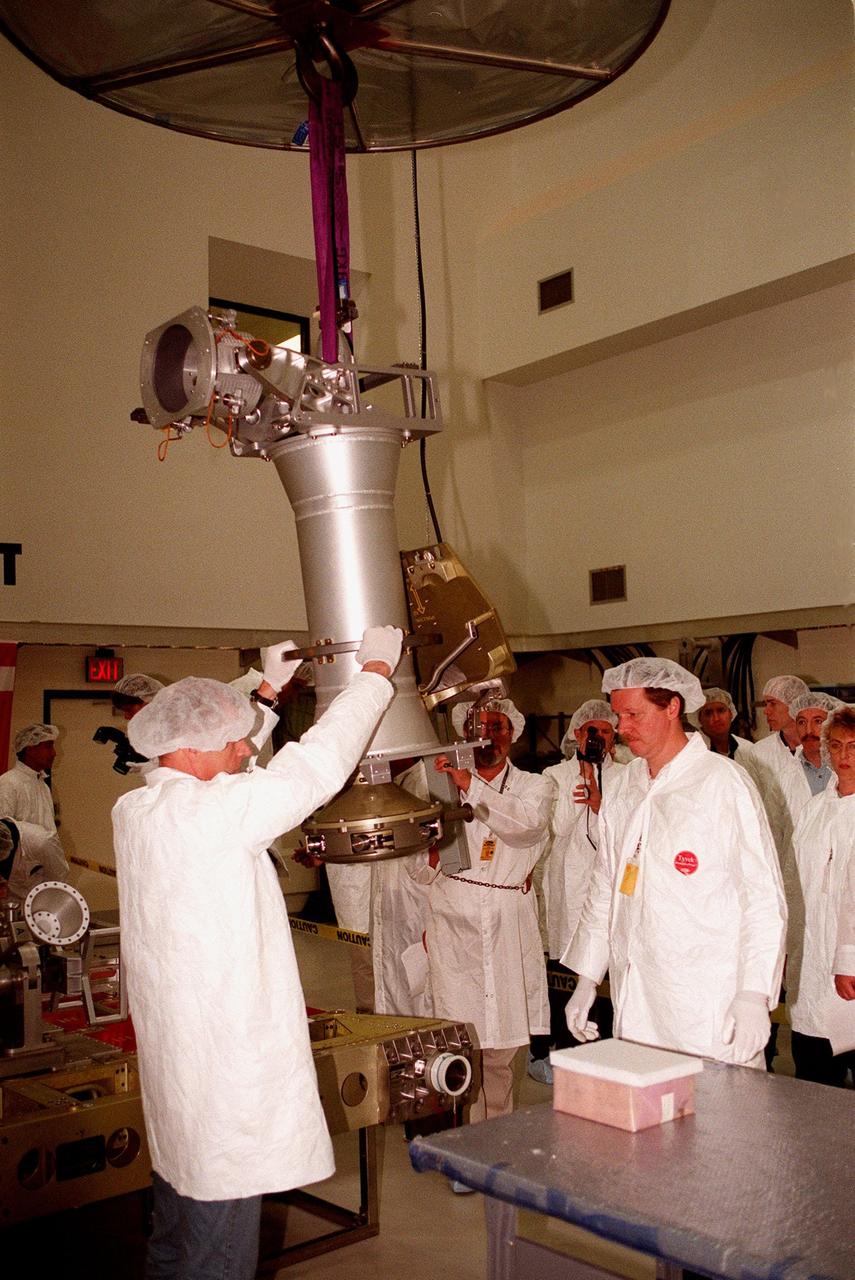
At Astrotech in Titusville, Fla., technicians with DaimlerChrysler Aerospace and RSC Energia of Korolev, Russia, maneuver a Russian cargo crane, the Strela, which is to be mounted to the exterior of the Russian station segment on the International Space Station (ISS). The Strehla has been the focus for two Shuttle crews, STS-96 who are at KSC for a Crew Equipment Interface Test, and STS-101, for payload familiarization. For the first time, STS-96 will include an Integrated Cargo Carrier (ICC) that will carry the Russian cargo crane; the SPACEHAB Oceaneering Space System Box (SHOSS), which is a logistics items carrier; and a U.S.-built crane (ORU Transfer Device, or OTD) that will be stowed on the station for use during future ISS assembly missions. The ICC can carry up to 6,000 lb of unpressurized payload. It was built for SPACEHAB by DaimlerChrysler Aerospace and RSC Energia. STS-96 is targeted for launch on May 24 from Launch Pad 39B. STS-101 is scheduled to launch in early December 1999
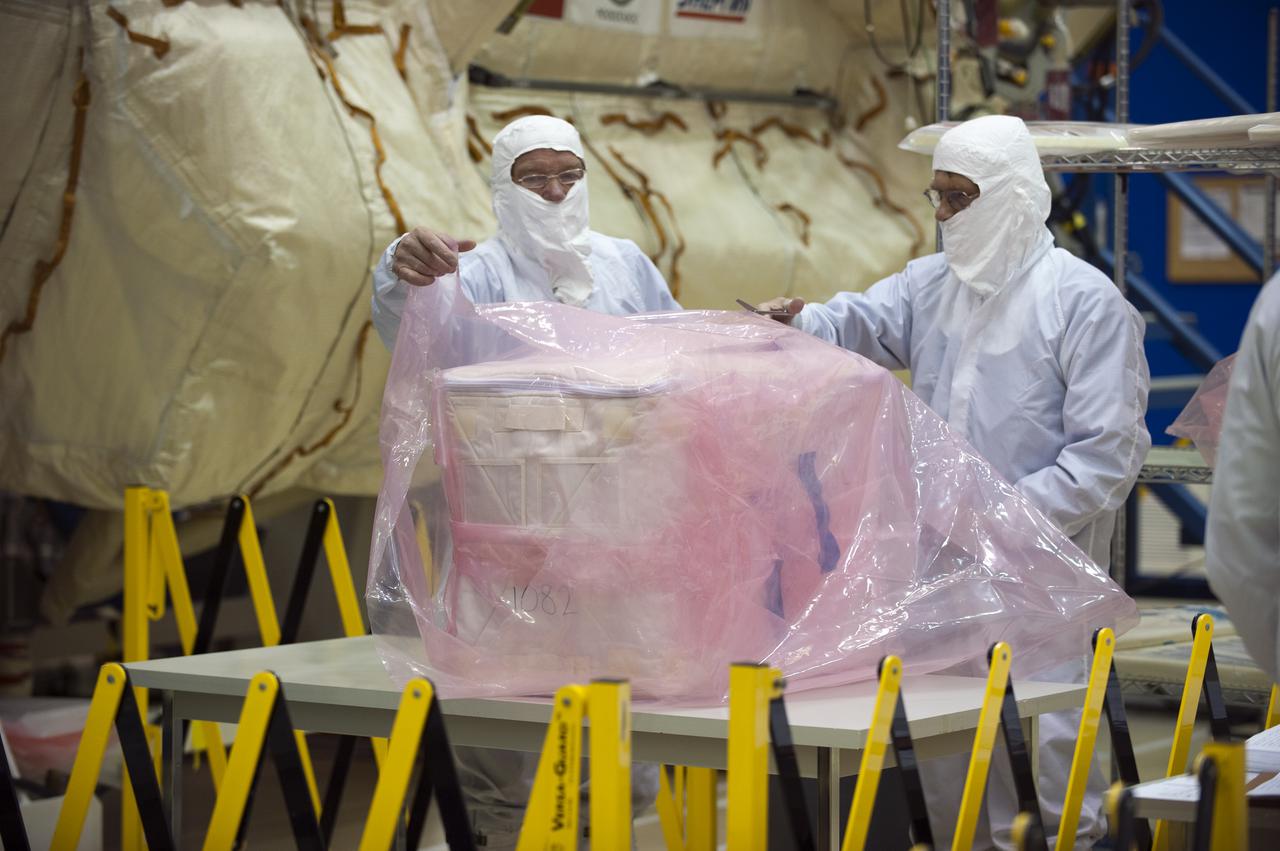
CAPE CANAVERAL, Fla. – In the Astrotech payload processing facility at Port Canaveral, Fla., supplies and other cargo are prepared for installation in the Russian-built Mini-Research Module, or MRM, in the background. The six-member crew of space shuttle Atlantis' STS-132 mission will deliver an Integrated Cargo Carrier and the MRM to the International Space Station. The second in a series of new pressurized components for Russia, the MRM will be permanently attached to the bottom port of the Zarya module. The MRM also will carry U.S. pressurized cargo. STS-132 is the 34th mission to the station and the 132nd space shuttle mission. Launch is targeted for May 14. For information on the STS-132 mission, visit http:__www.nasa.gov_mission_pages_shuttle_shuttlemissions_sts132_index.html. Photo credit: NASA_Kim Shiflett
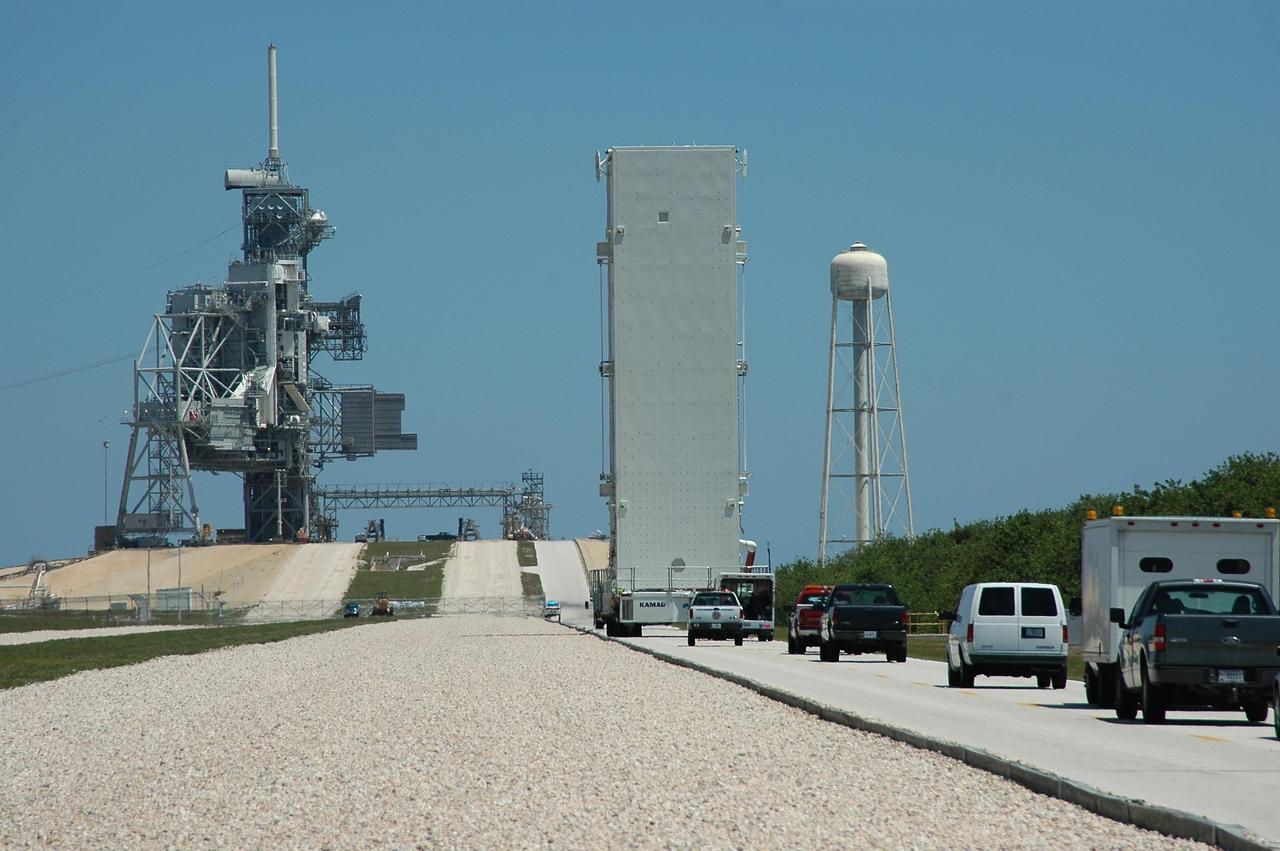
KENNEDY SPACE CENTER, FLA. -- The payload canister approaches the incline up to Launch Pad 39B at NASA's Kennedy Space Center. The canister holds the payloads for mission STS-121: the multi-purpose logistics module Leonardo, with supplies and equipment for the International Space Station; the lightweight multi-purpose experiment support structure carrier; and the integrated cargo carrier, with the mobile transporter reel assembly and a spare pump module. The payload will be transferred from the canister to Space Shuttle Discovery's payload bay at the pad. Discovery is scheduled to launch on mission STS-121 from Launch Pad 39B in a window that opens July 1 and extends to July 19. Photo credit: NASA/Kim Shiflett

KENNEDY SPACE CENTER, FLA. - In the Space Station Processing Facility, the multi-purpose logistics module Leonardo is lowered next to the Integrated Cargo Carrier inside the payload transportation canister for transfer to Launch Pad 39B. At the pad, the module and carrier will be installed in Space Shuttle Discovery's payload bay. Part of the payload for mission STS-121, Leonardo carries tons of supplies and experiments for the International Space Station and its crew. Discovery is scheduled to be launched in a window that extends from July 1 to July 19. Photo credit: NASA/Kim Shiflett
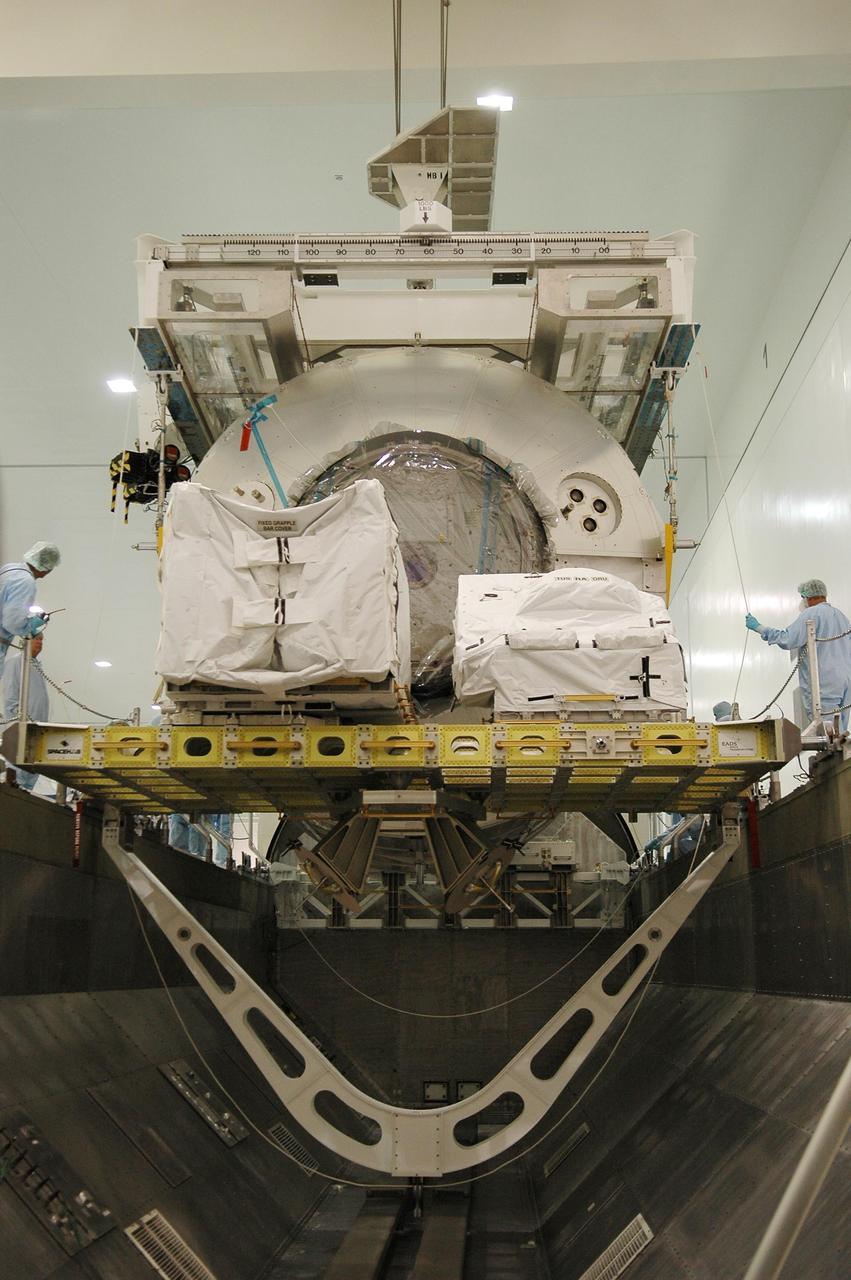
KENNEDY SPACE CENTER, FLA. - In the Space Station Processing Facility, the multi-purpose logistics module Leonardo is lowered next to the Integrated Cargo Carrier inside the payload transportation canister for transfer to Launch Pad 39B. At the pad, the module and carrier will be installed in Space Shuttle Discovery's payload bay. Part of the payload for mission STS-121, Leonardo carries tons of supplies and experiments for the International Space Station and its crew. Discovery is scheduled to be launched in a window that extends from July 1 to July 19. Photo credit: NASA/Kim Shiflett
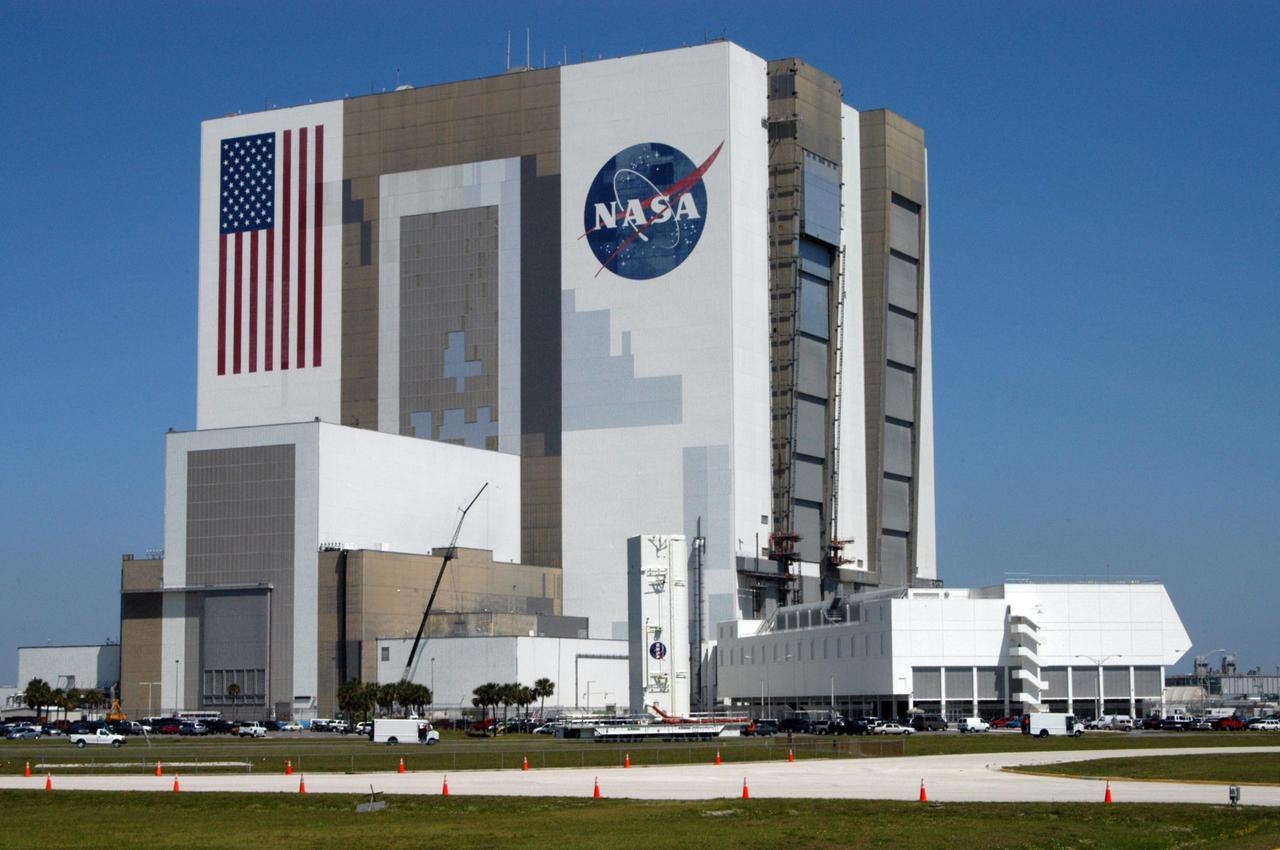
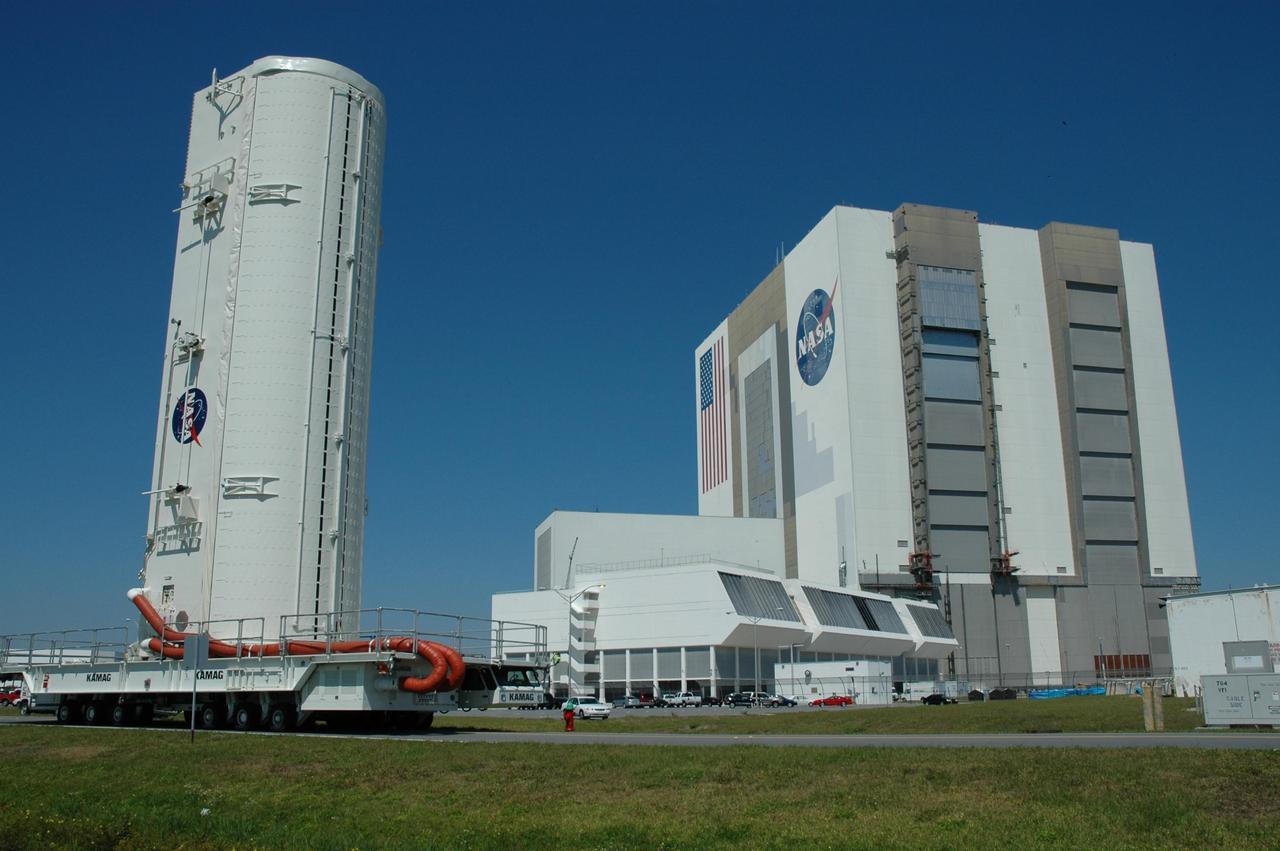
KENNEDY SPACE CENTER, FLA. -- The payload canister passes NASA's Vehicle Assembly Building and Launch Control Center on its way to Launch Pad 39B. Inside are the payloads for mission STS-121: the multi-purpose logistics module Leonardo, with supplies and equipment for the International Space Station; the lightweight multi-purpose experiment support structure carrier; and the integrated cargo carrier, with the mobile transporter reel assembly and a spare pump module. The payload will be transferred from the canister to Space Shuttle Discovery's payload bay at the pad. Discovery is scheduled to launch on mission STS-121 from Launch Pad 39B in a window that opens July 1 and extends to July 19. Photo credit: NASA/George Shelton
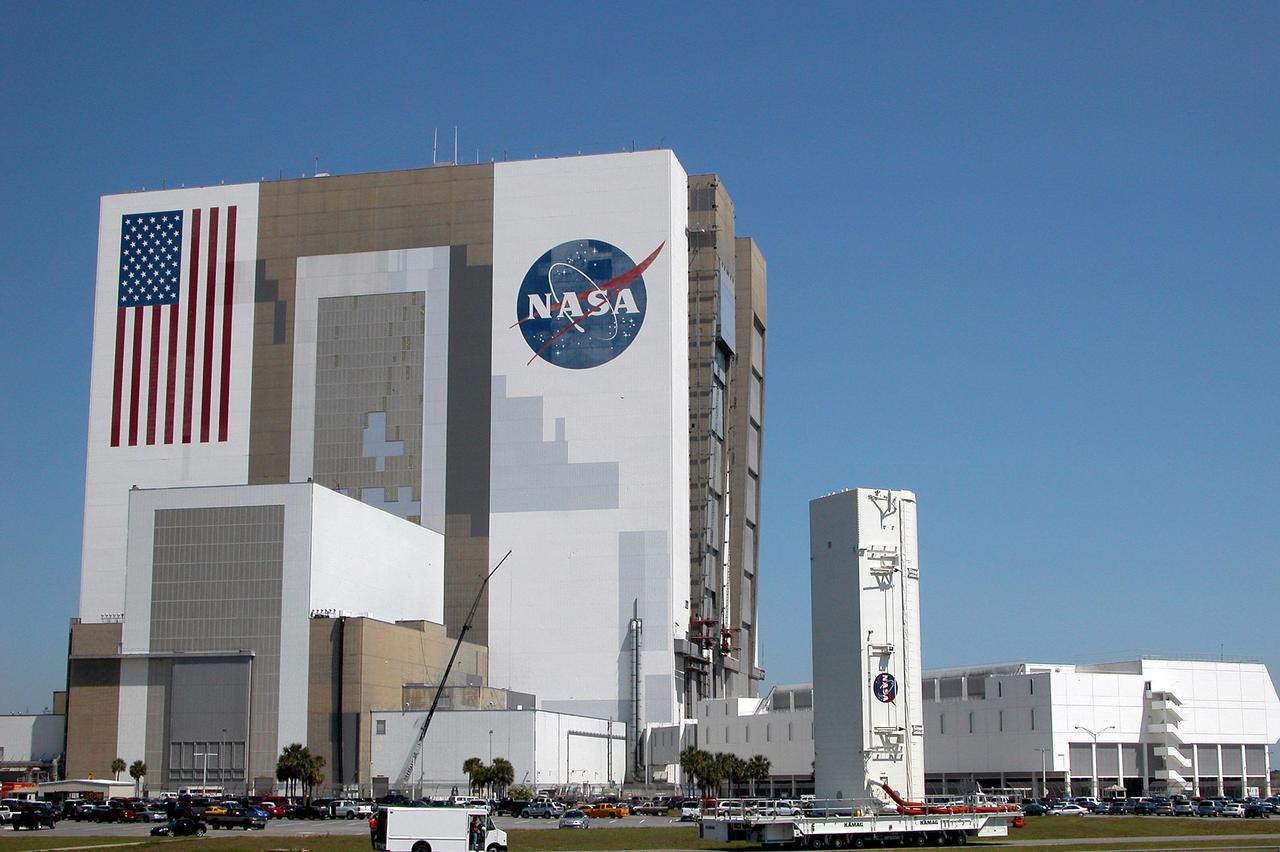
KENNEDY SPACE CENTER, FLA. -- The payload canister passes NASA's Vehicle Assembly Building and Launch Control Center on its way to Launch Pad 39B. Inside are the payloads for mission STS-121: the multi-purpose logistics module Leonardo, with supplies and equipment for the International Space Station; the lightweight multi-purpose experiment support structure carrier; and the integrated cargo carrier, with the mobile transporter reel assembly and a spare pump module. The payload will be transferred from the canister to Space Shuttle Discovery's payload bay at the pad. Discovery is scheduled to launch on mission STS-121 from Launch Pad 39B in a window that opens July 1 and extends to July 19.Photo credit: NASA/Debbie Kiger
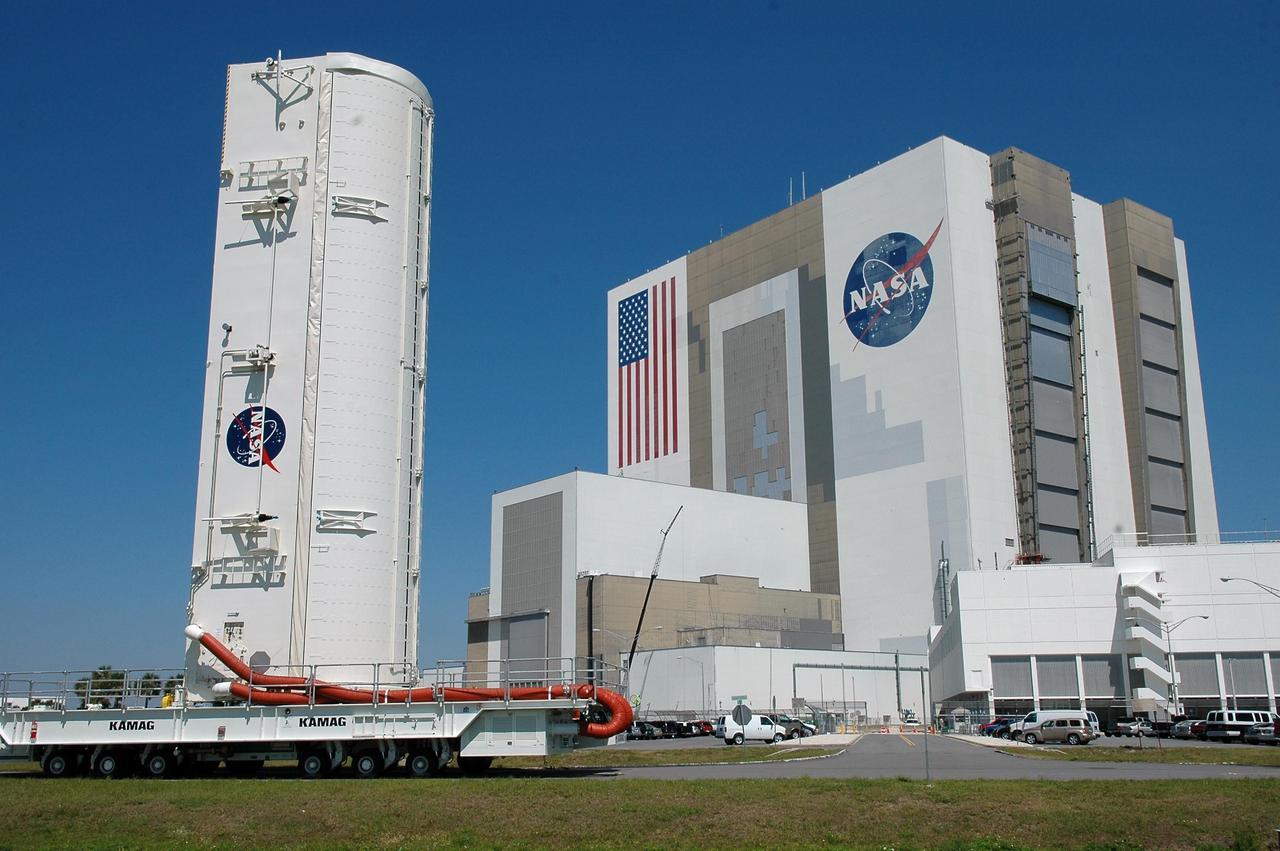
KENNEDY SPACE CENTER, FLA. -- The payload canister moves past NASA's Vehicle Assembly Building on its way to Launch Pad 39B. Inside are the payloads for mission STS-121: the multi-purpose logistics module Leonardo, with supplies and equipment for the International Space Station; the lightweight multi-purpose experiment support structure carrier; and the integrated cargo carrier, with the mobile transporter reel assembly and a spare pump module. The payload will be transferred from the canister to Space Shuttle Discovery's payload bay at the pad. Discovery is scheduled to launch on mission STS-121 from Launch Pad 39B in a window that opens July 1 and extends to July 19. Photo credit: NASA/Kim Shiflett
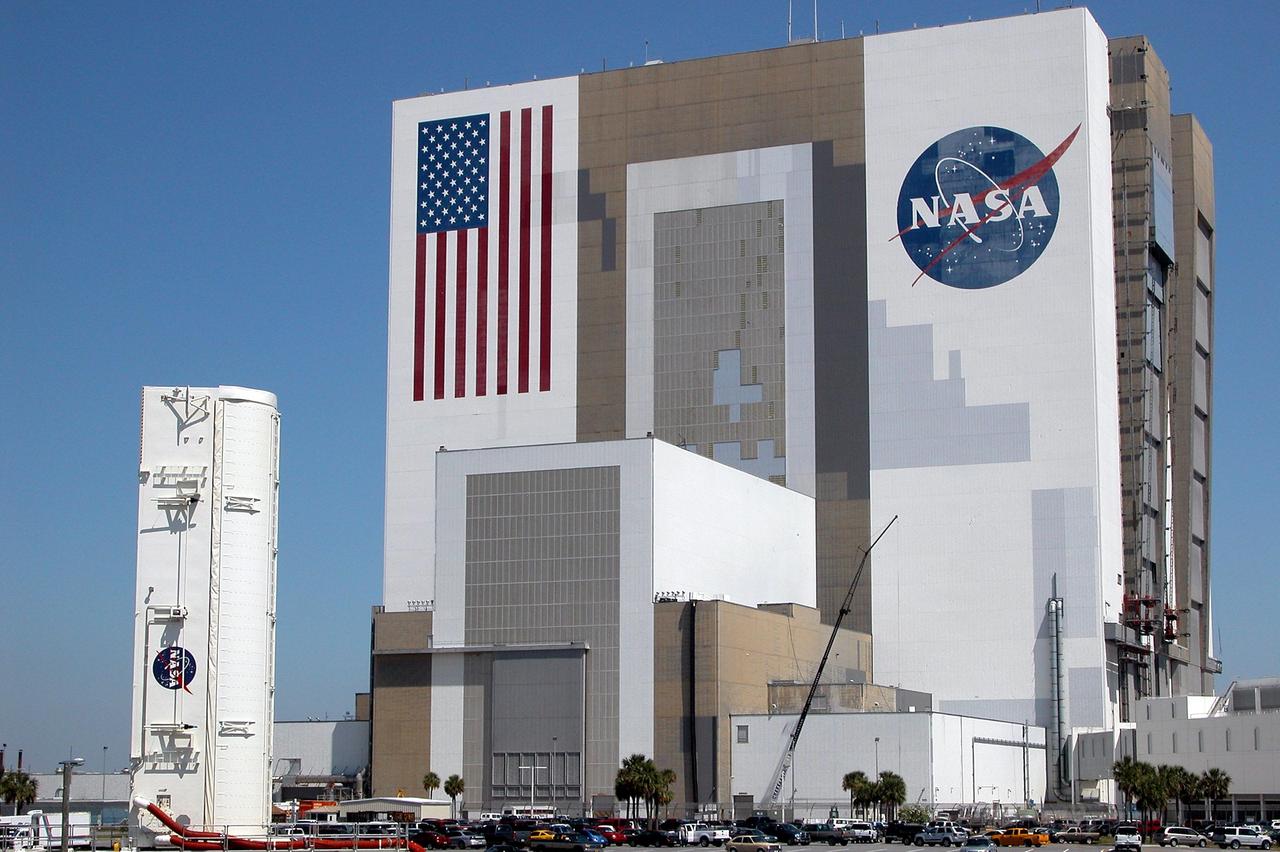
KENNEDY SPACE CENTER, FLA. -- The payload canister moves past NASA's Vehicle Assembly Building on its way to Launch Pad 39B. Inside are the payloads for mission STS-121: the multi-purpose logistics module Leonardo, with supplies and equipment for the International Space Station; the lightweight multi-purpose experiment support structure carrier; and the integrated cargo carrier, with the mobile transporter reel assembly and a spare pump module. The payload will be transferred from the canister to Space Shuttle Discovery's payload bay at the pad. Discovery is scheduled to launch on mission STS-121 from Launch Pad 39B in a window that opens July 1 and extends to July 19. Photo credit: NASA/Debbie Kiger
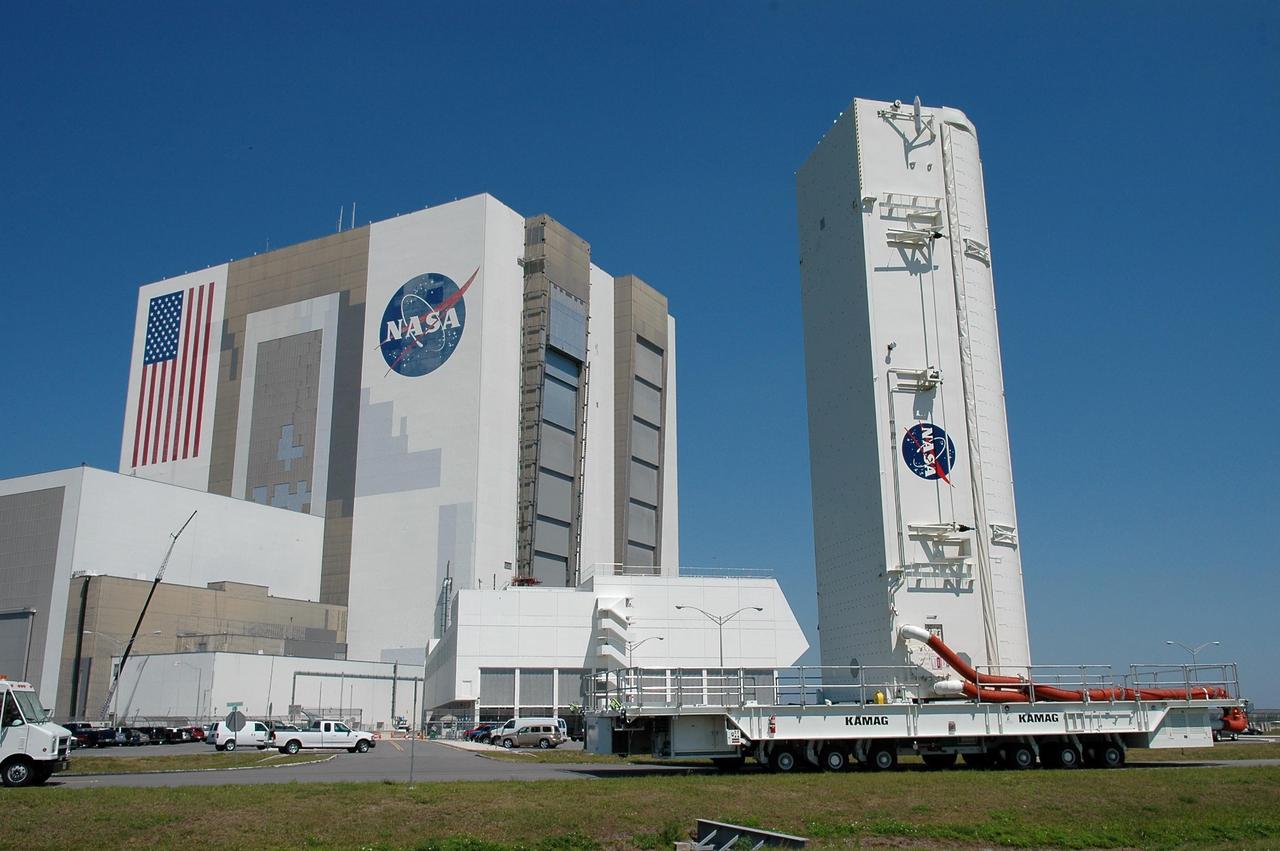
KENNEDY SPACE CENTER, FLA. -- The payload canister passes NASA's Vehicle Assembly Building and Launch Control Center on its way to Launch Pad 39B. Inside are the payloads for mission STS-121: the multi-purpose logistics module Leonardo, with supplies and equipment for the International Space Station; the lightweight multi-purpose experiment support structure carrier; and the integrated cargo carrier, with the mobile transporter reel assembly and a spare pump module. The payload will be transferred from the canister to Space Shuttle Discovery's payload bay at the pad. Discovery is scheduled to launch on mission STS-121 from Launch Pad 39B in a window that opens July 1 and extends to July 19. Photo credit: NASA/Troy Cryder
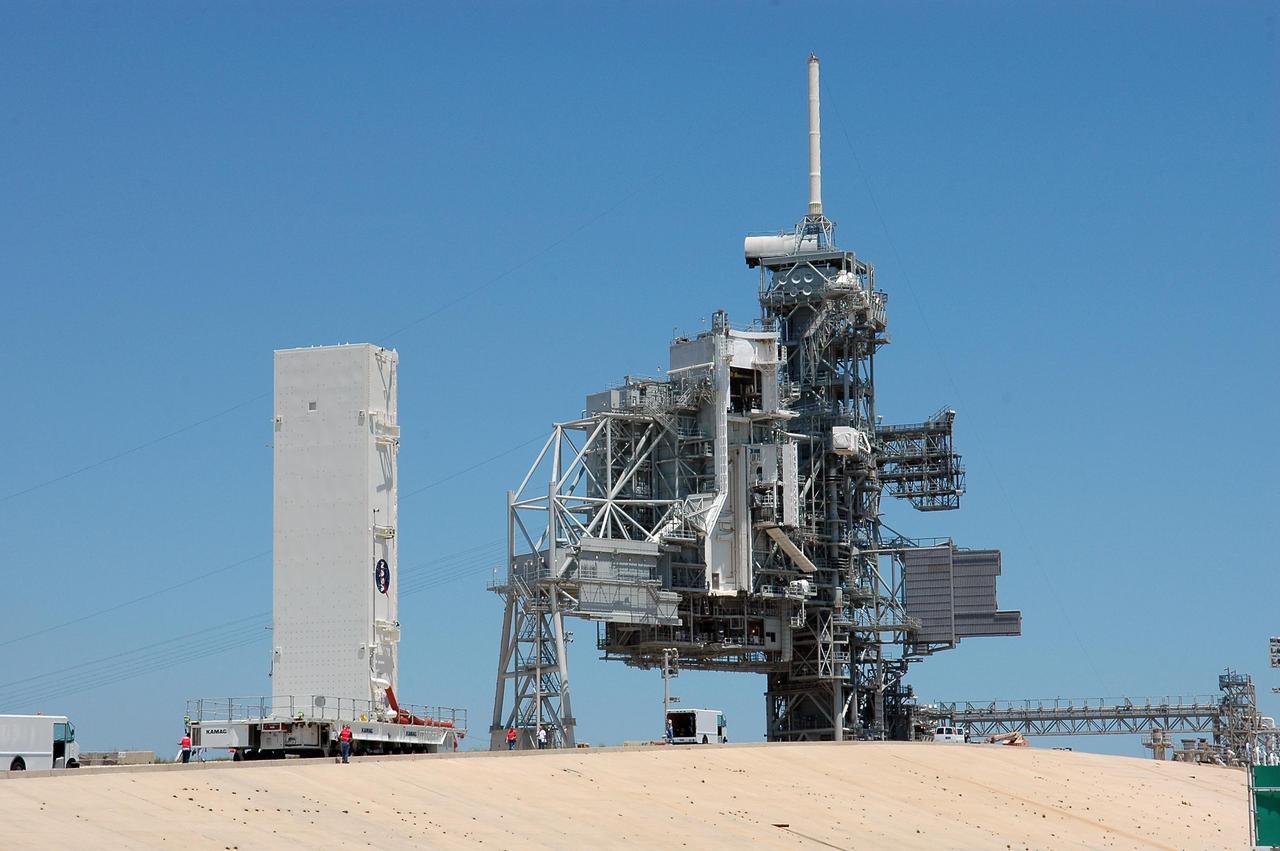
KENNEDY SPACE CENTER, FLA. -- The payload canister approaches the rotating service structure on Launch Pad 39B at NASA's Kennedy Space Center. The canister holds the payloads for mission STS-121: the multi-purpose logistics module Leonardo, with supplies and equipment for the International Space Station; the lightweight multi-purpose experiment support structure carrier; and the integrated cargo carrier, with the mobile transporter reel assembly and a spare pump module. The payload will be transferred from the canister to Space Shuttle Discovery's payload bay at the pad. Discovery is scheduled to launch on mission STS-121 from Launch Pad 39B in a window that opens July 1 and extends to July 19. Photo credit: NASA/Kim Shiflett
KENNEDY SPACE CENTER, FLA. -- The payload canister passes NASA's Vehicle Assembly Building and Launch Control Center on its way to Launch Pad 39B. Inside are the payloads for mission STS-121: the multi-purpose logistics module Leonardo, with supplies and equipment for the International Space Station; the lightweight multi-purpose experiment support structure carrier; and the integrated cargo carrier, with the mobile transporter reel assembly and a spare pump module. The payload will be transferred from the canister to Space Shuttle Discovery's payload bay at the pad. Discovery is scheduled to launch on mission STS-121 from Launch Pad 39B in a window that opens July 1 and extends to July 19. Photo credit: NASA/Kim Shiflett
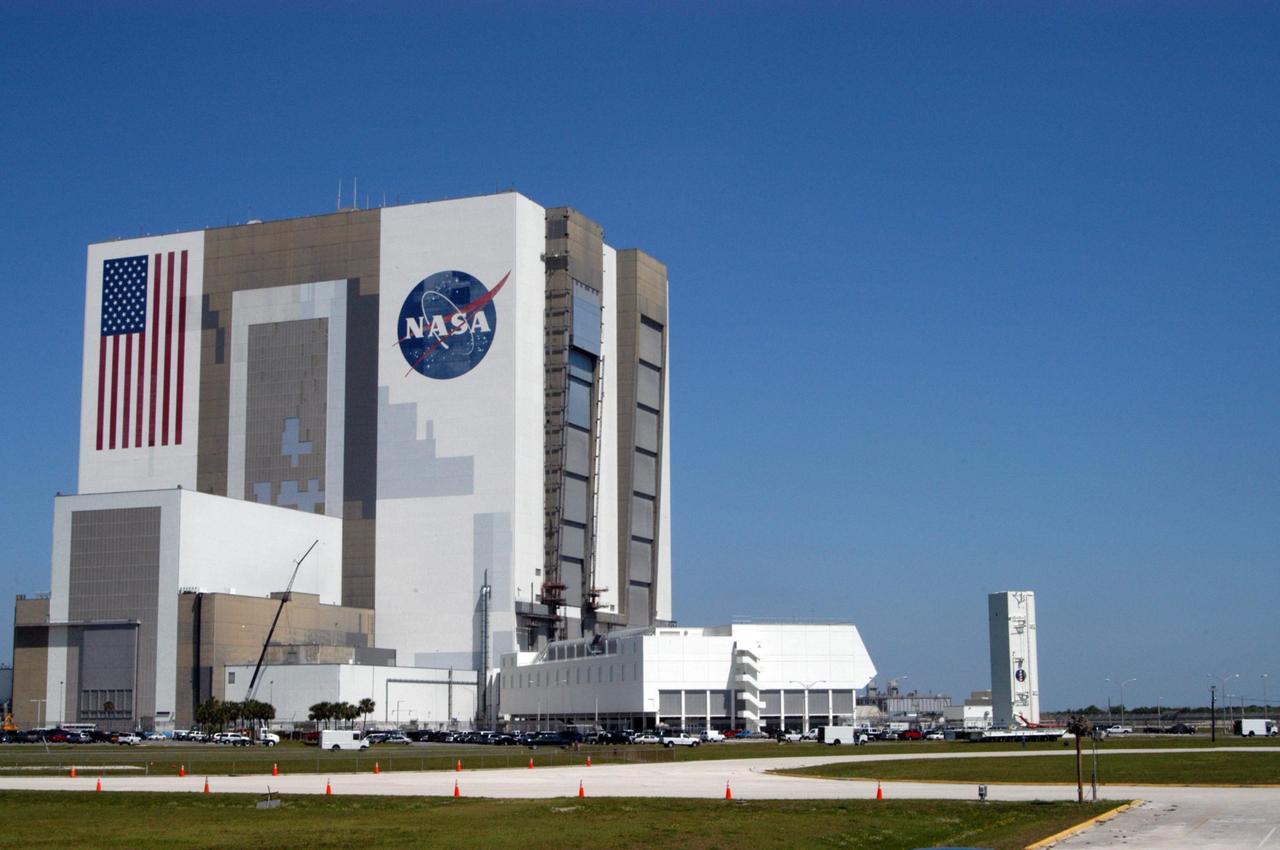
KENNEDY SPACE CENTER, FLA. -- The payload canister passes NASA's Vehicle Assembly Building and Launch Control Center on its way to Launch Pad 39B. Inside are the payloads for mission STS-121: the multi-purpose logistics module Leonardo, with supplies and equipment for the International Space Station; the lightweight multi-purpose experiment support structure carrier; and the integrated cargo carrier, with the mobile transporter reel assembly and a spare pump module. The payload will be transferred from the canister to Space Shuttle Discovery's payload bay at the pad. Discovery is scheduled to launch on mission STS-121 from Launch Pad 39B in a window that opens July 1 and extends to July 19. Photo credit: NASA/George Shelton

KENNEDY SPACE CENTER, FLA. -- The payload canister slowly climbs the ramp on Launch Pad 39B at NASA's Kennedy Space Center. The canister holds the payloads for mission STS-121: the multi-purpose logistics module Leonardo, with supplies and equipment for the International Space Station; the lightweight multi-purpose experiment support structure carrier; and the integrated cargo carrier, with the mobile transporter reel assembly and a spare pump module. The payload will be transferred from the canister to Space Shuttle Discovery's payload bay at the pad. Discovery is scheduled to launch on mission STS-121 from Launch Pad 39B in a window that opens July 1 and extends to July 19. Photo credit: NASA/Kim Shiflett

KENNEDY SPACE CENTER, FLA. -- With umbilical lines still attached, the payload canister is hoisted up alongside the Rotating Service Structure (RSS) on Launch Pad 39B. The canister with its cargo of the SPACEHAB module and Integrated Cargo Carrier will be moved into the Payload Changeout Room (PCR) near the top of the RSS for transfer to the payload bay of Shuttle Atlantis for mission STS-106. The PCR provides an environmentally controlled facility for the transfer. The 11-day mission to the International Space Station will include service module support tasks on orbit, transfer supplies and outfit the Space Station for the first long-duration crew. Atlantis is scheduled to launch Sept. 8 at 8:31 a.m. EDT
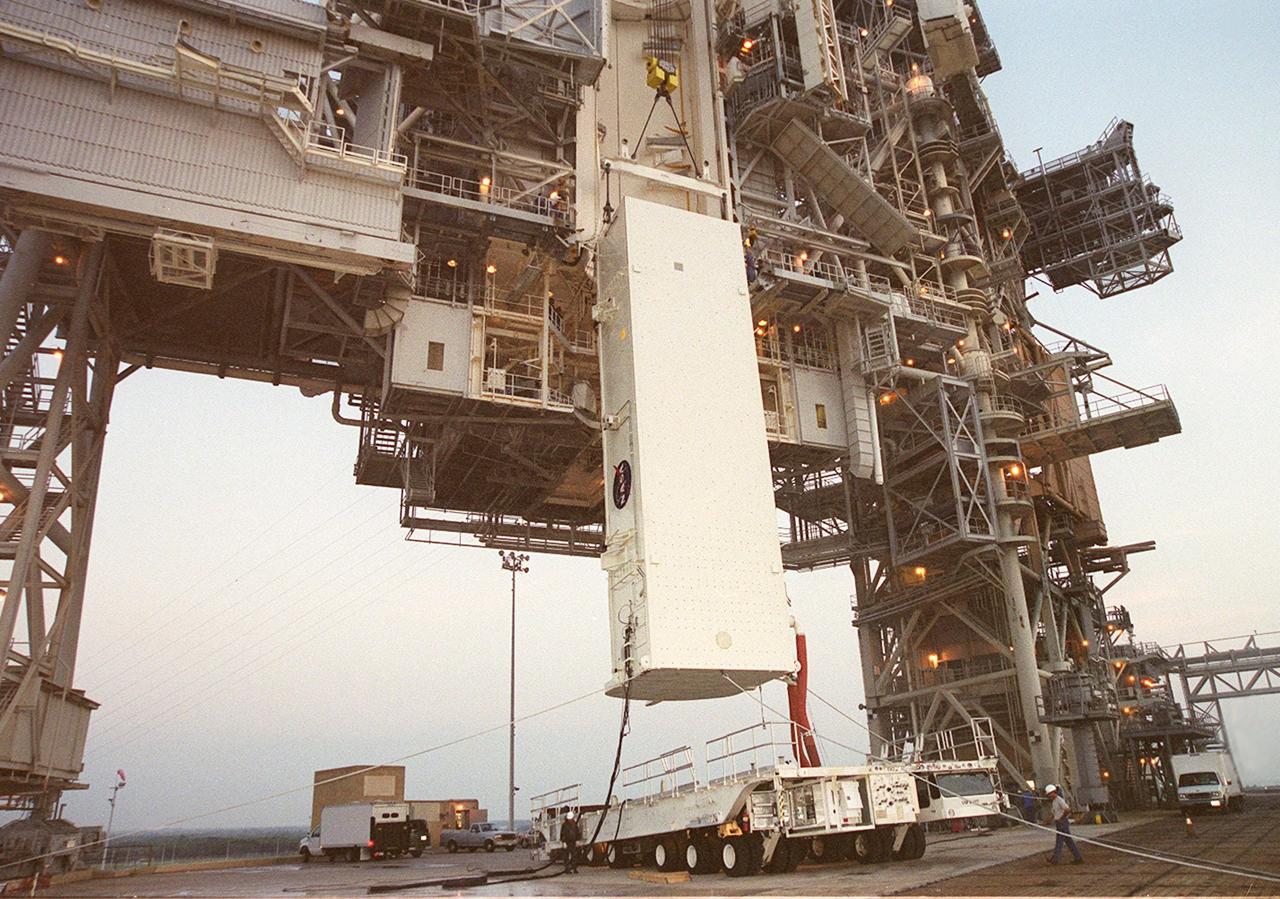
KENNEDY SPACE CENTER, Fla. -- The payload canister is hoisted up alongside the Rotating Service Structure (RSS) on Launch Pad 39B. The canister with its cargo of the SPACEHAB module and Integrated Cargo Carrier will be moved into the Payload Changeout Room near the top of the RSS for transfer to the payload bay of Shuttle Atlantis for mission STS-106. The PCR provides an environmentally controlled facility for the transfer. The 11-day mission to the International Space Station will include service module support tasks on orbit, transfer supplies and outfit the Space Station for the first long-duration crew. Atlantis is scheduled to launch Sept. 8 at 8:31 a.m. EDT.
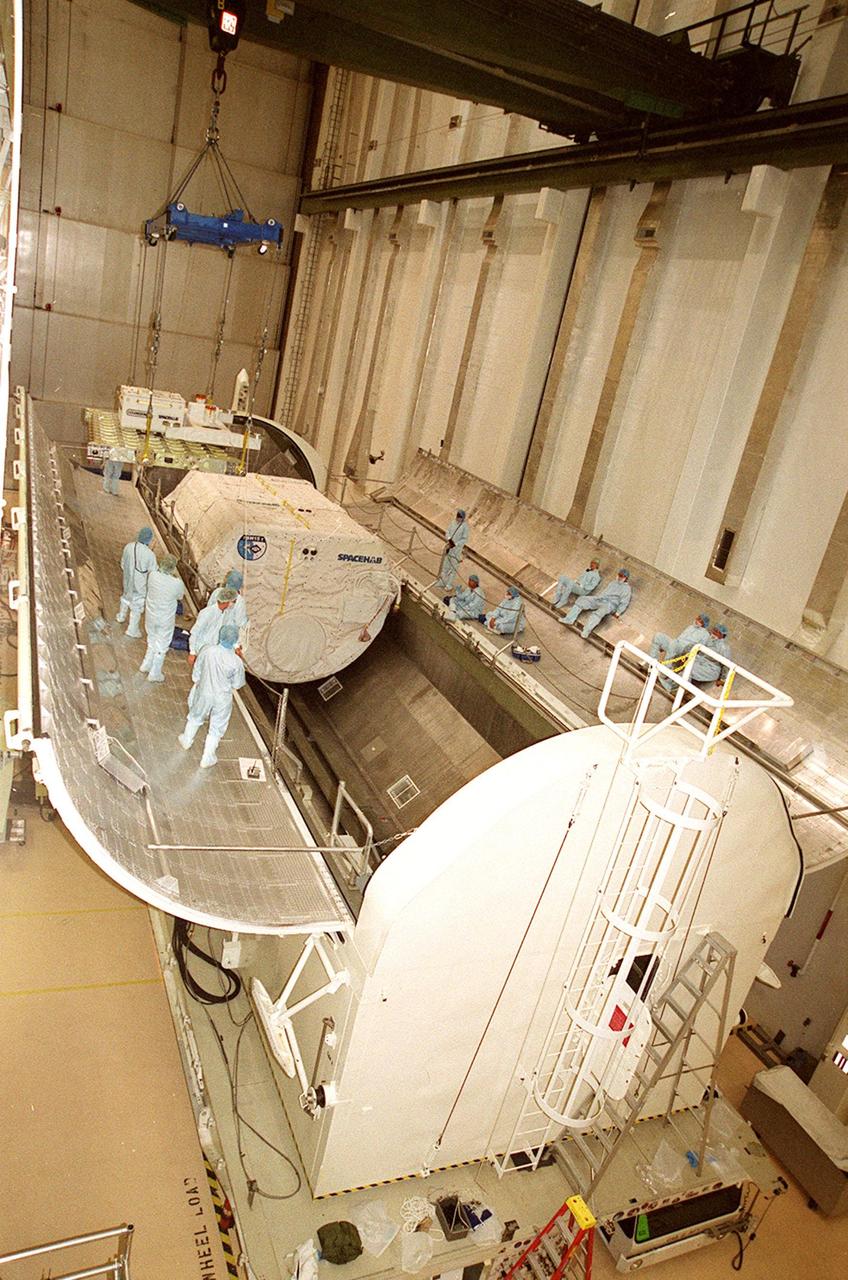
KENNEDY SPACE CENTER, FLA. -- In the Space Station Processing Facility, workers wait for the arrival of the Integrated Cargo Carrier (ICC), in the background, in order to load it into the payload canister. The canister already has the SPACEHAB module stowed. The canister will transport its cargo to Launch Pad 39B in preparation for mission STS-106, scheduled to launch Sept. 8 at 8:31 a.m. EDT. During the mission to the International Space Station, the crew will complete service module support tasks on orbit, transfer supplies and outfit the Space Station for the first long-duration crew
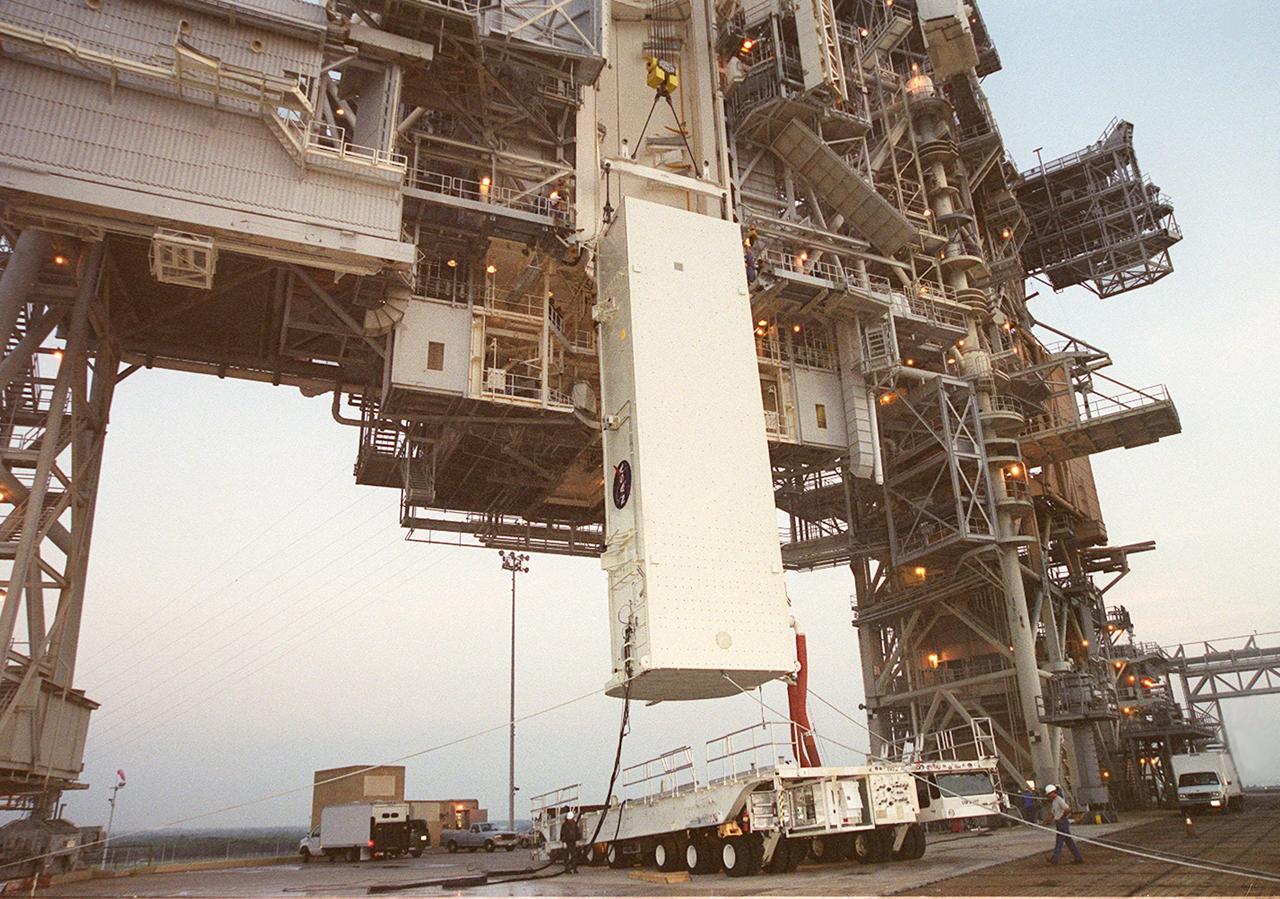
KENNEDY SPACE CENTER, Fla. -- The payload canister is hoisted up alongside the Rotating Service Structure (RSS) on Launch Pad 39B. The canister with its cargo of the SPACEHAB module and Integrated Cargo Carrier will be moved into the Payload Changeout Room near the top of the RSS for transfer to the payload bay of Shuttle Atlantis for mission STS-106. The PCR provides an environmentally controlled facility for the transfer. The 11-day mission to the International Space Station will include service module support tasks on orbit, transfer supplies and outfit the Space Station for the first long-duration crew. Atlantis is scheduled to launch Sept. 8 at 8:31 a.m. EDT.
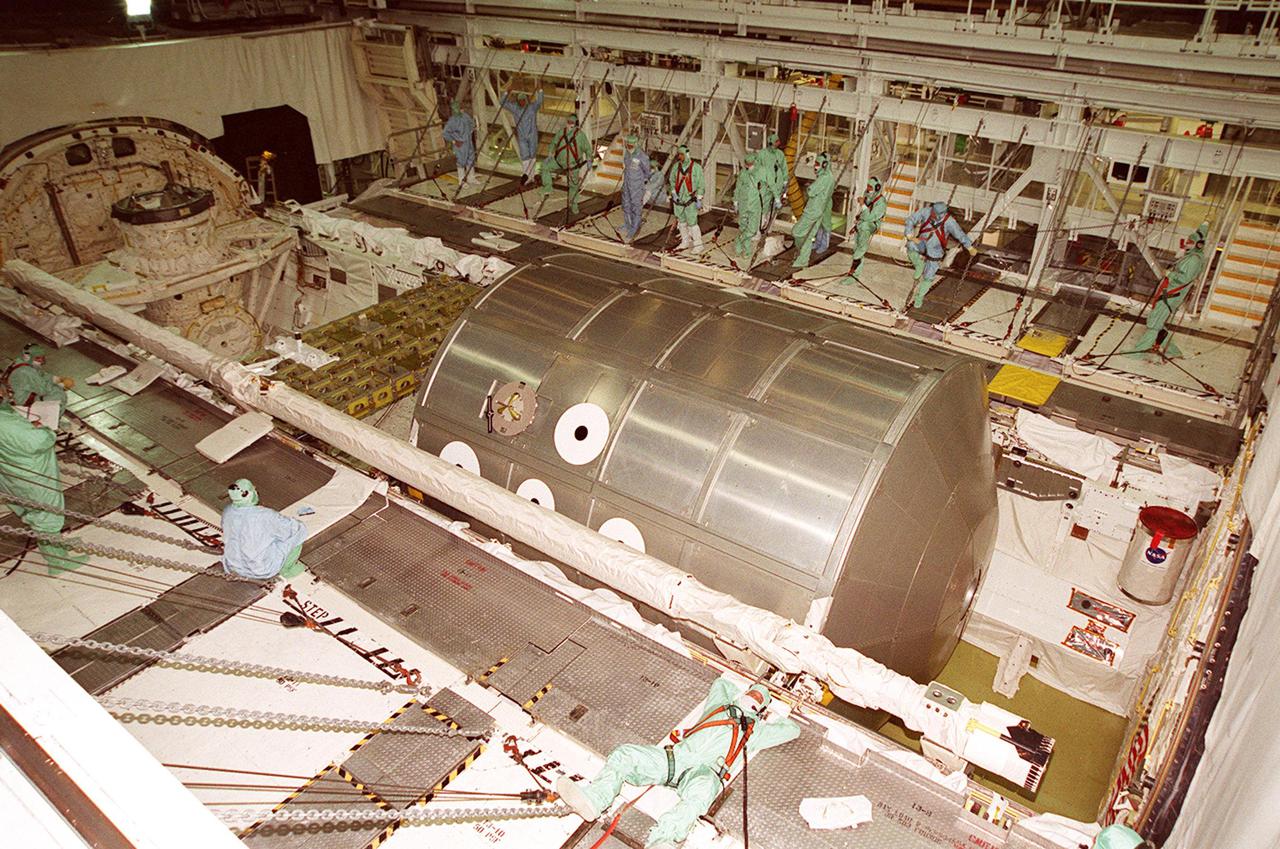
KENNEDY SPACE CENTER, FLA. -- In the Orbiter Processing Facility bay 2, Discovery’s payload bay doors are open to reveal the Multi-Purpose Logistics Module Leonardo, which has just returned from its first round trip to the International Space Station on mission STS-102. Behind it to the left is the integrated cargo carrier. Attached to the length of the payload bay, in front of Leonardo, is the robotic arm that was used to remove and position Leonardo on the ISS. Leonardo will be lifted from the payload bay and transferred to the SSPF to prepare it for future missions. The MPLM serves as a cargo van, carrying equipment and supplies to the Space Station
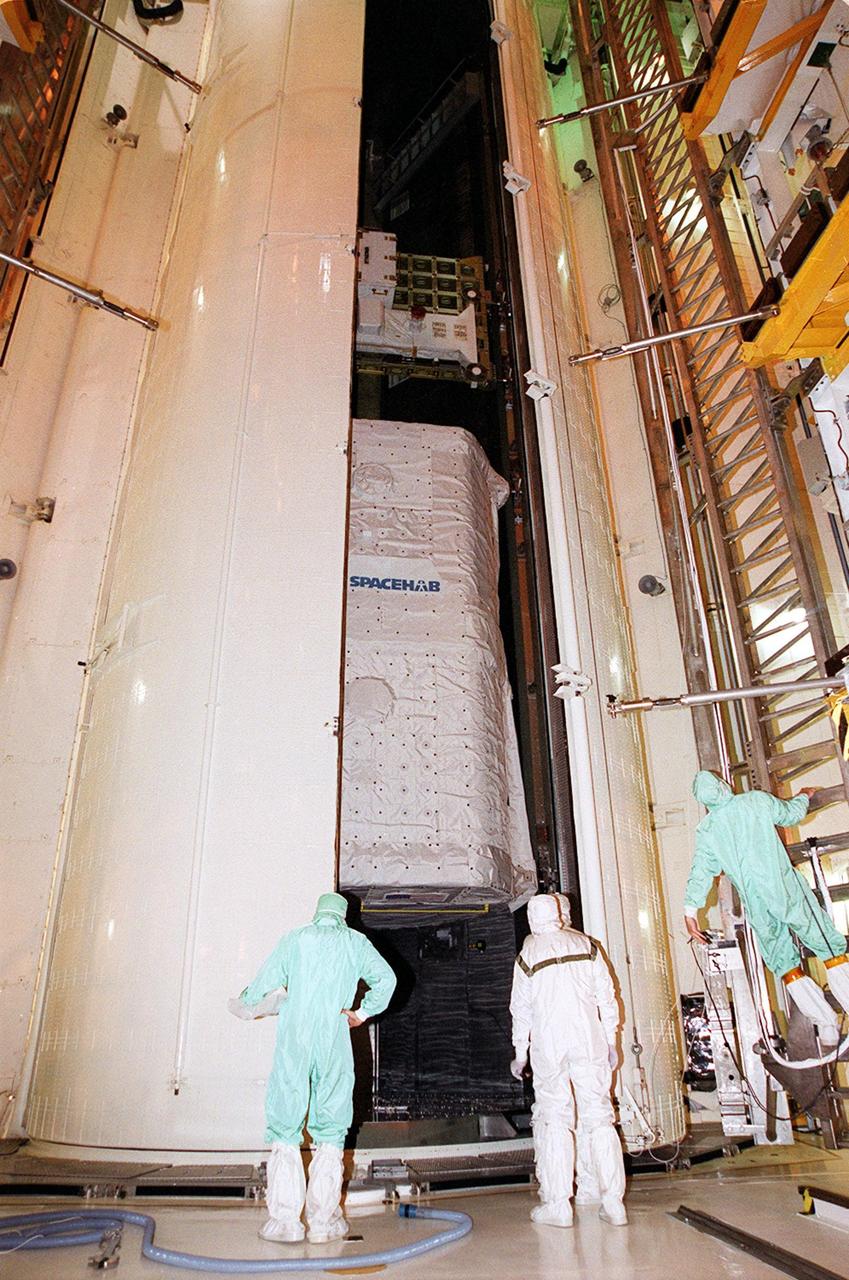
KENNEDY SPACE CENTER, FLA. -- In the Payload Changeout Room (part of the Rotating Service Structure at the launch pad), the doors of the payload canister open to reveal its cargo, the SPACEHAB module (bottom) and Integrated Cargo Carrier (top). The payload will be transferred from this environmentally controlled room into the payload bay of Shuttle Atlantis for mission STS-106. The 11-day mission to the International Space Station will include service module support tasks on orbit, transfer supplies and outfit the Space Station for the first long-duration crew. Atlantis is scheduled to launch Sept. 8 at 8:31 a.m. EDT
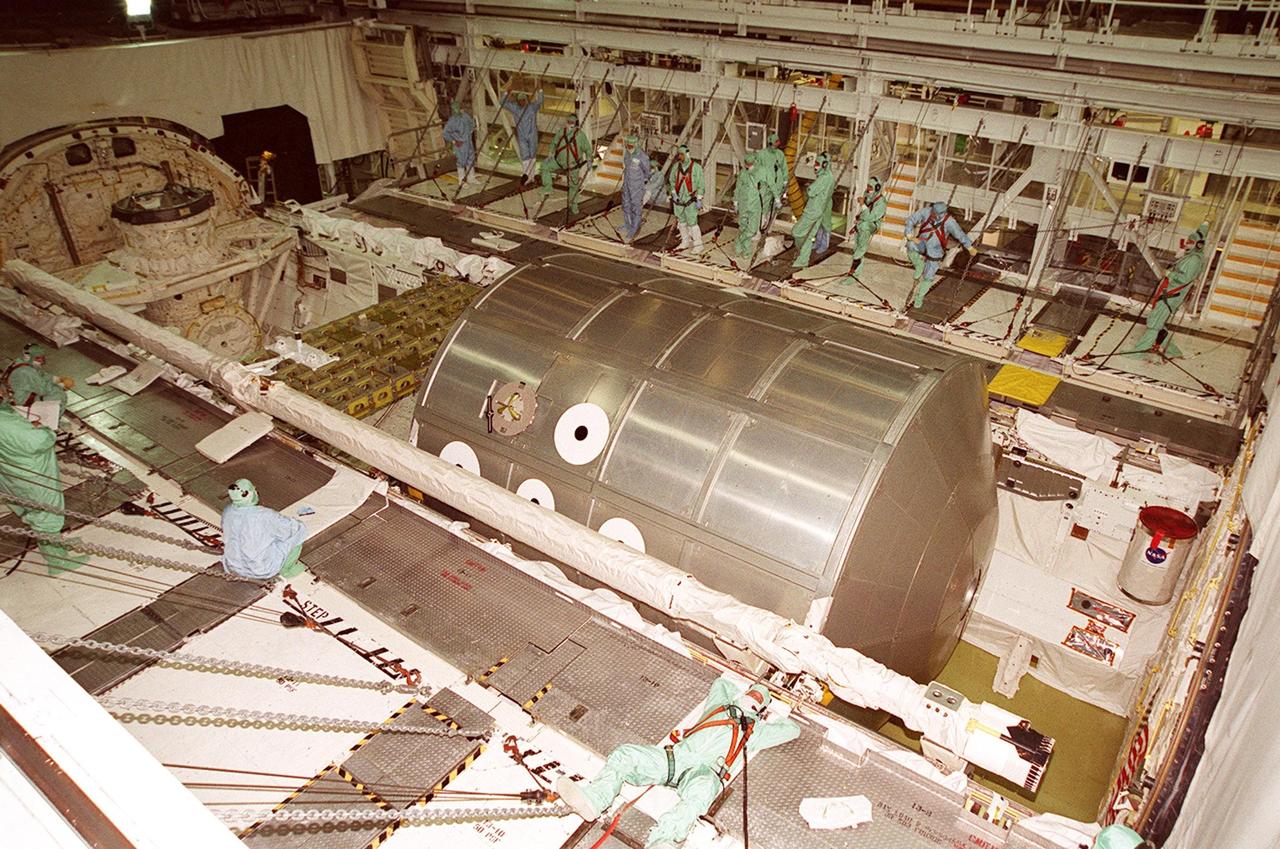
KENNEDY SPACE CENTER, FLA. -- In the Orbiter Processing Facility bay 2, Discovery’s payload bay doors are open to reveal the Multi-Purpose Logistics Module Leonardo, which has just returned from its first round trip to the International Space Station on mission STS-102. Behind it to the left is the integrated cargo carrier. Attached to the length of the payload bay, in front of Leonardo, is the robotic arm that was used to remove and position Leonardo on the ISS. Leonardo will be lifted from the payload bay and transferred to the SSPF to prepare it for future missions. The MPLM serves as a cargo van, carrying equipment and supplies to the Space Station
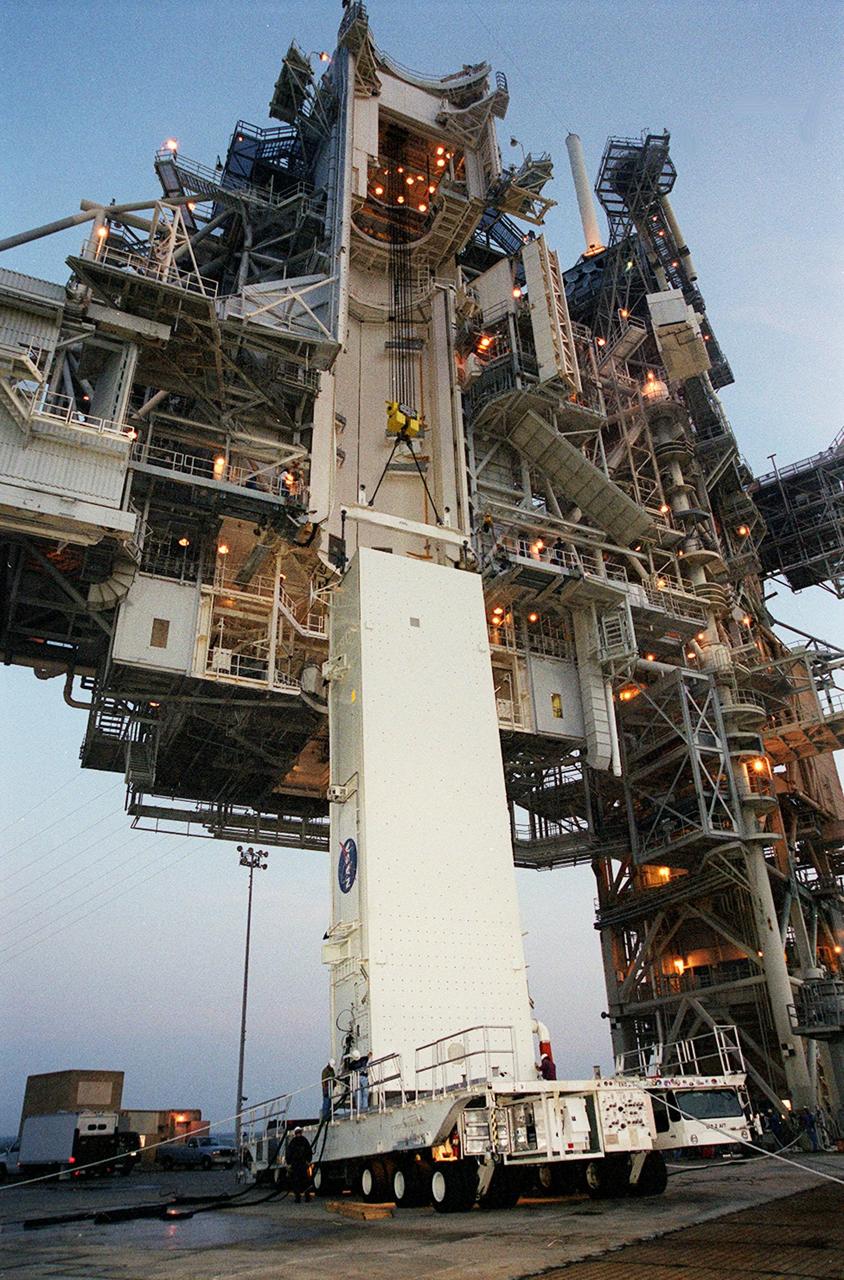
KENNEDY SPACE CENTER, Fla. -- The payload canister arrives at the Rotating Service Structure (RSS) on Launch Pad 39B. The canister with its cargo of the SPACEHAB module and Integrated Cargo Carrier will be lifted up into the Payload Changeout Room near the top of the RSS for transfer to the payload bay of Shuttle Atlantis for mission STS-106. The PCR provides an environmentally controlled facility for the transfer. The 11-day mission to the International Space Station will include service module support tasks on orbit, transfer supplies and outfit the Space Station for the first long-duration crew. Atlantis is scheduled to launch Sept. 8 at 8:31 a.m. EDT.
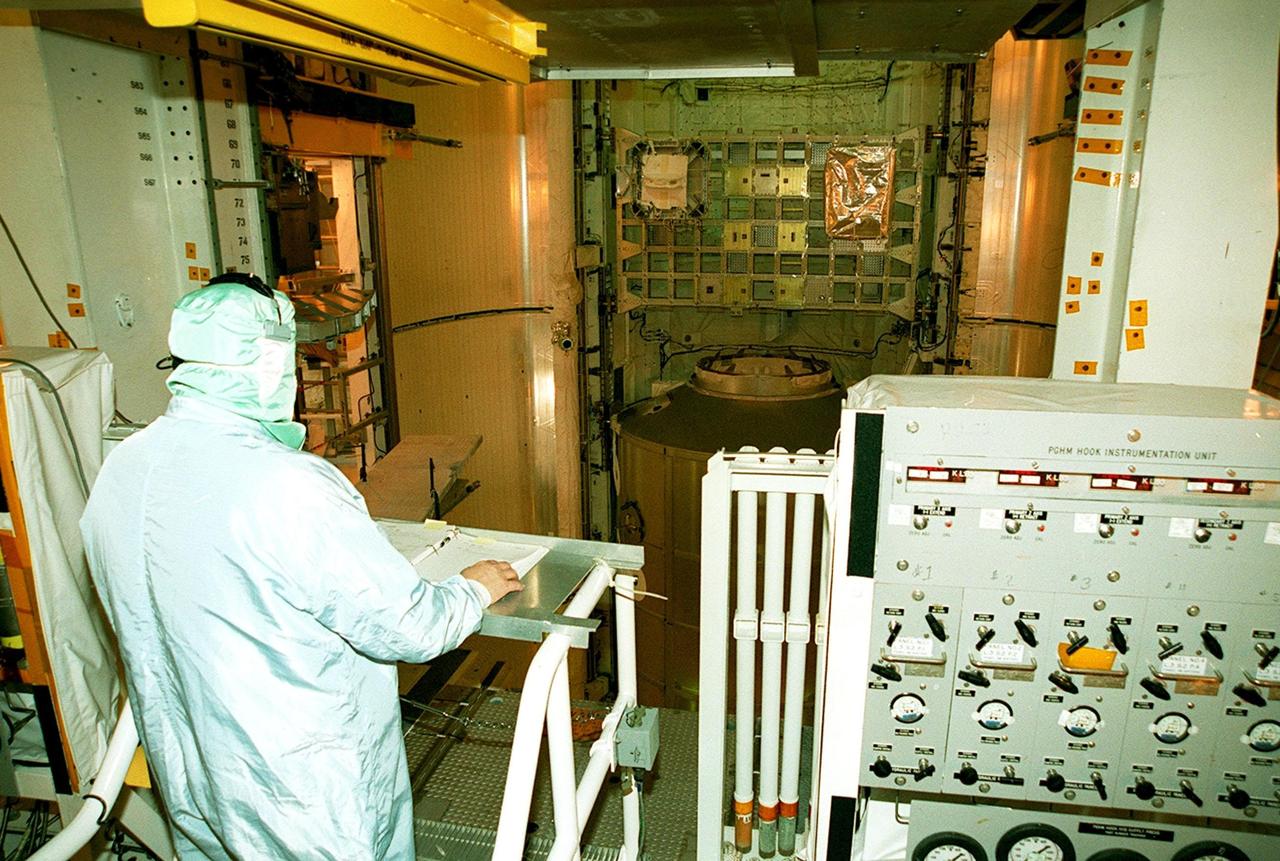
KENNEDY SPACE CENTER, FLA. -- From inside the Payload Changeout Room, Launch Pad 39B, a technician monitors the closing of the payload bay doors in Space Shuttle Discovery. Visible is the Integrated Cargo Carrier at top and the Multi-Purpose Logistics Module Leonardo below. Discovery is scheduled to launch March 8 at 6:42 a.m. EST on STS-102, the eighth construction flight to the International Space Station. The primary delivery system used to resupply and return Station cargo requiring a pressurized environment, Leonardo will deliver up to 10 tons of laboratory racks filled with equipment, experiments and supplies for outfitting the newly installed U.S. Laboratory Destiny

KENNEDY SPACE CENTER, FLA. -- The Multi-Purpose Logistics Module Leonardo rests in Space Shuttle Discovery’s payload bay after being transferred from the Payload Changeout Room, Launch Pad 39B. Behind it is the Integrated Cargo Carrier, holding several smaller payloads. Discovery is scheduled to launch March 8 at 6:42 a.m. EST on mission STS-102, the eighth construction flight to the International Space Station. The primary delivery system used to resupply and return Station cargo requiring a pressurized environment, Leonardo will deliver up to 10 tons of laboratory racks filled with equipment, experiments and supplies for outfitting the newly installed U.S. Laboratory Destiny
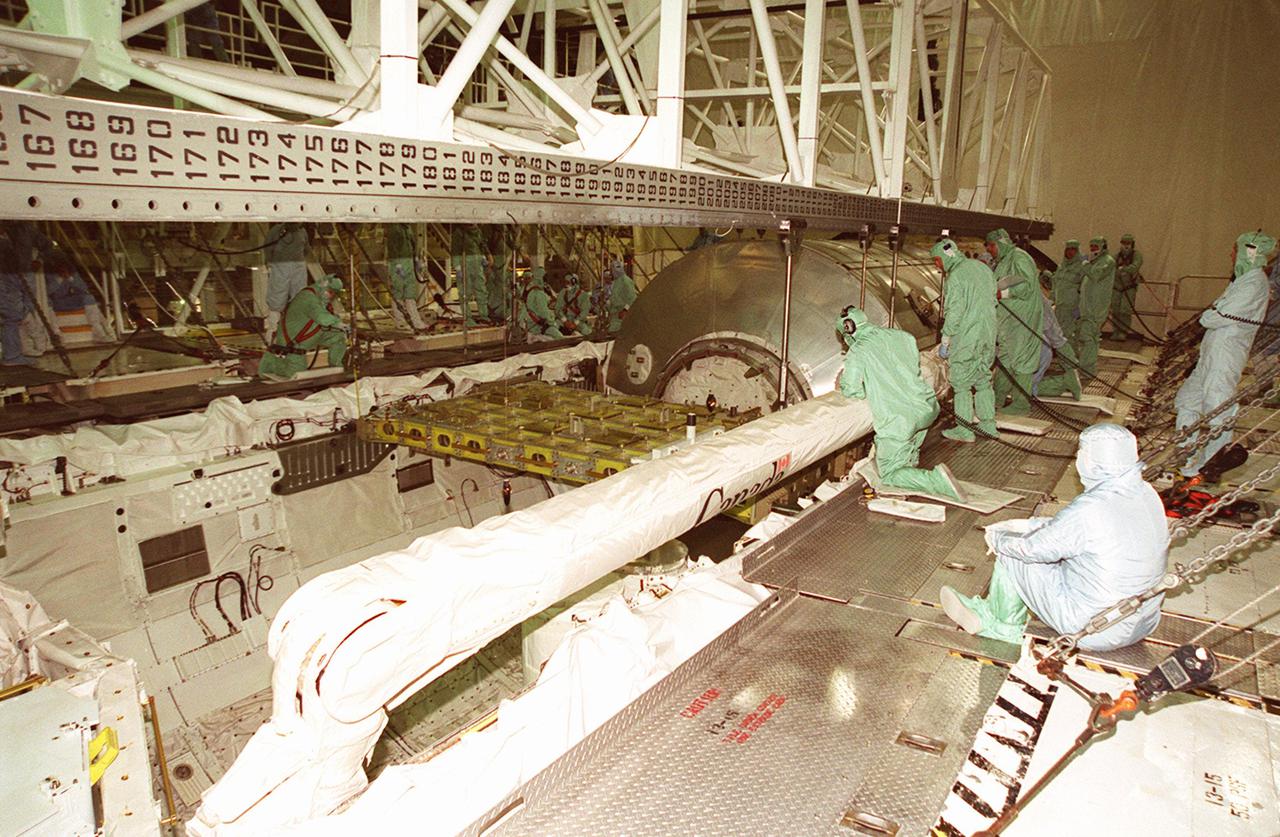
KENNEDY SPACE CENTER, FLA. -- In the Orbiter Processing Facility bay 2, workers attach an overhead crane to the Multi-Purpose Logistics Module Leonardo and the integrated cargo carrier behind it sitting in Discovery’s payload bay. The MPLM has just returned from its first round trip to the International Space Station on mission STS-102. Attached to the length of the payload bay, in front of Leonardo, is the robotic arm that was used to remove and position Leonardo on the ISS. Leonardo will be lifted from the payload bay and transferred to the SSPF to prepare it for future missions. The MPLM serves as a cargo van, carrying equipment and supplies to the Space Station
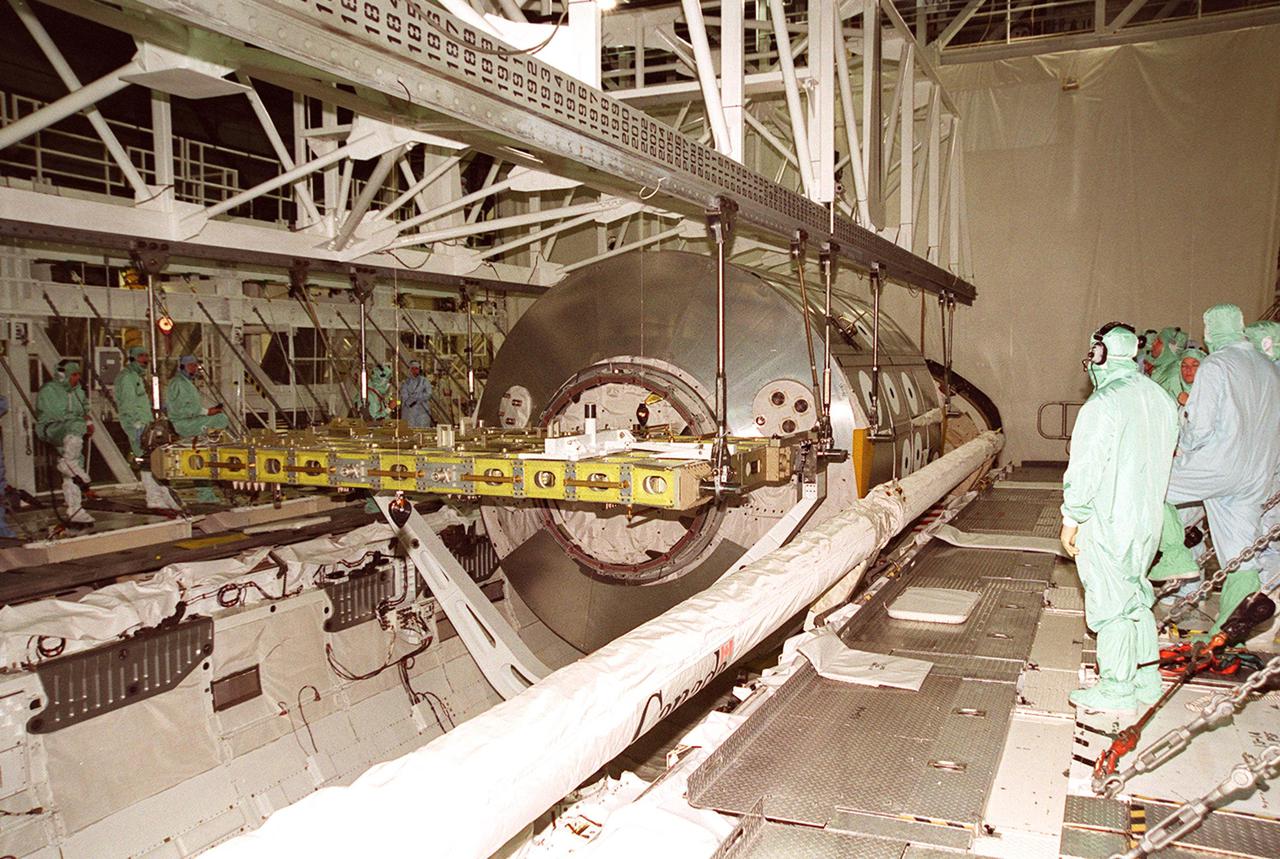
KENNEDY SPACE CENTER, FLA. -- In the Orbiter Processing Facility bay 2, an overhead crane begins lifting the Multi-Purpose Logistics Module Leonardo and the integrated cargo carrier next to it out of Discovery’s payload bay. The MPLM has just returned from its first round trip to the International Space Station on mission STS-102. Attached to the length of the payload bay, next to Leonardo, is the robotic arm that was used to remove and position Leonardo on the ISS. Leonardo will be transferred to the SSPF to prepare it for future missions. The MPLM serves as a cargo van, carrying equipment and supplies to the Space Station
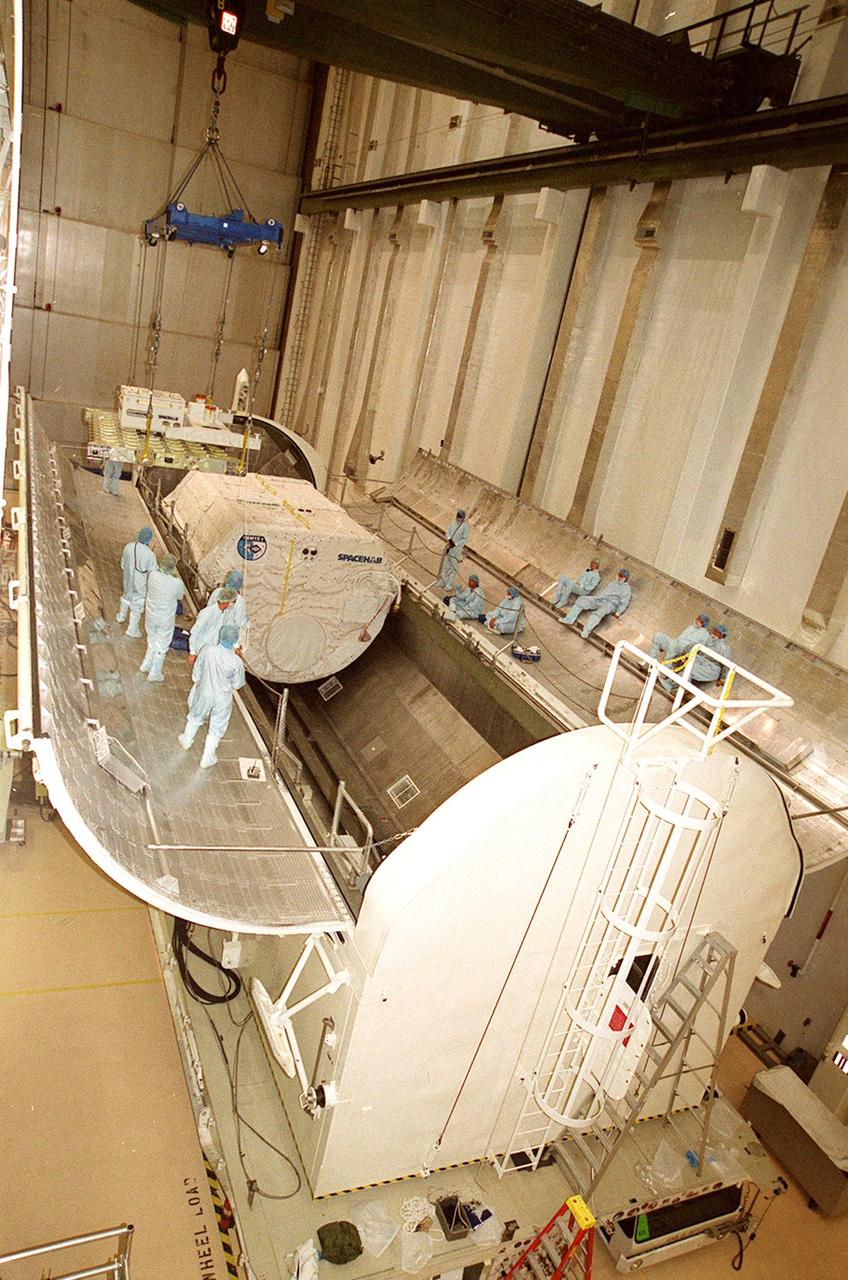
KENNEDY SPACE CENTER, FLA. -- In the Space Station Processing Facility, workers wait for the arrival of the Integrated Cargo Carrier (ICC), in the background, in order to load it into the payload canister. The canister already has the SPACEHAB module stowed. The canister will transport its cargo to Launch Pad 39B in preparation for mission STS-106, scheduled to launch Sept. 8 at 8:31 a.m. EDT. During the mission to the International Space Station, the crew will complete service module support tasks on orbit, transfer supplies and outfit the Space Station for the first long-duration crew
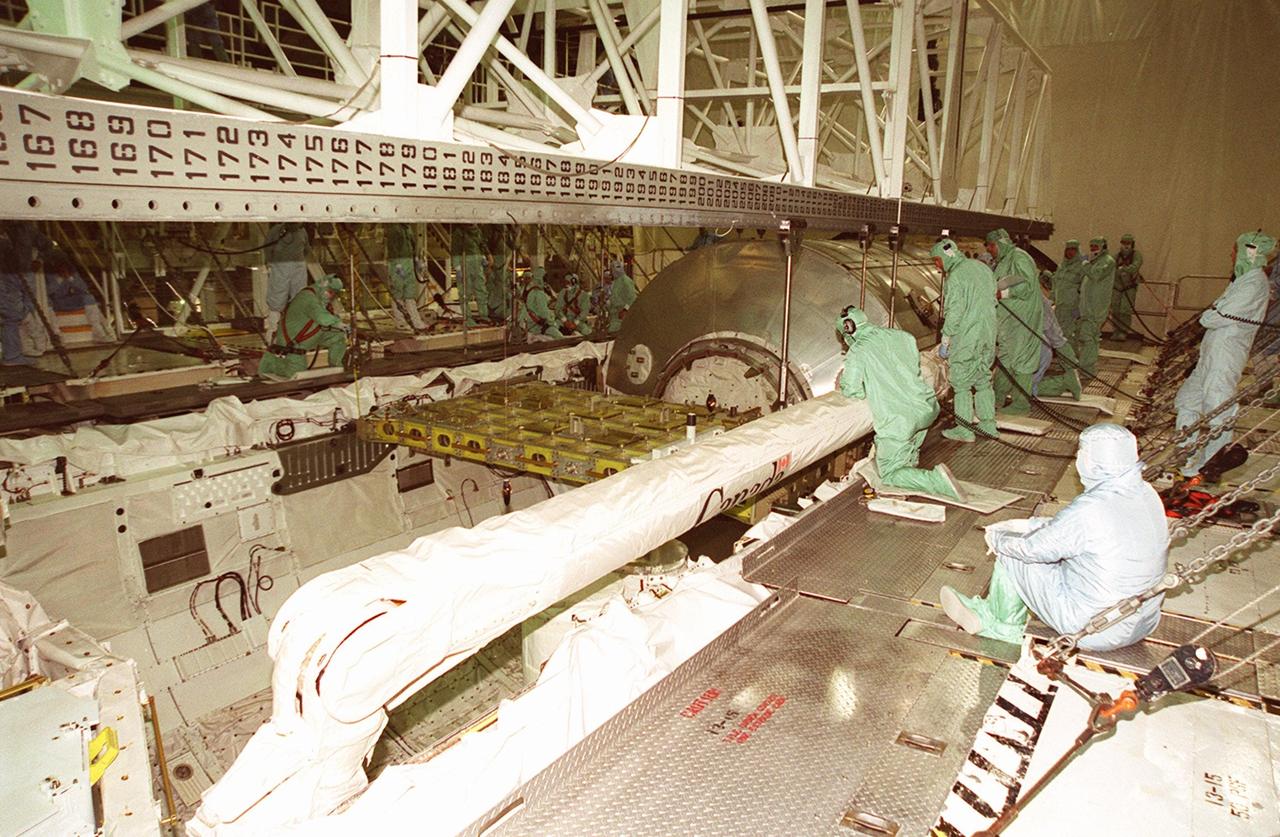
KENNEDY SPACE CENTER, FLA. -- In the Orbiter Processing Facility bay 2, workers attach an overhead crane to the Multi-Purpose Logistics Module Leonardo and the integrated cargo carrier behind it sitting in Discovery’s payload bay. The MPLM has just returned from its first round trip to the International Space Station on mission STS-102. Attached to the length of the payload bay, in front of Leonardo, is the robotic arm that was used to remove and position Leonardo on the ISS. Leonardo will be lifted from the payload bay and transferred to the SSPF to prepare it for future missions. The MPLM serves as a cargo van, carrying equipment and supplies to the Space Station
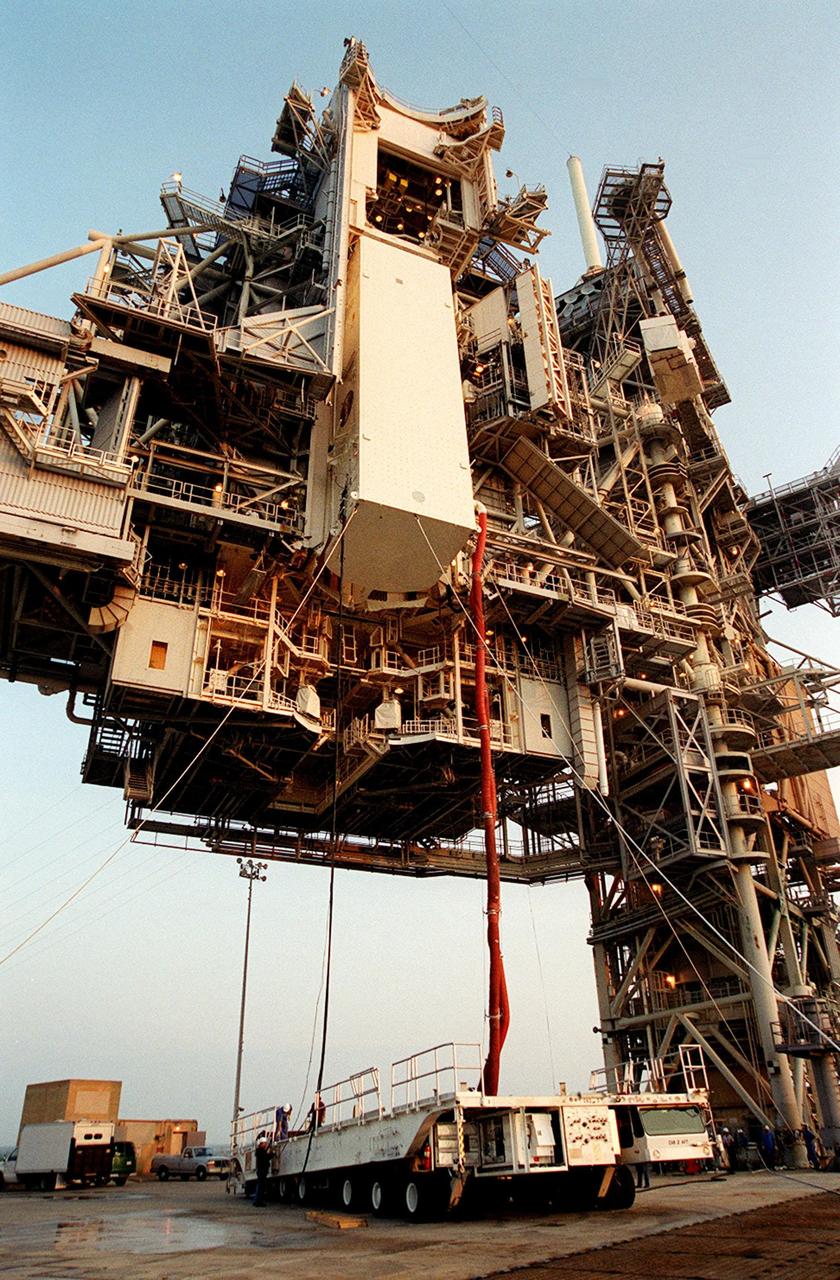
KENNEDY SPACE CENTER, FLA. -- With umbilical lines still attached, the payload canister is hoisted up alongside the Rotating Service Structure (RSS) on Launch Pad 39B. The canister with its cargo of the SPACEHAB module and Integrated Cargo Carrier will be moved into the Payload Changeout Room (PCR) near the top of the RSS for transfer to the payload bay of Shuttle Atlantis for mission STS-106. The PCR provides an environmentally controlled facility for the transfer. The 11-day mission to the International Space Station will include service module support tasks on orbit, transfer supplies and outfit the Space Station for the first long-duration crew. Atlantis is scheduled to launch Sept. 8 at 8:31 a.m. EDT
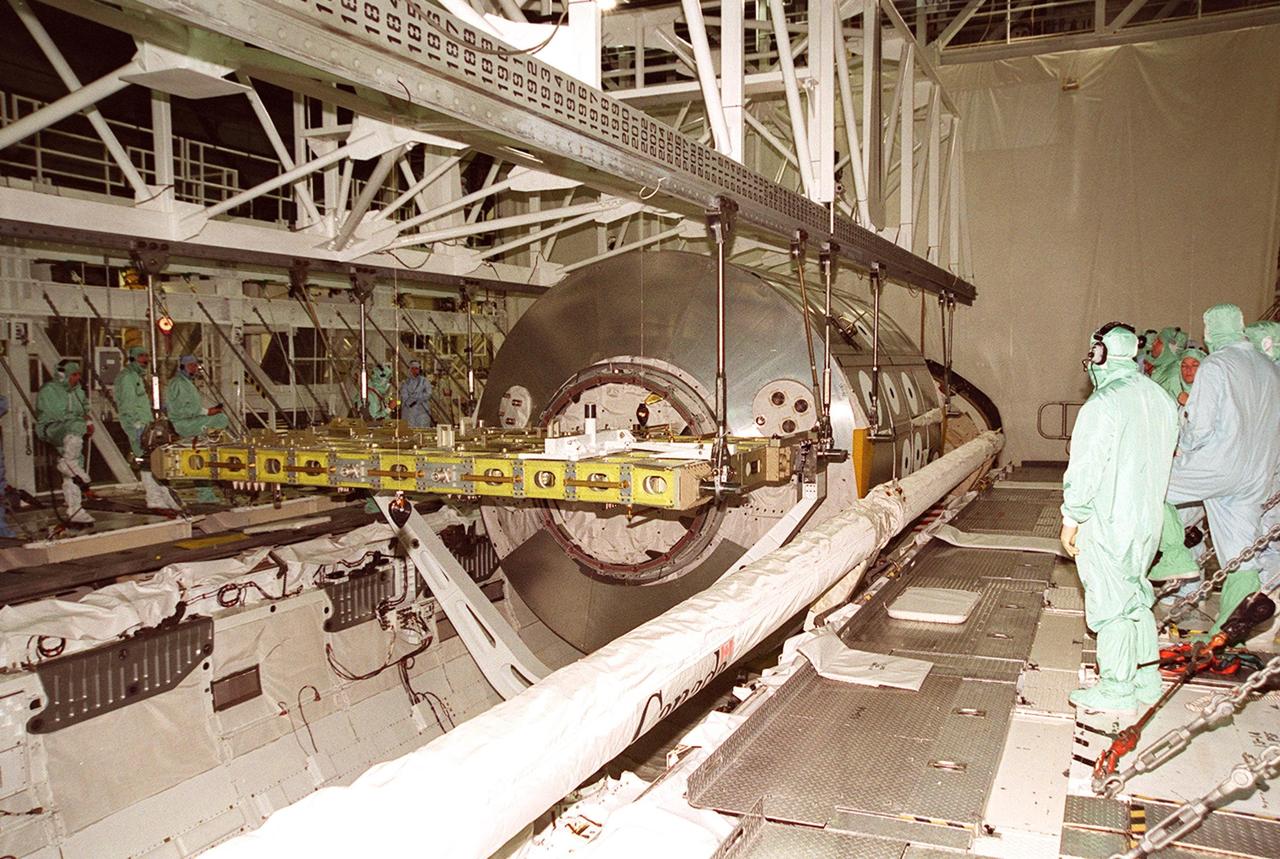
KENNEDY SPACE CENTER, FLA. -- In the Orbiter Processing Facility bay 2, an overhead crane begins lifting the Multi-Purpose Logistics Module Leonardo and the integrated cargo carrier next to it out of Discovery’s payload bay. The MPLM has just returned from its first round trip to the International Space Station on mission STS-102. Attached to the length of the payload bay, next to Leonardo, is the robotic arm that was used to remove and position Leonardo on the ISS. Leonardo will be transferred to the SSPF to prepare it for future missions. The MPLM serves as a cargo van, carrying equipment and supplies to the Space Station
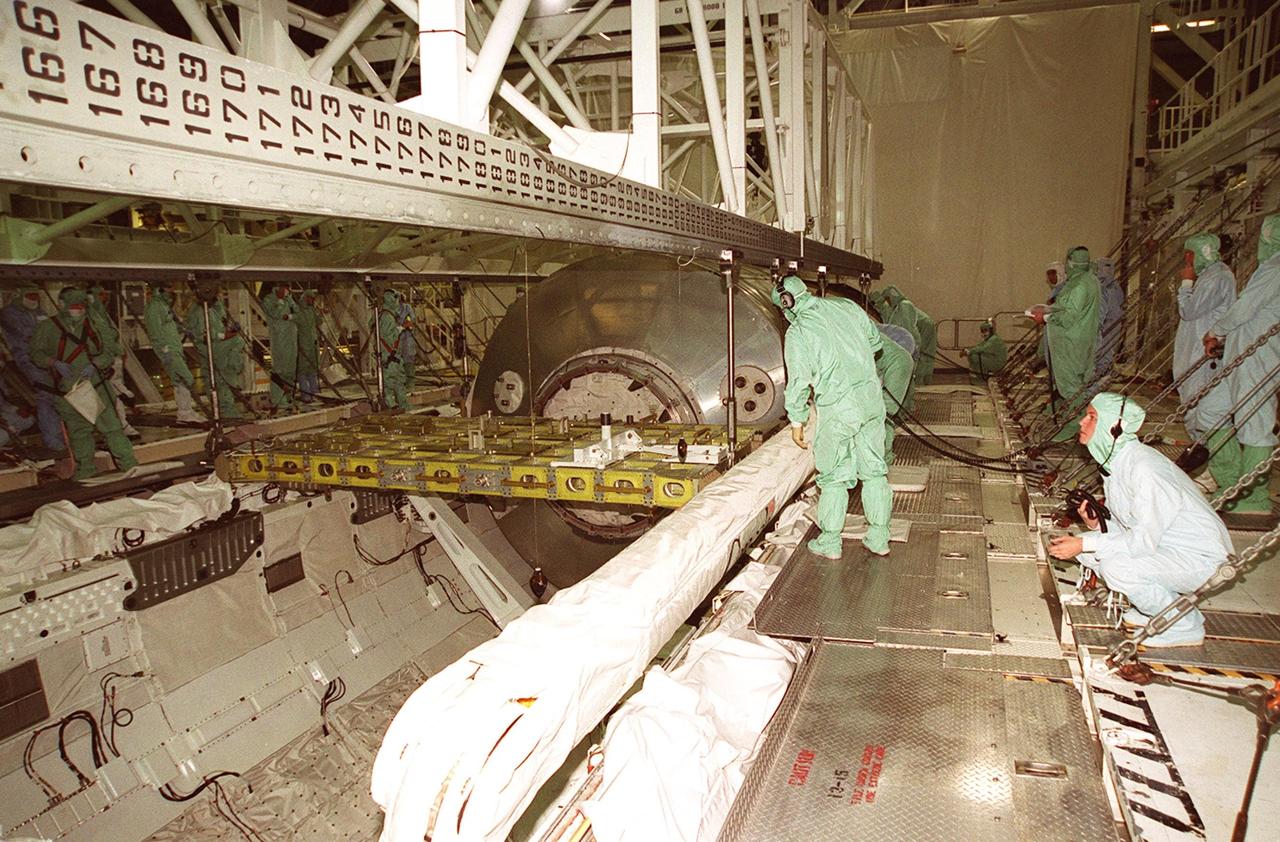
KENNEDY SPACE CENTER, FLA. -- Workers in the Orbiter Processing Facility bay 2 check the attachments on the overhead crane to the Multi-Purpose Logistics Module Leonardo and the integrated cargo carrier behind it sitting in Discovery’s payload bay. The MPLM has just returned from its first round trip to the International Space Station on mission STS-102. Attached to the length of the payload bay, in front of Leonardo, is the robotic arm that was used to remove and position Leonardo on the ISS. Leonardo will be lifted from the payload bay and transferred to the SSPF to prepare it for future missions. The MPLM serves as a cargo van, carrying equipment and supplies to the Space Station
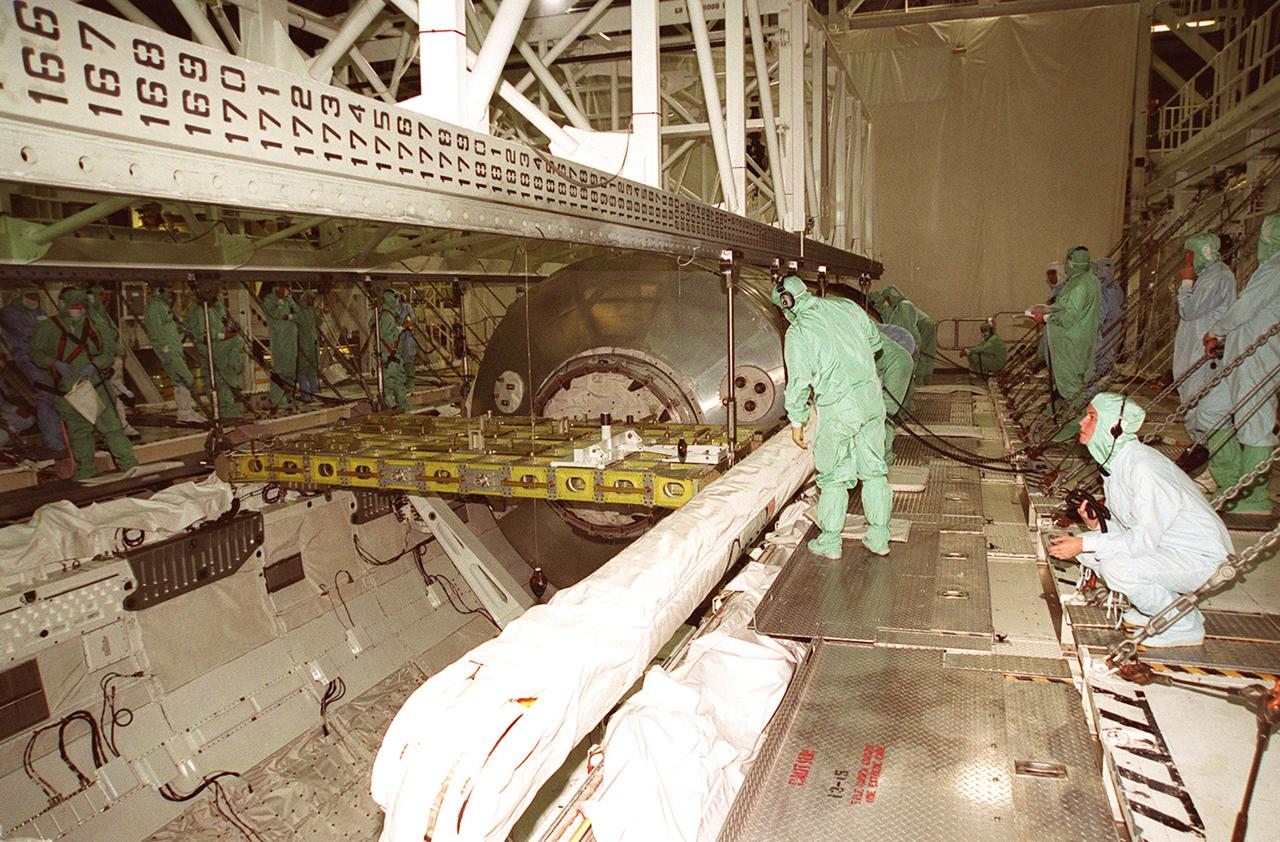
KENNEDY SPACE CENTER, FLA. -- Workers in the Orbiter Processing Facility bay 2 check the attachments on the overhead crane to the Multi-Purpose Logistics Module Leonardo and the integrated cargo carrier behind it sitting in Discovery’s payload bay. The MPLM has just returned from its first round trip to the International Space Station on mission STS-102. Attached to the length of the payload bay, in front of Leonardo, is the robotic arm that was used to remove and position Leonardo on the ISS. Leonardo will be lifted from the payload bay and transferred to the SSPF to prepare it for future missions. The MPLM serves as a cargo van, carrying equipment and supplies to the Space Station
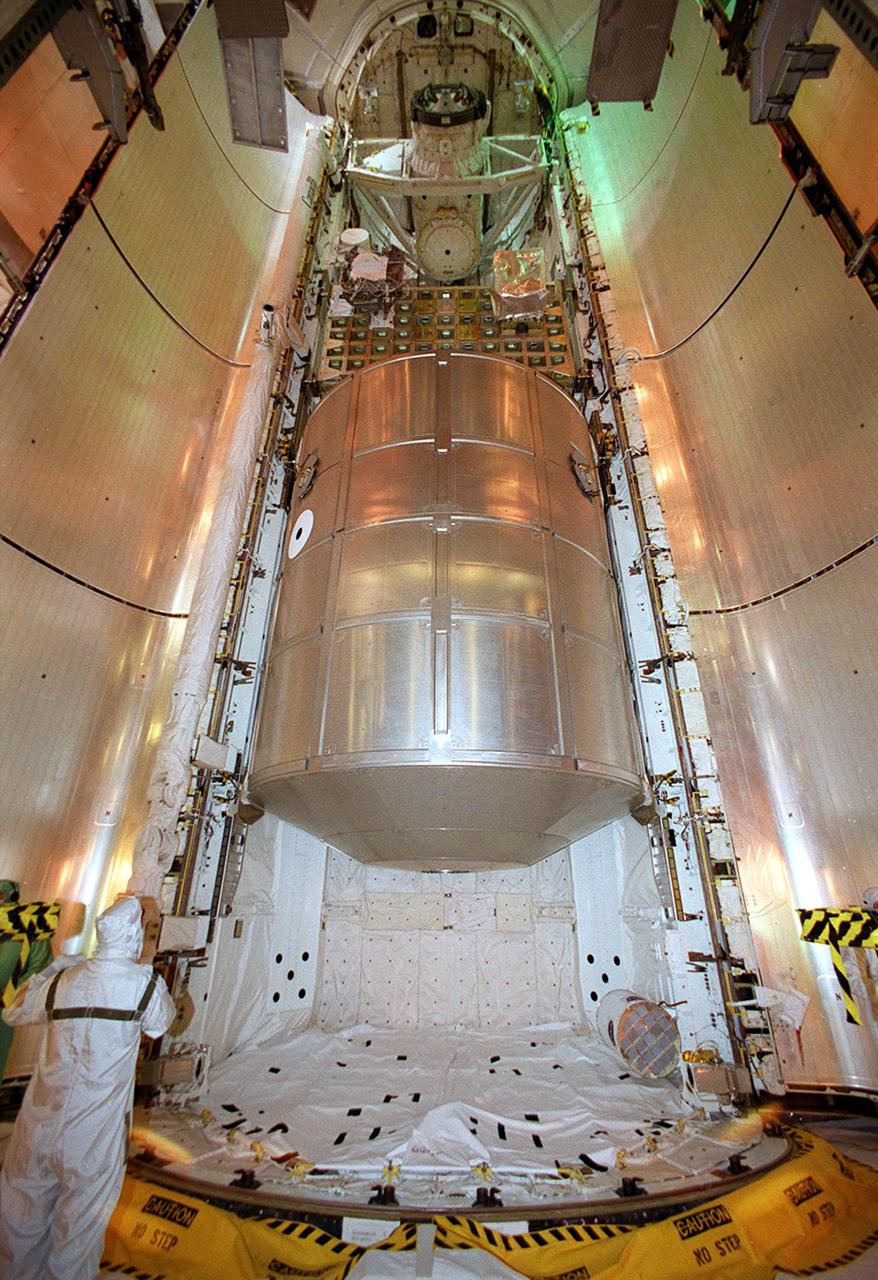
KENNEDY SPACE CENTER, FLA. -- The Multi-Purpose Logistics Module Leonardo rests in Space Shuttle Discovery’s payload bay after being transferred from the Payload Changeout Room, Launch Pad 39B. Behind it is the Integrated Cargo Carrier, holding several smaller payloads. Discovery is scheduled to launch March 8 at 6:42 a.m. EST on mission STS-102, the eighth construction flight to the International Space Station. The primary delivery system used to resupply and return Station cargo requiring a pressurized environment, Leonardo will deliver up to 10 tons of laboratory racks filled with equipment, experiments and supplies for outfitting the newly installed U.S. Laboratory Destiny
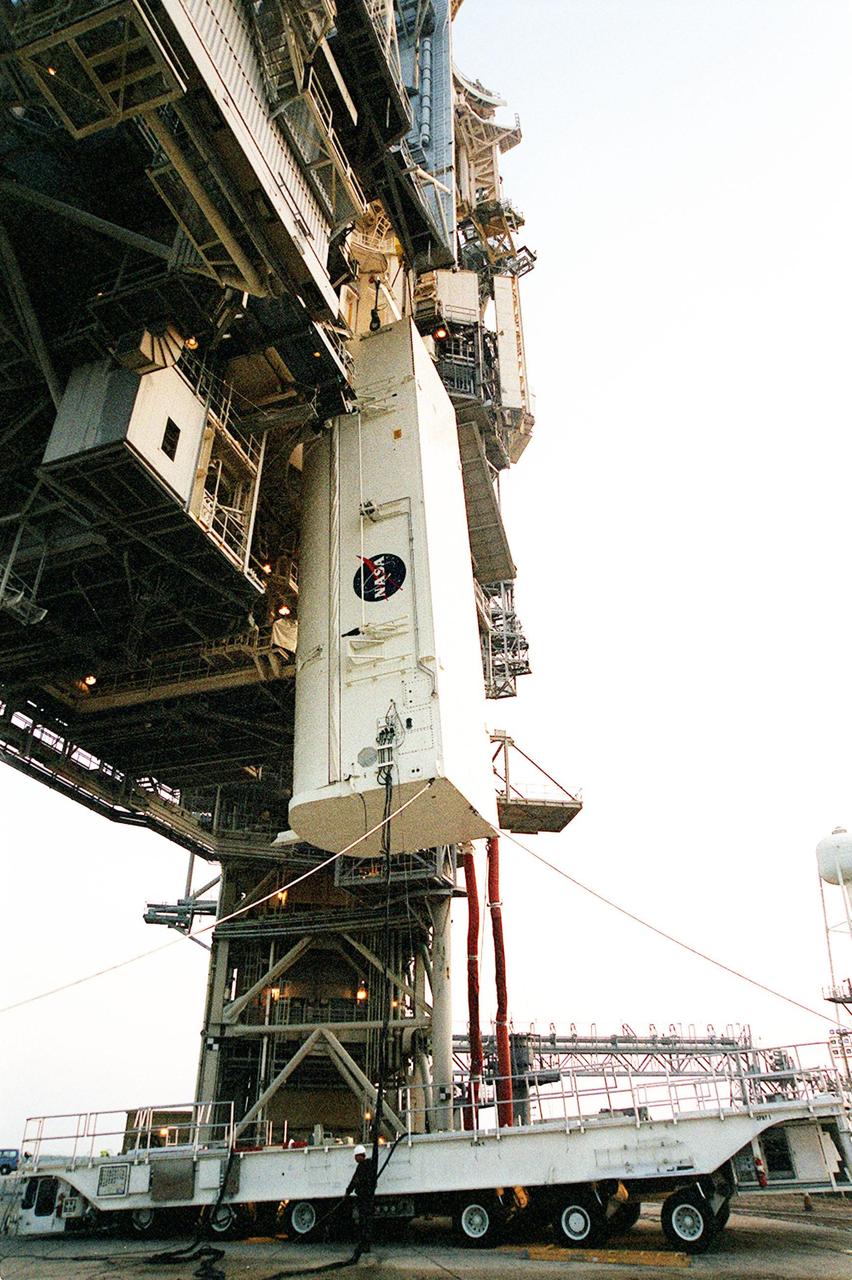
With umbilical lines still attached, the payload canister is hoisted up alongside the Rotating Service Structure (RSS) on Launch Pad 39B. The canister with its cargo of the SPACEHAB module and Integrated Cargo Carrier will be moved into the Payload Changeout Room (PCR) near the top of the RSS for transfer to the payload bay of Shuttle Atlantis for mission STS-106. The PCR provides an environmentally controlled facility for the transfer. The 11-day mission to the International Space Station will include service module support tasks on orbit, transfer supplies and outfit the Space Station for the first long-duration crew. Atlantis is scheduled to launch Sept. 8 at 8:31 a.m. EDT.
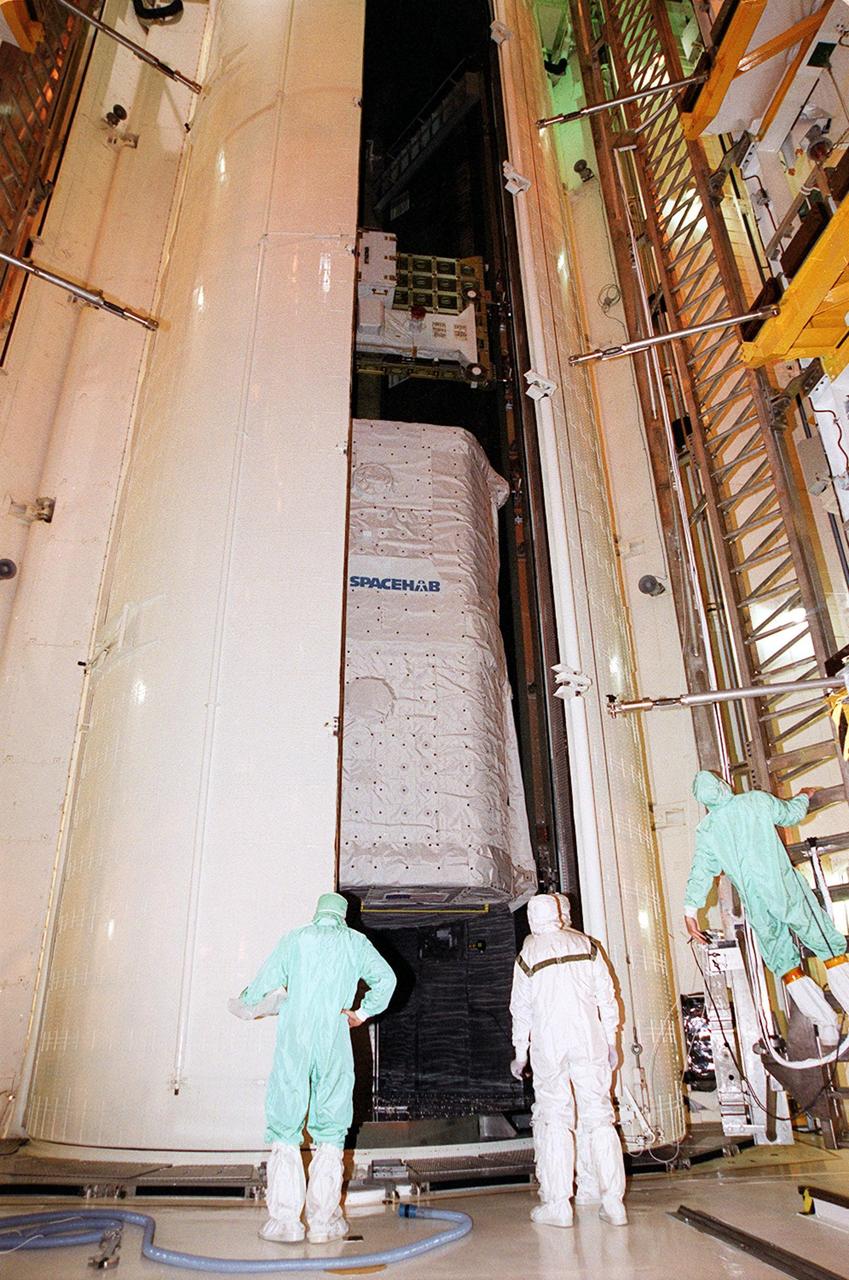
KENNEDY SPACE CENTER, FLA. -- In the Payload Changeout Room (part of the Rotating Service Structure at the launch pad), the doors of the payload canister open to reveal its cargo, the SPACEHAB module (bottom) and Integrated Cargo Carrier (top). The payload will be transferred from this environmentally controlled room into the payload bay of Shuttle Atlantis for mission STS-106. The 11-day mission to the International Space Station will include service module support tasks on orbit, transfer supplies and outfit the Space Station for the first long-duration crew. Atlantis is scheduled to launch Sept. 8 at 8:31 a.m. EDT
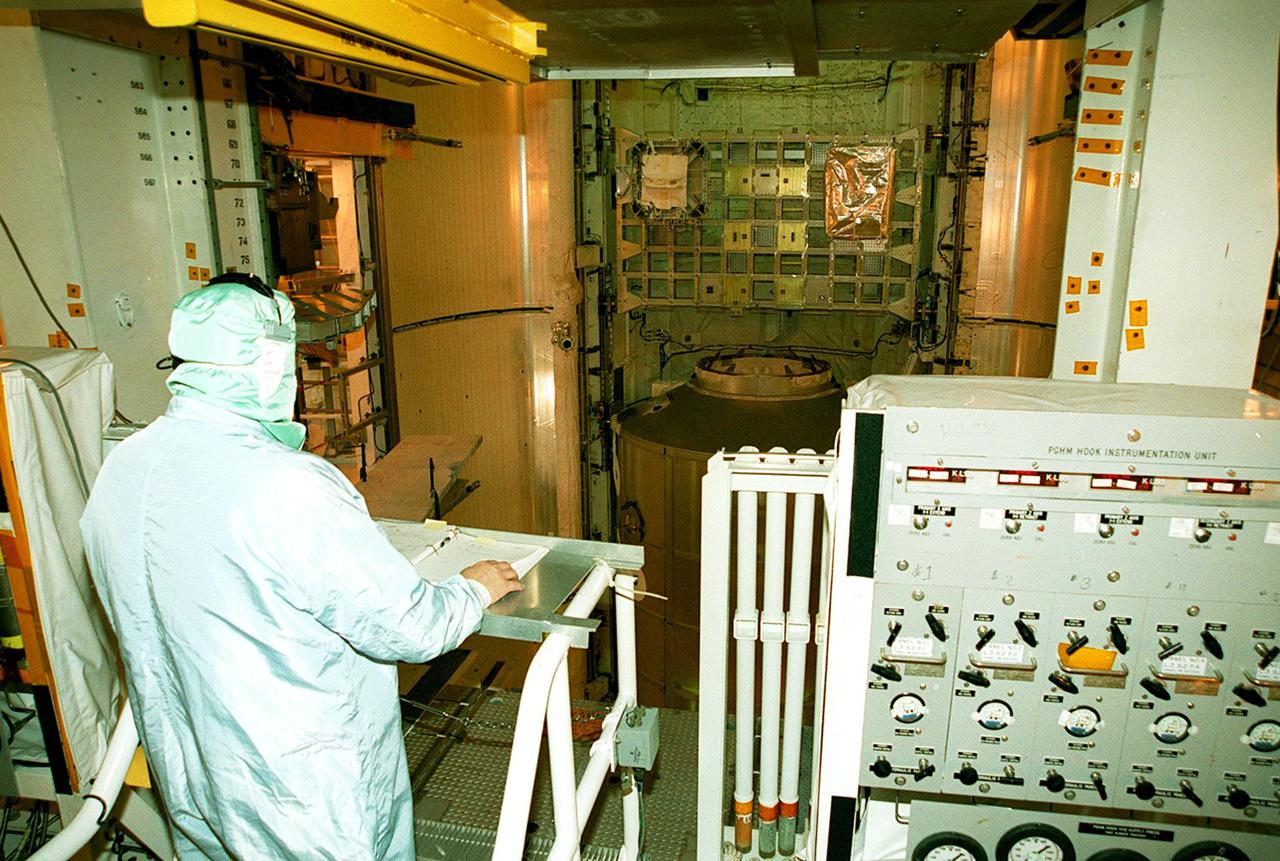
KENNEDY SPACE CENTER, FLA. -- From inside the Payload Changeout Room, Launch Pad 39B, a technician monitors the closing of the payload bay doors in Space Shuttle Discovery. Visible is the Integrated Cargo Carrier at top and the Multi-Purpose Logistics Module Leonardo below. Discovery is scheduled to launch March 8 at 6:42 a.m. EST on STS-102, the eighth construction flight to the International Space Station. The primary delivery system used to resupply and return Station cargo requiring a pressurized environment, Leonardo will deliver up to 10 tons of laboratory racks filled with equipment, experiments and supplies for outfitting the newly installed U.S. Laboratory Destiny
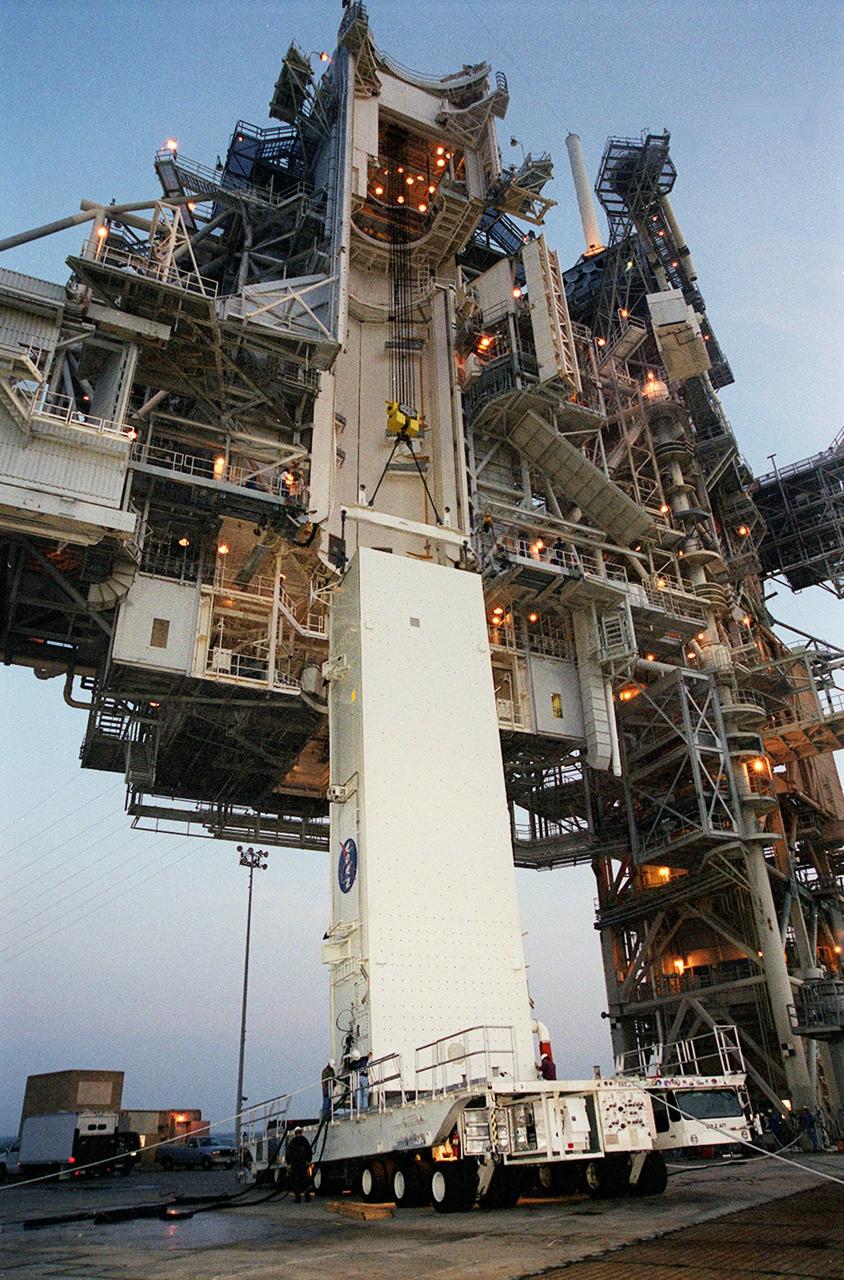
KENNEDY SPACE CENTER, Fla. -- The payload canister arrives at the Rotating Service Structure (RSS) on Launch Pad 39B. The canister with its cargo of the SPACEHAB module and Integrated Cargo Carrier will be lifted up into the Payload Changeout Room near the top of the RSS for transfer to the payload bay of Shuttle Atlantis for mission STS-106. The PCR provides an environmentally controlled facility for the transfer. The 11-day mission to the International Space Station will include service module support tasks on orbit, transfer supplies and outfit the Space Station for the first long-duration crew. Atlantis is scheduled to launch Sept. 8 at 8:31 a.m. EDT.
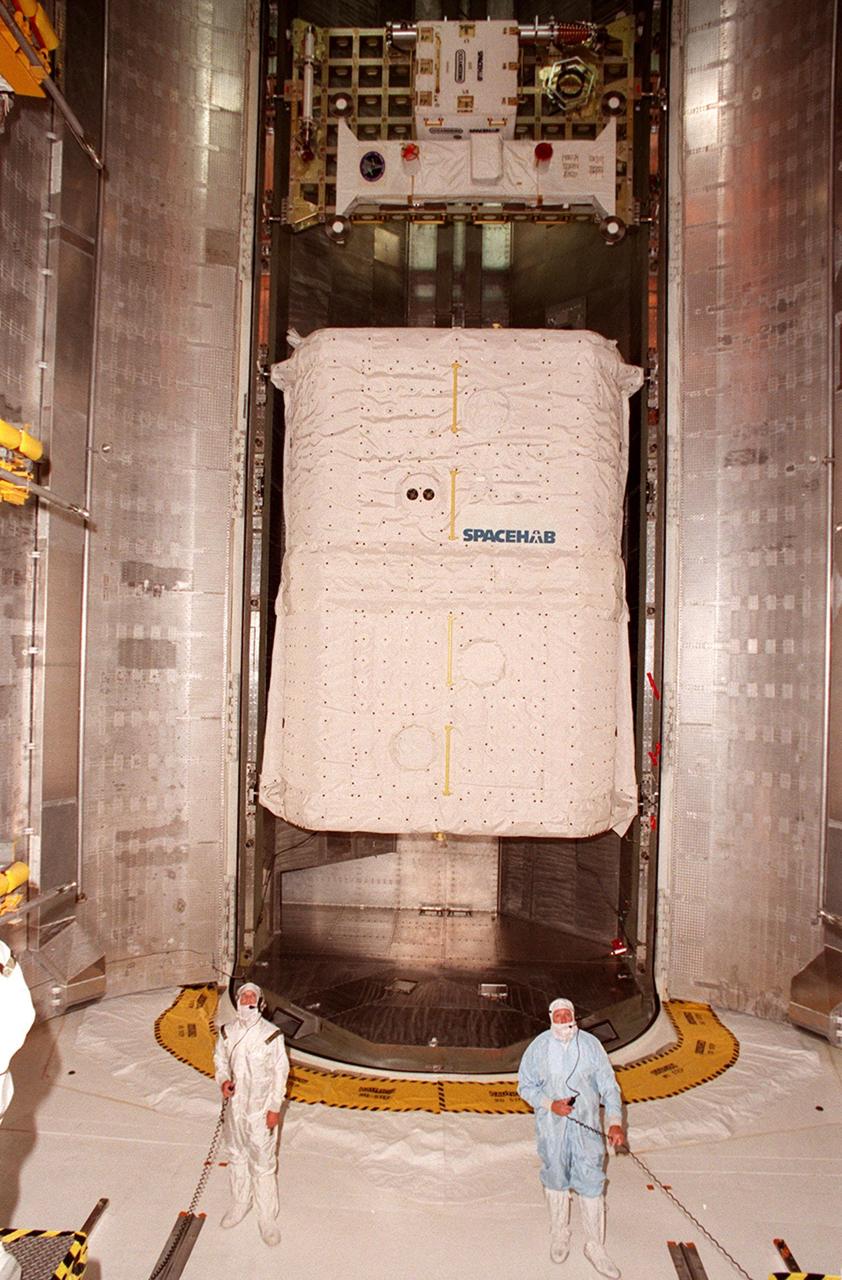
KENNEDY SPACE CENTER, FLA. -- The SPACEHAB Double Module (bottom) and Integrated Cargo Carrier (above) are ready to be moved from the payload canister into the Payload Changeout Room (PCR) at Launch Pad 39A. Part of the Rotating Service Structure, the PCR is an environmentally controlled facility supporting cargo delivery to the pad and vertical installation in the orbiter cargo bay. The primary payloads on mission STS-101, the module and ICC contain internal logistics and resupply cargo for restoring full redundancy to the International Space Station power system in preparation for the arrival of the next pressurized module, the Russian-built Zvezda. The payloads will be transferred to Space Shuttle Atlantis after Atlantis rolls out to the pad. Launch of Atlantis on mission STS-101 is scheduled no earlier than April 17, 2000
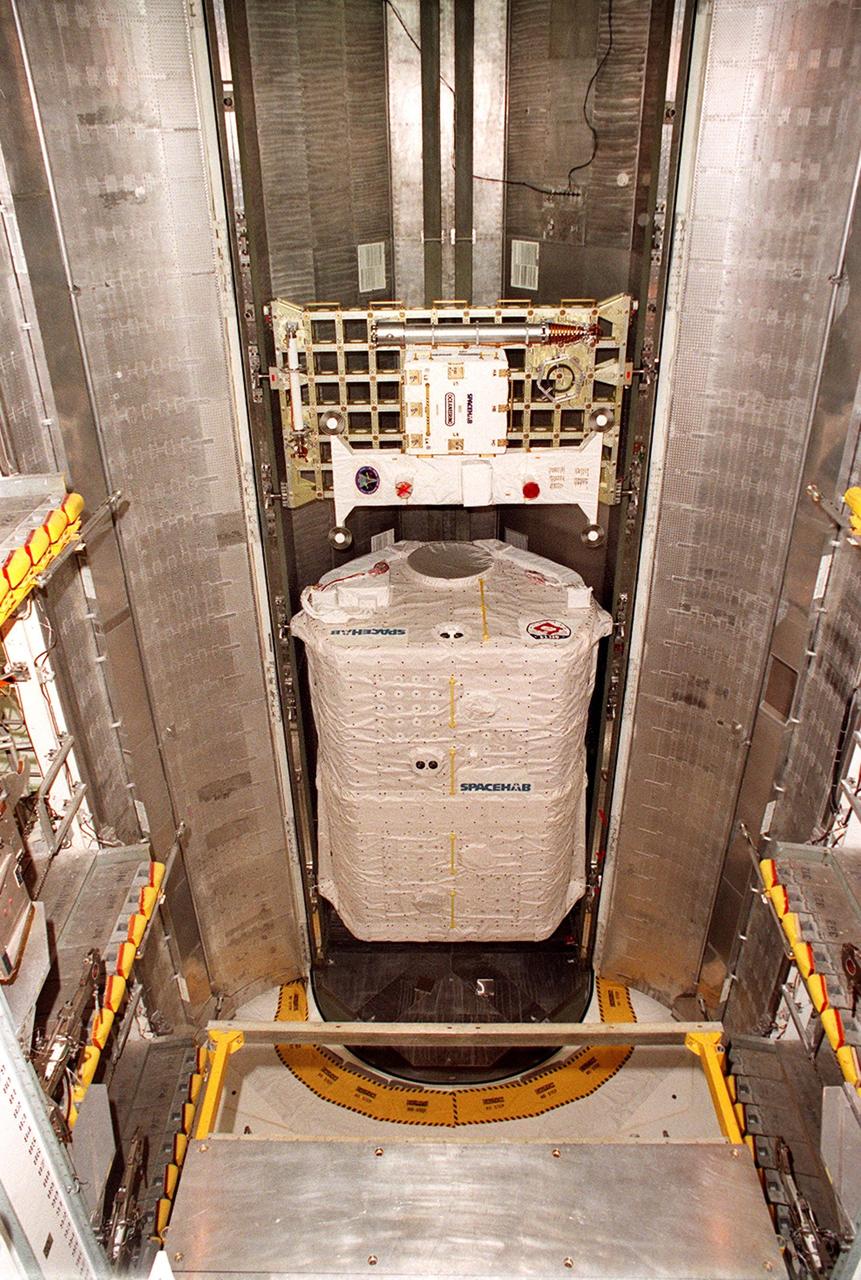
KENNEDY SPACE CENTER, FLA. -- The doors of the payload canister open in the Payload Changeout Room (PCR) at Launch Pad 39A to reveal the SPACEHAB Double Module (bottom) and Integrated Cargo Carrier (ICC). Part of the Rotating Service Structure, the PCR is an environmentally controlled facility supporting cargo delivery to the pad and vertical installation in the orbiter cargo bay. The primary payloads on mission STS-101, the module and ICC contain internal logistics and resupply cargo for restoring full redundancy to the International Space Station power system in preparation for the arrival of the next pressurized module, the Russian-built Zvezda. The payloads will be transferred to Space Shuttle Atlantis after Atlantis rolls out to the pad. Launch of Atlantis on mission STS-101 is scheduled no earlier than April 17, 2000
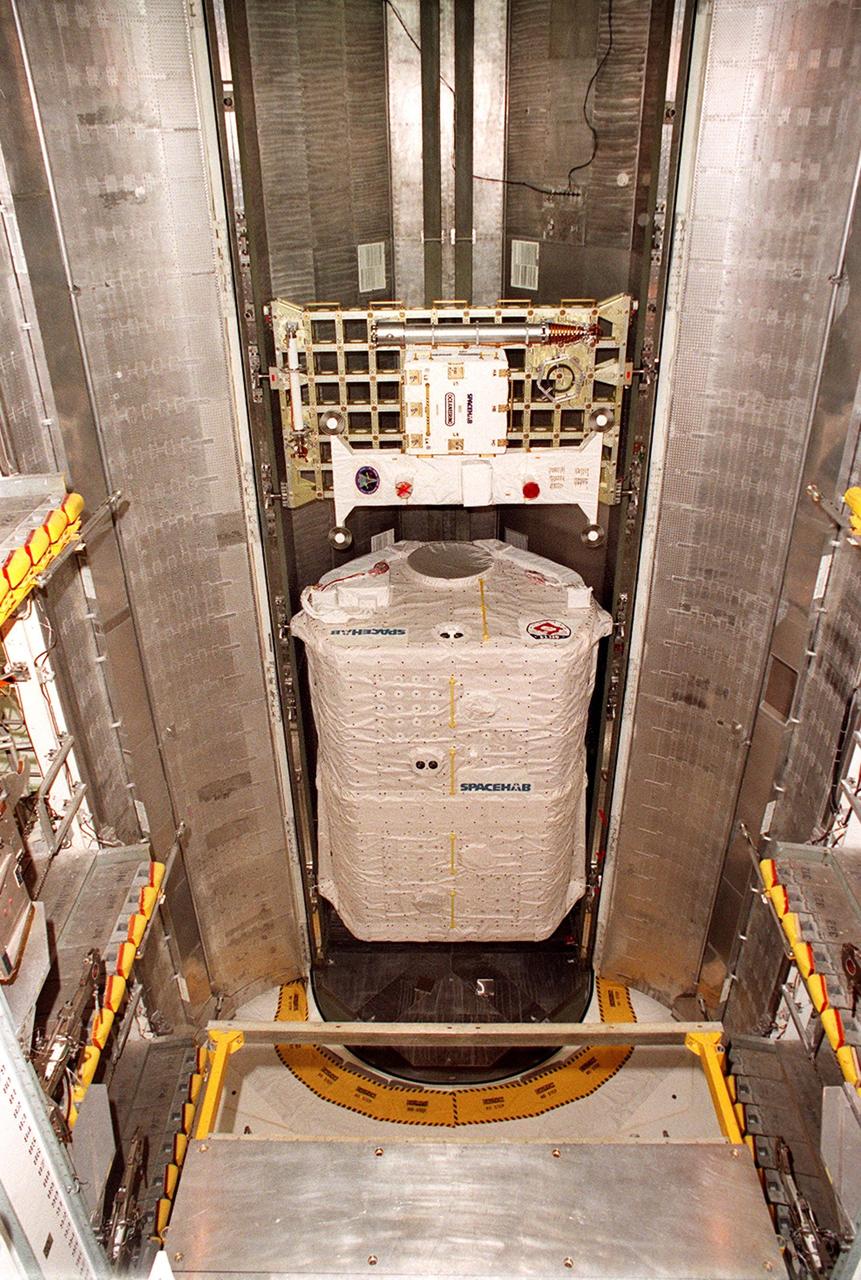
KENNEDY SPACE CENTER, FLA. -- The doors of the payload canister open in the Payload Changeout Room (PCR) at Launch Pad 39A to reveal the SPACEHAB Double Module (bottom) and Integrated Cargo Carrier (ICC). Part of the Rotating Service Structure, the PCR is an environmentally controlled facility supporting cargo delivery to the pad and vertical installation in the orbiter cargo bay. The primary payloads on mission STS-101, the module and ICC contain internal logistics and resupply cargo for restoring full redundancy to the International Space Station power system in preparation for the arrival of the next pressurized module, the Russian-built Zvezda. The payloads will be transferred to Space Shuttle Atlantis after Atlantis rolls out to the pad. Launch of Atlantis on mission STS-101 is scheduled no earlier than April 17, 2000
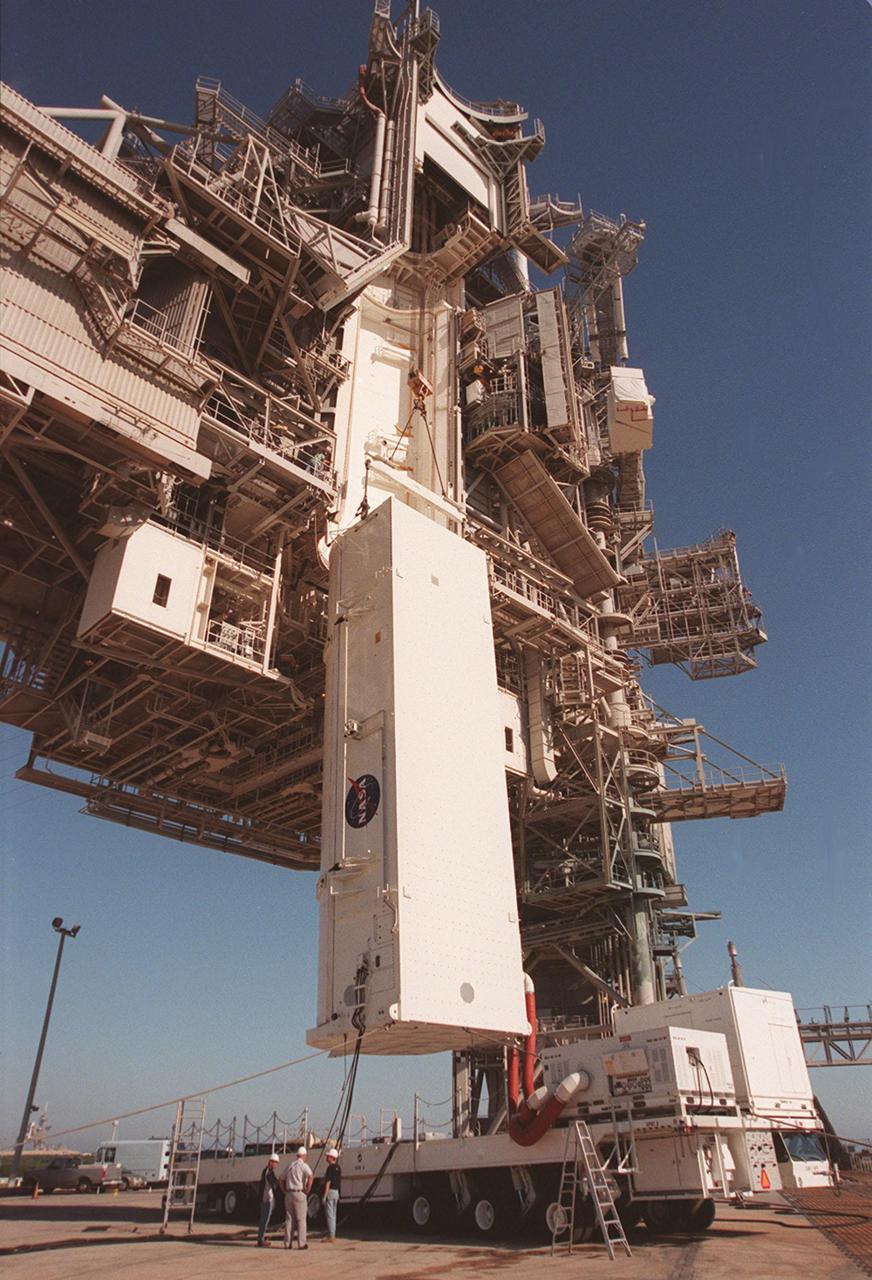
KENNEDY SPACE CENTER, FLA. -- At Launch Pad 39A, the payload canister with the SPACEHAB Double Module and the Integrated Cargo Carrier (ICC) inside is lifted off the payload transporter toward the Payload Changeout Room (PCR) on the Rotating Service Structure (RSS). The PCR is an environmentally controlled facility supporting cargo delivery to the pad and vertical installation in the orbiter cargo bay. At right of the RSS is the Fixed Service Structure. The primary payloads on mission STS-101, the module and ICC contain internal logistics and resupply cargo for restoring full redundancy to the International Space Station power system in preparation for the arrival of the next pressurized module, the Russian-built Zvezda. The payloads will be transferred to Space Shuttle Atlantis after Atlantis rolls out to the pad. Launch of Atlantis on mission STS-101 is scheduled no earlier than April 17, 2000
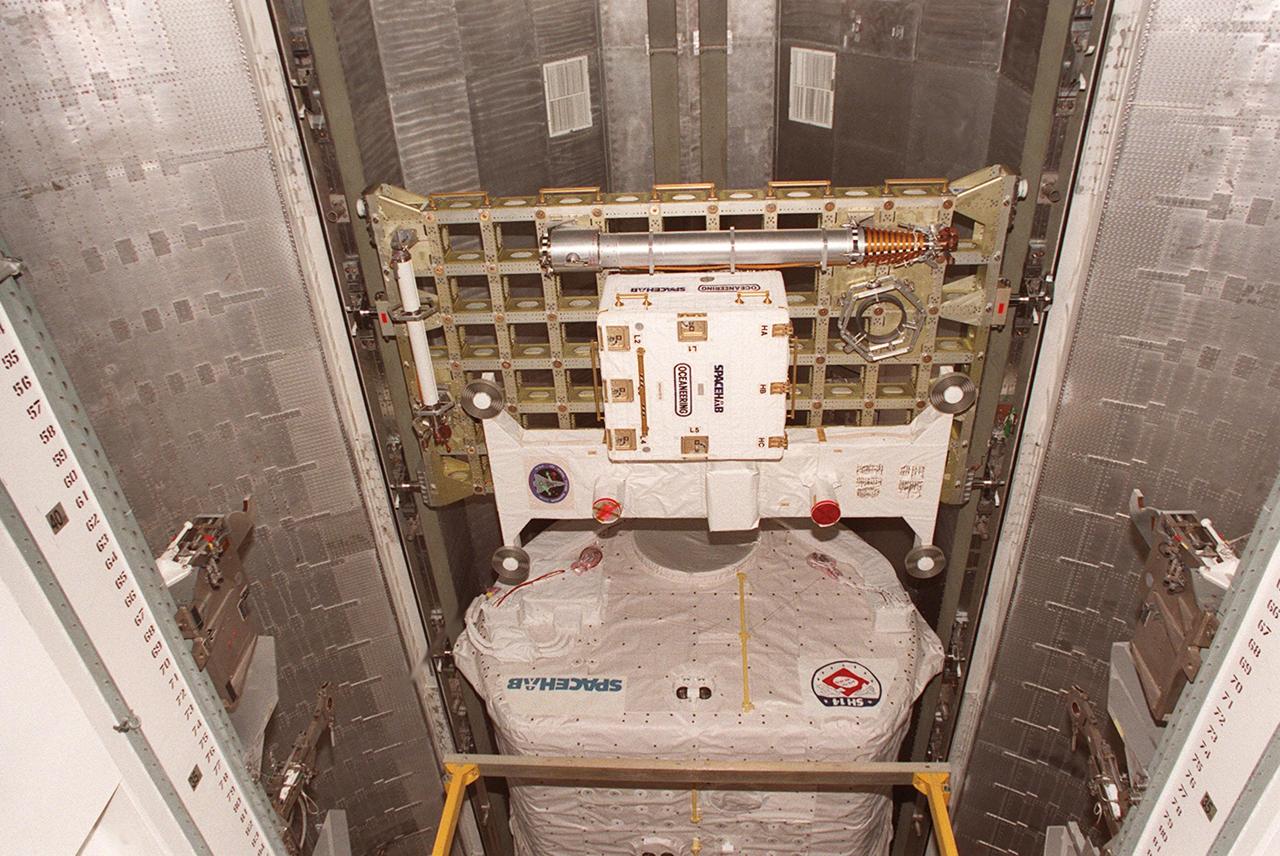
KENNEDY SPACE CENTER, FLA. -- A closeup shows the Integrated Cargo Carrier (top) and SPACEHAB Double Module (below) ready to be moved into the Payload Changeout Room (PCR) at Launch Pad 39A. Part of the Rotating Service Structure, the PCR is an environmentally controlled facility supporting cargo delivery to the pad and vertical installation in the orbiter cargo bay. The primary payloads on mission STS-101, the module and ICC contain internal logistics and resupply cargo for restoring full redundancy to the International Space Station power system in preparation for the arrival of the next pressurized module, the Russian-built Zvezda. The payloads will be transferred to Space Shuttle Atlantis after Atlantis rolls out to the pad. Launch of Atlantis on mission STS-101 is scheduled no earlier than April 17, 2000
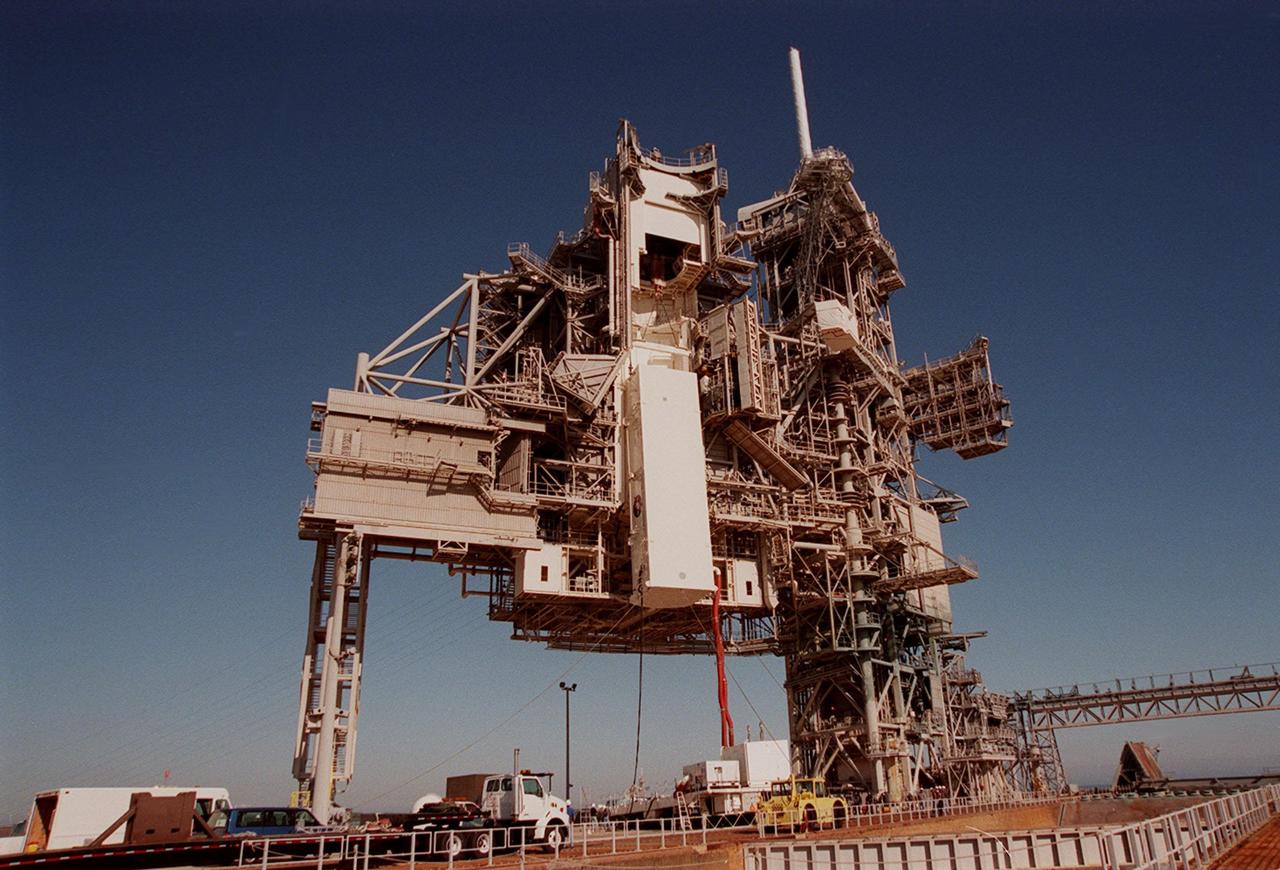
KENNEDY SPACE CENTER, FLA. -- At Launch Pad 39A, the payload canister with the SPACEHAB Double Module and Integrated Cargo Carrier (ICC) inside is lifted up the Rotating Service Structure (RSS) toward the Payload Changeout Room, an environmentally controlled facility supporting cargo delivery to the pad and vertical installation in the orbiter cargo bay. At right of the RSS is the Fixed Service Structure, topped by the 80-foot-tall fiberglass lightning mast. The primary payload on mission STS-101, the module and ICC contain internal logistics and resupply cargo for restoring full redundancy to the International Space Station power system in preparation for the arrival of the next pressurized module, the Russian-built Zvezda. The payloads will be transferred to Space Shuttle Atlantis after Atlantis rolls out to the pad. Launch of Atlantis on mission STS-101 is scheduled no earlier than April 17, 2000
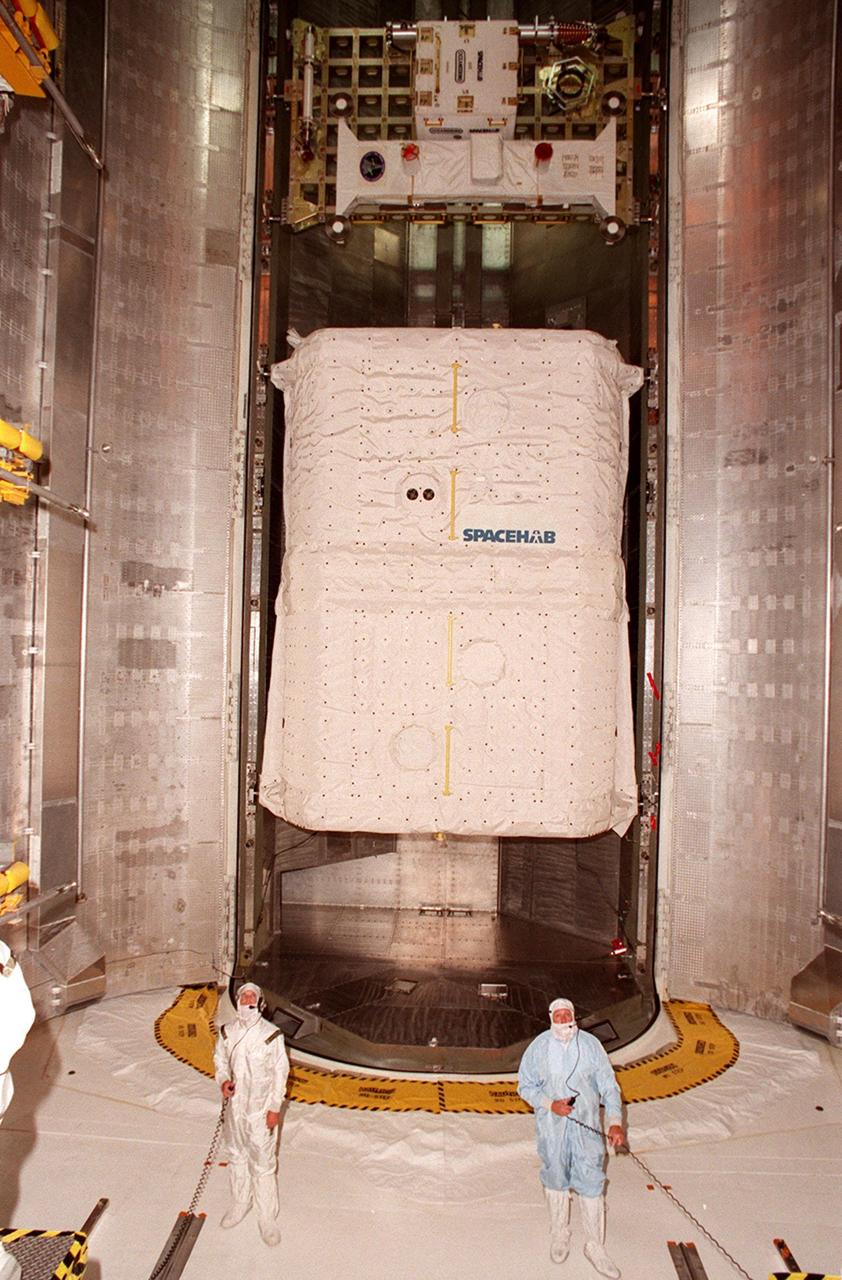
KENNEDY SPACE CENTER, FLA. -- The SPACEHAB Double Module (bottom) and Integrated Cargo Carrier (above) are ready to be moved from the payload canister into the Payload Changeout Room (PCR) at Launch Pad 39A. Part of the Rotating Service Structure, the PCR is an environmentally controlled facility supporting cargo delivery to the pad and vertical installation in the orbiter cargo bay. The primary payloads on mission STS-101, the module and ICC contain internal logistics and resupply cargo for restoring full redundancy to the International Space Station power system in preparation for the arrival of the next pressurized module, the Russian-built Zvezda. The payloads will be transferred to Space Shuttle Atlantis after Atlantis rolls out to the pad. Launch of Atlantis on mission STS-101 is scheduled no earlier than April 17, 2000
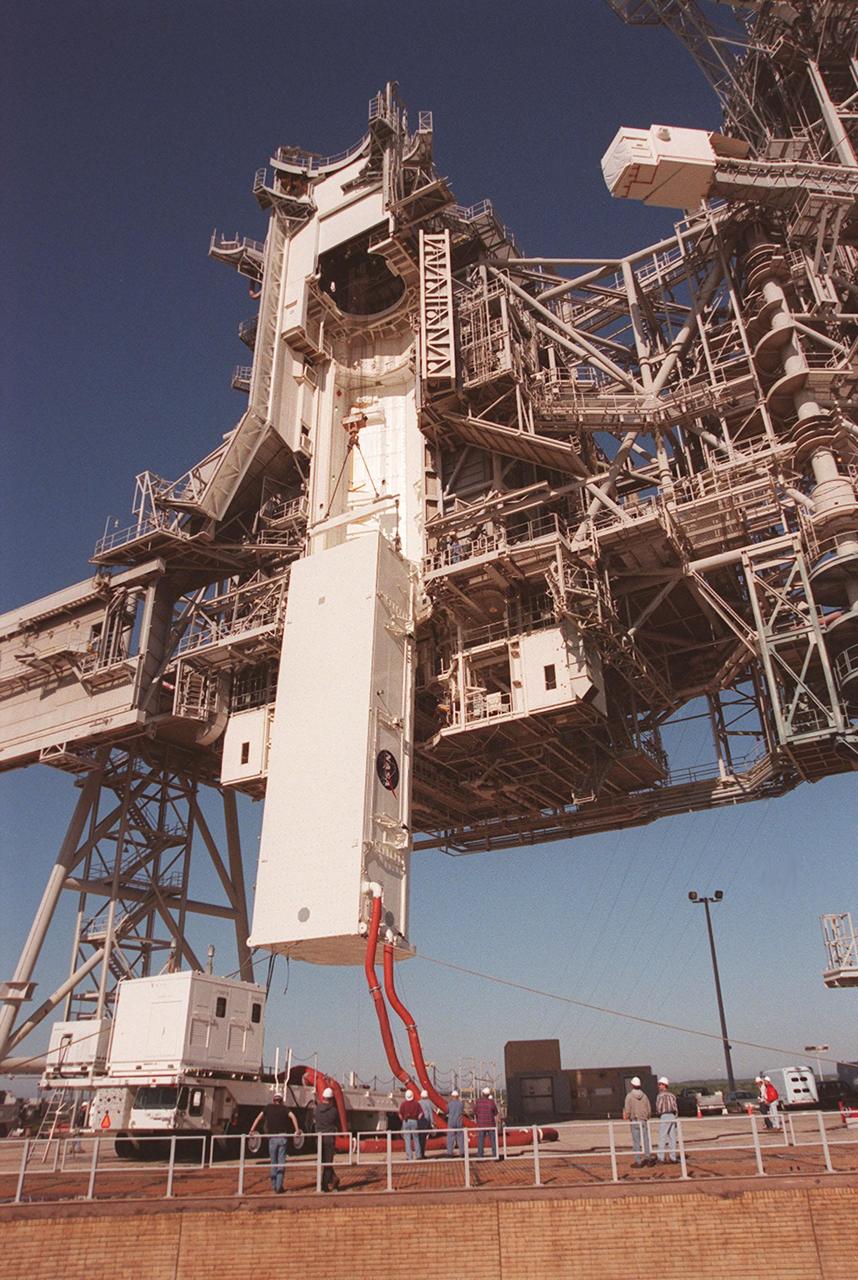
KENNEDY SPACE CENTER, FLA. -- At Launch Pad 39A, the payload canister with the SPACEHAB Double Module and Integrated Cargo Carrier (ICC) inside is lifted up the Rotating Service Structure toward the Payload Changeout Room, an environmentally controlled facility supporting cargo delivery to the pad and vertical installation in the orbiter cargo bay. The primary payloads on mission STS-101, the module and ICC contain internal logistics and resupply cargo for restoring full redundancy to the International Space Station power system in preparation for the arrival of the next pressurized module, the Russian-built Zvezda. The payloads will be transferred to Space Shuttle Atlantis after Atlantis rolls out to the pad. Launch of Atlantis on mission STS-101 is scheduled no earlier than April 17, 2000
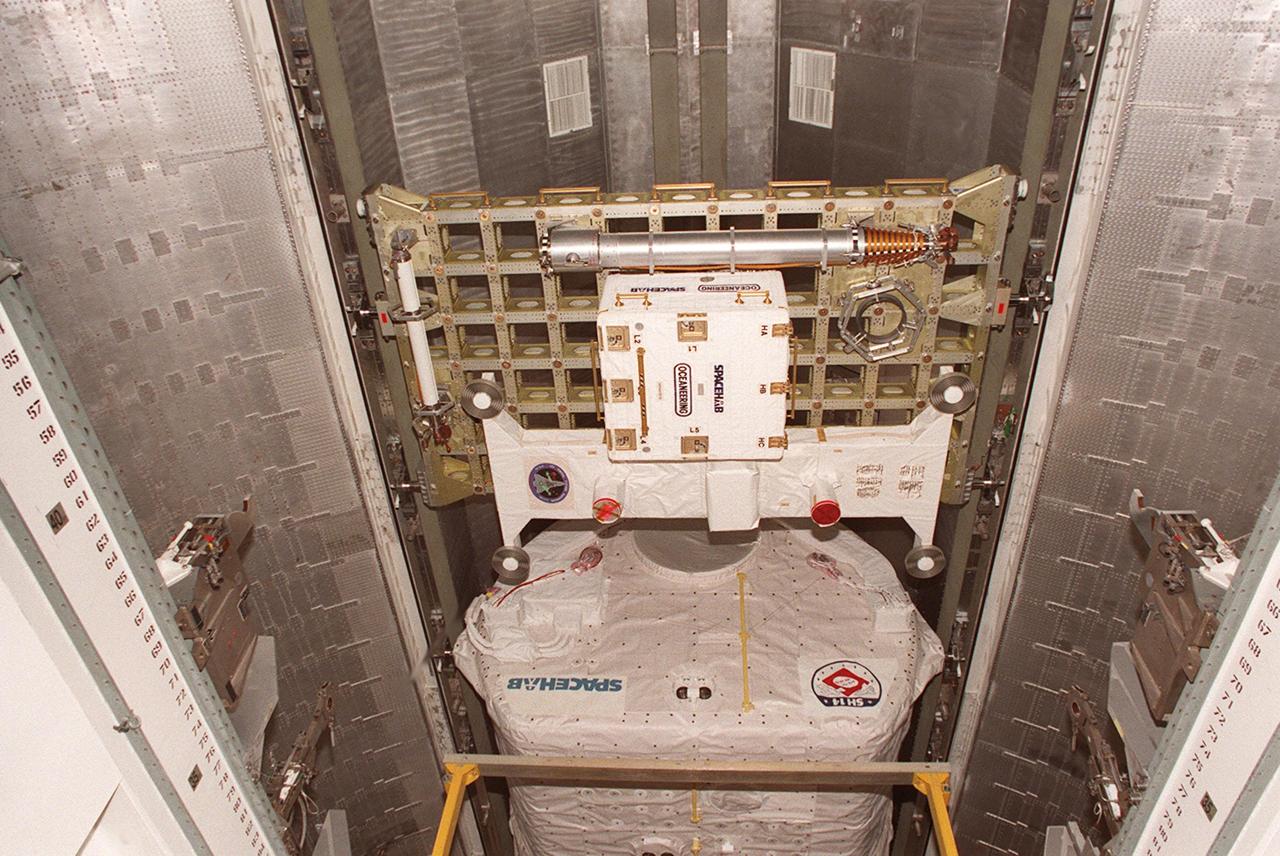
KENNEDY SPACE CENTER, FLA. -- A closeup shows the Integrated Cargo Carrier (top) and SPACEHAB Double Module (below) ready to be moved into the Payload Changeout Room (PCR) at Launch Pad 39A. Part of the Rotating Service Structure, the PCR is an environmentally controlled facility supporting cargo delivery to the pad and vertical installation in the orbiter cargo bay. The primary payloads on mission STS-101, the module and ICC contain internal logistics and resupply cargo for restoring full redundancy to the International Space Station power system in preparation for the arrival of the next pressurized module, the Russian-built Zvezda. The payloads will be transferred to Space Shuttle Atlantis after Atlantis rolls out to the pad. Launch of Atlantis on mission STS-101 is scheduled no earlier than April 17, 2000
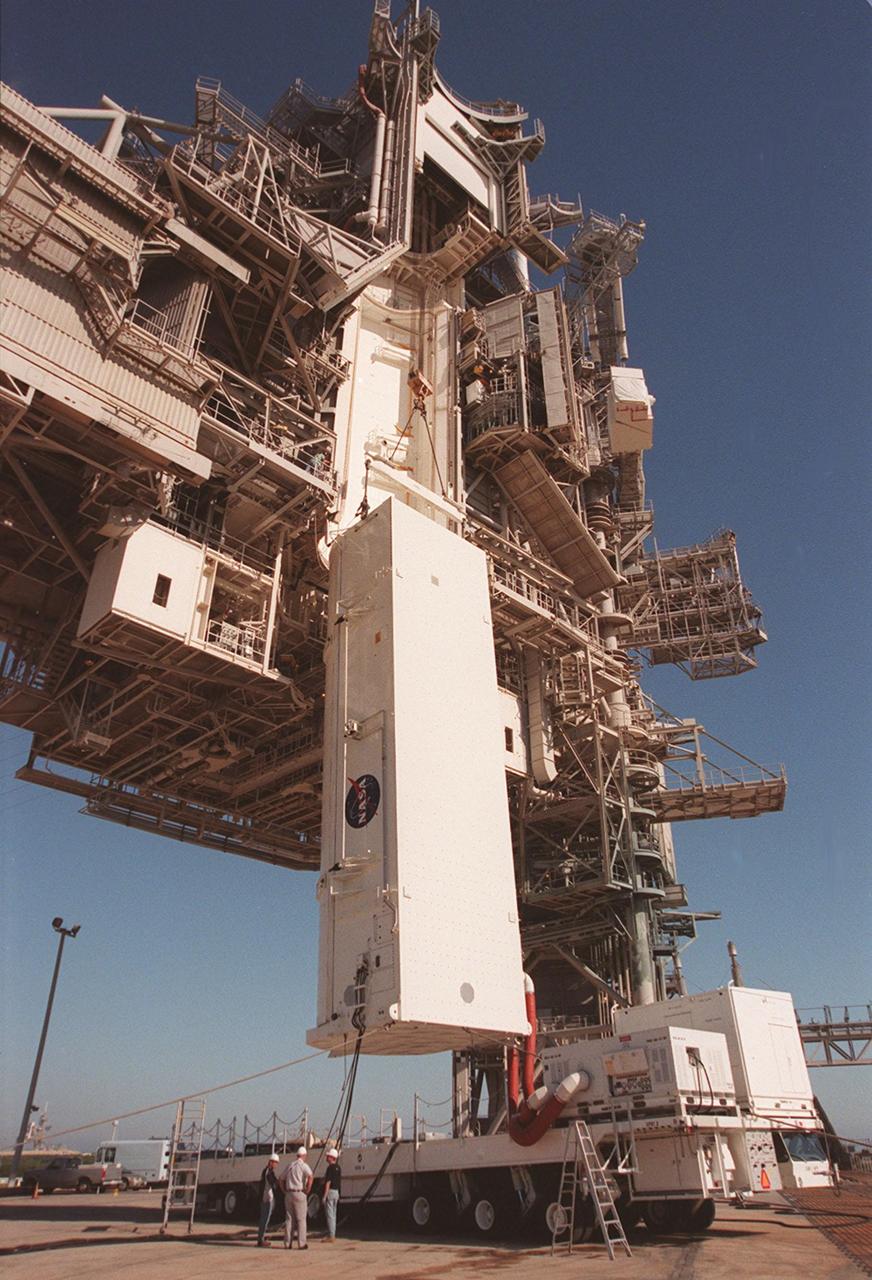
KENNEDY SPACE CENTER, FLA. -- At Launch Pad 39A, the payload canister with the SPACEHAB Double Module and the Integrated Cargo Carrier (ICC) inside is lifted off the payload transporter toward the Payload Changeout Room (PCR) on the Rotating Service Structure (RSS). The PCR is an environmentally controlled facility supporting cargo delivery to the pad and vertical installation in the orbiter cargo bay. At right of the RSS is the Fixed Service Structure. The primary payloads on mission STS-101, the module and ICC contain internal logistics and resupply cargo for restoring full redundancy to the International Space Station power system in preparation for the arrival of the next pressurized module, the Russian-built Zvezda. The payloads will be transferred to Space Shuttle Atlantis after Atlantis rolls out to the pad. Launch of Atlantis on mission STS-101 is scheduled no earlier than April 17, 2000
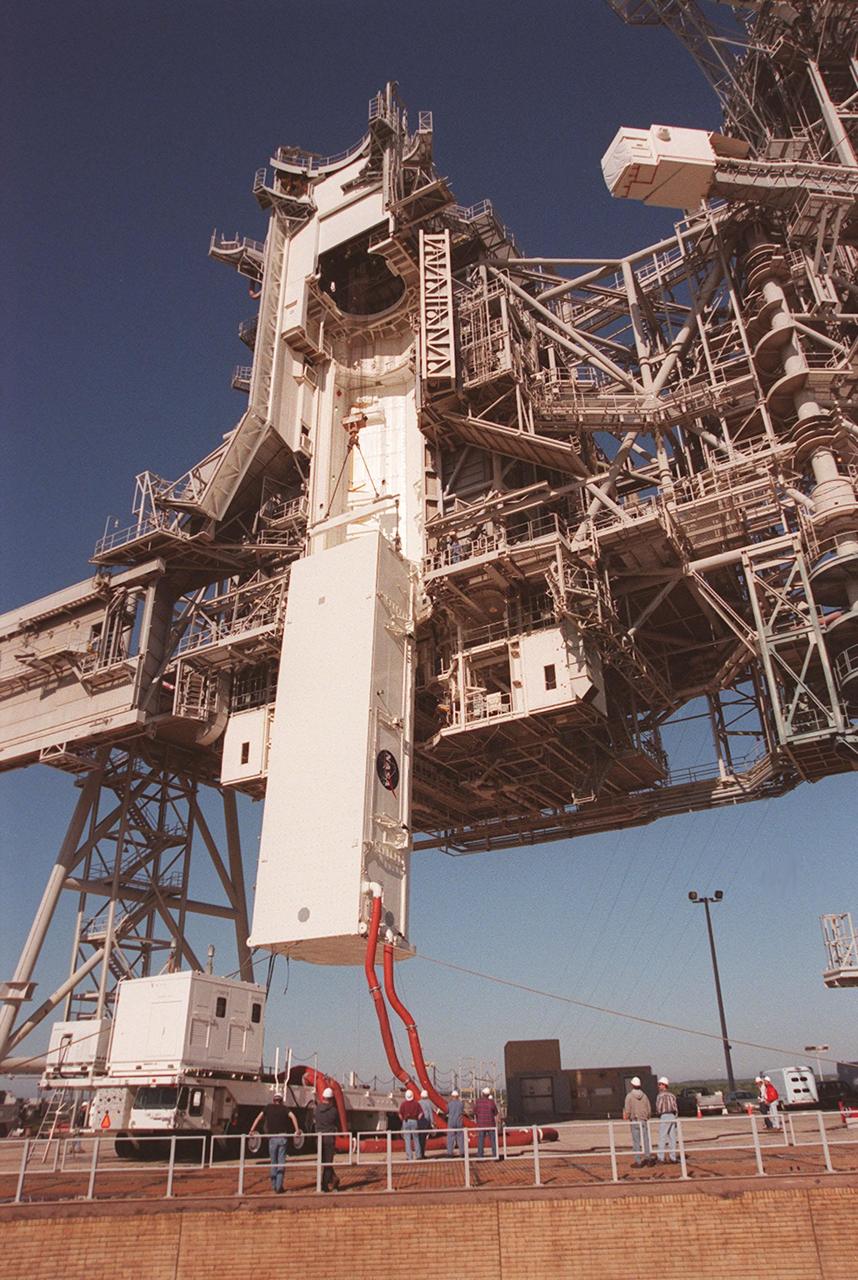
KENNEDY SPACE CENTER, FLA. -- At Launch Pad 39A, the payload canister with the SPACEHAB Double Module and Integrated Cargo Carrier (ICC) inside is lifted up the Rotating Service Structure toward the Payload Changeout Room, an environmentally controlled facility supporting cargo delivery to the pad and vertical installation in the orbiter cargo bay. The primary payloads on mission STS-101, the module and ICC contain internal logistics and resupply cargo for restoring full redundancy to the International Space Station power system in preparation for the arrival of the next pressurized module, the Russian-built Zvezda. The payloads will be transferred to Space Shuttle Atlantis after Atlantis rolls out to the pad. Launch of Atlantis on mission STS-101 is scheduled no earlier than April 17, 2000
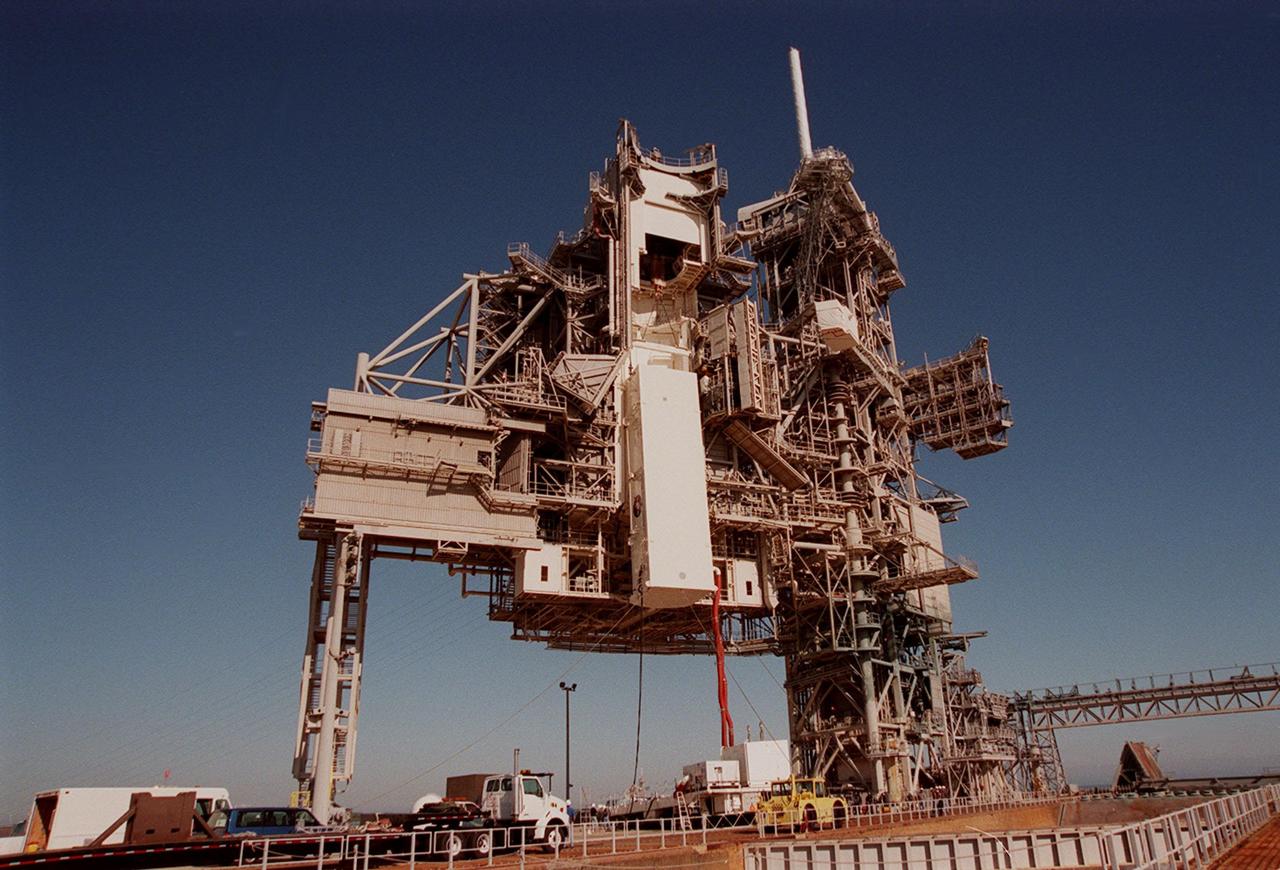
KENNEDY SPACE CENTER, FLA. -- At Launch Pad 39A, the payload canister with the SPACEHAB Double Module and Integrated Cargo Carrier (ICC) inside is lifted up the Rotating Service Structure (RSS) toward the Payload Changeout Room, an environmentally controlled facility supporting cargo delivery to the pad and vertical installation in the orbiter cargo bay. At right of the RSS is the Fixed Service Structure, topped by the 80-foot-tall fiberglass lightning mast. The primary payload on mission STS-101, the module and ICC contain internal logistics and resupply cargo for restoring full redundancy to the International Space Station power system in preparation for the arrival of the next pressurized module, the Russian-built Zvezda. The payloads will be transferred to Space Shuttle Atlantis after Atlantis rolls out to the pad. Launch of Atlantis on mission STS-101 is scheduled no earlier than April 17, 2000
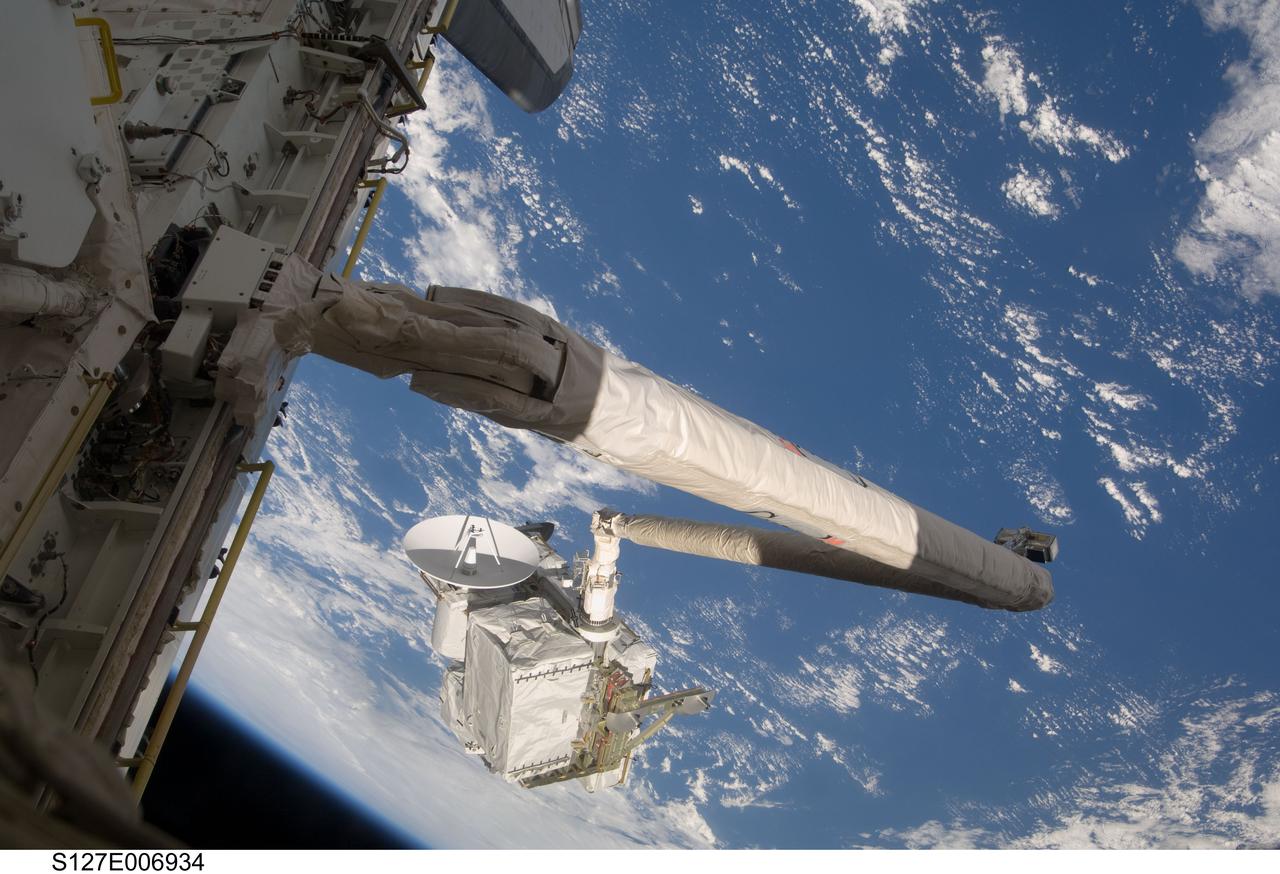
S127-E-006934 (19 July 2009) --- Backdropped by a blue and white Earth, the remote manipulator system (RMS) arm of the Space Shuttle Endeavour, is about to hand off the Integrated Cargo Carrier (ICC) to the International Space Station (out of frame). The ICC is an unpressurized flat bed pallet and keel yoke assembly that was carried into space in the shuttle's payload bay.
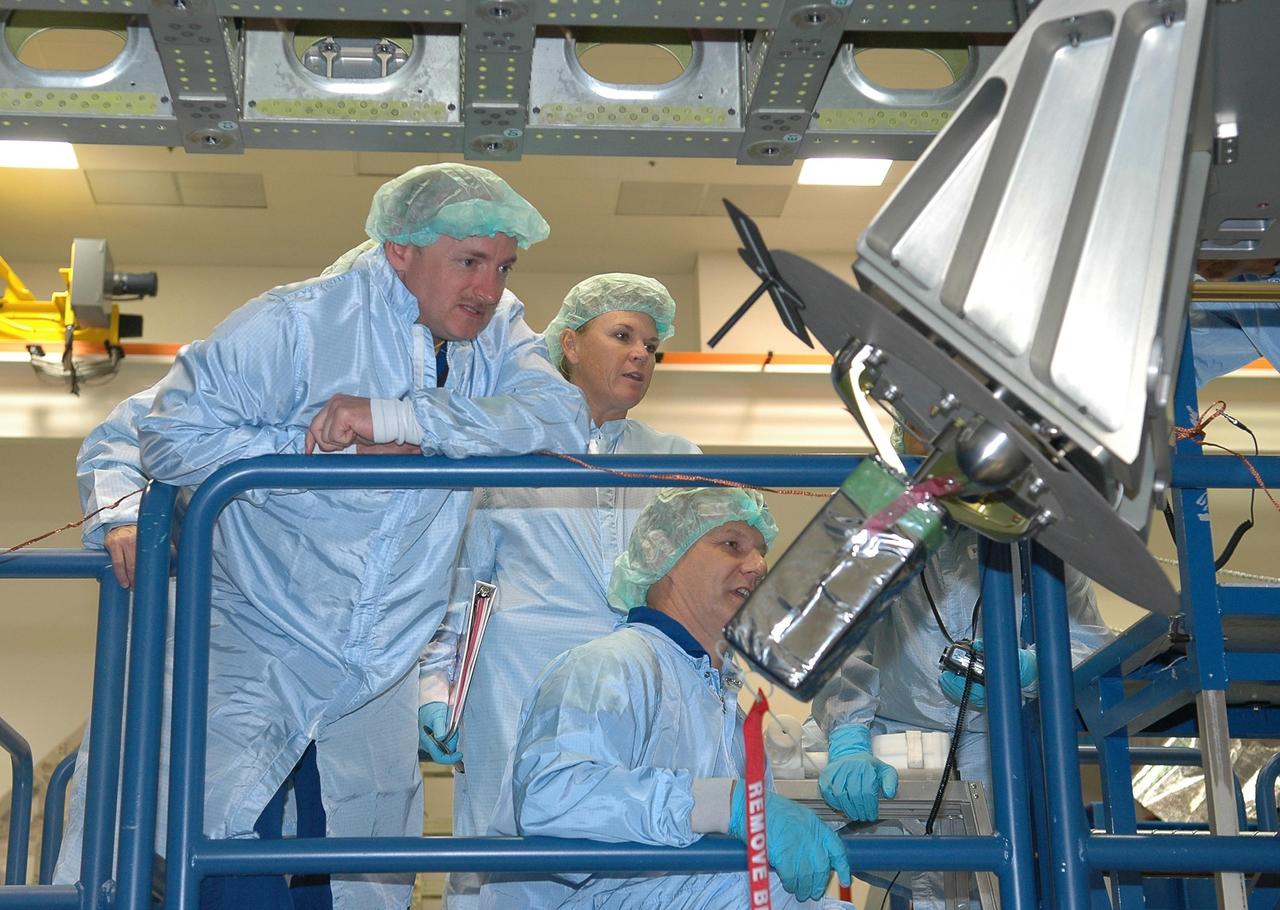
KENNEDY SPACE CENTER, FLA. - Mission STS-121 Pilot Mark Kelly (left) and Mission Specialist Piers Sellers (kneeling) get a close look at the Integrated Cargo Carrier at the SPACEHAB facility in Cape Canaveral during a Crew Equipment Interface Test. This test allows the astronauts to become familiar with equipment they will be using on their upcoming mission. STS-121 is scheduled to launch in July aboard Space Shuttle Discovery. Photo credit: NASA/Kim Shiflett
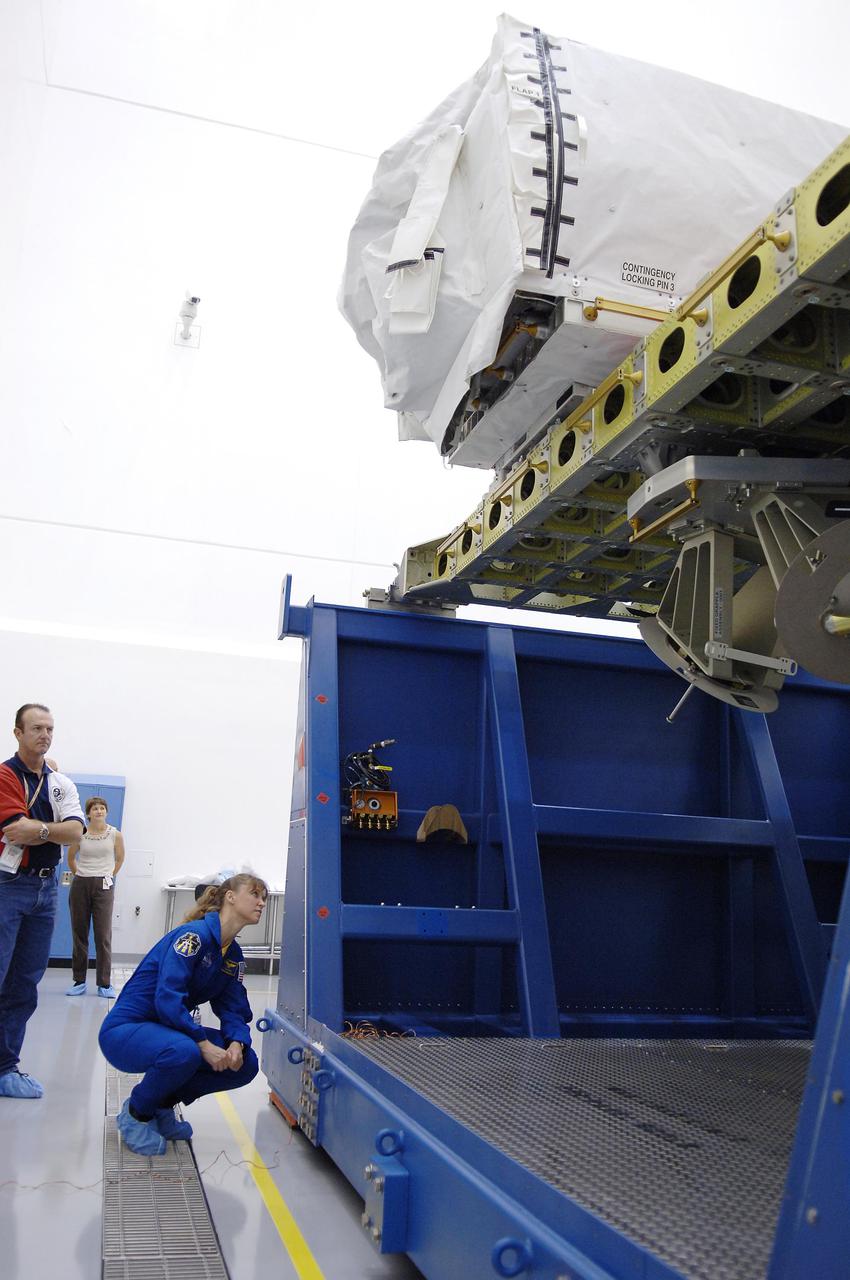
KENNEDY SPACE CENTER, FLA. - At Astrotech Space Operations in Titusville, Fla., STS-121 Mission Specialist Lisa Nowak looks at an orbital replacement unit sitting on the Integrated Cargo Carrier. She and other crew members are at KSC to take part in Crew Equipment Interface Test activities, which provide hands-on experience with equipment they will use on-orbit. STS-121, the second Return to Flight mission, is targeted for launch in a lighted planning window of Sept. 9 to Sept. 25.
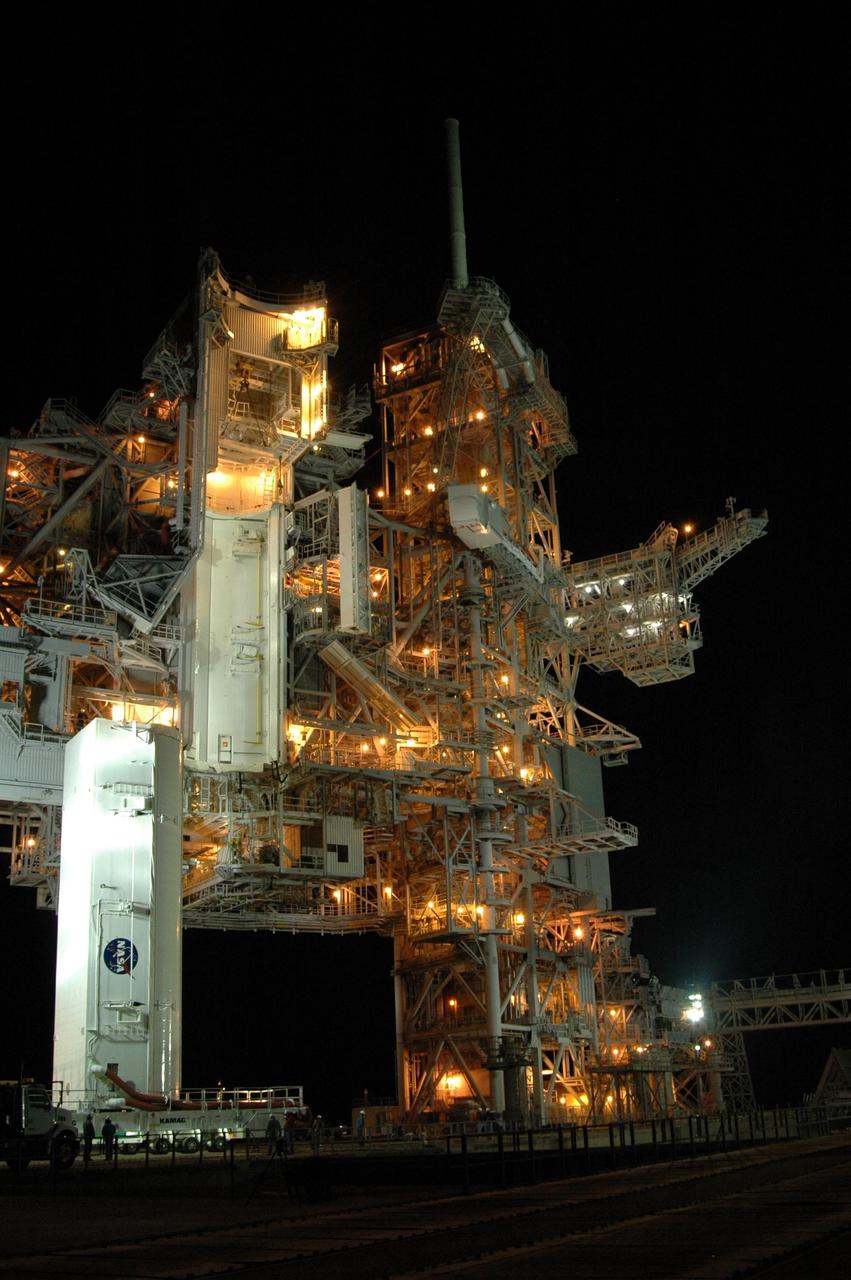
KENNEDY SPACE CENTER, FLA. -- At NASA's Kennedy Space Center, the payload canister atop its transporter reaches the top of Launch Pad 39A. The canister will be positioned under the payload changeout room, on the rotating service structure at left. The canister contains the Columbus Lab module and integrated cargo carrier-lite payloads for space shuttle Atlantis on mission STS-122. They will be transferred into the payload changeout room on the pad. Atlantis is targeted to launch on Dec. 6. Photo credit: NASA/Dimitri Gerondidakis
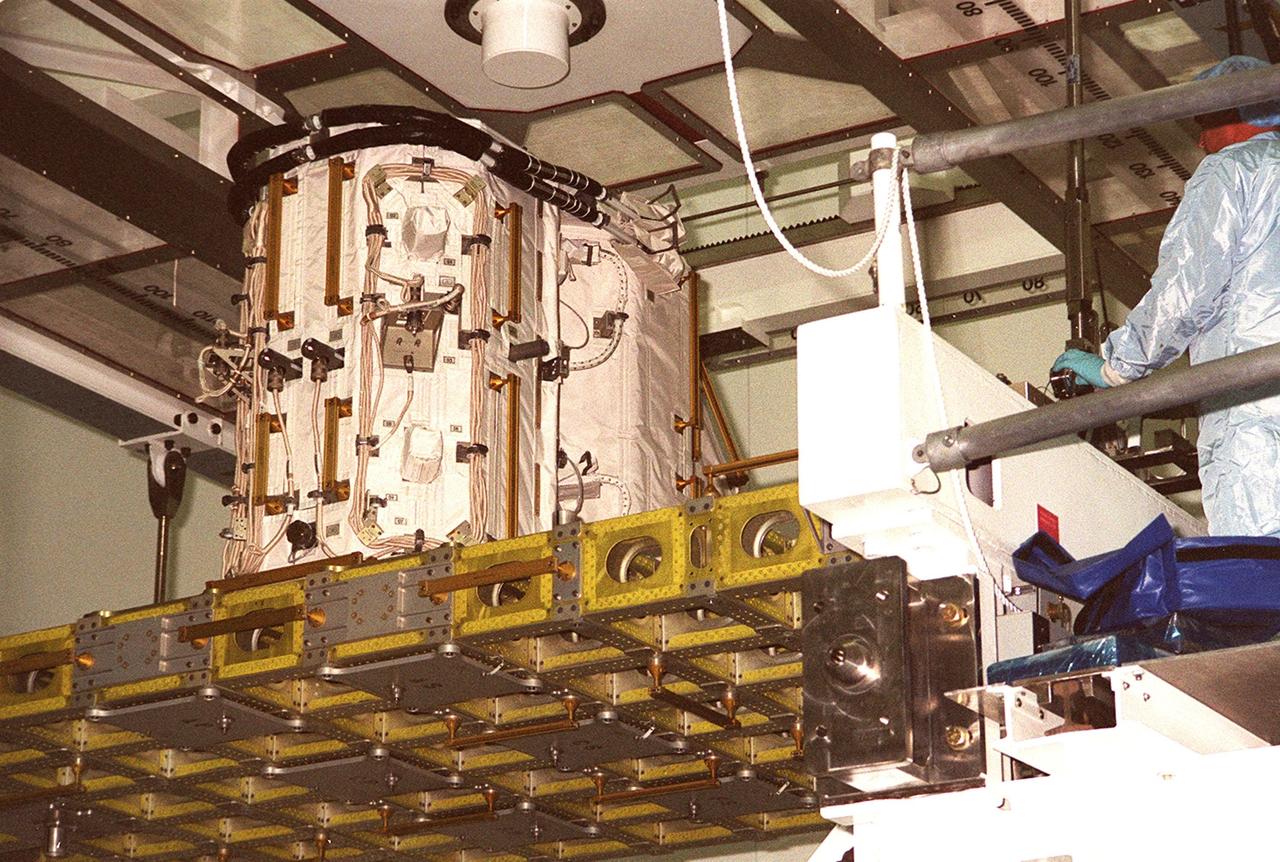
KENNEDY SPACE CENTER, Fla. -- A crane is attached to the Integrated Cargo Carrier in the Space Station Processing Facility in order to move it to the payload canister. The ICC holds several payloads for mission STS-105, the Early Ammonia Servicer and two experiment containers. The ICC will join the Multi-Purpose Logistics Module Leonardo in the payload canister for transport to Launch Pad 39A where they will be placed in the payload bay of Space Shuttle Discovery. Launch of STS-105 is scheduled for 5:38 p.m. EDT Aug. 9

KENNEDY SPACE CENTER, FLA. -- The Integrated Cargo Carrier (ICC), with equipment on top, sits in a workstand in the Space Station Processing Facility. It will be moved into the payload canister for transport to Launch Pad 39B in preparation for mission STS-106, scheduled to launch Sept. 8 at 8:31 a.m. EDT. During the mission to the International Space Station, the crew will complete service module support tasks on orbit, transfer supplies and outfit the Space Station for the first long-duration crew
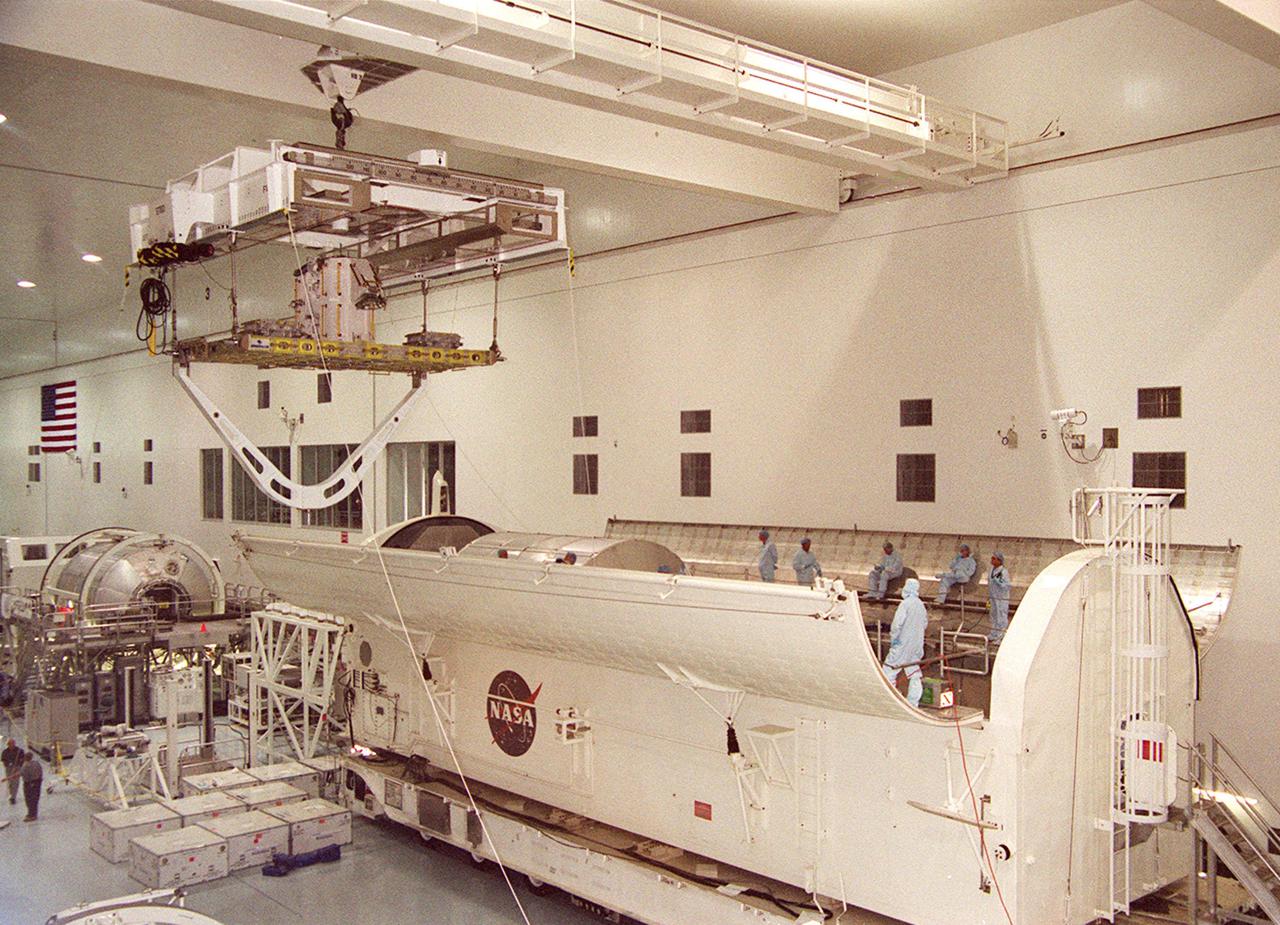
KENNEDY SPACE CENTER, Fla. -- An overhead crane in the Space Station Processing Facility moves the Integrated Cargo Carrier toward the payload canister (right). The ICC holds several payloads for mission STS-105, the Early Ammonia Servicer and two experiment containers. The ICC will join the Multi-Purpose Logistics Module Leonardo already in the payload canister for transport to Launch Pad 39A where they will be placed in the payload bay of Space Shuttle Discovery. Launch of STS-105 is scheduled for 5:38 p.m. EDT Aug. 9
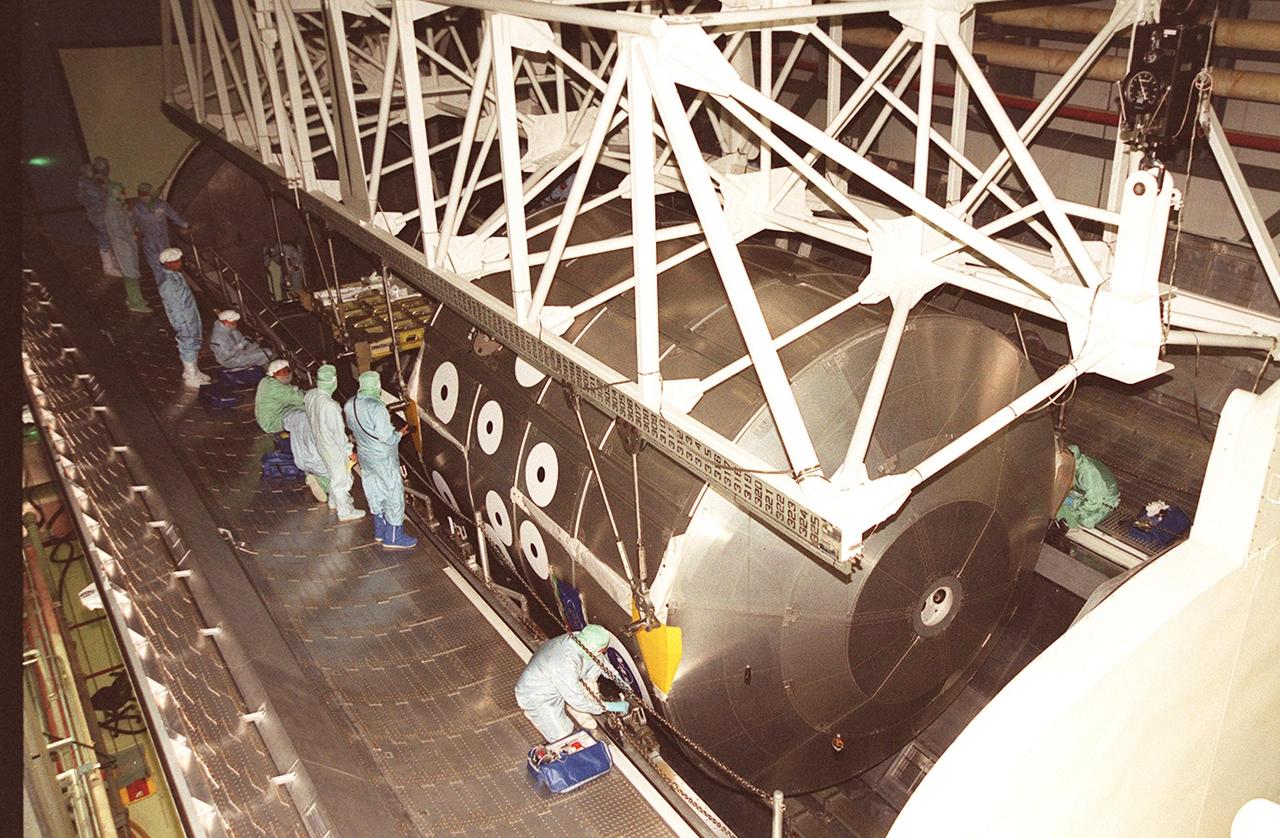
KENNEDY SPACE CENTER, FLA. -- Workers in the Orbiter Processing Facility bay 2 keep watch as an overhead crane lowers the Multi-Purpose Logistics Module Leonardo and the integrated cargo carrier behind it into a payload canister. The MPLM has just returned from its first round trip to the International Space Station on mission STS-102. The MPLM will be transferred to the SSPF to prepare it for future missions
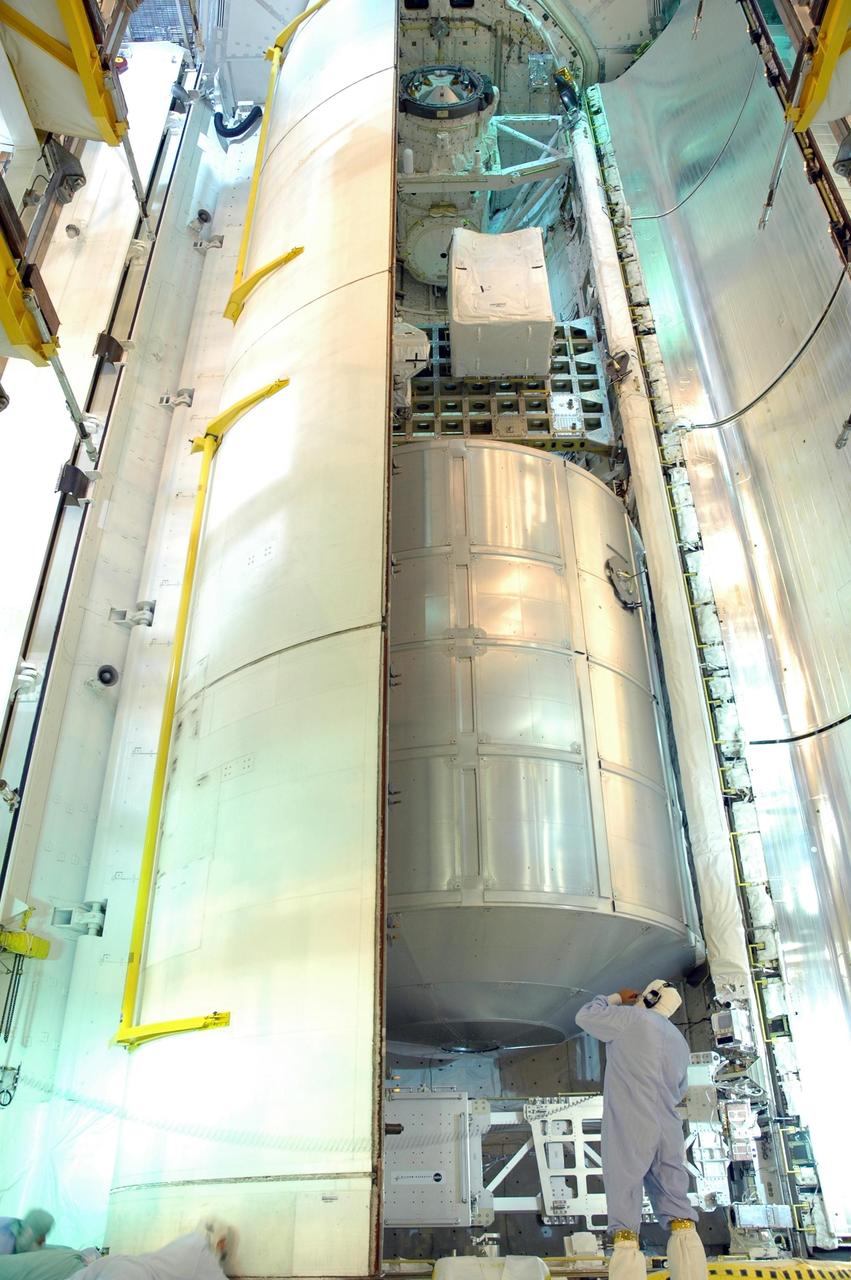
KENNEDY SPACE CENTER, FLA. - At Launch Pad 39B, one of Space Shuttle Discovery's payload bay doors is being closed. Inside the payload bay can be seen the multi-purpose logistics module Leonardo, at bottom, and the integrated cargo carrier above it. Discovery is scheduled to launch on mission STS-121 at 3:49 p.m. July 1 carrying a crew of seven on the 12-day mission to the International Space Station. Photo credit: NASA/Jim Grossmann

CAPE CANAVERAL, Fla. – In the Space Station Processing Facility at NASA's Kennedy Space Center in Florida, an overhead crane lifts the Integrated Cargo Carrier-VLD (Vertical Light Deployment), part of the payload for the STS-127 mission. The ICC-VLD is being transferred to the payload canister, seen at right. The canister will deliver the ICC-VLD and other elements to Launch Pad 39A for installation in space shuttle Endeavour's payload bay. Launch is targeted for June 13. Photo credit: NASA/Troy Cryder
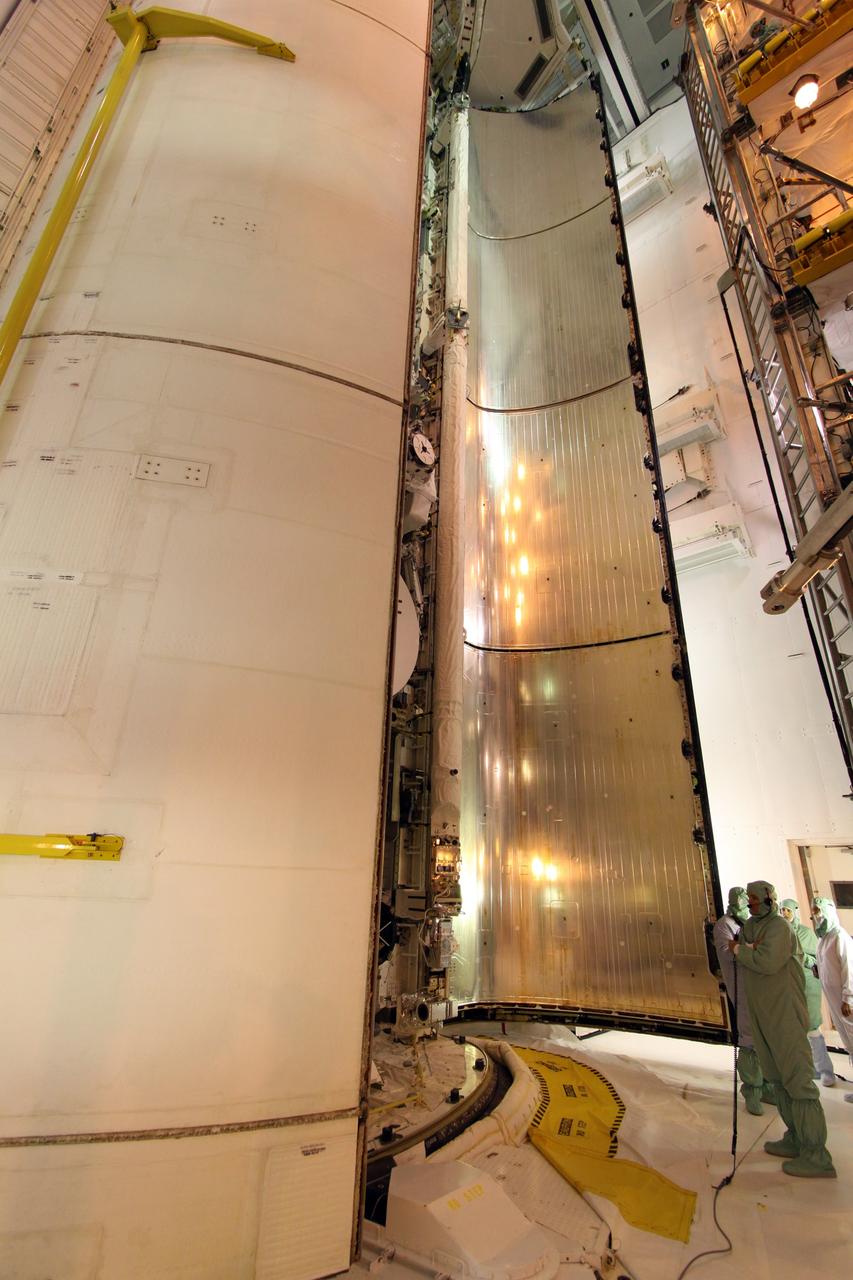
CAPE CANAVERAL, Fla. – On Launch Pad 39A at NASA's Kennedy Space Center in Florida, a worker keeps watch as the starboard payload bay door closes over space shuttle Endeavour's payload. Inside are the Integrated Cargo Carrier-Vertical Light Deploy, the Experiment Logistics Module-Exposed Section and the Japanese Experiment Module's Exposed Facility. The STS-127 mission is the final of three flights dedicated to the assembly of the Japanese Kibo laboratory complex on the International Space Station. Photo credit: NASA/Jack Pfaller
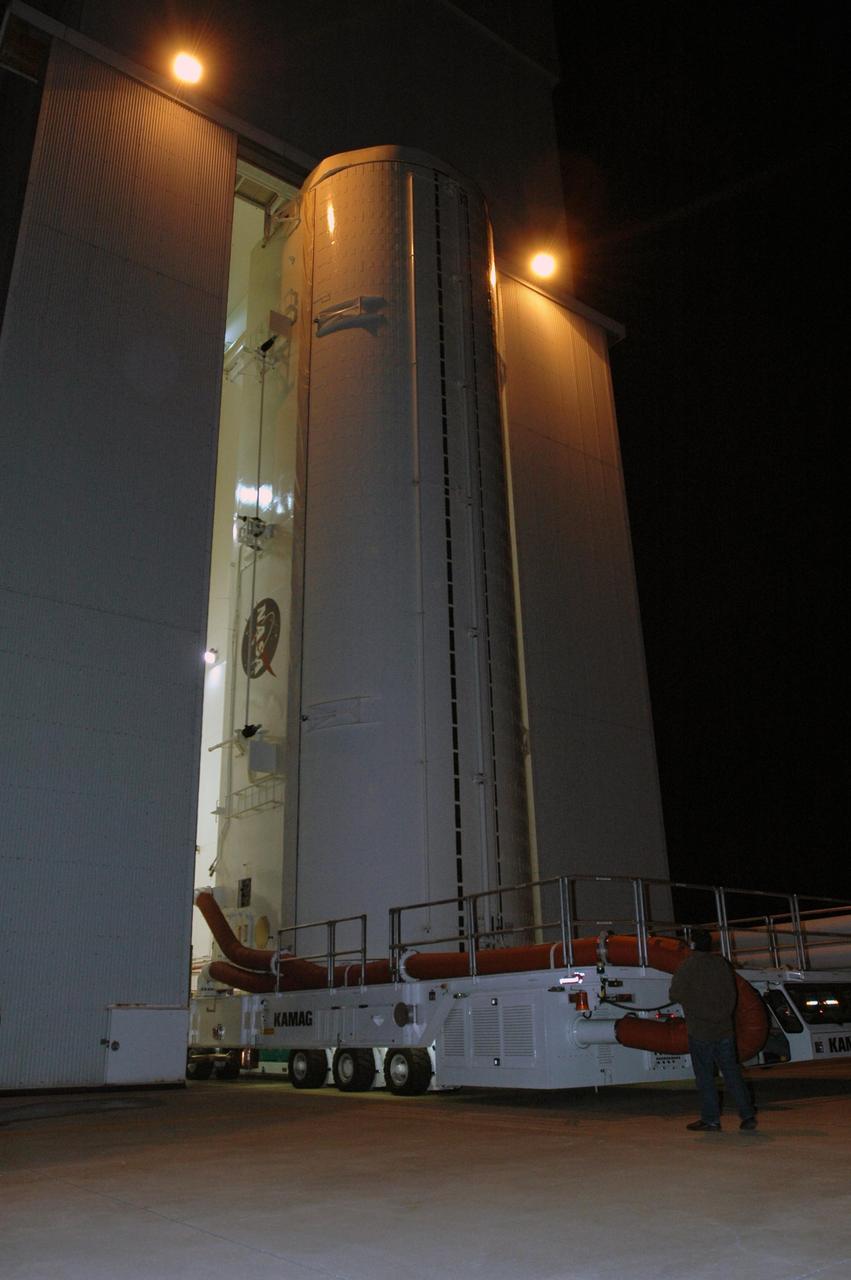
KENNEDY SPACE CENTER, FLA. -- At NASA's Kennedy Space Center, the payload canister rolls out of the Canister Rotation Facility where it was rotated from horizontal to vertical for its trip to Launch Pad 39A. The canister contains the Columbus Lab module and integrated cargo carrier-lite payloads for space shuttle Atlantis on mission STS-122. They will be transferred into the payload changeout room on the pad. Atlantis is targeted to launch on Dec. 6. Photo credit: NASA/Dimitri Gerondidakis
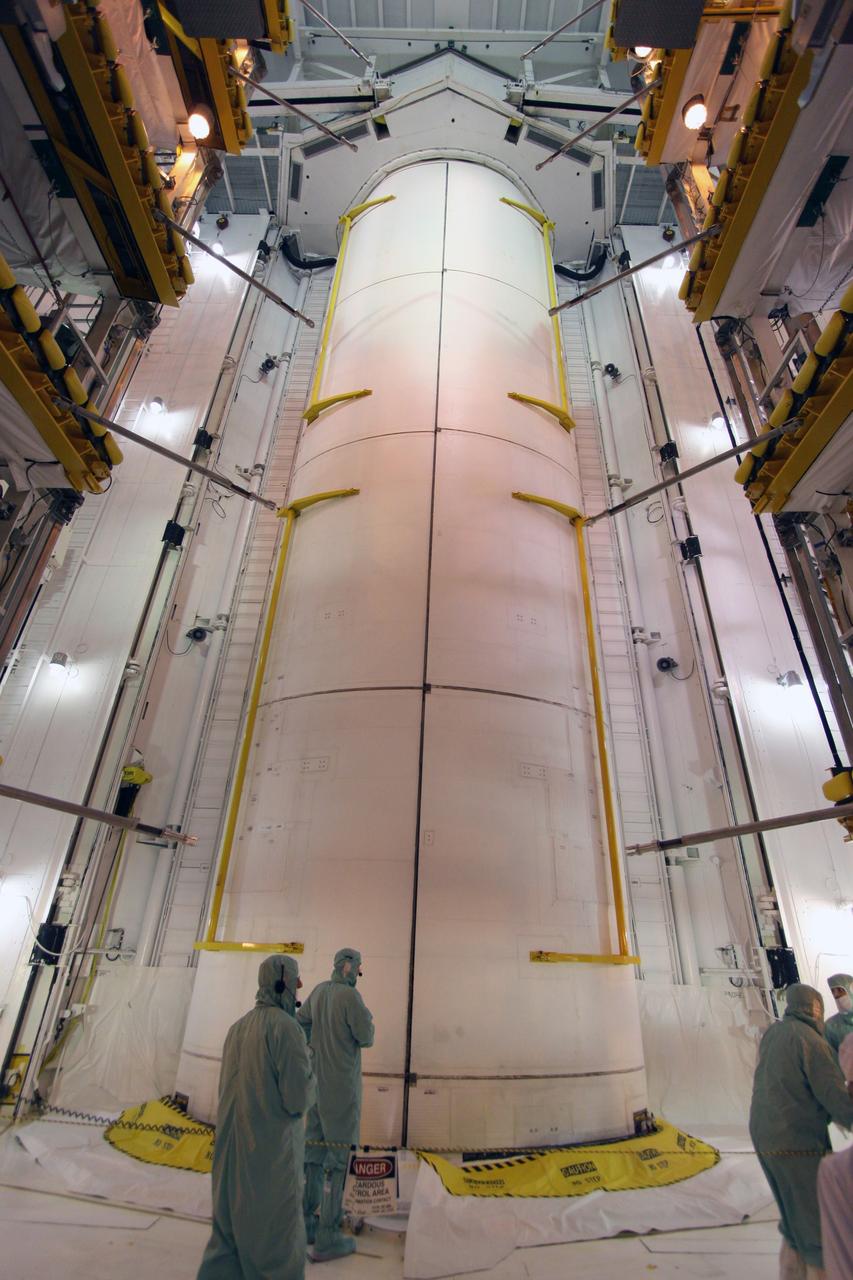
CAPE CANAVERAL, Fla. – On Launch Pad 39A at NASA's Kennedy Space Center in Florida, space shuttle Endeavour's payload bay doors have been closed. Inside are the Integrated Cargo Carrier-Vertical Light Deploy, the Experiment Logistics Module-Exposed Section and the Japanese Experiment Module's Exposed Facility. The STS-127 mission is the final of three flights dedicated to the assembly of the Japanese Kibo laboratory complex on the International Space Station. Photo credit: NASA/Jack Pfaller
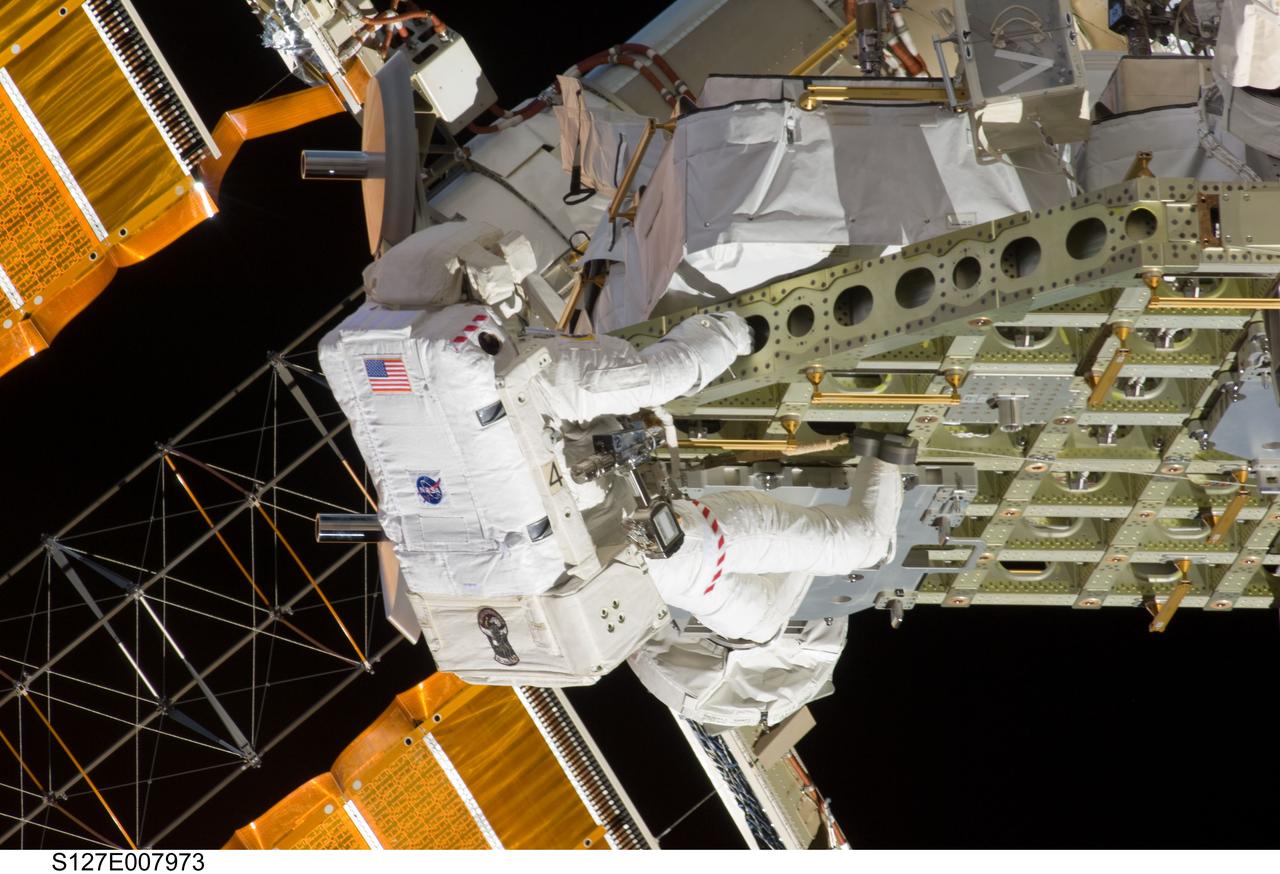
S127-E-007973 (22 July 2009) --- Astronaut Christopher Cassidy, STS-127 mission specialist, participates in Endeavour's third space walk of a scheduled five overall for this flight. Cassidy is working with the Integrated Cargo Carrier. This was Cassidy's first of a scheduled three sessions for him. Astronaut Dave Wolf, Cassidy's EVA colleague, is out of frame.
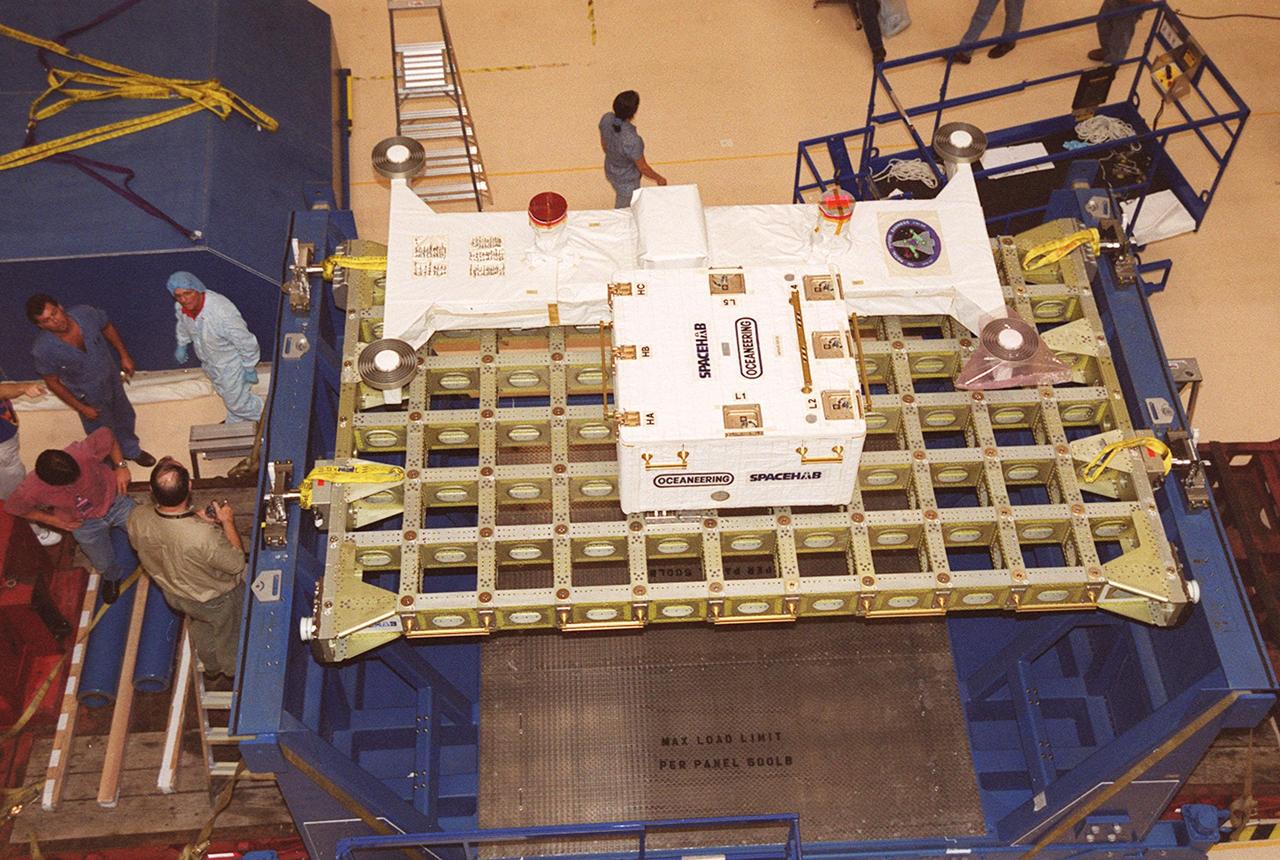
KENNEDY SPACE CENTER, FLA. -- The Integrated Cargo Carrier (ICC), with equipment on top, sits in a workstand in the Space Station Processing Facility. It will be moved into the payload canister for transport to Launch Pad 39B in preparation for mission STS-106, scheduled to launch Sept. 8 at 8:31 a.m. EDT. During the mission to the International Space Station, the crew will complete service module support tasks on orbit, transfer supplies and outfit the Space Station for the first long-duration crew
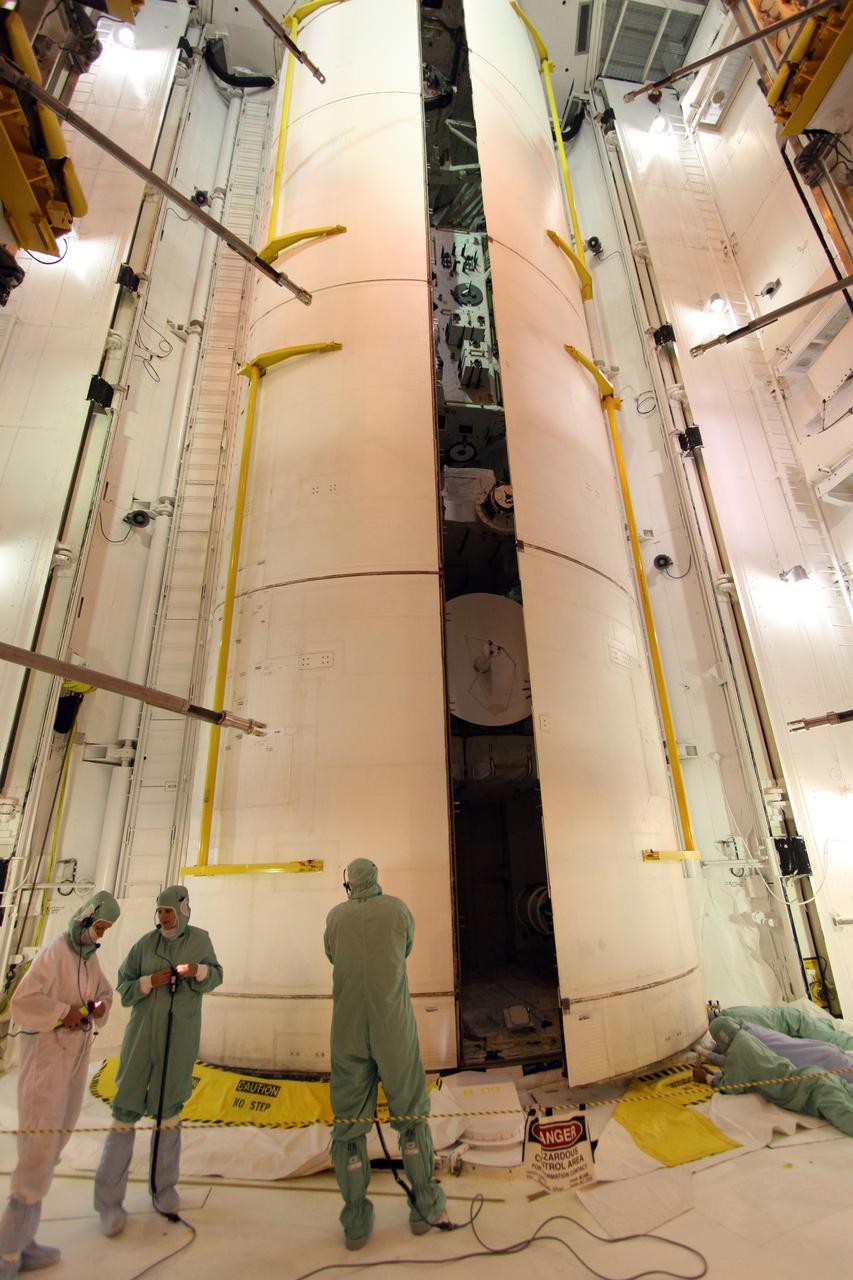
CAPE CANAVERAL, Fla. – On Launch Pad 39A at NASA's Kennedy Space Center in Florida, workers keep watch as space shuttle Endeavour's payload bay doors close. Inside are the Integrated Cargo Carrier-Vertical Light Deploy, the Experiment Logistics Module-Exposed Section and the Japanese Experiment Module's Exposed Facility.The STS-127 mission is the final of three flights dedicated to the assembly of the Japanese Kibo laboratory complex on the International Space Station. Photo credit: NASA/Jack Pfaller
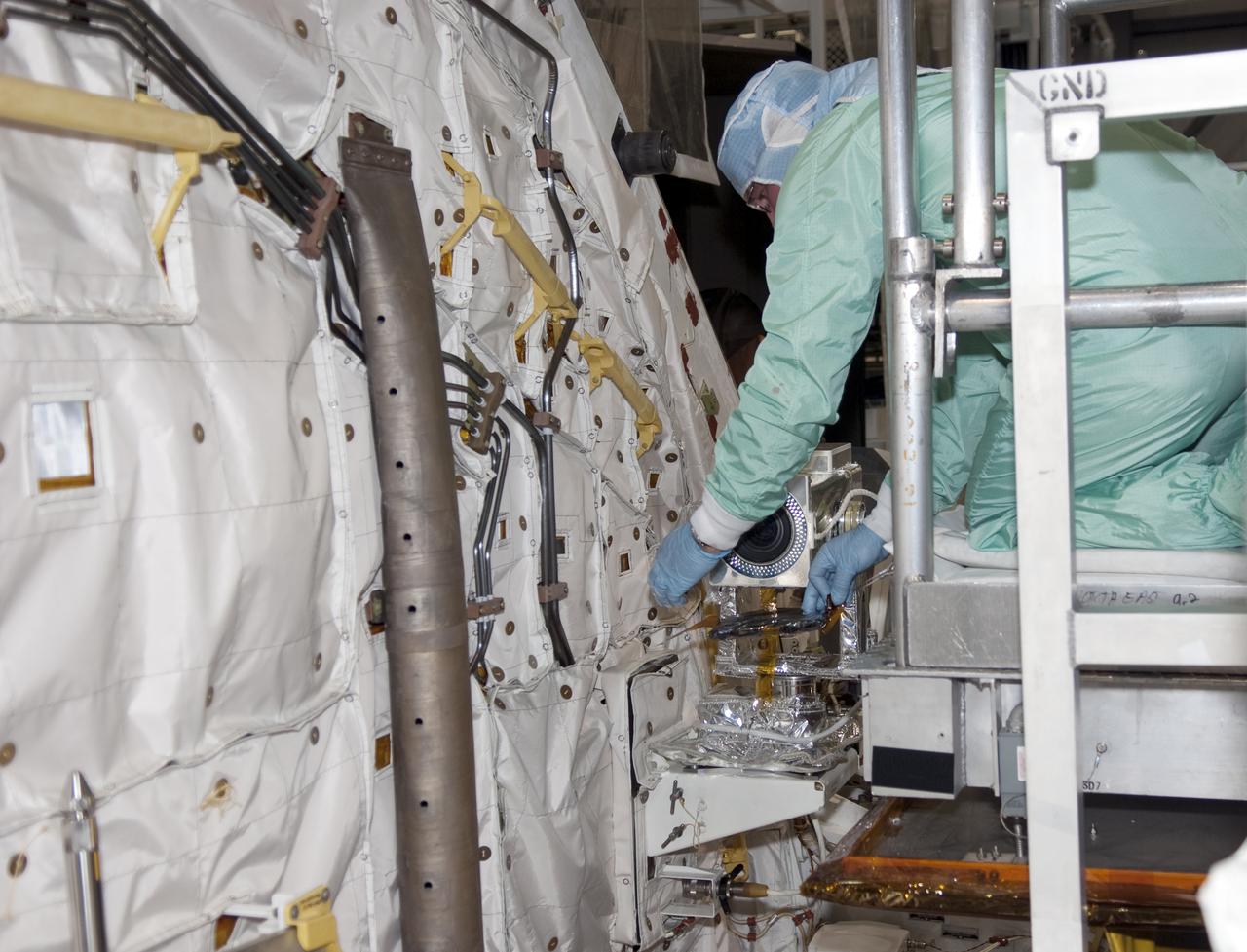
CAPE CANAVERAL, Fla. - Inside Orbiter Processing Facility-1 at Kennedy Space Center in Florida, a technician dressed in a clean room suit, installs a camera in the forward mid-body of shuttle Atlantis. Atlantis is being processed for the STS-132 mission targeted for launch May 14. The six-member crew will deliver an Integrated Cargo Carrier and a Russian-built Mini Research Module to the International Space Station. Photo credit: NASA_Jim Grossmann
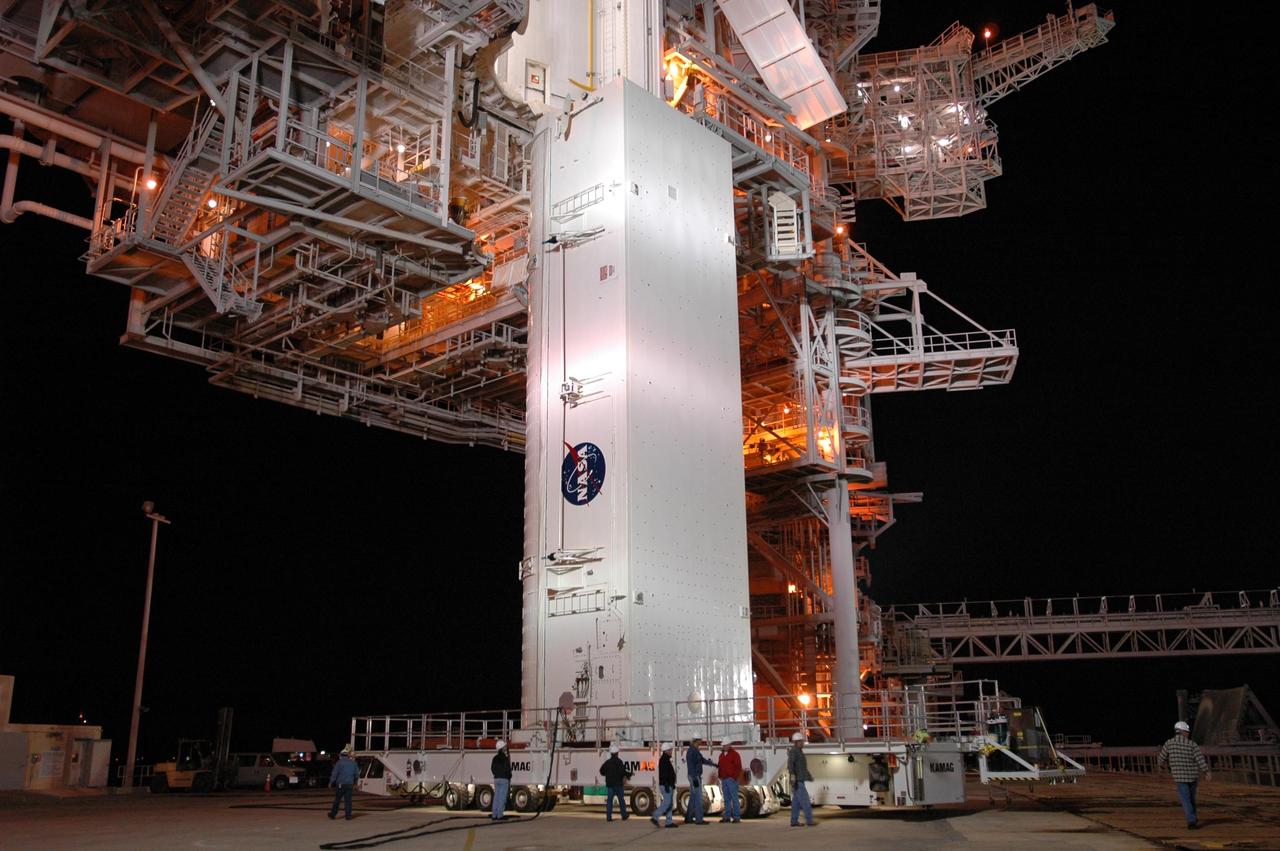
KENNEDY SPACE CENTER, FLA. -- On Launch Pad 39A at NASA's Kennedy Space Center, the payload canister is positioned under the payload changeout room, on the rotating service structure. The canister contains the Columbus Lab module and integrated cargo carrier-lite payloads for space shuttle Atlantis on mission STS-122. They will be transferred into the payload changeout room on the pad. Atlantis is targeted to launch on Dec. 6. Photo credit: NASA/Dimitri Gerondidakis

CAPE CANAVERAL, Fla. – In the Space Station Processing Facility at NASA's Kennedy Space Center in Florida, an overhead crane lifts the Integrated Cargo Carrier-VLD (Vertical Light Deployment), part of the payload for the STS-127 mission. The ICC-VLD is being transferred to the payload canister, seen at left. The canister will deliver the ICC-VLD and other elements to Launch Pad 39A for installation in space shuttle Endeavour's payload bay. Launch is targeted for June 13. Photo credit: NASA/Troy Cryder
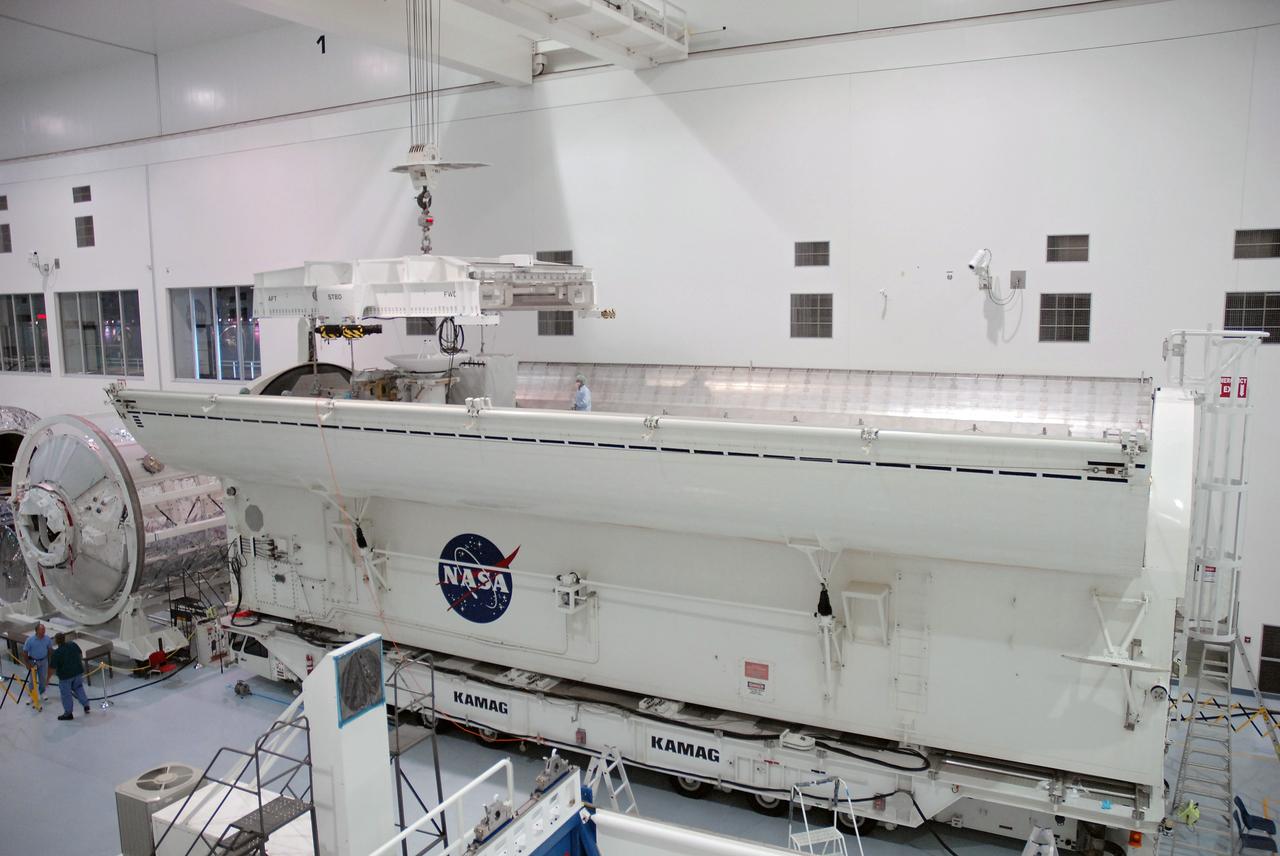
CAPE CANAVERAL, Fla. – – -- In the Space Station Processing Facility at NASA's Kennedy Space Center in Florida, an overhead crane lowers the Integrated Cargo Carrier-VLD (Vertical Light Deployment), part of the payload for the STS-127 mission, into the payload canister. The canister will deliver the ICC-VLD and other elements to Launch Pad 39A for installation in space shuttle Endeavour's payload bay. Launch is targeted for June 13. Photo credit: NASA/Troy Cryder
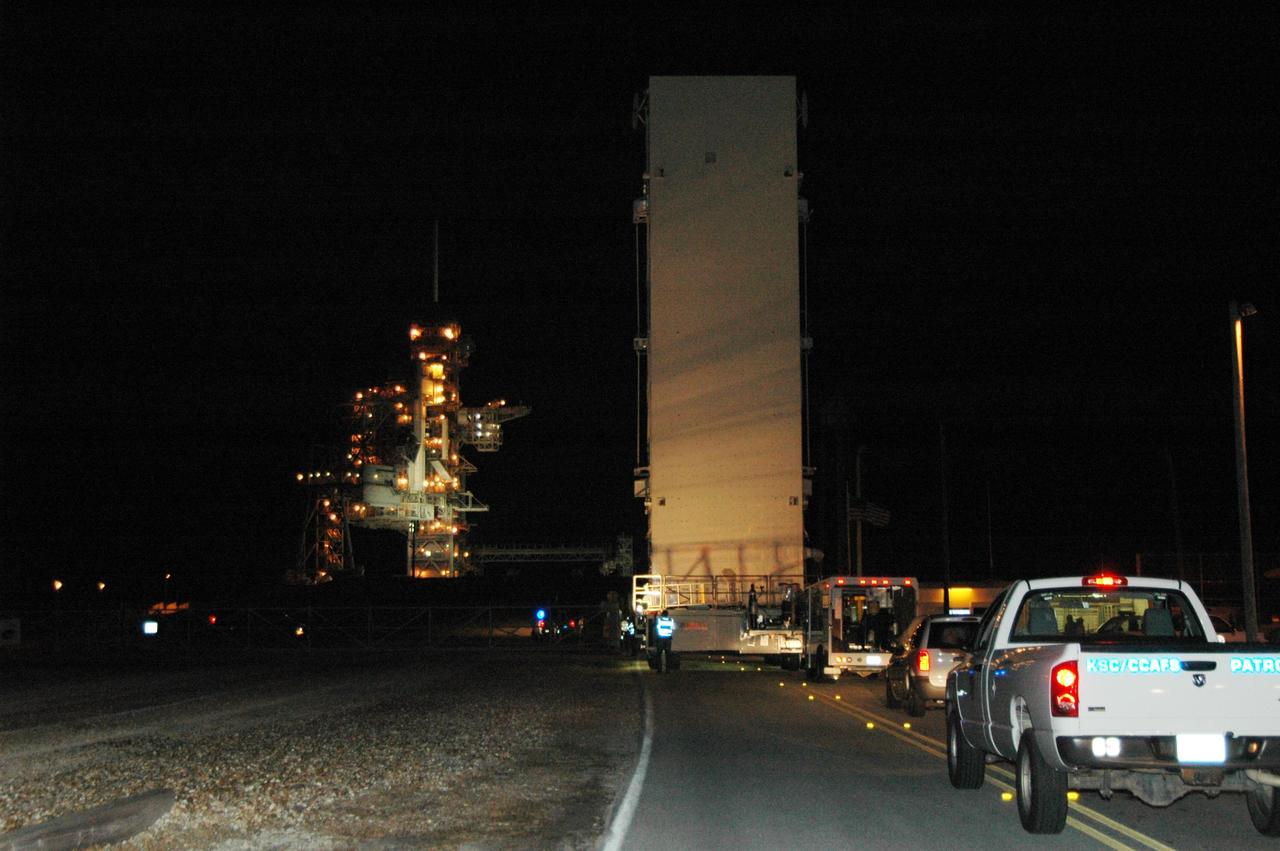
KENNEDY SPACE CENTER, FLA. -- At NASA's Kennedy Space Center, the payload canister atop its transporter rolls, under escort, toward Launch Pad 39A, seen at left.The canister contains the Columbus Lab module and integrated cargo carrier-lite payloads for space shuttle Atlantis on mission STS-122. They will be transferred into the payload changeout room on the pad. Atlantis is targeted to launch on Dec. 6. Photo credit: NASA/Dimitri Gerondidakis
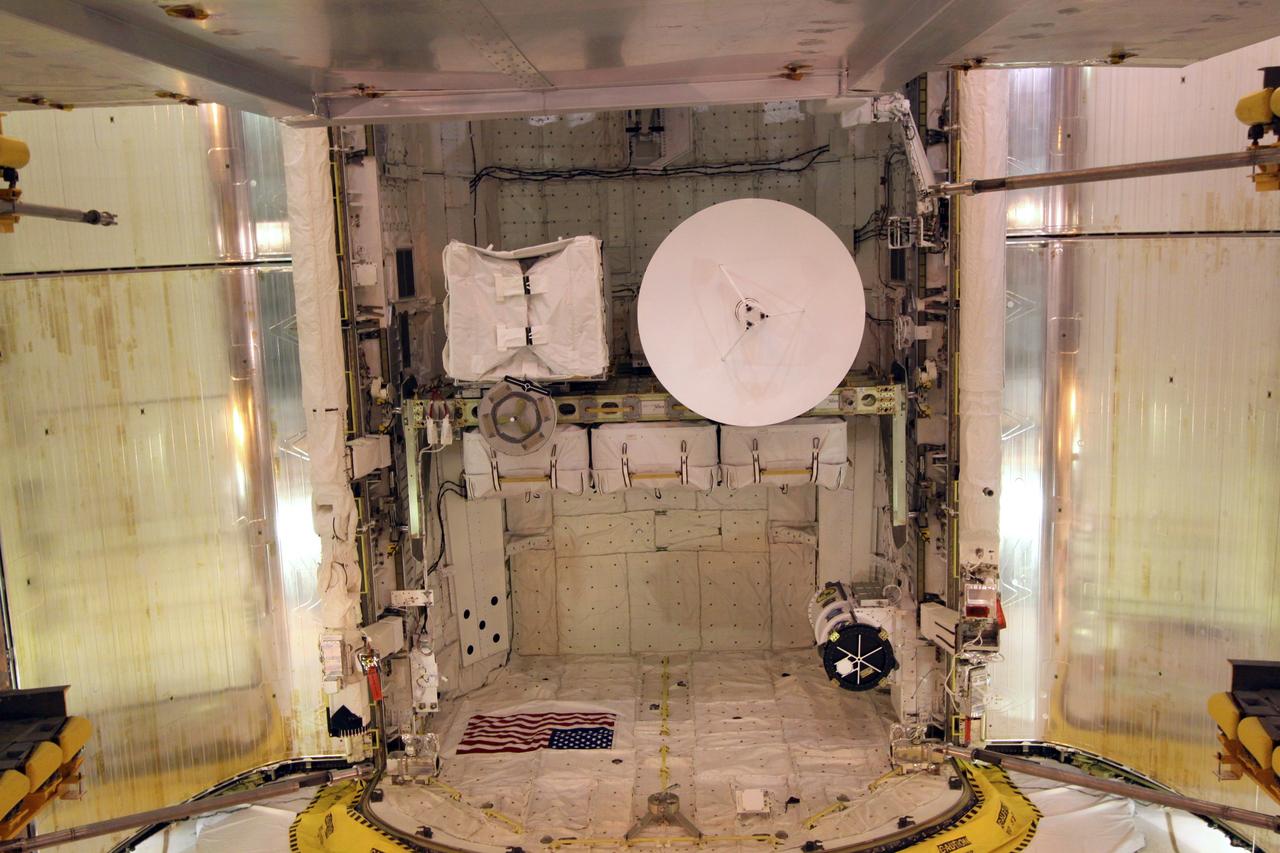
CAPE CANAVERAL, Fla. – On Launch Pad 39A at NASA's Kennedy Space Center in Florida, space shuttle Endeavour's payload bay doors are closing. Seen here on the left is the Integrated Cargo Carrier-Vertical Light Deploy (with the Space-to-Ground Antenna showing). The STS-127 mission is the final of three flights dedicated to the assembly of the Japanese Kibo laboratory complex on the International Space Station. Photo credit: NASA/Jack Pfaller
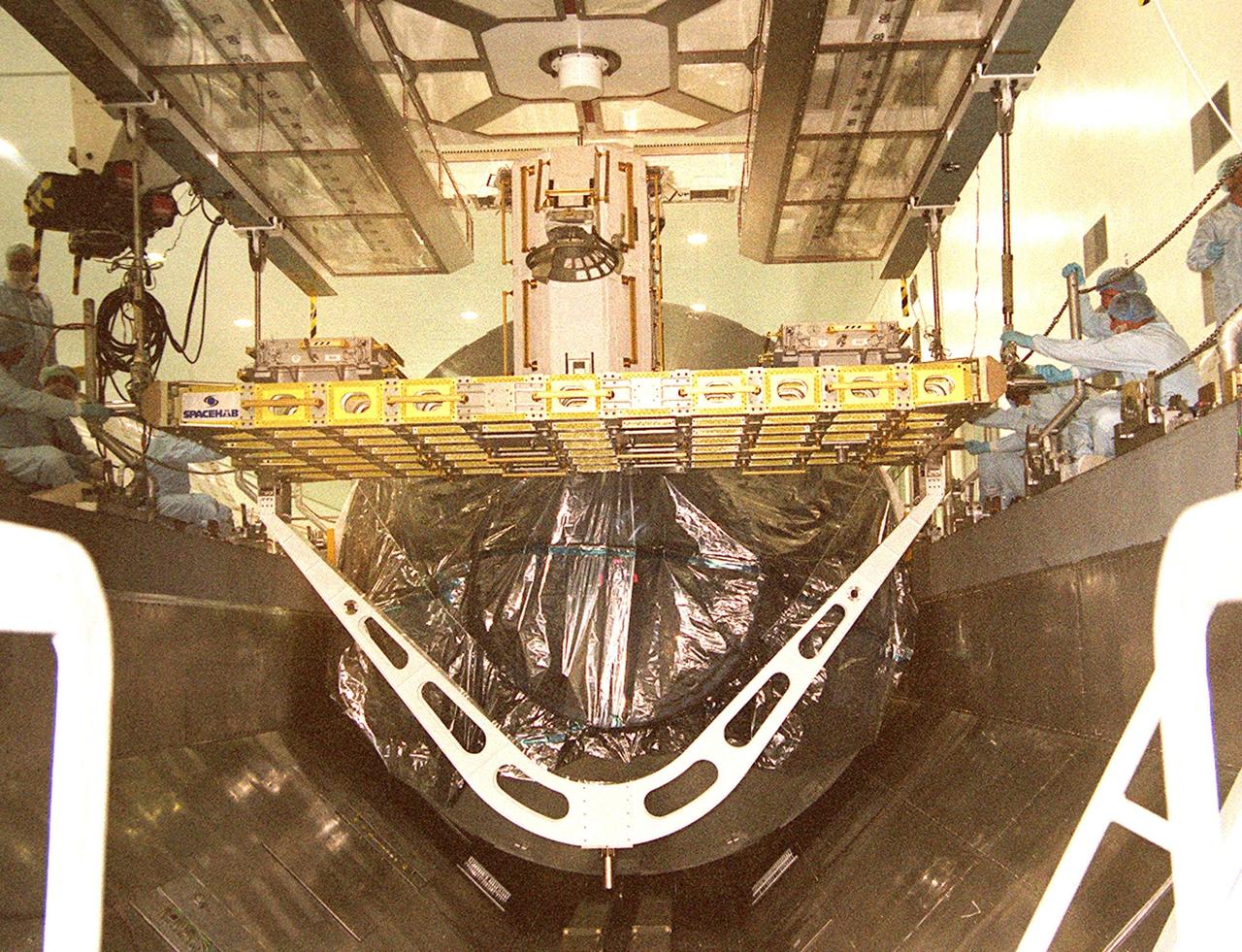
KENNEDY SPACE CENTER, Fla. -- The Integrated Cargo Carrier is lowered into the payload canister in front of the Multi-Purpose Logistics Module Leonardo. The ICC holds several payloads for mission STS-105, the Early Ammonia Servicer and two experiment containers. The canister will transport the MPLM and ICC transport to Launch Pad 39A where they will be placed in the payload bay of Space Shuttle Discovery. Launch of STS-105 is scheduled for 5:38 p.m. EDT Aug. 9
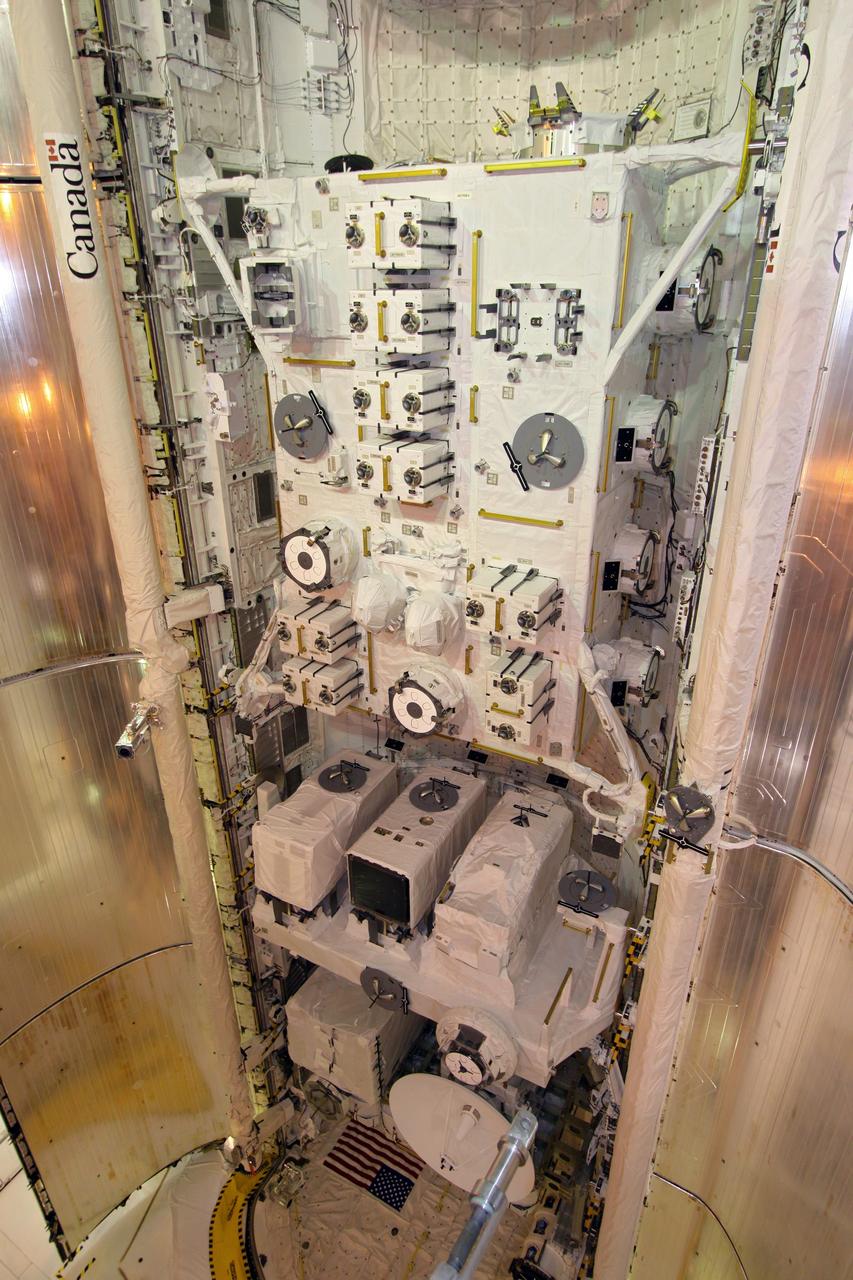
CAPE CANAVERAL, Fla. – On Launch Pad 39A at NASA's Kennedy Space Center in Florida, space shuttle Endeavour's payload bay doors are closing. At the bottom of the payload bay is the Integrated Cargo Carrier-Vertical Light Deploy (with the Space-to-Ground Antenna showing). In the middle is the Experiment Logistics Module-Exposed Section. At top is the Japanese Experiment Module's Exposed Facility. The STS-127 mission is the final of three flights dedicated to the assembly of the Japanese Kibo laboratory complex on the International Space Station. Photo credit: NASA/Jack Pfaller