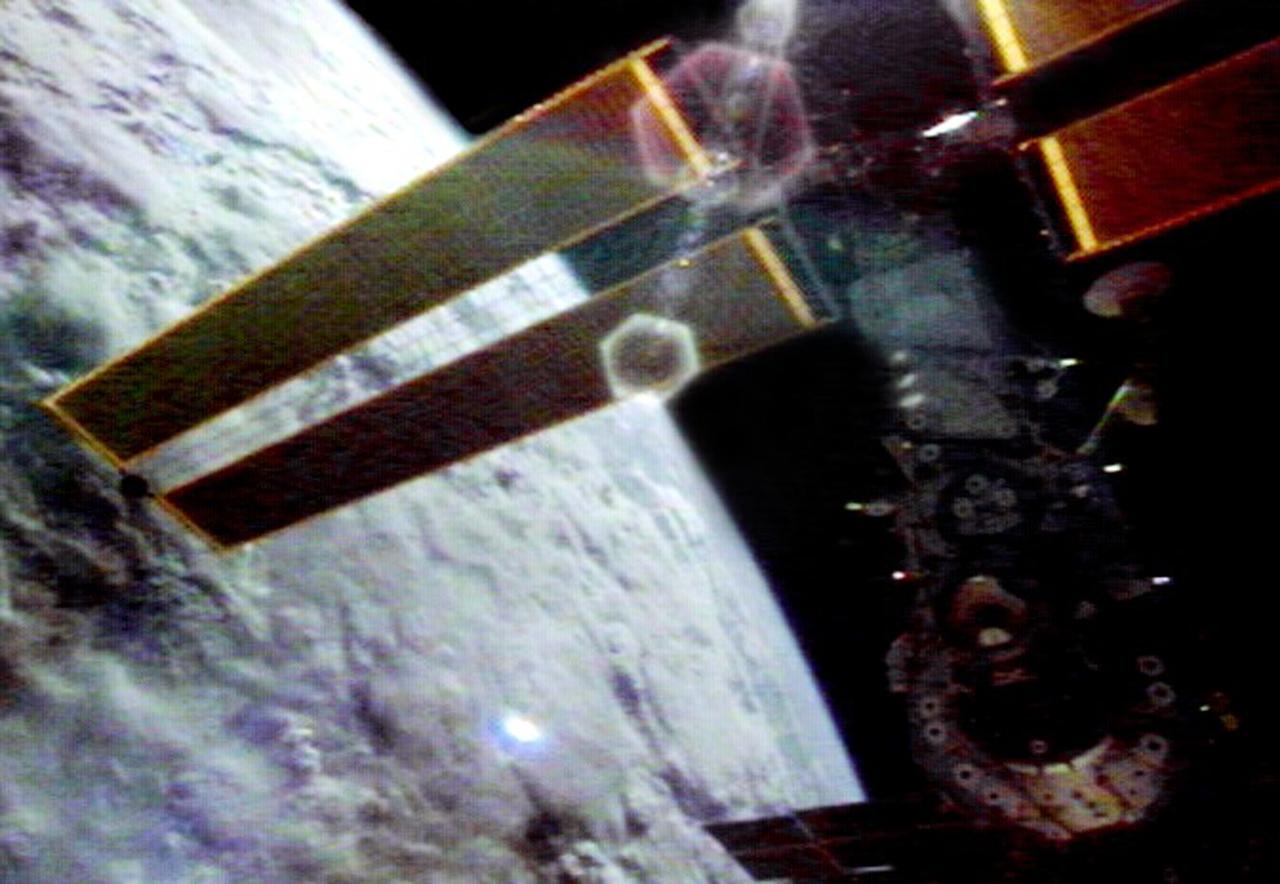
This video still depicts the recently deployed starboard and port solar arrays towering over the International Space Station (ISS). The video was recorded on STS-97's 65th orbit. Delivery, assembly, and activation of the solar arrays was the main mission objective of STS-97. The electrical power system, which is built into a 73-meter (240-foot) long solar array structure consists of solar arrays, radiators, batteries, and electronics, and will provide the power necessary for the first ISS crews to live and work in the U.S. segment. The entire 15.4-metric ton (17-ton) package is called the P6 Integrated Truss Segment, and is the heaviest and largest element yet delivered to the station aboard a space shuttle. The STS-97 crew of five launched aboard the Space Shuttle Orbiter Endeavor on November 30, 2000 for an 11 day mission.
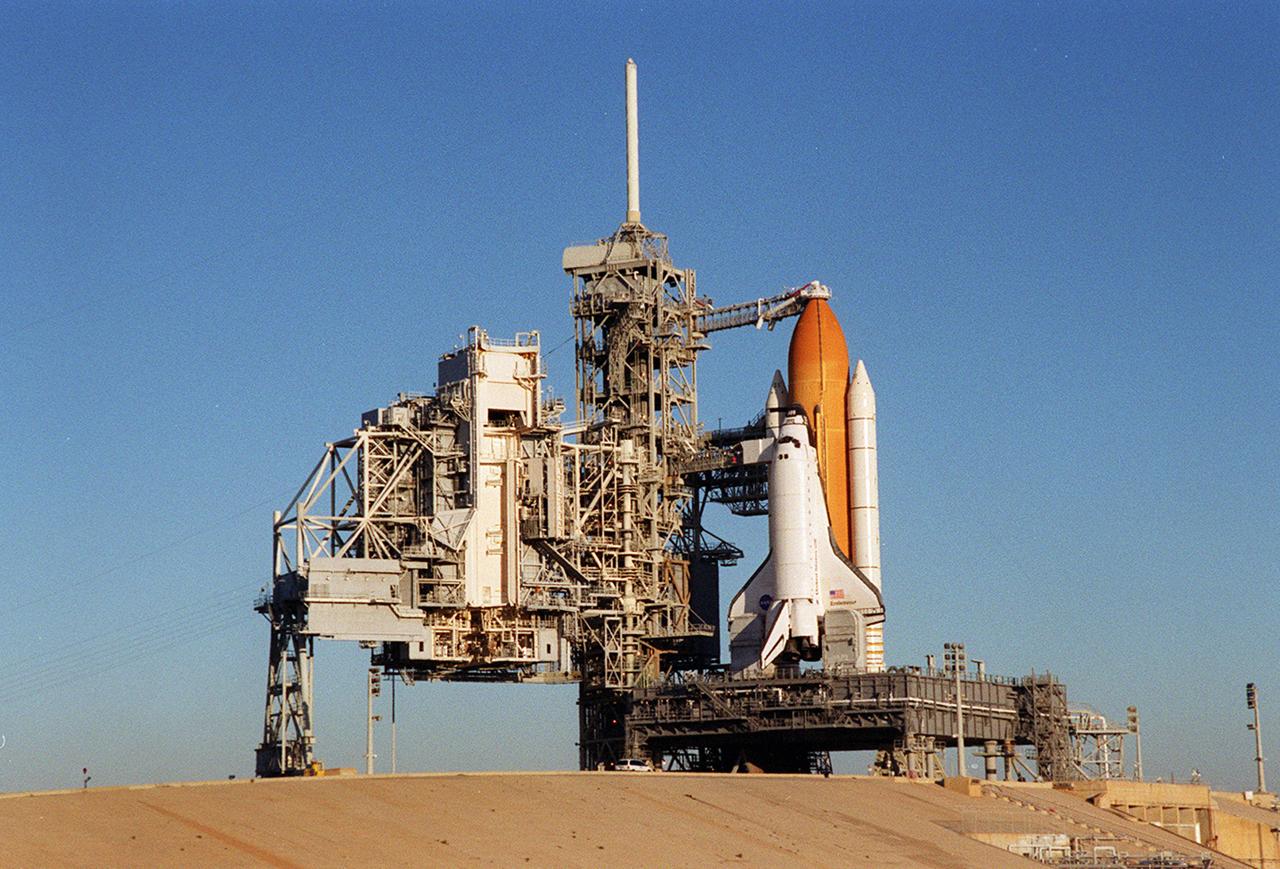
Back dropped by a cloudless blue sky, Space Shuttle Endeavor stands ready for launch after the rollback of the Rotating Service Structure, at left. The orbiter launched that night carrying the STS-97 crew of five. The STS-97 mission's primary objective was the delivery, assembly, and activation of the U.S. electrical power system onboard the International Space Station (ISS). The electrical power system, which is built into a 73-meter (240-foot) long solar array structure, consists of solar arrays, radiators, batteries, and electronics. The entire 15.4-metric ton (17-ton) package is called the P6 Integrated Truss Segment, and is the heaviest and largest element yet delivered to the station aboard a space shuttle. The electric system will eventually provide the power necessary for the first ISS crews to live and work in the U.S. segment.
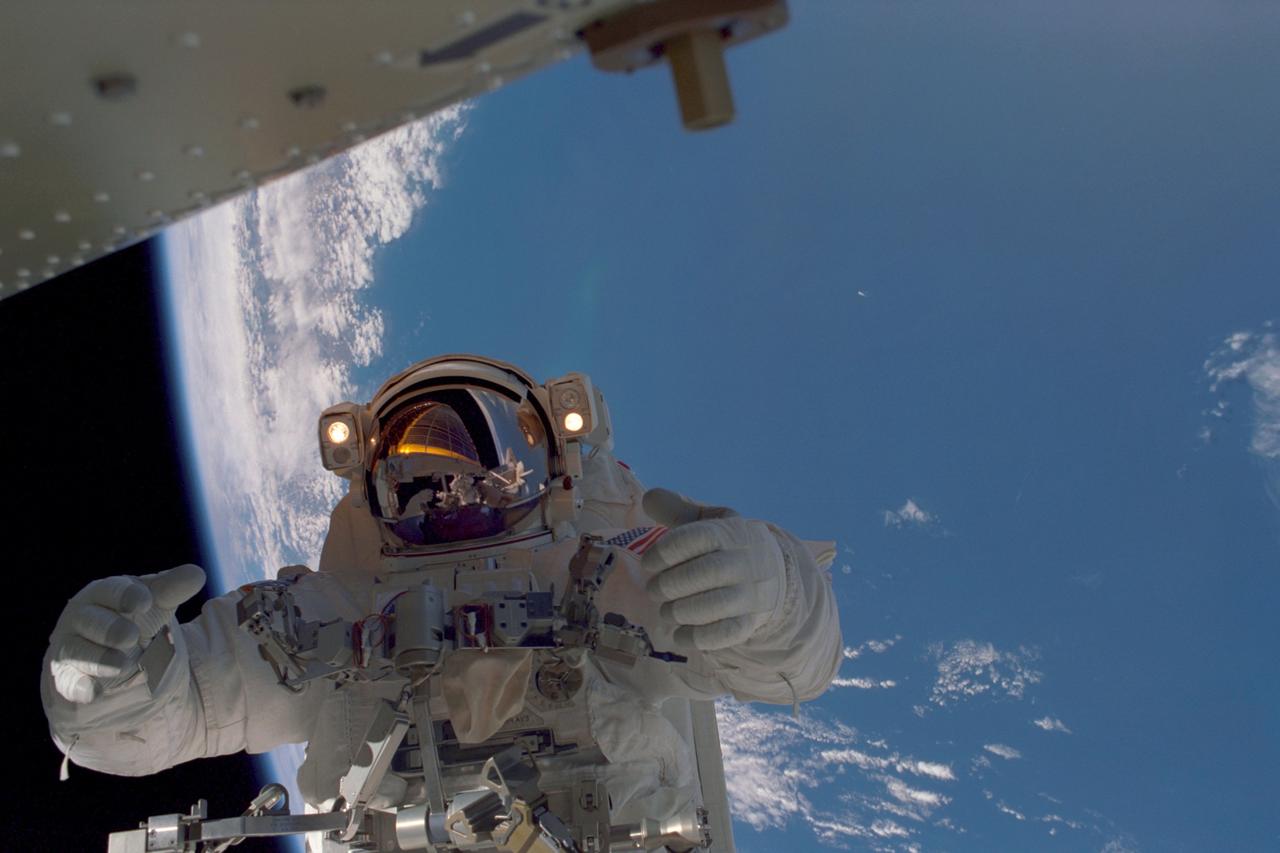
In this image, planet Earth, some 235 statute miles away, forms the back drop for this photo of STS-97 astronaut and mission specialist Joseph R. Tanner, taken during the third of three space walks. The mission's goal was to perform the delivery, assembly, and activation of the U.S. electrical power system onboard the International Space Station (ISS). The electrical power system, which is built into a 73-meter (240-foot) long solar array structure consists of solar arrays, radiators, batteries, and electronics. The entire 15.4-metric ton (17-ton) package is called the P6 Integrated Truss Segment, and is the heaviest and largest element yet delivered to the station aboard a space shuttle. The electrical system will eventually provide the power necessary for the first ISS crews to live and work in the U.S. segment. The STS-97 crew of five launched aboard the Space Shuttle Orbiter Endeavor on November 30, 2000 for an 11 day mission.
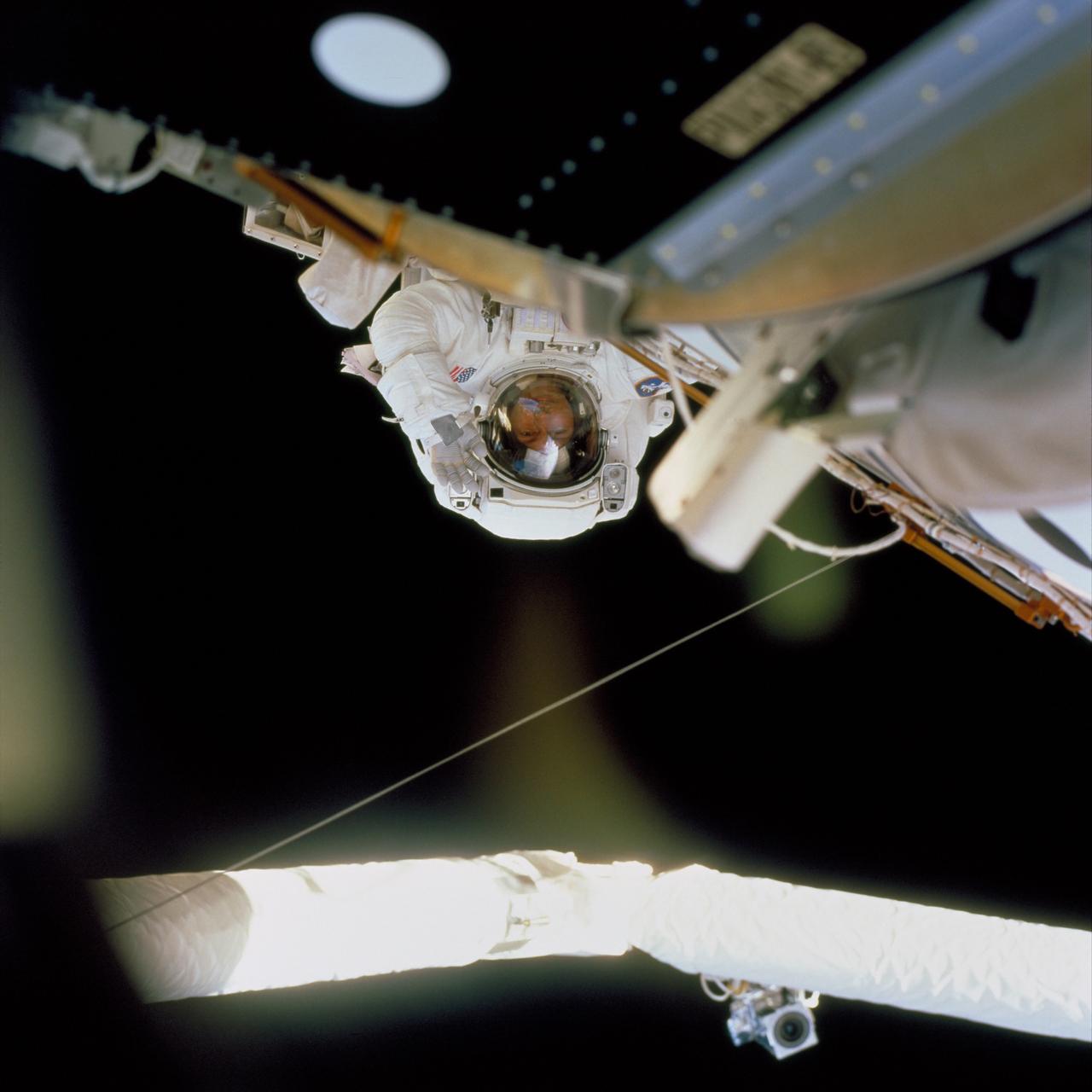
In this image, STS-97 astronaut and mission specialist Carlos I. Noriega waves at a crew member inside Endeavor's cabin during the mission's final session of Extravehicular Activity (EVA). Launched aboard the Space Shuttle Orbiter Endeavor on November 30, 2000, the STS-97 mission's primary objective was the delivery, assembly, and activation of the U.S. electrical power system onboard the International Space Station (ISS). The electrical power system, which is built into a 73-meter (240-foot) long solar array structure consists of solar arrays, radiators, batteries, and electronics. The entire 15.4-metric ton (17-ton) package is called the P6 Integrated Truss Segment, and is the heaviest and largest element yet delivered to the station aboard a space shuttle. The electrical system will eventually provide the power necessary for the first ISS crews to live and work in the U.S. segment.
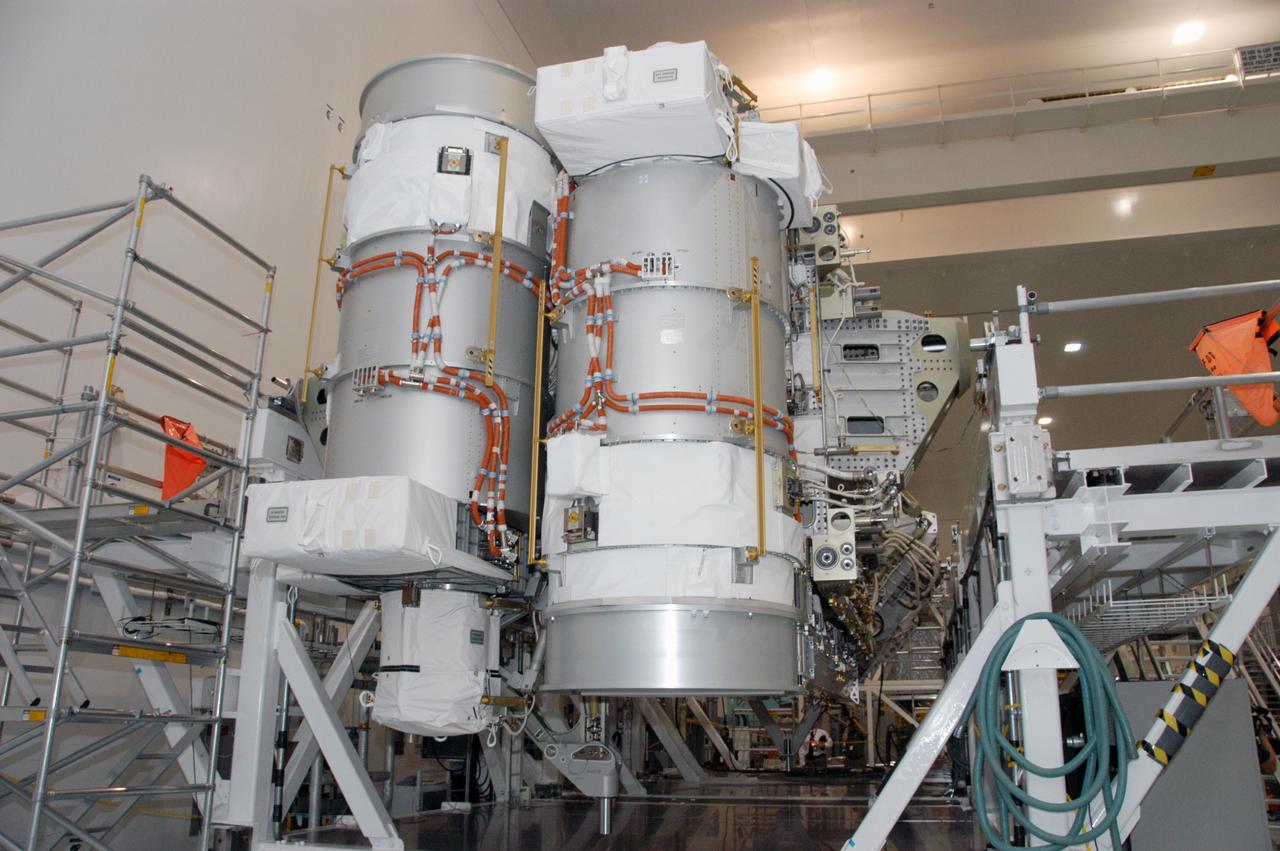
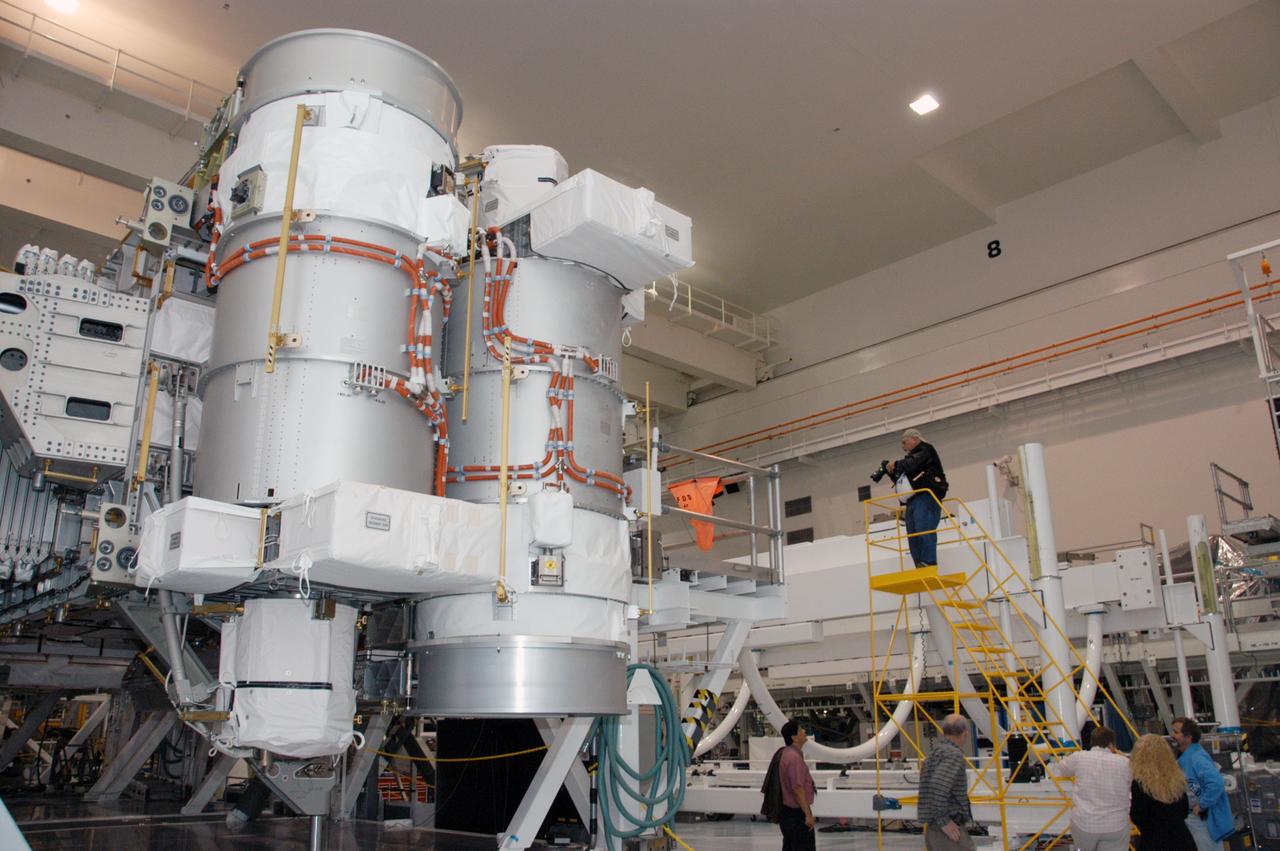
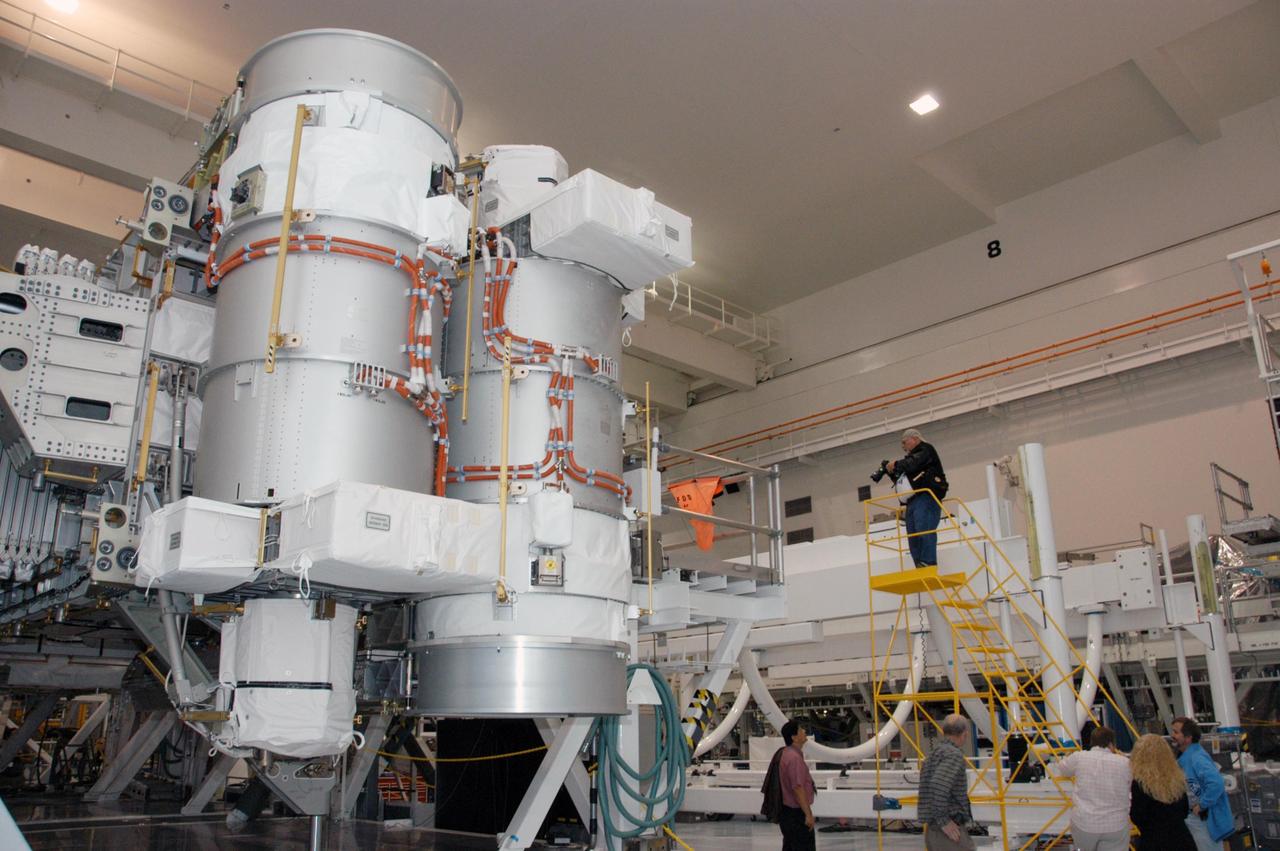
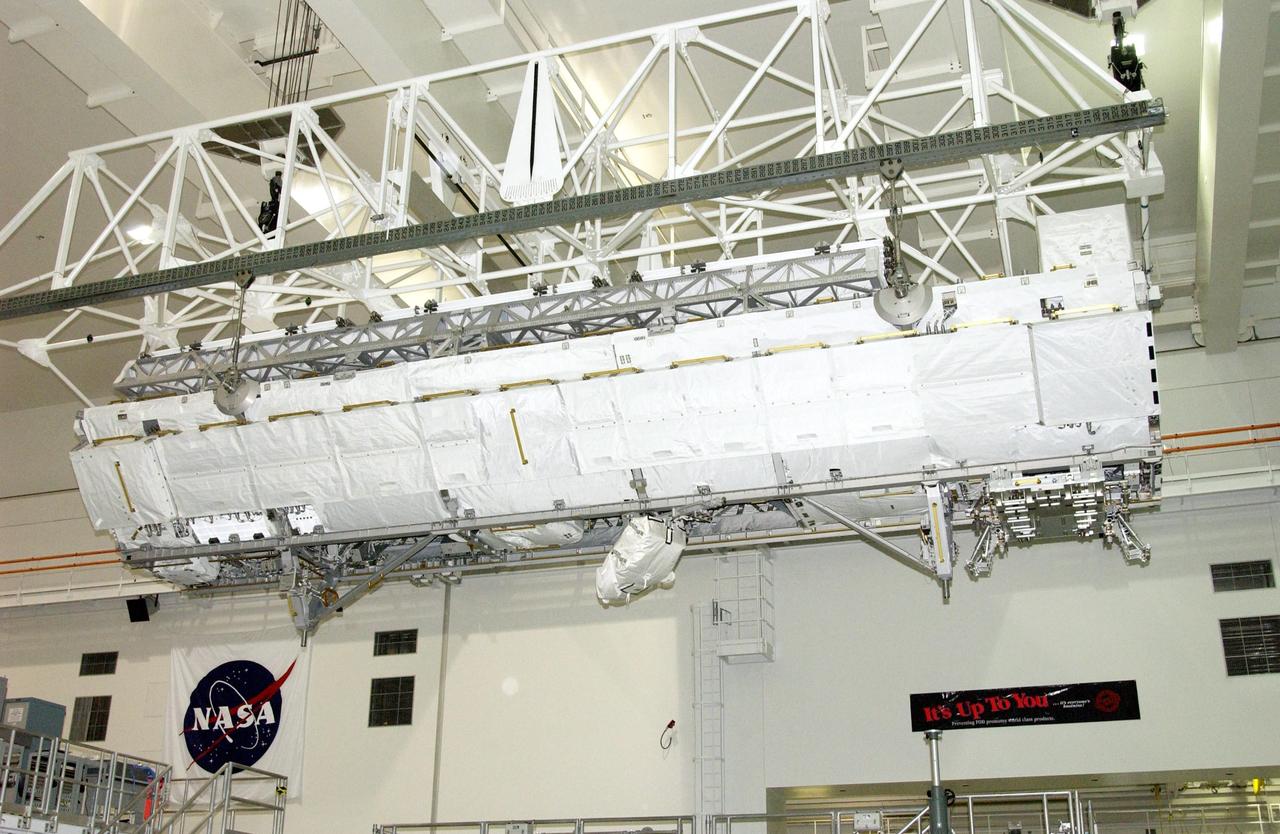
In the Space Station Processing Facility, the S3/S4 integrated truss segment is on display for the media. The starboard 3/4 truss segment will launch aboard Space Shuttle Atlantis on mission STS-117, targeted for March 15. The element will be added to the 11-segment integrated truss structure, the station's backbone. The integrated truss structure eventually will span more than 300 feet. The S3/S4 truss has two large solar arrays and will provide one-fourth of the total power generation for the completed station.

ISS022-E-066322 (15 Feb. 2010) --- Backdropped by Earth?s horizon and the blackness of space, a portion of the International Space Station is featured in this image photographed by a crew member on the ISS while space shuttle Endeavour (STS-130) remains docked with the station.
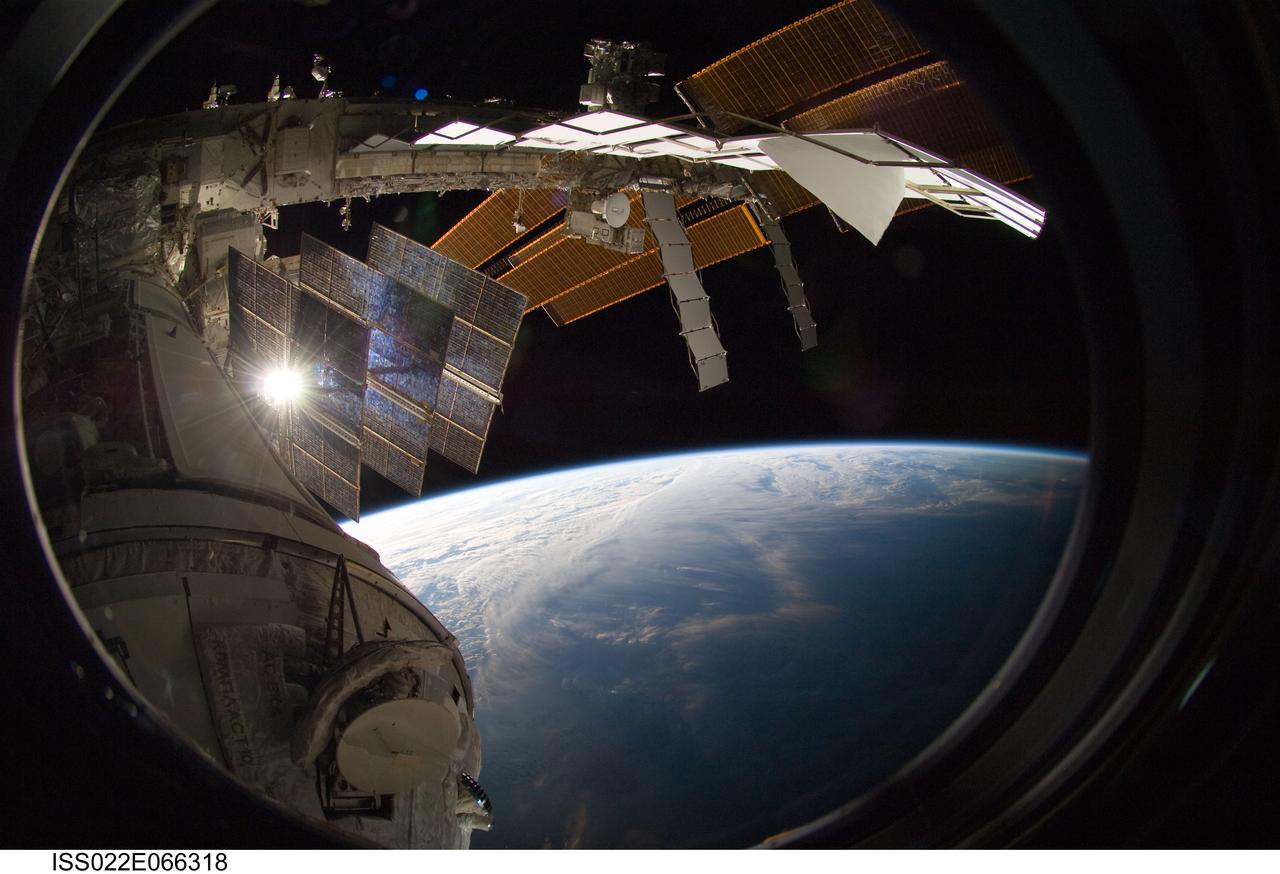
ISS022-E-066318 (15 Feb. 2010) --- Backdropped by Earth?s horizon and the blackness of space, a portion of the International Space Station is featured in this image photographed by a crew member on the ISS while space shuttle Endeavour (STS-130) remains docked with the station.
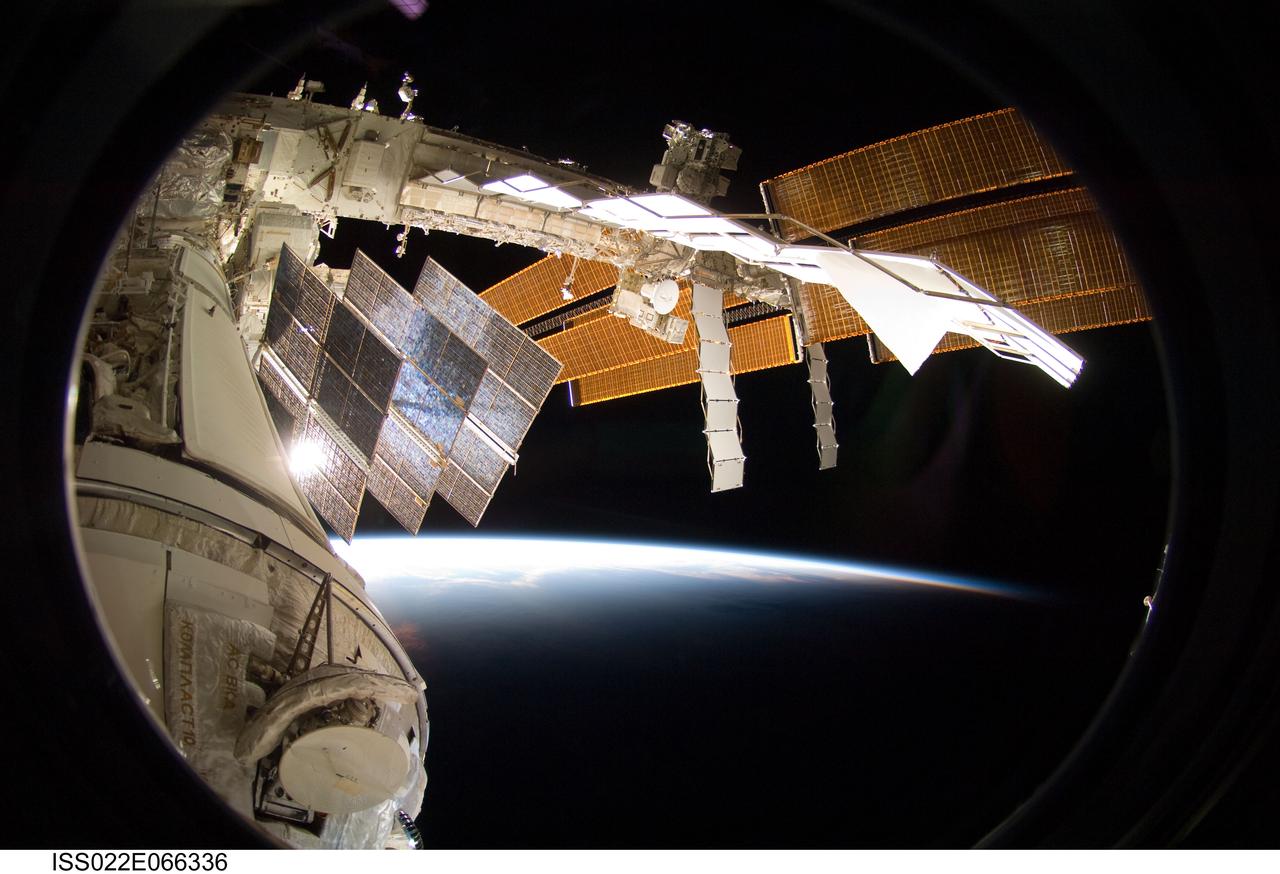
ISS022-E-066336 (15 Feb. 2010) --- Backdropped by Earth?s horizon and the blackness of space, a portion of the International Space Station is featured in this image photographed by a crew member on the ISS while space shuttle Endeavour (STS-130) remains docked with the station.
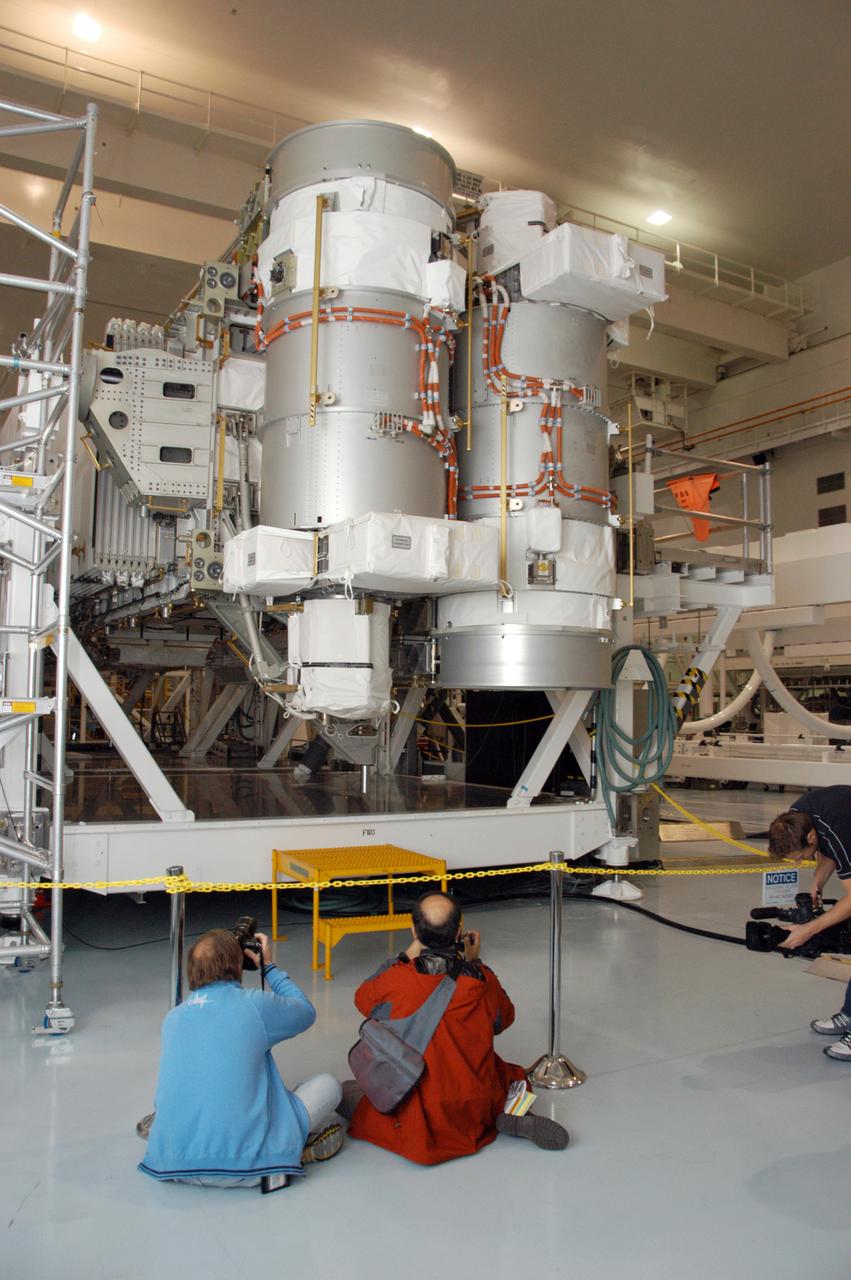
In the Space Station Processing Facility, photographers take advantage of a media showcase to get photos of the S3/S4 integrated truss segment. The starboard 3/4 truss segment will launch aboard Space Shuttle Atlantis on mission STS-117, targeted for March 15. The element will be added to the 11-segment integrated truss structure, the station's backbone. The integrated truss structure eventually will span more than 300 feet. The S3/S4 truss has two large solar arrays and will provide one-fourth of the total power generation for the completed station.
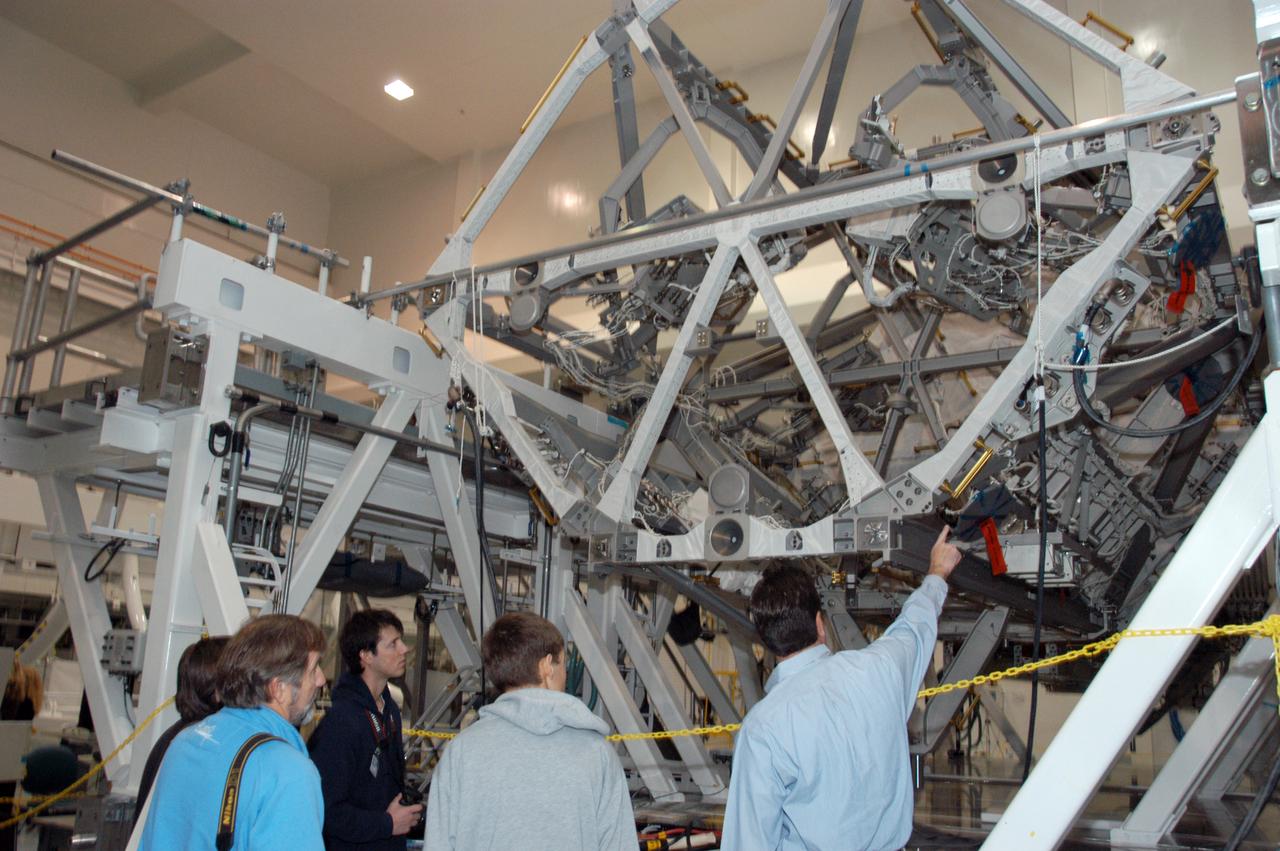
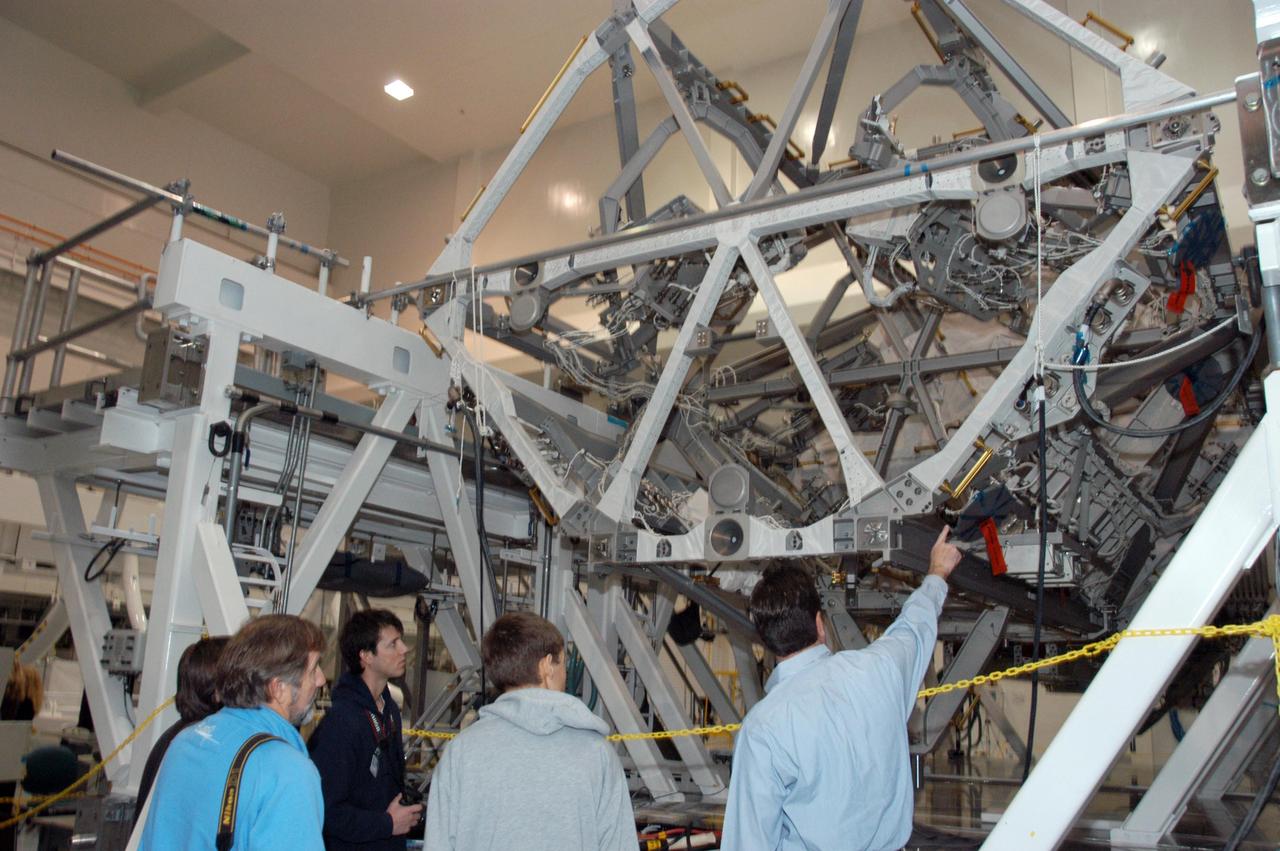
At a media showcase in the Space Station Processing Facility, reporters and photographers get a close look at the S3/S4 integrated truss segment. The starboard 3/4 truss segment will launch aboard Space Shuttle Atlantis on mission STS-117, targeted for March 15. The element will be added to the 11-segment integrated truss structure, the station's backbone. The integrated truss structure eventually will span more than 300 feet. The S3/S4 truss has two large solar arrays and will provide one-fourth of the total power generation for the completed station.
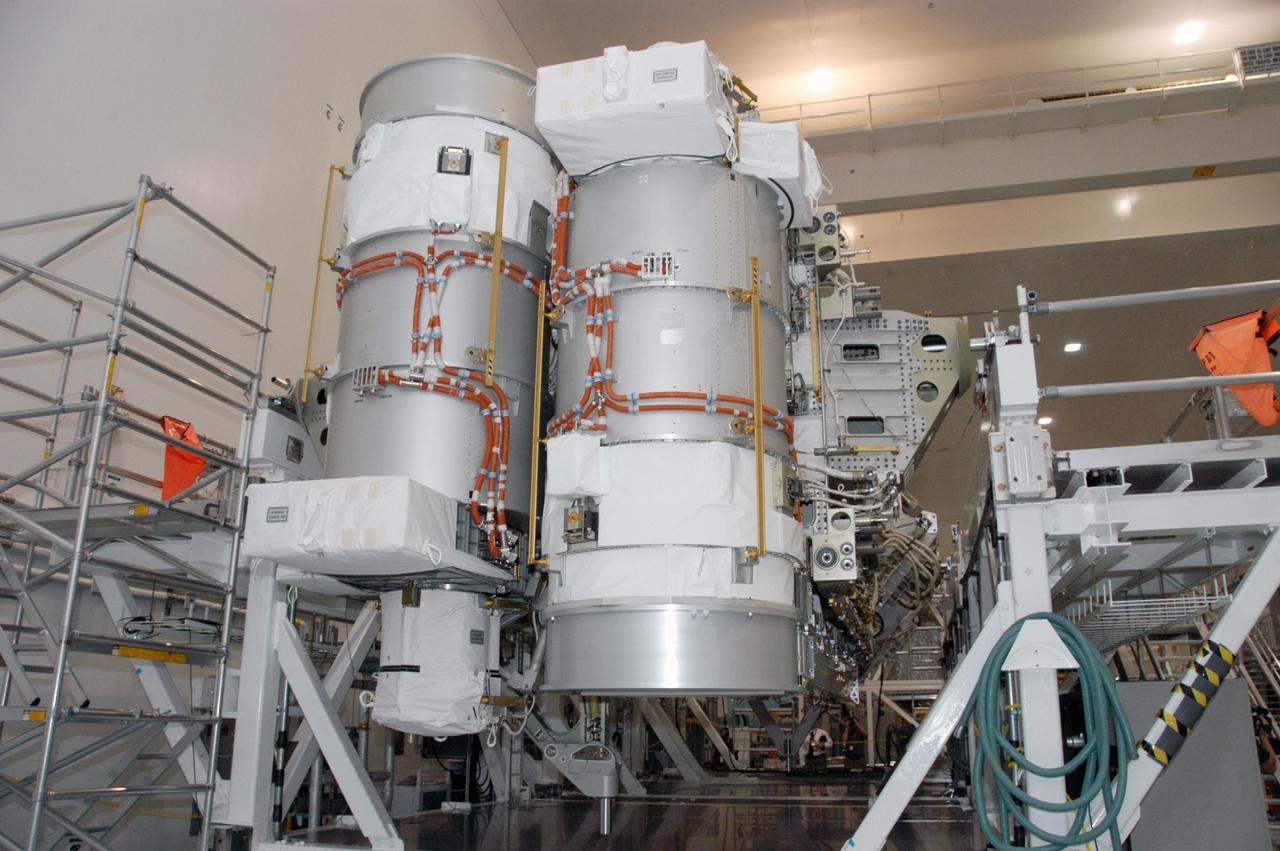
At a media showcase in the Space Station Processing Facility, reporters and photographers get a close look at the S3/S4 integrated truss segment. The starboard 3/4 truss segment will launch aboard Space Shuttle Atlantis on mission STS-117, targeted for March 15. The element will be added to the 11-segment integrated truss structure, the station's backbone. The integrated truss structure eventually will span more than 300 feet. The S3/S4 truss has two large solar arrays and will provide one-fourth of the total power generation for the completed station.
KENNEDY SPACE CENTER, FLA. -- In the Space Station Processing Facility, the S3/S4 integrated truss segment is on display for the media. The starboard 3/4 truss segment will launch aboard Space Shuttle Atlantis on mission STS-117, targeted for March 15. The element will be added to the 11-segment integrated truss structure, the station's backbone. The integrated truss structure eventually will span more than 300 feet. The S3/S4 truss has two large solar arrays and will provide one-fourth of the total power generation for the completed station. Photo credit: NASA/George Shelton
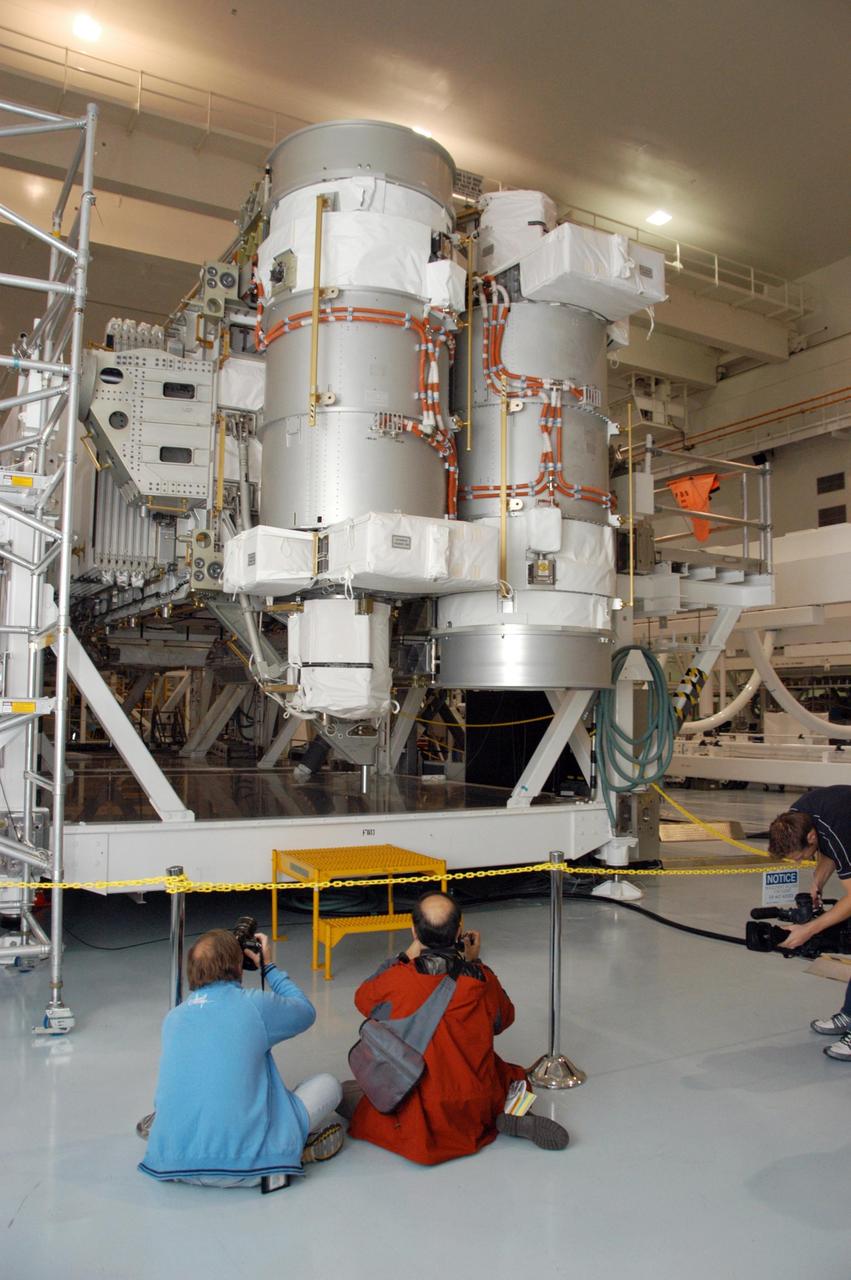
KENNEDY SPACE CENTER, FLA. -- In the Space Station Processing Facility, photographers take advantage of a media showcase to get photos of the S3/S4 integrated truss segment. The starboard 3/4 truss segment will launch aboard Space Shuttle Atlantis on mission STS-117, targeted for March 15. The element will be added to the 11-segment integrated truss structure, the station's backbone. The integrated truss structure eventually will span more than 300 feet. The S3/S4 truss has two large solar arrays and will provide one-fourth of the total power generation for the completed station. Photo credit: NASA/George Shelton
KENNEDY SPACE CENTER, FLA. -- At a media showcase in the Space Station Processing Facility, reporters and photographers get a close look at the S3/S4 integrated truss segment. The starboard 3/4 truss segment will launch aboard Space Shuttle Atlantis on mission STS-117, targeted for March 15. The element will be added to the 11-segment integrated truss structure, the station's backbone. The integrated truss structure eventually will span more than 300 feet. The S3/S4 truss has two large solar arrays and will provide one-fourth of the total power generation for the completed station. Photo credit: NASA/George Shelton
KENNEDY SPACE CENTER, FLA. -- At a media showcase in the Space Station Processing Facility, reporters and photographers get a close look at the S3/S4 integrated truss segment. The starboard 3/4 truss segment will launch aboard Space Shuttle Atlantis on mission STS-117, targeted for March 15. The element will be added to the 11-segment integrated truss structure, the station's backbone. The integrated truss structure eventually will span more than 300 feet. The S3/S4 truss has two large solar arrays and will provide one-fourth of the total power generation for the completed station. Photo credit: NASA/George Shelton
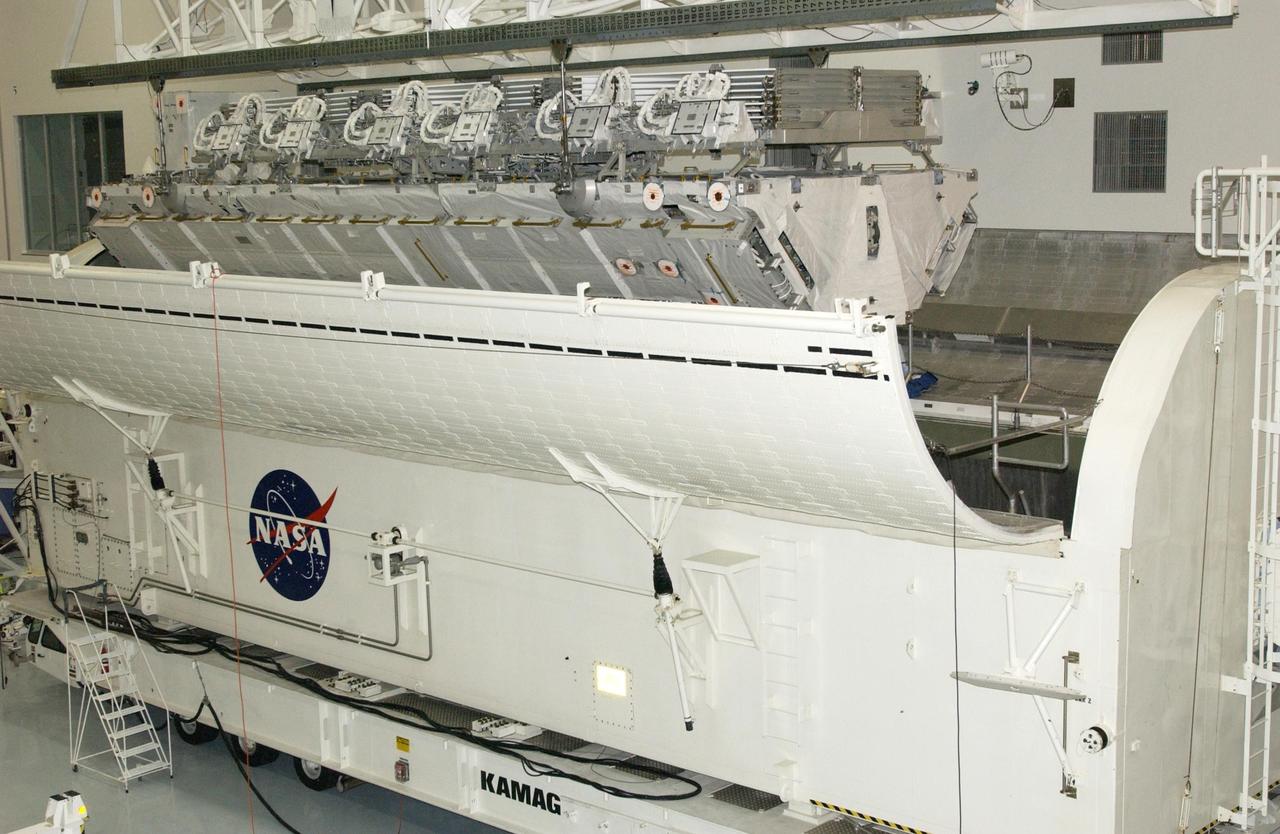
KENNEDY SPACE CENTER, FLA. -- The S1 Integrated Truss Structure is lowered into the payload canister for transport to Atlantis. The first starboard truss segment, the S1 will be attached to the Central truss segment, the S0 Truss, on the International Space Station during mission STS-112. Atlantis is scheduled to launch no earlier than Oct. 2.
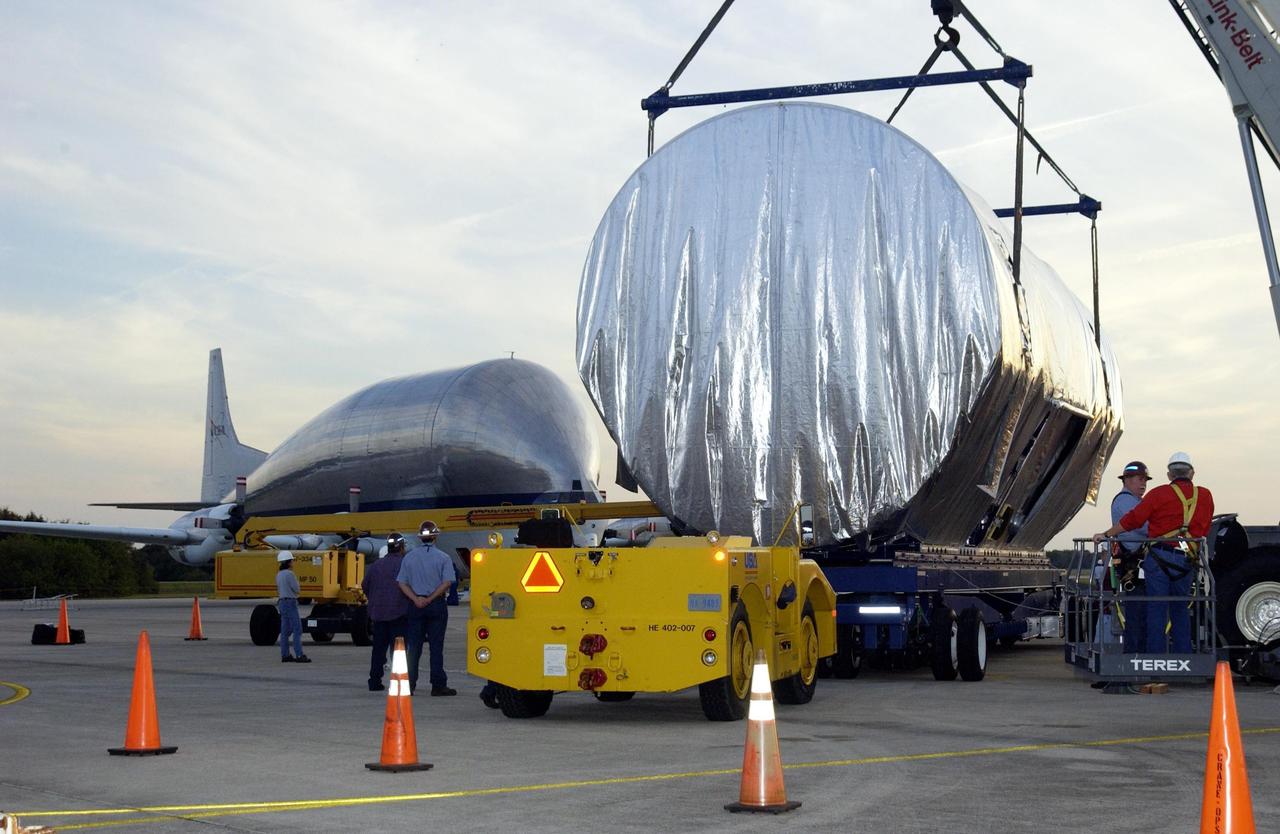
KENNEDY SPACE CENTER, FLA. -- The Integrated Equipment Assembly (IEA), one of two major components of the Starboard 6 (S6) truss segment for the International Space Station (ISS), is offloaded onto a cargo transporter following its arrival at the Shuttle Landing Facility. The IEA will be joined to its companion piece, the Long Spacer, before launch early in 2004. The S6 truss segment will be the 11th and final piece of the Station's Integrated Truss Structure and will support the fourth and final set of solar arrays, batteries, and electronics.
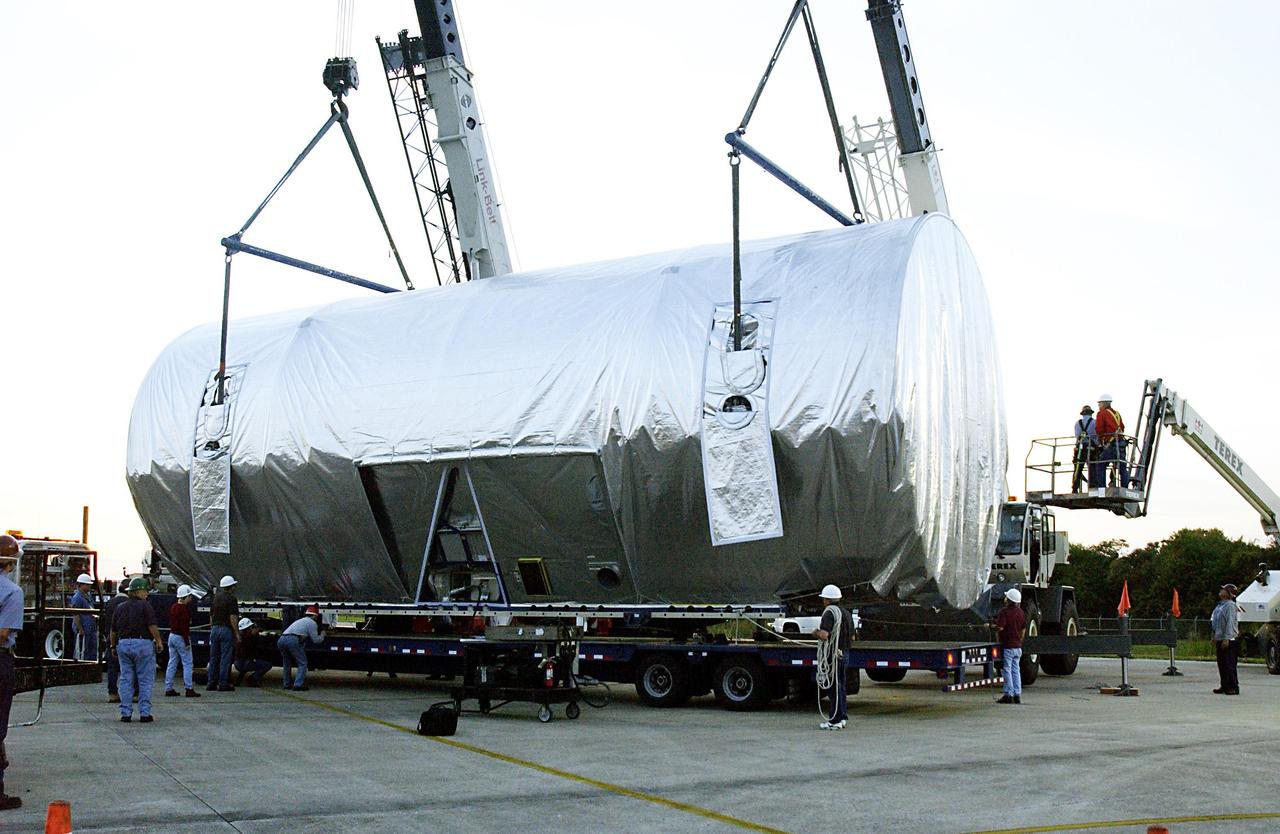
KENNEDY SPACE CENTER, FLA. -- KSC technicians supervise the transfer of the Integrated Equipment Assembly (IEA), one of two major components of the Starboard 6 (S6) truss segment for the International Space Station (ISS), onto a cargo transporter following its arrival at the Shuttle Landing Facility. The IEA will be joined to its companion piece, the Long Spacer, before launch early in 2004. The S6 truss segment will be the 11th and final piece of the Station's Integrated Truss Structure and will support the fourth and final set of solar arrays, batteries, and electronics.
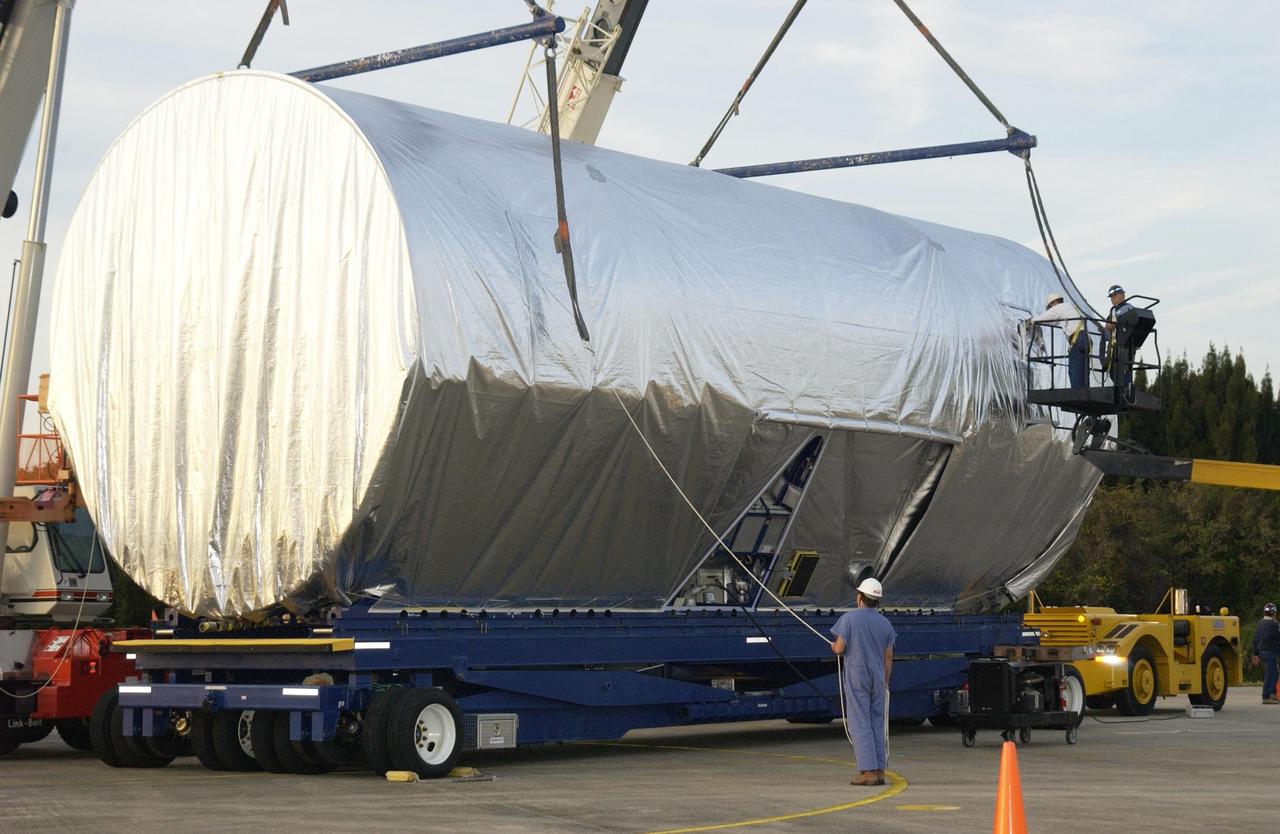
KENNEDY SPACE CENTER, FLA. -- The Integrated Equipment Assembly (IEA), one of two major components of the Starboard 6 (S6) truss segment for the International Space Station (ISS), is offloaded onto a cargo transporter following its arrival at the Shuttle Landing Facility. The IEA will be joined to its companion piece, the Long Spacer, before launch early in 2004. The S6 truss segment will be the 11th and final piece of the Station's Integrated Truss Structure and will support the fourth and final set of solar arrays, batteries, and electronics.
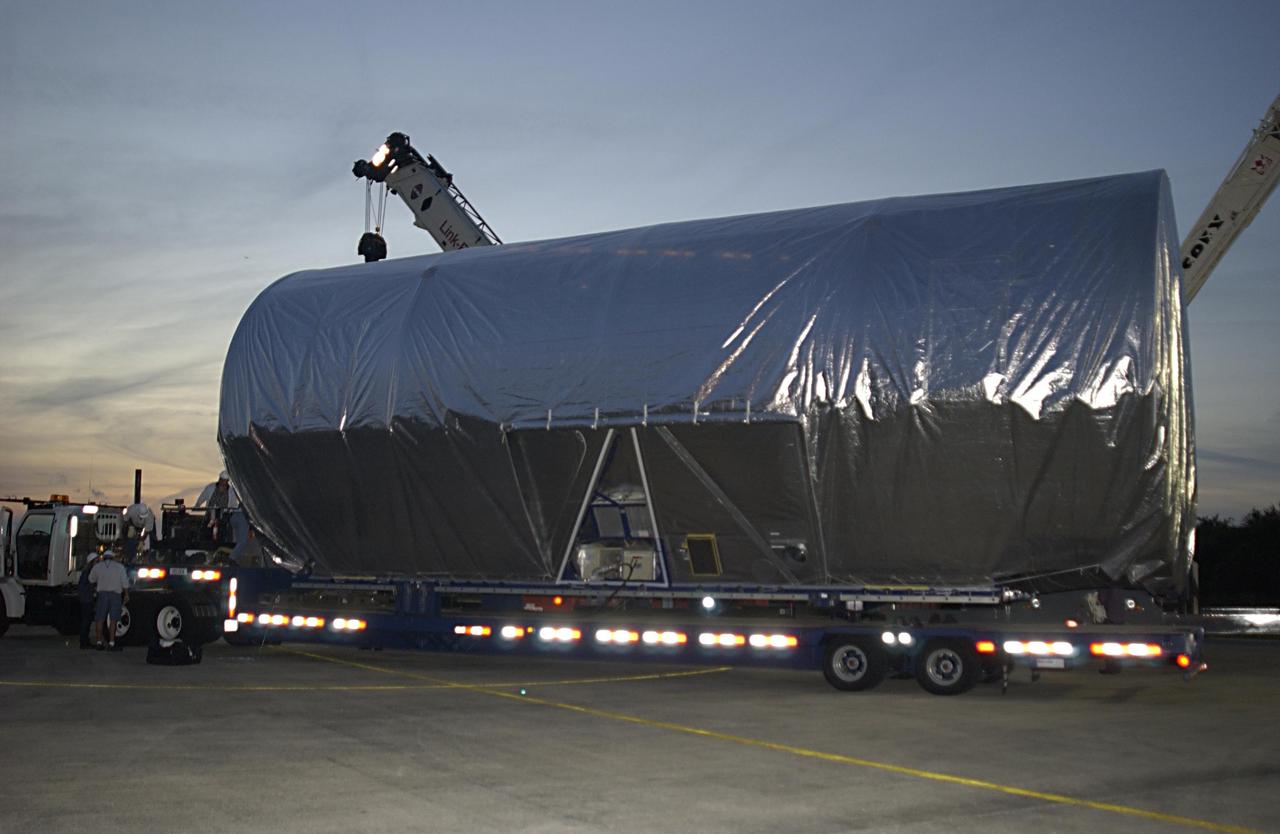
KENNEDY SPACE CENTER, FLA. -- The Integrated Equipment Assembly (IEA), one of two major components of the Starboard 6 (S6) truss segment for the International Space Station (ISS), sits on a cargo transporter following its arrival at the Shuttle Landing Facility. The IEA will be joined to its companion piece, the Long Spacer, before launch early in 2004. The S6 truss segment will be the 11th and final piece of the Station's Integrated Truss Structure and will support the fourth and final set of solar arrays, batteries, and electronics.
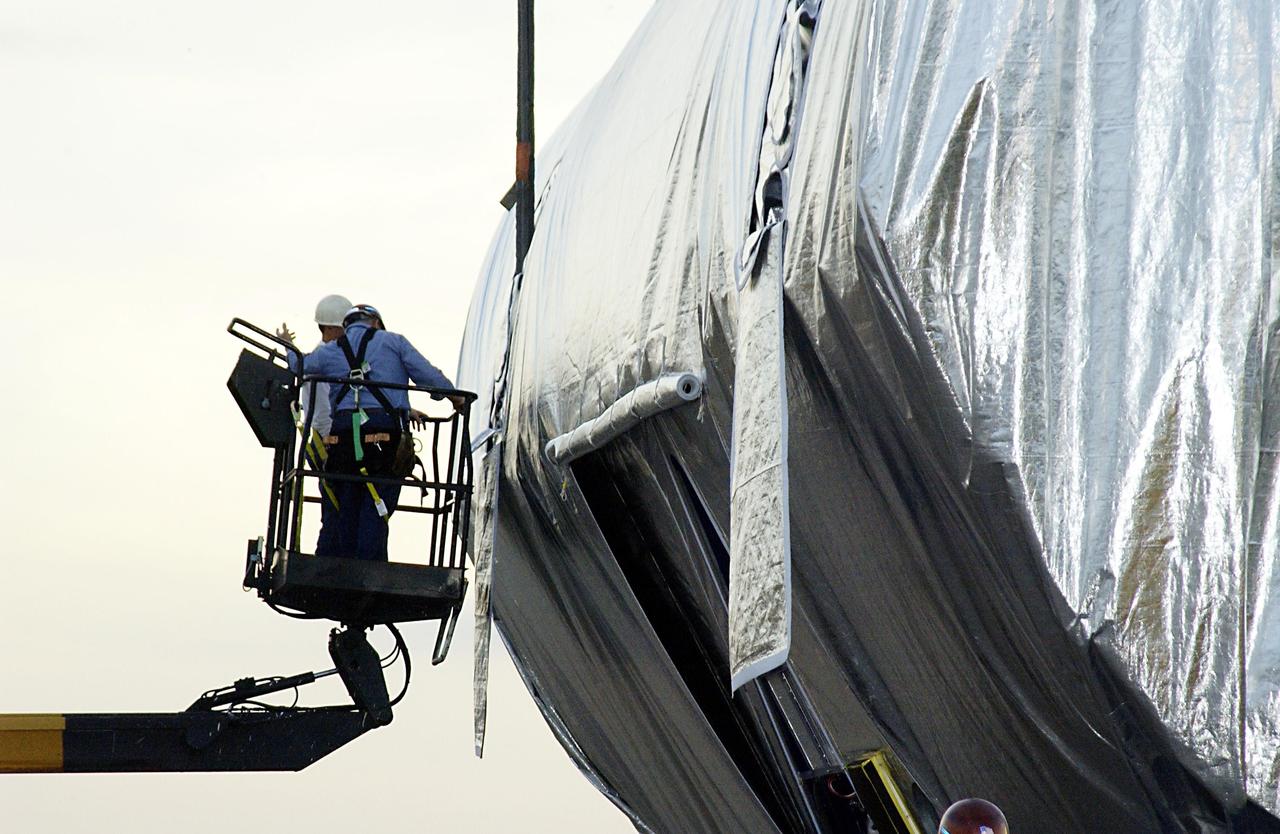
KENNEDY SPACE CENTER, FLA. -- KSC technicians supervise the offloading of the Integrated Equipment Assembly (IEA), one of two major components of the Starboard 6 (S6) truss segment for the International Space Station (ISS), onto a cargo transporter following its arrival at the Shuttle Landing Facility. The IEA will be joined to its companion piece, the Long Spacer, before launch early in 2004. The S6 truss segment will be the 11th and final piece of the Station's Integrated Truss Structure and will support the fourth and final set of solar arrays, batteries, and electronics.
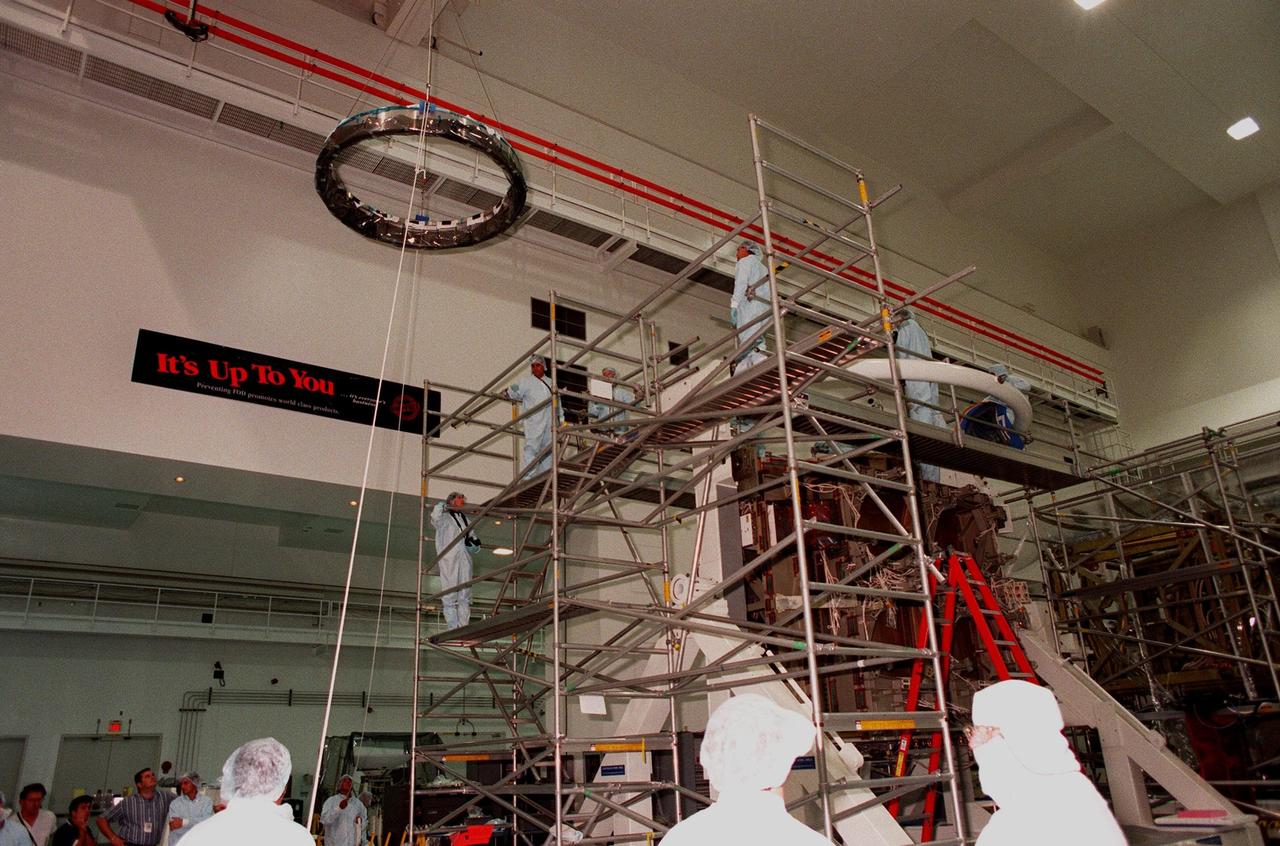
Workers in the Space Station Processing Facility watch the Passive Common Berthing Mechanism (PCBM) lifted high to move it over to the Z1 integrated truss structure at right. It will be mated to the Z1 truss, a component of the International Space Station (ISS). The Z1 truss will be used for the temporary installation of the P6 truss segment to the Unity connecting module. The P6 truss segment contains the solar arrays and batteries which will provide early station power. The truss is scheduled to be launched aboard STS-92 in late 1999
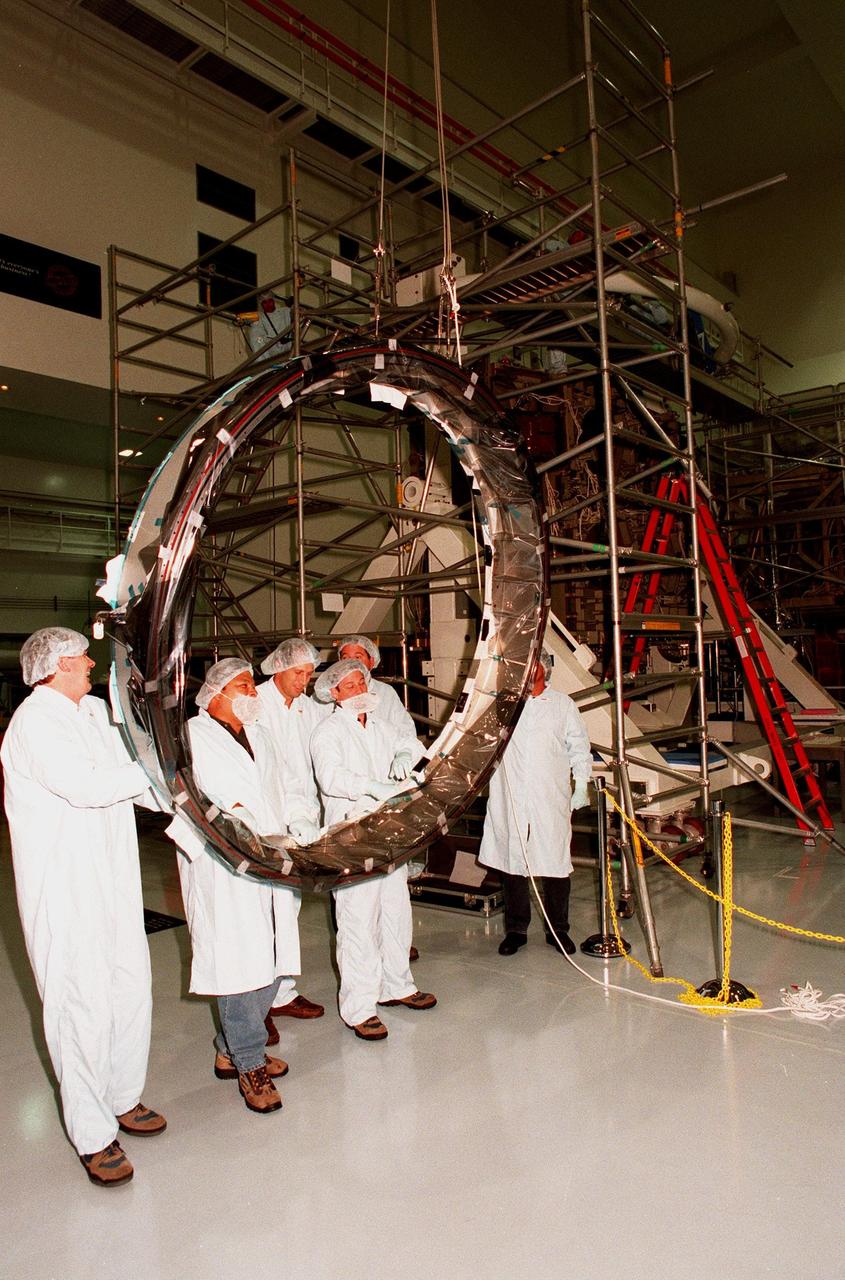
Workers in the Space Station Processing Facility look at the Passive Common Berthing Mechanism (PCBM) that will be attached to the Z1 integrated truss structure, a component of the International Space Station (ISS). The Z1 truss will be used for the temporary installation of the P6 truss segment to the Unity connecting module. The P6 truss segment contains the solar arrays and batteries which will provide early station power. The truss is scheduled to be launched aboard STS-92 in late 1999
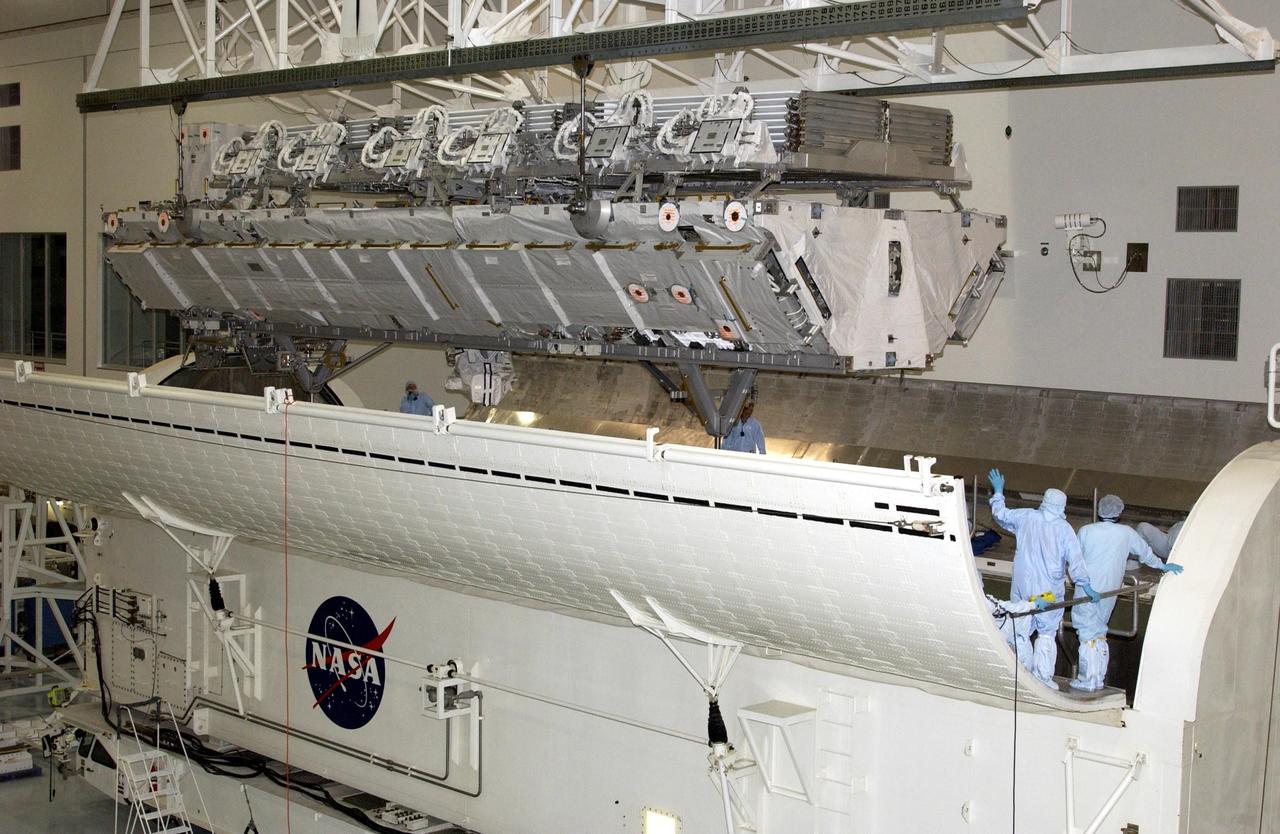
KENNEDY SPACE CENTER, FLA. - Workers inside the payload canister watch the S1 Integrated Truss Structure as it is lowered toward them. The canister will transport the truss to Atlantis. The first starboard truss segment, the S1 will be attached to the Central truss segment, the S0 Truss, on the International Space Station during mission STS-112. Atlantis is scheduled to launch no earlier than Oct. 2.
Workers in the Space Station Processing Facility watch as cables and a crane lift the Passive Common Berthing Mechanism (PCBM) before mating it to the Z1 integrated truss structure, a component of the International Space Station (ISS). The Z1 truss will be used for the temporary installation of the P6 truss segment to the Unity connecting module. The P6 truss segment contains the solar arrays and batteries which will provide early station power. The truss is scheduled to be launched aboard STS-92 in late 1999
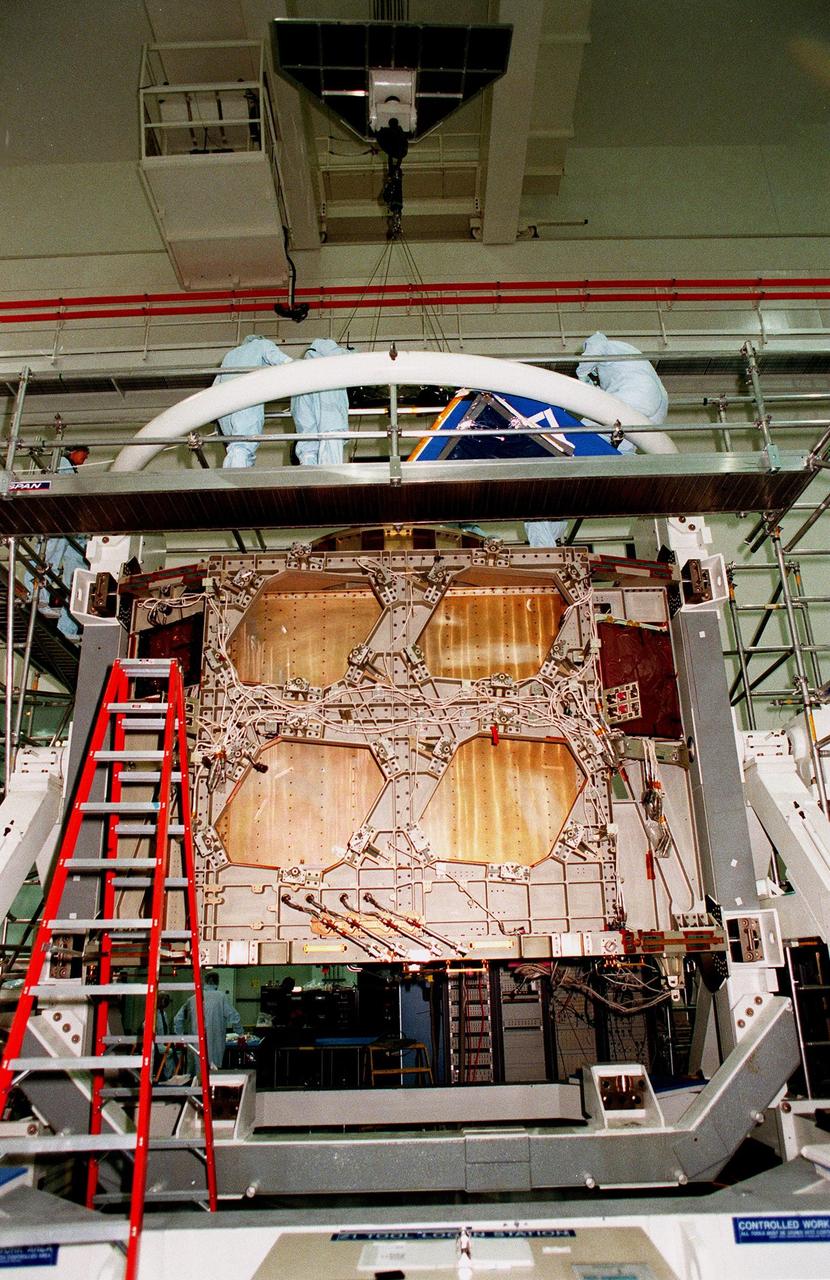
Workers in the Space Station Processing Facility look at the Passive Common Berthing Mechanism (PCBM) that will be attached to the Z1 integrated truss structure, a component of the International Space Station (ISS). The truss will be used for the temporary installation of the P6 truss segment to the Unity connecting module. The P6 truss segment contains the solar arrays and batteries which will provide early station power. The truss is scheduled to be launched aboard STS-92 in late 1999
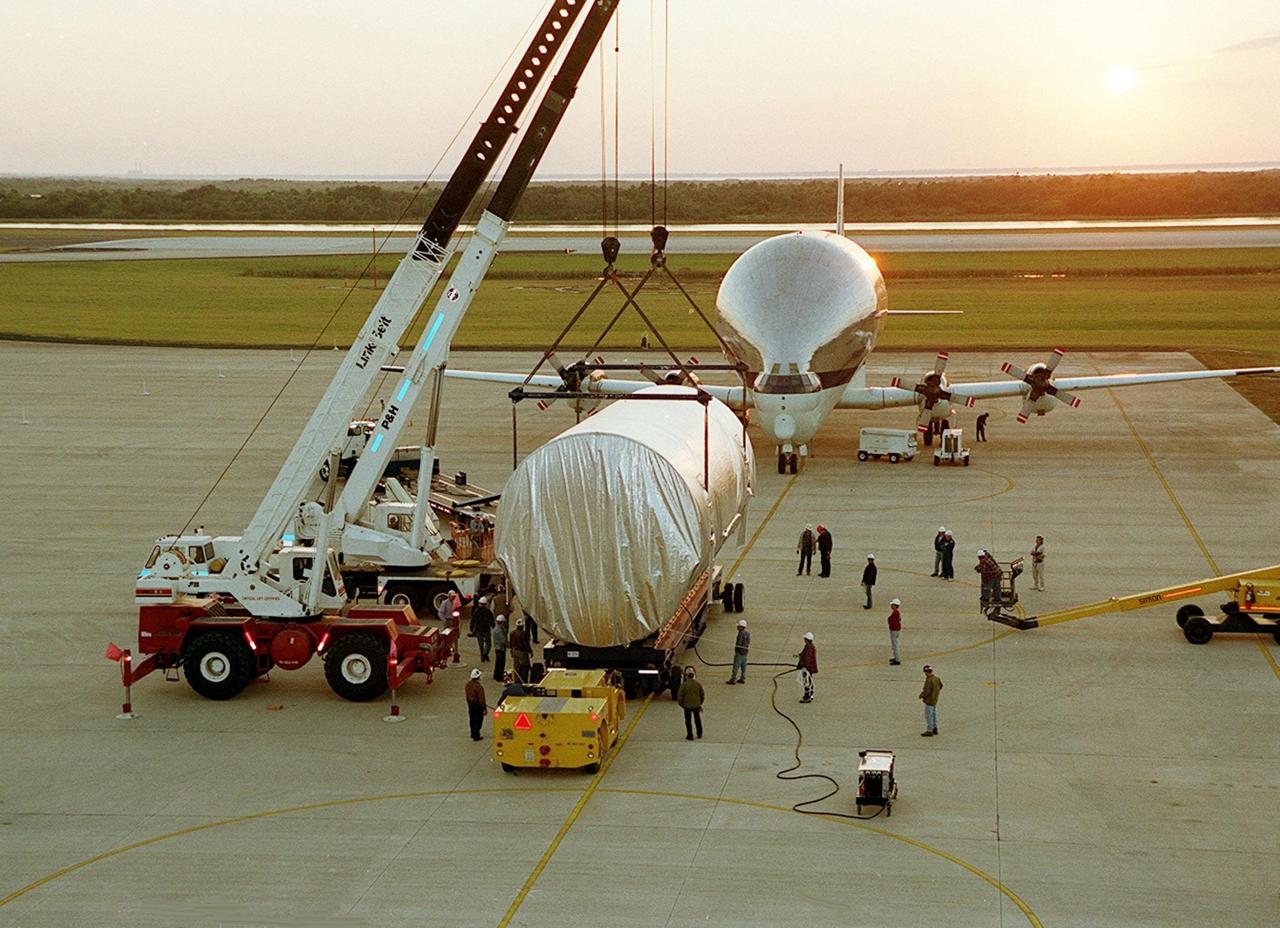
On the parking apron of the Shuttle Landing Facility, workers check the overhead cranes that will move the Integrated Truss Structure S3 to a transporter. The truss will be taken to the Operations and Checkout Building. The second starboard truss segment of the International Space Station, the S3 truss is scheduled to be added to the Station in April 2003
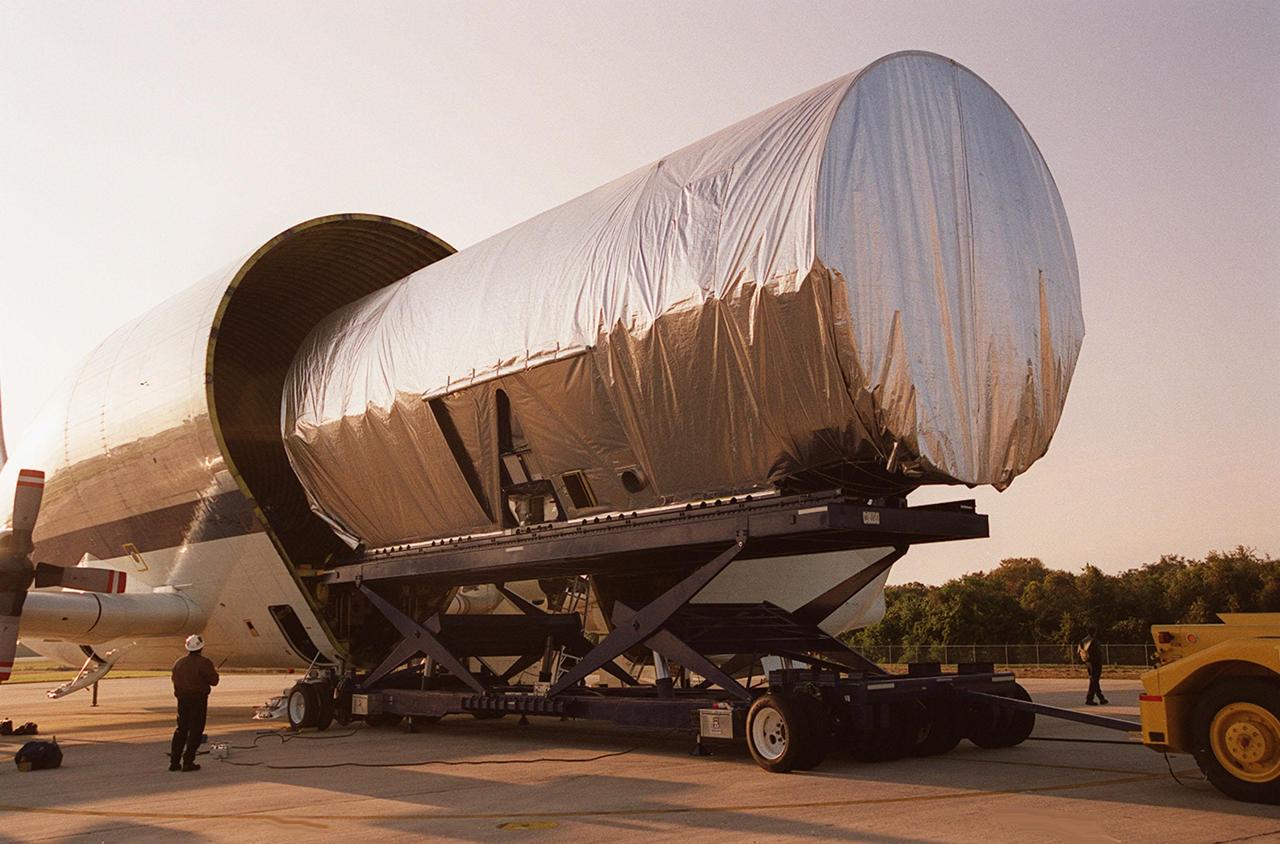
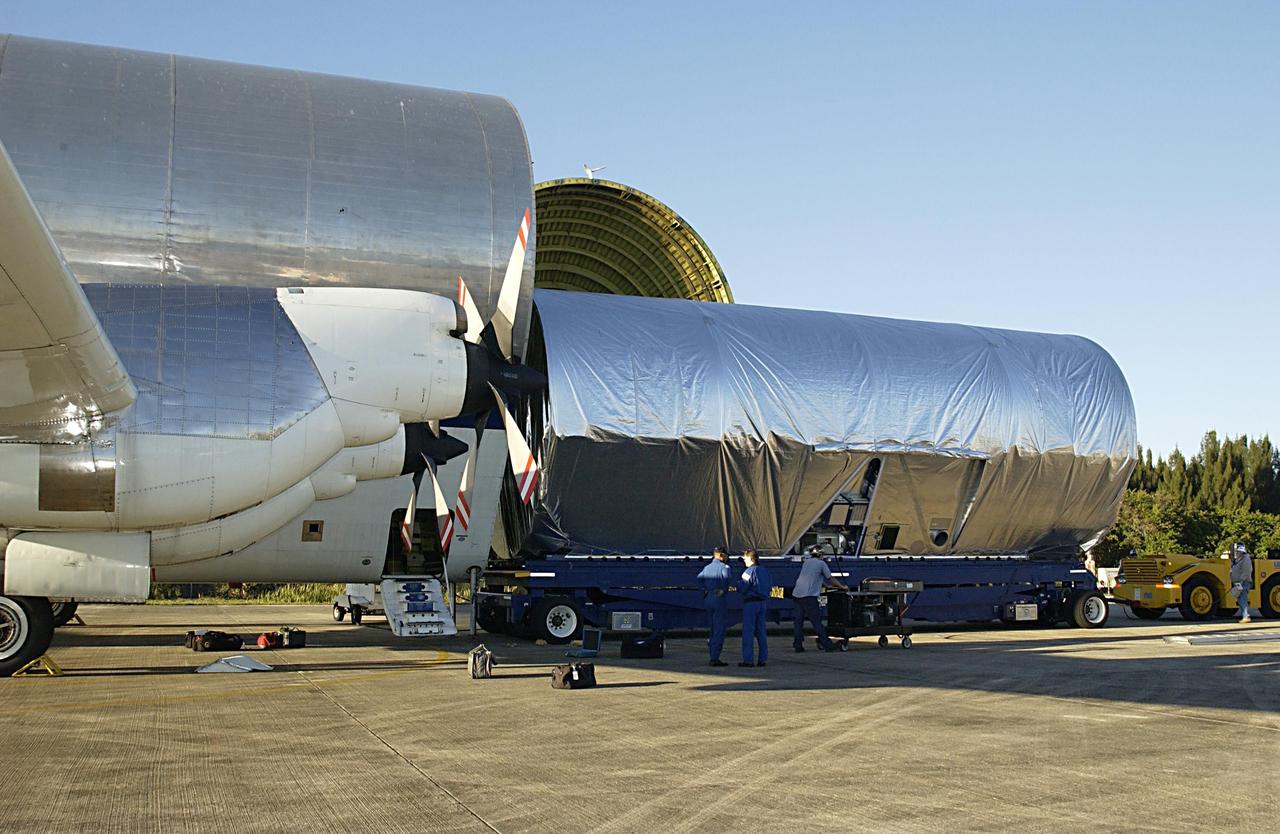
The Integrated Truss Structure S3 is offloaded from the Super Guppy aircraft that brought it to KSC from Tulsa, Okla. The S3 is built by The Boeing Co. The truss will be transported to the Operations and Checkout Building. The second starboard truss segment of the International Space Station, the S3 truss is scheduled to be added to the Station in April 2003
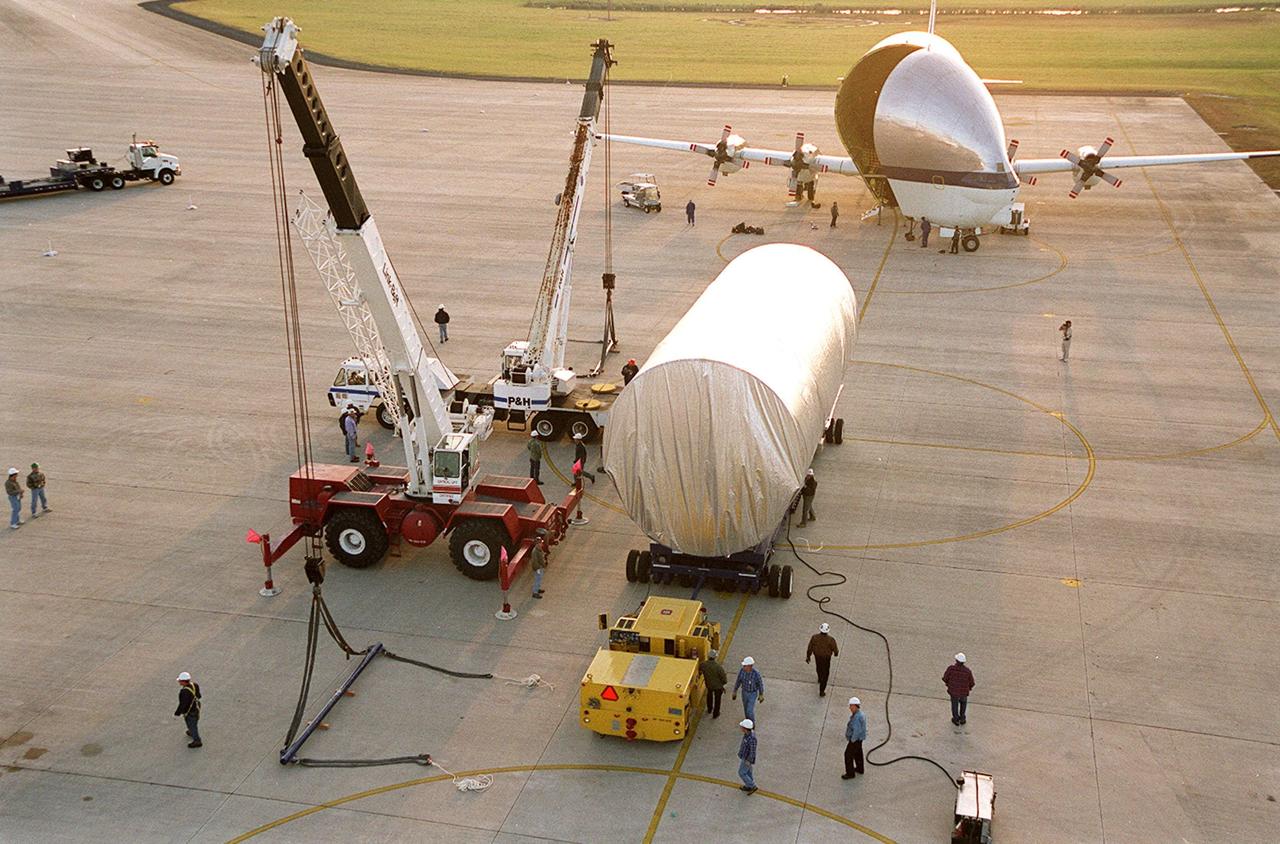
The Integrated Truss Structure S3 waits on the parking apron of the Shuttle Landing Facility after being offloaded from the Super Guppy aircraft in the background. The truss will be moved to a transporter and taken to the Operations and Checkout Building. The second starboard truss segment of the International Space Station, the S3 truss is scheduled to be added to the Station in April 2003
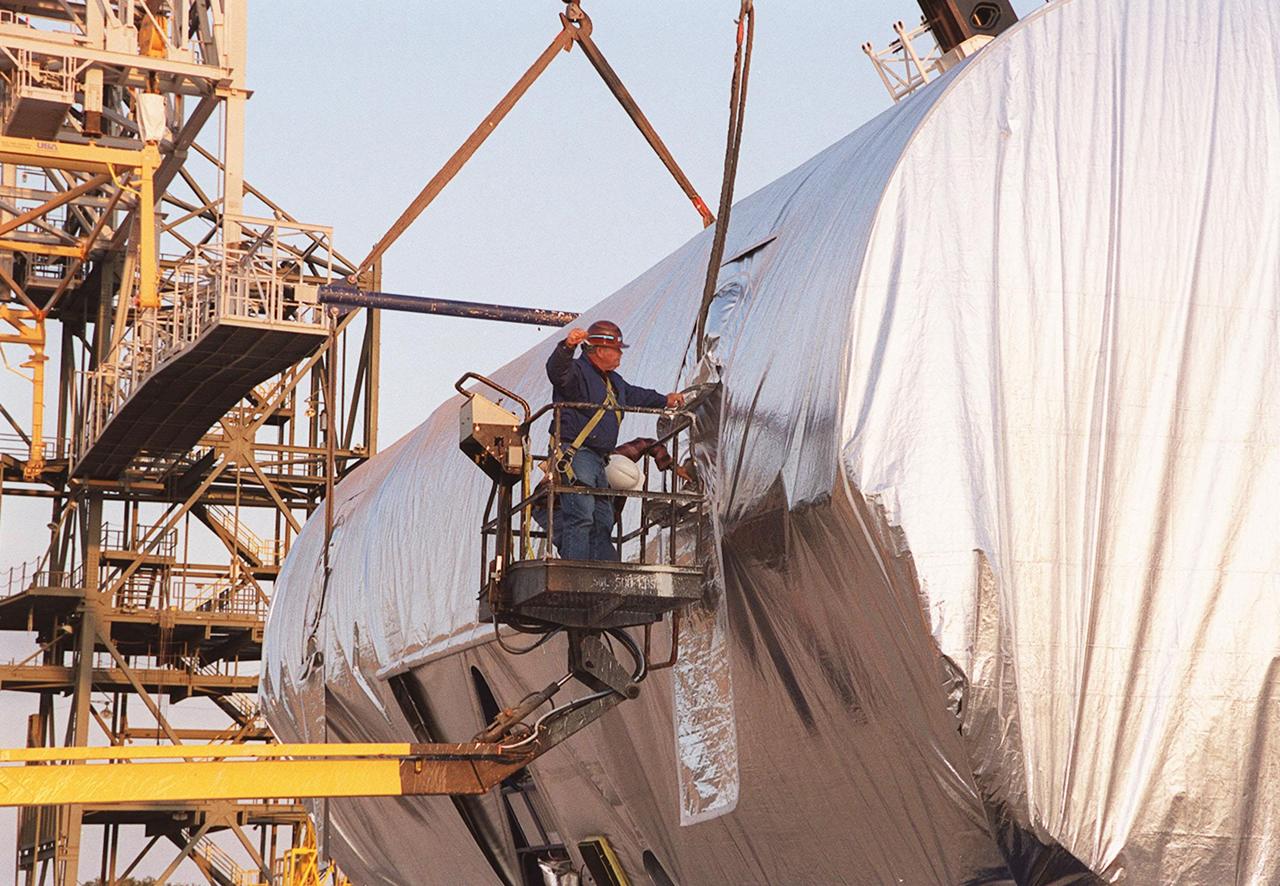
At the Shuttle Landing Facility, a worker attaches one of the cranes to the Integrated Truss Structure S3. Cranes will lift and move the truss to a transporter and take it to the Operations and Checkout Building. The second starboard truss segment of the International Space Station, the S3 truss is scheduled to be added to the Station in April 2003
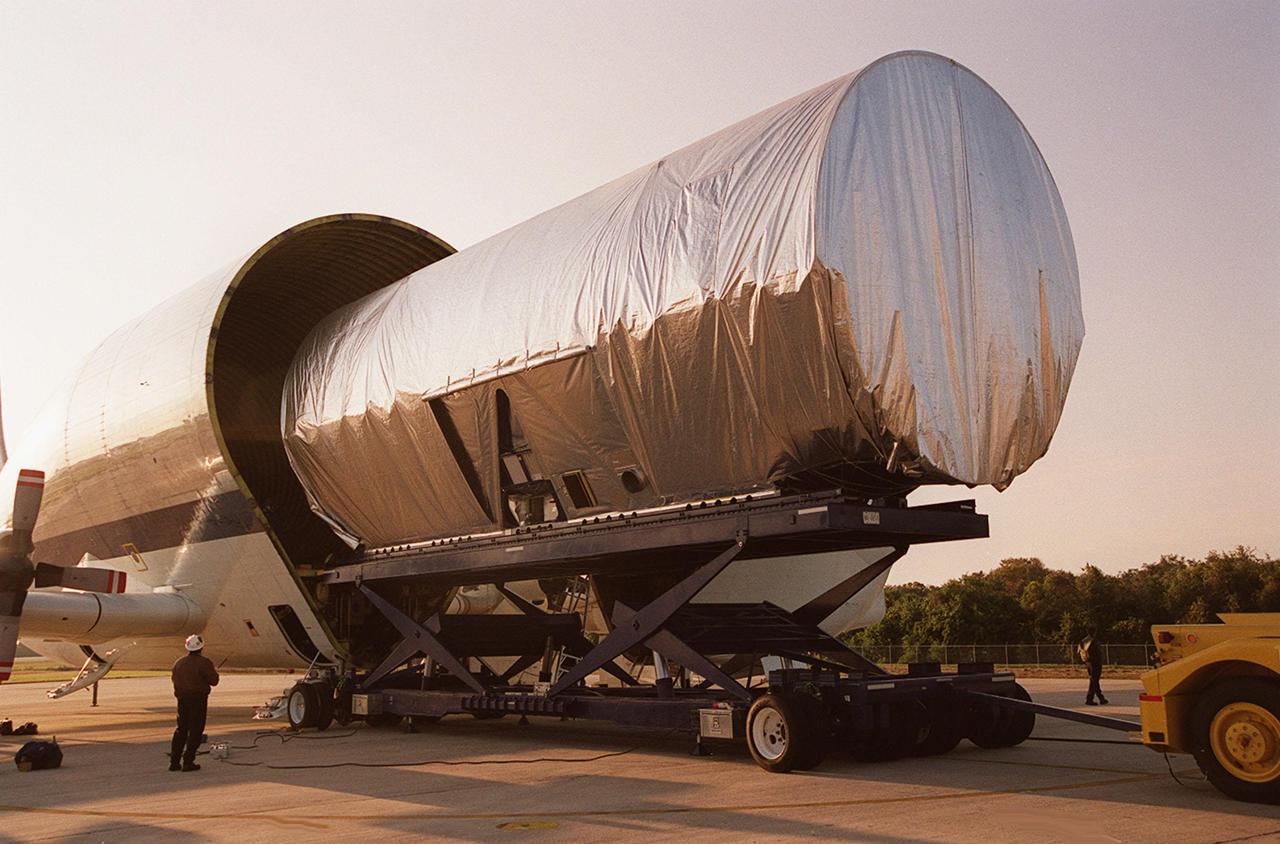
The Integrated Truss Structure S3 is offloaded from the Super Guppy aircraft that brought it to KSC from Tulsa, Okla. The S3 is built by The Boeing Co. The truss will be transported to the Operations and Checkout Building. The second starboard truss segment of the International Space Station, the S3 truss is scheduled to be added to the Station in April 2003
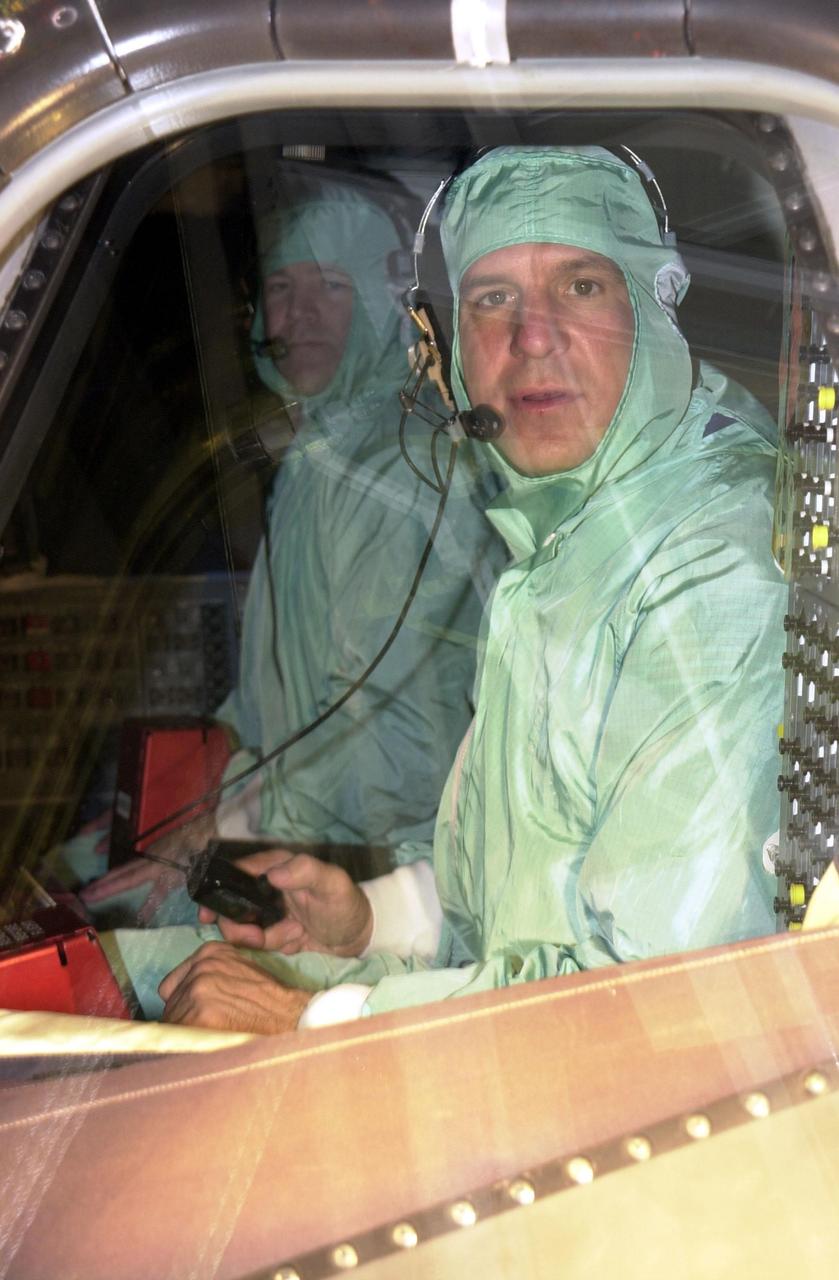
KENNEDY SPACE CENTER, FLA. -- In the Orbiter Processing Facility, STS-110 Commander Michael Bloomfield checks out a window in the cockpit of Atlantis during Crew Equipment Integration Test activities. The mission, 13th assembly flight to the International Space Station, includes the Integrated Truss Structure S0. The ITS S0 is the center segment on the Space Station, part of the 300-foot (91-meter) truss attached to the U.S. Lab. By assembly completion, four more truss segments will attach to either side of the S0 truss. STS-110 is scheduled to launch April 4, 2002

KENNEDY SPACE CENTER, FLA. -- In the Orbiter Processing Facility, STS-110 Mission Specialists Jerry Ross (upper right) and Lee Morin (lower right) check out the payload bay of Atlantis during Crew Equipment Integration Test activities, which include familiarization with the vehicle and payload. . The mission, 13th assembly flight to the International Space Station, includes the Integrated Truss Structure S0. The ITS S0 is the center segment on the Space Station, part of the 300-foot (91-meter) truss attached to the U.S. Lab. By assembly completion, four more truss segments will attach to either side of the S0 truss. STS-110 is scheduled to launch April 4, 2002
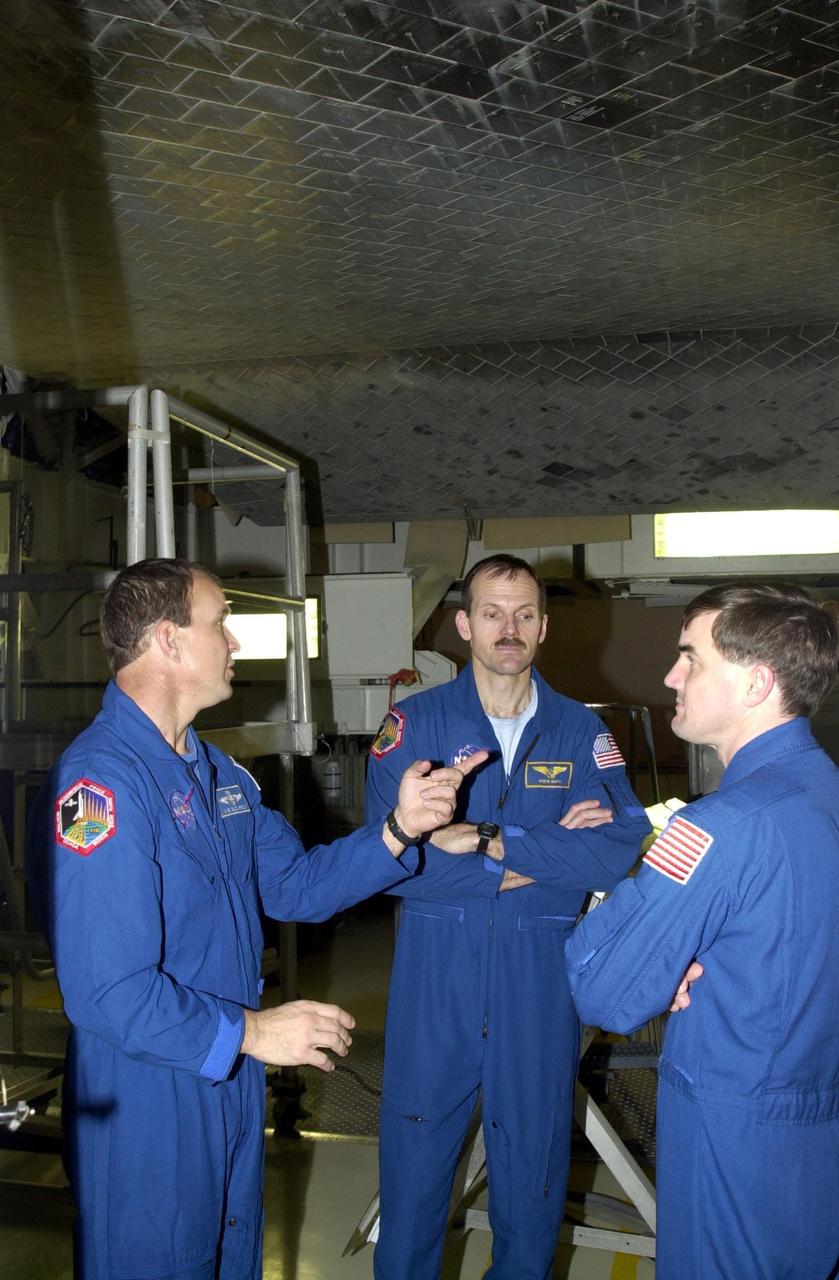
KENNEDY SPACE CENTER, FLA. -- Standing underneath the orbiter Atlantis in the Orbiter Processing Facility are STS-110 Commander Michael Bloomfield and Mission Specialists Steven Smith and Rex Walheim. They and other crew members are taking part in Crew Equipment Integration Test activities, which include familiarization with the vehicle and payload. The mission, 13th assembly flight to the International Space Station, includes the Integrated Truss Structure S0. The ITS S0 is the center segment on the Space Station, part of the 300-foot (91-meter) truss attached to the U.S. Lab. By assembly completion, four more truss segments will attach to either side of the S0 truss. STS-110 is scheduled to launch April 4, 2002
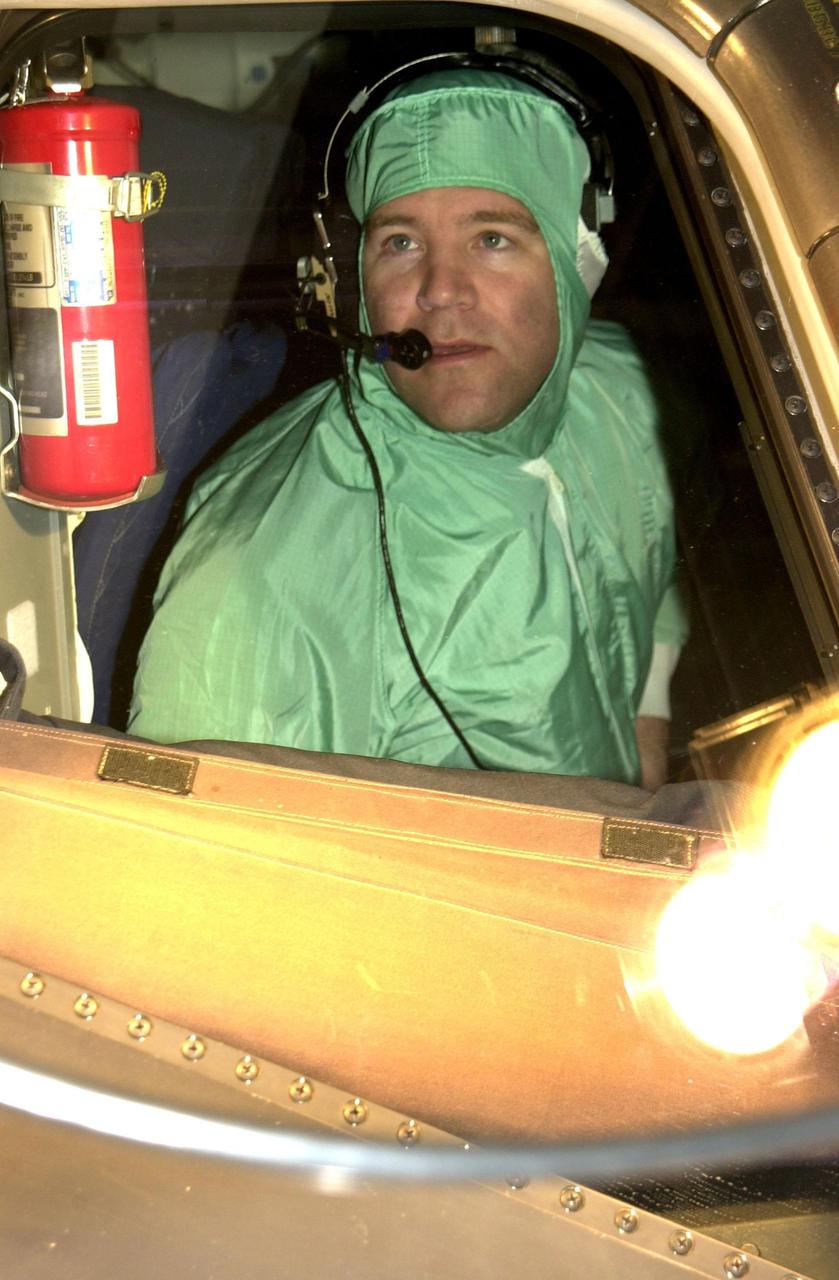
KENNEDY SPACE CENTER, FLA. -- In the Orbiter Processing Facility, STS-110 Pilot Stephen Frick checks a window in the cockpit of Atlantis during Crew Equipment Integration Test activities. The mission, 13th assembly flight to the International Space Station, includes the Integrated Truss Structure S0. The ITS S0 is the center segment on the Space Station, part of the 300-foot (91-meter) truss attached to the U.S. Lab. By assembly completion, four more truss segments will attach to either side of the S0 truss. STS-110 is scheduled to launch April 4, 2002
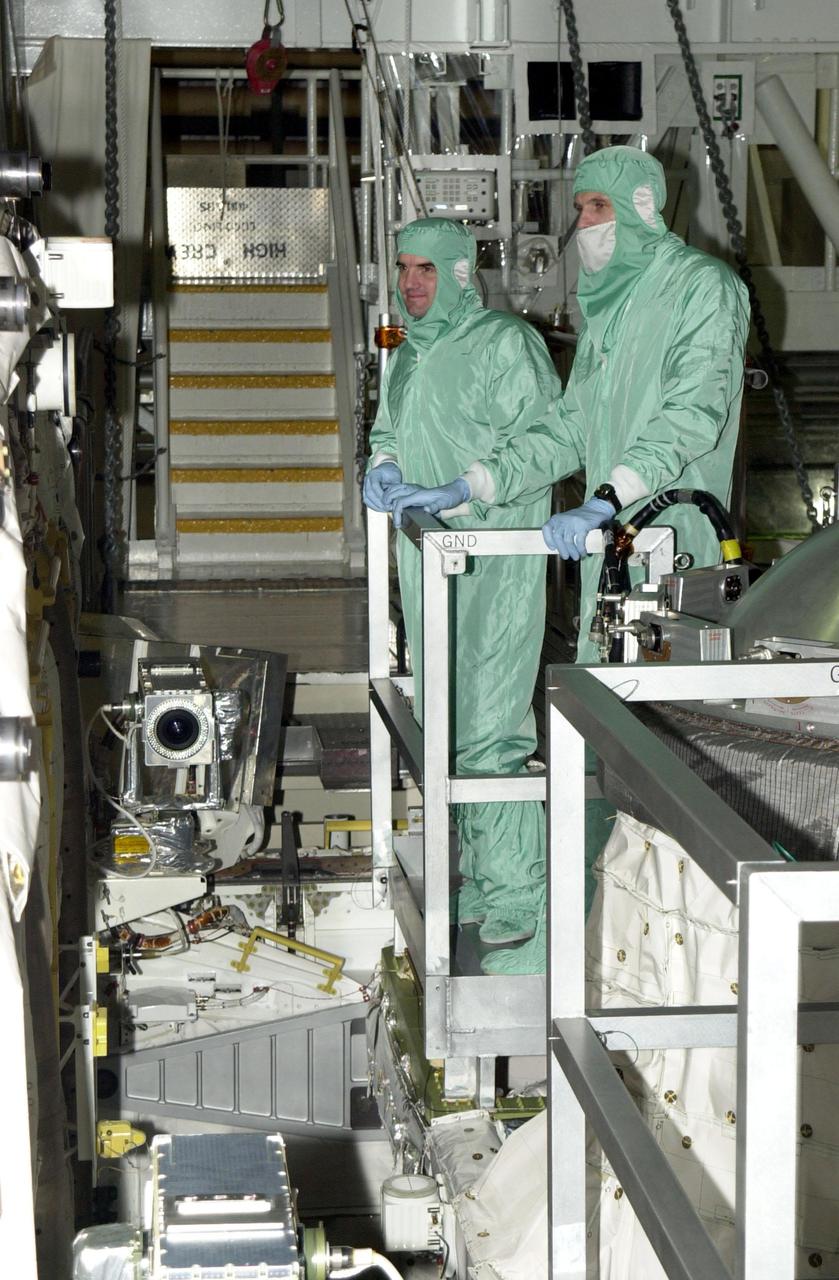
KENNEDY SPACE CENTER, FLA. -- In the Orbiter Processing Facility, STS-110 Mission Specialists Rex Walheim (left) and Steven Smith (right) look over the payload bay of Atlantis during Crew Equipment Integration Test activities, which include familiarization with the vehicle and payload. . The mission, 13th assembly flight to the International Space Station, includes the Integrated Truss Structure S0. The ITS S0 is the center segment on the Space Station, part of the 300-foot (91-meter) truss attached to the U.S. Lab. By assembly completion, four more truss segments will attach to either side of the S0 truss. STS-110 is scheduled to launch April 4, 2002
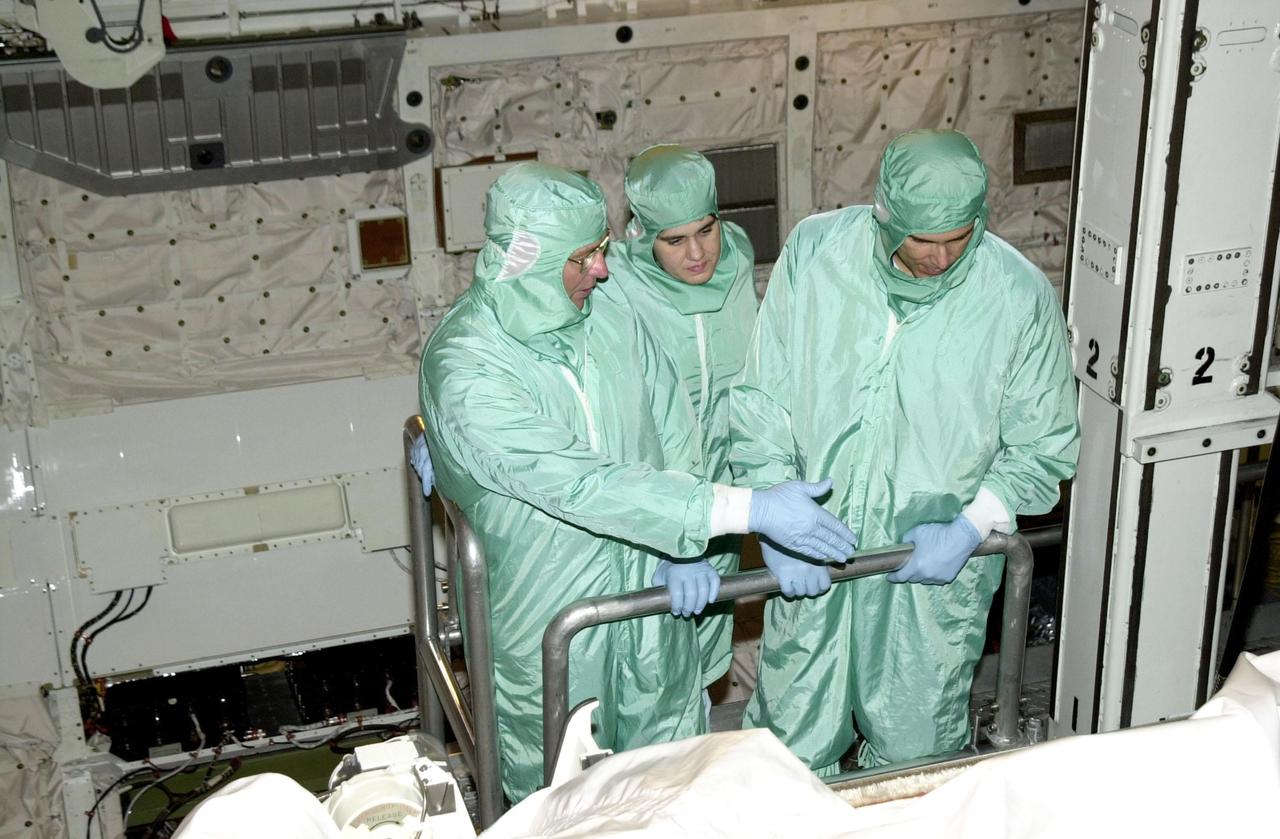
KENNEDY SPACE CENTER, FLA. -- In the Orbiter Processing Facility, STS-110 crew members look over the payload bay of Atlantis during Crew Equipment Integration Test activities, which include familiarization with the vehicle and payload. From left are Mission Specialist Jerry Ross, a technician, and Mission Specialist Lee Morin. The mission, 13th assembly flight to the International Space Station, includes the Integrated Truss Structure S0. The ITS S0 is the center segment on the Space Station, part of the 300-foot (91-meter) truss attached to the U.S. Lab. By assembly completion, four more truss segments will attach to either side of the S0 truss. STS-110 is scheduled to launch April 4, 2002
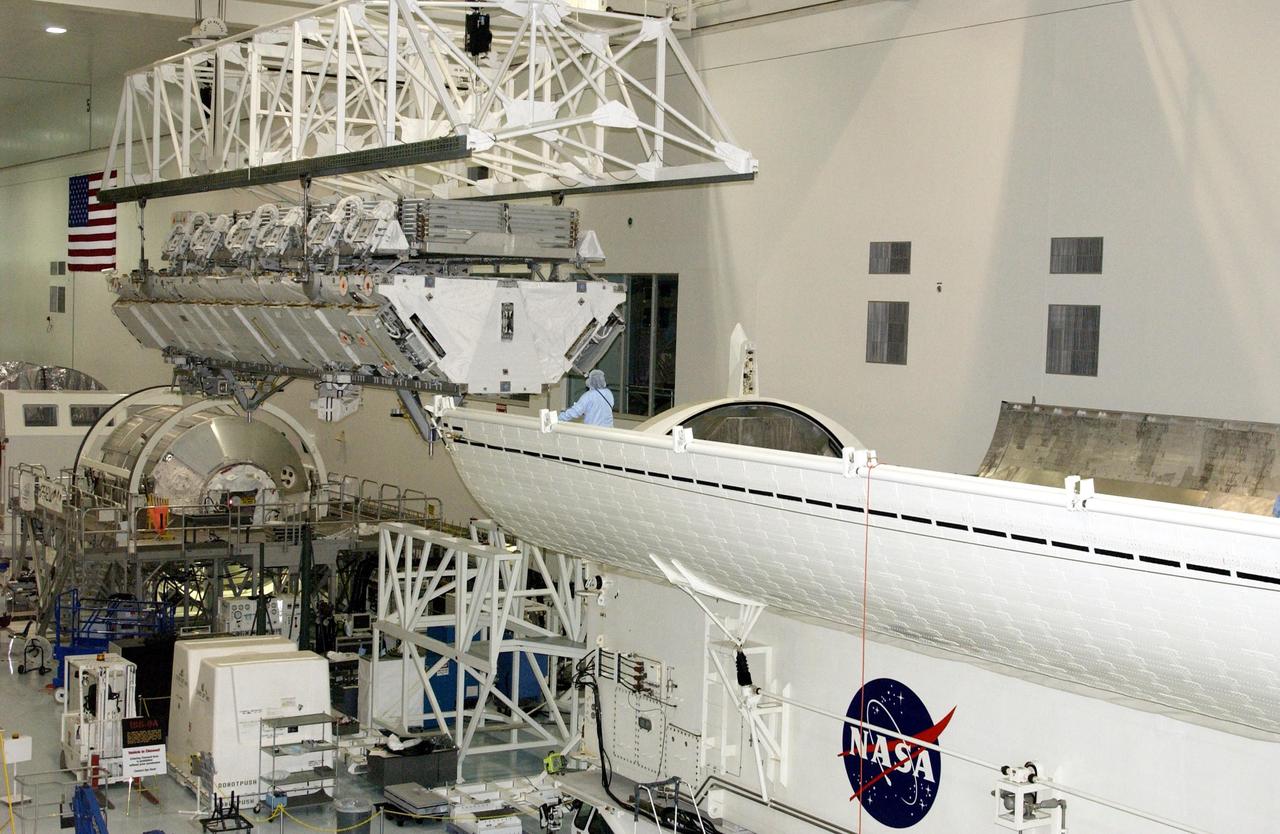
KENNEDY SPACE CENTER, FLA. -- An overhead crane moves the S1 Integrated Truss Structure toward the payload canister below, which will transport it to Atlantis. The first starboard truss segment, the S1 will be attached to the Central truss segment, the S0 Truss, on the International Space Station during mission STS-112. Atlantis is scheduled to launch no earlier than Oct. 2.
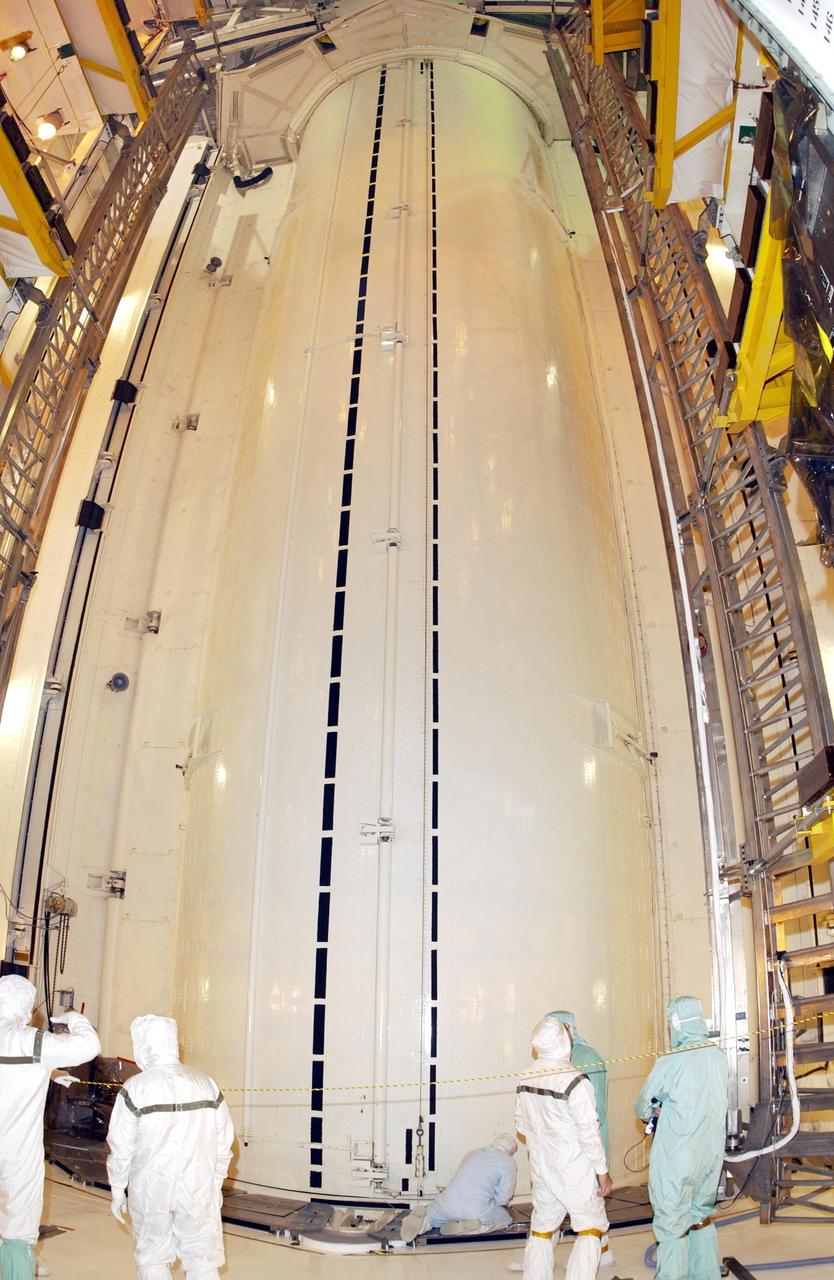
KENNEDY SPACE CENTER, FLA. -- The payload canister is ready to be opened in the Payload Changeout Room at the pad. Inside is the S1 Integrated Truss Structure, primary payload on mission STS-112 aboard Space Shuttle Atlantis. The first starboard truss segment, the S1 will be attached to the Central truss segment, the S0 Truss, on the International Space Station during the mission. Atlantis is scheduled to launch no earlier than Oct. 2.
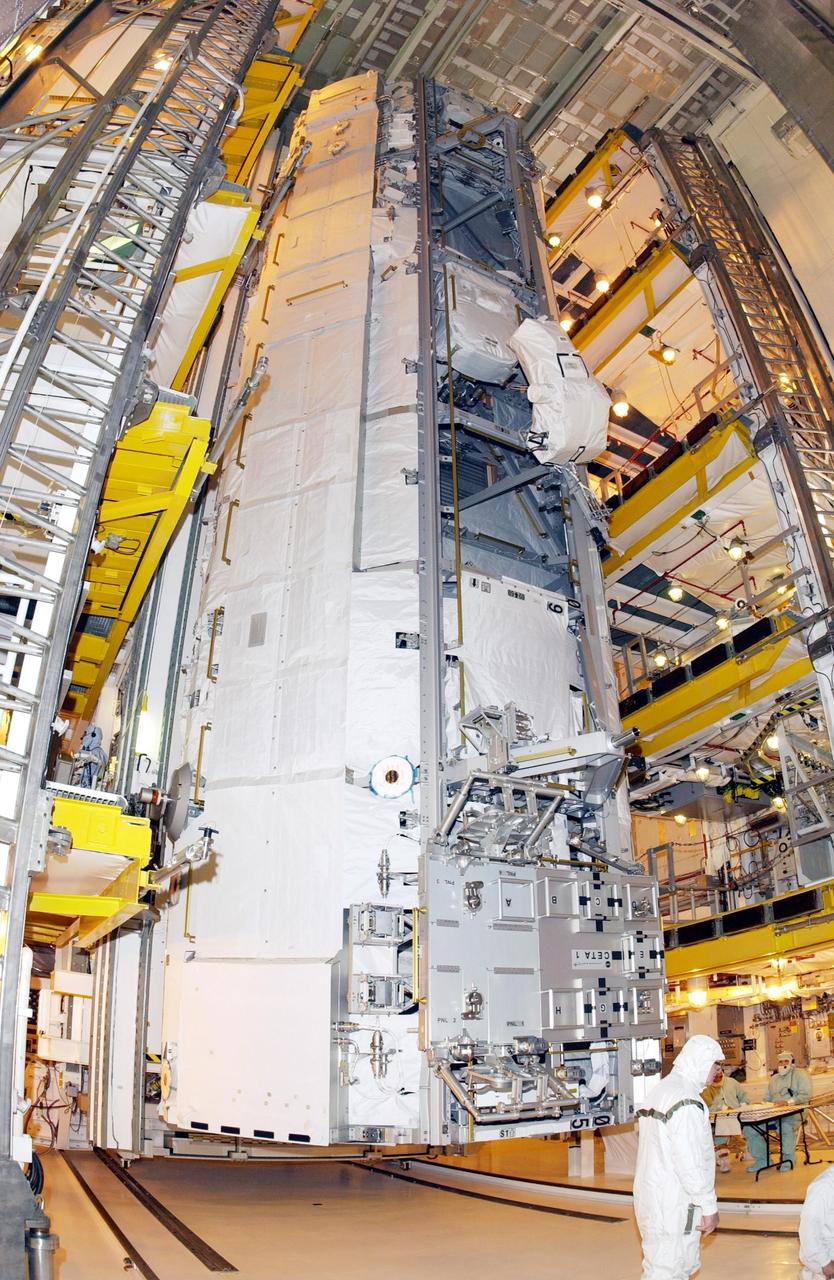
KENNEDY SPACE CENTER, FLA. -- In the Payload Changeout Room at the pad, the payload is moved out of the payload canister for transfer to Space Shuttle Atlantis' payload bay for mission STS-112. The primary payload on the mission is the S1 Integrated Truss Structure. The first starboard truss segment, the S1 will be attached to the Central truss segment, the S0 Truss, on the International Space Station during the mission. Atlantis is scheduled to launch no earlier than Oct. 2.
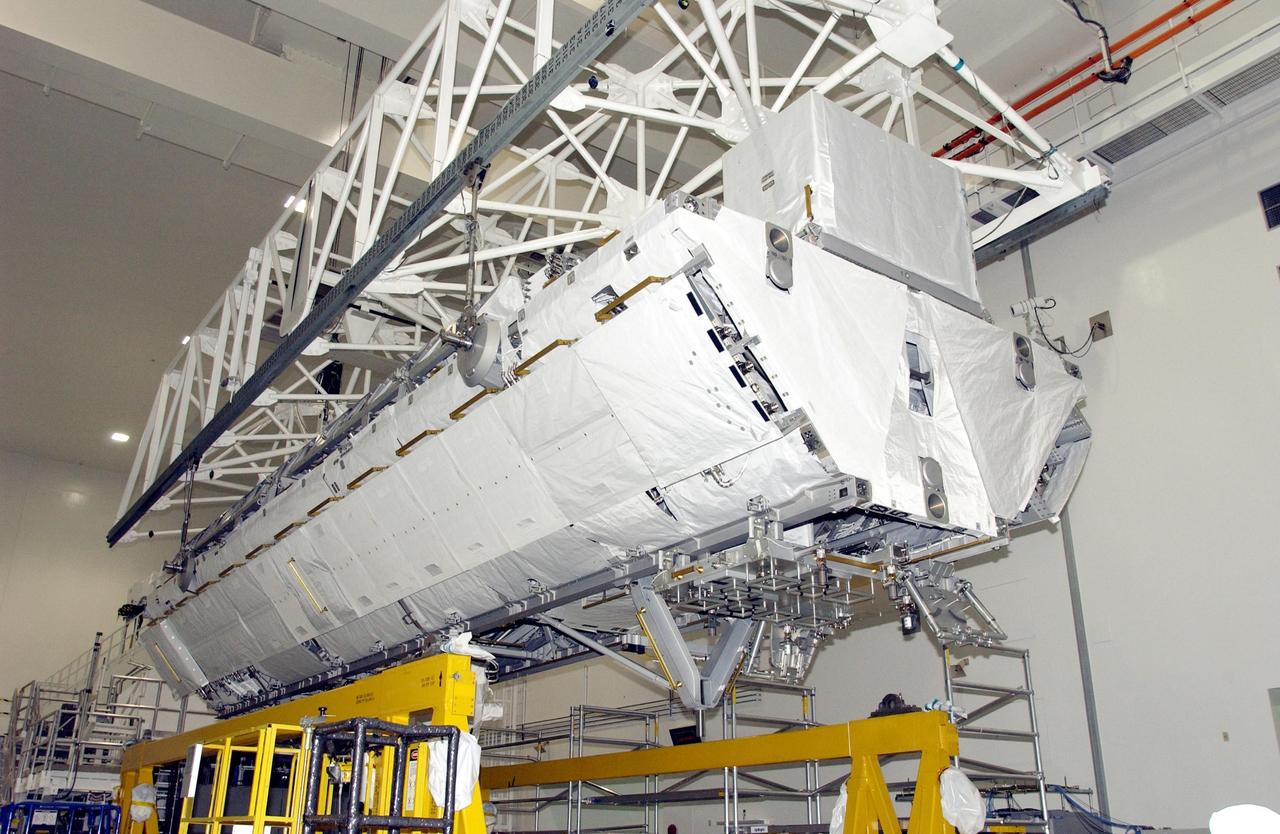
KENNEDY SPACE CENTER, FLA. -- An overhead crane lifts the S1 Integrated Truss Structure from its workstand. The S1 will be placed in the payload canister for transport it to Atlantis. The first starboard truss segment, the S1 will be attached to the Central truss segment, the S0 Truss, on the International Space Station during mission STS-112. Atlantis is scheduled to launch no earlier than Oct. 2.
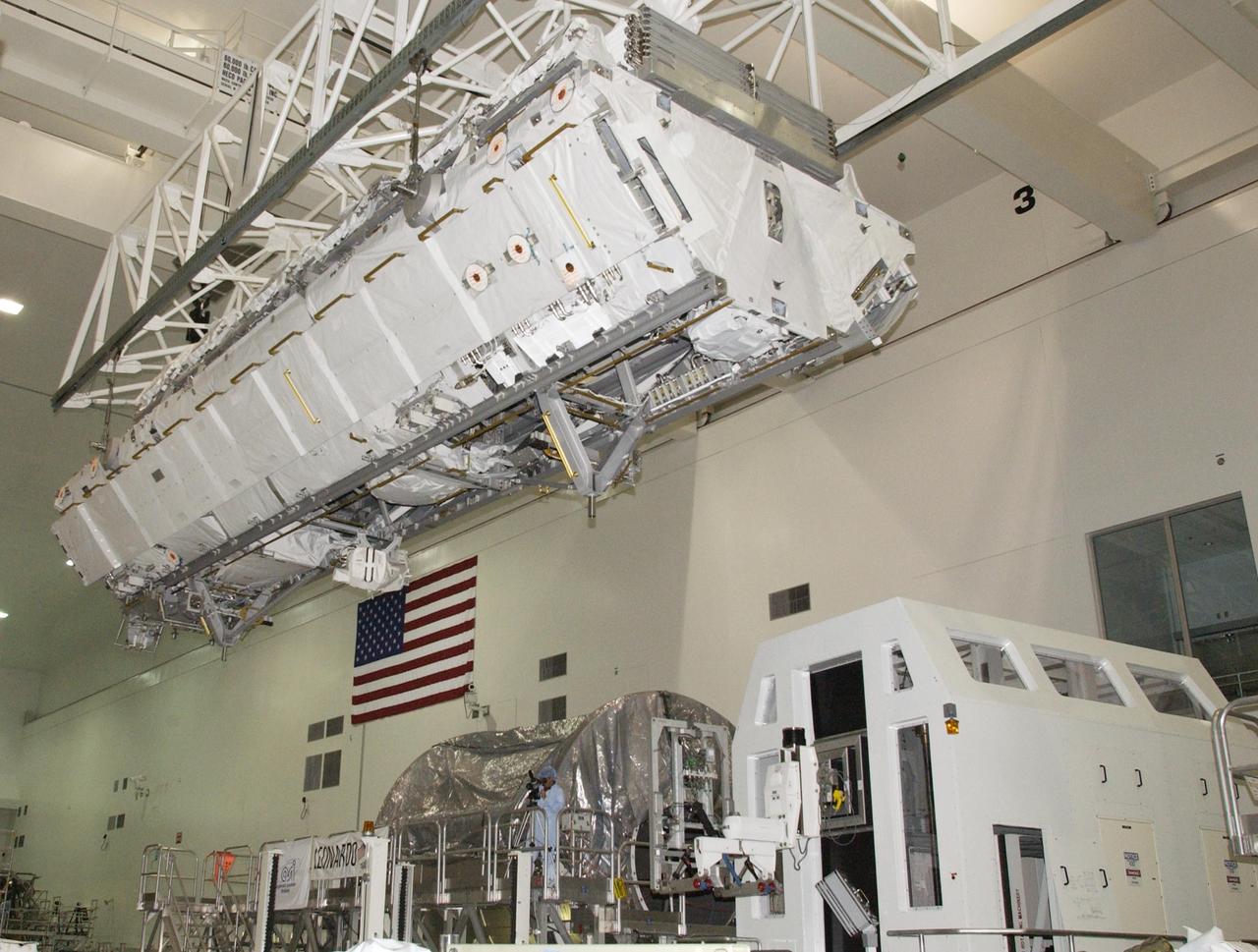
KENNEDY SPACE CENTER, FLA. -- An overhead crane moves the S1 Integrated Truss Structure above over other equipment to get to the payload canister for transport to Atlantis. The first starboard truss segment, the S1 will be attached to the Central truss segment, the S0 Truss, on the International Space Station during mission STS-112. Atlantis is scheduled to launch no earlier than Oct. 2.
KENNEDY SPACE CENTER, FLA. -- An overhead crane moves the S1 Integrated Truss Structure toward the payload canister, which will transport it to Atlantis. The first starboard truss segment, the S1 will be attached to the Central truss segment, the S0 Truss, on the International Space Station during mission STS-112. Atlantis is scheduled to launch no earlier than Oct. 2.
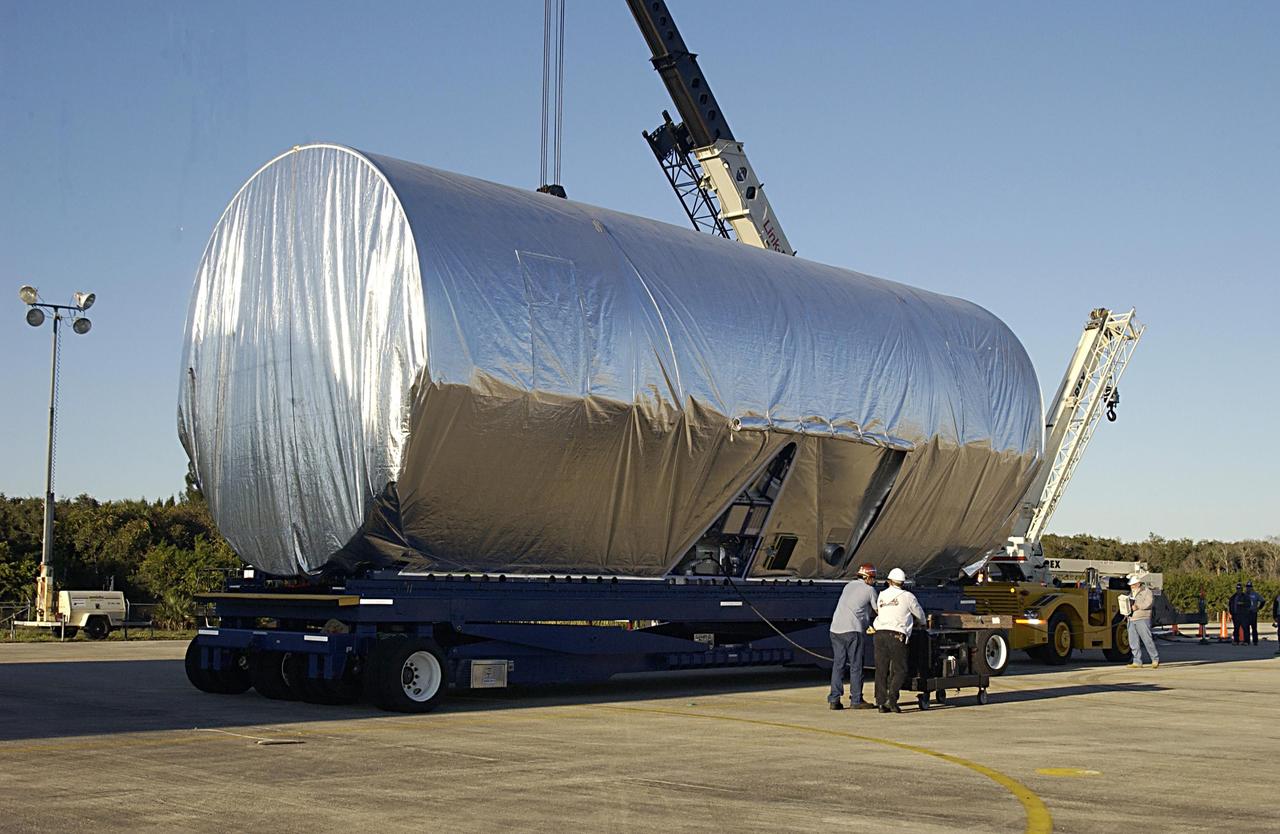
KENNEDY SPACE CENTER, FLA. -- The Long Spacer (LS), the second and final piece of the Starboard 6 (S6) Integrated Truss Segment, is secured on a flatbed truck for transport to the Space Station Processing Facility where it will undergo inspections and verification tests. Eventually the LS will be integrated with the S6 Integrated Equipment Assembly already at KSC and will fly as one segment to the International Space Station on Space Shuttle mission STS-119 in early 2004. Together the segment pieces weigh 26,000 pounds and measure 45 feet long. .

KENNEDY SPACE CENTER, FLA. -- The Long Spacer (LS), the second and final piece of the Starboard 6 (S6) Integrated Truss Segment, rolls out of NASA's Super Guppy cargo airplane. The LS will be transported to the Space Station Processing Facility for inspections and verification tests. Eventually the LS will be integrated with the S6 Integrated Equipment Assembly already at KSC and will fly as one segment to the International Space Station on Space Shuttle mission STS-119 in early 2004. Together the segment pieces weigh 26,000 pounds and measure 45 feet long. .
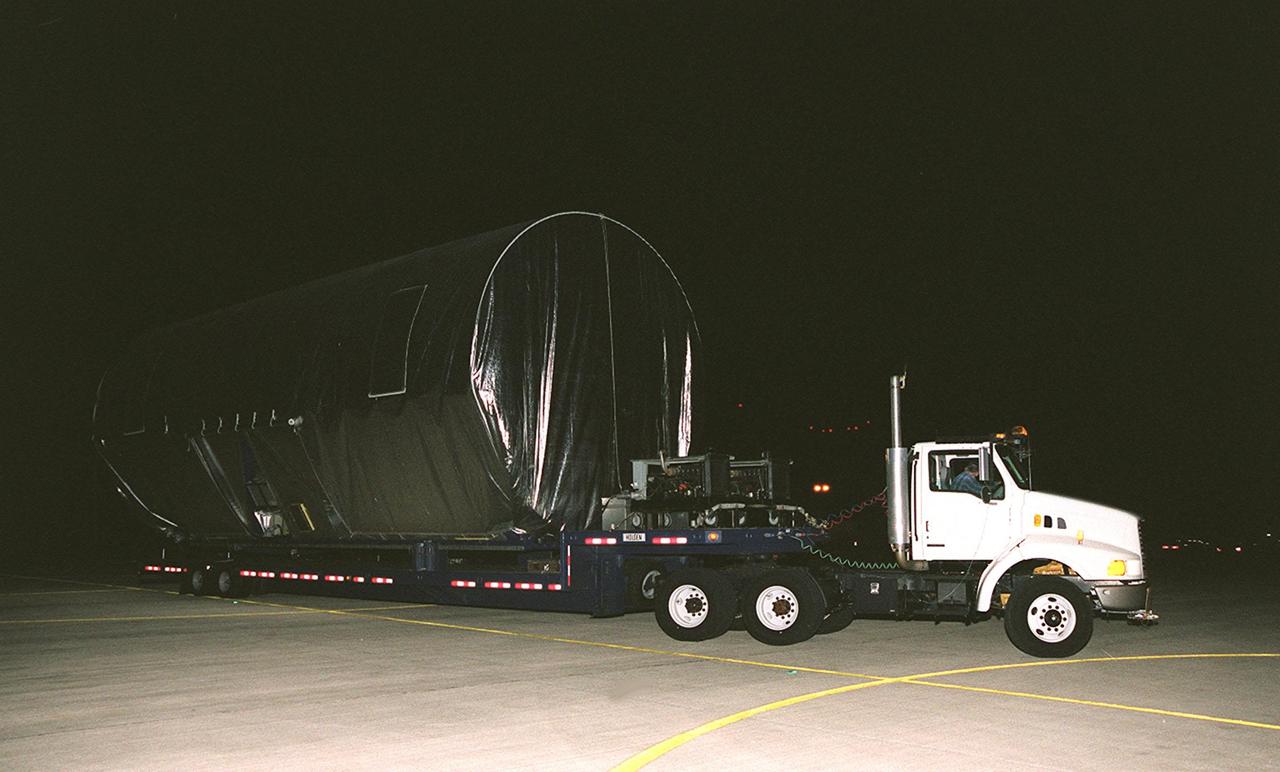
A flatbed trailer begins moving the Integrated Truss Structure S3 from the Shuttle Landing Facility to the Operations and Checkout Building. The S3 arrived aboard a Super Guppy aircraft. The second starboard truss segment of the International Space Station, the S3 truss is scheduled to be added to the Station in April 2003
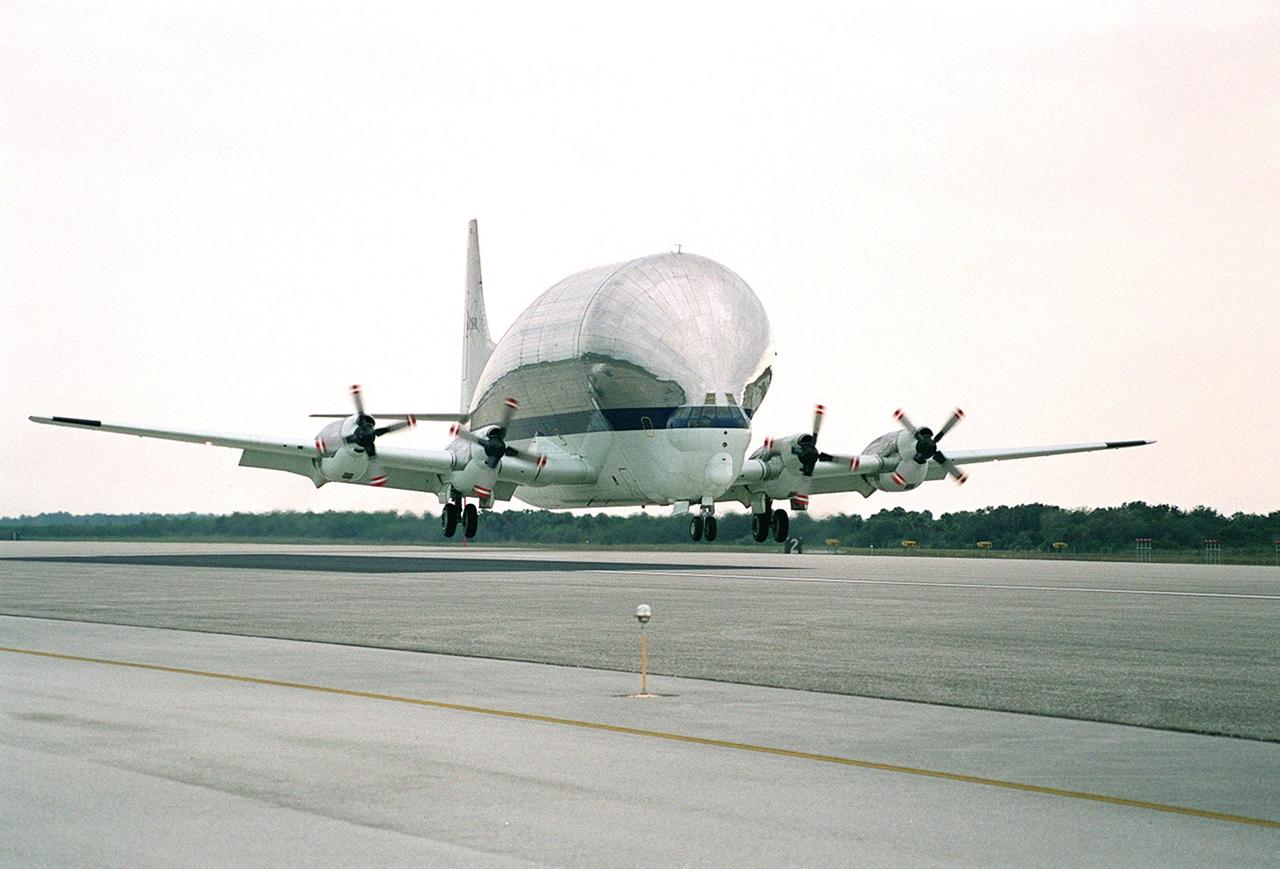
A Super Guppy aircraft arrives at the KSC Shuttle Landing Facility with its cargo of Integrated Truss Structure S3, built by The Boeing Co. After offloading, the S3 will be transported to the Operations and Checkout Building. The second starboard truss segment of the International Space Station, the S3 truss is scheduled to be added to the Station in April 2003
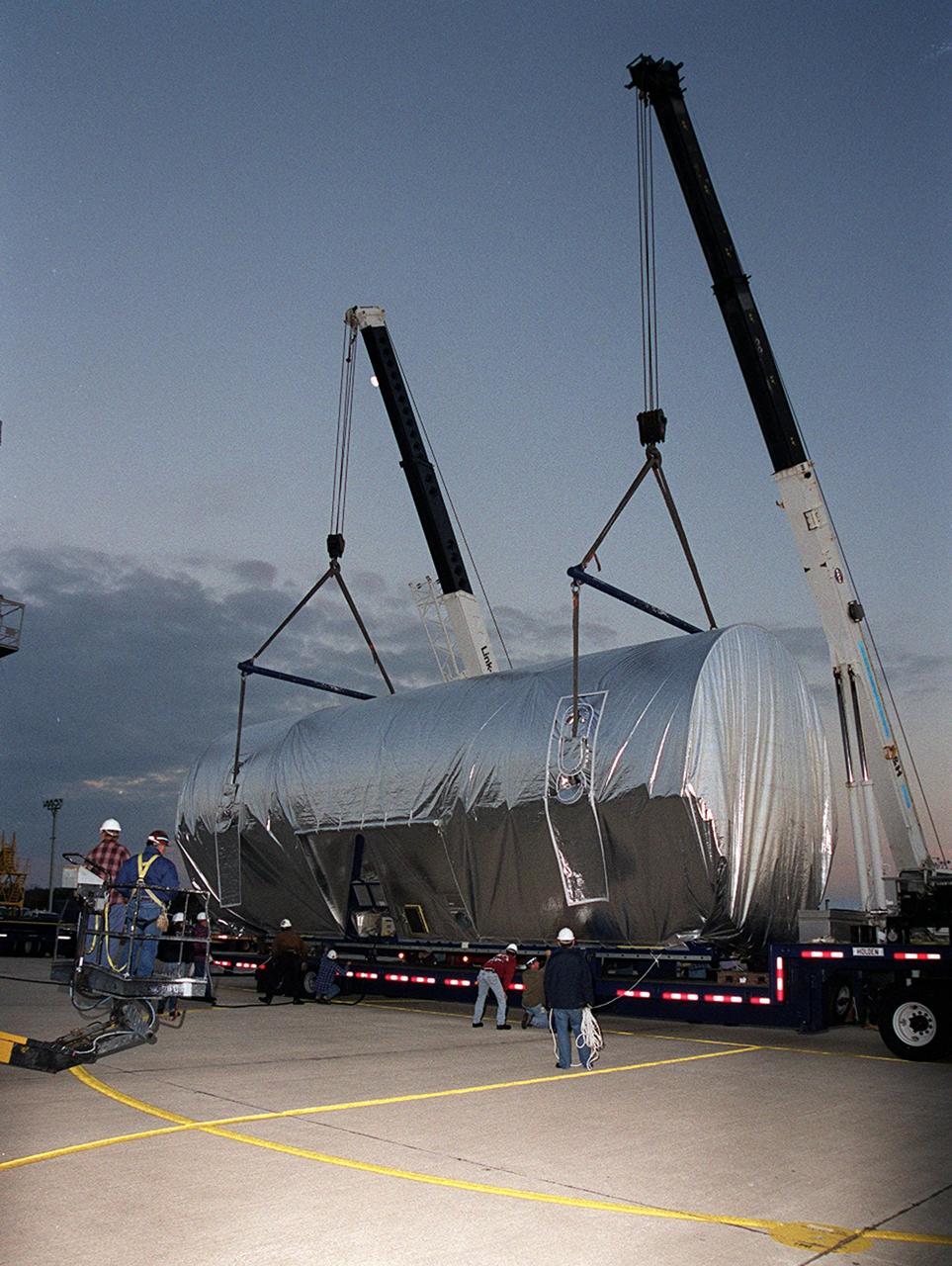
At the Shuttle Landing Facility, cranes position the Integrated Truss Structure S3 onto a flatbed trailer for transport to the Operations and Checkout Building. The S3 arrived aboard a Super Guppy aircraft. The second starboard truss segment of the International Space Station, the S3 truss is scheduled to be added to the Station in April 2003
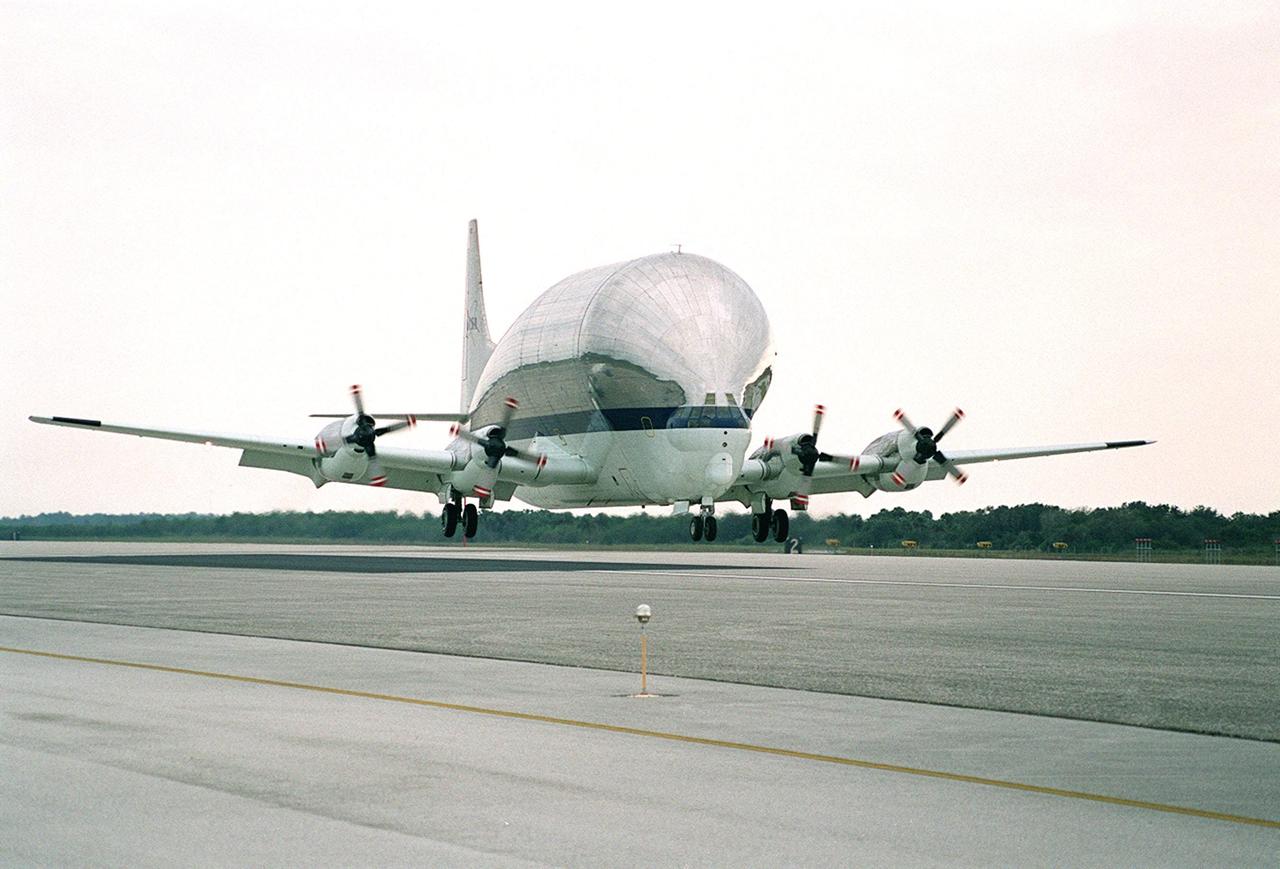
A Super Guppy aircraft arrives at the KSC Shuttle Landing Facility with its cargo of Integrated Truss Structure S3, built by The Boeing Co. After offloading, the S3 will be transported to the Operations and Checkout Building. The second starboard truss segment of the International Space Station, the S3 truss is scheduled to be added to the Station in April 2003
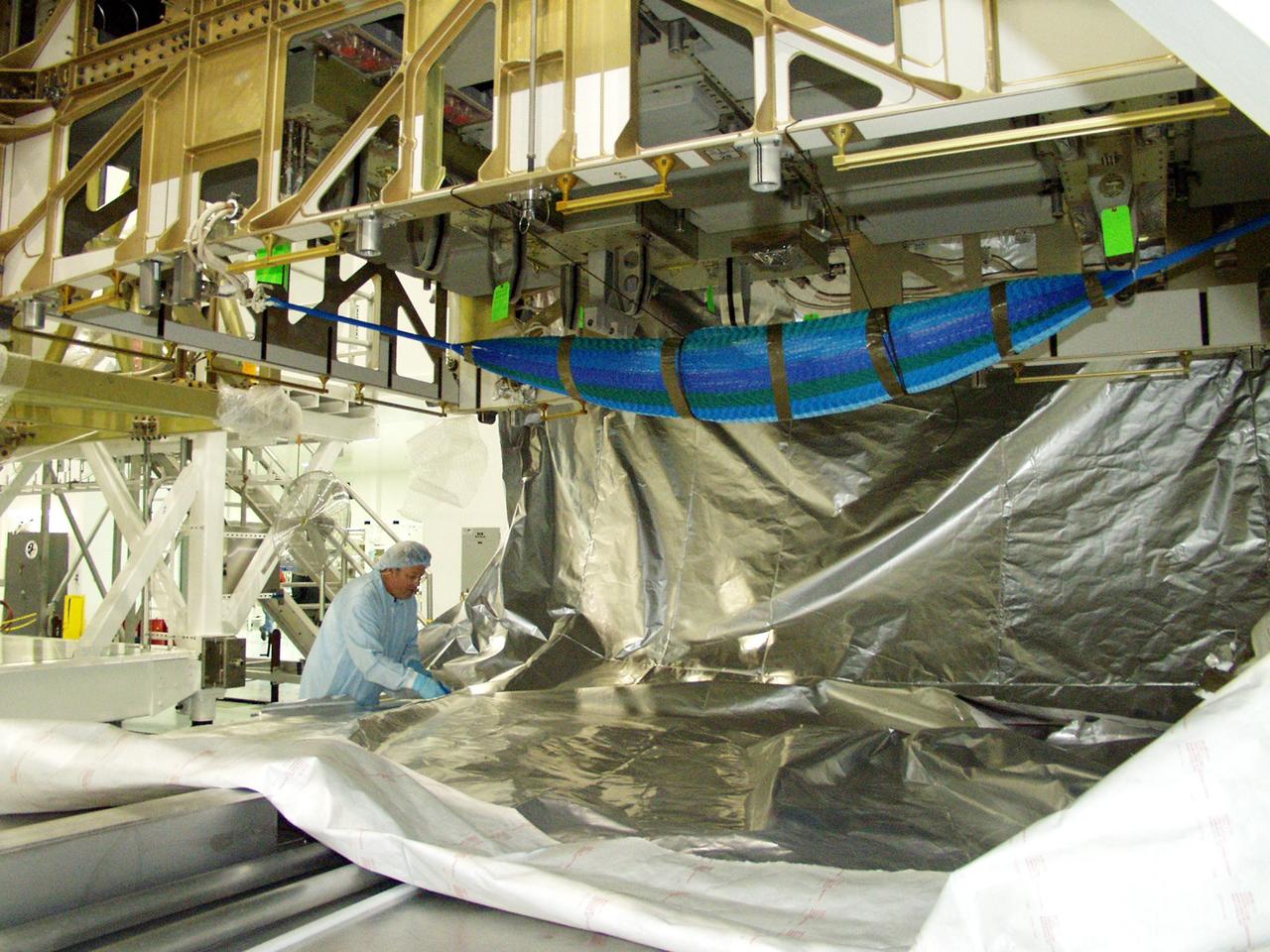
KENNEDY SPACE CENTER, FLA. -- In the Space Station Processing Facility, workers begin uncovering the Long Spacer (LS), the second and final piece of the S6 Integrated Truss Segment. Both the LS and the S6 Integrated Equipment Assembly (IEA) will undergo inspections and verifications tests to prepare them for flight to the International Space Station in early 2004. Although separate for now, the two segments will be integrated and fly as one on mission STS-119. Together the two pieces weigh 26,000 pounds and measure 45 feet long. The S6 is the 11th and final piece of the Station's Integrated Truss Structure, which will measure more than 300 feet in all. .
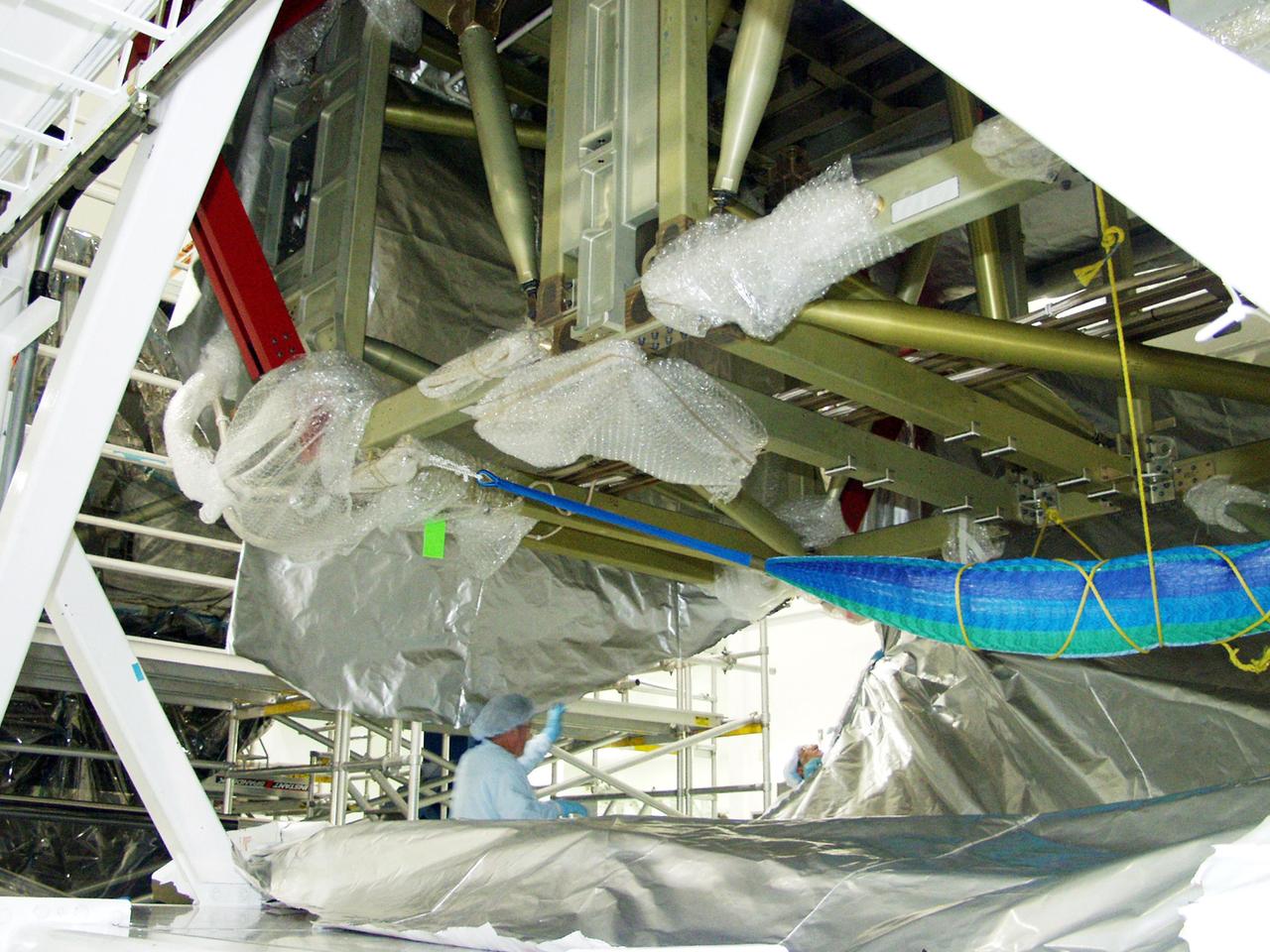
KENNEDY SPACE CENTER, FLA. -- In the Space Station Processing Facility, workers begin uncovering the Long Spacer (LS), the second and final piece of the S6 Integrated Truss Segment. Both the LS and the S6 Integrated Equipment Assembly (IEA) will undergo inspections and verifications tests to prepare them for flight to the International Space Station in early 2004. Although separate for now, the two segments will be integrated and fly as one on mission STS-119. Together the two pieces weigh 26,000 pounds and measure 45 feet long. The S6 is the 11th and final piece of the Station's Integrated Truss Structure, which will measure more than 300 feet in all. .
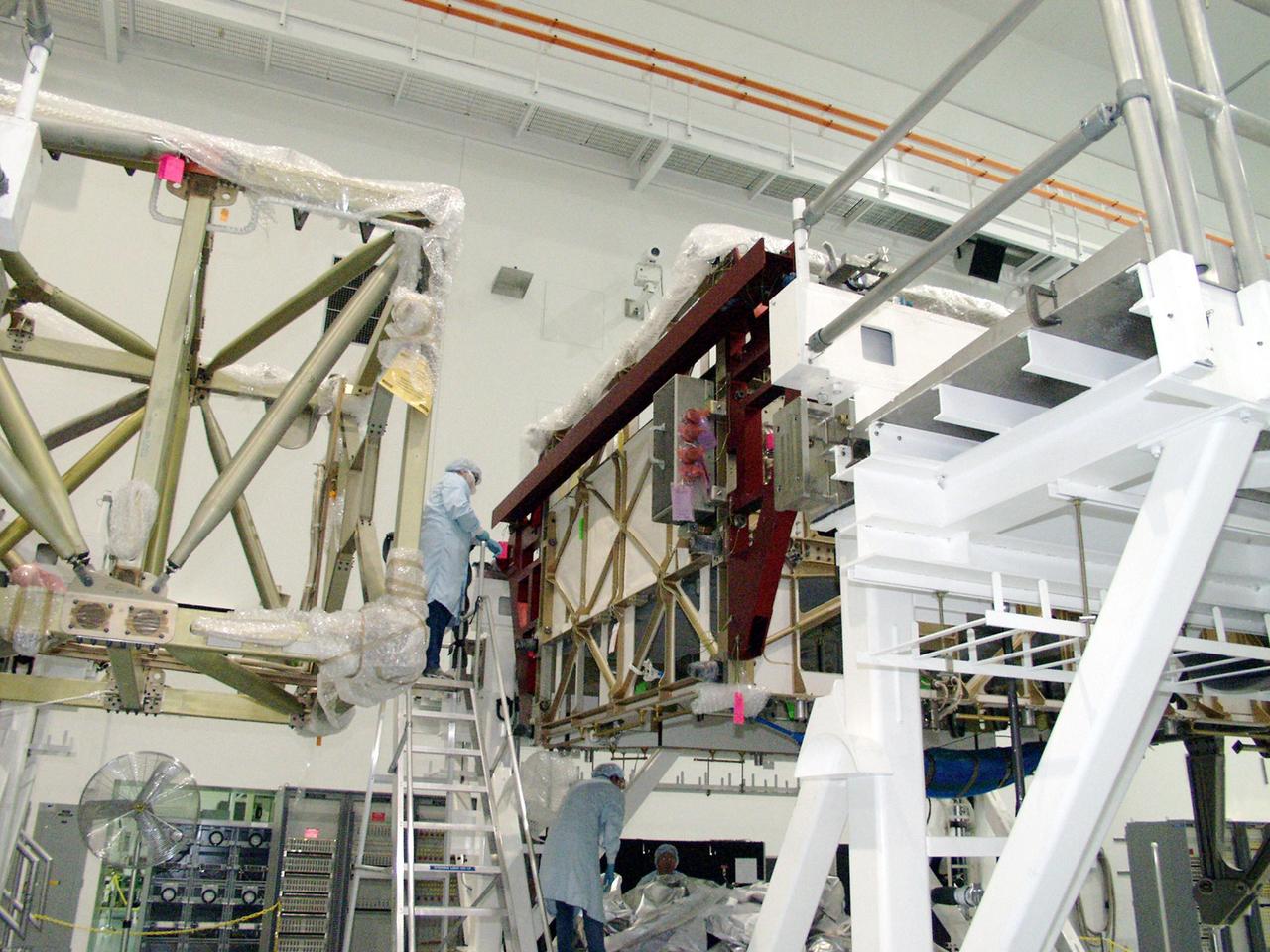
KENNEDY SPACE CENTER, FLA. -- In the Space Station Processing Facility, workers finish uncovering the Long Spacer (LS), the second and final piece of the S6 Integrated Truss Segment. Both the LS and the S6 Integrated Equipment Assembly (IEA) will undergo inspections and verifications tests to prepare them for flight to the International Space Station in early 2004. Although separate for now, the two segments will be integrated and fly as one on mission STS-119. Together the two pieces weigh 26,000 pounds and measure 45 feet long. The S6 is the 11th and final piece of the Station's Integrated Truss Structure, which will measure more than 300 feet in all. .
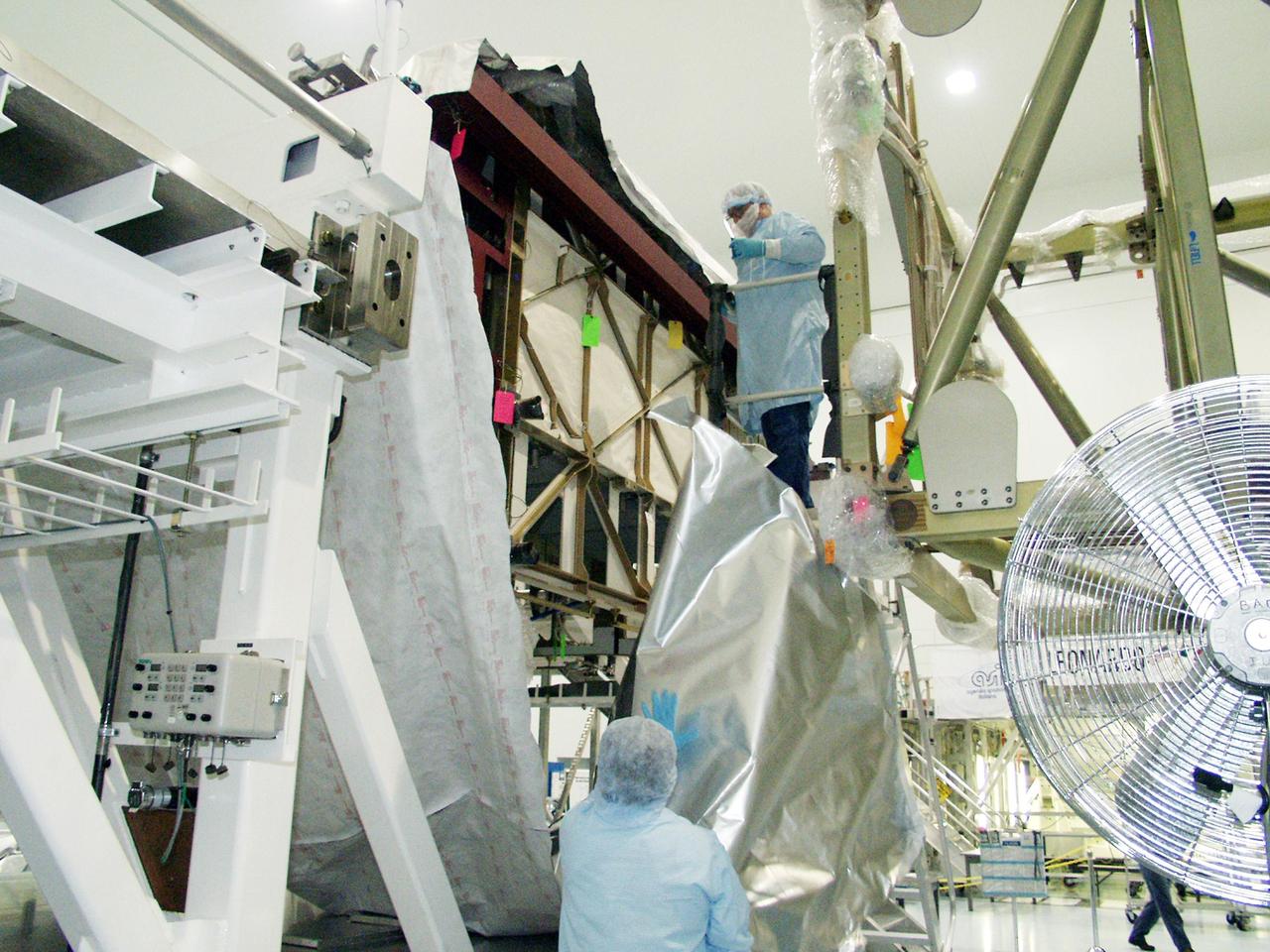
KENNEDY SPACE CENTER, FLA. -- In the Space Station Processing Facility, workers begin uncovering the Long Spacer (LS), the second and final piece of the S6 Integrated Truss Segment. Both the LS and the S6 Integrated Equipment Assembly (IEA) will undergo inspections and verifications tests to prepare them for flight to the International Space Station in early 2004. Although separate for now, the two segments will be integrated and fly as one on mission STS-119. Together the two pieces weigh 26,000 pounds and measure 45 feet long. The S6 is the 11th and final piece of the Station's Integrated Truss Structure, which will measure more than 300 feet in all. .

KENNEDY SPACE CENTER, FLA. -- In the Space Station Processing Facility, a worker begins uncovering the Long Spacer (LS), the second and final piece of the S6 Integrated Truss Segment. Both the LS and the S6 Integrated Equipment Assembly (IEA) will undergo inspections and verifications tests to prepare them for flight to the International Space Station in early 2004. Although separate for now, the two segments will be integrated and fly as one on mission STS-119. Together the two pieces weigh 26,000 pounds and measure 45 feet long. The S6 is the 11th and final piece of the Station's Integrated Truss Structure, which will measure more than 300 feet in all. .

KENNEDY SPACE CENTER, FLA. -- In the Space Station Processing Facility, as part of the Crew Equipment Interface Test, STS-112 Commander Jeffrey Ashby looks over the S1 Integrated Truss Structure, part of the payload for the mission to the International Space Station. The S1 truss is the first starboard (right-side) truss segment, whose main job is providing structural support for the orbiting research facility's radiator panels that cool the Space Station's complex power system. The S1 truss segment also will house communications systems, external experiment positions and other subsystems. The S1 truss will be attached to the S0 truss. Launch of STS-112 is scheduled for Aug. 22, 2002
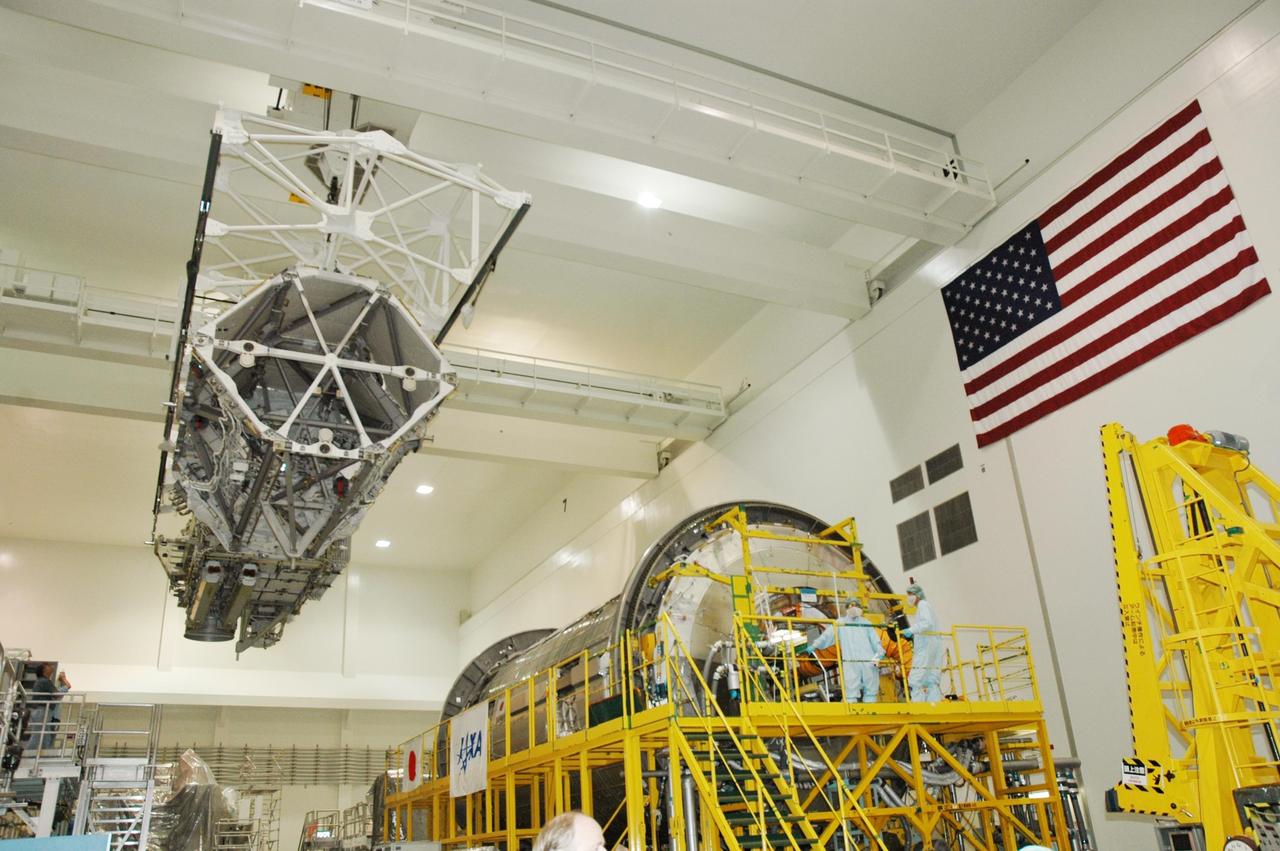
KENNEDY SPACE CENTER, FLA. - In the Space Station Processing Facility, an overhead crane moves the Port 3/4 truss segment across the floor to the waiting payload canister for installation in the orbiter Atlantis. The truss is slated for launch on mission STS-115 no earlier than Aug. 28. The truss is the next major addition to the 11-segment integrated truss structure that will eventually span more than 300 feet on the station. The P3/P4 truss, with its two large solar arrays, will provide one-fourth of the total power-generation capability of the completed station. The P3/P4 truss is expected to be loaded into Atlantis's cargo bay around the beginning of August. Photo credit: NASA/Troy Cryder
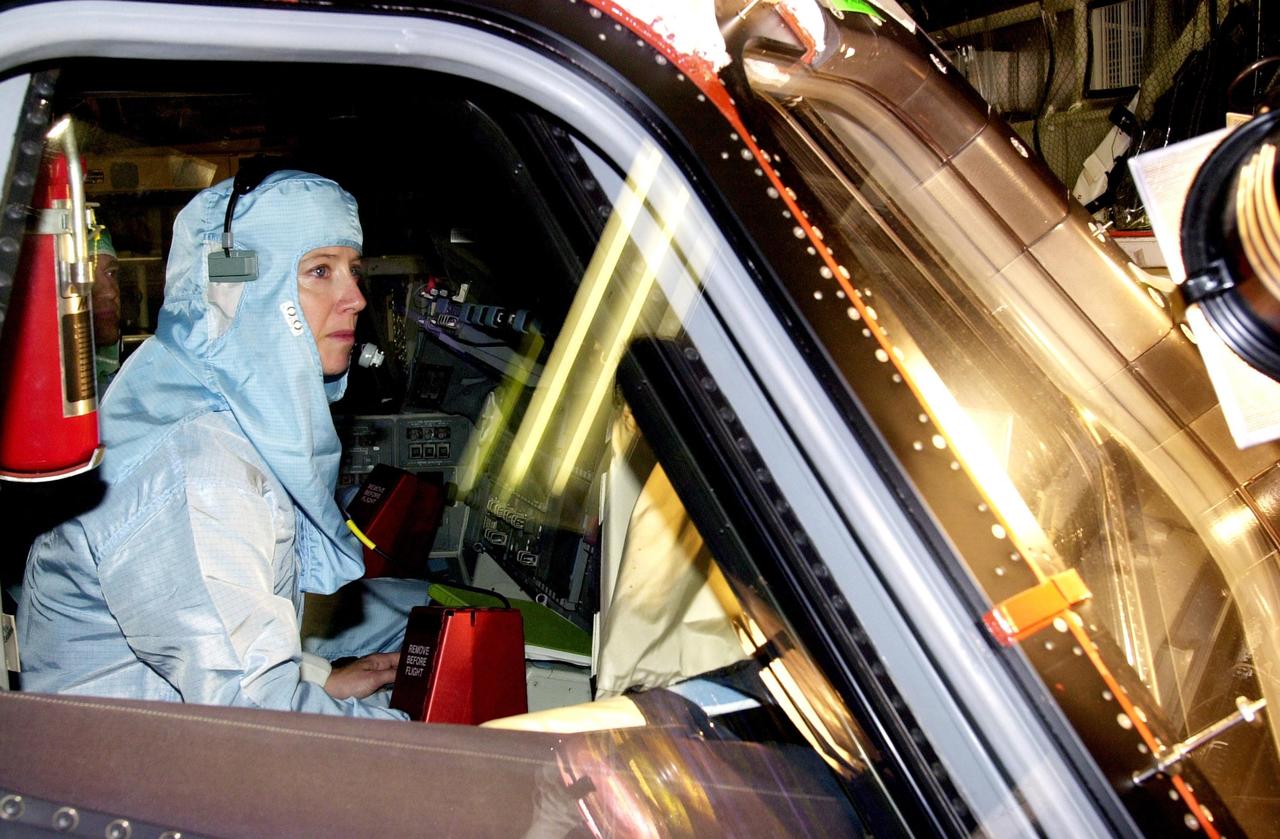
KENNEDY SPACE CENTER, FLA. -- During a Crew Equipment Interface Test, STS-112 Pilot Pamela Melroy checks out the windshield on Atlantis, the designated orbiter for the mission. STS-112 is the 15th assembly flight to the International Space Station and will be ferrying the S1 Integrated Truss Structure. The S1 truss is the first starboard (right-side) truss segment, whose main job is providing structural support for the radiator panels that cool the Space Station's complex power system. The S1 truss segment also will house communications systems, external experiment positions and other subsystems. The S1 truss will be attached to the S0 truss. STS-112 is currently scheduled for launch Aug. 22, 2002
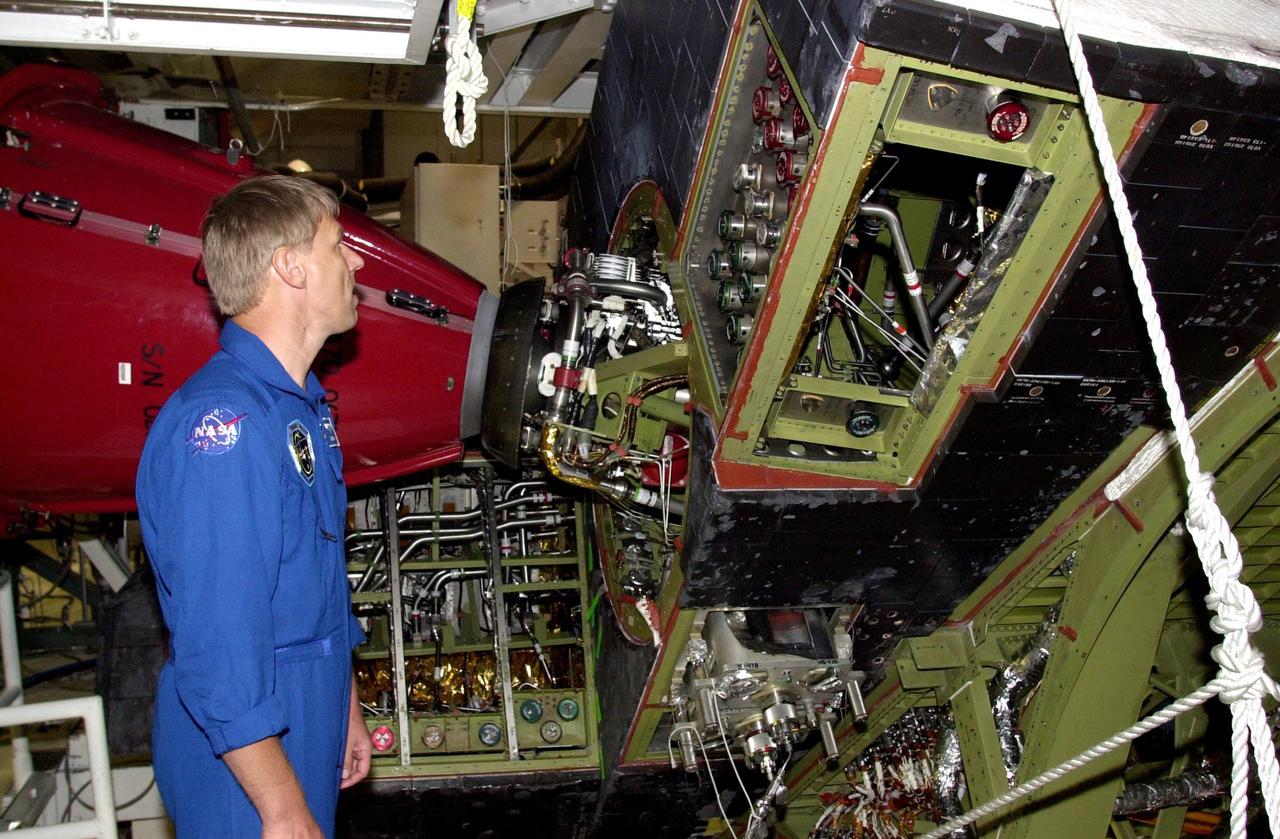
KENNEDY SPACE CENTER, FLA. - During a Crew Equipment Interface Test, STS-112 Mission Specialist Piers Sellers looks at the engine on Atlantis, the designated orbiter for the mission. On the 15th assembly flight to the International Space Station, Atlantis and crew will be ferrying the S1 Integrated Truss Structure. The S1 truss is the first starboard (right-side) truss segment, whose main job is providing structural support for the radiator panels that cool the Space Station's complex power system. The S1 truss segment also will house communications systems, external experiment positions and other subsystems. The S1 truss will be attached to the S0 truss. STS-112 is currently scheduled for launch Aug. 22, 2002
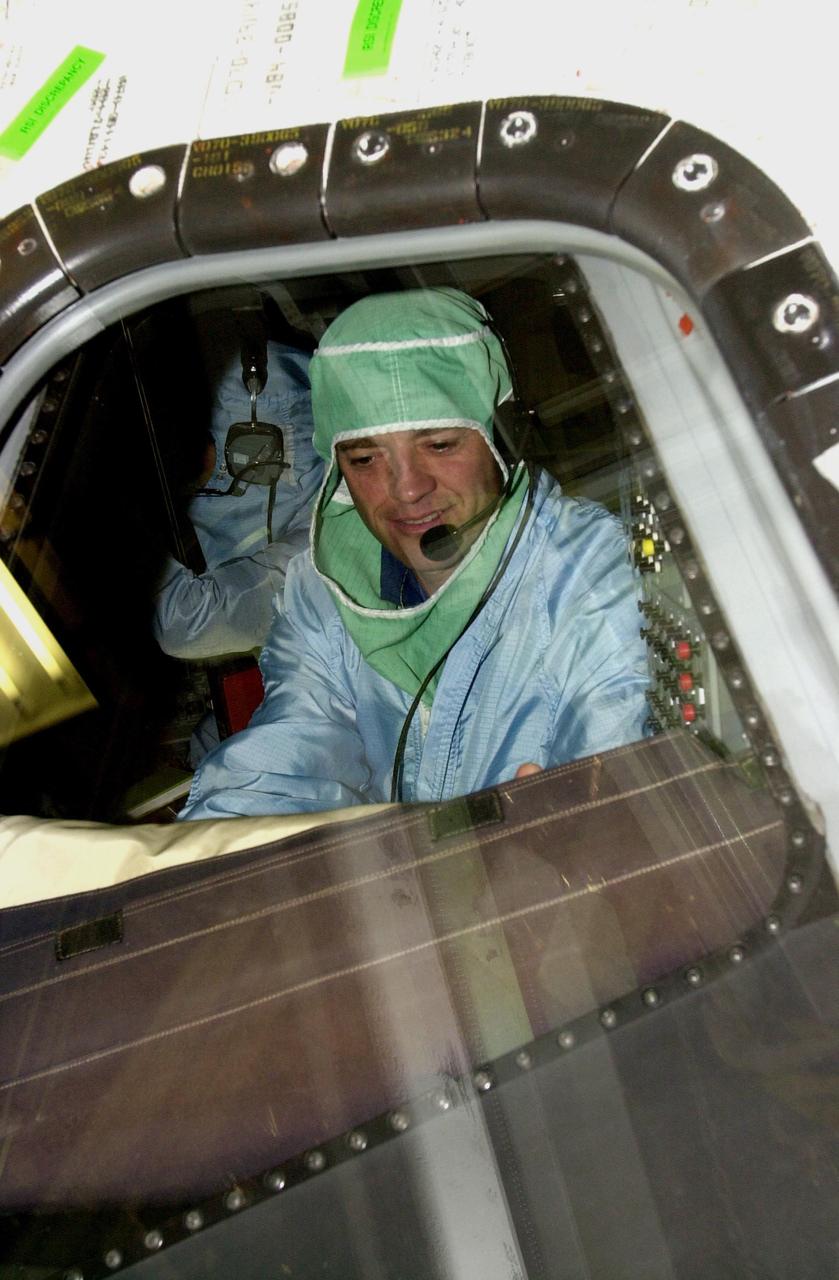
KENNEDY SPACE CENTER, FLA. -- During a Crew Equipment Interface Test, STS-112 Commander Jeffrey Ashby checks out the windshield on Atlantis, the designated orbiter for the mission. STS-112 is the 15th assembly flight to the International Space Station and will be ferrying the S1 Integrated Truss Structure. The S1 truss is the first starboard (right-side) truss segment, whose main job is providing structural support for the radiator panels that cool the Space Station's complex power system. The S1 truss segment also will house communications systems, external experiment positions and other subsystems. The S1 truss will be attached to the S0 truss. STS-112 is currently scheduled for launch Aug. 22, 2002
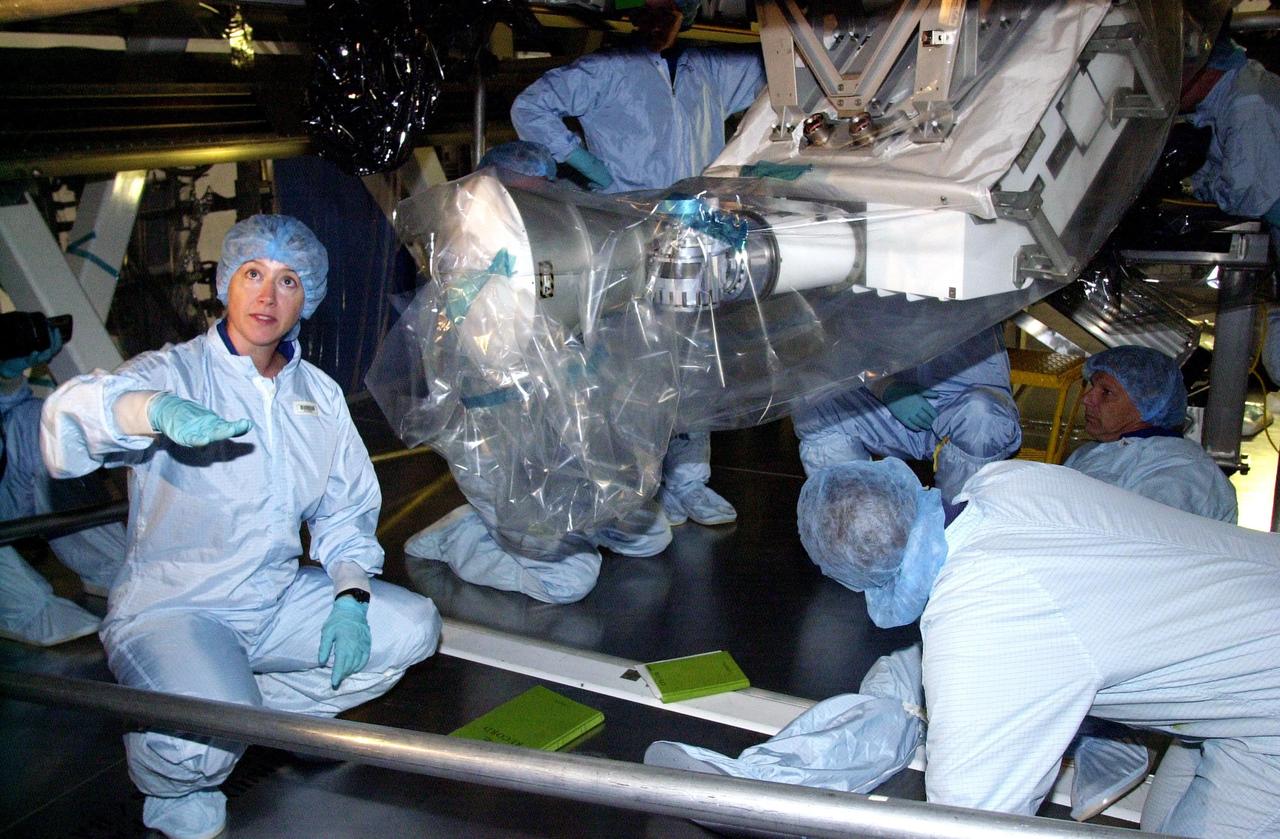
KENNEDY SPACE CENTER, FLA. - STS-112 Pilot Pamela Melroy signals to someone off camera while behind her other crew members look over the S1 Integrated Truss Structure, part of the payload for the mission to the International Space Station. The S1 truss is the first starboard (right-side) truss segment, whose main job is providing structural support for the orbiting research facility's radiator panels that cool the Space Station's complex power system. The S1 truss segment also will house communications systems, external experiment positions and other subsystems. The S1 truss will be attached to the S0 truss. Launch of STS-112 is scheduled for Aug. 22, 2002

KENNEDY SPACE CENTER, FLA. - As part of the Crew Equipment Interface Test, STS-112 Mission Specialist David Wolf (right) checks out a part of the S1 Integrated Truss Structure, part of the payload for the mission to the International Space Station. The S1 truss is the first starboard (right-side) truss segment, whose main job is providing structural support for the orbiting research facility's radiator panels that cool the Space Station's complex power system. The S1 truss segment also will house communications systems, external experiment positions and other subsystems. The S1 truss will be attached to the S0 truss. Launch of STS-112 is scheduled for Aug. 22, 2002
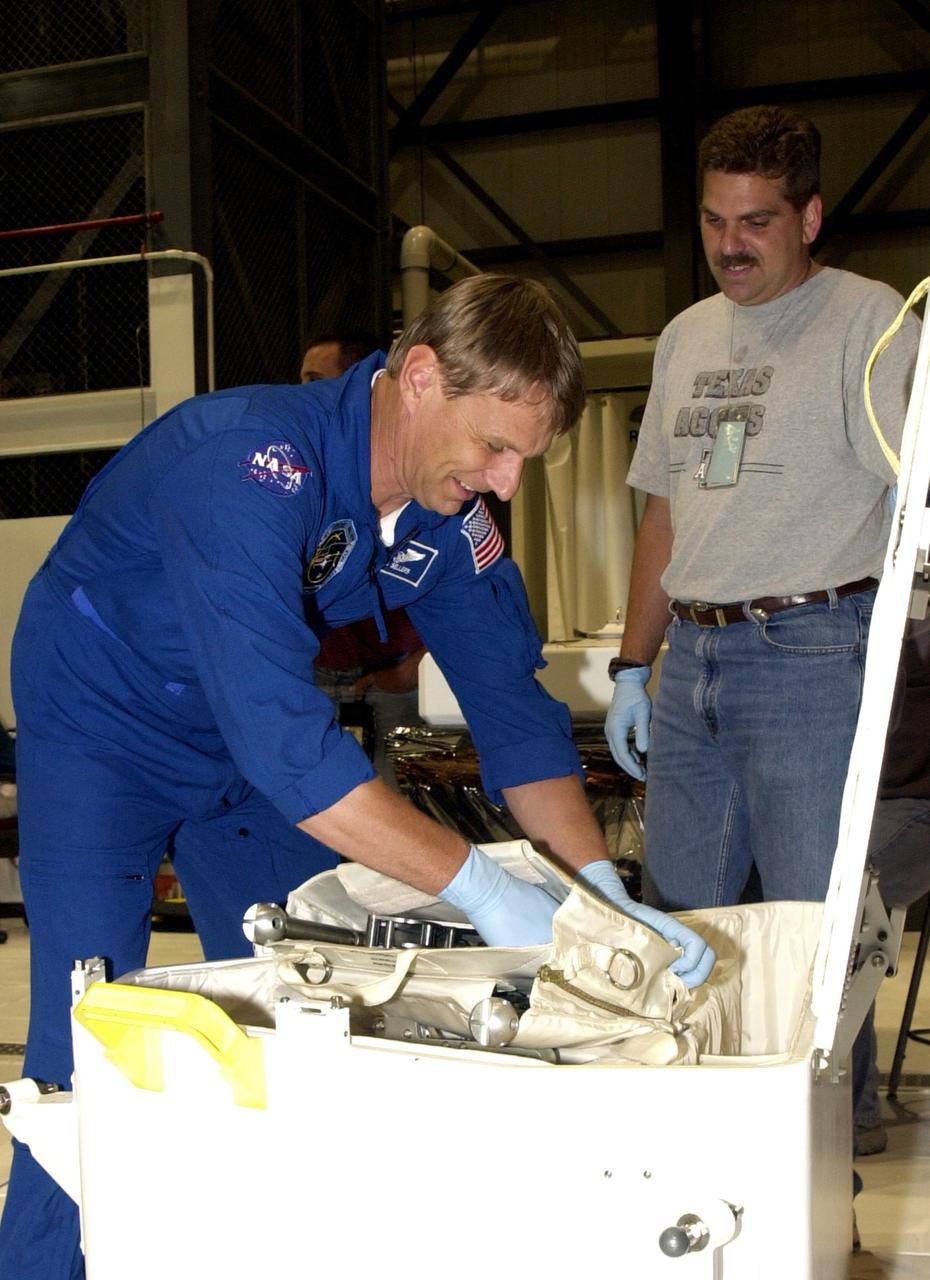
KENNEDY SPACE CENTER, FLA. - STS-112 Mission Specialist Piers Sellers checks out flight equipment during a Crew Equipment Interface Test at KSC. STS-112 is the 15th assembly flight to the International Space Station and will be ferrying the S1 Integrated Truss Structure. The S1 truss is the first starboard (right-side) truss segment, whose main job is providing structural support for the radiator panels that cool the Space Station's complex power system. The S1 truss segment also will house communications systems, external experiment positions and other subsystems. The S1 truss will be attached to the S0 truss. STS-112 is currently scheduled for launch Aug. 22, 2002

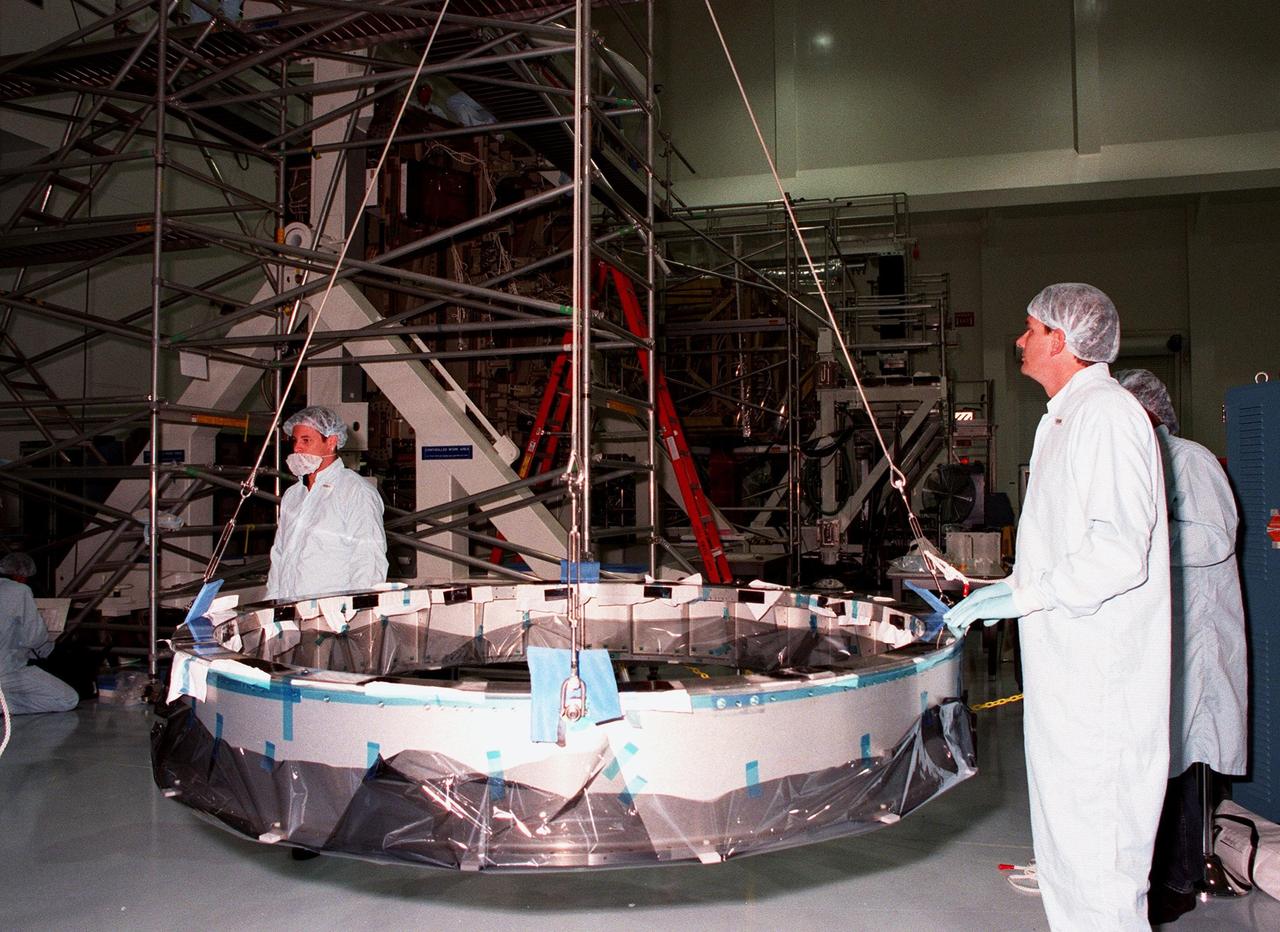
Still suspended by a crane and cables in the Space Station Processing Facility, yet hidden by the top of the Z1 integrated truss structure, the Passive Common Berthing Mechanism (PCBM) is lowered onto the truss for attachment. Workers at the top of a workstand guide it into place. A component of the International Space Station (ISS), the Z1 truss will be used for the temporary installation of the P6 truss segment to the Unity connecting module. The P6 truss segment contains the solar arrays and batteries which will provide early station power. The truss is scheduled to be launched aboard STS-92 in late 1999
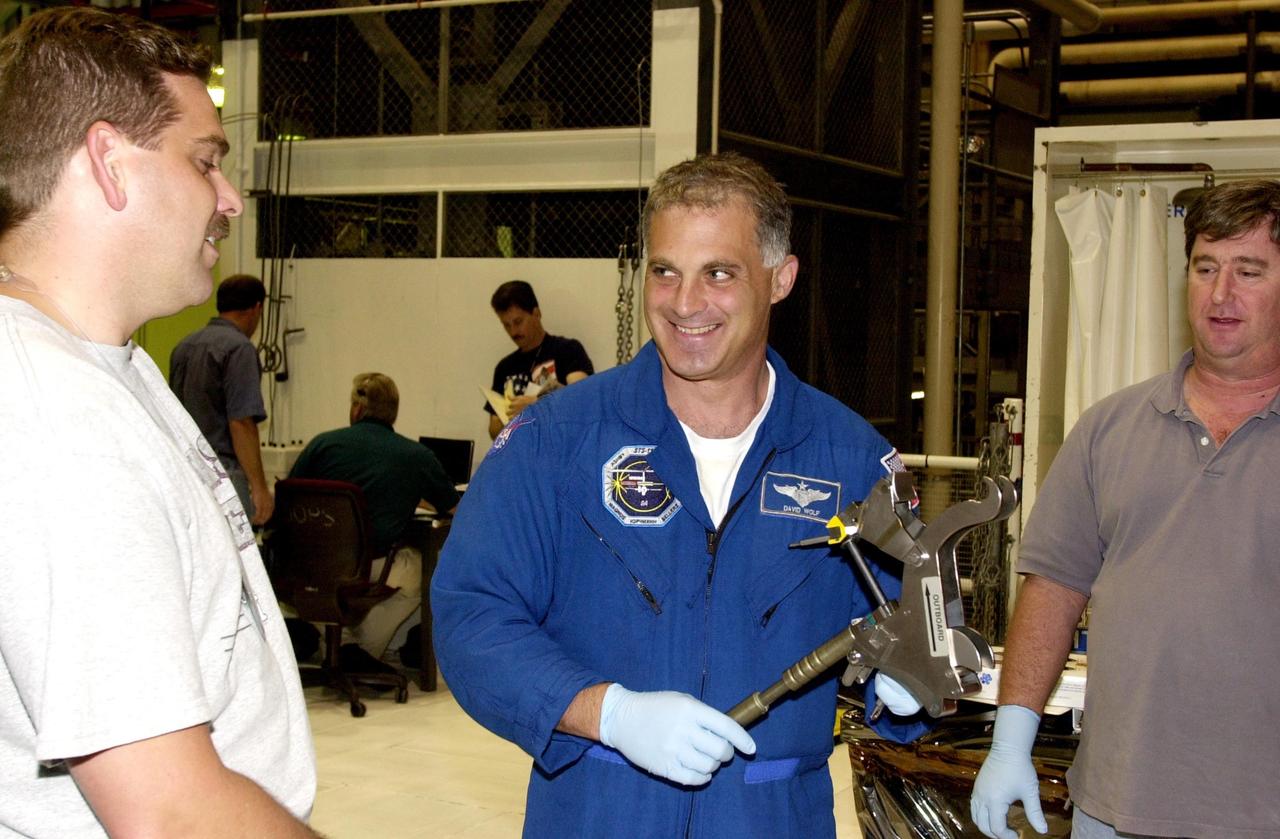
KENNEDY SPACE CENTER, FLA. -- STS-112 Mission Specialist David Wolf discusses flight equipment with two technicians during a Crew Equipment Interface Test at KSC. STS-112 is the 15th assembly flight to the International Space Station and will be ferrying the S1 Integrated Truss Structure. The S1 truss is the first starboard (right-side) truss segment, whose main job is providing structural support for the radiator panels that cool the Space Station's complex power system. The S1 truss segment also will house communications systems, external experiment positions and other subsystems. The S1 truss will be attached to the S0 truss. STS-112 is currently scheduled for launch Aug. 22, 2002
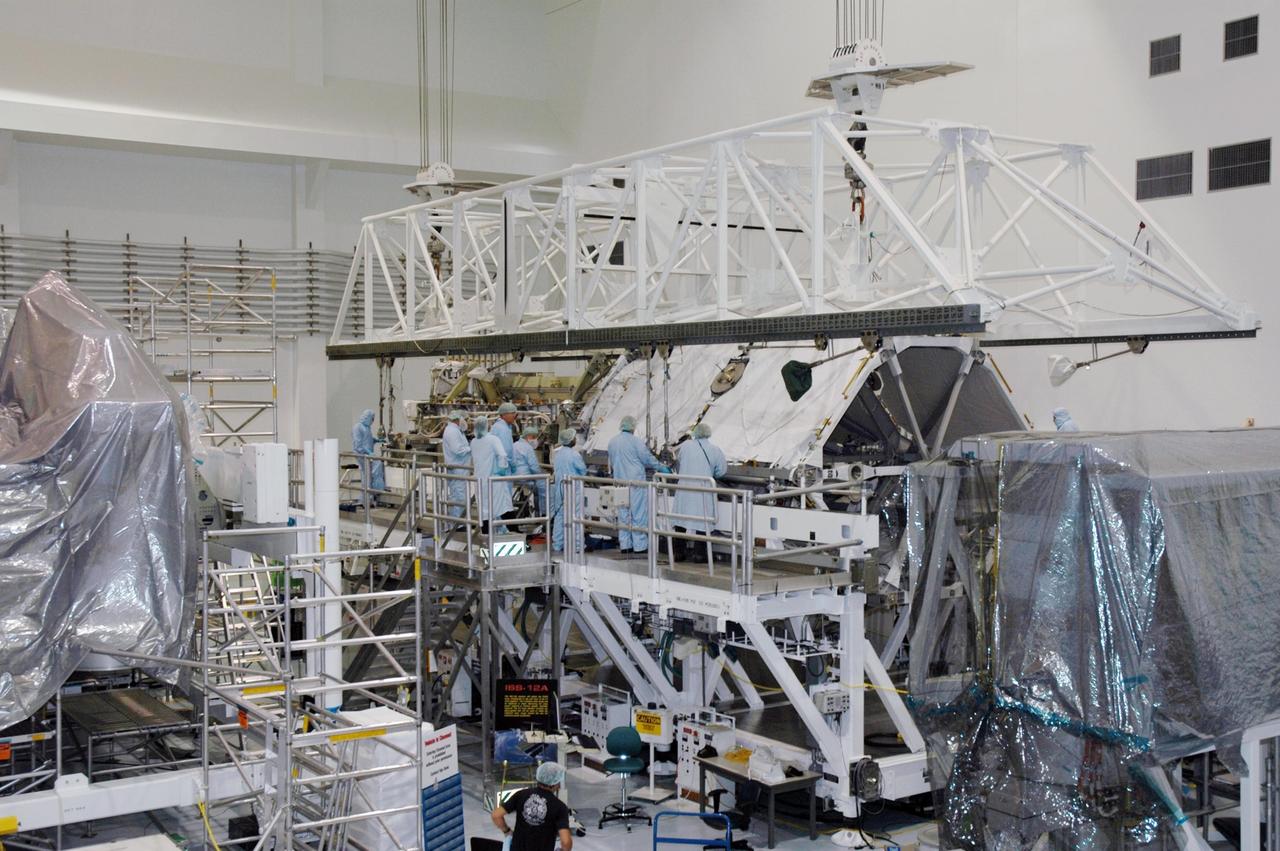
KENNEDY SPACE CENTER, FLA. - In the Space Station Processing Facility, an overhead crane lowers the Port 3/4 truss segment into the waiting payload canister for installation in the orbiter Atlantis. The truss is slated for launch on mission STS-115 no earlier than Aug. 28. The truss is the next major addition to the 11-segment integrated truss structure that will eventually span more than 300 feet on the station. The P3/P4 truss, with its two large solar arrays, will provide one-fourth of the total power-generation capability of the completed station. The P3/P4 truss is expected to be loaded into Atlantis's cargo bay around the beginning of August. Photo credit: NASA/Troy Cryder
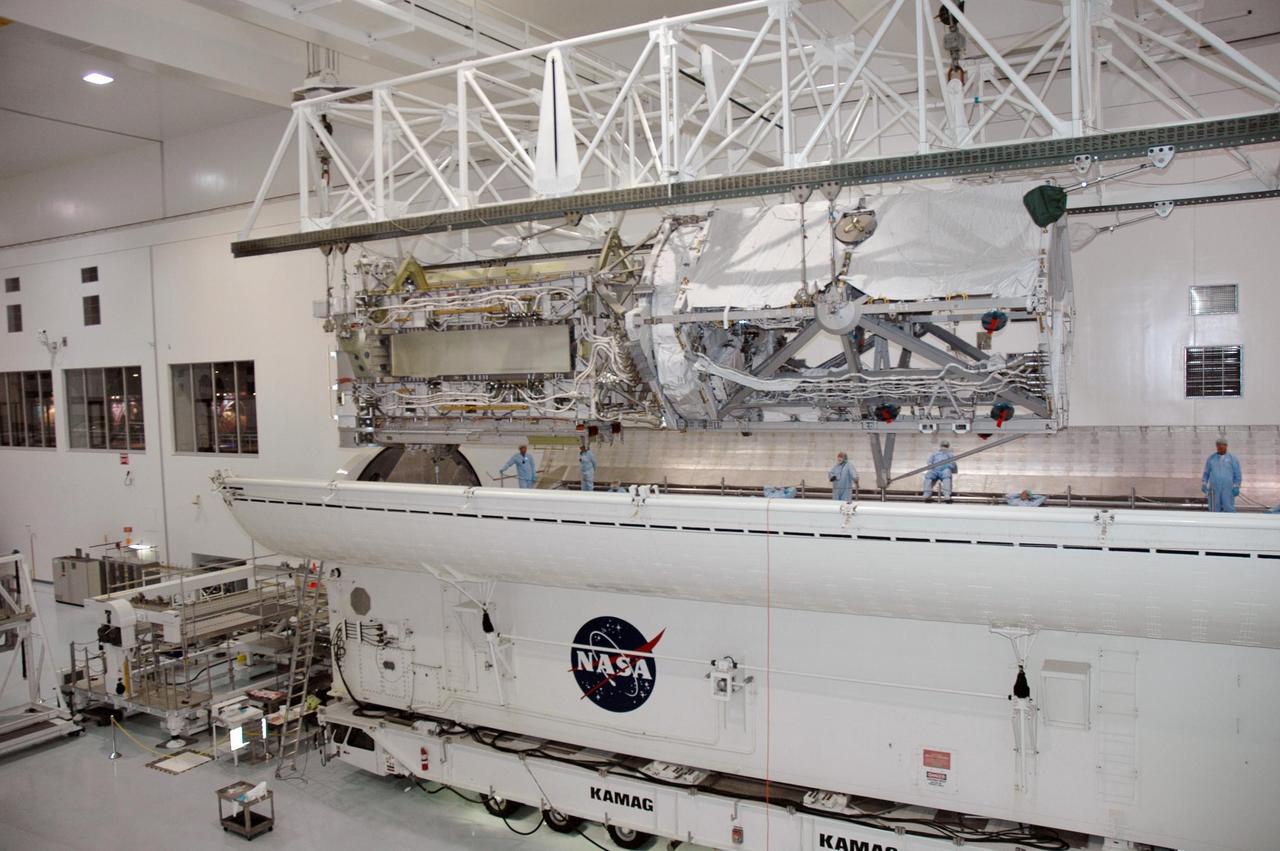
KENNEDY SPACE CENTER, FLA. - In the Space Station Processing Facility, an overhead crane is ready to lift the Port 3/4 truss segment and move it to a payload canister for installation in the orbiter Atlantis. The truss is slated for launch on mission STS-115 no earlier than Aug. 28. The truss is the next major addition to the 11-segment integrated truss structure that will eventually span more than 300 feet on the station. The P3/P4 truss, with its two large solar arrays, will provide one-fourth of the total power-generation capability of the completed station. The P3/P4 truss is expected to be loaded into Atlantis's cargo bay around the beginning of August. Photo credit: NASA/Troy Cryder

KENNEDY SPACE CENTER, FLA. - In the Space Station Processing Facility, an overhead crane lowers the Port 3/4 truss segment into the waiting payload canister for installation in the orbiter Atlantis. The truss is slated for launch on mission STS-115 no earlier than Aug. 28. The truss is the next major addition to the 11-segment integrated truss structure that will eventually span more than 300 feet on the station. The P3/P4 truss, with its two large solar arrays, will provide one-fourth of the total power-generation capability of the completed station. The P3/P4 truss is expected to be loaded into Atlantis's cargo bay around the beginning of August. Photo credit: NASA/Troy Cryder
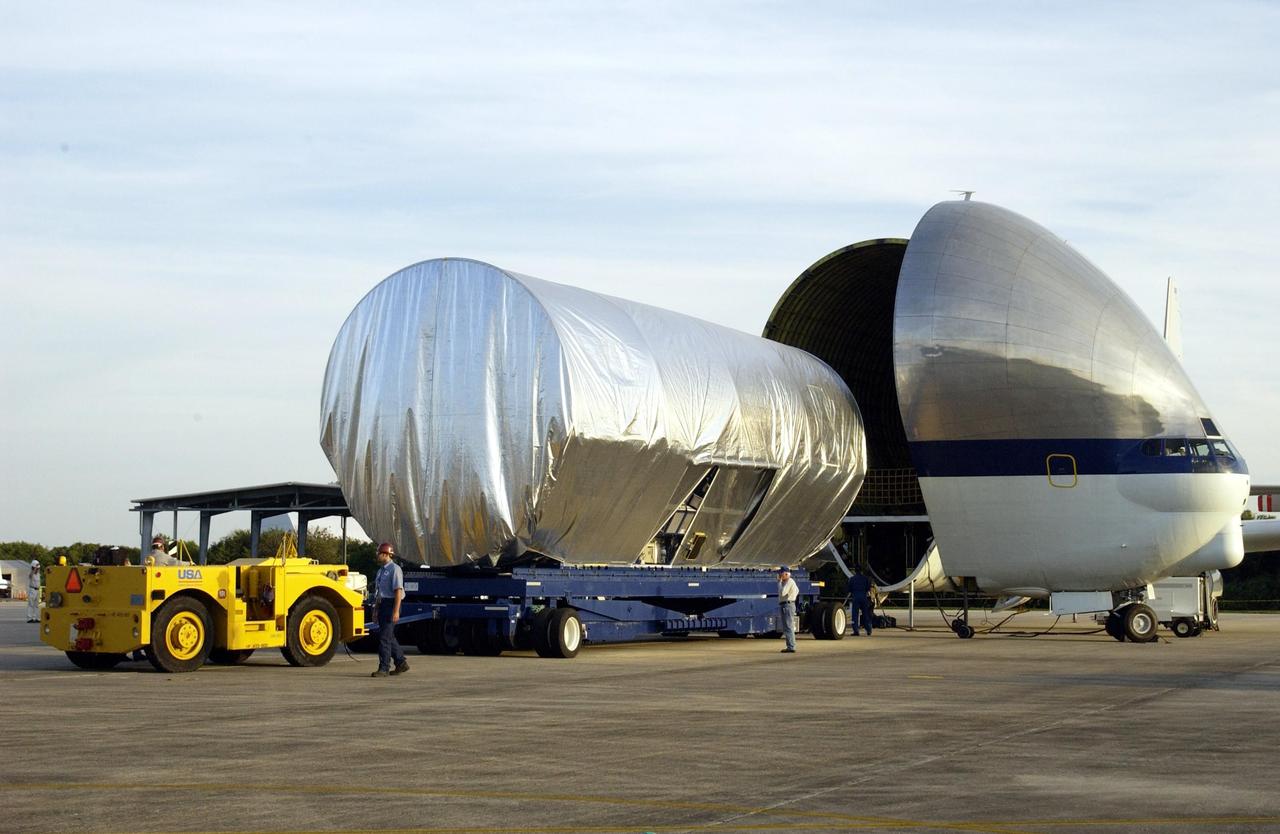
KENNEDY SPACE CENTER, FLA. -- The Integrated Equipment Assembly (IEA), one of two major components of the Starboard 6 (S6) truss segment for the International Space Station (ISS), is offloaded from NASA's Super Guppy cargo airplane following its arrival at the Shuttle Landing Facility. The customized four-engine aricraft has a 24-foot-diameter fuselage and a foldaway nose enabling it to load and transport oversize cargo. The IEA will be joined to its companion piece, the Long Spacer, before launch early in 2004. The S6 truss segment will be the 11th and final piece of the Station's Integrated Truss Structure and will support the fourth and final set of solar arrays, batteries, and electronics.
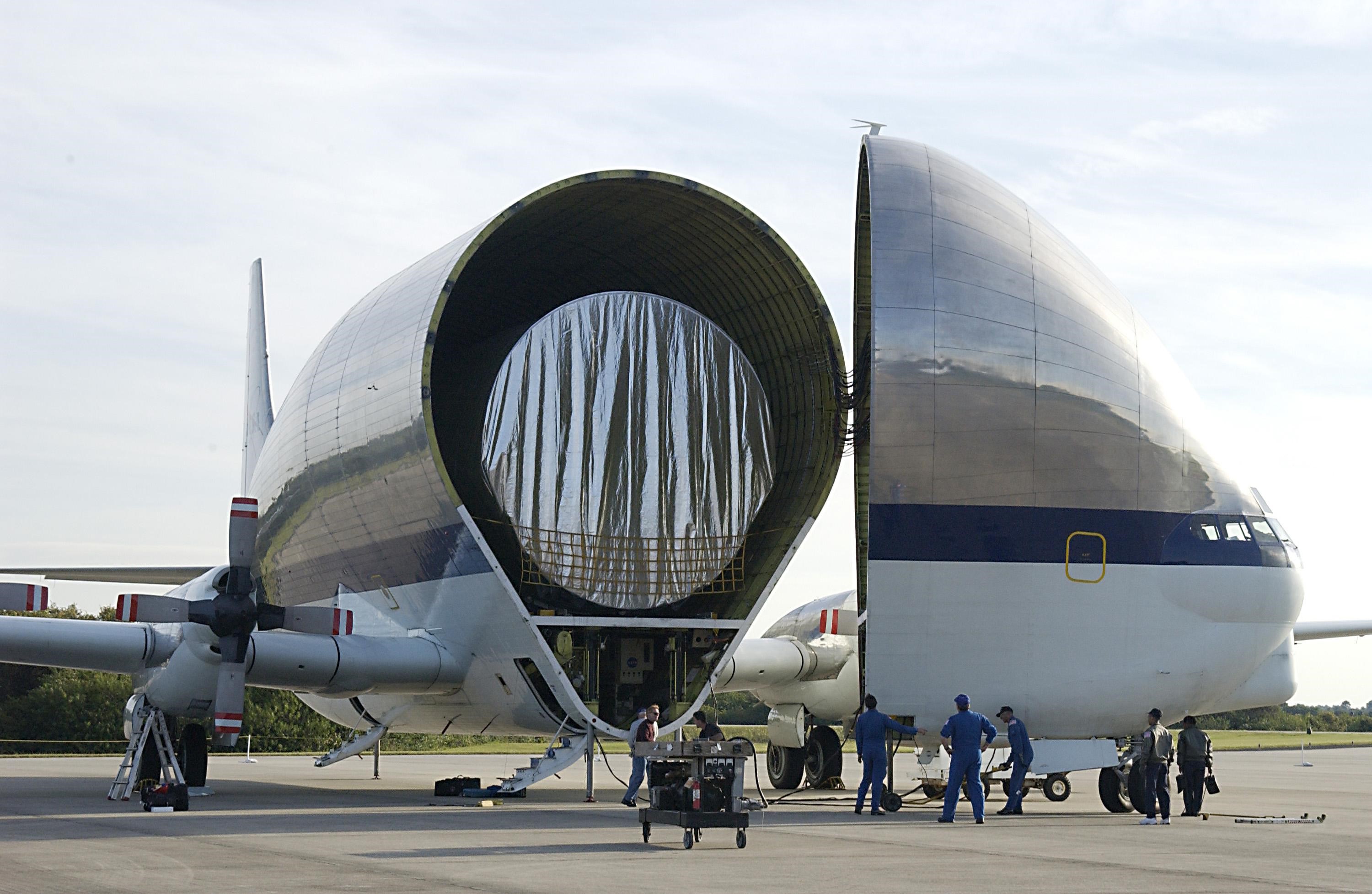
KENNEDY SPACE CENTER, FLA. -- The Integrated Equipment Assembly (IEA), one of two major components of the Starboard 6 (S6) truss segment for the International Space Station (ISS), is revealed inside NASA's Super Guppy cargo airplane following its arrival at the Shuttle Landing Facility. The customized four-engine aricraft has a 24-foot-diameter fuselage and a foldaway nose enabling it to load and transport oversize cargo. The IEA will be joined to its companion piece, the Long Spacer, before launch early in 2004. The S6 truss segment will be the 11th and final piece of the Station's Integrated Truss Structure and will support the fourth and final set of solar arrays, batteries, and electronics.

KENNEDY SPACE CENTER, FLA. -- The Integrated Equipment Assembly (IEA), one of two major components of the Starboard 6 (S6) truss segment for the International Space Station (ISS), arrives at the Shuttle Landing Facility aboard NASA's Super Guppy cargo airplane. The customized four-engine aricraft has a 24-foot-diameter fuselage and a foldaway nose enabling it to load and transport oversize cargo. The IEA will be joined to its companion piece, the Long Spacer, before launch early in 2004. The S6 truss segment will be the 11th and final piece of the Station's Integrated Truss Structure and will support the fourth and final set of solar arrays, batteries, and electronics.
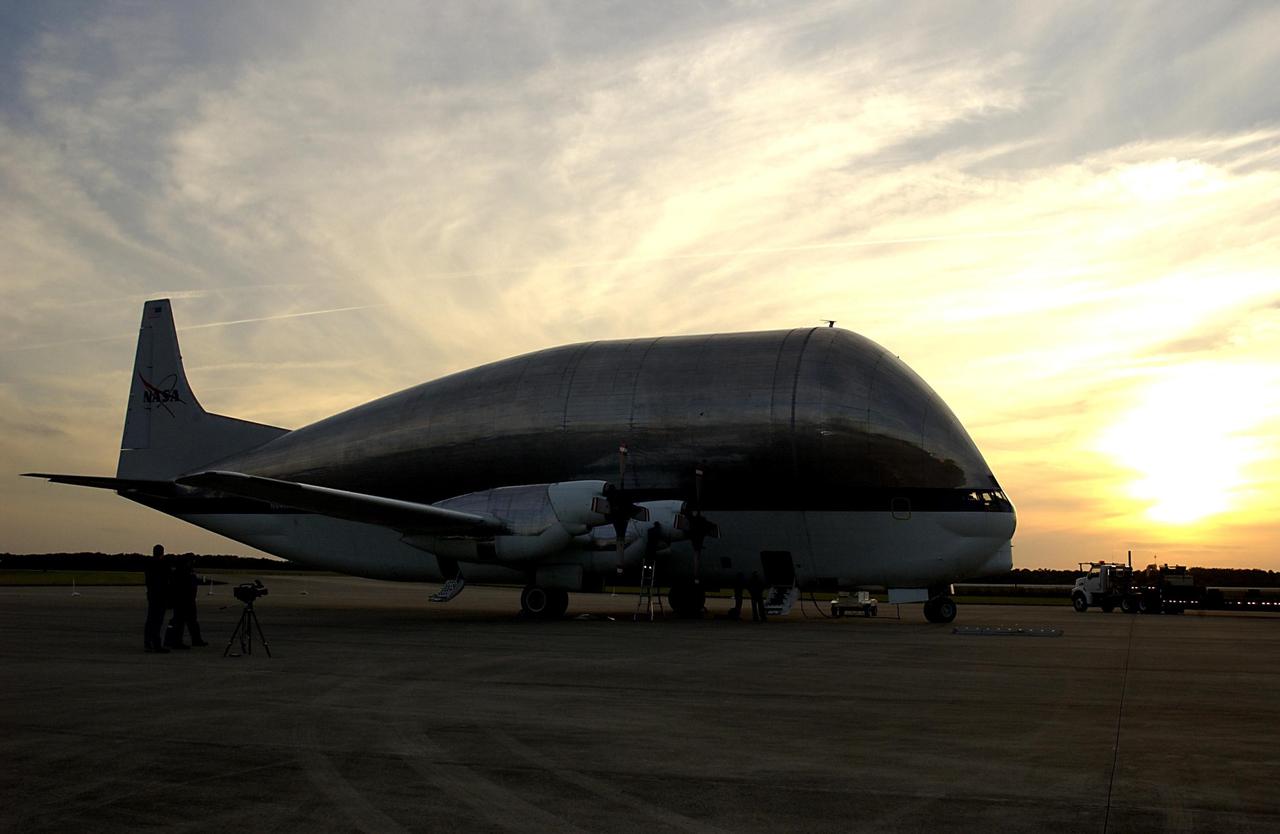
KENNEDY SPACE CENTER, FLA. -- The Integrated Equipment Assembly (IEA), one of two major components of the Starboard 6 (S6) truss segment for the International Space Station (ISS), arrives at the Shuttle Landing Facility aboard NASA's Super Guppy cargo airplane. The customized four-engine aricraft has a 24-foot-diameter fuselage and a foldaway nose enabling it to load and transport oversize cargo. The IEA will be joined to its companion piece, the Long Spacer, before launch early in 2004. The S6 truss segment will be the 11th and final piece of the Station's Integrated Truss Structure and will support the fourth and final set of solar arrays, batteries, and electronics.
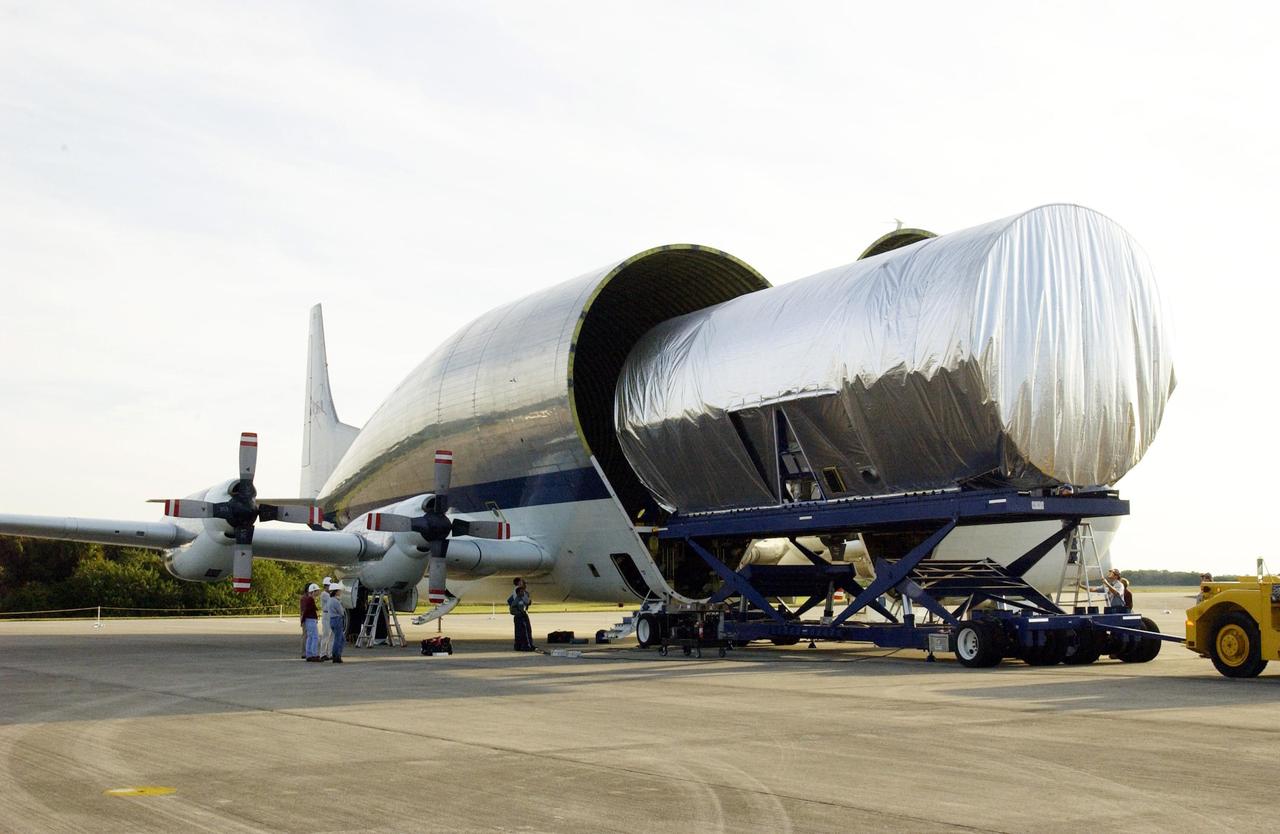
KENNEDY SPACE CENTER, FLA. -- The Integrated Equipment Assembly (IEA), one of two major components of the Starboard 6 (S6) truss segment for the International Space Station (ISS), is offloaded from NASA's Super Guppy cargo airplane following its arrival at the Shuttle Landing Facility. The customized four-engine aricraft has a 24-foot-diameter fuselage and a foldaway nose enabling it to load and transport oversize cargo. The IEA will be joined to its companion piece, the Long Spacer, before launch early in 2004. The S6 truss segment will be the 11th and final piece of the Station's Integrated Truss Structure and will support the fourth and final set of solar arrays, batteries, and electronics.
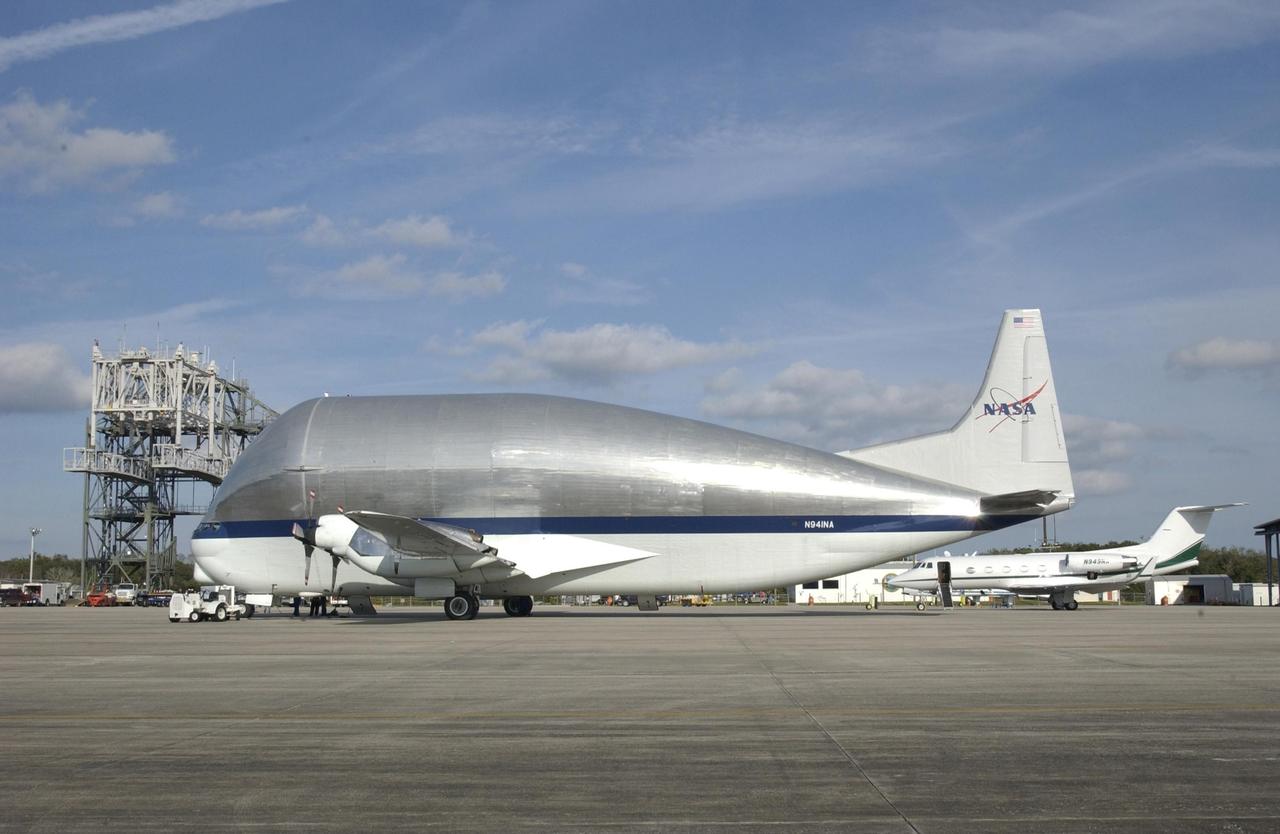
KENNEDY SPACE CENTER, FLA. -- The Integrated Equipment Assembly (IEA), one of two major components of the Starboard 6 (S6) truss segment for the International Space Station (ISS), arrives at the Shuttle Landing Facility aboard NASA's Super Guppy cargo airplane. The customized four-engine aricraft has a 24-foot-diameter fuselage and a foldaway nose enabling it to load and transport oversize cargo. The IEA will be joined to its companion piece, the Long Spacer, before launch early in 2004. The S6 truss segment will be the 11th and final piece of the Station's Integrated Truss Structure and will support the fourth and final set of solar arrays, batteries, and electronics.
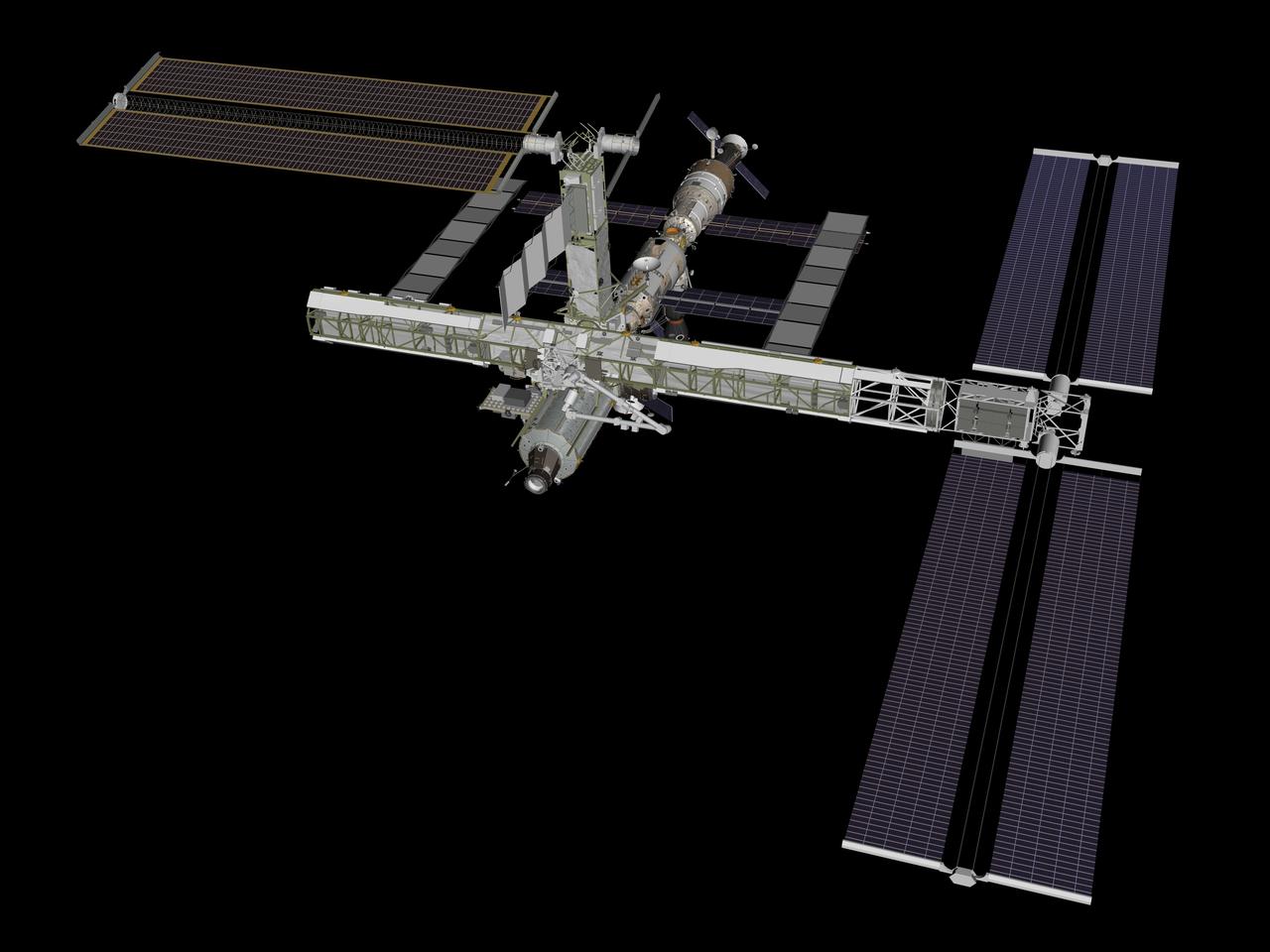
JSC2006-E-38950 (August 2006) --- Computer generated graphic of the International Space Station configuration after STS-116/12A.1 with the addition of the P5 integrated truss segment.
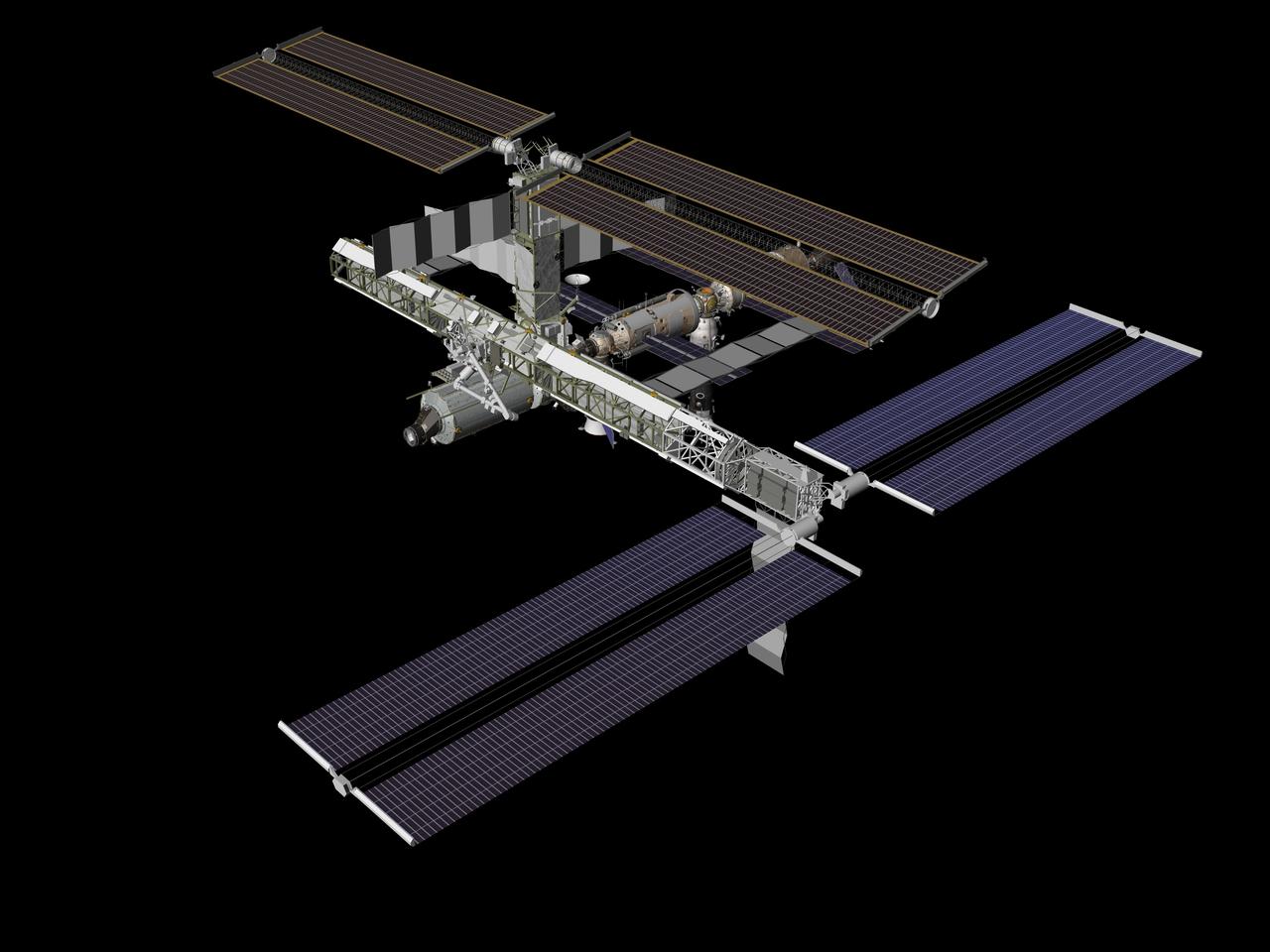
JSC2006-E-38949 (August 2006) --- Computer generated graphic of the International Space Station configuration after STS-115/12A with the addition of the P3/P4 integrated truss segments.
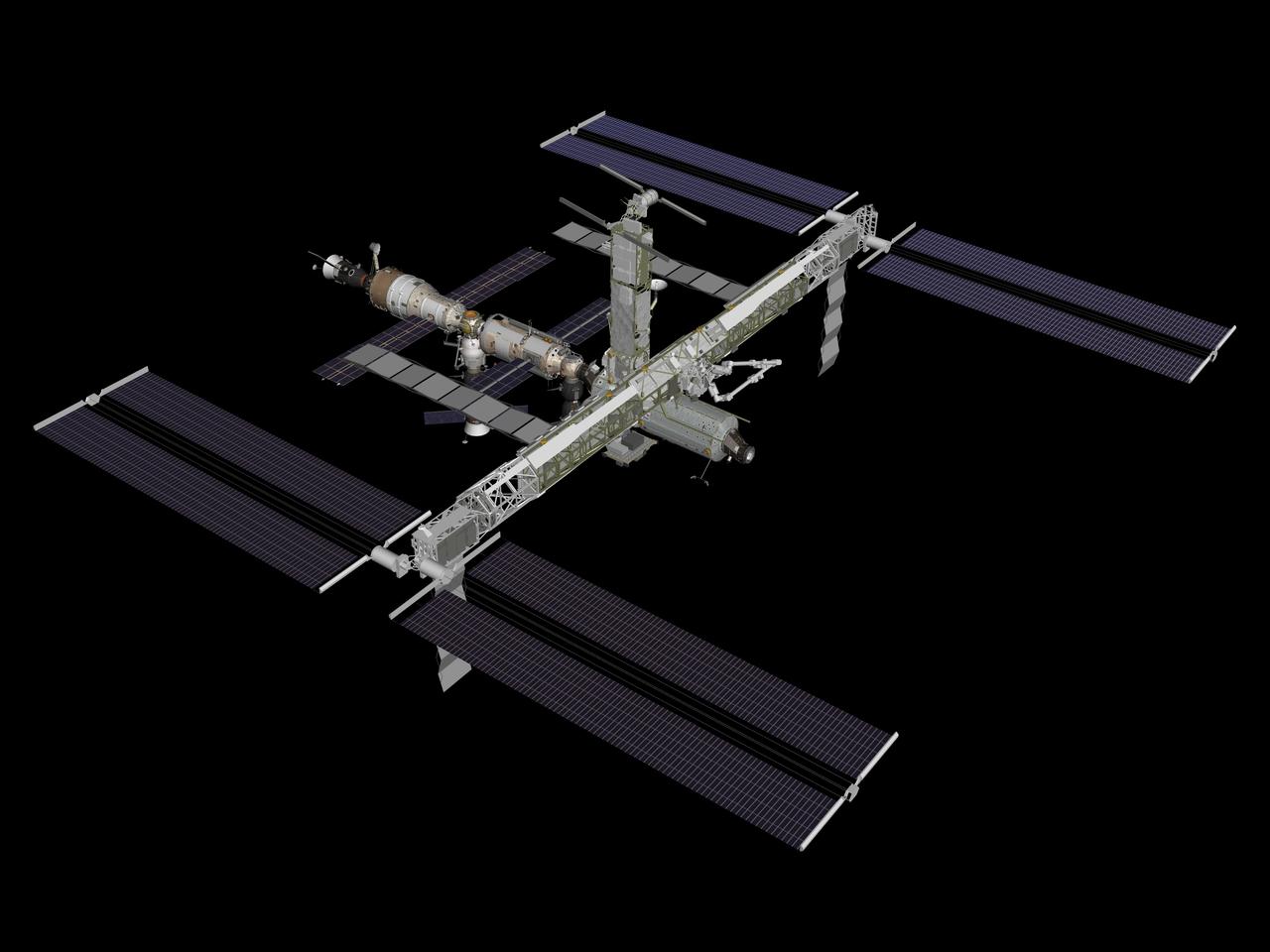
JSC2006-E-38951 (August 2006) --- Computer generated graphic of the International Space Station configuration after STS-117/13A with the addition of S3/S4 integrated truss segments.
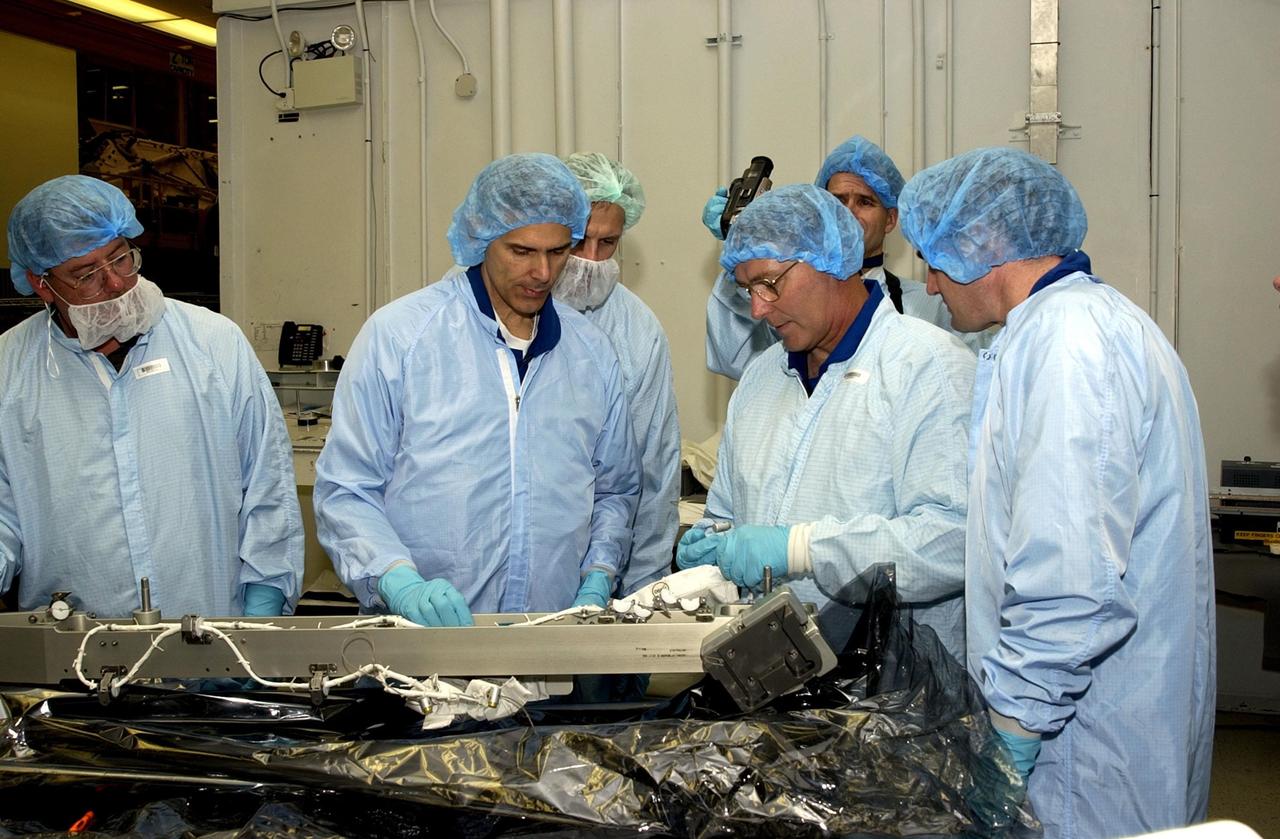
KENNEDY SPACE CENTER, FLA. -- In the Operations and Checkout Building, members of the STS-110 crew check out equipment that will be on their mission. From left are Mission Specialists Steven Smith, Lee Morin, Jerry Ross and Rex Walheim. Other crew members (not shown) are Commander Michael J. Bloomfield, Pilot Stephen N. Frick, and Mission Specialist Ellen Ochoa. Part of the payload on the mission is the Integrated Truss Structure S0. It is the center segment that they will be installing on the International Space Station, part of the 300-foot (91-meter) truss attached to the U.S. Lab. By assembly completion, four more truss segments will attach to either side of the S0 truss. STS-110 is currently scheduled to launch in April 2002
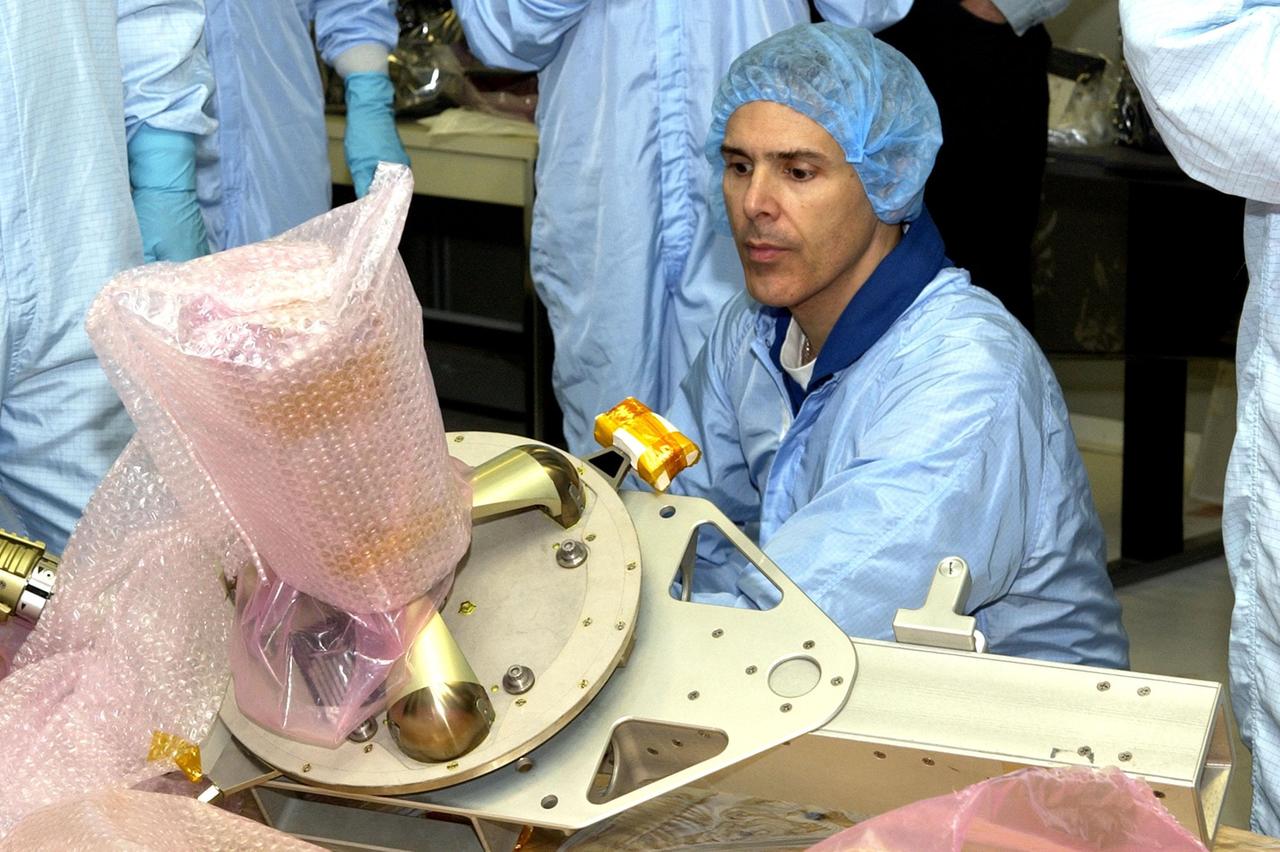
KENNEDY SPACE CENTER, FLA. -- In the Operations and Checkout Building, STS-110 Mission Specialist Lee Morin looks over equipment that will be on the mission. Other crew members (not shown) are Commander Michael J. Bloomfield, Pilot Stephen N. Frick, and Mission Specialists Steven L. Smith, Ellen Ochoa and Rex J. Walheim. Part of the payload on the mission is the Integrated Truss Structure S0. It is the center segment that they will be installing on the International Space Station, part of the 300-foot (91-meter) truss attached to the U.S. Lab. By assembly completion, four more truss segments will attach to either side of the S0 truss. STS-110 is currently scheduled to launch in April 2002
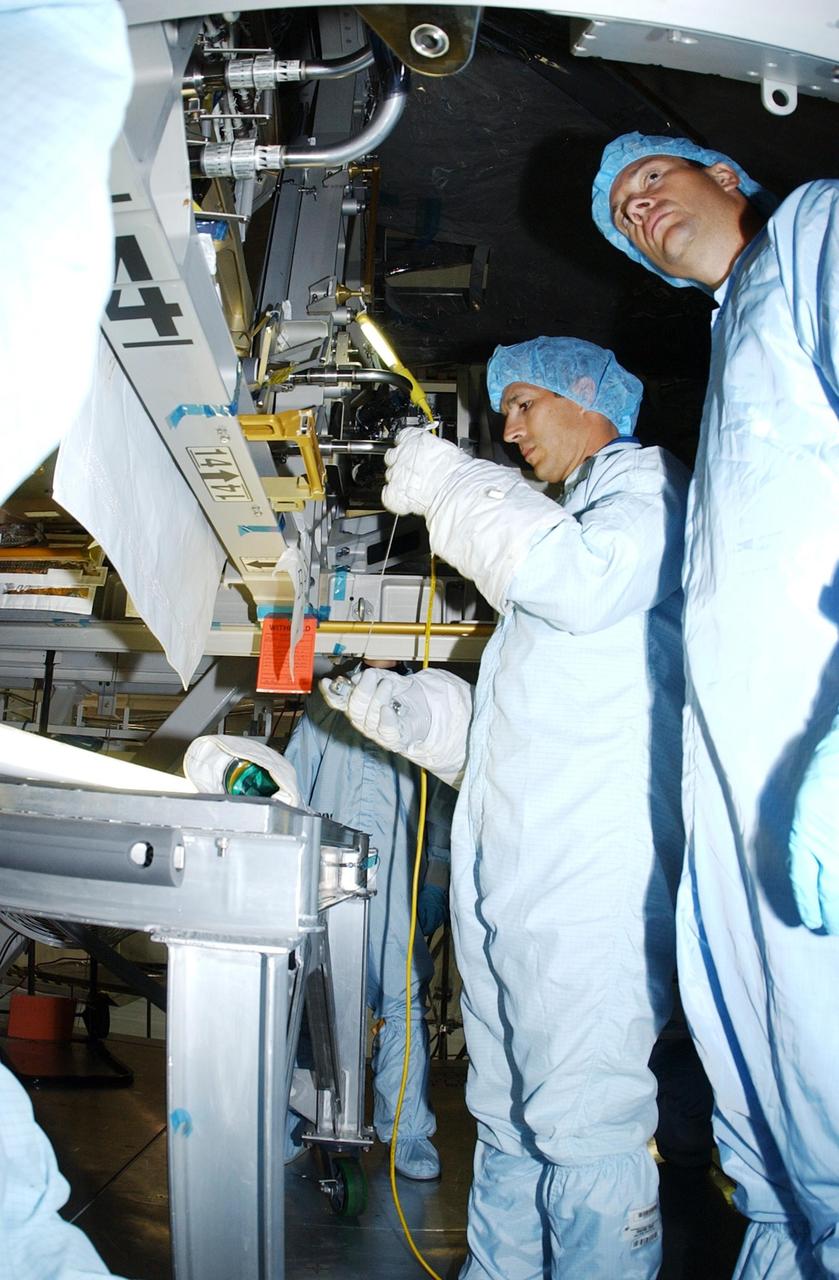
KENNEDY SPACE CENTER, FLA. - STS-113 Mission Specialists John Herrington (left) and Michael Lopez-Alegria (right) look over the P1 Integrated Truss Structure, the primary payload for the mission. The P1 truss will be attached to the central truss segment, S0 Truss, during spacewalks. The payload also includes the Crew and Equipment Translation Aid (CETA) Cart B that can be used by spacewalkers to move along the truss with equipment. STS-113 is scheduled to launch Oct. 6, 2002.
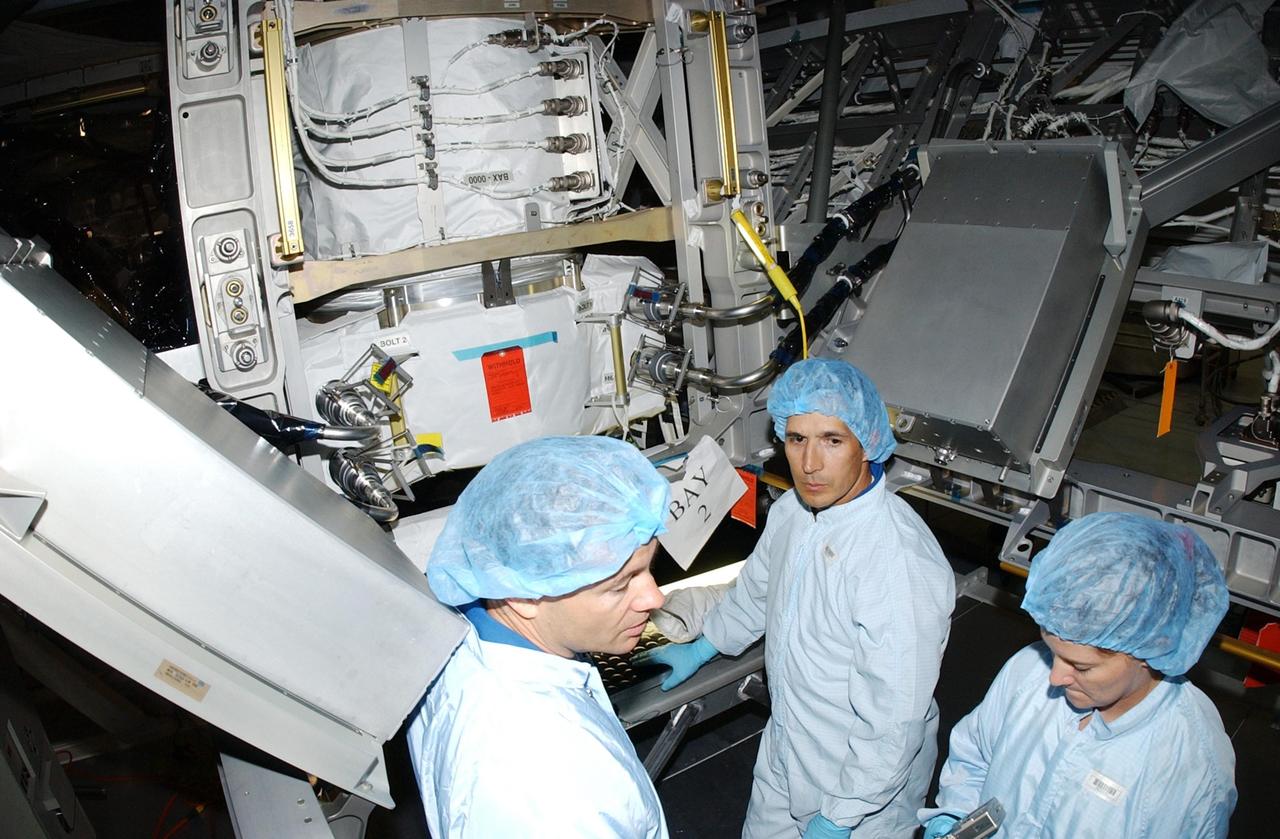
KENNEDY SPACE CENTER, FLA. - STS-113 Mission Specialists Michael Lopez-Alegria (left) and John Herrington (center) review data on the P1 Integrated Truss Structure with a technician in the Space Station Processing Facility. During the mission, the P1 truss will be attached to the central truss segment, S0 Truss, during spacewalks. The payload also includes the Crew and Equipment Translation Aid (CETA) Cart B that can be used by spacewalkers to move along the truss with equipment. STS-113 is scheduled to launch Oct. 6, 2002.
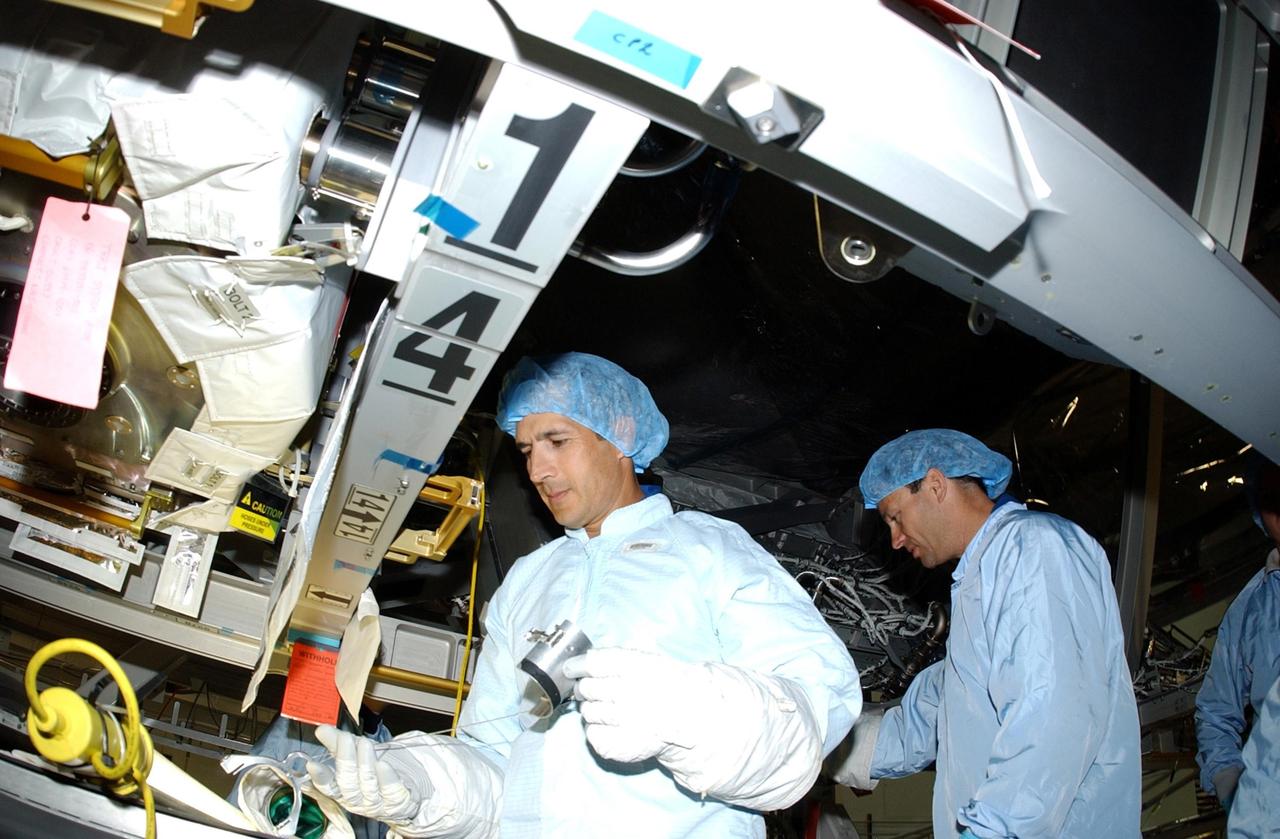
KENNEDY SPACE CENTER, FLA. -- STS-113 Mission Specialists John Herrington (left) and Michael Lopez-Alegria (right) look over the P1 Integrated Truss Structure, the primary payload for the mission. The P1 truss will be attached to the central truss segment, S0 Truss, during spacewalks. The payload also includes the Crew and Equipment Translation Aid (CETA) Cart B that can be used by spacewalkers to move along the truss with equipment. STS-113 is scheduled to launch Oct. 6, 2002
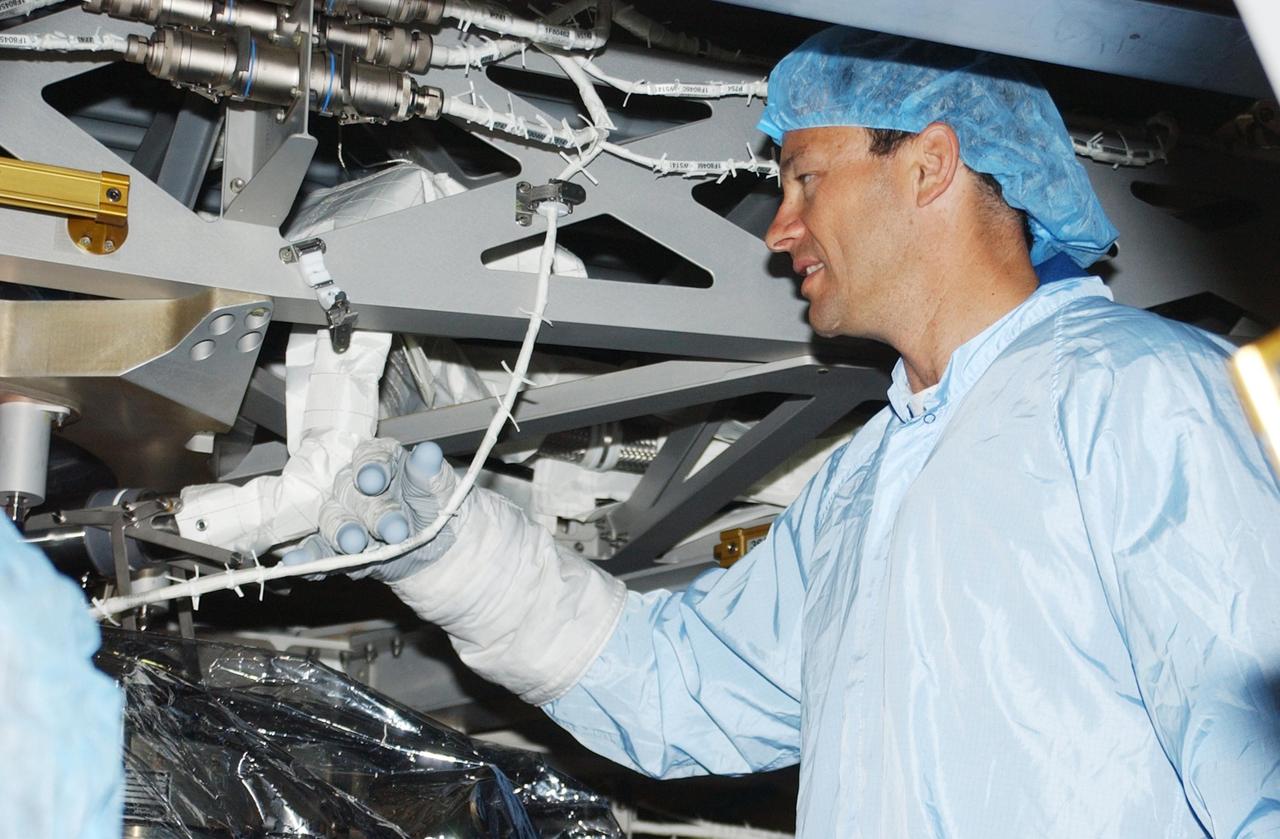
KENNEDY SPACE CENTER, FLA. -- STS-113 Mission Specialist Michael Lopez-Alegria looks over the P1 Integrated Truss Structure, the primary payload for the mission. The P1 truss will be attached to the central truss segment, S0 Truss, during spacewalks. The payload also includes the Crew and Equipment Translation Aid (CETA) Cart B that can be used by spacewalkers to move along the truss with equipment. STS-113 is scheduled to launch Oct. 6, 2002.
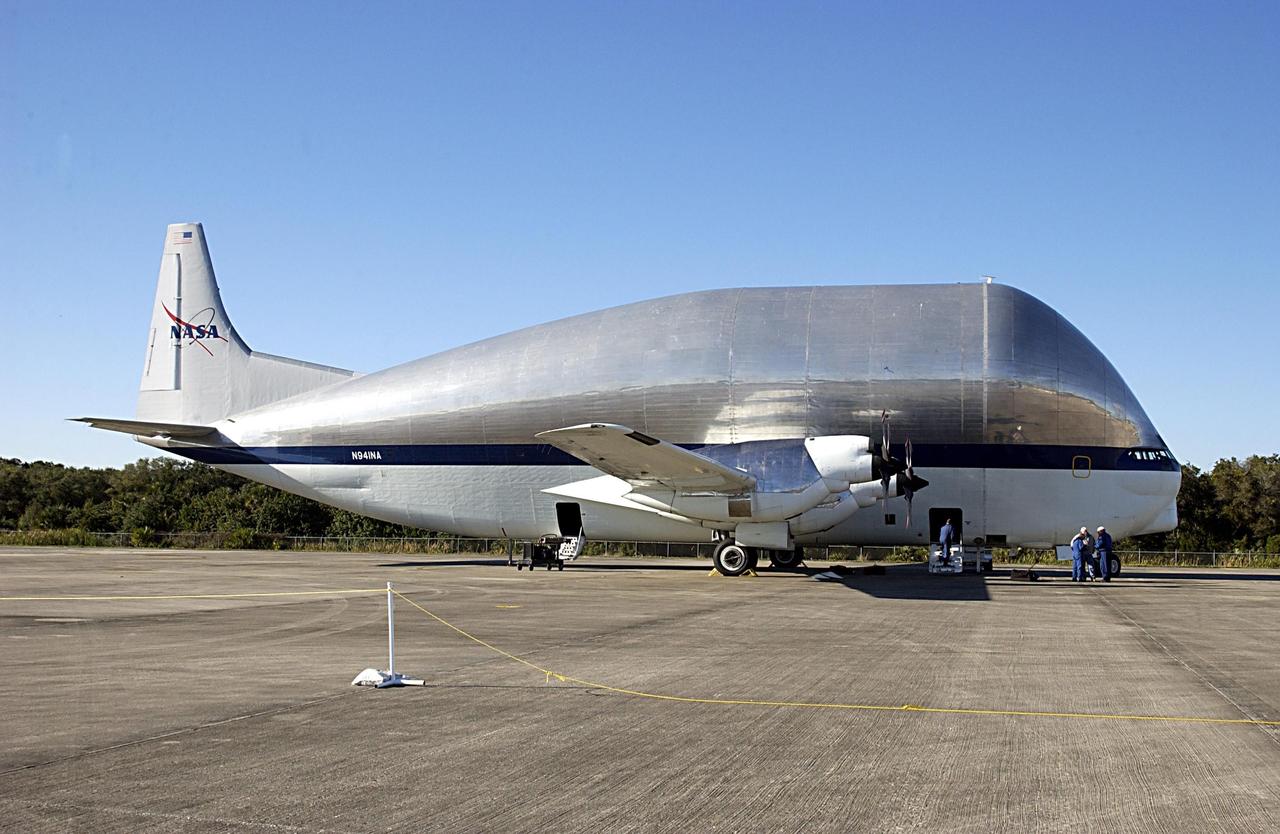
KENNEDY SPACE CENTER, FLA. - NASA's Super Guppy cargo airplane parks on the Shuttle Landing Facility at KSC before offloading the Long Spacer (LS), the second and final piece of the Starboard 6 (S6) Integrated Truss Segment. The LS will be transported to the Space Station Processing Facility for inspections and verification tests. Eventually the LS will be integrated with the S6 Integrated Equipment Assembly already at KSC and will fly as one segment to the International Space Station on Space Shuttle mission STS-119 in early 2004. Together the segment pieces weigh 26,000 pounds and measure 45 feet long. .
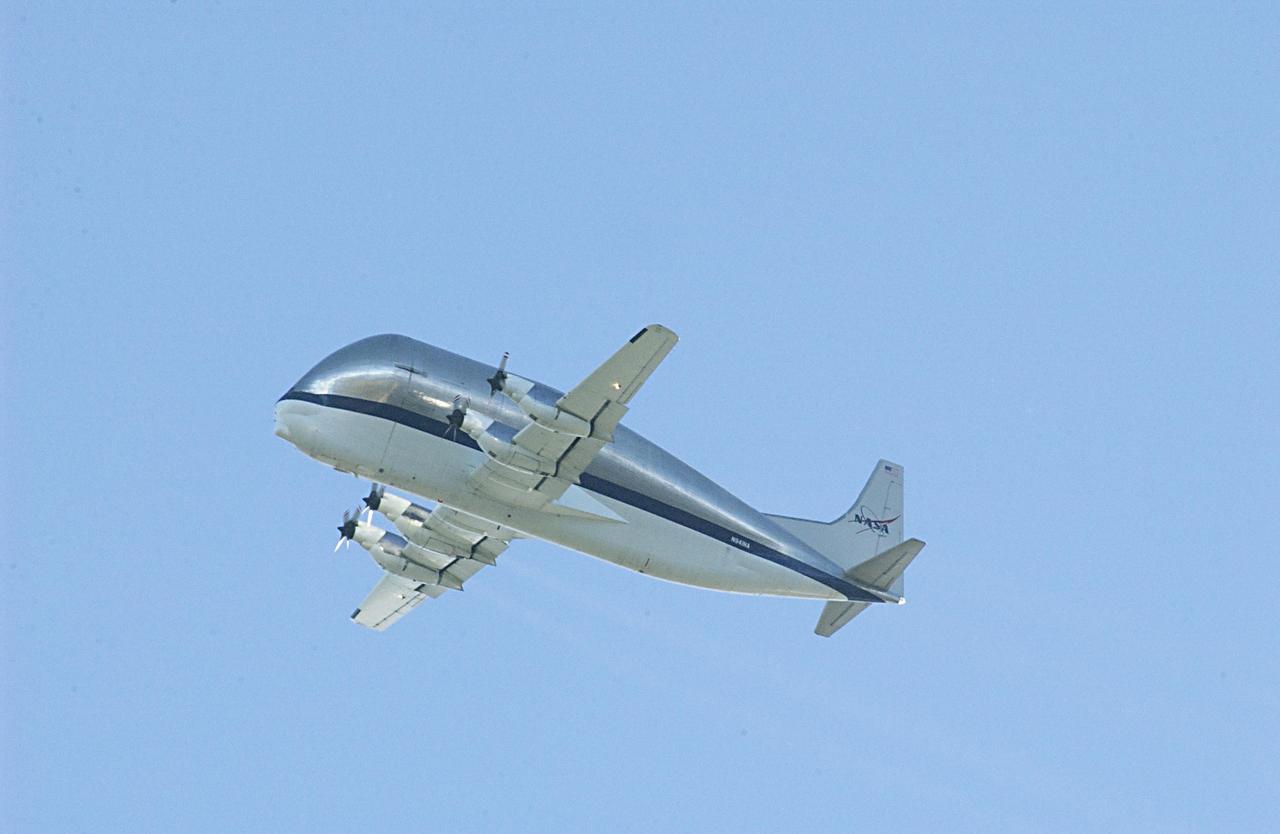
KENNEDY SPACE CENTER, FLA. - NASA's Super Guppy cargo airplane arrives at KSC carrying the Long Spacer (LS), the second and final piece of the Starboard 6 (S6) Integrated Truss Segment. After landing and offloading, the LS will be transported to the Space Station Processing Facility for inspections and verification tests. Eventually the LS will be integrated with the S6 Integrated Equipment Assembly already at KSC and will fly as one segment to the International Space Station on Space Shuttle mission STS-119 in early 2004. Together the segment pieces weigh 26,000 pounds and measure 45 feet long.
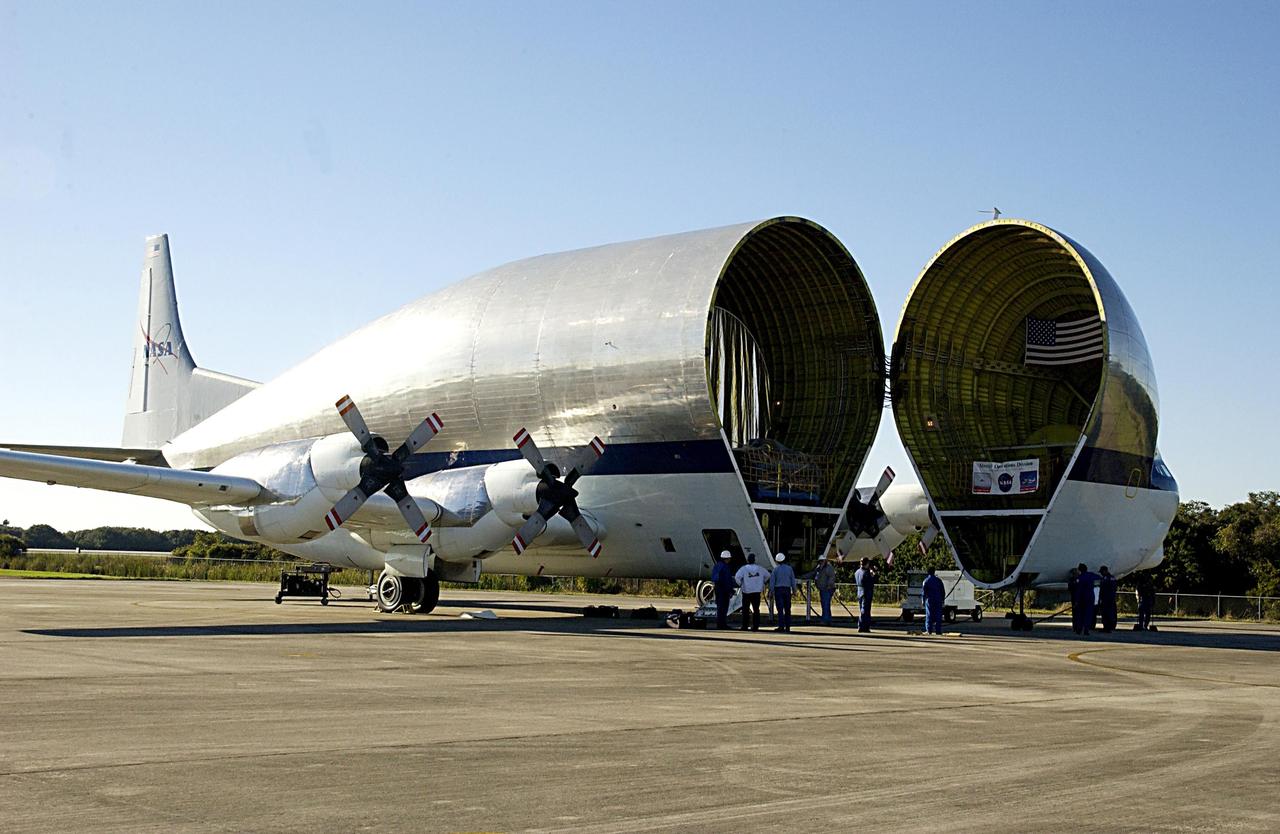
KENNEDY SPACE CENTER, FLA. - After landing at the KSC Shuttle Landing Facility, NASA's Super Guppy cargo airplane opens to remove its cargo, the Long Spacer (LS), the second and final piece of the Starboard 6 (S6) Integrated Truss Segment. The LS will be transported to the Space Station Processing Facility for inspections and verification tests. Eventually the LS will be integrated with the S6 Integrated Equipment Assembly already at KSC and will fly as one segment to the International Space Station on Space Shuttle mission STS-119 in early 2004. Together the segment pieces weigh 26,000 pounds and measure 45 feet long. .
KENNEDY SPACE CENTER, FLA. -- The Long Spacer (LS), the second and final piece of the Starboard 6 (S6) Integrated Truss Segment, rolls out of NASA's Super Guppy cargo airplane onto a transporter. The LS will be moved to the Space Station Processing Facility for inspections and verification tests. Eventually the LS will be integrated with the S6 Integrated Equipment Assembly already at KSC and will fly as one segment to the International Space Station on Space Shuttle mission STS-119 in early 2004. Together the segment pieces weigh 26,000 pounds and measure 45 feet long. .
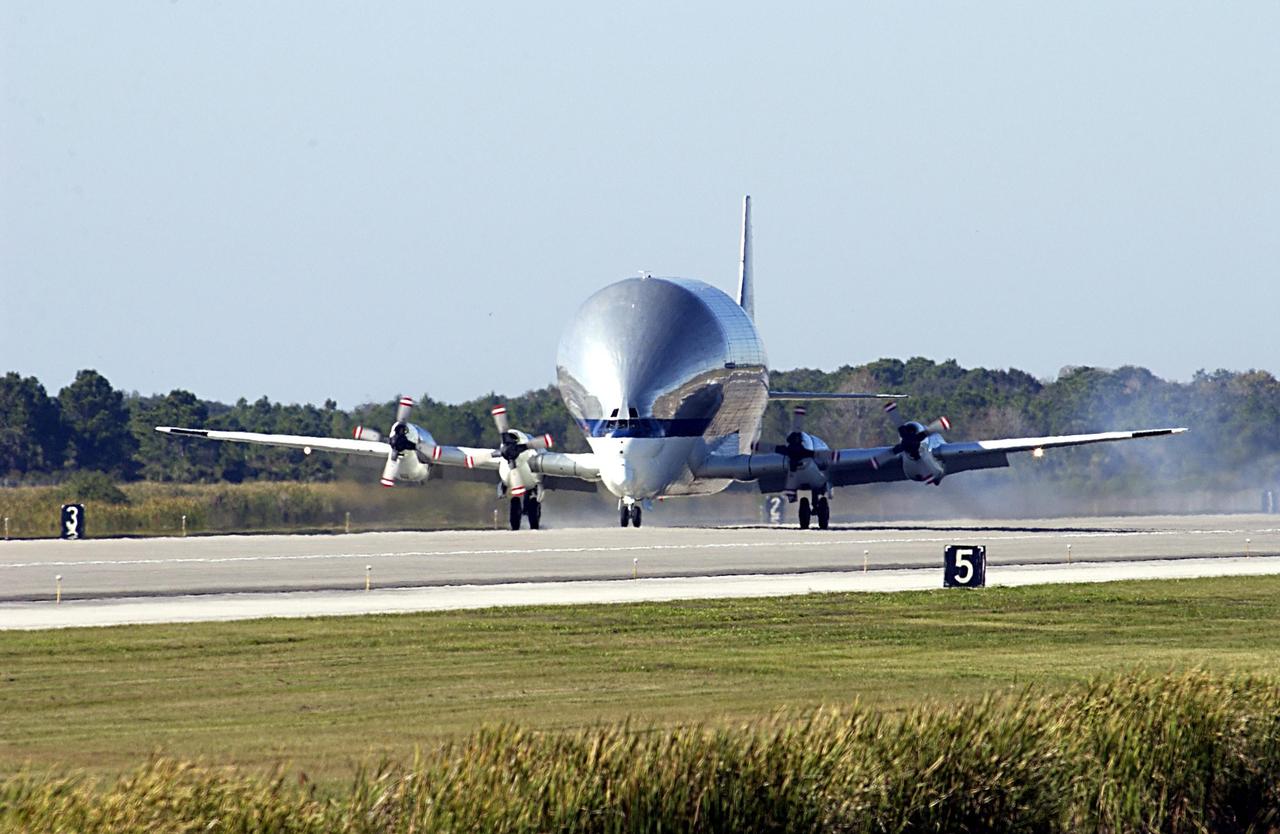
KENNEDY SPACE CENTER, FLA. - - NASA's Super Guppy cargo airplane arrives at KSC carrying the Long Spacer (LS), the second and final piece of the Starboard 6 (S6) Integrated Truss Segment. After landing and offloading, the LS will be transported to the Space Station Processing Facility for inspections and verification tests. Eventually the LS will be integrated with the S6 Integrated Equipment Assembly already at KSC and will fly as one segment to the International Space Station on Space Shuttle mission STS-119 in early 2004. Together the segment pieces weigh 26,000 pounds and measure 45 feet long. .
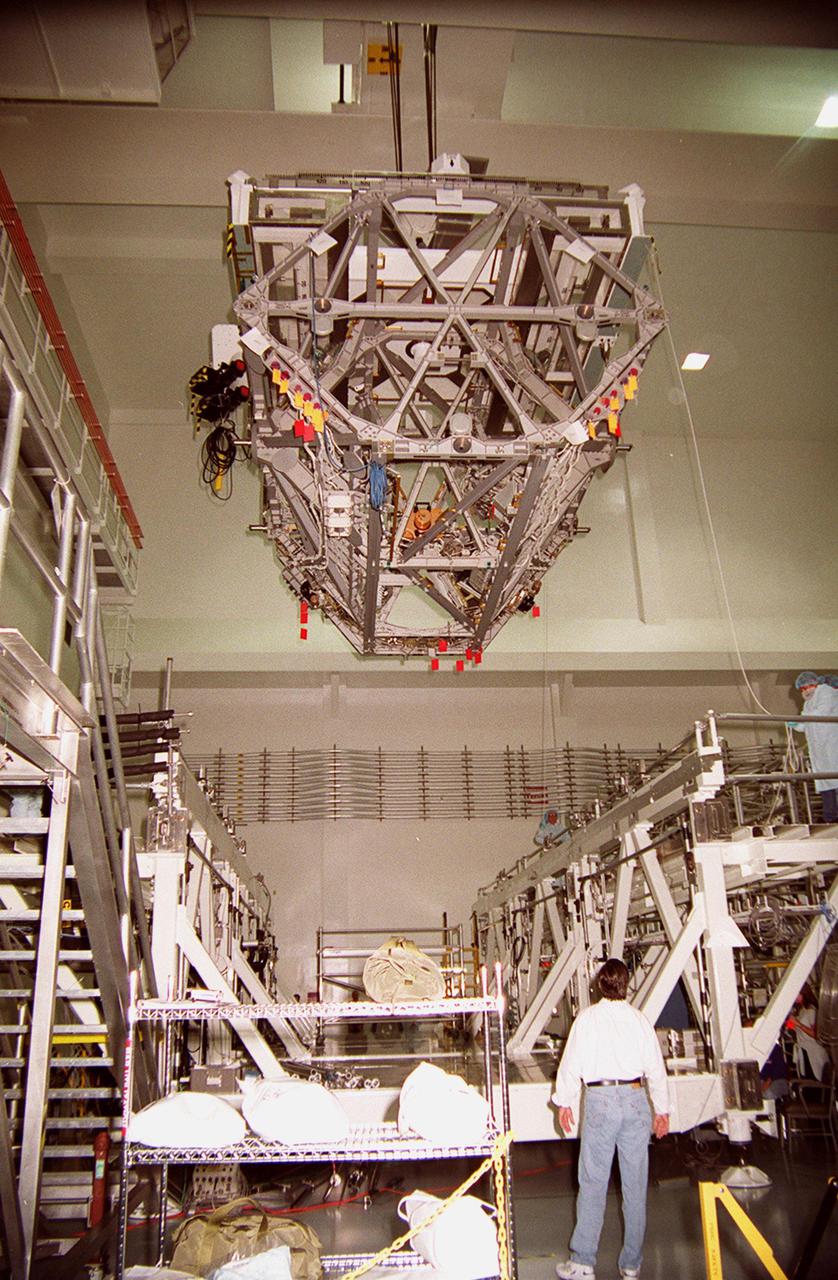
KENNEDY SPACE CENTER, FLA. -- In the Space Station Processing Facility, an overhead crane carrying the P3 Integrated Truss Structure moves into place over a workstand where it will deposit the truss. The port-side P3 truss is scheduled to be added to the International Space Station on mission STS-115 in 2002 aboard Space Shuttle Atlantis. The P3 will be attached to the first port truss segment, P1, being installed in an earlier mission
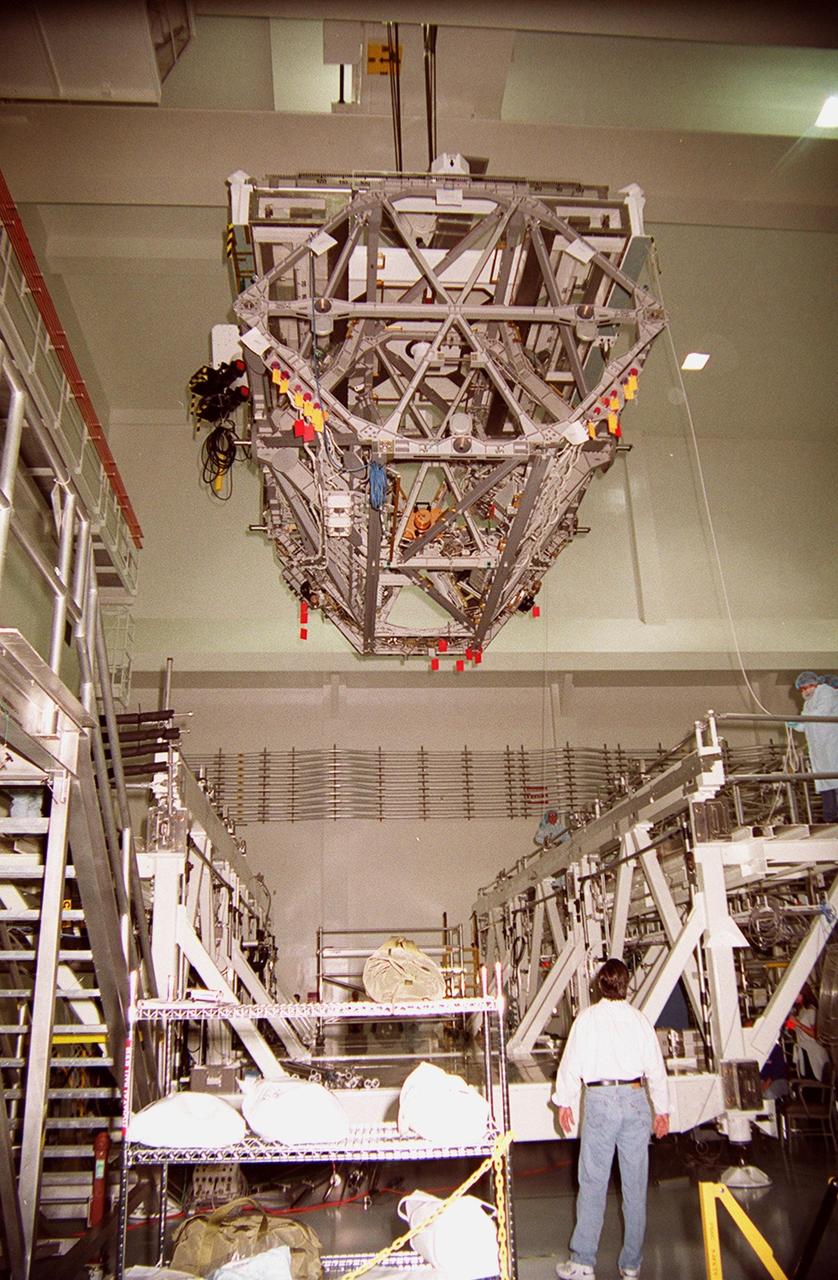
KENNEDY SPACE CENTER, FLA. -- In the Space Station Processing Facility, an overhead crane carrying the P3 Integrated Truss Structure moves into place over a workstand where it will deposit the truss. The port-side P3 truss is scheduled to be added to the International Space Station on mission STS-115 in 2002 aboard Space Shuttle Atlantis. The P3 will be attached to the first port truss segment, P1, being installed in an earlier mission
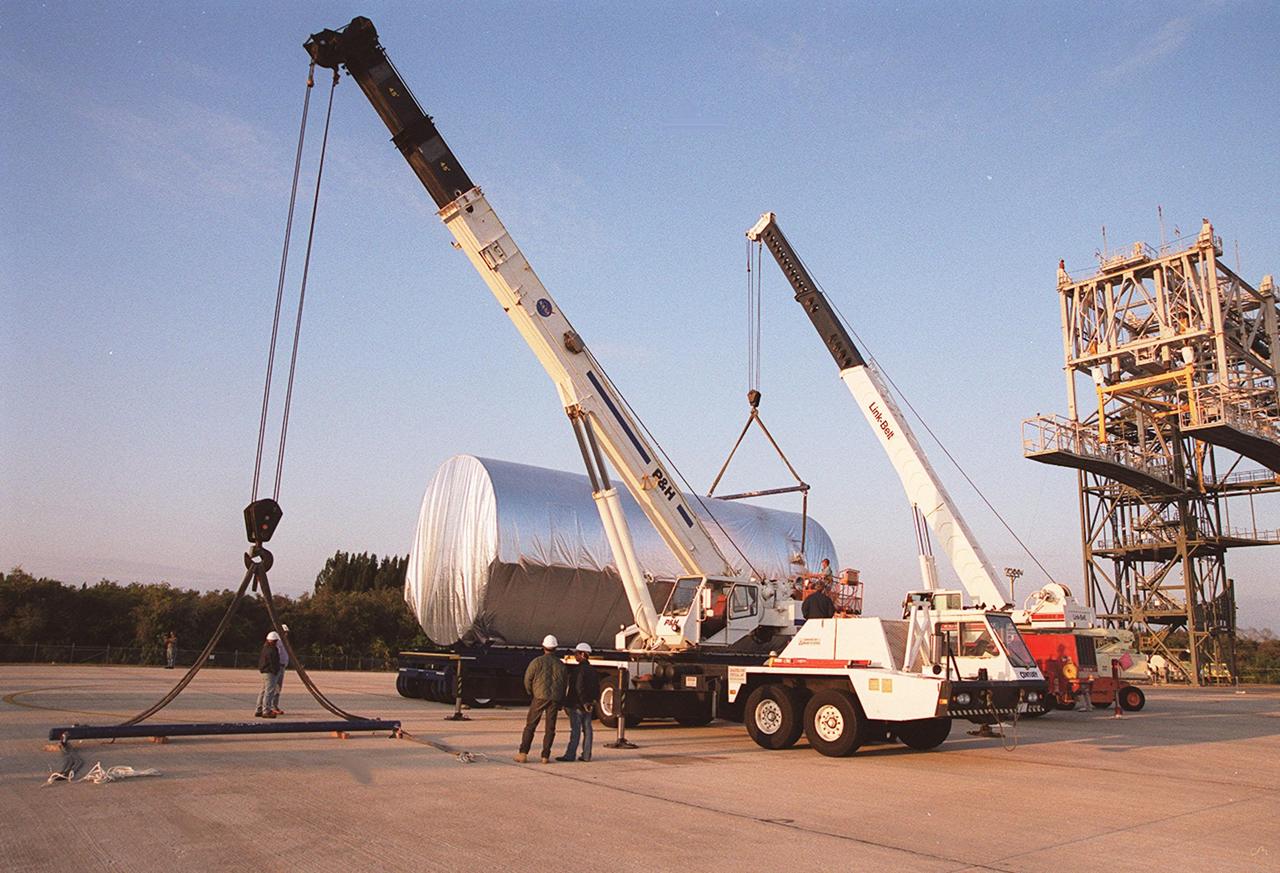
Cranes move toward the Integrated Truss Structure S3 as it sits on the parking apron of the Shuttle Landing Facility after being offloaded from the Super Guppy aircraft. The truss will be moved to a transporter and taken to the Operations and Checkout Building. The second starboard truss segment of the International Space Station, the S3 truss is scheduled to be added to the Station in April 2003
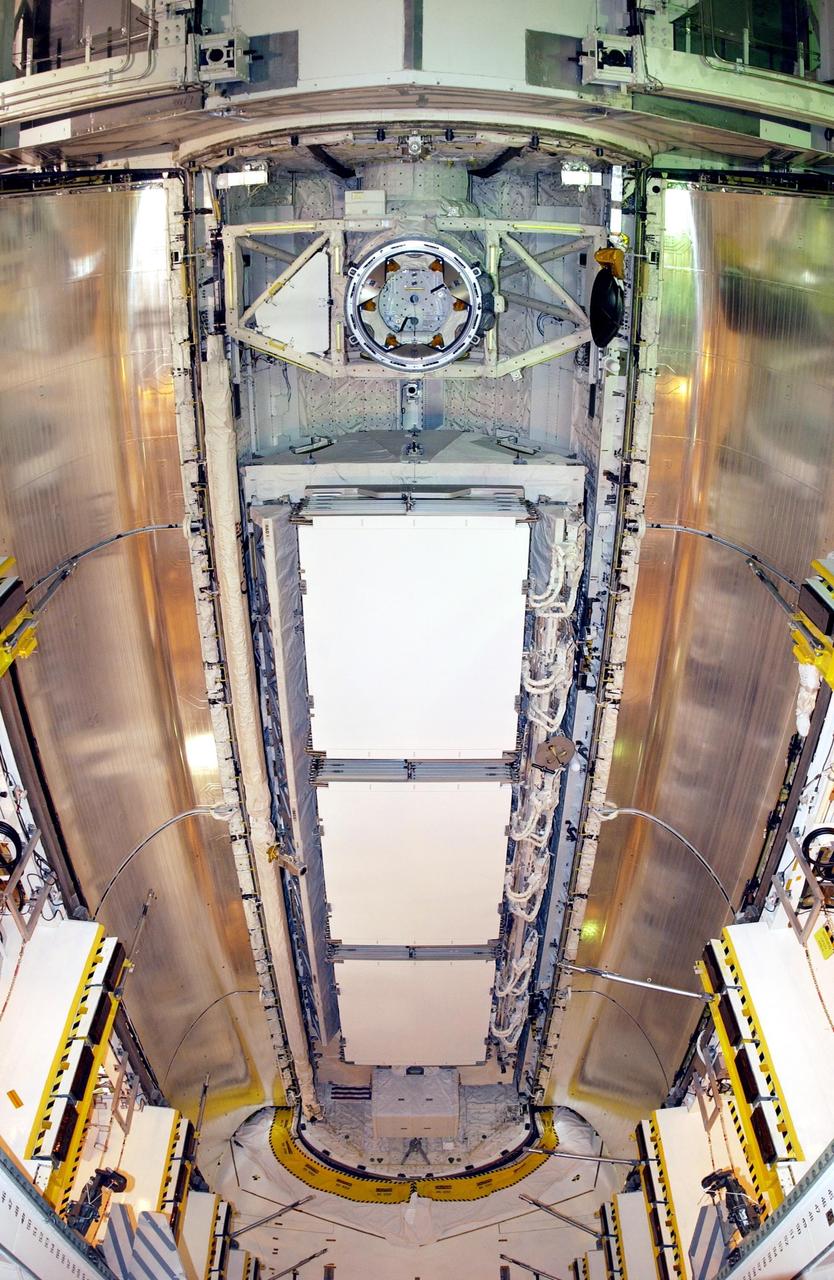
KENNEDY SPACE CENTER, FLA. -- The payload for mission STS-112 rests inside the payload bay of Space Shuttle Atlantis. The Shuttle is carrying the S1 Integrated Truss Structure, the first starboard truss segment, to be attached to the central truss segment, S0, plus the Crew and Equipment Translation Aid (CETA) Cart A. The CETA is the first of two human-powered carts that will ride along the ISS railway, providing mobile work platforms for future spacewalking astronauts. Launch of Atlantis is scheduled for Oct. 2 with a crew of six. The 11-day mission includes three spacewalks.

KENNEDY SPACE CENTER, FLA. -- STS-112 Commander Jeffrey Ashby arrives at the KSC Shuttle Landing Facility aboard a T-38 jet aircraft. He and the rest of the crew will be taking part in Terminal Countdown Demonstration Test activities in preparation for the mission aboard Space Shuttle Atlantis, which is scheduled to launch no earlier than Oct. 2, between 2 and 6 p.m. EDT. STS-112 is the 15th assembly mission to the International Space Station. Atlantis will be carrying the S1 Integrated Truss Structure, the first starboard truss segment. The S1 will be attached to the central truss segment, S0, during the 11-day mission.
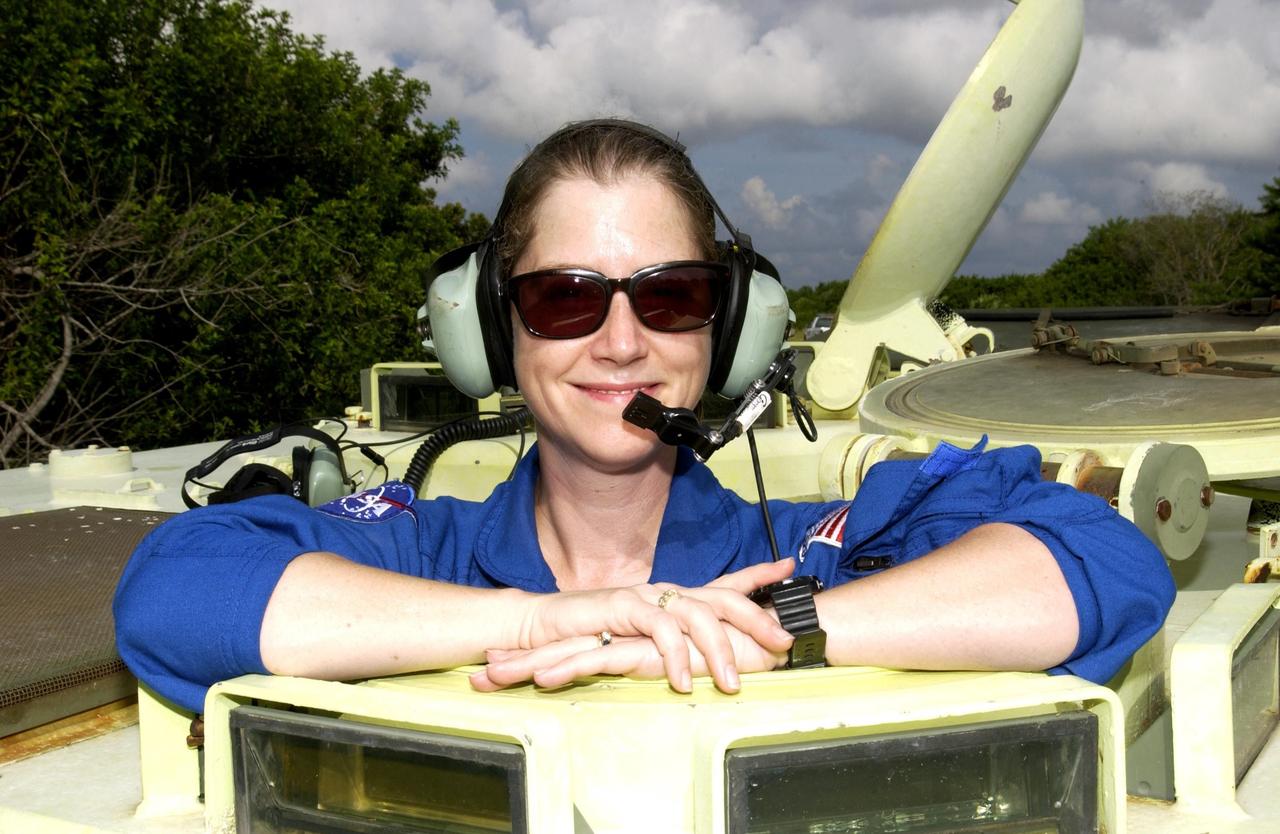
KENNEDY SPACE CENTER, Fla. - STS-112 Pilot Pamela Melroy is ready for her practice run driving the M-113 armored personnel carrier. Melroy and the rest of the crew are at KSC for Terminal Countdown Demonstration Test activities, which also include a simulated launch countdown. Mission STS-112 aboard Space Shuttle Atlantis is scheduled to launch no earlier than Oct. 2, between 2 and 6 p.m. EDT. STS-112 is the 15th assembly mission to the International Space Station. Atlantis will be carrying the S1 Integrated Truss Structure, the first starboard truss segment. The S1 will be attached to the central truss segment, S0, during the 11-day mission.
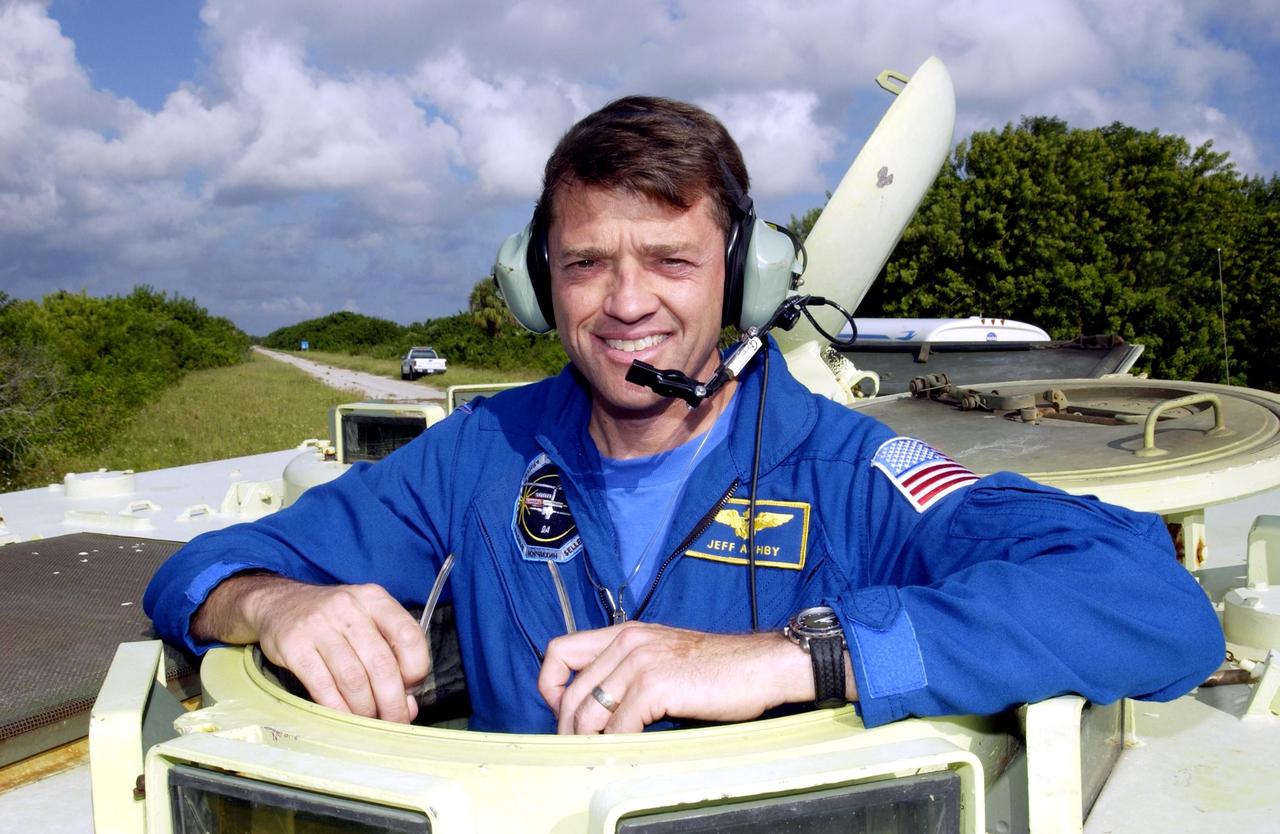
KENNEDY SPACE CENTER, FLA. -- STS-112 Commander Jeffrey Ashby is ready for his practice run driving the M-113 armored personnel carrier. Ashby and the rest of the crew are at KSC for Terminal Countdown Demonstration Test activities, which include emergency egress training and driving the M-113. Mission STS-112 aboard Space Shuttle Atlantis is scheduled to launch no earlier than Oct. 2, between 2 and 6 p.m. EDT. STS-112 is the 15th assembly mission to the International Space Station. Atlantis will be carrying the S1 Integrated Truss Structure, the first starboard truss segment. The S1 will be attached to the central truss segment, S0, during the 11-day mission.

KENNEDY SPACE CENTER, FLA. -- The payload bay doors of Space Shuttle Atlantis close on the primary payloads for mission STS-112. The Shuttle is carrying the S1 Integrated Truss Structure, the first starboard truss segment, to be attached to the central truss segment, S0, plus the Crew and Equipment Translation Aid (CETA) Cart A. The CETA is the first of two human-powered carts that will ride along the ISS railway, providing mobile work platforms for future spacewalking astronauts. Launch of Atlantis is scheduled for Oct. 2 with a crew of six. The 11-day mission includes three spacewalks.
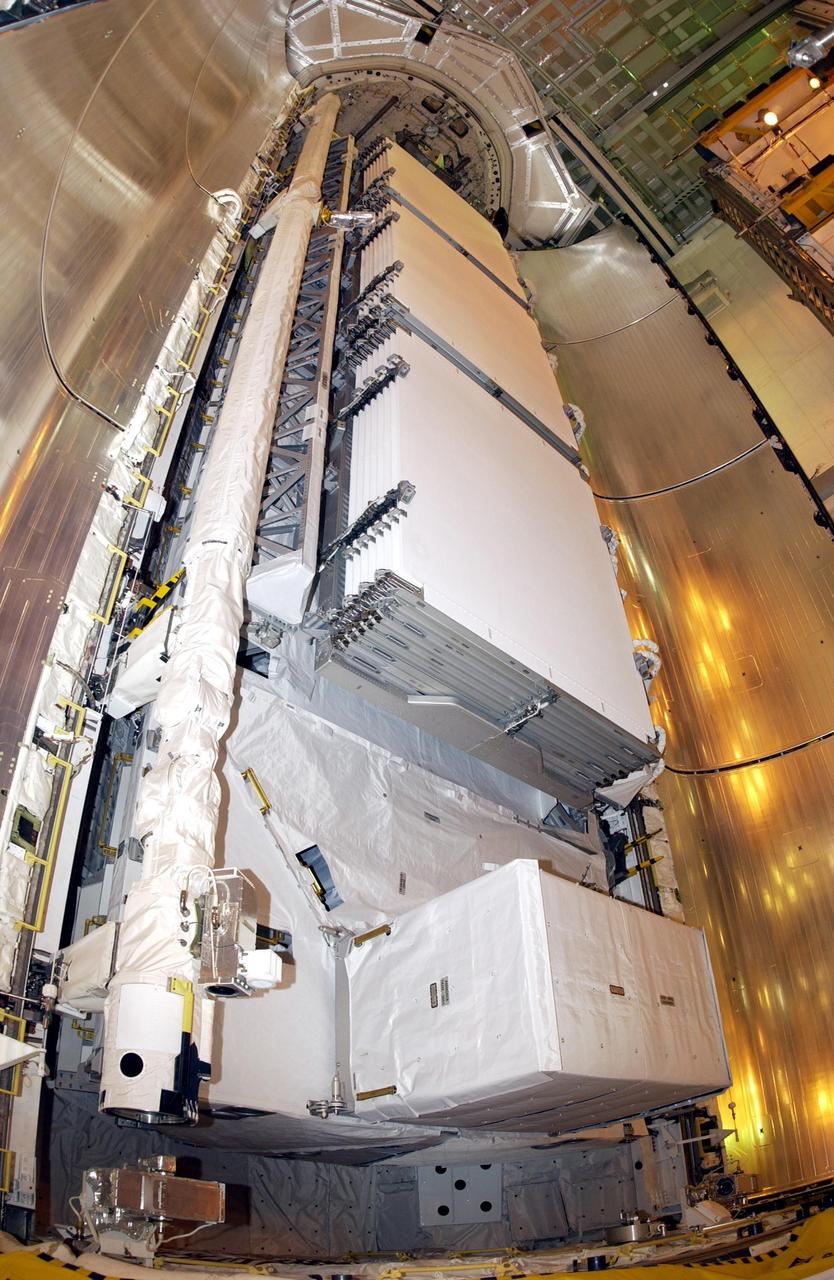
KENNEDY SPACE CENTER, FLA. -- -- The payload for mission STS-112 rests inside the payload bay of Space Shuttle Atlantis. The Shuttle is carrying the S1 Integrated Truss Structure, the first starboard truss segment, to be attached to the central truss segment, S0, plus the Crew and Equipment Translation Aid (CETA) Cart A. The CETA is the first of two human-powered carts that will ride along the ISS railway, providing mobile work platforms for future spacewalking astronauts. Launch of Atlantis is scheduled for Oct. 2 with a crew of six. The 11-day mission includes three spacewalks.

KENNEDY SPACE CENTER, Fla. - STS-112 Mission Specialist David Wolf is ready for his practice run driving the M-113 armored personnel carrier. Wolf and the rest of the crew are at KSC for Terminal Countdown Demonstration Test activities, which also include a simulated launch countdown. Mission STS-112 aboard Space Shuttle Atlantis is scheduled to launch no earlier than Oct. 2, between 2 and 6 p.m. EDT. STS-112 is the 15th assembly mission to the International Space Station. Atlantis will be carrying the S1 Integrated Truss Structure, the first starboard truss segment. The S1 will be attached to the central truss segment, S0, during the 11-day mission.
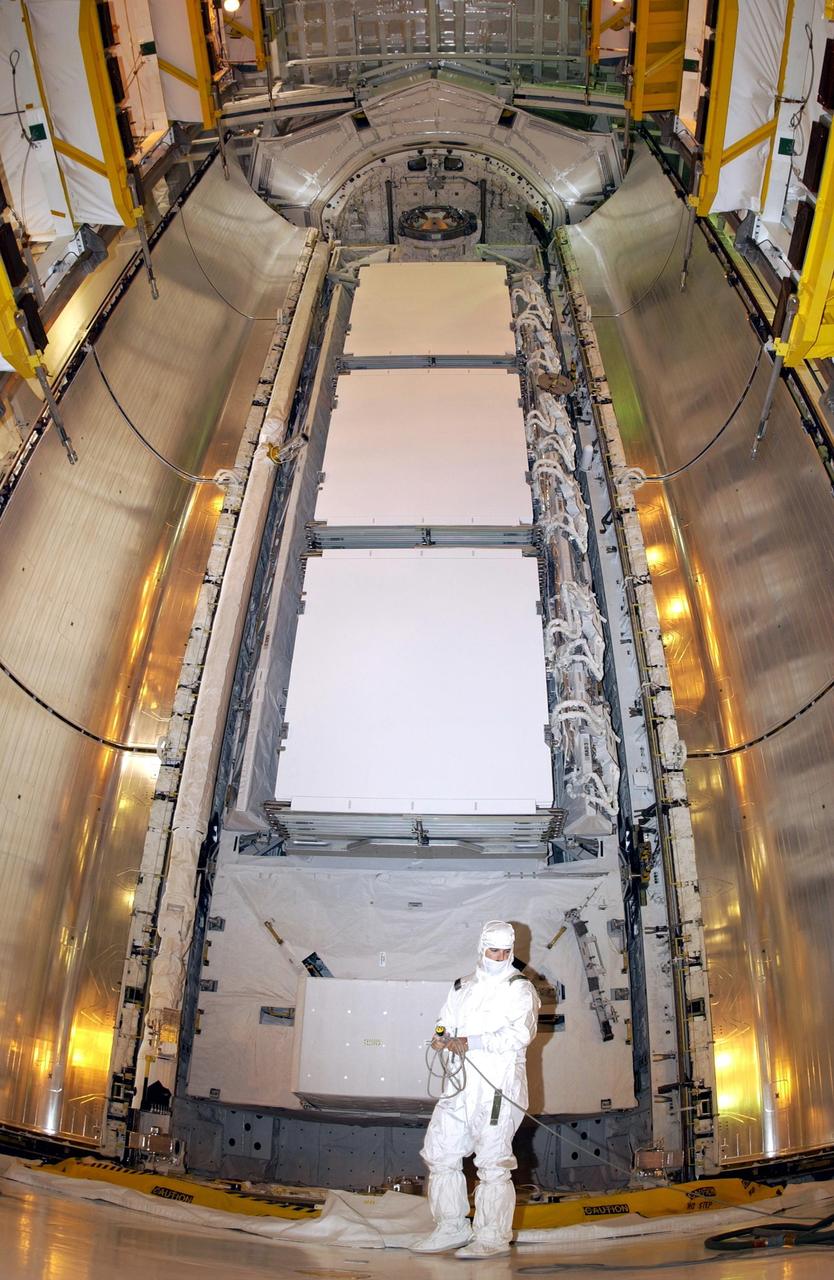
KENNEDY SPACE CENTER, FLA. -- The payload for mission STS-112 rests inside the payload bay of Space Shuttle Atlantis. The Shuttle is carrying the S1 Integrated Truss Structure, the first starboard truss segment, to be attached to the central truss segment, S0, plus the Crew and Equipment Translation Aid (CETA) Cart A. The CETA is the first of two human-powered carts that will ride along the ISS railway, providing mobile work platforms for future spacewalking astronauts. Launch of Atlantis is scheduled for Oct. 2 with a crew of six. The 11-day mission includes three spacewalks.
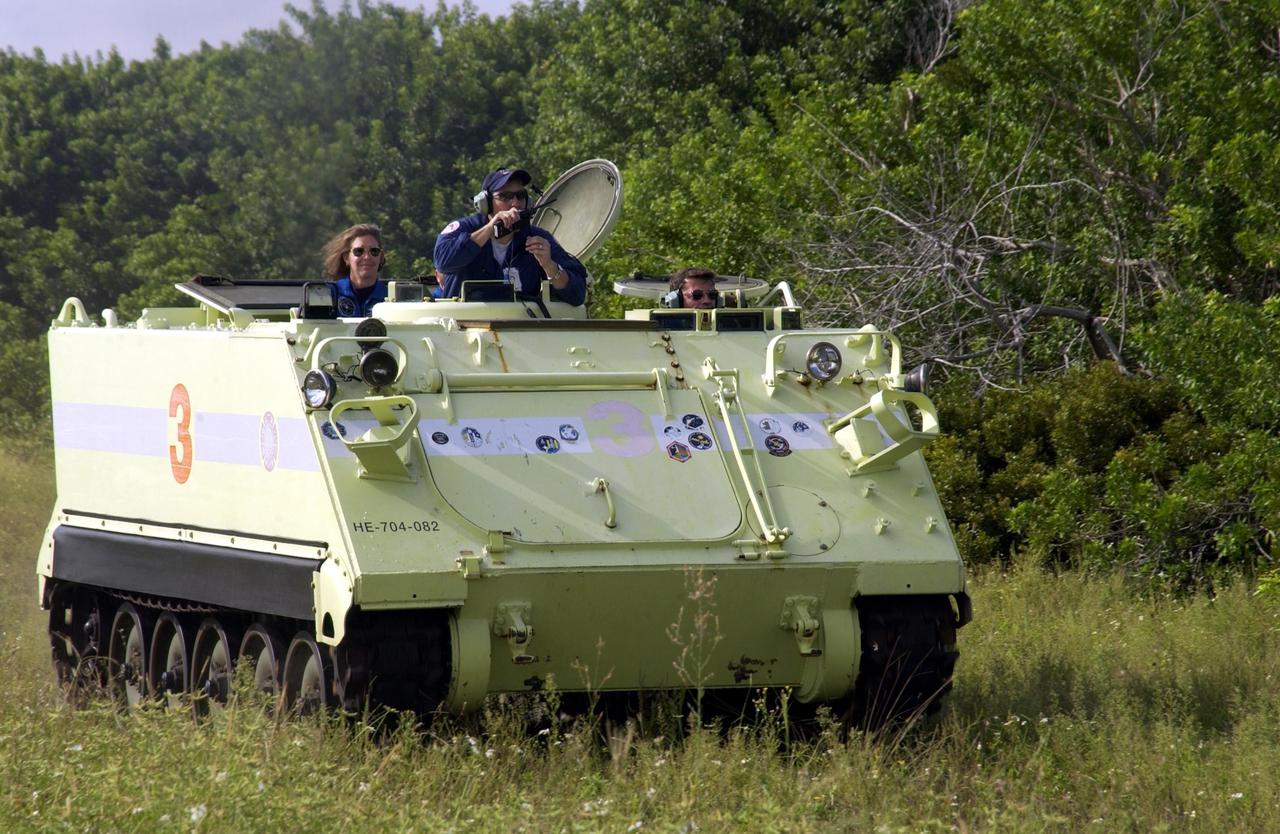
KENNEDY SPACE CENTER, Fla. - STS-112 Commander Jeffrey Ashby drives the M-113 armored personnel carrier during Terminal Countdown Demonstration Test activities. At the far left is Mission Specialist Sandra Magnus. The TCDT also includes a simulated launch countdown. The mission aboard Space Shuttle Atlantis is scheduled to launch no earlier than Oct. 2, between 2 and 6 p.m. EDT. STS-112 is the 15th assembly mission to the International Space Station. Atlantis will be carrying the S1 Integrated Truss Structure, the first starboard truss segment. The S1 will be attached to the central truss segment, S0, during the 11-day mission.

KENNEDY SPACE CENTER, Fla. - STS-112 Mission Specialist Fyodor Yurchikhin (left), who is with the Russian Space Agency, and Commander Jeffrey Ashby pause on the Shuttle Landing Facility after their arrival. They and the rest of the crew will be taking part in Terminal Countdown Demonstration Test activities in preparation for the mission aboard Space Shuttle Atlantis, which is scheduled to launch no earlier than Oct. 2, between 2 and 6 p.m. EDT. STS-112 is the 15th assembly mission to the International Space Station. Atlantis will be carrying the S1 Integrated Truss Structure, the first starboard truss segment. The S1 will be attached to the central truss segment, S0, during the 11-day mission.