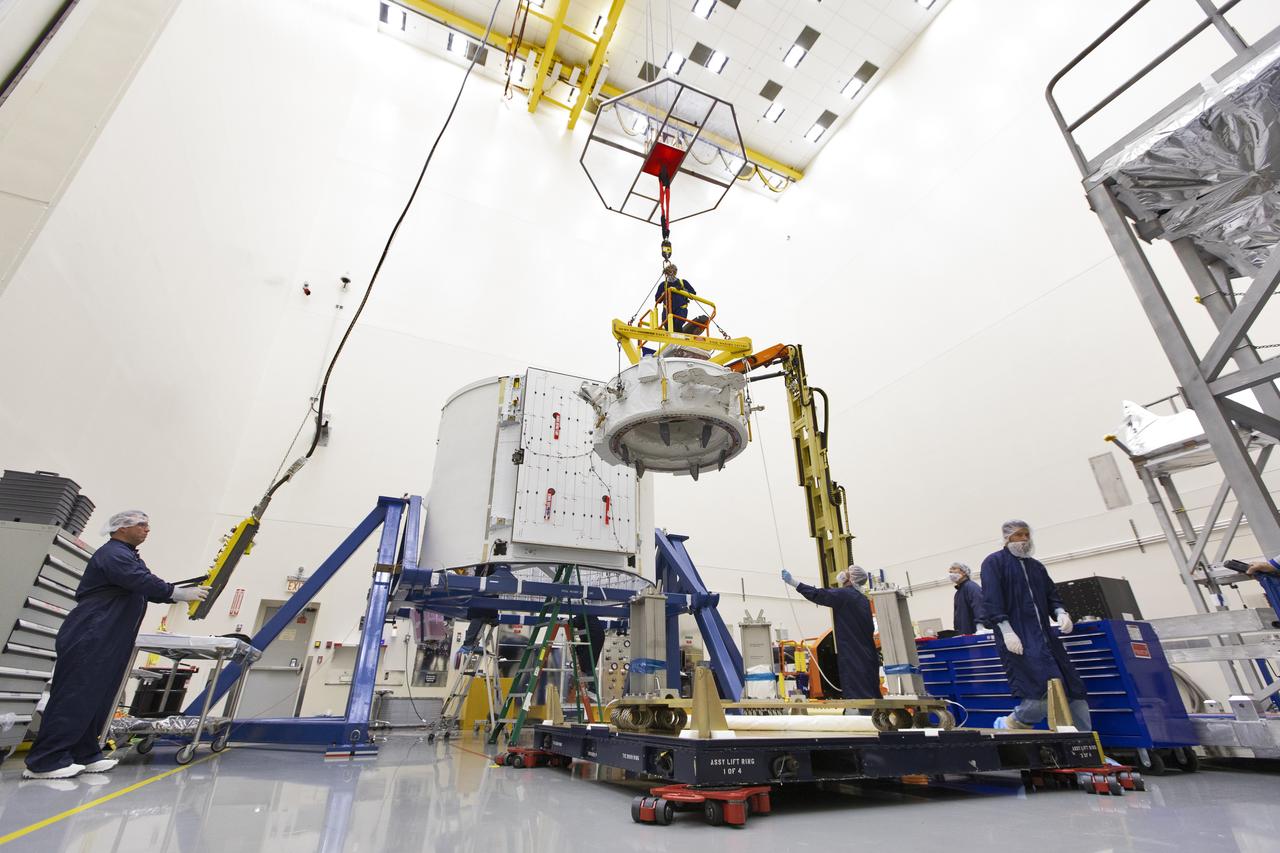
The International Docking Adapter 3, a critical component for future crewed missions to the International Space Station, is carefully packed away in the unpressurized “trunk” section of the SpaceX Dragon spacecraft at the SpaceX facility on Cape Canaveral Air Force Station in Florida on June 19. It will launch to the orbiting laboratory in July on the company’s 18th commercial resupply mission. The adapter will support future U.S. crewed vehicles visiting the station.
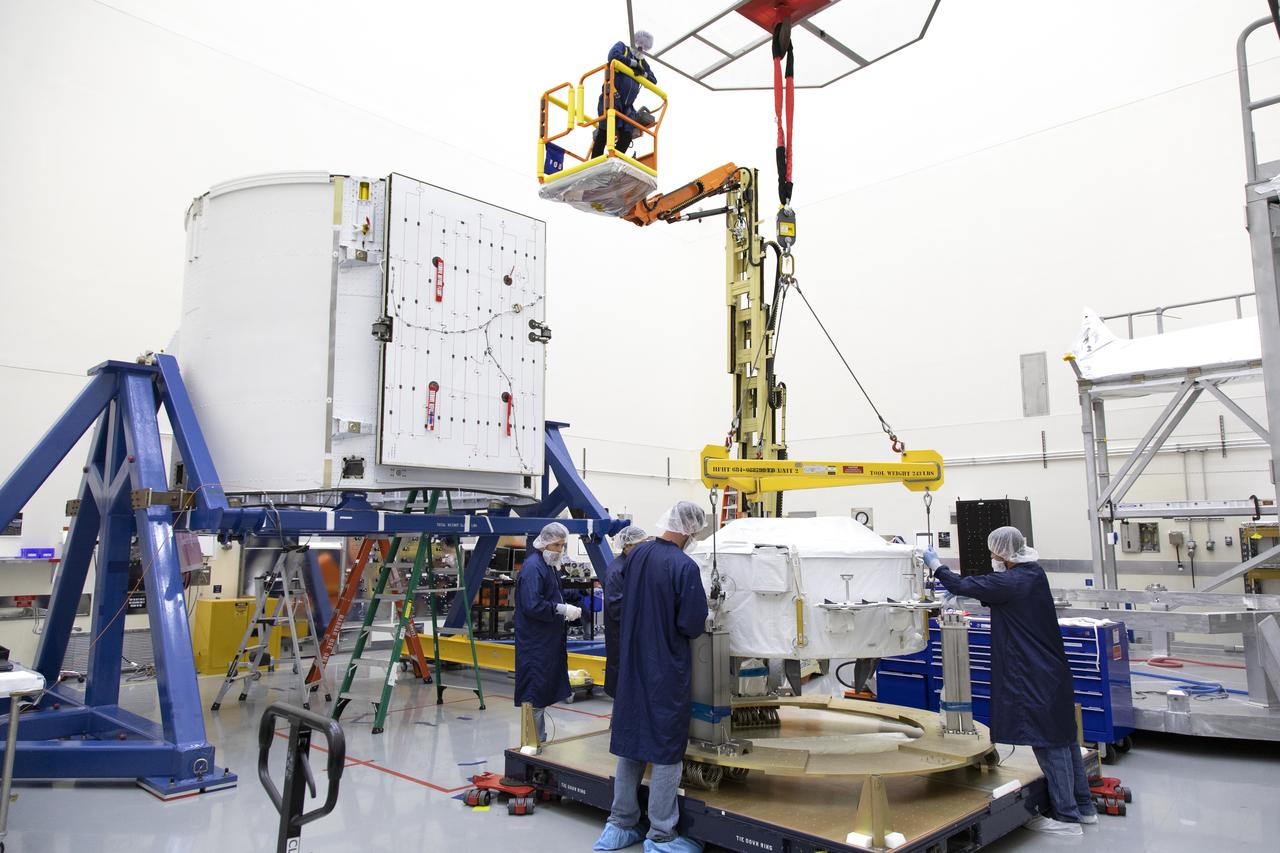
The International Docking Adapter 3, a critical component for future crewed missions to the International Space Station, is carefully packed away in the unpressurized “trunk” section of the SpaceX Dragon spacecraft at the SpaceX facility on Cape Canaveral Air Force Station in Florida on June 19. It will launch to the orbiting laboratory in July on the company’s 18th commercial resupply mission. The adapter will support future U.S. crewed vehicles visiting the station.
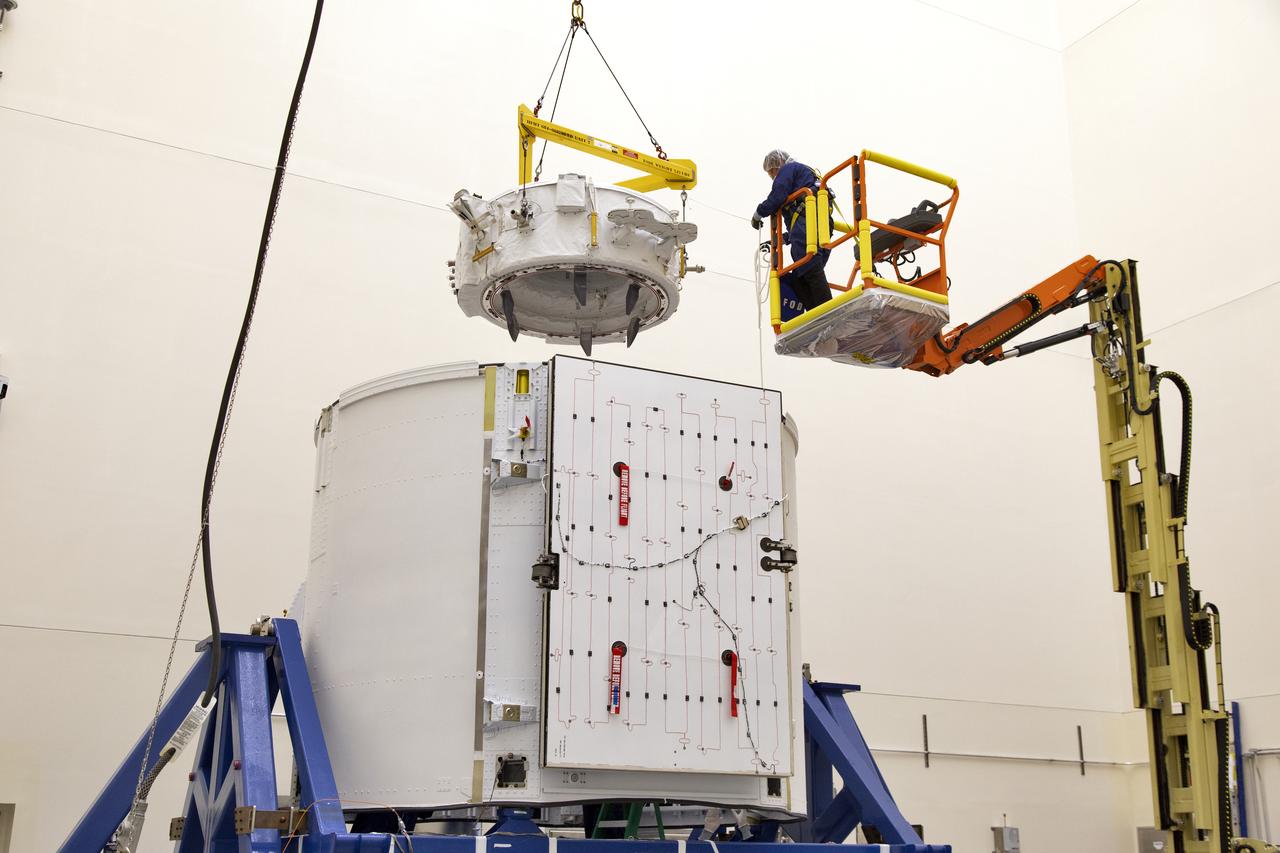
The International Docking Adapter 3, a critical component for future crewed missions to the International Space Station, is carefully packed away in the unpressurized “trunk” section of the SpaceX Dragon spacecraft at the SpaceX facility on Cape Canaveral Air Force Station in Florida on June 19. It will launch to the orbiting laboratory in July on the company’s 18th commercial resupply mission. The adapter will support future U.S. crewed vehicles visiting the station.
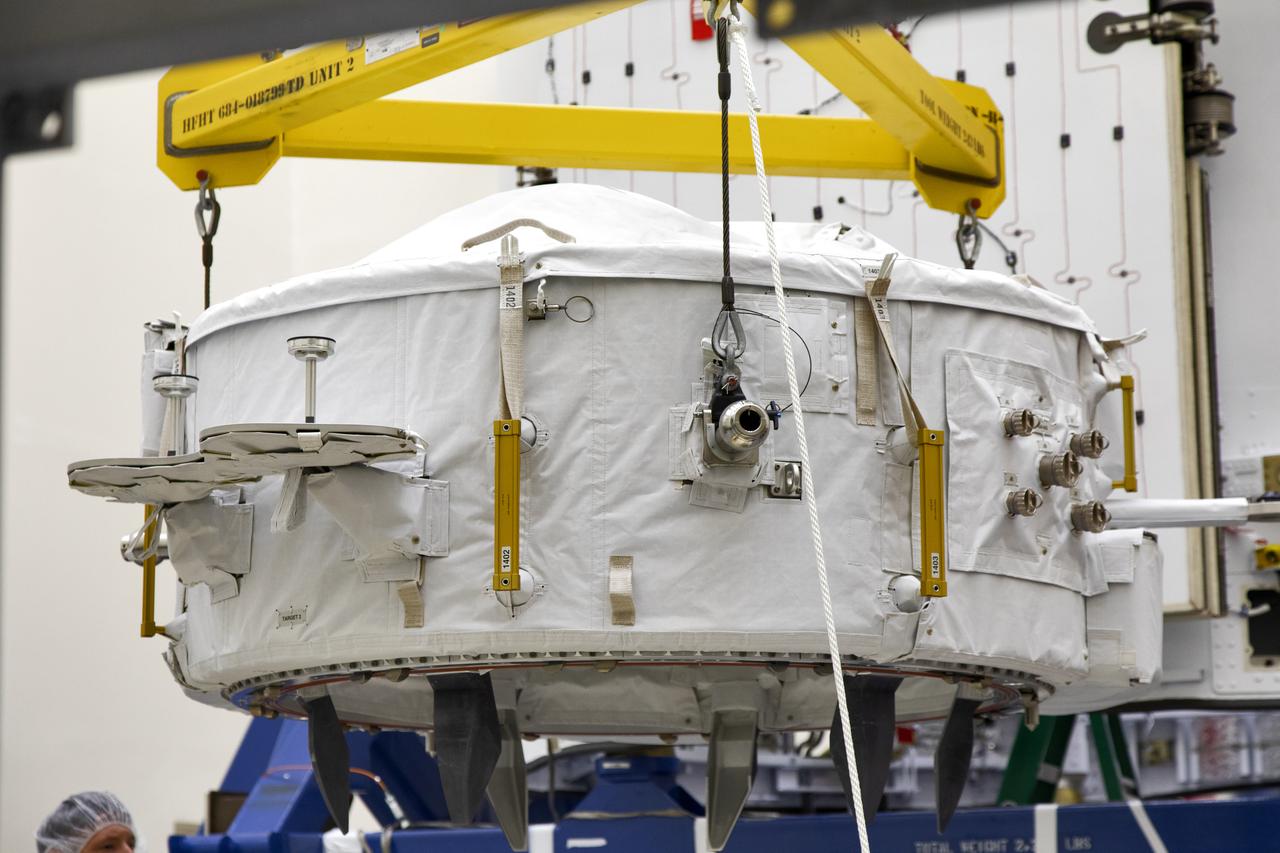
The International Docking Adapter 3, a critical component for future crewed missions to the International Space Station, is carefully packed away in the unpressurized “trunk” section of the SpaceX Dragon spacecraft at the SpaceX facility on Cape Canaveral Air Force Station in Florida on June 19. It will launch to the orbiting laboratory in July on the company’s 18th commercial resupply mission. The adapter will support future U.S. crewed vehicles visiting the station.
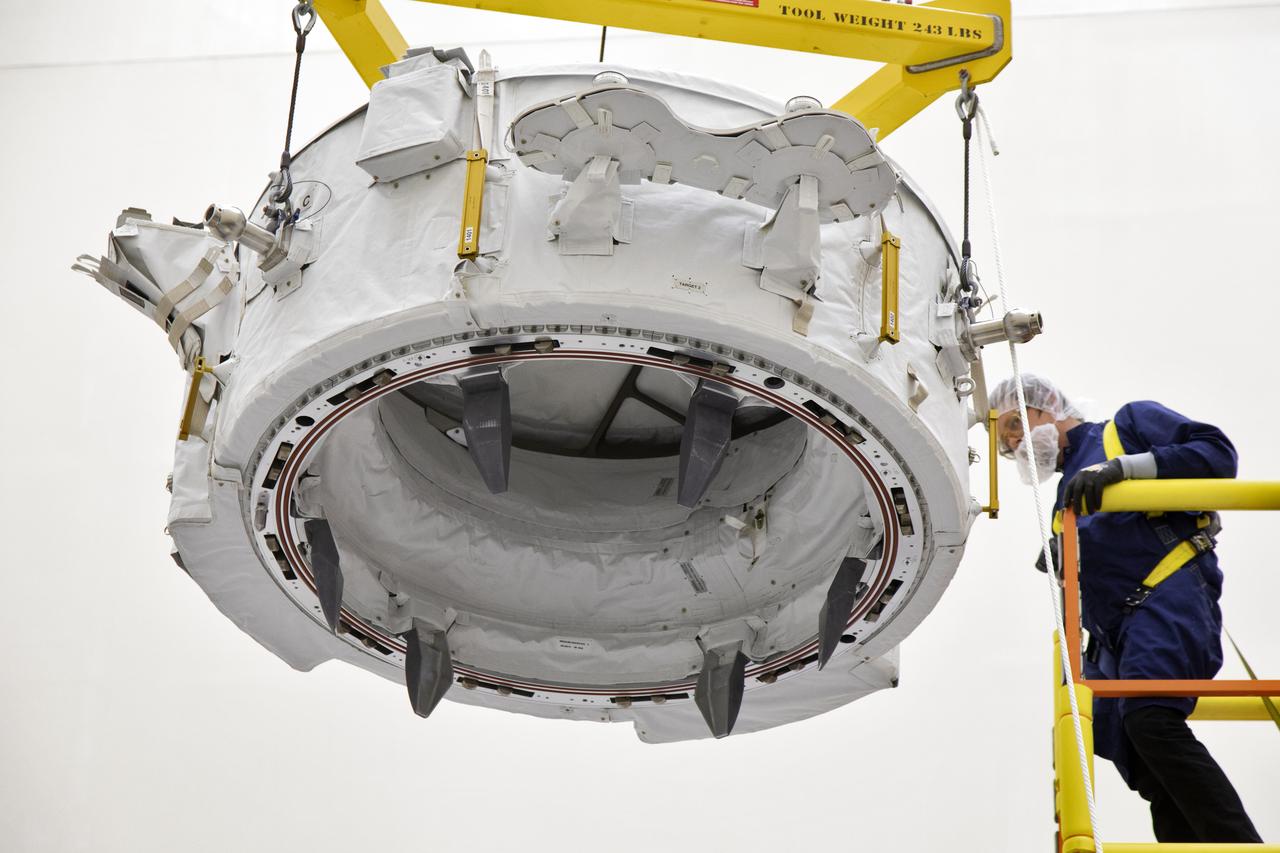
The International Docking Adapter 3, a critical component for future crewed missions to the International Space Station, is carefully packed away in the unpressurized “trunk” section of the SpaceX Dragon spacecraft at the SpaceX facility on Cape Canaveral Air Force Station in Florida on June 19. It will launch to the orbiting laboratory in July on the company’s 18th commercial resupply mission. The adapter will support future U.S. crewed vehicles visiting the station.
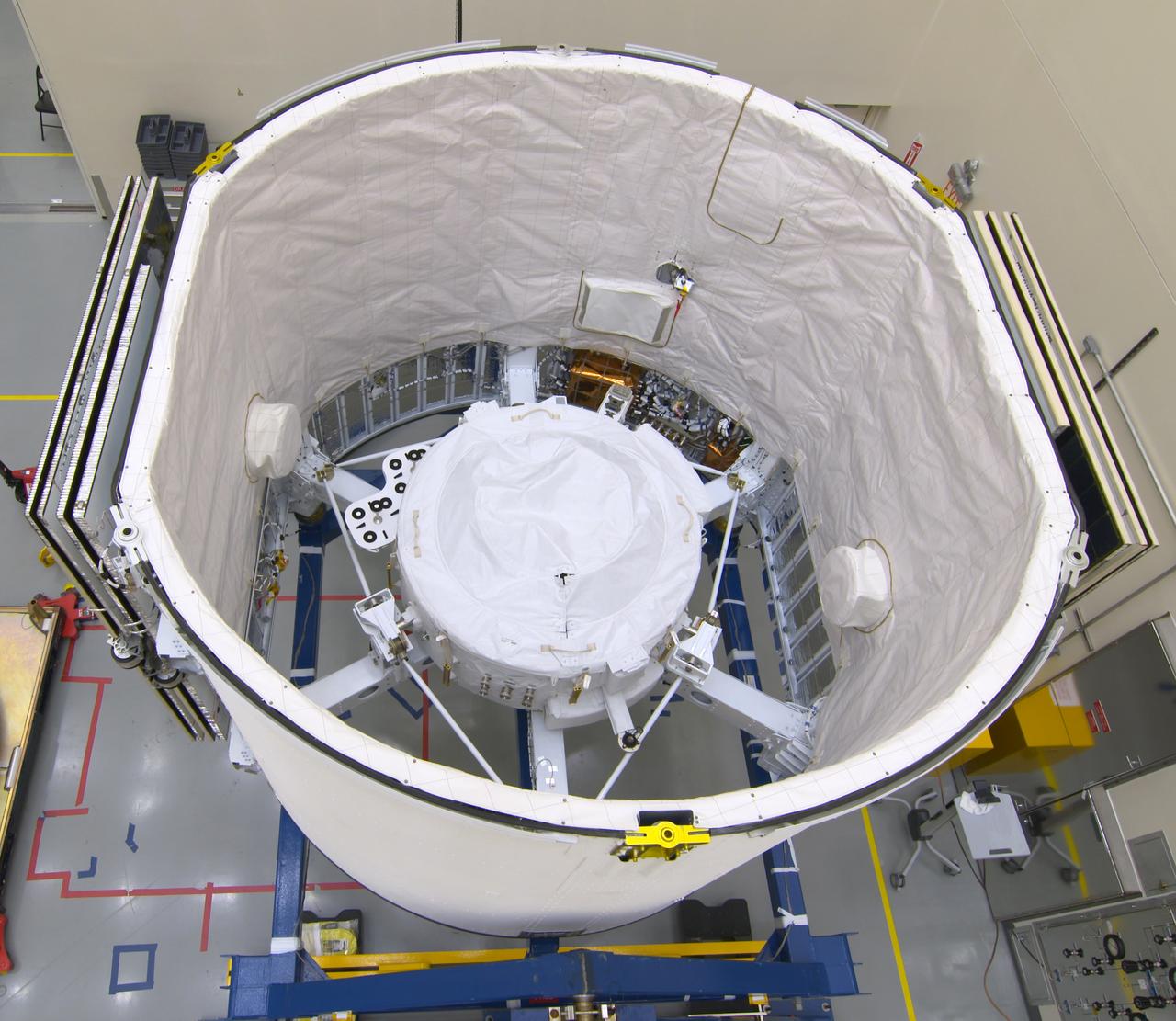
The International Docking Adapter 3, a critical component for future crewed missions to the International Space Station, is carefully packed away in the unpressurized “trunk” section of the SpaceX Dragon spacecraft at the SpaceX facility on Cape Canaveral Air Force Station in Florida on June 19. It will launch to the orbiting laboratory in July on the company’s 18th commercial resupply mission. The adapter will support future U.S. crewed vehicles visiting the station.
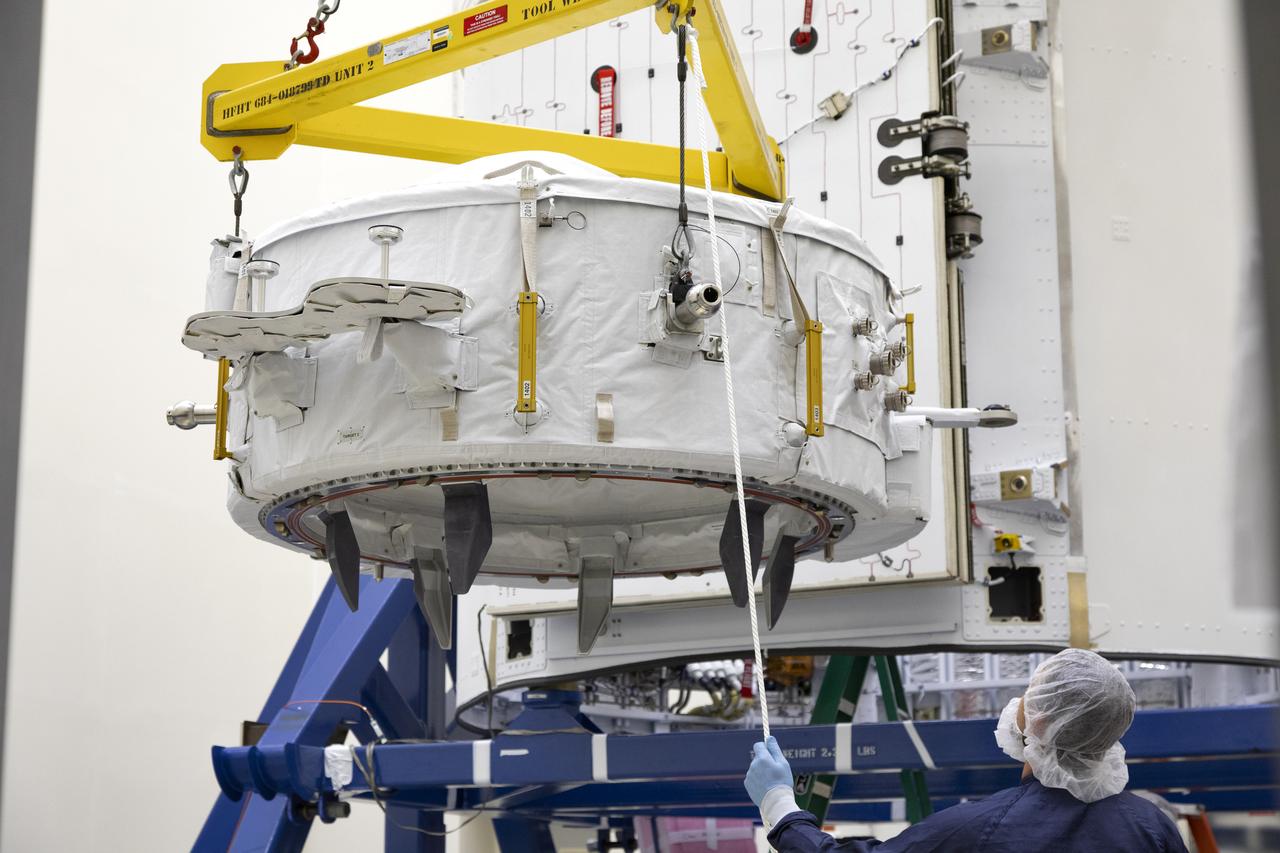
The International Docking Adapter 3, a critical component for future crewed missions to the International Space Station, is carefully packed away in the unpressurized “trunk” section of the SpaceX Dragon spacecraft at the SpaceX facility on Cape Canaveral Air Force Station in Florida on June 19. It will launch to the orbiting laboratory in July on the company’s 18th commercial resupply mission. The adapter will support future U.S. crewed vehicles visiting the station.
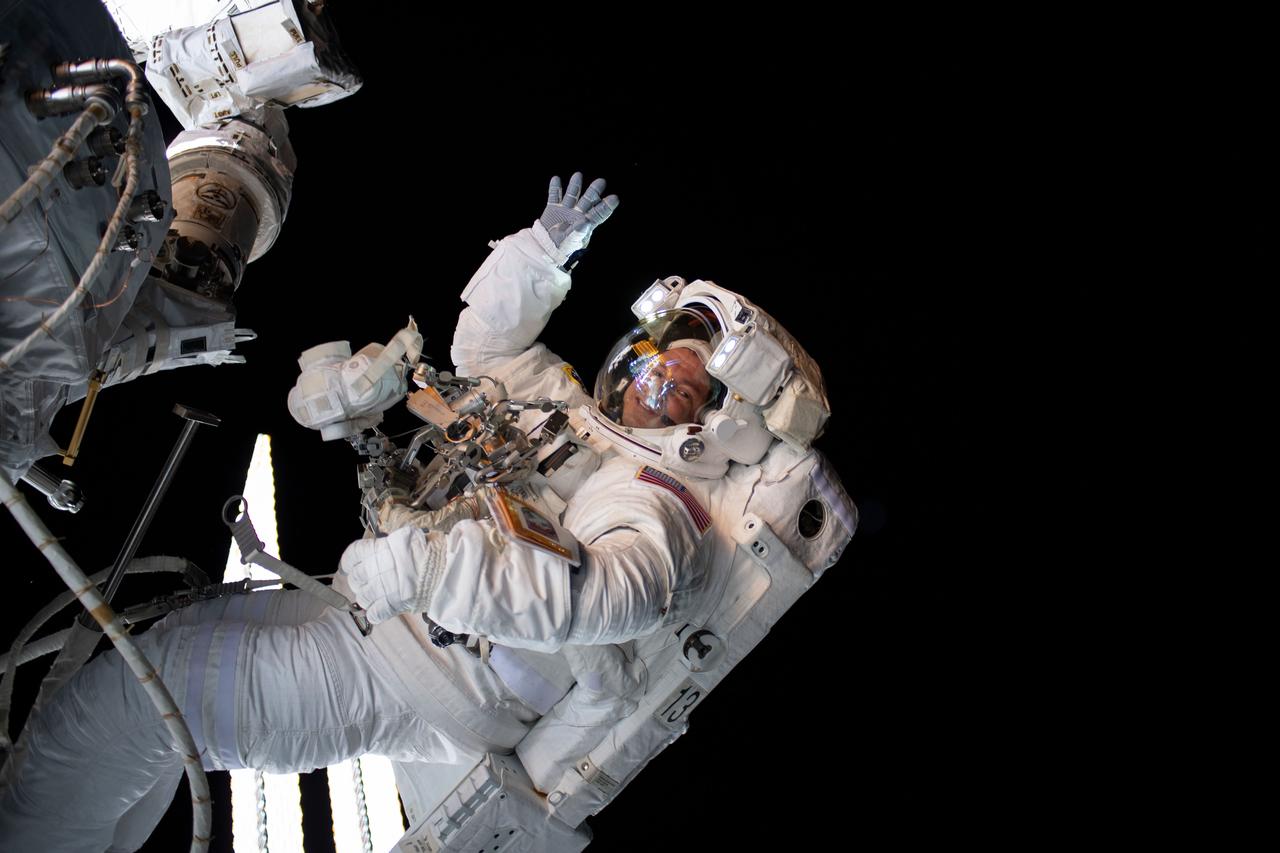
iss060e043194 (Aug. 21, 2019) --- NASA astronaut Andrew Morgan waves as he is photographed during a spacewalk to install the International Space Station’s second commercial crew vehicle docking port, the International Docking Adapter-3 (IDA-3).
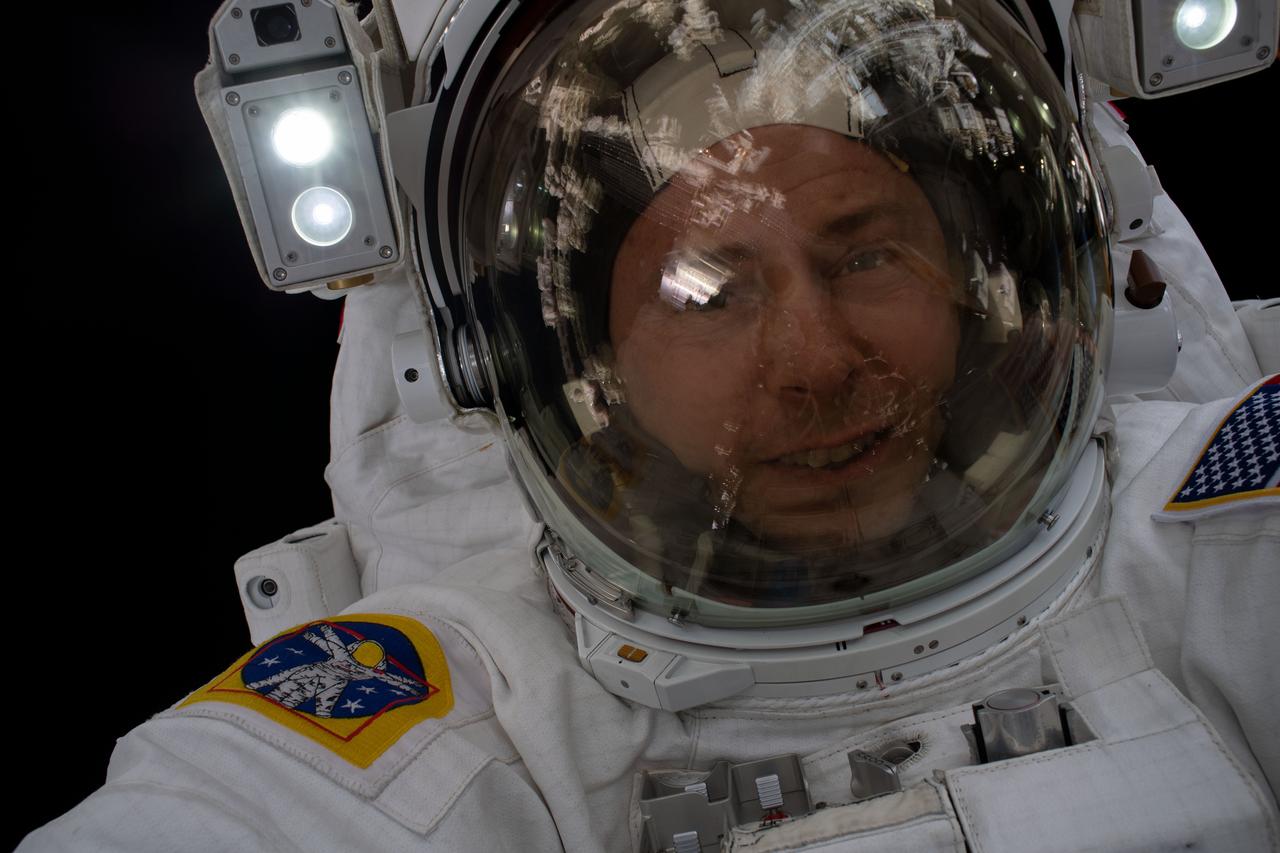
iss060e043180 (Aug. 21, 2019) --- NASA astronaut Nick Hague takes an out-of-this-world "space-selfie" during a spacewalk to install the International Space Station’s second commercial crew vehicle docking port, the International Docking Adapter-3 (IDA-3).
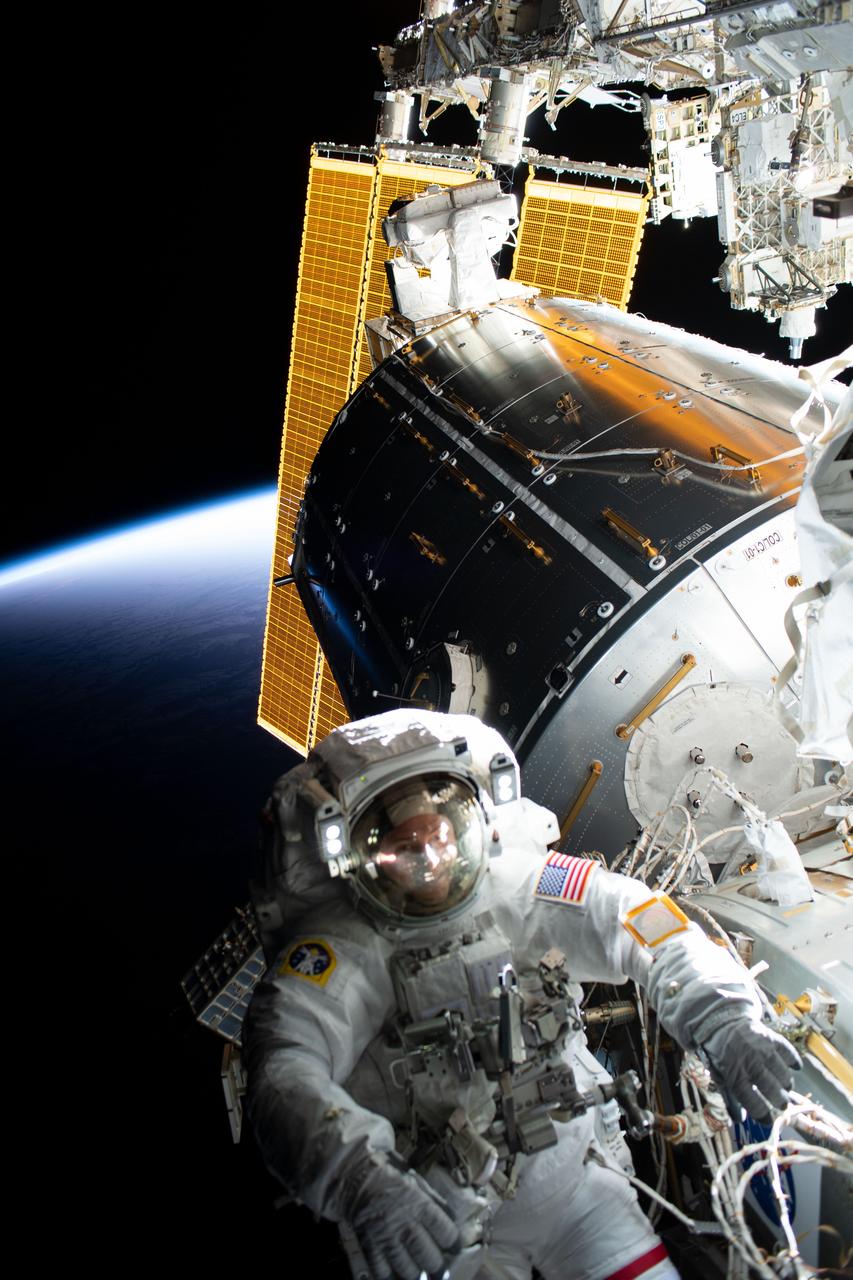
iss060e043273 (Aug. 21, 2019) --- NASA astronaut Nick Hague is pictured tethered to the forward end of the International Space Station during a spacewalk to install the orbiting lab's second commercial crew vehicle docking port, the International Docking Adapter-3 (IDA-3).
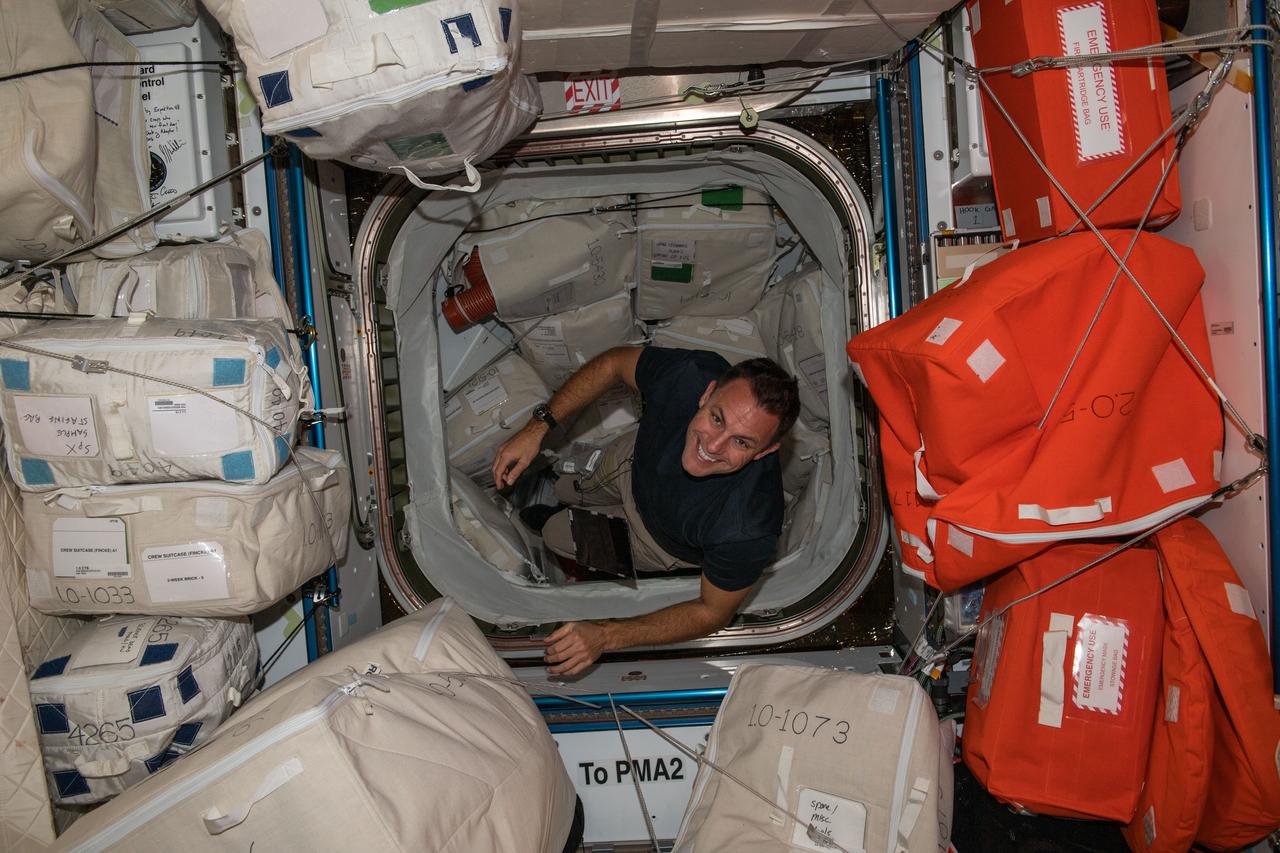
iss068e020515 (Nov. 3, 2022) --- NASA astronaut and Expedition 68 Flight Engineer Josh Cassada is pictured inside the Harmony module's forward-facing international docking adapter where the SpaceX Dragon Endeavour crew ship is docked.

ISS045e082772 10/28/2015) --- NASA astronaut Kjell Lindgren travels on a spacewalk to the outside of the Destiny U.S. Laboratory worksite to begin routing the Pressurized Mating Adapter 3 (PMA-3) International Docking Adapter Data Cable. Lindgren released this image on social media.
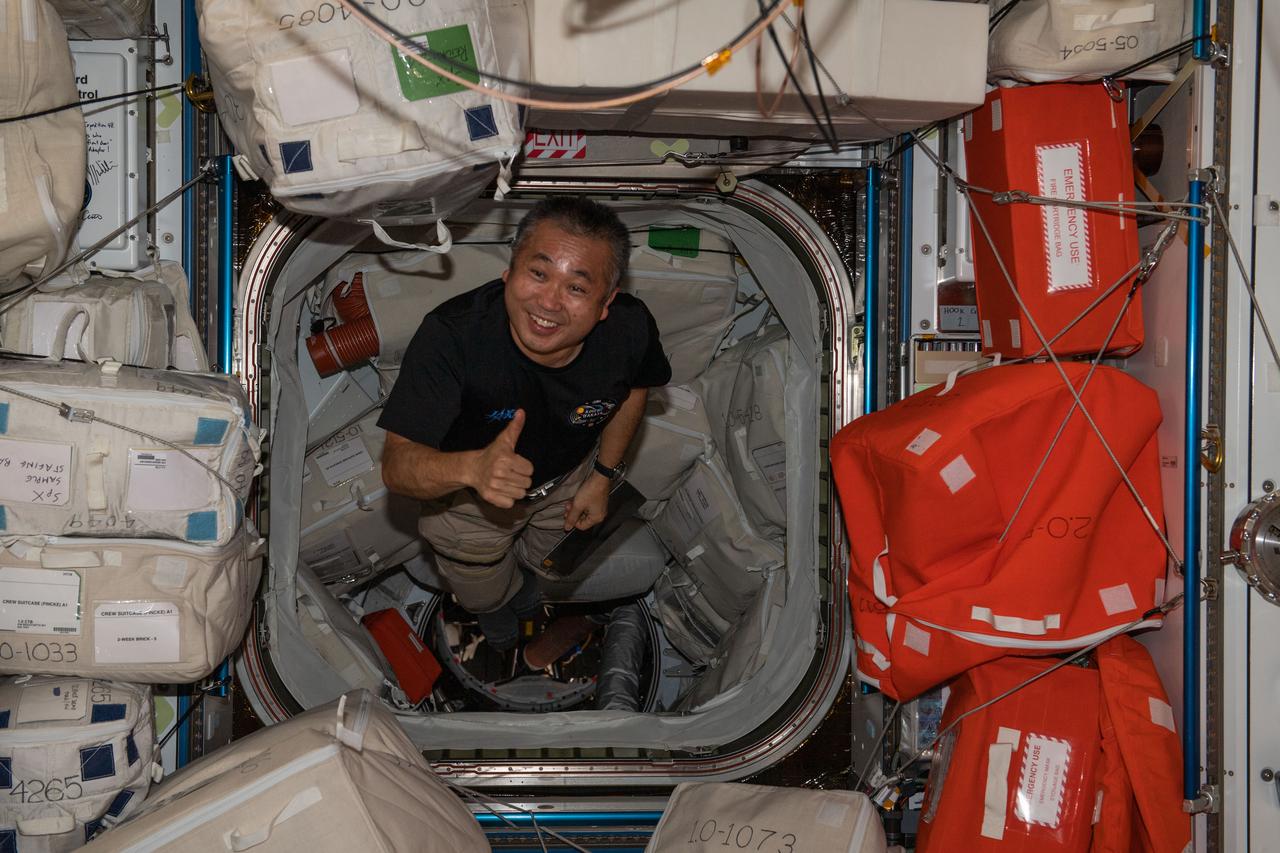
iss068e020523 (Nov. 3, 2022) --- Expedition 68 Flight Engineer Koichi Wakata of the Japan Aerospace Exploration Agency (JAXA) gives a "thumbs up" from inside the Harmony module's forward-facing international docking adapter where the SpaceX Dragon Endeavour crew ship is docked.
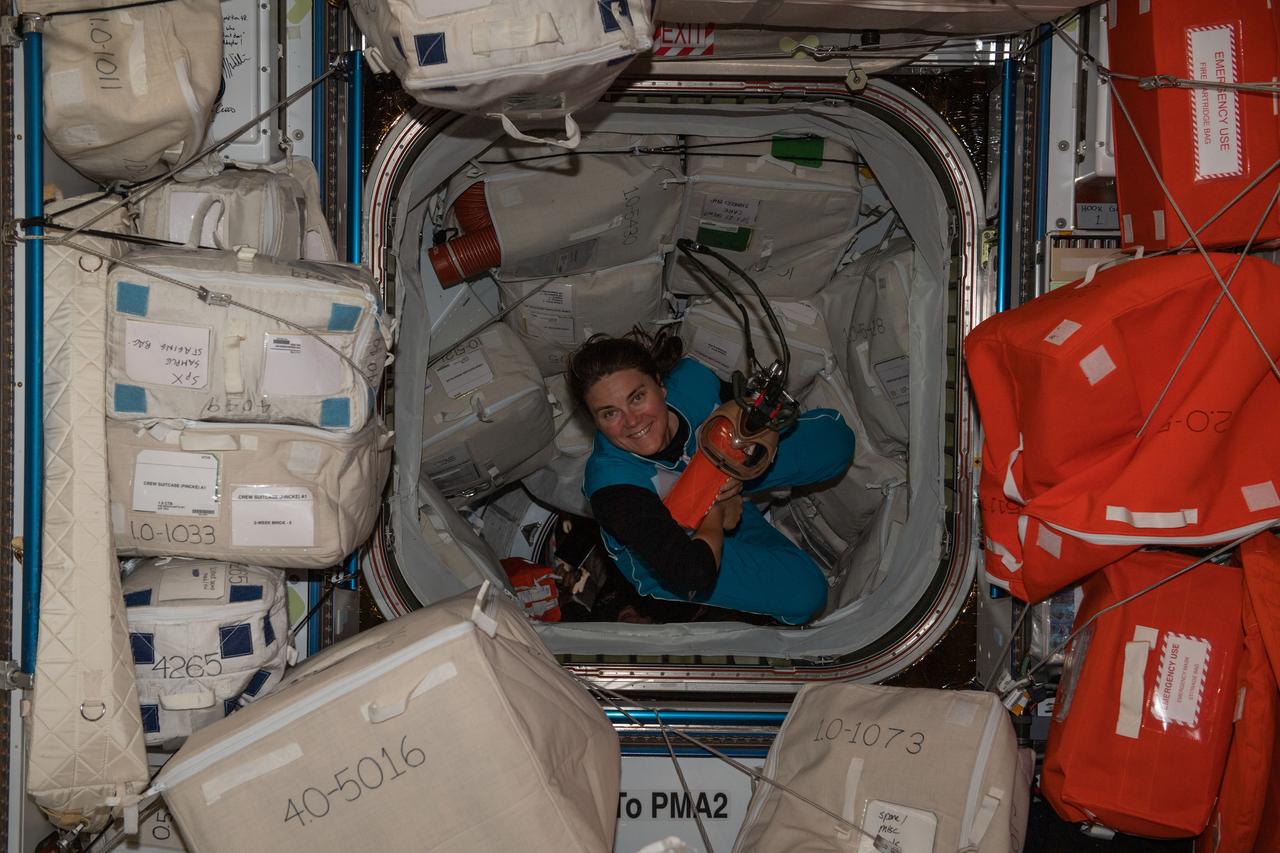
iss068e020521 (Nov. 3, 2022) --- Roscosmos cosmonaut and Expedition 68 Flight Engineer Anna Kikina is pictured carrying personal protective equipment inside the Harmony module's forward-facing international docking adapter where the SpaceX Dragon Endeavour crew ship is docked.
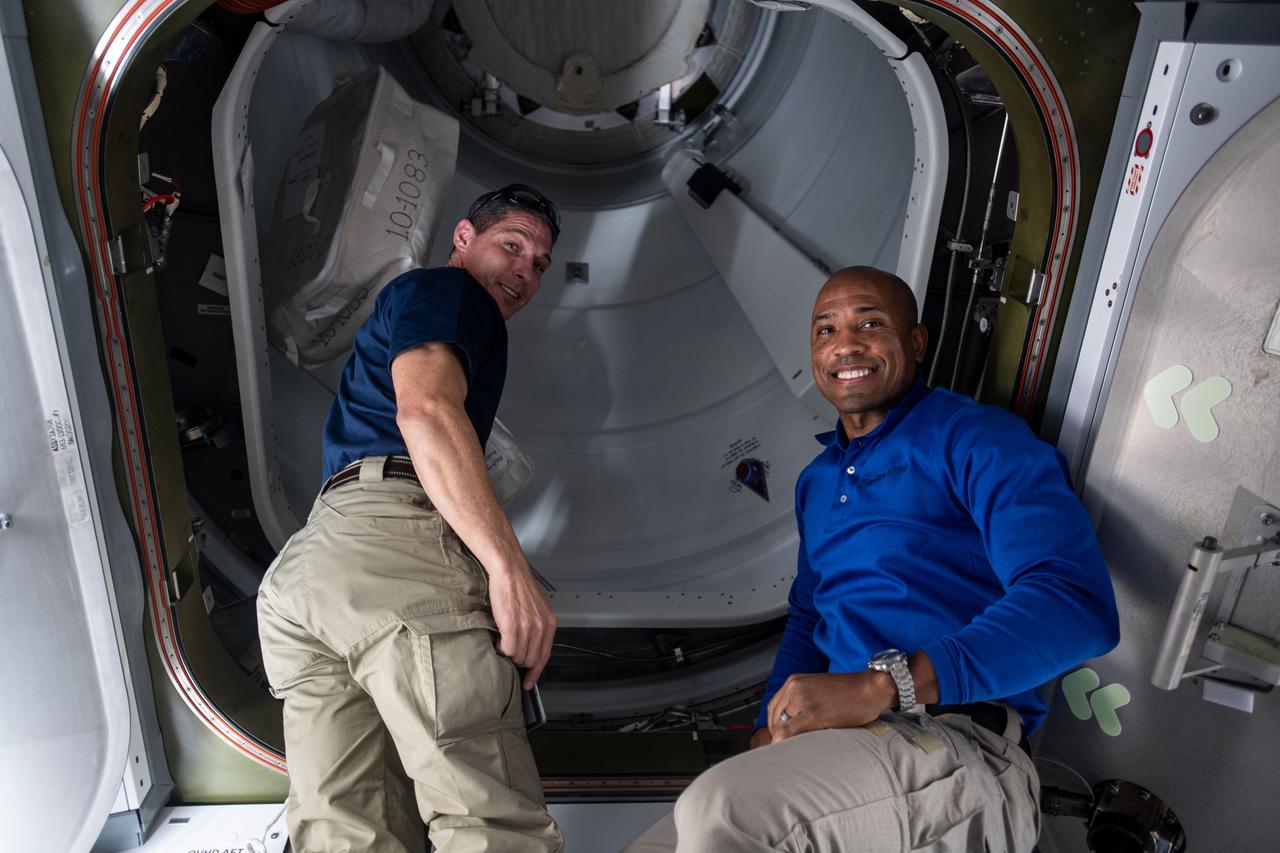
iss064e011087 (Dec. 7, 2020) --- NASA astronauts (from left) Michael Hopkins and Victor Glover are pictured in the vestibule between the Harmony module and the International Docking Adapter-3 before opening the hatch to the newly docked SpaceX Cargo Dragon vehicle.
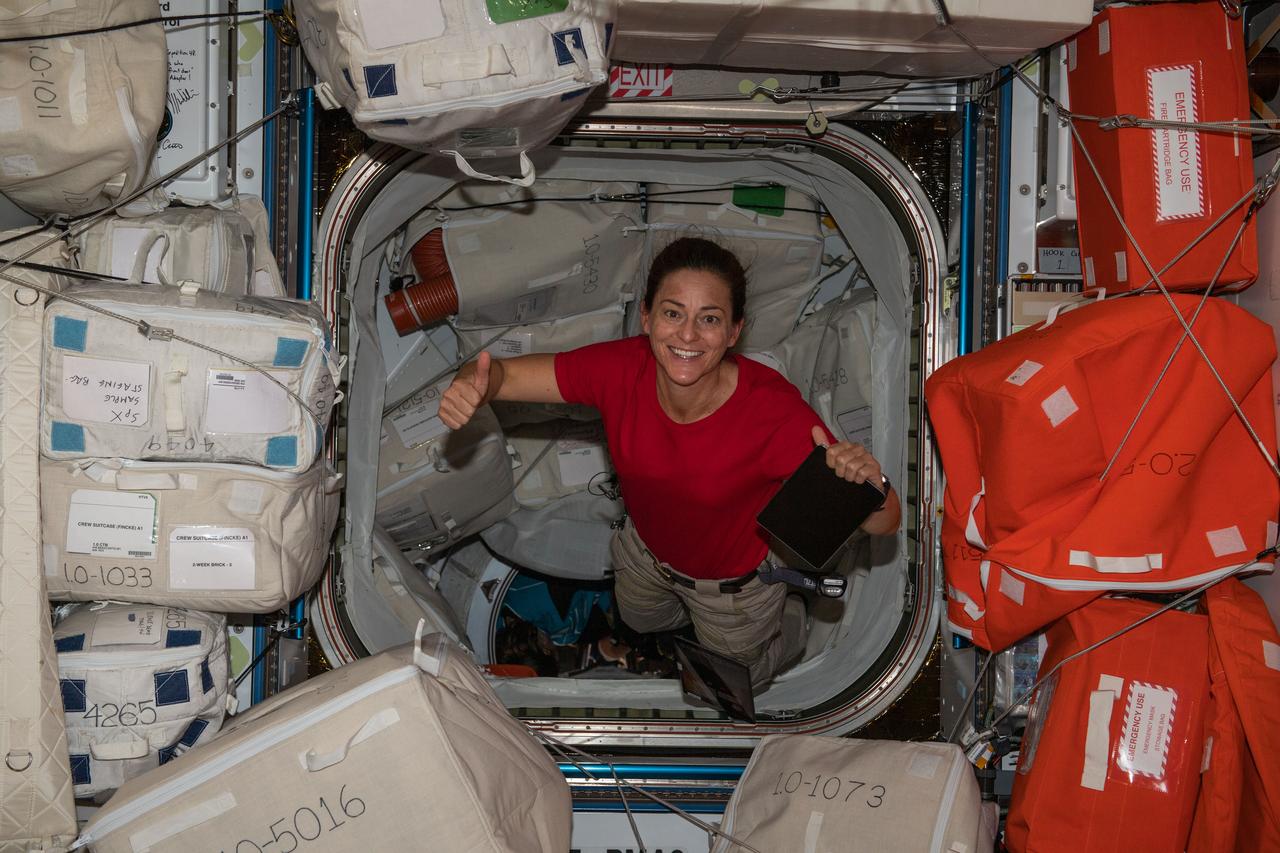
iss068e020519 (Nov. 3, 2022) --- NASA astronaut and Expedition 68 Flight Engineer Nicole Mann gives a "thumbs up" from inside the Harmony module's forward-facing international docking adapter where the SpaceX Dragon Endeavour crew ship is docked.
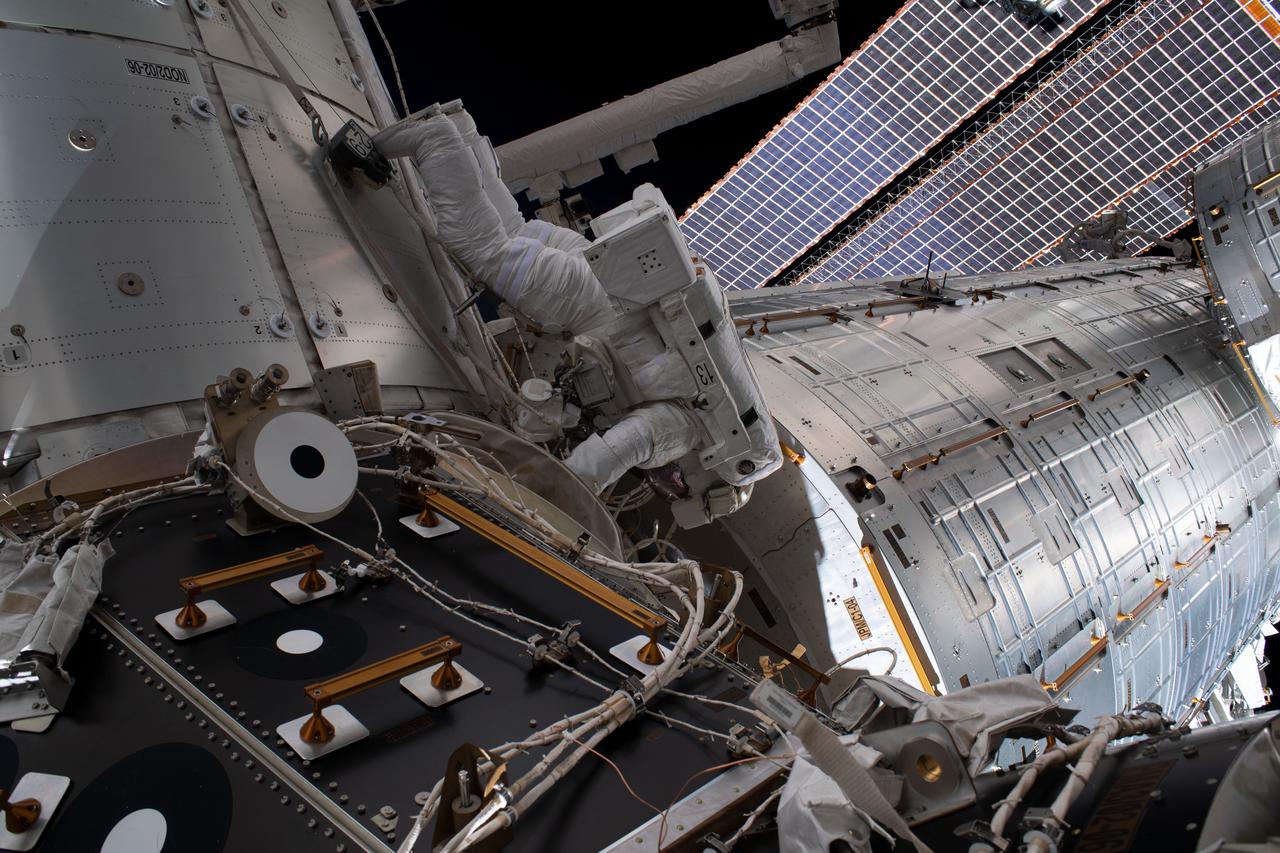
iss060e043181 (Aug. 21, 2019) --- NASA astronaut Andrew Morgan is pictured working outside the International Space Station during a six-hour and 32-minute spacewalk to install the orbiting lab’s second commercial crew vehicle docking port, the International Docking Adapter-3 (IDA-3). The IDA-3 will accommodate the future arrivals of Boeing CST-100 Starliner and SpaceX Crew Dragon commercial crew spacecraft.
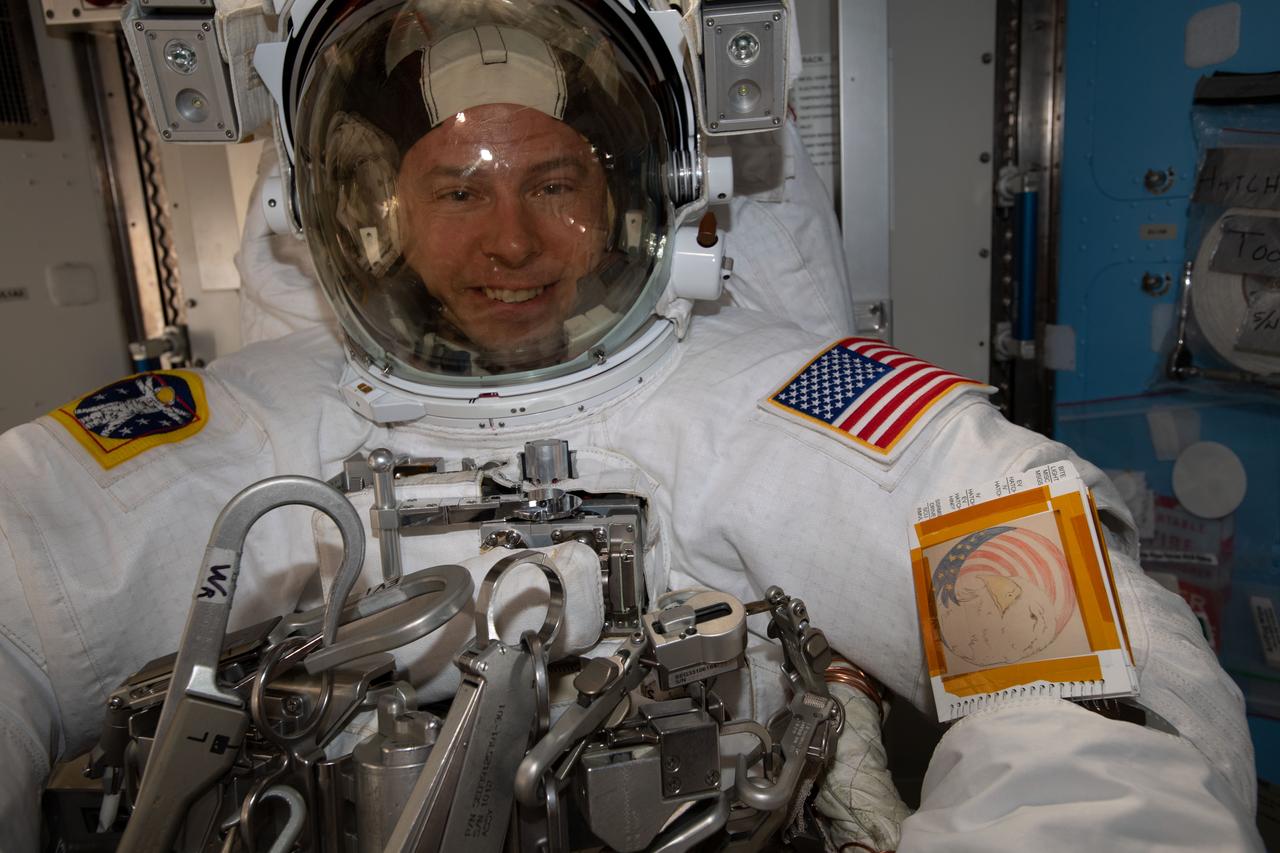
iss060e038228 (Aug. 21, 2019) --- NASA astronaut Nick Hague is pictured in his U.S. spacesuit inside the International Space Station's Quest airlock preparing to begin a six-hour and 32-minute spacewalk to install the orbiting lab’s second commercial crew vehicle docking port, the International Docking Adapter-3 (IDA-3). The IDA-3 will accommodate the future arrivals of Boeing CST-100 Starliner and SpaceX Crew Dragon commercial crew spacecraft.
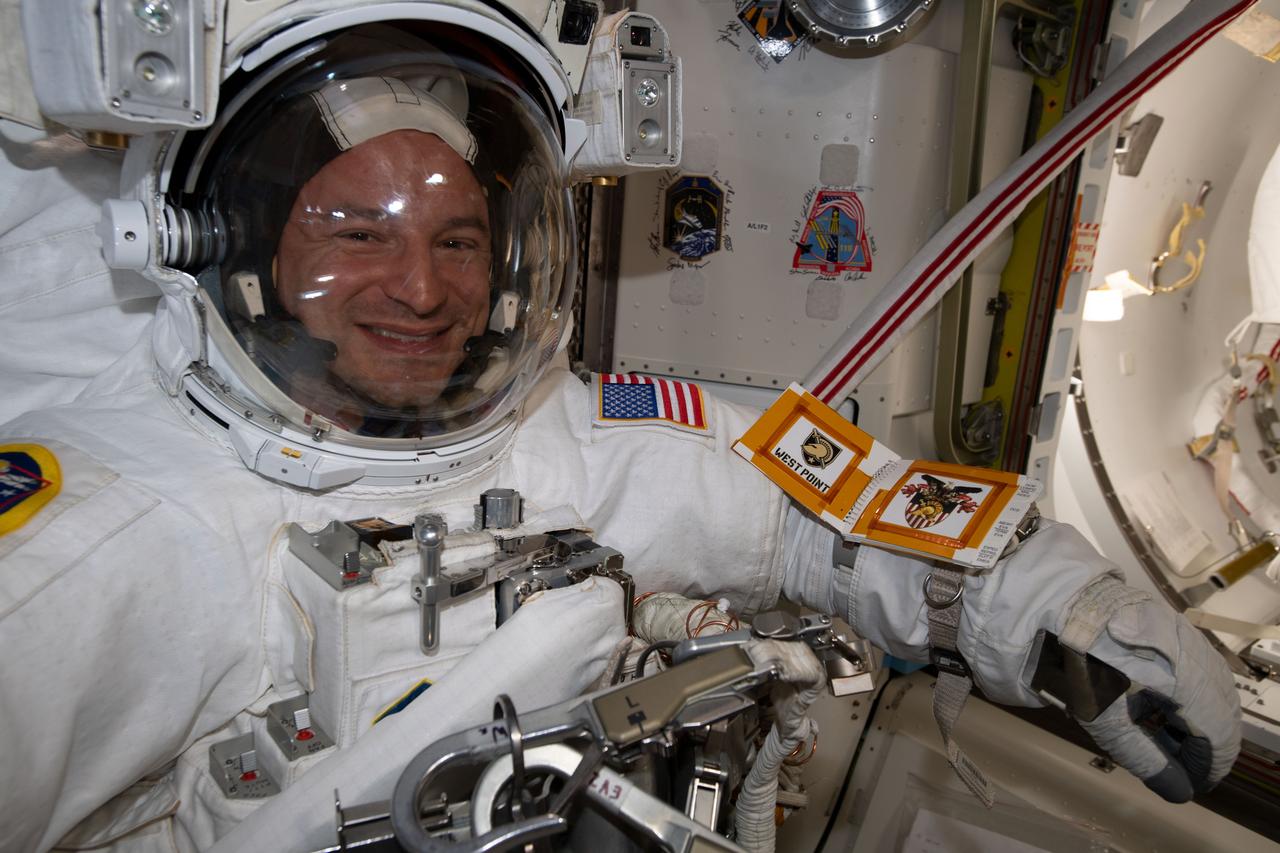
iss060e038222 (Aug. 21, 2019) --- NASA astronaut Andrew Morgan is pictured in his U.S. spacesuit inside the International Space Station's Quest airlock preparing to begin a six-hour and 32-minute spacewalk to install the orbiting lab’s second commercial crew vehicle docking port, the International Docking Adapter-3 (IDA-3). The IDA-3 will accommodate the future arrivals of Boeing CST-100 Starliner and SpaceX Crew Dragon commercial crew spacecraft.
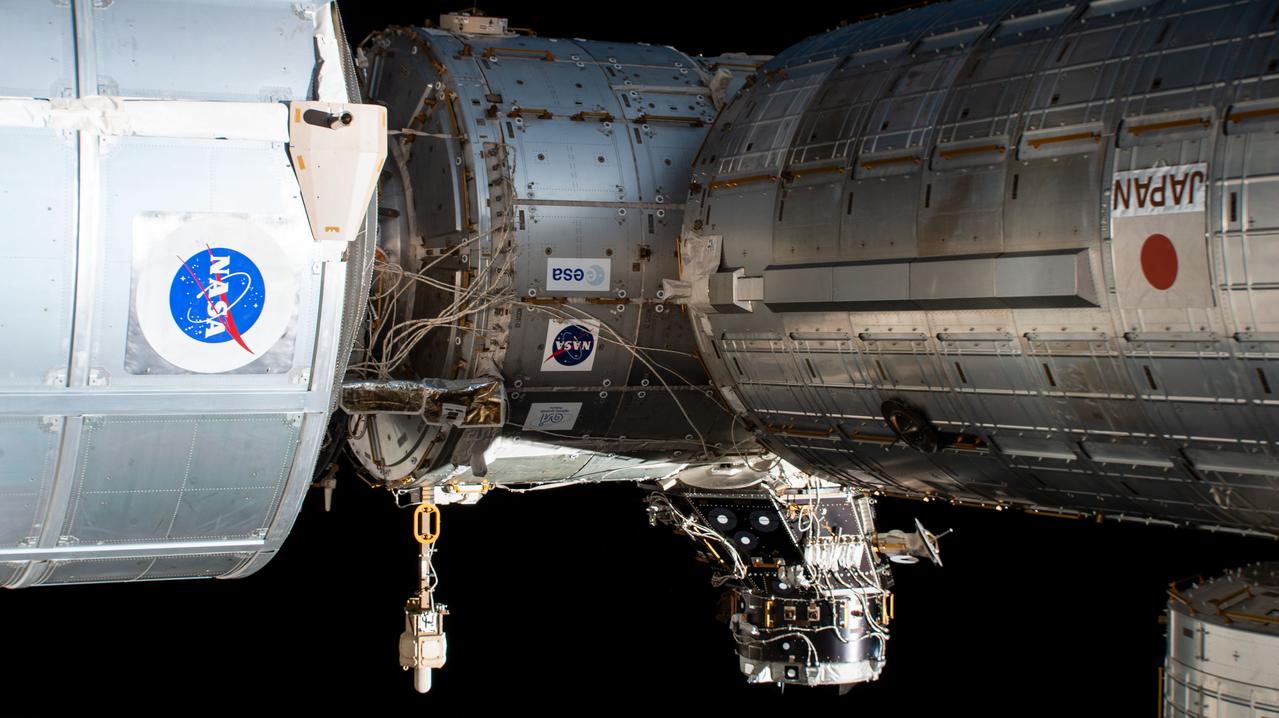
iss060e007002 (July 12, 2019) --- The forward-end of the International Space Station is pictured highlighting portions of three modules and a pressurized mating adapter. An external high definition camera captured (from left) the Permanent Multipurpose Module (PMM), the Harmony Module and the Japanese Kibo laboratory module. Protruding from the Harmony module is the pressurized mating adapter that will host the International Docking Adapter-3. The PMM is actually in front of the U.S. Destiny laboratory module to which Harmony is attached to.
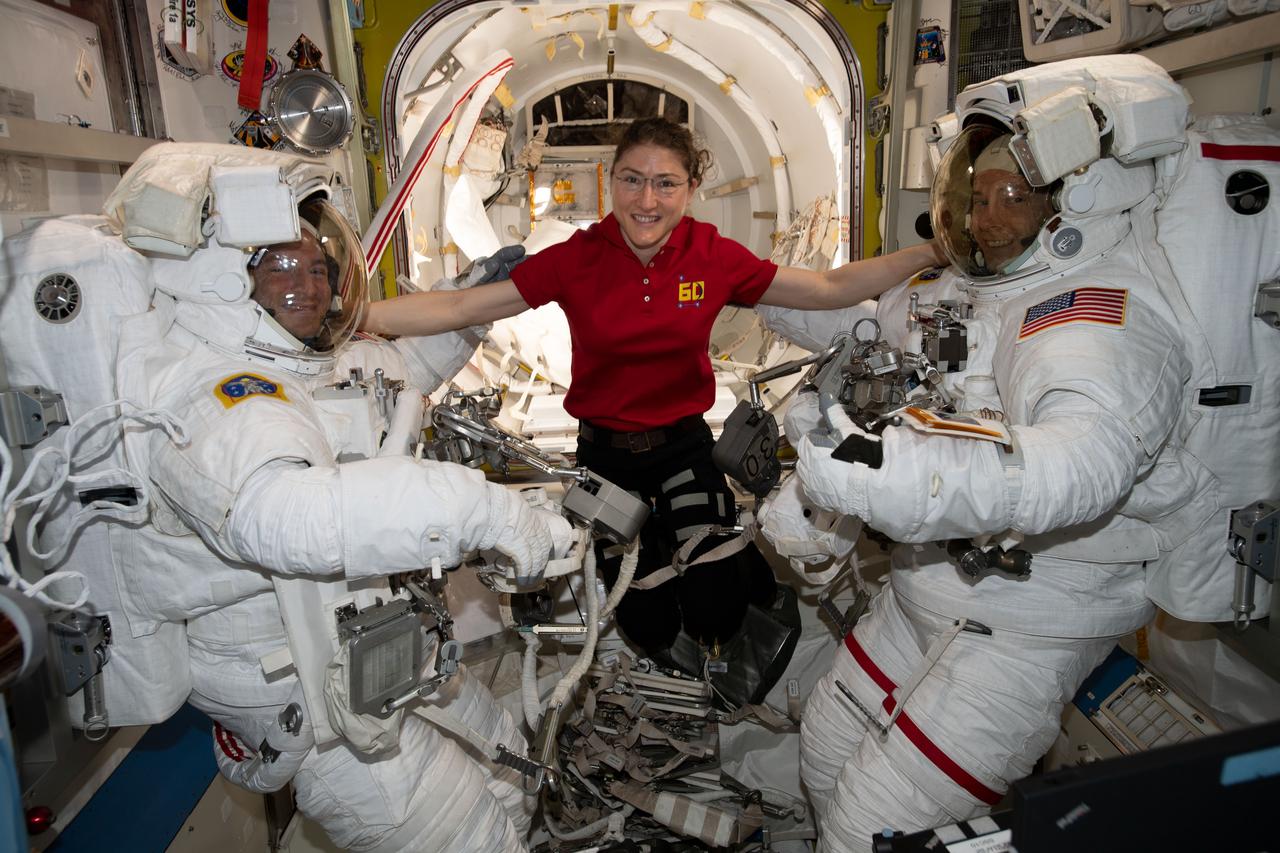
iss060e038215 (Aug. 21, 2019) --- NASA astronaut Christina Koch poses for a portrait with Andrew Morgan and Nick Hague in their U.S. spacesuits before beginning a six-hour and 32-minute spacewalk to install the orbiting lab’s second commercial crew vehicle docking port, the International Docking Adapter-3 (IDA-3). The IDA-3 will accommodate the future arrivals of Boeing CST-100 Starliner and SpaceX Crew Dragon commercial crew spacecraft.
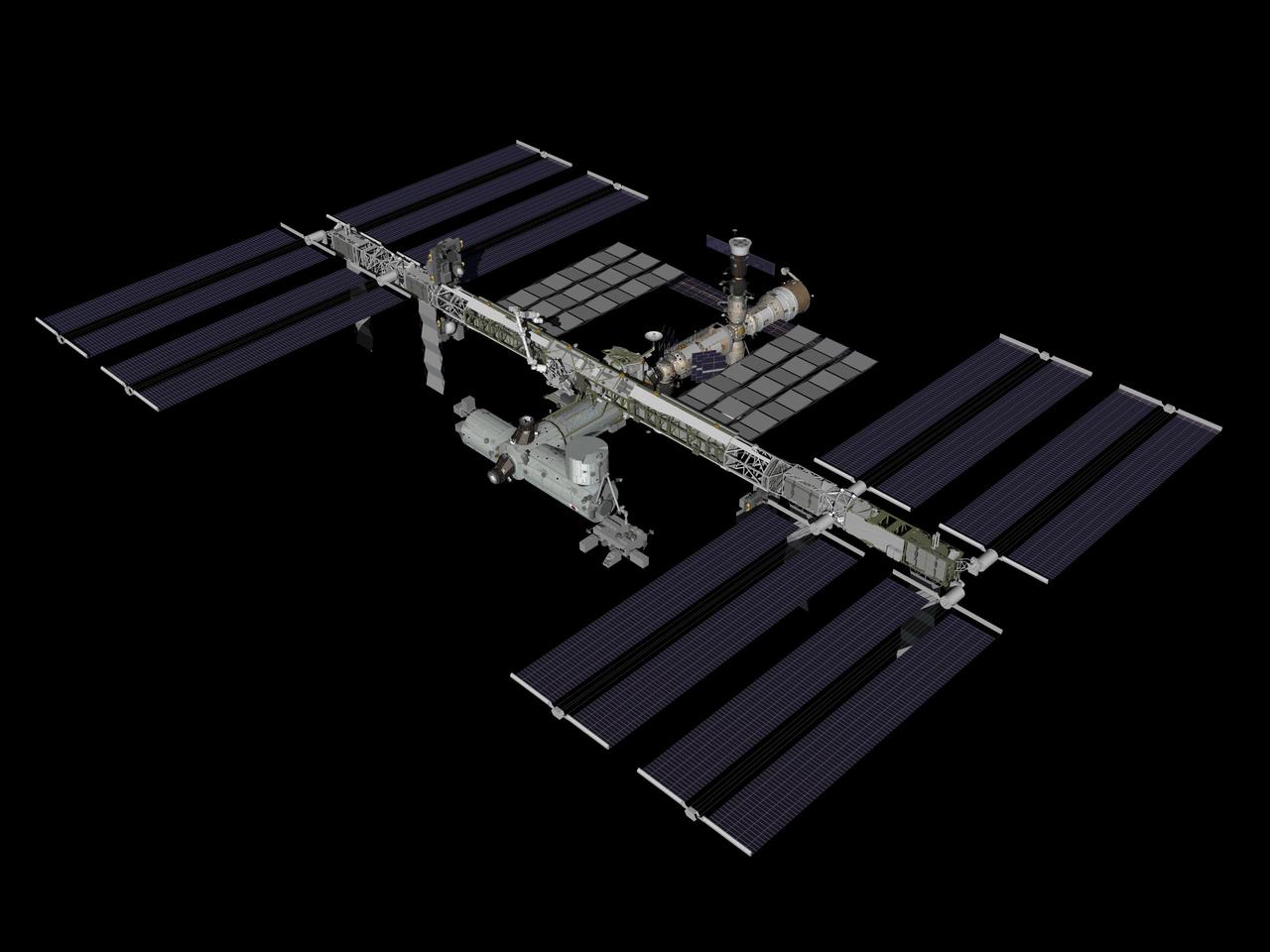
JSC2010-E-008593 (January 2010) --- Computer-generated artist?s rendering of the International Space Station as of Jan. 23, 2010. Pressurized Mating Adapter 3 (PMA-3) is relocated from the Unity node port to the Harmony node zenith port to allow for the arrival of the Tranquility module (Node 3). Soyuz 20 (TMA-16) is docked to the Poisk Mini-Research Module 2 (MRM2). Soyuz 21 (TMA-17) is linked to the Zarya nadir port and Progress 35 resupply vehicle remains docked to the Pirs Docking Compartment.
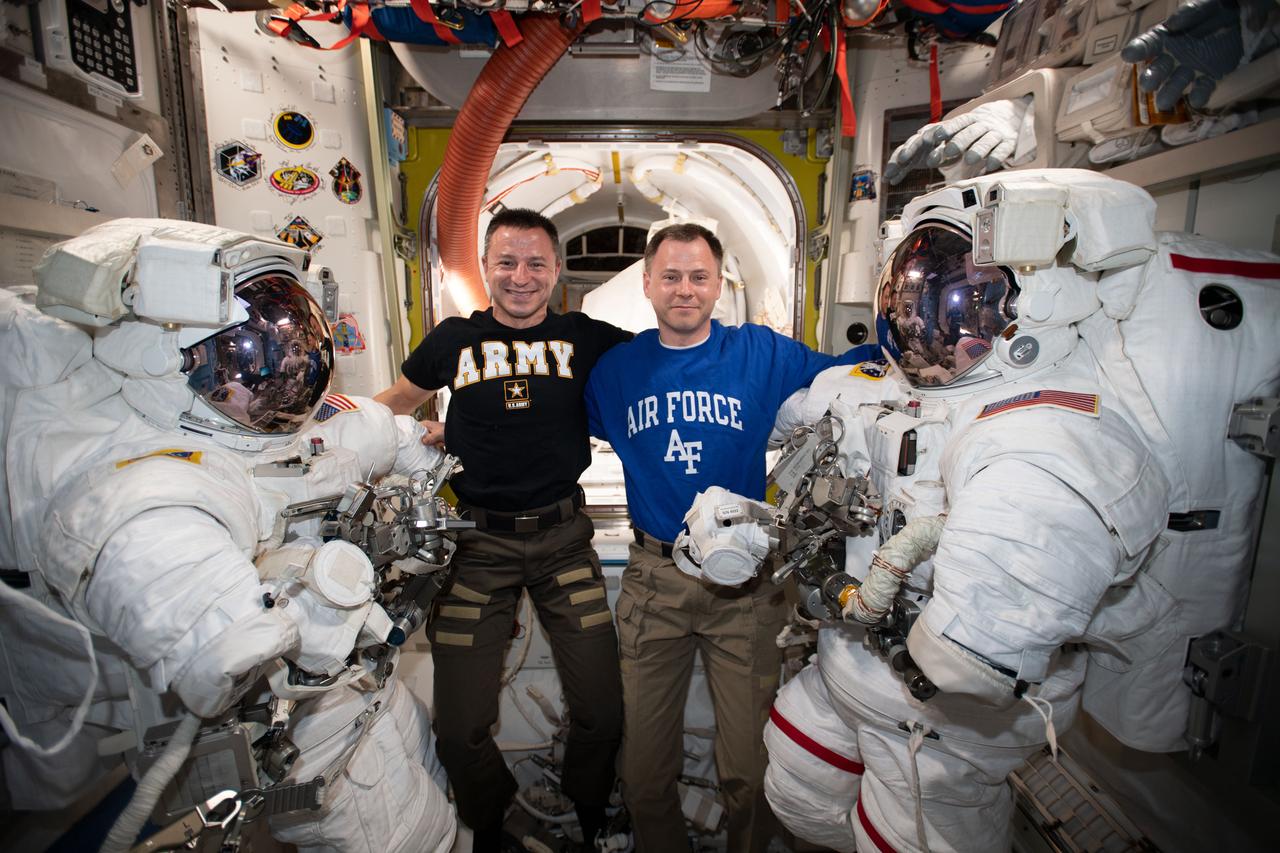
iss060e037335 (Aug. 18, 2019) --- NASA astronauts Andrew Morgan and Nick Hague pose with the spacesuits they will wear during a six-and-a-half-hour spacewalk to install the International Docking Adapter-3 that will accommodate the future arrivals of Boeing CST-100 Starliner and SpaceX Crew Dragon commercial crew spacecraft.
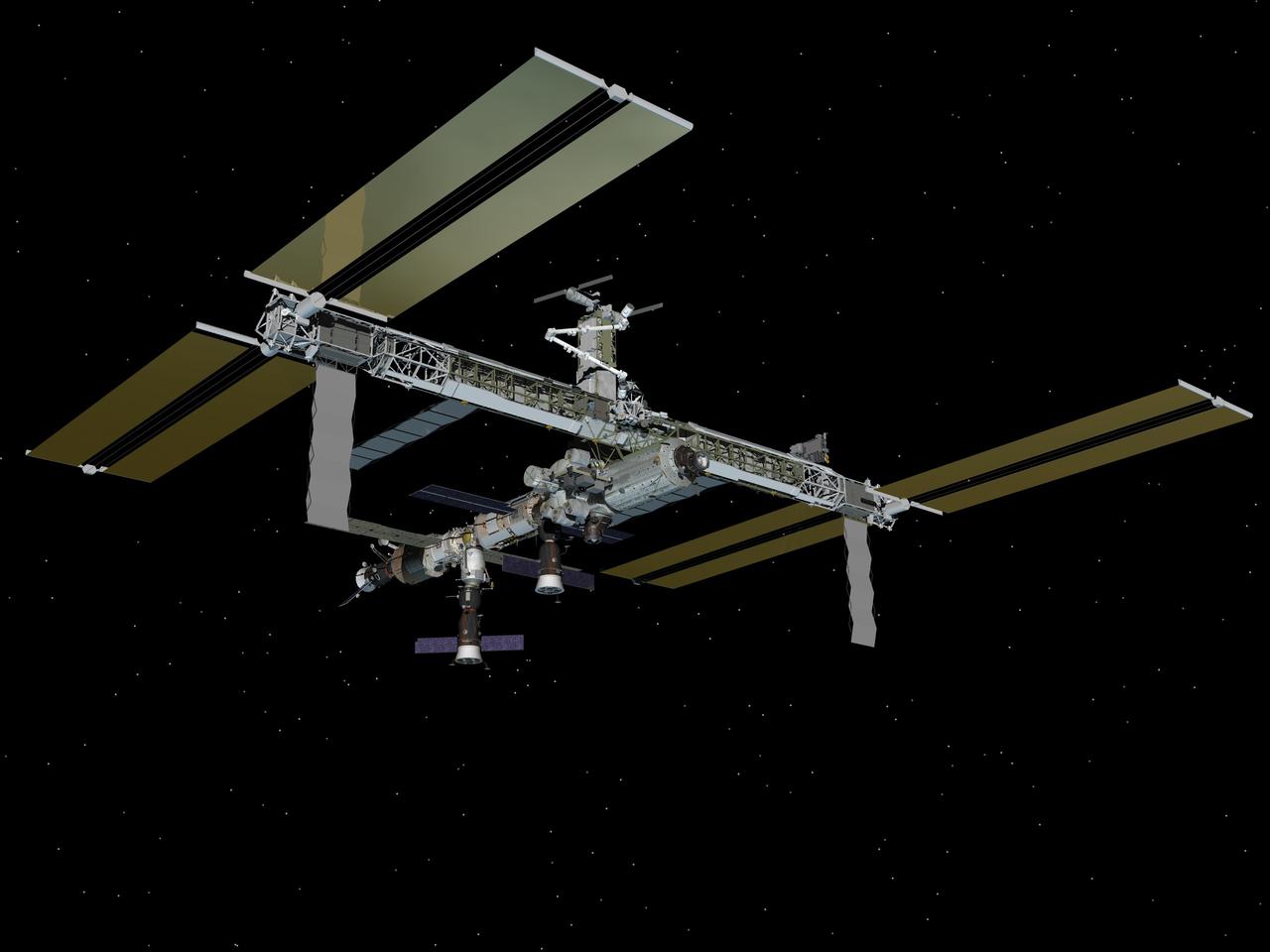
JSC2007-E-44665 (August 2007) --- Computer-generated artist's rendering of the International Space Station as of Aug. 30, 2007. This angle shows the starboard side of the orbiting complex. The Pressurized Mating Adapter-3 (PMA-3) relocates from the Unity node port docking mechanism to its nadir docking mechanism. During the STS-118 mission, the Starboard 5 (S5) truss segment and External Stowage Platform (ESP-3) were added; and the Port 6 (P6) forward radiator was retracted. Progress 26 resupply vehicle remains docked to the Pirs Docking Compartment and Progress 25 resupply vehicle is docked to the Zvezda Service Module aft port. Soyuz 14 (TMA-10) remains linked to the Zarya nadir port.
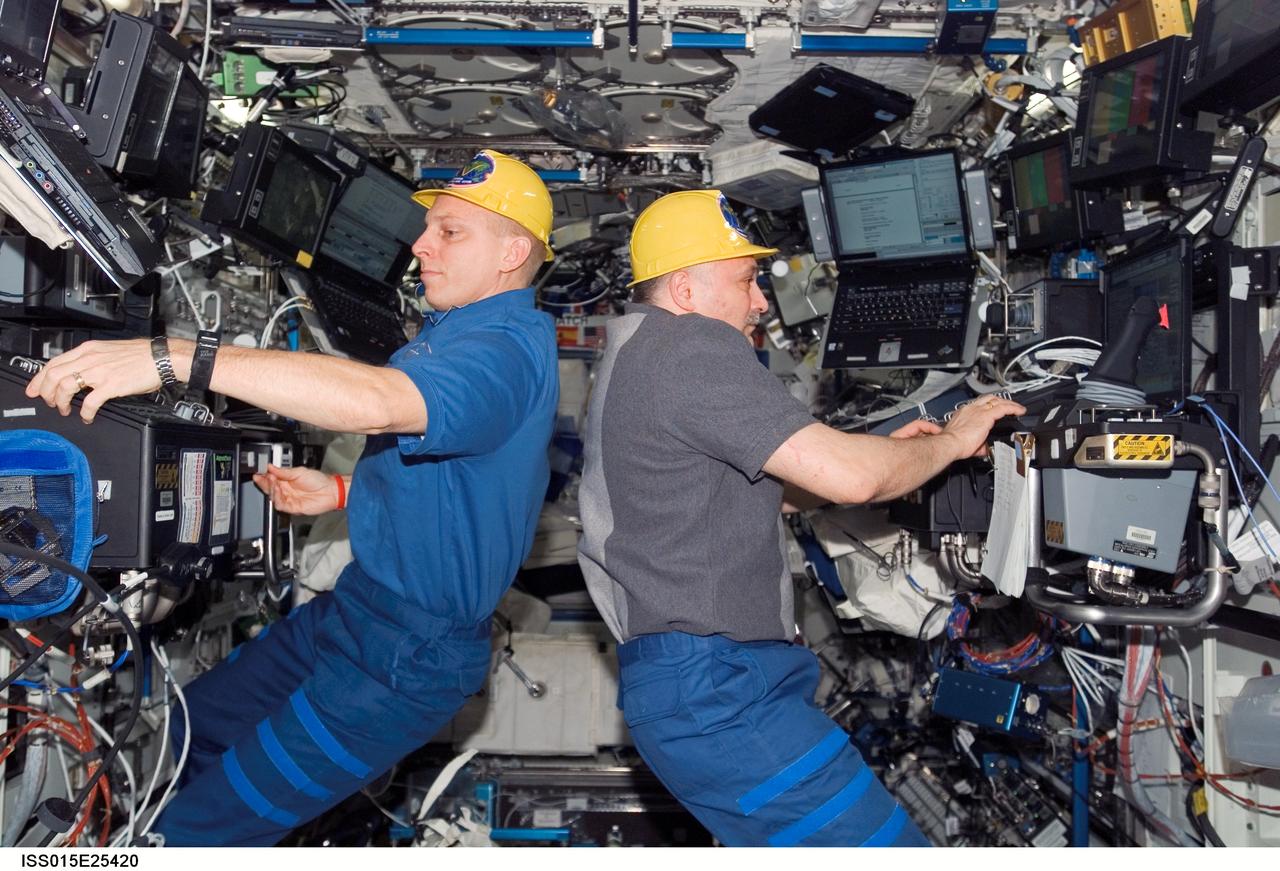
ISS015-E-25420 (30 Aug. 2007) --- Astronaut Clay Anderson (left), Expedition 15 flight engineer, works the controls of the station's robotic arm, Canadarm2; while cosmonaut Fyodor N. Yurchikhin, commander representing Russia's Federal Space Agency, works with docking systems in the Destiny laboratory of the International Space Station during Pressurized Mating Adapter-3 (PMA-3) transfer operations. Using the Canadarm2, the PMA-3 was undocked from the Unity node's left side at 7:18 a.m. (CDT) and docked to Unity's lower port at 8:07 a.m. to prepare for the arrival of Node 2, the Harmony module, on the STS-120 flight of Space Shuttle Discovery in October 2007.

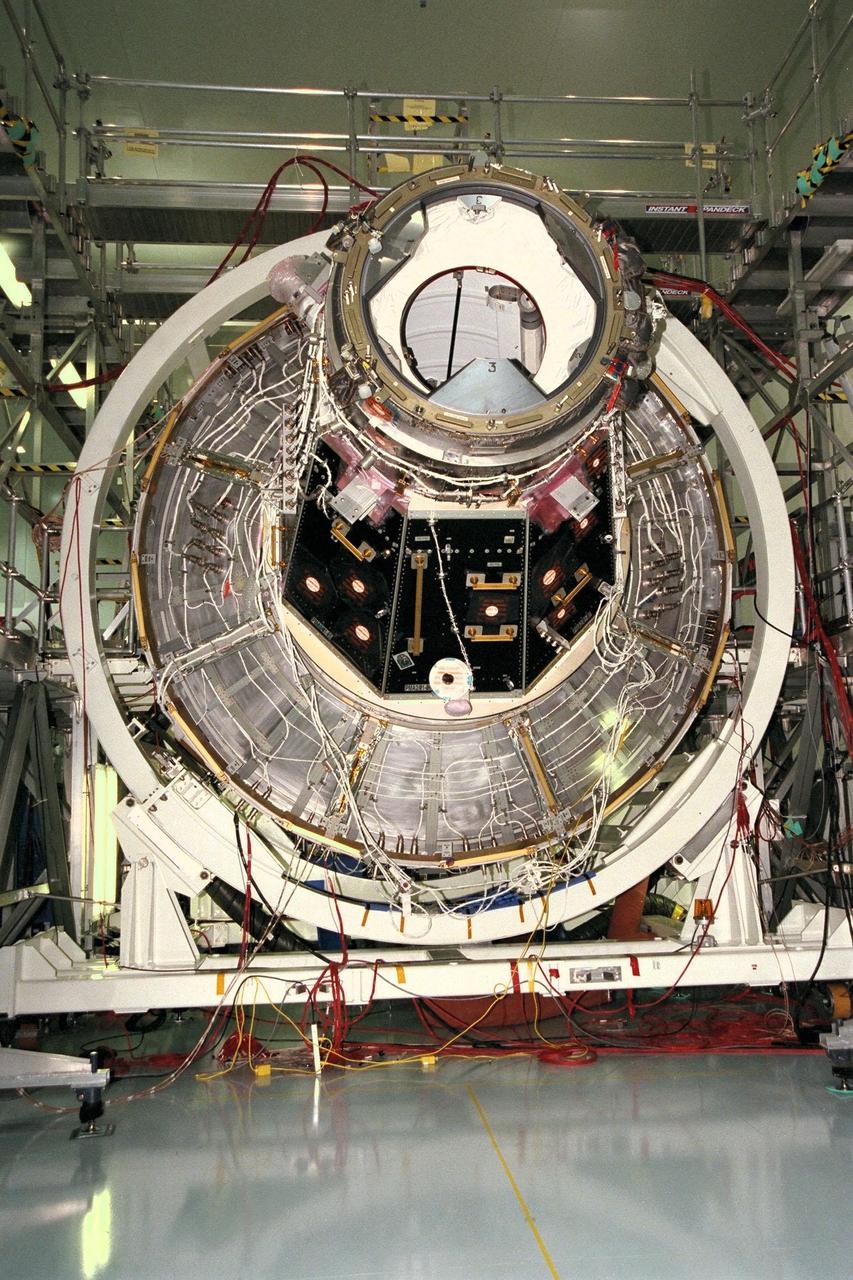
KENNEDY SPACE CENTER, FLA. -- The Pressurized Mating Adapter-3 (PMA-3), an element of the STS-92 mission scheduled for launch aboard Space Shuttle Atlantis in January 1999, arrived from the Boeing Company in Huntington Beach, Calif., for processing in KSC's Space Station Processing Facility (SSPF). While in orbit, PMA-3 will be removed from the orbiter's payload bay by the astronauts using the remote manipulator arm and mated to Node 1, a connecting passageway to the living and working areas of the International Space Station. The primary purpose of PMA-3 is to serve as a Shuttle docking port through which crew members and equipment will transfer to the International Space Station during later assembly missions.
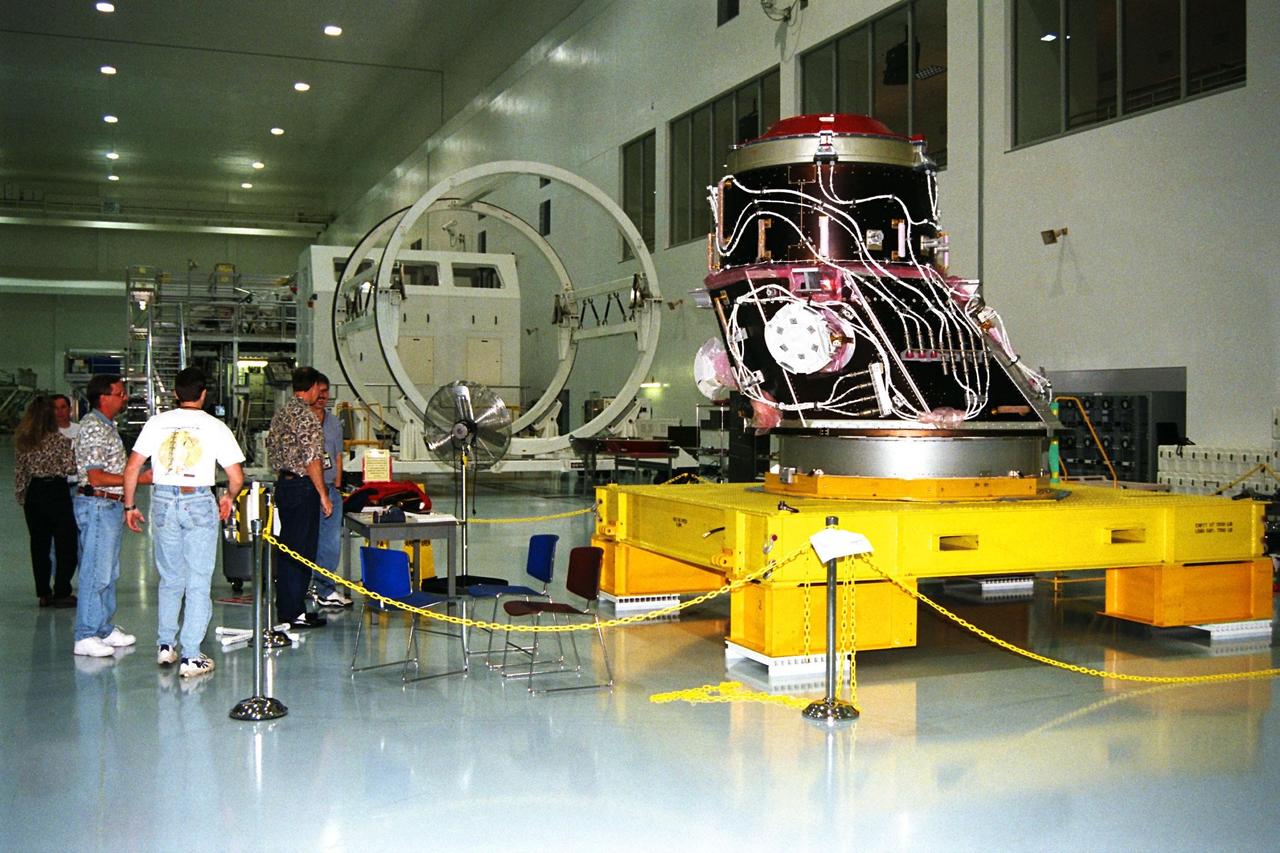
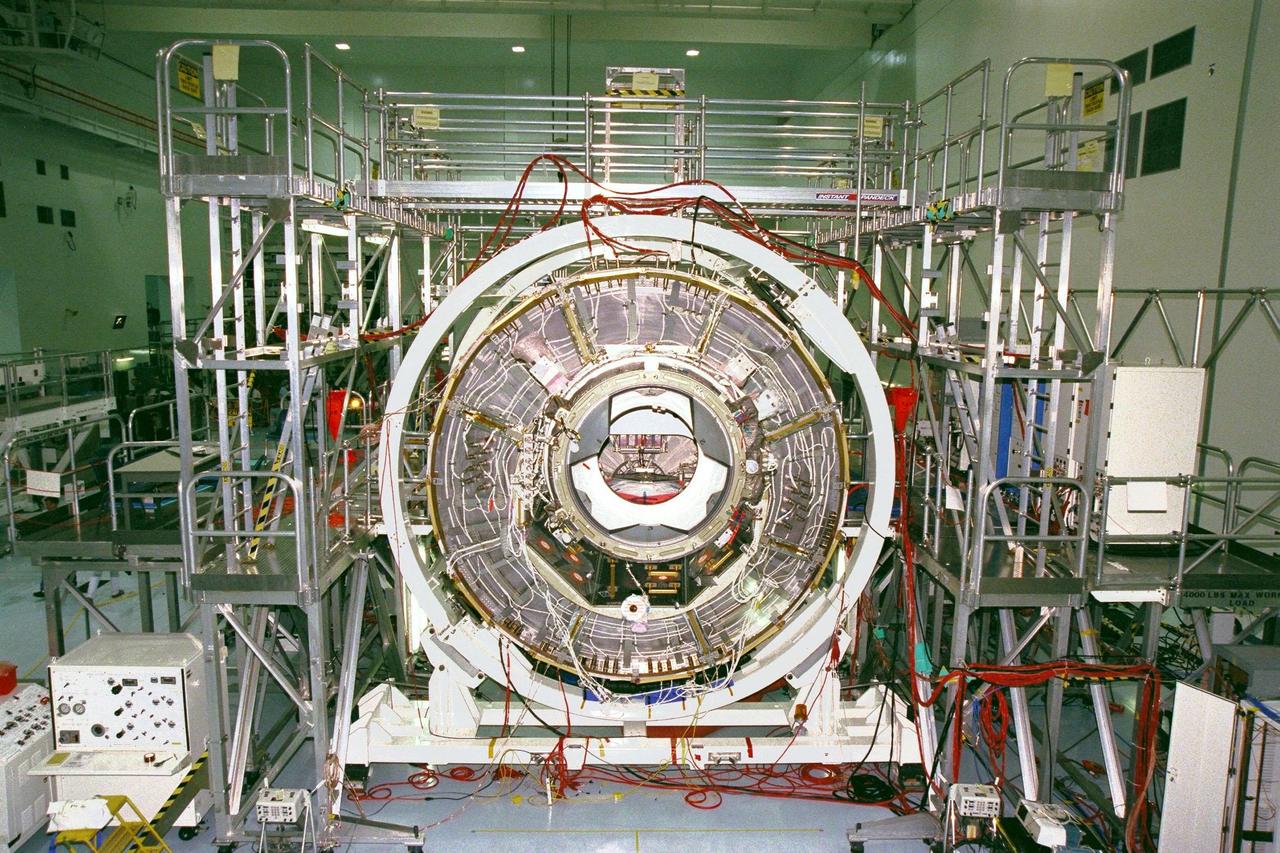
KENNEDY SPACE CENTER, FLA. -- Seen at the right of the photograph, the Pressurized Mating Adapter-3 (PMA-3), an element of the STS-92 mission scheduled for launch aboard Space Shuttle Atlantis in January 1999, awaits processing in KSC's Space Station Processing Facility (SSPF). While in orbit, PMA-3 will be removed from the orbiter's payload bay by the astronauts using the remote manipulator arm and mated to Node 1, a connecting passageway to the living and working areas of the International Space Station. The primary purpose of PMA-3 is to serve as a Shuttle docking port through which crew members and equipment will transfer to the International Space Station during later assembly missions
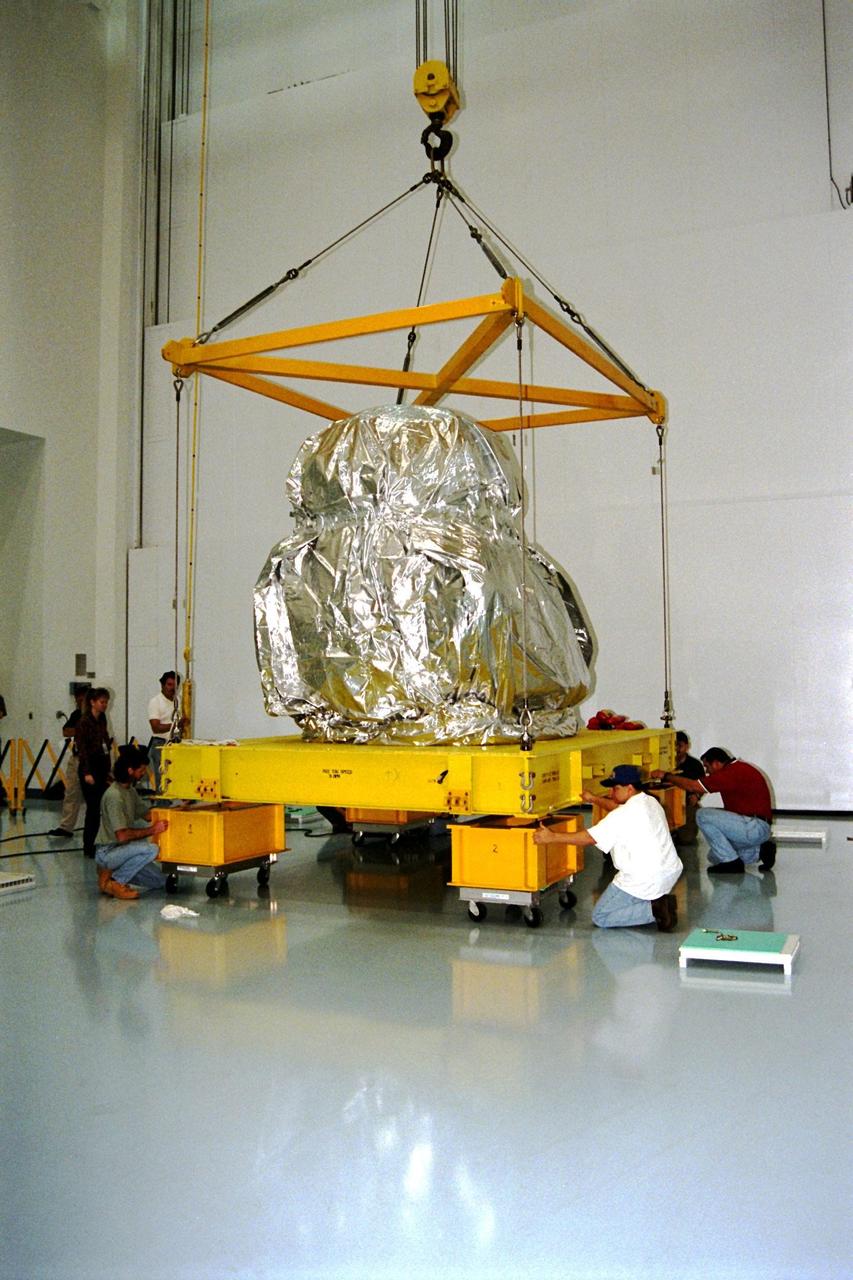
KENNEDY SPACE CENTER, FLA. -- The Pressurized Mating Adapter-3 (PMA-3), an element of the STS-92 mission scheduled for launch aboard Space Shuttle Atlantis in January 1999, arrived from the Boeing Company in Huntington Beach, Calif., for processing in KSC's Space Station Processing Facility (SSPF). While in orbit, PMA-3 will be removed from the orbiter's payload bay by the astronauts using the remote manipulator arm and mated to Node 1, a connecting passageway to the living and working areas of the International Space Station. The primary purpose of PMA-3 is to serve as a Shuttle docking port through which crew members and equipment will transfer to the International Space Station during later assembly missions
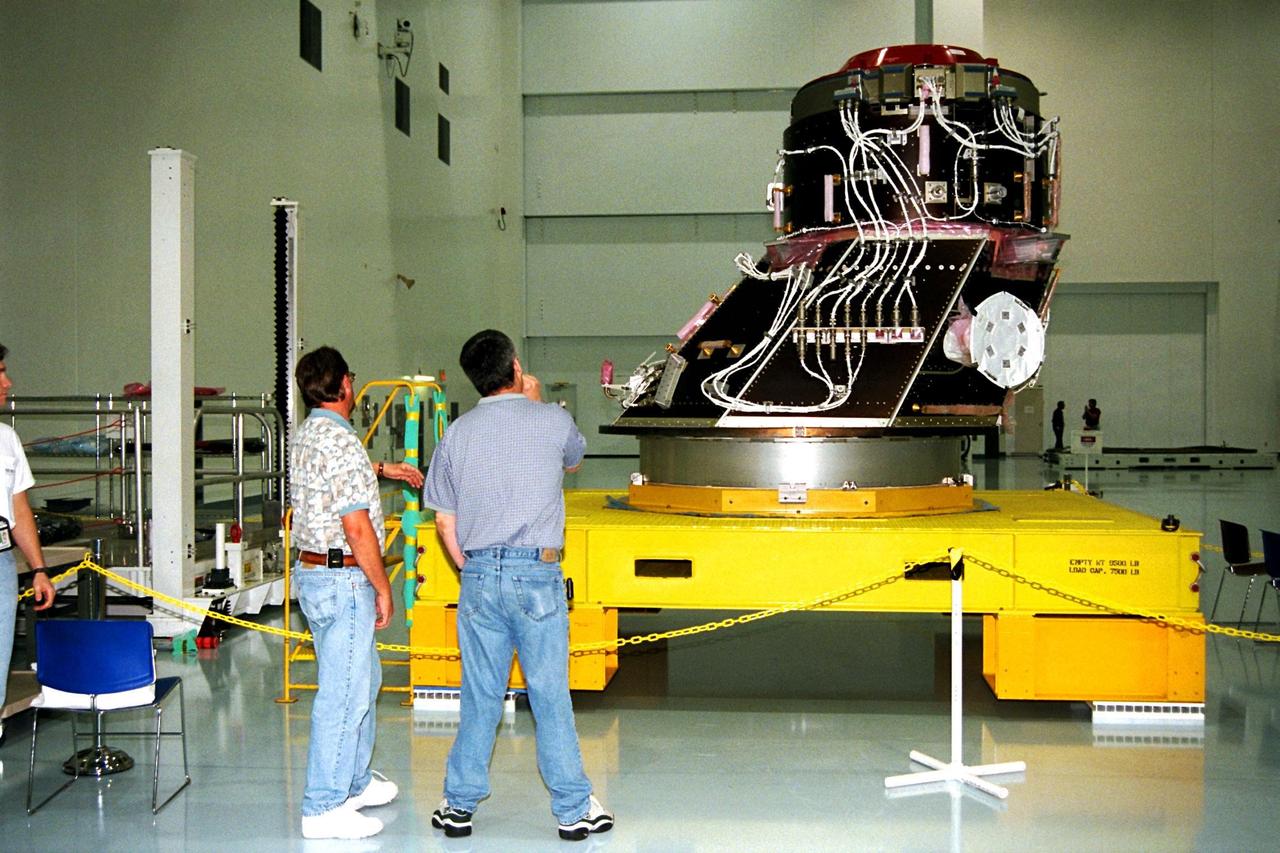
KENNEDY SPACE CENTER, FLA. -- The Pressurized Mating Adapter-3 (PMA-3), an element of the STS-92 mission scheduled for launch aboard Space Shuttle Atlantis in January 1999, awaits processing in KSC's Space Station Processing Facility (SSPF). While in orbit, PMA-3 will be removed from the orbiter's payload bay by the astronauts using the remote manipulator arm and mated to Node 1, a connecting passageway to the living and working areas of the International Space Station. The primary purpose of PMA-3 is to serve as a Shuttle docking port through which crew members and equipment will transfer to the International Space Station during later assembly missions
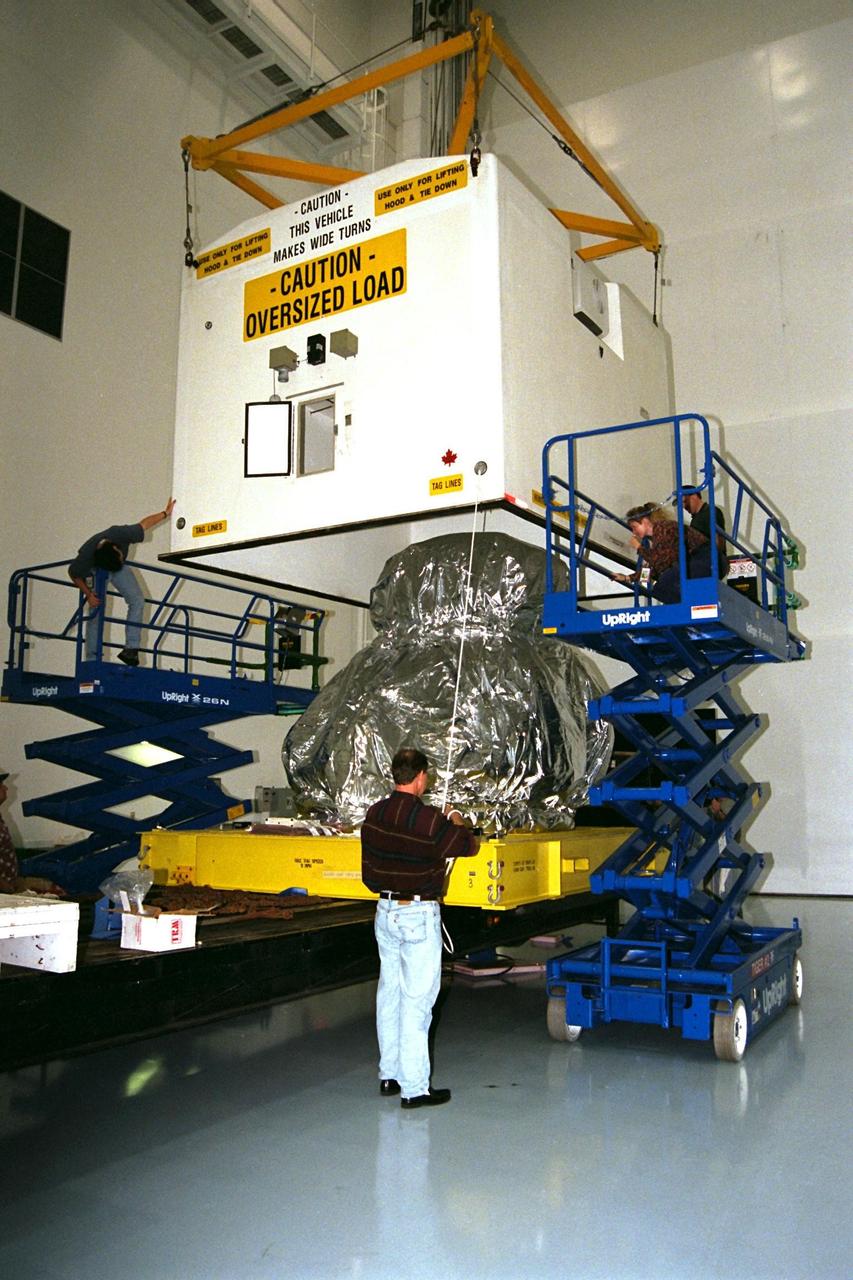
KENNEDY SPACE CENTER, FLA. -- The Pressurized Mating Adapter-3 (PMA-3), an element of the STS-92 mission scheduled for launch aboard Space Shuttle Atlantis in January 1999, arrived from the Boeing Company in Huntington Beach, Calif., for processing in KSC's Space Station Processing Facility (SSPF). While in orbit, PMA-3 will be removed from the orbiter's payload bay by the astronauts using the remote manipulator arm and mated to Node 1, a connecting passageway to the living and working areas of the International Space Station. The primary purpose of PMA-3 is to serve as a Shuttle docking port through which crew members and equipment will transfer to the International Space Station during later assembly missions
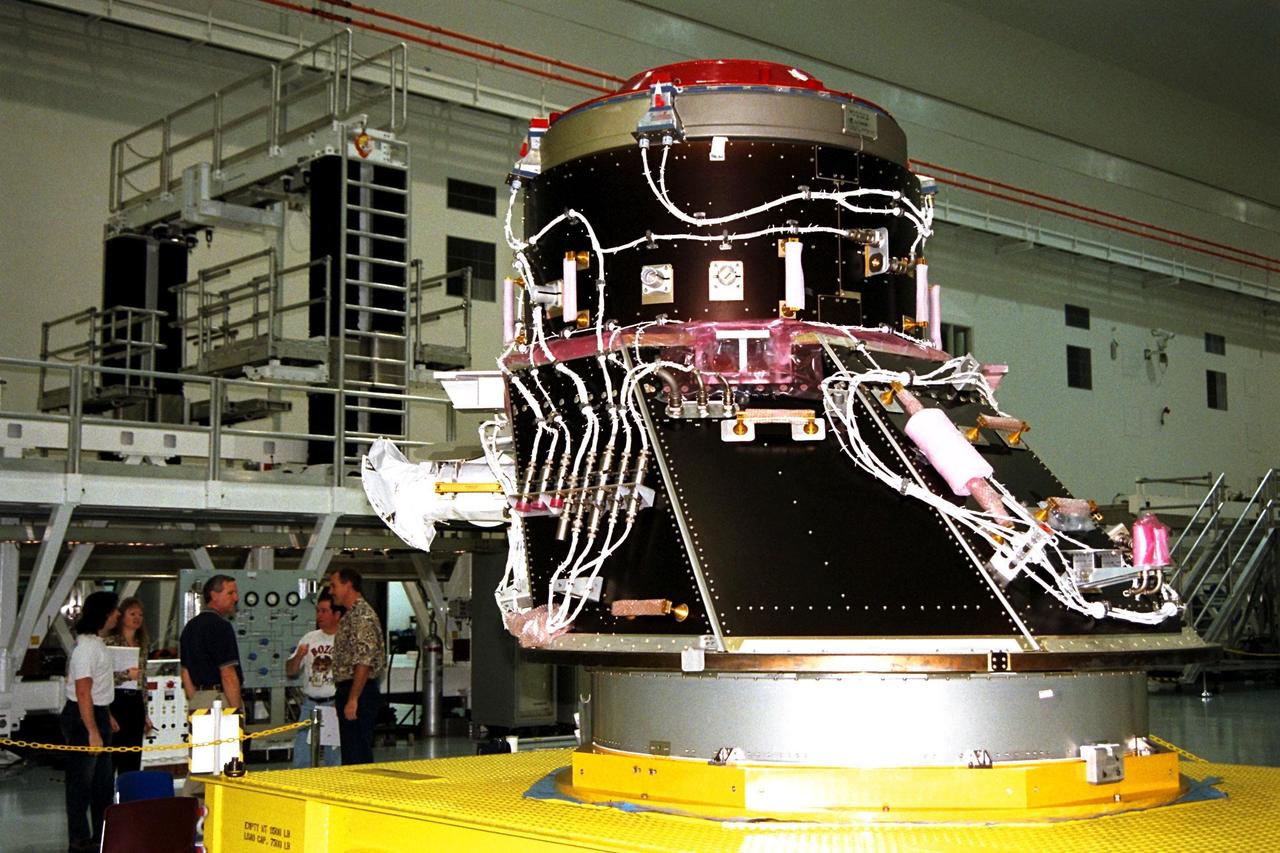
KENNEDY SPACE CENTER, FLA. -- The Pressurized Mating Adapter-3 (PMA-3), an element of the STS-92 mission scheduled for launch aboard Space Shuttle Atlantis in January 1999, awaits processing in KSC's Space Station Processing Facility (SSPF). While in orbit, PMA-3 will be removed from the orbiter's payload bay by the astronauts using the remote manipulator arm and mated to Node 1, a connecting passageway to the living and working areas of the International Space Station. The primary purpose of PMA-3 is to serve as a Shuttle docking port through which crew members and equipment will transfer to the International Space Station during later assembly missions

iss051e041849 (05/12/2017) -- NASA astronaut Peggy Whitson is seen during the 200th spacewalk in support of the International Space Station. Expedition 51 Commander Peggy Whitson and Flight Engineer Jack Fischer of NASA successfully replaced a large avionics box that supplies electricity and data connections to the science experiments. The astronauts also completed additional tasks to install a connector that will route data to the Alpha Magnetic Spectrometer, repair insulation at the connecting point of the Japanese robotic arm, and install a protective shield on the Pressurized Mating Adapter-3. This adapter will host a new international docking port for the arrival of commercial crew spacecraft.

iss051e041844 (05/12/2017) -- NASA astronaut Jack Fischer is seen during the 200th spacewalk in support of the International Space Station. Expedition 51 Commander Peggy Whitson and Flight Engineer Jack Fischer of NASA successfully replaced a large avionics box that supplies electricity and data connections to the science experiments. The astronauts also completed additional tasks to install a connector that will route data to the Alpha Magnetic Spectrometer, repair insulation at the connecting point of the Japanese robotic arm, and install a protective shield on the Pressurized Mating Adapter-3. This adapter will host a new international docking port for the arrival of commercial crew spacecraft.
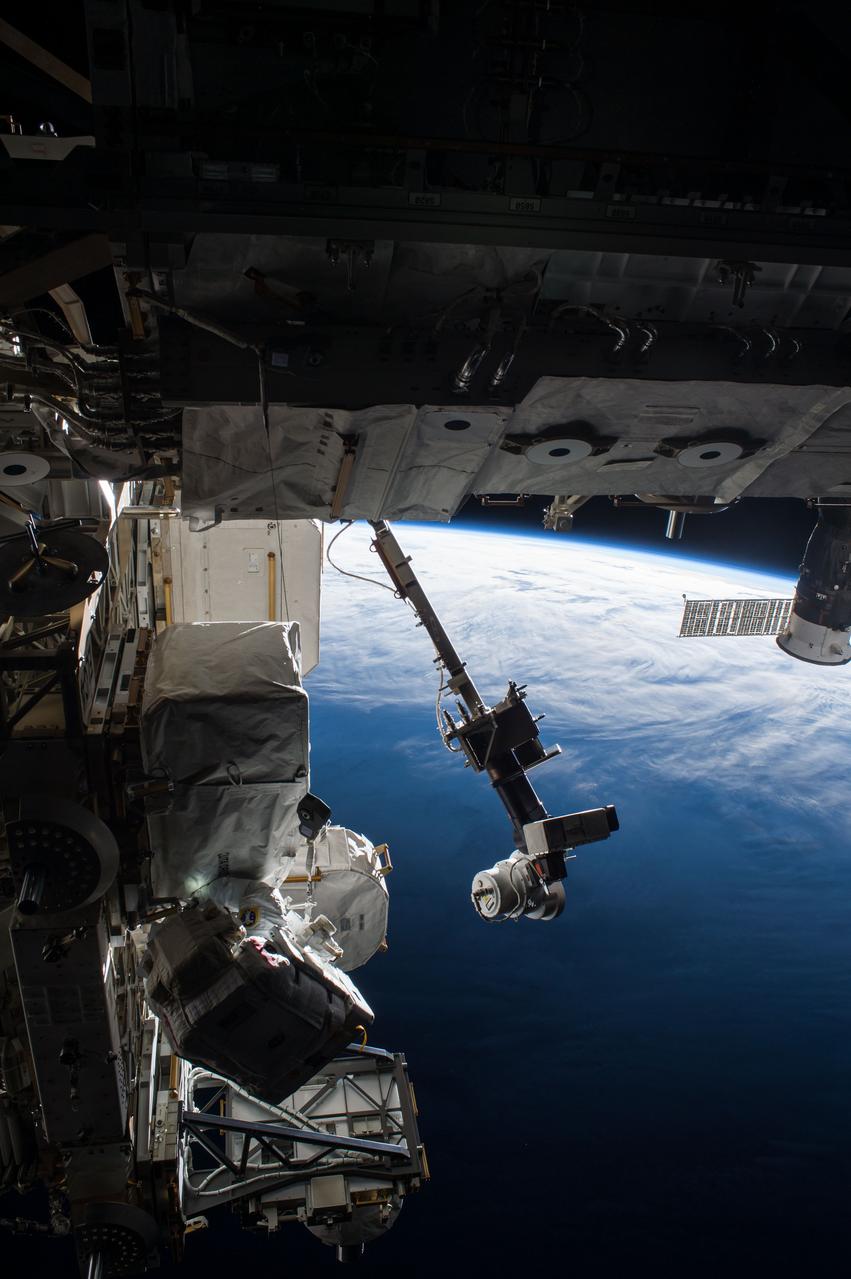
iss051e041847 (05/12/2017) -- NASA astronaut Peggy Whitson is seen during the 200th spacewalk in support of the International Space Station. Expedition 51 Commander Peggy Whitson and Flight Engineer Jack Fischer of NASA successfully replaced a large avionics box that supplies electricity and data connections to the science experiments. The astronauts also completed additional tasks to install a connector that will route data to the Alpha Magnetic Spectrometer, repair insulation at the connecting point of the Japanese robotic arm, and install a protective shield on the Pressurized Mating Adapter-3. This adapter will host a new international docking port for the arrival of commercial crew spacecraft.

iss051e041841 (05/12/2017) -- NASA astronaut Peggy Whitson is seen during the 200th spacewalk in support of the International Space Station. Expedition 51 Commander Peggy Whitson and Flight Engineer Jack Fischer of NASA successfully replaced a large avionics box that supplies electricity and data connections to the science experiments. The astronauts also completed additional tasks to install a connector that will route data to the Alpha Magnetic Spectrometer, repair insulation at the connecting point of the Japanese robotic arm, and install a protective shield on the Pressurized Mating Adapter-3. This adapter will host a new international docking port for the arrival of commercial crew spacecraft.
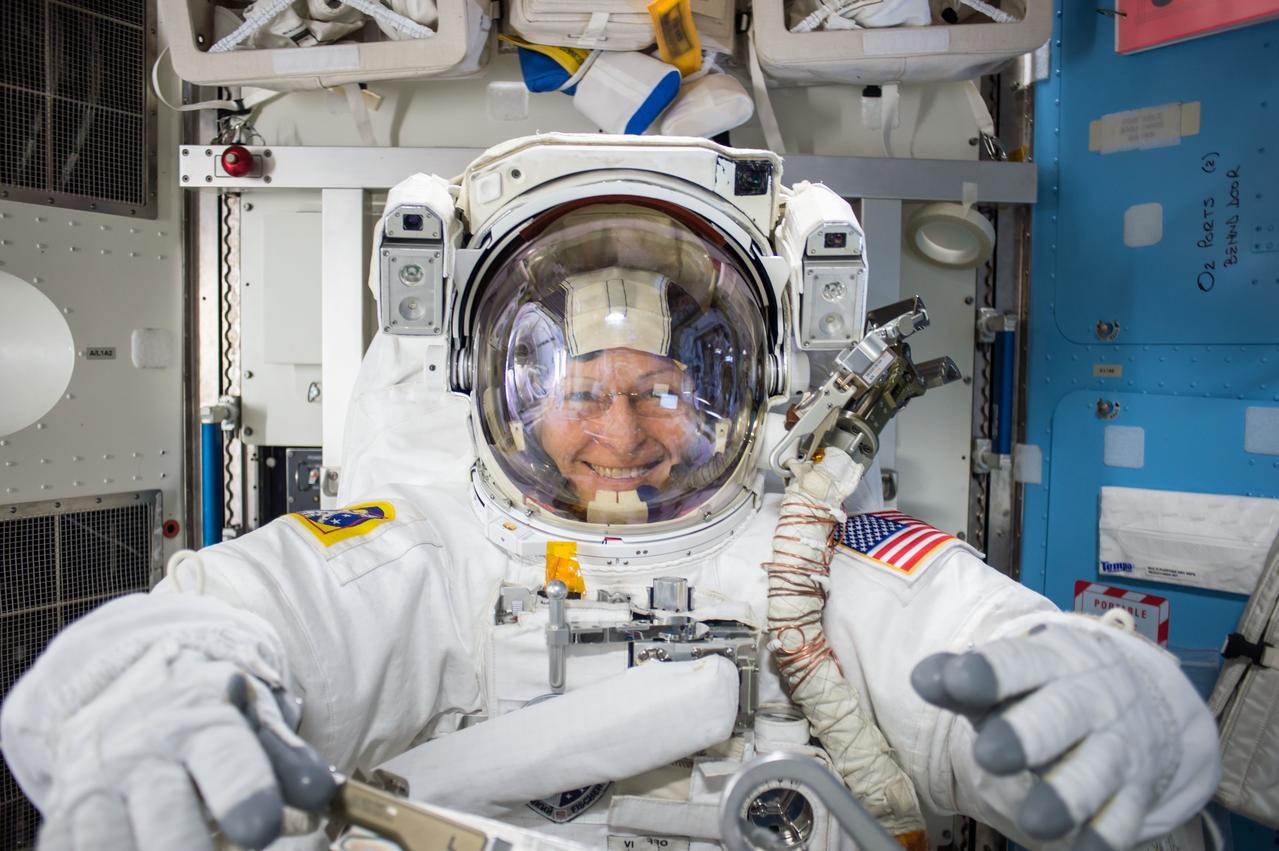
iss051e041836 (05/12/2017) -- NASA astronaut Peggy Whitson is seen prior to the 200th spacewalk in support of the International Space Station. Expedition 51 Commander Peggy Whitson and Flight Engineer Jack Fischer of NASA successfully replaced a large avionics box that supplies electricity and data connections to the science experiments. The astronauts also completed additional tasks to install a connector that will route data to the Alpha Magnetic Spectrometer, repair insulation at the connecting point of the Japanese robotic arm, and install a protective shield on the Pressurized Mating Adapter-3. This adapter will host a new international docking port for the arrival of commercial crew spacecraft.

iss051e041860 (05/12/2017) -- NASA astronaut Peggy Whitson is seen during the 200th spacewalk in support of the International Space Station. Expedition 51 Commander Peggy Whitson and Flight Engineer Jack Fischer of NASA successfully replaced a large avionics box that supplies electricity and data connections to the science experiments. The astronauts also completed additional tasks to install a connector that will route data to the Alpha Magnetic Spectrometer, repair insulation at the connecting point of the Japanese robotic arm, and install a protective shield on the Pressurized Mating Adapter-3. This adapter will host a new international docking port for the arrival of commercial crew spacecraft.
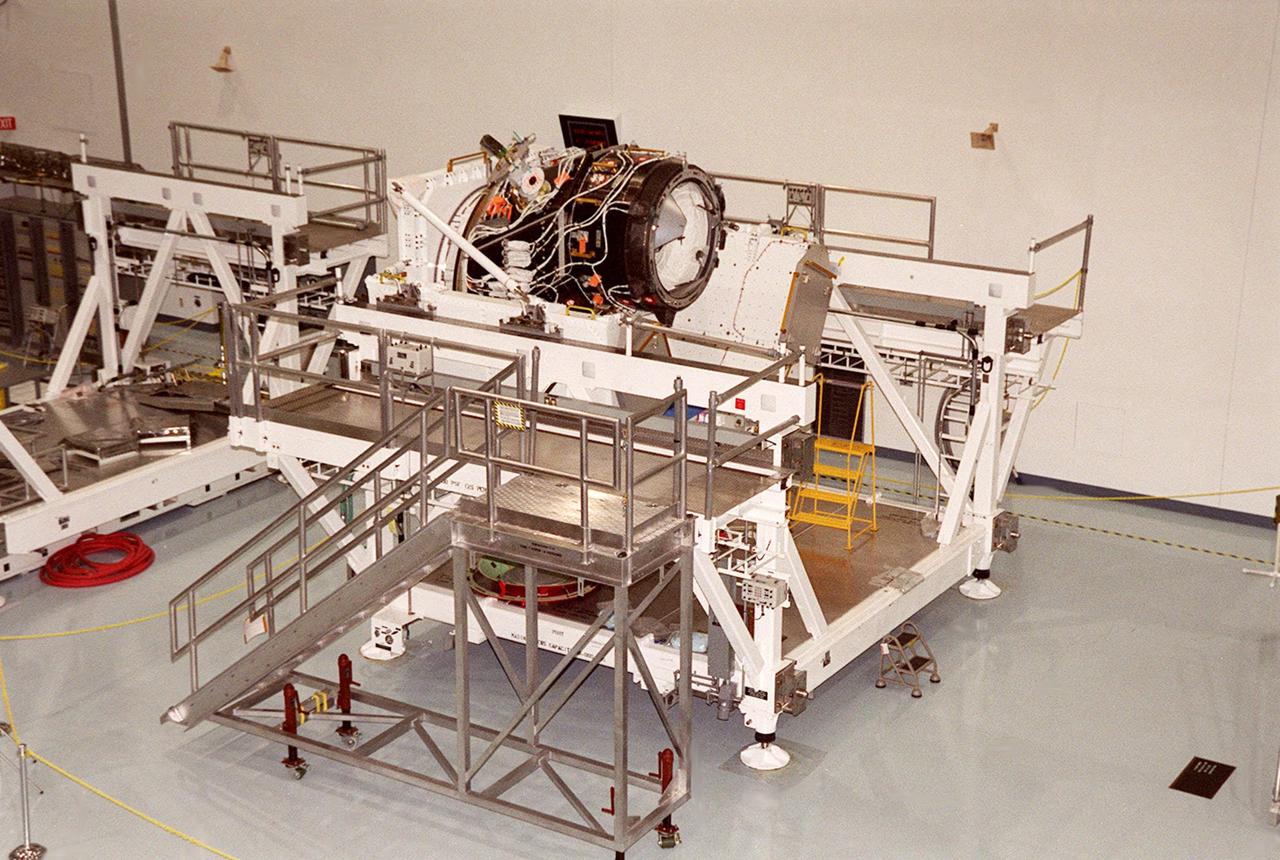
KENNEDY SPACE CENTER, FLA. -- Inside the Space Station Processing Facility, the Pressurized Mating Adapter-3 (PMA-3), an element for the International Space Station, awaits testing. The PMA-3, once launched, will be mated to Node 1, a connecting passageway to the living and working areas of the Space Station. The primary purpose of PMA-3 is to serve as a Shuttle docking port through which crew members and equipment will transfer to the Space Station during later assembly missions. PMA-3 is scheduled as payload on mission STS-92, whose date for launch is not yet determined
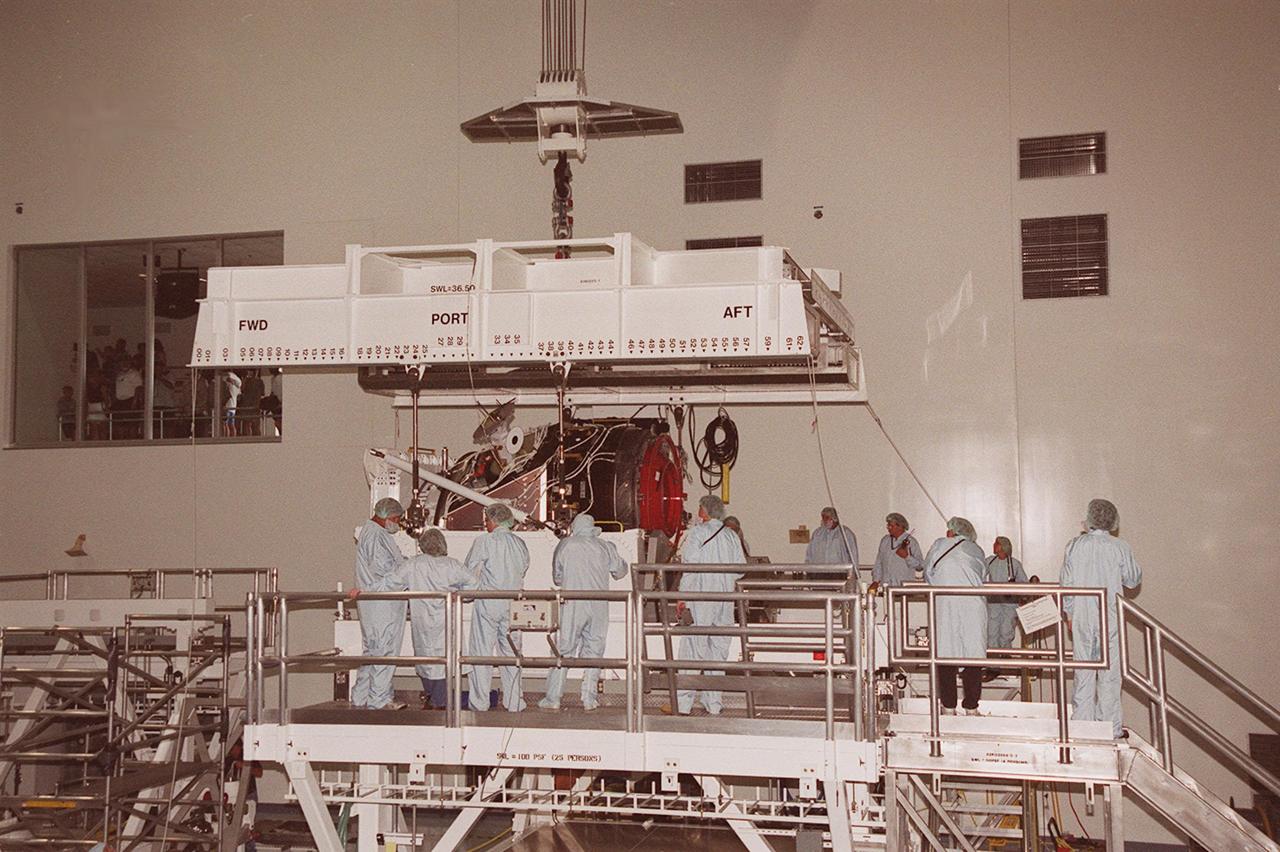
Workers in the Space Station Processing Facility gather around the Pressurized Mating Adapter -3 (PMA-3) as an overhead crane is set to lift and move it. The PMA-3, a component of the International Space Station, is being transported to the Orbiter Processing Facility. PMA-3 is part of the payload on Space Shuttle mission STS-92, scheduled to launch Oct. 5. The mission will be the fifth flight to the Space Station, and the 100th Shuttle flight overall. PMA-3 provides shuttle docking port for solar array installation on flight 4A (mission STS-97 scheduled for Nov. 30), and Lab installation on flight 5A (mission STS-98, scheduled for Jan. 18, 2001)

KENNEDY SPACE CENTER, FLA. -- Inside the Space Station Processing Facility, the Pressurized Mating Adapter-3 (PMA-3), an element for the International Space Station, awaits testing. The PMA-3, once launched, will be mated to Node 1, a connecting passageway to the living and working areas of the Space Station. The primary purpose of PMA-3 is to serve as a Shuttle docking port through which crew members and equipment will transfer to the Space Station during later assembly missions. PMA-3 is scheduled as payload on mission STS-92, whose date for launch is not yet determined

In the Orbiter Processing Facility bay 1, the Pressurized Mating Adapter -3 (PMA-3) is lifted out of the payload canister for its transfer to the orbiter Discovery. A component of the International Space Station, the PMA-3 is part of the payload on Shuttle mission STS-92, scheduled to launch Oct. 5. The mission will be the fifth flight to the Space Station, and the 100th Shuttle flight overall. PMA-3 provides shuttle docking port for solar array installation on flight 4A (mission STS-97 scheduled for Nov. 30), and Lab installation on flight 5A (mission STS-98, scheduled for Jan. 18, 2001)

KENNEDY SPACE CENTER, FLA. - Workers in the Orbiter Processing Facility bay 1 watch the progress of the Pressurized Mating Adapter-3 (PMA-3) as it is transferred to the payload bay of the orbiter Discovery. A component of the International Space Station, the PMA-3 will fly on Shuttle mission STS-92, scheduled to launch October 5. The mission will be the fifth flight to the Space Station, and the 100th Shuttle flight overall. PMA-3 provides shuttle docking port for solar array installation on flight 4A (mission STS-97 scheduled for November 30), and Lab installation on flight 5A (mission STS-98, scheduled for January 18, 2001).
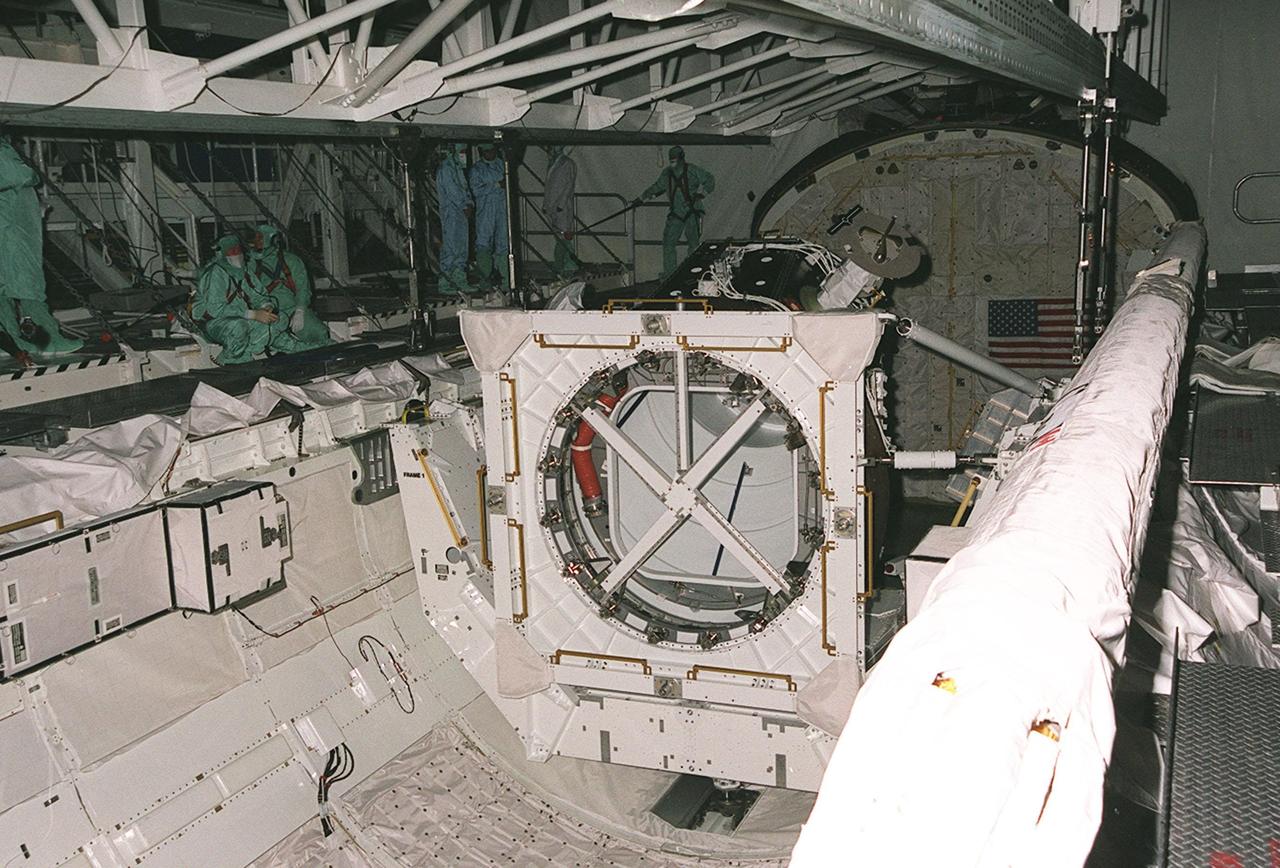
KENNEDY SPACE CENTER, FLA. -- The Pressurized Mating Adapter -3 (PMA-3) sits in the payload bay of the orbiter Discovery after being transported from the Space Station Processing Facility. A component of the International Space Station, the PMA-3 will fly on Shuttle mission STS-92, scheduled to launch Oct. 5. The mission will be the fifth flight to the Space Station, and the 100th Shuttle flight overall. PMA-3 provides shuttle docking port for solar array installation on flight 4A (mission STS-97 scheduled for Nov. 30), and Lab installation on flight 5A (mission STS-98, scheduled for Jan. 18, 2001)
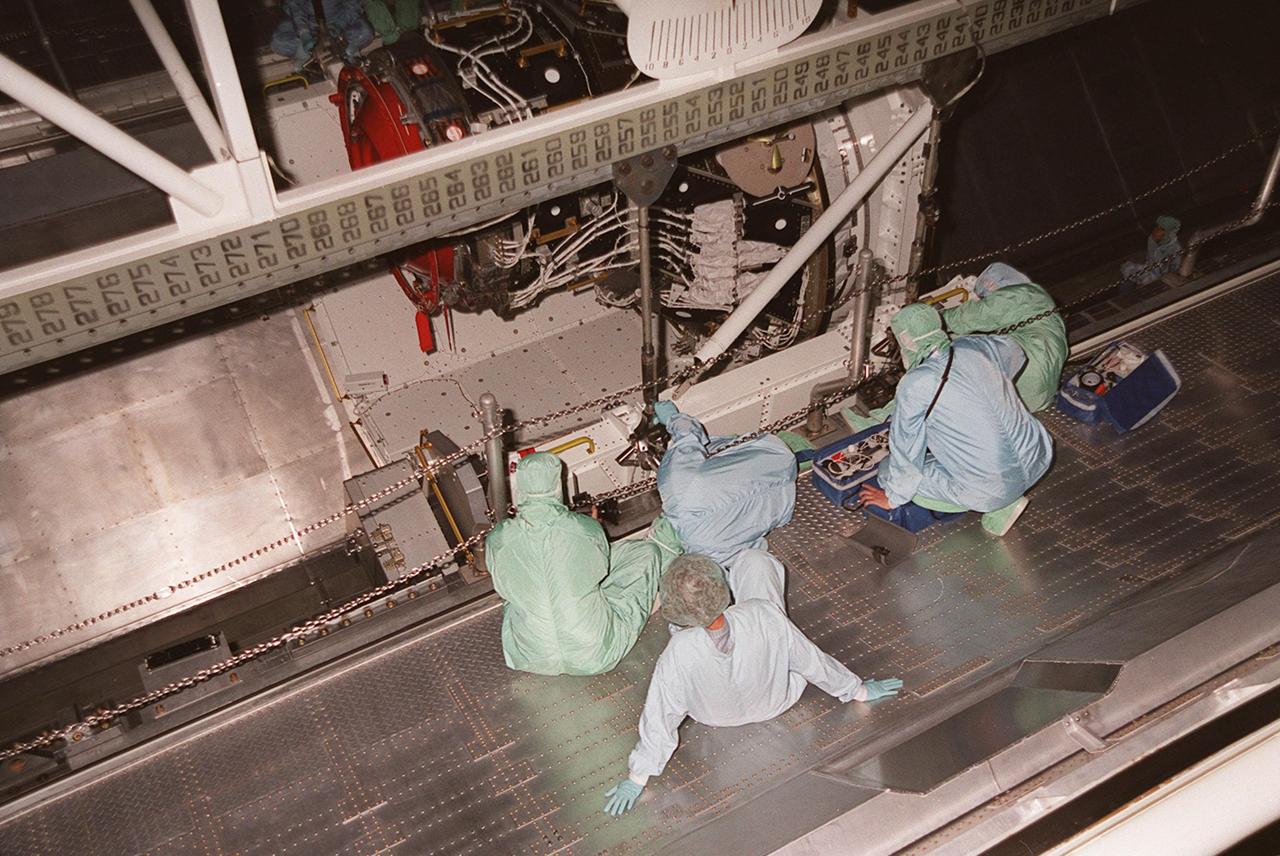
KENNEDY SPACE CENTER, FLA. -- Workers in the Orbiter Processing Facility check the placement of cables on the Pressurized Mating Adapter -3 (PMA-3) for its transfer to the orbiter Discovery. A component of the International Space Station, the PMA-3 is part of the payload on Space Shuttle mission STS-92, scheduled to launch Oct. 5. The mission will be the fifth flight to the Space Station, and the 100th Shuttle flight overall. PMA-3 provides shuttle docking port for solar array installation on flight 4A (mission STS-97 scheduled for Nov. 30), and Lab installation on flight 5A (mission STS-98, scheduled for Jan. 18, 2001)
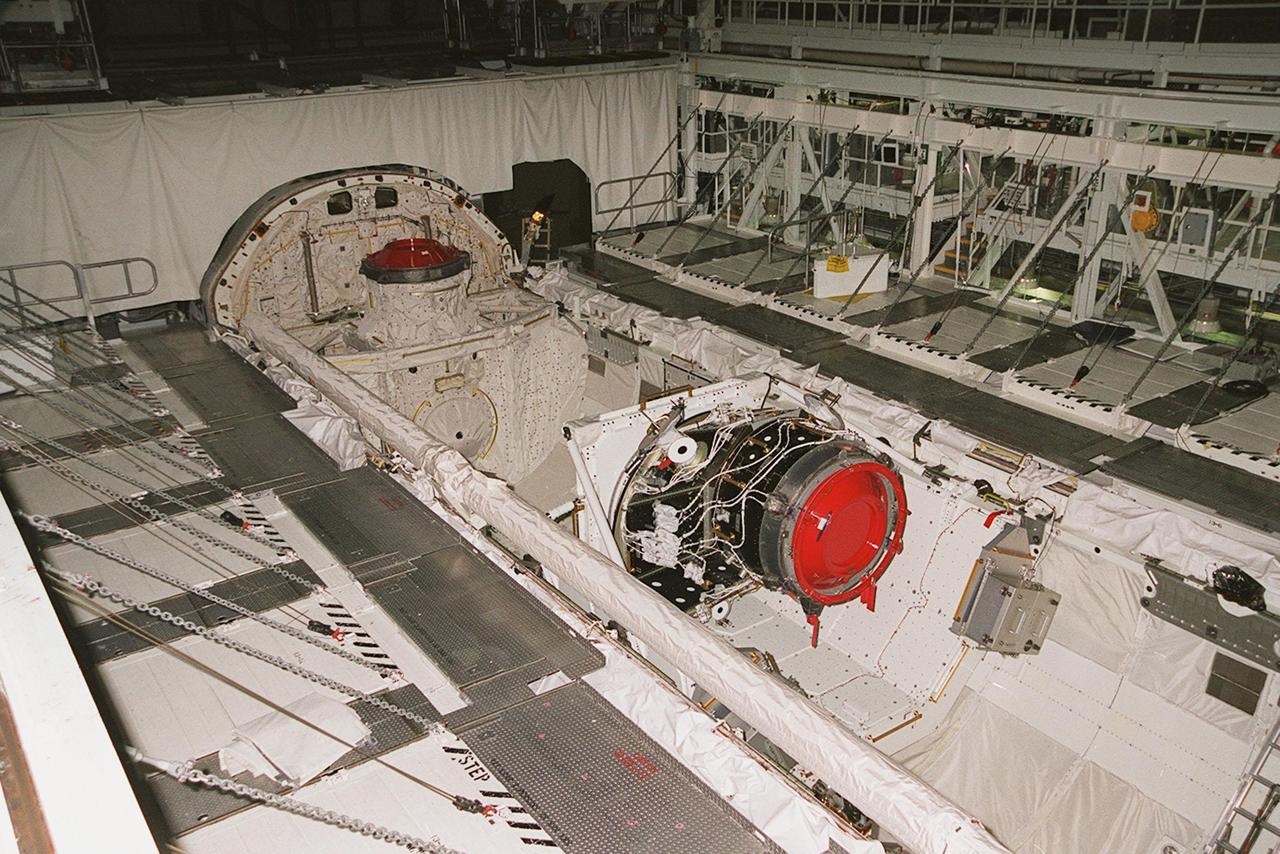
KENNEDY SPACE CENTER, FLA. -- The Pressurized Mating Adapter -3 (PMA-3) sits in the payload bay of the orbiter Discovery after being transported from the Space Station Processing Facility. A component of the International Space Station, the PMA-3 will fly on Shuttle mission STS-92, scheduled to launch Oct. 5. The mission will be the fifth flight to the Space Station, and the 100th Shuttle flight overall. PMA-3 provides shuttle docking port for solar array installation on flight 4A (mission STS-97 scheduled for Nov. 30), and Lab installation on flight 5A (mission STS-98, scheduled for Jan. 18, 2001)
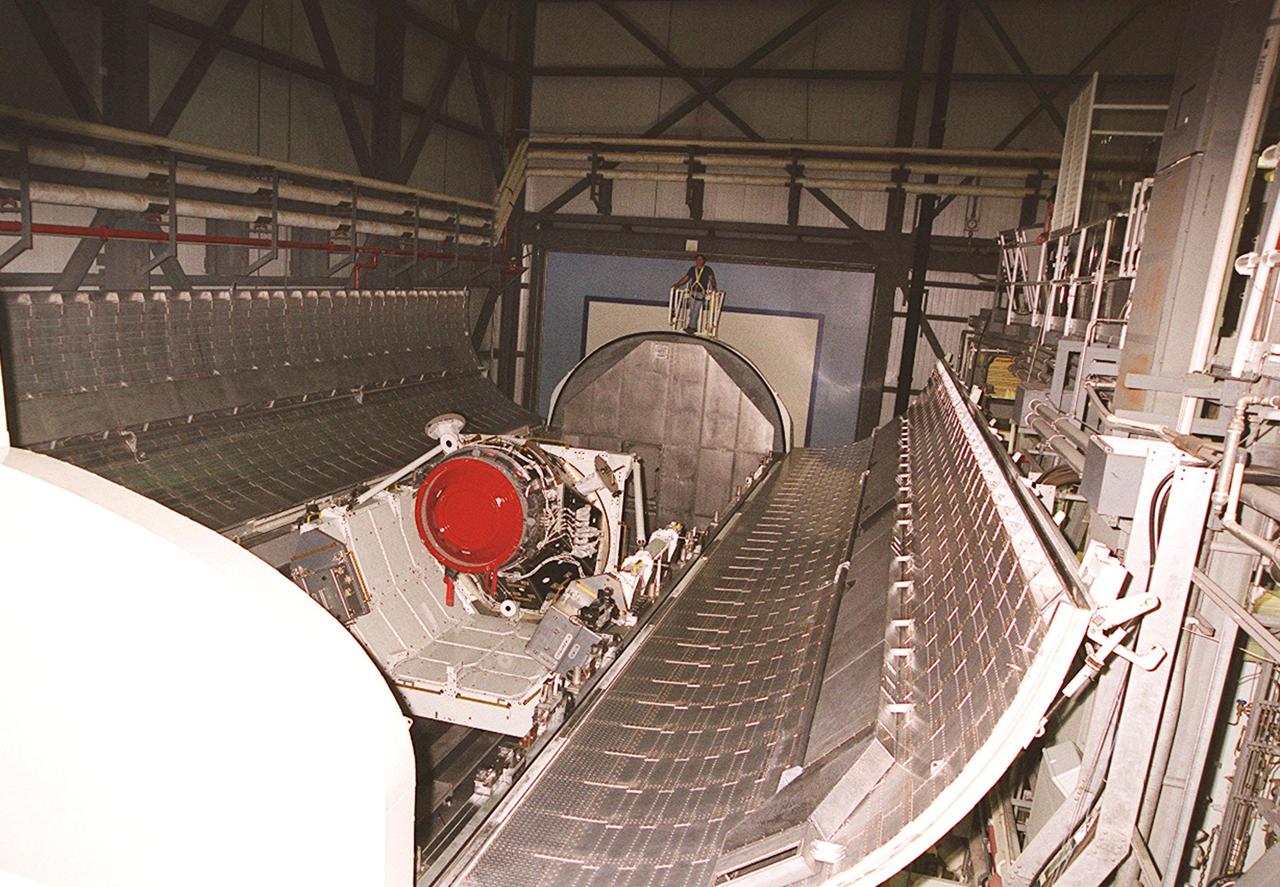
KENNEDY SPACE CENTER, FLA. -- In the Space Station Processing Facility, the Pressurized Mating Adapter -3 (PMA-3) sits in a payload canister for transport to the Orbiter Processing Facility. Workers at the sides and below watch the process. The PMA-3, a component of the International Space Station, is part of the payload on Space Shuttle mission STS-92, scheduled to launch Oct. 5. The mission will be the fifth flight to the Space Station, and the 100th Shuttle flight overall. PMA-3 provides shuttle docking port for solar array installation on flight 4A (mission STS-97 scheduled for Nov. 30), and Lab installation on flight 5A (mission STS-98, scheduled for Jan. 18, 2001)
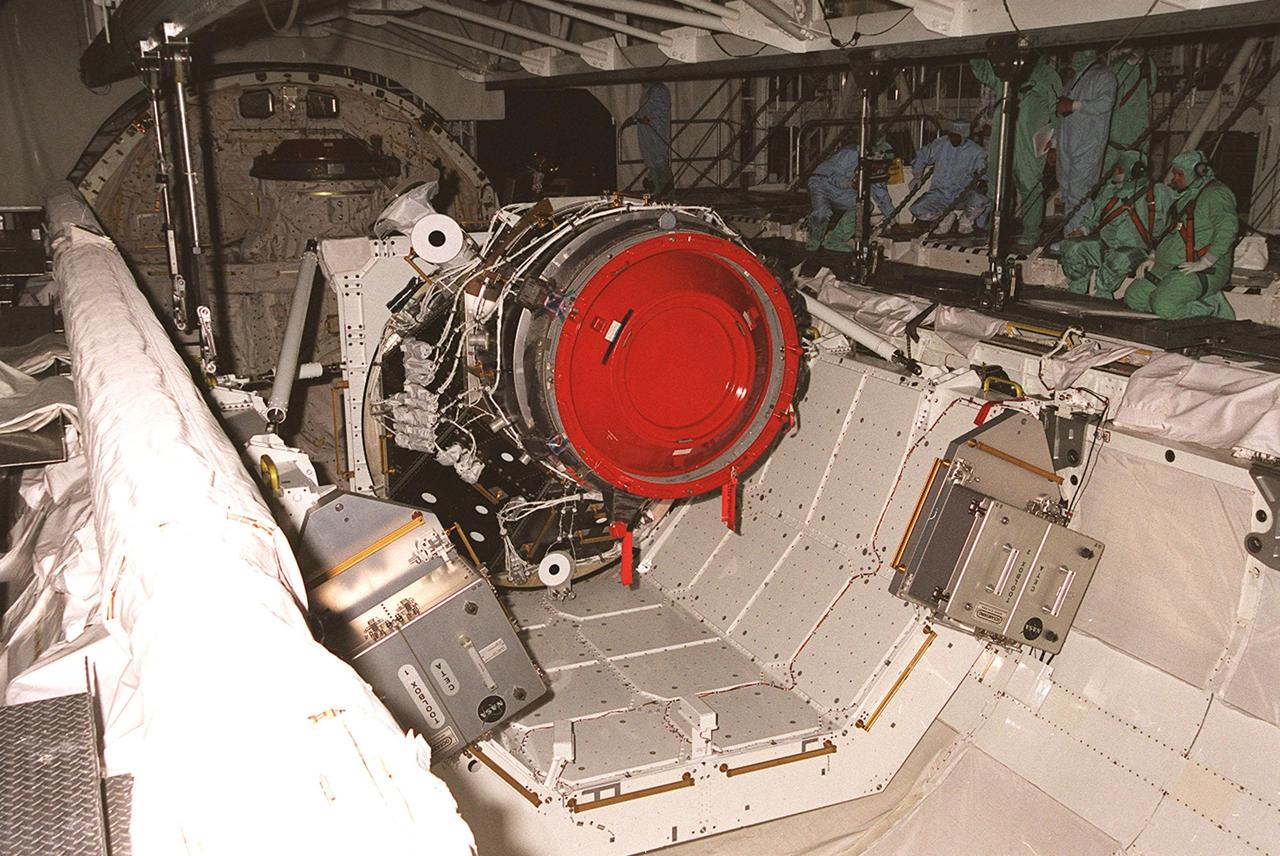
KENNEDY SPACE CENTER, FLA. -- In the Orbiter Processing Facility bay 1, workers detach the overhead crane from the Pressurized Mating Adapter -3 (PMA-3), which sits in the payload bay of the orbiter Discovery. A component of the International Space Station, the PMA-3 will fly on Shuttle mission STS-92, scheduled to launch Oct. 5. The mission will be the fifth flight to the Space Station, and the 100th Shuttle flight overall. PMA-3 provides shuttle docking port for solar array installation on flight 4A (mission STS-97 scheduled for Nov. 30), and Lab installation on flight 5A (mission STS-98, scheduled for Jan. 18, 2001)
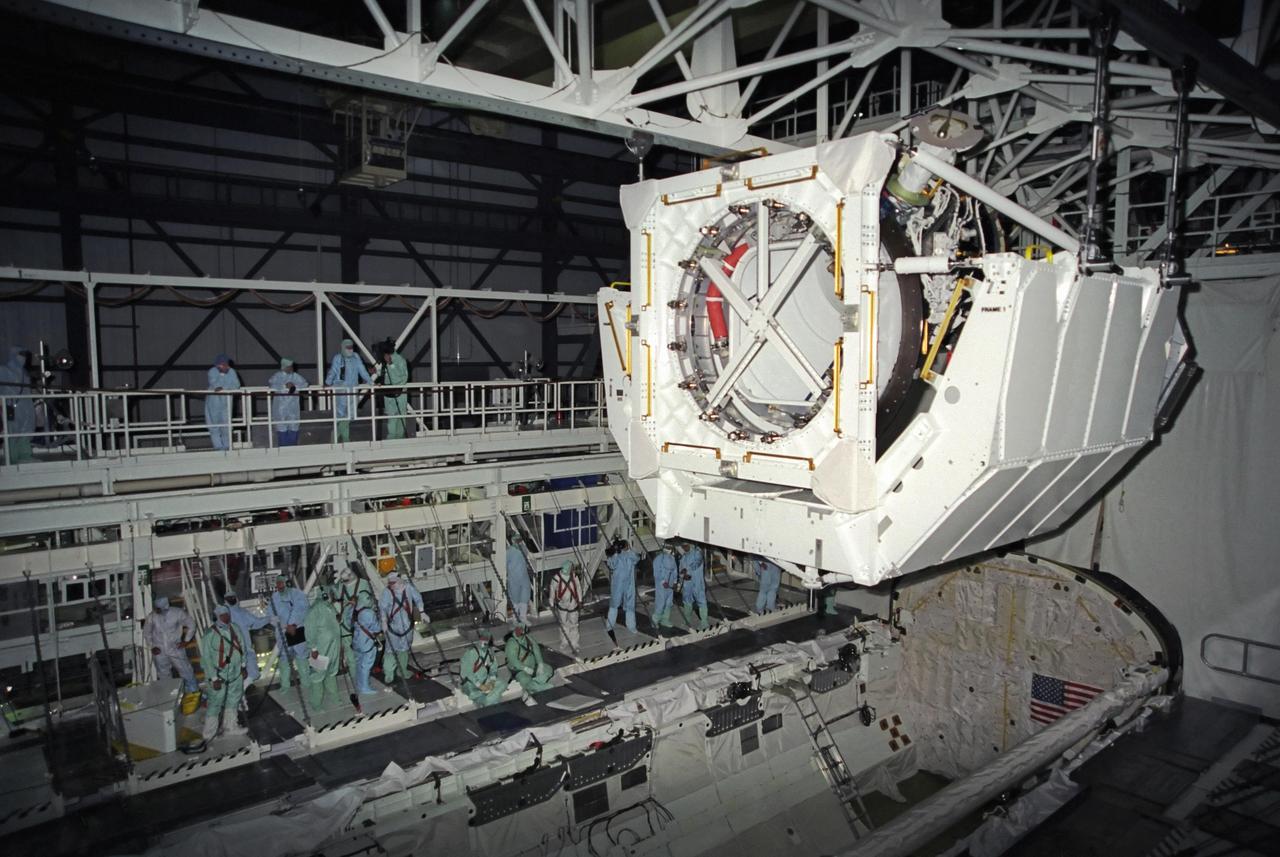
KENNEDY SPACE CENTER, FLA. - Workers in the Orbiter Processing Facility bay 1 watch the progress of the Pressurized Mating Adapter-3 (PMA-3) as it is transferred to the payload bay of the orbiter Discovery. A component of the International Space Station, the PMA-3 will fly on Shuttle mission STS-92, scheduled to launch October 5. The mission will be the fifth flight to the Space Station, and the 100th Shuttle flight overall. PMA-3 provides shuttle docking port for solar array installation on flight 4A (mission STS-97 scheduled for November 30), and Lab installation on flight 5A (mission STS-98, scheduled for January 18, 2001).
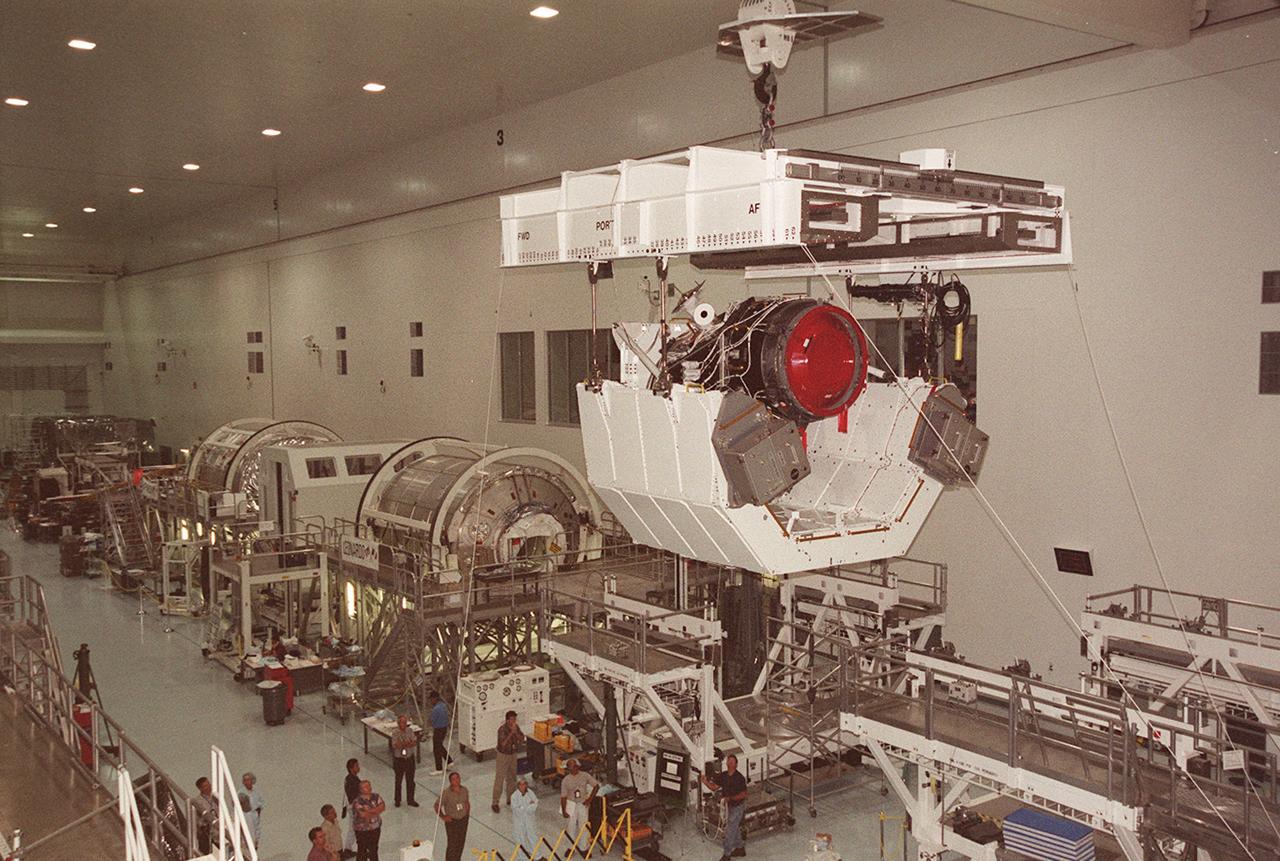
KENNEDY SPACE CENTER, FLA. -- In the Space Station Processing Facility, an overhead crane moves the Pressurized Mating Adapter-3 (PMA-3) to a payload canister for transport to the Orbiter Processing Facility. The PMA-3, a component of the International Space Station, is part of the payload on Space Shuttle mission STS-92, scheduled to launch Oct. 5. The mission will be the fifth flight to the Space Station, and the 100th Shuttle flight overall. PMA-3 provides the Shuttle docking port for solar array installation on flight 4A (mission STS-97, scheduled for Nov. 30) and Lab installation on flight 5A (mission STS-98), scheduled for Jan. 18, 2001.)
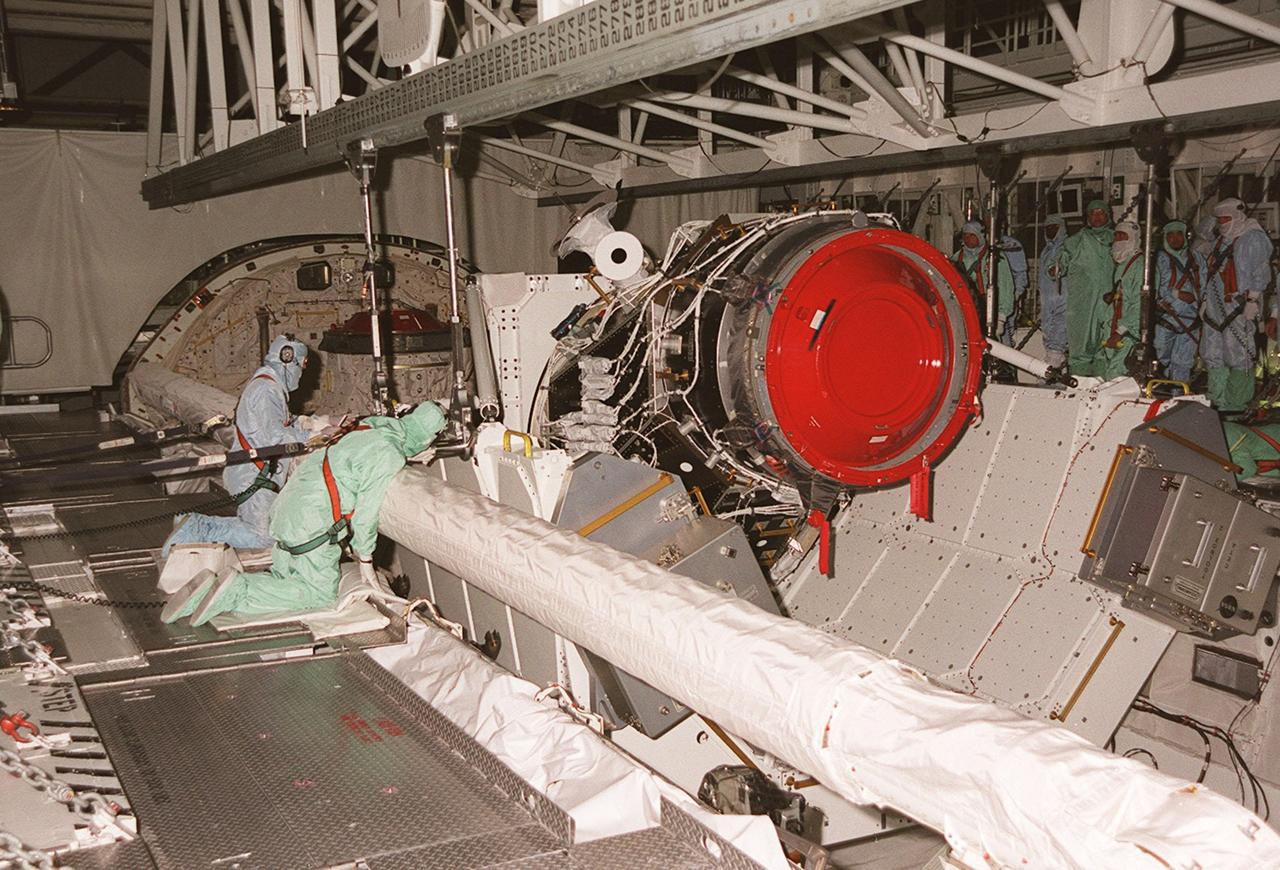
KENNEDY SPACE CENTER, FLA. -- In the Orbiter Processing Facility bay 1, workers check the placement of the Pressurized Mating Adapter -3 (PMA-3) as the overhead crane places it in the payload bay of the orbiter Discovery. A component of the International Space Station, the PMA-3 will fly on Shuttle mission STS-92, scheduled to launch Oct. 5. The mission will be the fifth flight to the Space Station, and the 100th Shuttle flight overall. PMA-3 provides shuttle docking port for solar array installation on flight 4A (mission STS-97 scheduled for Nov. 30), and Lab installation on flight 5A (mission STS-98, scheduled for Jan. 18, 2001)
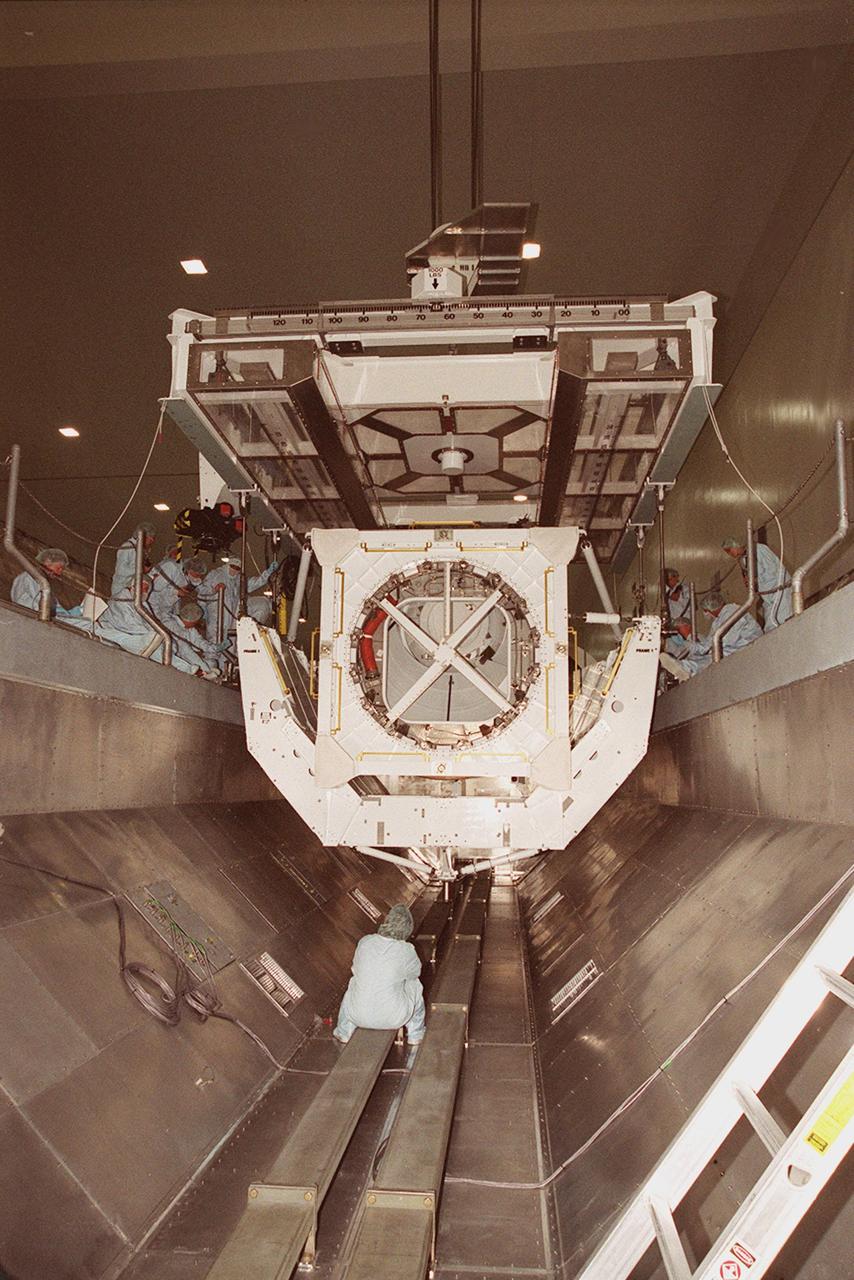
KENNEDY SPACE CENTER, FLA. -- In the Space Station Processing Facility, an overhead crane lowers the Pressurized Mating Adapter -3 (PMA-3) into a payload canister for transport to the Orbiter Processing Facility. Workers at the sides and below watch the process. The PMA-3, a component of the International Space Station, is part of the payload on Space Shuttle mission STS-92, scheduled to launch Oct. 5. The mission will be the fifth flight to the Space Station, and the 100th Shuttle flight overall. PMA-3 provides shuttle docking port for solar array installation on flight 4A (mission STS-97 scheduled for Nov. 30), and Lab installation on flight 5A (mission STS-98, scheduled for Jan. 18, 2001)
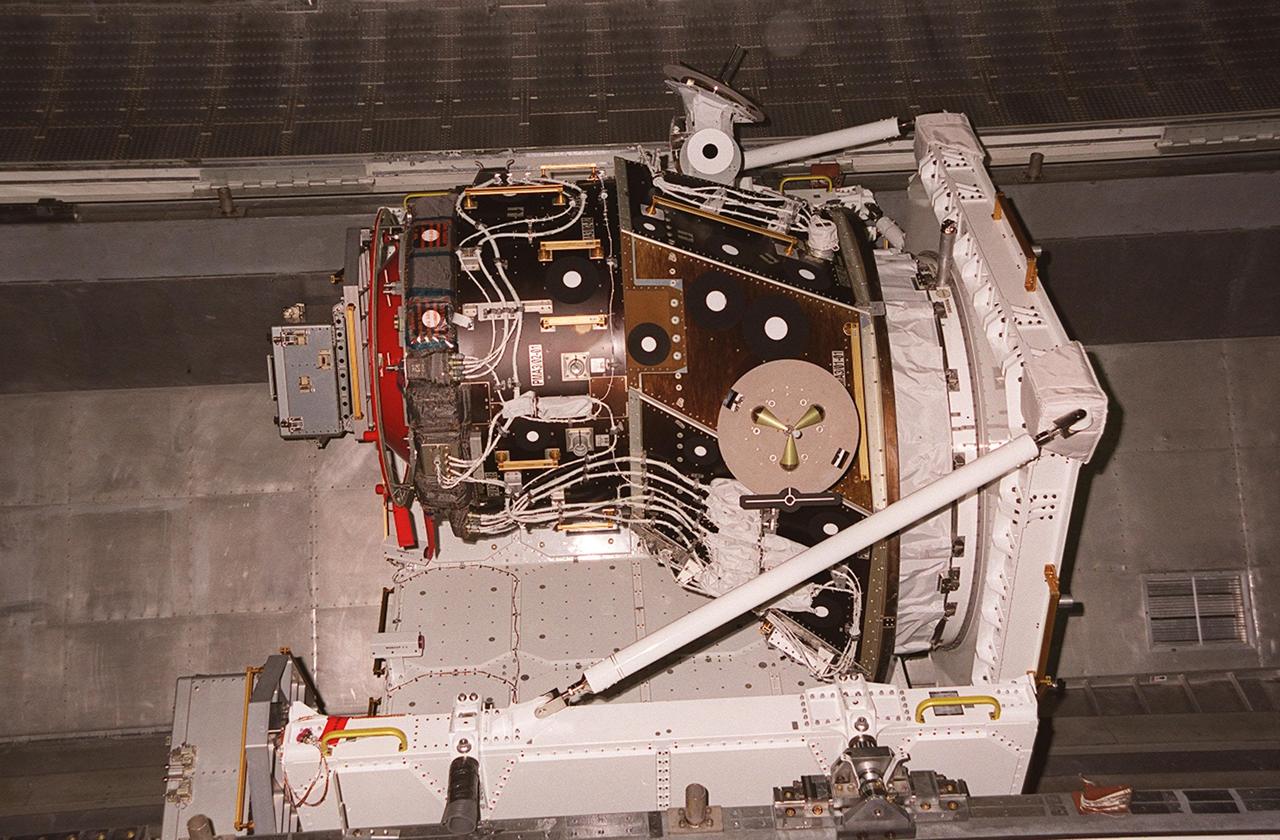
KENNEDY SPACE CENTER, FLA. -- This closeup shows the Pressurized Mating Adapter -3 (PMA-3) after transport to the Orbiter Processing Facility. A component of the International Space Station, the PMA-3 is being transferred to the payload bay of the orbiter Discovery, for mission STS-92, scheduled to launch Oct. 5. The mission will be the fifth flight to the Space Station, and the 100th Shuttle flight overall. PMA-3 provides shuttle docking port for solar array installation on flight 4A (mission STS-97 scheduled for Nov. 30), and Lab installation on flight 5A (mission STS-98, scheduled for Jan. 18, 2001)

KENNEDY SPACE CENTER, FLA. -- In the Space Station Processing Facility, an overhead crane moves the Pressurized Mating Adapter-3 (PMA-3) to a payload canister for transport to the Orbiter Processing Facility. The PMA-3, a component of the International Space Station, is part of the payload on Space Shuttle mission STS-92, scheduled to launch Oct. 5. The mission will be the fifth flight to the Space Station, and the 100th Shuttle flight overall. PMA-3 provides the Shuttle docking port for solar array installation on flight 4A (mission STS-97, scheduled for Nov. 30) and Lab installation on flight 5A (mission STS-98), scheduled for Jan. 18, 2001.)

KENNEDY SPACE CENTER, FLA. -- In the Space Station Processing Facility, an overhead crane lowers the Pressurized Mating Adapter -3 (PMA-3) into a payload canister for transport to the Orbiter Processing Facility. Workers at the sides and below watch the process. The PMA-3, a component of the International Space Station, is part of the payload on Space Shuttle mission STS-92, scheduled to launch Oct. 5. The mission will be the fifth flight to the Space Station, and the 100th Shuttle flight overall. PMA-3 provides shuttle docking port for solar array installation on flight 4A (mission STS-97 scheduled for Nov. 30), and Lab installation on flight 5A (mission STS-98, scheduled for Jan. 18, 2001)
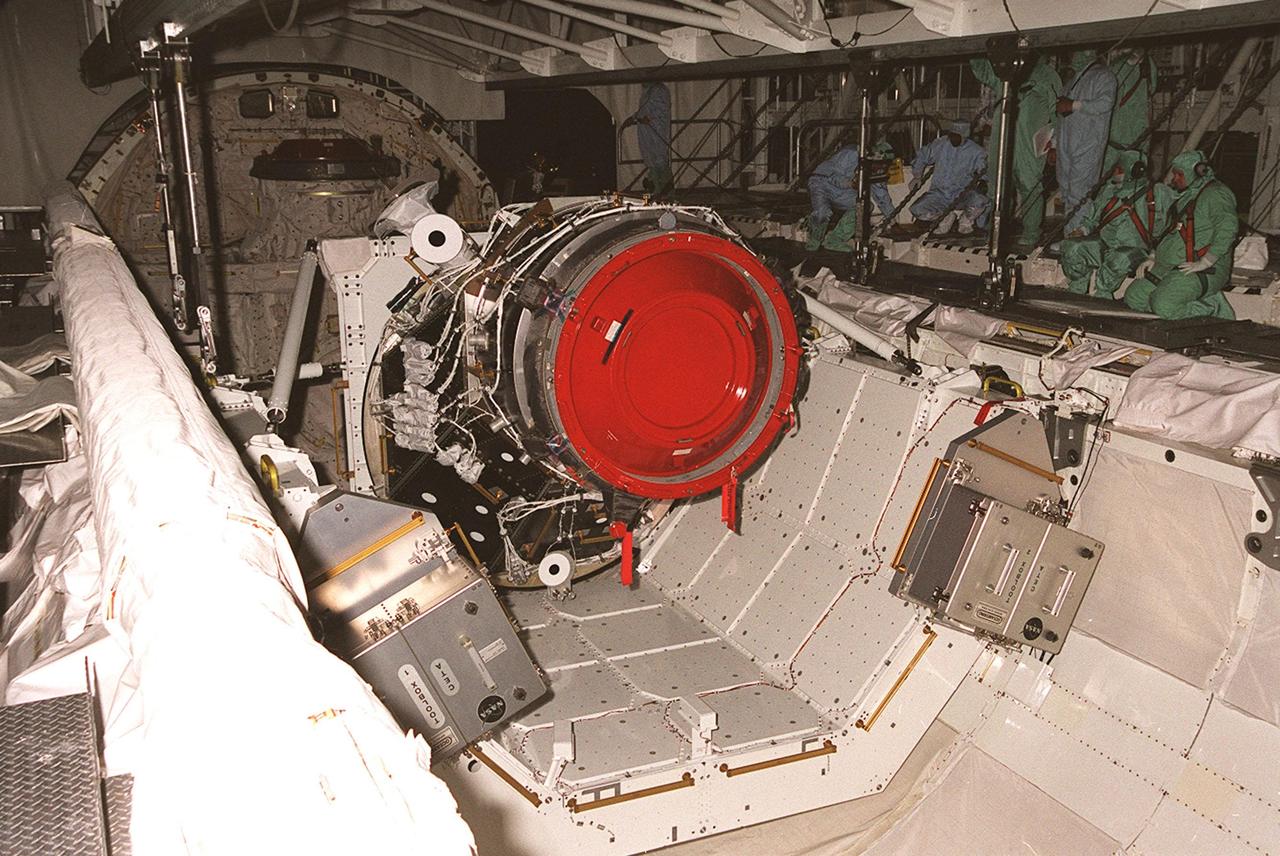
KENNEDY SPACE CENTER, FLA. -- In the Orbiter Processing Facility bay 1, workers detach the overhead crane from the Pressurized Mating Adapter -3 (PMA-3), which sits in the payload bay of the orbiter Discovery. A component of the International Space Station, the PMA-3 will fly on Shuttle mission STS-92, scheduled to launch Oct. 5. The mission will be the fifth flight to the Space Station, and the 100th Shuttle flight overall. PMA-3 provides shuttle docking port for solar array installation on flight 4A (mission STS-97 scheduled for Nov. 30), and Lab installation on flight 5A (mission STS-98, scheduled for Jan. 18, 2001)

KENNEDY SPACE CENTER, FLA. -- In the Space Station Processing Facility, the Pressurized Mating Adapter -3 (PMA-3) sits in a payload canister for transport to the Orbiter Processing Facility. Workers at the sides and below watch the process. The PMA-3, a component of the International Space Station, is part of the payload on Space Shuttle mission STS-92, scheduled to launch Oct. 5. The mission will be the fifth flight to the Space Station, and the 100th Shuttle flight overall. PMA-3 provides shuttle docking port for solar array installation on flight 4A (mission STS-97 scheduled for Nov. 30), and Lab installation on flight 5A (mission STS-98, scheduled for Jan. 18, 2001)
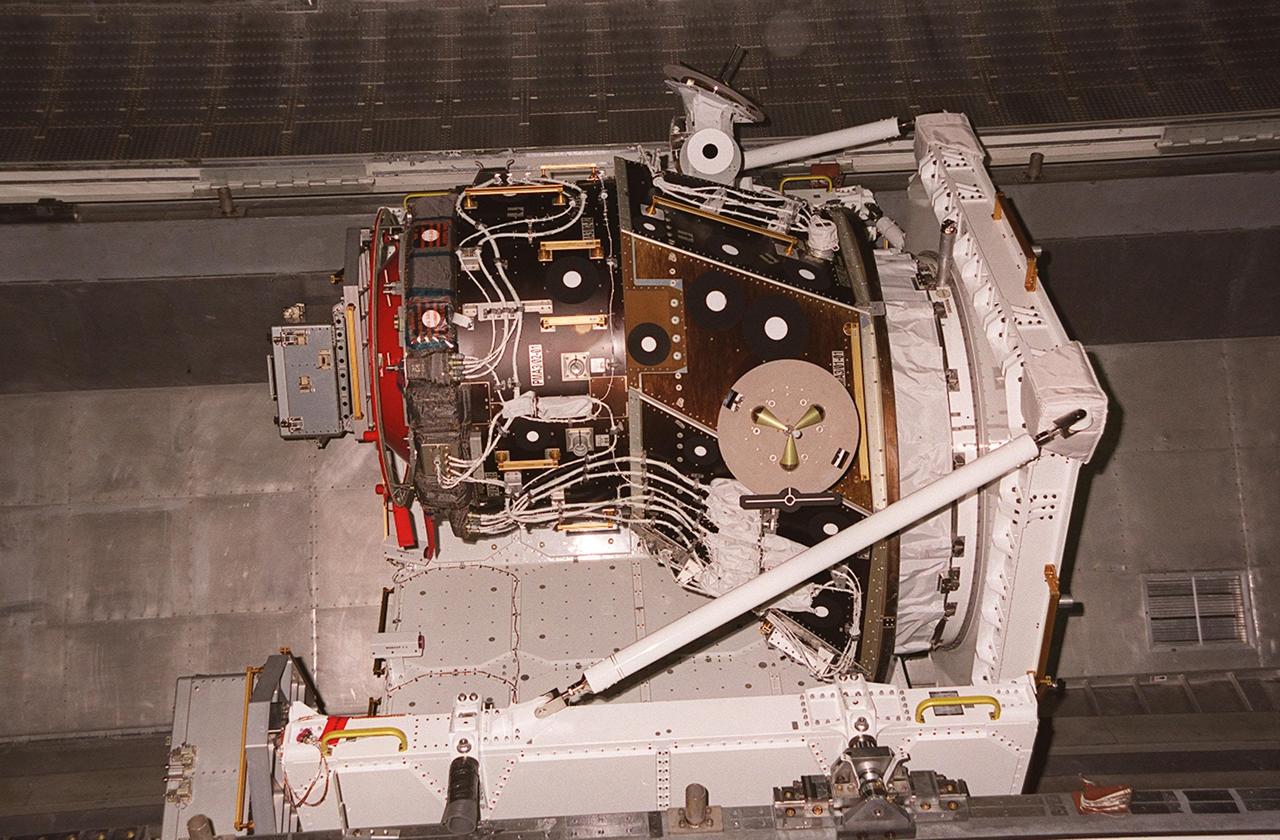
KENNEDY SPACE CENTER, FLA. -- This closeup shows the Pressurized Mating Adapter -3 (PMA-3) after transport to the Orbiter Processing Facility. A component of the International Space Station, the PMA-3 is being transferred to the payload bay of the orbiter Discovery, for mission STS-92, scheduled to launch Oct. 5. The mission will be the fifth flight to the Space Station, and the 100th Shuttle flight overall. PMA-3 provides shuttle docking port for solar array installation on flight 4A (mission STS-97 scheduled for Nov. 30), and Lab installation on flight 5A (mission STS-98, scheduled for Jan. 18, 2001)
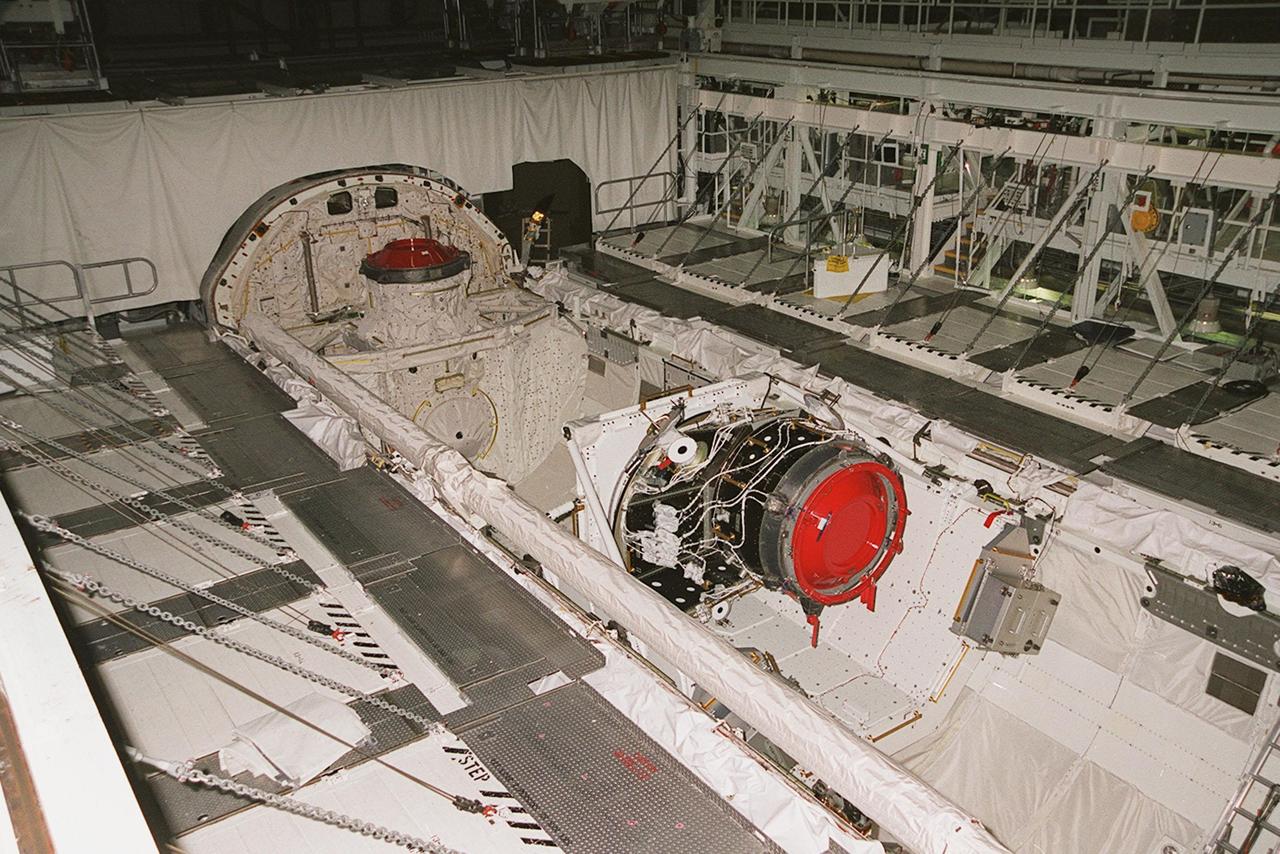
KENNEDY SPACE CENTER, FLA. -- The Pressurized Mating Adapter -3 (PMA-3) sits in the payload bay of the orbiter Discovery after being transported from the Space Station Processing Facility. A component of the International Space Station, the PMA-3 will fly on Shuttle mission STS-92, scheduled to launch Oct. 5. The mission will be the fifth flight to the Space Station, and the 100th Shuttle flight overall. PMA-3 provides shuttle docking port for solar array installation on flight 4A (mission STS-97 scheduled for Nov. 30), and Lab installation on flight 5A (mission STS-98, scheduled for Jan. 18, 2001)
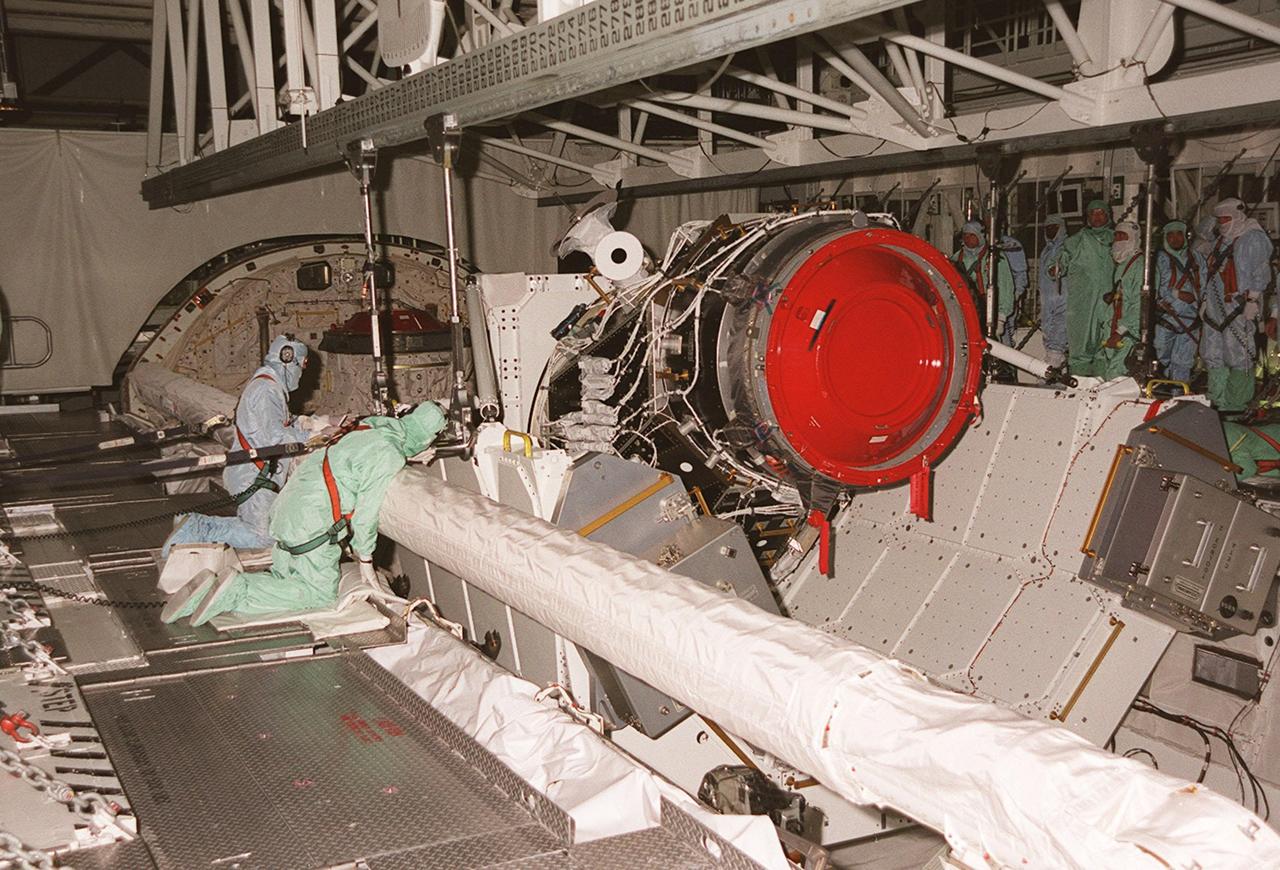
KENNEDY SPACE CENTER, FLA. -- In the Orbiter Processing Facility bay 1, workers check the placement of the Pressurized Mating Adapter -3 (PMA-3) as the overhead crane places it in the payload bay of the orbiter Discovery. A component of the International Space Station, the PMA-3 will fly on Shuttle mission STS-92, scheduled to launch Oct. 5. The mission will be the fifth flight to the Space Station, and the 100th Shuttle flight overall. PMA-3 provides shuttle docking port for solar array installation on flight 4A (mission STS-97 scheduled for Nov. 30), and Lab installation on flight 5A (mission STS-98, scheduled for Jan. 18, 2001)
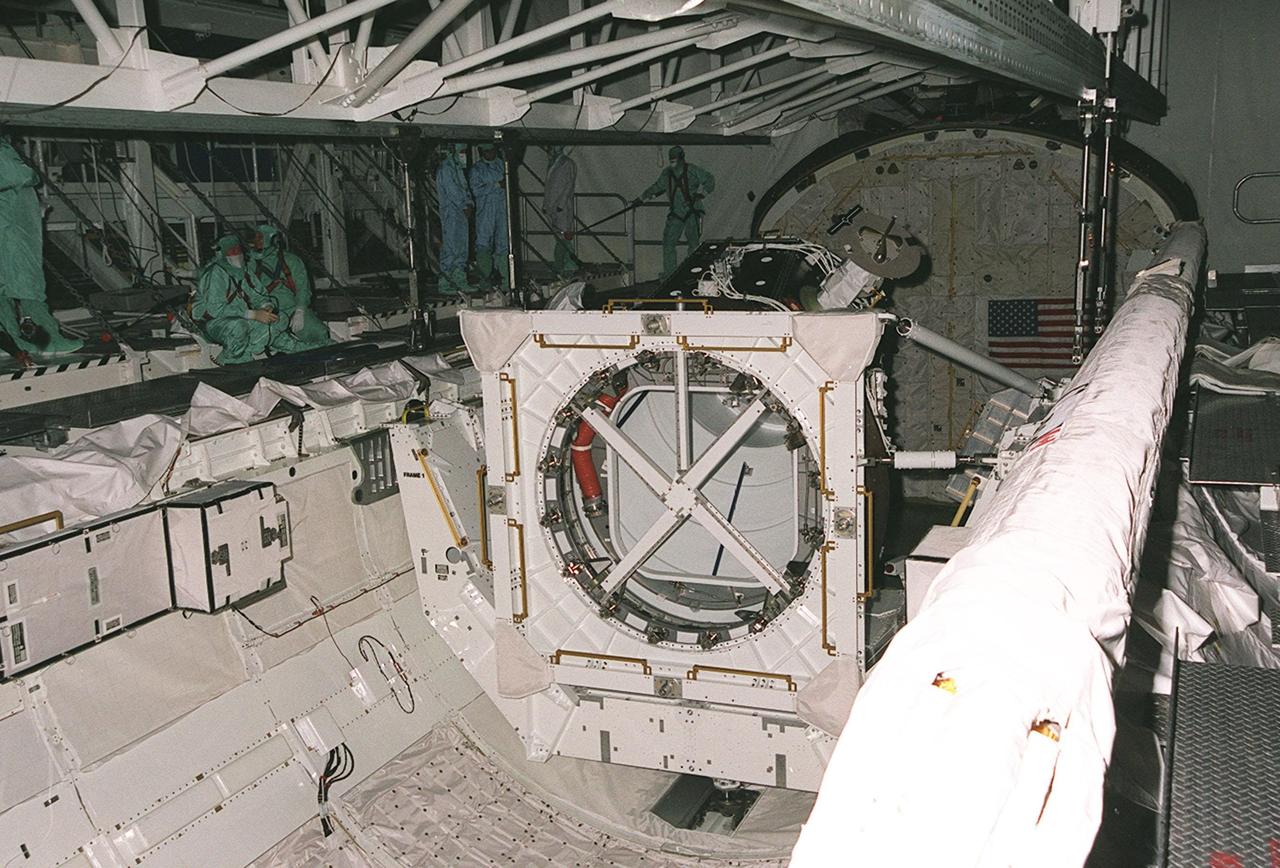
KENNEDY SPACE CENTER, FLA. -- The Pressurized Mating Adapter -3 (PMA-3) sits in the payload bay of the orbiter Discovery after being transported from the Space Station Processing Facility. A component of the International Space Station, the PMA-3 will fly on Shuttle mission STS-92, scheduled to launch Oct. 5. The mission will be the fifth flight to the Space Station, and the 100th Shuttle flight overall. PMA-3 provides shuttle docking port for solar array installation on flight 4A (mission STS-97 scheduled for Nov. 30), and Lab installation on flight 5A (mission STS-98, scheduled for Jan. 18, 2001)
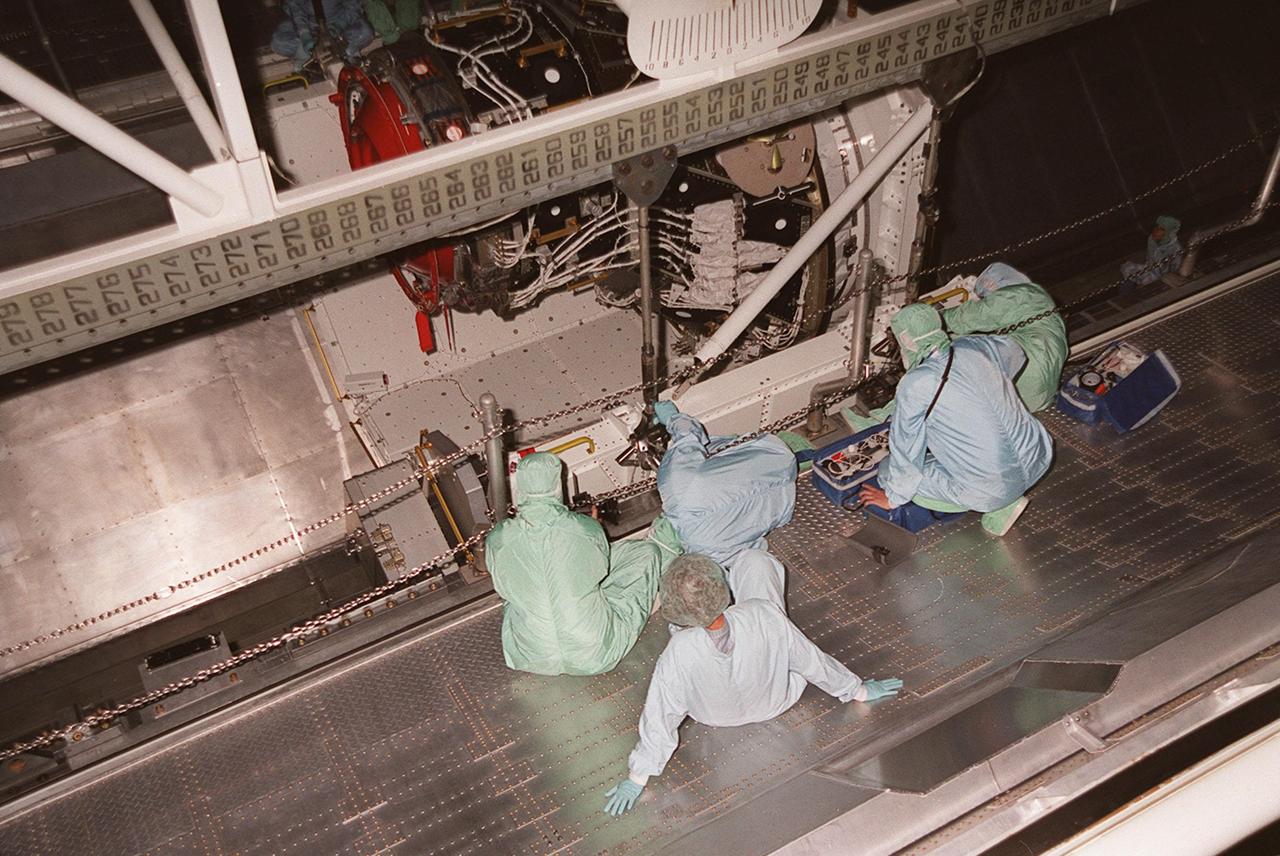
KENNEDY SPACE CENTER, FLA. -- Workers in the Orbiter Processing Facility check the placement of cables on the Pressurized Mating Adapter -3 (PMA-3) for its transfer to the orbiter Discovery. A component of the International Space Station, the PMA-3 is part of the payload on Space Shuttle mission STS-92, scheduled to launch Oct. 5. The mission will be the fifth flight to the Space Station, and the 100th Shuttle flight overall. PMA-3 provides shuttle docking port for solar array installation on flight 4A (mission STS-97 scheduled for Nov. 30), and Lab installation on flight 5A (mission STS-98, scheduled for Jan. 18, 2001)
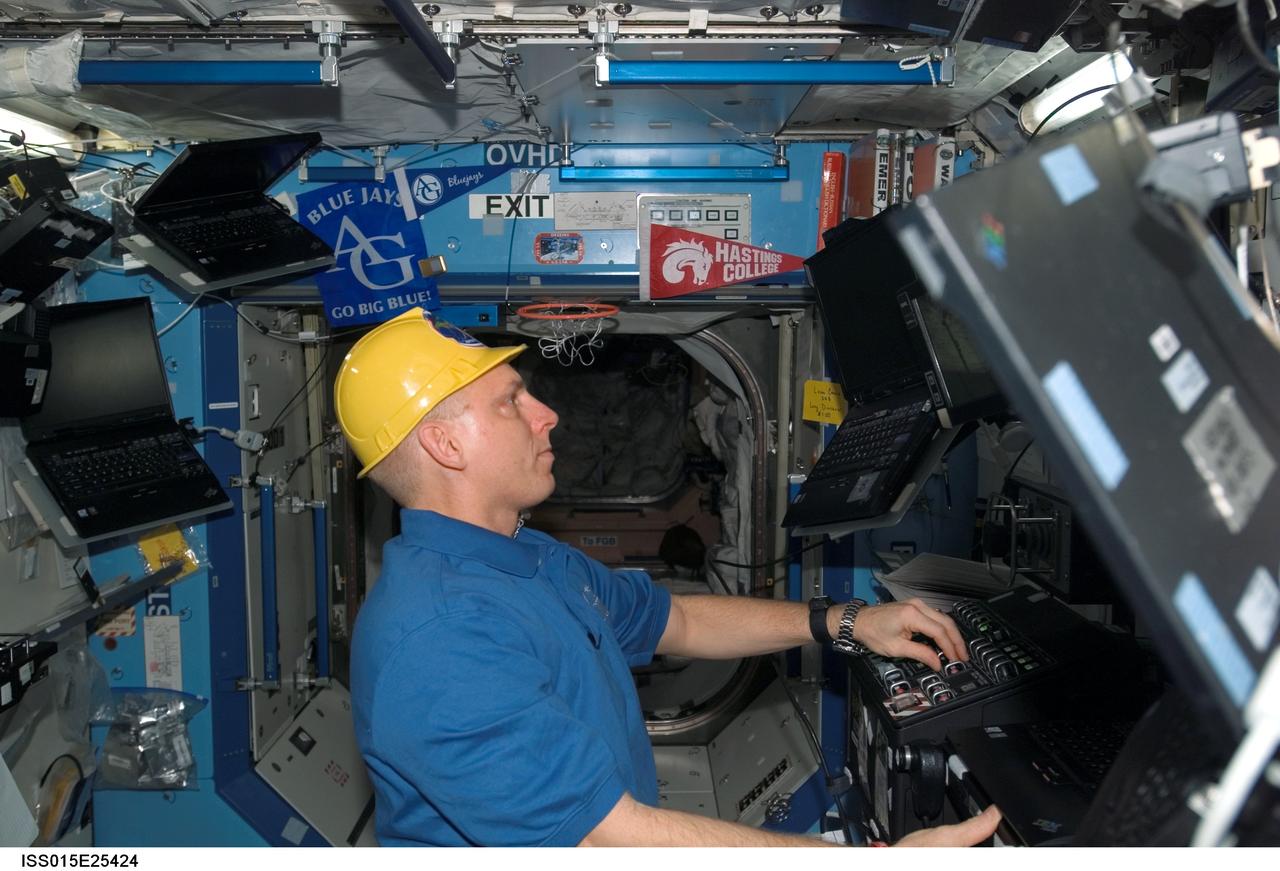
ISS015-E-25424 (30 Aug. 2007) --- Astronaut Clay Anderson, Expedition 15 flight engineer, works the controls of the station's robotic arm, Canadarm2, in the Destiny laboratory of the International Space Station during Pressurized Mating Adapter-3 (PMA-3) transfer operations. Using the Canadarm2, the PMA-3 was undocked from the Unity node's left side at 7:18 a.m. (CDT) and docked to Unity's lower port at 8:07 a.m. to prepare for the arrival of Node 2, the Harmony module, on the STS-120 flight of Space Shuttle Discovery in October 2007.
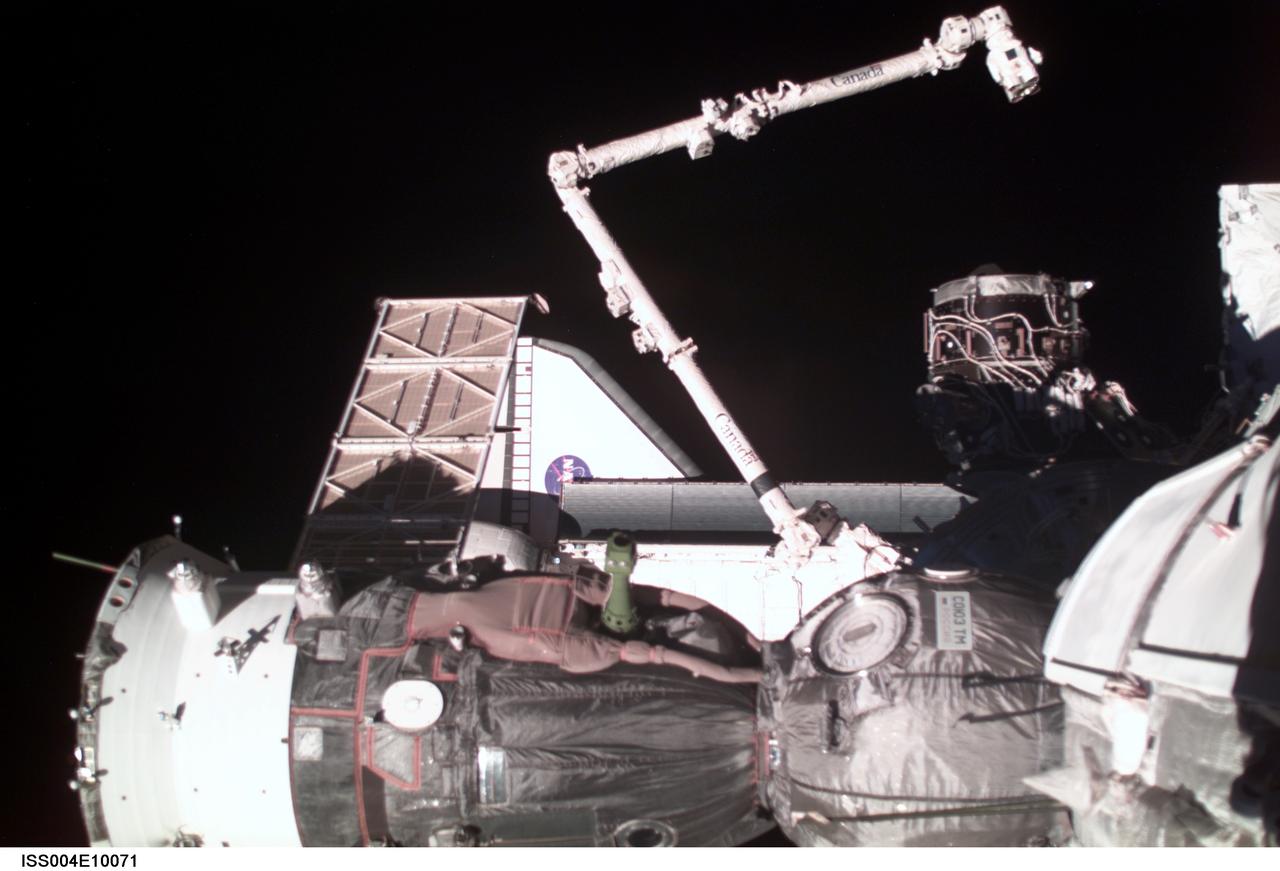
ISS004-E-10071 (17 April 2002) --- Moments prior to the undocking of the Space Shuttle Atlantis from the International Space Station (ISS), an Expedition Four crewmember took this digital still photograph from a window in the Pirs Docking Compartment. The STS-110 crew spent about a week aboard the ISS and successfully installed the S0 (S-zero) truss. Also visible in this image are the Soyuz Spacecraft, Space Station Remote Manipulator System (SSRMS) / Canadarm2 and Pressurized Mating Adapter 3 (PMA3).
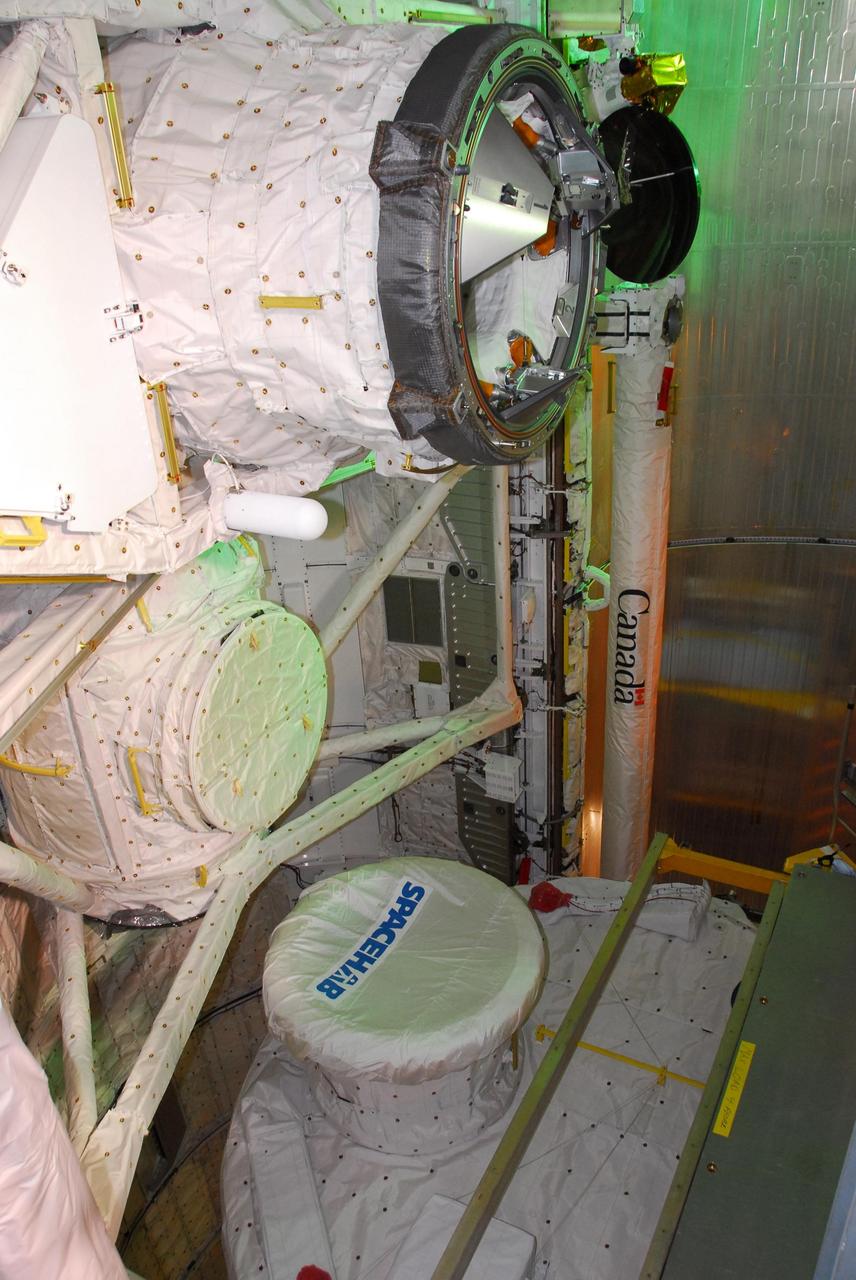
KENNEDY SPACE CENTER, FLA. -- The payload for mission STS-118 is being installed in the payload bay on Space Shuttle Endeavour on Launch Pad 39A. Seen here, from top, are the orbiter docking system, the SPACEHAB tunnel adapter and the SPACEHAB module. The payload also includes the S5 truss and the external stowage platform 3. The mission is the 22nd flight to the International Space Station and is targeted for launch on Aug.7. Photo credit: NASA/Amanda Diller
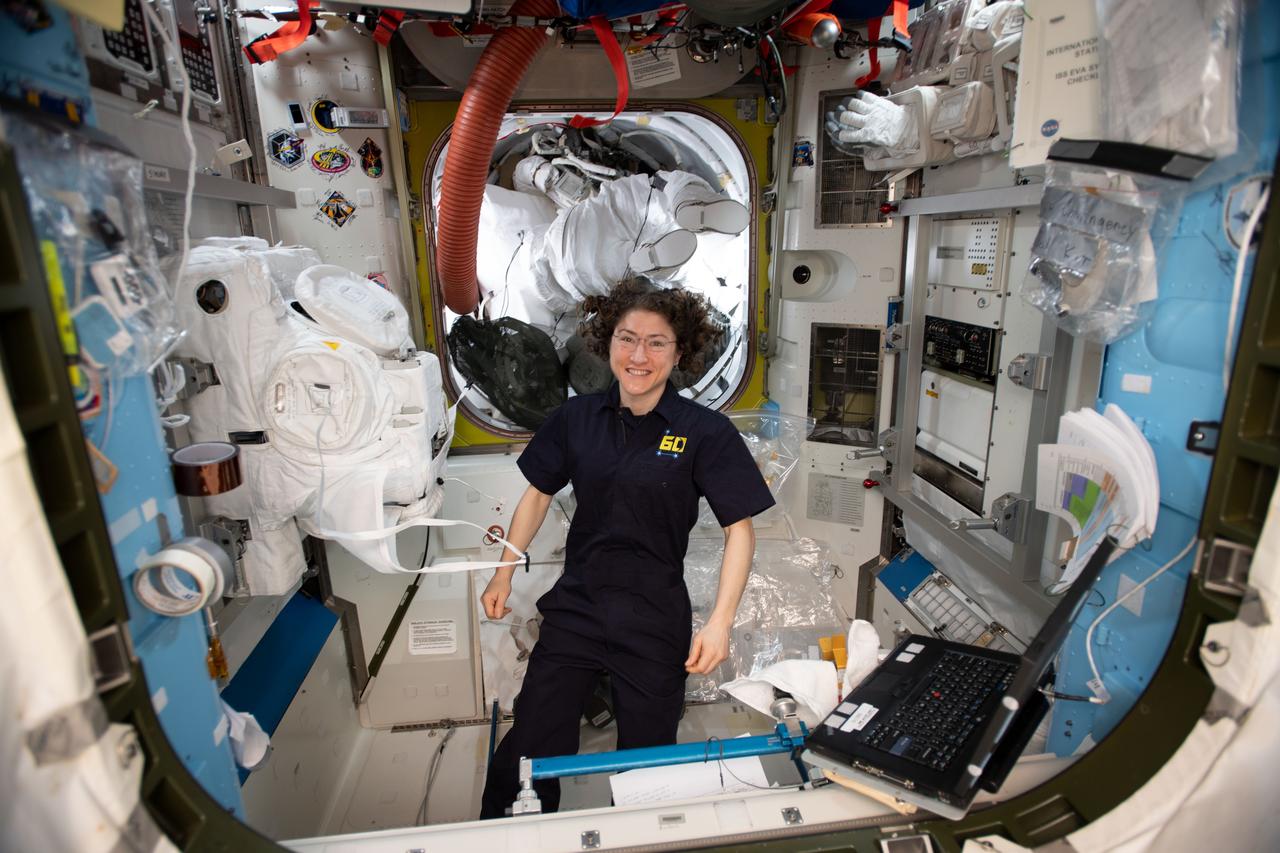
iss060e029526 (Aug. 8, 2019) --- Expedition 60 Flight Engineer Christina Koch of NASA works inside the U.S. Quest airlock configuring a pair spacesuits that NASA astronauts Nick Hague and Andrew Morgan will wear during a spacewalk on Aug. 21. The duo will spend about six and a half hours routing cables and configuring the International Docking Adapter-3 on top of the Harmony module in preparation for the arrival of future SpaceX and Boeing crew vehicles.
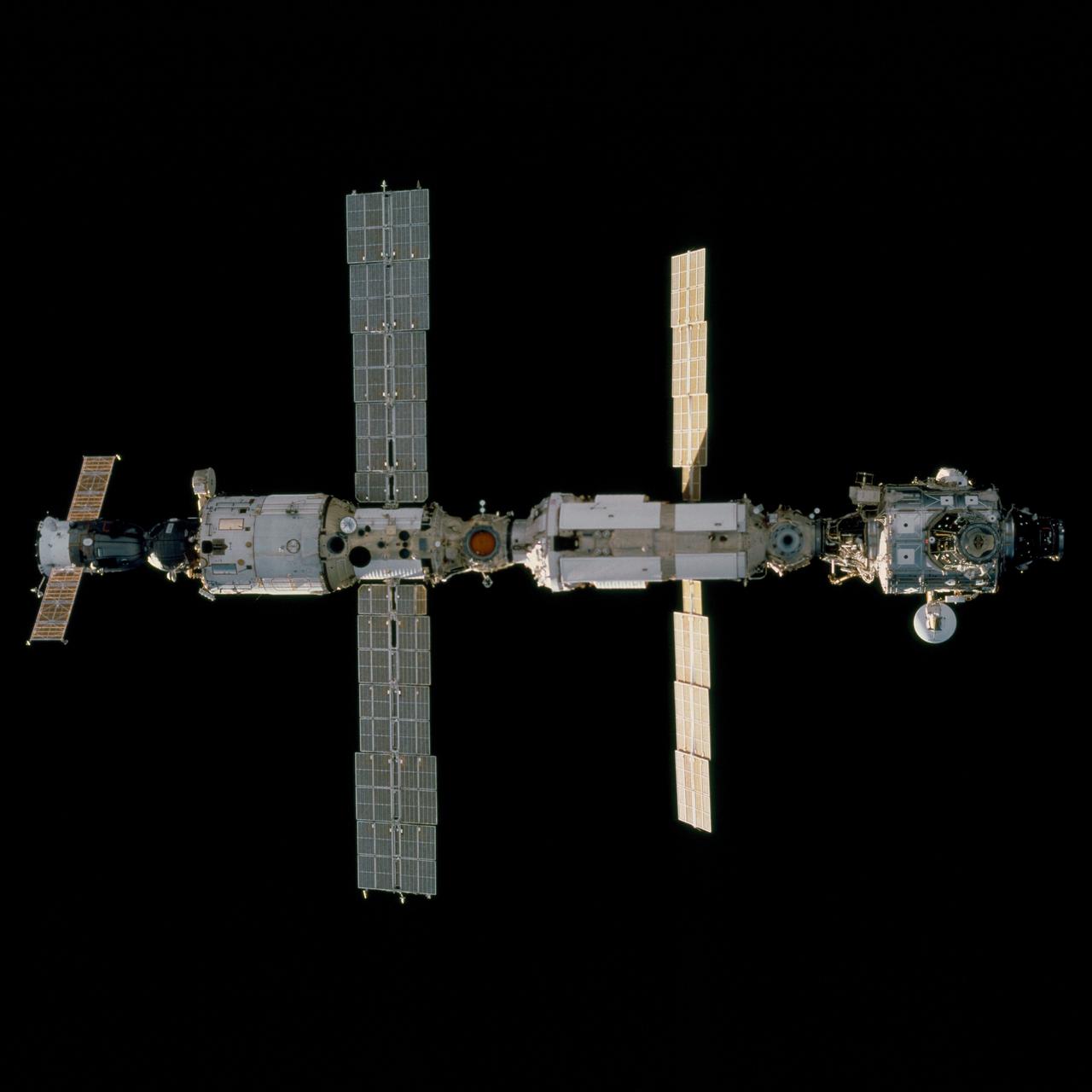
STS097-702-061 (2 December 2000) --- The International Space Station (ISS) moves in position for docking with the Space Shuttle Endeavour, in this 70mm frame photographed by one of the STS-97 astronauts on the flight deck of the shuttle. Most of the station's components are clearly visible in the frame, with the Soyuz spacecraft docked at left to the Zvezda Service Module, which is linked to the Zarya or Functional Cargo Block (FGB). The Unity node is at right, sporting the additions from the recent STS-92 mission of the Z1 truss structure (largely obscured) and a Pressurized Mating Adapter (PMA-3).
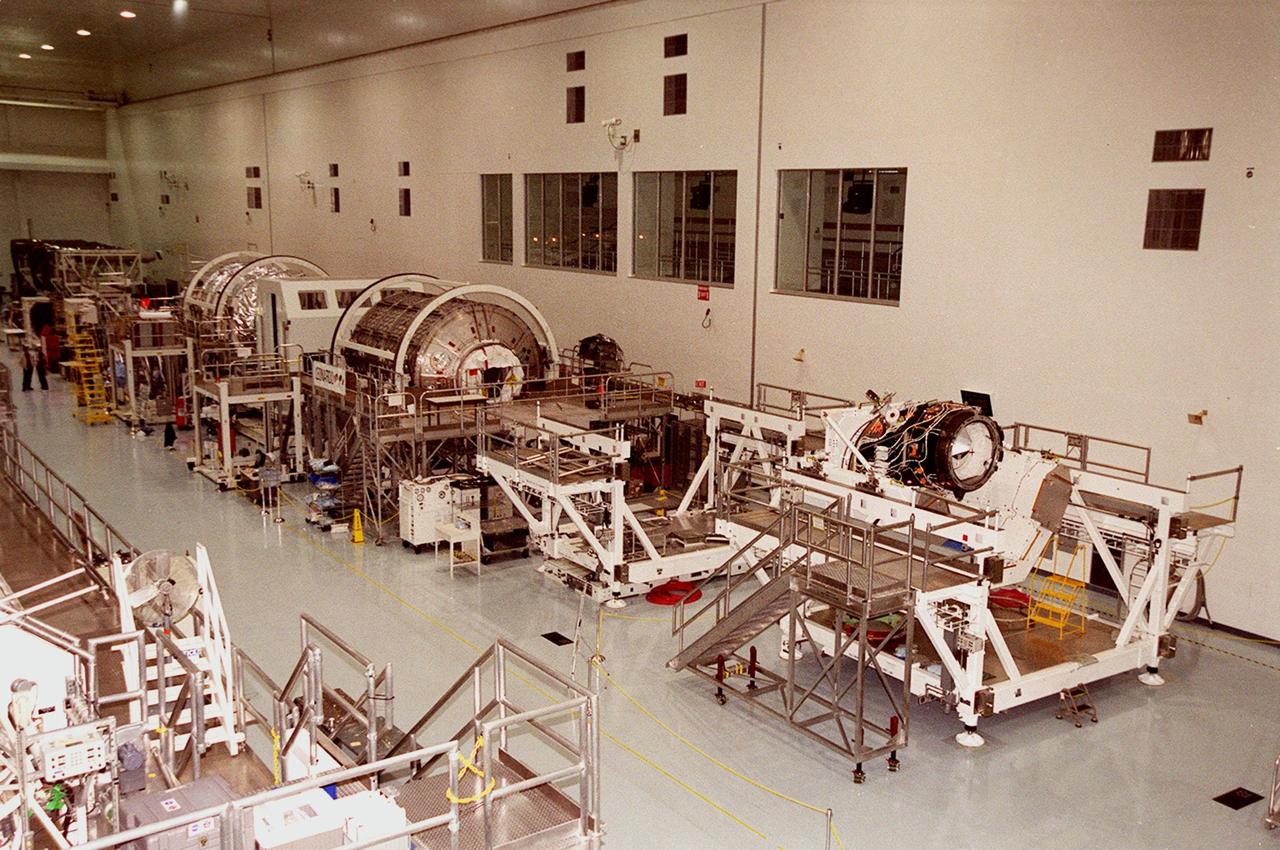
KENNEDY SPACE CENTER, FLA. -- The Space Station Processing Facility is filled with hardware, components for the International Space Station. Lined up (left to right) are the Multi-Purpose Logistics Modules Raffaello and Leonardo and the Pressurized Mating Adapter-3 (PMA-3). Italy's major contributions to the ISS program, Raffaello and Leonardo are reusable logistics carriers to resupply and return station cargo requiring a pressurized environment. They are slated as payloads on missions STS-102 and STS-100, respectively. Dates have not yet been determined for the two missions. The PMA-3, once launched, will be mated to Node 1, a connecting passageway to the living and working areas of the Space Station. The primary purpose of PMA-3 is to serve as a Shuttle docking port through which crew members and equipment will transfer to the Space Station during later assembly missions. PMA-3 is scheduled as payload on mission STS-92, whose date for launch is not yet determined.
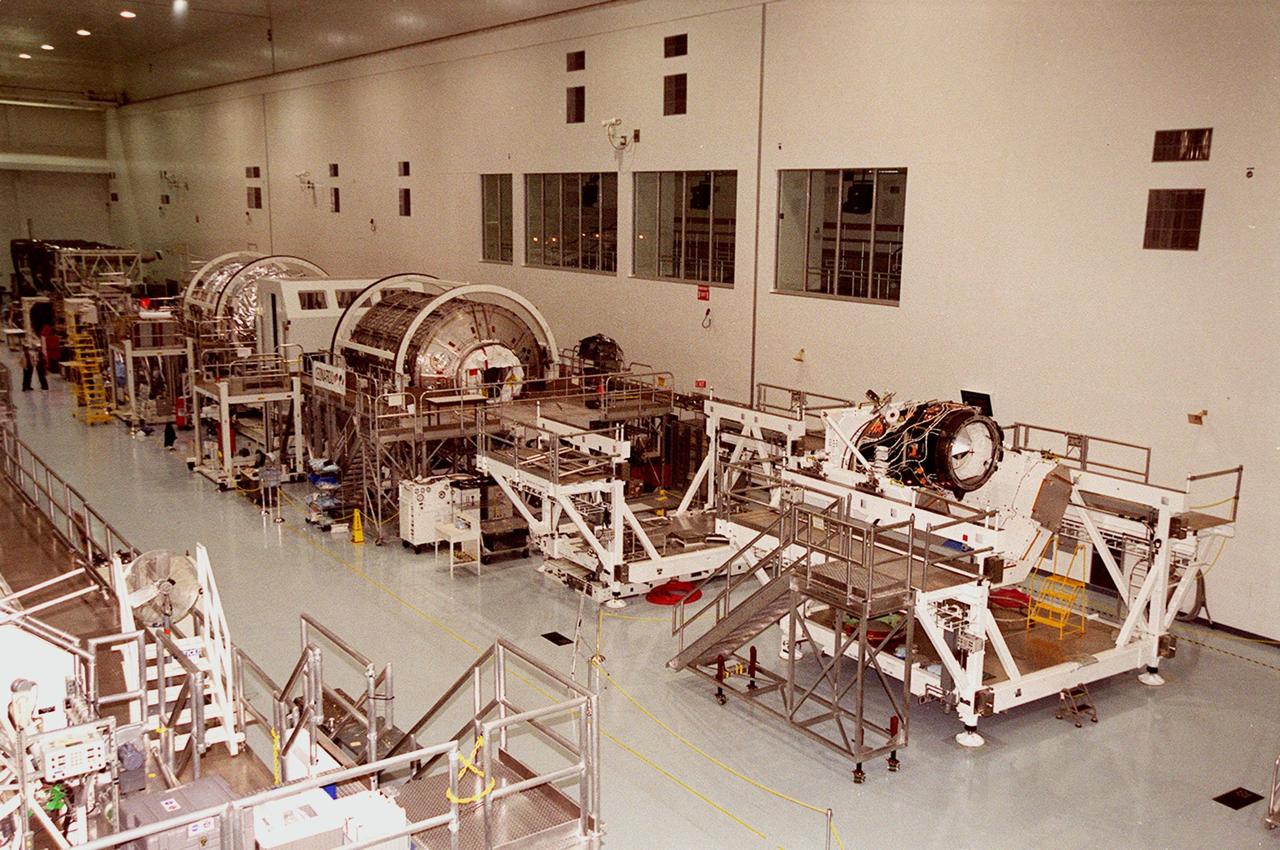
KENNEDY SPACE CENTER, FLA. -- The Space Station Processing Facility is filled with hardware, components for the International Space Station. Lined up (left to right) are the Multi-Purpose Logistics Modules Raffaello and Leonardo and the Pressurized Mating Adapter-3 (PMA-3). Italy's major contributions to the ISS program, Raffaello and Leonardo are reusable logistics carriers to resupply and return station cargo requiring a pressurized environment. They are slated as payloads on missions STS-102 and STS-100, respectively. Dates have not yet been determined for the two missions. The PMA-3, once launched, will be mated to Node 1, a connecting passageway to the living and working areas of the Space Station. The primary purpose of PMA-3 is to serve as a Shuttle docking port through which crew members and equipment will transfer to the Space Station during later assembly missions. PMA-3 is scheduled as payload on mission STS-92, whose date for launch is not yet determined.
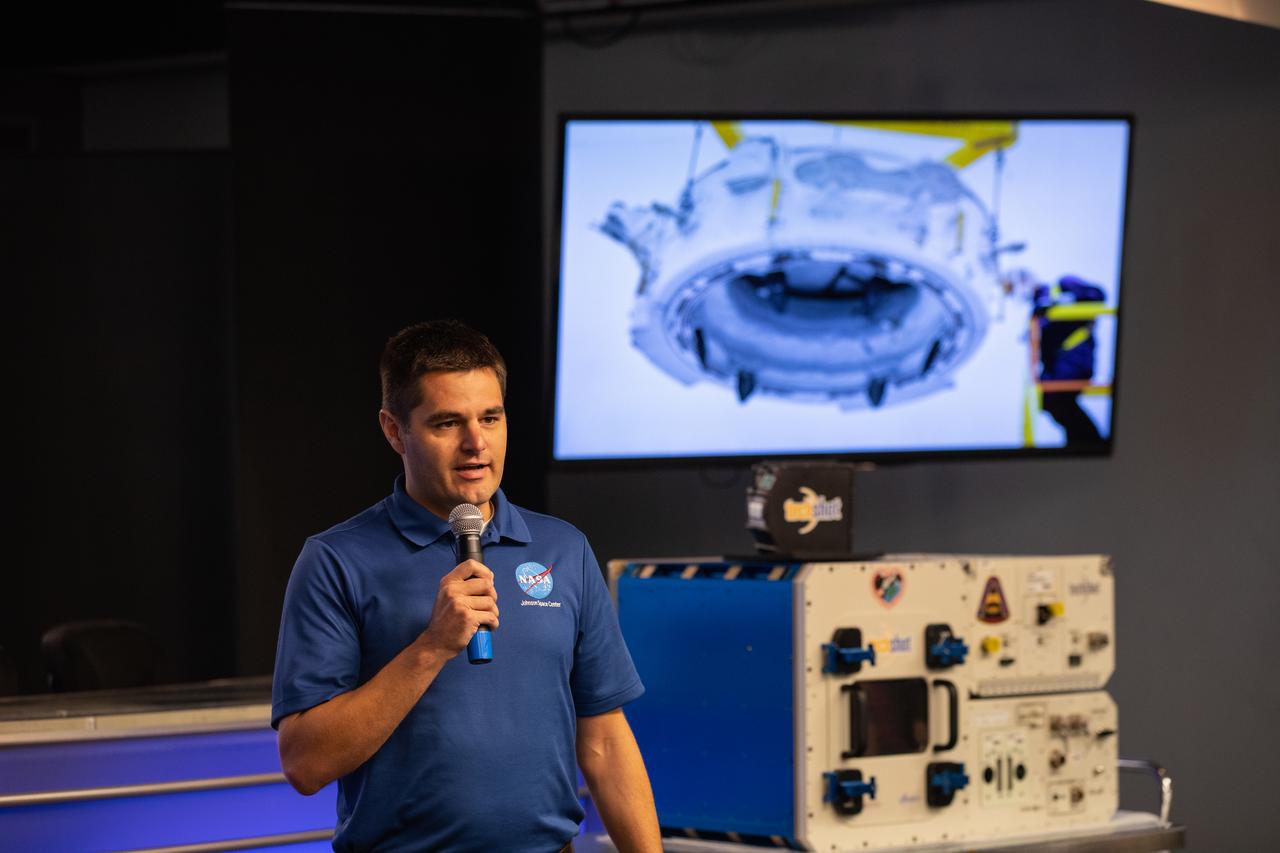
Jason August, International Space Station Mission Evaluation Room manager, talks to NASA Social participants about the International Docking Adapter-3 payload during a What’s On Board science briefing at the agency’s Kennedy Space Center in Florida on July 23, 2019. The briefing was held for SpaceX’s 18th Commercial Resupply Services (CRS-18) mission to the station. The SpaceX Falcon 9 rocket and uncrewed Dragon spacecraft are scheduled to launch July 24, 2019, from Space Launch Complex 40 at Florida’s Cape Canaveral Air Force Station.
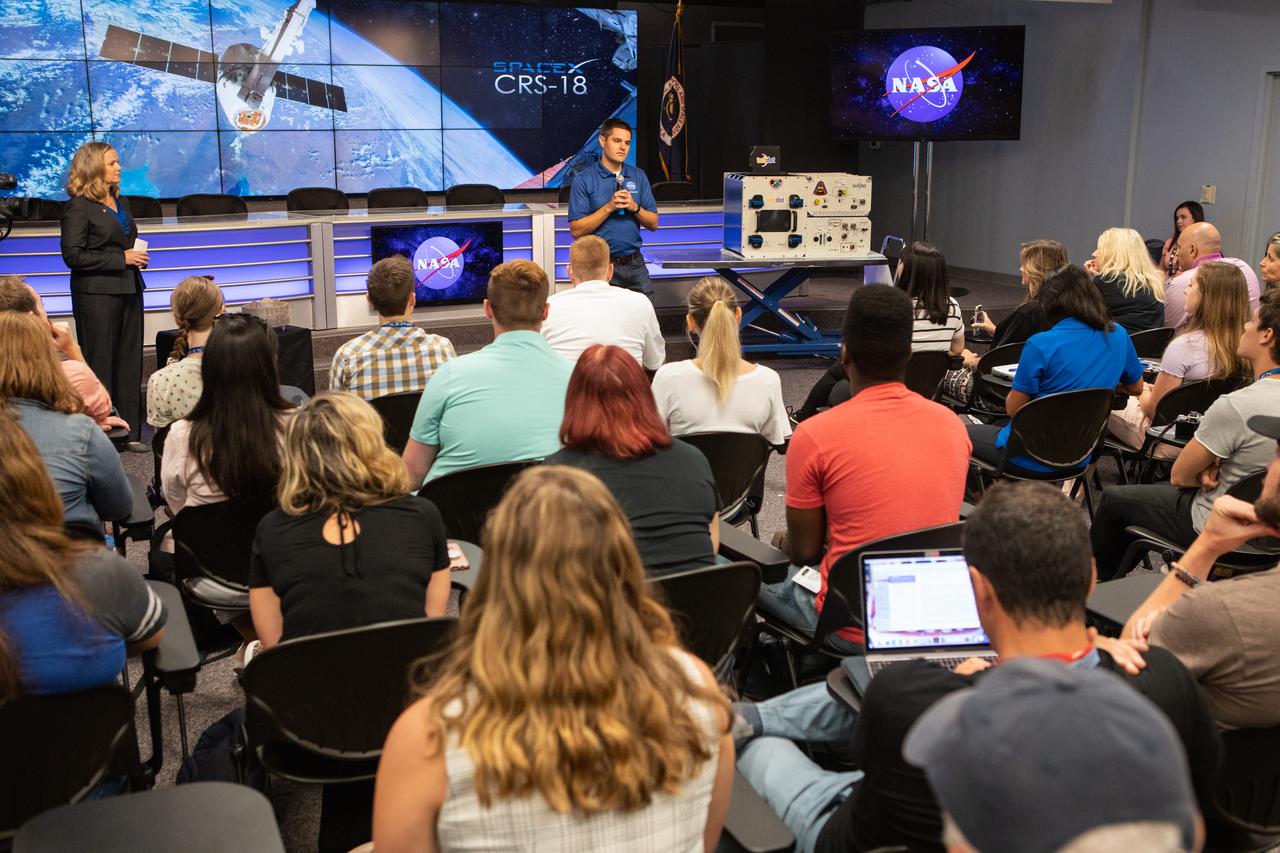
Jason August, International Space Station Mission Evaluation Room manager, talks to NASA Social participants about the International Docking Adapter-3 payload during a What’s On Board science briefing at the agency’s Kennedy Space Center in Florida on July 23, 2019. The briefing was held for SpaceX’s 18th Commercial Resupply Services (CRS-18) mission to the station. The SpaceX Falcon 9 rocket and uncrewed Dragon spacecraft are scheduled to launch July 24, 2019, from Space Launch Complex 40 at Florida’s Cape Canaveral Air Force Station.
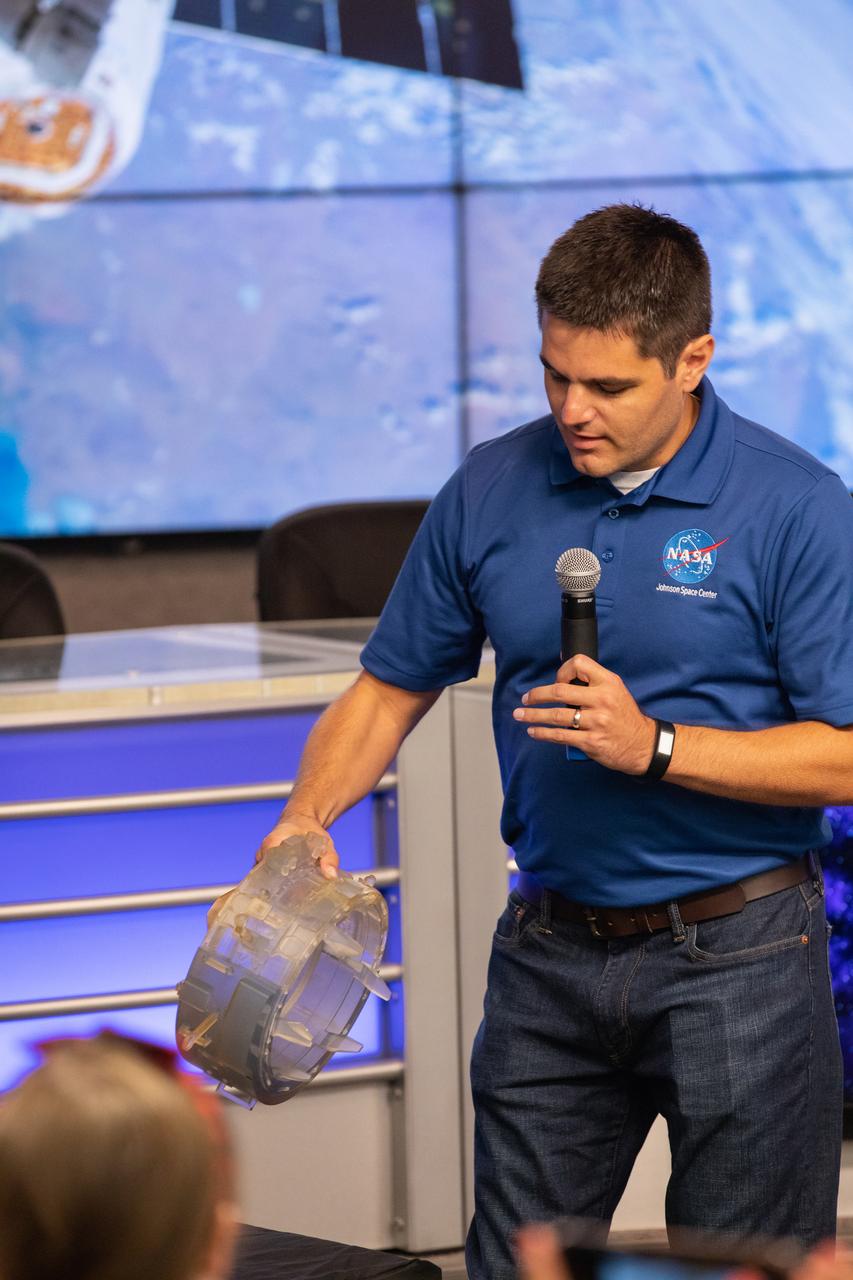
Jason August, International Space Station Mission Evaluation Room manager, talks to NASA Social participants about the International Docking Adapter-3 payload during a What’s On Board science briefing at the agency’s Kennedy Space Center in Florida on July 23, 2019. The briefing was held for SpaceX’s 18th Commercial Resupply Services (CRS-18) mission to the station. The SpaceX Falcon 9 rocket and uncrewed Dragon spacecraft are scheduled to launch July 24, 2019, from Space Launch Complex 40 at Florida’s Cape Canaveral Air Force Station.
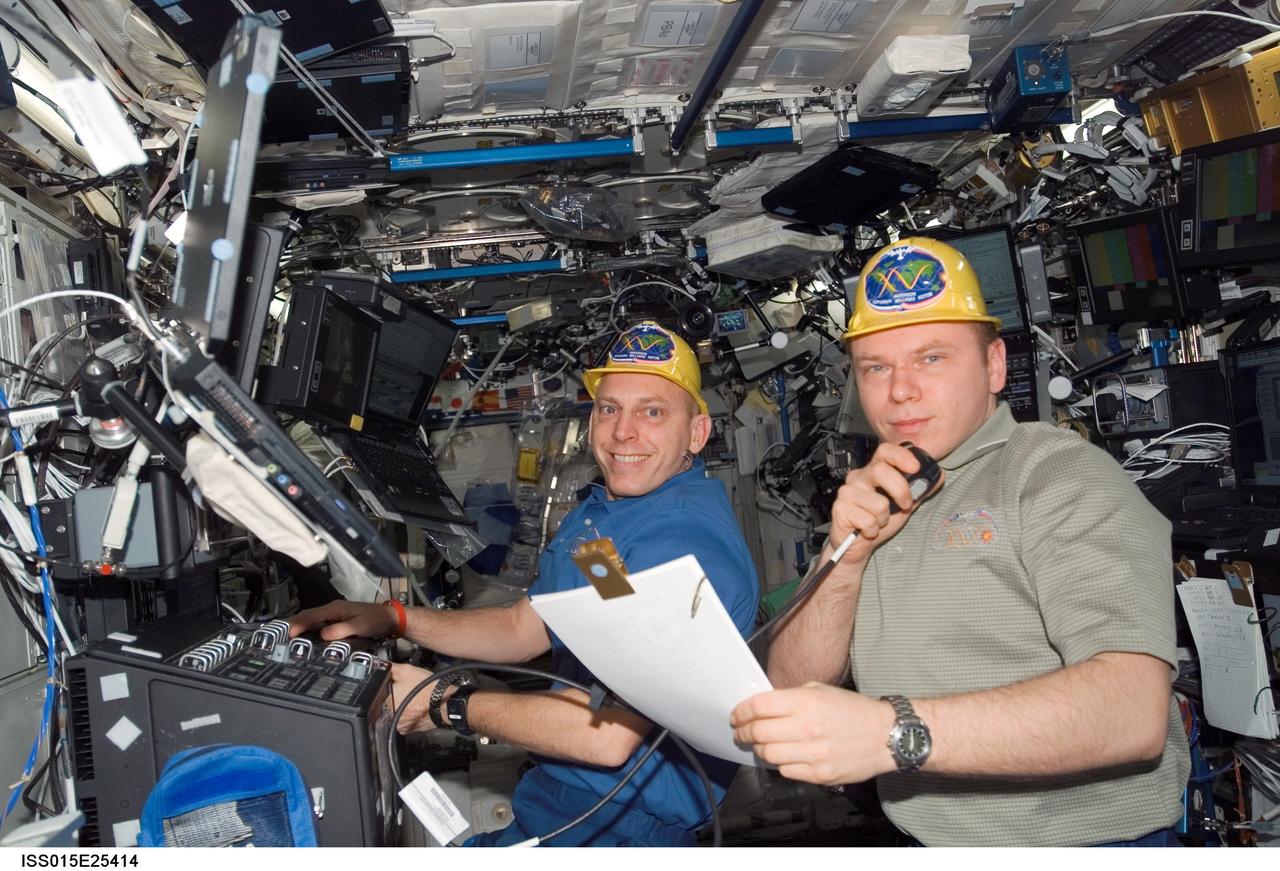
ISS015-E-25414 (30 Aug. 2007) --- Astronaut Clay Anderson (left), Expedition 15 flight engineer, works the controls of the station's robotic arm, Canadarm2; while cosmonaut Oleg V. Kotov, flight engineer representing Russia's Federal Space Agency, uses a communication system in the Destiny laboratory of the International Space Station during Pressurized Mating Adapter-3 (PMA-3) transfer operations. Using the Canadarm2, the PMA-3 was undocked from the Unity node's left side at 7:18 a.m. (CDT) and docked to Unity's lower port at 8:07 a.m. to prepare for the arrival of Node 2, the Harmony module, on the STS-120 flight of Space Shuttle Discovery in October 2007.
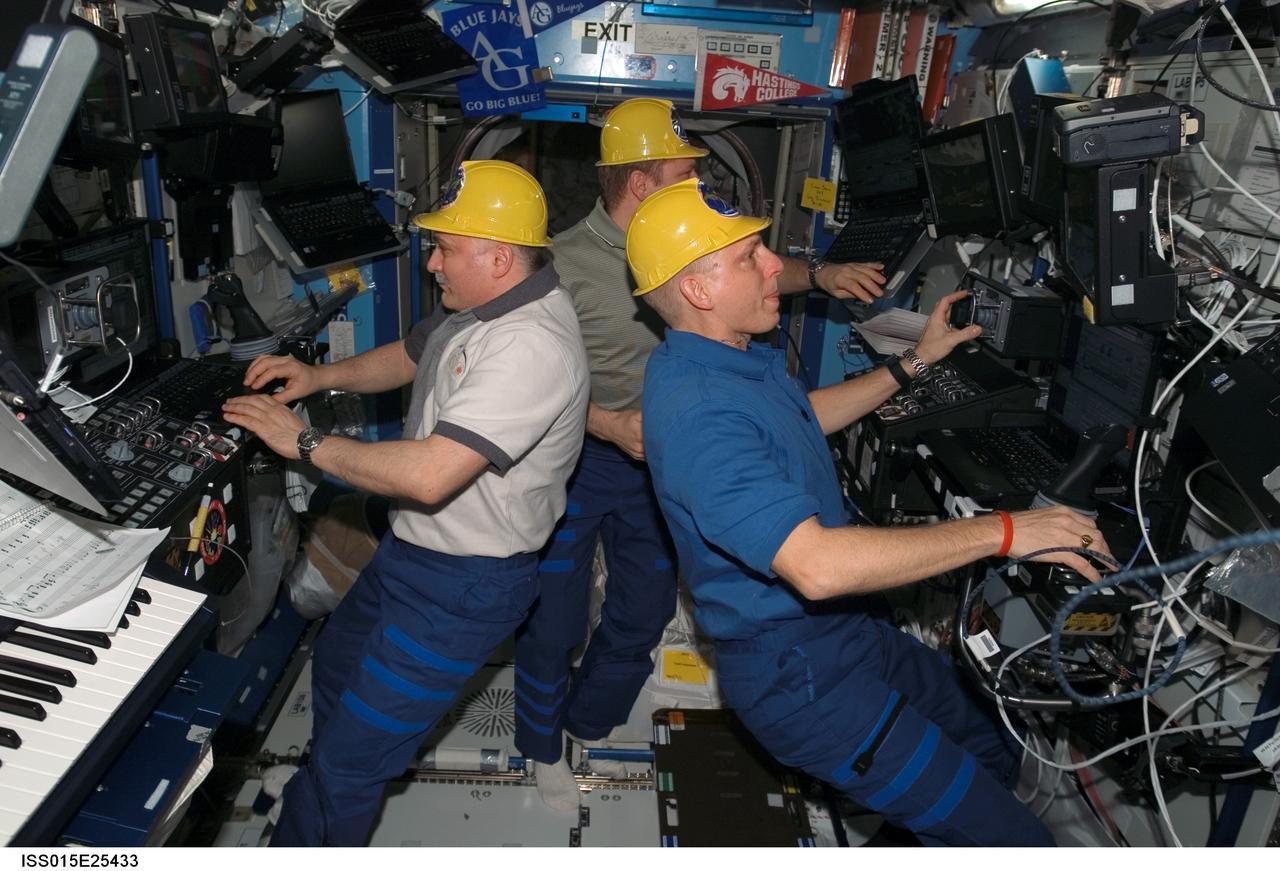
ISS015-E-25433 (30 Aug. 2007) --- Cosmonauts Fyodor N. Yurchikhin (left) and Oleg V. Kotov, Expedition 15 commander and flight engineer, respectively, both representing Russia's Federal Space Agency; along with astronaut Clay Anderson (right), flight engineer, work various tasks in the Destiny laboratory of the International Space Station during Pressurized Mating Adapter-3 (PMA-3) transfer operations. Using the station's robotic arm, Canadarm2, the PMA-3 was undocked from the Unity node's left side at 7:18 a.m. (CDT) and docked to Unity's lower port at 8:07 a.m. to prepare for the arrival of Node 2, the Harmony module, on the STS-120 flight of Space Shuttle Discovery in October 2007.
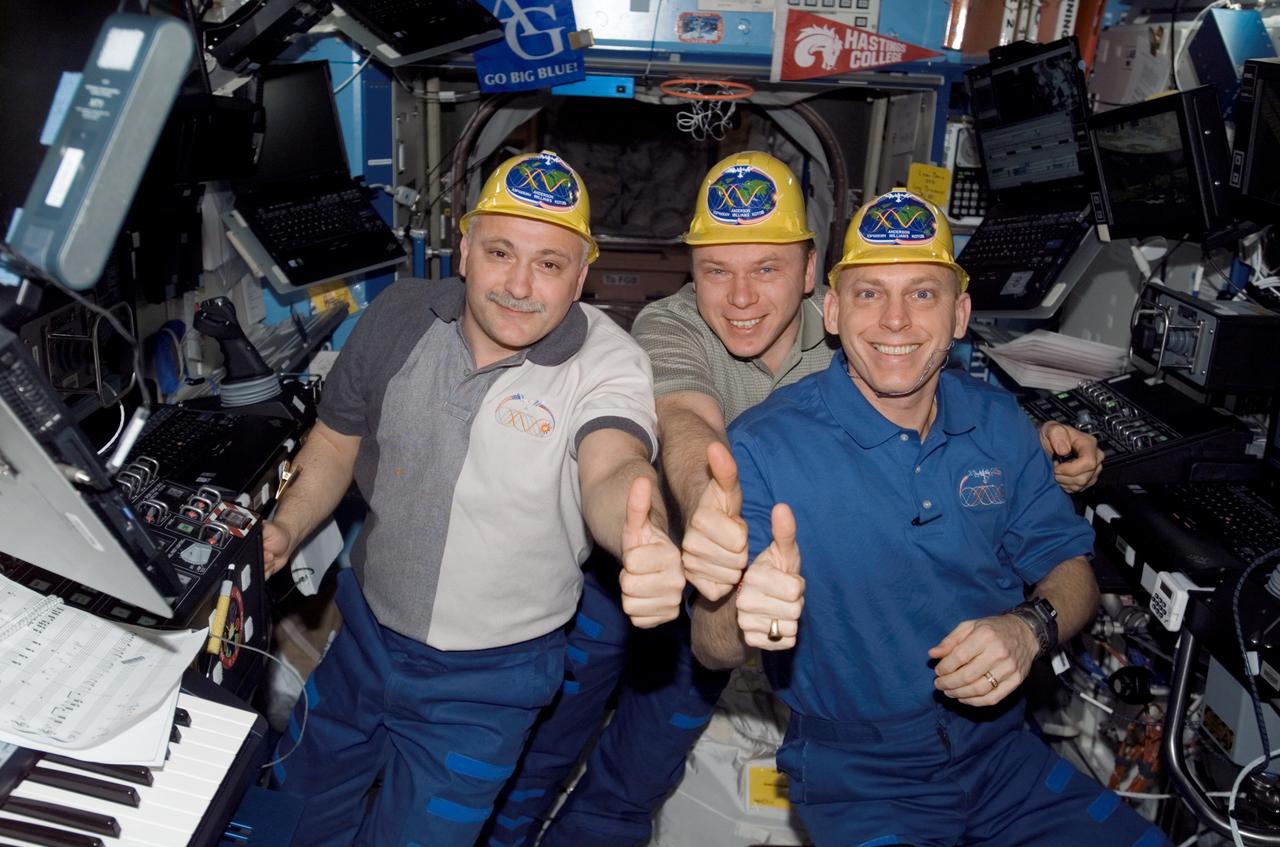
ISS015-E-25439 (30 Aug. 2007) --- Cosmonauts Fyodor N. Yurchikhin (left) and Oleg V. Kotov, Expedition 15 commander and flight engineer, respectively, both representing Russia's Federal Space Agency; along with astronaut Clay Anderson, flight engineer, give a "thumbs-up" signal at the conclusion of Pressurized Mating Adapter-3 (PMA-3) transfer operations in the Destiny laboratory of the International Space Station. Using the station's robotic arm, Canadarm2, the PMA-3 was undocked from the Unity node's left side at 7:18 a.m. (CDT) and docked to Unity's lower port at 8:07 a.m. to prepare for the arrival of Node 2, the Harmony module, on the STS-120 flight of Space Shuttle Discovery in October 2007.
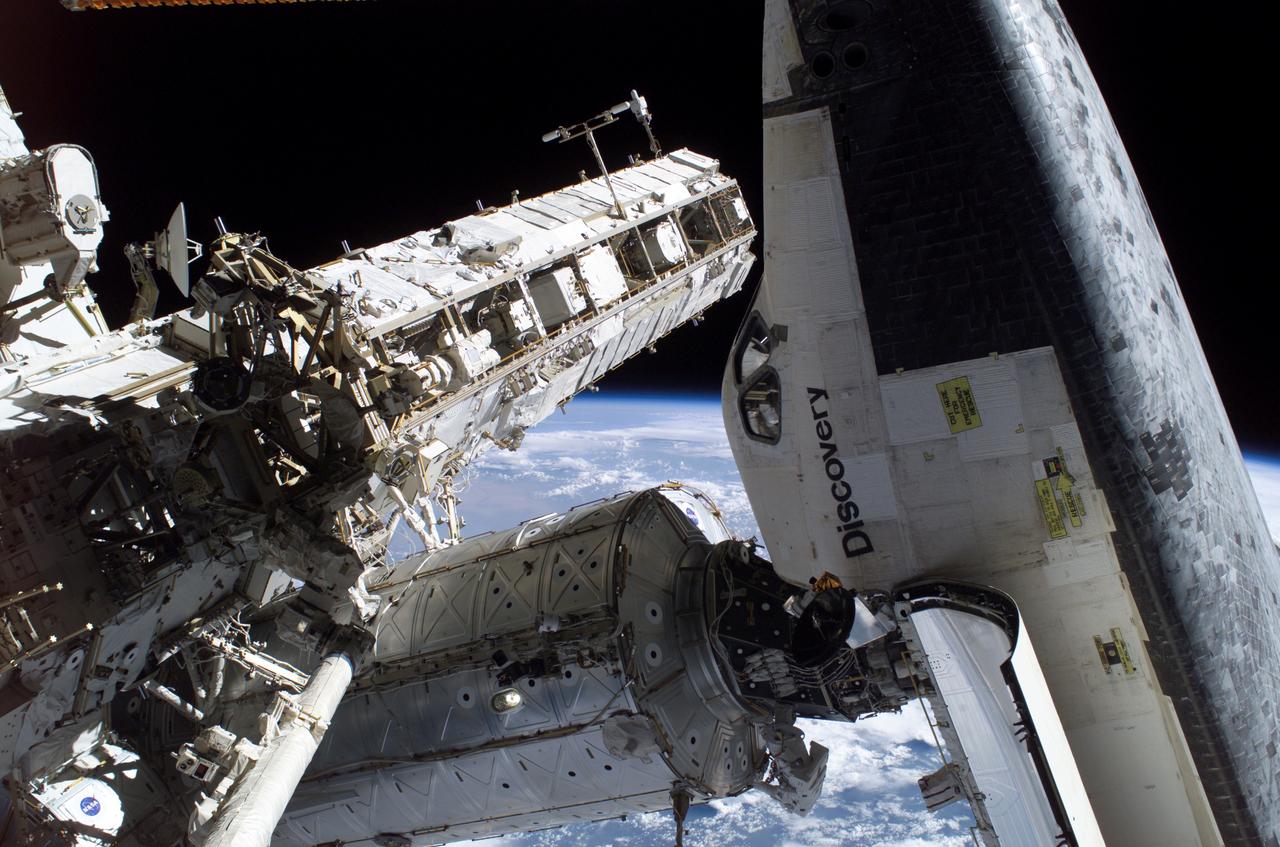
S114-E-6455 (3 August 2005) --- This image features a view of Space Shuttle Discovery docked to the Pressurized Mating Adapter 2 (PMA-2) on the Destiny laboratory of the international space station. The Crew Equipment Translation Aid (CETA) cart and the Mobile Base System (MBS), mounted on the S0 truss, are visible at left. Part of the P1 truss is also visible in the background. Dwarfed by the station and shuttle, Japan Aerospace Exploration Agency (JAXA) astronaut Soichi Noguchi, STS-114 mission specialist, is visible near the PMA-2 during the mission’s third session of extravehicular activity (EVA). The blackness of space and a blue and white Earth form the backdrop for the image.
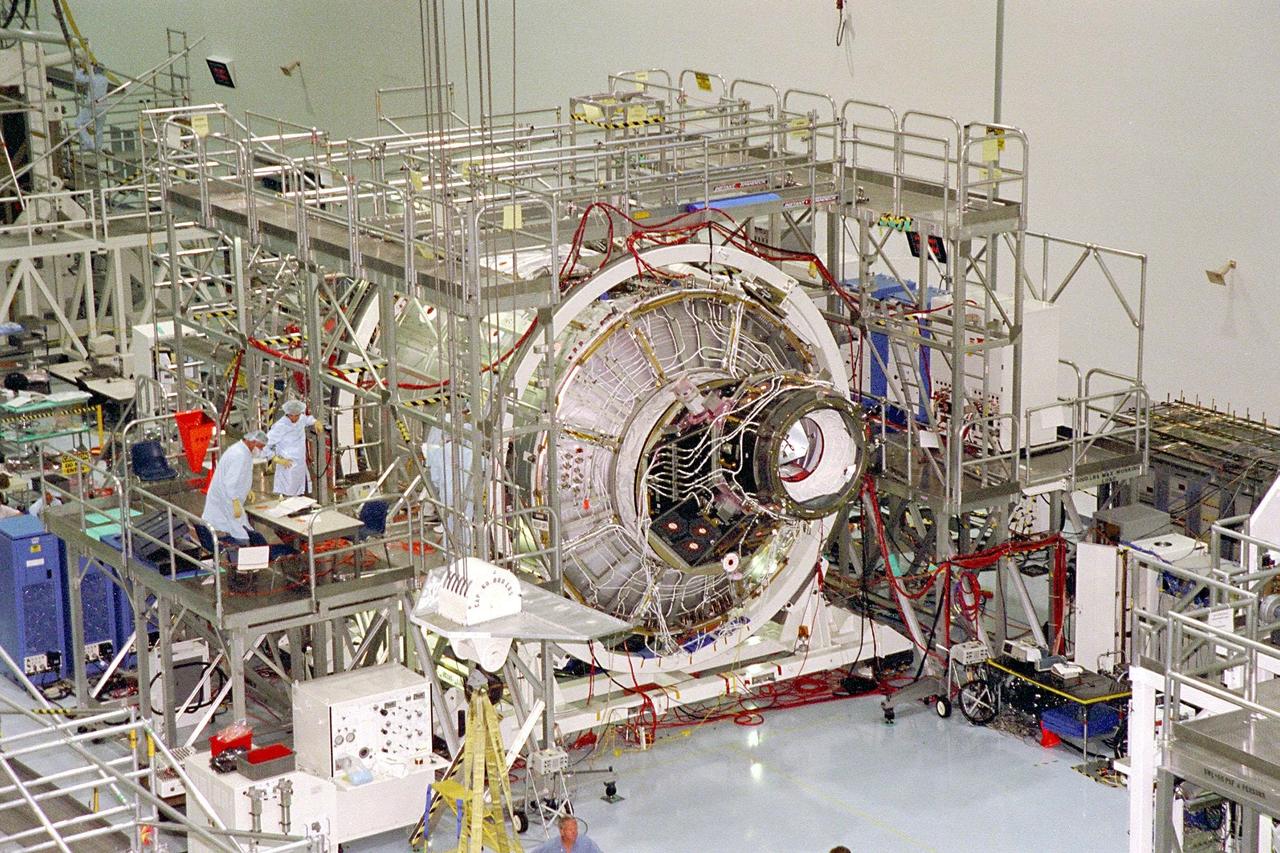
KENNEDY SPACE CENTER, FLA. -- The International Space Station's (ISS) Unity node, with Pressurized Mating Adapter (PMA)-2 attached, awaits further processing by Boeing technicians in its workstand in the Space Station Processing Facility (SSPF). The Unity node is the first element of the ISS to be manufactured in the United States and is currently scheduled to lift off aboard the Space Shuttle Endeavour on STS-88 later this year. Unity has two PMAs attached to it now that this mate is completed. PMAs are conical docking adapters which will allow the docking systems used by the Space Shuttle and by Russian modules to attach to the node's hatches and berthing mechanisms. Once in orbit, Unity, which has six hatches, will be mated with the already orbiting Control Module and will eventually provide attachment points for the U.S. laboratory module; Node 3; an early exterior framework or truss for the station; an airlock; and a multi-windowed cupola. The Control Module, or Functional Cargo Block, is a U.S.-funded and Russian-built component that will be launched aboard a Russian rocket from Kazakstan
KENNEDY SPACE CENTER, FLA. -- The International Space Station's (ISS) Unity node, with Pressurized Mating Adapter (PMA)-2 attached, awaits further processing in the Space Station Processing Facility (SSPF). The Unity node is the first element of the ISS to be manufactured in the United States and is currently scheduled to lift off aboard the Space Shuttle Endeavour on STS-88 later this year. Unity has two PMAs attached to it now that this mate is completed. PMAs are conical docking adapters which will allow the docking systems used by the Space Shuttle and by Russian modules to attach to the node's hatches and berthing mechanisms. Once in orbit, Unity, which has six hatches, will be mated with the already orbiting Control Module and will eventually provide attachment points for the U.S. laboratory module; Node 3; an early exterior framework or truss for the station; an airlock; and a multi-windowed cupola. The Control Module, or Functional Cargo Block, is a U.S.-funded and Russian-built component that will be launched aboard a Russian rocket from Kazakstan
KENNEDY SPACE CENTER, FLA. -- The International Space Station's (ISS) Unity node, with Pressurized Mating Adapter (PMA)-2 attached, awaits further processing in the Space Station Processing Facility (SSPF). The Unity node is the first element of the ISS to be manufactured in the United States and is currently scheduled to lift off aboard the Space Shuttle Endeavour on STS-88 later this year. Unity has two PMAs attached to it now that this mate is completed. PMAs are conical docking adapters which will allow the docking systems used by the Space Shuttle and by Russian modules to attach to the node's hatches and berthing mechanisms. Once in orbit, Unity, which has six hatches, will be mated with the already orbiting Control Module and will eventually provide attachment points for the U.S. laboratory module; Node 3; an early exterior framework or truss for the station; an airlock; and a multi-windowed cupola. The Control Module, or Functional Cargo Block, is a U.S.-funded and Russian-built component that will be launched aboard a Russian rocket from Kazakstan
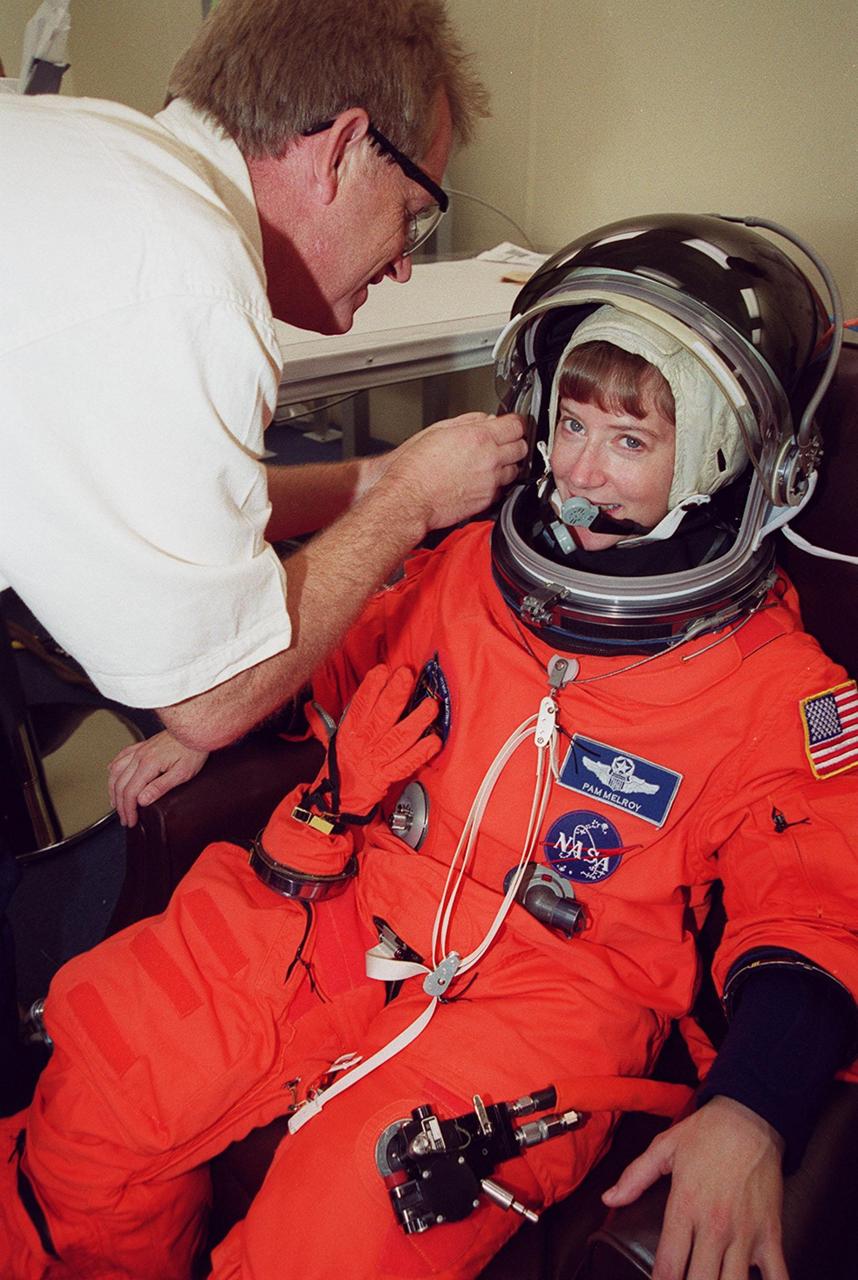
STS-92 Pilot Pamela Ann Melroy has her helmet checked during suitup for launch, scheduled for 8:05 p.m. EDT. The mission is the fifth flight for the construction of the ISS. The payload includes the Integrated Truss Structure Z-1 and the third Pressurized Mating Adapter. During the 11-day mission, four extravehicular activities (EVAs), or spacewalks, are planned. The Z-1 truss is the first of 10 that will become the backbone of the International Space Station, eventually stretching the length of a football field. PMA-3 will provide a Shuttle docking port for solar array installation on the sixth ISS flight and Lab installation on the seventh ISS flight. This launch is the first for Melroy. Landing is expected Oct. 21 at 3:55 p.m. EDT
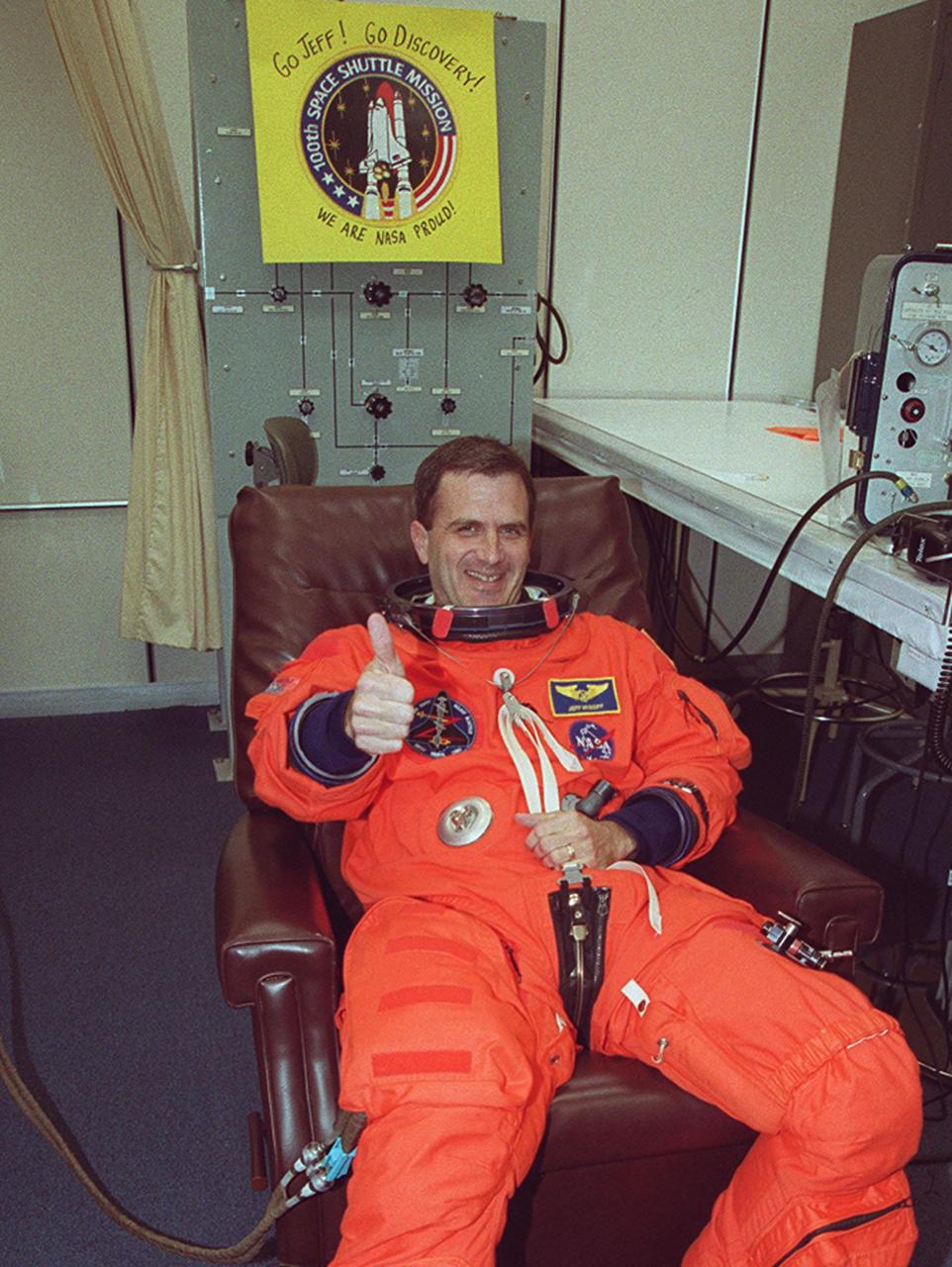
STS-92 Mission Specialist Peter J.K. “Jeff” Wisoff looks relaxed as he signals a thumbs up for launch, scheduled for 8:05 p.m. EDT. The mission is the fifth flight for the construction of the ISS. The payload includes the Integrated Truss Structure Z-1 and the third Pressurized Mating Adapter. During the 11-day mission, four extravehicular activities (EVAs), or spacewalks, are planned. The Z-1 truss is the first of 10 that will become the backbone of the International Space Station, eventually stretching the length of a football field. PMA-3 will provide a Shuttle docking port for solar array installation on the sixth ISS flight and Lab installation on the seventh ISS flight. This launch is the fourth for Wisoff. Landing is expected Oct. 21 at 3:55 p.m. EDT
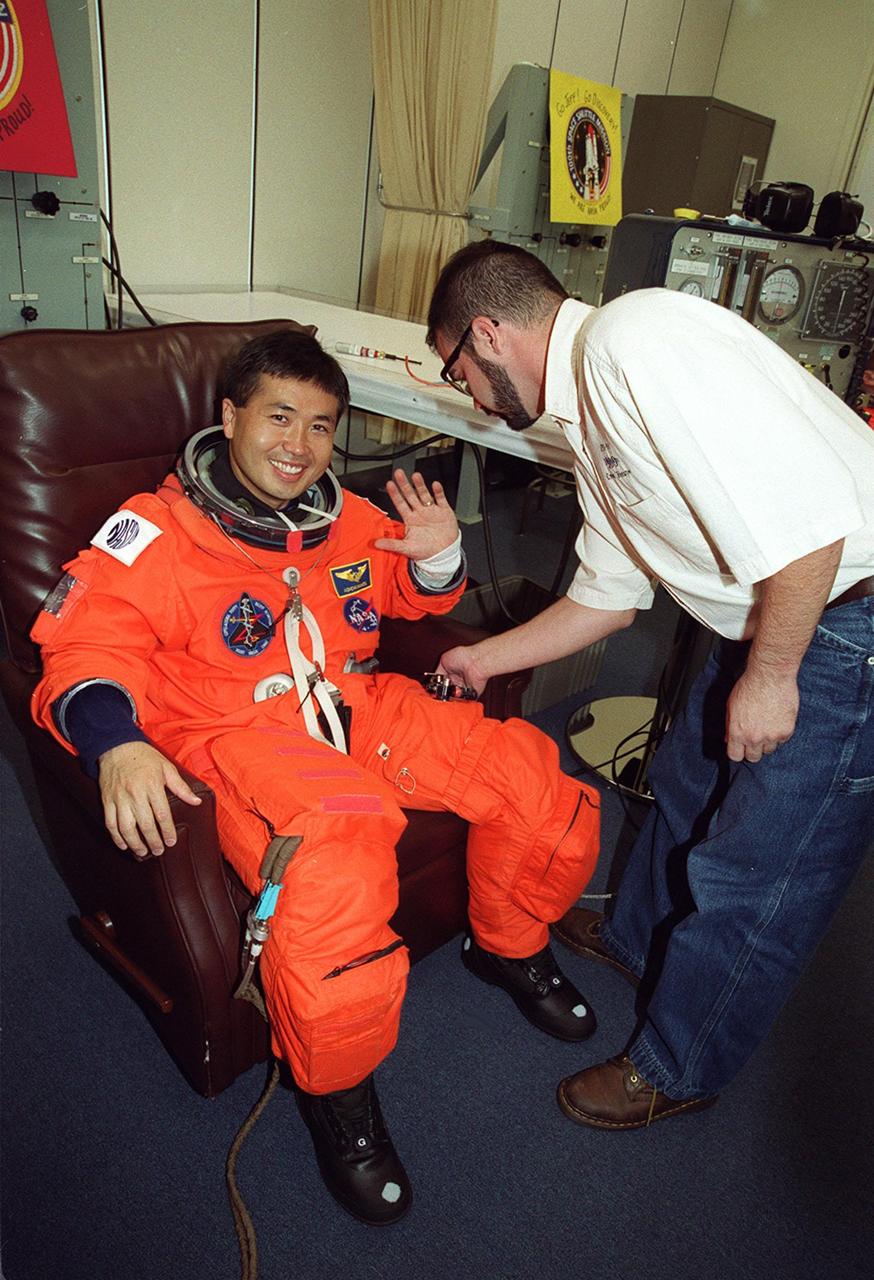
STS-92 Mission Specialist Koichi Wakata of Japan waves while his launch and entry suit is checked during suitup for launch, scheduled for 8:05 p.m. EDT. The mission is the fifth flight for the construction of the ISS. The payload includes the Integrated Truss Structure Z-1 and the third Pressurized Mating Adapter. During the 11-day mission, four extravehicular activities (EVAs), or spacewalks, are planned. The Z-1 truss is the first of 10 that will become the backbone of the International Space Station, eventually stretching the length of a football field. PMA-3 will provide a Shuttle docking port for solar array installation on the sixth ISS flight and Lab installation on the seventh ISS flight. This launch is the second for Wakata. Landing is expected Oct. 21 at 3:55 p.m. EDT
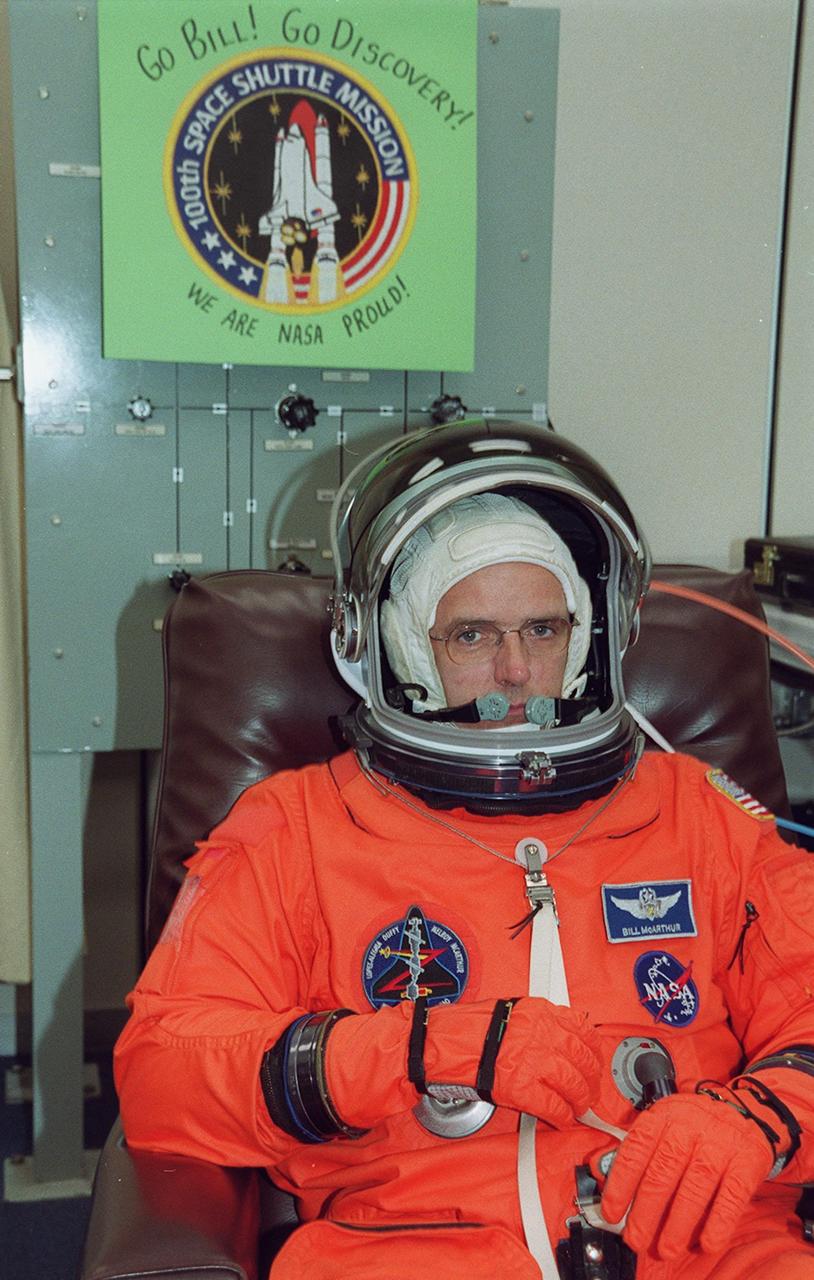
STS-92 Mission Specialist William S. McArthur Jr. signals thumbs up for launch, scheduled for 8:05 p.m. EDT. The mission is the fifth flight for the construction of the ISS. The payload includes the Integrated Truss Structure Z-1 and the third Pressurized Mating Adapter. During the 11-day mission, four extravehicular activities (EVAs), or spacewalks, are planned. The Z-1 truss is the first of 10 that will become the backbone of the International Space Station, eventually stretching the length of a football field. PMA-3 will provide a Shuttle docking port for solar array installation on the sixth ISS flight and Lab installation on the seventh ISS flight. This launch is the third for McArthur. Landing is expected Oct. 21 at 3:55 p.m. EDT
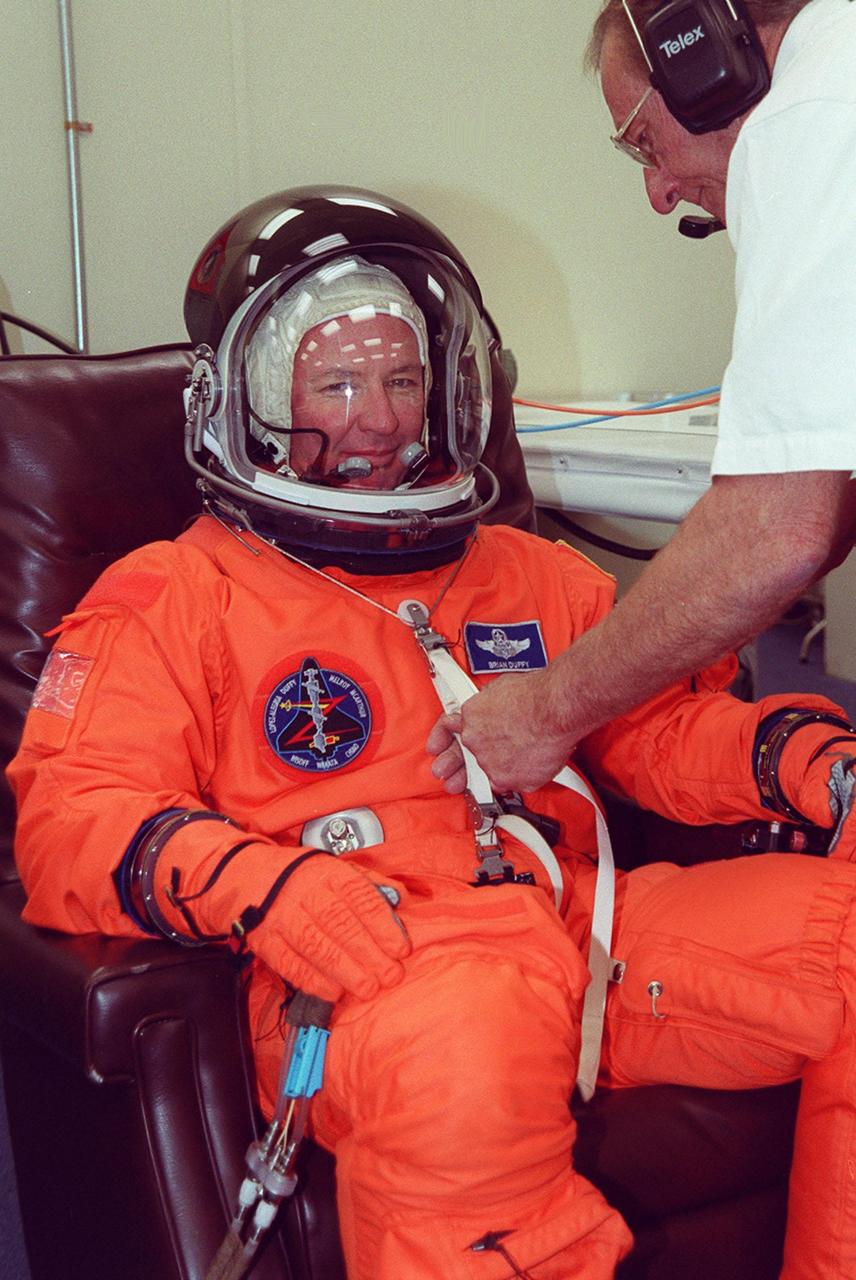
STS-92 Commander Brian Duffy has his launch and entry suit checked before launch, scheduled for 8:05 p.m. EDT. The mission is the fifth flight for the construction of the ISS. The payload includes the Integrated Truss Structure Z-1 and the third Pressurized Mating Adapter. During the 11-day mission, four extravehicular activities (EVAs), or spacewalks, are planned. The Z-1 truss is the first of 10 that will become the backbone of the International Space Station, eventually stretching the length of a football field. PMA-3 will provide a Shuttle docking port for solar array installation on the sixth ISS flight and Lab installation on the seventh ISS flight. This launch is the fourth for Duffy. Landing is expected Oct. 21 at 3:55 p.m. EDT
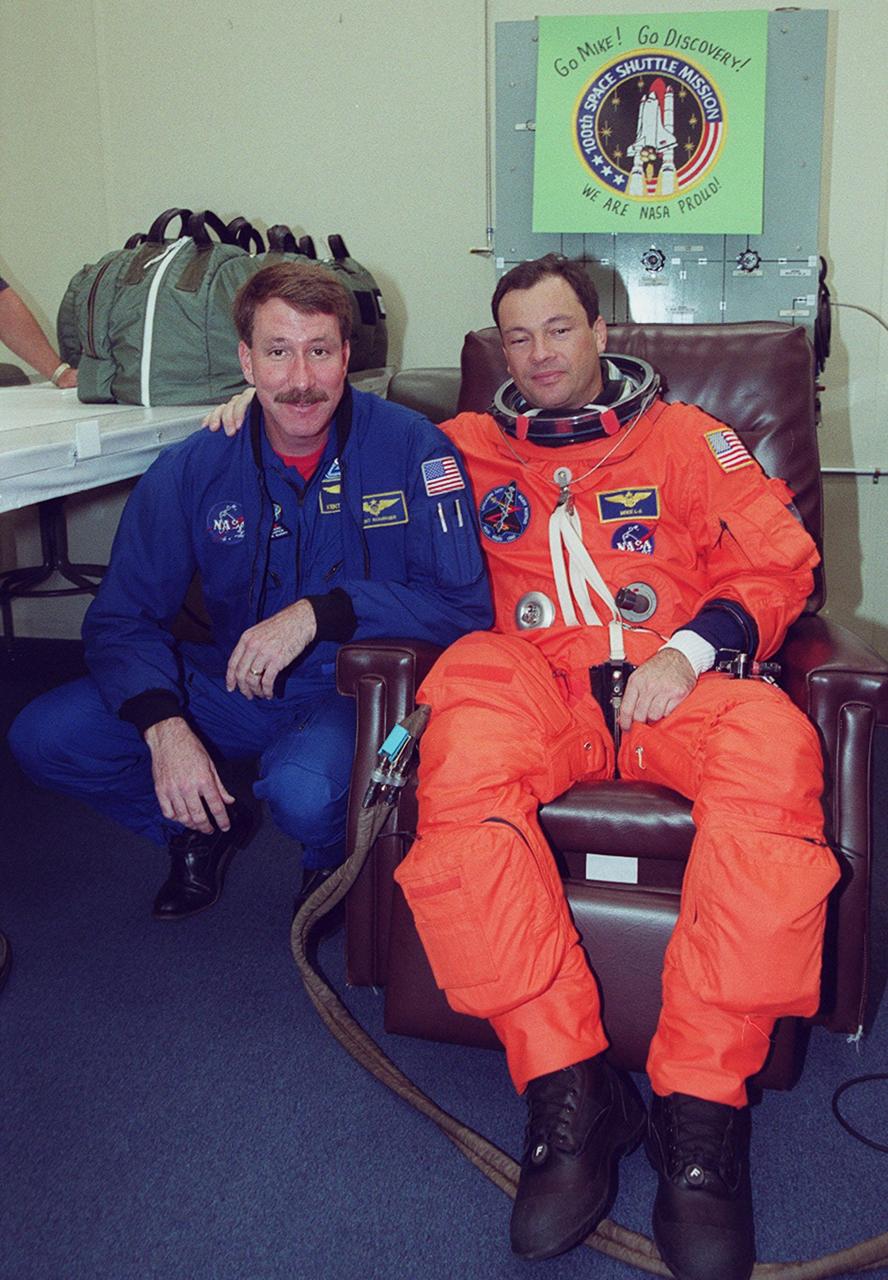
STS-92 Mission Specialist Michael E. Lopez-Alegria (right) is visited by astronaut Kent Rominger (left), who was recently named Commander of the STS-100 mission. Lopez-Alegria is getting suited up for launch on mission STS-92, scheduled for 8:05 p.m. EDT. The mission is the fifth flight for the construction of the ISS. The payload includes the Integrated Truss Structure Z-1 and the third Pressurized Mating Adapter. During the 11-day mission, four extravehicular activities (EVAs), or spacewalks, are planned. The Z-1 truss is the first of 10 that will become the backbone of the International Space Station, eventually stretching the length of a football field. PMA-3 will provide a Shuttle docking port for solar array installation on the sixth ISS flight and Lab installation on the seventh ISS flight. This launch is the second for Lopez-Alegria. Landing is expected Oct. 21 at 3:55 p.m. EDT

STS-92 Mission Specialist Leroy Chiao signals thumbs up for launch, scheduled for 8:05 p.m. EDT. The mission is the fifth flight for the construction of the ISS. The payload includes the Integrated Truss Structure Z-1 and the third Pressurized Mating Adapter. During the 11-day mission, four extravehicular activities (EVAs), or spacewalks, are planned. The Z-1 truss is the first of 10 that will become the backbone of the International Space Station, eventually stretching the length of a football field. PMA-3 will provide a Shuttle docking port for solar array installation on the sixth ISS flight and Lab installation on the seventh ISS flight. This launch is the third for Chiao. Landing is expected Oct. 21 at 3:55 p.m. EDT
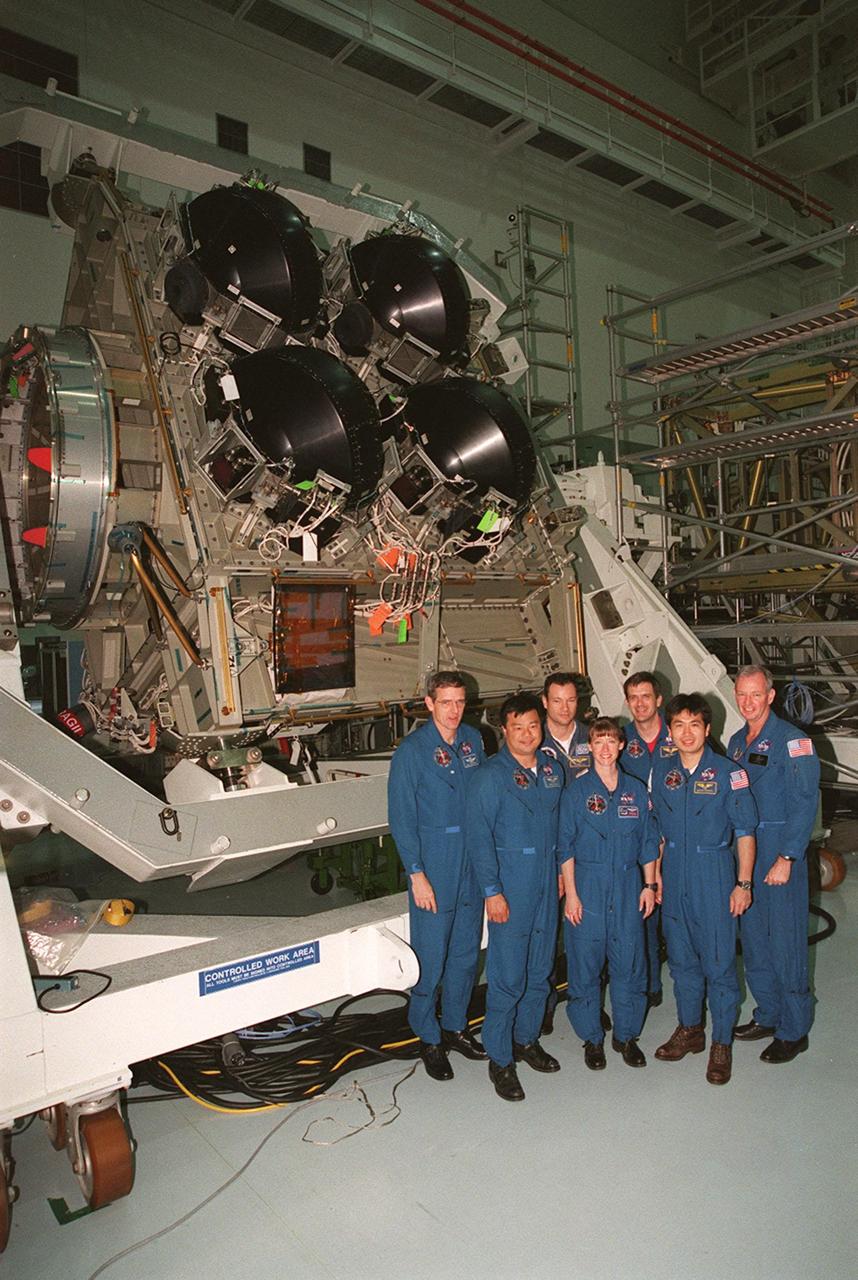
KENNEDY SPACE CENTER, FLA. -- The STS-92 crew pose in front of the Integrated Truss Structure Z1, an element of the International Space Station that will be part of the mission payload. STS-92 is the fifth U.S. flight in the construction of the International Space Station. Standing left to right are Mission Specialists William S. McArthur Jr., Leroy Chiao, and Michael E. Lopez-Alegria; Pilot Pamela A. Melroy; Mission Specialists Peter J.K. Wisoff and Koichi Wakata; and Commander Brian Duffy. Wakata is with the National Space Development Agency of Japan. The Z1 is an early exterior framework to allow the first U.S. solar arrays on a future flight to be temporarily installed on Unity for early power. Another part of the payload is a pressurized mating adapter, PMA-3, to provide a Shuttle docking port for solar array installation on the sixth ISS flight and Lab installation on the seventh ISS flight. Launch of STS-92 is scheduled for Sept. 21, 2000
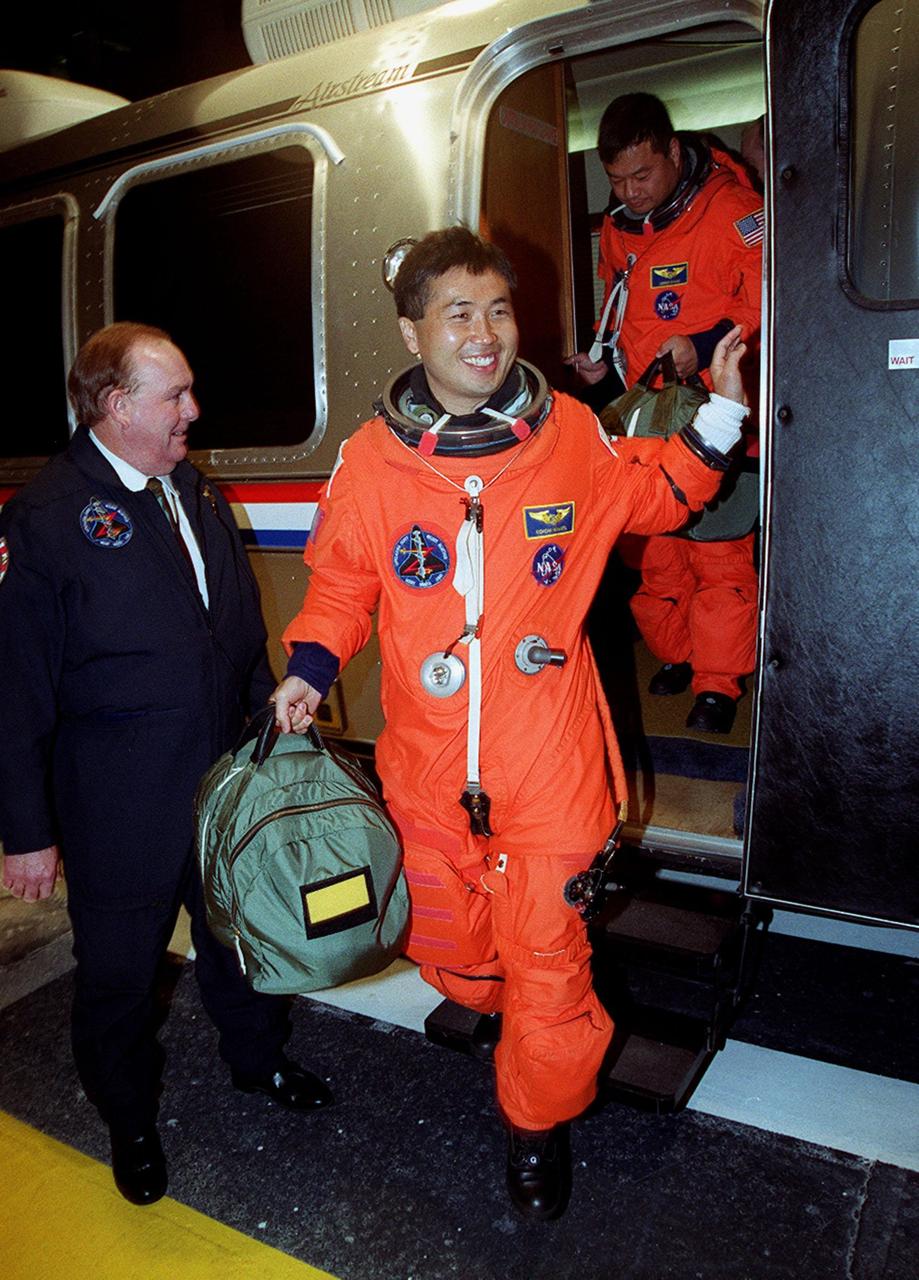
STS-92 Mission Specialist Koichi Wakata of Japan exits the Astrovan on its return to the Operations and Checkout Building. Behind him is Mission Specialist Leroy Chiao. The scheduled launch to the International Space Station (ISS) was scrubbed about 90 minutes before liftoff. The mission will be the fifth flight for the construction of the ISS. The payload includes the Integrated Truss Structure Z-1 and the third Pressurized Mating Adapter. During the 11-day mission, four extravehicular activities (EVAs), or spacewalks, are planned. The Z-1 truss is the first of 10 that will become the backbone of the International Space Station, eventually stretching the length of a football field. PMA-3 will provide a Shuttle docking port for solar array installation on the sixth ISS flight and Lab installation on the seventh ISS flight. The launch has been rescheduled for liftoff Oct. 11 at 7:17 p.m
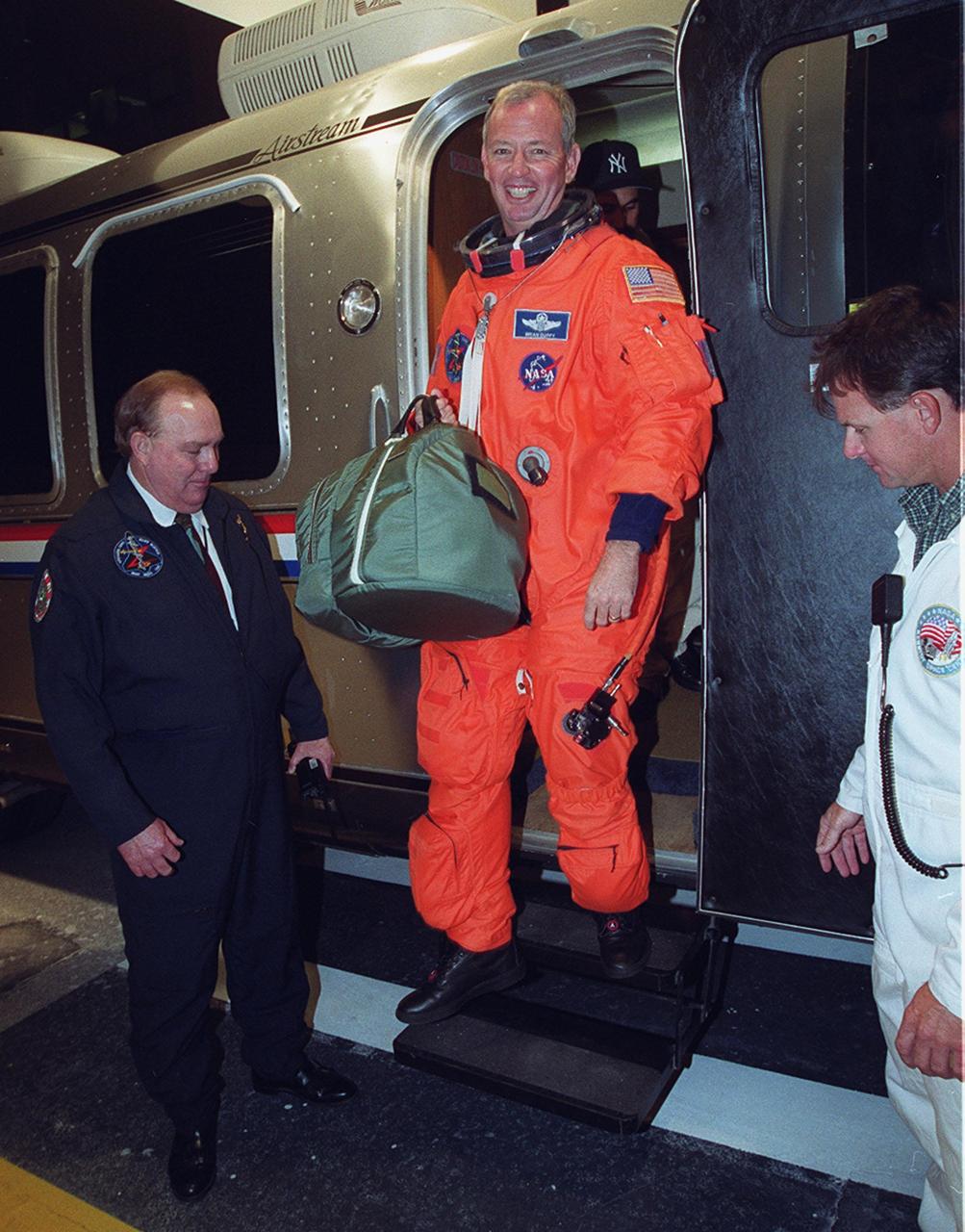
STS-92 Commander Brian Duffy pauses in the door of the Astrovan before exiting at the Operations and Checkout Building. The vehicle is returning the crew after the scheduled launch to the International Space Station (ISS) was scrubbed about 90 minutes before liftoff. The mission will be the fifth flight for the construction of the ISS. The payload includes the Integrated Truss Structure Z-1 and the third Pressurized Mating Adapter. During the 11-day mission, four extravehicular activities (EVAs), or spacewalks, are planned. The Z-1 truss is the first of 10 that will become the backbone of the International Space Station, eventually stretching the length of a football field. PMA-3 will provide a Shuttle docking port for solar array installation on the sixth ISS flight and Lab installation on the seventh ISS flight. The launch has been rescheduled for liftoff Oct. 11 at 7:17 p.m
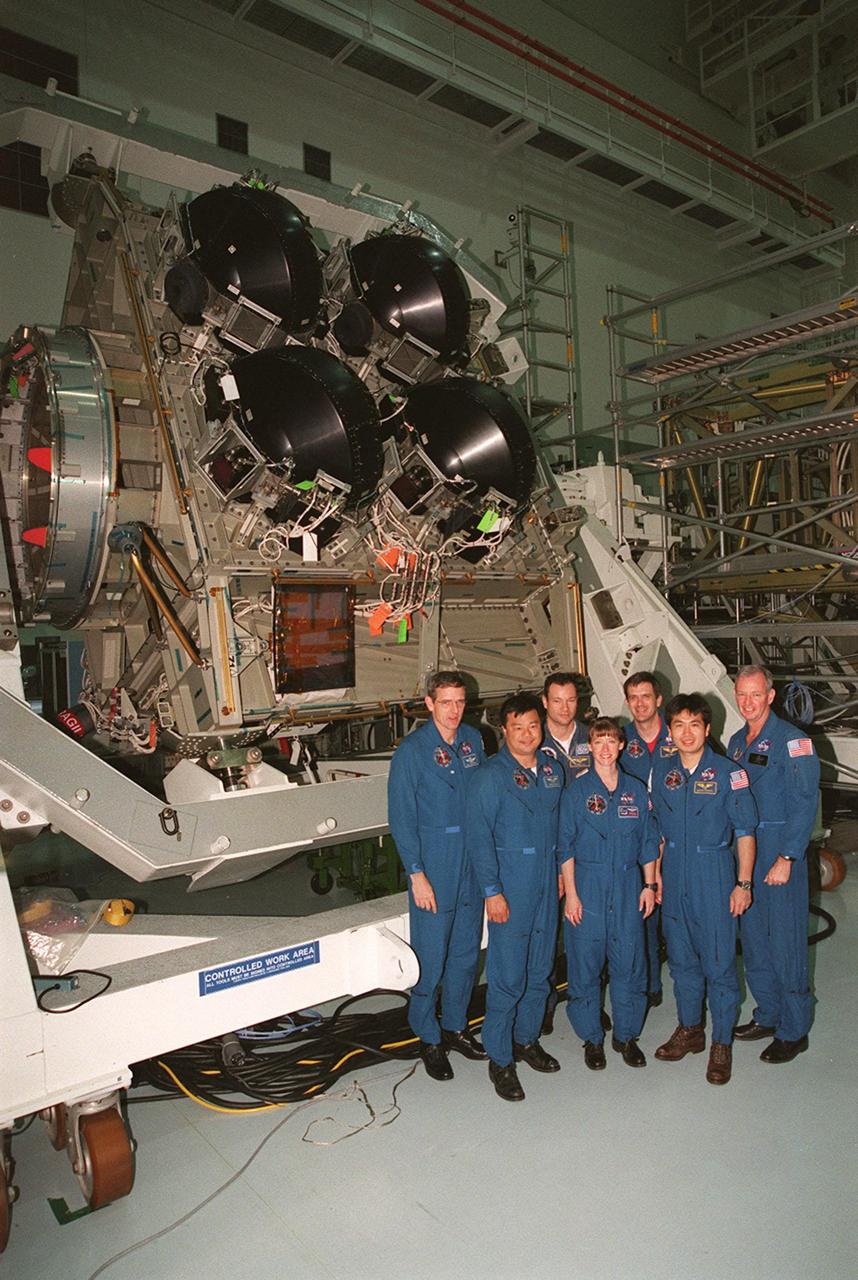
KENNEDY SPACE CENTER, FLA. -- The STS-92 crew pose in front of the Integrated Truss Structure Z1, an element of the International Space Station that will be part of the mission payload. STS-92 is the fifth U.S. flight in the construction of the International Space Station. Standing left to right are Mission Specialists William S. McArthur Jr., Leroy Chiao, and Michael E. Lopez-Alegria; Pilot Pamela A. Melroy; Mission Specialists Peter J.K. Wisoff and Koichi Wakata; and Commander Brian Duffy. Wakata is with the National Space Development Agency of Japan. The Z1 is an early exterior framework to allow the first U.S. solar arrays on a future flight to be temporarily installed on Unity for early power. Another part of the payload is a pressurized mating adapter, PMA-3, to provide a Shuttle docking port for solar array installation on the sixth ISS flight and Lab installation on the seventh ISS flight. Launch of STS-92 is scheduled for Sept. 21, 2000
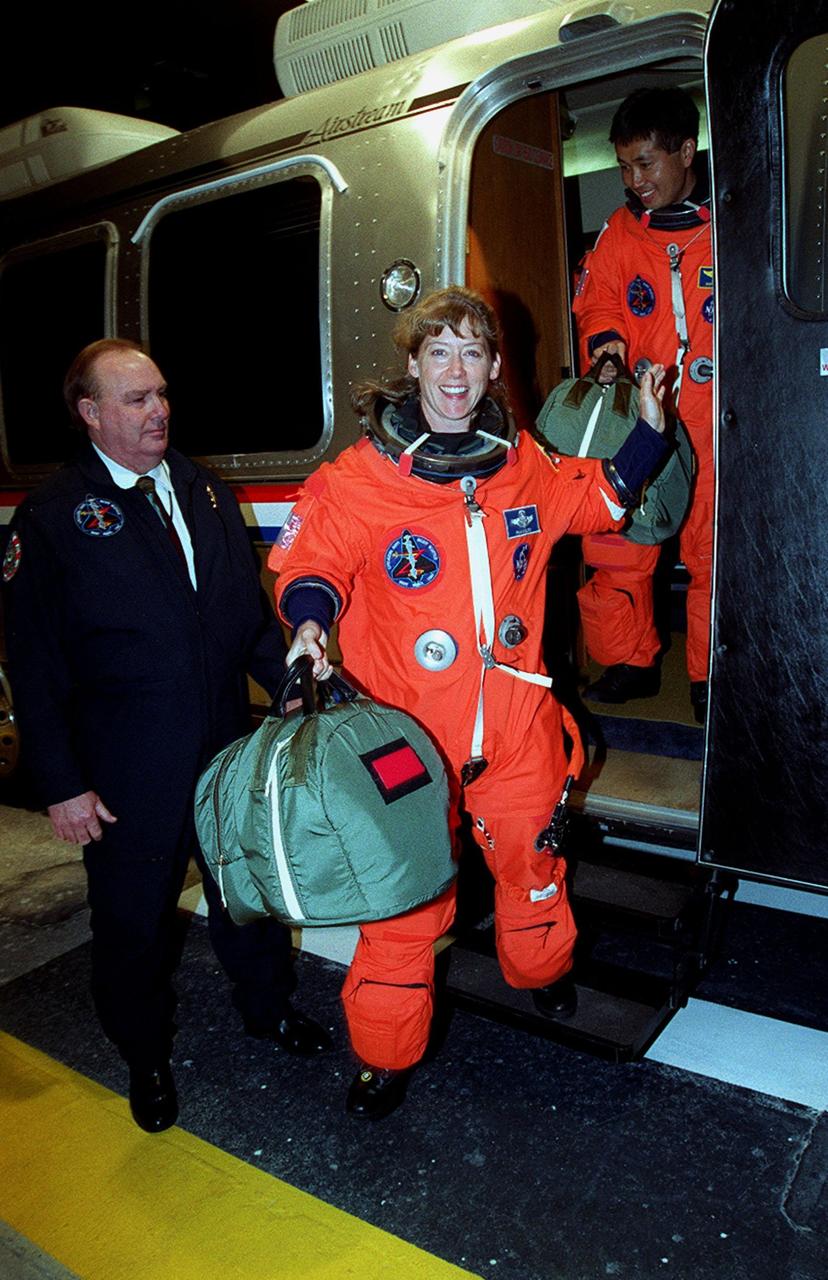
STS-92 Pilot Pamela Ann Melroy exits the Astrovan on its return to the Operations and Checkout Building. Behind her is Mission Specialist Koichi Wakata of Japan. The scheduled launch to the International Space Station (ISS) was scrubbed about 90 minutes before liftoff. The mission will be the fifth flight for the construction of the ISS. The payload includes the Integrated Truss Structure Z-1 and the third Pressurized Mating Adapter. During the 11-day mission, four extravehicular activities (EVAs), or spacewalks, are planned. The Z-1 truss is the first of 10 that will become the backbone of the International Space Station, eventually stretching the length of a football field. PMA-3 will provide a Shuttle docking port for solar array installation on the sixth ISS flight and Lab installation on the seventh ISS flight. The launch has been rescheduled for liftoff Oct. 11 at 7:17 p.m
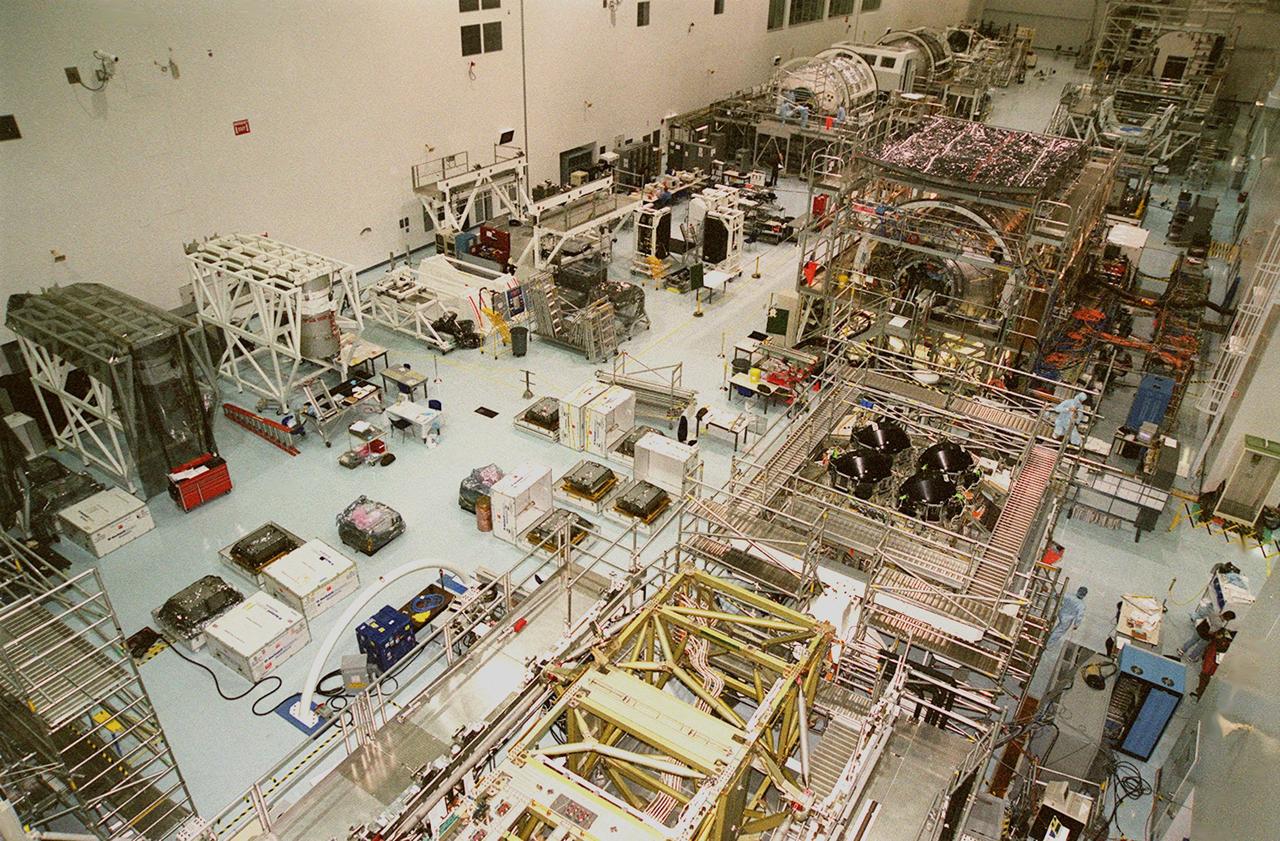
KENNEDY SPACE CENTER, FLA. -- The floor of the Space Station Processing Facility is filled with racks and hardware for testing the various components of the International Space Station (ISS). The large module in the center of the floor (top) is the U.S. Lab, Destiny. Expected to be a major feature in future research, Destiny will provide facilities for biotechnology, fluid physics, combustion, and life sciences research. It is scheduled to be launched on mission STS-98 (no date determined yet for launch). At top left are the Multi-Purpose Logistics Modules Raffaello and Leonardo and the Pressurized Mating Adapter-3 (PMA-3). Italy's major contributions to the ISS program, Raffaello and Leonardo are reusable logistics carriers to resupply and return Station cargo requiring a pressurized environment. They are slated as payloads on missions STS-102 and STS-100, respectively. Dates have not yet been determined for the two missions. The PMA-3, once launched, will be mated to Node 1, a connecting passageway to the living and working areas of the Space Station. The primary purpose of PMA-3 is to serve as a Shuttle docking port through which crew members and equipment will transfer to the Space Station during later assembly missions. PMA-3 is scheduled as payload on mission STS-92, whose date for launch is not yet determined
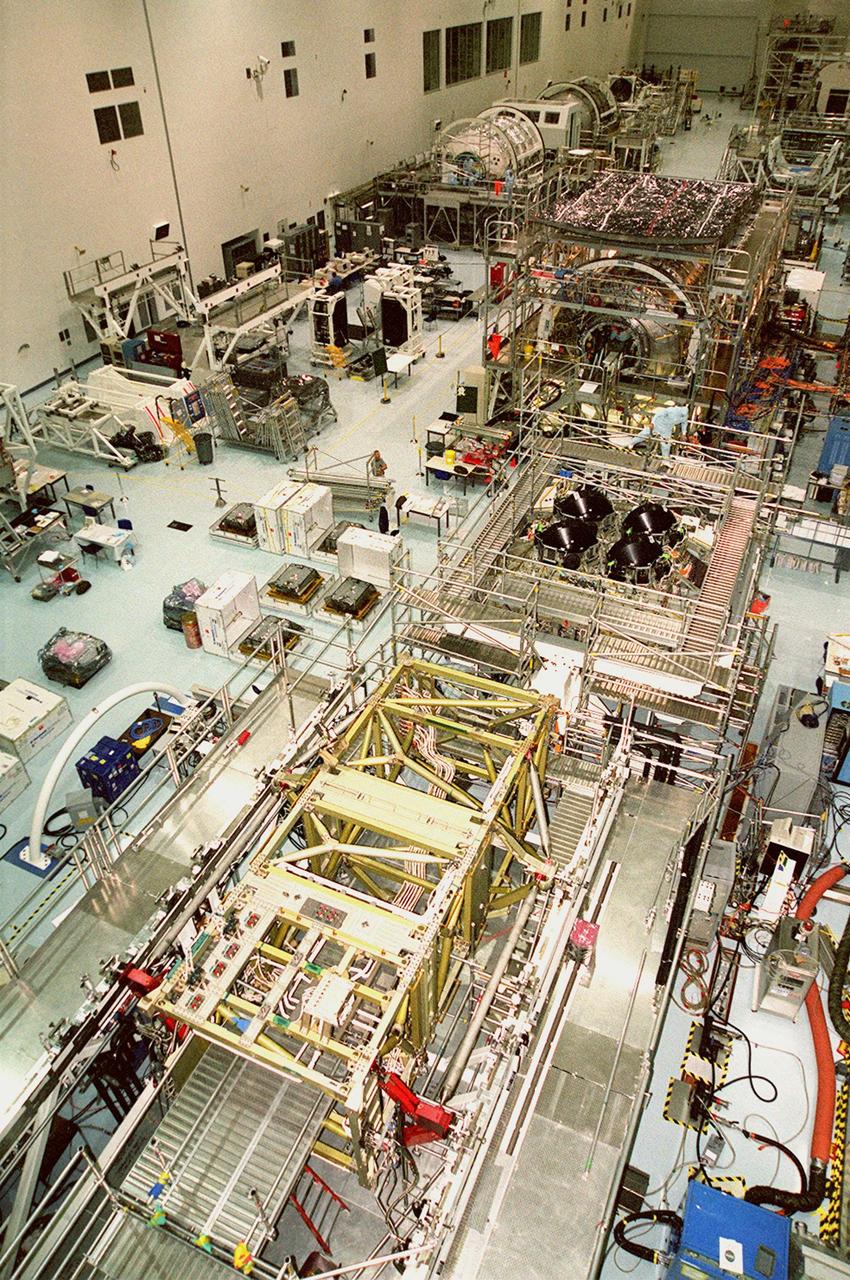
KENNEDY SPACE CENTER, FLA. -- The floor of the Space Station Processing Facility is filled with racks and hardware for testing the various components of the International Space Station (ISS). The large module in the center of the floor (top) is the U.S. Lab, Destiny. The U.S. Laboratory module continues a long tradition of microgravity materials research, first conducted by Skylab and later Shuttle and Spacelab missions. Destiny is expected to be a major feature in future research, providing facilities for biotechnology, fluid physics, combustion, and life sciences research. It is scheduled to be launched on mission STS-98 (no date determined yet for launch). At top left are the Multi-Purpose Logistics Modules Raffaello and Leonardo and the Pressurized Mating Adapter-3 (PMA-3). Italy's major contributions to the ISS program, Raffaello and Leonardo are reusable logistics carriers to resupply and return Station cargo requiring a pressurized environment. They are slated as payloads on missions STS-102 and STS-100, respectively. Dates have not yet been determined for the two missions. The PMA-3, once launched, will be mated to Node 1, a connecting passageway to the living and working areas of the Space Station. The primary purpose of PMA-3 is to serve as a Shuttle docking port through which crew members and equipment will transfer to the Space Station during later assembly missions. PMA-3 is scheduled as payload on mission STS-92, whose date for launch is not yet determined
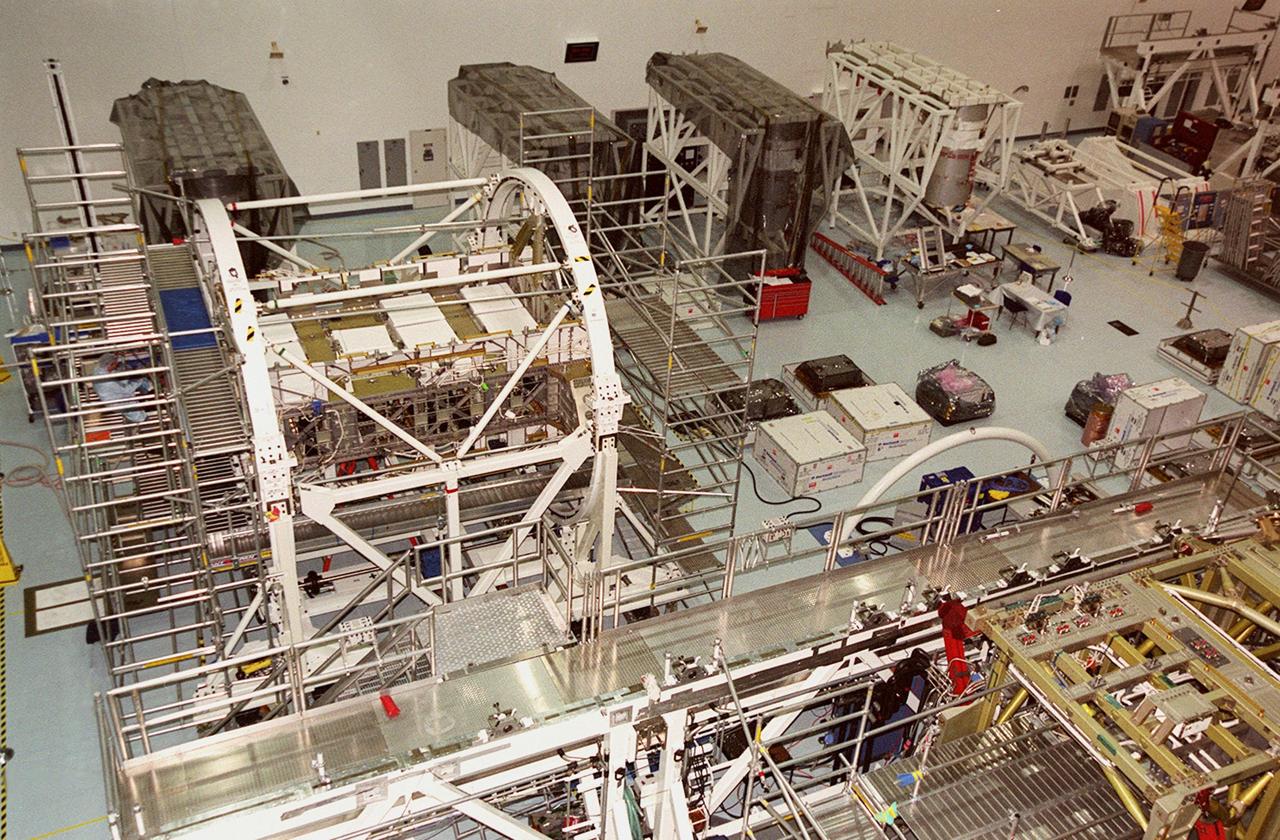
KENNEDY SPACE CENTER, FLA. -- The floor of the Space Station Processing Facility is filled with racks and hardware for testing the various components of the International Space Station (ISS). The large module in the center of the floor (top) is the U.S. Lab, Destiny. Expected to be a major feature in future research, Destiny will provide facilities for biotechnology, fluid physics, combustion, and life sciences research. It is scheduled to be launched on mission STS-98 (no date determined yet for launch). At top left are the Multi-Purpose Logistics Modules Raffaello and Leonardo and the Pressurized Mating Adapter-3 (PMA-3). Italy's major contributions to the ISS program, Raffaello and Leonardo are reusable logistics carriers to resupply and return Station cargo requiring a pressurized environment. They are slated as payloads on missions STS-102 and STS-100, respectively. Dates have not yet been determined for the two missions. The PMA-3, once launched, will be mated to Node 1, a connecting passageway to the living and working areas of the Space Station. The primary purpose of PMA-3 is to serve as a Shuttle docking port through which crew members and equipment will transfer to the Space Station during later assembly missions. PMA-3 is scheduled as payload on mission STS-92, whose date for launch is not yet determined

KENNEDY SPACE CENTER, FLA. -- The floor of the Space Station Processing Facility is filled with racks and hardware for testing the various components of the International Space Station (ISS). The large module in the center of the floor (top) is the U.S. Lab, Destiny. Expected to be a major feature in future research, Destiny will provide facilities for biotechnology, fluid physics, combustion, and life sciences research. It is scheduled to be launched on mission STS-98 (no date determined yet for launch). At top left are the Multi-Purpose Logistics Modules Raffaello and Leonardo and the Pressurized Mating Adapter-3 (PMA-3). Italy's major contributions to the ISS program, Raffaello and Leonardo are reusable logistics carriers to resupply and return Station cargo requiring a pressurized environment. They are slated as payloads on missions STS-102 and STS-100, respectively. Dates have not yet been determined for the two missions. The PMA-3, once launched, will be mated to Node 1, a connecting passageway to the living and working areas of the Space Station. The primary purpose of PMA-3 is to serve as a Shuttle docking port through which crew members and equipment will transfer to the Space Station during later assembly missions. PMA-3 is scheduled as payload on mission STS-92, whose date for launch is not yet determined
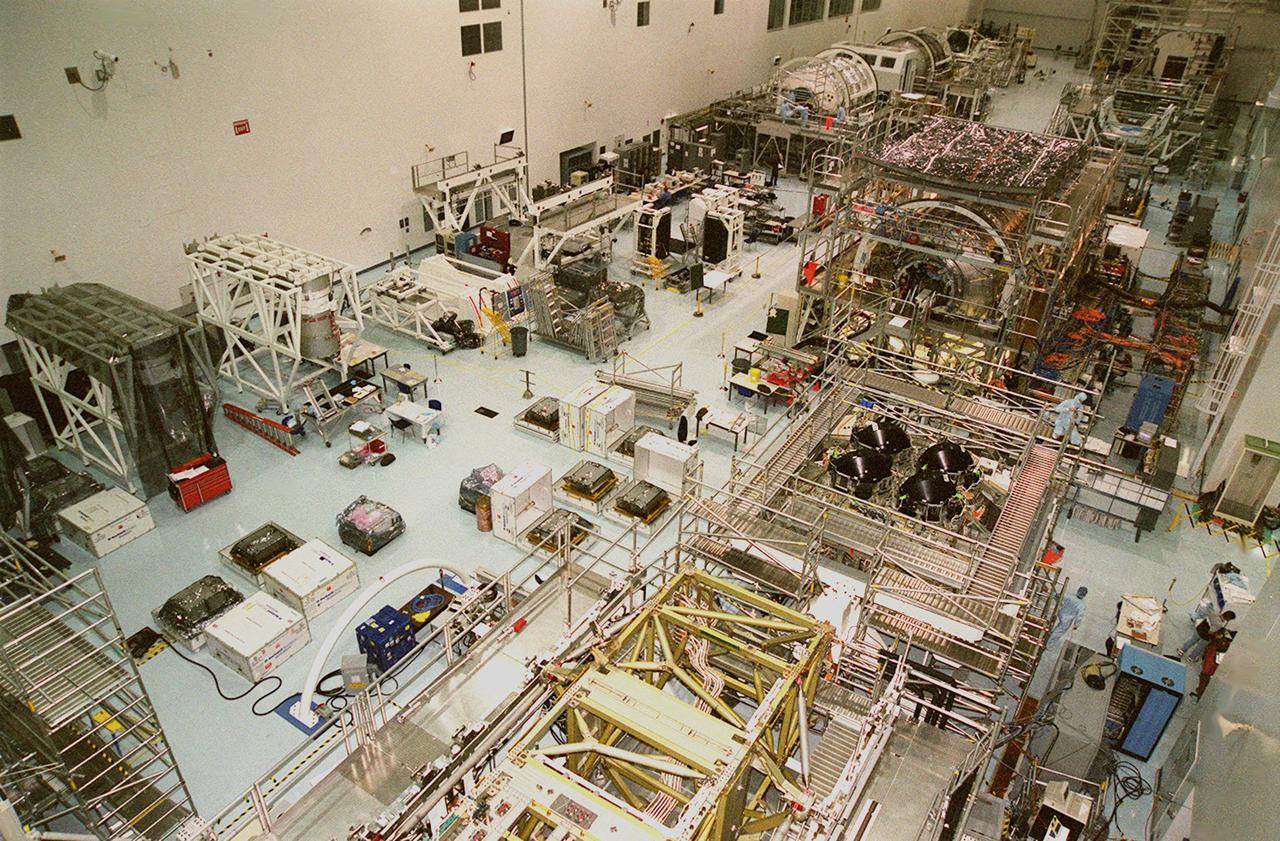
KENNEDY SPACE CENTER, FLA. -- The floor of the Space Station Processing Facility is filled with racks and hardware for testing the various components of the International Space Station (ISS). The large module in the center of the floor (top) is the U.S. Lab, Destiny. Expected to be a major feature in future research, Destiny will provide facilities for biotechnology, fluid physics, combustion, and life sciences research. It is scheduled to be launched on mission STS-98 (no date determined yet for launch). At top left are the Multi-Purpose Logistics Modules Raffaello and Leonardo and the Pressurized Mating Adapter-3 (PMA-3). Italy's major contributions to the ISS program, Raffaello and Leonardo are reusable logistics carriers to resupply and return Station cargo requiring a pressurized environment. They are slated as payloads on missions STS-102 and STS-100, respectively. Dates have not yet been determined for the two missions. The PMA-3, once launched, will be mated to Node 1, a connecting passageway to the living and working areas of the Space Station. The primary purpose of PMA-3 is to serve as a Shuttle docking port through which crew members and equipment will transfer to the Space Station during later assembly missions. PMA-3 is scheduled as payload on mission STS-92, whose date for launch is not yet determined
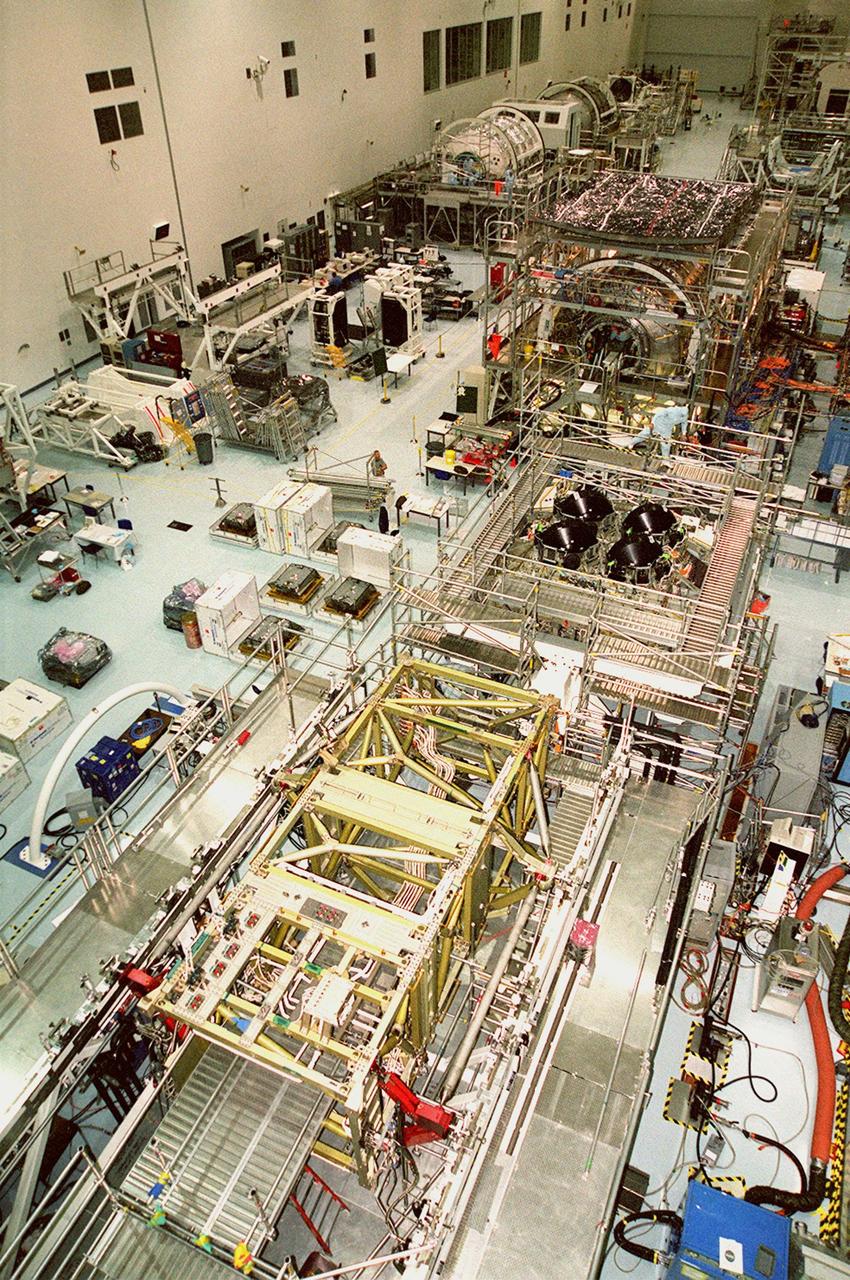
KENNEDY SPACE CENTER, FLA. -- The floor of the Space Station Processing Facility is filled with racks and hardware for testing the various components of the International Space Station (ISS). The large module in the center of the floor (top) is the U.S. Lab, Destiny. The U.S. Laboratory module continues a long tradition of microgravity materials research, first conducted by Skylab and later Shuttle and Spacelab missions. Destiny is expected to be a major feature in future research, providing facilities for biotechnology, fluid physics, combustion, and life sciences research. It is scheduled to be launched on mission STS-98 (no date determined yet for launch). At top left are the Multi-Purpose Logistics Modules Raffaello and Leonardo and the Pressurized Mating Adapter-3 (PMA-3). Italy's major contributions to the ISS program, Raffaello and Leonardo are reusable logistics carriers to resupply and return Station cargo requiring a pressurized environment. They are slated as payloads on missions STS-102 and STS-100, respectively. Dates have not yet been determined for the two missions. The PMA-3, once launched, will be mated to Node 1, a connecting passageway to the living and working areas of the Space Station. The primary purpose of PMA-3 is to serve as a Shuttle docking port through which crew members and equipment will transfer to the Space Station during later assembly missions. PMA-3 is scheduled as payload on mission STS-92, whose date for launch is not yet determined
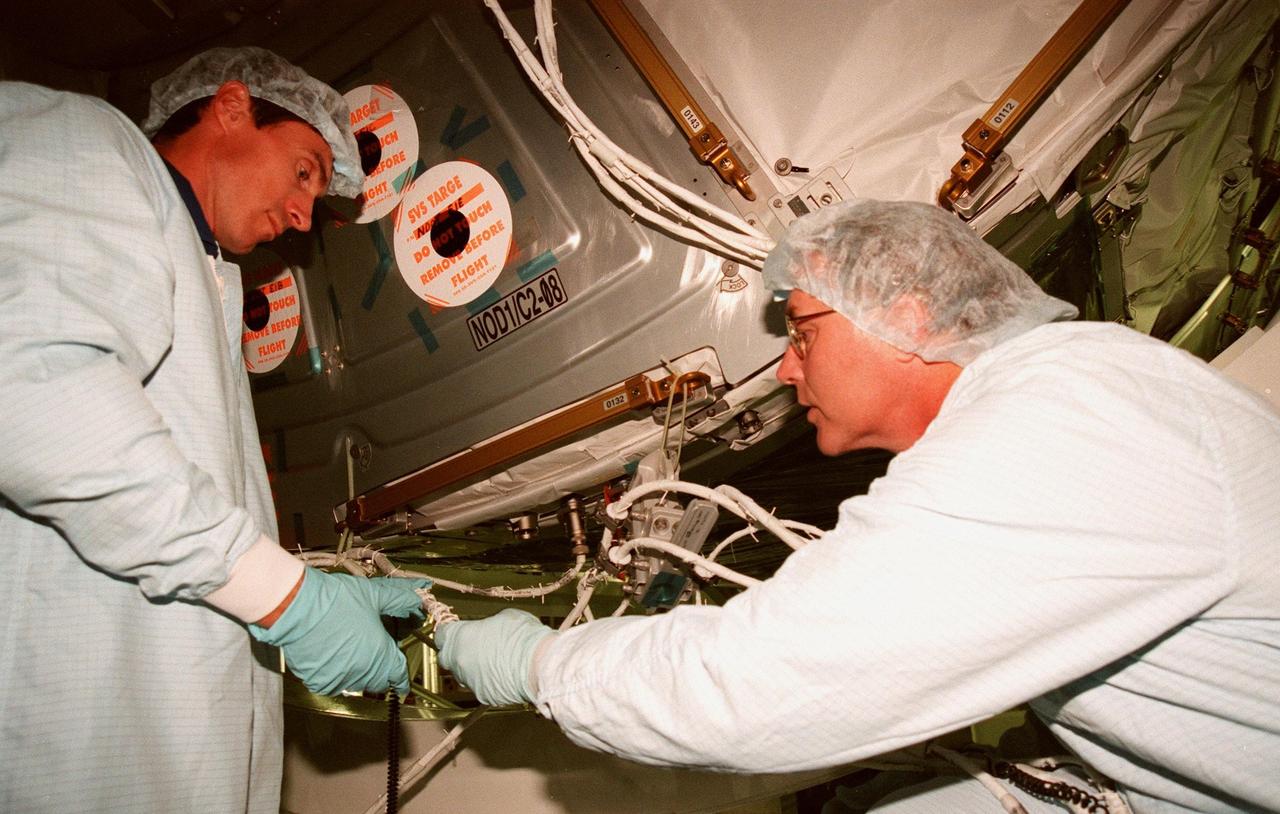
KENNEDY SPACE CENTER, FLA. -- In the Space Station Processing Facility, STS-88 Mission Specialists Sergei Krikalev, a Russian cosmonaut, and Jerry L. Ross check out equipment on the Unity connecting module, primary payload on the mission. The STS-88 crew members are participating in a Crew Equipment Interface Test (CEIT), familiarizing themselves with the orbiter's midbody and crew compartments. Scheduled for launch on Dec. 3, 1998, STS-88 will be the first Space Shuttle launch for the International Space Station. The Unity connecting module will be mated to the Russian-built Zarya control module, already on orbit after a November launch. Unity will have two Pressurized Mating Adapters (PMAs) attached and 1 stowage rack installed inside. PMA-1 will connect U.S. and Russian elements; PMA-2 will provide a Shuttle docking location. Eventually, Unity's six ports will provide connecting points for the Z1 truss exterior framework, U.S. lab, airlock, cupola, Node 3, and the Multi-Purpose Logistics Module, as well as the control module. Zarya is a self-supporting active vehicle, providing propulsive control capability and power through the early assembly stages. It provides fuel storage capability and a rendezvous and docking capability to the Service Module
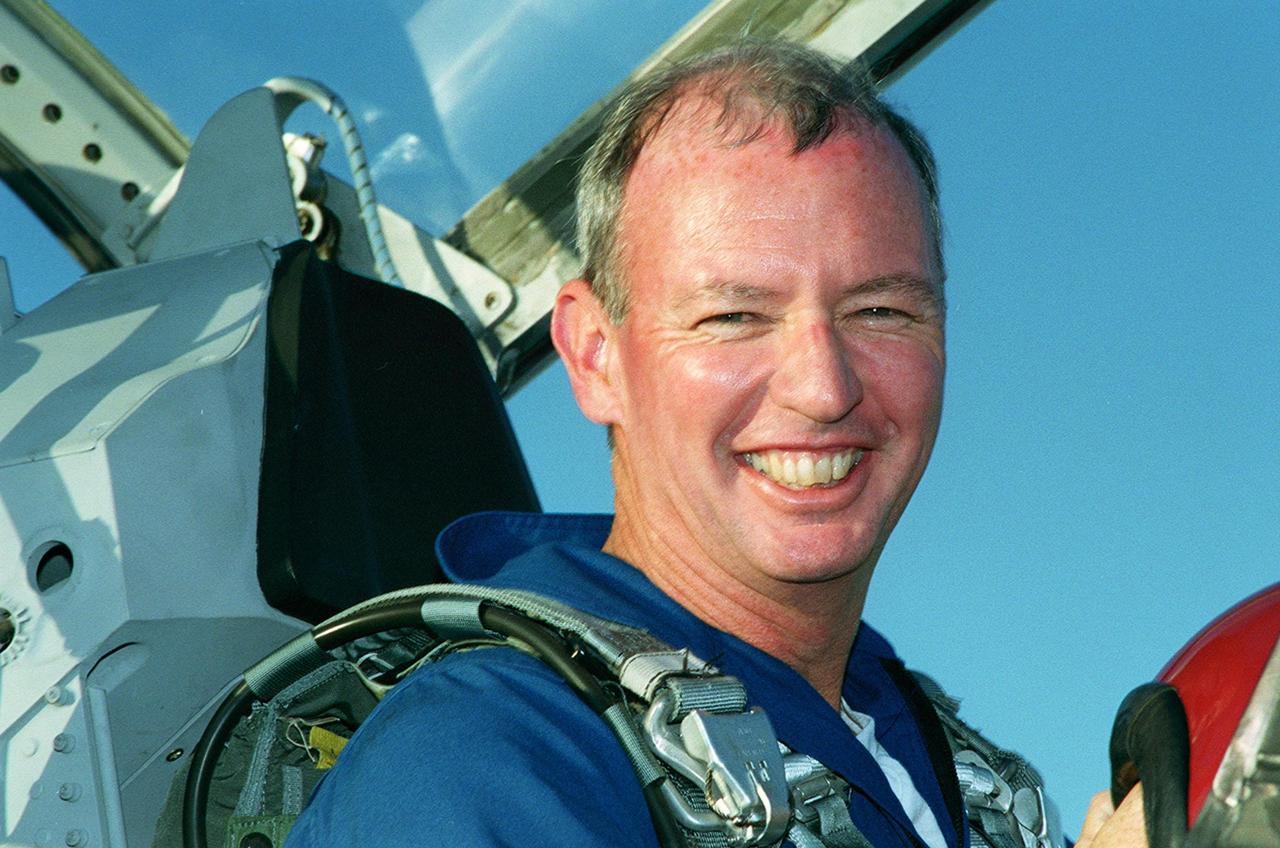
STS-92 Commander Brian Duffy smiles after landing at the KSC Shuttle Landing Facility in a T-38 training jet aircraft. He and the rest of the crew are at KSC to take part in Terminal Countdown Demonstration Test activities, which include emergency egress training from the orbiter and pad, and a simulated countdown. The fifth mission to the International Space Station, STS-92 will carry the Integrated Truss Structure Z1, the first of the planned 10 trusses on the Space Station, and the third Pressurized Mating Adapter. The Z1 will allow the first U.S. solar arrays on a future flight to be temporarily installed on Unity for early power. PMA-3 will provide a Shuttle docking port for the solar array installation on the sixth ISS flight and Lab installation on the seventh ISS flight. STS-92 is scheduled to launch Oct. 5 from launch Pad 39A. It will be the 100th flight in the Shuttle program
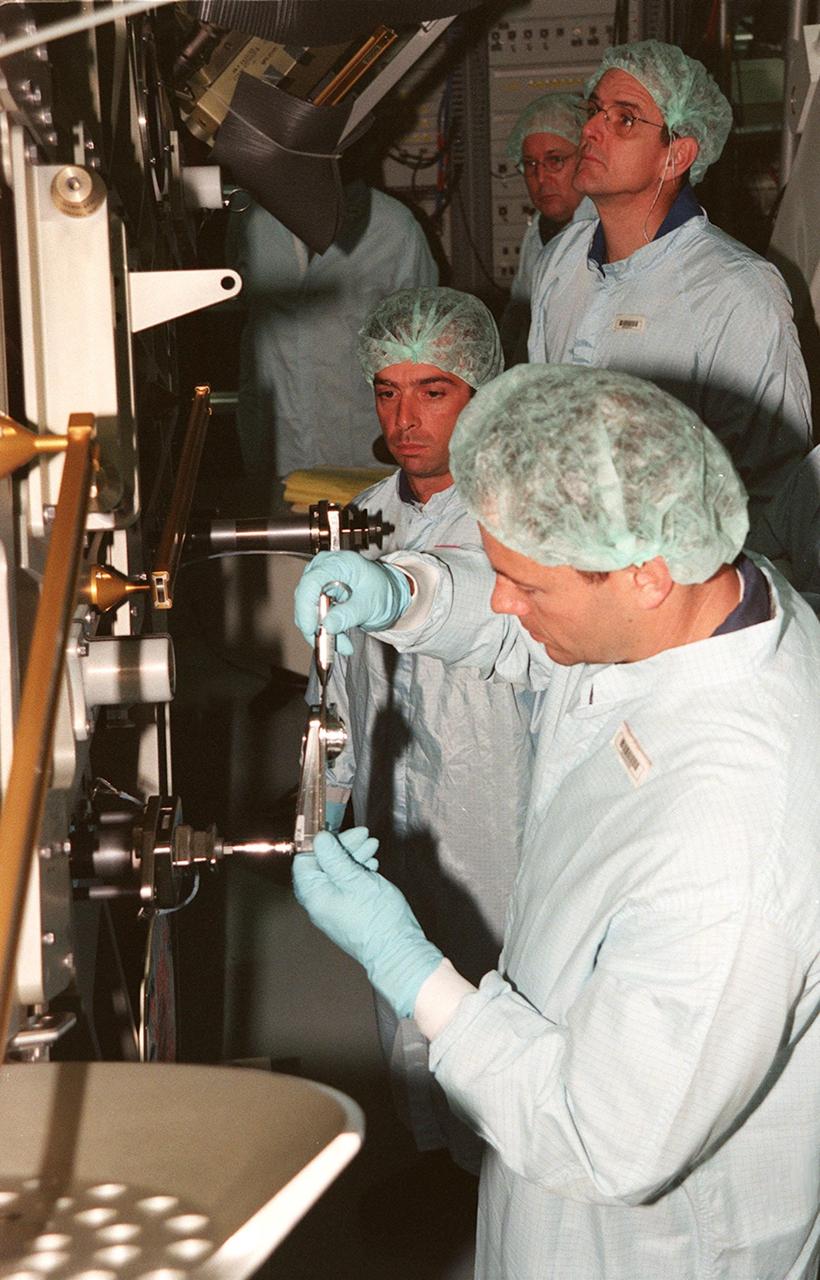
KENNEDY SPACE CENTER, FLA. -- In the Space Station Processing Facility, members of the STS-92 crew get hands-on experience with some of the equipment, such as the Integrated Truss Structure Z1, to fly on their mission. STS-92 is the fifth U.S. flight in the construction of the International Space Station. The Z1 is an early exterior framework to allow the first U.S. solar arrays on a future flight to be temporarily installed on Unity for early power. Another part of the payload is a pressurized mating adapter, PMA-3, to provide a Shuttle docking port for solar array installation on the sixth ISS flight and Lab installation on the seventh ISS flight. The crew comprises Mission Commander Brian Duffy, Pilot Pamela A. Melroy, and Mission Specialists Koichi Wakata, Leroy Chiao, Peter J.K. Wisoff, Michael E. Lopez-Alegria, and William S. McArthur Jr. Wakata is with the National Space Development Agency of Japan. Launch of STS-92 is scheduled for Sept. 21, 2000
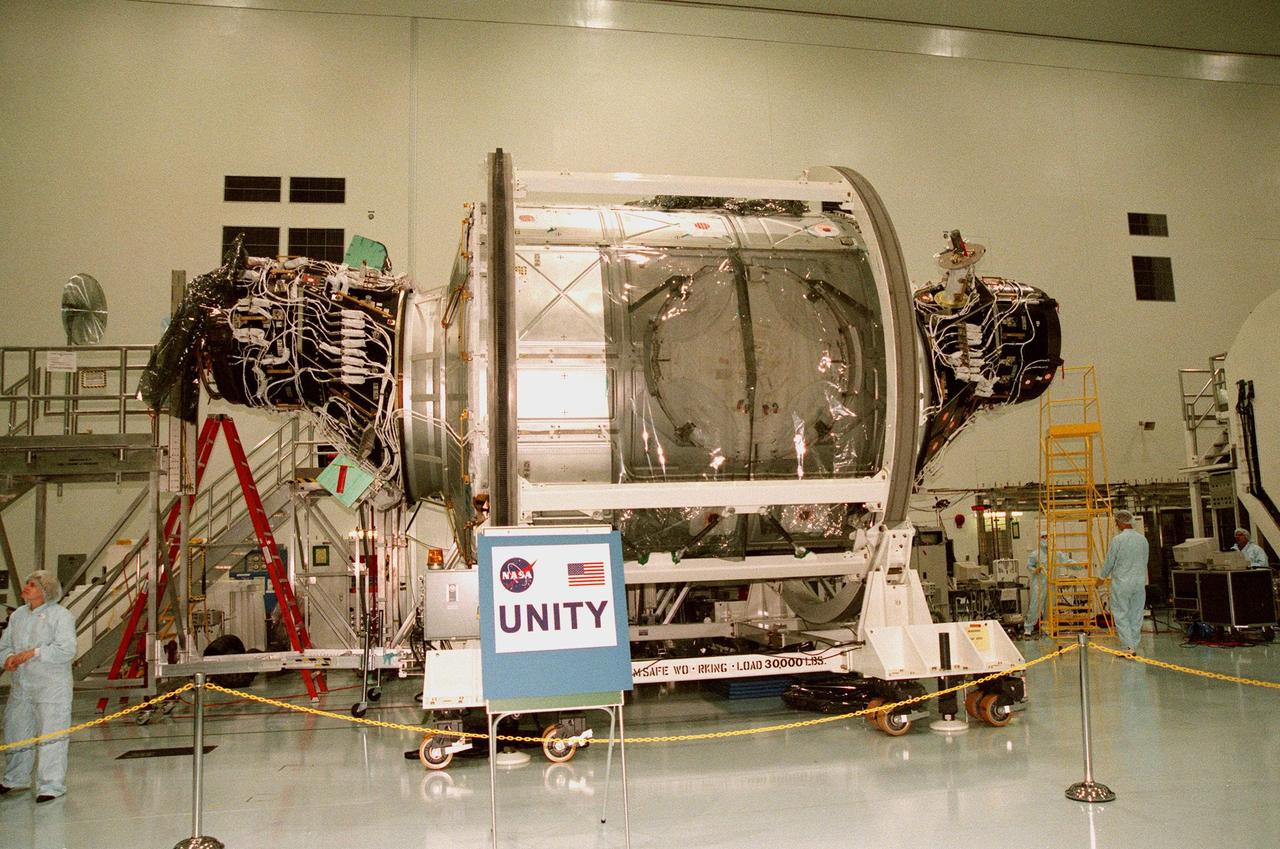
In the Space Station Processing Facility, the Unity connecting module, part of the International Space Station, is shown with Pressurized Mating Adapters 1 (left) and 2 (right) attached. Unity is scheduled to undergo testing of the common berthing mechanism to which other space station elements will dock. Unity is the primary payload on mission STS-88, targeted to launch Dec. 3, 1998. Other testing includes the Pad Demonstration Test to verify the compatibility of the module with the Space Shuttle as well as the ability of the astronauts to send and receive commands to Unity from the flight deck of the orbiter. Unity is expected to be ready for installation into the payload canister on Oct. 25, and transported to Launch Pad 39-A on Oct. 27. The Unity will be mated to the Russian-built Zarya control module which should already be in orbit at that time