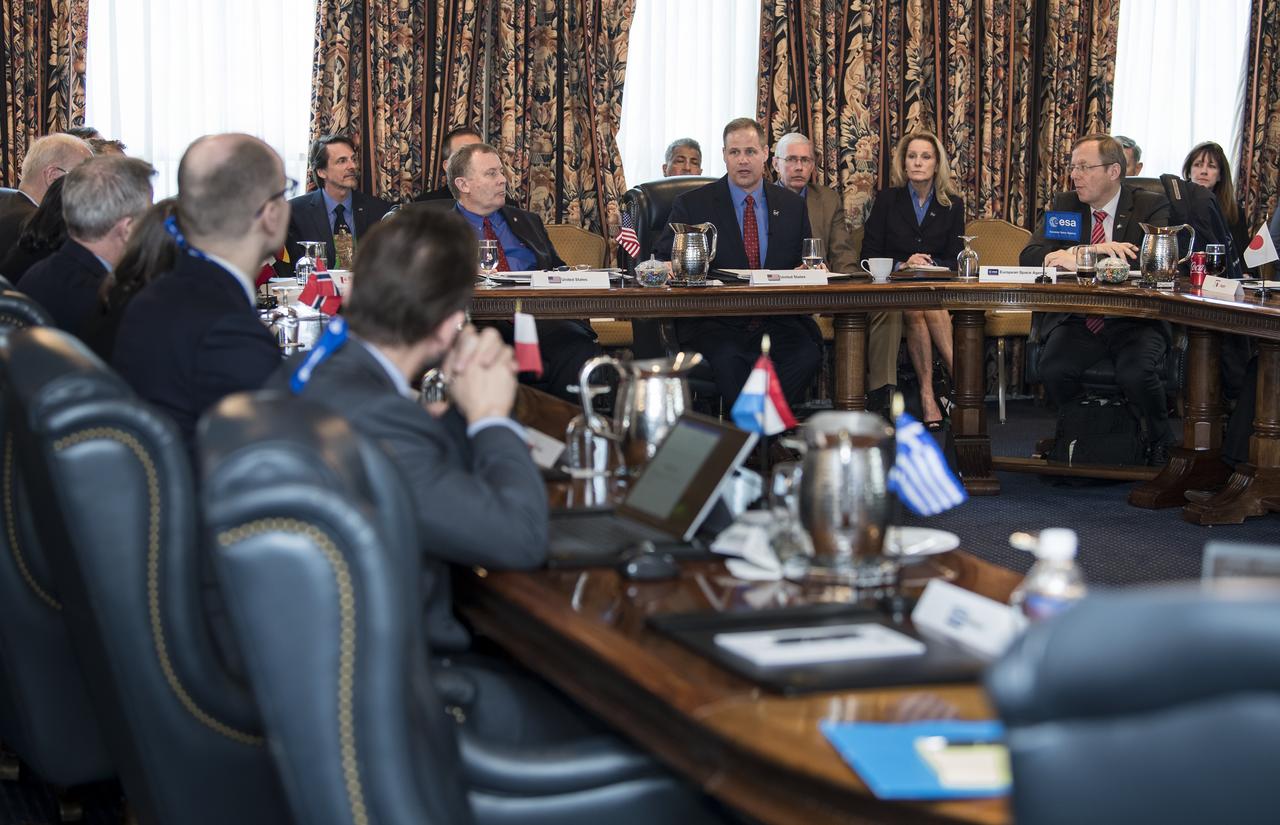
NASA Administrator Jim Bridenstine gives remarks at an International Exploration meeting at the Space Symposium, Tuesday, April 9, 2019, at the Broadmoor Hotel in Colorado Springs, Colorado. NASA employees from NASA centers around the country were in attendance. Photo credit: (NASA/Aubrey Gemignani)
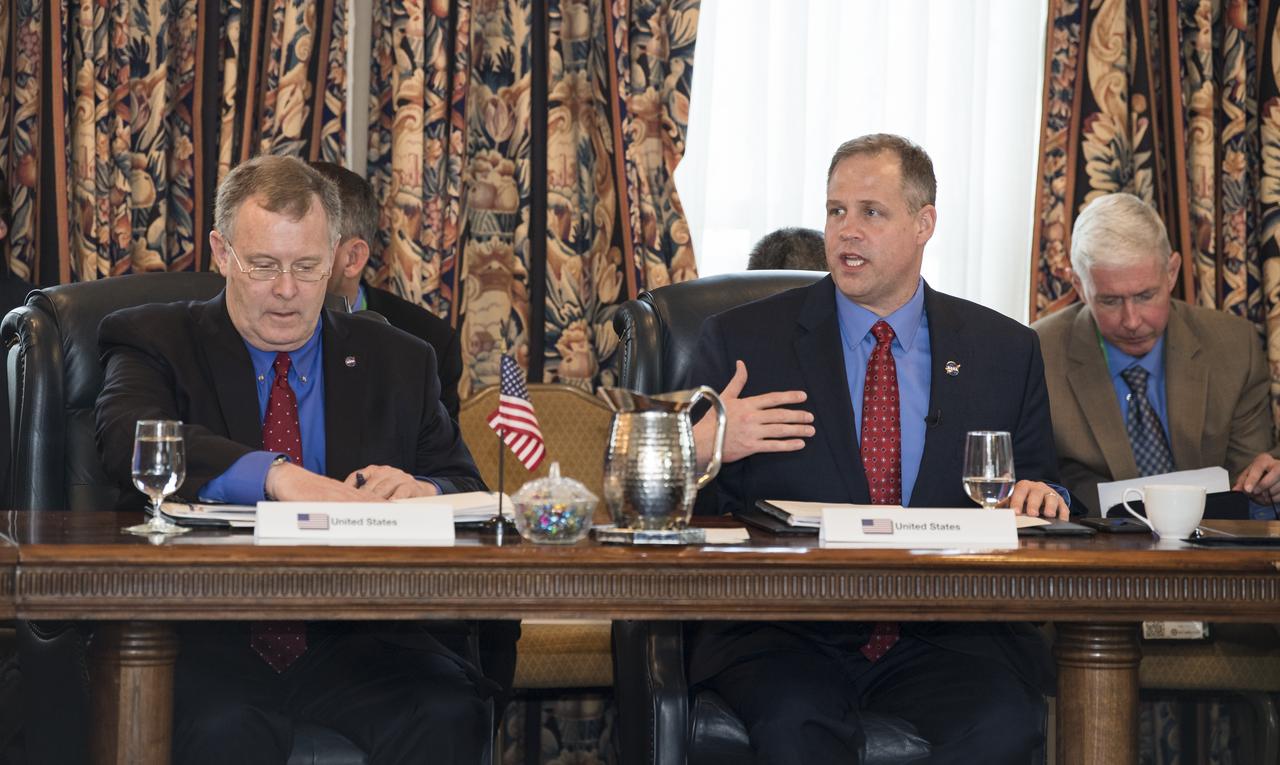
NASA Administrator Jim Bridenstine gives remarks at an International Exploration meeting at the Space Symposium, Tuesday, April 9, 2019, at the Broadmoor Hotel in Colorado Springs, Colorado. NASA employees from NASA centers around the country were in attendance. Photo credit: (NASA/Aubrey Gemignani)
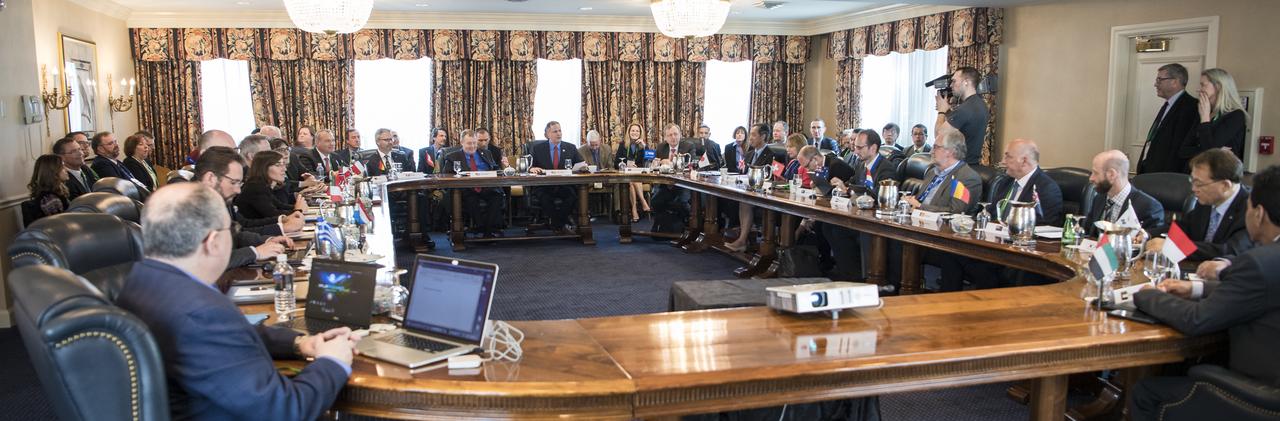
NASA Administrator Jim Bridenstine gives remarks at an International Exploration meeting at the Space Symposium, Tuesday, April 9, 2019, at the Broadmoor Hotel in Colorado Springs, Colorado. NASA employees from NASA centers around the country were in attendance. Photo credit: (NASA/Aubrey Gemignani)
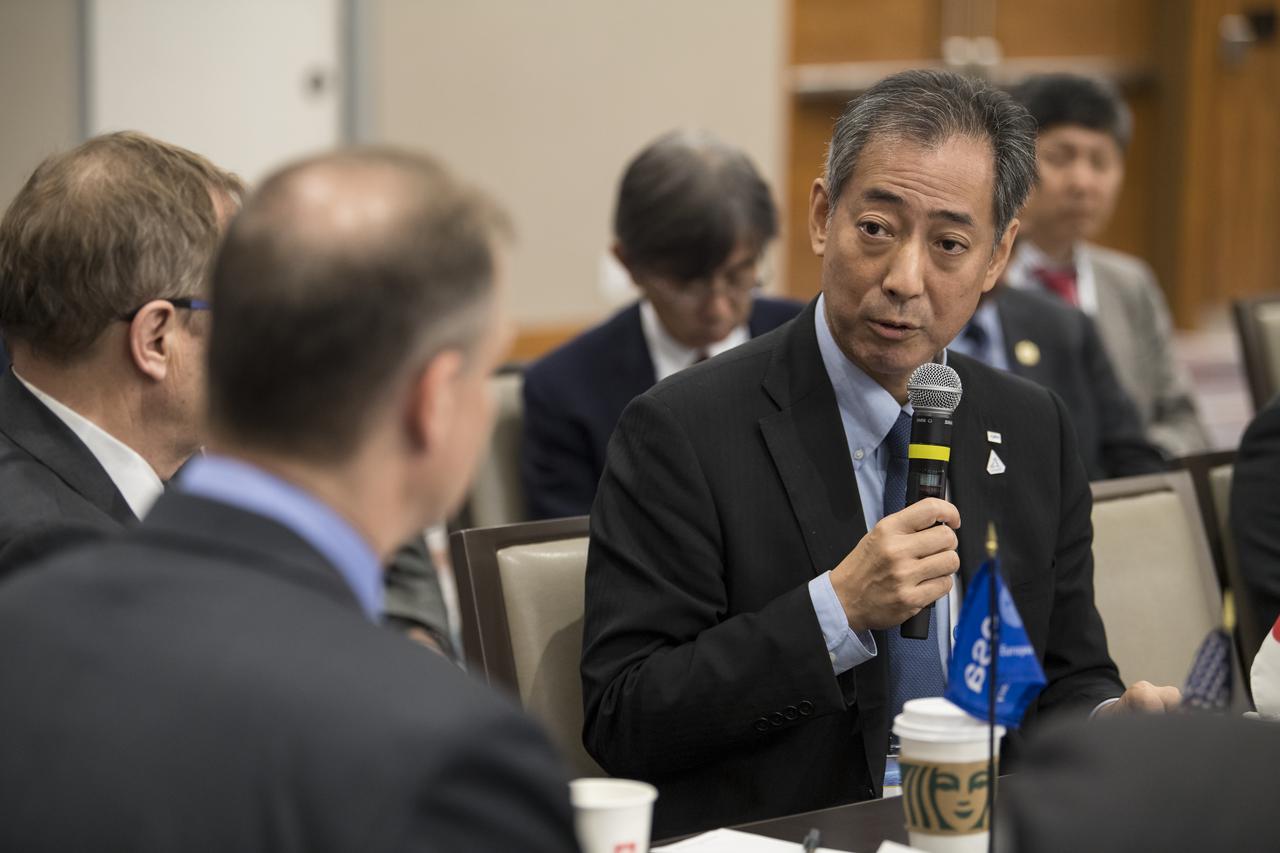
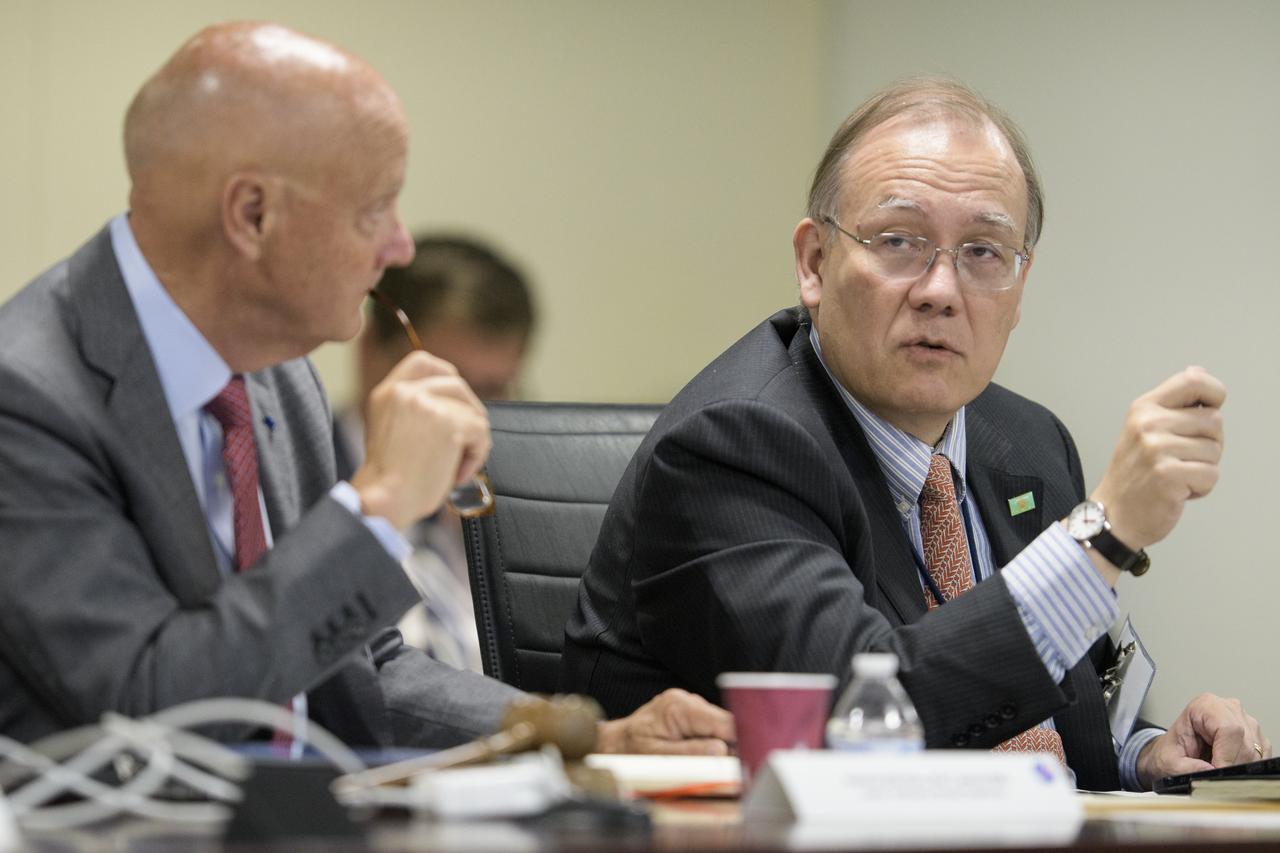
Japan Aerospace and Exploration Agency (JAXA) President, Dr. Hiroshi Yamakawa, speaks to NASA Administrator Jim Bridenstine during a multilateral meeting of the heads of space agencies at the 70th International Astronautical Congress, Tuesday, Oct. 22, 2019 in Washington. Photo Credit: (NASA/Aubrey Gemignani)
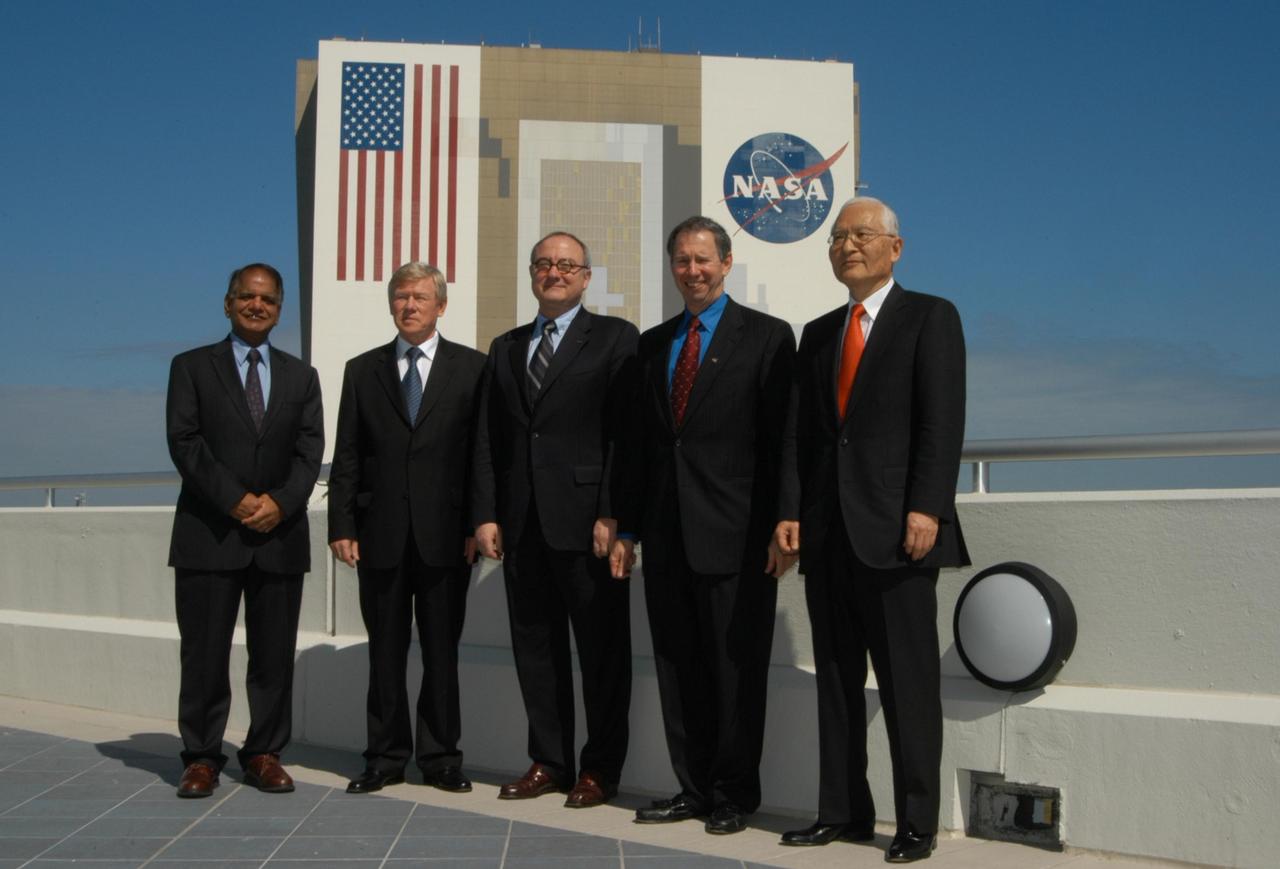
KENNEDY SPACE CENTER, FLA. - Leaders from space agencies around the world take a moment from the International Space Station Heads of Agency meeting being held at Kennedy Space Center for a group portrait in front of the Vehicle Assembly Building. From left are Canadian Space Agency Vice-President Space Science, Technology and Programs Virendra Jha; Russian Federal Space Agency Head Anatolii Perminov; European Space Agency Director-General Jean-Jacques Dordain; NASA Administrator Michael Griffin; and Japan Aerospace Exploration Agency President Keiji Tachikawa. The purpose of the meeting is to review International Space Station cooperation and endorse a revision to the station configuration and assembly sequence.
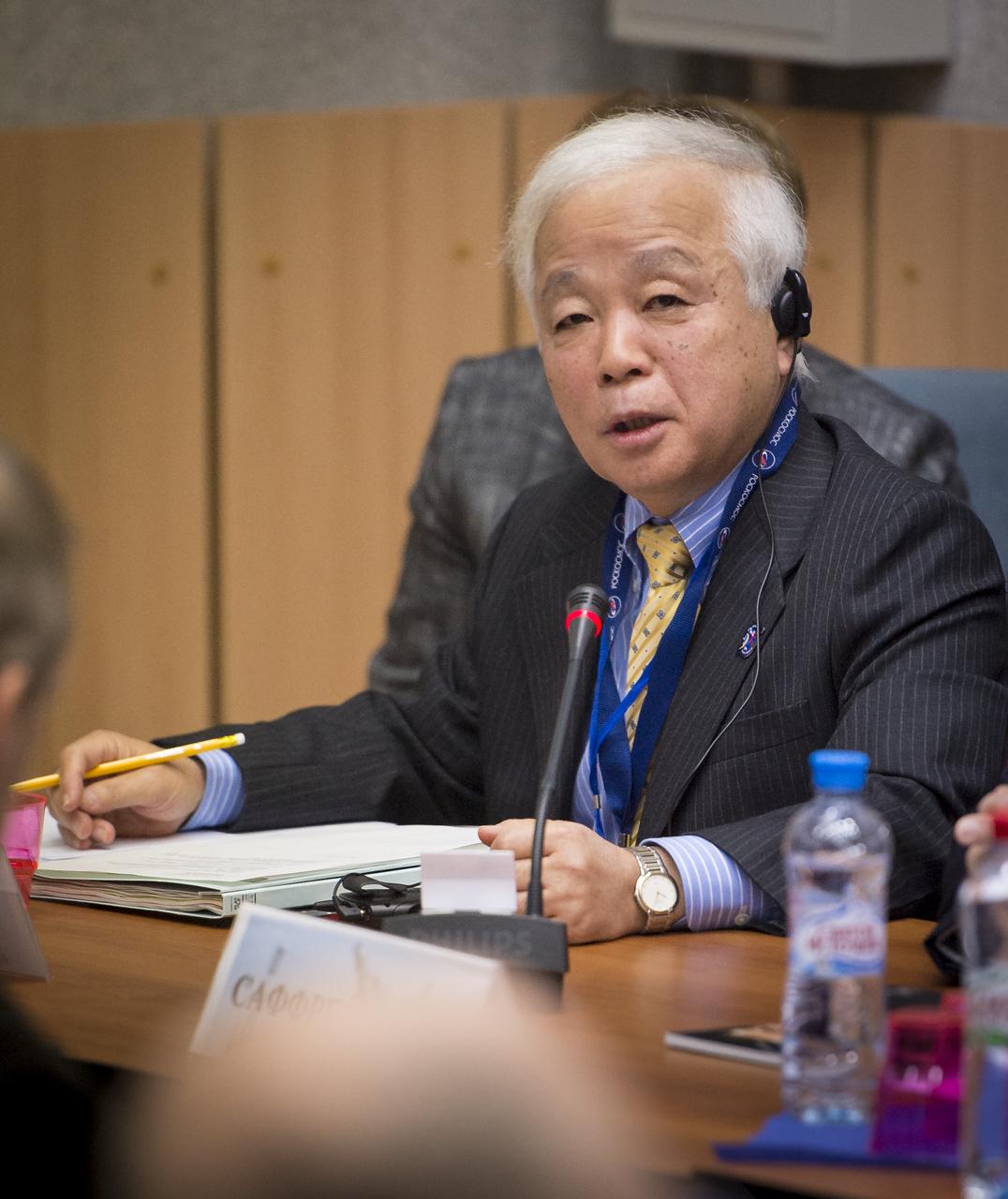
JAXA (Japan Aerospace Exploration Agency) President Naoki Okumura talks during the State Commission meeting to approve the Soyuz rocket launch of Expedition 38 Soyuz Commander Mikhail Tyurin of Roscosmos, Flight Engineer Koichi Wakata of the Japan Aerospace Exploration Agency, and, Flight Engineer Rick Mastracchio of NASA for a six month mission aboard the International Space Station, Wednesday, Nov. 6, 2013 at the Cosmonaut Hotel in Baikonur, Kazakhstan. Photo Credit: (NASA/Bill Ingalls)
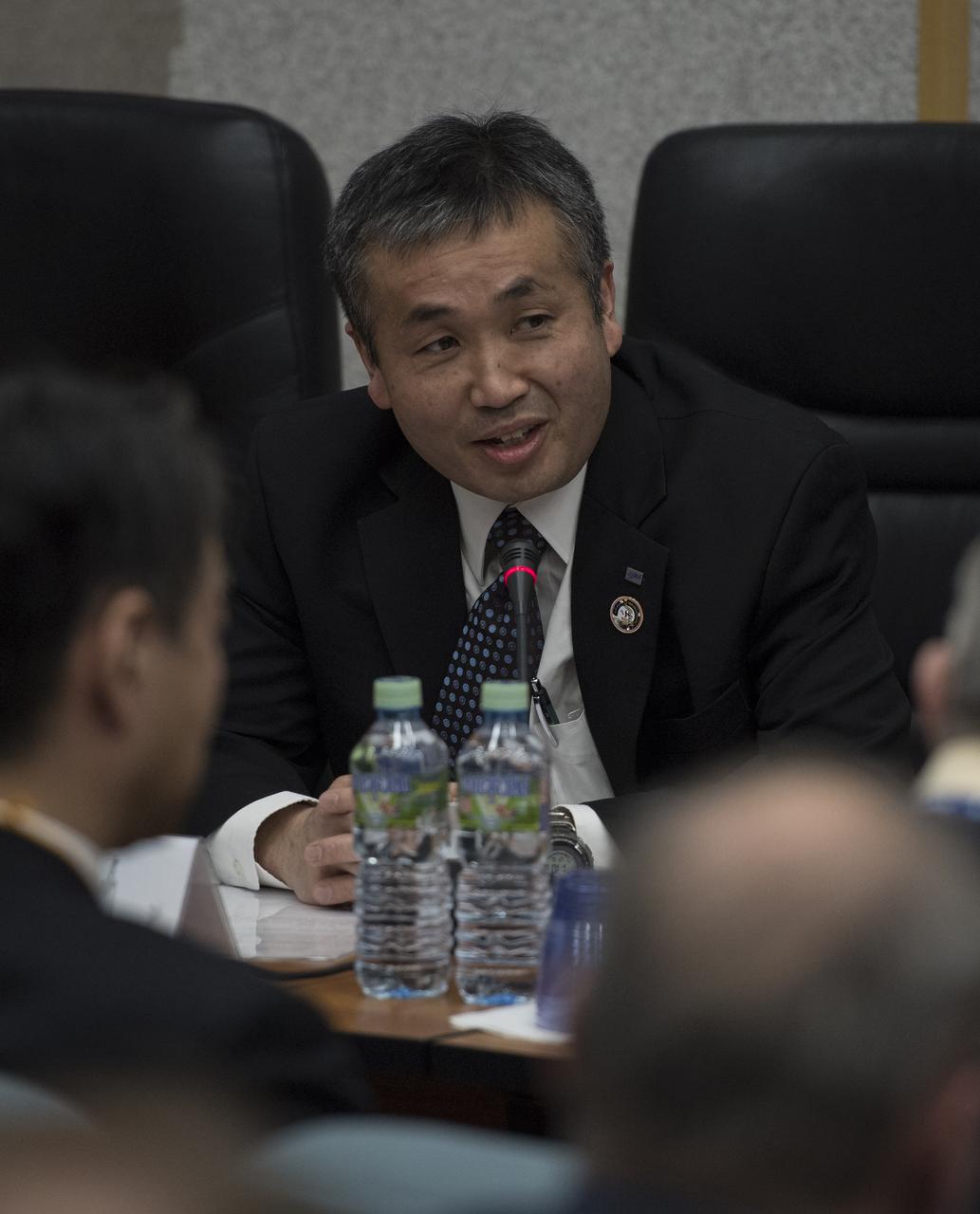
Japan Aerospace Exploration Agency (JAXA) International Space Station Program Manager Koichi Wakata is seen during the State Commission meeting to approve the Soyuz launch of Expedition 54 to the International Space Station, Saturday, Dec. 16, 2017 at the Cosmonaut Hotel in Baikonur, Kazakhstan. Expedition 54 Soyuz Commander Anton Shkaplerov of Roscosmos, flight engineer Scott Tingle of NASA, and flight engineer Norishige Kanai of the Japan Aerospace Exploration Agency (JAXA) are scheduled to launch to the International Space Station aboard the Soyuz spacecraft from the Baikonur Cosmodrome on December 17. Photo Credit: (NASA/Joel Kowsky)
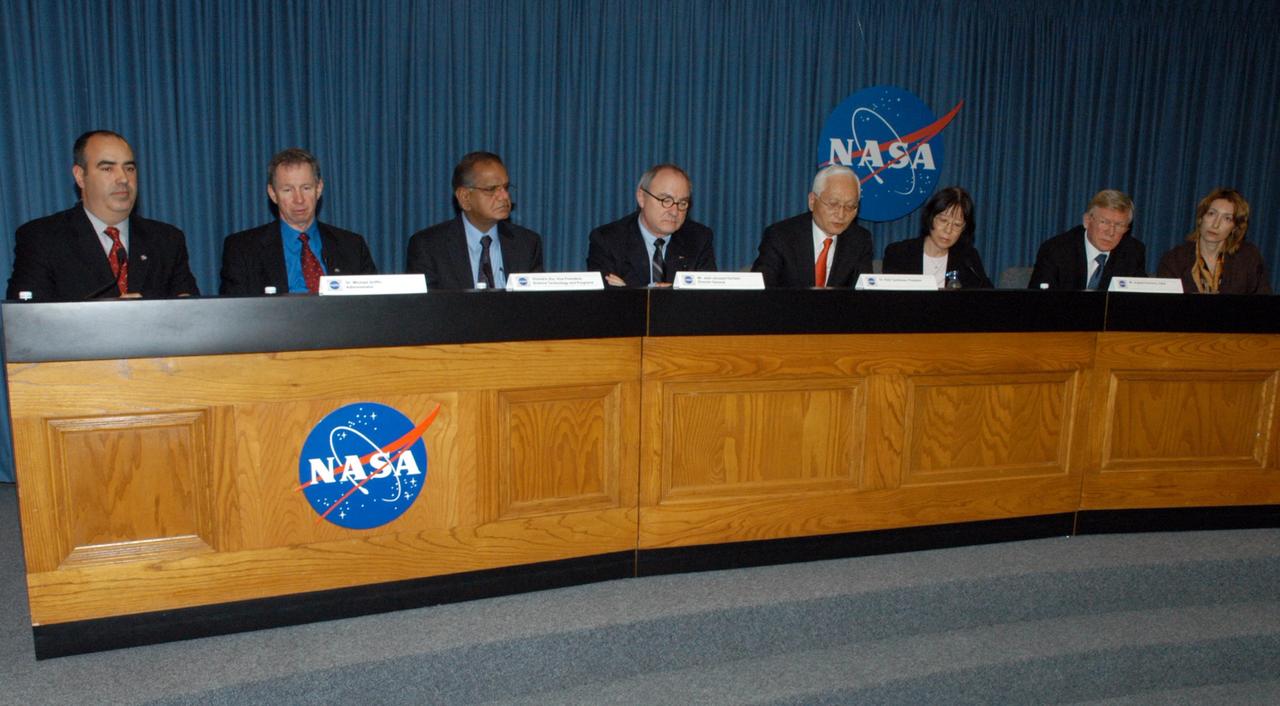
KENNEDY SPACE CENTER, FLA. - Leaders from space agencies around the world participate in a news briefing following the International Space Station Heads of Agency meeting held at Kennedy Space Center. From left are NASA Press Secretary Dean Acosta; NASA Administrator Michael Griffin; Canadian Space Agency Vice-President Space Science, Technology and Programs Virendra Jha; European Space Agency Director-General Jean-Jacques Dordain; Japan Aerospace Exploration Agency President Keiji Tachikawa; Japanese interpreter Masako Kaharia; Russian Federal Space Agency Head Anatolii Perminov; and Russian interpreter Elena Maroko. The purpose of the meeting was to review International Space Station cooperation and endorse a revision to the station configuration and assembly sequence. At the meeting, the partners reaffirmed their agencies' commitment to meet their mutual obligations, to implement six person crew operations in 2009 and an adequate number of shuttle flights to complete the assembly of the space station by the end of the decade. Photo credit: NASA/George Shelton
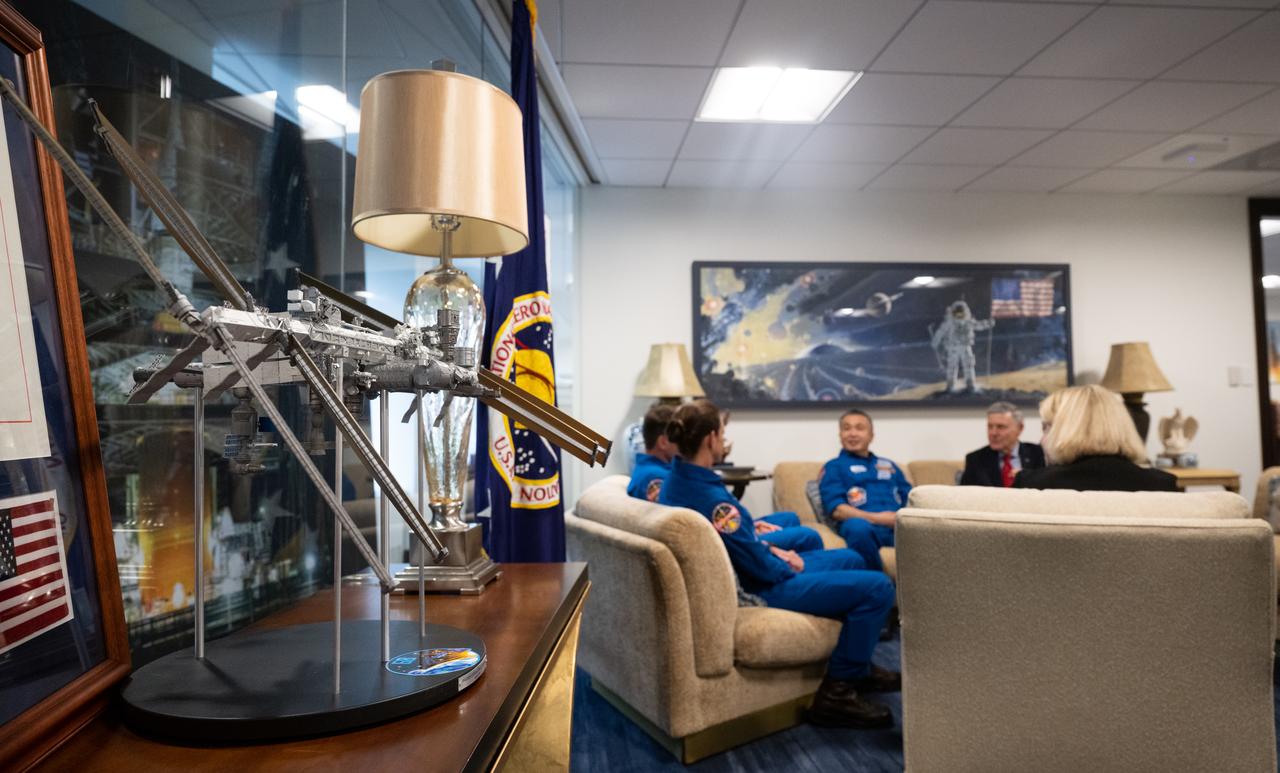
A model of the International Space station is seen as NASA Deputy Administrator Pam Melroy and NASA Associate Administrator Bob Cabana meet with NASA’s SpaceX Crew-5 astronauts Nicole Mann and Josh Cassada of NASA, and Koichi Wakata of the Japan Aerospace Exploration Agency (JAXA), Monday, June 5, 2023 at the Mary W. Jackson NASA Headquarters building in Washington. Mann, Cassada, and Wakata spent 157 days in space as part of Expedition 68 aboard the International Space Station. Photo Credit: (NASA/Joel Kowsky)
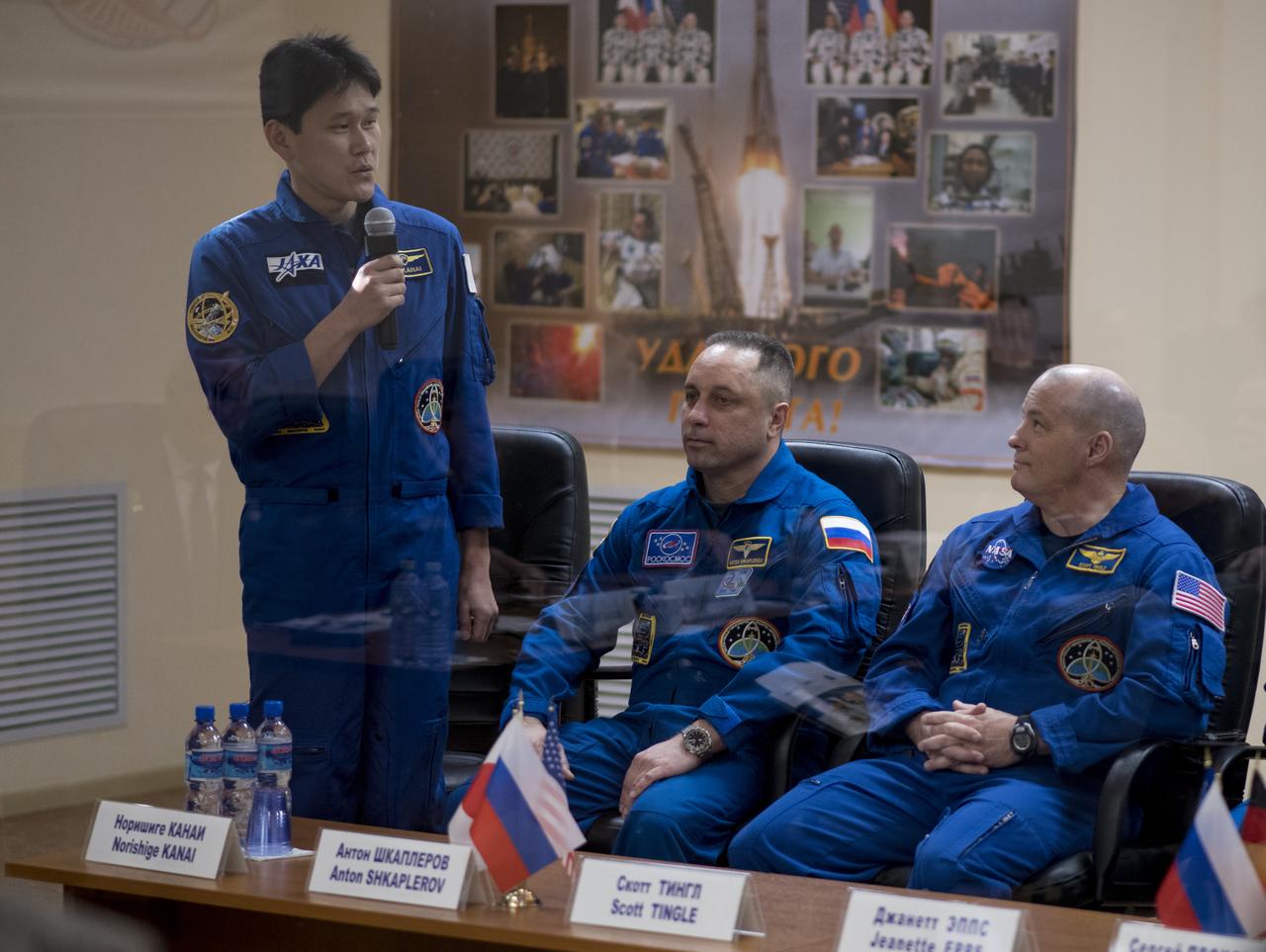
Expedition 54 flight engineer Norishige Kanai of the Japan Aerospace Exploration Agency (JAXA) speaks during the State Commission meeting to approve the Soyuz launch of Expedition 54 to the International Space Station, Saturday, Dec. 16, 2017 at the Cosmonaut Hotel in Baikonur, Kazakhstan. Kanai, Soyuz Commander Anton Shkaplerov of Roscosmos, and flight engineer Scott Tingle of NASA are scheduled to launch to the International Space Station aboard the Soyuz spacecraft from the Baikonur Cosmodrome on December 17. Photo Credit: (NASA/Joel Kowsky)
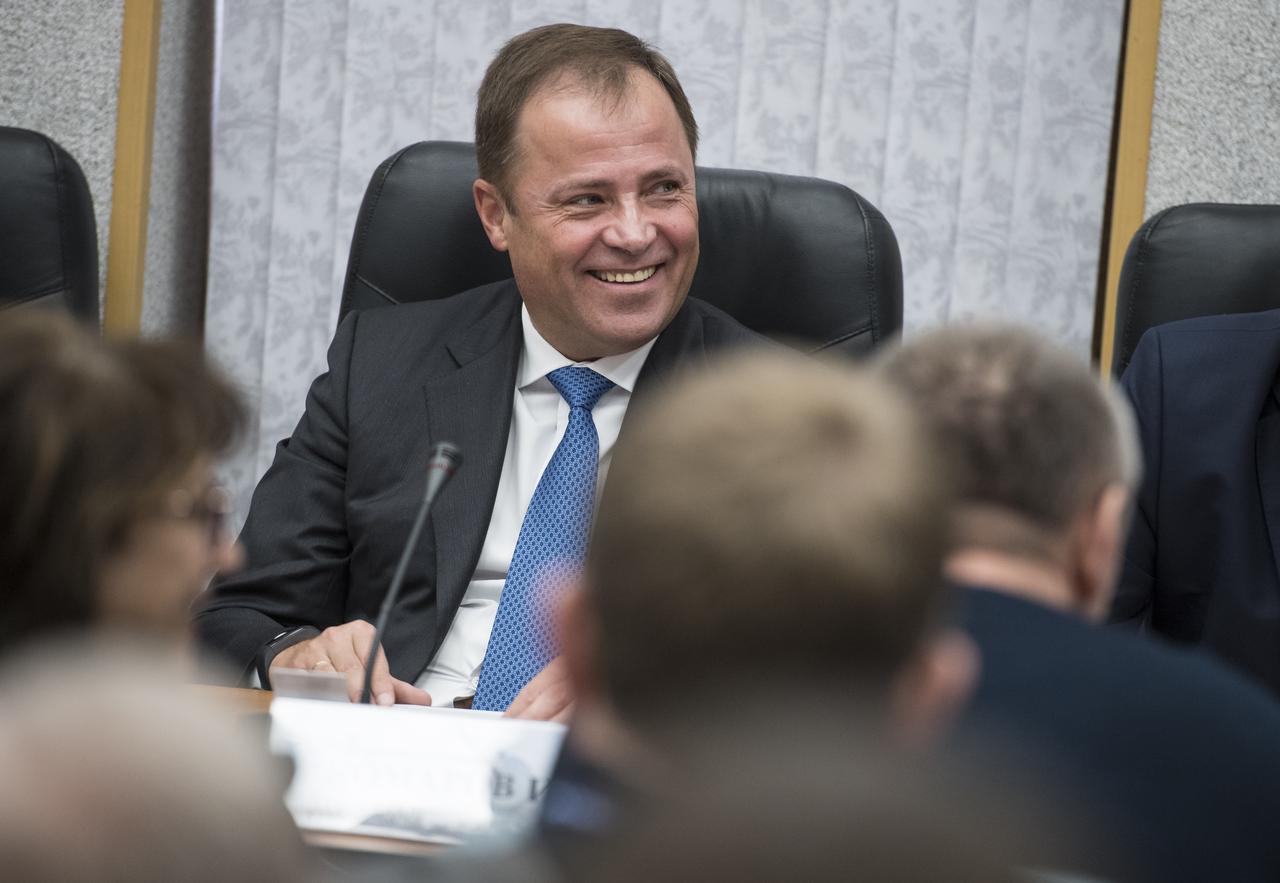
Igor Komarov, Director of Roscosmos, is seen during the State Commission meeting to approve the Soyuz launch of Expedition 54 to the International Space Station, Saturday, Dec. 16, 2017 at the Cosmonaut Hotel in Baikonur, Kazakhstan. Expedition 54 Soyuz Commander Anton Shkaplerov of Roscosmos, flight engineer Scott Tingle of NASA, and flight engineer Norishige Kanai of the Japan Aerospace Exploration Agency (JAXA) are scheduled to launch to the International Space Station aboard the Soyuz spacecraft from the Baikonur Cosmodrome on December 17. Photo Credit: (NASA/Joel Kowsky)
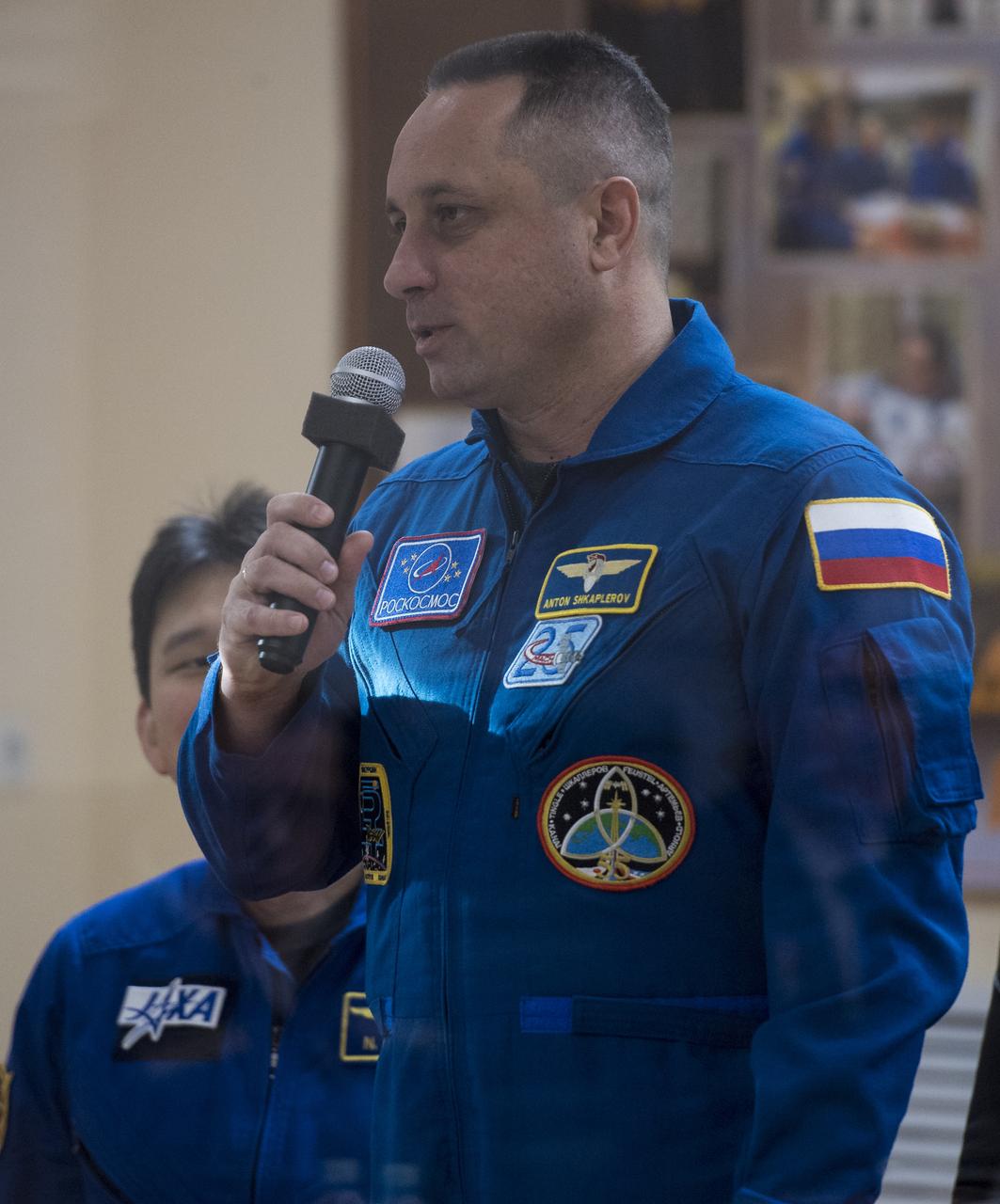
Expedition 54 Soyuz Commander Anton Shkaplerov speaks during the State Commission meeting to approve the Soyuz launch of Expedition 54 to the International Space Station, Saturday, Dec. 16, 2017 at the Cosmonaut Hotel in Baikonur, Kazakhstan. Shkaplerov, flight engineer Scott Tingle of NASA, and flight engineer Norishige Kanai of the Japan Aerospace Exploration Agency (JAXA) are scheduled to launch to the International Space Station aboard the Soyuz spacecraft from the Baikonur Cosmodrome on December 17. Photo Credit: (NASA/Joel Kowsky)
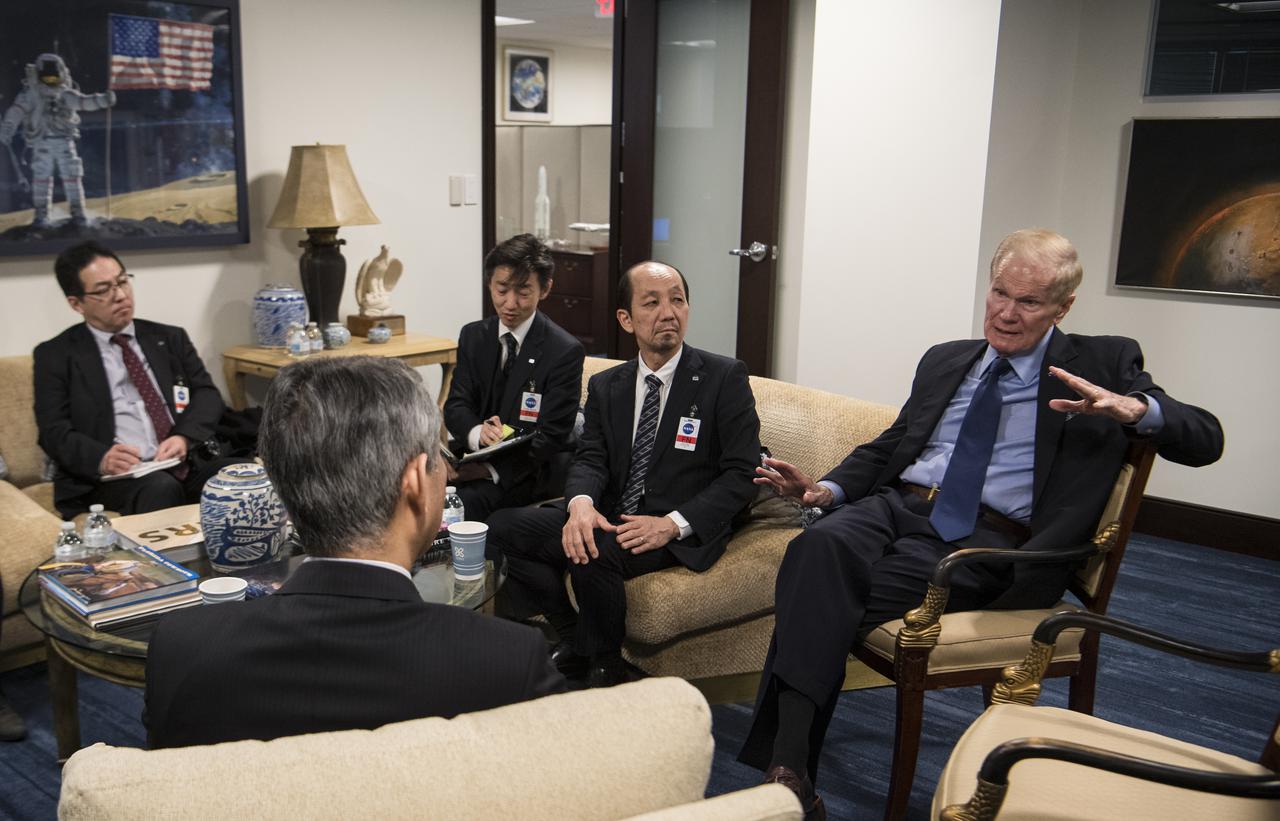
From left to right, Manager of the International Relations and Research Department, JAXA, Akira Kosaka; President, Japan Aerospace Exploration Agency (JAXA), Hiroshi Yamakawa; Secretary for the President of JAXA, Nobuto Yoshioka; Vice President for International Relations, JAXA, Yasuo Ishii; and NASA Administrator Bill Nelson, are seen during a meeting, Thursday, April 7, 2022, at NASA Headquarters in Washington DC. Photo Credit: (NASA/Aubrey Gemignani)
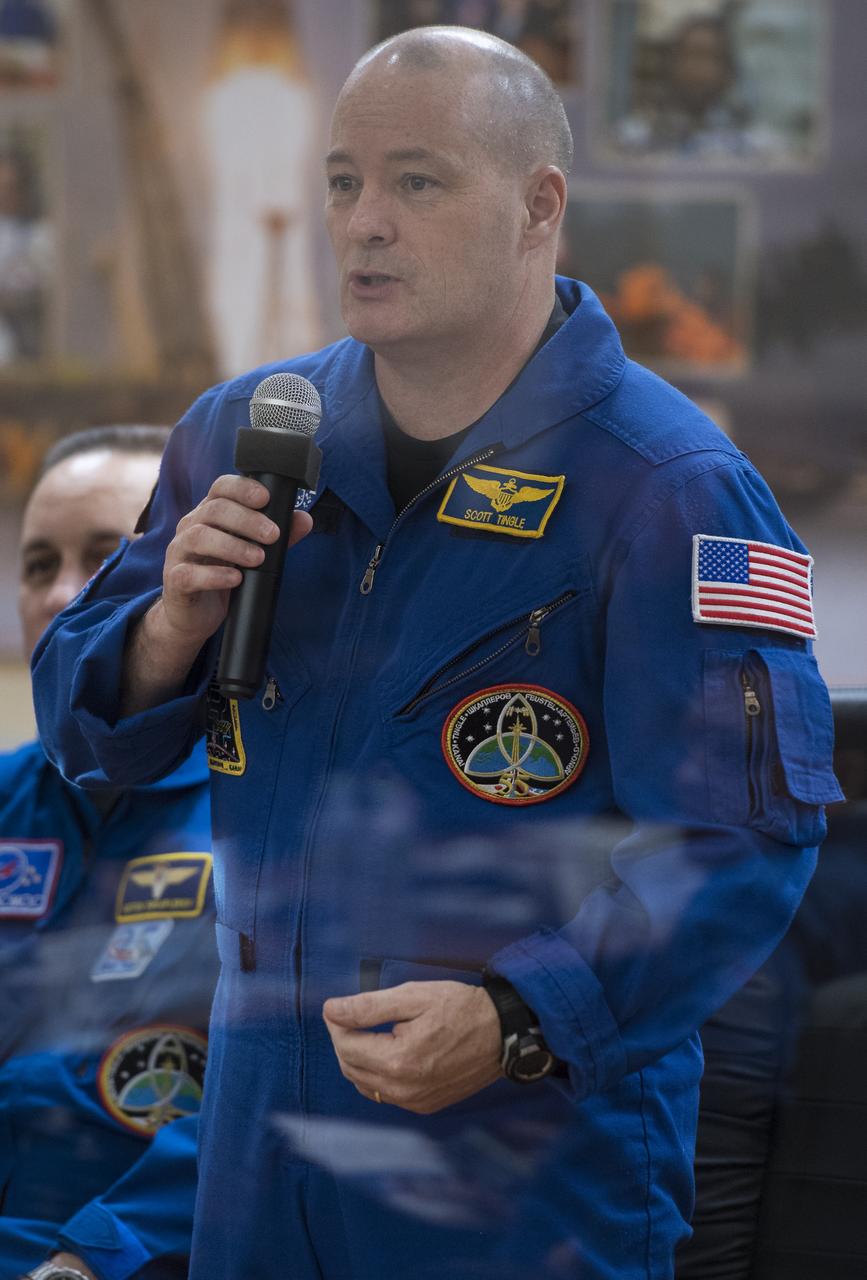
Expedition 54 flight engineer Scott Tingle speaks during the State Commission meeting to approve the Soyuz launch of Expedition 54 to the International Space Station, Saturday, Dec. 16, 2017 at the Cosmonaut Hotel in Baikonur, Kazakhstan. Tingle, Soyuz Commander Anton Shkaplerov of Roscosmos, and flight engineer Norishige Kanai of the Japan Aerospace Exploration Agency (JAXA) are scheduled to launch to the International Space Station aboard the Soyuz spacecraft from the Baikonur Cosmodrome on December 17. Photo Credit: (NASA/Joel Kowsky)
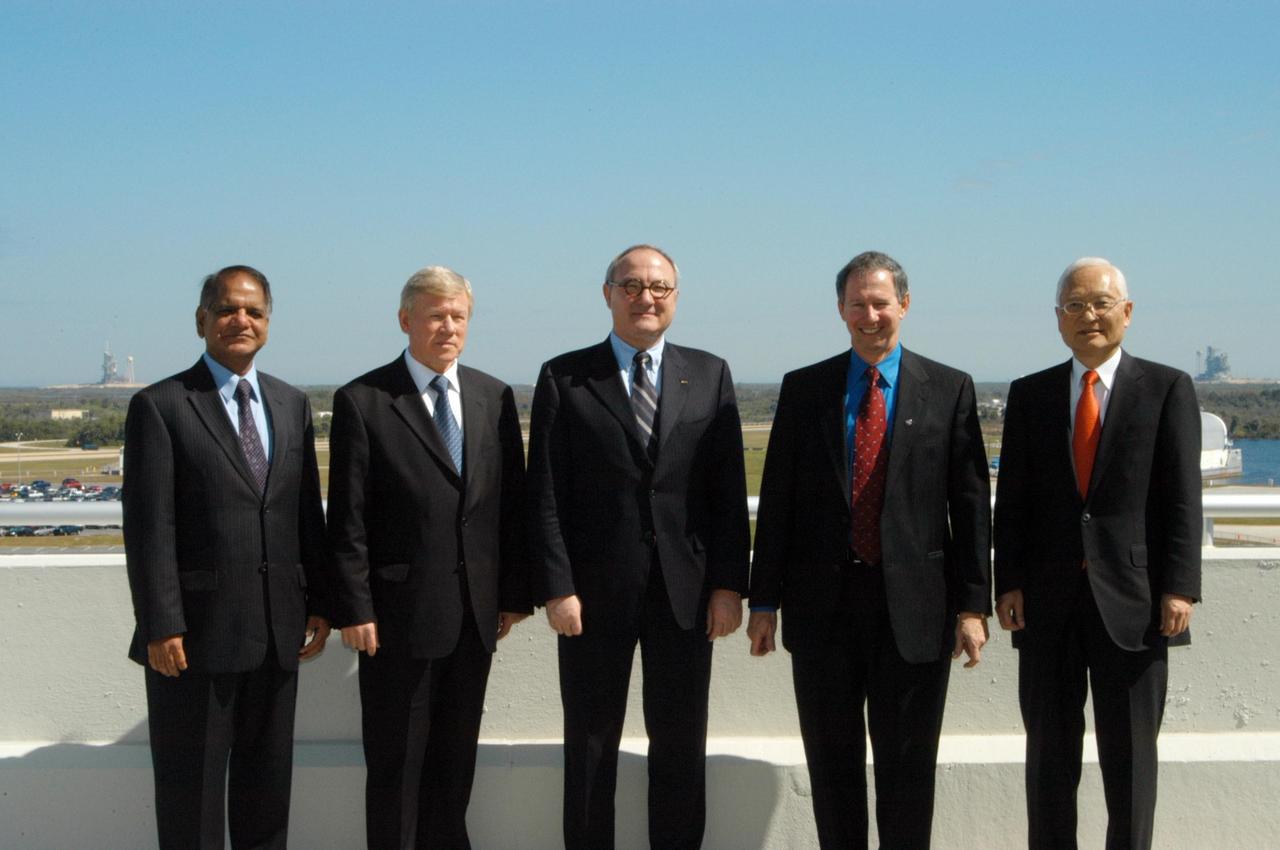
KENNEDY SPACE CENTER, FLA. - Leaders from space agencies around the world take a moment from the International Space Station Heads of Agency meeting being held at Kennedy Space Center for a group portrait, framed by the space shuttle launch pads in Launch Complex 39. From left are Canadian Space Agency Vice-President Space Science, Technology and Programs Virendra Jha; Russian Federal Space Agency Head Anatolii Perminov; European Space Agency Director-General Jean-Jacques Dordain; NASA Administrator Michael Griffin; and Japan Aerospace Exploration Agency President Keiji Tachikawa. The purpose of the meeting is to review International Space Station cooperation and endorse a revision to the station configuration and assembly sequence.
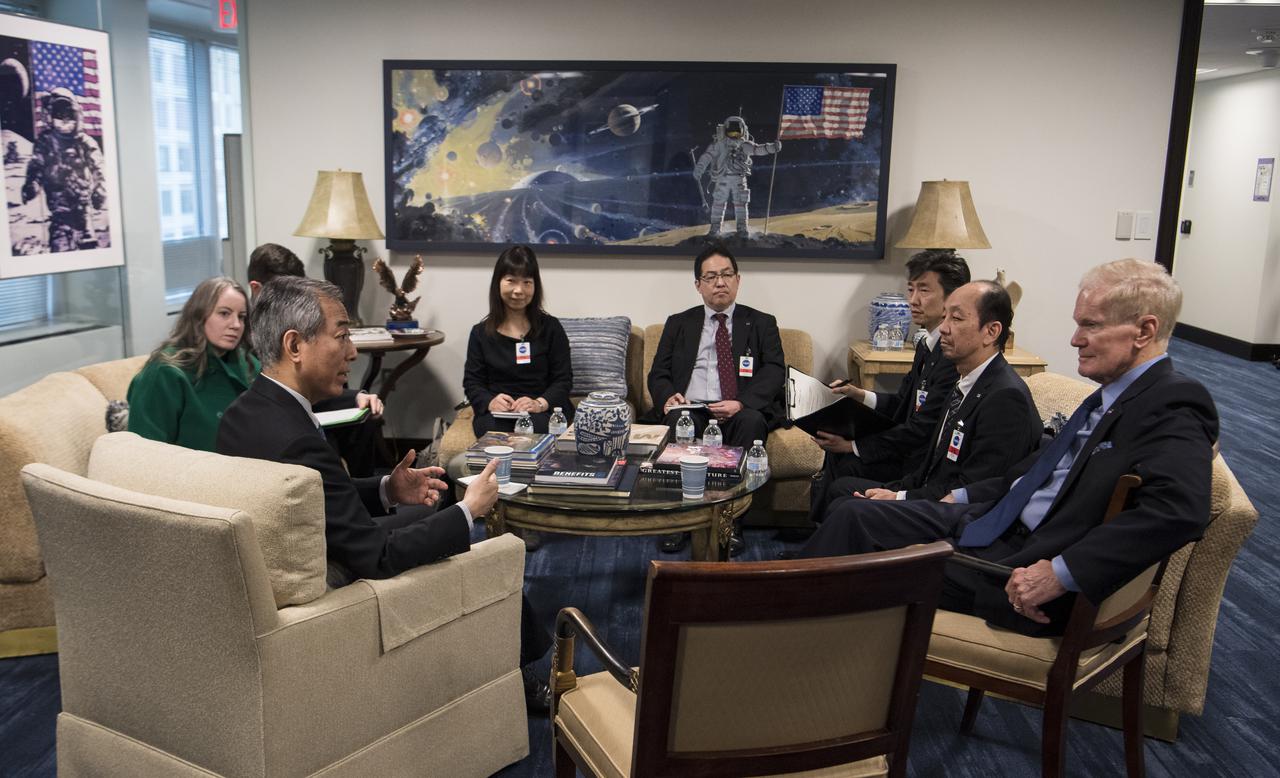
From left to right, President, Japan Aerospace Exploration Agency (JAXA), Hiroshi Yamakawa; NASA Office of International and Interagency Relations (OIIR) Deputy Associate Administrator, Meredith McKay; International Program Specialist, OIIR, Andrew Masciola; Director of the Washington DC Office, JAXA, Dr. Masami Onoda; Manager of the International Relations and Research Department, JAXA, Akira Kosaka; Secretary for the President of JAXA, Nobuto Yoshioka; Vice President for International Relations, JAXA, Yasuo Ishii; and NASA Administrator Bill Nelson, are seen during a meeting, Thursday, April 7, 2022, at NASA Headquarters in Washington DC. Photo Credit: (NASA/Aubrey Gemignani)
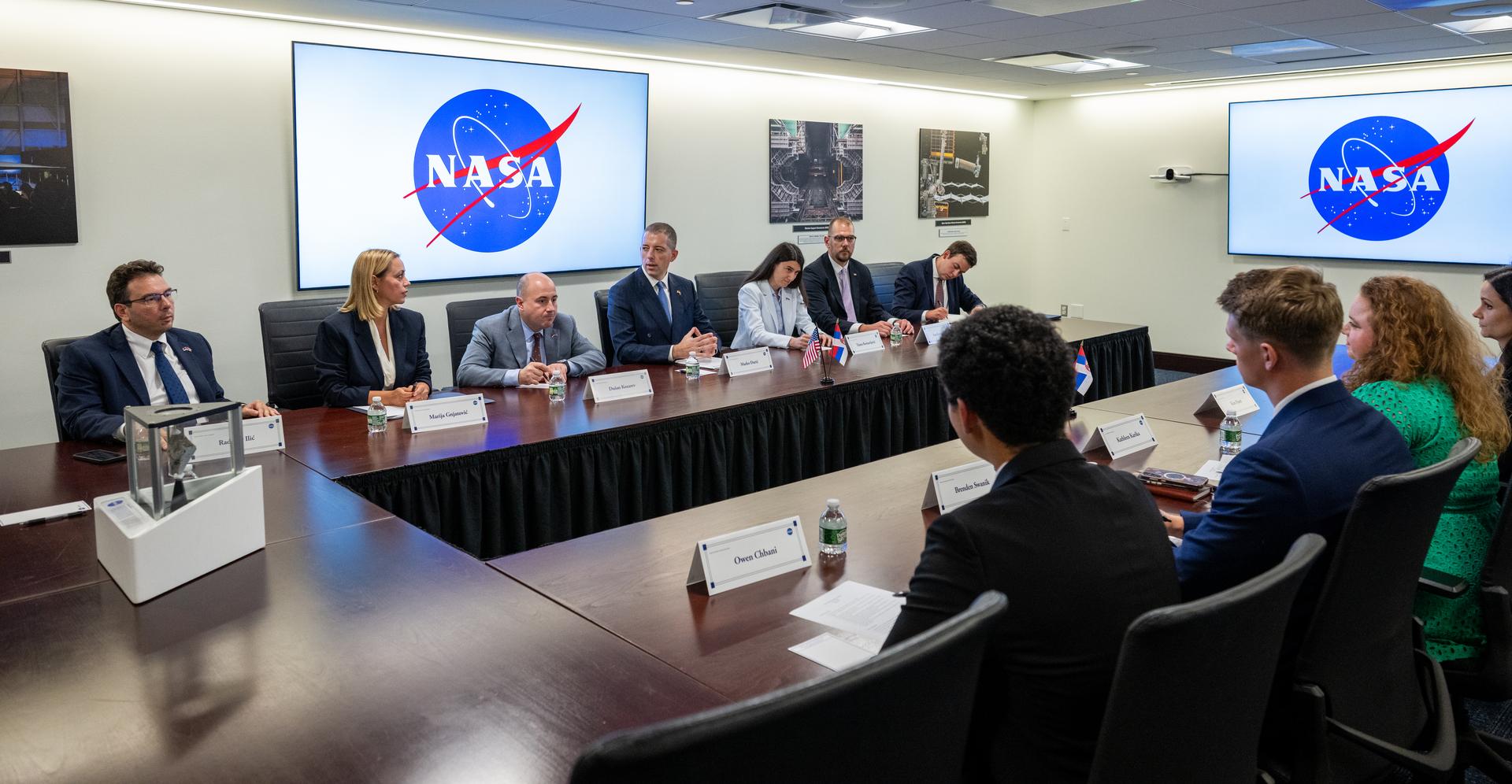
Representatives from Serbia and members of NASA’s Office of International and Interagency Relations participate in a bilateral meeting following an Artemis Accords signing ceremony Thursday, July 16, 2026, at the Mary W. Jackson NASA Headquarters building in Washington. Serbia is the 69th country to sign the Artemis Accords, which establish a practical set of principles to guide space exploration cooperation among nations participating in NASA’s Artemis program. Photo Credit: (NASA/Keegan Barber)
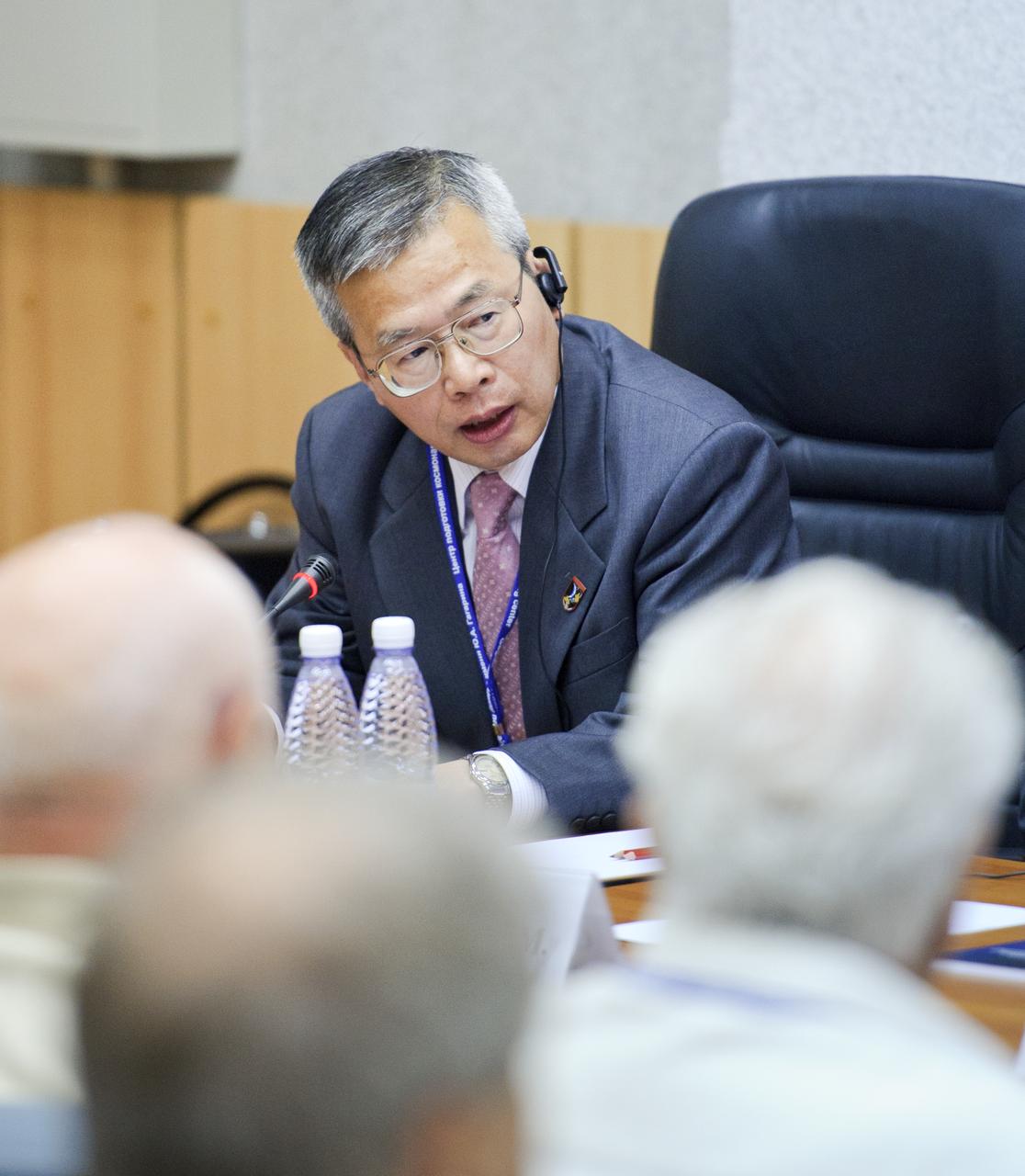
Kuniaki Shiraki, President of the Japan Aerospace Exploration Agency (JAXA) speaks during the State Commission meeting to approve the Soyuz launch of Expedition 28 to the International Space Station, Monday, June 6, 2011, at the Cosmonaut Hotel in Baikonur, Kazakhstan. The mission is set to launch on Tuesday, June 8, from the Baikonur Cosmodrome. Photo Credit: (NASA/Carla Cioffi)
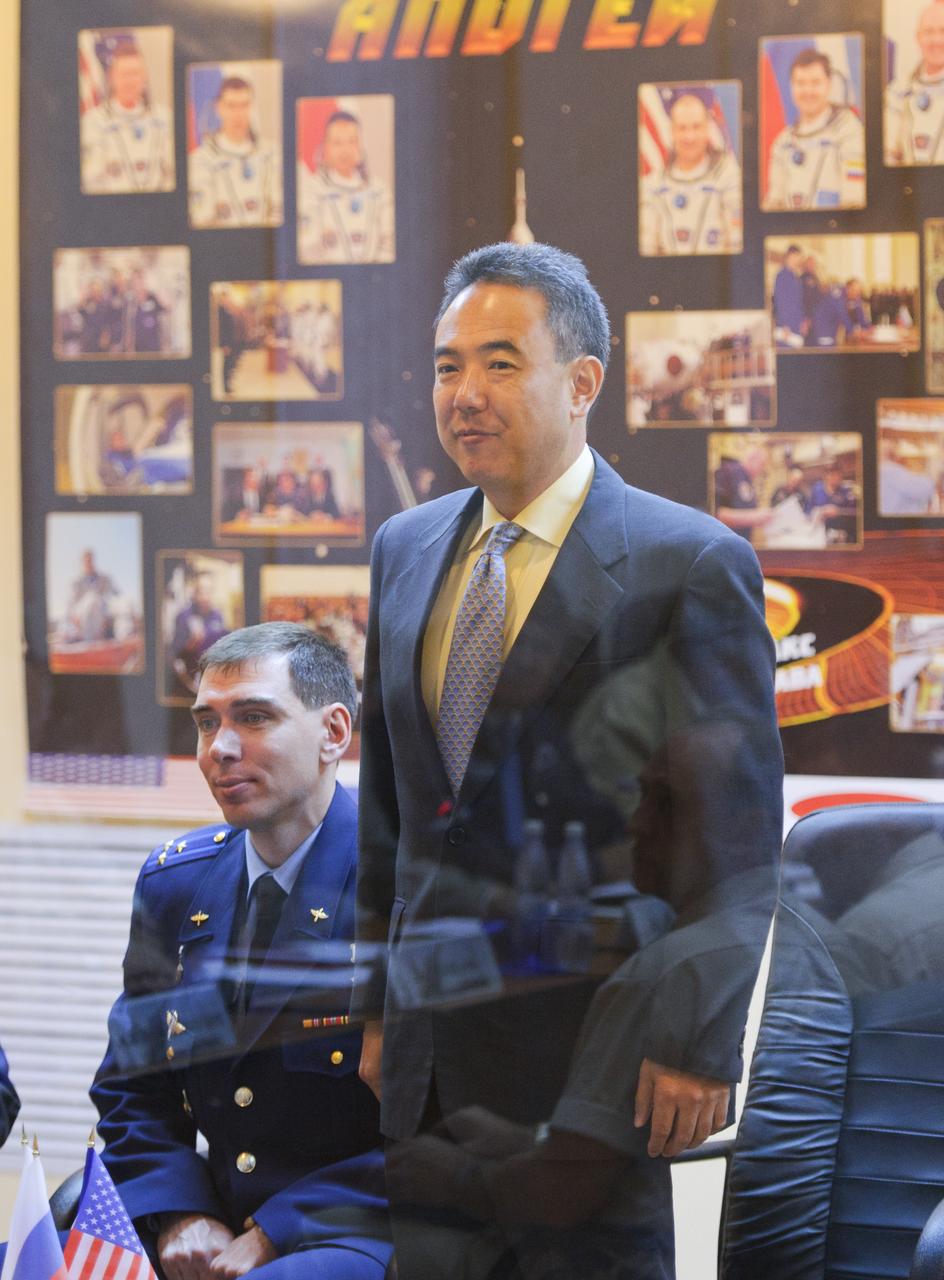
Expedition 28 Japan Aerospace Exploration Agency (JAXA) Flight Engineer Satoshi Furukawa stands during the State Commission meeting to approve the Soyuz launch of Expedition 28 to the International Space Station, Monday, June 6, 2011, at the Cosmonaut Hotel in Baikonur, Kazakhstan. The mission is set to launch on Tuesday, June 8 from the Baikonur Cosmodrome. Photo Credit: (NASA/Carla Cioffi)
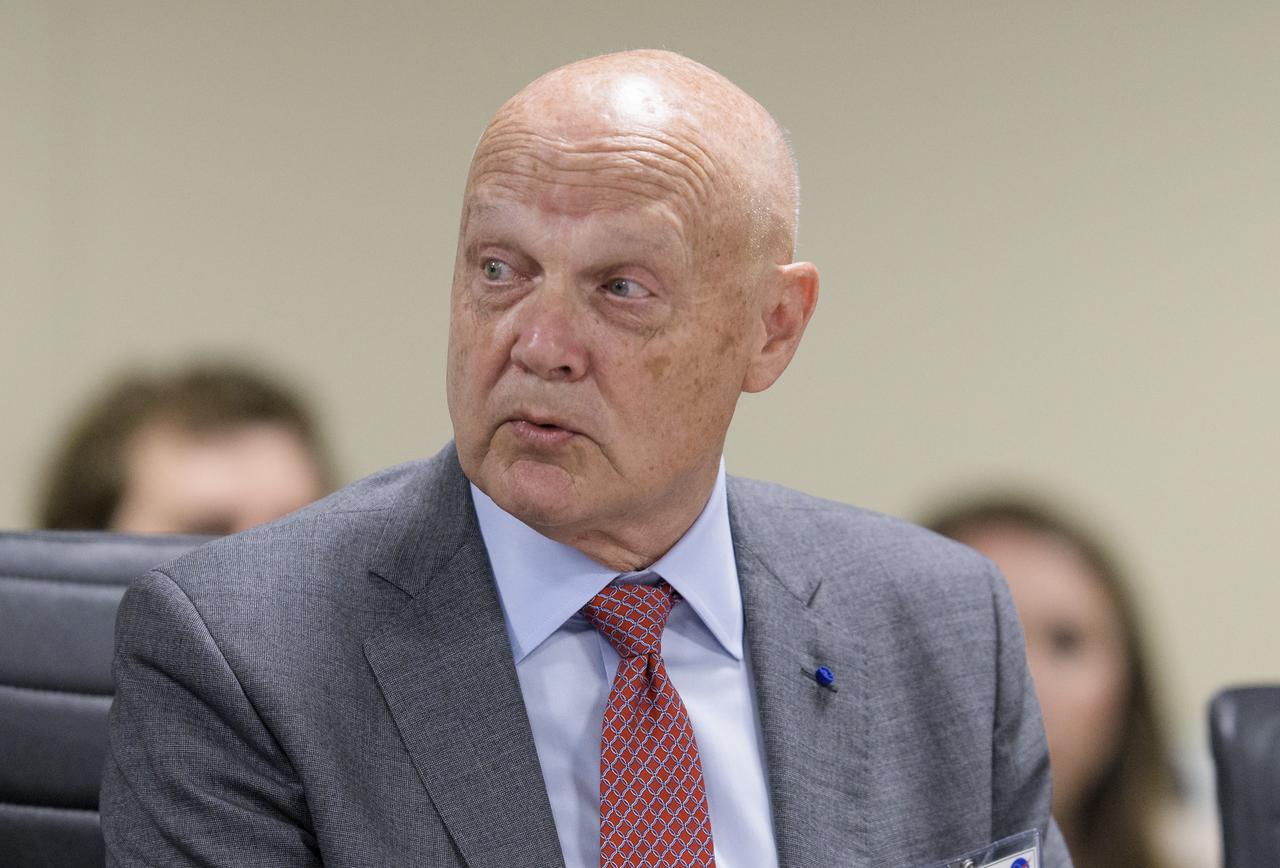
Chairman of the Users' Advisory Group Adm. Jim Ellis, USN (Ret.) delivers opening remarks at the first meeting of the National Space Council Users' Advisory Group, Tuesday, June 19, 2018 at NASA Headquarters in Washington. The Users' Advisory Group will advise and inform the National Space Council on a broad range of aerospace topics, including the impacts of U.S. and international laws and regulations, national security space priorities, scientific and human space exploration priorities, and ways to bolster support. Photo Credit: (NASA/Joel Kowsky)
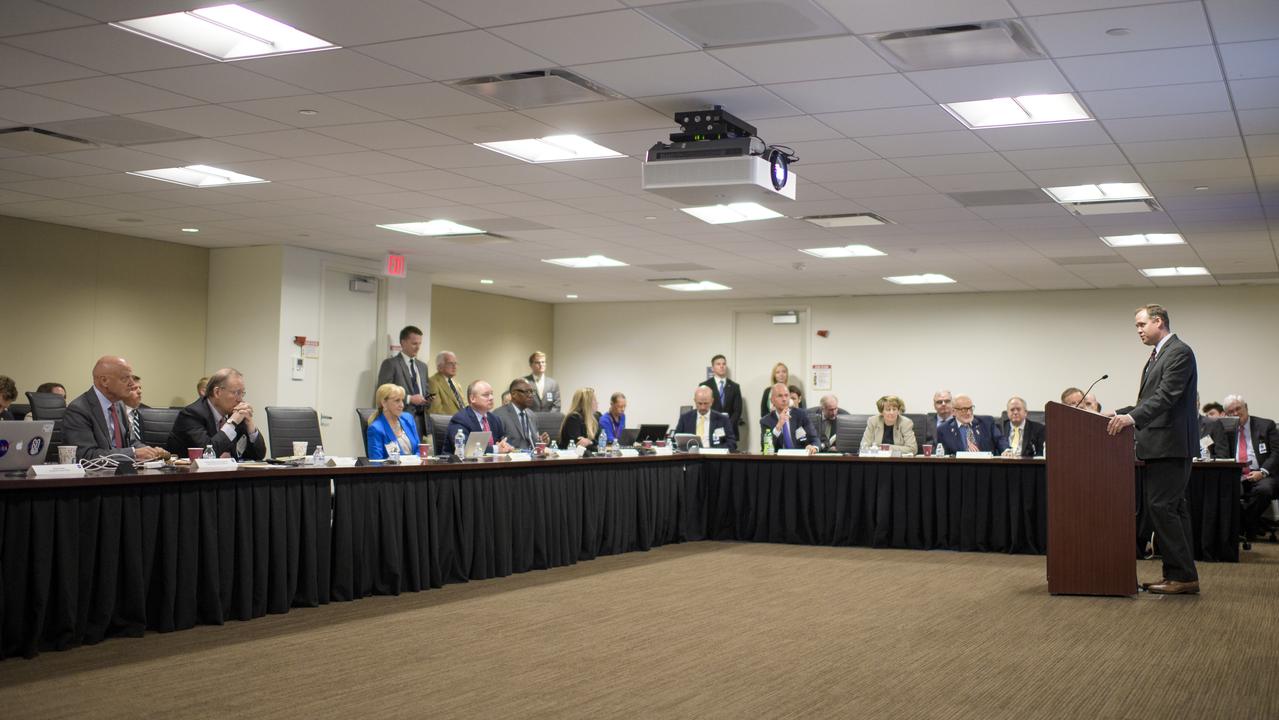
NASA Administrator Jim Bridenstine speaks at the first meeting of the National Space Council Users' Advisory Group, Tuesday, June 19, 2018 at NASA Headquarters in Washington. The Users' Advisory Group will advise and inform the National Space Council on a broad range of aerospace topics, including the impacts of U.S. and international laws and regulations, national security space priorities, scientific and human space exploration priorities, and ways to bolster support. Photo Credit: (NASA/Joel Kowsky)
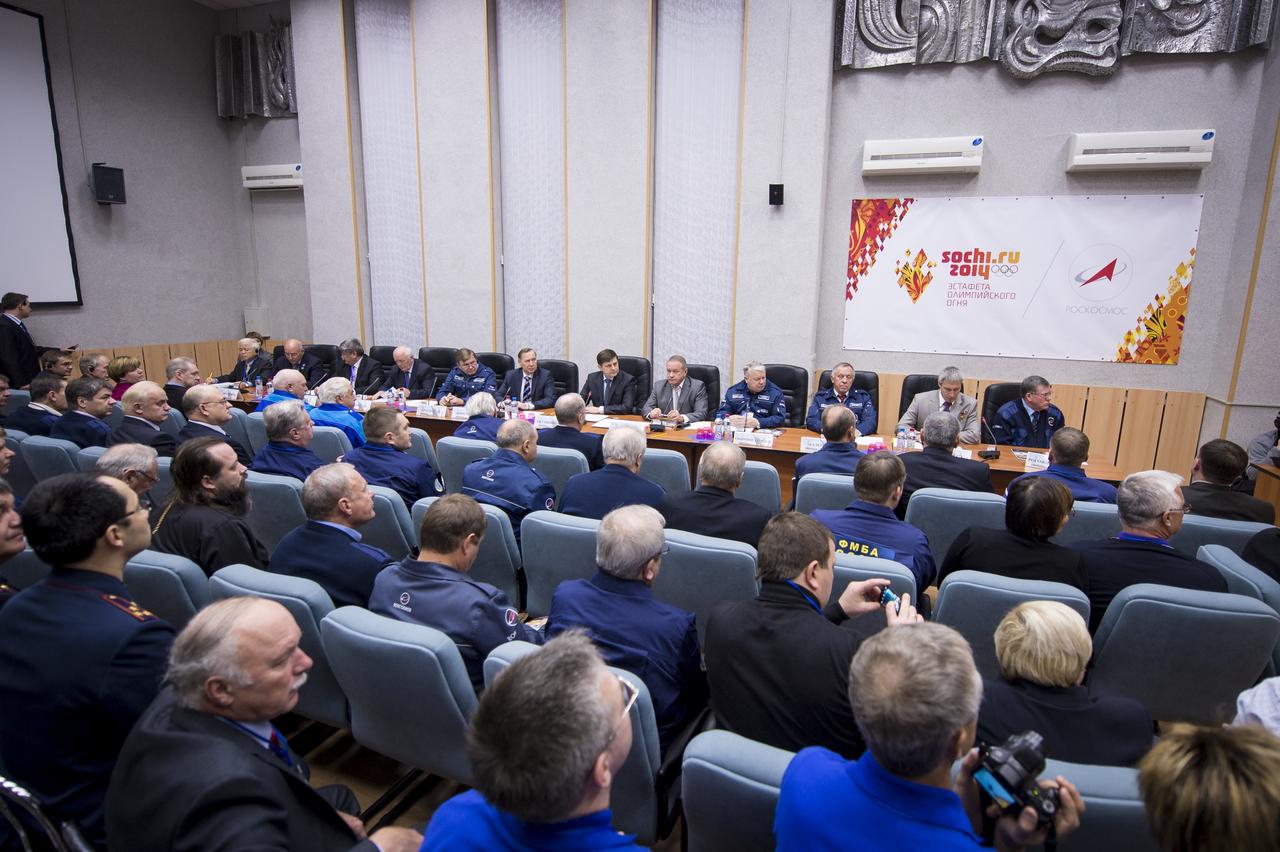
Members of the State Commission meet to approve the Soyuz rocket launch of Expedition 38 Soyuz Commander Mikhail Tyurin of Roscosmos, Flight Engineer Koichi Wakata of the Japan Aerospace Exploration Agency, and, Flight Engineer Rick Mastracchio of NASA for a six month mission aboard the International Space Station, Wednesday, Nov. 6, 2013 at the Cosmonaut Hotel in Baikonur, Kazakhstan. Photo Credit: (NASA/Bill Ingalls)

NASA Administrator Jim Bridenstine, right, Deputy Administrator Jim Morhard, second from right, and Ken Bowersox, acting Associate Administrator for NASA's Human Exploration and Operations Mission Directorate, center, are seen during a meeting with Sylvain Laporte, President of the Canadian Space Agency at the 70th International Astronautical Congress, Wednesday, Oct. 23, 2019 in Washington. Photo Credit: (NASA/Joel Kowsky)
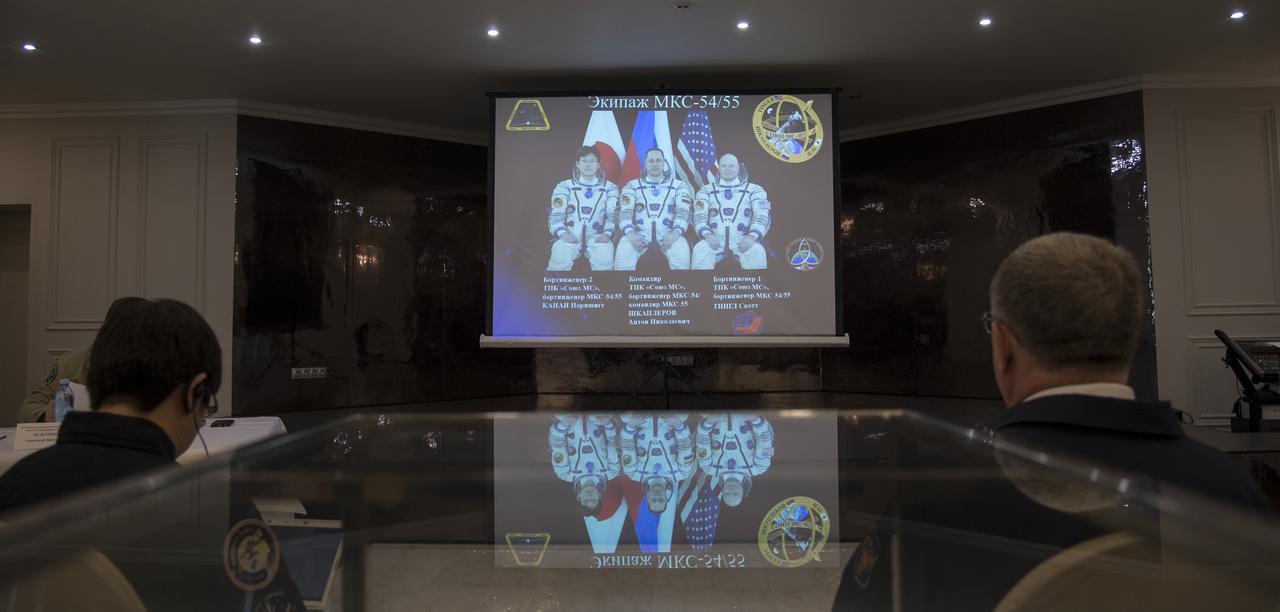
NASA, Roscosmos, and JAXA team members, along with Russian Search and Recovery Forces, meet to discuss the readiness for the landing of Expedition 55 crew members Anton Shkaplerov of Roscosmos, Scott Tingle of NASA, Norishige Kanai of the Japan Aerospace Exploration Agency (JAXA) Saturday, June 2, 2018. Shkaplerov, Tingle, and Kanai are returning after 168 days in space where they served as members of the Expedition 54 and 55 crews onboard the International Space Station. Photo Credit: (NASA/Bill Ingalls)

Children from a local orphanage meet with Japan Aerospace Exploration Agency astronauts, Koichi Wakata, and Takuya Onishi, along with NASA astronauts Doug Wheelock, and Kjell Lindgren, at the Cosmonaut Hotel, Saturday, June 2, 2018 in Karaganda, Kazakhstan. The astronauts were in Karaganda to help support the Expedition 55 crew Soyuz landing from the International Space Station. Photo Credit: (NASA/Bill Ingalls)

James Uthmeier, of the Department of Commerce, speaks about deregulation and space traffic management initiatives at the first meeting of the National Space Council Users' Advisory Group, Tuesday, June 19, 2018 at NASA Headquarters in Washington. The Users' Advisory Group will advise and inform the National Space Council on a broad range of aerospace topics, including the impacts of U.S. and international laws and regulations, national security space priorities, scientific and human space exploration priorities, and ways to bolster support. Photo Credit: (NASA/Joel Kowsky)
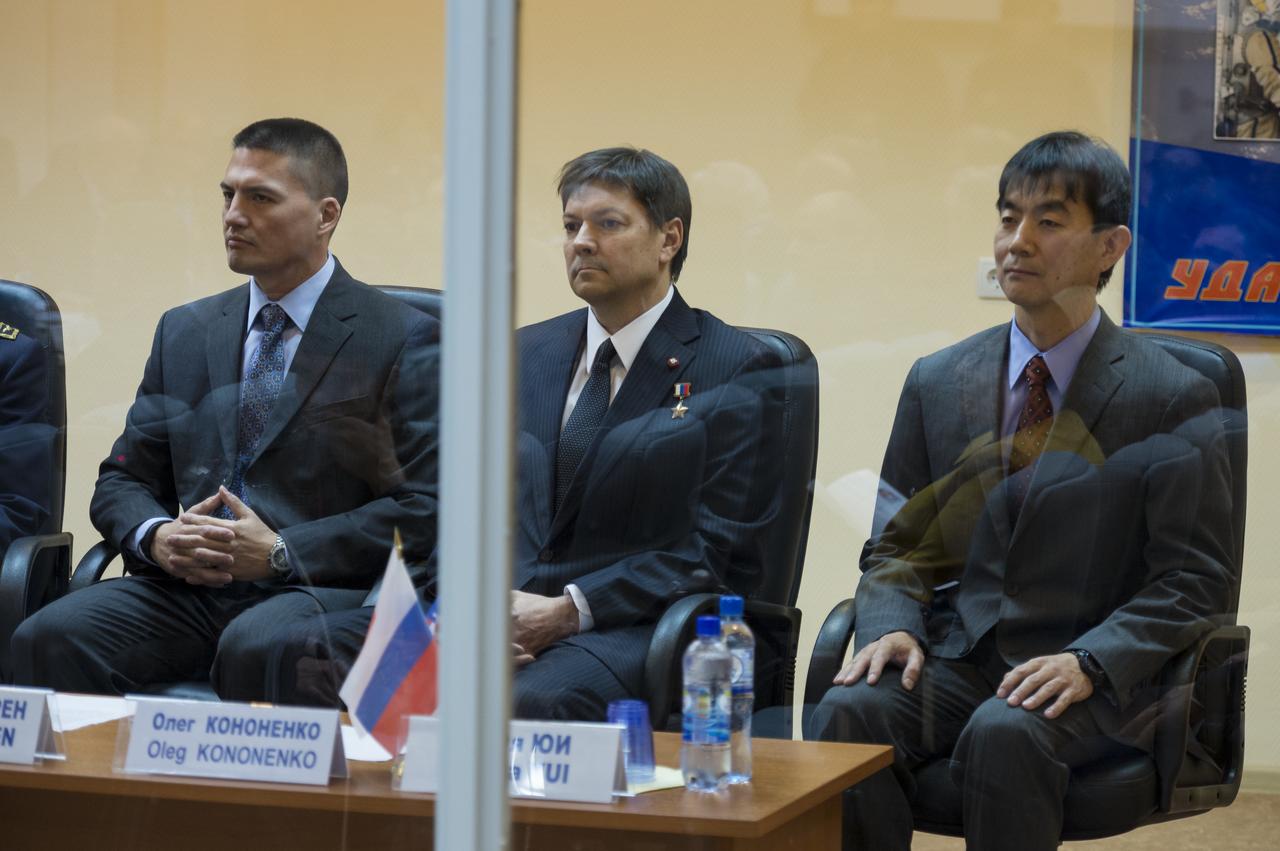
Expedition 42 backup crew members, Flight Engineer Kjell Lindgren of NASA (left), Soyuz Commander Oleg Kononenko of the Russian Federal Space Agency (Roscosmos) (center), and Flight Engineeer Kimiya Yui of the Japan Aerospace Exploration Agency (JAXA) (right) are seen at the State Commission meeting to approve the Soyuz launch of Expedition 42 to the International Space Station in Baikonur, Kazakhstan on Saturday, Nov. 22, 2014. The mission is set to launch Nov. 24 from the Baikonur Cosmodrome. Photo Credit: (NASA/Aubrey Gemignani)
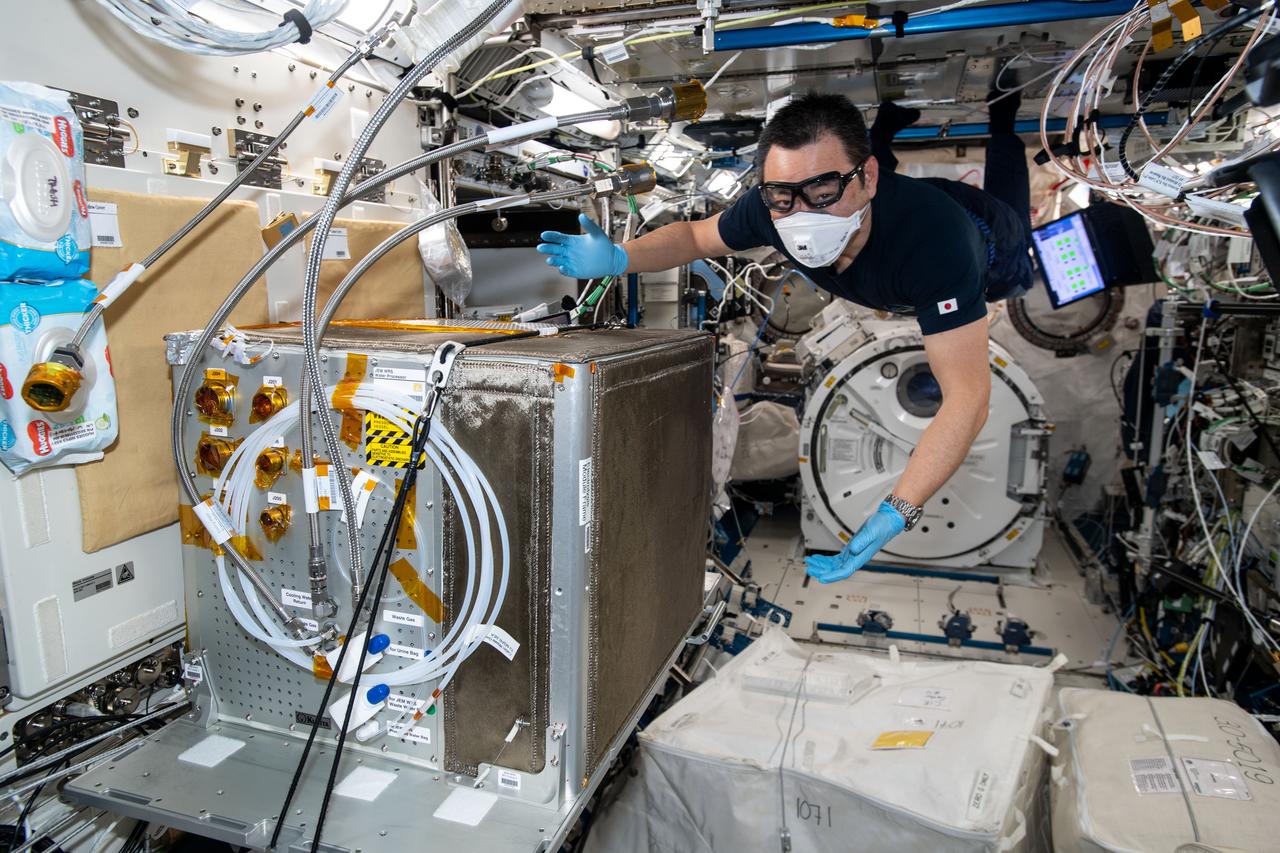
iss065e333421 (8/30/2021) --- Japan Aerospace Exploration Agency (JAXA) astronaut Akihiko Hoshide is photographed during the Japanese Experiment Module (JEM) Water Recovery System (JWRS) Gas Trap and Bypass Line Installation. Future water recovery systems will require high recovery rates, a more compact size, and less power consumption than conventional systems. The JWRS demonstrates new technologies on orbit, aboard the International Space Station (ISS), to meet these requirements.
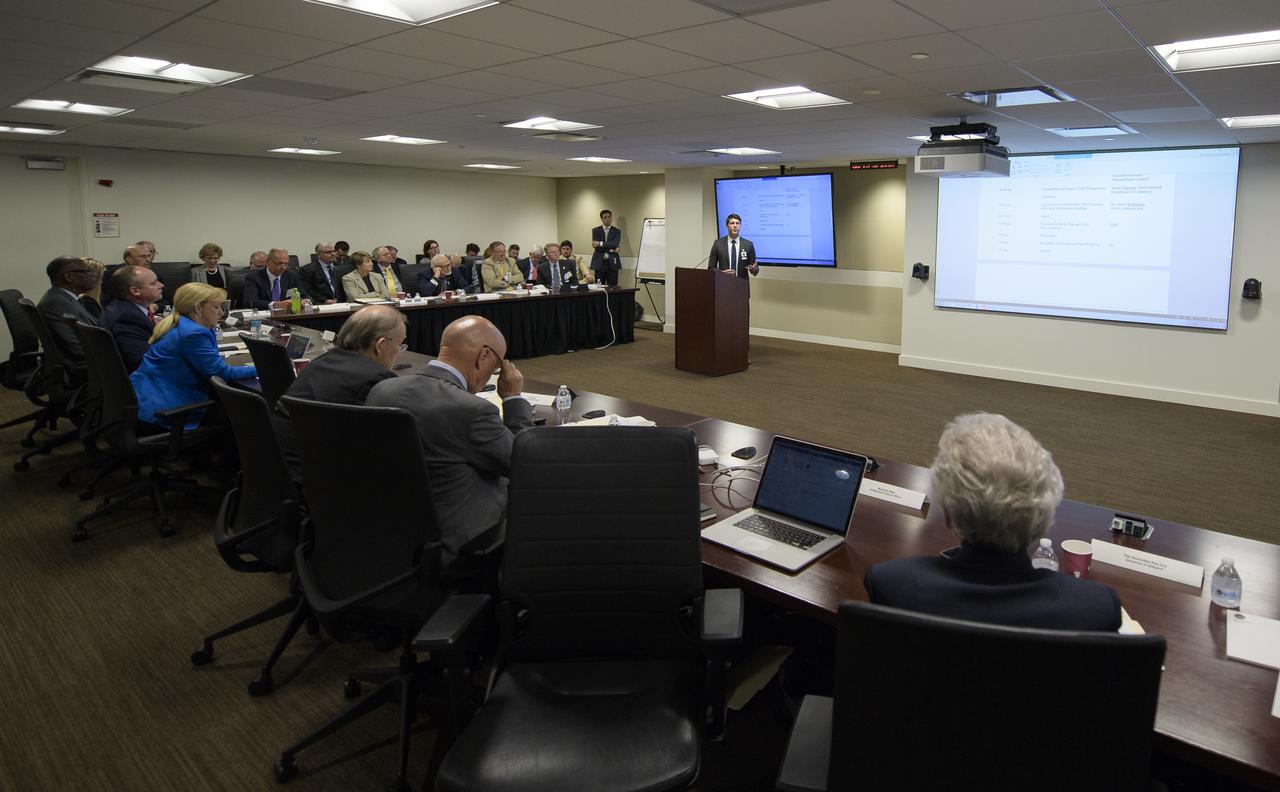
James Uthmeier, of the Department of Commerce, speaks about deregulation and space traffic management initiatives at the first meeting of the National Space Council Users' Advisory Group, Tuesday, June 19, 2018 at NASA Headquarters in Washington. The Users' Advisory Group will advise and inform the National Space Council on a broad range of aerospace topics, including the impacts of U.S. and international laws and regulations, national security space priorities, scientific and human space exploration priorities, and ways to bolster support. Photo Credit: (NASA/Joel Kowsky)
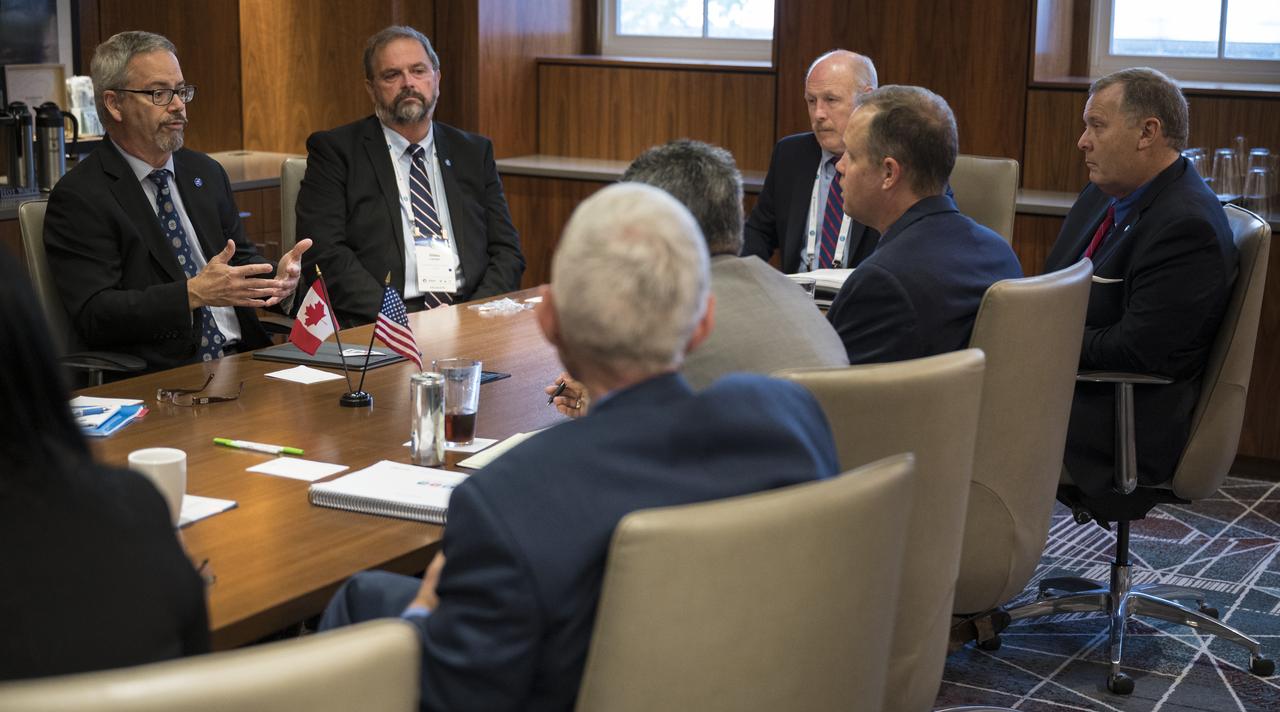
NASA Administrator Jim Bridenstine, NASA Deputy Administrator Jim Morhard, and Ken Bowersox, acting Associate Administrator for NASA's Human Exploration and Operations Mission Directorate, meet with Sylvain Laporte, President of the Canadian Space Agency, at the 70th International Astronautical Congress, Wednesday, Oct. 23, 2019 in Washington. Photo Credit: (NASA/Joel Kowsky)
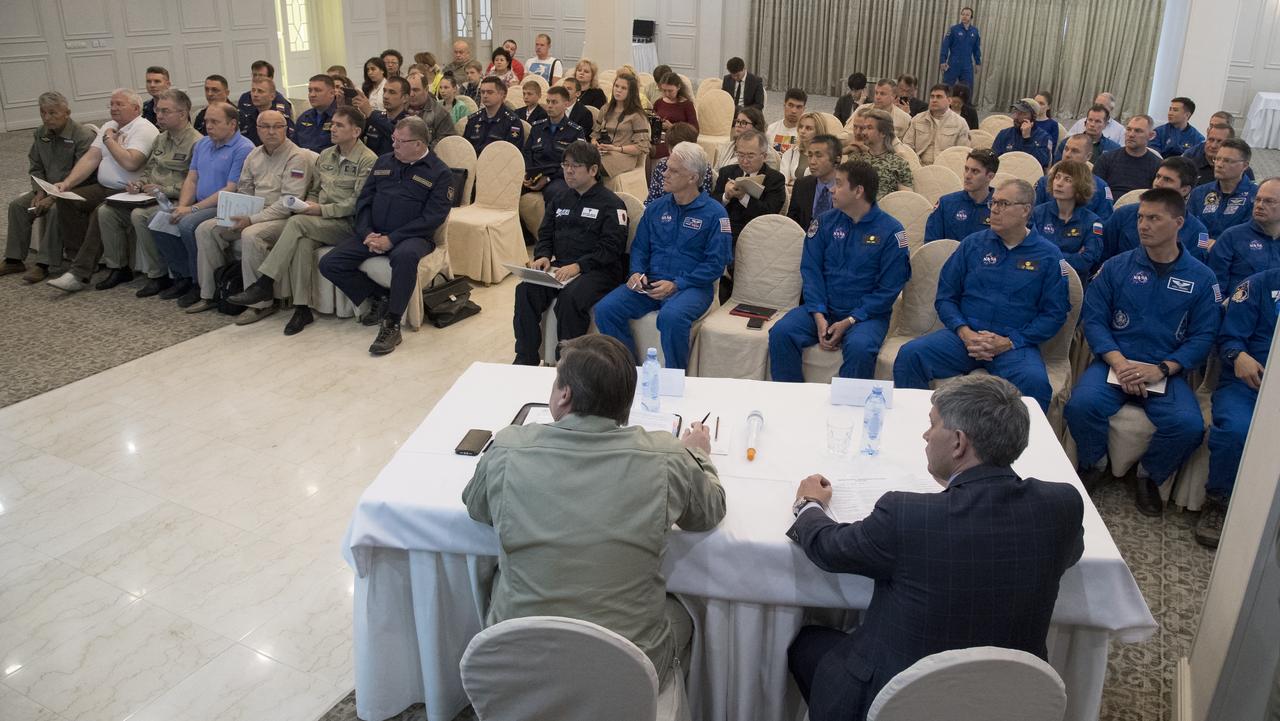
NASA, Roscosmos, and JAXA team members, along with Russian Search and Recovery Forces, meet to discuss the readiness for the landing of Expedition 55 crew members Anton Shkaplerov of Roscosmos, Scott Tingle of NASA, Norishige Kanai of the Japan Aerospace Exploration Agency (JAXA) Saturday, June 2, 2018. Shkaplerov, Tingle, and Kanai are returning after 168 days in space where they served as members of the Expedition 54 and 55 crews onboard the International Space Station. Photo Credit: (NASA/Bill Ingalls)

NASA Administrator Jim Bridenstine, center left, Deputy Administrator Jim Morhard, Ken Bowersox, acting Associate Administrator for NASA's Human Exploration and Operations Mission Directorate, Thomas Zurbuchen, Associate Administrator of NASA's Science Mission Directorate, meet with Pascale Ehrenfreund, Chair of the Executive Board of the German Aerospace Center (DLR) and other members of the executive board at the 70th International Astronautical Congress, Wednesday, Oct. 23, 2019 in Washington. Photo Credit: (NASA/Joel Kowsky)
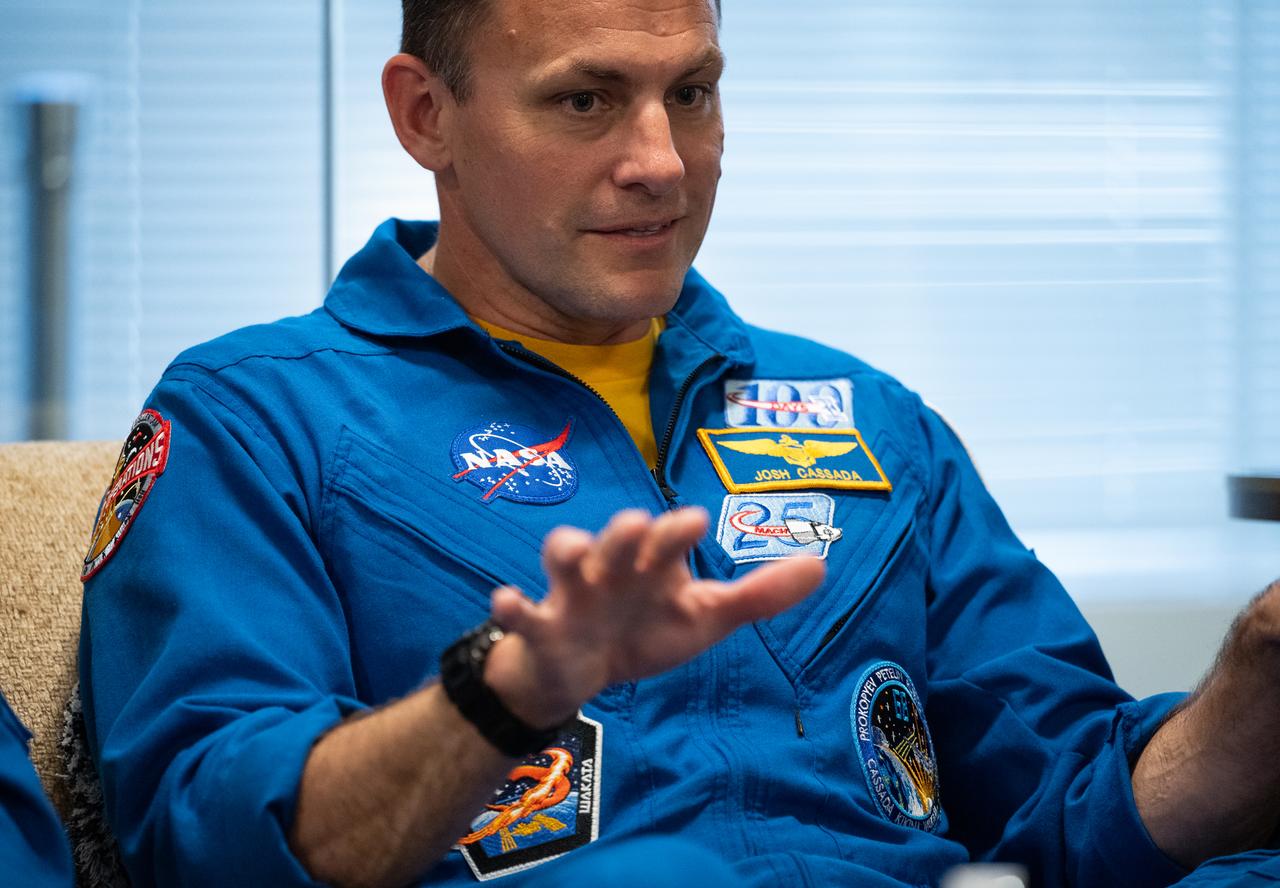
NASA’s SpaceX Crew-5 astronaut Josh Cassada of NASA is seen as he and fellow crewmates Nicole Mann of NASA and Koichi Wakata of the Japan Aerospace Exploration Agency (JAXA) as they meet with NASA Deputy Administrator Pam Melroy and NASA Associate Administrator Bob Cabana, Monday, June 5, 2023 at the Mary W. Jackson NASA Headquarters building in Washington. Mann, Cassada, and Wakata spent 157 days in space as part of Expedition 68 aboard the International Space Station. Photo Credit: (NASA/Joel Kowsky)
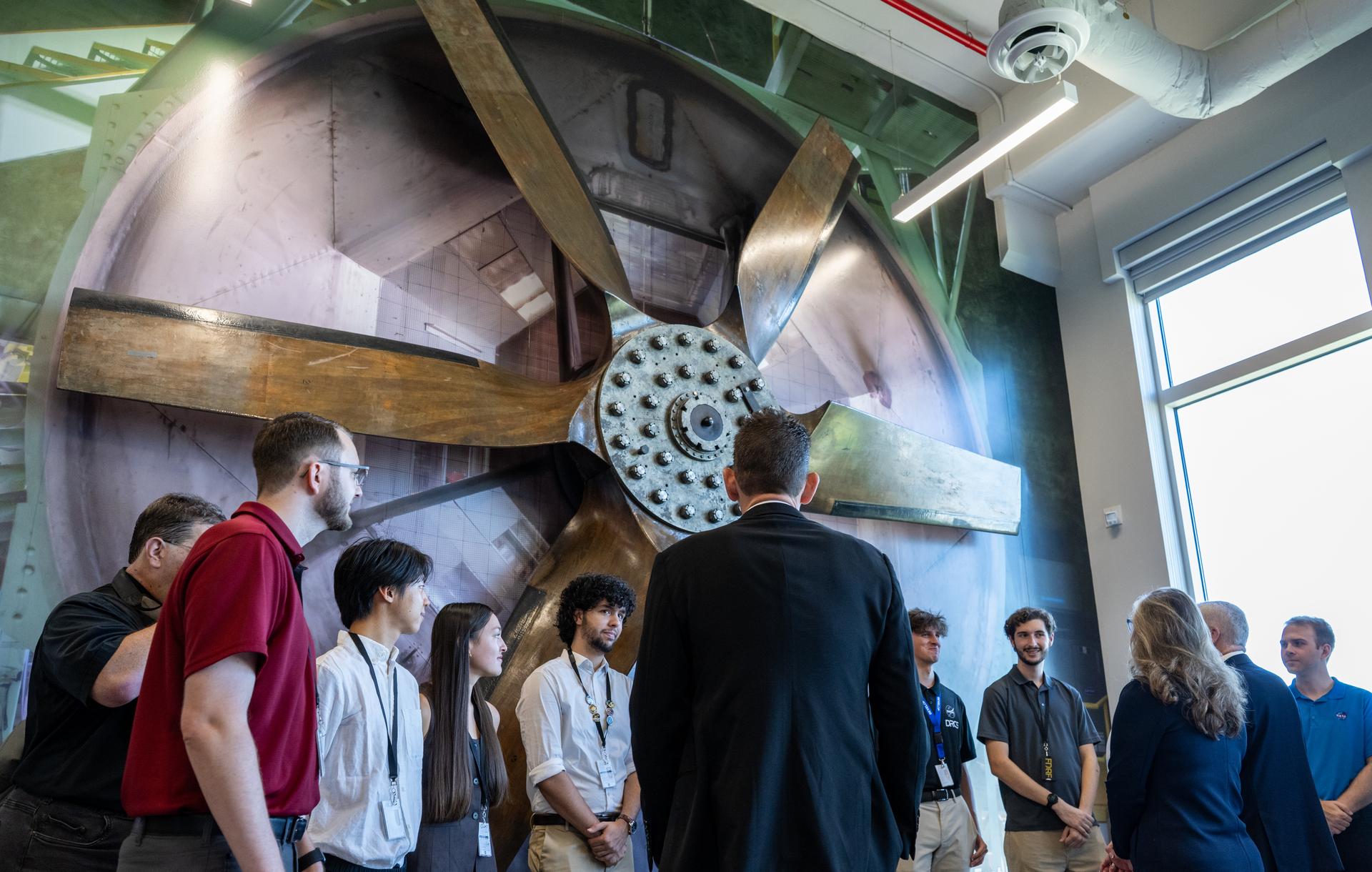
NASA Administrator Jared Isaacman, center, meets with interns during a tour of the Flight Dynamics Research Facility, NASA's newest wind tunnel, Friday, July 31, 2026, at NASA’s Langley Research Center in Hampton, Virginia. The state-of-the-art facility will support research and technology development that will advance the agency’s aeronautics, exploration, and science goals, including establishing a sustained human presence on the lunar surface through the Artemis program and the development of a Moon Base. Photo Credit: (NASA/Keegan Barber)

General Director of the Russian Federal Space Agency, Roscosmos, Oleg Ostapenko, talks during the State Commission meeting to approve the Soyuz rocket launch of Expedition 38 Soyuz Commander Mikhail Tyurin of Roscosmos, Flight Engineer Koichi Wakata of the Japan Aerospace Exploration Agency, and, Flight Engineer Rick Mastracchio of NASA for a six month mission aboard the International Space Station, Wednesday, Nov. 6, 2013 at the Cosmonaut Hotel in Baikonur, Kazakhstan. Photo Credit: (NASA/Bill Ingalls)
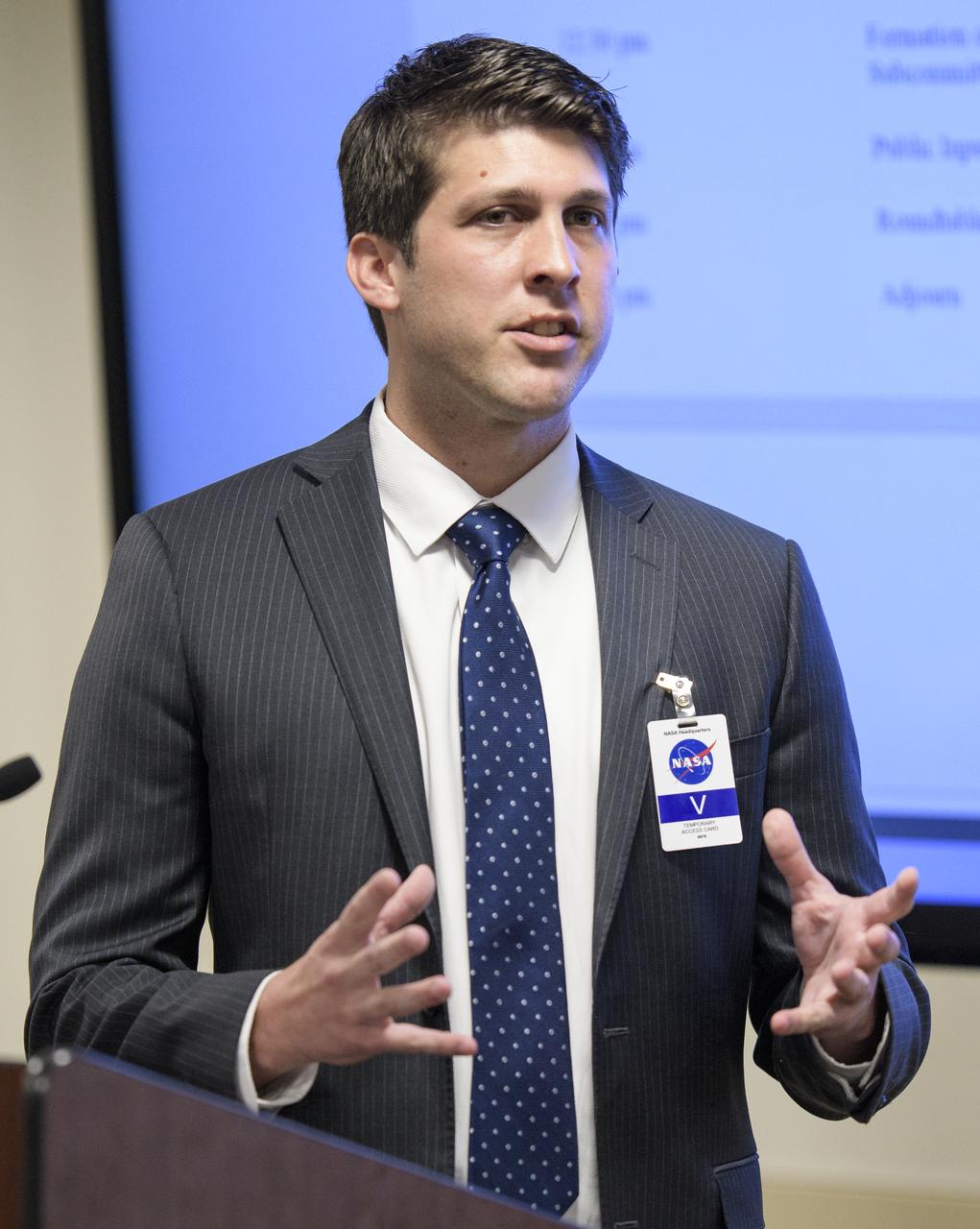
James Uthmeier, of the Department of Commerce, speaks about deregulation and space traffic management initiatives at the first meeting of the National Space Council Users' Advisory Group, Tuesday, June 19, 2018 at NASA Headquarters in Washington. The Users' Advisory Group will advise and inform the National Space Council on a broad range of aerospace topics, including the impacts of U.S. and international laws and regulations, national security space priorities, scientific and human space exploration priorities, and ways to bolster support. Photo Credit: (NASA/Joel Kowsky)
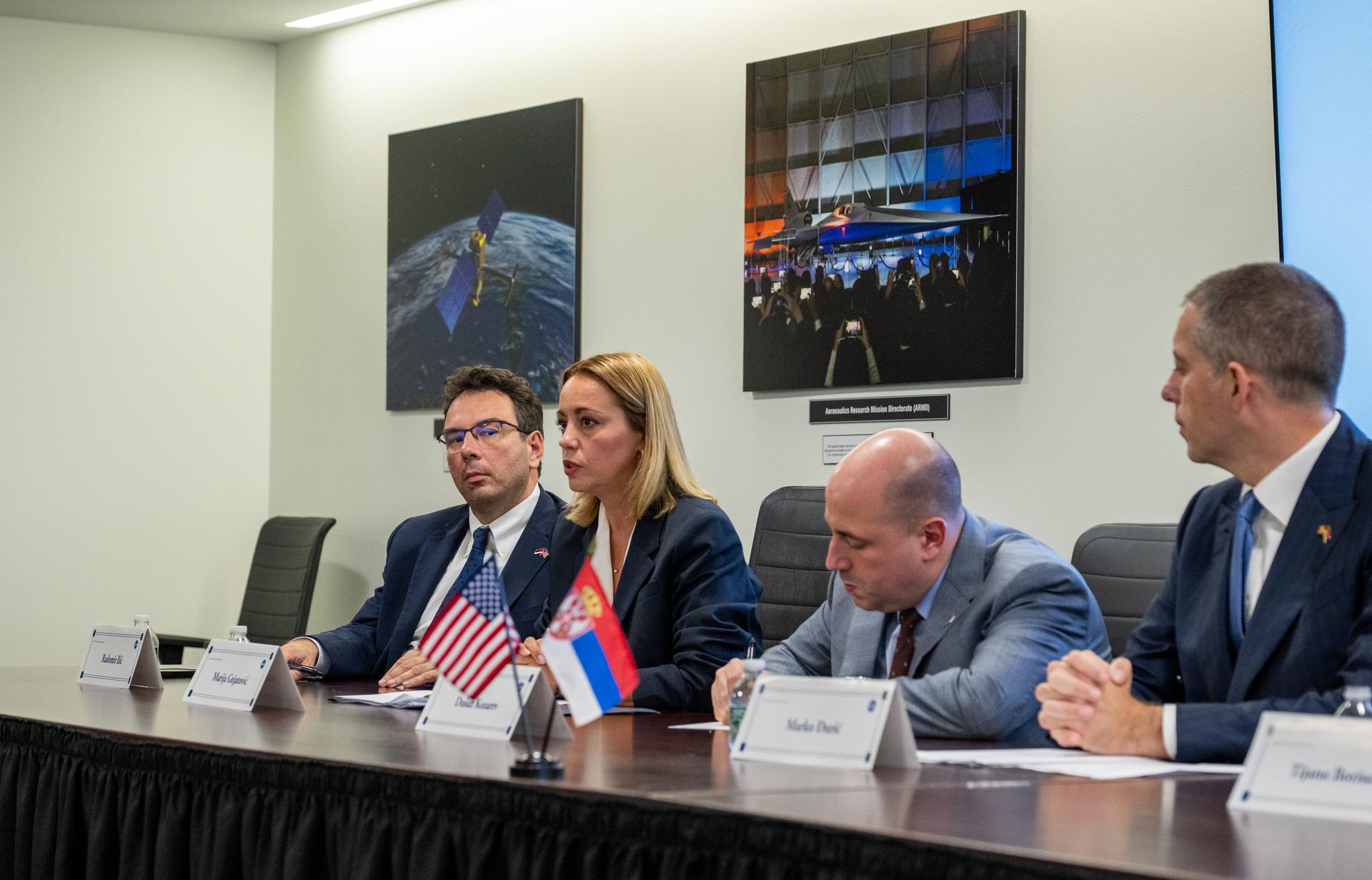
State Secretary at the Ministry of Science, Technological Development & Innovation Marija Gnjatović, second from left, speaks during a bilateral meeting with members of NASA’s Office of International and Interagency Relations following an Artemis Accords signing ceremony Thursday, July 16, 2026, at the Mary W. Jackson NASA Headquarters building in Washington. Serbia is the 69th country to sign the Artemis Accords, which establish a practical set of principles to guide space exploration cooperation among nations participating in NASA’s Artemis program. Photo Credit: (NASA/Keegan Barber)
National Space Council Executive Secretary Scott Pace speaks at the first meeting of the National Space Council Users' Advisory Group, Tuesday, June 19, 2018 at NASA Headquarters in Washington. The Users' Advisory Group will advise and inform the National Space Council on a broad range of aerospace topics, including the impacts of U.S. and international laws and regulations, national security space priorities, scientific and human space exploration priorities, and ways to bolster support. Photo Credit: (NASA/Joel Kowsky)
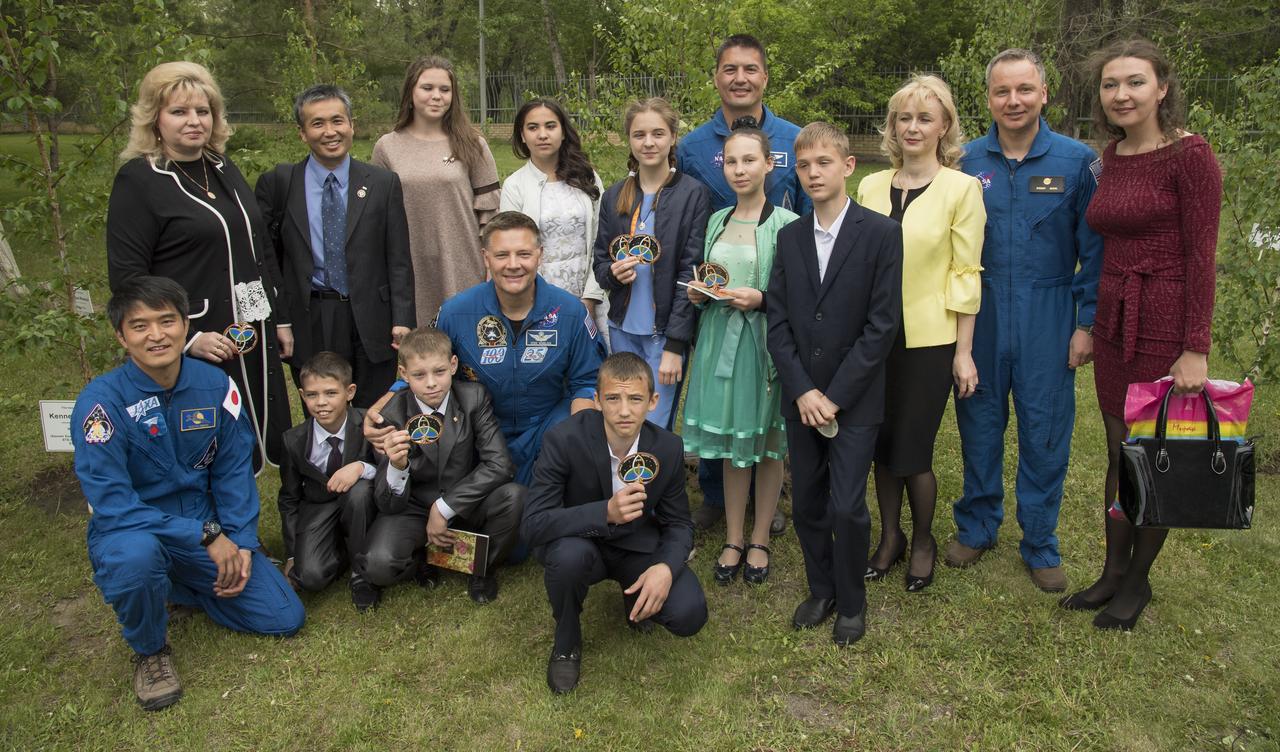
Japan Aerospace Exploration Agency astronauts, Takuya Onishi, lower left, Koichi Wakata, 2nd from left standing, along with NASA astronauts Doug Wheelock, kneeling center, and Kjell Lindgren, standing center, meet with children from a local orphanage at the Cosmonaut Hotel, Saturday, June 2, 2018 in Karaganda, Kazakhstan. The astronauts were in Karaganda to help support the Expedition 55 crew Soyuz landing from the International Space Station. Photo Credit: (NASA/Bill Ingalls)
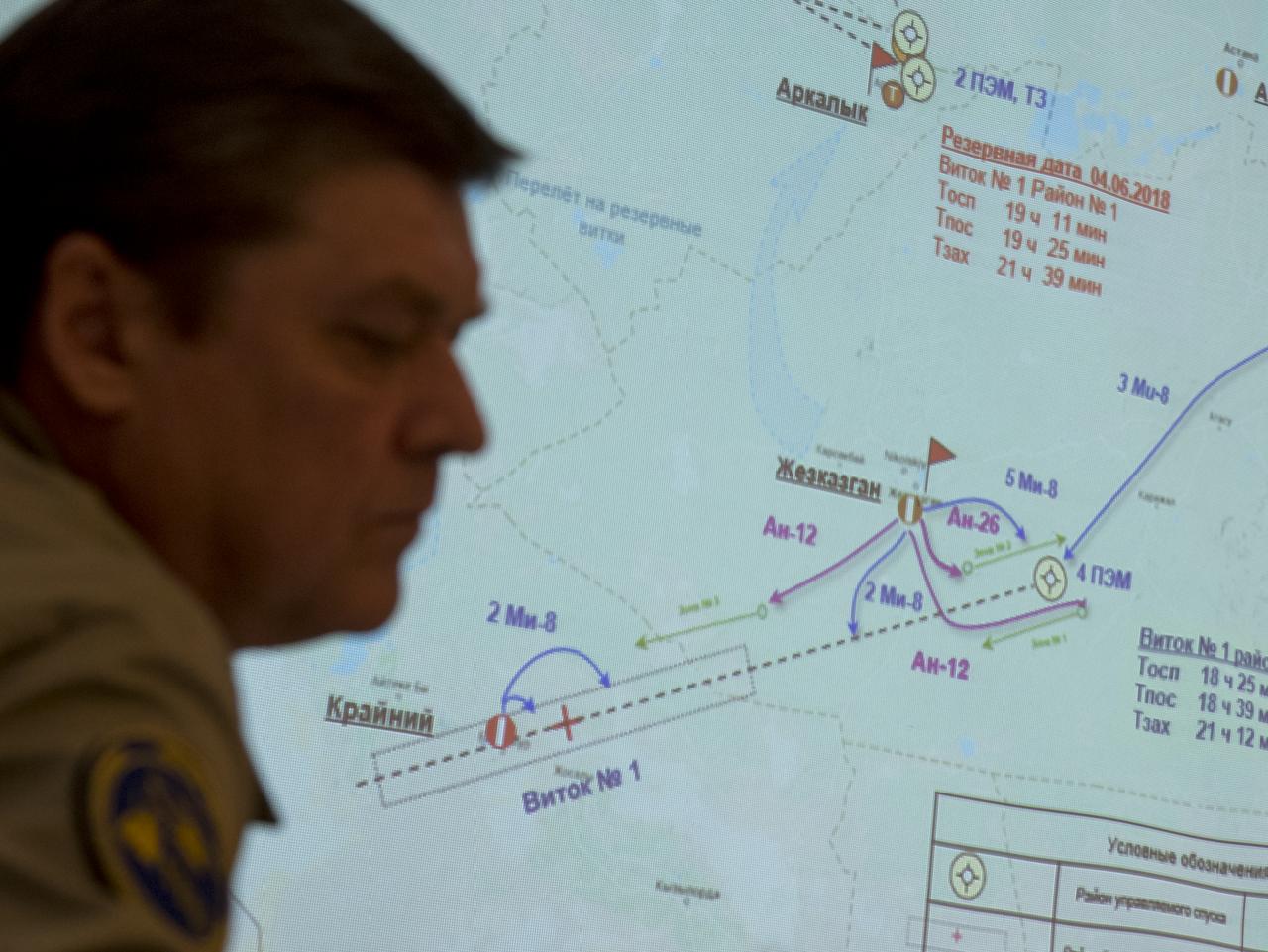
A map for the landing of Expedition 55 crew members Anton Shkaplerov of Roscosmos, Scott Tingle of NASA, Norishige Kanai of the Japan Aerospace Exploration Agency (JAXA) is seen during a landing operation readiness meeting Saturday, June 2, 2018. Shkaplerov, Tingle, and Kanai are returning after 168 days in space where they served as members of the Expedition 54 and 55 crews onboard the International Space Station. Photo Credit: (NASA/Bill Ingalls)
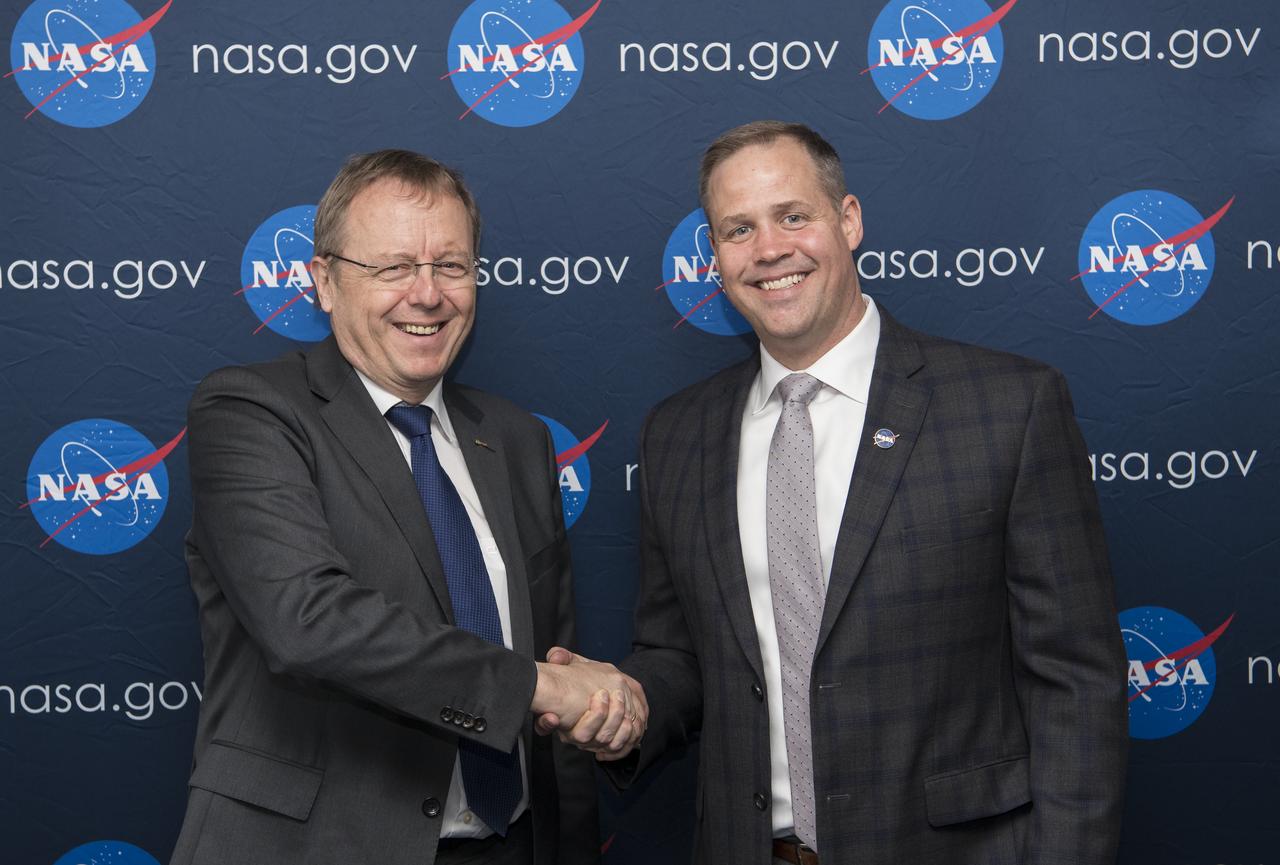
NASA Administrator Jim Bridenstine, right, poses with Johann-Dietrich Wörner, director general of ESA (European Space Agency), just before meeting to discuss NASA’s plans to land humans on the Moon by 2024 and prospective collaboration in human and robotic lunar and Mars exploration activities, at the Space Symposium, Monday, April 8, 2019 in Colorado Springs, Colorado, They also discussed their continued successful cooperation on the International Space Station and the service module for the Orion spacecraft that will take us to the Moon and beyond. Photo Credit: (NASA/Aubrey Gemignani)
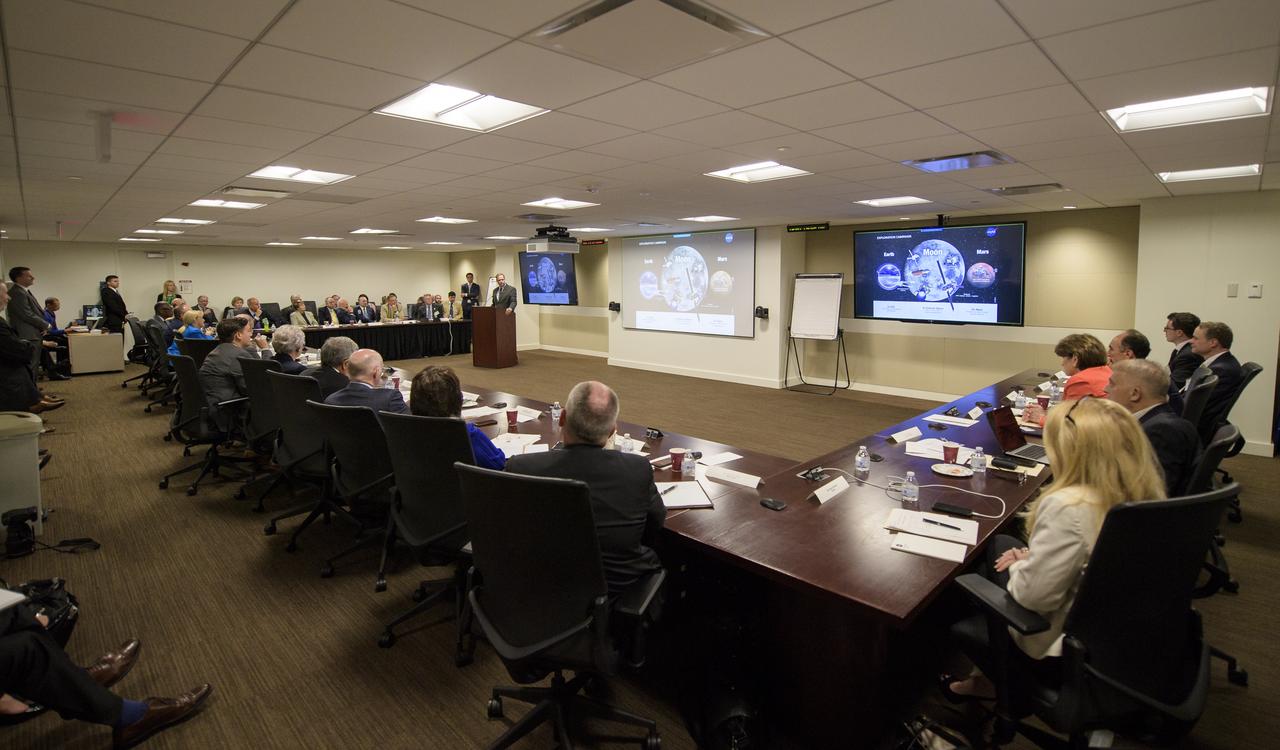
NASA Administrator Jim Bridenstine speaks at the first meeting of the National Space Council Users' Advisory Group, Tuesday, June 19, 2018 at NASA Headquarters in Washington. The Users' Advisory Group will advise and inform the National Space Council on a broad range of aerospace topics, including the impacts of U.S. and international laws and regulations, national security space priorities, scientific and human space exploration priorities, and ways to bolster support. Photo Credit: (NASA/Joel Kowsky)
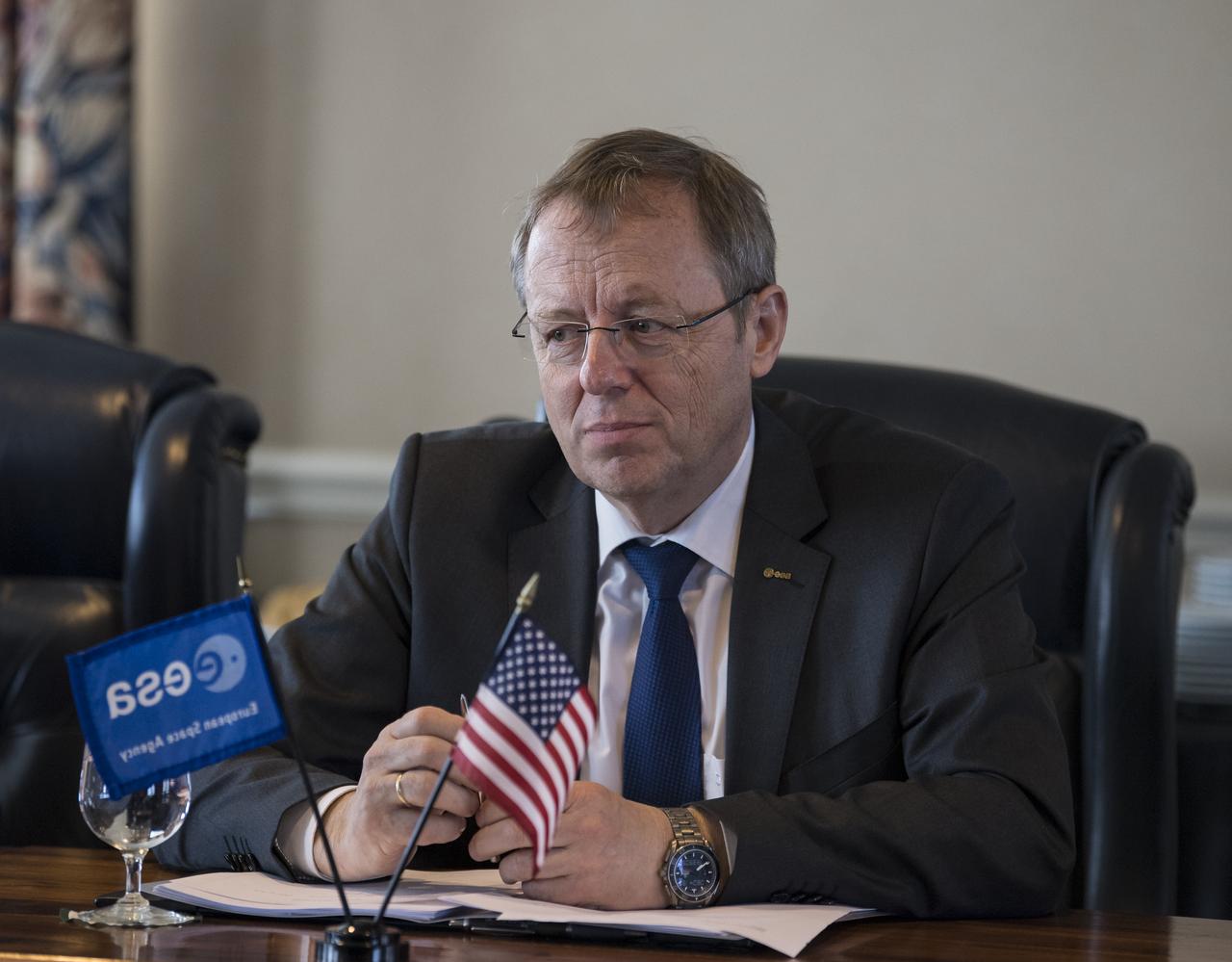
Johann-Dietrich Wörner, director general of ESA (European Space Agency), speaks at a bi-lateral meeting about NASA’s plans to land humans on the Moon by 2024 and prospective collaboration in human and robotic lunar and Mars exploration activities, at the Space Symposium, Monday, April 8, 2019 in Colorado Springs, Colorado. They also discussed their continued successful cooperation on the International Space Station and the service module for the Orion spacecraft that will take us to the Moon and beyond. Photo Credit: (NASA/Aubrey Gemignani)
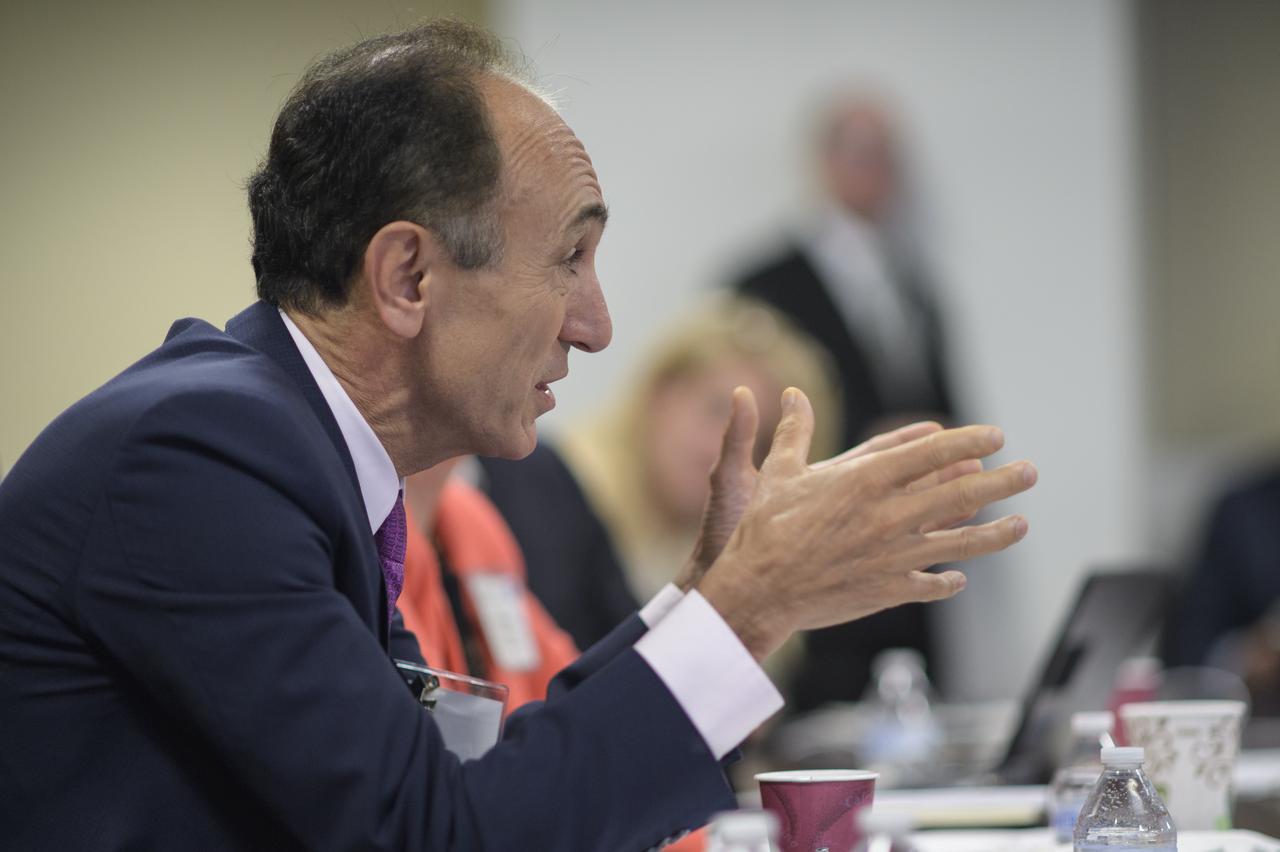
Users' Advisory Group member Faith Ozmen, CEO of the Sierra Nevada Corporation is seen durring the first meeting of the National Space Council Users' Advisory Group, Tuesday, June 19, 2018 at NASA Headquarters in Washington. The Users' Advisory Group will advise and inform the National Space Council on a broad range of aerospace topics, including the impacts of U.S. and international laws and regulations, national security space priorities, scientific and human space exploration priorities, and ways to bolster support. Photo Credit: (NASA/Joel Kowsky)
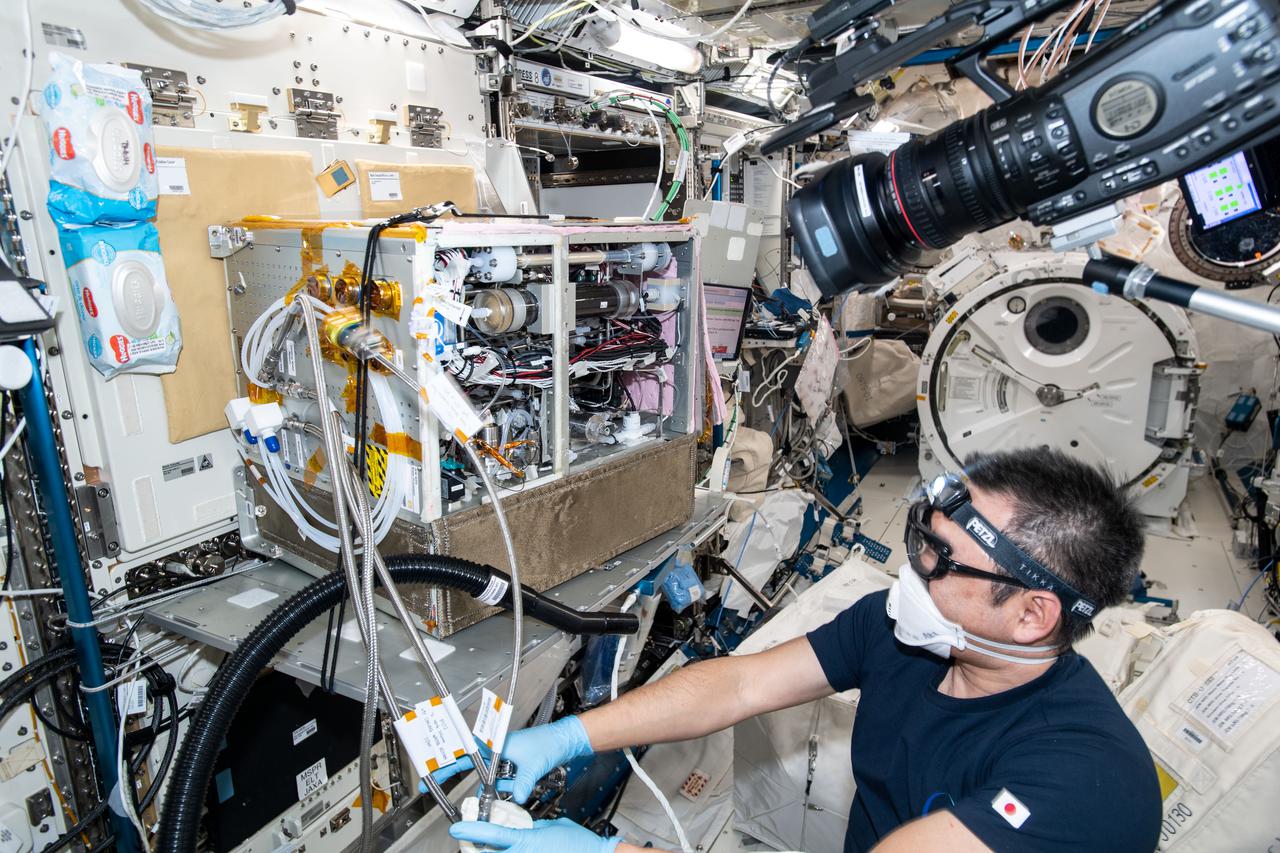
iss065e333427 (8/30/2021) --- Japan Aerospace Exploration Agency (JAXA) astronaut Akihiko Hoshide is photographed during the Japanese Experiment Module (JEM) Water Recovery System (JWRS) Gas Trap and Bypass Line Installation. Future water recovery systems will require high recovery rates, a more compact size, and less power consumption than conventional systems. The JWRS demonstrates new technologies on orbit, aboard the International Space Station (ISS), to meet these requirements.
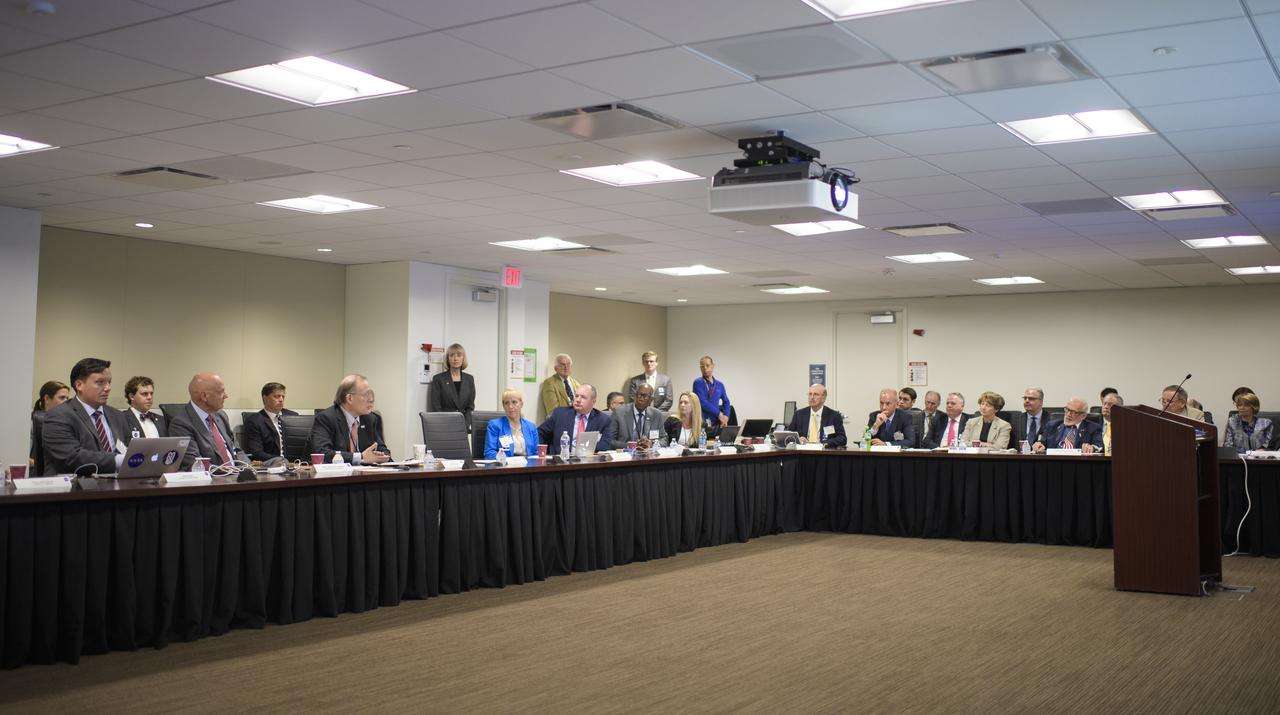
Members of the Users' Advisory Group are seen during the first meeting of the National Space Council Users' Advisory Group, Tuesday, June 19, 2018 at NASA Headquarters in Washington. The Users' Advisory Group will advise and inform the National Space Council on a broad range of aerospace topics, including the impacts of U.S. and international laws and regulations, national security space priorities, scientific and human space exploration priorities, and ways to bolster support. Photo Credit: (NASA/Joel Kowsky)
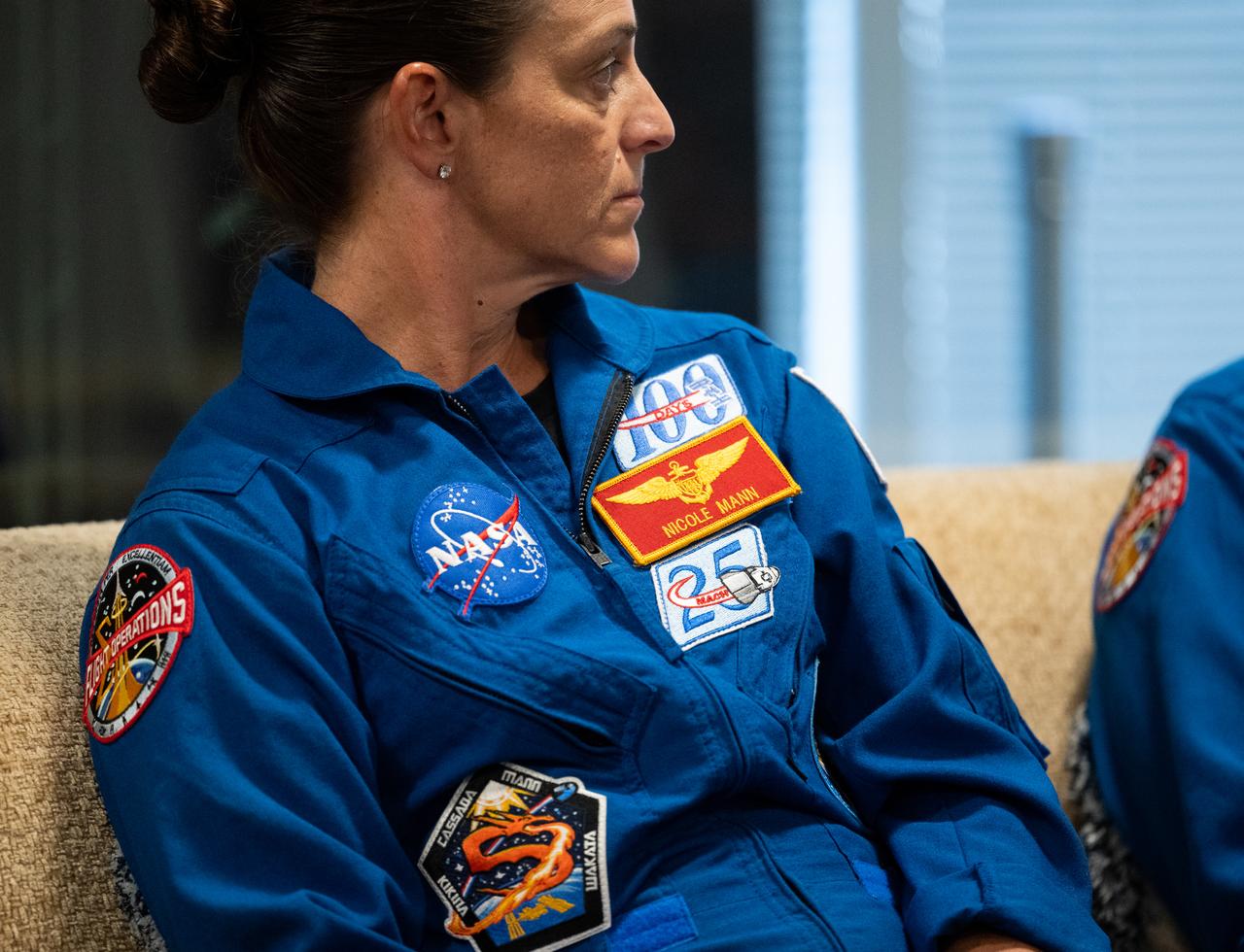
NASA’s SpaceX Crew-5 astronaut Nicole Mann of NASA is seen as she and fellow crewmates Josh Cassada of NASA and Koichi Wakata of the Japan Aerospace Exploration Agency (JAXA) as they meet with NASA Deputy Administrator Pam Melroy and NASA Associate Administrator Bob Cabana, Monday, June 5, 2023 at the Mary W. Jackson NASA Headquarters building in Washington. Mann, Cassada, and Wakata spent 157 days in space as part of Expedition 68 aboard the International Space Station. Photo Credit: (NASA/Joel Kowsky)
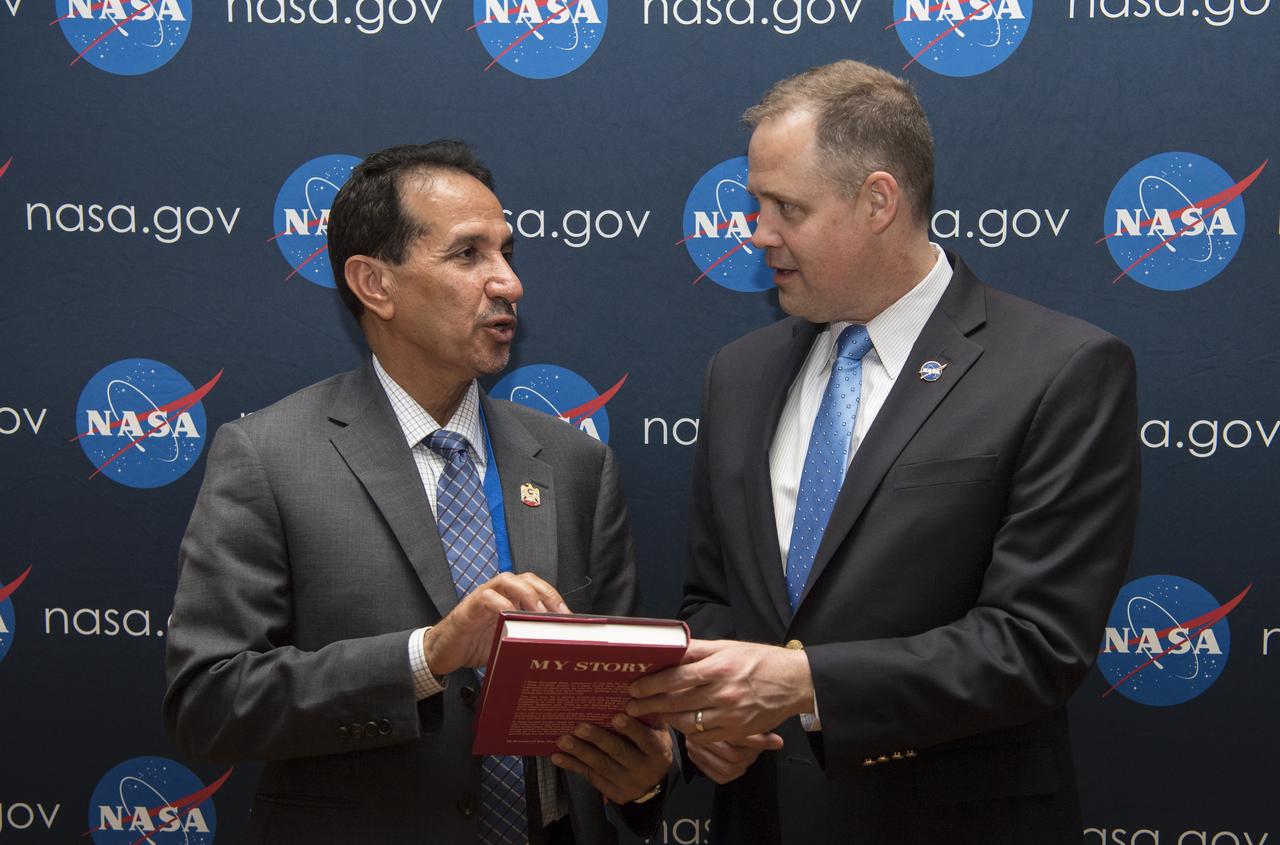
NASA Administrator Jim Bridenstine, right, speaks with the Director General of the United Arab Emirates Space Agency (UAESA), Dr. Mohamed Al Ahbabi, just after a meeting to discuss NASA’s plans to land humans on the Moon by 2024, UAESA’S human spaceflight objectives, and prospective cooperation involving the International Space Station and exploration of the Moon and Mars, at the Space Symposium, Wednesday, April 10, 2019 in Colorado Springs, Colorado. Photo Credit: (NASA/Aubrey Gemignani)
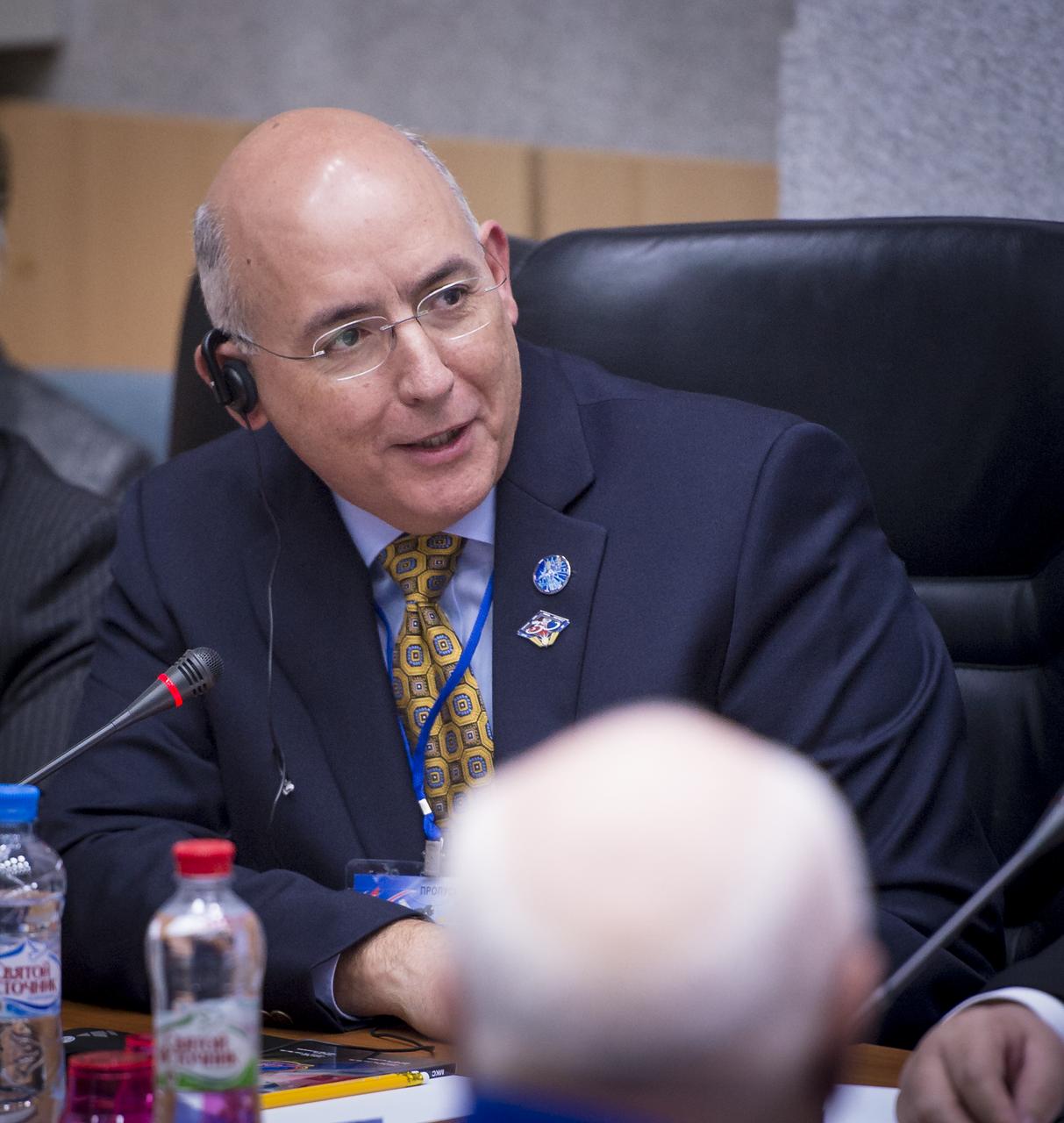
NASA Space Station Program Office Manager Michael T. Suffredini, talks during the State Commission meeting to approve the Soyuz rocket launch of Expedition 38 Soyuz Commander Mikhail Tyurin of Roscosmos, Flight Engineer Koichi Wakata of the Japan Aerospace Exploration Agency, and, Flight Engineer Rick Mastracchio of NASA for a six month mission aboard the International Space Station, Wednesday, Nov. 6, 2013 at the Cosmonaut Hotel in Baikonur, Kazakhstan. Photo Credit: (NASA/Bill Ingalls)
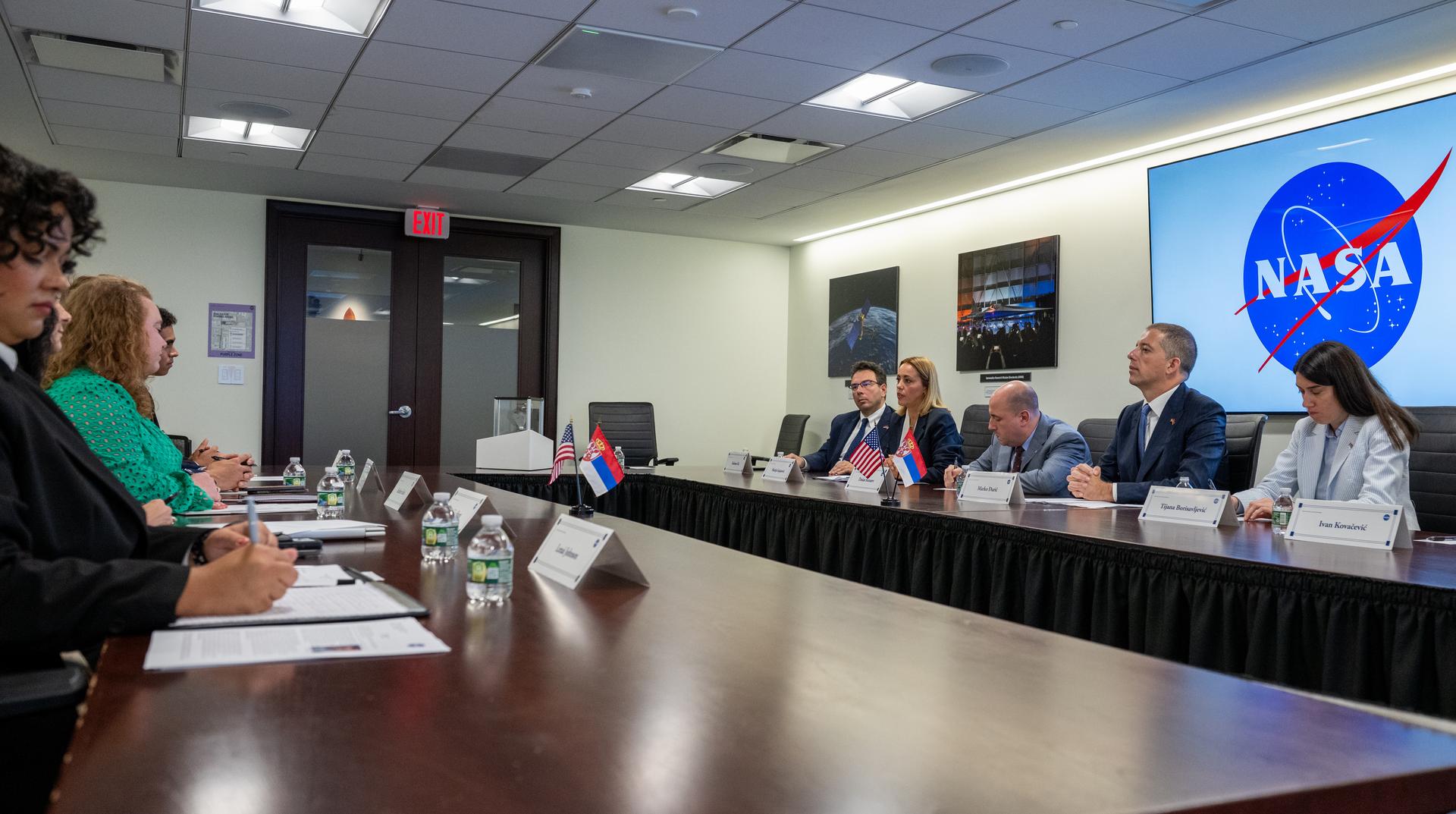
Representatives from Serbia and members of NASA’s Office of International and Interagency Relations participate in a bilateral meeting following an Artemis Accords signing ceremony Thursday, July 16, 2026, at the Mary W. Jackson NASA Headquarters building in Washington. Serbia is the 69th country to sign the Artemis Accords, which establish a practical set of principles to guide space exploration cooperation among nations participating in NASA’s Artemis program. Photo Credit: (NASA/Keegan Barber)

Japan Aerospace Exploration Agency (JAXA) Flight Engineer Satoshi Furukawa speaks during the State Commission meeting to approve the Soyuz launch of Expedition 28 to the International Space Station, Monday, June 6, 2011, at the Cosmonaut Hotel in Baikonur, Kazakhstan. The mission is set to launch on Tuesday, June 8, from the Baikonur Cosmodrome. Photo Credit: (NASA/Carla Cioffi)
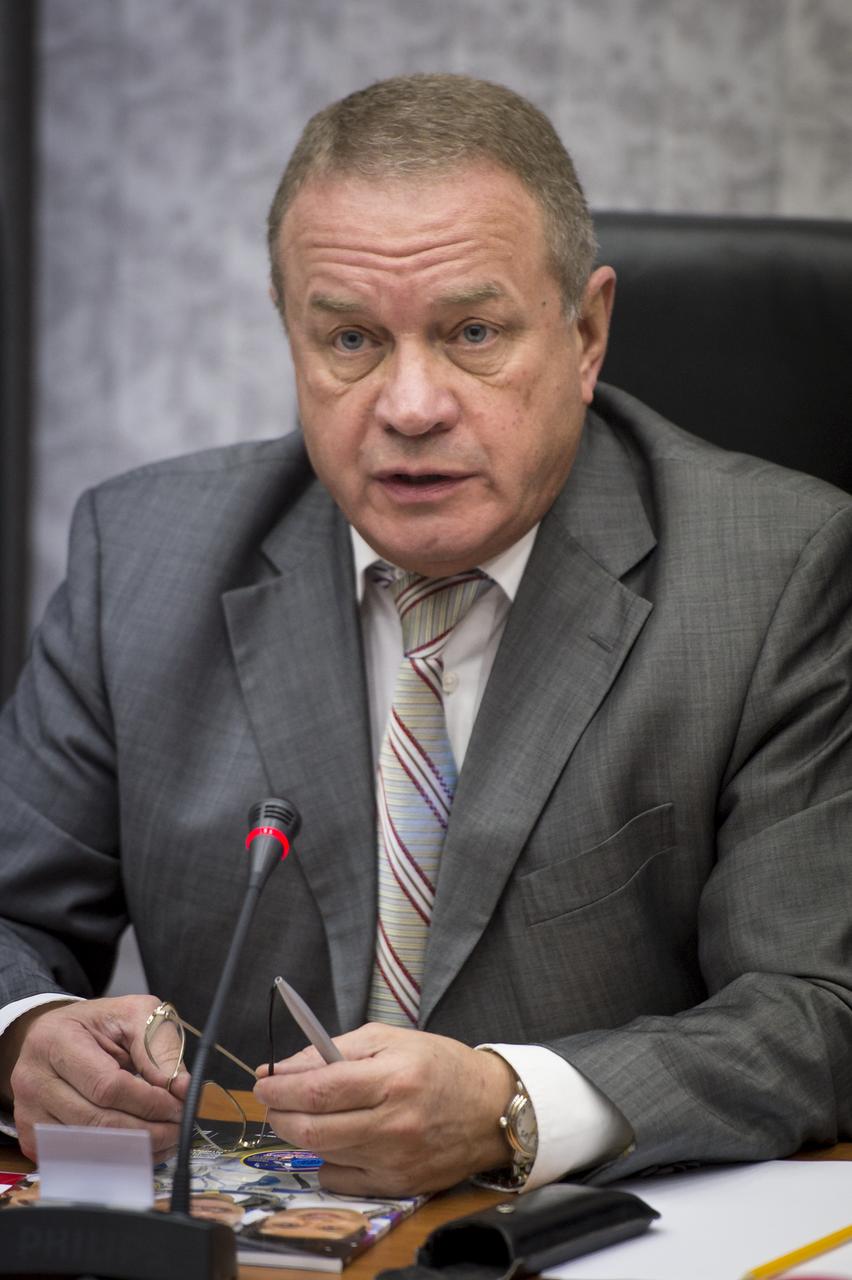
President of RSC Energia, Designer General V.A. Lopota, talks during the State Commission meeting to approve the Soyuz rocket launch of Expedition 38 Soyuz Commander Mikhail Tyurin of Roscosmos, Flight Engineer Koichi Wakata of the Japan Aerospace Exploration Agency, and, Flight Engineer Rick Mastracchio of NASA for a six month mission aboard the International Space Station, Wednesday, Nov. 6, 2013 at the Cosmonaut Hotel in Baikonur, Kazakhstan. Photo Credit: (NASA/Bill Ingalls)
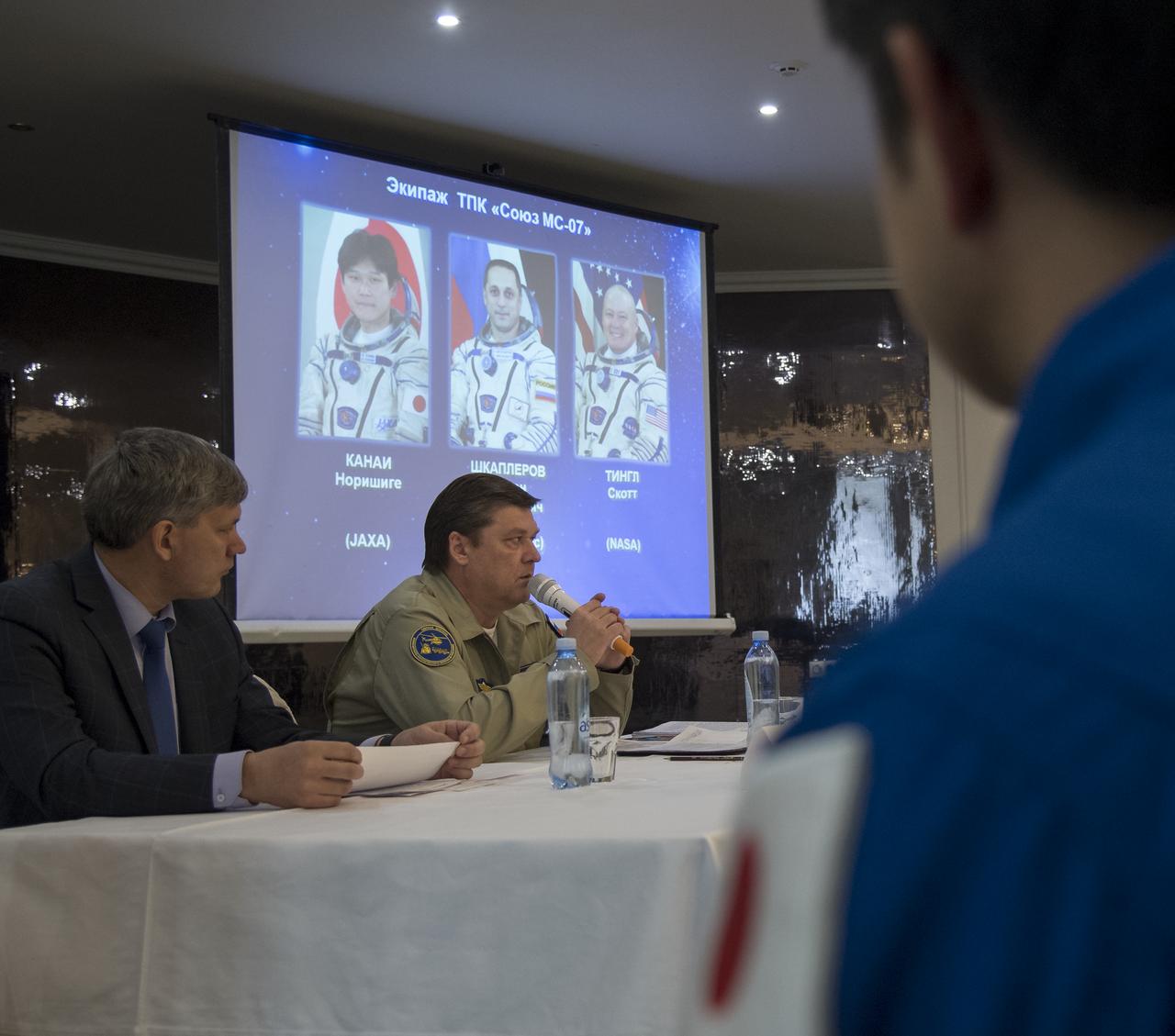
NASA, Roscosmos, and JAXA team members, along with Russian Search and Recovery Forces, meet to discuss the readiness for the landing of Expedition 55 crew members Anton Shkaplerov of Roscosmos, Scott Tingle of NASA, Norishige Kanai of the Japan Aerospace Exploration Agency (JAXA) Saturday, June 2, 2018. Shkaplerov, Tingle, and Kanai are returning after 168 days in space where they served as members of the Expedition 54 and 55 crews onboard the International Space Station. Photo Credit: (NASA/Bill Ingalls)
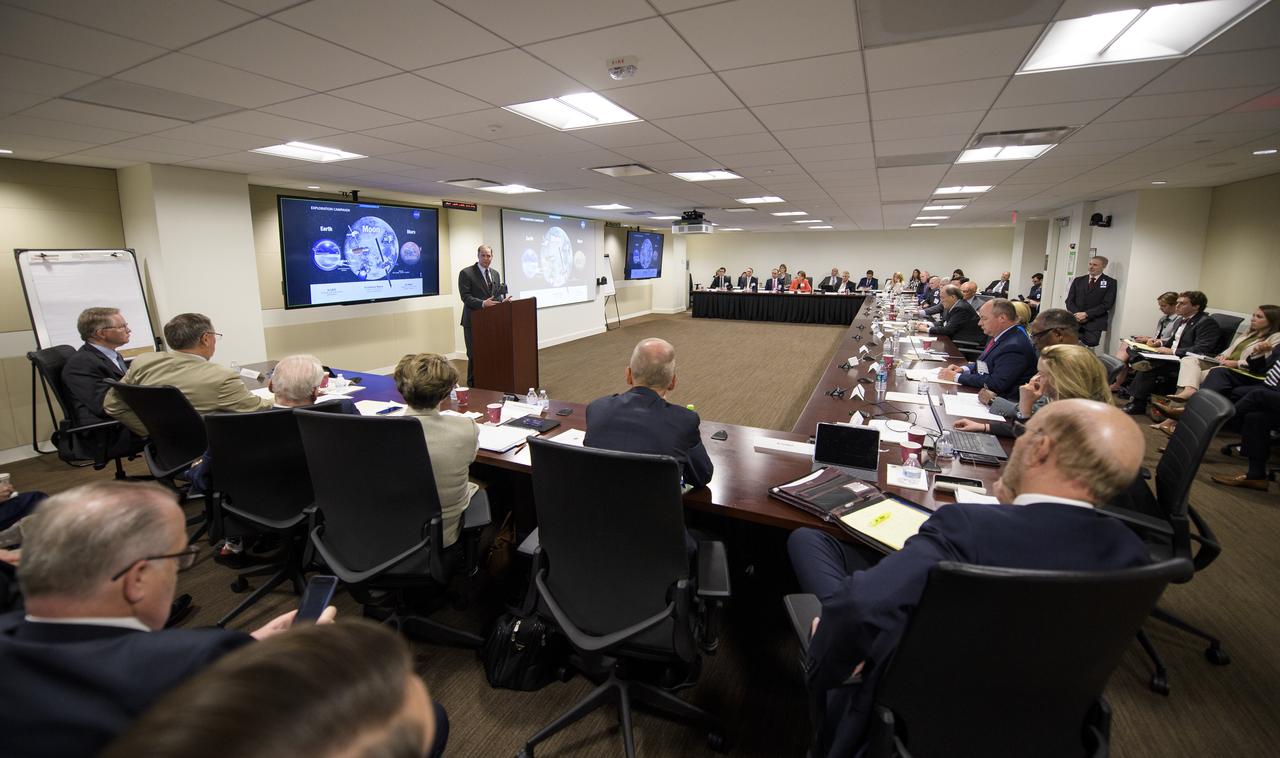
NASA Administrator Jim Bridenstine speaks at the first meeting of the National Space Council Users' Advisory Group, Tuesday, June 19, 2018 at NASA Headquarters in Washington. The Users' Advisory Group will advise and inform the National Space Council on a broad range of aerospace topics, including the impacts of U.S. and international laws and regulations, national security space priorities, scientific and human space exploration priorities, and ways to bolster support. Photo Credit: (NASA/Joel Kowsky)
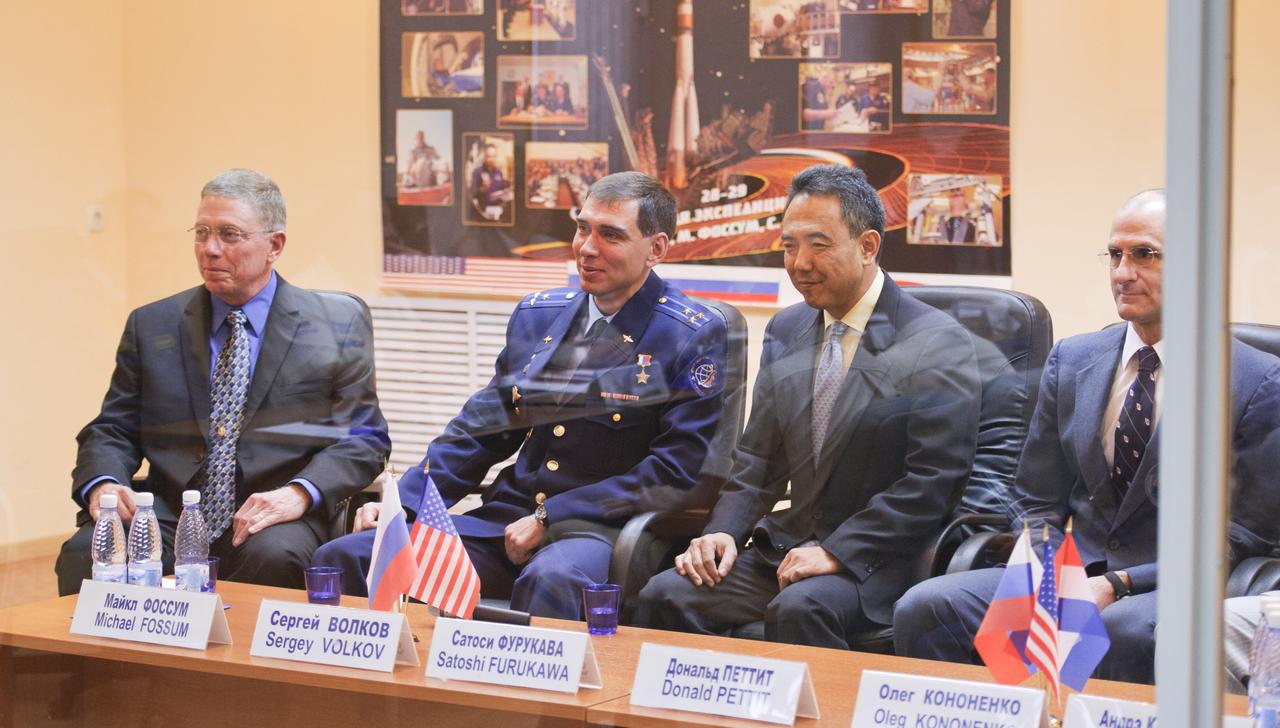
Expedition 28 NASA Flight Engineer Mike Fossum, left, Soyuz Commander Sergei Volkov, Japan Aerospace Exploration Agency (JAXA) Flight Engineer Satoshi Furukawa, and NASA backup Flight Engineer Don Pettit are seen seated during the State Commission meeting to approve the Soyuz launch of Expedition 28 to the International Space Station, Monday, June 6, 2011, at the Cosmonaut Hotel in Baikonur, Kazakhstan. The mission is set to launch on Tuesday, June 8, from the Baikonur Cosmodrome. Photo Credit: (NASA/Carla Cioffi)

Members of the Users' Advisory Group are seen during the first meeting of the National Space Council Users' Advisory Group, Tuesday, June 19, 2018 at NASA Headquarters in Washington. The Users' Advisory Group will advise and inform the National Space Council on a broad range of aerospace topics, including the impacts of U.S. and international laws and regulations, national security space priorities, scientific and human space exploration priorities, and ways to bolster support. Photo Credit: (NASA/Joel Kowsky)
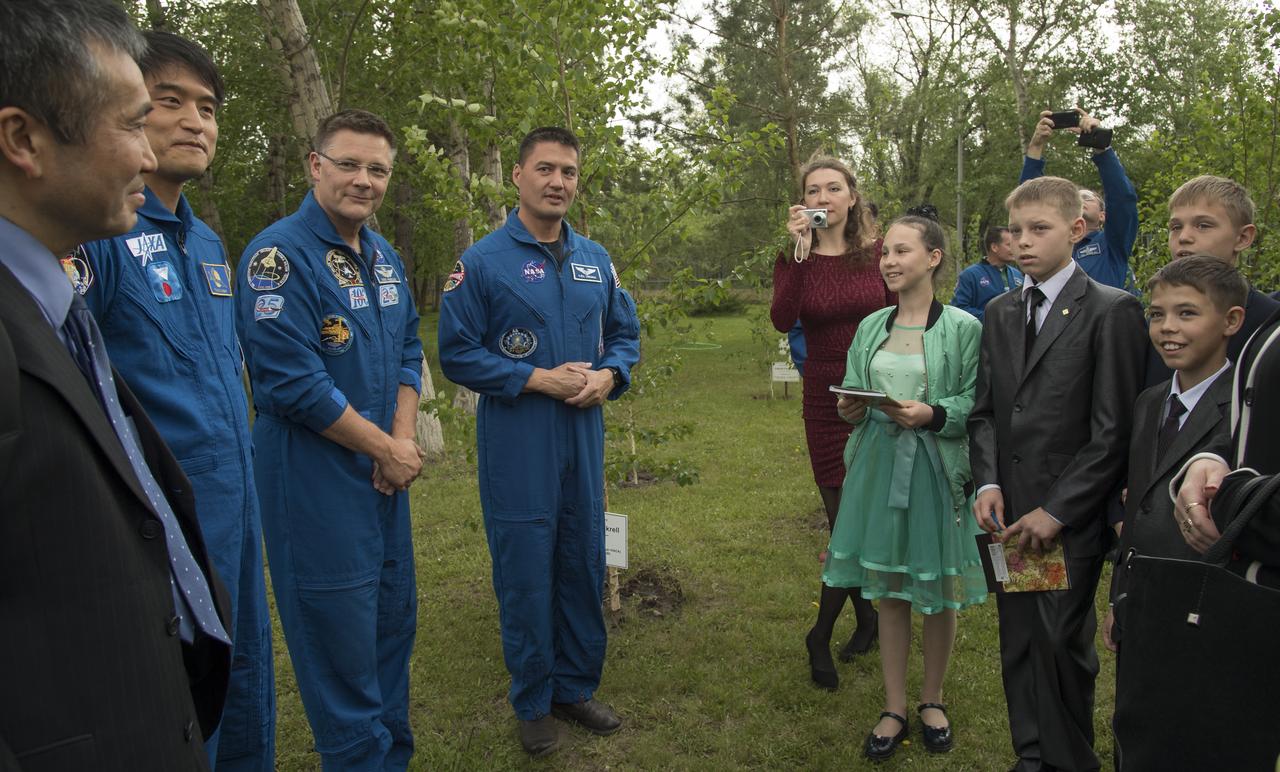
Japan Aerospace Exploration Agency astronauts, Koichi Wakata, left, and Takuya Onishi, along with NASA astronauts Doug Wheelock, and Kjell Lindgren, right, meet with children from a local orphanage at the Cosmonaut Hotel, Saturday, June 2, 2018 in Karaganda, Kazakhstan. The astronauts were in Karaganda to help support the Expedition 55 crew Soyuz landing from the International Space Station. Photo Credit: (NASA/Bill Ingalls)
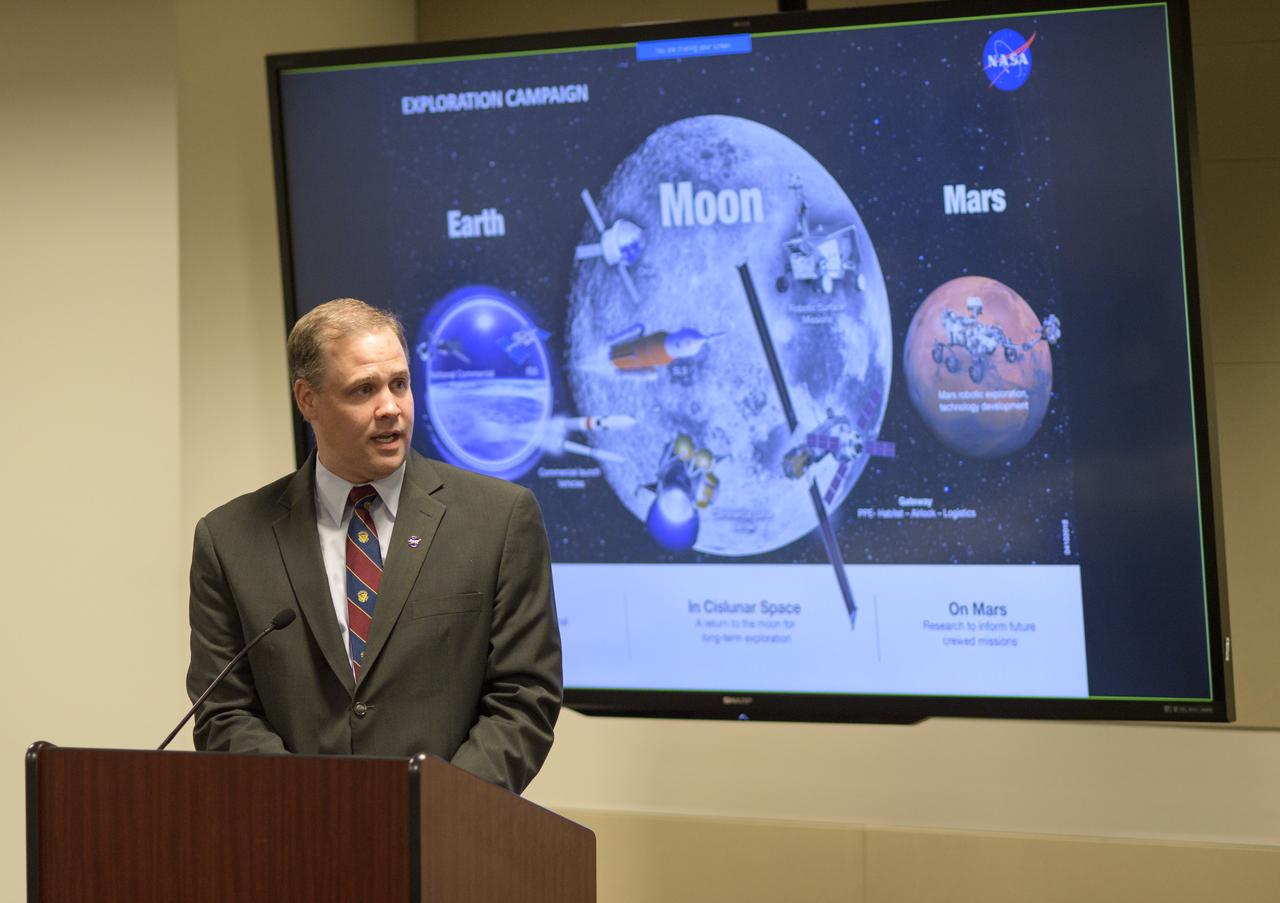
NASA Administrator Jim Bridenstine speaks at the first meeting of the National Space Council Users' Advisory Group, Tuesday, June 19, 2018 at NASA Headquarters in Washington. The Users' Advisory Group will advise and inform the National Space Council on a broad range of aerospace topics, including the impacts of U.S. and international laws and regulations, national security space priorities, scientific and human space exploration priorities, and ways to bolster support. Photo Credit: (NASA/Joel Kowsky)
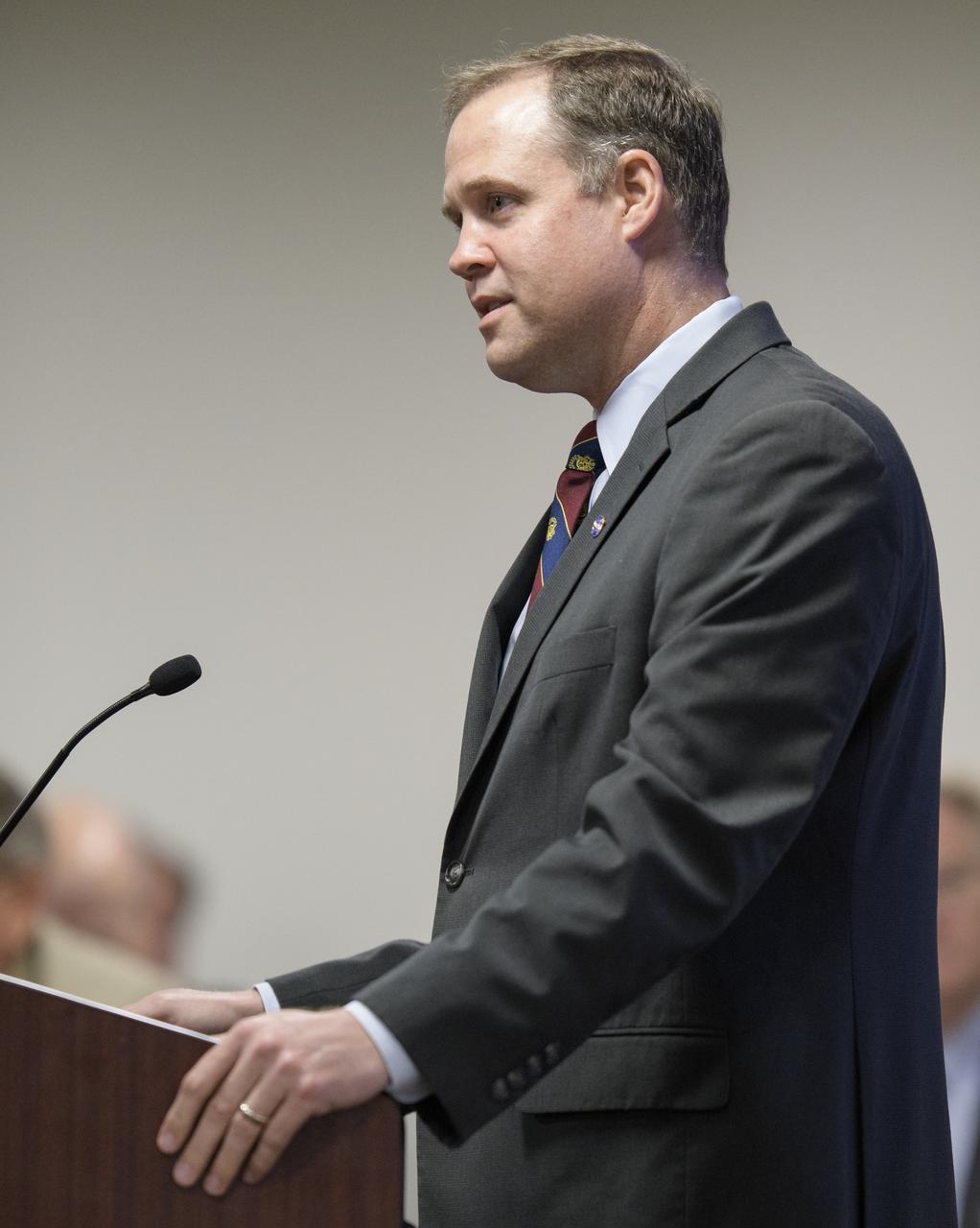
NASA Administrator Jim Bridenstine speaks at the first meeting of the National Space Council Users' Advisory Group, Tuesday, June 19, 2018 at NASA Headquarters in Washington. The Users' Advisory Group will advise and inform the National Space Council on a broad range of aerospace topics, including the impacts of U.S. and international laws and regulations, national security space priorities, scientific and human space exploration priorities, and ways to bolster support. Photo Credit: (NASA/Joel Kowsky)
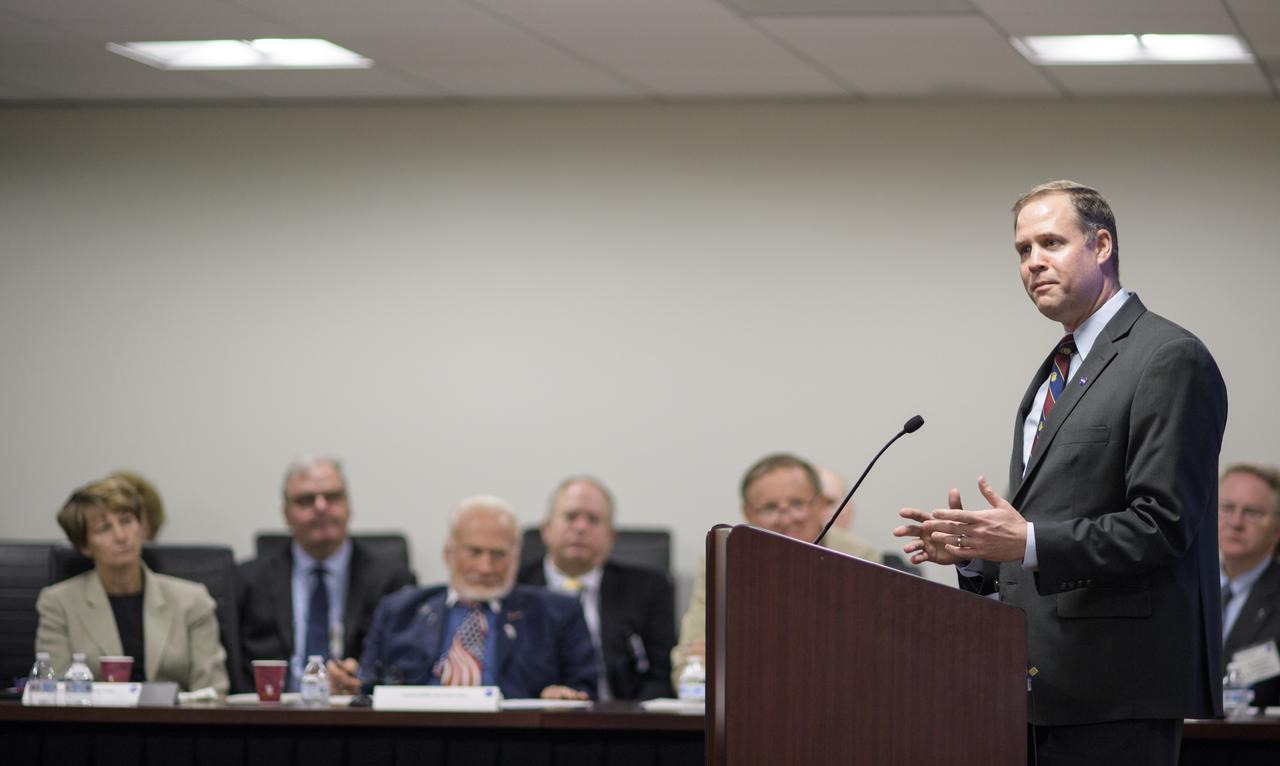
NASA Administrator Jim Bridenstine speaks at the first meeting of the National Space Council Users' Advisory Group, Tuesday, June 19, 2018 at NASA Headquarters in Washington. The Users' Advisory Group will advise and inform the National Space Council on a broad range of aerospace topics, including the impacts of U.S. and international laws and regulations, national security space priorities, scientific and human space exploration priorities, and ways to bolster support. Photo Credit: (NASA/Joel Kowsky)
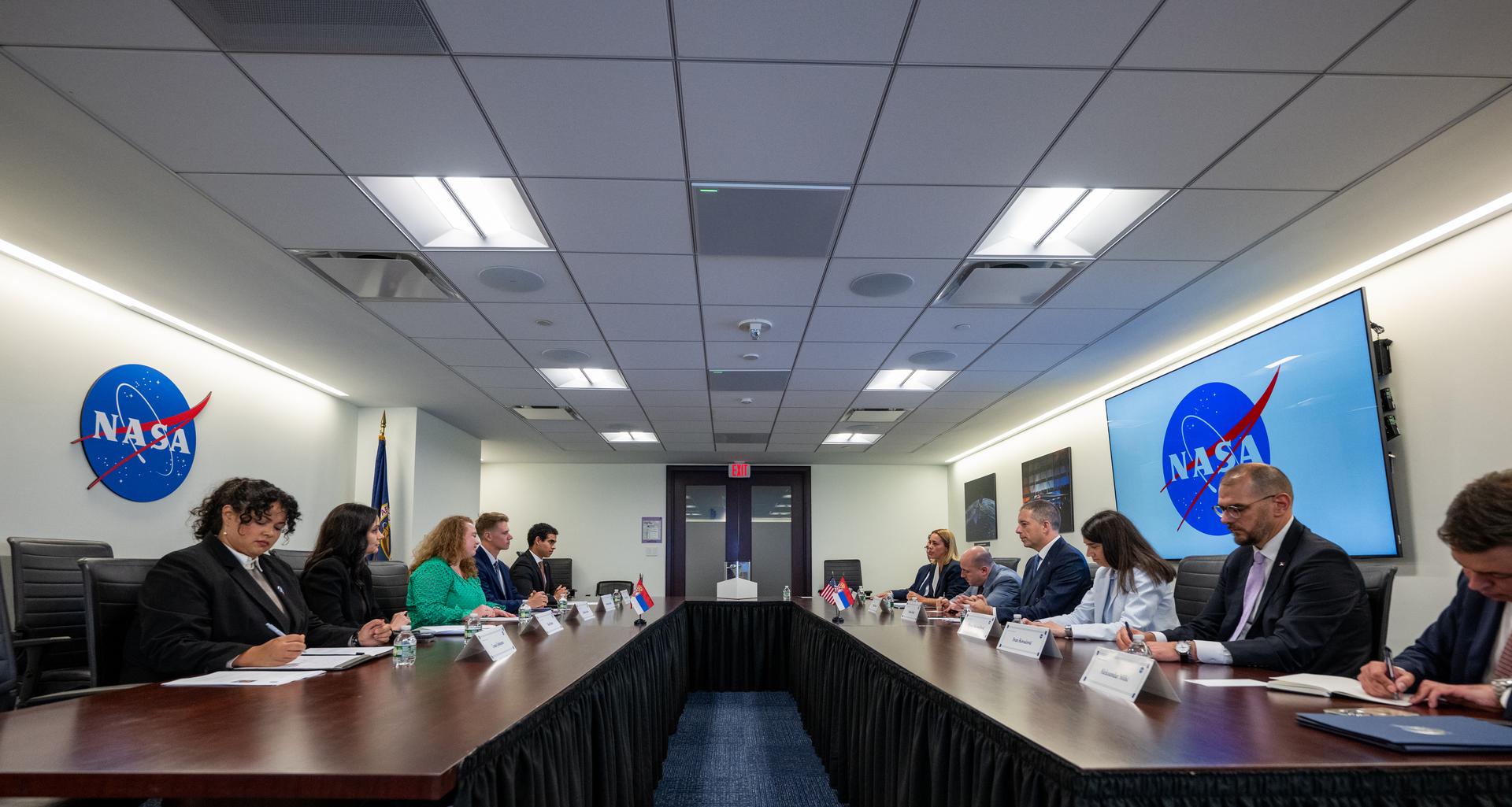
Representatives from Serbia and members of NASA’s Office of International and Interagency Relations participate in a bilateral meeting following an Artemis Accords signing ceremony Thursday, July 16, 2026, at the Mary W. Jackson NASA Headquarters building in Washington. Serbia is the 69th country to sign the Artemis Accords, which establish a practical set of principles to guide space exploration cooperation among nations participating in NASA’s Artemis program. Photo Credit: (NASA/Keegan Barber)
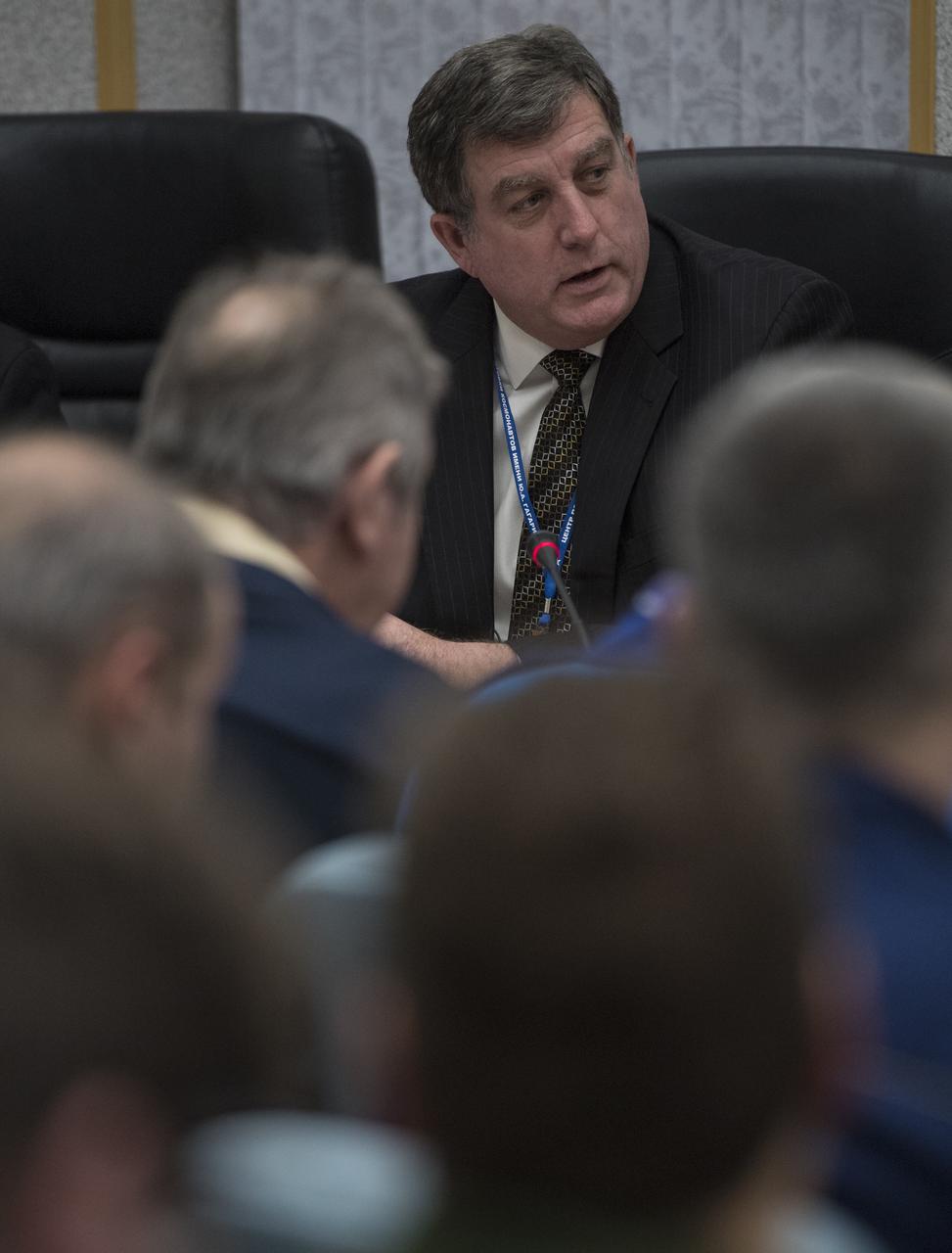
NASA International Space Station Program Manager Kirk Shireman is seen during the State Commission meeting to approve the Soyuz launch of Expedition 54 to the International Space Station, Saturday, Dec. 16, 2017 at the Cosmonaut Hotel in Baikonur, Kazakhstan. Expedition 54 Soyuz Commander Anton Shkaplerov of Roscosmos, flight engineer Scott Tingle of NASA, and flight engineer Norishige Kanai of the Japan Aerospace Exploration Agency (JAXA) are scheduled to launch to the International Space Station aboard the Soyuz spacecraft from the Baikonur Cosmodrome on December 17. Photo Credit: (NASA/Joel Kowsky)

iss073e0515603 (Aug. 24, 2025) --- Shanghai, China, situated on the Yangtze River where it meets the East China Sea, is pictured at approximately 1:32 a.m. local time from the International Space Station as it orbited 261 miles above the nation's eastern coastline. Visible landmarks include Shanghai Hongqiao International Airport near the top of the frame and Shanghai Pudong International Airport at the bottom. The city's lights appear dimmer from orbit due to the widespread use of modern, downward-facing, energy-efficient lighting that reduces light pollution. Credit: JAXA (Japan Aerospace Exploration Agency)
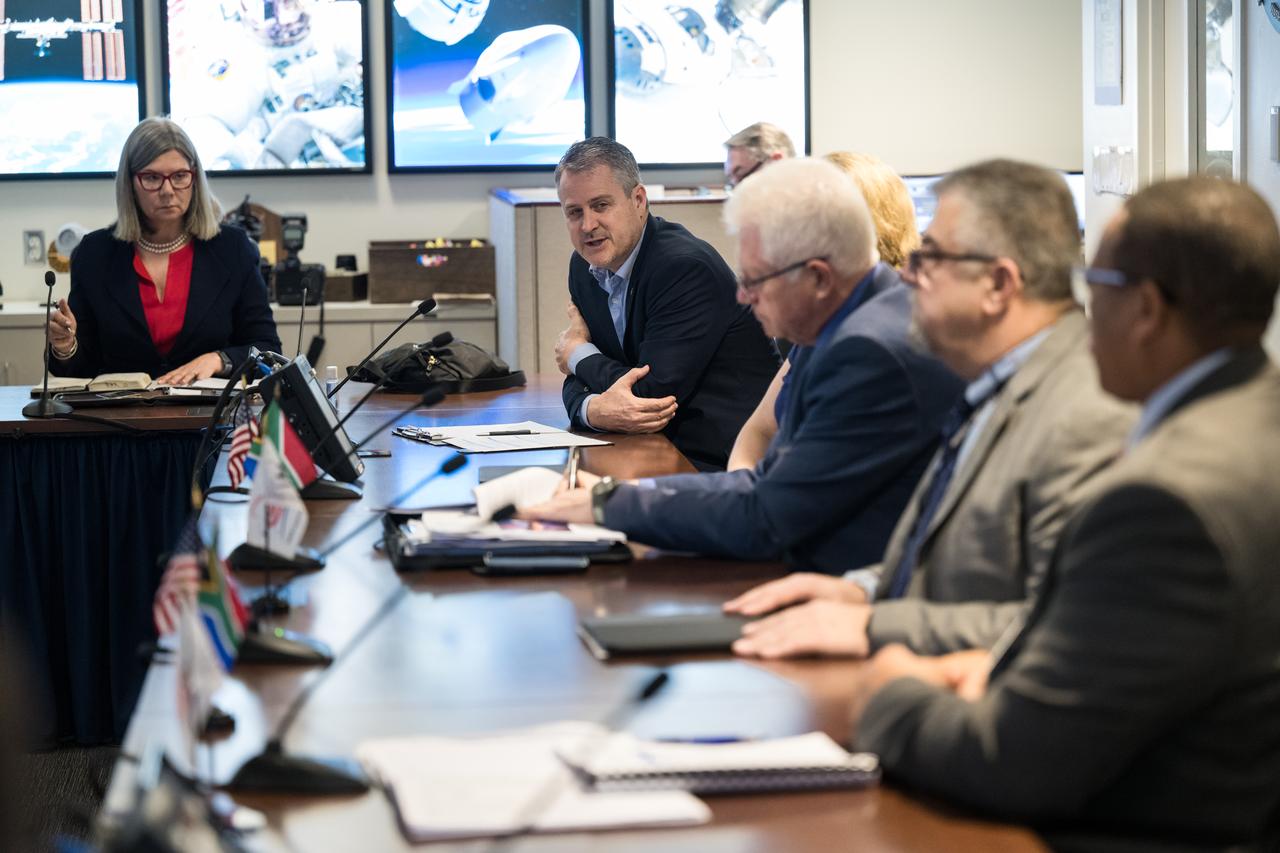
NASA International Program Specialist, Office of International and Interagency Relations, Greg Mann, provide remarks during a meeting with NASA Associate Administrator for the Space Operations Mission Directorate, Ken Bowersox, NASA Deputy Associate Administrator for Space Communications and Navigation, Badri Younes, he Premier of the Western Cape Government, Alan Winde, and a delegation from South Africa, to discuss the path forward for development of an antenna for the Lunar Exploration Ground Sites (LEGS) mission in Matjiesfontein, South Africa, and other opportunities, Tuesday, June 13, 2023, at the Mary W. Jackson NASA Headquarters building in Washington. Photo Credit: (NASA/Aubrey Gemignani)
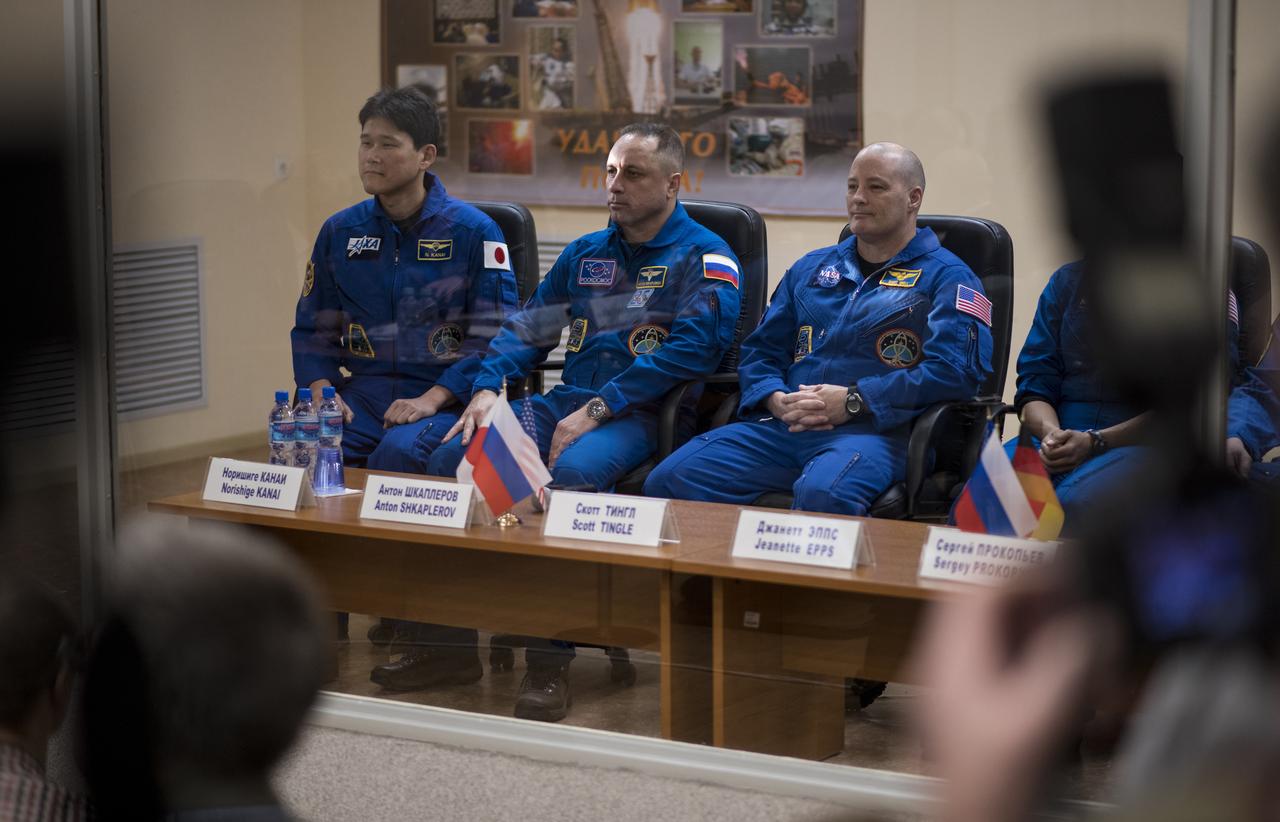
Expedition 54 prime crew members flight engineer Norishige Kanai of the Japan Aerospace Exploration Agency (JAXA), left, Soyuz Commander Anton Shkaplerov of Roscosmos, center, and flight engineer Scott Tingle of NASA, right, are seen during the State Commission meeting to approve the Soyuz launch of Expedition 54 to the International Space Station, Saturday, Dec. 16, 2017, at the Cosmonaut Hotel in Baikonur, Kazakhstan. Kanai, Shkaplerov, and Tingle are scheduled to launch to the International Space Station aboard the Soyuz spacecraft from the Baikonur Cosmodrome on Dec. 17. Photo Credit: (NASA/Joel Kowsky)
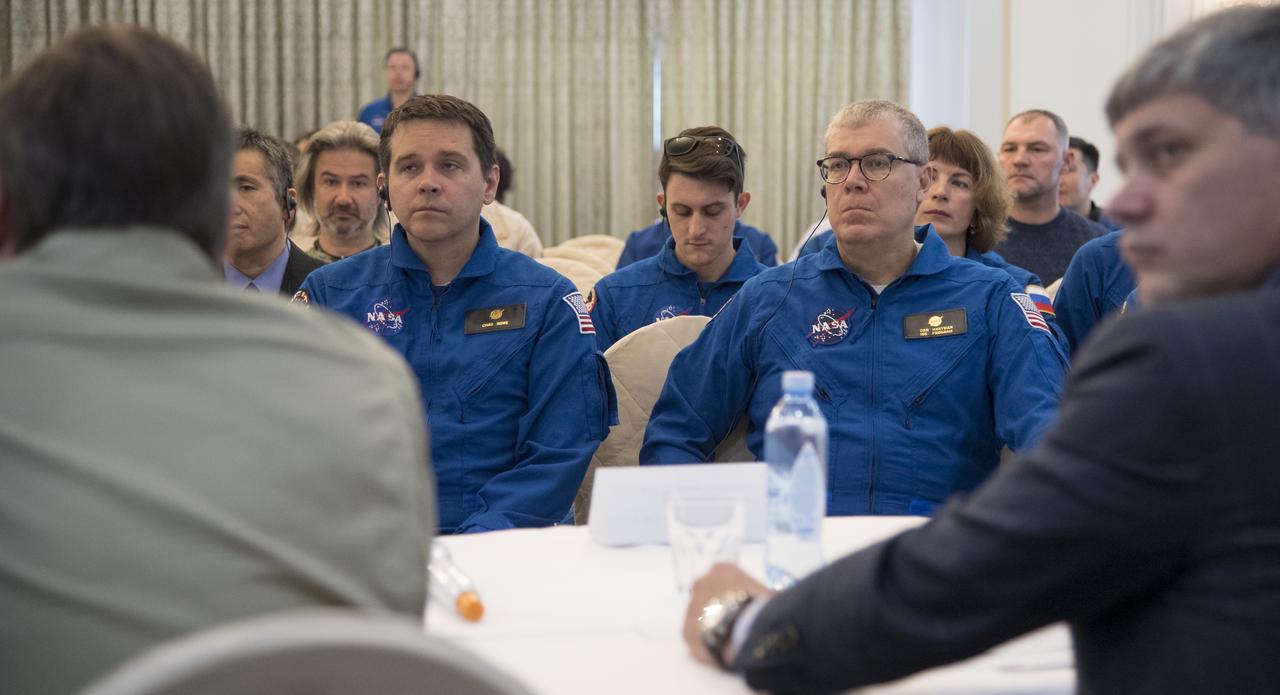
NASA Director for Human Space Flight Programs, Russia, Chad Rowe, left, and NASA Deputy International Space Station Program Manager Dan Hartman, right, are seen along with other NASA, Roscosmos, and JAXA team members during a meeting to discuss the readiness for the landing of Expedition 55 crew members Anton Shkaplerov of Roscosmos, Scott Tingle of NASA, Norishige Kanai of the Japan Aerospace Exploration Agency (JAXA) Saturday, June 2, 2018. Shkaplerov, Tingle, and Kanai are returning after 168 days in space where they served as members of the Expedition 54 and 55 crews onboard the International Space Station. Photo Credit: (NASA/Bill Ingalls)
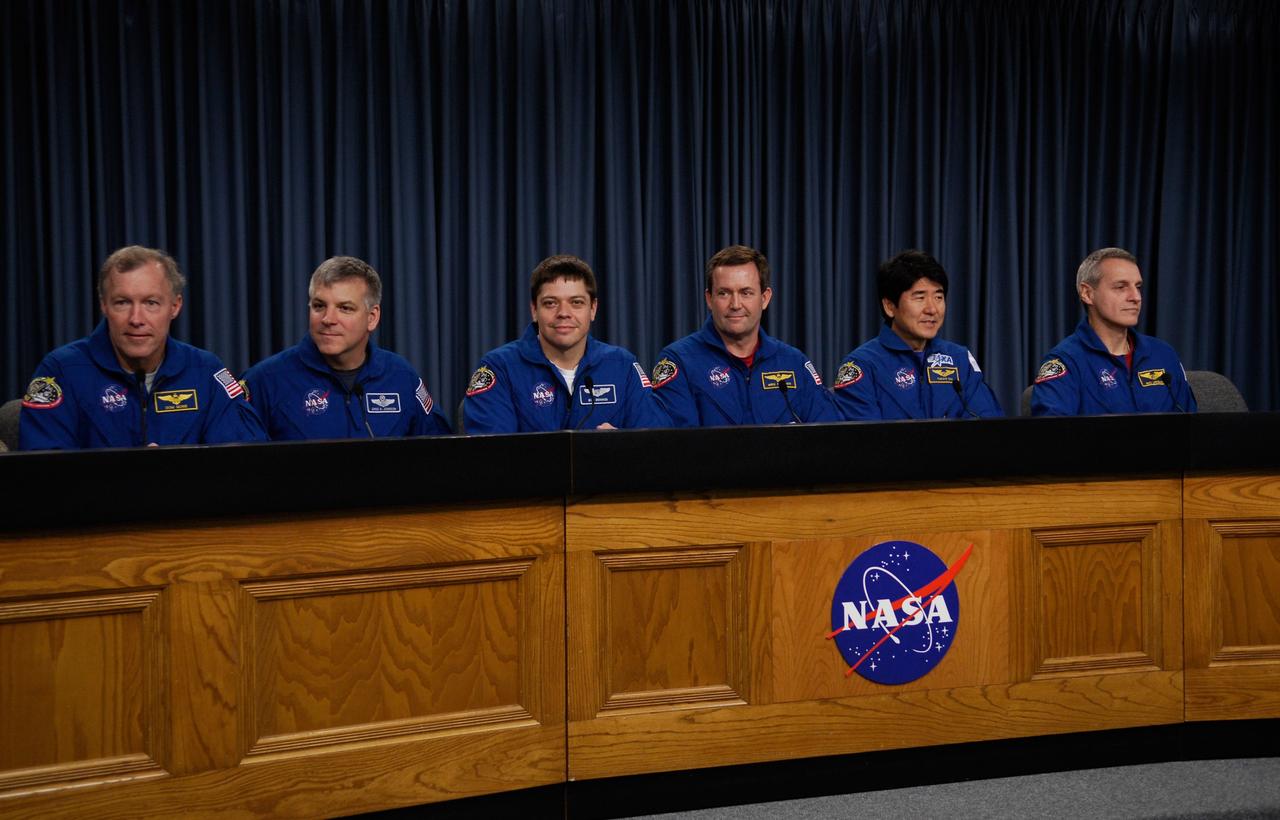
CAPE CANAVERAL, Fla. --- Space shuttle Endeavour crew members meet with the media to discuss their experiences on the STS-123 mission to the International Space Station. From left are Commander Dominic Gorie, Pilot Gregory H. Johnson, and Mission Specialists Robert L. Behnken, Mike Foreman, Japan Aerospace Exploration Agency astronaut Takao Doi and Rick Linnehan. They landed at Kennedy at 8:39 p.m. EDT March 26. Endeavour's 16-day flight was the longest shuttle mission to the International Space Station and included a record five spacewalks. The shuttle's seven astronauts worked with the three-member station crew and ground teams around the world to install the first section of the Japan Aerospace Exploration Agency's Kibo laboratory and the Canadian Space Agency's two-armed robotic system, known as Dextre. Photo credit: NASA/Kim Shiflett
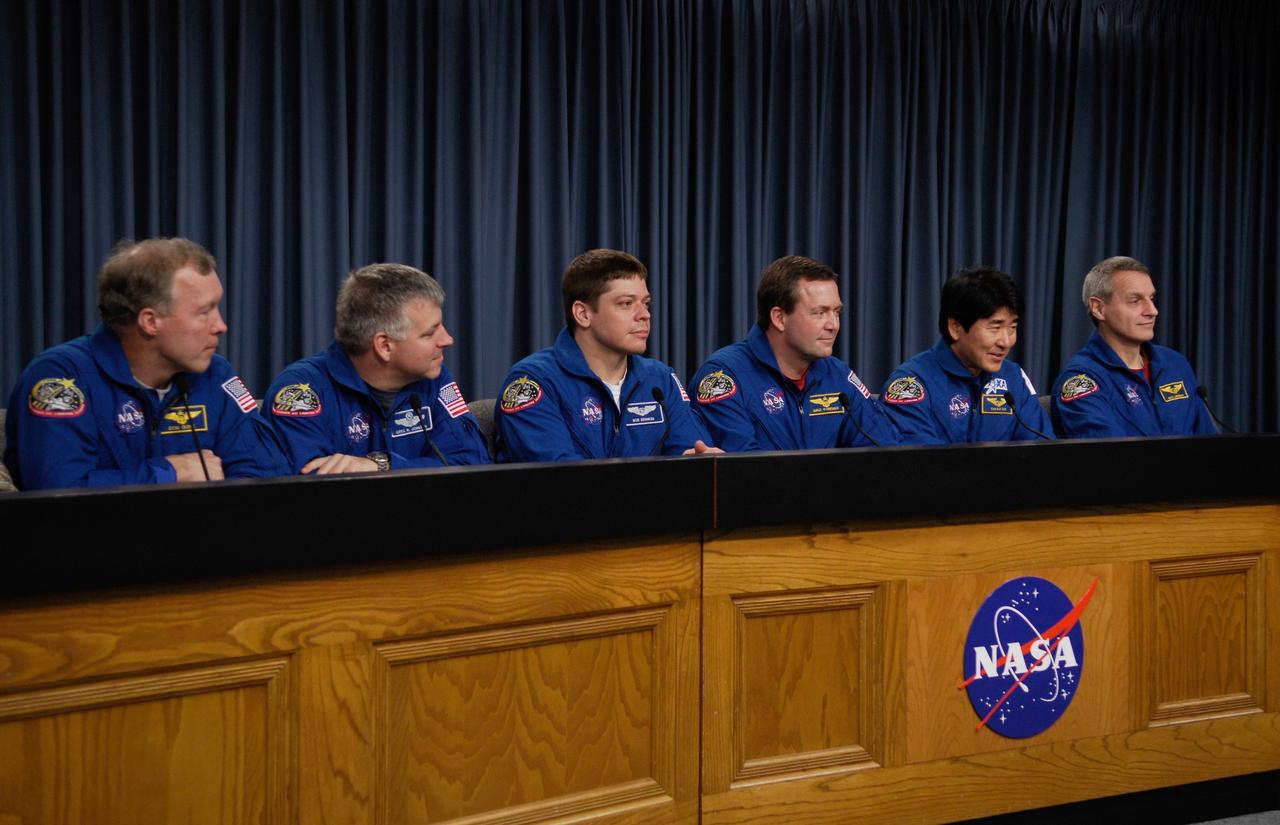
CAPE CANAVERAL, Fla. --- Space shuttle Endeavour crew members meet with the media to discuss their experiences on the STS-123 mission to the International Space Station. From left are Commander Dominic Gorie, Pilot Gregory H. Johnson, and Mission Specialists Robert L. Behnken, Mike Foreman, Japan Aerospace Exploration Agency astronaut Takao Doi and Rick Linnehan. They landed at Kennedy at 8:39 p.m. EDT March 26. Endeavour's 16-day flight was the longest shuttle mission to the International Space Station and included a record five spacewalks. The shuttle's seven astronauts worked with the three-member station crew and ground teams around the world to install the first section of the Japan Aerospace Exploration Agency's Kibo laboratory and the Canadian Space Agency's two-armed robotic system, known as Dextre. Photo credit: NASA/Kim Shiflett
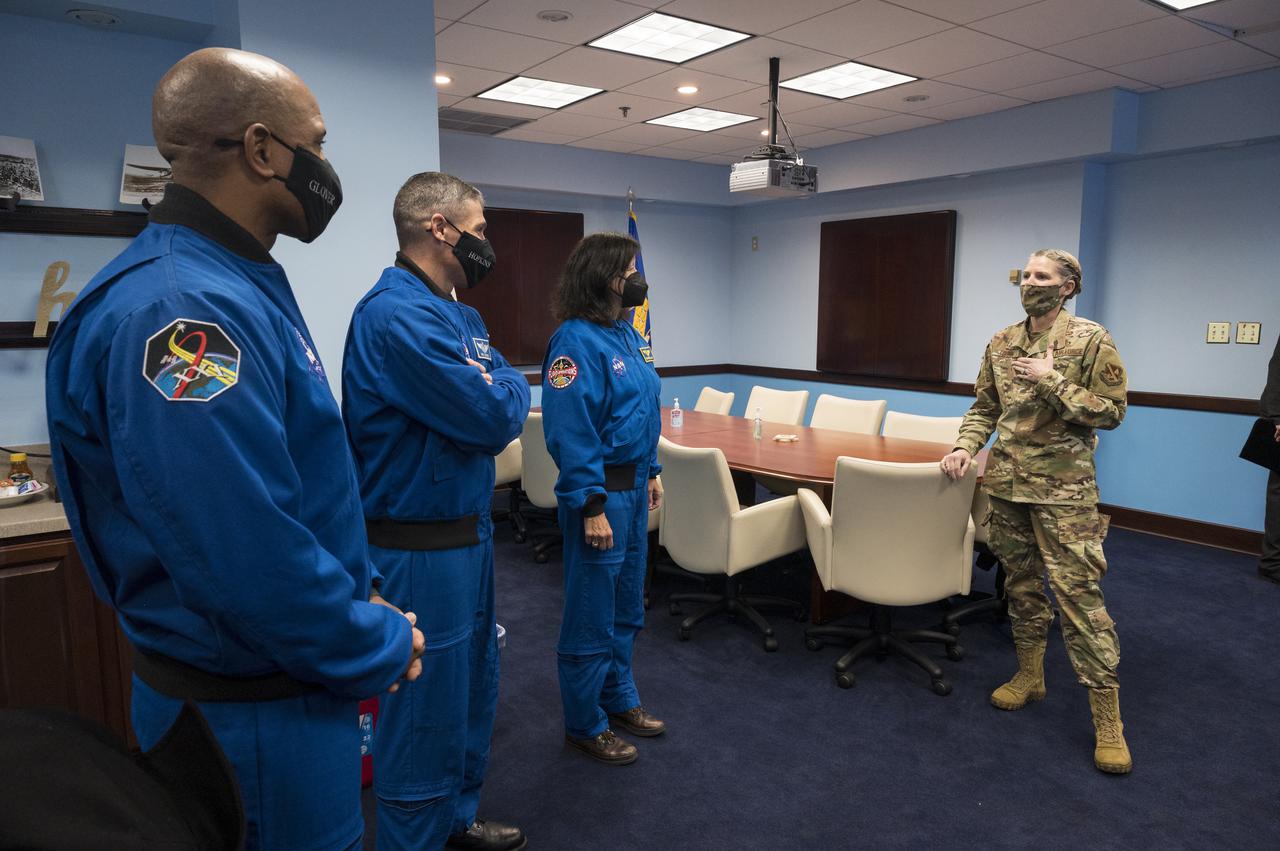
SpaceX Crew-1 NASA astronauts, from left, Victor Glover, Mike Hopkins, and Shannon Walker, meet with Col. Catherine Logan, commander of Joint Base Anacostia-Bolling (JBAB), Friday, Nov. 19, 2021, in Washington. Hopkins, Glover, Walker, and Japan Aerospace Exploration Agency (JAXA) astronaut Soichi Noguchi, launched on the first crew rotation mission to the International Space Station for SpaceX’s Falcon 9 and Crew Dragon spacecraft as part of the agency’s Commercial Crew Program and spent 168 days in space across Expeditions 64 and 65. Photo Credit: (NASA/Aubrey Gemignani)
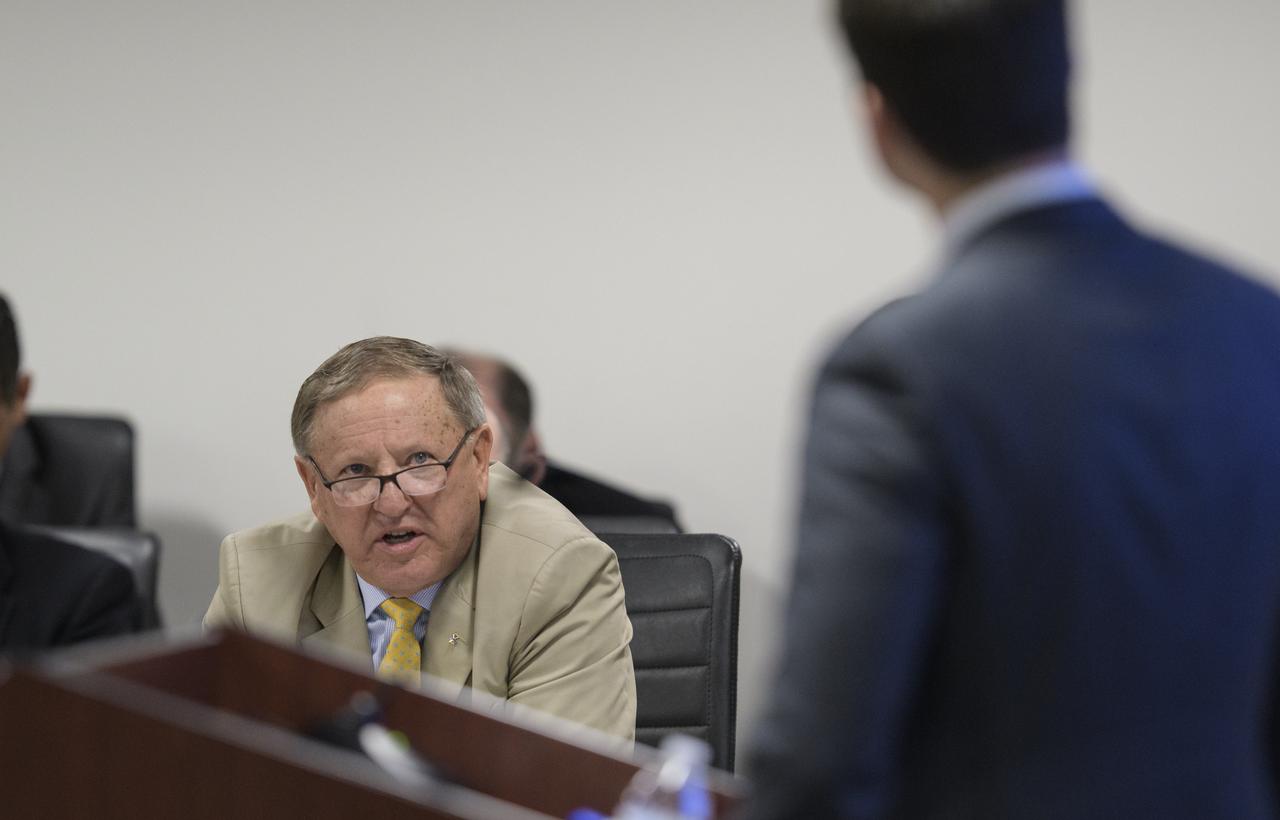
Stu Witt, founder of the Mojave Air and Spaceport and former Chairman of the Commercial Spaceflight Federation, asks a questions of the Department of Commerce's James Uthmeier during the first meeting of the National Space Council Users' Advisory Group, Tuesday, June 19, 2018 at NASA Headquarters in Washington. The Users' Advisory Group will advise and inform the National Space Council on a broad range of aerospace topics, including the impacts of U.S. and international laws and regulations, national security space priorities, scientific and human space exploration priorities, and ways to bolster support. Photo Credit: (NASA/Joel Kowsky)
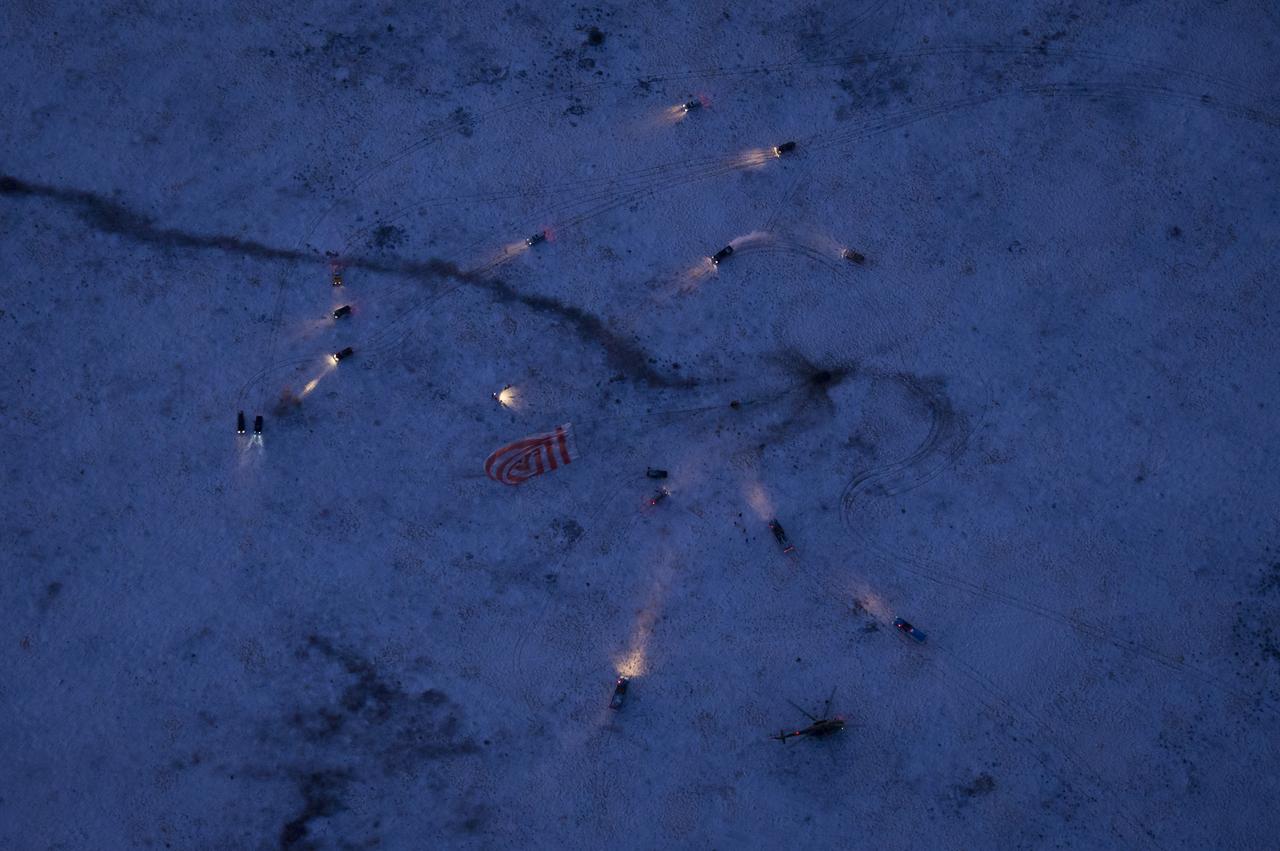
Russian support personnel arrive to help meet the Soyuz TMA-02M spacecraft shortly after the capsule landed with Expedition 29 Commander Mike Fossum, and Flight Engineers Sergei Volkov and Satoshi Furukawa in a remote area outside of the town of Arkalyk, Kazakhstan, on Tuesday, Nov. 22, 2011. NASA Astronaut Fossum, Russian Cosmonaut Volkov and JAXA (Japan Aerospace Exploration Agency) Astronaut Furukawa are returning from more than five months onboard the International Space Station where they served as members of the Expedition 28 and 29 crews. Photo Credit: (NASA/Bill Ingalls)
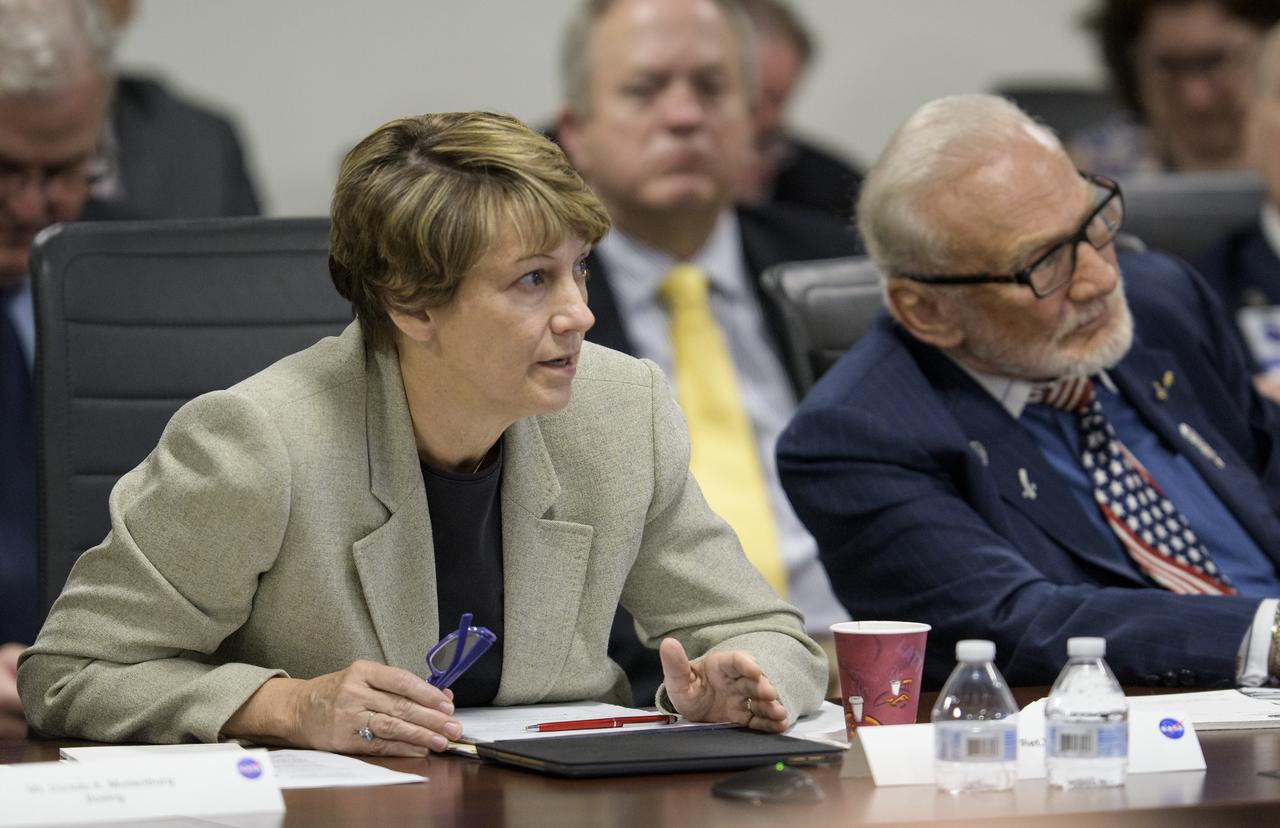
Users' Advisory Group member Eileen Collins, 4-time Shuttle astronaut and first female Shuttle commander, is seen during the first meeting of the National Space Council Users' Advisory Group, Tuesday, June 19, 2018 at NASA Headquarters in Washington. The Users' Advisory Group will advise and inform the National Space Council on a broad range of aerospace topics, including the impacts of U.S. and international laws and regulations, national security space priorities, scientific and human space exploration priorities, and ways to bolster support. Photo Credit: (NASA/Joel Kowsky)
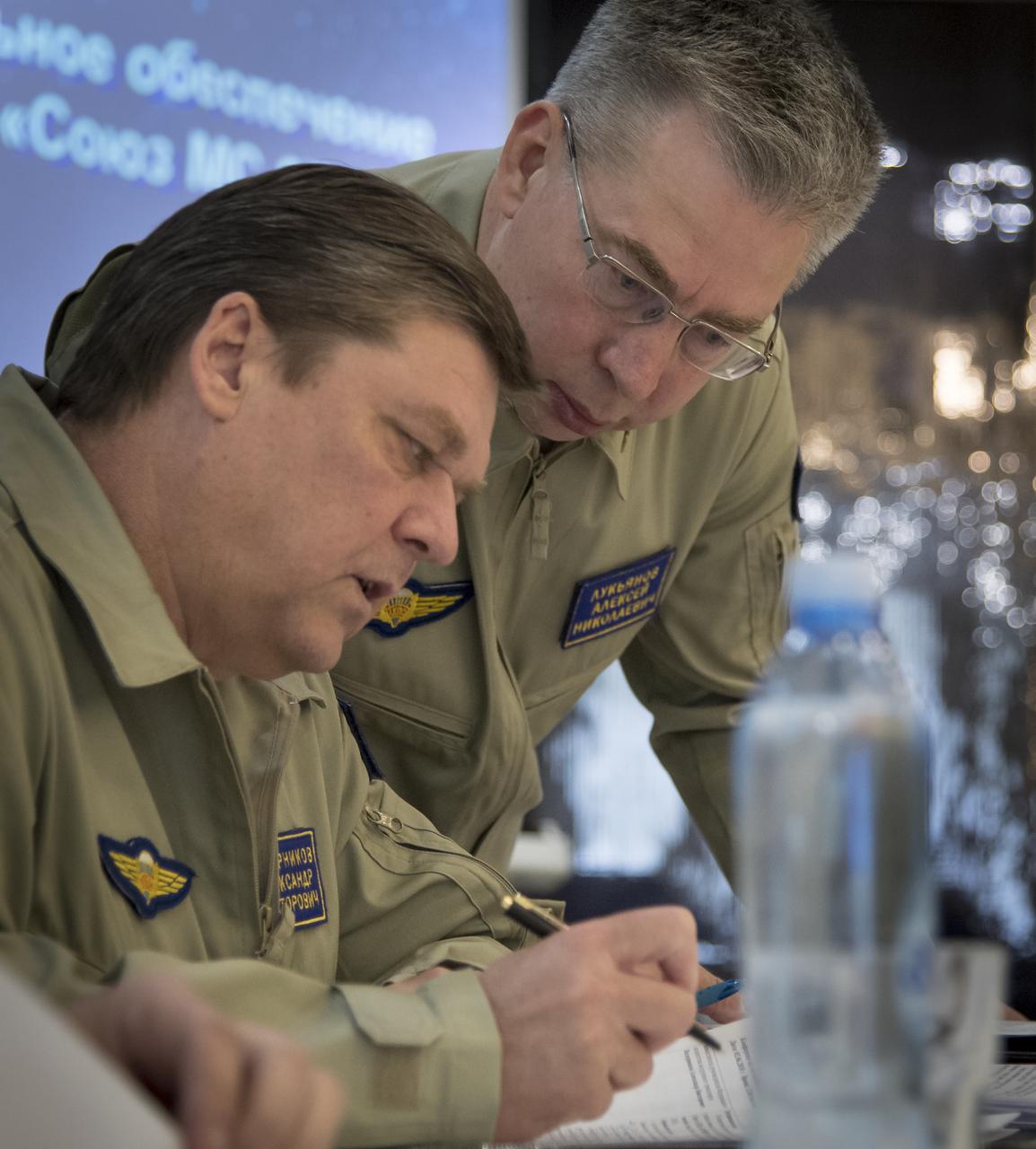
Deputy Director of Rosaviatsiya (Russian Federal Agency for Air Transport) Alexander Vedernikov, left, and Head of the Search-and-Rescue Department of Rosaviatsiya (Russian Federal Air Transport Agency) Aleksey Lukiyanov are seen during a meeting to discuss the readiness for the landing of Expedition 55 crew members Anton Shkaplerov of Roscosmos, Scott Tingle of NASA, Norishige Kanai of the Japan Aerospace Exploration Agency (JAXA) Saturday, June 2, 2018. Shkaplerov, Tingle, and Kanai are returning after 168 days in space where they served as members of the Expedition 54 and 55 crews onboard the International Space Station. Photo Credit: (NASA/Bill Ingalls)
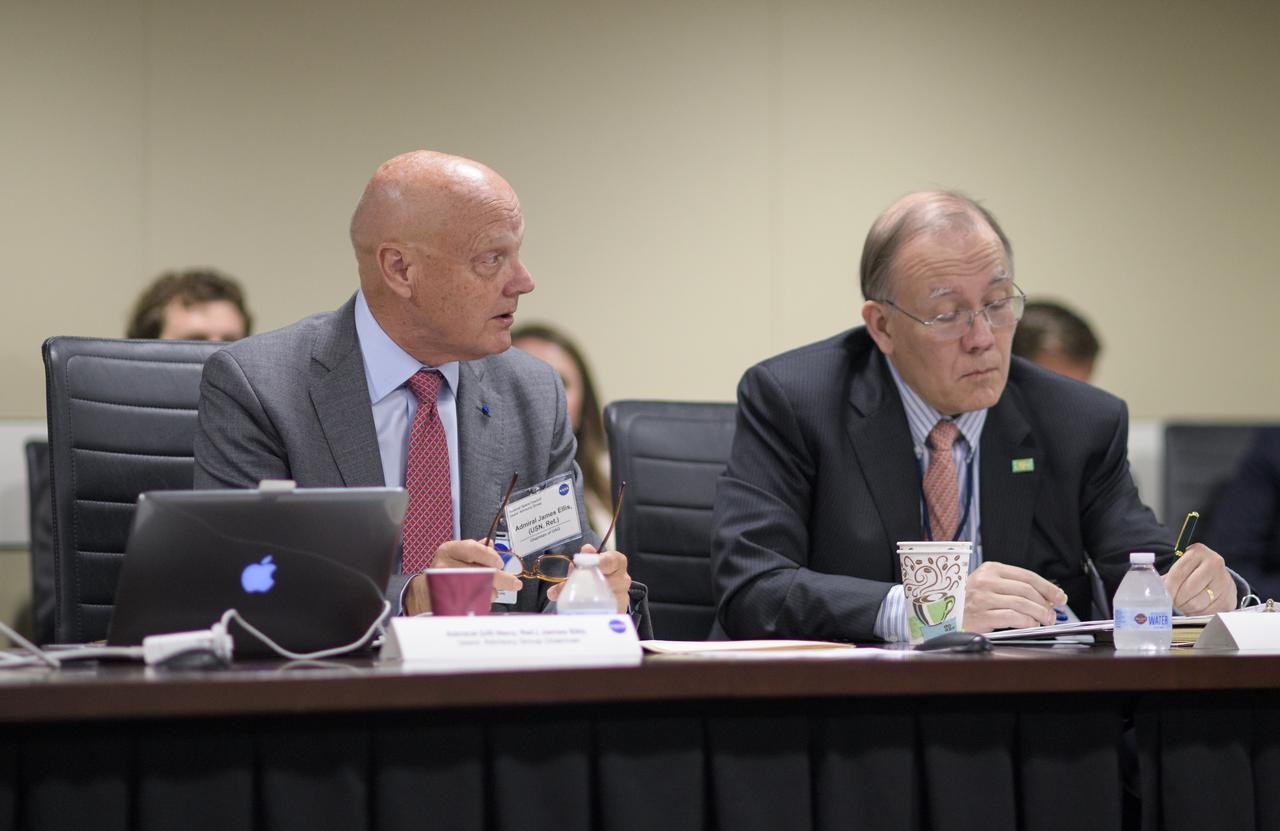
National Space Council Executive Secretary Scott Pace, right, and Chairman of the Users' Advisory Group Adm. Jim Ellis, USN (Ret.), left, are seen during the first meeting of the National Space Council Users' Advisory Group, Tuesday, June 19, 2018 at NASA Headquarters in Washington. The Users' Advisory Group will advise and inform the National Space Council on a broad range of aerospace topics, including the impacts of U.S. and international laws and regulations, national security space priorities, scientific and human space exploration priorities, and ways to bolster support. Photo Credit: (NASA/Joel Kowsky)
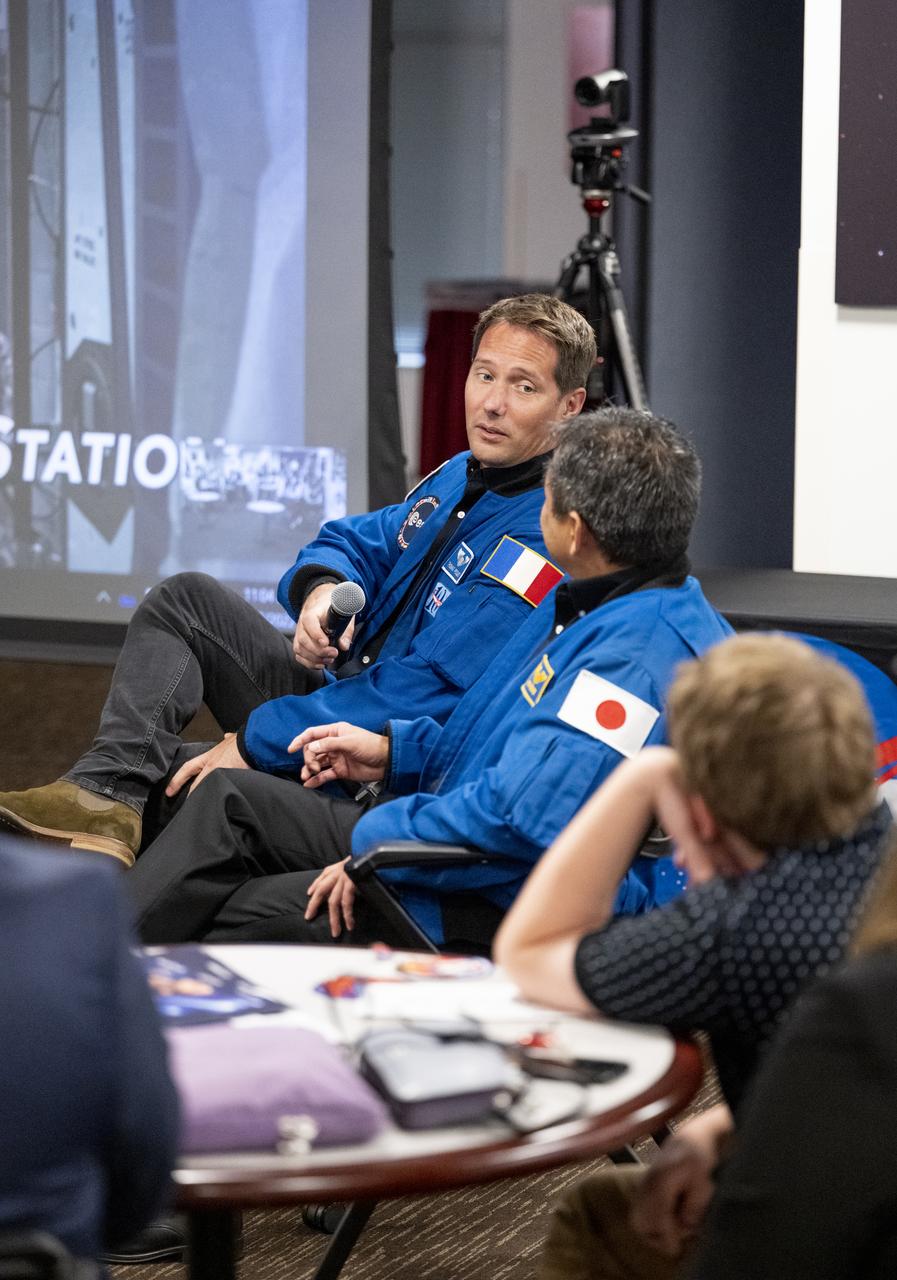
NASA’s SpaceX Crew-2 ESA (European Space Agency) astronaut Thomas Pesquet, left, and Japan Aerospace Exploration Agency (JAXA) astronaut Akihiko Hoshide, right, speak during a meet and greet with employees Tuesday, June 7, 2022, at the Mary W. Jackson NASA Headquarters Building in Washington. Kimbrough, McArthur, Hoshide, and Pesquet completed the second crew rotation mission to the International Space Station as part of the agency’s Commercial Crew Program and spent 198 days aboard the orbiting laboratory as part of Expeditions 65 and 66. Photo Credit: (NASA/Keegan Barber)
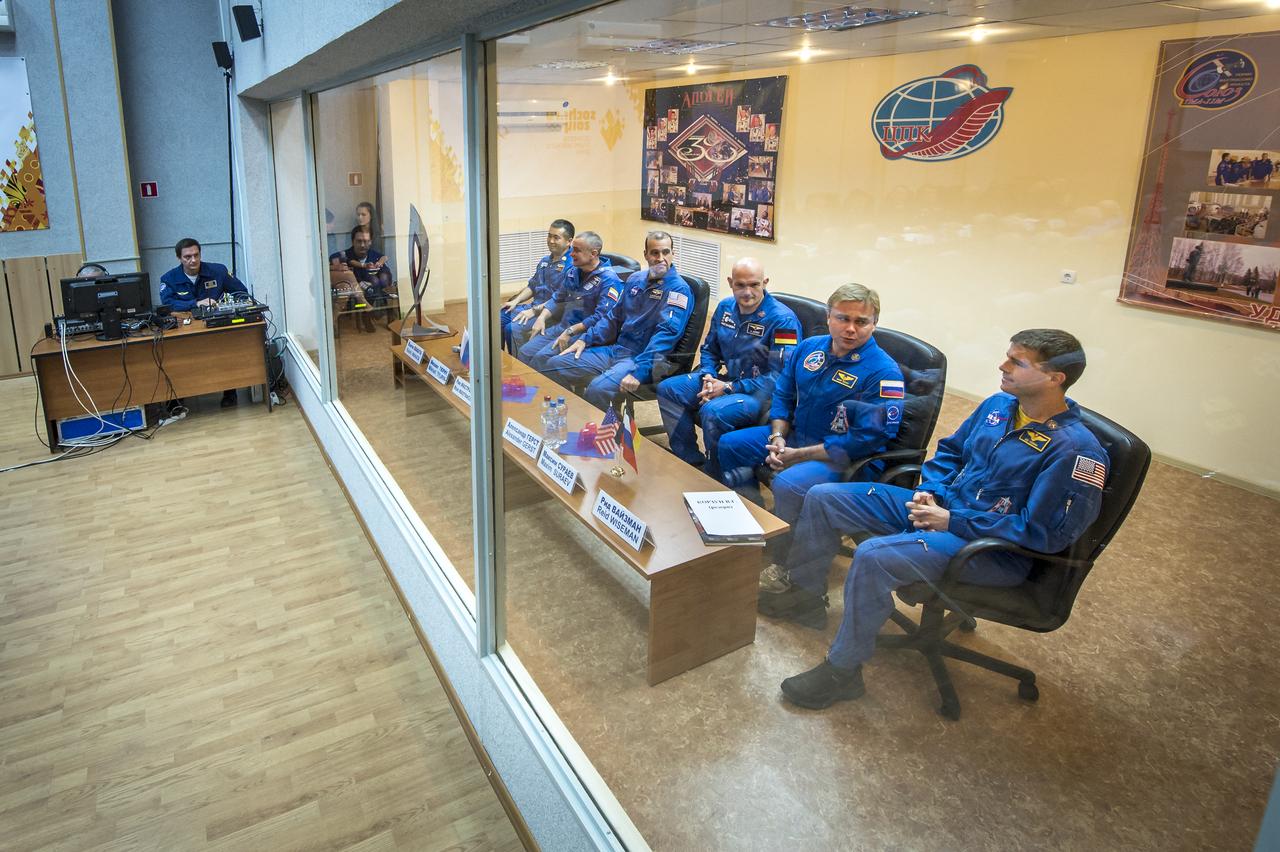
From left behind glass, Expedition 38 prime crew members, Flight Engineer Koichi Wakata of the Japan Aerospace Exploration Agency, Soyuz Commander Mikhail Tyurin of Roscosmos, and, Flight Engineer Rick Mastracchio of NASA, are joined with Expedition 38 backup crew members, Alexander Gerst of the European Space Agency, Max Suraev of Roscosmos, and Reid Wiseman of NASA during the State Commission meeting held to approve the Soyuz launch of the crew for a six month mission aboard the International Space Station, Wednesday, Nov. 6, 2013 at the Cosmonaut Hotel in Baikonur, Kazakhstan. Photo Credit: (NASA/Bill Ingalls)
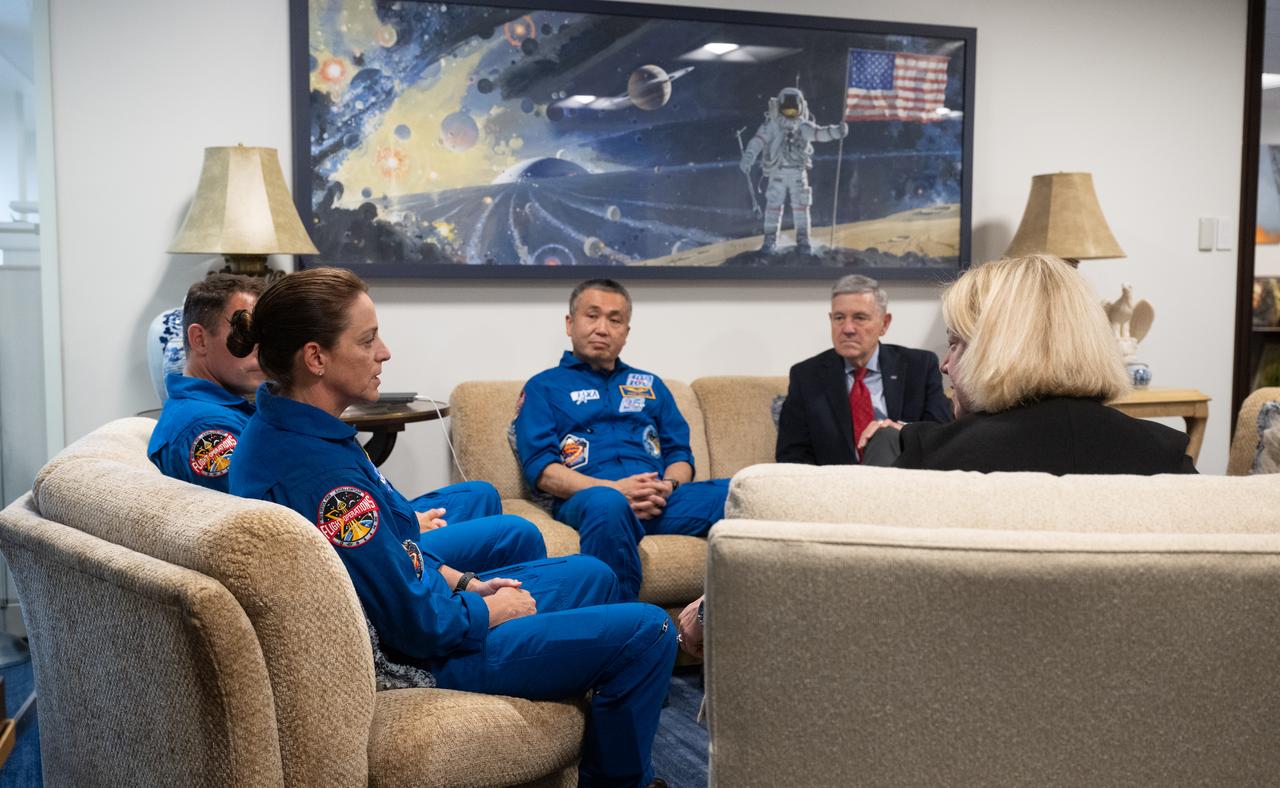
NASA Deputy Administrator Pam Melroy right, and NASA Associate Administrator Bob Cabana, second from right, meet with NASA’s SpaceX Crew-5 astronauts Nicole Mann, second from left, and Josh Cassada of NASA, and Japan Aerospace Exploration Agency (JAXA) astronaut Koichi Wakata, Monday, June 5, 2023 at the Mary W. Jackson NASA Headquarters building in Washington. Mann, Cassada, and Wakata spent 157 days in space as part of Expedition 68 aboard the International Space Station. Photo Credit: (NASA/Joel Kowsky)
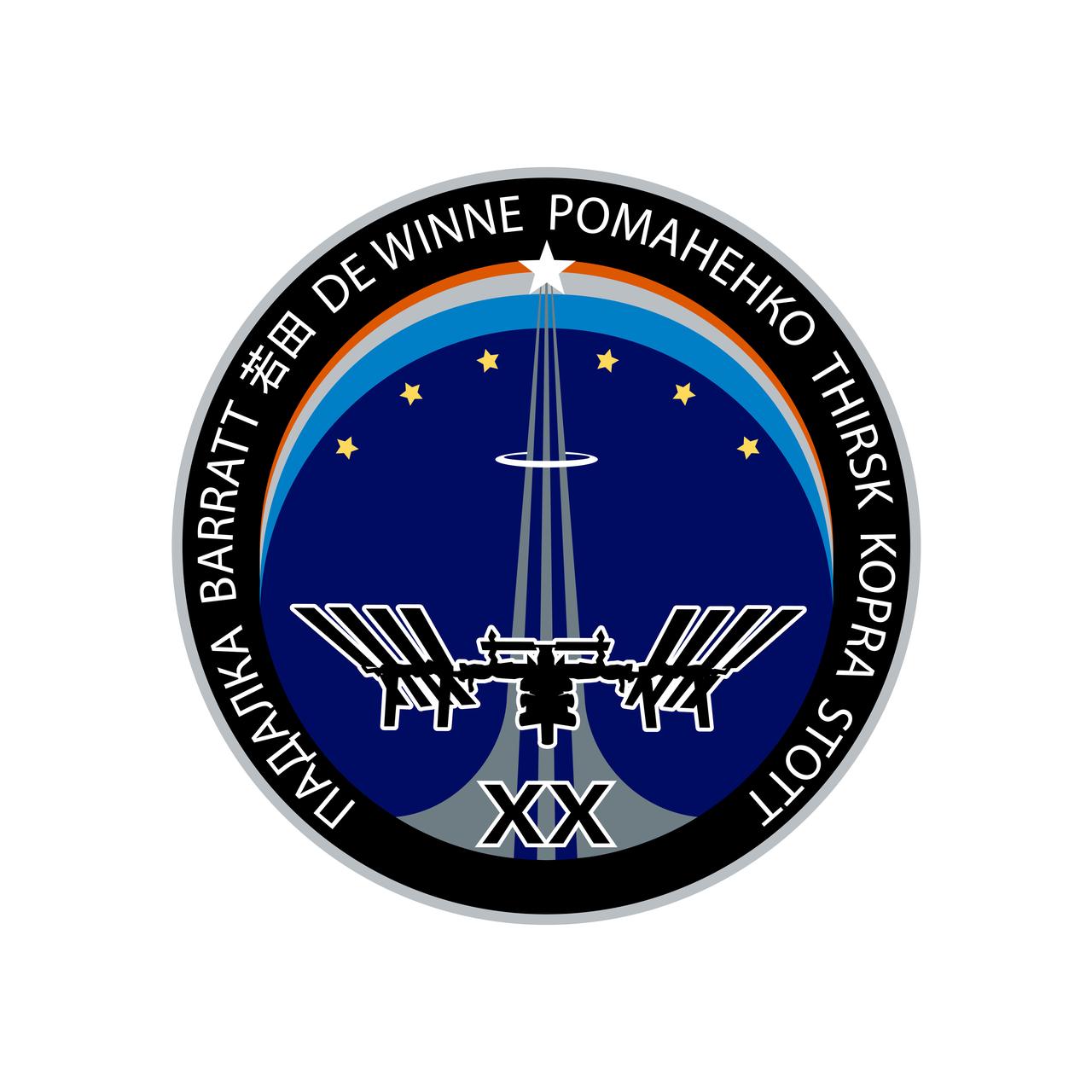
ISS020-S-001A (December 2008) --- The Expedition 20 patch symbolizes a new era in space exploration with the first six-person crew living and working onboard ISS and represents the significance of the ISS to the exploration goals of NASA and its international partners. The six gold stars signify the men and women of the crew. The astronaut symbol extends from the base of the patch to the star at the top to represent the international team, both on the ground and on orbit, that are working together to further our knowledge of living and working in space. The space station in the foreground represents where we are now and the important role it is playing towards meeting our exploration goals. The knowledge and expertise developed from these advancements will enable us to once again leave low earth orbit for the new challenges of establishing a permanent presence on the moon and then on to Mars. The blue, gray and red arcs represent our exploration goals as symbols of Earth, the moon and Mars. The NASA insignia design for ISS expedition crews is reserved for use by the astronauts and for other official use as the NASA Administrator may authorize. Public availability has been approved only in the form of illustrations by the various news media. When and if there is any change in this policy, which is not anticipated, it will be publicly announced.
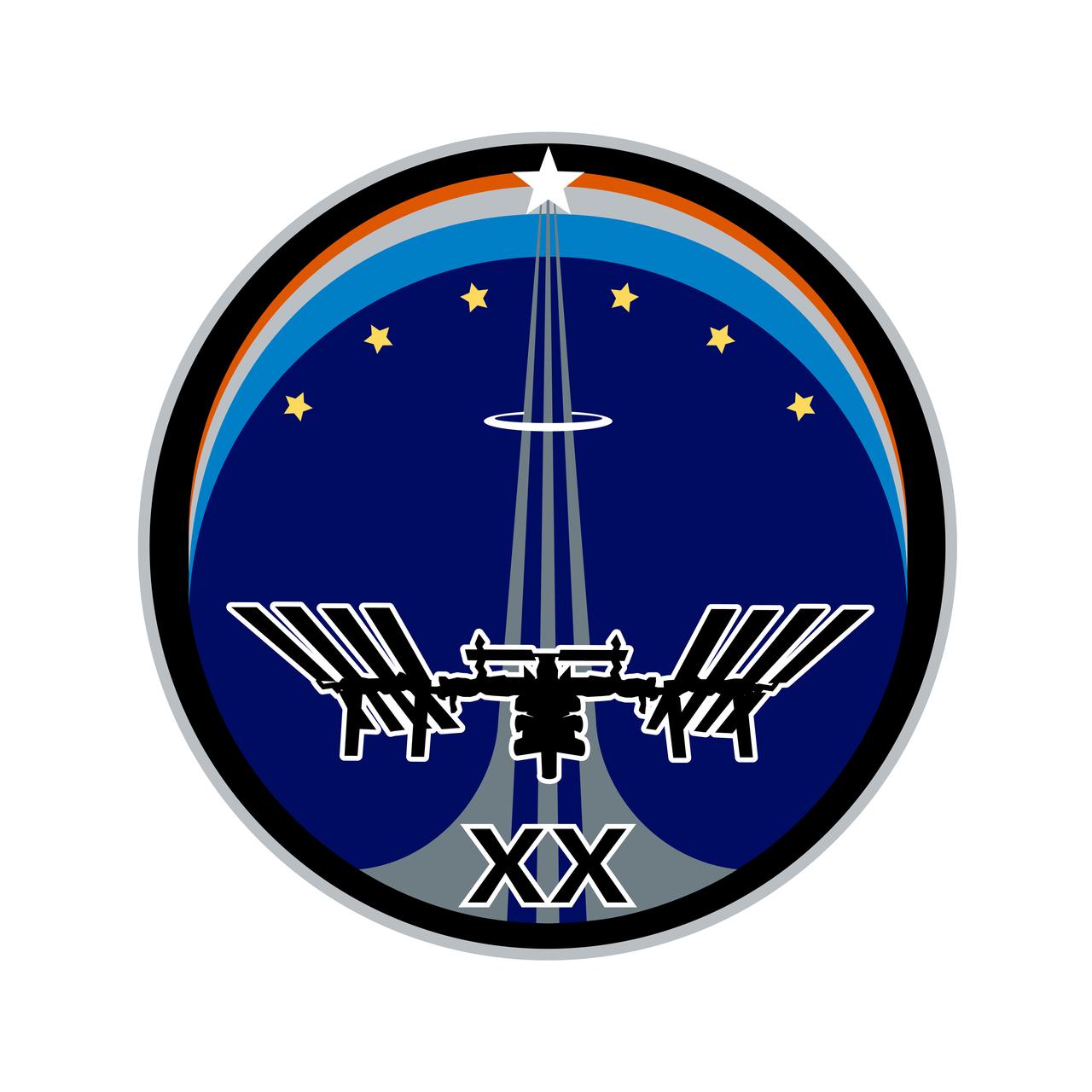
ISS020-S-001B (December 2008) --- The Expedition 20 patch symbolizes a new era in space exploration with the first six-person crew living and working onboard ISS and represents the significance of the ISS to the exploration goals of NASA and its international partners. The six gold stars signify the men and women of the crew. The astronaut symbol extends from the base of the patch to the star at the top to represent the international team, both on the ground and on orbit, that are working together to further our knowledge of living and working in space. The space station in the foreground represents where we are now and the important role it is playing towards meeting our exploration goals. The knowledge and expertise developed from these advancements will enable us to once again leave low earth orbit for the new challenges of establishing a permanent presence on the moon and then on to Mars. The blue, gray and red arcs represent our exploration goals as symbols of Earth, the moon and Mars. The NASA insignia design for ISS expedition crews is reserved for use by the astronauts and for other official use as the NASA Administrator may authorize. Public availability has been approved only in the form of illustrations by the various news media. When and if there is any change in this policy, which is not anticipated, it will be publicly announced.
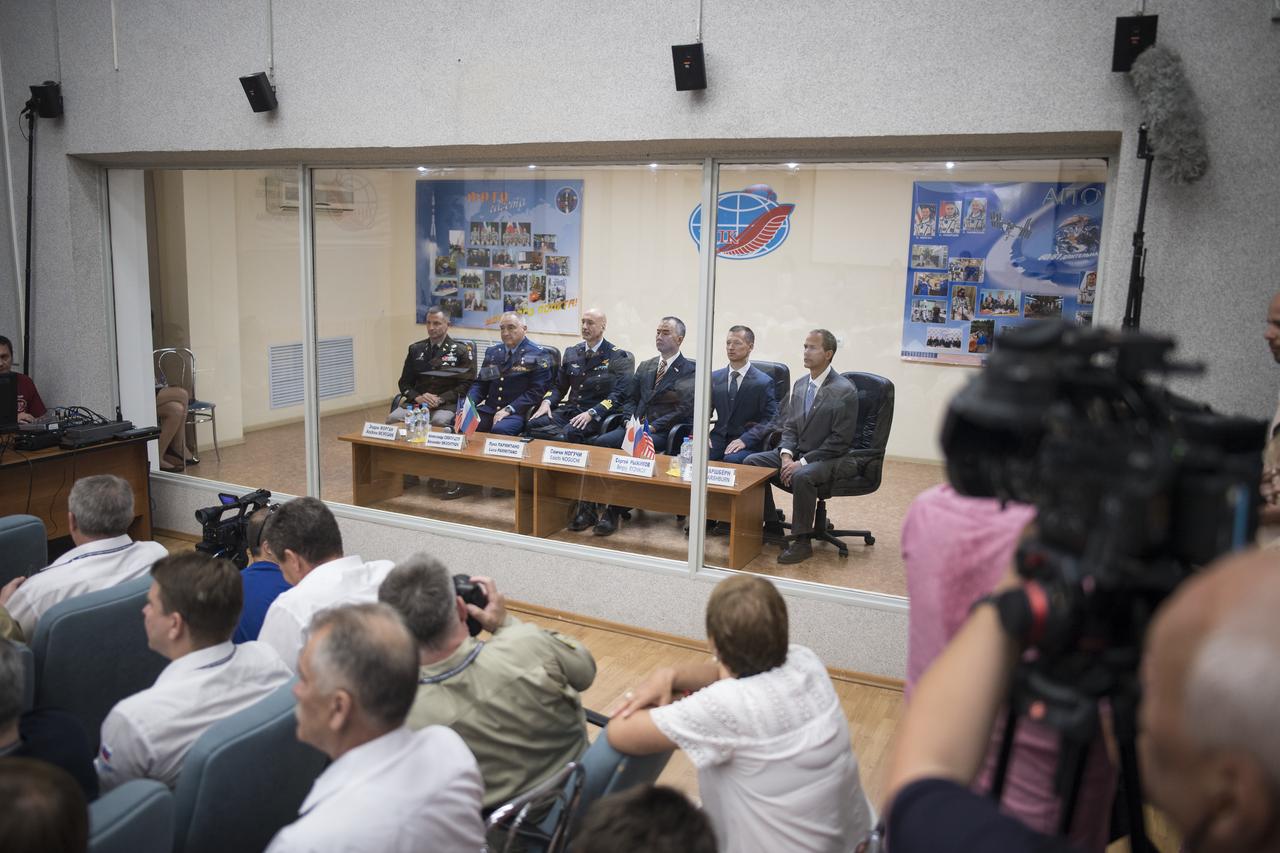
Expedition 60 prime crew members flight engineer Andrew Morgan of NASA, left, Soyuz Commander Alexander Skvortsov of Roscosmos, second from left, and flight engineer Luca Parmitano of ESA (European Space Agency), third from left, are seen with backup crew members Soichi Noguchi of the Japan Aerospace Exploration Agency (JAXA), third from right, Sergey Ryzhikov of Roscosmos, second from right, and Thomas Marshburn of NASA, right, during the State Commission meeting to approve the Soyuz launch of Expedition 60 to the International Space Station, Friday, July 19, 2019 at the Cosmonaut Hotel in Baikonur, Kazakhstan. Expedition 60 Soyuz Commander Alexander Skvortsov of Roscosmos, Andrew Morgan of NASA, and Luca Parmitano of ESA (European Space Agency) are scheduled to launch to the International Space Station aboard the Soyuz MS-13 spacecraft on Saturday, July 20. Photo Credit: (NASA/Joel Kowsky)
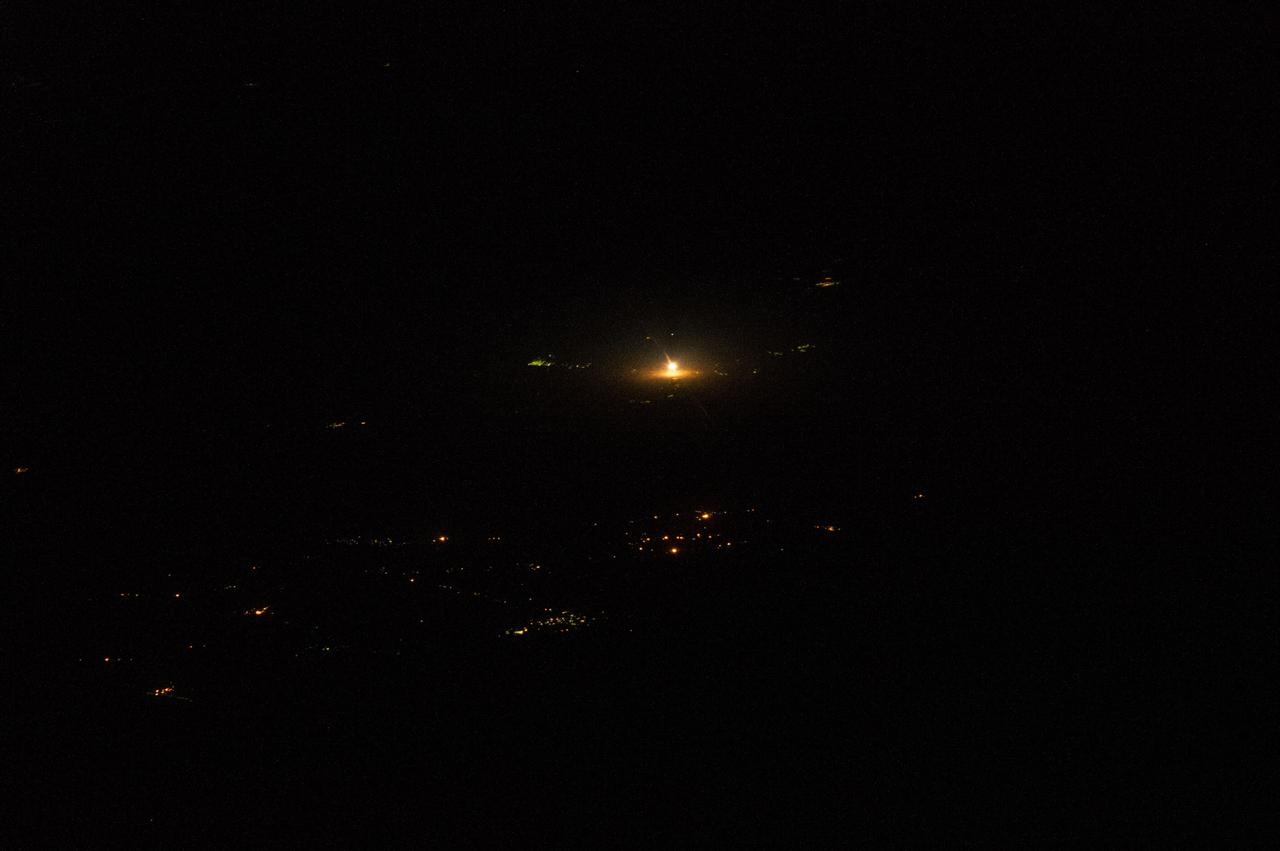
ISS039-E-005434 (25 March 2014) --- One of the three Expedition 39 crew members currently onboard the International Space Station photographed this image of the departure from Baikonur Cosmodrome in Kazakhstan at 21:18:03 GMT, March 25 (March 26, Kazakh time) of two Russian cosmonauts and a NASA astronaut in the Soyuz TMA12M. Inside the space station were Expediton 39 Commander Koichi Wakata of the Japan Aerospace Exploration Agency (JAXA) and Cosmonaut Mikhail Tyurin and NASA astronaut Rick Mastracchio, both flight engineers. Inside the Soyuz on route to meet the present inhabitants was another Expedition 39 trio -- Soyuz Commander Alexander Skvortsov of Rosmosmos and Flight Engineers Steve Swanson of NASA and Oleg Artemyev of Roscosmos.
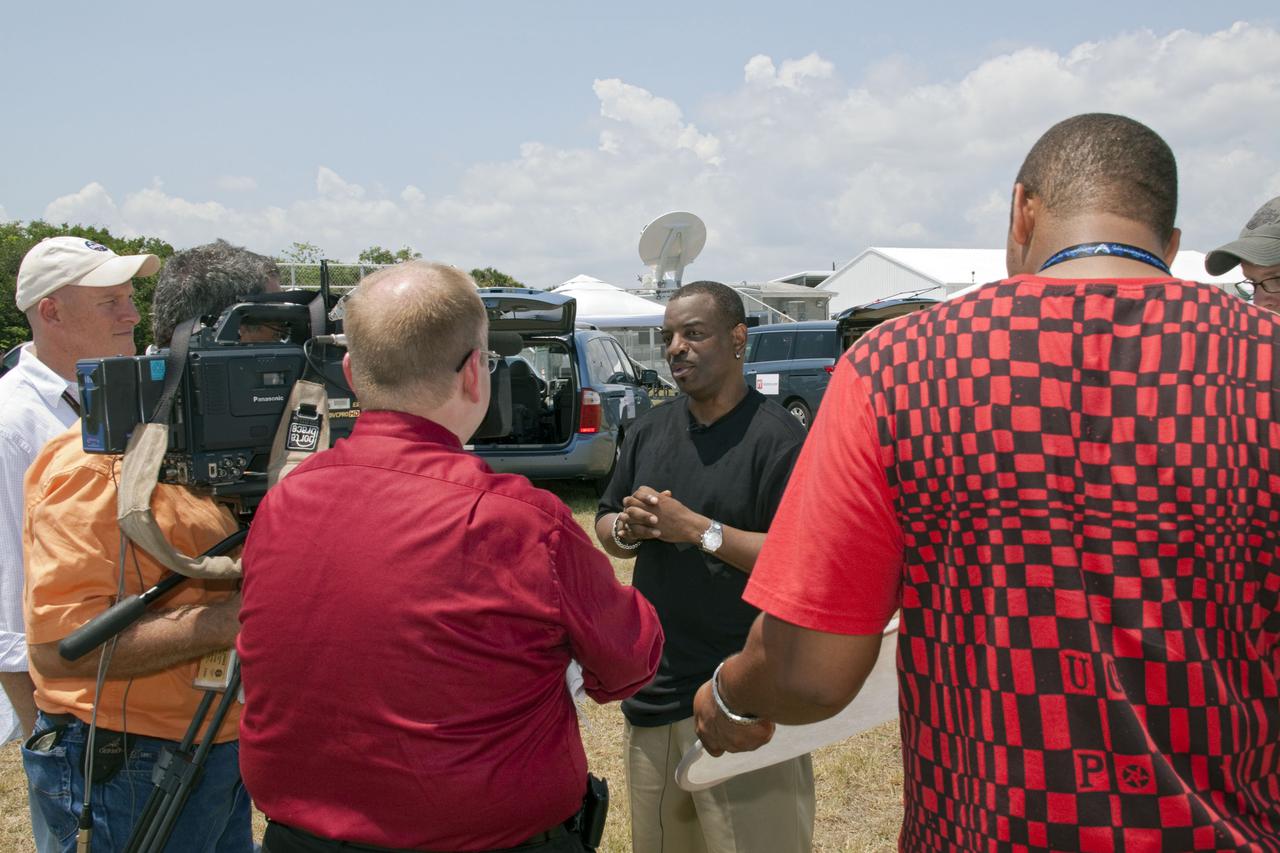
CAPE CANAVERAL, Fla. -- At Kennedy Space Center in Florida, NASA is hosting a two-day Tweetup for 150 of its Twitter followers of space shuttle Endeavour's STS-134 mission. A Tweetup is an informal meeting of people who use the social messaging medium Twitter. This Tweetup is an opportunity to learn more about NASA, explore Kennedy Space Center and experience a space shuttle launch. Actor_Director LeVar Burton, participating in the Tweetup is interviewed by Kennedy's News Chief Allard Beutel. Endeavour and its crew will deliver the Express Logistics Carrier-3, Alpha Magnetic Spectrometer-2 (AMS), a high-pressure gas tank and additional spare parts for the Dextre robotic helper to the International Space Station. Launch is scheduled for April 29 at 3:47 p.m. EDT. This will be the final spaceflight for Endeavour. For more information visit, www.nasa.gov_mission_pages_shuttle_shuttlemissions_sts134_index.html. Photo credit: NASA_Jack Pfaller
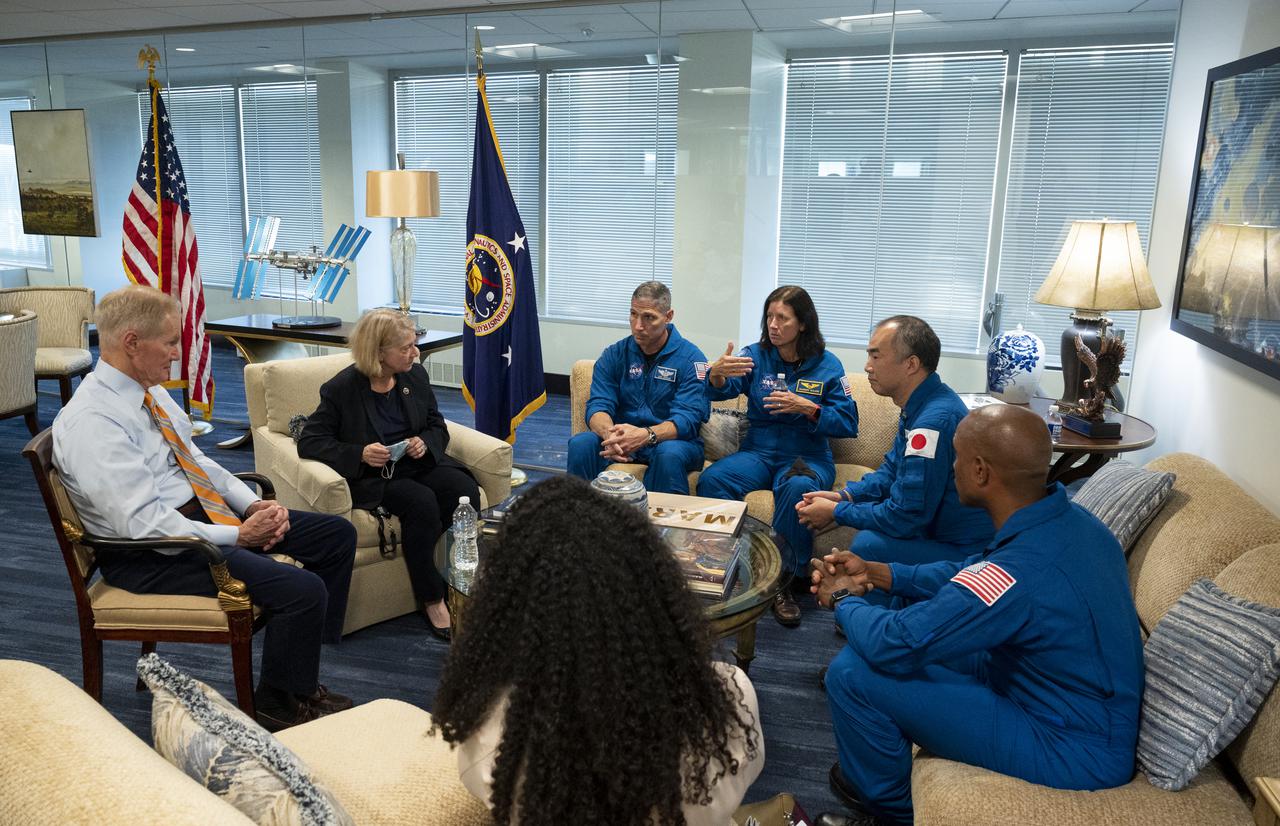
NASA Administrator Bill Nelson, left, and NASA Deputy Administrator Pam Melroy, second from left, meet with SpaceX Crew-1 NASA astronauts Mike Hopkins, third from left, Shannon Walker, third from right, Japan Aerospace Exploration Agency (JAXA) astronaut Soichi Noguchi, second from right, and NASA astronaut Victor Glover, right, Monday, Nov. 15, 2021, at the Mary W. Jackson NASA Headquarters Building in Washington. Hopkins, Glover, Walker, and Noguchi launched on the first crew rotation mission to the International Space Station for SpaceX’s Falcon 9 and Crew Dragon spacecraft as part of the agency’s Commercial Crew Program and spent 168 days in space across Expeditions 64 and 65. Photo Credit: (NASA/Joel Kowsky)
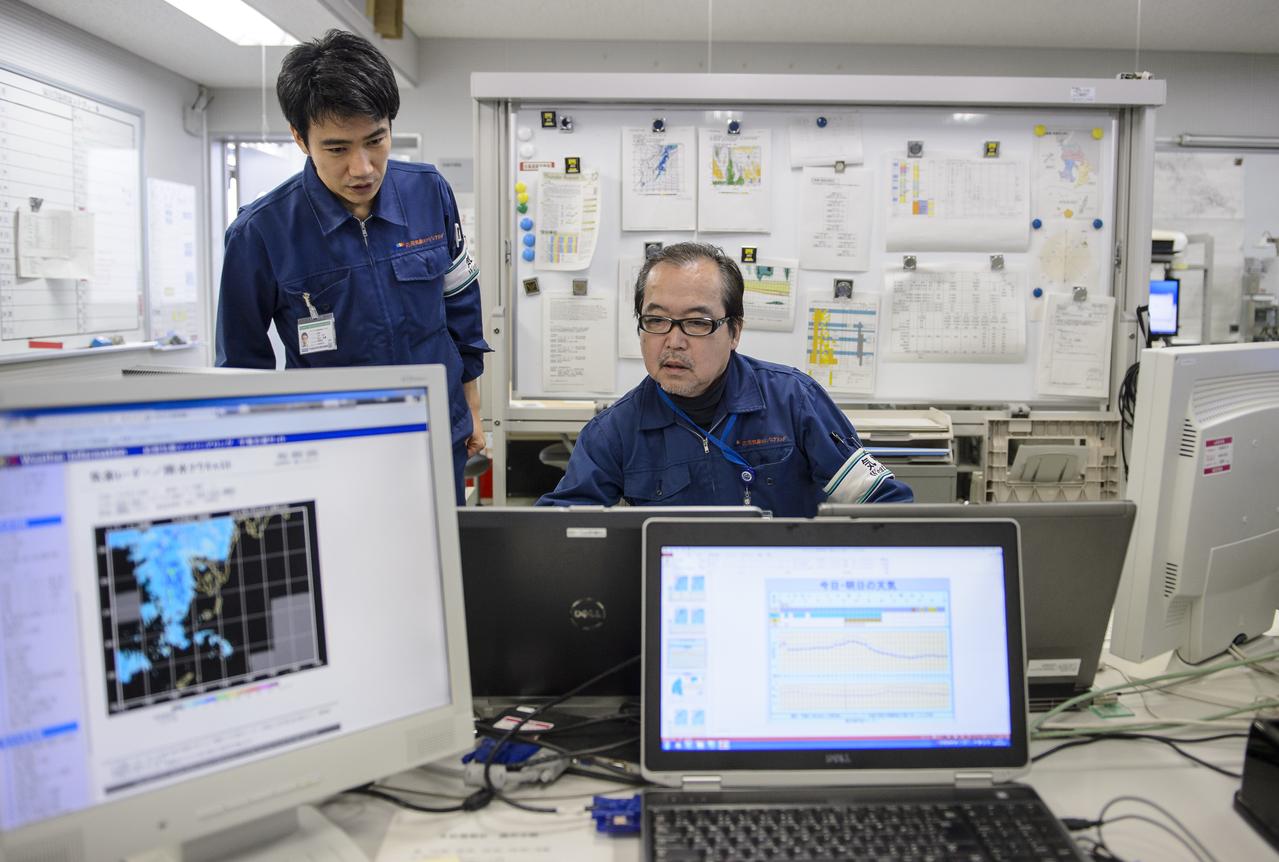
Members of the weather team prepare reports for the Global Precipitation Measurement (GPM) Core Observatory Launch Readiness Review (LRR) with Chief officers from Mitsubishi Heavy Industries, Ltd., the Japan Aerospace Exploration Agency (JAXA), and NASA, on Wednesday, Feb. 26, 2014 at Tanegashima Space Center, Japan. The GPM spacecraft is scheduled to launch aboard an H-IIA rocket early on the morning of Feb. 28 Japan time. At the meeting in the space center's Range Control Center, all preparations to date were reviewed and approval was given to proceed with launch on schedule. Once launched, the GPM spacecraft will collect information that unifies data from an international network of existing and future satellites to map global rainfall and snowfall every three hours. Photo Credit: (NASA/Bill Ingalls)
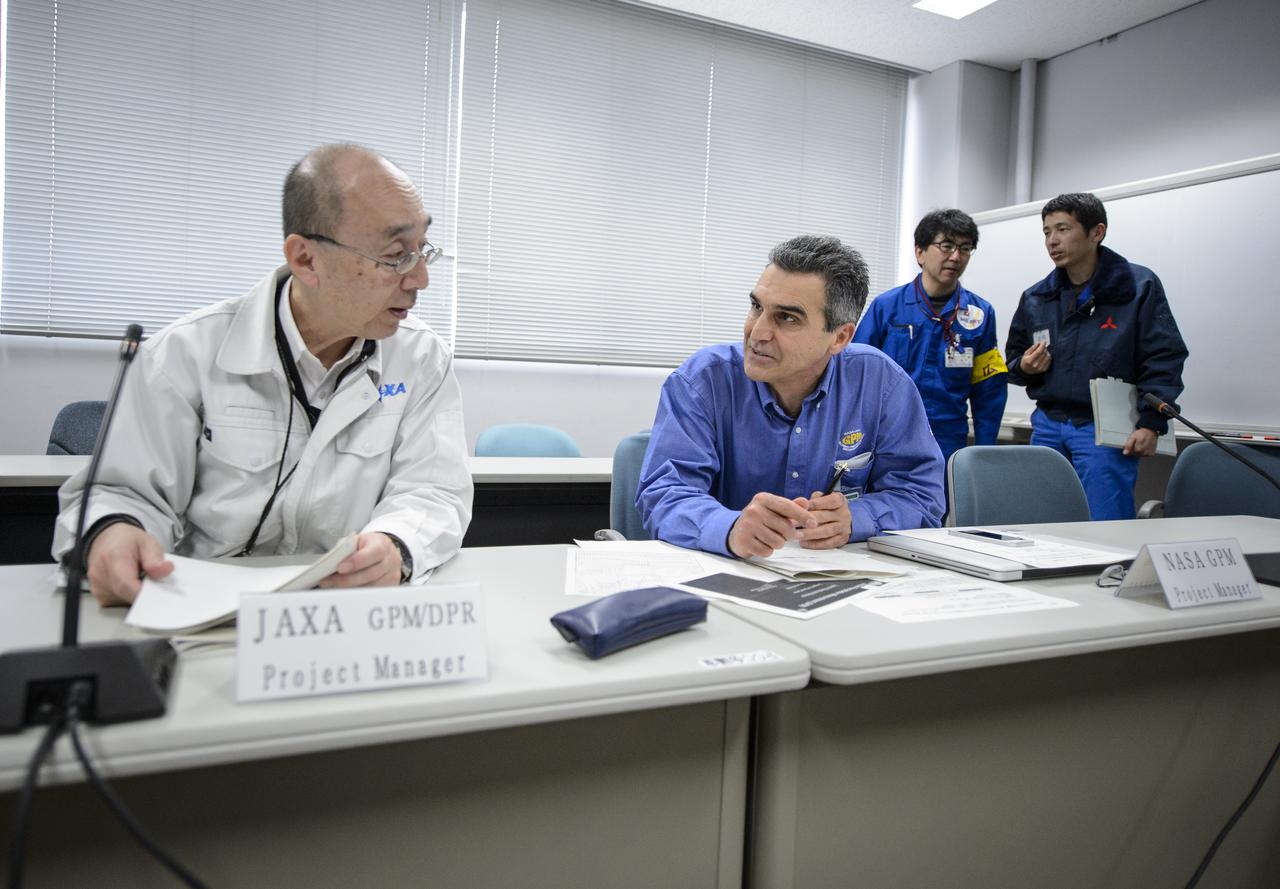
Masahiro Kojima, GPM Dual-frequency Precipitation Radar project manager, Japan Aerospace Exploration Agency (JAXA), left, and, Art Azarbarzin, NASA Global Precipitation Measurement (GPM) project manager, talk after the GPM Launch Readiness Review (LRR), Wednesday, Feb. 26, 2014 at Tanegashima Space Center, Japan. The GPM spacecraft is scheduled to launch aboard an H-IIA rocket early on the morning of Feb. 28 Japan time. At the meeting in the space center's Range Control Center, all preparations to date were reviewed and approval was given to proceed with launch on schedule. Once launched, the GPM spacecraft will collect information that unifies data from an international network of existing and future satellites to map global rainfall and snowfall every three hours. Photo Credit: (NASA/Bill Ingalls)
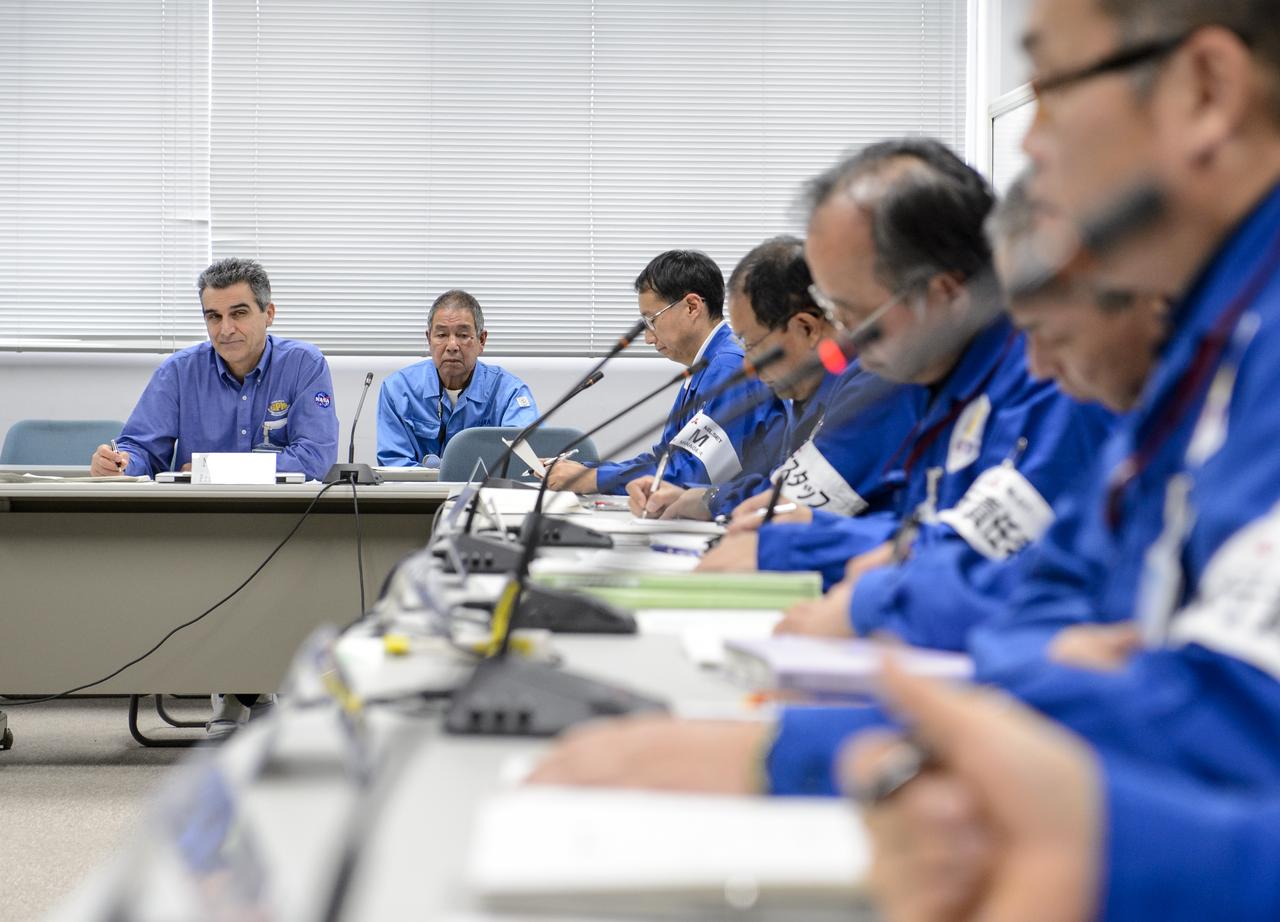
Art Azarbarzin, NASA Global Precipitation Measurement (GPM) project manager, left, participates in the GPM Launch Readiness Review (LRR) along with Chief officers from Mitsubishi Heavy Industries, Ltd., and the Japan Aerospace Exploration Agency (JAXA) on Wednesday, Feb. 26, 2014 at Tanegashima Space Center, Japan. The spacecraft is scheduled to launch aboard an H-IIA rocket early on the morning of Feb. 28 Japan time. At the meeting in the space center's Range Control Center, all preparations to date were reviewed and approval was given to proceed with launch on schedule. Once launched, the GPM spacecraft will collect information that unifies data from an international network of existing and future satellites to map global rainfall and snowfall every three hours. Photo Credit: (NASA/Bill Ingalls)
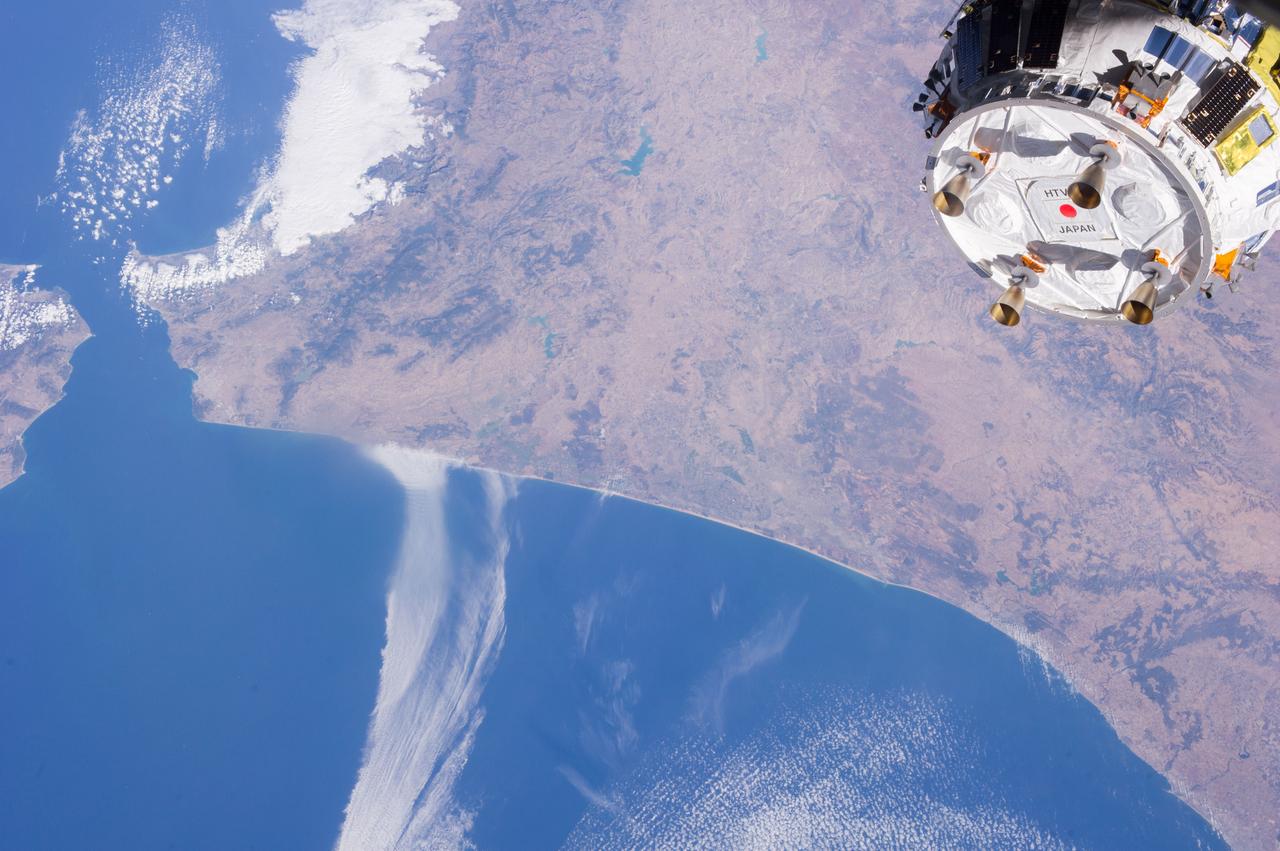
ISS036-E-039525 (04 Sept. 2013) --- One of the Expedition 36 crew members aboard the International Space Station took this picture showing part of the Japanese HTV-4 unmanned cargo spacecraft, backdropped against countries in northern Africa, following its unberthing from the orbital outpost. HTV-4, after backing away from the flying complex, headed for re-entry into Earth's atmosphere, burning upon re-entry. The Strait of Gibraltar, where the Atlantic Ocean and the Mediterranean Sea meet, is in the upper left quadrant of the photo. HTV-4 was launched by Japan?s Aerospace Exploration Agency (JAXA) on Aug. 4 of this year in order to bring up supplies for the astronauts and cosmonauts onboard the station.
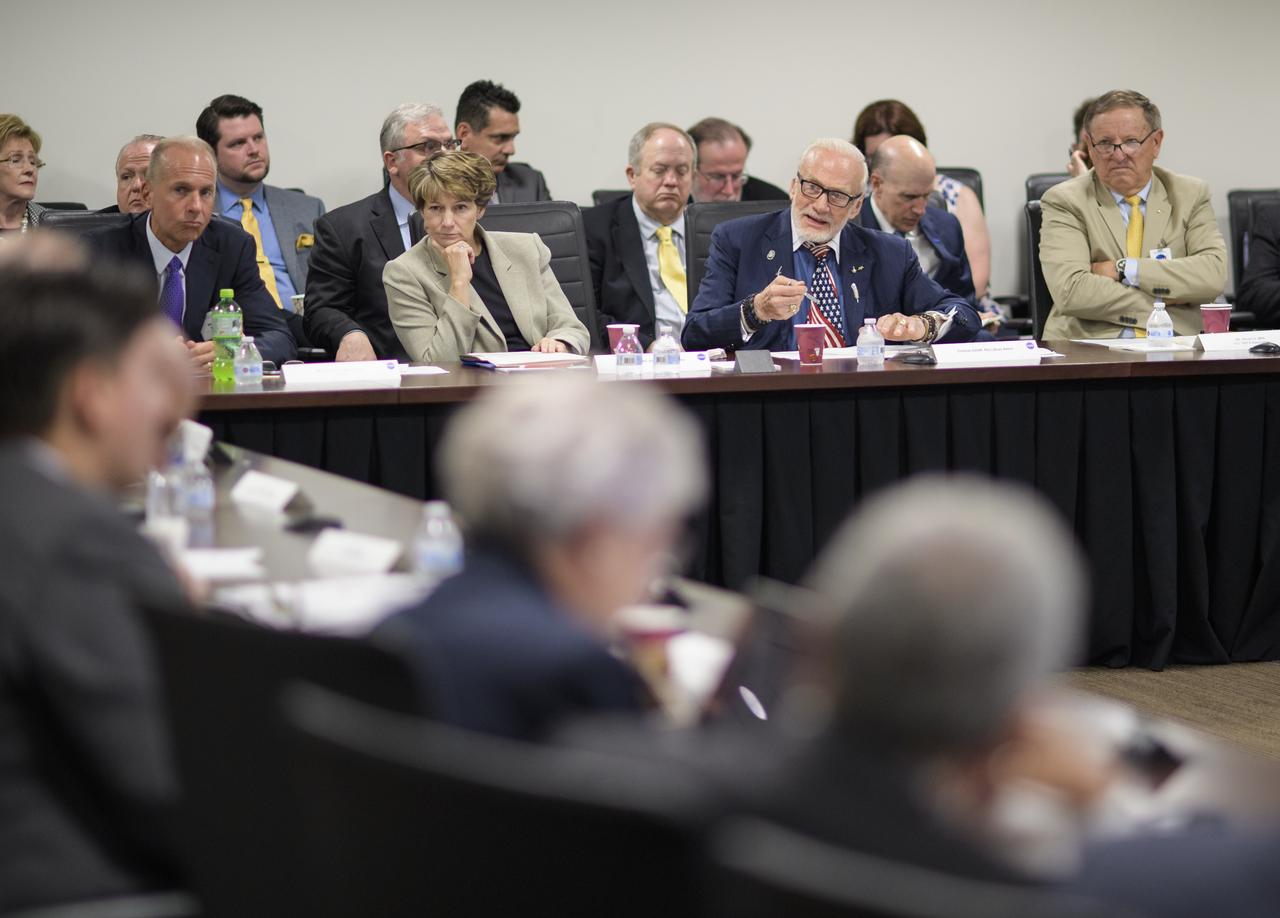
Users' Advisory Group members, from left, Dennis Muilenburg, CEO of the Boeing Company; Eileen Collins, former NASA astronaut; Buzz Aldrin, Apollo 11 astronaut; Stu Witt, founder of the Mojave Air and Spaceport and former Chairman of the Commercial Spaceflight Federation; are seen during the first meeting of the National Space Council Users' Advisory Group, Tuesday, June 19, 2018 at NASA Headquarters in Washington. The Users' Advisory Group will advise and inform the National Space Council on a broad range of aerospace topics, including the impacts of U.S. and international laws and regulations, national security space priorities, scientific and human space exploration priorities, and ways to bolster support. Photo Credit: (NASA/Joel Kowsky)
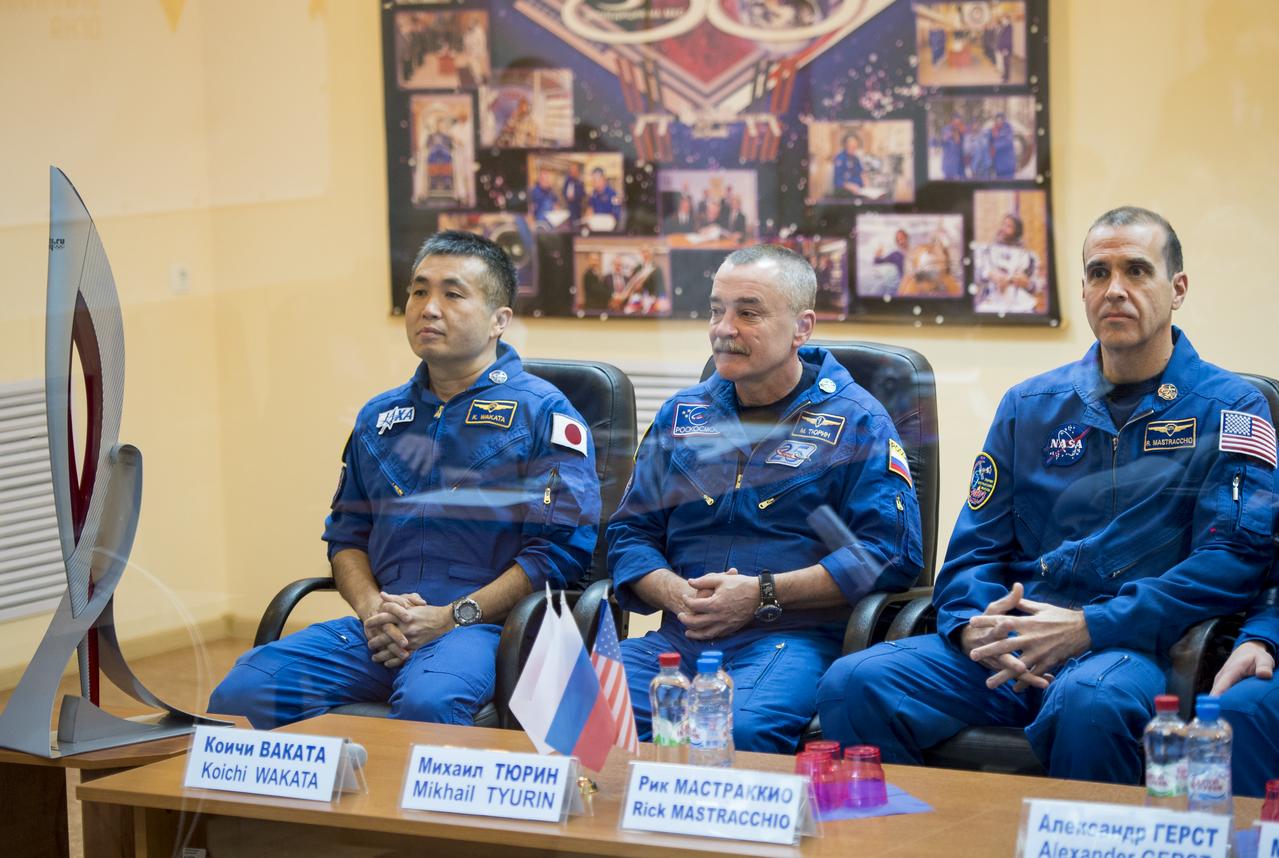
Expedition 38 Flight Engineer Koichi Wakata of the Japan Aerospace Exploration Agency, left, Soyuz Commander Mikhail Tyurin of Roscosmos, and, Flight Engineer Rick Mastracchio of NASA, right, are seen behind glass, while in quarantine, during the State Commission meeting held to approve the Soyuz launch of the crew for a six month mission aboard the International Space Station, Wednesday, Nov. 6, 2013 at the Cosmonaut Hotel in Baikonur, Kazakhstan. An Olympic torch that will be launched with the crew for a four-day visit to the station is seen on the left. The torch will return to Earth with another trio of station residents on Nov. 11 and will be part of the torch relay that ends with the lighting of the flame at the Fisht Stadium in Sochi, Russia Feb. 7 to mark the opening of the 2014 Winter Olympics. Photo Credit: (NASA/Bill Ingalls)
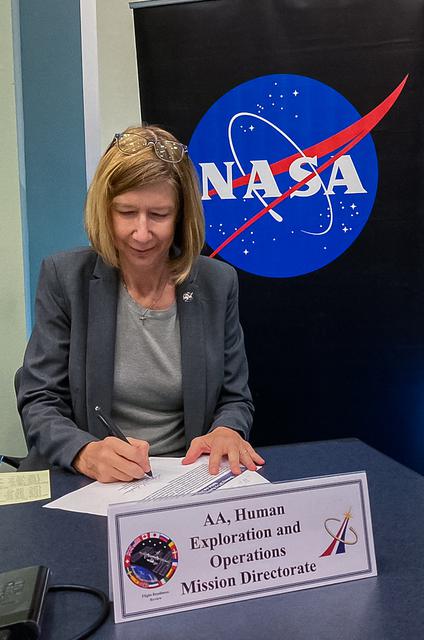
Associate Administrator of the Human Exploration and Operations (HEO) Mission Directorate Kathryn Lueders chaired the Flight Readiness Review for Boeing's upcoming Orbital Flight Test-2 (OFT-2) in Operations Support Building 2 at NASA's Kennedy Space Center in Florida, July 22, 2021. At the conclusion of the meeting, all board members sign the Certificate of Flight Readiness certifying their readiness to proceed to the next milestones and launch of Boeing's CST-100 Starliner atop a United Launch Alliance Atlas V rocket from Space Launch Complex 41 at Cape Canaveral Space Force Station. Launch time remains 2:53 p.m. EDT Friday, July 30 for the uncrewed OFT-2 mission – Starliner's second flight to the International Space Station for NASA's Commercial Crew Program.
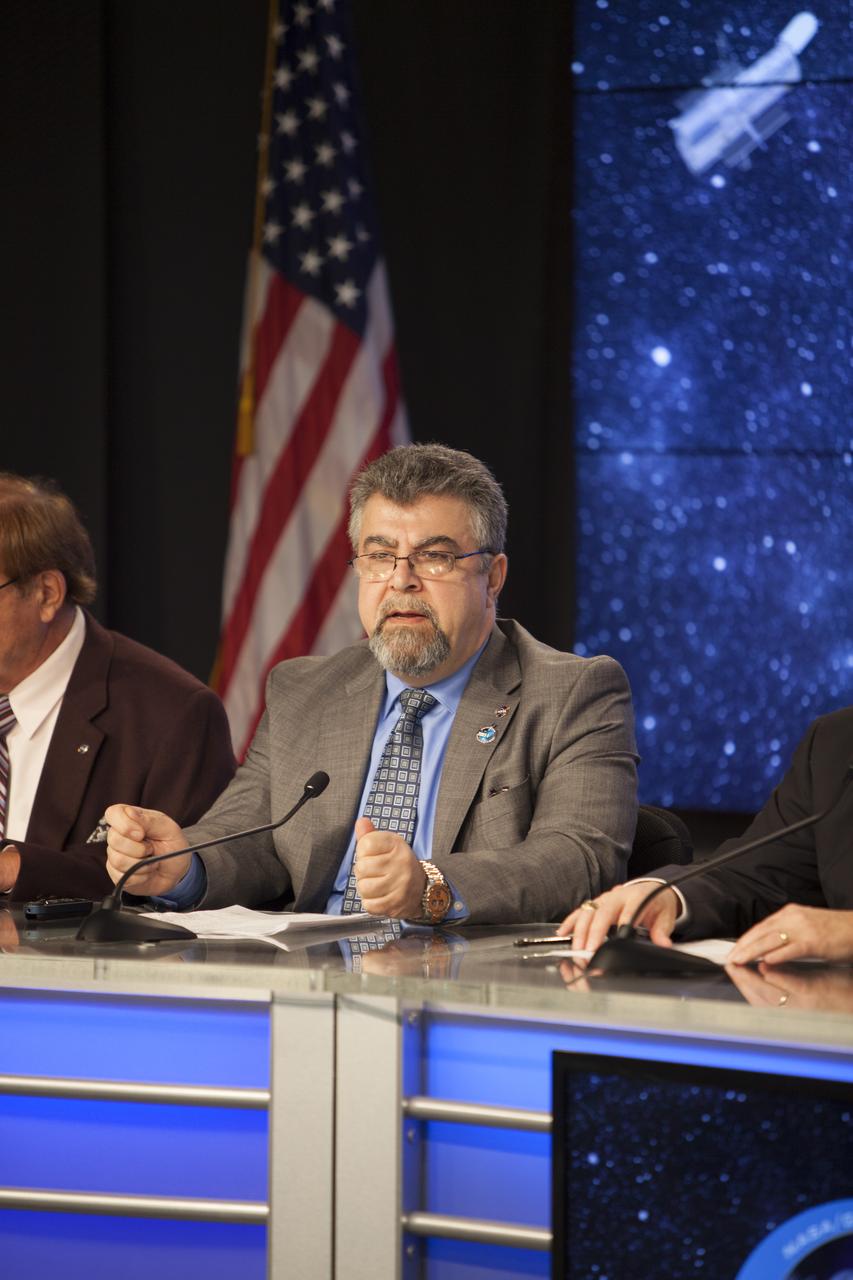
CAPE CANAVERAL, Fla. – During a news conference at NASA's Kennedy Space Center in Florida, agency and contractor officials discussed preparations for the launch of NASA's Tracking and Data Relay Satellite, or TDRS-L, spacecraft. Participants included Badri Younes, deputy associate administrator, Space Communications and Navigation SCaN NASA Human Exploration and Operations Mission Directorate at NASA Headquarters in Washington D.C. The TDRS-L spacecraft is the second of three new satellites designed to ensure vital operational continuity for NASA by expanding the lifespan of the Tracking and Data Relay Satellite System TDRSS fleet, which consists of eight satellites in geosynchronous orbit. The spacecraft provide tracking, telemetry, command and high bandwidth data return services for numerous science and human exploration missions orbiting Earth. These include NASA's Hubble Space Telescope and the International Space Station. TDRS-L has a high-performance solar panel designed for more spacecraft power to meet the growing S-band communications requirements. TDRSS is one of NASA Space Communication and Navigation’s SCaN three networks providing space communications to NASA’s missions. For more information more about TDRS-L, visit: http://www.nasa.gov/tdrs To learn more about SCaN, visit: www.nasa.gov/scan Photo credit: NASA/Frankie Martin

CAPE CANAVERAL, Fla. – At Cape Canaveral Air Force Station's Launch Complex 41, a United Launch Alliance Atlas V with NASA's Tracking and Data Relay Satellite, or TDRS-L, spacecraft atop, is being prepared for rollout from the Vertical Integration Facility to the launch pad. The TDRS-L spacecraft is the second of three new satellites designed to ensure vital operational continuity for NASA by expanding the lifespan of the Tracking and Data Relay Satellite System TDRSS fleet, which consists of eight satellites in geosynchronous orbit. The spacecraft provide tracking, telemetry, command and high bandwidth data return services for numerous science and human exploration missions orbiting Earth. These include NASA's Hubble Space Telescope and the International Space Station. TDRS-L has a high-performance solar panel designed for more spacecraft power to meet the growing S-band communications requirements. TDRSS is one of NASA Space Communication and Navigation’s SCaN three networks providing space communications to NASA’s missions. For more information more about TDRS-L, visit: http://www.nasa.gov/tdrs To learn more about SCaN, visit: www.nasa.gov/scan Photo credit: NASA/Daniel Casper
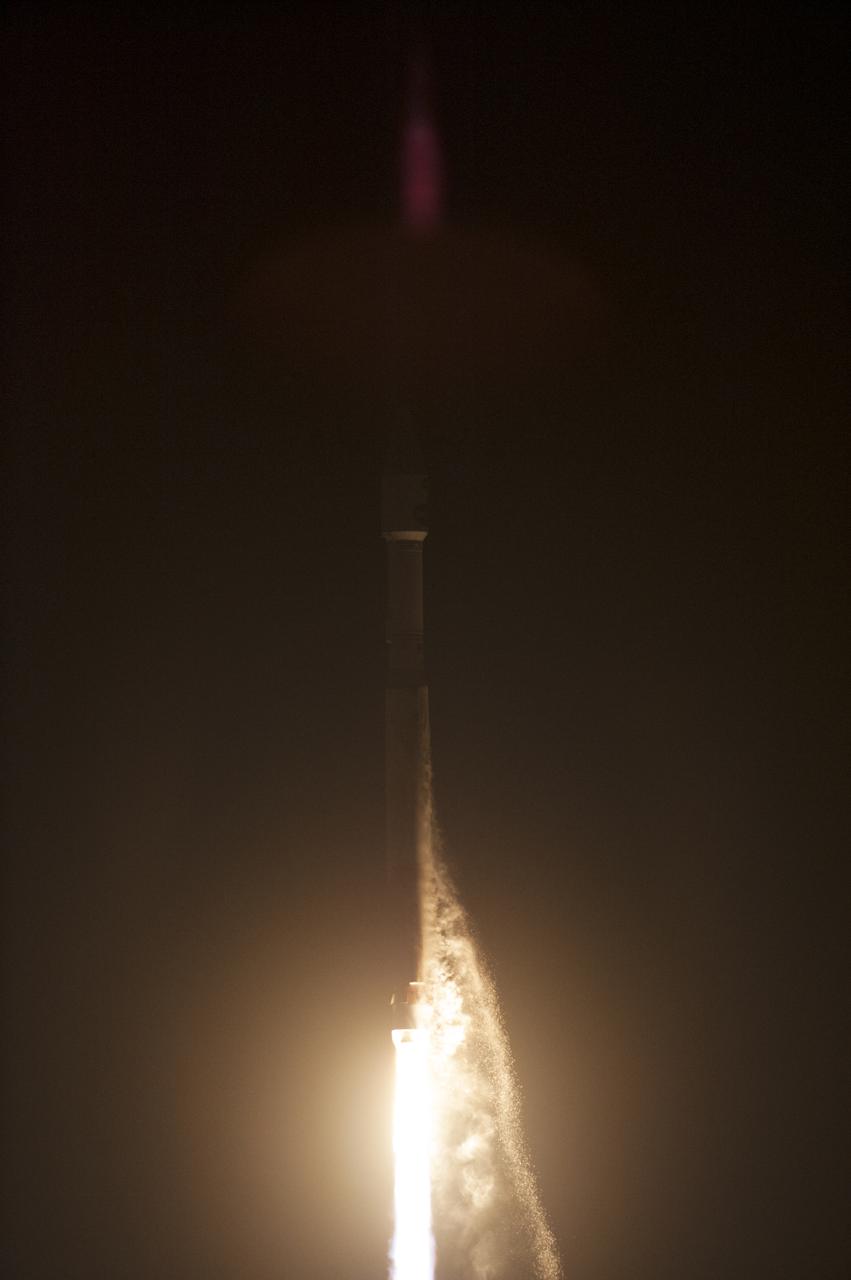
CAPE CANAVERAL, Fla. -- A United Launch Alliance Atlas V rocket soars into the night from Space Launch Complex 41 at Cape Canaveral Air Force Station in Florida, carrying NASA's Tracking and Data Relay Satellite, or TDRS-L, to Earth orbit. Launch was at 9:33 p.m. EST Jan. 23 during a 40-minute launch window. The TDRS-L spacecraft is the second of three new satellites designed to ensure vital operational continuity for NASA by expanding the lifespan of the Tracking and Data Relay Satellite System TDRSS fleet, which consists of eight satellites in geosynchronous orbit. The spacecraft provide tracking, telemetry, command and high-bandwidth data return services for numerous science and human exploration missions orbiting Earth. These include NASA's Hubble Space Telescope and the International Space Station. TDRS-L has a high-performance solar panel designed for more spacecraft power to meet the growing S-band communications requirements. TDRSS is one of three NASA Space Communication and Navigation SCaN networks providing space communications to NASA’s missions. For more information more about TDRS-L, visit http:__www.nasa.gov_tdrs. To learn more about SCaN, visit www.nasa.gov_scan. Photo credit: NASA_Kevin O'Connell
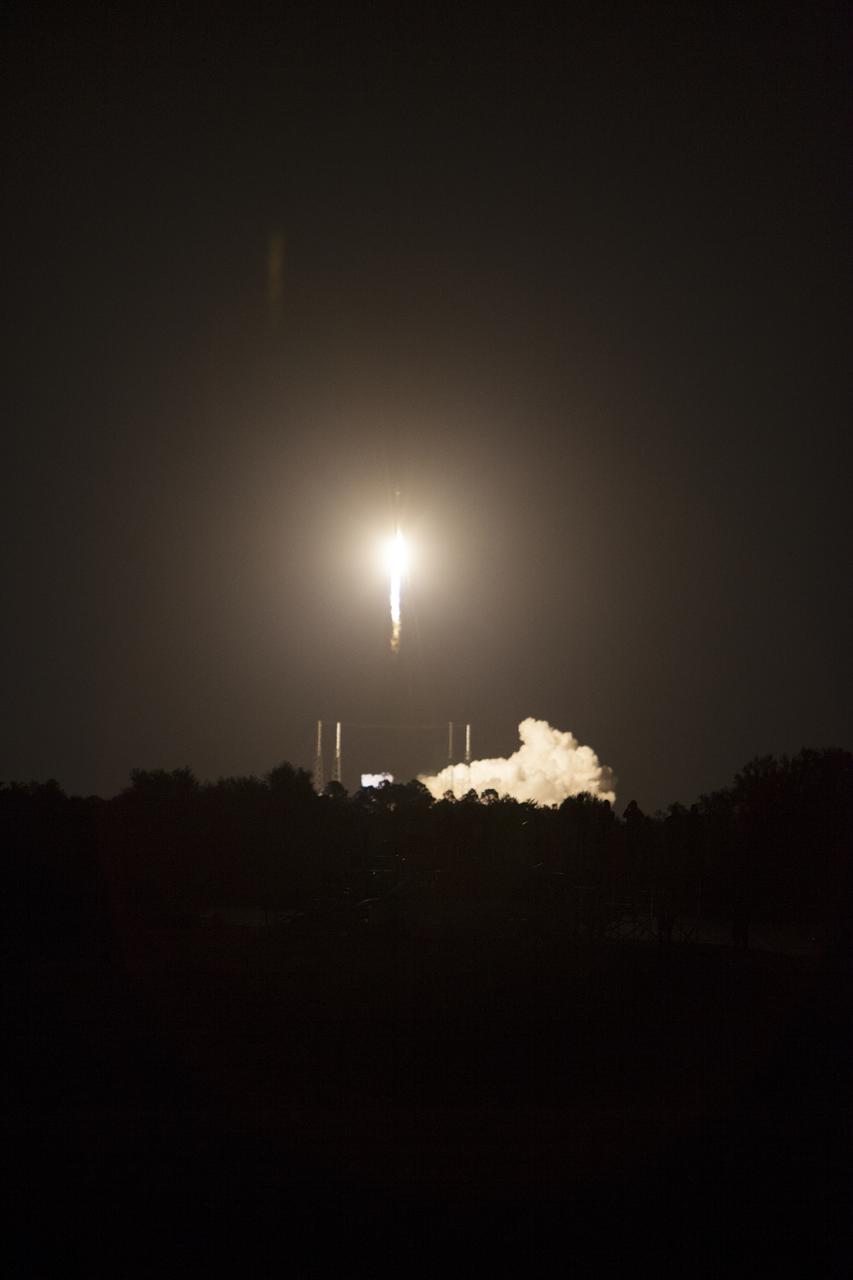
CAPE CANAVERAL, Fla. -- A United Launch Alliance Atlas V rocket soars into the darkness over Space Launch Complex 41 at Cape Canaveral Air Force Station in Florida, carrying NASA's Tracking and Data Relay Satellite, or TDRS-L, to Earth orbit. Launch was at 9:33 p.m. EST Jan. 23 during a 40-minute launch window. The TDRS-L spacecraft is the second of three new satellites designed to ensure vital operational continuity for NASA by expanding the lifespan of the Tracking and Data Relay Satellite System TDRSS fleet, which consists of eight satellites in geosynchronous orbit. The spacecraft provide tracking, telemetry, command and high-bandwidth data return services for numerous science and human exploration missions orbiting Earth. These include NASA's Hubble Space Telescope and the International Space Station. TDRS-L has a high-performance solar panel designed for more spacecraft power to meet the growing S-band communications requirements. TDRSS is one of three NASA Space Communication and Navigation SCaN networks providing space communications to NASA’s missions. For more information more about TDRS-L, visit http:__www.nasa.gov_tdrs. To learn more about SCaN, visit www.nasa.gov_scan. Photo credit: NASA_Frankie Martin
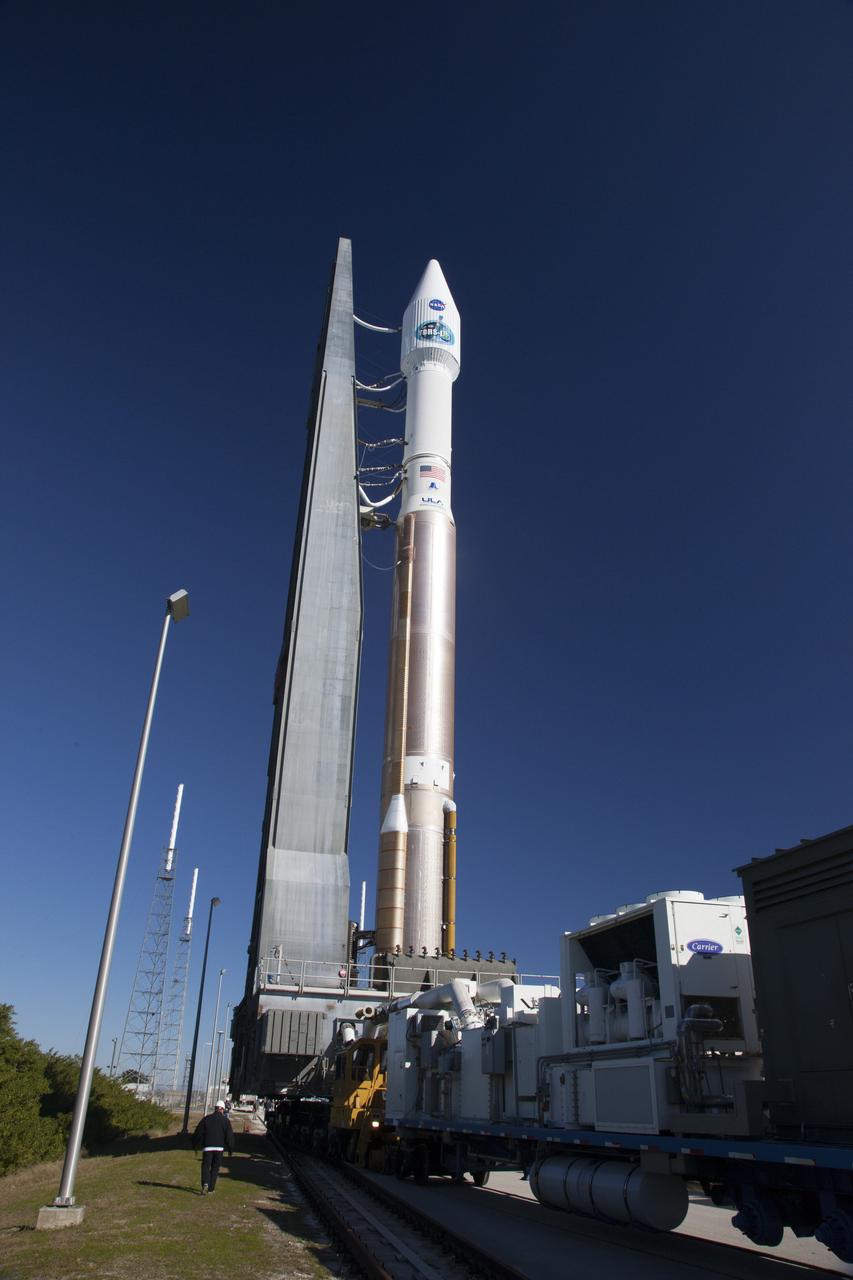
CAPE CANAVERAL, Fla. – At Cape Canaveral Air Force Station's Launch Complex 41, a United Launch Alliance Atlas V with NASA's Tracking and Data Relay Satellite, or TDRS-L, spacecraft atop, rolls out to the launch pad. The TDRS-L spacecraft is the second of three new satellites designed to ensure vital operational continuity for NASA by expanding the lifespan of the Tracking and Data Relay Satellite System TDRSS fleet, which consists of eight satellites in geosynchronous orbit. The spacecraft provide tracking, telemetry, command and high bandwidth data return services for numerous science and human exploration missions orbiting Earth. These include NASA's Hubble Space Telescope and the International Space Station. TDRS-L has a high-performance solar panel designed for more spacecraft power to meet the growing S-band communications requirements. TDRSS is one of NASA Space Communication and Navigation’s SCaN three networks providing space communications to NASA’s missions. For more information more about TDRS-L, visit: http://www.nasa.gov/tdrs To learn more about SCaN, visit: www.nasa.gov/scan Photo credit: NASA/Daniel Casper
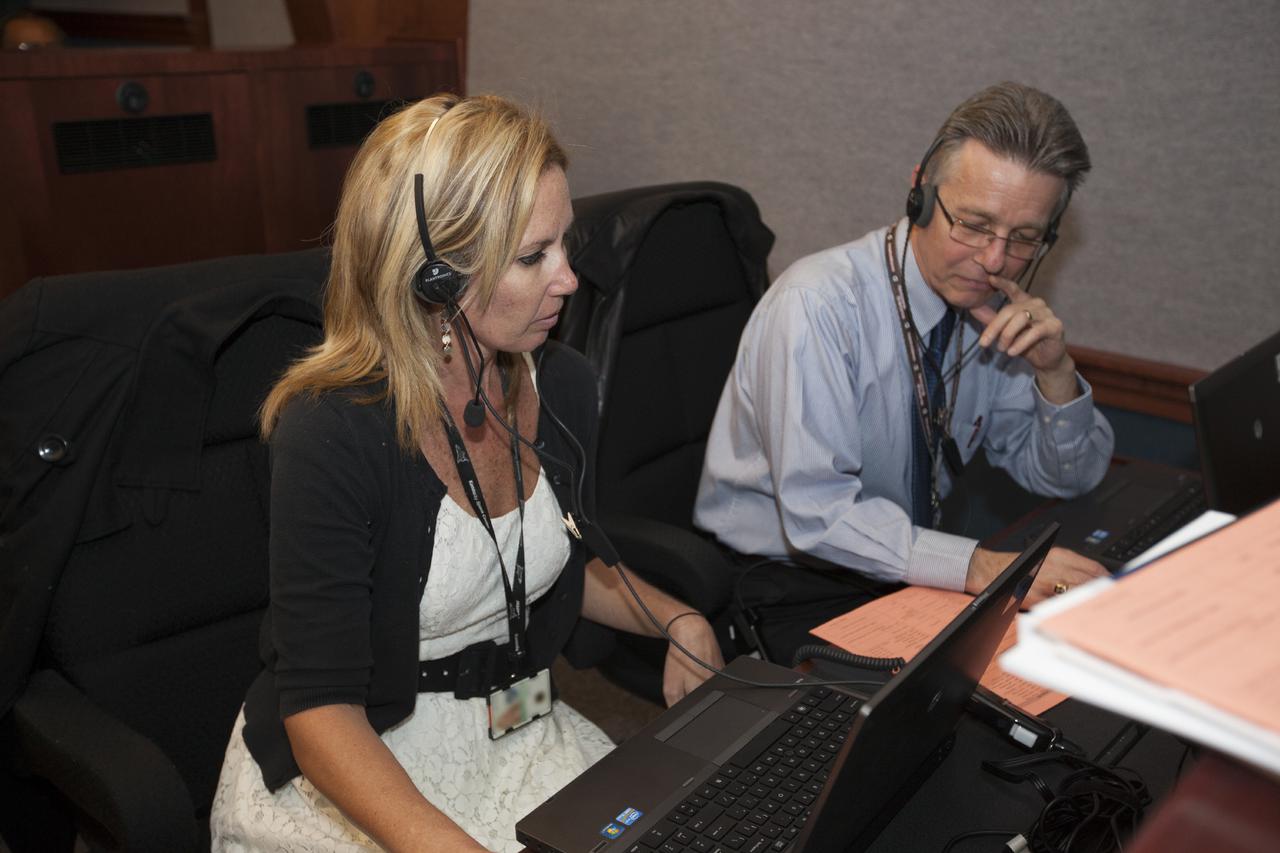
CAPE CANAVERAL, Fla. – At Cape Canaveral Air Force Station's Atlas V Spaceflight Operations Center NASA and contractor managers and engineers monitor progress of the countdown for the launch the agency's Tracking and Data Relay Satellite, or TDRS-L, spacecraft atop a United Launch Alliance Atlas V rocket. The TDRS-L spacecraft is the second of three new satellites designed to ensure vital operational continuity for NASA by expanding the lifespan of the Tracking and Data Relay Satellite System TDRSS fleet, which consists of eight satellites in geosynchronous orbit. The spacecraft provide tracking, telemetry, command and high bandwidth data return services for numerous science and human exploration missions orbiting Earth. These include NASA's Hubble Space Telescope and the International Space Station. TDRS-L has a high-performance solar panel designed for more spacecraft power to meet the growing S-band communications requirements. TDRSS is one of NASA Space Communication and Navigation’s SCaN three networks providing space communications to NASA’s missions. For more information more about TDRS-L, visit: http:__www.nasa.gov_tdrs To learn more about SCaN, visit: www.nasa.gov_scan Photo credit: NASA_Kim Shiflett
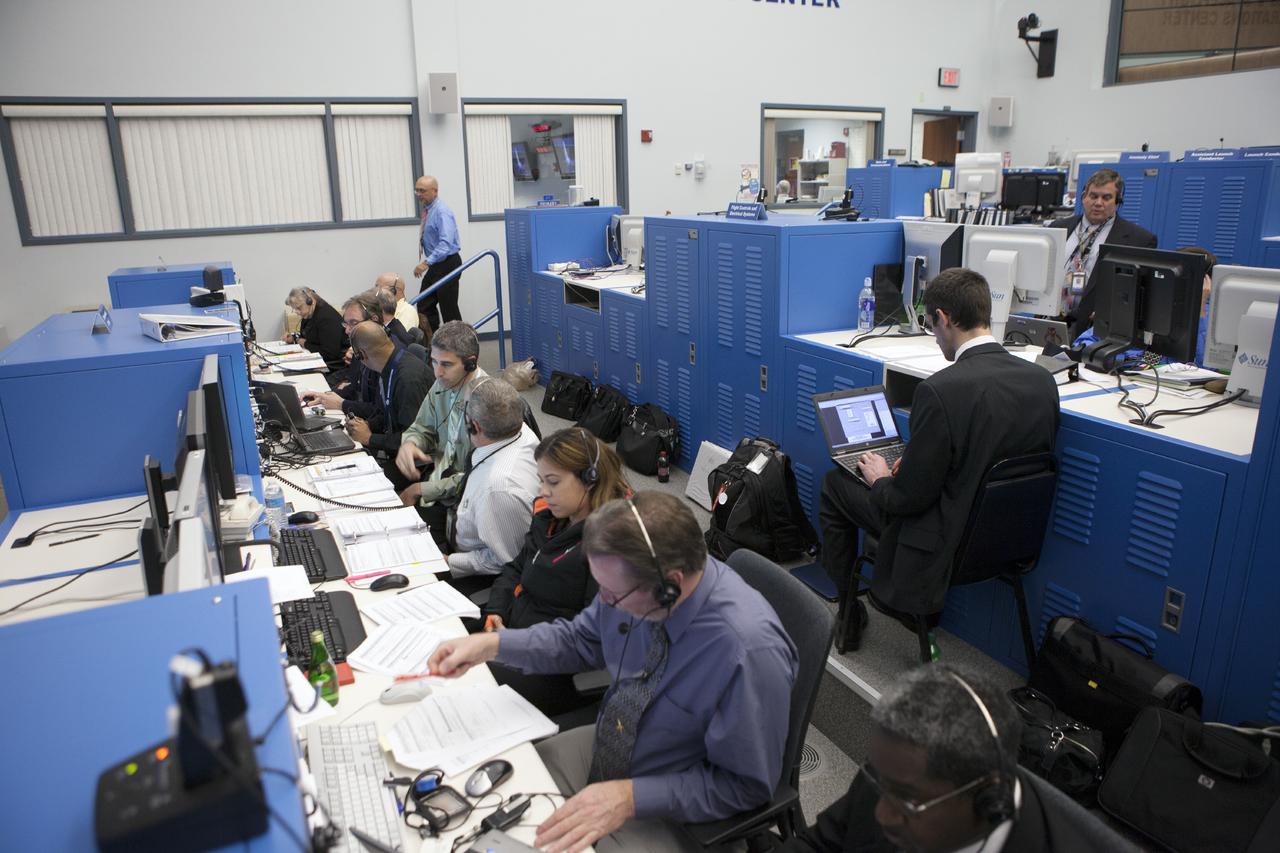
CAPE CANAVERAL, Fla. – In the Hangar AE Mission Director's Center at Cape Canaveral Air Force Station in Florida, NASA and contractor managers and engineers monitor progress of the countdown for the launch the agency's Tracking and Data Relay Satellite, or TDRS-L, spacecraft atop a United Launch Alliance Atlas V rocket. The TDRS-L spacecraft is the second of three new satellites designed to ensure vital operational continuity for NASA by expanding the lifespan of the Tracking and Data Relay Satellite System TDRSS fleet, which consists of eight satellites in geosynchronous orbit. The spacecraft provide tracking, telemetry, command and high bandwidth data return services for numerous science and human exploration missions orbiting Earth. These include NASA's Hubble Space Telescope and the International Space Station. TDRS-L has a high-performance solar panel designed for more spacecraft power to meet the growing S-band communications requirements. TDRSS is one of NASA Space Communication and Navigation’s SCaN three networks providing space communications to NASA’s missions. For more information more about TDRS-L, visit: http:__www.nasa.gov_tdrs To learn more about SCaN, visit: www.nasa.gov_scan Photo credit: NASA_Kim Shiflett

CAPE CANAVERAL, Fla. – At Cape Canaveral Air Force Station's Launch Complex 41, a United Launch Alliance Atlas V with NASA's Tracking and Data Relay Satellite, or TDRS-L, spacecraft atop, rolls out to the launch pad. The TDRS-L spacecraft is the second of three new satellites designed to ensure vital operational continuity for NASA by expanding the lifespan of the Tracking and Data Relay Satellite System TDRSS fleet, which consists of eight satellites in geosynchronous orbit. The spacecraft provide tracking, telemetry, command and high bandwidth data return services for numerous science and human exploration missions orbiting Earth. These include NASA's Hubble Space Telescope and the International Space Station. TDRS-L has a high-performance solar panel designed for more spacecraft power to meet the growing S-band communications requirements. TDRSS is one of NASA Space Communication and Navigation’s SCaN three networks providing space communications to NASA’s missions. For more information more about TDRS-L, visit: http://www.nasa.gov/tdrs To learn more about SCaN, visit: www.nasa.gov/scan Photo credit: NASA/Daniel Casper
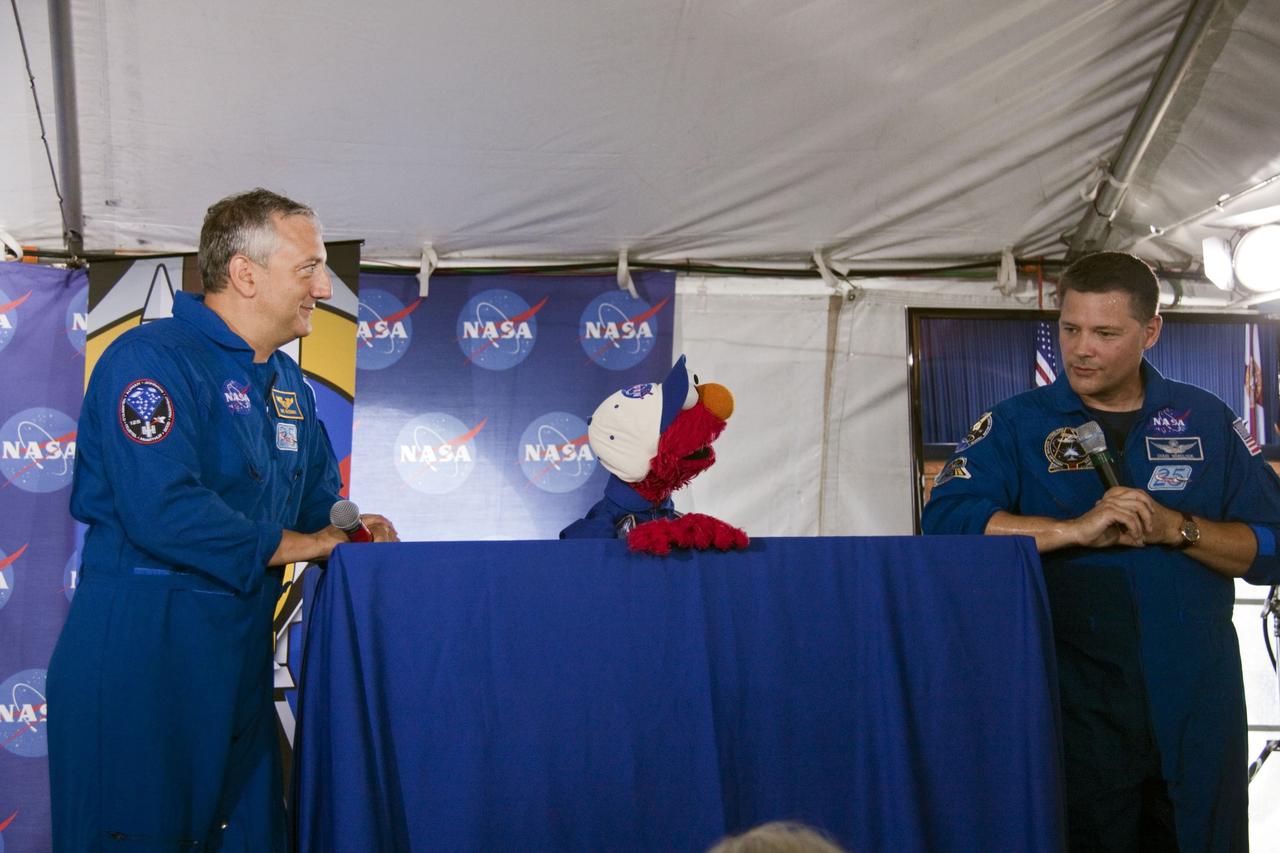
CAPE CANAVERAL, Fla. -- At Kennedy Space Center in Florida, NASA is hosting a Tweetup for 150 Twitter followers of space shuttle Atlantis' STS-135 mission to the International Space Station, selected from more than 5,500 online registrants. A Tweetup is an informal meeting of people who use the social messaging medium Twitter. Here, NASA astronauts Mike Massimino and Doug Wheelock talk with Sesame Street's Elmo. Sesame Street also is at Kennedy to film Elmo, as he learns about space exploration at NASA. Atlantis and its crew of four; Commander Chris Ferguson, Pilot Doug Hurley, Mission Specialists Sandy Magnus and Rex Walheim, are scheduled to lift off at 11:26 a.m. EDT on July 8 to deliver the Raffaello multi-purpose logistics module packed with supplies and spare parts to the station. Atlantis also will fly the Robotic Refueling Mission experiment that will investigate the potential for robotically refueling existing satellites in orbit. In addition, Atlantis will return with a failed ammonia pump module to help NASA better understand the failure mechanism and improve pump designs for future systems. STS-135 will be the 33rd flight of Atlantis, the 37th shuttle mission to the space station, and the 135th and final mission of NASA's Space Shuttle Program. For more information visit, www.nasa.gov/mission_pages/shuttle/shuttlemissions/sts135/index.html. Photo credit: NASA/Troy Cryder
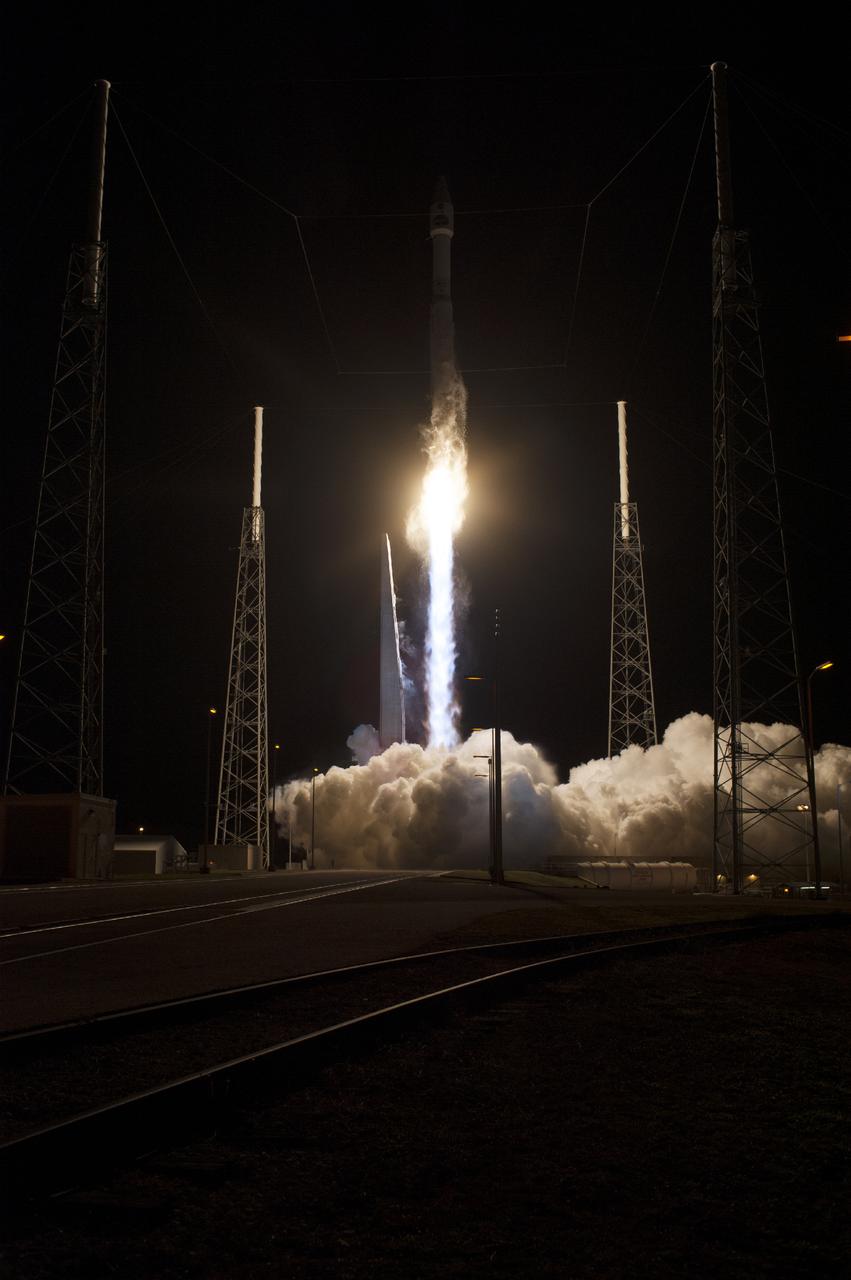
CAPE CANAVERAL, Fla. – The United Launch Alliance Atlas V rocket lifts off from Space Launch Complex 41 at Cape Canaveral Air Force Station carrying NASA's Tracking and Data Relay Satellite, or TDRS-L, spacecraft to Earth orbit. Liftoff was at 9:33 p.m. EST. The TDRS-L spacecraft is the second of three new satellites designed to ensure vital operational continuity for NASA by expanding the lifespan of the Tracking and Data Relay Satellite System TDRSS fleet, which consists of eight satellites in geosynchronous orbit. The spacecraft provide tracking, telemetry, command and high bandwidth data return services for numerous science and human exploration missions orbiting Earth. These include NASA's Hubble Space Telescope and the International Space Station. TDRS-L has a high-performance solar panel designed for more spacecraft power to meet the growing S-band communications requirements. TDRSS is one of NASA Space Communication and Navigation’s SCaN three networks providing space communications to NASA’s missions. For more information more about TDRS-L, visit: http:__www.nasa.gov_tdrs To learn more about SCaN, visit: www.nasa.gov_scan Photo credit: NASA_Tony Gray and Sandy Joseph