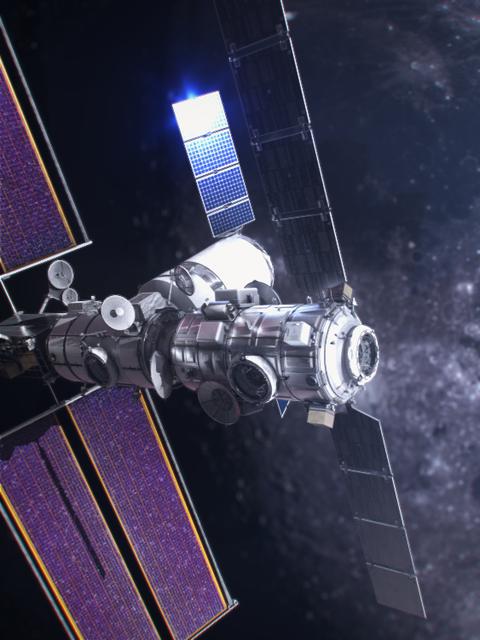
Astronauts will enter Gateway for the first time during the Artemis IV mission when the crewed Orion spacecraft will deliver the International Habitation (I-Hab) module to the space station.
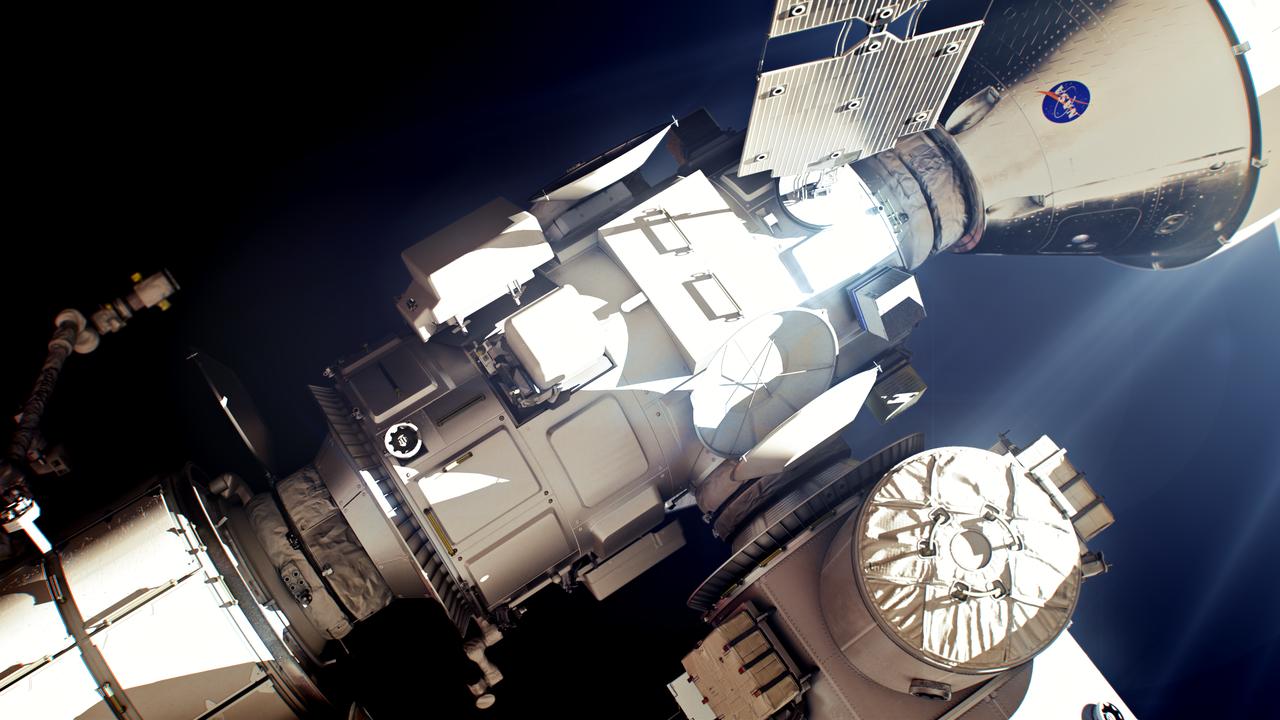
Gateway's International Habitat (I-Hab) module, provided by ESA, is one of two of the space station's habitation modules in addition to HALO. Astronauts will live, conduct science, and prepare for lunar surface missions inside I-Hab and HALO.
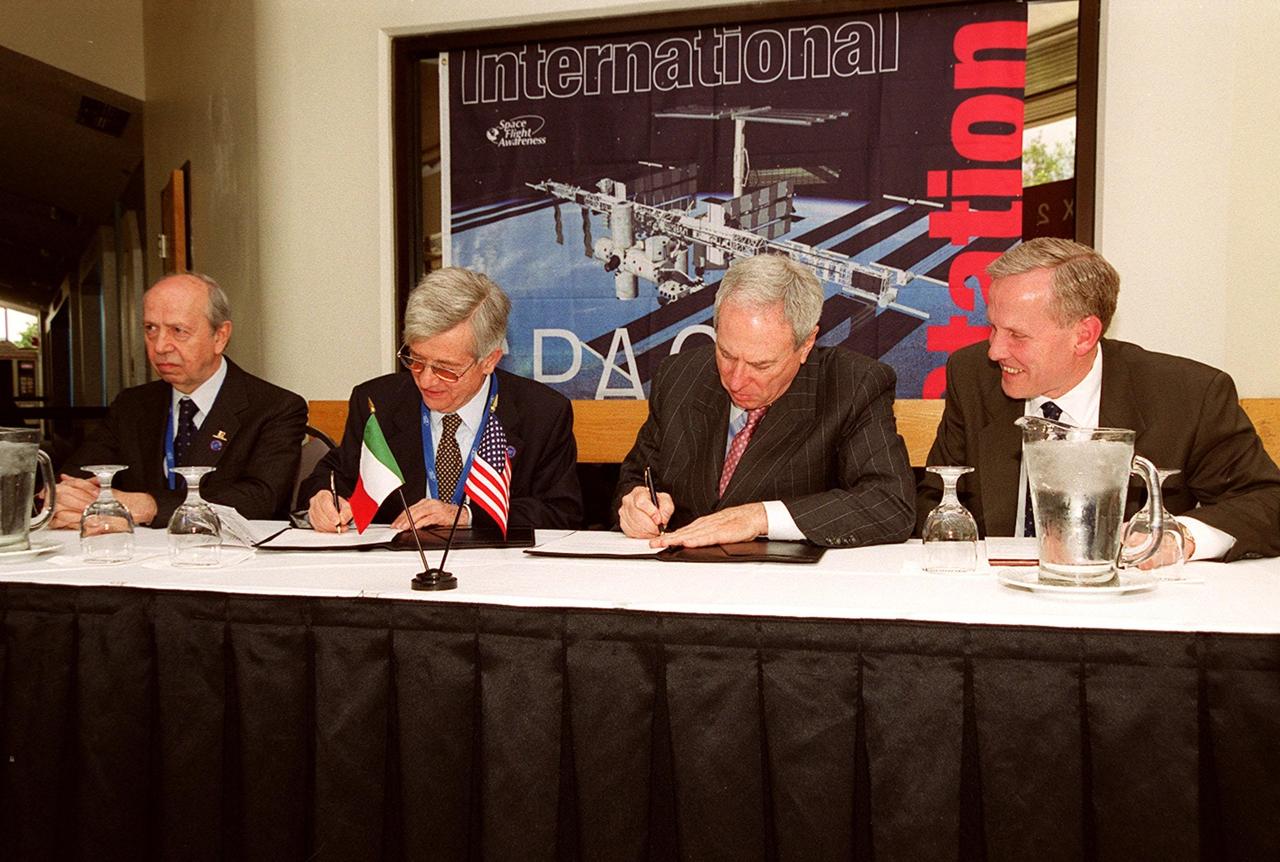
NASA Administrator Daniel S. Goldin and Italian Space Agency (ASI) President Sergio DeJulio sign a Framework for Cooperation to build the Habitation Module for the International Space Station. Seated at the table (left to right) are The Honorable Lamberto Dini, Minister of Foreign Affairs, Republic of Italy; DeJulio; Goldin; and John Schumacher, assistant administrator, External Relations, NASA. The Framework is a potential bilateral cooperative agreement that could result in ASI development of a U.S. Habitation Module for the International Space Station. This agreement allows the U.S. to explore an alternative approach to achieve full crew habitation for the ISS. A Memorandum of Understanding (MOU) between NASA and ASI will be required to formally document NASA and ASI’s respective responsibilities in a legally binding document. The Framework signed today would form the basis for a potential MOU which NASA and ASI would sign after completion of the program assessment and subsequent negotiations. The ceremony took place at the IMAX Theater, Kennedy Space Center Visitor Complex
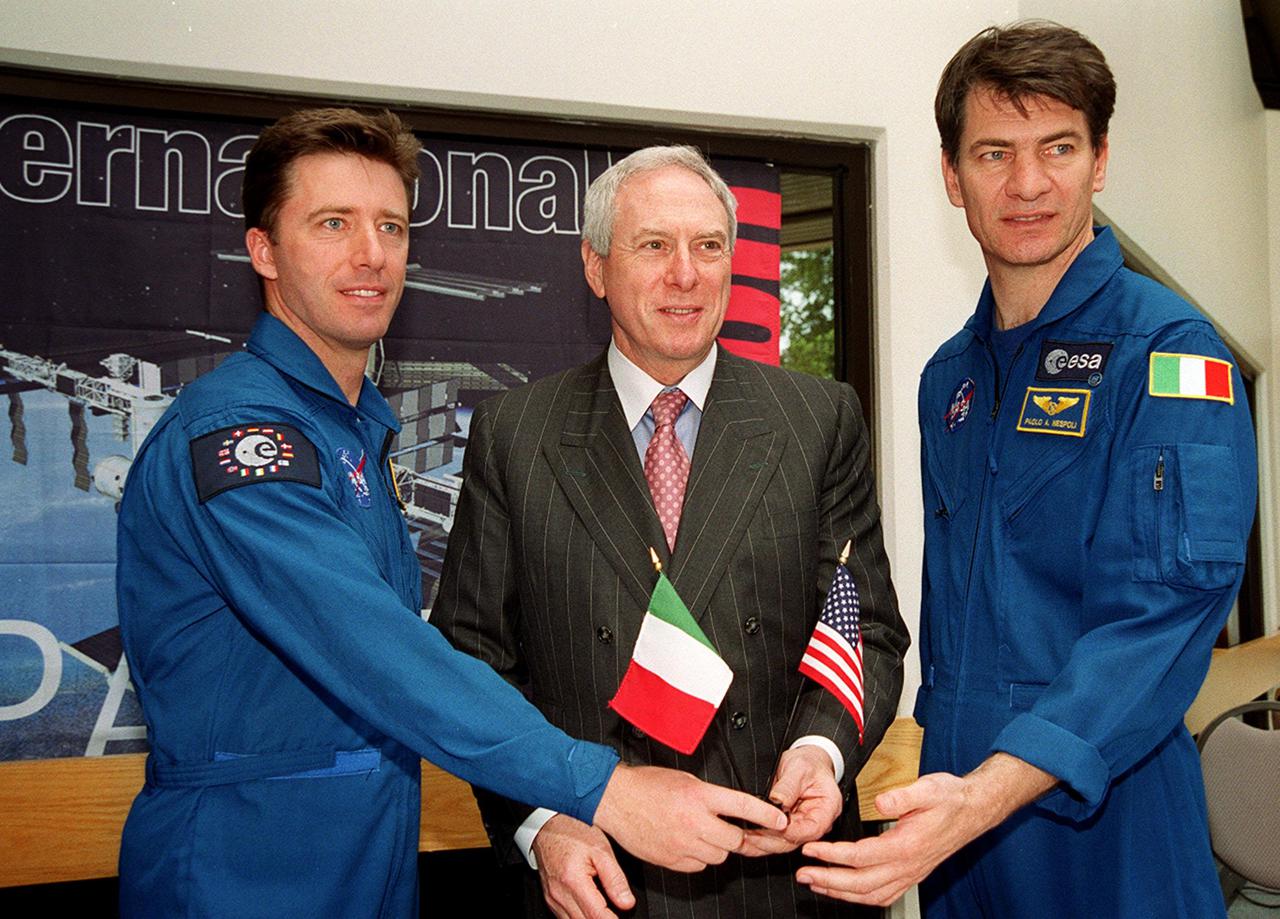
At a signing ceremony between the Italian Space Agency (ASI) and NASA for a Framework for Cooperation to build the Habitation Module for the International Space Station, Italian astronauts with the European Space Agency pose with NASA Administrator Daniel S. Goldin. On the left is Roberto Vittori and on the right is Paolo A. Nespoli. The Framework is a potential bilateral cooperative agreement that could result in ASI development of a U.S. Habitation Module for the International Space Station. This agreement allows the U.S. to explore an alternative approach to achieve full crew habitation for the ISS. A Memorandum of Understanding (MOU) between NASA and ASI will be required to formally document NASA and ASI’s respective responsibilities in a legally binding document. The Framework signed today would form the basis for a potential MOU which NASA and ASI would sign after completion of the program assessment and subsequent negotiations. The ceremony took place at the IMAX Theater, Kennedy Space Center Visitor Complex
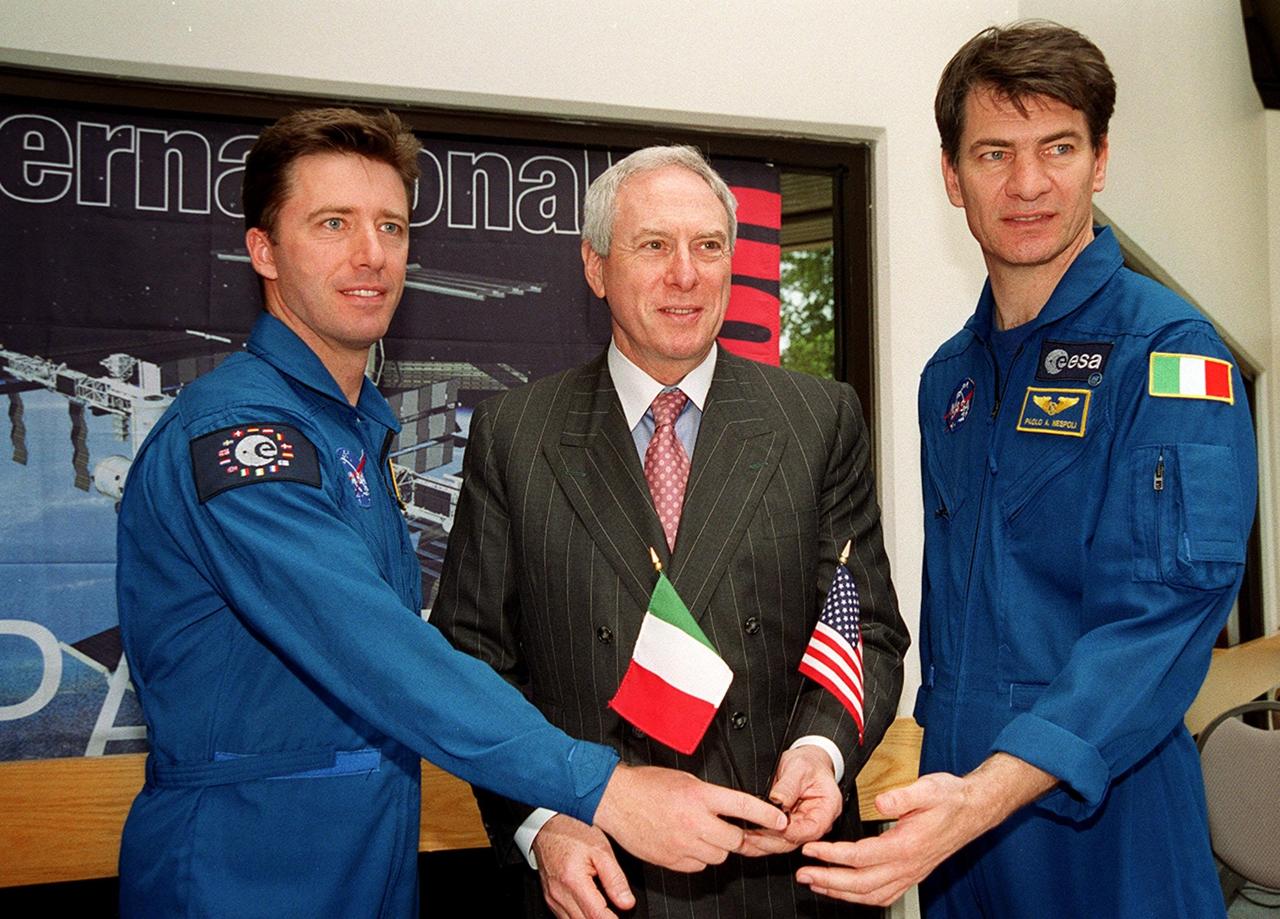
At a signing ceremony between the Italian Space Agency (ASI) and NASA for a Framework for Cooperation to build the Habitation Module for the International Space Station, Italian astronauts with the European Space Agency pose with NASA Administrator Daniel S. Goldin. On the left is Roberto Vittori and on the right is Paolo A. Nespoli. The Framework is a potential bilateral cooperative agreement that could result in ASI development of a U.S. Habitation Module for the International Space Station. This agreement allows the U.S. to explore an alternative approach to achieve full crew habitation for the ISS. A Memorandum of Understanding (MOU) between NASA and ASI will be required to formally document NASA and ASI’s respective responsibilities in a legally binding document. The Framework signed today would form the basis for a potential MOU which NASA and ASI would sign after completion of the program assessment and subsequent negotiations. The ceremony took place at the IMAX Theater, Kennedy Space Center Visitor Complex
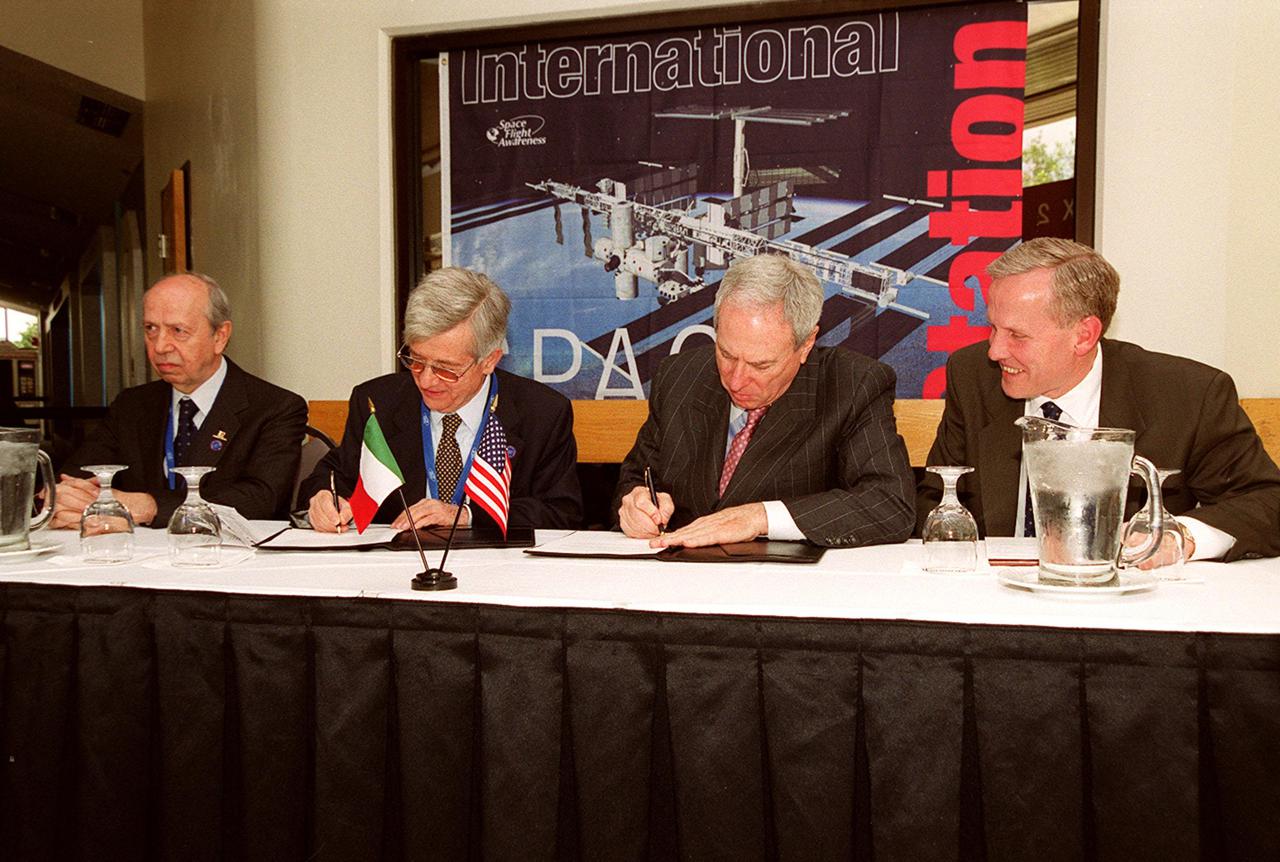
NASA Administrator Daniel S. Goldin and Italian Space Agency (ASI) President Sergio DeJulio sign a Framework for Cooperation to build the Habitation Module for the International Space Station. Seated at the table (left to right) are The Honorable Lamberto Dini, Minister of Foreign Affairs, Republic of Italy; DeJulio; Goldin; and John Schumacher, assistant administrator, External Relations, NASA. The Framework is a potential bilateral cooperative agreement that could result in ASI development of a U.S. Habitation Module for the International Space Station. This agreement allows the U.S. to explore an alternative approach to achieve full crew habitation for the ISS. A Memorandum of Understanding (MOU) between NASA and ASI will be required to formally document NASA and ASI’s respective responsibilities in a legally binding document. The Framework signed today would form the basis for a potential MOU which NASA and ASI would sign after completion of the program assessment and subsequent negotiations. The ceremony took place at the IMAX Theater, Kennedy Space Center Visitor Complex

Gateway's HALO (Habitation and Logistics Outpost) module is one of four of Gateway's pressurized modules where international teams of astronauts will live, conduct science, and prepare for missions to the lunar South Pole region from Gateway. HALO is provided by Northrop Grumman.
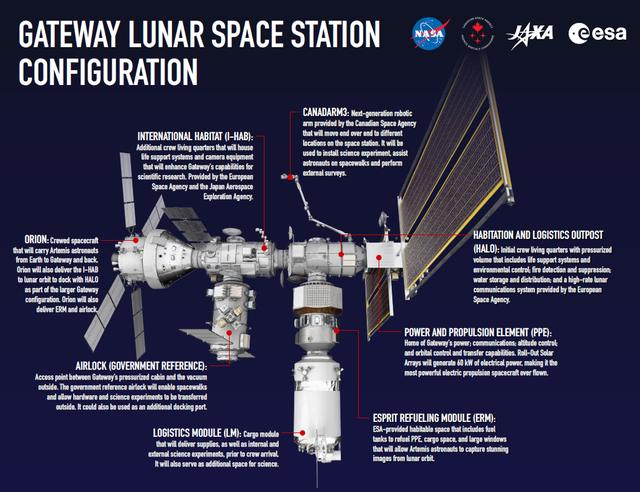
This infographic shows each element of Gateway, humanity's first space station in lunar orbit as a vital component of the Artemis missions to return to the Moon for scientific discovery and chart the path for the first human missions to Mars.

iss047e134134 (5/26/2018) --- NASA astronaut Jeff Williams and European Space Agency (ESA) astronaut Tim Peake during Bigelow Expandable Activity Module (BEAM) deployment. The Bigelow Expandable Activity Module (BEAM) is an experimental expandable capsule that docks with the International Space Station (ISS). After docking, BEAM inflates to roughly 13 feet long and 10.5 feet in diameter to provide a habitable volume where a crew member can enter.

This artist's concept depicts the Space Station Freedom as it would look orbiting the Earth; illustrated by Marshall Space Flight Center artist, Tom Buzbee. Scheduled to be completed in late 1999, this smaller configuration of the Space Station features a horizontal truss structure that supported U.S., European, and Japanese Laboratory Modules; the U.S. Habitation Module; and three sets of solar arrays. The Space Station Freedom was an international, permanently marned, orbiting base to be assembled in orbit by a series of Space Shuttle missions that were to begin in the mid-1990's.
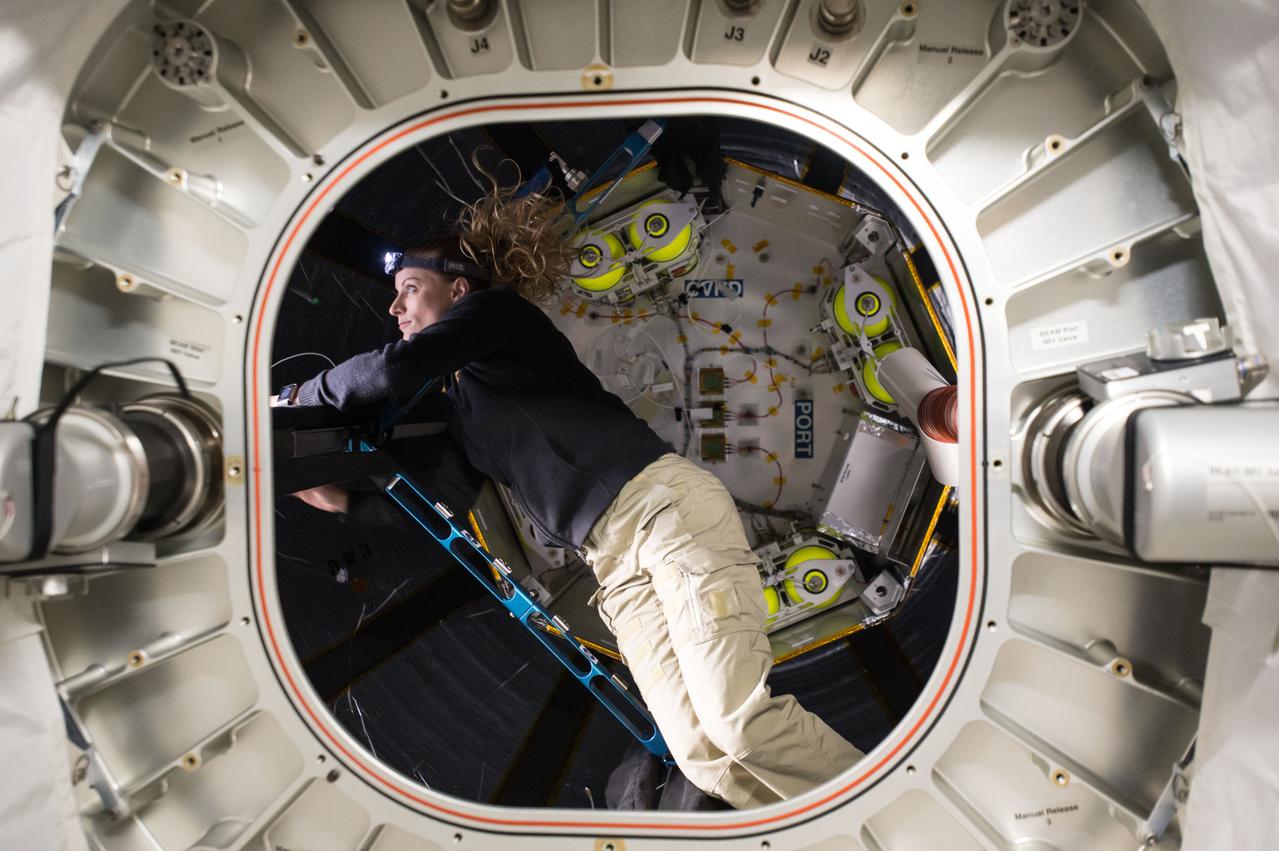
iss048e069952 (9/6/2016) --- NASA astronaut Kate Rubins is photographed inside the Bigelow Expandable Activity Module (BEAM) during BEAM ingress operations (OPS). The Bigelow Expandable Activity Module (BEAM) is an experimental expandable capsule that docks with the International Space Station (ISS). After docking, BEAM inflates to roughly 13 feet long and 10.5 feet in diameter to provide a habitable volume where a crew member can enter.
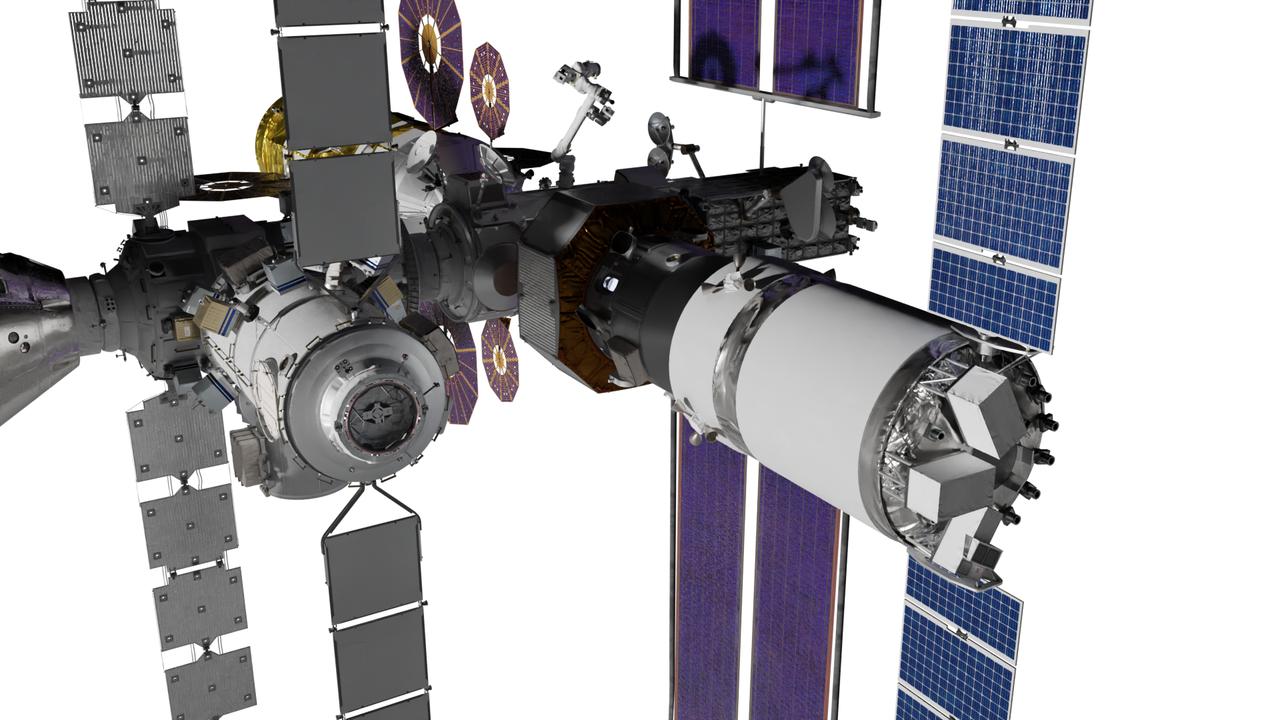
An artist’s rendering displays a configuration of the lunar-orbiting Gateway space station’s modules and visiting spacecraft. The core elements of Gateway consist of the Habitation and Logistics Outpost (HALO) element, the Power and Propulsion Element (PPE), and Lunar I-Hab. Visiting vehicles include the Orion spacecraft, the Logistics Module, and the Human Landing System. Gateway is built in collaboration with NASA’s commercial and international partners to serve as a multiuse space port for lunar science as humanity’s first place to live and work in lunar orbit.
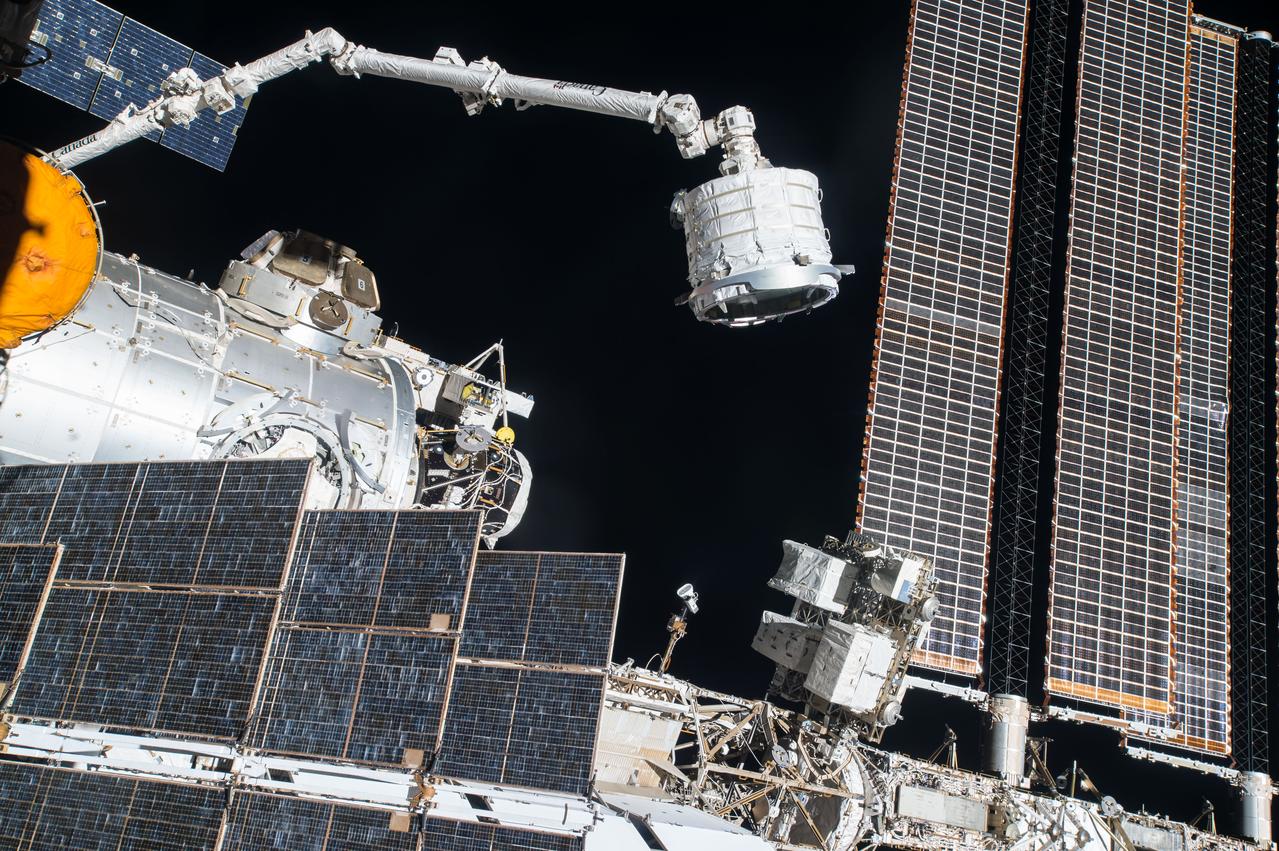
iss047e061107 (4/16/2016) --- View of Bigelow Expandable Activity Module (BEAM) attached to Canadarm2 Robotic Arm. The Bigelow Expandable Activity Module (BEAM) is an experimental expandable capsule that docks with the International Space Station (ISS). After docking, BEAM inflates to roughly 13 feet long and 10.5 feet in diameter to provide a habitable volume where a crew member can enter.
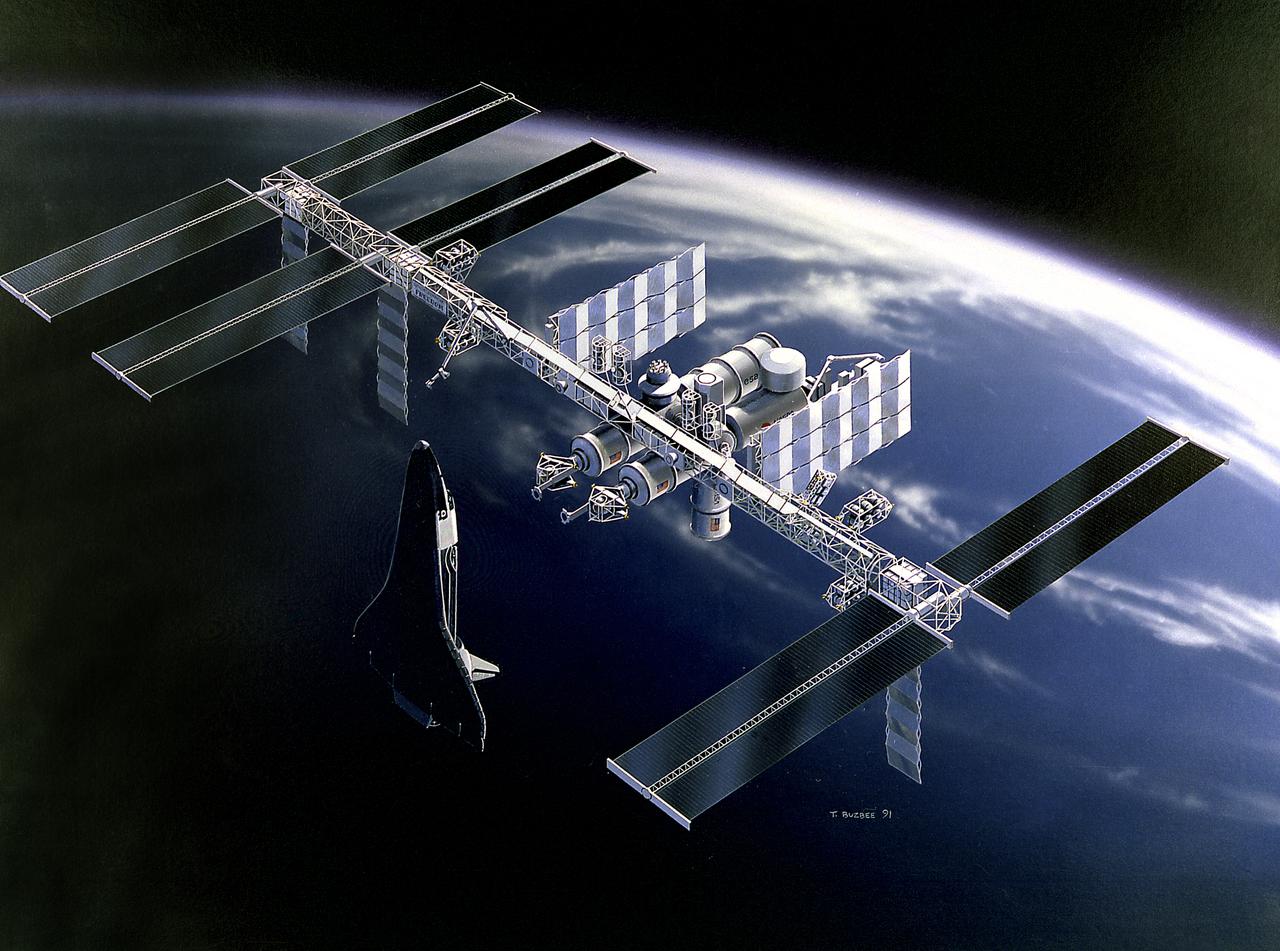
This artist's concept depicts the Space Station Freedom as it would look orbiting the Earth, illustrated by Marshall Space Flight Center artist, Tom Buzbee. Scheduled to be completed in late 1999, this smaller configuration of the Space Station featured a horizontal truss structure that supported U.S., European, and Japanese Laboratory Modules; the U.S. Habitation Module; and three sets of solar arrays. The Space Station Freedom was an international, permanently marned, orbiting base to be assembled in orbit by a series of Space Shuttle missions that were to begin in the mid-1990's.
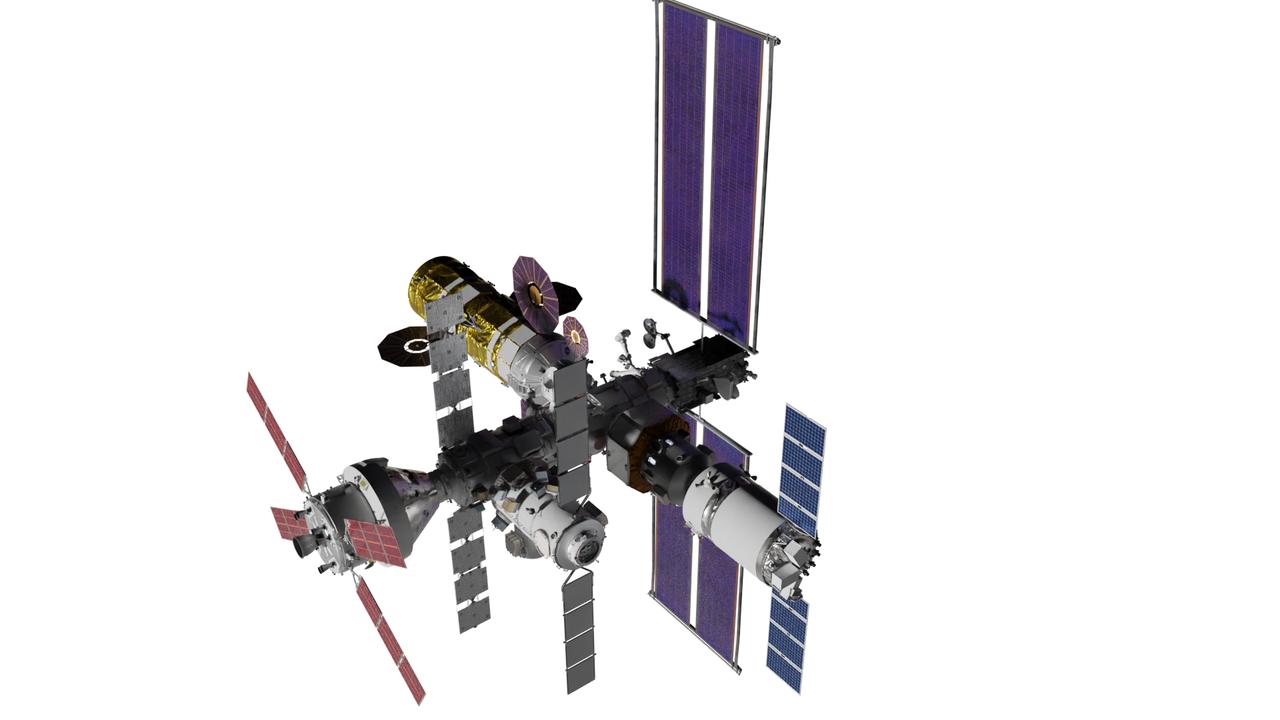
An artist’s rendering displays a configuration of the lunar-orbiting Gateway space station’s modules and visiting spacecraft. The core elements of Gateway consist of the Habitation and Logistics Outpost (HALO) element, the Power and Propulsion Element (PPE), and Lunar I-Hab. Visiting vehicles include the Orion spacecraft, the Logistics Module, and the Human Landing System. Gateway is built in collaboration with NASA’s commercial and international partners to serve as a multiuse space port for lunar science as humanity’s first place to live and work in lunar orbit.
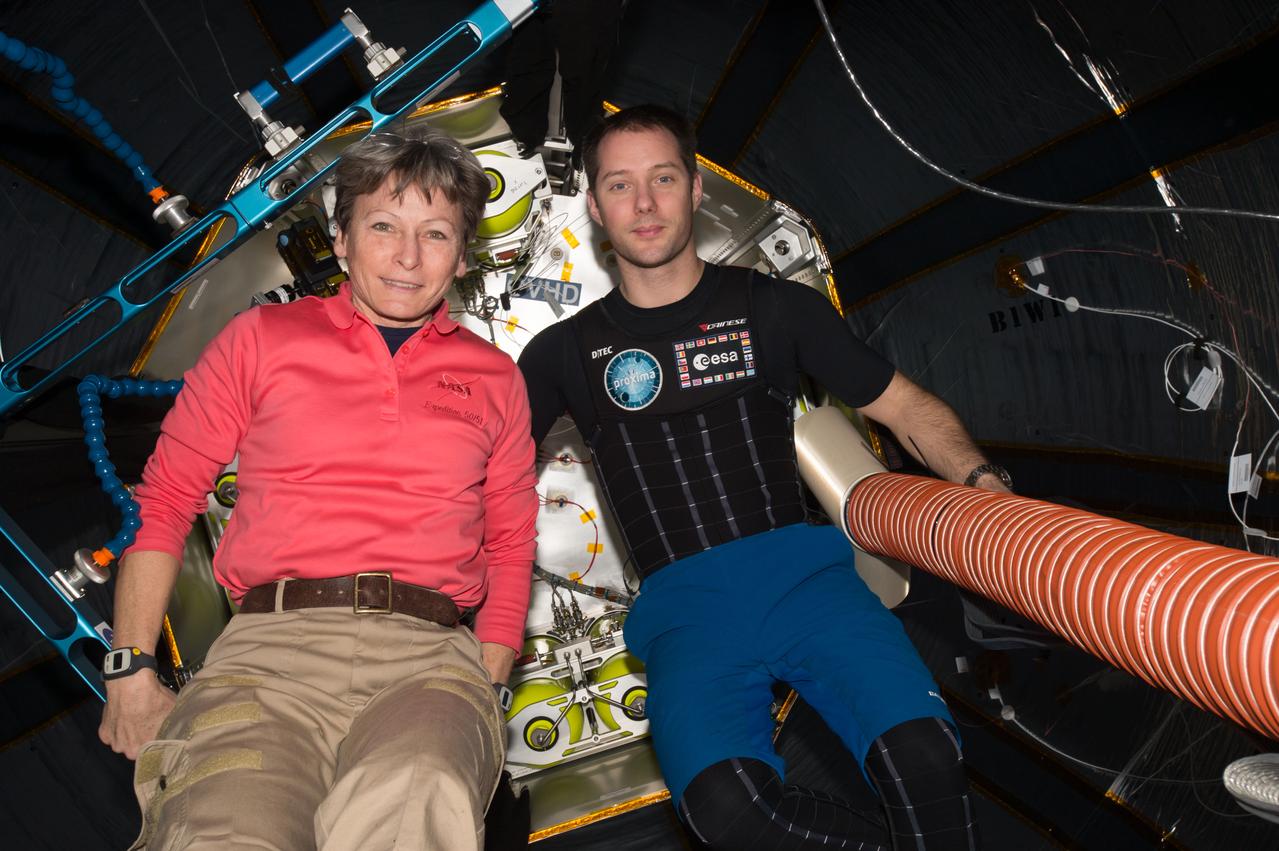
iss050e037908 (2/2/2017) --- NASA astronaut Peggy Whitson and European Space Agency (ESA) Thomas Pesquet in the Bigelow Expandable Aerospace Module (BEAM). The Bigelow Expandable Activity Module (BEAM) is an experimental expandable capsule that docks with the International Space Station (ISS). After docking, BEAM inflates to roughly 13 feet long and 10.5 feet in diameter to provide a habitable volume where a crew member can enter.
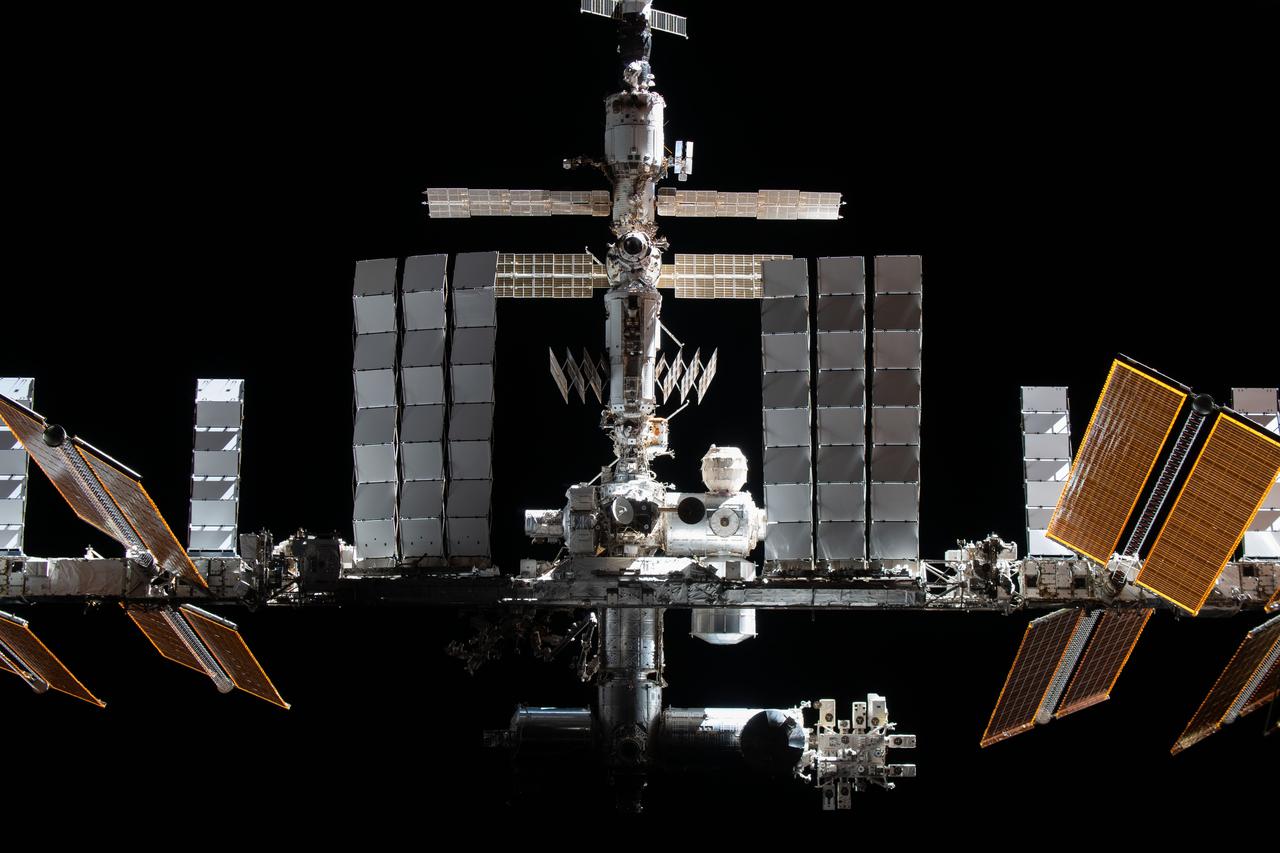
iss066e079893 (Nov. 8, 2021) --- The International Space Station is pictured from the SpaceX Crew Dragon Endeavour during a fly around of the orbiting lab that took place following its undocking from the Harmony module’s space-facing port on Nov. 8, 2021. This view shows the habitable volume of the station (modules arranged vertically through the center) along with white radiators used to dissipate heat and the large solar arrays used to generate electricity.
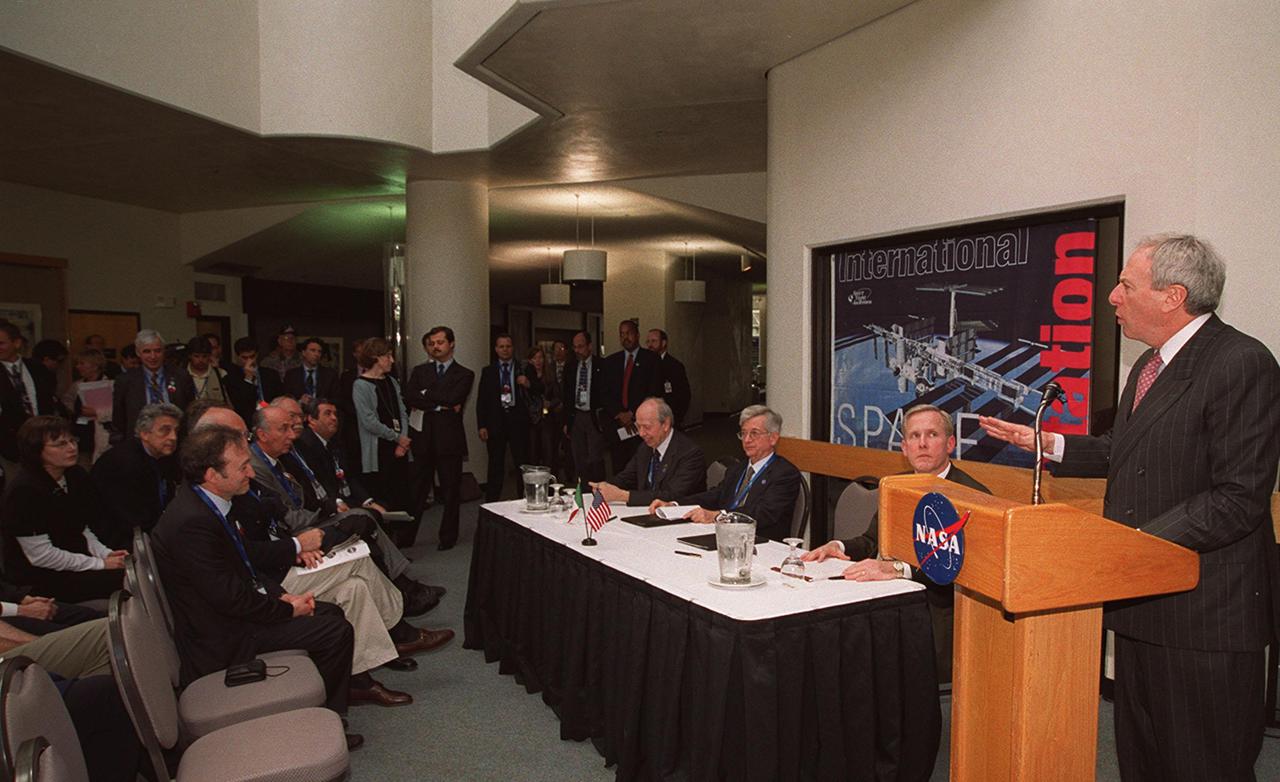
At a signing ceremony between the Italian Space Agency (ASI) and NASA for a Framework for Cooperation to build the Habitation Module for the International Space Station, NASA Administrator Daniel S. Goldin speaks to attendees. Seated at the table next to Goldin are The Honorable Lamberto Dini, Minister of Foreign Affairs, Republic of Italy (far left), Italian Space Agency President Sergio DeJulio, and John Schumacher, assistant administrator, NASA External Relations. The Framework is a potential bilateral cooperative agreement that could result in ASI development of a U.S. Habitation Module for the International Space Station. This agreement allows the U.S. to explore an alternative approach to achieve full crew habitation for the ISS. A Memorandum of Understanding (MOU) between NASA and ASI will be required to formally document NASA and ASI’s respective responsibilities in a legally binding document. The Framework signed today would form the basis for a potential MOU which NASA and ASI would sign after completion of the program assessment and subsequent negotiations.The ceremony took place at the IMAX Theater, Kennedy Space Center Visitor Complex
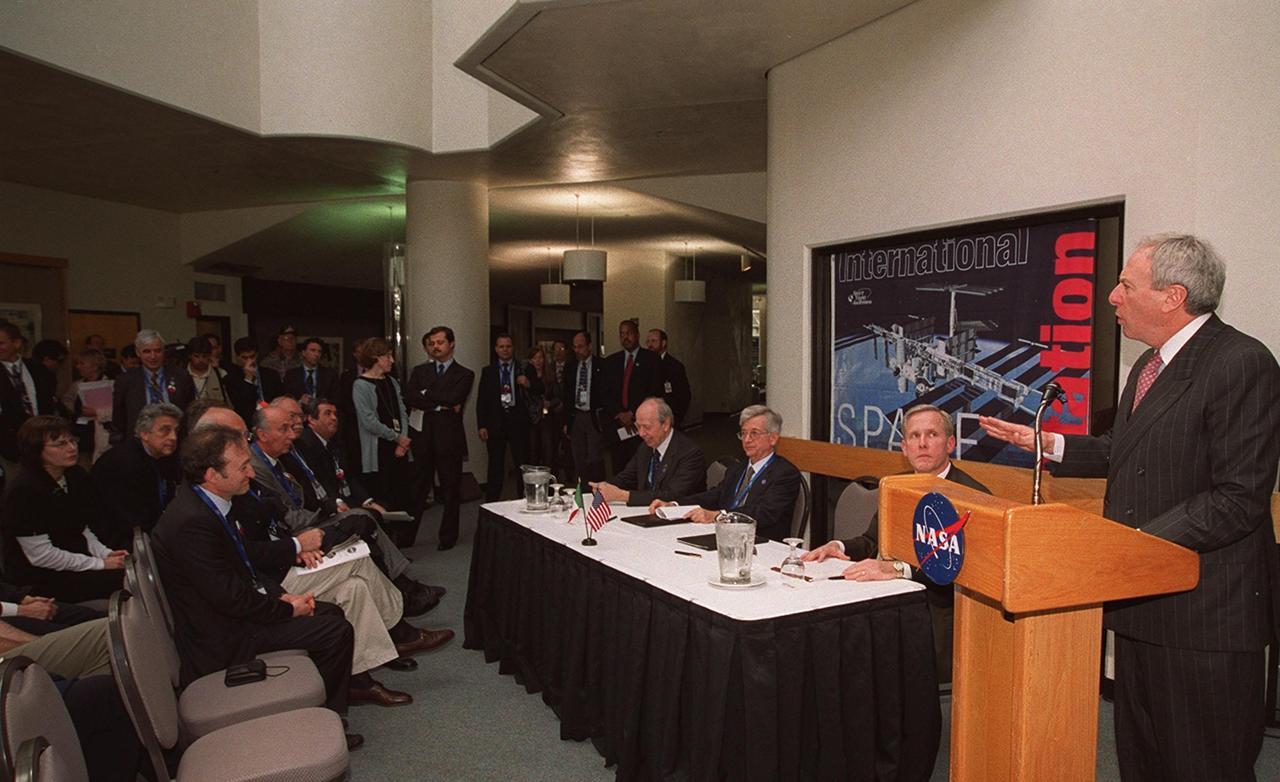
At a signing ceremony between the Italian Space Agency (ASI) and NASA for a Framework for Cooperation to build the Habitation Module for the International Space Station, NASA Administrator Daniel S. Goldin speaks to attendees. Seated at the table next to Goldin are The Honorable Lamberto Dini, Minister of Foreign Affairs, Republic of Italy (far left), Italian Space Agency President Sergio DeJulio, and John Schumacher, assistant administrator, NASA External Relations. The Framework is a potential bilateral cooperative agreement that could result in ASI development of a U.S. Habitation Module for the International Space Station. This agreement allows the U.S. to explore an alternative approach to achieve full crew habitation for the ISS. A Memorandum of Understanding (MOU) between NASA and ASI will be required to formally document NASA and ASI’s respective responsibilities in a legally binding document. The Framework signed today would form the basis for a potential MOU which NASA and ASI would sign after completion of the program assessment and subsequent negotiations.The ceremony took place at the IMAX Theater, Kennedy Space Center Visitor Complex
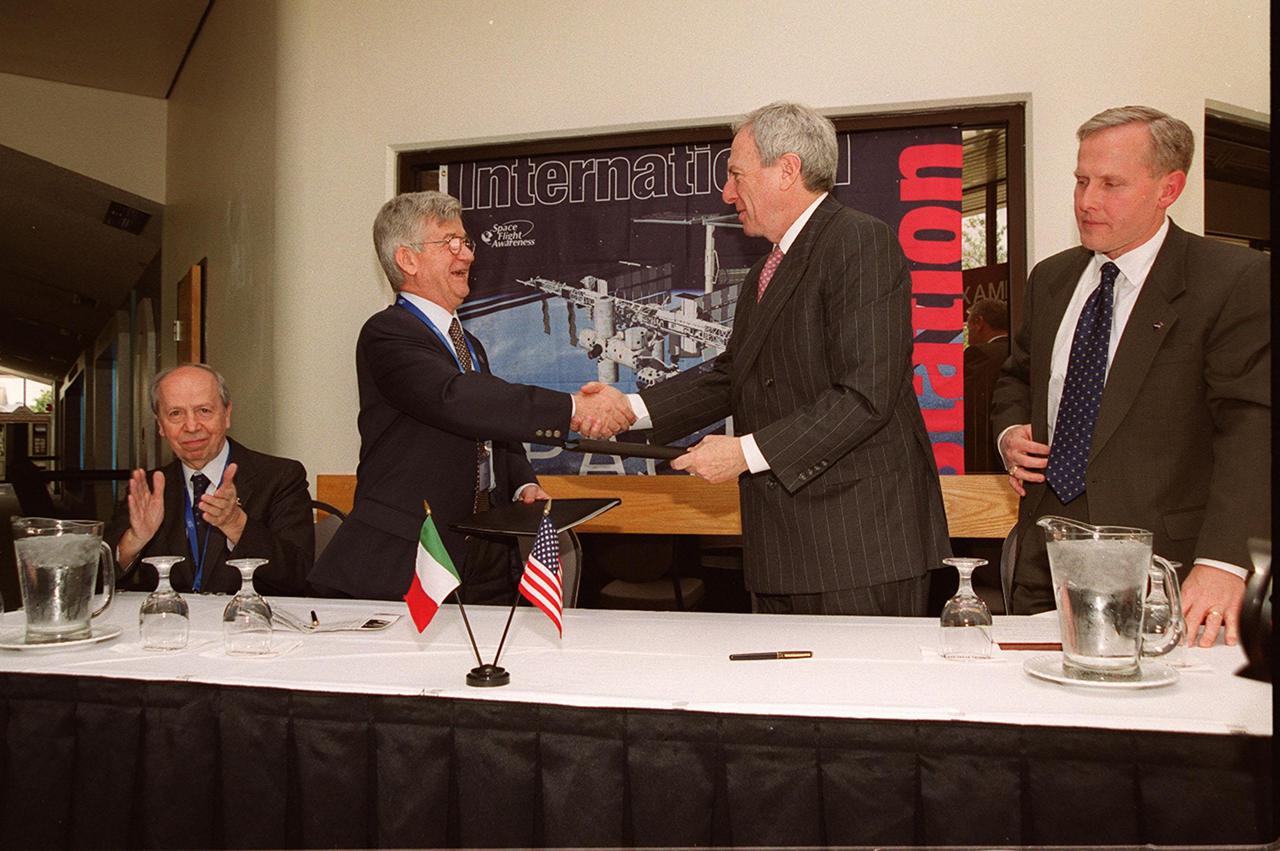
After signing a Framework for Cooperation to build the Habitation Module for the International Space Station, Italian Space Agency President Sergio DeJulio (standing, left) shakes hands with NASA Administrator Daniel S. Goldin (right). Also at the signing are The Honorable Lamberto Dini, Minister of Foreign Affairs, Republic of Italy (far left) and John Schumacher, assistant administrator, NASA External Relations. The Framework is a potential bilateral cooperative agreement that could result in ASI development of a U.S. Habitation Module for the International Space Station. This agreement allows the U.S. to explore an alternative approach to achieve full crew habitation for the ISS. A Memorandum of Understanding (MOU) between NASA and ASI will be required to formally document NASA and ASI’s respective responsibilities in a legally binding document. The Framework signed today would form the basis for a potential MOU which NASA and ASI would sign after completion of the program assessment and subsequent negotiations.The ceremony took place at the IMAX Theater, Kennedy Space Center Visitor Complex
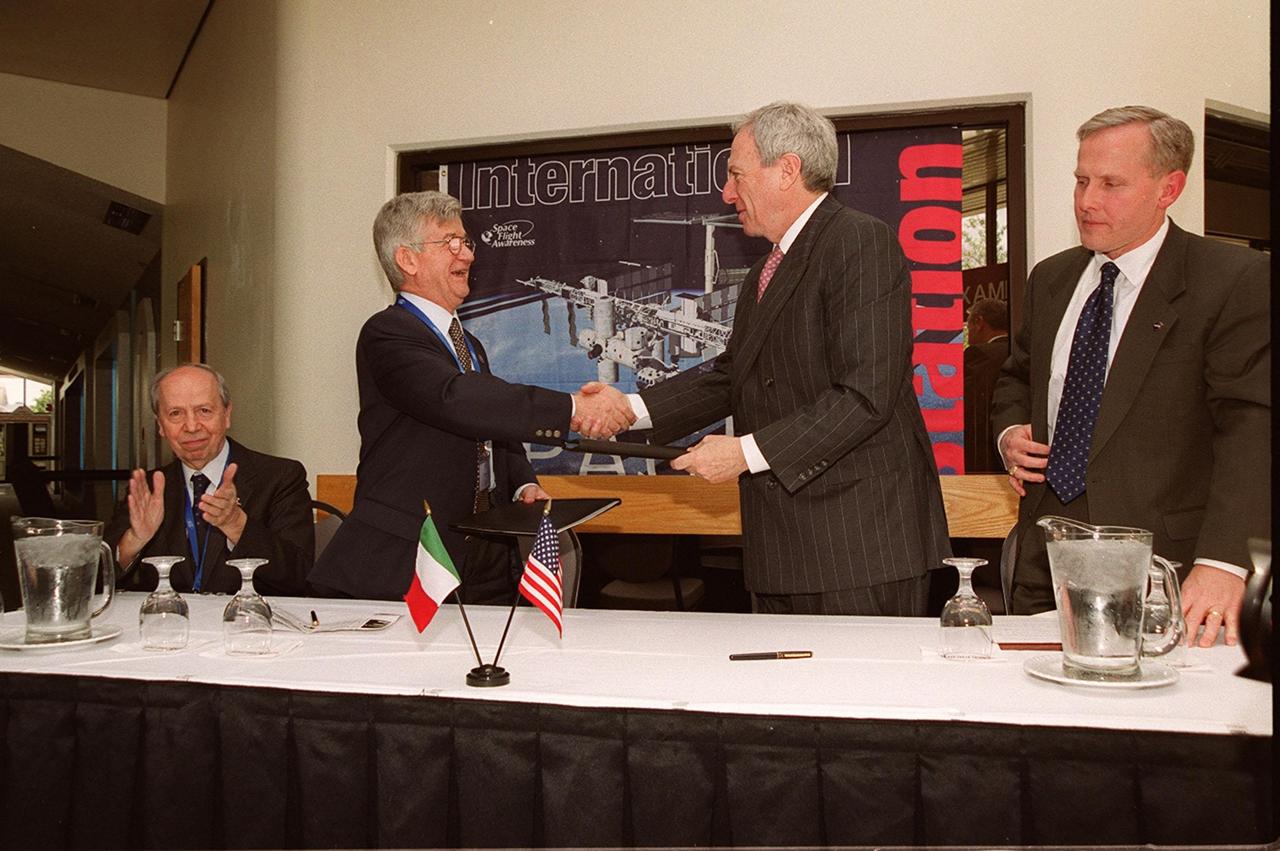
After signing a Framework for Cooperation to build the Habitation Module for the International Space Station, Italian Space Agency President Sergio DeJulio (standing, left) shakes hands with NASA Administrator Daniel S. Goldin (right). Also at the signing are The Honorable Lamberto Dini, Minister of Foreign Affairs, Republic of Italy (far left) and John Schumacher, assistant administrator, NASA External Relations. The Framework is a potential bilateral cooperative agreement that could result in ASI development of a U.S. Habitation Module for the International Space Station. This agreement allows the U.S. to explore an alternative approach to achieve full crew habitation for the ISS. A Memorandum of Understanding (MOU) between NASA and ASI will be required to formally document NASA and ASI’s respective responsibilities in a legally binding document. The Framework signed today would form the basis for a potential MOU which NASA and ASI would sign after completion of the program assessment and subsequent negotiations.The ceremony took place at the IMAX Theater, Kennedy Space Center Visitor Complex
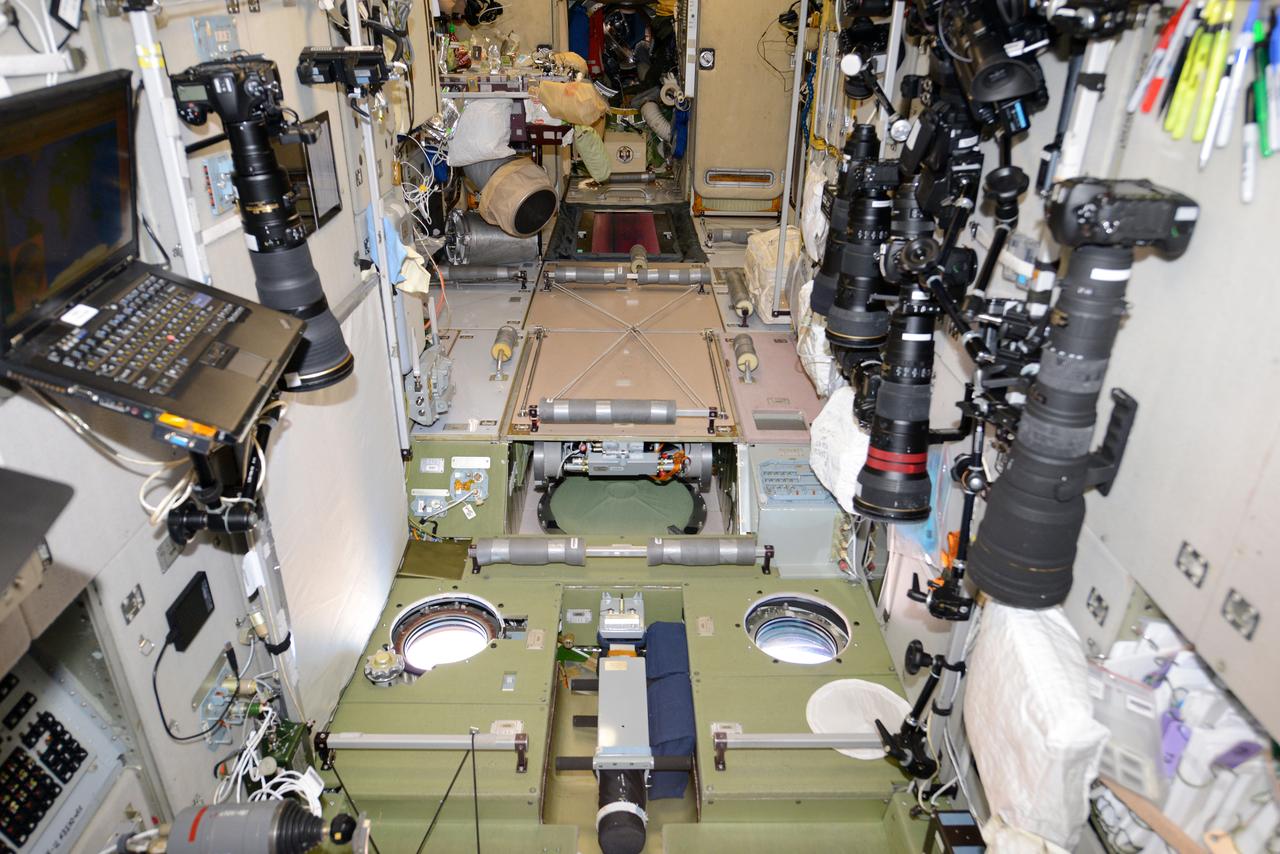
iss061e013837 (10/28/2019) --- A view of the Zvezda Service Module (SM) aboard the International Space Station (ISS). The Zvezda Service Module was the first fully Russian contribution to the International Space Station and served as the early cornerstone for the first human habitation of the station. The module provides station living quarters, life support systems, electrical power distribution, data processing systems, flight control systems and propulsion systems. It provides a communications system that includes remote command capabilities from ground flight controllers, and a docking port for Russian Soyuz and Progress spacecraft.
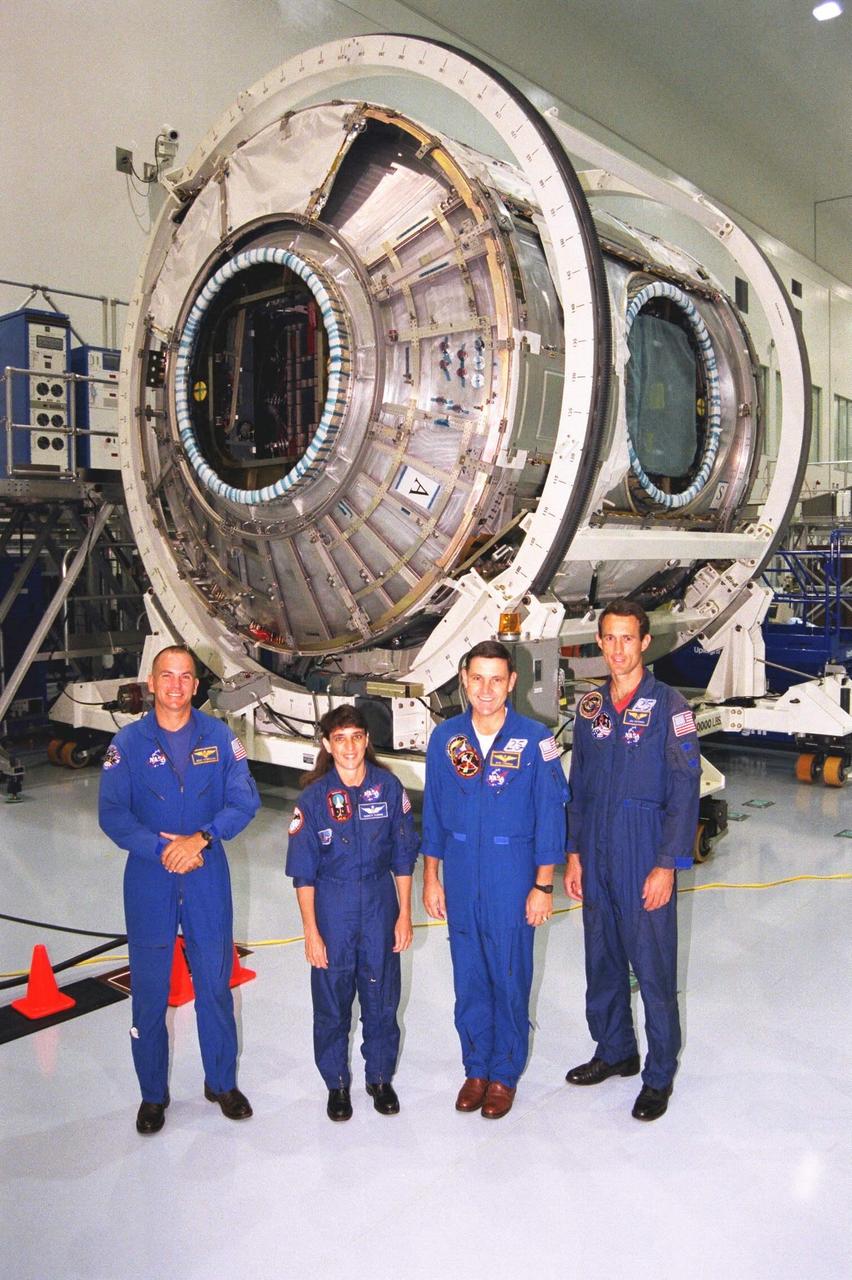
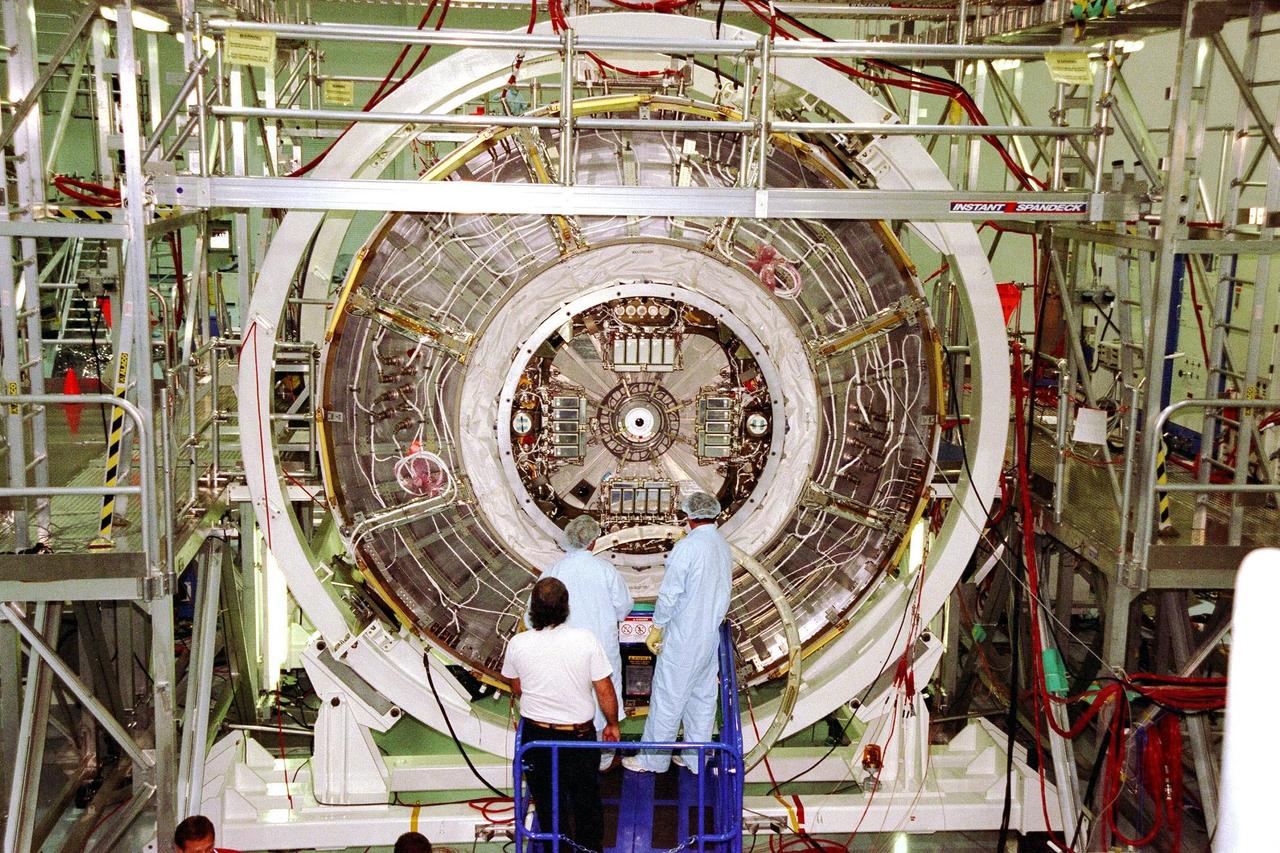
Members of the STS-88 crew pose with the Node 1 of the Internation Space Station in the high bay of the Space Station Processing Facility. The module is the first element of the International Space Station to be manufactured in the United States and the first scheduled to be launched on the Space Shuttle. The Node 1 is currently scheduled to lift off aboard the Space Shuttle Endeavour in July 1998, along with Pressurized Mating Adapters (PMAs) 1 and 2. The 18-foot-in-diameter, 22-foot-long aluminum module was manufactured by the Boeing Co. at Marshall Space Flight Center. Once in space, the Node 1 will function as a connecting passageway to the living and working areas of the International Space Station. The six hatches on the Node 1 will serve as docking ports to the U.S. laboratory module, U.S. habitation module, an airlock and other space station elements
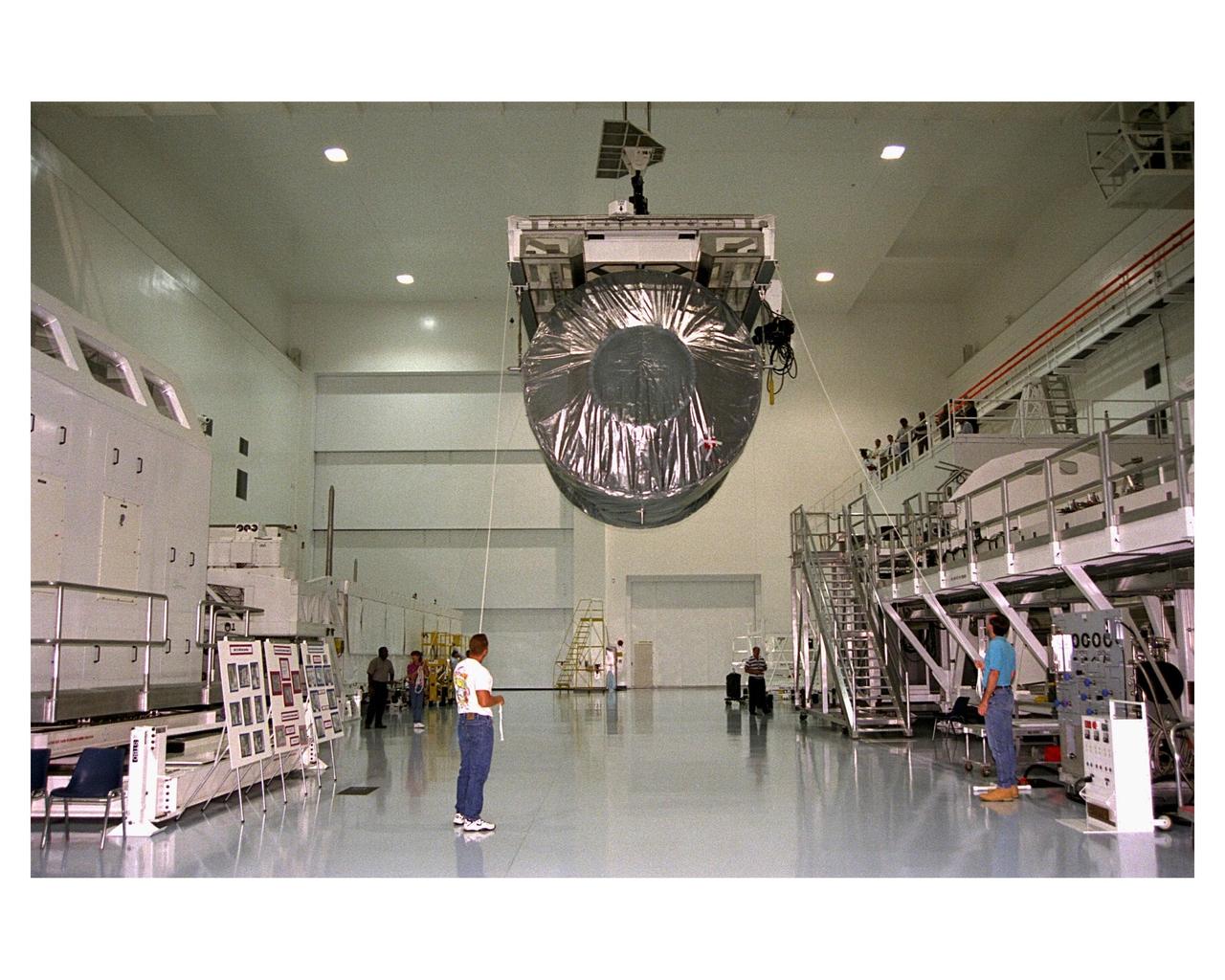
Covered in a protective sheath, International Space Station Node 1 is hoisted for installation in its work stand in the Space Station Processing Facility. The module is the first element of the International Space Station to be manufactured in the United States and the first scheduled to be launched on the Space Shuttle. The Node 1 is currently scheduled to lift off aboard the Space Shuttle Endeavour in July 1998, along with Pressurized Mating Adapters (PMAs) 1 and 2. The 18-foot-in-diameter, 22-foot-long aluminum module was manufactured by the Boeing Co. at Marshall Space Flight Center. Once in space, the Node 1 will function as a connecting passageway to the living and working areas of the International Space Station. It has six hatches that will serve as docking ports to the U.S. laboratory module, U.S. habitation module, an airlock and other space station
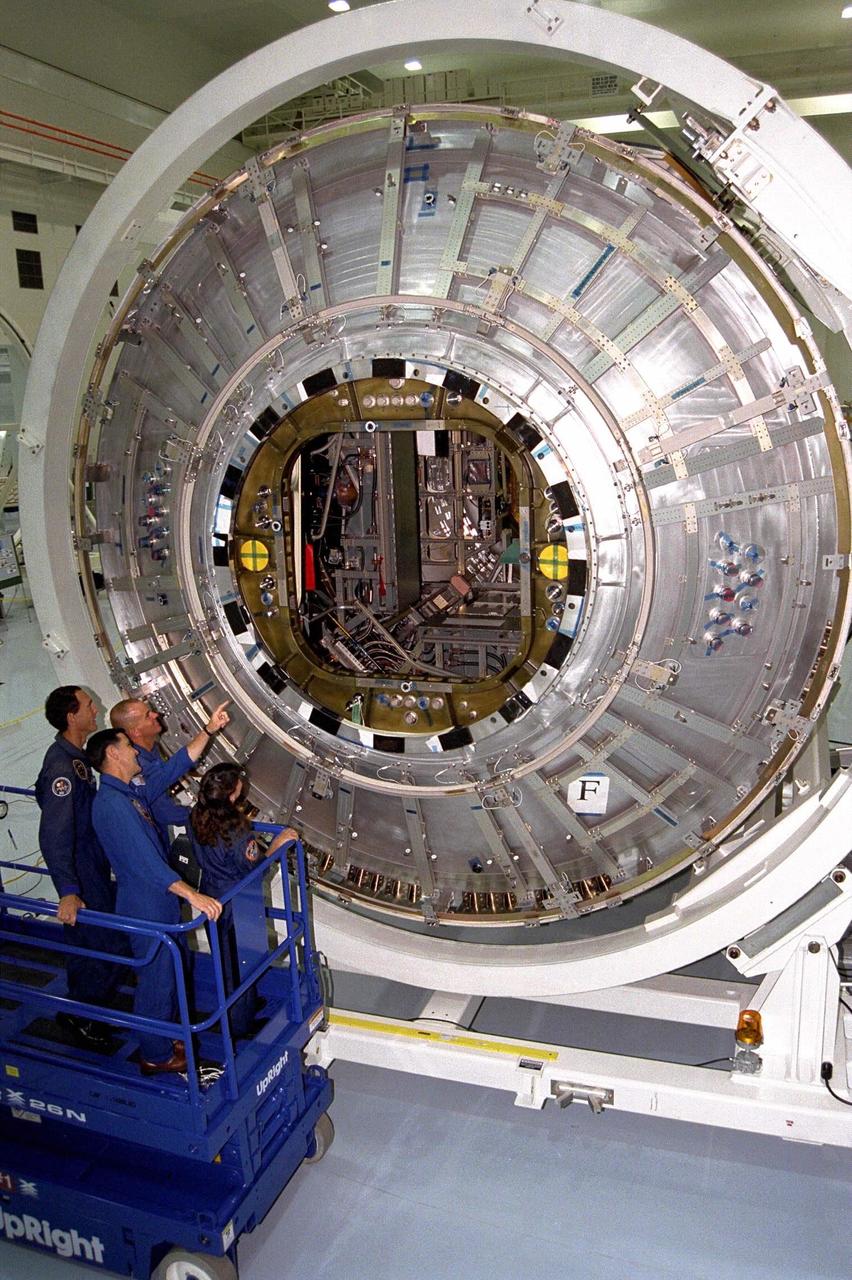
Members of the STS-88 crew examine the Node 1 of the Internation Space Station in the high bay of the Space Station Processing Facility. The module is the first element of the International Space Station to be manufactured in the United States and the first scheduled to be launched on the Space Shuttle. The Node 1 is currently scheduled to lift off aboard the Space Shuttle Endeavour in July 1998, along with Pressurized Mating Adapters (PMAs) 1 and 2. The 18-foot-in-diameter, 22-foot-long aluminum module was manufactured by the Boeing Co. at Marshall Space Flight Center. Once in space, the Node 1 will function as a connecting passageway to the living and working areas of the International Space Station. The six hatches on the Node 1 will serve as docking ports to the U.S. laboratory module, U.S. habitation module, an airlock and other space station elements
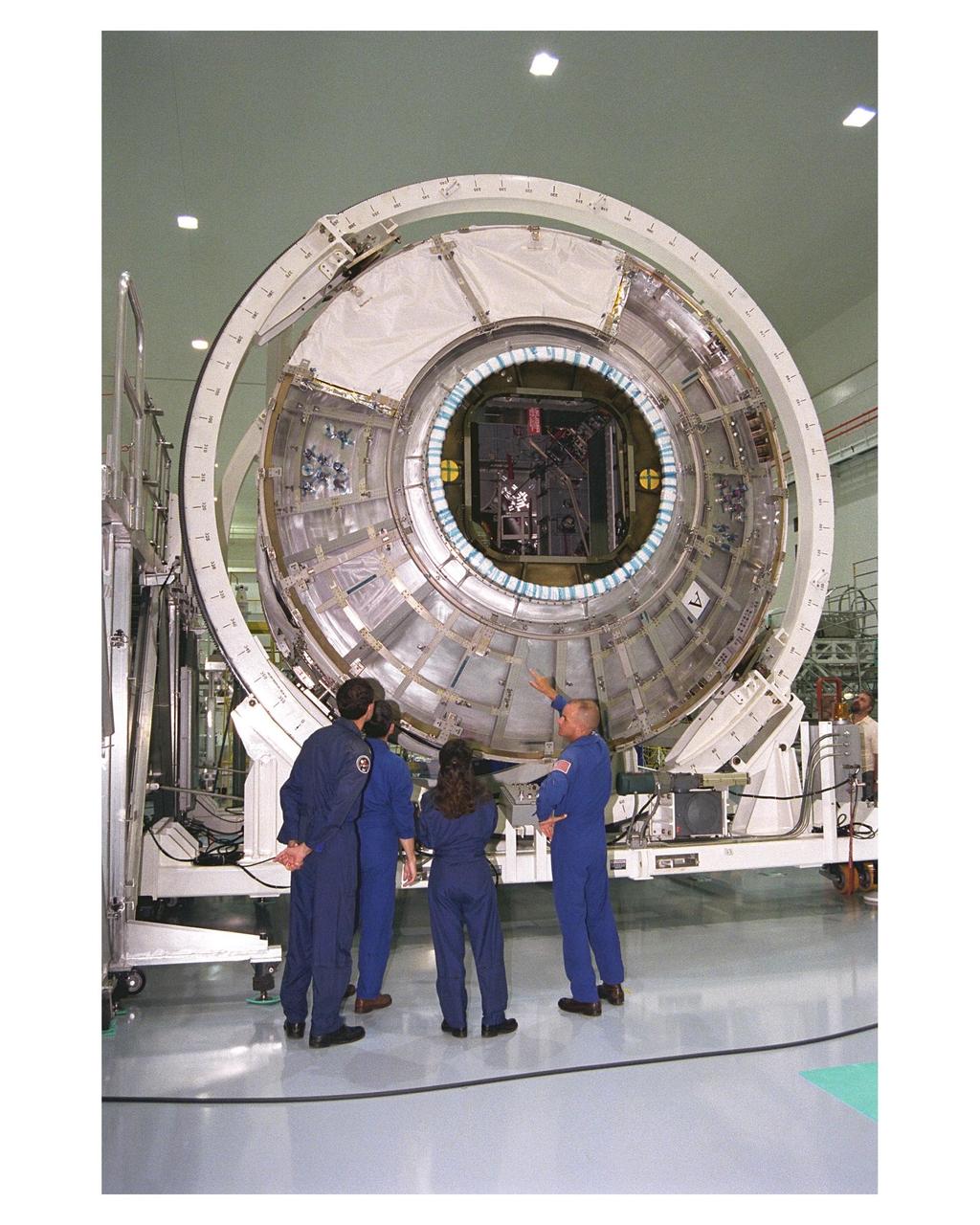
Members of the STS-88 crew examine the Node 1 of the Internation Space Station in the high bay of the Space Station Processing Facility. The module is the first element of the International Space Station to be manufactured in the United States and the first scheduled to be launched on the Space Shuttle. The Node 1 is currently scheduled to lift off aboard the Space Shuttle Endeavour in July 1998, along with Pressurized Mating Adapters (PMAs) 1 and 2. The 18-foot-in-diameter, 22-foot-long aluminum module was manufactured by the Boeing Co. at Marshall Space Flight Center. Once in space, the Node 1 will function as a connecting passageway to the living and working areas of the International Space Station. The six hatches on the Node 1 will serve as docking ports to the U.S. laboratory module, U.S. habitation module, an airlock and other space station elements

Covered in a protective sheath, International Space Station Node 1 is hoisted for installation in its work stand in the Space Station Processing Facility. The module is the first element of the International Space Station to be manufactured in the United States and the first scheduled to be launched on the Space Shuttle. The Node 1 is currently scheduled to lift off aboard the Space Shuttle Endeavour in July 1998, along with Pressurized Mating Adapters (PMAs) 1 and 2. The 18-foot-in-diameter, 22-foot-long aluminum module was manufactured by the Boeing Co. at Marshall Space Flight Center. Once in space, the Node 1 will function as a connecting passageway to the living and working areas of the International Space Station. It has six hatches that will serve as docking ports to the U.S. laboratory module, U.S. habitation module, an airlock and other space station elements
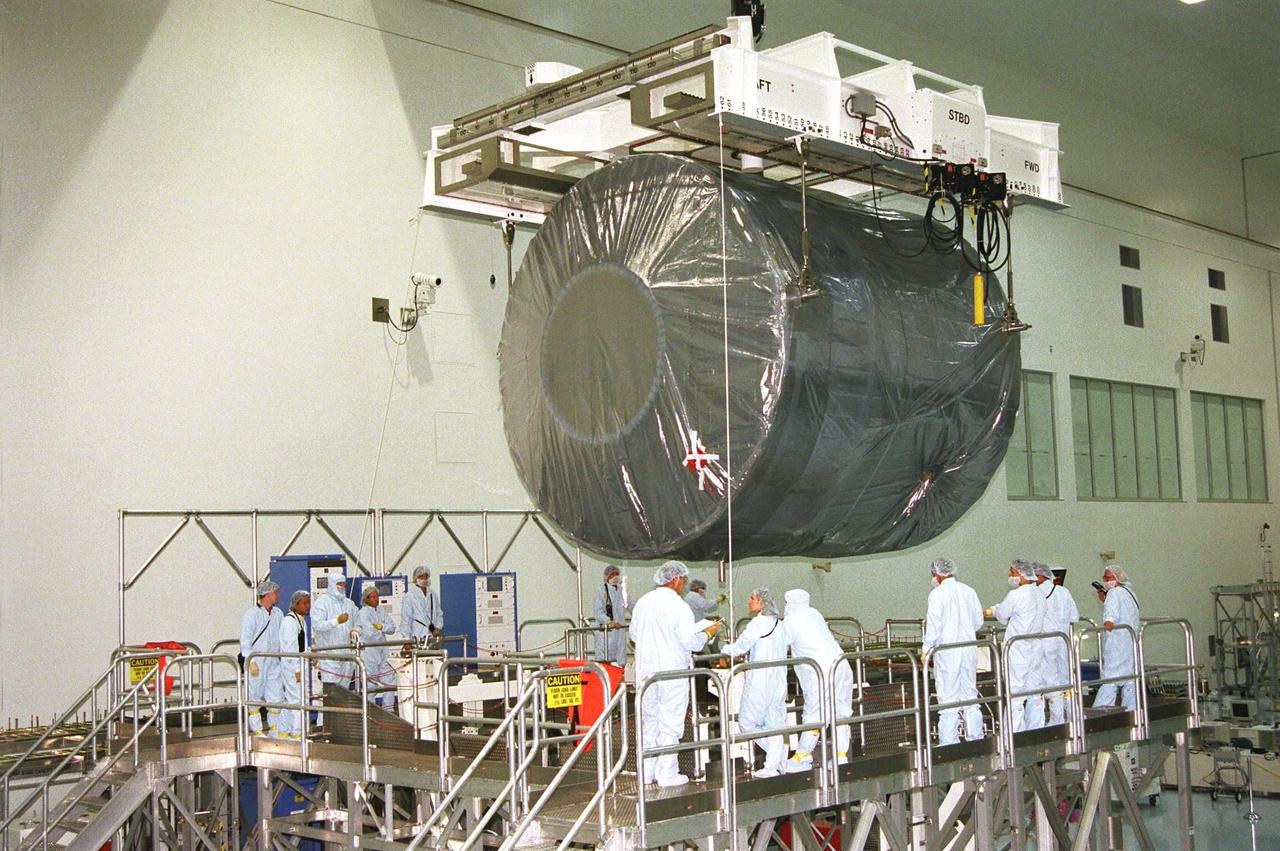
Covered in a protective sheath, International Space Station Node 1 is hoisted for installation in its work stand in the Space Station Processing Facility. The module is the first element of the International Space Station to be manufactured in the United States and the first scheduled to be launched on the Space Shuttle. The Node 1 is currently scheduled to lift off aboard the Space Shuttle Endeavour in July 1998, along with Pressurized Mating Adapters (PMAs) 1 and 2. The 18-foot-in-diameter, 22-foot-long aluminum module was manufactured by the Boeing Co. at Marshall Space Flight Center. Once in space, the Node 1 will function as a connecting passageway to the living and working areas of the International Space Station. It has six hatches that will serve as docking ports to the U.S. laboratory module, U.S. habitation module, an airlock and other space station elements
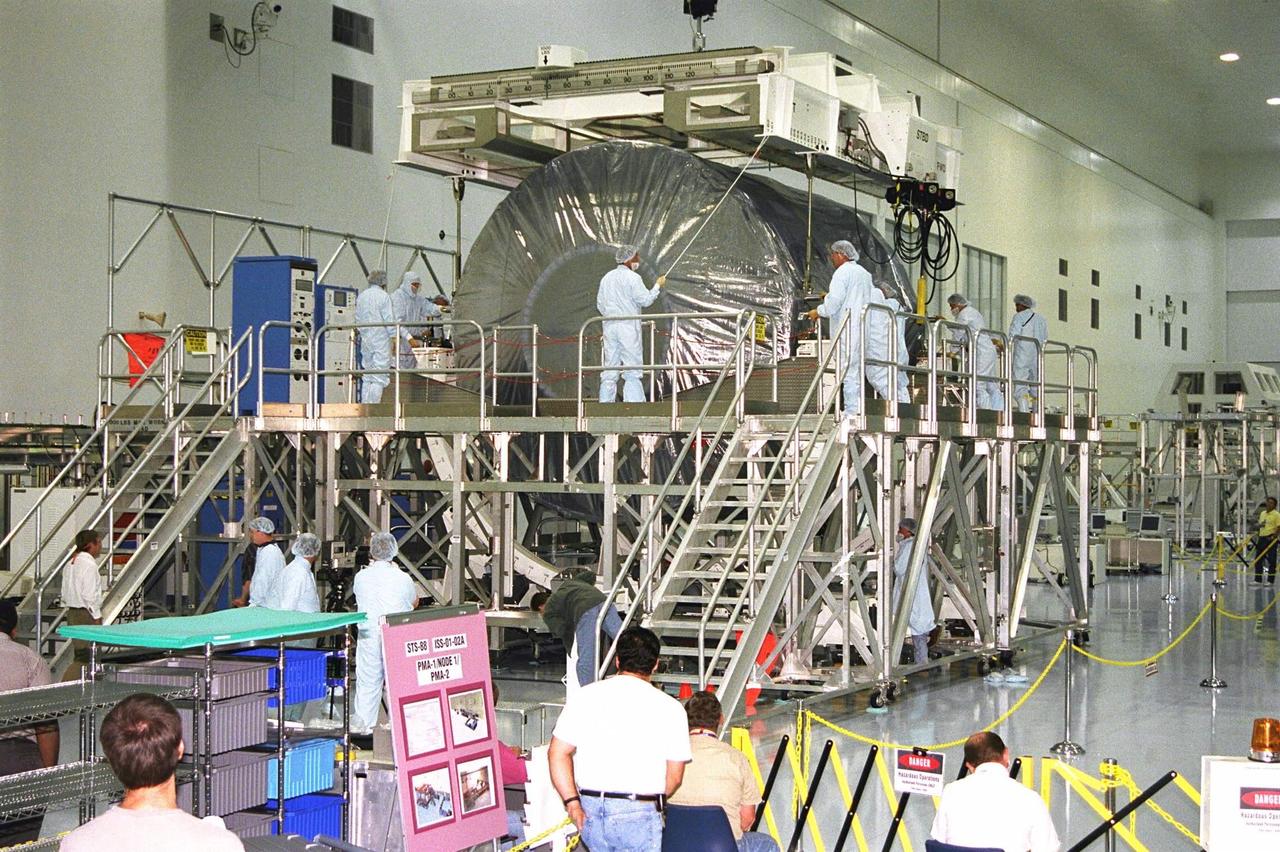
Covered in a protective sheath, International Space Station Node 1 is installed in its work stand in the Space Station Processing Facility. The module is the first element of the International Space Station to be manufactured in the United States and the first scheduled to be launched on the Space Shuttle. The Node 1 is currently scheduled to lift off aboard the Space Shuttle Endeavour in July 1998, along with Pressurized Mating Adapters (PMAs) 1 and 2. The 18-foot-in-diameter, 22-foot-long aluminum module was manufactured by the Boeing Co. at Marshall Space Flight Center. Once in space, the Node 1 will function as a connecting passageway to the living and working areas of the International Space Station. It has six hatches that will serve as docking ports to the U.S. laboratory module, U.S. habitation module, an airlock and other space station elements
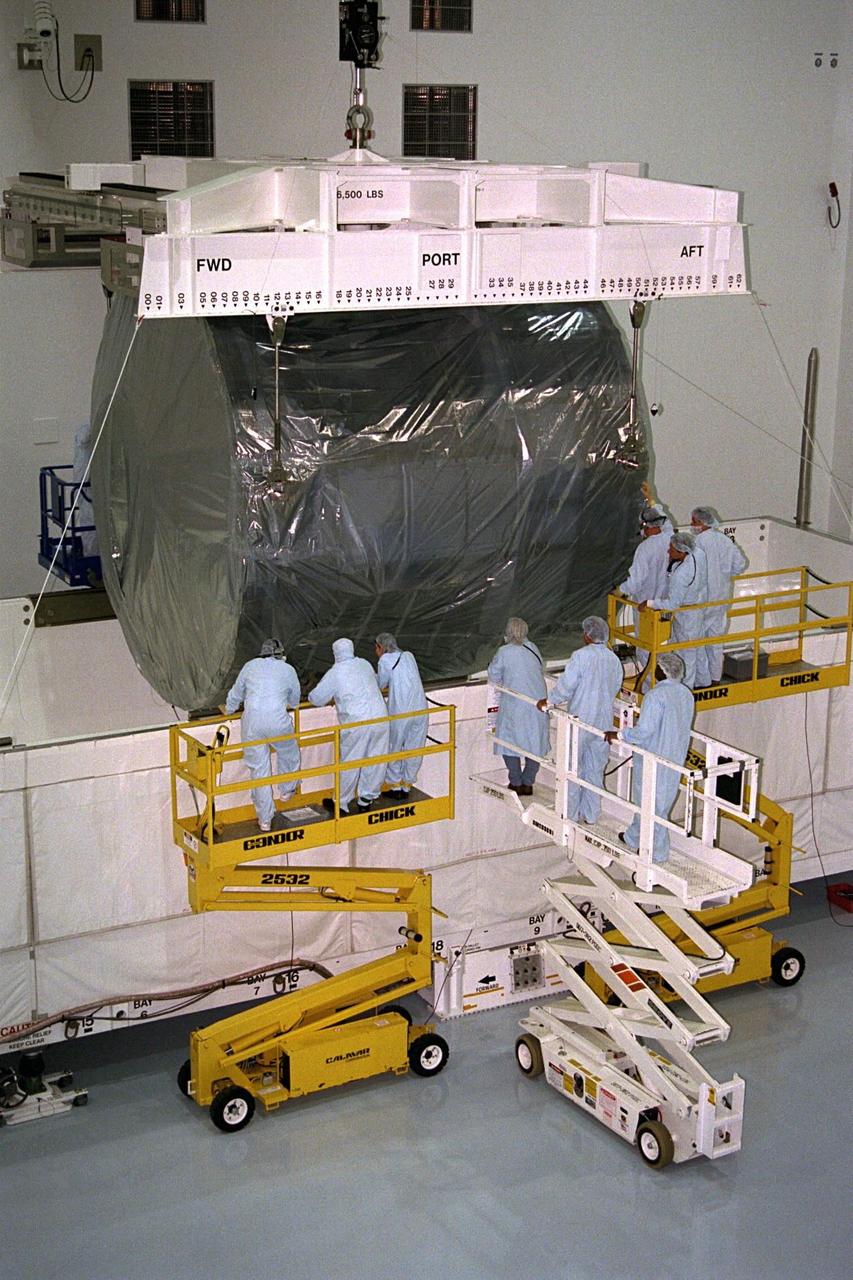
Covered in a protective sheath, International Space Station Node 1 is hoisted from its transporting container for installation in its work stand in the Space Station Processing Facility. The module is the first element of the International Space Station to be manufactured in the United States and the first scheduled to be launched on the Space Shuttle. The Node 1 is currently scheduled to lift off aboard the Space Shuttle Endeavour in July 1998, along with Pressurized Mating Adapters (PMAs) 1 and 2. The 18-foot-in-diameter, 22-foot-long aluminum module was manufactured by the Boeing Co. at Marshall Space Flight Center. Once in space, the Node 1 will function as a connecting passageway to the living and working areas of the International Space Station. It has six hatches that will serve as docking ports to the U.S. laboratory module, U.S. habitation module, an airlock and other space station elements
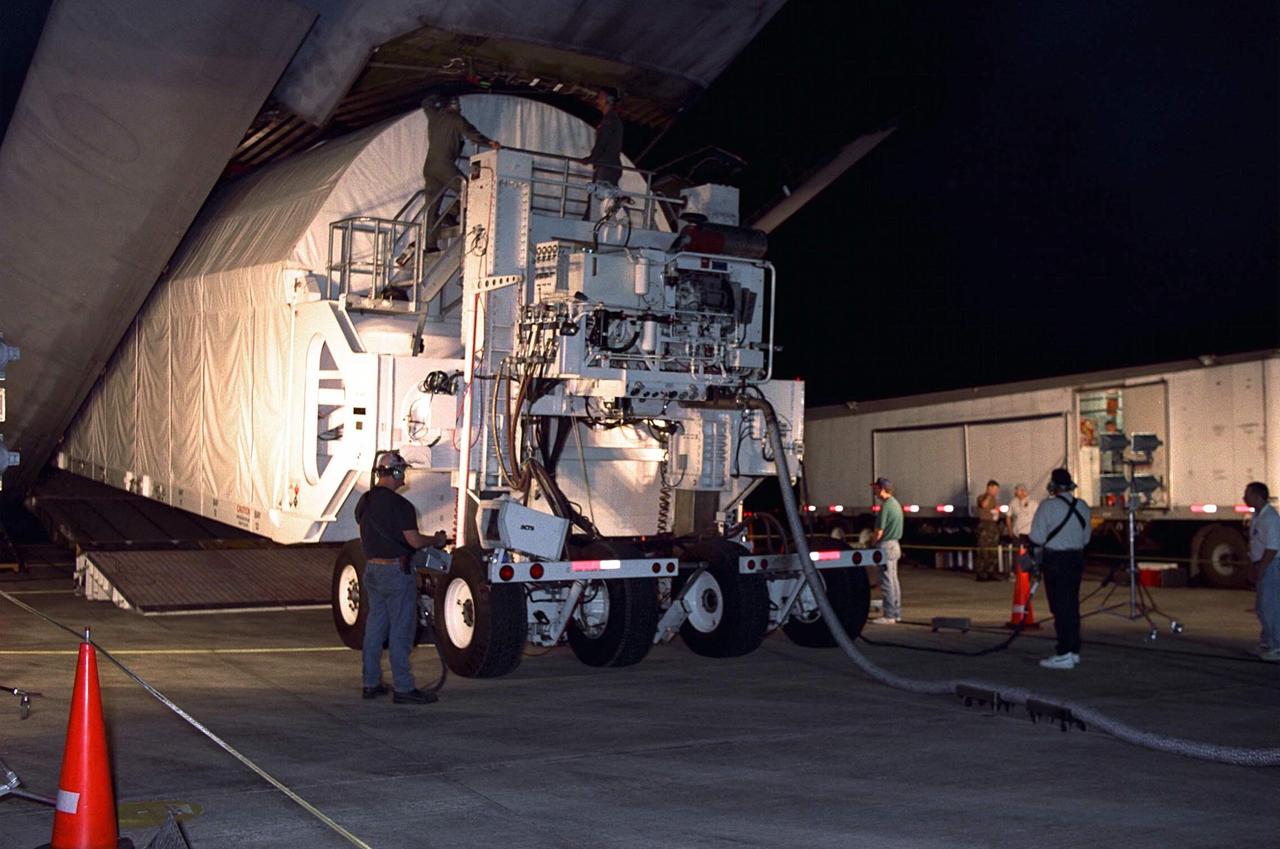
Node 1, the first element of the International Space Station to be manufactured in the United States and the first to be launched on the Space Shuttle, is unloaded in its container from an Air Force C-5 jet cargo transport at KSC’s Shuttle Landing Facility runway on June 23 after its arrival from NASA’s Marshall Space Flight Center (MSFC). The module was then transported to the Space Station Processing Facility. The Node 1 module is currently scheduled to lift off aboard the Space Shuttle Endeavour in July 1998 along with Pressurized Mating Adapters (PMAs) 1 and 2. The 18-foot-in-diameter, 22-foot-long aluminum module was manufactured by the Boeing Co. at MSFC. Once in space, the Node 1 will function as a connecting passageway to the living and working areas of the International Space Station. It has six hatches that will serve as docking ports to the U.S. laboratory module, U.S. habitation module, an airlock and other Space Station elements
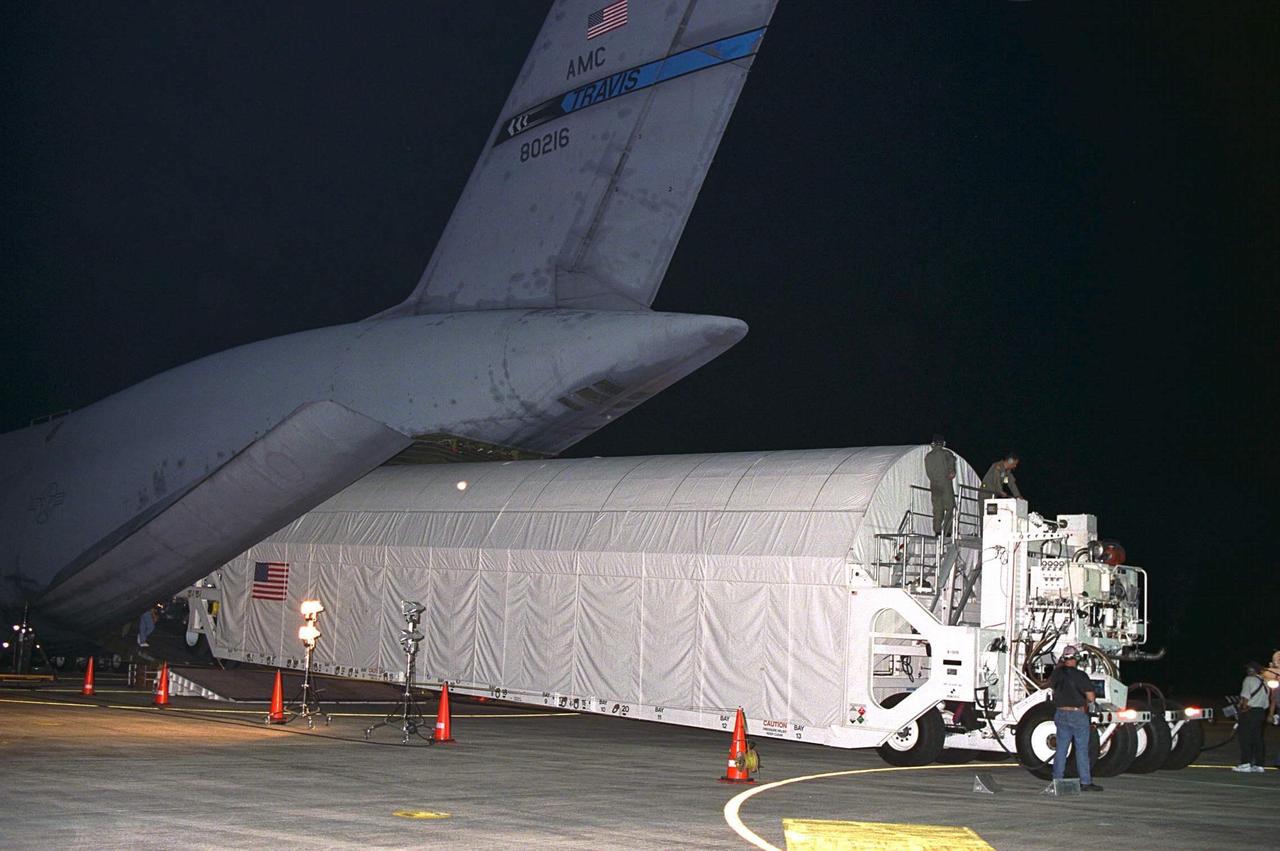
Node 1, the first element of the International Space Station to be manufactured in the United States and the first to be launched on the Space Shuttle, is unloaded in its container from an Air Force C-5 jet cargo transport at KSC’s Shuttle Landing Facility runway on June 23 after its arrival from NASA’s Marshall Space Flight Center (MSFC). The module was then transported to the Space Station Processing Facility. The Node 1 module is currently scheduled to lift off aboard the Space Shuttle Endeavour in July 1998 along with Pressurized Mating Adapters (PMAs) 1 and 2. The 18-foot in diameter, 22-foot-long aluminum module was manufactured by the Boeing Co. at MSFC. Once in space, the Node 1 will function as a connecting passageway to the living and working areas of the International Space Station. It has six hatches that will serve as docking ports to the U.S. laboratory module, U.S. habitation module, an airlock and other Space Station elements
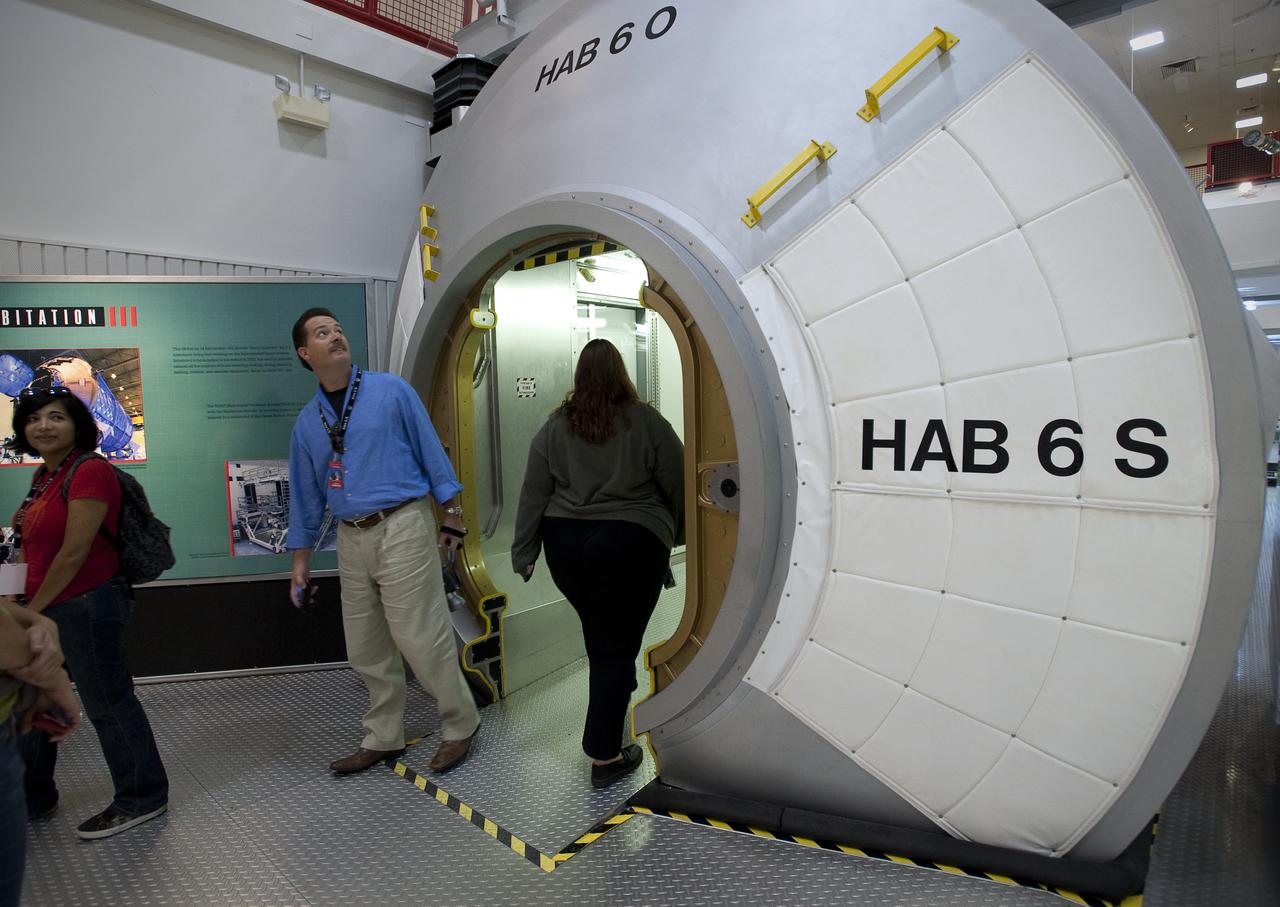
NASA Twitter followers tour the International Space Station Center at the Kennedy Space Center in Cape Canaveral, Fla. as part of a two-day Tweetup event, Sunday, Nov. 15, 2009. Tweeps had the chance to enter full-scale mock-ups of the Habitation Module and see how Space Station crew members live, sleep and work. Photo Credit: (NASA/Carla Cioffi) 
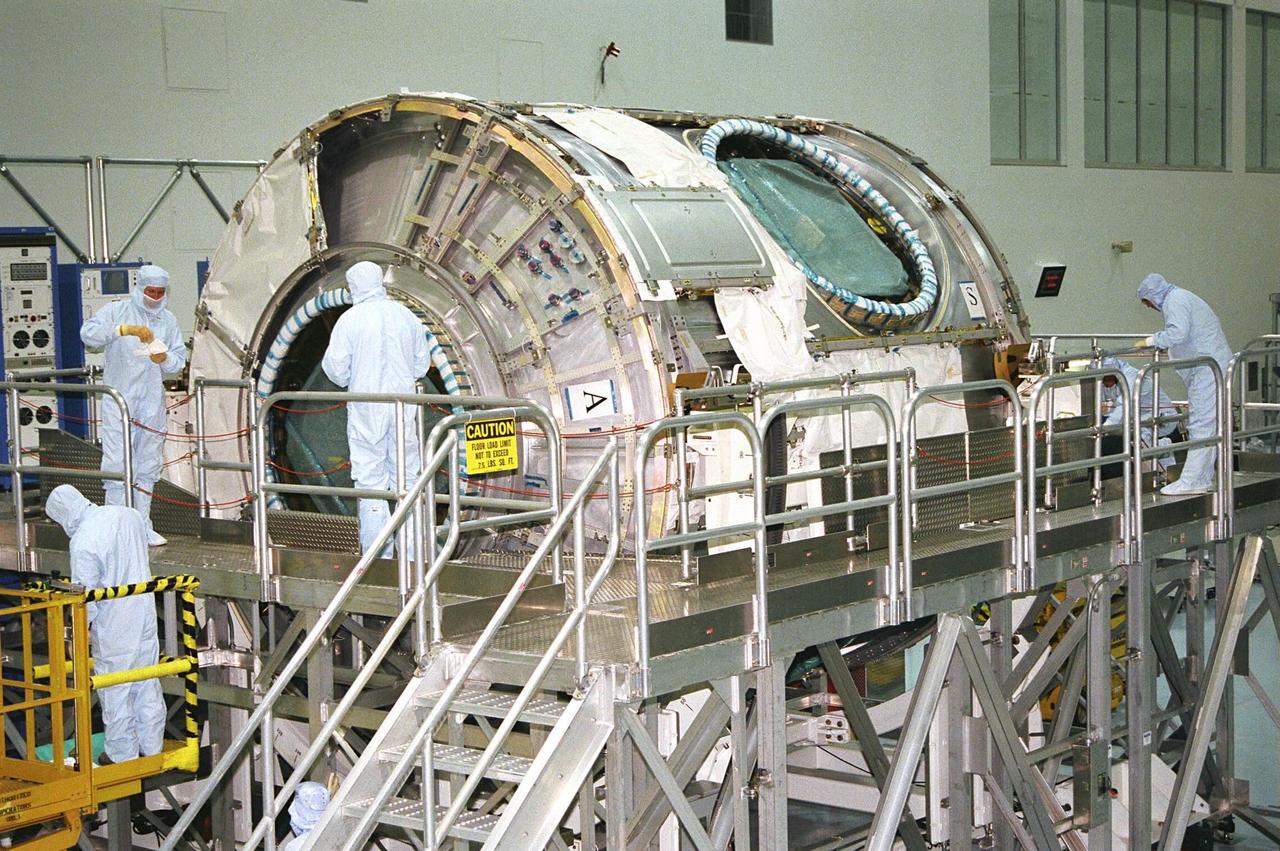
A close-up view of the Node 1 in its work stand in the Space Station Processing Facility shows two of its six hatches that will serve as docking ports. The module is the first element of the International Space Station to be manufactured in the United States and the first scheduled to be launched on the Space Shuttle. The Node 1 is currently scheduled to lift off aboard the Space Shuttle Endeavour in July 1998, along with Pressurized Mating Adapters (PMAs) 1 and 2. The 18-foot-in-diameter, 22-foot-long aluminum module was manufactured by the Boeing Co. at Marshall Space Flight Center. Once in space, the Node 1 will function as a connecting passageway to the living and working areas of the International Space Station. The six hatches on the Node 1 will serve as docking ports to the U.S. laboratory module, U.S. habitation module, an airlock and other space station elements
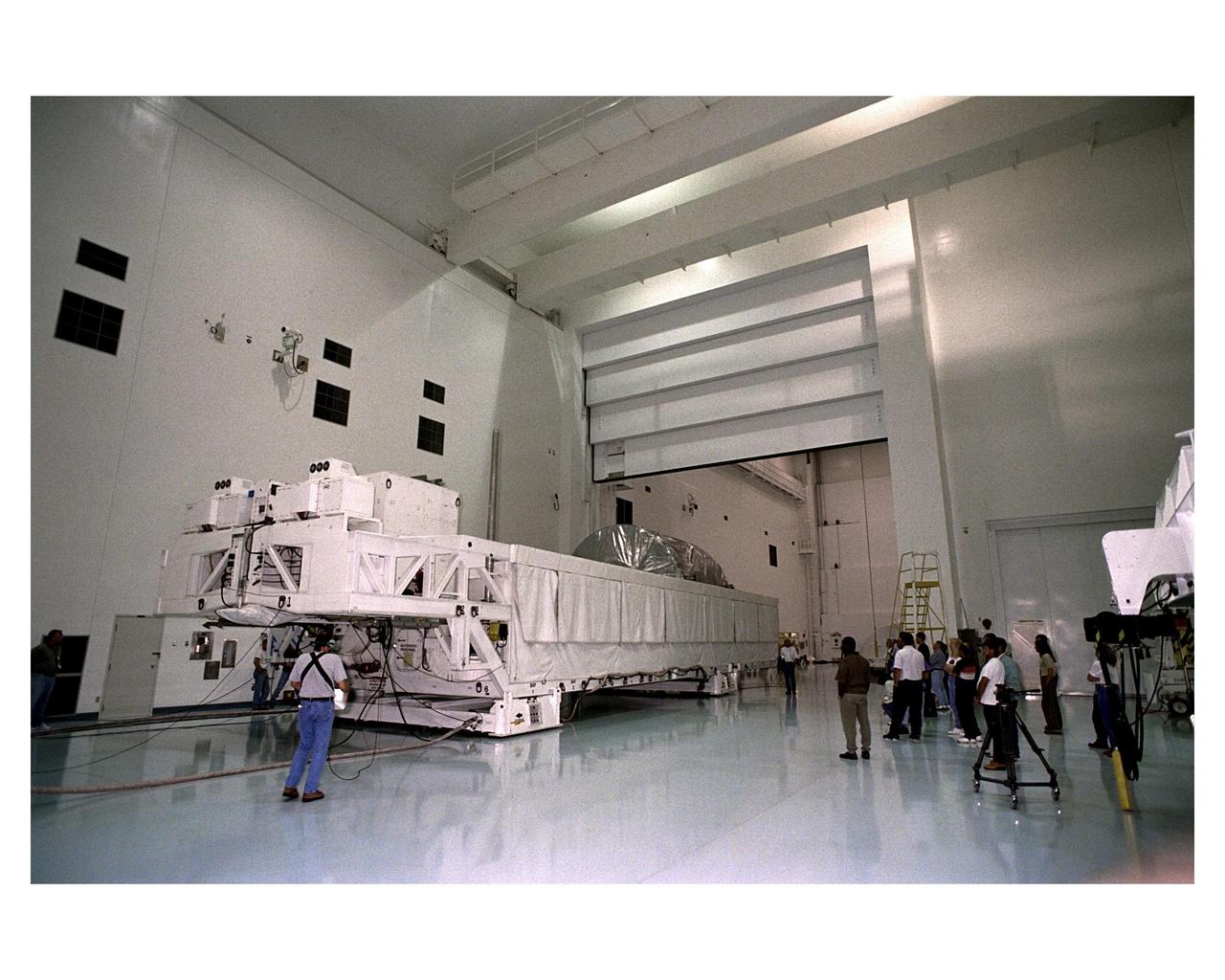
The Node 1, the first element of the International Space Station to be manufactured in the United States and the first to be launched on the Space Shuttle, rests in its container in the Space Station Processing Facility high bay after its arrival at KSC from NASA’s Marshall Space Flight Center (MSFC). The Node 1 module is currently scheduled to lift off aboard the Space Shuttle Endeavour in July 1998 along with Pressurized Mating Adapters (PMAs) 1 and 2. The 18-foot in diameter, 22- foot-long aluminum module was manufactured by the Boeing Co. at MSFC. Once in space, the Node 1 will function as a connecting passageway to the living and working areas of the International Space Station. It has six hatches that will serve as docking ports to the U.S. laboratory module, U.S. habitation module, an airlock and other space station elements
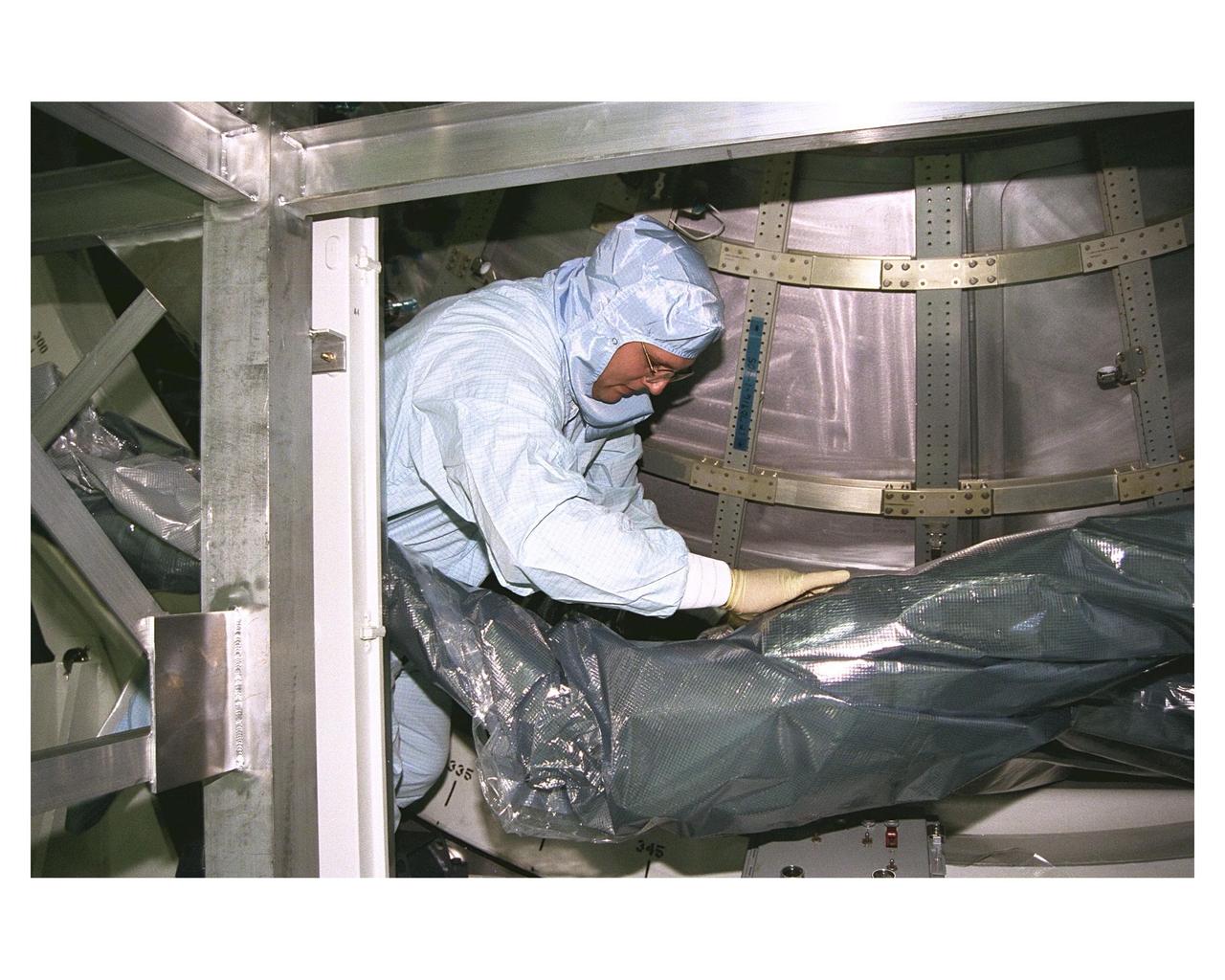
A KSC payloads processing employee removes a protective sheath part of the Node 1 in its work stand in the Space Station Processing Facility. The module is the first element of the International Space Station to be manufactured in the United States and the first scheduled to be launched on the Space Shuttle. The Node 1 is currently scheduled to lift off aboard the Space Shuttle Endeavour in July 1998, along with Pressurized Mating Adapters (PMAs) 1 and 2. The 18-foot-in-diameter, 22-foot-long aluminum module was manufactured by the Boeing Co. at Marshall Space Flight Center. Once in space, the Node 1 will function as a connecting passageway to the living and working areas of the International Space Station. It has six hatches that will serve as docking ports to the U.S. laboratory module, U.S. habitation module, an airlock and other space station elements
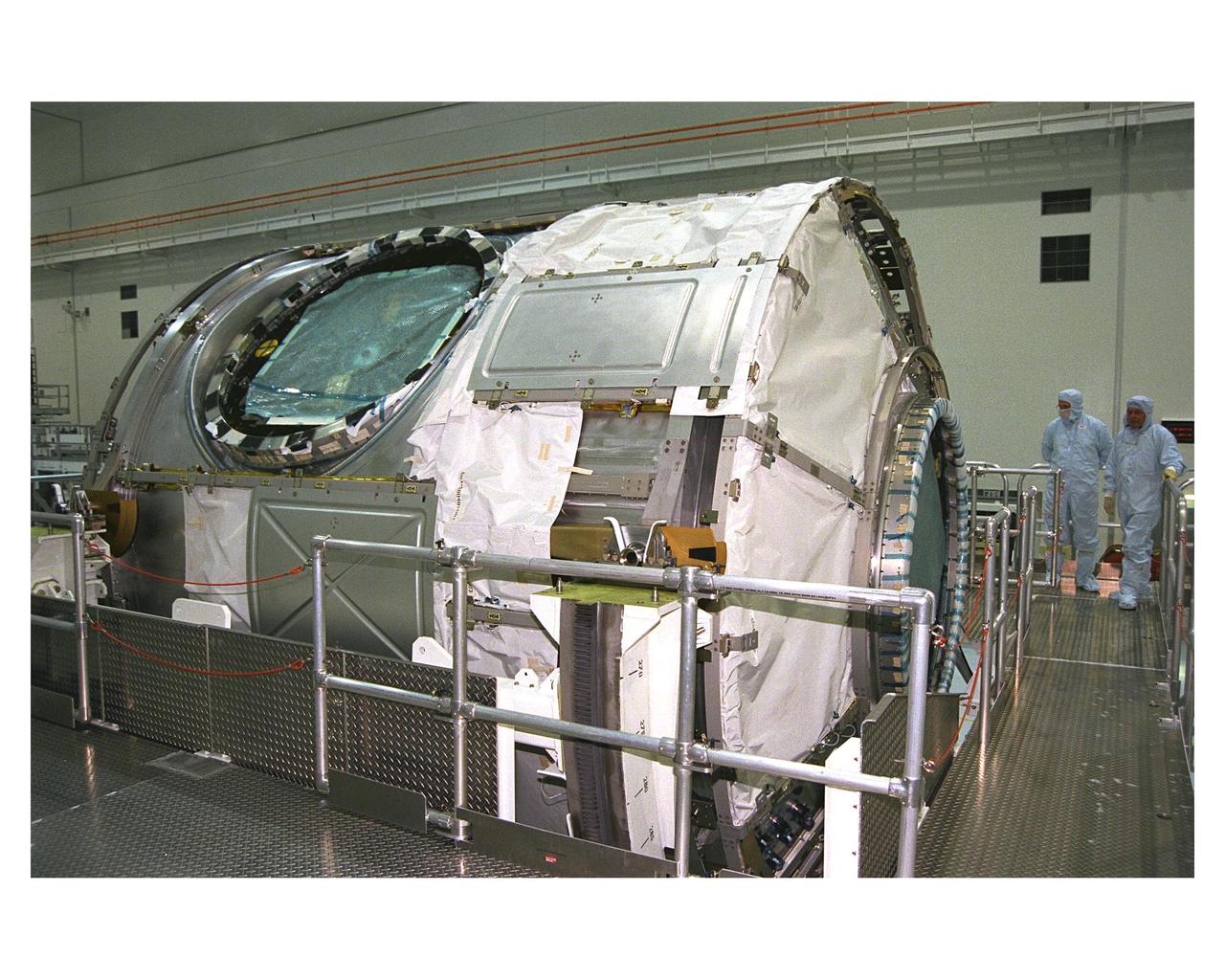
A close-up view of the Node 1 in its work stand in the Space Station Processing Facility shows one of its six hatches that will serve as docking ports. The module is the first element of the International Space Station to be manufactured in the United States and the first scheduled to be launched on the Space Shuttle. The Node 1 is currently scheduled to lift off aboard the Space Shuttle Endeavour in July 1998, along with Pressurized Mating Adapters (PMAs) 1 and 2. The 18-foot-in-diameter, 22-foot-long aluminum module was manufactured by the Boeing Co. at Marshall Space Flight Center. Once in space, the Node 1 will function as a connecting passageway to the living and working areas of the International Space Station. The six hatches on the Node 1 will serve as docking ports to the U.S. laboratory module, U.S. habitation module, an airlock and other space station elements
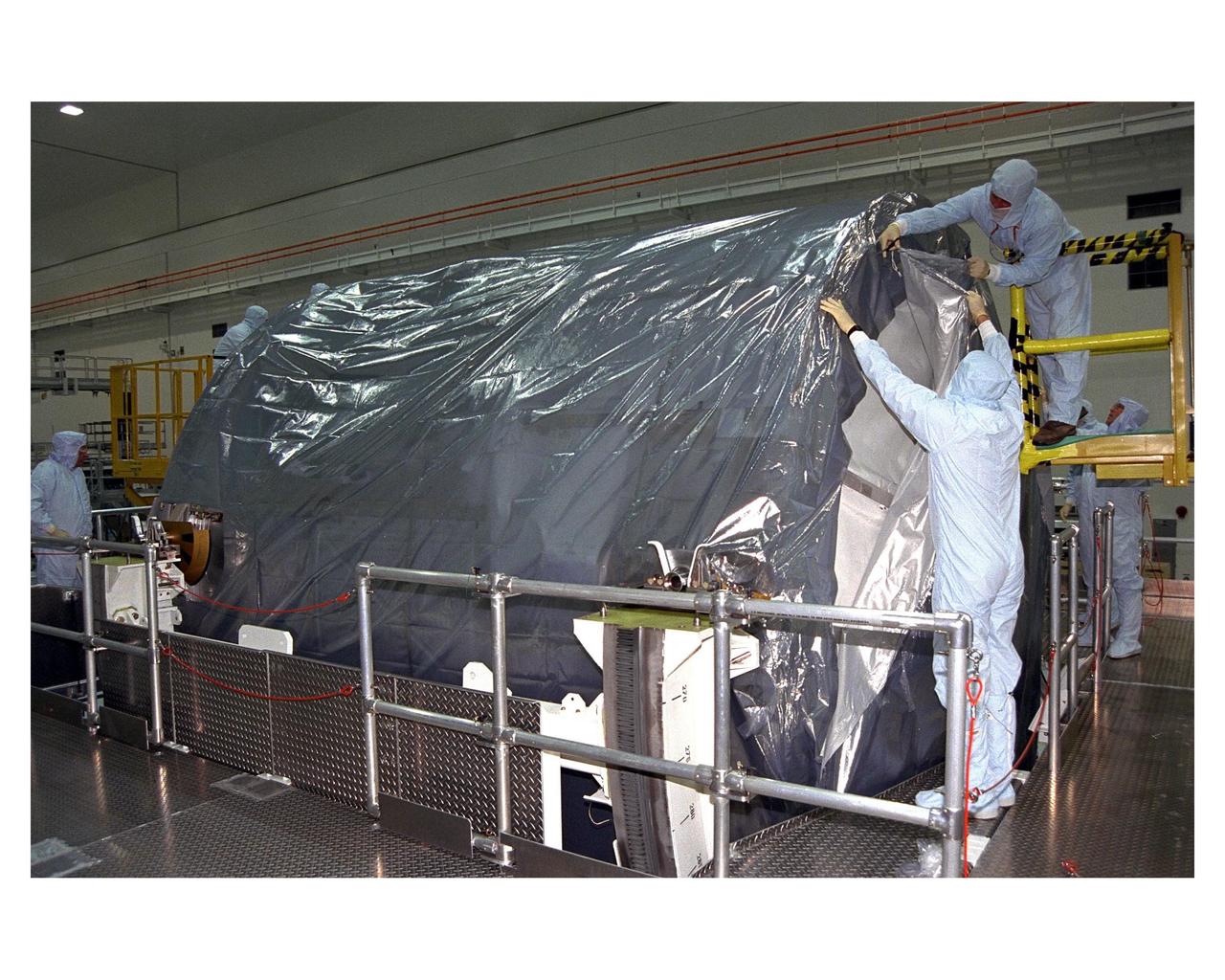
KSC workers begin to remove a protective sheath from the Node 1 in its work stand in the Space Station Processing Facility. The module is the first element of the International Space Station to be manufactured in the United States and the first scheduled to be launched on the Space Shuttle. The Node 1 is currently scheduled to lift off aboard the Space Shuttle Endeavour in July 1998, along with Pressurized Mating Adapters (PMAs) 1 and 2. The 18-foot-in-diameter, 22-foot- long aluminum module was manufactured by the Boeing Co. at Marshall Space Flight Center. Once in space, the Node 1 will function as a connecting passageway to the living and working areas of the International Space Station. It has six hatches that will serve as docking ports to the U.S. laboratory module, U.S. habitation module, an airlock and other space station elements
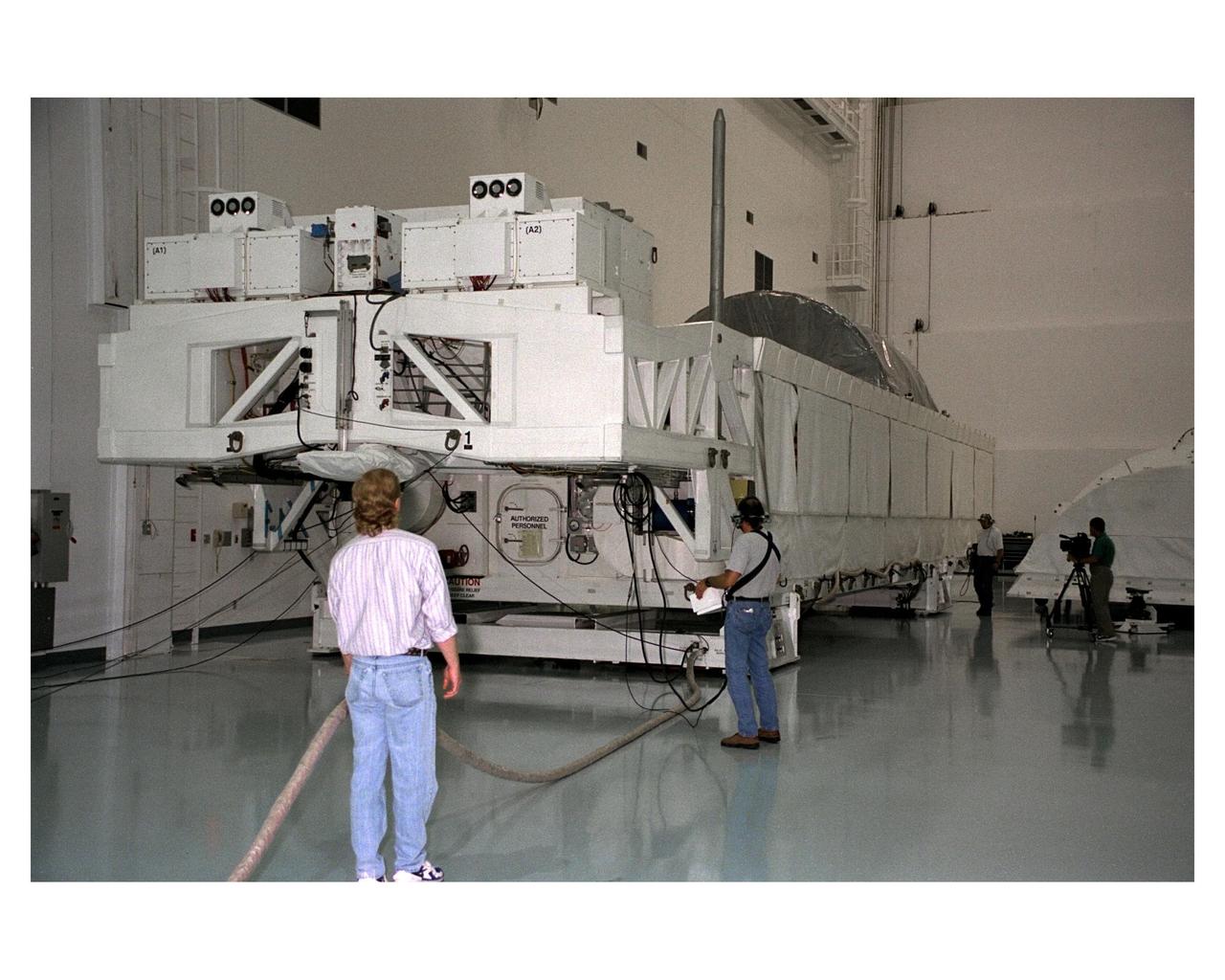
The Node 1, the first element of the International Space Station to be manufactured in the United States and the first to be launched on the Space Shuttle, rests in its container in the Space Station Processing Facility high bay after its arrival at KSC from NASA’s Marshall Space Flight Center (MSFC). The Node 1 module is currently scheduled to lift off aboard the Space Shuttle Endeavour in July 1998 along with Pressurized Mating Adapters (PMAs) 1 and 2. The 18-foot in diameter, 22- foot-long aluminum module was manufactured by the Boeing Co. at MSFC. Once in space, the Node 1 will function as a connecting passageway to the living and working areas of the International Space Station. It has six hatches that will serve as docking ports to the U.S. laboratory module, U.S. habitation module, an airlock and other space station elements
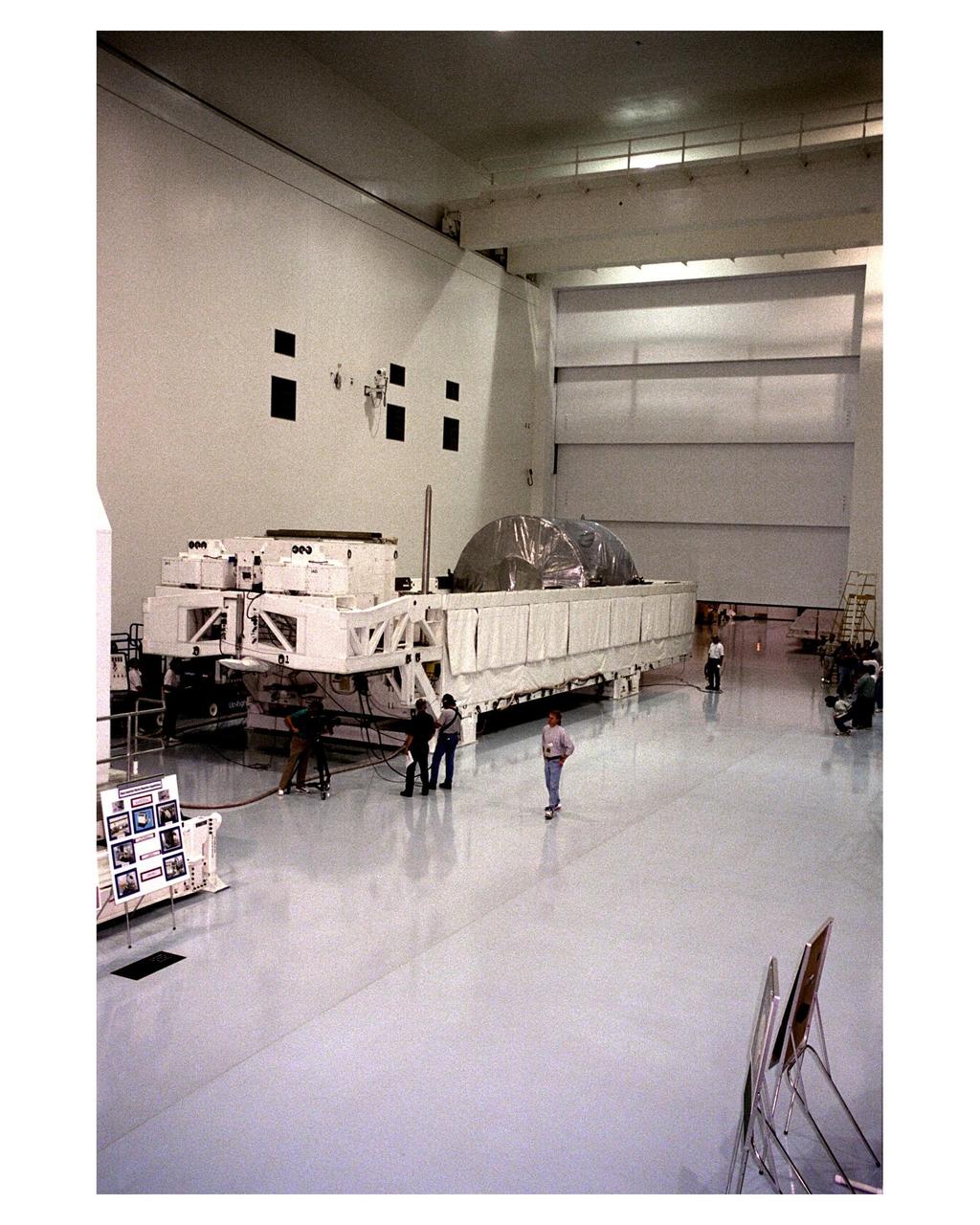
The Node 1, the first element of the International Space Station to be manufactured in the United States and the first to be launched on the Space Shuttle, rests in its container in the Space Station Processing Facility high bay after its arrival at KSC from NASA’s Marshall Space Flight Center (MSFC). The Node 1 module is currently scheduled to lift off aboard the Space Shuttle Endeavour in July 1998 along with Pressurized Mating Adapters (PMAs) 1 and 2. The 18-foot in diameter, 22- foot-long aluminum module was manufactured by the Boeing Co. at MSFC. Once in space, the Node 1 will function as a connecting passageway to the living and working areas of the International Space Station. It has six hatches that will serve as docking ports to the U.S. laboratory module, U.S. habitation module, an airlock and other space station elements
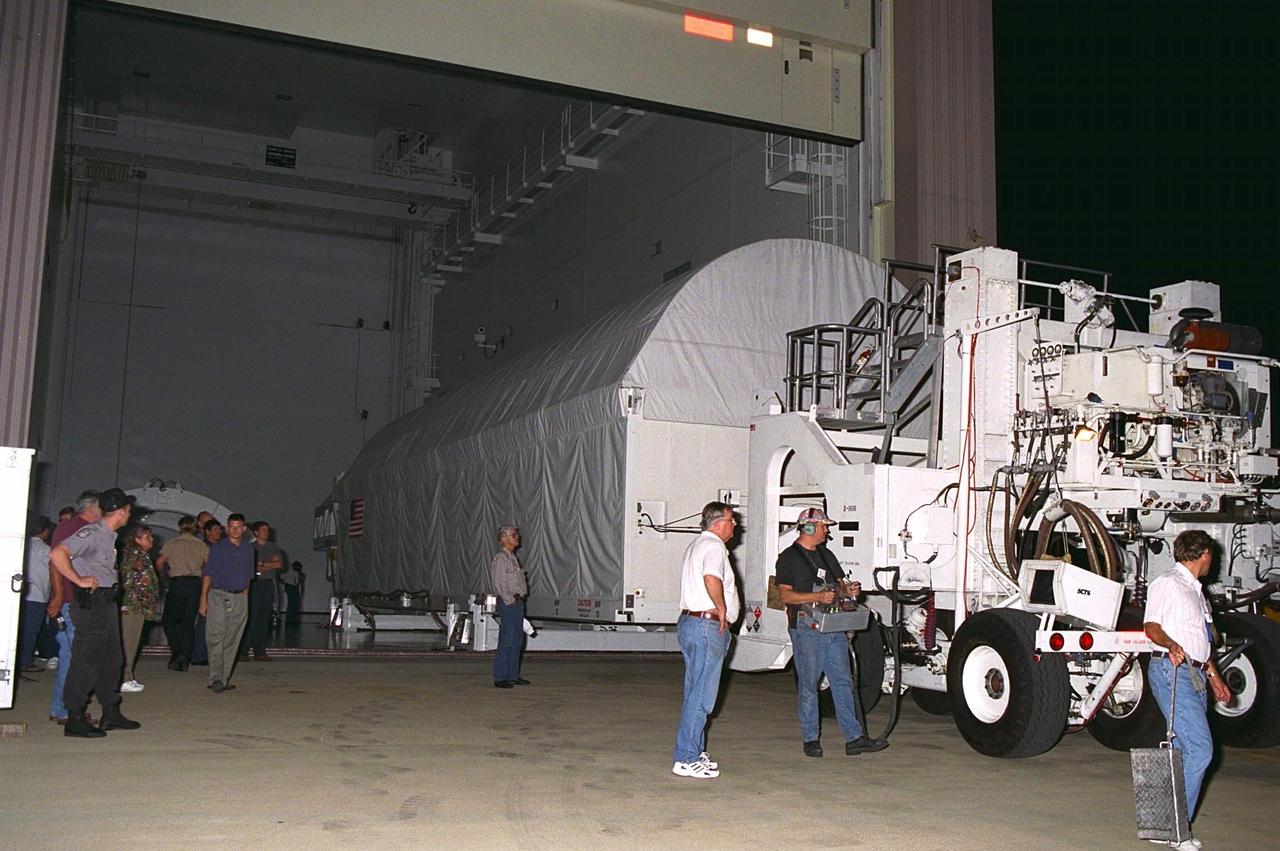
The container transporting the Node 1, the first element of the International Space Station to be manufactured in the United States and the first to be launched on the Space Shuttle, is moved into the Space Station Processing Facility high bay June 23 after its arrival from NASA’s Marshall Space Flight Center (MSFC). The Node 1 module is currently scheduled to lift off aboard the Space Shuttle Endeavour in July 1998 along with Pressurized Mating Adapters (PMAs) 1 and 2. The 18-foot in diameter, 22-foot-long aluminum module was manufactured by the Boeing Co. at MSFC. Once in space, the Node 1 will function as a connecting passageway to the living and working areas of the International Space Station. It has six hatches that will serve as docking ports to the U.S. laboratory module, U.S. habitation module, an airlock and other space station elements
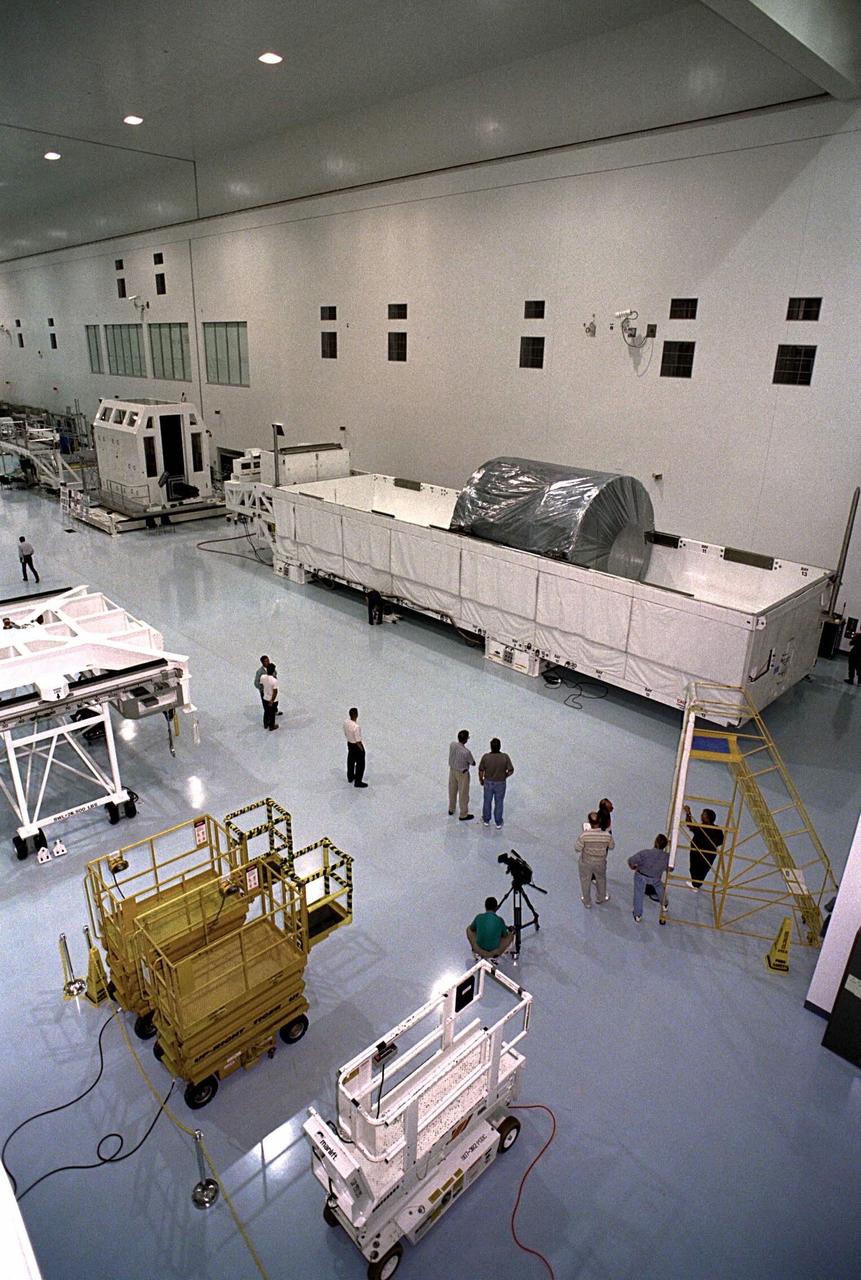
The Node 1, the first element of the International Space Station to be manufactured in the United States and the first to be launched on the Space Shuttle, rests in its container in the Space Station Processing Facility high bay after its arrival at KSC from NASA’s Marshall Space Flight Center (MSFC). The Node 1 module is currently scheduled to lift off aboard the Space Shuttle Endeavour in July 1998 along with Pressurized Mating Adapters (PMAs) 1 and 2. The 18-foot-in-diameter, 22- foot-long aluminum module was manufactured by the Boeing Co. at MSFC. Once in space, the Node 1 will function as a connecting passageway to the living and working areas of the International Space Station. It has six hatches that will serve as docking ports to the U.S. laboratory module, U.S. habitation module, an airlock and other space station elements
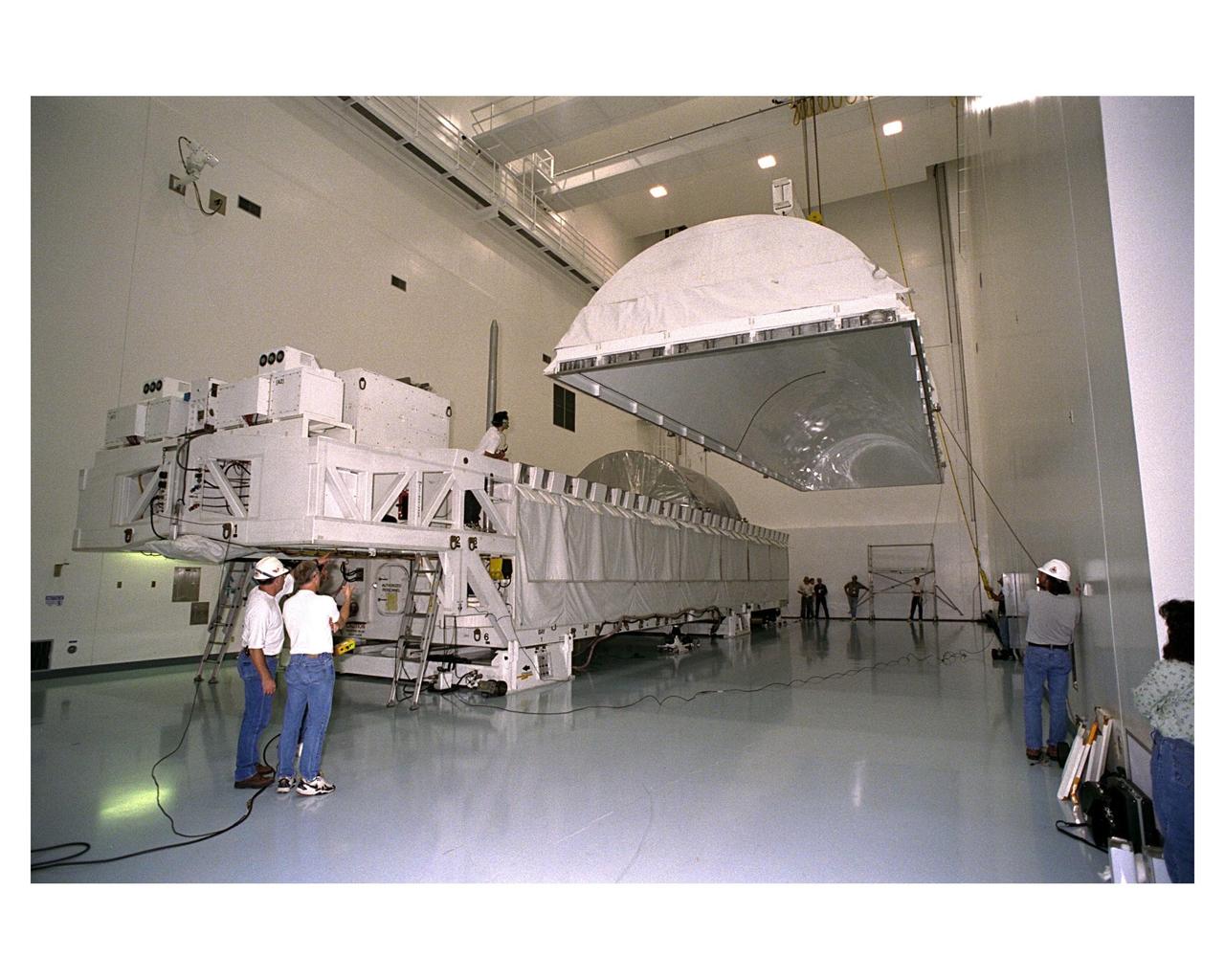
The Node 1, the first element of the International Space Station to be manufactured in the United States and the first to be launched on the Space Shuttle, rests in its container in the Space Station Processing Facility high bay after its arrival at KSC from NASA’s Marshall Space Flight Center (MSFC). The Node 1 module is currently scheduled to lift off aboard the Space Shuttle Endeavour in July 1998 along with Pressurized Mating Adapters (PMAs) 1 and 2. The 18-foot in diameter, 22- foot-long aluminum module was manufactured by the Boeing Co. at MSFC. Once in space, the Node 1 will function as a connecting passageway to the living and working areas of the International Space Station. It has six hatches that will serve as docking ports to the U.S. laboratory module, U.S. habitation module, an airlock and other space station elements
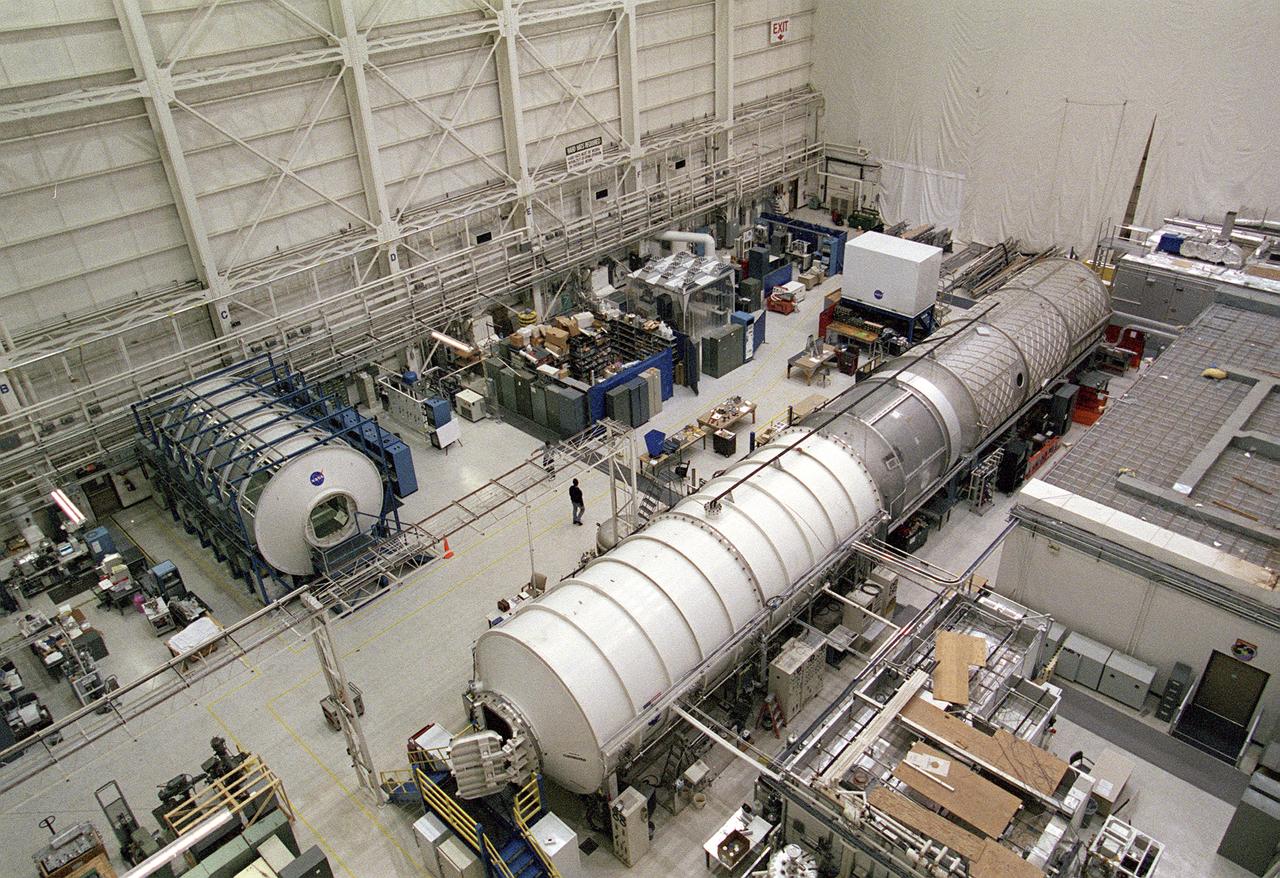
The Marshall Space Flight Center (MSFC) is responsible for designing and building the life support systems that will provide the crew of the International Space Station (ISS) a comfortable environment in which to live and work. Scientists and engineers at the MSFC are working together to provide the ISS with systems that are safe, efficient, and cost-effective. These compact and powerful systems are collectively called the Environmental Control and Life Support Systems, or simply, ECLSS. This is a view of the ECLSS and the Internal Thermal Control System (ITCS) Test Facility in building 4755, MSFC. In the foreground is the 3-module ECLSS simulator comprised of the U.S. Laboratory Module Simulator, Node 1 Simulator, and Node 3/Habitation Module Simulator. At center left is the ITCS Simulator. The main function of the ITCS is to control the temperature of equipment and hardware installed in a typical ISS Payload Rack.
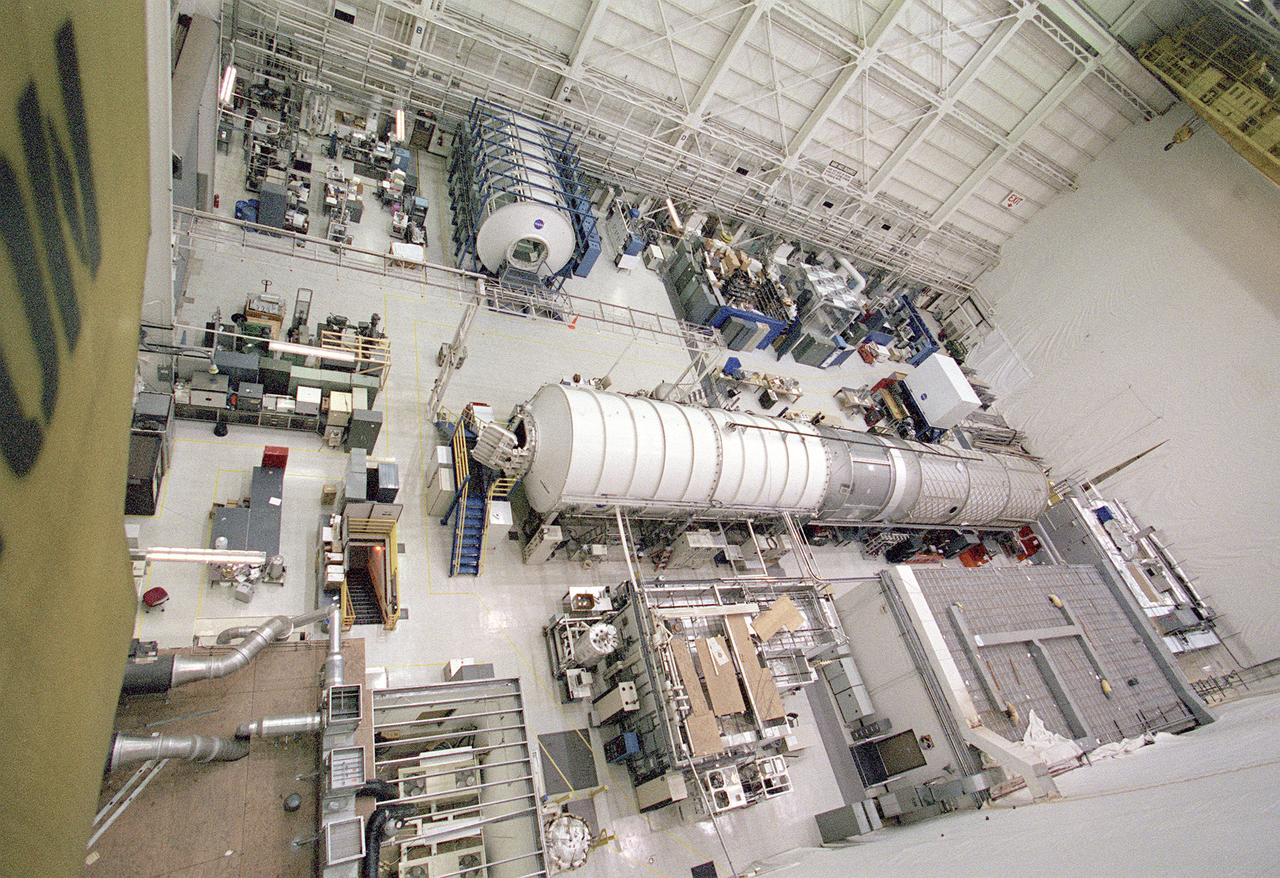
The Marshall Space Flight Center (MSFC) is responsible for designing and building the life support systems that will provide the crew of the International Space Station (ISS) a comfortable environment in which to live and work. Scientists and engineers at the MSFC are working together to provide the ISS with systems that are safe, efficient, and cost-effective. These compact and powerful systems are collectively called the Environmental Control and Life Support Systems, or simply, ECLSS. This is a view of the ECLSS and the Internal Thermal Control System (ITCS) Test Facility in building 4755, MSFC. In the foreground is the 3-module ECLSS simulator comprised of the U.S. Laboratory Module Simulator, Node 1 Simulator, and Node 3/Habitation Module Simulator. On the left is the ITCS Simulator. The main function of the ITCS is to control the temperature of equipment and hardware installed in a typical ISS Payload Rack.
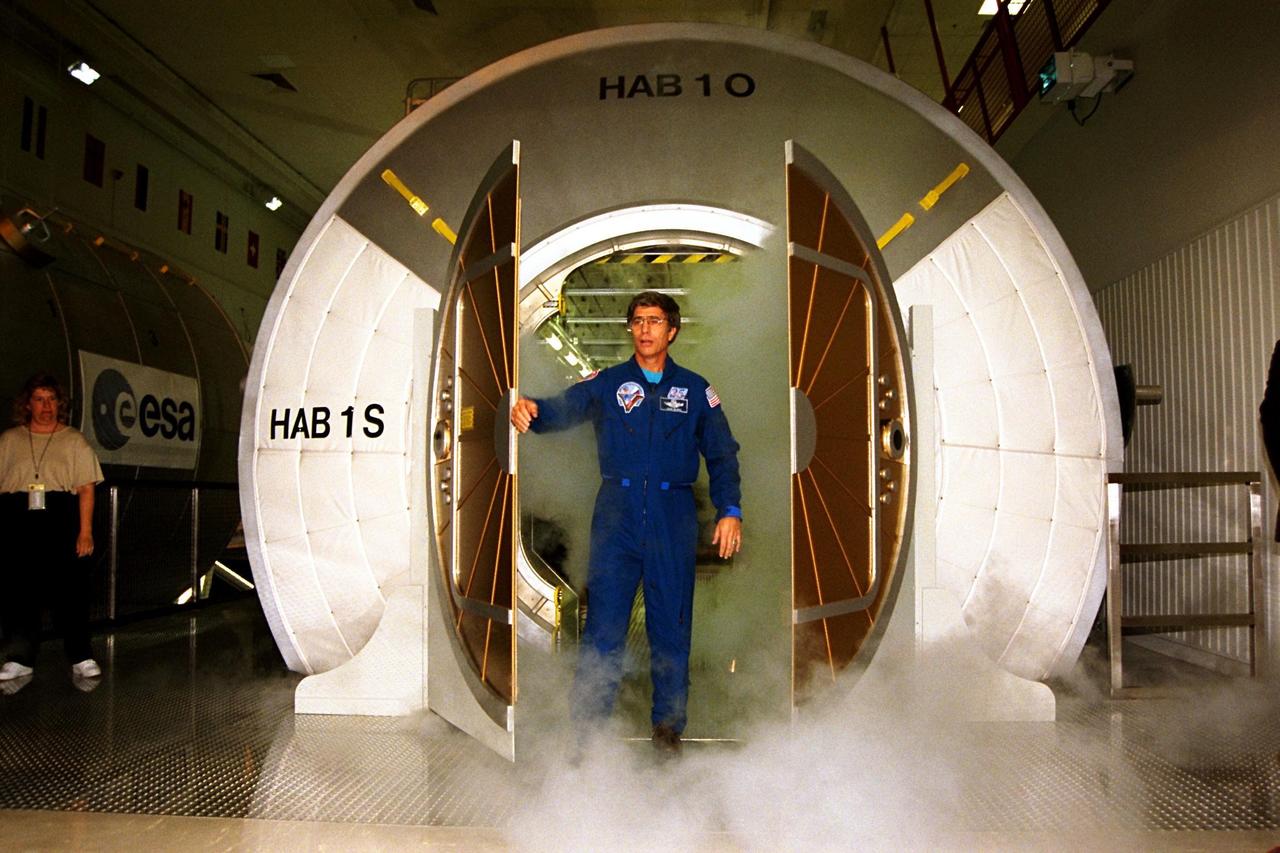
Retired Astronaut John Blaha celebrates the official opening of the new International Space Station (ISS) Center at Kennedy Space Center as he steps out of a full-scale mockup of one of the station modules. Modules through which visitors can walk that are included in the new tour attraction are the Habitation Unit, where station crew members will live, sleep, and work; a Laboratory Module; and the Pressurized Logistics Module, where racks and supplies will be transported back and forth from KSC to space. Guests also can take an elevated walkway to a gallery overlooking the work area where actual ISS hardware is prepared for flight into space. This new tour site, in addition to a new Launch Complex 39 Observation Gantry, are part of a comprehensive effort by NASA and Delaware North to expand and improve the KSC public tour and visitor facilities
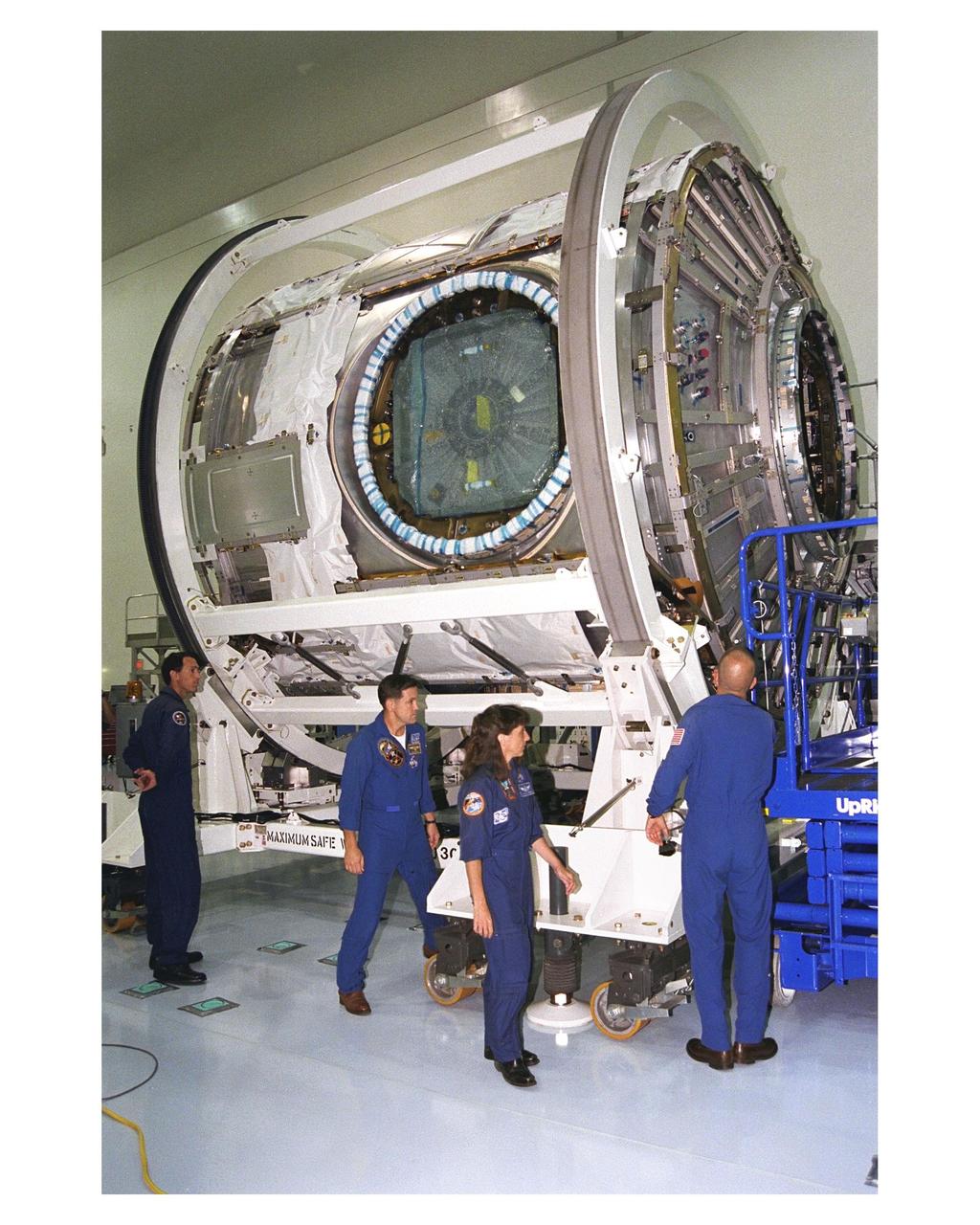
Members of the STS-88 crew examine the Node 1 of the International Space Station in the high bay of the Space Station Processing Facility. The module is the first element of the ISS to be manufactured in the United States and the first scheduled to be launched on the Space Shuttle. The Node 1 is currently scheduled to lift off aboard the Space Shuttle Endeavour in July 1998, along with Pressurized Mating Adapters (PMAs) 1 and 2. The 18-foot-in-diameter, 22-foot-long aluminum module was manufactured by the Boeing Co. at Marshall Space Flight Center. Once in space, the Node 1 will function as a connecting passageway to the living and working areas of the ISS. The six hatches on the Node 1 will serve as docking ports to the U.S. laboratory module, U.S. habitation module, an airlock and other Space Station elements
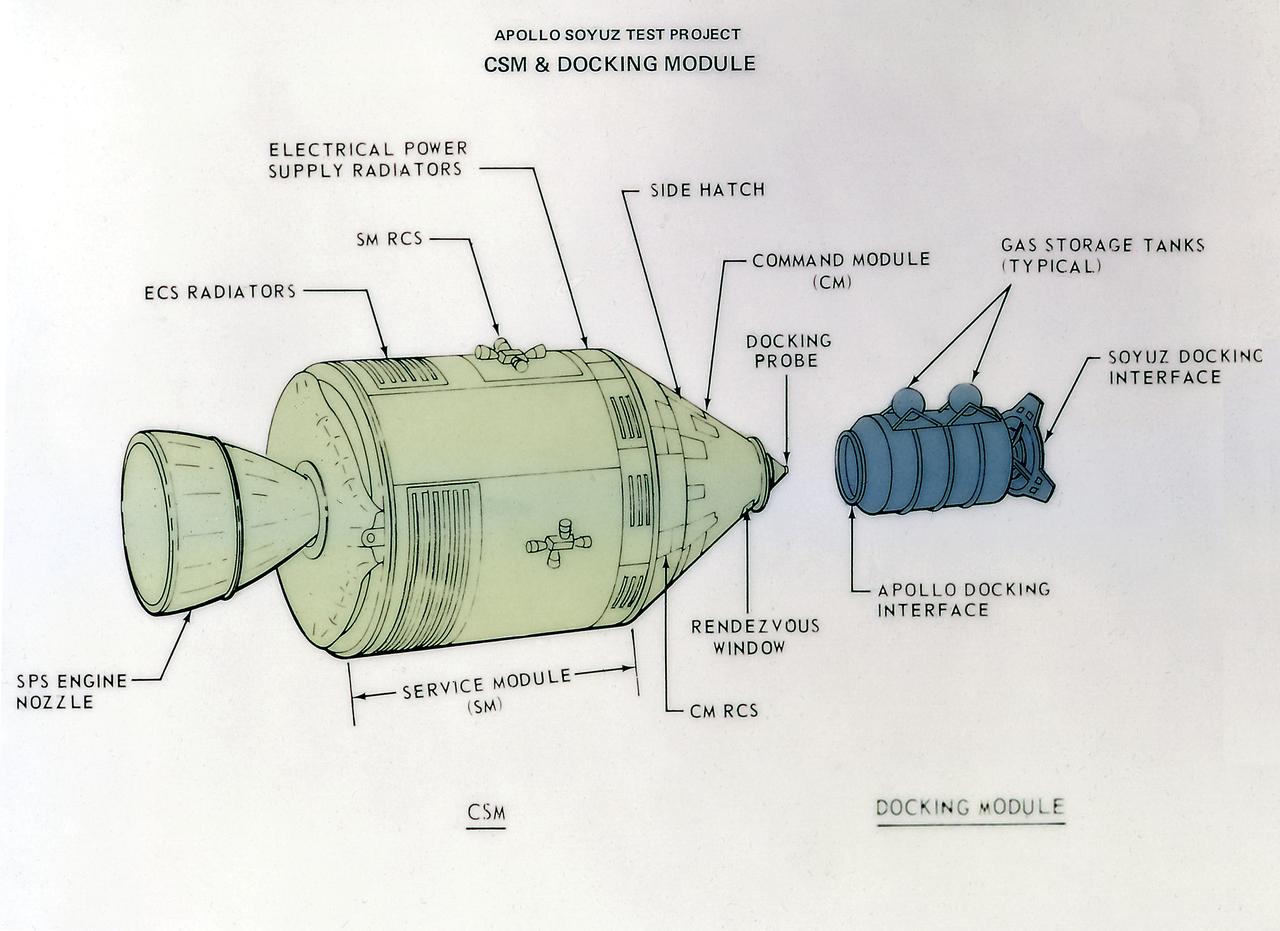
This illustration depicts a configuration of the Command Service Module (CSM) and Docking Module (DM) for the Apollo-Soyuz Test Project (ASTP). The ASTP was the first international docking of the U.S.'s Apollo spacecraft and the U.S.S.R.'s Soyuz spacecraft in space. A joint engineering team from the two countries met to develop a docking system that permitted the two spacecraft to link in space and allowed the two crews to travel from one spacecraft to the other. This system entailed developing a large habitable Docking Module (DM) to be carried on the Apollo spacecraft to facilitate the joining of two dissimilar spacecraft. The Marshall Space Flight Center was responsible for development and sustaining engineering of the Saturn IB launch vehicle during the mission. The ASTP marked the last use of the Saturn Launch Vehicle.
KENNEDY SPACE CENTER, FLA. -- Boeing technicians move a piece of hardware into position on Node 1 of the International Space Station (ISS) in KSC's Space Station Processing Facility in preparation for mating with Pressurized Mating Adapter (PMA)-2. The node is the first element of the ISS to be manufactured in the United States and is currently scheduled to lift off aboard the Space Shuttle Endeavour on STS-88 later this year, along with PMAs 1 and 2. The 18-foot-in-diameter, 22-foot-long aluminum module was manufactured by the Boeing Co. at Marshall Space Flight Center. Once in space, Node 1 will function as a connecting passageway to the living and working areas of the ISS. It has six hatches that will serve as docking ports to the U.S. laboratory module, U.S. habitation module, an airlock and other space station elements
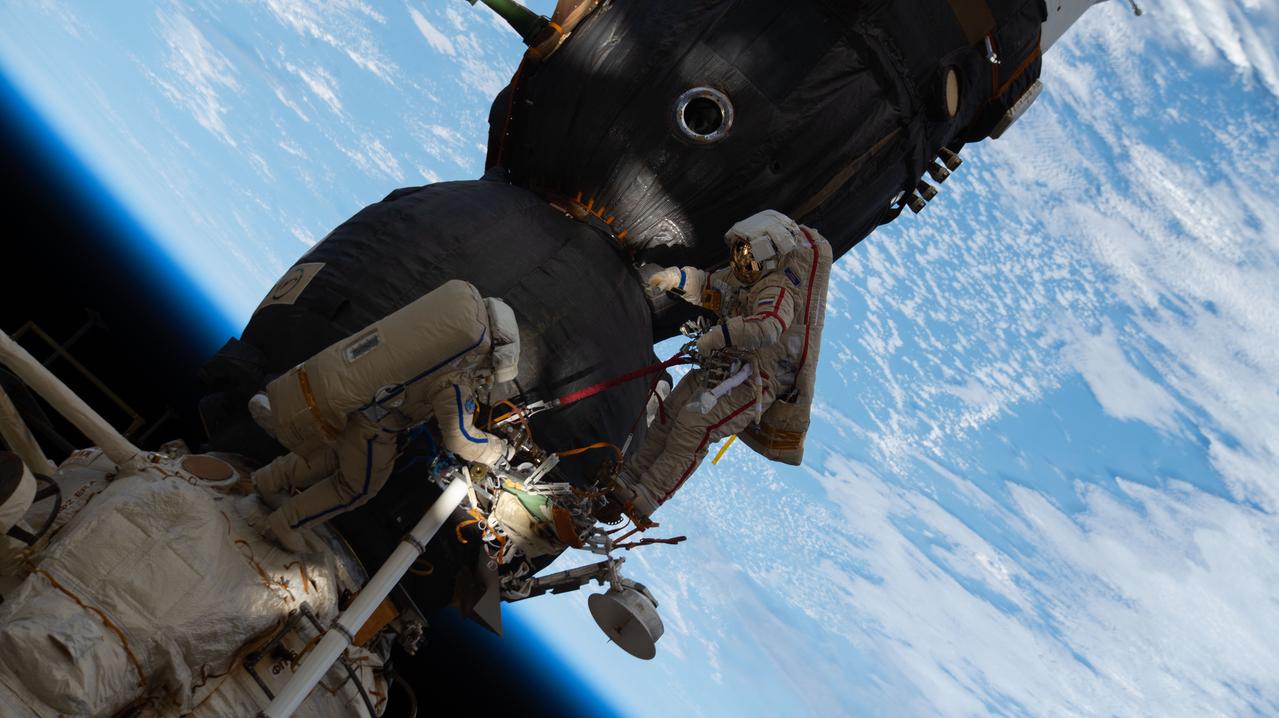
iss057e131662 (Dec. 11, 2018) --- Russian spacewalkers Oleg Kononenko (suit with red stripes) and Sergey Prokopyev (suit with blue stripes) work outside the International Space Station over 250 miles above Earth to inspect the Soyuz MS-09 spacecraft. During the spacewalk, the duo examined the external hull of the Soyuz crew ship docked to the Rassvet module. The area corresponded with the location of a small hole inside the Soyuz habitation module that was found in August and caused a decrease in the space station’s pressure. The hole was fixed internally with a sealant within hours of its detection. During the spacewalk, Kononenko and Prokopyev collected samples of some of the sealant that extruded through hole to the outer hull before heading back inside the Pirs docking compartment and closing the hatch completing a seven-hour, 45-minute spacewalk.
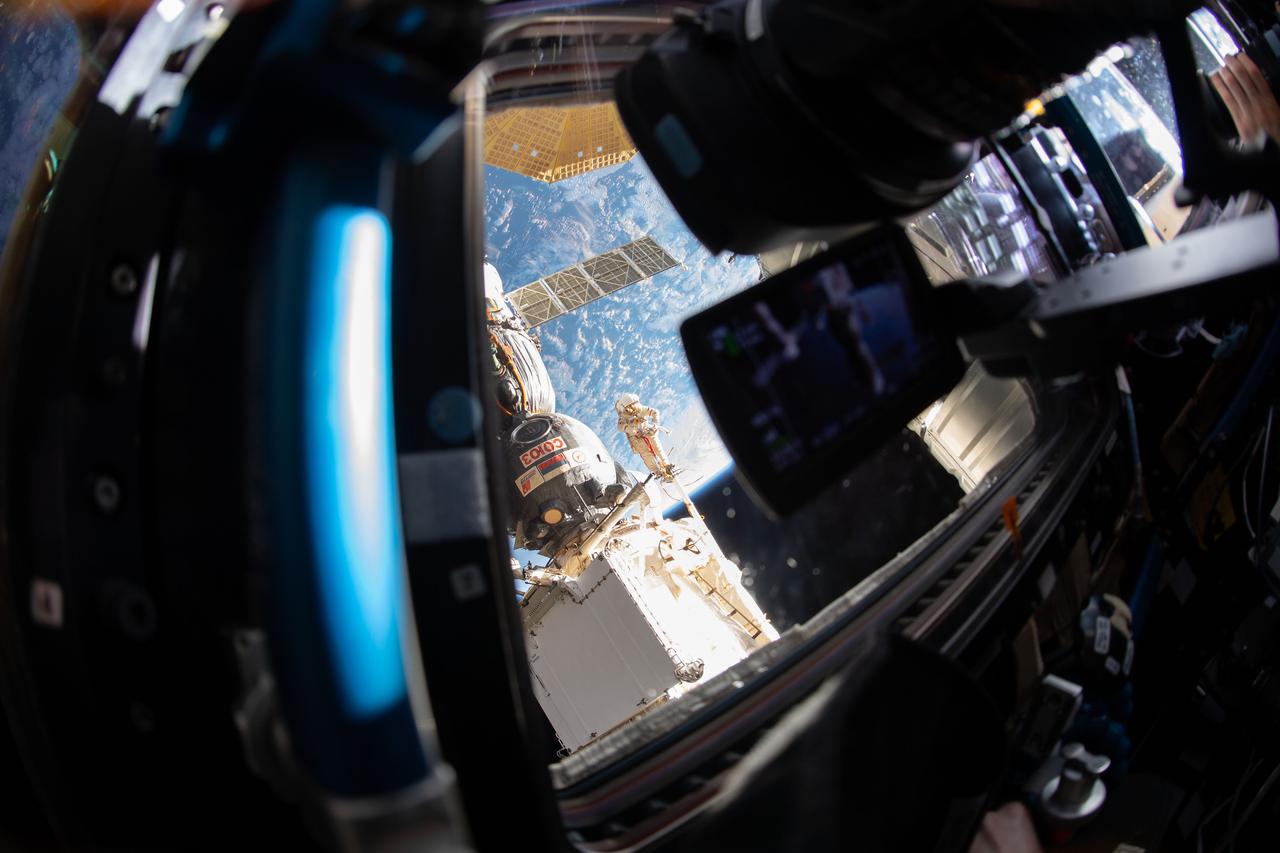
iss057e131556 (Dec. 11, 2018) --- An Expedition 57 crew member inside the cupola photographed Russian spacewalker Oleg Kononenko (suit with red stripes) attached to the Strela boom outside the International Space Station about 250 miles above Earth to inspect the Soyuz MS-09 spacecraft. During the spacewalk, he and fellow spacewalker Sergey Prokopyev (out of frame) examined the external hull of the Soyuz crew ship docked to the Rassvet module. The area corresponded with the location of a small hole inside the Soyuz habitation module that was found in August and caused a decrease in the space station’s pressure. The hole was fixed internally with a sealant within hours of its detection. During the spacewalk, Kononenko and Prokopyev collected samples of some of the sealant that extruded through hole to the outer hull before heading back inside the Pirs docking compartment and closing the hatch completing a seven-hour, 45-minute spacewalk.

iss057e131572 (Dec. 11, 2018) --- An Expedition 57 crew member inside the cupola photographed Russian spacewalker Oleg Kononenko (suit with red stripes) attached to the Strela boom outside the International Space Station about 250 miles above Earth to inspect the Soyuz MS-09 spacecraft. During the spacewalk, he and fellow spacewalker Sergey Prokopyev (out of frame) examined the external hull of the Soyuz crew ship docked to the Rassvet module. The area corresponded with the location of a small hole inside the Soyuz habitation module that was found in August and caused a decrease in the space station’s pressure. The hole was fixed internally with a sealant within hours of its detection. During the spacewalk, Kononenko and Prokopyev collected samples of some of the sealant that extruded through hole to the outer hull before heading back inside the Pirs docking compartment and closing the hatch completing a seven-hour, 45-minute spacewalk.

iss057e131575 (Dec. 11, 2018) --- An Expedition 57 crew member inside the cupola photographed Russian spacewalker Oleg Kononenko (suit with red stripes) attached to the Strela boom outside the International Space Station about 250 miles above Earth to inspect the Soyuz MS-09 spacecraft. During the spacewalk, he and fellow spacewalker Sergey Prokopyev (towards bottom right in the suit with blue stripes) examined the external hull of the Soyuz crew ship docked to the Rassvet module. The area corresponded with the location of a small hole inside the Soyuz habitation module that was found in August and caused a decrease in the space station’s pressure. The hole was fixed internally with a sealant within hours of its detection. During the spacewalk, Kononenko and Prokopyev collected samples of some of the sealant that extruded through hole to the outer hull before heading back inside the Pirs docking compartment and closing the hatch completing a seven-hour, 45-minute spacewalk.
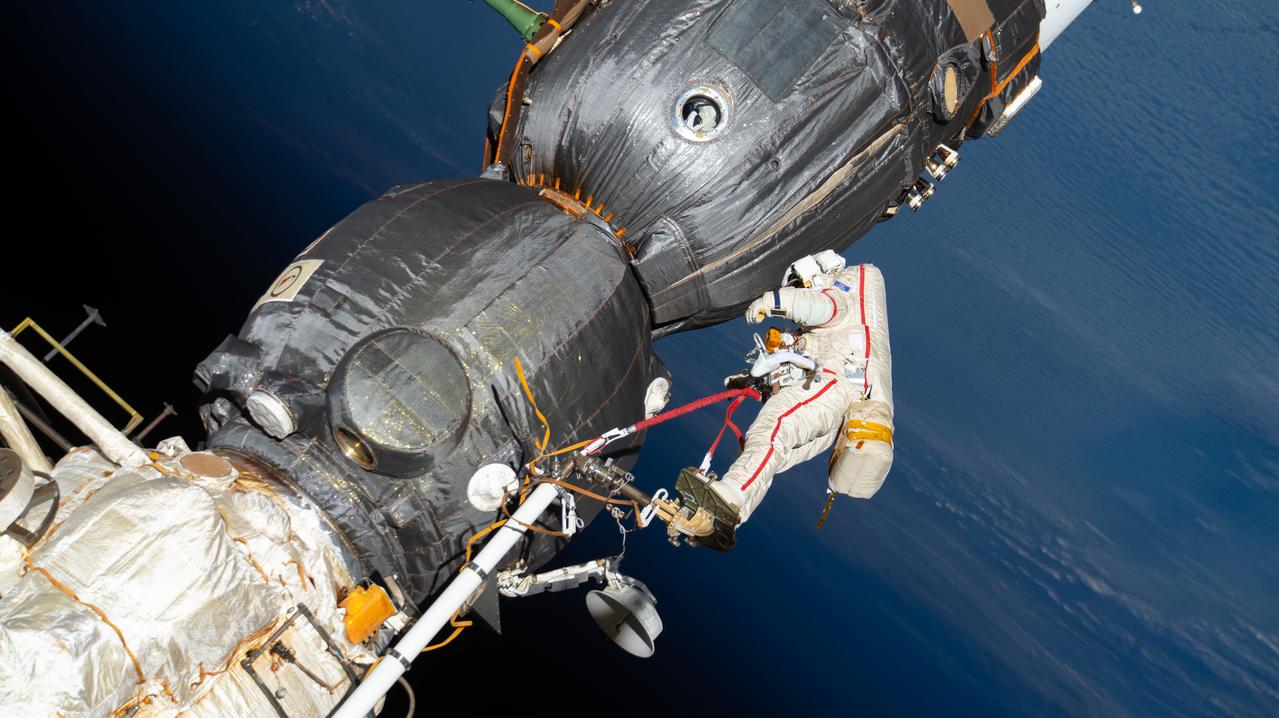
iss057e131661 (Dec. 11, 2018) --- Russian spacewalker Oleg Kononenko (suit with red stripes) works outside the International Space Station over 250 miles above Earth to inspect the Soyuz MS-09 spacecraft. During the spacewalk, he and fellow spacewalker Sergey Prokopyev (out of frame) examined the external hull of the Soyuz crew ship docked to the Rassvet module. The area corresponded with the location of a small hole inside the Soyuz habitation module that was found in August and caused a decrease in the space station’s pressure. The hole was fixed internally with a sealant within hours of its detection. During the spacewalk, Kononenko and Prokopyev collected samples of some of the sealant that extruded through hole to the outer hull before heading back inside the Pirs docking compartment and closing the hatch completing a seven-hour, 45-minute spacewalk.
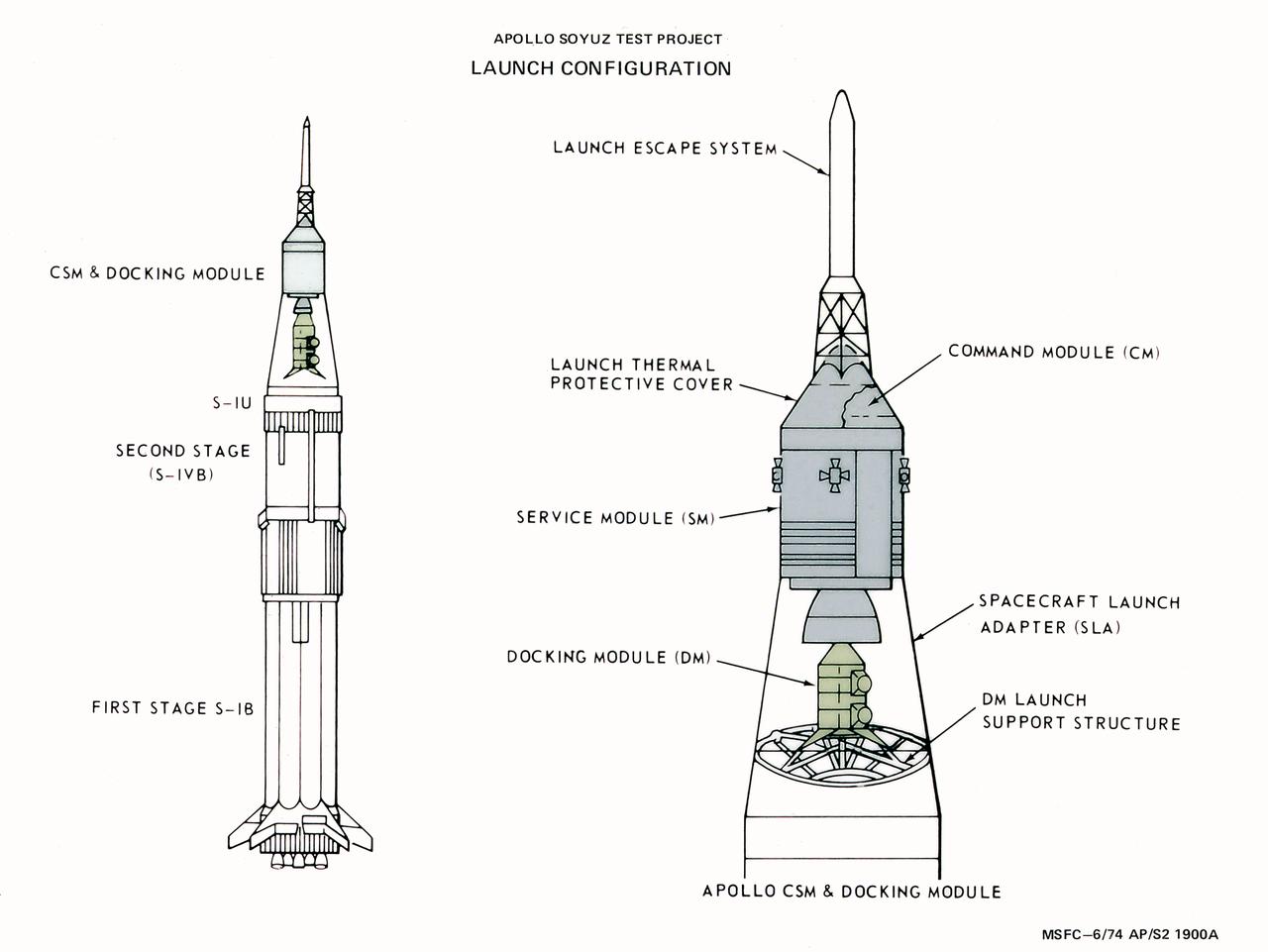
This illustration depicts the launch configuration of the Apollo spacecraft for the Apollo-Soyuz Test Project (ASTP). The ASTP was the first international docking of the U.S.'s Apollo spacecraft and the U.S.S.R.'s Soyuz spacecraft in space. A joint engineering team from the two countries met to develop a docking system that permitted the two spacecraft to link in space and allowed the two crews to travel from one spacecraft to the other. This system entailed developing a large habitable Docking Module (DM) to be carried on the Apollo spacecraft to facilitate the joining of two dissimilar spacecraft. The Marshall Space Flight Center was responsible for development and sustaining engineering of the Saturn IB launch vehicle during the mission.
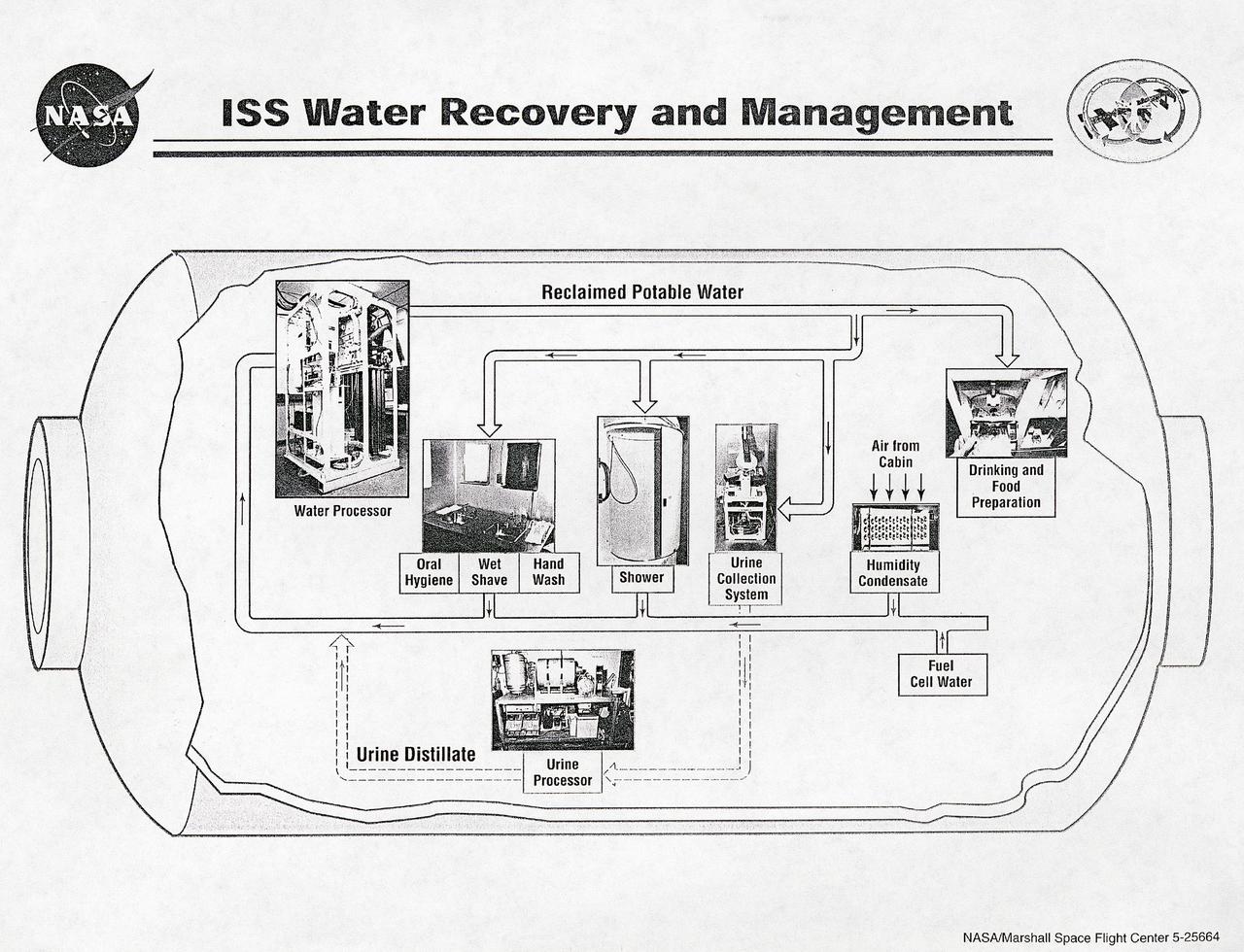
This diagram shows the flow of water recovery and management in the International Space Station (ISS). The Environmental Control and Life Support System (ECLSS) Group of the Flight Projects Directorate at the Marshall Space Flight Center is responsible for the regenerative ECLSS hardware, as well as providing technical support for the rest of the system. The regenerative ECLSS, whose main components are the Water Recovery System (WRS), and the Oxygen Generation System (OGS), reclaims and recycles water oxygen. The ECLSS maintains a pressurized habitation environment, provides water recovery and storage, maintains and provides fire detection/ suppression, and provides breathable air and a comfortable atmosphere in which to live and work within the ISS. The ECLSS hardware will be located in the Node 3 module of the ISS.
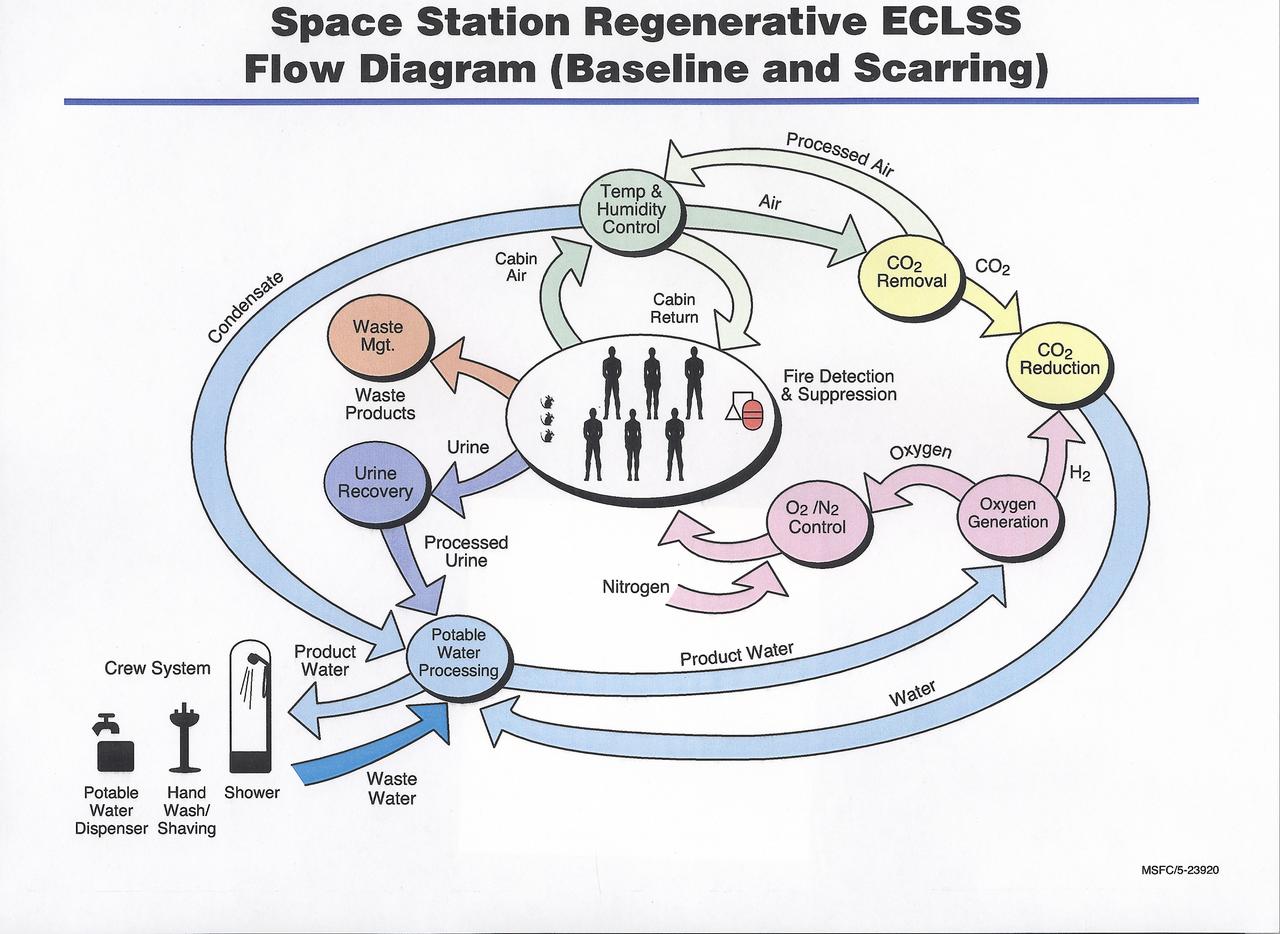
This diagram shows the flow of recyclable resources in the International Space Station (ISS). The Environmental Control and Life Support System (ECLSS) Group of the Flight Projects Directorate at the Marshall Space Flight Center is responsible for the regenerative ECLSS hardware, as well as providing technical support for the rest of the system. The regenerative ECLSS, whose main components are the Water Recovery System (WRS), and the Oxygen Generation System (OGS), reclaims and recycles water and oxygen. The ECLSS maintains a pressurized habitation environment, provides water recovery and storage, maintains and provides fire detection / suppression, and provides breathable air and a comfortable atmosphere in which to live and work within the ISS. The ECLSS hardware will be located in the Node 3 module of the ISS.
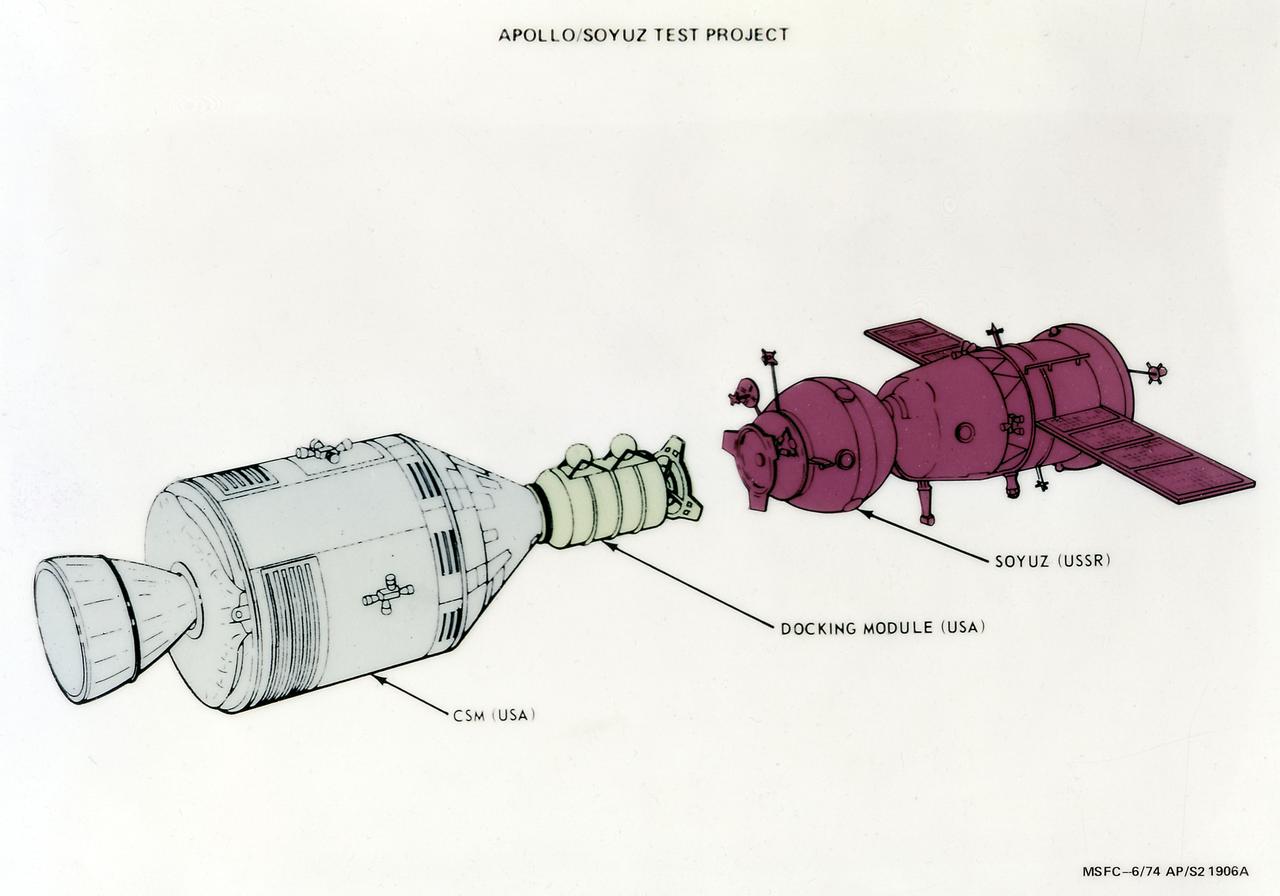
This illustration shows the docking configuration of the Apollo-Soyuz Test Project (ASTP). The ASTP was the first international docking of the U.S.'s Apollo spacecraft and the U.S.S.R.'s Soyuz spacecraft in space. A joint engineering team from the two countries met to develop a docking system that permitted the two spacecraft to link in space and allowed the two crews to travel from one spacecraft to the other. This system entailed developing a large habitable Docking Module (DM) to be carried on the Apollo spacecraft to facilitate the joining of two dissimilar spacecraft. The Marshall Space Flight Center was responsible for development and sustaining engineering of the Saturn IB launch vehicle during the mission. The ASTP marked the last use of the Saturn Launch Vehicle.
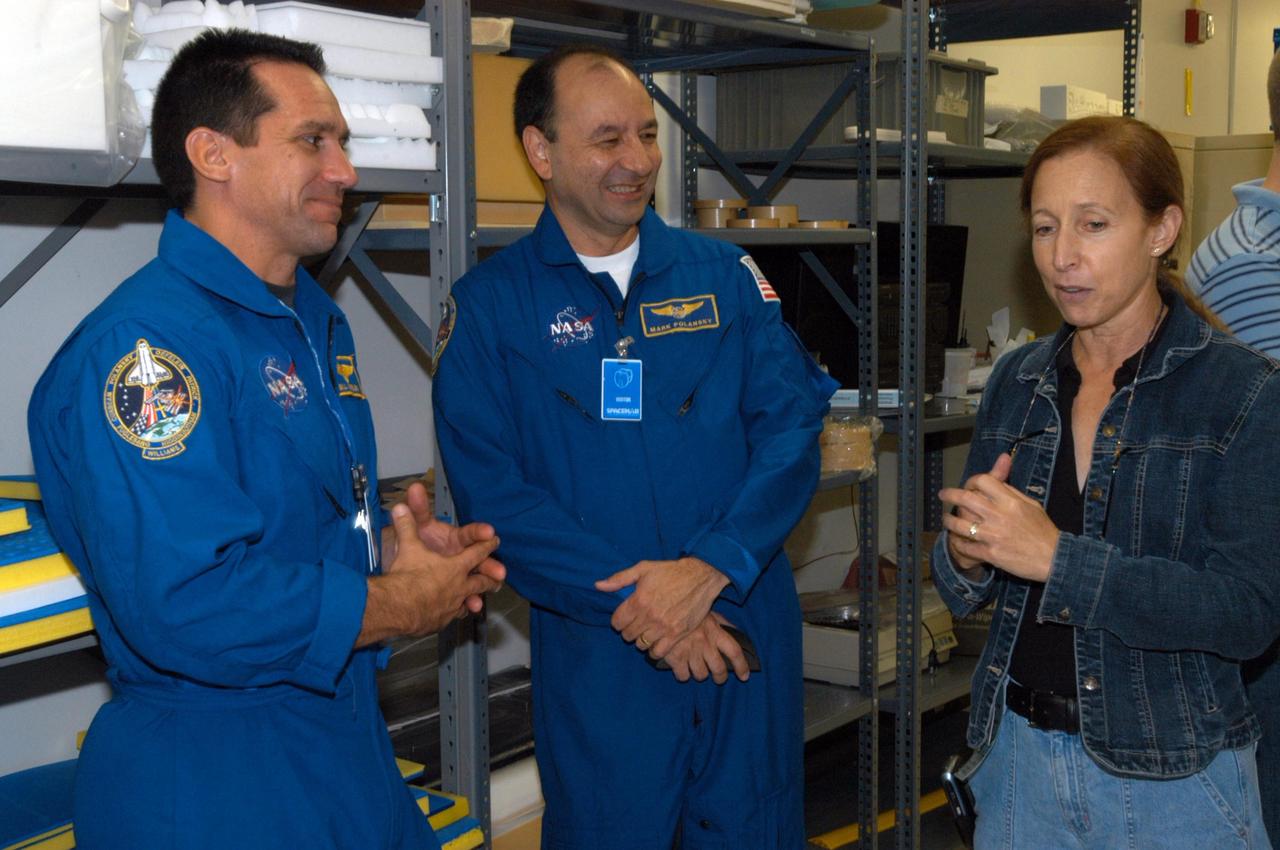
KENNEDY SPACE CENTER, FLA. - At SPACEHAB in Cape Canaveral, Fla., STS-116 Pilot William Oefelein and Commander Mark Polansky relax during equipment familiarization to talk to astronaut Marsha Ivins, who is currently assigned to the Astronaut Office, Space Station/Shuttle Branches for crew equipment, habitability and stowage. Mission crews make frequent trips to the Space Coast to become familiar with the equipment and payloads they will be using. STS-116 will be mission number 20 to the International Space Station and construction flight 12A.1. The mission payload is the SPACEHAB module, the P5 integrated truss structure and other key components. Launch is scheduled for no earlier than Dec. 7. Photo credit: NASA/George Shelton

KENNEDY SPACE CENTER, FLA. -- Pressurized Mating Adapter (PMA)-2 is moved into position to be mated to Node 1 of the International Space Station (ISS) by Boeing technicians in KSC's Space Station Processing Facility (SSPF). The node is the first element of the ISS to be manufactured in the United States and is currently scheduled to lift off aboard the Space Shuttle Endeavour on STS-88 later this year, along with PMAs 1 and 2. This PMA is a cone-shaped connector to Node 1, which will have two PMAs attached once this mate is completed. Once in space, Node 1 will function as a connecting passageway to the living and working areas of the ISS. It has six hatches that will serve as docking ports to the U.S. laboratory module, U.S. habitation module, an airlock and other space station elements

KENNEDY SPACE CENTER, FLA. - Inside the SPACEHAB module in Cape Canaveral, Fla., STS-116 Mission Specialist Sunita Williams (right) gets information from astronaut Marsha Ivins, who is currently assigned to the Astronaut Office, Space Station/Shuttle Branches for crew equipment, habitability and stowage, during equipment familiarization. Mission crews make frequent trips to the Space Coast to become familiar with the equipment and payloads they will be using. STS-116 will be mission number 20 to the International Space Station and construction flight 12A.1. The mission payload is the SPACEHAB module, the P5 integrated truss structure and other key components. Launch is scheduled for no earlier than Dec. 7. Photo credit: NASA/George Shelton
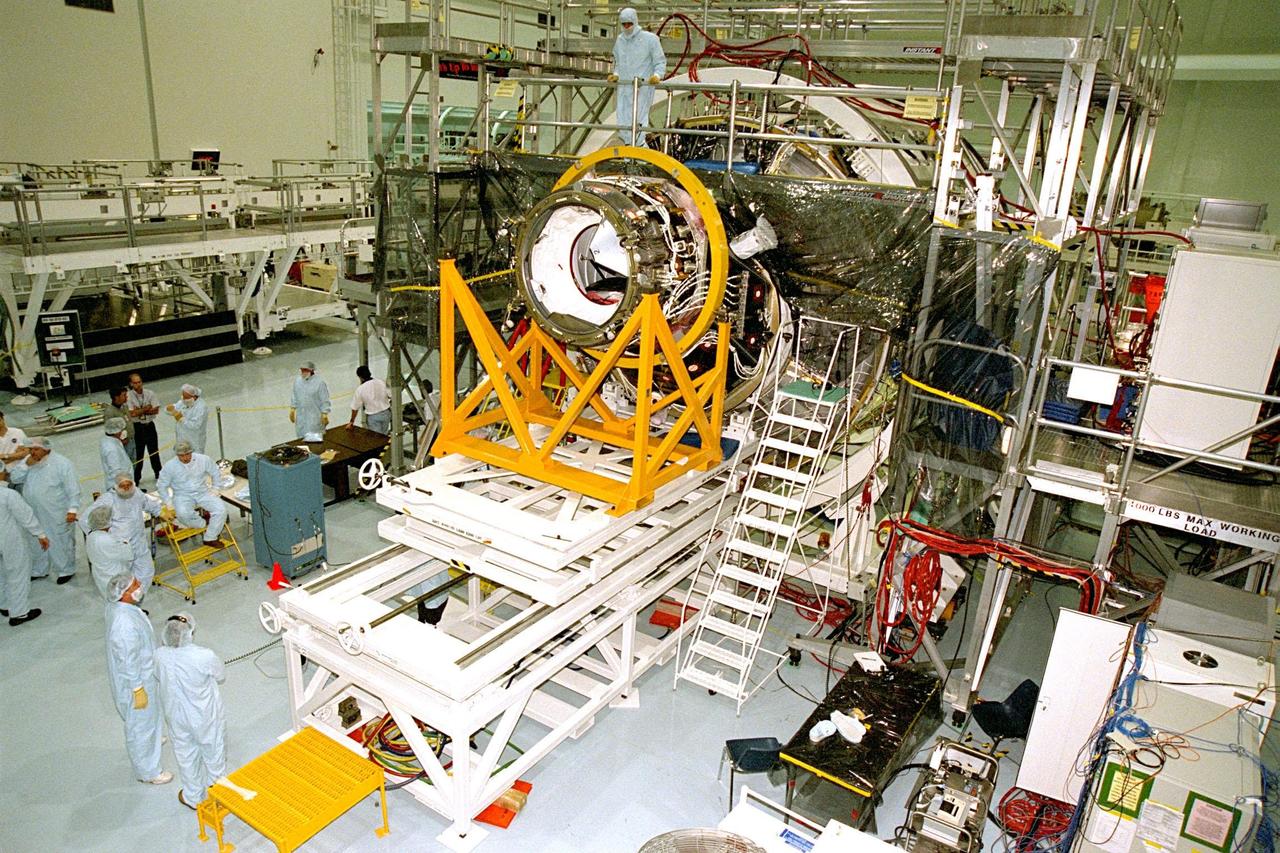
Pressurized Mating Adapter (PMA)-2 is in the process of being mated to Node 1 of the International Space Station (ISS) under the supervision of Boeing technicians in KSC's Space Station Processing Facility (SSPF). The node is the first element of the ISS to be manufactured in the United States and is currently scheduled to lift off aboard the Space Shuttle Endeavour on STS-88 later this year, along with PMAs 1 and 2. This PMA is a cone-shaped connector to Node 1, which will have two PMAs attached once this mate is completed. Once in space, Node 1 will function as a connecting passageway to the living and working areas of the ISS. It has six hatches that will serve as docking ports to the U.S. laboratory module, U.S. habitation module, an airlock and other space station elements
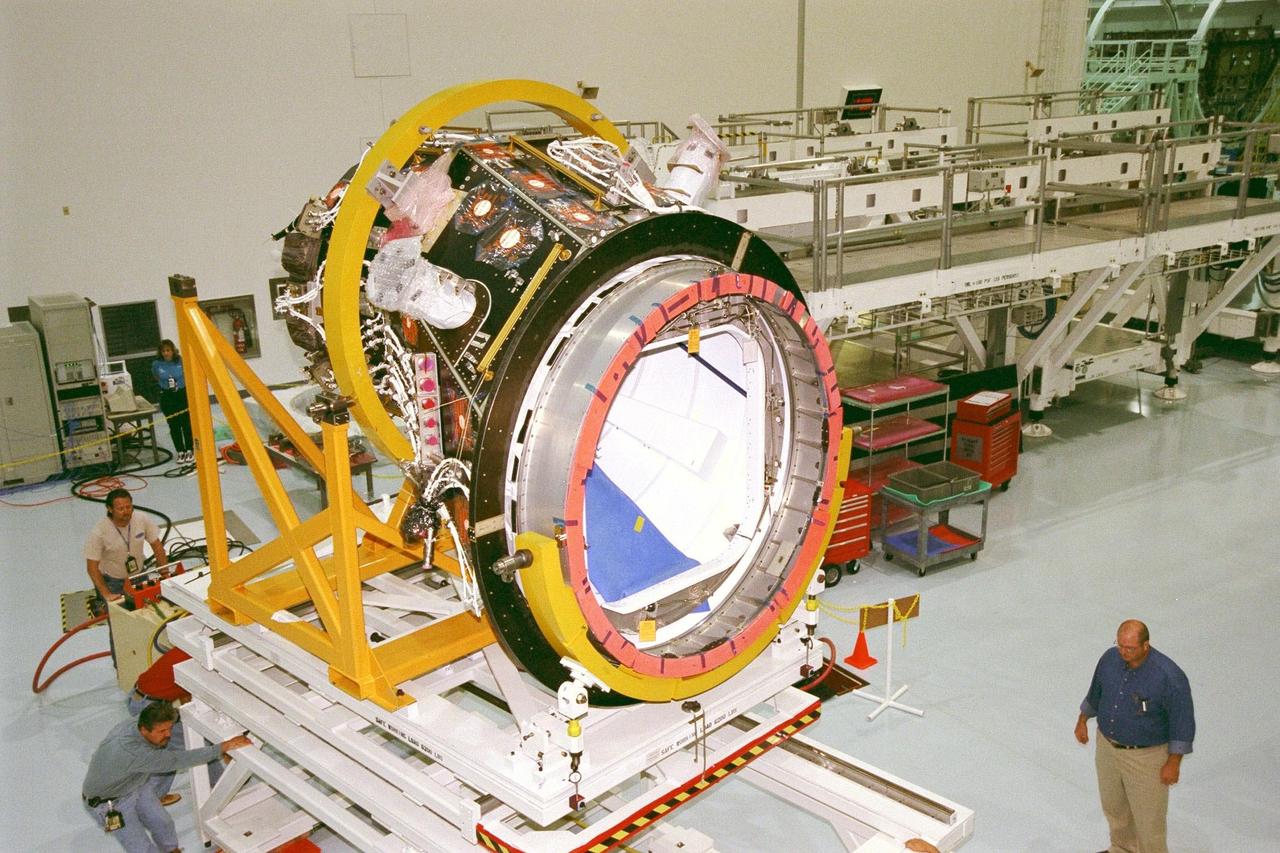
KENNEDY SPACE CENTER, FLA. -- Pressurized Mating Adapter (PMA)-2 is moved toward Node 1 of the International Space Station (ISS) in KSC's Space Station Processing Facility for pre-mating preparations. The node is the first element of the ISS to be manufactured in the United States and is currently scheduled to lift off aboard the Space Shuttle Endeavour on STS-88 later this year, along with PMAs 1 and 2. This PMA is a cone-shaped connector to Node 1, which will have two PMAs attached once this mate is completed. Once in space, Node 1 will function as a connecting passageway to the living and working areas of the ISS. It has six hatches that will serve as docking ports to the U.S. laboratory module, U.S. habitation module, an airlock and other space station elements
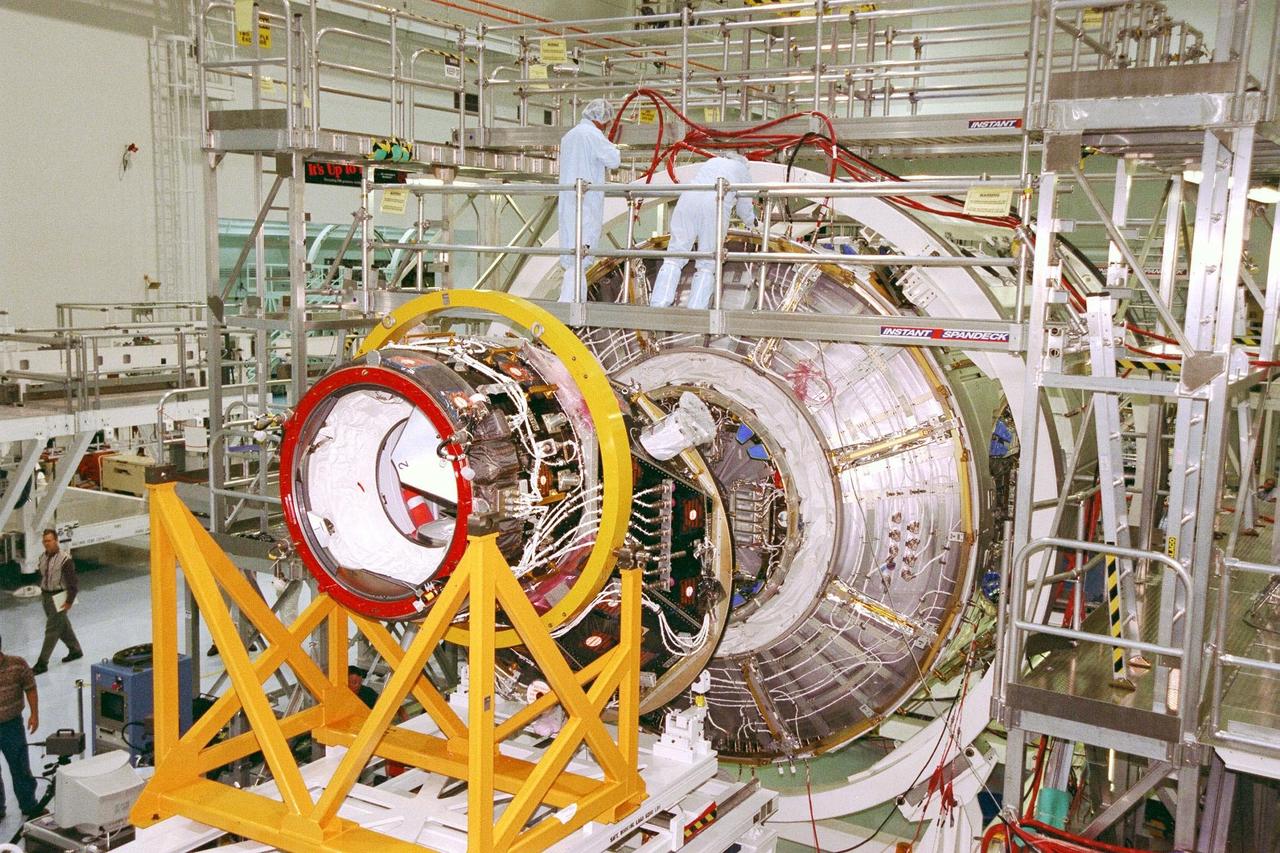
KENNEDY SPACE CENTER, FLA. -- Pressurized Mating Adapter (PMA)-2 is moved into position against Node 1 of the International Space Station (ISS) in KSC's Space Station Processing Facility for pre-mating preparations. The node is the first element of the ISS to be manufactured in the United States and is currently scheduled to lift off aboard the Space Shuttle Endeavour on STS-88 later this year, along with PMAs 1 and 2. This PMA is a cone-shaped connector to Node 1, which will have two PMAs attached once this mate is completed. Once in space, Node 1 will function as a connecting passageway to the living and working areas of the ISS. It has six hatches that will serve as docking ports to the U.S. laboratory module, U.S. habitation module, an airlock and other space station elements
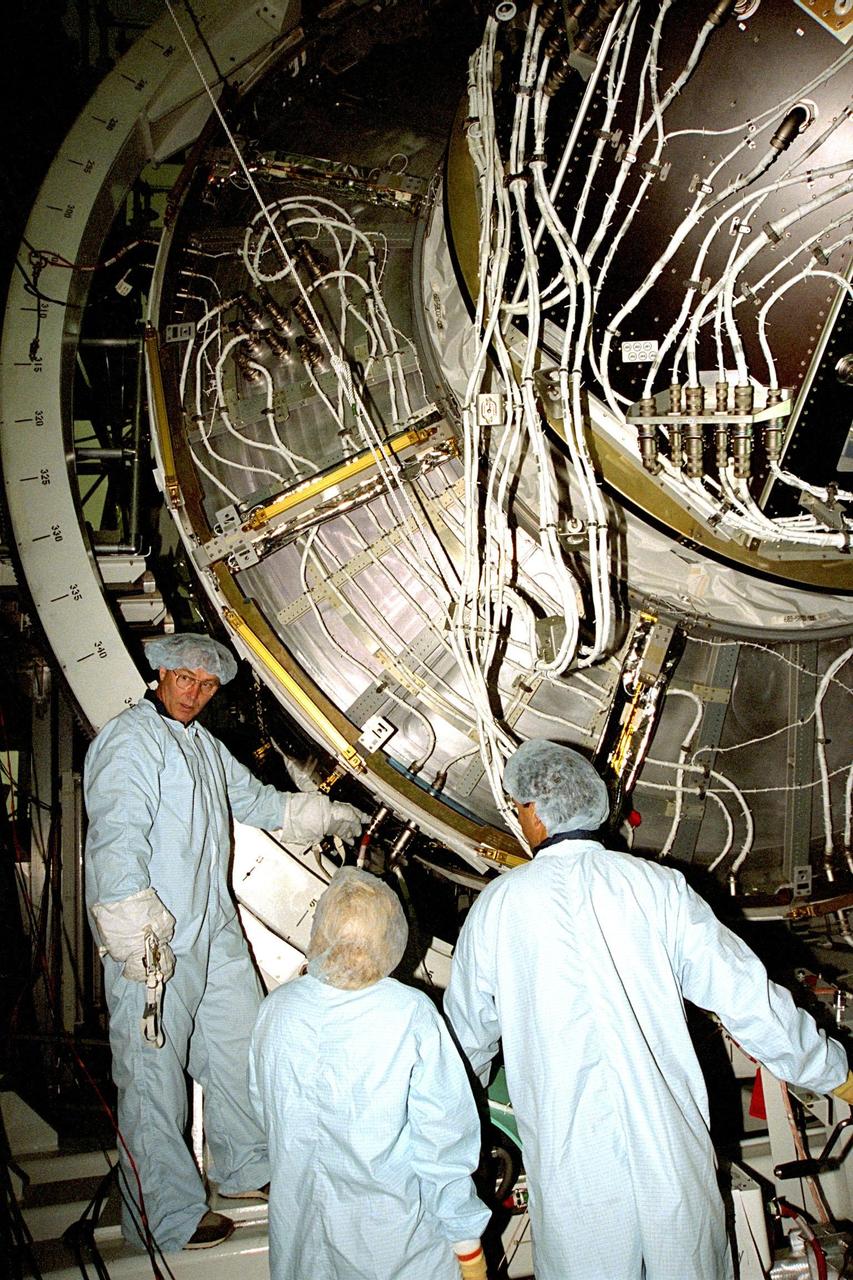
Boeing technicians discuss mating Pressurized Mating Adapter (PMA)-2 to Node 1 of the International Space Station (ISS) in KSC's Space Station Processing Facility (SSPF). The node is the first element of the ISS to be manufactured in the United States and is currently scheduled to lift off aboard the Space Shuttle Endeavour on STS-88 later this year, along with PMAs 1 and 2. This PMA is a cone-shaped connector to Node 1, which will have two PMAs attached once this mate is completed. Once in space, Node 1 will function as a connecting passageway to the living and working areas of the ISS. It has six hatches that will serve as docking ports to the U.S. laboratory module, U.S. habitation module, an airlock and other space station elements
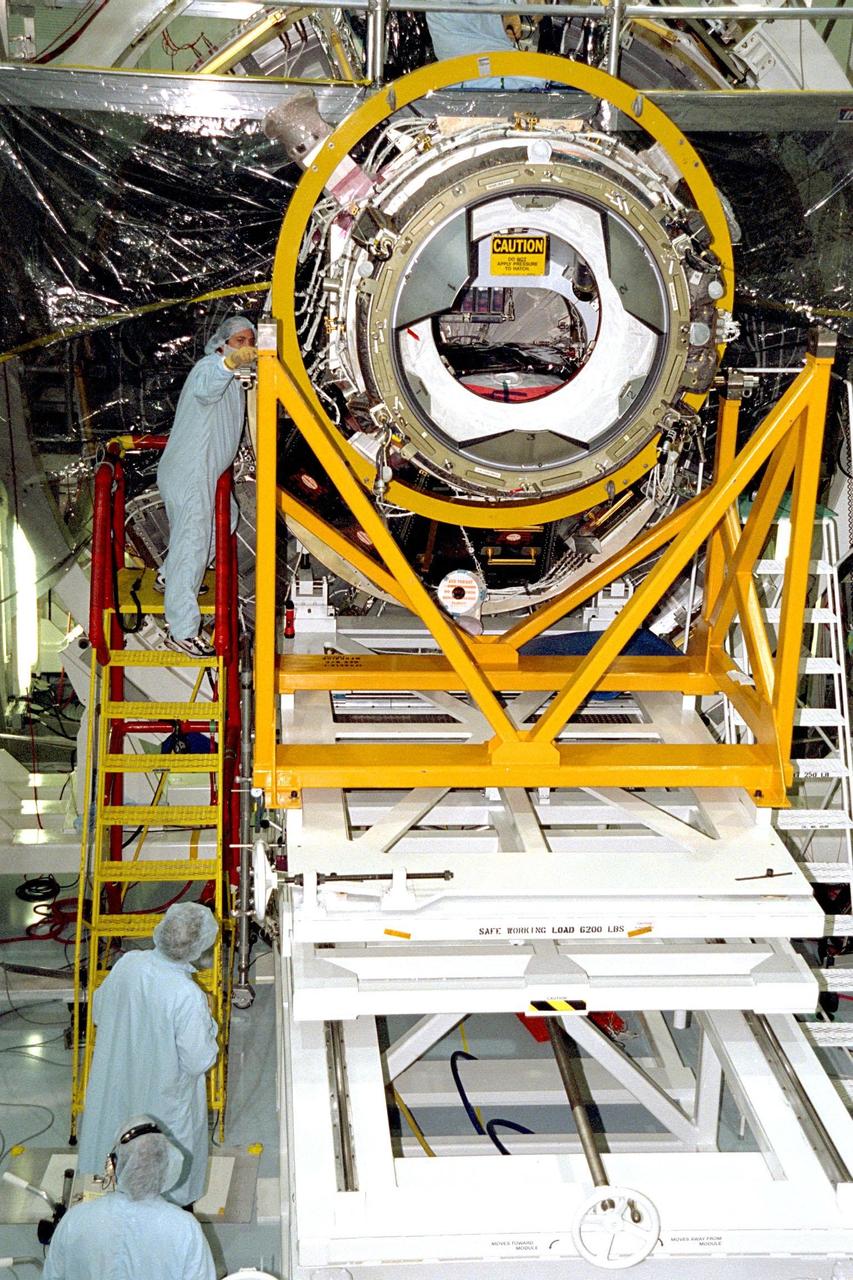
Pressurized Mating Adapter (PMA)-2 is moved into position to be mated to Node 1 of the International Space Station (ISS) by Boeing technicians in KSC's Space Station Processing Facility (SSPF). The node is the first element of the ISS to be manufactured in the United States and is currently scheduled to lift off aboard the Space Shuttle Endeavour on STS-88 later this year, along with PMAs 1 and 2. This PMA is a cone-shaped connector to Node 1, which will have two PMAs attached once this mate is completed. Once in space, Node 1 will function as a connecting passageway to the living and working areas of the ISS. It has six hatches that will serve as docking ports to the U.S. laboratory module, U.S. habitation module, an airlock and other space station elements
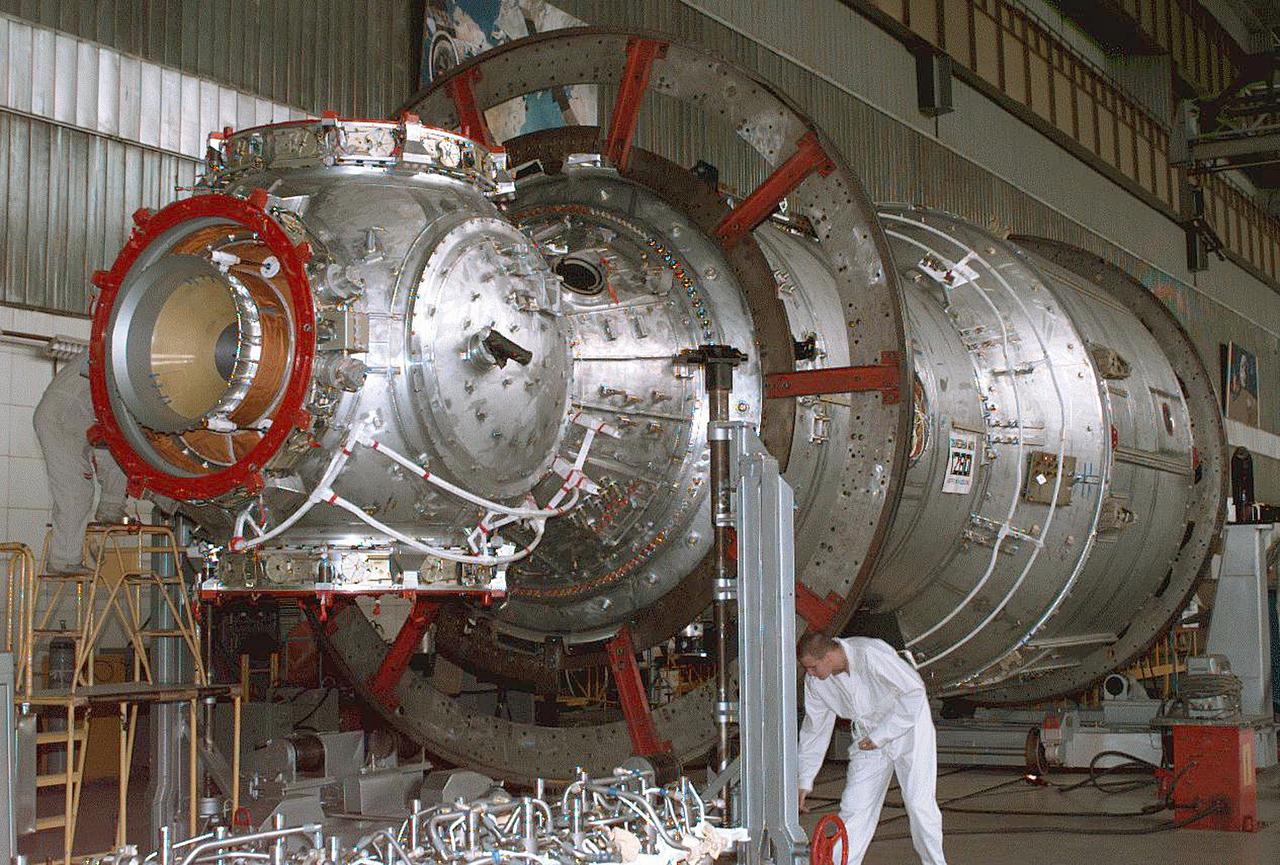
The Zvezda Service Module, the first Russian contribution and third element to the International Space Station (ISS), is shown under construction in the Krunichev State Research and Production Facility (KhSC) in Moscow. Russian technicians work on the module shortly after it completed a pressurization test. In the foreground is the forward portion of the module, including the spherical transfer compartment and its three docking ports. The forward port docked with the cornected Functional Cargo Block, followed by Node 1. Launched via a three-stage Proton rocket on July 12, 2000, the Zvezda Service Module serves as the cornerstone for early human habitation of the Station, providing living quarters, life support system, electrical power distribution, data processing system, flight control system, and propulsion system. It also provides a communications system that includes remote command capabilities from ground flight controllers. The 42,000-pound module measures 43 feet in length and has a wing span of 98 feet. Similar in layout to the core module of Russia's Mir space station, it contains 3 pressurized compartments and 13 windows that allow ultimate viewing of Earth and space.
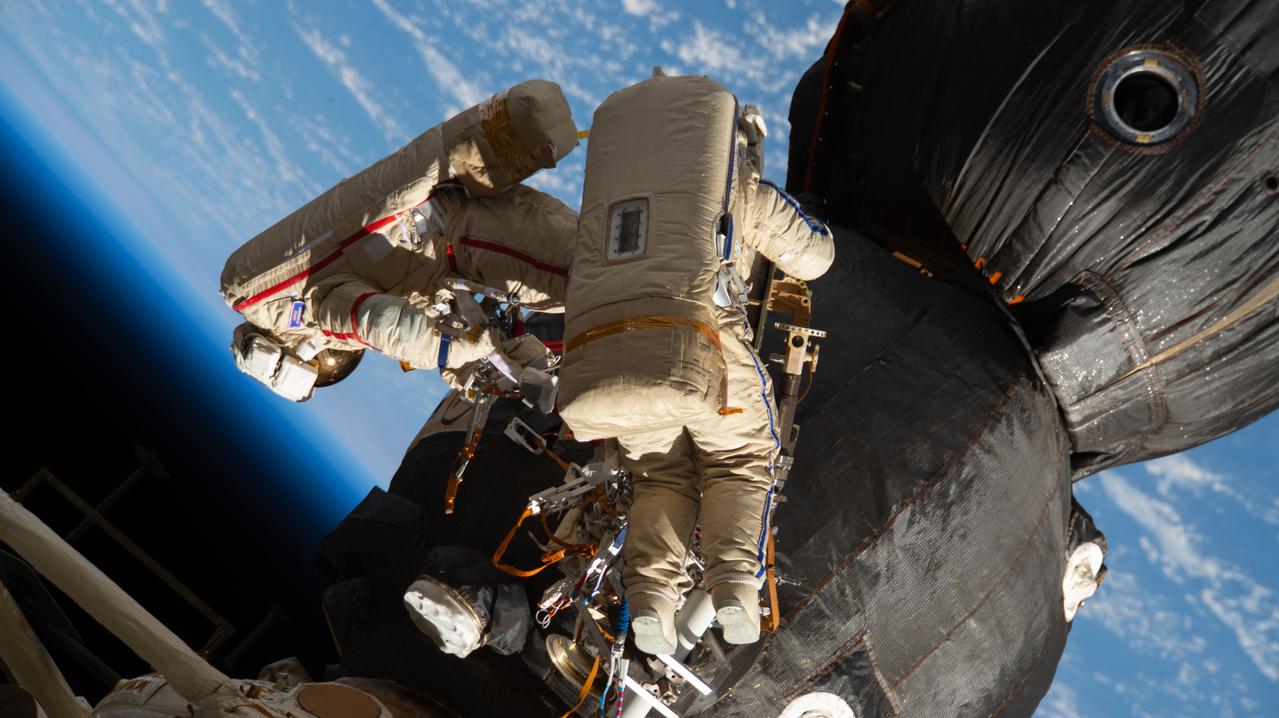
iss057e131663 (Dec. 11, 2018) --- Russian spacewalkers Oleg Kononenko (suit with red stripes) and Sergey Prokopyev (suit with blue stripes) work outside the International Space Station over 250 miles above Earth to inspect the Soyuz MS-09 spacecraft. During the spacewalk, the two examined the external hull of the Soyuz crew ship docked to the Rassvet module, took images and applied a thermal blanket. They also retrieved science experiments before heading back inside the Pirs docking compartment and closing the hatch completing a seven-hour, 45-minute spacewalk.the duo examined the external hull of the Soyuz crew ship docked to the Rassvet module. The area corresponded with the location of a small hole inside the Soyuz habitation module that was found in August and caused a decrease in the space station’s pressure. The hole was fixed internally with a sealant within hours of its detection. During the spacewalk, Kononenko and Prokopyev collected samples of some of the sealant that extruded through hole to the outer hull before heading back inside the Pirs docking compartment and closing the hatch completing a seven-hour, 45-minute spacewalk.
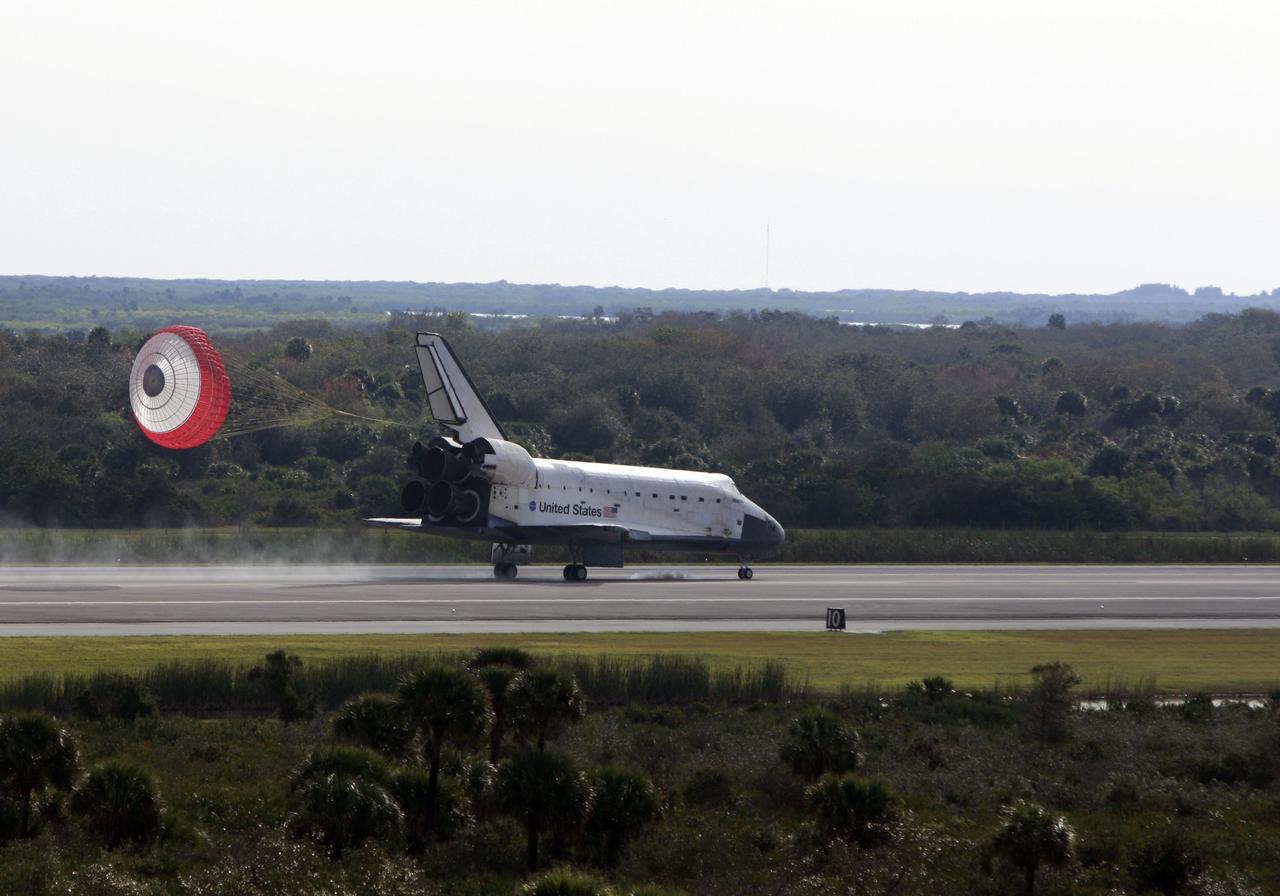
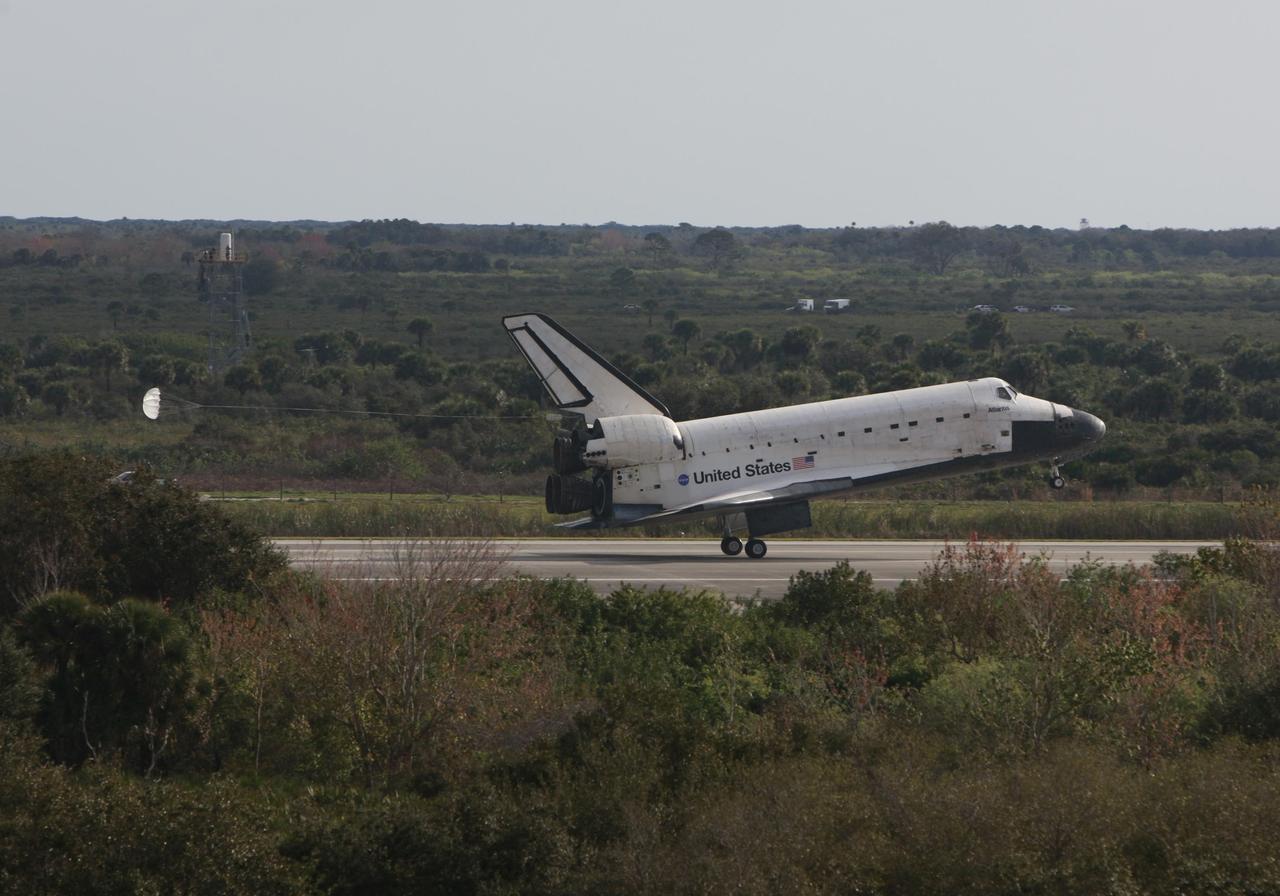
KENNEDY SPACE CENTER, FLA. -- With the aid of a drag chute, space shuttle Atlantis slows down after landing on Runway 15 of the Shuttle Landing Facility at NASA's Kennedy Space Center after a nearly 5.3 million mile round trip to the International Space Station. The shuttle landed on orbit 202 to complete the 13-day STS-122 mission. Main gear touchdown was 9:07:10 a.m. Nose gear touchdown was 9:07:20 a.m. Wheel stop was at 9:08:08 a.m. Mission elapsed time was 12 days, 18 hours, 21 minutes and 44 seconds. During the mission, Atlantis' crew installed the new Columbus laboratory, leaving a larger space station and one with increased science capabilities. The Columbus Research Module adds nearly 1,000 cubic feet of habitable volume and affords room for 10 experiment racks, each an independent science lab. Photo courtesy of Scott Andrews
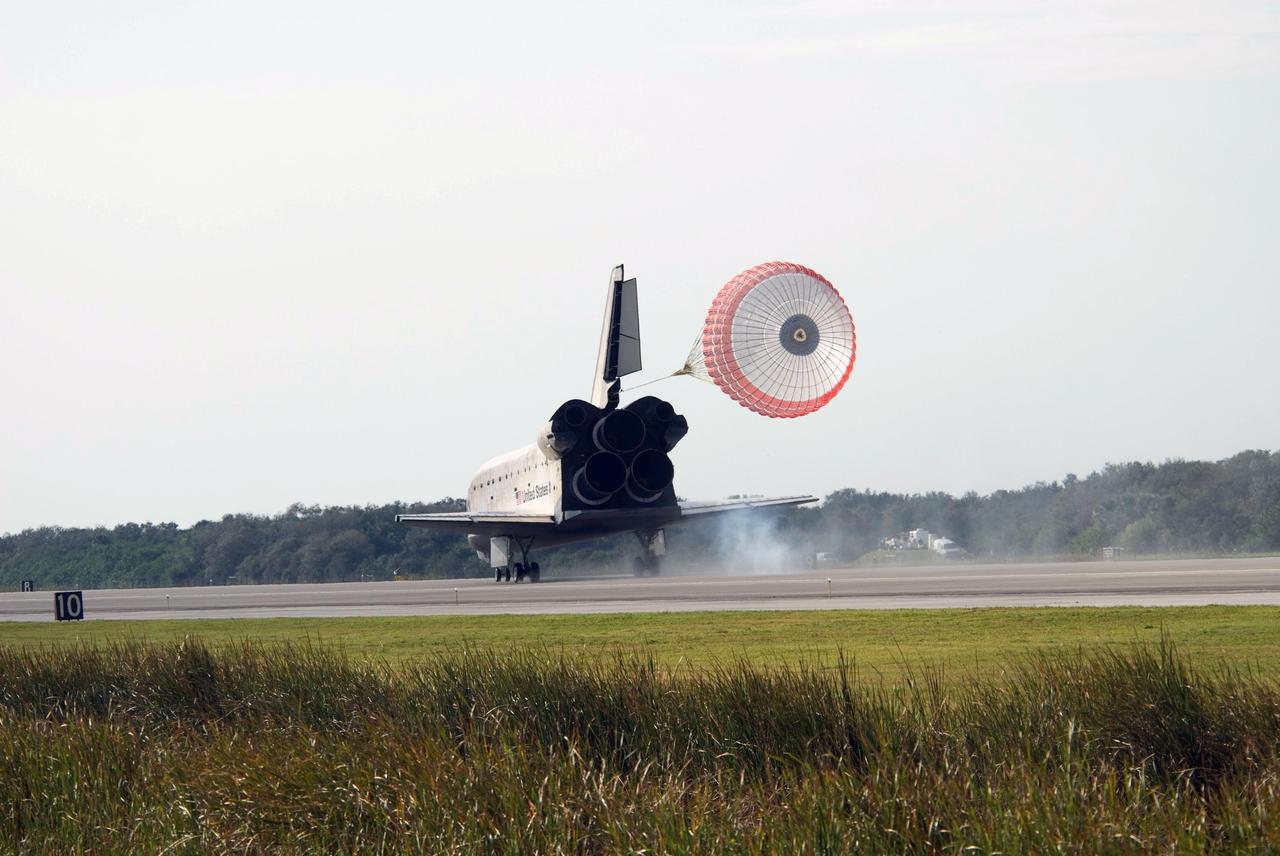
KENNEDY SPACE CENTER, FLA. -- A drag chute continues the slowdown of space shuttle Atlantis as it lands on Runway 15 of the Shuttle Landing Facility at NASA's Kennedy Space Center after a nearly 5.3 million mile round trip to the International Space Station. The shuttle landed on orbit 202 to complete the 13-day STS-122 mission. Main gear touchdown was 9:07:10 a.m. Nose gear touchdown was 9:07:20 a.m. Wheel stop was at 9:08:08 a.m. Mission elapsed time was 12 days, 18 hours, 21 minutes and 44 seconds. During the mission, Atlantis' crew installed the new Columbus laboratory, leaving a larger space station and one with increased science capabilities. The Columbus Research Module adds nearly 1,000 cubic feet of habitable volume and affords room for 10 experiment racks, each an independent science lab. Photo credit: NASA/Kevin O'Connell
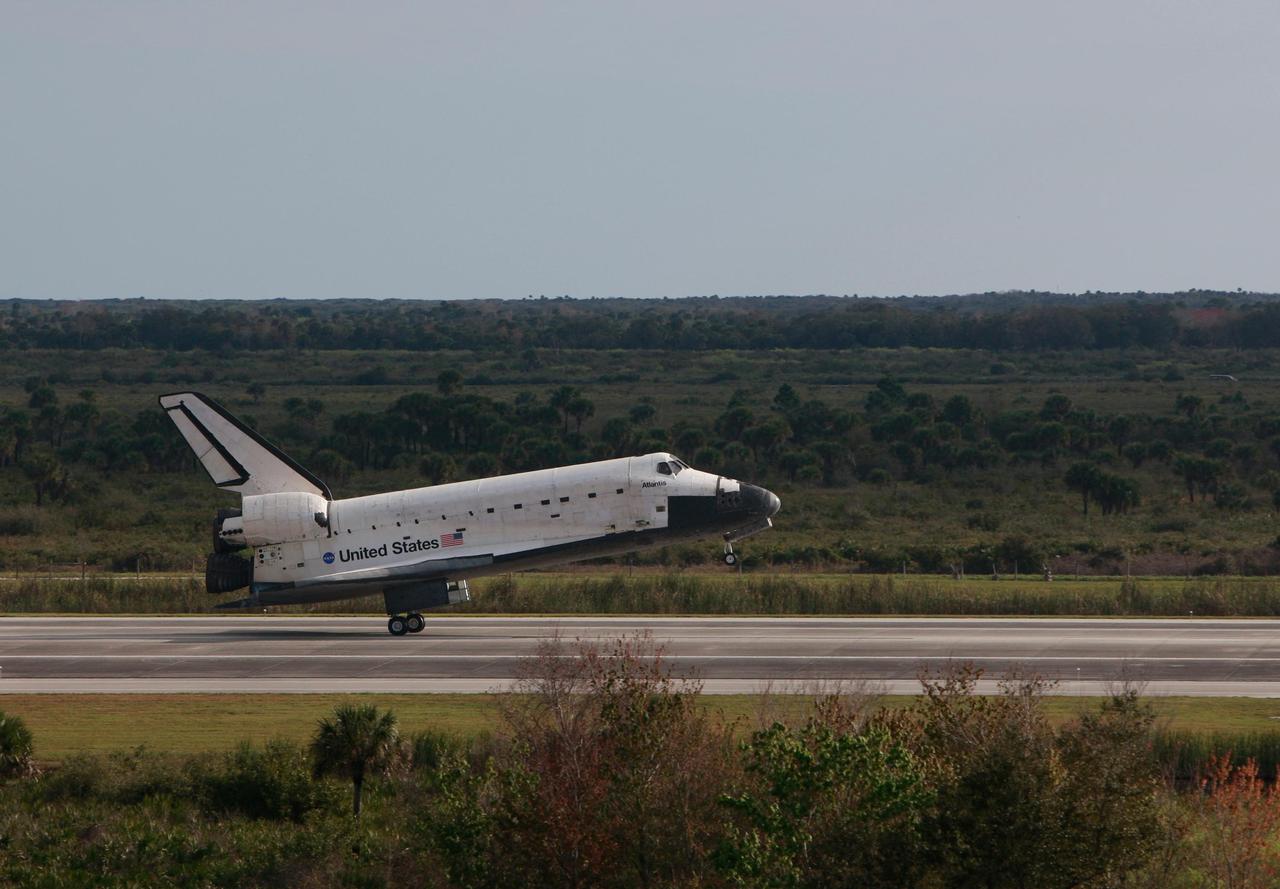
KENNEDY SPACE CENTER, FLA. -- Space shuttle Atlantis touches down on Runway 15 of the Shuttle Landing Facility at NASA's Kennedy Space Center after a nearly 5.3 million mile round trip to the International Space Station. The shuttle landed on orbit 202 to complete the 13-day STS-122 mission. Main gear touchdown was 9:07:10 a.m. Nose gear touchdown was 9:07:20 a.m. Wheel stop was at 9:08:08 a.m. Mission elapsed time was 12 days, 18 hours, 21 minutes and 44 seconds. During the mission, Atlantis' crew installed the new Columbus laboratory, leaving a larger space station and one with increased science capabilities. The Columbus Research Module adds nearly 1,000 cubic feet of habitable volume and affords room for 10 experiment racks, each an independent science lab. Photo courtesy of Scott Andrews
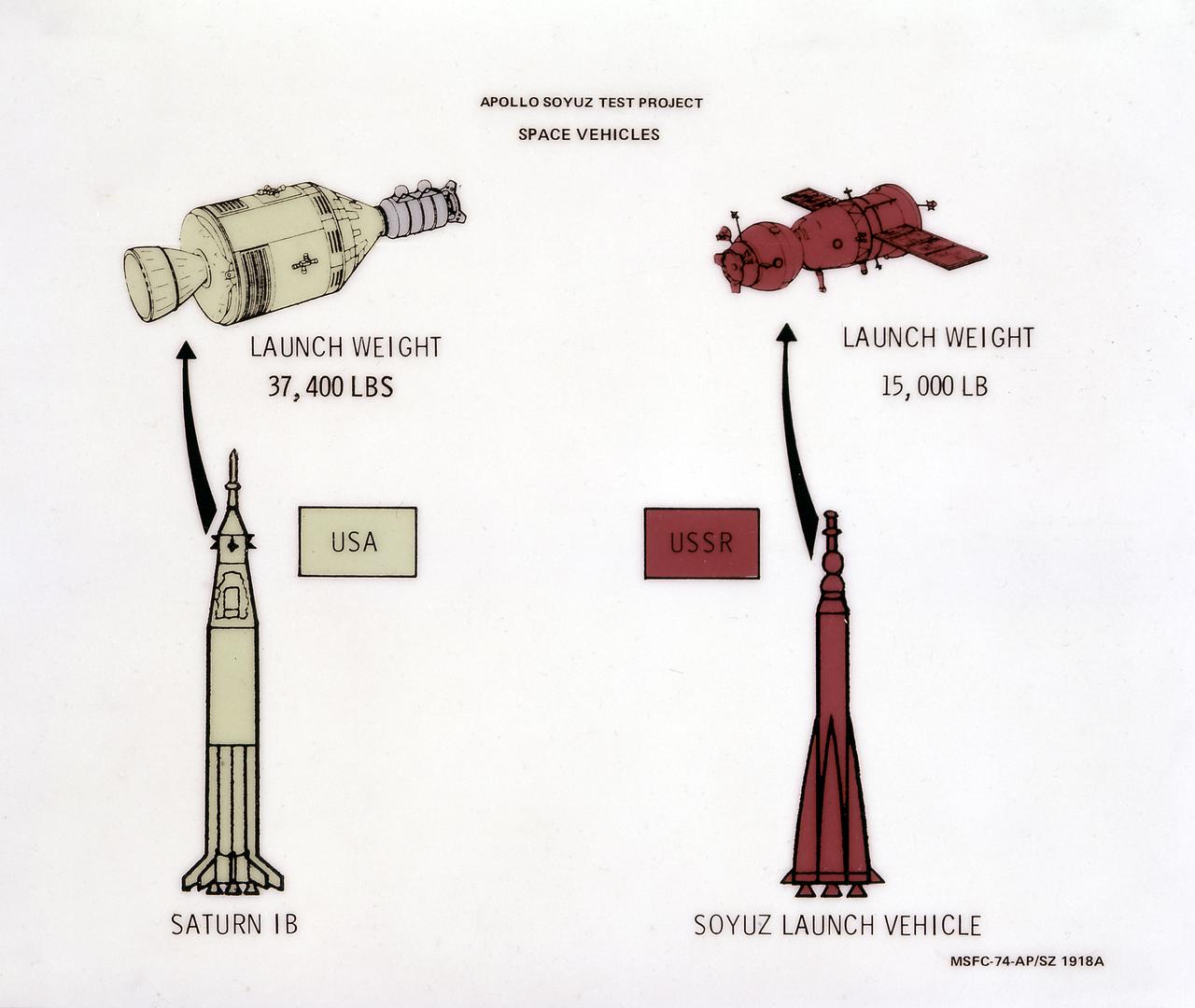
This illustration depicts a comparison of two space vehicles, the U.S.'s Saturn IB launch vehicle and the U.S.S.R.'s Soyuz launch vehicle, for the Apollo-Soyuz Test Project. The ASTP was the first international docking of the U.S.'s Apollo spacecraft and the U.S.S.R.'s Soyuz spacecraft in space. A joint engineering team from the two countries met to develop a docking system that permitted the two spacecraft to link in space and allowed the two crews to travel from one spacecraft to the other. This system entailed developing a large habitable Docking Module (DM) to be carried on the Apollo spacecraft to facilitate the joining of two dissimilar spacecraft. The Marshall Space Flight Center was responsible for development and sustaining engineering of the Saturn IB launch vehicle during the mission.
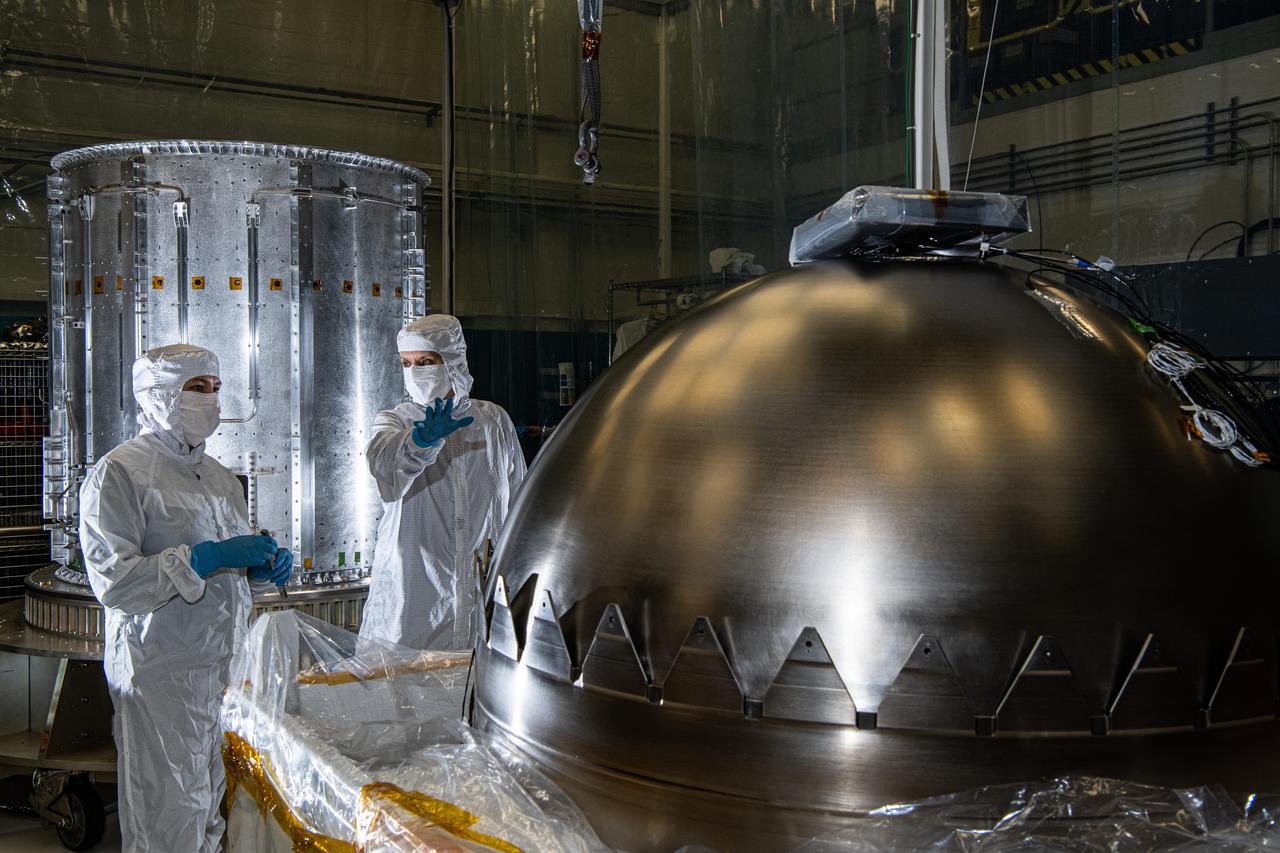
Contamination control engineers in a clean room at NASA's Goddard Space Flight Center in Greenbelt, Maryland, evaluate a propellant tank before it is installed in NASA's Europa Clipper spacecraft. The tank is one of two that will be used to hold the spacecraft's propellant. It will be inserted into the cylinder seen at left in the background, one of two cylinders that make up the propulsion module. With an internal global ocean under a thick layer of ice, Jupiter's moon Europa may have the potential to harbor existing life. Europa Clipper will swoop around Jupiter on an elliptical path, dipping close to the moon on each flyby to collect data. Understanding Europa's habitability will help scientists better understand how life developed on Earth and the potential for finding life beyond our planet. Europa Clipper is set to launch in 2024. https://photojournal.jpl.nasa.gov/catalog/PIA24478
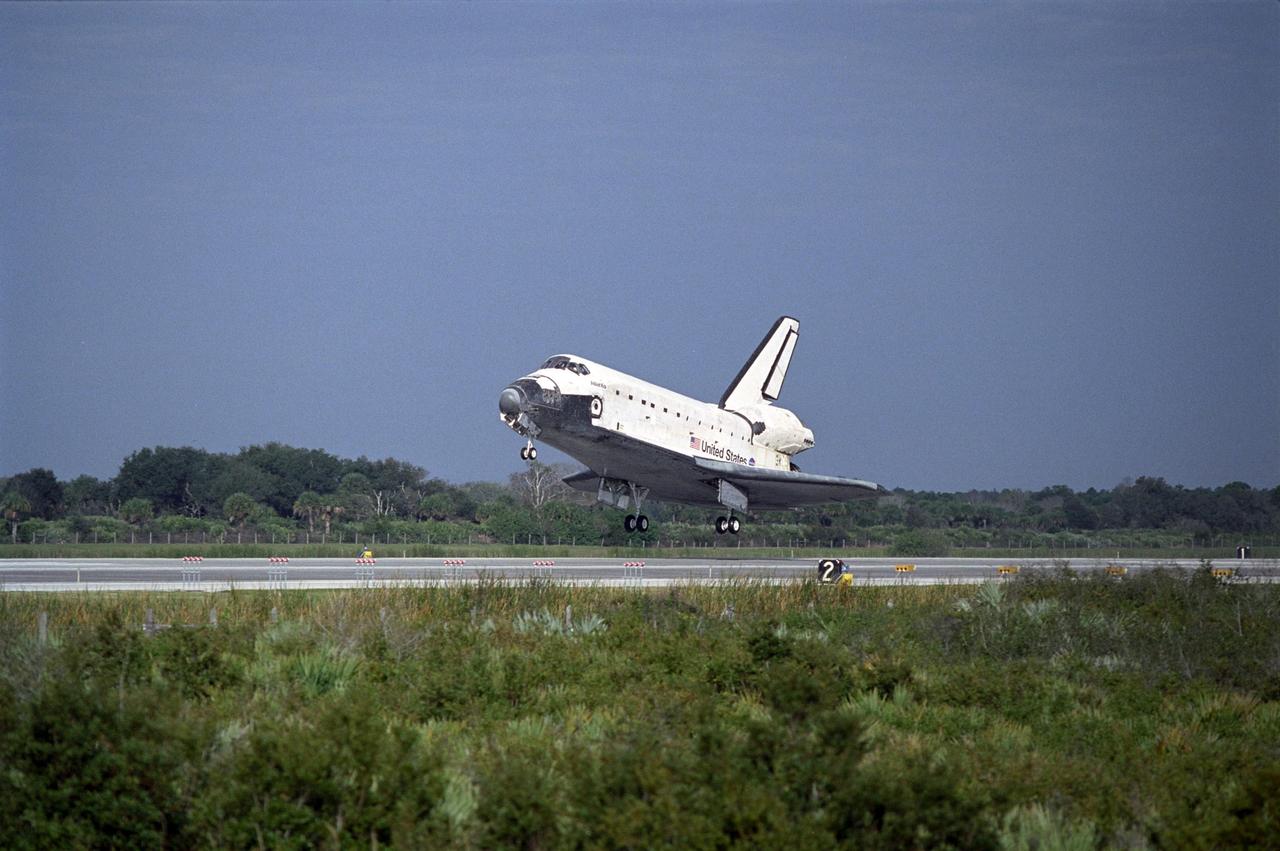
KENNEDY SPACE CENTER, FLA. -- After a nearly 5.3 million mile round trip to the International Space Station, space shuttle Atlantis touches down on Runway 15 of the Shuttle Landing Facility at NASA's Kennedy Space Center. The shuttle landed on orbit 202 to complete the 13-day STS-122 mission. Main gear touchdown was 9:07:10 a.m. Nose gear touchdown was 9:07:20 a.m. Wheel stop was at 9:08:08 a.m. Mission elapsed time was 12 days, 18 hours, 21 minutes and 44 seconds. During the mission, Atlantis' crew installed the new Columbus laboratory, leaving a larger space station and one with increased science capabilities. The Columbus Research Module adds nearly 1,000 cubic feet of habitable volume and affords room for 10 experiment racks, each an independent science lab. Photo credit: NASA/Tony Gray

Engineers at the Johns Hopkins Applied Physics Laboratory (APL) in Laurel, Maryland, inspect the propulsion module of NASA's Europa Clipper spacecraft. In 2022, this major piece of hardware, designed and built at APL, will ship to NASA's Jet Propulsion Laboratory in Southern California for assembly, test, and launch operations (ATLO). With an internal global ocean under a thick layer of ice, Jupiter's moon Europa may have the potential to harbor existing life. The Europa Clipper spacecraft will swoop around Jupiter on an elliptical path, dipping close to the moon on each flyby to collect data. Understanding Europa's habitability will help scientists better understand how life developed on Earth and the potential for finding life beyond our planet. Europa Clipper is set to launch in 2024. https://photojournal.jpl.nasa.gov/catalog/PIA24783
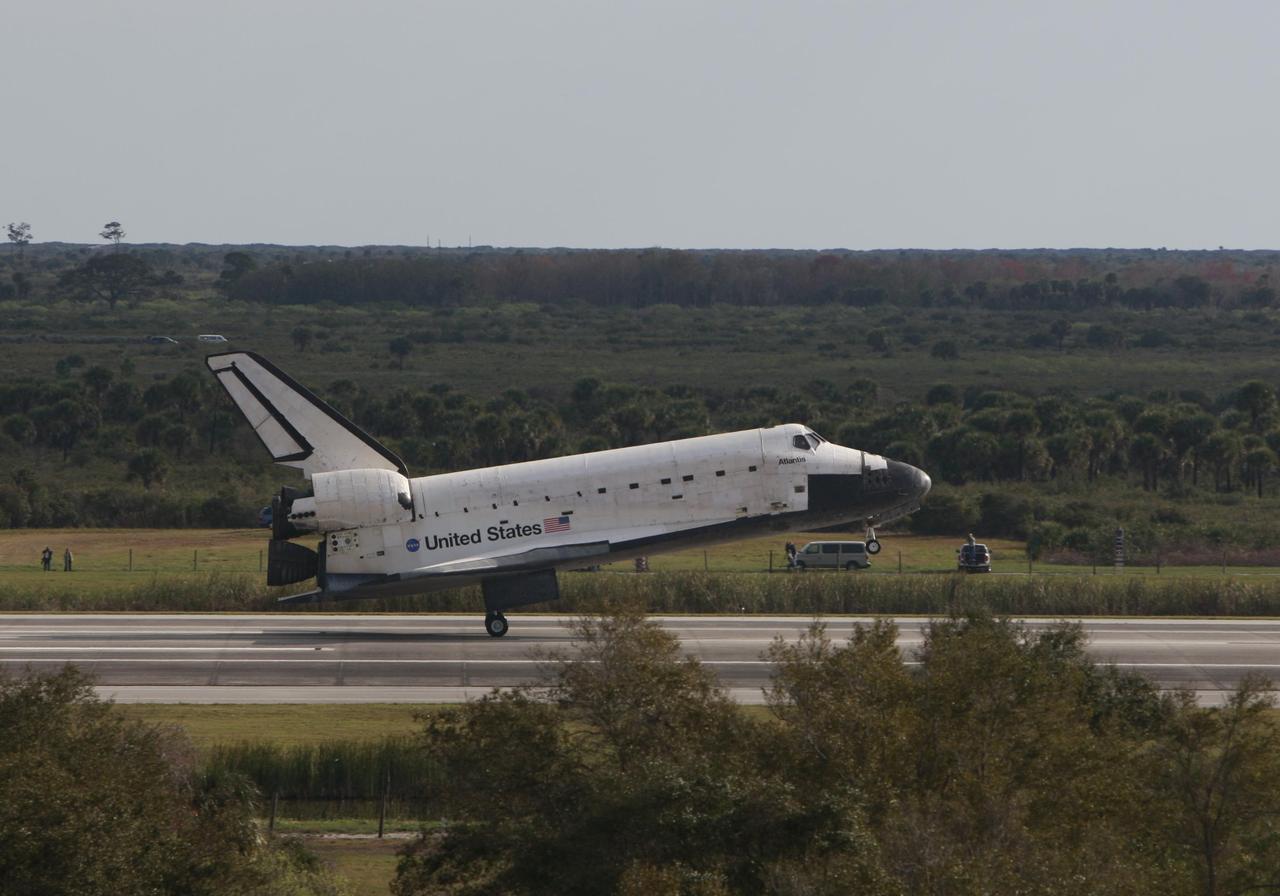
KENNEDY SPACE CENTER, FLA. -- Space shuttle Atlantis touches down on Runway 15 of the Shuttle Landing Facility at NASA's Kennedy Space Center after a nearly 5.3 million mile round trip to the International Space Station. The shuttle landed on orbit 202 to complete the 13-day STS-122 mission. Main gear touchdown was 9:07:10 a.m. Nose gear touchdown was 9:07:20 a.m. Wheel stop was at 9:08:08 a.m. Mission elapsed time was 12 days, 18 hours, 21 minutes and 44 seconds. During the mission, Atlantis' crew installed the new Columbus laboratory, leaving a larger space station and one with increased science capabilities. The Columbus Research Module adds nearly 1,000 cubic feet of habitable volume and affords room for 10 experiment racks, each an independent science lab. Photo courtesy of Scott Andrews
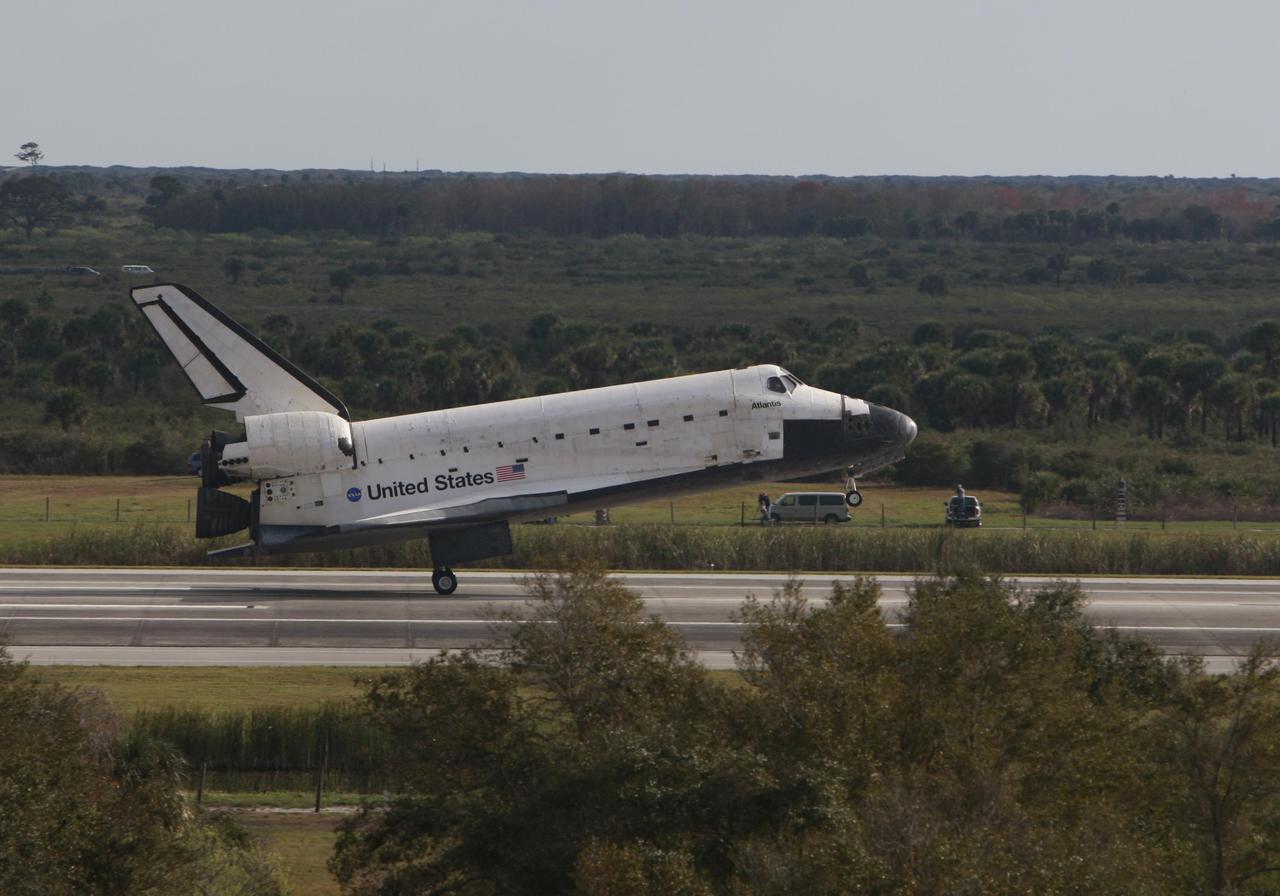
KENNEDY SPACE CENTER, FLA. -- Space shuttle Atlantis touches down on Runway 15 of the Shuttle Landing Facility at NASA's Kennedy Space Center after a nearly 5.3 million mile round trip to the International Space Station. The shuttle landed on orbit 202 to complete the 13-day STS-122 mission. Main gear touchdown was 9:07:10 a.m. Nose gear touchdown was 9:07:20 a.m. Wheel stop was at 9:08:08 a.m. Mission elapsed time was 12 days, 18 hours, 21 minutes and 44 seconds. During the mission, Atlantis' crew installed the new Columbus laboratory, leaving a larger space station and one with increased science capabilities. The Columbus Research Module adds nearly 1,000 cubic feet of habitable volume and affords room for 10 experiment racks, each an independent science lab. Photo courtesy of Scott Andrews

KENNEDY SPACE CENTER, FLA. -- With wheels down, space shuttle Atlantis approaches a landing on Runway 15 of the Shuttle Landing Facility at NASA's Kennedy Space Center after a nearly 5.3 million mile round trip to the International Space Station. The shuttle landed on orbit 202 to complete the 13-day STS-122 mission. Main gear touchdown was 9:07:10 a.m. Nose gear touchdown was 9:07:20 a.m. Wheel stop was at 9:08:08 a.m. Mission elapsed time was 12 days, 18 hours, 21 minutes and 44 seconds. During the mission, Atlantis' crew installed the new Columbus laboratory, leaving a larger space station and one with increased science capabilities. The Columbus Research Module adds nearly 1,000 cubic feet of habitable volume and affords room for 10 experiment racks, each an independent science lab. Photo courtesy of Chuck Luzier
KENNEDY SPACE CENTER, FLA. -- Space shuttle Atlantis touches down on Runway 15 of the Shuttle Landing Facility at NASA's Kennedy Space Center after a nearly 5.3 million mile round trip to the International Space Station. The shuttle landed on orbit 202 to complete the 13-day STS-122 mission. Main gear touchdown was 9:07:10 a.m. Nose gear touchdown was 9:07:20 a.m. Wheel stop was at 9:08:08 a.m. Mission elapsed time was 12 days, 18 hours, 21 minutes and 44 seconds. During the mission, Atlantis' crew installed the new Columbus laboratory, leaving a larger space station and one with increased science capabilities. The Columbus Research Module adds nearly 1,000 cubic feet of habitable volume and affords room for 10 experiment racks, each an independent science lab. Photo courtesy of Scott Andrews
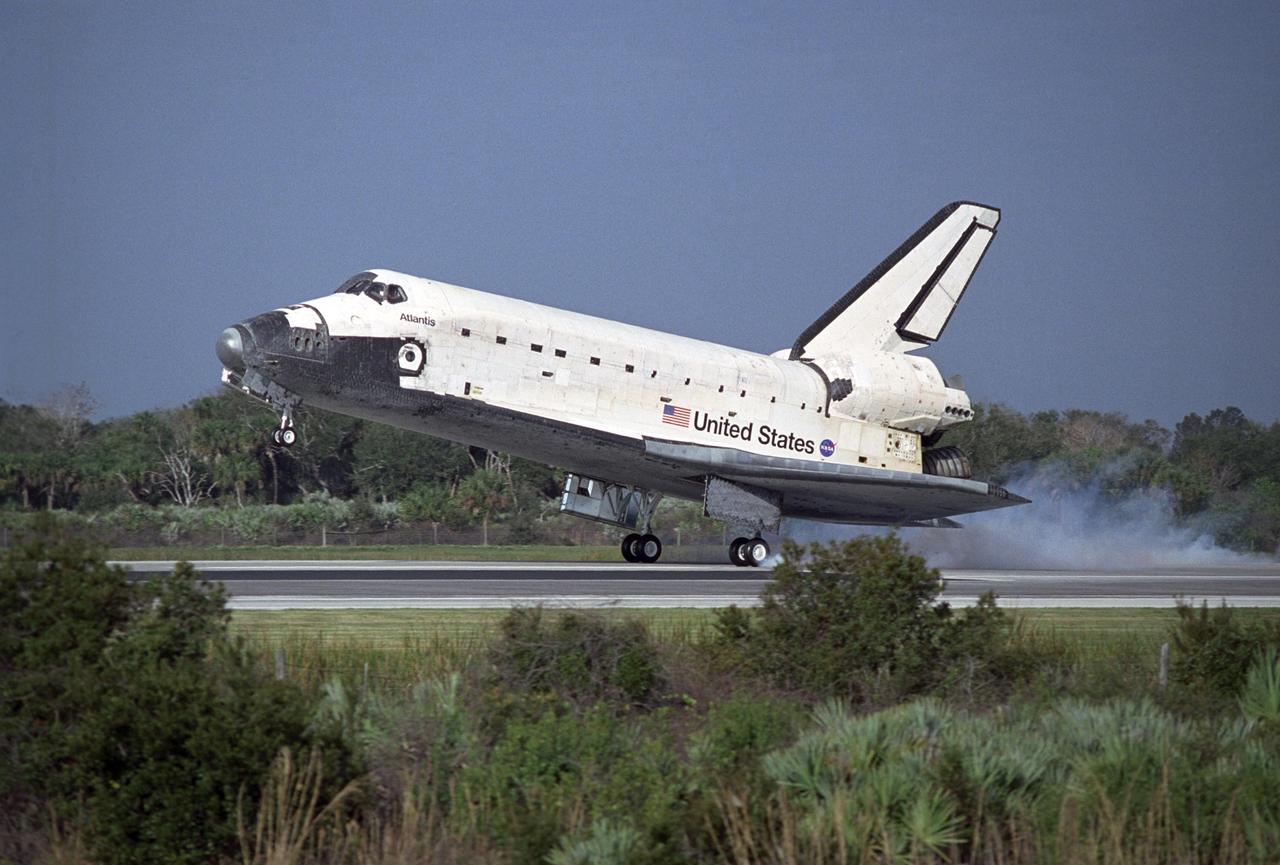
KENNEDY SPACE CENTER, FLA. -- After a nearly 5.3 million mile round trip to the International Space Station, space shuttle Atlantis kicks up dust as it touches down on Runway 15 of the Shuttle Landing Facility at NASA's Kennedy Space Center. The shuttle landed on orbit 202 to complete the 13-day STS-122 mission. Main gear touchdown was 9:07:10 a.m. Nose gear touchdown was 9:07:20 a.m. Wheel stop was at 9:08:08 a.m. Mission elapsed time was 12 days, 18 hours, 21 minutes and 44 seconds. During the mission, Atlantis' crew installed the new Columbus laboratory, leaving a larger space station and one with increased science capabilities. The Columbus Research Module adds nearly 1,000 cubic feet of habitable volume and affords room for 10 experiment racks, each an independent science lab. Photo credit: NASA/Tony Gray
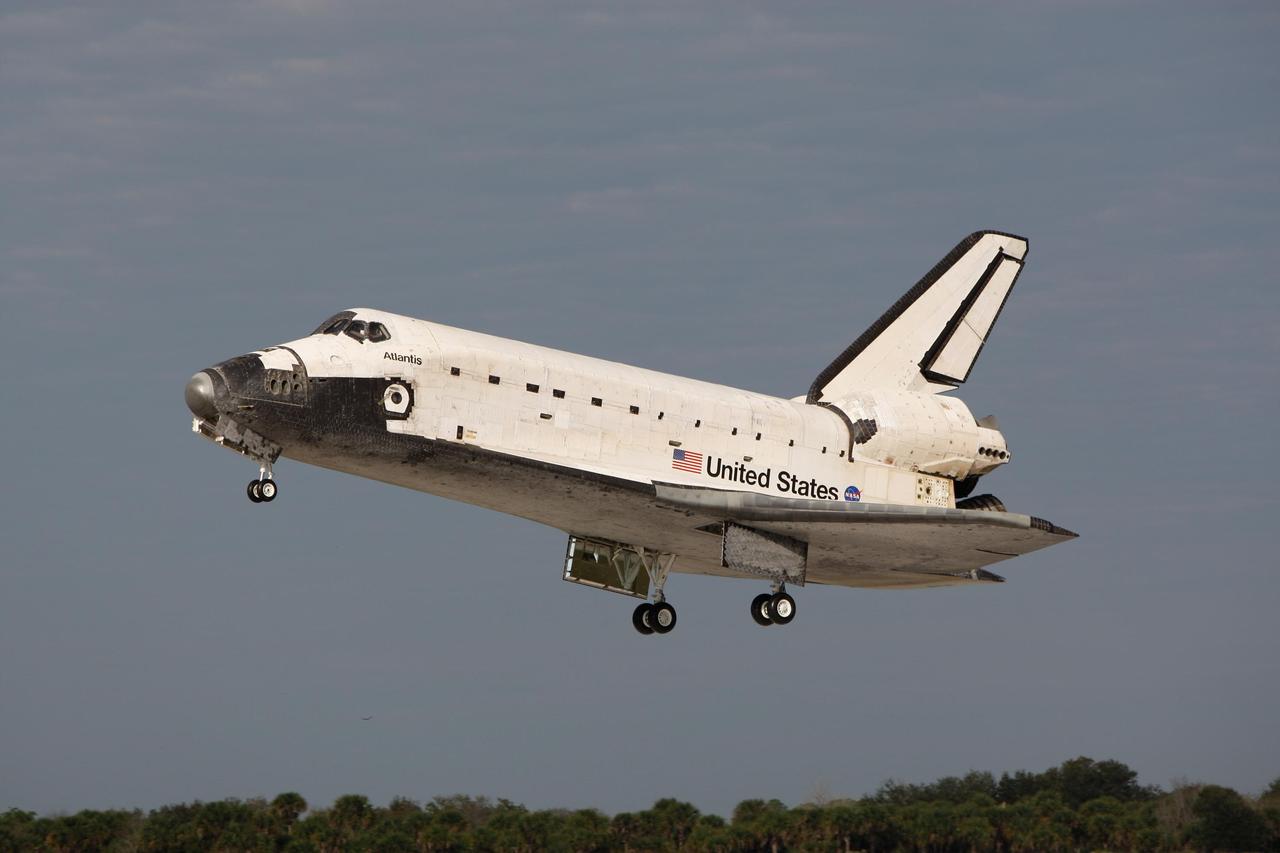
KENNEDY SPACE CENTER, FLA. -- With wheels down, space shuttle Atlantis approaches a landing on Runway 15 of the Shuttle Landing Facility at NASA's Kennedy Space Center after a nearly 5.3 million mile round trip to the International Space Station. The shuttle landed on orbit 202 to complete the 13-day STS-122 mission. Main gear touchdown was 9:07:10 a.m. Nose gear touchdown was 9:07:20 a.m. Wheel stop was at 9:08:08 a.m. Mission elapsed time was 12 days, 18 hours, 21 minutes and 44 seconds. During the mission, Atlantis' crew installed the new Columbus laboratory, leaving a larger space station and one with increased science capabilities. The Columbus Research Module adds nearly 1,000 cubic feet of habitable volume and affords room for 10 experiment racks, each an independent science lab. Photo courtesy of Chuck Luzier
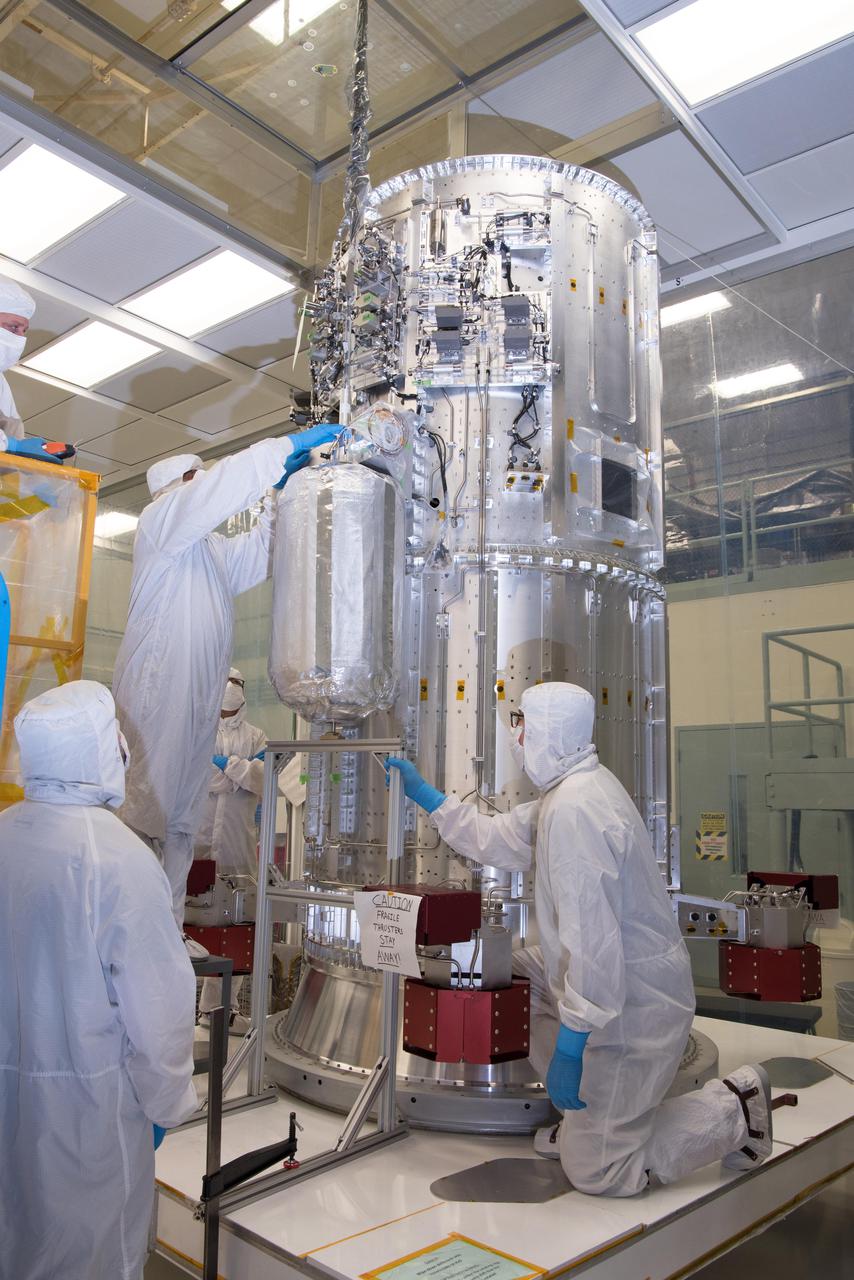
Engineers and technicians in a clean room at NASA's Goddard Space Flight Center in Greenbelt, Maryland, integrate the tanks that will contain helium onto the propulsion module of NASA's Europa Clipper spacecraft. The 10-foot-tall (3-meter-tall) propulsion module was also integrated with 16 rocket engines at Goddard. The module then was shipped to the Johns Hopkins Applied Physics Laboratory (APL) in Laurel, Maryland, where engineers will install electronics, radios, antennas, and cabling. In 2022, this major piece of hardware will ship to NASA's Jet Propulsion Laboratory in Southern California for assembly, test, and launch operations. With an internal global ocean under a thick layer of ice, Jupiter's moon Europa may have the potential to harbor existing life. The Europa Clipper spacecraft will swoop around Jupiter on an elliptical path, dipping close to the moon on each flyby to collect data. Understanding Europa's habitability will help scientists better understand how life developed on Earth and the potential for finding life beyond our planet. Europa Clipper is set to launch in 2024. https://photojournal.jpl.nasa.gov/catalog/PIA24782
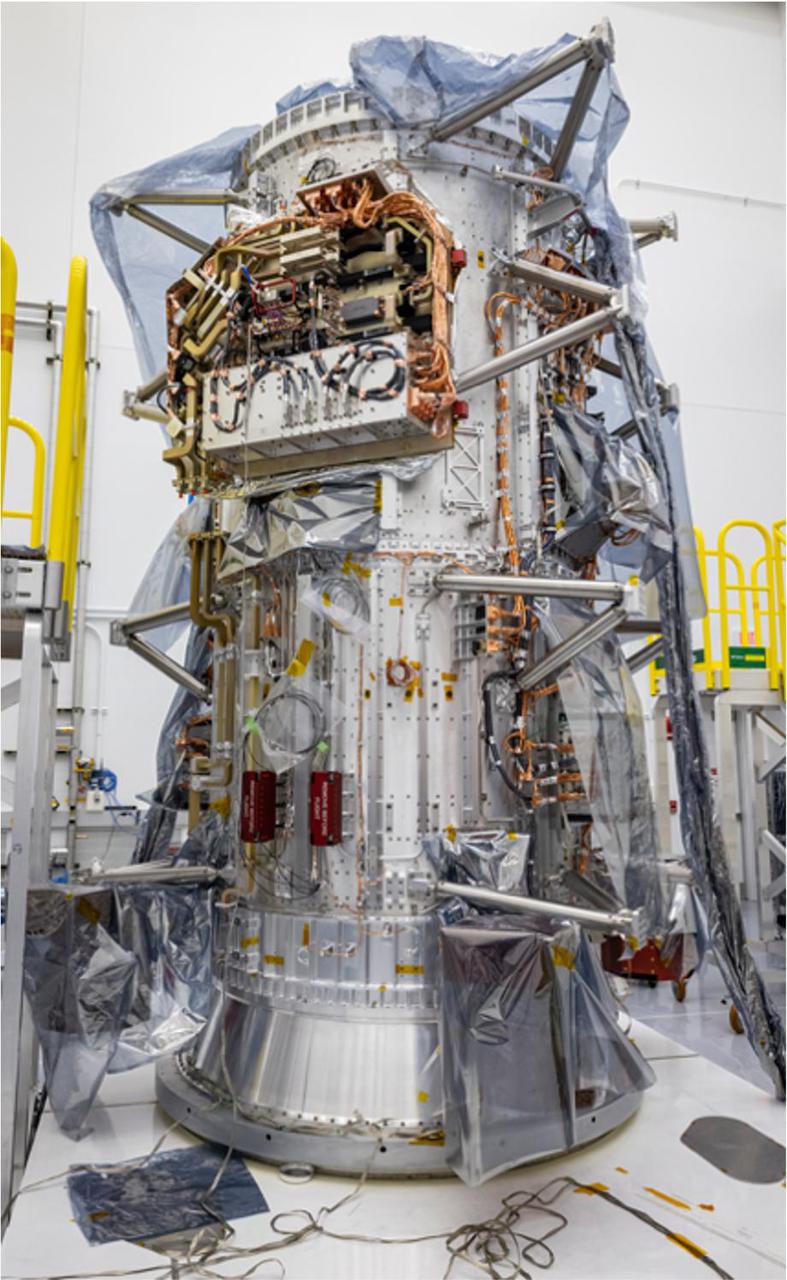
The propulsion module for NASA's Europa Clipper, the main body of the spacecraft, is nearing completion at Johns Hopkins Applied Physics Laboratory (APL) in Laurel, Maryland. The module consists of two stacked cylinders that stand almost 10 feet (3 meters) high and hold the propulsion tanks and rocket engines that will adjust and change Europa Clipper's trajectory once it leaves Earth's atmosphere on its path toward Jupiter's icy moon Europa. The propulsion module will be shipped to NASA's Jet Propulsion Laboratory in Southern California this spring. With an internal global ocean under a thick layer of ice, Jupiter's moon Europa may have the potential to harbor existing life. Europa Clipper will swoop around Jupiter in an elliptical orbit, dipping close to the moon on each flyby to collect data. Understanding Europa's habitability will help scientists better understand how life developed on Earth and the potential for finding life beyond our planet. Europa Clipper is set to launch in 2024. https://photojournal.jpl.nasa.gov/catalog/PIA24900
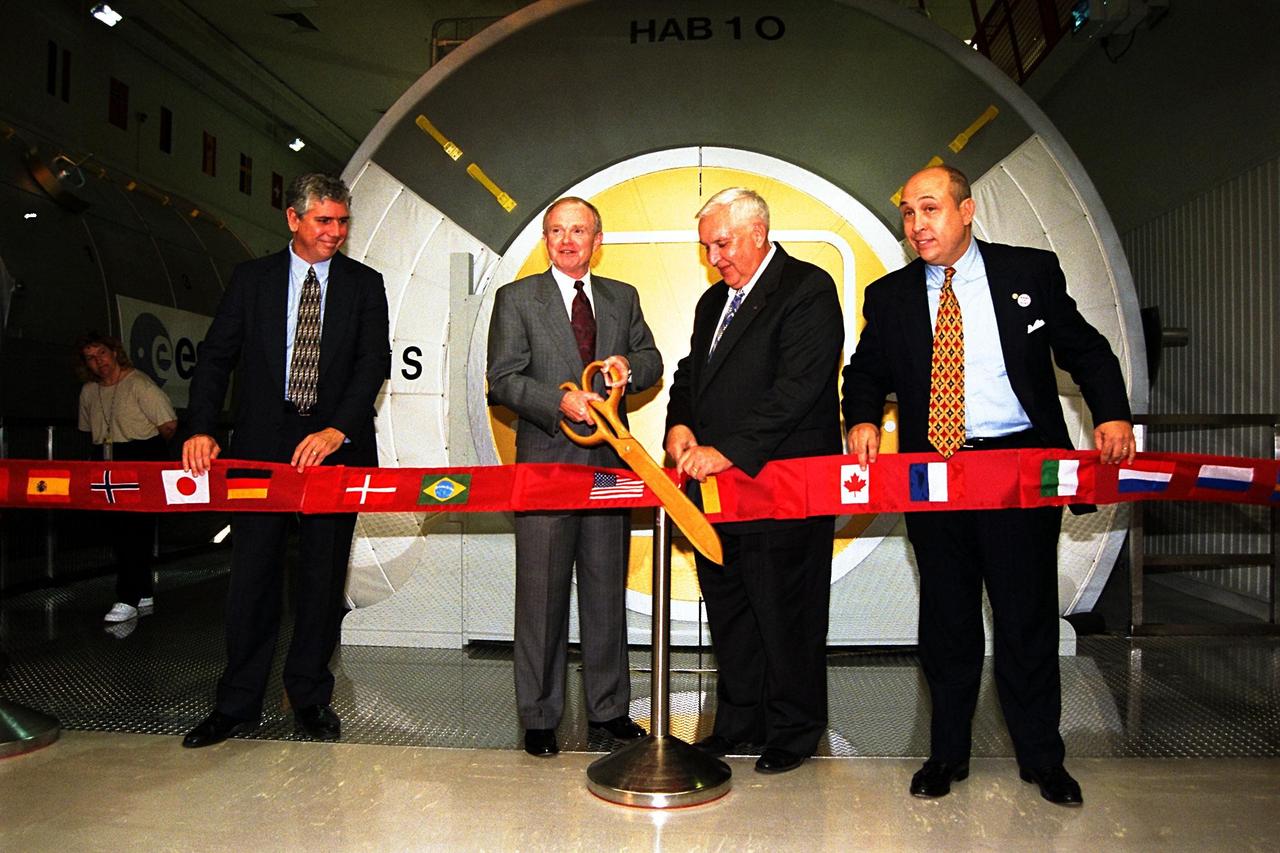
Celebrating the official opening of the new International Space Station (ISS) Center at Kennedy Space Center are, left to right, James Ball, chief, NASA Public Services, KSC; KSC Director Roy D. Bridges Jr.; Hugh Harris, director, NASA Public Affairs, KSC; and Rick Abramson, president and chief operating officer, Delaware North Parks Services of Spaceport Inc. Center Director Bridges cuts the ribbon to the new tour attraction where full-scale mockups of station modules, through which visitors can walk, are on display. These include the Habitation Unit, where station crew members will live, sleep, and work; a Laboratory Module; and the Pressurized Logistics Module, where racks and supplies will be transported back and forth from KSC to space. Guests also can take an elevated walkway to a gallery overlooking the work are where actual ISS hardware is prepared for flight into space. This new tour site, in addition to a new Launch Complex 39 Observation Gantry, are part of a comprehensive effort by NASA and Delaware North to expand and improve the KSC public tour and visitor facilities
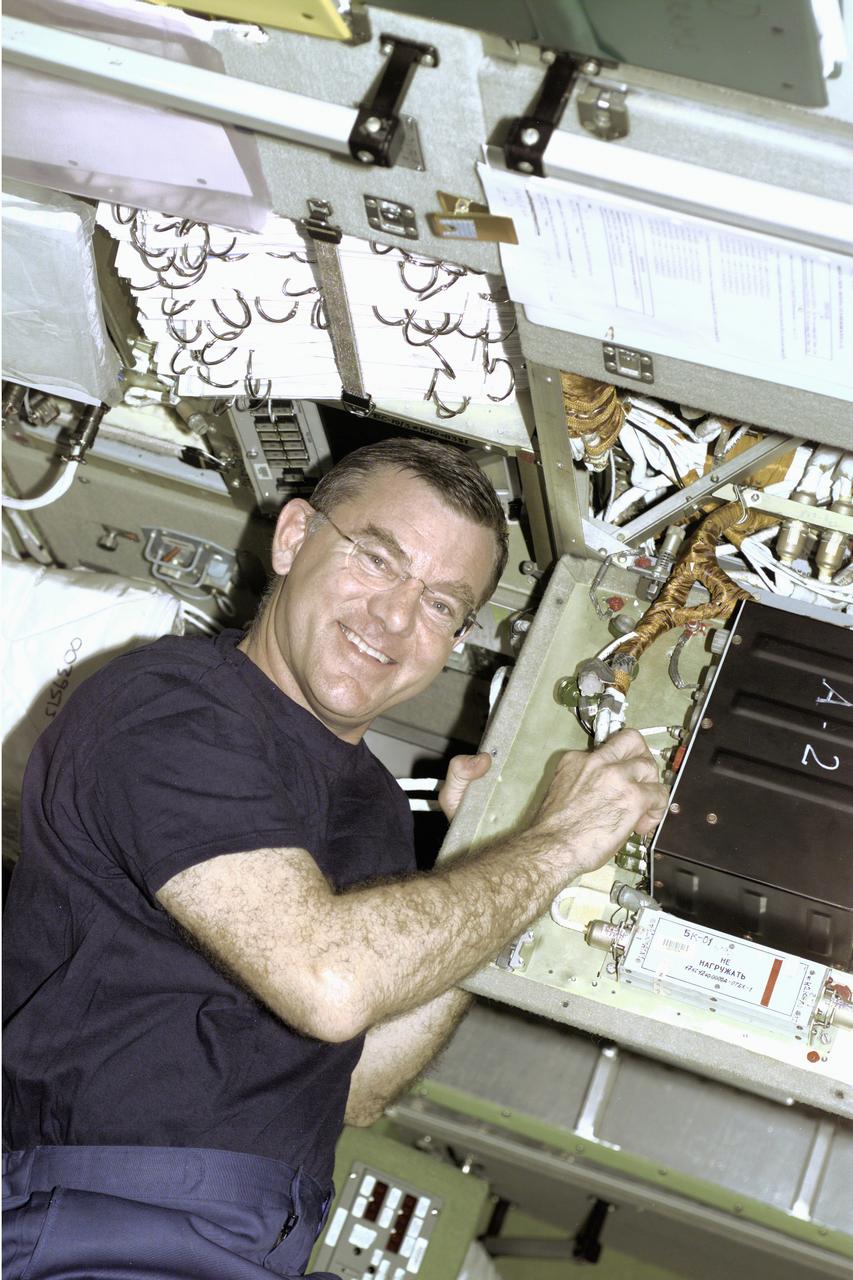
Astronaut James S. Voss, Expedition Two flight engineer, performs an electronics task in the Russian Zvezda Service Module on the International Space Station (ISS). Zvezda is linked to the Russian-built Functional Cargo Block (FGB), or Zarya, the first component of the ISS. Zarya was launched on a Russian Proton rocket prior to the launch of Unity, the first U.S.-built component to the ISS. Zvezda (Russian word for star), the third component of the ISS and the primary Russian contribution to the ISS, was launched by a three-stage Proton rocket on July 12, 2000. Zvezda serves as the cornerstone for early human habitation of the station, providing living quarters, a life support system, electrical power distribution, a data processing system, a flight control system, and a propulsion system. It also provides a communications system that includes remote command capabilities from ground flight controllers. The 42,000-pound module measures 43 feet in length and has a wing span of 98 feet. Similar in layout to the core module of Russia's Mir space station, it contains 3 pressurized compartments and 13 windows that allow ultimate viewing of Earth and space.
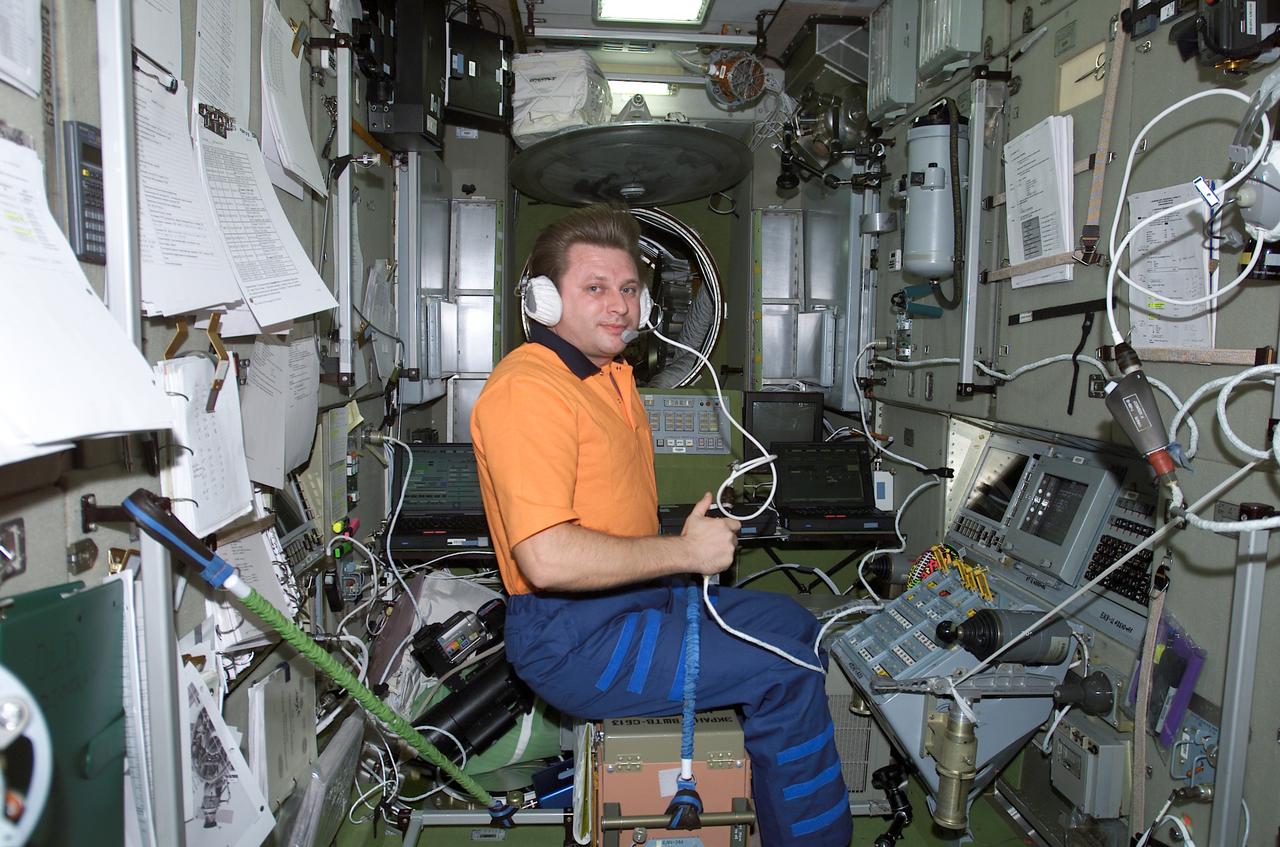
Cosmonaut Yury I. Onufrienko, Expedition Four mission commander, uses a communication system in the Russian Zvezda Service Module on the International Space Station (ISS). The Zvezda is linked to the Russian-built Functional Cargo Block (FGB) or Zarya, the first component of the ISS. Zarya was launched on a Russian Proton rocket prior to the launch of Unity. The third component of the ISS, Zvezda (Russian word for star), the primary Russian contribution to the ISS, was launched by a three-stage Proton rocket on July 12, 2000. Zvezda serves as the cornerstone for early human habitation of the station, providing living quarters, a life support system, electrical power distribution, a data processing system, flight control system, and propulsion system. It also provides a communications system that includes remote command capabilities from ground flight controllers. The 42,000-pound module measures 43 feet in length and has a wing span of 98 feet. Similar in layout to the core module of Russia's Mir space station, it contains 3 pressurized compartments and 13 windows that allow ultimate viewing of Earth and space.
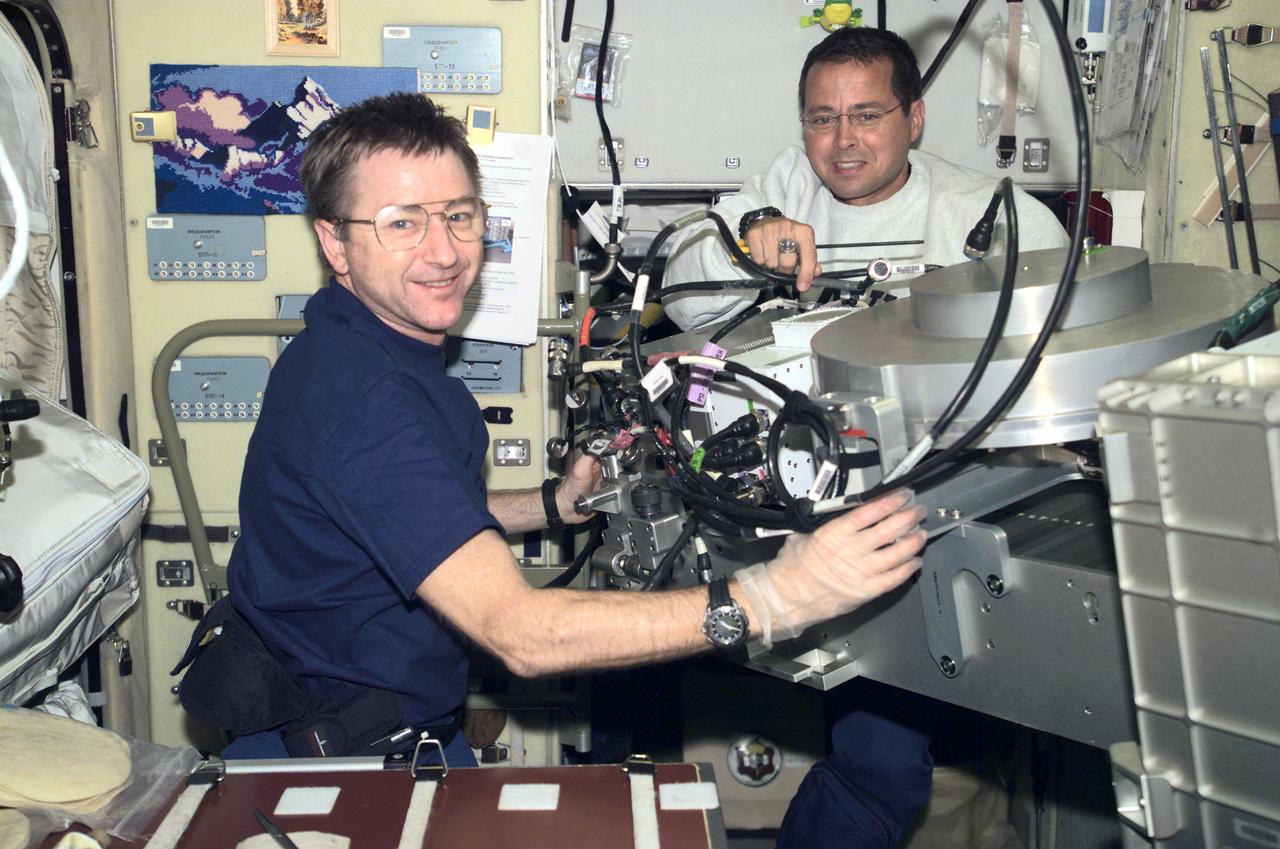
Astronauts Frank L. Culbertson, Jr. (left), Expedition Three mission commander, and Daniel W. Bursch, Expedition Four flight engineer, work in the Russian Zvezda Service Module on the International Space Station (ISS). Zvezda is linked to the Russian built Functional Cargo Block (FGB), or Zarya, the first component of the ISS. Zarya was launched on a Russian Proton rocket prior to the launch of Unity. The third component of the ISS, Zvezda (Russian word for star), the primary Russian contribution to the ISS, was launched by a three-stage Proton rocket on July 12, 2000. Zvezda serves as the cornerstone for early human habitation of the Station, providing living quarters, a life support system, electrical power distribution, a data processing system, a flight control system, and a propulsion system. It also provides a communications system that includes remote command capabilities from ground flight controllers. The 42,000 pound module measures 43 feet in length and has a wing span of 98 feet. Similar in layout to the core module of Russia's Mir space station, it contains 3 pressurized compartments and 13 windows that allow ultimate viewing of Earth and space.
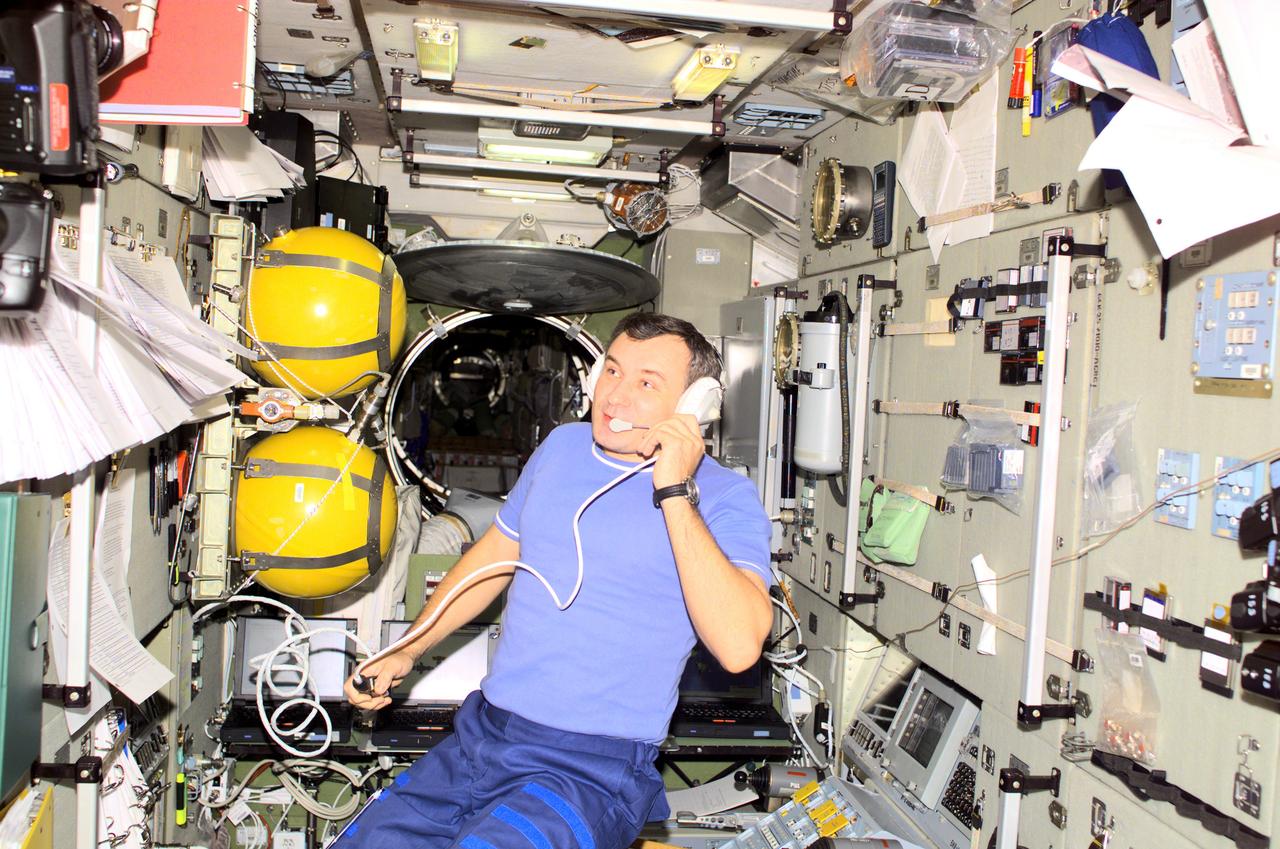
Aboard the International Space Station (ISS), Cosmonaut and Expedition Three flight engineer Vladimir N. Dezhurov, representing Rosaviakosmos, talks with flight controllers from the Zvezda Service Module. Russian-built Zvezda is linked to the Functional Cargo Block (FGB), or Zarya, the first component of the ISS. Zarya was launched on a Russian Proton rocket prior to the launch of Unity. The third component of the ISS, Zvezda (Russian word for star), the primary Russian contribution to the ISS, was launched by a three-stage Proton rocket on July 12, 2000. Zvezda serves as the cornerstone for early human habitation of the Station, providing living quarters, a life support system, electrical power distribution, a data processing system, flight control system, and propulsion system. It also provides a communications system that includes remote command capabilities from ground flight controllers. The 42,000-pound module measures 43 feet in length and has a wing span of 98 feet. Similar in layout to the core module of Russia's Mir space station, it contains 3 pressurized compartments and 13 windows that allow ultimate viewing of Earth and space.
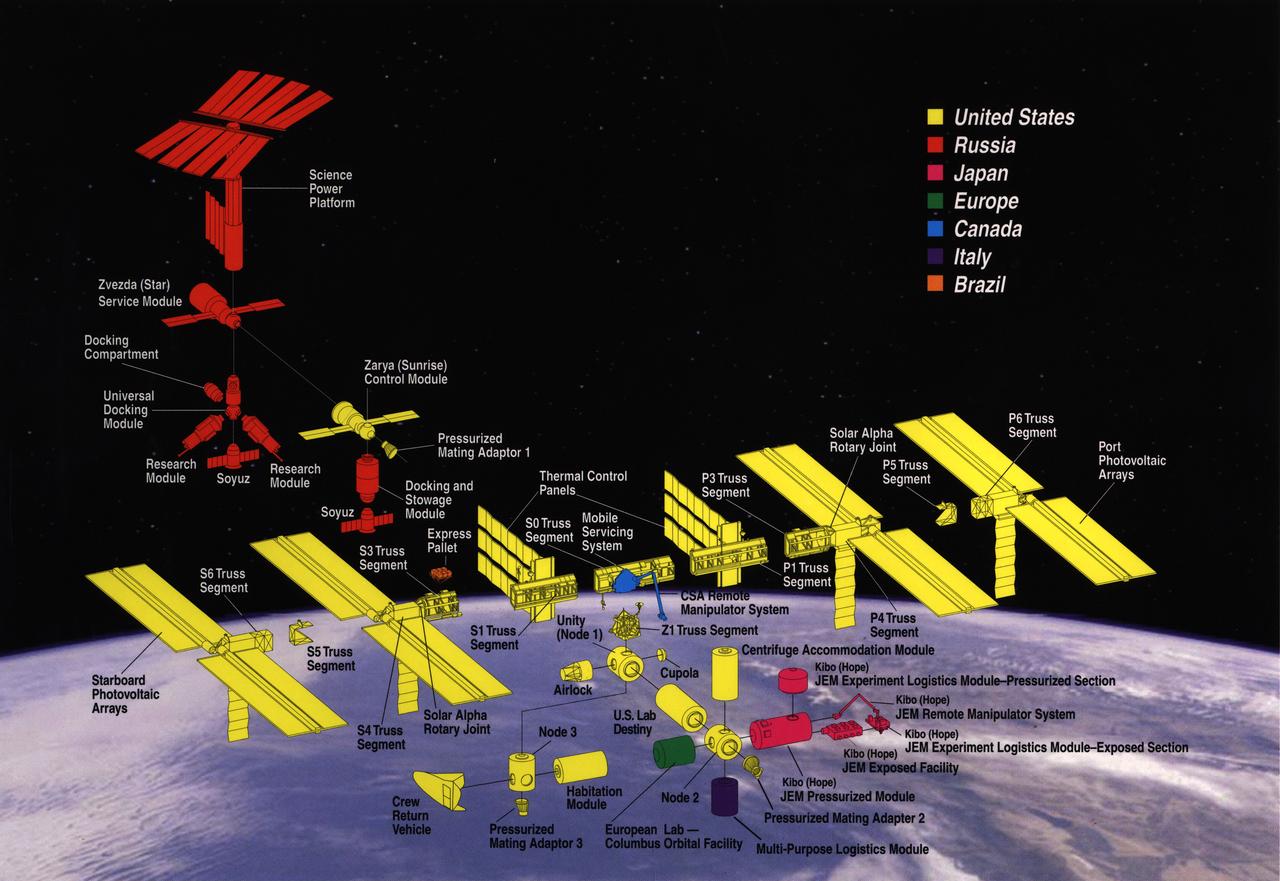
The International Space Station (ISS) is an unparalleled international scientific and technological cooperative venture that will usher in a new era of human space exploration and research and provide benefits to people on Earth. On-Orbit assembly began on November 20, 1998, with the launch of the first ISS component, Zarya, on a Russian Proton rocket. The Space Shuttle followed on December 4, 1998, carrying the U.S.-built Unity cornecting Module. Sixteen nations are participating in the ISS program: the United States, Canada, Japan, Russia, Brazil, Belgium, Denmark, France, Germany, Italy, the Netherlands, Norway, Spain, Sweden, Switzerland, and the United Kingdom. The ISS will include six laboratories and be four times larger and more capable than any previous space station. The United States provides two laboratories (United States Laboratory and Centrifuge Accommodation Module) and a habitation module. There will be two Russian research modules, one Japanese laboratory, referred to as the Japanese Experiment Module (JEM), and one European Space Agency (ESA) laboratory called the Columbus Orbital Facility (COF). The station's internal volume will be roughly equivalent to the passenger cabin volume of two 747 jets. Over five years, a total of more than 40 space flights by at least three different vehicles - the Space Shuttle, the Russian Proton Rocket, and the Russian Soyuz rocket - will bring together more than 100 different station components and the ISS crew. Astronauts will perform many spacewalks and use new robotics and other technologies to assemble ISS components in space.
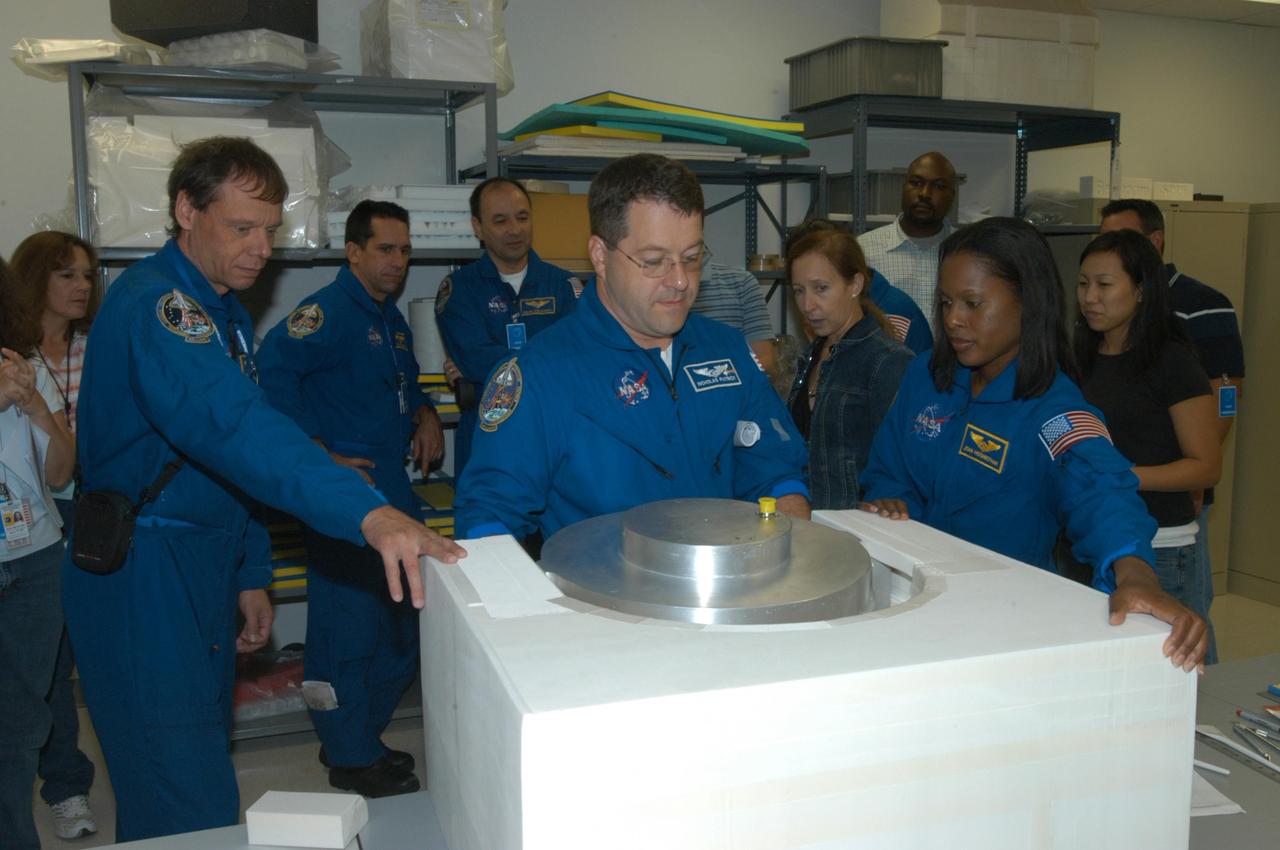
KENNEDY SPACE CENTER, FLA. - At SPACEHAB in Cape Canaveral, Fla., STS-116 crew members get a close look at he Treadmill Vibration Isolation System Gyroscop during equipment familiarization. Mission Specialist Nicholas Patrick (center) practices stowing the replacement gyro in the block of foam which is what the gyro will be stowed in inside the SPACEHAB module. The other crew members watching are, from left, Mission Specialists Christer Fuglesang, Pilot William Oefelein, Commander Mark Polansky, and at right, Mission Specialist Joan Higginbotham. Fuglesang, from Sweden, represents the European Space Agency. Between Patarick and Higginbotham is astronaut Marsha Ivins, who is currently assigned to the Astronaut Office, Space Station/Shuttle Branches for crew equipment, habitability and stowage. Mission crews make frequent trips to the Space Coast to become familiar with the equipment and payloads they will be using. STS-116 will be mission number 20 to the International Space Station and construction flight 12A.1. The mission payload is the SPACEHAB module, the P5 integrated truss structure and other key components. Launch is scheduled for no earlier than Dec. 7. Photo credit: NASA/George Shelton
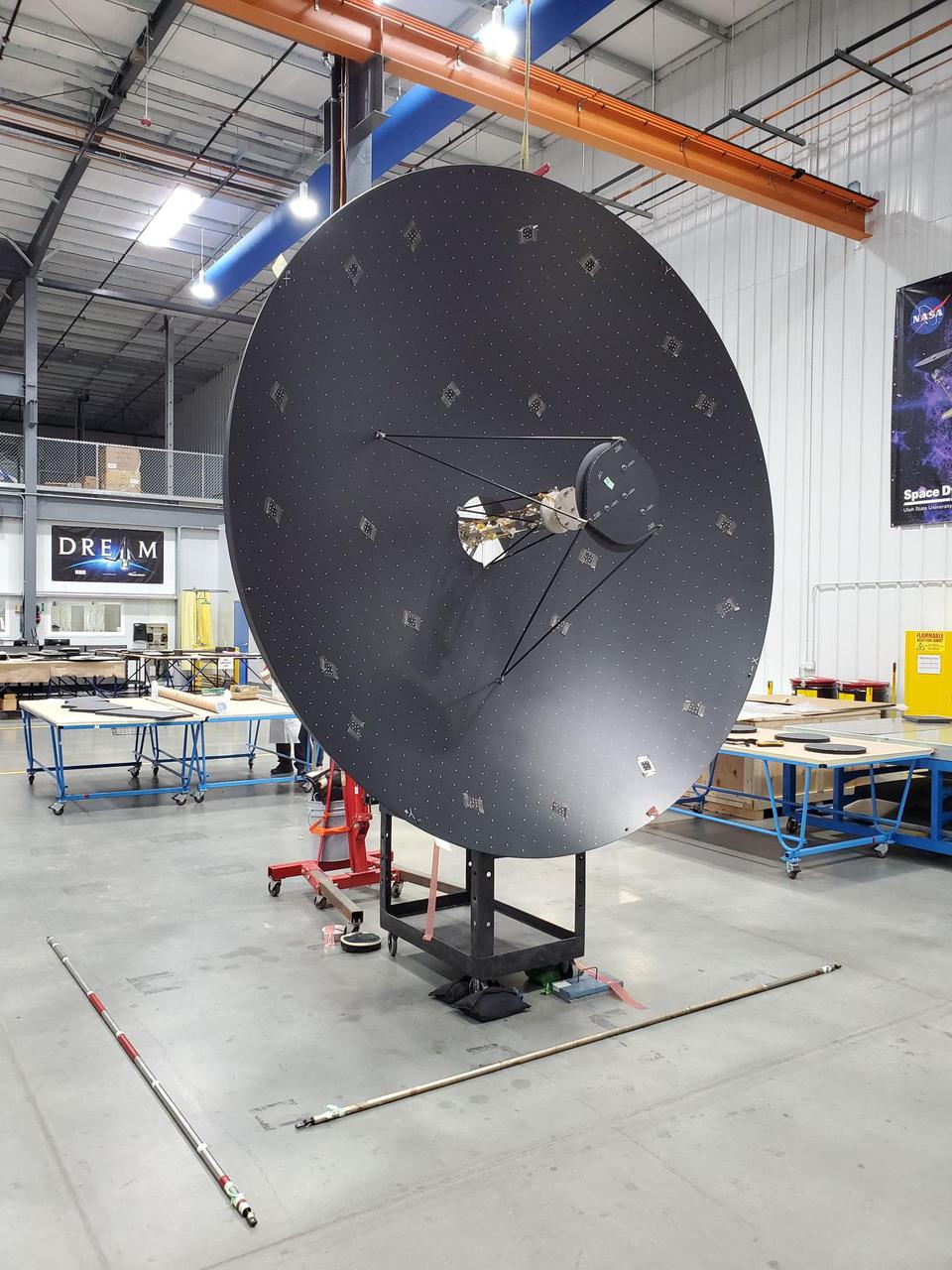
The massive high-gain antenna for NASA's Europa Clipper mission is complete. The antenna is nearly 10 feet (3 meters) wide and will be integrated along with other telecommunications hardware into the spacecraft's propulsion module. The antenna will download science data and allow ground controllers to send and receive commands and data between Earth and the spacecraft in Jupiter orbit – more than a million times farther from Earth than the International Space Station's orbits. It was designed by the Johns Hopkins Applied Physics Laboratory (APL) in Laurel, Maryland, and aerospace vendor Applied Aerospace Structures Corporation (AASC) in Stockton, California. With an internal global ocean under a thick layer of ice, Jupiter's moon Europa may have the potential to harbor existing life. Europa Clipper will swoop around Jupiter in an elliptical orbit, dipping close to the moon on each flyby to collect data. Understanding Europa's habitability will help scientists better understand how life developed on Earth and the potential for finding life beyond our planet. Europa Clipper is set to launch in 2024. https://photojournal.jpl.nasa.gov/catalog/PIA24899
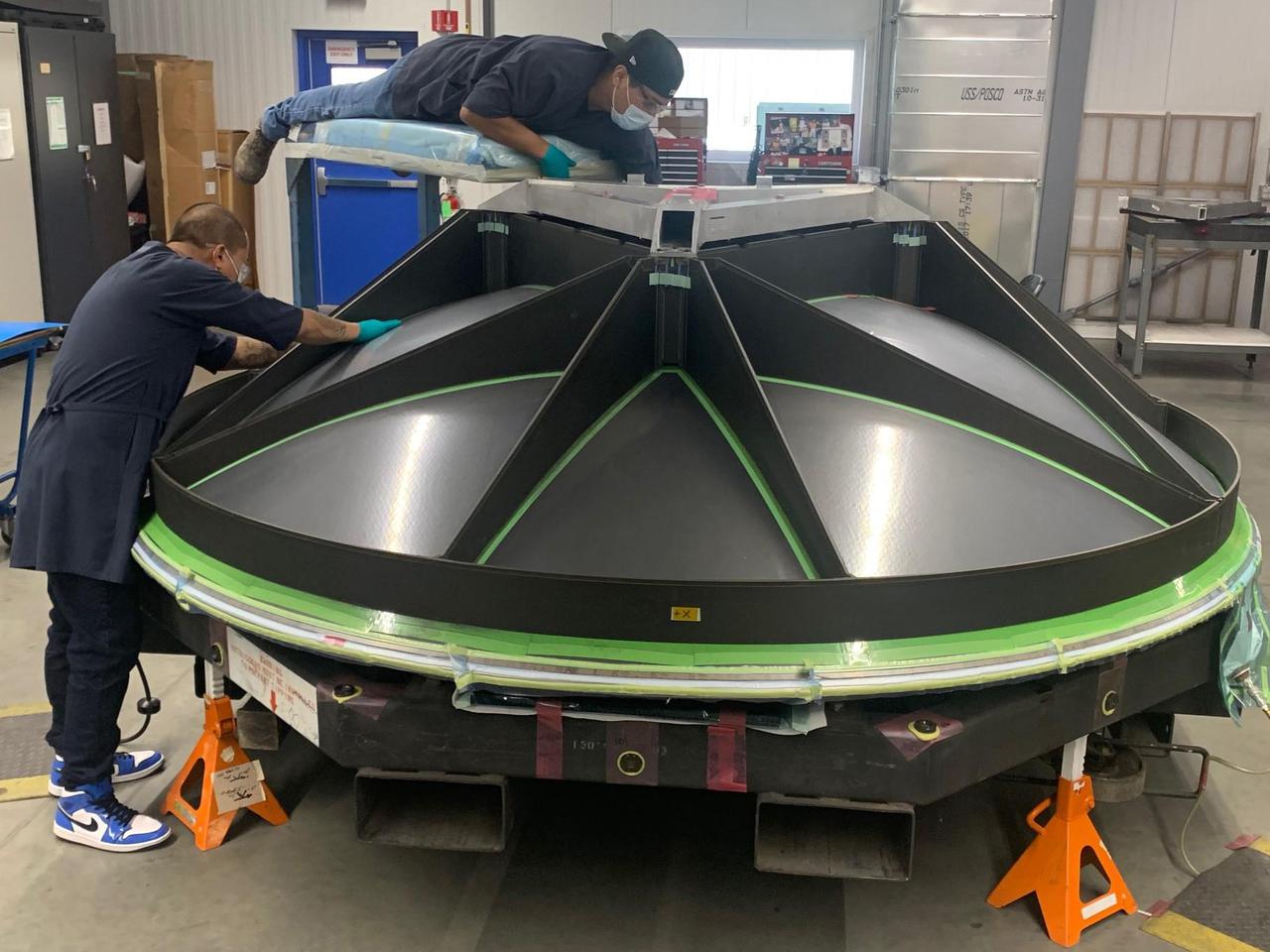
The build of a high-gain antenna, a nearly 10-foot-wide (3-meter-wide) dish, is underway for NASA's Europa Clipper spacecraft. The dish antenna, seen here face down, is being fabricated at aerospace vendor Applied Aerospace Structures Corporation (AASC) in Stockton, California. The antenna was designed by the Johns Hopkins Applied Physics Laboratory (APL) in Laurel, Maryland, and AASC, where it will be integrated along with other telecommunications hardware, into the propulsion module. The antenna downloads science data and allows ground controllers to send and receive commands and data between Earth and the spacecraft in Jupiter orbit – more than a million times farther from Earth than the International Space Station orbits. With an internal global ocean under a thick layer of ice, Jupiter's moon Europa may have the potential to harbor existing life. Europa Clipper will swoop around Jupiter on an elliptical path, dipping close to the moon on each flyby. Understanding Europa's habitability will help scientists better understand how life developed on Earth and the potential for finding life beyond our planet. Europa Clipper is set to launch in 2024. https://photojournal.jpl.nasa.gov/catalog/PIA24785
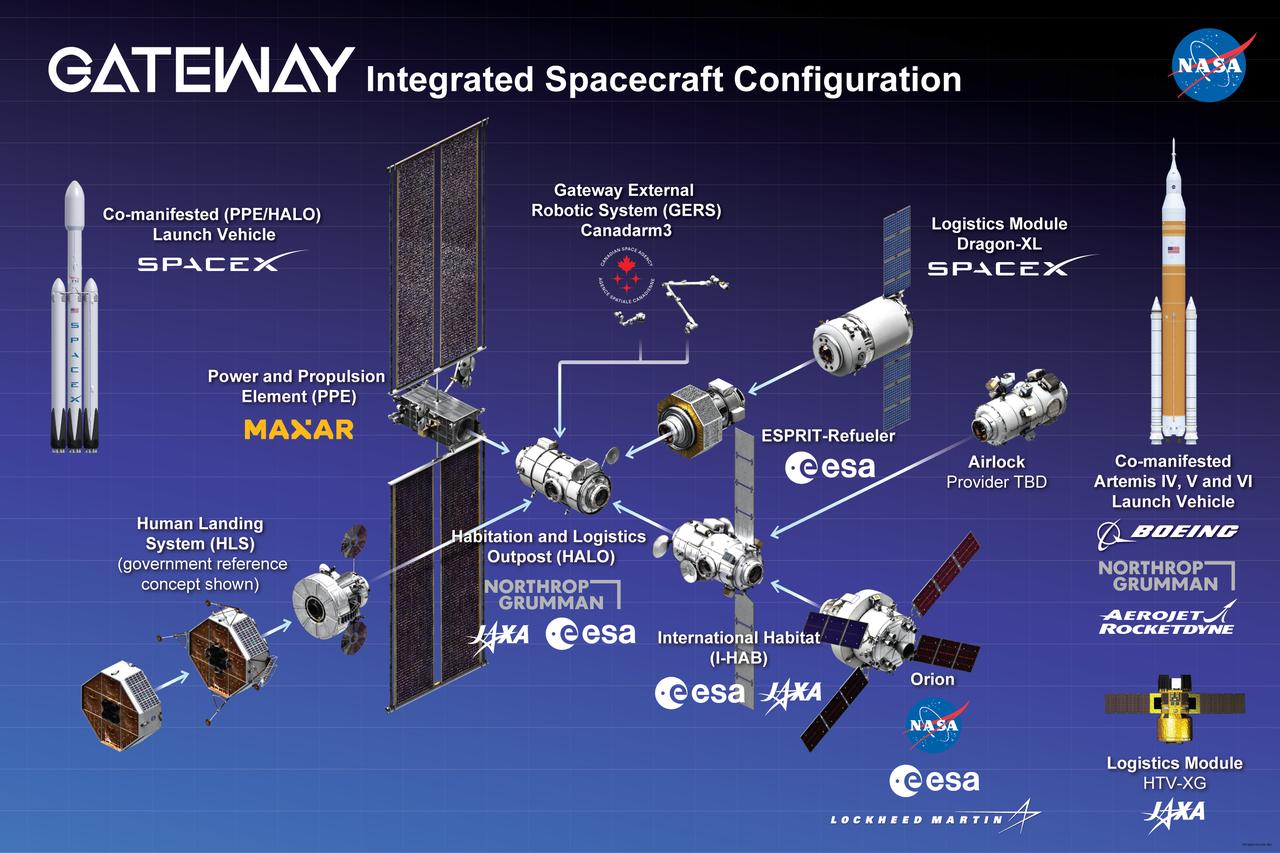
And expanded view of the Gateway space station showing each of its elements, international partner contributions, and visiting spacecraft including Orion and the Human Landing System, with prime contractors.
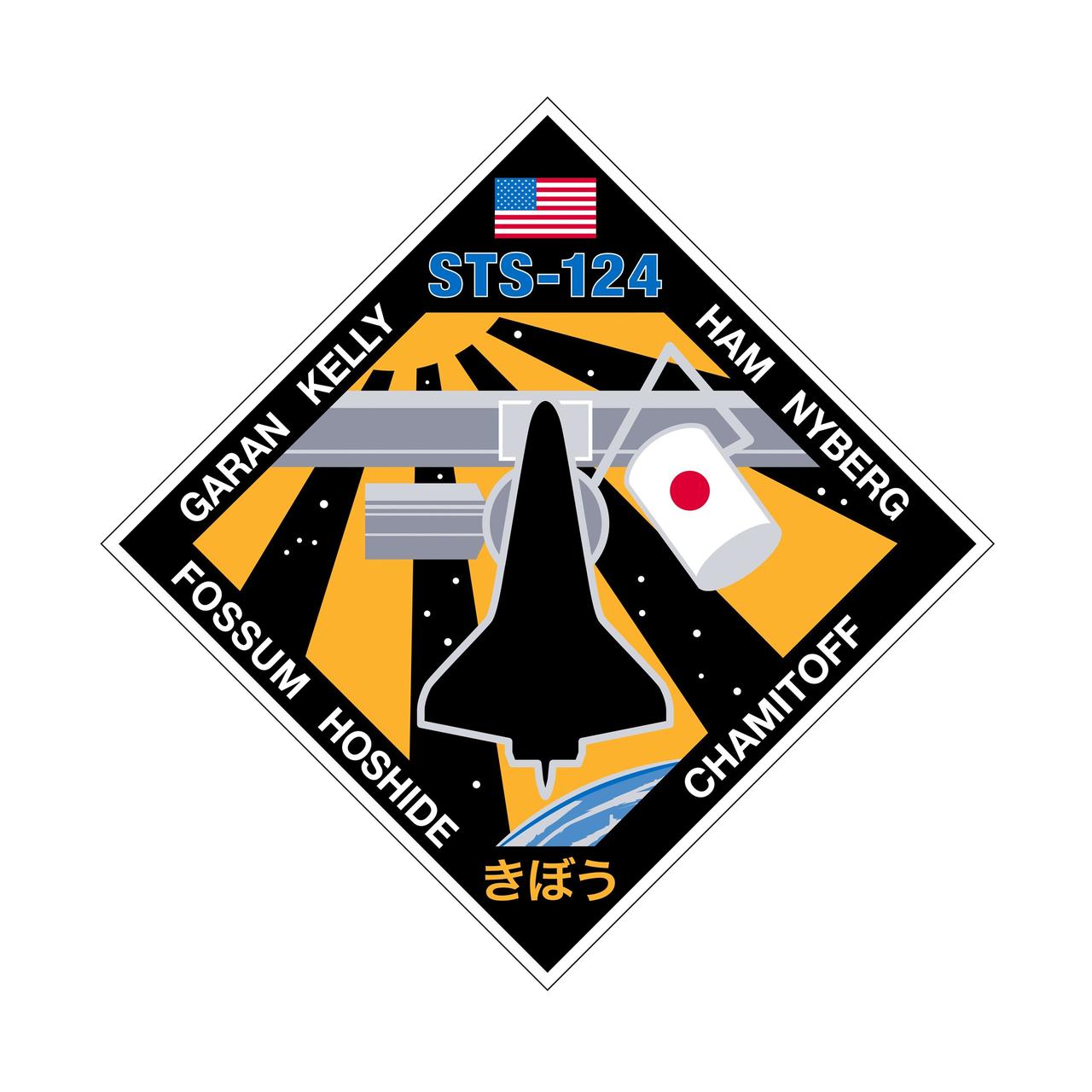
JOHNSON SPACE CENTER, Houston --- STS124-S-001 --- The STS-124/1J patch depicts the Space Shuttle Discovery docked with the International Space Station (ISS). STS-124/1J is dedicated to delivering and installing the Japanese Experiment Module (JEM) known as Kibo (Hope) to the ISS. The significance of the mission and the Japanese contribution to the ISS is recognized by the Japanese flag depicted on the JEM Pressurized Module (JPM) and the word Kibo written in Japanese at the bottom of the patch. The view of the sun shining down upon the Earth represents the increased "hope" that the entire world will benefit from the JEM's scientific discoveries. The JPM will be the largest habitable module on the ISS and is equipped with its own airlock and robotic arm for external experiments. In addition to delivering and installing the JPM, the STS-124 crew will relocate the JEM Logistics Pressurized (JLP) module to its permanent home on the zenith side of the JPM. During three planned space walks, the crew will perform external ISS maintenance and JPM outfitting, as well as extensive robotic operations by the ISS, space shuttle, and JEM robotic arms. It will be the first time that three different robotic arms will be operated during a single space flight mission. The NASA insignia design for shuttle flights is reserved for use by the astronauts and for other official use as the NASA Administrator may authorize. Public availability has been approved only in the form of illustrations by the various news media. When and if there is any change in this policy, which is not anticipated, it will be publicly announced.
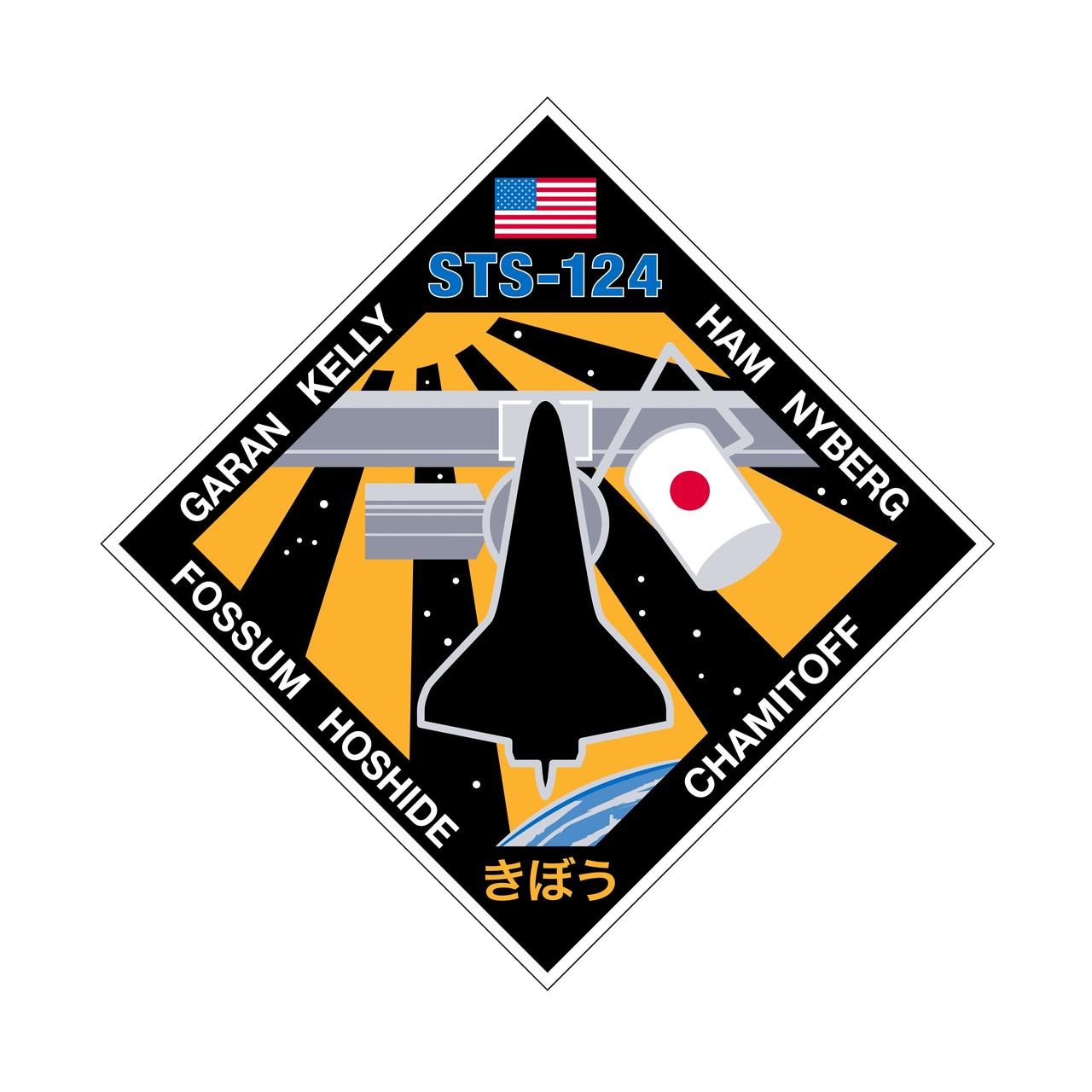
STS124-S-001 (October 2007) --- The STS-124/1J patch depicts the space shuttle Discovery docked with the International Space Station (ISS). STS-124/1J is dedicated to delivering and installing the Japanese Experiment Module (JEM) known as Kibo (Hope) to the ISS. The significance of the mission and the Japanese contribution to the ISS is recognized by the Japanese flag depicted on the JEM Pressurized Module (JPM) and the word Kibo written in Japanese at the bottom of the patch. The view of the sun shining down upon Earth represents the increased "hope" that the entire world will benefit from the JEM's scientific discoveries. The JPM will be the largest habitable module on the ISS and is equipped with its own airlock and robotic arm for external experiments. In addition to delivering and installing the JPM, the STS-124 crew will relocate the JEM Logistics Pressurized (JLP) module to its permanent home on the zenith side of the JPM. During three planned spacewalks, the crew will perform external ISS maintenance and JPM outfitting, as well as extensive robotic operations by the ISS, space shuttle, and JEM robotic arms. It will be the first time that three different robotic arms will be operated during a single spaceflight mission. The NASA insignia design for space shuttle flights is reserved for use by the astronauts and for other official use as the NASA Administrator may authorize. Public availability has been approved only in the forms of illustrations by the various news media. When and if there is any change in this policy, which is not anticipated, the change will be publicly announced. Photo credit: NASA

KENNEDY SPACE CENTER, FLA. -- After a nearly 5.3 million mile round trip to the International Space Station, space shuttle Atlantis comes to a stop near the control tower on Runway 15 of the Shuttle Landing Facility at NASA's Kennedy Space Center. The shuttle landed on orbit 202 to complete the 13-day STS-122 mission. Main gear touchdown was 9:07:10 a.m. Nose gear touchdown was 9:07:20 a.m. Wheel stop was at 9:08:08 a.m. Mission elapsed time was 12 days, 18 hours, 21 minutes and 44 seconds. During the mission, Atlantis' crew installed the new Columbus laboratory, leaving a larger space station and one with increased science capabilities. The Columbus Research Module adds nearly 1,000 cubic feet of habitable volume and affords room for 10 experiment racks, each an independent science lab. Photo credit: NASA/Kenny Allen, Robert Murray
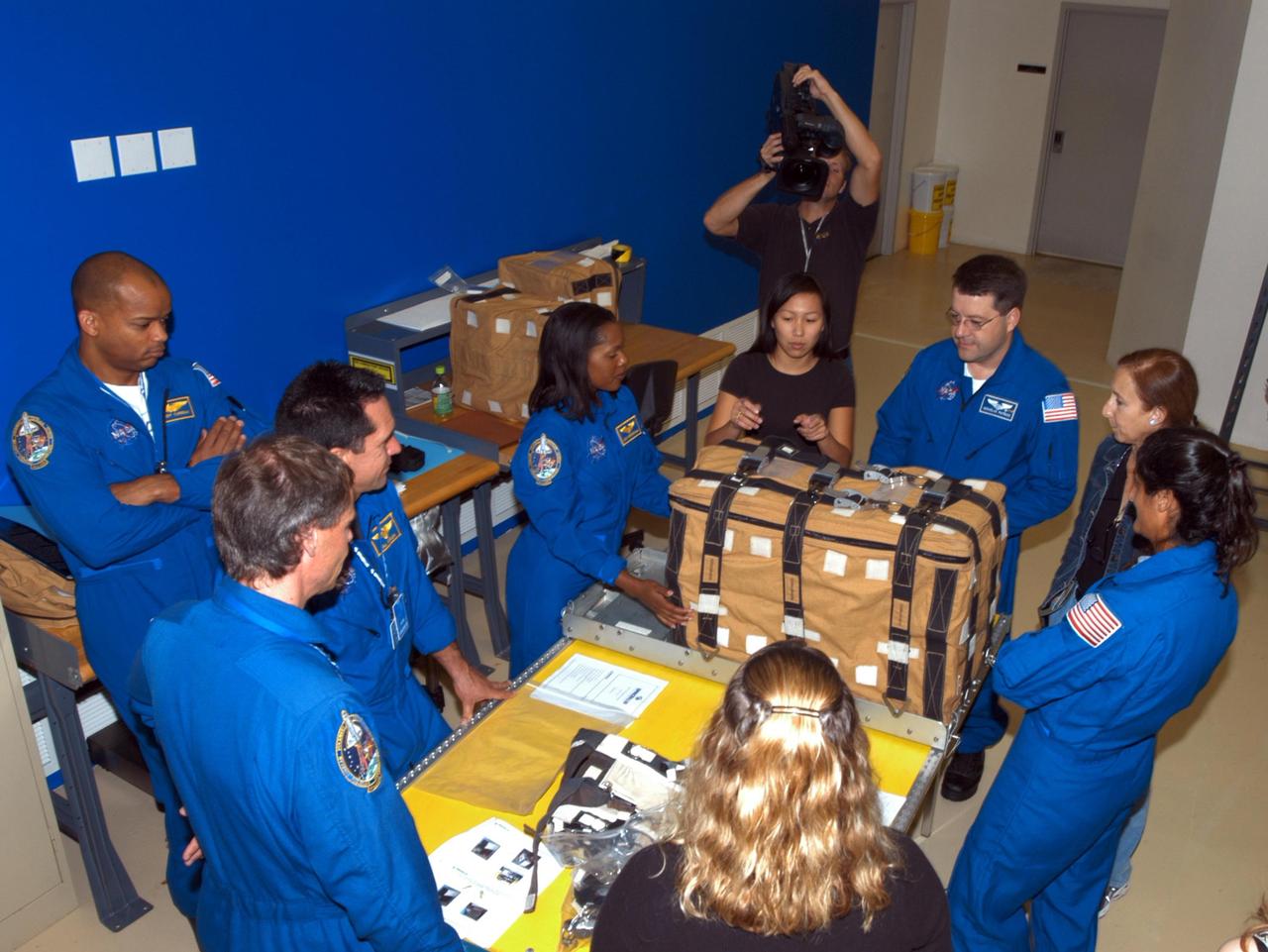
KENNEDY SPACE CENTER, FLA. - Members of the STS-116 crew examine components of the mission payload at SPACEHAB in Cape Canaveral, Fla. Clockwise from lower left (in their blue uniforms) around the table are Mission Specialist Christer Fuglesang , Pilot William Oefelein, and Mission Specialists Joan Higginbotham, Nicholas Patrick and Sunita Williams. At far left is Robert Curbeam. The Swedish Fuglesang represents the European Space Agency. On the table is a stowage bag. Next to Patrick at right is astronaut Marsha Ivins, currently assigned to the Astronaut Office, Space Station/Shuttle Branches for crew equipment, habitability and stowage. Mission crews make frequent trips to the Space Coast to become familiar with the equipment and payloads they will be using. STS-116 will be mission number 20 to the International Space Station and construction flight 12A.1. The mission payload is the SPACEHAB module, the P5 integrated truss structure and other key components. Launch is scheduled for no earlier than Dec. 7. Photo credit: NASA/George Shelton
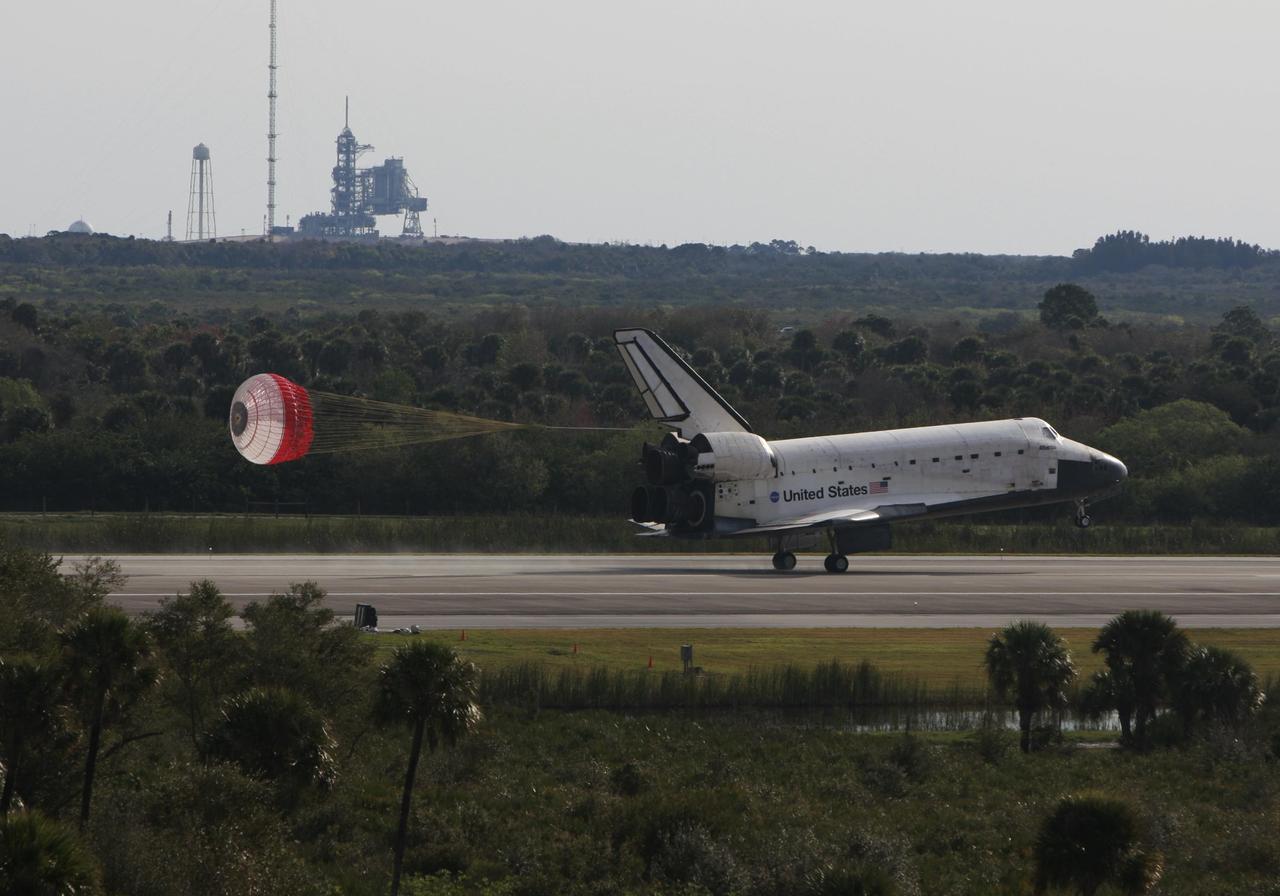
KENNEDY SPACE CENTER, FLA. -- With the aid of a drag chute, space shuttle Atlantis slows down after landing on Runway 15 of the Shuttle Landing Facility at NASA's Kennedy Space Center after a nearly 5.3 million mile round trip to the International Space Station. In the background is Launch Pad 39B. The shuttle landed on orbit 202 to complete the 13-day STS-122 mission. Main gear touchdown was 9:07:10 a.m. Nose gear touchdown was 9:07:20 a.m. Wheel stop was at 9:08:08 a.m. Mission elapsed time was 12 days, 18 hours, 21 minutes and 44 seconds. During the mission, Atlantis' crew installed the new Columbus laboratory, leaving a larger space station and one with increased science capabilities. The Columbus Research Module adds nearly 1,000 cubic feet of habitable volume and affords room for 10 experiment racks, each an independent science lab. Photo courtesy of Scott Andrews
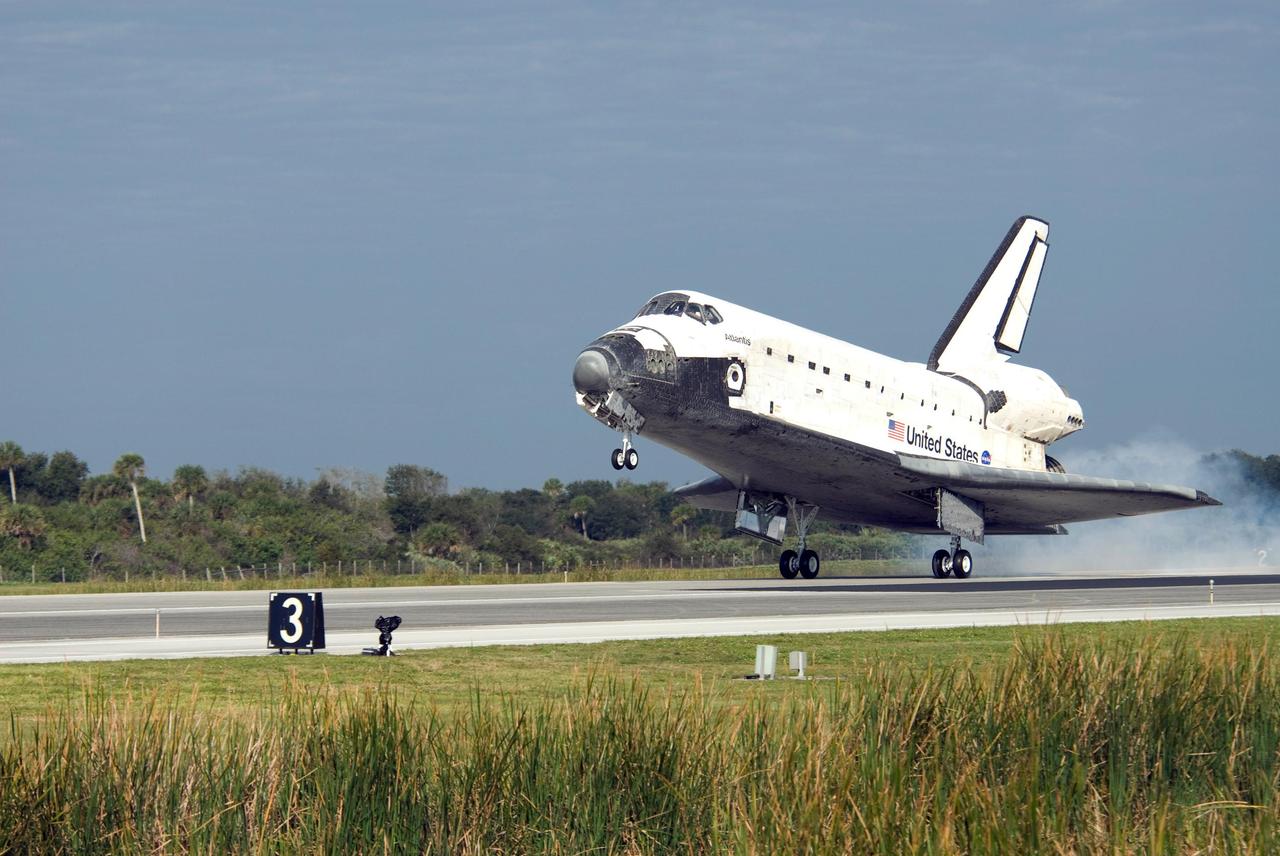
KENNEDY SPACE CENTER, FLA. -- Dust rises behind space shuttle Atlantis as the main landing gear touches down on Runway 15 of the Shuttle Landing Facility at NASA's Kennedy Space Center after a nearly 5.3 million mile round trip to the International Space Station. The shuttle landed on orbit 202 to complete the 13-day STS-122 mission. Main gear touchdown was 9:07:10 a.m. Nose gear touchdown was 9:07:20 a.m. Wheel stop was at 9:08:08 a.m. Mission elapsed time was 12 days, 18 hours, 21 minutes and 44 seconds. During the mission, Atlantis' crew installed the new Columbus laboratory, leaving a larger space station and one with increased science capabilities. The Columbus Research Module adds nearly 1,000 cubic feet of habitable volume and affords room for 10 experiment racks, each an independent science lab. Photo credit: NASA/Kevin O'Connell

KENNEDY SPACE CENTER, FLA. -- After a nearly 5.3 million mile round trip to the International Space Station, space shuttle Atlantis kicks up dust as it touches down on Runway 15 of the Shuttle Landing Facility at NASA's Kennedy Space Center. Photographers in the foreground try to capture the moment of landing. The shuttle landed on orbit 202 to complete the 13-day STS-122 mission. Main gear touchdown was 9:07:10 a.m. Nose gear touchdown was 9:07:20 a.m. Wheel stop was at 9:08:08 a.m. Mission elapsed time was 12 days, 18 hours, 21 minutes and 44 seconds. During the mission, Atlantis' crew installed the new Columbus laboratory, leaving a larger space station and one with increased science capabilities. The Columbus Research Module adds nearly 1,000 cubic feet of habitable volume and affords room for 10 experiment racks, each an independent science lab. Photo credit: NASA/Tony Gray