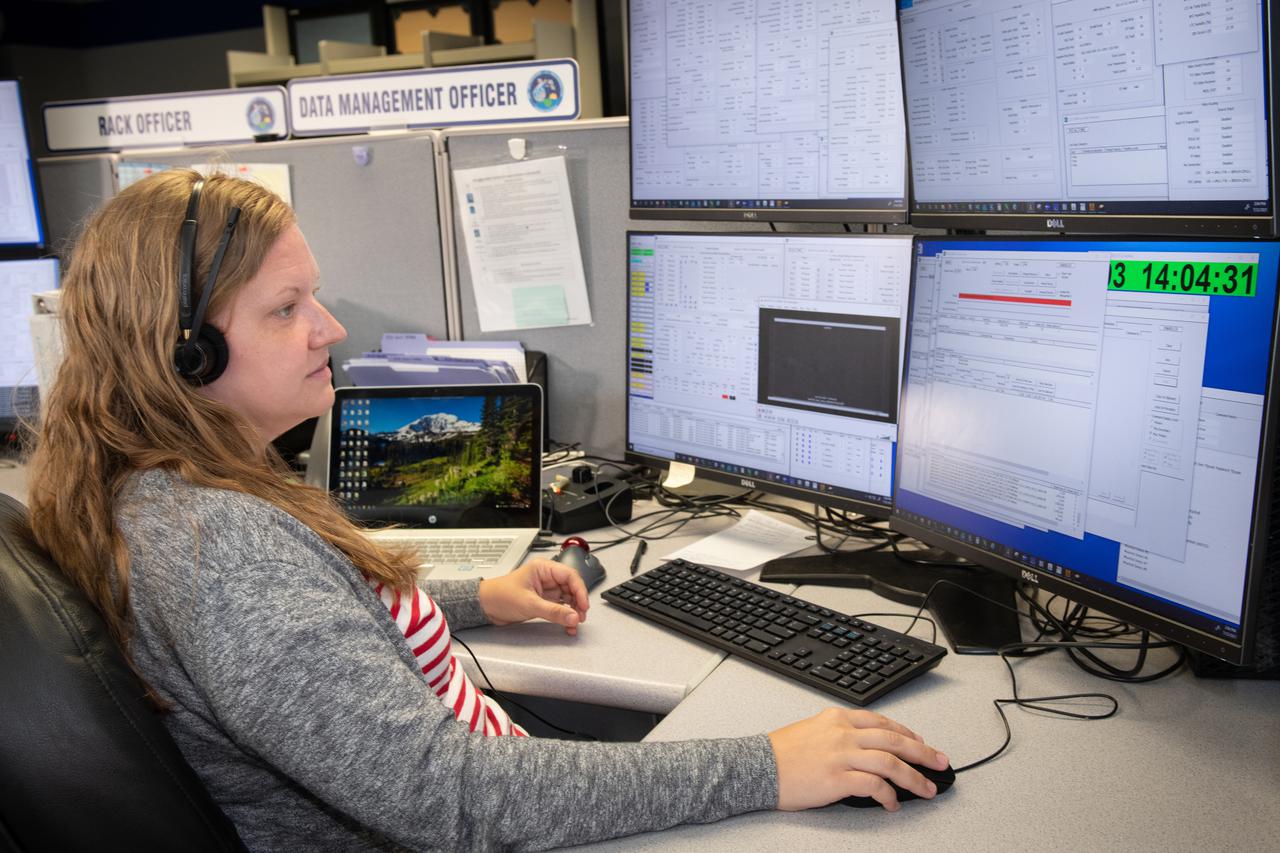
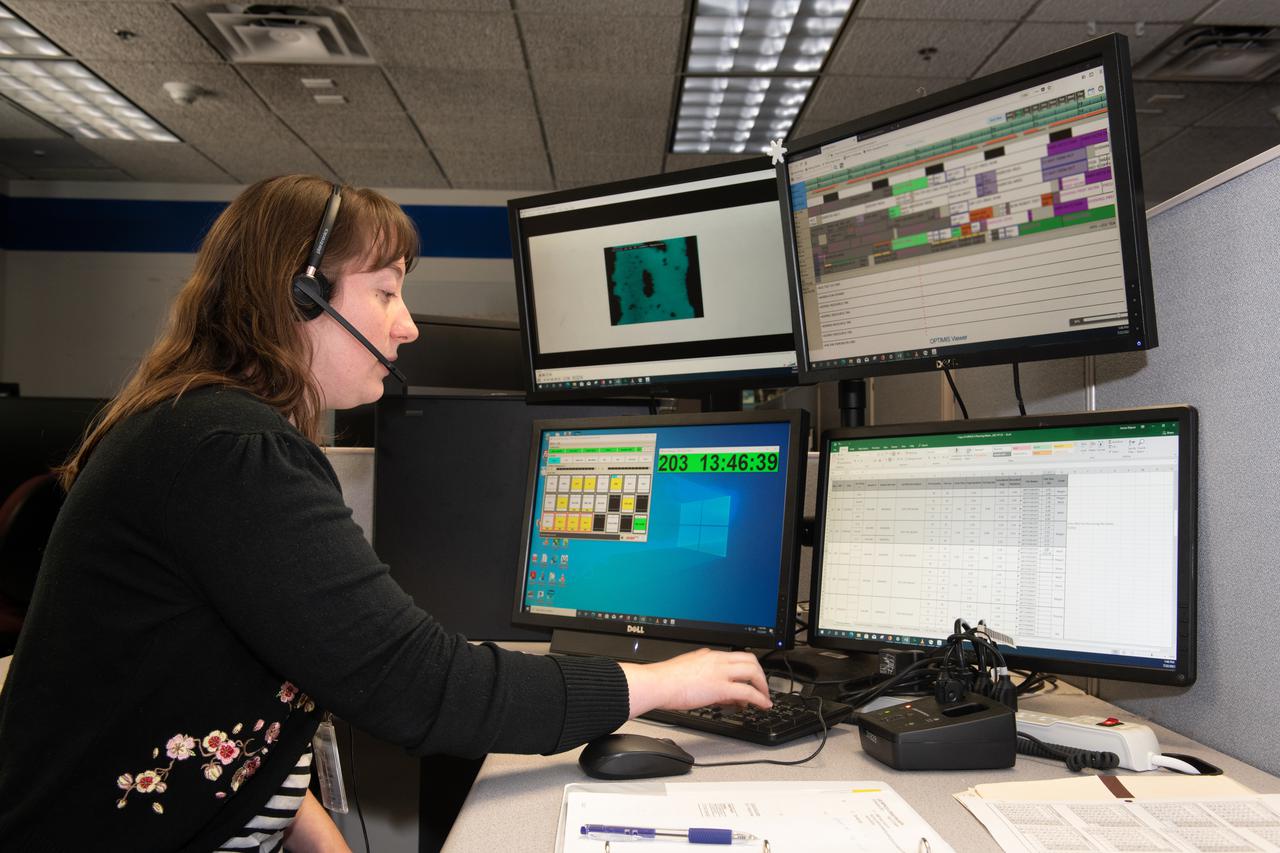
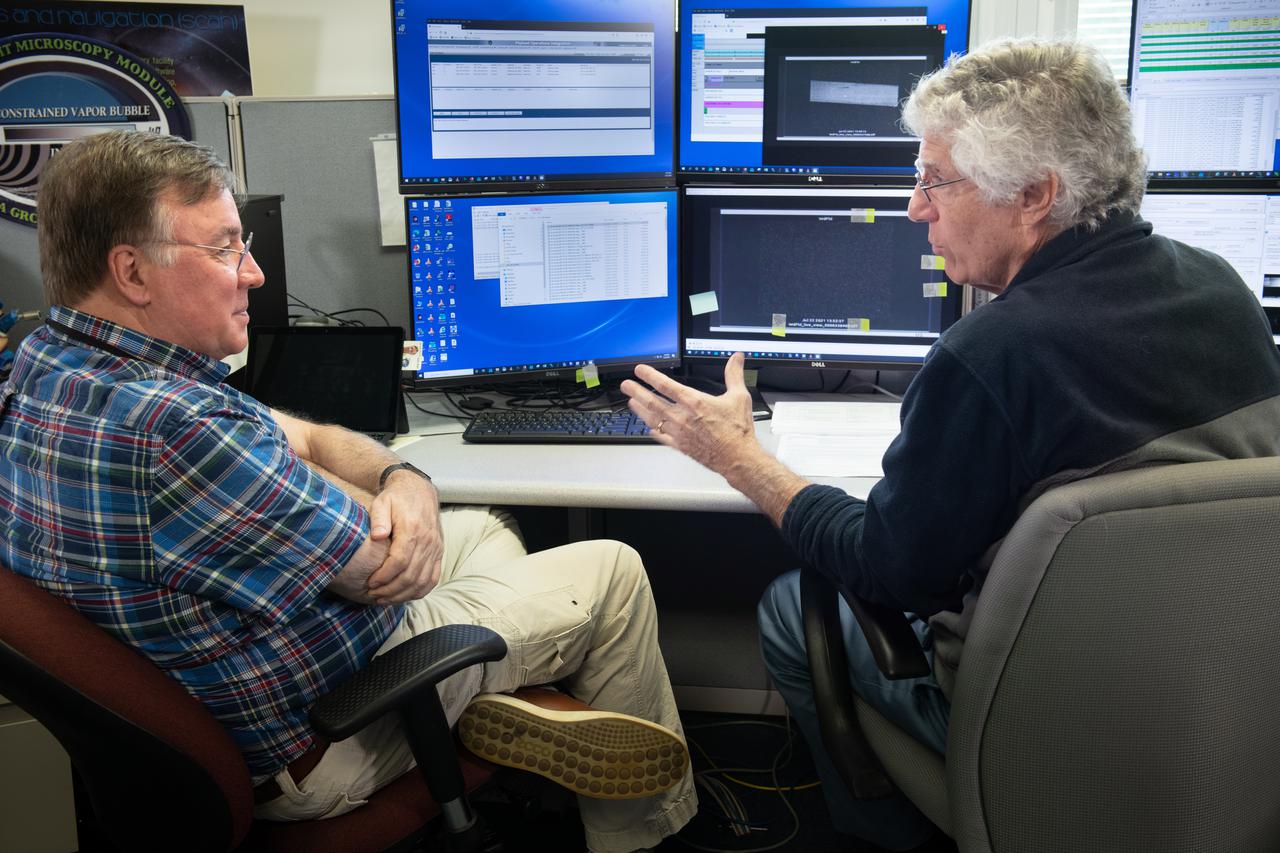
Advanced Colloids Experiment, Thermal 5-2, ACE T5-2 International Space Station, ISS, Fluids Integrated Rack, FIR Operations in the Telescience Support Center, TSC
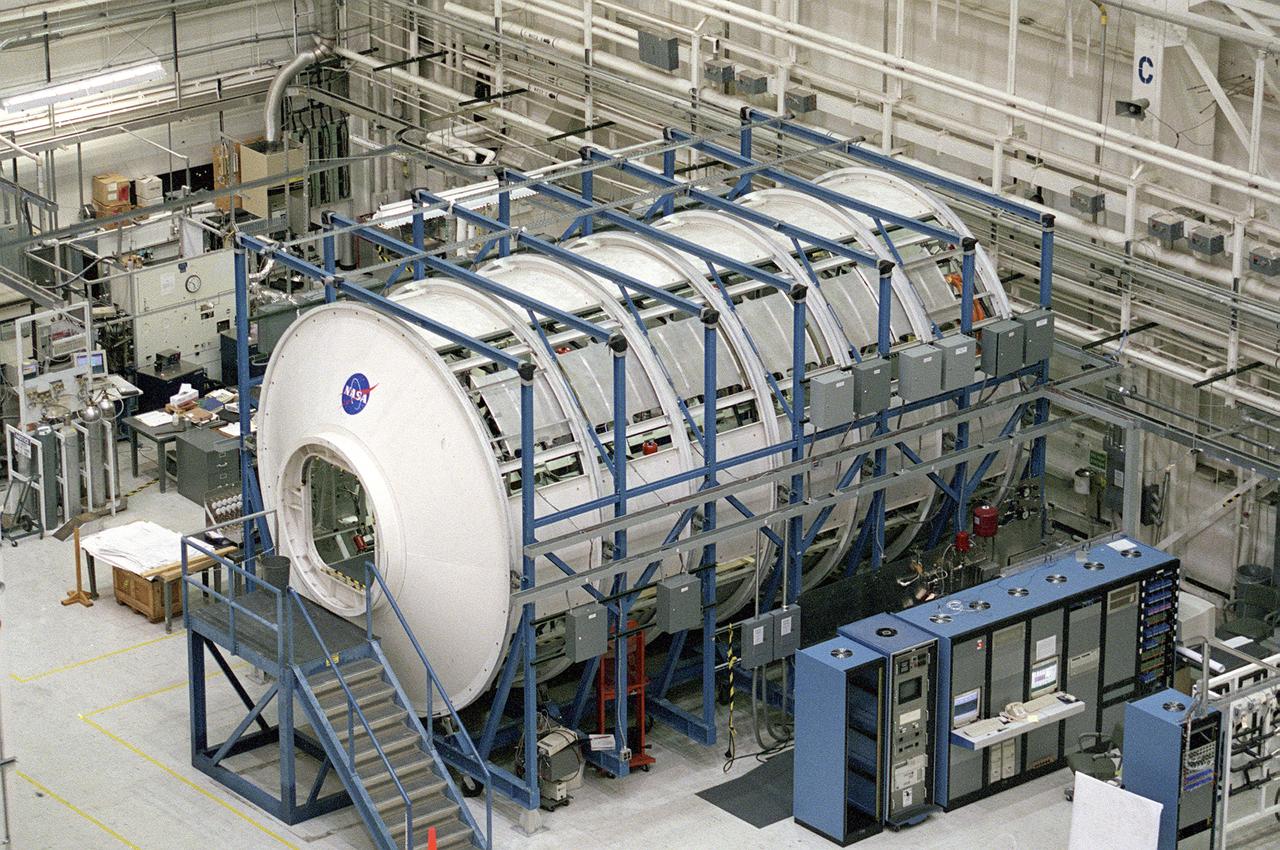
The Marshall Space Flight Center (MSFC) is responsible for designing and building the life support systems that will provide the crew of the International Space Station (ISS) a comfortable environment in which to live and work. Scientists and engineers at the MSFC are working together to provide the ISS with systems that are safe, efficient and cost-effective. These compact and powerful systems are collectively called the Environmental Control and Life Support Systems, or simply, ECLSS. This is an exterior view of the U.S. Laboratory Module Simulator containing the ECLSS Internal Thermal Control System (ITCS) testing facility at MSFC. At the bottom right is the data acquisition and control computers (in the blue equipment racks) that monitor the testing in the facility. The ITCS simulator facility duplicates the function, operation, and troubleshooting problems of the ITCS. The main function of the ITCS is to control the temperature of equipment and hardware installed in a typical ISS Payload Rack.
International Space Station (ISS)
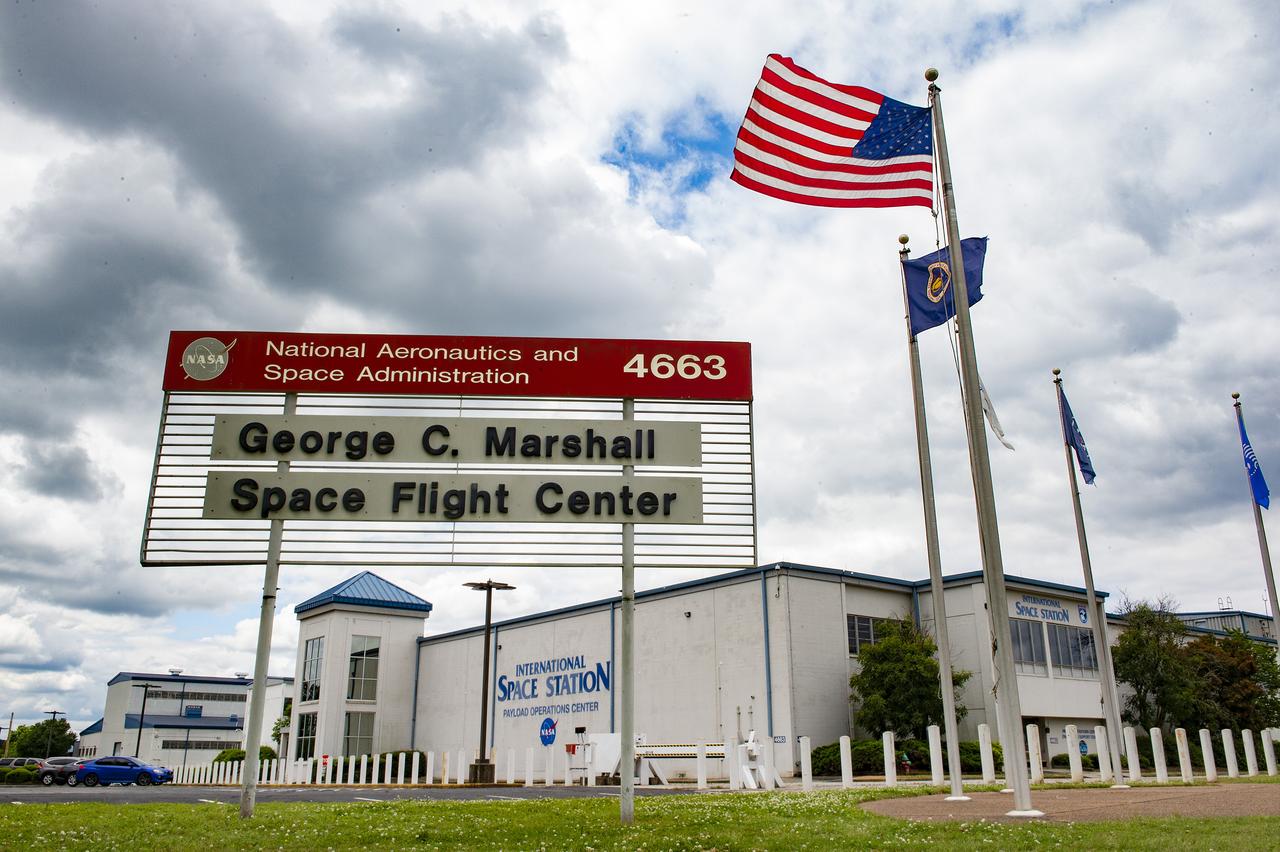
MSFC Building 4663, NE corner view of Huntsville Operations  Support Center, housing the Payload Operations Integration Center (POIC). The POIC supports ongoing flight operations and scientific experiments aboard the International Space Station (ISS)
Huntsville Operations Support Center (HOSC)
The Marshall Space Flight Center (MSFC) is responsible for designing and building the life support systems that will provide the crew of the International Space Station (ISS) a comfortable environment in which to live and work. Scientists and engineers at the MSFC are working together to provide the ISS with systems that are safe, efficient, and cost-effective. These compact and powerful systems are collectively called the Environmental Control and Life Support Systems, or simply, ECLSS. This photograph shows the development Water Processor located in two racks in the ECLSS test area at the Marshall Space Flight Center. Actual waste water, simulating Space Station waste, is generated and processed through the hardware to evaluate the performance of technologies in the flight Water Processor design.
International Space Station (ISS)
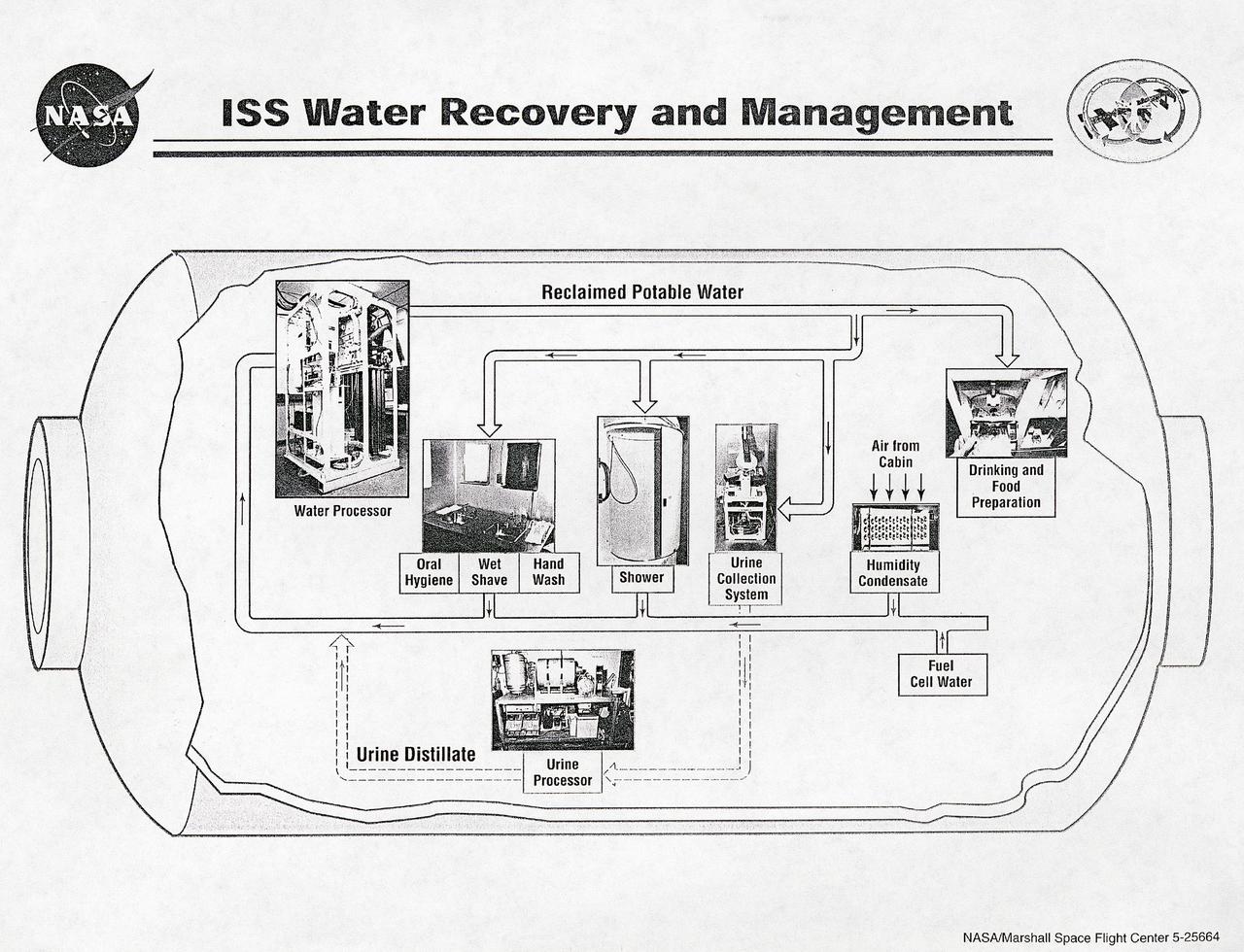
This diagram shows the flow of water recovery and management in the International Space Station (ISS). The Environmental Control and Life Support System (ECLSS) Group of the Flight Projects Directorate at the Marshall Space Flight Center is responsible for the regenerative ECLSS hardware, as well as providing technical support for the rest of the system. The regenerative ECLSS, whose main components are the Water Recovery System (WRS), and the Oxygen Generation System (OGS), reclaims and recycles water oxygen. The ECLSS maintains a pressurized habitation environment, provides water recovery and storage, maintains and provides fire detection/ suppression, and provides breathable air and a comfortable atmosphere in which to live and work within the ISS. The ECLSS hardware will be located in the Node 3 module of the ISS.
International Space Station (ISS)
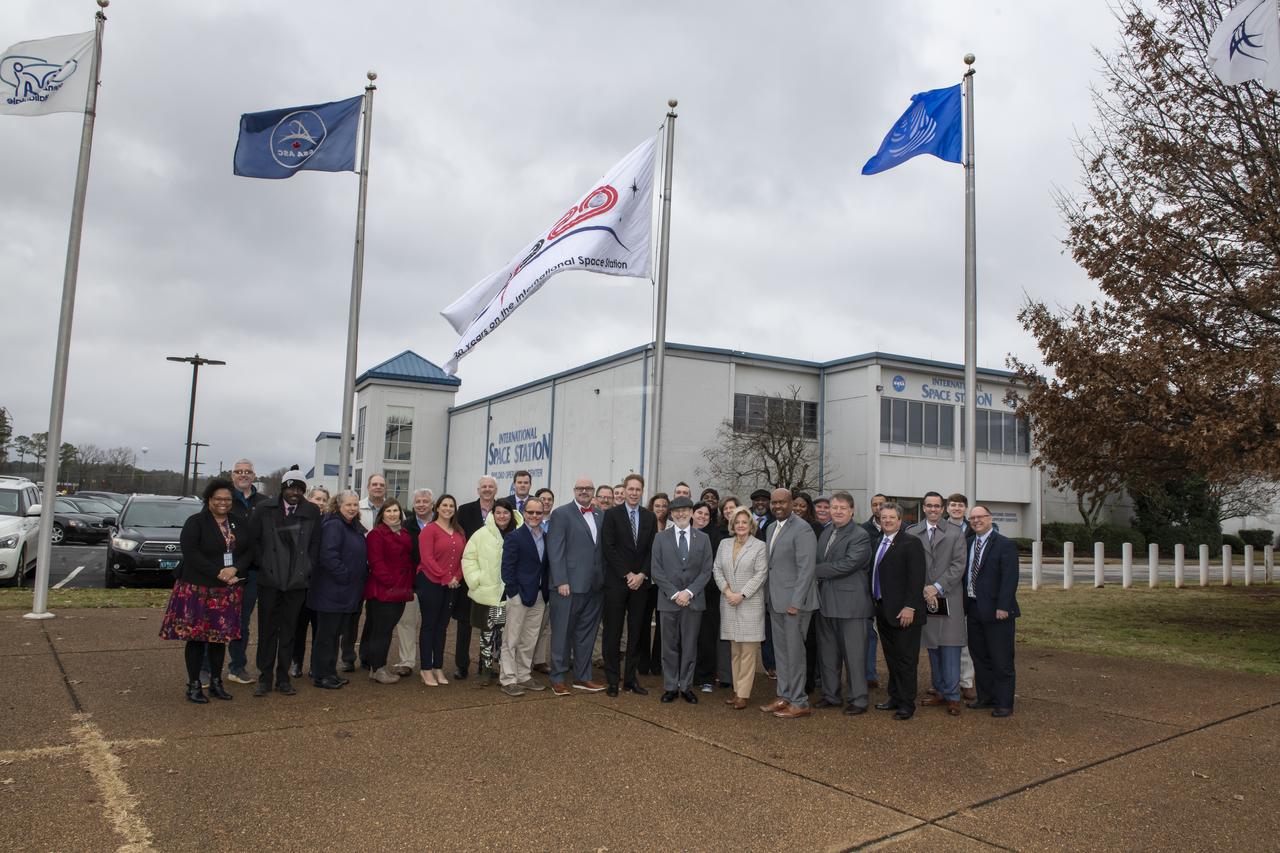
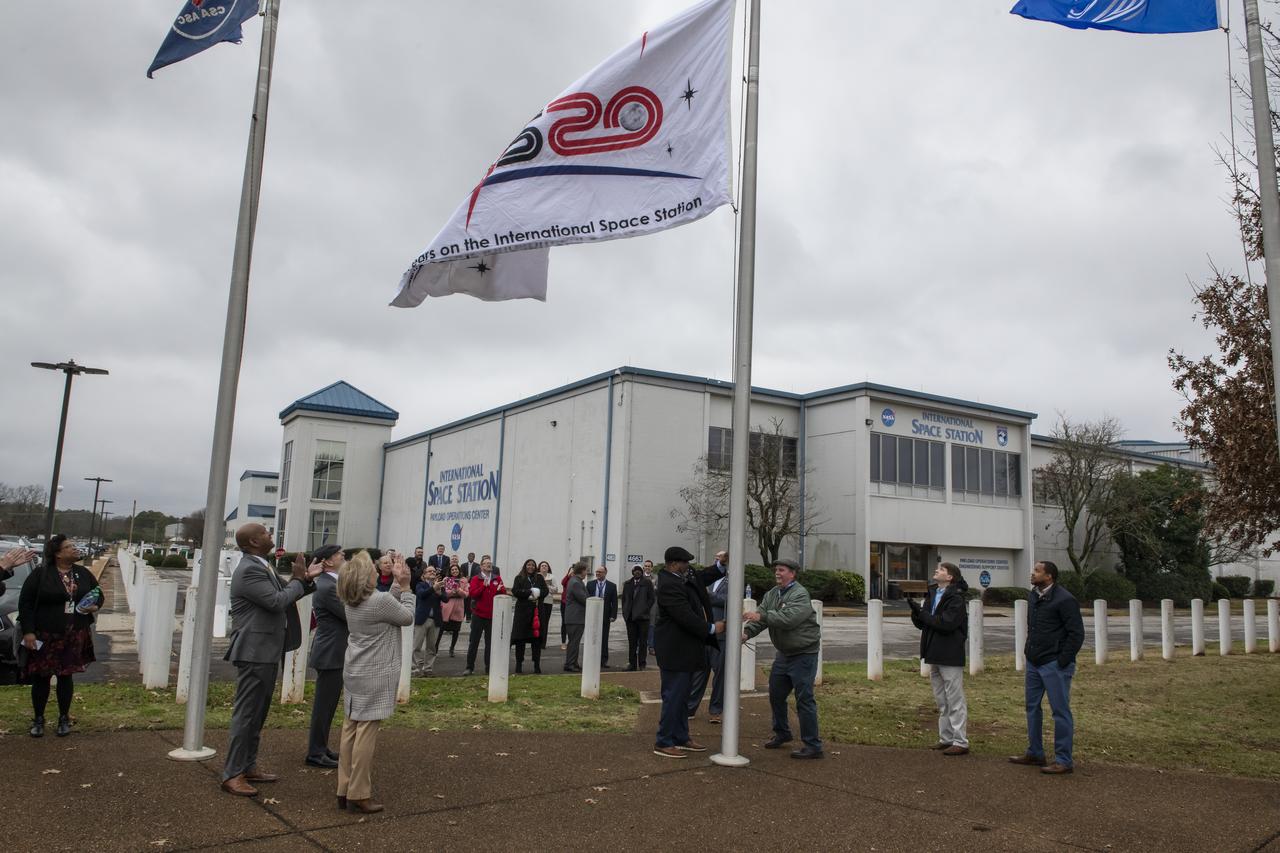
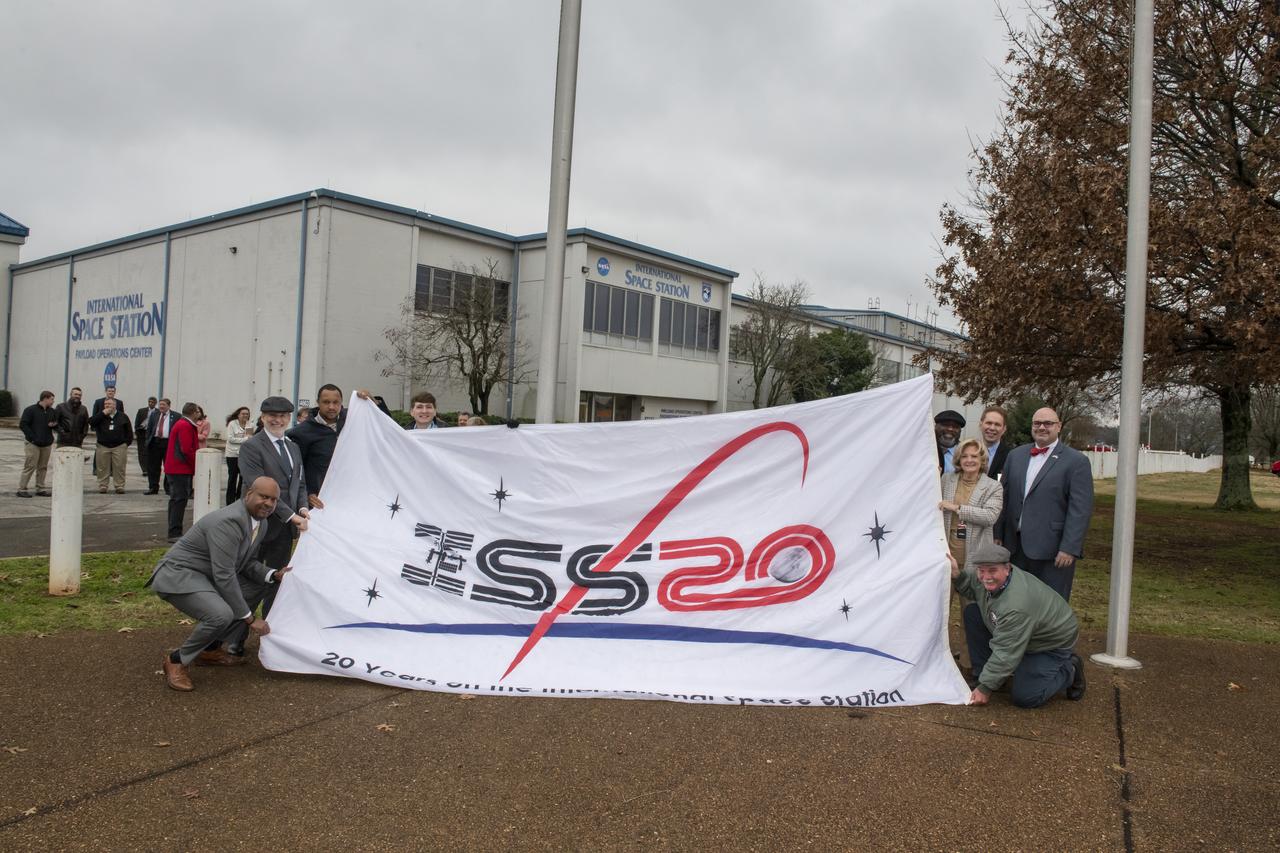
NASA Associate Administrator for the Human Exploration and Operations Mission Directorate and Marshall Center Director Jody Singer participate in the hanging of a new International Space Station flag out side of the Huntsville Operations Support Center (HOSC). Also participating were employees of the support center and the Payload Operations Integration Center.
Associate Administrator Douglas Loverro Participates in the Hanging of the ISS Flag
NASA Associate Administrator for the Human Exploration and Operations Mission Directorate and Marshall Center Director Jody Singer participate in the hanging of a new International Space Station flag out side of the Huntsville Operations Support Center (HOSC). Also participating were employees of the support center and the Payload Operations Integration Center.
Associate Administrator Douglas Loverro Participates in the Hanging of the ISS Flag
NASA Associate Administrator for the Human Exploration and Operations Mission Directorate and Marshall Center Director Jody Singer participate in the hanging of a new International Space Station flag out side of the Huntsville Operations Support Center (HOSC). Also participating were employees of the support center and the Payload Operations Integration Center.
Associate Administrator Douglas Loverro Participates in the Hanging of the ISS Flag
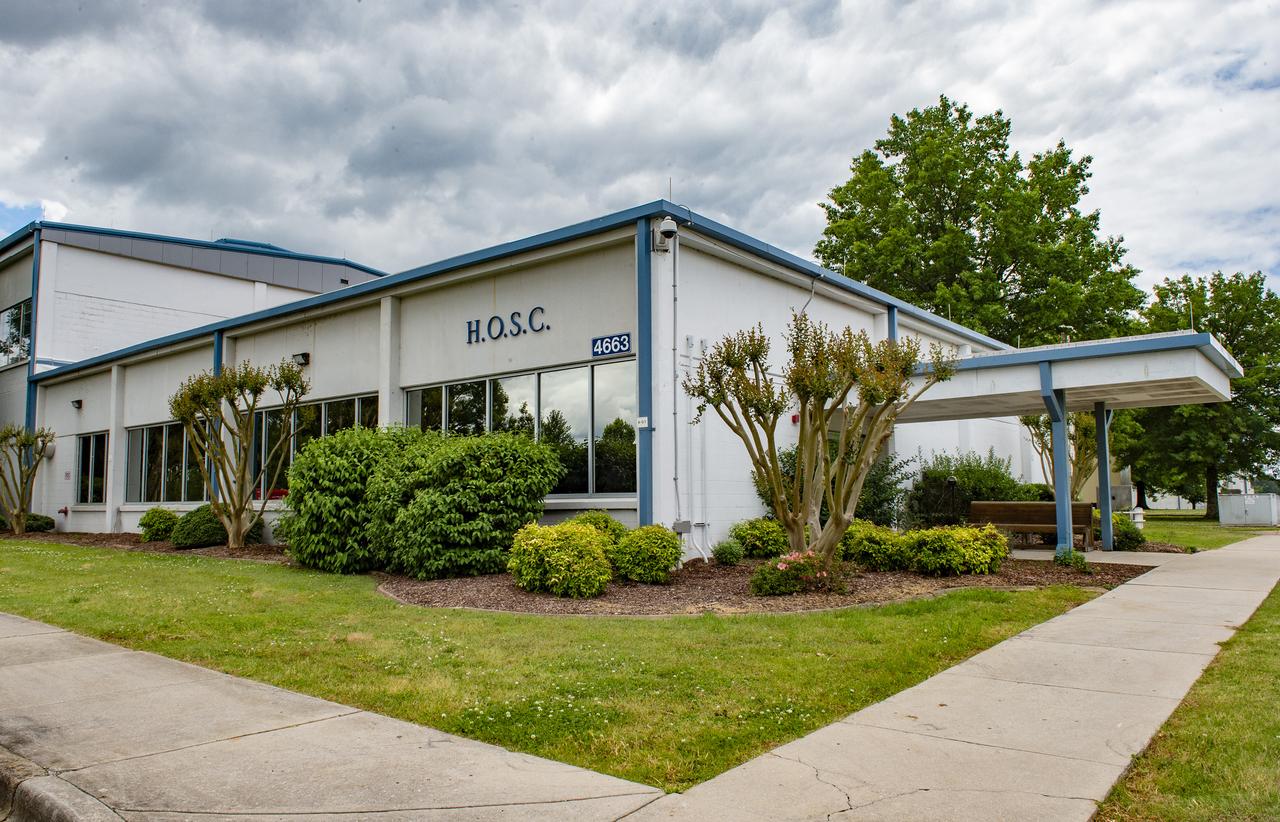
MSFC Building 4663, NW corner view showing entrance to Huntsville Operations Support Center (HOSC). The HOSC is home to the Payload Operations Integration Center (POIC) which supports the mission and scientific experiments aboard the International Space Station (ISS).
MSFC Building 4663, NW corner view showing entrance to Huntsville Operations Support Center (HOSC).
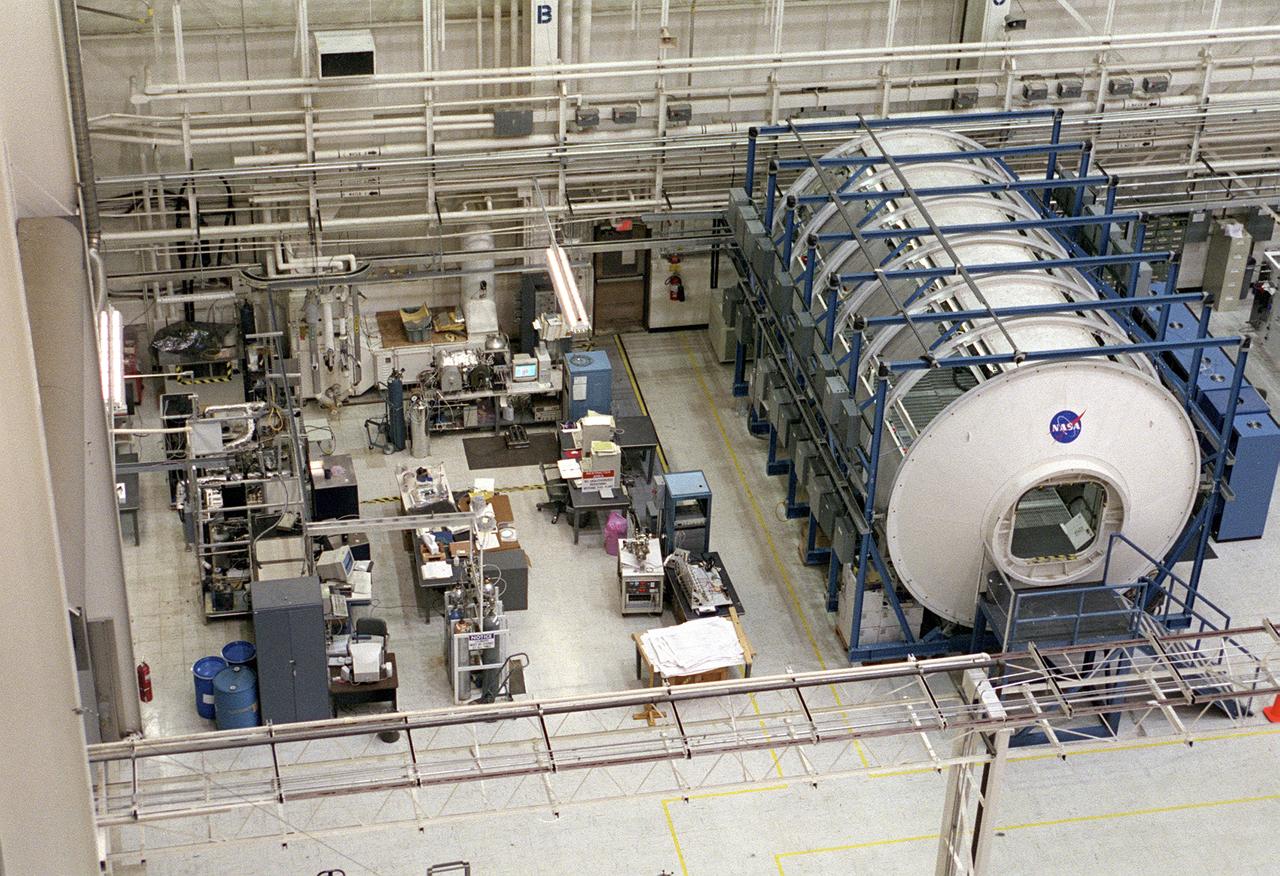
The Marshall Space Flight Center (MSFC) is responsible for designing and building the life support systems that will provide the crew of the International Space Station (ISS) a comfortable environment in which to live and work. Scientists and engineers at the MSFC are working together to provide the ISS with systems that are safe, efficient, and cost-effective. These compact and powerful systems are collectively called the Environmental Control and Life Support Systems, or simply, ECLSS. In this photograph, the life test area on the left of the MSFC ECLSS test facility is where various subsystems and components are tested to determine how long they can operate without failing and to identify components needing improvement. Equipment tested here includes the Carbon Dioxide Removal Assembly (CDRA), the Urine Processing Assembly (UPA), the mass spectrometer filament assemblies and sample pumps for the Major Constituent Analyzer (MCA). The Internal Thermal Control System (ITCS) simulator facility (in the module in the right) duplicates the function and operation of the ITCS in the ISS U.S. Laboratory Module, Destiny. This facility provides support for Destiny, including troubleshooting problems related to the ITCS.
International Space Station (ISS)
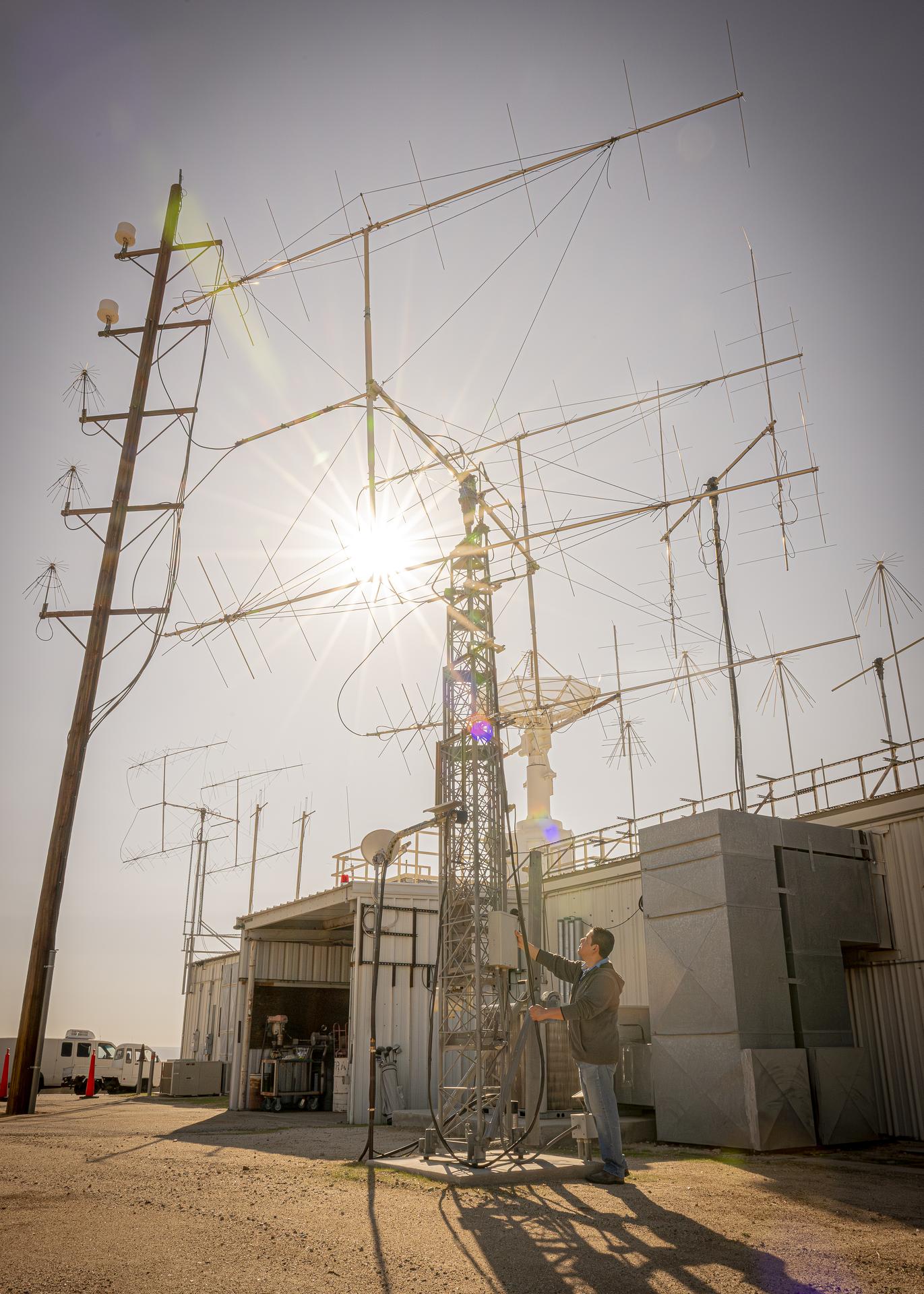
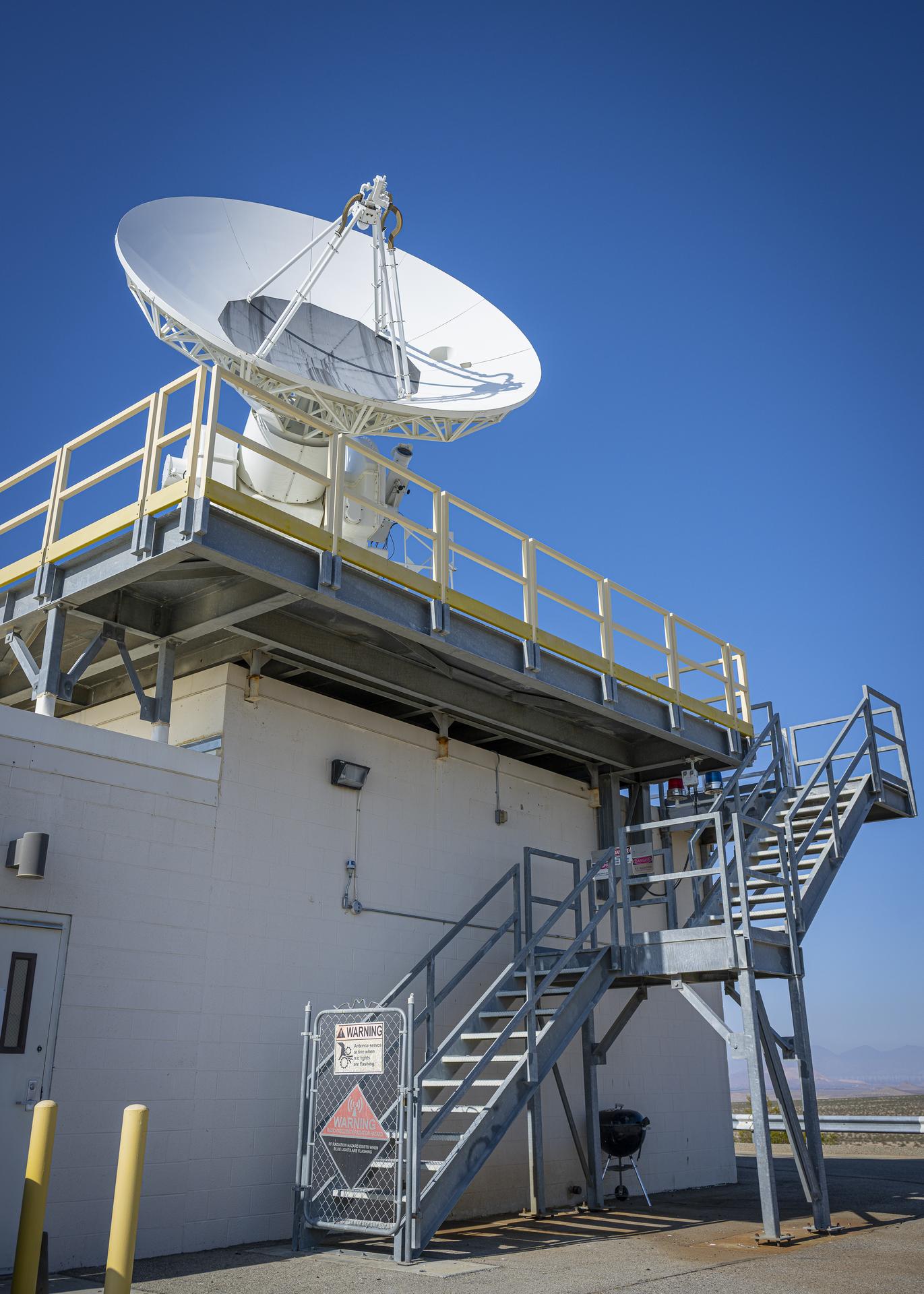
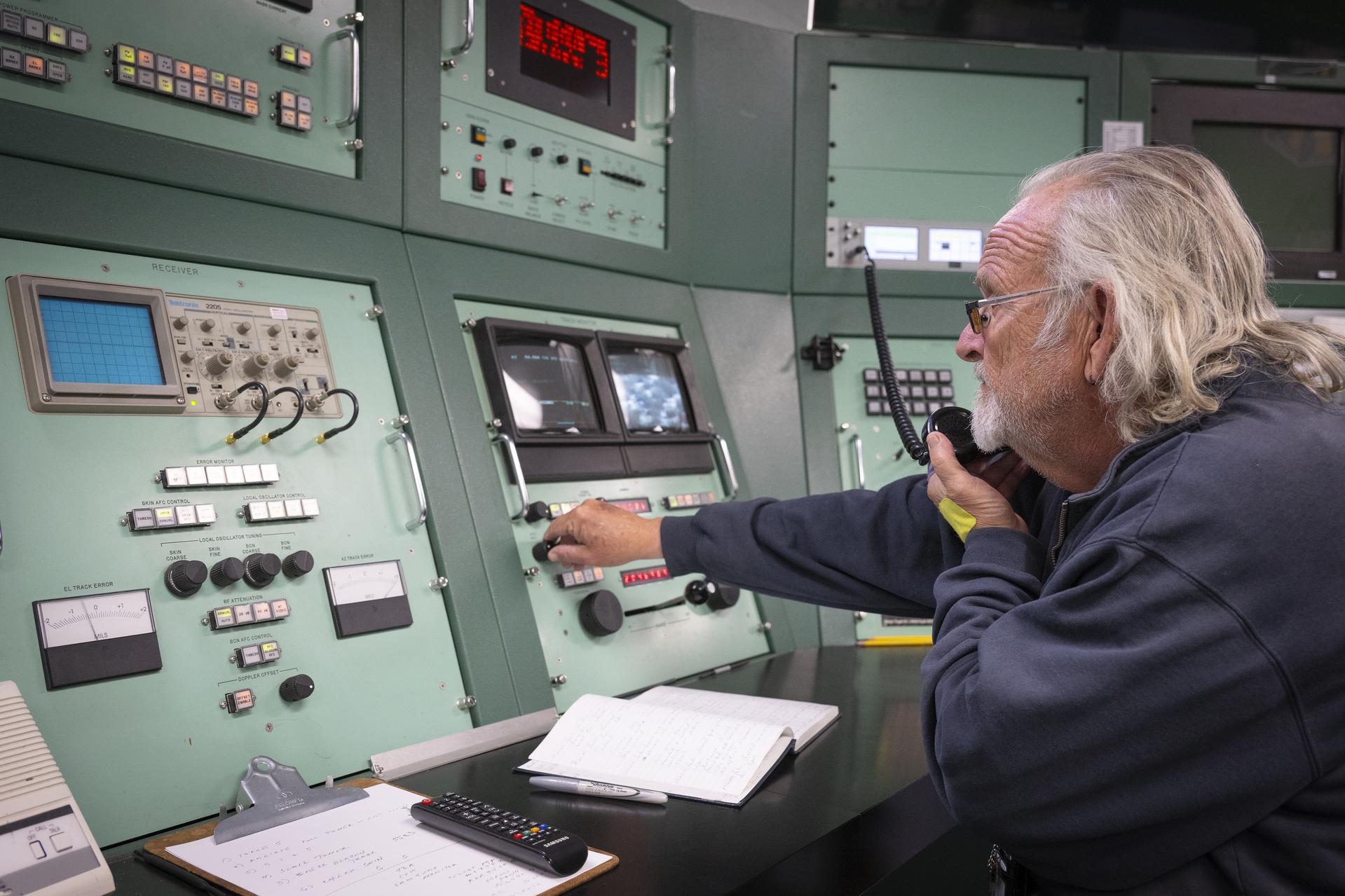
This is one of two radars that support radar tracking of the International Space Station at NASA’s Armstrong Flight Research Center in Edwards, California, on Sept. 30, 2025. Radar tracking is one of the key capabilities of the center’s Dryden Aeronautical Test Range, which provides voice and tracking support to the International Space Station.
NASA Range Supports Space Station
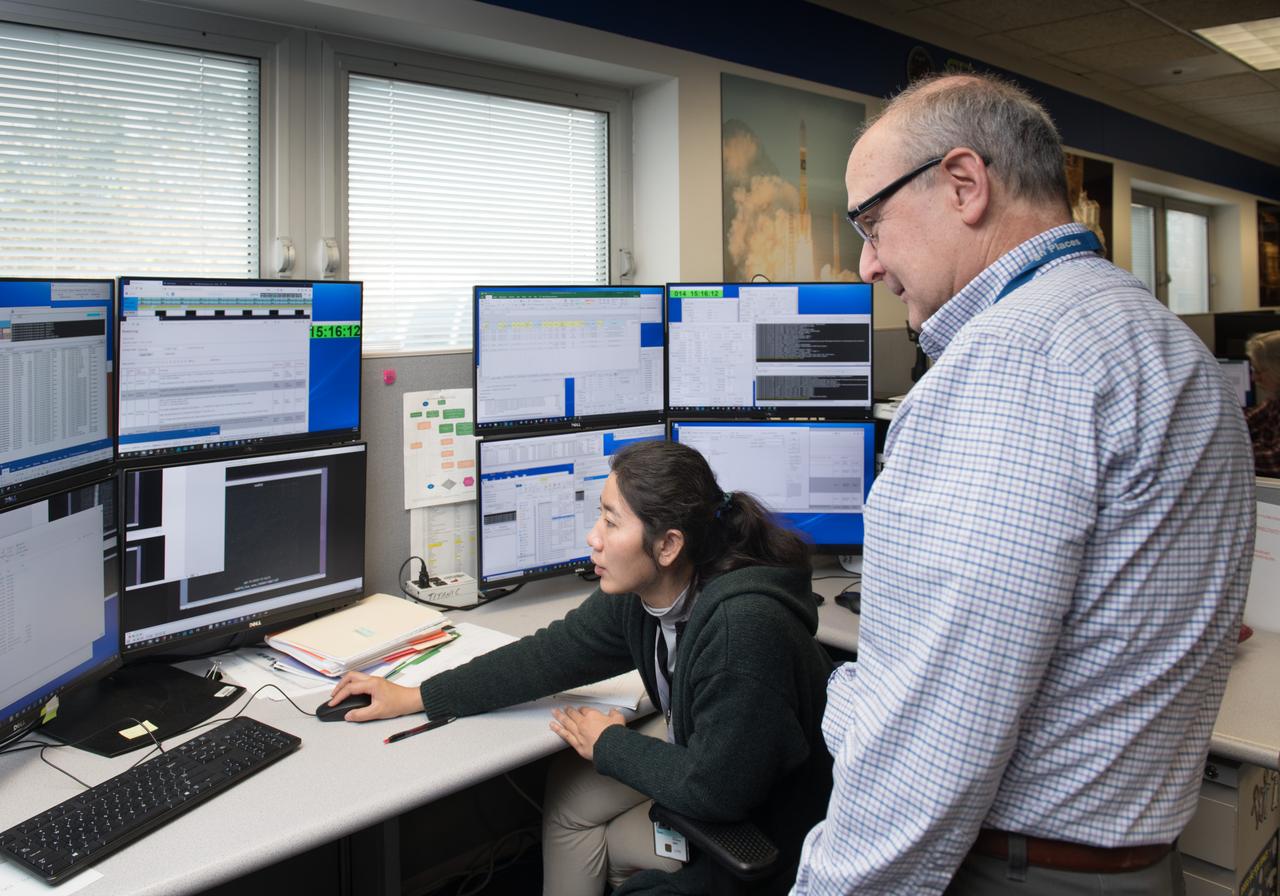
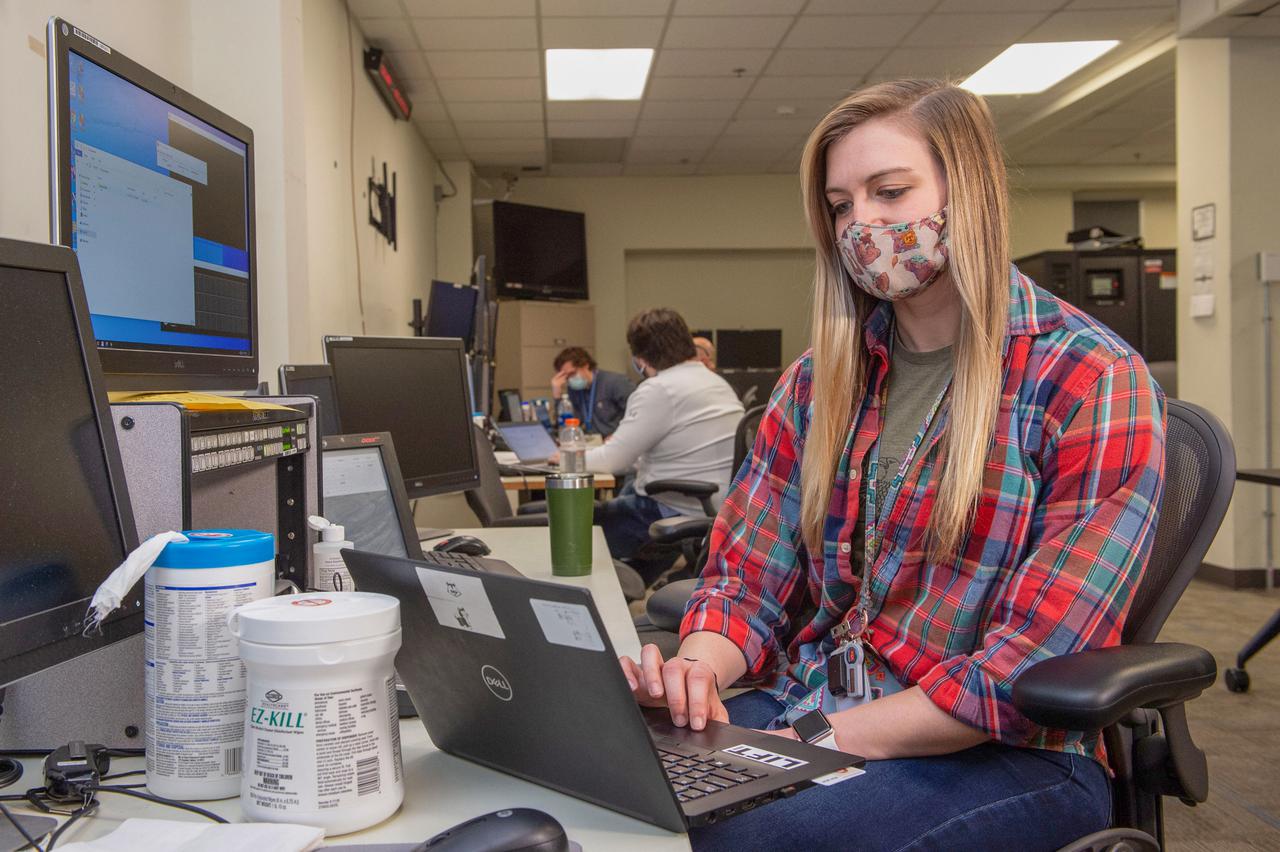
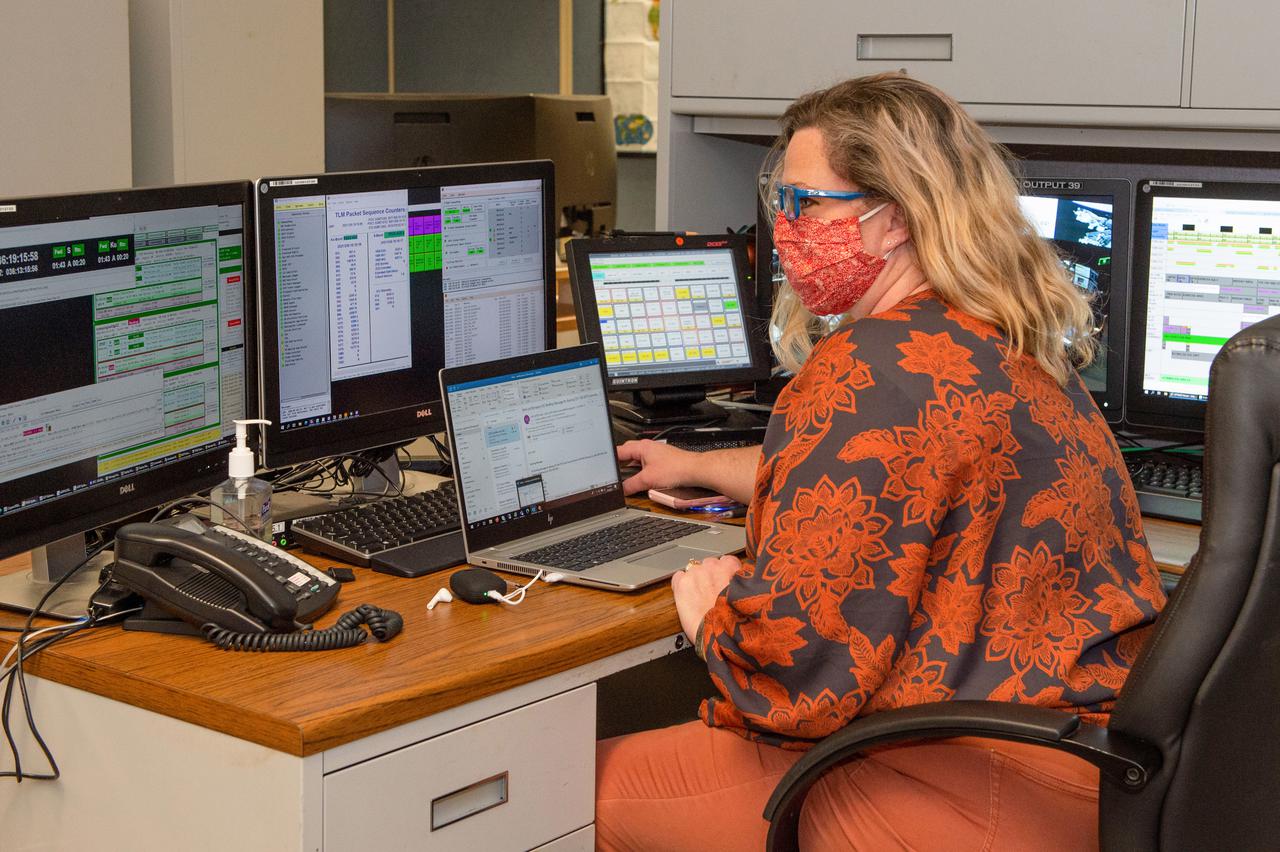
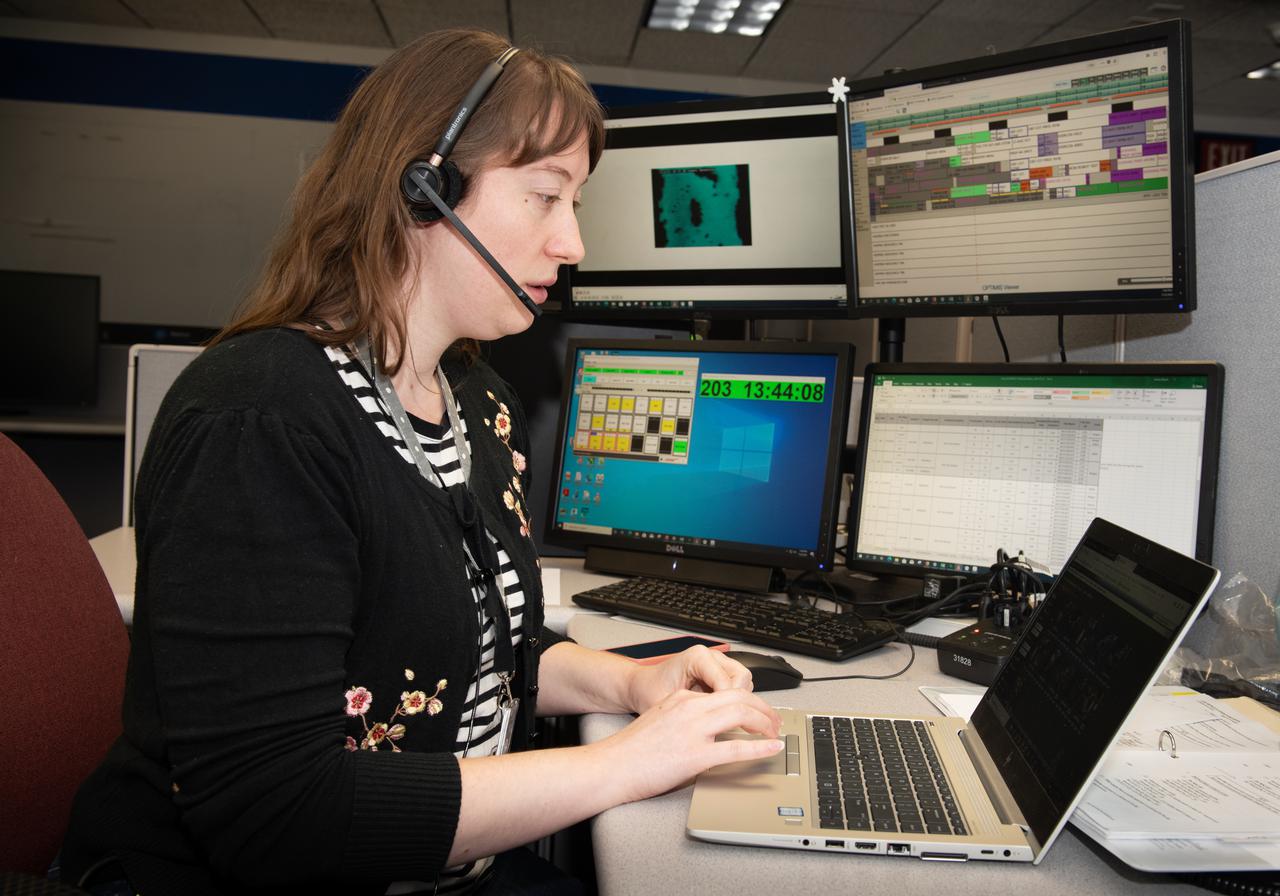
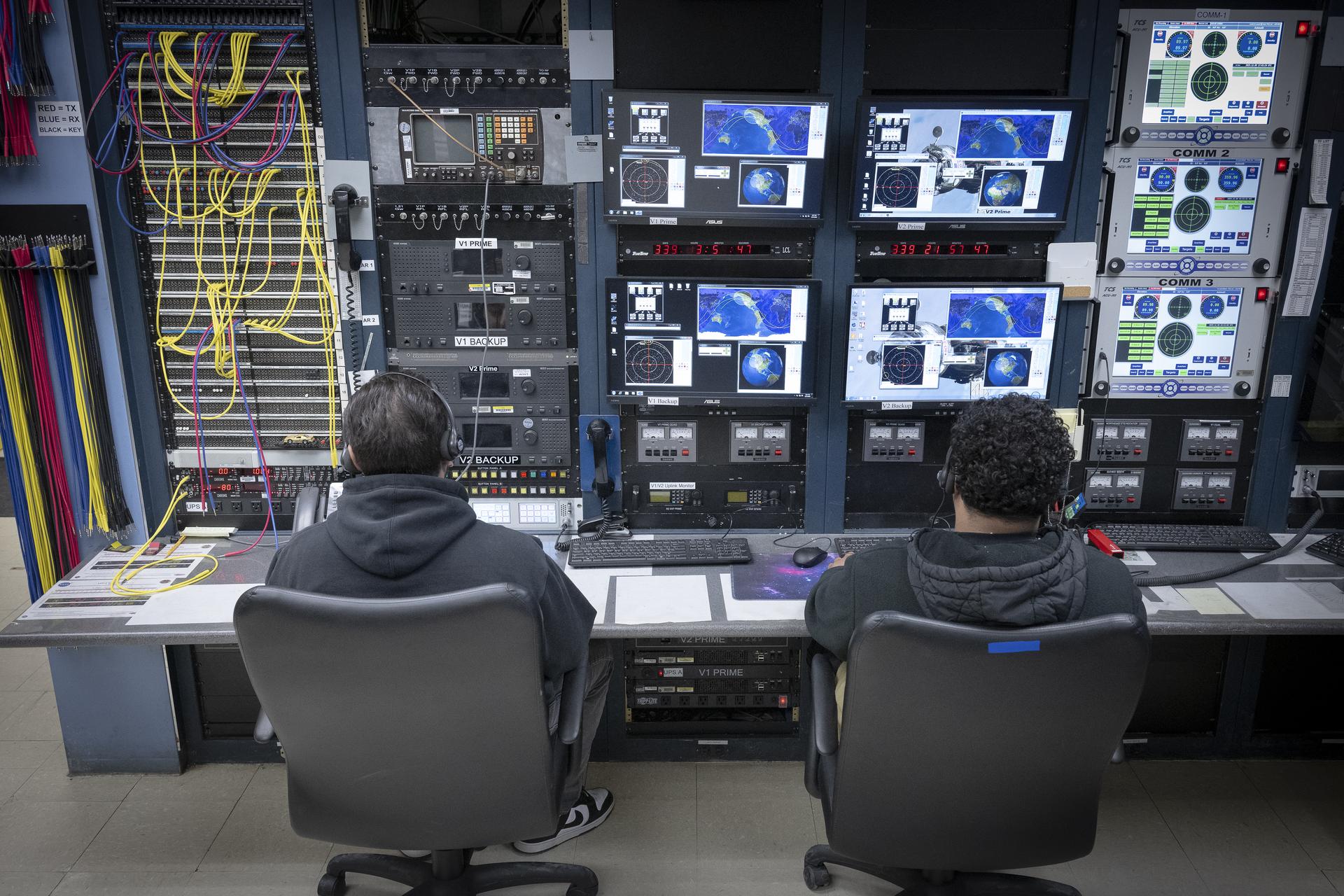
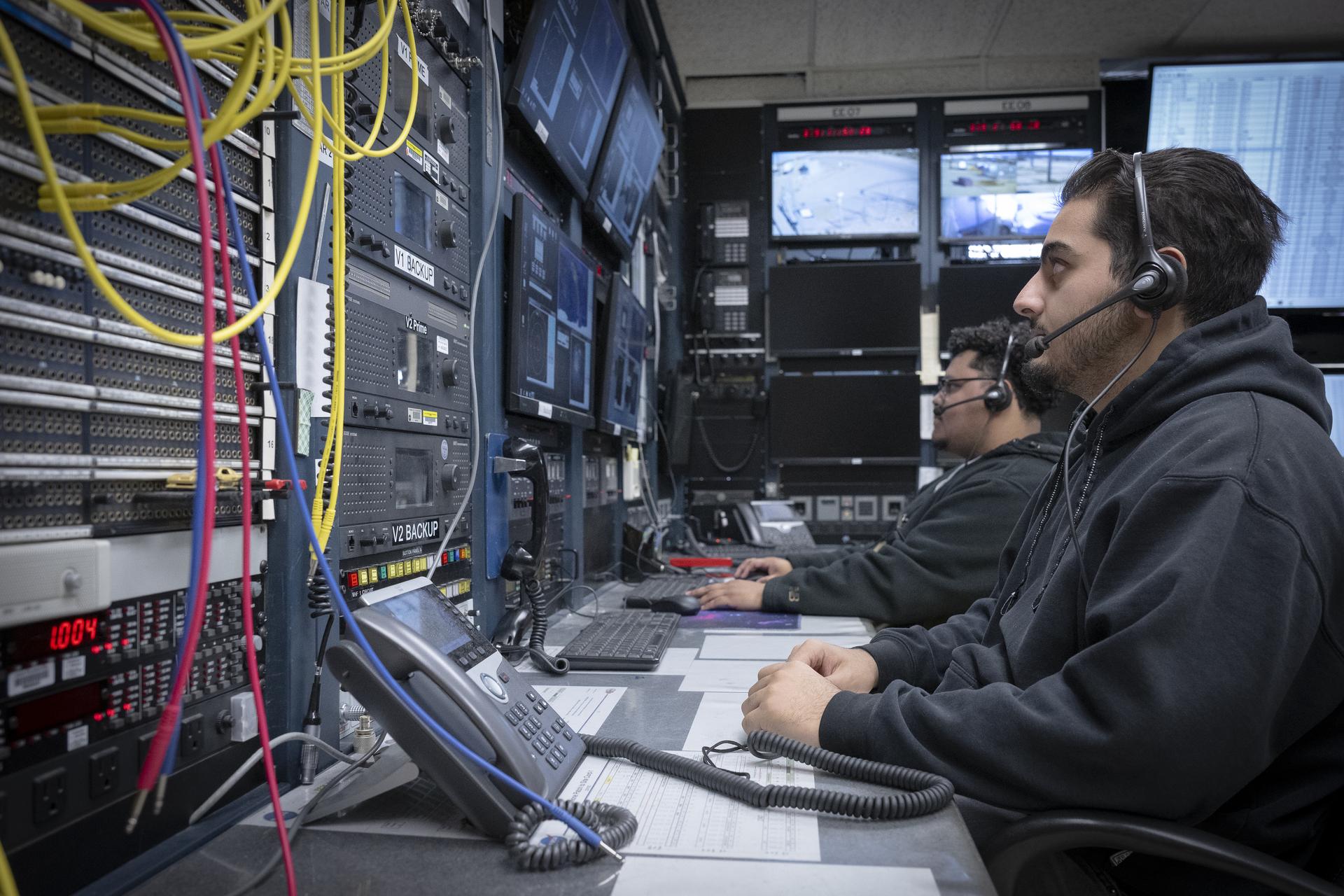
Range operators at the Dryden Aeronautical Test Range at NASA’s Armstong Flight Research Center in Edwards, California, provide voice and tracking support to the International Space Station. In this Friday, Dec. 6, 2025, photo, Alex Oganesyan, left, and Deming Ingles are shown at their workstations, where they support communications backup for space station missions.
NASA Range Supports Space Station
Range operators at the Dryden Aeronautical Test Range at NASA’s Armstong Flight Research Center in Edwards, California, provide voice and tracking support to the International Space Station. In this Friday, Dec. 6, 2025, photo, Alex Oganesyan, left, and Deming Ingles are shown at their workstations, where they support communications backup for space station missions.
NASA Range Supports Space Station
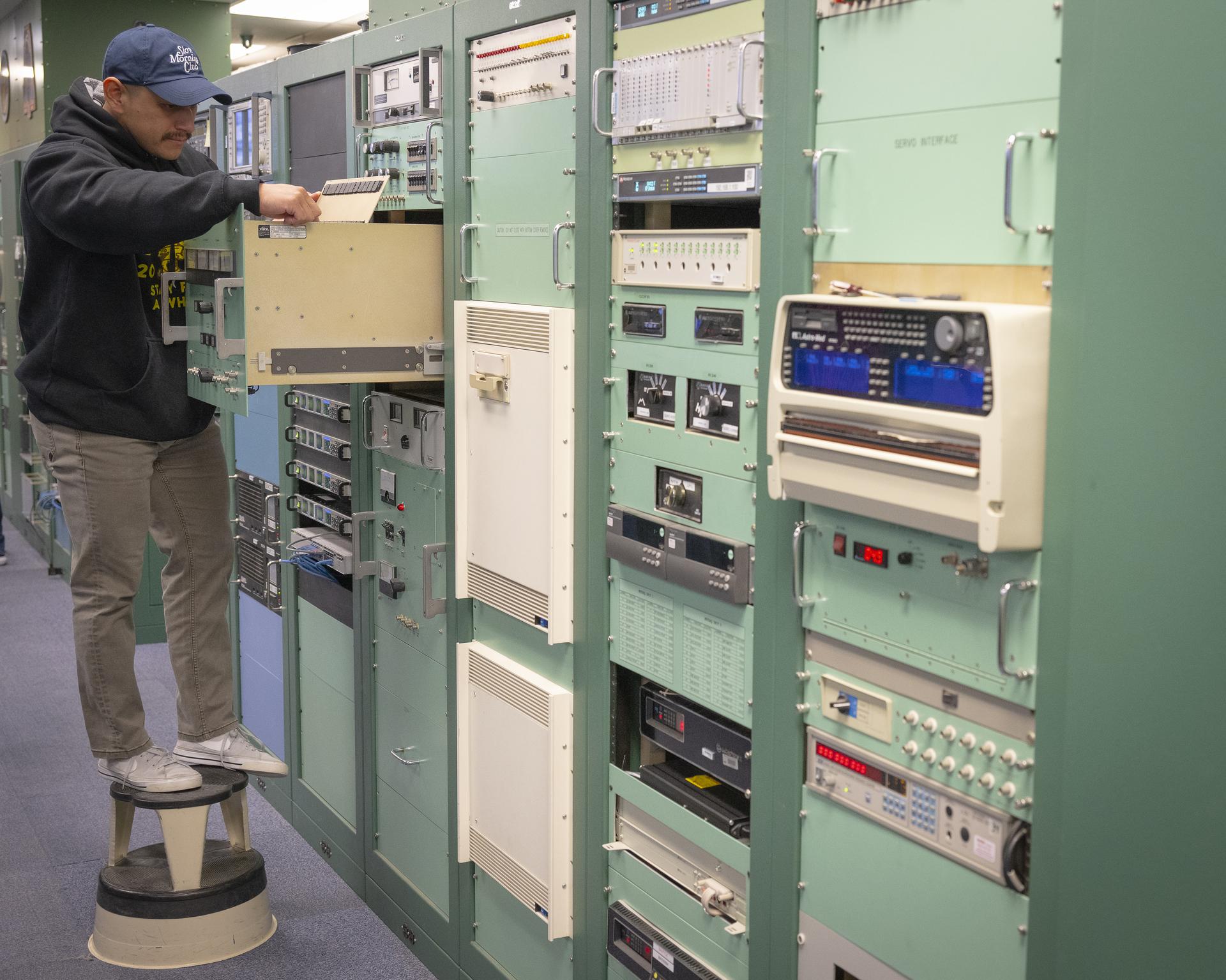
Mission technician Phillips Boche checks on components that support radar tracking at NASA’s Armstrong Flight Research Center in Edwards, California, on Sept. 30, 2025. Boche is part of the center’s Dryden Aeronautical Test Range, which provides voice and tracking support to the International Space Station.
NASA Range Supports Space Station
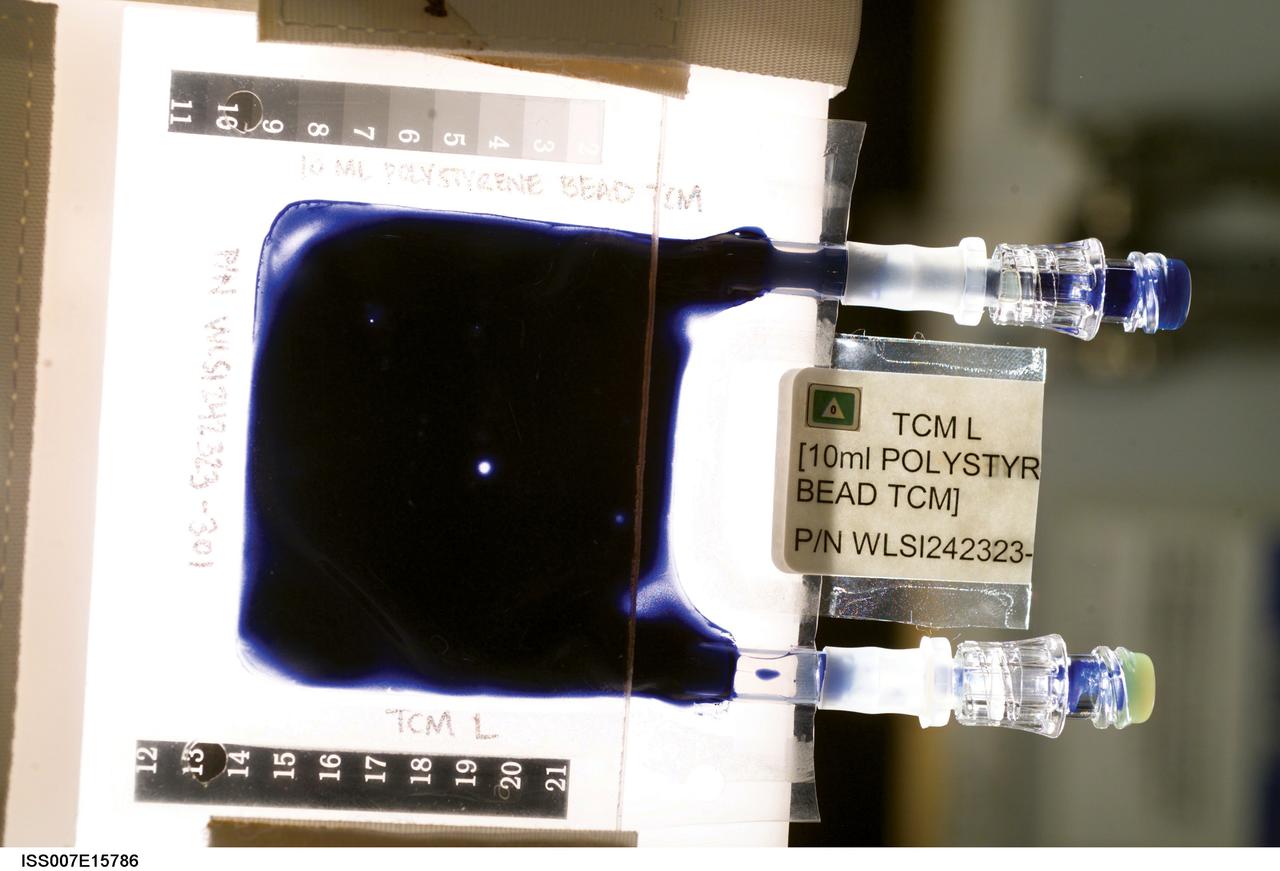
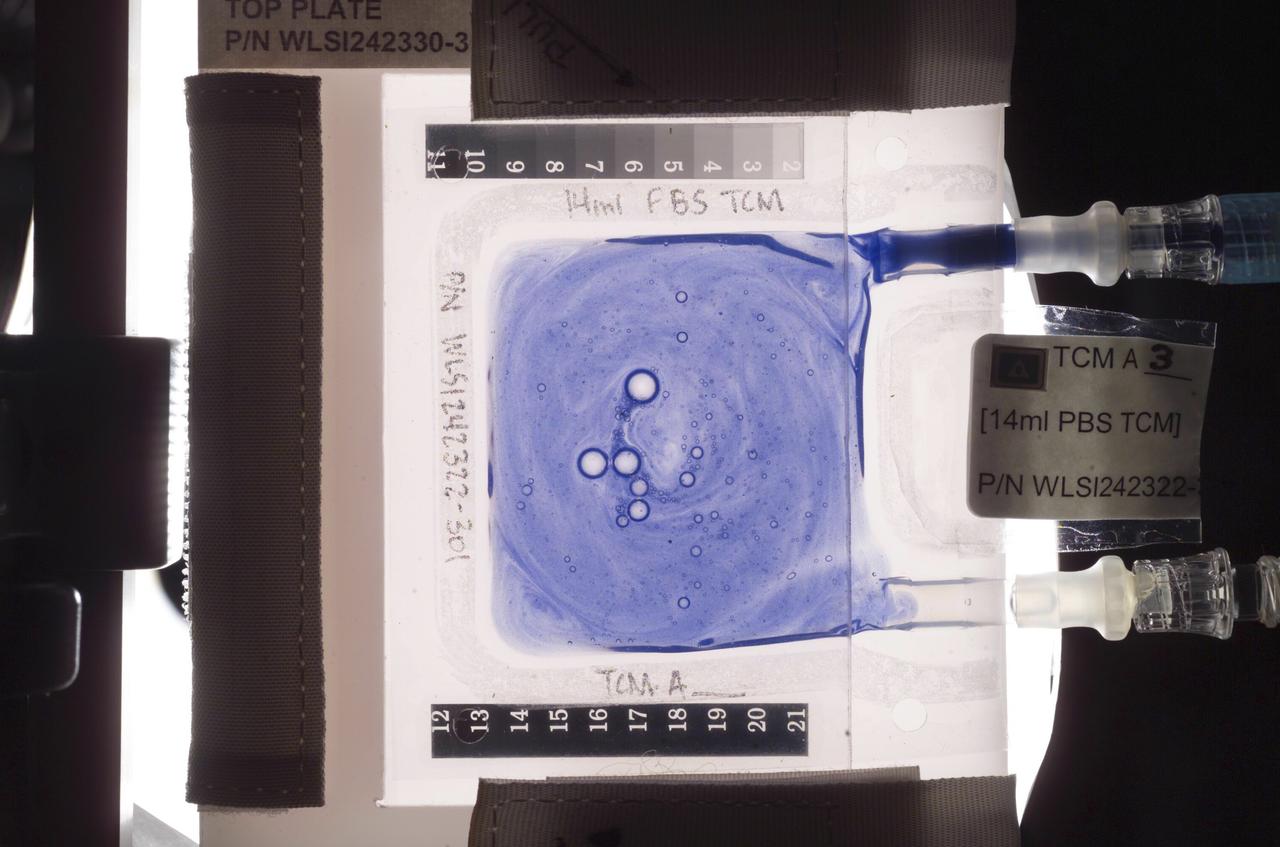
Aboard the International Space Station (ISS), the Tissue Culture Module (TCM) is the stationary bioreactor vessel in which cell cultures grow.  However, for the Cellular Biotechnology Operations Support Systems-Fluid Dynamics Investigation (CBOSS-FDI), color polystyrene beads are used to measure the effectiveness of various mixing procedures.  The beads are similar in size and density to human lymphoid cells. Uniform mixing is a crucial component of CBOSS experiments involving the immune response of human lymphoid cell suspensions.  The goal is to develop procedures that are both convenient for the flight crew and are optimal in providing uniform and reproducible mixing of all components, including cells.  The average bead density in a well mixed TCM will be uniform, with no bubbles, and it will be measured using the absorption of light. In this photograph, beads are trapped in the injection port, with bubbles forming shortly after injection.
Biotechnology
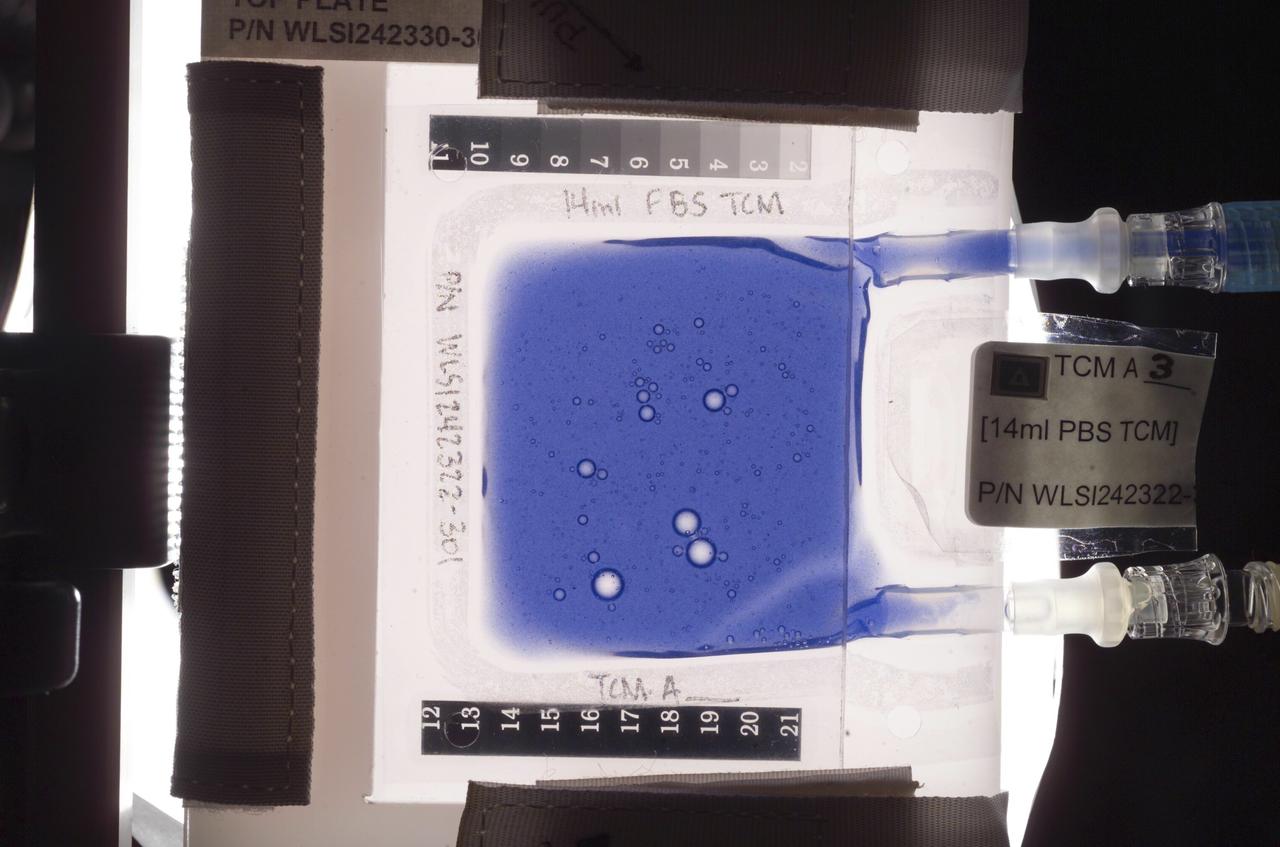
Aboard the International Space Station (ISS), the Tissue Culture Module (TCM) is the stationary bioreactor vessel in which cell cultures grow.  However, for the Cellular Biotechnology Operations Support Systems-Fluid Dynamics Investigation (CBOSS-FDI), color polystyrene beads are used to measure the effectiveness of various mixing procedures. The beads are similar in size and density to human lymphoid cells.  Uniform mixing is a crucial component of CBOSS experiments involving the immune response of human lymphoid cell suspensions.  The goal is to develop procedures that are both convenient for the flight crew and are optimal in providing uniform and reproducible mixing of all components, including cells.  The average bead density in a well mixed TCM will be uniform, with no bubbles, and it will be measured using the absorption of light. In this photograph, a TCM is shown after mixing protocols, and bubbles of various sizes can be seen.
Biotechnology
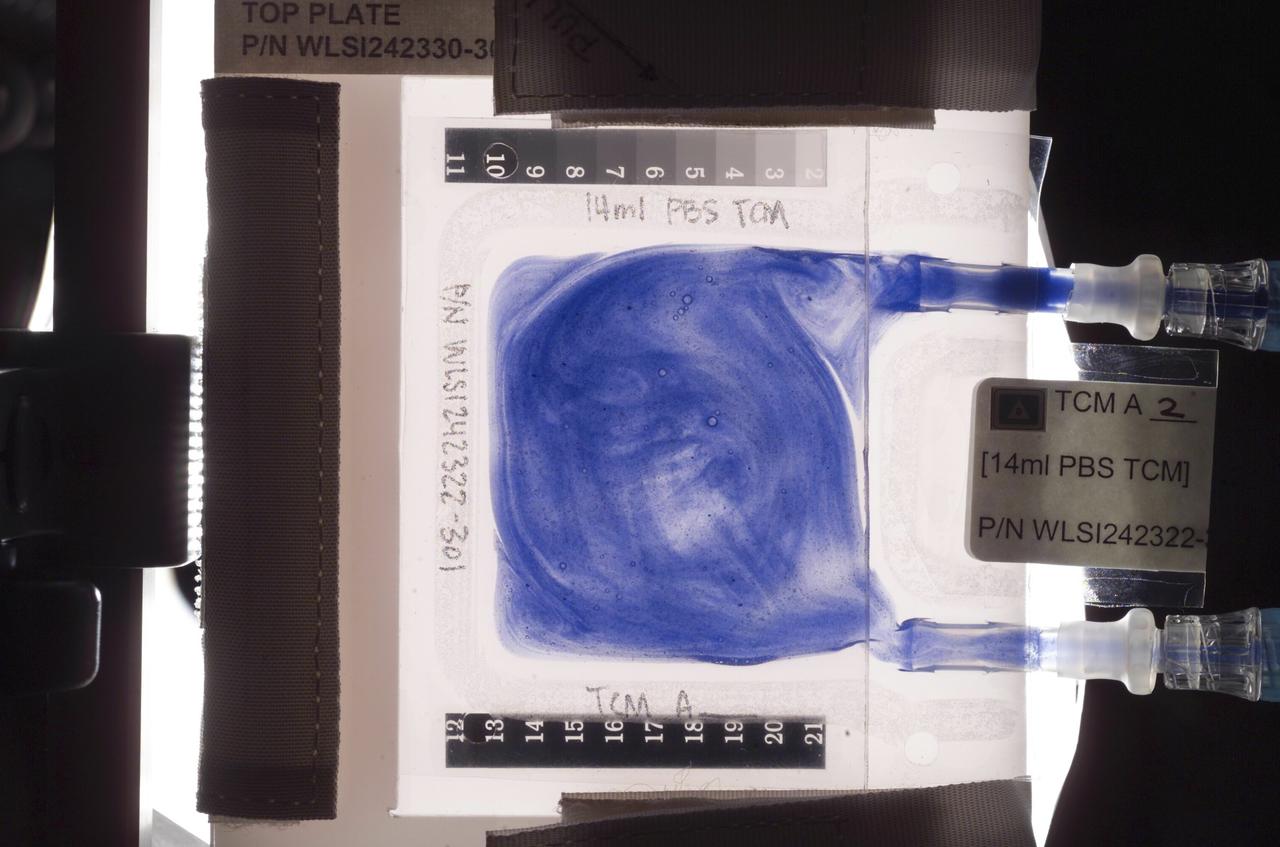
Aboard the International Space Station (ISS), the Tissue Culture Module (TCM) is the stationary bioreactor vessel in which cell cultures grow.  However, for the Cellular Biotechnology Operations Support Systems-Fluid Dynamics Investigation (CBOSS-FDI), color polystyrene beads are used to measure the effectiveness of various mixing procedures.  Uniform mixing is a crucial component of CBOSS experiments involving the immune response of human lymphoid cell suspensions.  In this picture, the beads are trapped in the injection port shortly after injection.  Swirls of beads indicate, event to the naked eye, the contents of the TCM are not fully mixed.  The beads are similar in size and density to human lymphoid cells.  The goal is to develop procedures that are both convenient for the flight crew and are optimal in providing uniform and reproducible mixing of all components, including cells.  The average bead density in a well mixed TCM will be uniform, with no bubbles, and it will be measured using the absorption of light
Biotechnology
Mission operator Mike Webb sits at one of the radar stations used to track the International Space Station as it passes high above NASA’s Armstrong Flight Research Center in Edwards, California, on Sept. 30, 2025. Webb is part of the center’s Dryden Aeronautical Test Range, which provides voice and tracking support to the space station.
NASA Range Supports Space Station
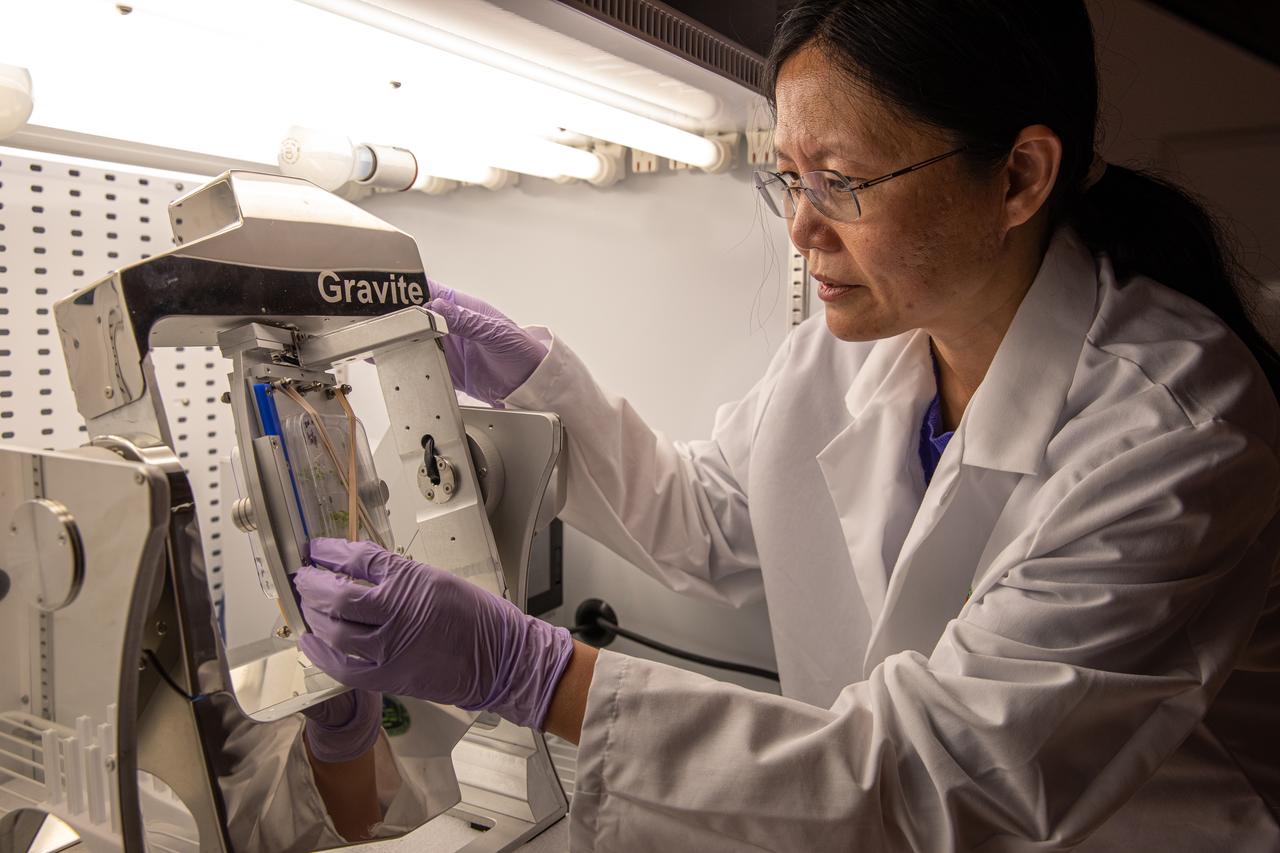
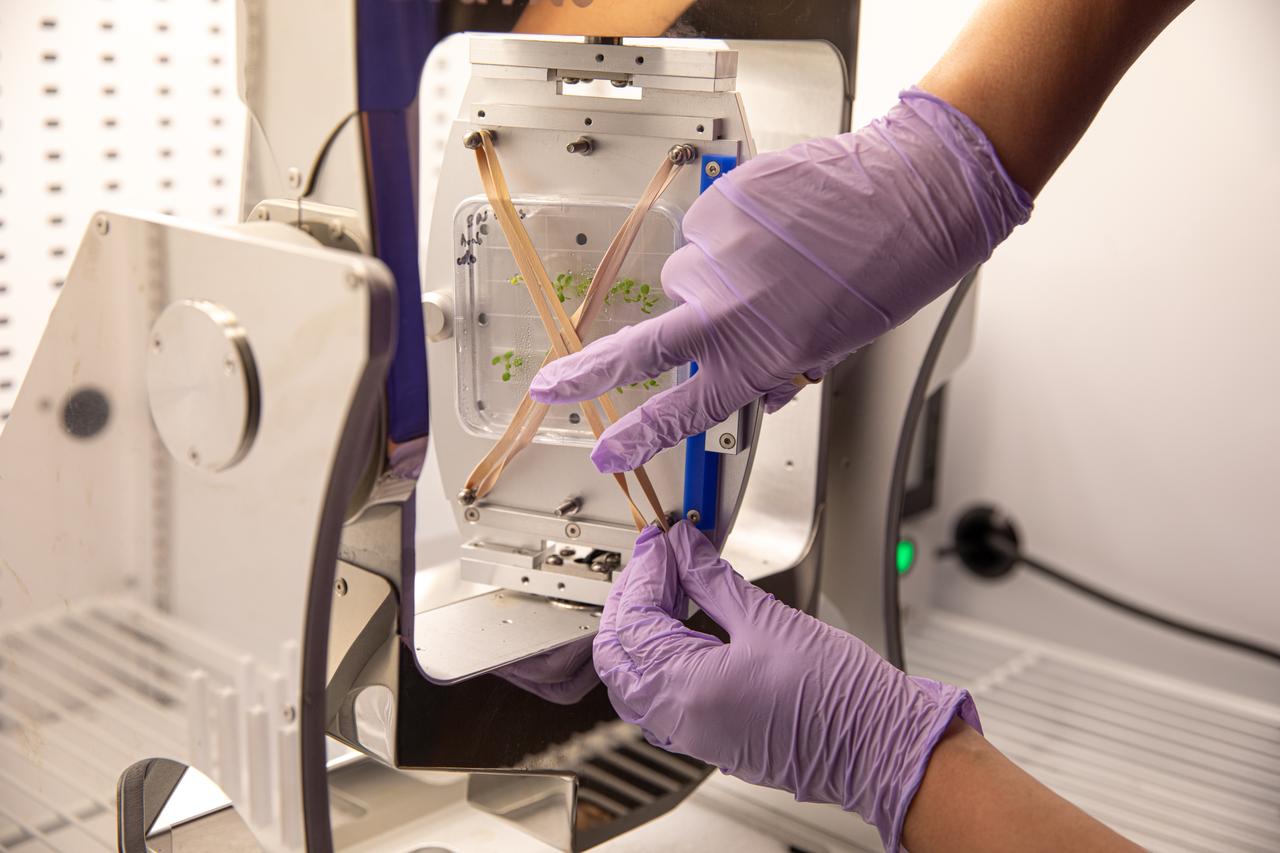
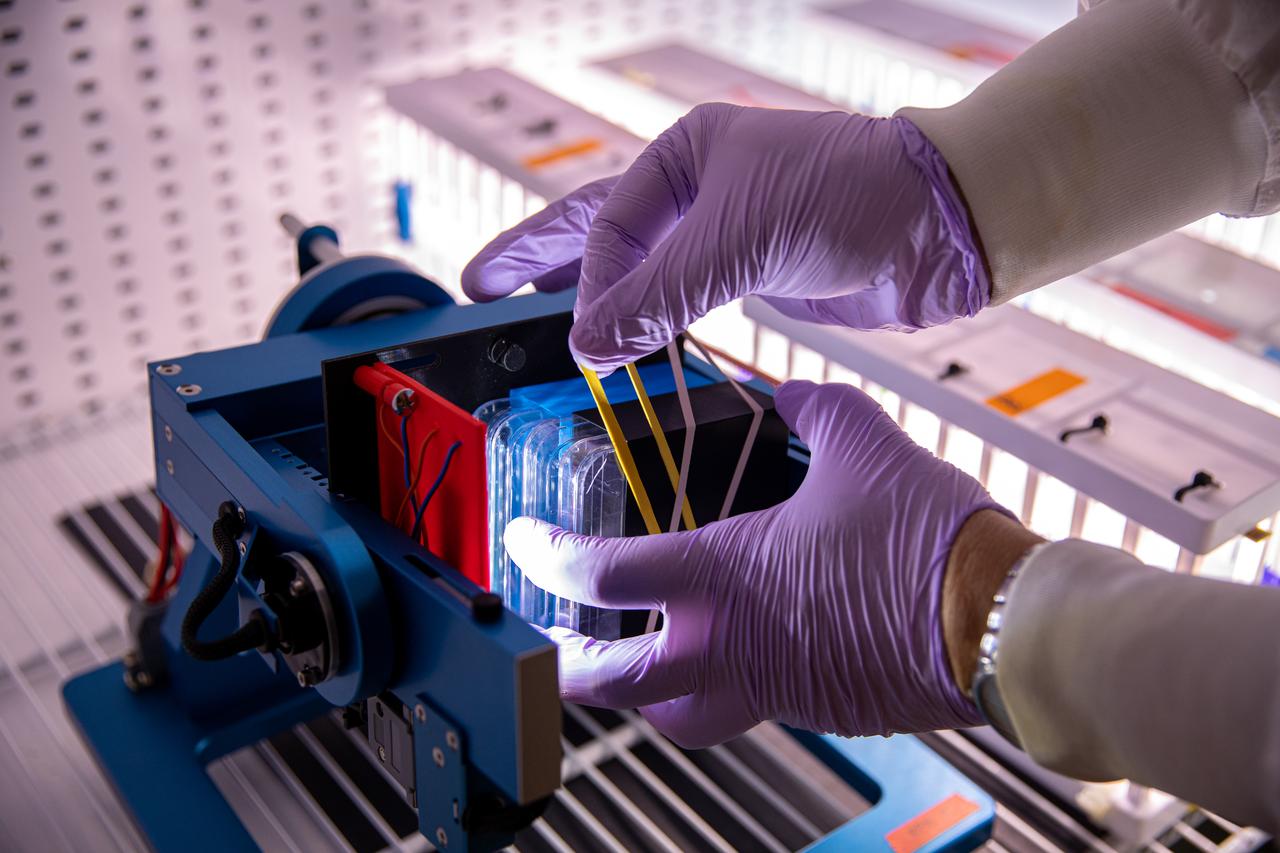
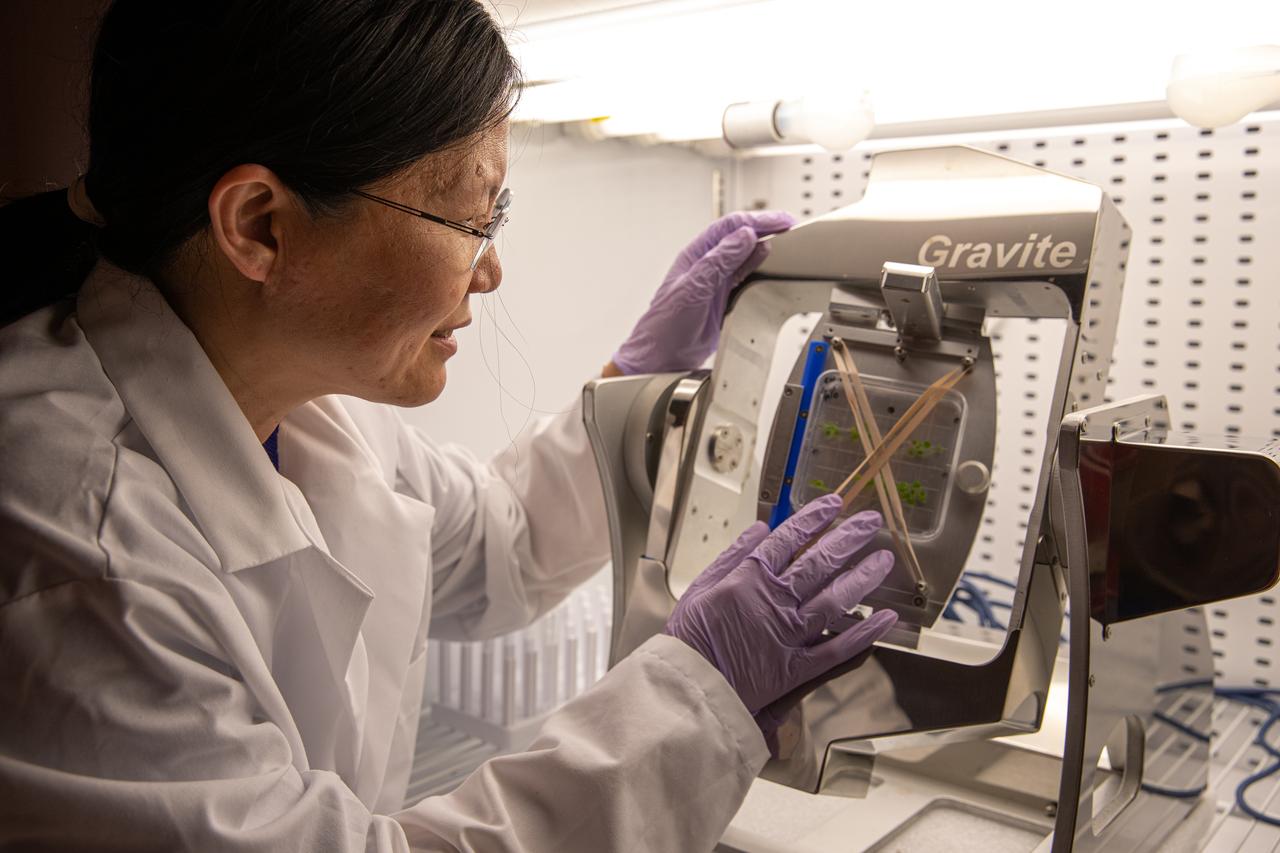
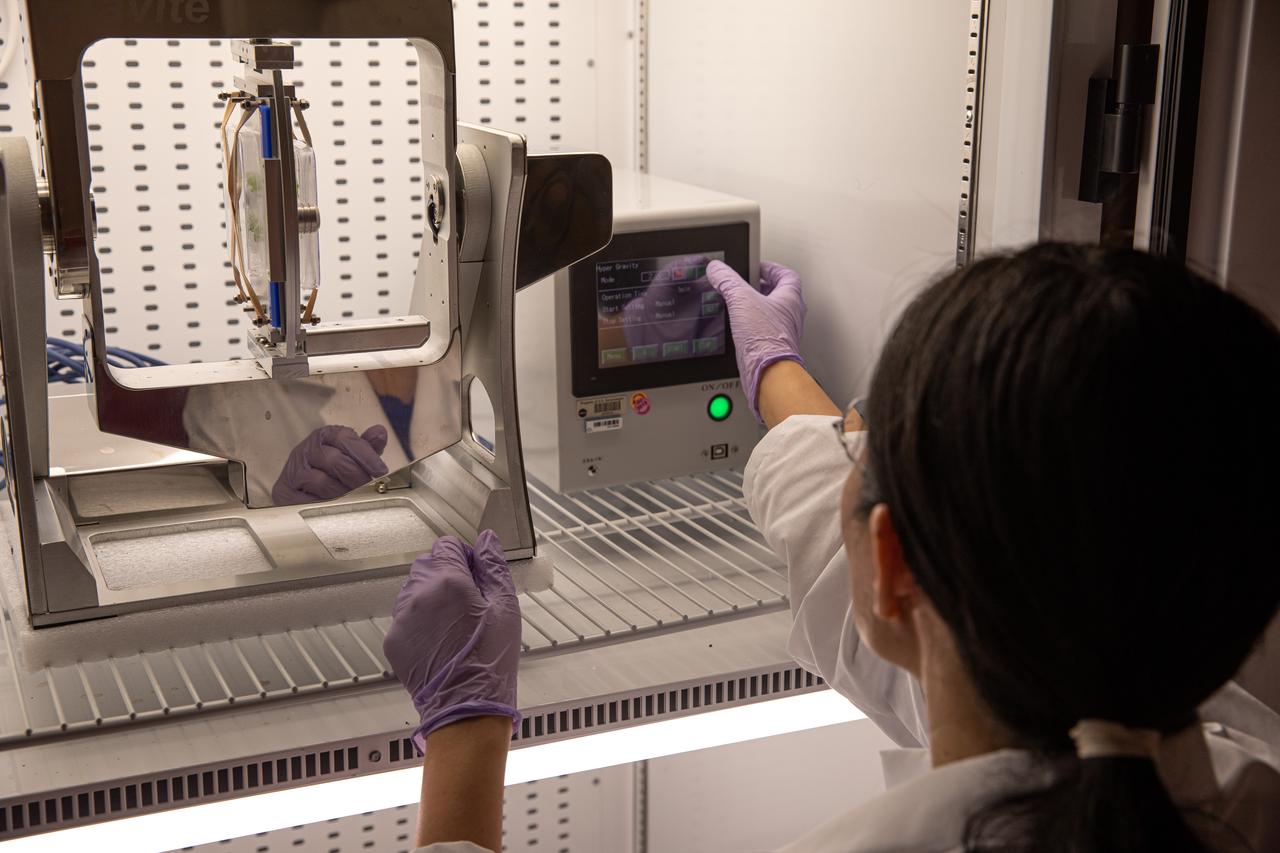
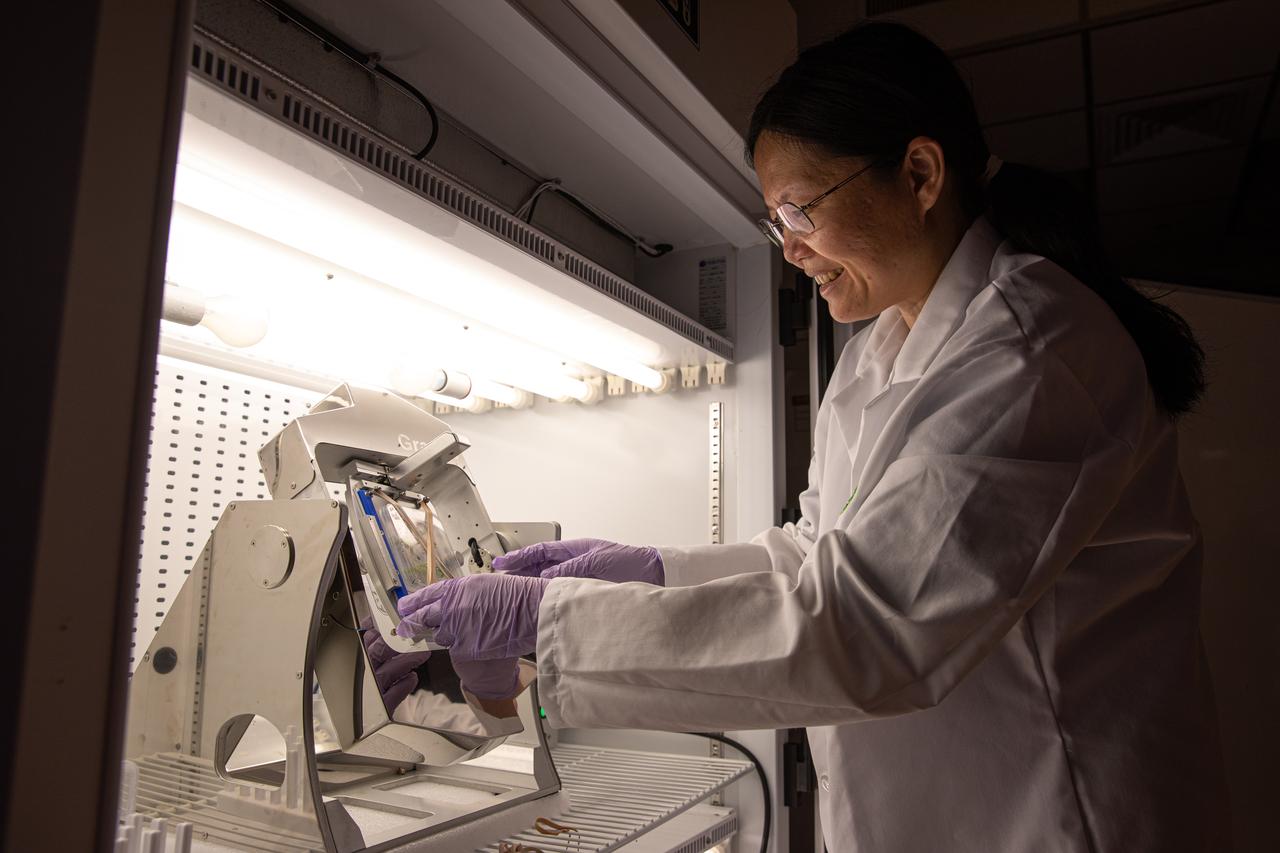
Ye Zhang, a project scientist at NASA’s Kennedy Space Center in Florida runs a test on a Gravite 3d clinostat device in the Microgravity Simulation Support Facility (MSSF) inside the Neil Armstrong Operations and Checkout building on Feb. 11, 2020. The facility was developed to provide ground simulation capability to the U.S. research community in order to supplement the limited opportunities to access the International Space Station and other platforms for microgravity research. The MSSF is designed to support biological research on microorganisms, cells, tissues, small plants and small animals. The simulator provides NASA with an alternative platform for microgravity research and creates the opportunity to conduct experiments on the space station in parallel with conditions of simulated microgravity on the ground.
Microgravity Simulation Support Facility
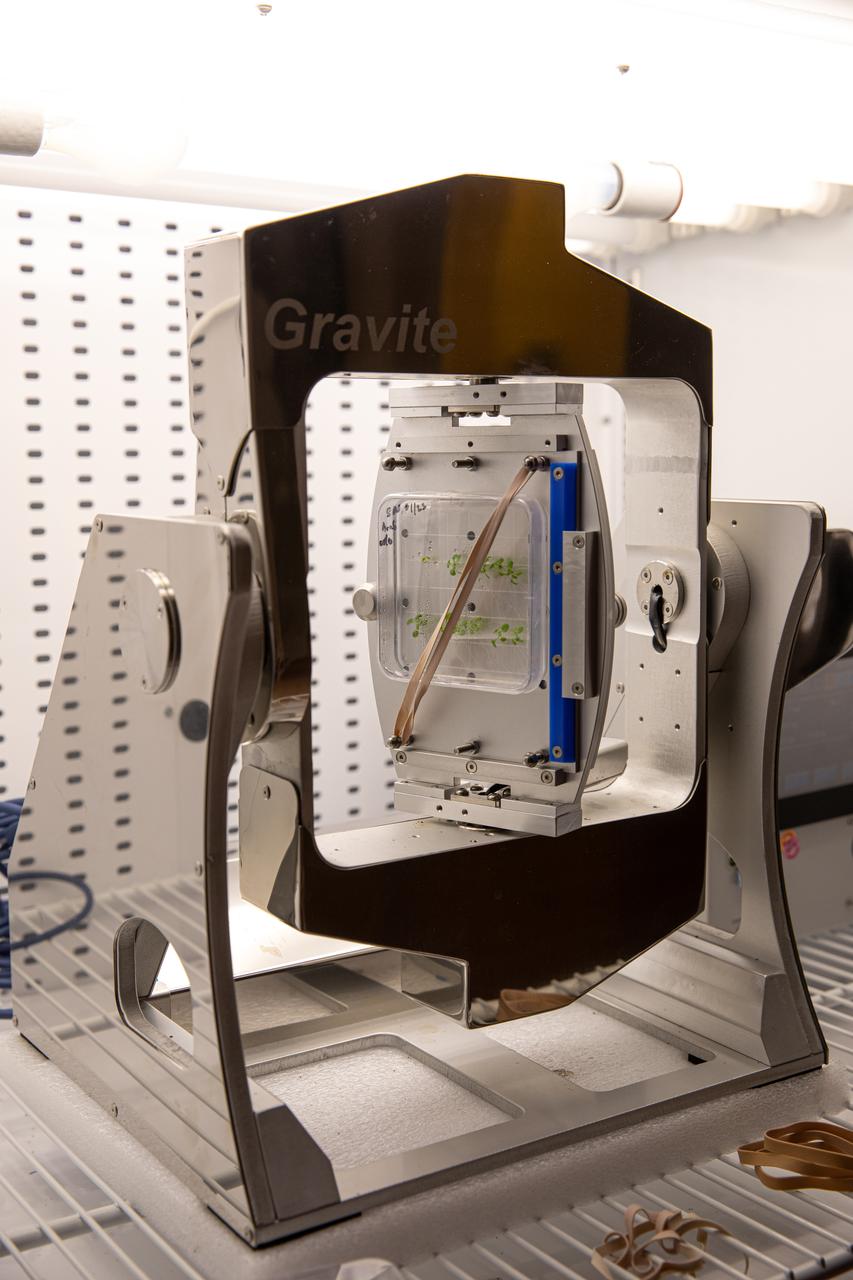
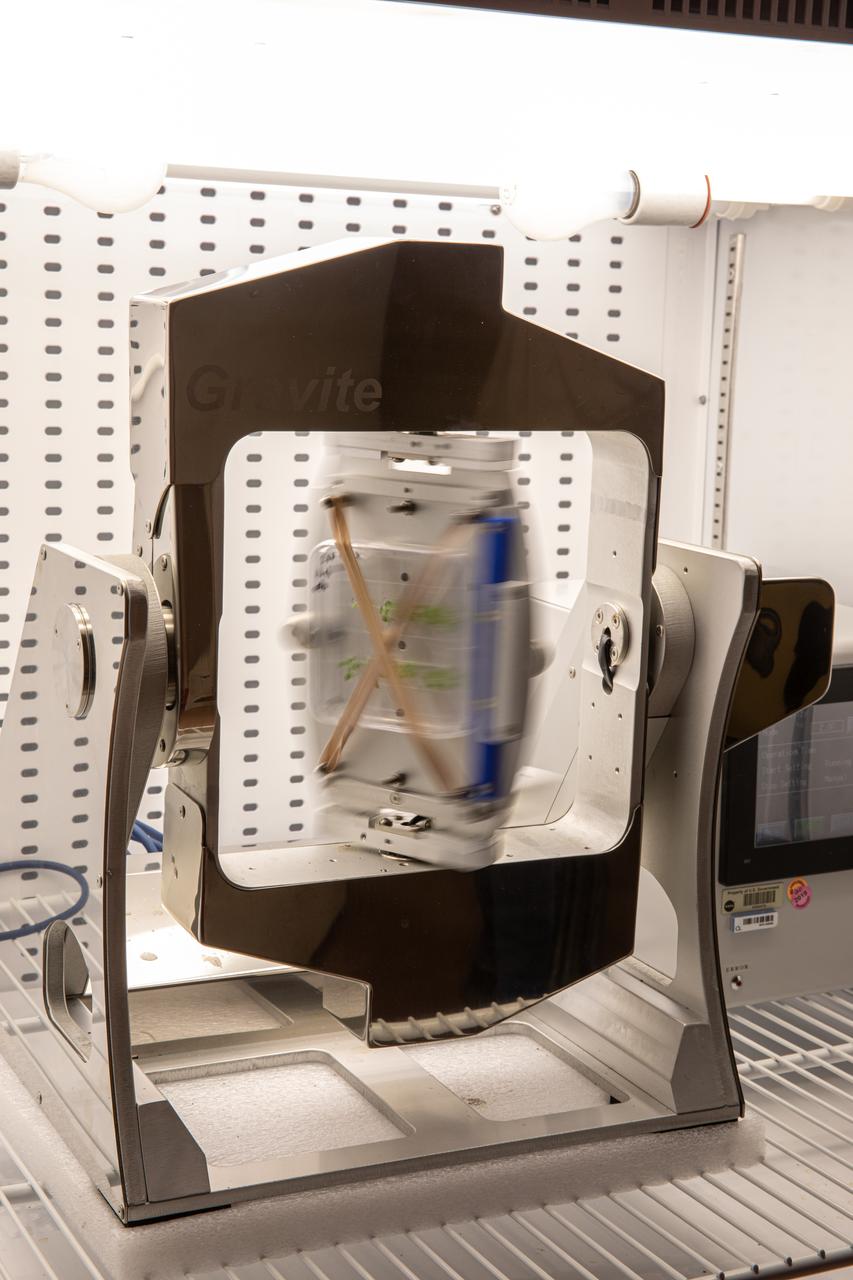
A Gravite 3d clinostat is in the Microgravity Simulation Support Facility (MSSF) inside the Neil Armstrong Operations and Checkout building at NASA’s Kennedy Space Center in Florida on Feb. 11, 2020. The facility was developed to provide ground simulation capability to the U.S. research community in order to supplement the limited opportunities to access the International Space Station and other platforms for microgravity research. The MSSF is designed to support biological research on microorganisms, cells, tissues, small plants and small animals. The simulator provides NASA with an alternative platform for microgravity research and creates the opportunity to conduct experiments on the space station in parallel with conditions of simulated microgravity on the ground.
Microgravity Simulation Support Facility
Ye Zhang, a project scientist at NASA’s Kennedy Space Center in Florida, makes adjustments to a Gravite 3d clinostat in the Microgravity Simulation Support Facility (MSSF) inside the Neil Armstrong Operations and Checkout building at on Feb. 11, 2020. The facility was developed to provide ground simulation capability to the U.S. research community in order to supplement the limited opportunities to access the International Space Station and other platforms for microgravity research. The MSSF is designed to support biological research on microorganisms, cells, tissues, small plants and small animals. The simulator provides NASA with an alternative platform for microgravity research and creates the opportunity to conduct experiments on the space station in parallel with conditions of simulated microgravity on the ground.
Microgravity Simulation Support Facility
A Gravite 3d clinostat undergoes a test in the Microgravity Simulation Support Facility (MSSF) inside the Neil Armstrong Operations and Checkout building at NASA’s Kennedy Space Center in Florida on Feb. 11, 2020. The facility was developed to provide ground simulation capability to the U.S. research community in order to supplement the limited opportunities to access the International Space Station and other platforms for microgravity research. The MSSF is designed to support biological research on microorganisms, cells, tissues, small plants and small animals. The simulator provides NASA with an alternative platform for microgravity research and creates the opportunity to conduct experiments on the space station in parallel with conditions of simulated microgravity on the ground.
Microgravity Simulation Support Facility
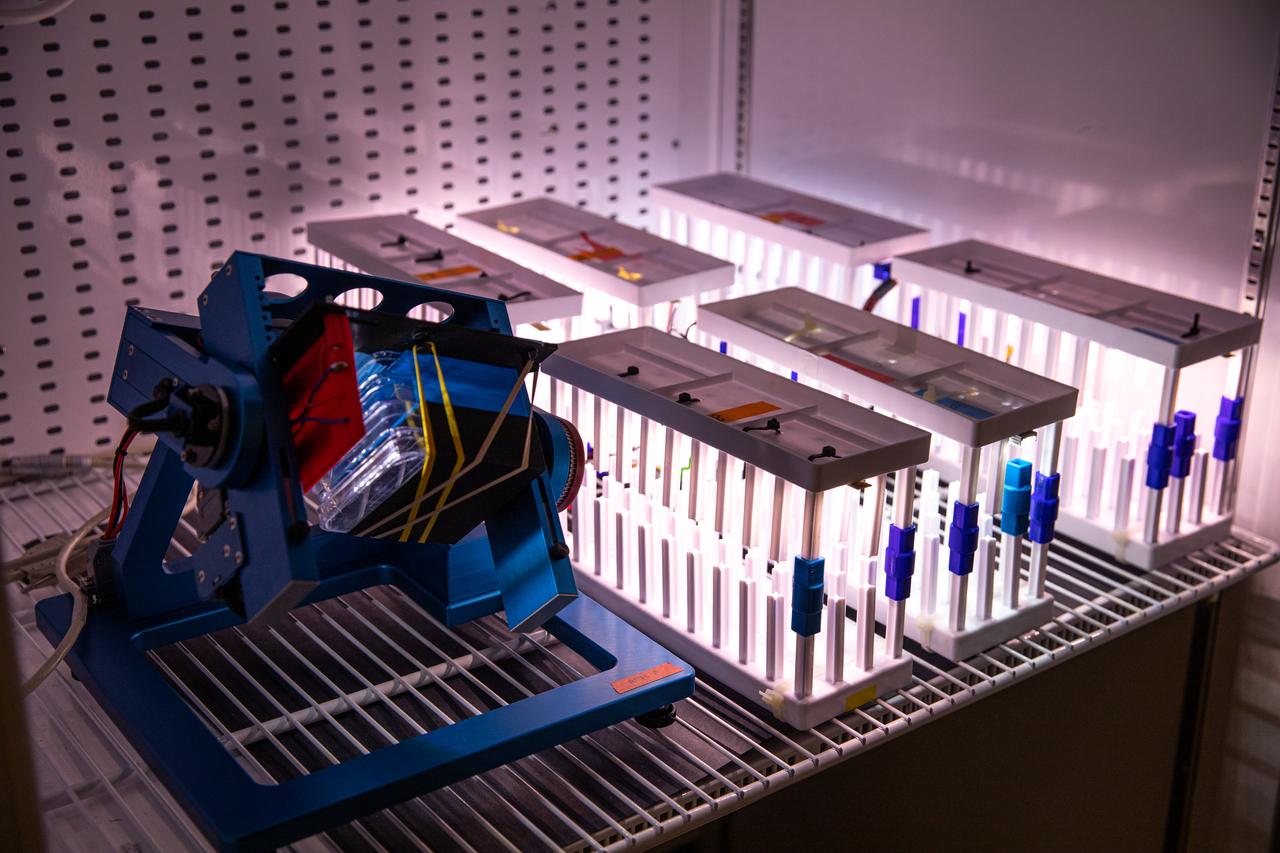
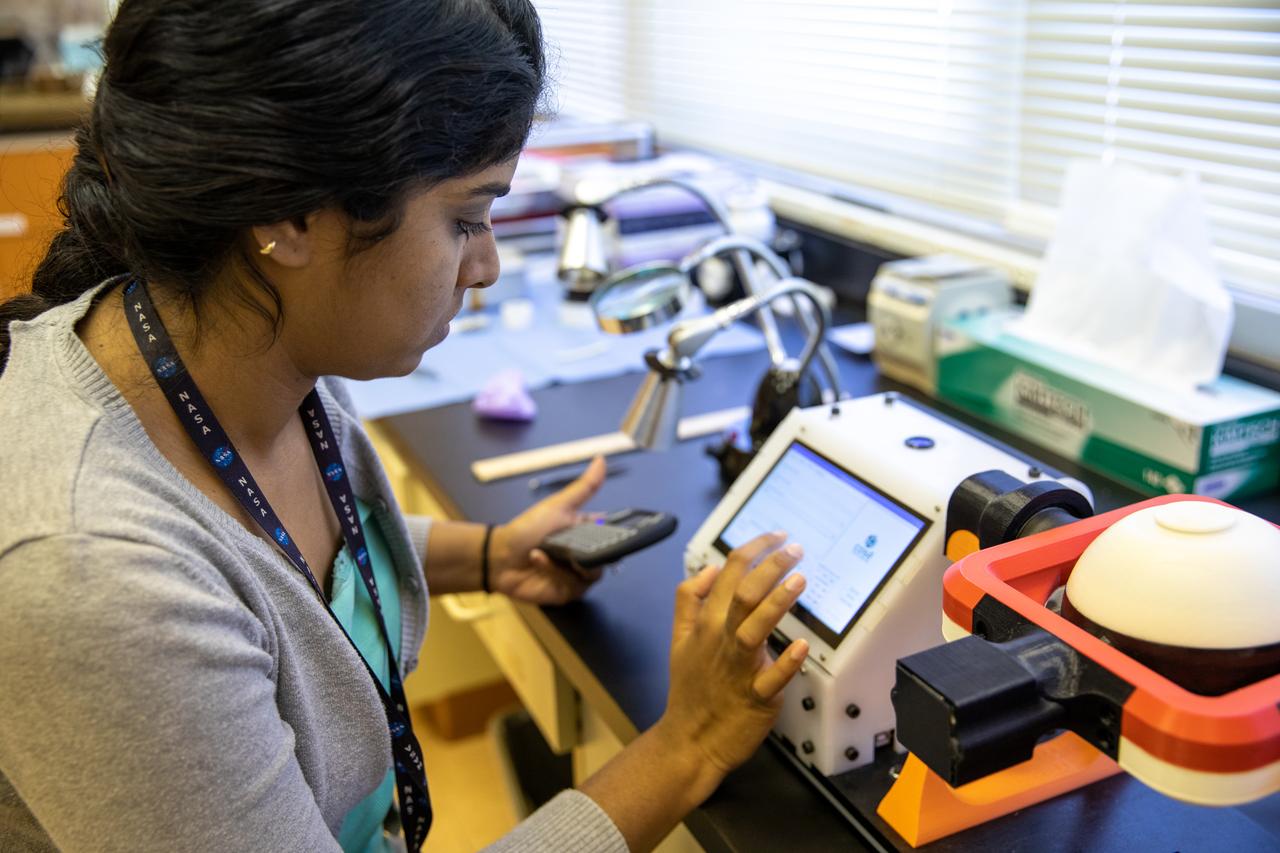
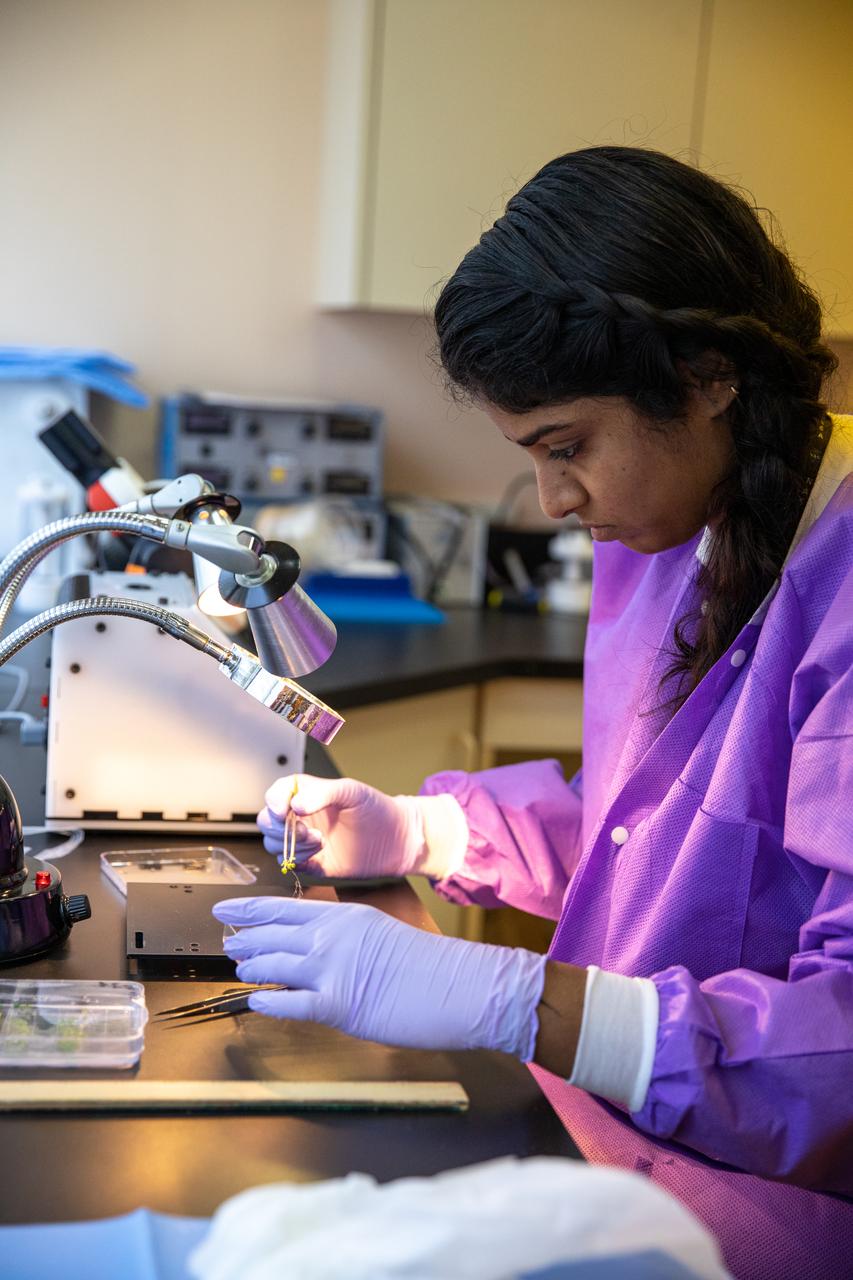
Srujana Neelam, a researcher working at NASA’s Kennedy Space Center in Florida, programs the SciSpinner Microgravity Simulator in the Microgravity Simulation Support Facility (MSSF) inside the Neil Armstrong Operations and Checkout building on Feb. 11, 2020. The facility was developed to provide ground simulation capability to the U.S. research community in order to supplement the limited opportunities to access the International Space Station and other platforms for microgravity research. The MSSF is designed to support biological research on microorganisms, cells, tissues, small plants and small animals. The simulator provides NASA with an alternative platform for microgravity research and creates the opportunity to conduct experiments on the space station in parallel with conditions of simulated microgravity on the ground.
Microgravity Simulation Support Facility
Some experiments are being prepared for a test in the Airbus Random Positioning Machine in the Microgravity Simulation Support Facility (MSSF) inside the Neil Armstrong Operations and Checkout building at NASA’s Kennedy Space Center in Florida on Feb. 11, 2020. The facility device was developed to provide ground simulation capability to the U.S. research community in order to supplement the limited opportunities to access the International Space Station and other platforms for microgravity research. The MSSF is designed to support biological research on microorganisms, cells, tissues, small plants and small animals. The simulator provides NASA with an alternative platform for microgravity research and creates the opportunity to conduct experiments on the space station in parallel with conditions of simulated microgravity on the ground.
Microgravity Simulation Support Facility
Ye Zhang, a project scientist at NASA’s Kennedy Space Center in Florida, makes adjustments to a Gravite 3d clinostat in the Microgravity Simulation Support Facility (MSSF) inside the Neil Armstrong Operations and Checkout on Feb. 11, 2020. The facility was developed to provide ground simulation capability to the U.S. research community in order to supplement the limited opportunities to access the International Space Station and other platforms for microgravity research. The MSSF is designed to support biological research on microorganisms, cells, tissues, small plants and small animals. The simulator provides NASA with an alternative platform for microgravity research and creates the opportunity to conduct experiments on the space station in parallel with conditions of simulated microgravity on the ground.
Microgravity Simulation Support Facility
 Ye Zhang, a project scientist at NASA’s Kennedy Space Center in Florida, makes adjustments to a Gravite 3d clinostat in the Microgravity Simulation Support Facility (MSSF) inside the Neil Armstrong Operations and Checkout building on Feb. 11, 2020. The facility was developed to provide ground simulation capability to the U.S. research community in order to supplement the limited opportunities to access the International Space Station and other platforms for microgravity research. The MSSF is designed to support biological research on microorganisms, cells, tissues, small plants and small animals. The simulator provides NASA with an alternative platform for microgravity research and creates the opportunity to conduct experiments on the space station in parallel with conditions of simulated microgravity on the ground.
Microgravity Simulation Support Facility
A Gravite 3d clinostat is in the Microgravity Simulation Support Facility (MSSF) inside the Neil Armstrong Operations and Checkout building at NASA’s Kennedy Space Center in Florida on Feb. 11, 2020. The facility was developed to provide ground simulation capability to the U.S. research community in order to supplement the limited opportunities to access the International Space Station and other platforms for microgravity research. The MSSF is designed to support biological research on microorganisms, cells, tissues, small plants and small animals. The simulator provides NASA with an alternative platform for microgravity research and creates the opportunity to conduct experiments on the space station in parallel with conditions of simulated microgravity on the ground.
Microgravity Simulation Support Facility
Advanced Colloids Experiment, Thermal 5-2, ACE T5-2 International Space Station, ISS, Fluids Integrated Rack, FIR Operations in the Telescience Support Center, TSC
Advanced Colloids Experiment, Thermal 5-2, ACE T5-2 Internati...
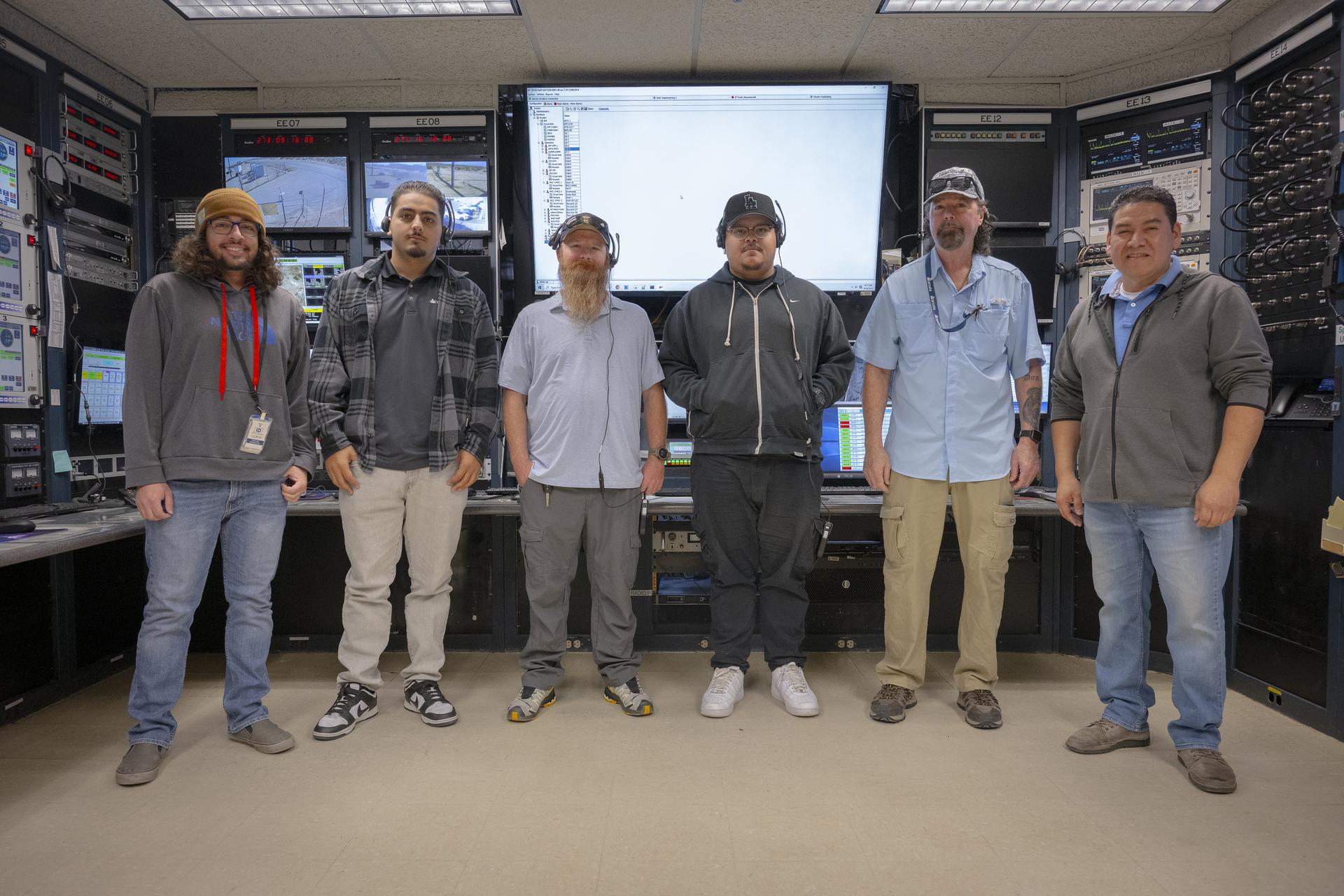
Mission technicians, from left, Adam Cataldo, Alex Oganesyan, Daniel Kelly, Deming Ingles, Mike Gibson, and Kelvin Menendez support communications backup for an International Space Station mission on Tuesday, Sept. 30, 2025, at NASA’s Armstong Flight Research Center in Edwards, California. The team is part of the center’s Dryden Aeronautical Test Range, which provides voice and tracking support to the space station.
NASA Range Supports Space Station
Mission operator Kelvin Menendez watches as antennas rise to track the International Space Station as it passes high above NASA’s Armstrong Flight Research Center in Edwards, California, on Sept. 30, 2025. Menendez is part of the center’s Dryden Aeronautical Test Range, which provides voice and tracking support to the space station.
NASA Range Supports Space Station
Aboard the International Space Station (ISS), the Tissue Culture Medium (TCM) is the bioreactor vessel in which cell cultures are grown.  With its two syringe ports, it is much like a bag used to administer intravenous fluid, except it allows gas exchange needed for life.  The TCM contains cell culture medium, and when frozen cells are flown to the ISS, they are thawed and introduced to the TCM through the syringe ports.  In the Cellular Biotechnology Operations Support System-Fluid Dynamics Investigation (CBOSS-FDI) experiment, several mixing procedures are being assessed to determine which method achieves the most uniform mixing of growing cells and culture medium.
Biotechnology
Jeffrey Richards, a payload research and science coordinator on the LASSO contract at NASA’s Kennedy Space Center in Florida, prepares an experiment for a test in an Airbus Random Positioning Machine in the Microgravity Simulation Support Facility (MSSF) inside the Neil Armstrong Operations and Checkout building at NASA’s Kennedy Space Center in Florida on Feb. 11, 2020. The facility was developed to provide ground simulation capability to the U.S. research community in order to supplement the limited opportunities to access the International Space Station and other platforms for microgravity research. The MSSF is designed to support biological research on microorganisms, cells, tissues, small plants and small animals. The simulator provides NASA with an alternative platform for microgravity research and creates the opportunity to conduct experiments on the space station in parallel with conditions of simulated microgravity on the ground.
Microgravity Simulation Support Facility
Jeffrey Richards, a payload research and science coordinator on the LASSO contract at NASA’s Kennedy Space Center in Florida, prepares an experiment for a test in an Airbus Random Positioning Machine in the Microgravity Simulation Support Facility (MSSF) inside the Neil Armstrong Operations and Checkout building at NASA’s Kennedy Space Center in Florida on Feb. 11, 2020. The facility was developed to provide ground simulation capability to the U.S. research community in order to supplement the limited opportunities to access the International Space Station and other platforms for microgravity research. The MSSF is designed to support biological research on microorganisms, cells, tissues, small plants and small animals. The simulator provides NASA with an alternative platform for microgravity research and creates the opportunity to conduct experiments on the space station in parallel with conditions of simulated microgravity on the ground.
Microgravity Simulation Support Facility
Jeffrey Richards, a payload research and science coordinator on the LASSO contract at NASA’s Kennedy Space Center in Florida, prepares an experiment for a test in an Airbus Random Positioning Machine in the Microgravity Simulation Support Facility (MSSF) inside the Neil Armstrong Operations and Checkout building at NASA’s Kennedy Space Center in Florida on Feb. 11, 2020. The facility was developed to provide ground simulation capability to the U.S. research community in order to supplement the limited opportunities to access the International Space Station and other platforms for microgravity research. The MSSF is designed to support biological research on microorganisms, cells, tissues, small plants and small animals. The simulator provides NASA with an alternative platform for microgravity research and creates the opportunity to conduct experiments on the space station in parallel with conditions of simulated microgravity on the ground.
Microgravity Simulation Support Facility
Ye Zhang, a project scientist at NASA’s Kennedy Space Center in Florida, makes adjustments to a Gravite 3d clinostat in the Microgravity Simulation Support Facility (MSSF) inside the Neil Armstrong Operations and Checkout building at NASA’s Kennedy Space Center in Florida on Feb. 11, 2020. The facility was developed to provide ground simulation capability to the U.S. research community in order to supplement the limited opportunities to access the International Space Station and other platforms for microgravity research. The MSSF is designed to support biological research on microorganisms, cells, tissues, small plants and small animals. The simulator provides NASA with an alternative platform for microgravity research and creates the opportunity to conduct experiments on the space station in parallel with conditions of simulated microgravity on the ground.
Microgravity Simulation Support Facility
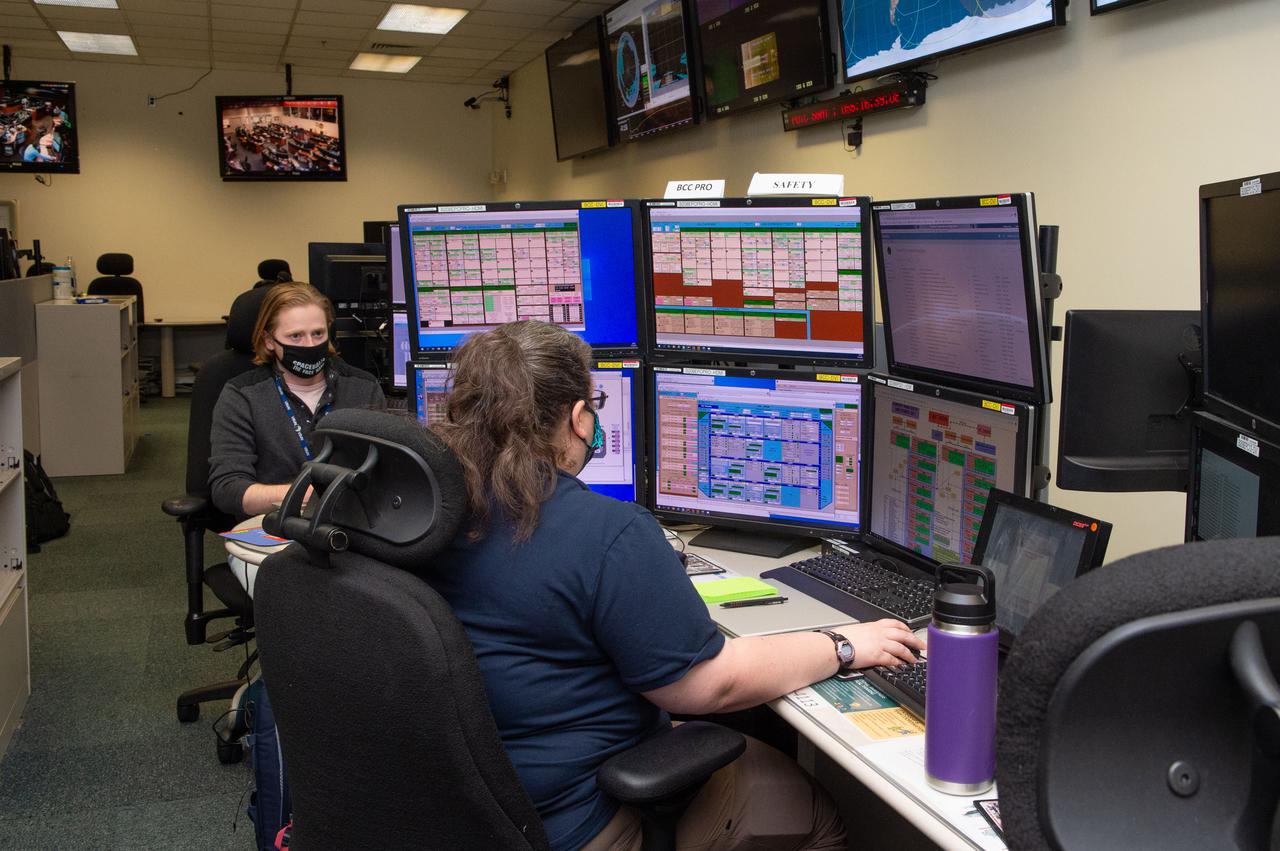
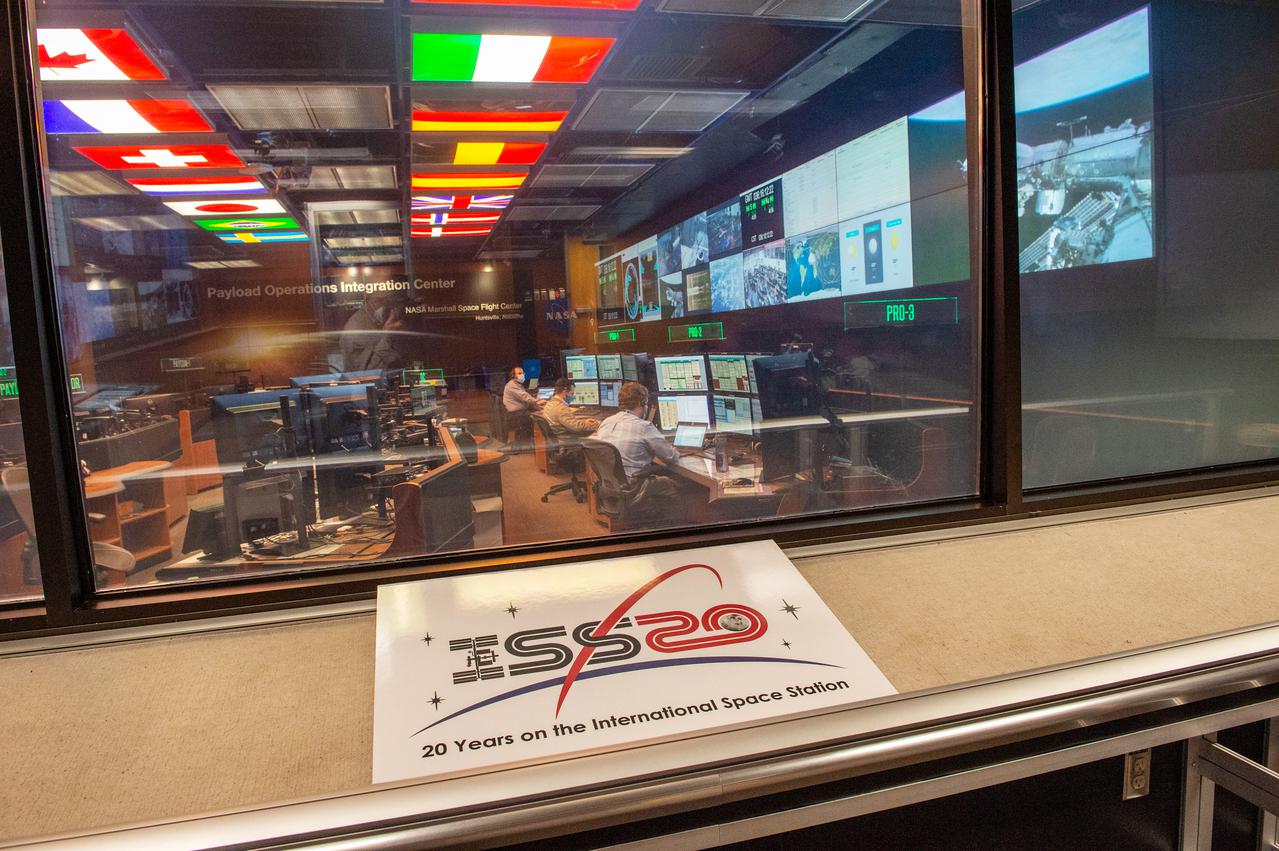
A look inside the International Space Station Payload Operations Integration Center at NASA’s Marshall Space Flight Center in Huntsville, AL.  The POIC team supports science operations on the International Space Station 24 hours a day, 7 days a week. For more than 20 years the POIC team has worked with scientists from around the world to enable the space station crew to conduct experiments that improve life on Earth and enable future exploration.
A look inside the International Space Station Payload Operations Integration Center at NASA’s Marshall Space Flight Center in Huntsville, AL. The POIC team supports science operations on the International Space Station 24 hours a day, 7 days a week. For more than 20 years the POIC team has worked with scientists from around the world to enable the space station crew to conduct experiments that improve life on Earth and enable future exploration.
A look inside the International Space Station Payload Operations Integration Center at NASA’s Marshall Space Flight Center in Huntsville, AL.  The POIC team supports science operations on the International Space Station 24 hours a day, 7 days a week. For more than 20 years the POIC team has worked with scientists from around the world to enable the space station crew to conduct experiments that improve life on Earth and enable future exploration.
A look inside the International Space Station Payload Operations Integration Center at NASA’s Marshall Space Flight Center in Huntsville, AL. The POIC team supports science operations on the International Space Station 24 hours a day, 7 days a week. For more than 20 years the POIC team has worked with scientists from around the world to enable the space station crew to conduct experiments that improve life on Earth and enable future exploration.
A look inside the International Space Station Payload Operations Integration Center at NASA’s Marshall Space Flight Center in Huntsville, AL.  The POIC team supports science operations on the International Space Station 24 hours a day, 7 days a week. For more than 20 years the POIC team has worked with scientists from around the world to enable the space station crew to conduct experiments that improve life on Earth and enable future exploration.
A look inside the International Space Station Payload Operations Integration Center at NASA’s Marshall Space Flight Center in Huntsville, AL. The POIC team supports science operations on the International Space Station 24 hours a day, 7 days a week. For more than 20 years the POIC team has worked with scientists from around the world to enable the space station crew to conduct experiments that improve life on Earth and enable future exploration.
A look inside the International Space Station Payload Operations Integration Center at NASA’s Marshall Space Flight Center in Huntsville, AL.  The POIC team supports science operations on the International Space Station 24 hours a day, 7 days a week. For more than 20 years the POIC team has worked with scientists from around the world to enable the space station crew to conduct experiments that improve life on Earth and enable future exploration.
A look inside the International Space Station Payload Operations Integration Center at NASA’s Marshall Space Flight Center in Huntsville, AL. The POIC team supports science operations on the International Space Station 24 hours a day, 7 days a week. For more than 20 years the POIC team has worked with scientists from around the world to enable the space station crew to conduct experiments that improve life on Earth and enable future exploration.
A look inside the International Space Station Payload Operations Integration Center at NASA’s Marshall Space Flight Center in Huntsville, AL.  The POIC team supports science operations on the International Space Station 24 hours a day, 7 days a week. For more than 20 years the POIC team has worked with scientists from around the world to enable the space station crew to conduct experiments that improve life on Earth and enable future exploration.
A look inside the International Space Station Payload Operations Integration Center at NASA’s Marshall Space Flight Center in Huntsville, AL. The POIC team supports science operations on the International Space Station 24 hours a day, 7 days a week. For more than 20 years the POIC team has worked with scientists from around the world to enable the space station crew to conduct experiments that improve life on Earth and enable future exploration.
A look inside the International Space Station Payload Operations Integration Center at NASA’s Marshall Space Flight Center in Huntsville, AL.  The POIC team supports science operations on the International Space Station 24 hours a day, 7 days a week. For more than 20 years the POIC team has worked with scientists from around the world to enable the space station crew to conduct experiments that improve life on Earth and enable future exploration.
A look inside the International Space Station Payload Operations Integration Center at NASA’s Marshall Space Flight Center in Huntsville, AL. The POIC team supports science operations on the International Space Station 24 hours a day, 7 days a week. For more than 20 years the POIC team has worked with scientists from around the world to enable the space station crew to conduct experiments that improve life on Earth and enable future exploration.
A look inside the International Space Station Payload Operations Integration Center at NASA’s Marshall Space Flight Center in Huntsville, AL.  The POIC team supports science operations on the International Space Station 24 hours a day, 7 days a week. For more than 20 years the POIC team has worked with scientists from around the world to enable the space station crew to conduct experiments that improve life on Earth and enable future exploration.
A look inside the International Space Station Payload Operations Integration Center at NASA’s Marshall Space Flight Center in Huntsville, AL. The POIC team supports science operations on the International Space Station 24 hours a day, 7 days a week. For more than 20 years the POIC team has worked with scientists from around the world to enable the space station crew to conduct experiments that improve life on Earth and enable future exploration.
A look inside the International Space Station Payload Operations Integration Center at NASA’s Marshall Space Flight Center in Huntsville, AL.  The POIC team supports science operations on the International Space Station 24 hours a day, 7 days a week. For more than 20 years the POIC team has worked with scientists from around the world to enable the space station crew to conduct experiments that improve life on Earth and enable future exploration.
A look inside the International Space Station Payload Operations Integration Center at NASA’s Marshall Space Flight Center in Huntsville, AL. The POIC team supports science operations on the International Space Station 24 hours a day, 7 days a week. For more than 20 years the POIC team has worked with scientists from around the world to enable the space station crew to conduct experiments that improve life on Earth and enable future exploration.
A look inside the International Space Station Payload Operations Integration Center at NASA’s Marshall Space Flight Center in Huntsville, AL.  The POIC team supports science operations on the International Space Station 24 hours a day, 7 days a week. For more than 20 years the POIC team has worked with scientists from around the world to enable the space station crew to conduct experiments that improve life on Earth and enable future exploration.
A look inside the International Space Station Payload Operations Integration Center at NASA’s Marshall Space Flight Center in Huntsville, AL. The POIC team supports science operations on the International Space Station 24 hours a day, 7 days a week. For more than 20 years the POIC team has worked with scientists from around the world to enable the space station crew to conduct experiments that improve life on Earth and enable future exploration.
A look inside the International Space Station Payload Operations Integration Center at NASA’s Marshall Space Flight Center in Huntsville, AL.  The POIC team supports science operations on the International Space Station 24 hours a day, 7 days a week. For more than 20 years the POIC team has worked with scientists from around the world to enable the space station crew to conduct experiments that improve life on Earth and enable future exploration.
A look inside the International Space Station Payload Operations Integration Center at NASA’s Marshall Space Flight Center in Huntsville, AL. The POIC team supports science operations on the International Space Station 24 hours a day, 7 days a week. For more than 20 years the POIC team has worked with scientists from around the world to enable the space station crew to conduct experiments that improve life on Earth and enable future exploration.
A look inside the International Space Station Payload Operations Integration Center at NASA’s Marshall Space Flight Center in Huntsville, AL.  The POIC team supports science operations on the International Space Station 24 hours a day, 7 days a week. For more than 20 years the POIC team has worked with scientists from around the world to enable the space station crew to conduct experiments that improve life on Earth and enable future exploration.
A look inside the International Space Station Payload Operations Integration Center at NASA’s Marshall Space Flight Center in Huntsville, AL. The POIC team supports science operations on the International Space Station 24 hours a day, 7 days a week. For more than 20 years the POIC team has worked with scientists from around the world to enable the space station crew to conduct experiments that improve life on Earth and enable future exploration.
A look inside the International Space Station Payload Operations Integration Center at NASA’s Marshall Space Flight Center in Huntsville, AL.  The POIC team supports science operations on the International Space Station 24 hours a day, 7 days a week. For more than 20 years the POIC team has worked with scientists from around the world to enable the space station crew to conduct experiments that improve life on Earth and enable future exploration.
A look inside the International Space Station Payload Operations Integration Center at NASA’s Marshall Space Flight Center in Huntsville, AL. The POIC team supports science operations on the International Space Station 24 hours a day, 7 days a week. For more than 20 years the POIC team has worked with scientists from around the world to enable the space station crew to conduct experiments that improve life on Earth and enable future exploration.
A look inside the International Space Station Payload Operations Integration Center at NASA’s Marshall Space Flight Center in Huntsville, AL.  The POIC team supports science operations on the International Space Station 24 hours a day, 7 days a week. For more than 20 years the POIC team has worked with scientists from around the world to enable the space station crew to conduct experiments that improve life on Earth and enable future exploration.
A look inside the International Space Station Payload Operations Integration Center at NASA’s Marshall Space Flight Center in Huntsville, AL. The POIC team supports science operations on the International Space Station 24 hours a day, 7 days a week. For more than 20 years the POIC team has worked with scientists from around the world to enable the space station crew to conduct experiments that improve life on Earth and enable future exploration.
A look inside the International Space Station Payload Operations Integration Center at NASA’s Marshall Space Flight Center in Huntsville, AL.  The POIC team supports science operations on the International Space Station 24 hours a day, 7 days a week. For more than 20 years the POIC team has worked with scientists from around the world to enable the space station crew to conduct experiments that improve life on Earth and enable future exploration.
A look inside the International Space Station Payload Operations Integration Center at NASA’s Marshall Space Flight Center in Huntsville, AL. The POIC team supports science operations on the International Space Station 24 hours a day, 7 days a week. For more than 20 years the POIC team has worked with scientists from around the world to enable the space station crew to conduct experiments that improve life on Earth and enable future exploration.
A look inside the International Space Station Payload Operations Integration Center at NASA’s Marshall Space Flight Center in Huntsville, AL.  The POIC team supports science operations on the International Space Station 24 hours a day, 7 days a week. For more than 20 years the POIC team has worked with scientists from around the world to enable the space station crew to conduct experiments that improve life on Earth and enable future exploration.
A look inside the International Space Station Payload Operations Integration Center at NASA’s Marshall Space Flight Center in Huntsville, AL. The POIC team supports science operations on the International Space Station 24 hours a day, 7 days a week. For more than 20 years the POIC team has worked with scientists from around the world to enable the space station crew to conduct experiments that improve life on Earth and enable future exploration.
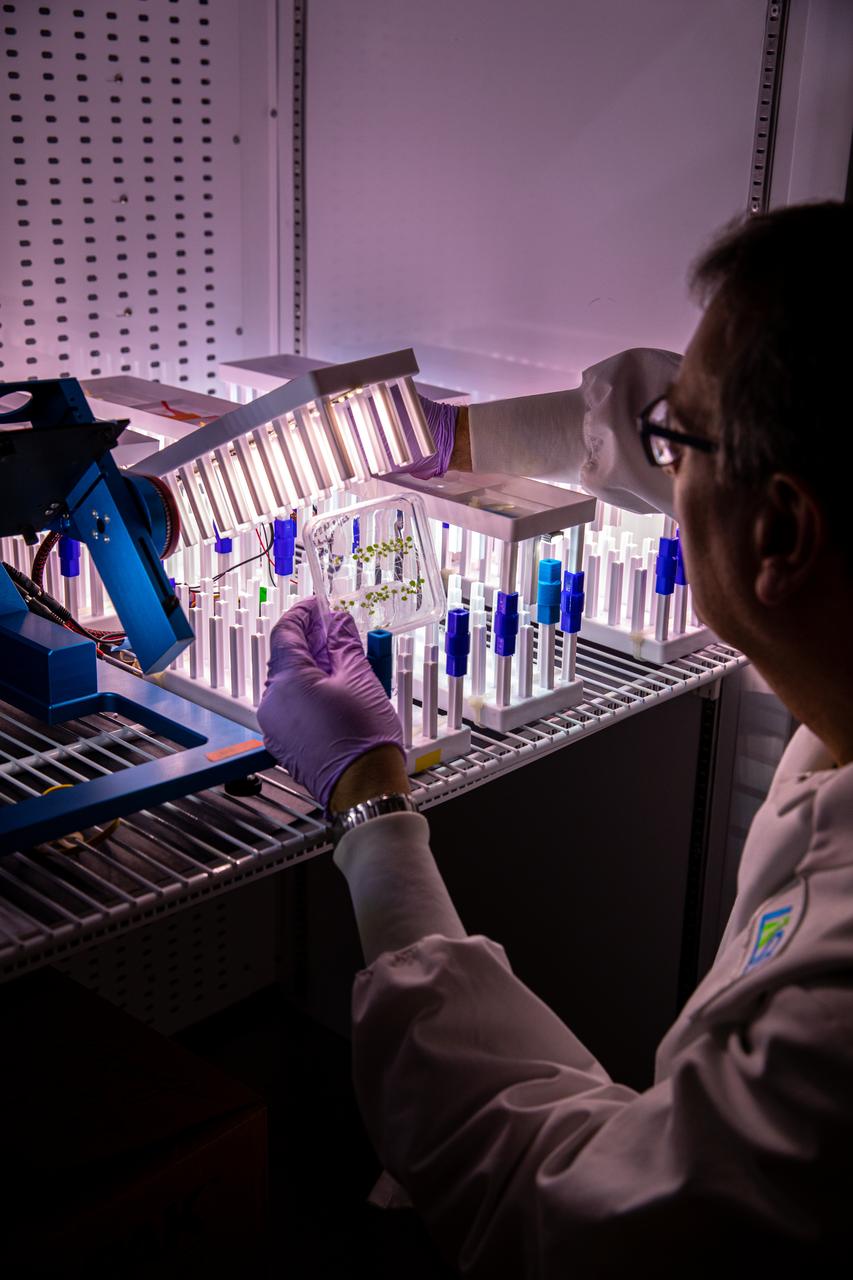
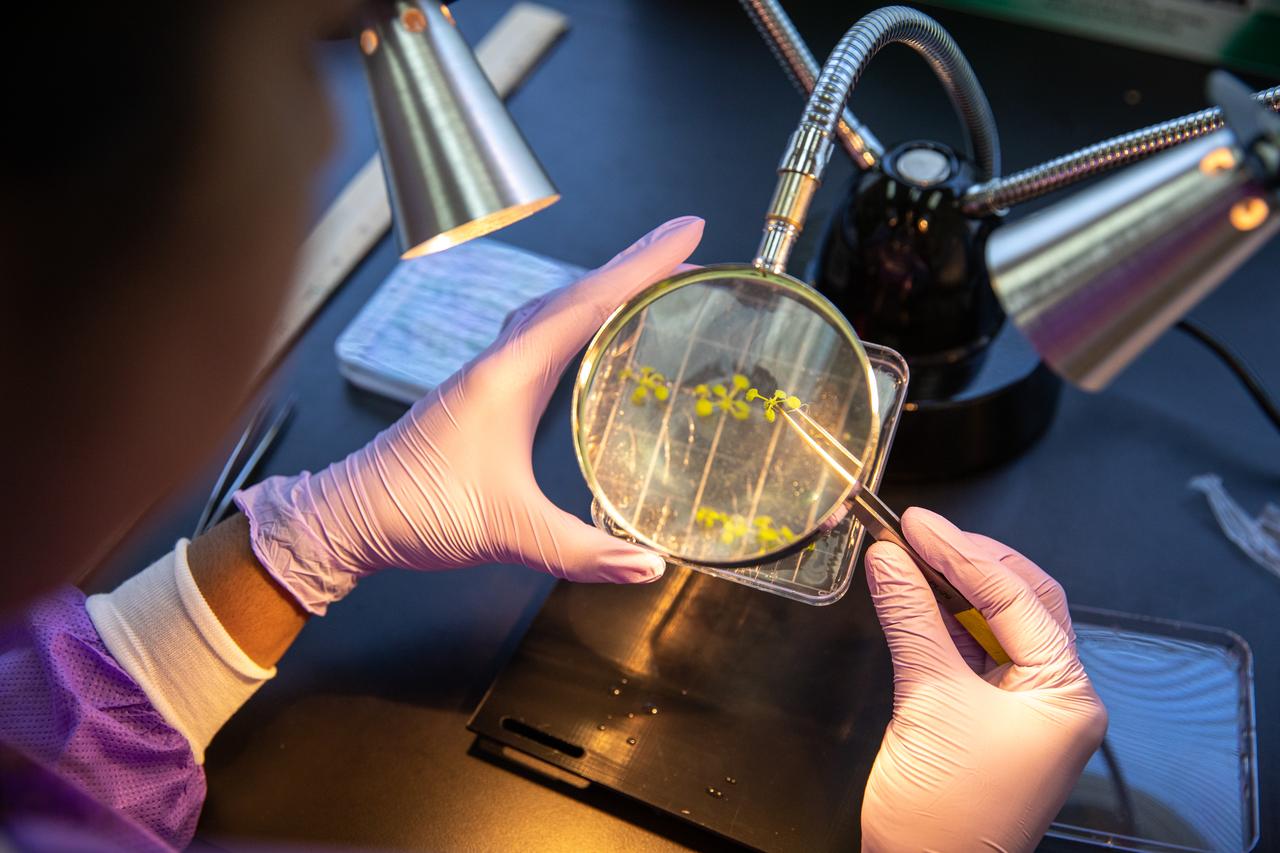
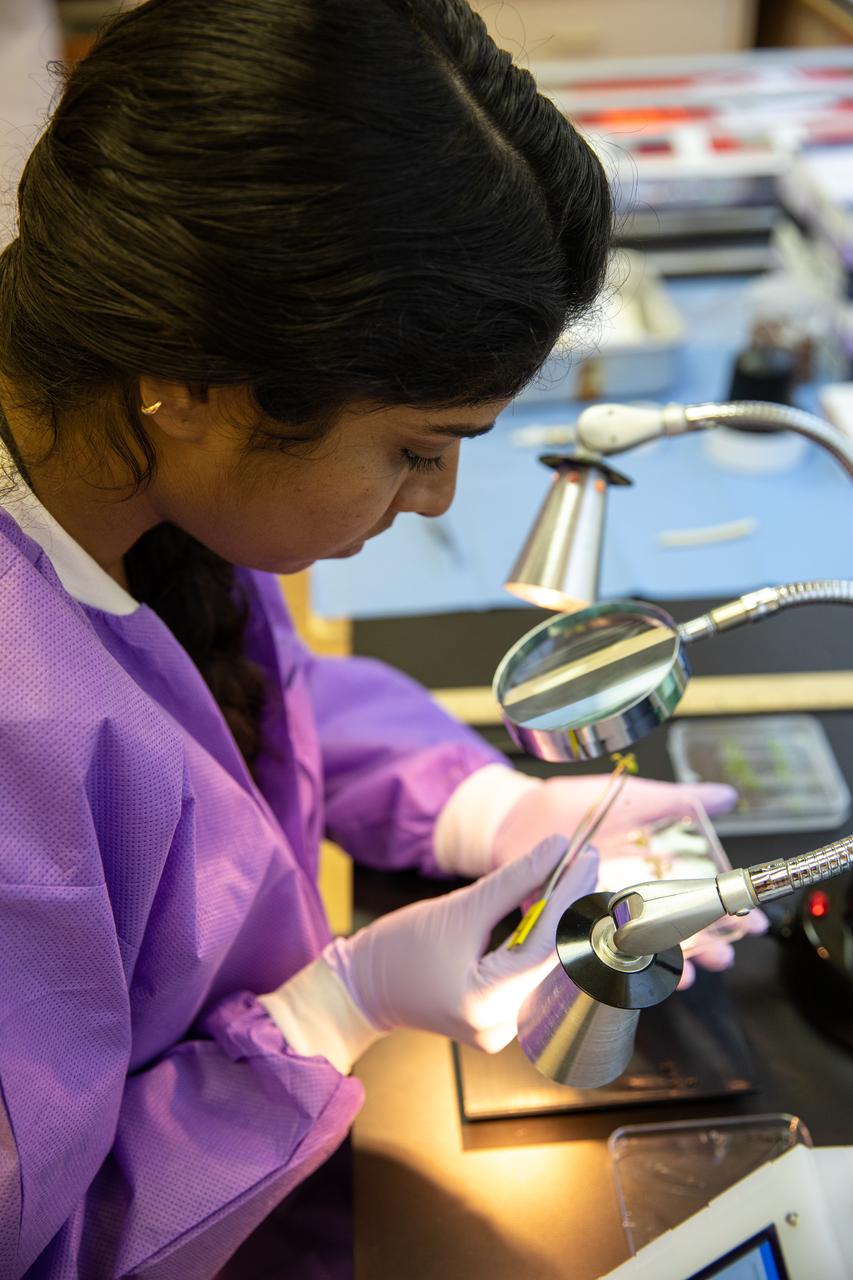
Srujana Neelam, a researcher working at NASA’s Kennedy Space Center in Florida, dissects Arabidopsis thaliana plants from petri plates used in microgravity simulation devices in the Microgravity Simulation Support Facility (MSSF) inside the Neil Armstrong Operations and Checkout building on Feb. 11, 2020. The facility was developed to provide ground simulation capability to the U.S. research community in order to supplement the limited opportunities to access the International Space Station and other platforms for microgravity research. The MSSF is designed to support biological research on microorganisms, cells, tissues, small plants and small animals. The simulator provides NASA with an alternative platform for microgravity research and creates the opportunity to conduct experiments on the space station in parallel with conditions of simulated microgravity on the ground.
Microgravity Simulation Support Facility
Srujana Neelam, a researcher working at NASA’s Kennedy Space Center in Florida, dissects Arabidopsis thaliana plants from petri plates used in microgravity simulation devices in the Microgravity Simulation Support Facility (MSSF) inside the Neil Armstrong Operations and Checkout building on Feb. 11, 2020. The facility was developed to provide ground simulation capability to the U.S. research community in order to supplement the limited opportunities to access the International Space Station and other platforms for microgravity research. The MSSF is designed to support biological research on microorganisms, cells, tissues, small plants and small animals. The simulator provides NASA with an alternative platform for microgravity research and creates the opportunity to conduct experiments on the space station in parallel with conditions of simulated microgravity on the ground.
Microgravity Simulation Support Facility
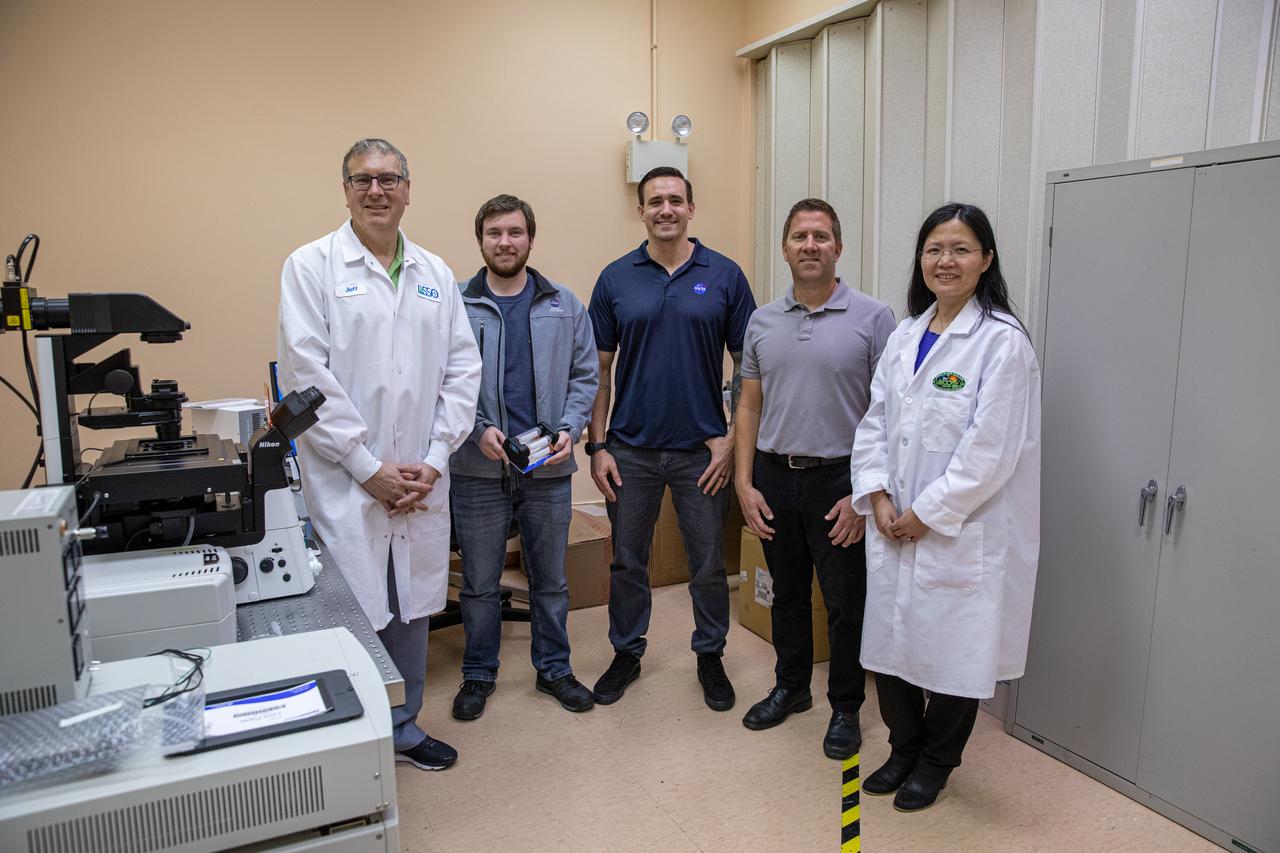
Researchers are in the Microgravity Simulation Support Facility (MSSF) inside the Neil Armstrong Operations and Checkout building at NASA’s Kennedy Space Center in Florida on Feb. 11, 2020. From left are Jonathan Gleeson, aerospace engineer on the LASSO contract; Jason Fischer, a research and development scientist on the LASSO contract; Ralph Nacca, aerospace flight systems; Jeffrey Richards, a payload research and science coordinator on the LASSO contract; and Dr. Ye Zhang, a project scientist. The microgravity simulation device was developed to provide ground simulation capability to the U.S. research community in order to supplement the limited opportunities to access the International Space Station and other platforms for microgravity research. The MSSF is designed to support biological research on microorganisms, cells, tissues, small plants and small animals. The simulator provides NASA with an alternative platform for microgravity research and creates the opportunity to conduct experiments on the space station in parallel with conditions of simulated microgravity on the ground.
Microgravity Simulation Support Facility
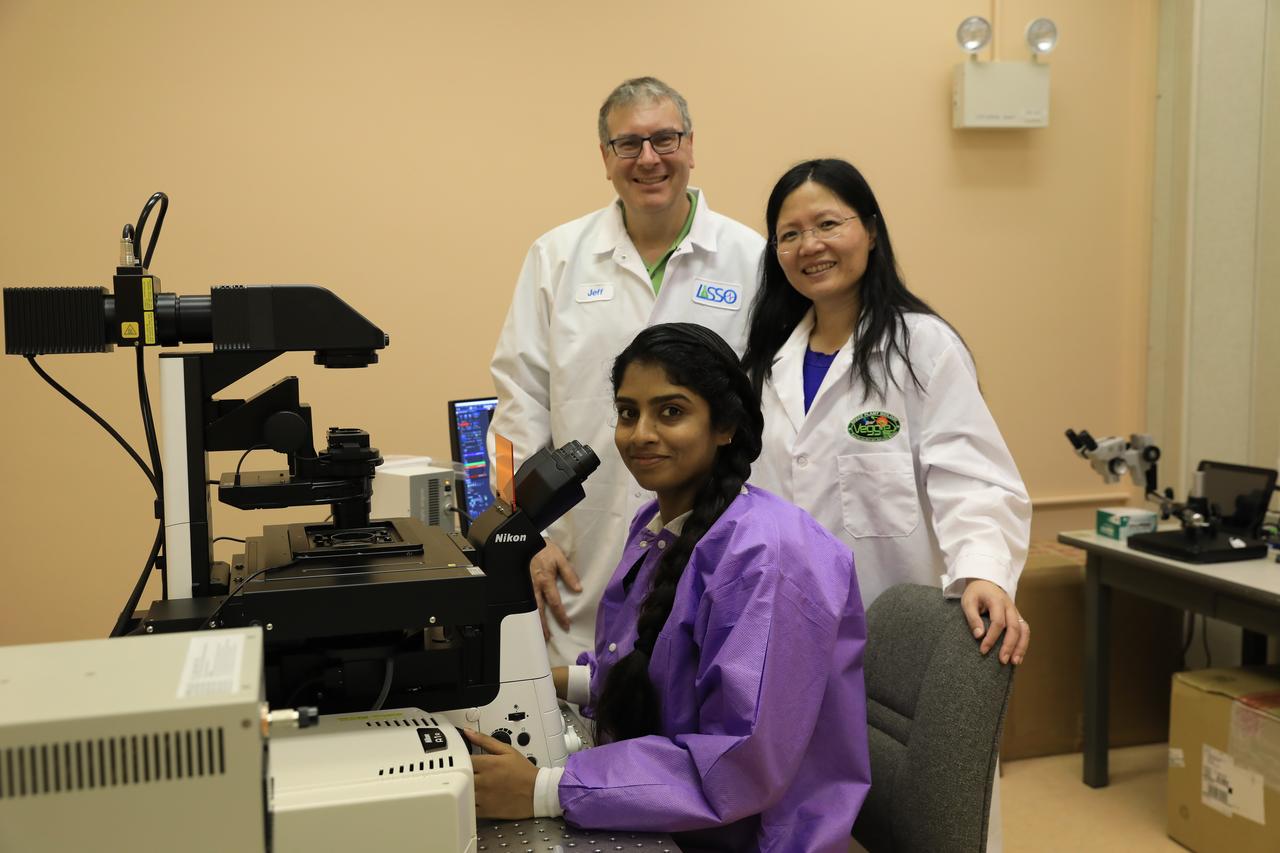
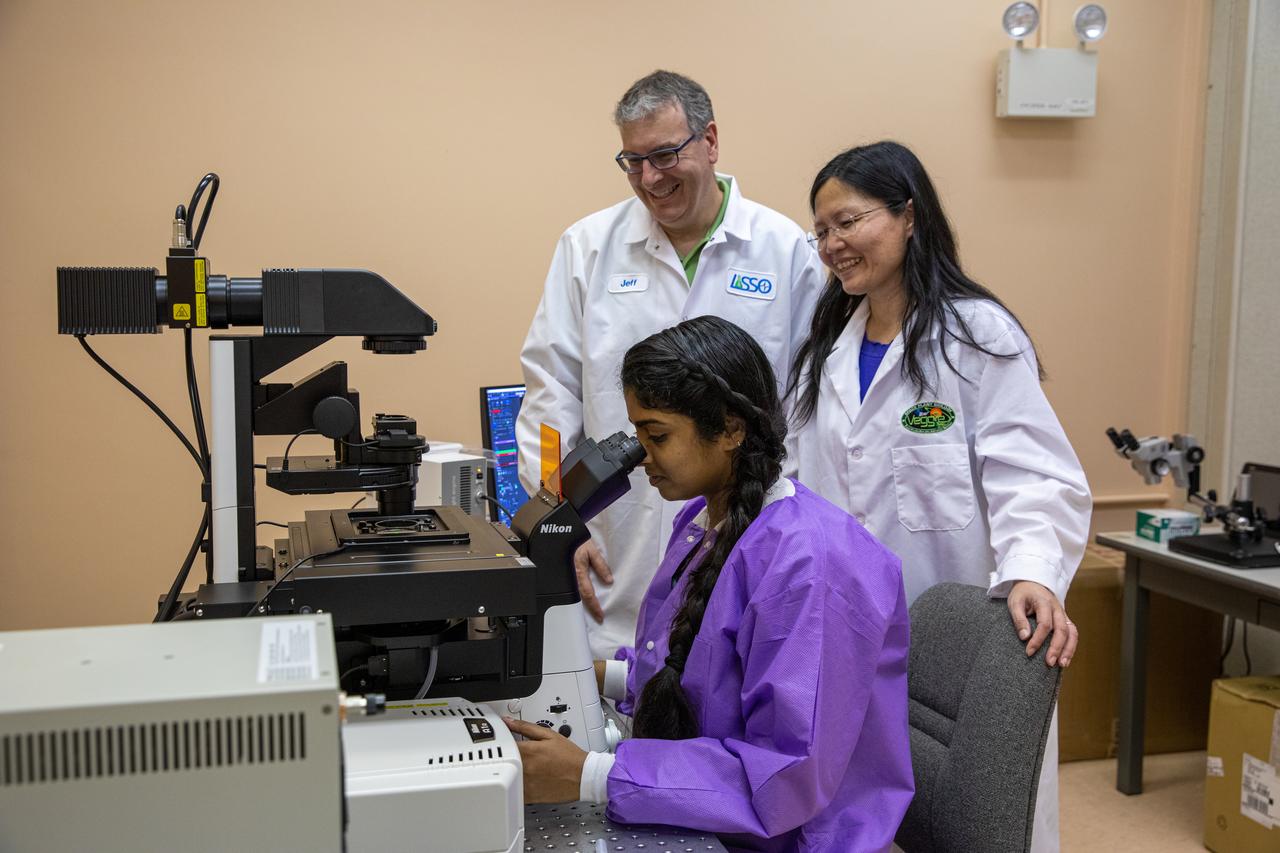
Dr. Srujana Neelam, a NASA post-doctoral fellow observes samples on a confocal microscope in the Microgravity Simulation Support Facility (MSSF) inside the Neil Armstrong Operations and Checkout building at NASA’s Kennedy Space Center in Florida on Feb. 11, 2020 with Jeffrey Richards, a payload research and science coordinator on the LASSO contract, Dr. Ye Zhang, a project scientist. The facility was developed to provide ground simulation capability to the U.S. research community in order to supplement the limited opportunities to access the International Space Station and other platforms for microgravity research. The MSSF is designed to support biological research on microorganisms, cells, tissues, small plants and small animals. The simulator provides NASA with an alternative platform for microgravity research and creates the opportunity to conduct experiments on the space station in parallel with conditions of simulated microgravity on the ground.
Microgravity Simulation Support Facility
Srujana Neelam, a researcher working at NASA’s Kennedy Space Center in Florida, dissects Arabidopsis thaliana plants from petri plates used in microgravity simulation devices in the Microgravity Simulation Support Facility (MSSF) inside the Neil Armstrong Operations and Checkout building on Feb. 11, 2020. The facility was developed to provide ground simulation capability to the U.S. research community in order to supplement the limited opportunities to access the International Space Station and other platforms for microgravity research. The MSSF is designed to support biological research on microorganisms, cells, tissues, small plants and small animals. The simulator provides NASA with an alternative platform for microgravity research and creates the opportunity to conduct experiments on the space station in parallel with conditions of simulated microgravity on the ground.
Microgravity Simulation Support Facility
Srujana Neelam, a researcher working at NASA’s Kennedy Space Center in Florida dissects Arabidopsis thaliana plants from petri plates used in microgravity simulation devices in the Microgravity Simulation Support Facility (MSSF) inside the Neil Armstrong Operations and Checkout building on Feb. 11, 2020. The facility was developed to provide ground simulation capability to the U.S. research community in order to supplement the limited opportunities to access the International Space Station and other platforms for microgravity research. The MSSF is designed to support biological research on microorganisms, cells, tissues, small plants and small animals. The simulator provides NASA with an alternative platform for microgravity research and creates the opportunity to conduct experiments on the space station in parallel with conditions of simulated microgravity on the ground.
Microgravity Simulation Support Facility
Dr. Srujana Neelam, a NASA post-doctoral fellow observes samples on a confocal microscope in the Microgravity Simulation Support Facility (MSSF) inside the Neil Armstrong Operations and Checkout building at NASA’s Kennedy Space Center in Florida on Feb. 11, 2020, with Jeffrey Richards, a payload research and science coordinator on the LASSO contract; and Dr. Ye Zhang, a project scientist. The facility was developed to provide ground simulation capability to the U.S. research community in order to supplement the limited opportunities to access the International Space Station and other platforms for microgravity research. The MSSF is designed to support biological research on microorganisms, cells, tissues, small plants and small animals. The simulator provides NASA with an alternative platform for microgravity research and creates the opportunity to conduct experiments on the space station in parallel with conditions of simulated microgravity on the ground.
Microgravity Simulation Support Facility
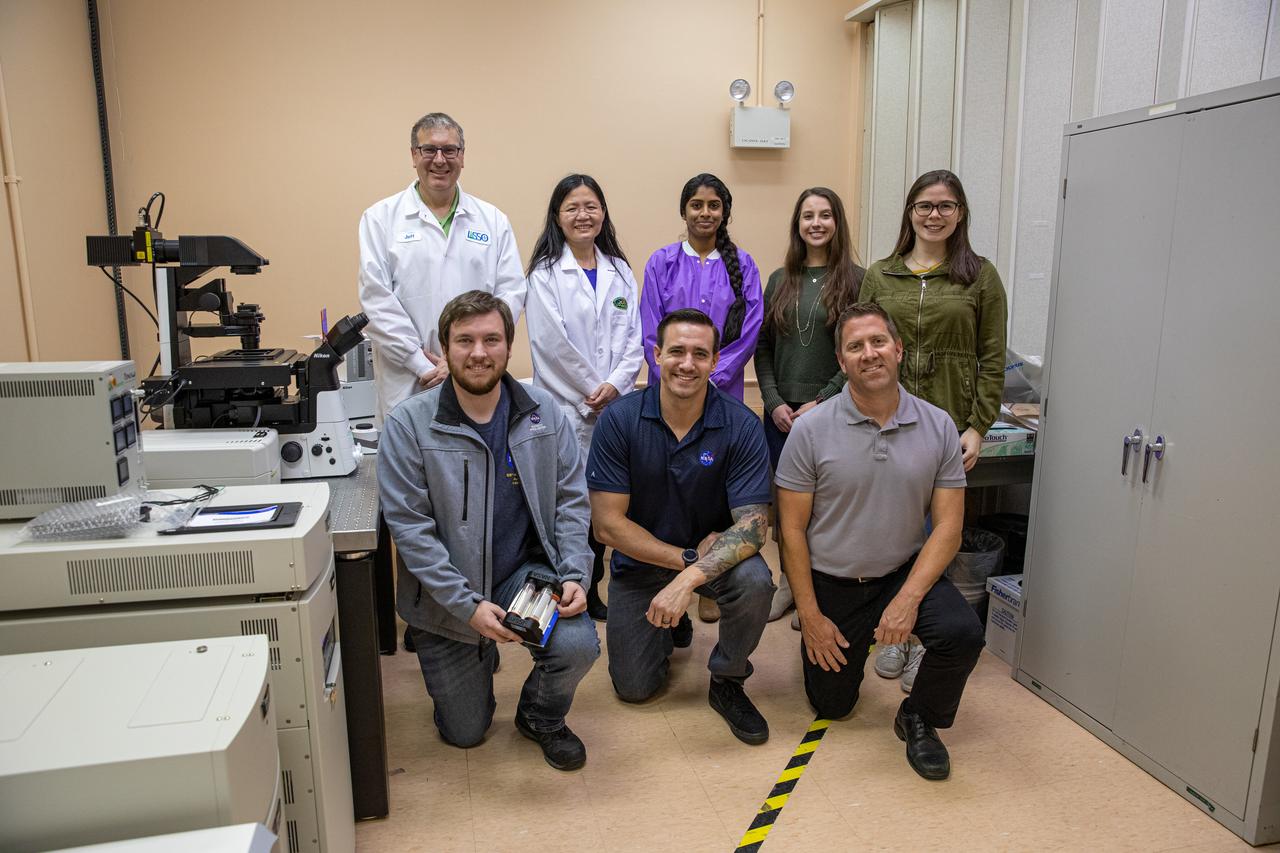
Researchers are in the Microgravity Simulation Support Facility (MSSF) inside the Neil Armstrong Operations and Checkout building at NASA’s Kennedy Space Center in Florida on Feb. 11, 2020. In front, from left, are Jonathan Gleeson, aerospace engineer on the LASSO contract; Jason Fischer, a research and development scientist on the LASSO contract; and Ralph Nacca, aerospace flight systems. In back, from left, are Jeffrey Richards, a payload research and science coordinator on the LASSO contract; Dr. Ye Zhang, a project scientist; Dr. Srujana Neelam, a NASA post-doctoral fellow; Jessica Hellein, NASA intern; and Emily Keith, NASA intern. The facility was developed to provide ground simulation capability to the U.S. research community in order to supplement the limited opportunities to access the International Space Station and other platforms for microgravity research. The MSSF is designed to support biological research on microorganisms, cells, tissues, small plants and small animals. The simulator provides NASA with an alternative platform for microgravity research and creates the opportunity to conduct experiments on the space station in parallel with conditions of simulated microgravity on the ground.
Microgravity Simulation Support Facility
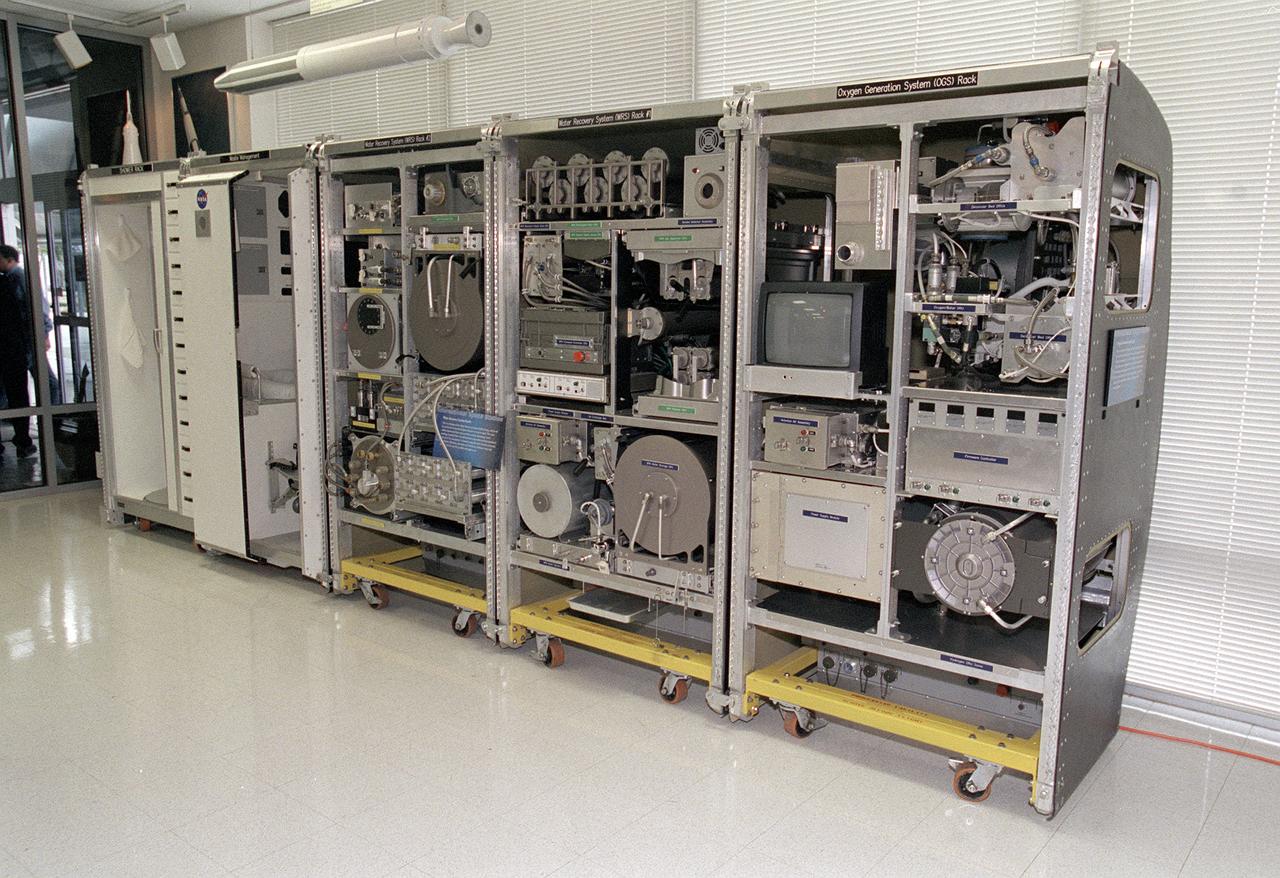
The Environmental Control and Life Support System (ECLSS) Group of the Flight Projects Directorate at the Marshall Space Flight Center in Huntsville, Alabama, is responsible for designing and building the life support systems that will provide the crew of the International Space Station (ISS) a comfortable environment in which to live and work. This photograph shows the mockup of the the ECLSS to be installed in the Node 3 module of the ISS. From left to right, shower rack, waste management rack, Water Recovery System (WRS) Rack #2, WRS Rack #1, and Oxygen Generation System (OGS) rack are shown. The WRS provides clean water through the reclamation of wastewaters and is comprised of a Urine Processor Assembly (UPA) and a Water Processor Assembly (WPA). The UPA accepts and processes pretreated crewmember urine to allow it to be processed along with other wastewaters in the WPA. The WPA removes free gas, organic, and nonorganic constituents before the water goes through a series of multifiltration beds for further purification. The OGS produces oxygen for breathing air for the crew and laboratory animals, as well as for replacing oxygen loss. The OGS is comprised of a cell stack, which electrolyzes (breaks apart the hydrogen and oxygen molecules) some of the clean water provided by the WRS, and the separators that remove the gases from the water after electrolysis.
International Space Station (ISS)
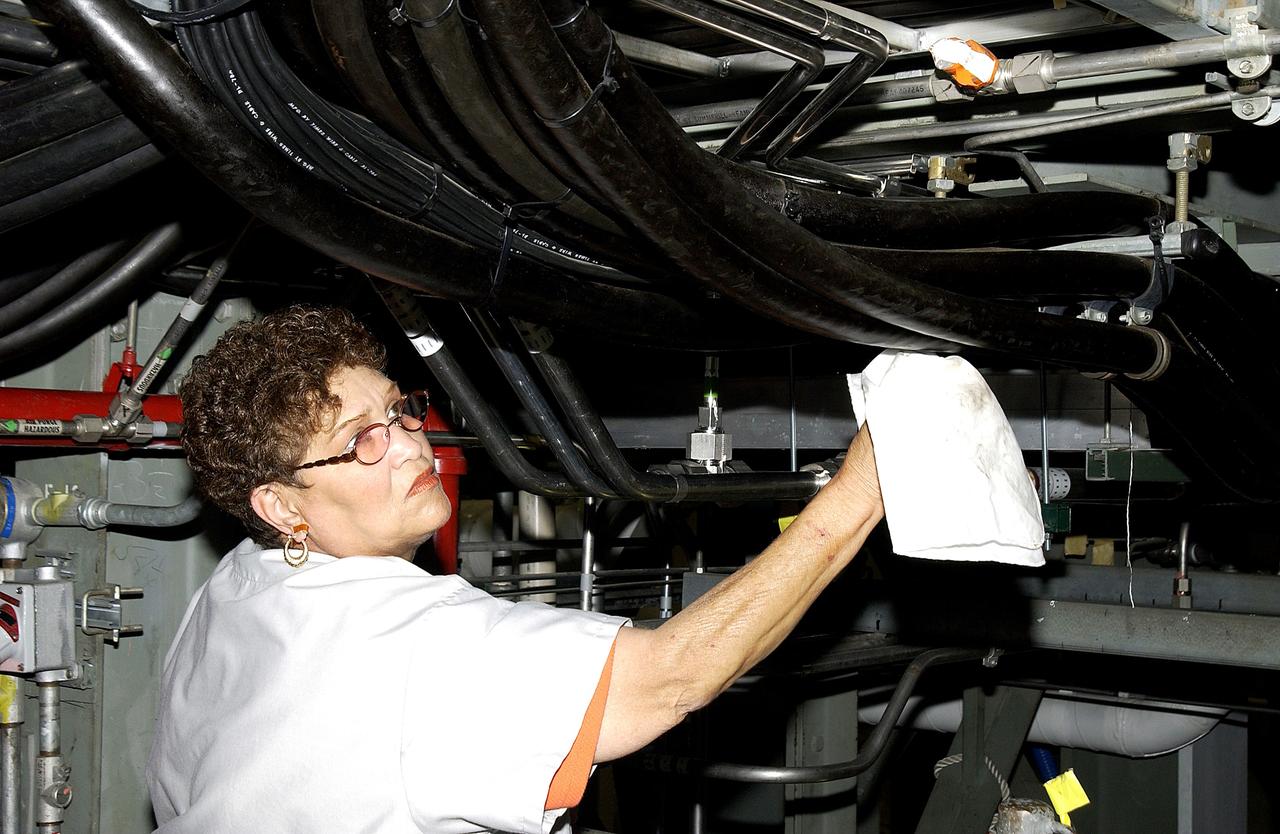
KENNEDY SPACE CENTER, FLA. - A KSC employee wipes down some of the hoses of the ground support equipment in the Orbiter Processing Facility (OPF) where Space Shuttle Atlantis is being processed for flight.  Preparations are under way for the next launch of Atlantis on mission STS-114, a utilization and logistics flight to the International Space Station.
KENNEDY SPACE CENTER, FLA. - A KSC employee wipes down some of the hoses of the ground support equipment in the Orbiter Processing Facility (OPF) where Space Shuttle Atlantis is being processed for flight. Preparations are under way for the next launch of Atlantis on mission STS-114, a utilization and logistics flight to the International Space Station.
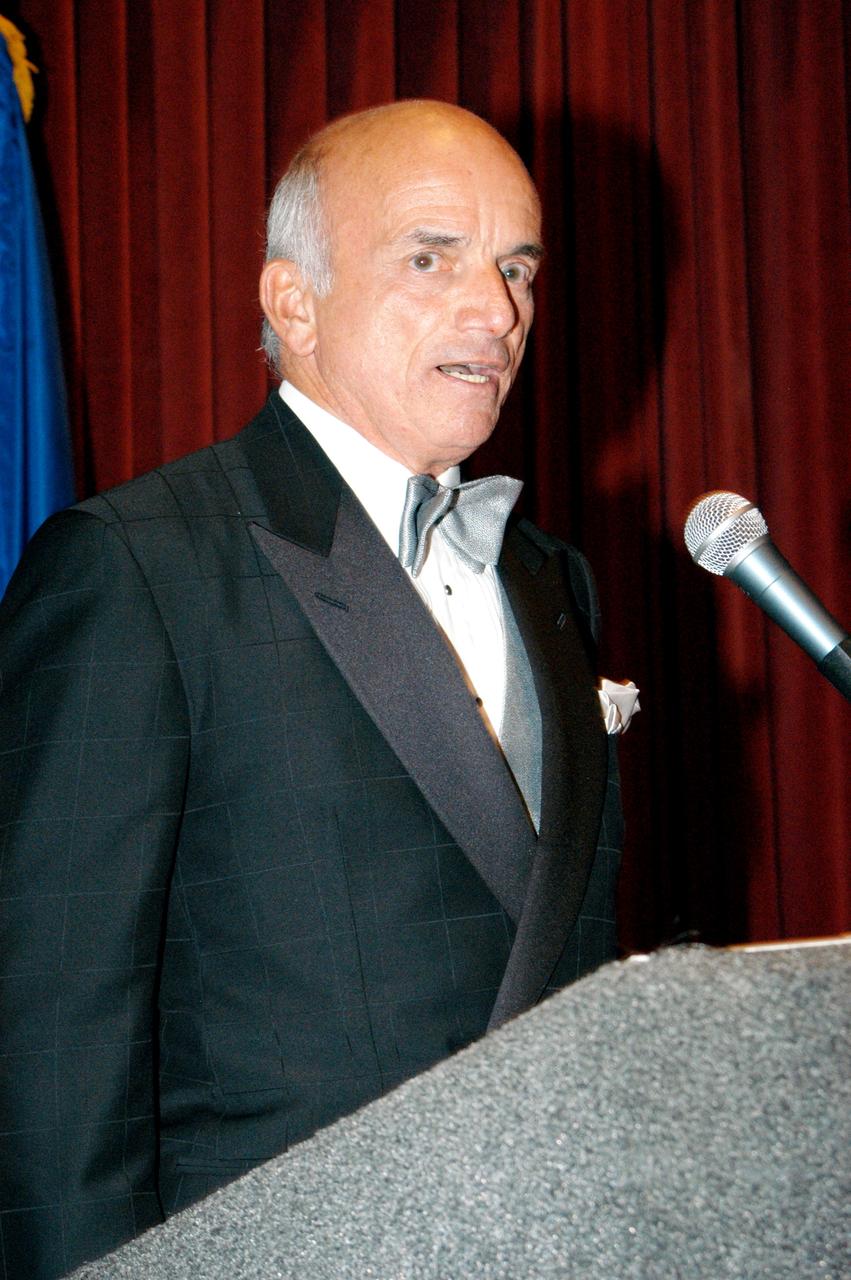
KENNEDY SPACE CENTER, FLA. - Dennis Tito, the first private citizen to visit the International Space Station, shares his experiences with visitors at the 40th  Space Congress.  Held April 29-May 2, 2003, in Cape Canaveral, Fla., the Space Congress is an international conference that gathers attendees from the scientific community, the space industry workforce, educators and local supporting industries.  This year's event commemorated the 40th anniversary of the Kennedy Space Center and the Centennial of Flight.  The theme for the Space Congress was "Linking the Past to the Future: A Celebration of Space."
KENNEDY SPACE CENTER, FLA. - Dennis Tito, the first private citizen to visit the International Space Station, shares his experiences with visitors at the 40th Space Congress. Held April 29-May 2, 2003, in Cape Canaveral, Fla., the Space Congress is an international conference that gathers attendees from the scientific community, the space industry workforce, educators and local supporting industries. This year's event commemorated the 40th anniversary of the Kennedy Space Center and the Centennial of Flight. The theme for the Space Congress was "Linking the Past to the Future: A Celebration of Space."
KENNEDY SPACE CENTER, FLA. - Dennis Tito, the first private citizen to visit the International Space Station, shares his experiences during the Space Congress Gala.  Held April 29-May 2, 2003, in Cape Canaveral, Fla., the Space Congress is an international conference that gathers attendees from the scientific community, the space industry workforce, educators and local supporting industries.  This year's event commemorated the 40th anniversary of the Kennedy Space Center and the Centennial of Flight.  The theme for the Space Congress was "Linking the Past to the Future: A Celebration of Space."
KENNEDY SPACE CENTER, FLA. - Dennis Tito, the first private citizen to visit the International Space Station, shares his experiences during the Space Congress Gala. Held April 29-May 2, 2003, in Cape Canaveral, Fla., the Space Congress is an international conference that gathers attendees from the scientific community, the space industry workforce, educators and local supporting industries. This year's event commemorated the 40th anniversary of the Kennedy Space Center and the Centennial of Flight. The theme for the Space Congress was "Linking the Past to the Future: A Celebration of Space."
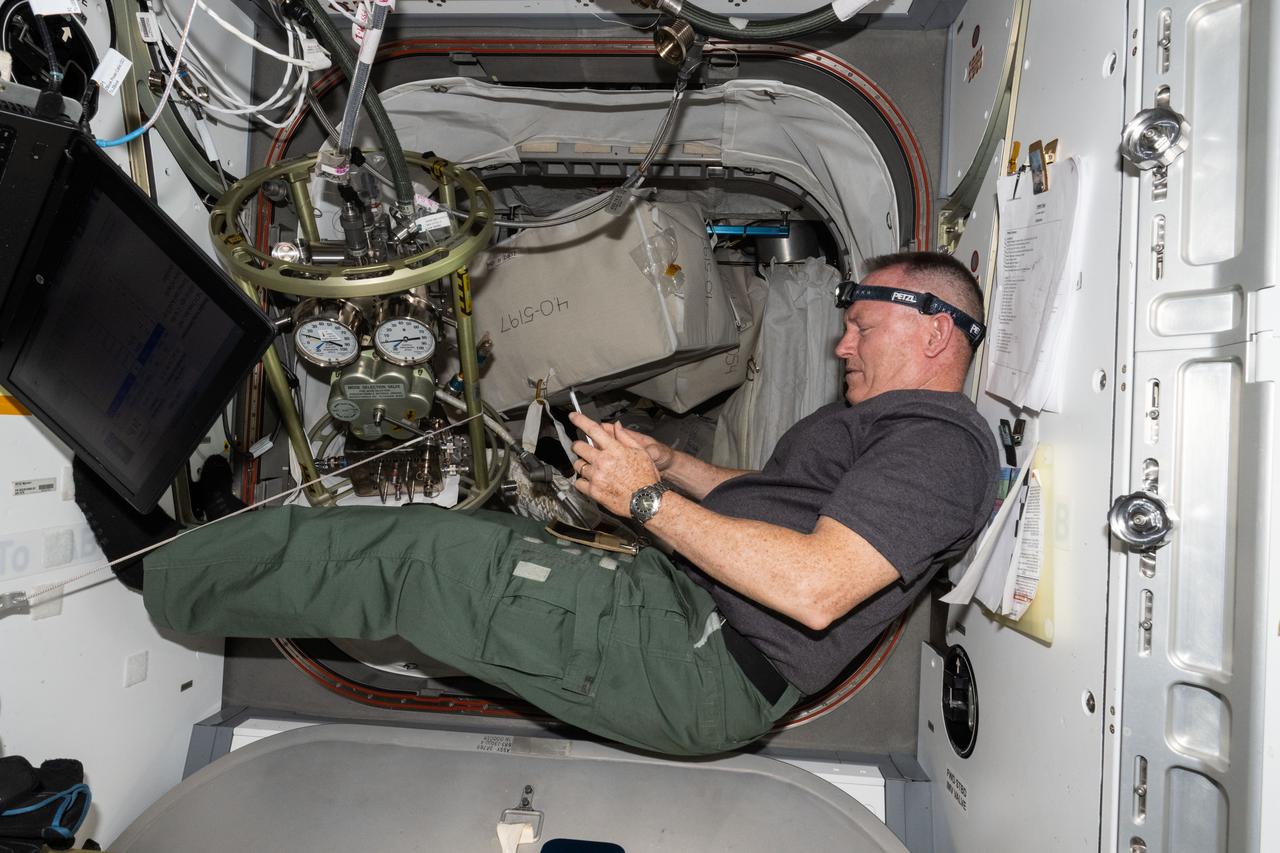
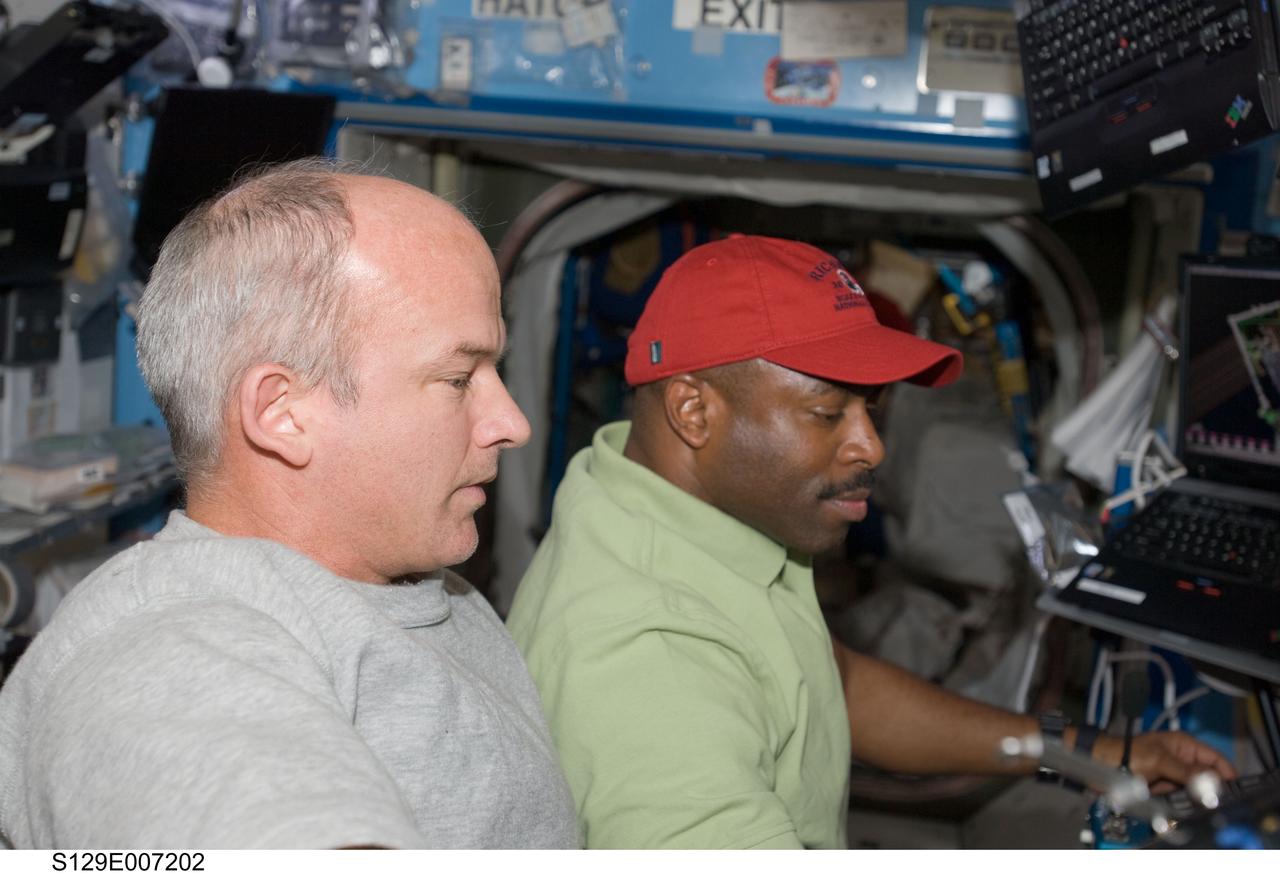
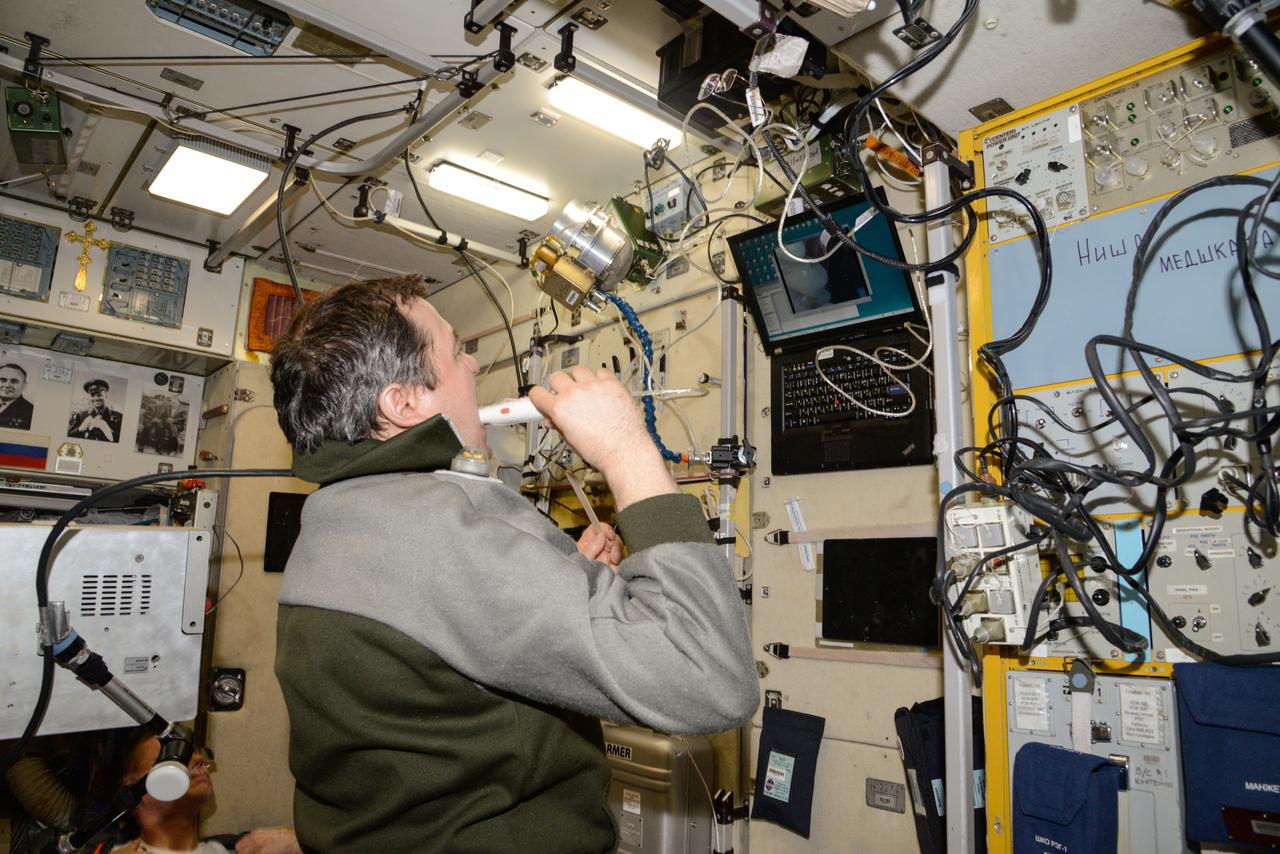
iss071e318564 (July 10, 2024) --- NASA astronaut and Boeing's Crew Flight Test Commander Butch Wilmore reviews procedures on a computer tablet for life support maintenance work aboard the International Space Station.
NASA astronaut and Boeing's Crew Flight Test Commander Butch Wilmore
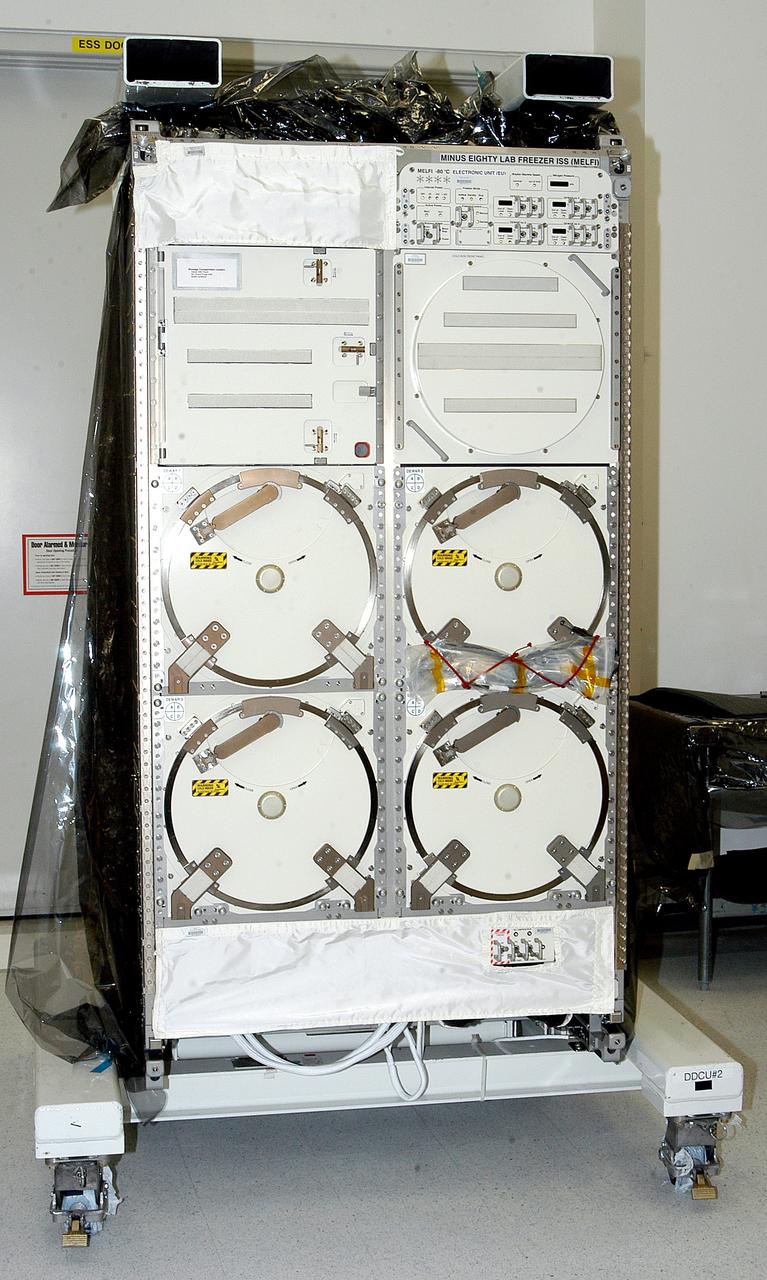
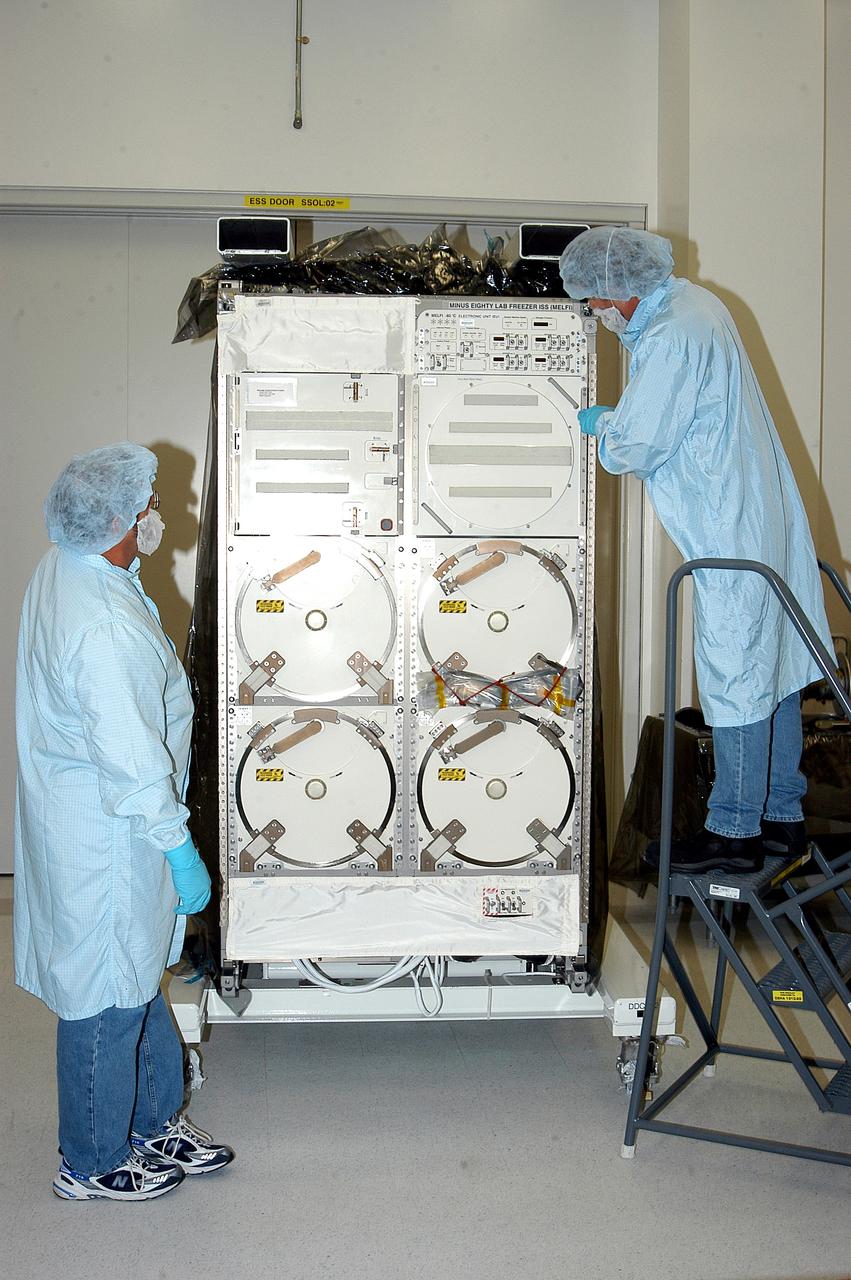
KENNEDY SPACE CENTER, FLA. -  The Minus Eighty Lab Freezer for ISS (MELFI), provided as Laboratory Support Equipment by the European Space Agency for the International Space Station, is seen in the Space Station Processing Facility.  The lab will provide cooling and storage for reagents, samples and perishable materials in four insulated containers called dewars with independently selectable temperatures of -80°C, -26°C, and +4°C. It also will be used to transport samples to and from the station.   The MELFI is planned for launch on the ULF-1 mission.
KENNEDY SPACE CENTER, FLA. - The Minus Eighty Lab Freezer for ISS (MELFI), provided as Laboratory Support Equipment by the European Space Agency for the International Space Station, is seen in the Space Station Processing Facility. The lab will provide cooling and storage for reagents, samples and perishable materials in four insulated containers called dewars with independently selectable temperatures of -80°C, -26°C, and +4°C. It also will be used to transport samples to and from the station. The MELFI is planned for launch on the ULF-1 mission.
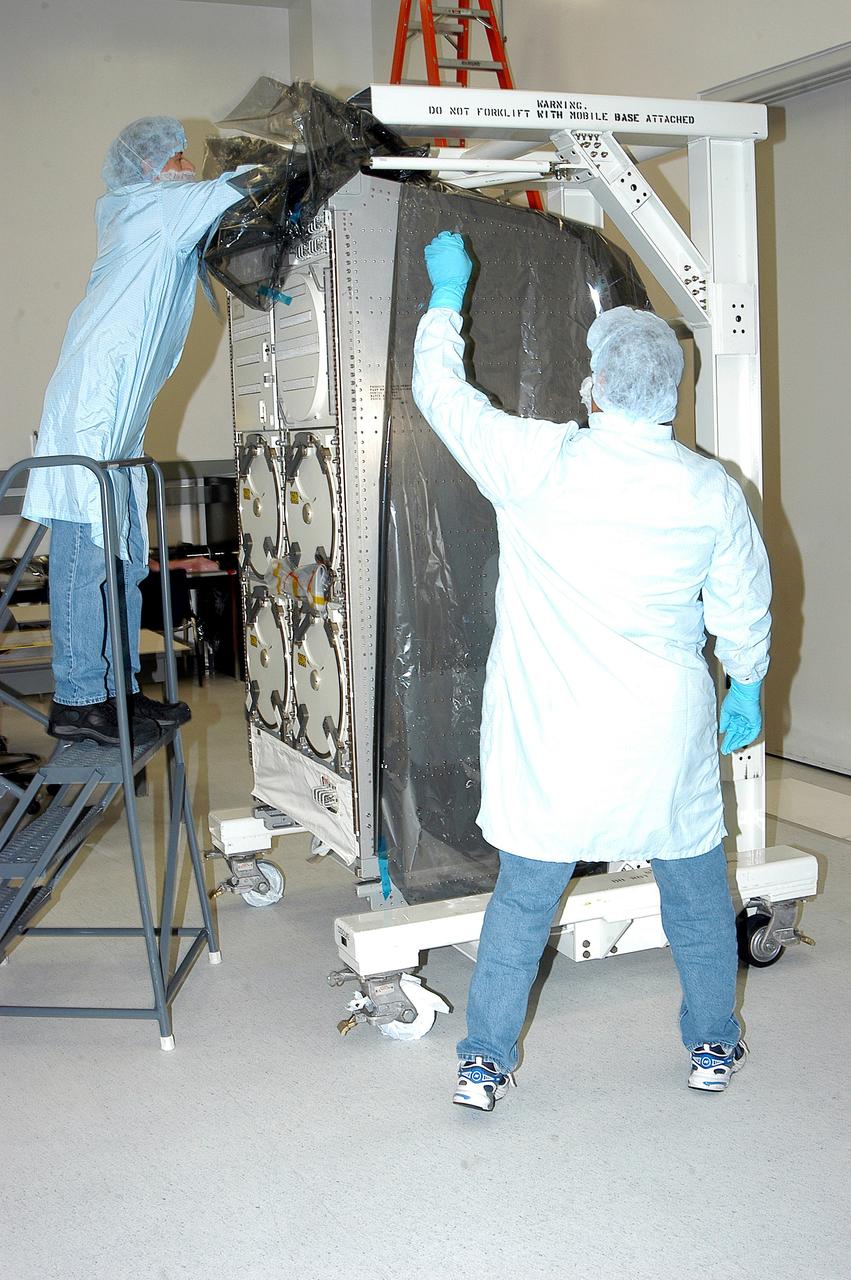
KENNEDY SPACE CENTER, FLA. -  In the Space Station Processing Facility, technicians remove the cover from the Minus Eighty Lab Freezer for ISS(MELFI) provided as Laboratory Support Equipment by the European Space Agency for the International Space Station.  The lab will provide cooling and storage for reagents, samples and perishable materials in four insulated containers called dewars with independently selectable temperatures of -80°C, -26°C, and +4°C. It also will be used to transport samples to and from the station.   The MELFI is planned for launch on the ULF-1 mission.
KENNEDY SPACE CENTER, FLA. - In the Space Station Processing Facility, technicians remove the cover from the Minus Eighty Lab Freezer for ISS(MELFI) provided as Laboratory Support Equipment by the European Space Agency for the International Space Station. The lab will provide cooling and storage for reagents, samples and perishable materials in four insulated containers called dewars with independently selectable temperatures of -80°C, -26°C, and +4°C. It also will be used to transport samples to and from the station. The MELFI is planned for launch on the ULF-1 mission.
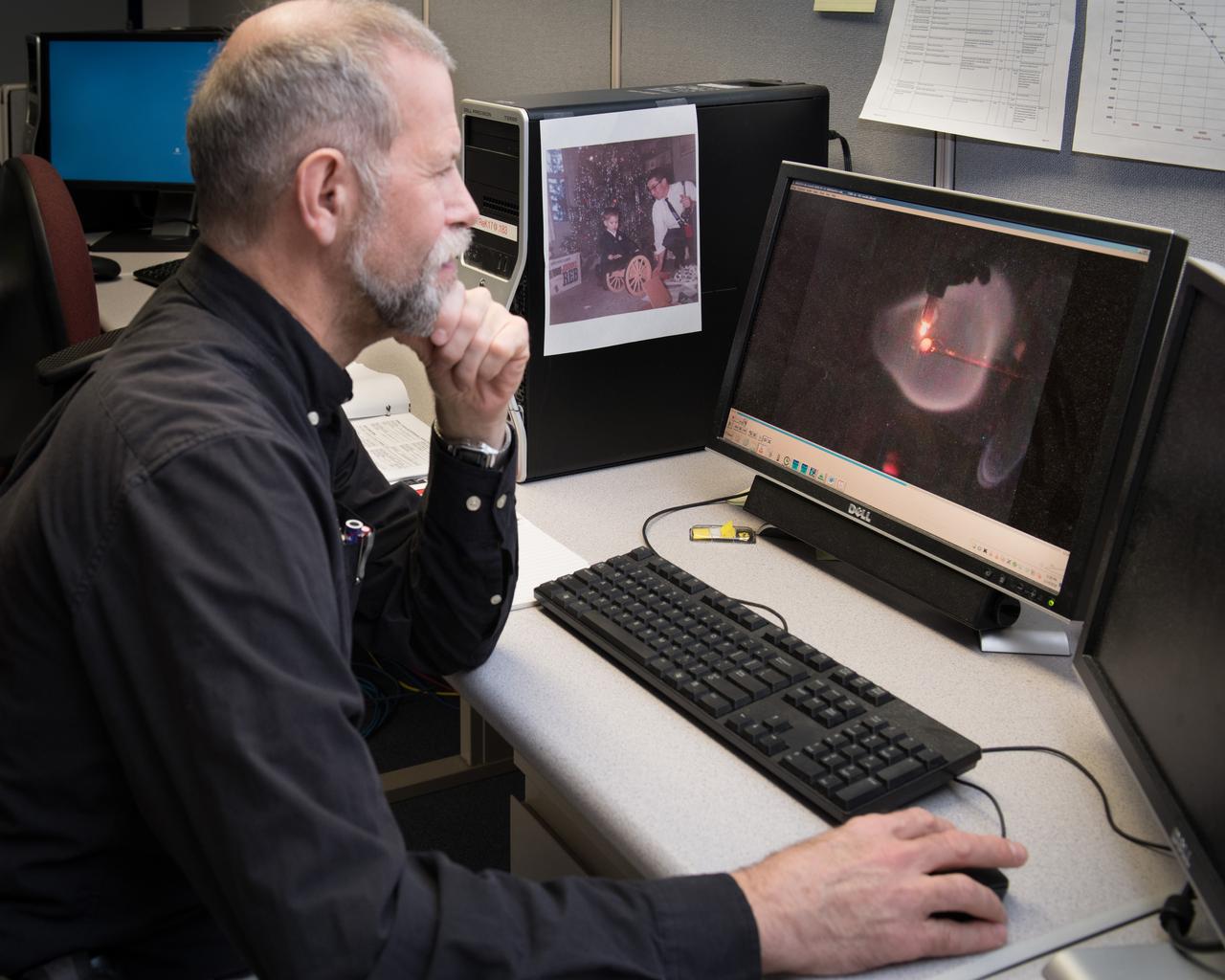
Review of ISS data from the Structure and Response of Spherical Diffusion Flames (s-Flame) experiment - of the Advanced Combustion via Microgravity Experiments. ACME project conducted in the Combustion Integrated Rack, CIR - by ACME Project Scientist Dennis Stocker in the Telescience Support Center,TSC, also known as the Glenn ISS Payload Operations Center, GIPOC
Review of International Space Station, ISS data from the Structure and Response of Spherical Diffusion Flames, s-Flame experiment in the Telescience Support Center, TSC, also known as the Glenn ISS Payload Operations Center, GIPOC
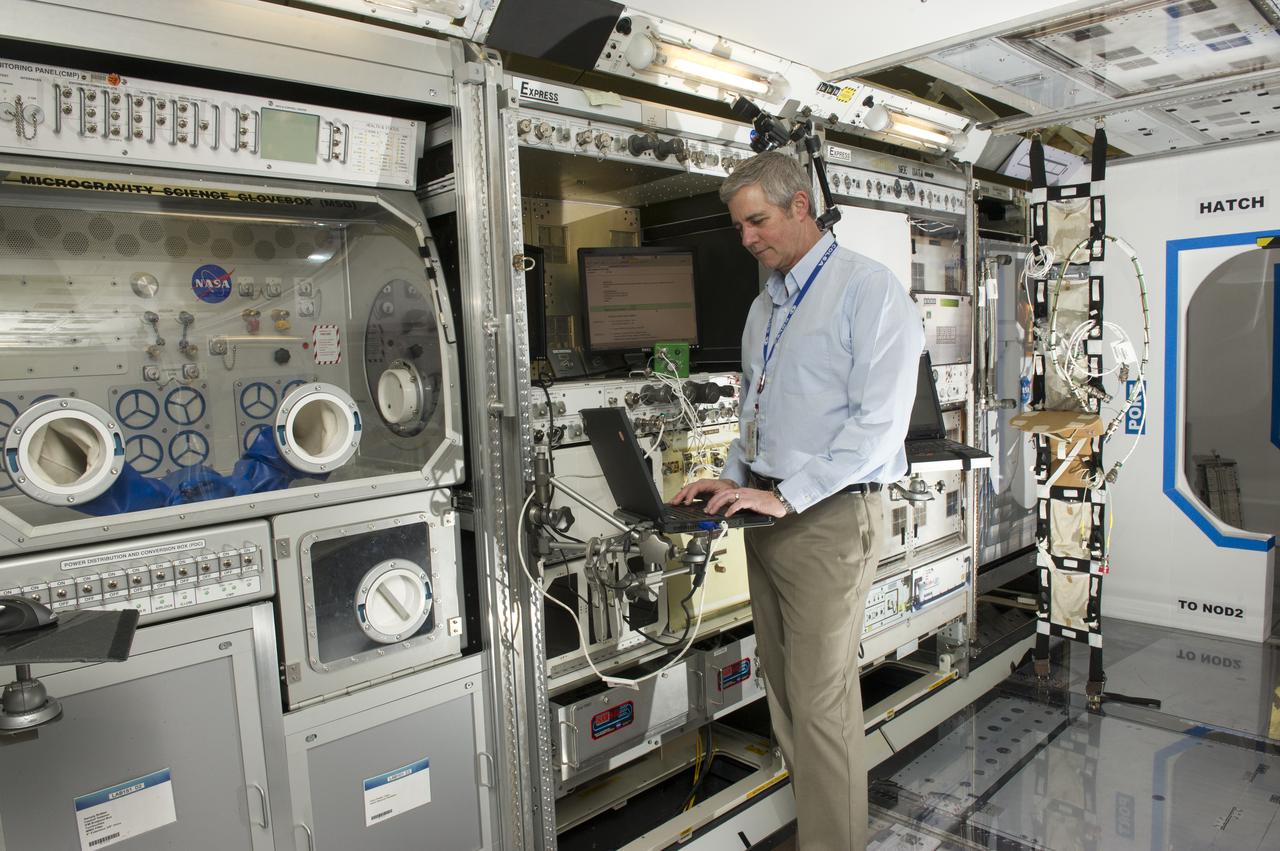
KENNEDY SPACE CENTER, FLA. - In the Space Station Processing Facility, workers check over the Italian-built Node 2, a future element of the International Space Station.  The second of three Station connecting modules, the Node 2 attaches to the end of the U.S. Lab and provides attach locations for several other elements.  Kopra is currently assigned technical duties in the Space Station Branch of the Astronaut Office, where his primary focus involves the testing of crew interfaces for two future ISS modules as well as the implementation of support computers and operational Local Area Network on ISS.   Node 2 is scheduled to launch on mission STS-120, Station assembly flight 10A.
KENNEDY SPACE CENTER, FLA. - In the Space Station Processing Facility, workers check over the Italian-built Node 2, a future element of the International Space Station. The second of three Station connecting modules, the Node 2 attaches to the end of the U.S. Lab and provides attach locations for several other elements. Kopra is currently assigned technical duties in the Space Station Branch of the Astronaut Office, where his primary focus involves the testing of crew interfaces for two future ISS modules as well as the implementation of support computers and operational Local Area Network on ISS. Node 2 is scheduled to launch on mission STS-120, Station assembly flight 10A.
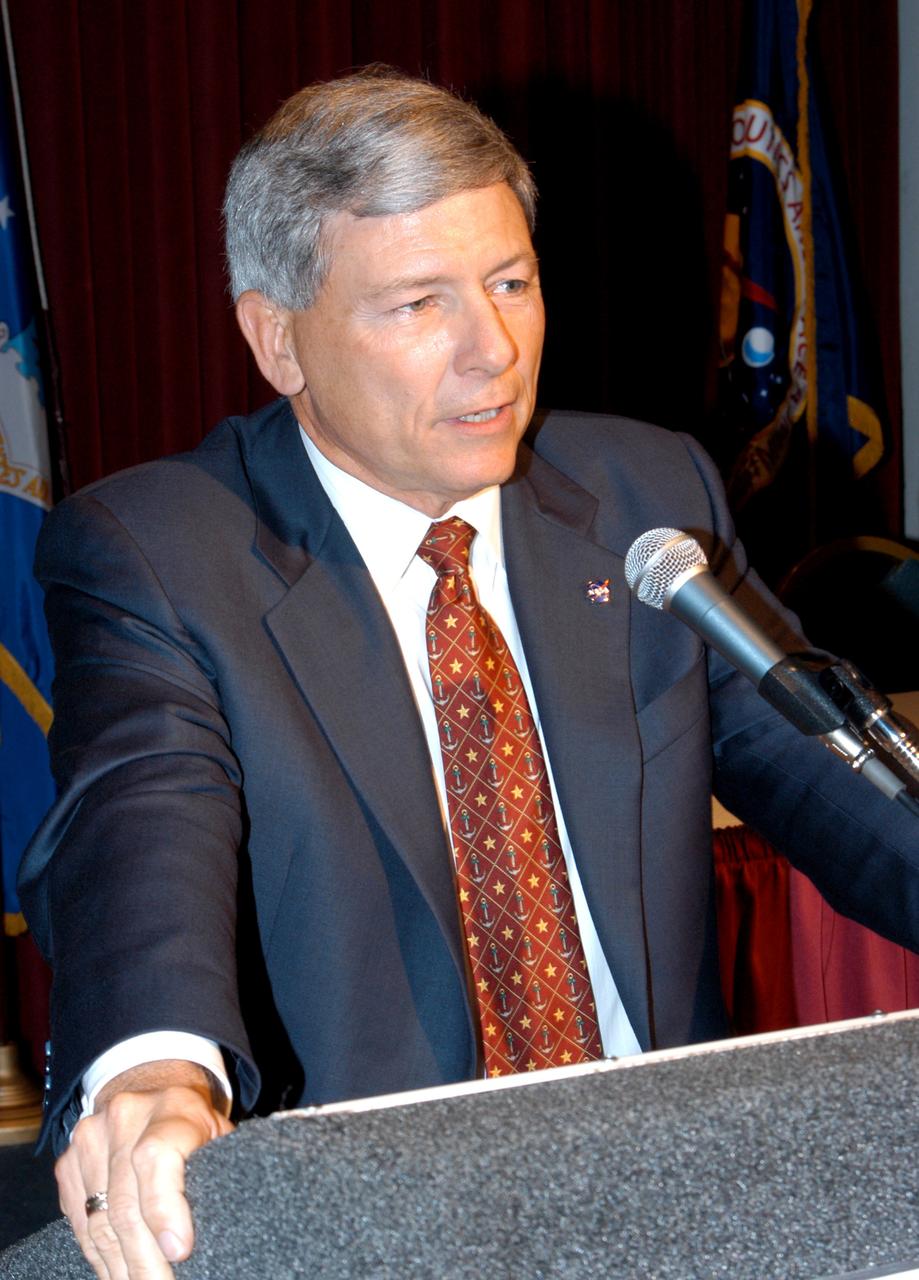
KENNEDY SPACE CENTER, FLA. - At a luncheon during Space Congress Week, Michael Kostelnik, NASA deputy associate administrator for the Space Shuttle and the International Space Station, speaks to luncheon attendees about the future challenges the Agency faces.  Held April 29-May 2, 2003, in Cape Canaveral, Fla., the Space Congress is an international conference that gathers attendees from the scientific community, the space industry workforce, educators and local supporting industries.  This year's event commemorated the 40th anniversary of the Kennedy Space Center and the Centennial of Flight.  The theme for the Space Congress was "Linking the Past to the Future: A Celebration of Space."
KENNEDY SPACE CENTER, FLA. - At a luncheon during Space Congress Week, Michael Kostelnik, NASA deputy associate administrator for the Space Shuttle and the International Space Station, speaks to luncheon attendees about the future challenges the Agency faces. Held April 29-May 2, 2003, in Cape Canaveral, Fla., the Space Congress is an international conference that gathers attendees from the scientific community, the space industry workforce, educators and local supporting industries. This year's event commemorated the 40th anniversary of the Kennedy Space Center and the Centennial of Flight. The theme for the Space Congress was "Linking the Past to the Future: A Celebration of Space."
KENNEDY SPACE CENTER, FLA. - At a luncheon during Space Congress Week, Michael Kostelnik, NASA deputy associate administrator for the Space Shuttle and the International Space Station, speaks to luncheon attendees about the future challenges the Agency faces.  Held April 29-May 2, 2003, in Cape Canaveral, Fla., the Space Congress is an international conference that gathers attendees from the scientific community, the space industry workforce, educators and local supporting industries.  This year's event commemorated the 40th anniversary of the Kennedy Space Center and the Centennial of Flight.  The theme for the Space Congress was "Linking the Past to the Future: A Celebration of Space."
KENNEDY SPACE CENTER, FLA. - At a luncheon during Space Congress Week, Michael Kostelnik, NASA deputy associate administrator for the Space Shuttle and the International Space Station, speaks to luncheon attendees about the future challenges the Agency faces. Held April 29-May 2, 2003, in Cape Canaveral, Fla., the Space Congress is an international conference that gathers attendees from the scientific community, the space industry workforce, educators and local supporting industries. This year's event commemorated the 40th anniversary of the Kennedy Space Center and the Centennial of Flight. The theme for the Space Congress was "Linking the Past to the Future: A Celebration of Space."
KENNEDY SPACE CENTER, FLA. -  After removing its cover, technicians look over the Minus Eighty Lab Freezer for ISS (MELFI),  provided as Laboratory Support Equipment by the European Space Agency for the International Space Station.  The lab will provide cooling and storage for reagents, samples and perishable materials in four insulated containers called dewars with independently selectable temperatures of -80°C, -26°C, and +4°C. It also will be used to transport samples to and from the station.   The MELFI is planned for launch on the ULF-1 mission.
KENNEDY SPACE CENTER, FLA. - After removing its cover, technicians look over the Minus Eighty Lab Freezer for ISS (MELFI), provided as Laboratory Support Equipment by the European Space Agency for the International Space Station. The lab will provide cooling and storage for reagents, samples and perishable materials in four insulated containers called dewars with independently selectable temperatures of -80°C, -26°C, and +4°C. It also will be used to transport samples to and from the station. The MELFI is planned for launch on the ULF-1 mission.
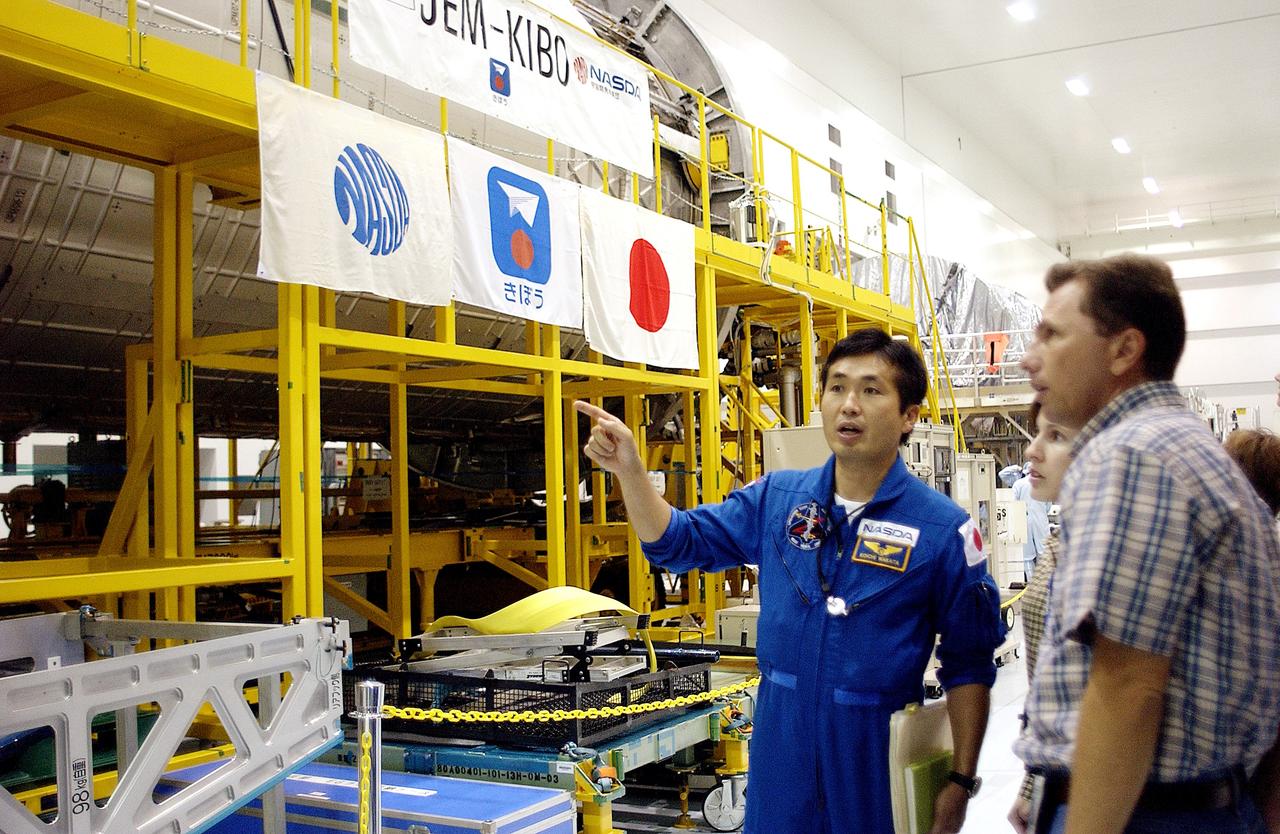
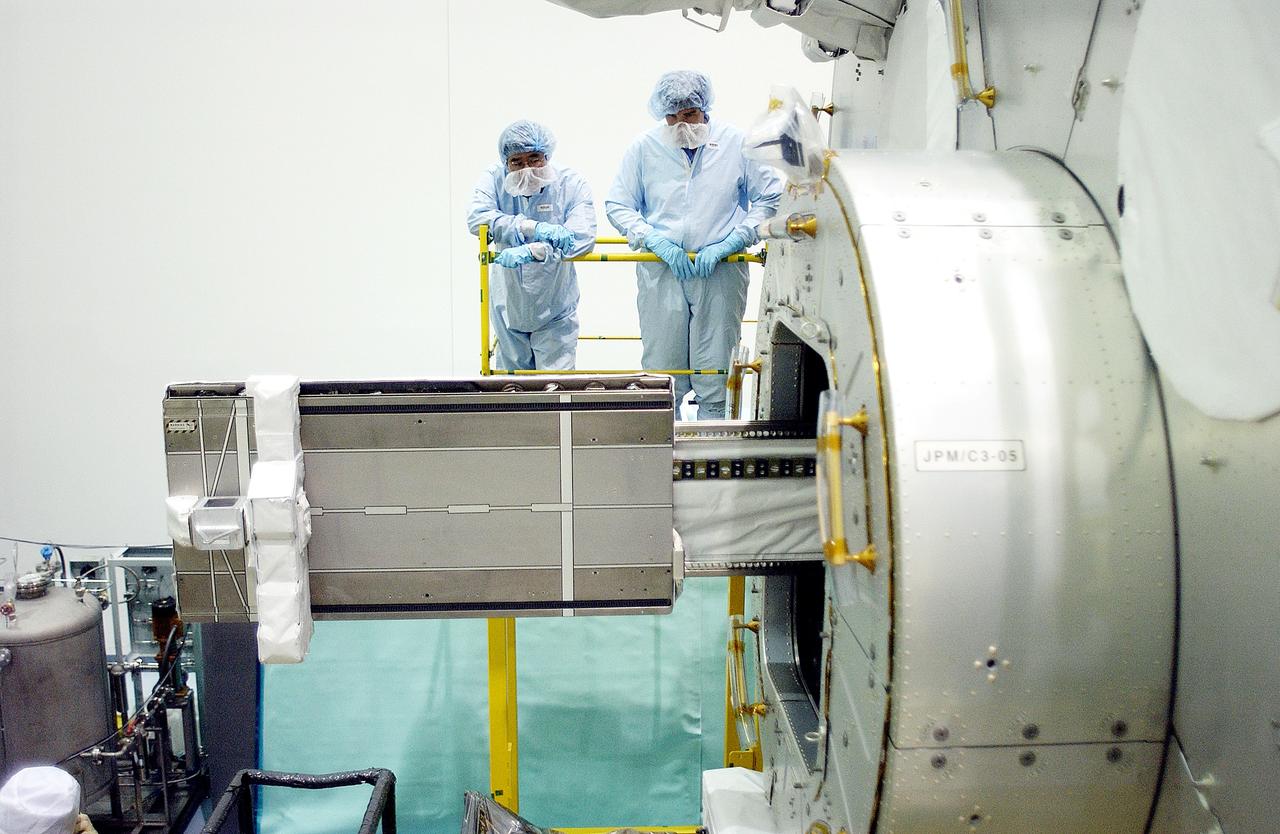
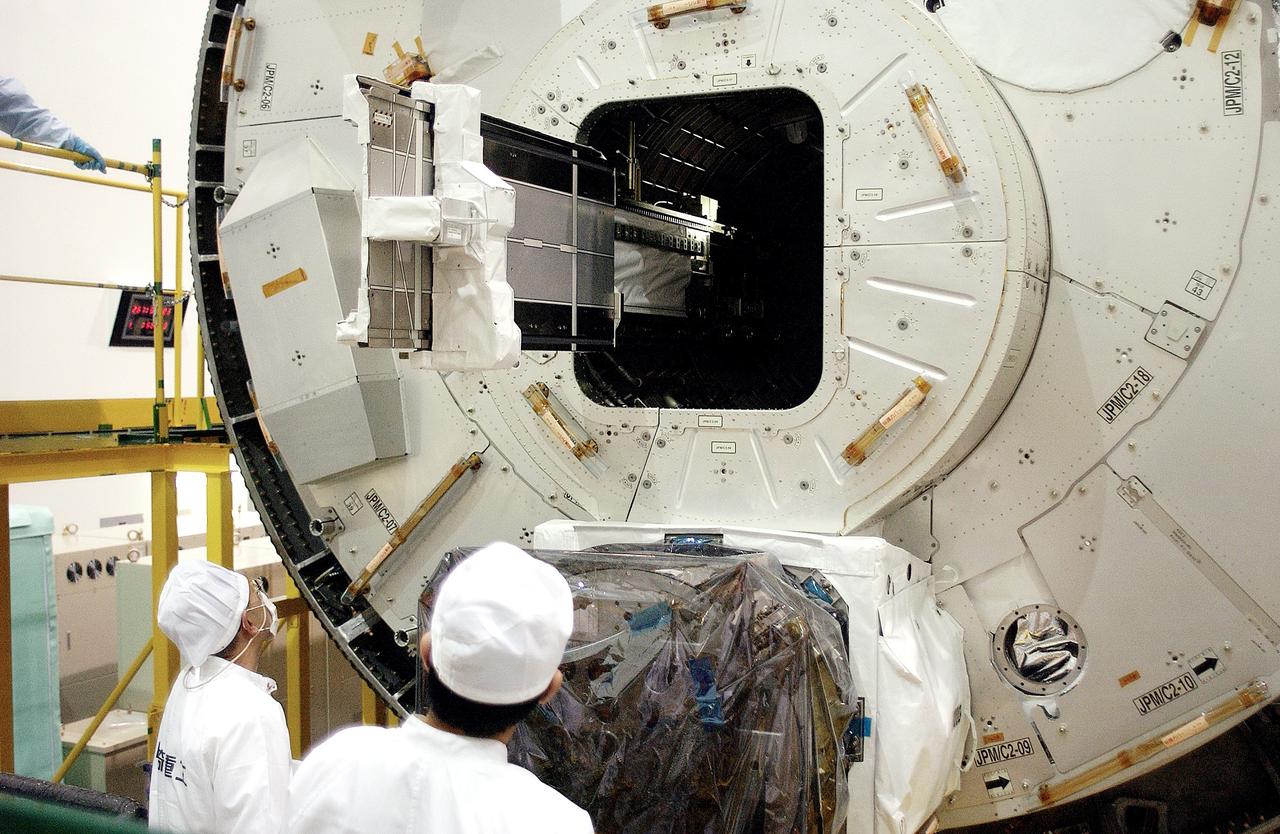
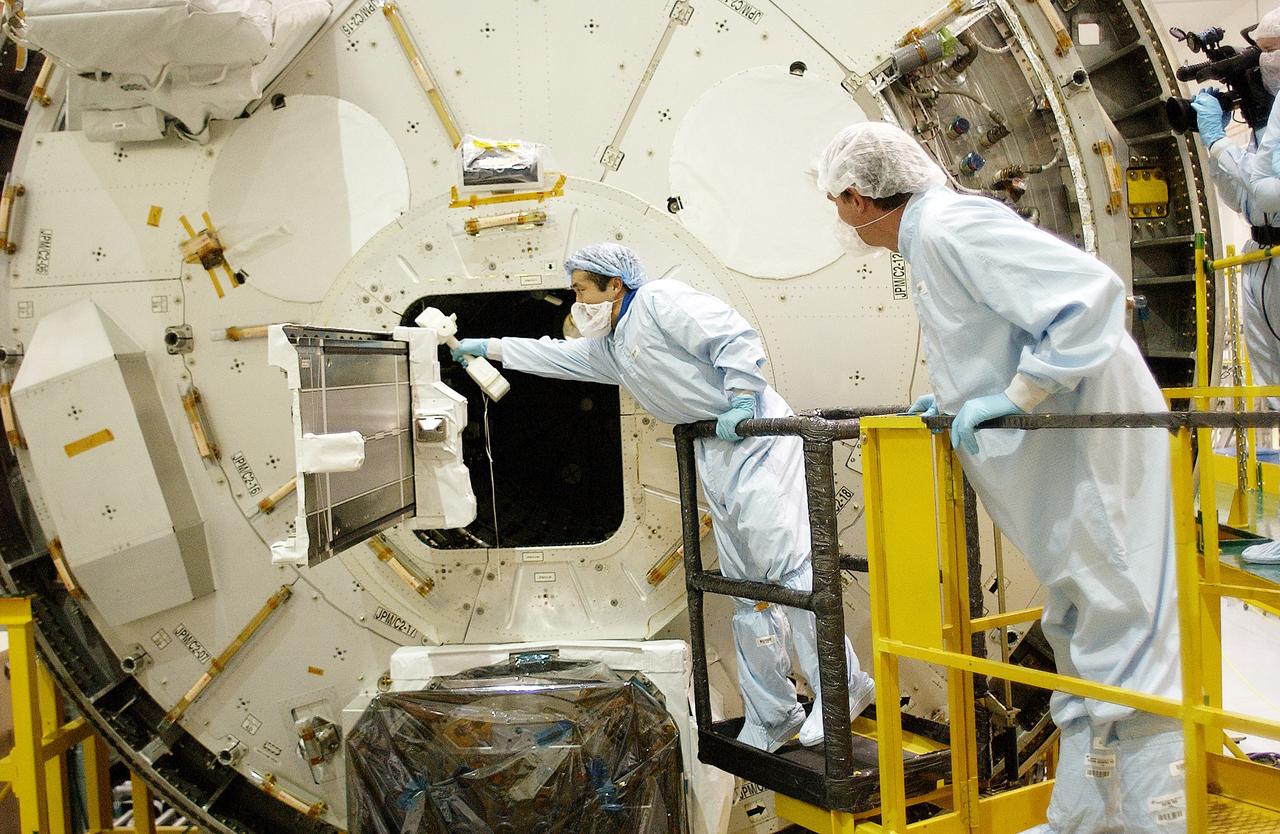
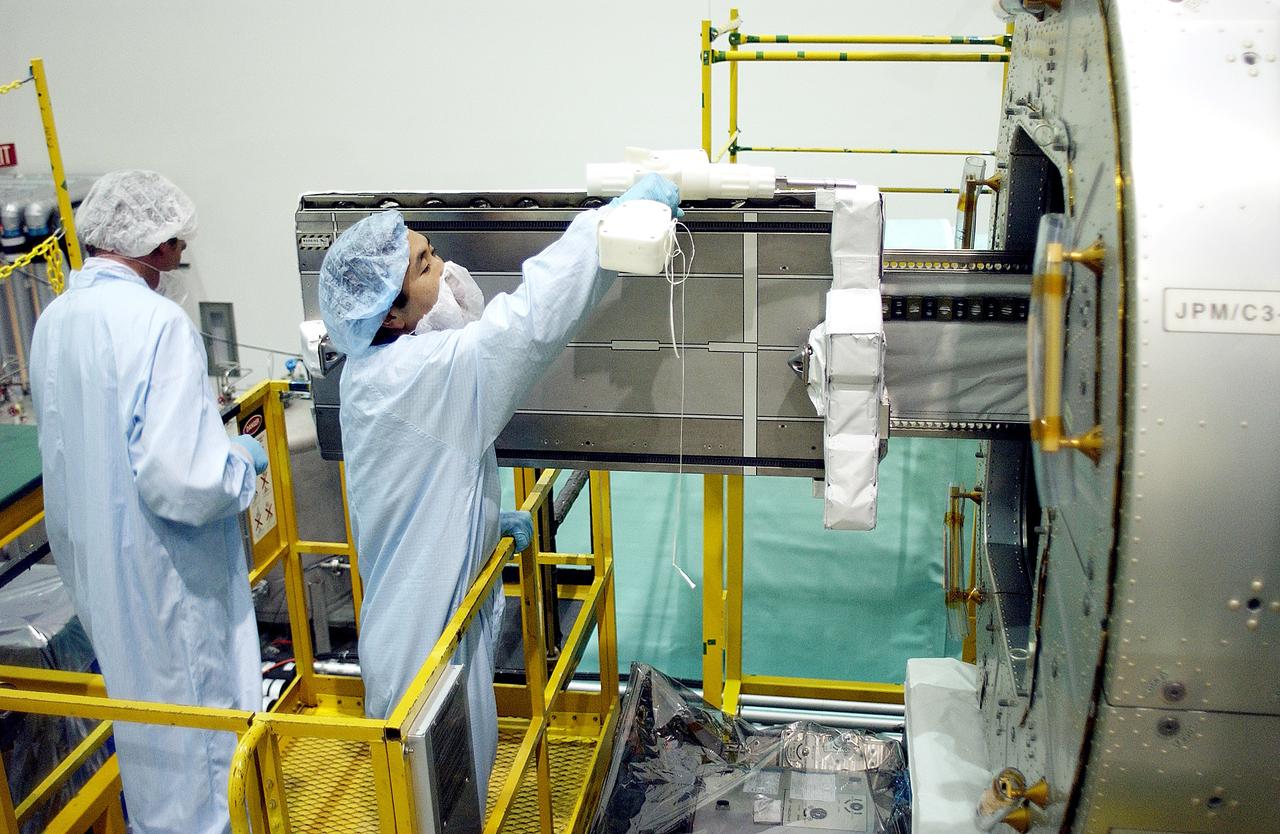
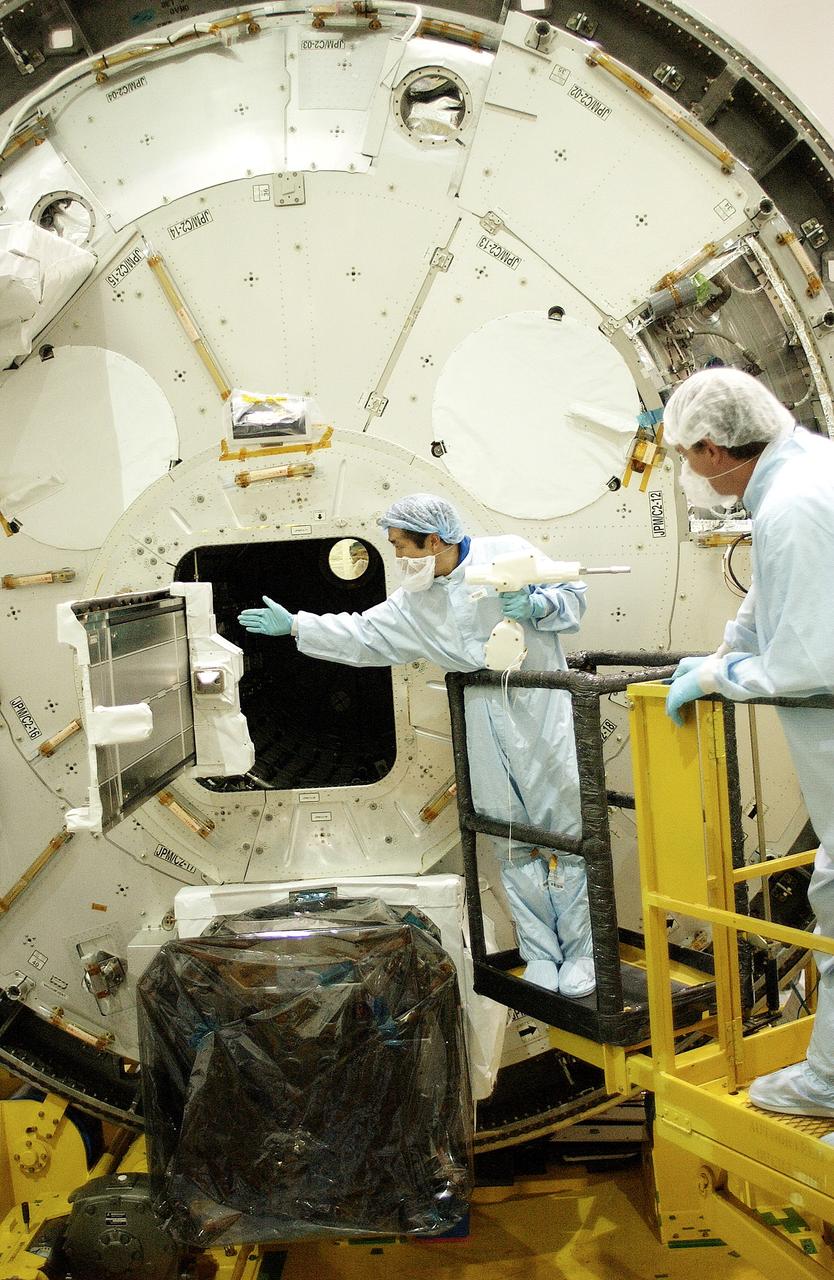
KENNEDY SPACE CENTER, FLA. -  In the Space Station Processing Facility, Japanese astronaut Koichi Wakata (top left) and technicians watch as a tray is extended from inside the Pressurized Module, or PM, part of the Japanese Experiment Module (JEM).   The PM provides a shirt-sleeve environment in which astronauts on the International Space Station can conduct microgravity experiments. There are a total of 23 racks, including 10 experiment racks, inside the PM providing a power supply, communications, air conditioning, hardware cooling, water control and experiment support functions.
KENNEDY SPACE CENTER, FLA. - In the Space Station Processing Facility, Japanese astronaut Koichi Wakata (top left) and technicians watch as a tray is extended from inside the Pressurized Module, or PM, part of the Japanese Experiment Module (JEM). The PM provides a shirt-sleeve environment in which astronauts on the International Space Station can conduct microgravity experiments. There are a total of 23 racks, including 10 experiment racks, inside the PM providing a power supply, communications, air conditioning, hardware cooling, water control and experiment support functions.
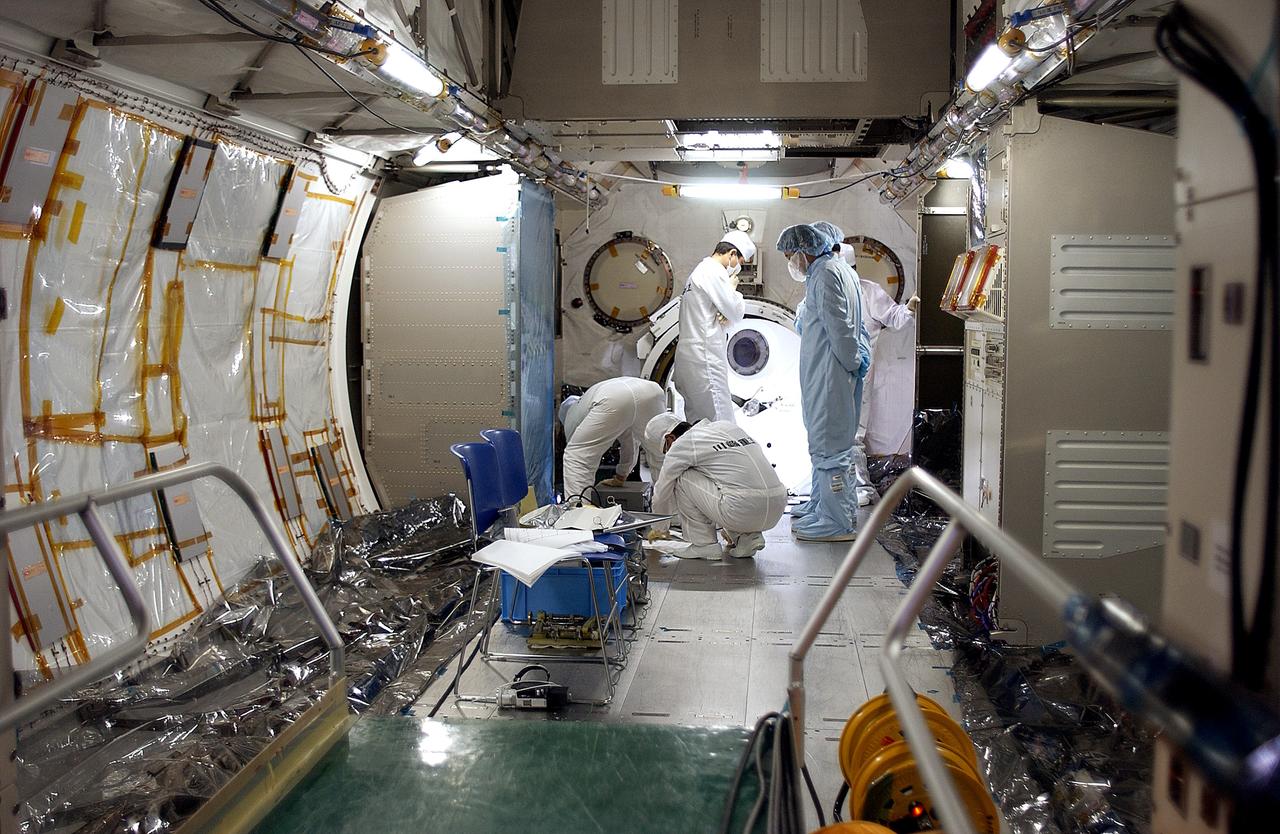
KENNEDY SPACE CENTER, FLA. - In the Space Station Processing Facility, Japanese astronaut Koichi Wakata looks over the Pressurized Module, or PM, part of the Japanese Experiment Module (JEM).  The PM provides a shirt-sleeve environment in which astronauts on the International Space Station can conduct microgravity experiments. There are a total of 23 racks, including 10 experiment racks, inside the PM providing a power supply, communications, air conditioning, hardware cooling, water control and experiment support functions.
KENNEDY SPACE CENTER, FLA. - In the Space Station Processing Facility, Japanese astronaut Koichi Wakata looks over the Pressurized Module, or PM, part of the Japanese Experiment Module (JEM). The PM provides a shirt-sleeve environment in which astronauts on the International Space Station can conduct microgravity experiments. There are a total of 23 racks, including 10 experiment racks, inside the PM providing a power supply, communications, air conditioning, hardware cooling, water control and experiment support functions.
KENNEDY SPACE CENTER, FLA. - In the Space Station Processing Facility, technicians on the floor watch as a tray is extended from inside the Pressurized Module, or PM, part of the Japanese Experiment Module (JEM).   The PM provides a shirt-sleeve environment in which astronauts on the International Space Station can conduct microgravity experiments. There are a total of 23 racks, including 10 experiment racks, inside the PM providing a power supply, communications, air conditioning, hardware cooling, water control and experiment support functions.
KENNEDY SPACE CENTER, FLA. - In the Space Station Processing Facility, technicians on the floor watch as a tray is extended from inside the Pressurized Module, or PM, part of the Japanese Experiment Module (JEM). The PM provides a shirt-sleeve environment in which astronauts on the International Space Station can conduct microgravity experiments. There are a total of 23 racks, including 10 experiment racks, inside the PM providing a power supply, communications, air conditioning, hardware cooling, water control and experiment support functions.
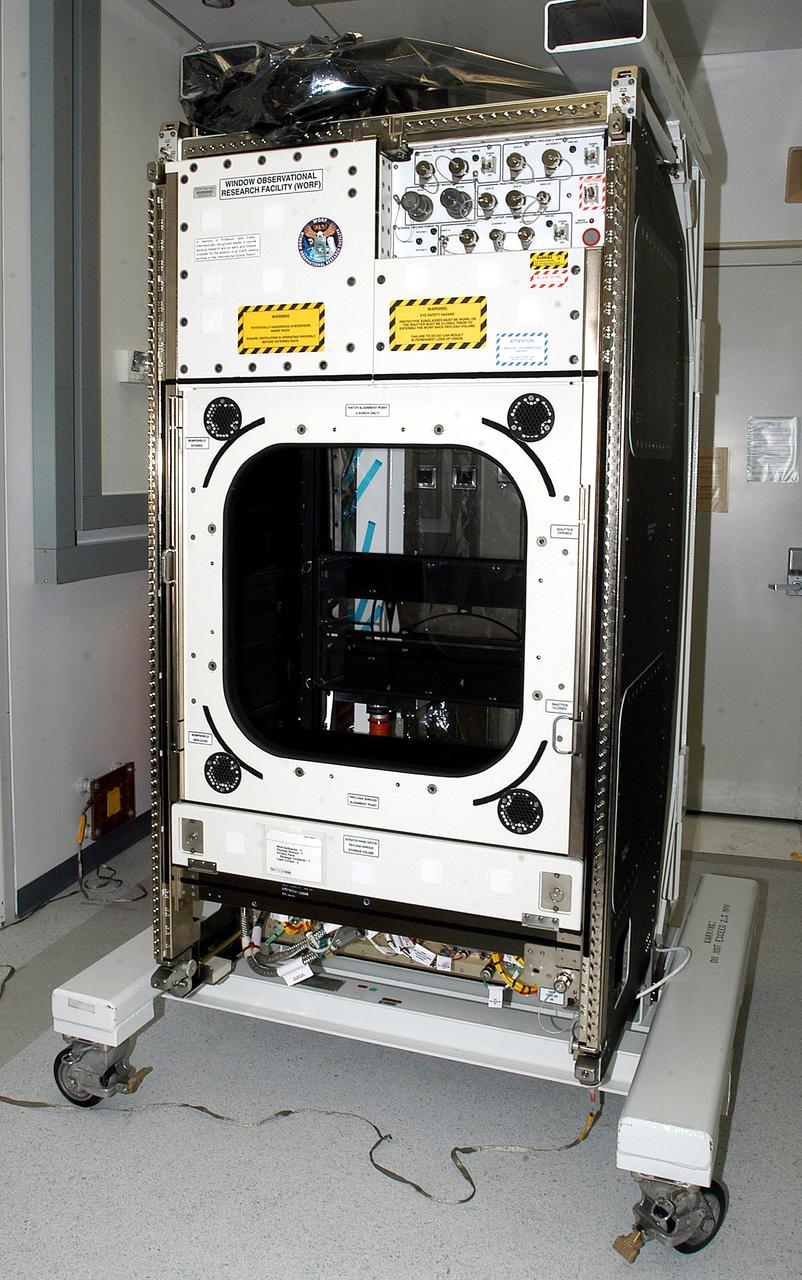
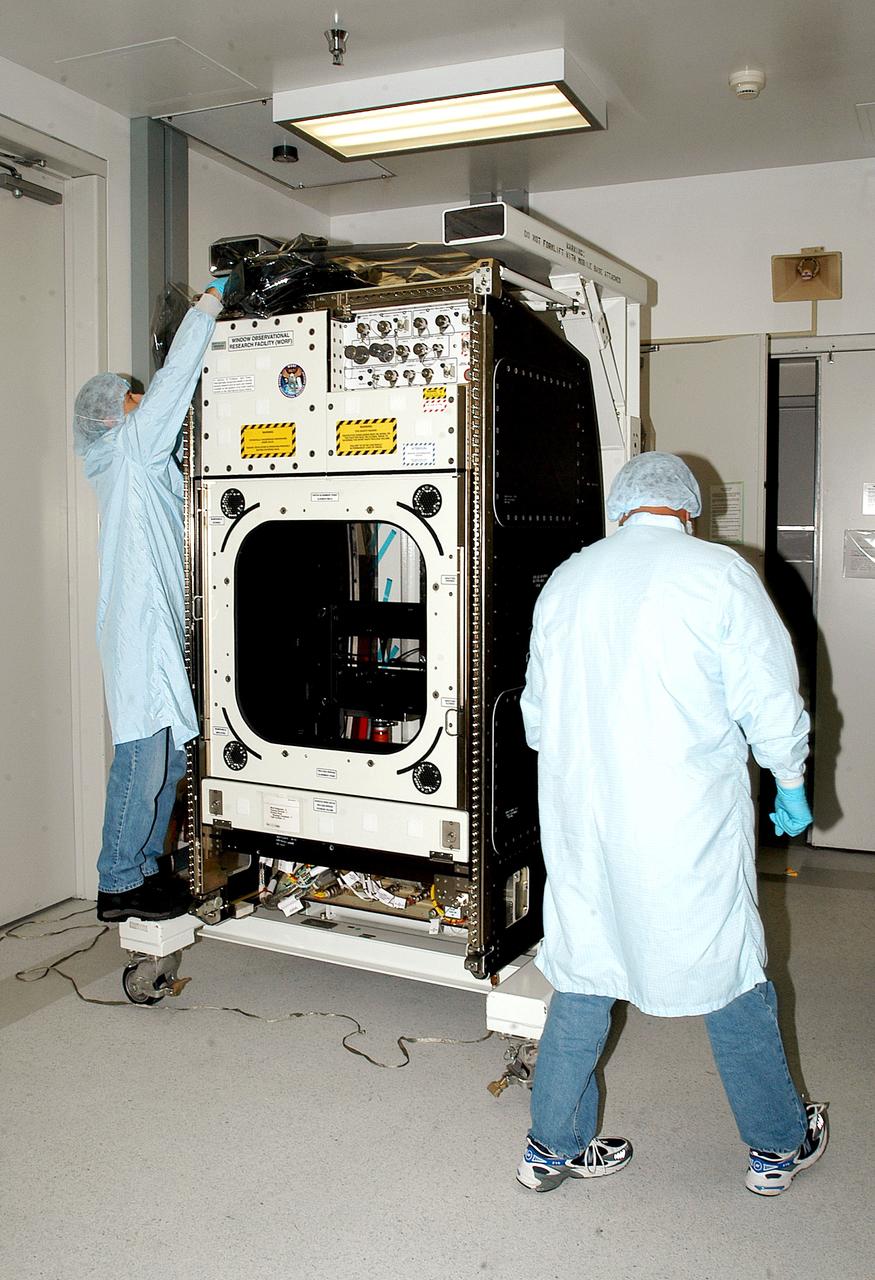
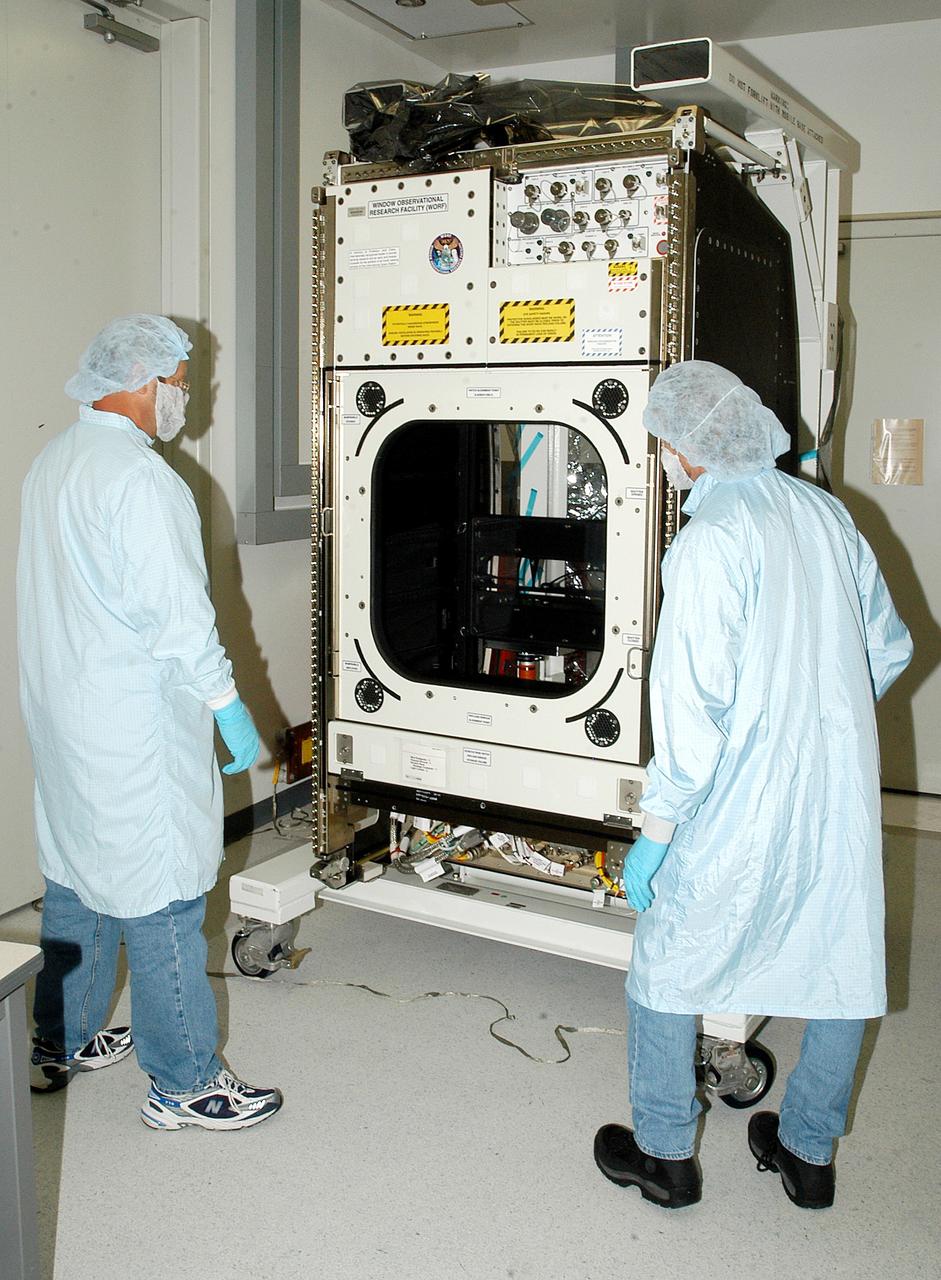
KENNEDY SPACE CENTER, FLA. -  The Window Observational Research Facility (WORF), seen in the Space Station Processing Facility, was designed and built by the Boeing Co. at NASA’s Marshall Space Flight Center in Huntsville, Ala.   WORF will be delivered to the International Space Station and placed in the rack position in front of the Destiny lab window,  providing locations for attaching cameras, multi-spectral scanners and other instruments. WORF will support a variety of scientific and commercial experiments in areas of Earth systems and processes, global ecological changes in Earth’s biosphere, lithosphere, hydrosphere and climate system, Earth resources, natural hazards, and education.  After installation, it will become a permanent focal point for Earth Science research aboard the space station.
KENNEDY SPACE CENTER, FLA. - The Window Observational Research Facility (WORF), seen in the Space Station Processing Facility, was designed and built by the Boeing Co. at NASA’s Marshall Space Flight Center in Huntsville, Ala. WORF will be delivered to the International Space Station and placed in the rack position in front of the Destiny lab window, providing locations for attaching cameras, multi-spectral scanners and other instruments. WORF will support a variety of scientific and commercial experiments in areas of Earth systems and processes, global ecological changes in Earth’s biosphere, lithosphere, hydrosphere and climate system, Earth resources, natural hazards, and education. After installation, it will become a permanent focal point for Earth Science research aboard the space station.
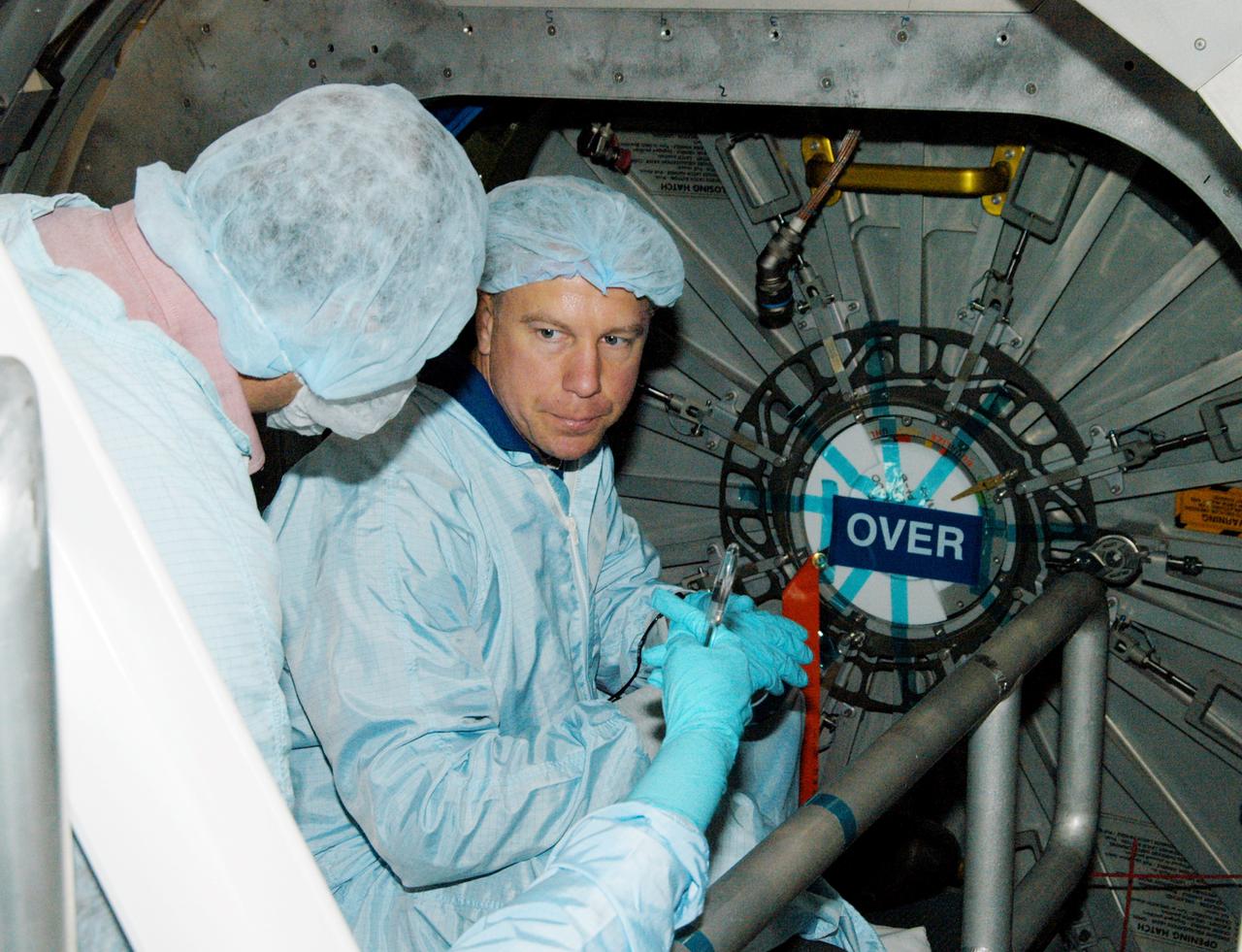
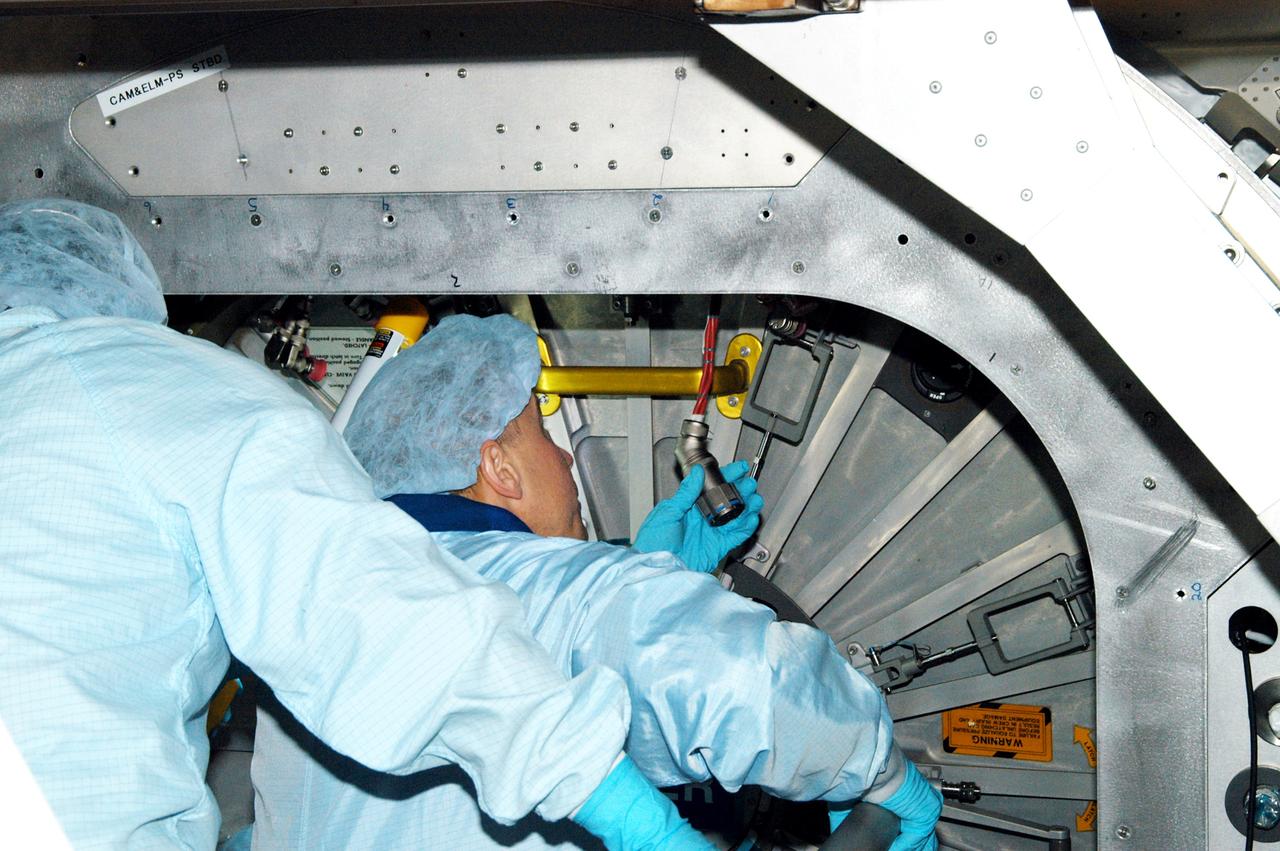
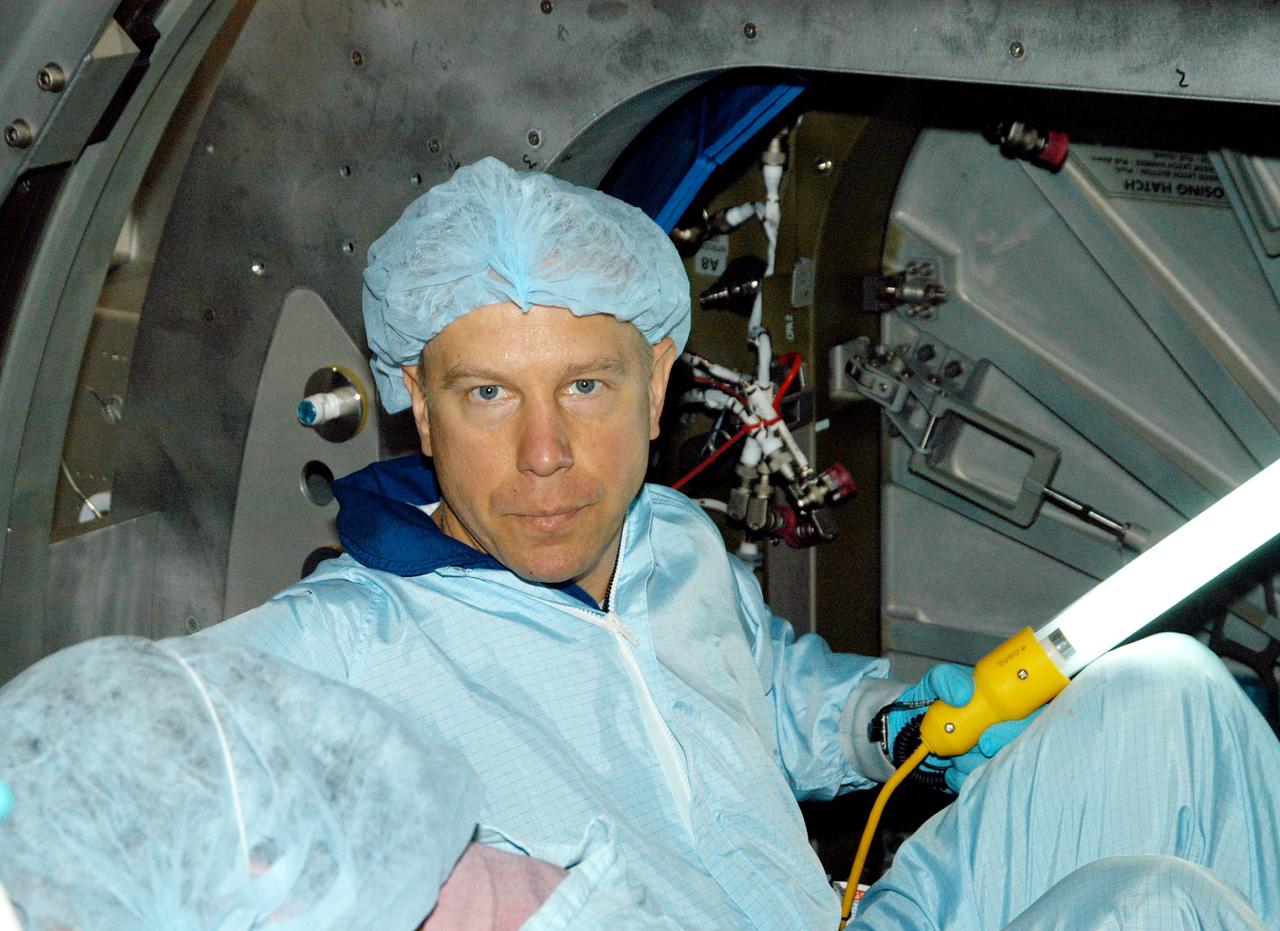
KENNEDY SPACE CENTER, FLA. - Astronaut Tim Kopra aids in Intravehicular Activity (IVA) constraints testing on the Italian-built Node 2, a future element of the International Space Station.  The second of three Station connecting modules, the Node 2 attaches to the end of the U.S. Lab and provides attach locations for several other elements.  Kopra is currently assigned technical duties in the Space Station Branch of the Astronaut Office, where his primary focus involves the testing of crew interfaces for two future ISS modules as well as the implementation of support computers and operational Local Area Network on ISS.   Node 2 is scheduled to launch on mission STS-120, Station assembly flight 10A.
KENNEDY SPACE CENTER, FLA. - Astronaut Tim Kopra aids in Intravehicular Activity (IVA) constraints testing on the Italian-built Node 2, a future element of the International Space Station. The second of three Station connecting modules, the Node 2 attaches to the end of the U.S. Lab and provides attach locations for several other elements. Kopra is currently assigned technical duties in the Space Station Branch of the Astronaut Office, where his primary focus involves the testing of crew interfaces for two future ISS modules as well as the implementation of support computers and operational Local Area Network on ISS. Node 2 is scheduled to launch on mission STS-120, Station assembly flight 10A.
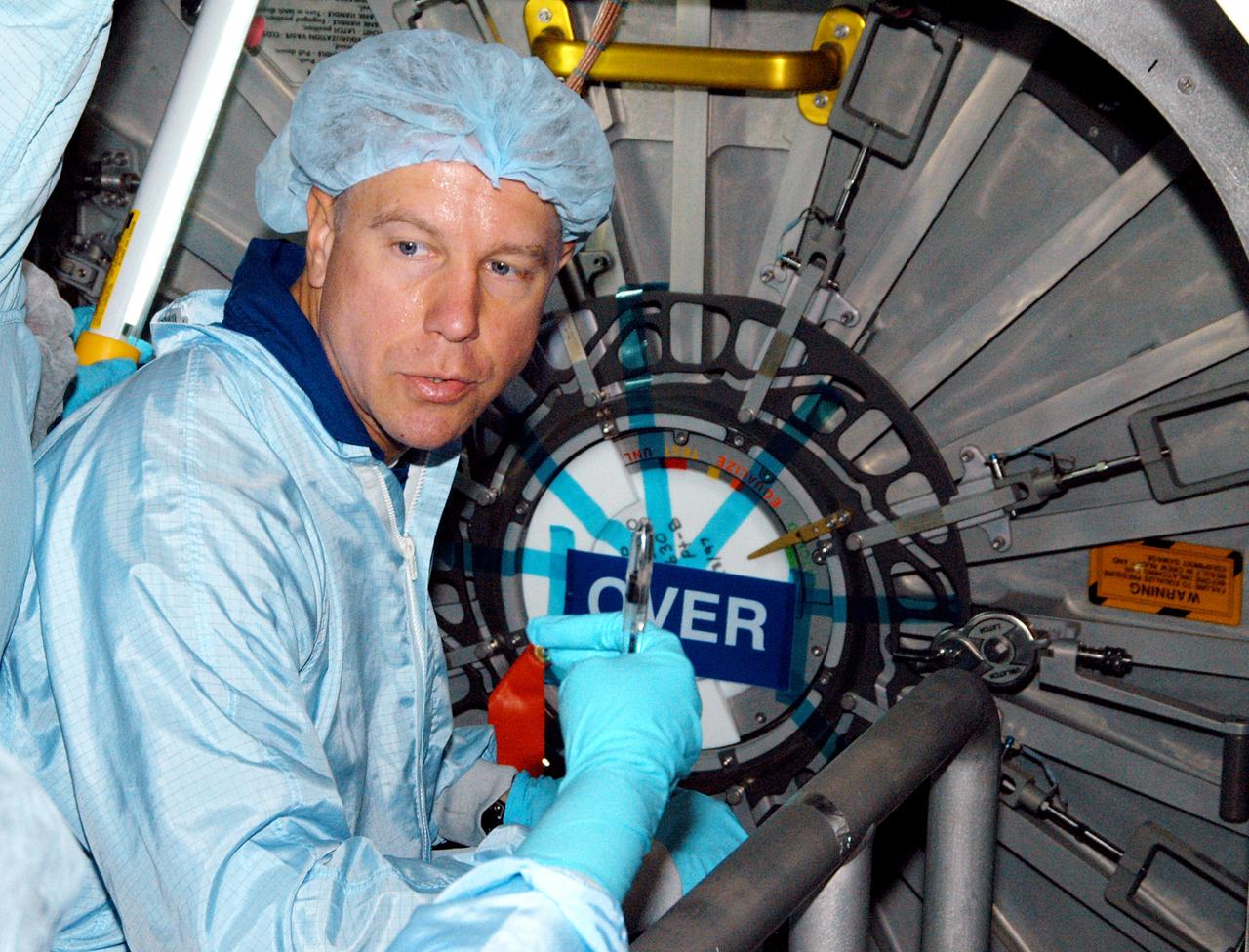
KENNEDY SPACE CENTER, FLA. - Astronaut Tim Kopra (facing camera) aids in Intravehicular Activity (IVA) constraints testing on the Italian-built Node 2, a future element of the International Space Station.  The second of three Station connecting modules, the Node 2 attaches to the end of the U.S. Lab and provides attach locations for several other elements.  Kopra is currently assigned technical duties in the Space Station Branch of the Astronaut Office, where his primary focus involves the testing of crew interfaces for two future ISS modules as well as the implementation of support computers and operational Local Area Network on ISS.   Node 2 is scheduled to launch on mission STS-120, Station assembly flight 10A.
KENNEDY SPACE CENTER, FLA. - Astronaut Tim Kopra (facing camera) aids in Intravehicular Activity (IVA) constraints testing on the Italian-built Node 2, a future element of the International Space Station. The second of three Station connecting modules, the Node 2 attaches to the end of the U.S. Lab and provides attach locations for several other elements. Kopra is currently assigned technical duties in the Space Station Branch of the Astronaut Office, where his primary focus involves the testing of crew interfaces for two future ISS modules as well as the implementation of support computers and operational Local Area Network on ISS. Node 2 is scheduled to launch on mission STS-120, Station assembly flight 10A.
KENNEDY SPACE CENTER, FLA. - Astronaut Tim Kopra aids in Intravehicular Activity (IVA) constraints testing on the Italian-built Node 2, a future element of the International Space Station.  The second of three Station connecting modules, the Node 2 attaches to the end of the U.S. Lab and provides attach locations for several other elements.  Kopra is currently assigned technical duties in the Space Station Branch of the Astronaut Office, where his primary focus involves the testing of crew interfaces for two future ISS modules as well as the implementation of support computers and operational Local Area Network on ISS.   Node 2 is scheduled to launch on mission STS-120, Station assembly flight 10A.
KENNEDY SPACE CENTER, FLA. - Astronaut Tim Kopra aids in Intravehicular Activity (IVA) constraints testing on the Italian-built Node 2, a future element of the International Space Station. The second of three Station connecting modules, the Node 2 attaches to the end of the U.S. Lab and provides attach locations for several other elements. Kopra is currently assigned technical duties in the Space Station Branch of the Astronaut Office, where his primary focus involves the testing of crew interfaces for two future ISS modules as well as the implementation of support computers and operational Local Area Network on ISS. Node 2 is scheduled to launch on mission STS-120, Station assembly flight 10A.
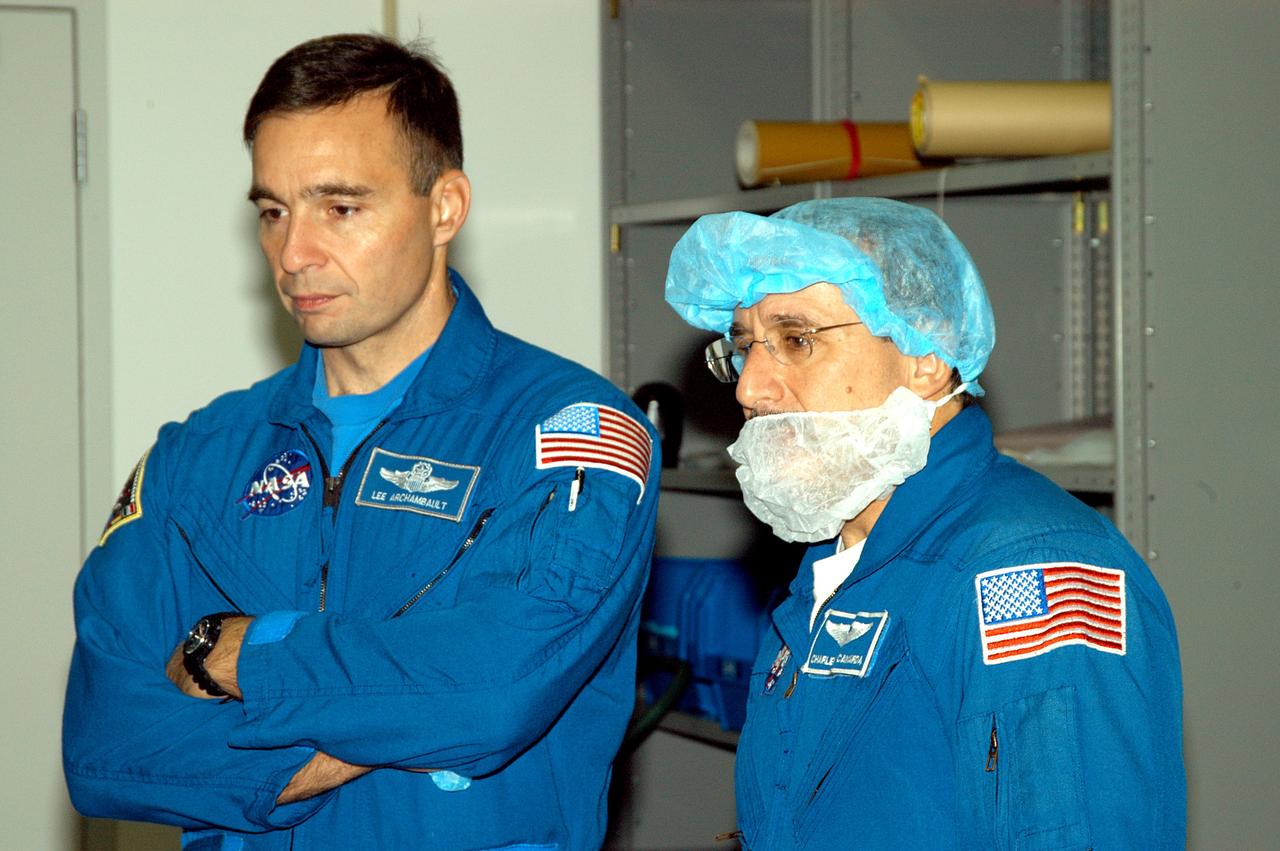
KENNEDY SPACE CENTER, FLA. - Astronaut Tim Kopra (second from right) talks with workers in the Space Station Processing Facility about the Intravehicular Activity (IVA) constraints testing on the Italian-built Node 2, a future element of the International Space Station.  .  The second of three Station connecting modules, the Node 2 attaches to the end of the U.S. Lab and provides attach locations for several other elements.  Kopra is currently assigned technical duties in the Space Station Branch of the Astronaut Office, where his primary focus involves the testing of crew interfaces for two future ISS modules as well as the implementation of support computers and operational Local Area Network on ISS.   Node 2 is scheduled to launch on mission STS-120, Station assembly flight 10A.
KENNEDY SPACE CENTER, FLA. - Astronaut Tim Kopra (second from right) talks with workers in the Space Station Processing Facility about the Intravehicular Activity (IVA) constraints testing on the Italian-built Node 2, a future element of the International Space Station. . The second of three Station connecting modules, the Node 2 attaches to the end of the U.S. Lab and provides attach locations for several other elements. Kopra is currently assigned technical duties in the Space Station Branch of the Astronaut Office, where his primary focus involves the testing of crew interfaces for two future ISS modules as well as the implementation of support computers and operational Local Area Network on ISS. Node 2 is scheduled to launch on mission STS-120, Station assembly flight 10A.
KENNEDY SPACE CENTER, FLA. -   Japanese astronaut Koichi Wakata (right) works with a tray extended  from inside the Pressurized Module, or PM, part of the Japanese Experiment Module (JEM).   The PM provides a shirt-sleeve environment in which astronauts on the International Space Station can conduct microgravity experiments. There are a total of 23 racks, including 10 experiment racks, inside the PM providing a power supply, communications, air conditioning, hardware cooling, water control and experiment support functions.
KENNEDY SPACE CENTER, FLA. - Japanese astronaut Koichi Wakata (right) works with a tray extended from inside the Pressurized Module, or PM, part of the Japanese Experiment Module (JEM). The PM provides a shirt-sleeve environment in which astronauts on the International Space Station can conduct microgravity experiments. There are a total of 23 racks, including 10 experiment racks, inside the PM providing a power supply, communications, air conditioning, hardware cooling, water control and experiment support functions.
KENNEDY SPACE CENTER, FLA. -  Japanese astronaut Koichi Wakata (left) works with a tray extended from inside the Pressurized Module, or PM, part of the Japanese Experiment Module (JEM).   The PM provides a shirt-sleeve environment in which astronauts on the International Space Station can conduct microgravity experiments. There are a total of 23 racks, including 10 experiment racks, inside the PM providing a power supply, communications, air conditioning, hardware cooling, water control and experiment support functions.
KENNEDY SPACE CENTER, FLA. - Japanese astronaut Koichi Wakata (left) works with a tray extended from inside the Pressurized Module, or PM, part of the Japanese Experiment Module (JEM). The PM provides a shirt-sleeve environment in which astronauts on the International Space Station can conduct microgravity experiments. There are a total of 23 racks, including 10 experiment racks, inside the PM providing a power supply, communications, air conditioning, hardware cooling, water control and experiment support functions.
KENNEDY SPACE CENTER, FLA. - In the Space Station Processing Facility, Japanese astronaut Koichi Wakata,  dressed in blue protective clothing (at right),  looks at the inside of the Pressurized Module, or PM, part of the Japanese Experiment Module (JEM), along with technicians.  The PM provides a shirt-sleeve environment in which astronauts on the International Space Station can conduct microgravity experiments. There are a total of 23 racks, including 10 experiment racks, inside the PM providing a power supply, communications, air conditioning, hardware cooling, water control and experiment support functions.
KENNEDY SPACE CENTER, FLA. - In the Space Station Processing Facility, Japanese astronaut Koichi Wakata, dressed in blue protective clothing (at right), looks at the inside of the Pressurized Module, or PM, part of the Japanese Experiment Module (JEM), along with technicians. The PM provides a shirt-sleeve environment in which astronauts on the International Space Station can conduct microgravity experiments. There are a total of 23 racks, including 10 experiment racks, inside the PM providing a power supply, communications, air conditioning, hardware cooling, water control and experiment support functions.
KENNEDY SPACE CENTER, FLA. -   Japanese astronaut Koichi Wakata (left) releases a tray  extended from inside the Pressurized Module, or PM, that he was working with.  Part of the Japanese Experiment Module (JEM), the PM provides a shirt-sleeve environment in which astronauts on the International Space Station can conduct microgravity experiments. There are a total of 23 racks, including 10 experiment racks, inside the PM providing a power supply, communications, air conditioning, hardware cooling, water control and experiment support functions.  The JEM/PM is in the Space Station Processing Facility.
KENNEDY SPACE CENTER, FLA. - Japanese astronaut Koichi Wakata (left) releases a tray extended from inside the Pressurized Module, or PM, that he was working with. Part of the Japanese Experiment Module (JEM), the PM provides a shirt-sleeve environment in which astronauts on the International Space Station can conduct microgravity experiments. There are a total of 23 racks, including 10 experiment racks, inside the PM providing a power supply, communications, air conditioning, hardware cooling, water control and experiment support functions. The JEM/PM is in the Space Station Processing Facility.
KENNEDY SPACE CENTER, FLA. -   Workers in the Space Station Processing Facility check out the Window Observational Research Facility (WORF),  designed and built by the Boeing Co. at NASA’s Marshall Space Flight Center in Huntsville, Ala.   WORF will be delivered to the International Space Station and placed in the rack position in front of the Destiny lab window,  providing locations for attaching cameras, multi-spectral scanners and other instruments. WORF will support a variety of scientific and commercial experiments in areas of Earth systems and processes, global ecological changes in Earth’s biosphere, lithosphere, hydrosphere and climate system, Earth resources, natural hazards, and education.  After installation, it will become a permanent focal point for Earth Science research aboard the space station.
KENNEDY SPACE CENTER, FLA. - Workers in the Space Station Processing Facility check out the Window Observational Research Facility (WORF), designed and built by the Boeing Co. at NASA’s Marshall Space Flight Center in Huntsville, Ala. WORF will be delivered to the International Space Station and placed in the rack position in front of the Destiny lab window, providing locations for attaching cameras, multi-spectral scanners and other instruments. WORF will support a variety of scientific and commercial experiments in areas of Earth systems and processes, global ecological changes in Earth’s biosphere, lithosphere, hydrosphere and climate system, Earth resources, natural hazards, and education. After installation, it will become a permanent focal point for Earth Science research aboard the space station.
KENNEDY SPACE CENTER, FLA. -  Workers in the Space Station Processing Facility check out the Window Observational Research Facility (WORF),  designed and built by the Boeing Co. at NASA’s Marshall Space Flight Center in Huntsville, Ala.   WORF will be delivered to the International Space Station and placed in the rack position in front of the Destiny lab window,  providing locations for attaching cameras, multi-spectral scanners and other instruments. WORF will support a variety of scientific and commercial experiments in areas of Earth systems and processes, global ecological changes in Earth’s biosphere, lithosphere, hydrosphere and climate system, Earth resources, natural hazards, and education.  After installation, it will become a permanent focal point for Earth Science research aboard the space station.
KENNEDY SPACE CENTER, FLA. - Workers in the Space Station Processing Facility check out the Window Observational Research Facility (WORF), designed and built by the Boeing Co. at NASA’s Marshall Space Flight Center in Huntsville, Ala. WORF will be delivered to the International Space Station and placed in the rack position in front of the Destiny lab window, providing locations for attaching cameras, multi-spectral scanners and other instruments. WORF will support a variety of scientific and commercial experiments in areas of Earth systems and processes, global ecological changes in Earth’s biosphere, lithosphere, hydrosphere and climate system, Earth resources, natural hazards, and education. After installation, it will become a permanent focal point for Earth Science research aboard the space station.
KENNEDY SPACE CENTER, FLA. - Astronaut Tim Kopra talks to a technician (off-camera) during Intravehicular Activity (IVA) constraints testing on the Italian-built Node 2, a future element of the International Space Station.  The second of three Station connecting modules, the Node 2 attaches to the end of the U.S. Lab and provides attach locations for several other elements.  Kopra is currently assigned technical duties in the Space Station Branch of the Astronaut Office, where his primary focus involves the testing of crew interfaces for two future ISS modules as well as the implementation of support computers and operational Local Area Network on ISS.   Node 2 is scheduled to launch on mission STS-120, Station assembly flight 10A.
KENNEDY SPACE CENTER, FLA. - Astronaut Tim Kopra talks to a technician (off-camera) during Intravehicular Activity (IVA) constraints testing on the Italian-built Node 2, a future element of the International Space Station. The second of three Station connecting modules, the Node 2 attaches to the end of the U.S. Lab and provides attach locations for several other elements. Kopra is currently assigned technical duties in the Space Station Branch of the Astronaut Office, where his primary focus involves the testing of crew interfaces for two future ISS modules as well as the implementation of support computers and operational Local Area Network on ISS. Node 2 is scheduled to launch on mission STS-120, Station assembly flight 10A.
KARL ROTH IN THE LABORATORY TRAINING COMPLEX, A FACILITY USED TO SUPPORT TRAINING OF EXPERIMENT OPERATIONS ONBOARD THE INTERNATIONAL SPACE STATION
1300990
KENNEDY SPACE CENTER, FLA. -  In the Space Station Processing Facility, astronaut Lee Archambault and STS-114 Mission Specialist Charles Camarda watch as crew members work with equipment that will be used on the mission.  Archambault supports launch and landing operations at the Kennedy Space Center as an Astronaut Office representative. Crew members are at KSC for equipment familiarization.  STS-114 is classified as Logistics Flight 1 to the International Space Station, delivering new supplies and replacing one of the orbital outpost’s Control Moment Gyroscopes (CMGs). STS-114 will also carry a Raffaello Multi-Purpose Logistics Module and the External Stowage Platform-2.  The crew is slated to conduct at least three spacewalks: They will demonstrate repair techniques of the Shuttle’s Thermal Protection System,  replace the failed CMG with one delivered by the Shuttle, and  install the External Stowage Platform.
KENNEDY SPACE CENTER, FLA. - In the Space Station Processing Facility, astronaut Lee Archambault and STS-114 Mission Specialist Charles Camarda watch as crew members work with equipment that will be used on the mission. Archambault supports launch and landing operations at the Kennedy Space Center as an Astronaut Office representative. Crew members are at KSC for equipment familiarization. STS-114 is classified as Logistics Flight 1 to the International Space Station, delivering new supplies and replacing one of the orbital outpost’s Control Moment Gyroscopes (CMGs). STS-114 will also carry a Raffaello Multi-Purpose Logistics Module and the External Stowage Platform-2. The crew is slated to conduct at least three spacewalks: They will demonstrate repair techniques of the Shuttle’s Thermal Protection System, replace the failed CMG with one delivered by the Shuttle, and install the External Stowage Platform.
S129-E-007202 (21 Nov. 2009) --- NASA astronauts Jeffrey Williams (left), Expedition 21 flight engineer, and Leland Melvin, STS-129 mission specialist, support the extravehicular activity of astronauts Mike Foreman and Randy Bresnik from the shirt sleeve environment of the International Space Station.  While Foreman and Bresnik worked outside, an aggregation of ten internationally-represented astronauts and cosmonauts worked onboard both the space shuttle Atlantis and the International Space Station to support their tasks.
STS-129/Expedition 21 Crew Members work to install the ELC2
View of FGB solar array panels taken during Russian extravehicular activity (EVA) 36 in support of assembly and maintenance on the International Space Station.
Russian EVA 36
International Space Station, ISS Advanced Colloids Experiment – Thermal 5-3, ACE-T5-3 Operations in the Telescience Support Center, TSC
GRC-2021-C-03371
International Space Station, ISS Advanced Colloids Experiment – Thermal 5-3, ACE-T5-3 Operations in the Telescience Support Center, TSC
GRC-2021-C-03377
International Space Station, ISS Advanced Colloids Experiment – Thermal 5-3, ACE-T5-3 Operations in the Telescience Support Center, TSC
GRC-2021-C-03372
International Space Station, ISS Advanced Colloids Experiment – Thermal 5-3, ACE-T5-3 Operations in the Telescience Support Center, TSC
GRC-2021-C-03375
International Space Station, ISS Advanced Colloids Experiment – Thermal 5-3, ACE-T5-3 Operations in the Telescience Support Center, TSC
GRC-2021-C-03373
iss047e136529 (6/2/2016) --- A view of Cosmonaut Oleg Skripochka, during a BIMS Experiment session in the Service module aboard the International Space Station (ISS). The Study of Processes for Informational Support of In-Flight Medical Support using an Onboard Medical Information System Integrated into the Information Control System of the ISS Russian Segment (BIMS) uses telemedicine technologies to collect information by non-contact means from the ear, nose, and throat (ENT), gums, teeth, and small areas of skin from International Space Station (ISS) crews for medical support of manned spaceflights and in-flight biomedical research.
BIMS Experiment Session
iss047e136530 (6/2/2016) --- A view of Cosmonaut Oleg Skripochka, during a BIMS Experiment session in the Service module aboard the International Space Station (ISS). The Study of Processes for Informational Support of In-Flight Medical Support using an Onboard Medical Information System Integrated into the Information Control System of the ISS Russian Segment (BIMS) uses telemedicine technologies to collect information by non-contact means from the ear, nose, and throat (ENT), gums, teeth, and small areas of skin from International Space Station (ISS) crews for medical support of manned spaceflights and in-flight biomedical research.
BIMS Experiment Session
iss068e044174 (Jan. 31, 2023) --- The Canadarm2 robotic arm is pictured extending away from the International Space Station after jettisoning flight support equipment toward the Earth's atmosphere. The flight hardware secured a pair of roll-out solar arrays inside the SpaceX Dragon cargo ship’s trunk during its ascent to orbit and rendezvous with the space station in November 2022. The jettisoned support equipment drifted safely away from the station and will eventually harmlessly burn up in the atmosphere with no chance for recontacting the space station.
iss068e044174
iss068e044261 (Jan. 31, 2023) --- Flight support equipment is pictured descending toward the Earth's atmosphere after being jettisoned from the grips of the Canadarm2 robotic arm. The flight hardware secured a pair of roll-out solar arrays inside SpaceX Dragon cargo ship’s trunk during its ascent to orbit and rendezvous with the International Space Station in November 2022. The jettisoned support equipment drifted safely away from the station and will eventually harmlessly burn up in the atmosphere with no chance for recontacting the space station.
iss068e044261
JSC2003-E-37640 (May 2003) --- This graphic depicts the International Space Station after the installment of Node 2 during the STS-120/10A assembly mission. The addition of Node 2 signifies the US Core Complete stage of assembly, at which time the station can support the addition of international laboratories from Europe and Japan.
jsc2003e37640
JSC2003-E-64499 (December 2003) - Aft view of the International Space Station after the installment of Node 2 during the STS-120/10A assembly mission.  The addition of Node 2 signifies the US Core Complete stage of assembly, at which time the station can support the addition of international laboratories from Europe and Japan.
ISS artwork