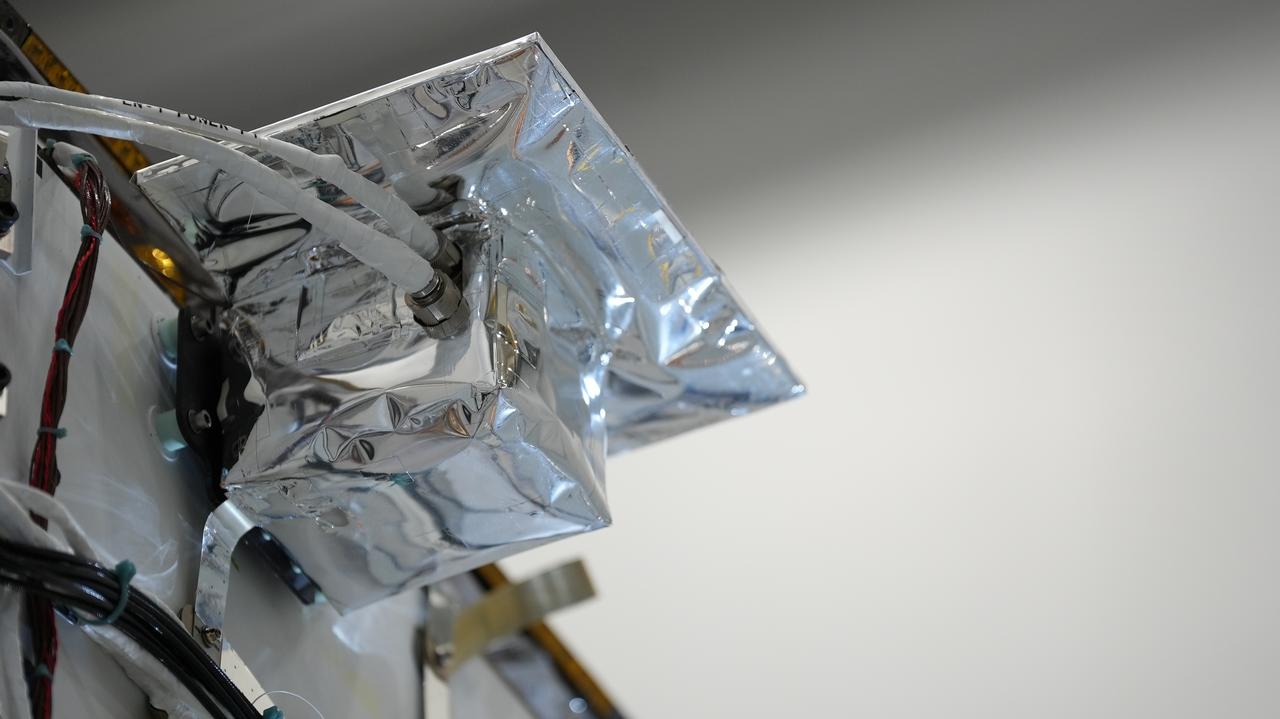
Lunar Node-1, an autonomous navigation payload that will change how human explorers safely traverse the Moon’s surface and live and work in lunar orbit, awaits liftoff as part of Intuitive Machines’ IM-1 mission, its first under NASA’s Commercial Lunar Payload Services initiative. LN-1 was developed, built, and tested at NASA’s Marshall Space Flight Center in Huntsville, Alabama.

IM-1, the first NASA Commercial Launch Program Services launch for Intuitive Machines’ Nova-C lunar lander, will carry multiple payloads to the Moon, including Lunar Node-1, demonstrating autonomous navigation via radio beacon to support precise geolocation and navigation among lunar orbiters, landers, and surface personnel. NASA’s CLPS initiative oversees industry development of small robotic landers and rovers to support NASA’s Artemis campaign.
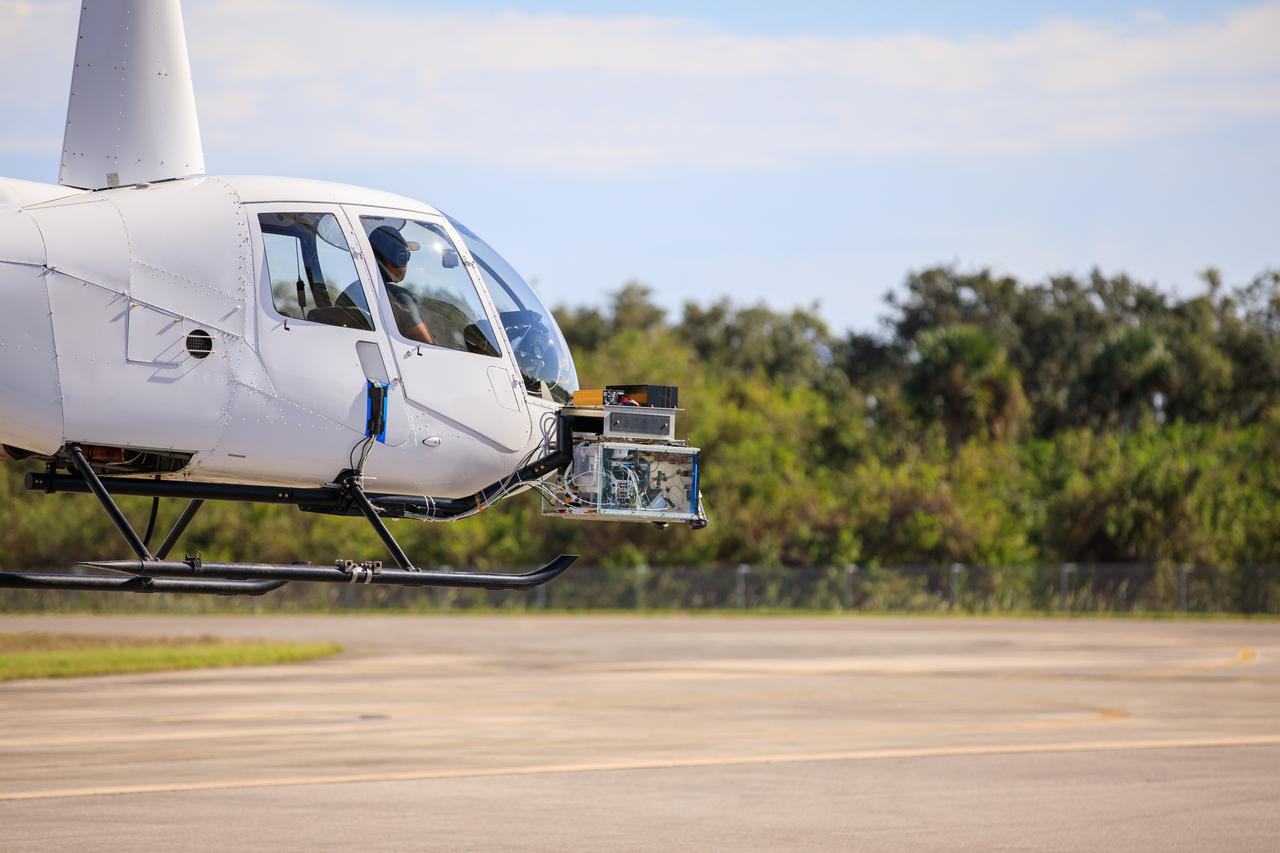
Testing of navigation pod sensors for Intuitive Machines’ Nova-C lunar lander is underway at NASA’s Kennedy Space Center in Florida on Nov. 18, 2022. The test involved flying the sensors over a simulated lunar surface at the Launch and Landing Facility on a private helicopter. Intuitive Machines is scheduled to launch two missions to the Moon in 2023 – one of which will carry NASA’s Mass Spectrometer observing lunar operations (MSolo) instrument that will help analyze the chemical makeup of landing sites on the Moon, as well as study water on the lunar surface. Through NASA’s Commercial Lunar Payload Services initiative, the agency selected Intuitive Machines to deliver science and technology demonstration payloads to the Moon, contributing to NASA’s goal of establishing a sustainable human presence on the lunar surface.
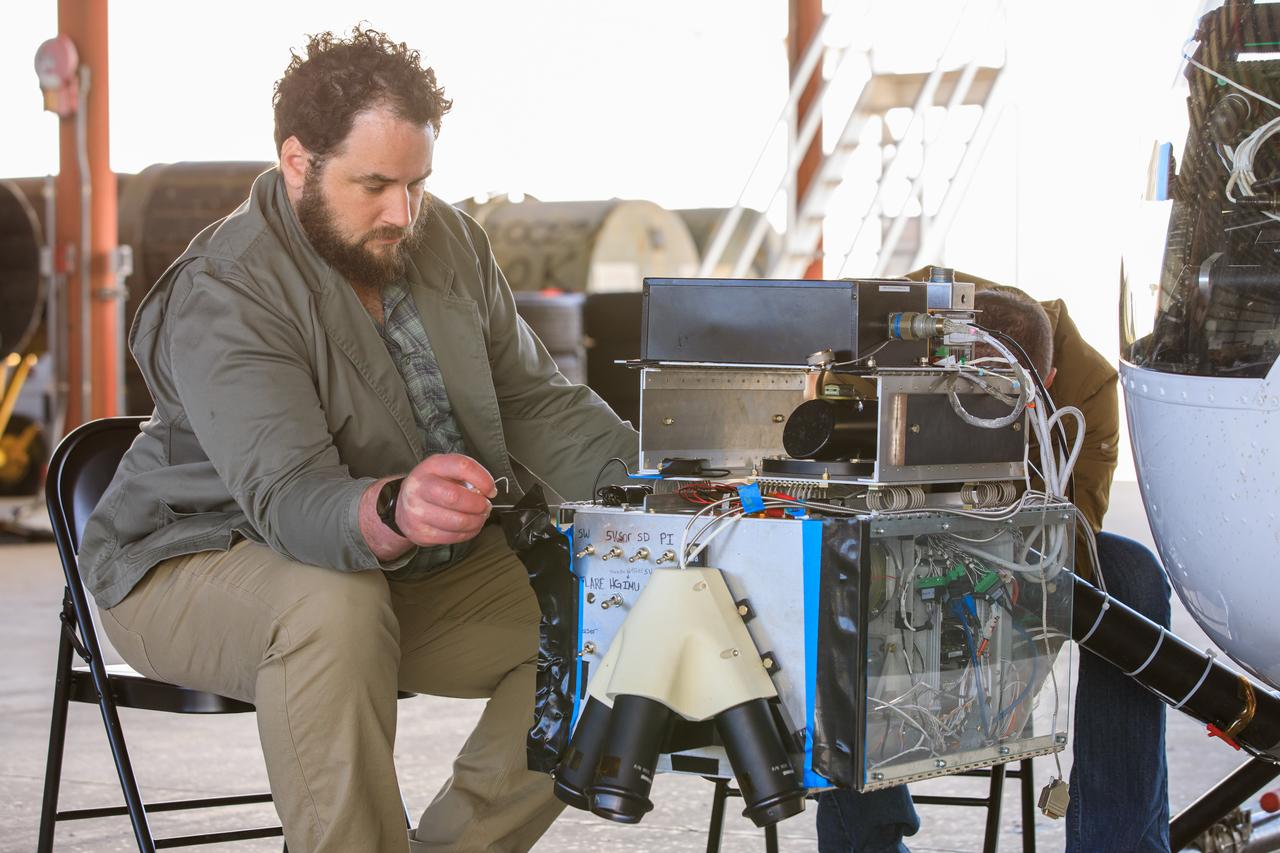
Two Intuitive Machines employees ready navigation pod sensors for the company’s Nova-C lunar lander in preparation for testing at NASA’s Kennedy Space Center in Florida on Nov. 18, 2022. The test involved flying the sensors over a simulated lunar surface at the Launch and Landing Facility on a private helicopter. Intuitive Machines is scheduled to launch two missions to the Moon in 2023 – one of which will carry NASA’s Mass Spectrometer observing lunar operations (MSolo) instrument that will help analyze the chemical makeup of landing sites on the Moon, as well as study water on the lunar surface. Through NASA’s Commercial Lunar Payload Services initiative, the agency selected Intuitive Machines to deliver science and technology demonstration payloads to the Moon, contributing to NASA’s goal of establishing a sustainable human presence on the lunar surface.
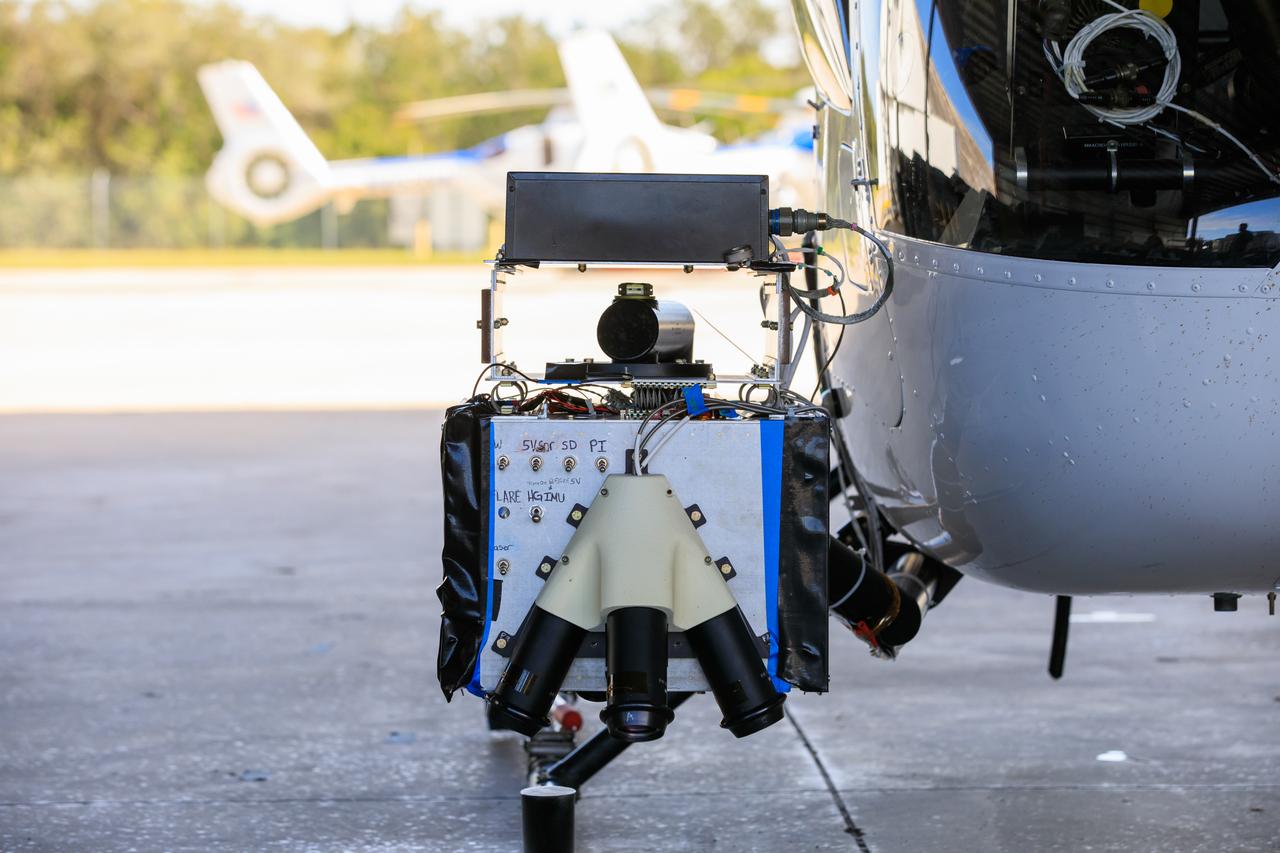
Seen here is a close-up view of Intuitive Machines’ navigation pod sensors for the company’s Nova-C lunar lander ahead of testing done at NASA’s Kennedy Space Center in Florida on Nov. 18, 2022. The test involved flying the sensors over a simulated lunar surface at the Launch and Landing Facility on a private helicopter. Intuitive Machines is scheduled to launch two missions to the Moon in 2023 – one of which will carry NASA’s Mass Spectrometer observing lunar operations (MSolo) instrument that will help analyze the chemical makeup of landing sites on the Moon, as well as study water on the lunar surface. Through NASA’s Commercial Lunar Payload Services initiative, the agency selected Intuitive Machines to deliver science and technology demonstration payloads to the Moon, contributing to NASA’s goal of establishing a sustainable human presence on the lunar surface.

Testing of navigation pod sensors for Intuitive Machines’ Nova-C lunar lander is underway at NASA’s Kennedy Space Center in Florida on Nov. 18, 2022. The test involved flying the sensors over a simulated lunar surface at the Launch and Landing Facility on a private helicopter. Intuitive Machines is scheduled to launch two missions to the Moon in 2023 – one of which will carry NASA’s Mass Spectrometer observing lunar operations (MSolo) instrument that will help analyze the chemical makeup of landing sites on the Moon, as well as study water on the lunar surface. Through NASA’s Commercial Lunar Payload Services initiative, the agency selected Intuitive Machines to deliver science and technology demonstration payloads to the Moon, contributing to NASA’s goal of establishing a sustainable human presence on the lunar surface.
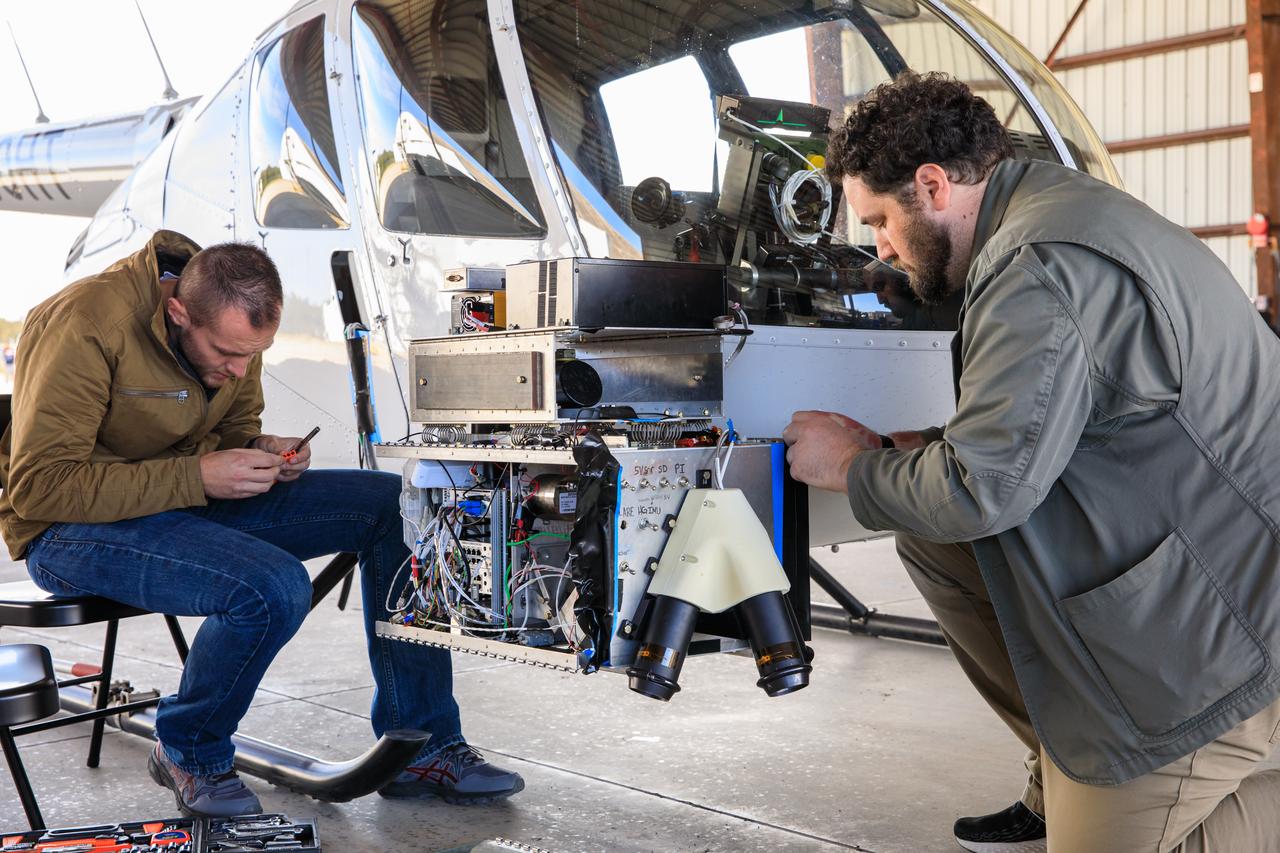
Two Intuitive Machines employees ready navigation pod sensors for the company’s Nova-C lunar lander in preparation for testing at NASA’s Kennedy Space Center in Florida on Nov. 18, 2022. The test involved flying the sensors over a simulated lunar surface at the Launch and Landing Facility on a private helicopter. Intuitive Machines is scheduled to launch two missions to the Moon in 2023 – one of which will carry NASA’s Mass Spectrometer observing lunar operations (MSolo) instrument that will help analyze the chemical makeup of landing sites on the Moon, as well as study water on the lunar surface. Through NASA’s Commercial Lunar Payload Services initiative, the agency selected Intuitive Machines to deliver science and technology demonstration payloads to the Moon, contributing to NASA’s goal of establishing a sustainable human presence on the lunar surface.
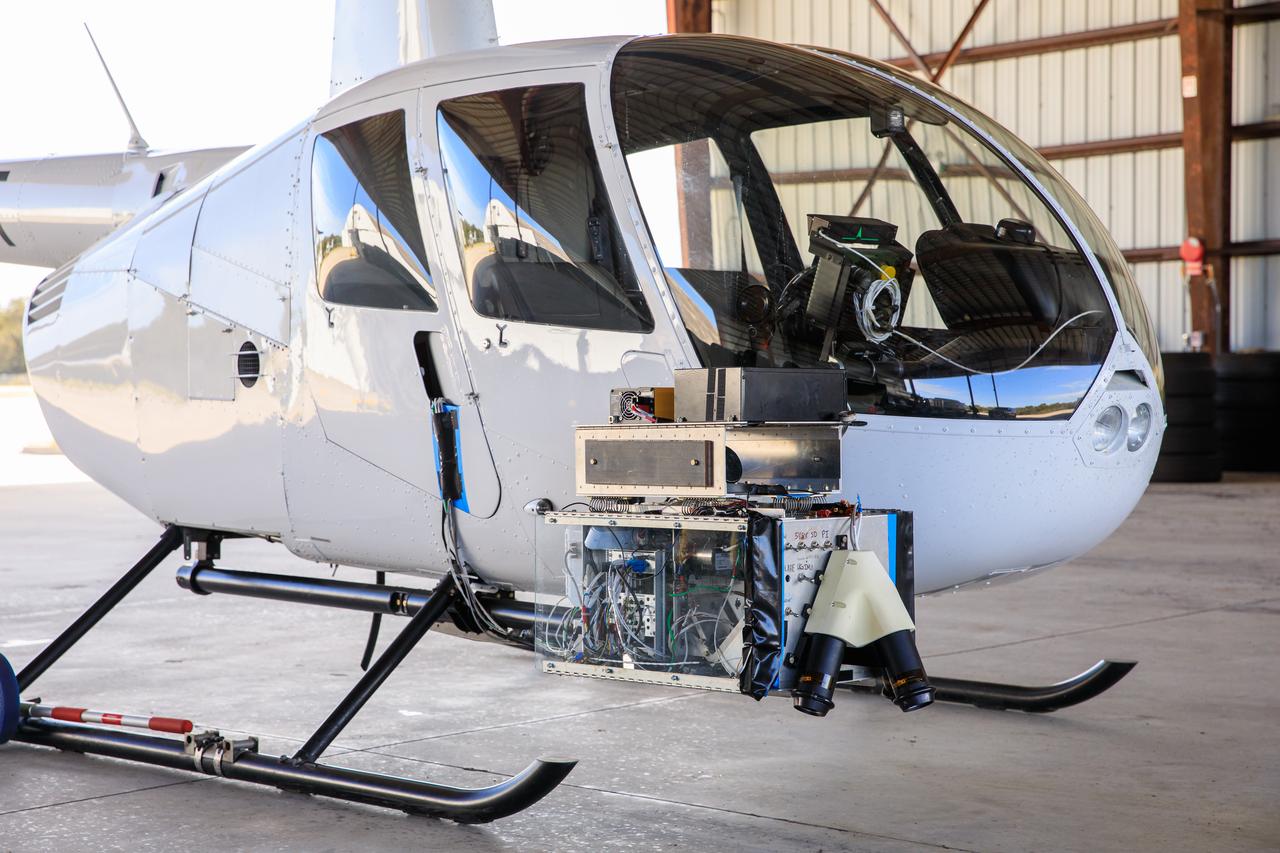
Seen here is Intuitive Machines’ navigation pod sensors for the company’s Nova-C lunar lander ahead of testing done at NASA’s Kennedy Space Center in Florida on Nov. 18, 2022. The test involved flying the sensors over a simulated lunar surface at the Launch and Landing Facility on a private helicopter. Intuitive Machines is scheduled to launch two missions to the Moon in 2023 – one of which will carry NASA’s Mass Spectrometer observing lunar operations (MSolo) instrument that will help analyze the chemical makeup of landing sites on the Moon, as well as study water on the lunar surface. Through NASA’s Commercial Lunar Payload Services initiative, the agency selected Intuitive Machines to deliver science and technology demonstration payloads to the Moon, contributing to NASA’s goal of establishing a sustainable human presence on the lunar surface.
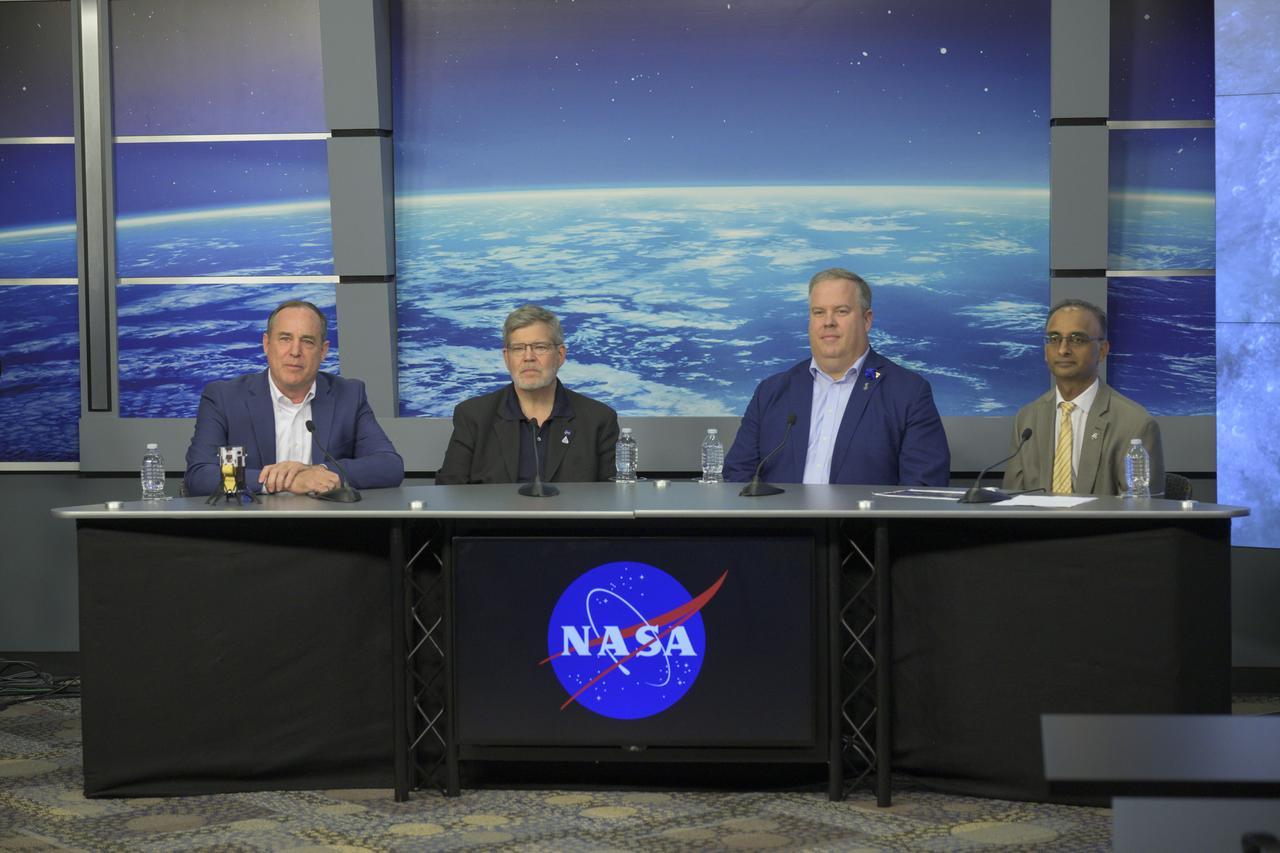
For the first time in more than 50 years, new NASA science instruments and technology demonstrations are operating on the Moon following the first successful delivery of the agency’s CLPS (Commercial Lunar Payload Services) initiative. Experts from NASA and Intuitive Machines hosted a news conference Feb. 23, 2024, at NASA’s Johnson Space Center in Houston to discuss the soft landing of the company’s Nova-C lander, called Odysseus. Participants in the briefing included (left to right): Steve Altemus, chief executive officer and co-founder, Intuitive Machines; Joel Kearns, deputy associate administrator for Exploration, Science Mission Directorate, NASA Headquarters in Washington; Tim Crain, chief technology officer and co-founder, Intuitive Machines; and Prasun Desai, deputy associate administrator, Space Technology Mission Directorate at NASA Headquarters.
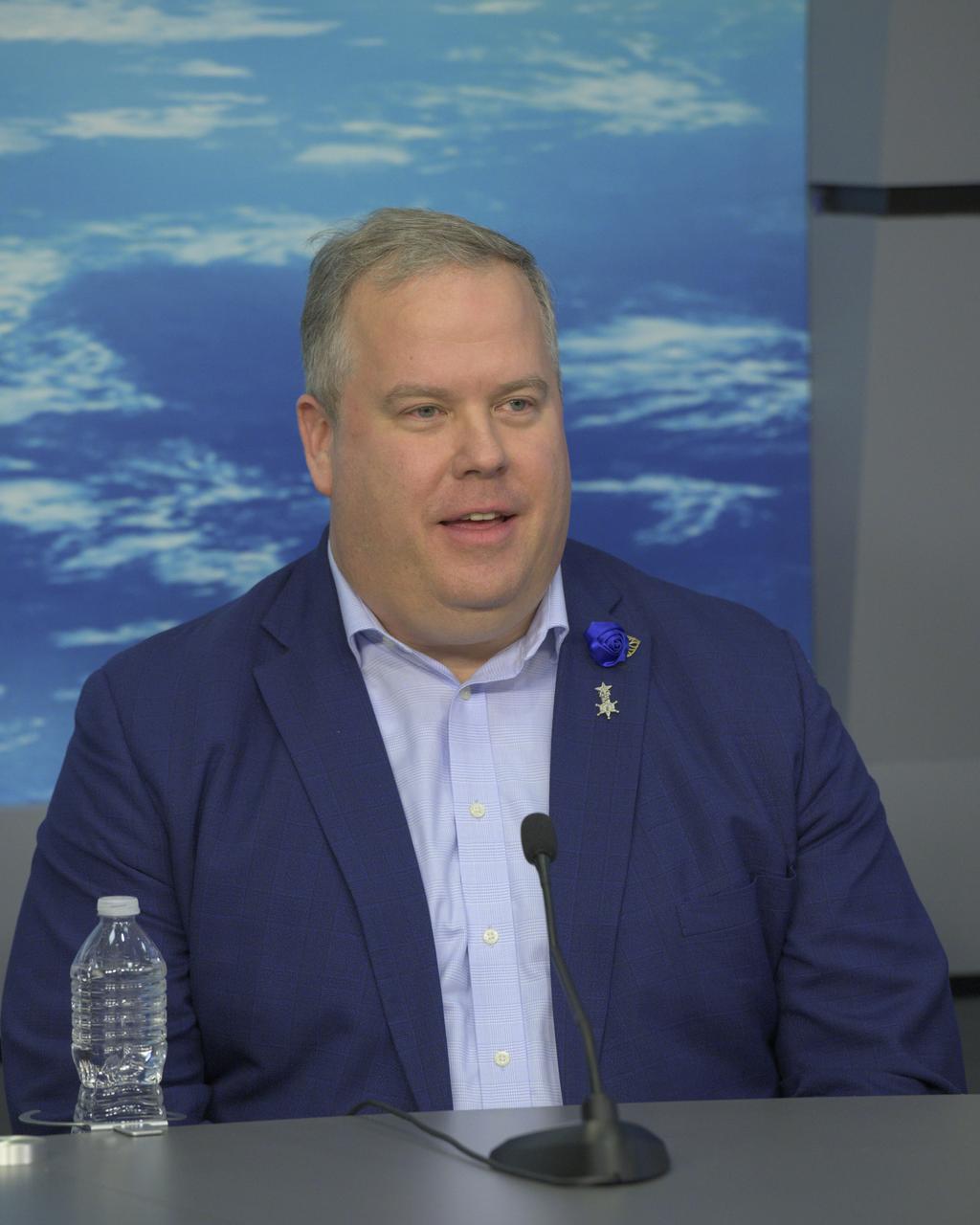
Tim Crain, chief technology officer and co-founder, Intuitive Machines, participates in a news conference Feb. 23, 2024, at NASA’s Johnson Space Center in Houston to discuss the company’s Nova-C lander, called Odysseus, and its successful soft landing on the Moon Feb. 22, 2024. The mission is the first landing under NASA’s CLPS (Commercial Lunar Payload Services) initiative, and the first American lunar landing in more than 50 years.
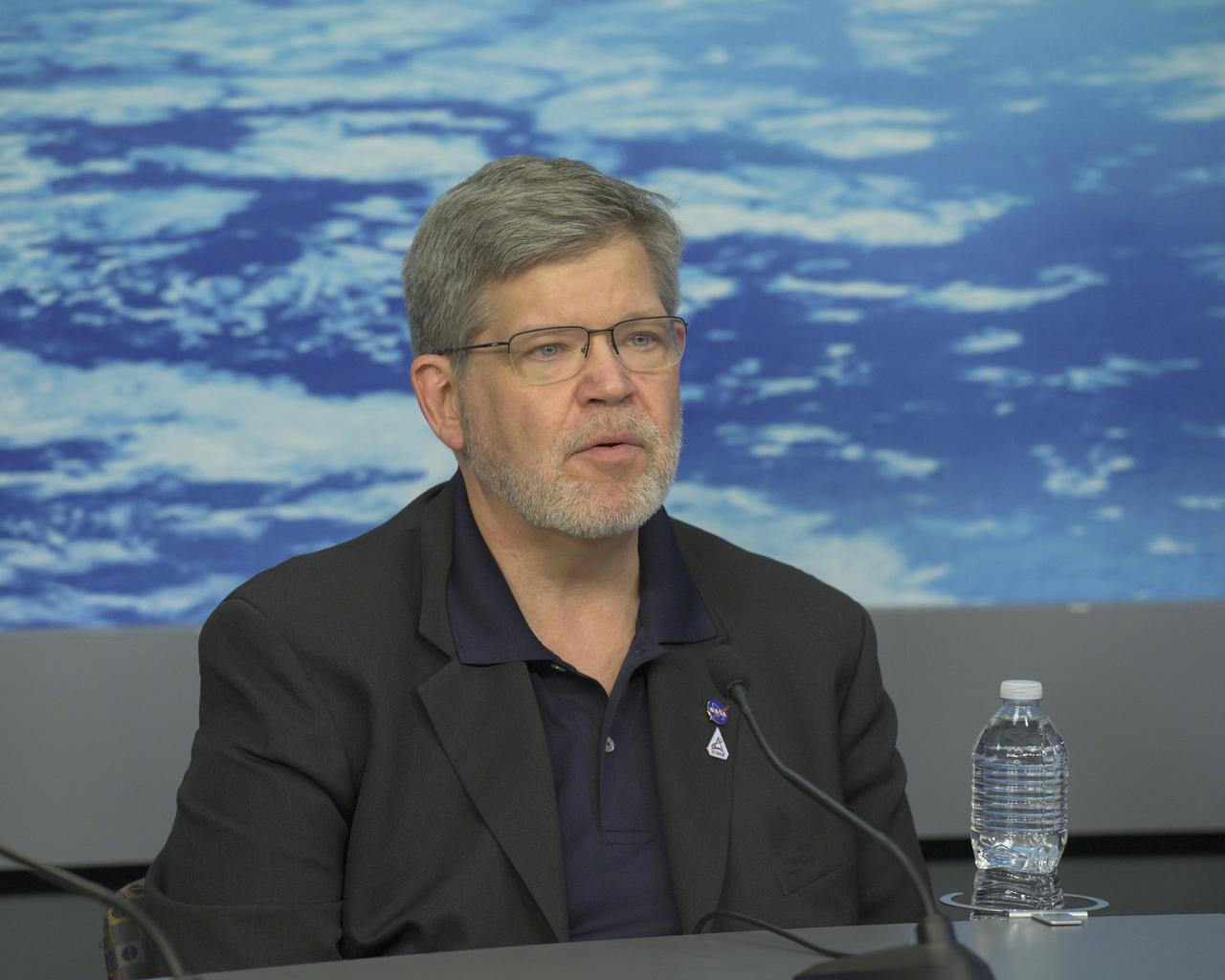
Joel Kearns, deputy associate administrator for Exploration, Science Mission Directorate, NASA Headquarters, participates in a news conference Feb. 23, 2024, at the agency’s Johnson Space Center in Houston. Kearns was on hand to discuss the NASA science and technology aboard Intuitive Machines’ Nova-C lander, called Odysseus, and its successful soft landing on the Moon Feb. 22, 2024. The mission is the first landing under NASA’s CLPS (Commercial Lunar Payload Services) initiative, and the first American lunar landing in more than 50 years.
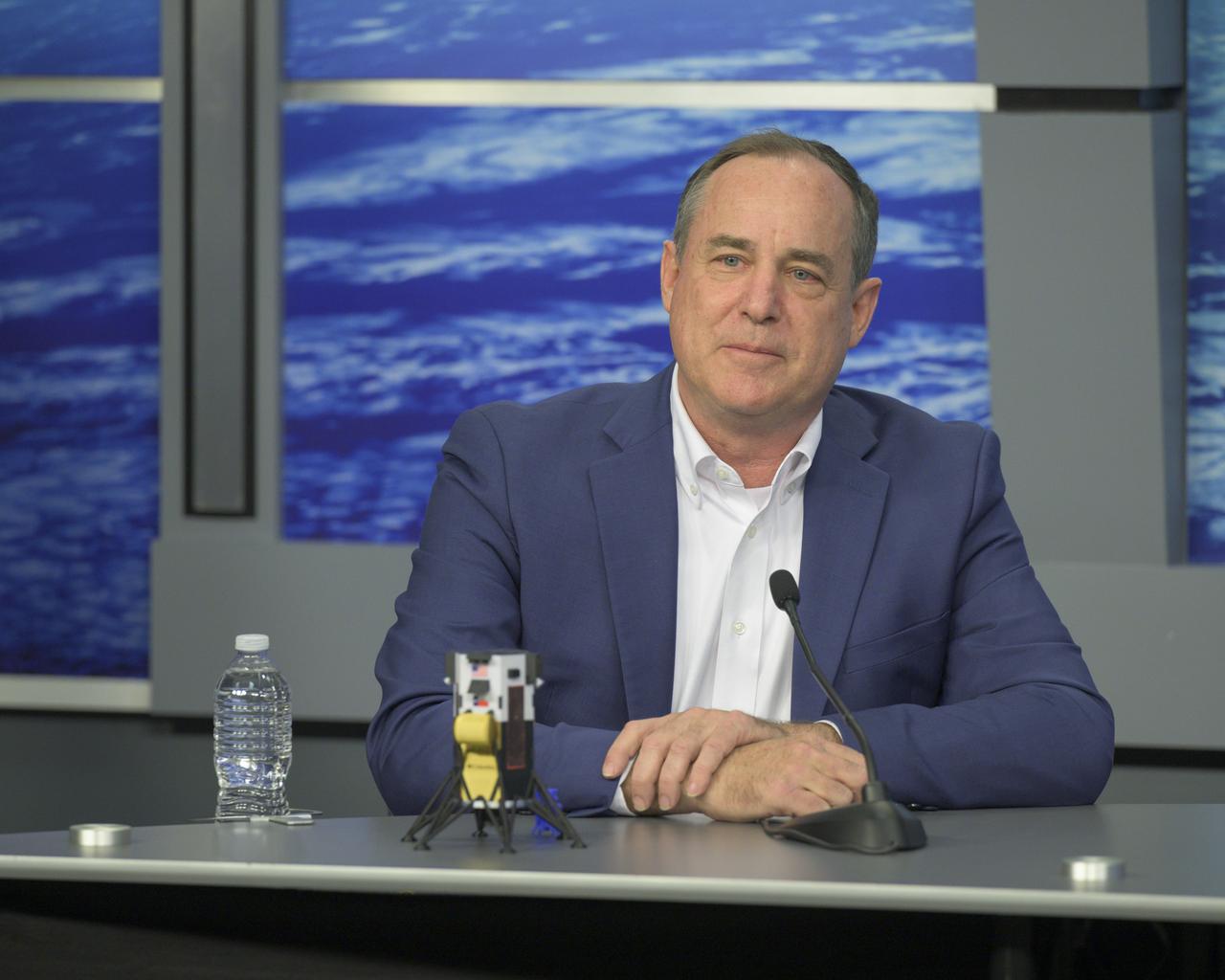
Steve Altemus, chief executive officer and co-founder, Intuitive Machines, participates in a news conference Feb. 23, 2024, at NASA’s Johnson Space Center in Houston to discuss the company’s Nova-C lander, called Odysseus, and its successful soft landing on the Moon Feb. 22, 2024. The mission is the first landing under NASA’s CLPS (Commercial Lunar Payload Services) initiative, and the first American lunar landing in more than 50 years.
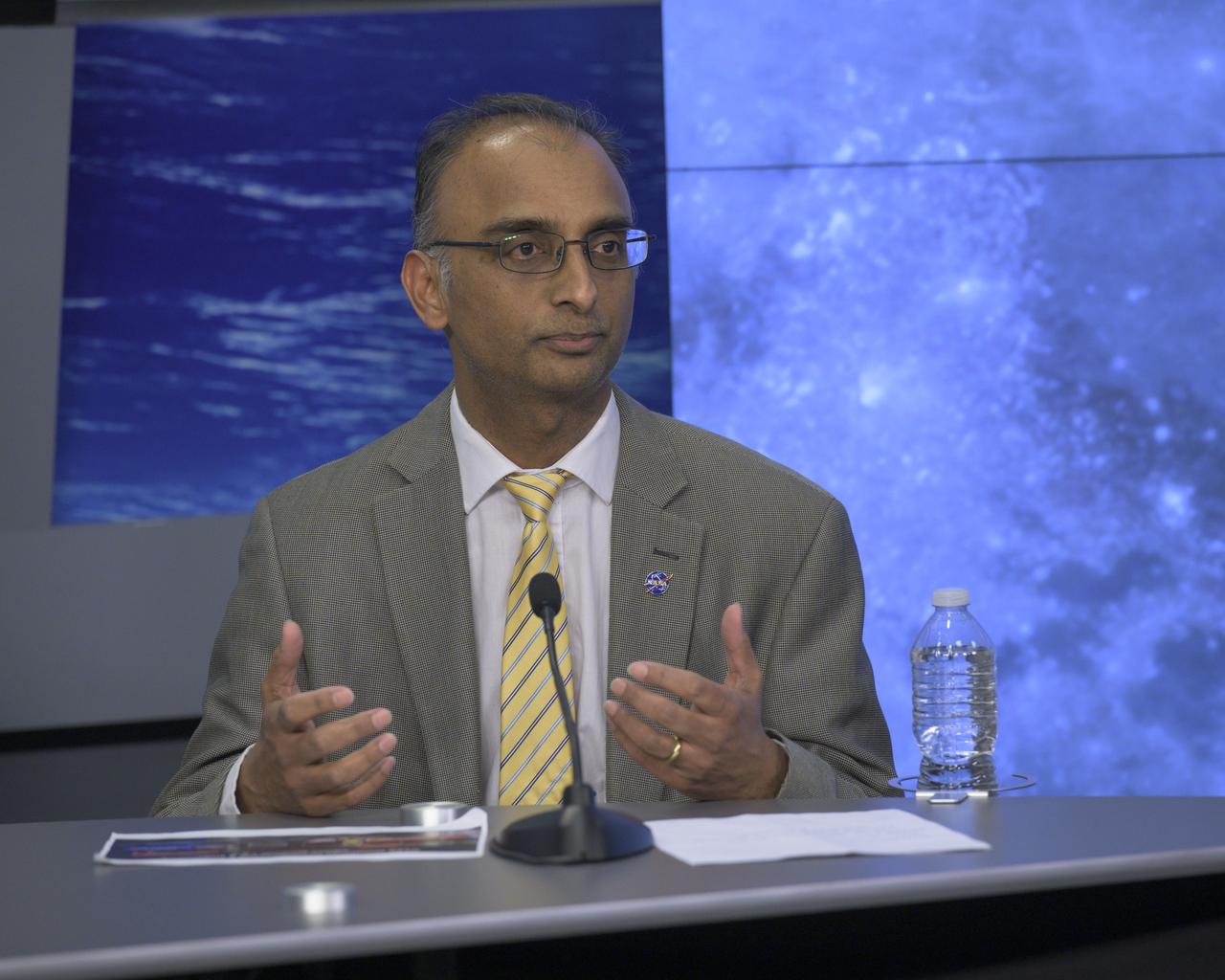
Prasun Desai, deputy associate administrator, Space Technology Mission Directorate at NASA Headquarters, participates in a news conference Feb. 23, 2024, at the agency’s Johnson Space Center in Houston. Desai was on hand to discuss the NASA science and technology aboard the Intuitive Machine’s Nova-C lander, called Odysseus, and its successful soft landing on the Moon Feb. 22, 2024. The mission is the first landing under NASA’s CLPS (Commercial Lunar Payload Services) initiative, and the first American lunar landing in more than 50 years.
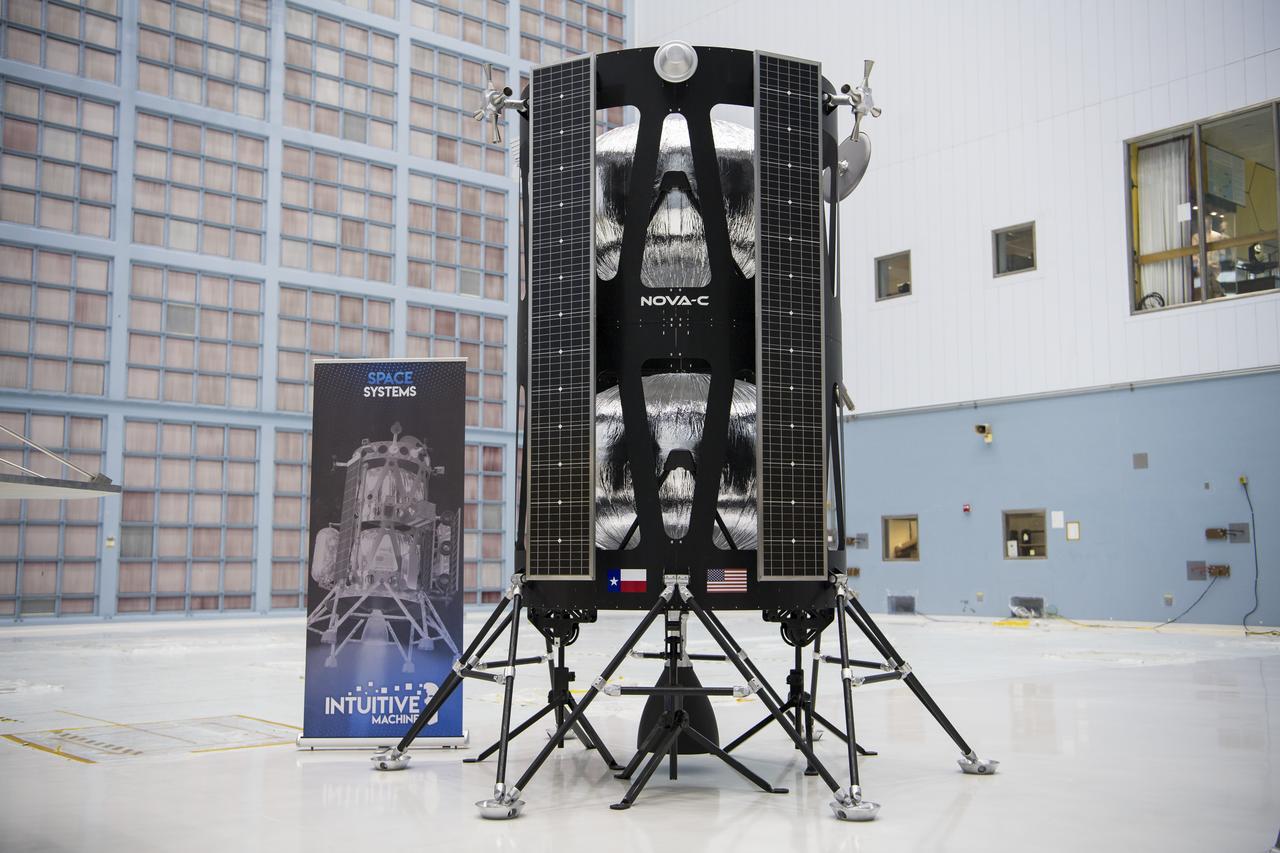
The Intuitive Machines lunar lander is seen, Friday, May 31, 2019, at Goddard Space Flight Center in Md. Astrobotic, Intuitive Machines, and Orbit Beyond have been selected to provide the first lunar landers for the Artemis program's lunar surface exploration. Photo credit: (NASA/Aubrey Gemignani)
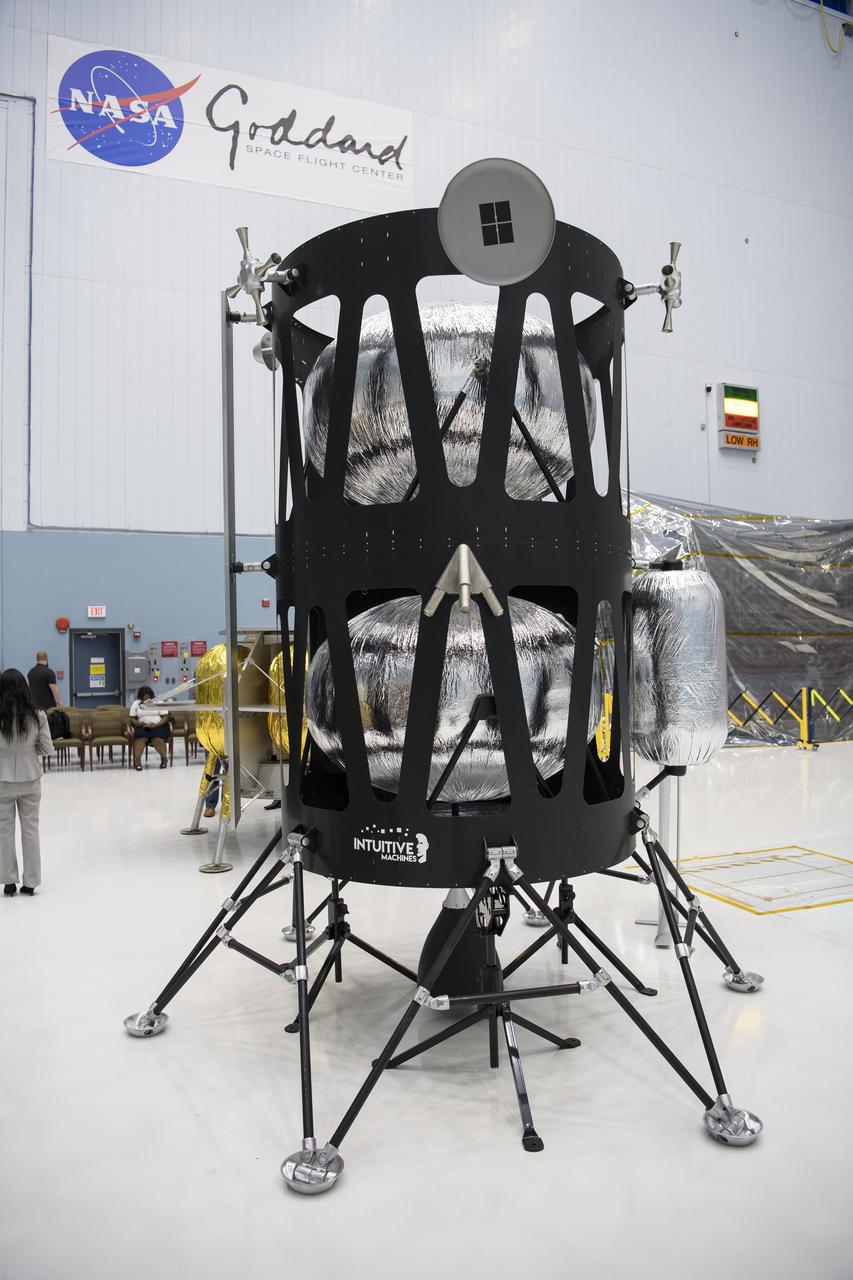
The Intuitive Machines lunar lander is seen, Friday, May 31, 2019, at Goddard Space Flight Center in Md. Astrobotic, Intuitive Machines, and Orbit Beyond have been selected to provide the first lunar landers for the Artemis program's lunar surface exploration. Photo credit: (NASA/Aubrey Gemignani)
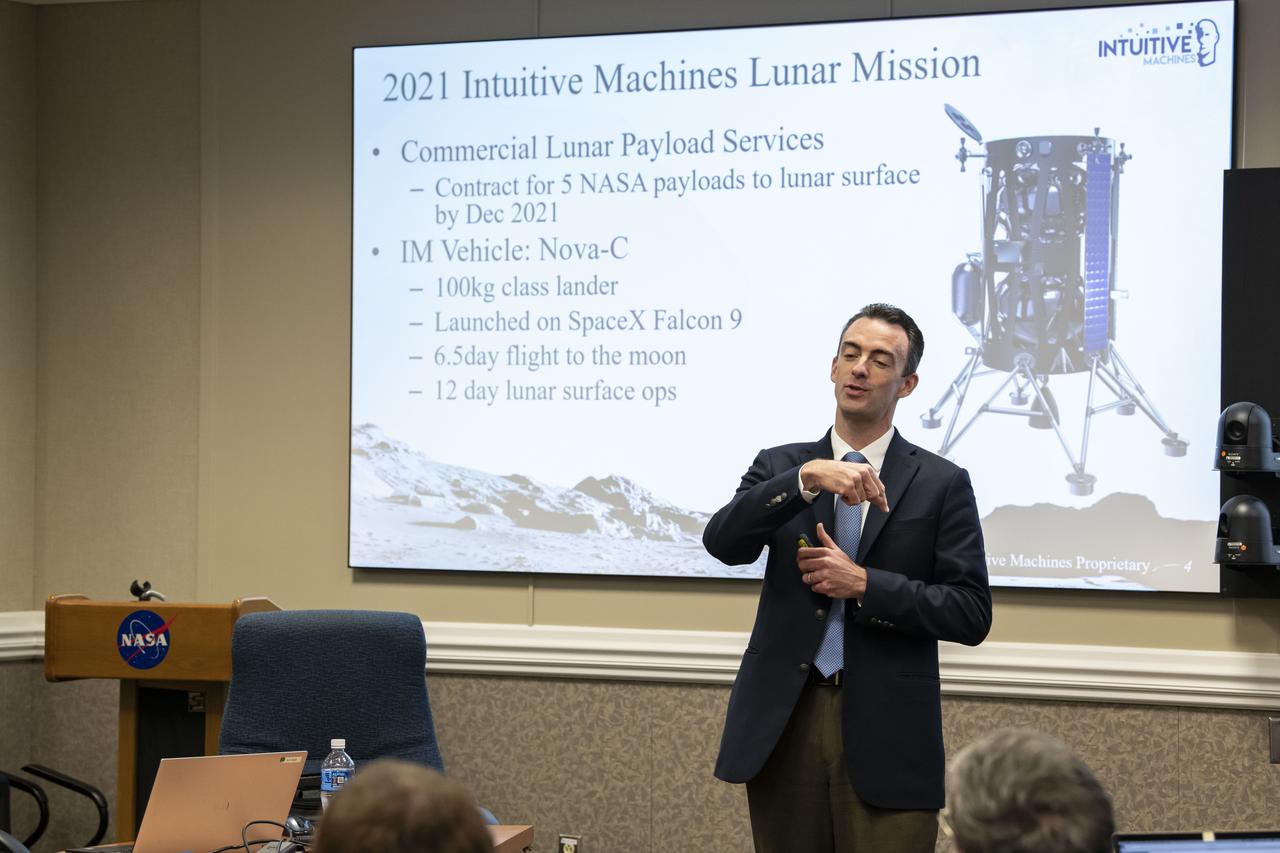
Rob Morehead, lead propulsion engineer for Intuitive Machines in Houston, delivers the monthly Tech Talk on Oct. 24 at NASA’s Marshall Space Flight Center. Morehead presented Intuitive Machines’ Nova-C lunar lander, which will deliver payloads to the surface of the Moon for government and commercial customers, including NASA. Intuitive Machines was selected by the agency as one of the companies for NASA’s Commercial Lunar Payload Service program. Nova-C currently has five NASA payloads and two commercial payloads manifested for its first flight, slated to launch in 2021. It will reach the Moon six days after launch and operate on the lunar surface for 12 days. Morehead worked at NASA’s Johnson Space Center for 20 years before joining Intuitive Machines.
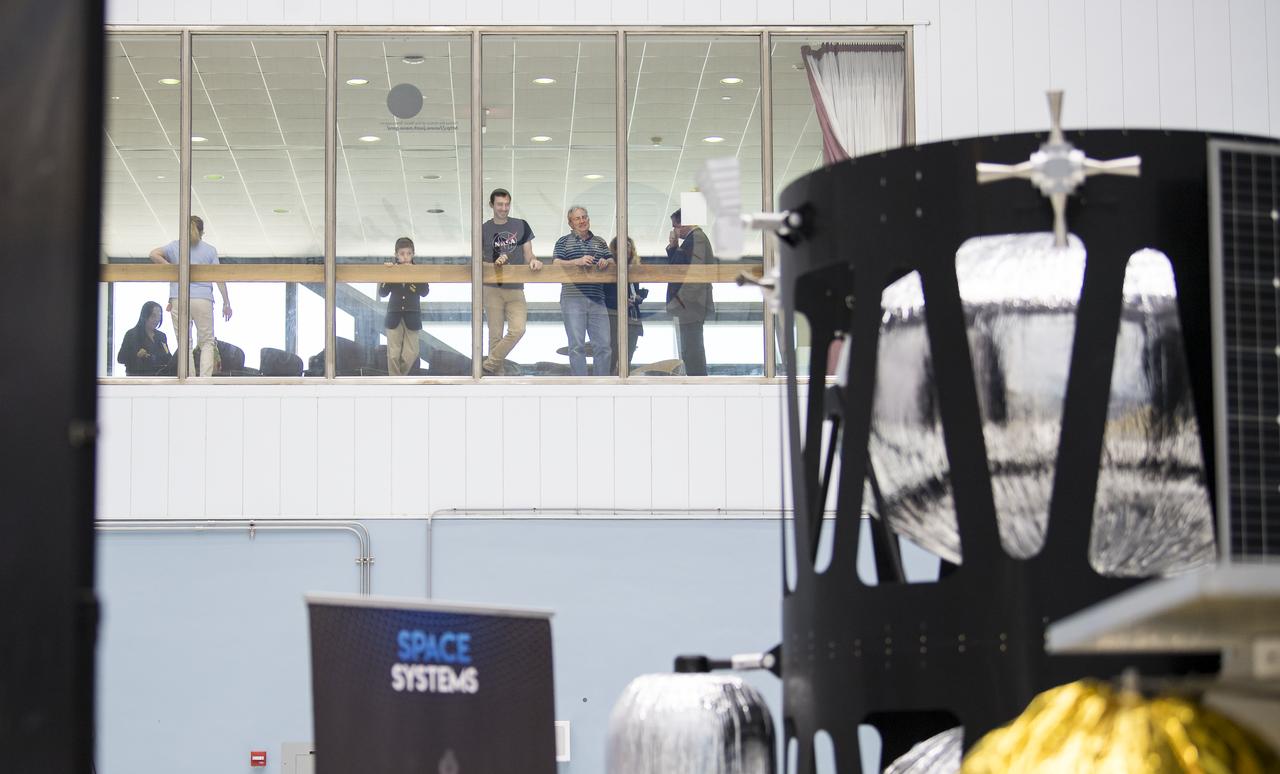
Goddard Space Flight Center employees are seen looking at the lunar landers from above, Friday, May 31, 2019, at Goddard Space Flight Center in Md. Astrobotic, Intuitive Machines, and Orbit Beyond have been selected to provide the first lunar landers for the Artemis program's lunar surface exploration. Photo credit: (NASA/Aubrey Gemignani)
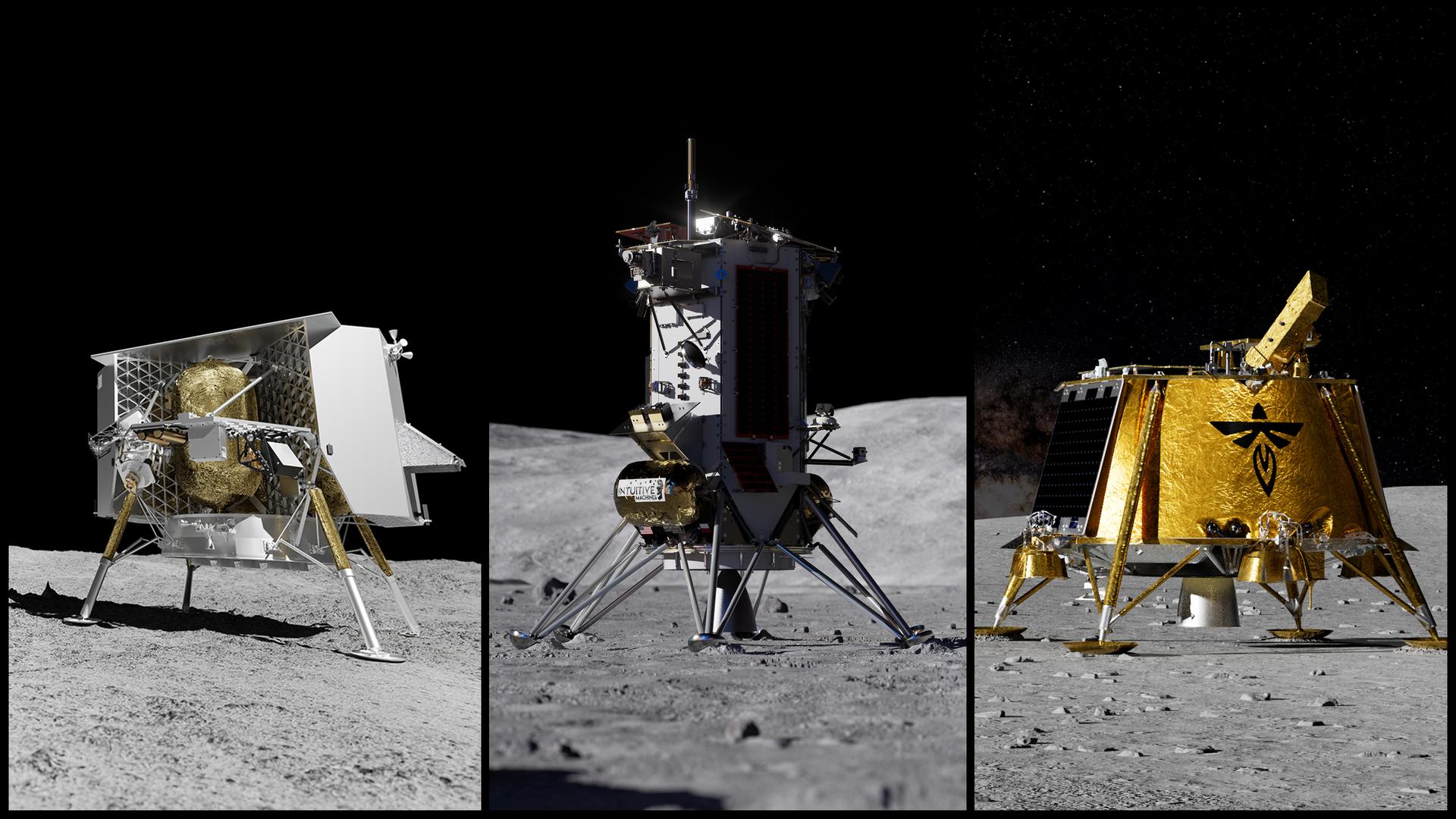
Three artist renderings depict commercial lunar landers from Astrobotic, Intuitive Machines, and Firefly on the Moon. NASA announced June 30 the landers will deliver more NASA science investigations and technology demonstrations to the lunar surface for NASA’s Moon Base Program. Credit: Astrobotic/Intuitive Machines/Firefly
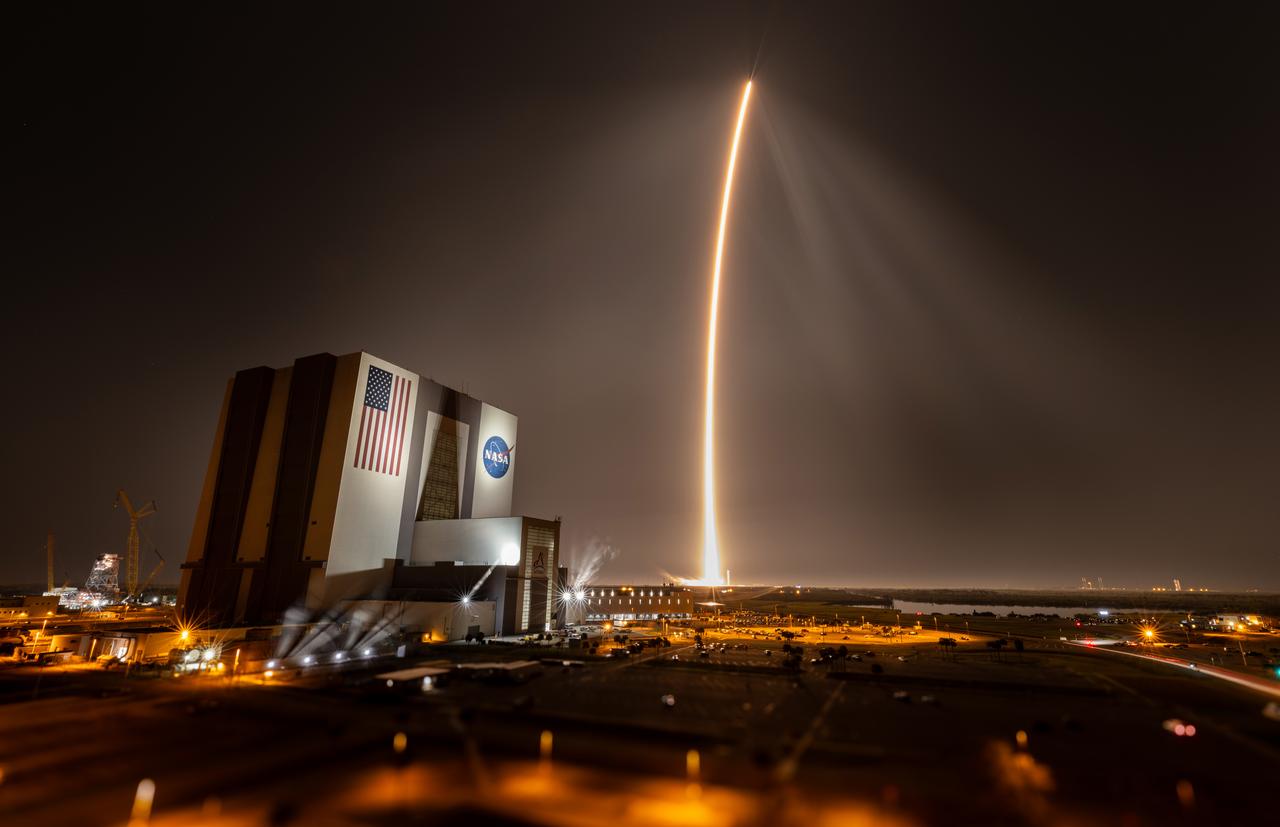
Creating a golden streak in the night sky, a SpaceX Falcon 9 rocket carrying Intuitive Machines’ Nova-C lunar lander (IM-2) soars upward after liftoff from Launch Complex 39A at NASA’s Kennedy Space Center in Florida at 7:16 p.m. EST Wednesday, Feb. 26 as part of NASA’s CLPS (Commercial Lunar Payload Services) initiative. The IM-2 launch is carrying NASA science, technology demonstrations, and other commercial payloads to Mons Mouton, a lunar plateau to advance our understanding of the Moon and planetary processes, while paving the way for future crewed missions.

A SpaceX Falcon 9 rocket carrying Intuitive Machines’ Nova-C lunar lander lifts off from Launch Pad 39A at NASA’s Kennedy Space Center in Florida at 1:05 a.m. EST on Thursday, Feb. 15, 2024. As part of NASA’s CLPS (Commercial Lunar Payload Services) initiative and Artemis campaign, Intuitive Machines’ first lunar mission will carry NASA science and commercial payloads to the Moon to study plume-surface interactions, space weather/lunar surface interactions, radio astronomy, precision landing technologies, and a communication and navigation node for future autonomous navigation technologies.

A SpaceX Falcon 9 rocket carrying Intuitive Machines’ Nova-C lunar lander lifts off from Launch Pad 39A at NASA’s Kennedy Space Center in Florida at 1:05 a.m. EST on Thursday, Feb. 15, 2024. As part of NASA’s CLPS (Commercial Lunar Payload Services) initiative and Artemis campaign, Intuitive Machines’ first lunar mission will carry NASA science and commercial payloads to the Moon to study plume-surface interactions, space weather/lunar surface interactions, radio astronomy, precision landing technologies, and a communication and navigation node for future autonomous navigation technologies.

A SpaceX Falcon 9 rocket carrying Intuitive Machines’ Nova-C lunar lander lifts off from Launch Pad 39A at NASA’s Kennedy Space Center in Florida at 1:05 a.m. EST on Thursday, Feb. 15, 2024. As part of NASA’s CLPS (Commercial Lunar Payload Services) initiative and Artemis campaign, Intuitive Machines’ first lunar mission will carry NASA science and commercial payloads to the Moon to study plume-surface interactions, space weather/lunar surface interactions, radio astronomy, precision landing technologies, and a communication and navigation node for future autonomous navigation technologies.

A SpaceX Falcon 9 rocket carrying Intuitive Machines’ Nova-C lunar lander lifts off from Launch Pad 39A at NASA’s Kennedy Space Center in Florida at 1:05 a.m. EST on Thursday, Feb. 15, 2024. As part of NASA’s CLPS (Commercial Lunar Payload Services) initiative and Artemis campaign, Intuitive Machines’ first lunar mission will carry NASA science and commercial payloads to the Moon to study plume-surface interactions, space weather/lunar surface interactions, radio astronomy, precision landing technologies, and a communication and navigation node for future autonomous navigation technologies.

A SpaceX Falcon 9 rocket carrying Intuitive Machines’ Nova-C lunar lander lifts off from Launch Pad 39A at NASA’s Kennedy Space Center in Florida at 1:05 a.m. EST on Thursday, Feb. 15, 2024. As part of NASA’s CLPS (Commercial Lunar Payload Services) initiative and Artemis campaign, Intuitive Machines’ first lunar mission will carry NASA science and commercial payloads to the Moon to study plume-surface interactions, space weather/lunar surface interactions, radio astronomy, precision landing technologies, and a communication and navigation node for future autonomous navigation technologies.

A SpaceX Falcon 9 rocket carrying Intuitive Machines’ Nova-C lunar lander lifts off from Launch Pad 39A at NASA’s Kennedy Space Center in Florida at 1:05 a.m. EST on Thursday, Feb. 15, 2024. As part of NASA’s CLPS (Commercial Lunar Payload Services) initiative and Artemis campaign, Intuitive Machines’ first lunar mission will carry NASA science and commercial payloads to the Moon to study plume-surface interactions, space weather/lunar surface interactions, radio astronomy, precision landing technologies, and a communication and navigation node for future autonomous navigation technologies.

A SpaceX Falcon 9 rocket carrying Intuitive Machines’ Nova-C lunar lander lifts off from Launch Pad 39A at NASA’s Kennedy Space Center in Florida at 1:05 a.m. EST on Thursday, Feb. 15, 2024. As part of NASA’s CLPS (Commercial Lunar Payload Services) initiative and Artemis campaign, Intuitive Machines’ first lunar mission will carry NASA science and commercial payloads to the Moon to study plume-surface interactions, space weather/lunar surface interactions, radio astronomy, precision landing technologies, and a communication and navigation node for future autonomous navigation technologies.
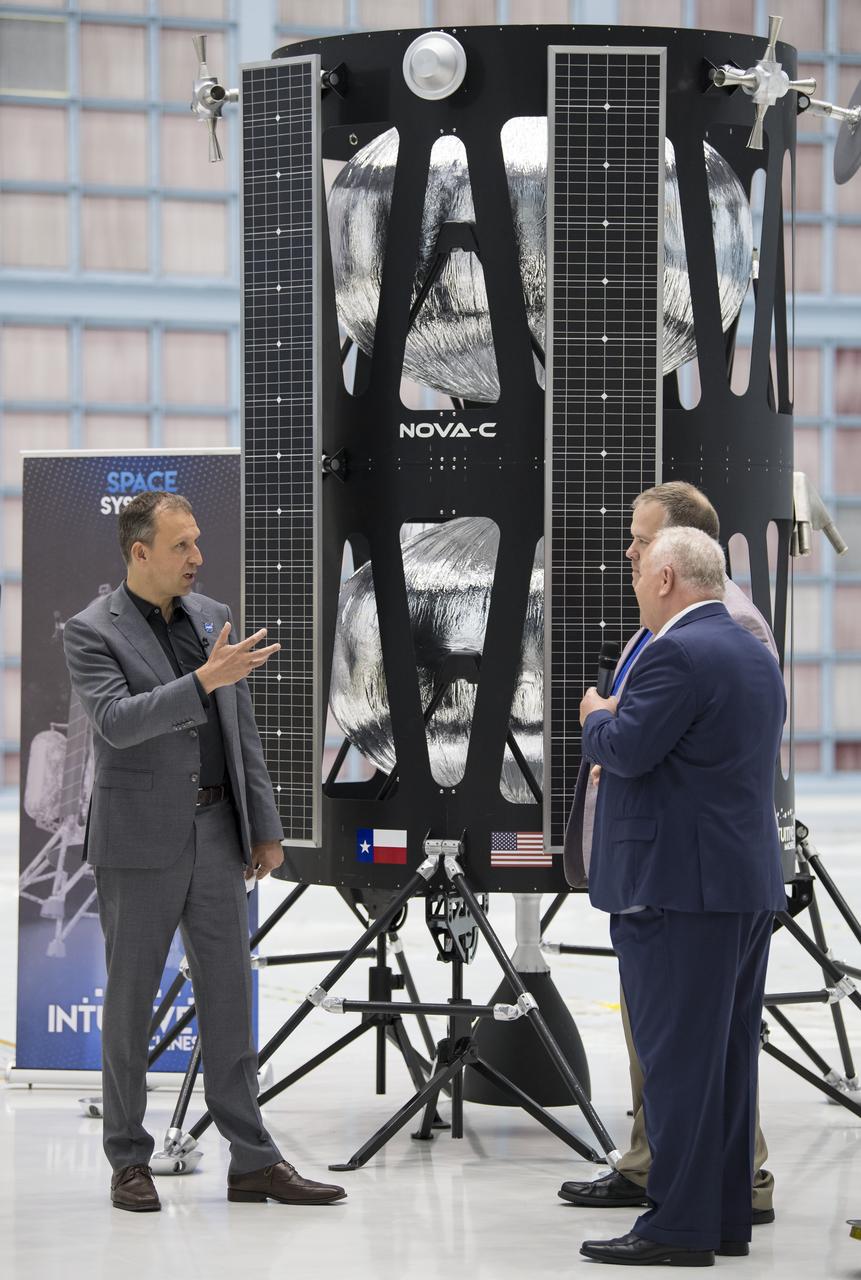
NASA Associate Administrator, Science Mission Directorate, Thomas Zurbuchen, left, speaks to, Chairman of the Board of Intuitive Machines, Kam Ghaffarian, right, and VP of Research and Development of Intuitive Machines, Tim Crain, second from right, about their lunar lander, Friday, May 31, 2019, at Goddard Space Flight Center in Md. Astrobotic, Intuitive Machines, and Orbit Beyond have been selected to provide the first lunar landers for the Artemis program's lunar surface exploration. Photo credit: (NASA/Aubrey Gemignani)
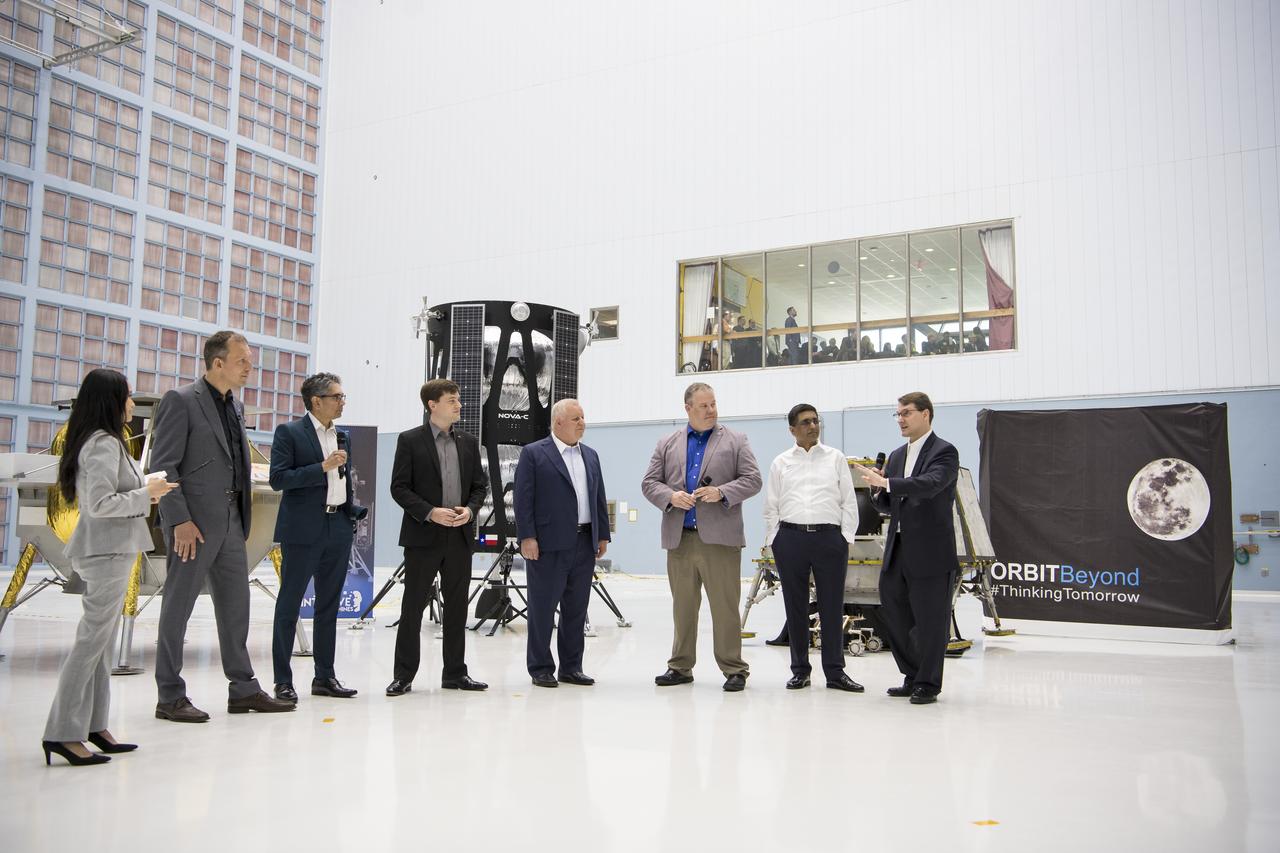
Chief Science Officer, OrbitBeyond, Jon Morse speaks about their lunar lander with, from left to right, NASA Press Officer, Felicia Chou; NASA Associate Administrator, Science Mission Directorate, Thomas Zurbuchen; Astrobotic Mission Director, Sharad Bhaskaran; Astrobotic CEO, John Thornton; Chairman of the Board of Intuitive Machines, Kam Ghaffarian; VP of Research and Development of Intuitive Machines, Tim Crain; President and CEO of OrbitBeyond, Siba Padhi, Friday, May 31, 2019, at Goddard Space Flight Center in Md. Astrobotic, Intuitive Machines, and OrbitBeyond have been selected to provide the first lunar landers for the Artemis program's lunar surface exploration. Photo credit: (NASA/Aubrey Gemignani)
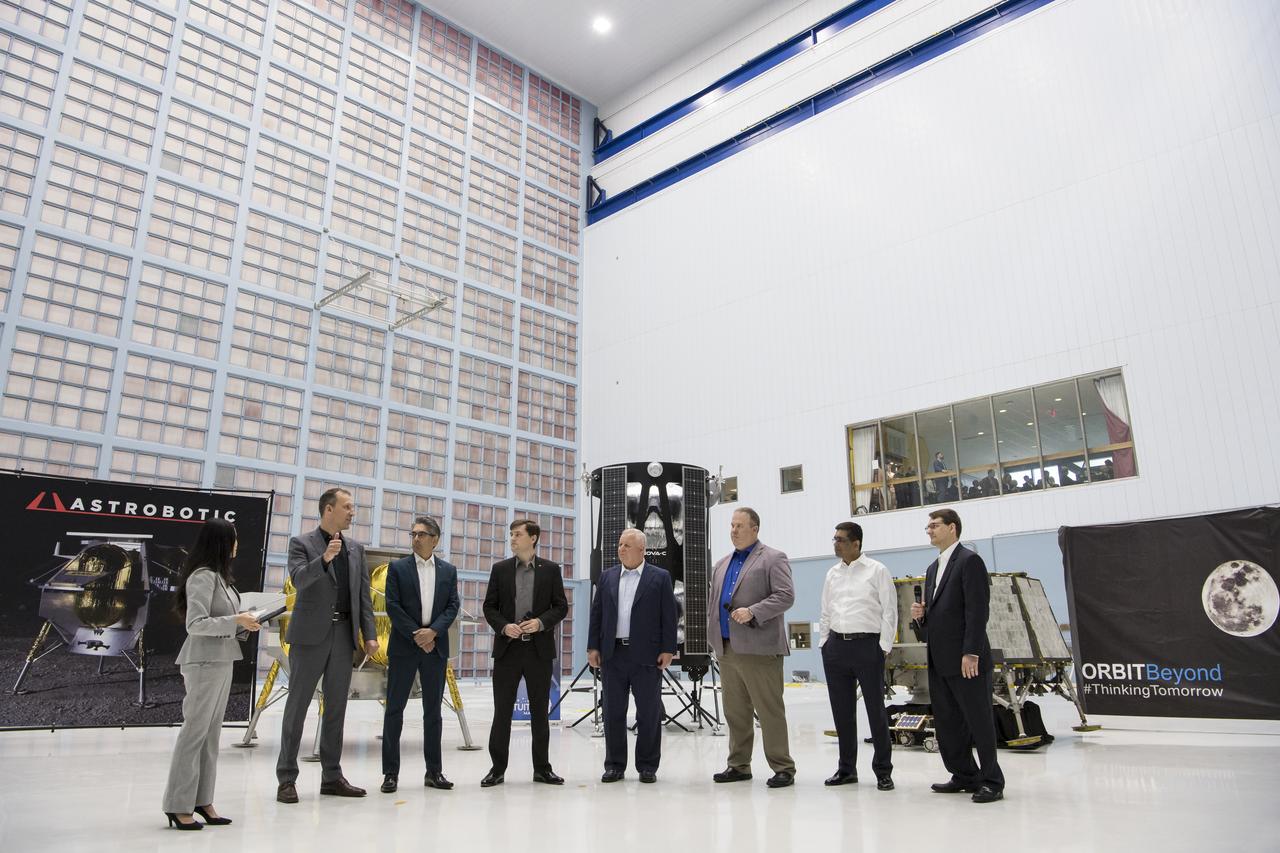
From left to right, NASA Press Officer, Felicia Chou; NASA Associate Administrator, Science Mission Directorate, Thomas Zurbuchen; Astrobotic Mission Director, Sharad Bhaskaran; Astrobotic CEO, John Thornton; Chairman of the Board of Intuitive Machines, Kam Ghaffarian; VP of Research and Development of Intuitive Machines, Tim Crain; President and CEO of OrbitBeyond, Siba Padhi; and Chief Science Officer, OrbitBeyond, Jon Morse talk about their lunar landers, Friday, May 31, 2019, at Goddard Space Flight Center in Md. Astrobotic, Intuitive Machines, and OrbitBeyond have been selected to provide the first lunar landers for the Artemis program's lunar surface exploration. Photo credit: (NASA/Aubrey Gemignani)
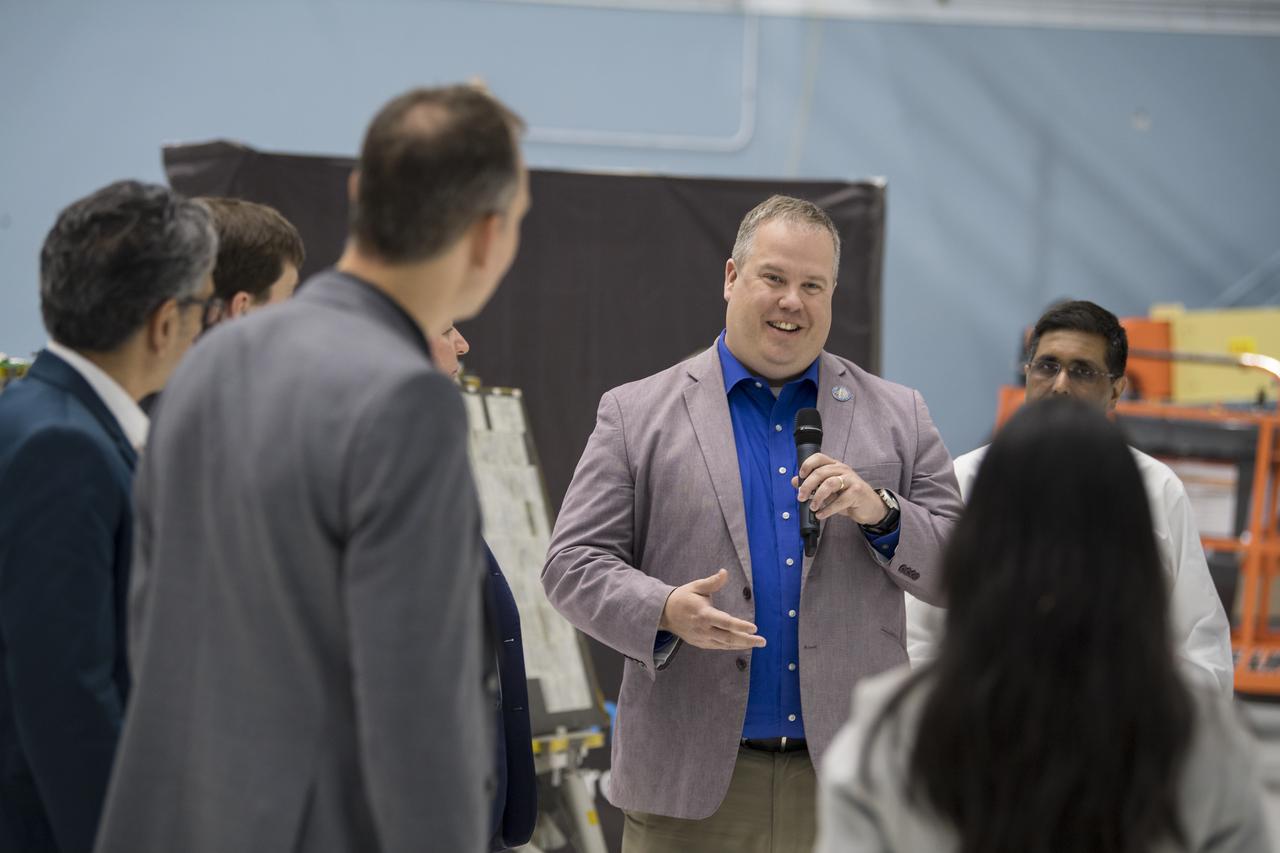
Vice President of Research and Development of Intuitive Machines, Tim Crain, second from right, speaks about their lunar lander, Friday, May 31, 2019, at Goddard Space Flight Center in Md. Astrobotic, Intuitive Machines, and Orbit Beyond have been selected to provide the first lunar landers for the Artemis program's lunar surface exploration. Photo credit: (NASA/Aubrey Gemignani)
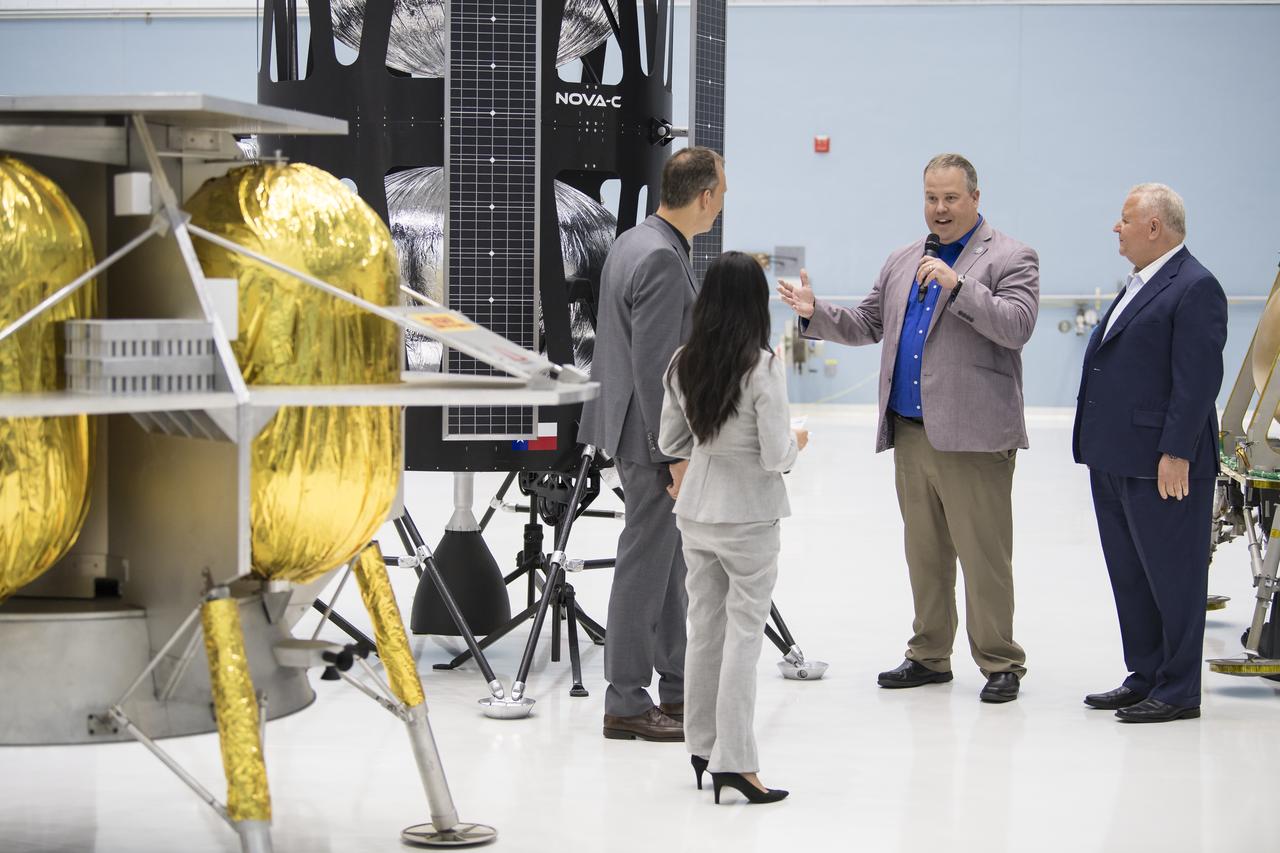
VP of Research and Development of Intuitive Machines, Tim Crain, second from right, speaks with NASA Associate Administrator, Science Mission Directorate, Thomas Zurbuchen, second from left, about their lunar lander, Friday, May 31, 2019, at Goddard Space Flight Center in Md. Astrobotic, Intuitive Machines, and Orbit Beyond have been selected to provide the first lunar landers for the Artemis program's lunar surface exploration. Photo credit: (NASA/Aubrey Gemignani)
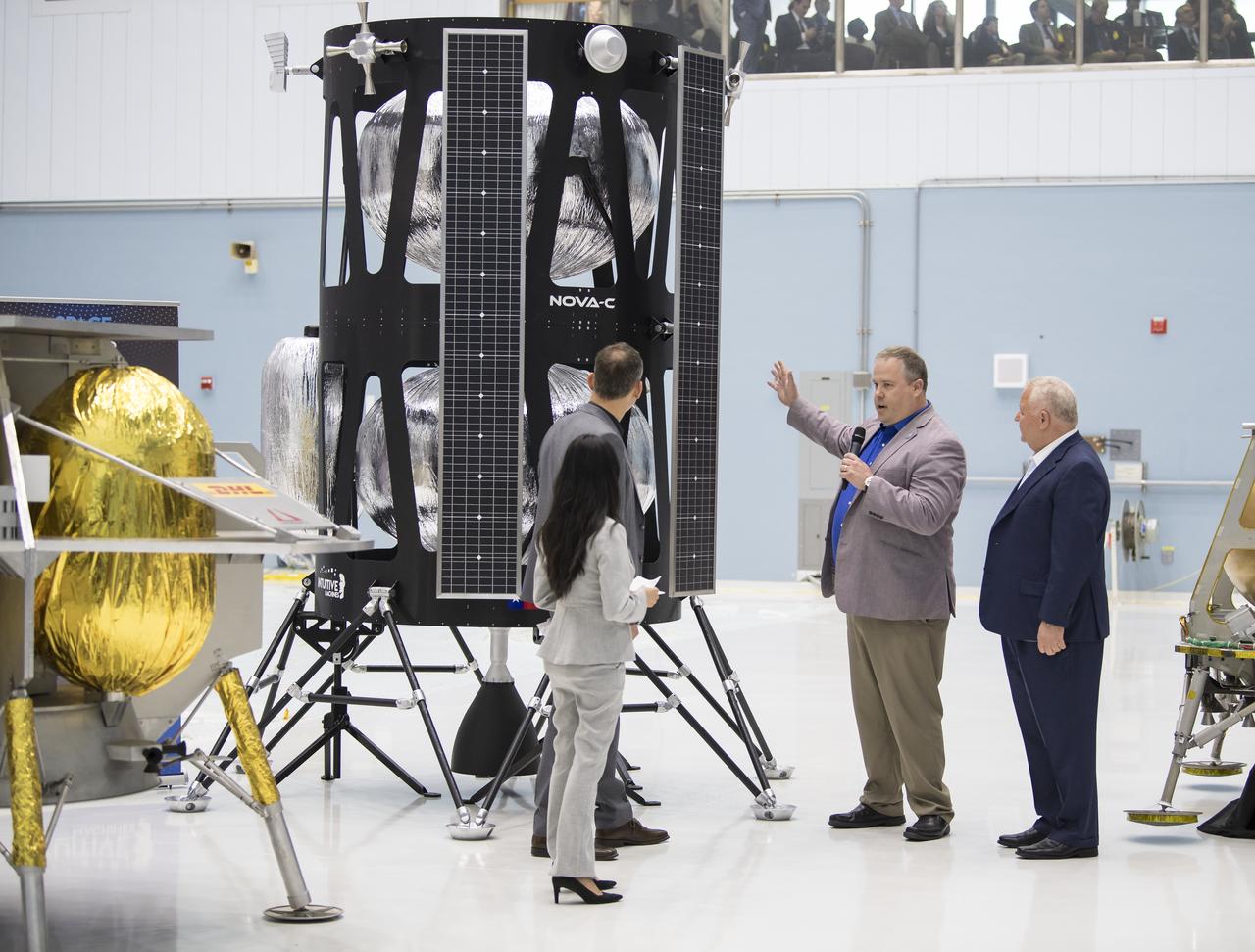
VP of Research and Development of Intuitive Machines, Tim Crain, second from right, speaks with NASA Associate Administrator, Science Mission Directorate, Thomas Zurbuchen, second from left, about their lunar lander, Friday, May 31, 2019, at Goddard Space Flight Center in Md. Astrobotic, Intuitive Machines, and Orbit Beyond have been selected to provide the first lunar landers for the Artemis program's lunar surface exploration. Photo credit: (NASA/Aubrey Gemignani)
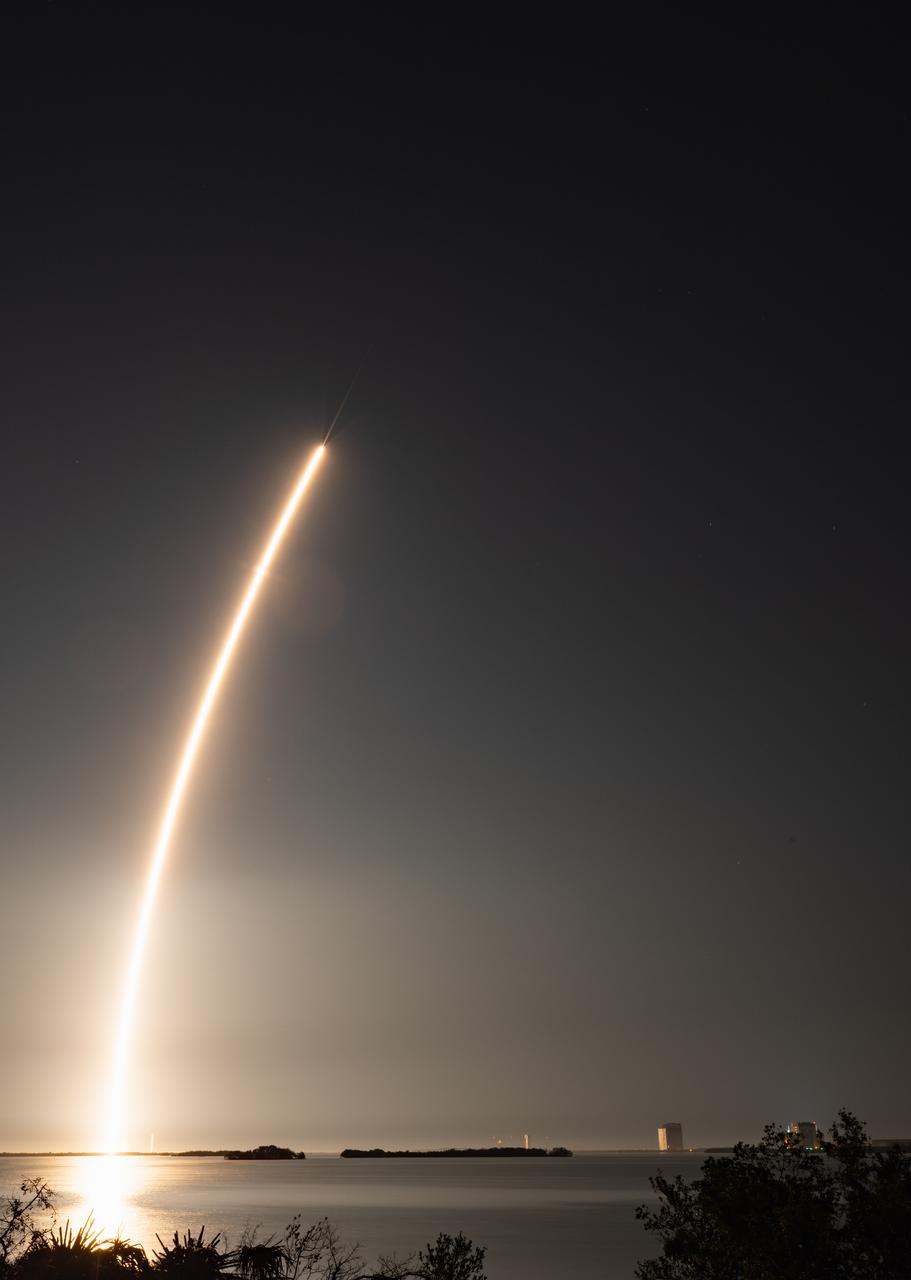
A SpaceX Falcon 9 rocket carrying Intuitive Machines’ Nova-C lunar lander (IM-2) launches at 7:16 p.m. EST on Wednesday, Feb. 26 from Launch Complex 39A at NASA’s Kennedy Space Center in Florida as part of NASA’s CLPS (Commercial Lunar Payload Services) initiative. The IM-2 launch is carrying NASA science, technology demonstrations, and other commercial payloads to Mons Mouton, a lunar plateau to advance our understanding of the Moon and planetary processes, while paving the way for future crewed missions.
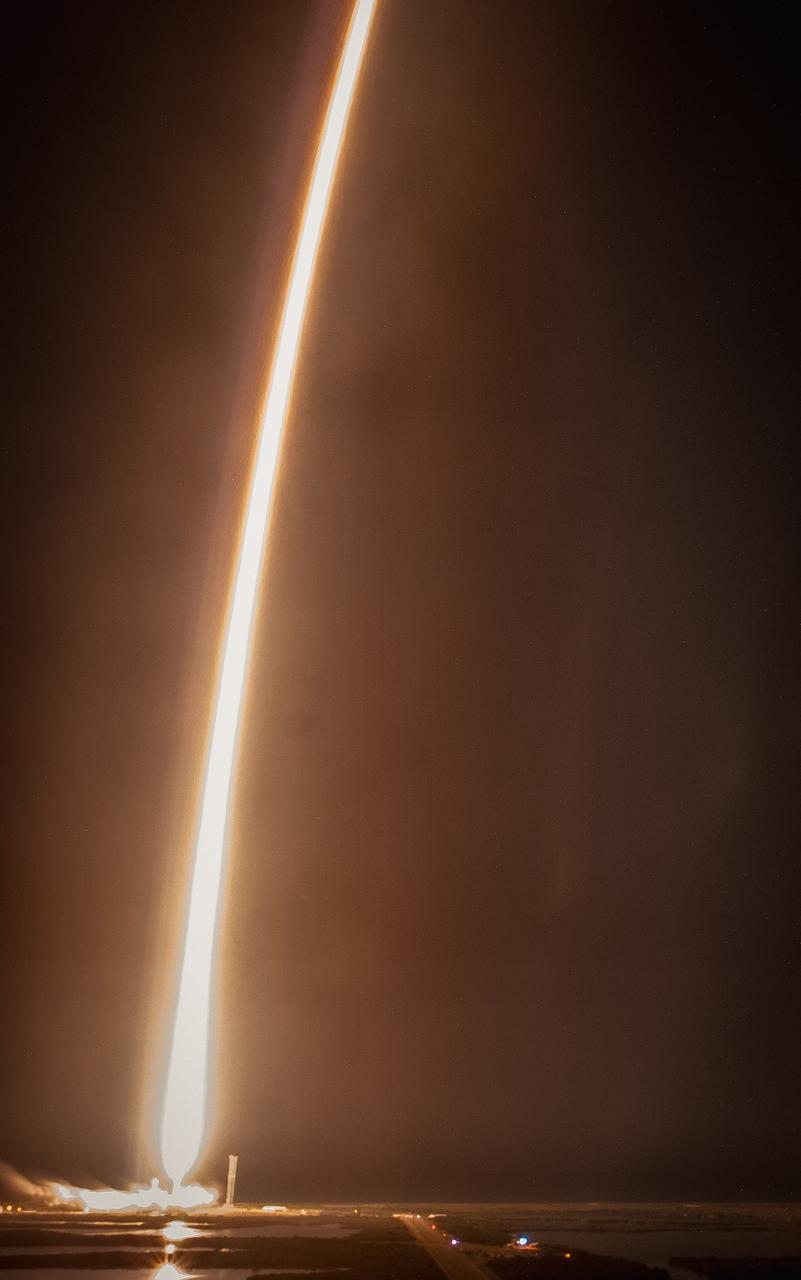
Creating a golden streak in the night sky, a SpaceX Falcon 9 rocket carrying Intuitive Machines’ Nova-C lunar lander (IM-2) soars upward after liftoff from Launch Complex 39A at NASA’s Kennedy Space Center in Florida at 7:16 p.m. EST Wednesday, Feb. 26 as part of NASA’s CLPS (Commercial Lunar Payload Services) initiative. The IM-2 launch is carrying NASA science, technology demonstrations, and other commercial payloads to Mons Mouton, a lunar plateau to advance our understanding of the Moon and planetary processes, while paving the way for future crewed missions.
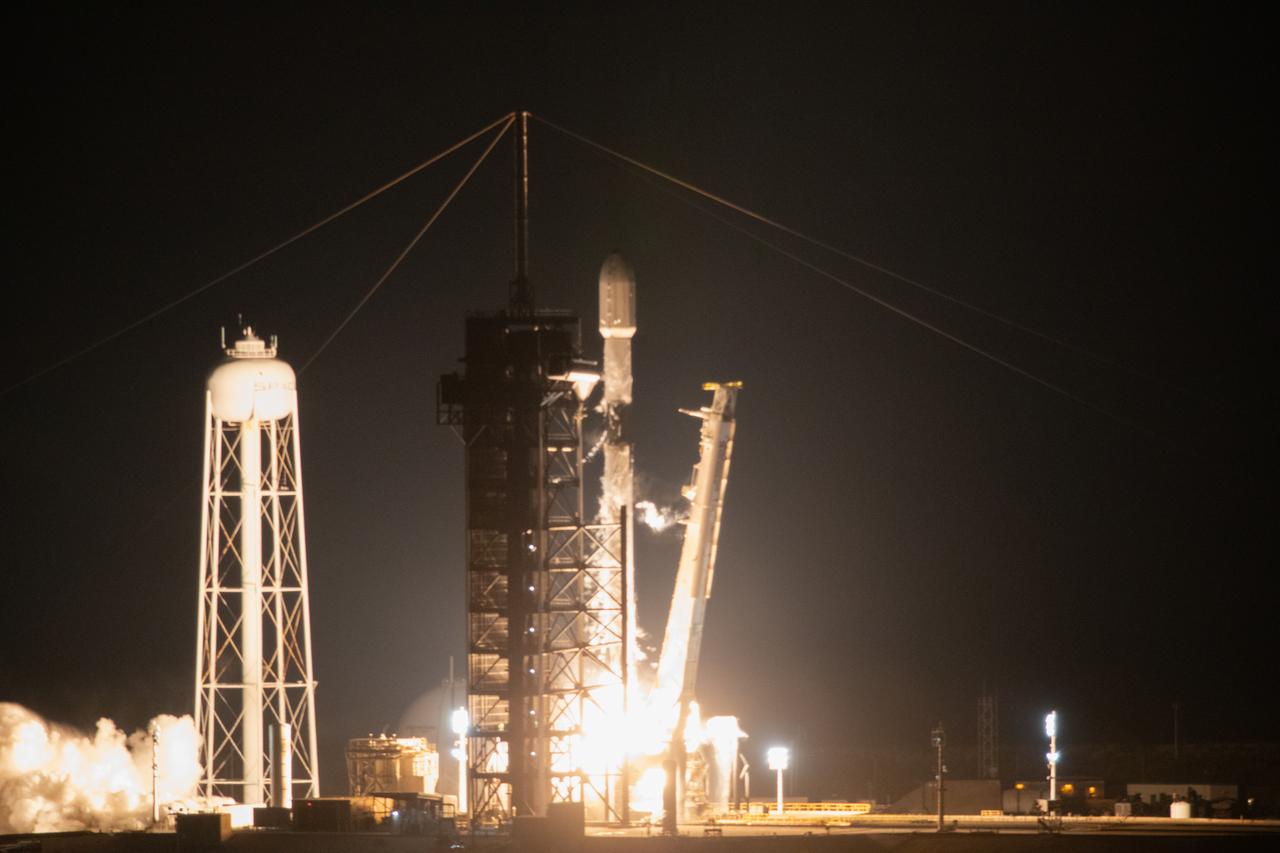
A SpaceX Falcon 9 rocket carrying Intuitive Machines’ Nova-C lunar lander (IM-2) launches at 7:16 p.m. EST on Wednesday, Feb. 26, 2025, from Launch Complex 39A at NASA’s Kennedy Space Center in Florida as part of NASA’s CLPS (Commercial Lunar Payload Services) initiative. The IM-2 launch is carrying NASA science, technology demonstrations, and other commercial payloads to Mons Mouton, a lunar plateau to advance our understanding of the Moon and planetary processes, while paving the way for future crewed missions.
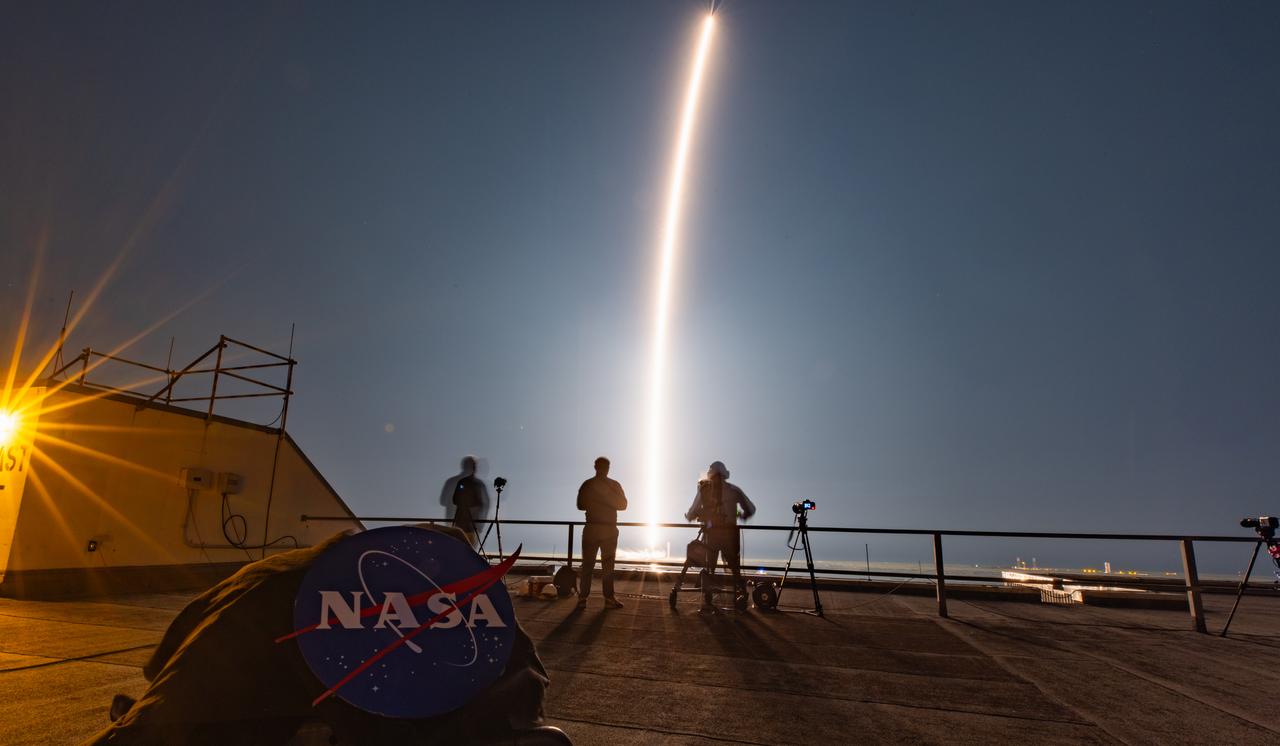
Creating a golden streak in the night sky, a SpaceX Falcon 9 rocket carrying Intuitive Machines’ Nova-C lunar lander (IM-2) soars upward after liftoff from Launch Complex 39A at NASA’s Kennedy Space Center in Florida at 7:16 p.m. EST Wednesday, Feb. 26, 2025, as part of NASA’s CLPS (Commercial Lunar Payload Services) initiative. The IM-2 launch is carrying NASA science, technology demonstrations, and other commercial payloads to Mons Mouton, a lunar plateau to advance our understanding of the Moon and planetary processes, while paving the way for future crewed missions.
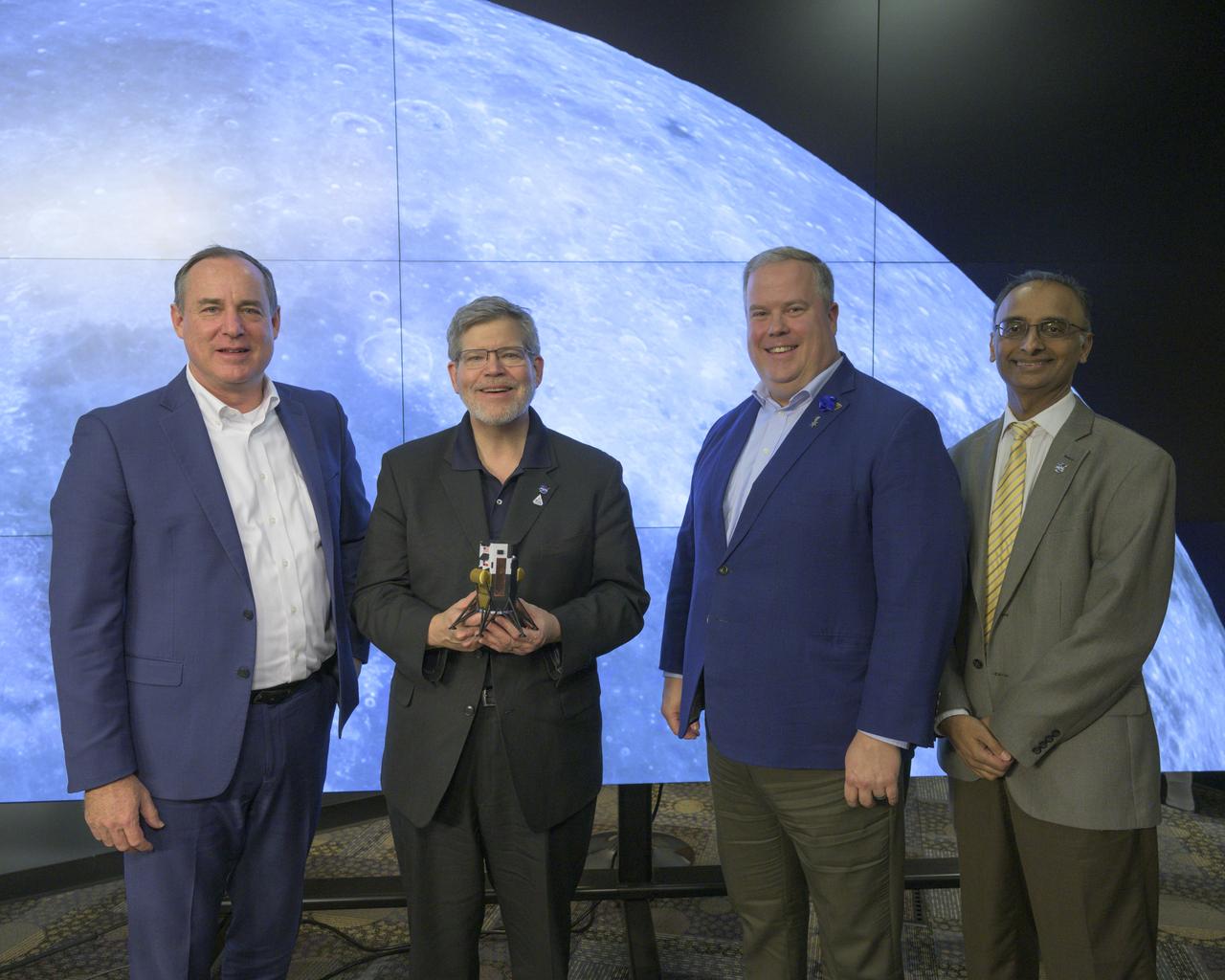
For the first time in more than 50 years, new NASA science instruments and technology demonstrations are operating on the Moon following the first successful delivery of the agency’s CLPS (Commercial Lunar Payload Services) initiative. Experts from NASA and Intuitive Machines hosted a news conference Feb. 23, 2024, at NASA’s Johnson Space Center in Houston to discuss the soft landing of the company’s Nova-C lander, called Odysseus. Participants in the briefing included (L-R): Steve Altemus, chief executive officer and co-founder, Intuitive Machines; Joel Kearns, deputy associate administrator for Exploration, Science Mission Directorate, NASA Headquarters in Washington; Tim Crain, chief technology officer and co-founder, Intuitive Machines; and Prasun Desai, deputy associate administrator, Space Technology Mission Directorate at NASA Headquarters. Photo Credit: NASA/Robert Markowitz
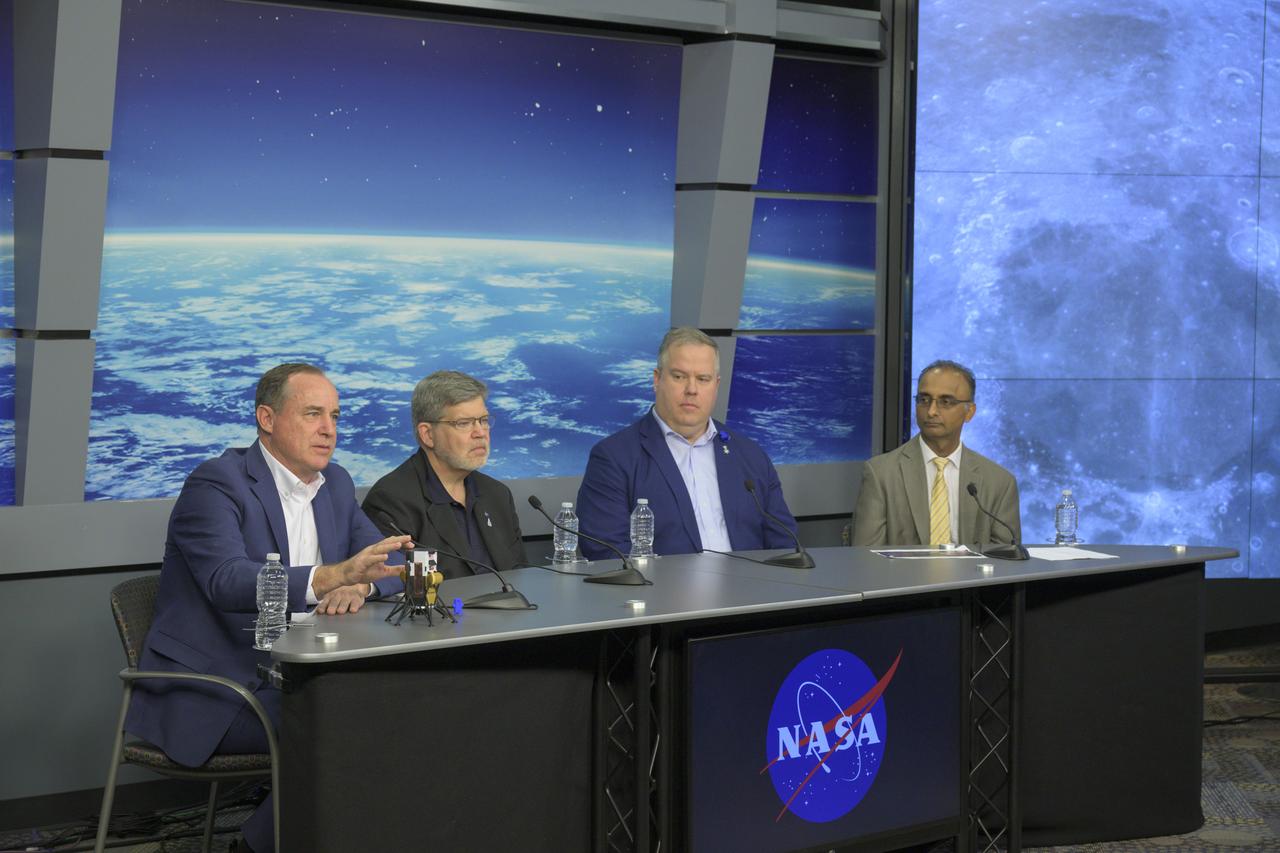
For the first time in more than 50 years, new NASA science instruments and technology demonstrations are operating on the Moon following the first successful delivery of the agency’s CLPS (Commercial Lunar Payload Services) initiative. Experts from NASA and Intuitive Machines hosted a news conference Feb. 23, 2024, at NASA’s Johnson Space Center in Houston to discuss the soft landing of the company’s Nova-C lander, called Odysseus. Participants in the briefing included (L-R): Steve Altemus, chief executive officer and co-founder, Intuitive Machines; Joel Kearns, deputy associate administrator for Exploration, Science Mission Directorate, NASA Headquarters in Washington; Tim Crain, chief technology officer and co-founder, Intuitive Machines; and Prasun Desai, deputy associate administrator, Space Technology Mission Directorate at NASA Headquarters. Photo Credit: NASA/Robert Markowitz
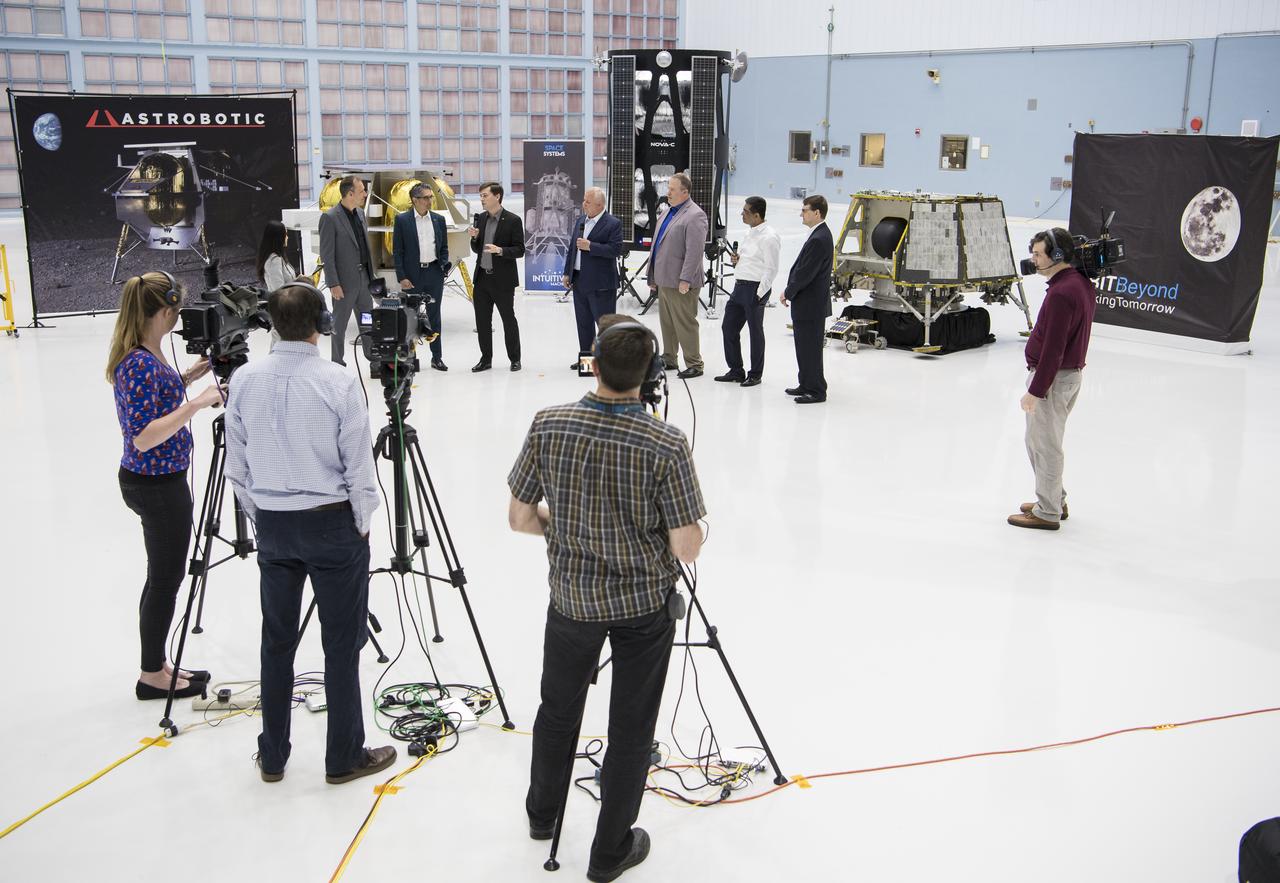
Astrobotic CEO, John Thornton, fourth from left, speaks about their lunar lander with, from left to right, NASA Press Officer, Felicia Chou; NASA Associate Administrator, Science Mission Directorate, Thomas Zurbuchen; Astrobotic Mission Director, Sharad Bhaskaran; Chairman of the Board of Intuitive Machines, Kam Ghaffarian; VP of Research and Development of Intuitive Machines, Tim Crain; President and CEO of OrbitBeyond, Siba Padhi; and Chief Science Officer, OrbitBeyond, Jon Morse, Friday, May 31, 2019, at Goddard Space Flight Center in Md. Astrobotic, Intuitive Machines, and OrbitBeyond have been selected to provide the first lunar landers for the Artemis program's lunar surface exploration. Photo credit: (NASA/Aubrey Gemignani)
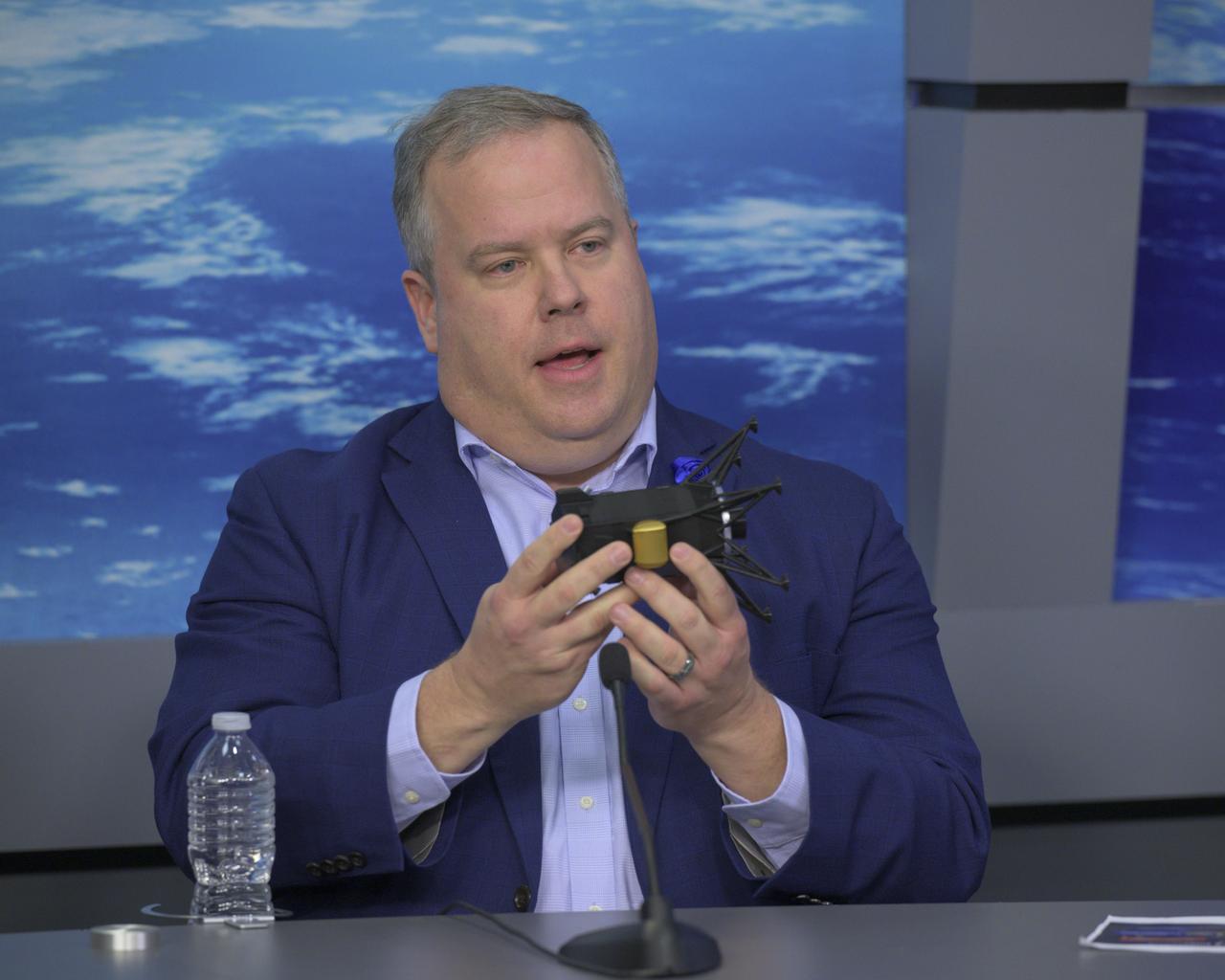
For the first time in more than 50 years, new NASA science instruments and technology demonstrations are operating on the Moon following the first successful delivery of the agency’s CLPS (Commercial Lunar Payload Services) initiative. Experts from NASA and Intuitive Machines hosted a news conference Feb. 23, 2024, at NASA’s Johnson Space Center in Houston to discuss the soft landing of the company’s Nova-C lander, called Odysseus. Participants in the briefing included (L-R): Steve Altemus, chief executive officer and co-founder, Intuitive Machines; Joel Kearns, deputy associate administrator for Exploration, Science Mission Directorate, NASA Headquarters in Washington; Tim Crain, chief technology officer and co-founder, Intuitive Machines; and Prasun Desai, deputy associate administrator, Space Technology Mission Directorate at NASA Headquarters. Photo Credit: NASA/Robert Markowitz
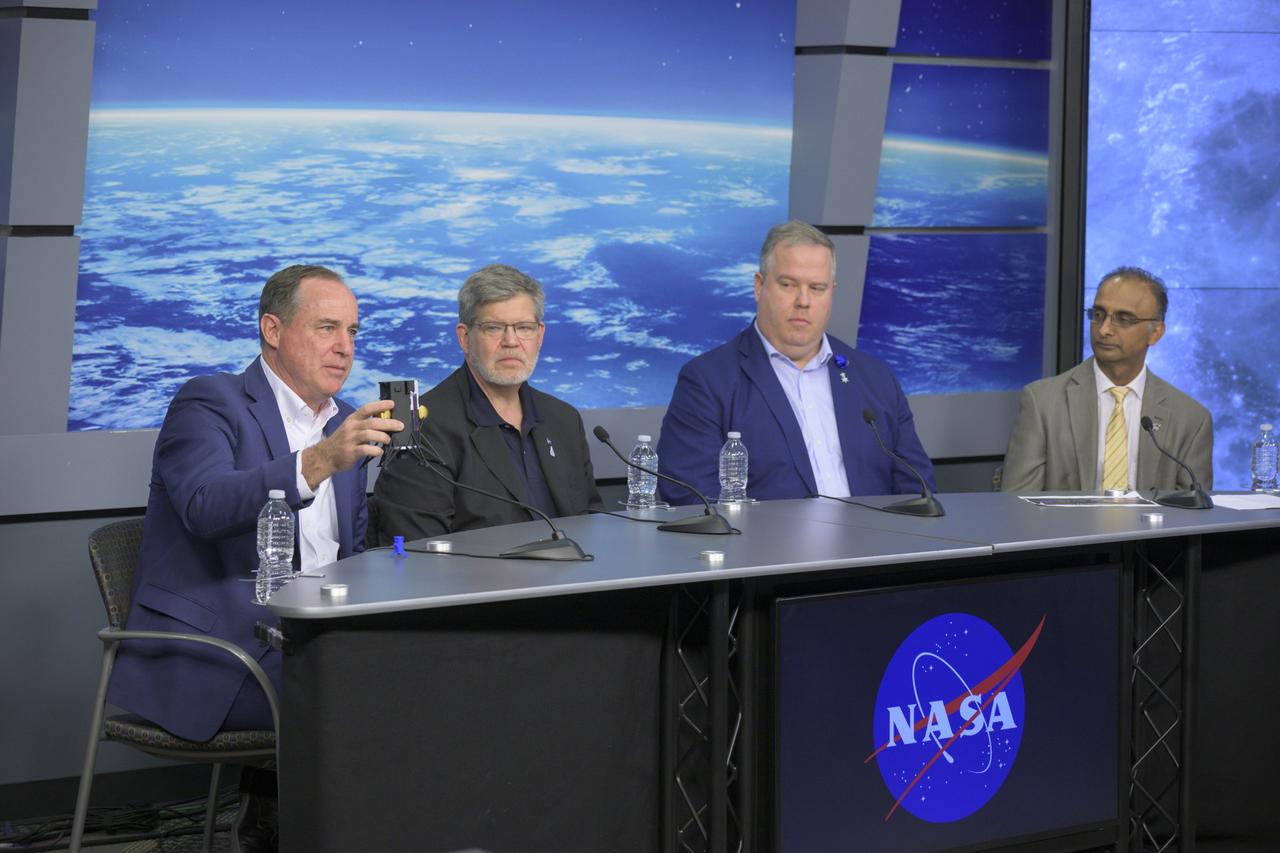
For the first time in more than 50 years, new NASA science instruments and technology demonstrations are operating on the Moon following the first successful delivery of the agency’s CLPS (Commercial Lunar Payload Services) initiative. Experts from NASA and Intuitive Machines hosted a news conference Feb. 23, 2024, at NASA’s Johnson Space Center in Houston to discuss the soft landing of the company’s Nova-C lander, called Odysseus. Participants in the briefing included (L-R): Steve Altemus, chief executive officer and co-founder, Intuitive Machines; Joel Kearns, deputy associate administrator for Exploration, Science Mission Directorate, NASA Headquarters in Washington; Tim Crain, chief technology officer and co-founder, Intuitive Machines; and Prasun Desai, deputy associate administrator, Space Technology Mission Directorate at NASA Headquarters. Photo Credit: NASA/Robert Markowitz
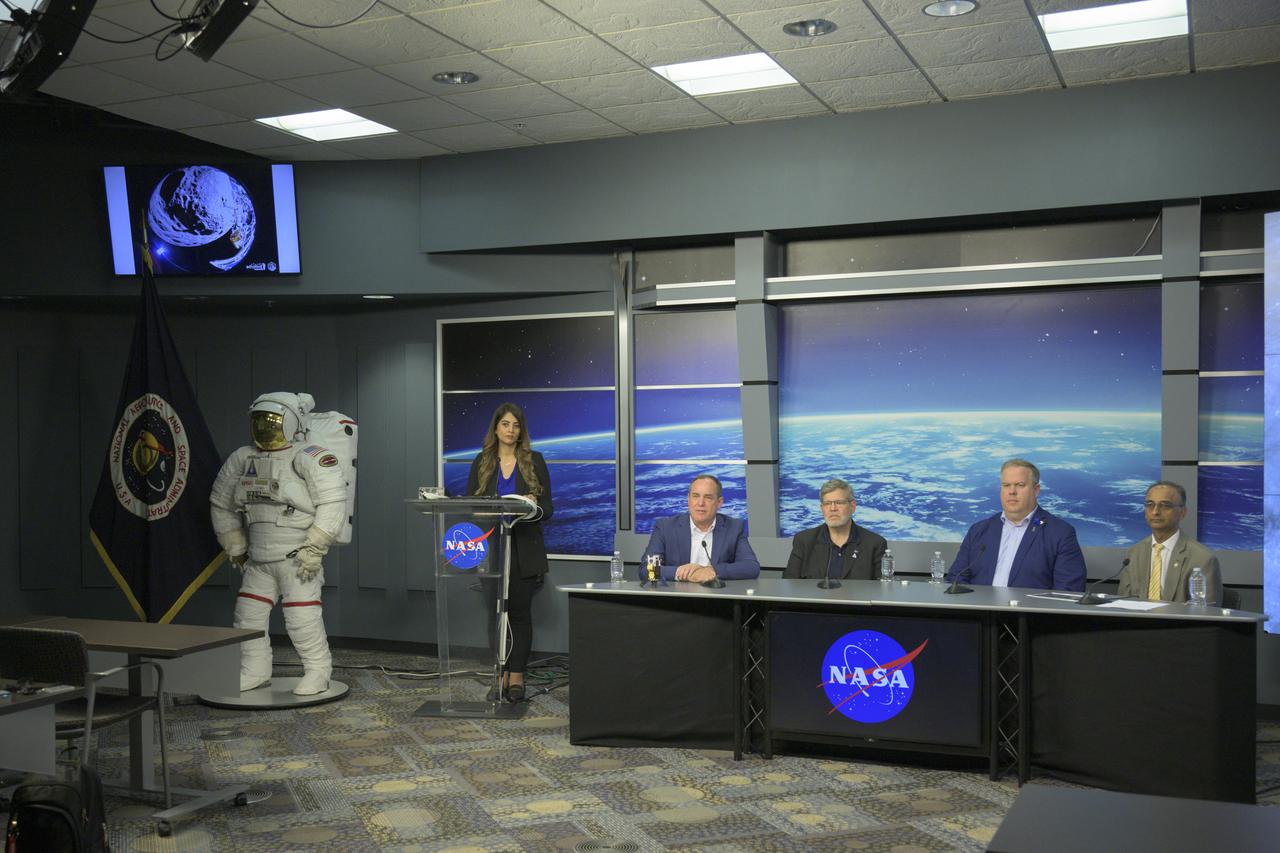
For the first time in more than 50 years, new NASA science instruments and technology demonstrations are operating on the Moon following the first successful delivery of the agency’s CLPS (Commercial Lunar Payload Services) initiative. Experts from NASA and Intuitive Machines hosted a news conference Feb. 23, 2024, at NASA’s Johnson Space Center in Houston to discuss the soft landing of the company’s Nova-C lander, called Odysseus. Participants in the briefing included (L-R): Steve Altemus, chief executive officer and co-founder, Intuitive Machines; Joel Kearns, deputy associate administrator for Exploration, Science Mission Directorate, NASA Headquarters in Washington; Tim Crain, chief technology officer and co-founder, Intuitive Machines; and Prasun Desai, deputy associate administrator, Space Technology Mission Directorate at NASA Headquarters. Photo Credit: NASA/Robert Markowitz
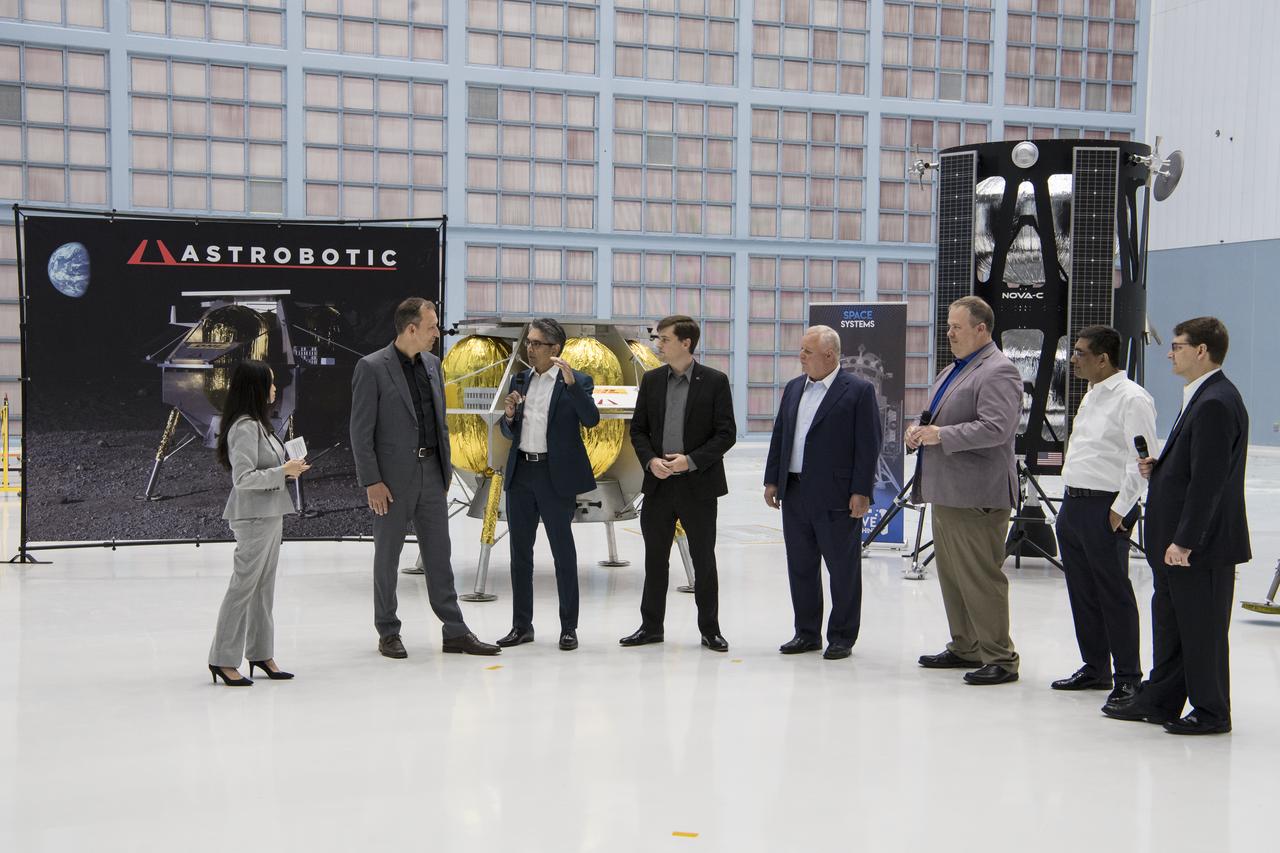
Astrobotic Mission Director, Sharad Bhaskaran , third from left, speaks about their lunar lander with, from left to right, NASA Press Officer, Felicia Chou; NASA Associate Administrator, Science Mission Directorate, Thomas Zurbuchen; Astrobotic CEO, John Thornton; Chairman of the Board of Intuitive Machines, Kam Ghaffarian; VP of Research and Development of Intuitive Machines, Tim Crain; President and CEO of OrbitBeyond, Siba Padhi; and Chief Science Officer, OrbitBeyond, Jon Morse, Friday, May 31, 2019, at Goddard Space Flight Center in Md. Astrobotic, Intuitive Machines, and OrbitBeyond have been selected to provide the first lunar landers for the Artemis program's lunar surface exploration. Photo credit: (NASA/Aubrey Gemignani)
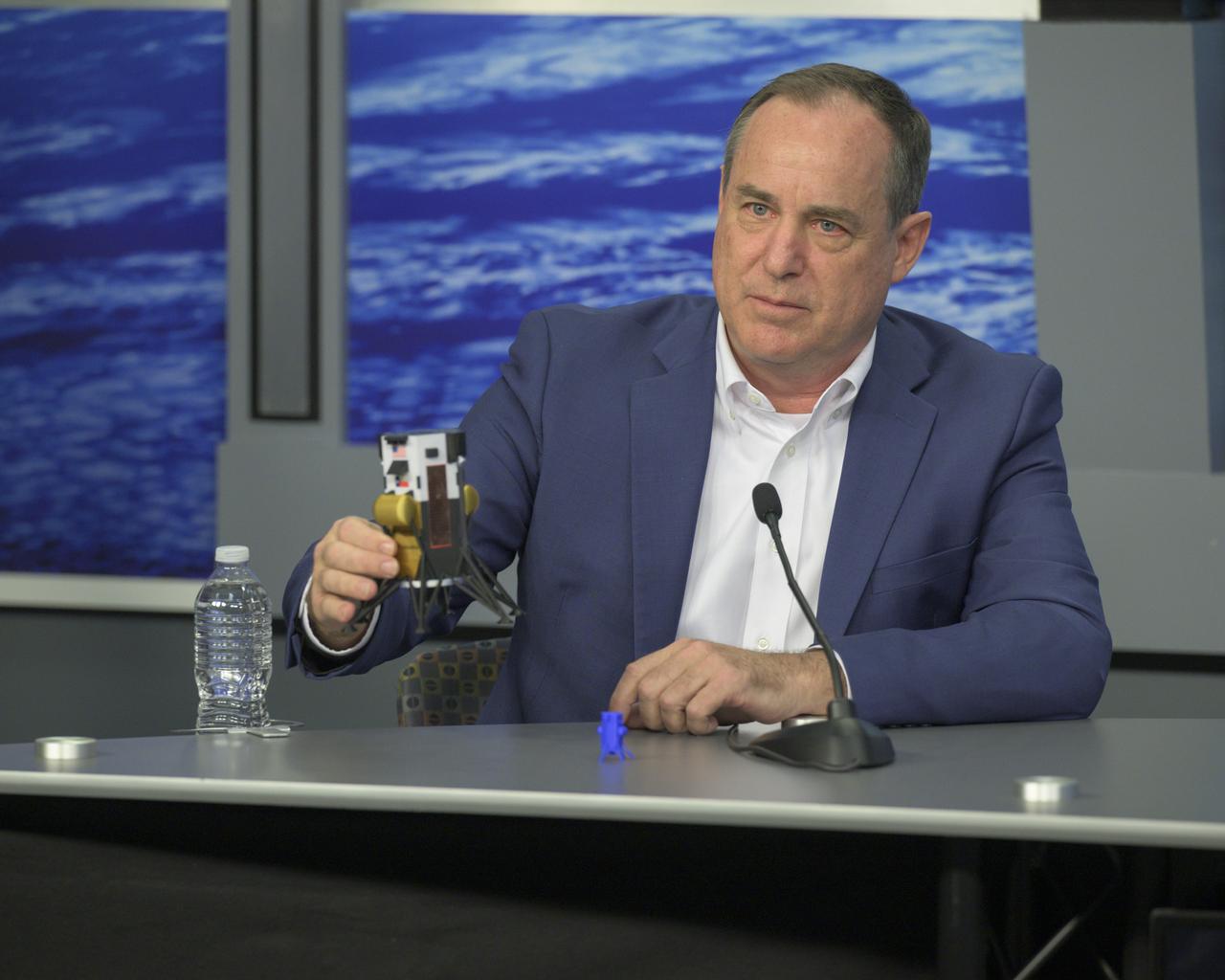
For the first time in more than 50 years, new NASA science instruments and technology demonstrations are operating on the Moon following the first successful delivery of the agency’s CLPS (Commercial Lunar Payload Services) initiative. Experts from NASA and Intuitive Machines hosted a news conference Feb. 23, 2024, at NASA’s Johnson Space Center in Houston to discuss the soft landing of the company’s Nova-C lander, called Odysseus. Participants in the briefing included (L-R): Steve Altemus, chief executive officer and co-founder, Intuitive Machines; Joel Kearns, deputy associate administrator for Exploration, Science Mission Directorate, NASA Headquarters in Washington; Tim Crain, chief technology officer and co-founder, Intuitive Machines; and Prasun Desai, deputy associate administrator, Space Technology Mission Directorate at NASA Headquarters. Photo Credit: NASA/Robert Markowitz
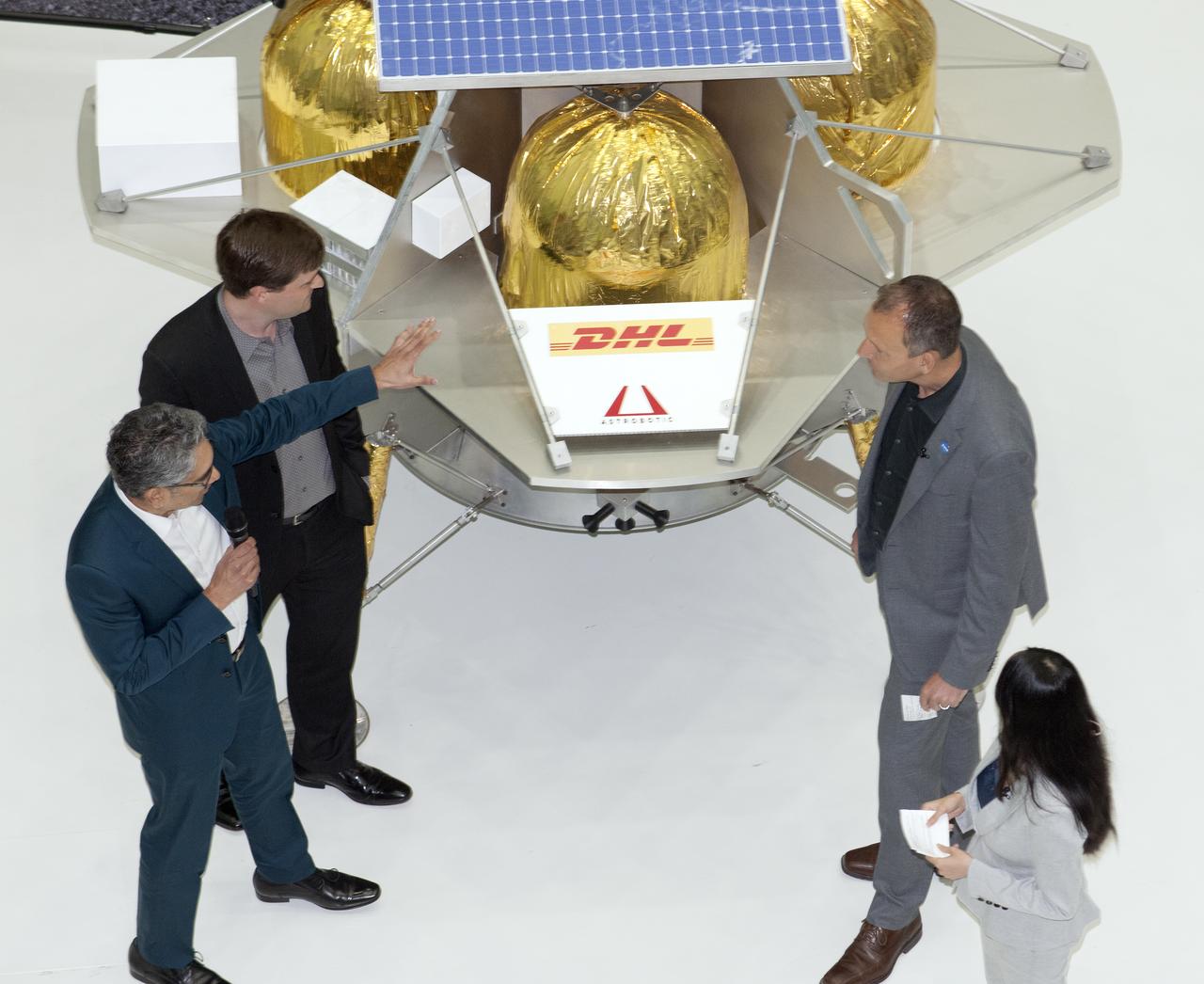
Commercial Lunar Payload Services Announcement was made at Goddard May 31, 2019. Tom Zurbuchen, AA Science Mission Directorate, congratulated three companies for providing lunar landers for Artermis: Astrobotic, Intuitive Machines, and OrbitBeyond
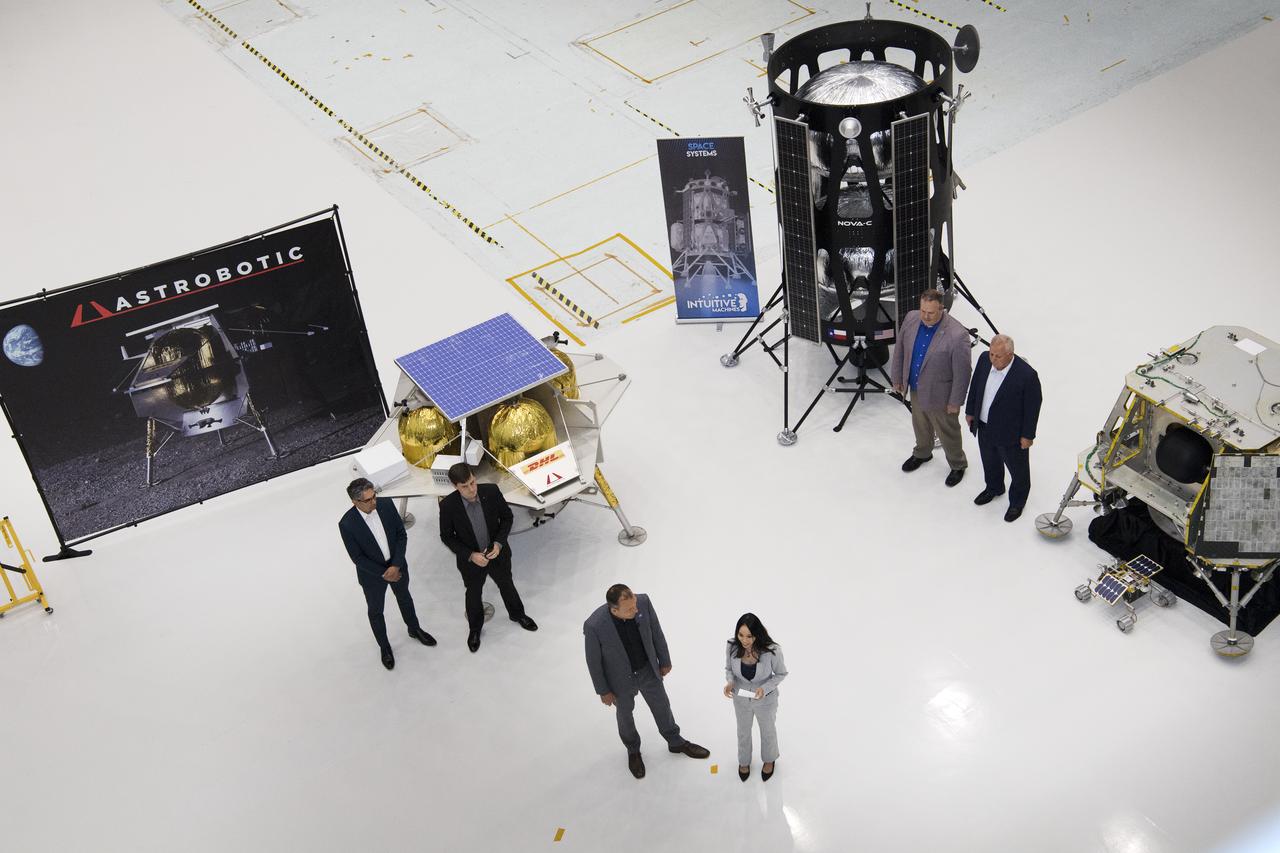
Commercial Lunar Payload Services Announcemnt was made at Goddard May 31, 2019. Tom Zurbuchen- AA Science Mission Directorate, congratulated three companies for providing lunar landers for Artemis: Astrobotic, Intuitive Machines and OrbitBeyond.
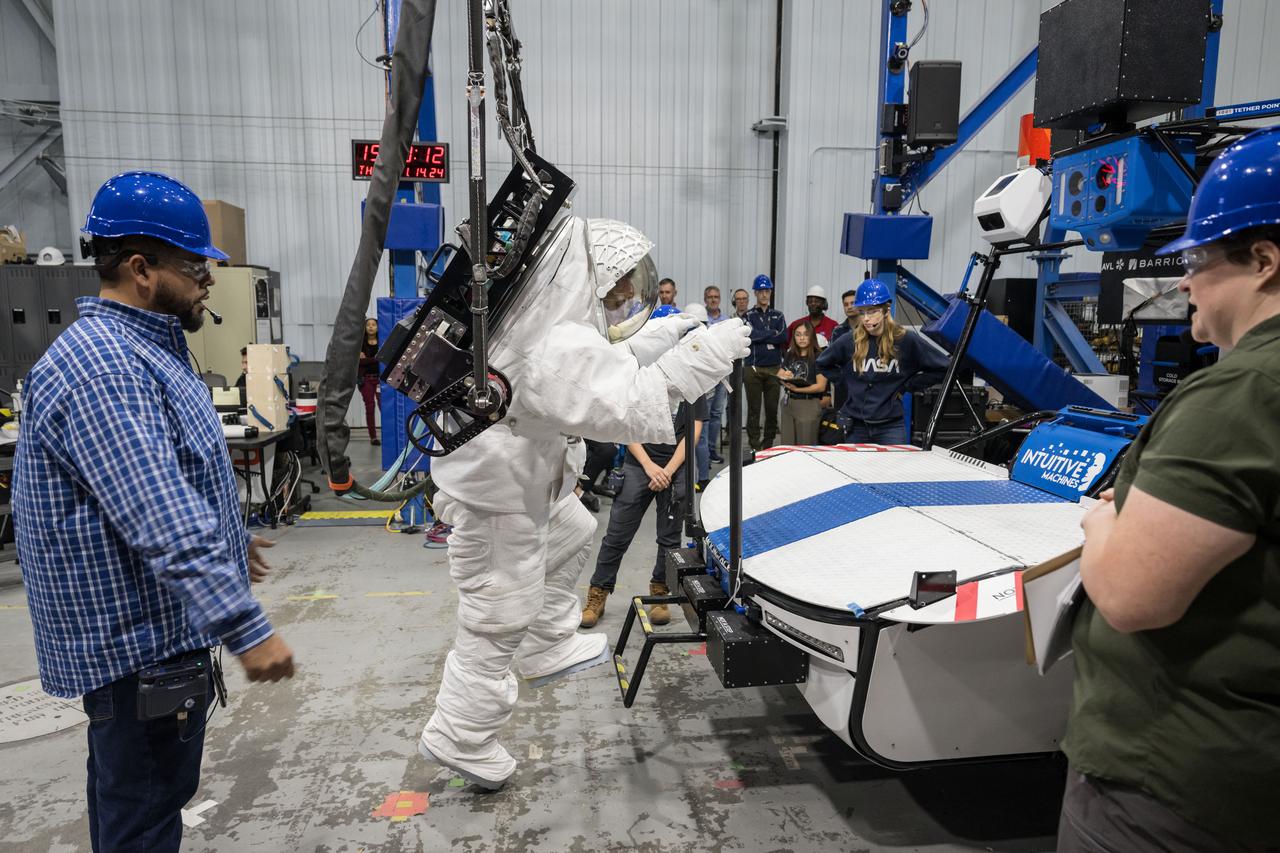
NASA astronaut Joe Acaba prepares to climb on top of Intuitive Machines’ Moon RACER lunar terrain vehicle to get to a science payload during testing at NASA’s Johnson Space Center. Image Credit: NASA/Josh Valcarcel
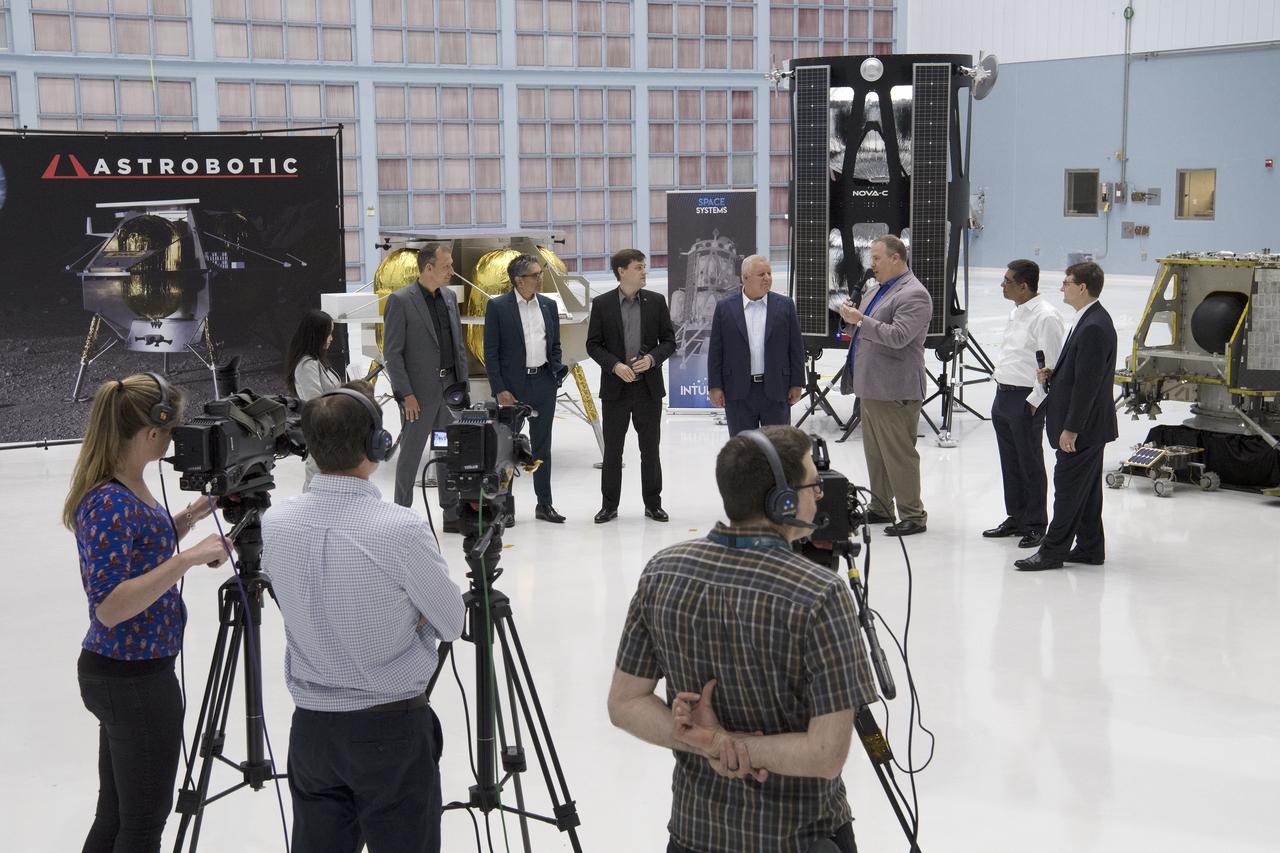
Lunar Commericial Payload Services Announcement was made at Godddard May 31, 2019. Tom Zurbuchen, AA Science Mission Directorate congratulated three companies for providing first lunar landers for Artemis: Astrobotic, Intuitive Machines and OrbitBeyond
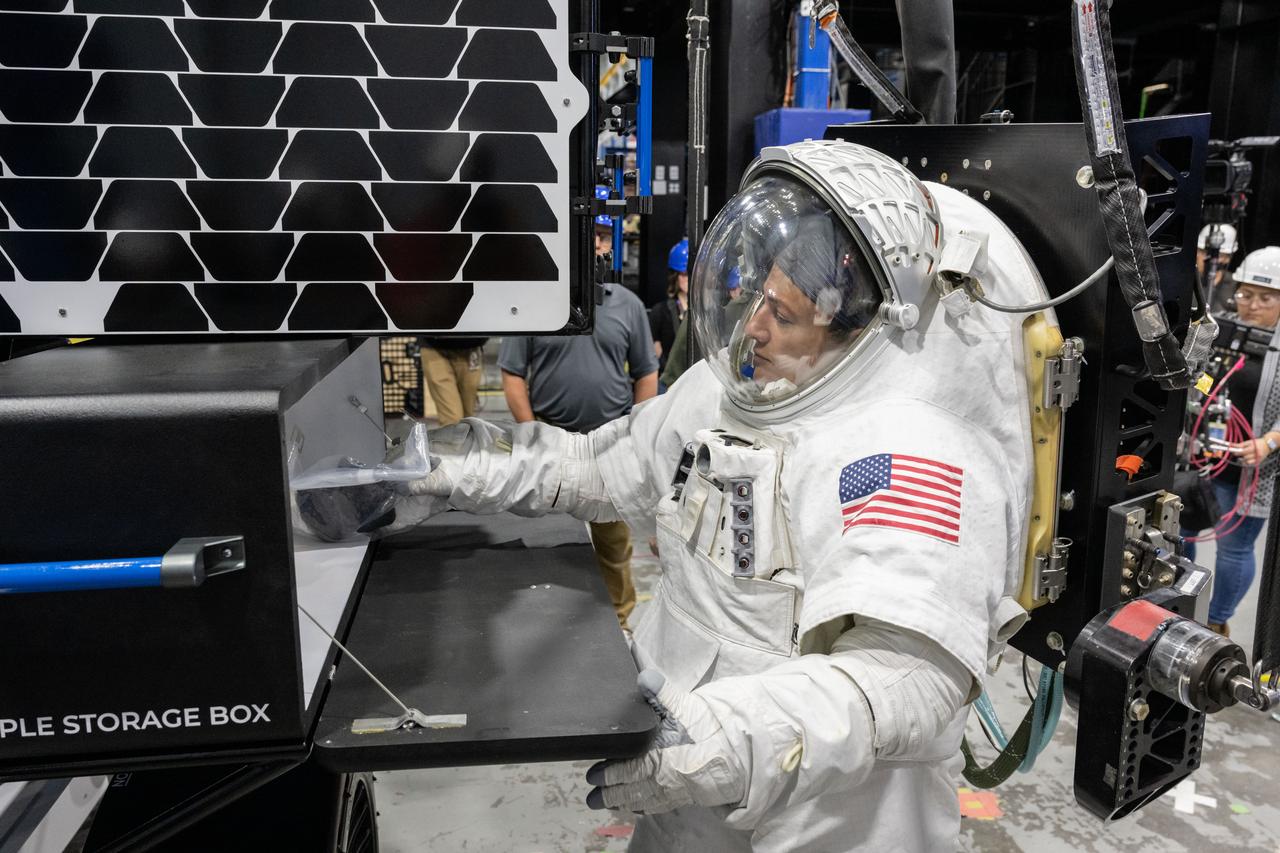
NASA astronaut Jessica Meir puts a science sample inside of a storage box on Intuitive Machines’ Moon RACER lunar terrain vehicle during testing at NASA’s Johnson Space Center. Image Credit: NASA/James Blair
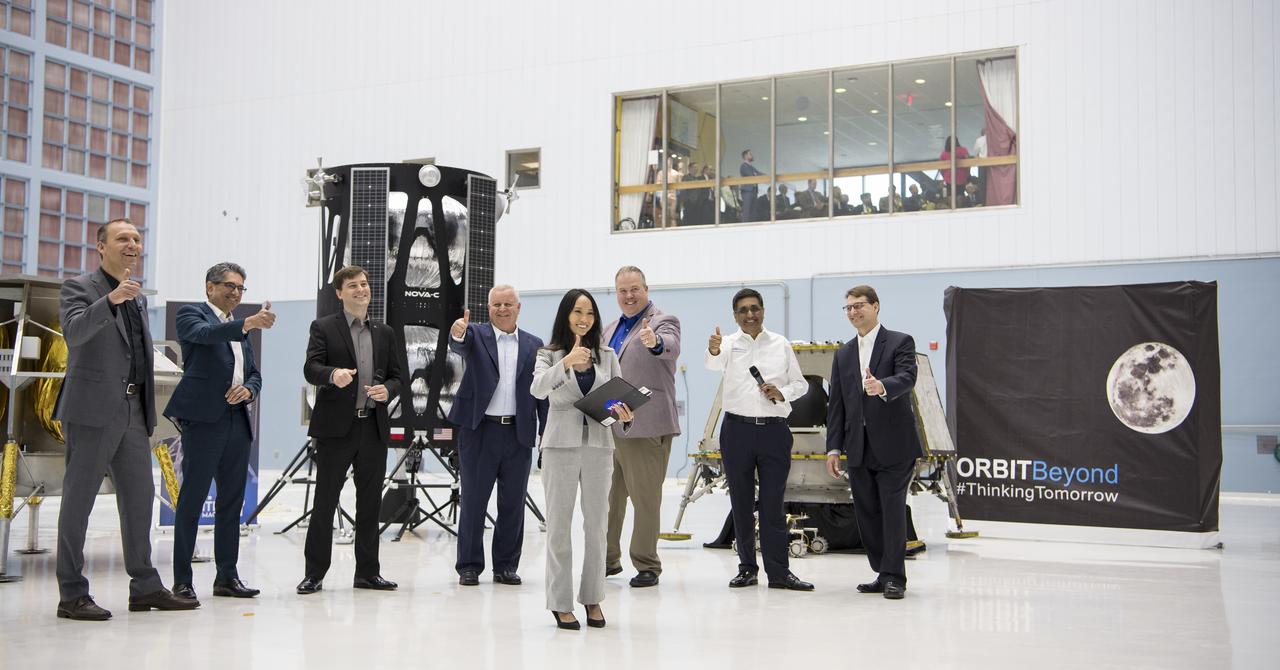
From left to right, NASA Associate Administrator, Science Mission Directorate, Thomas Zurbuchen; Astrobotic Mission Director, Sharad Bhaskaran; Astrobotic CEO, John Thornton; Chairman of the Board of Intuitive Machines, Kam Ghaffarian; VP of Research and Development of Intuitive Machines, Tim Crain; President and CEO of OrbitBeyond, Siba Padhi; Chief Science Officer, OrbitBeyond, Jon Morse; and NASA Press Officer, Felicia Chou, front center, put their thumbs up at the conclusion of an event announcing the companies that will provide the first lunar landers for the Artemis program's lunar surface exploration, Friday, May 31, 2019, at Goddard Space Flight Center in Md. Photo credit: (NASA/Aubrey Gemignani)
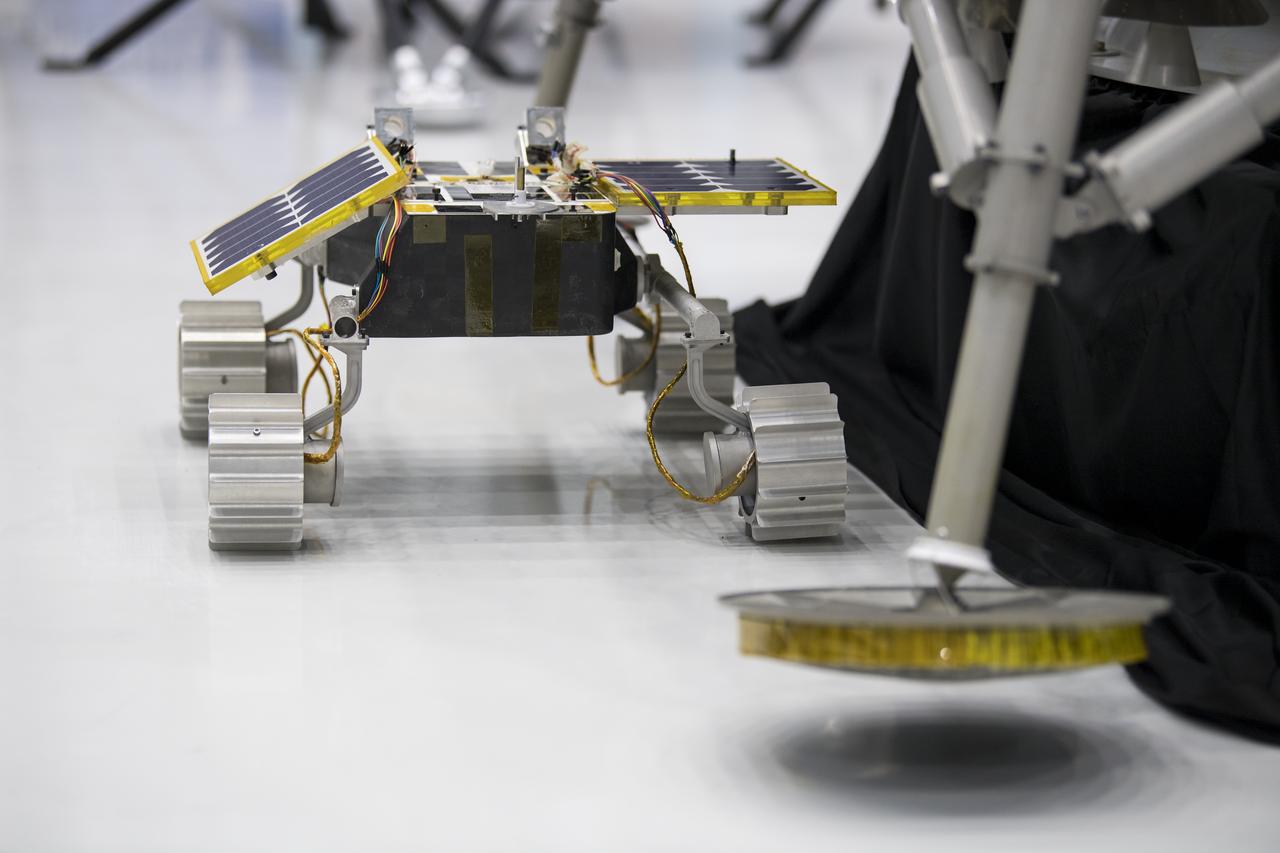
The OrbitBeyond lunar rover is seen, Friday, May 31, 2019, at Goddard Space Flight Center in Md. Astrobotic, Intuitive Machines, and OrbitBeyond have been selected to provide the first lunar landers for the Artemis program's lunar surface exploration. Photo credit: (NASA/Aubrey Gemignani)
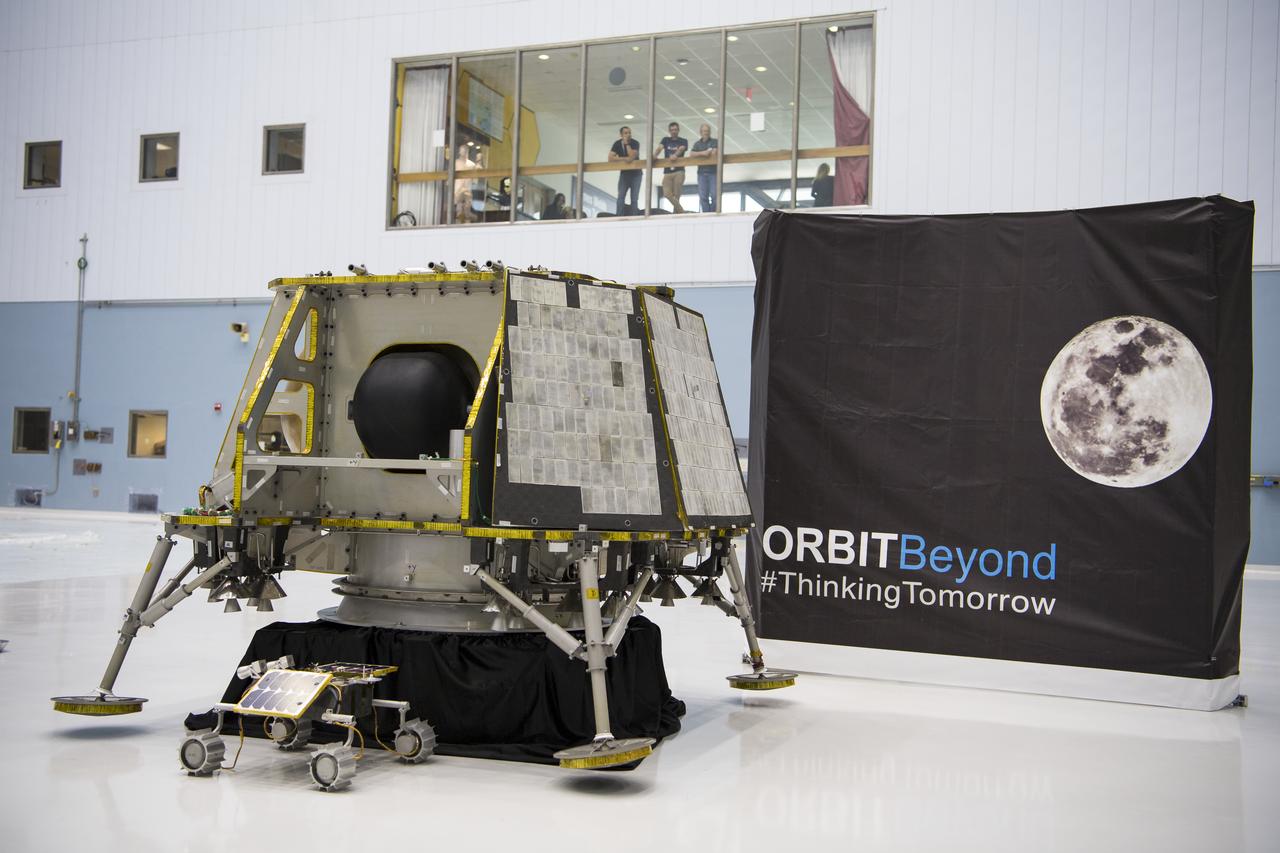
The OrbitBeyond lunar lander is seen, Friday, May 31, 2019, at Goddard Space Flight Center in Md. Astrobotic, Intuitive Machines, and OrbitBeyond have been selected to provide the first lunar landers for the Artemis program's lunar surface exploration. Photo credit: (NASA/Aubrey Gemignani)
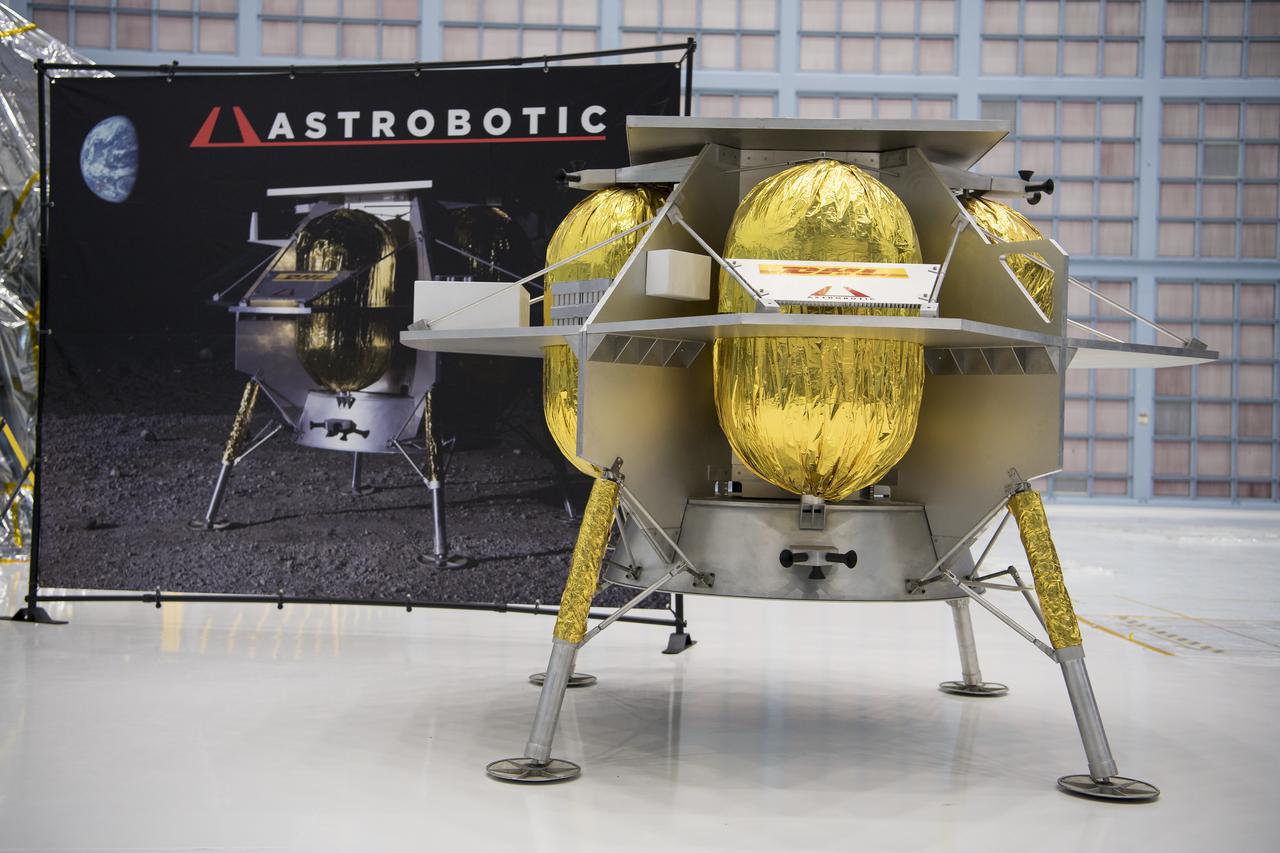
The Astrobotic lunar lander is seen, Friday, May 31, 2019, at Goddard Space Flight Center in Md. Astrobotic, Intuitive Machines, and OrbitBeyond have been selected to provide the first lunar landers for the Artemis program's lunar surface exploration. Photo credit: (NASA/Aubrey Gemignani)
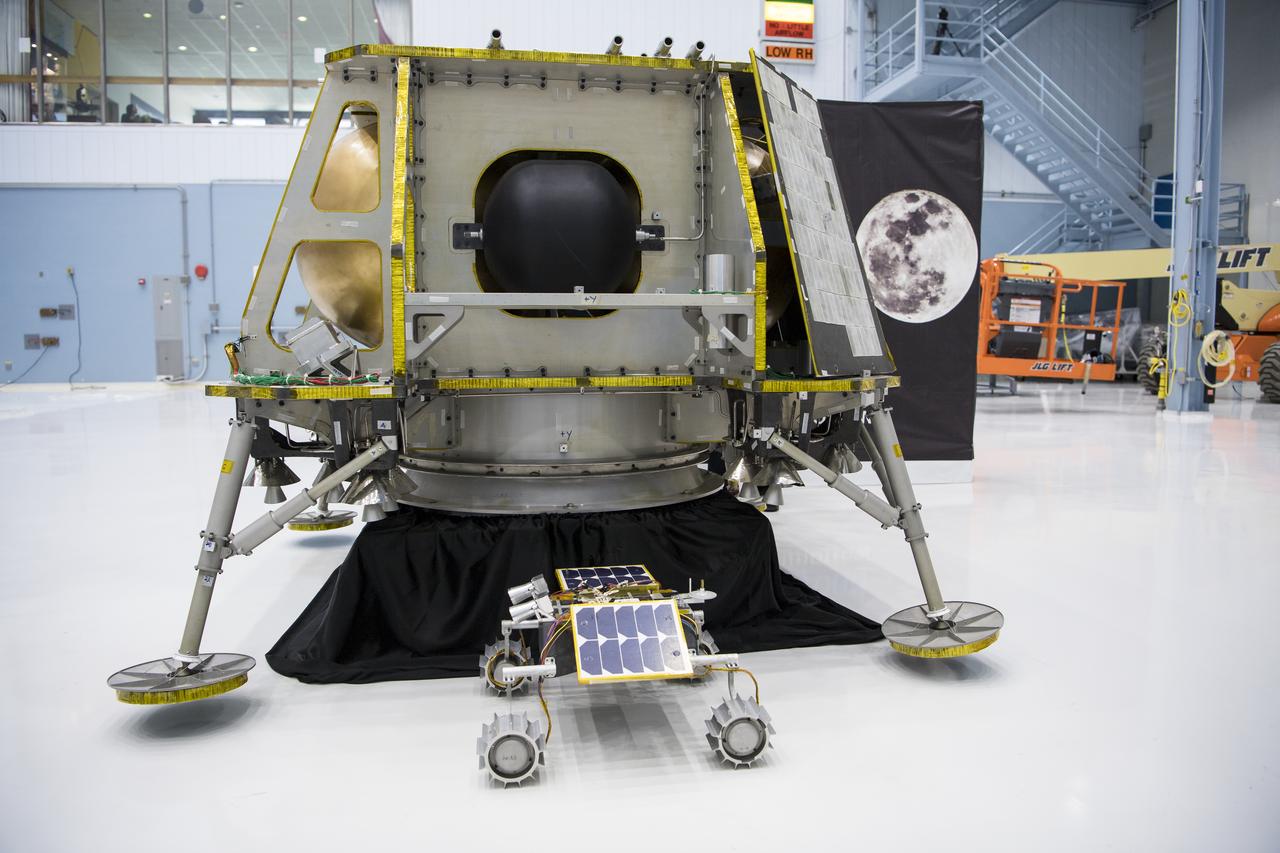
The OrbitBeyond lunar lander is seen, Friday, May 31, 2019, at Goddard Space Flight Center in Md. Astrobotic, Intuitive Machines, and OrbitBeyond have been selected to provide the first lunar landers for the Artemis program's lunar surface exploration. Photo credit: (NASA/Aubrey Gemignani)
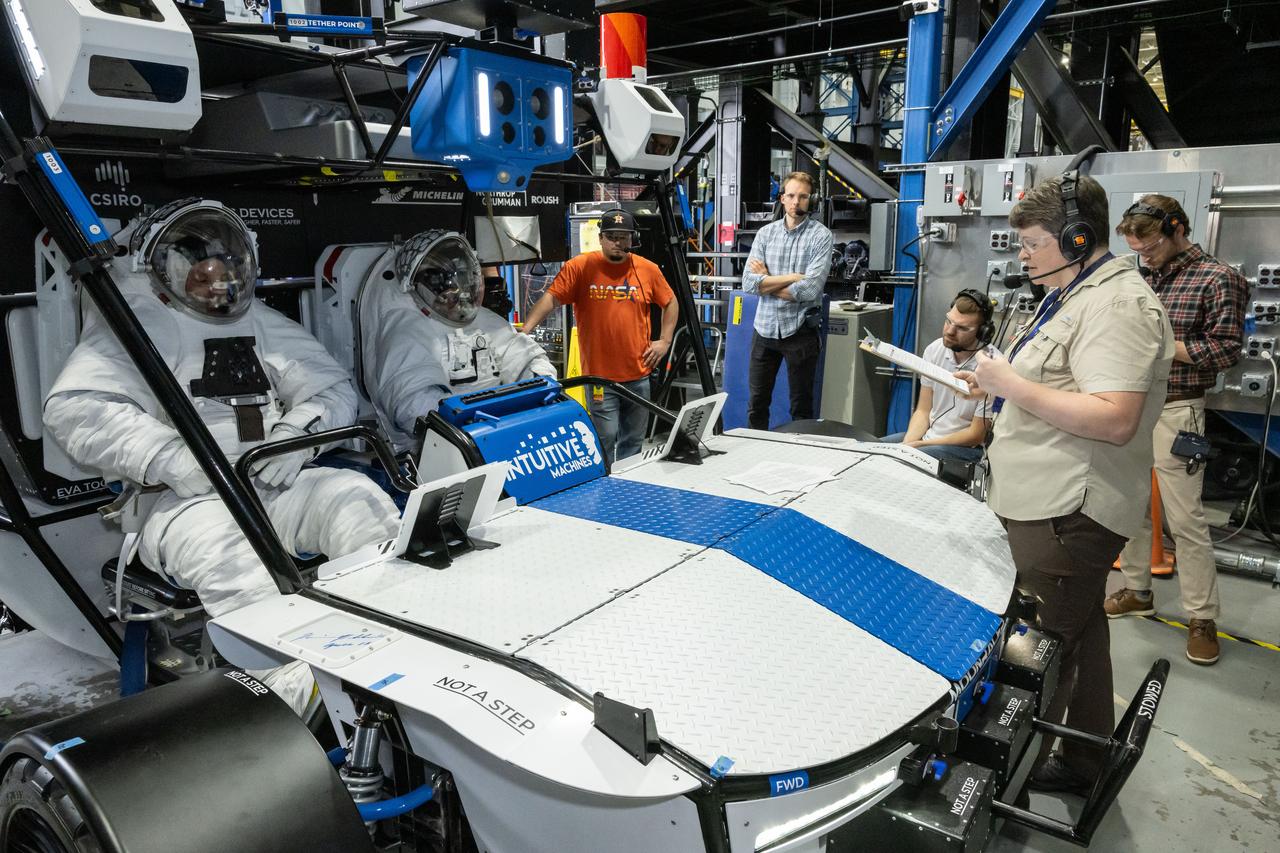
NASA engineer Dave Coan (left) and NASA astronaut Jessica Watkins (right) sit inside Intuitive Machines’ Moon RACER lunar terrain vehicle evaluating the crew compartment during testing at NASA’s Johnson Space Center. Image Credit: NASA/James Blair
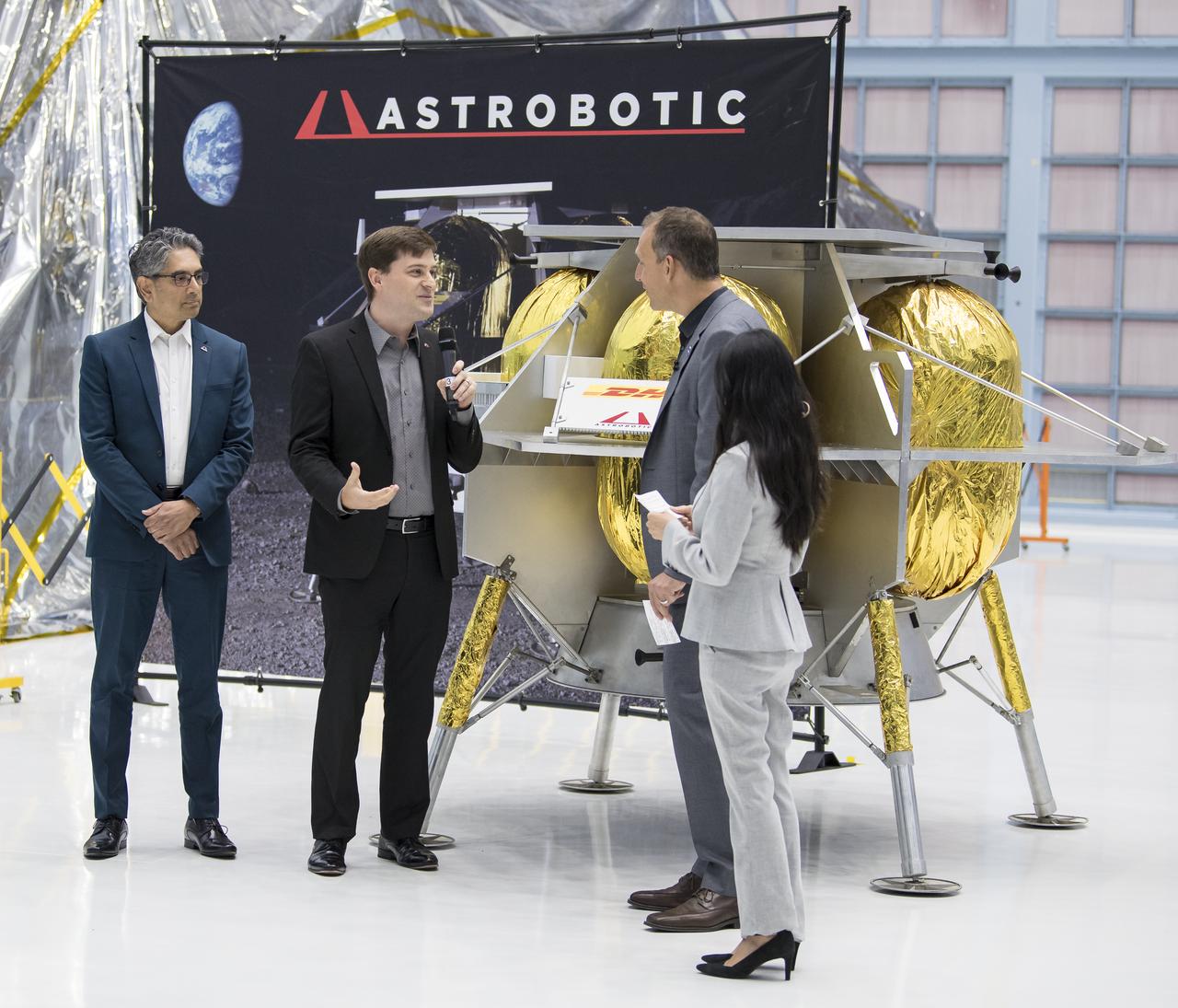
NASA Associate Administrator, Science Mission Directorate, Thomas Zurbuchen, second from right, speaks to Astrobotic CEO, John Thornton, second from left, and Astrobotic Mission Director, Sharad Bhaskaran, left, about their lunar lander, Friday, May 31, 2019, at Goddard Space Flight Center in Md. Astrobotic, Intuitive Machines, and Orbit Beyond have been selected to provide the first lunar landers for the Artemis program's lunar surface exploration. Photo credit: (NASA/Aubrey Gemignani)
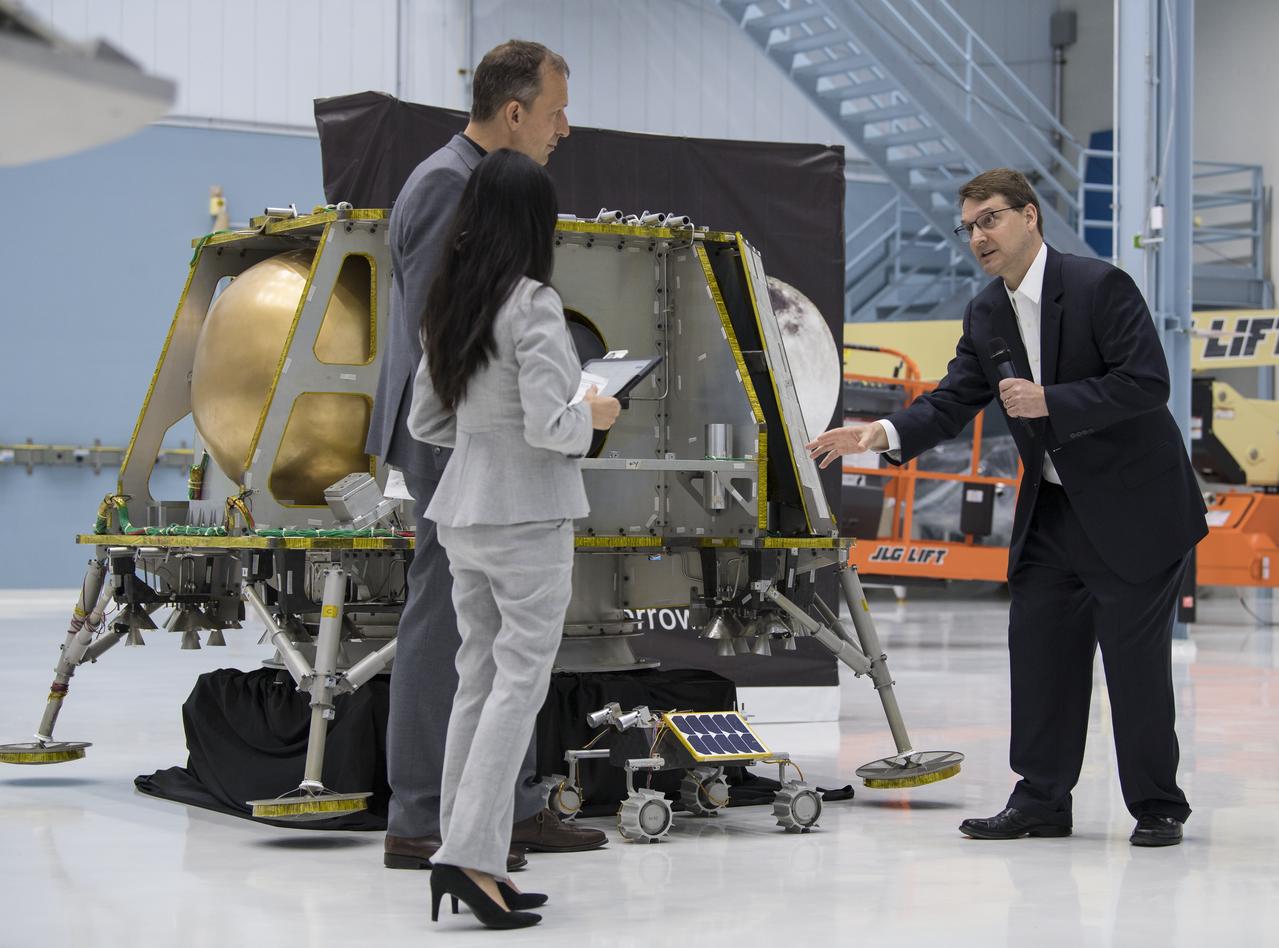
NASA Associate Administrator, Science Mission Directorate, Thomas Zurbuchen, second left, listens as Chief Science Officer, OrbitBeyond, Jon Morse, speaks about their lunar lander, Friday, May 31, 2019, at Goddard Space Flight Center in Md. Astrobotic, Intuitive Machines, and OrbitBeyond have been selected to provide the first lunar landers for the Artemis program's lunar surface exploration. Photo credit: (NASA/Aubrey Gemignani)
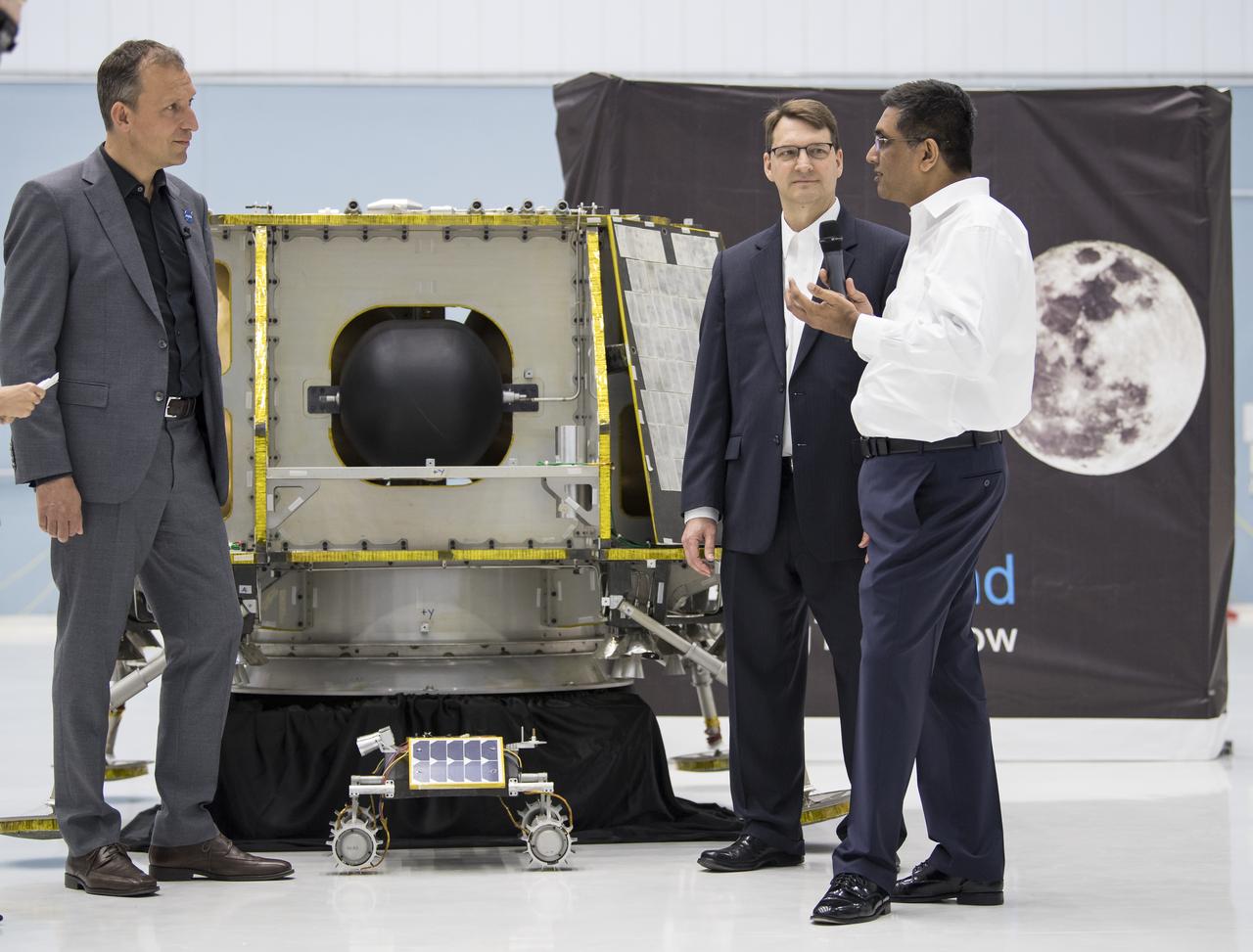
NASA Associate Administrator, Science Mission Directorate, Thomas Zurbuchen, left, speaks to, President and CEO of OrbitBeyond, Siba Padhi, right, and Chief Science Officer, OrbitBeyond, Jon Morse, about their lunar lander, Friday, May 31, 2019, at Goddard Space Flight Center in Md. Astrobotic, Intuitive Machines, and Orbit Beyond have been selected to provide the first lunar landers for the Artemis program's lunar surface exploration. Photo credit: (NASA/Aubrey Gemignani)

NASA Press Officer Felicia Chou, introduces a pre-recorded video announcement by NASA Administrator Jim Bridenstine about the companies selected to provide the first commercial lunar landers, Friday, May 31, 2019, at Goddard Space Flight Center in Md. Intuitive Machines, Astrobotic, and Orbit Beyond have been selected to provide the first lunar landers for the Artemis program's lunar surface exploration. Photo credit: (NASA/Aubrey Gemignani)
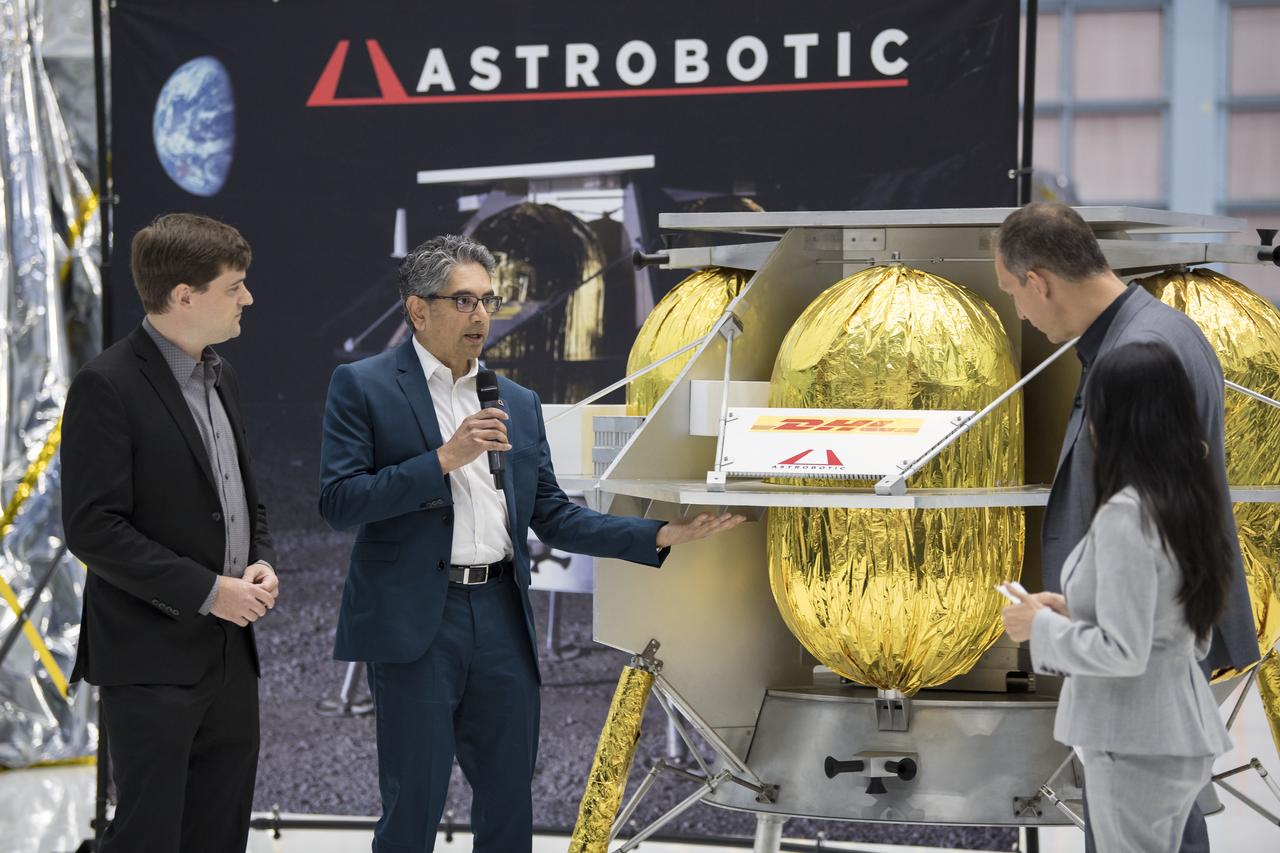
NASA Associate Administrator, Science Mission Directorate, Thomas Zurbuchen, second from right, speaks to Astrobotic CEO, John Thornton, left, and Astrobotic Mission Director, Sharad Bhaskaran, second from left, about their lunar lander, Friday, May 31, 2019, at Goddard Space Flight Center in Md. Astrobotic, Intuitive Machines, and Orbit Beyond have been selected to provide the first lunar landers for the Artemis program's lunar surface exploration. Photo credit: (NASA/Aubrey Gemignani)
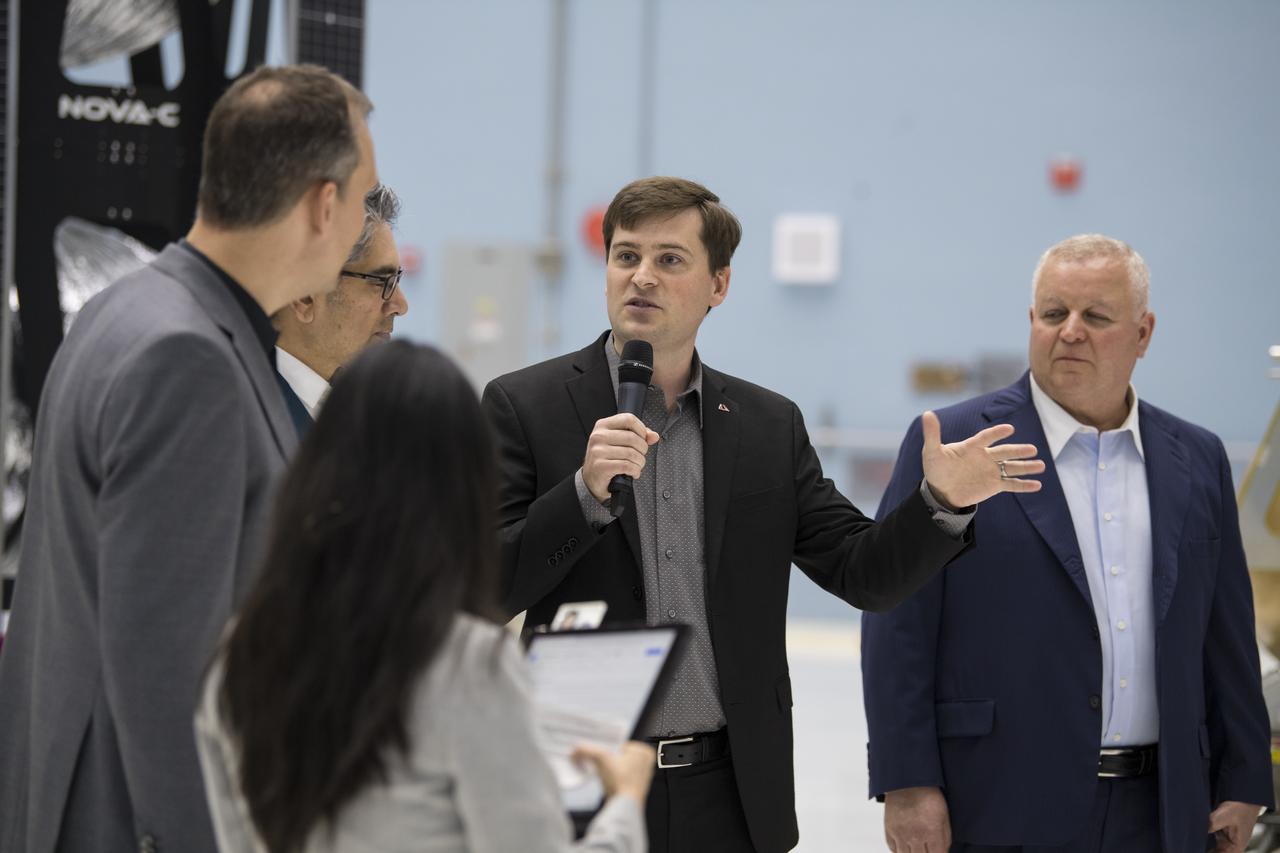
Astrobotic CEO, John Thornton, second from right, speaks about their lunar lander, Friday, May 31, 2019, at Goddard Space Flight Center in Md. Astrobotic, Intuitive Machines, and Orbit Beyond have been selected to provide the first lunar landers for the Artemis program's lunar surface exploration. Photo credit: (NASA/Aubrey Gemignani)
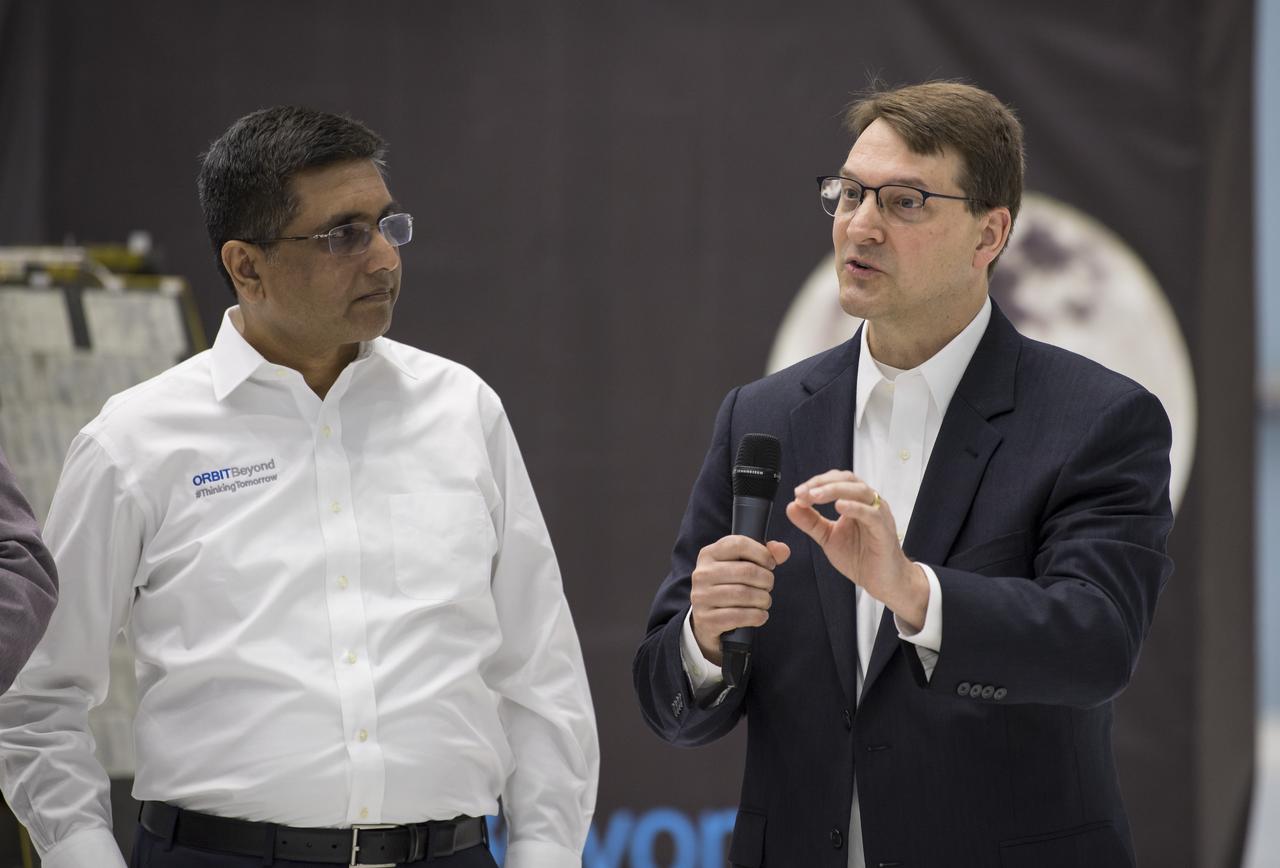
President and CEO of OrbitBeyond, Siba Padhi, left, and Chief Science Officer, OrbitBeyond, Jon Morse, speak about their lunar lander, Friday, May 31, 2019, at Goddard Space Flight Center in Md. Astrobotic, Intuitive Machines, and Orbit Beyond have been selected to provide the first lunar landers for the Artemis program's lunar surface exploration. Photo credit: (NASA/Aubrey Gemignani)
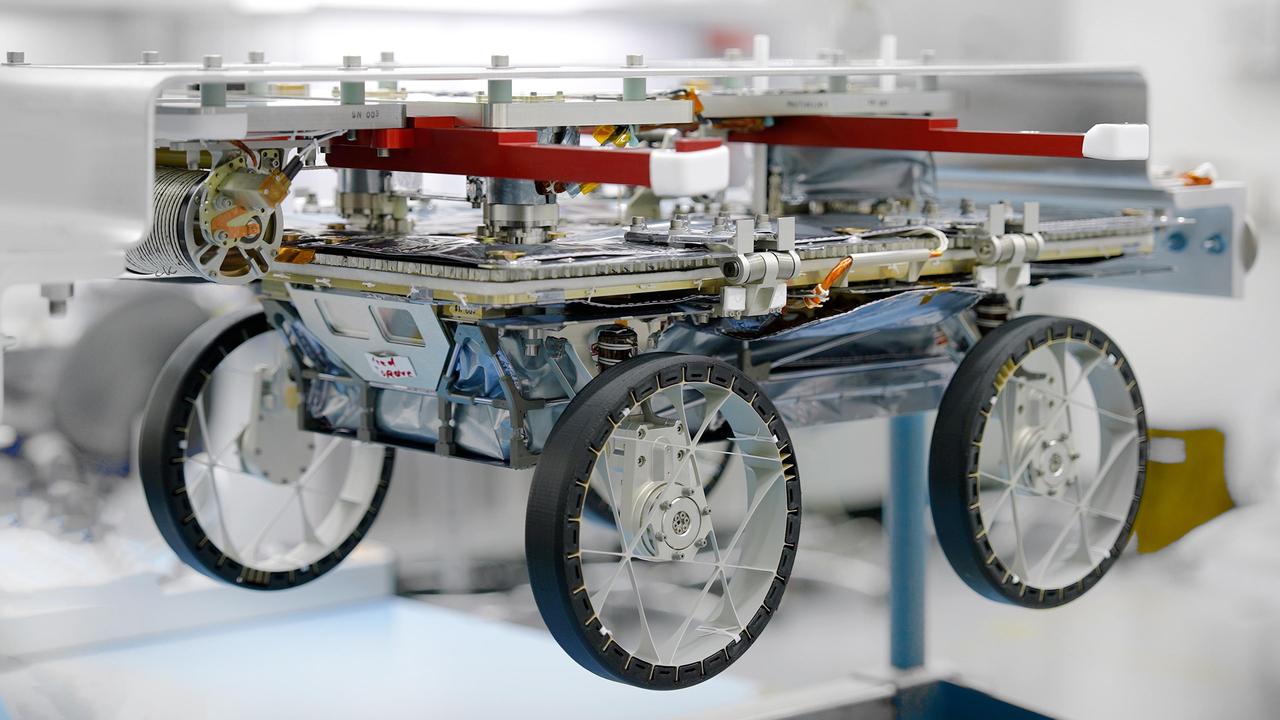
One of three small lunar rovers that are part of a NASA technology demonstration called CADRE (Cooperative Autonomous Distributed Robotic Exploration) is attached to a fixture in a clean room at the agency's Jet Propulsion Laboratory in Southern California on Jan. 29, 2025. Less than two weeks later, the rover had been packed up and shipped off in preparation for launch. CADRE aims to prove that a group of robots can collaborate to gather data without receiving direct commands from mission controllers on Earth. Its trio of rovers will use their cameras and ground-penetrating radars to send back imagery of the lunar surface and subsurface while testing out the novel software systems that enable them to work together as a team autonomously. Before embarking on the first leg of a multistage journey to the Moon, each rover was mated to its deployer system, which will lower it via tether from an Intuitive Machines lander onto the dusty lunar surface. Engineers flipped each rover-deployer pair over and attached it to an aluminum plate for safe transit. The rovers were then sealed into protective metal-frame enclosures that were fitted snuggly into metal shipping containers and loaded onto a truck for the drive to Intuitive Machines' Houston facility. A division of Caltech in Pasadena, California, JPL manages CADRE for the Game Changing Development program within NASA's Space Technology Mission Directorate in Washington. The technology demonstration was selected under the agency's Lunar Surface Innovation Initiative, which was established to expedite the development of technologies for sustained presence on the lunar surface. CADRE will launch as a payload on the third lunar lander mission by Intuitive Machines, called IM-3, under NASA's CLPS (Commercial Lunar Payload Services) initiative, which is managed by the agency's Science Mission Directorate, also in Washington. The agency's Glenn Research Center in Cleveland and its Ames Research Center in Silicon Valley, California, both supported the project. Motiv Space Systems designed and built key hardware elements at the company's Pasadena facility. Clemson University in South Carolina contributed research in support of the project. For more about CADRE, go to: https://go.nasa.gov/cadre https://photojournal.jpl.nasa.gov/catalog/PIA26428
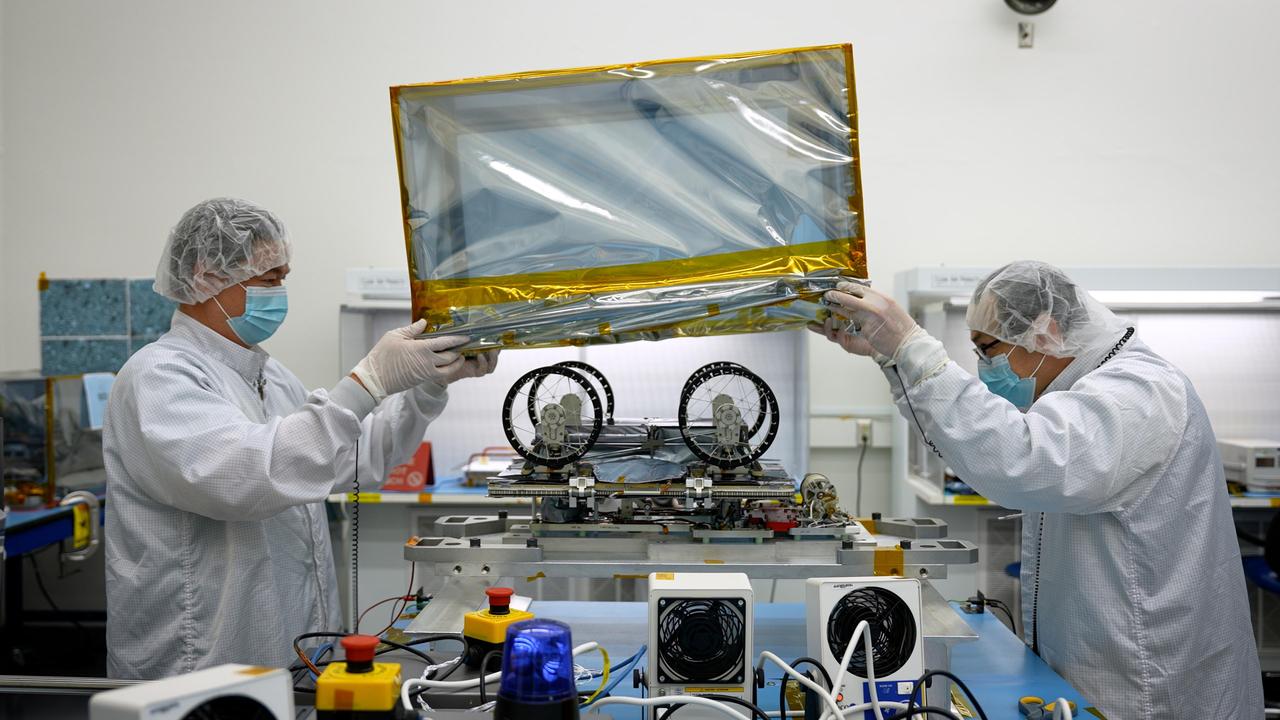
Engineers and technicians prepare one of three small lunar rovers that are part of a NASA technology demonstration called CADRE (Cooperative Autonomous Distributed Robotic Exploration). Mechanical engineer Kristopher Sherrill, left, and technician Leroy Montalvo lower an enclosure over the upside-down rover in a clean room at the agency's Jet Propulsion Laboratory in Southern California on Jan. 29, 2025. CADRE aims to prove that a group of robots can collaborate to gather data without receiving direct commands from mission controllers on Earth. Its trio of rovers will use their cameras and ground-penetrating radars to send back imagery of the lunar surface and subsurface while testing out the novel software systems that enable them to work together as a team autonomously. Before embarking on the first leg of a multistage journey to the Moon, each rover was mated to its deployer system, which will lower it via tether from an Intuitive Machines lander onto the dusty lunar surface. Engineers flipped each rover-deployer pair over and attached it to an aluminum plate for safe transit. The rovers were then sealed into protective metal-frame enclosures that were fitted snuggly into metal shipping containers and loaded onto a truck for the drive to Intuitive Machines' Houston facility. A division of Caltech in Pasadena, California, JPL manages CADRE for the Game Changing Development program within NASA's Space Technology Mission Directorate in Washington. The technology demonstration was selected under the agency's Lunar Surface Innovation Initiative, which was established to expedite the development of technologies for sustained presence on the lunar surface. CADRE will launch as a payload on the third lunar lander mission by Intuitive Machines, called IM-3, under NASA's CLPS (Commercial Lunar Payload Services) initiative, which is managed by the agency's Science Mission Directorate, also in Washington. The agency's Glenn Research Center in Cleveland and its Ames Research Center in Silicon Valley, California, both supported the project. Motiv Space Systems designed and built key hardware elements at the company's Pasadena facility. Clemson University in South Carolina contributed research in support of the project. For more about CADRE, go to: https://go.nasa.gov/cadre https://photojournal.jpl.nasa.gov/catalog/PIA26426
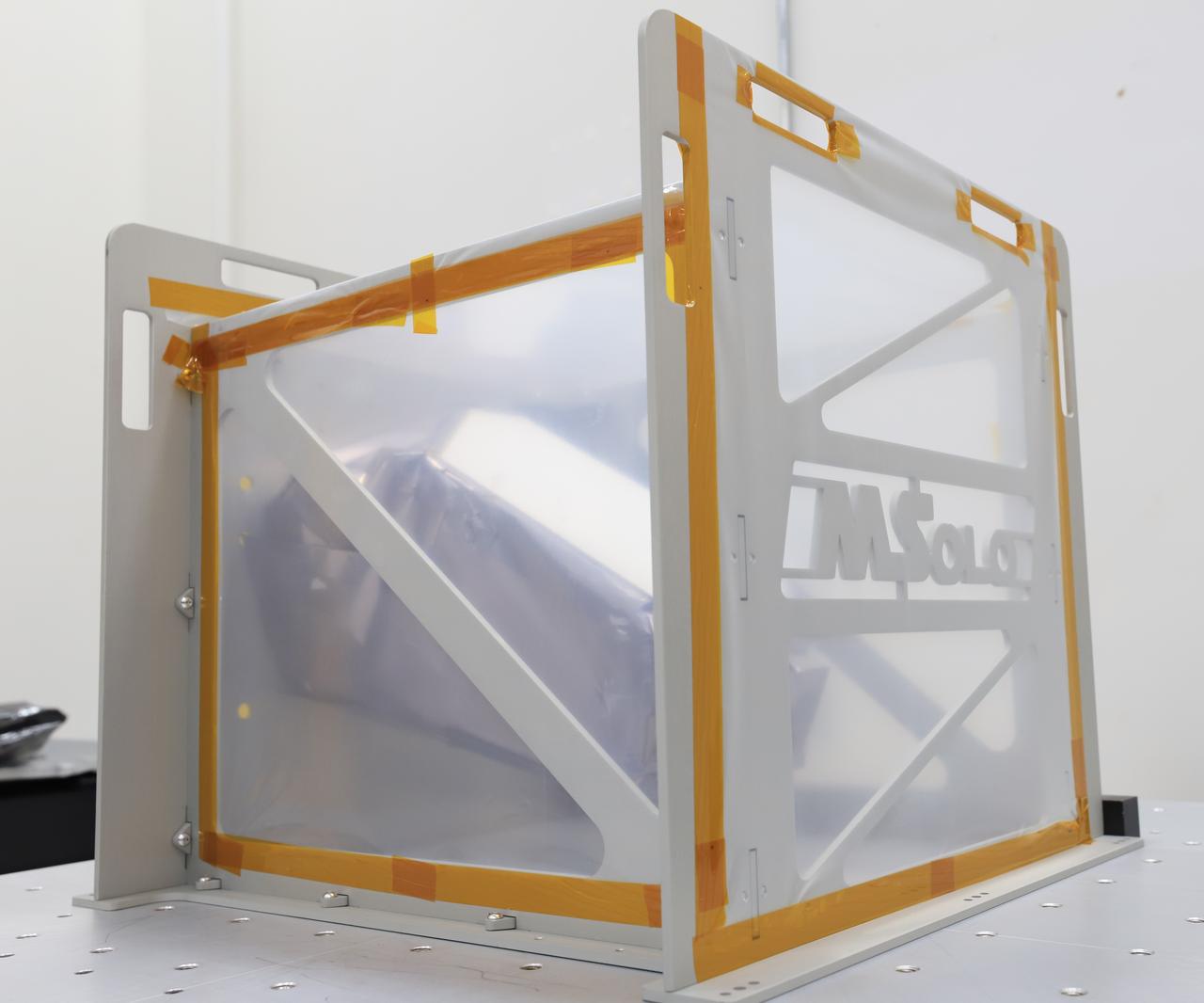
Engineers conduct a mass properties test on the Mass Spectrometer Observing Lunar Operations (MSolo) instrument inside Kennedy Space Center’s Space Station Processing Facility in Florida on Nov. 22, 2022. Mass properties determines the mass and center of gravity of the flight unit. The lander uses this information, from all payloads, to improve stability and performance of the lander – and to a lesser degree, the stability and performance of the rocket. This marks the end of testing at Kennedy for the Polar Resources Ice Mining Experiment-1 (PRIME-1) MSolo instrument. It will soon be shipped to Intuitive Machines in Houston for integration on the NOVA-C landing platform. Launching in 2023, the PRIME-1 mission will be the first in-situ resource utilization demonstration on the Moon.
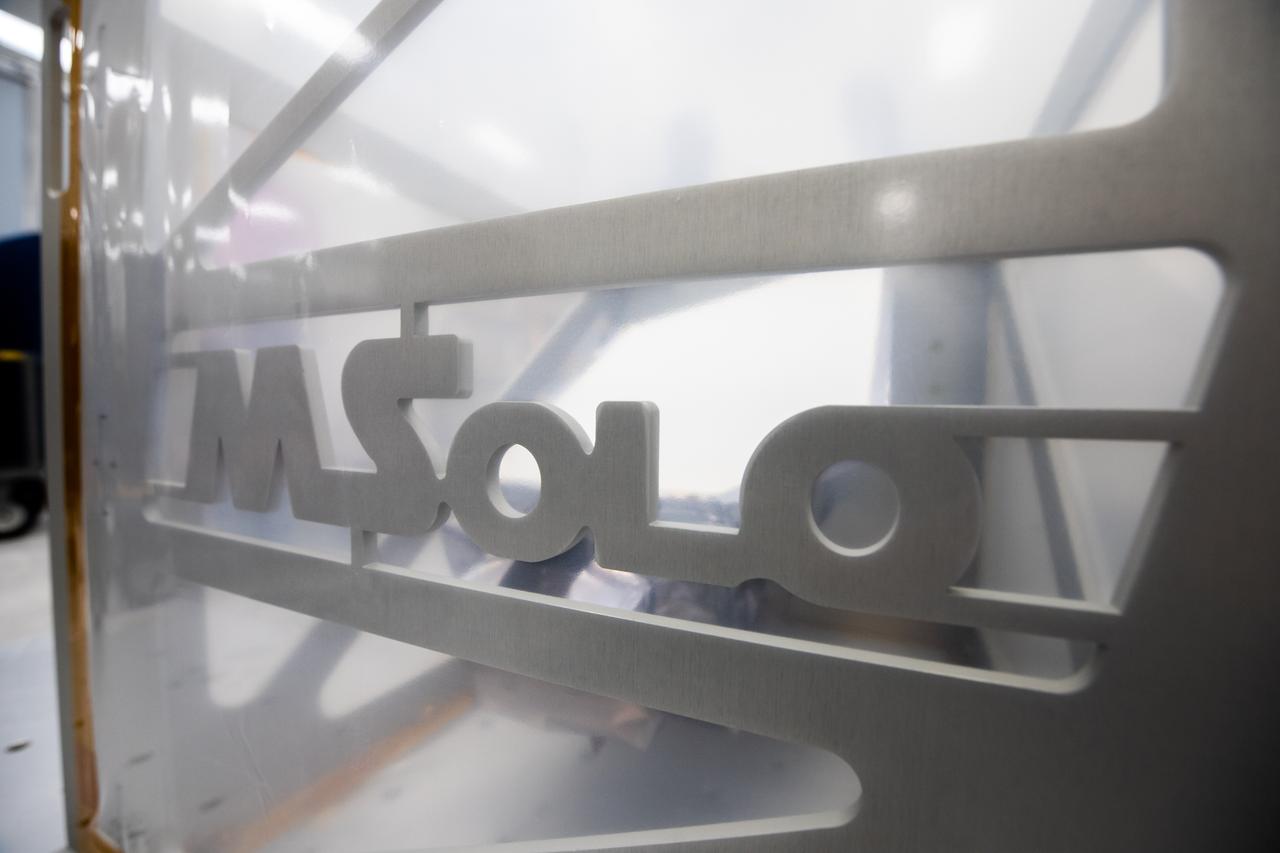
Engineers conduct a mass properties test on the Mass Spectrometer Observing Lunar Operations (MSolo) instrument inside Kennedy Space Center’s Space Station Processing Facility in Florida on Nov. 22, 2022. Mass properties determines the mass and center of gravity of the flight unit. The lander uses this information, from all payloads, to improve stability and performance of the lander – and to a lesser degree, the stability and performance of the rocket. This marks the end of testing at Kennedy for the Polar Resources Ice Mining Experiment-1 (PRIME-1) MSolo instrument. It will soon be shipped to Intuitive Machines in Houston for integration on the NOVA-C landing platform. Launching in 2023, the PRIME-1 mission will be the first in-situ resource utilization demonstration on the Moon.
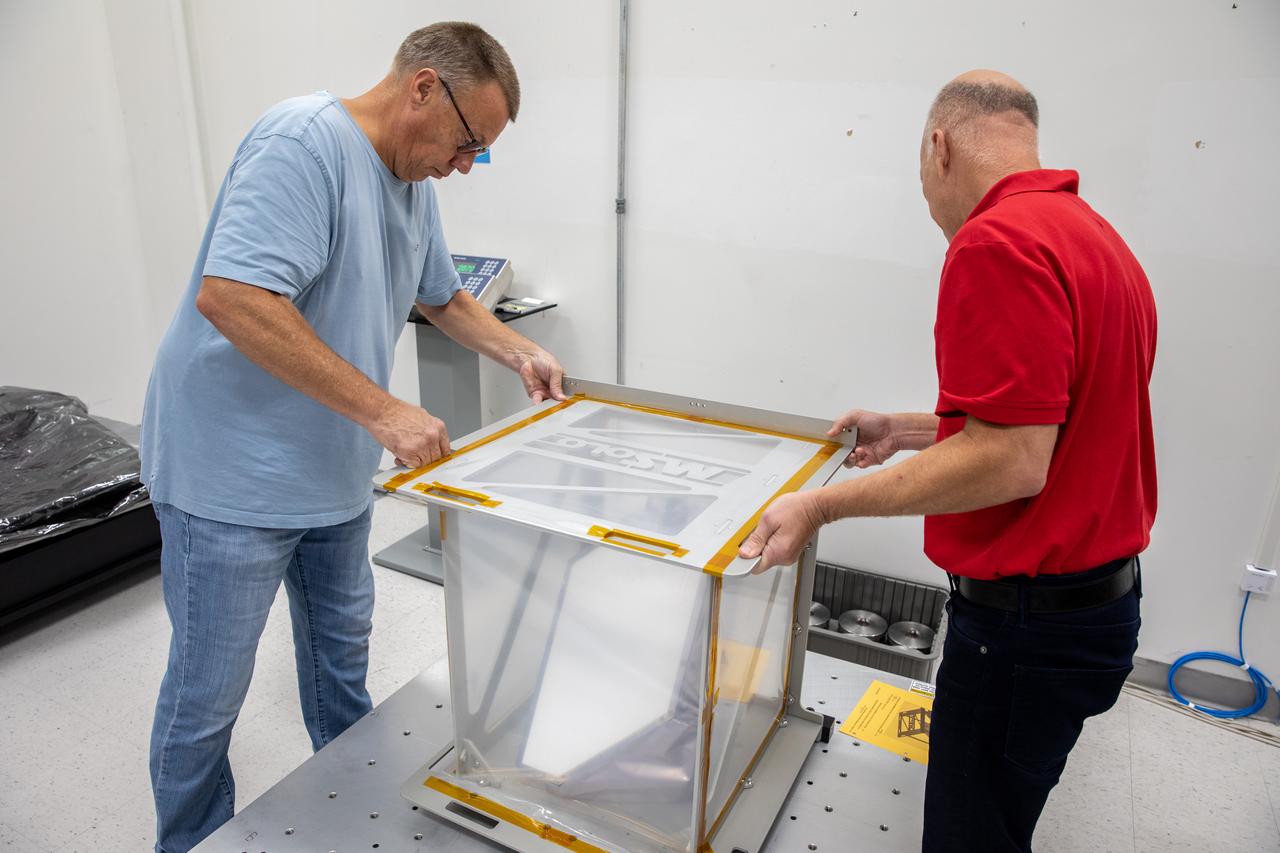
Engineers conduct a mass properties test on the Mass Spectrometer Observing Lunar Operations (MSolo) instrument inside Kennedy Space Center’s Space Station Processing Facility in Florida on Nov. 22, 2022. Mass properties determines the mass and center of gravity of the flight unit. The lander uses this information, from all payloads, to improve stability and performance of the lander – and to a lesser degree, the stability and performance of the rocket. This marks the end of testing at Kennedy for the Polar Resources Ice Mining Experiment-1 (PRIME-1) MSolo instrument. It will soon be shipped to Intuitive Machines in Houston for integration on the NOVA-C landing platform. Launching in 2023, the PRIME-1 mission will be the first in-situ resource utilization demonstration on the Moon.
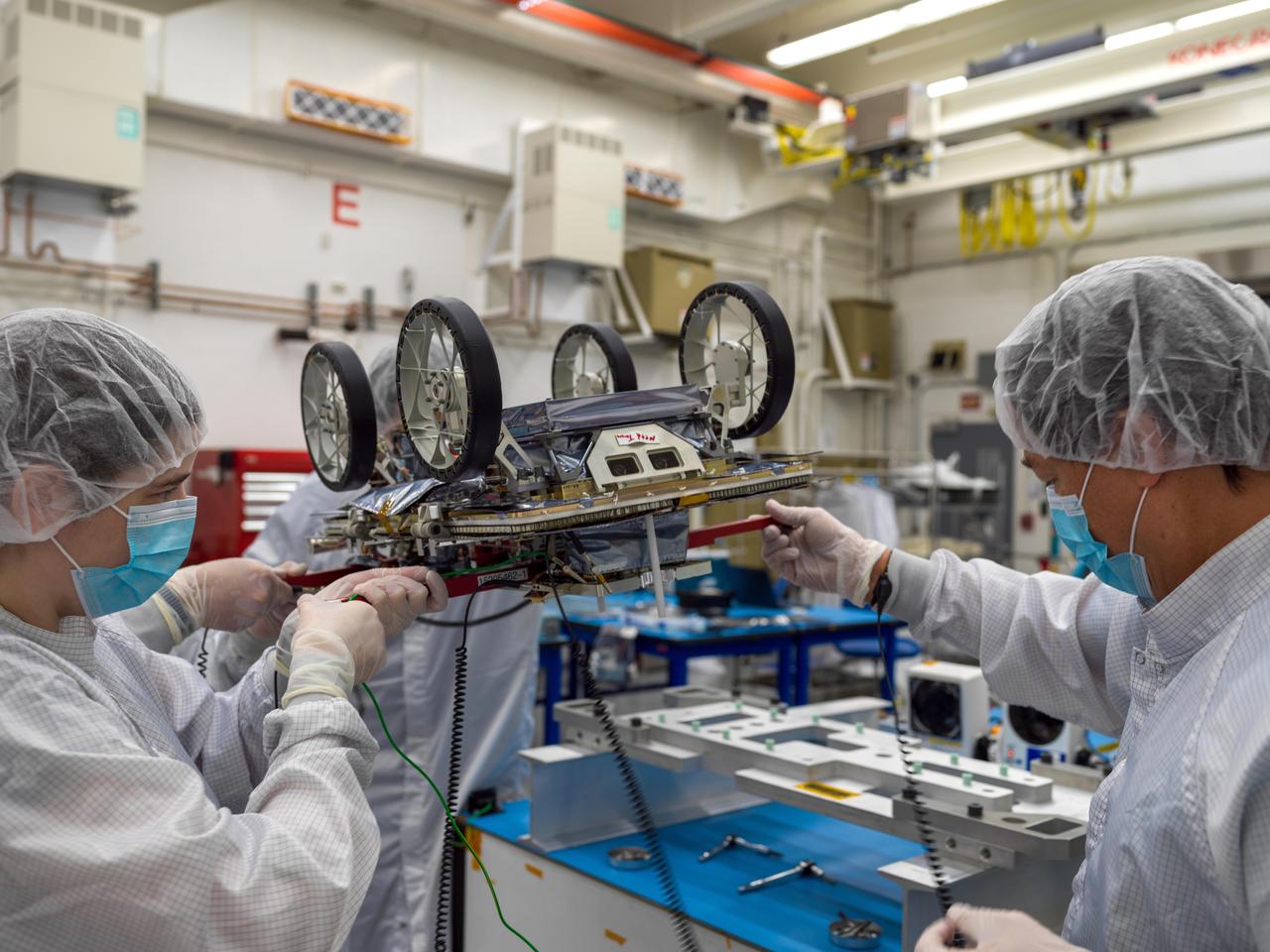
One of three small lunar rovers that are part of a NASA technology demonstration called CADRE (Cooperative Autonomous Distributed Robotic Exploration) is prepared for shipping in a clean room at the agency's Jet Propulsion Laboratory in Southern California on Jan. 29, 2025. CADRE aims to prove that a group of robots can collaborate to gather data without receiving direct commands from mission controllers on Earth. Its trio of rovers will use their cameras and ground-penetrating radars to send back imagery of the lunar surface and subsurface while testing out the novel software systems that enable them to work together as a team autonomously. Before embarking on the first leg of a multistage journey to the Moon, each rover was mated to its deployer system, which will lower it via tether from an Intuitive Machines lander onto the dusty lunar surface. Engineers flipped each rover-deployer pair over and attached it to an aluminum plate for safe transit. The rovers were then sealed into protective metal-frame enclosures that were fitted snuggly into metal shipping containers and loaded onto a truck for the drive to Intuitive Machines' Houston facility. Here, members of the project's assembly, test, and launch operations team hold the upside-down rover by temporary red handles in order to move it to a table where they'll attach it to the aluminum plate. A division of Caltech in Pasadena, California, JPL manages CADRE for the Game Changing Development program within NASA's Space Technology Mission Directorate in Washington. The technology demonstration was selected under the agency's Lunar Surface Innovation Initiative, which was established to expedite the development of technologies for sustained presence on the lunar surface. CADRE will launch as a payload on the third lunar lander mission by Intuitive Machines, called IM-3, under NASA's CLPS (Commercial Lunar Payload Services) initiative, which is managed by the agency's Science Mission Directorate, also in Washington. The agency's Glenn Research Center in Cleveland and its Ames Research Center in Silicon Valley, California, both supported the project. Motiv Space Systems designed and built key hardware elements at the company's Pasadena facility. Clemson University in South Carolina contributed research in support of the project. For more about CADRE, go to: https://go.nasa.gov/cadre https://photojournal.jpl.nasa.gov/catalog/PIA26427
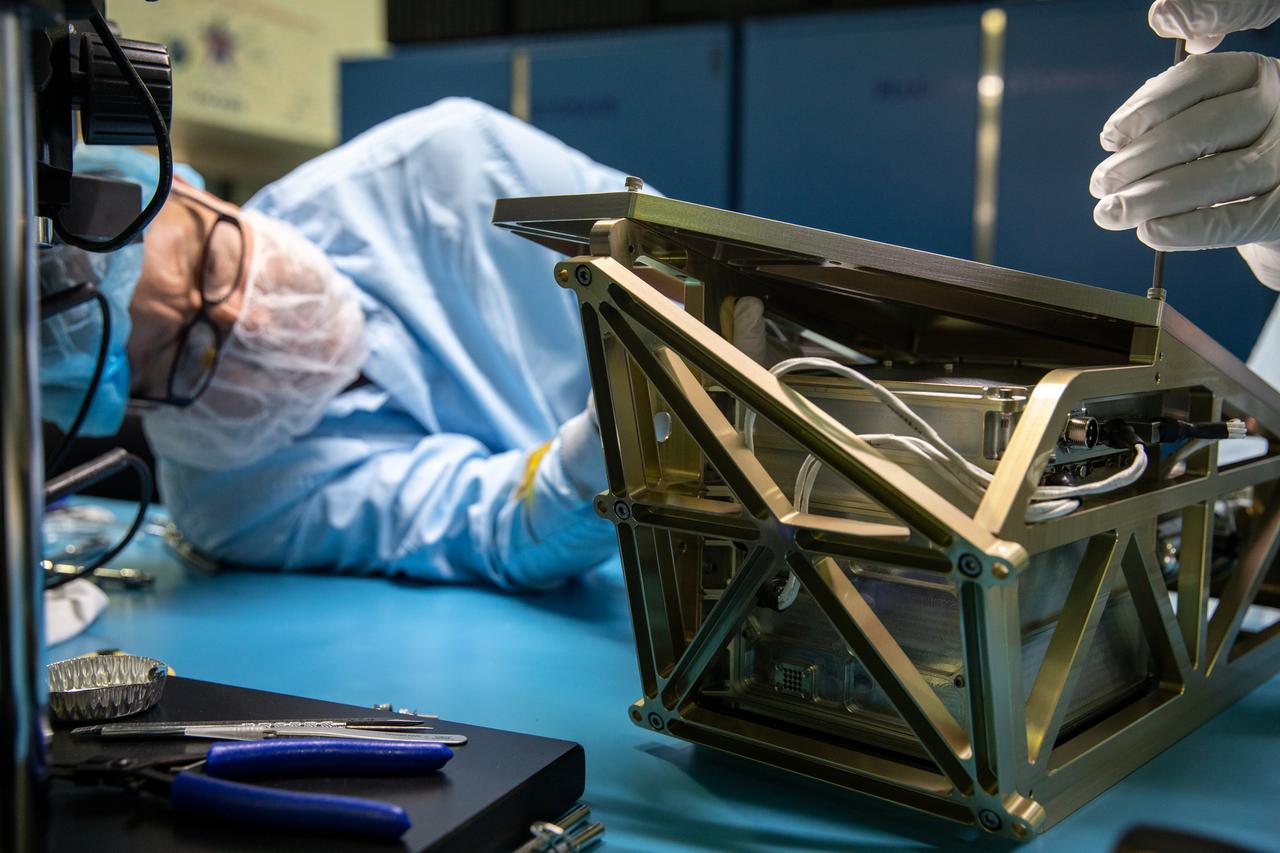
Inside the Space Station Processing Facility at NASA’s Kennedy Space Center in Florida, an engineer installs the Mass Spectrometer observing lunar operations (MSolo) onto its radiator bracket on June 14, 2022. Having successfully completed its thermal vacuum testing, the unit will undergo vibration testing later this month. This spectrometer is part of the PRIME-1 (Polar Resources Ice Mining Experiment-1) payload suite, slated to launch to the Moon in 2023 with Intuitive Machines. MSolo is a commercial off-the-shelf mass spectrometer modified to work in space and it will help analyze the chemical makeup of landing sites on the Moon, as well as study water on the lunar surface. MSolo is manifested to fly on four of the agency’s Commercial Lunar Payload Delivery Service missions where under Artemis, commercial deliveries beginning in 2023 will perform science experiments, test technologies, and demonstrate capabilities to help NASA explore the Moon and prepare for human missions.
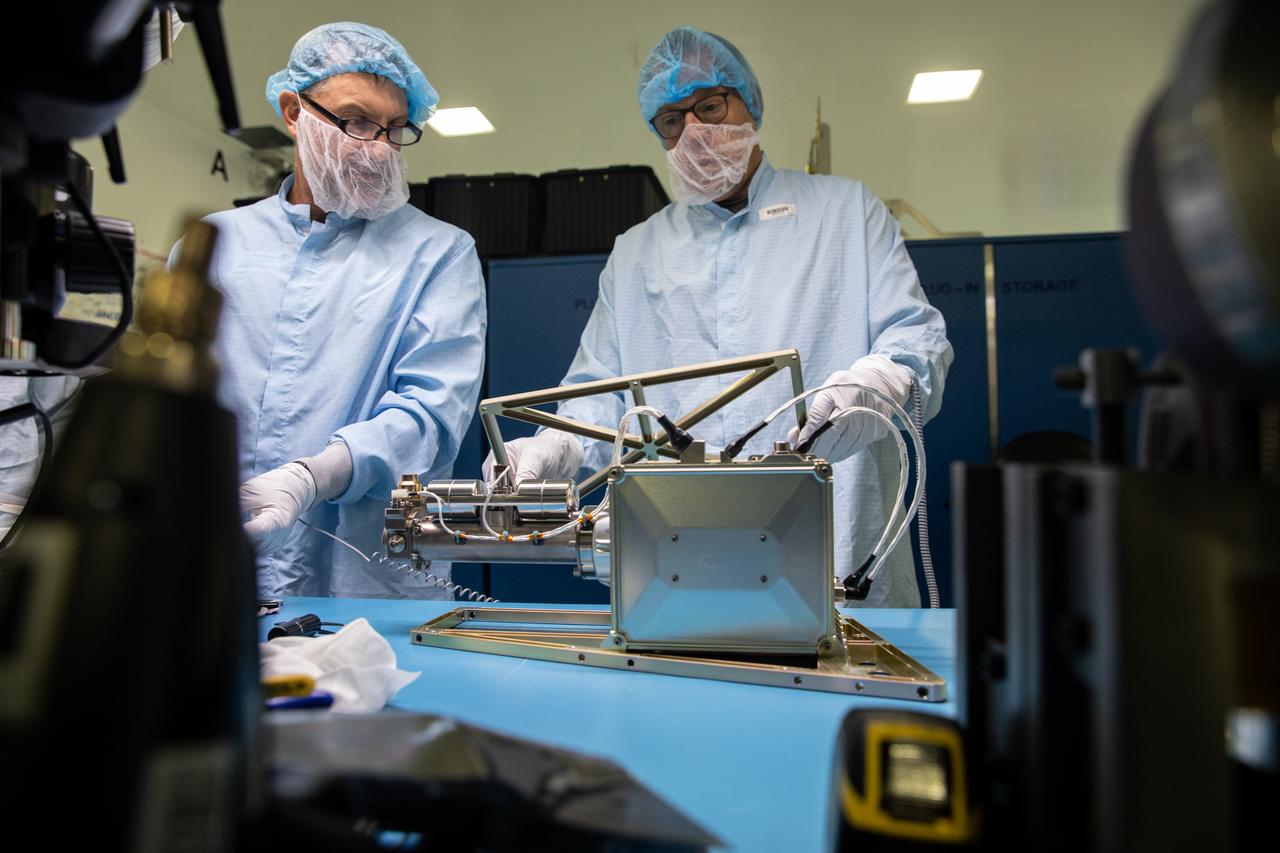
Inside the Space Station Processing Facility at NASA’s Kennedy Space Center in Florida, an engineer installs the Mass Spectrometer observing lunar operations (MSolo) onto its radiator bracket on June 14, 2022. Having successfully completed its thermal vacuum testing, the unit will undergo vibration testing later this month. This spectrometer is part of the PRIME-1 (Polar Resources Ice Mining Experiment-1) payload suite, slated to launch to the Moon in 2023 with Intuitive Machines. MSolo is a commercial off-the-shelf mass spectrometer modified to work in space and it will help analyze the chemical makeup of landing sites on the Moon, as well as study water on the lunar surface. MSolo is manifested to fly on four of the agency’s Commercial Lunar Payload Delivery Service missions where under Artemis, commercial deliveries beginning in 2023 will perform science experiments, test technologies, and demonstrate capabilities to help NASA explore the Moon and prepare for human missions.
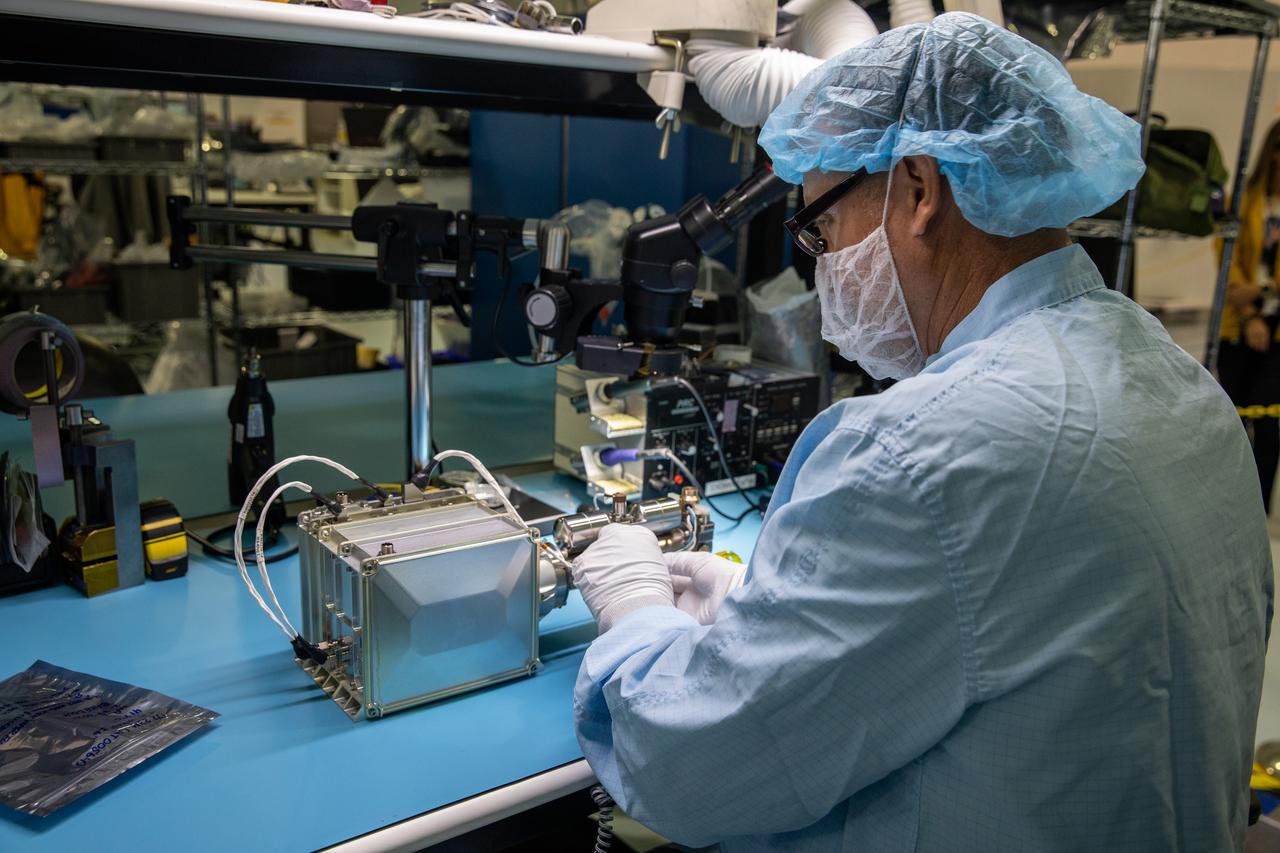
Inside the Space Station Processing Facility at NASA’s Kennedy Space Center in Florida, an engineer installs the Mass Spectrometer observing lunar operations (MSolo) onto its radiator bracket on June 14, 2022. Having successfully completed its thermal vacuum testing, the unit will undergo vibration testing later this month. This spectrometer is part of the PRIME-1 (Polar Resources Ice Mining Experiment-1) payload suite, slated to launch to the Moon in 2023 with Intuitive Machines. MSolo is a commercial off-the-shelf mass spectrometer modified to work in space and it will help analyze the chemical makeup of landing sites on the Moon, as well as study water on the lunar surface. MSolo is manifested to fly on four of the agency’s Commercial Lunar Payload Delivery Service missions where under Artemis, commercial deliveries beginning in 2023 will perform science experiments, test technologies, and demonstrate capabilities to help NASA explore the Moon and prepare for human missions.
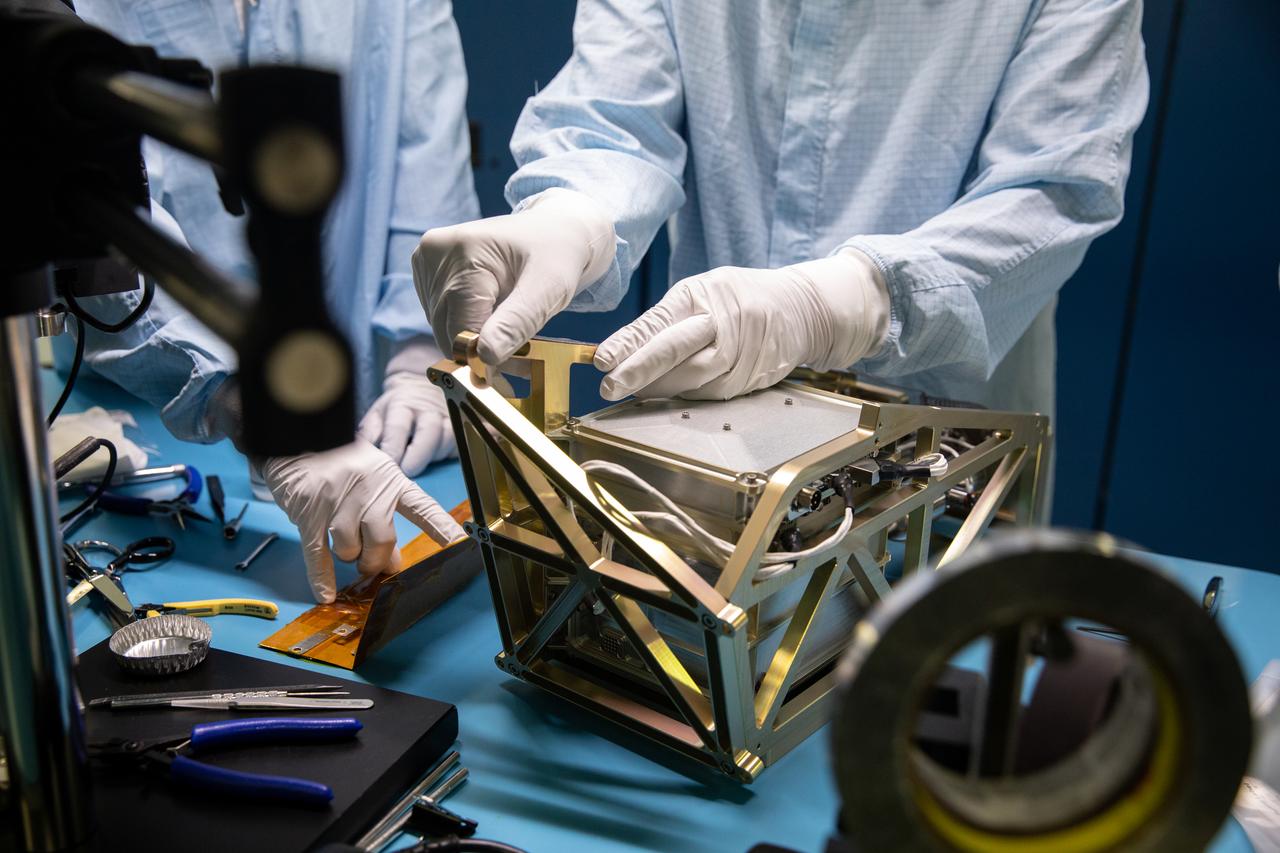
Inside the Space Station Processing Facility at NASA’s Kennedy Space Center in Florida, an engineer installs the Mass Spectrometer observing lunar operations (MSolo) onto its radiator bracket on June 14, 2022. Having successfully completed its thermal vacuum testing, the unit will undergo vibration testing later this month. This spectrometer is part of the PRIME-1 (Polar Resources Ice Mining Experiment-1) payload suite, slated to launch to the Moon in 2023 with Intuitive Machines. MSolo is a commercial off-the-shelf mass spectrometer modified to work in space and it will help analyze the chemical makeup of landing sites on the Moon, as well as study water on the lunar surface. MSolo is manifested to fly on four of the agency’s Commercial Lunar Payload Delivery Service missions where under Artemis, commercial deliveries beginning in 2023 will perform science experiments, test technologies, and demonstrate capabilities to help NASA explore the Moon and prepare for human missions.
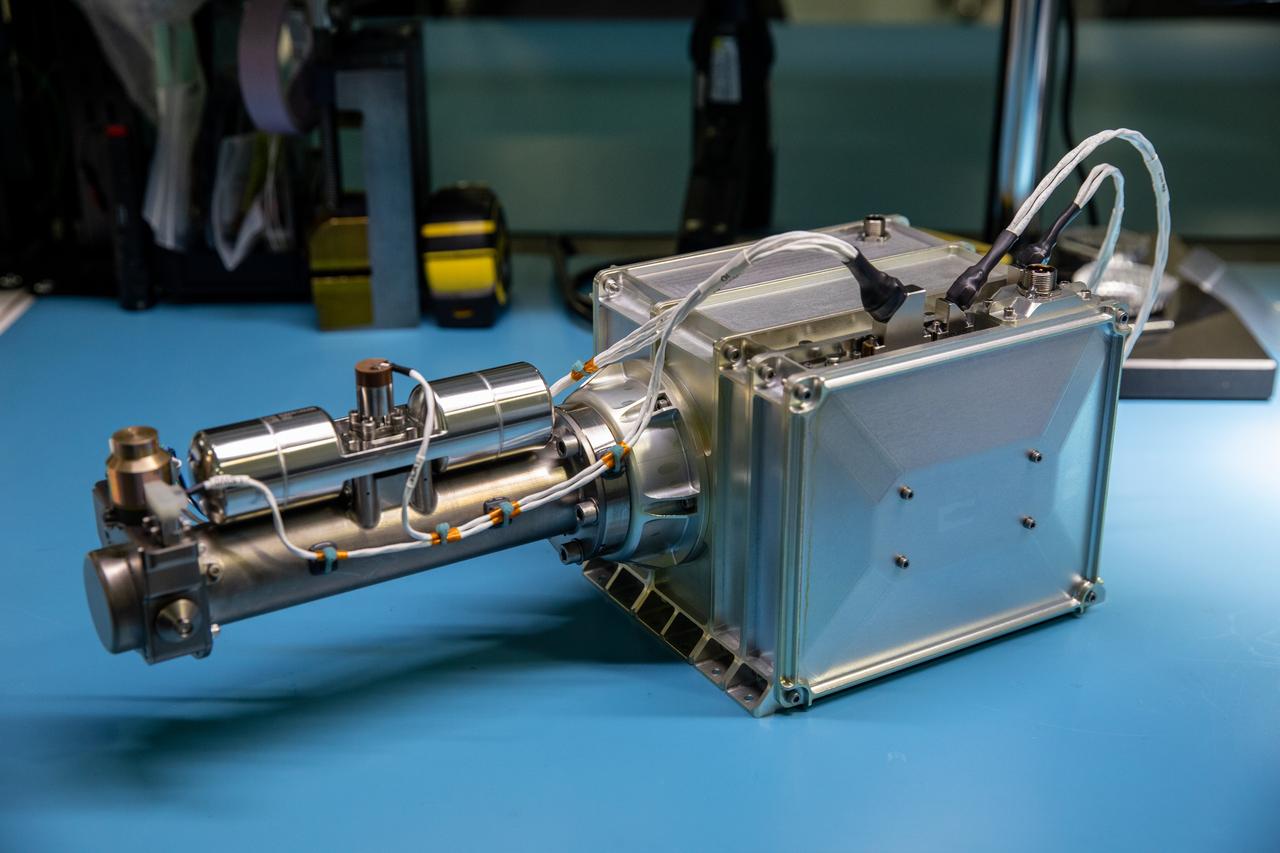
Inside the Space Station Processing Facility at NASA’s Kennedy Space Center in Florida, the Mass Spectrometer observing lunar operations (MSolo) is being installed on a radiator bracket on June 14, 2022. Having successfully completed its thermal vacuum testing, the unit will undergo vibration testing later this month. This spectrometer is part of the PRIME-1 (Polar Resources Ice Mining Experiment-1) payload suite, slated to launch to the Moon in 2023 with Intuitive Machines. MSolo is a commercial off-the-shelf mass spectrometer modified to work in space and it will help analyze the chemical makeup of landing sites on the Moon, as well as study water on the lunar surface. MSolo is manifested to fly on four of the agency’s Commercial Lunar Payload Delivery Service missions where under Artemis, commercial deliveries beginning in 2023 will perform science experiments, test technologies, and demonstrate capabilities to help NASA explore the Moon and prepare for human missions.
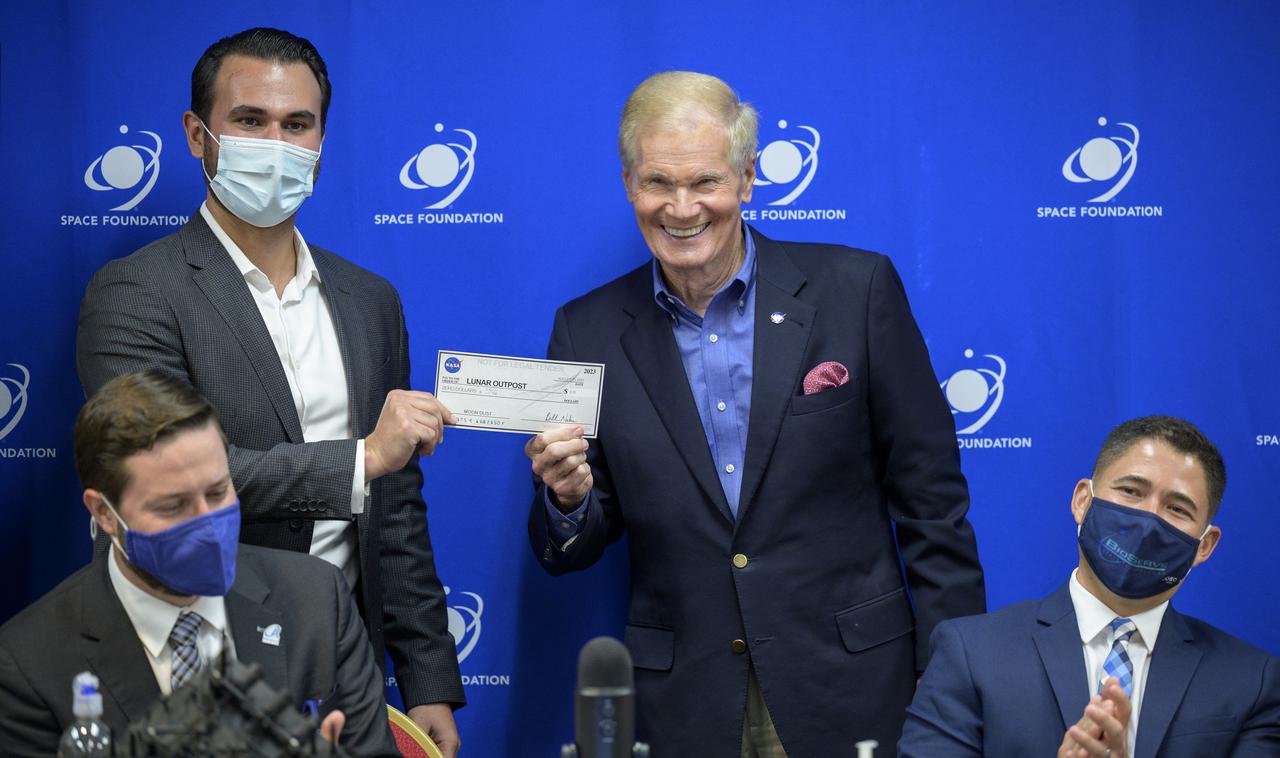
NASA Administrator Bill Nelson presents Justin Cyrus, CEO, Lunar Outpost of Golden, Colorado a check for $0.10 during an event to introduce media to three local Colorado companies and university partners that help make NASA’s missions possible, Monday, Aug. 23, 2021, during the 36th Space Symposium in Colorado Springs, Colorado. Lunar Outpost is one of four companies that will collect space resources and transfer ownership to NASA; Lunar Outpost proposed collection for $1 following arrival of a lander to the lunar South Pole in 2023 and is on track to accomplish this a year early as part of the Intuitive Machines 2 Mission in 2022. They recently passed their first milestone and is the first of the four proposals selected to do so, and will receive a payment of $0.10. Photo Credit: (NASA/Bill Ingalls)
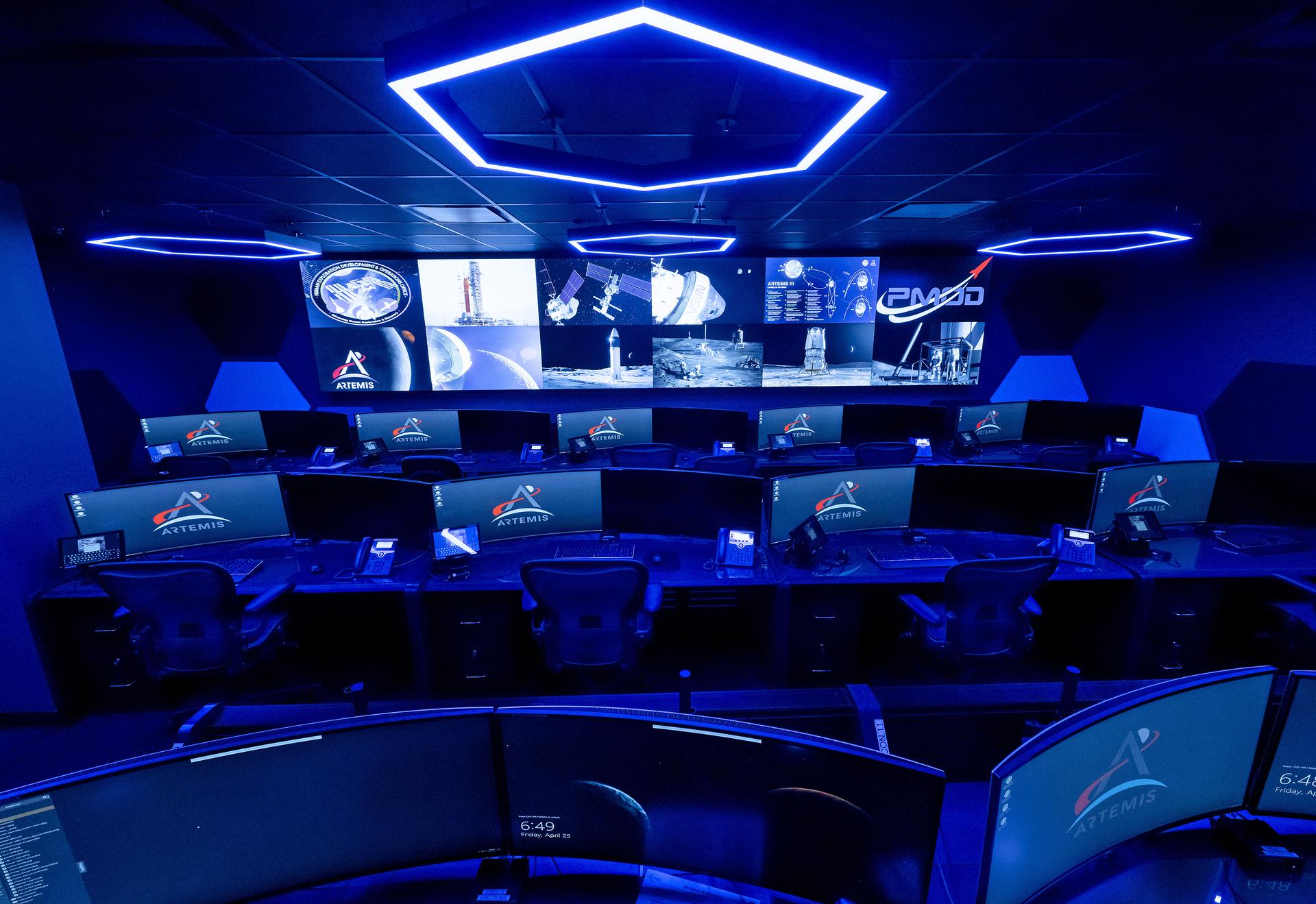
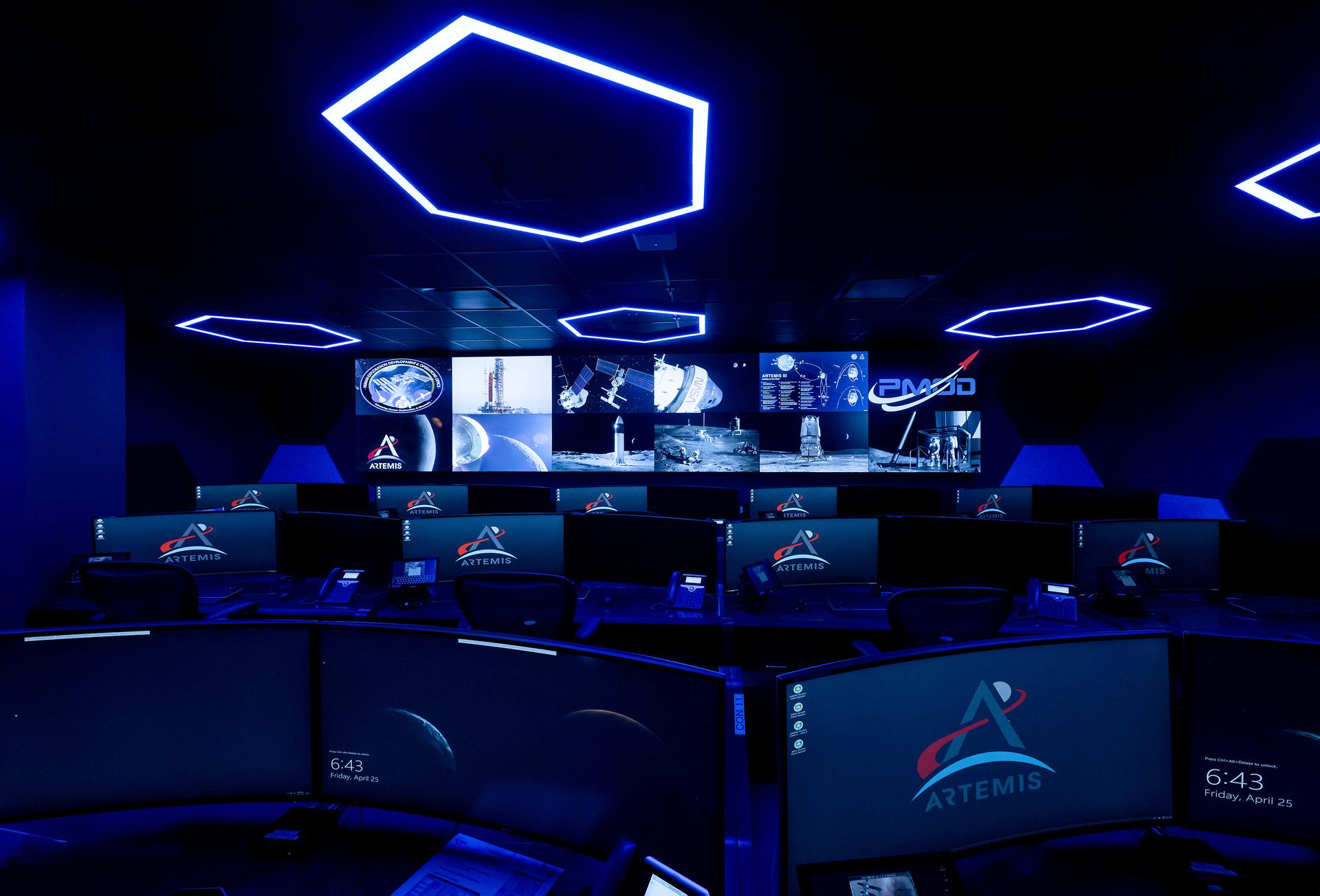
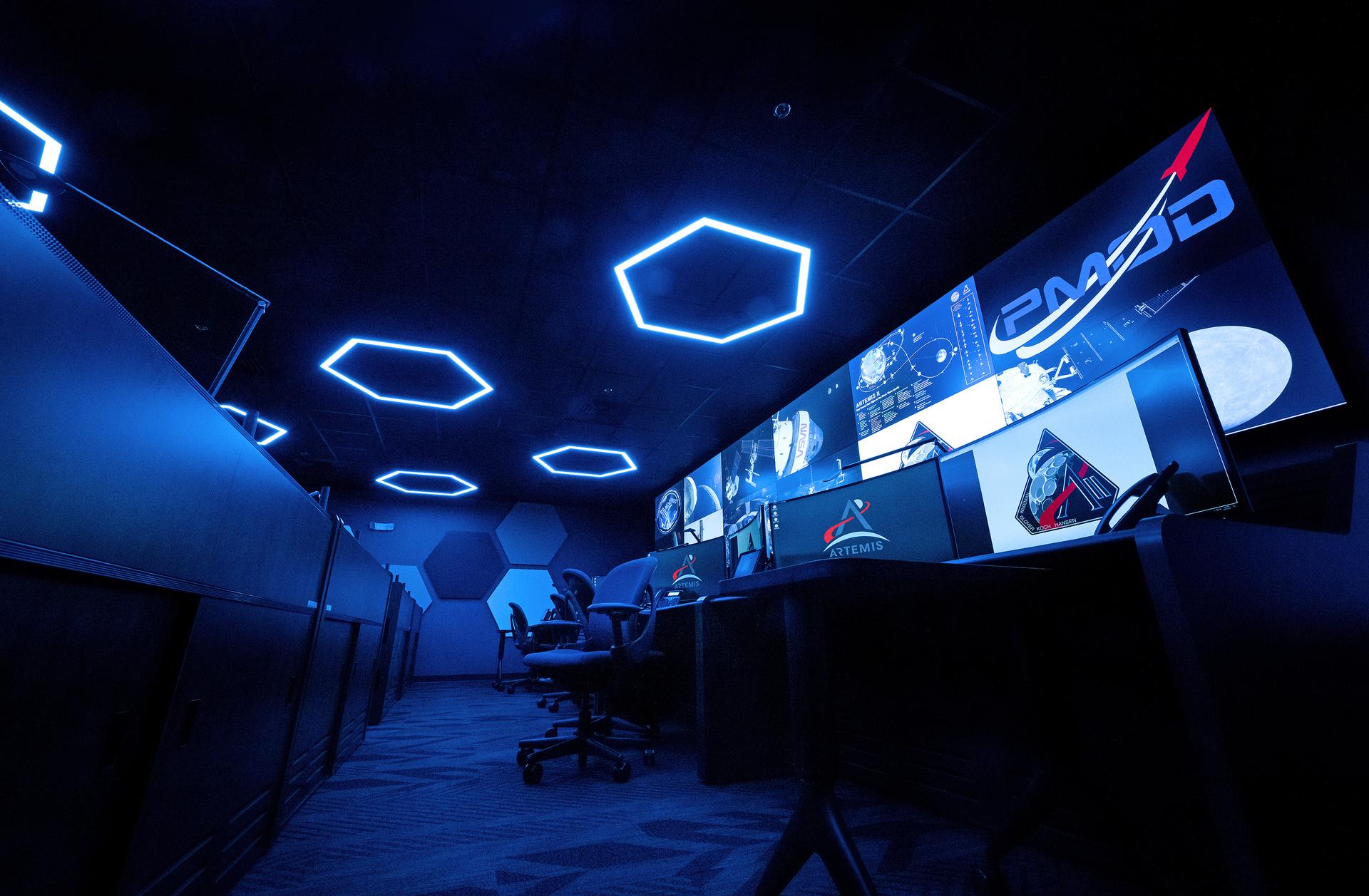
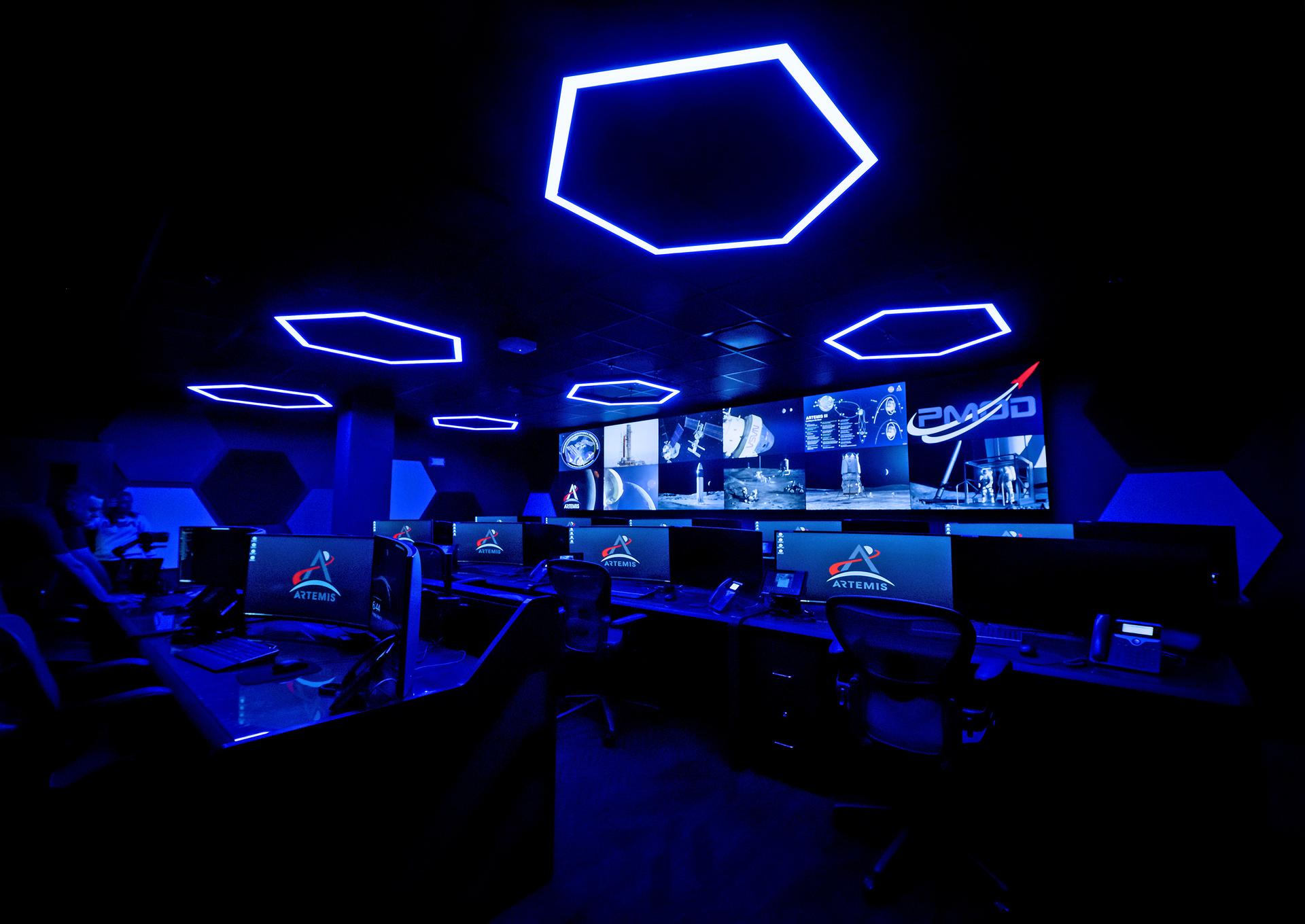
These photos offer a look inside the twin control rooms at NASA’s Marshall Space Flight Center in Huntsville, Alabama, where engineers will monitor Artemis science and future landing operations for Artemis. The LUCA (Lunar Utilization Control Area) and LESA (Lander Engineering Support Area) rooms are part of the Huntsville Operations Support Center at NASA Marshall. The LUCA is specially designed to support a wide variety of science operations on and around the Moon – and beyond. Engineers in the LUCA monitored operations for the Lunar Node-1 experiment, an autonomous navigation payload that was part of the first NASA Commercial Lunar Payload Services (CLPS) launch on Intuitive Machines’ Nova-C lunar lander in 2024. NASA Marshall flight controllers will use the LUCA again for Artemis II to monitor science operations. Beginning with Artemis III, members of the NASA Human Landing System Mission Insight Support Team – a group of engineers, safety leads, flight operations experts, and technical authorities – will work in the LESA. There, they will monitor lander systems in real-time and be involved in key decision-making processes throughout the mission. For more information, contact NASA Marshall’s Office of Communications at 256-544-0034.
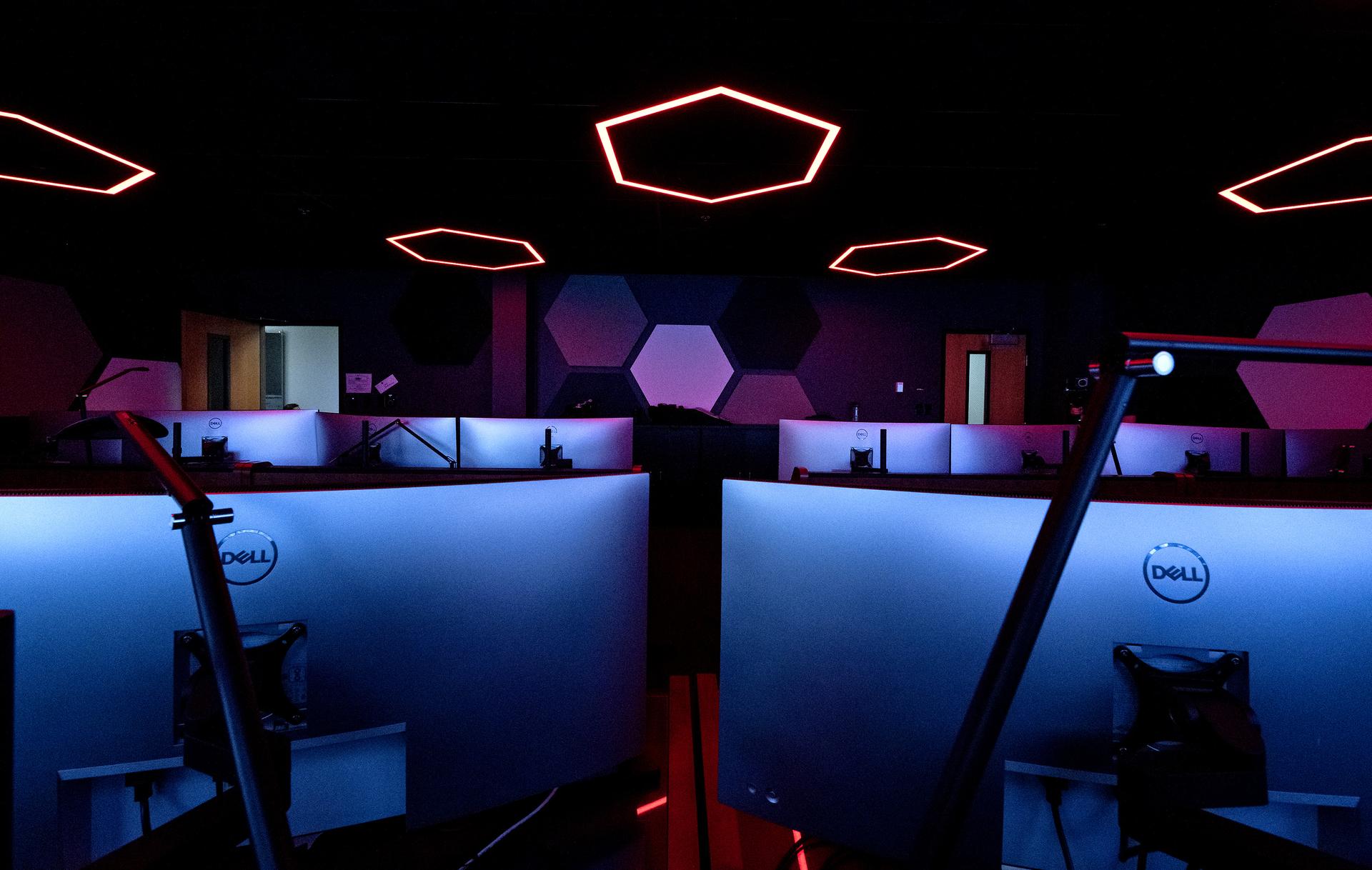
These photos offer a look inside the twin control rooms at NASA’s Marshall Space Flight Center in Huntsville, Alabama, where engineers will monitor Artemis science and future landing operations for Artemis. The LUCA (Lunar Utilization Control Area) and LESA (Lander Engineering Support Area) rooms are part of the Huntsville Operations Support Center at NASA Marshall. The LUCA is specially designed to support a wide variety of science operations on and around the Moon – and beyond. Engineers in the LUCA monitored operations for the Lunar Node-1 experiment, an autonomous navigation payload that was part of the first NASA Commercial Lunar Payload Services (CLPS) launch on Intuitive Machines’ Nova-C lunar lander in 2024. NASA Marshall flight controllers will use the LUCA again for Artemis II to monitor science operations. Beginning with Artemis III, members of the NASA Human Landing System Mission Insight Support Team – a group of engineers, safety leads, flight operations experts, and technical authorities – will work in the LESA. There, they will monitor lander systems in real-time and be involved in key decision-making processes throughout the mission. For more information, contact NASA Marshall’s Office of Communications at 256-544-0034.
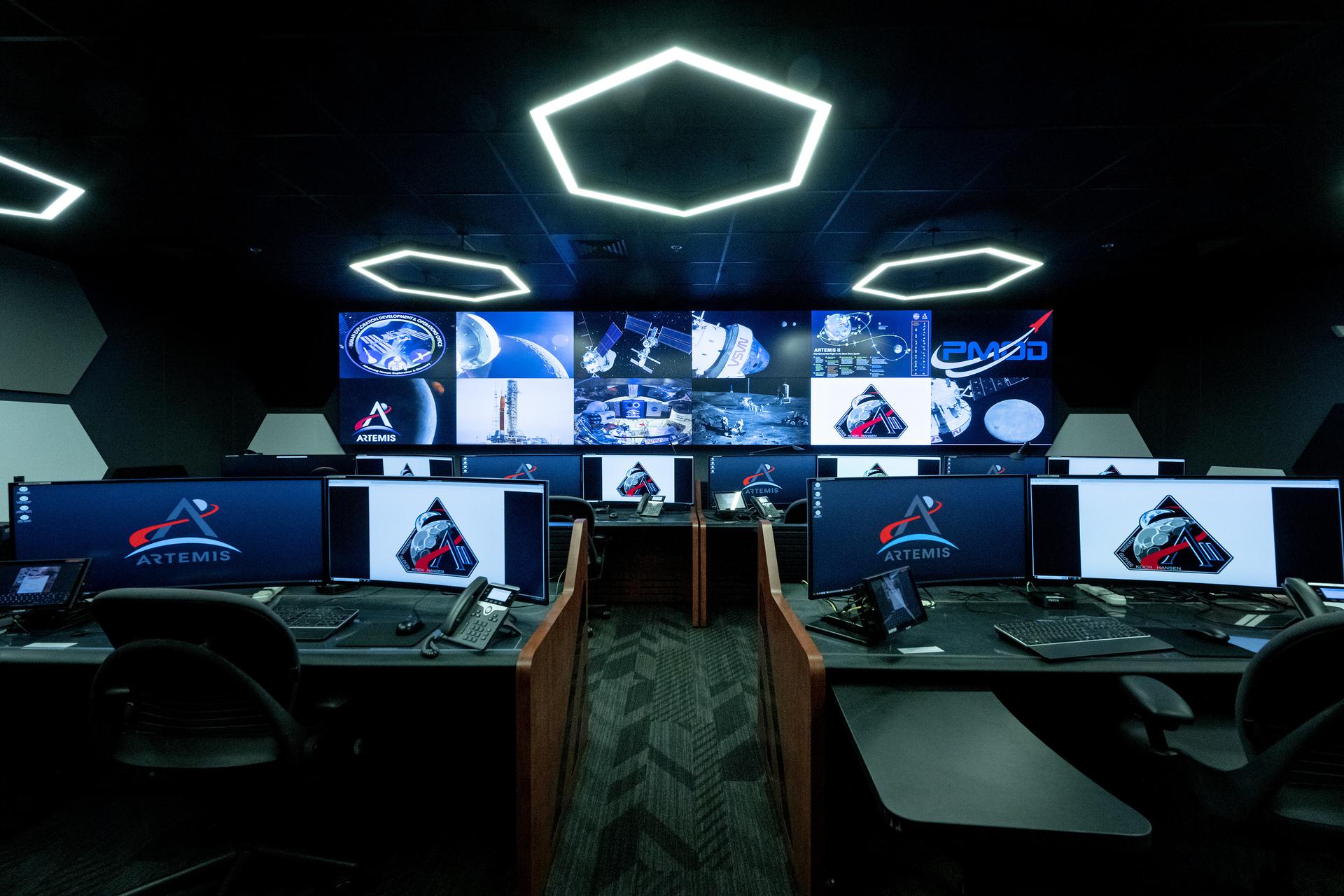
These photos offer a look inside the twin control rooms at NASA’s Marshall Space Flight Center in Huntsville, Alabama, where engineers will monitor Artemis science and future landing operations for Artemis. The LUCA (Lunar Utilization Control Area) and LESA (Lander Engineering Support Area) rooms are part of the Huntsville Operations Support Center at NASA Marshall. The LUCA is specially designed to support a wide variety of science operations on and around the Moon – and beyond. Engineers in the LUCA monitored operations for the Lunar Node-1 experiment, an autonomous navigation payload that was part of the first NASA Commercial Lunar Payload Services (CLPS) launch on Intuitive Machines’ Nova-C lunar lander in 2024. NASA Marshall flight controllers will use the LUCA again for Artemis II to monitor science operations. Beginning with Artemis III, members of the NASA Human Landing System Mission Insight Support Team – a group of engineers, safety leads, flight operations experts, and technical authorities – will work in the LESA. There, they will monitor lander systems in real-time and be involved in key decision-making processes throughout the mission. For more information, contact NASA Marshall’s Office of Communications at 256-544-0034.
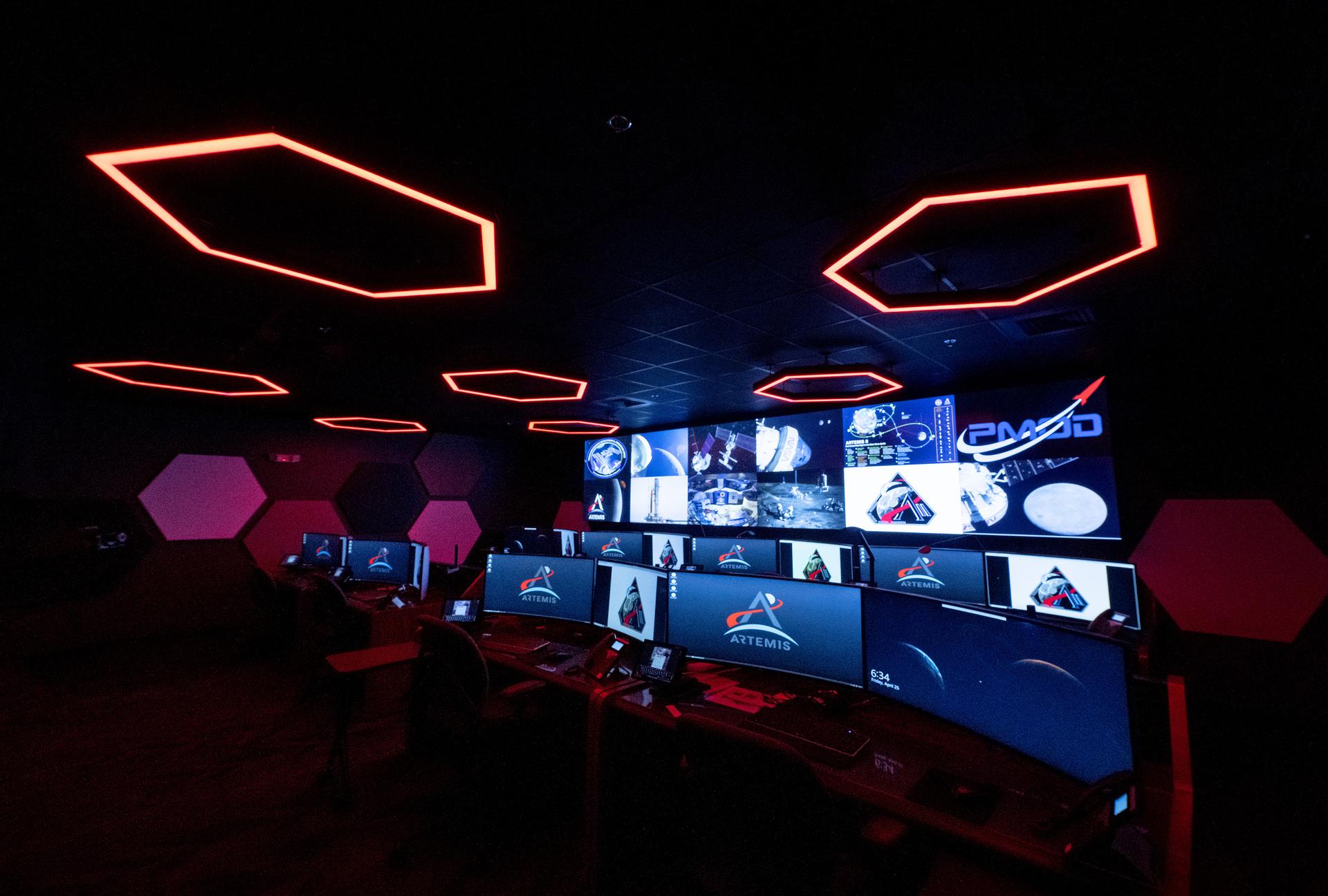
These photos offer a look inside the twin control rooms at NASA’s Marshall Space Flight Center in Huntsville, Alabama, where engineers will monitor Artemis science and future landing operations for Artemis. The LUCA (Lunar Utilization Control Area) and LESA (Lander Engineering Support Area) rooms are part of the Huntsville Operations Support Center at NASA Marshall. The LUCA is specially designed to support a wide variety of science operations on and around the Moon – and beyond. Engineers in the LUCA monitored operations for the Lunar Node-1 experiment, an autonomous navigation payload that was part of the first NASA Commercial Lunar Payload Services (CLPS) launch on Intuitive Machines’ Nova-C lunar lander in 2024. NASA Marshall flight controllers will use the LUCA again for Artemis II to monitor science operations. Beginning with Artemis III, members of the NASA Human Landing System Mission Insight Support Team – a group of engineers, safety leads, flight operations experts, and technical authorities – will work in the LESA. There, they will monitor lander systems in real-time and be involved in key decision-making processes throughout the mission. For more information, contact NASA Marshall’s Office of Communications at 256-544-0034.
These photos offer a look inside the twin control rooms at NASA’s Marshall Space Flight Center in Huntsville, Alabama, where engineers will monitor Artemis science and future landing operations for Artemis. The LUCA (Lunar Utilization Control Area) and LESA (Lander Engineering Support Area) rooms are part of the Huntsville Operations Support Center at NASA Marshall. The LUCA is specially designed to support a wide variety of science operations on and around the Moon – and beyond. Engineers in the LUCA monitored operations for the Lunar Node-1 experiment, an autonomous navigation payload that was part of the first NASA Commercial Lunar Payload Services (CLPS) launch on Intuitive Machines’ Nova-C lunar lander in 2024. NASA Marshall flight controllers will use the LUCA again for Artemis II to monitor science operations. Beginning with Artemis III, members of the NASA Human Landing System Mission Insight Support Team – a group of engineers, safety leads, flight operations experts, and technical authorities – will work in the LESA. There, they will monitor lander systems in real-time and be involved in key decision-making processes throughout the mission. For more information, contact NASA Marshall’s Office of Communications at 256-544-0034.
These photos offer a look inside the twin control rooms at NASA’s Marshall Space Flight Center in Huntsville, Alabama, where engineers will monitor Artemis science and future landing operations for Artemis. The LUCA (Lunar Utilization Control Area) and LESA (Lander Engineering Support Area) rooms are part of the Huntsville Operations Support Center at NASA Marshall. The LUCA is specially designed to support a wide variety of science operations on and around the Moon – and beyond. Engineers in the LUCA monitored operations for the Lunar Node-1 experiment, an autonomous navigation payload that was part of the first NASA Commercial Lunar Payload Services (CLPS) launch on Intuitive Machines’ Nova-C lunar lander in 2024. NASA Marshall flight controllers will use the LUCA again for Artemis II to monitor science operations. Beginning with Artemis III, members of the NASA Human Landing System Mission Insight Support Team – a group of engineers, safety leads, flight operations experts, and technical authorities – will work in the LESA. There, they will monitor lander systems in real-time and be involved in key decision-making processes throughout the mission. For more information, contact NASA Marshall’s Office of Communications at 256-544-0034.
These photos offer a look inside the twin control rooms at NASA’s Marshall Space Flight Center in Huntsville, Alabama, where engineers will monitor Artemis science and future landing operations for Artemis. The LUCA (Lunar Utilization Control Area) and LESA (Lander Engineering Support Area) rooms are part of the Huntsville Operations Support Center at NASA Marshall. The LUCA is specially designed to support a wide variety of science operations on and around the Moon – and beyond. Engineers in the LUCA monitored operations for the Lunar Node-1 experiment, an autonomous navigation payload that was part of the first NASA Commercial Lunar Payload Services (CLPS) launch on Intuitive Machines’ Nova-C lunar lander in 2024. NASA Marshall flight controllers will use the LUCA again for Artemis II to monitor science operations. Beginning with Artemis III, members of the NASA Human Landing System Mission Insight Support Team – a group of engineers, safety leads, flight operations experts, and technical authorities – will work in the LESA. There, they will monitor lander systems in real-time and be involved in key decision-making processes throughout the mission. For more information, contact NASA Marshall’s Office of Communications at 256-544-0034.

A team of engineers participates in simulation training for the Polar Resources Ice Mining Experiment-1 (PRIME-1) on Thursday, Nov. 2, 2023, inside the Neil Armstrong Operations and Checkout Building at NASA’s Kennedy Space Center in Florida. The purpose of the training is to get the integrated PRIME-1 team – engineers with PRIME-1’s MSOLO (Mass Spectrometer Observing Lunar Operations) and Honeybee Robotics’ TRIDENT (The Regolith and Ice Drill for Exploring New Terrain) drill – prepared to operate the instrument on the lunar surface. The team commanded the PRIME-1 hardware, located at Intuitive Machines in Houston, to operate MSOLO and TRIDENT. PRIME-1 is scheduled to launch through NASA’s CLPS (Commercial Lunar Payload Delivery Service) initiative and will be the first in-situ resource utilization demonstration on the Moon, with MSOLO and TRIDENT making up its two primary components. Through Artemis missions, CLPS deliveries will be used to perform science experiments, test technologies, and demonstrate capabilities to help NASA explore the Moon and prepare for human deep space exploration missions.
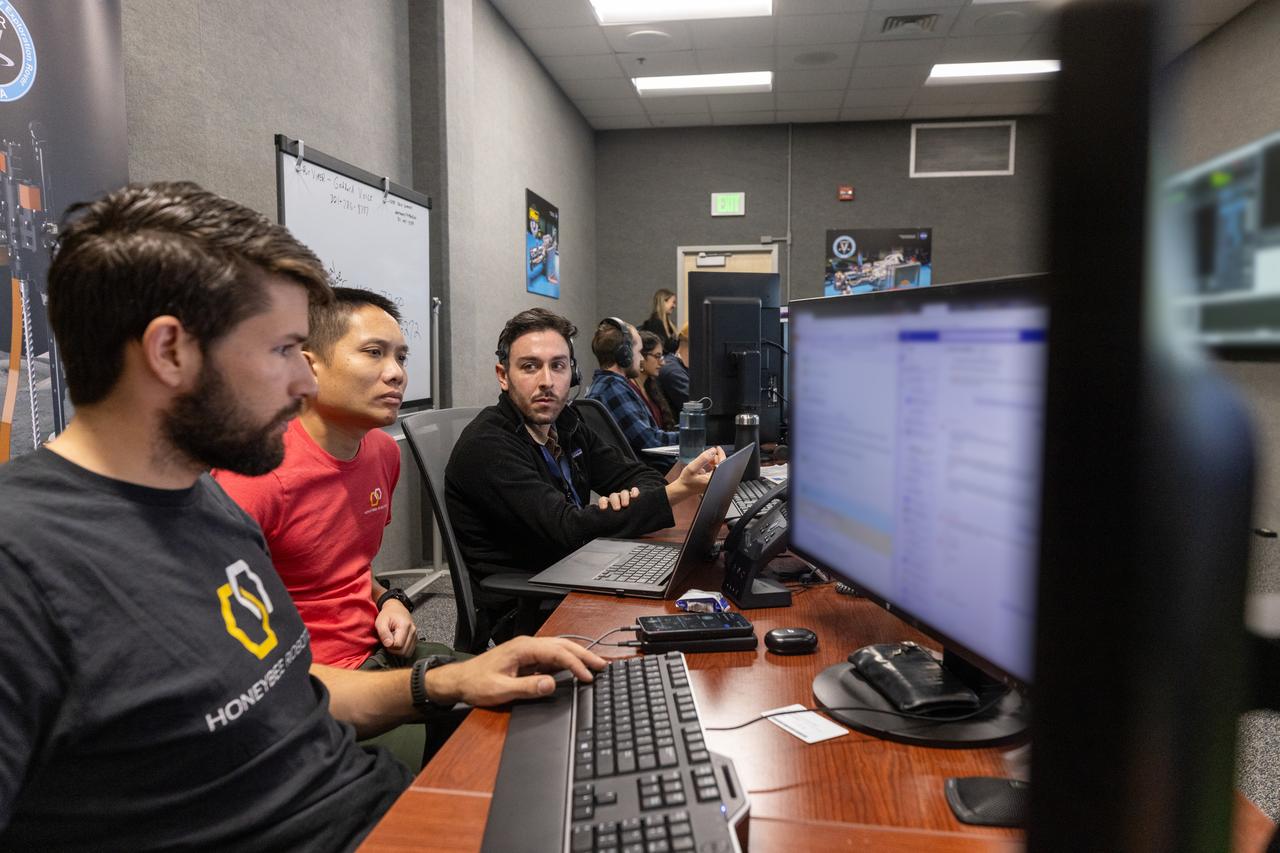
A team from Honeybee Robotics in Altadena, California participates in simulation training for the Polar Resources Ice Mining Experiment-1 (PRIME-1) on Thursday, Nov. 2, 2023, inside the Neil Armstrong Operations and Checkout Building at NASA’s Kennedy Space Center in Florida. The purpose of the training is to get the integrated PRIME-1 team – engineers with PRIME-1’s MSOLO (Mass Spectrometer Observing Lunar Operations) and Honeybee Robotics’ TRIDENT (The Regolith and Ice Drill for Exploring New Terrain) drill – prepared to operate the instrument on the lunar surface. The team commanded the PRIME-1 hardware, located at Intuitive Machines in Houston, to operate MSOLO and TRIDENT. PRIME-1 is scheduled to launch through NASA’s CLPS (Commercial Lunar Payload Delivery Service) initiative and will be the first in-situ resource utilization demonstration on the Moon, with MSOLO and TRIDENT making up its two primary components. Through Artemis missions, CLPS deliveries will be used to perform science experiments, test technologies, and demonstrate capabilities to help NASA explore the Moon and prepare for human deep space exploration missions.
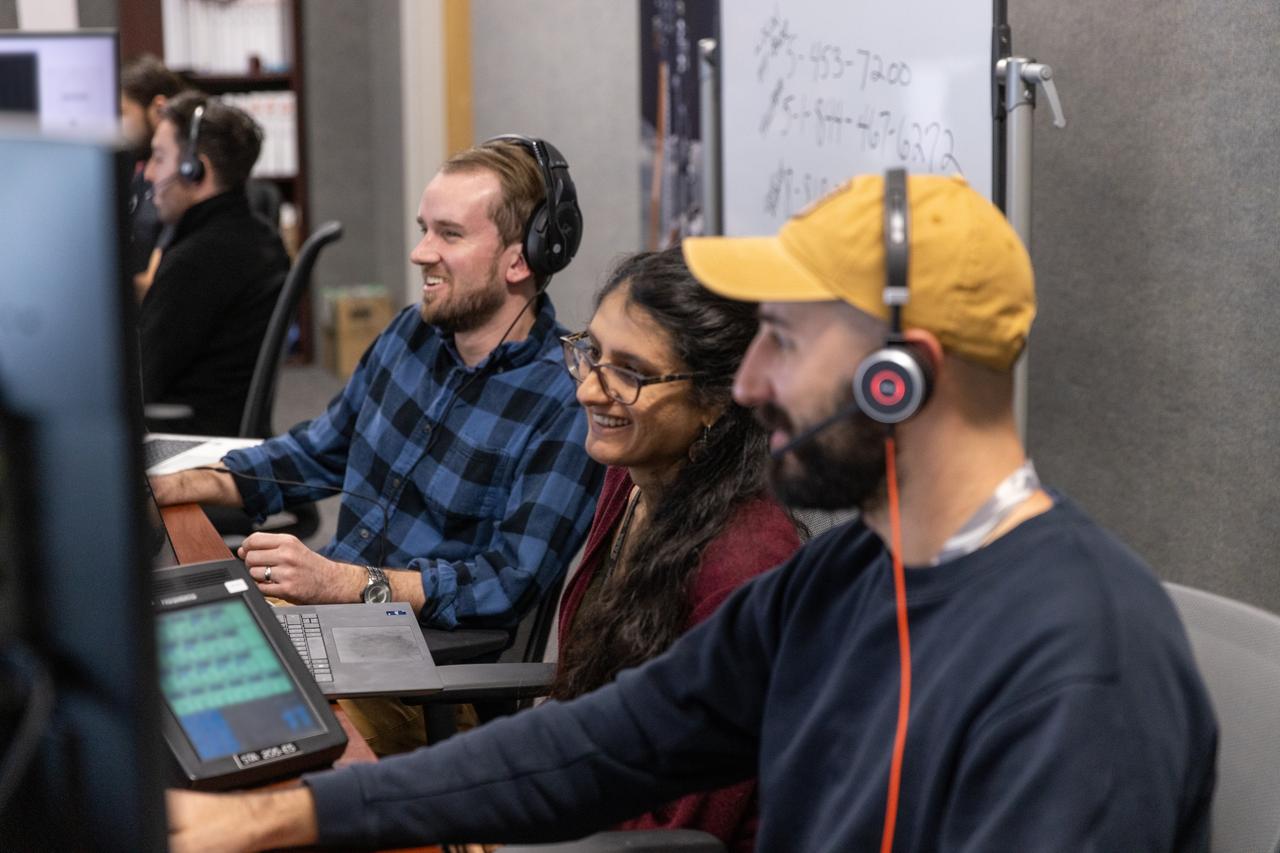
A team of engineers participates in simulation training for the Polar Resources Ice Mining Experiment-1 (PRIME-1) on Thursday, Nov. 2, 2023, inside the Neil Armstrong Operations and Checkout Building at NASA’s Kennedy Space Center in Florida. The purpose of the training is to get the integrated PRIME-1 team – engineers with PRIME-1’s MSOLO (Mass Spectrometer Observing Lunar Operations) and Honeybee Robotics’ TRIDENT (The Regolith and Ice Drill for Exploring New Terrain) drill – prepared to operate the instrument on the lunar surface. The team commanded the PRIME-1 hardware, located at Intuitive Machines in Houston, to operate MSOLO and TRIDENT. PRIME-1 is scheduled to launch through NASA’s CLPS (Commercial Lunar Payload Delivery Service) initiative and will be the first in-situ resource utilization demonstration on the Moon, with MSOLO and TRIDENT making up its two primary components. Through Artemis missions, CLPS deliveries will be used to perform science experiments, test technologies, and demonstrate capabilities to help NASA explore the Moon and prepare for human deep space exploration missions.
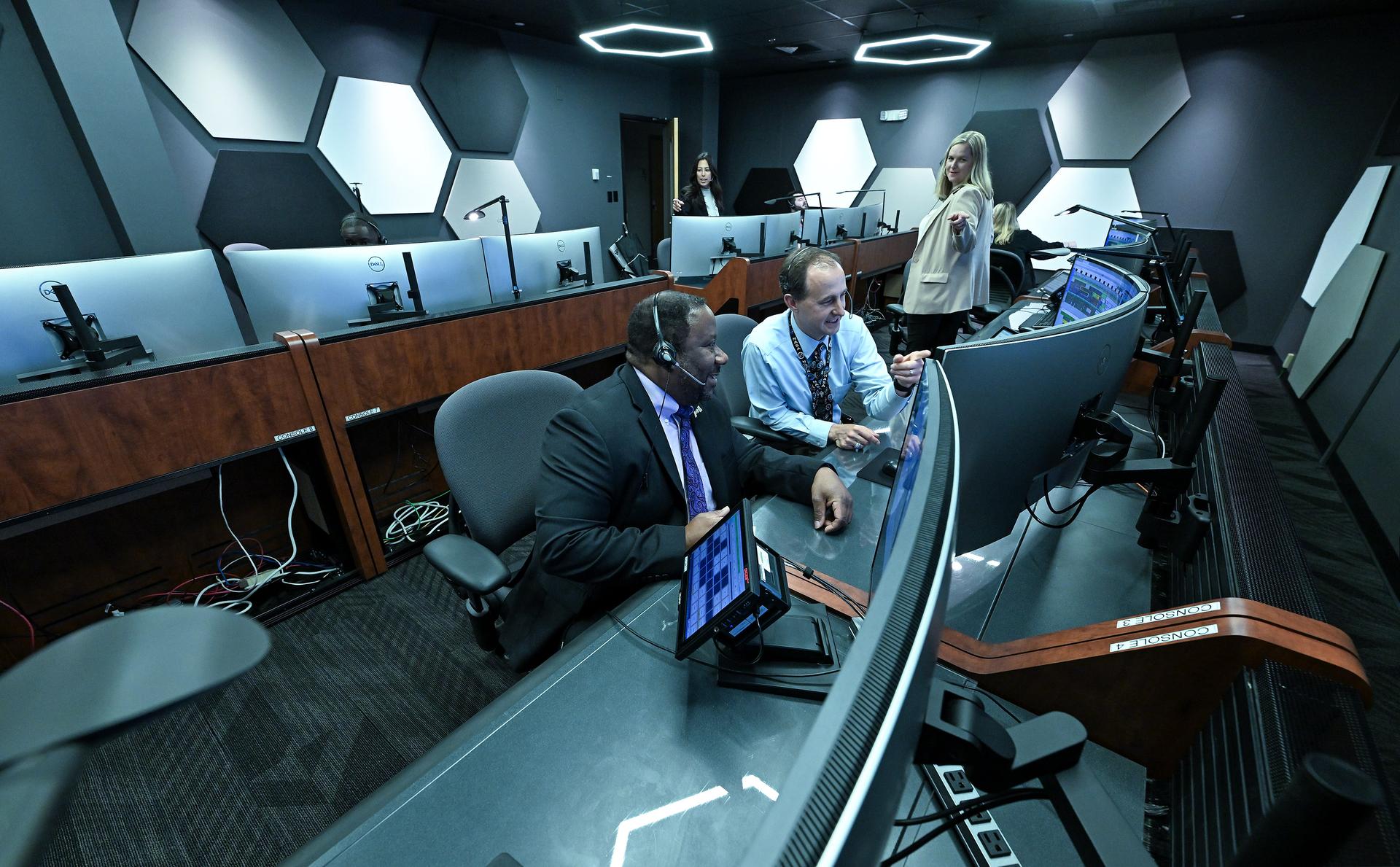
These photos offer a look inside the twin control rooms at NASA’s Marshall Space Flight Center in Huntsville, Alabama, where engineers will monitor Artemis science and future landing operations for Artemis. The LUCA (Lunar Utilization Control Area) and LESA (Lander Engineering Support Area) rooms are part of the Huntsville Operations Support Center at NASA Marshall. The LUCA is specially designed to support a wide variety of science operations on and around the Moon – and beyond. Engineers in the LUCA monitored operations for the Lunar Node-1 experiment, an autonomous navigation payload that was part of the first NASA Commercial Lunar Payload Services (CLPS) launch on Intuitive Machines’ Nova-C lunar lander in 2024. NASA Marshall flight controllers will use the LUCA again for Artemis II to monitor science operations. Beginning with Artemis III, members of the NASA Human Landing System Mission Insight Support Team – a group of engineers, safety leads, flight operations experts, and technical authorities – will work in the LESA. There, they will monitor lander systems in real-time and be involved in key decision-making processes throughout the mission. For more information, contact NASA Marshall’s Office of Communications at 256-544-0034.
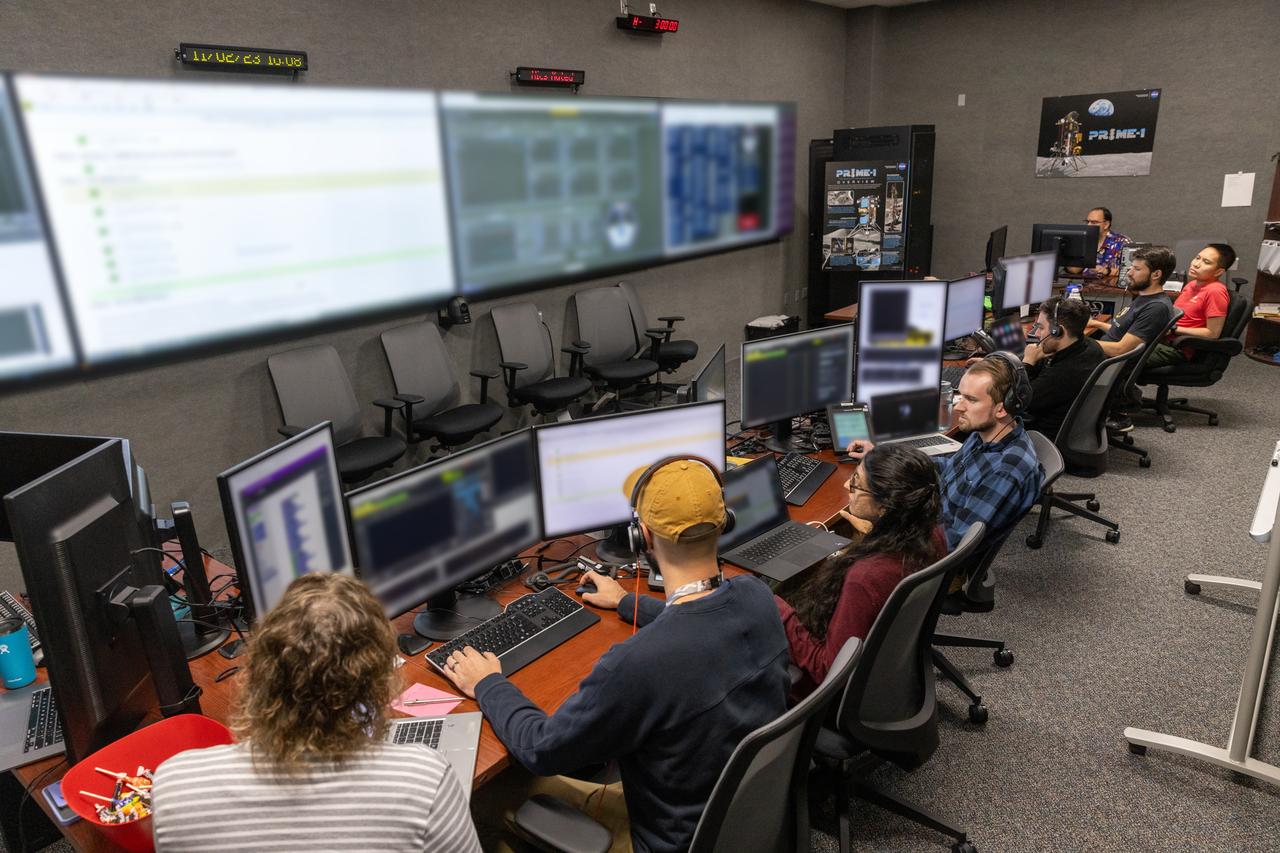
A team of engineers participates in simulation training for the Polar Resources Ice Mining Experiment-1 (PRIME-1) on Thursday, Nov. 2, 2023, inside the Neil Armstrong Operations and Checkout Building at NASA’s Kennedy Space Center in Florida. The purpose of the training is to get the integrated PRIME-1 team – engineers with PRIME-1’s MSOLO (Mass Spectrometer Observing Lunar Operations) and Honeybee Robotics’ TRIDENT (The Regolith and Ice Drill for Exploring New Terrain) drill – prepared to operate the instrument on the lunar surface. The team commanded the PRIME-1 hardware, located at Intuitive Machines in Houston, to operate MSOLO and TRIDENT. PRIME-1 is scheduled to launch through NASA’s CLPS (Commercial Lunar Payload Delivery Service) initiative and will be the first in-situ resource utilization demonstration on the Moon, with MSOLO and TRIDENT making up its two primary components. Through Artemis missions, CLPS deliveries will be used to perform science experiments, test technologies, and demonstrate capabilities to help NASA explore the Moon and prepare for human deep space exploration missions.
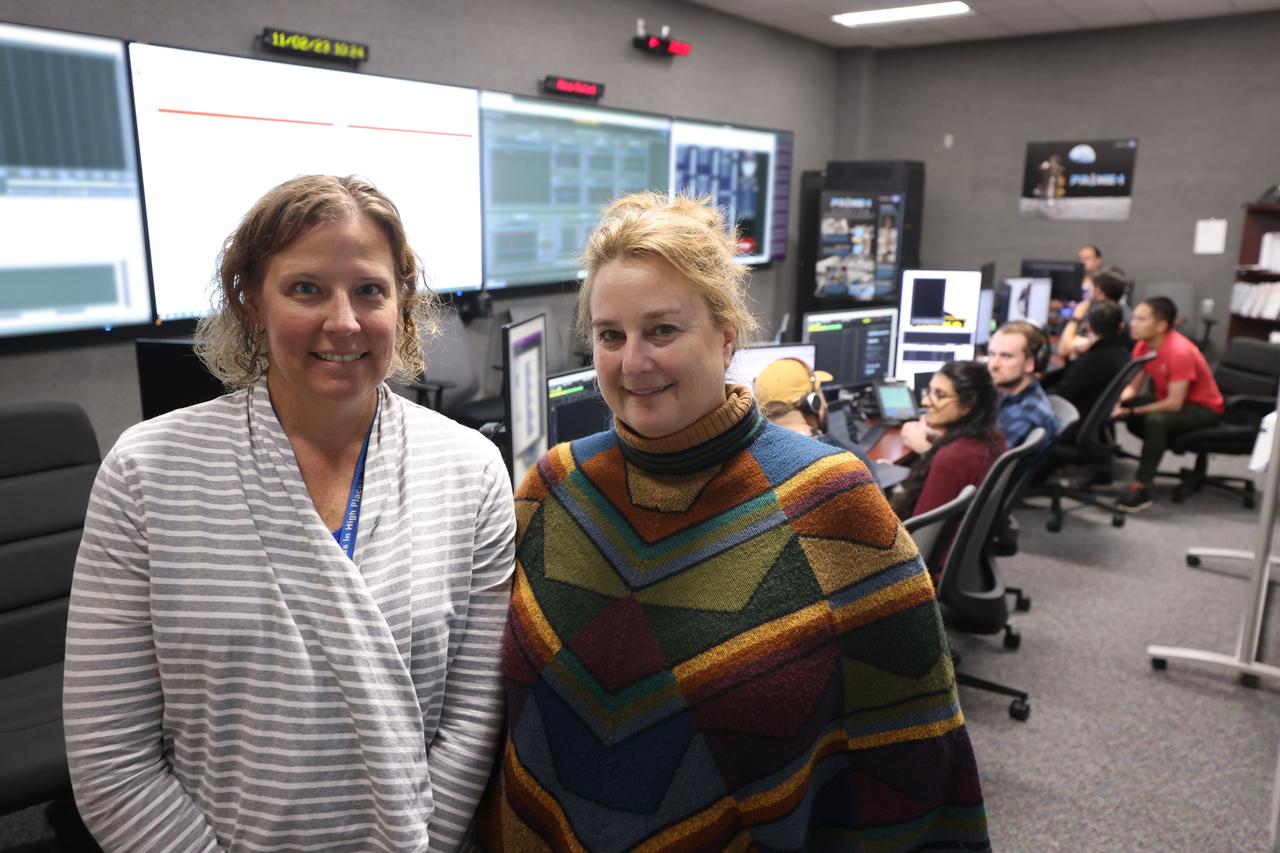
Janine Captain, left, and Jackie Quinn participate in simulation training for the Polar Resources Ice Mining Experiment-1 (PRIME-1) on Thursday, Nov. 2, 2023, inside the Neil Armstrong Operations and Checkout Building at NASA’s Kennedy Space Center in Florida. The purpose of the training is to get the integrated PRIME-1 team – engineers with PRIME-1’s MSOLO (Mass Spectrometer Observing Lunar Operations) and Honeybee Robotics’ TRIDENT (Regolith and Ice Drill for Exploring New Terrain) drill – prepared to operate the instrument on the lunar surface. The team commanded the PRIME-1 hardware, located at Intuitive Machines in Houston, to operate MSOLO and TRIDENT. PRIME-1 is scheduled to launch through NASA’s CLPS (Commercial Lunar Payload Delivery Service) initiative and will be the first in-situ resource utilization demonstration on the Moon, with MSOLO and TRIDENT making up its two primary components. Through Artemis missions, CLPS deliveries will be used to perform science experiments, test technologies, and demonstrate capabilities to help NASA explore the Moon and prepare for human deep space exploration missions.
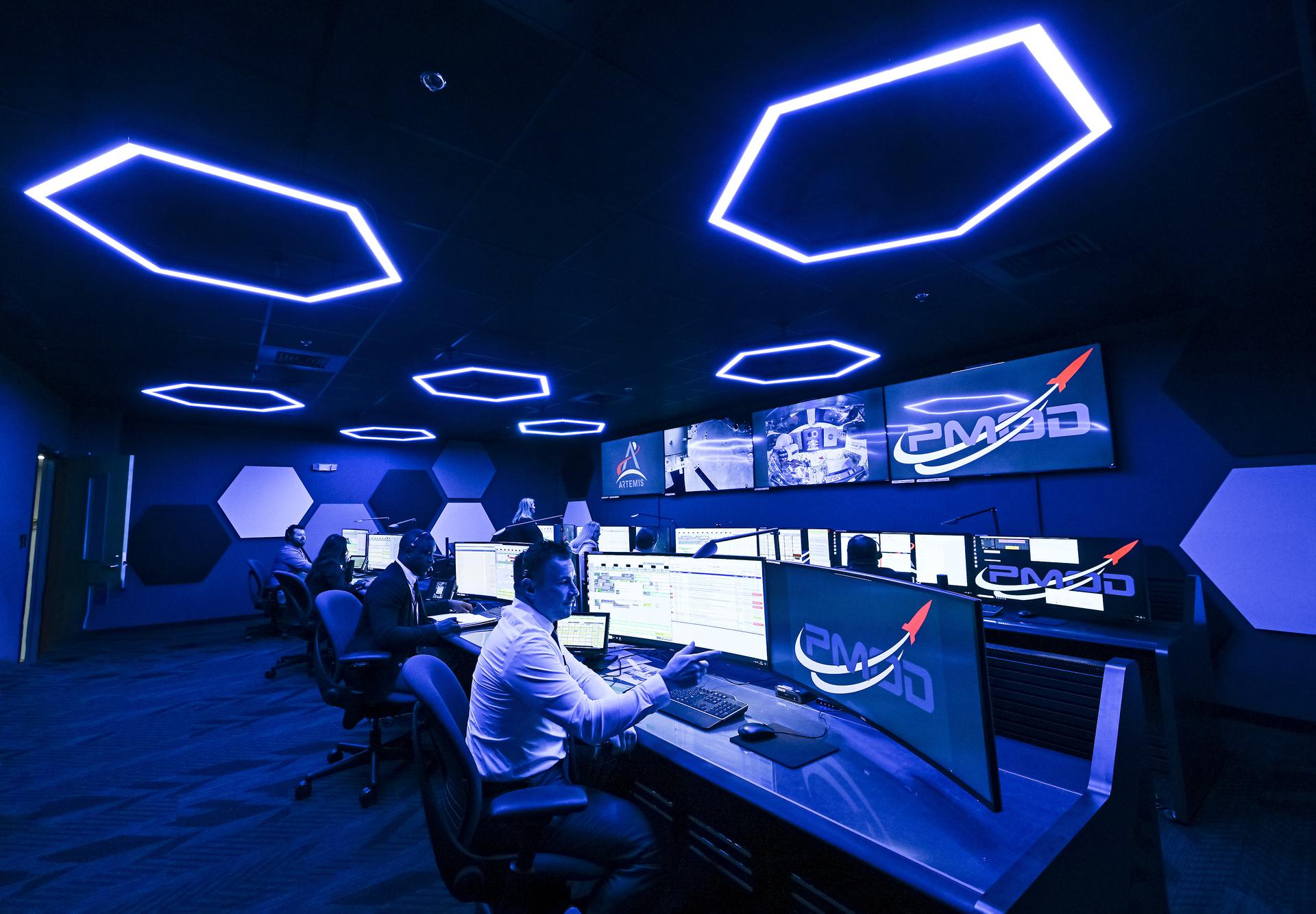
These photos offer a look inside the twin control rooms at NASA’s Marshall Space Flight Center in Huntsville, Alabama, where engineers will monitor Artemis science and future landing operations for Artemis. The LUCA (Lunar Utilization Control Area) and LESA (Lander Engineering Support Area) rooms are part of the Huntsville Operations Support Center at NASA Marshall. The LUCA is specially designed to support a wide variety of science operations on and around the Moon – and beyond. Engineers in the LUCA monitored operations for the Lunar Node-1 experiment, an autonomous navigation payload that was part of the first NASA Commercial Lunar Payload Services (CLPS) launch on Intuitive Machines’ Nova-C lunar lander in 2024. NASA Marshall flight controllers will use the LUCA again for Artemis II to monitor science operations. Beginning with Artemis III, members of the NASA Human Landing System Mission Insight Support Team – a group of engineers, safety leads, flight operations experts, and technical authorities – will work in the LESA. There, they will monitor lander systems in real-time and be involved in key decision-making processes throughout the mission. For more information, contact NASA Marshall’s Office of Communications at 256-544-0034.
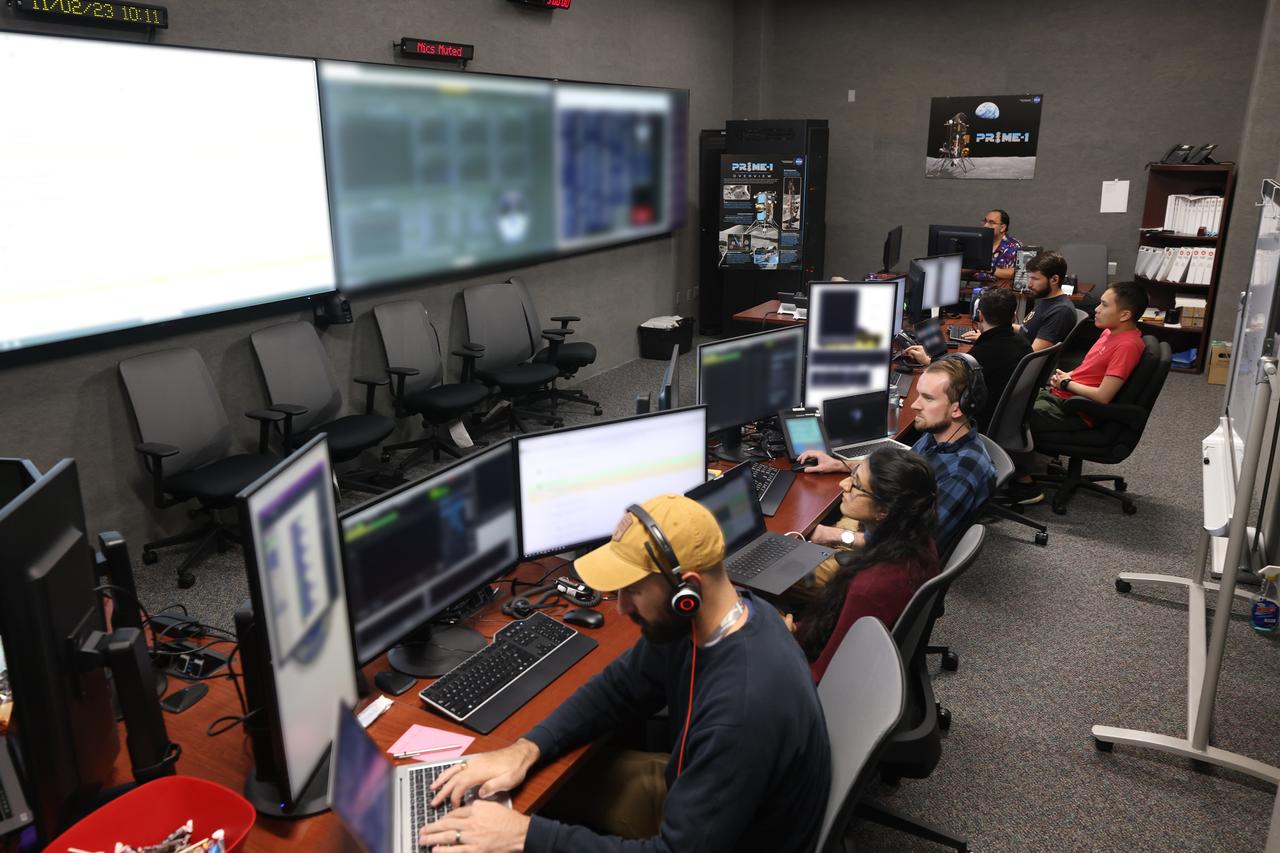
A team of engineers participates in simulation training for the Polar Resources Ice Mining Experiment-1 (PRIME-1) on Thursday, Nov. 2, 2023, inside the Neil Armstrong Operations and Checkout Building at NASA’s Kennedy Space Center in Florida. The purpose of the training is to get the integrated PRIME-1 team – engineers with PRIME-1’s MSOLO (Mass Spectrometer Observing Lunar Operations) and Honeybee Robotics’ TRIDENT (The Regolith and Ice Drill for Exploring New Terrain) drill – prepared to operate the instrument on the lunar surface. The team commanded the PRIME-1 hardware, located at Intuitive Machines in Houston, to operate MSOLO and TRIDENT. PRIME-1 is scheduled to launch through NASA’s CLPS (Commercial Lunar Payload Delivery Service) initiative and will be the first in-situ resource utilization demonstration on the Moon, with MSOLO and TRIDENT making up its two primary components. Through Artemis missions, CLPS deliveries will be used to perform science experiments, test technologies, and demonstrate capabilities to help NASA explore the Moon and prepare for human deep space exploration missions.

NASA Administrator Jim Bridenstine, left, and NASA Associate Administrator for the Science Mission Directorate Thomas Zurbuchen, right, pose for a photograph with the representatives of the nine U.S. companies that are eligible to bid on NASA delivery services to the lunar surface through Commercial Lunar Payload Services (CLPS) contracts, Thursday, Nov. 29, 2018 at NASA Headquarters in Washington. The representatives of the companies are: Steve Altemus, President and CEO of Intuitive Machines; 2nd from left, Sean Mahoney, CEO, Masten Space Systems Inc; Eric Salwan, Director of Commercial Business Development, Firefly Aerospace; Jennifer Jensen, Vice President, National Security & Space, Draper; Joe Landon, VP of Advanced Programs, Commercial Civil Space, Lockheed Martin Space; Steve Bailey, Deep Space Systems Inc; Daven Maharaj, Chief Operating Officer, Moon Express Inc; John Thornton, CEO, Astrobotic Technology Inc; and Jeff Patton, Chief Engineering Advisor, Orbit Beyond Inc, 2nd from right. Photo Credit: (NASA/Bill Ingalls)
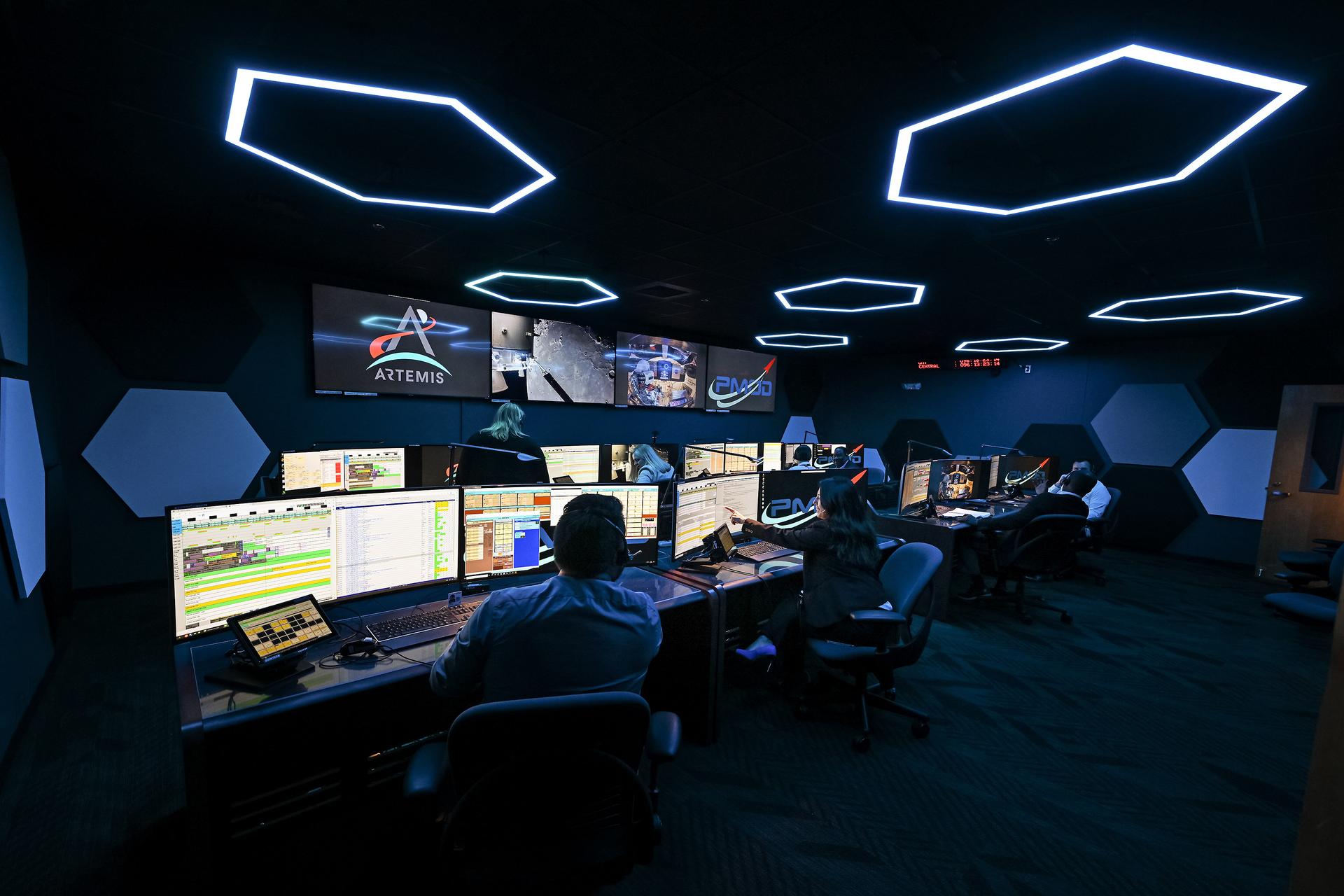
These photos offer a look inside the twin control rooms at NASA’s Marshall Space Flight Center in Huntsville, Alabama, where engineers will monitor Artemis science and future landing operations for Artemis. The LUCA (Lunar Utilization Control Area) and LESA (Lander Engineering Support Area) rooms are part of the Huntsville Operations Support Center at NASA Marshall. The LUCA is specially designed to support a wide variety of science operations on and around the Moon – and beyond. Engineers in the LUCA monitored operations for the Lunar Node-1 experiment, an autonomous navigation payload that was part of the first NASA Commercial Lunar Payload Services (CLPS) launch on Intuitive Machines’ Nova-C lunar lander in 2024. NASA Marshall flight controllers will use the LUCA again for Artemis II to monitor science operations. Beginning with Artemis III, members of the NASA Human Landing System Mission Insight Support Team – a group of engineers, safety leads, flight operations experts, and technical authorities – will work in the LESA. There, they will monitor lander systems in real-time and be involved in key decision-making processes throughout the mission. For more information, contact NASA Marshall’s Office of Communications at 256-544-0034.