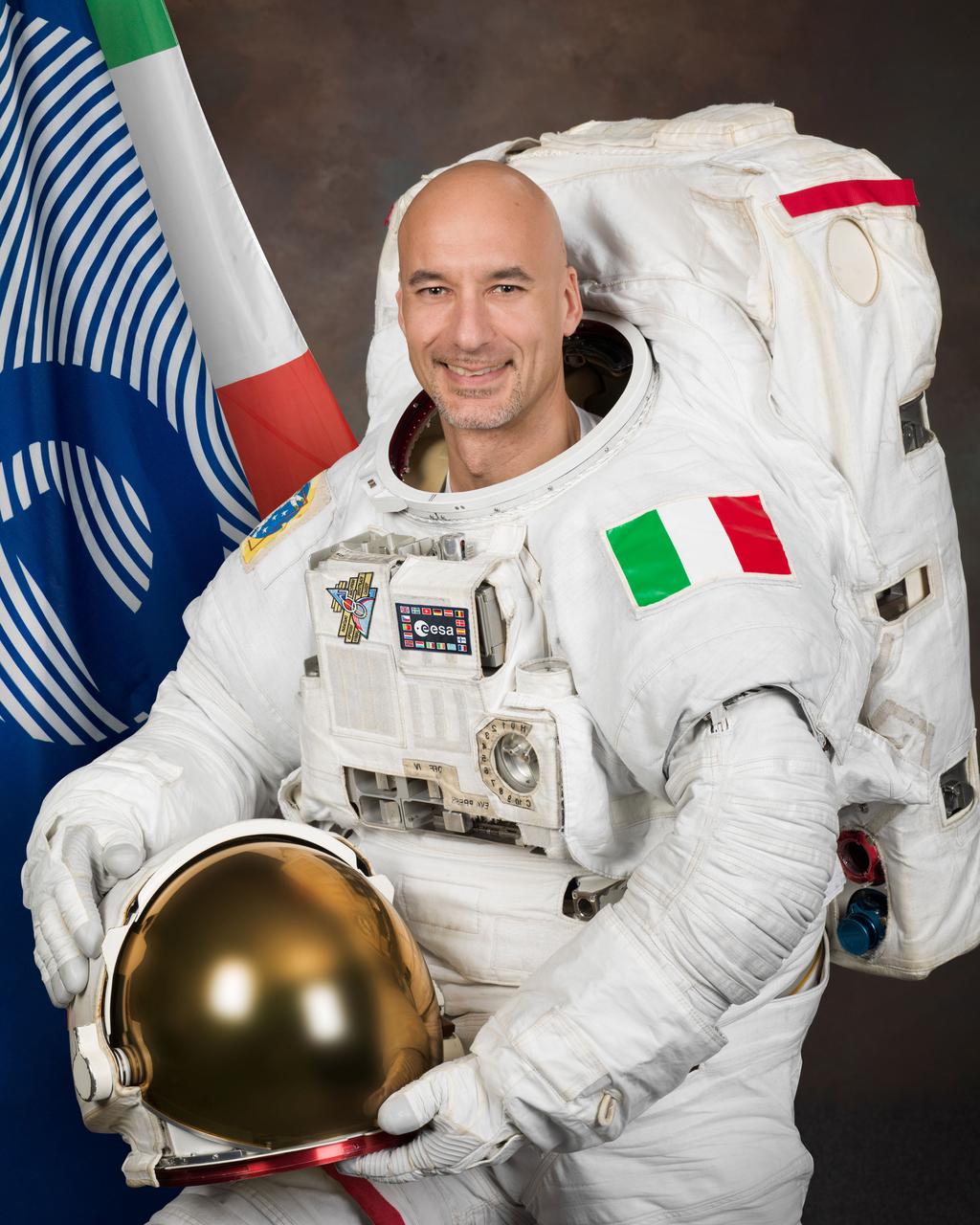
jsc2013e007948 (Jan. 25, 2013) --- ESA (European Space Agency) astronaut Luca Parmitano poses for his official portrait in a U.S. spacesuit at NASA's Johnson Space Center. A patch bearing the flag of his home country of Italy is attached to the spacesuit. The ESA and Italian flags are also in the left background.
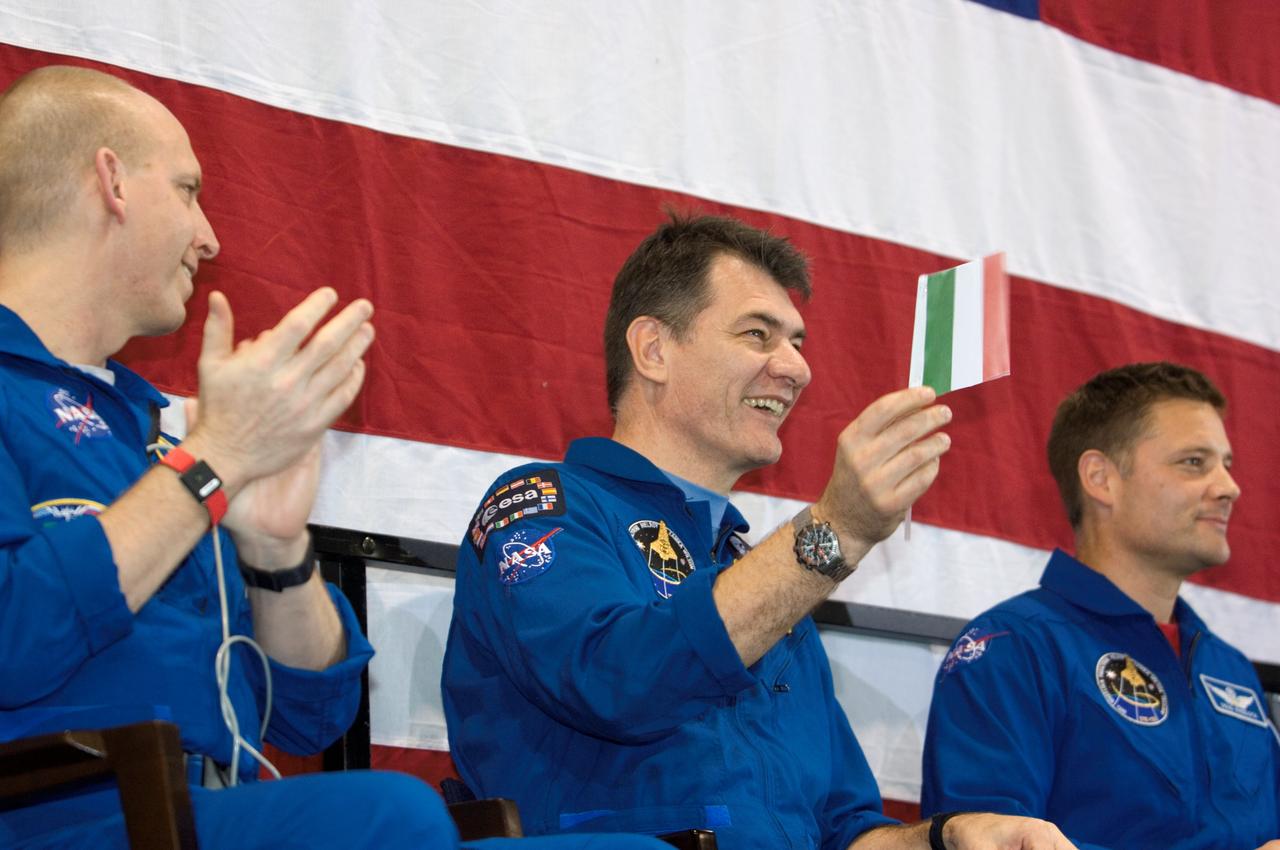
JSC2007-E-098008 (8 Nov. 2007) --- European Space Agency astronaut Paolo Nespoli, STS-120 mission specialist, waves his homeland's national flag during the Discovery crew's Nov. 8 welcome home ceremony at Houston's Ellington Field. Other replicas of the Italian flag were seen waving throughout the hangar. Nespoli is flanked by two fellow mission specialists -- astronauts Clay Anderson (left) and Doug Wheelock.
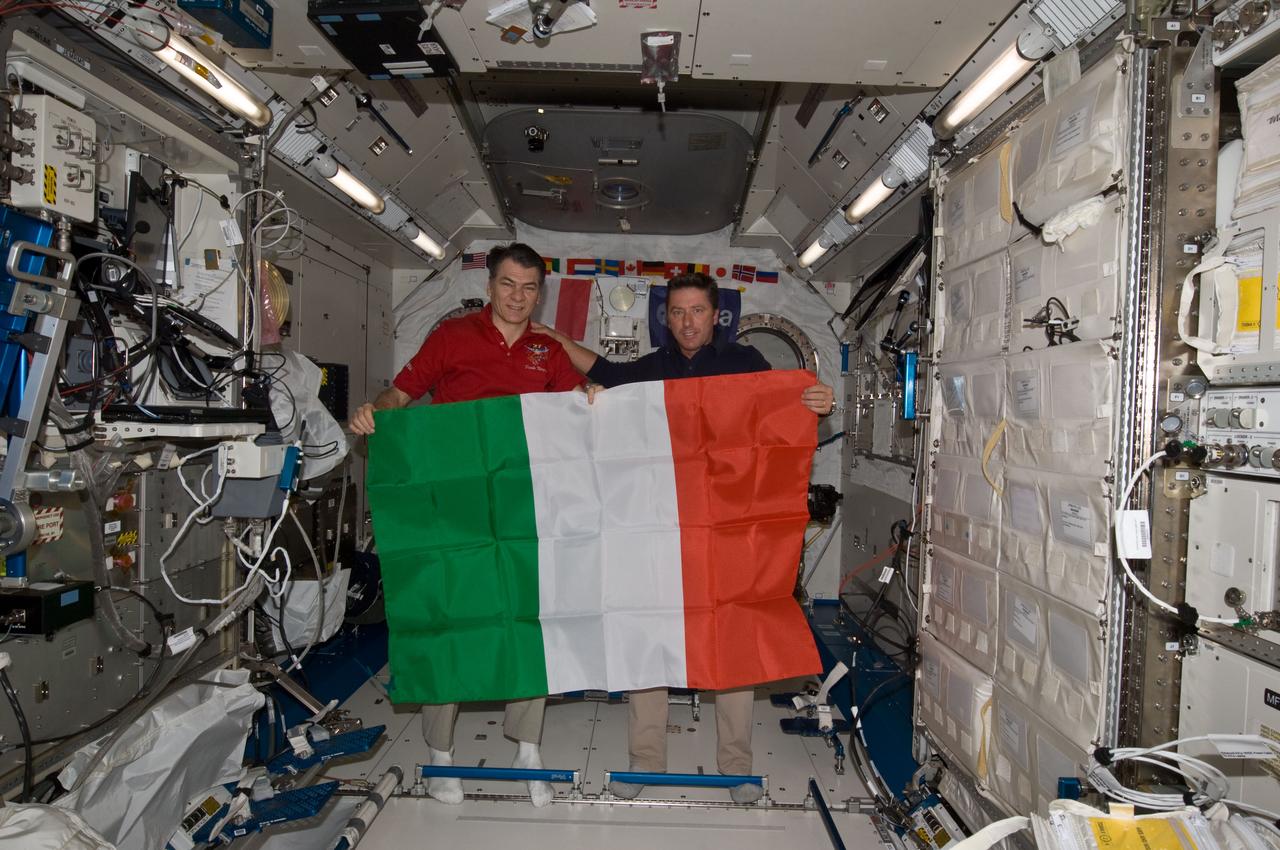
ISS027-E-036175 (23 May 2011) --- Inside the Japan Aerospace Exploration Agency's Kibo lab on the International Space Station (ISS), European Space Agency astronauts Paolo Nespoli (left) and Roberto Vittori display the Italian flag during an Earth-to-space phone tag-up with Italian President Giorgio Napolitano. Nespoli has been on the station for over five months and is due to return to Earth in less than 24 hours. Vittori is on a 16-day mission of the space shuttle Endeavour, joined by five NASA astronauts. This occasion is the second time two Italian astronauts have been in space together and the first time in the last 15 years.
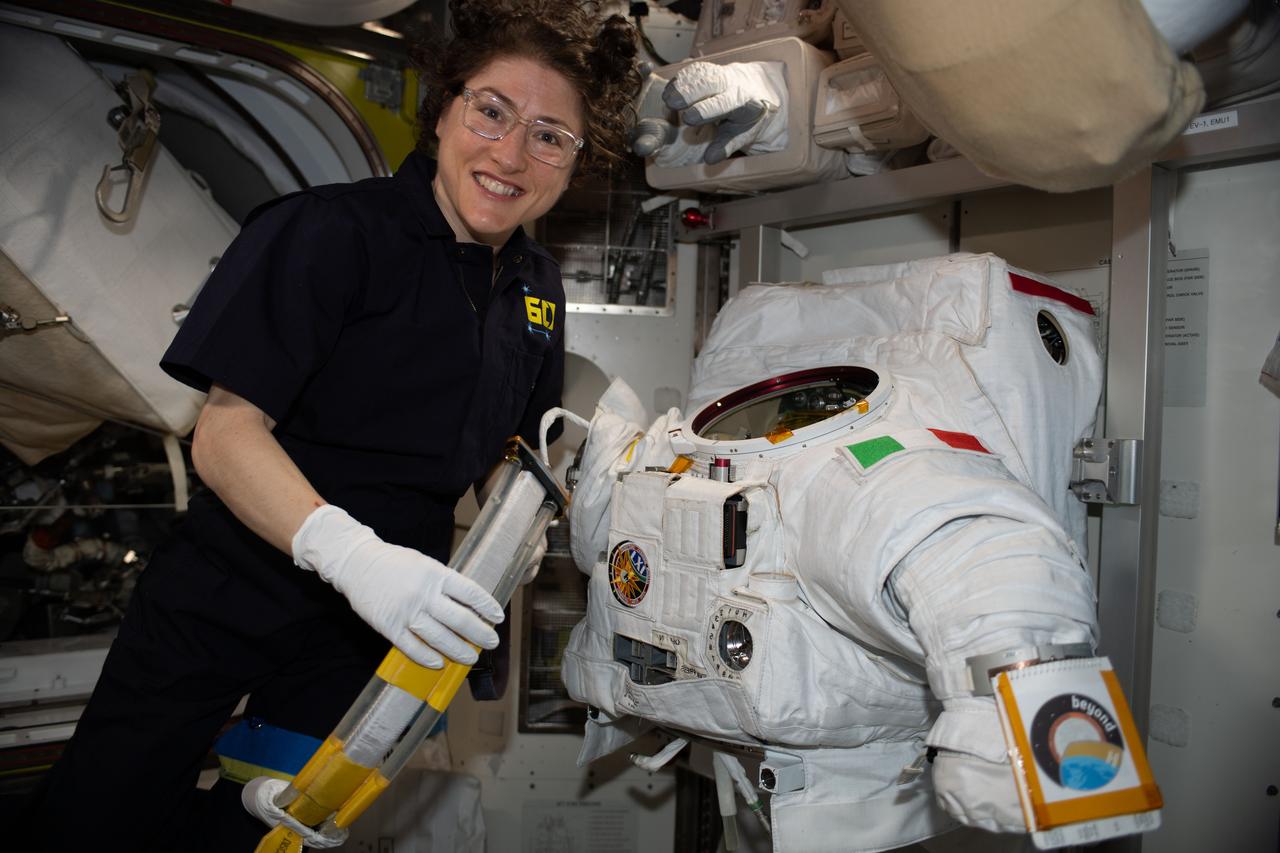
iss061e067498 (Dec. 5, 2019) --- NASA astronaut Christina Koch works on a U.S. spacesuit, with a patch of the Italian flag on the left shoulder, that Commander Luca Parmitano of ESA (European Space Agency) wore during a spacewalk on Dec. 2, 2019.
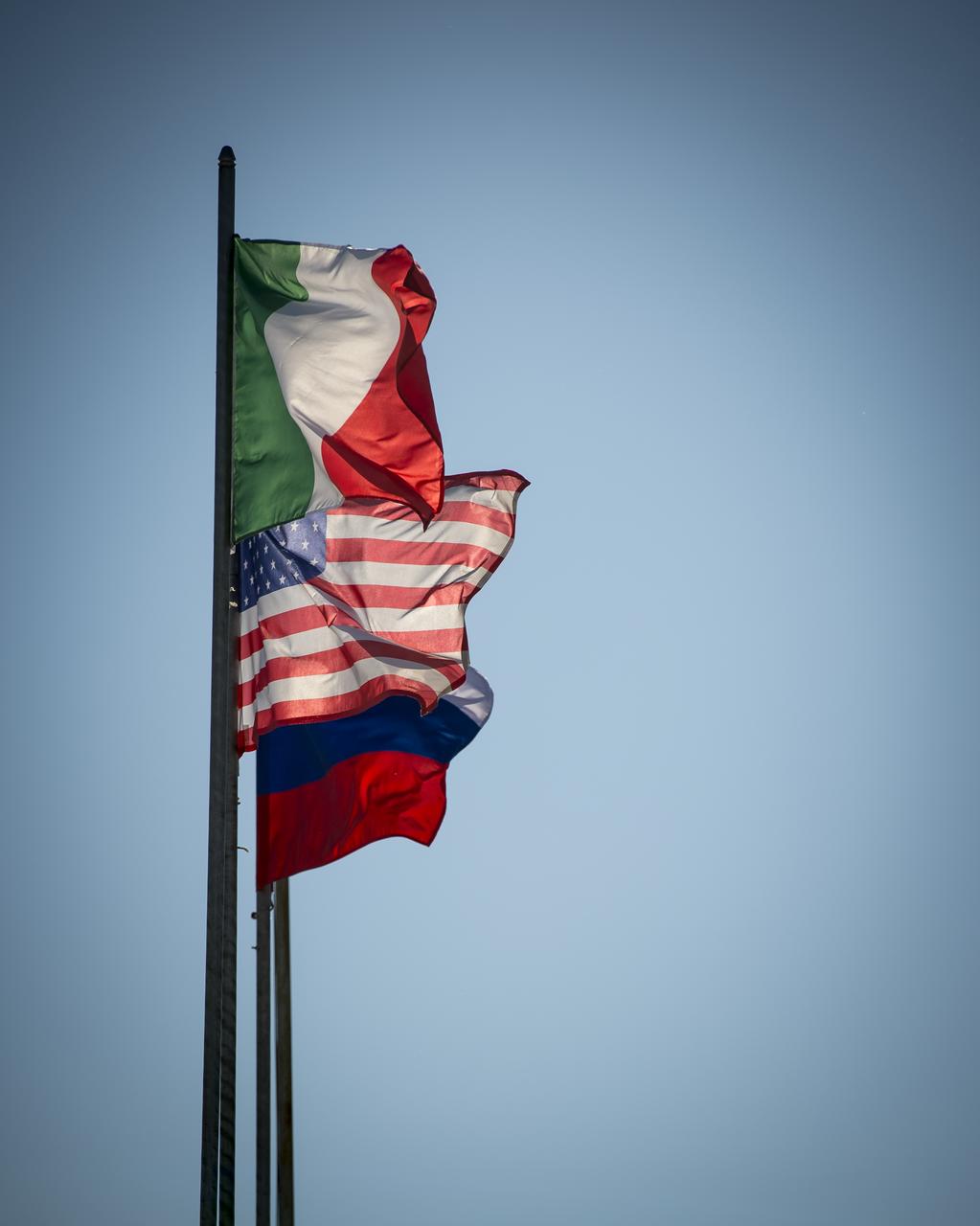
The flags of Italy, U.S.A., and Russia, are seen as they fly at the Baikonur Cosmodrome launch pad shortly after the Soyuz TMA-09M spacecraft was rolled out and placed raised into position, Sunday, May 26, 2013, in Kazakhstan. The launch of the Soyuz rocket to the International Space Station (ISS) with Expedition 36/37 Soyuz Commander Fyodor Yurchikhin of the Russian Federal Space Agency (Roscosmos), Flight Engineers; Luca Parmitano of the European Space Agency, and Karen Nyberg of NASA, is scheduled for Wednesday May 29, Kazakh time. Yurchikhin, Nyberg, and, Parmitano, will remain aboard the station until mid-November. Photo credit: (NASA/Bill Ingalls)
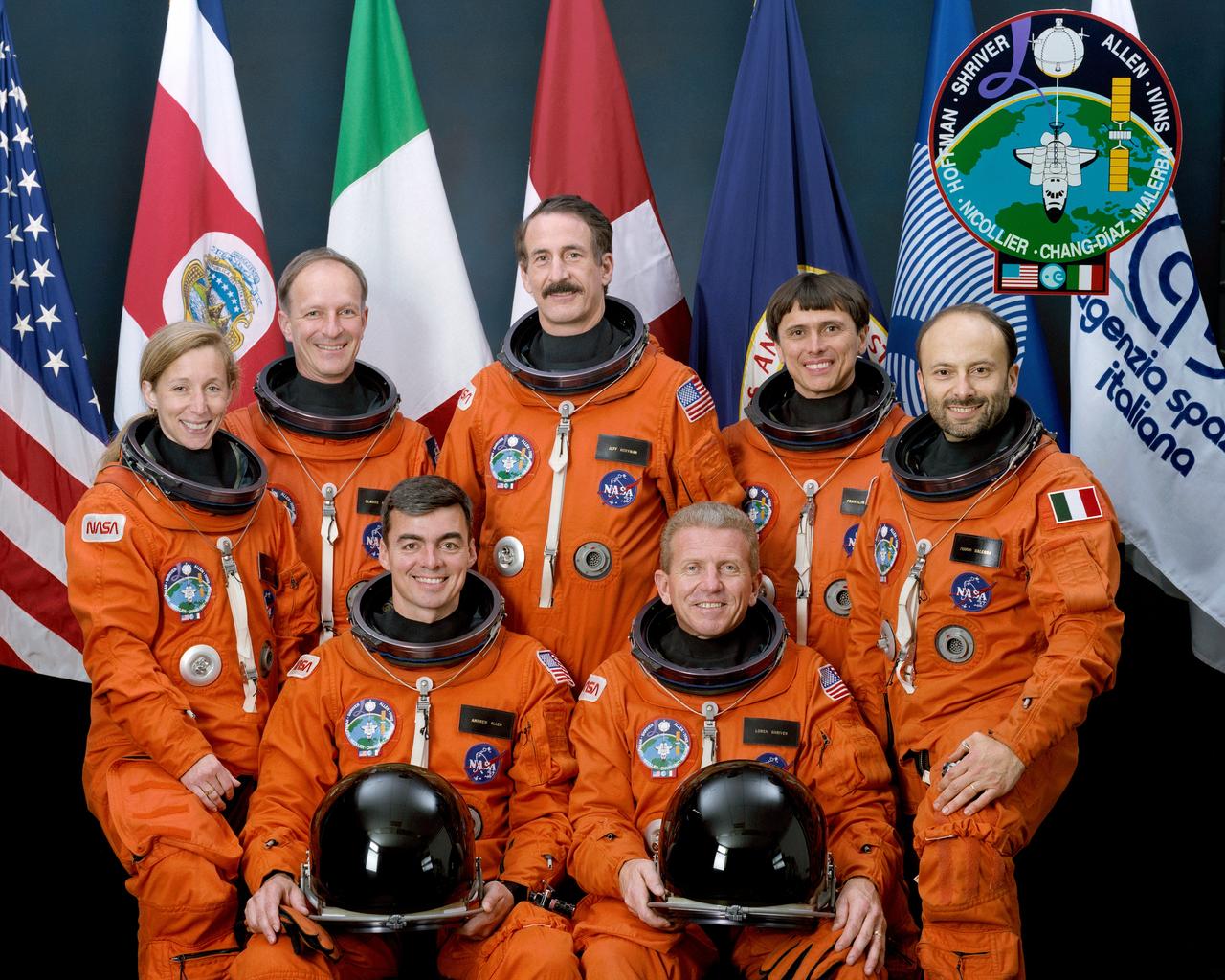
STS046-S-002 (May 1992) --- The crew members assigned to the STS-46 mission pose with seven flags that represent participation on the flight. Loren J. Shriver (right front) is mission commander; Andrew M. Allen (left front) is pilot. Others are (left to right) Marsha S. Ivins, mission specialist; Claude Nicollier, mission specialist representing the European Space Agency (ESA); Jeffrey A. Hoffman, payload commander; Franklin R. Chang-Diaz, mission specialist; and Franco Malerba, flying for the Italian Space Agency (ASI). The flags, left to right, represent the United States of America, Costa Rica (Chang's native country), Italy, Switzerland (Nicollier's homeland), NASA, ESA and ASI.
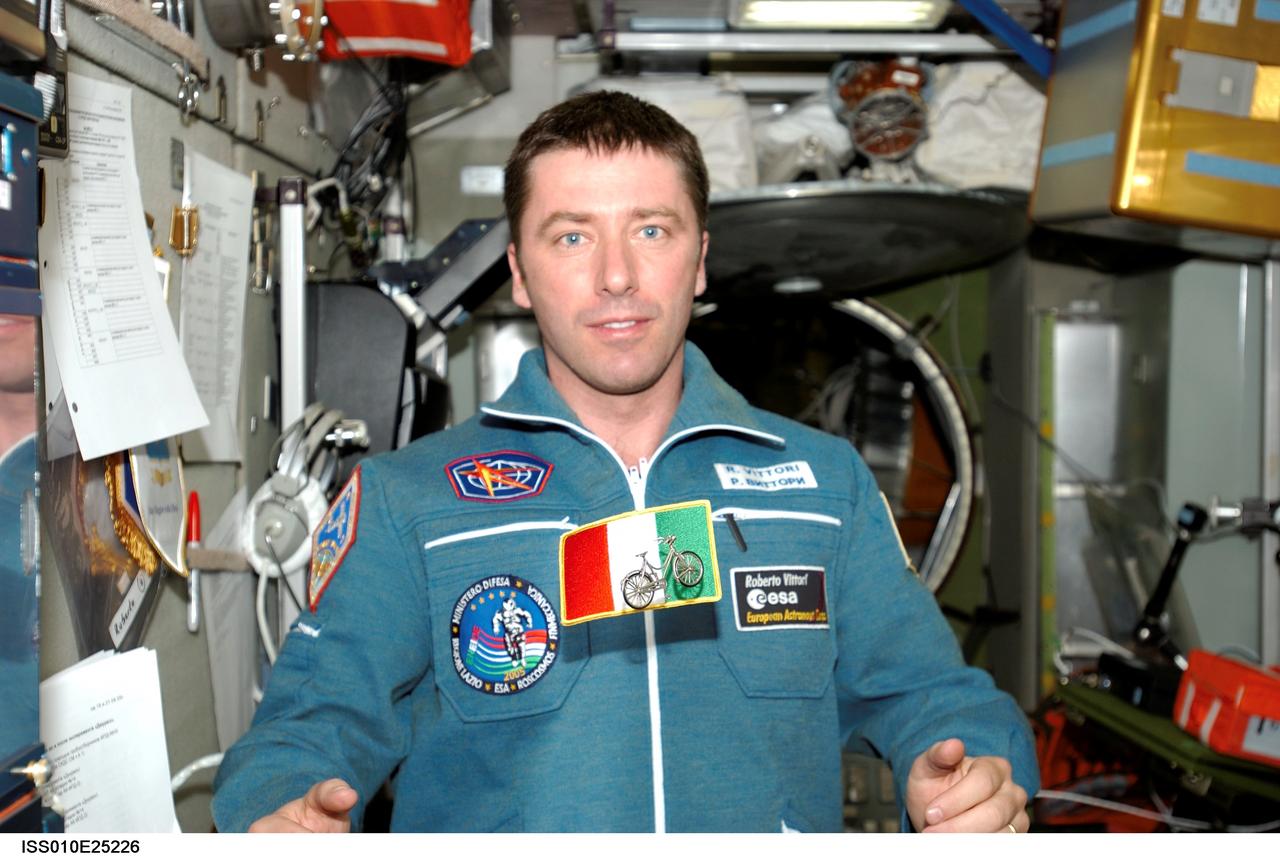
ISS010-E-25226 (20 April 2005) --- European Space Agency (ESA) astronaut Roberto Vittori of Italy is pictured in the Zvezda Service Module of the International Space Station (ISS). A patch representing the Italian flag and a toy bicycle float freely near Vittori. After spending eight days on the Station under a commercial contract between ESA and the Russian Federal Space Agency, Vittori will return to Earth with the Expedition 10 crew on April 24 (CDT).
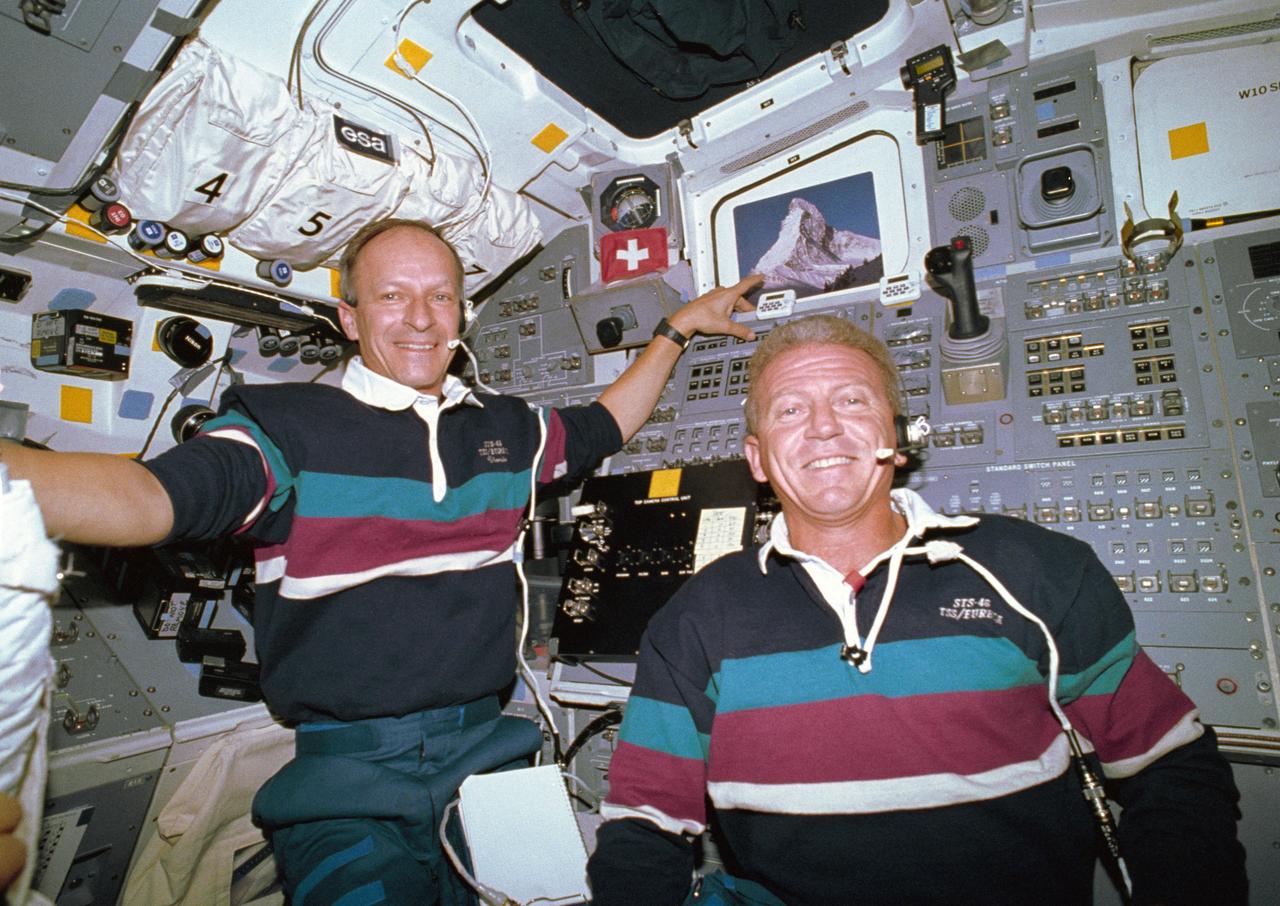
STS046-03-020 (7 Aug 1992) --- With their windows boarded up for specific intravehicular operations, two crew members pose for an in-space portrait. At left, Swiss scientist Claude Nicollier, representing the European Space Agency (ESA), steadies himself near a tiny Swiss flag and a photograph of the Matterhorn, a popular peak on the Swiss-Italian border. Astronaut Loren J. Shriver (right) served as mission commander for the eight-day flight.
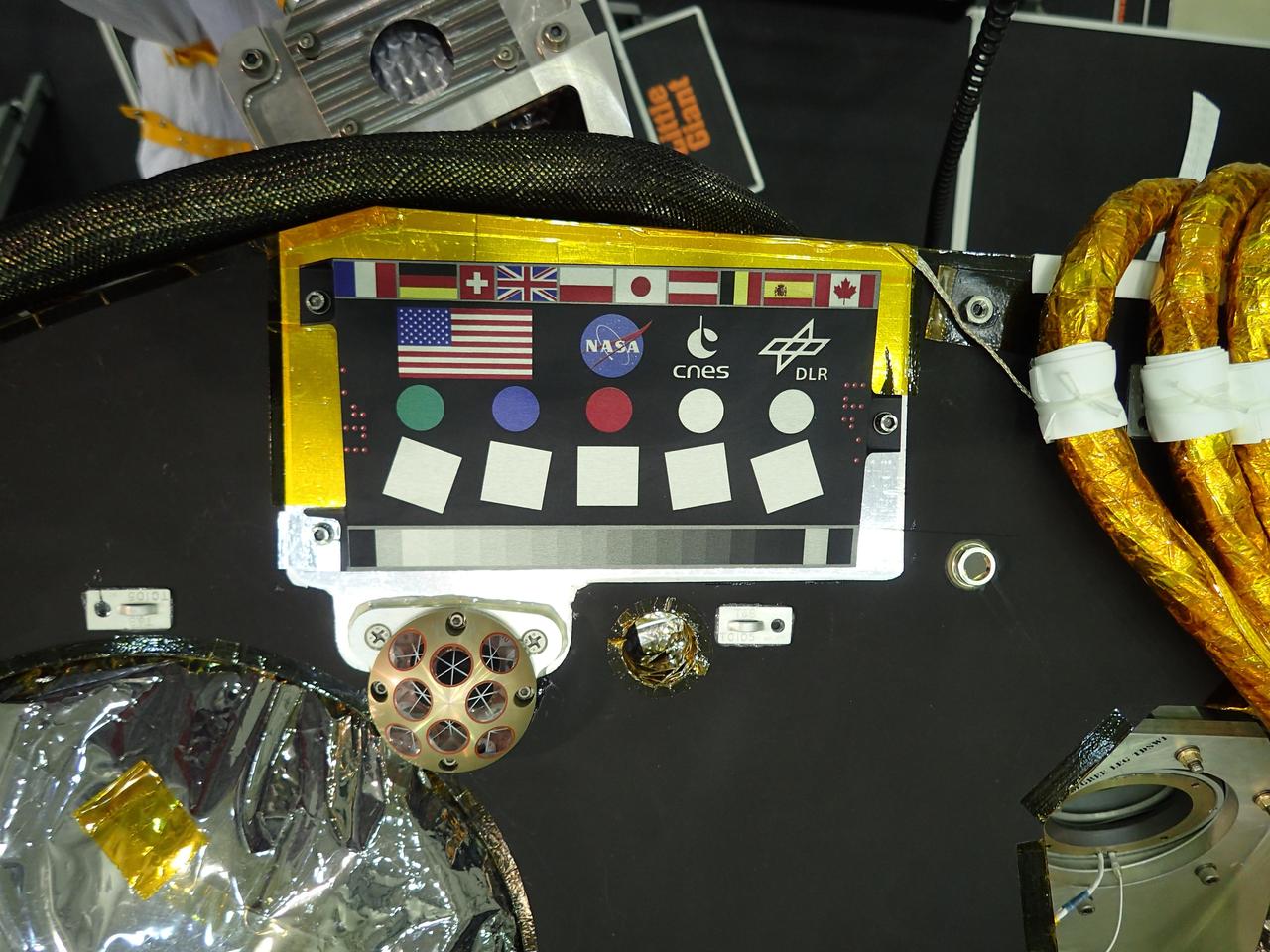
A camera calibration target sits on the deck of the NASA's InSight lander, adorned with the flags of the countries participating in the mission. The target, which will be viewed by InSight's cameras, provides a variety of colors and shapes to help calibrate the lander's cameras. It also shows off international flags representing the agencies, institutions and participating scientists of the mission as of late 2014 (since that time, Italy has contributed an experiment). In the second row are the United States flag and the logos of NASA, the French space agency CNES, which provided InSight's seismometer; and the German Aerospace Center DLR, which provided InSight's heat flow probe. Below the target in the photo is an Italian experiment called the Laser Retroreflector for InSight (LaRRI). LaRRI is the small, copper-colored dome covered with circles just below the calibration target; it won't actually play a role in InSight's mission. The national space agency of Italy (ASI, for Agenzia Spaziale Italiana) provided LaRRI to be used by a possible future Mars orbiter mission with a laser altimeter making extremely precise measurements of the lander's location for fundamental physics studies and precision cartography. A microchip bearing the names of nearly a million members of the public is visible in this image to the right of the calibration target. A second microchip with more than a million additional names was added after this photo was taken. https://photojournal.jpl.nasa.gov/catalog/PIA22540
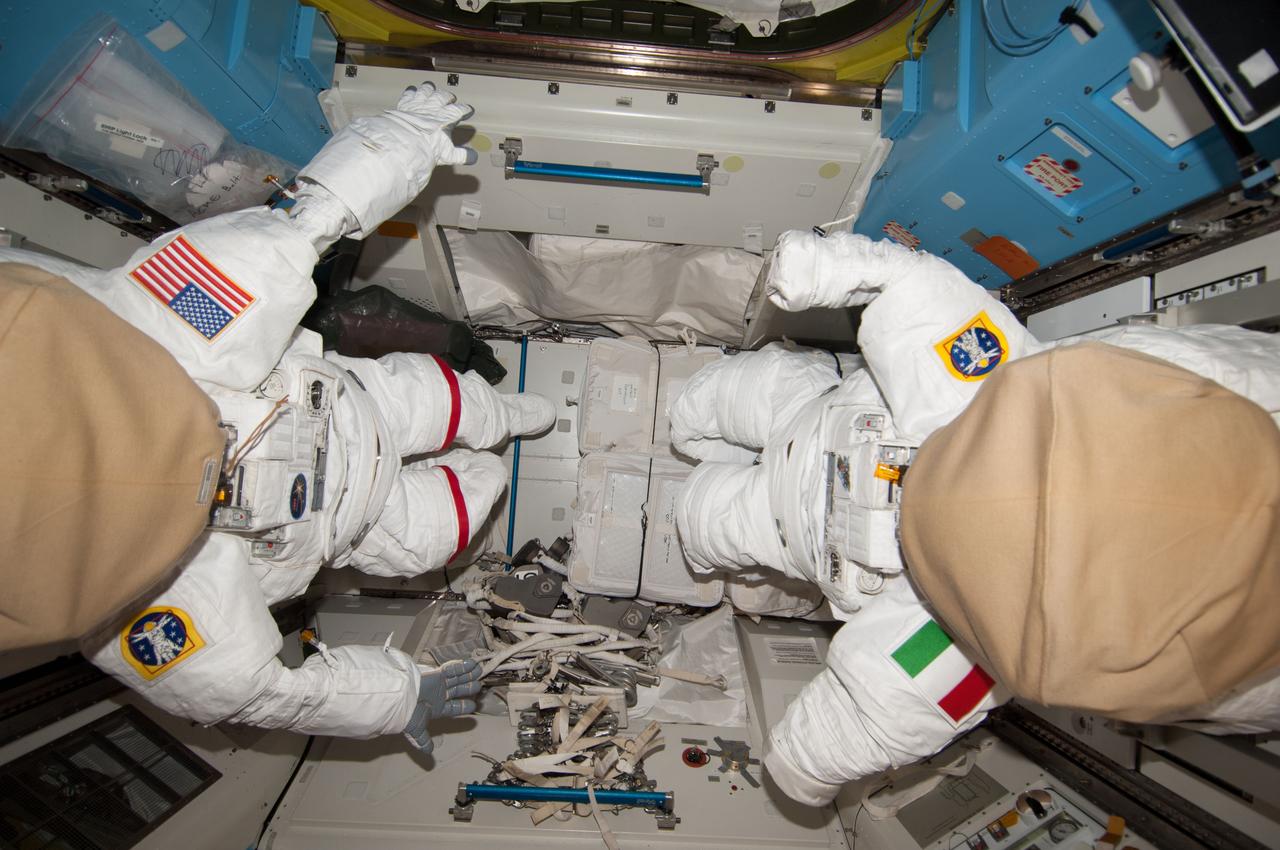
ISS035-E-030111 (28 April 2013) --- This high-angle view in the Quest airlock aboard the Earth-orbiting International Space Station portends a spacewalk for the Expedition 36 crew later in the year. Two extravehicular mobility units (EMU) stand ready for the event. U.S. and Italian flags on the shoulders of the suits signal that the participating astronauts would be representing NASA and the European Space Agency (ESA). Actually, NASA astronaut Chris Cassidy, now serving as a member of the Expedition 35 crew; and Luca Parmitano of ESA, who is currently still on Earth getting ready for a May launch, are scheduled for two spacewalks together in the summer of this year.
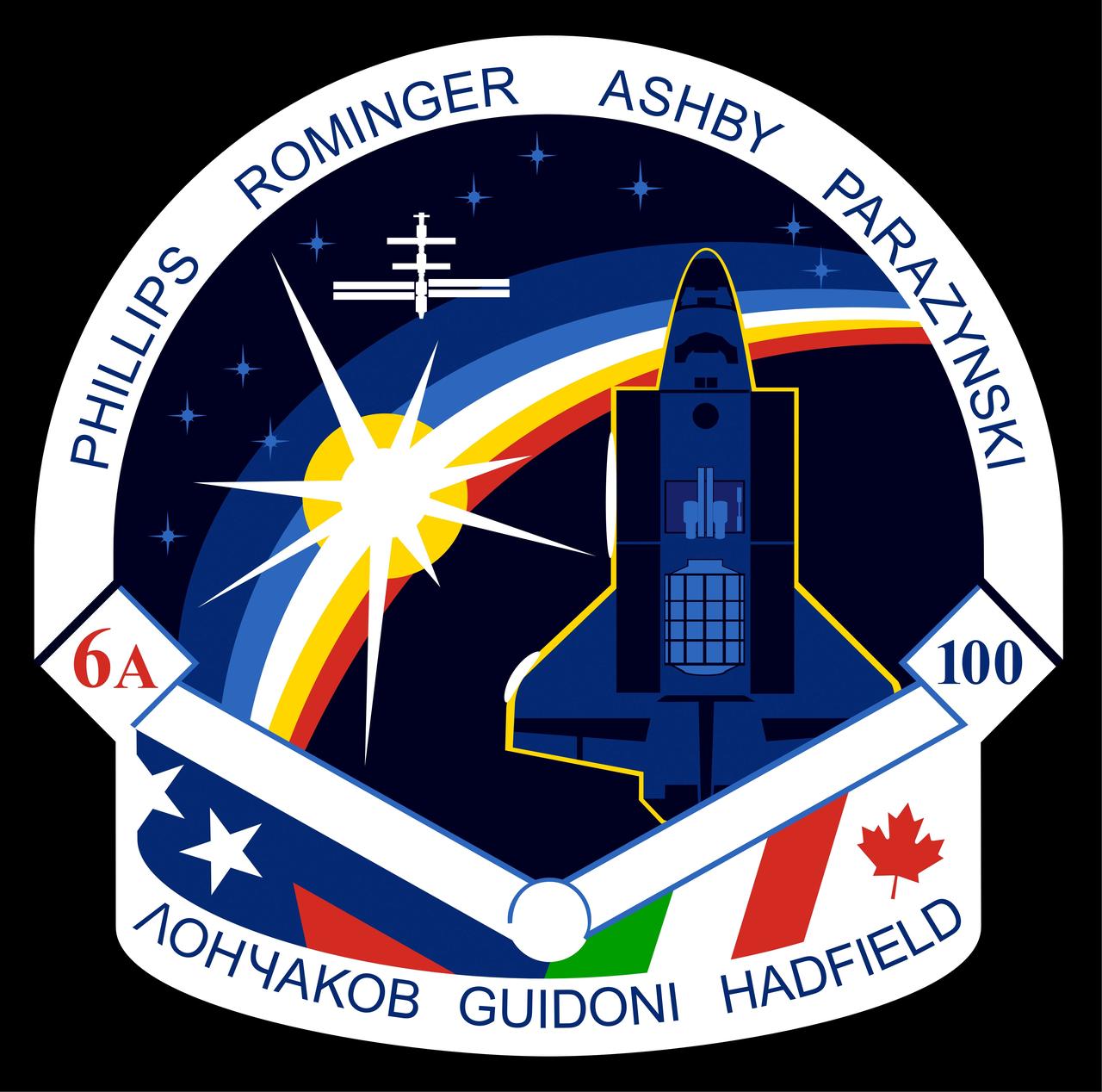
STS100-S-001 (December 2000) --- The STS-100/6A emblem reflects the complex interaction of robotics and extravehicular activity (EVA) on this mission. During the mission spacewalks will be conducted to deploy the International Space Station Robotic Manipulator System (SSRMS). The EVA helmet frames the patch, with the Canadian-built SSRMS shown below the visor. Reflected in the visor is the space shuttle Endeavour, with the International Space Station rising above the horizon at orbital sunrise. Endeavour’s payload bay houses a Spacelab pallet, itself holding the SSRMS and the Space Station Ultra High Frequency Antenna, and the Italian-built Multi-Purpose Logistics Module “Raffaello.” American, Russian, Canadian, and Italian astronauts compose the crew, and their flags are stylized in the lower portion of the emblem. Ten stars adorn the sky, representing the children of the STS-100 crew and the future of space exploration. The NASA insignia design for space shuttle flights is reserved for use by the astronauts and for other official use as the NASA Administrator may authorize. Public availability has been approved only in the forms of illustrations by the various news media. When and if there is any change in this policy, which is not anticipated, the change will be publicly announced. Photo credit: NASA
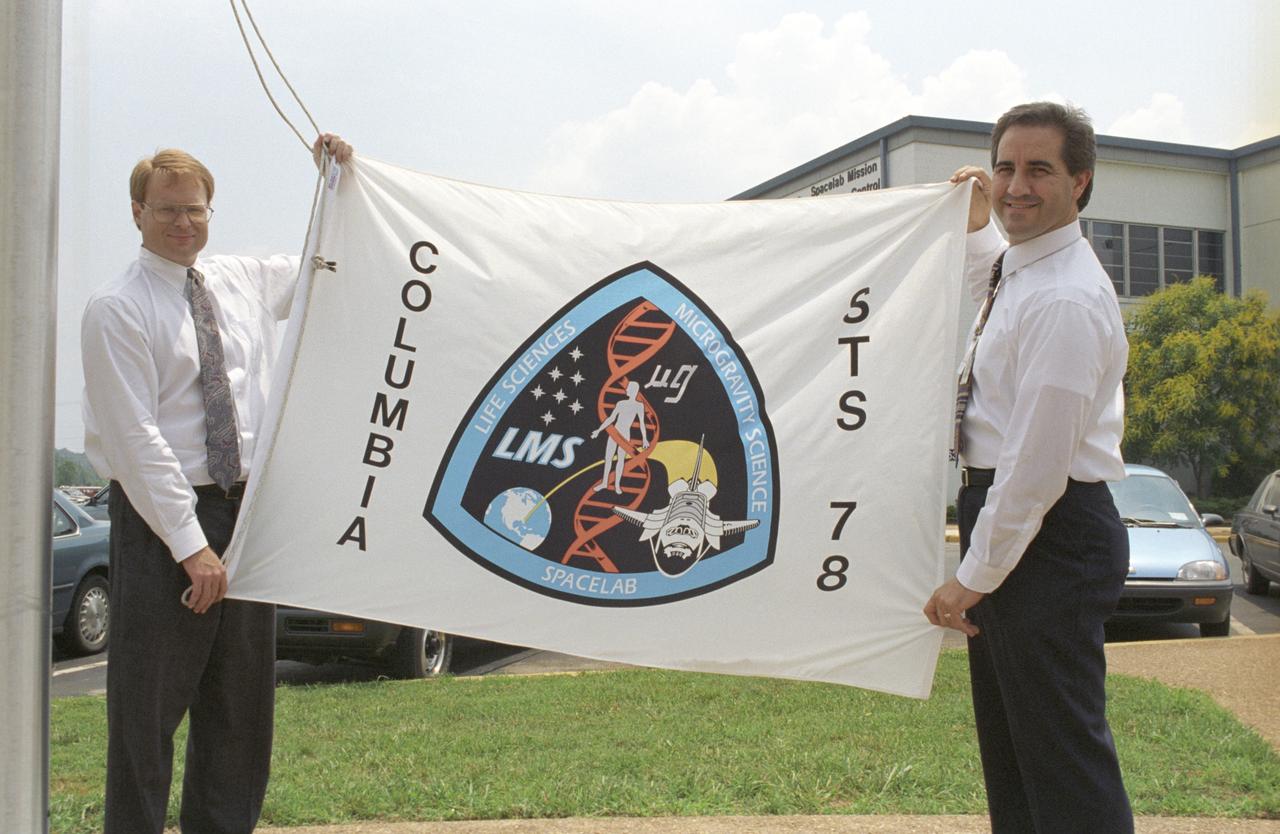
Launched on June 20, 1996, the STS-78 mission’s primary payload was the Life and Microgravity Spacelab (LMS), which was managed by the Marshall Space Flight Center (MSFC). During the 17 day space flight, the crew conducted a diverse slate of experiments divided into a mix of life science and microgravity investigations. In a manner very similar to future International Space Station operations, LMS researchers from the United States and their European counterparts shared resources such as crew time and equipment. Five space agencies (NASA/USA, European Space Agency/Europe (ESA), French Space Agency/France, Canadian Space Agency /Canada, and Italian Space Agency/Italy) along with research scientists from 10 countries worked together on the design, development and construction of the LMS. In this photo, LMS mission scientist Patton Downey and LMS mission manager Mark Boudreaux display the flag that was flown for the mission at MSFC.
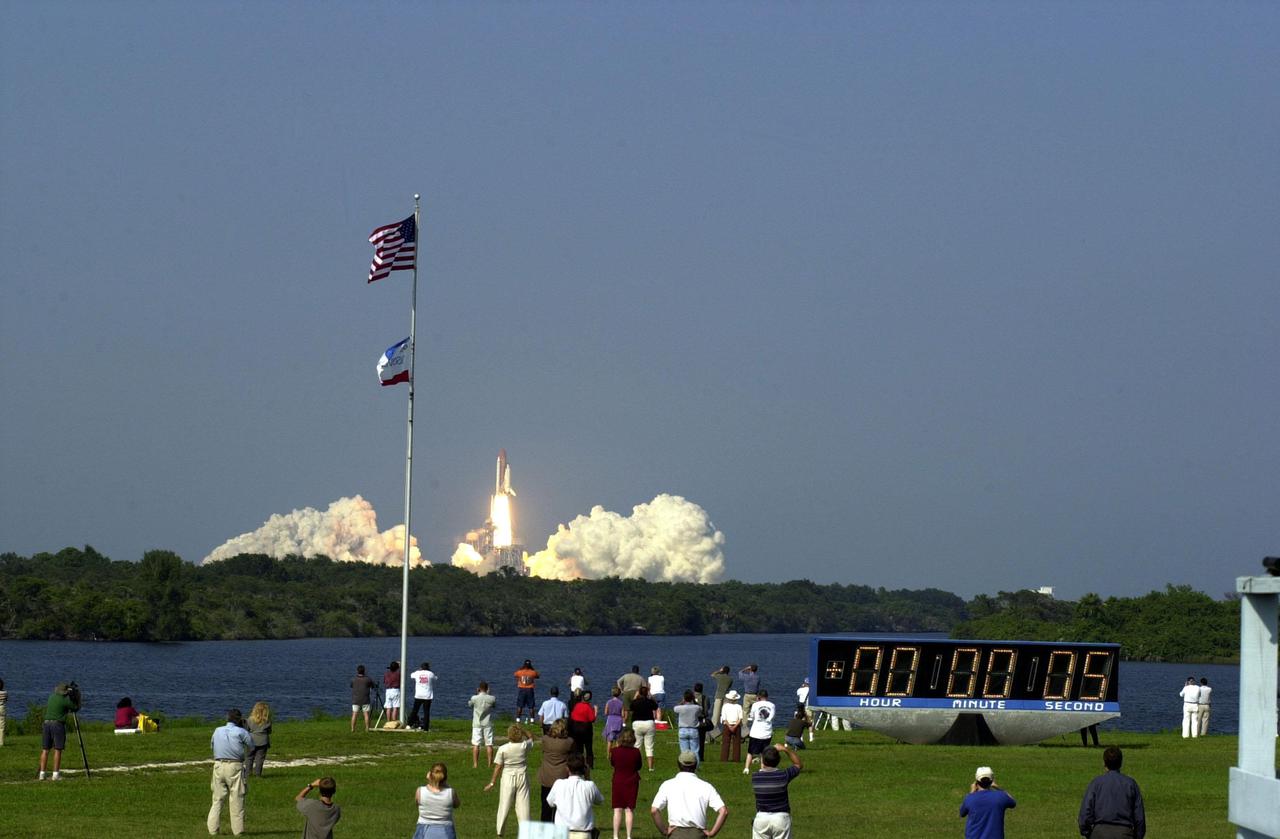
KENNEDY SPACE CENTER, Fla. -- Spectators gather on the grounds in front of the bleachers at the turn basin to watch the launch of Space Shuttle Discovery. A breeze from the southeast that has the flags snapping also kept gathering clouds away for the on-time liftoff at 5:10:14 p.m. EDT. Besides the Shuttle crew of four, Discovery carries the Expedition Three crew who will replace Expedition Two on the International Space Station. The mission includes the third flight of an Italian-built Multi-Purpose Logistics Module delivering additional scientific racks, equipment and supplies for the Space Station, and two spacewalks. Part of the payload is the Early Ammonia Servicer (EAS) tank, which will be attached to the Station during the spacewalks. The EAS will be installed on the P6 truss, which holds the Station’s giant U.S. solar arrays, batteries and the cooling radiators. The EAS contains spare ammonia for the Station’s cooling system. The three-member Expedition Two crew will be returning to Earth aboard Discovery after a five-month stay on the Station
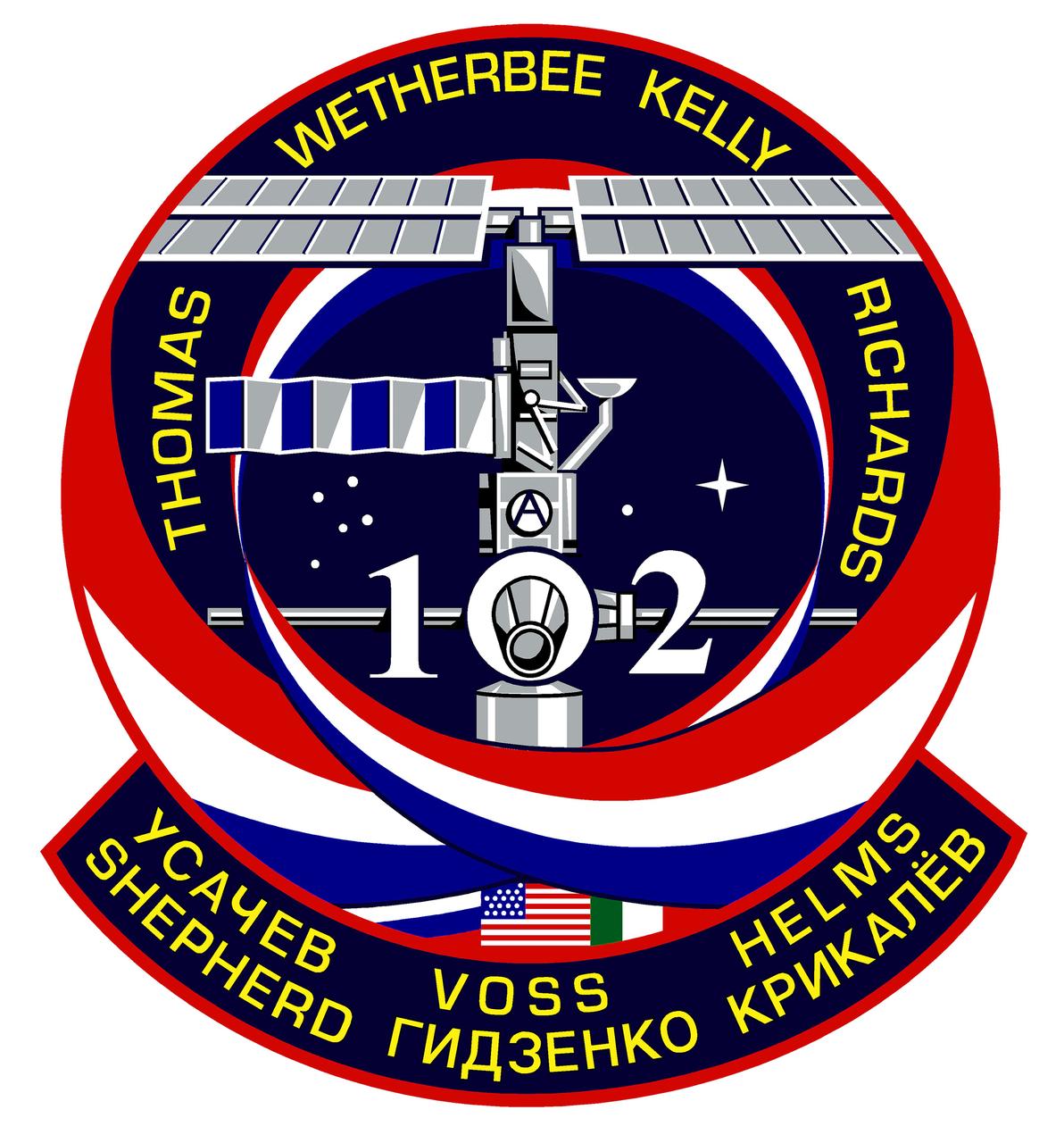
This is the STS-102 mission crew insignia. The central image on the crew patch depicts the International Space Station (ISS) in the build configuration that it had at the time of the arrival and docking of Discovery during the STS-102 mission, the first crew exchange flight to the Space Station. The station is shown along the direction of the flight as was seen by the shuttle crew during their final approach and docking, the so-called V-bar approach. The names of the shuttle crew members are depicted in gold around the top of the patch, and surnames of the Expedition crew members being exchanged are shown in the lower barner. The three ribbons swirling up to and around the station signify the rotation of these ISS crew members. The number 2 is for the Expedition 2 crew who flew up to the station, and the number 1 is for the Expedition 1 crew who then returned down to Earth. In conjunction with the face of the Lab module of the Station, these Expedition numbers create the shuttle mission number 102. Shown mated below the ISS is the Italian-built Multipurpose Logistics Module, Leonardo, that flew for the first time on this flight. The flags of the countries that were the major contributors to this effort, the United States, Russia, and Italy are also shown in the lower part of the patch. The build-sequence number of this flight in the overall station assembly sequence, 5A.1, is captured by the constellations in the background.
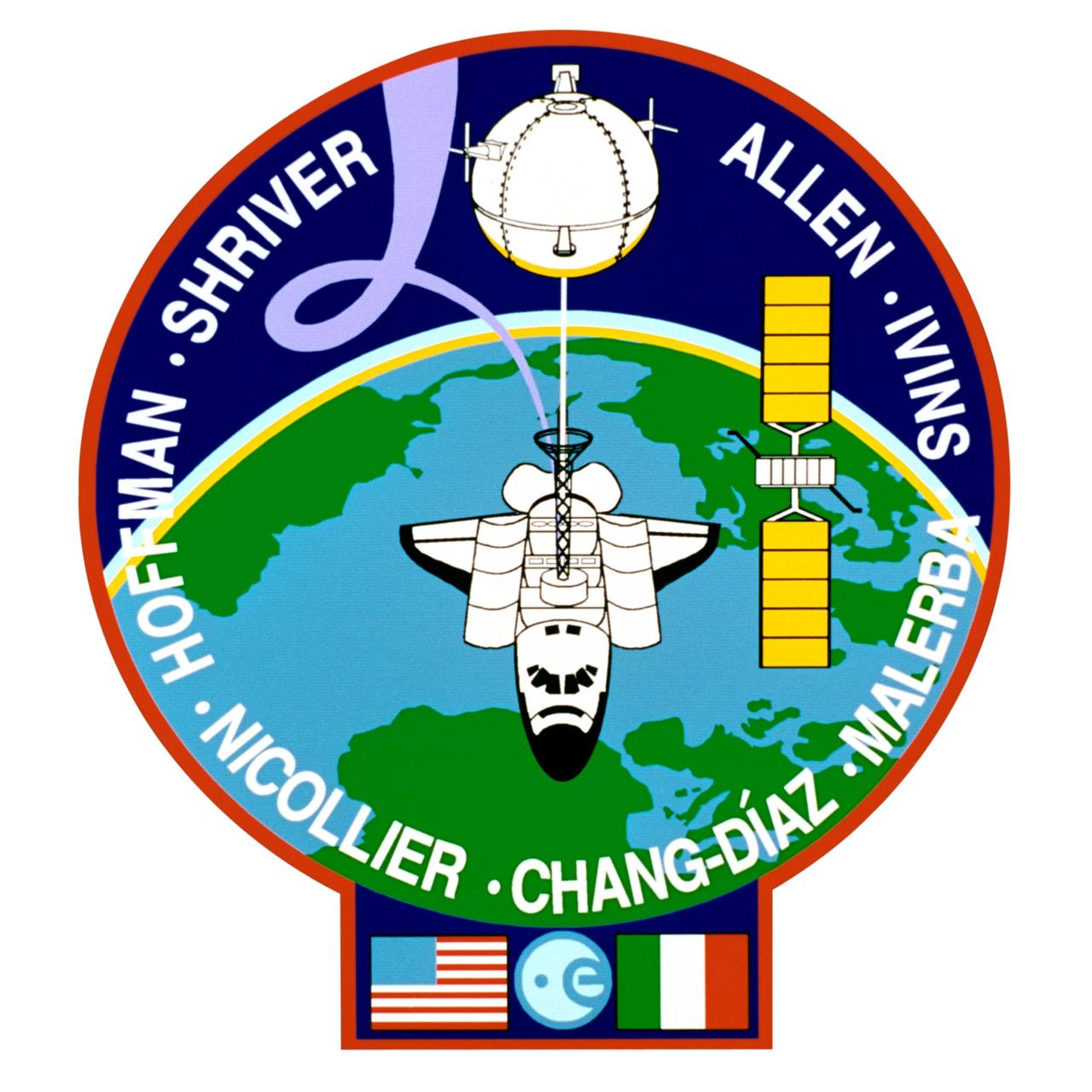
STS046-S-001 (May 1992) --- Designed by the crew members assigned to the flight, the crew patch depicts the space shuttle Atlantis in orbit around Earth, accompanied by major payloads: the European Retrievable Carrier (EURECA) and the Tethered Satellite System (TSS-1). In the depiction, EURECA has been activated and released, its antennae and solar arrays deployed, and it is about to start its ten-month scientific mission. The tethered satellite is linked to the orbiter by a 20-kilometer tether. The purple beam emanating from an electron generator in the payload bay spirals around Earth's magnetic field. The TSS mission will study the dynamics and electrodynamics of tethered systems in space and the physics of Earth's ionosphere. Visible on Earth's surface are the United States of America and the thirteen-member countries of the European Space Agency (ESA), in particular, Italy - partner with the United States in the TSS program. The American and Italian flags, as well as the ESA logo, further serve to illustrate the international character of STS-46. The NASA insignia design for space shuttle flights is reserved for use by the astronauts and for other official use as the NASA Administrator may authorize. Public availability has been approved only in the forms of illustrations by the various news media. When and if there is any change in this policy, which is not anticipated, the change will be publicly announced. Photo credit: NASA

KENNEDY SPACE CENTER, Fla. -- Spectators gather on the grounds in front of the bleachers at the turn basin to watch the launch of Space Shuttle Discovery. A breeze from the southeast that has the flags snapping also kept gathering clouds away for the on-time liftoff at 5:10:14 p.m. EDT. Besides the Shuttle crew of four, Discovery carries the Expedition Three crew who will replace Expedition Two on the International Space Station. The mission includes the third flight of an Italian-built Multi-Purpose Logistics Module delivering additional scientific racks, equipment and supplies for the Space Station, and two spacewalks. Part of the payload is the Early Ammonia Servicer (EAS) tank, which will be attached to the Station during the spacewalks. The EAS will be installed on the P6 truss, which holds the Station’s giant U.S. solar arrays, batteries and the cooling radiators. The EAS contains spare ammonia for the Station’s cooling system. The three-member Expedition Two crew will be returning to Earth aboard Discovery after a five-month stay on the Station
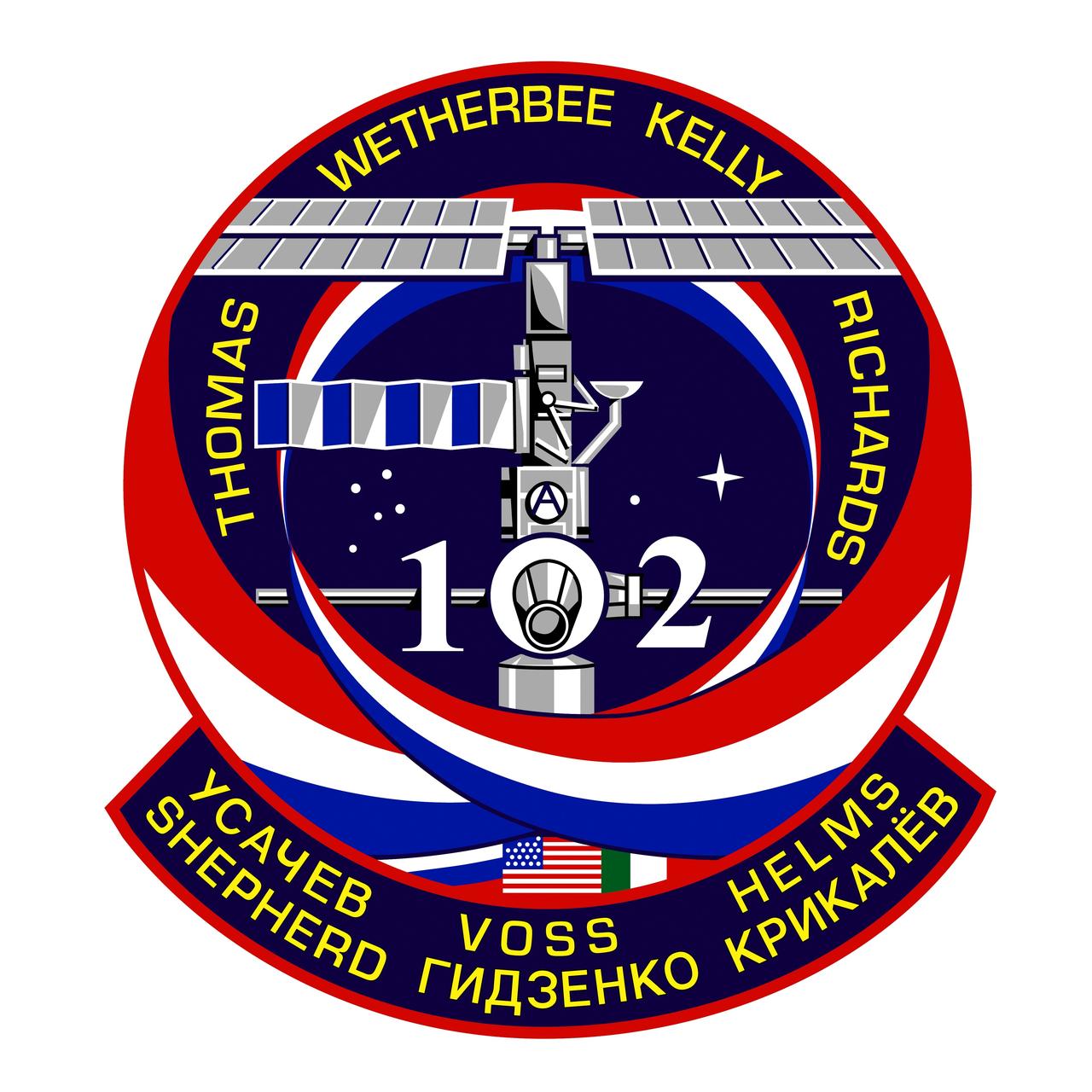
STS102-S-001 (January 2001) --- The central image on the STS-102 crew patch depicts the International Space Station (ISS) in the build configuration that it will have at the time of the arrival and docking of Discovery during the STS-102 mission, the first crew exchange flight to the space station. The station is shown along the direction of the flight as will be seen by the shuttle crew during their final approach and docking, the so-called V-bar approach. The names of the shuttle crew members are depicted in gold around the top of the patch, and surnames of the Expedition crew members being exchanged are shown in the lower banner. The three ribbons swirling up to and around the station signify the rotation of these ISS crew members. The number two is for the Expedition Two crew who fly up to the station, and the number one is for the Expedition One crew who then return down to Earth. In conjunction with the face of the Lab module of the station, these Expedition numbers create the shuttle mission number 102. Shown mated below the ISS is the Italian-built Multi-Purpose Logistics Module, Leonardo, that will fly for the first time on this flight, and which will be attached to the station by the shuttle crew during the docked phase of the mission. The flags of the countries that are the major contributors to this effort, the United States, Russia, and Italy are also shown in the lower part of the patch. The build-sequence number of this flight in the overall station assembly sequence, 5A.1, is captured by the constellations in the background. The NASA insignia design for space shuttle flights is reserved for use by the astronauts and for other official use as the NASA Administrator may authorize. Public availability has been approved only in the forms of illustrations by the various news media. When and if there is any change in this policy, which is not anticipated, the change will be publicly announced. Photo credit: NASA