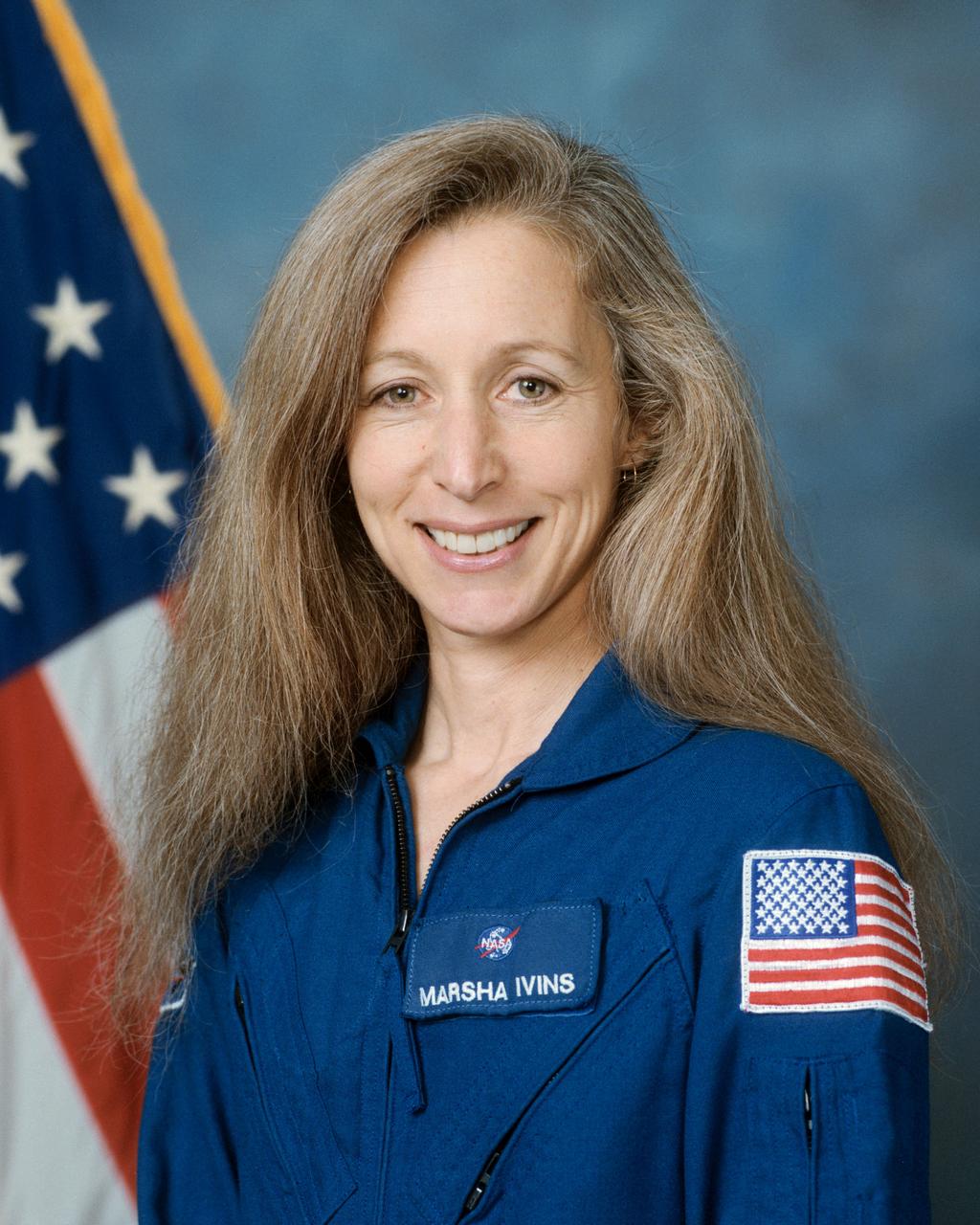
S96-13321 (1 April 1993) --- Astronaut Marsha S. Ivins, mission specialist.
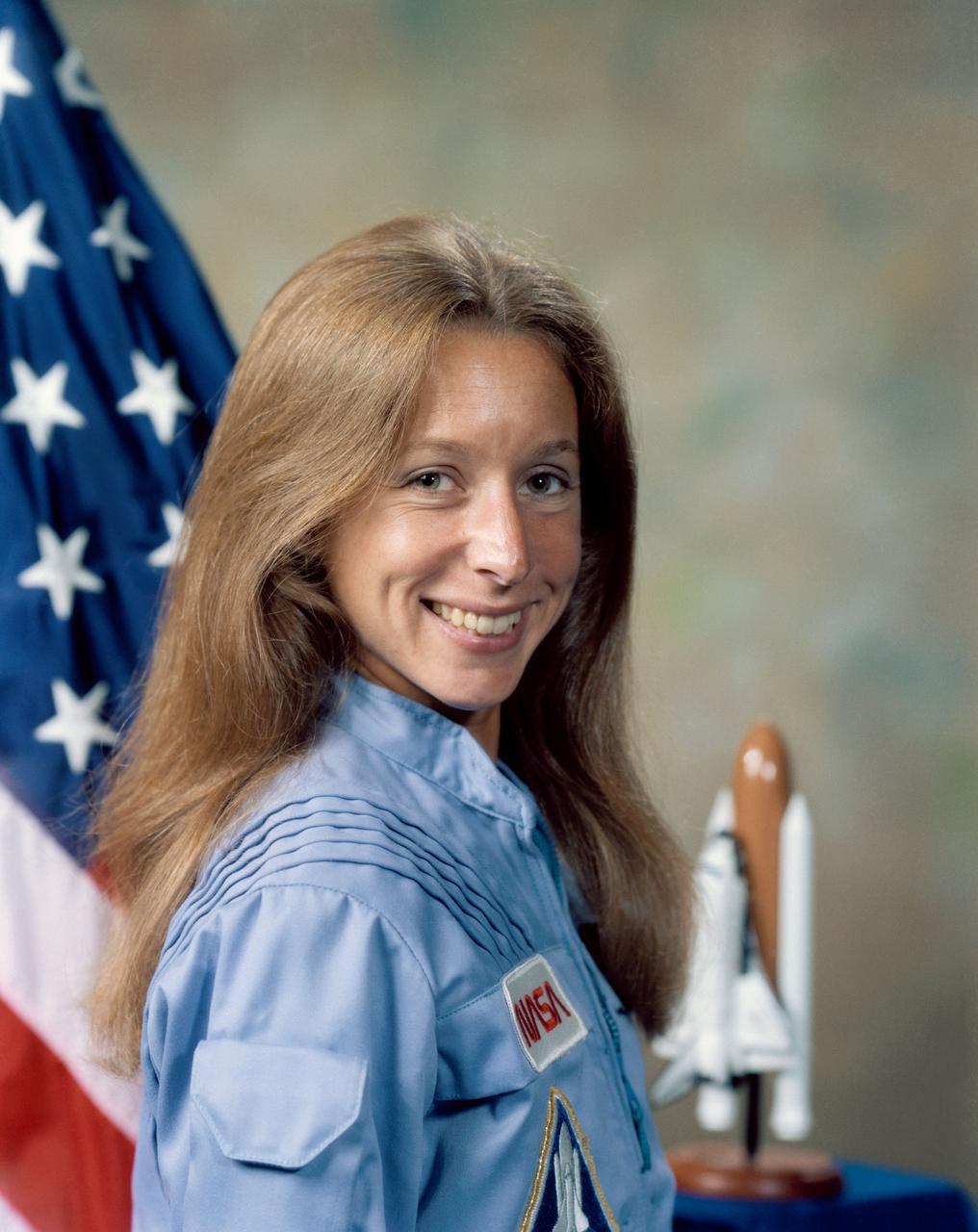
Portrait photograph, Astronaut Marsha S. Ivins, dressed in Blue Flight Suit, with Flag (frame left), and Space Shuttle Model (frame right). JSC, HOUSTON, TX
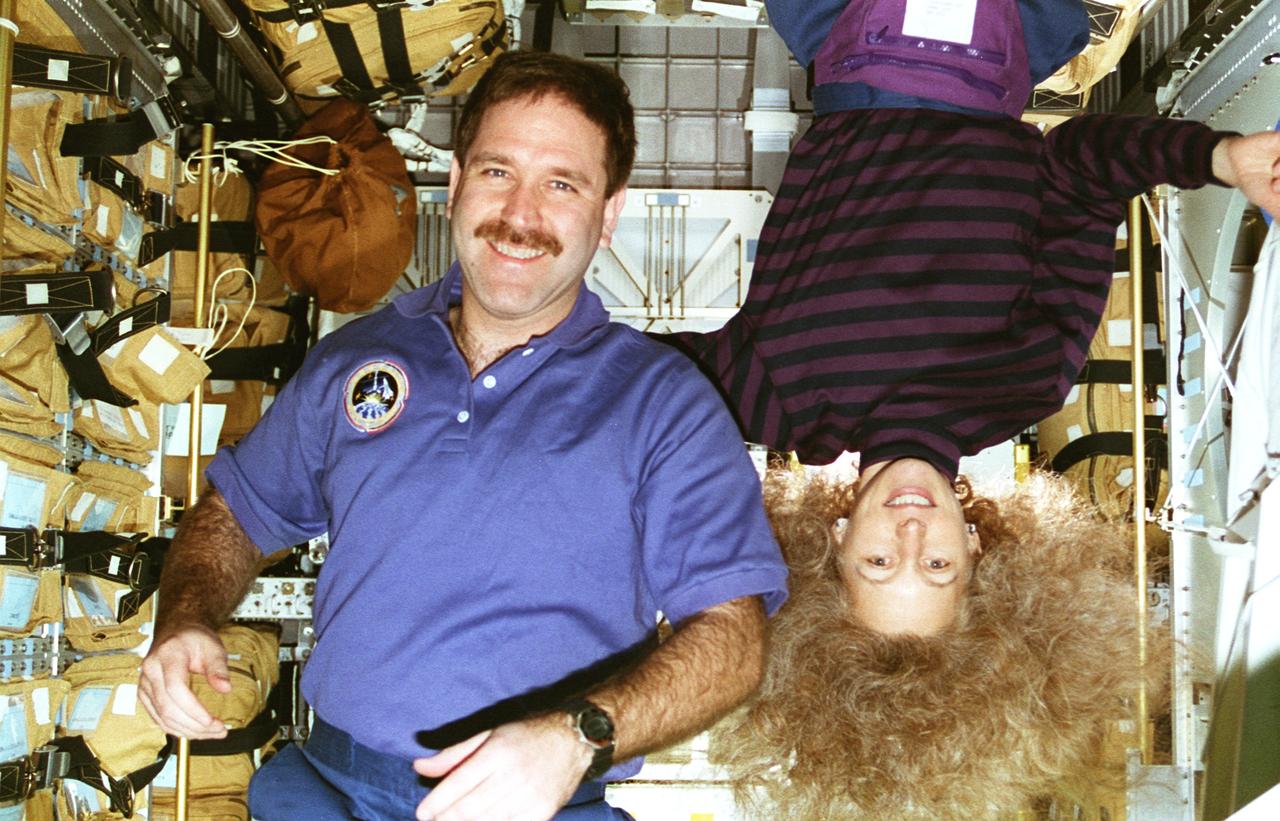
STS081-303-015 (12-22 Jan. 1997) --- Early in the part of the mission during which the Space Shuttle Atlantis was docked with Russia's Mir Space Station, impending duties appear to have Marsha S. Ivins topsy-turvy. Pictured in Spacehab's new Double Module (DM), astronauts Ivins and John M. Grunsfeld were involved with the transfer of supplies from Atlantis to Mir.
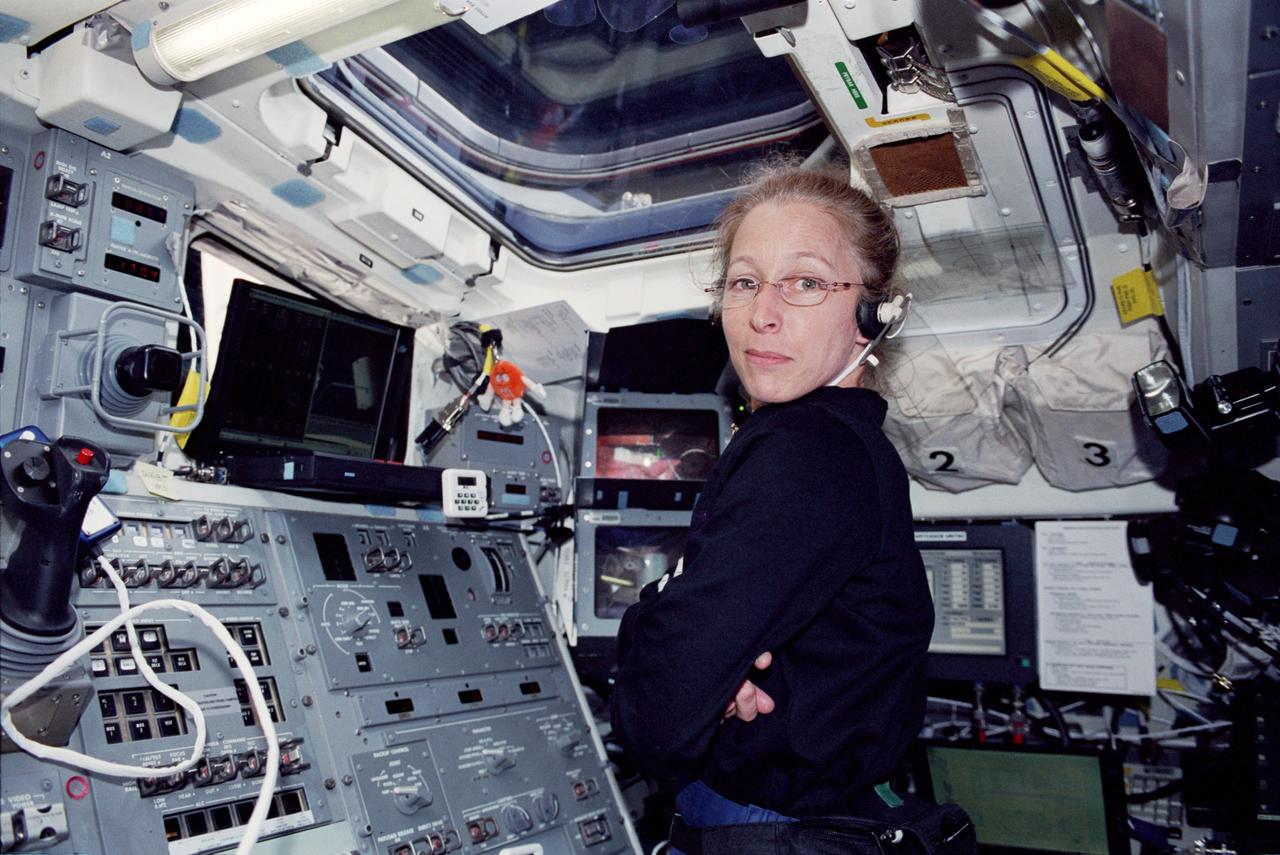
STS098-351-0013 (7-20 February 2001) --- Astronaut Marsha S. Ivins, mission specialist, spent a great deal of time on the aft flight deck of the Space Shuttle Atlantis during space walks and other important activities of the STS-98/5a mission.
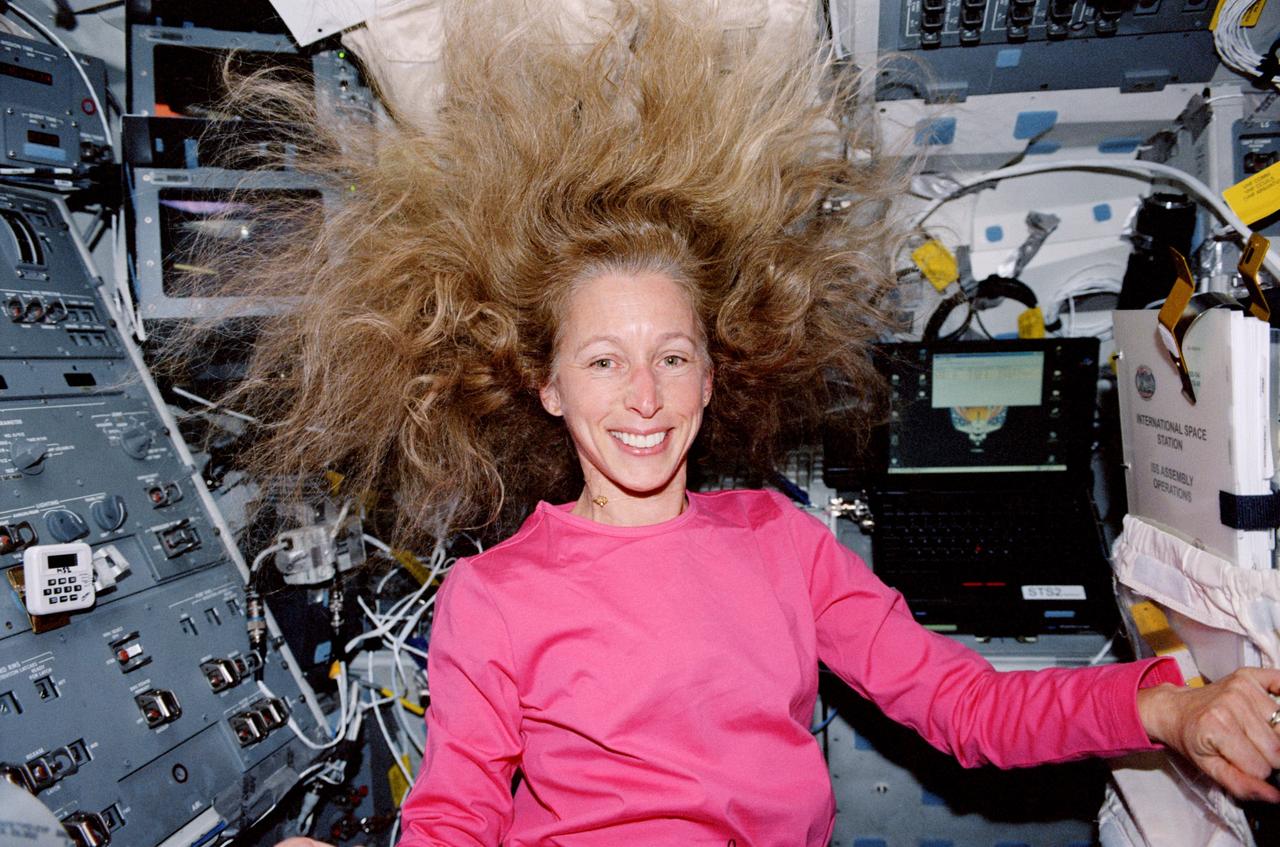
STS098-348-015 (7-20 February 2001) --- Astronaut Marsha S. Ivins, STS-98 mission specialist, is photographed on the mid deck of the Earth-orbiting Space Shuttle Atlantis.
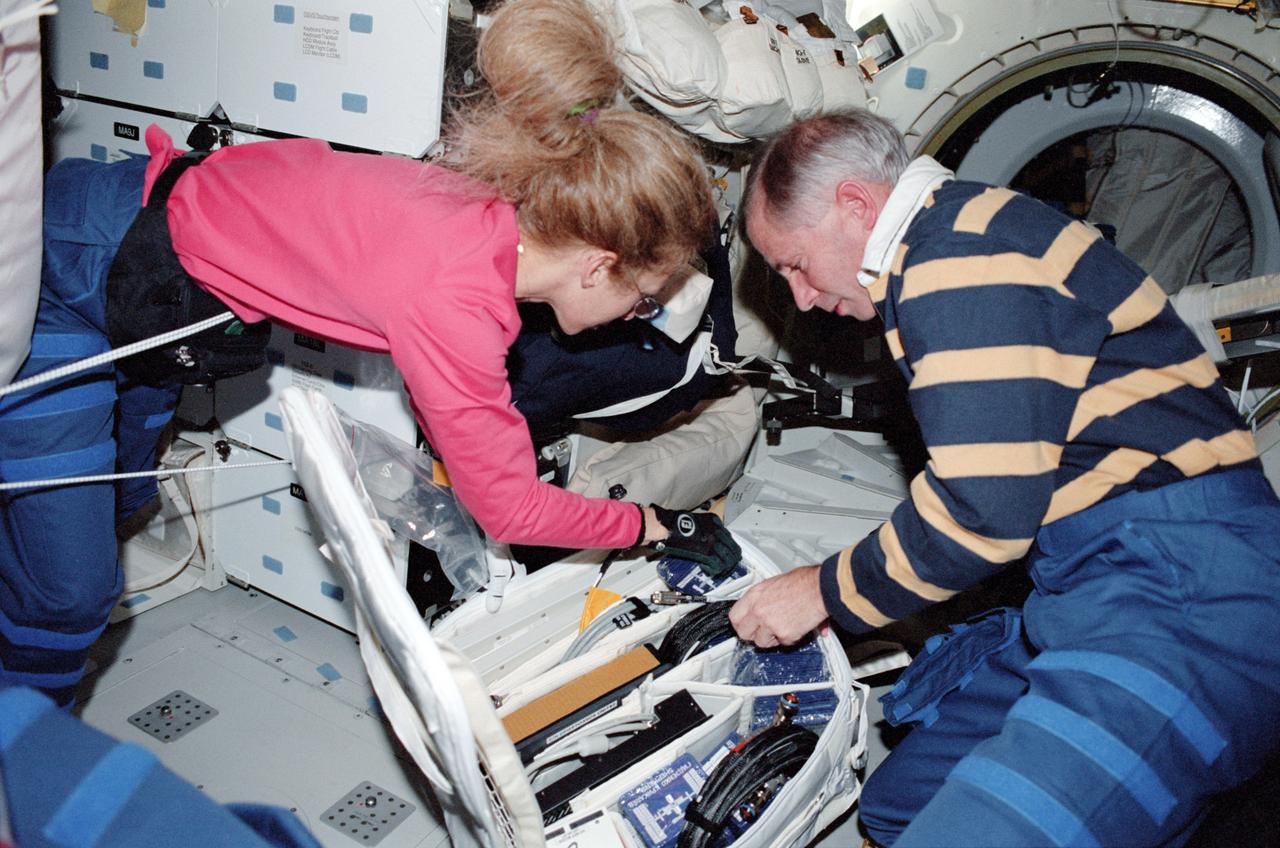
STS098-348-030 (7-20 February 2001) --- Astronauts Marsha S. Ivins (left), mission specialist, and Kenneth D. Cockrell, mission commander, prepare to transfer cables and miscellaneous equipment from the mid deck of the Space Shuttle Atlantis to the International Space Station (ISS).
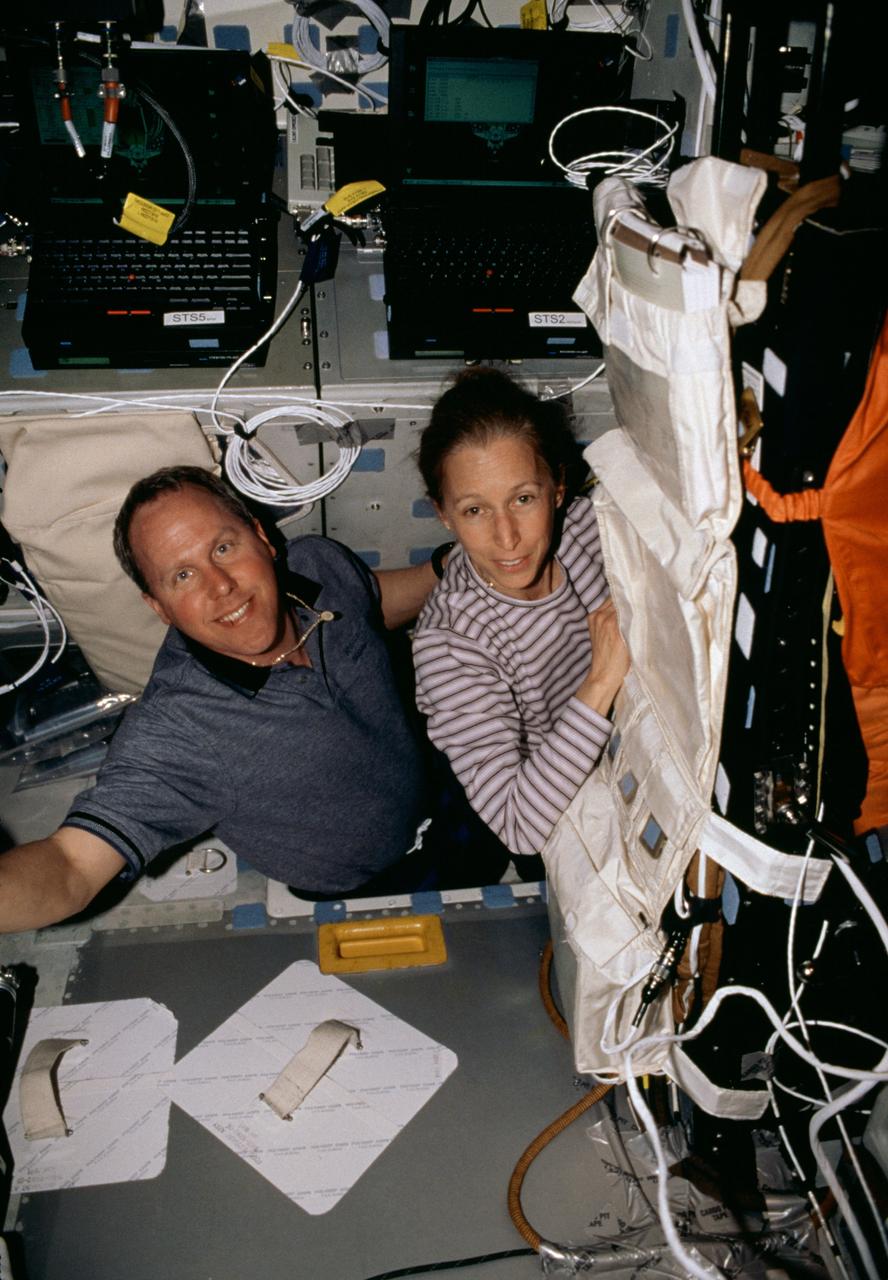
STS098-311-020 (7-20 February 2001) --- Astronauts Thomas D. Jones and Marsha S. Ivins, both mission specialists, are photographed on the mid deck of the Space Shuttle Atlantis near the Payload General Support Computers (PGSC).
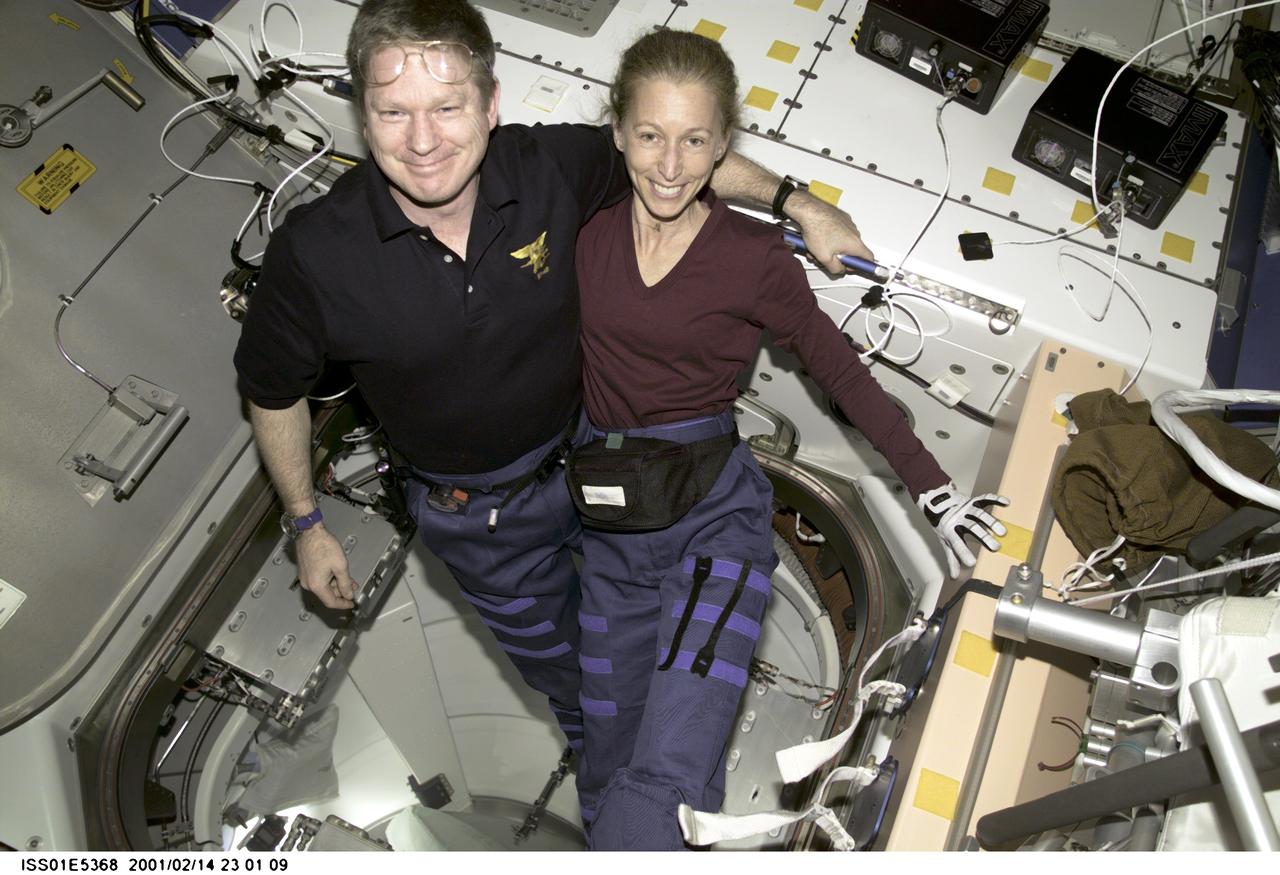
ISS01-E-5368 (14 February 2001) --- Onboard the new Destiny laboratory, Expedition One commander William M. (Bill) Shepherd, shares a brief break from a busy work agenda with astronaut Marsha S. Ivins, STS-98 mission specialist. The two are alumni of the tenth class of NASA astronaut candidates, having come aboard with 15 other trainees in the summer of 1984.
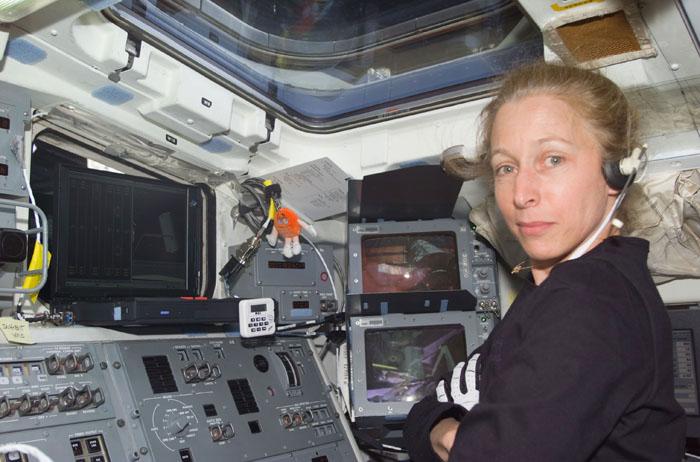
STS98-E-5078 (10 February 2001) --- Astronaut Marsha S. Ivins, STS-98 mission specialist, monitors communications from ground controllers from her post at the aft flight deck controls on the Space Shuttle Atlantis. The scene was recorded with a digital still camera.
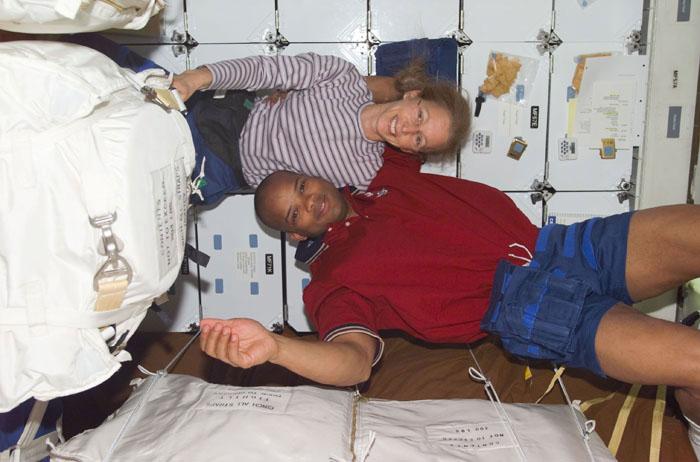
STS98-E-5005 (8 February 2001) -- Astronauts Marsha S. Ivins and Robert L. Curbeam, mission specialists, are seen on the mid deck of the Earth-orbiting Space Shuttle Atlantis in one of the first STS-98 digital still camera scenes to be down linked from the shuttle.
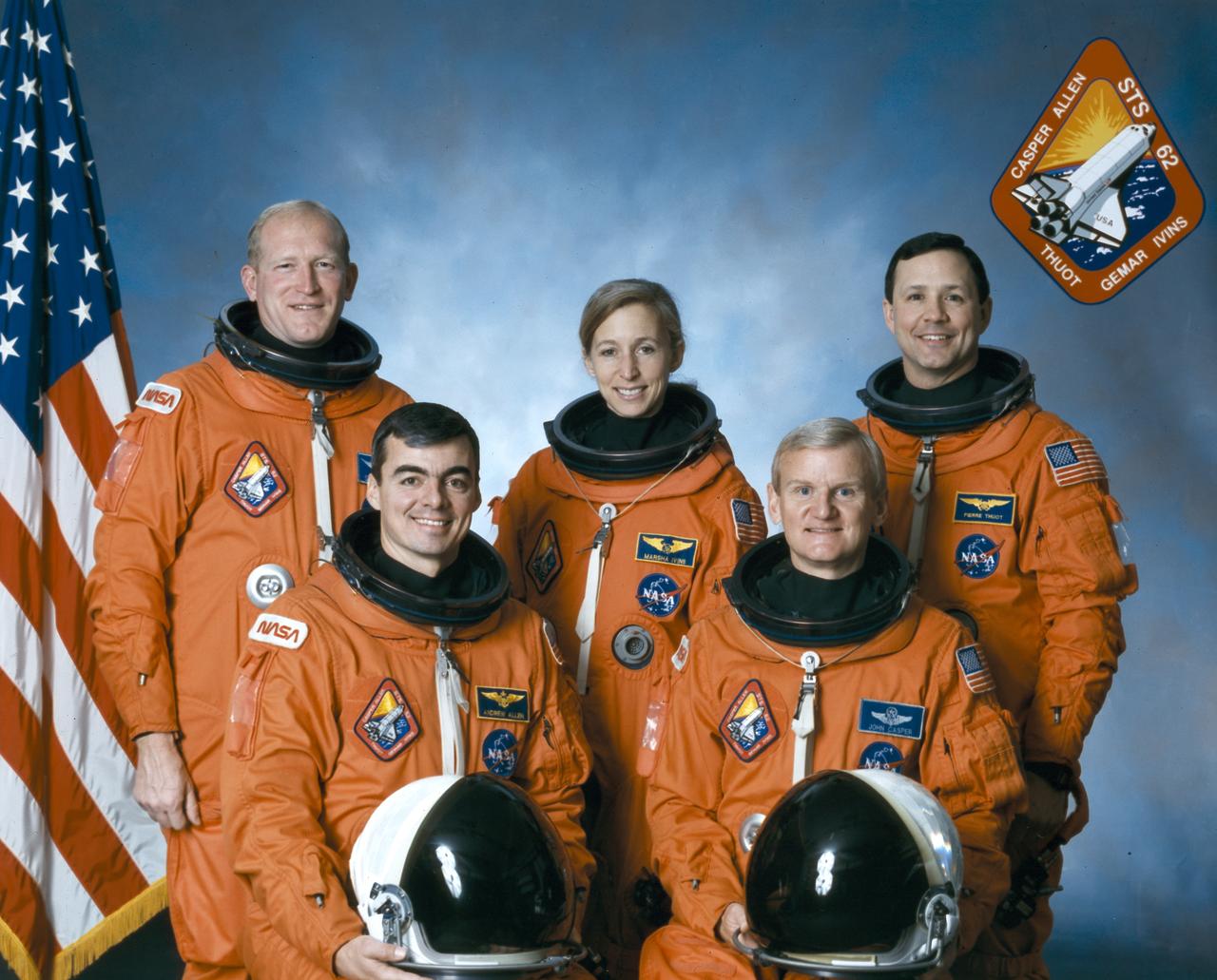
Astronauts included in the STS-62 crew portrait include (standing left to right) mission specialists Charles D. Gemar, Marsha S. Ivins, and Pierre J. Thuot. Seated left to right are Andrew M. Allen, pilot; and John H. Casper, commander. Launched aboard the Space Shuttle Columbia on March 4, 1994 at 8:53:00 am (EST), the STS-62 mission carried two primary payloads; the U.S Microgravity Payload-2 (USMP-2) and the Office of Aeronautics and Space Technology-2 (OAST-2).
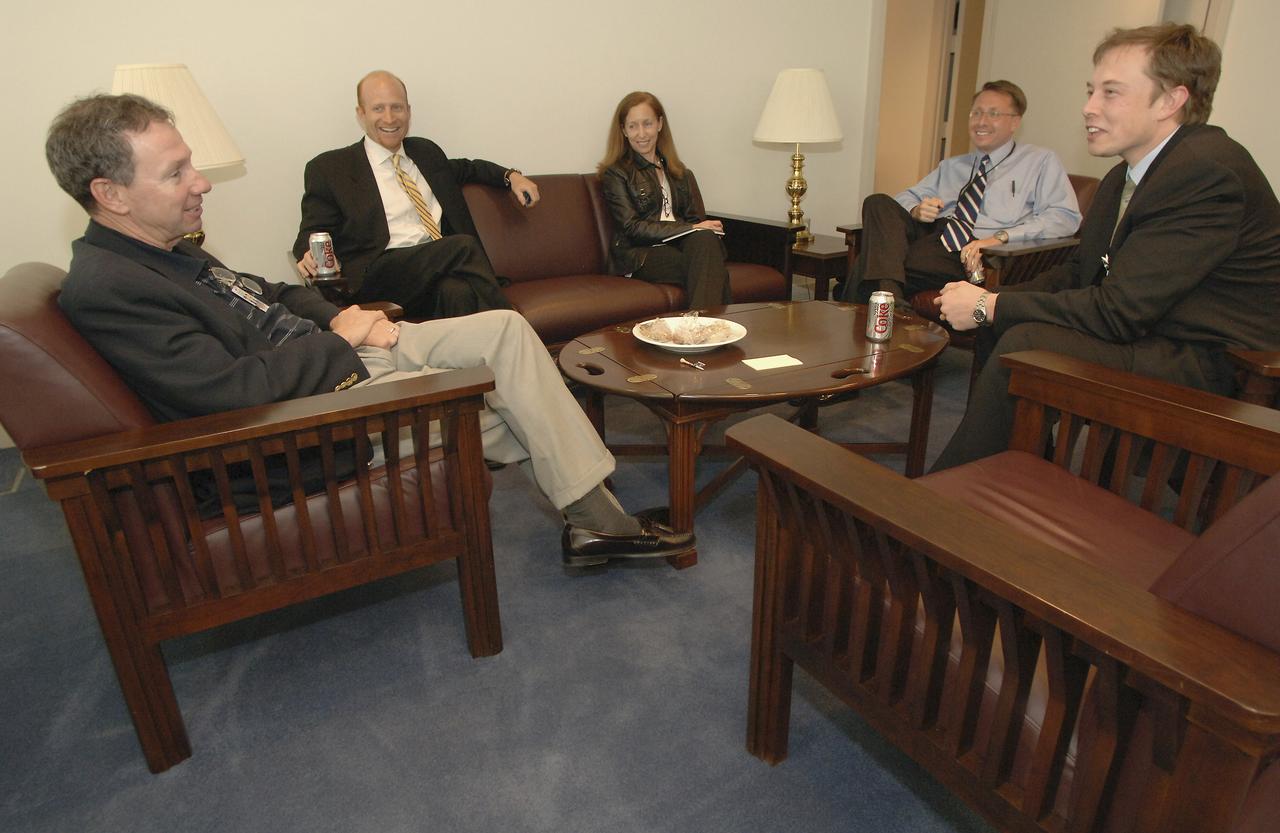
NASA Administrator Michael Griffin, left, meets with CEO of SpaceX Elon Musk, right, Wednesday, April 20, 2005 at NASA Headquarters in Washington. Looking on in the background are Larry Williams, NASA astronaut Marsha Ivins and NASA manager Christopher Shank. Photo Credit: (NASA/Renee Bouchard)
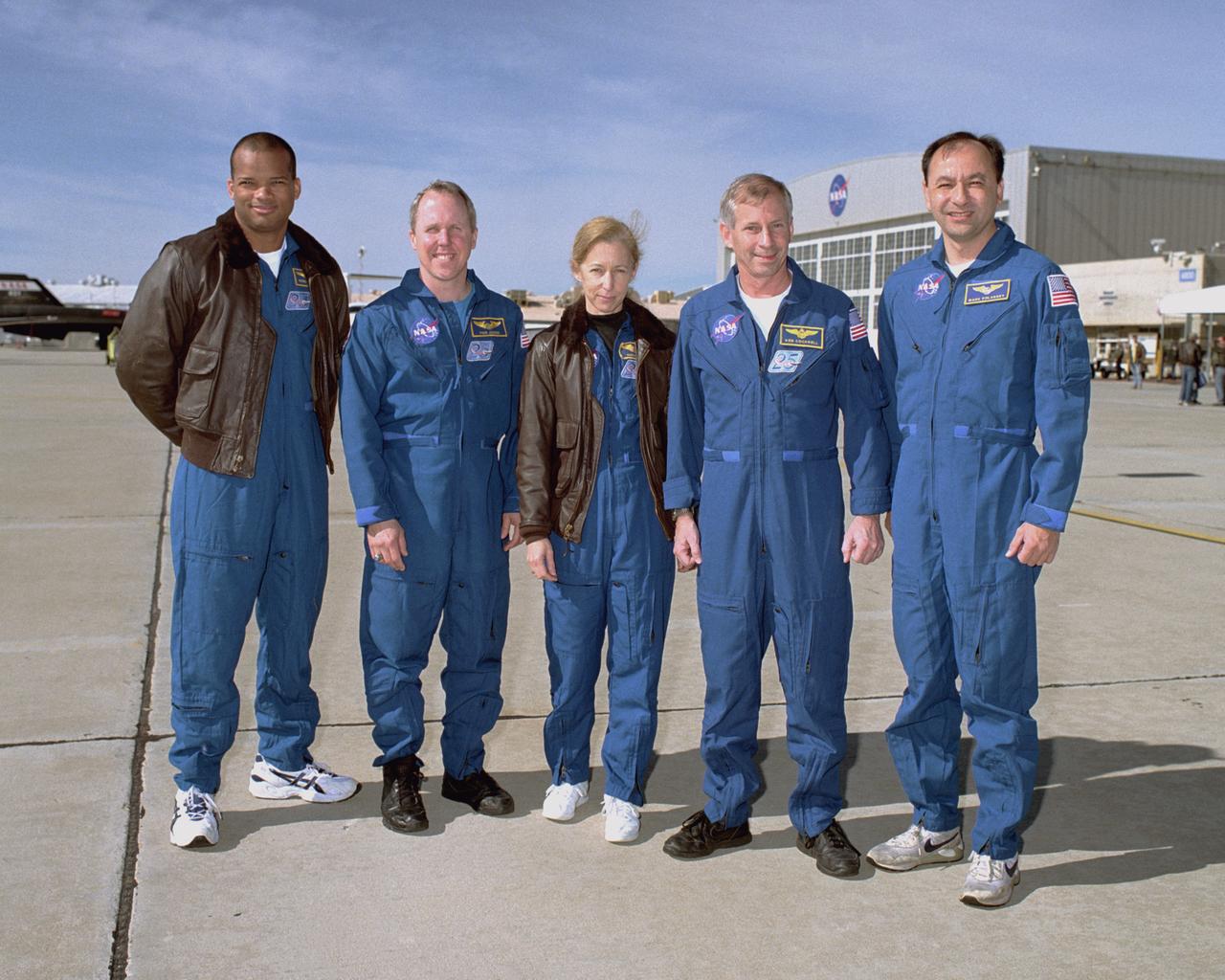
The crew of STS-98 poses for a group photo shortly before leaving NASA's Dryden Flight Research Center after a successful landing of the Space Shuttle Atlantis the day before. L to R: Mission Specialists Robert L. Curbeam, Thomas D. Jones, and Marsha S. Ivins, Commander Kenneth D. Cockrell, and Pilot Mark L. Polansky.
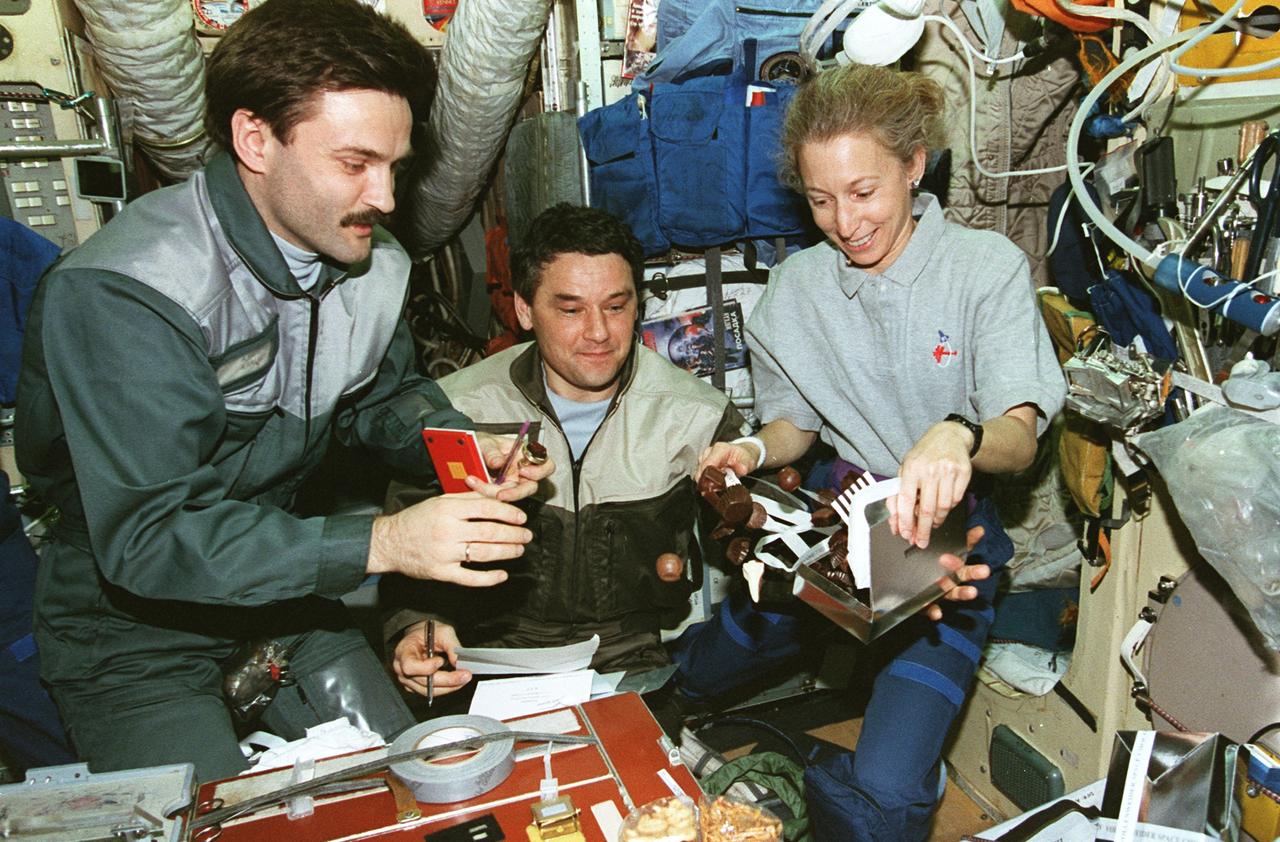
STS081-369-020 (12-22 Jan. 1997) --- Astronaut Marsha S. Ivins and two Mir-22 crewmembers stray from the conventional food fare as they open a box of chocolates on Russia's Mir Space Station's Base Block Module. Cosmonauts Aleksandr Y. Kaleri (left), flight engineer, and Valeri G. Korzun, share the treats.
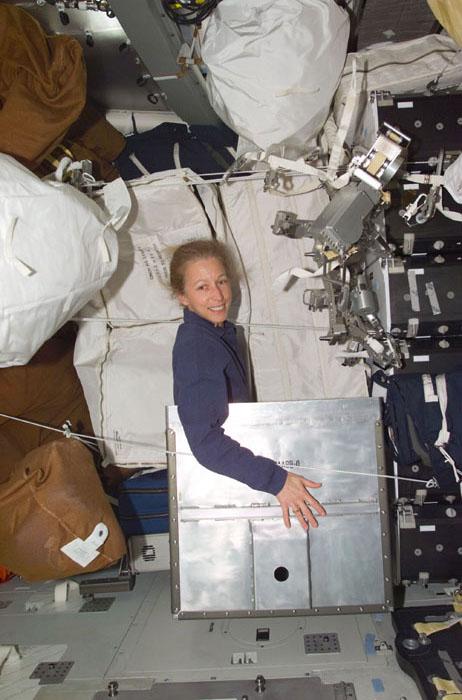
STS098-E-5272 (15 February 2001) --- Astronaut Marsha S. Ivins, STS-98 mission specialist, is photographed with the casing of the Vozdukh as it is strapped in storage position on the mid deck of the Space Shuttle Atlantis. Vozdukh is the Russian system in the Zvezda Service Module, which removes carbon dioxide from the ISS atmosphere. The scene was recorded with a digital still camera by one of the STS-98 astronauts aboard the shuttle.
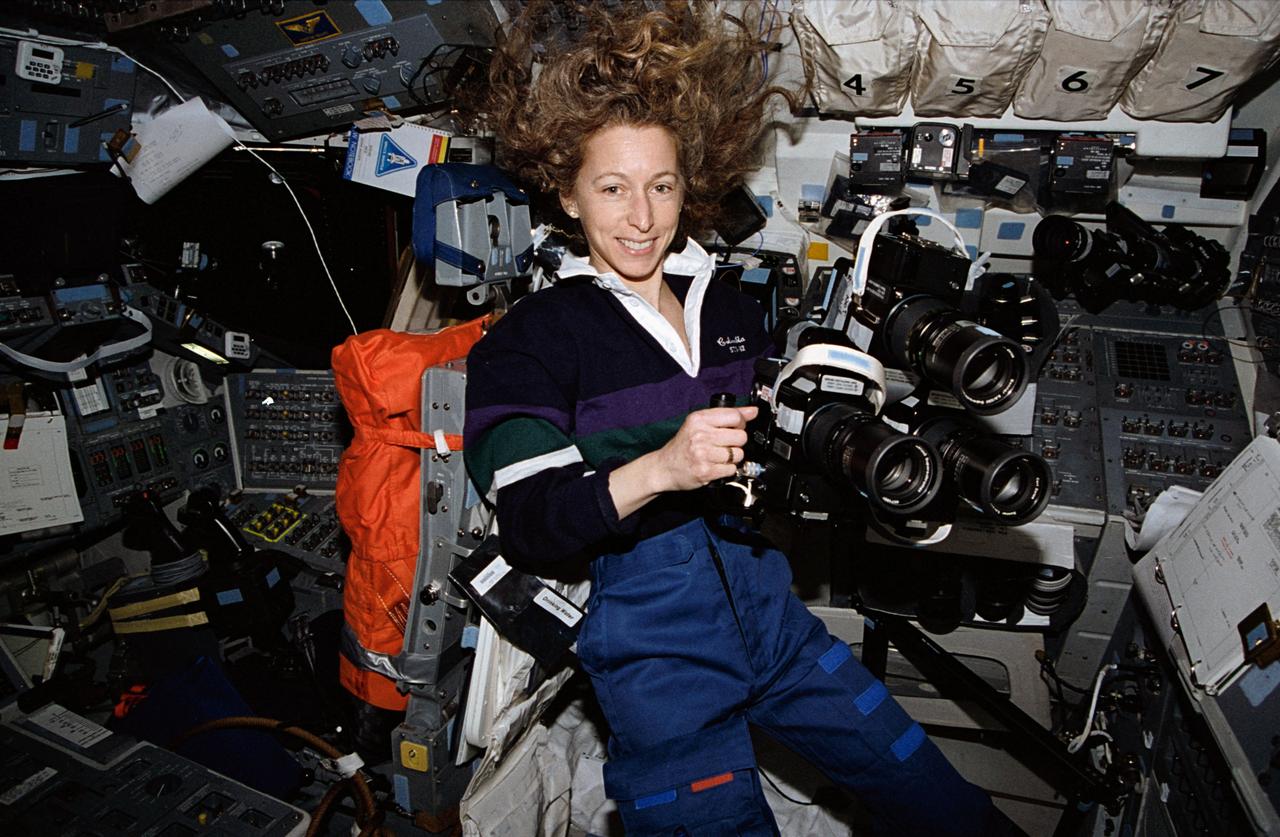
STS062-03-023 (4-14 March 1994) --- Astronaut Marsha S. Ivins, mission specialist, prepares to aim three Hasselblad cameras through the overhead windows of the earth-orbiting Space Shuttle Columbia. The three cameras were allowed to simultaneously record the same imagery on different types of file for purposes of comparison and experimentation.
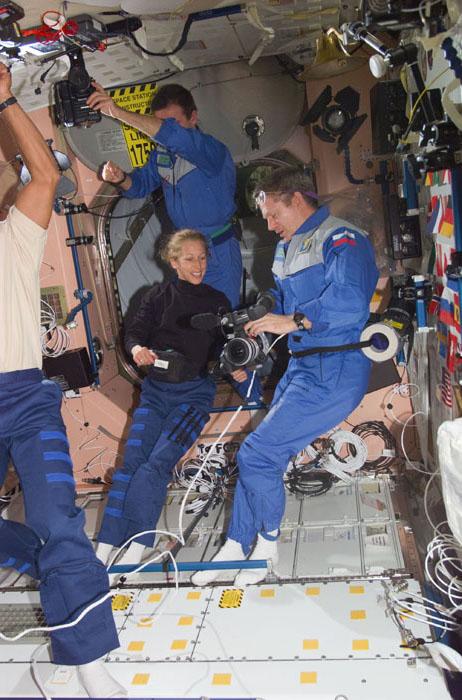
STS98-E-5049 (9 February 2001) --- Astronaut Marsha S. Ivins, STS-98 mission specialist, discusses camera gear with astronaut William M. (Bill) Shepherd, Expedition One mission commander, soon after the shuttle and station crews reunited onboard the outpost. This scene was recorded with a digital still camera.
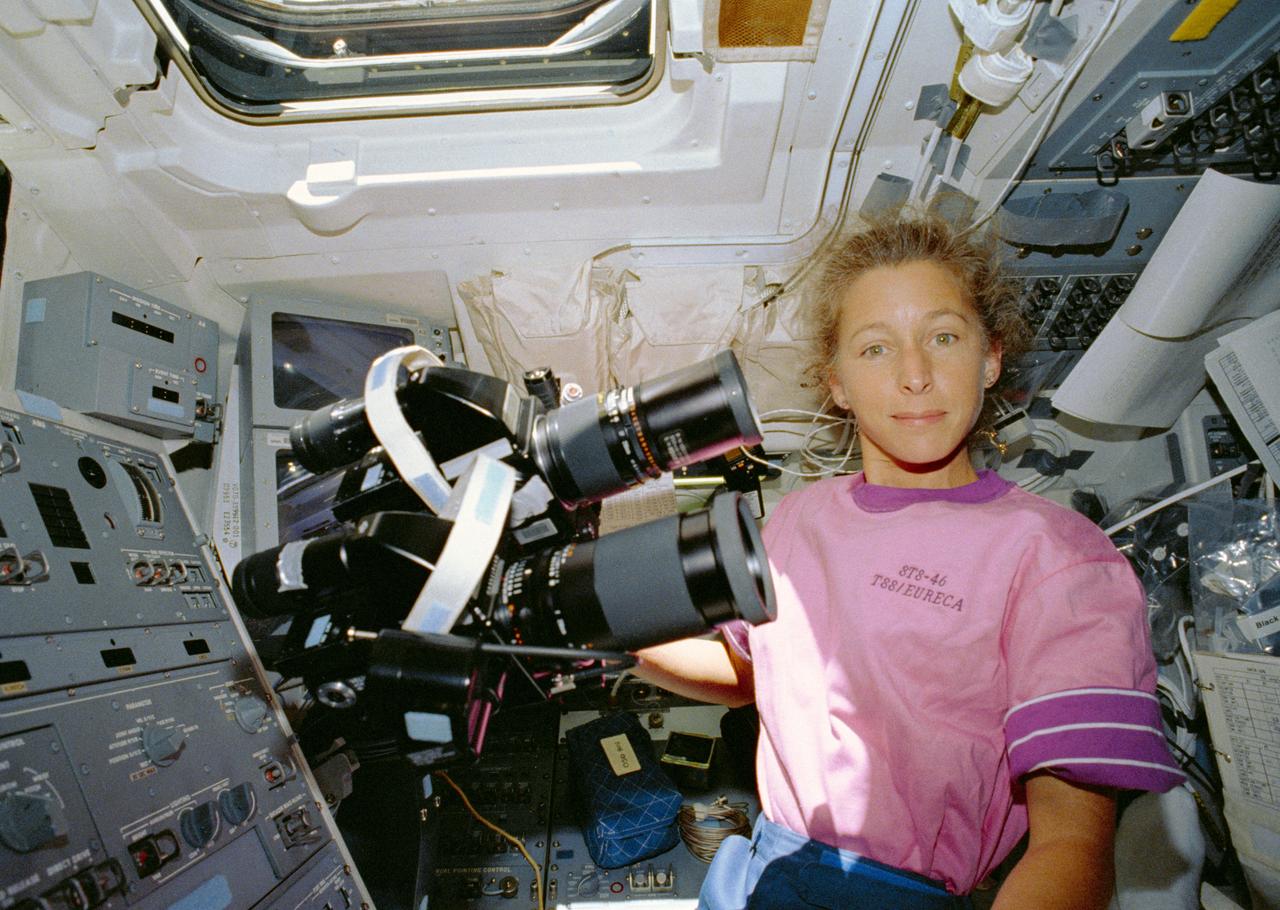
STS046-03-032 (31 July-8 Aug 1992) --- Astronaut Marsha S. Ivins, mission specialist, prepares to operate a tandem of 70mm Hasselblad cameras on the Space Shuttle Atlantis' aft flight deck. The cameras share a common mount, allowing for various tests to be run as the cameras record the same Earth-observations type imagery. Ivins was joined by four other NASA astronauts and two Europeans for an eight-day stay in Earth-orbit.
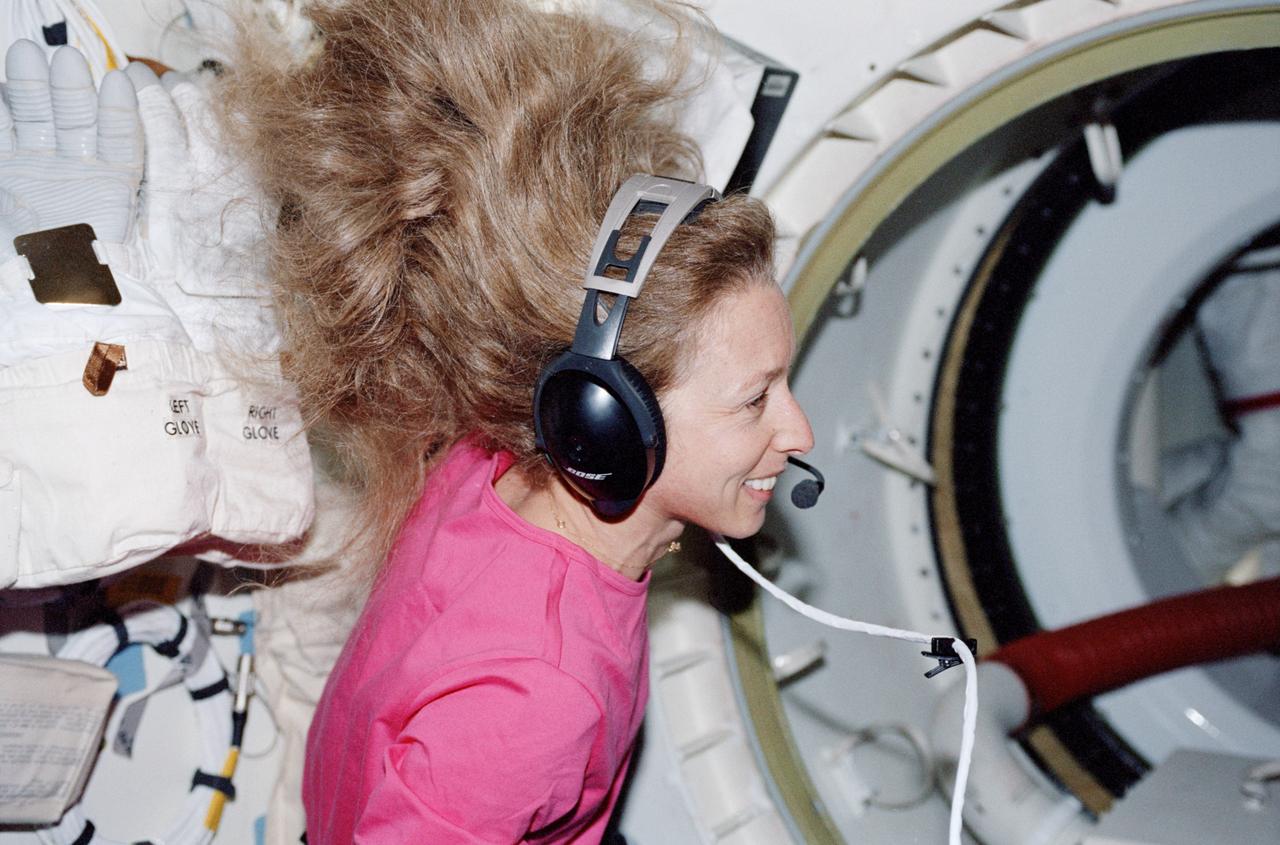
STS098-345-001 (7-20 February 2001) --- Astronaut Marsha S. Ivins, STS-98 mission specialist, places a phone call to Houston’s Mission Control Center (MCC) with the “virtual phone.” This test is designed to demonstrate communications capability of a new upgrade utilizing the existing Shuttle Orbiter Communications Adapter (OCA) infrastructure.
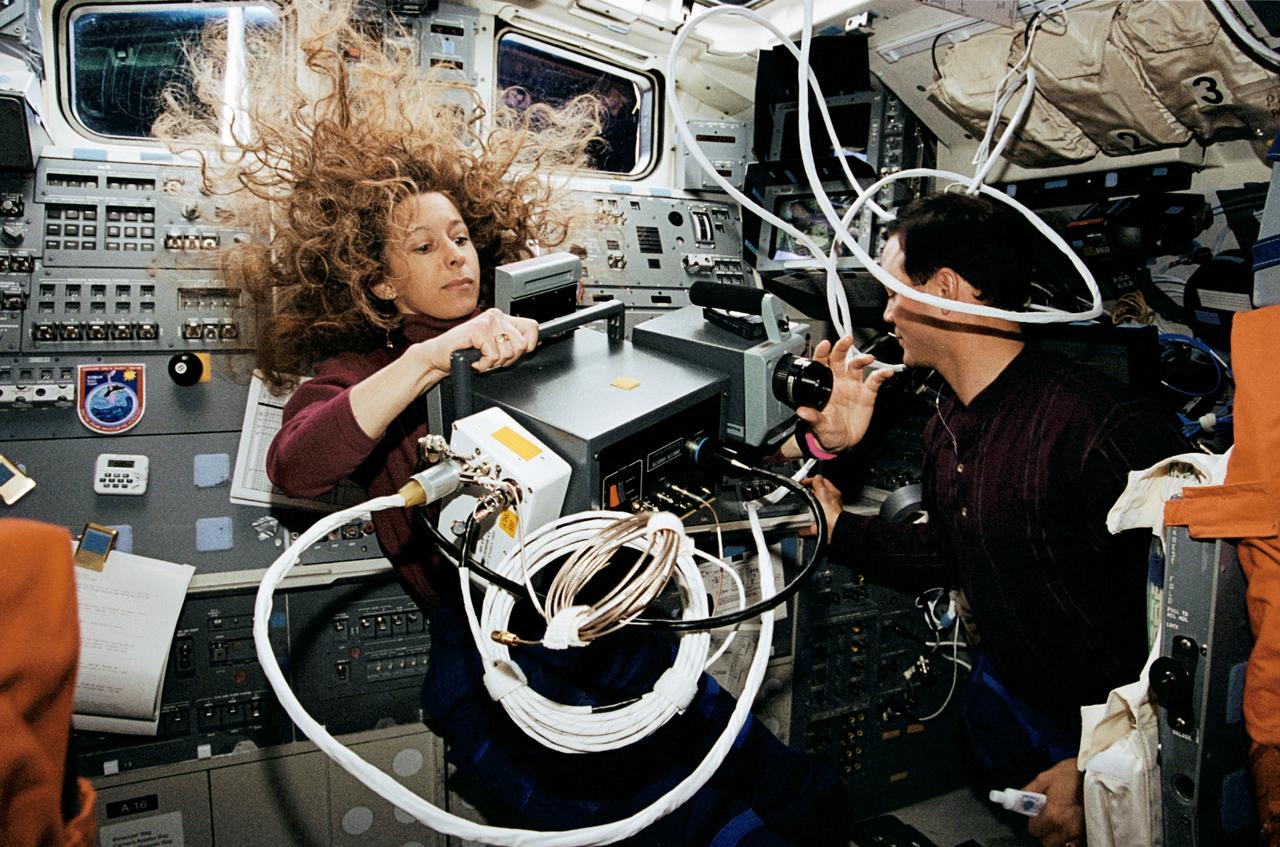
STS062-04-005 (4-18 March 1994) --- Astronaut Marsha S. Ivins has her hands full with a thermal imaging project on the flight deck of the Space Shuttle Columbia as astronaut Pierre J. Thuot stands by to help. The two mission specialists were joined by three other veteran NASA astronauts for almost 14 full days in Earth-orbit.
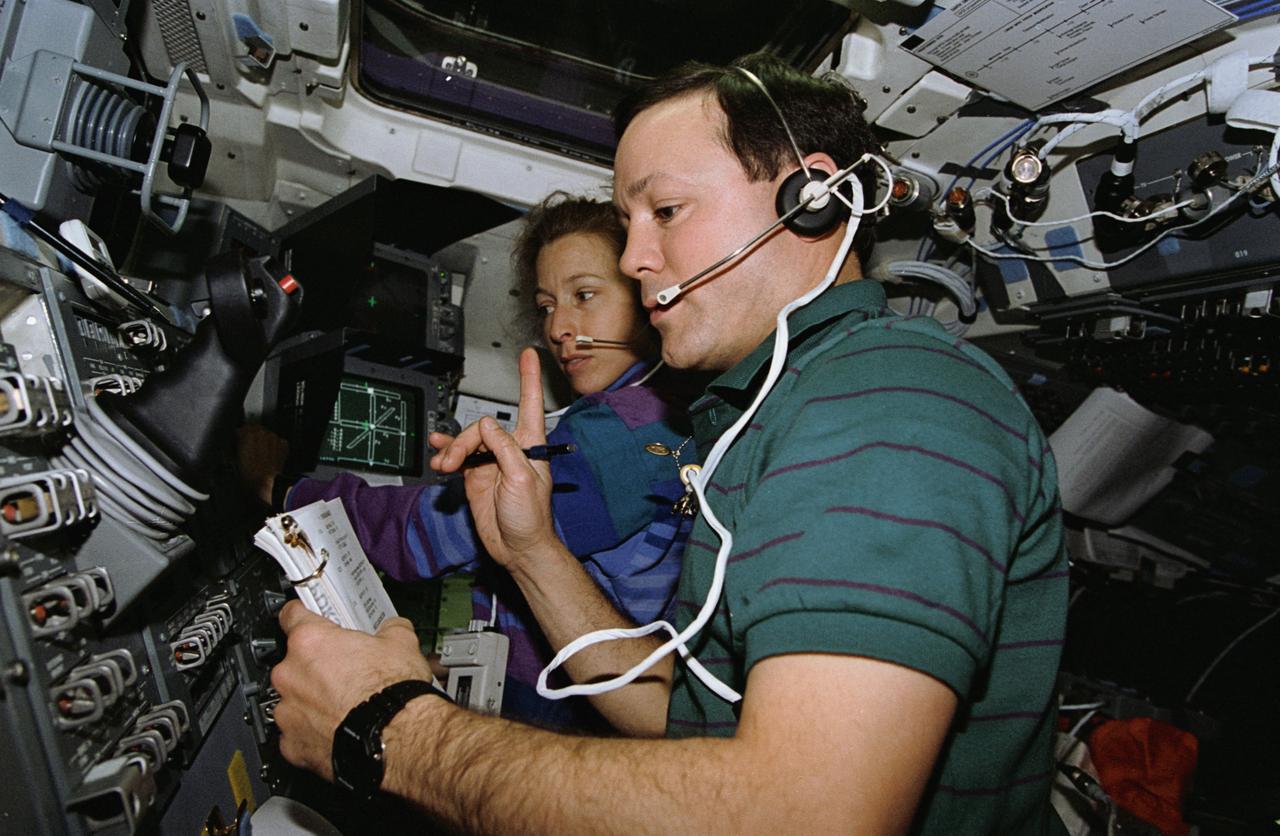
STS062-05-035 (4-18 March 1994) --- This 35mm frame, photographed on the aft flight deck of the earth-orbiting Space Shuttle Columbia, captures crew activity with the Dexterous End Effector (DEE) on the Remote Manipulator System (RMS). Astronauts Pierre J. Thuot and Marsha S. Ivins communicate with ground controllers during operations and observations with DEE. During the 14-day mission, three of the five STS-62 crewmembers took turns operating and observing the RMS in a series of one-hour sessions.

STS98-E-5143 (11 February 2001) --- Astronauts Marsha S. Ivins (from the left), STS-98 mission specialist, Kenneth D. Cockrell, STS-98 mission commander; and William M. Shepherd, Expedition One mission commander, discuss the organizational "game plan" onboard the newly opened Destiny laboratory on the International Space Station (ISS). After Shepherd opened the Destiny hatch, he and Cockrell ventured inside at 8:38 a.m. (CST), February 11, 2001. As depicted in subsequent digital images in this series, members of both crews went to work quickly inside the new module, activating air systems, fire extinguishers, alarm systems, computers and internal communications. The crew also took some photos and continued equipment transfers from the shuttle to the station.
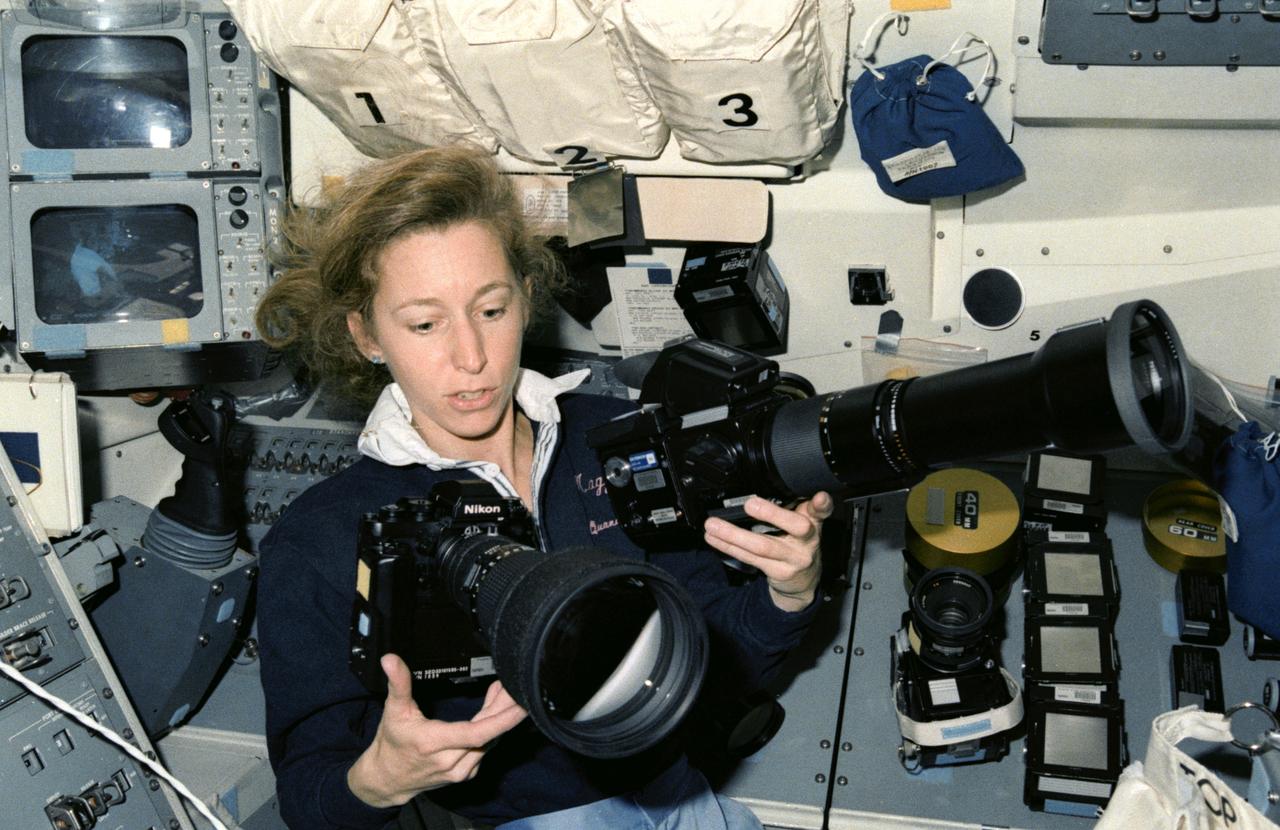
STS032-15-022 (9-20 Jan 1990) --- A 35mm scene of Astronaut Marsha S. Ivins with 35mm and 70mm cameras and accessories on Columbia's aft flight deck. The photo depicts the role photography played on the record-setting 11-day STS-32 mission.
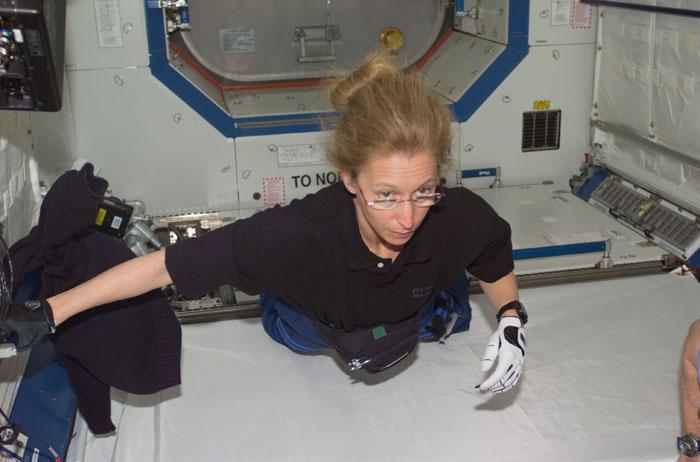
STS98-E-5161 (11 February 2001) --- Astronaut Marsha S. Ivins, STS-98 mission specialist, floats into the newly attached Destiny laboratory onboard the International Space Station (ISS). After the Destiny hatch was opened early in the day, members of both crews went to work quickly inside the new module, activating air systems, fire extinguishers, alarm systems, computers and internal communications. The crews also took some photos and continued equipment transfers from the shuttle to the station. The scene was taken with a digital still camera.
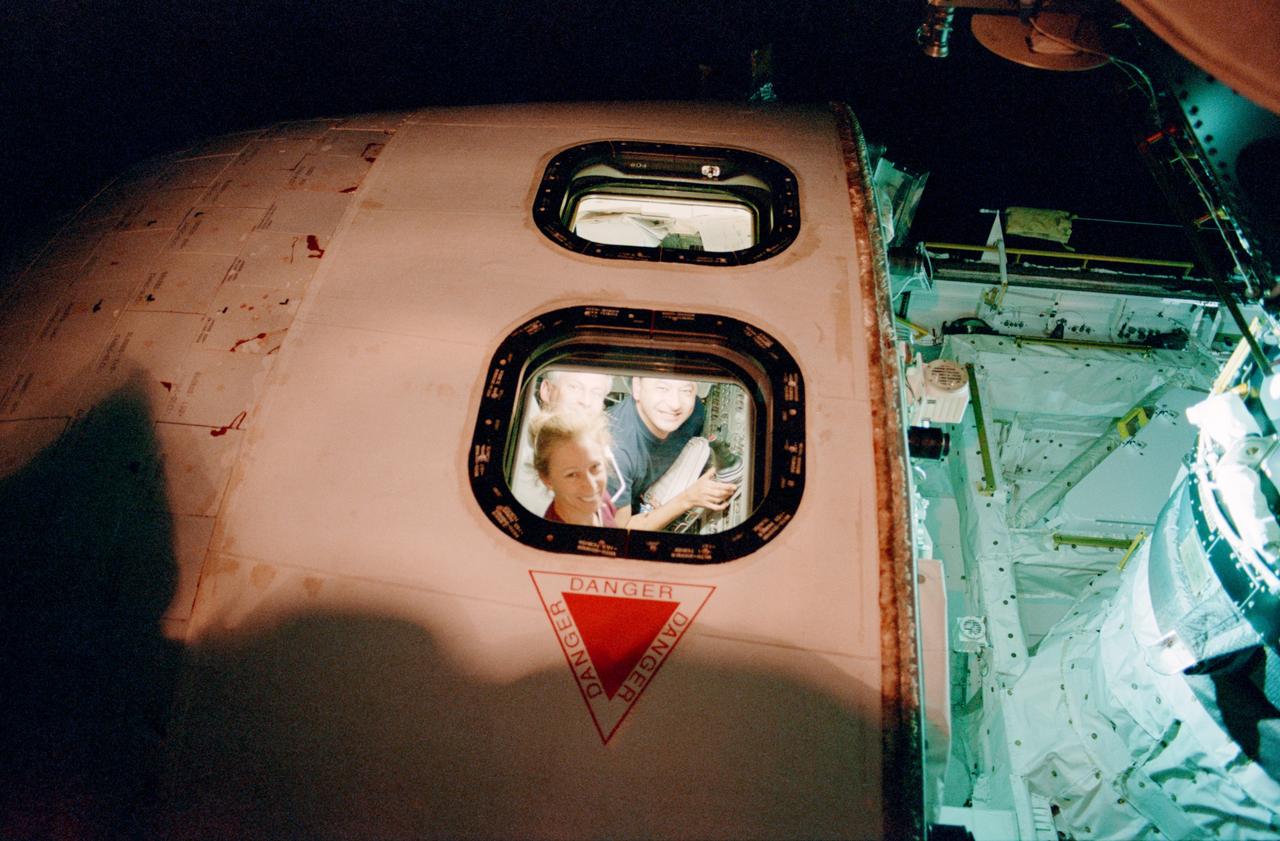
STS098-335-0028 (7-20 February 2001) --- From the aft flight deck of the Space Shuttle Atlantis, astronaut Marsha S. Ivins, STS-98 mission specialist, looks through an overhead window toward her space walking colleagues, who exposed this 35mm frame. Also visible in the window are astronauts Kenneth D. Cockrell and Mark L. Polansky, commander and pilot for the STS-98/5a mission.
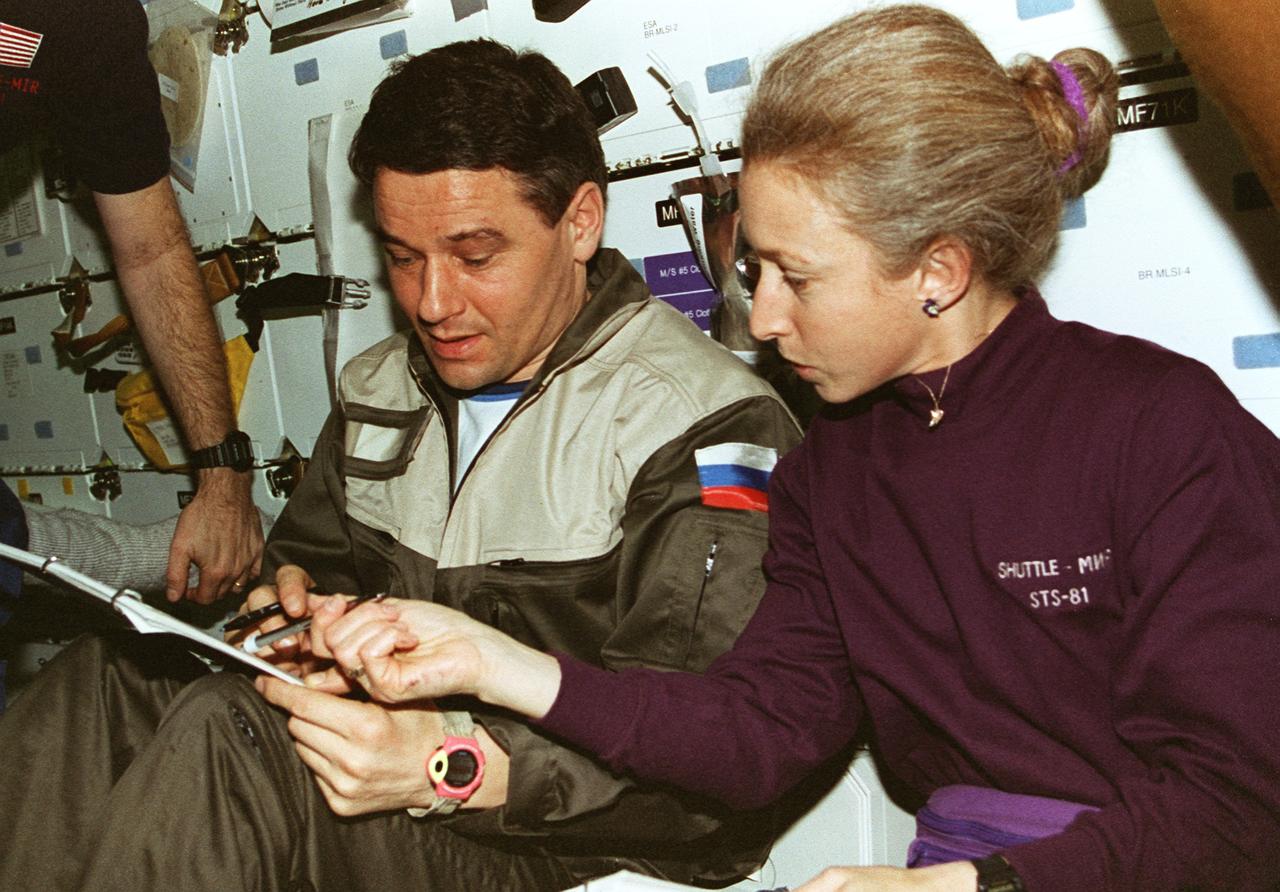
STS081-357-020 (12-22 Jan. 1997) --- Astronaut Marsha S. Ivins, STS-81 mission specialist, compares notes with cosmonaut Valeri G. Korzun, Mir-22 mission commander. The two were involved with the transfer of supplies from the Space Shuttle Atlantis to Russia's Mir Space Station, during the docking mission.
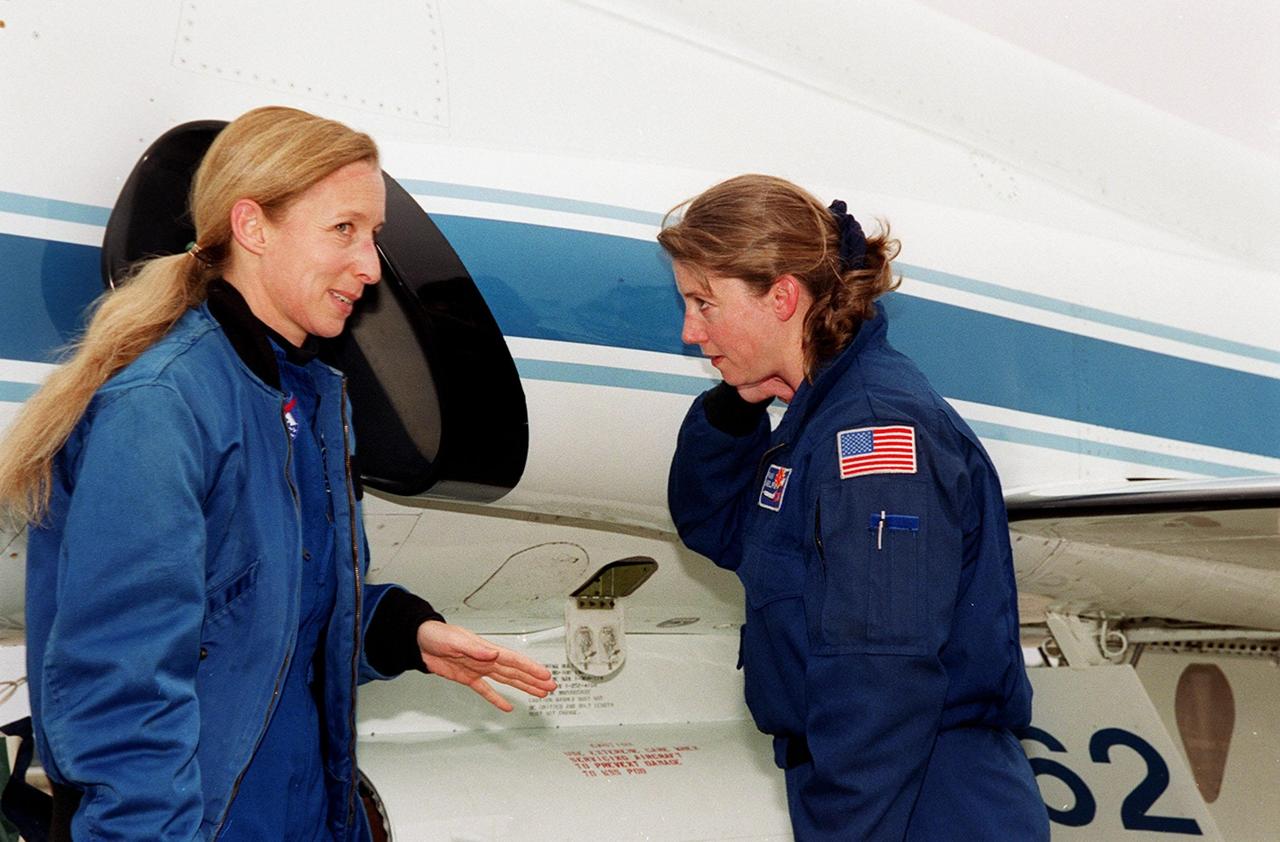
STS-98 Mission Specialist Marsha Ivins (left) speaks to astronaut Pam Melroy, who piloted the T-38 jet that brought Ivins to KSC. Ivins and other crew members Commander Ken Cockrell, Pilot Mark Polansky and Mission Specialists Robert Curbeam and Thomas Jones have returned to KSC to prepare for their launch to the International Space Station. The seventh construction flight to the Space Station, STS-98 will carry the U.S. Laboratory Destiny, a key module for space experiments. The 11-day mission includes three spacewalks to complete outside assembly and connection of electrical and plumbing lines between the laboratory, Station and a relocated Shuttle docking port. STS-98 is Ivins’ fifth space flight. Launch is targeted for Feb. 7 at 6:11 p.m. EST
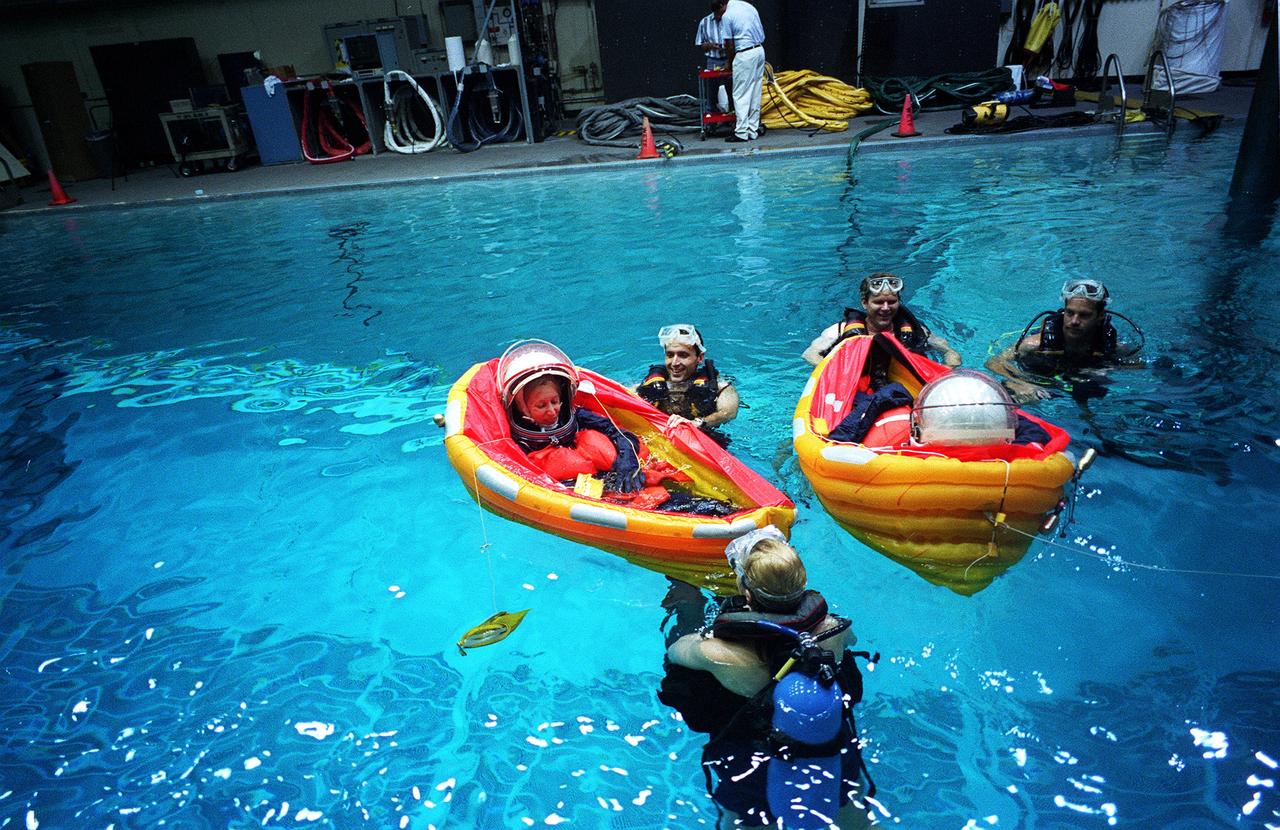
S96-15405 (26 Sept. 1996) --- In the Johnson Space Center's weightless environment training facility, astronaut Marsha S. Ivins, STS-81 mission specialist, bails water from her life raft during water bailout survival training. Astronaut Peter J.K. (Jeff) Wisoff (pictured in right raft) and four other STS-81 crewmates (out of frame) joined Ivins for the bailout training exercises. Several SCUBA-equipped divers assist in the training exercise.
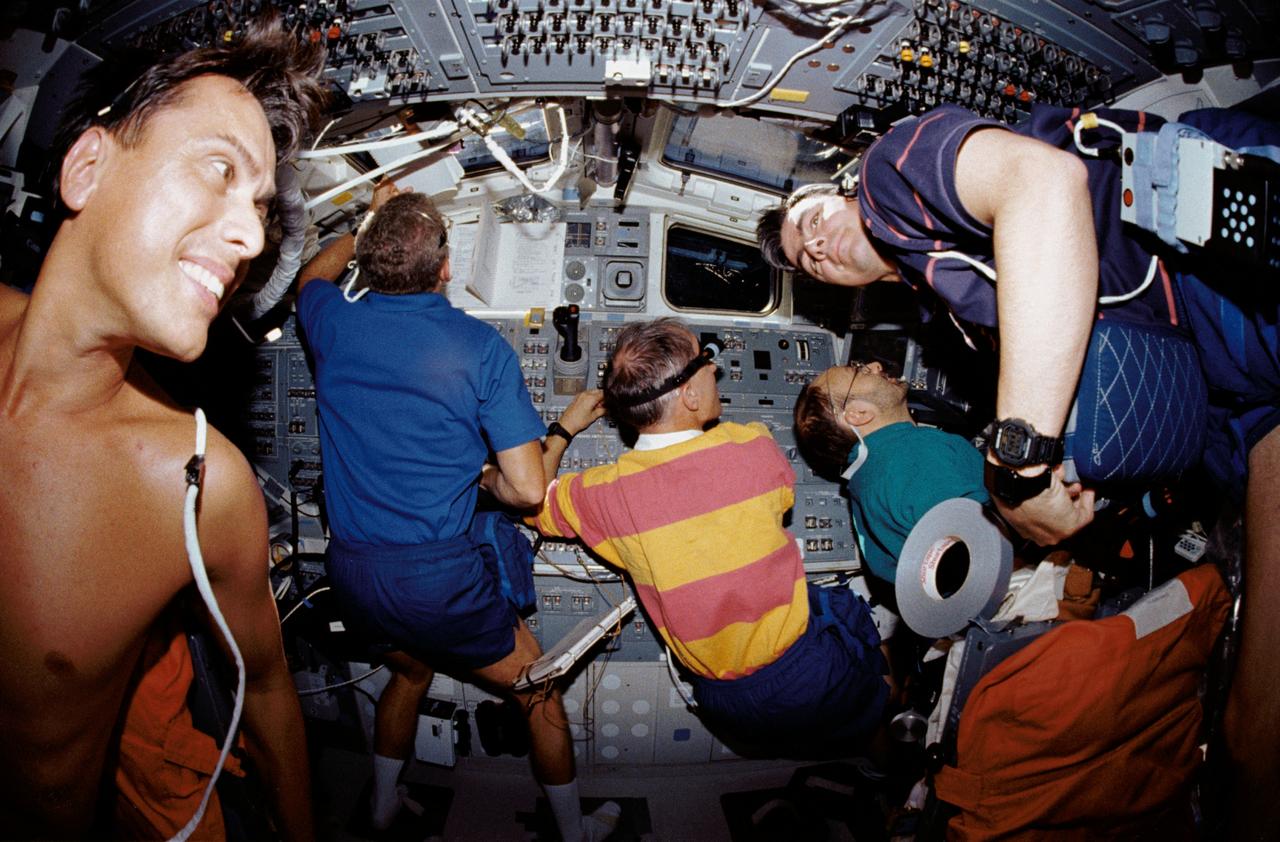
STS046-14-013 (4 Aug. 1992) --- Five of the seven crew members squeezed into this busy scene on the Space Shuttle Atlantis' flight deck during operations with the Tethered Satellite System (TSS). Pictured are, left to right, Franklin R. Chang-Diaz, Loren J. Shriver, Claude Nicollier, Franco Malerba and Andrew M. Allen. Not pictured are astronauts Jeffrey A. Hoffman and Marsha S. Ivins. Mission specialist Ivins used a 35mm camera with a 16mm lens to take this picture.
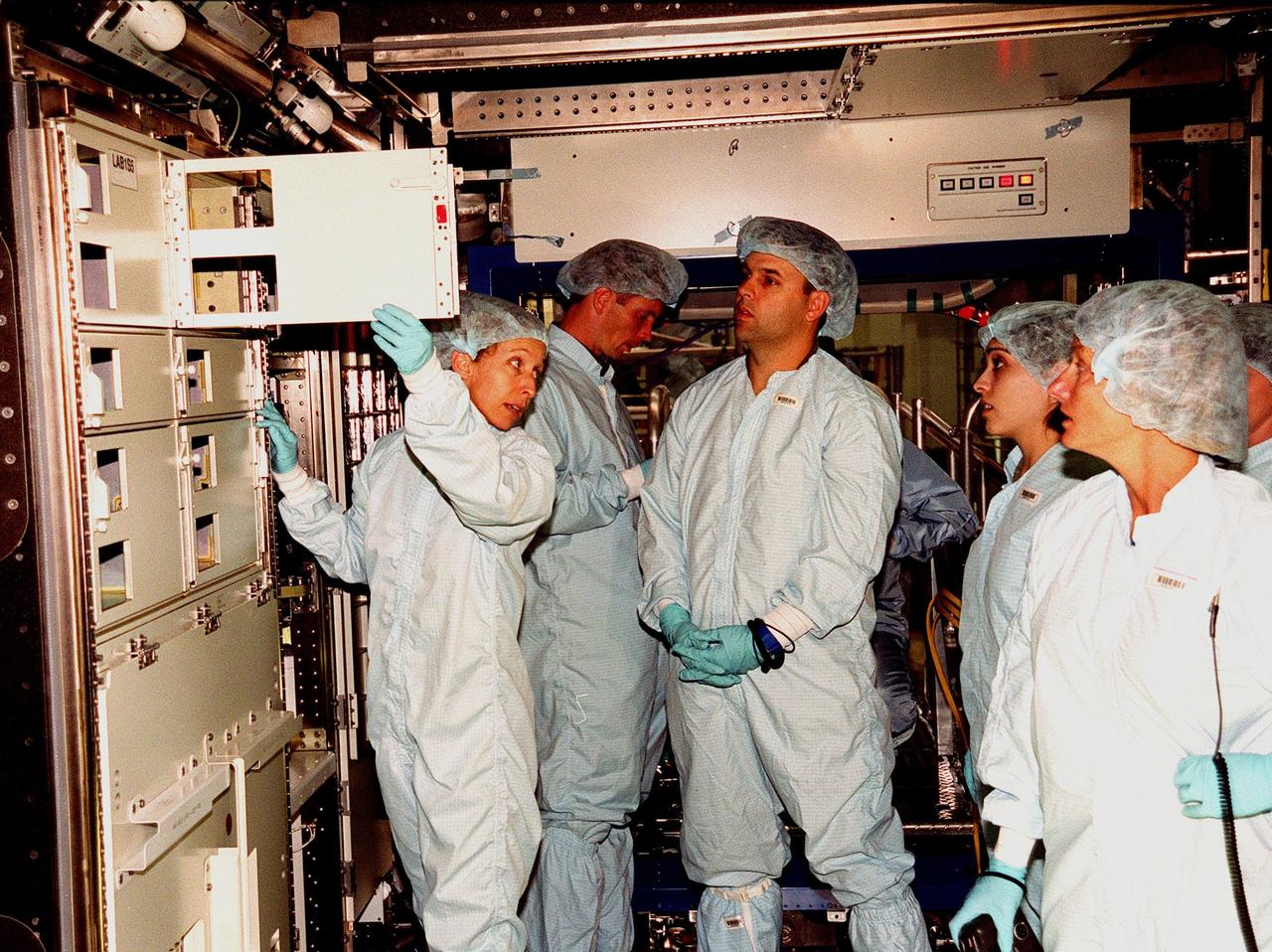
In the Space Station Processing Facility, Marsha Ivins, a mission specialist on the STS-98 crew, inspects the U.S. Laboratory with members of the laboratory's processing team. The laboratory module, considered the centerpiece of the International Space Station (ISS), has been named "Destiny" in honor of its prominent role in the world’s largest science and technology effort. It is planned for launch aboard Space Shuttle Endeavour on the sixth ISS construction flight currently targeted for March 2000. From left to right are Ivins, Jerry Hopkins, Danny Whittington, Melissa Orozco, and Suzanne Fase
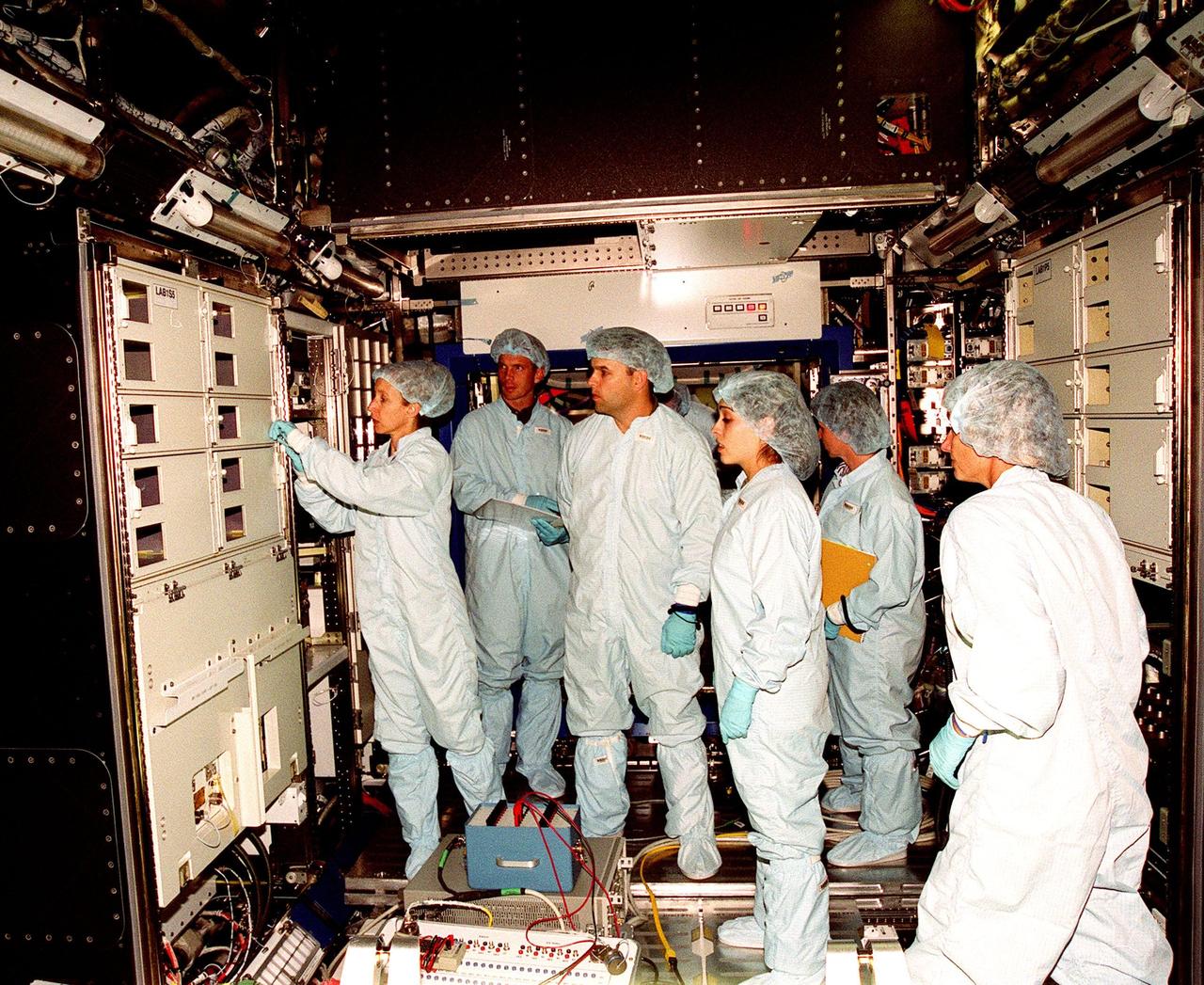
In the Space Station Processing Facility, Marsha Ivins, a mission specialist on the STS-98 crew, inspects the U.S. Laboratory with members of the laboratory's processing team. The laboratory module, considered the centerpiece of the International Space Station (ISS), has been named "Destiny" in honor of its prominent role in the world’s largest science and technology effort. It is planned for launch aboard Space Shuttle Endeavour on the sixth ISS construction flight currently targeted for March 2000. From left to right are Ivins, Jerry Hopkins, Danny Whittington, Melissa Orozco, Vicki Reese and Suzanne Fase
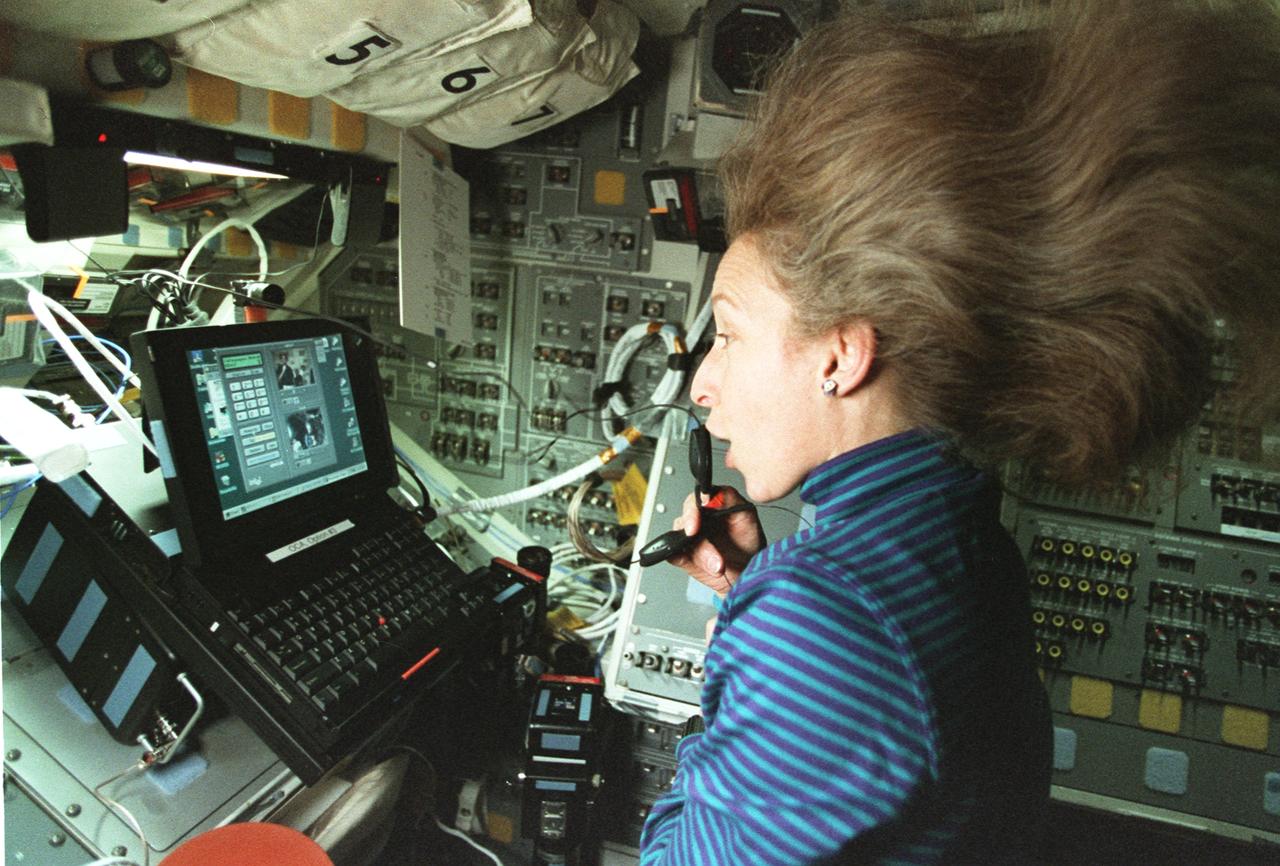
STS081-378-012 (12-22 January 1997) --- Astronaut Marsha S. Ivins, mission specialist, looks at digital still photo imagery on a lap top computer on the Space Shuttle Atlantis' aft flight deck while communicating with students on Earth. Her activity is all part of the once-a-year shuttle participation in an educational endeavor called KidSat. The KidSat project allows students the opportunity to interact with the astronauts' real-time observations and photography of geographic points of interest. The Electronic Still Camera (ESC), which was handled largely by Ivins, can be seen near the computer.
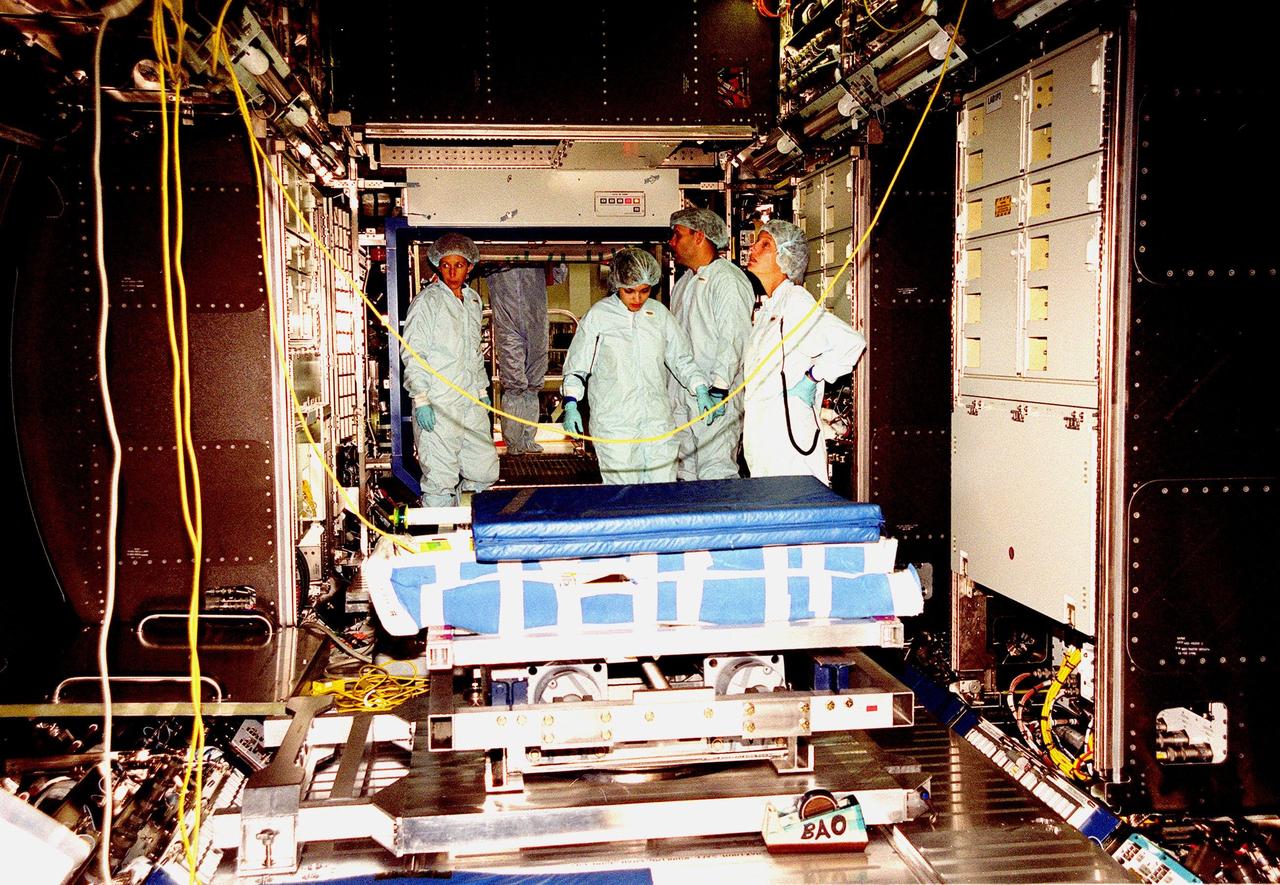
In the Space Station Processing Facility, Marsha Ivins, a mission specialist on the STS-98 crew, inspects the U.S. Laboratory with members of the laboratory's processing team. The laboratory module, considered the centerpiece of the International Space Station (ISS), has been named "Destiny" in honor of its prominent role in the world’s largest science and technology effort. It is planned for launch aboard Space Shuttle Endeavour on the sixth ISS construction flight currently targeted for March 2000. From left to right are Ivins, Danny Whittington (face not visible), Melissa Orozco, Jerry Hopkins, and Suzanne Fase
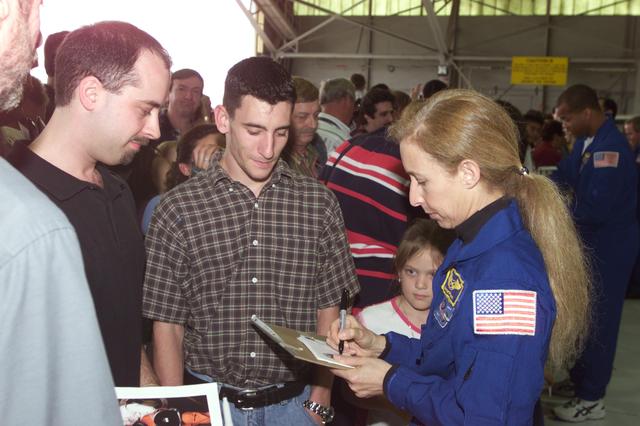
JSC2001-E-04813 (21 February 2001) --- Astronaut Marsha S. Ivins, STS-98 mission specialist, signs some photos and mementoes for members of the crowd on hand at Ellington Field for a brief welcome hom eceremony for the five Atlantis crew members.
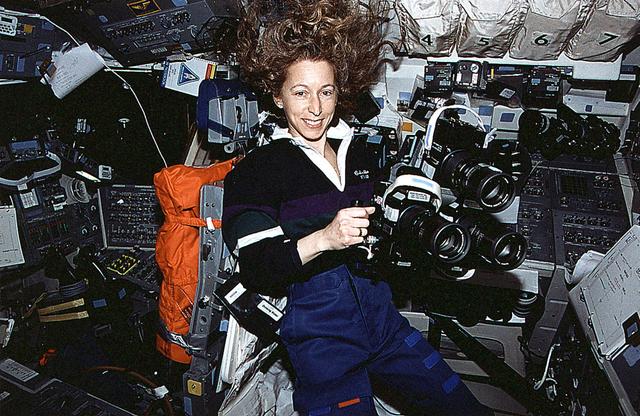
Astronaut Marsha S. Ivins, mission specialist, prepares to aim three Hasselblad cameras through the overhead windows of the Earth-orbiting Space Shuttle Columbia. The three cameras were allowed to simultaneously record the same imagery on different types of film.
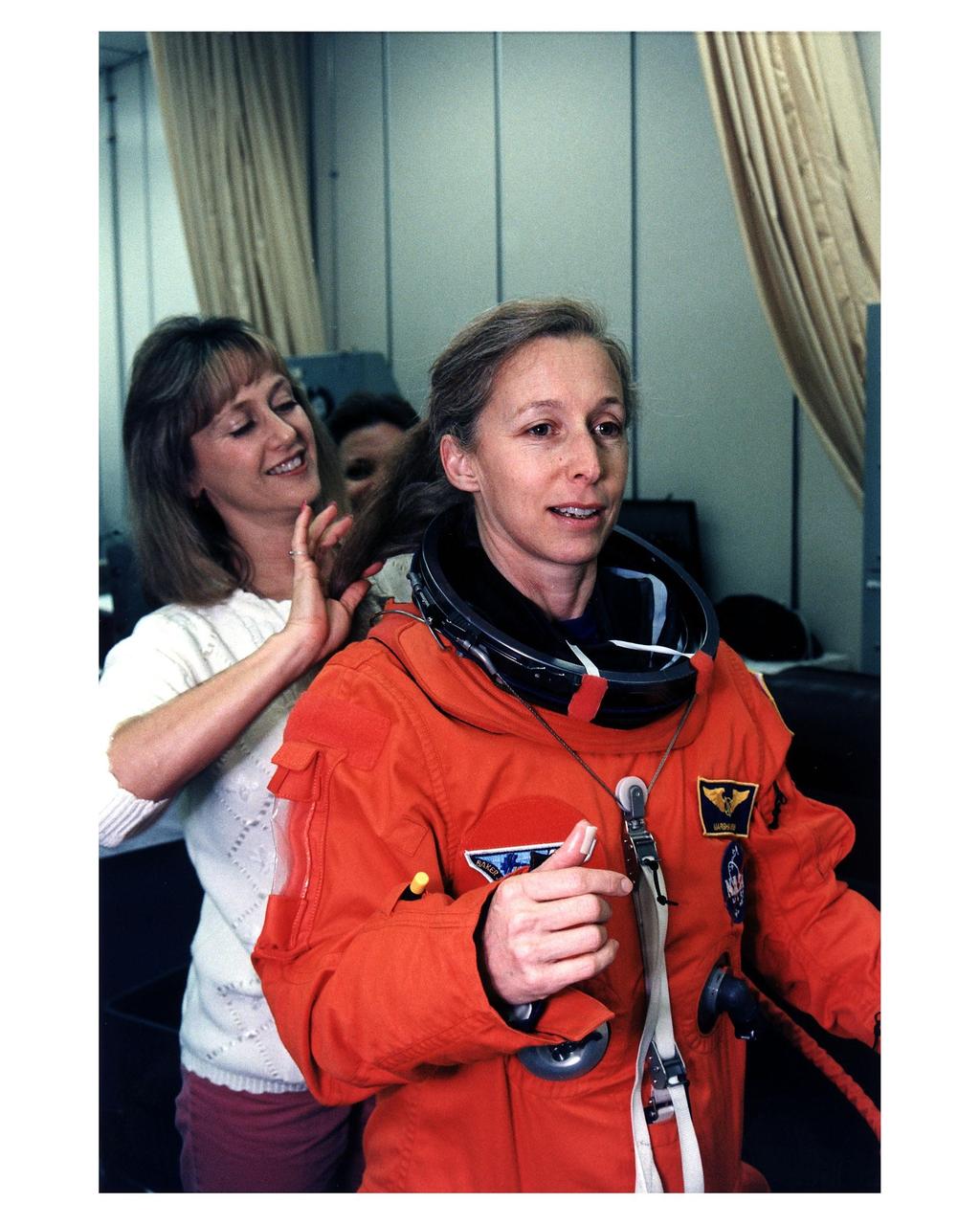
STS-81 Mission Specialist Marsha S. Ivins gets a helping hand from a suit technician as she prepares to don the helmet of her launch/entry suit in the suitup room of the Operations and Checkout (O&C) Building. She is the veteran of three Shuttle flights and became an astronaut in 1984. Among other responsibilities, Ivins will perform photo and video surveys of the Russian Mir space station and operate the Kidsat experiment camera on the orbiter’s aft flight deck. She and five crew members will shortly depart the O&C and head for Launch Pad 39B, where the Space Shuttle Atlantis will lift off during a 7-minute window that opens at 4:27 a.m. EST, January 12
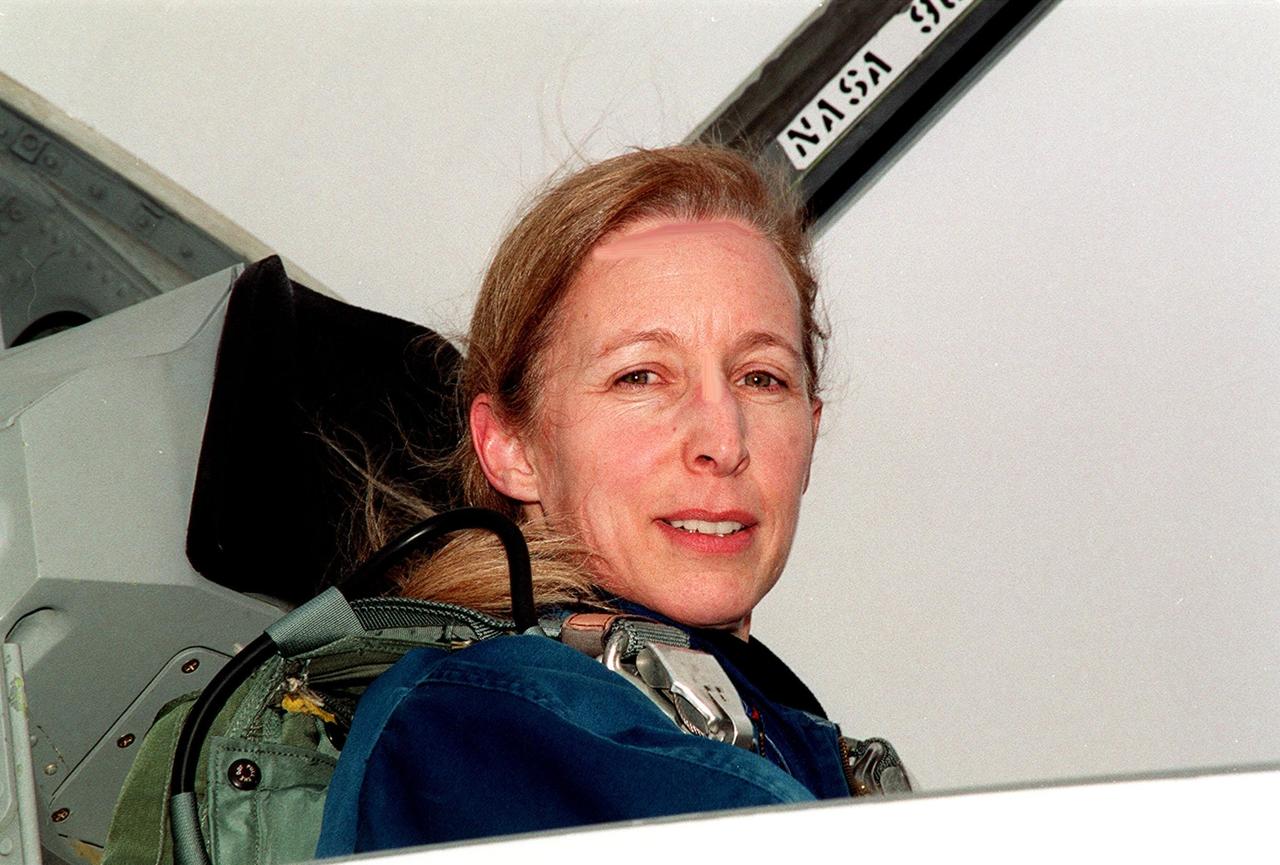
STS-98 Mission Specialist Marsha Ivins arrives at the Shuttle Landing Facility in a T-38 jet aircraft. She and other crew members Commander Ken Cockrell, Pilot Mark Polansky and Mission Specialists Robert Curbeam and Thomas Jones have returned to KSC to prepare for their launch to the International Space Station. The seventh construction flight to the Space Station, STS-98 will carry the U.S. Laboratory Destiny, a key module for space experiments. The 11-day mission includes three spacewalks to complete outside assembly and connection of electrical and plumbing lines between the laboratory, Station and a relocated Shuttle docking port. STS-98 is Ivins’ fifth space flight. Launch is targeted for Feb. 7 at 6:11 p.m. EST
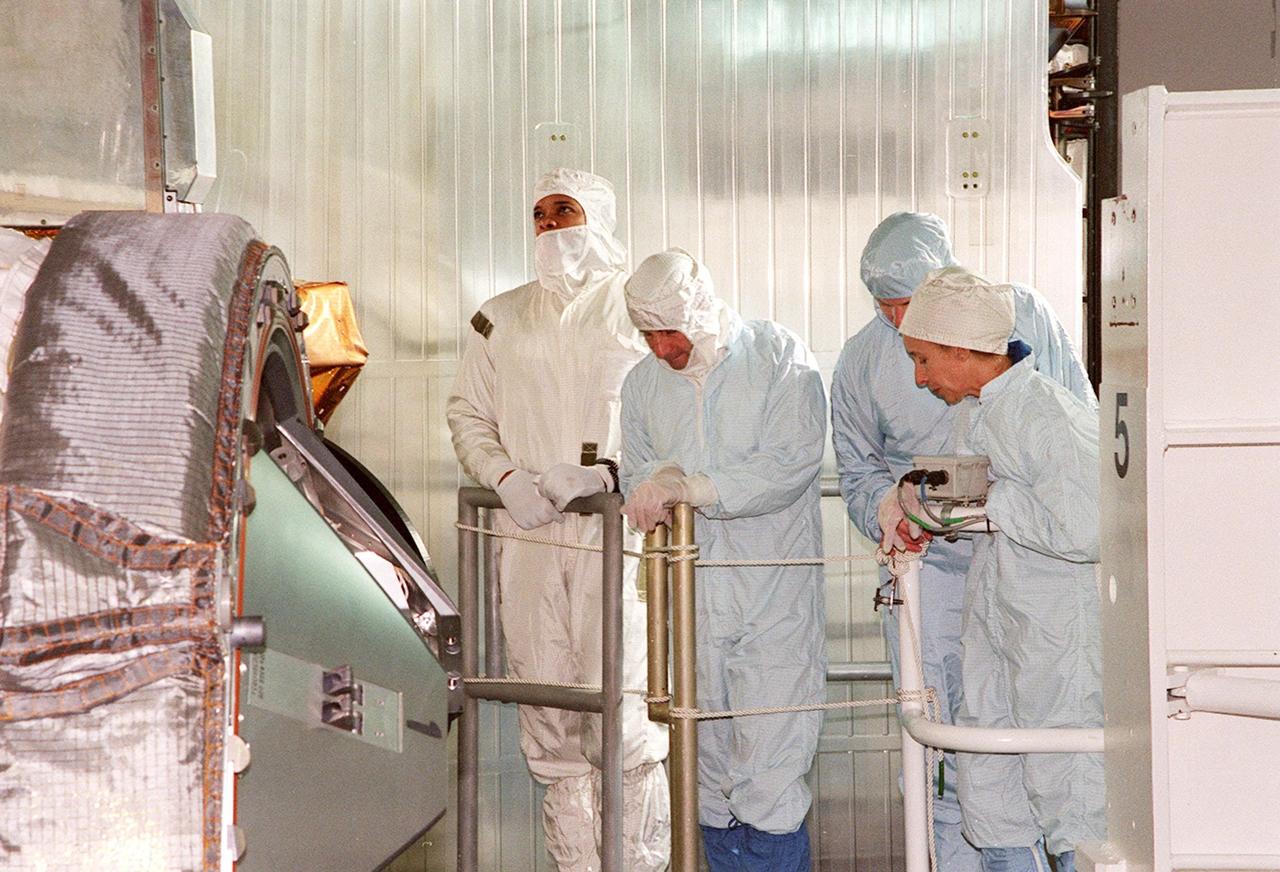
KENNEDY SPACE CENTER, FLA. -- STS-98 Mission Specialist Robert Curbeam (left), Commander Ken Cockrell (center) and Mission Specialist Marsha Ivins (right) look over the U.S. Lab Destiny in the payload bay of the orbiter Atlantis. Behind Ivins is Scott Thurston, of the VITT office. The crew is at KSC for Terminal Countdown Demonstration Test activities, which also include a simulated launch countdown. A key element in the construction of the International Space Station, Destiny is a pressurized module designed to accommodate pressurized payloads. It has a capacity of 24 rack locations. Payload racks will occupy 13 locations especially designed to support experiments. The module already has five system racks installed inside. Launch of STS-98 on its 11-day mission is scheduled for Jan. 19 at 2:11 a.m. EST
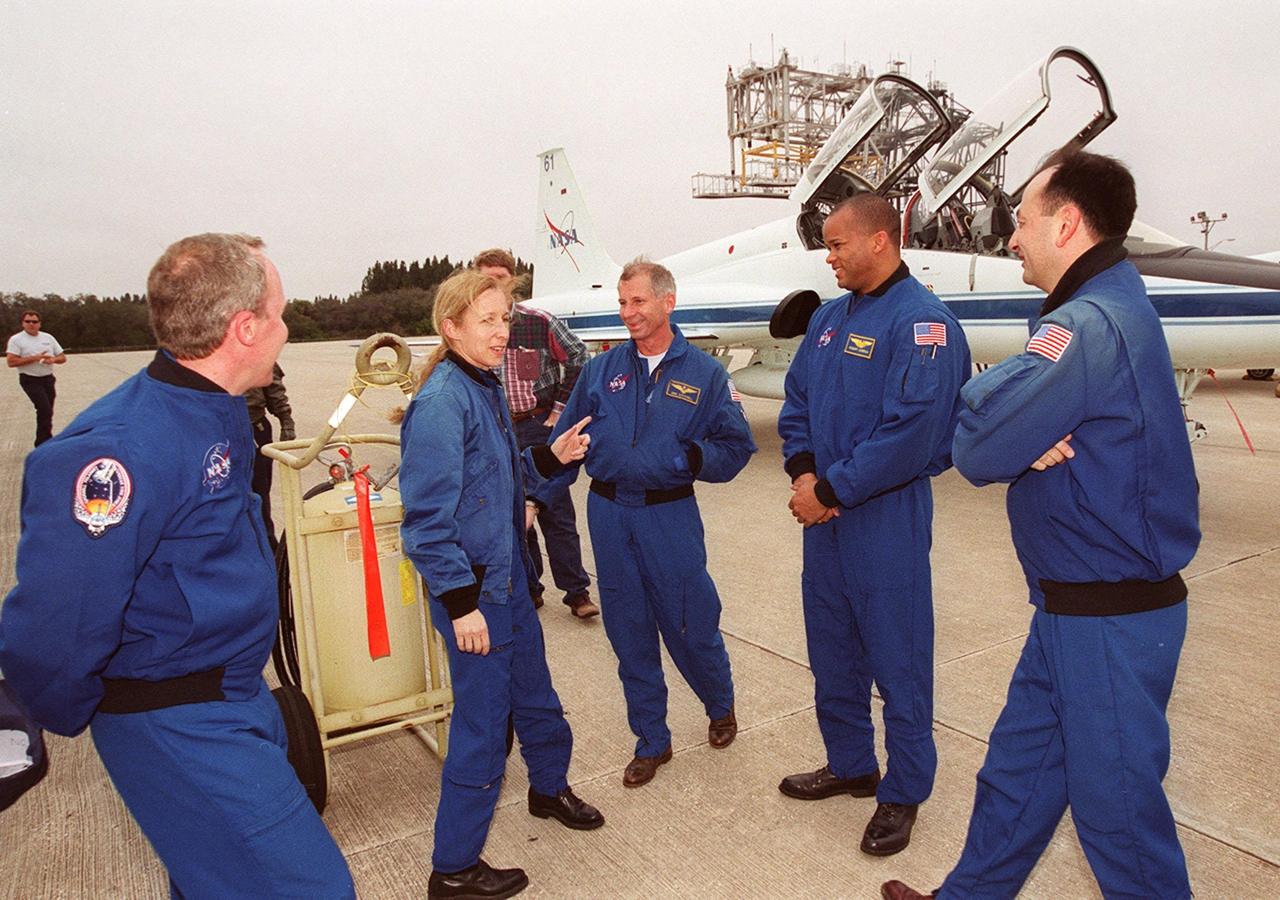
STS-98 Mission Specialist Marsha Ivins arrives at the Shuttle Landing Facility in a T-38 jet aircraft. She and other crew members Commander Ken Cockrell, Pilot Mark Polansky and Mission Specialists Robert Curbeam and Thomas Jones have returned to KSC to prepare for their launch to the International Space Station. The seventh construction flight to the Space Station, STS-98 will carry the U.S. Laboratory Destiny, a key module for space experiments. The 11-day mission includes three spacewalks to complete outside assembly and connection of electrical and plumbing lines between the laboratory, Station and a relocated Shuttle docking port. STS-98 is Ivins’ fifth space flight. Launch is targeted for Feb. 7 at 6:11 p.m. EST
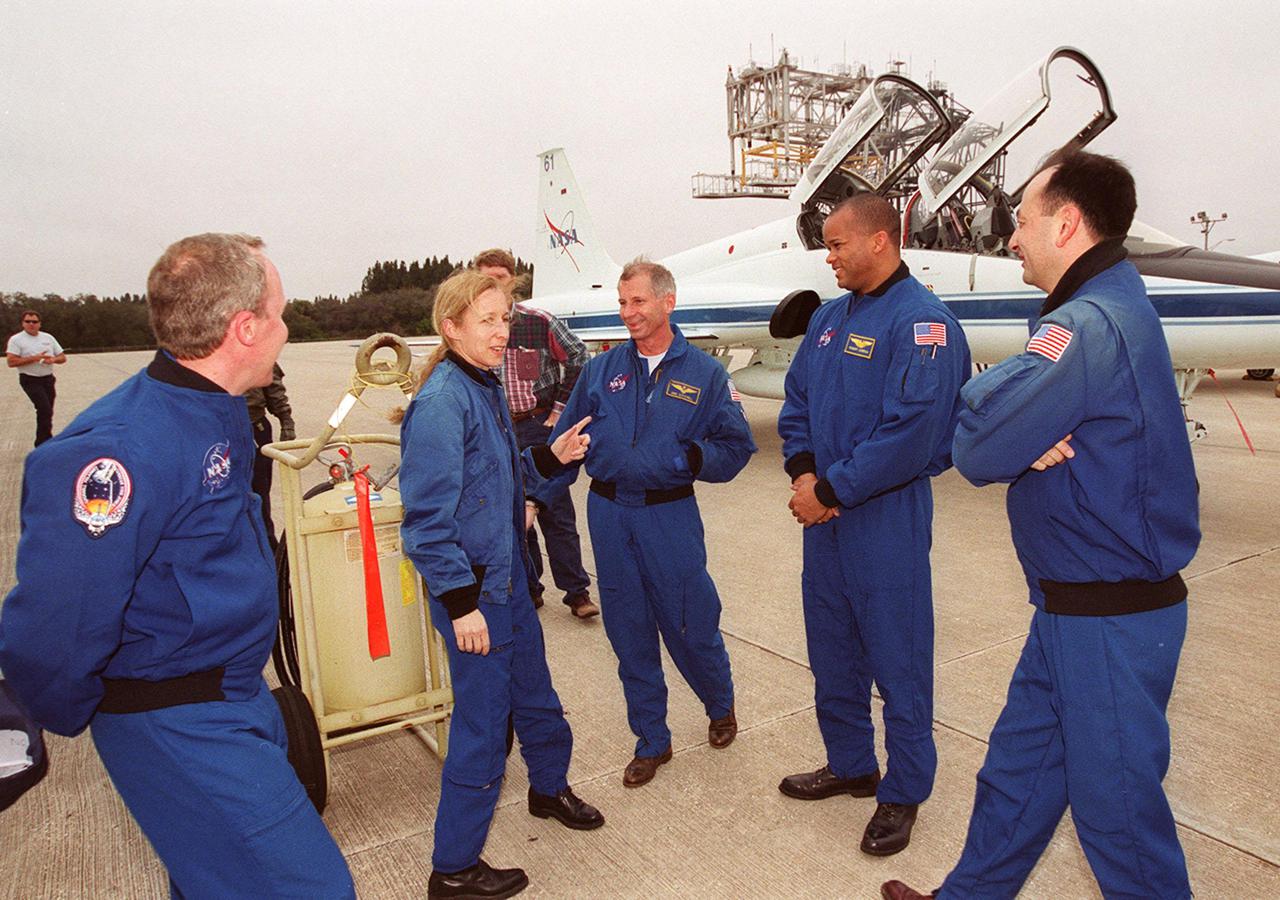
STS-98 Mission Specialist Marsha Ivins arrives at the Shuttle Landing Facility in a T-38 jet aircraft. She and other crew members Commander Ken Cockrell, Pilot Mark Polansky and Mission Specialists Robert Curbeam and Thomas Jones have returned to KSC to prepare for their launch to the International Space Station. The seventh construction flight to the Space Station, STS-98 will carry the U.S. Laboratory Destiny, a key module for space experiments. The 11-day mission includes three spacewalks to complete outside assembly and connection of electrical and plumbing lines between the laboratory, Station and a relocated Shuttle docking port. STS-98 is Ivins’ fifth space flight. Launch is targeted for Feb. 7 at 6:11 p.m. EST
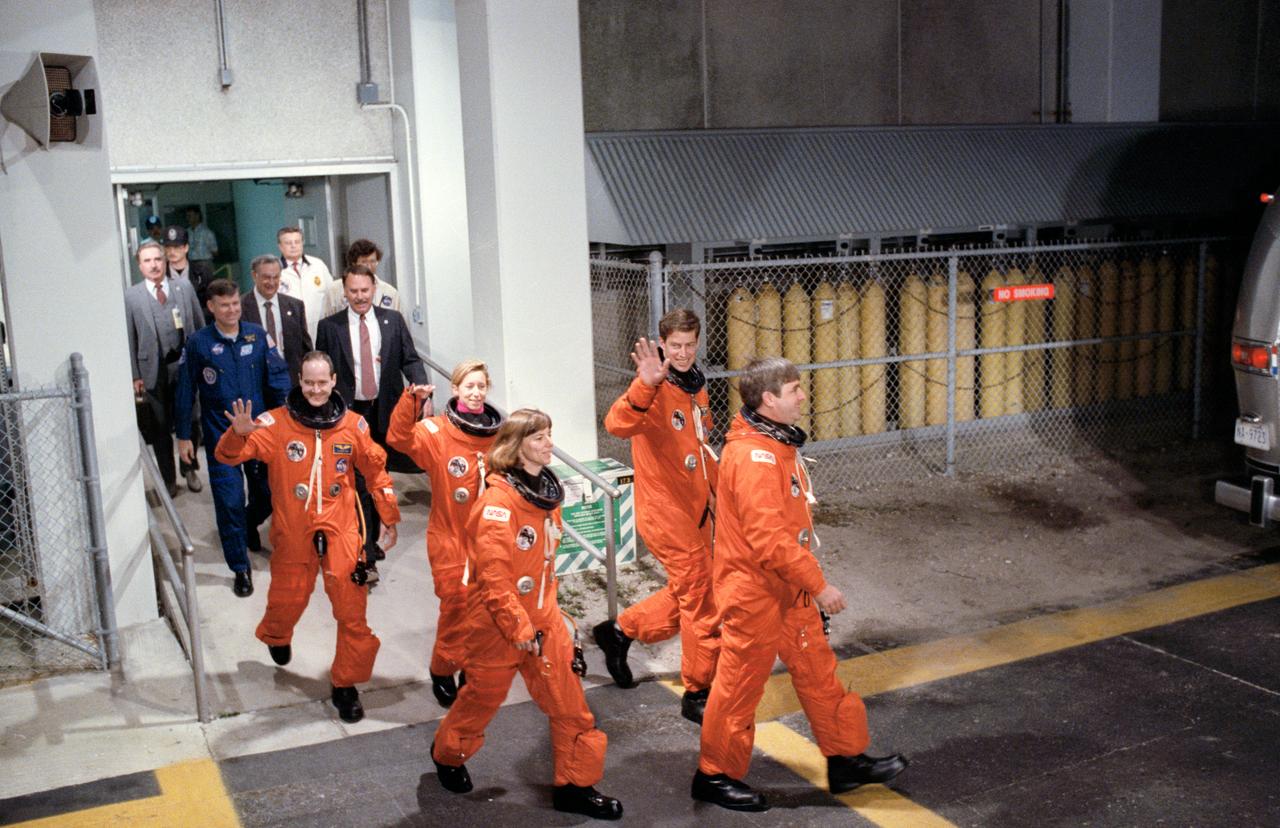
STS032-S-056 (20 Jan 1990) --- STS-32 Columbia, Orbiter Vehicle (OV) 102, crewmembers depart the Kennedy Space Center (KSC) Operations and Checkout (O and C) Building enroute to KSC Launch Complex (LC) Pad 39A. Dubious weather at the return-to-launch site (RTLS) caused postponement of yesterday's planned launch. From left to right are Mission Specialist (MS) G. David Low, MS Marsha S. Ivins, MS Bonnie J. Dunbar, Pilot James D. Wetherbee, and Commander Daniel C. Brandenstein. All crewmembers are wearing launch and entry suits (LESs) and Low, Ivins, and Wetherbee wave to spectators as they head to the transportation van. Following the crew are astronaut Michael L. Coats (left) and NASA/JSC manager Donald R. Puddy.
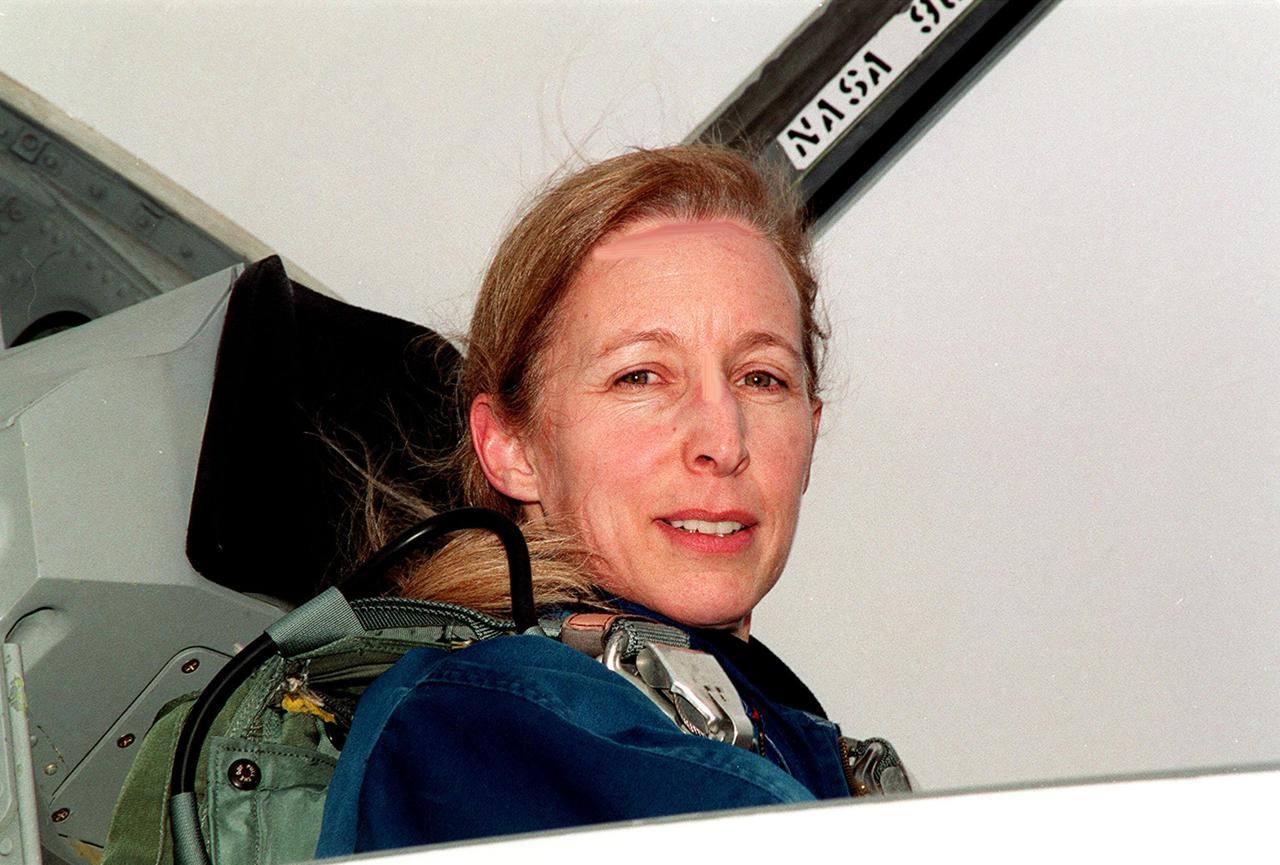
STS-98 Mission Specialist Marsha Ivins arrives at the Shuttle Landing Facility in a T-38 jet aircraft. She and other crew members Commander Ken Cockrell, Pilot Mark Polansky and Mission Specialists Robert Curbeam and Thomas Jones have returned to KSC to prepare for their launch to the International Space Station. The seventh construction flight to the Space Station, STS-98 will carry the U.S. Laboratory Destiny, a key module for space experiments. The 11-day mission includes three spacewalks to complete outside assembly and connection of electrical and plumbing lines between the laboratory, Station and a relocated Shuttle docking port. STS-98 is Ivins’ fifth space flight. Launch is targeted for Feb. 7 at 6:11 p.m. EST
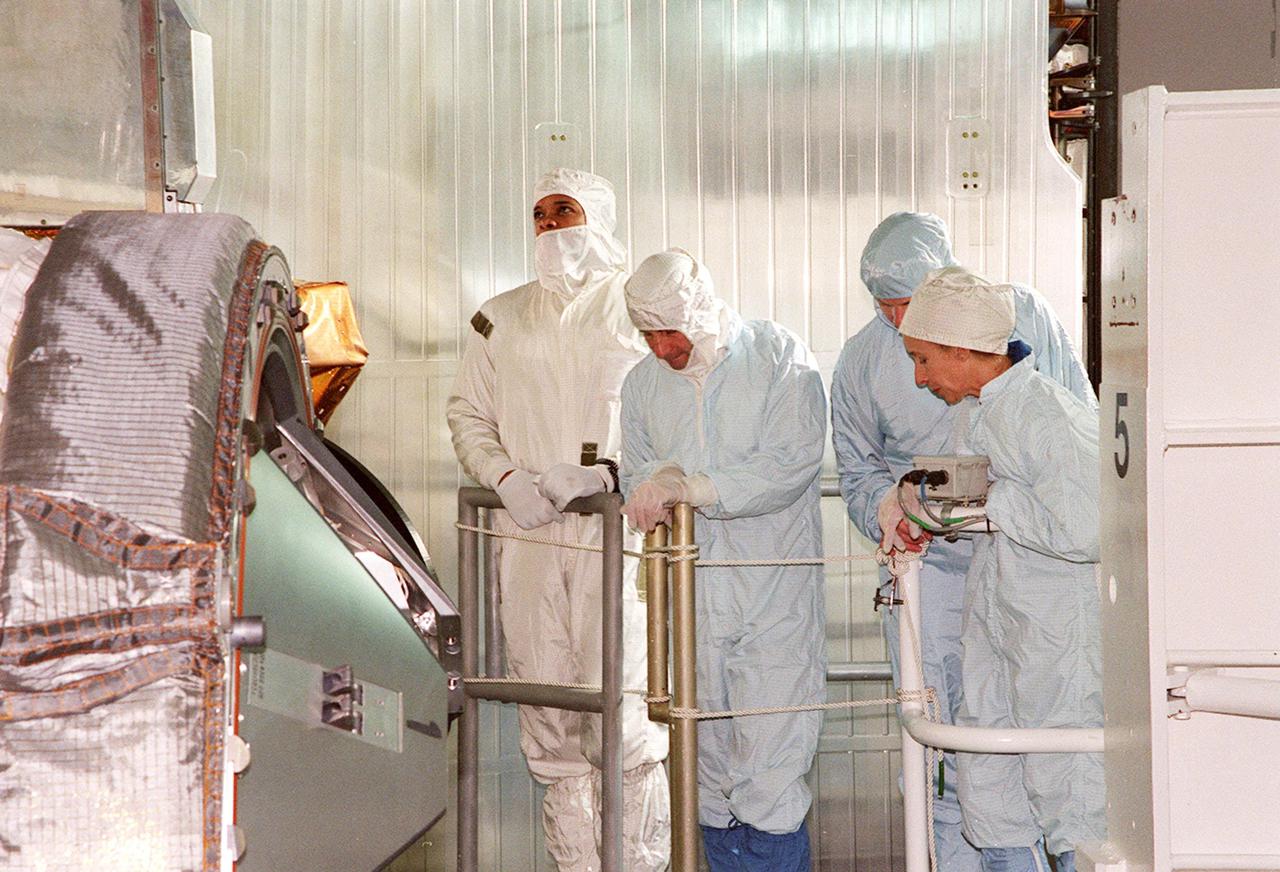
KENNEDY SPACE CENTER, FLA. -- STS-98 Mission Specialist Robert Curbeam (left), Commander Ken Cockrell (center) and Mission Specialist Marsha Ivins (right) look over the U.S. Lab Destiny in the payload bay of the orbiter Atlantis. Behind Ivins is Scott Thurston, of the VITT office. The crew is at KSC for Terminal Countdown Demonstration Test activities, which also include a simulated launch countdown. A key element in the construction of the International Space Station, Destiny is a pressurized module designed to accommodate pressurized payloads. It has a capacity of 24 rack locations. Payload racks will occupy 13 locations especially designed to support experiments. The module already has five system racks installed inside. Launch of STS-98 on its 11-day mission is scheduled for Jan. 19 at 2:11 a.m. EST
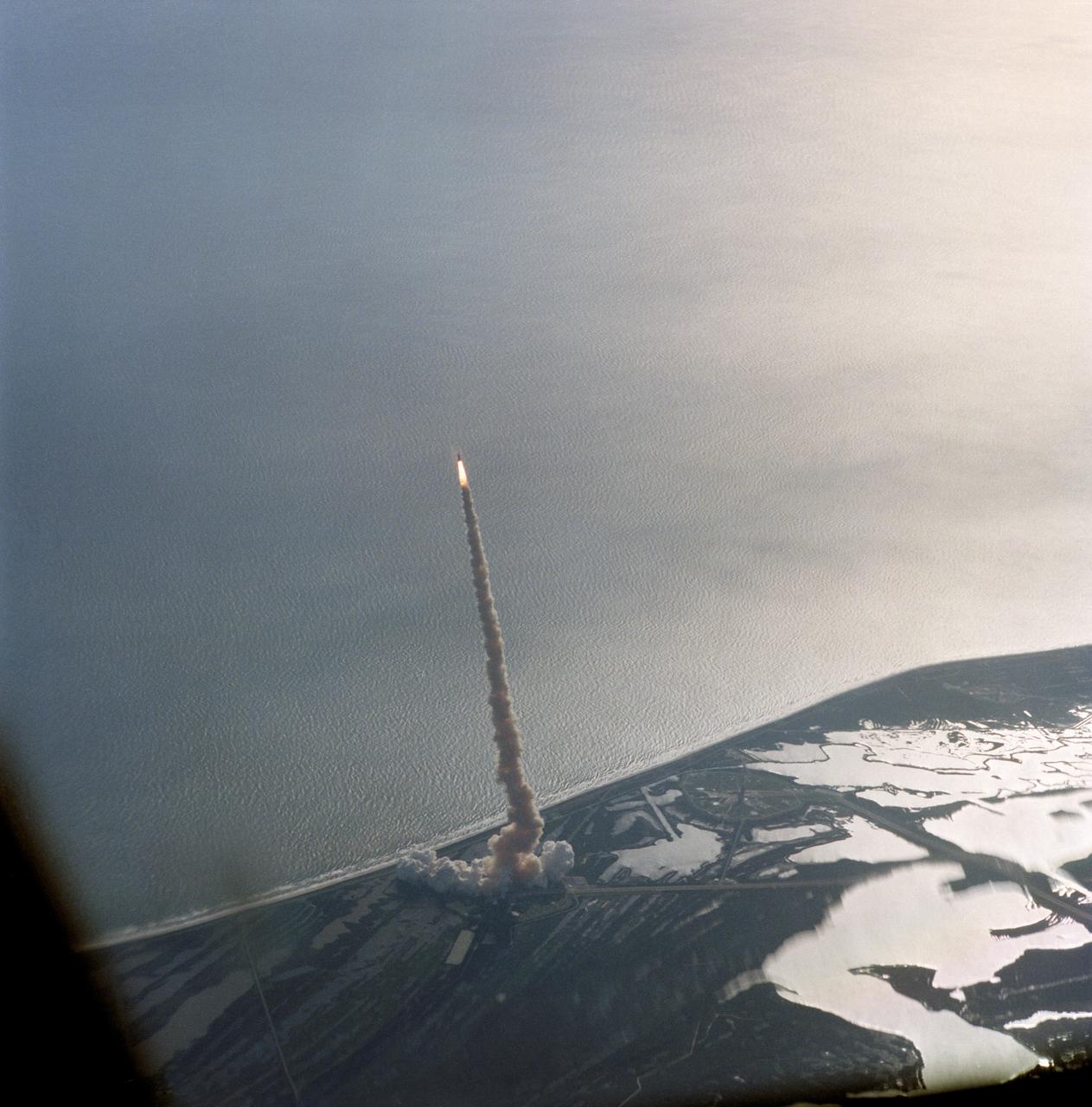
STS062-S-061 (4 March 1994) --- An aerial view of early stages of the sixteenth launch of Space Shuttle Columbia was provided by a 70mm camera aboard the Shuttle Training Aircraft (STA). Launch occurred at 8:53 a.m. (EST), March 4, 1994. Onboard were astronauts John H. Casper, Andrew M. Allen, Marsha S. Ivins, Charles D. (Sam) Gemar and Pierre J. Thuot.
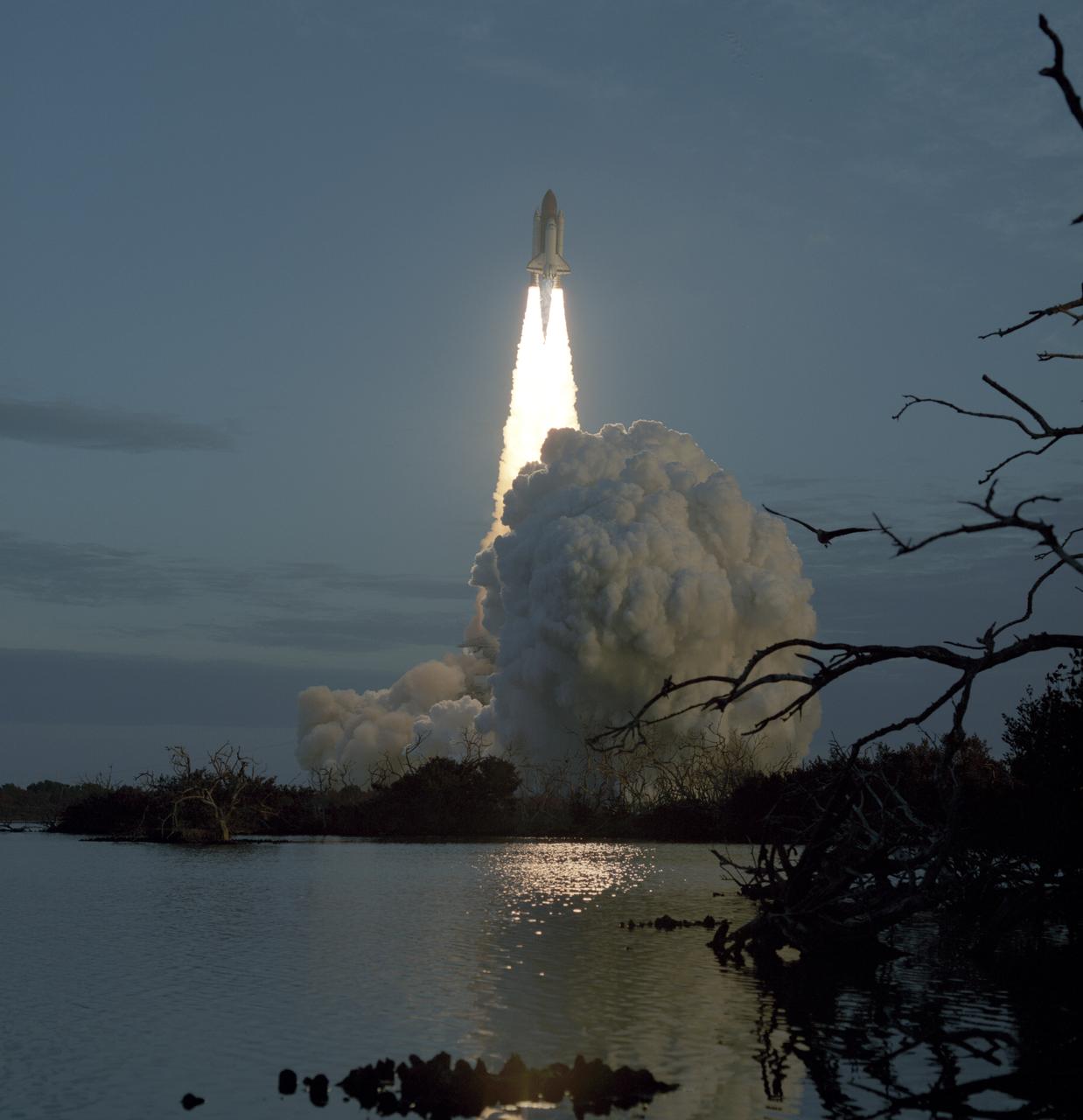
Five astronauts launched aboard the Space Shuttle Columbia on January 9, 1990 at 7:35:00am (EST) for the STS-32 mission. The crew included David C. Brandenstein, commander; James D. Weatherbee, pilot; and mission specialists Marsha S. Ivins, G. David Low, and Bonnie J. Dunbar. Primary objectives of the mission were the deployment of the SYNCOM IV-F5 defense communications satellite and the retrieval of NASA’s Long Duration Exposure Facility (LDEF).
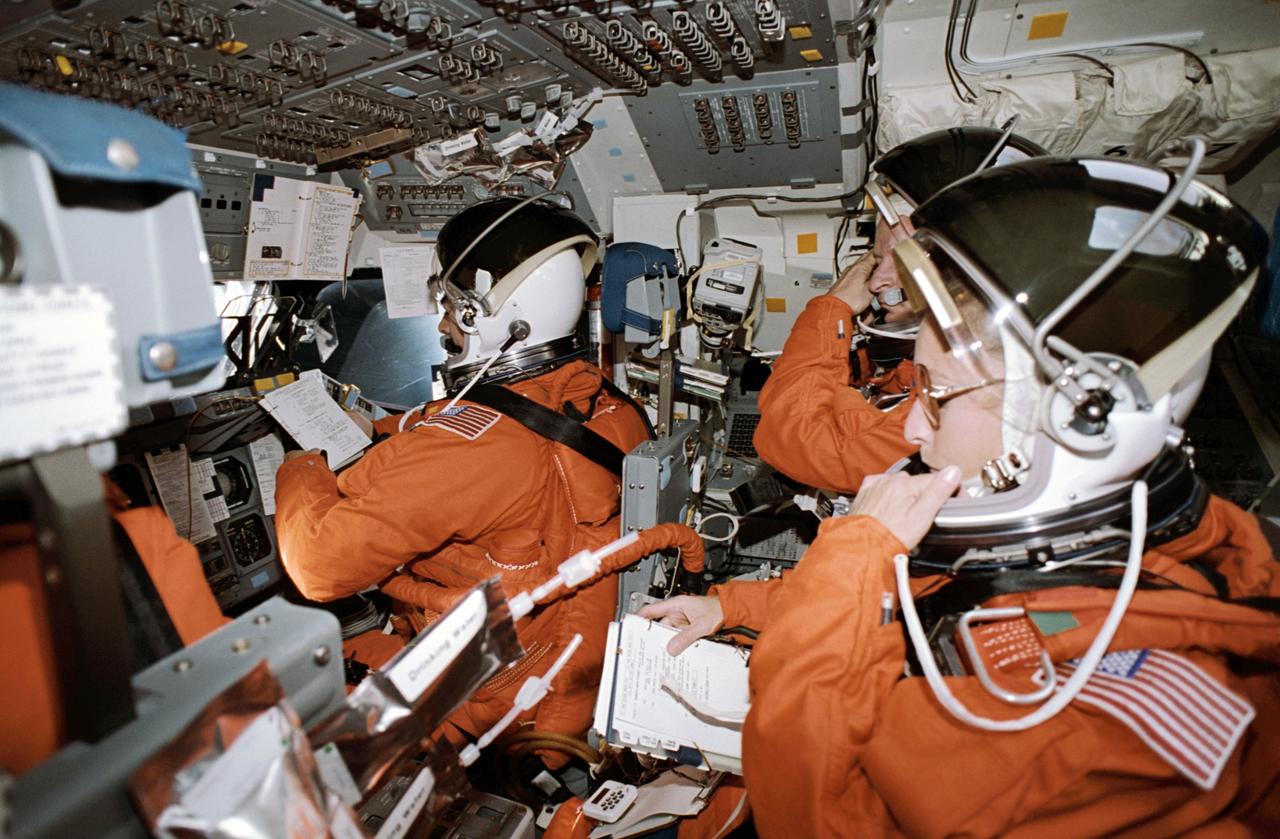
STS046-19-037 (8 Aug 1992) --- Having completed eight days in Earth-orbit, the crew members prepare for their brief journey home. Left to right are Andrew M. Allen, pilot; Claude Nicollier, mission specialist representing the European Space Agency (ESA); and Marsha S. Ivins, mission specialist. Just out of frame, at left, is Loren J. Shriver, mission commander, who guided the Space Shuttle Atlantis in for its Kennedy Space Center (KSC), Florida landing.
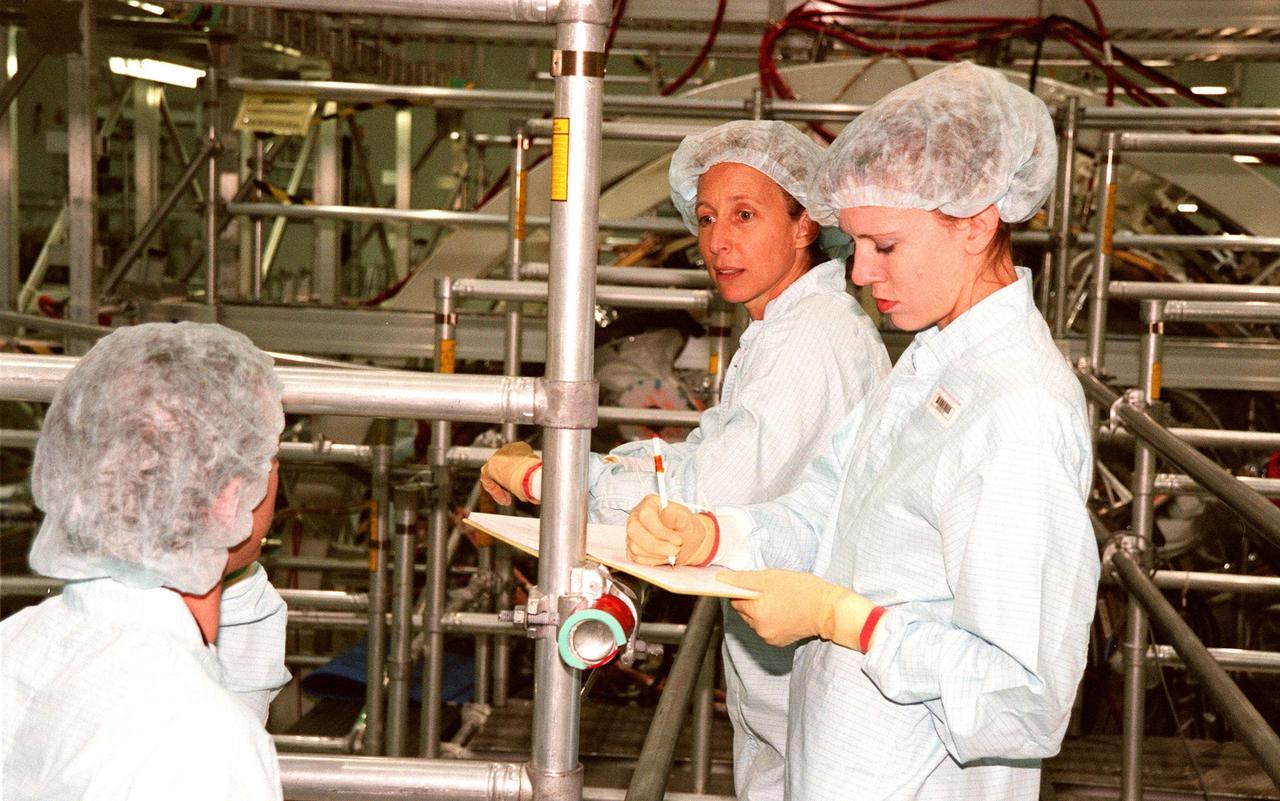
STS-98 Mission Specialist Marsha Ivins (center) checks out equipment for the International Space Station (ISS) with Ursula Stockdale (right), Mod Cargo Operations. STS-98 is scheduled to carry the U.S. laboratory module, the centerpiece ISS, where unprecedented science experiments will be performed in the near zero gravity of space. The launch is targeted for October 1999 aboard the Space Shuttle Endeavour
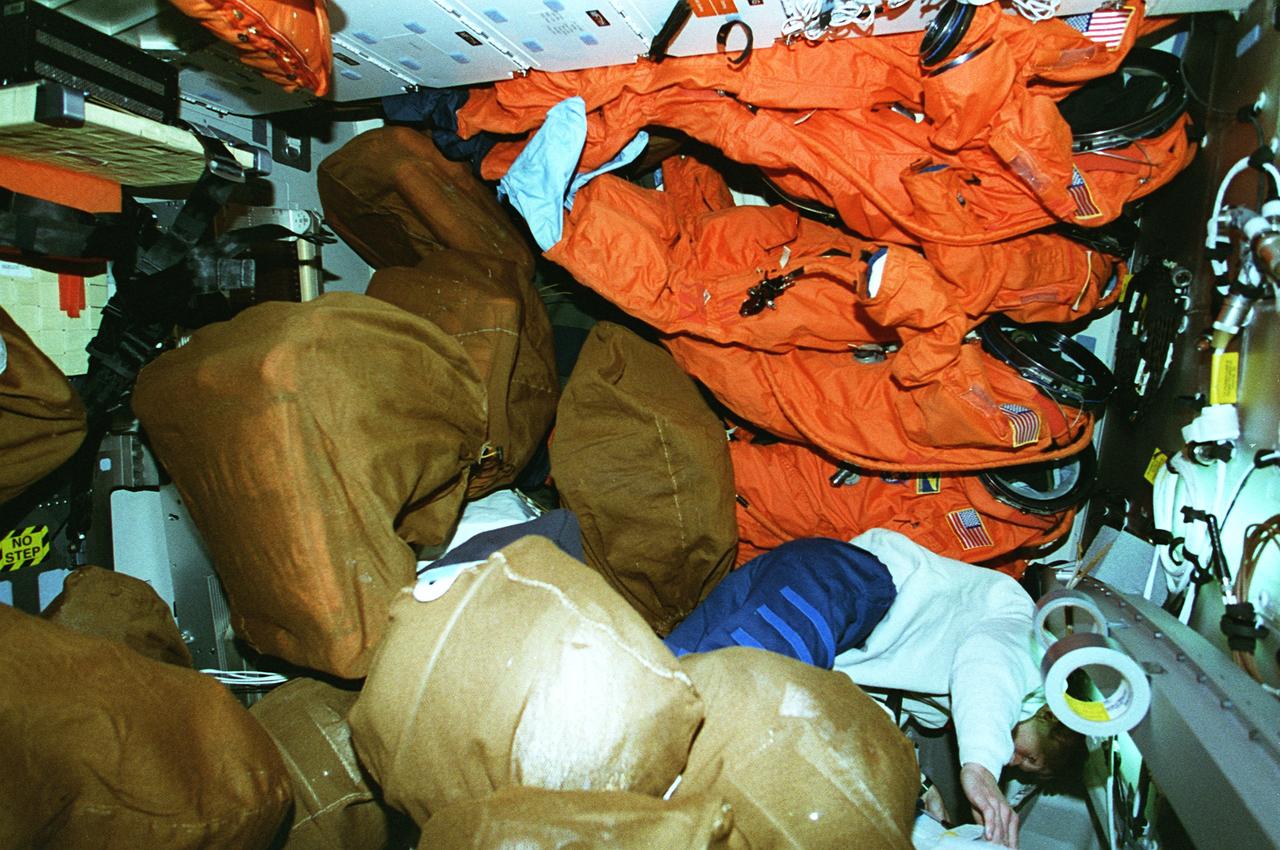
STS081-308-032 (12-22 Jan. 1997) --- Astronaut Marsha S. Ivins appears almost lost among the bags of material to be brought back to Earth at the impending conclusion of the Space Shuttle Atlantis and Russia's Mir Space Station docking mission. Several partial pressure garments which were used for launch and will soon be donned for the entry phase are in upper left.
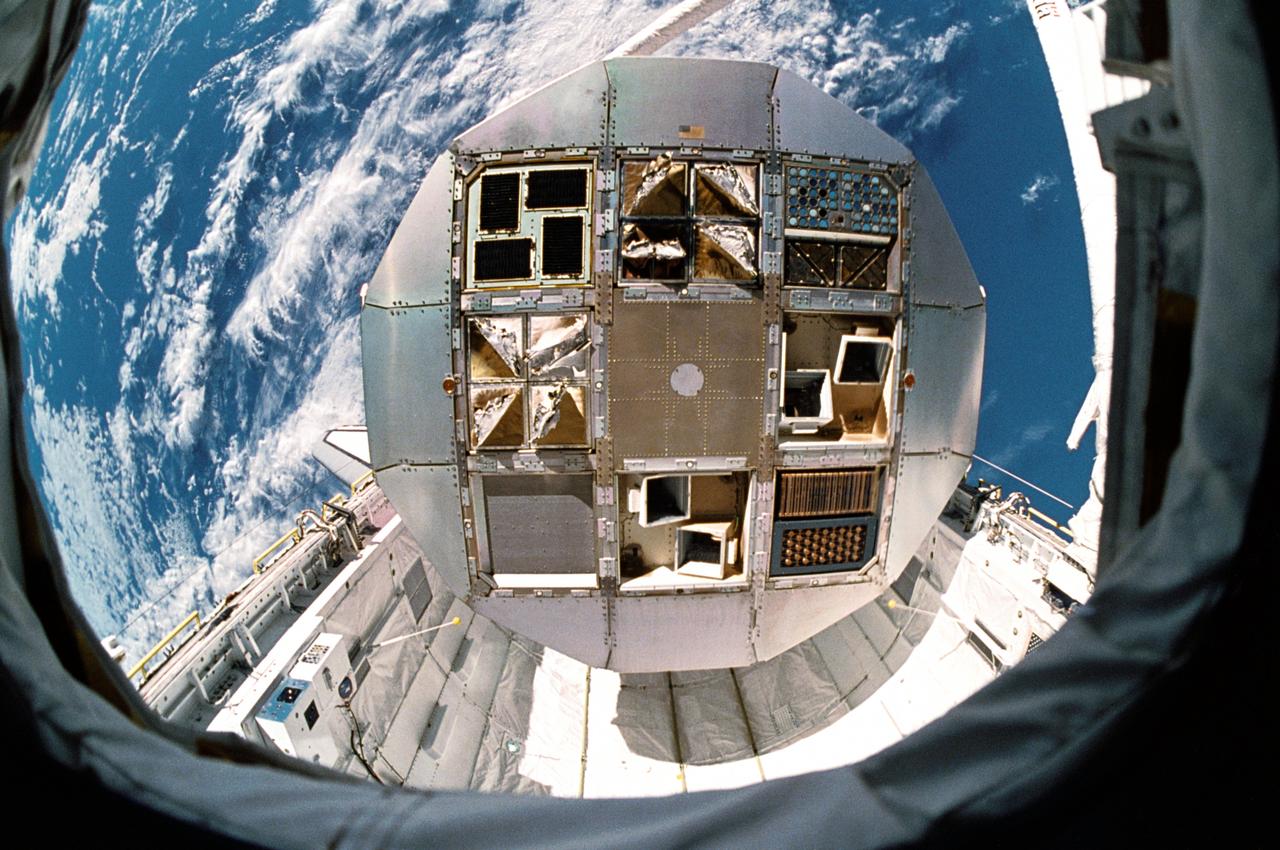
STS032-541-018 (12 Jan 1990) --- One of a number of frames photographed by the STS-32 crew as part of a detailed supplementary objective on documentary still photography. The DSO was monitored by Astronaut Marsha S. Ivins, mission specialist. STS032-541-018 Kodak Ektar 25 negative film. 35mm frame of LDEF suspended just over its resting place in cargo bay. White clouds and blue ocean in foreground.
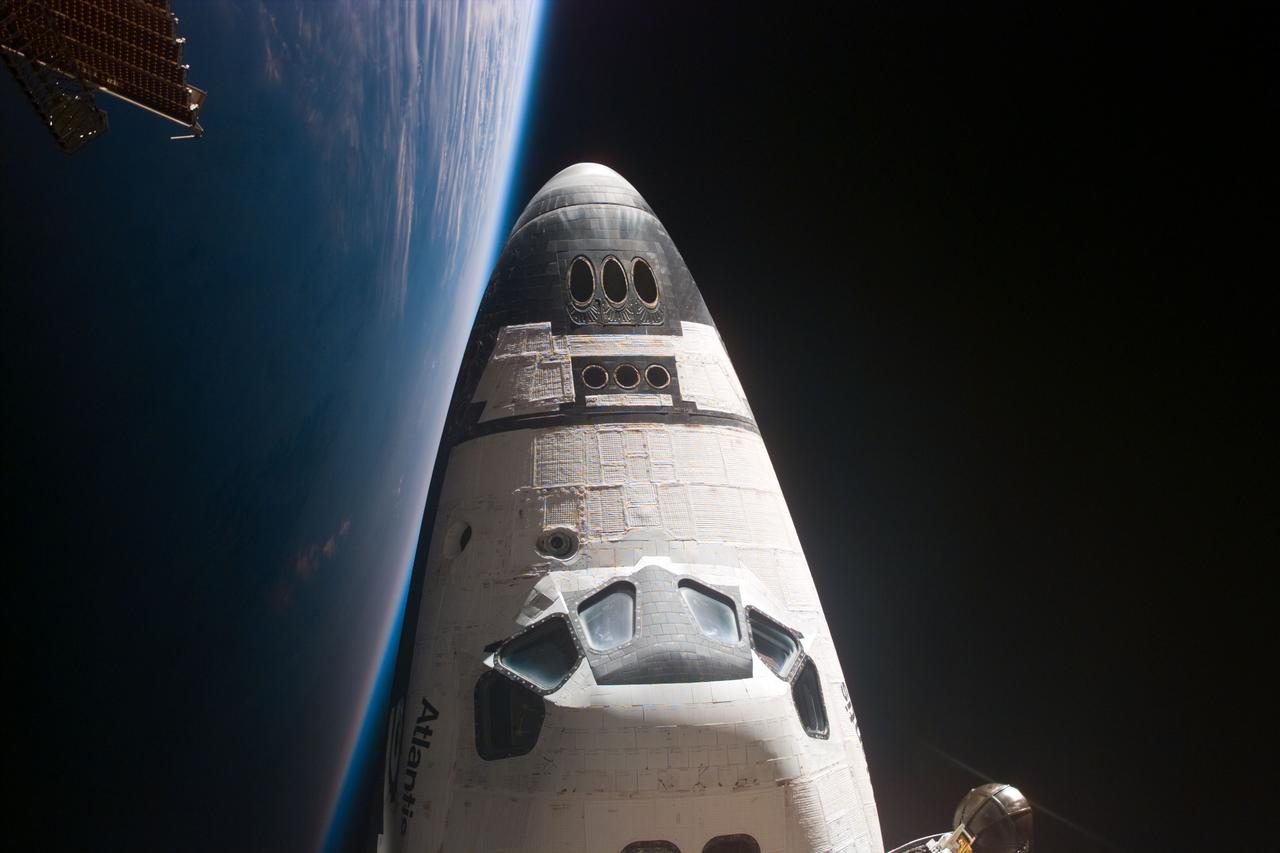
STS081-E-05436 (15 Jan. 1997) --- Soon after the astronauts docked the space shuttle Atlantis with Russia's Mir Space Station, astronaut Marsha S. Ivins, STS-81 mission specialist, went aboard the Mir complex and sought a window through which she could record this image of Atlantis' forward section. A solar array panel on the Mir is seen in one corner and the Ku-band antenna for Atlantis is visible in another. This view was taken with an electronic still camera (ESC). Photo credit: NASA

Ursula Stockdale (left), Mod Cargo Operations, and STS-98 Mission Specialist Marsha Ivins, take a break from equipment check in the Space Station Processing Facility. STS-98 is scheduled to carry the U.S. laboratory module, the centerpiece ISS, where unprecedented science experiments will be performed in the near zero gravity of space. The launch is targeted for October 1999 aboard the Space Shuttle Endeavour
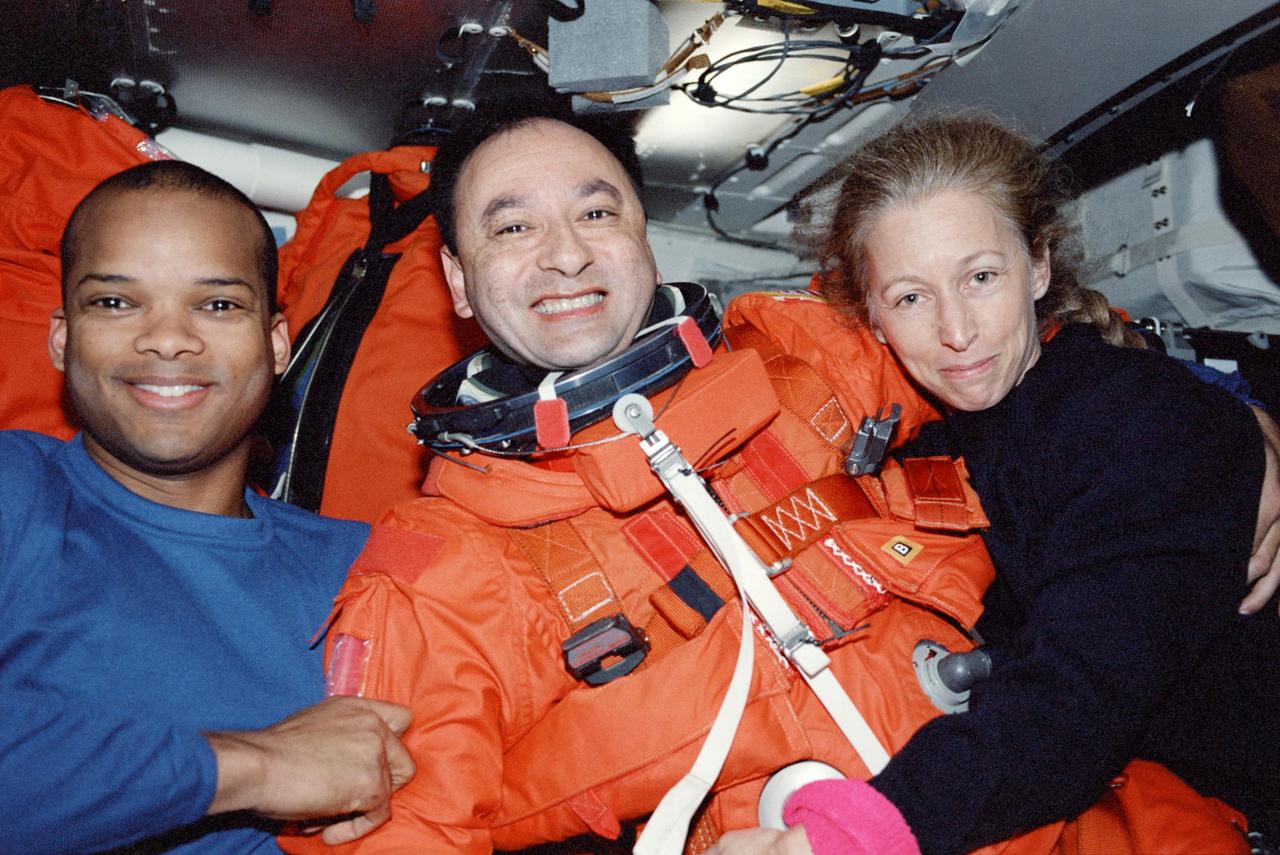
STS098-358-005 (7-20 February 2001) --- Astronauts Mark L. Polansky (center), pilot, Robert L. Curbeam, and Marsha S. Ivins, both mission specialists, paused for this photograph as they prepared to suit up in their full-pressure launch and entry suits on the mid deck of the Space Shuttle Atlantis during de-orbit preparations.
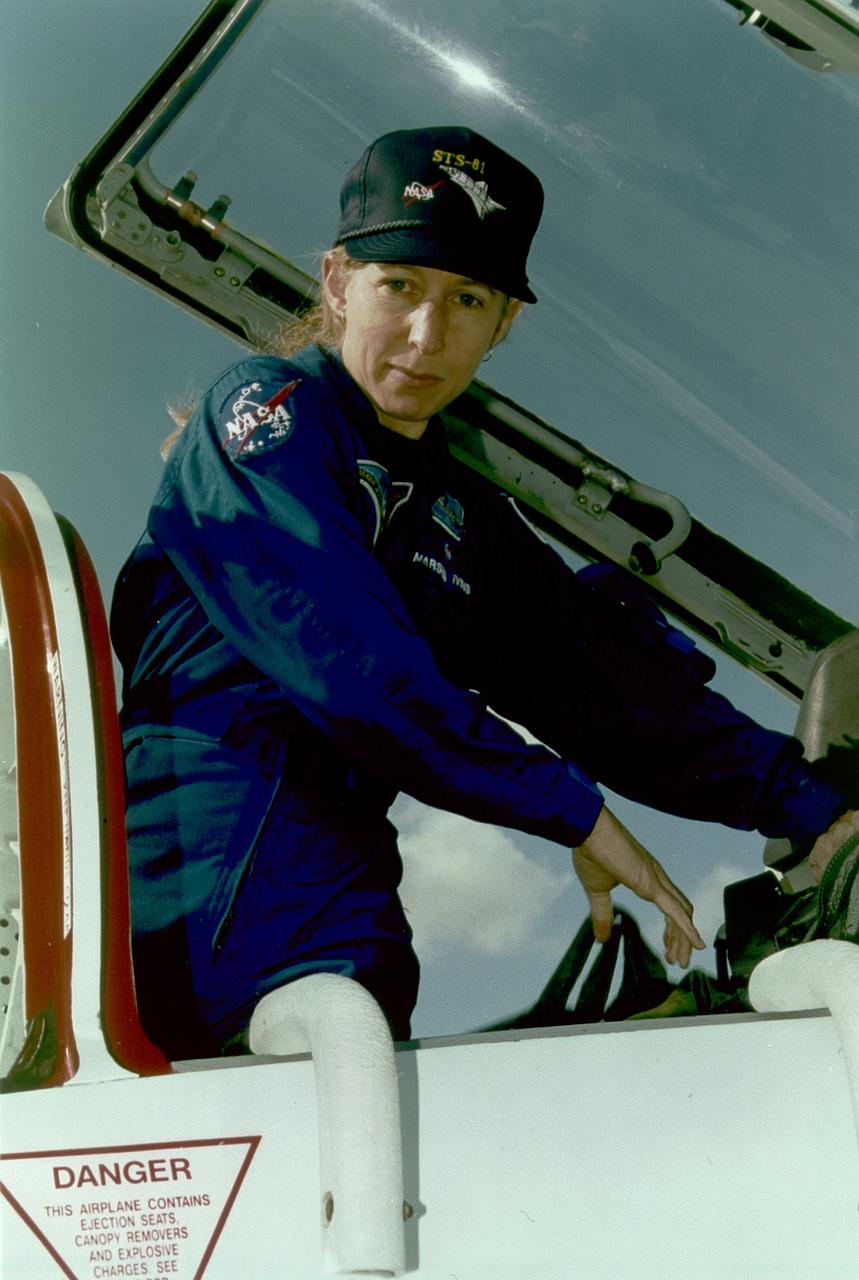
S97-00248 (15 Dec. 1996) --- Astronaut Marsha S. Ivins, STS-81 mission specialist, arrives in a NASA T-38 jet trainer at the Kennedy Space Center's Shuttle Landing Facility for the Terminal Countdown Demonstration Test (TCDT). The TCDT represents a simulated final countdown until just before main engine ignition, now scheduled for Jan. 12, 1997.
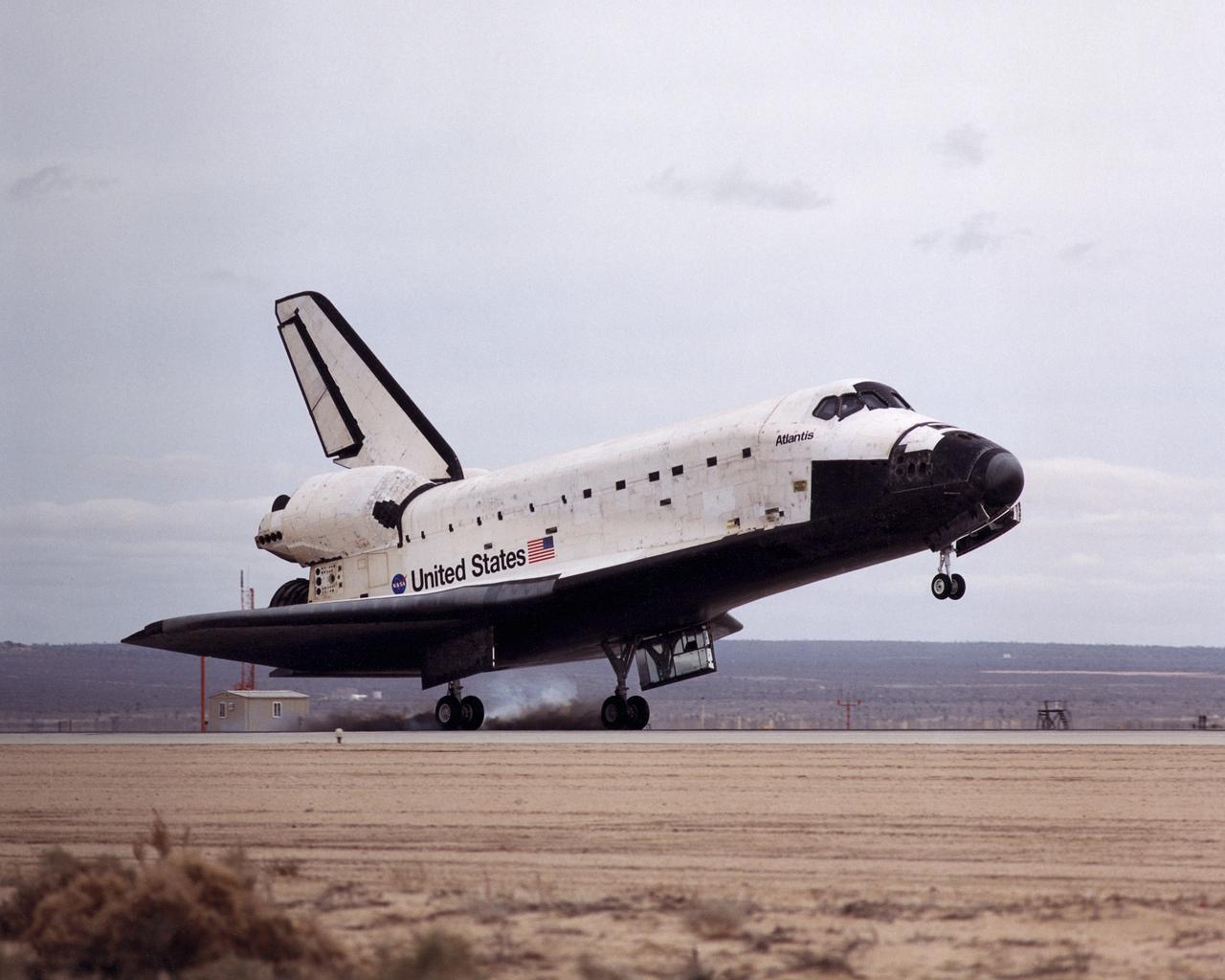
STS098-S-015 (20 Feb. 2001) --- The main landing gear on the space shuttle Atlantis touches down to mark mission completion at Edwards Air Force Base in the Mojave Desert of California.Onboard were astronauts Kenneth Cockrell, Mark Polansky, Robert Curbeam, Thomas Jones and Marsha Ivins. Atlantis touched down on Edward?s concrete runway at 2:33 p.m. (CST), Feb. 20, for a mission elapsed time of 12 days, 21 hours and 20 minutes. Photo credit: NASA
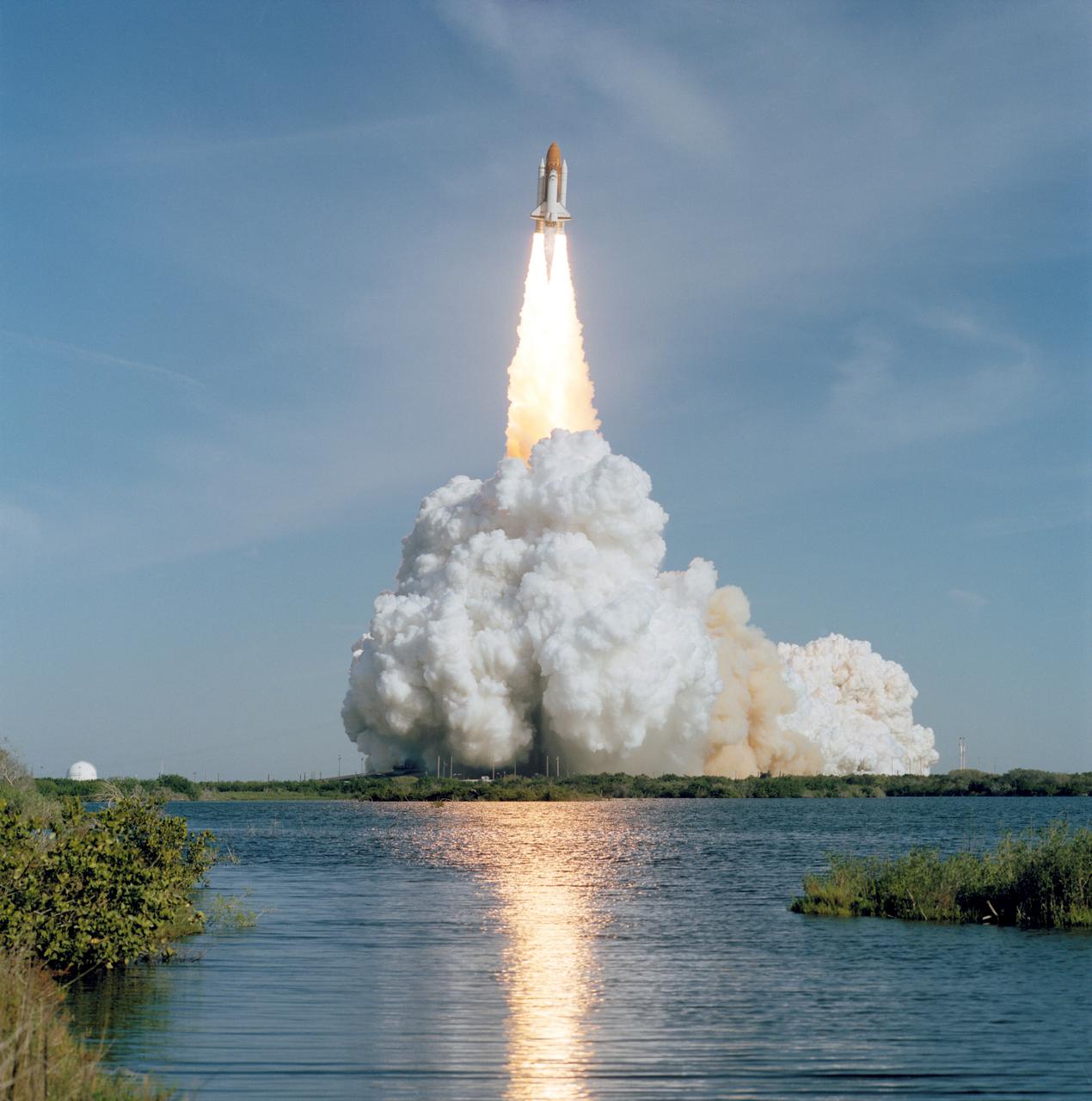
STS062-S-053 (4 March 1994) --- Carrying a crew of five veteran NASA astronauts and the United States Microgravity Payload (USMP), the Space Shuttle Columbia heads toward its sixteenth mission in Earth-orbit. Launch occurred at 8:53 a.m. (EST), March 4, 1994. Onboard were astronauts John H. Casper, Andrew M. Allen, Marsha S. Ivins, Charles D. (Sam) Gemar and Pierre J. Thuot.
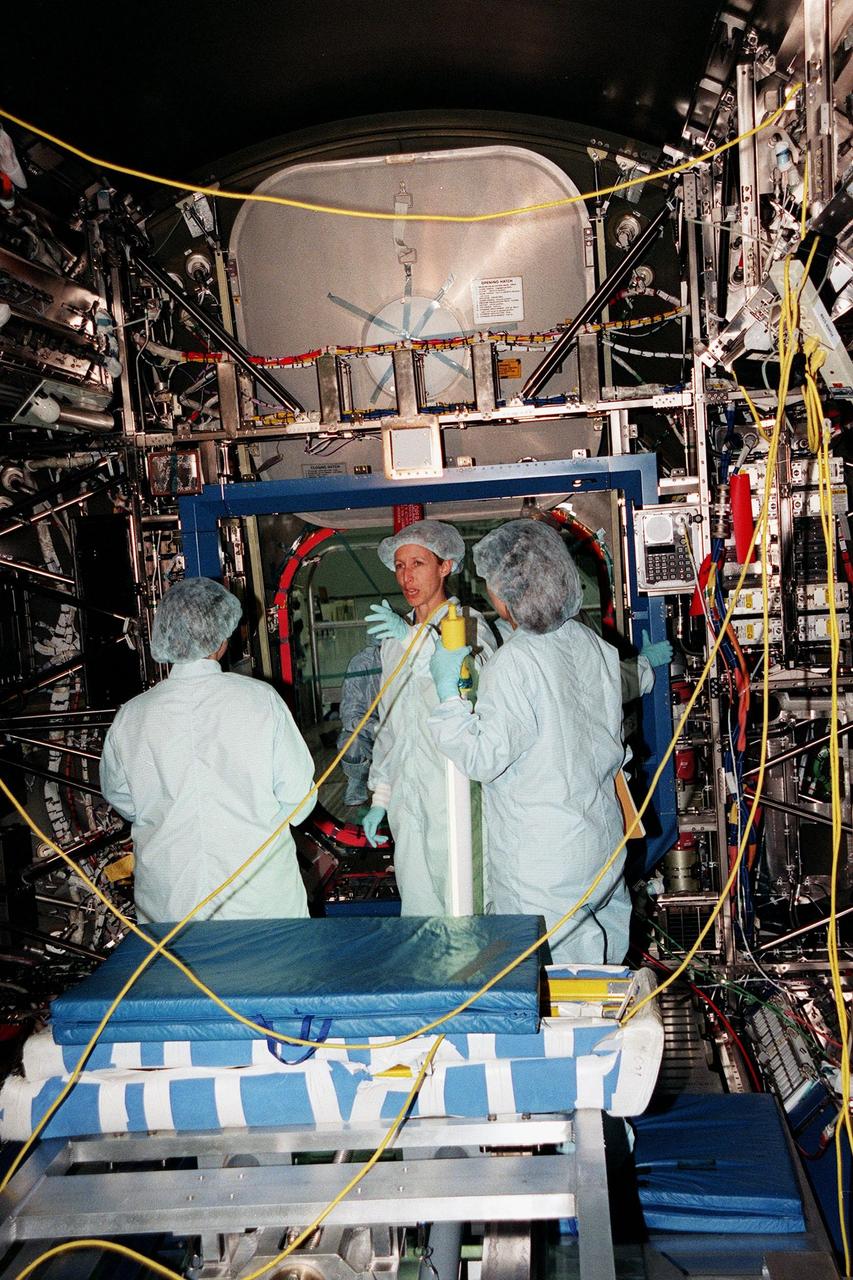
In the Space Station Processing Facility, Marsha Ivins (center), a mission specialist on the STS-98 crew, talks with Suzanne Fase, (left) and Melissa Orozco (right), members of the U.S. Laboratory's processing team. The laboratory module, considered the centerpiece of the International Space Station (ISS), has been named "Destiny" in honor of its prominent role in the world’s largest science and technology effort. It is planned for launch aboard Space Shuttle Endeavour on the sixth ISS construction flight, currently targeted for March 2000.
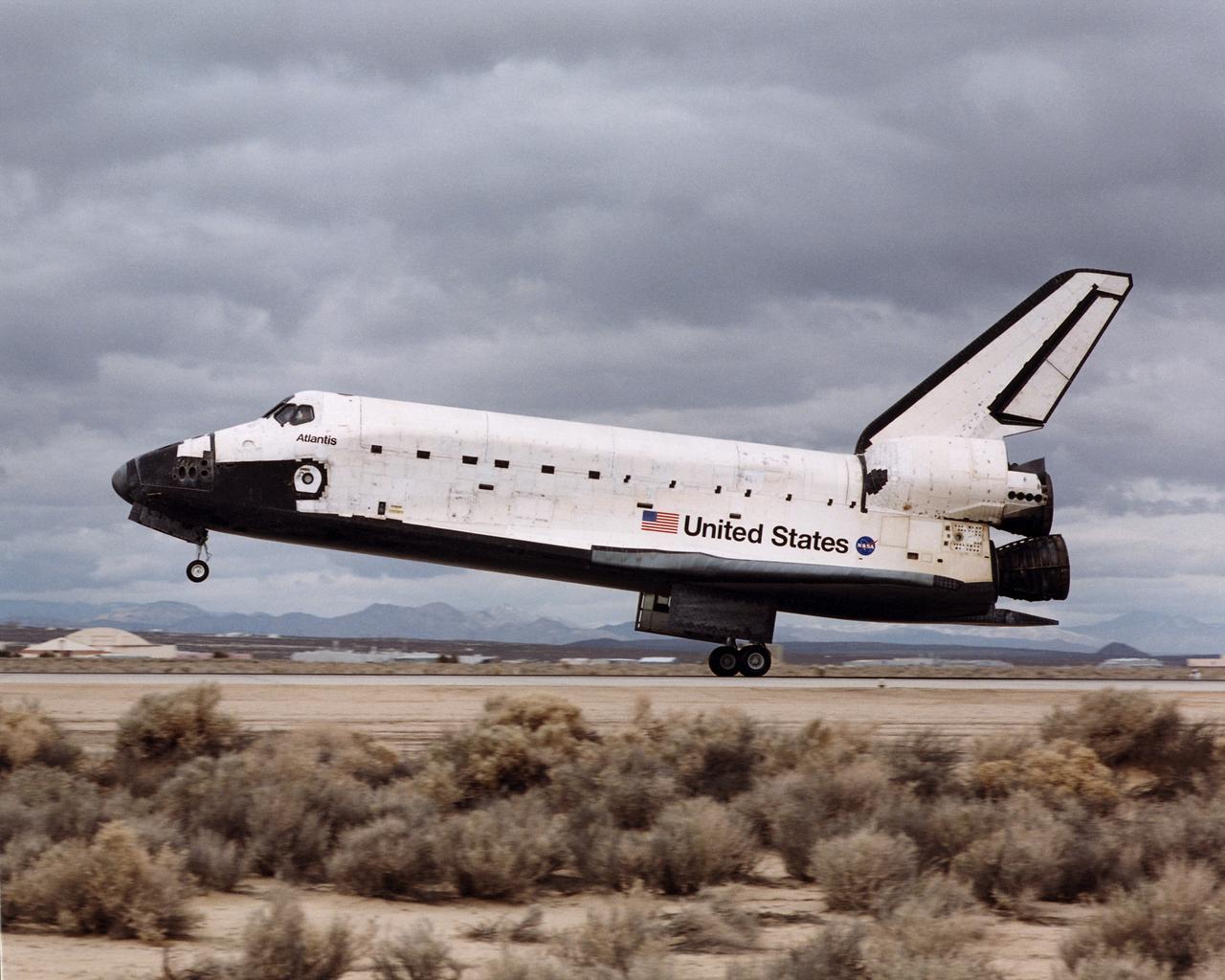
STS098-S-016 (20 Feb. 2001) --- The main landing gear on the space shuttle Atlantis touches down to mark mission completion at Edwards Air Force Base in the Mojave Desert of California.Onboard were astronauts Kenneth Cockrell, Mark Polansky, Robert Curbeam, Thomas Jones and Marsha Ivins. Atlantis touched down on Edward?s concrete runway at 2:33 p.m. (CST), Feb. 20, for a mission elapsed time of 12 days, 21 hours and 20 minutes. Photo credit: NASA
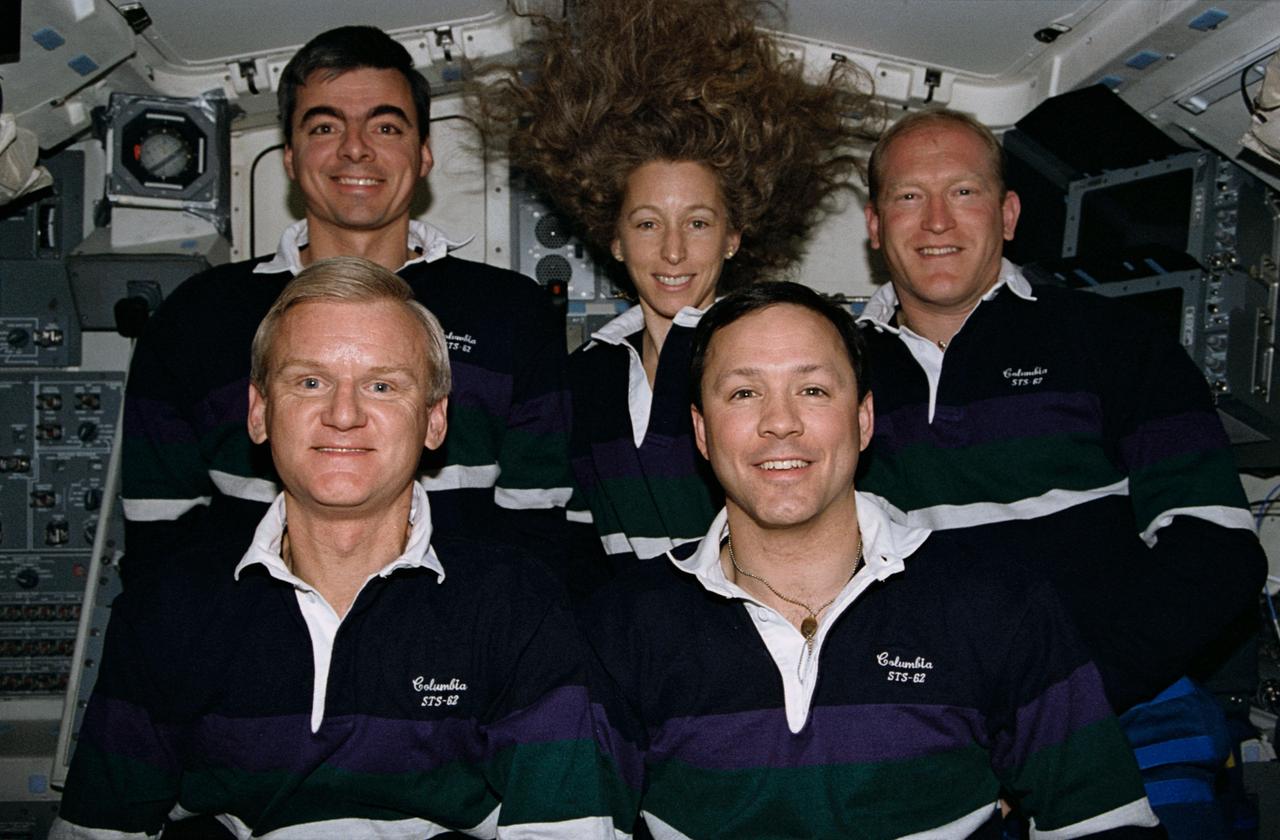
STS062-16-004 (4-18 March 1994) --- The five veteran astronaut crewmembers for NASA's STS-62 mission pose for the traditional inflight portrait on Columbia's aft flight deck. In front are astronauts John H. Casper (left), mission commander; and Pierre J. Thuot, mission specialist. In the rear are astronauts (left to right) Andrew M. Allen, pilot; Marsha S. Ivins and Charles D. (Sam) Gemar, mission specialists.
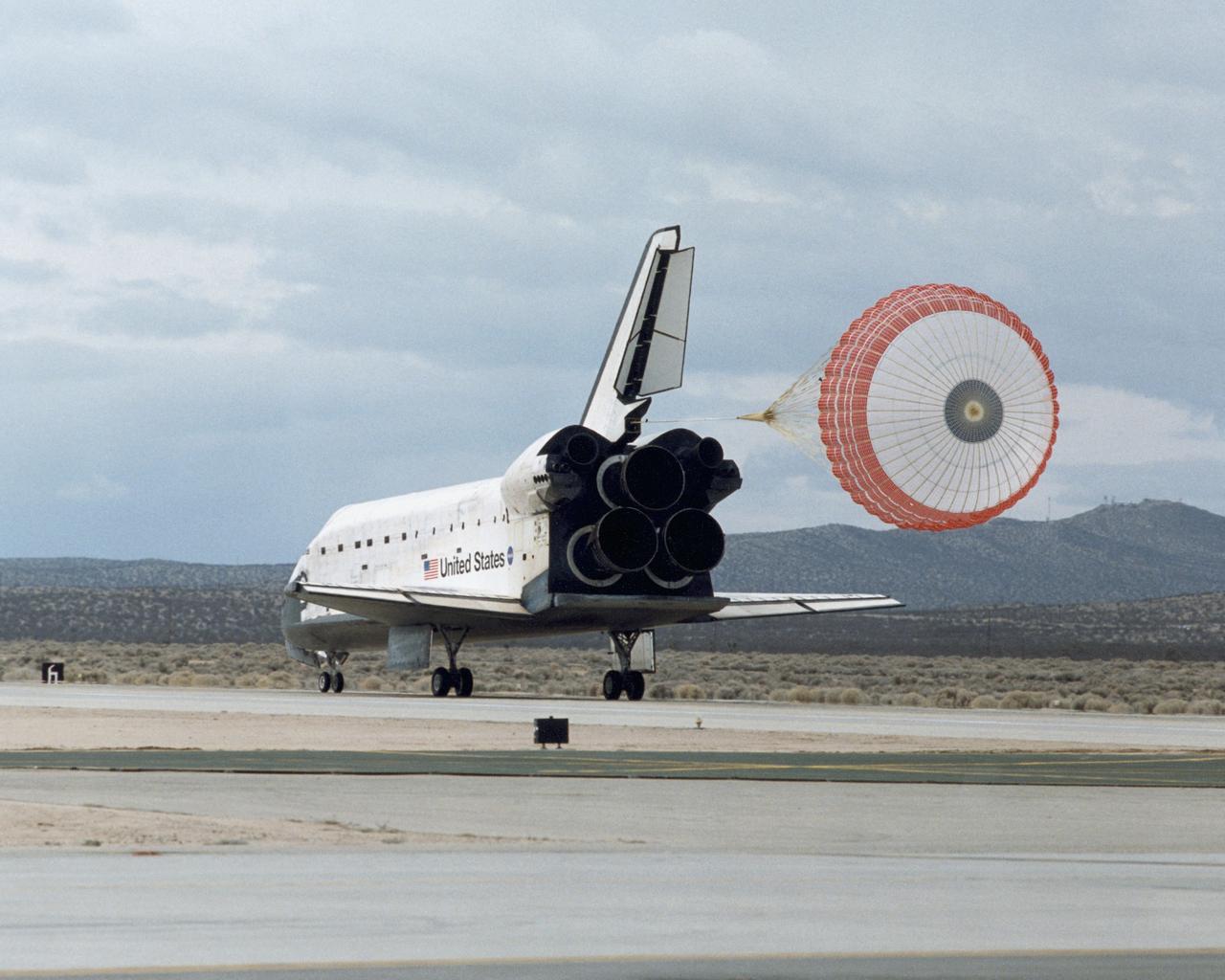
STS098-S-017 (20 Feb. 2001) --- A drag chute slows down the space shuttle Atlantis following its touchdown to mark mission completion at Edwards Air Force Base in the Mojave Desert of California. Onboard were astronauts Kenneth Cockrell, Mark Polansky, Robert Curbeam, Thomas Jones and Marsha Ivins. Atlantis touched down on Edward?s concrete runway at 2:33 p.m. (CST), Feb. 20, for a mission elapsed time of 12 days, 21 hours and 20 minutes. Photo credit: NASA
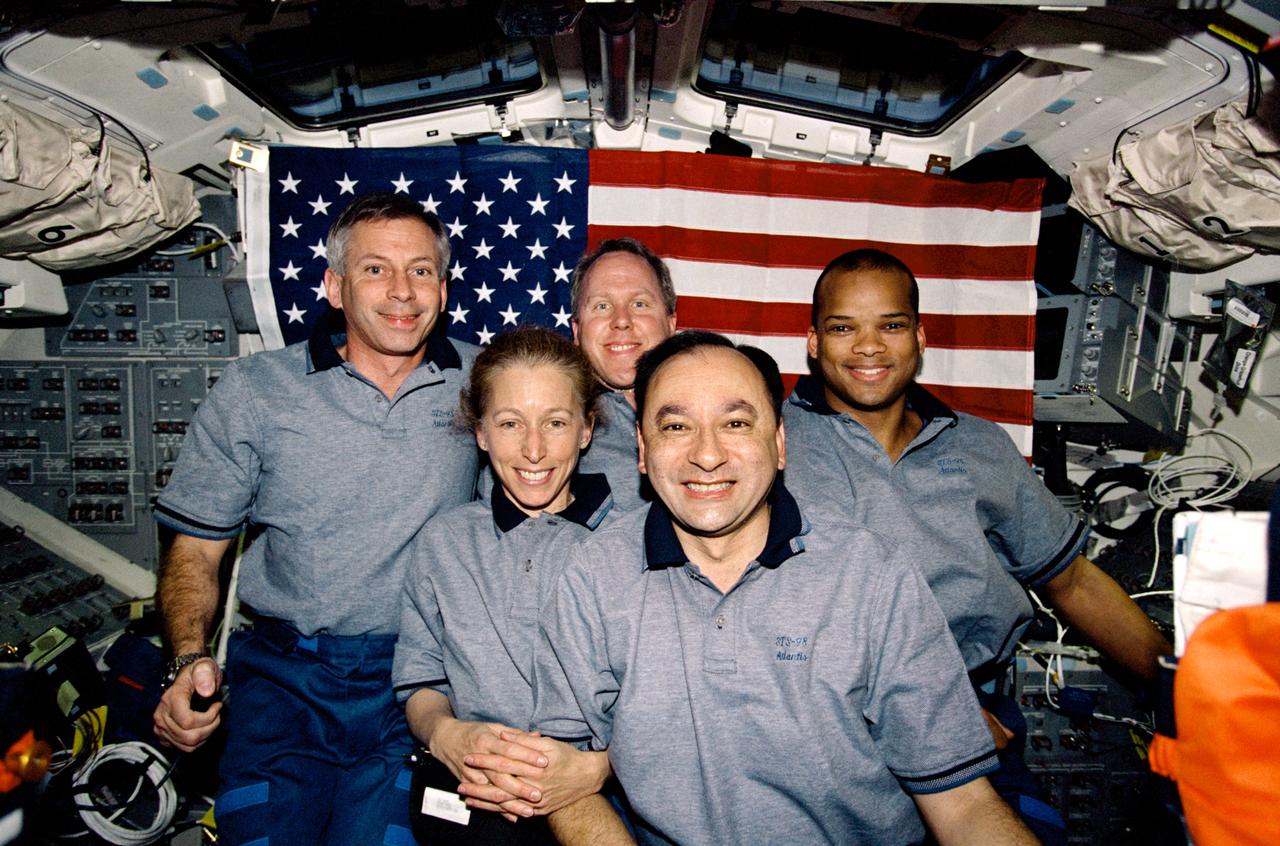
STS098-365-0034 (7-20 February 2001) --- The crew of the STS-98 mission poses for the traditional inflight portrait on the flight deck of the Space Shuttle Atlantis. From left are astronauts Kenneth D. Cockrell, mission commander; Marsha S. Ivins, mission specialist; Thomas D. Jones, mission specialist; Mark L. Polansky, pilot; and Robert L. Curbeam, mission specialist.
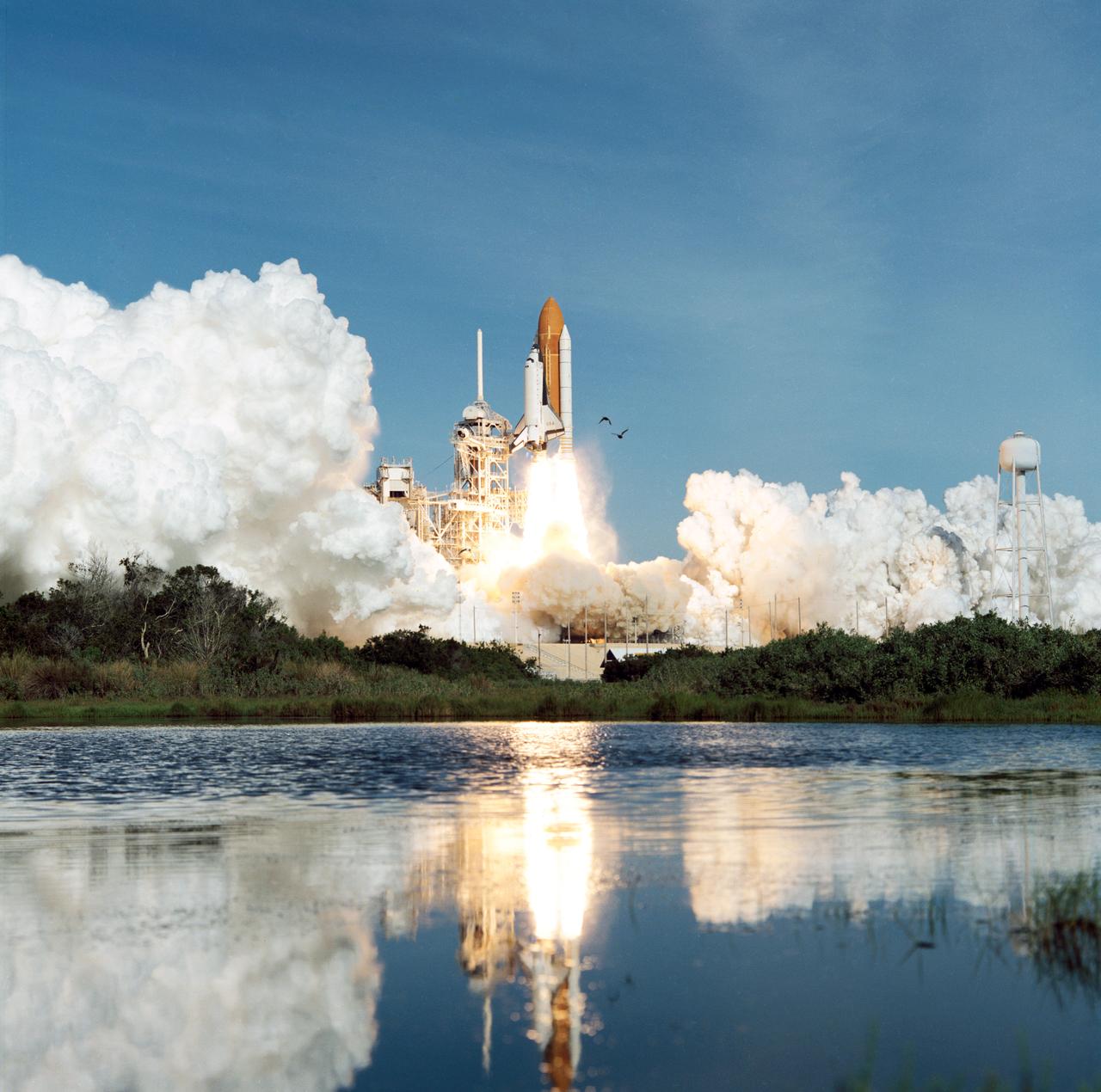
STS062-S-051 (4 March 1994) --- Five veteran astronauts and the United States Microgravity Payload (USMP) are ushered into space via the sixteenth launch of Space Shuttle Columbia. Launch occurred at 8:53 a.m. (EST), March 4, 1994. Onboard were astronauts John H. Casper, Andrew M. Allen, Marsha S. Ivins, Charles D. (Sam) Gemar and Pierre J. Thuot.
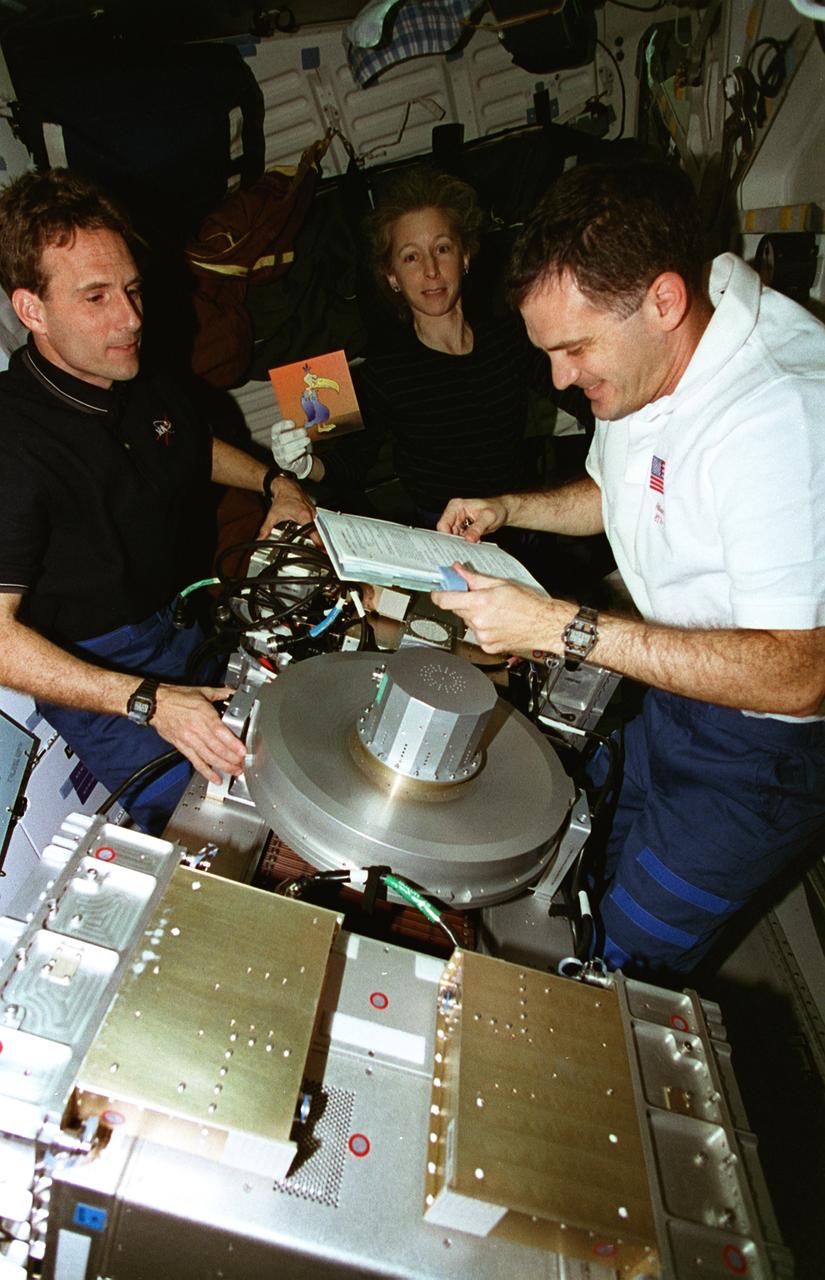
STS081-340-020 (12-22 Jan. 1997) --- Left to right, astronaut and future cosmonaut guest researcher, Jerry M. Linenger, and mission specialists Marsha S. Ivins and Peter J. K. (Wisoff) check out the Treadmill Vibration Isolation Stabilization System (TVIS) onboard the Space Shuttle Atlantis, during the Atlantis and Russia's Mir Space Station docking mission.
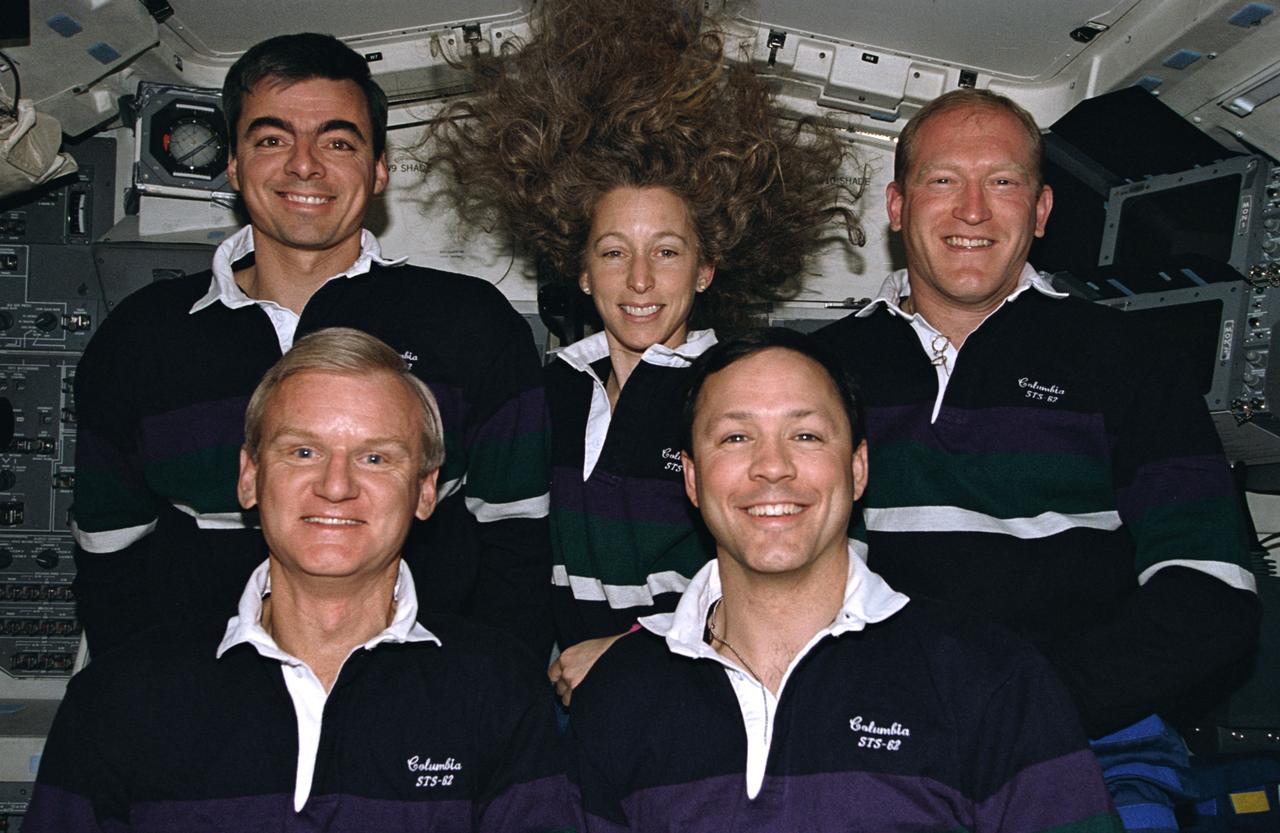
STS062-17-025 (4-18 March 1994) --- The five veteran astronaut crewmembers for NASA's STS-62 mission pose for the traditional inflight portrait on Columbia's aft flight deck. In front are astronauts John H. Casper (left), mission commander; and Pierre J. Thuot, mission specialist. In the rear are astronauts (left to right) Andrew M. Allen, pilot; Marsha S. Ivins and Charles D. (Sam) Gemar, mission specialists.
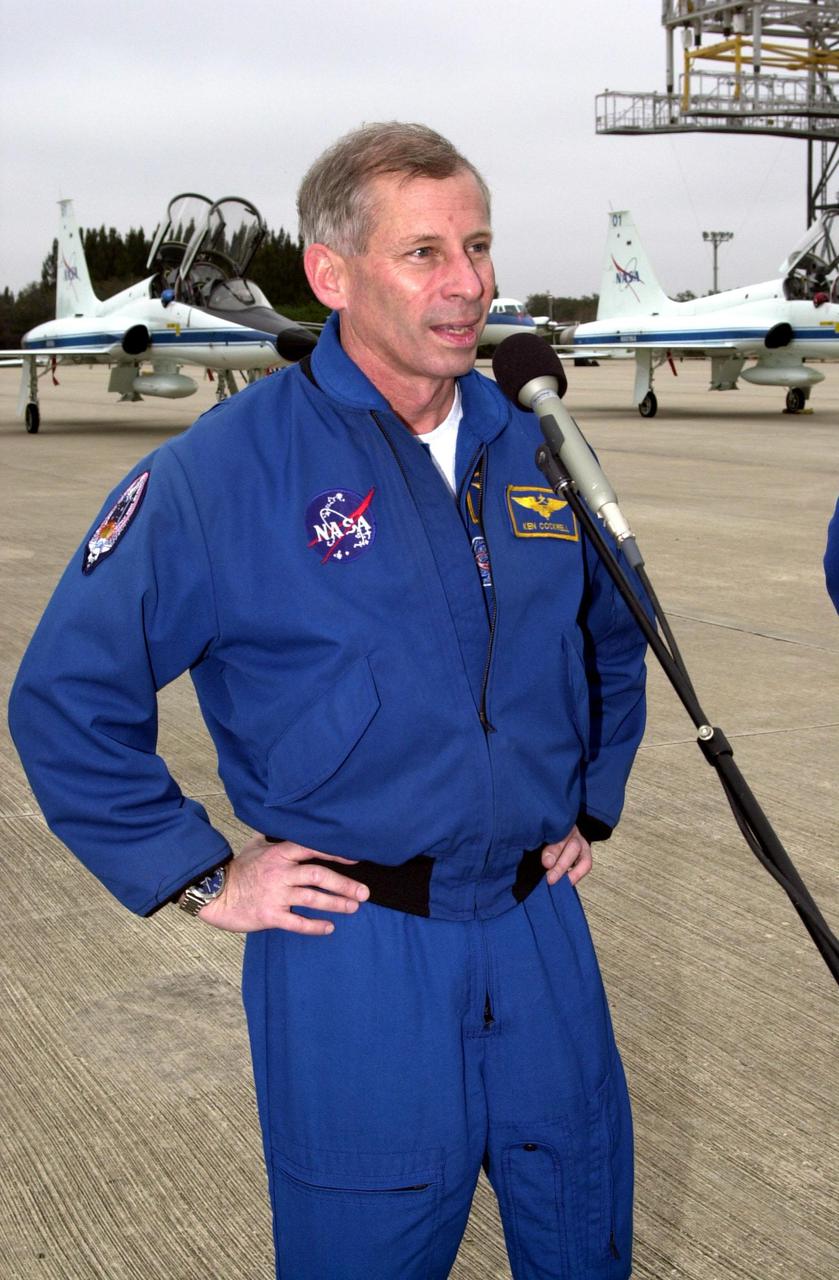
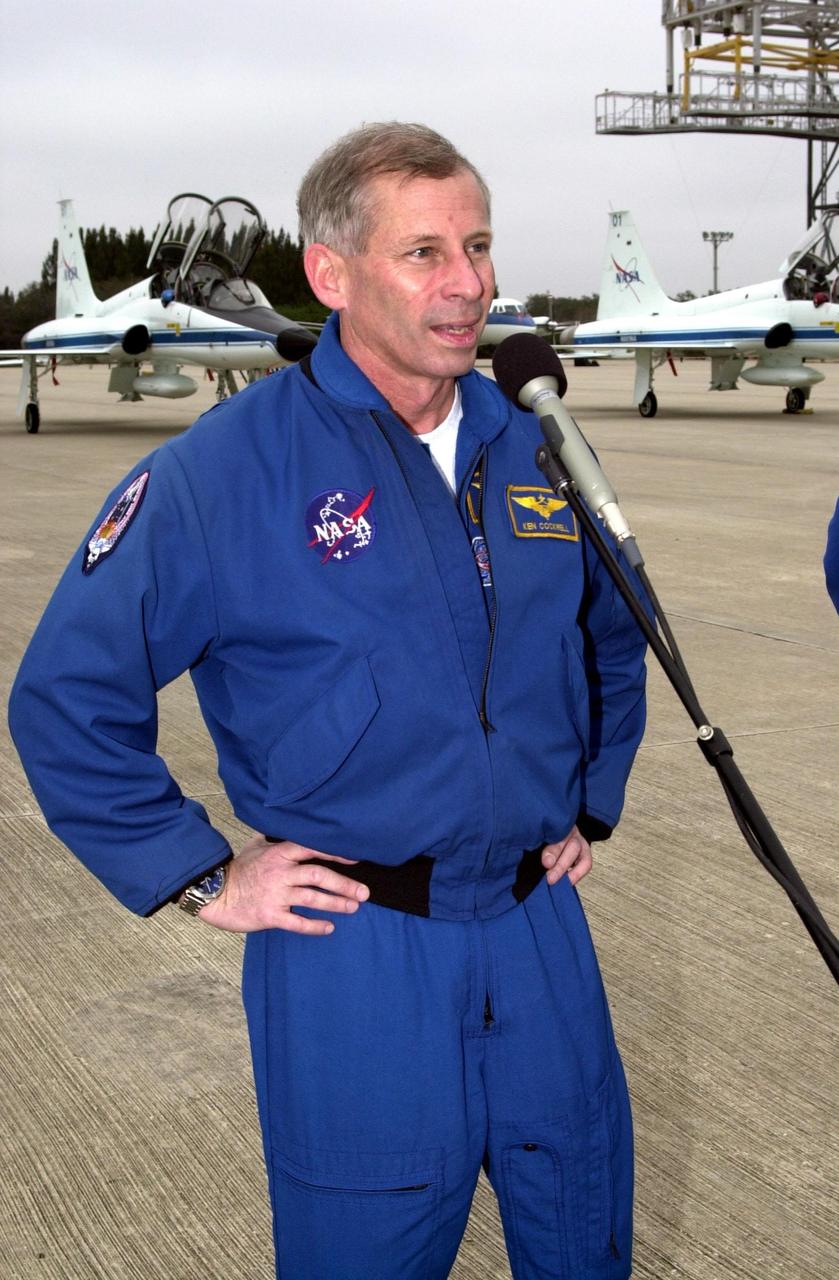
KENNEDY SPACE CENTER, FLA. -- STS-98 Mission Commander Kenneth Cockrell speaks to the media at the Shuttle Landing Facility after the crew's arrival Sunday to complete preparations for launch. The crew also includes Pilot Mark Polansky and Mission Specialists Thomas Jones, Marsha Ivins and Robert Curbeam.; STS-98 is the seventh construction flight to the International Space Station, carrying as payload the U.S. Lab Destiny, a key element in the construction of the ISS. Launch of STS-98 is scheduled for Feb. 7 at 6:11 p.m. EST
KENNEDY SPACE CENTER, FLA. -- STS-98 Mission Commander Kenneth Cockrell speaks to the media at the Shuttle Landing Facility after the crew's arrival Sunday to complete preparations for launch. The crew also includes Pilot Mark Polansky and Mission Specialists Thomas Jones, Marsha Ivins and Robert Curbeam.; STS-98 is the seventh construction flight to the International Space Station, carrying as payload the U.S. Lab Destiny, a key element in the construction of the ISS. Launch of STS-98 is scheduled for Feb. 7 at 6:11 p.m. EST
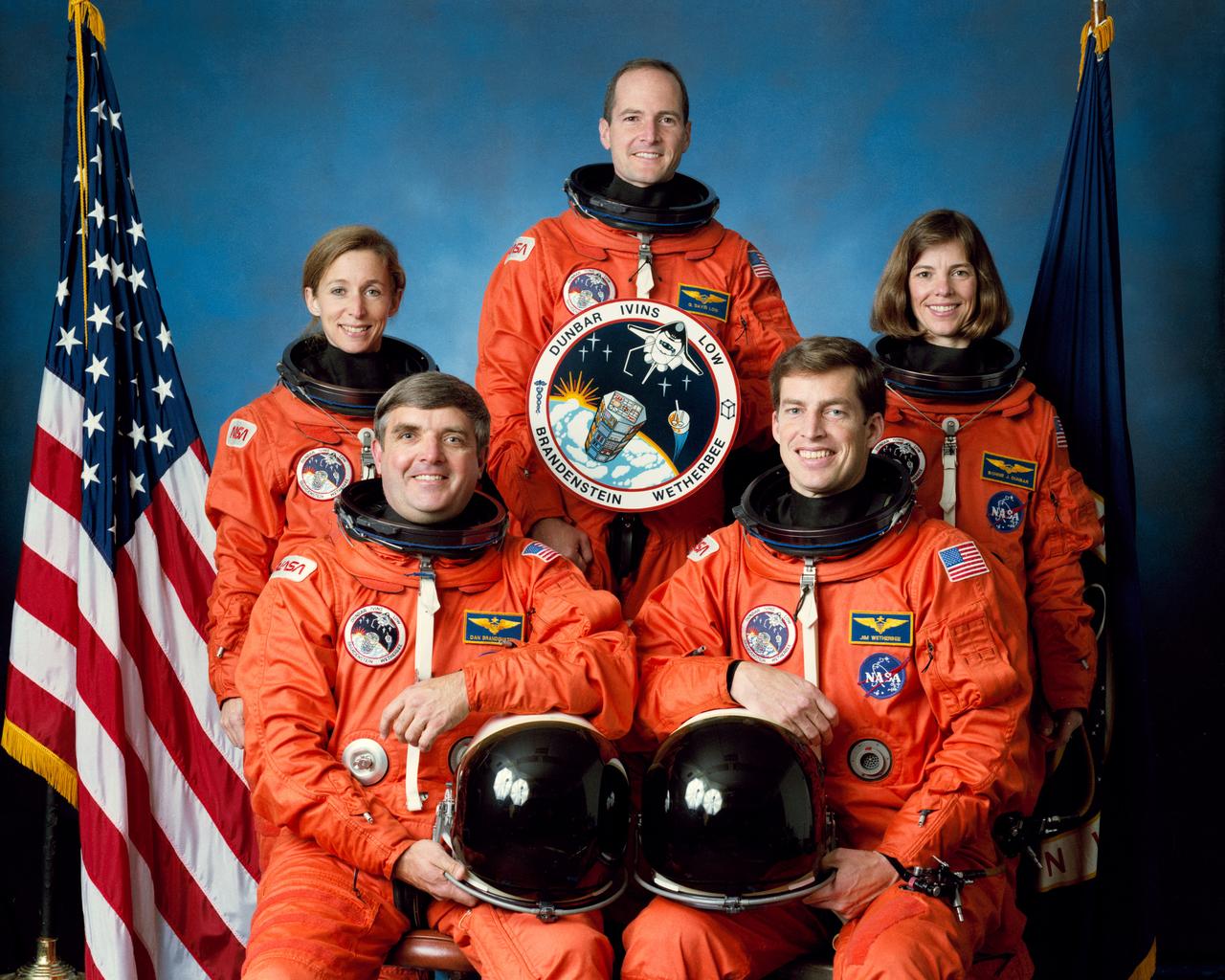
S89-48342 (October 1989) --- These five astronauts have been assigned to serve as crewmembers for NASA's STS-32 mission aboard the Space Shuttle Columbia in December of this year. In front are Astronauts Daniel C. Brandenstein (left), commander, and James D. Wetherbee, pilot. In back are Astronauts (l-r) Marsha S. Ivins, G. David Low and Bonnie J. Dunbar, all mission specialists.
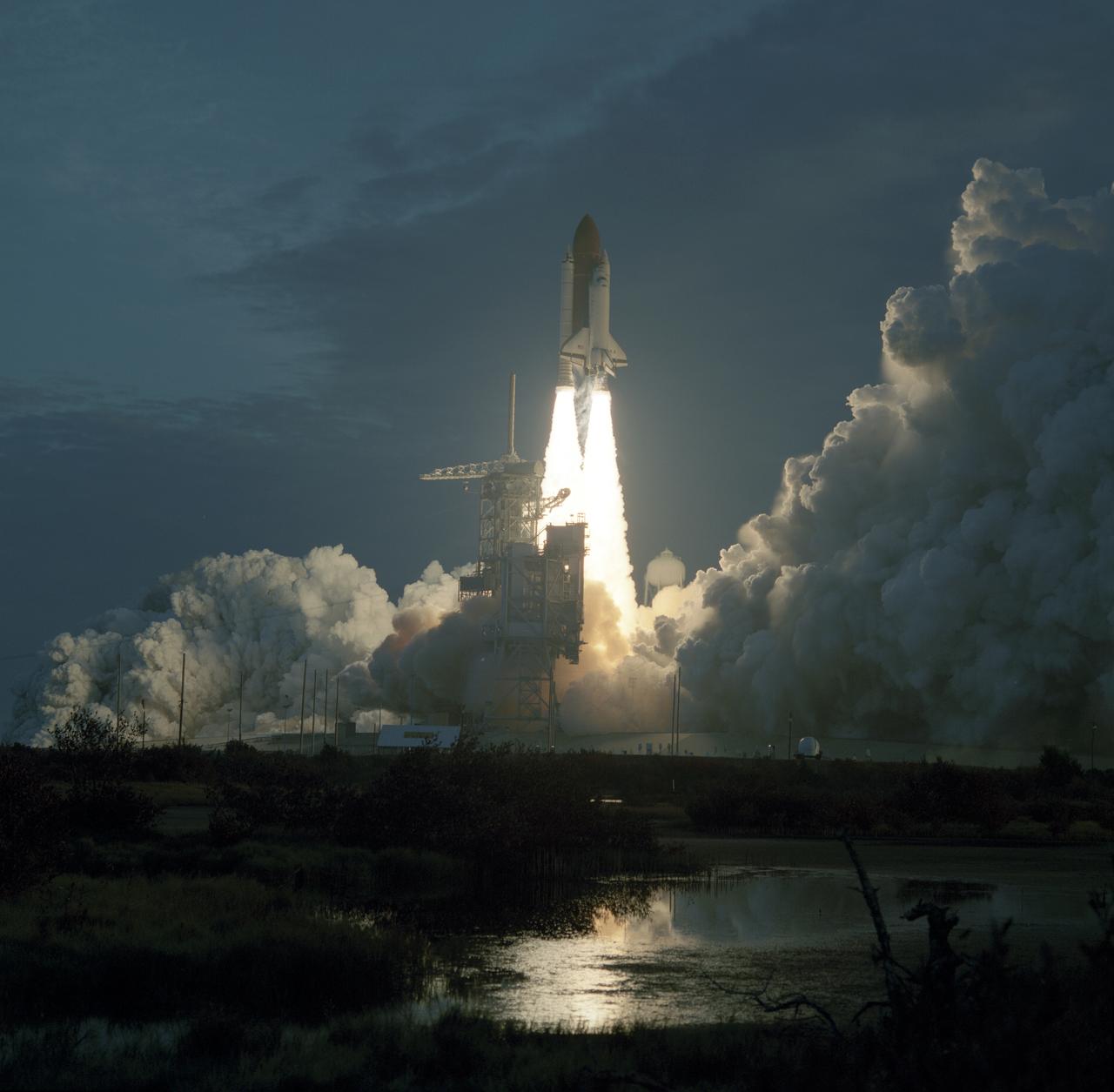
Five astronauts launched aboard the Space Shuttle Columbia on January 9, 1990 at 7:35:00am (EST) for the STS-32 mission. The crew included David C. Brandenstein, commander; James D. Weatherbee, pilot; and mission specialists Marsha S. Ivins, G. David Low, and Bonnie J. Dunbar. Primary objectives of the mission were the deployment of the SYNCOM IV-F5 defense communications satellite and the retrieval of NASA’s Long Duration Exposure Facility (LDEF).
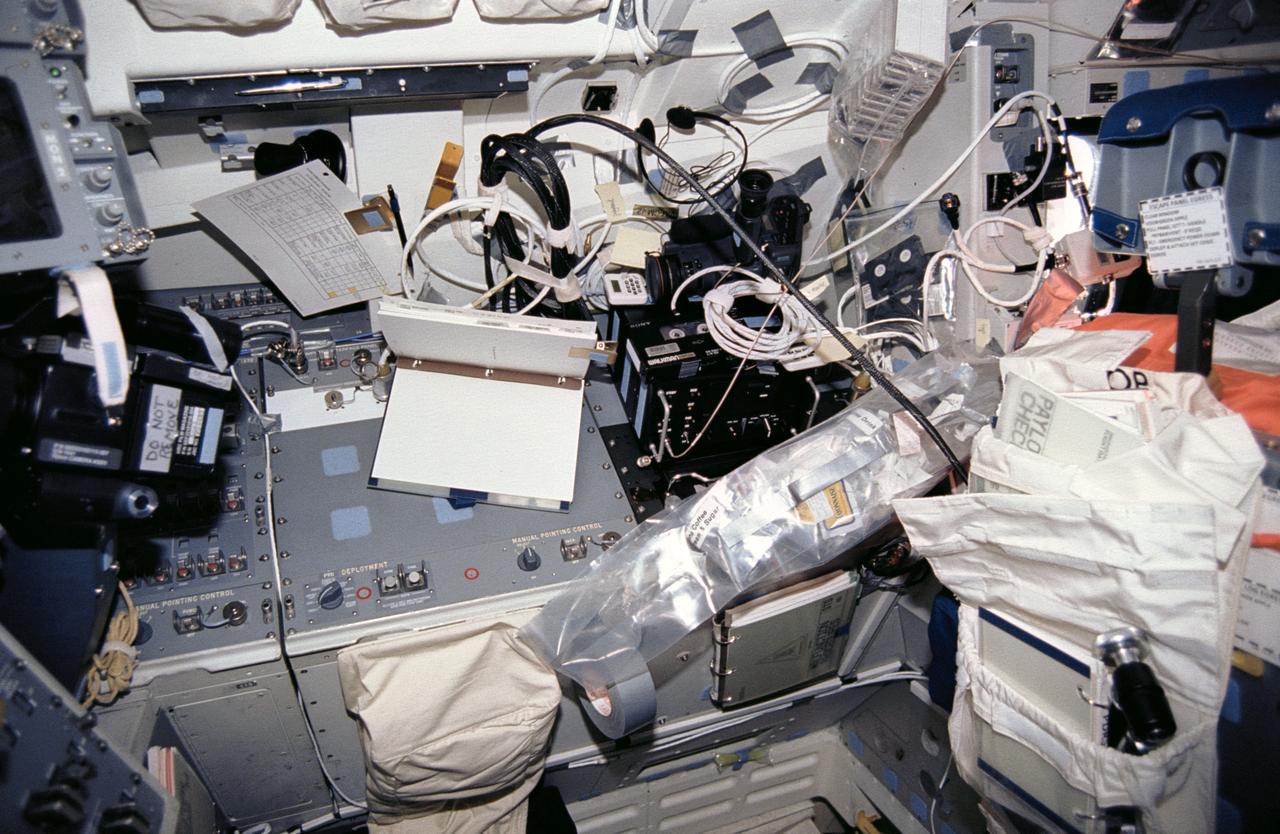
STS046-01-024 (31 July-8 Aug 1992) --- This area on the Space Shuttle Atlantis' flight deck forward port side was referred to as "Marsha's (Ivins) work station" by fellow crew members who good-naturedly kidded the mission specialist and who usually added various descriptive modifiers such as "messy" or "cluttered". Food, cameras, camera gear, cassettes, cable, flight text material and other paraphernalia can be seen in the area, just behind the commander's station.
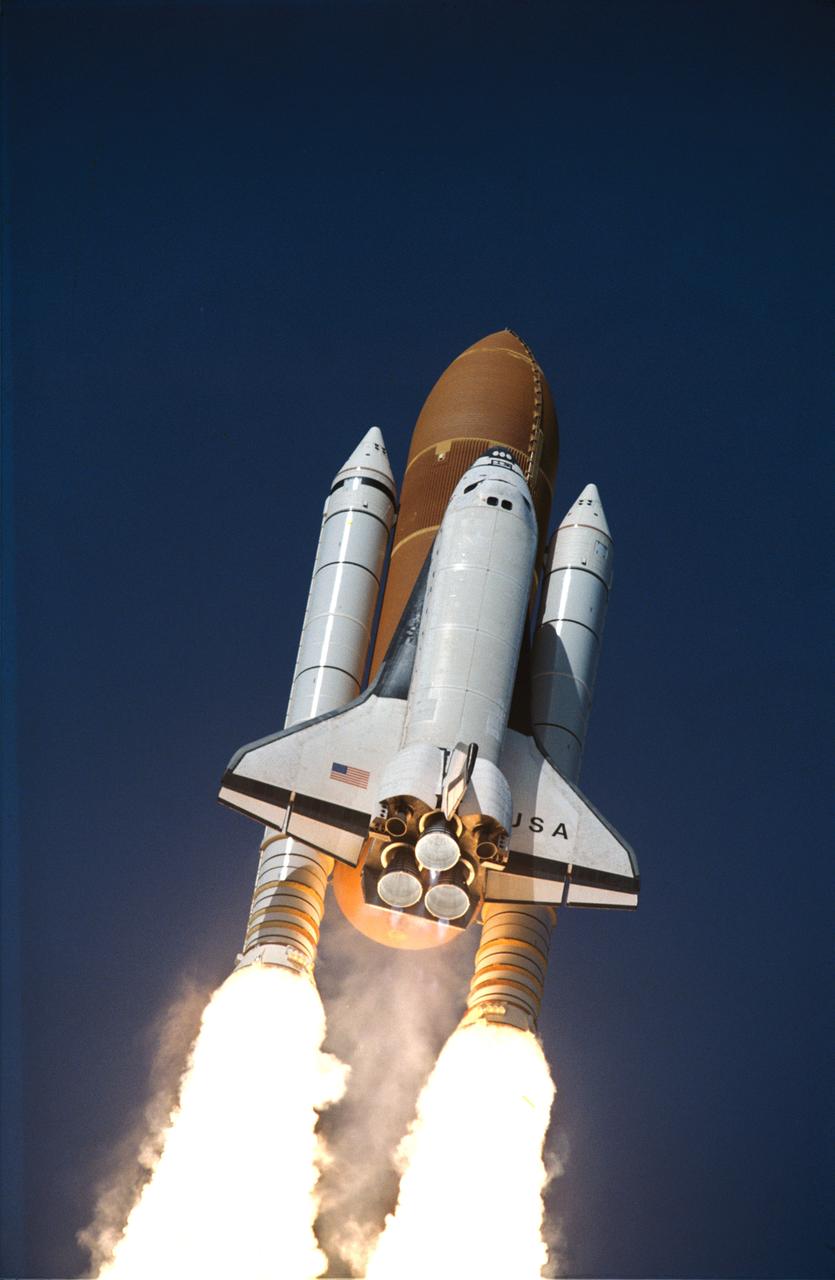
STS062-S-055 (4 March 1994) --- A low-angle view captures early stages of the sixteenth launch of Space Shuttle Columbia. Launch occurred at 8:53 a.m. (EST), March 4, 1994. Onboard were astronauts John H. Casper, Andrew M. Allen, Marsha S. Ivins, Charles D. (Sam) Gemar and Pierre J. Thuot.
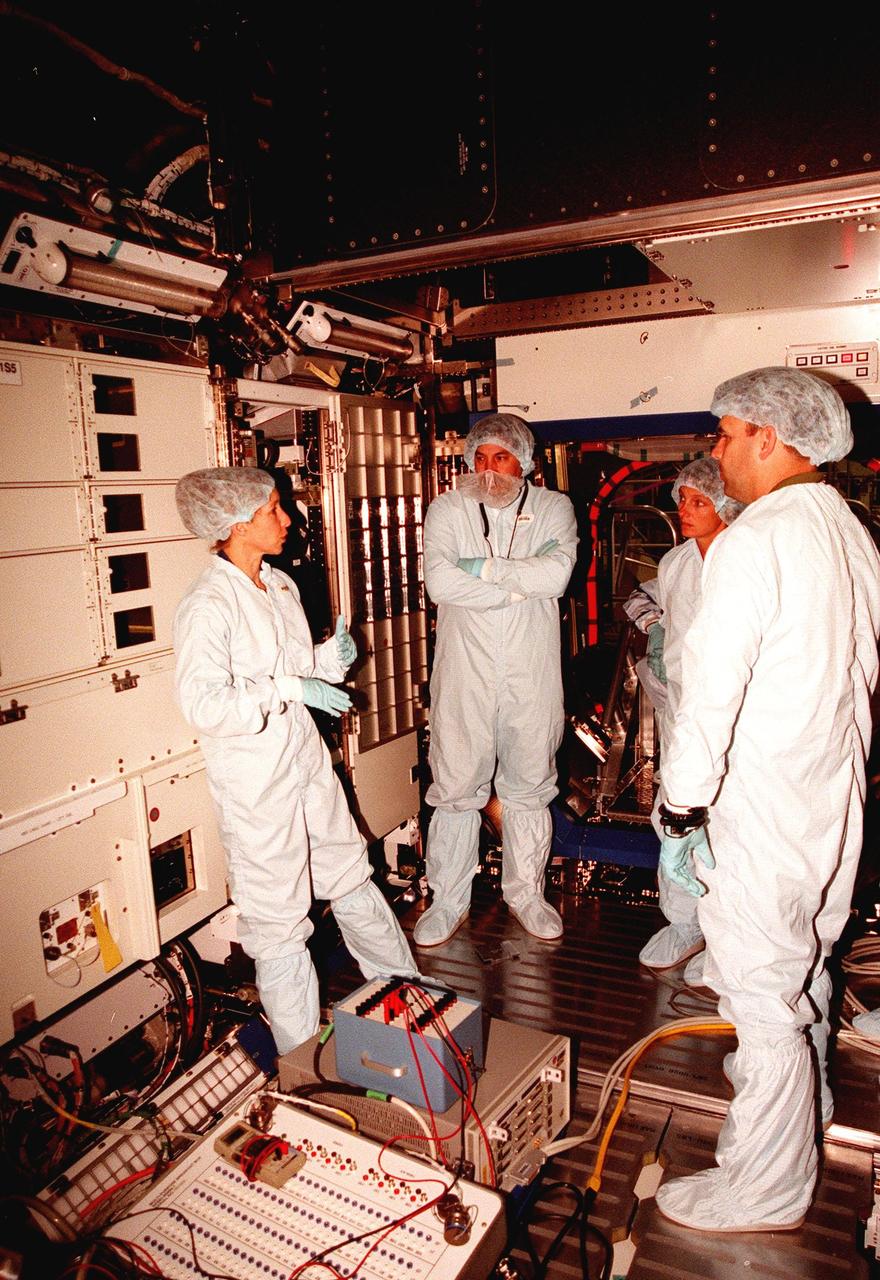
In the Space Station Processing Facility, Marsha Ivins (left), a mission specialist on the STS-98 crew, discusses the U.S. Laboratory with members of the laboratory's processing team, (left to right) James Thews, Suzanne Fase, and Danny Whittington. The laboratory module, considered the centerpiece of the International Space Station (ISS), has been named "Destiny" in honor of its prominent role in the world’s largest science and technology effort. It is planned for launch aboard Space Shuttle Endeavour on the sixth ISS construction flight currently targeted for March 2000
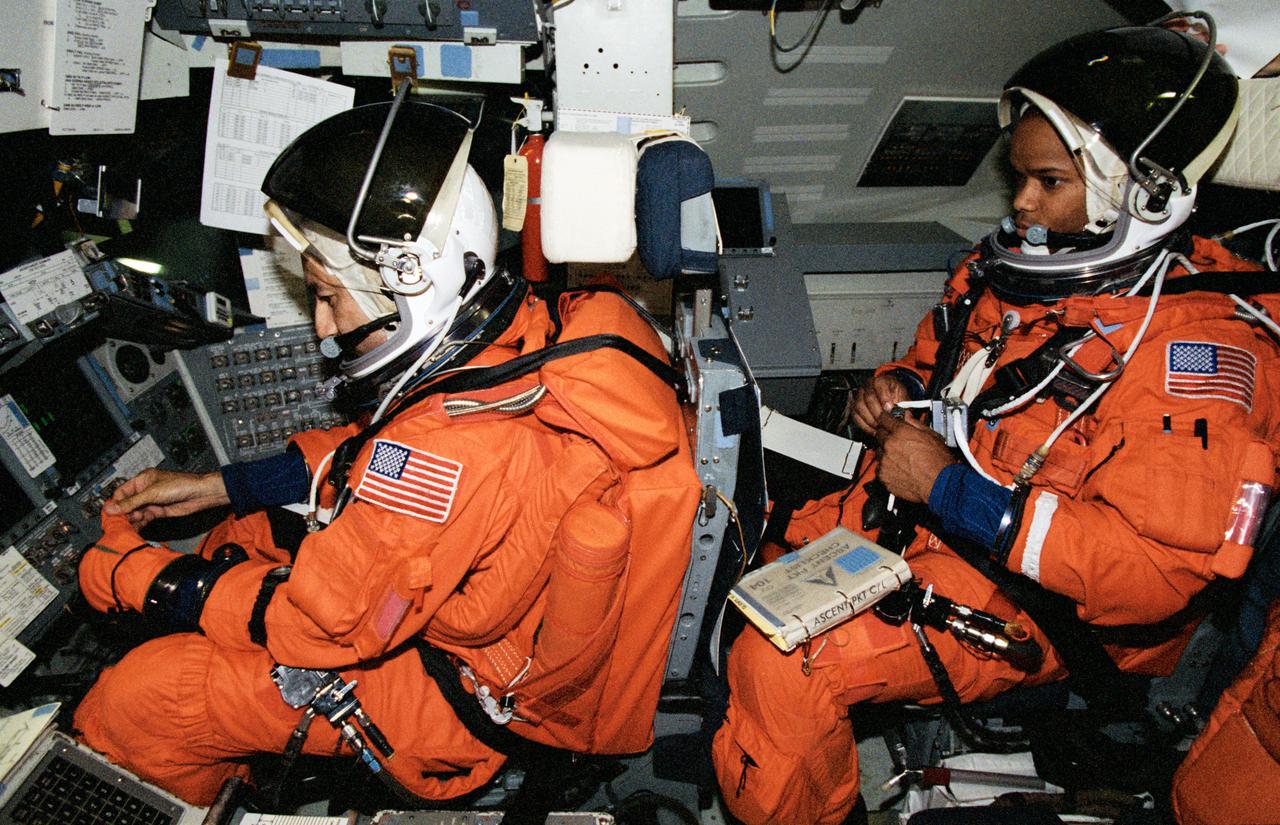
Photographic documentation showing STS-98 crewmembers engaging in preflight training in bldg. 5. Views include: STS-98 mission commander Kenneth D. Cockrell, wearing a Launch Entry Suit (LES) and a helmet, sits in the commanders station on the flight deck of the mobile-based Shuttle Mission Simulator (SMS) (04774); STS-98 pilot Mark L. Polansky, wearing LES and helmet, sits in the pilots station, with STS-98 Mission Specialist (MS) Robert L. Curbeam seated behind him on the flight deck (04775); Polansky in the pilots station (04776); Curbeam in a LES and wearing a Communications Carrier Assembly (CCA) (04777); Polansky and Curbeam pose, wearing LES and no helmets, in bldg. 5 (04778); Polansky, wearing a LES, fastens his CCA (04779); Cockrell, Polansky, Curbeam and STS-98 MS Marsha S. Ivins, wearing LES, sit in locker room (04780); Ivins and suit techs (04781); suit techs and Polansky (04782); suit techs and Cockrell (04783).

KENNEDY SPACE CENTER, FLA. -- In the Space Station Processing Facility, Center Director Roy Bridges, Program Manager of the International Space Station (ISS) Randy Brinkley, and STS-98 crew members Pilot Mark Polansky, Commander Ken Cockrell and Mission Specialist Marsha Ivins wait for the unveiling of the name "Destiny" for the U.S. Lab module, which is behind them on a workstand. The lab, scheduled to be launched on Space Shuttle Endeavour in early 2000, will become the centerpiece of scientific research on the ISS. Polansky, Cockrell and Ivins are part of the five-member crew expected to be aboard. The Shuttle will spend six days docked to the station while the laboratory is attached and three space walks are conducted to complete its assembly. The laboratory will be launched with five equipment racks aboard, which will provide essential functions for station systems, including high data-rate communications, and maintain the station's orientation using control gyroscopes launched earlier. Additional equipment and research racks will be installed in the laboratory on subsequent Shuttle flights
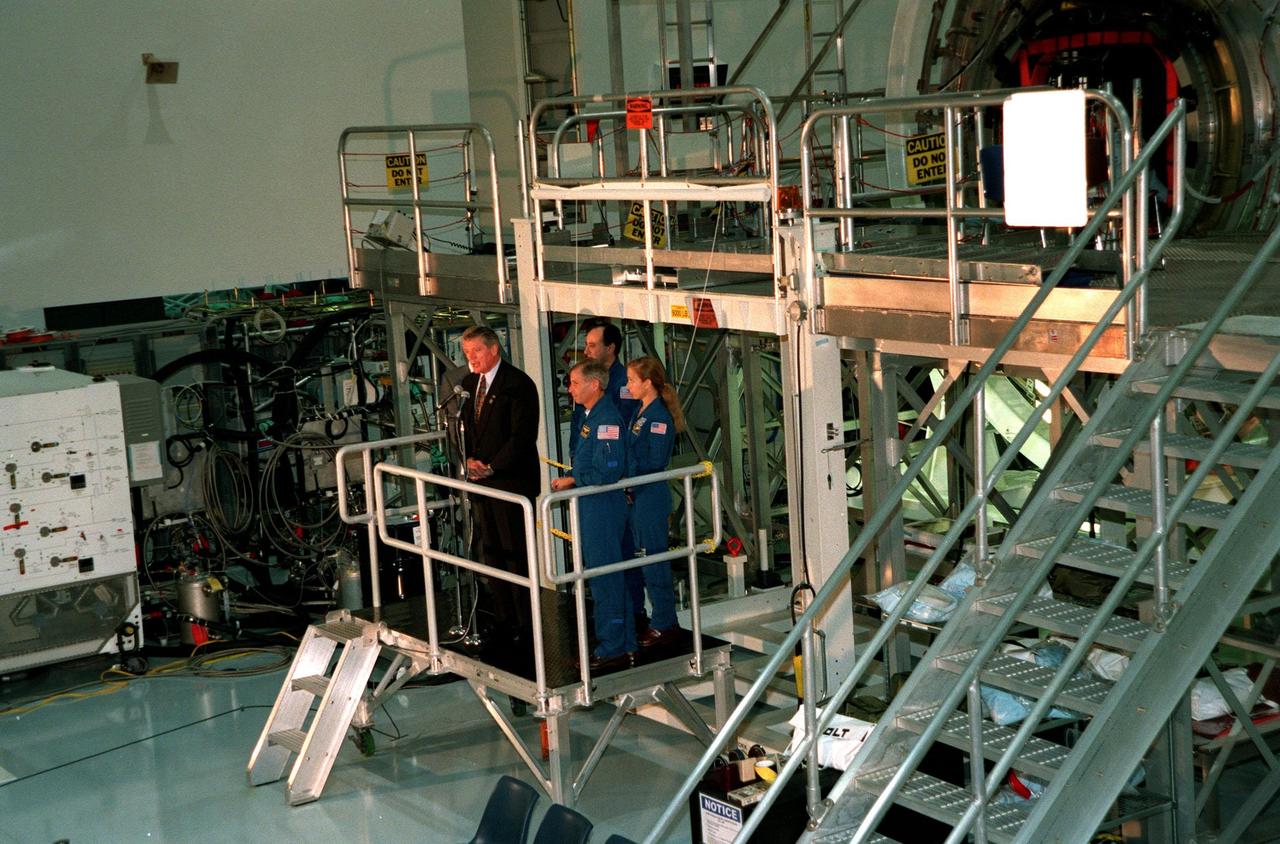
KENNEDY SPACE CENTER, FLA. -- In the Space Station Processing Facility, Program Manager of the International Space Station (ISS) Randy Brinkley addresses the media before unveiling the name of "Destiny" given the U.S. Lab module, the centerpiece of scientific research on the ISS. With Brinkley on the stand are Center Director Roy Bridges (behind him), and (left to right) STS-98 Commander Ken Cockrell, Pilot Mark Polansky, and Mission Specialist Marsha Ivins. The lab, which is behind them on a workstand, is scheduled to be launched on Space Shuttle Endeavour in early 2000. It will become the centerpiece of scientific research on the International Space Station. Polansky, Cockrell and Ivins are part of the five-member crew expected to be aboard. The Shuttle will spend six days docked to the station while the laboratory is attached and three space walks are conducted to complete its assembly. The laboratory will be launched with five equipment racks aboard, which will provide essential functions for station systems, including high data-rate communications, and maintain the station's orientation using control gyroscopes launched earlier. Additional equipment and research racks will be installed in the laboratory on subsequent Shuttle flights
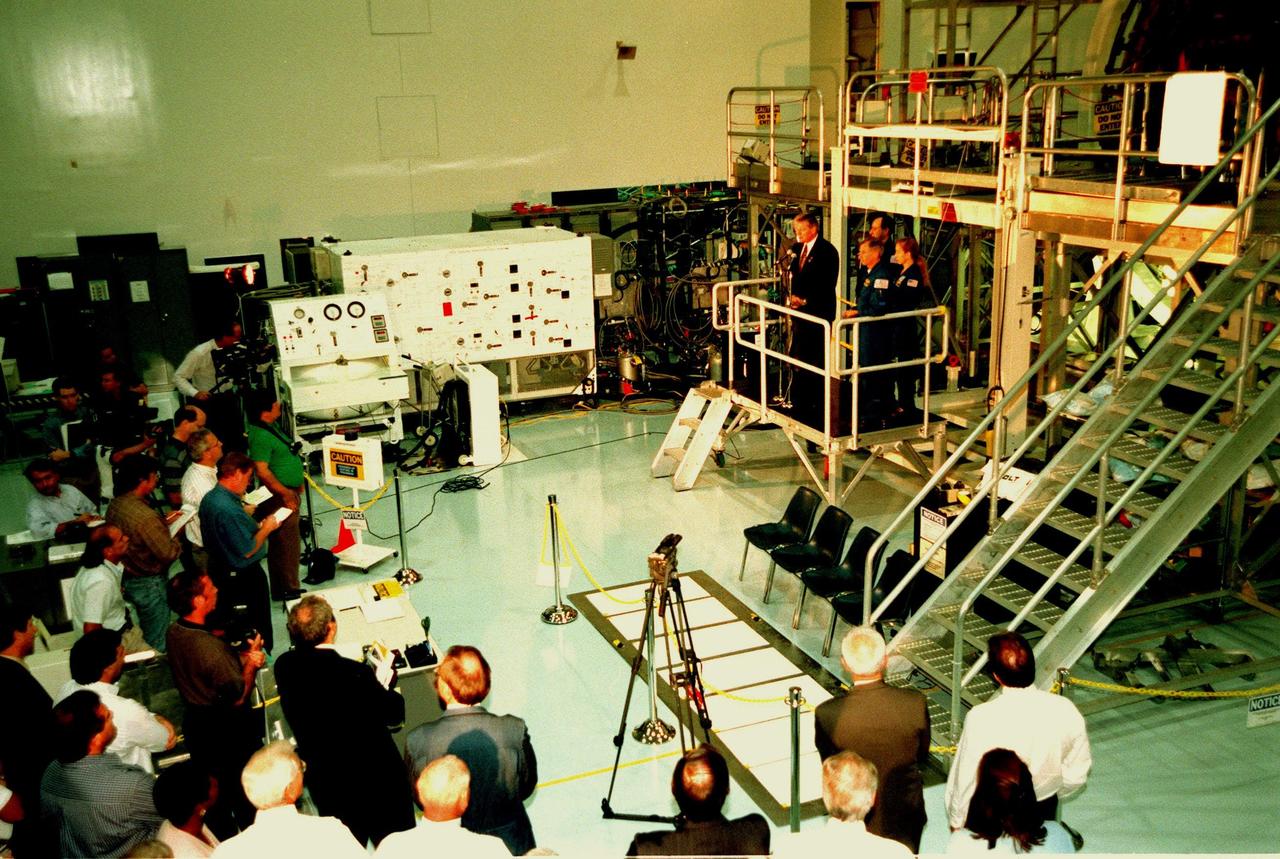
KENNEDY SPACE CENTER, FLA. -- In the Space Station Processing Facility, Program Manager of the International Space Station (ISS) Randy Brinkley addresses the media before lowering the banner to unveil the name of "Destiny" given the U.S. Lab module, the centerpiece of scientific research on the ISS. With Brinkley on the stand are Center Director Roy Bridges (behind him on the left), and (the other side, left to right) STS-98 Commander Ken Cockrell, Pilot Mark Polansky, and Mission Specialist Marsha Ivins. The lab, which is behind them on a workstand, is scheduled to be launched on Space Shuttle Endeavour in early 2000. It will become the centerpiece of scientific research on the International Space Station. Polansky, Cockrel and Ivins are part of the five-member crew expected to be aboard. The Shuttle will spend six days docked to the station while the laboratory is attached and three space walks are conducted to complete its assembly. The laboratory will be launched with five equipment racks aboard, which will provide essential functions for station systems, including high data-rate communications, and maintain the station's orientation using control gyroscopes launched earlier. Additional equipment and research racks will be installed in the laboratory on subsequent Shuttle flights
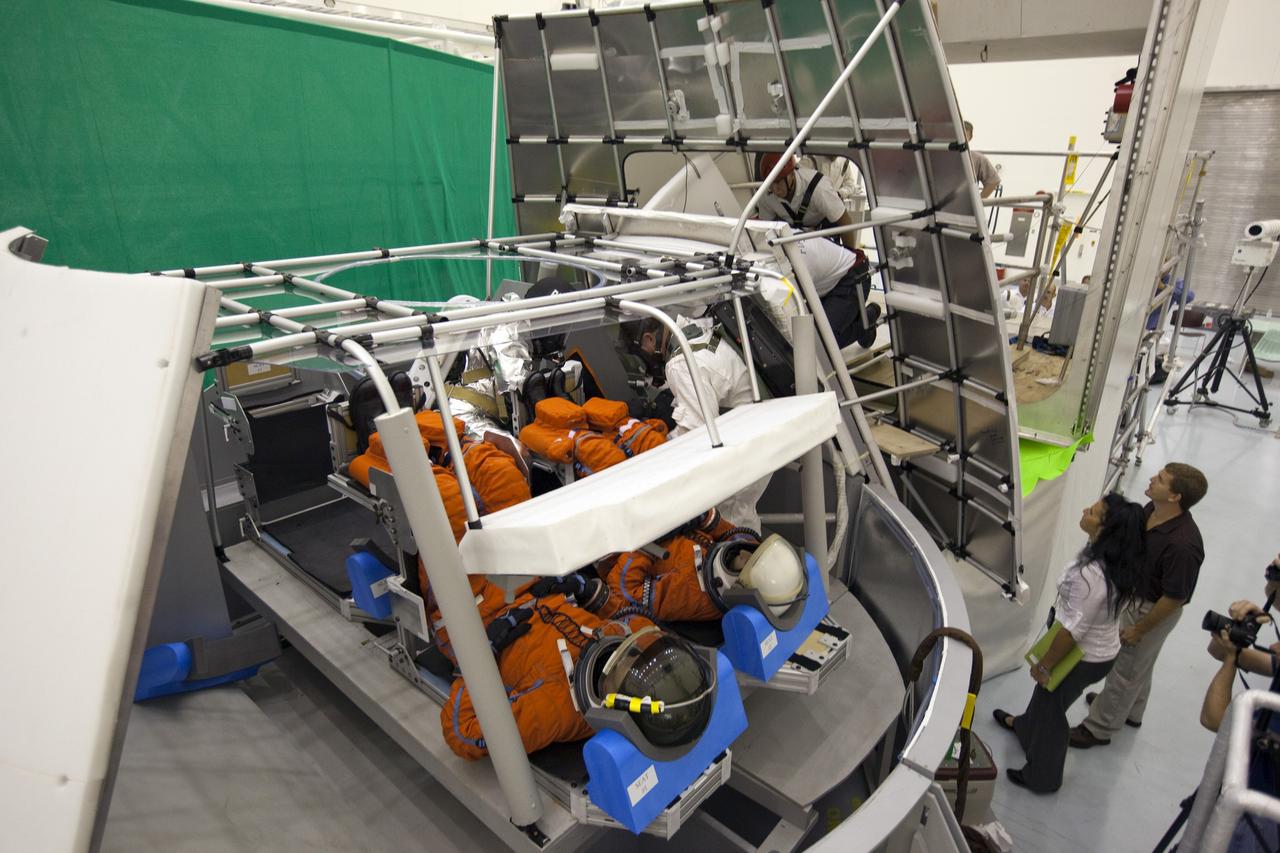
CAPE CANAVERAL, Fla. -- In the Multi-Payload Processing Facility at NASA's Kennedy Space Center in Florida, NASA astronauts Shane Kimbrough, left, and Marsha Ivins, participate in an exercise known as crew egress evaluation from an Orion mock-up. The spacecraft is replicated in all areas that could affect a crew's escape, including the area that seals to a launch pad's White Room. The exercise focuses on whether astronauts and their rescue crews can exit the vehicle quickly in the event of a pad emergency. For more information on Orion, visit www.nasa.gov/orion. Photo credit: NASA/Dimitri Gerondidakis

In the Space Station Processing Facility, STS-98 Mission Specialist Marsha Ivins wields a tool on part of the U.S. Lab, Destiny. The crew is checking out equipment inside the lab as part of Crew Equipment Interface Test activities, becoming familiar with equipment it will be handling during the mission. Others in the crew are Commander Ken Cockrell, Pilot Mark Polansky and Mission Specialists Robert Curbeam and Thomas Jones. The mission will be transporting the Lab to the International Space Station with five system racks already installed inside of the module. With delivery of electronics in the lab, electrically powered attitude control for Control Moment Gyroscopes will be activated. The STS-98 launch is scheduled for Jan. 18, 2001
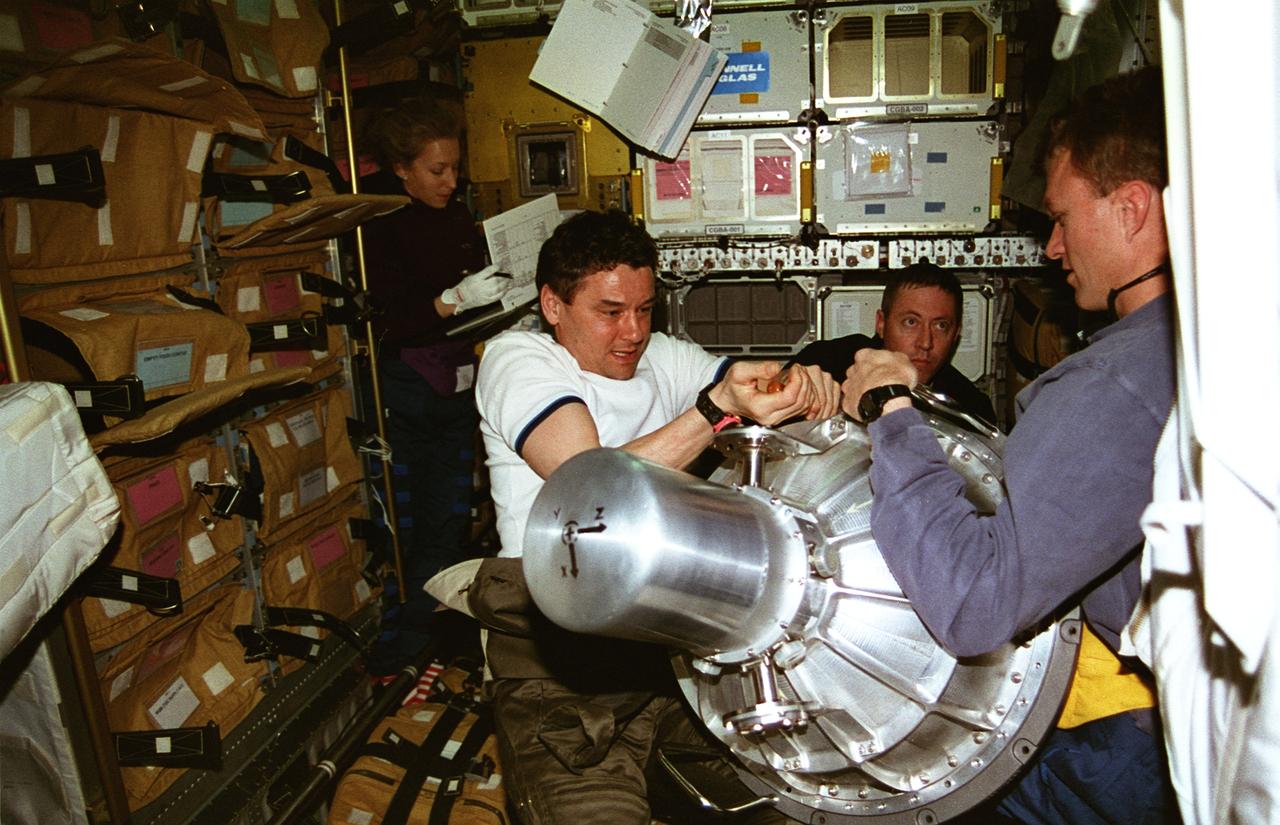
STS081-301-032 (12-22 Jan. 1997) --- Shortly after the docking of the Space Shuttle Atlantis and Russia's Mir Space Station, crewmembers from the respective spacecraft begin to transfer hardware from the Spacehab Double Module (DM) onto the Mir complex. In this scene, cosmonaut Valeri G. Korzun (second left) Mir-22 commander, along with astronauts Michael A. Baker (second right) commander, and Brent W. Jett, Jr., pilot, unstow a gyrodyne, a device used for attitude control, for transfer to Mir. Astronaut Marsha S. Ivins looks over a lengthy inventory of supplies to be transferred.
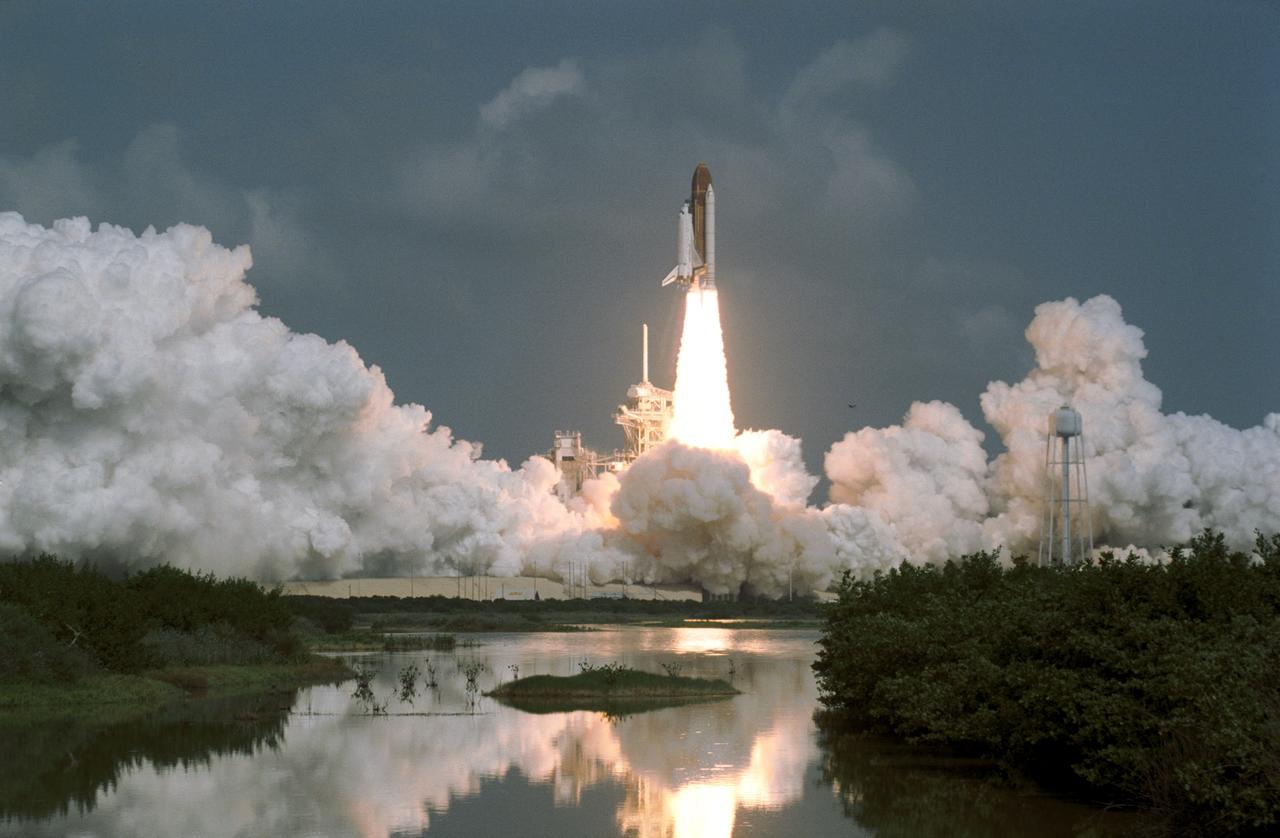
STS046-S-082 (31 July 1992) --- This panoramic scene at Kennedy Space Center's Launch Complex 39 shows the Space Shuttle Atlantis as it blasts off on its way to eight days of Earth orbital operations with a crew of five NASA astronauts and two European scientists onboard. Launch occurred at 9:56:47:976 a.m. (EDT), July 31, 1992. Onboard the spacecraft were astronauts Loren J. Shriver, Andrew M. Allen, Jeffrey A. Hoffman, Marsha S. Ivins and Franklin R. Chang-Diaz, along with the European Space Agency's Claude Nicollier and the Italian Space Agency's Franco Malerba.
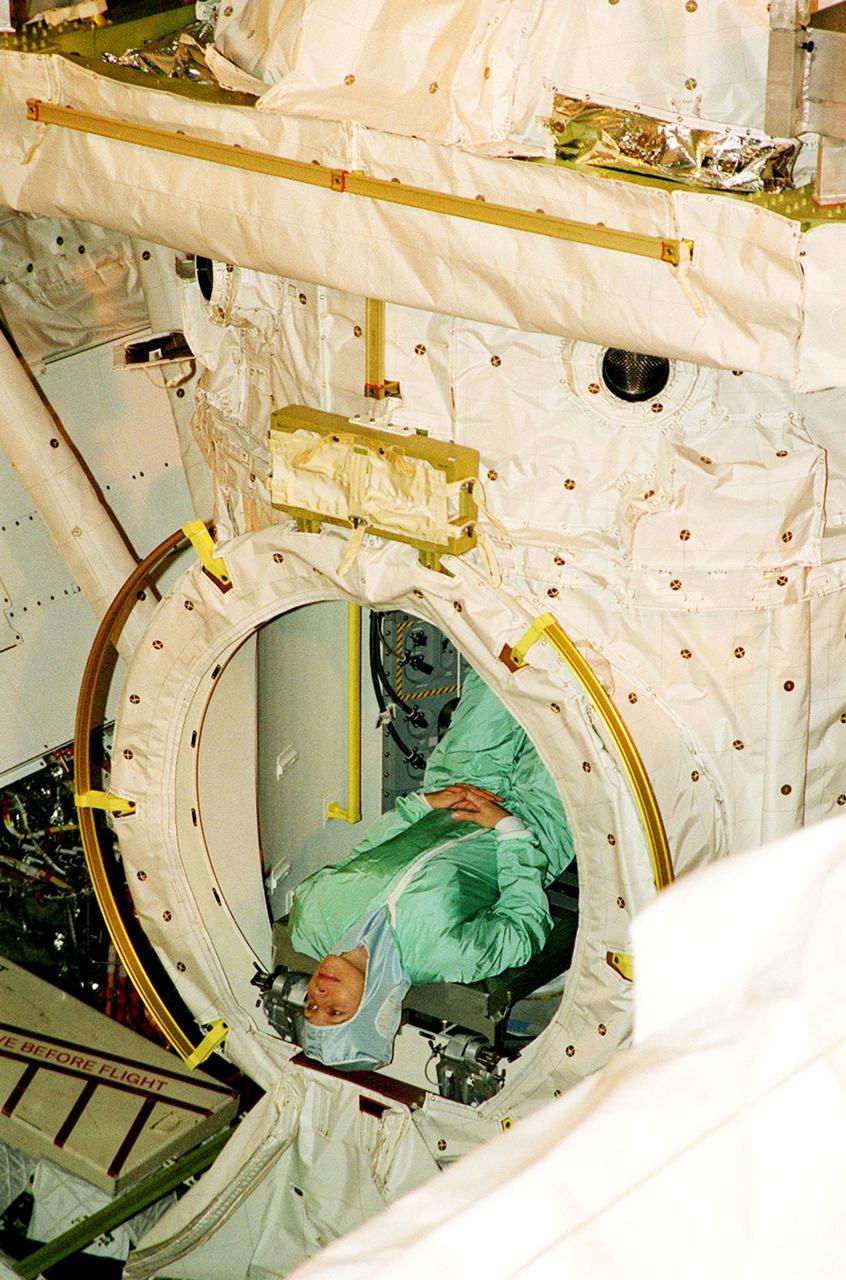
KENNEDY SPACE CENTER, FLA. -- STS-98 Mission Specialist Marsha Ivins takes a topsy-turvy look at the EVA hatch in the Orbiter Docking System, which is already installed in the payload bay of orbiter Atlantis. She and the rest of the crew are at KSC for Crew Equipment Interface Test activities. Launch on mission STS-98 is scheduled for Jan. 18, 2001. It will be transporting the U.S. Lab, Destiny, to the International Space Station with five system racks already installed inside of the module. After delivery of electronics in the lab, electrically powered attitude control for Control Moment Gyroscopes will be activated
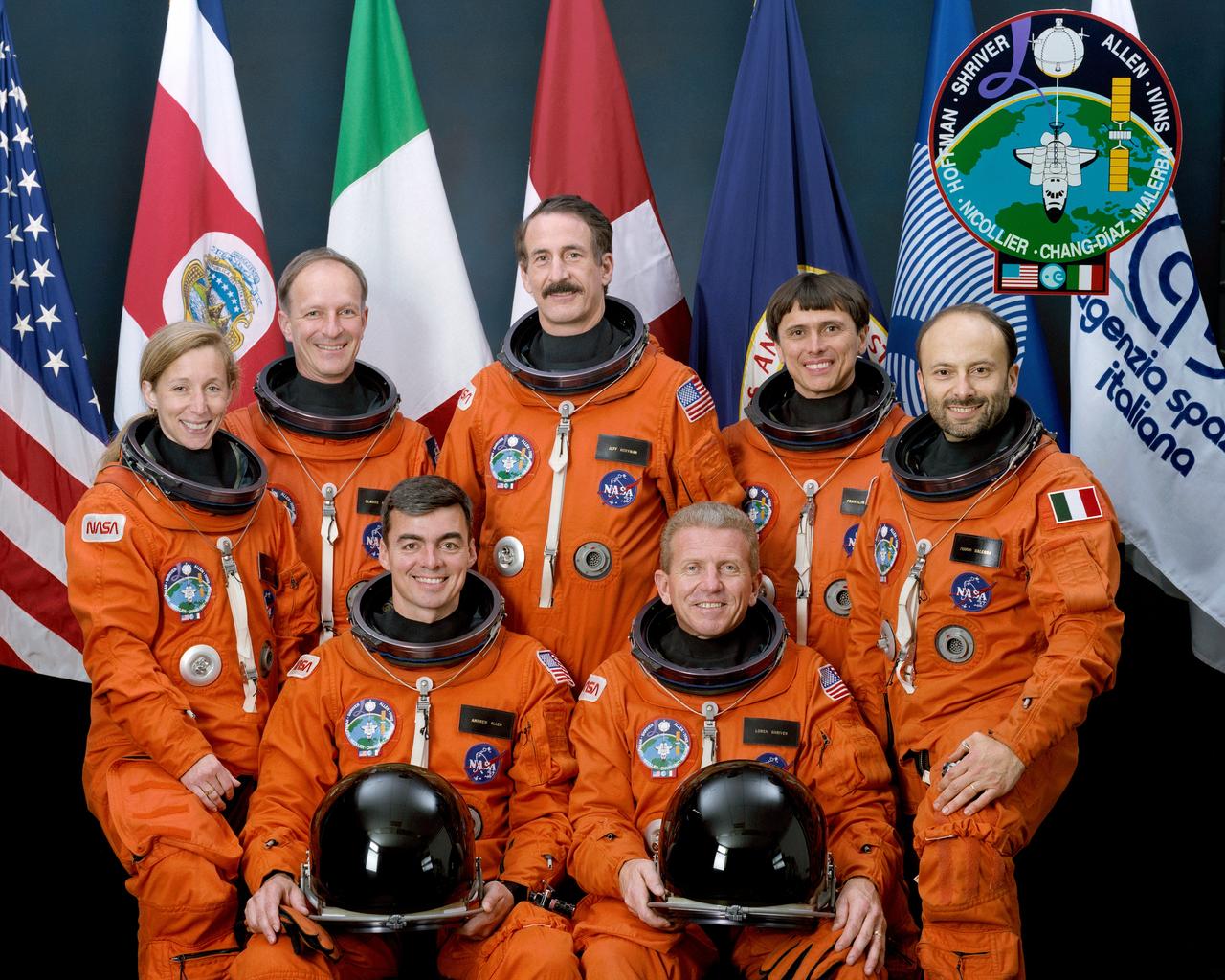
STS046-S-002 (May 1992) --- The crew members assigned to the STS-46 mission pose with seven flags that represent participation on the flight. Loren J. Shriver (right front) is mission commander; Andrew M. Allen (left front) is pilot. Others are (left to right) Marsha S. Ivins, mission specialist; Claude Nicollier, mission specialist representing the European Space Agency (ESA); Jeffrey A. Hoffman, payload commander; Franklin R. Chang-Diaz, mission specialist; and Franco Malerba, flying for the Italian Space Agency (ASI). The flags, left to right, represent the United States of America, Costa Rica (Chang's native country), Italy, Switzerland (Nicollier's homeland), NASA, ESA and ASI.
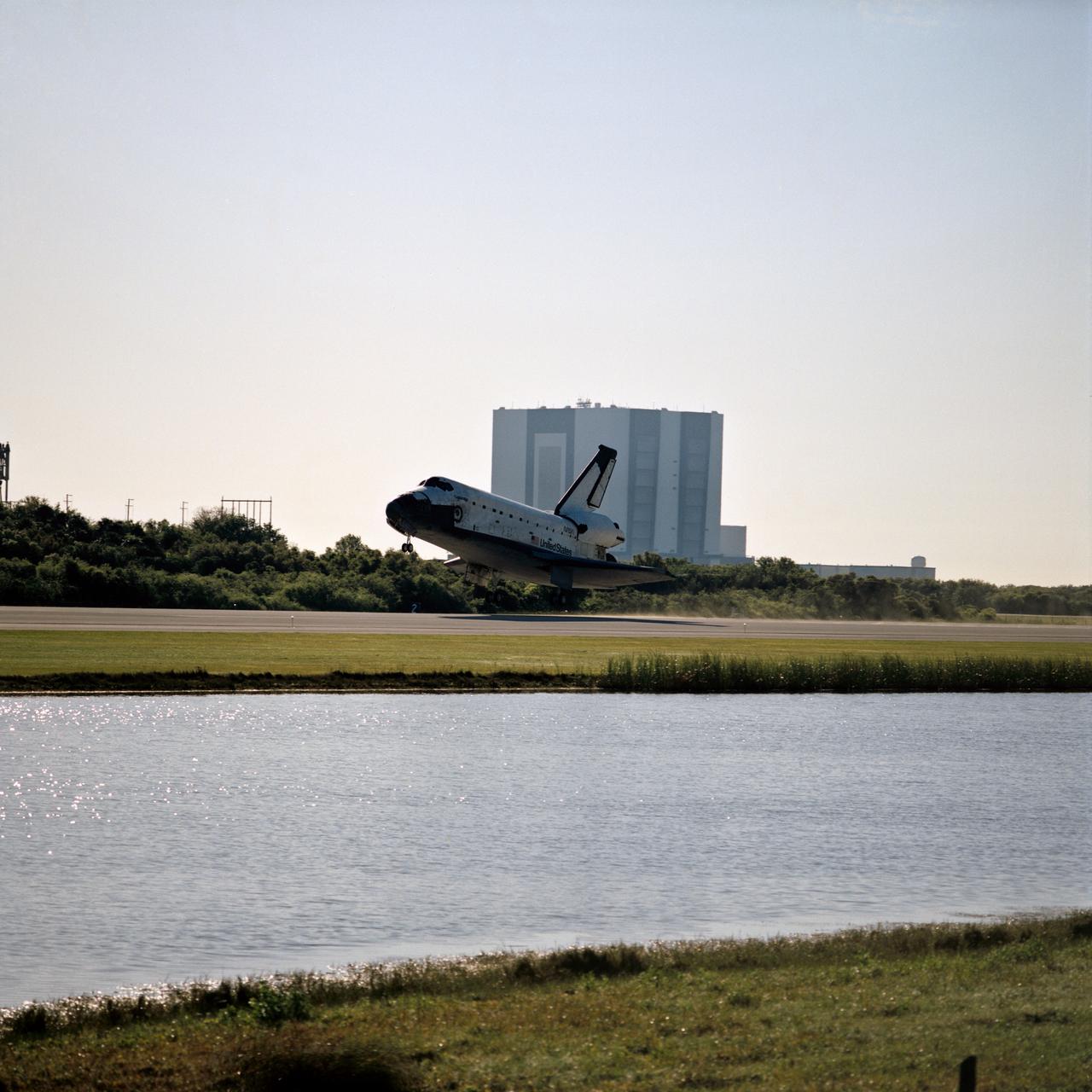
STS062-S-030 (18 March 1994) --- The Space Shuttle Columbia is about to touch down on the Shuttle landing facility following almost 14 days in earth orbit for five NASA astronauts and a variety of experiments. The giant Vehicle Assembly Building (VAB) where Columbia had been mated to its external fuel tank and two solid rockets is in the background. Touchdown occurred at 8:09 a.m. (EST), March 18, 1994. Thirteen days, 23 hours and 16 minutes were logged by the crew members -- astronauts John H. Casper, Andrew M. Allen, Marsha S. Ivins, Pierre J. Thuot and Charles D. (Sam) Gemar.
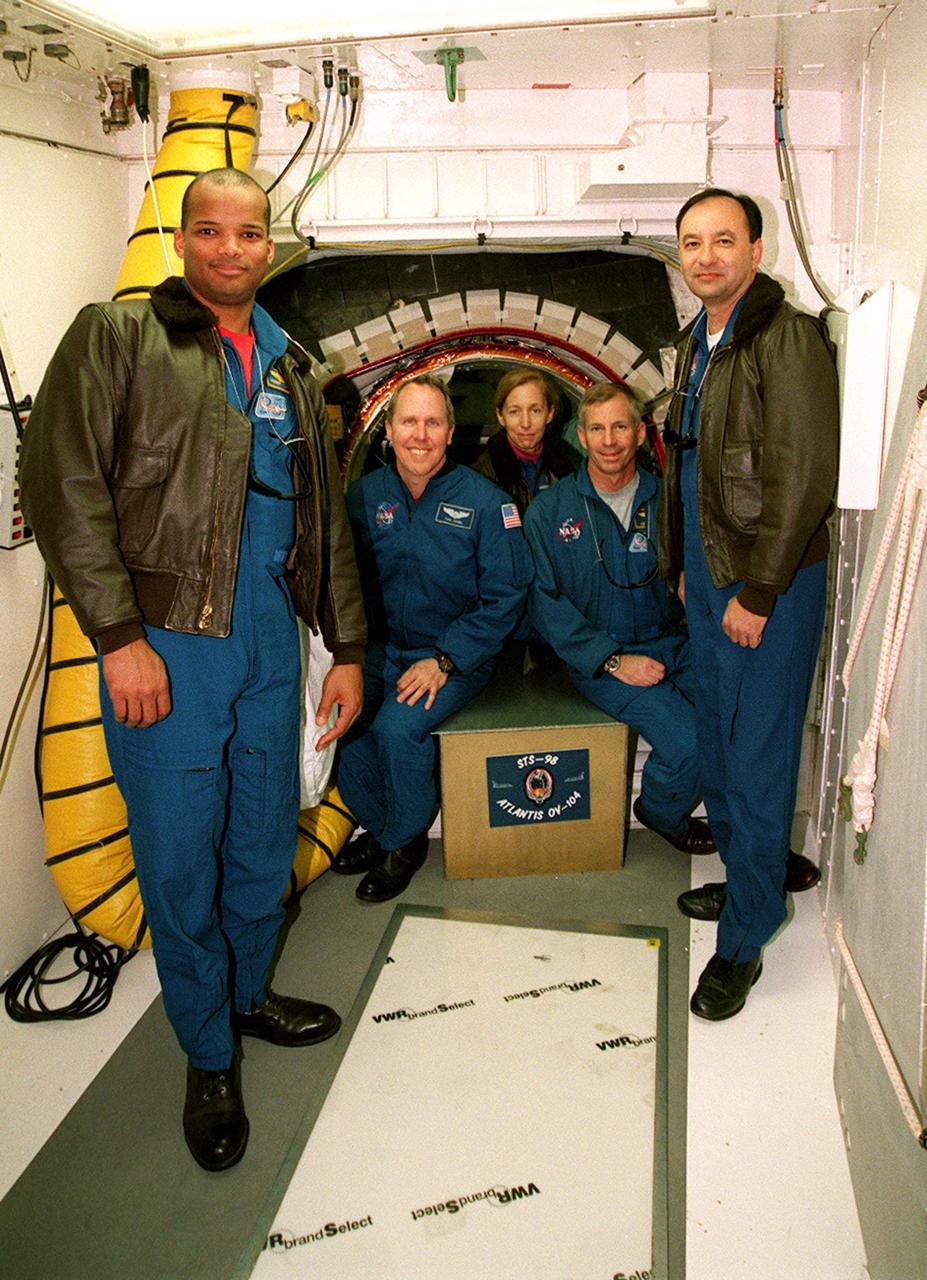
KENNEDY SPACE CENTER, FLA. -- Sitting in the entrance to the orbiter Atlantis are (left to right) STS-98 Mission Specialists Thomas Jones and Marsha Ivins and Commander Ken Cockrell. Below them is the mission patch just placed there by Cockrell. Standing at left is Mission Specialist Robert Curbeam and at right Pilot Mark Polansky. The crew is at KSC to take part in Terminal Countdown Demonstration Test activities, which include emergency egress training and a simulated launch countdown. STS-98 is the seventh construction flight to the International Space Station, carrying as payload the U.S. Lab Destiny, a key element in the construction of the ISS. Launch of STS-98 is scheduled for Jan. 19 at 2:11 a.m

KENNEDY SPACE CENTER, FLA. -- In the Space Station Processing Facility, workers and the STS-98 crew gather for a ceremony that turns over the “key” for the U.S. Lab Destiny to NASA. Holding the key (left) is STS-98 Commander Ken Cockrell. To his left is Mission Specialist Thomas Jones; at right (in uniform) is Mission Specialist Marsha Ivins. Also in the group are Pilot Mark Polansky and Mission Specialist Robert Curbeam. . Launch of mission STS-98 on Space Shuttle Atlantis is scheduled for Jan. 18, 2001. The mission will carry the U.S. Lab Destiny to the International Space Station with five system racks and experiments already installed inside the module
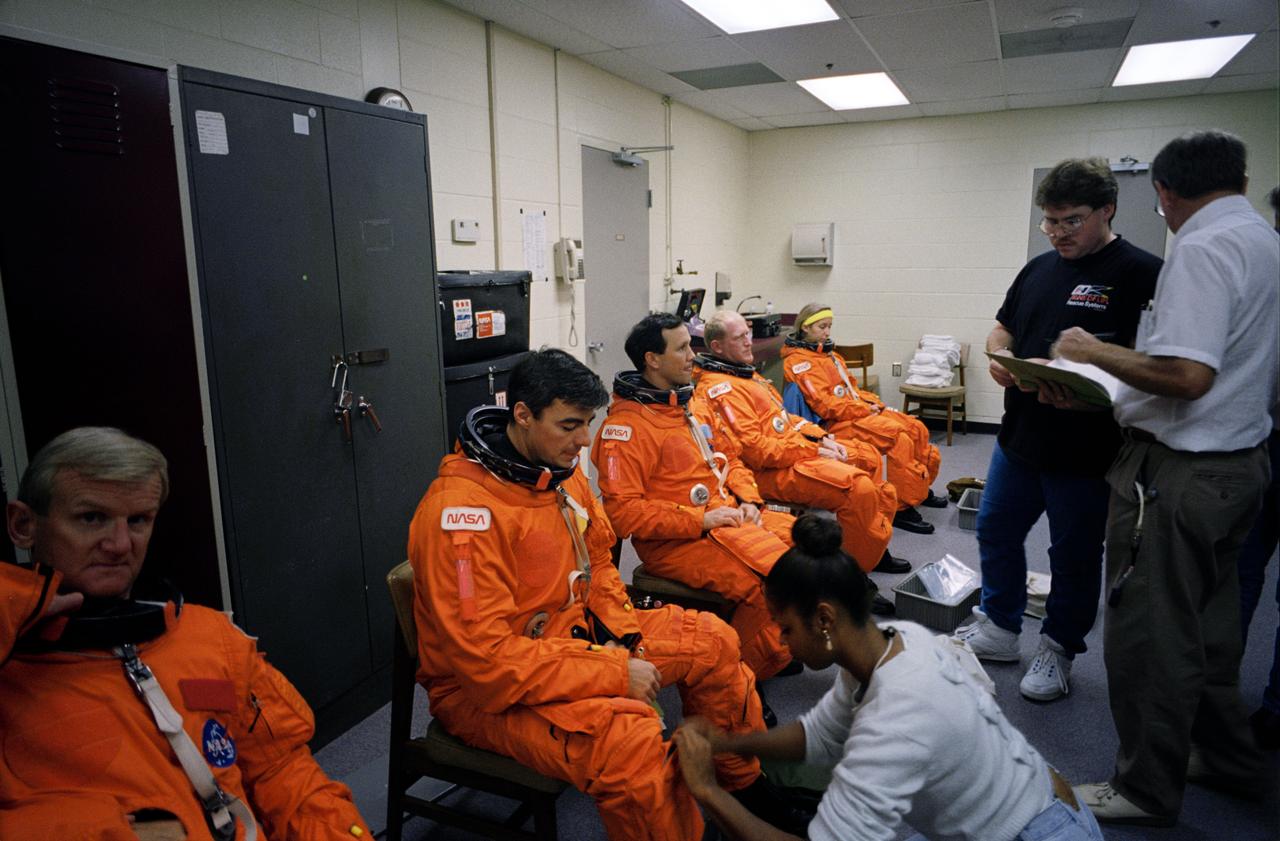
S93-48458 (5 Nov. 1993) --- In the Johnson Space Center's (JSC) Shuttle mockup and integration laboratory, the five crew members training for NASA's next mission are assisted in donning their partial pressure launch and entry suits. From left to right are astronaut John H. Casper, Andrew M. Allen, Pierre J. Thuot, Charles D. (Sam) Gemar and Marsha S. Ivins. Minutes later the crew was in the crew compartment trainer (CCT) rehearsing their scheduled March 1994 mission aboard the Space Shuttle Columbia. Launch, landing and emergency egress procedures were covered in the training session.
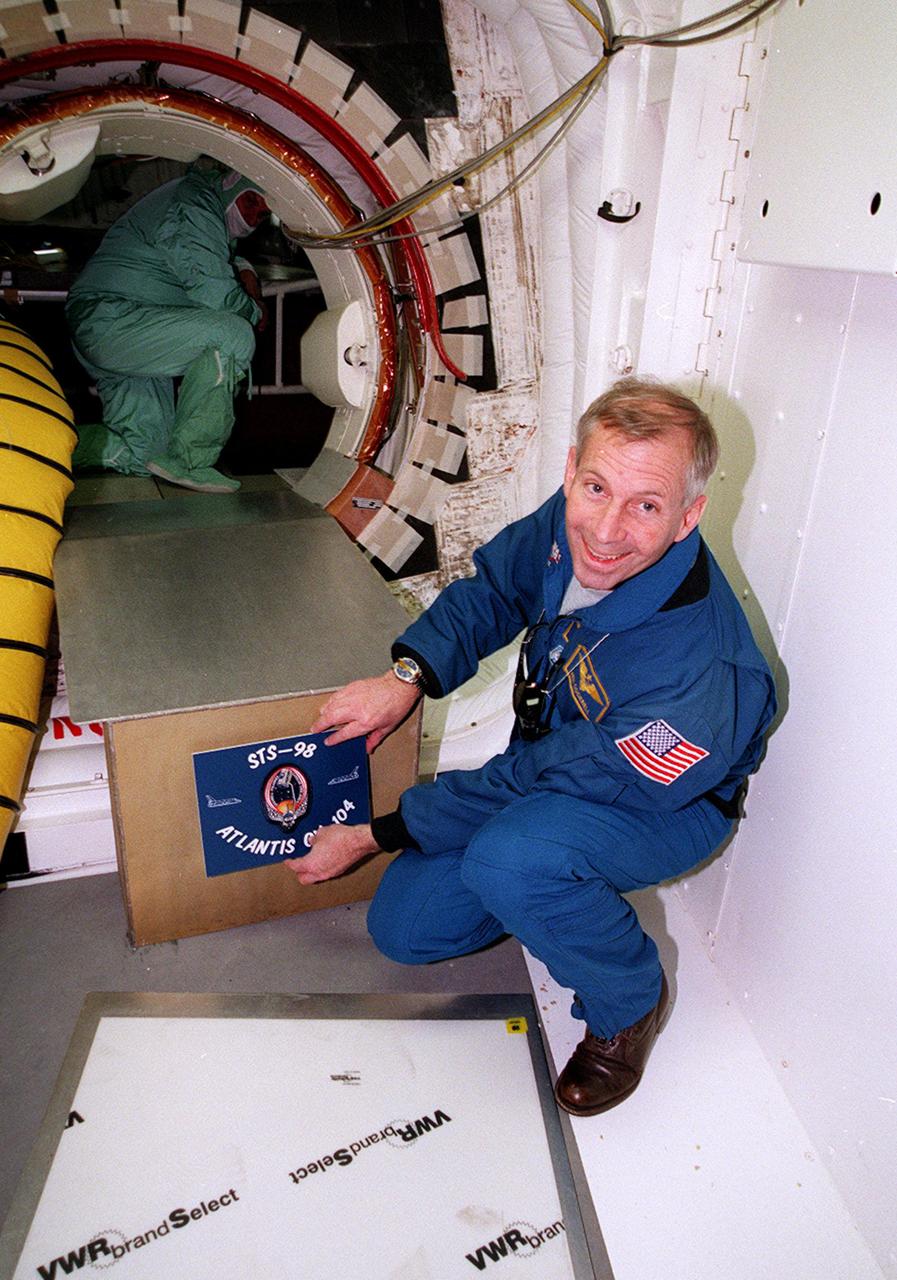
KENNEDY SPACE CENTER, FLA. -- STS-98 Commander Ken Cockrell places the mission patch on the entrance to the orbiter Atlantis. He and the rest of the crew Pilot Mark Polansky and Mission Specialists Thomas Jones, Marsha Ivins and Robert Curbeam are t KSC to take part in Terminal Countdown Demonstration Test activities, which include emergency egress training and a simulated launch countdown. STS-98 is the seventh construction flight to the International Space Station, carrying as payload the U.S. Lab Destiny, a key element in the construction of the ISS. Launch of STS-98 is scheduled for Jan. 19 at 2:11 a.m
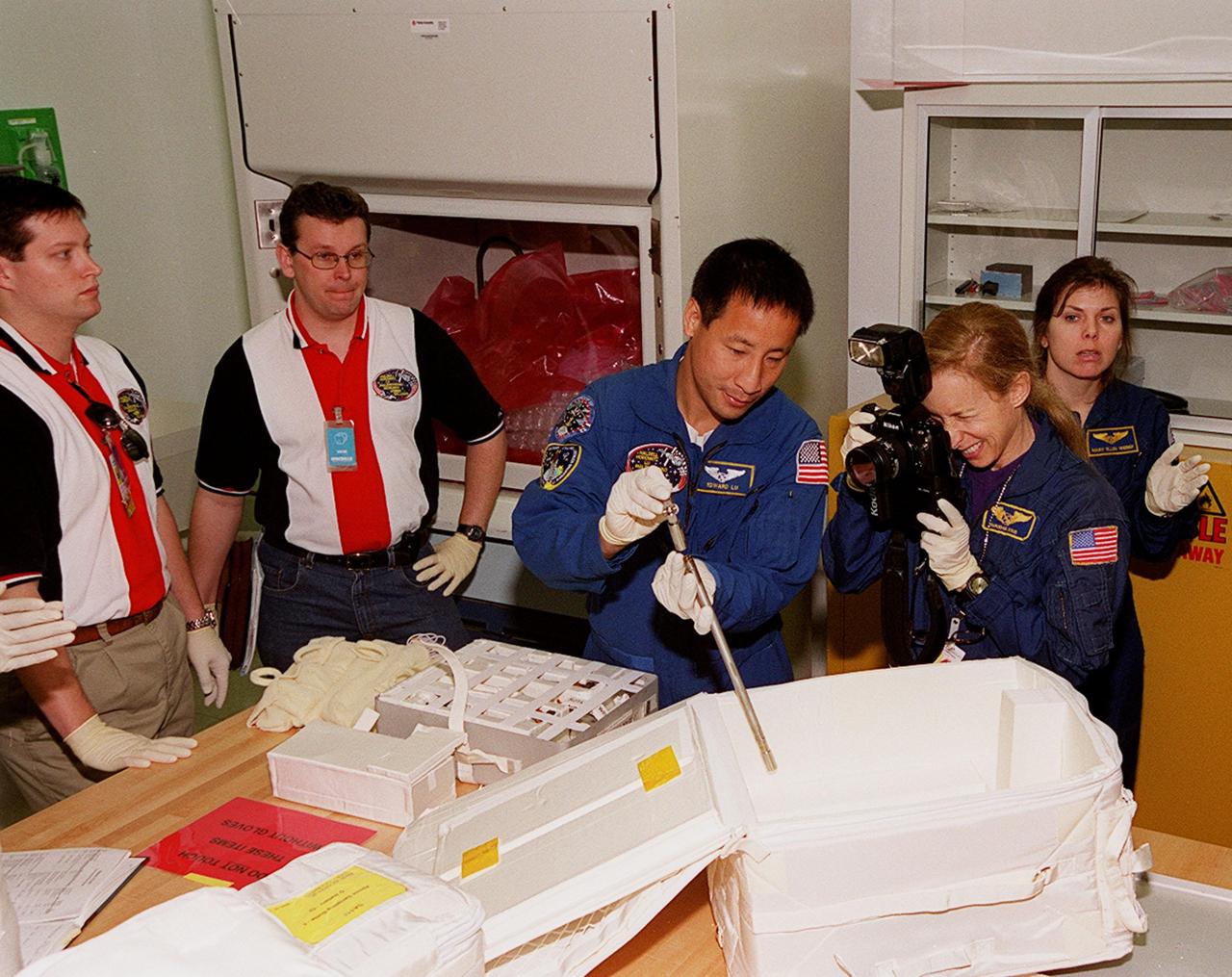
KENNEDY SPACE CENTER, FLA. -- At SPACEHAB, in Cape Canaveral, members of the STS-101 crew are taking part in a Crew Equipment Interface Test, which gives them an opportunity to look over equipment and payloads that will fly on the mission. At center is Mission Specialist Edward Tsang Lu; at right is Mission Specialist Mary Ellen Weber (Ph.D.). Between the, holding the camera, is astronaut Marsha Ivins, who is assigned to mission STS-98. On mission STS-101, Space Shuttle Atlantis will be carrying the SPACEHAB Double Module, which carries internal logistics and resupply cargo for station outfitting. Launch of Atlantis is scheduled no earlier than April 13, 2000
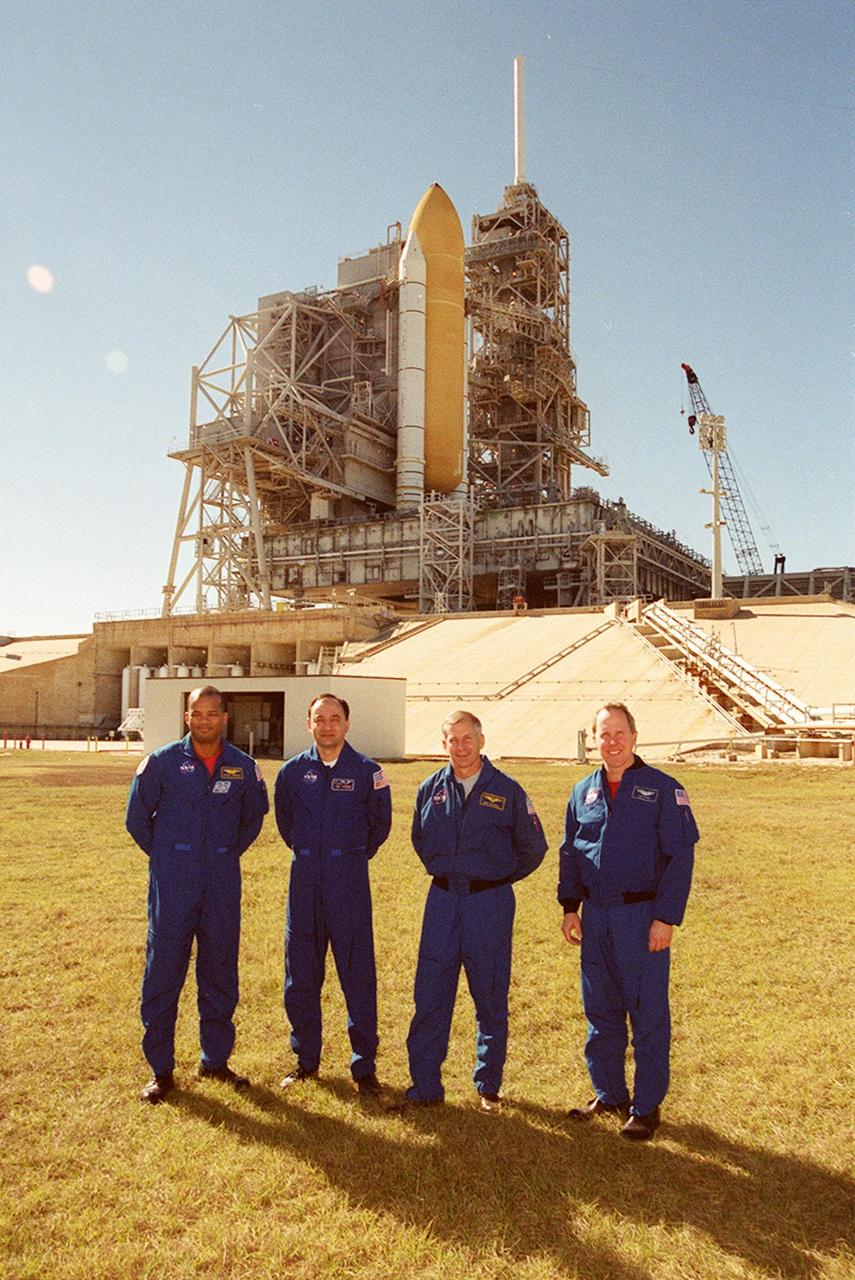
KENNEDY SPACE CENTER, FLA. -- Four members of the STS-98 crew pose for a photo at Launch Pad 39A. Standing, left to right, are Mission Specialist Robert Curbeam, Pilot Mark Polansky, Commander Ken Cockrell and Mission Specialist Thomas Jones. Not pictured is Mission Specialist Marsha Ivins. The crew is at KSC to take part in Terminal Countdown Demonstration Test activities, which include emergency egress training and a simulated launch countdown. STS-98 is the seventh construction flight to the International Space Station, carrying as payload the U.S. Lab Destiny, a key element in the construction of the ISS. Launch of STS-98 is scheduled for Jan. 19 at 2:11 a.m
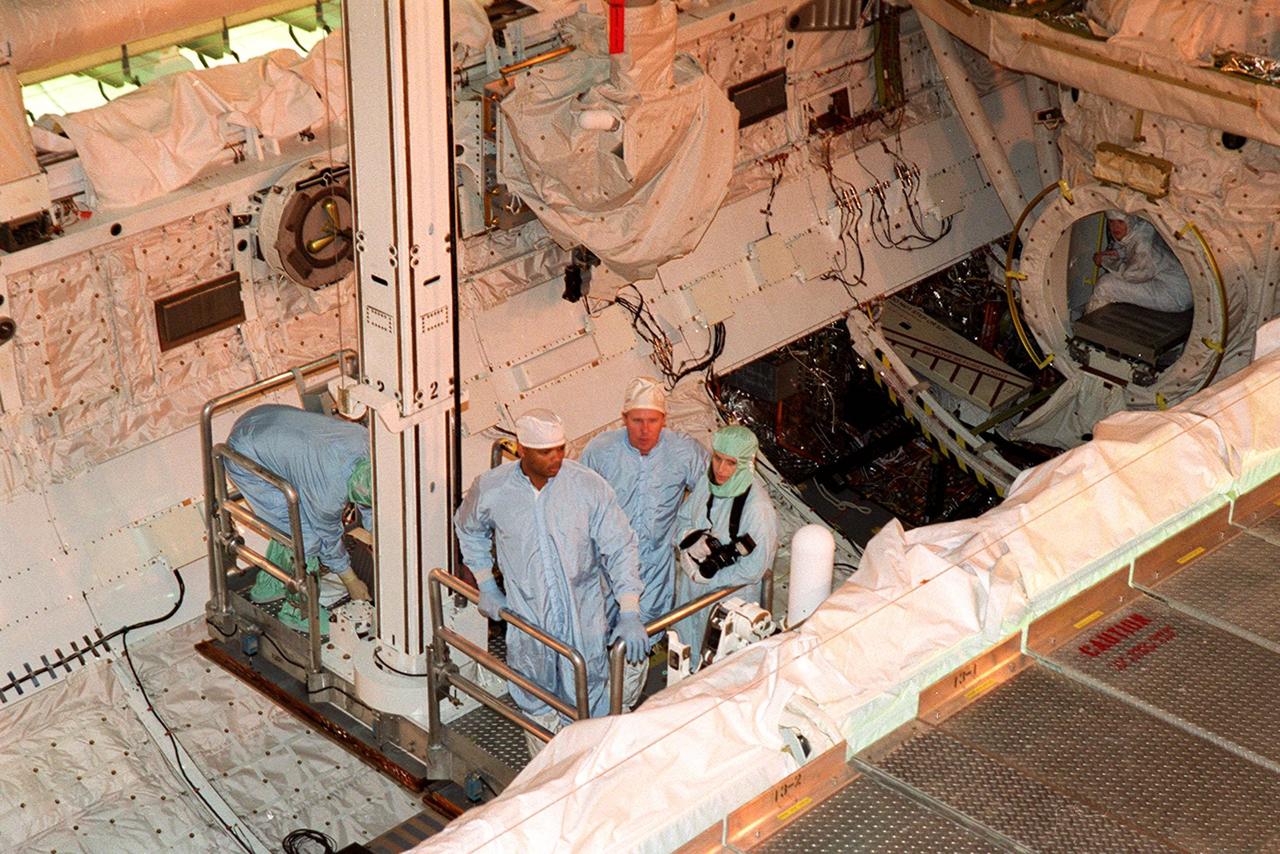
KENNEDY SPACE CENTER, FLA. -- Lowered into the payload bay of the orbiter Atlantis, some of the STS-98 crew (center of the photo) look over part of the payload. From left are Mission Specialists Robert Curbeam, Tom Jones and Marsha Ivins. They and the rest of the crew are at KSC for Crew Equipment Interface Test activities. Launch on mission STS-98 is scheduled for Jan. 18, 2001. It will be transporting the U.S. Lab, Destiny, to the International Space Station with five system racks already installed inside of the module. After delivery of electronics in the lab, electrically powered attitude control for Control Moment Gyroscopes will be activated
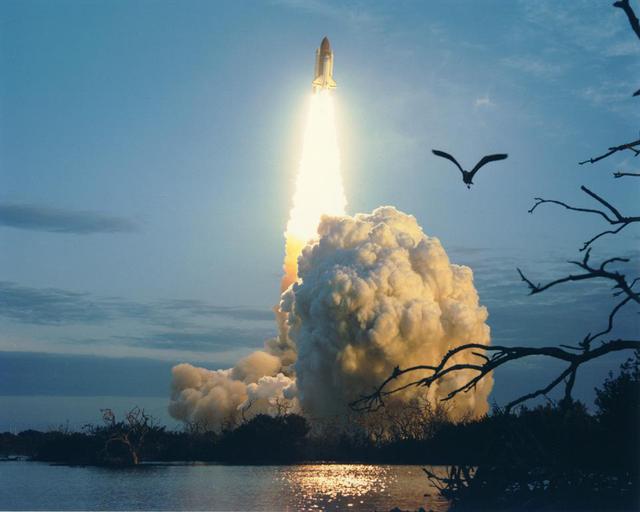
KENNEDY SPACE CENTER, FLA. -- At 7:35 a.m. EST on January 9, the Space Shuttle Columbia roars aloft from KSC's Pad 39-A into the Florida skies. During the ten-day STS-32 mission, the five-member crew is scheduled to deploy the SYNCOM IV-5 military communications satellite and retrieve the Long Duration Exposure Facility. STS-32 marks the 33rd Shuttle mission since flight operations began in 1981. Crew members are: Commander Daniel C. Brandenstein; Pilot James D. Wetherbee; and Mission Specialists Marsha S. Ivins, G. David Low, and Bonnie J. Dunbar
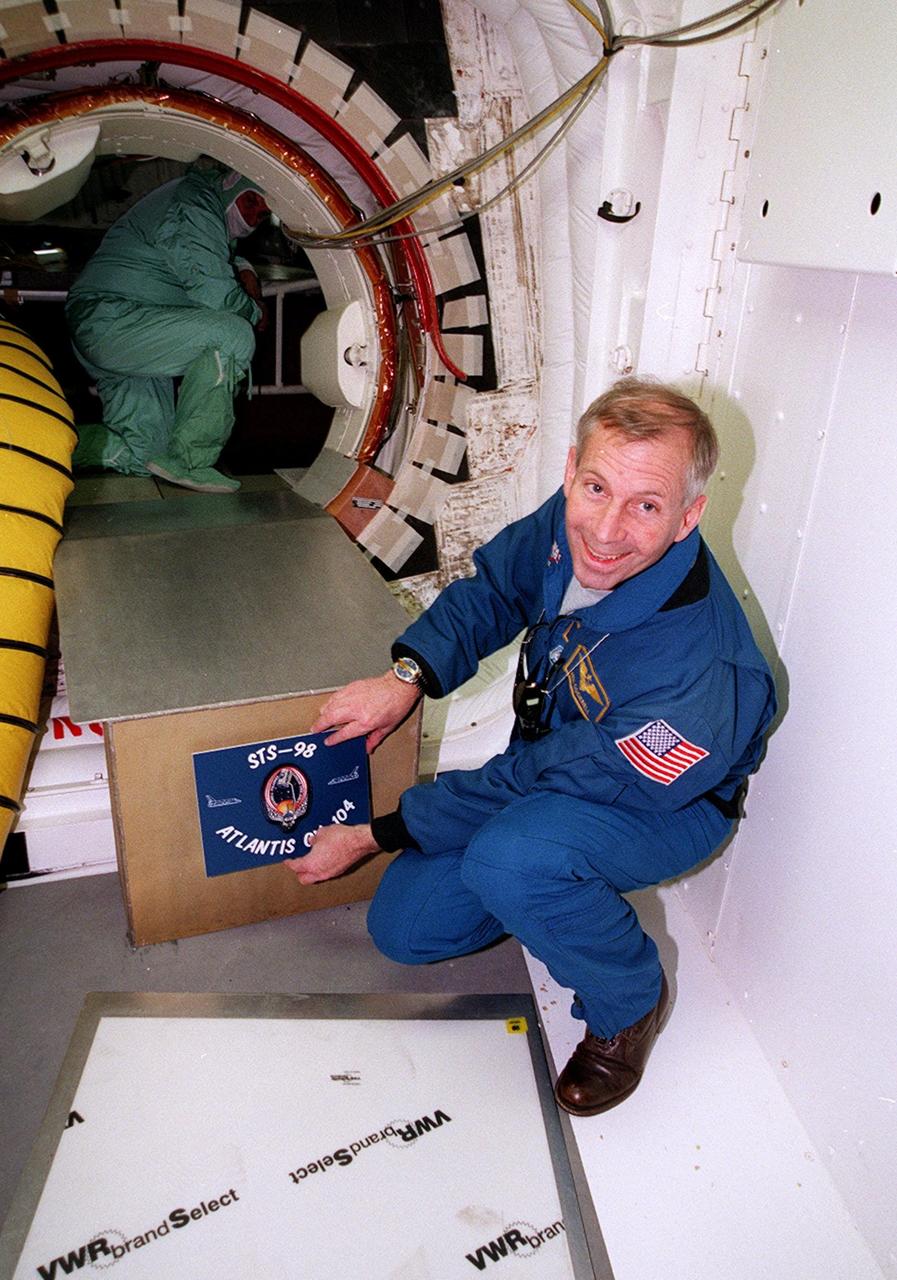
KENNEDY SPACE CENTER, FLA. -- STS-98 Commander Ken Cockrell places the mission patch on the entrance to the orbiter Atlantis. He and the rest of the crew Pilot Mark Polansky and Mission Specialists Thomas Jones, Marsha Ivins and Robert Curbeam are t KSC to take part in Terminal Countdown Demonstration Test activities, which include emergency egress training and a simulated launch countdown. STS-98 is the seventh construction flight to the International Space Station, carrying as payload the U.S. Lab Destiny, a key element in the construction of the ISS. Launch of STS-98 is scheduled for Jan. 19 at 2:11 a.m
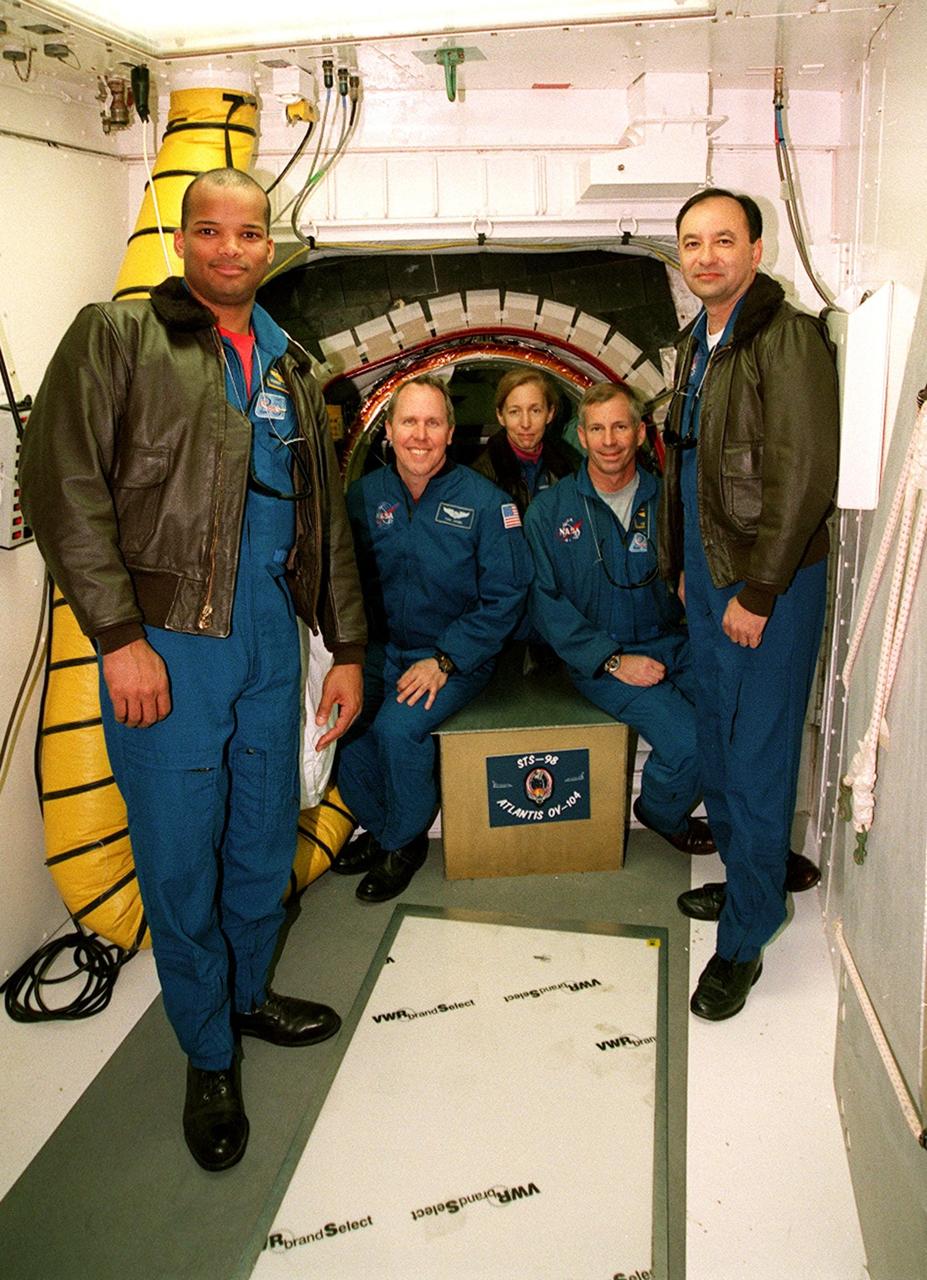
KENNEDY SPACE CENTER, FLA. -- Sitting in the entrance to the orbiter Atlantis are (left to right) STS-98 Mission Specialists Thomas Jones and Marsha Ivins and Commander Ken Cockrell. Below them is the mission patch just placed there by Cockrell. Standing at left is Mission Specialist Robert Curbeam and at right Pilot Mark Polansky. The crew is at KSC to take part in Terminal Countdown Demonstration Test activities, which include emergency egress training and a simulated launch countdown. STS-98 is the seventh construction flight to the International Space Station, carrying as payload the U.S. Lab Destiny, a key element in the construction of the ISS. Launch of STS-98 is scheduled for Jan. 19 at 2:11 a.m
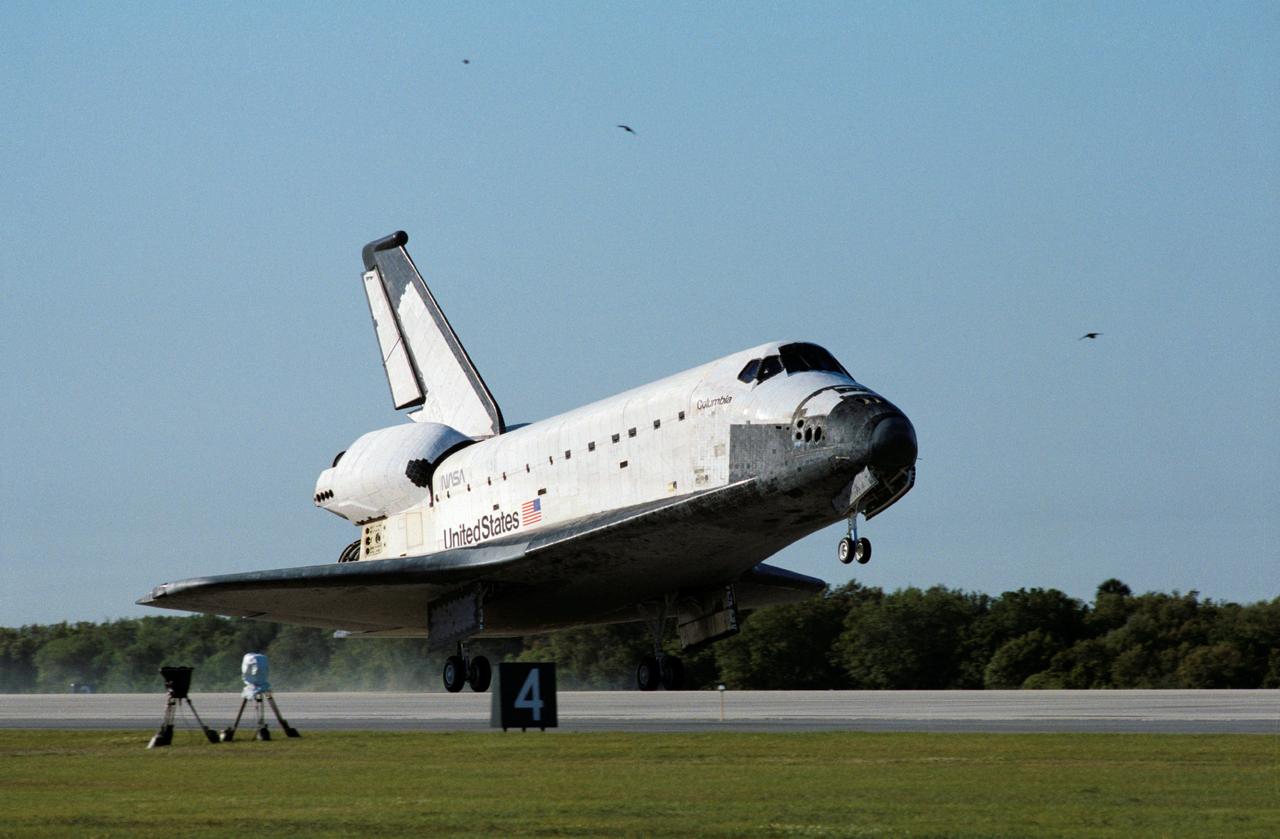
STS062-S-031 (18 March 1994) --- The main landing gear on the Space Shuttle Columbia touches down on the Shuttle Landing Facility at Kennedy Space Center (KSC). The scene followed almost 14-days in Earth-orbit for five NASA astronauts and a variety of experiments. Touch down occurred at 8:09 a.m. (EST), March 18, 1994. Thirteen days, 23 hours and 16 minutes were logged by the crew members -- astronauts John H. Casper, Andrew M. Allen, Marsha S. Ivins, Pierre J. Thuot and Charles D. (Sam) Gemar.
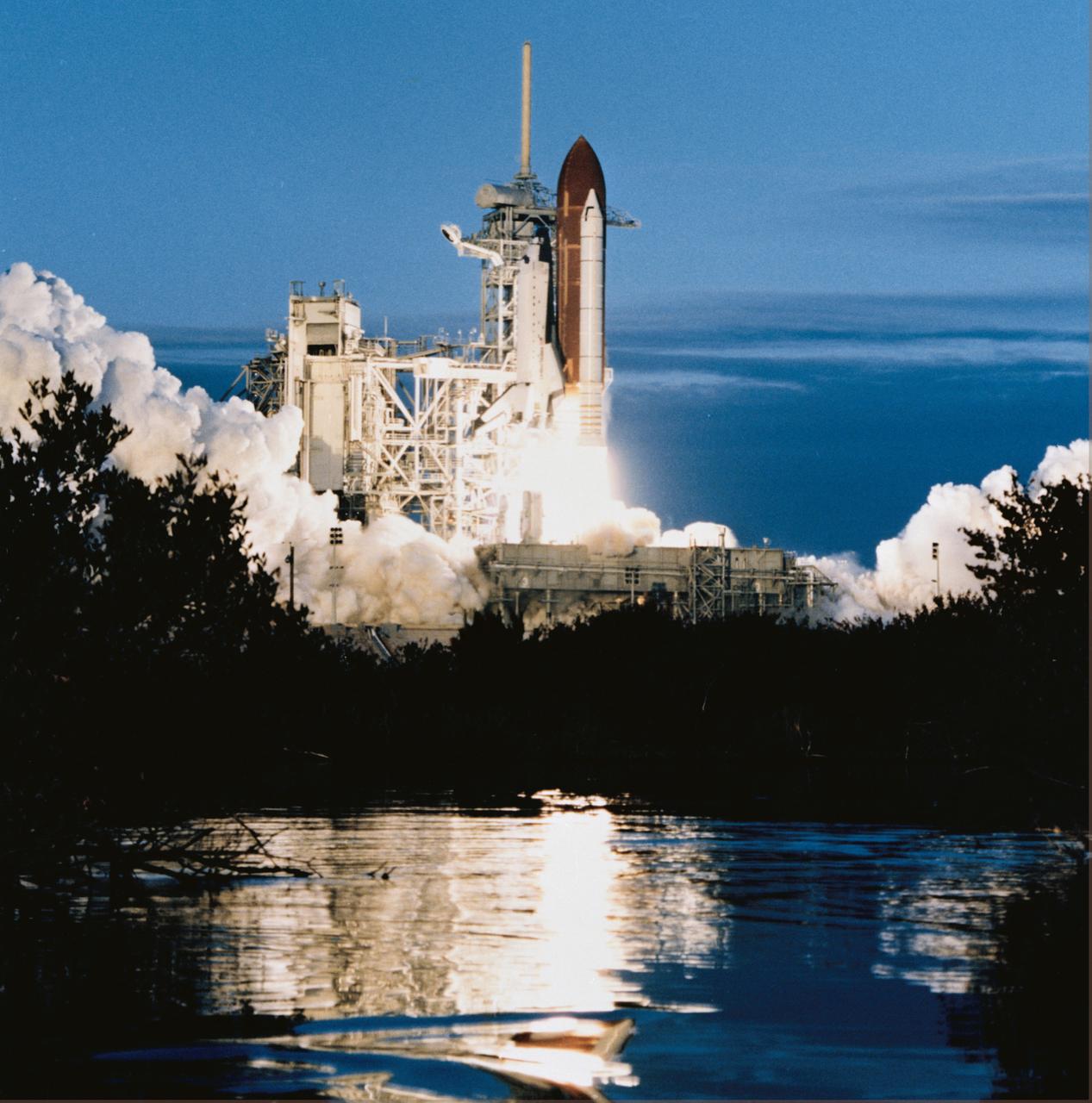
STS032-S-069 (9 Jan. 1990) --- The space shuttle Columbia, with a five member crew aboard, lifts off for the ninth time as STS-32 begins a 10-day mission in Earth orbit. Leaving from Launch Pad 39A at 7:34:59:98 a.m. EST, in this horizontal (cropped 70mm) frame, Columbia is seen reflected in nearby marsh waters some 24 hours after dubious weather at the return-to-launch site (RTLS) had cancelled a scheduled launch. Onboard the spacecraft were astronauts Daniel C. Brandenstein, James D. Wetherbee, Bonnie J. Dunbar, G. David Low and Marsha S. Ivins. Photo credit: NASA
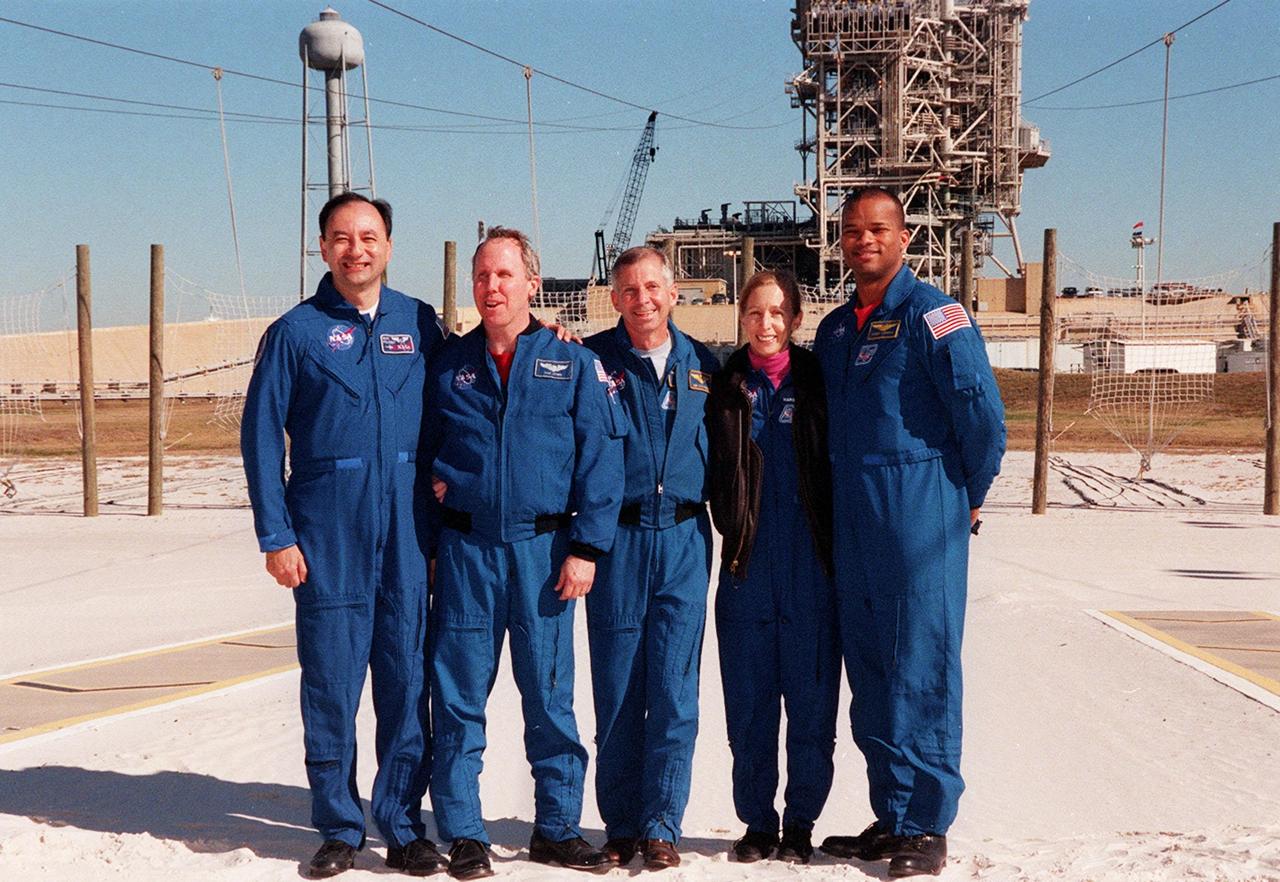
KENNEDY SPACE CENTER, FLA -- After a media briefing at Launch Pad 39A, the STS-98 crew poses in the slidewire basket landing zone. Standing, left to right, are Pilot Mark Polansky, Mission Specialist Thomas Jones, Commander Ken Cockrell and Mission Specialists Marsha Ivins and Robert Curbeam. All are at KSC to take part in Terminal Countdown Demonstration Test activities, which include emergency egress training and a simulated launch countdown. STS-98 is the seventh construction flight to the International Space Station, carrying as payload the U.S. Lab Destiny, a key element in the construction of the ISS. Launch of STS-98 is scheduled for Jan. 19 at 2:11 a.m
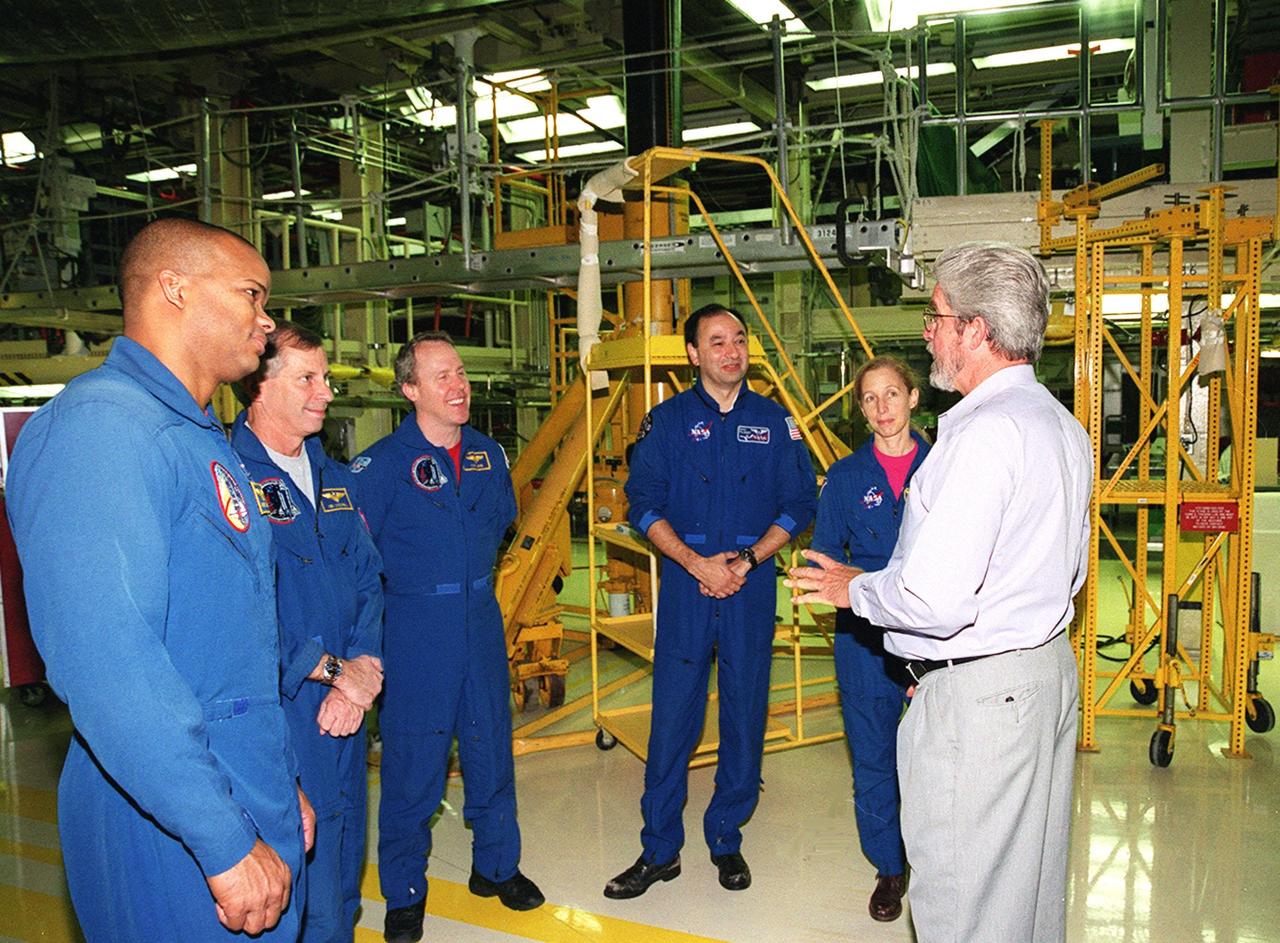
KENNEDY SPACE CENTER, FLA. -- In Orbiter Processing Facility bay 3, the STS-98 crew talks with United Space Alliance worker Larry Oshein (right). Standing left to right are Mission Specialist Robert Curbeam, Commander Ken Cockrell, Mission Specialist Tom Jones, and Mission Specialists Mark Polansky and Marsha Ivins. The crew is at KSC for Crew Equipment Interface Test activities. Launch on mission STS-98 is scheduled for Jan. 18, 2001. It will be transporting the U.S. Lab, Destiny, to the International Space Station with five system racks already installed inside of the module. After delivery of electronics in the lab, electrically powered attitude control for Control Moment Gyroscopes will be activated
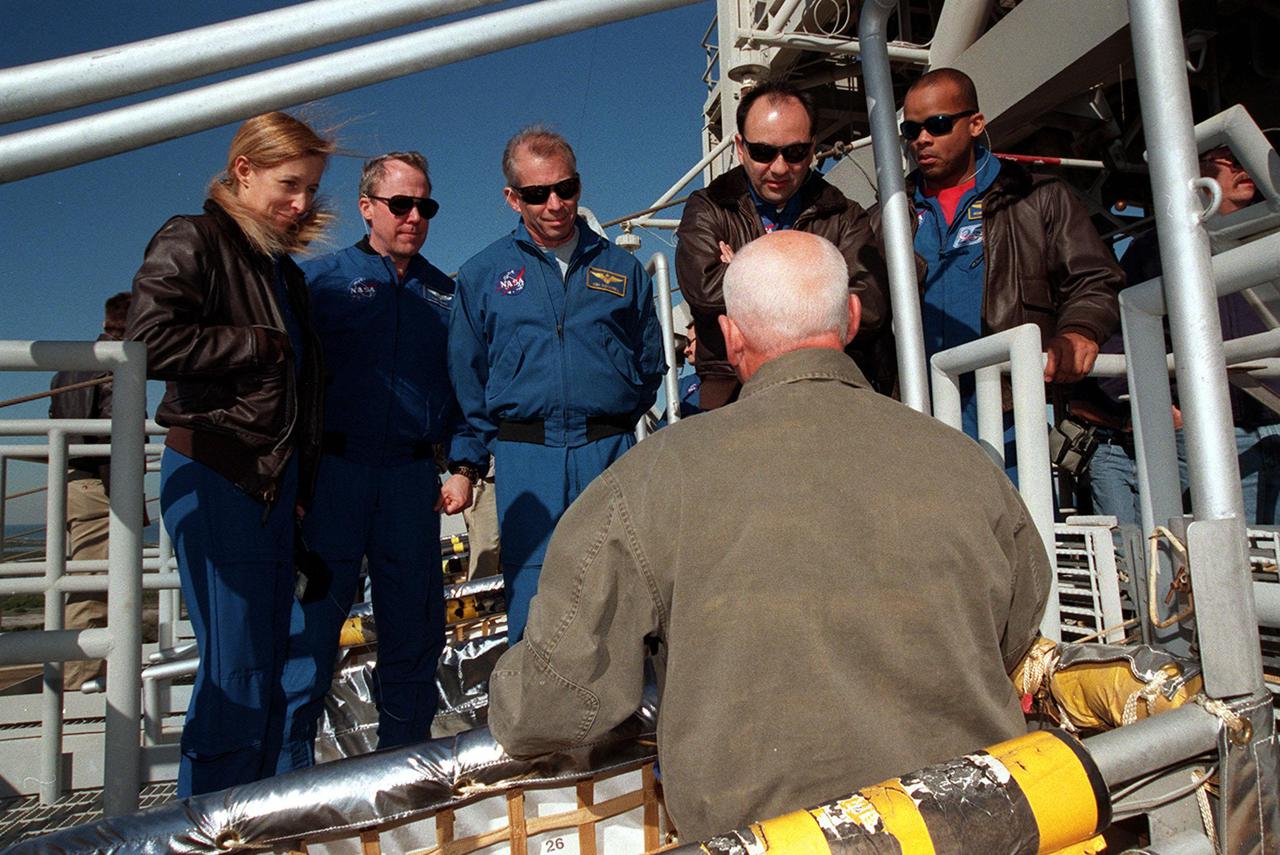
The STS-98 crew listens to instructions on use of the slidewire basket, part of emergency egress equipment from the launch pad. At the 195-foot level of the Fixed Service Structure are Mission Specialists Marsha Ivins and Thomas Jones, Commander Ken Cockrell, Pilot Mark Polansky and Mission Specialist Robert Curbeam. The crew is at KSC to take part in Terminal Countdown Demonstration Test activities, which include emergency egress training and a simulated launch countdown at the pad. STS-98 is the seventh construction flight to the International Space Station, carrying as payload the U.S. Lab Destiny, a key element in the construction of the ISS. Launch of STS-98 is scheduled for Jan. 19 at 2:11 a.m
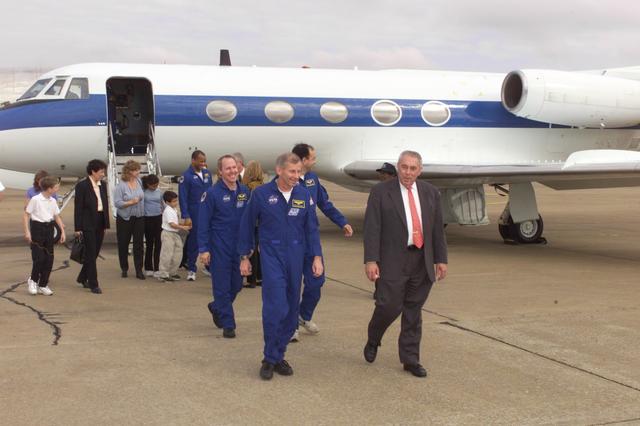
JSC2001-E-04805 (21 February 2001) --- JSC director George W.S. Abbey talks with the STS-98 crew members following the arrival of the Gulfstream Aircraft which transported the astronauts from their landing at Dryden Flight Research Center (DFRC) in Edwards, California. Pictured along side Mr. Abbey is astronaut Kenneth D. Cockrell, mission commander. Behind him (from the left distant background) are astronauts Robert L. Curbeam and Thomas D. Jones (both mission specialists) and Mark L. Polansky, pilot. Astronaut Marsha S. Ivins, mission specialist, is out of the frame.
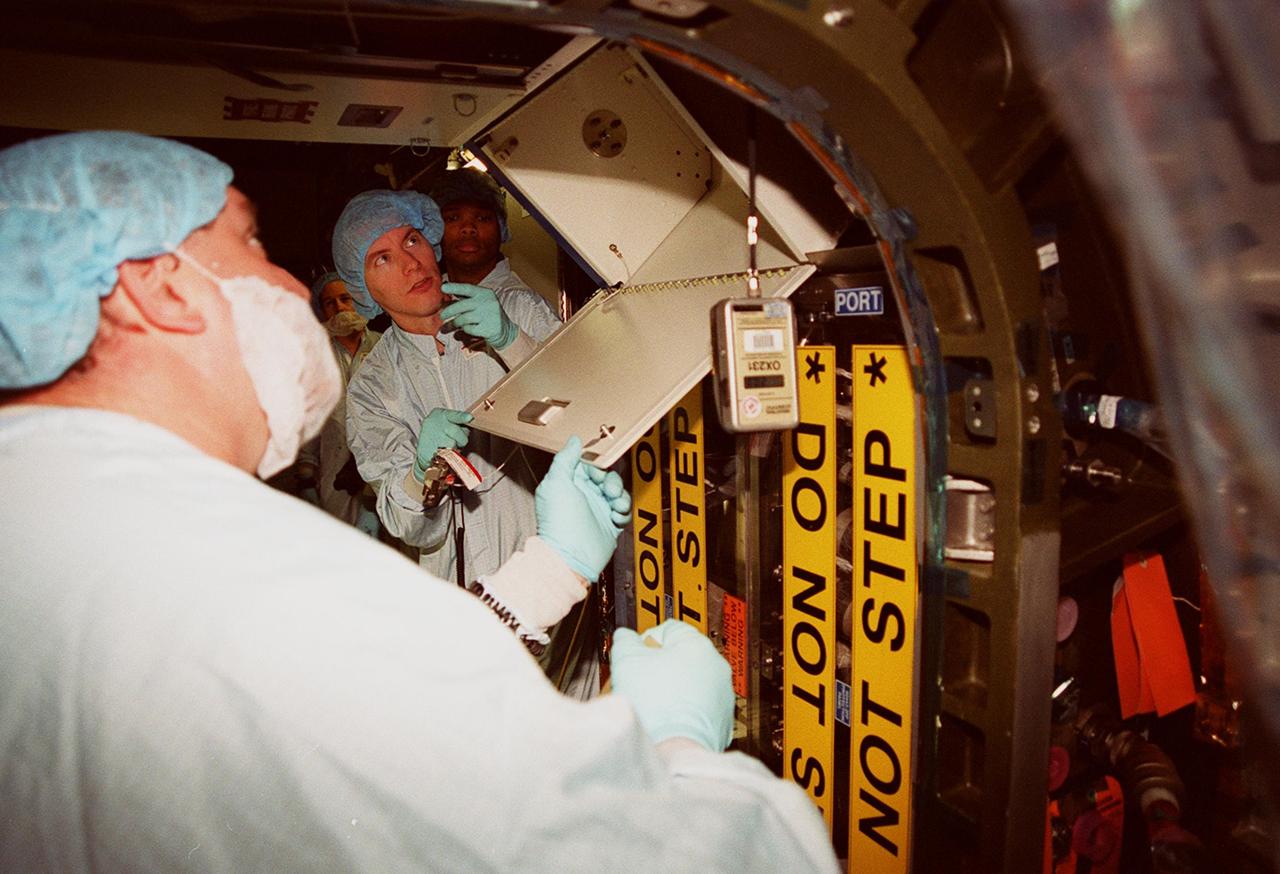
In the Space Station Processing Facility, members of the STS-98 crew check out components inside the U.S. Lab, Destiny, under the watchful eye of trainers. The crew comprises Commander Ken Cockrell, Pilot Mark Polansky and Mission Specialists Robert Curbeam, Thomas Jones and Marsha Ivins. They are taking part in Crew Equipment Interface Test activities, becoming familiar with equipment they will be handling during the mission. The mission will be transporting the Lab to the International Space Station with five system racks already installed inside of the module. With delivery of electronics in the lab, electrically powered attitude control for Control Moment Gyroscopes will be activated. The STS-98 launch is scheduled for Jan. 18, 2001
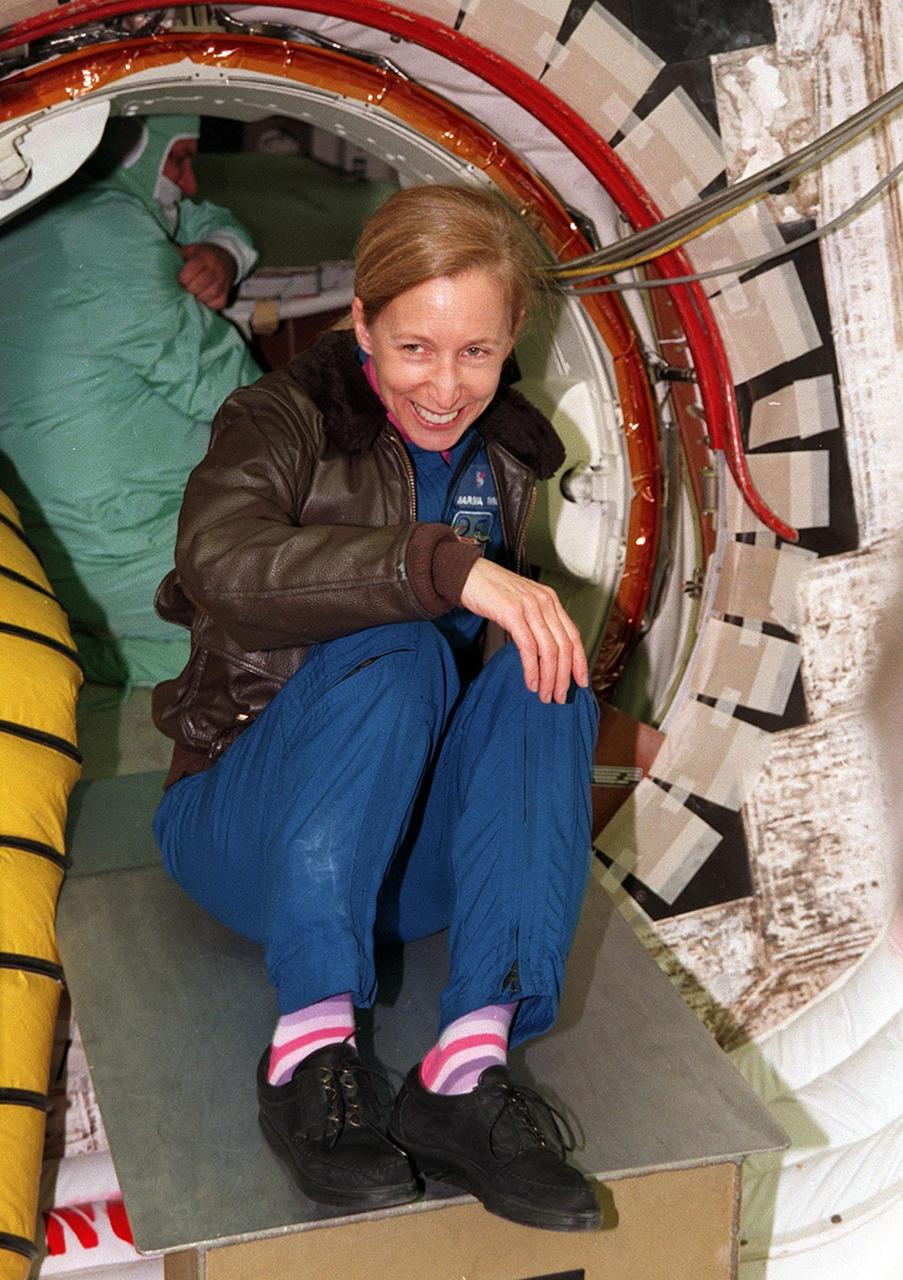
STS-98 Mission Specialist Marsha Ivins waits in the White Room outside the entrance into Atlantis. The crew is at KSC to take part in Terminal Countdown Demonstration Test activities, which include emergency egress training and a simulated launch countdown. The other crew members are Pilot Mark Polansky, Mission Specialist Thomas Jones, Commander Ken Cockrell and Mission Specialist Robert Curbeam. STS-98 is the seventh construction flight to the International Space Station, carrying as payload the U.S. Lab Destiny, a key element in the construction of the ISS. Launch of STS-98 is scheduled for Jan. 19 at 2:11 a.m
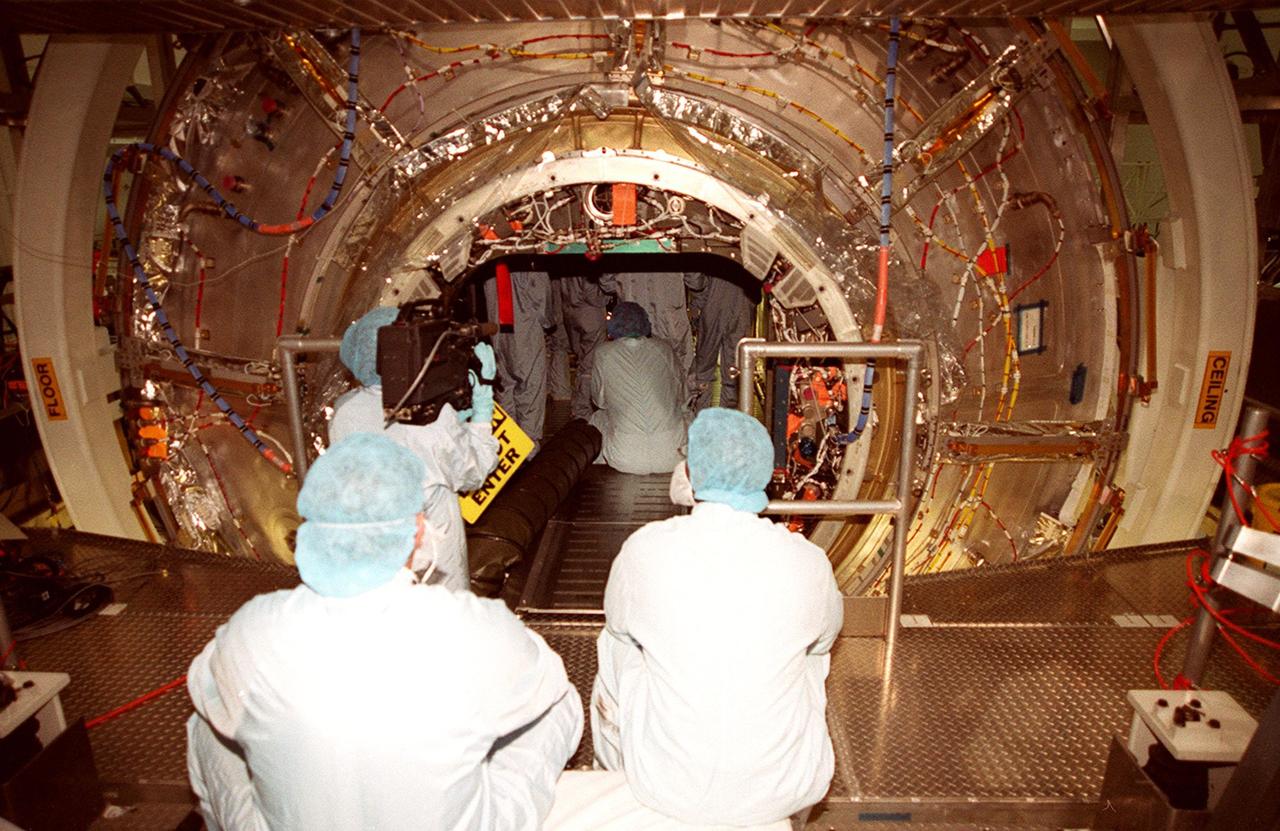
In the Space Station Processing Facility, workers in the foreground watch and wait while members of the STS-98 crew check out the U.S. Lab, Destiny in the background. The crew comprises Commander Ken Cockrell, Pilot Mark Polansky and Mission Specialists Robert Curbeam, Thomas Jones and Marsha Ivins. They are taking part in Crew Equipment Interface Test activities, becoming familiar with equipment they will be handling during the mission. The mission will be transporting the Lab to the International Space Station with five system racks already installed inside of the module. With delivery of electronics in the lab, electrically powered attitude control for Control Moment Gyroscopes will be activated. The STS-98 launch is scheduled for Jan. 18, 2001