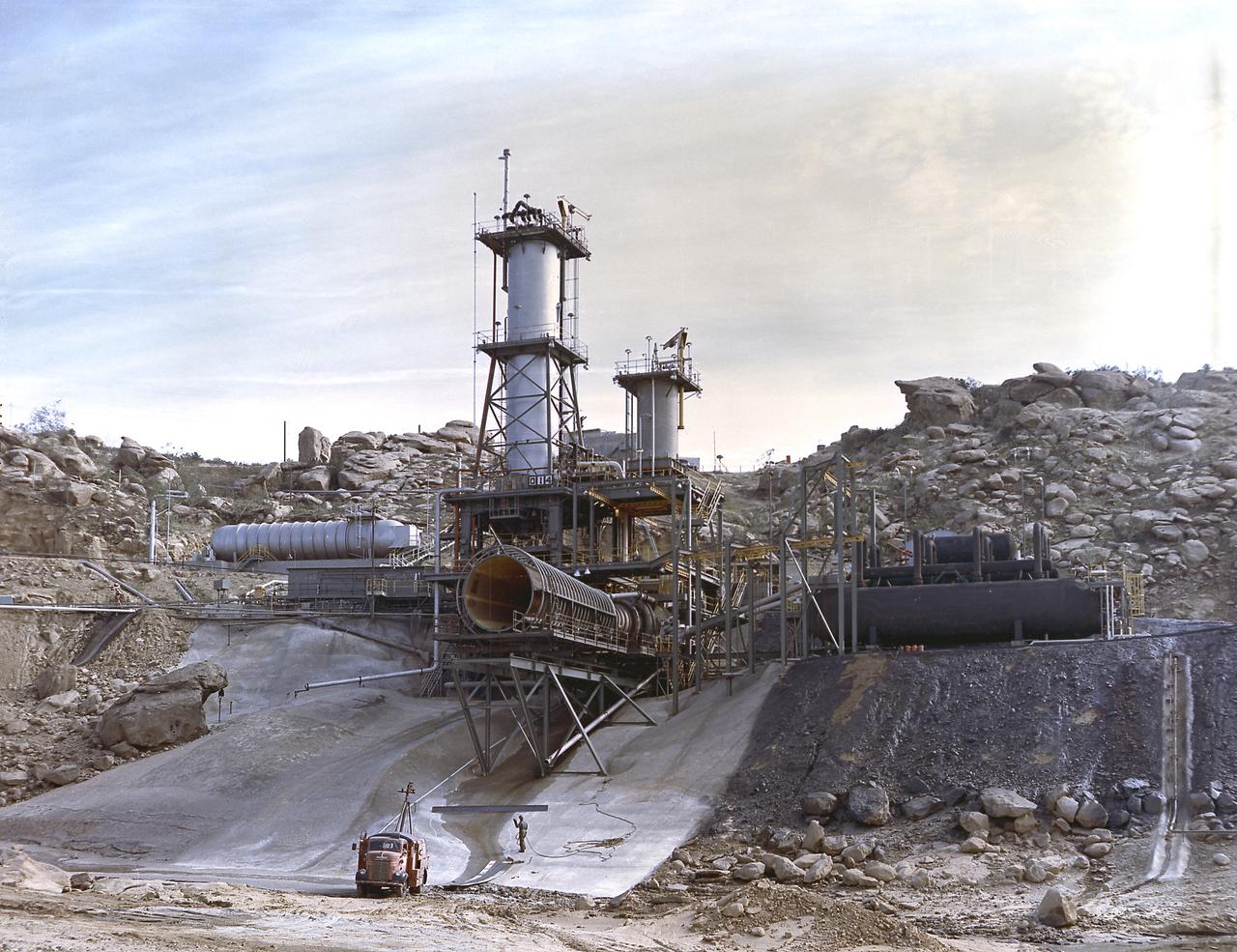
This image depicts an overall view of the vertical test stand for testing the J-2 engine at Rocketdyne's Propulsion Field Laboratory, in the Santa Susana Mountains, near Canoga Park, California. The J-2 engines were assembled and tested at Rocketdyne under the direction of the Marshall Space Flight Center.
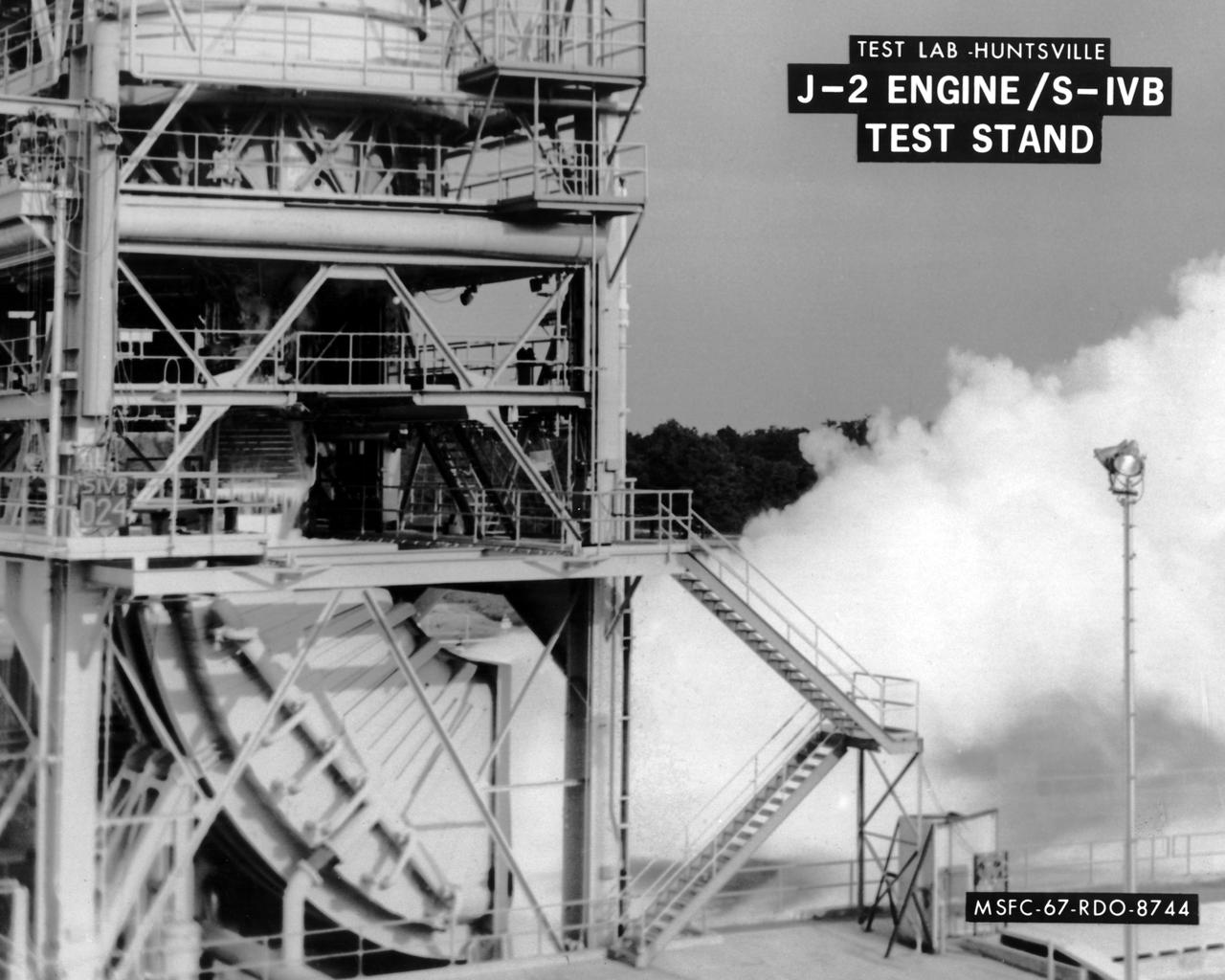
This image depicts the test firing of a J-2 engine in the S-IVB Test Stand at the Marshall Space Flight Center (MSFC). The J-2, developed by Rocketdyne under the direction of MSFC, was propelled by liquid hydrogen and liquid oxygen. A single J-2 was utilized in the S-IVB stage (the second stage for the Saturn IB and third stage for the Saturn V) and in a cluster of five for the second stage (S-II) of the Saturn V. Initially rated at 200,000 pounds of thrust, the engine was later upgraded in the Saturn V program to 230,000 pounds.
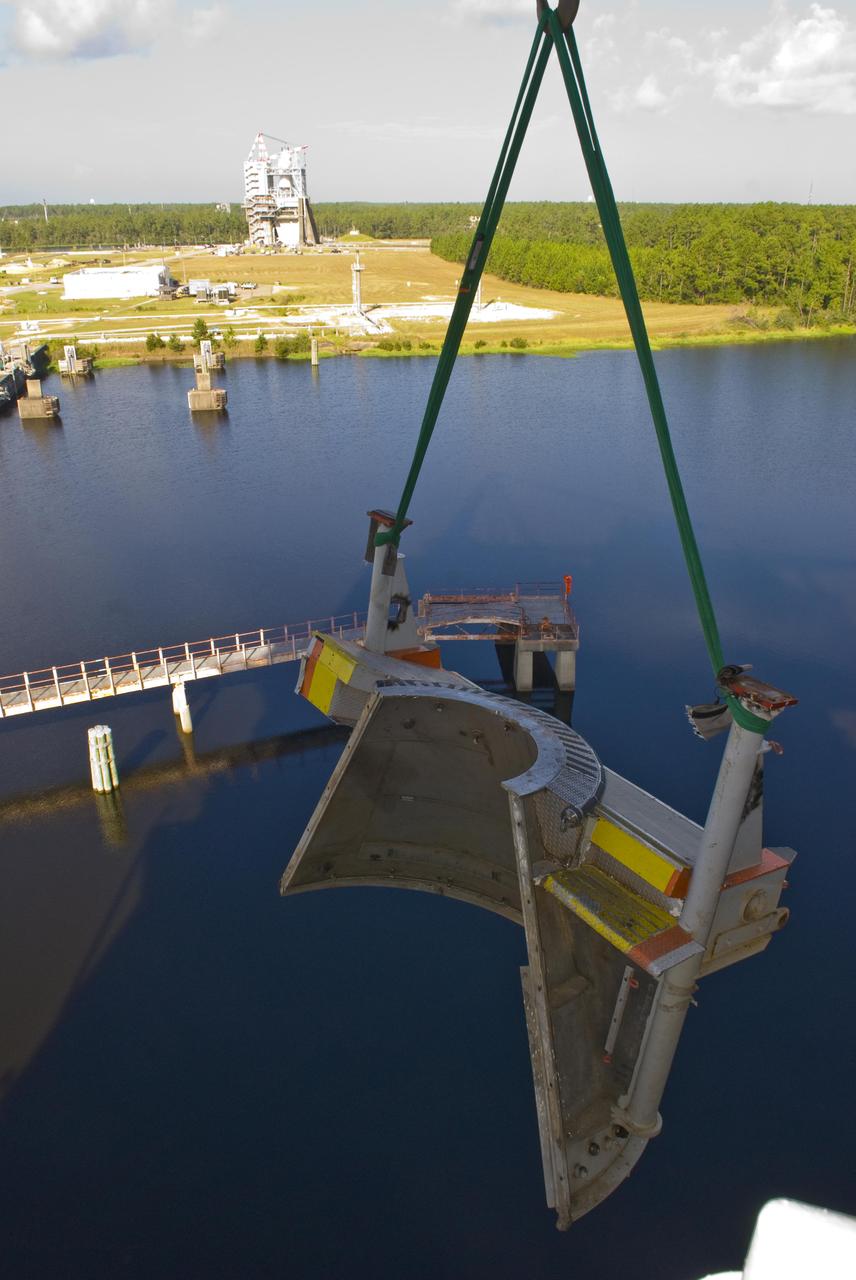
John C. Stennis Space Center employees remove one-half of the A-2 Test Stand clamshell used for testing space shuttle main engines. Space shuttle main engine testing concluded July 2009; the A-2 stand now is being prepared for testing the next-generation J-2X rocket engine in development. Testing of the J-2X engine is scheduled to begin in 2011.
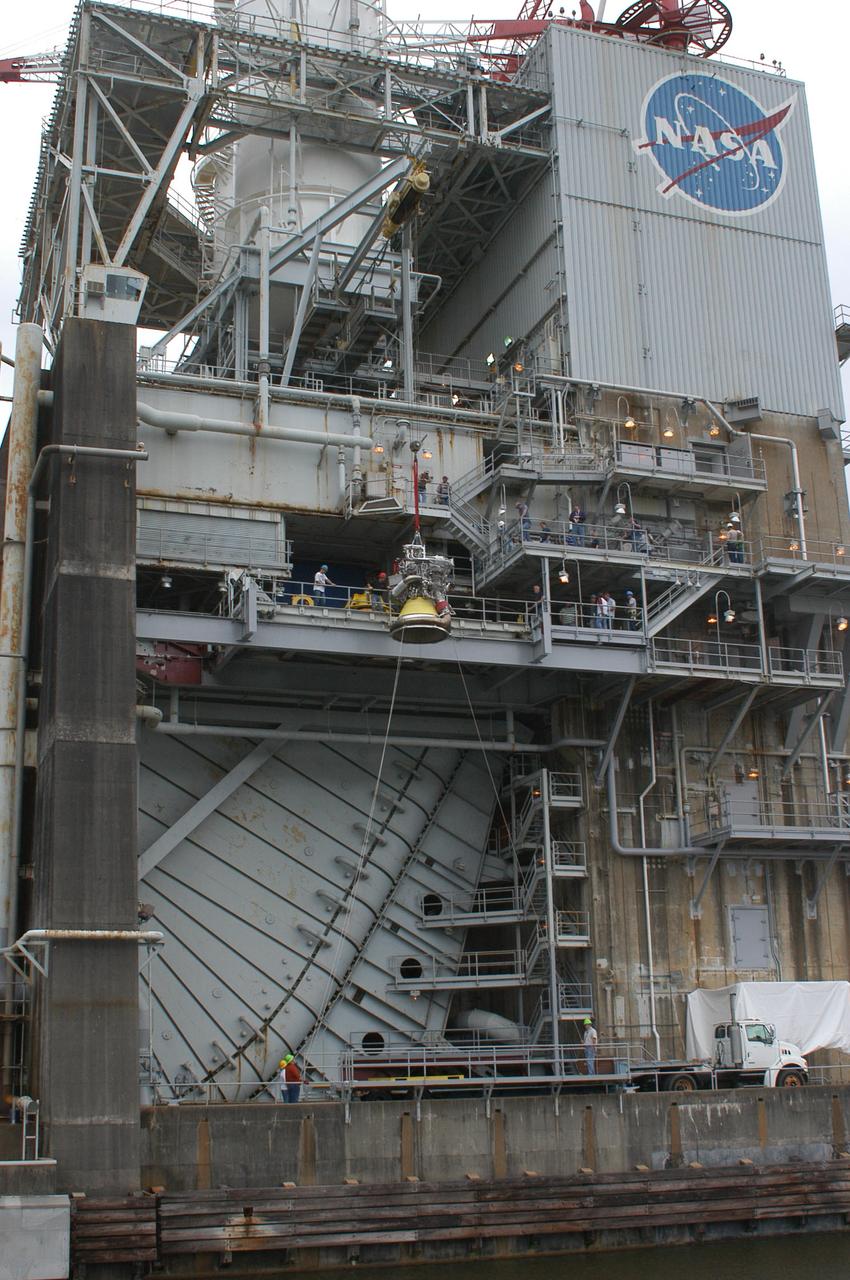
J-2X engine No. 10001 is returned March 8, 2012, to the A-2 Test Stand at Stennis Space Center for its second round of tests. The developmental engine underwent an initial series of tests last year. The J-2X engine is being built for NASA by Pratt & Whitney Rocketdyne.
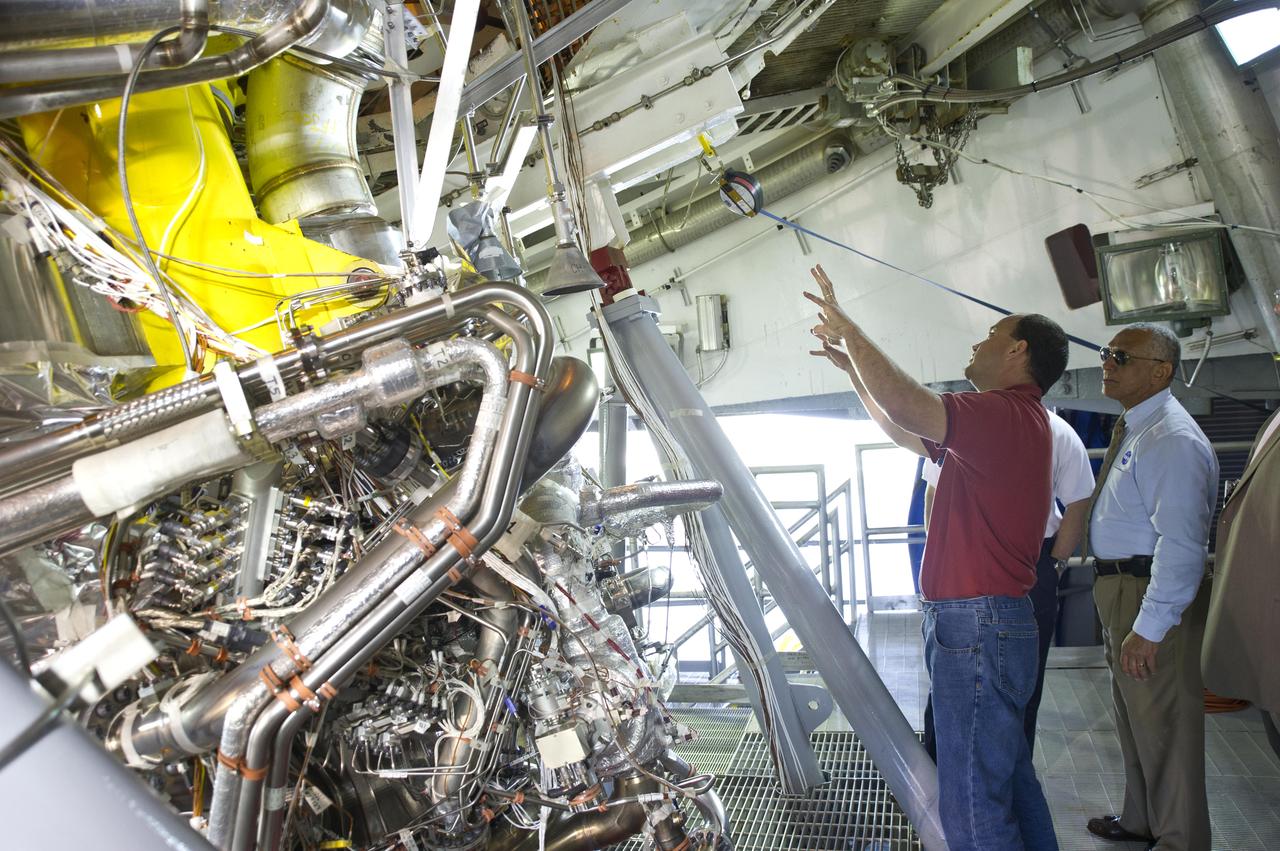
NASA Administrator Charles Bolden (r) takes an up-close look at the first development J-2X rocket engine on the A-2 Test Stand at Stennis Space Center during an April 20, 2012, visit. Pictured with Bolden is A-2 Test Stand Director Skip Roberts. The J-2X engine i s being developed for NASA by Pratt & Whitney Rocketdyne.
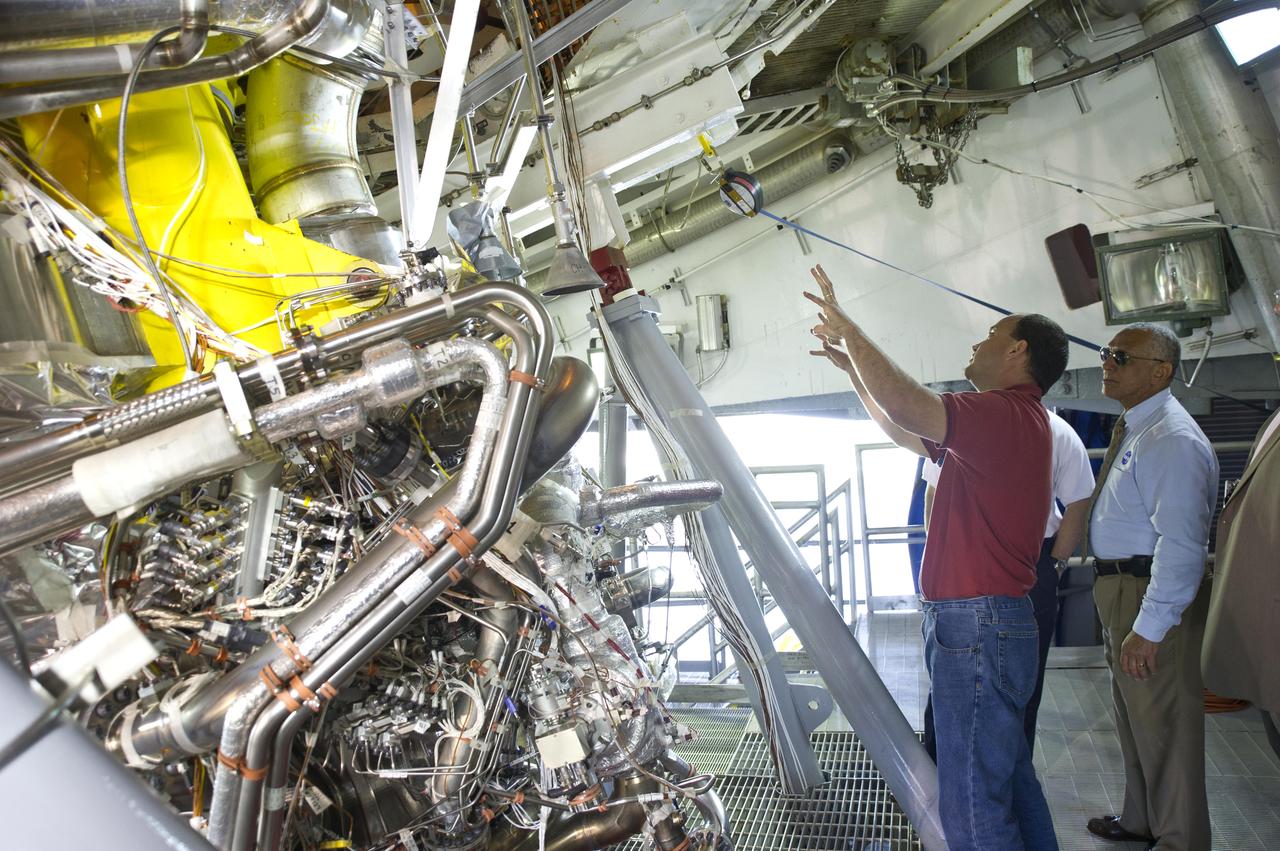
NASA Administrator Charles Bolden (r) takes an up-close look at the first development J-2X rocket engine on the A-2 Test Stand at Stennis Space Center during an April 20, 2012, visit. Pictured with Bolden is A-2 Test Stand Director Skip Roberts. The J-2X engine is being developed for NASA by Pratt & Whitney Rocketdyne.
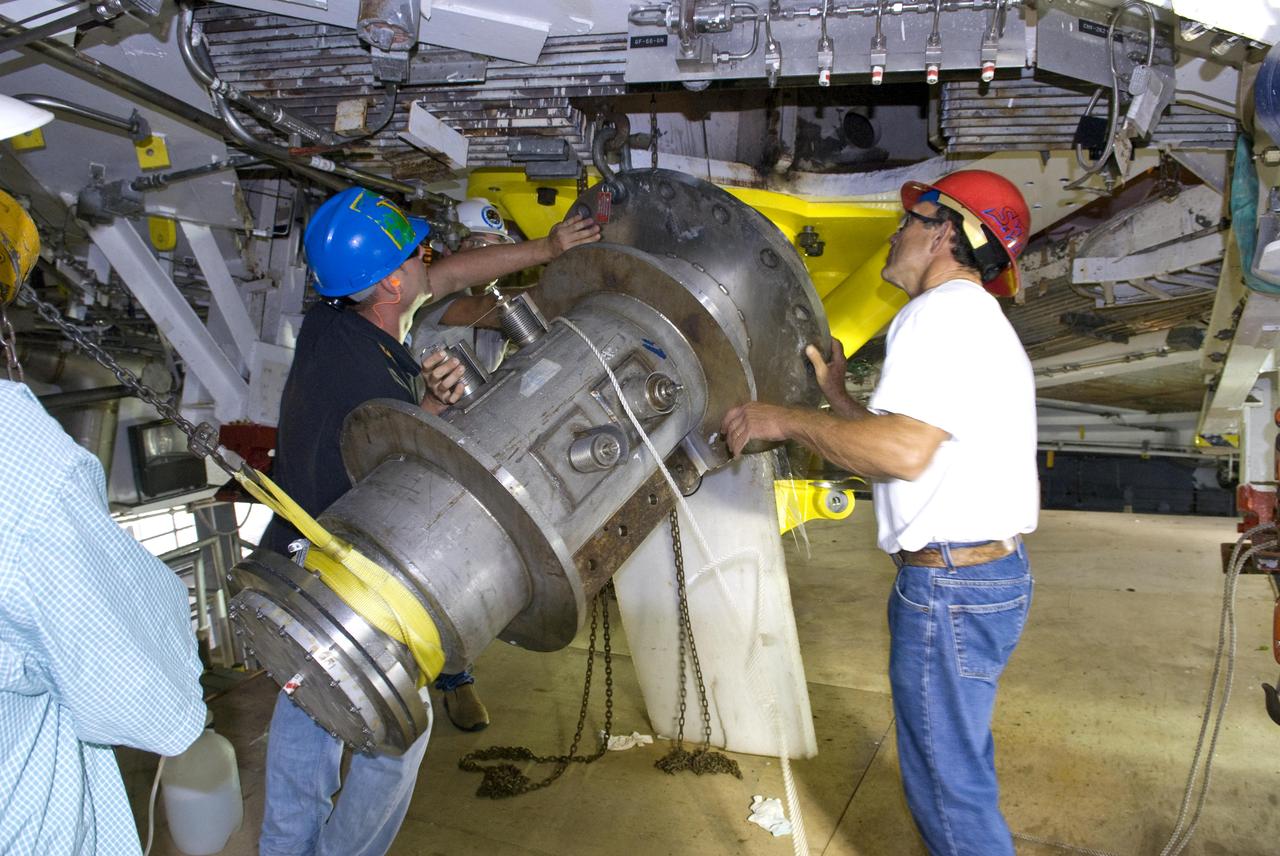
John C. Stennis Space Center employees remove space shuttle main engine run ducts from the A-2 Test Stand engine deck Oct. 25, 2010. Testing of space shuttle main engines concluded in July 2009. Stennis is preparing the A-2 Test Stand for testing the next-generation J-2X rocket engine being developed. Testing of the new engine is scheduled to begin in 2011.
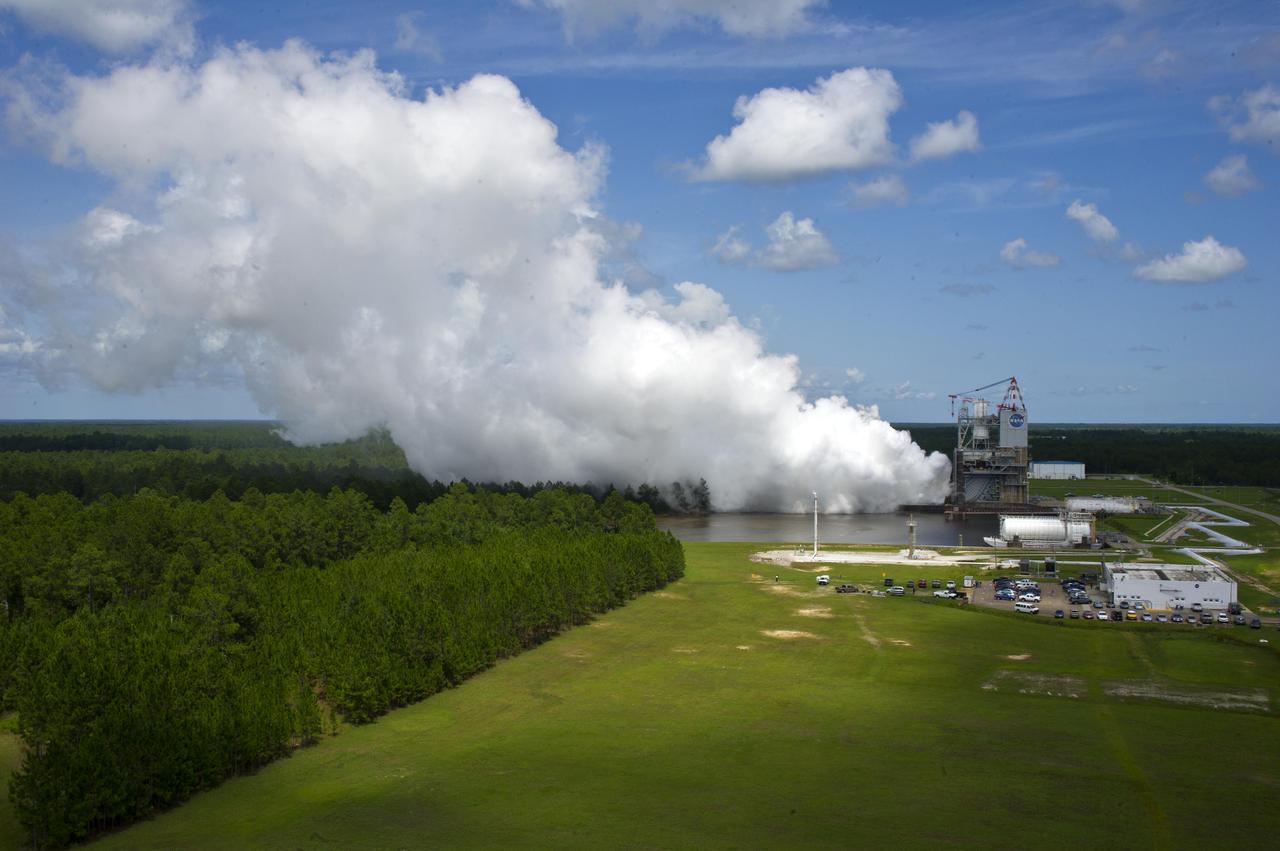
NASA's test of the J-2X rocket engine on the A-2 Test Stand at Stennis Space Center on July 13 was picture perfect in more ways than one. Not only did the test provide a breathtaking view from atop the nearby A-1 Test Stand, and with the center's B-1/B-2 Test Stand in the background, but it achieved its target of 550 seconds. The test continued a series of firings to gather critical data for engine development.
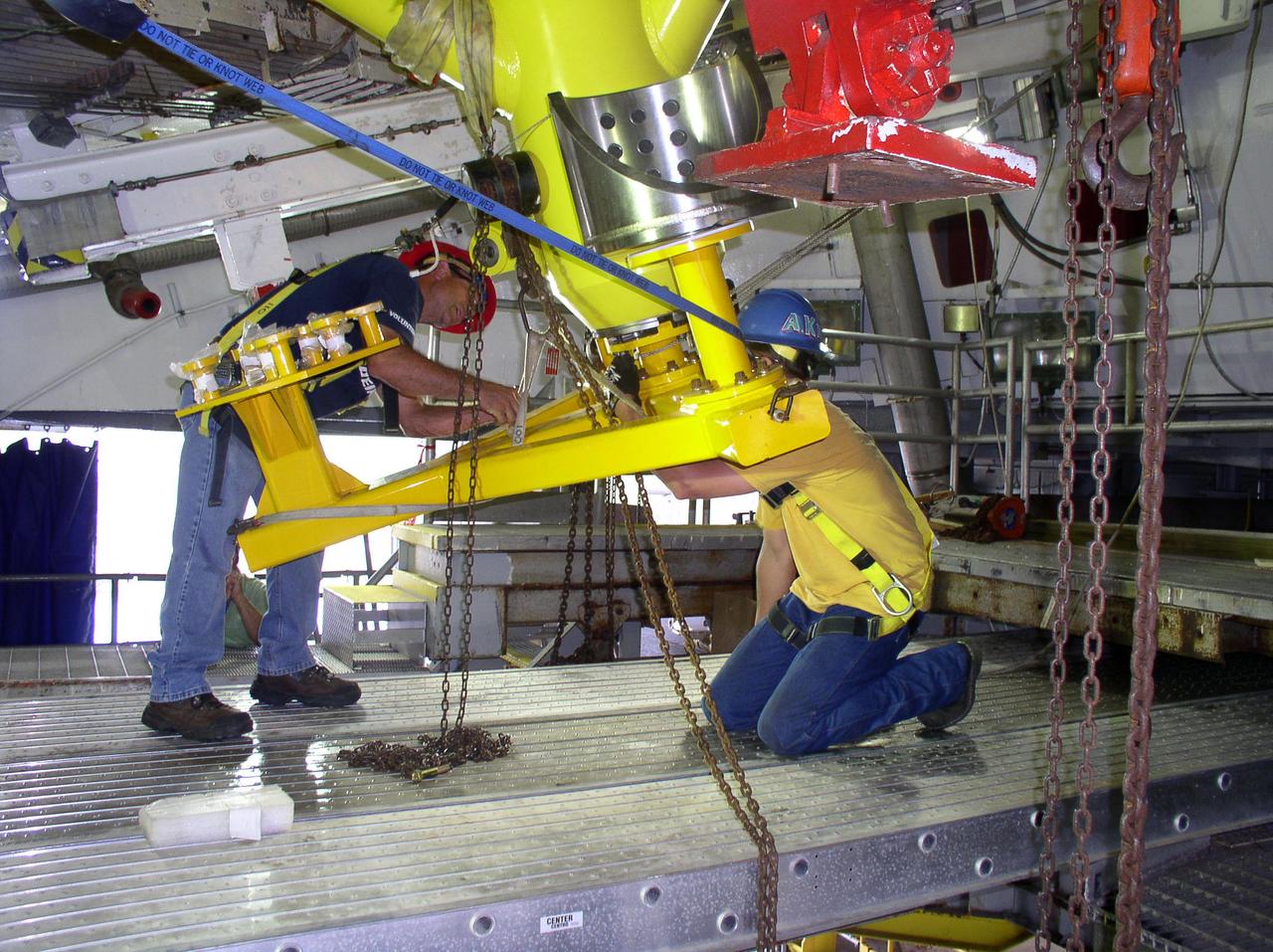
John C. Stennis Space Center employees install a new master interface tool on the A-2 Test Stand on Oct. 27, 2010. Until July 2009, the stand had been used for testing space shuttle main engines. With that test series complete, employees are preparing the stand for testing the next-generation J-2X rocket engine being developed. Testing of the new engine is scheduled to begin in 2011.
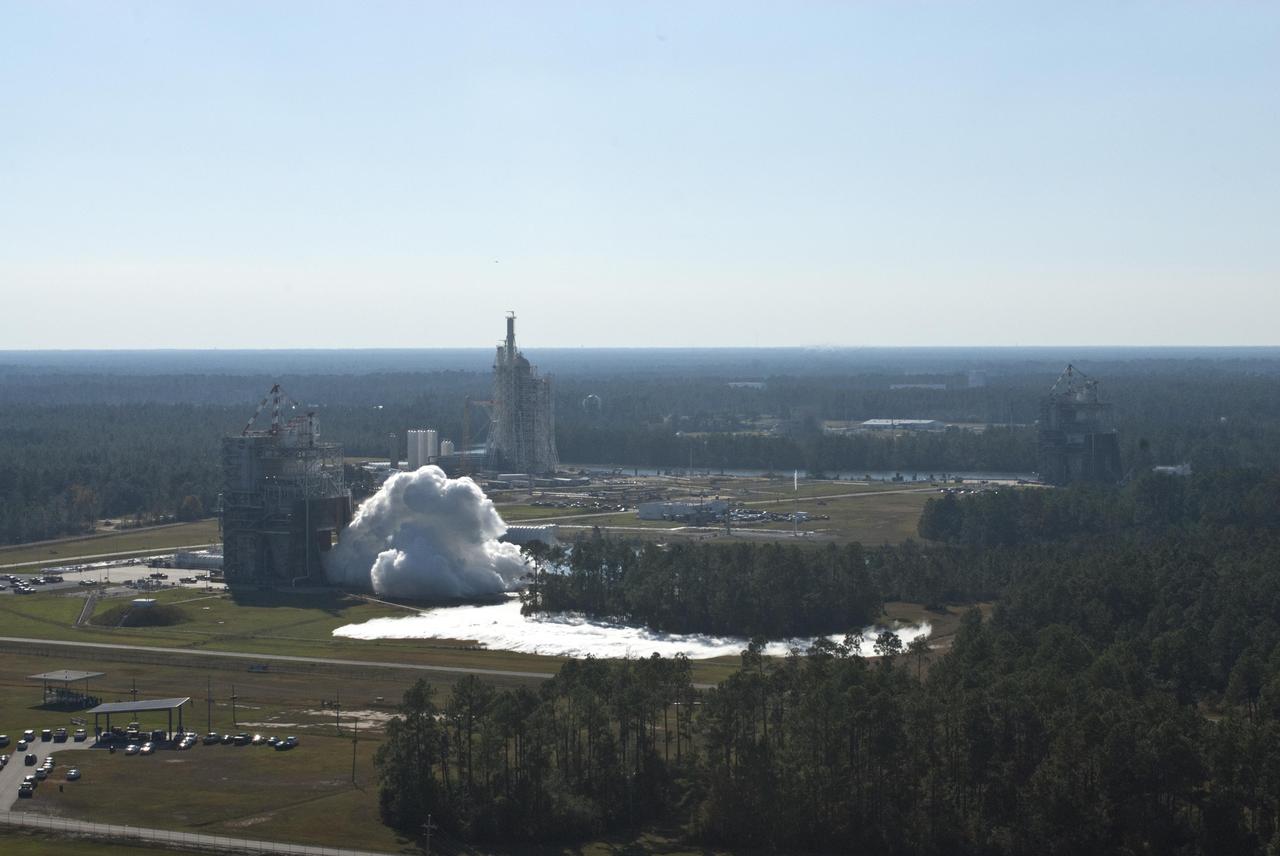
A photograph of a J-2X rocket engine on the A-2 Test Stand from atop the B Test Stand at Stennis Space Center offers a panoramic view of the A Test Complex. The J-2X engine is being developed for NASA by Pratt & Whitney Rocketdyne to carry humans deeper into space than ever before.
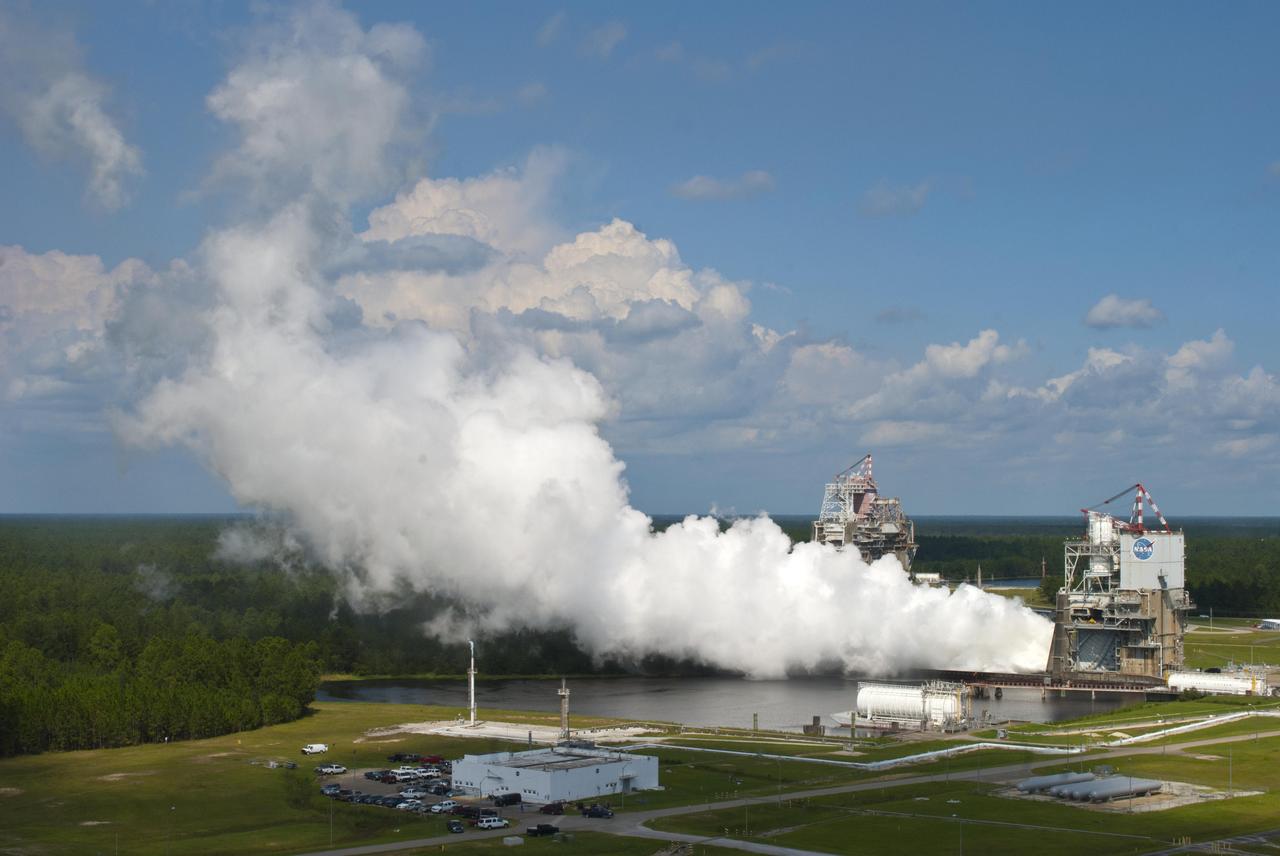
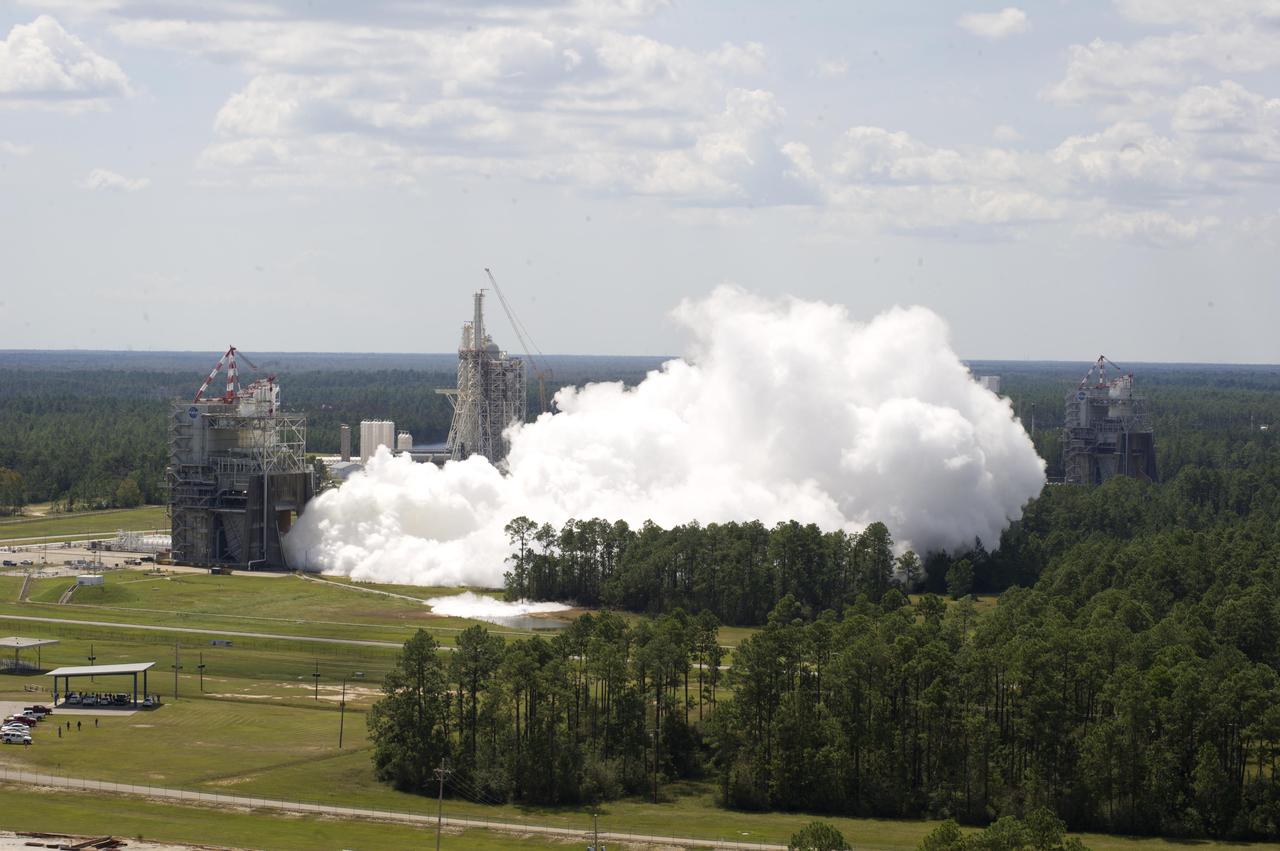
NASA engineers continued testing the next-generation J-2X rocket engine at Stennis Space Center with a 250-second test on Sept. 7. The test was the first conducted after the arrival of Hurricane Isaac forced closure of the Stennis facility for three days in late August. The est was conducted on the A-2 Test Stand at Stennis. The facility's B-1/B-2 Test Stand can be seen in the left background.
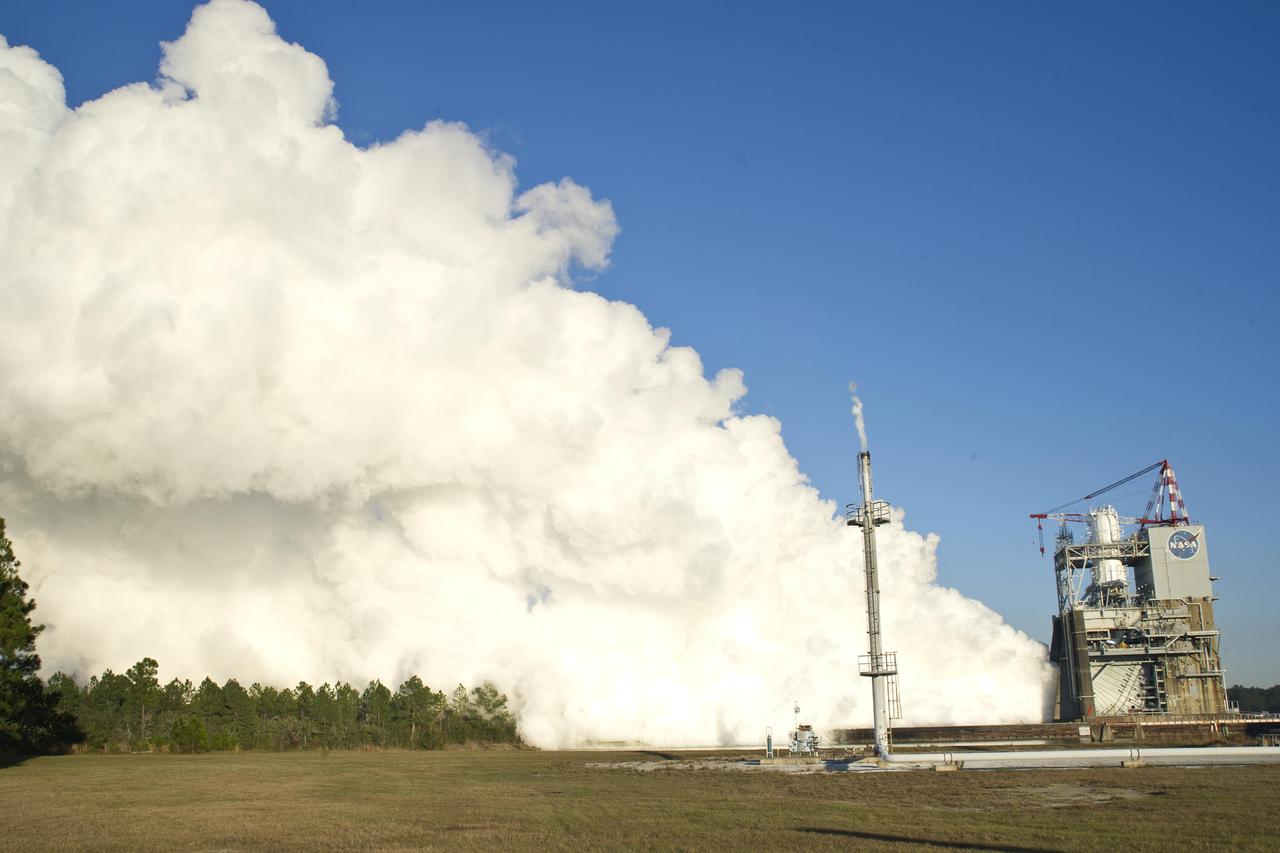
NASA conducted a key stability test firing of the J-2X rocket engine on the A-2 Test Stand at Stennis Space Center on Dec. 1, marking another step forward in development of the upper-stage engine that will carry humans deeper into space than ever before. The J-2X will provide upper-stage power for NASA's new Space Launch System.
NASA engineers continued to collect test performance data on the new J-2X rocket engine at Stennis Space Center with a 250-second test Sept. 14. The test on the A-2 Test Stand was the 19th in a series of firings to gather critical data for continued development of the engine. The J-2X is being developed by Pratt and Whitney Rocketdyne for NASA's Marshall Space Flight Center in Huntsville, Ala. It is the first liquid oxygen and liquid hydrogen rocket engine rated to carry humans into space to be developed in 40 years.
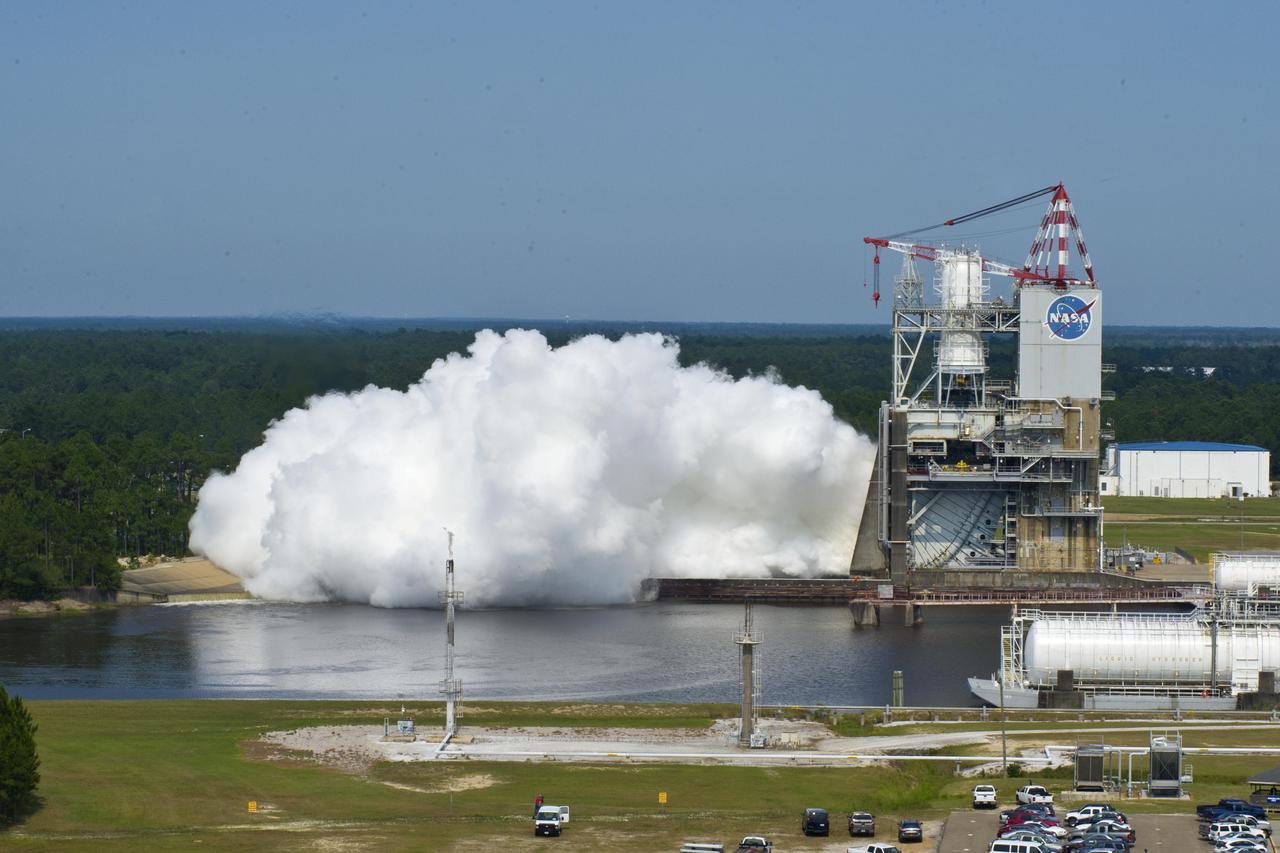
On May 25, 2012, NASA recorded another first during a 40-second test of the next-generation J-2X engine on the A-2 Test Stand at Stennis Space Center. Test conductors fired the J-2X in both the secondary and primary modes of operation. Previous tests were run in one mode only; combining the two allowed operators to collect critical data on engine performance.
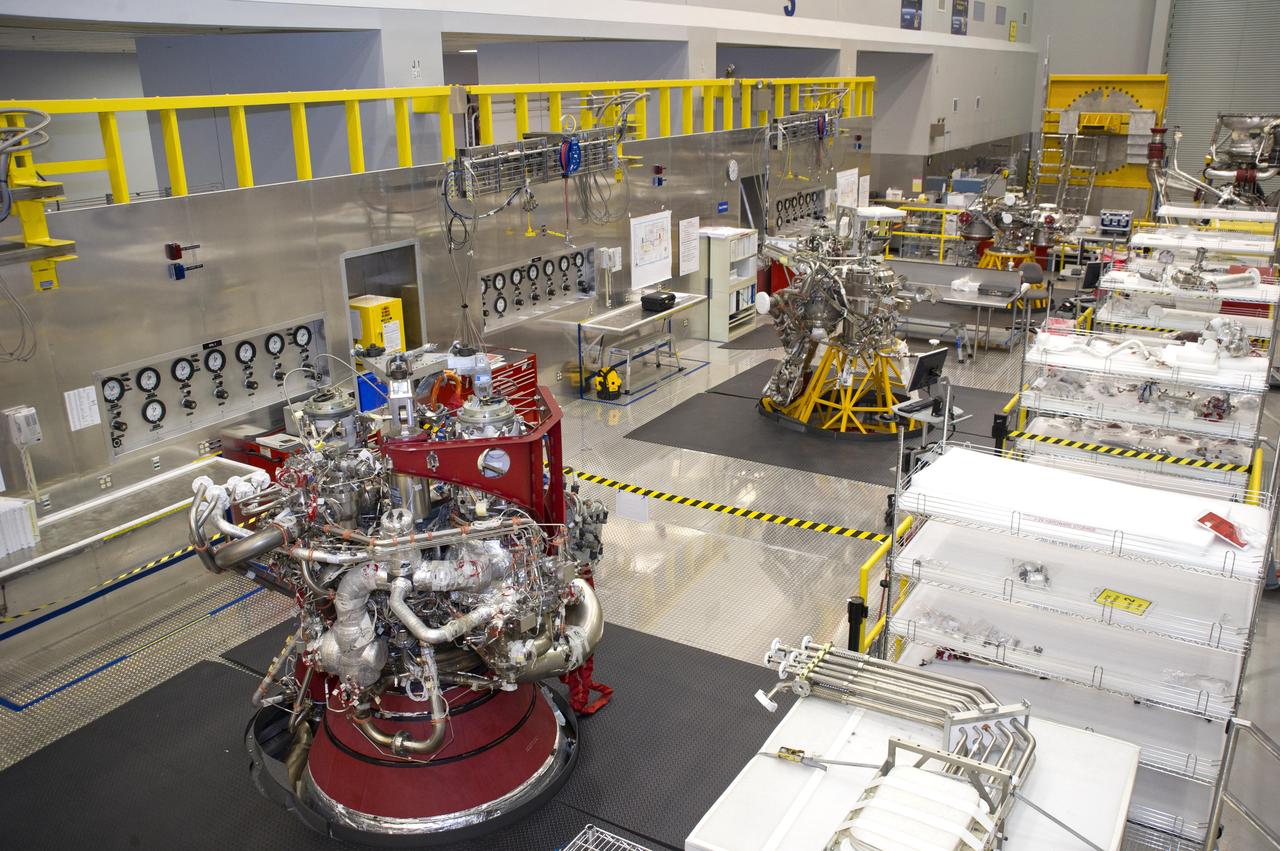
Two J-2X engines and a powerpack, developed for NASA by Pratt and Whitney Rocketdyne, sit side-by-side Oct. 11 at Stennis Space Center as work continues on the Space Launch System. Engine 10001 (far left) has been removed from the A-2 Test Stand after being hot-fire tested 21 times, for a total of 2,697 seconds. The engine is now undergoing a series of post-test inspections. A J-2X powerpack (center) has been removed from the A-1 Test Stand to receive additional instrumentation. So far, the powerpack been hot-fire tested 10 times, for a total of 4,162 seconds. Meanwhile, assembly on the second J-2X engine, known as Engine 10002 and located to the far right, has begun in earnest, with engine completion scheduled for this November. Engine 10002 is about 15 percent complete.
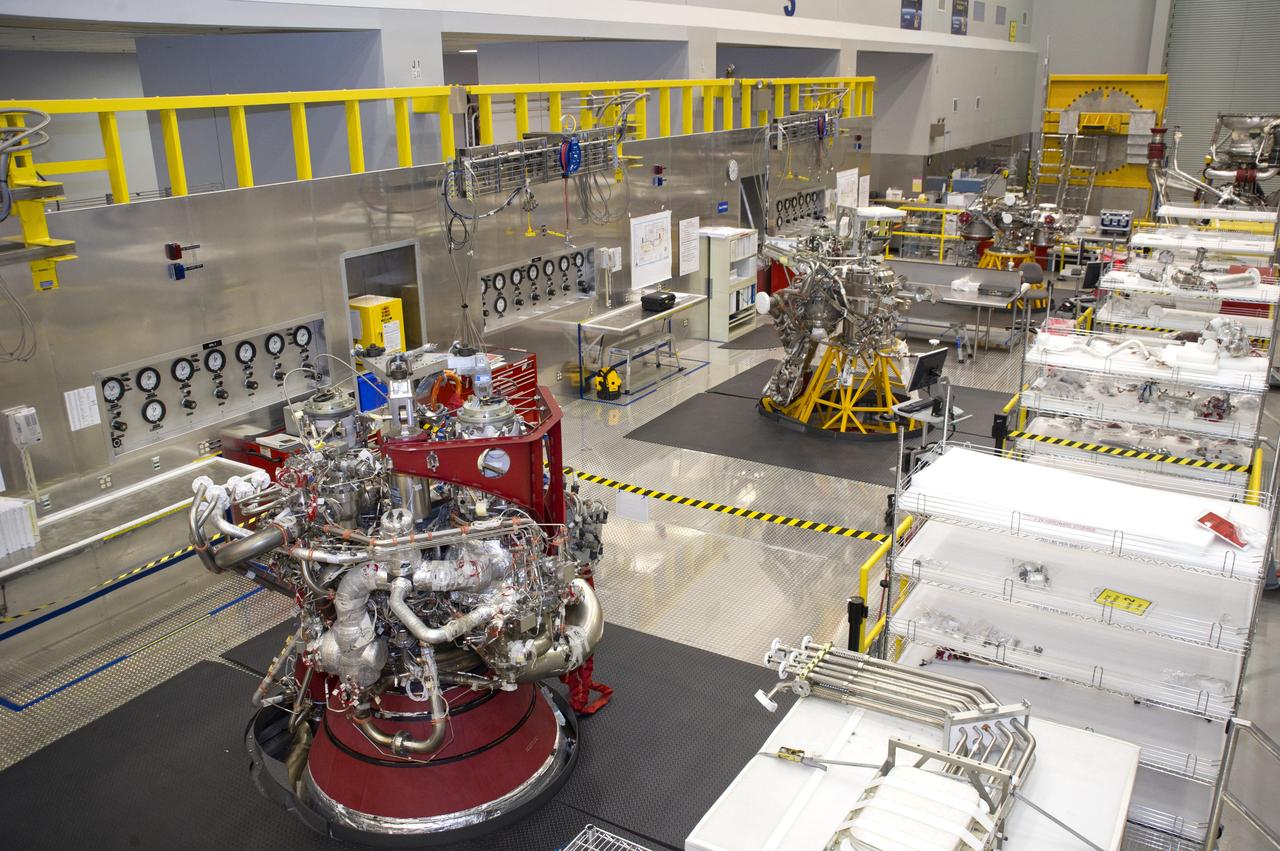
Two J-2X engines and a powerpack, developed for NASA by Pratt and Whitney Rocketdyne, sit side-by-side Oct. 11 at Stennis Space Center as work continues on the Space Launch System. Engine 10001 (far left) has been removed from the A-2 Test Stand after being hot-fire tested 21 times, for a total of 2,697 seconds. The engine is now undergoing a series of post-test inspections. A J-2X powerpack (center) has been removed from the A-1 Test Stand to receive additional instrumentation. So far, the powerpack been hot-fire tested 10 times, for a total of 4,162 seconds. Meanwhile, assembly on the second J-2X engine, known as Engine 10002 and located to the far right, has begun in earnest, with engine completion scheduled for this November. Engine 10002 is about 15 percent complete.
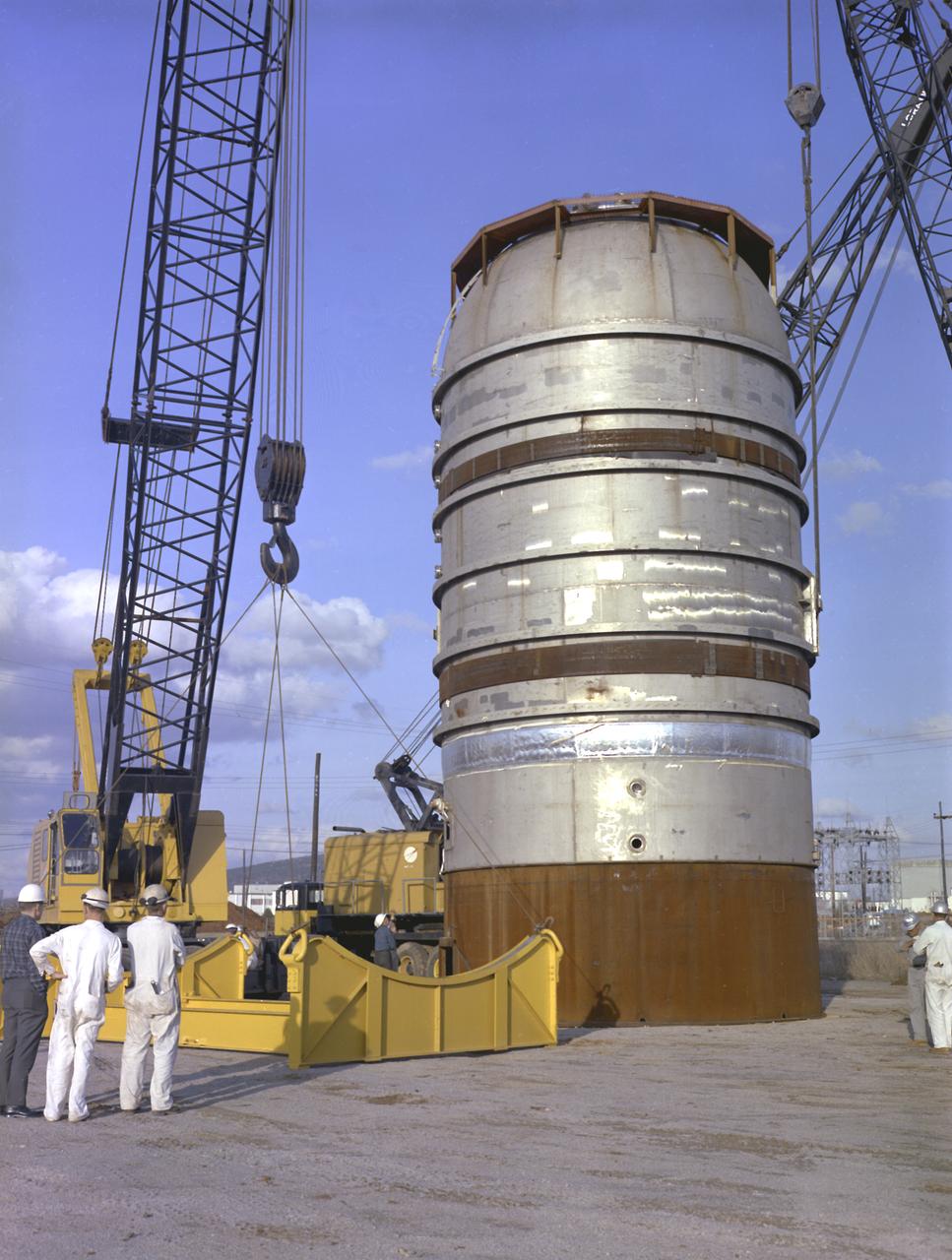
Workers at the Marshall Space Flight Center (MSFC) move a facility test version of the Saturn IB launch vehicle's second stage, the S-IVB, to the J-2 test stand on February 10, 1965. Also known as a "battleship" because of its heavy, rugged construction, the non-flight, stainless-steel model was used to check out testing facilities at MSFC.
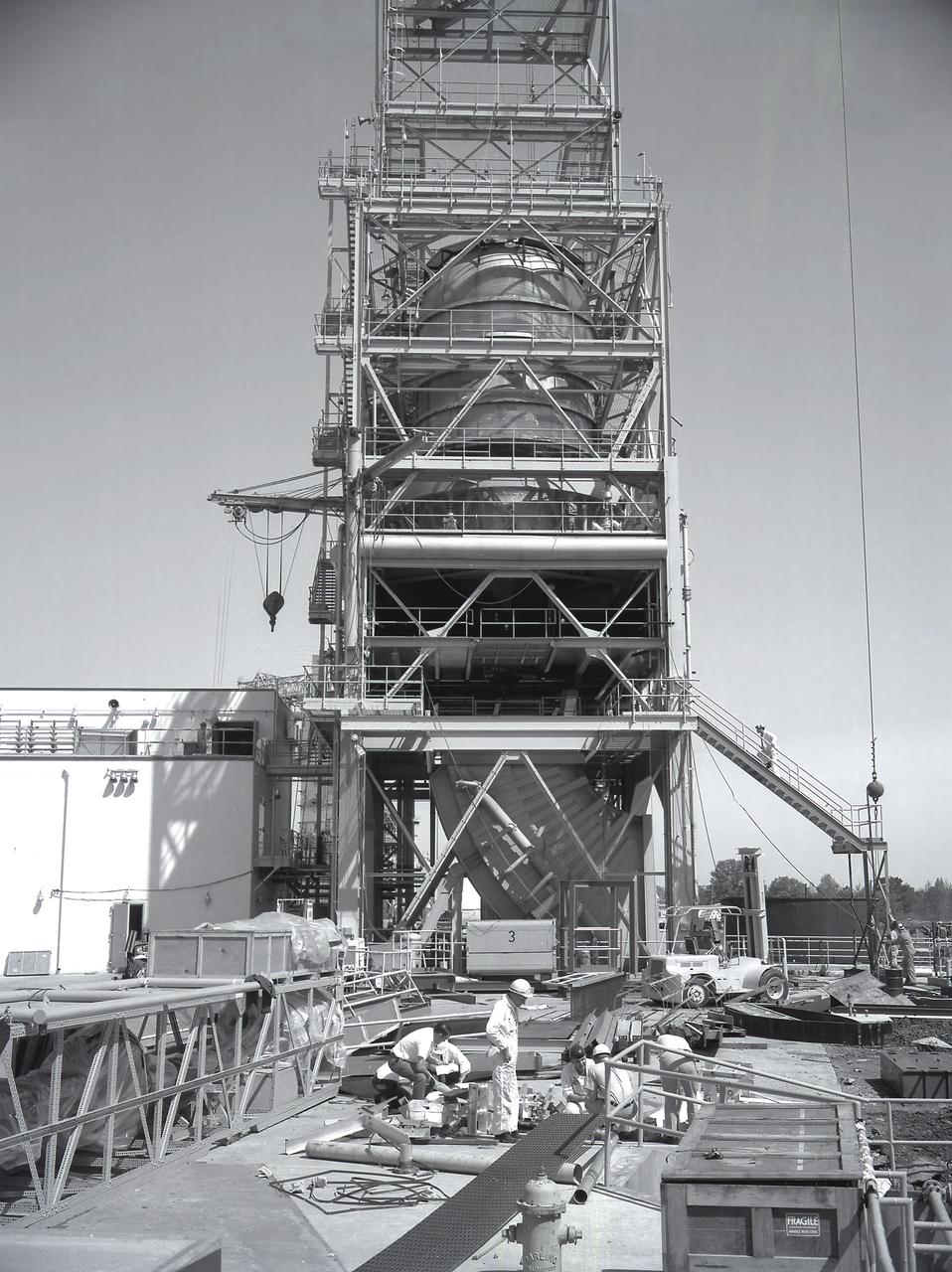
A facility test version of the S-IVB, the second stage of the Saturn IB launch vehicle, sits in the Marshall Space Flight Center (MSFC) J-2 test stand on February 10, 1965. Also known as a "battleship" because of its heavy, rugged construction, the non-flight, stainless-steel model was used to check out testing facilities at MSFC.
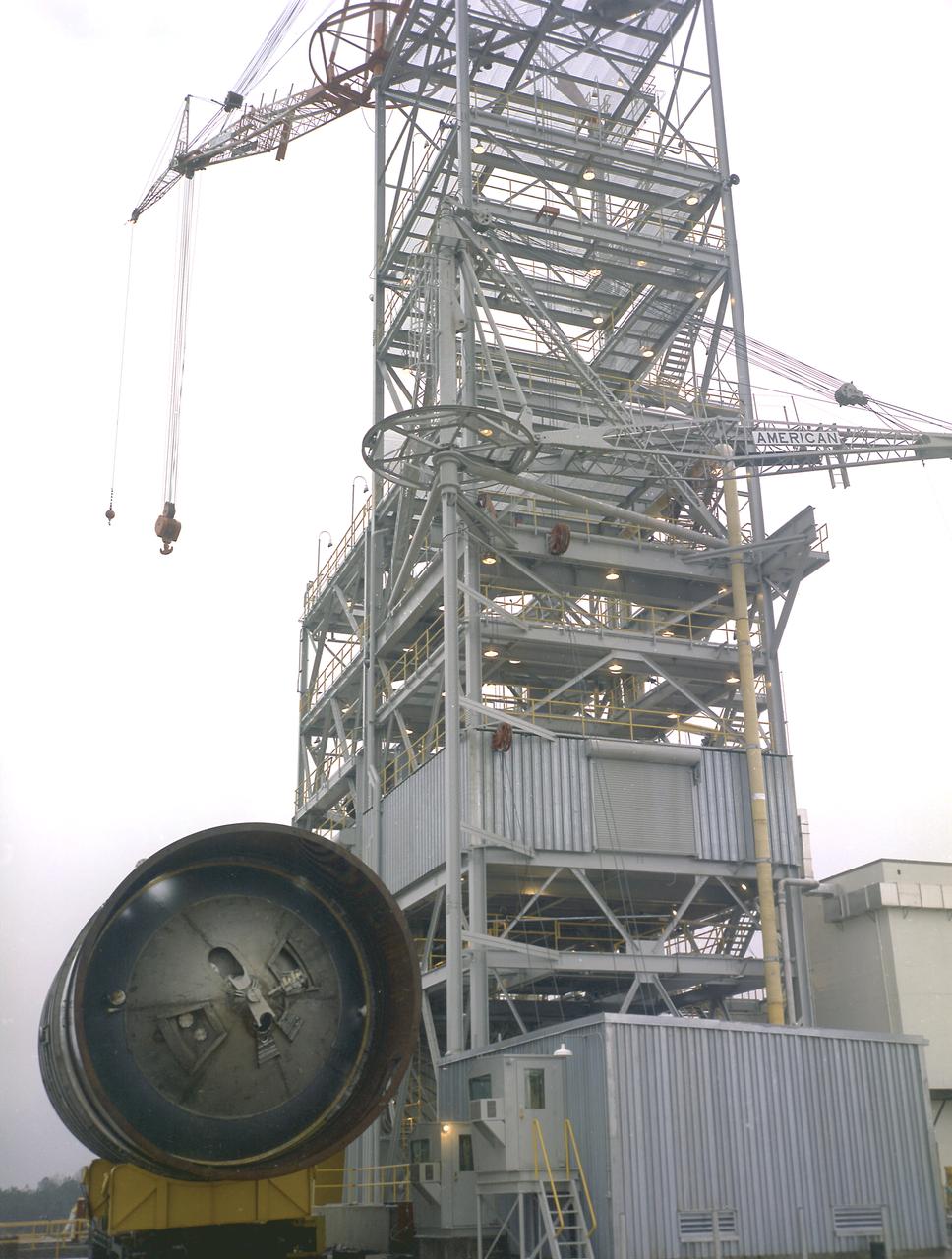
Workers at the Marshall Space Flight Center (MSFC) move a facility test version of the Saturn IB launch vehicle's second stage, the S-IVB, to the J-2 test stand on February 10, 1965. Also known as a "battleship" because of its heavy, rugged construction, the non-flight, stainless-steel model was used to check out testing facilities at MSFC.
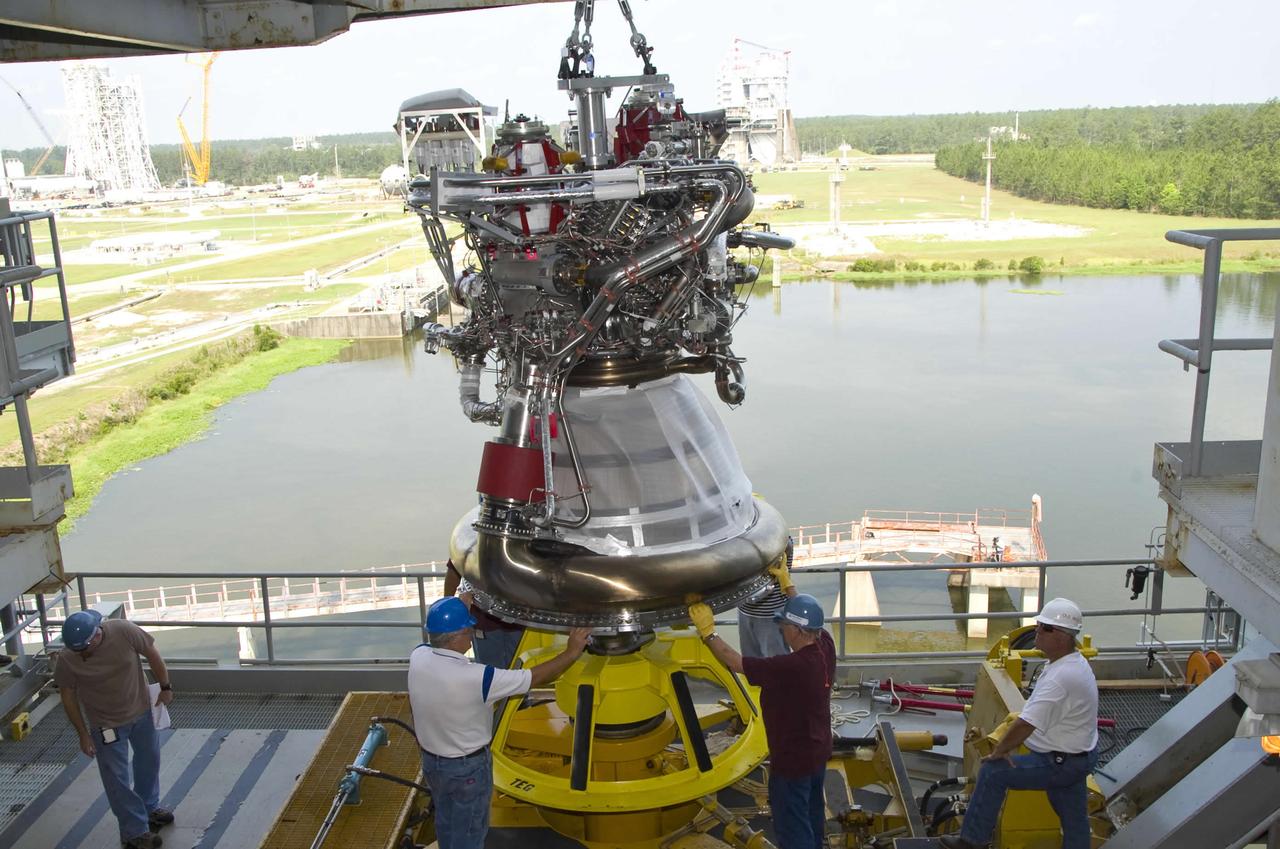
A J-2X next-generation rocket engine is lifted onto the A-2 Test Stand at Stennis Space Center. Testing of the engine began the following month. The engine is being developed for NASA by Pratt & Whitney Rocketdyne and could help carry humans beyond low-Earth orbit into deep space once more.
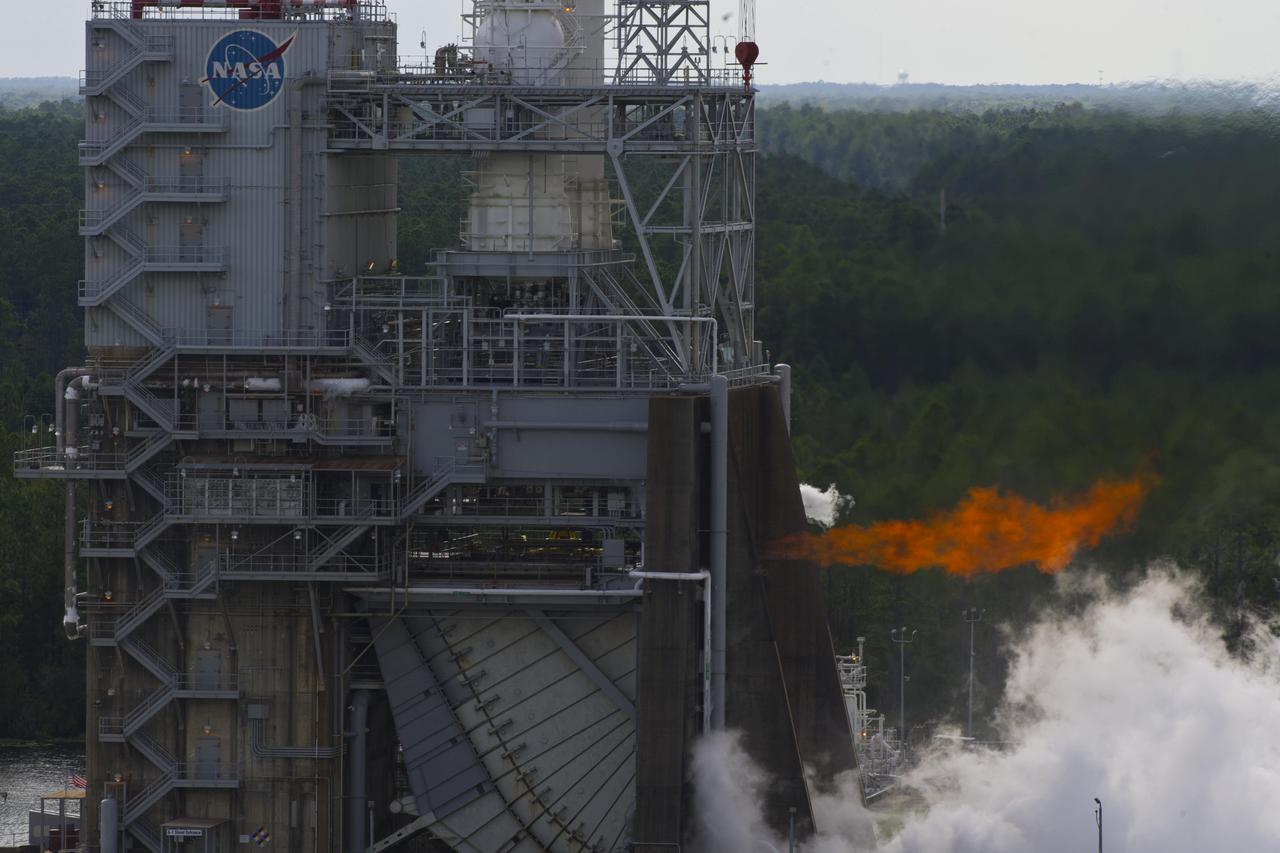
NASA conducted a long-duration test of the J-2X powerpack, 1,261 seconds total, on the A-1 Test Stand at Stennis Space Center on Aug. 16, marking another step in development of the next-generation rocket engine. The powerpack is a system of components on the top portion of the J-2X engine, including the gas generator, oxygen and fuel turbopumps, and related ducts and valves.
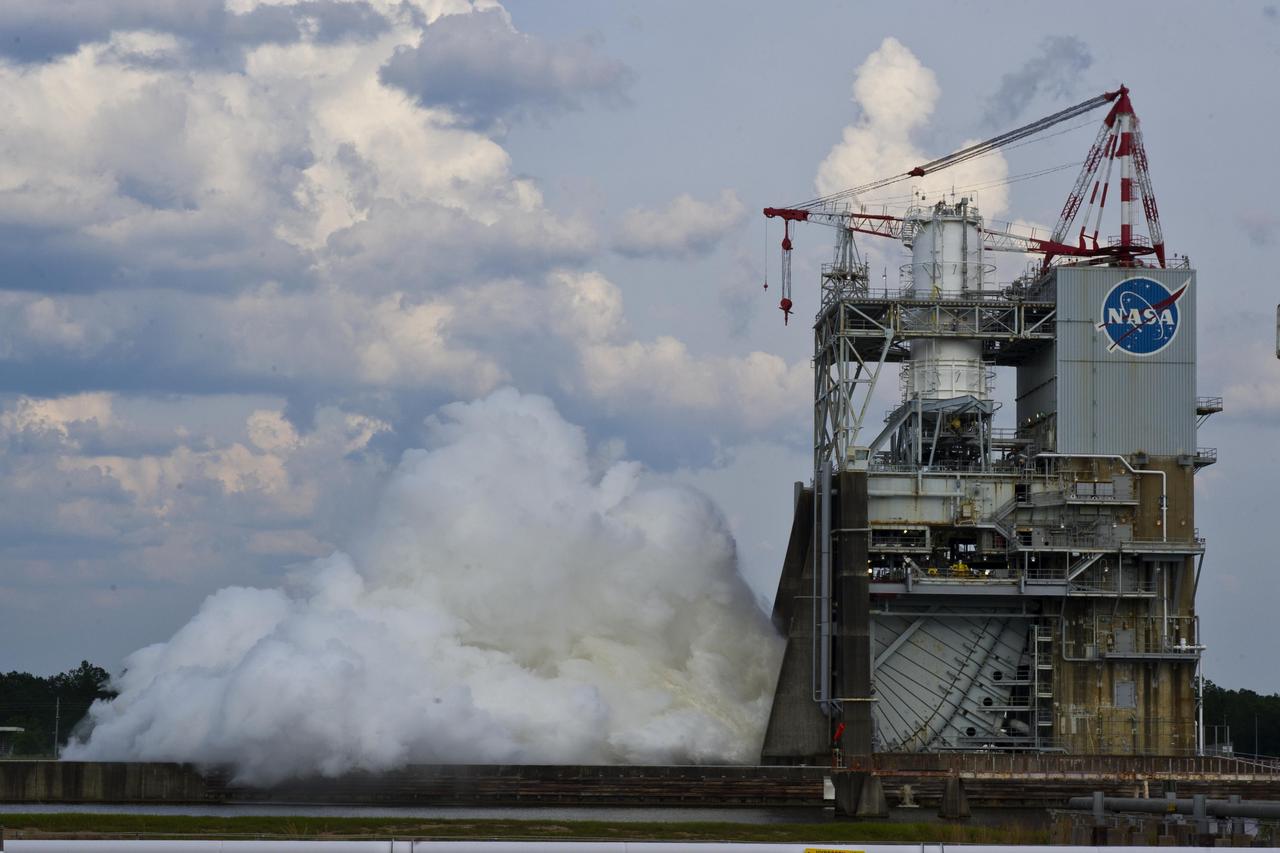
On May 16, 2012, engineers at Stennis Space Center conducted a test of the next-generation J-2X engine that will help power NASA's new Space Launch System, moving NASA even closer to a return to deep space.
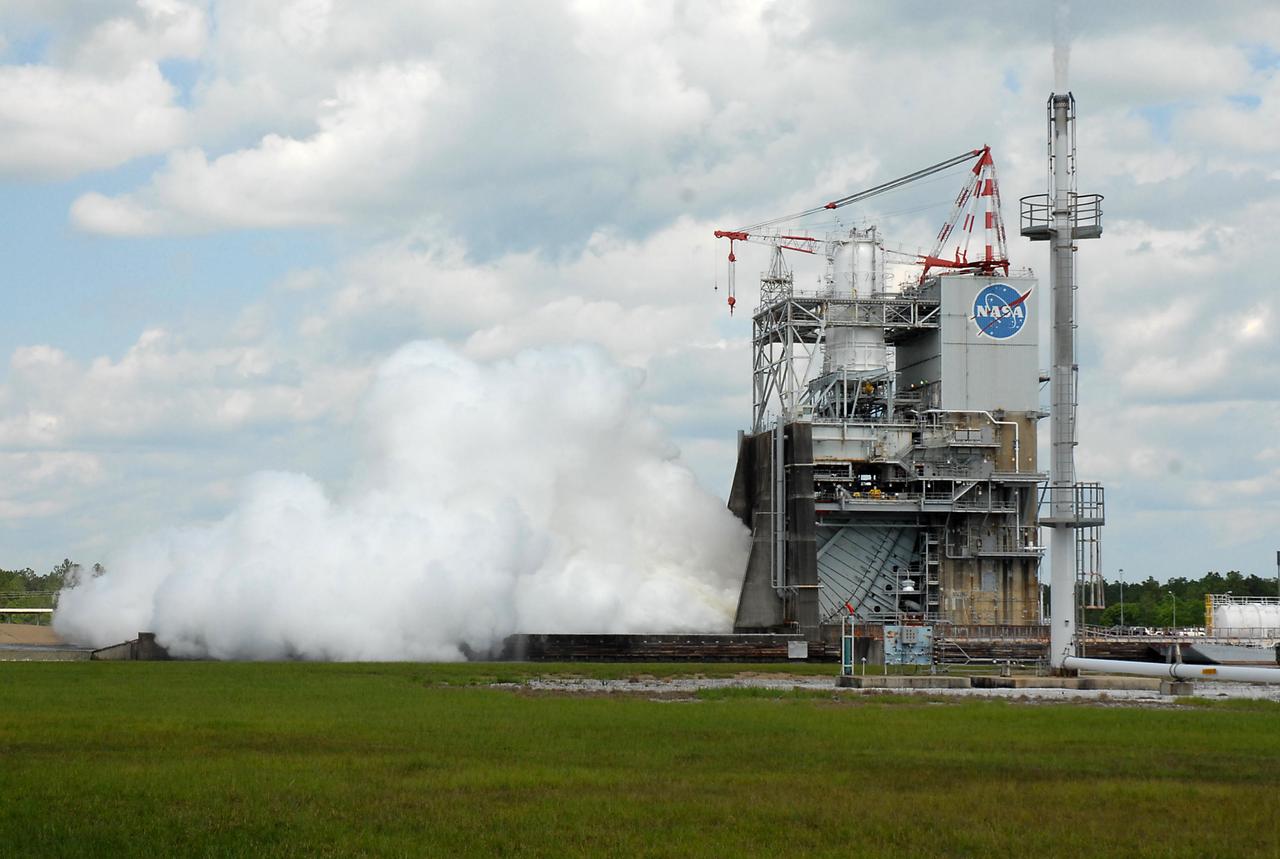
NASA engineers at Stennis Space Center conducted a 260-second test of the next-generation J-2X rocket engine June 13, 2012. As in a previous test, NASA engineers fired the engine at both secondary and primary modes to collect performance data.
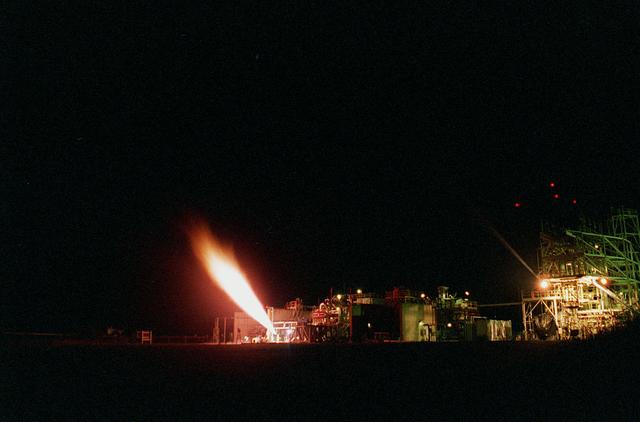
A J-2 Gas Generator (GG) engine's duration test at Marshall's Test Stand-116.
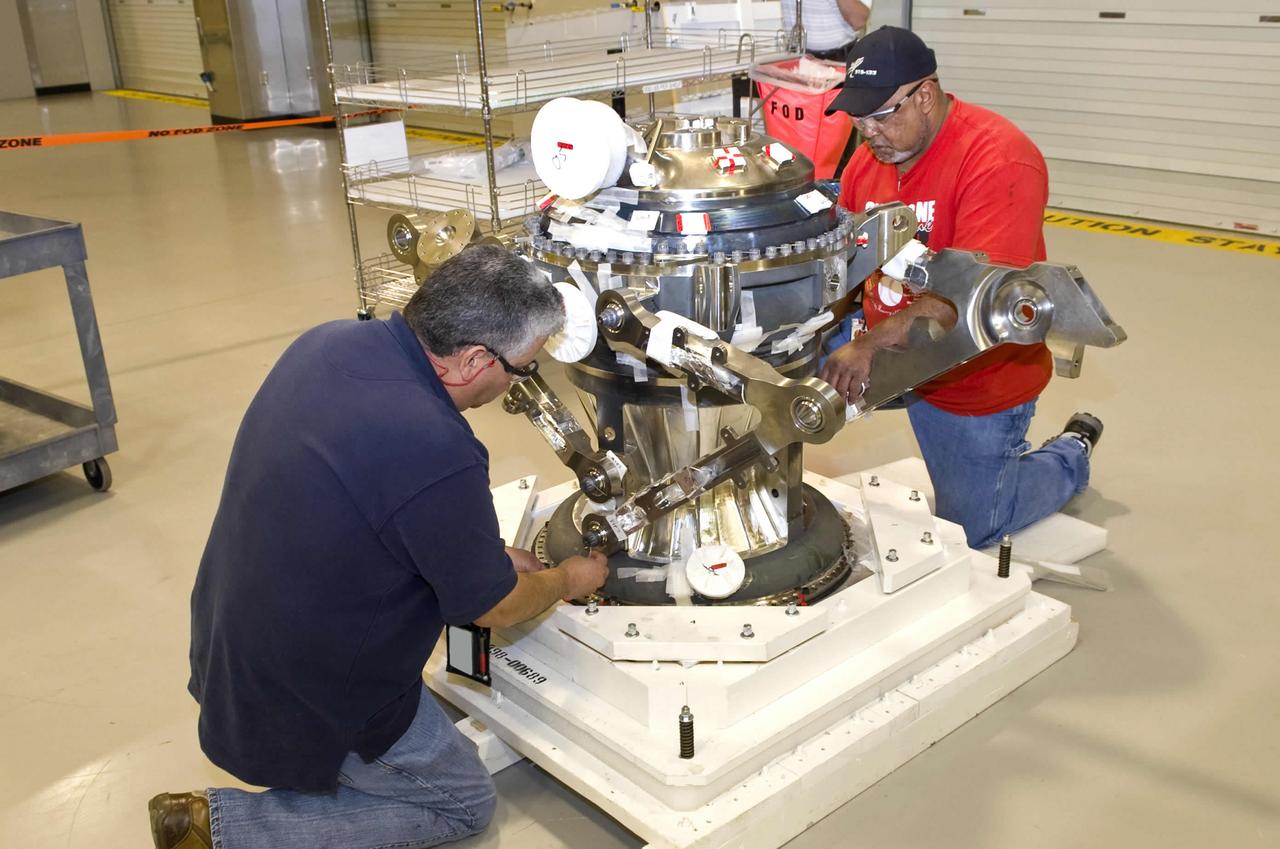
Pratt & Whitney Rocketdyne employees Carlos Alfaro (l) and Oliver Swanier work on the main combustion element of the J-2X rocket engine at their John C. Stennis Space Center facility. Assembly of the J-2X rocket engine to be tested at the site is under way, with completion and delivery to the A-2 Test Stand set for June. The J-2X is being developed as a next-generation engine that can carry humans into deep space. Stennis Space Center is preparing a trio of stands to test the new engine.
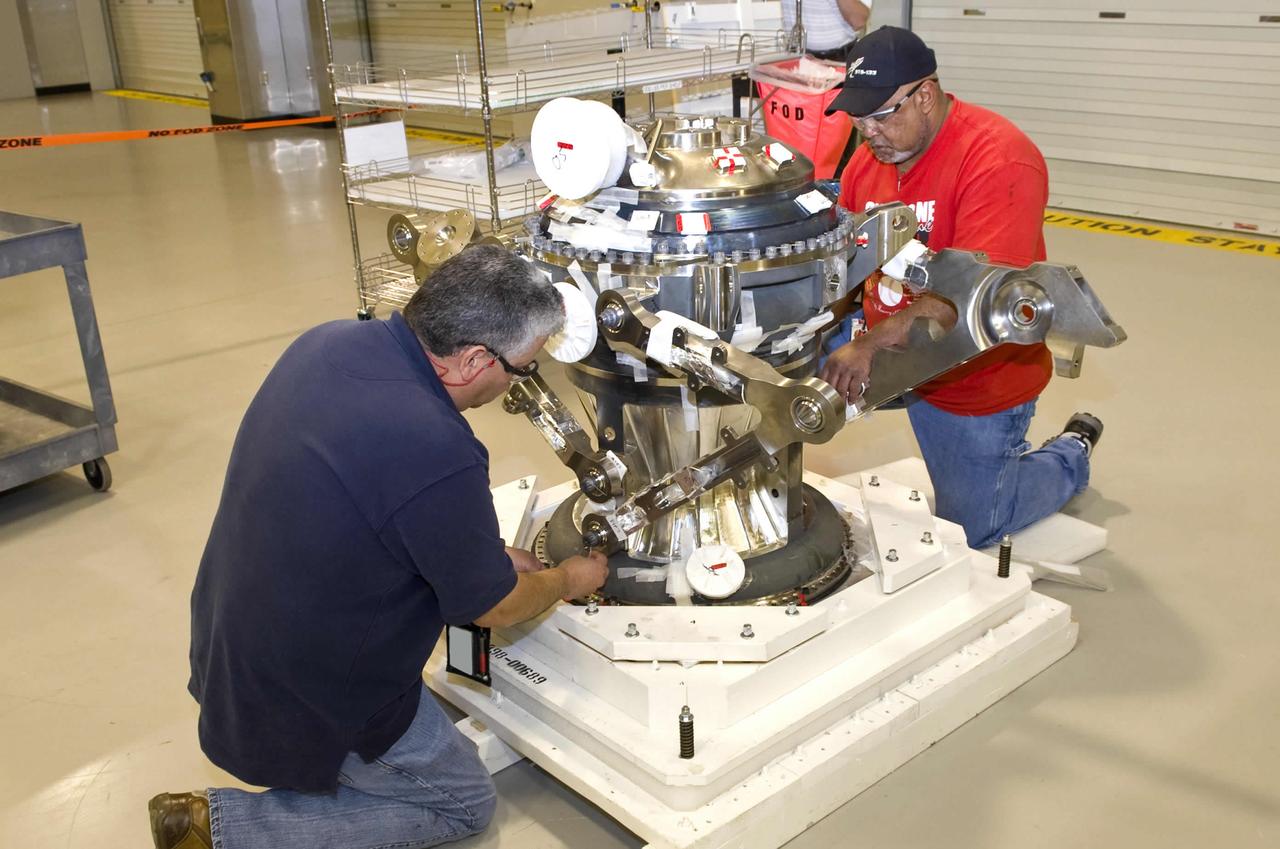
Pratt & Whitney Rocketdyne employees Carlos Alfaro (l) and Oliver Swanier work on the main combustion element of the J-2X rocket engine at their John C. Stennis Space Center facility. Assembly of the J-2X rocket engine to be tested at the site is under way, with completion and delivery to the A-2 Test Stand set for June. The J-2X is being developed as a next-generation engine that can carry humans into deep space. Stennis Space Center is preparing a trio of stands to test the new engine.
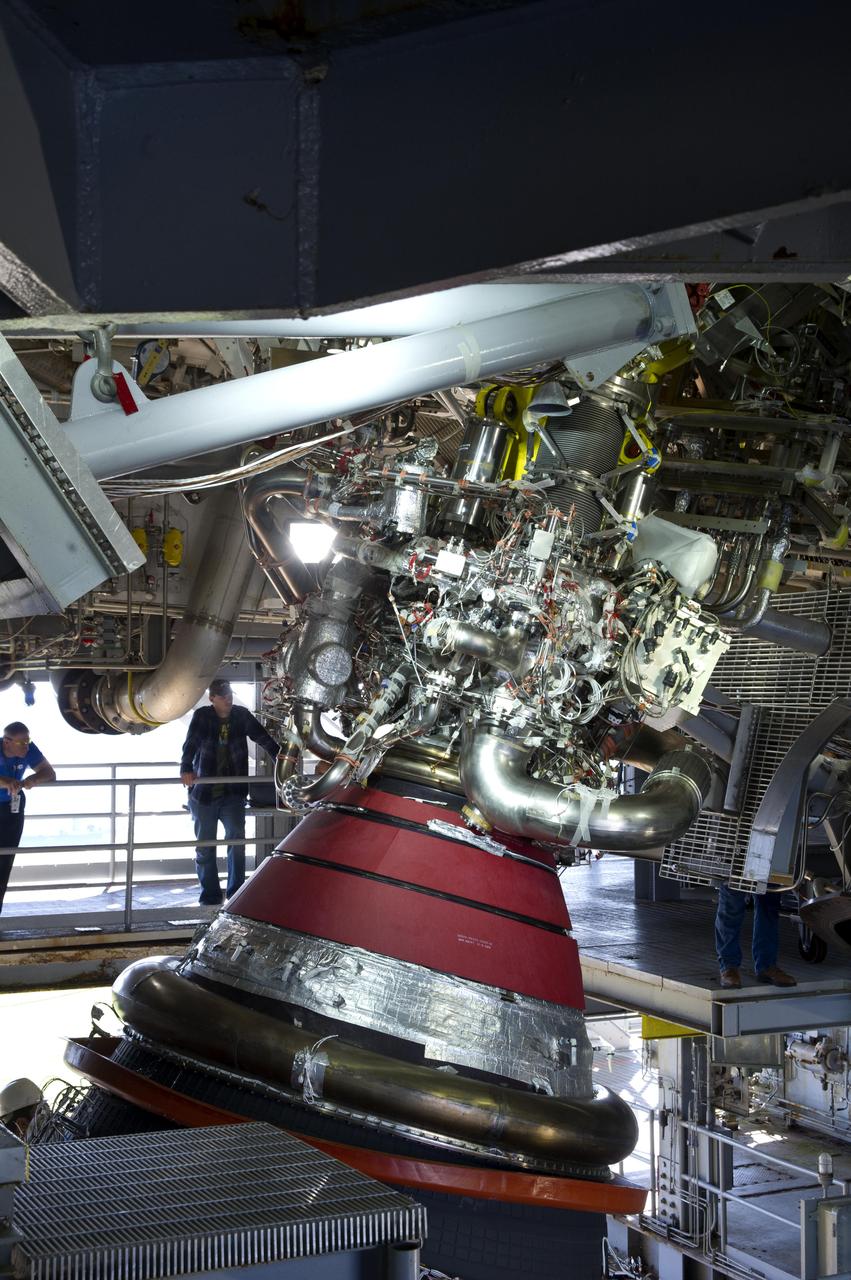
NASA removed J-2X engine No. 10001 from the A-2 Test Stand at Stennis Space Center in early October. Opening of the test stand clamshell flooring allowed a clear view of the next-generation engine and stub nozzle, which is being built to help power future deep-space missions. The engine is an upgrade from the heritage J-2 rocket engine, which helped power Apollo missions to the moon during the late 1960s and early 1970s.
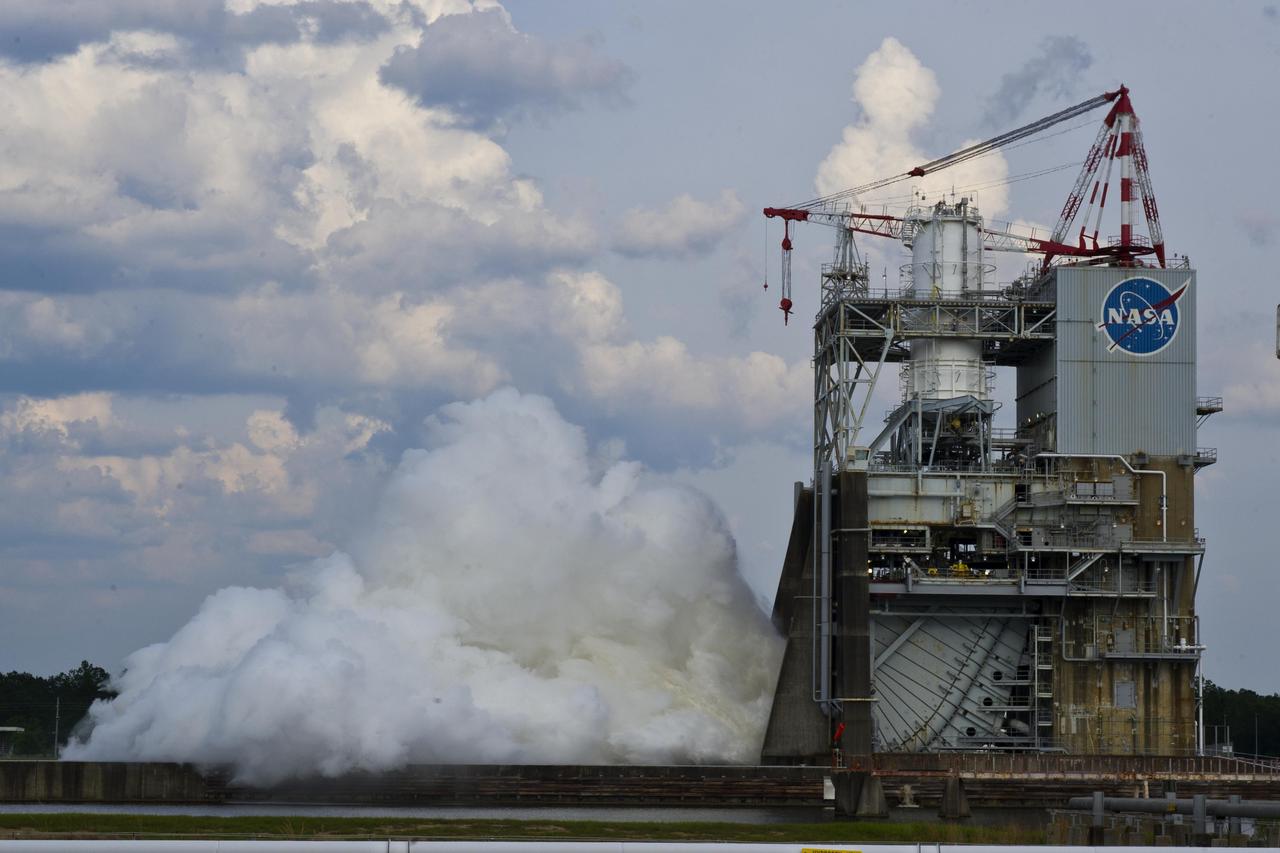
NASA conducted a successful seven-second test of the next-generation J-2X rocket engine on the A-2 Test Stand at Stennis Space Center on May 16, 2012. The J-2X is being developed for NASA by Pratt & Whitney Rocketdyne.
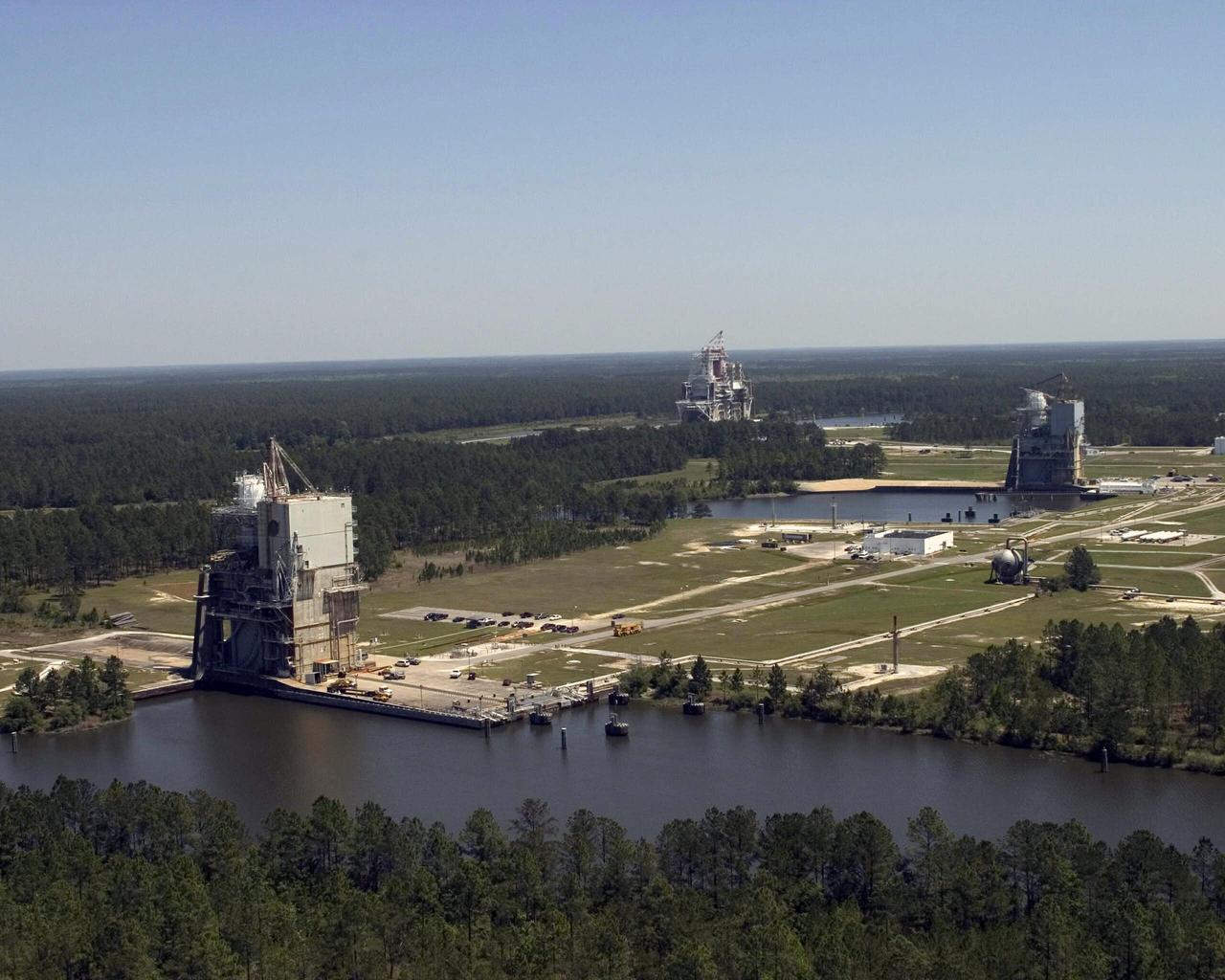
SSC's A-1, A-2 and B test stands were built in the early 1960s to test the first and second stages of the Apollo Saturn V rocket that safely transported Americans to the moon. The A-1 Stand (foreground) will soon test the J-2X engines that will power the rockets to take Americans back to the moon.
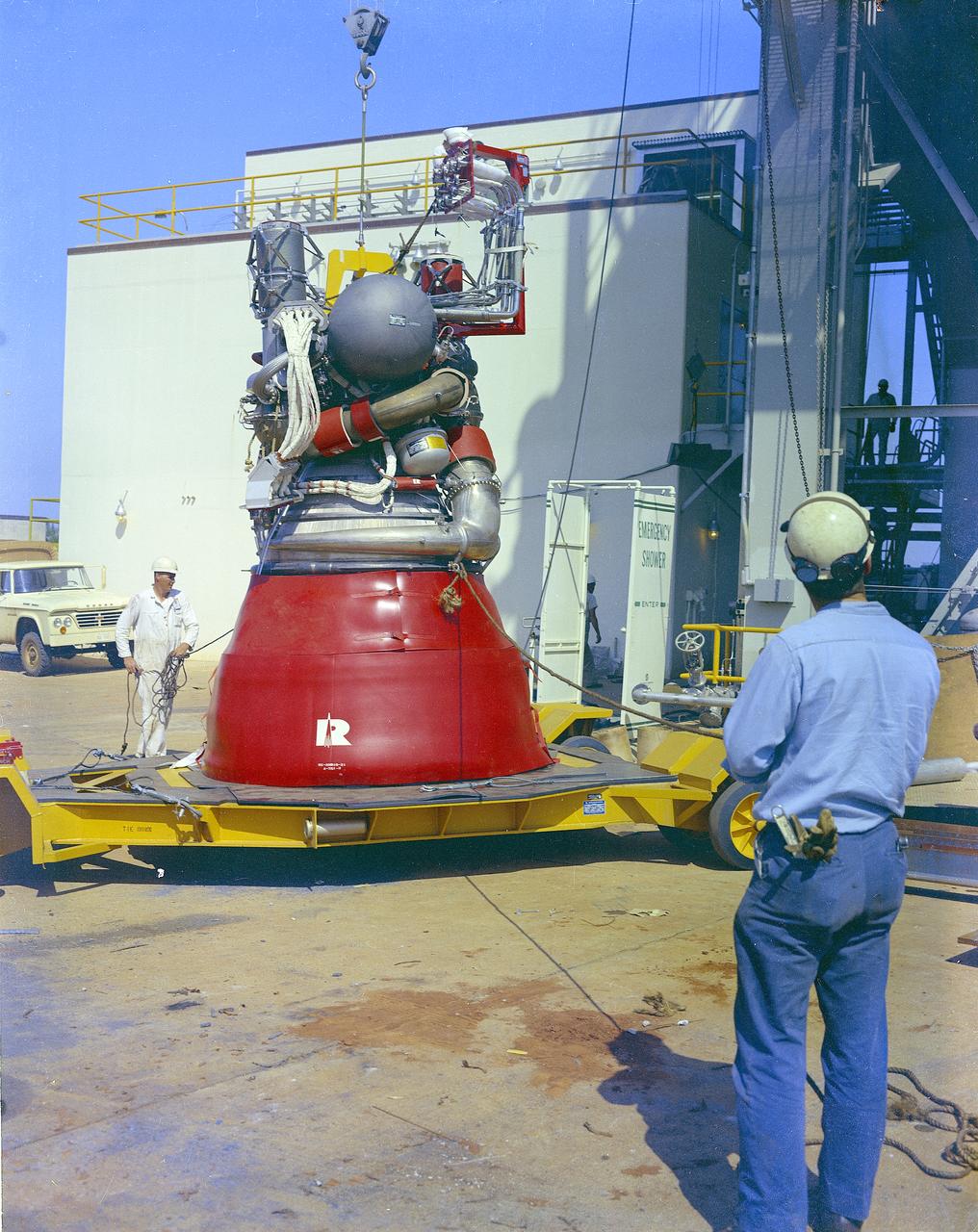
Two technicians watch carefully as cables prepare to lift a J-2 engine into a test stand. The J-2 powered the second stage and the third stage of the Saturn V moon rocket. The towering 363-foot Saturn V was a multi-stage, multi-engine launch vehicle standing taller than the Statue of Liberty. Altogether, the Saturn V engines produced as much power as 85 Hoover Dams.
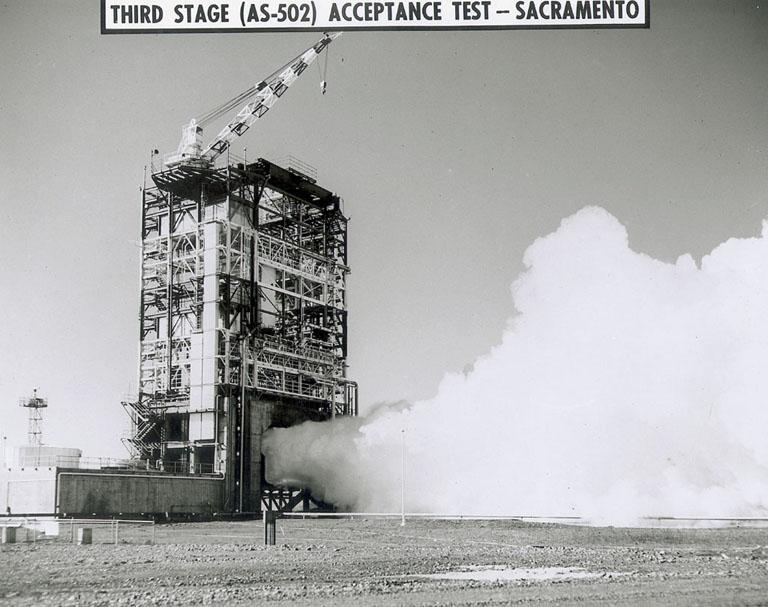
The J-2 engine for Saturn V S-IVB (third) stage blasted from the test stand at Douglas Aircraft Co., Sacramento Test Operation (SACTO) facility in California. This third stage was used on the unmarned Saturn V flight of Apollo 6 in April 1968.
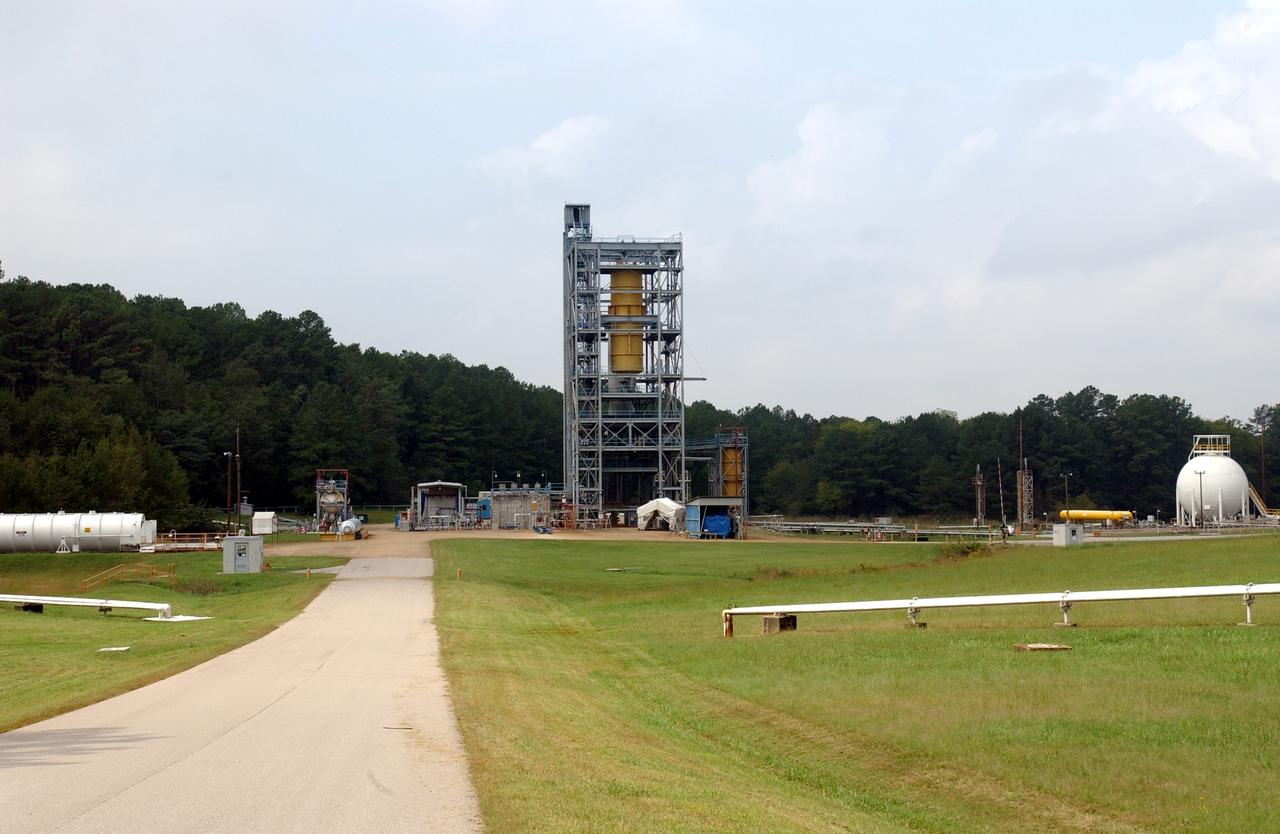
This is a ground level view of Test Stand 500 at the east test area of the Marshall Space Flight Center. Originally constructed in 1966, Test Stand 500 is a multipurpose, dual-position test facility. The stand was utilized to test liquid hydrogen/liquid oxygen turbopumps and combustion devices for the J-2 engine. One test position has a high superstructure with lines and tankage for testing liquid hydrogen and liquid oxygen turbopumps while the other position is adaptable to pressure-fed test programs such as turbo machinery bearings or seals. The facility was modified in 1980 to support Space Shuttle main engine (SSME) bearing testing.
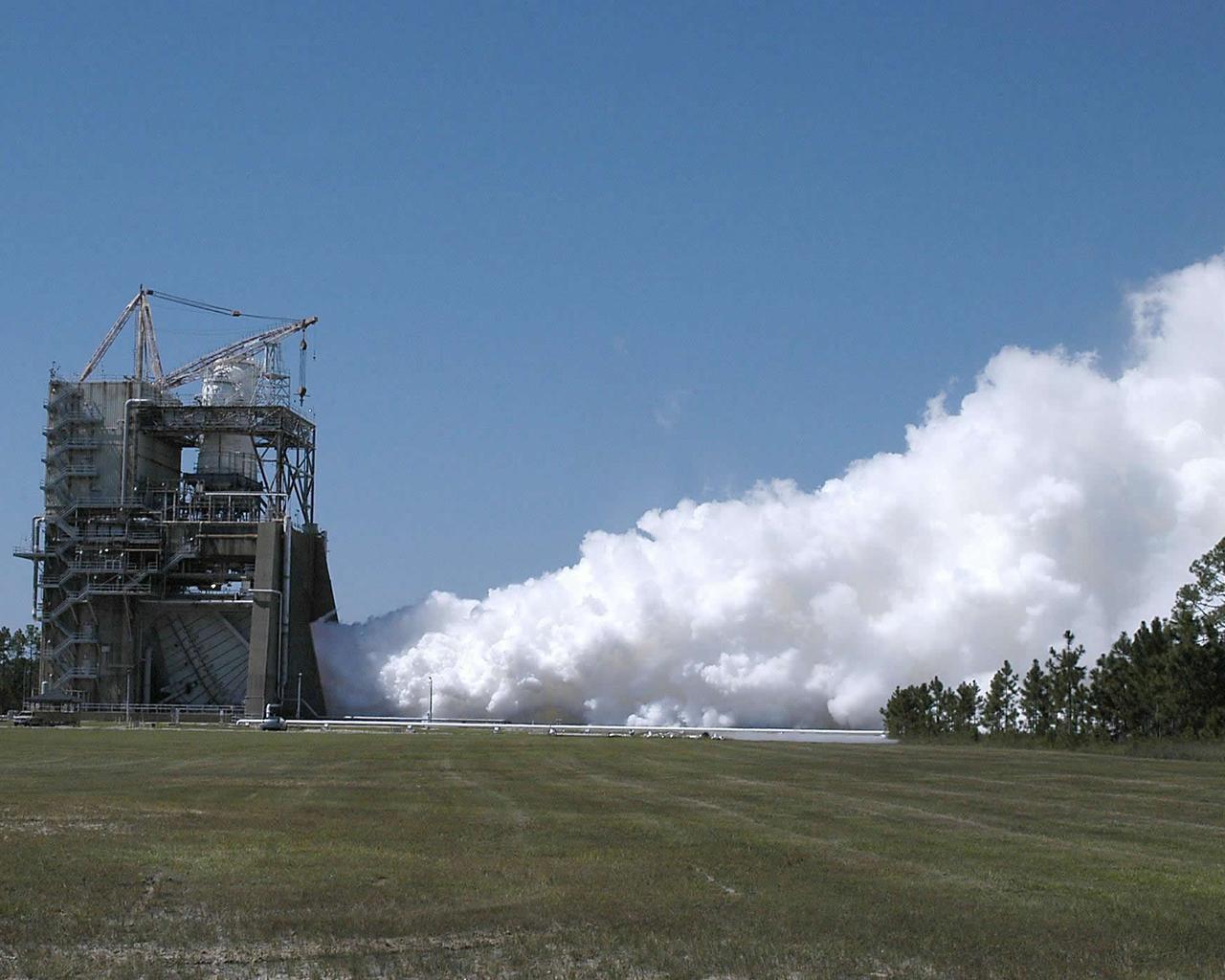
The Stennis Space Center conducted the final space shuttle main engine test on its A-1 Test Stand Friday. The A-1 Test Stand was the site of the first test on a shuttle main engine in 1975. Stennis will continue testing shuttle main engines on its A-2 Test Stand through the end of the Space Shuttle Program in 2010. The A-1 stand begins a new chapter in its operational history in October. It will be temporarily decommissioned to convert it for testing the J-2X engine, which will power the upper stage of NASA's new crew launch vehicle, the Ares I. Although this ends the stand's work on the Space Shuttle Program, it will soon be used for the rocket that will carry America's next generation human spacecraft, Orion.
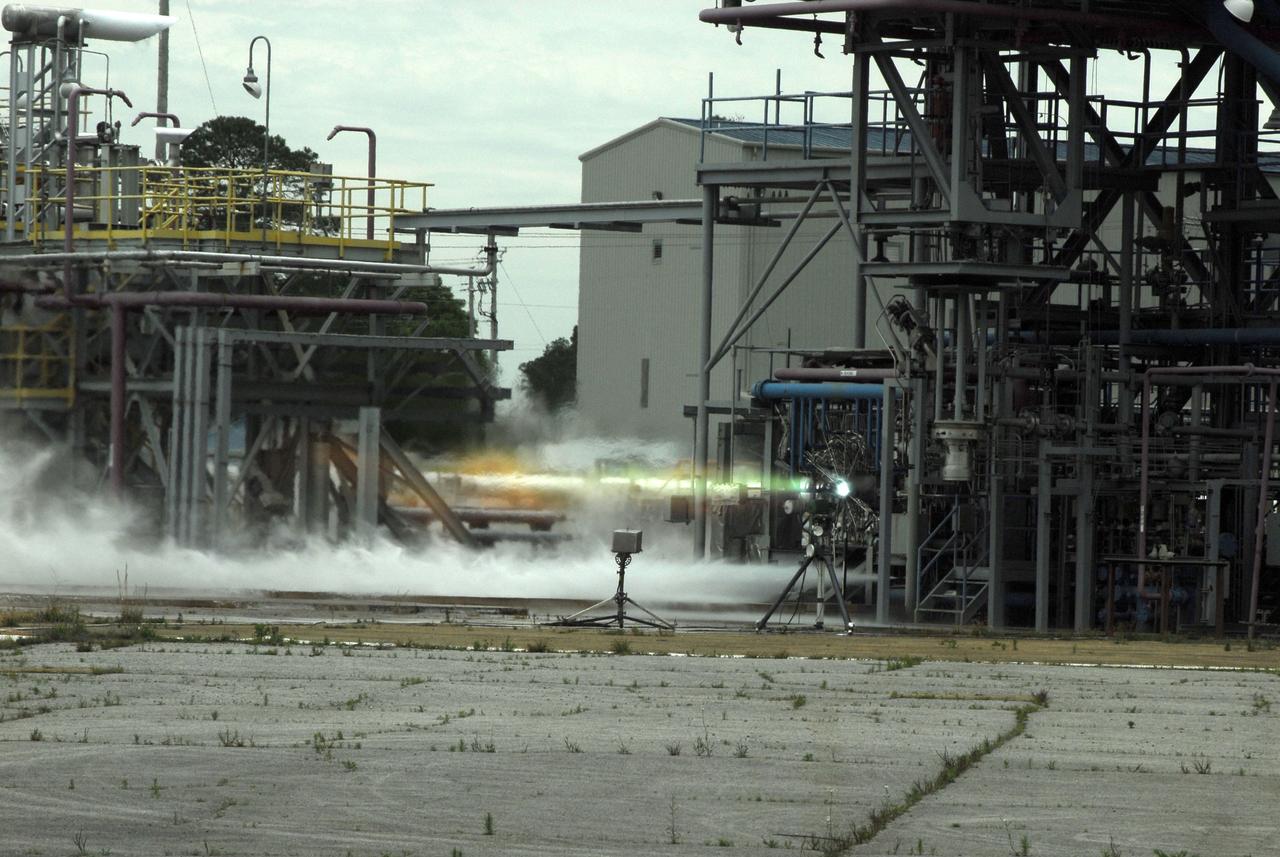
Chosen to power the upper stages of the new Ares I Crew Launch Vehicle (CLV) and the Ares V cargo segment, the J-2X engine is a stepped up version of the hydrogen/oxygen-fuelled Apollo-era J-2 engine. It was developed for NASA by Pratt & Whitney Rocketdyne (PWR), a business unit of United Technologies Corporation of Canoga Park, California. As seen in this photograph, the engine underwent a series of hot fire tests, performed on sub scale main injector hardware in the Test Stand 116 at Marshall Space Flight Center (MSFC). The injector is a major component of the engine that injects and mixes propellants in the combustion chamber, where they are ignited and burned to produce thrust.
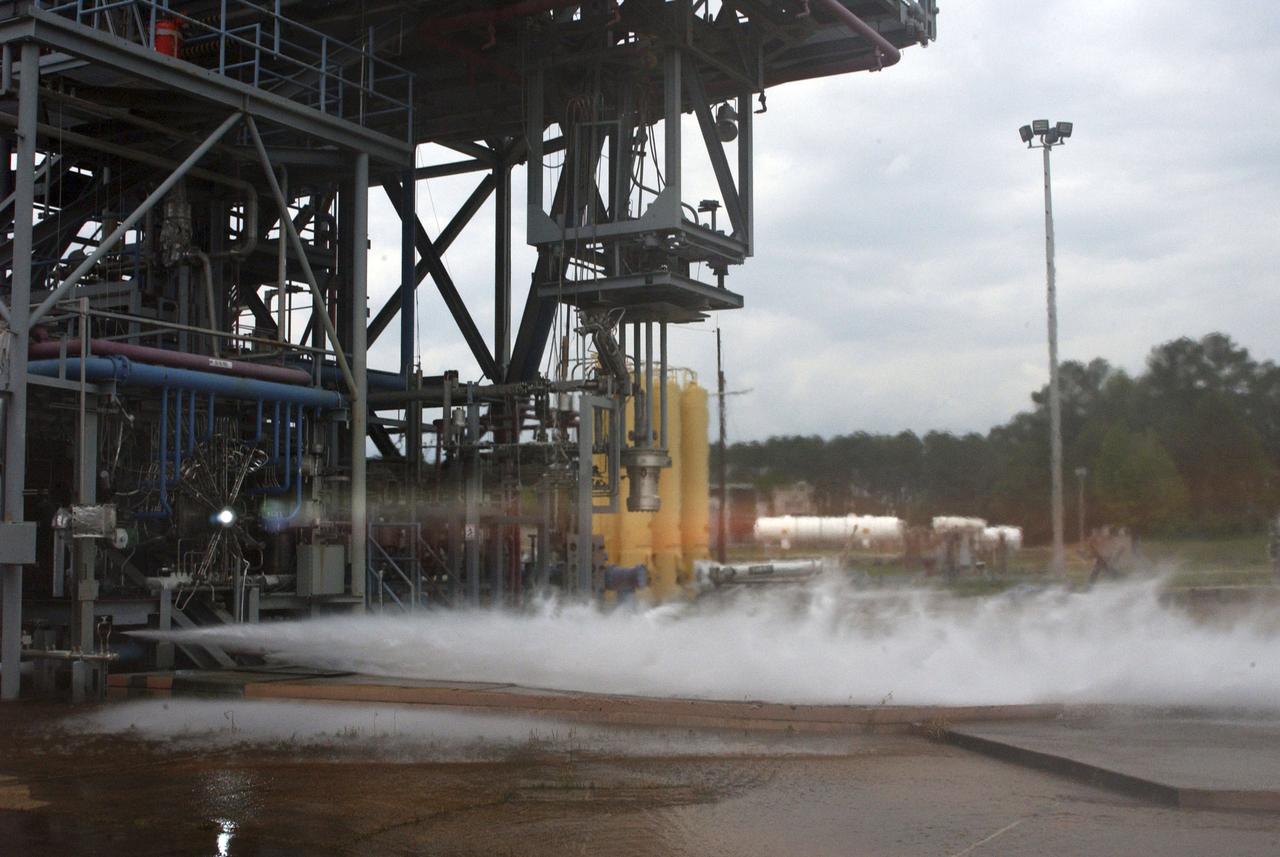
Chosen to power the upper stages of the new Ares I Crew Launch Vehicle (CLV) and the Ares V cargo segment, the J-2X engine is a stepped up version of the hydrogen/oxygen-fuelled Apollo-era J-2 engine. It was developed for NASA by Pratt & Whitney Rocketdyne (PWR), a business unit of United Technologies Corporation of Canoga Park, California. As seen in this photograph, the engine underwent a series of hot fire tests, performed on sub scale main injector hardware in the Test Stand 116 at Marshall Space Flight Center (MSFC). The injector is a major component of the engine that injects and mixes propellants in the combustion chamber, where they are ignited and burned to produce thrust.
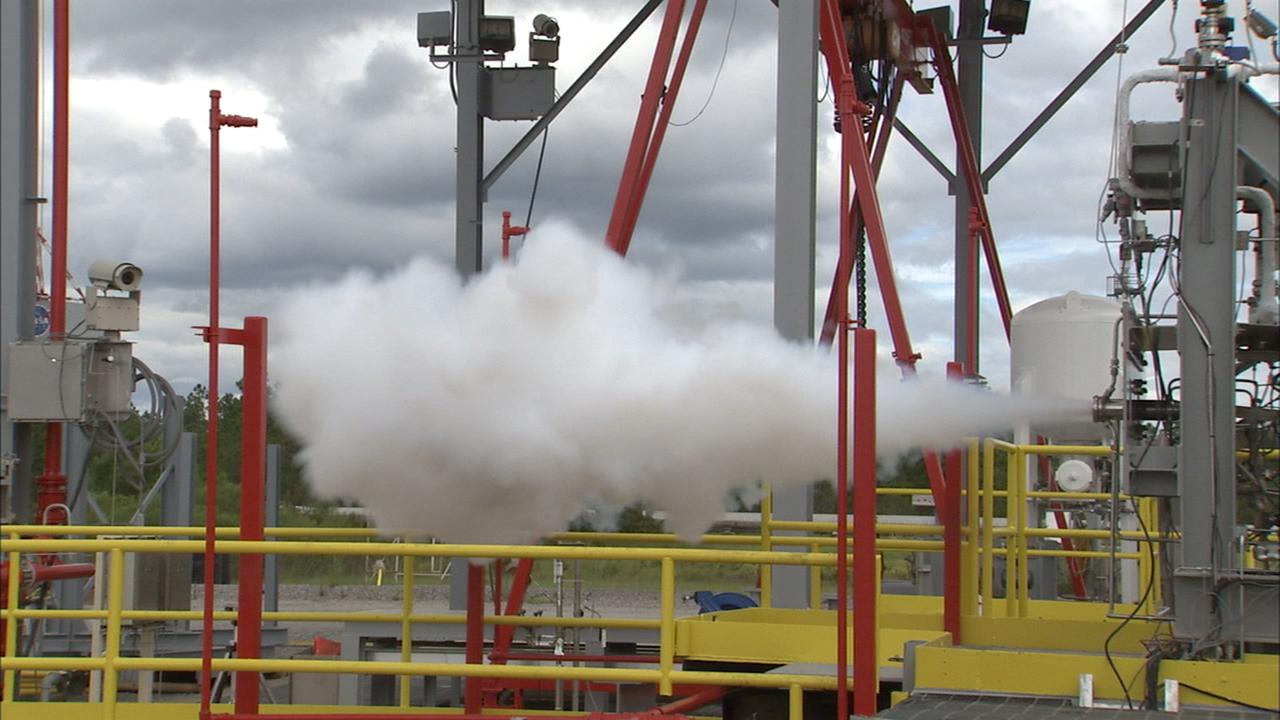
Tests begun at Stennis Space Center's E Complex Sept. 13 evaluated a liquid oxygen lead for engine start performance, part of the A-3 Test Facility Subscale Diffuser Risk Mitigation Project at SSC's E-3 Test Facility. Phase 1 of the subscale diffuser project, completed Sept. 24, was a series of 18 hot-fire tests using a 1,000-pound liquid oxygen and gaseous hydrogen thruster to verify maximum duration and repeatability for steam generation supporting the A-3 Test Stand project. The thruster is a stand-in for NASA's developing J-2X engine, to validate a 6 percent scale version of A-3's exhaust diffuser. Testing the J-2X at altitude conditions requires an enormous diffuser. Engineers will generate nearly 4,600 pounds per second of steam to reduce pressure inside A-3's test cell to simulate altitude conditions. A-3's exhaust diffuser has to be able to withstand regulated pressure, temperatures and the safe discharge of the steam produced during those tests. Before the real thing is built, engineers hope to work out any issues on the miniature version. Phase 2 testing is scheduled to begin this month.
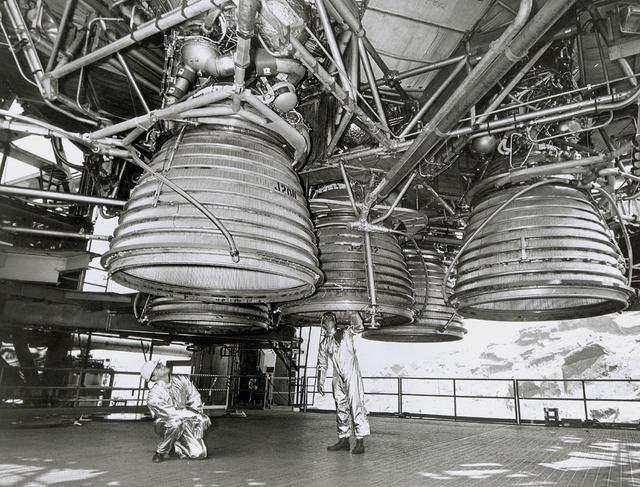
Two workers are dwarfed by the five J-2 engines of the Saturn V second stage (S-II) as they make final inspections prior to a static test firing by North American Space Division. These five hydrogen -fueled engines produced one million pounds of thrust, and placed the Apollo spacecraft into earth orbit before departing for the moon. The towering 363-foot Saturn V was a multi-stage, multi-engine launch vehicle standing taller than the Statue of Liberty. Altogether, the Saturn V engines produced as much power as 85 Hoover Dams.
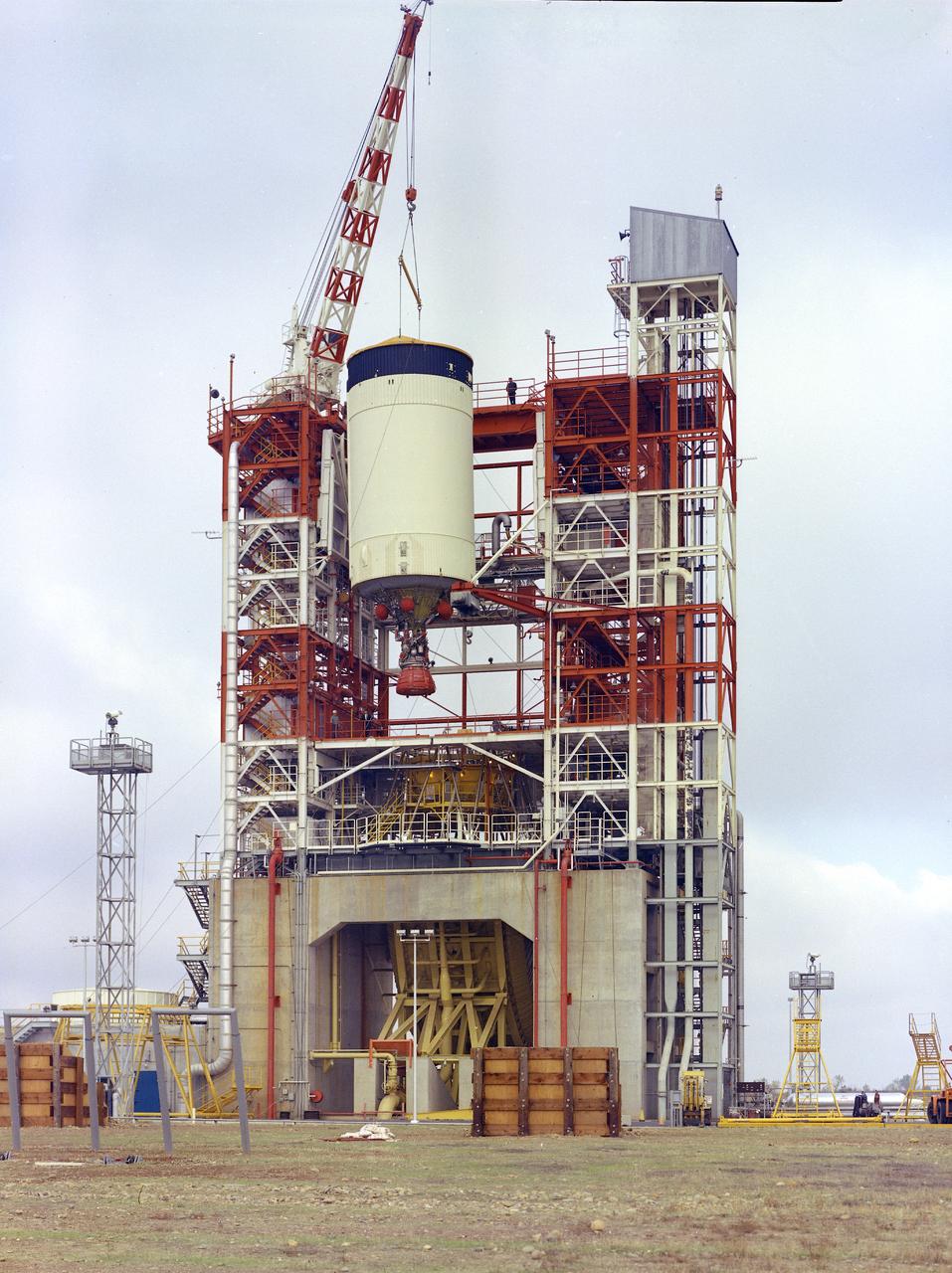
This image depicts the Saturn V S-IVB (third) stage for the Apollo 10 mission being removed from the Beta Test Stand 1 after its acceptance test at the Douglas Aircraft Company's Sacramento Test Operations (SACTO) facility. After the S-II (second) stage dropped away, the S-IVB (third) stage was ignited and burned for about two minutes to place itself and the Apollo spacecraft into the desired Earth orbit. At the proper time during this Earth parking orbit, the S-IVB stage was re-ignited to speed the Apollo spacecraft to escape velocity injecting it and the astronauts into a moon trajectory. Developed and manufactured by the Douglas Aircraft Company in California, the S-IVB stage measures about 21.5 feet in diameter, about 58 feet in length, and powered by a single 200,000-pound-thrust J-2 engine with a re-start capability. The S-IVB stage was also used on the second stage of the Saturn IB launch vehicle.
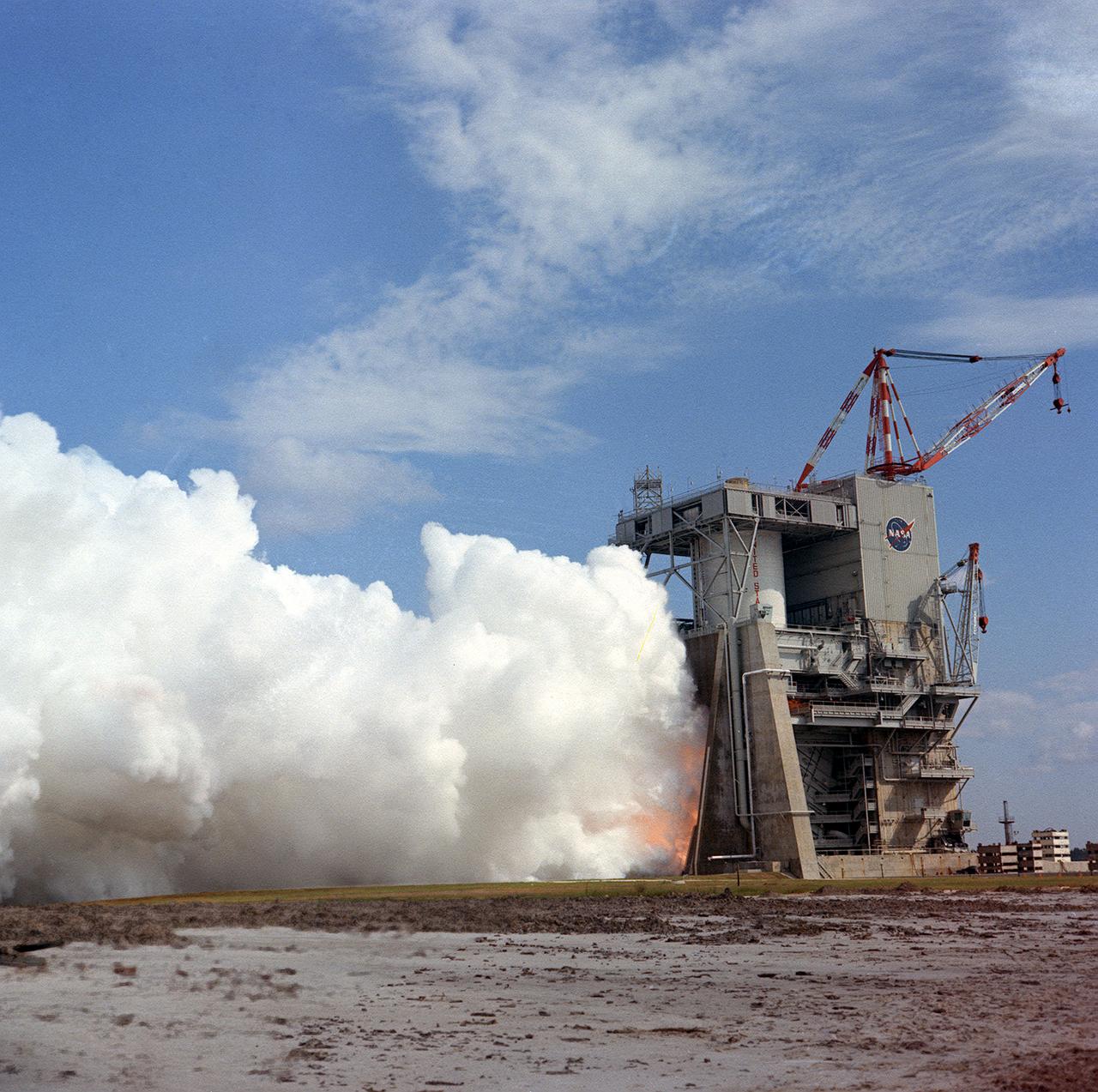
This photograph shows a test firing of the the Saturn V S-II (second) stage at the Mississippi Test Facility's (MTF) S-II test stand. When the Saturn V booster stage (S-IC) burns out and drops away, power for the Saturn will be provided by the 82-foot-long and 33-foot-diameter S-II stage. Developed by the Space Division of North American Aviation under the direction of the Marshall Space Flight Center, the stage utilized five J-2 engines, each producing 200,000 pounds of thrust. The engines used liquid oxygen and liquid hydrogen as propellants. Static test of ground test versions of the S-II stage were conducted at North American Aviation's Santa Susana, California test site. All flight stages were tested at the Mississippi Test Facility, Bay St. Louis, Mississippi. MTF was renamed to the National Space Technology Laboratory (NSTL) in 1974 and later to the Sternis Space Center in May 1988.
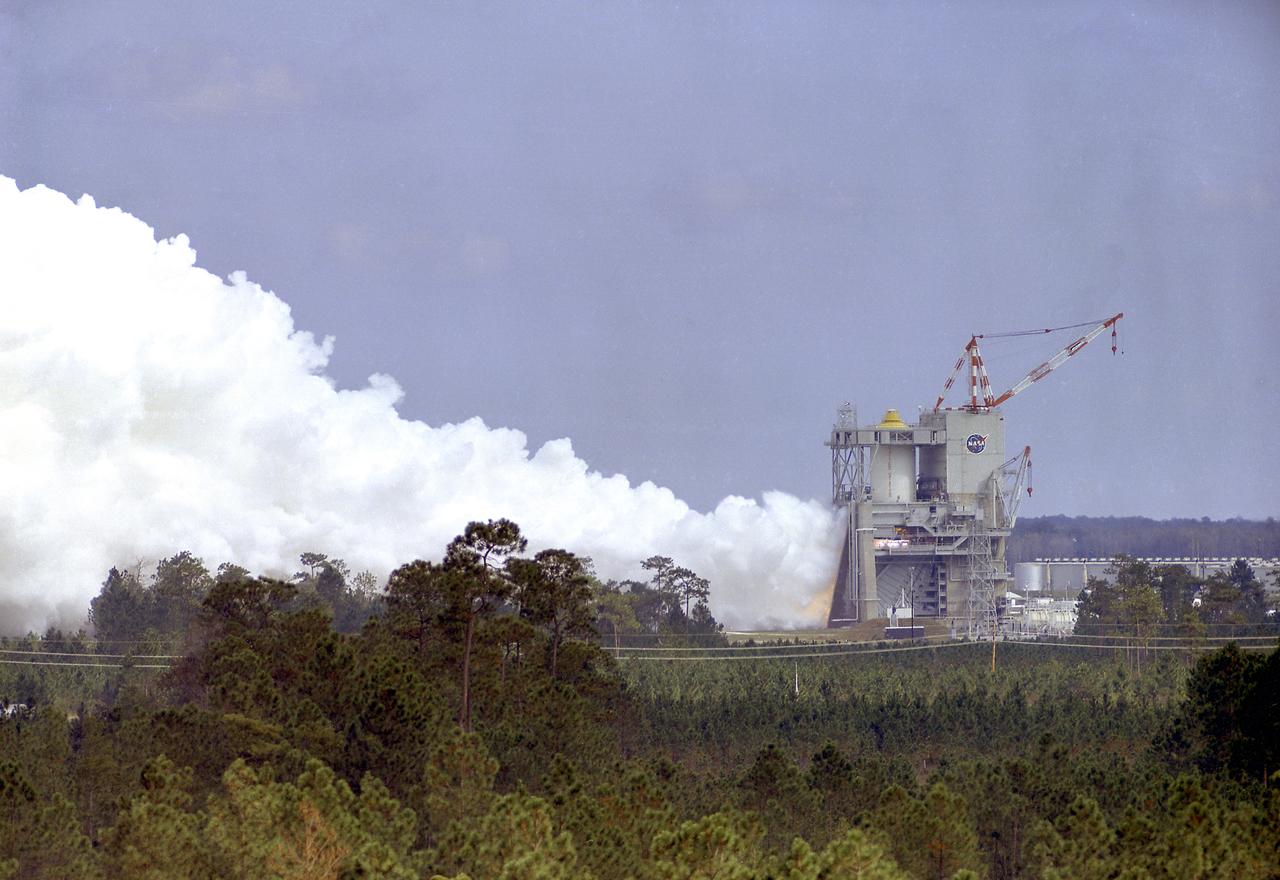
This photograph shows a test firing of the the Saturn V S-II (second) stage at the Mississippi Test Facility's (MTF) S-II test stand. When the Saturn V booster stage (S-IC) burns out and drops away, power for the Saturn will be provided by the 82-foot-long and 33-foot-diameter S-II stage. Developed by the Space Division of North American Aviation under the direction of the Marshall Space Flight Center, the stage utilized five J-2 engines, each producing 200,000 pounds of thrust. The engine used liquid oxygen and liquid hydrogen as its propellants. Static test of ground test versions of the S-II stage were conducted at North American Aviation's Santa Susana, California test site. All flight stages were tested at the Mississippi Test Facility, Bay St. Louis, Mississippi. The MTF was renamed to the National Space Technology Laboratory (NSTL) in 1974 and later to the Sternis Space Center (SSC) in May 1988.
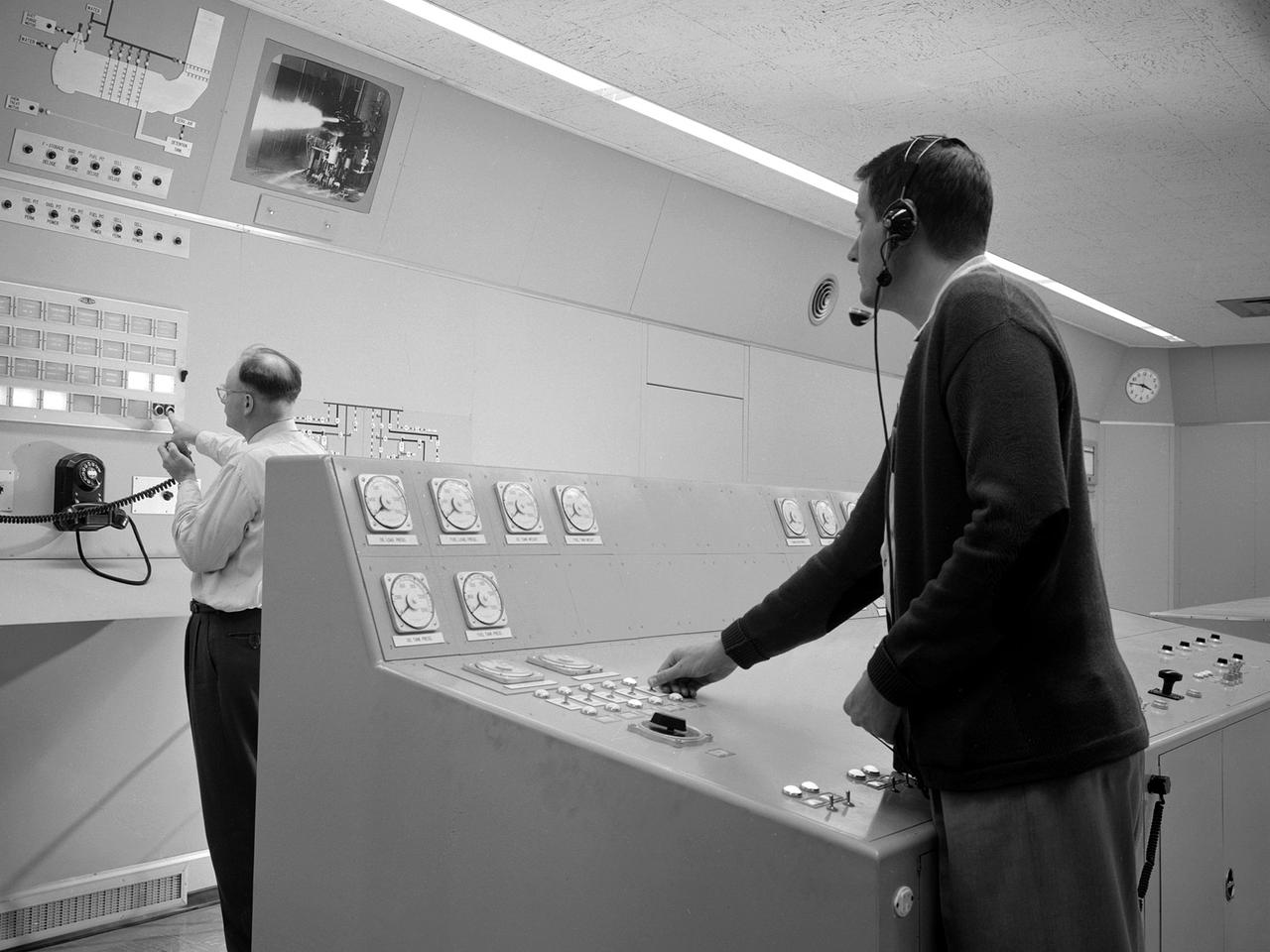
Test engineers monitor an engine firing from the control room of the Rocket Engine Test Facility at the National Advisory Committee for Aeronautics (NACA) Lewis Flight Propulsion Laboratory. The Rocket Engine Test Facility, built in the early 1950s, had a rocket stand designed to evaluate high-energy propellants and rocket engine designs. The facility was used to study numerous different types of rocket engines including the Pratt and Whitney RL-10 engine for the Centaur rocket and Rocketdyne’s F-1 and J-2 engines for the Saturn rockets. The Rocket Engine Test Facility was built in a ravine at the far end of the laboratory because of its use of the dangerous propellants such as liquid hydrogen and liquid fluorine. The control room was located in a building 1,600 feet north of the test stand to protect the engineers running the tests. The main control and instrument consoles were centrally located in the control room and surrounded by boards controlling and monitoring the major valves, pumps, motors, and actuators. A camera system at the test stand allowed the operators to view the tests, but the researchers were reliant on data recording equipment, sensors, and other devices to provide test data. The facility’s control room was upgraded several times over the years. Programmable logic controllers replaced the electro-mechanical control devices. The new controllers were programed to operate the valves and actuators controlling the fuel, oxidant, and ignition sequence according to a predetermined time schedule.
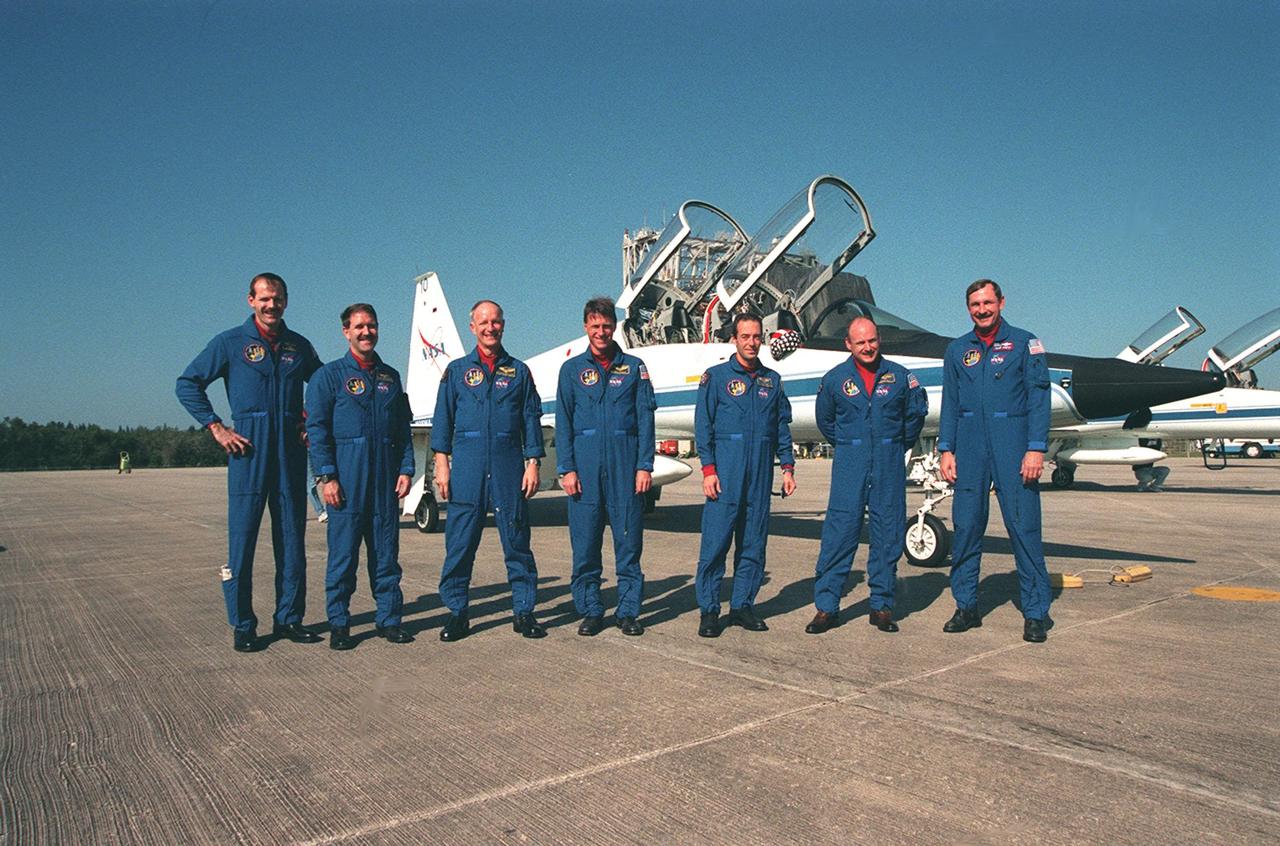
The STS-103 crew poses for photographers after landing at at Kennedy Space Center's Shuttle Landing Facility to begin Terminal Countdown Demonstration Test (TCDT) activities. Standing (left to right) in front of the T-38 jets that brought them are Mission Specialists Steven L. Smith, John M. Grunsfeld (Ph.D.), Claude Nicollier of Switzerland, with the European Space Agency, C. Michael Foale (Ph.D.), Jean-François Clervoy of France, also with the European Space Agency, Pilot Scott J. Kelly, and Commander Curtis L. Brown Jr. The TCDT provides the crew with emergency egress training, opportunities to inspect their mission payloads in the orbiter's payload bay, and simulated countdown exercises. The STS-103 mission, to service the Hubble Space Telescope, is targeted for launch Dec. 6 at 2:37 a.m. EST aboard Space Shuttle Discovery
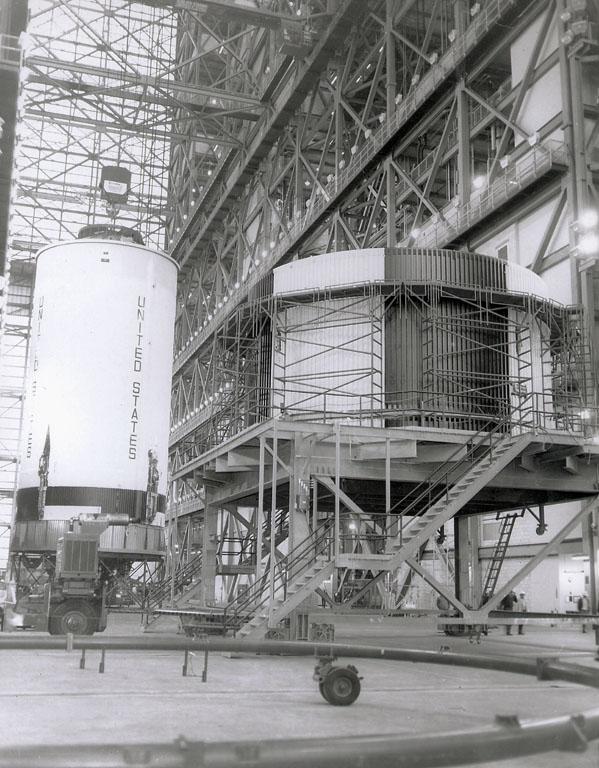
This Saturn V S-II (second) stage is being lifted into position for a test at the Vehicle Assembly Building at the Kennedy Space Center. When the Saturn V booster stage (S-IC) burned out and dropped away, power for the Saturn was provided by the 82-foot-long and 33-foot-diameter S-II stage. Developed by the Space Division of North American Aviation under the direction of the Marshall Space Flight Center, the stage utilized five J-2 engines, each producing 200,000 pounds of thrust. The engines used liquid oxygen and liquid hydrogen as propellants. The towering 363-foot Saturn V was a multi-stage, multi-engine launch vehicle standing taller than the Statue of Liberty. Altogether, the Saturn V engines produced as much power as 85 Hoover Dams.
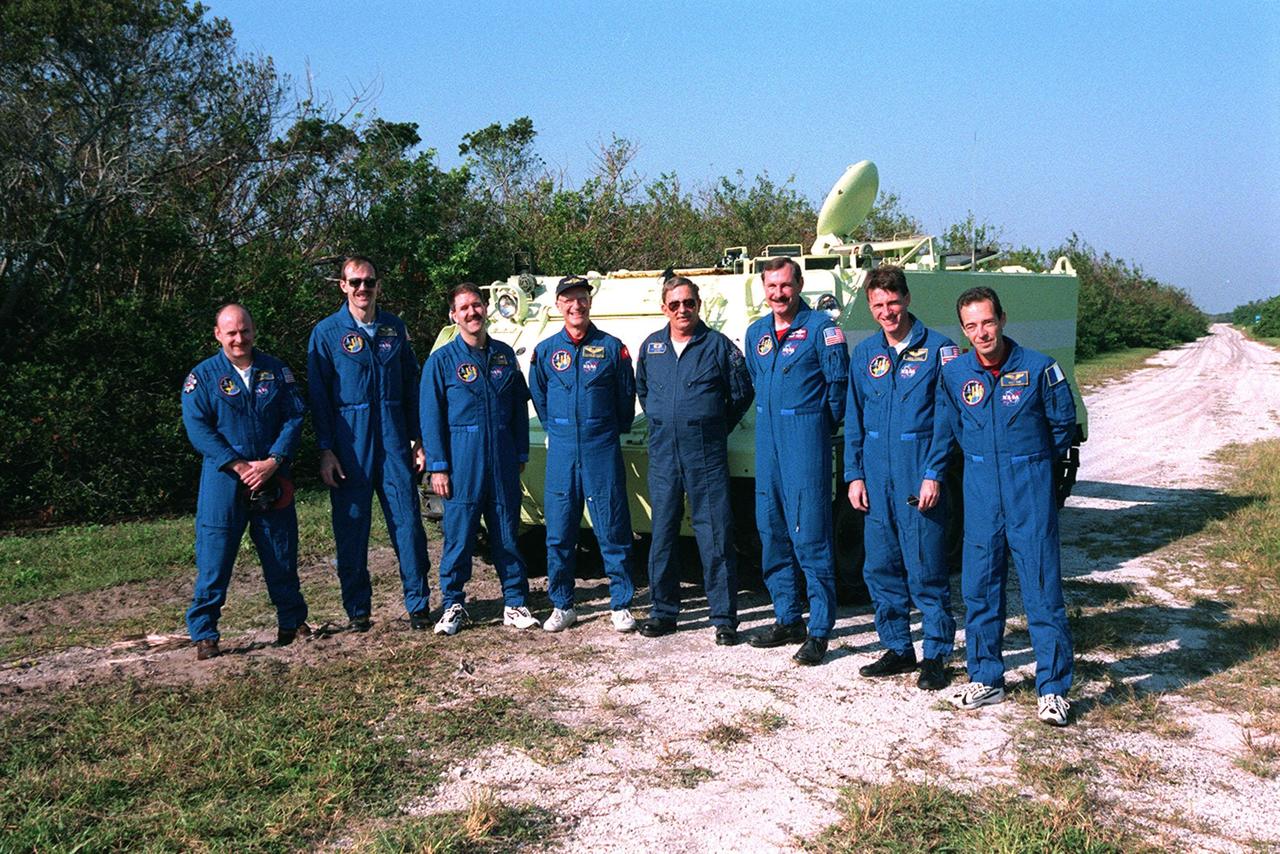
The STS-103 crew pose for photographers following Terminal Countdown Demonstration Test (TCDT) emergency egress training on the small armored personnel carrier behind them. Standing left to right are Pilot Scott J. Kelly, Mission Specialists Steven L. Smith, John M. Grunsfeld (Ph.D.), Claude Nicollier of Switzerland, their trainer on the carrier Capt. George Hoggard of the KSC/CCAS Fire Department, Commander Curtis L. Brown Jr., and Mission Specialists C. Michael Foale (Ph.D.) and Jean-Francois Clervoy of France. Nicollier and Clervoy are with the European Space Agency. The TCDT also provides simulated countdown exercises and opportunities to inspect the mission payloads in the orbiter's payload bay. STS-103 is a "call-up" mission due to the need to replace and repair portions of the Hubble Space Telescope. Four EVA's are planned to make the necessary repairs and replacements on the telescope. The mission is targeted for launch Dec. 6 at 2:37 a.m. EST
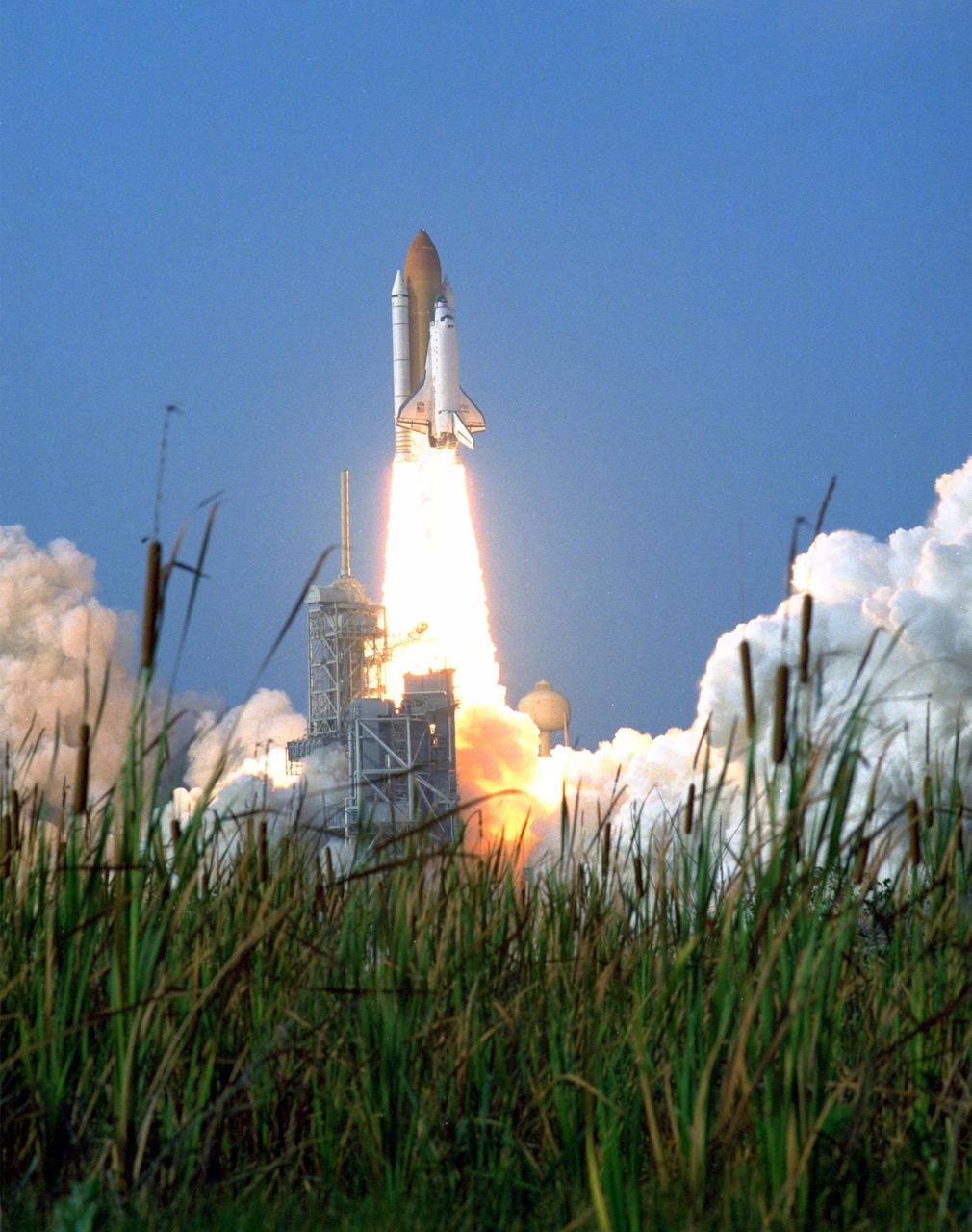
KENNEDY SPACE CENTER, Fla. -- Some of Florida's natural foliage stands silent sentinel to the lift off of the Space Shuttle Discovery from Launch Pad 39A at 6:06:24 p.m. EDT June 2. On board Discovery are Mission Commander Charles J. Precourt; Pilot Dominic L. Gorie; and Mission Specialists Wendy B. Lawrence, Franklin R. Chang-Diaz, Janet Lynn Kavandi and Valery Victorovitch Ryumin. The nearly 10-day mission will feature the ninth and final Shuttle docking with the Russian space station Mir, the first Mir docking for the Space Shuttle orbiter Discovery, the first on-orbit test of the Alpha Magnetic Spectrometer (AMS), and the first flight of the new Space Shuttle super lightweight external tank. Astronaut Andrew S. W. Thomas will be returning to Earth as a STS-91 crew member after living more than four months aboard Mir
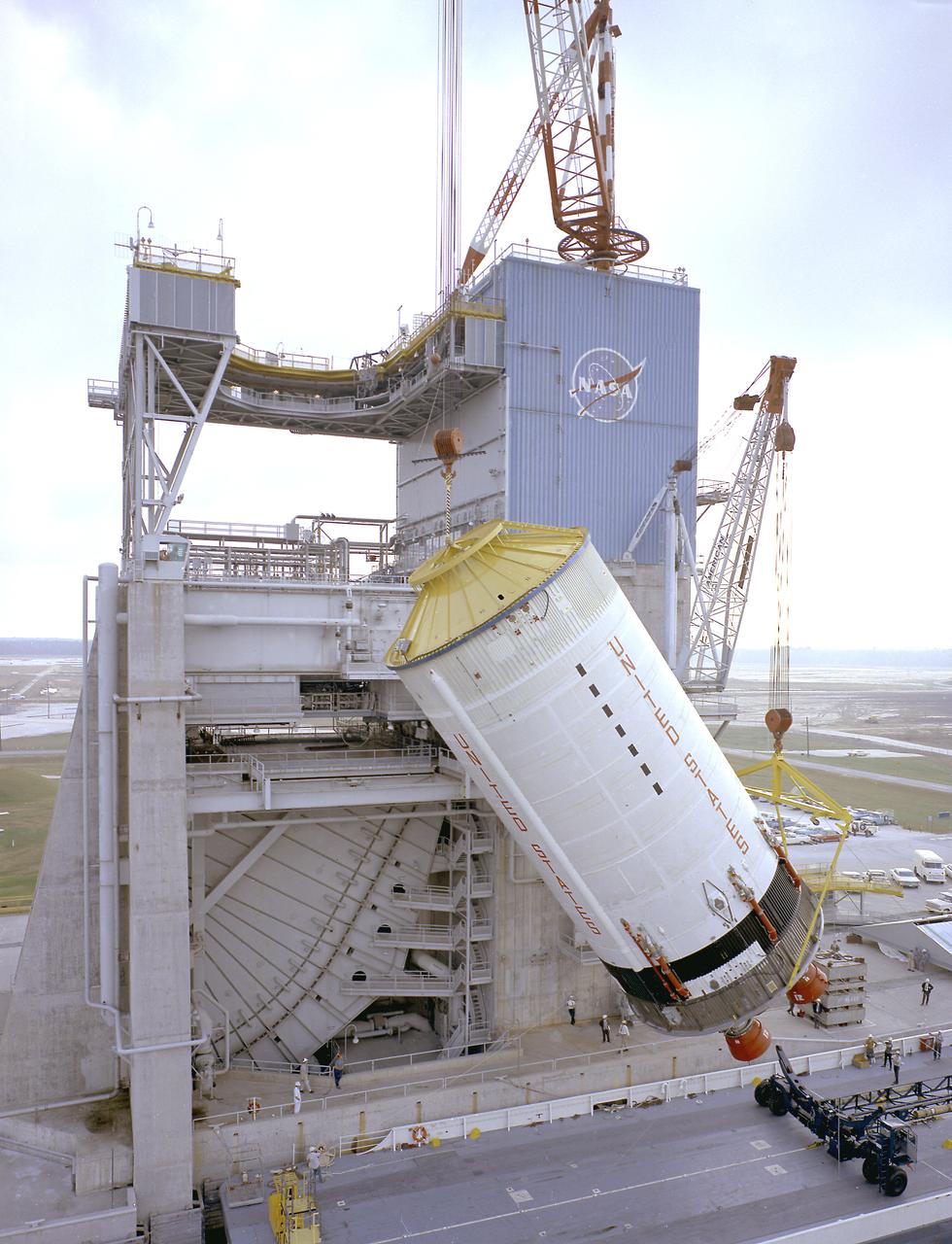
This photograph shows the Saturn V S-II (second) stage being hoisted at the S-II-A2 test stand at the Mississippi Test Facility (MTF). When the Saturn V booster stage (S-IC) burns out and drops away, power for the Saturn will be provided by the 82-foot-long and 33-foot-diameter S-II stage. Developed by the Space Division of North American Aviation under the direction of the Marshall Space Flight Center, the stage utilized five J-2 engines, each producing 200,000 pounds of thrust. The engines used liquid oxygen and liquid hydrogen as propellants. Static test of ground test versions of the S-II stage were conducted at North American Aviation's Santa Susana, California test site. All flight stages were tested at the Mississippi Test Facility, Bay St. Louis, Mississippi. MTF was renamed to the National Space Technology Laboratory (NSTL) in 1974 and later to the Sternis Space Center in May 1988.
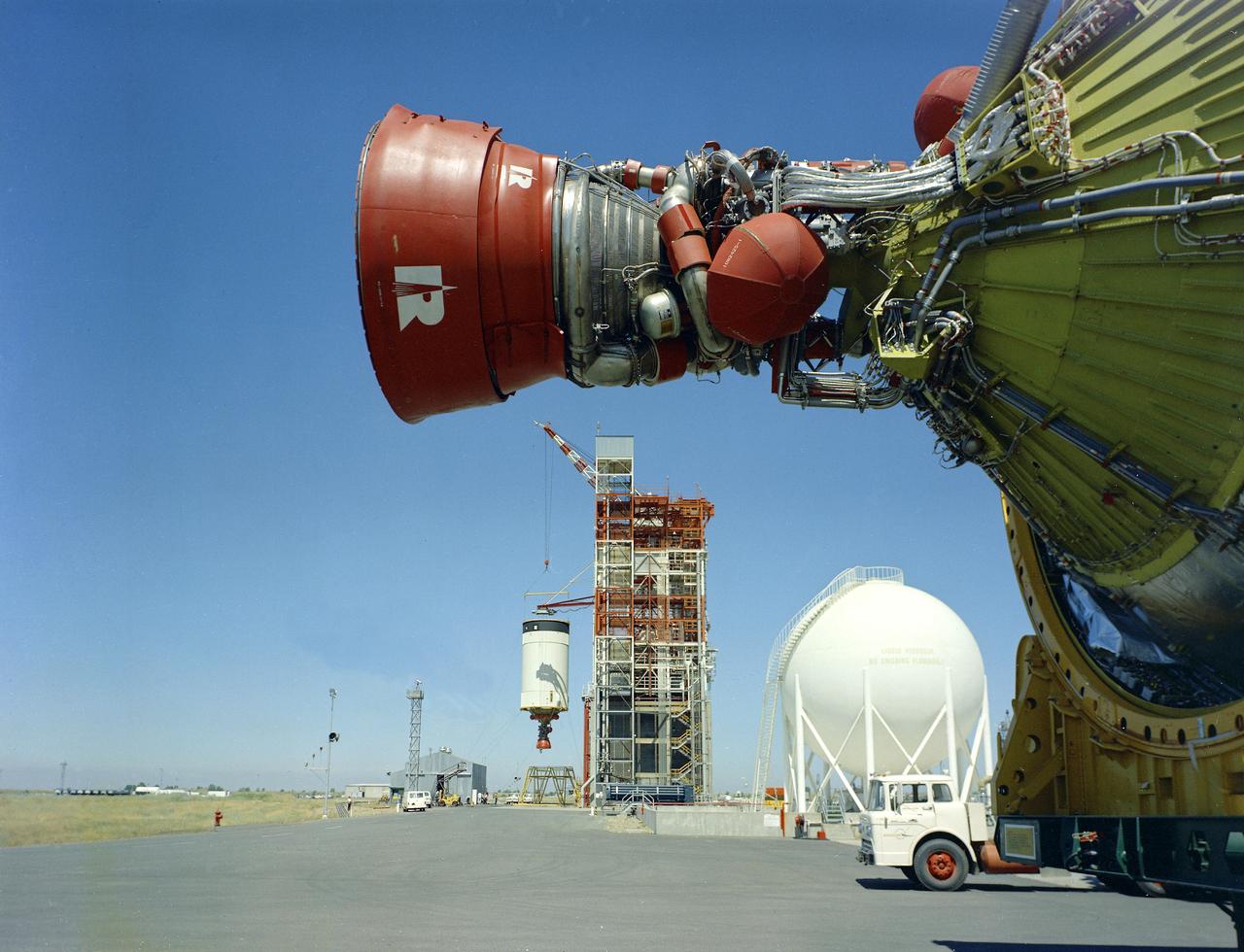
This is a view of the Saturn V S-IVB (third) stage for the AS-209 (Apollo-Soyuz test project backup vehicle) on a transporter in the right foreground, and the S-IVB stage for AS-504 (Apollo 9 mission) being installed in the Beta Test Stand 1 at the SACTO facility in California. After the S-II (second) stage dropped away, the S-IVB (third) stage ignited and burned for about two minutes to place itself and the Apollo spacecraft into the desired Earth orbit. At the proper time during this Earth parking orbit, the S-IVB stage was re-ignited to speed the Apollo spacecraft to escape velocity and inject it and the astronauts into a moon trajectory. Developed and manufactured by the Douglas Aircraft Company in California, the S-IVB stage measures about 21.5 feet in diameter, about 58 feet in length, and is powered by a single 200,000-pound-thrust J-2 engine with a re-start capability. The S-IVB stage was also used on the second stage of the Saturn IB launch vehicle.
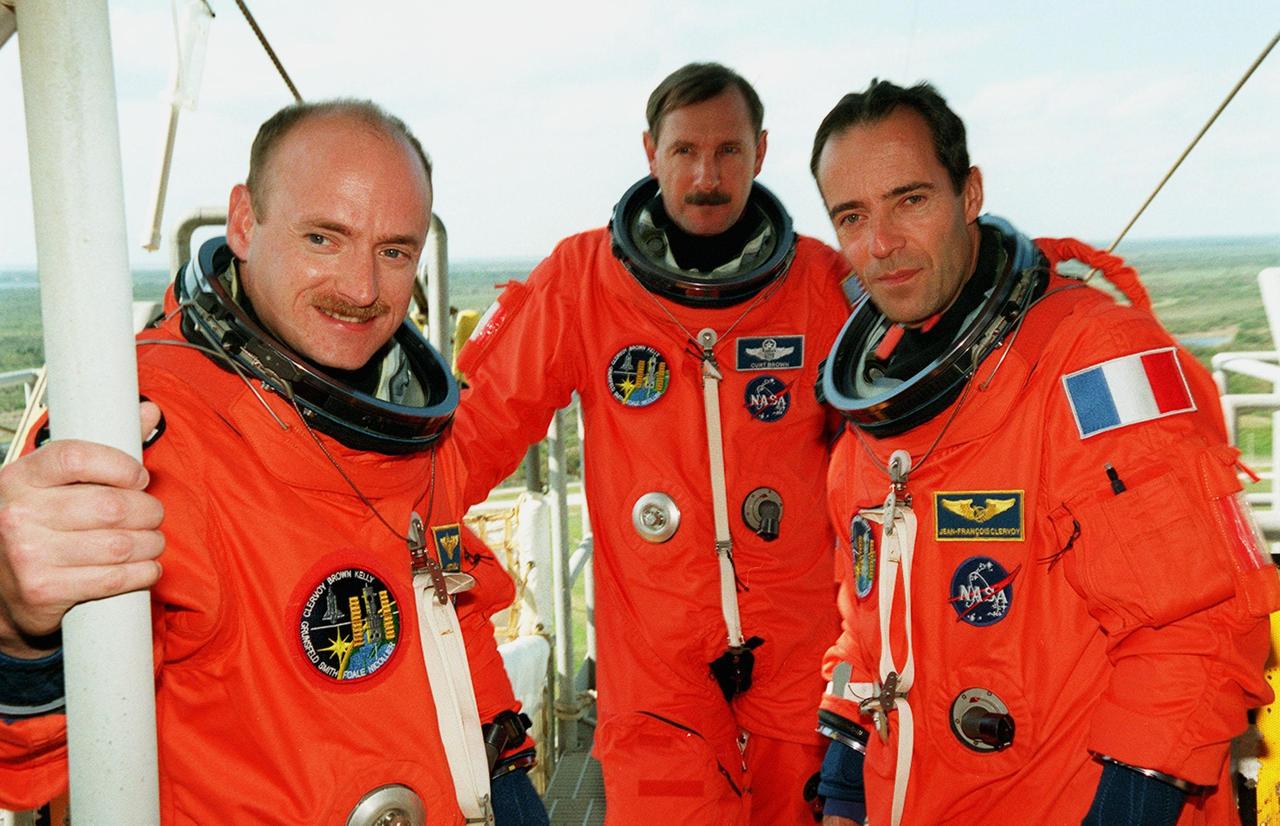
Standing left to right, STS-103 Pilot Scott J. Kelly, Commander Curtis L. Brown Jr., and Mission Specialist Jean-François Clervoy of France take a break during practice using the slidewire baskets, part of Terminal Countdown Demonstration Test (TCDT) activities in preparation for launch. The other crew members taking part are Mission Specialists Steven L. Smith, C. Michael Foale (Ph.D.), John M. Grunsfeld (Ph.D.), and Claude Nicollier of Switzerland. Clervoy and Nicollier are with the European Space Agency. The baskets are part of the emergency egress system for persons in the Shuttle vehicle or on the Rotating Service Structure. Seven slidewires extend from the orbiter access arm, with a netted, flatbottom basket suspended from each wire. The TCDT also provides the crew with opportunities to inspect their mission payloads in the orbiter's payload bay, and simulated countdown exercises. STS-103 is a "call-up" mission due to the need to replace and repair portions of the Hubble Space Telescope, including the gyroscopes that allow the telescope to point at stars, galaxies and planets. The STS-103 crew will be replacing a Fine Guidance Sensor, an older computer with a new enhanced model, an older data tape recorder with a solid-state digital recorder, a failed spare transmitter with a new one, and degraded insulation on the telescope with new thermal insulation. The crew will also install a Battery Voltage/Temperature Improvement Kit to protect the spacecraft batteries from overcharging and overheating when the telescope goes into a safe mode. Four EVA's are planned to make the necessary repairs and replacements on the telescope. The mission is targeted for launch Dec. 6 at 2:37 a.m. EST

At Launch Pad 39B, Lisa Malone, chief, Media Services at KSC introduces the STS-103 crew standing ready to answer questions from the media. From left are Commander Curtis L. Brown Jr., Pilot Scott J. Kelly, and Mission Specialists Steven L. Smith, Jean-François Clervoy of France, who is with the European Space Agency (ESA), John M. Grunsfeld (Ph.D.), C. Michael Foale (Ph.D.), and Claude Nicollier of Switzerland, who is also with ESA. As a preparation for launch, the crew have been participating in Terminal Countdown Demonstration Test (TCDT) activities at KSC. The TCDT provides the crew with emergency egress training, opportunities to inspect their mission payloads in the orbiter's payload bay, and simulated countdown exercises. STS-103 is a "call-up" mission due to the need to replace and repair portions of the Hubble Space Telescope, including the gyroscopes that allow the telescope to point at stars, galaxies and planets. The STS-103 crew will be replacing a Fine Guidance Sensor, an older computer with a new enhanced model, an older data tape recorder with a solid-state digital recorder, a failed spare transmitter with a new one, and degraded insulation on the telescope with new thermal insulation. The crew will also install a Battery Voltage/Temperature Improvement Kit to protect the spacecraft batteries from overcharging and overheating when the telescope goes into a safe mode. Four EVA's are planned to make the necessary repairs and replacements on the telescope. The mission is targeted for launch Dec. 6 at 2:37 a.m. EST
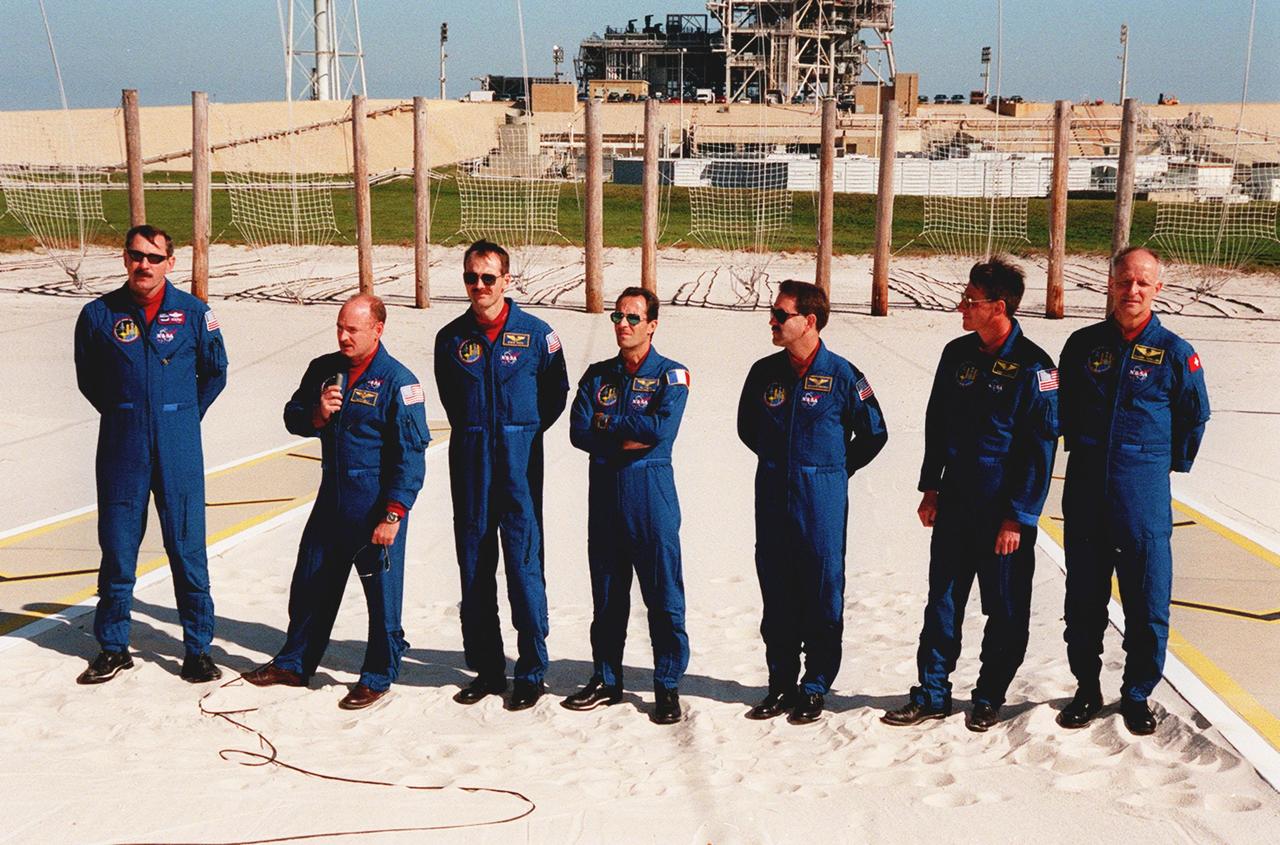
During an interview at Launch Pad 39B, STS-103 Pilot Scott J. Kelly responds to a question from the media about the mission. Standing with him are the remainder of the crew: (left to right) Commander Curtis L. Brown Jr., Kelly, and Mission Specialists Steven L. Smith, Jean-François Clervoy of France, who is with the European Space Agency (ESA), John M. Grunsfeld (Ph.D.), C. Michael Foale (Ph.D.), and Claude Nicollier of Switzerland, who is also with ESA. As a preparation for launch, they have been participating in Terminal Countdown Demonstration Test (TCDT) activities at KSC. The TCDT provides the crew with emergency egress training, opportunities to inspect their mission payloads in the orbiter's payload bay, and simulated countdown exercises. STS-103 is a "call-up" mission due to the need to replace and repair portions of the Hubble Space Telescope, including the gyroscopes that allow the telescope to point at stars, galaxies and planets. The STS-103 crew will be replacing a Fine Guidance Sensor, an older computer with a new enhanced model, an older data tape recorder with a solid-state digital recorder, a failed spare transmitter with a new one, and degraded insulation on the telescope with new thermal insulation. The crew will also install a Battery Voltage/Temperature Improvement Kit to protect the spacecraft batteries from overcharging and overheating when the telescope goes into a safe mode. Four EVA's are planned to make the necessary repairs and replacements on the telescope. The mission is targeted for launch Dec. 6 at 2:37 a.m. EST
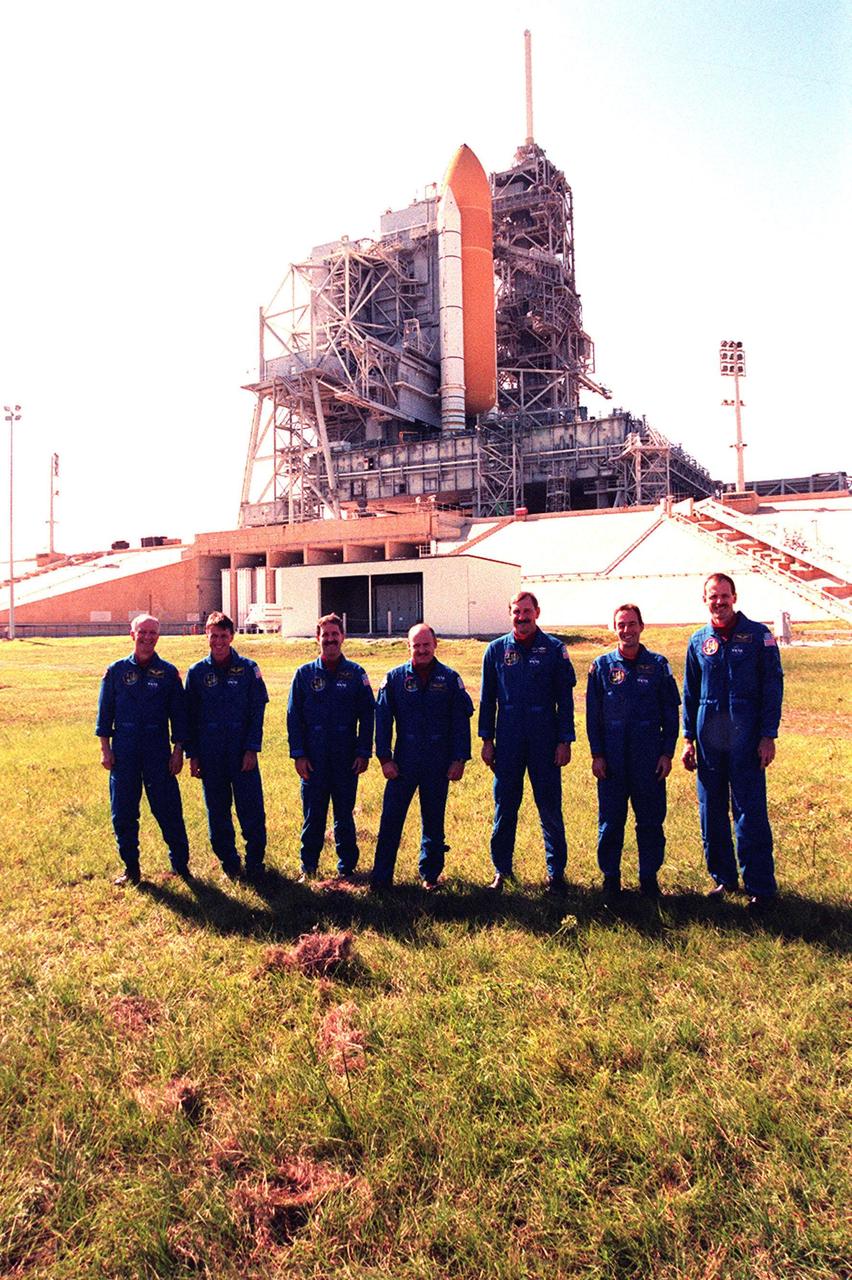
During Terminal Countdown Demonstration Test (TDCT) activities at Launch Pad 39B, the STS-103 crew pose in front of the flame trench, which is situated underneath the Mobile Launcher Platform holding Space Shuttle Discovery. Standing left to right are Mission Specialists Claude Nicollier of Switzerland, who is with the European Space Agency (ESA), C. Michael Foale (Ph.D.), John M. Grunsfeld (Ph.D.), Pilot Scott J. Kelly, Commander Curtis L. Brown Jr., and Mission Specialists Jean-François Clervoy of France, also with ESA, and Steven L. Smith. One of the solid rocket boosters and the external tank that are attached to Discovery can be seen in the photo. The flame trench is made of concrete and refractory brick, and contains an orbiter flame deflector on one side and solid rocket booster flame deflector on the other. The deflectors protect the flame trench floor and pad surface from the intense heat of launch. The TCDT provides the crew with emergency egress training, opportunities to inspect their mission payloads in the orbiter's payload bay, and simulated countdown exercises. STS-103 is a "call-up" mission due to the need to replace and repair portions of the Hubble Space Telescope, including the gyroscopes that allow the telescope to point at stars, galaxies and planets. The STS-103 crew will be replacing a Fine Guidance Sensor, an older computer with a new enhanced model, an older data tape recorder with a solid-state digital recorder, a failed spare transmitter with a new one, and degraded insulation on the telescope with new thermal insulation. The crew will also install a Battery Voltage/Temperature Improvement Kit to protect the spacecraft batteries from overcharging and overheating when the telescope goes into a safe mode. Four EVA's are planned to make the necessary repairs and replacements on the telescope. The mission is targeted for launch Dec. 6 at 2:37 a.m. EST
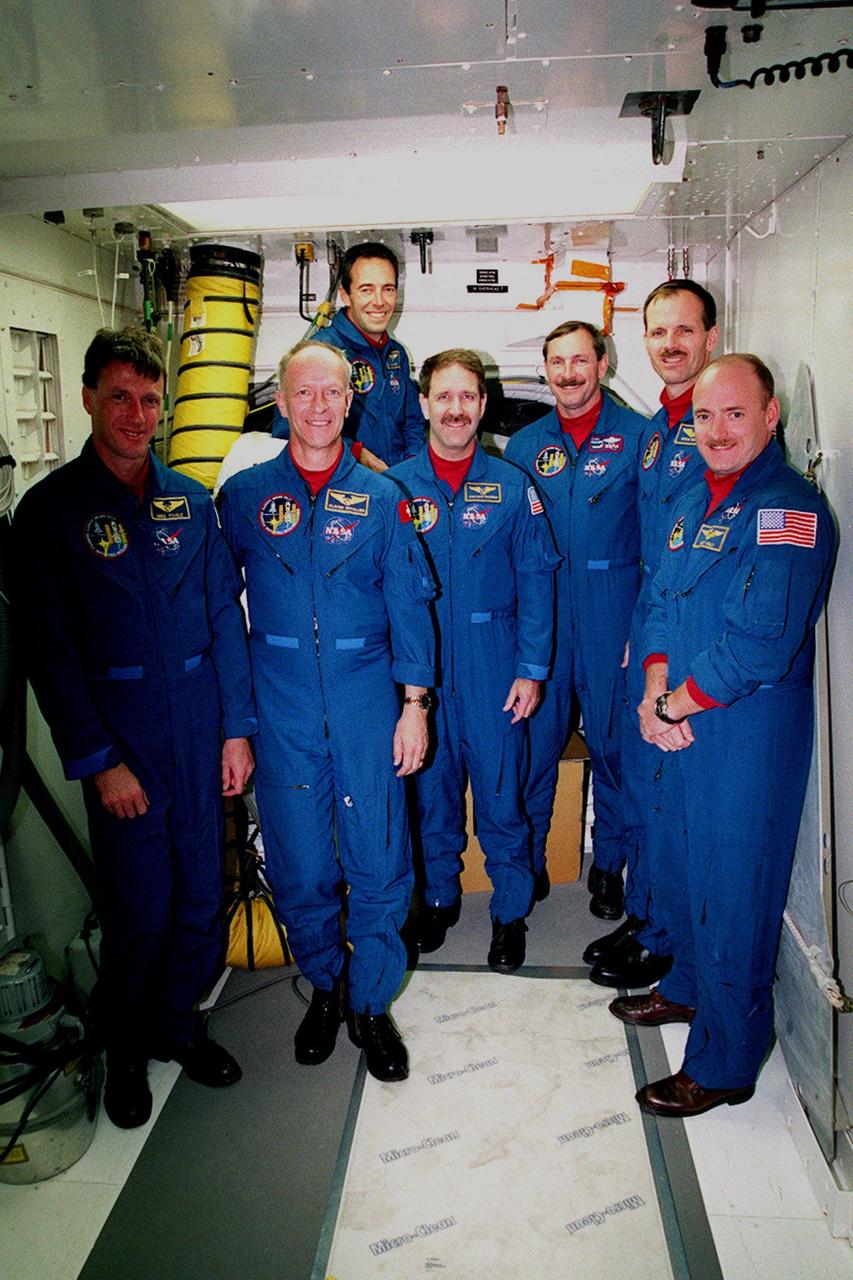
As part of Terminal Countdown Demonstration Test (TCDT) activities, the STS-103 crew inspect the "white room," an environmentally controlled chamber at the end of the orbiter access arm through which the crew enters the orbiter. Standing from left to right are Mission Specialists C. Michael Foale (Ph.D.), Claude Nicollier of Switzerland, Jean-François Clervoy of France, John M. Grunsfeld (Ph.D.), Commander Curtis L. Brown Jr., Mission Specialist Steven L. Smith, and Pilot Scott J. Kelly. Clervoy and Nicollier are with the European Space Agency. The TCDT provides the crew with the emergency egress training, opportunities to inspect their mission payloads in the orbiter's payload bay, and simulated countdown exercises. STS-103 is a "call-up" mission due to the need to replace and repair portions of the Hubble Space Telescope, including the gyroscopes that allow the telescope to point at stars, galaxies and planets. The STS-103 crew will be replacing a Fine Guidance Sensor, an older computer with a new enhanced model, an older data tape recorder with a solid-state digital recorder, a failed spare transmitter with a new one, and degraded insulation on the telescope with new thermal insulation. The crew will also install a Battery Voltage/Temperature Improvement Kit to protect the spacecraft batteries from overcharging and overheating when the telescope goes into a safe mode. Four EVA's are planned to make the necessary repairs and replacements on the telescope. The mission is targeted for launch Dec. 6 at 2:37 a.m. EST
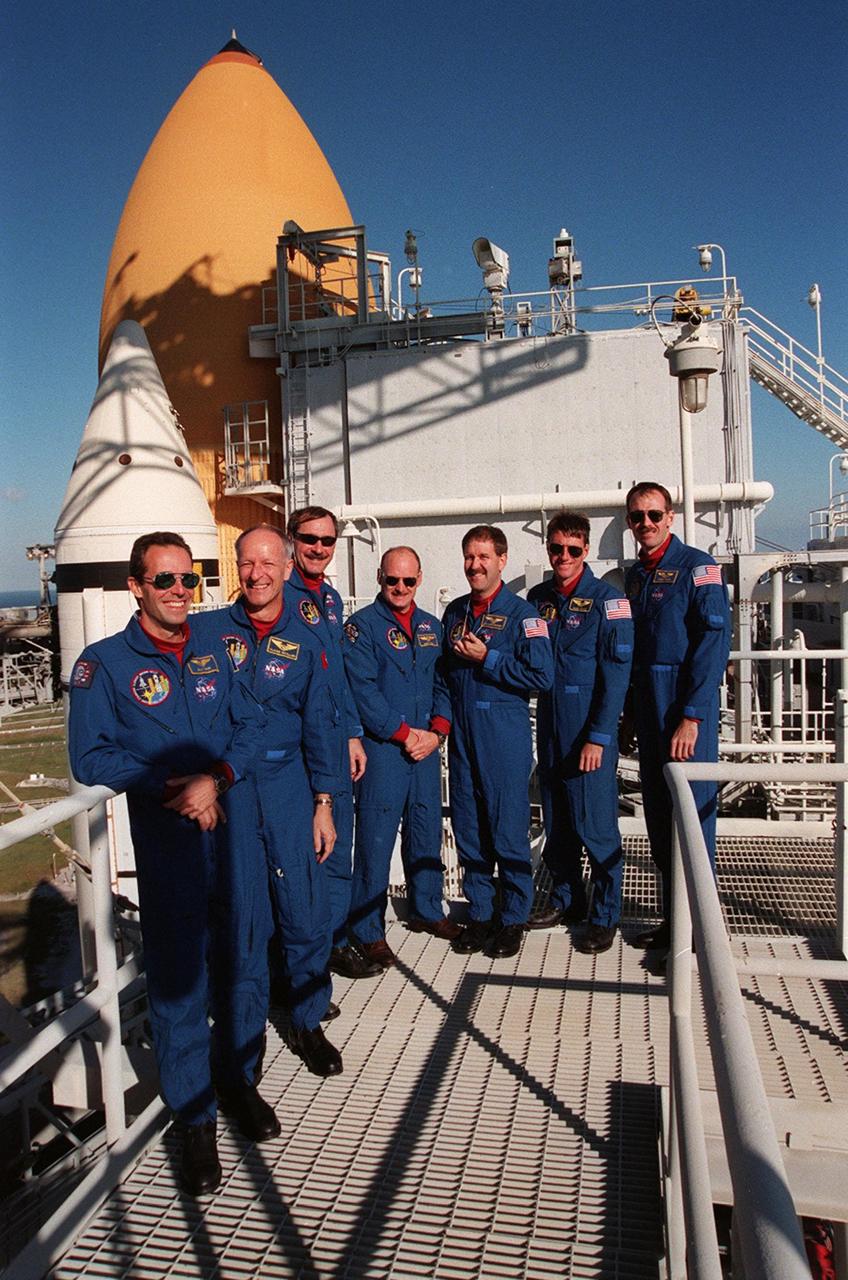
At the 195-foot level of the Fixed Service Structure on Launch Pad 39B, the STS-103 crew take a break from Terminal Countdown Demonstration Test (TCDT) activities. Standing from left to right are Mission Specialists Jean-François Clervoy of France and Claude Nicollier of Switzerland, who are with the European Space Agency; Commander Curtis L. Brown Jr.; Pilot Scott J. Kelly; and Mission Specialists John M. Grunsfeld (Ph.D.), C. Michael Foale (Ph.D.) and Steven L. Smith. The TCDT provides the crew with the emergency egress training, opportunities to inspect their mission payloads in the orbiter's payload bay, and simulated countdown exercises. STS-103 is a "call-up" mission due to the need to replace and repair portions of the Hubble Space Telescope, including the gyroscopes that allow the telescope to point at stars, galaxies and planets. The STS-103 crew will be replacing a Fine Guidance Sensor, an older computer with a new enhanced model, an older data tape recorder with a solid-state digital recorder, a failed spare transmitter with a new one, and degraded insulation on the telescope with new thermal insulation. The crew will also install a Battery Voltage/Temperature Improvement Kit to protect the spacecraft batteries from overcharging and overheating when the telescope goes into a safe mode. Four EVA's are planned to make the necessary repairs and replacements on the telescope. The mission is targeted for launch Dec. 6 at 2:37 a.m. EST