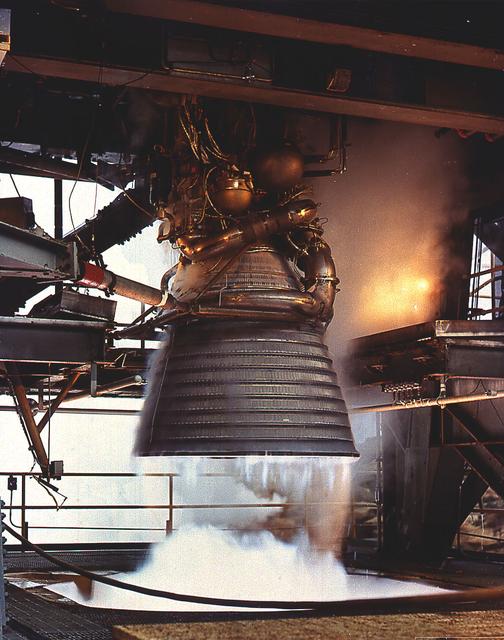
A J-2 engine undergoes static firing. The J-2, developed under the direction of the Marshall Space Flight Center, was propelled by liquid hydrogen and liquid oxygen. A single J-2 was utilized in the S-IVB stage (the second stage for the Saturn IB and third stage for the Saturn V) and in a cluster of five for the second stage (S-II) of the Saturn V. Initially rated at 200,000 pounds of thrust, the engine was later uprated in the Saturn V program to 230,000 pounds.
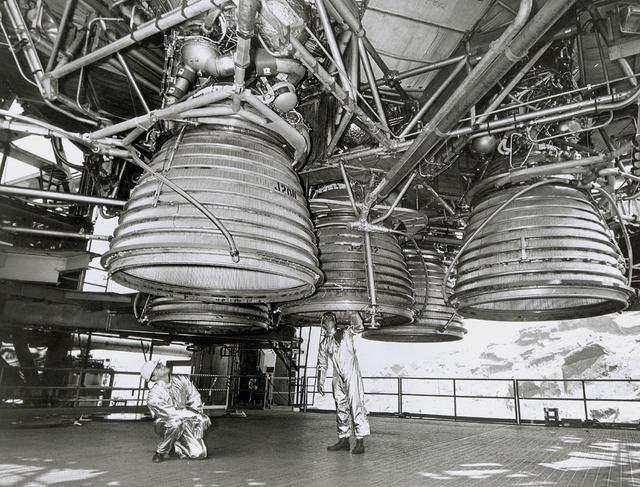
Two workers are dwarfed by the five J-2 engines of the Saturn V second stage (S-II) as they make final inspections prior to a static test firing by North American Space Division. These five hydrogen -fueled engines produced one million pounds of thrust, and placed the Apollo spacecraft into earth orbit before departing for the moon. The towering 363-foot Saturn V was a multi-stage, multi-engine launch vehicle standing taller than the Statue of Liberty. Altogether, the Saturn V engines produced as much power as 85 Hoover Dams.
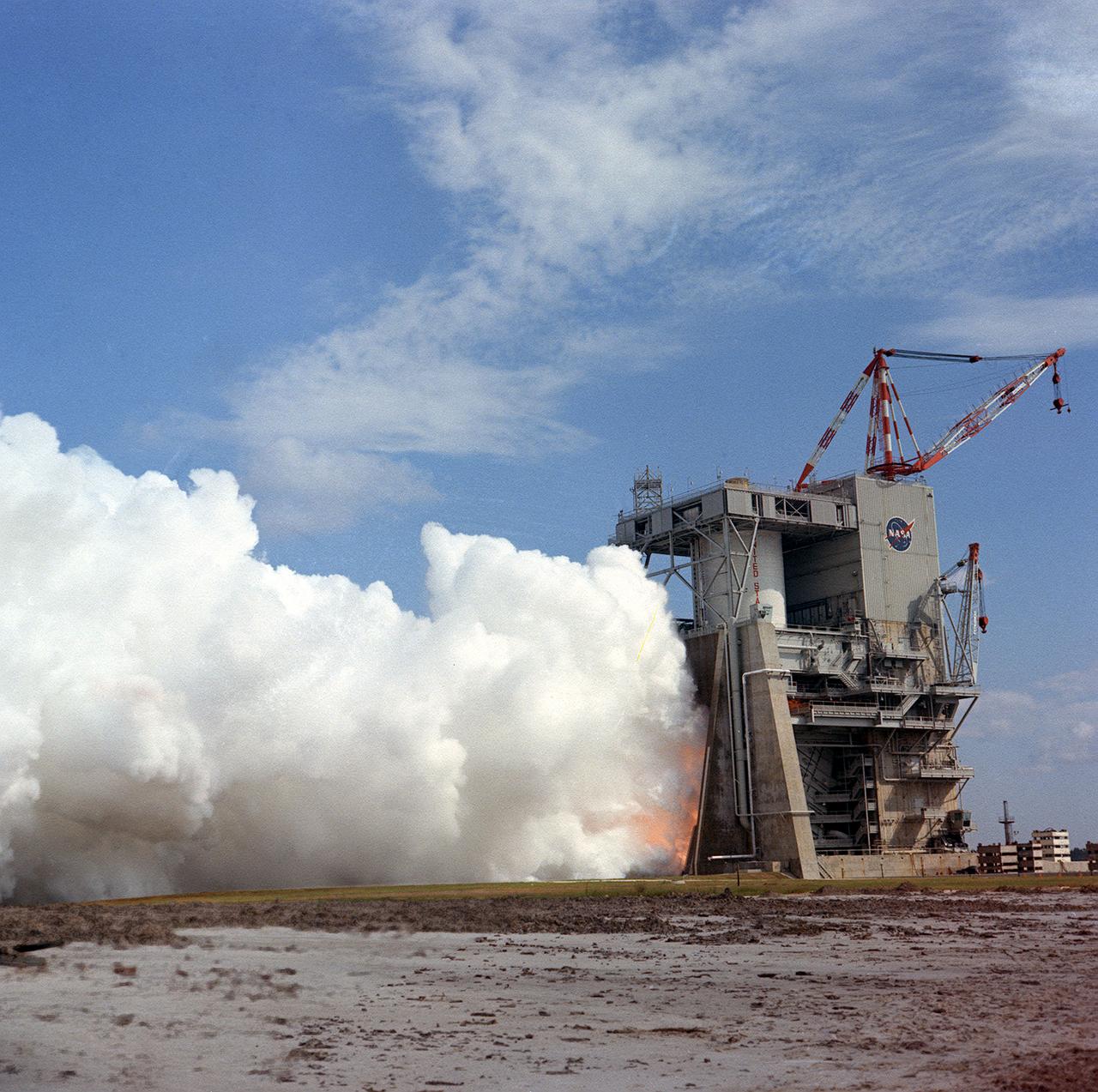
This photograph shows a test firing of the the Saturn V S-II (second) stage at the Mississippi Test Facility's (MTF) S-II test stand. When the Saturn V booster stage (S-IC) burns out and drops away, power for the Saturn will be provided by the 82-foot-long and 33-foot-diameter S-II stage. Developed by the Space Division of North American Aviation under the direction of the Marshall Space Flight Center, the stage utilized five J-2 engines, each producing 200,000 pounds of thrust. The engines used liquid oxygen and liquid hydrogen as propellants. Static test of ground test versions of the S-II stage were conducted at North American Aviation's Santa Susana, California test site. All flight stages were tested at the Mississippi Test Facility, Bay St. Louis, Mississippi. MTF was renamed to the National Space Technology Laboratory (NSTL) in 1974 and later to the Sternis Space Center in May 1988.
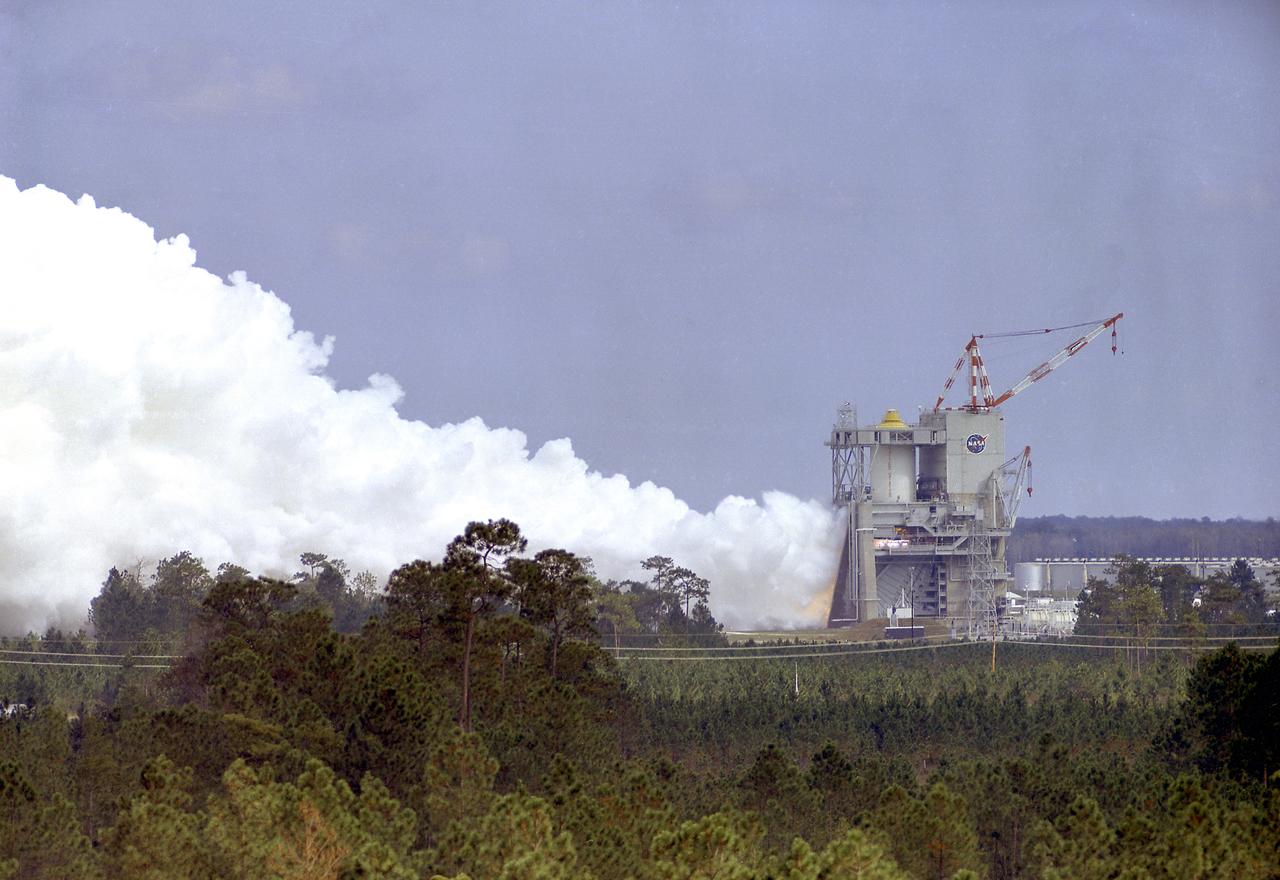
This photograph shows a test firing of the the Saturn V S-II (second) stage at the Mississippi Test Facility's (MTF) S-II test stand. When the Saturn V booster stage (S-IC) burns out and drops away, power for the Saturn will be provided by the 82-foot-long and 33-foot-diameter S-II stage. Developed by the Space Division of North American Aviation under the direction of the Marshall Space Flight Center, the stage utilized five J-2 engines, each producing 200,000 pounds of thrust. The engine used liquid oxygen and liquid hydrogen as its propellants. Static test of ground test versions of the S-II stage were conducted at North American Aviation's Santa Susana, California test site. All flight stages were tested at the Mississippi Test Facility, Bay St. Louis, Mississippi. The MTF was renamed to the National Space Technology Laboratory (NSTL) in 1974 and later to the Sternis Space Center (SSC) in May 1988.