
Artist concept shows Galileo spacecraft while still approaching Jupiter having a satellite encounter. Galileo is flying about 600 miles above Io's volcano-torn surface, twenty times closer than the closest flyby altitude of Voyager in 1979.
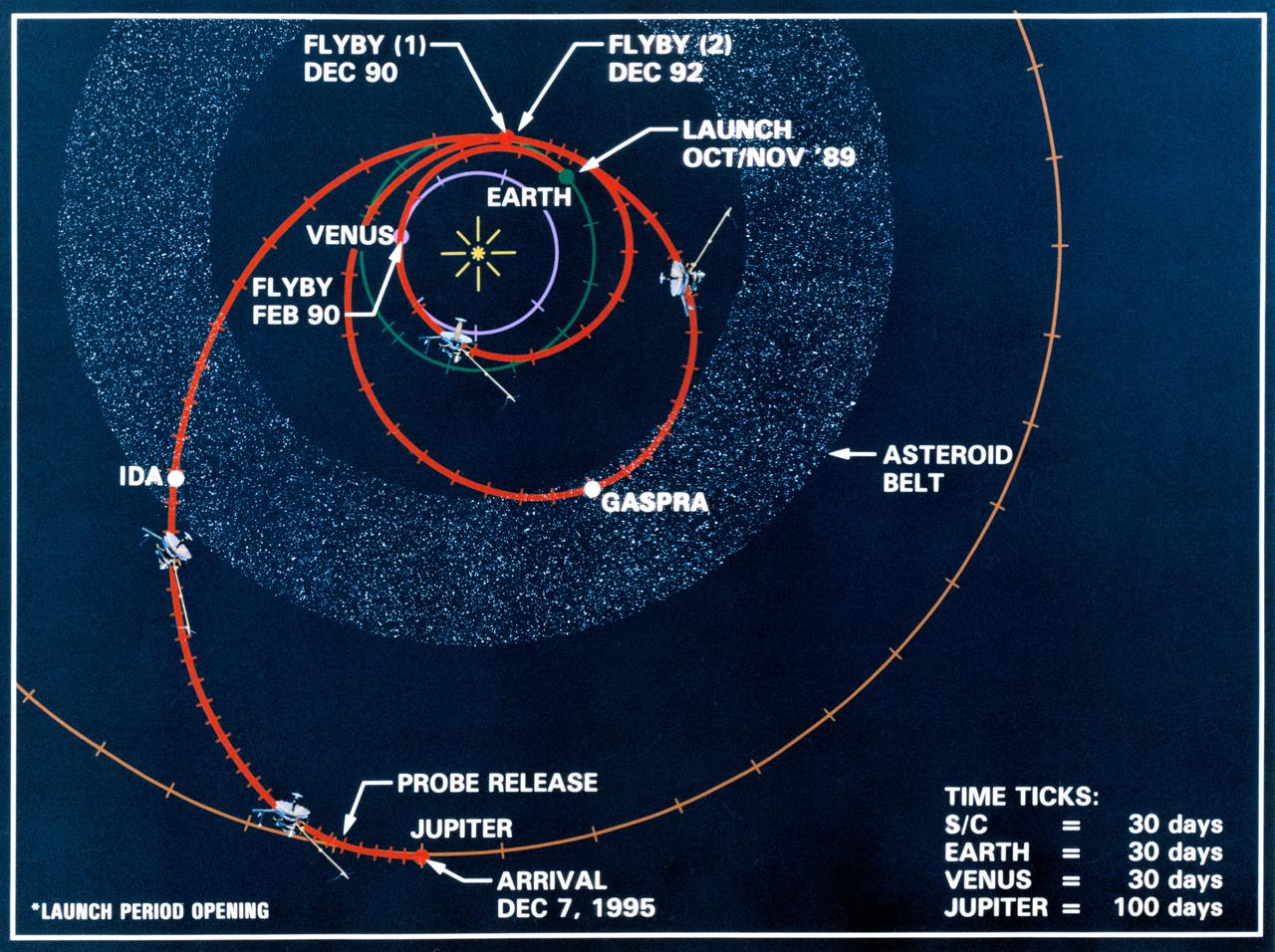
Line drawing charts the Galileo spacecraft's launch from low Earth orbit and its three planetary and two asteroid encounters in the course of its gravity-assisted flight to Jupiter. These encounters include Venus (February 1990), two Earth passes (December 1990 and December 1992), and the asteroids Gaspra and Ida in the asteroid belt. Galileo will release a probe and will arrive at Jupiter, 12-07-95.
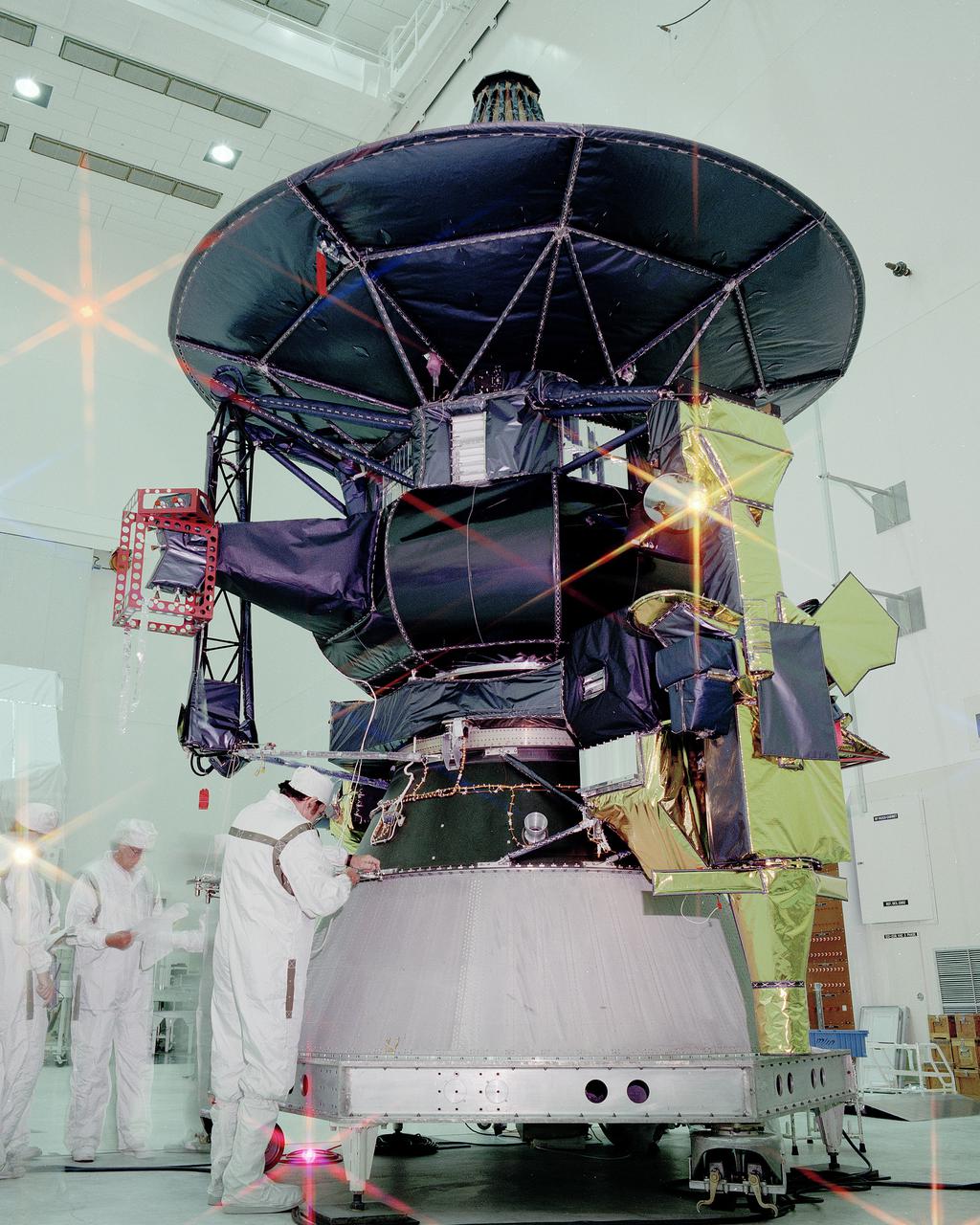
CAPE CANAVERAL, Fla. -- At the Kennedy Space Center’s SAEF-2 planetary spacecraft checkout facility, technicians work on the spacecraft Galileo prior to moving it to the Vertical Processing Facility for mating with an Inertial Upper Stage. Galileo is scheduled to be launched aboard Atlantis on space shuttle mission STS-34, Oct. 12, 1989 and sent to the planet Jupiter, a journey which will take more than six years to complete. In December 1995, as the two and one half ton spacecraft orbits Jupiter with its 10 scientific instruments, a probe will be released to parachute into the Jovian atmosphere. Photo Credit: NASA

Labeled line drawing entitled GALILEO PROBE identifies the deceleration module aft cover, descent module, and deceleration module aeroshell configurations and dimensions prior to and during entry into Jupiter's atmosphere.
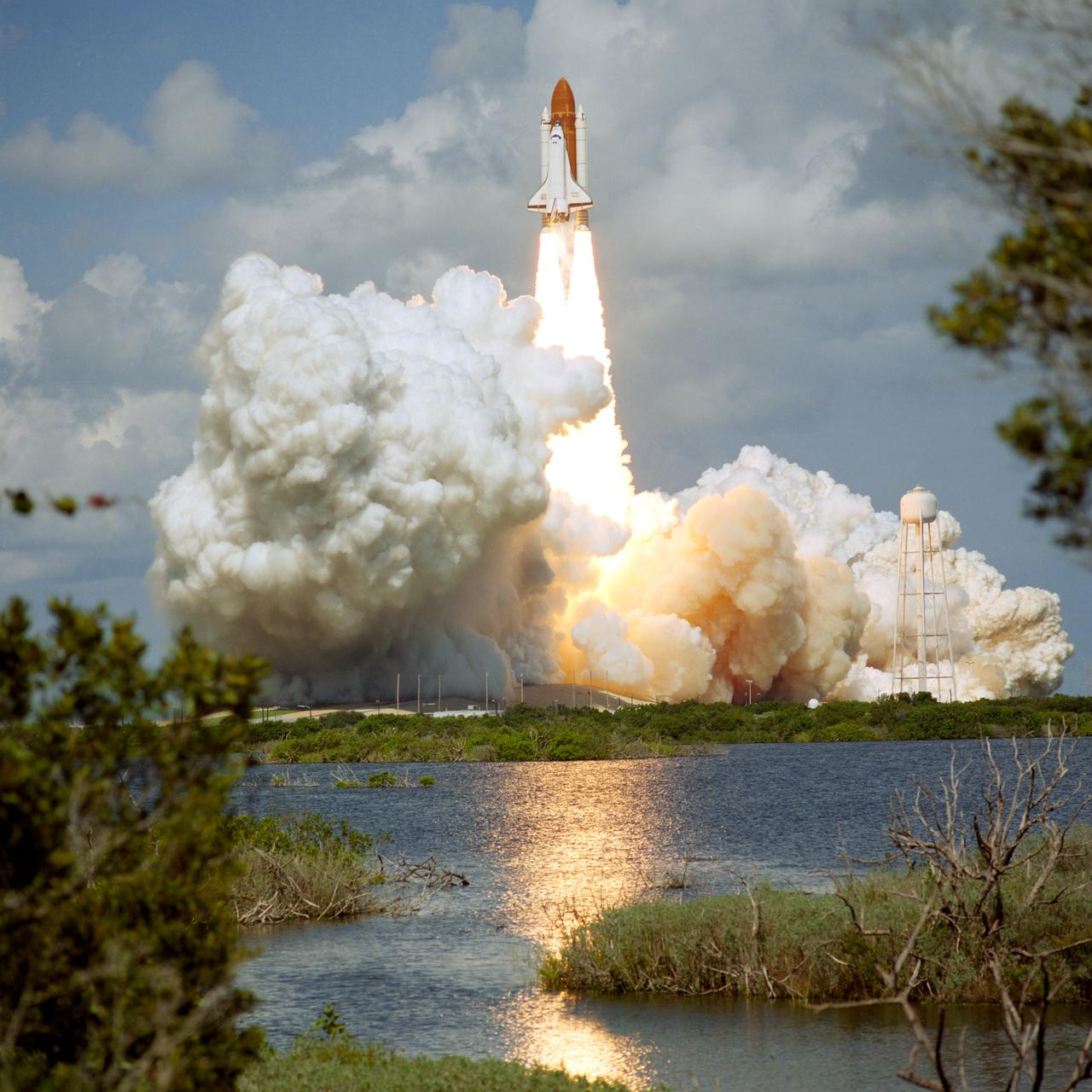
STS034-S-025 (18 Oct 1989) --- The STS-34 Space Shuttle Atlantis lifts off from Launch Pad 39-B at 2:53:39:983 p.m. (EDT), marking the beginning of a five-day mission in space. Atlantis carries a crew of five and the spacecraft Galileo, along with a number of other scientific experiments. The Jupiter-bound probe will be deployed from Atlantis some six hours after launch. The journey to the giant planet is expected to take over six years. Crewmembers for the mission are astronauts Donald E. Williams, Michael J. McCulley, Shannon W. Lucid, Franklin R. Chang-Diaz and Ellen S. Baker. The scene was recorded with a 70mm camera.

At the Kennedy Space Center's (KSC's) Spacecraft and Assembly Encapsulation Facility 2 (SAEF-2), the planetary spacecraft checkout facility, clean-suited technicians work on the Galileo spacecraft prior to moving it to the Vehicle Processing Facility (VPF) for mating with the inertial upper stage (IUS). Galileo is scheduled for launch aboard Atlantis, Orbiter Vehicle (OV) 104, on Space Shuttle Mission STS-34 in October 1989. It will be sent to the planet Jupiter, a journey which will taken more than six years to complete. In December 1995 as the two and one half ton spacecraft orbits Jupiter with its ten scientific instruments, a probe will be released to parachute into the Jovian atmosphere. NASA's Jet Propulsion Laboratory (JPL) manages the Galileo project. View provided by KSC.
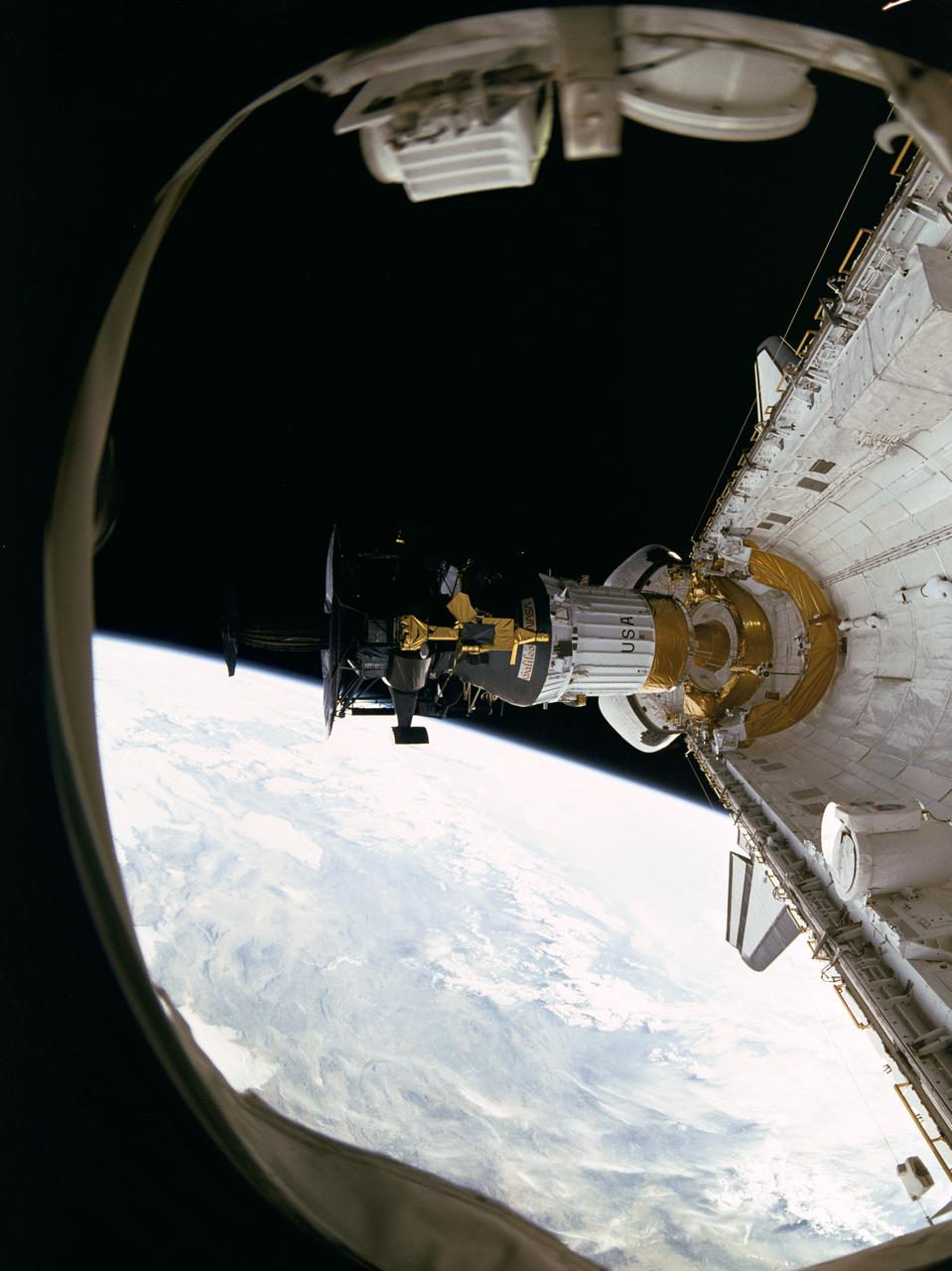
S89-48714 (18 Oct 1989) --- This photograph was taken by the STS-34 crew aboard the Space Shuttle Atlantis and shows the Galileo spacecraft being deployed on Oct. 18, 1989 from the payload bay. Galileo is a scientific craft that will go into orbit around the planet Jupiter and drop a probe into its atmosphere in search of primordial solar system material believed to be present there. The 70mm motion picture film will be used in the forthcoming "Blue Planet," which will address Earth's environmental problems from the perspective of space-based observation and solar system exploration. The film is being produced by IMAX Space Technology Inc. for the sponsor, the Smithsonian Institution, with funding provided by the Lockheed Corporation. PHOTO CREDIT: NASA/Smithsonian Institution
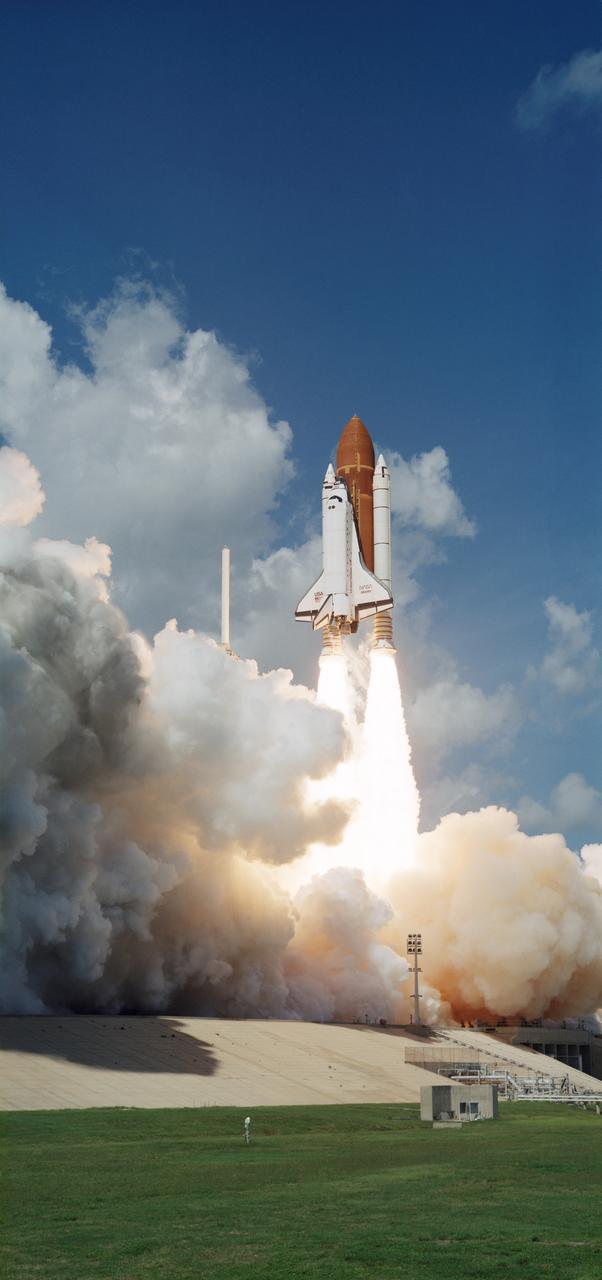
STS034-S-023 (18 Oct. 1989) --- The STS-34 Space Shuttle Atlantis lifts off from Kennedy Space Center’s launch pad 39-B at l2:53:39 p.m. (EDT) on Oct. 18, 1989, marking the beginning of a five-day mission in space. Atlantis carries a crew of five and the spacecraft Galileo. The Jupiter-bound probe will be deployed from Atlantis some six hours after launch. The journey to the giant planet is expected to take over six years. Crewmembers for the mission are astronauts Donald E. Williams, Michael J. McCulley, Shannon W. Lucid, Franklin R. Chang-Diaz and Ellen S. Baker. The scene was recorded with a 70mm camera.
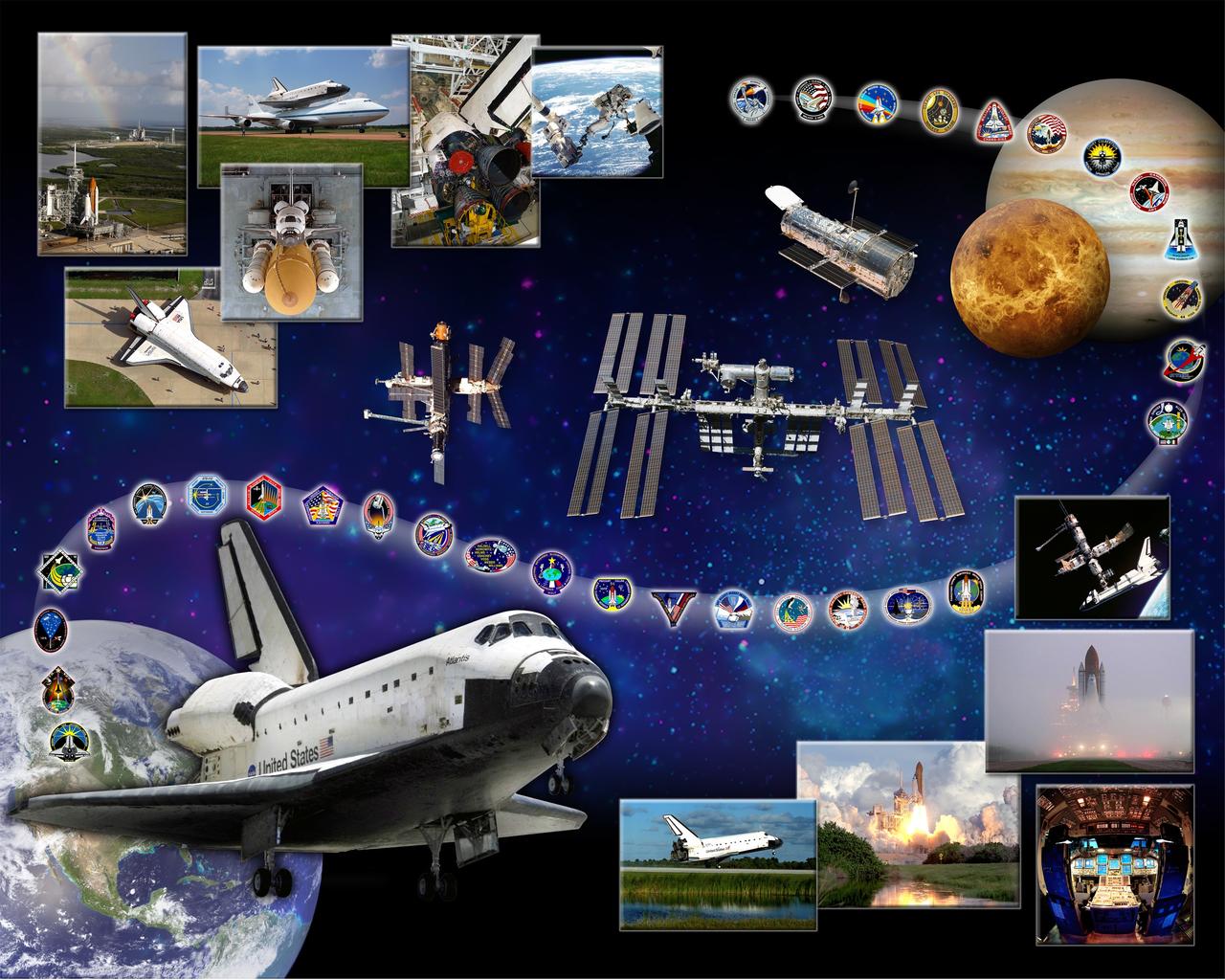
CAPE CANAVERAL, Fla. -- This orbiter tribute of space shuttle Atlantis, or OV-104, hangs in Firing Room 4 of the Launch Control Center at NASA's Kennedy Space Center in Florida. In the lower-left corner, it features Atlantis soaring above Earth and threaded through the design are the mission patches for each of Atlantis’ flights. Atlantis' accomplishments include seven missions to the Russian space station Mir and several assembly, construction and resupply missions to the International Space Station. Atlantis also flew the last Hubble Space Telescope servicing mission on STS-125. In the tribute, the planet Venus represents the Magellan probe being deployed during STS-30, and Jupiter represents the Galileo probe being deployed during STS-34. The inset photos illustrate various aspects of shuttle processing as well as significant achievements, such as the glass cockpit and the first shuttle docking with Mir during STS-71. The inset photo in the upper-left corner shows a rainbow over Atlantis on Launch Pad 39A and shuttle Endeavour on Launch Pad 39B at Kennedy. Endeavour was the assigned vehicle had Atlantis’ STS-125 mission needed rescue, and this was the last time both launch pads were occupied at the same time. The stars in the background represent the many people who have worked with Atlantis and their contributions to the vehicle’s success. Graphic design credit: NASA/Amy Lombardo
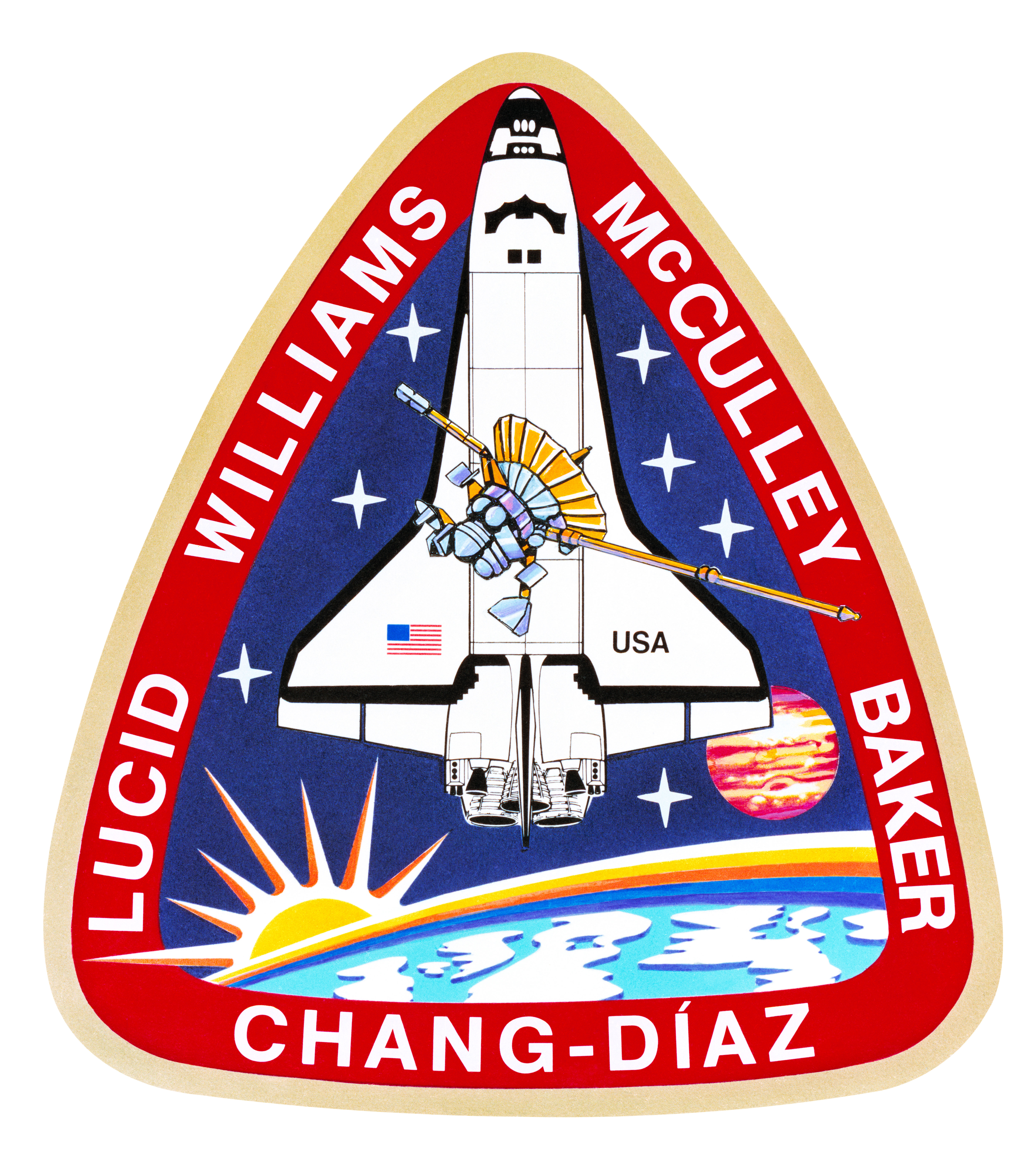
S89-20077 (17 July 1989) --- The triangular shape of the STS-34 crew patch represents forward motion and the entering into new frontiers of science, engineering and technology. The Galileo spacecraft overlaying the orbiter symbolizes the joining together of both manned and unmanned space programs in order to maximize the capabilities of each. The crew members, who designed the patch, use a sunrise stretching across Earth's horizon to depict expansion of our knowledge of the solar system and other worlds, leading to a better understanding of our own planet. In the distance, Jupiter, a unique world with many unknowns, awaits the arrival of Galileo to help unlock its secrets. Meanwhile, the space shuttle remains in Earth orbit, continuing to explore the near-Earth environment. The NASA insignia design for space shuttle flights is reserved for use by the astronauts and for other official use as the NASA Administrator may authorize. Public availability has been approved only in the forms of illustrations by the various news media. When and if there is any change in this policy, which is not anticipated, the change will be publicly announced. Photo credit: NASA
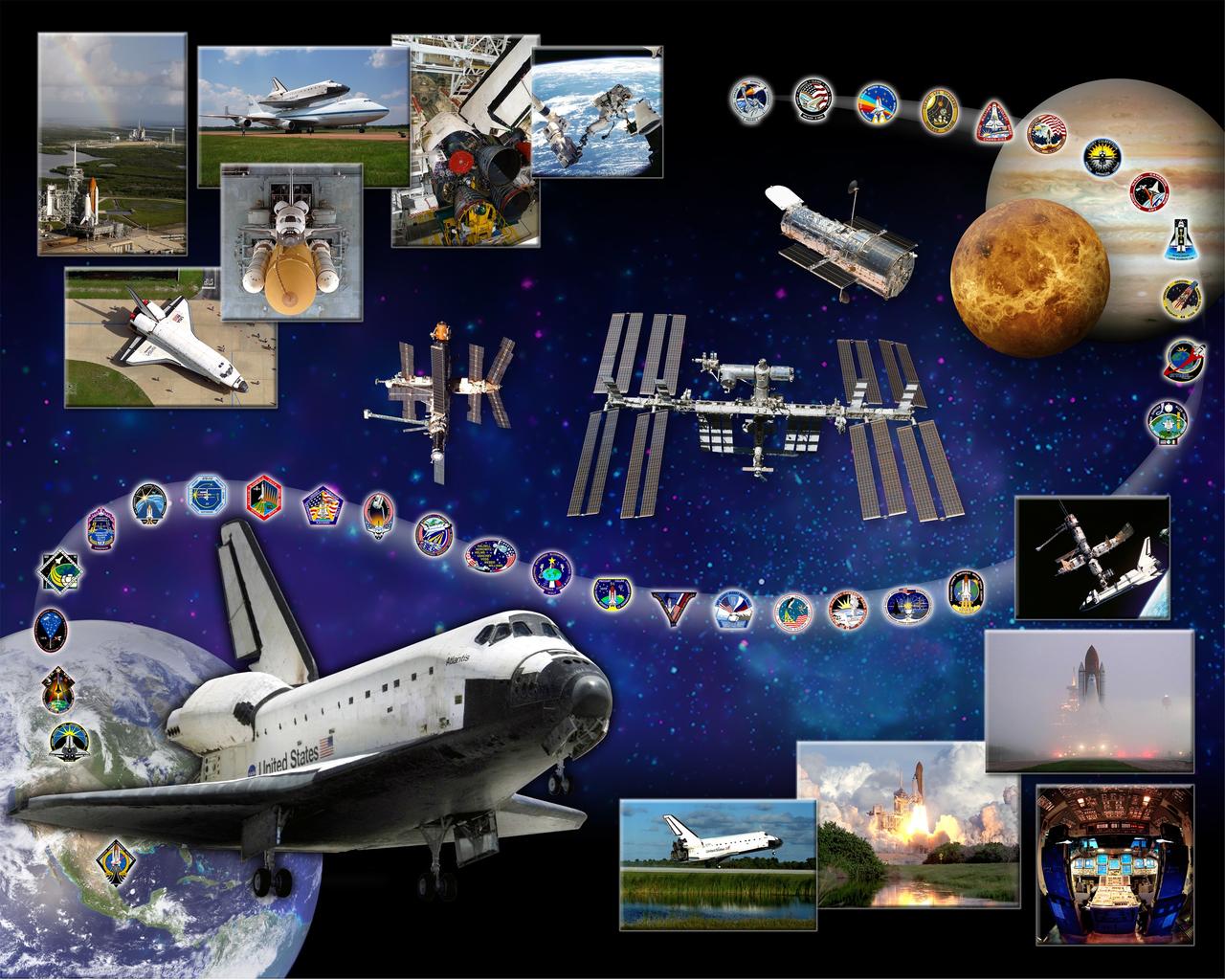
CAPE CANAVERAL, Fla. -- This orbiter tribute of space shuttle Atlantis, or OV-104, hangs in Firing Room 4 of the Launch Control Center at NASA's Kennedy Space Center in Florida. In 2011, the tribute was updated to reflect the addition of one more Atlantis flight -- STS-135 -- which will be the 33rd flight of Atlantis, the 37th shuttle mission to the space station, and the 135th and final mission of NASA's Space Shuttle Program. In the lower-left corner, it features Atlantis soaring above Earth and threaded through the design are the mission patches for each of Atlantis’ flights. Atlantis' accomplishments include seven missions to the Russian space station Mir and several assembly, construction and resupply missions to the International Space Station. Atlantis also flew the last Hubble Space Telescope servicing mission on STS-125. In the tribute, the planet Venus represents the Magellan probe being deployed during STS-30, and Jupiter represents the Galileo probe being deployed during STS-34. The inset photos illustrate various aspects of shuttle processing as well as significant achievements, such as the glass cockpit and the first shuttle docking with Mir during STS-71. The inset photo in the upper-left corner shows a rainbow over Atlantis on Launch Pad 39A and shuttle Endeavour on Launch Pad 39B at Kennedy. Endeavour was the assigned vehicle had Atlantis’ STS-125 mission needed rescue, and this was the last time both launch pads were occupied at the same time. The stars in the background represent the many people who have worked with Atlantis and their contributions to the vehicle’s success. Graphic design credit: NASA/Amy Lombardo. NASA publication number: SP-2010-08-161-KSC

CAPE CANAVERAL, Fla. -- This is a printable version of space shuttle Atlantis' orbiter tribute, or OV-104, which hangs in Firing Room 4 of the Launch Control Center at NASA's Kennedy Space Center in Florida. In 2011, the tribute was updated to reflect the addition of one more flight -- STS-135 -- which will be the 33rd flight of Atlantis, the 37th shuttle mission to the space station, and the 135th and final mission of NASA's Space Shuttle Program. In the lower-left corner, it features Atlantis soaring above Earth and threaded through the design are the mission patches for each of Atlantis’ flights. Atlantis' accomplishments include seven missions to the Russian space station Mir and several assembly, construction and resupply missions to the International Space Station. Atlantis also flew the last Hubble Space Telescope servicing mission on STS-125. In the tribute, the planet Venus represents the Magellan probe being deployed during STS-30, and Jupiter represents the Galileo probe being deployed during STS-34. The inset photos illustrate various aspects of shuttle processing as well as significant achievements, such as the glass cockpit and the first shuttle docking with Mir during STS-71. The inset photo in the upper-left corner shows a rainbow over Atlantis on Launch Pad 39A and shuttle Endeavour on Launch Pad 39B at Kennedy. Endeavour was the assigned vehicle had Atlantis’ STS-125 mission needed rescue, and this was the last time both launch pads were occupied at the same time. The stars in the background represent the many people who have worked with Atlantis and their contributions to the vehicle’s success. Graphic design credit: NASA/Amy Lombardo. NASA publication number: SP-2010-08-161-KSC

CAPE CANAVERAL, Fla. -- This is a version of space shuttle Atlantis' orbiter tribute, or OV-104, which hangs in Firing Room 4 of the Launch Control Center at NASA's Kennedy Space Center in Florida. In 2011, the tribute was updated to reflect the addition of one more Atlantis flight -- STS-135 -- which will be the 33rd flight of Atlantis, the 37th shuttle mission to the space station, and the 135th and final mission of NASA's Space Shuttle Program. In the lower-left corner, it features Atlantis soaring above Earth and threaded through the design are the mission patches for each of Atlantis’ flights. Atlantis' accomplishments include seven missions to the Russian space station Mir and several assembly, construction and resupply missions to the International Space Station. Atlantis also flew the last Hubble Space Telescope servicing mission on STS-125. In the tribute, the planet Venus represents the Magellan probe being deployed during STS-30, and Jupiter represents the Galileo probe being deployed during STS-34. The inset photos illustrate various aspects of shuttle processing as well as significant achievements, such as the glass cockpit and the first shuttle docking with Mir during STS-71. The inset photo in the upper-left corner shows a rainbow over Atlantis on Launch Pad 39A and shuttle Endeavour on Launch Pad 39B at Kennedy. Endeavour was the assigned vehicle had Atlantis’ STS-125 mission needed rescue, and this was the last time both launch pads were occupied at the same time. The stars in the background represent the many people who have worked with Atlantis and their contributions to the vehicle’s success. Graphic design credit: NASA/Amy Lombardo. NASA publication number: SP-2010-08-161-KSC
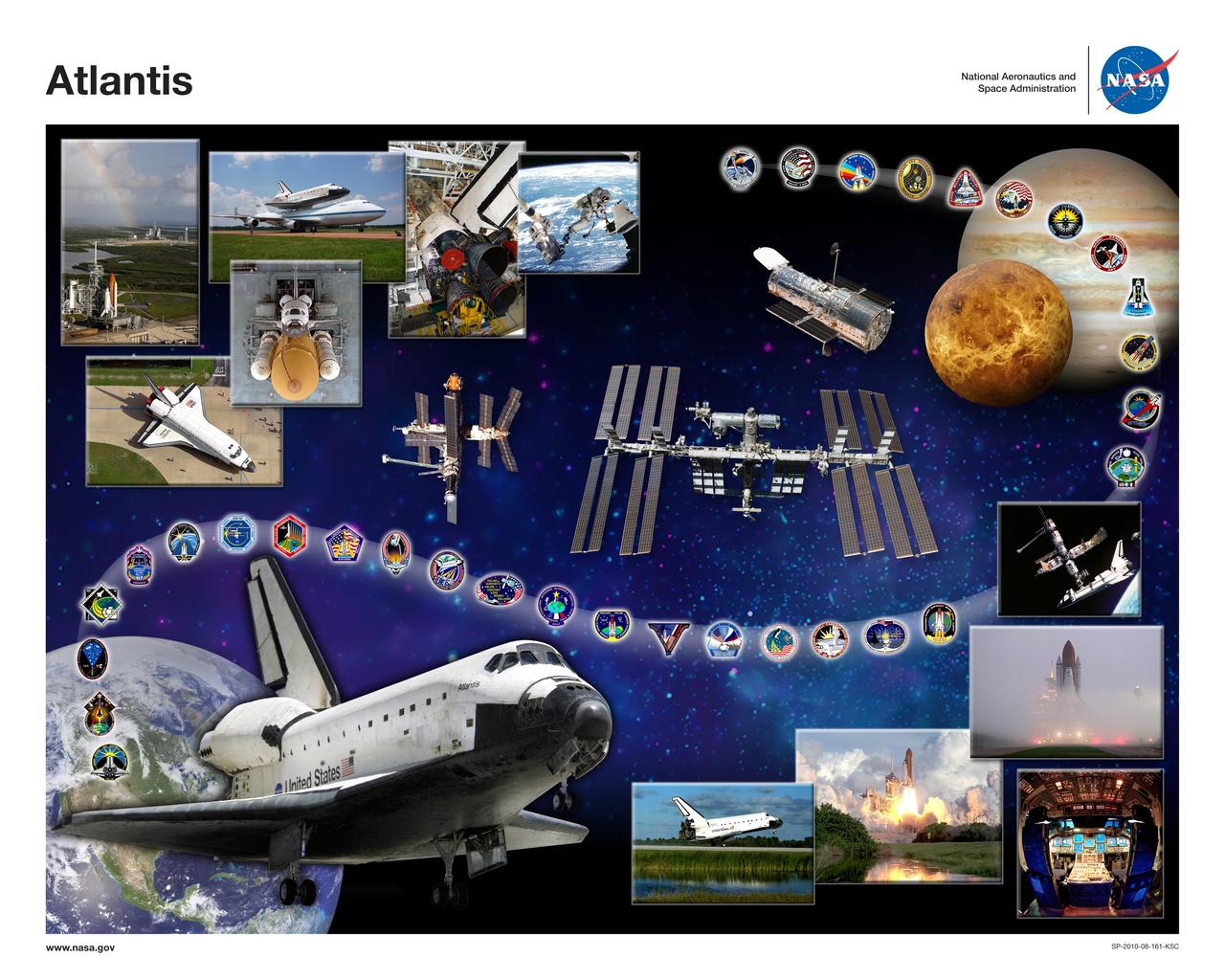
CAPE CANAVERAL, Fla. -- This is a version of space shuttle Atlantis' orbiter tribute, or OV-104, which hangs in Firing Room 4 of the Launch Control Center at NASA's Kennedy Space Center in Florida. In the lower-left corner, it features Atlantis soaring above Earth and threaded through the design are the mission patches for each of Atlantis’ flights. Atlantis' accomplishments include seven missions to the Russian space station Mir and several assembly, construction and resupply missions to the International Space Station. Atlantis also flew the last Hubble Space Telescope servicing mission on STS-125. In the tribute, the planet Venus represents the Magellan probe being deployed during STS-30, and Jupiter represents the Galileo probe being deployed during STS-34. The inset photos illustrate various aspects of shuttle processing as well as significant achievements, such as the glass cockpit and the first shuttle docking with Mir during STS-71. The inset photo in the upper-left corner shows a rainbow over Atlantis on Launch Pad 39A and shuttle Endeavour on Launch Pad 39B at Kennedy. Endeavour was the assigned vehicle had Atlantis’ STS-125 mission needed rescue, and this was the last time both launch pads were occupied at the same time. The stars in the background represent the many people who have worked with Atlantis and their contributions to the vehicle’s success. Graphic design credit: NASA/Amy Lombardo. NASA publication number: SP-2010-08-161-KSC
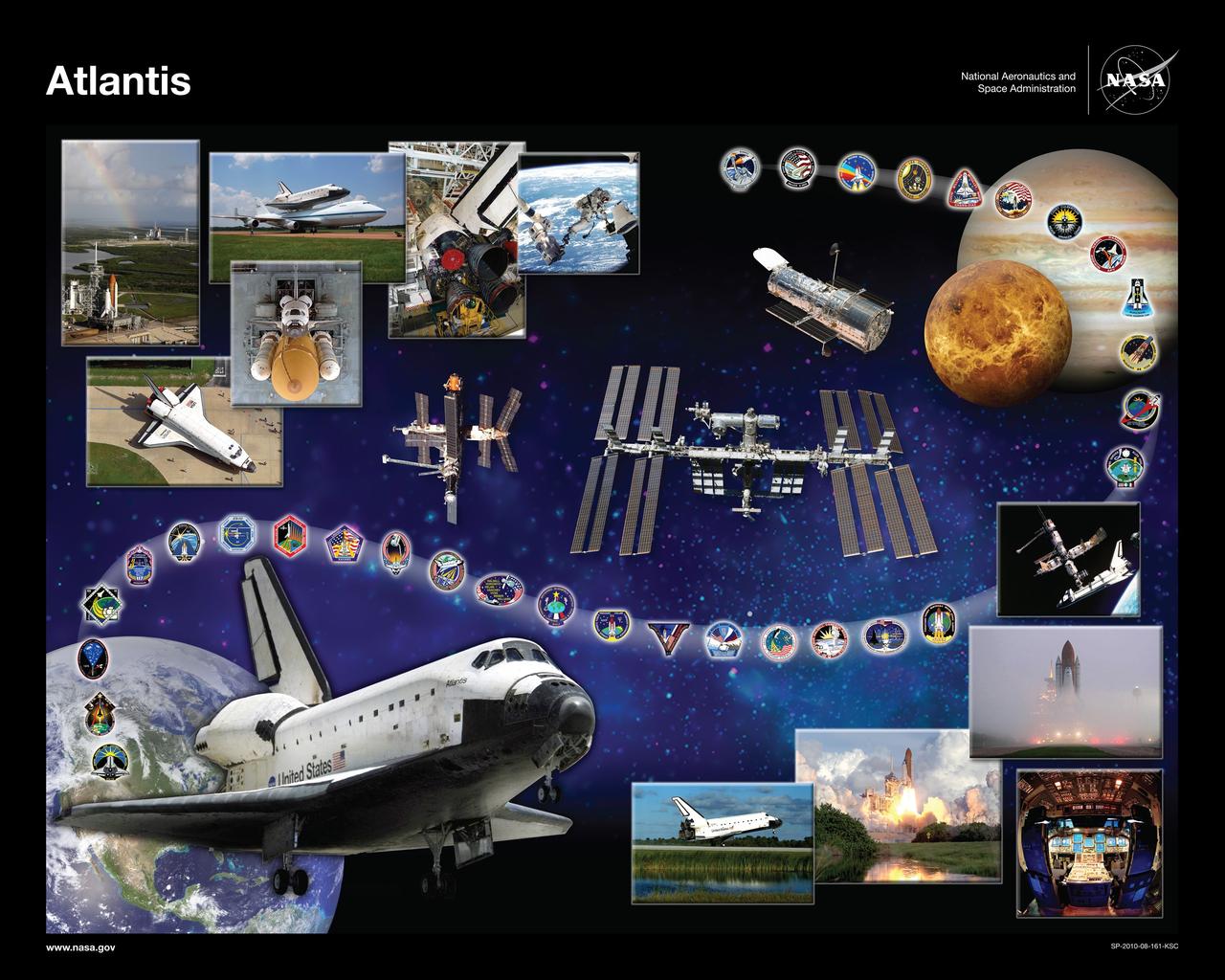
CAPE CANAVERAL, Fla. -- This is a printable version of space shuttle Atlantis' orbiter tribute, or OV-104, which hangs in Firing Room 4 of the Launch Control Center at NASA's Kennedy Space Center in Florida. In the lower-left corner, it features Atlantis soaring above Earth and threaded through the design are the mission patches for each of Atlantis’ flights. Atlantis' accomplishments include seven missions to the Russian space station Mir and several assembly, construction and resupply missions to the International Space Station. Atlantis also flew the last Hubble Space Telescope servicing mission on STS-125. In the tribute, the planet Venus represents the Magellan probe being deployed during STS-30, and Jupiter represents the Galileo probe being deployed during STS-34. The inset photos illustrate various aspects of shuttle processing as well as significant achievements, such as the glass cockpit and the first shuttle docking with Mir during STS-71. The inset photo in the upper-left corner shows a rainbow over Atlantis on Launch Pad 39A and shuttle Endeavour on Launch Pad 39B at Kennedy. Endeavour was the assigned vehicle had Atlantis’ STS-125 mission needed rescue, and this was the last time both launch pads were occupied at the same time. The stars in the background represent the many people who have worked with Atlantis and their contributions to the vehicle’s success. Graphic design credit: NASA/Amy Lombardo. NASA publication number: SP-2010-08-161-KSC