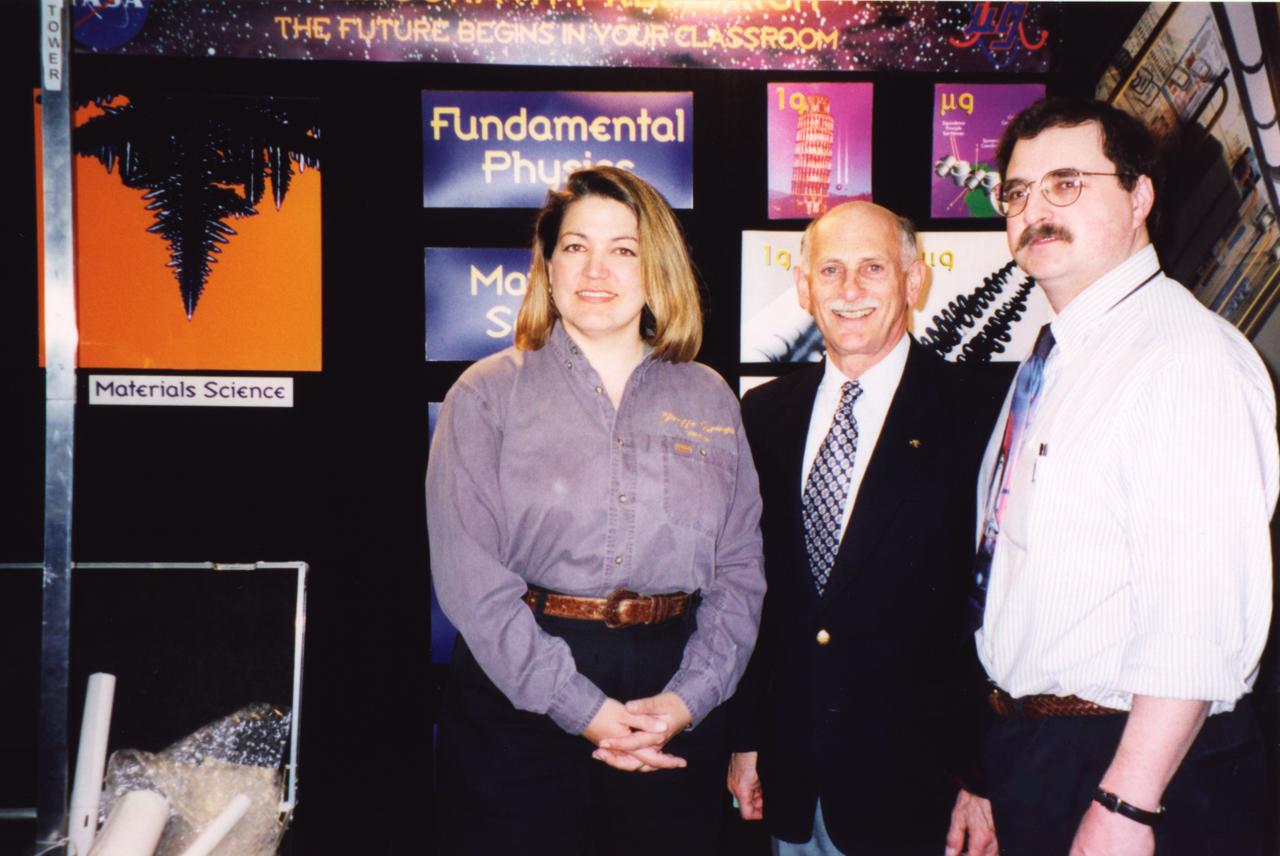
Representatives of NASA materials science experiments supported the NASA exhibit at the Rernselaer Polytechnic Institute's Space Week activities, April 5 through 11, 1999. From left to right are: Angie Jackman, project manager at NASA's Marshall Space Flight Center for dendritic growth experiments; Dr. Martin Glicksman of Rennselaer Polytechnic Instutute, Troy, NY, principal investigator on the Isothermal Dendritic Growth Experiment (IDGE) that flew three times on the Space Shuttle; and Dr. Matthew Koss of College of the Holy Cross in Worcester, MA, a co-investigator on the IDGE and now principal investigator on the Transient Dendritic Solidification Experiment being developed for the International Space Station (ISS). The image at far left is a dendrite grown in Glicksman's IDGE tests aboard the Shuttle. Glicksman is also principal investigator for the Evolution of Local Microstructures: Spatial Instabilities of Coarsening Clusters.
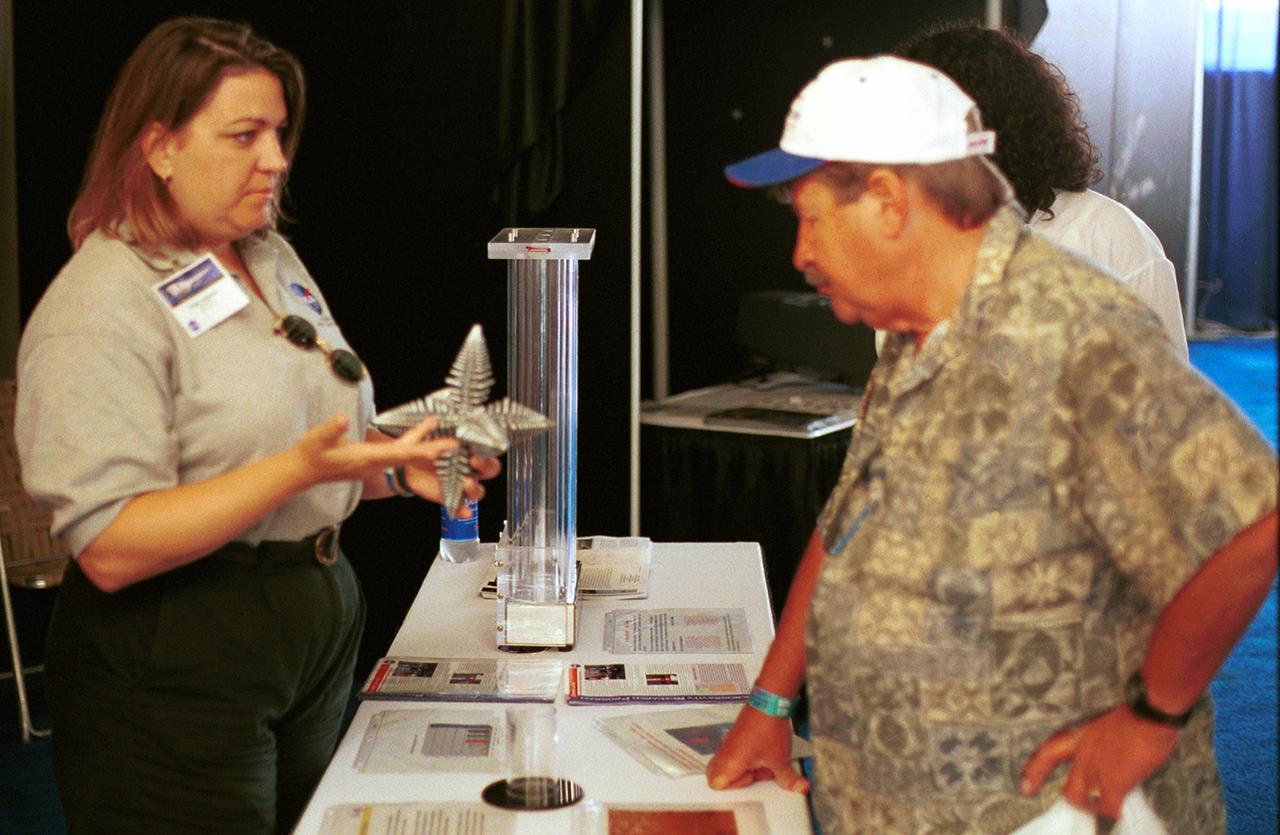
Angie Jackman, a NASA project manager in microgravity research, explains a model of a dendrite to a visitor to the NASA exhibit at AirVenture 2000 sponsored by the Experimental Aircraft Association in Oshkosh, WI. The model depicts microscopic dendrites that grow as molten metals solidify. NASA sponsored three experiments aboard the Space Shuttle that used the microgravity environment to study the formation of large (1 to 4 mm) dendrites without Earth's gravity disrupting their growth. Three advanced follow-on experiments, managed by Jackman, are being developed for the International Space Station (ISS).
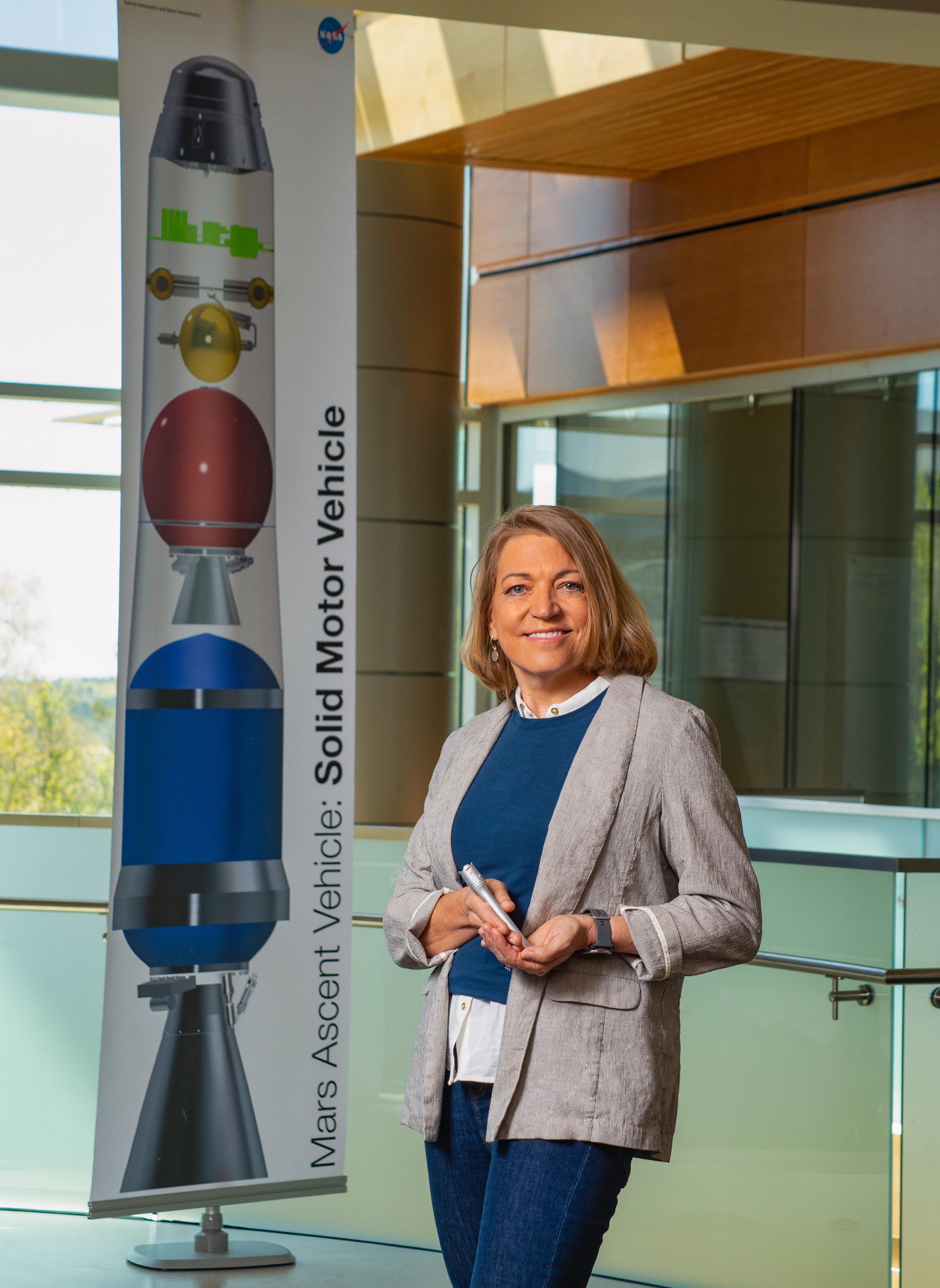
Angie Jackman, manager of the Mars Ascent Vehicle (MAV) project, holds a 3D-printed model of the tubes NASA's Perseverance rover is already filling with Martian rock and soil samples. Set to be the first rocket to launch from another planet, the MAV is designed to carry the sealed samples into orbit around Mars. https://photojournal.jpl.nasa.gov/catalog/PIA25074

Angie Jackman, a NASA project manager in microgravity research, demonstrates the enhanced resilience of undercooled metal alloys as compared to conventional alloys. Experiments aboard the Space Shuttle helped scientists refine their understanding of the physical properties of certain metal alloys when undercooled (i.e., kept liquid below their normal solidification temperature). This new knowledge then allowed scientists to modify a terrestrial production method so they can now make limited quantities marketed under the Liquid Metal trademark. The exhibit was a part of the NASA outreach activity at AirVenture 2000 sponsored by the Experimental Aircraft Association in Oshkosh, WI.