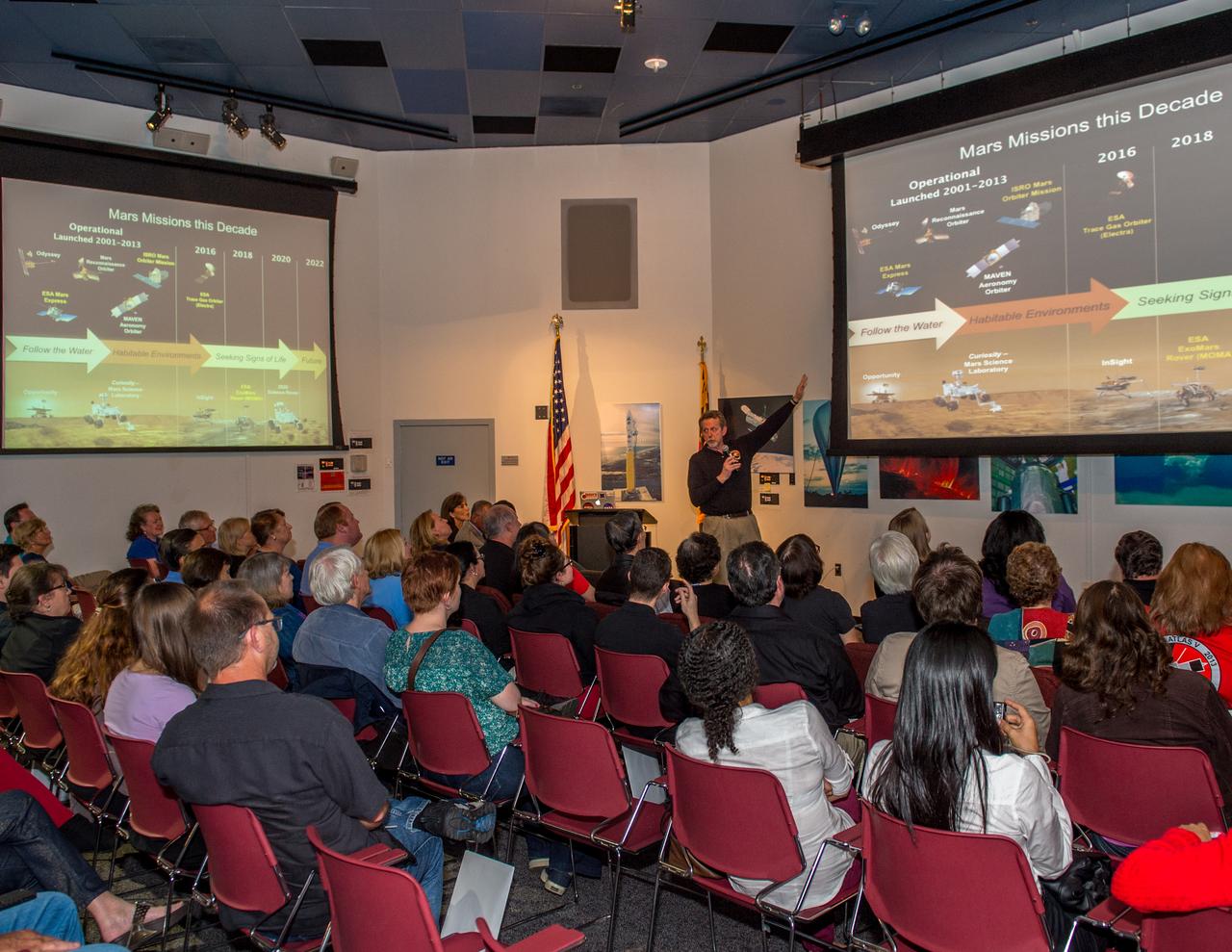
James Green , NASA PLanetary Science Division Director at the Mars Atmosphere and Volatile Evolution Mission (MAVEN) ORBIT INSERTION event
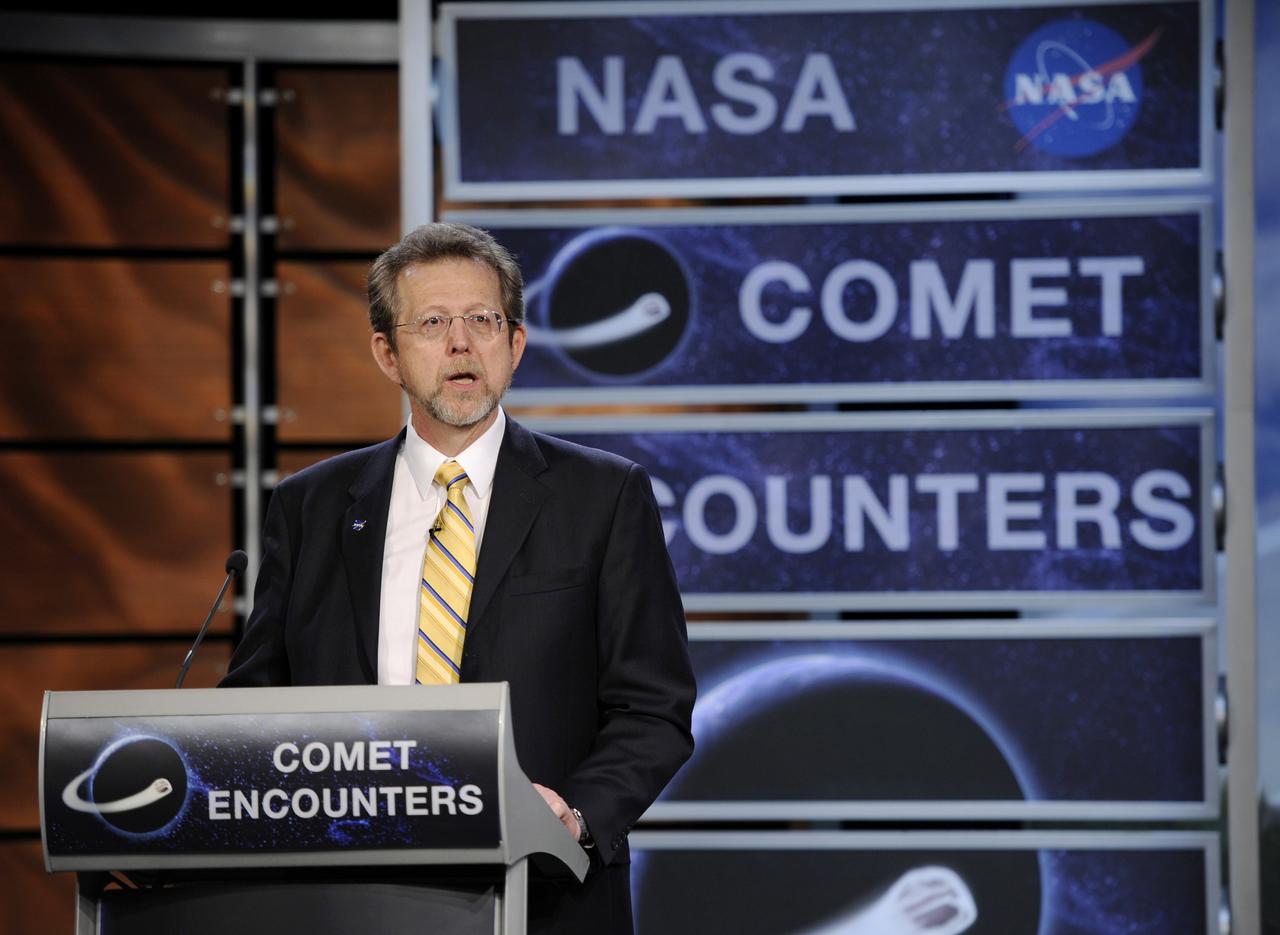
Dr. James L. Green, Director of Planetary Science at NASA, speaks during a symposium commemorating a quarter-century of comet discoveries, Friday, Sept. 10, 2010, in the Knight studio at the Newseum in Washington. The International Sun-Earth Explorer-3 (ISEE-3) spacecraft flew past the comet Giacobini-Zinner on Sept. 11, 1985 which established a foundation of discoveries that continue today. Photo Credit: (NASA/Paul E. Alers)

James L. Green, Director for Planetary Science in NASA's Science Mission Directorate, helps kick off the "Seeking Signs of Life" Symposium, celebrating 50 Years of Exobiology and Astrobiology at NASA, Thursday, Oct. 14, 2010, at the Lockheed Martin Global Vision Center in Arlington, Va. NASA has been researching life in the universe since 1959, asking three fundamental questions: "How does life begin and evolve?"‚ "Is there life beyond Earth and, if so, how can we detect it?" and "What is the future of life on Earth and in the universe?" Photo Credit: (NASA/Bill Ingalls)
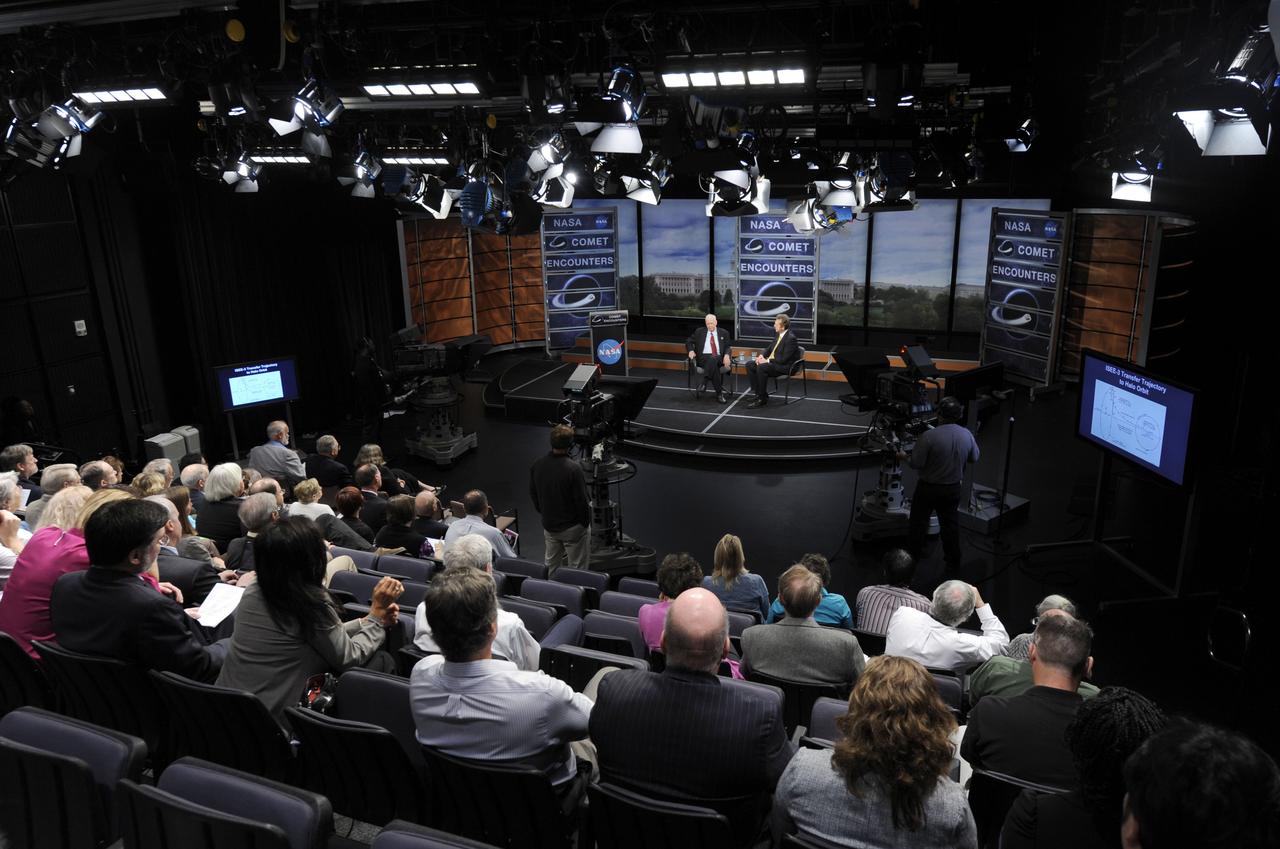
Members of the audience look on as Dr. James L. Green, Director of Planetary Science at NASA, right, speaks with Dr. Robert Farquar, an executive for space exploration at KinetX Inc., during a symposium commemorating a quarter-century of comet discoveries, Friday, Sept. 10, 2010, in the Knight studio at the Newseum in Washington. The International Sun-Earth Explorer-3 (ISEE-3) spacecraft flew past the comet Giacobini-Zinner on Sept. 11, 1985 which established a foundation of discoveries that continue today. Photo Credit: (NASA/Paul E. Alers)
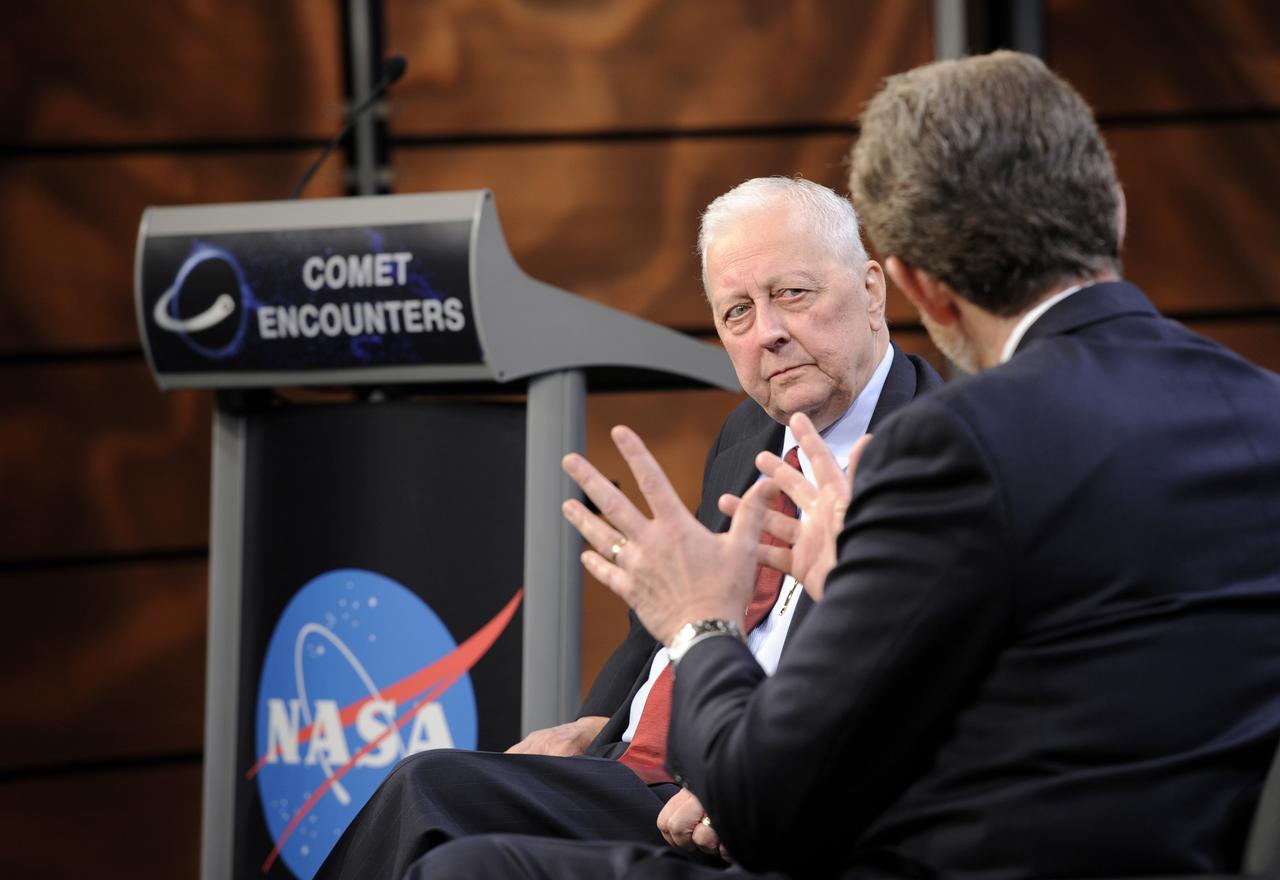
Dr. James L. Green, Director of Planetary Science at NASA, right, speaks with Dr. Robert Farquar, an executive for space exploration at KinetX Inc., during a symposium commemorating a quarter-century of comet discoveries, Friday, Sept. 10, 2010, in the Knight studio at the Newseum in Washington. The International Sun-Earth Explorer-3 (ISEE-3) spacecraft flew past the comet Giacobini-Zinner on Sept. 11, 1985 which established a foundation of discoveries that continue today. Photo Credit: (NASA/Paul E. Alers)
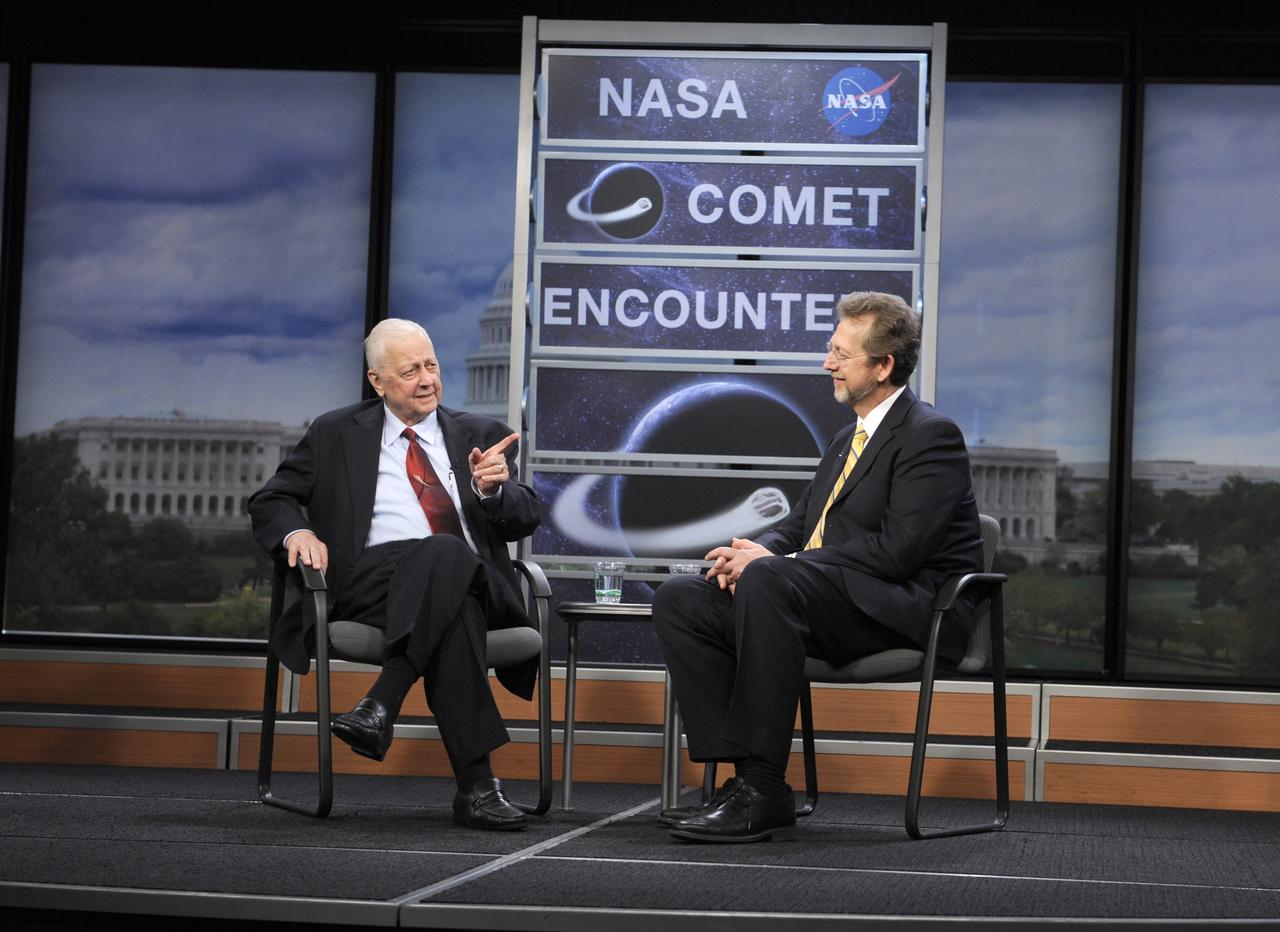
Dr. James L. Green, Director of Planetary Science at NASA, right, speaks with Dr. Robert Farquar, an executive for space exploration at KinetX Inc., during a symposium commemorating a quarter-century of comet discoveries, Friday, Sept. 10, 2010, in the Knight studio at the Newseum in Washington. The International Sun-Earth Explorer-3 (ISEE-3) spacecraft flew past the comet Giacobini-Zinner on Sept. 11, 1985 which established a foundation of discoveries that continue today. Photo Credit: (NASA/Paul E. Alers)
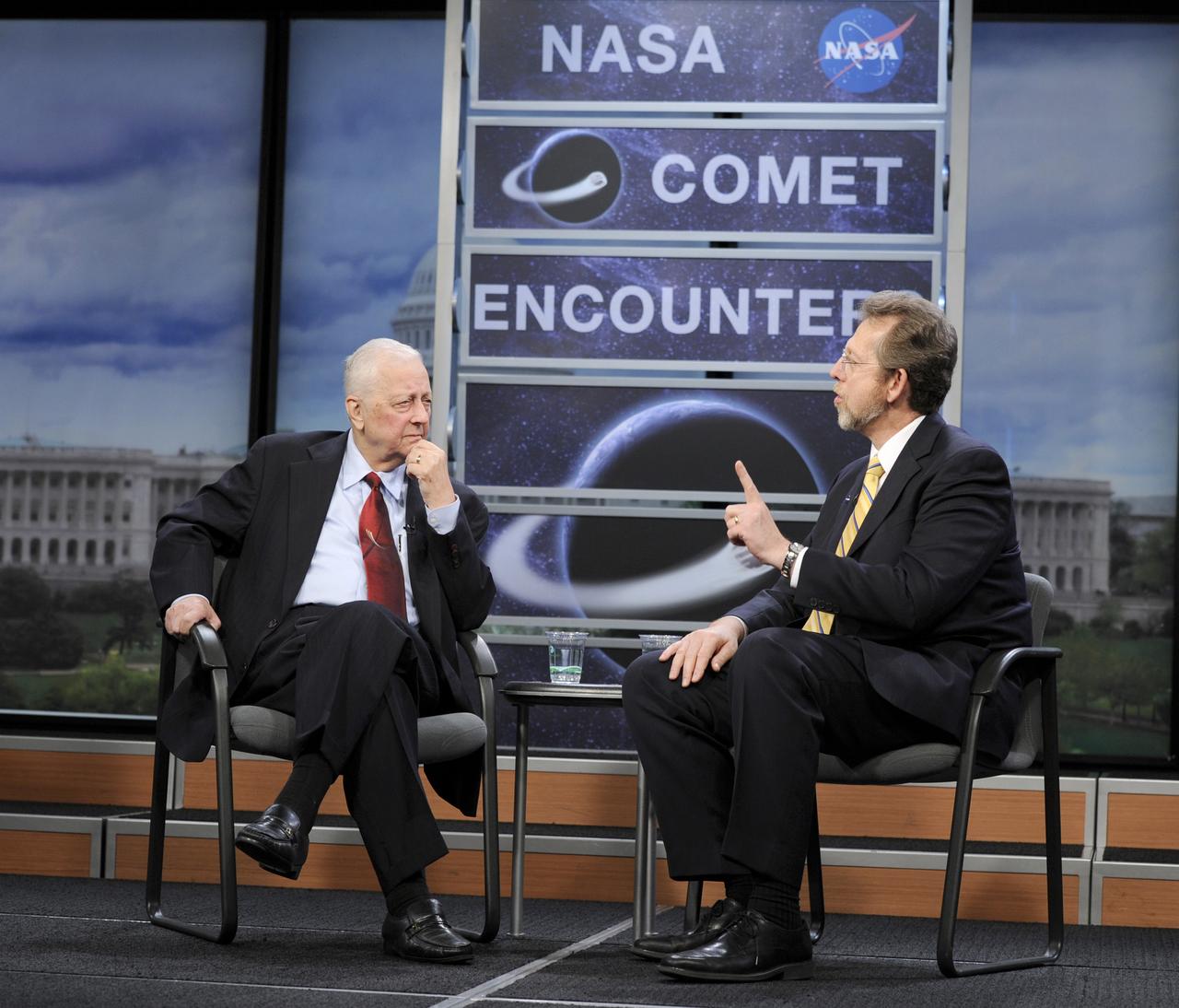
Dr. James L. Green, Director of Planetary Science at NASA, right, speaks with Dr. Robert Farquar, an executive for space exploration at KinetX Inc., during a symposium commemorating a quarter-century of comet discoveries, Friday, Sept. 10, 2010, in the Knight studio at the Newseum in Washington. The International Sun-Earth Explorer-3 (ISEE-3) spacecraft flew past the comet Giacobini-Zinner on Sept. 11, 1985 which established a foundation of discoveries that continue today. Photo Credit: (NASA/Paul E. Alers)
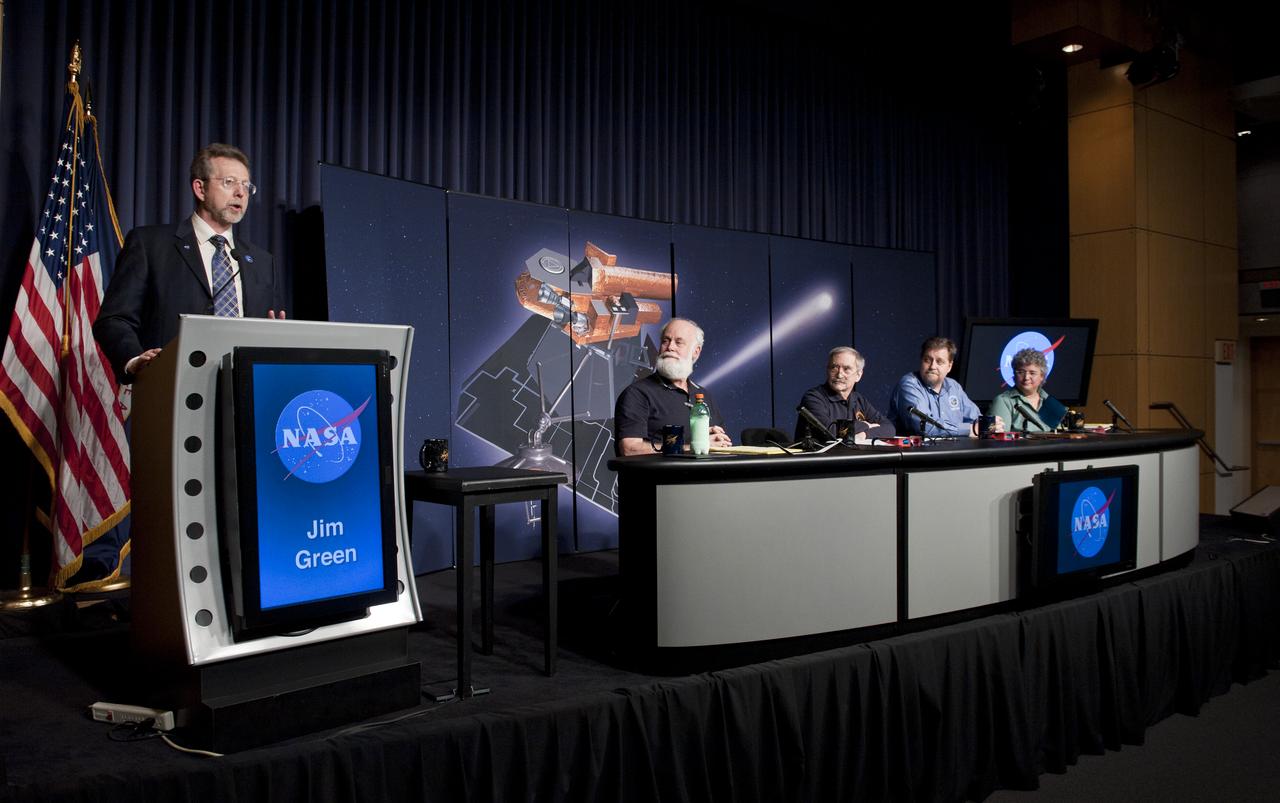
Dr. James Green, Director of Planetary Science, NASA Headquarters, at podium, speaks during a press conference, Thursday, Nov. 18, 2010, at NASA Headquarters in Washington. The press conference was held to discuss the Nov. 4 successful flyby of Comet Hartley 2 by NASA's EPOXI Mission Spacecraft. Images from the flyby provided scientists the most extensive observations of a comet in history. Photo Credit: (NASA/Paul E. Alers)
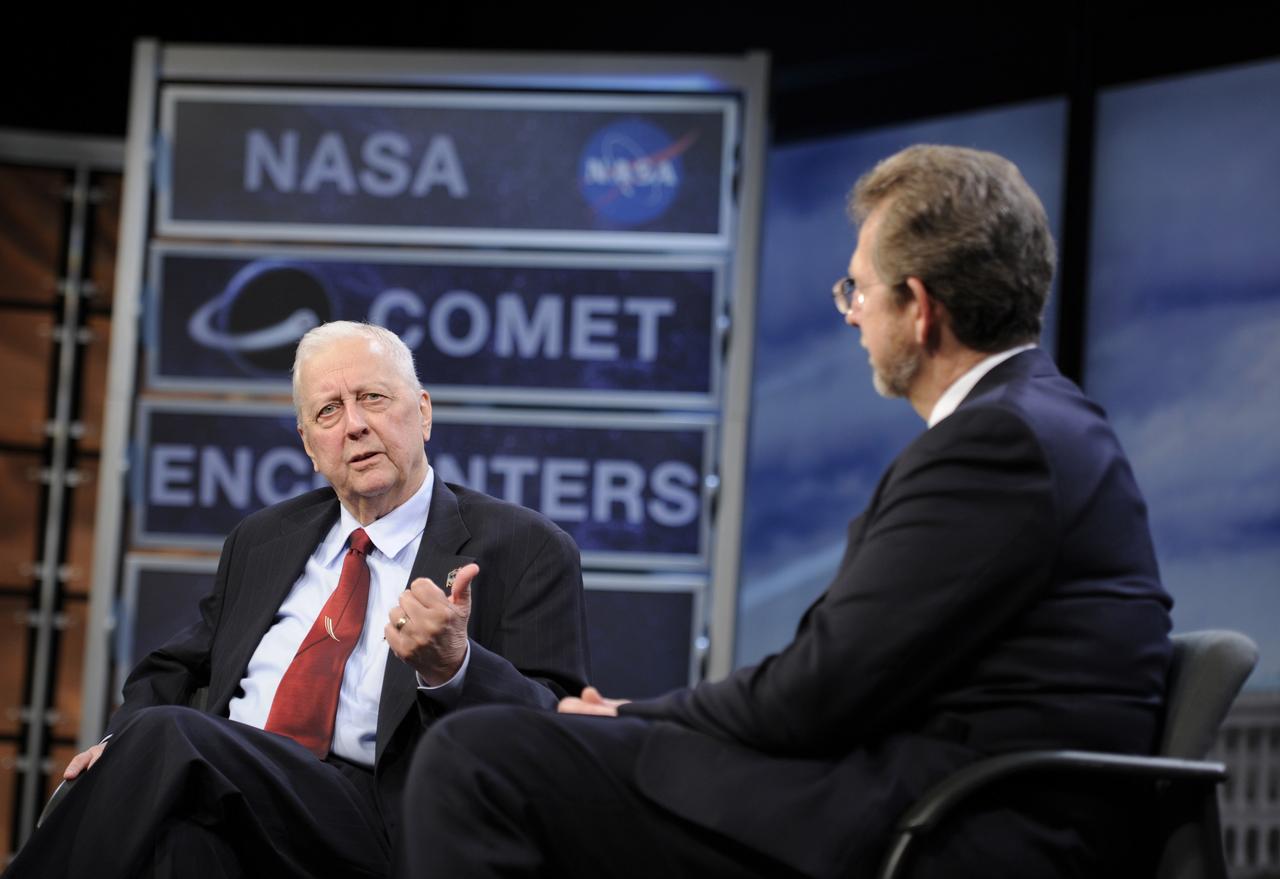
Dr. James L. Green, Director of Planetary Science at NASA, right, speaks with Dr. Robert Farquar, an executive for space exploration at KinetX Inc., during a symposium commemorating a quarter-century of comet discoveries, Friday, Sept. 10, 2010, in the Knight studio at the Newseum in Washington. The International Sun-Earth Explorer-3 (ISEE-3) spacecraft flew past the comet Giacobini-Zinner on Sept. 11, 1985 which established a foundation of discoveries that continue today. Photo Credit: (NASA/Paul E. Alers)
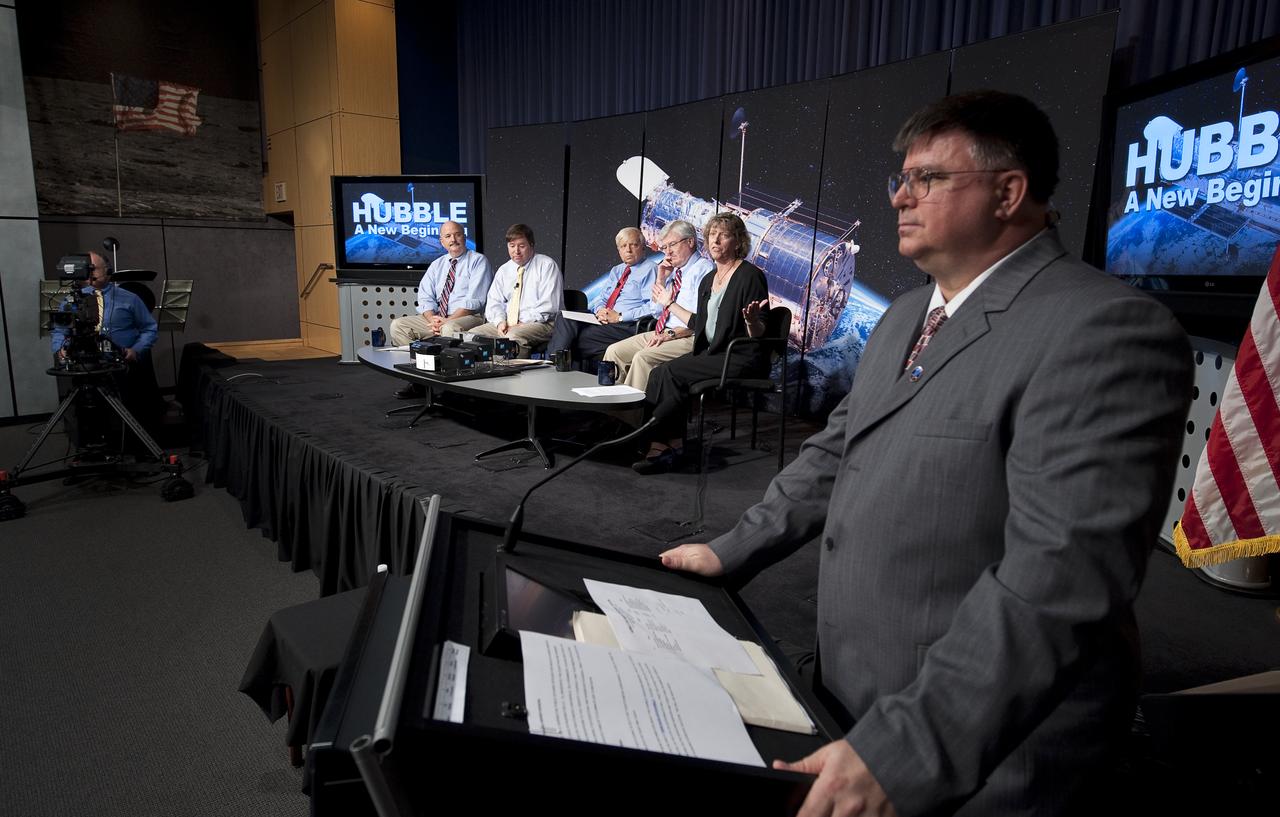
NASA Public Affairs Officer J.D. Harrington, left, monitors a press conference where NASA released images from NASA's Hubble Space Telescope Wednesday, Sept. 9, 2009 at NASA Headquarters in Washington. Participants on stage from left, Bob O'Connell, chair of the science oversight committee for the NASA Hubble Space Telescope Wide Field Camera 3, James Green, the Cosmic Origins Spectrograph principal investigator, NASA Associate Administrator of the Science Mission Directorate Dr. Edward J. Weiler, David Leckrone, senior project scientist, and Heidi Hammel, senior research scientist at the Space Science Institute in Boulder. The images were from four of the telescopes' six operating science instruments. Photo Credit: (NASA/Bill Ingalls)
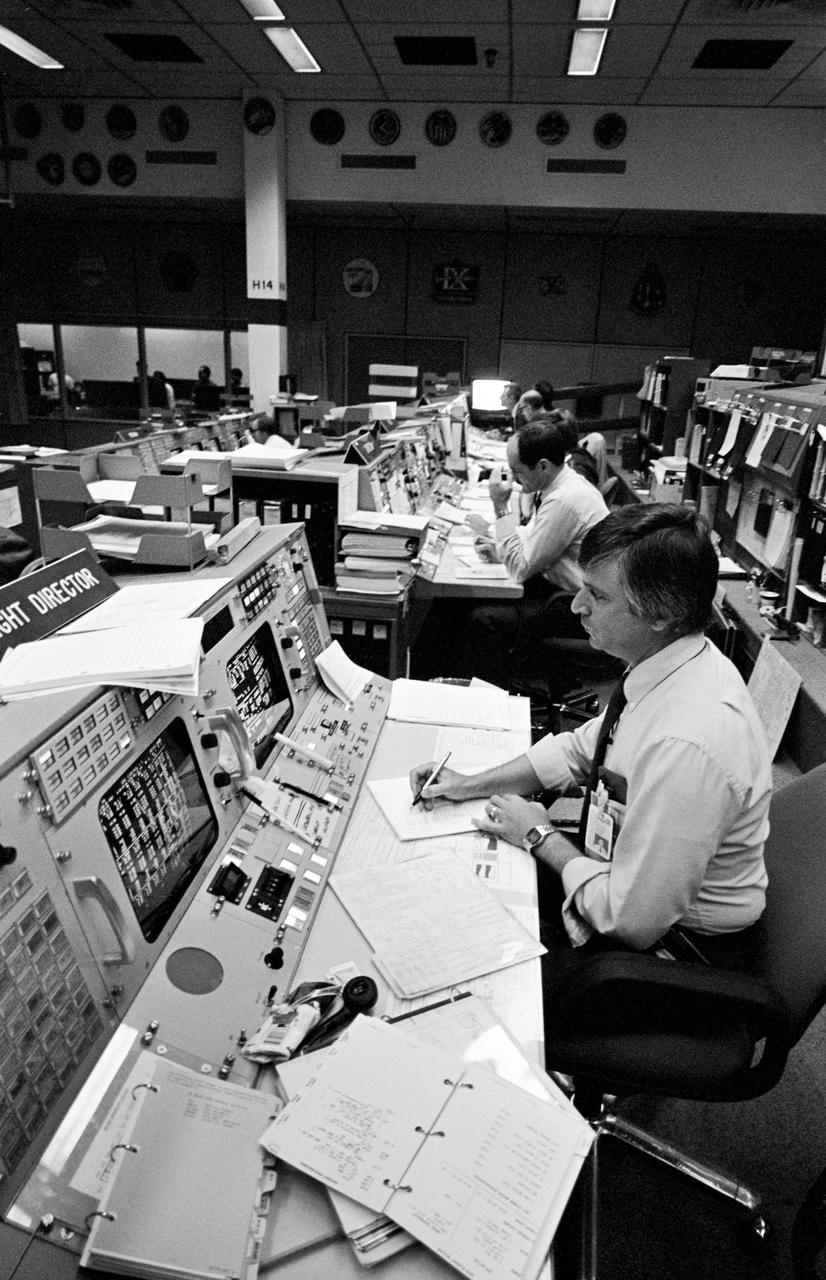
Mission Control Center (MCC) activities during Day-1 of the STS-9 mission with Flight Director Jay H. Greene and Lt. Gen. James A. Abrahamson. 1. Lt. General James A. Abrahamson 2. Jay H. Green 3. MOCR JSC, Houston, TX
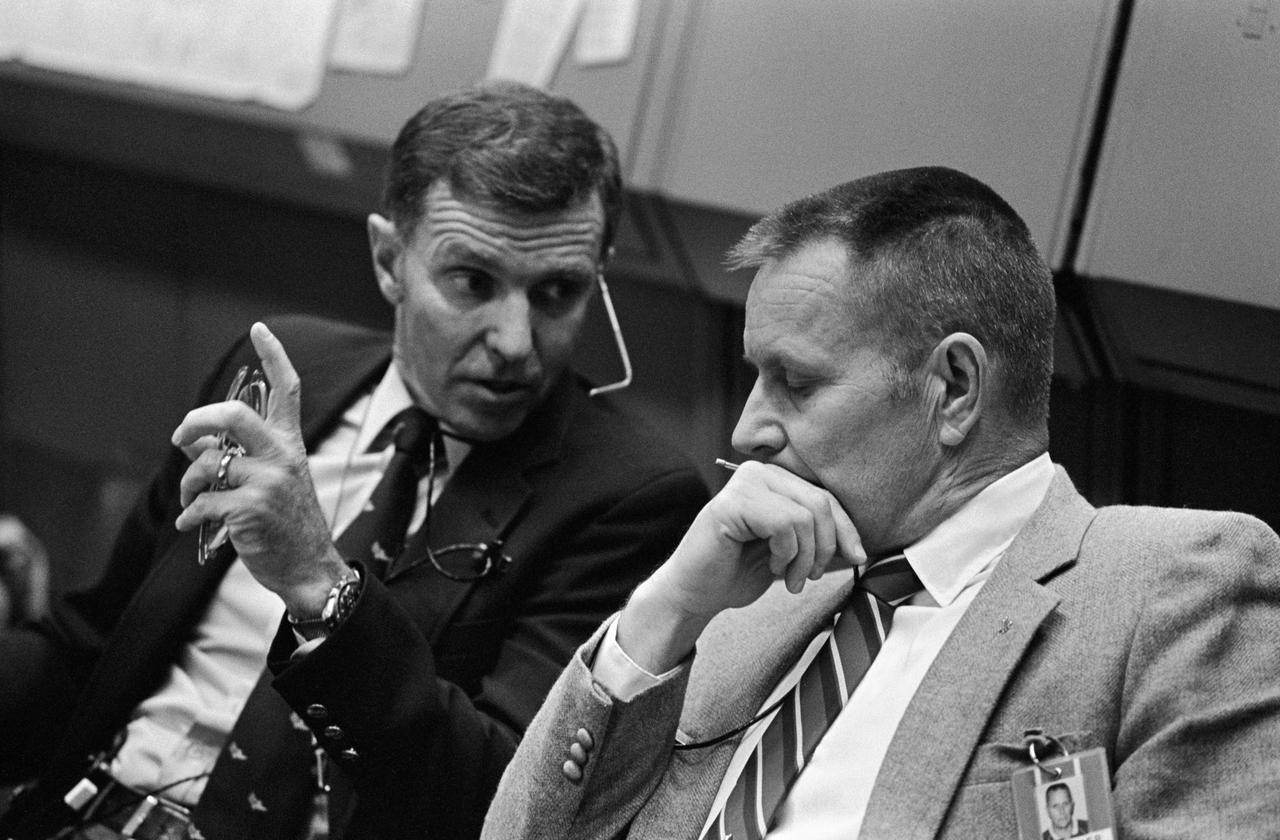
Mission Control Center (MCC) activities during Day-1 of the STS-9 mission with Flight Director Jay H. Greene and Lt. Gen. James A. Abrahamson. 1. Lt. General James A. Abrahamson 2. Jay H. Green 3. MOCR JSC, Houston, TX
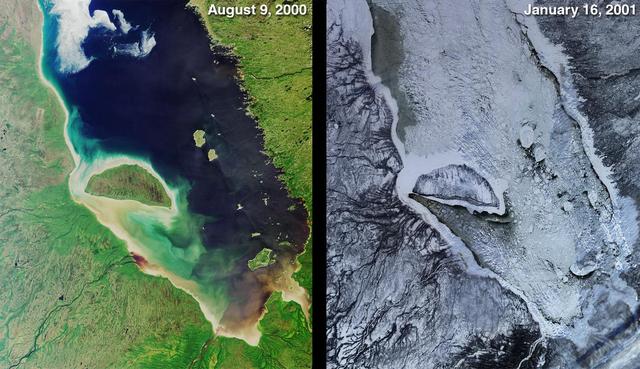
James Bay lies at the southern end of Hudson Bay. Visible in these images captured by NASA Terra satellite on Aug 9, 2000 and Jan. 15, 2001, are some of the many rivers that flow into the bay.
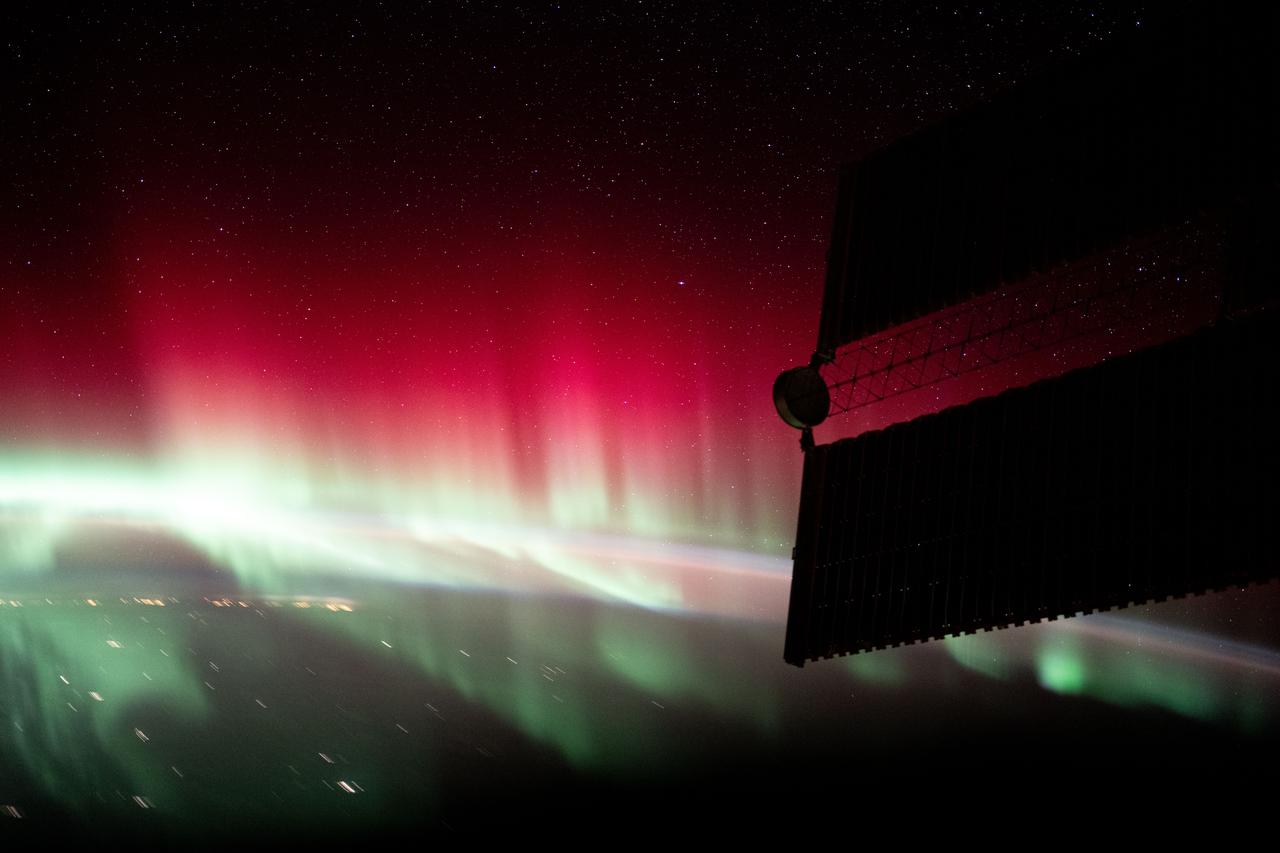
iss072e451023 (Jan. 4, 2025) --- A red and green aurora shimmers brightly above Ontario, Canada, near James Bay in this photograph from the International Space Station as it orbited 260 miles above North America.
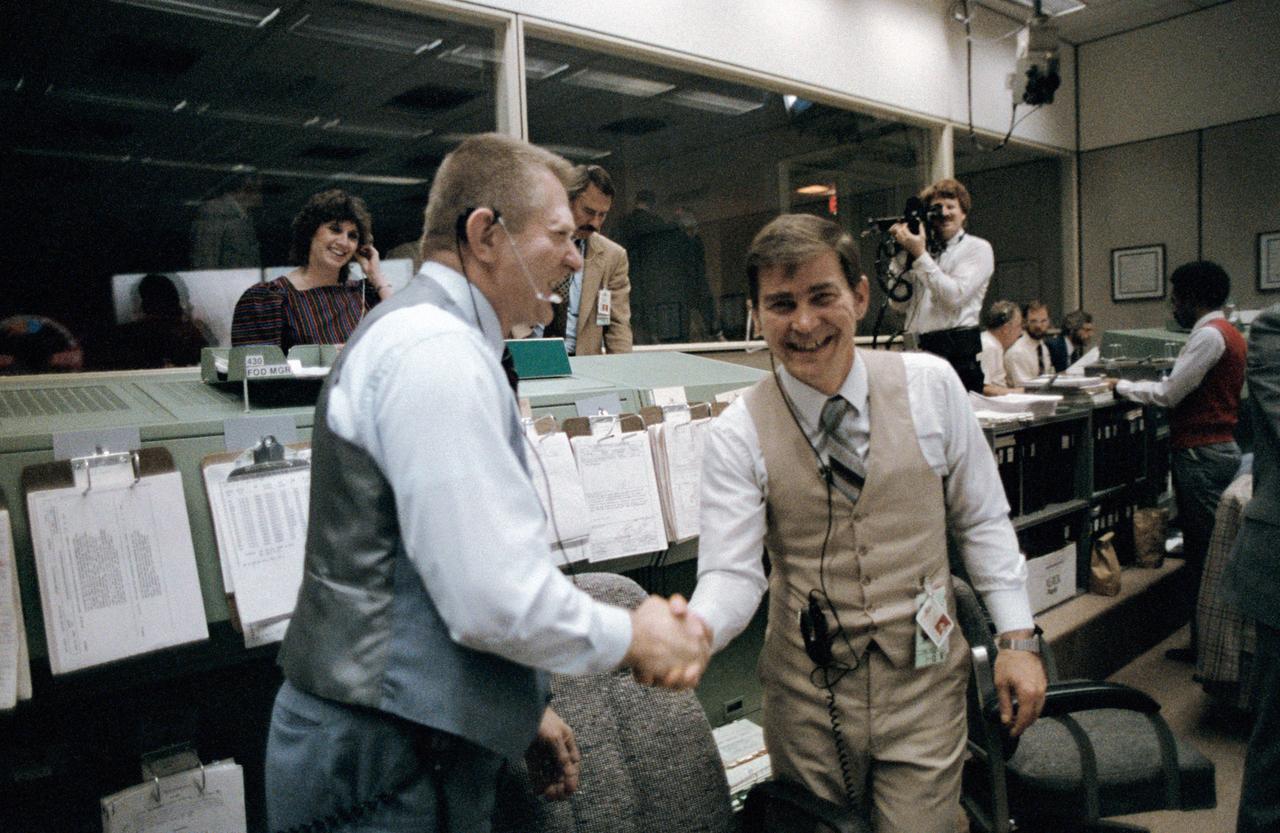
Various views of STS-6 MOCR activities during Day-5 with Vice-Pres. George Bush, Cap Communicator Bridges, JSC Director Gerald Griffin, Eugene F. Kranz, NASA Admin. James M. Beggs, Cap Com Astronaut O'Connor, Flight Directors Jay H. Greene, Gary E. Coen, and Harold Draughon. 1. BUSH, GEORGE, VICE-PRES. - STS-6 MOCR 2. DIR. GRIFFIN, GERALD D. - STS-6 MOCR 3. ADMIN. BEGGS, JAMES M. - STS-6 MOCR 4. FLT. DIRECTORS - STS-6 JSC, HOUSTON, TX Also available in 35 CN
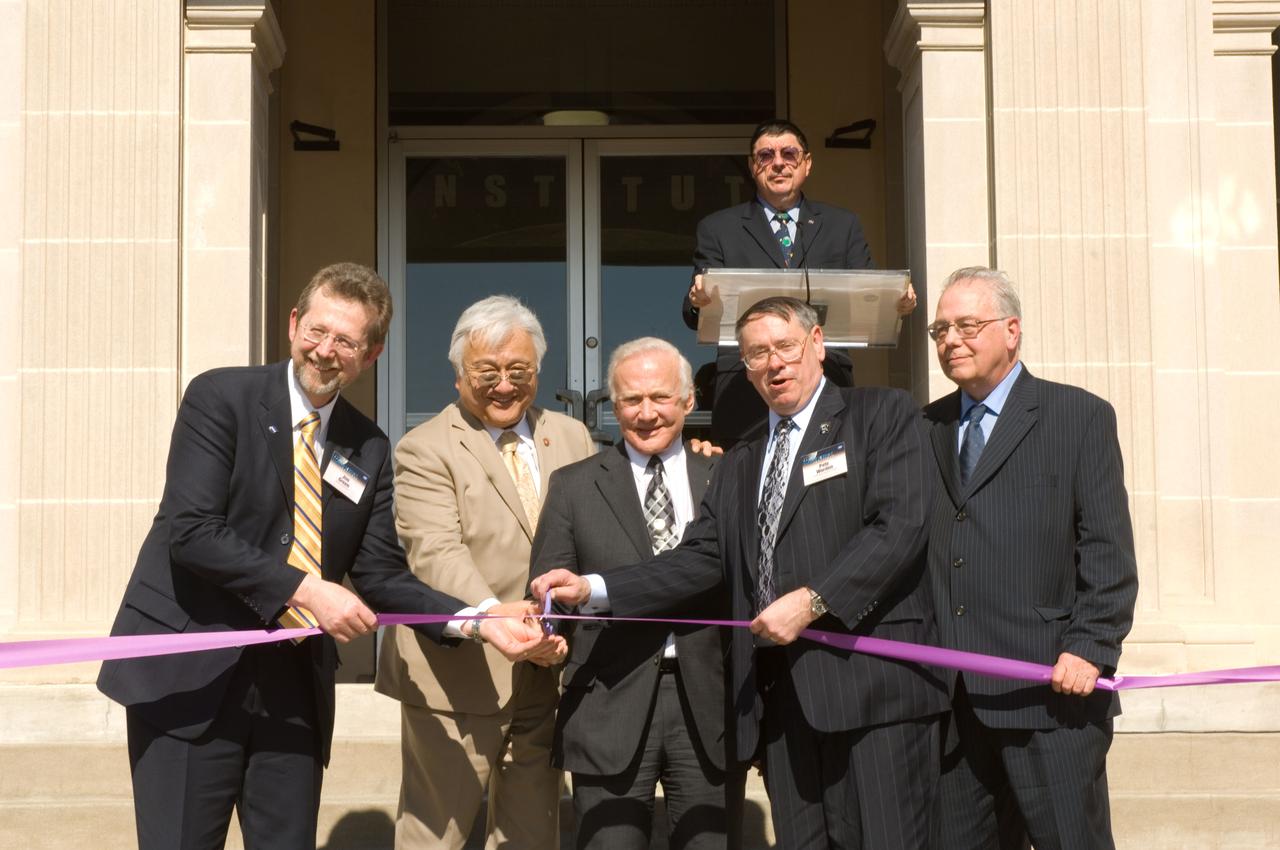
Lunar Science Institute (LSI) Grand Opening. Ribbon Cutting, L-R: James Green, Director, Planetary Programs, NASA Headquarters, Mike Honda, U.S. Congressman,15th District, Apollo Astronaut Buzz Aldrin, S. Pete Worden, Director, NASA Ames Research Center, David Morrison, Interiu Director, NASA Lunar Science Institute. David Morse at podium.
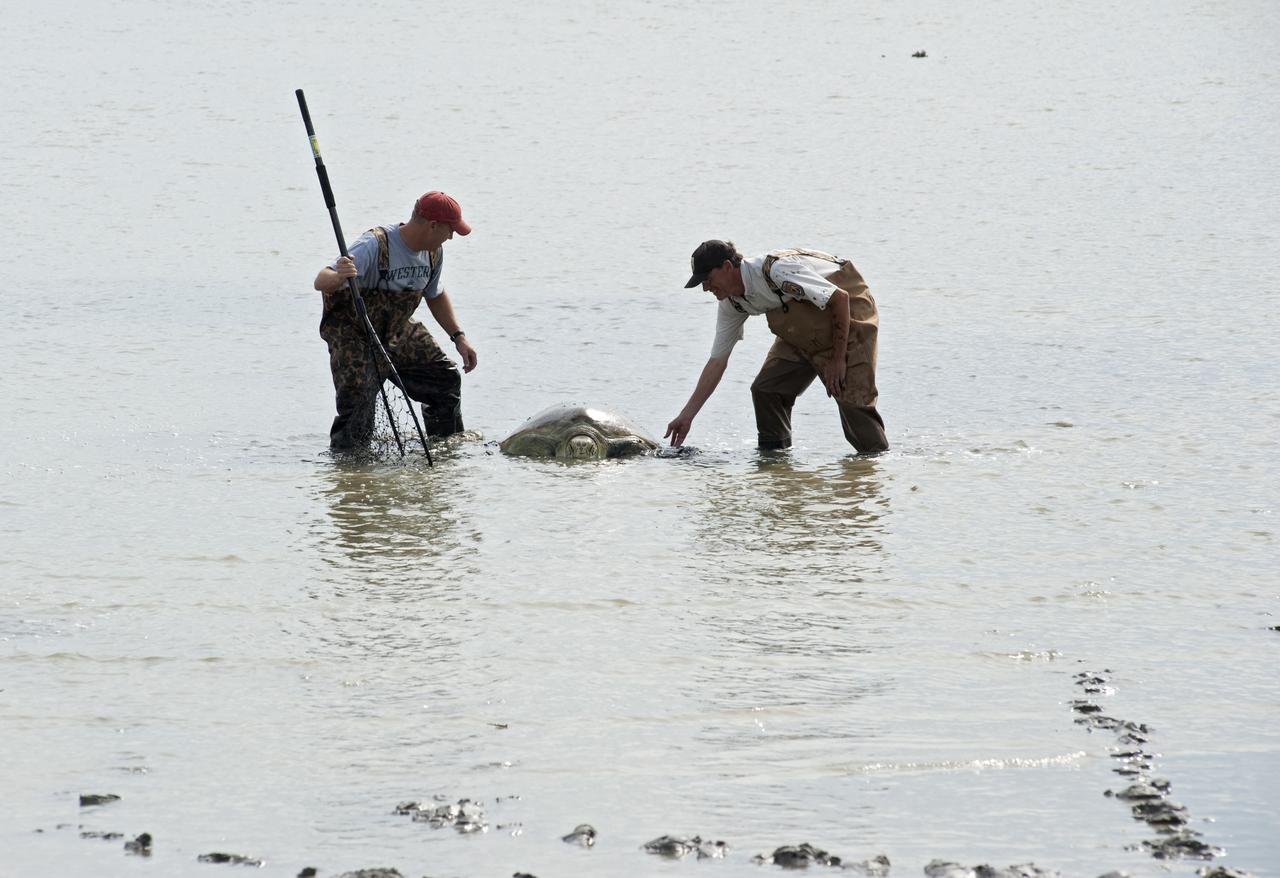
CAPE CANAVERAL, Fla. -- Eric Reyier with Innovative Health Applications LLC, left, and James Lyon with the U.S. Fish and Wildlife Service (FWS) help a green sea turtle move into deeper water at the Merritt Island National Wildlife Refuge in Florida. The female turtle, weighing about 350 pounds, became stuck on an impoundment in fresh water near NASA Kennedy Space Center's Launch Pad 39A. The refuge, located on Kennedy property, is a habitat for more than 310 species of birds, 25 mammals, 117 fish and 65 amphibians and reptiles. Photo credit: NASA/Carl Winebarger
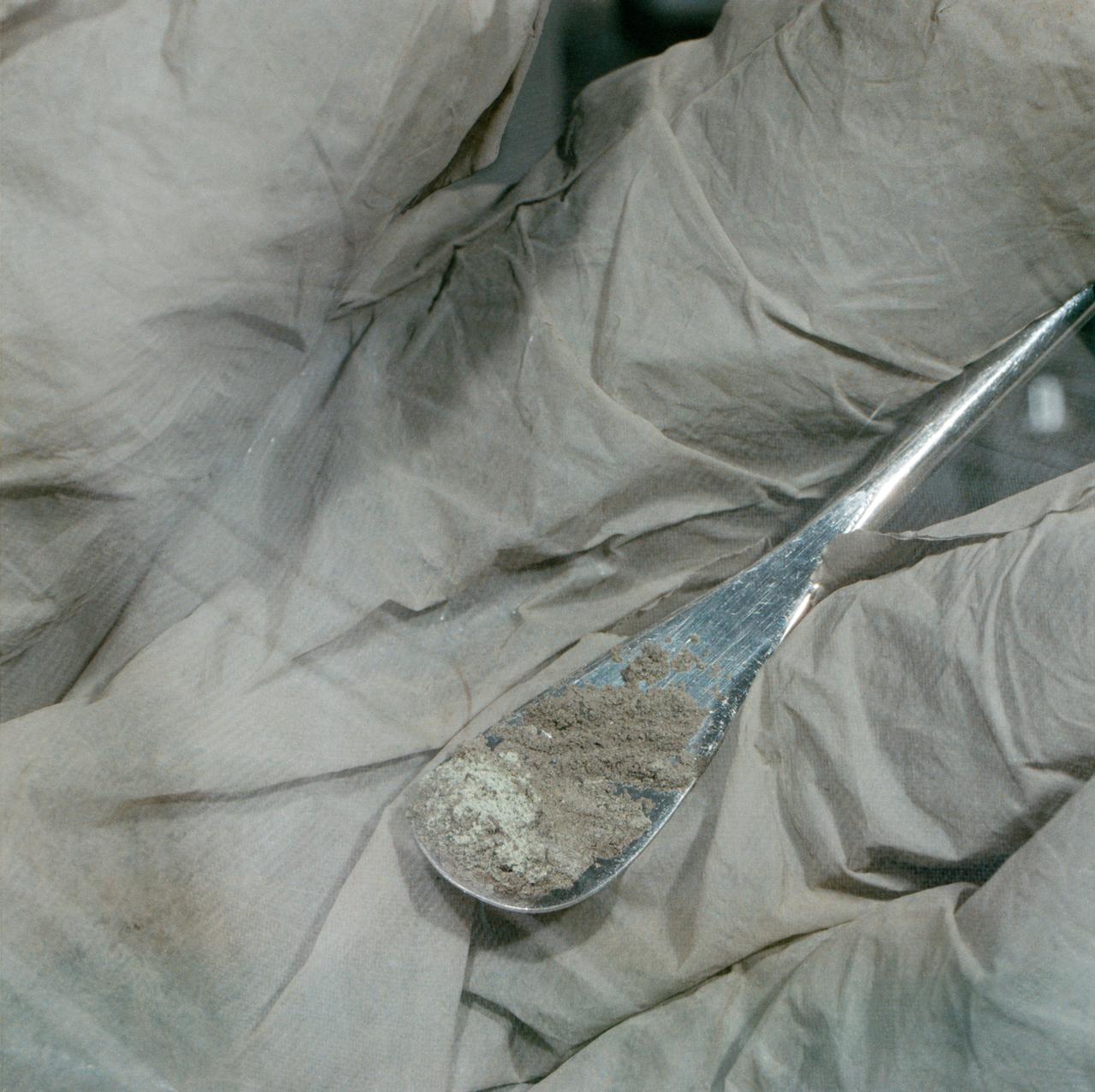
S71-43050 (August 1971) --- A close-up view of Apollo 15 lunar sample No. 15305 in the Non-sterile Nitrogen Processing Line (NNPL) in the Lunar Receiving Laboratory (LRL) at the Manned Spacecraft Center (MSC). This sample, pictured on a small spatula in a lab technician's glove, is green and is one of six recently taken from container No. 173, made up of comprehensive fines from the Apennine Front, Site No. 7. Astronauts David R. Scott, commander; and James B. Irwin, lunar module pilot, took the sample during their second extravehicular activity (EVA), at a ground elapsed time (GET) of 146:05 to 146:06.
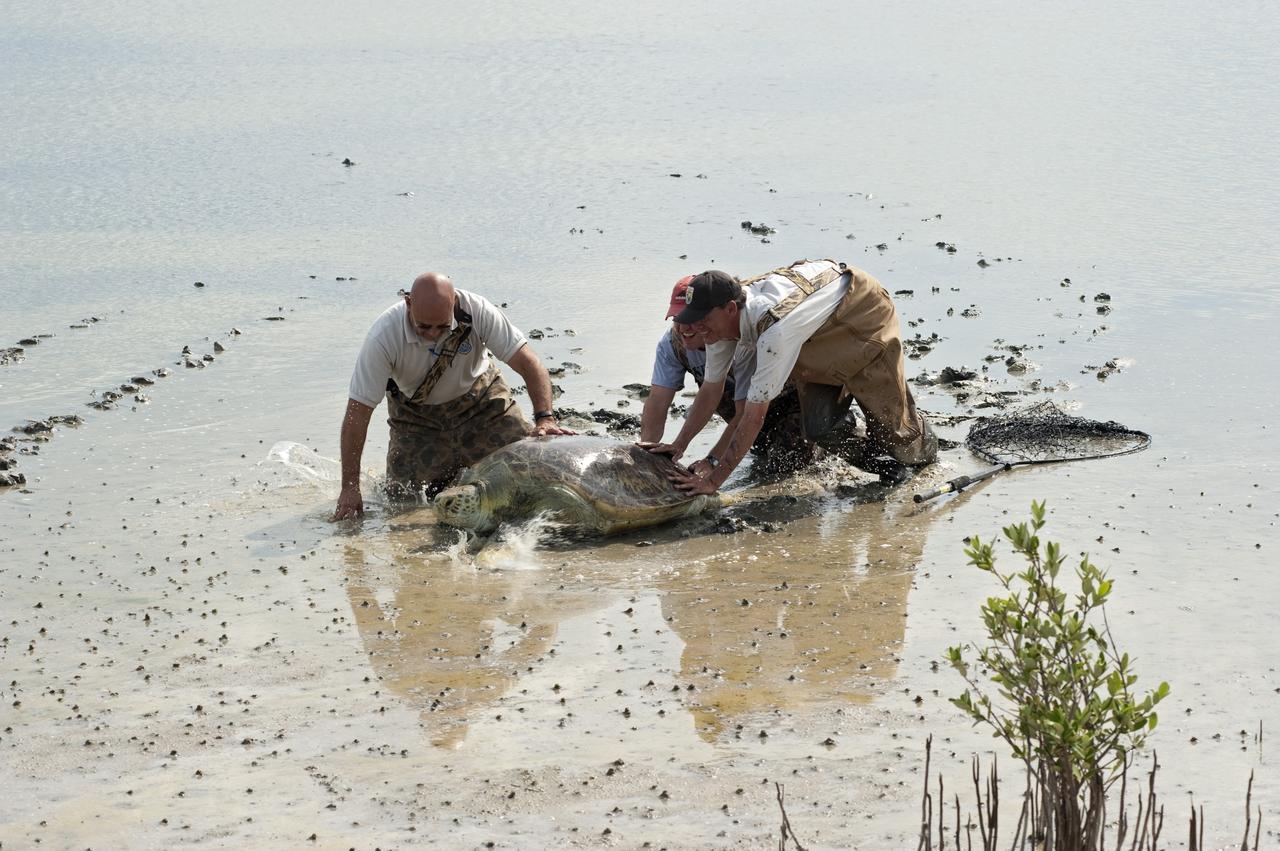
CAPE CANAVERAL, Fla. -- Harold Morrow with the U.S. Fish and Wildlife Service (FWS), left, Eric Reyier with Innovative Health Applications LLC and James Lyon with FWS help a green sea turtle move into deeper water at the Merritt Island National Wildlife Refuge in Florida. The female turtle, weighing about 350 pounds, became stuck on an impoundment in fresh water near NASA Kennedy Space Center's Launch Pad 39A. Kennedy shares a boundary with the refuge, which is a habitat for more than 310 species of birds, 25 mammals, 117 fish and 65 amphibians and reptiles. Photo credit: NASA/Carl Winebarger

James Lovelock, Honorary Visiting Fellow of Green Templeton College, University of Oxford speaks during the "Seeking Signs of Life" Symposium, celebrating 50 Years of Exobiology and Astrobiology at NASA, Thursday, Oct. 14, 2010, at the Lockheed Martin Global Vision Center in Arlington, Va. NASA has been researching life in the universe since 1959, asking three fundamental questions: "How does life begin and evolve?"‚ "Is there life beyond Earth and, if so, how can we detect it?" and "What is the future of life on Earth and in the universe?" Photo Credit: (NASA/Bill Ingalls)
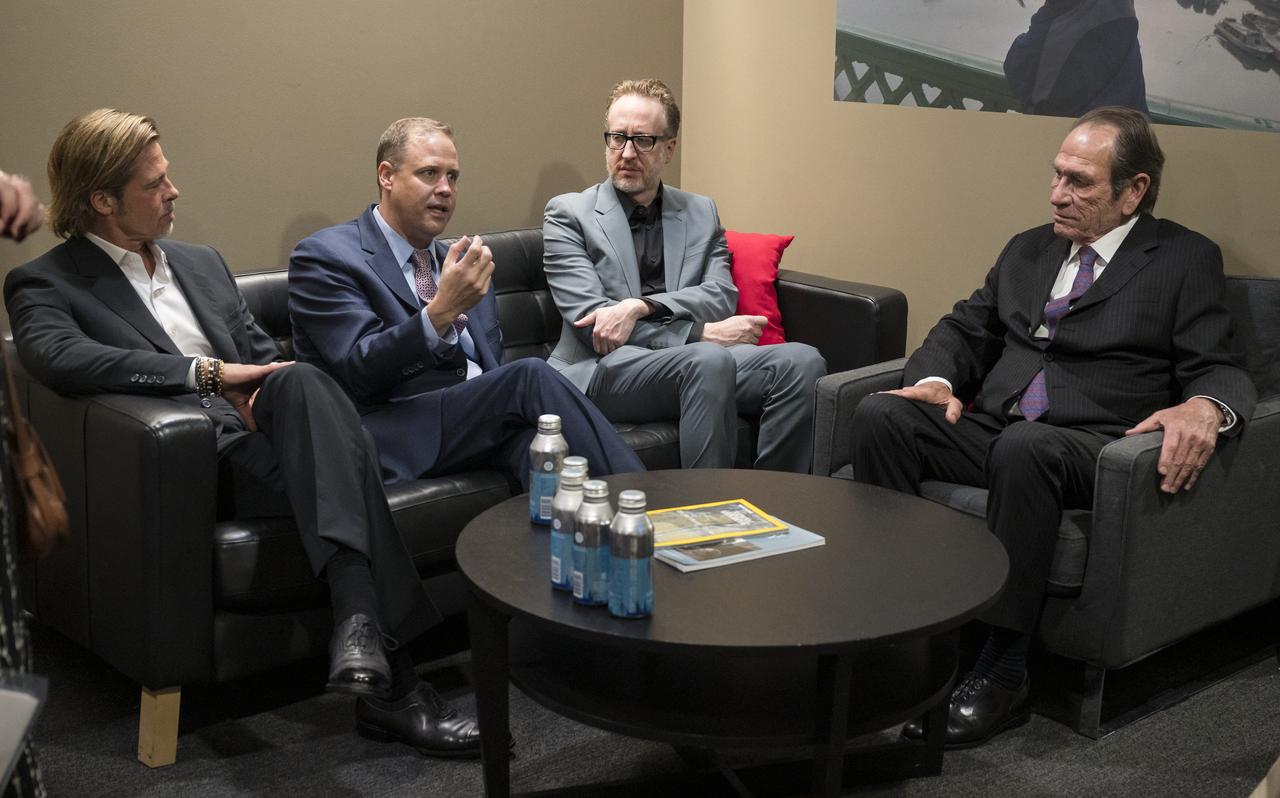
From left to right, actor Brad Pitt, NASA Administrator Jim Bridenstine, film producer, co-writer, and director James Gray, and actor Tommy Lee Jones are seen in the green room before a screening of the film "Ad Astra" at National Geographic Society, Monday, September 16, 2019 in Washington. The film stars Pitt, Jones, Ruth Negga, Liv Tyler, and Donald Sutherland. Pitt stars as astronaut Roy McBride who travels deep into the solar system in hopes of solving a mystery that threatens life on Earth. Photo Credit: (NASA/Aubrey Gemignani)
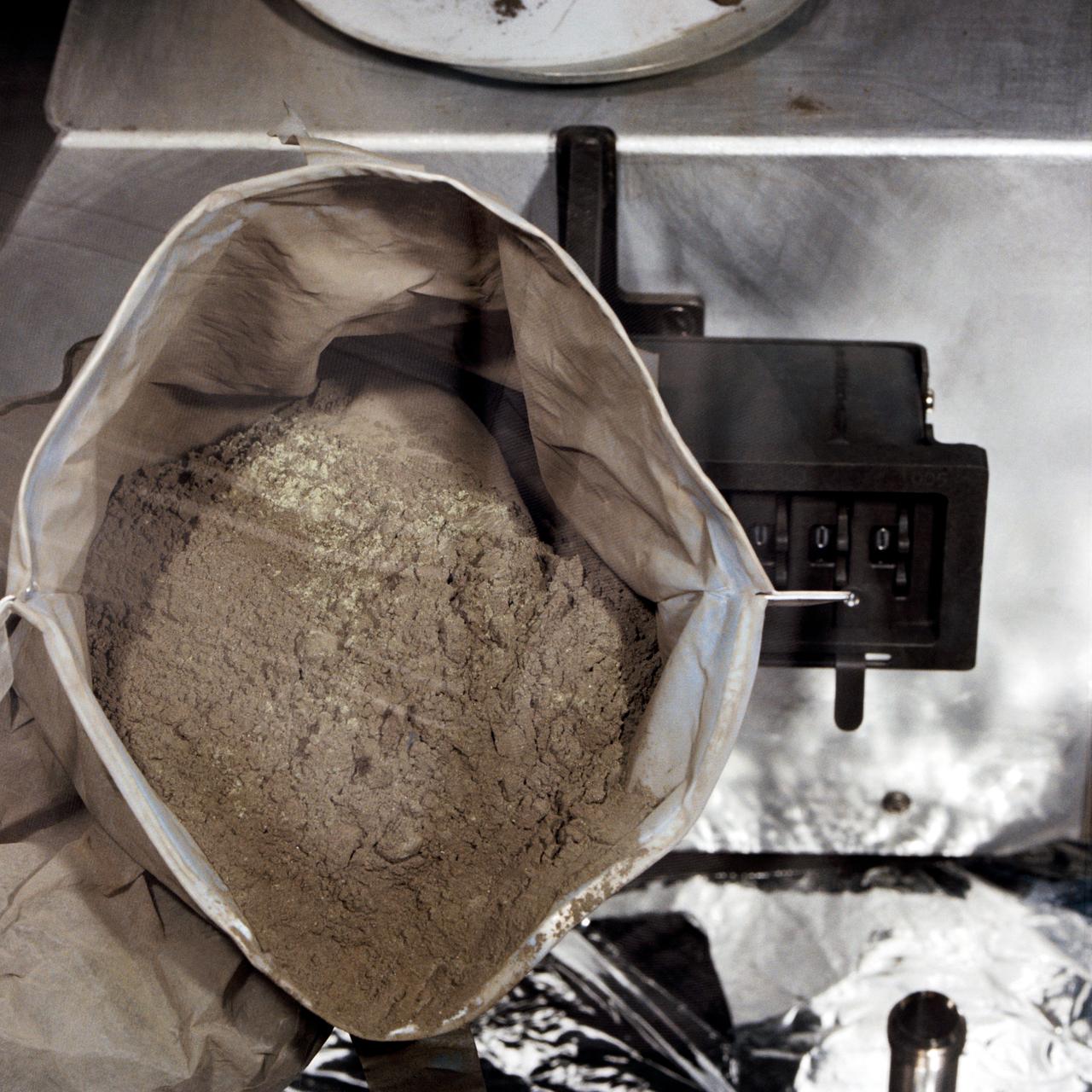
S71-43052 (August 1971) --- A close-up view of a container full of green-colored lunar soil in the Non-Sterile Nitrogen Processing Line (NNPL) in the Lunar Receiving Laboratory (LRL) at the Manned Spacecraft Center (MSC). This sample, broken down into six separate samples after this photo was made, was made up of comprehensive fines from near Spur Crater on the Apennine Front. The numbers assigned to the sample include numbers 15300 through 15305. Astronauts David R. Scott and James B. Irwin took the sample during their second extravehicular activity (EVA) at a ground elapsed time (GET) of 146:05 to 146:06.

James Lovelock, Honorary Visiting Fellow of Green Templeton College, University of Oxford speaks during the "Seeking Signs of Life" Symposium, celebrating 50 Years of Exobiology and Astrobiology at NASA, Thursday, Oct. 14, 2010, at the Lockheed Martin Global Vision Center in Arlington, Va. NASA has been researching life in the universe since 1959, asking three fundamental questions: "How does life begin and evolve?"‚ "Is there life beyond Earth and, if so, how can we detect it?" and "What is the future of life on Earth and in the universe?" Photo Credit: (NASA/Bill Ingalls)
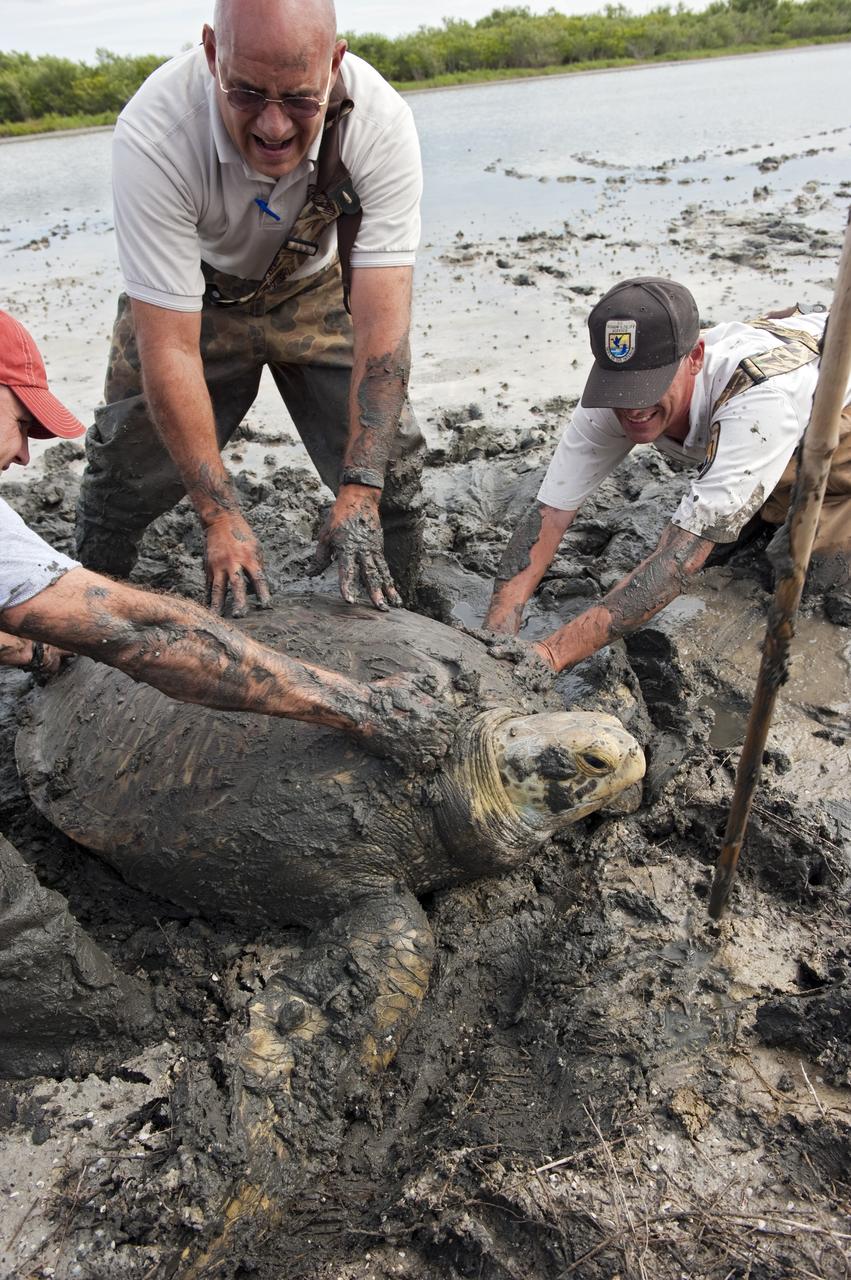
CAPE CANAVERAL, Fla. -- Eric Reyier with Innovative Health Applications LLC, left, along with Harold Morrow and James Lyon with the U.S. Fish and Wildlife Service (FWS) help a green sea turtle move into deeper water at the Merritt Island National Wildlife Refuge in Florida. The female turtle, weighing in at about 350 pounds, became stuck on an impoundment in fresh water near NASA Kennedy Space Center's Launch Pad 39A. The refuge, located on Kennedy property, is a habitat for more than 310 species of birds, 25 mammals, 117 fish and 65 amphibians and reptiles. Photo credit: NASA/Carl Winebarger
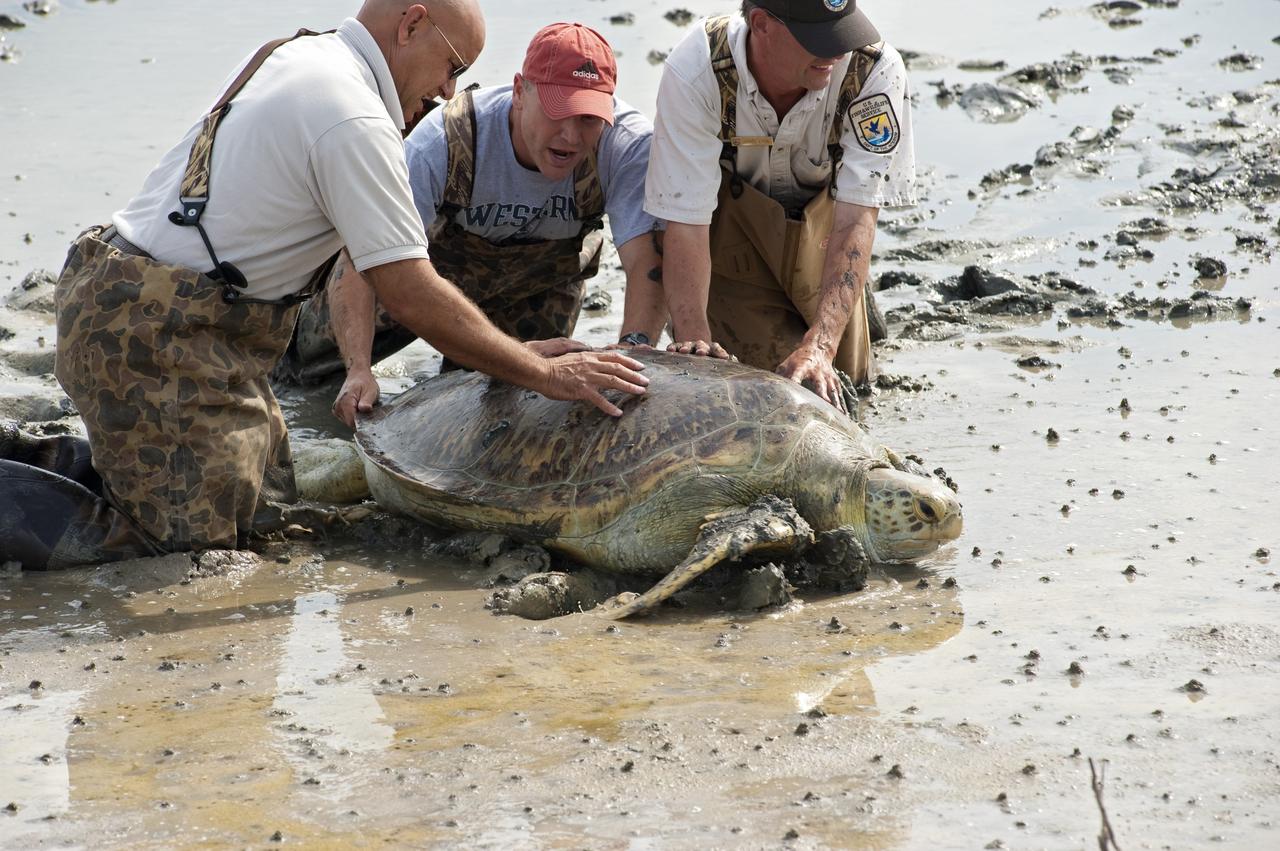
CAPE CANAVERAL, Fla. -- Harold Morrow with the U.S. Fish and Wildlife Service (FWS), left, Eric Reyier with Innovative Health Applications LLC and James Lyon with FWS help a green sea turtle move into deeper water at the Merritt Island National Wildlife Refuge in Florida. The female turtle, weighing about 350 pounds, became stuck on an impoundment in fresh water near NASA Kennedy Space Center's Launch Pad 39A. The refuge, located on Kennedy property, is a habitat for more than 310 species of birds, 25 mammals, 117 fish and 65 amphibians and reptiles. Photo credit: NASA/Carl Winebarger
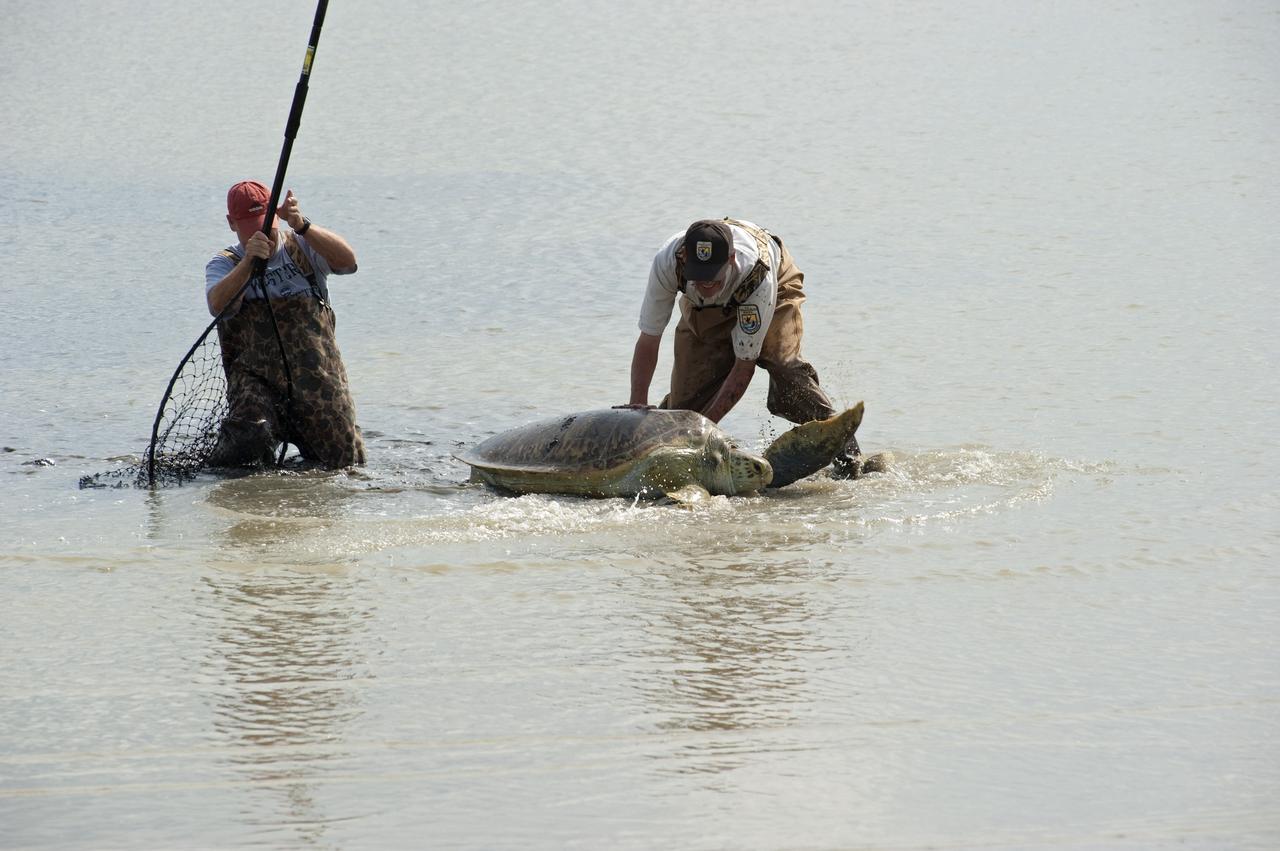
CAPE CANAVERAL, Fla. -- Eric Reyier with Innovative Health Applications LLC, left, and James Lyon with the U.S. Fish and Wildlife Service (FWS) help a green sea turtle move into deeper water at the Merritt Island National Wildlife Refuge in Florida. The female turtle, weighing about 350 pounds, became stuck on an impoundment in fresh water near NASA Kennedy Space Center's Launch Pad 39A. The refuge, located on Kennedy property, is a habitat for more than 310 species of birds, 25 mammals, 117 fish and 65 amphibians and reptiles. Photo credit: NASA/Carl Winebarger
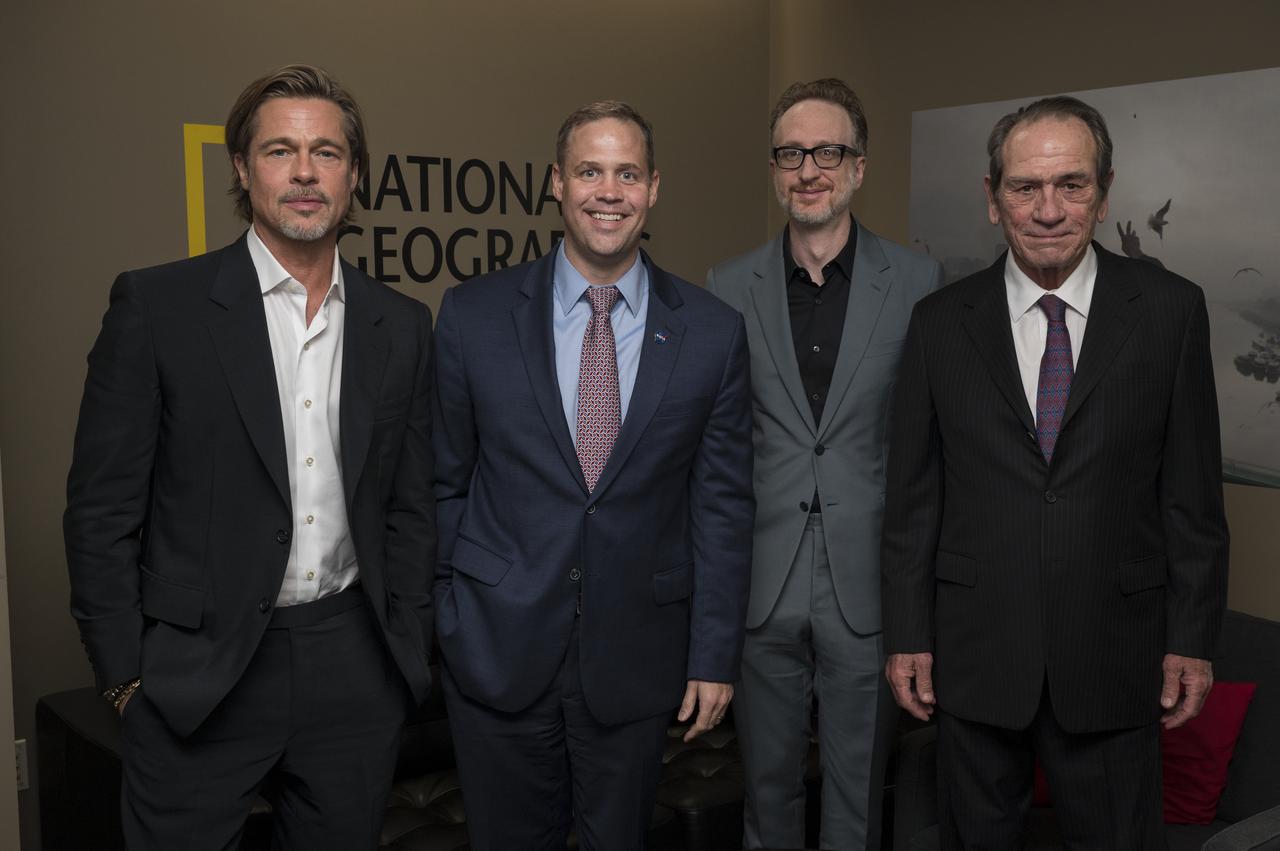
From left to right, actor Brad Pitt, NASA Administrator Jim Bridenstine, film producer, co-writer, and director James Gray, and actor Tommy Lee Jones pose for a photo in the green room before a screening of the film "Ad Astra" at National Geographic Society, Monday, September 16, 2019 in Washington. The film stars Pitt, Jones, Ruth Negga, Liv Tyler, and Donald Sutherland. Pitt stars as astronaut Roy McBride who travels deep into the solar system in hopes of solving a mystery that threatens life on Earth. Photo Credit: (NASA/Aubrey Gemignani)
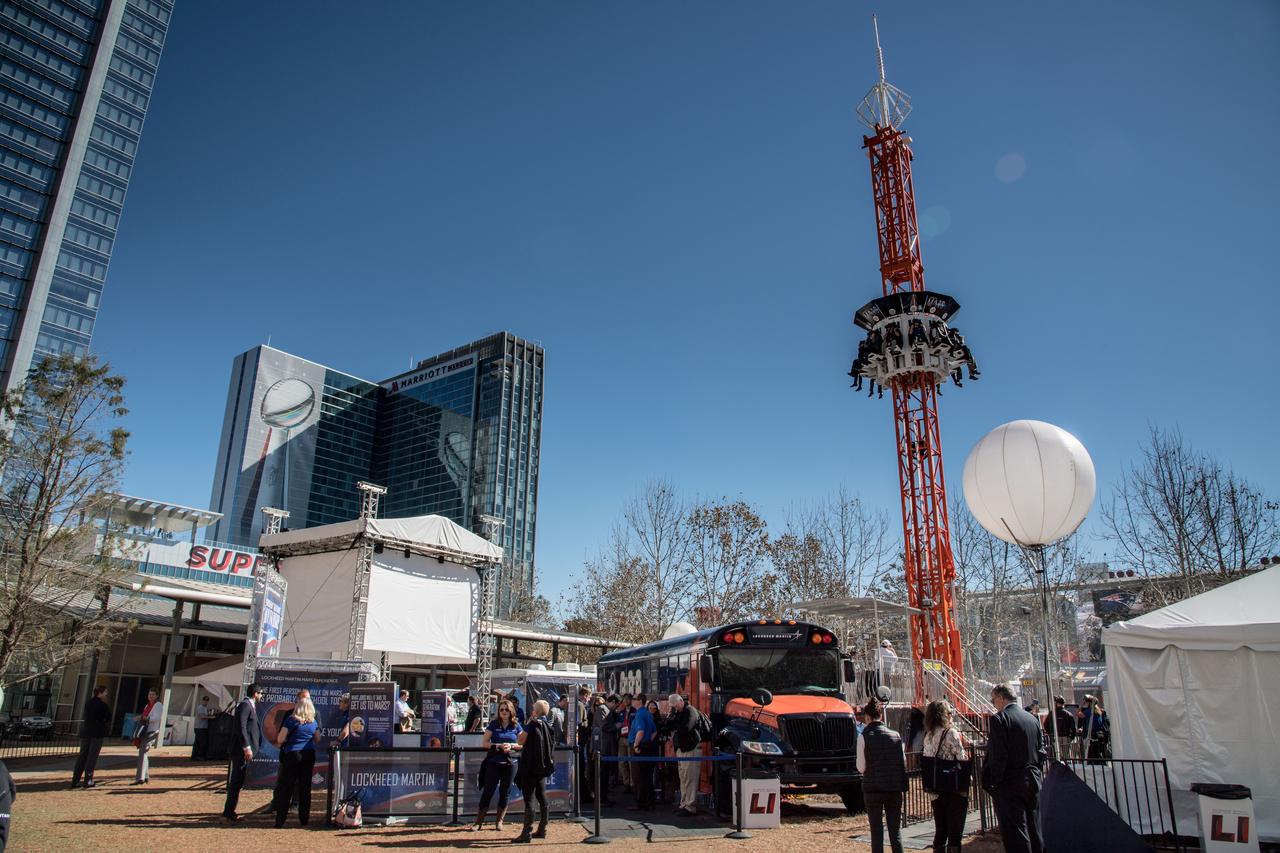
jsc2017e011393 (01/30/2017) --- Space exploration will feature prominently at Super Bowl LIVE, a nine-day fan festival running Jan. 28 through Feb. 5 on Discovery Green, Houston Texas where 100,000 visitors are expected each day. NASA is collaborating with the Houston Super Bowl Host Committee, which is the fan festival organizer, to share NASA’s contributions with the Houston community and to the nation. At NASA's Future Flight, the primary attraction at the free fan festival, riders will take a trip to Mars and back using virtual reality goggles on a 90-foot drop tower ride. Visitors also will get a chance to see several NASA assets that have been transported to downtown Houston for the activities. These assets include: the Orion mockup used for water recovery testing, Space Exploration Vehicle (SEV /Rover), the Driven to Explore mobile exhibit, Mars Science Laboratory – Curiosity Rover - replica, Robonaut 1 (Centaur configuration), EMU space suit presentation unit, Arctic meteorite and astromaterials display, and the Mark III advanced space suit photo-op. Several of NASA’s industry partners sponsoring Future Flight will also have assets on display, and a replica of the James Webb Space Telescope will be located near but not inside the activities on Discovery Green. NASA and industry partner volunteers will be staffing the Future Flight area. NASA PHOTOGRAPHER: Bill Stafford
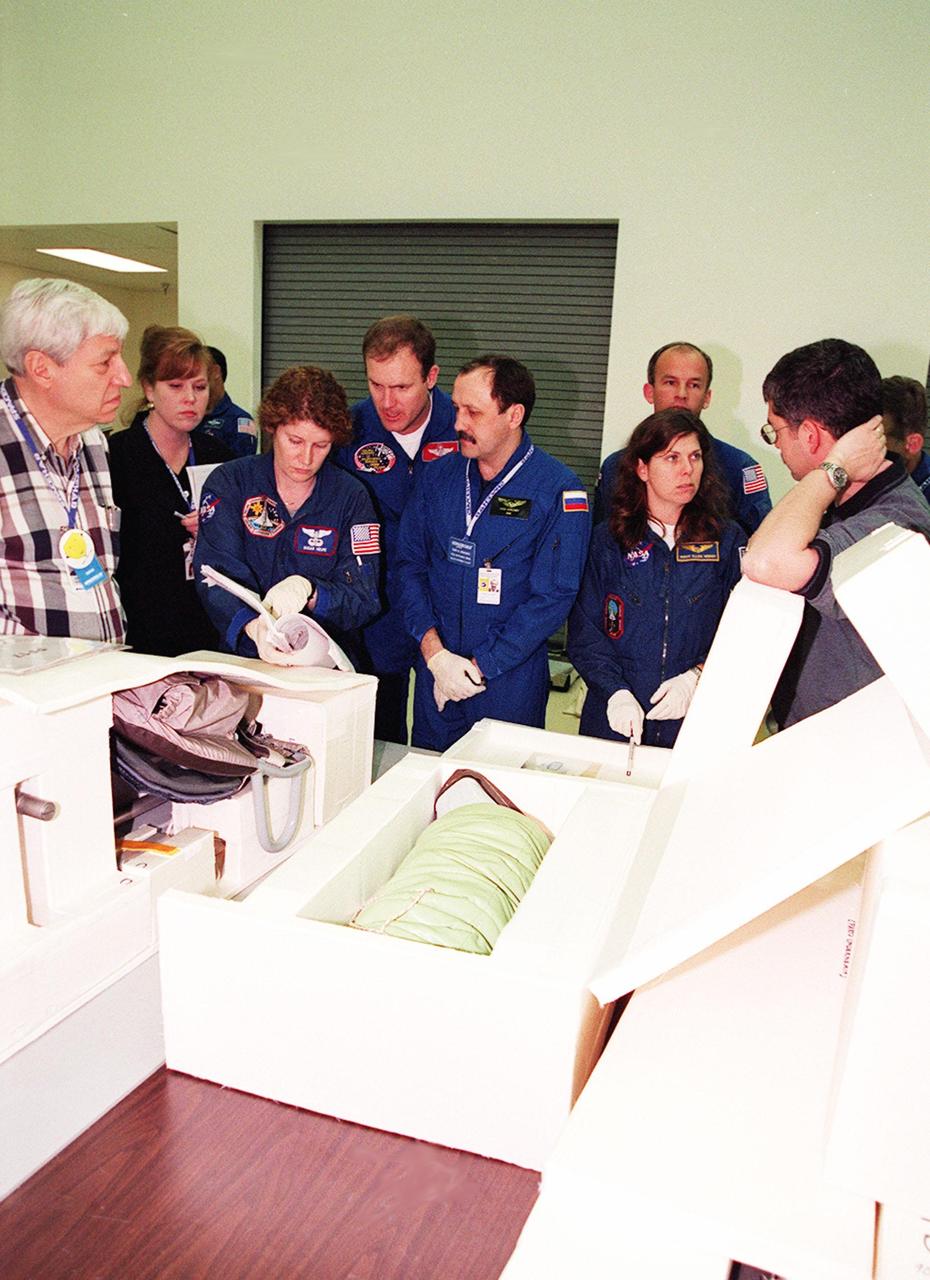
KENNEDY SPACE CENTER, FLA. -- Members of the STS-101 crew take part in Crew Equipment Interface Test (CEIT) activities at SPACEHAB, in Cape Canaveral, Fla., where they are learning about some of the equipment they will be working with on their mission to the International Space Station. Mission Specialist Susan Helms holds one component while Commander James Halsell and Mission Specialist Yuri Usachev look on, and Mission Specialists Mary Ellen Weber and Jeffrey Williams discuss another. Also taking part in the CEIT are Pilot Scott Horowitz and Mission Specialist James Voss. The green component on the table is an air duct to be installed in the Russian module Zarya to improve ventilation. The STS-101 crew will be responsible for preparing the Space Station for the arrival of the Zvezda Service Module, expected to be launched by Russia in July 2000. Also, the crew will conduct one space walk to perform maintenance on the Space Station and deliver logistics and supplies. This will be the third assembly flight for the Space Station. STS-101 is scheduled to launch no earlier than April 13 from Launch Pad 39A
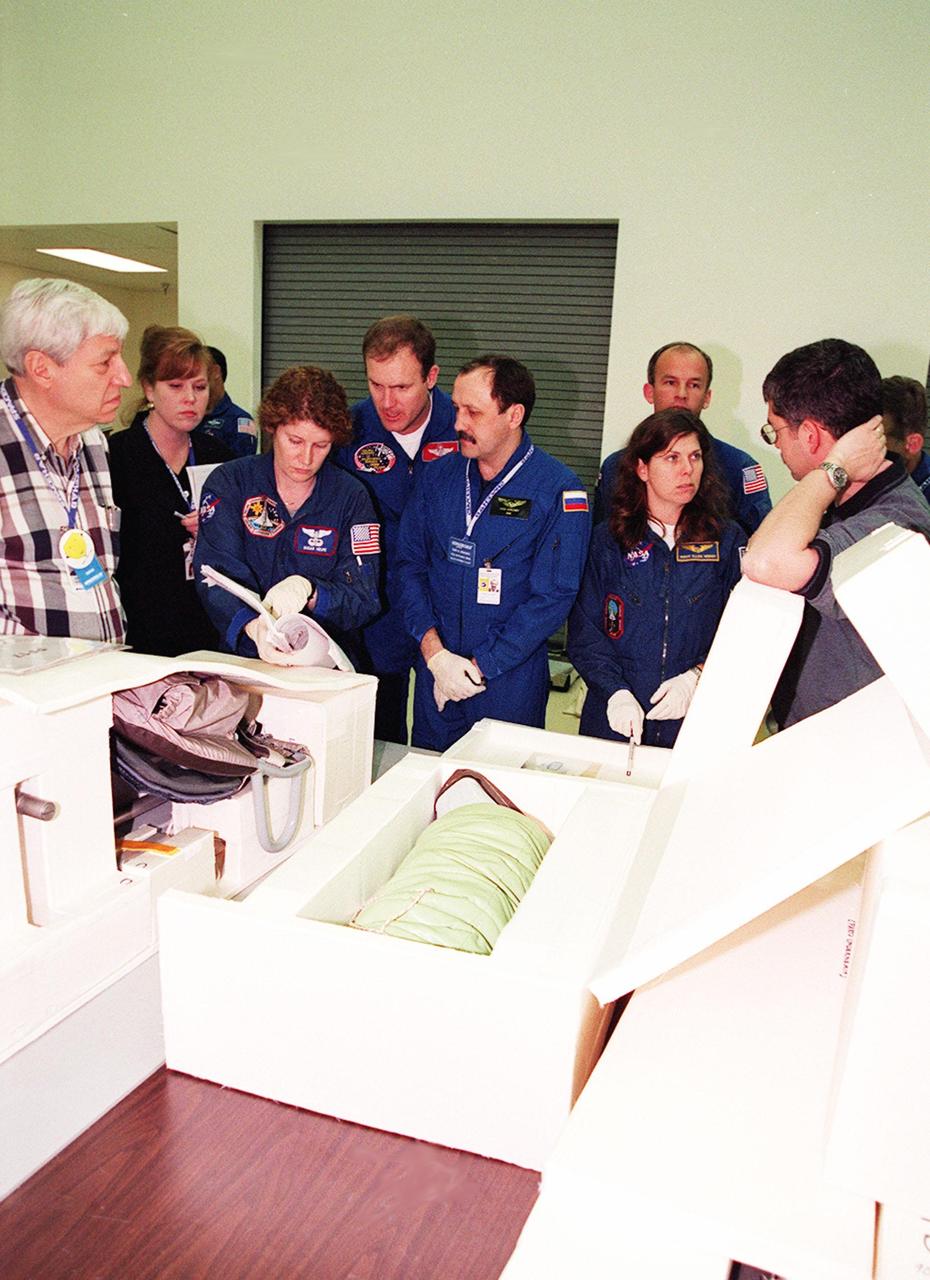
KENNEDY SPACE CENTER, FLA. -- Members of the STS-101 crew take part in Crew Equipment Interface Test (CEIT) activities at SPACEHAB, in Cape Canaveral, Fla., where they are learning about some of the equipment they will be working with on their mission to the International Space Station. Mission Specialist Susan Helms holds one component while Commander James Halsell and Mission Specialist Yuri Usachev look on, and Mission Specialists Mary Ellen Weber and Jeffrey Williams discuss another. Also taking part in the CEIT are Pilot Scott Horowitz and Mission Specialist James Voss. The green component on the table is an air duct to be installed in the Russian module Zarya to improve ventilation. The STS-101 crew will be responsible for preparing the Space Station for the arrival of the Zvezda Service Module, expected to be launched by Russia in July 2000. Also, the crew will conduct one space walk to perform maintenance on the Space Station and deliver logistics and supplies. This will be the third assembly flight for the Space Station. STS-101 is scheduled to launch no earlier than April 13 from Launch Pad 39A
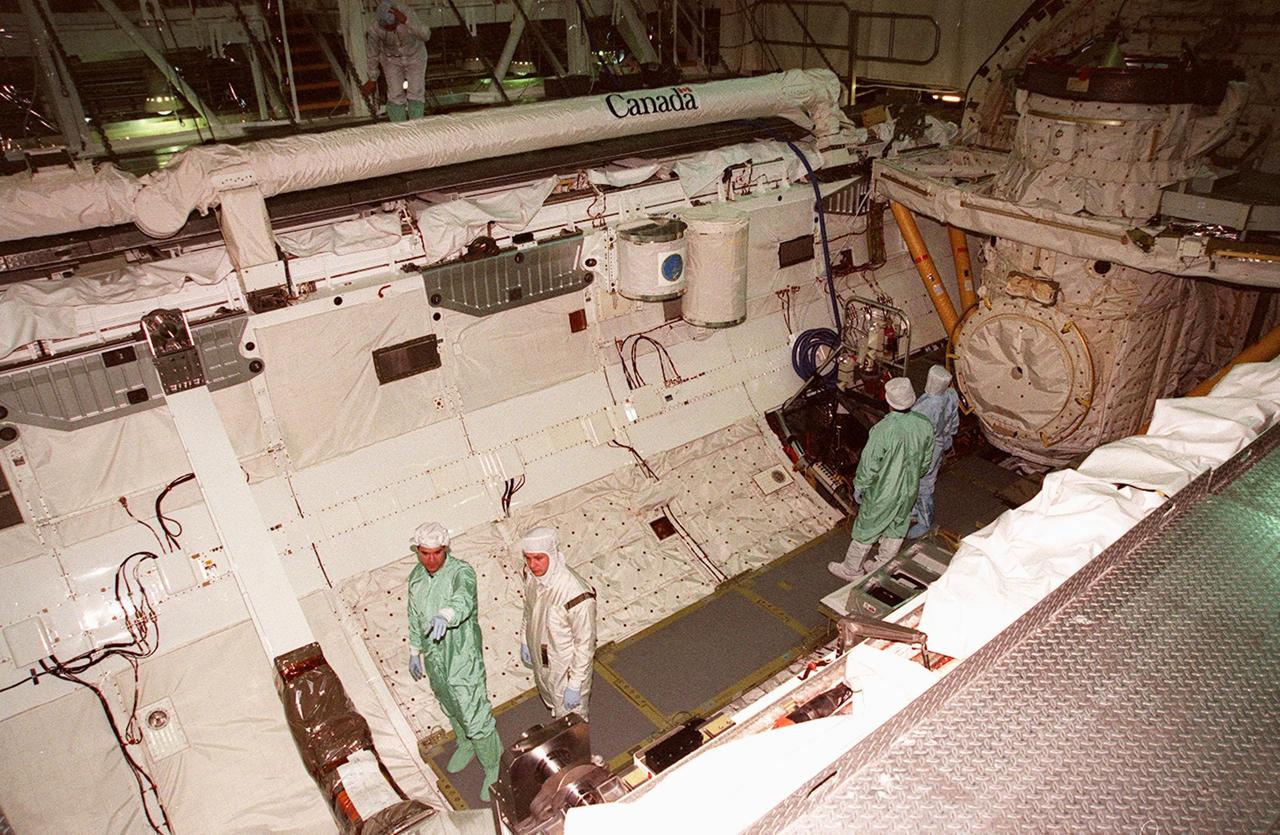
Members of the STS-102 crew check out Discovery’s payload bay in the Orbiter Processing Facility bay 1. Dressed in green, they are Mission Specialist Paul W. Richards (left) and Pilot James W. Kelly. The crew is at KSC for Crew Equipment Interface Test activities. Above their heads on the left side are two of the experiments being carried on the flight. STS-102 is the 8th construction flight to the International Space Station and will carry the Multi-Purpose Logistics Module Leonardo. STS-102 is scheduled for launch March 1, 2001. On that flight, Leonardo will be filled with equipment and supplies to outfit the U.S. laboratory module Destiny. The mission will also be carrying the Expedition Two crew to the Space Station, replacing the Expedition One crew who will return on Shuttle Discovery

Members of the STS-102 crew check out Discovery’s payload bay in the Orbiter Processing Facility bay 1. Dressed in green, they are Mission Specialist Paul W. Richards (left) and Pilot James W. Kelly. The crew is at KSC for Crew Equipment Interface Test activities. Above their heads on the left side are two of the experiments being carried on the flight. STS-102 is the 8th construction flight to the International Space Station and will carry the Multi-Purpose Logistics Module Leonardo. STS-102 is scheduled for launch March 1, 2001. On that flight, Leonardo will be filled with equipment and supplies to outfit the U.S. laboratory module Destiny. The mission will also be carrying the Expedition Two crew to the Space Station, replacing the Expedition One crew who will return on Shuttle Discovery

Members of the STS-102 crew check out Discovery’s payload bay in the Orbiter Processing Facility bay 1. Dressed in green, they are Mission Specialist Paul W. Richards (left) and Pilot James W. Kelly. The crew is at KSC for Crew Equipment Interface Test activities. Above their heads on the left side are two of the experiments being carried on the flight. STS-102 is the 8th construction flight to the International Space Station and will carry the Multi-Purpose Logistics Module Leonardo. STS-102 is scheduled for launch March 1, 2001. On that flight, Leonardo will be filled with equipment and supplies to outfit the U.S. laboratory module Destiny. The mission will also be carrying the Expedition Two crew to the Space Station, replacing the Expedition One crew who will return on Shuttle Discovery
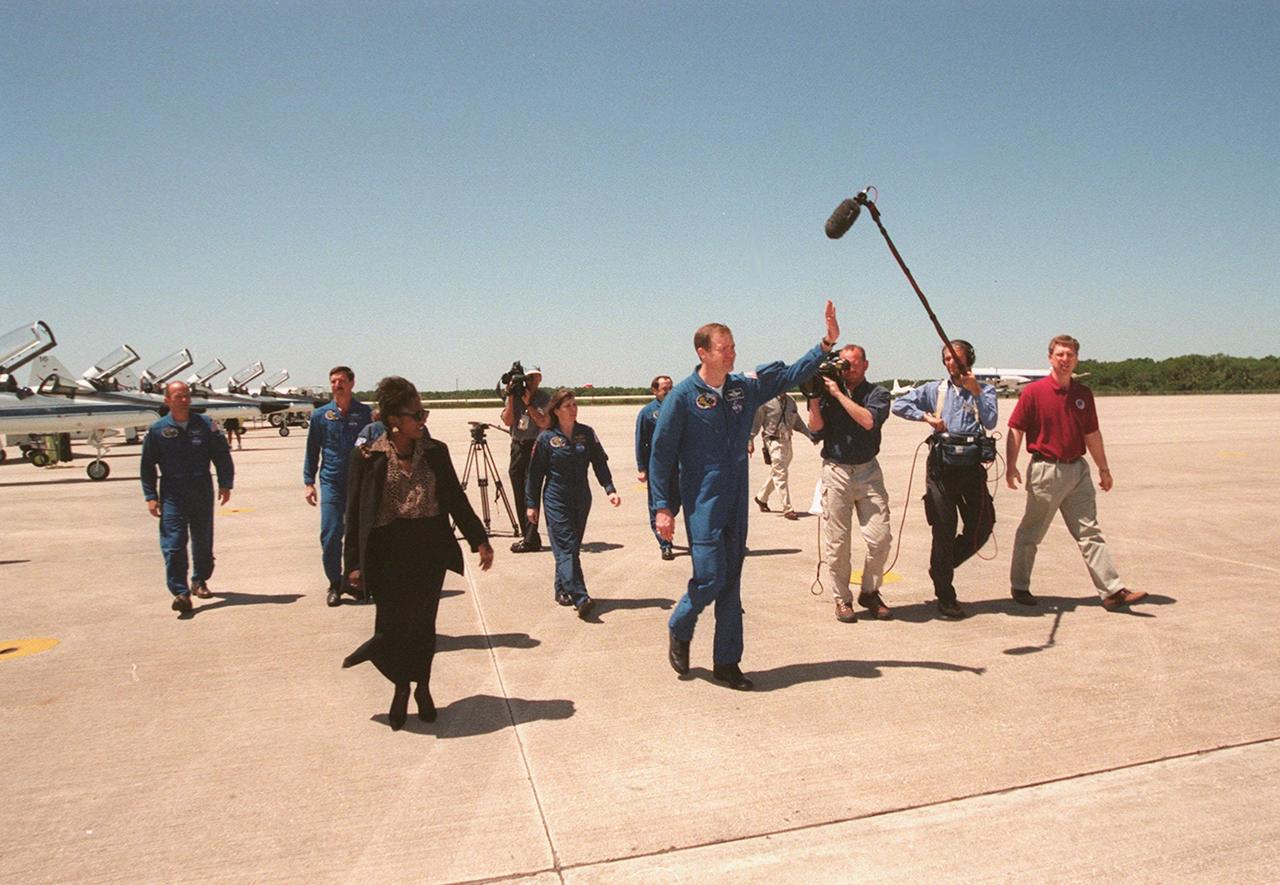
KENNEDY SPACE CENTER, FLA. -- At the Shuttle Landing Facility, STS-101 Commander James Halsell waves to the media as he and other crew members cross the tarmac to a waiting bus. At right is a film crew; in the foreground at left is Delores Green, flight crew support specialist lead for the astronaut crew quarters. Other crew members in the background are Mission Specialist Jeffrey Williams, Pilot Scott Horowitz, and Mission Specialists Mary Ellen Weber and Yury Usachev. Not visible in the photo is Mission Specialist Susan Helms. During their mission to the International Space Station, the STS-101 crew will be delivering logistics and supplies, plus preparing the Station for the arrival of the Zvezda Service Module, expected to be launched by Russia in July 2000. Also, the crew will conduct one space walk to perform maintenance on the Space Station. This will be the third assembly flight for the Space Station. STS-101 is scheduled to launch April 24 at 4:15 p.m. from Launch Pad 39A

Members of the STS-102 crew check out Discovery’s payload bay in the Orbiter Processing Facility bay 1. Dressed in green, they are Mission Specialist Paul W. Richards (left) and Pilot James W. Kelly. The crew is at KSC for Crew Equipment Interface Test activities. Above their heads on the left side are two of the experiments being carried on the flight. STS-102 is the 8th construction flight to the International Space Station and will carry the Multi-Purpose Logistics Module Leonardo. STS-102 is scheduled for launch March 1, 2001. On that flight, Leonardo will be filled with equipment and supplies to outfit the U.S. laboratory module Destiny. The mission will also be carrying the Expedition Two crew to the Space Station, replacing the Expedition One crew who will return on Shuttle Discovery
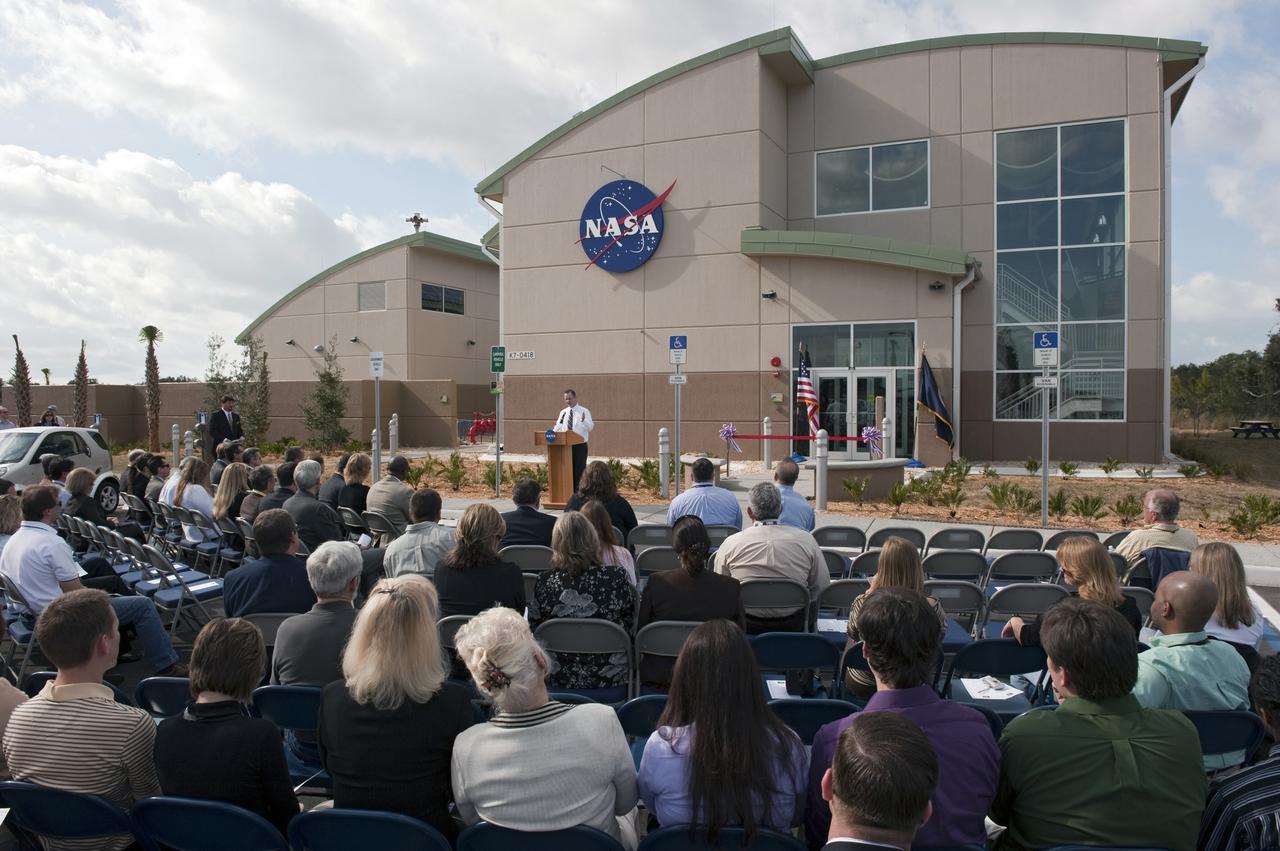
CAPE CANAVERAL, Fla. -- At NASA's Kennedy Space Center in Florida, James Wright, the deputy assistant administrator for the Office of Strategic Infrastructure at NASA Headquarters, addresses an audience at the ribbon-cutting ceremony for the new environmentally friendly Propellants North Administration and Maintenance Facility. Propellants North consists of two buildings, one to store cryogenic fuel transfer equipment and one to house personnel who support fueling spacecraft. The recently rebuilt buildings will be NASA's first carbon neutral facility, which means it will produce enough energy on site from renewable sources to offset what it requires to operate. The facility also will reach for the U.S. Green Building Council's Leadership in Environmental and Energy Design (LEED) Platinum status, which is the highest LEED rating. Photo credit: NASA/Kim Shiflett
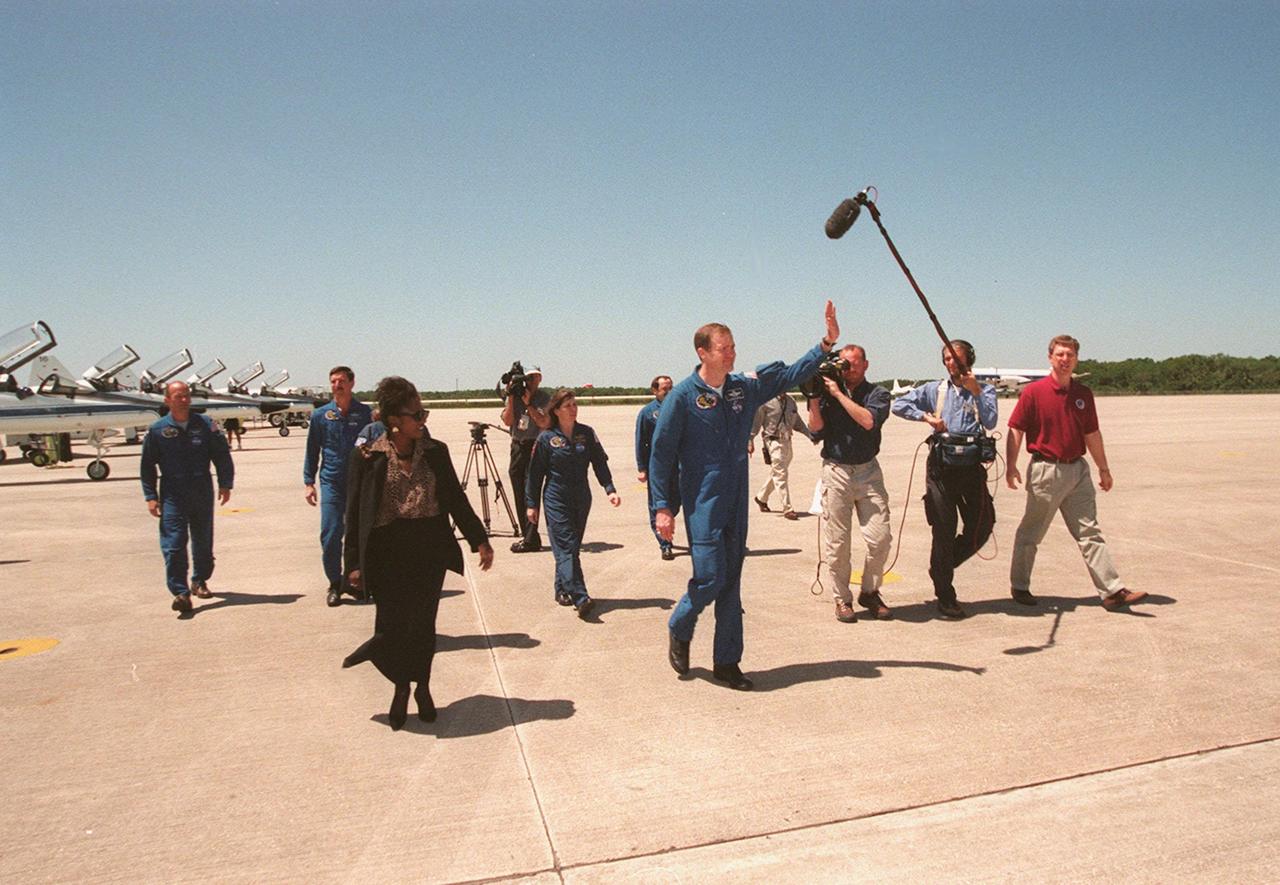
KENNEDY SPACE CENTER, FLA. -- At the Shuttle Landing Facility, STS-101 Commander James Halsell waves to the media as he and other crew members cross the tarmac to a waiting bus. At right is a film crew; in the foreground at left is Delores Green, flight crew support specialist lead for the astronaut crew quarters. Other crew members in the background are Mission Specialist Jeffrey Williams, Pilot Scott Horowitz, and Mission Specialists Mary Ellen Weber and Yury Usachev. Not visible in the photo is Mission Specialist Susan Helms. During their mission to the International Space Station, the STS-101 crew will be delivering logistics and supplies, plus preparing the Station for the arrival of the Zvezda Service Module, expected to be launched by Russia in July 2000. Also, the crew will conduct one space walk to perform maintenance on the Space Station. This will be the third assembly flight for the Space Station. STS-101 is scheduled to launch April 24 at 4:15 p.m. from Launch Pad 39A

The dusty face of the Eagle Nebula and its surroundings are revealed in this image based on data from NASA's Wide Field Survey Explorer (WISE). WISE detects infrared light, or a range of wavelengths longer than what the human eye can see. This large star forming region is about 5,700 light years away from Earth and is most famous for being home to the the "Pillars of Creation," a region famously imaged by NASA's Hubble and James Webb space telescopes. The WISE data reveals the entire structure of the nebula surrounding the pillars, which themselves can be seen as a faint yellow-green feature inside the white circle. While the WISE view of the "Pillars" is not as sharp as those taken by Webb and Hubble, the telescope's wide field of view allows us to explore the extended nebula around it. When viewed in visible light, the dust is dark and opaque. In these infrared wavelengths, the dust becomes more translucent, and emits infrared light, shown in green, yellow, and red in this image. The data used in this image came from WISE's primary mission which ran from 2009 to 2011. In 2013, NASA took the spacecraft out of hibernation and began using it to track and study near-Earth objects. The mission and the spacecraft were renamed NEOWISE. However, the data is still being used by astronomers to study objects and regions outside our solar system. Blue and cyan are used to represent infrared light at wavelengths of 3.4 and 4.6 microns, while green and red display longer wavelengths of 12 and 22 microns, respectively. Animation available at https://photojournal.jpl.nasa.gov/catalog/PIA25433
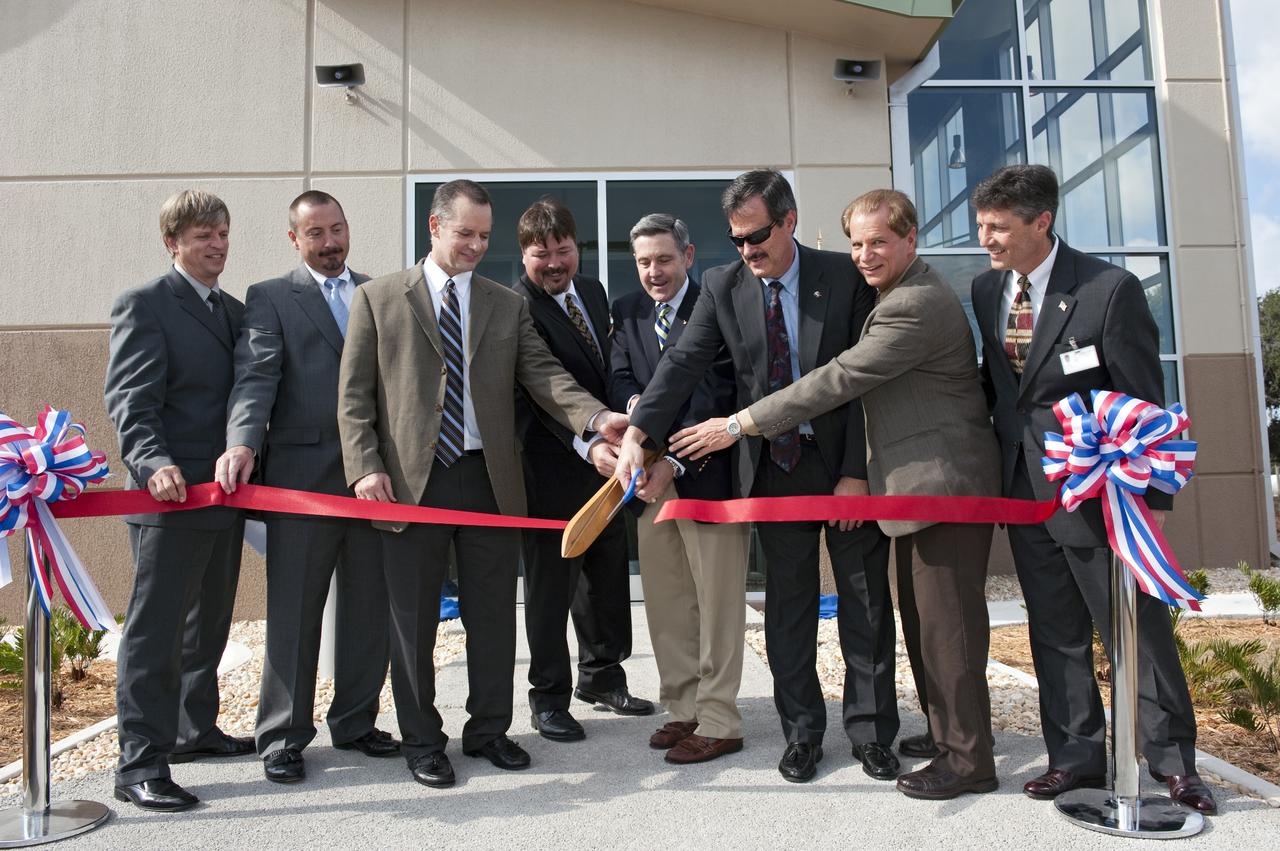
CAPE CANAVERAL, Fla. -- A traditional ribbon-cutting ceremony takes place outside the Propellants North Administration and Maintenance Facility at NASA's Kennedy Space Center in Florida. From left, are Thomas Wilczek, contracting officer technical representative/project manager for NASA Construction of Facilities; Bradley O’Toole, NASA contracting officer; James Wright, deputy assistant administrator for the Office of Strategic Infrastructure at NASA Headquarters; Frank Kline, NASA Construction of Facility project manager; Bob Cabana, Kennedy's center director; Mike Benik, director of Kennedy's Center Operations; Ward Davis, president of HW Davis Construction Inc.; and Rick Ferreira, chief operating officer of Jones Edmunds and Associates Inc. Propellants North consists of two buildings, one to store cryogenic fuel transfer equipment and one to house personnel who support fueling spacecraft. The recently rebuilt buildings will be NASA's first carbon neutral facility, which means it will produce enough energy on site from renewable sources to offset what it requires to operate. The facility also will reach for the U.S. Green Building Council's Leadership in Environmental and Energy Design (LEED) Platinum status, which is the highest LEED rating. Photo credit: NASA/Kim Shiflett
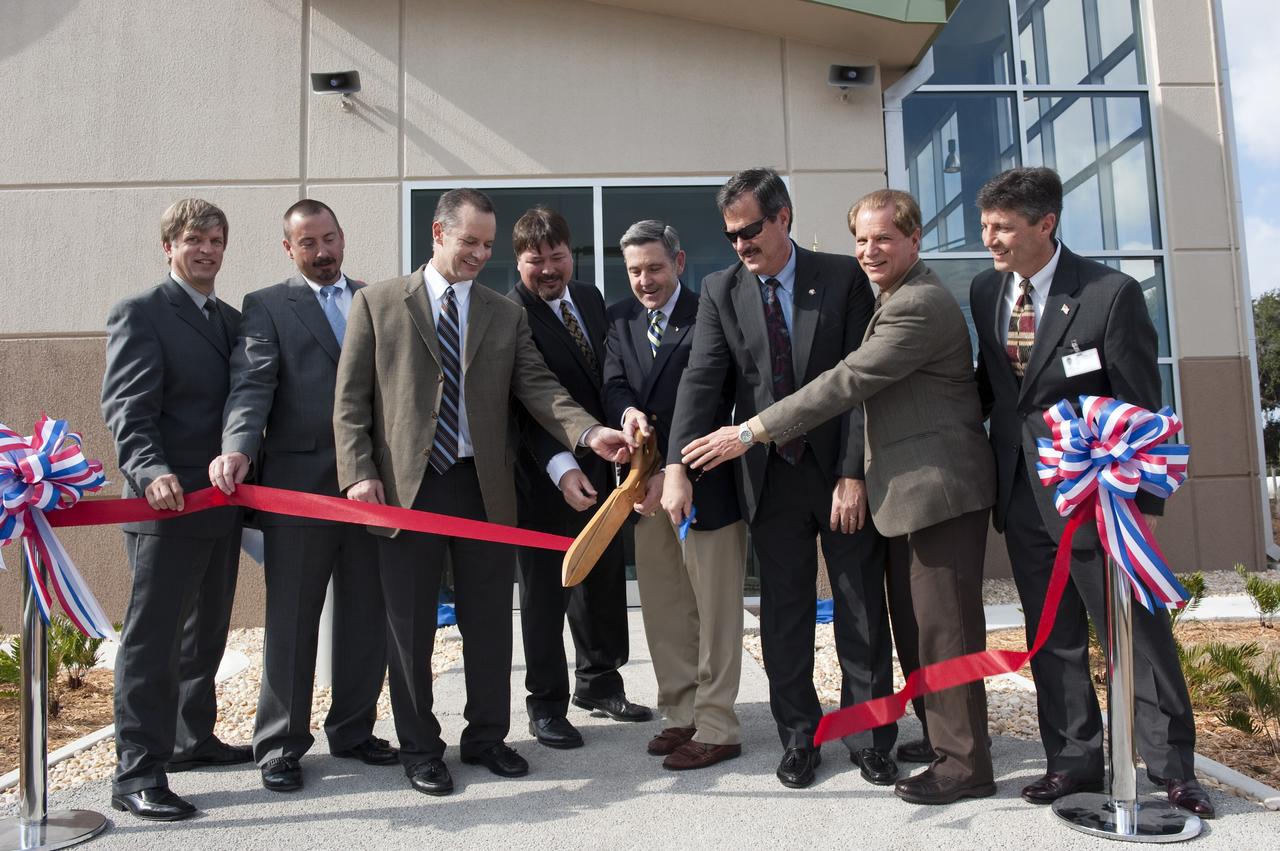
CAPE CANAVERAL, Fla. -- A traditional ribbon-cutting ceremony takes place outside the Propellants North Administration and Maintenance Facility at NASA's Kennedy Space Center in Florida. From left, are Thomas Wilczek, contracting officer technical representative/project manager for NASA Construction of Facilities; Bradley O’Toole, NASA contracting officer; James Wright, deputy assistant administrator for the Office of Strategic Infrastructure at NASA Headquarters; Frank Kline, NASA Construction of Facility project manager; Bob Cabana, Kennedy's center director; Mike Benik, director of Kennedy's Center Operations; Ward Davis, president of HW Davis Construction Inc.; and Rick Ferreira, chief operating officer of Jones Edmunds and Associates Inc. Propellants North consists of two buildings, one to store cryogenic fuel transfer equipment and one to house personnel who support fueling spacecraft. The recently rebuilt buildings will be NASA's first carbon neutral facility, which means it will produce enough energy on site from renewable sources to offset what it requires to operate. The facility also will reach for the U.S. Green Building Council's Leadership in Environmental and Energy Design (LEED) Platinum status, which is the highest LEED rating. Photo credit: NASA/Kim Shiflett
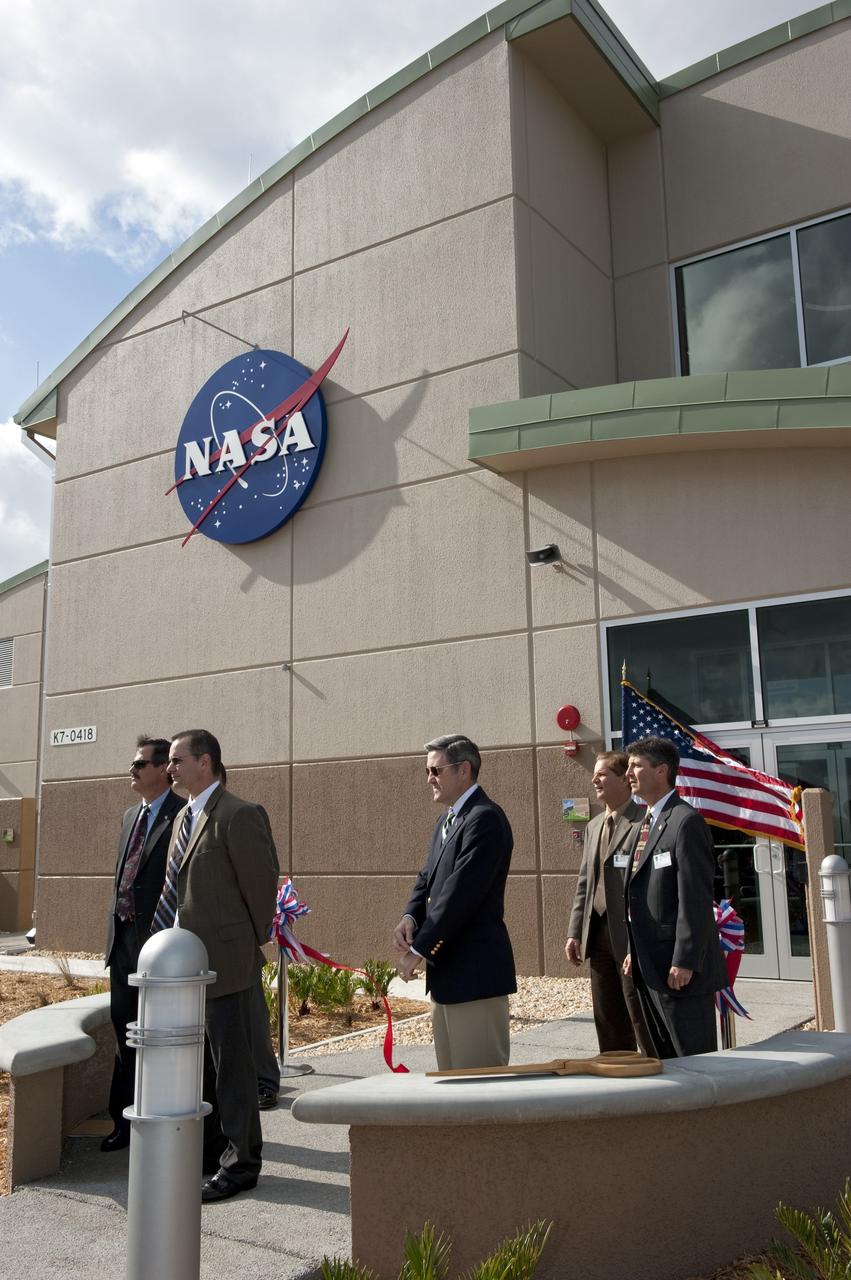
CAPE CANAVERAL, Fla. -- NASA's Kennedy Space Center in Florida hosts a ribbon-cutting ceremony for the space agency's most environmentally friendly facility, the Propellants North Administrative and Maintenance Facility in Kennedy's Launch Complex 39 area. From left, are Mike Benik, director of Kennedy's Center Operations; James Wright, deputy assistant administrator for the Office of Strategic Infrastructure at NASA Headquarters; Bob Cabana, Kennedy's center director; Ward Davis, president of HW Davis Construction Inc.; and Rick Ferreira, chief operating officer of Jones Edmunds and Associates Inc. Propellants North consists of two buildings, one to store cryogenic fuel transfer equipment and one to house personnel who support fueling spacecraft. The recently rebuilt buildings will be NASA's first carbon neutral facility, which means it will produce enough energy on site from renewable sources to offset what it requires to operate. The facility also will reach for the U.S. Green Building Council's Leadership in Environmental and Energy Design (LEED) Platinum status, which is the highest LEED rating. Photo credit: NASA/Kim Shiflett
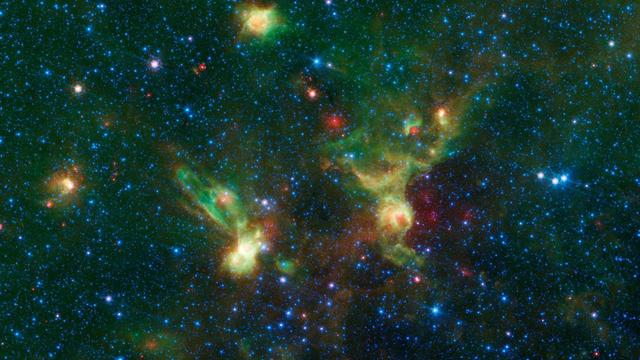
Just in time for the 50th anniversary of the TV series "Star Trek," which first aired September 8th,1966, this infrared image from NASA's Spitzer Space Telescope may remind fans of the historic show. Just as one might see the shapes of animals or other objects in clouds -- a phenomenon called pareidolia -- iconic starships from the series may seem to emerge in these nebulae./ With a little scrutiny (see Figure 1), you may see hints of the saucer and hull of the original USS Enterprise, captained by James T. Kirk, as if it were emerging from a dark nebula. To the left, its "Next Generation" successor, Jean-Luc Picard's Enterprise-D, flies off in the opposite direction. Astronomically speaking, the region pictured here falls within the disk of our Milky Way galaxy, and displays two regions of star formation that are hidden behind a haze of dust when viewed in visible light. Spitzer's ability to peer deeper into dust clouds has revealed a myriad of stellar birthplaces like these, which are officially known only by their catalog numbers, IRAS 19340+2016 and IRAS19343+2026. Trekkies, however, may prefer using the more familiar designations NCC-1701 and NCC-1701-D. This image was assembled using data from Spitzer's biggest surveys of the Milky Way, called GLIMPSE and MIPSGAL. Light with a wavelength of 3.5 microns is shown in blue, 8.0 microns is green, and 24 microns in red. The green colors highlight organic molecules in the dust clouds, illuminated by starlight. Red colors are related to thermal radiation emitted from the very hottest areas of dust. http://photojournal.jpl.nasa.gov/catalog/PIA20917

This image of the Andromeda galaxy, or M31, includes data from the ESA (European Space Agency) Herschel mission, supplemented with data from ESA's retired Planck observatory and two retired NASA missions: the Infrared Astronomical Satellite (IRAS) and Cosmic Background Explorer (COBE). Operated from 2009 to 2013, Herschel detected wavelengths of light in the far-infrared and microwave ranges, and was ideal for studying dust in nearby galaxies because it could capture small-scale structures in the dust clouds in high resolution. However, Herschel often couldn't detect light from diffuse dust clouds – especially in the outer regions of galaxies, where the gas and dust become sparse and thus fainter. As a result, the mission missed up to 30% of all the light given off by dust. Combining the Herschel observations with data from other observatories creates a more complete picture of the dust in the galaxy. In the image, red indicates hydrogen gas; green indicates cold dust; and warmer dust is shown in blue. Launched in 1983, IRAS was the first space telescope to detect infrared light, setting the stage for future observatories like NASA's Spitzer Space Telescope and James Webb Space Telescope. The Planck observatory, launched in 2009, and COBE, launched in 1989, both studied the cosmic microwave background, or light left over from the big bang. Red indicates hydrogen gas detected using the Green Bank Telescope in West Virginia, the Westerbork Synthesis Radio Telescope in the Netherlands, and the Institute for Radio Astronomy in the Millimeter Range 30-meter telescope in Spain. https://photojournal.jpl.nasa.gov/catalog/PIA25163
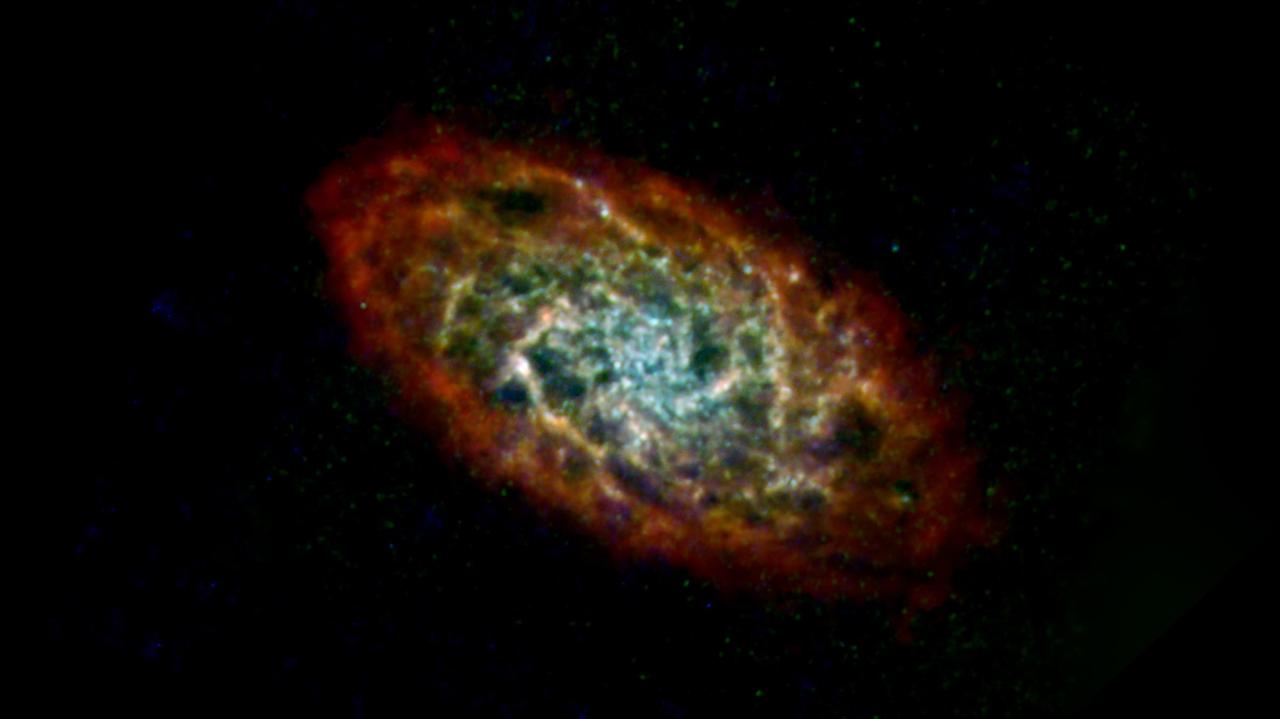
This image of the Triangulum galaxy, or M33, includes data from the ESA (European Space Agency) Herschel mission, supplemented with data from ESA's retired Planck observatory and two retired NASA missions: the Infrared Astronomical Satellite (IRAS) and Cosmic Background Explorer (COBE). Operated from 2009 to 2013, Herschel detected wavelengths of light in the far-infrared and microwave ranges, and was ideal for studying dust in nearby galaxies because it could capture small-scale structures in the dust clouds in high resolution. However, Herschel often couldn't detect light from diffuse dust clouds – especially in the outer regions of galaxies, where the gas and dust become sparse and thus fainter. As a result, the mission missed up to 30% of all the light given off by dust. Combining the Herschel observations with data from other observatories creates a more complete picture of the dust in the galaxy. In the image, red indicates hydrogen gas; green indicates cold dust; and warmer dust is shown in blue. Launched in 1983, IRAS was the first space telescope to detect infrared light, setting the stage for future observatories like NASA's Spitzer Space Telescope and James Webb Space Telescope. The Planck observatory, launched in 2009, and COBE, launched in 1989, both studied the cosmic microwave background, or light left over from the big bang. The hydrogen gas was detected using the Green Bank Telescope in West Virginia, the Karl G. Jansky Very Large Array in New Mexico, and the Institute for Radio Astronomy in the Millimeter Range 30-meter telescope in Spain. https://photojournal.jpl.nasa.gov/catalog/PIA25165
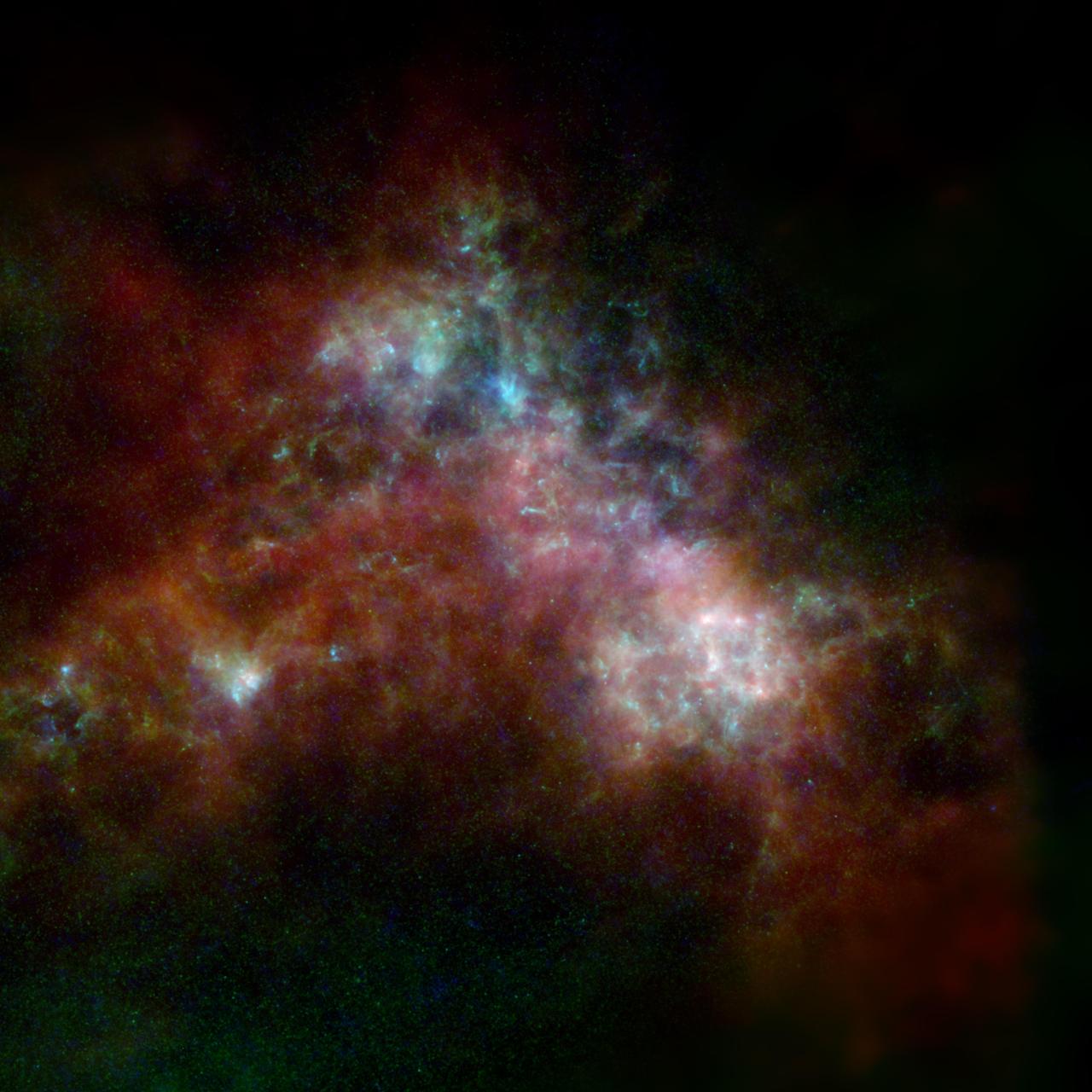
The Small Magellanic Cloud, shown here, is a dwarf galaxy orbiting the Milky Way. The image includes data from the ESA (European Space Agency) Herschel mission, supplemented with data from ESA's retired Planck observatory and two retired NASA missions: the Infrared Astronomical Satellite (IRAS) and Cosmic Background Explorer (COBE). Operated from 2009 to 2013, Herschel detected wavelengths of light in the far-infrared and microwave ranges, and was ideal for studying dust in nearby galaxies because it could capture small-scale structures in the dust clouds in high resolution. However, Herschel often couldn't detect light from diffuse dust clouds – especially in the outer regions of galaxies, where the gas and dust become sparse and thus fainter. As a result, the mission missed up to 30% of all the light given off by dust. Combining the Herschel observations with data from other observatories creates a more complete picture of the dust in the galaxy. In the image, red indicates hydrogen gas; green indicates cold dust; and warmer dust is shown in blue. Launched in 1983, IRAS was the first space telescope to detect infrared light, setting the stage for future observatories like NASA's Spitzer Space Telescope and James Webb Space Telescope. The Planck observatory, launched in 2009, and COBE, launched in 1989, both studied the cosmic microwave background, or light left over from the big bang. The hydrogen gas was detected using the Parkes Radio Telescope and the Australia Compact Telescope Array, located in Australia and managed by the Commonwealth Scientific and Industrial Research Organisation (CSIRO); and the NANTEN2 Observatory in the Atacama Desert in Chile. https://photojournal.jpl.nasa.gov/catalog/PIA25164
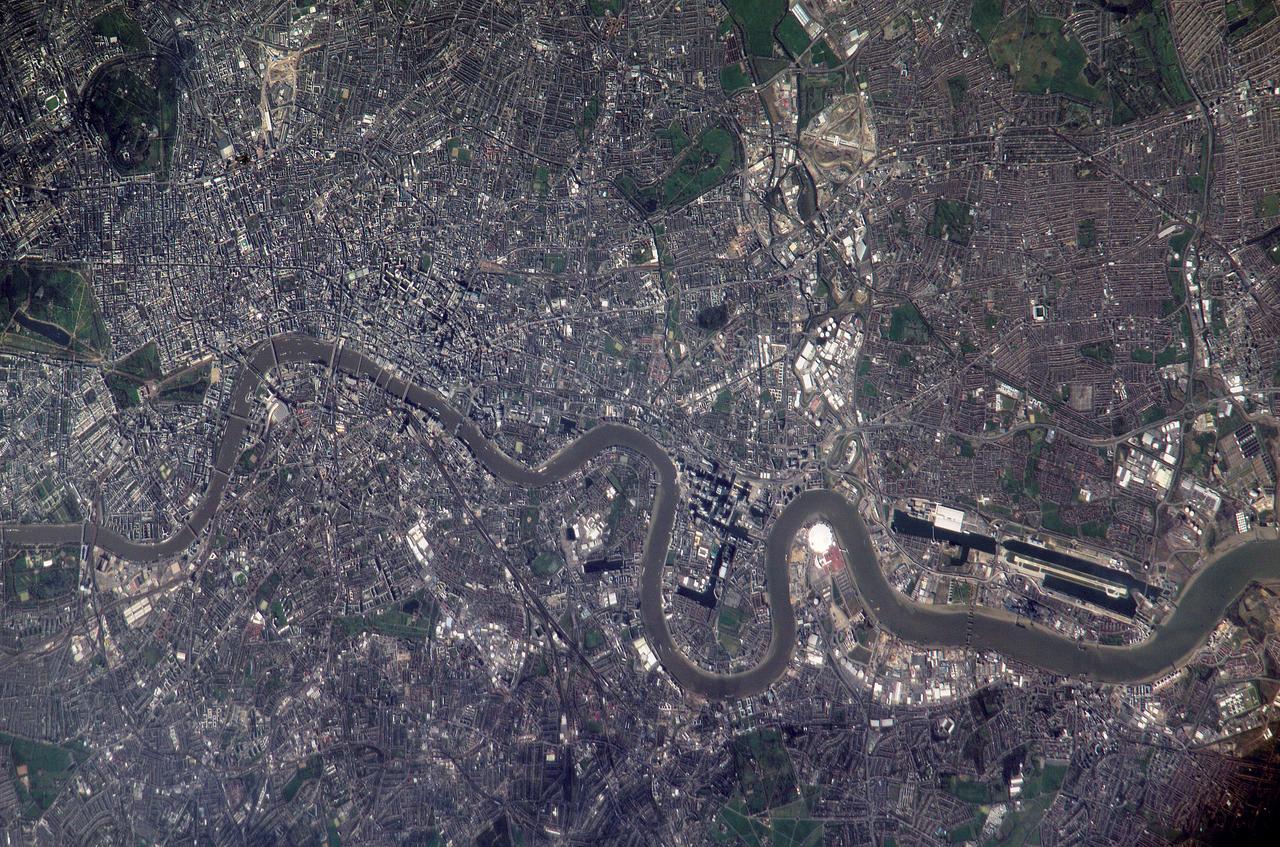
ISS010-E-22495 (2 April 2005) --- Numerous recognizable features appear in this detailed view of London, United Kingdom, photographed by an Expedition 10 crewmember on the International Space Station (ISS). The photographer had to look back along track for the shot, from a position over northern Germany. The most striking visual features are green open spaces such as Regent’s Park, Hyde Park and St. James’s Park east of Buckingham Palace. Many smaller parks indicate why Londoners are proud of being able to walk miles through the city mainly on grass. The River Thames—with its bridges and barges (some of the more than 14,000 craft registered to sail the Thames)—is the axis upon which the city was founded in Roman times. The relatively small area known as the City of London coincides with the ancient walled Roman city of Londinium on the north bank of the river (the line of the wall is marked closely for almost its entire length by modern streets), and includes St. Paul’s Cathedral near where the Roman temple stood. For scale, the river is 265 meters wide near St. Paul’s. The City is the financial center while Westminster is the center of government, including the Houses of Parliament and Downing Street, where the British Prime Minister lives. Several large structures visible in this image are railroad stations; three serving areas north of London (Euston, St. Pancras and King’s Cross), and Waterloo Station serving southern Britain. The London Eye, a famous Ferris wheel 140 meters high, is situated on an oval island in the River Thames, visible just west of Waterloo Station. Many larger buildings can also be identified, partly because they cast shadows—Buckingham Palace, St Paul’s Cathedral, and the Tate Modern art museum (a converted power station, the 99-meter chimney was designed to fall just short of the crest of St Paul’s dome).
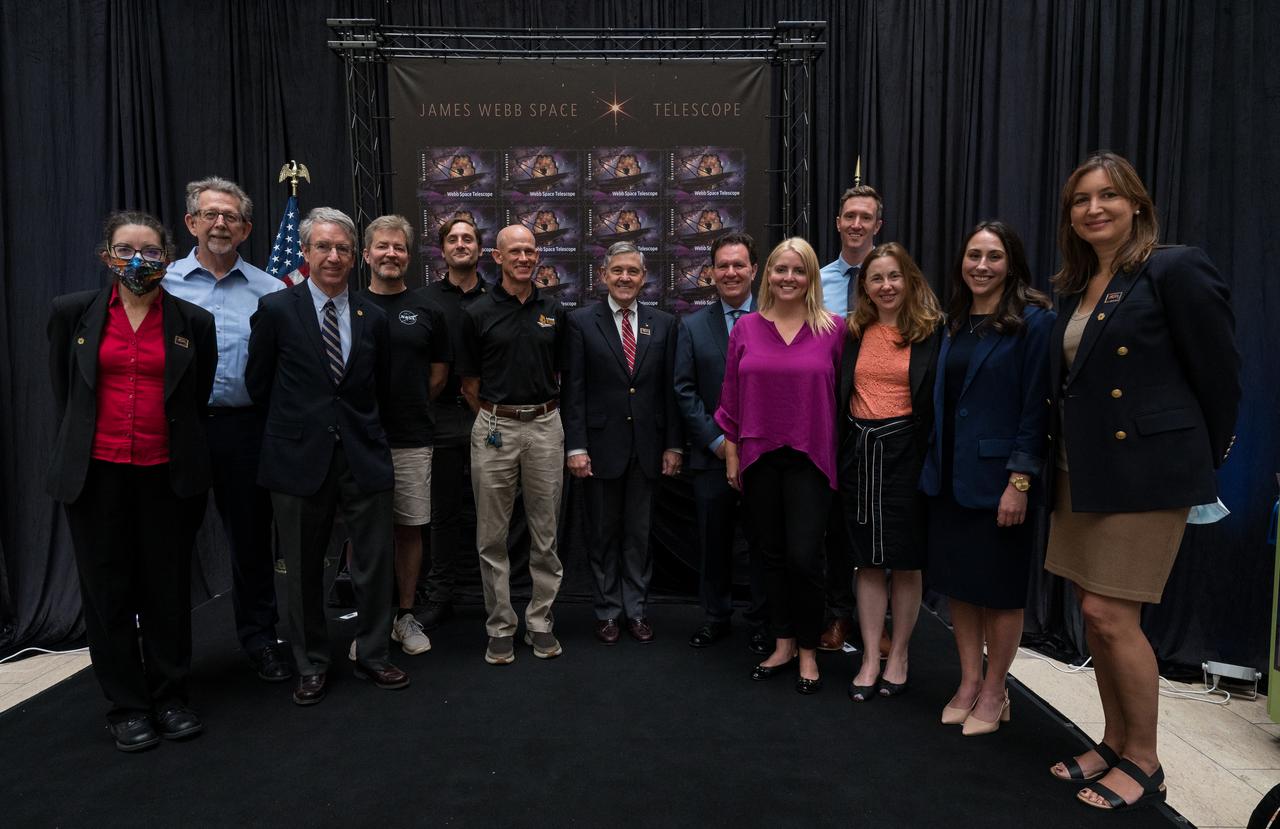
James Webb Space Telescope team members pose for a photo at the first-day-of-issue event for the United States Postal Service’s new stamp celebrating NASA’s James Webb Space Telescope (JWST) on Thursday, Sept. 8, 2022, at the Smithsonian’s National Postal Museum in Washington. The stamp, which features an illustration of the observatory, honors Webb’s mission to explore the unknown in our universe – solving mysteries in our solar system, looking beyond to distant worlds around other stars, and probing the structures and origins of our universe and our place in it. Photo Credit: (NASA/Aubrey Gemignani)

This image from NASA's James Webb Space Telescope reveals at least 17 concentric dust rings emanating from a pair of stars orbiting one another. Located just over 5,000 light-years from Earth, the system is known as Wolf-Rayet 140 because one of the stars is a Wolf-Rayet star. The other is an O-type star, one of the most massive star types known. Each ring was created when the two stars came close together and their stellar winds (streams of gas they blow into space) collided, compressing the gas and forming dust. A ring is produced once per orbit, every 7.93 years. A Wolf-Rayet star is an O-type star born with at least 25 times more mass than our Sun that is nearing the end of its life, when it will likely collapse directly to black hole, or explode as a supernova. These delays between periods of dust production create the unique ring pattern. Some Wolf-Rayet binaries in which the stars are close enough together and have circular orbits produce dust continuously, often forming a pinwheel pattern. WR 140's rings are also referred to as shells because they are not perfectly circular and are thicker and wider than they appear in the image. The rings appear brighter in some areas but are almost invisible in others, rather than forming a perfect "bullseye" pattern. That's because production of dust is variable as the stars get close to one another, and because Webb views the system at an angle and is not looking directly at the orbital plane of the stars. One of the densest regions of dust production creates the bright feature appearing at 2 o'clock. The image was taken by the Mid-Infrared Instrument (MIRI), now managed by the agency's Goddard Space Flight Center. MIRI was developed through a 50-50 partnership between NASA and ESA (European Space Agency). The Jet Propulsion Laboratory in Southern California led the effort for NASA, and a multinational consortium of European astronomical institutes contributed for ESA. Webb's science instruments detect infrared light, a range of wavelengths emitted by warm objects and invisible to the human eye. MIRI detects the longest infrared wavelengths, which means it can often see cooler objects – including these dust rings – than the other three Webb instruments can. The filters used to take this image were the F770W (7.7 micrometers, shown as blue), F1500W (15 micrometers, shown as green), and F2100W (21 micrometers, shown as red). The observations were done under Webb's early release observation (ERO) program number 1349. The most common element found in stars, hydrogen, can't form dust on its own. But Wolf-Rayet stars in their later stages have blown away all of their hydrogen, so they eject elements typically found deep in a star's interior, like carbon, which can form dust. Data from MIRI's Medium Resolution Spectrometer (MRS) shows that the dust made by WR 140 is likely made of a class of molecules called polycyclic aromatic hydrocarbons (PAHs), which are a type of organic carbon-rich compounds that are thought to enrich the carbon content throughout the Universe. Initial processing of the Webb WR 140 data included eight bright "spikes" of light emanating from the center of the image. These are not features of the system, but so-called artifacts of the telescope itself. They were removed from the image, in order to give viewers an unobscured view of the source object. https://photojournal.jpl.nasa.gov/catalog/PIA25432
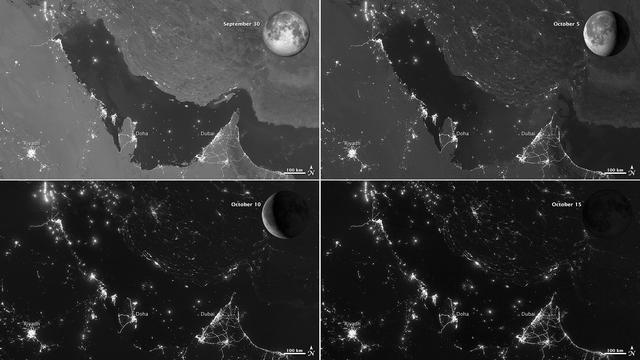
NASA images acquired October 15, 2012 The Visible Infrared Imaging Radiometer Suite (VIIRS) on the Suomi NPP satellite captured these nighttime views of the Persian Gulf region on September 30, October 5, October 10, and October 15, 2012. The images are from the VIIRS “day-night band,” which detects light in a range of wavelengths from green to near-infrared and uses filtering techniques to observe signals such as gas flares, auroras, wildfires, city lights, and reflected moonlight. Each image includes an inset of the Moon in four different phases. September 30 shows the Persian Gulf by the light of the full Moon; October 15 shows the effects of a new Moon. As the amount of moonlight decreases, some land surface features become harder to detect, but the lights from cities and ships become more obvious. Urbanization is most apparent along the northeastern coast of Saudi Arabia, in Qatar, and in the United Arab Emirates (UAE). In Qatar and UAE, major highways can even be discerned by nighttime lights. In eighteenth-century England, a small group of entrepreneurs, inventors and free thinkers—James Watt and Charles Darwin’s grandfathers among them—started a club. They named it the Lunar Society, and the “lunaticks” scheduled their dinner meetings on evenings of the full Moon. The timing wasn’t based on any kind of superstition, it was based on practicality. In the days before electricity, seeing one’s way home after dark was far easier by the light of a full Moon. In the early twenty-first century, electricity has banished the need for such careful scheduling, but the light of the full Moon still makes a difference. NASA Earth Observatory image by Jesse Allen and Robert Simmon, using VIIRS day-night band data from the Suomi National Polar-orbiting Partnership. Suomi NPP is the result of a partnership between NASA, the National Oceanic and Atmospheric Administration, and the Department of Defense. Caption by Michon Scott. Instrument: Suomi NPP - VIIRS Credit: <b><a href="http://www.earthobservatory.nasa.gov/" rel="nofollow"> NASA Earth Observatory</a></b> <b>Click here to view all of the <a href="http://earthobservatory.nasa.gov/Features/NightLights/" rel="nofollow"> Earth at Night 2012 images </a></b> <b>Click here to <a href="http://earthobservatory.nasa.gov/NaturalHazards/view.php?id=79834" rel="nofollow"> read more </a> about this image </b> <b><a href="http://www.nasa.gov/audience/formedia/features/MP_Photo_Guidelines.html" rel="nofollow">NASA image use policy.</a></b> <b><a href="http://www.nasa.gov/centers/goddard/home/index.html" rel="nofollow">NASA Goddard Space Flight Center</a></b> enables NASA’s mission through four scientific endeavors: Earth Science, Heliophysics, Solar System Exploration, and Astrophysics. Goddard plays a leading role in NASA’s accomplishments by contributing compelling scientific knowledge to advance the Agency’s mission. <b>Follow us on <a href="http://twitter.com/NASA_GoddardPix" rel="nofollow">Twitter</a></b> <b>Like us on <a href="http://www.facebook.com/pages/Greenbelt-MD/NASA-Goddard/395013845897?ref=tsd" rel="nofollow">Facebook</a></b> <b>Find us on <a href="http://instagram.com/nasagoddard?vm=grid" rel="nofollow">Instagram</a></b>