James Webb Space Telescope Mirror Reveal
James Webb Space Telescope Mirror Reveal
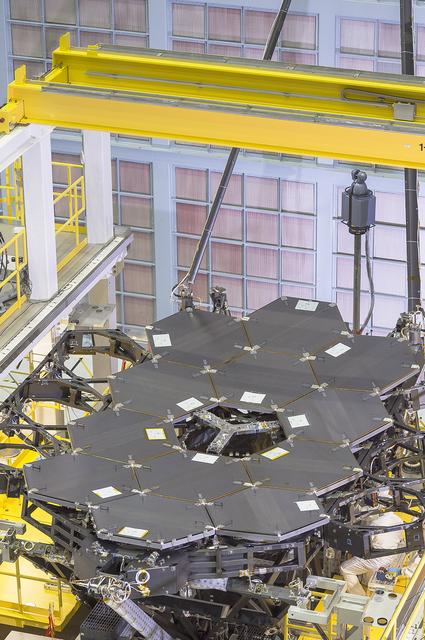
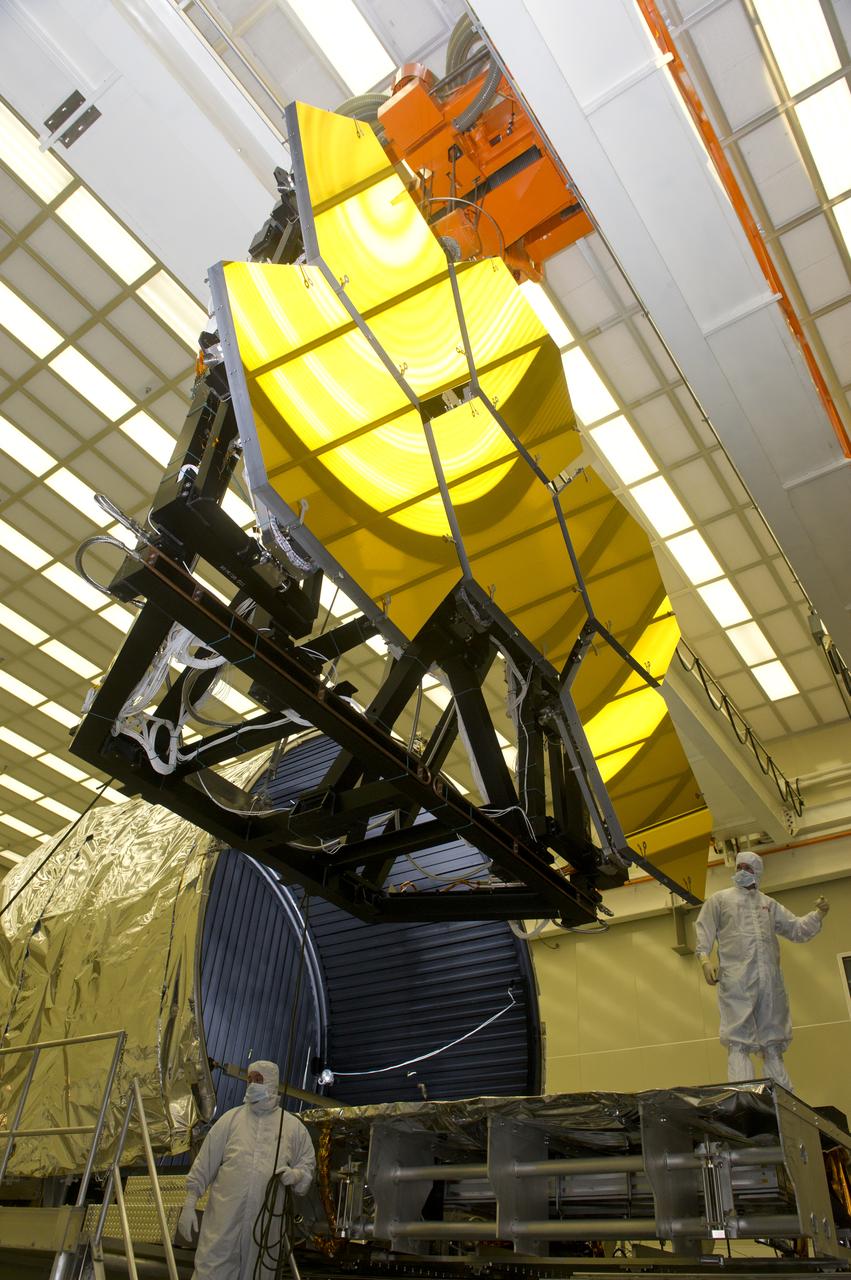
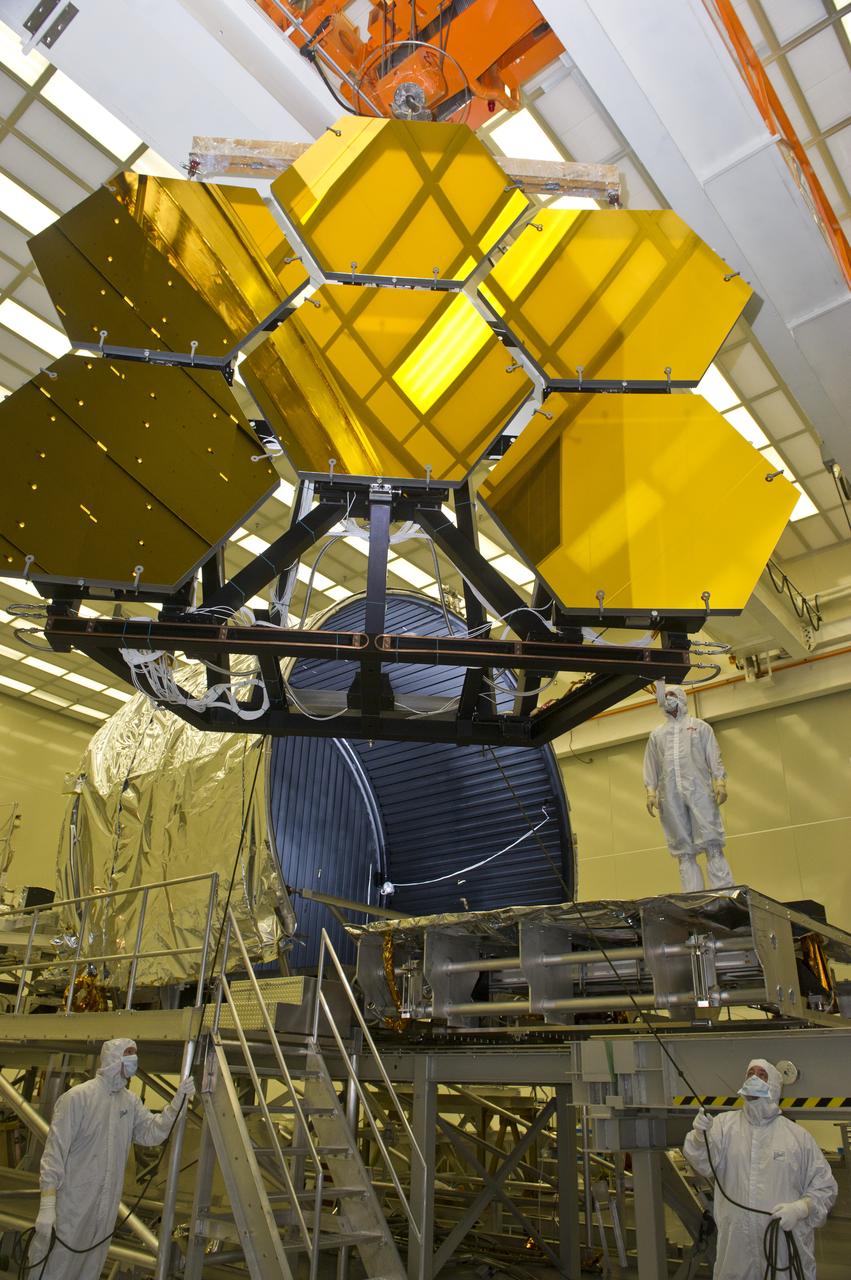
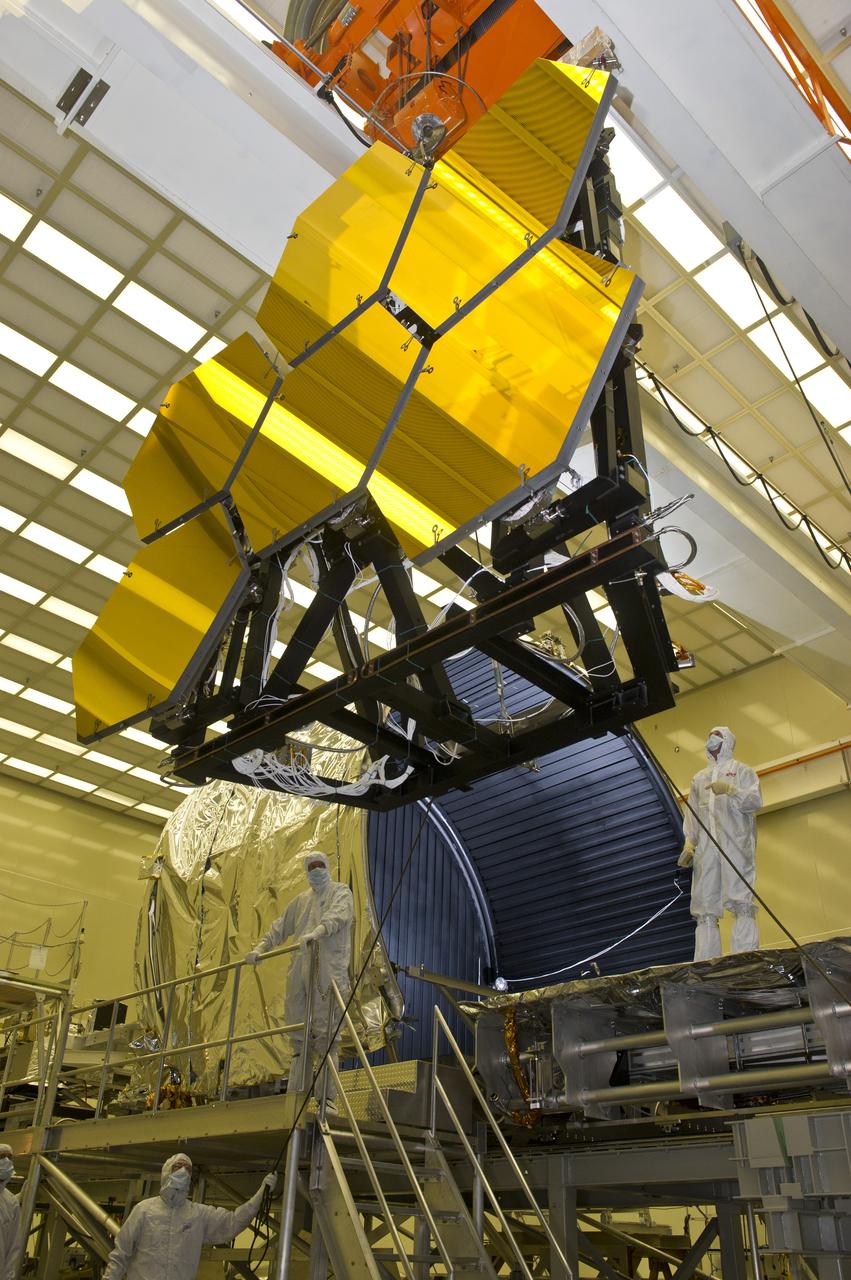
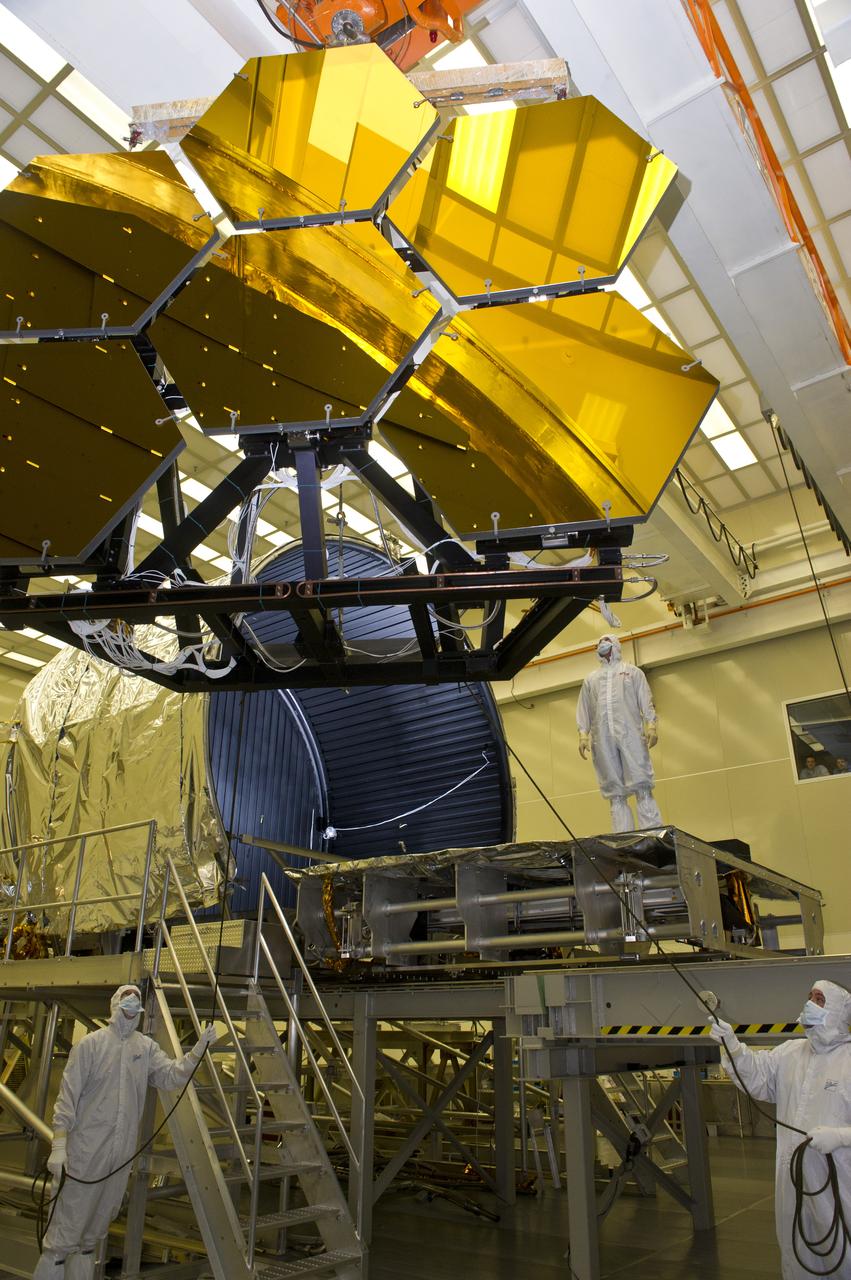
A view of the one dozen (out of 18) flight mirror segments that make up the primary mirror on NASA's James Webb Space Telescope have been installed at NASA's Goddard Space Flight Center. Credits: NASA/Chris Gunn More: Since December 2015, the team of scientists and engineers have been working tirelessly to install all the primary mirror segments onto the telescope structure in the large clean room at NASA's Goddard Space Flight Center in Greenbelt, Maryland. The twelfth mirror was installed on January 2, 2016. "This milestone signifies that all of the hexagonal shaped mirrors on the fixed central section of the telescope structure are installed and only the 3 mirrors on each wing are left for installation," said Lee Feinberg, NASA's Optical Telescope Element Manager at NASA Goddard. "The incredibly skilled and dedicated team assembling the telescope continues to find ways to do things faster and more efficiently." Each hexagonal-shaped segment measures just over 4.2 feet (1.3 meters) across and weighs approximately 88 pounds (40 kilograms). After being pieced together, the 18 primary mirror segments will work together as one large 21.3-foot (6.5-meter) mirror. The primary mirror will unfold and adjust to shape after launch. The mirrors are made of ultra-lightweight beryllium. The mirrors are placed on the telescope's backplane using a robotic arm, guided by engineers. The full installation is expected to be completed in a few months. The mirrors were built by Ball Aerospace & Technologies Corp., Boulder, Colorado. Ball is the principal subcontractor to Northrop Grumman for the optical technology and lightweight mirror system. The installation of the mirrors onto the telescope structure is performed by Harris Corporation of Rochester, New York. Harris Corporation leads integration and testing for the telescope. While the mirror assembly is a very significant milestone, there are many more steps involved in assembling the Webb telescope. The primary mirror and the tennis-court-sized sunshield are the largest and most visible components of the Webb telescope. However, there are four smaller components that are less visible, yet critical. The instruments that will fly aboard Webb - cameras and spectrographs with detectors able to record extremely faint signals — are part of the Integrated Science Instrument Module (ISIM), which is currently undergoing its final cryogenic vacuum test and will be integrated with the mirror later this year.
Inside NASA's Goddard Space Flight Center's massive clean room in Greenbelt, Maryland, the ninth flight mirror was installed onto the telescope structure with a robotic arm. This marks the halfway completion point for the James Webb Space Telescope's segmented primary mirror. Nine of the James Webb Space Telescope's 18 primary flight mirrors have been installed on the telescope structure. This marks the halfway point in the James Webb Space Telescope's primary mirror installation. Credit: NASA's Goddard Space Flight Center/Chris Gunn Read more: <a href="http://go.nasa.gov/1kqK6fW" rel="nofollow">go.nasa.gov/1kqK6fW</a>
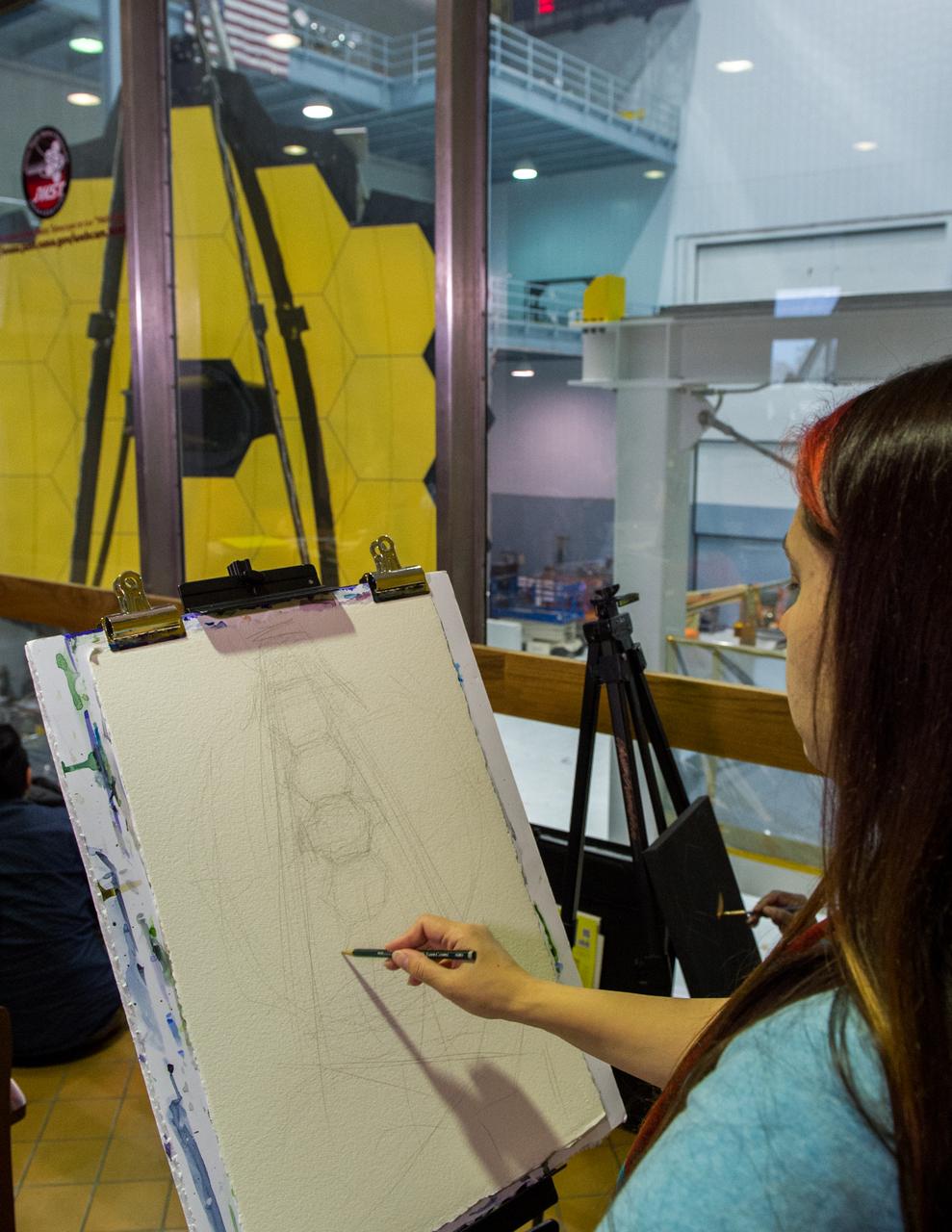
James Webb Space Telescope (JWST) Golden Mirrors artist event.
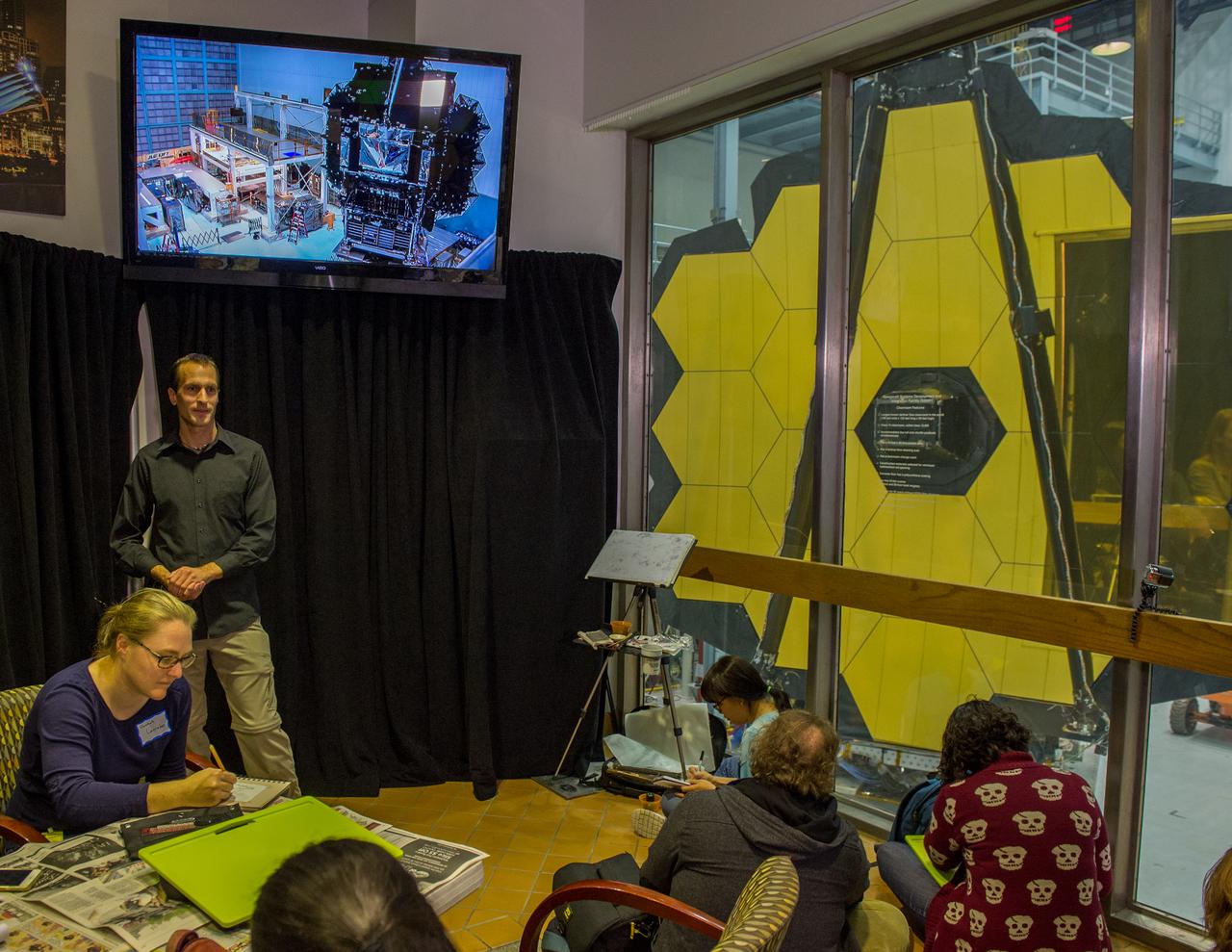
James Webb Space Telescope (JWST) Golden Mirrors artist event.
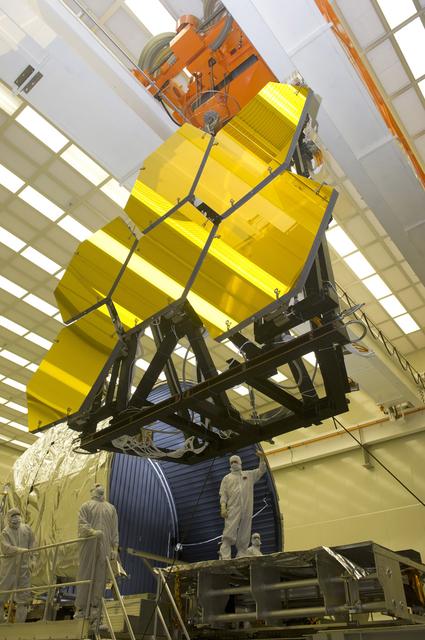
The James Webb Space Telescope mirrors have completed deep-freeze tests and are removed from the X-ray and Cryogenic test Facility at Marshall Space Flight Center. To read more go to: <a href="http://www.nasa.gov/topics/technology/features/webb-mirror-cryo.html" rel="nofollow">www.nasa.gov/topics/technology/features/webb-mirror-cryo....</a> Credit: Emmett Given, NASA Marshall <b><a href="http://www.nasa.gov/audience/formedia/features/MP_Photo_Guidelines.html" rel="nofollow">NASA image use policy.</a></b> <b><a href="http://www.nasa.gov/centers/goddard/home/index.html" rel="nofollow">NASA Goddard Space Flight Center</a></b> enables NASA’s mission through four scientific endeavors: Earth Science, Heliophysics, Solar System Exploration, and Astrophysics. Goddard plays a leading role in NASA’s accomplishments by contributing compelling scientific knowledge to advance the Agency’s mission. <b>Follow us on <a href="http://twitter.com/NASA_GoddardPix" rel="nofollow">Twitter</a></b> <b>Like us on <a href="http://www.facebook.com/pages/Greenbelt-MD/NASA-Goddard/395013845897?ref=tsd" rel="nofollow">Facebook</a></b> <b>Find us on <a href="http://instagrid.me/nasagoddard/?vm=grid" rel="nofollow">Instagram</a></b>
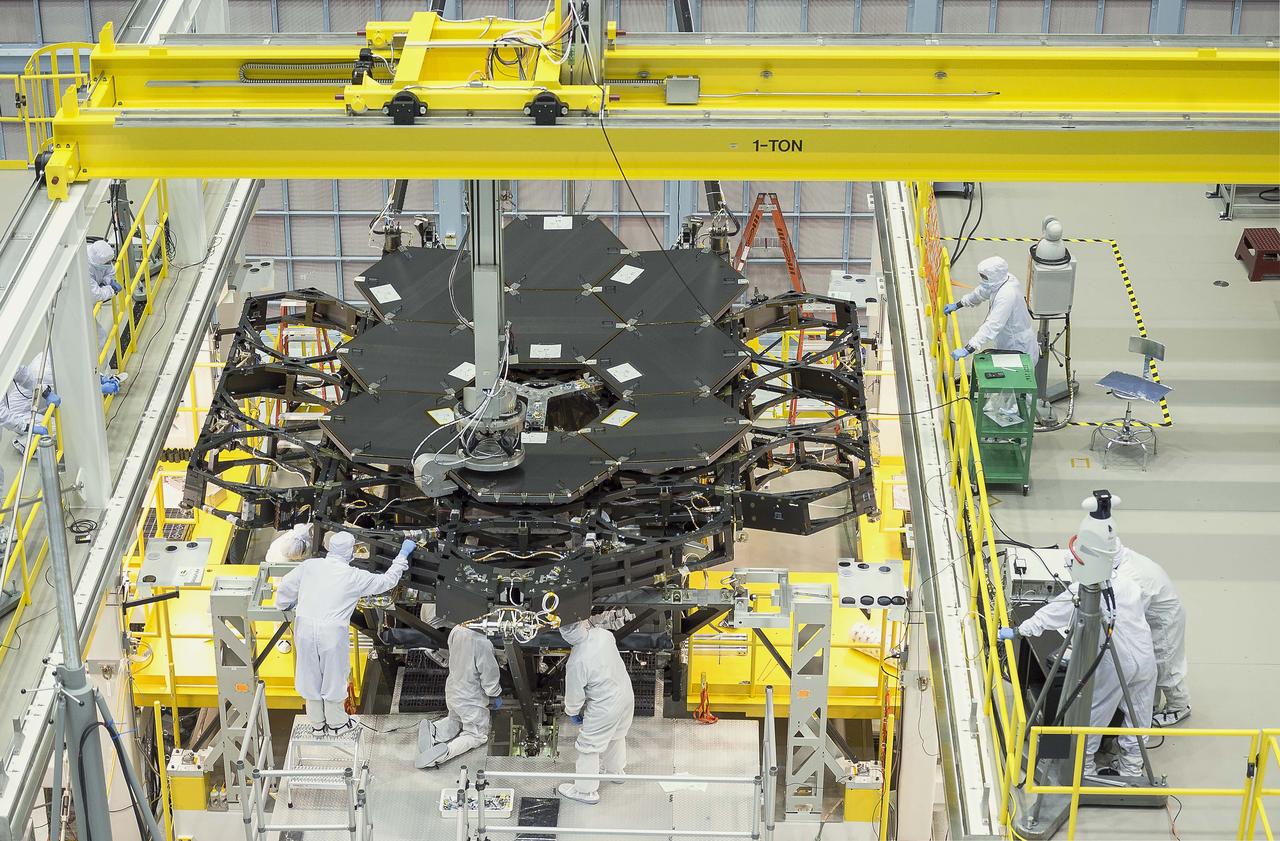
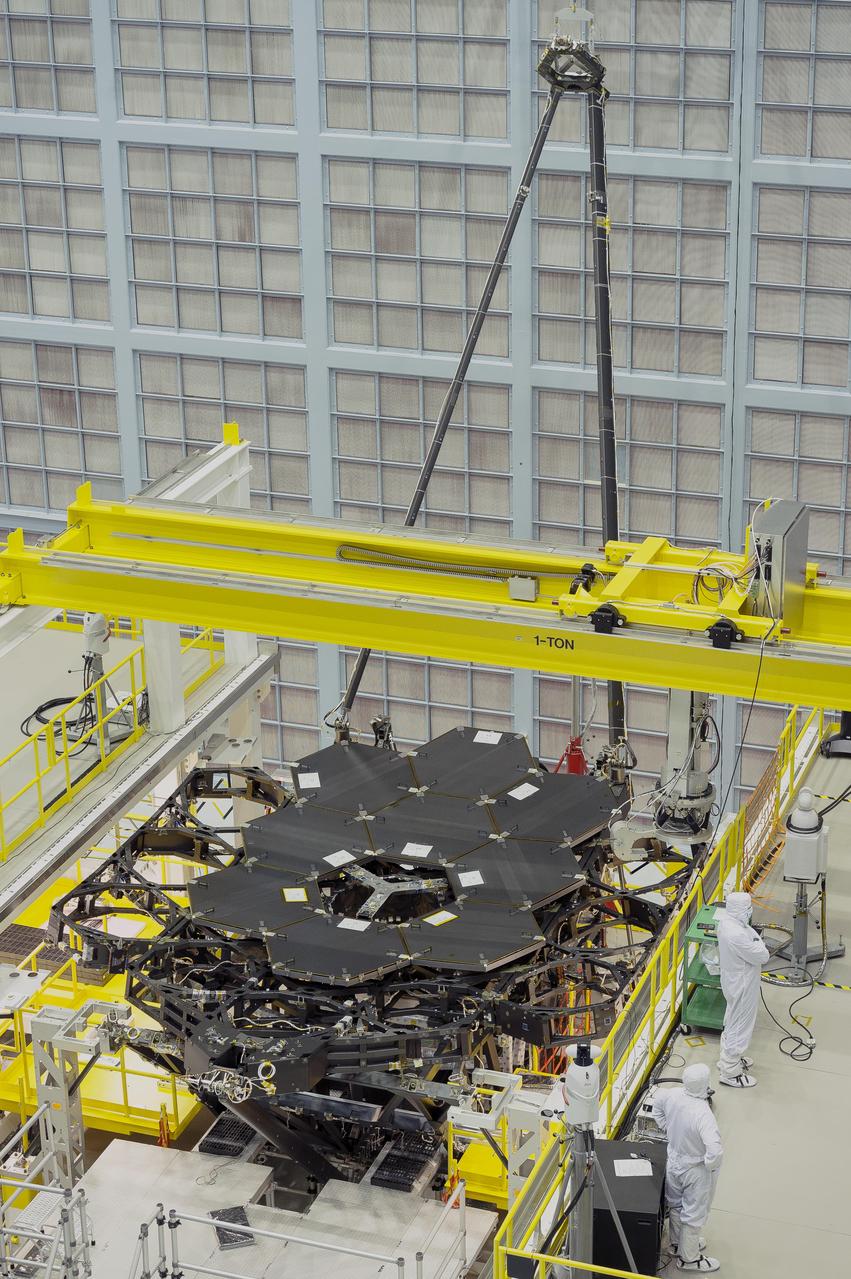
Inside NASA's Goddard Space Flight Center's massive clean room in Greenbelt, Maryland, the ninth flight mirror was installed onto the telescope structure with a robotic arm. This marks the halfway completion point for the James Webb Space Telescope's segmented primary mirror. This rare overhead shot of the James Webb Space Telescope shows the nine primary flight mirrors installed on the telescope structure in a clean room at NASA's Goddard Space Flight Center in Greenbelt, Maryland. Credits: NASA's Goddard Space Flight Center/Chris Gunn Read more: <a href="http://go.nasa.gov/1kqK6fW" rel="nofollow">go.nasa.gov/1kqK6fW</a>
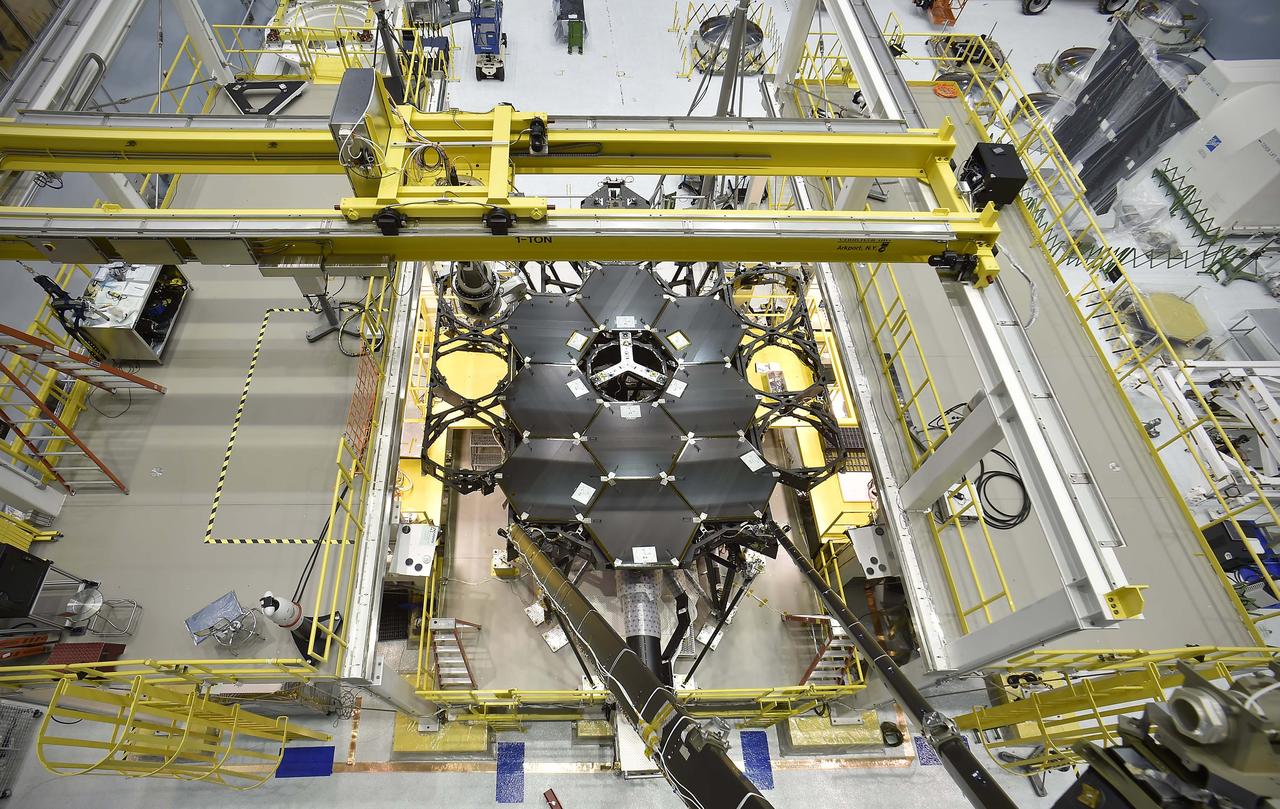
Inside NASA's Goddard Space Flight Center's massive clean room in Greenbelt, Maryland, the ninth flight mirror was installed onto the telescope structure with a robotic arm. This marks the halfway completion point for the James Webb Space Telescope's segmented primary mirror. Engineers worked tirelessly to install the ninth primary flight mirror onto the telescope structure. Credit: NASA's Goddard Space Flight Center/Chris Gunn Read more: <a href="http://go.nasa.gov/1kqK6fW" rel="nofollow">go.nasa.gov/1kqK6fW</a>
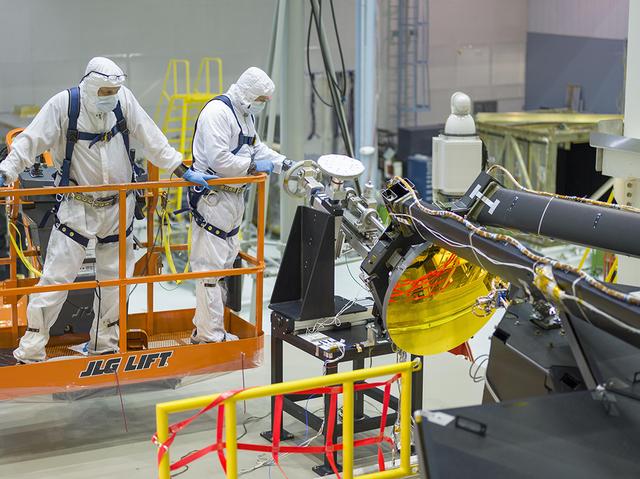
The sole secondary mirror that will fly aboard NASA's James Webb Space Telescope was installed onto the telescope at NASA's Goddard Space Flight Center in Greenbelt, Maryland, on March 3, 2016. The Webb telescope uses many mirrors to direct incoming light into the telescope's instruments. The secondary mirror is called the secondary mirror because it is the second surface the light from the cosmos hits on its route into the telescope. In this photo, engineers are seen installing the secondary mirror onto the telescope. Read more: <a href="http://www.nasa.gov/feature/goddard/2016/nasas-james-webb-space-telescope-secondary-mirror-installed" rel="nofollow">www.nasa.gov/feature/goddard/2016/nasas-james-webb-space-...</a> Credits: NASA/Goddard/Chris Gunn <b><a href="http://www.nasa.gov/audience/formedia/features/MP_Photo_Guidelines.html" rel="nofollow">NASA image use policy.</a></b> <b><a href="http://www.nasa.gov/centers/goddard/home/index.html" rel="nofollow">NASA Goddard Space Flight Center</a></b> enables NASA’s mission through four scientific endeavors: Earth Science, Heliophysics, Solar System Exploration, and Astrophysics. Goddard plays a leading role in NASA’s accomplishments by contributing compelling scientific knowledge to advance the Agency’s mission. <b>Follow us on <a href="http://twitter.com/NASAGoddardPix" rel="nofollow">Twitter</a></b> <b>Like us on <a href="http://www.facebook.com/pages/Greenbelt-MD/NASA-Goddard/395013845897?ref=tsd" rel="nofollow">Facebook</a></b> <b>Find us on <a href="http://instagrid.me/nasagoddard/?vm=grid" rel="nofollow">Instagram</a></b>
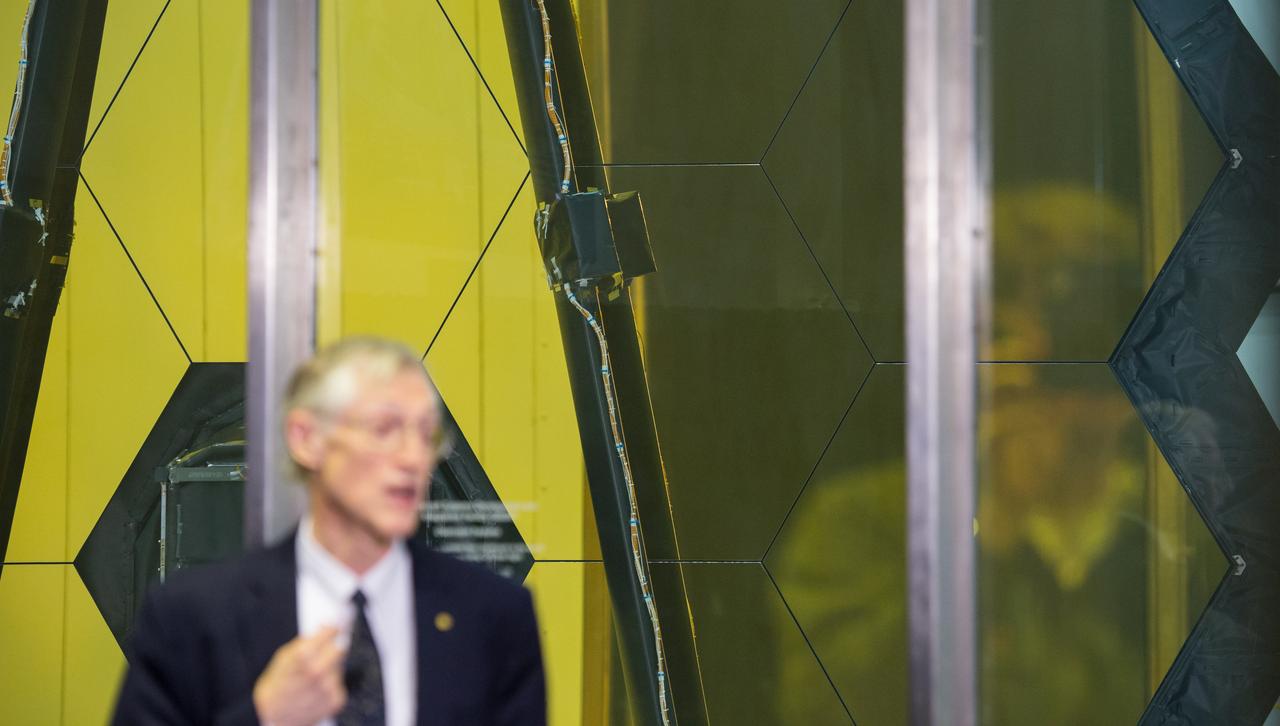
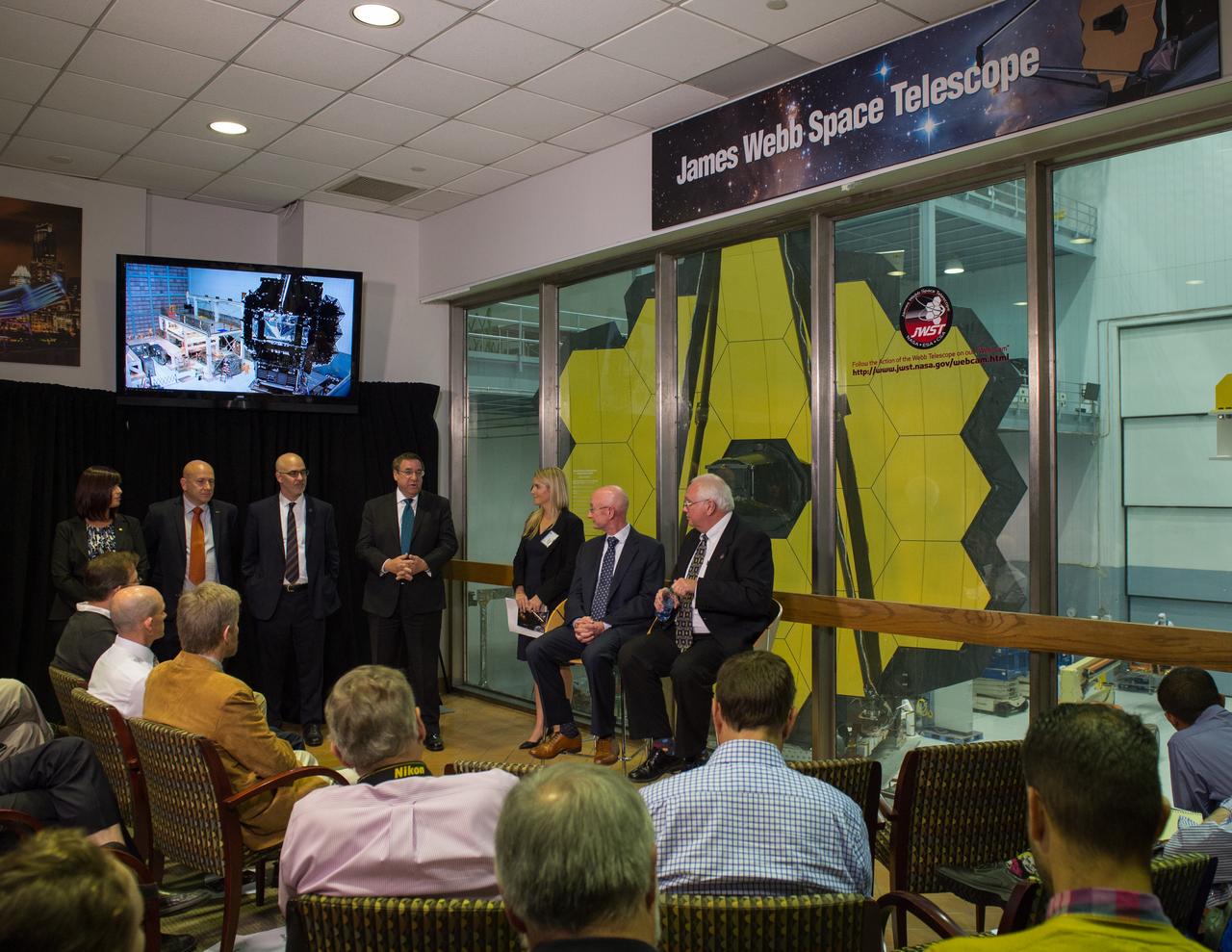
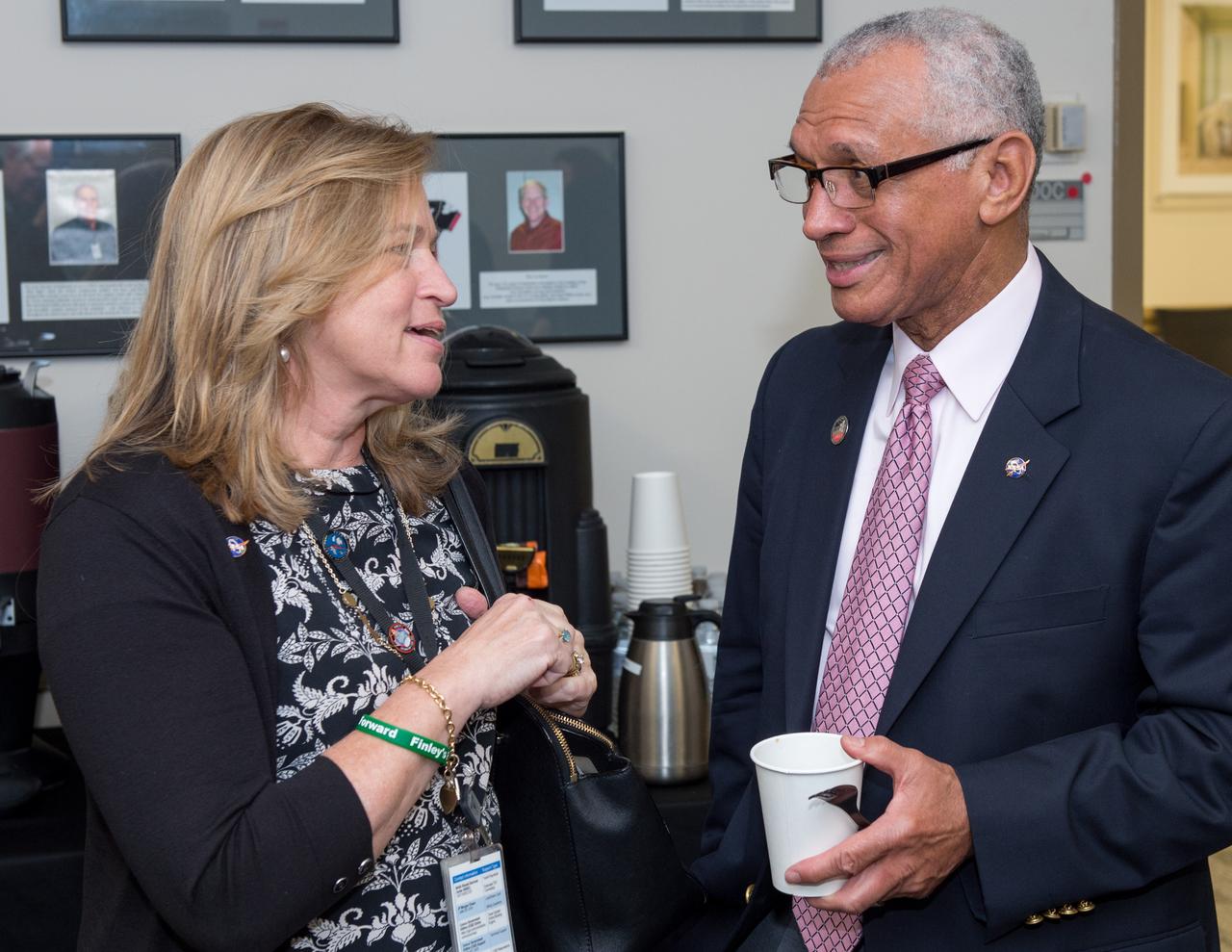
Media Invited to Rare View of NASA's James Webb Space Telescope Mirrors
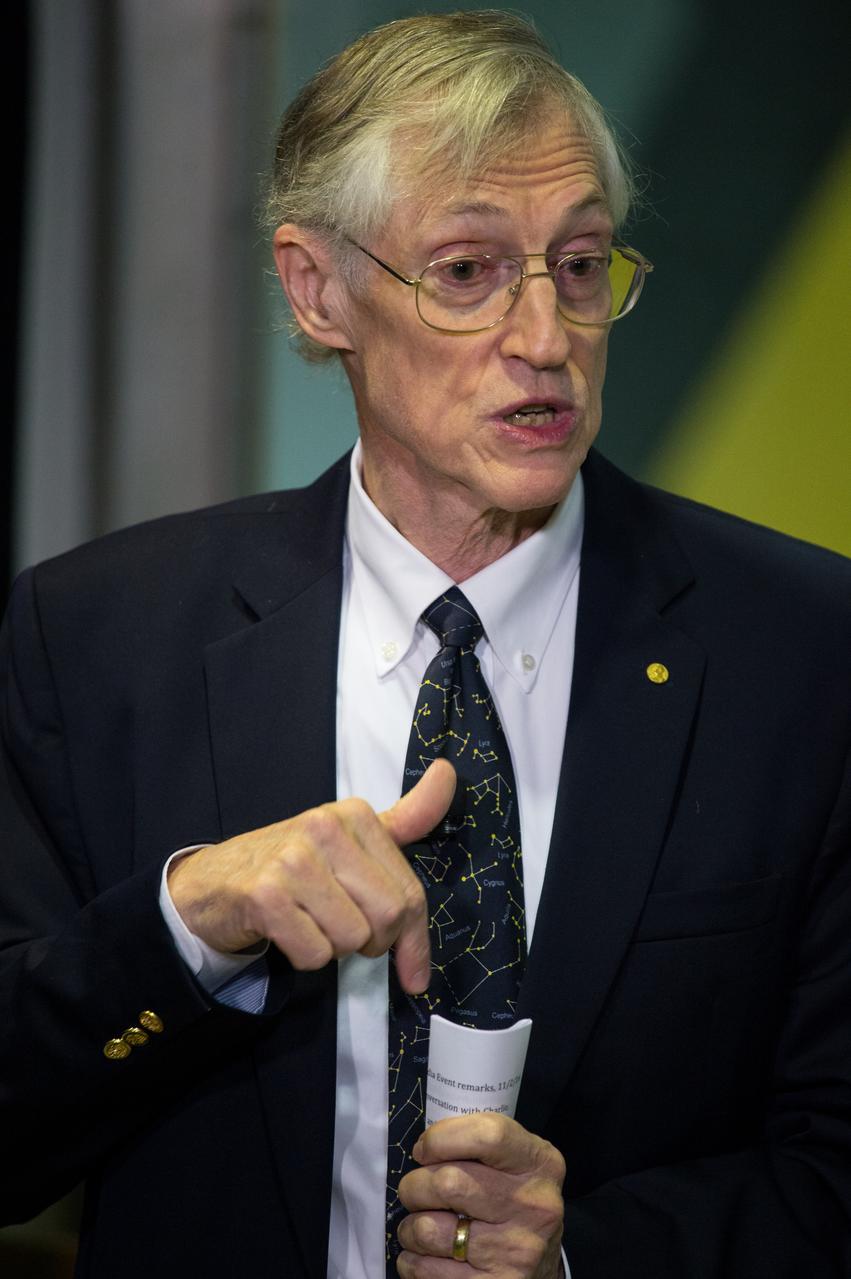
Media Invited to Rare View of NASA's James Webb Space Telescope Mirrors
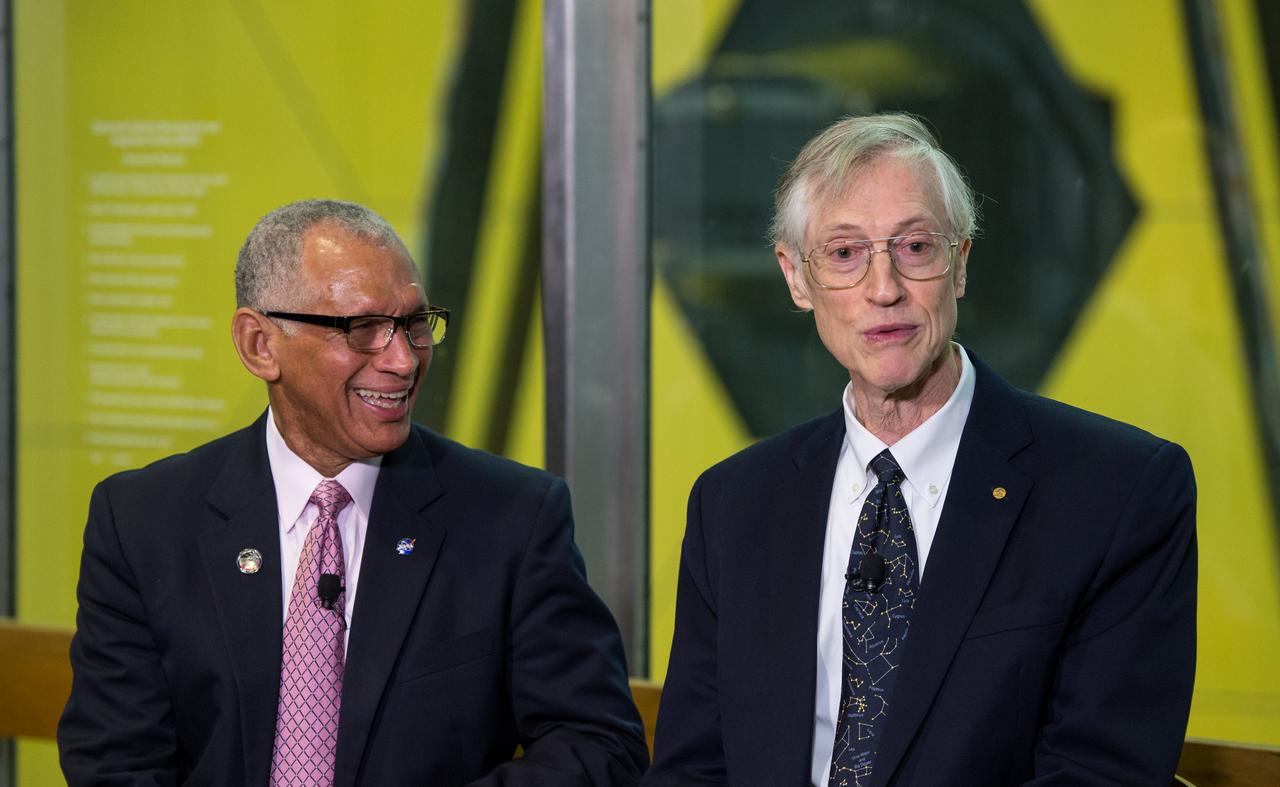
Media Invited to Rare View of NASA's James Webb Space Telescope Mirrors
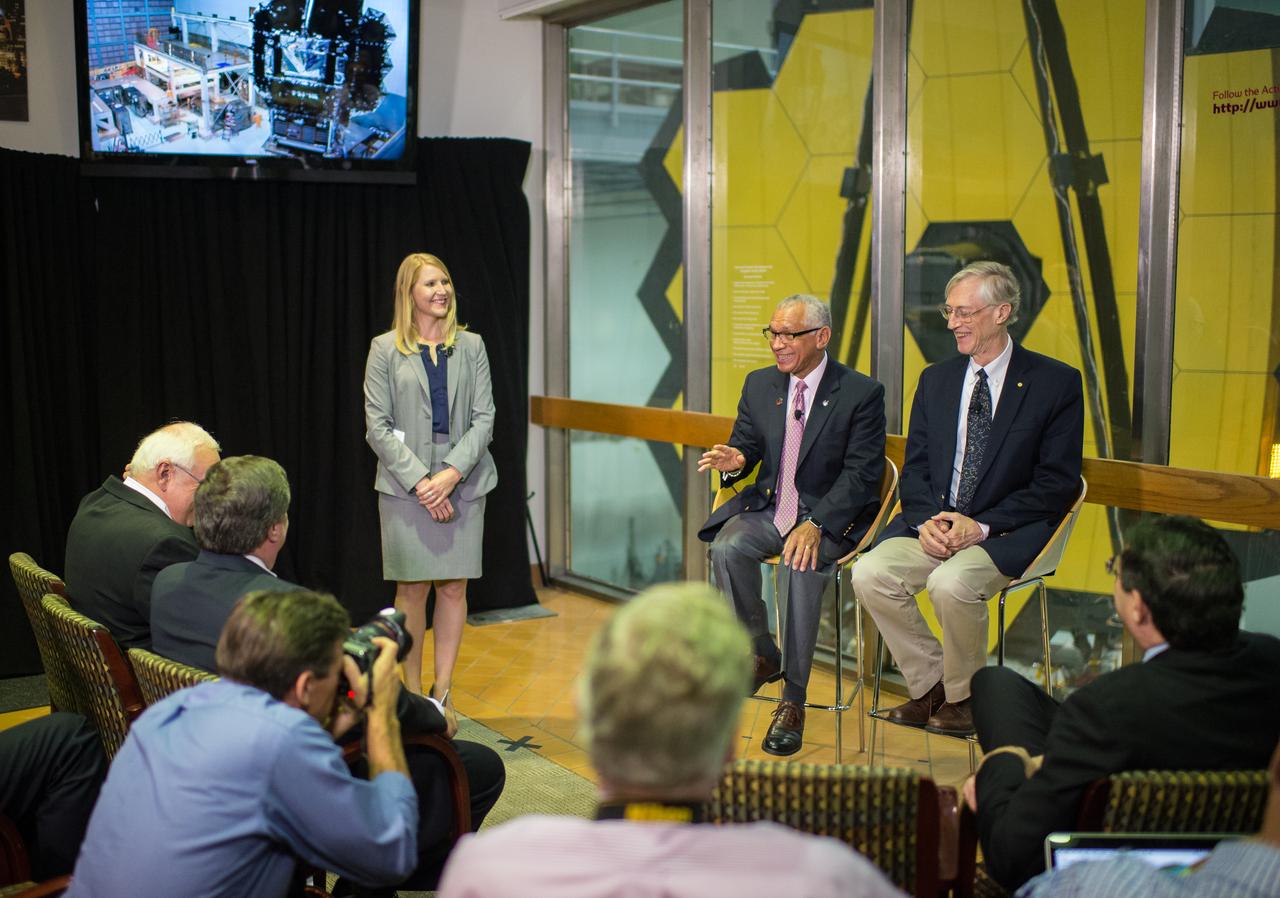
Media Invited to Rare View of NASA's James Webb Space Telescope Mirrors
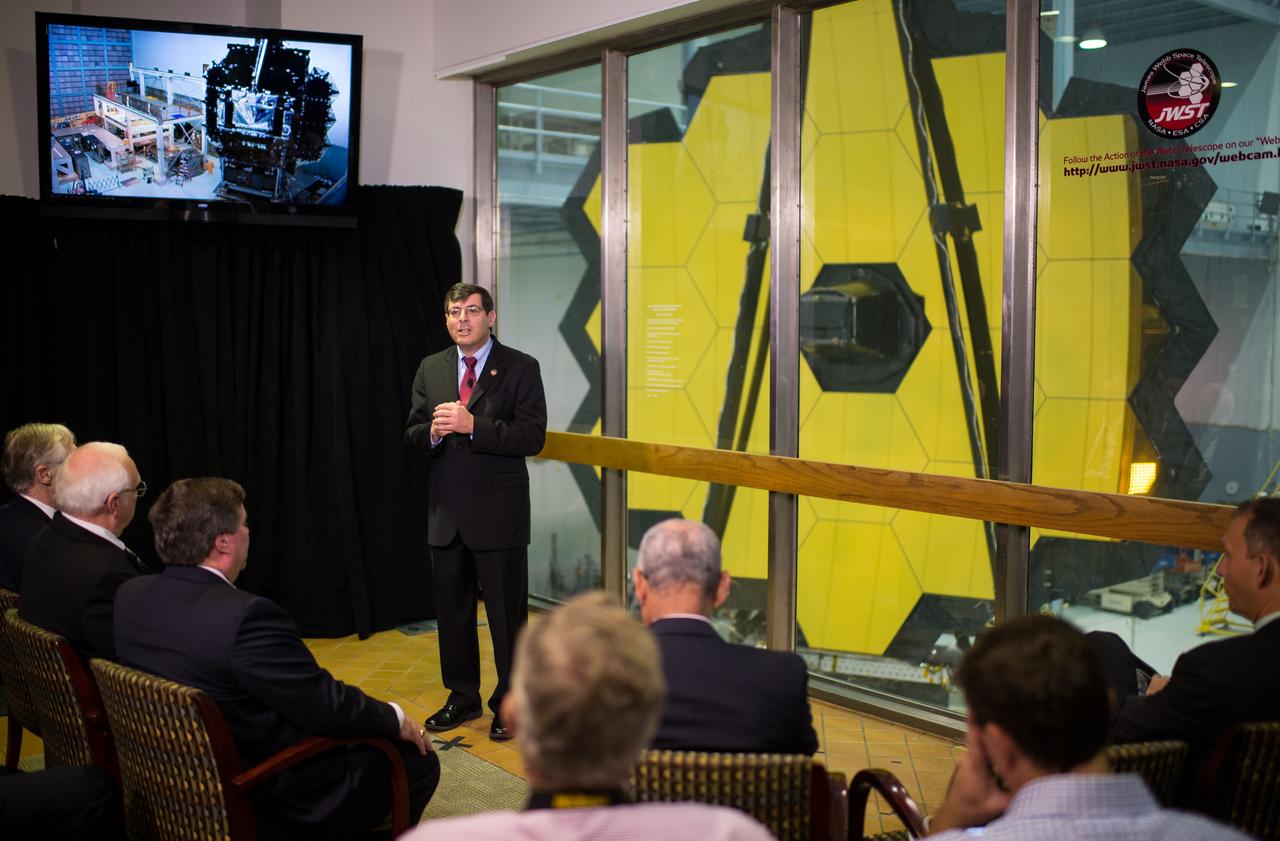
Media Invited to Rare View of NASA's James Webb Space Telescope Mirrors
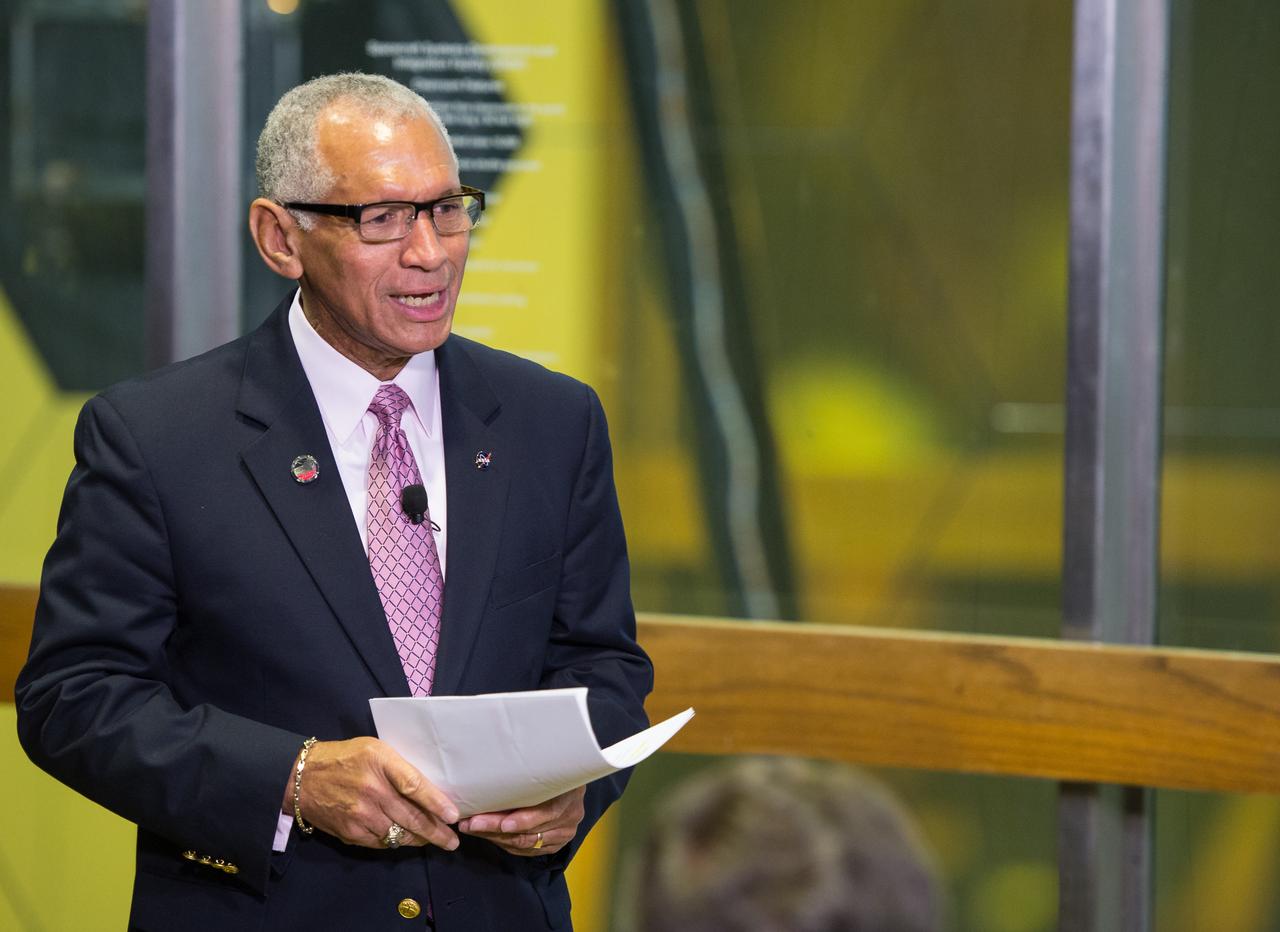
Media Invited to Rare View of NASA's James Webb Space Telescope Mirrors
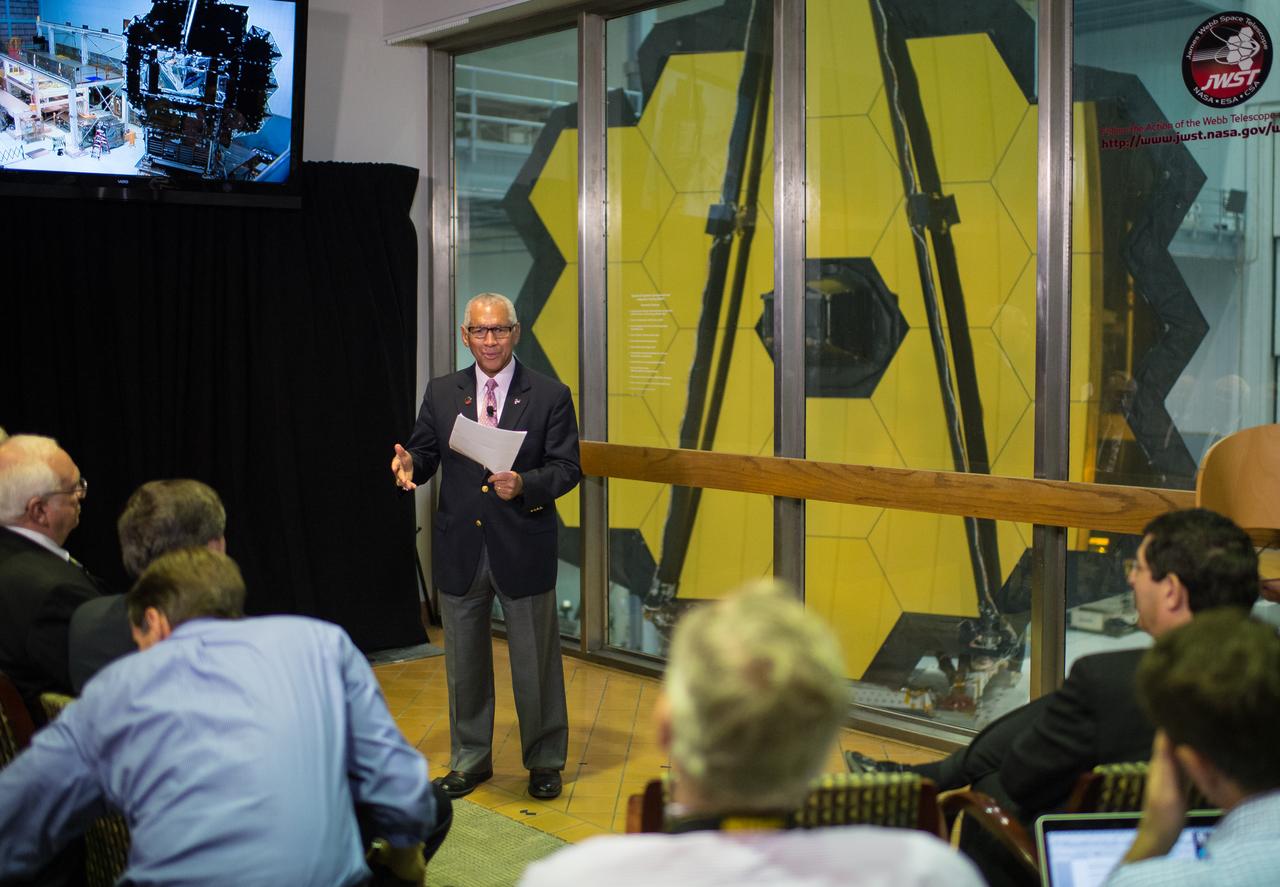
Media Invited to Rare View of NASA's James Webb Space Telescope Mirrors
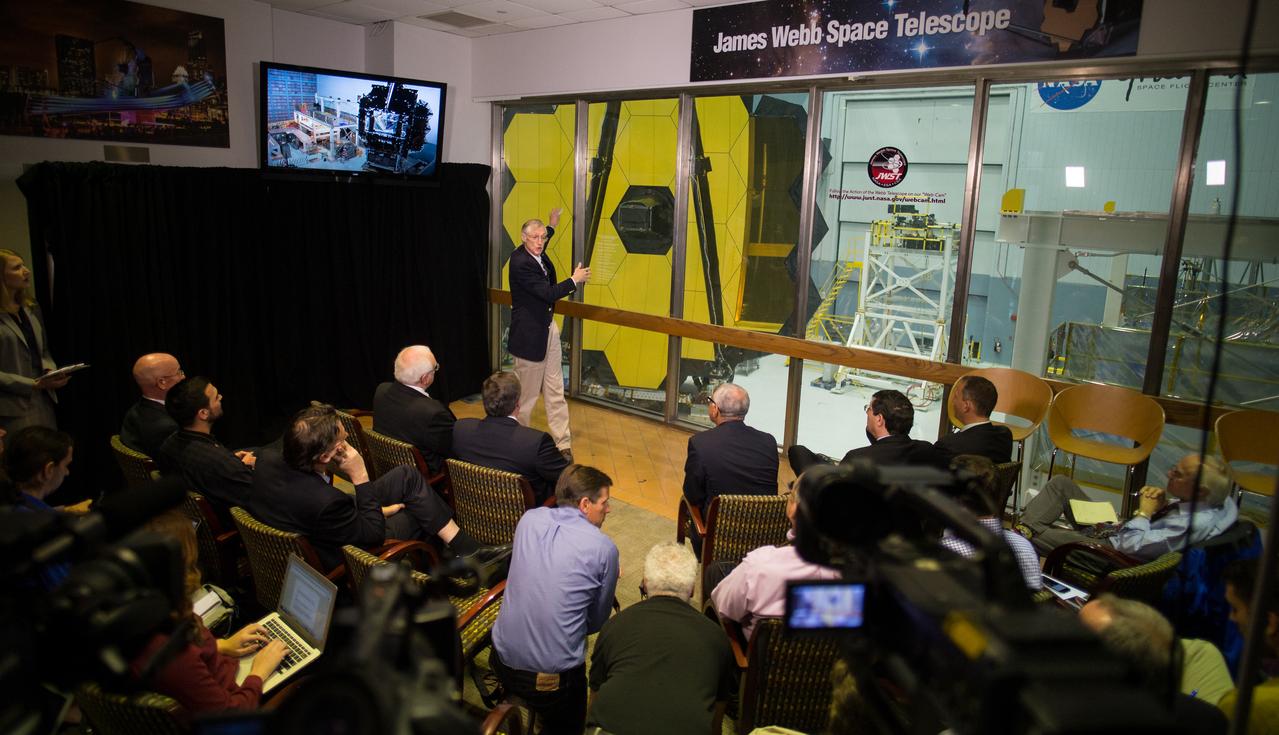
Media Invited to Rare View of NASA's James Webb Space Telescope Mirrors
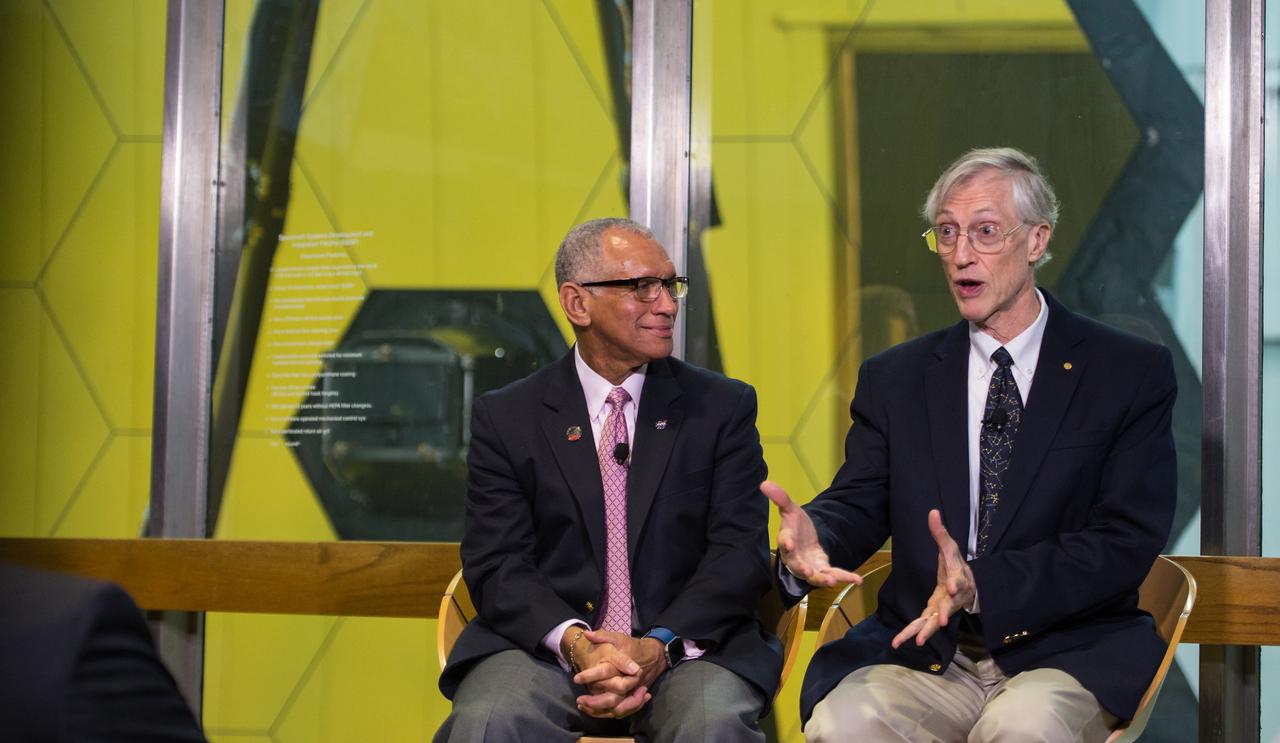
Media Invited to Rare View of NASA's James Webb Space Telescope Mirrors
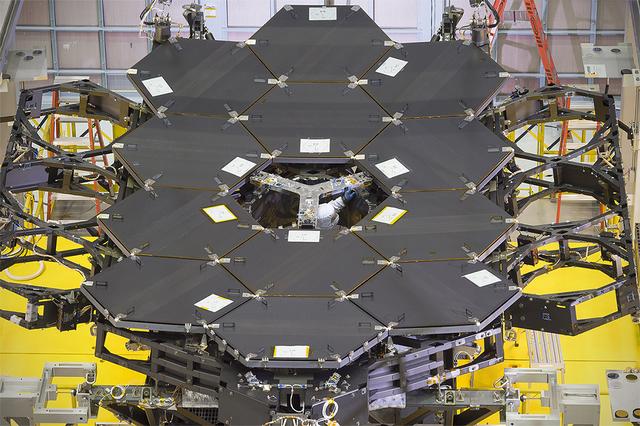
Caption: One dozen (out of 18) flight mirror segments that make up the primary mirror on NASA's James Webb Space Telescope have been installed at NASA's Goddard Space Flight Center. Credits: NASA/Chris Gunn More: Since December 2015, the team of scientists and engineers have been working tirelessly to install all the primary mirror segments onto the telescope structure in the large clean room at NASA's Goddard Space Flight Center in Greenbelt, Maryland. The twelfth mirror was installed on January 2, 2016. "This milestone signifies that all of the hexagonal shaped mirrors on the fixed central section of the telescope structure are installed and only the 3 mirrors on each wing are left for installation," said Lee Feinberg, NASA's Optical Telescope Element Manager at NASA Goddard. "The incredibly skilled and dedicated team assembling the telescope continues to find ways to do things faster and more efficiently." Each hexagonal-shaped segment measures just over 4.2 feet (1.3 meters) across and weighs approximately 88 pounds (40 kilograms). After being pieced together, the 18 primary mirror segments will work together as one large 21.3-foot (6.5-meter) mirror. The primary mirror will unfold and adjust to shape after launch. The mirrors are made of ultra-lightweight beryllium. The mirrors are placed on the telescope's backplane using a robotic arm, guided by engineers. The full installation is expected to be completed in a few months. The mirrors were built by Ball Aerospace & Technologies Corp., Boulder, Colorado. Ball is the principal subcontractor to Northrop Grumman for the optical technology and lightweight mirror system. The installation of the mirrors onto the telescope structure is performed by Harris Corporation of Rochester, New York. Harris Corporation leads integration and testing for the telescope. While the mirror assembly is a very significant milestone, there are many more steps involved in assembling the Webb telescope. The primary mirror and the tennis-court-sized sunshield are the largest and most visible components of the Webb telescope. However, there are four smaller components that are less visible, yet critical. The instruments that will fly aboard Webb - cameras and spectrographs with detectors able to record extremely faint signals — are part of the Integrated Science Instrument Module (ISIM), which is currently undergoing its final cryogenic vacuum test and will be integrated with the mirror later this year. Read more: <a href="http://www.nasa.gov/feature/goddard/2016/by-the-dozen-nasas-james-webb-space-telescope-mirrors" rel="nofollow">www.nasa.gov/feature/goddard/2016/by-the-dozen-nasas-jame...</a> <b><a href="http://www.nasa.gov/audience/formedia/features/MP_Photo_Guidelines.html" rel="nofollow">NASA image use policy.</a></b> <b><a href="http://www.nasa.gov/centers/goddard/home/index.html" rel="nofollow">NASA Goddard Space Flight Center</a></b> enables NASA’s mission through four scientific endeavors: Earth Science, Heliophysics, Solar System Exploration, and Astrophysics. Goddard plays a leading role in NASA’s accomplishments by contributing compelling scientific knowledge to advance the Agency’s mission. <b>Follow us on <a href="http://twitter.com/NASAGoddardPix" rel="nofollow">Twitter</a></b> <b>Like us on <a href="http://www.facebook.com/pages/Greenbelt-MD/NASA-Goddard/395013845897?ref=tsd" rel="nofollow">Facebook</a></b> <b>Find us on <a href="http://instagrid.me/nasagoddard/?vm=grid" rel="nofollow">Instagram</a></b>
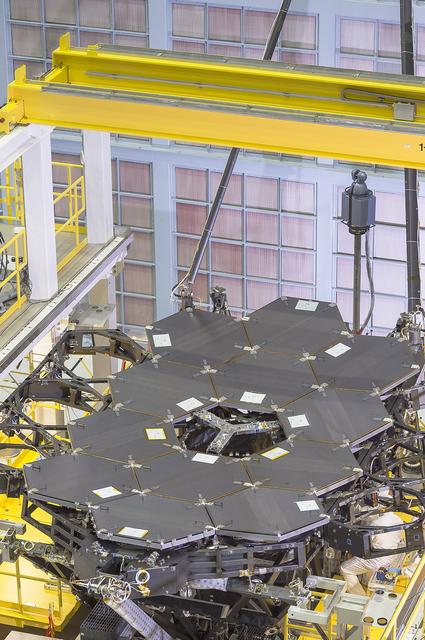
A view of the one dozen (out of 18) flight mirror segments that make up the primary mirror on NASA's James Webb Space Telescope have been installed at NASA's Goddard Space Flight Center. Credits: NASA/Chris Gunn More: Since December 2015, the team of scientists and engineers have been working tirelessly to install all the primary mirror segments onto the telescope structure in the large clean room at NASA's Goddard Space Flight Center in Greenbelt, Maryland. The twelfth mirror was installed on January 2, 2016. "This milestone signifies that all of the hexagonal shaped mirrors on the fixed central section of the telescope structure are installed and only the 3 mirrors on each wing are left for installation," said Lee Feinberg, NASA's Optical Telescope Element Manager at NASA Goddard. "The incredibly skilled and dedicated team assembling the telescope continues to find ways to do things faster and more efficiently." Each hexagonal-shaped segment measures just over 4.2 feet (1.3 meters) across and weighs approximately 88 pounds (40 kilograms). After being pieced together, the 18 primary mirror segments will work together as one large 21.3-foot (6.5-meter) mirror. The primary mirror will unfold and adjust to shape after launch. The mirrors are made of ultra-lightweight beryllium. The mirrors are placed on the telescope's backplane using a robotic arm, guided by engineers. The full installation is expected to be completed in a few months. The mirrors were built by Ball Aerospace & Technologies Corp., Boulder, Colorado. Ball is the principal subcontractor to Northrop Grumman for the optical technology and lightweight mirror system. The installation of the mirrors onto the telescope structure is performed by Harris Corporation of Rochester, New York. Harris Corporation leads integration and testing for the telescope. While the mirror assembly is a very significant milestone, there are many more steps involved in assembling the Webb telescope. The primary mirror and the tennis-court-sized sunshield are the largest and most visible components of the Webb telescope. However, there are four smaller components that are less visible, yet critical. The instruments that will fly aboard Webb - cameras and spectrographs with detectors able to record extremely faint signals — are part of the Integrated Science Instrument Module (ISIM), which is currently undergoing its final cryogenic vacuum test and will be integrated with the mirror later this year. Read more: <a href="http://www.nasa.gov/feature/goddard/2016/by-the-dozen-nasas-james-webb-space-telescope-mirrors" rel="nofollow">www.nasa.gov/feature/goddard/2016/by-the-dozen-nasas-jame...</a> <b><a href="http://www.nasa.gov/audience/formedia/features/MP_Photo_Guidelines.html" rel="nofollow">NASA image use policy.</a></b> <b><a href="http://www.nasa.gov/centers/goddard/home/index.html" rel="nofollow">NASA Goddard Space Flight Center</a></b> enables NASA’s mission through four scientific endeavors: Earth Science, Heliophysics, Solar System Exploration, and Astrophysics. Goddard plays a leading role in NASA’s accomplishments by contributing compelling scientific knowledge to advance the Agency’s mission. <b>Follow us on <a href="http://twitter.com/NASAGoddardPix" rel="nofollow">Twitter</a></b> <b>Like us on <a href="http://www.facebook.com/pages/Greenbelt-MD/NASA-Goddard/395013845897?ref=tsd" rel="nofollow">Facebook</a></b> <b>Find us on <a href="http://instagrid.me/nasagoddard/?vm=grid" rel="nofollow">Instagram</a></b>

The powerful primary mirrors of the James Webb Space Telescope will be able to detect the light from distant galaxies. The manufacturer of those mirrors, Ball Aerospace & Technologies Corp. of Boulder, Colo., recently celebrated their successful efforts as mirror segments were packed up in special shipping canisters (cans) for shipping to NASA. The Webb telescope has 21 mirrors, with 18 primary mirror segments working together as one large 21.3-foot (6.5-meter) primary mirror. The mirror segments are made of beryllium, which was selected for its stiffness, light weight and stability at cryogenic temperatures. Bare beryllium is not very reflective of near-infrared light, so each mirror is coated with about 0.12 ounce of gold. Northrop Grumman Corp. Aerospace Systems is the principal contractor on the telescope and commissioned Ball for the optics system's development, design, manufacturing, integration and testing. The Webb telescope is the world's next-generation space observatory and successor to the Hubble Space Telescope. The most powerful space telescope ever built, the Webb telescope will provide images of the first galaxies ever formed, and explore planets around distant stars. It is a joint project of NASA, the European Space Agency and the Canadian Space Agency. For more information about the James Webb Space Telescope, visit: <a href="http://www.jwst.nasa.gov" rel="nofollow">www.jwst.nasa.gov</a> Credit: Ball Aerospace <b><a href="http://www.nasa.gov/audience/formedia/features/MP_Photo_Guidelines.html" rel="nofollow">NASA image use policy.</a></b> <b><a href="http://www.nasa.gov/centers/goddard/home/index.html" rel="nofollow">NASA Goddard Space Flight Center</a></b> enables NASA’s mission through four scientific endeavors: Earth Science, Heliophysics, Solar System Exploration, and Astrophysics. Goddard plays a leading role in NASA’s accomplishments by contributing compelling scientific knowledge to advance the Agency’s mission. <b>Follow us on <a href="http://twitter.com/NASA_GoddardPix" rel="nofollow">Twitter</a></b> <b>Like us on <a href="http://www.facebook.com/pages/Greenbelt-MD/NASA-Goddard/395013845897?ref=tsd" rel="nofollow">Facebook</a></b> <b>Find us on <a href="http://instagrid.me/nasagoddard/?vm=grid" rel="nofollow">Instagram</a></b>
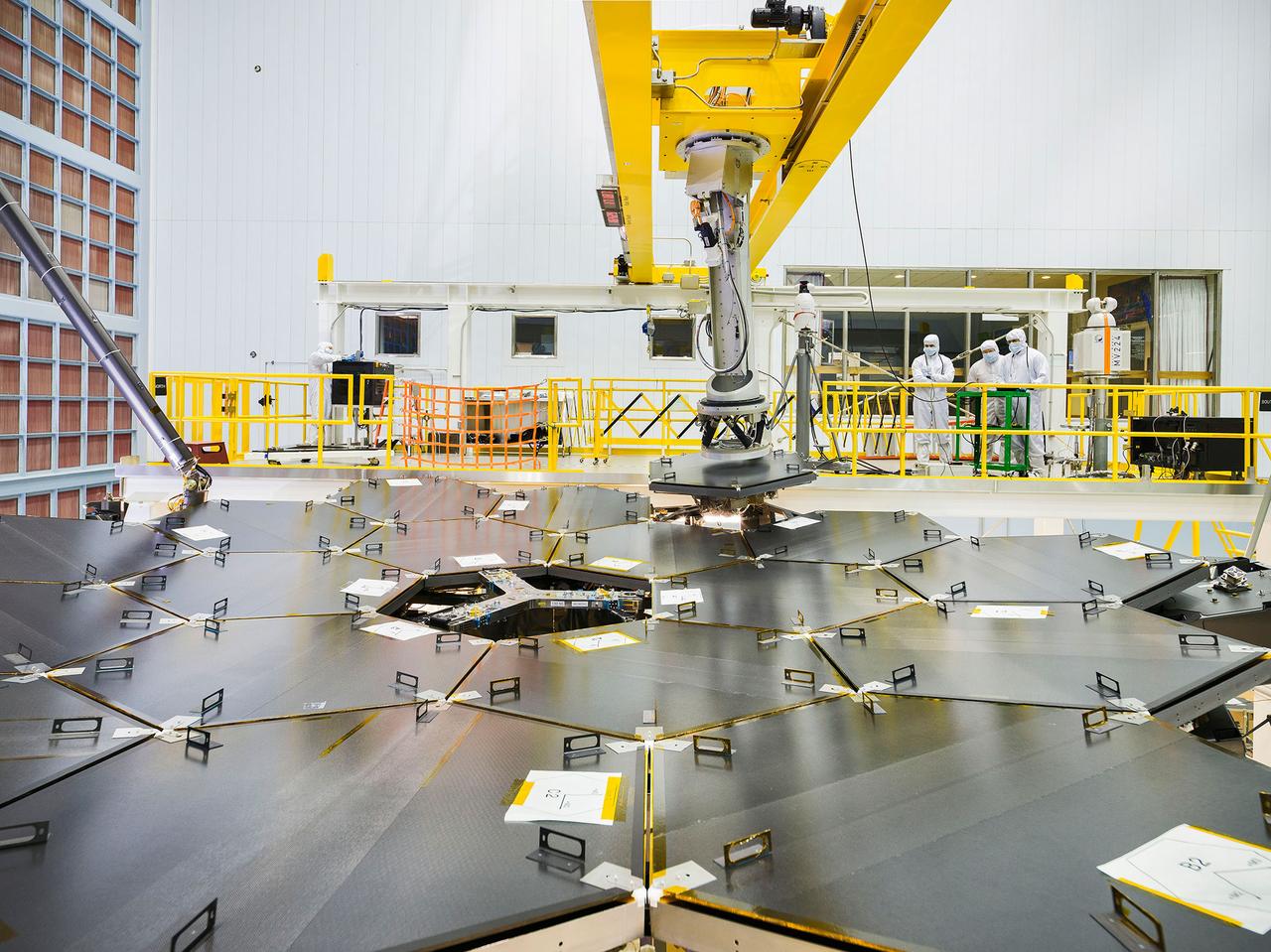
The 18th and final primary mirror segment is installed on what will be the biggest and most powerful space telescope ever launched. The final mirror installation Wednesday at NASA’s Goddard Space Flight Center in Greenbelt, Maryland marks an important milestone in the assembly of the agency’s James Webb Space Telescope. “Scientists and engineers have been working tirelessly to install these incredible, nearly perfect mirrors that will focus light from previously hidden realms of planetary atmospheres, star forming regions and the very beginnings of the Universe,” said John Grunsfeld, associate administrator for NASA’s Science Mission Directorate in Washington. “With the mirrors finally complete, we are one step closer to the audacious observations that will unravel the mysteries of the Universe.” Using a robotic arm reminiscent of a claw machine, the team meticulously installed all of Webb's primary mirror segments onto the telescope structure. Each of the hexagonal-shaped mirror segments measures just over 4.2 feet (1.3 meters) across -- about the size of a coffee table -- and weighs approximately 88 pounds (40 kilograms). Once in space and fully deployed, the 18 primary mirror segments will work together as one large 21.3-foot diameter (6.5-meter) mirror. Credit: NASA/Goddard/Chris Gunn Credits: NASA/Chris Gunn

The primary mirror of NASA's James Webb Space Telescope consisting of 18 hexagonal mirrors looks like a giant puzzle piece standing in the massive clean room of NASA's Goddard Space Flight Center in Greenbelt, Maryland. Appropriately, combined with the rest of the observatory, the mirrors will help piece together puzzles scientists have been trying to solve throughout the cosmos. Webb's primary mirror will collect light for the observatory in the scientific quest to better understand our solar system and beyond. Using these mirrors and Webb's infrared vision scientists will peer back over 13.5 billion years to see the first stars and galaxies forming out of the darkness of the early universe. Unprecedented infrared sensitivity will help astronomers to compare the faintest, earliest galaxies to today's grand spirals and ellipticals, helping us to understand how galaxies assemble over billions of years. Webb will see behind cosmic dust clouds to see where stars and planetary systems are being born. It will also help reveal information about atmospheres of planets outside our solar system, and perhaps even find signs of the building blocks of life elsewhere in the universe. The Webb telescope was mounted upright after a "center of curvature" test conducted at Goddard. This initial center of curvature test ensures the integrity and accuracy, and test will be repeated later to verify those same properties after the structure undergoes launch environment testing. In the photo, two technicians stand before the giant primary mirror. For information on the Webb's Center of Curvature test, visit: <a href="http://go.nasa.gov/2fidD9S" rel="nofollow">go.nasa.gov/2fidD9S</a> Credit: NASA/Goddard/Chris Gunn <b><a href="http://www.nasa.gov/audience/formedia/features/MP_Photo_Guidelines.html" rel="nofollow">NASA image use policy.</a></b> <b><a href="http://www.nasa.gov/centers/goddard/home/index.html" rel="nofollow">NASA Goddard Space Flight Center</a></b> enables NASA’s mission through four scientific endeavors: Earth Science, Heliophysics, Solar System Exploration, and Astrophysics. Goddard plays a leading role in NASA’s accomplishments by contributing compelling scientific knowledge to advance the Agency’s mission. <b>Follow us on <a href="http://twitter.com/NASAGoddardPix" rel="nofollow">Twitter</a></b> <b>Like us on <a href="http://www.facebook.com/pages/Greenbelt-MD/NASA-Goddard/395013845897?ref=tsd" rel="nofollow">Facebook</a></b> <b>Find us on <a href="http://instagrid.me/nasagoddard/?vm=grid" rel="nofollow">Instagram</a></b>
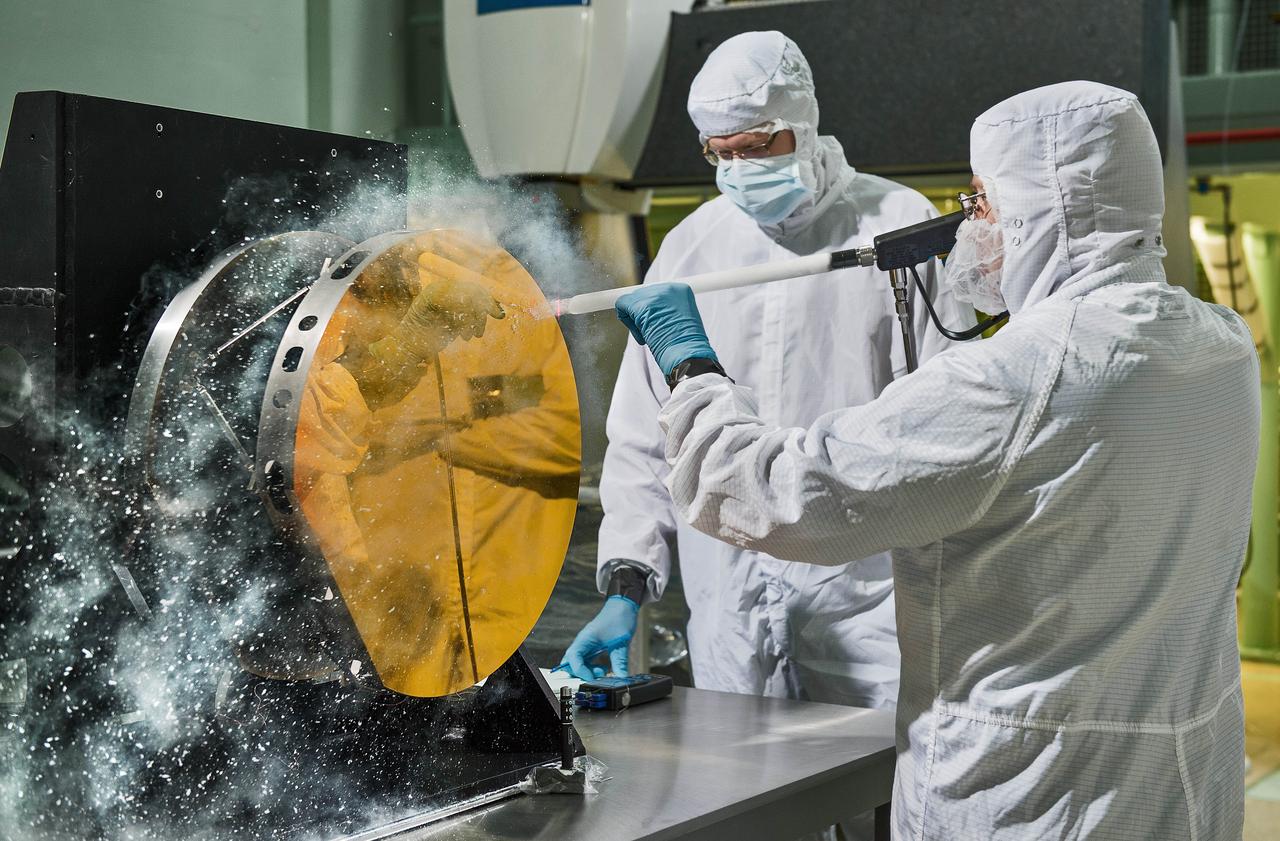
Just like drivers sometimes use snow to clean their car mirrors in winter, two Exelis Inc. engineers are practicing "snow cleaning'" on a test telescope mirror for the James Webb Space Telescope at NASA's Goddard Space Flight Center in Greenbelt, Maryland. By shooting carbon dioxide snow at the surface, engineers are able to clean large telescope mirrors without scratching them. "The snow-like crystals (carbon dioxide snow) knock contaminate particulates and molecules off the mirror," said Lee Feinberg, NASA optical telescope element manager. This technique will only be used if the James Webb Space Telescope's mirror is contaminated during integration and testing. The Webb telescope is the scientific successor to NASA's Hubble Space Telescope. It will be the most powerful space telescope ever built. With a mirror seven times as large as Hubble's and infrared capability, Webb will be capturing light from 13.5 billion light years away. To do this, its mirror must be kept super clean. "Small dust particles or molecules can impact the science that can be done with the Webb," said Feinberg. "So cleanliness especially on the mirrors is critical." Webb is an international project led by NASA with its partners, the European Space Agency and the Canadian Space Agency. Image credit: NASA/Goddard/Chris Gunn
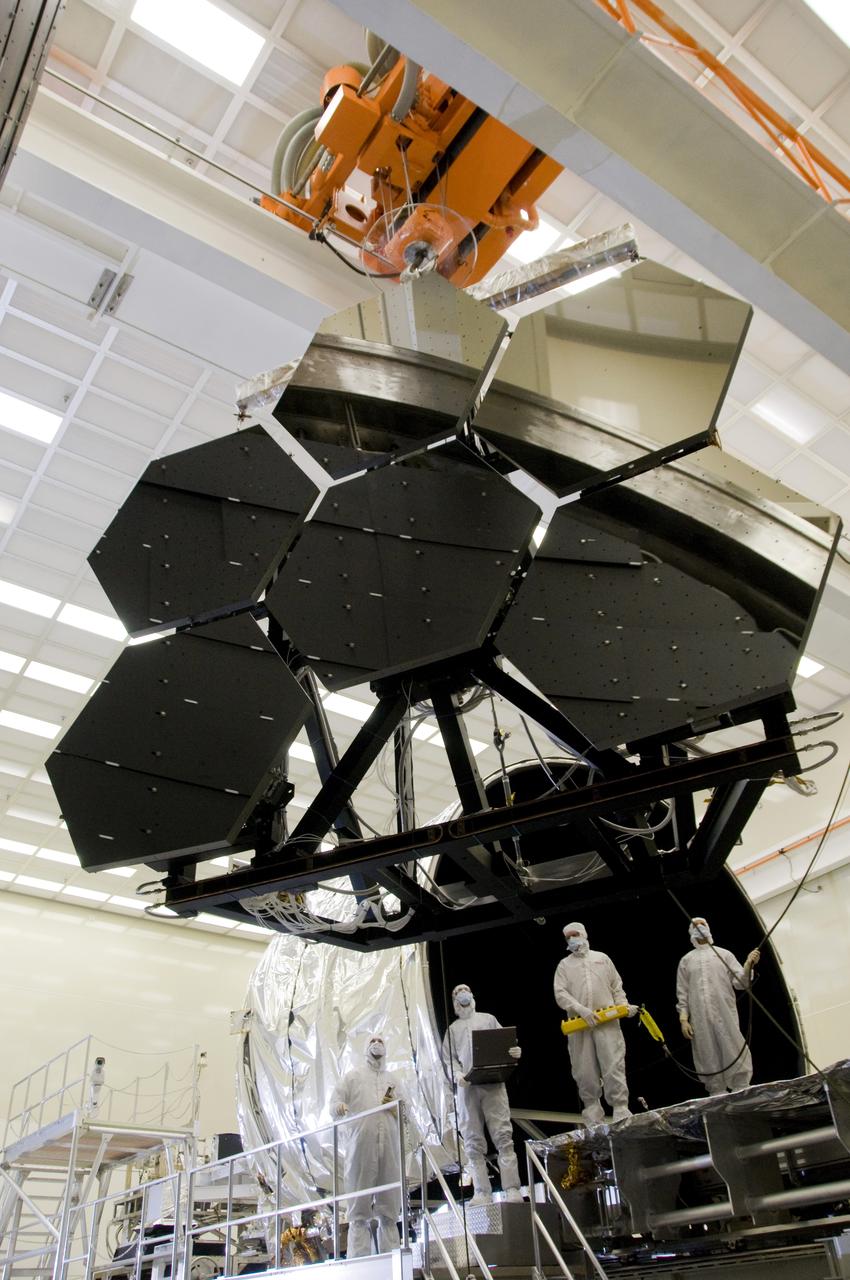
SIX OF THE EIGHTEEN JAMES WEBB SPACE TELESCOPE PRIMARY MIRROR SEGMENTS BEING LIFTED INTO POSITION FOR CRYOGENIC-OPTICAL EVALUATION AT NASA’S X-RAY & CRYOGENIC FACILITY
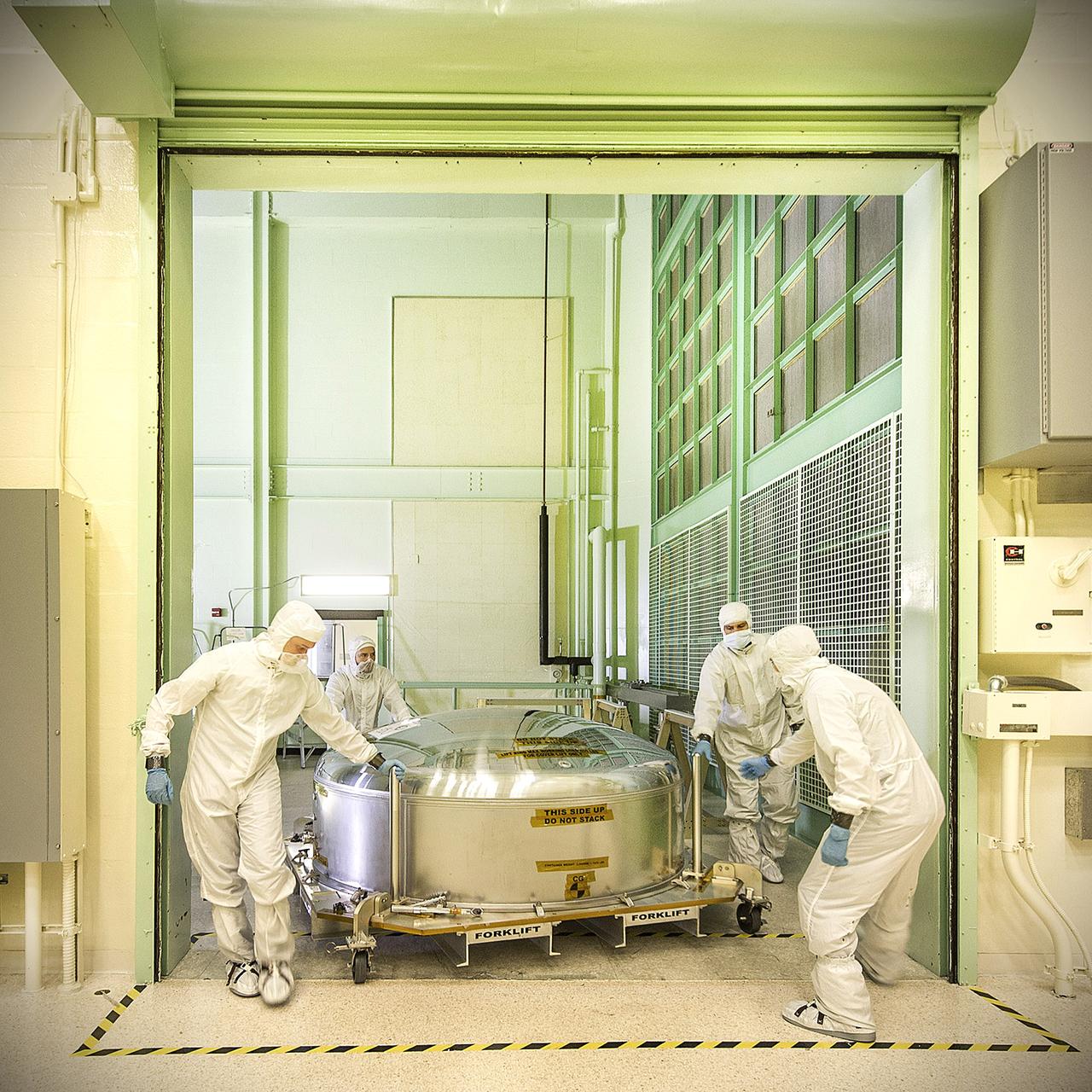
This is the James Webb Space Telescope ETU (engineering test unit) primary mirror segment returning to the cleanroom at NASA Goddard after undergoing some tests at our new Calibration, Integration, and Alignment Facility (CIAF). Credit: NASA/Goddard/Chris Gunn <b><a href="http://www.nasa.gov/audience/formedia/features/MP_Photo_Guidelines.html" rel="nofollow">NASA image use policy.</a></b> <b><a href="http://www.nasa.gov/centers/goddard/home/index.html" rel="nofollow">NASA Goddard Space Flight Center</a></b> enables NASA’s mission through four scientific endeavors: Earth Science, Heliophysics, Solar System Exploration, and Astrophysics. Goddard plays a leading role in NASA’s accomplishments by contributing compelling scientific knowledge to advance the Agency’s mission. <b>Follow us on <a href="http://twitter.com/NASA_GoddardPix" rel="nofollow">Twitter</a></b> <b>Like us on <a href="http://www.facebook.com/pages/Greenbelt-MD/NASA-Goddard/395013845897?ref=tsd" rel="nofollow">Facebook</a></b> <b>Find us on <a href="http://instagram.com/nasagoddard?vm=grid" rel="nofollow">Instagram</a></b>
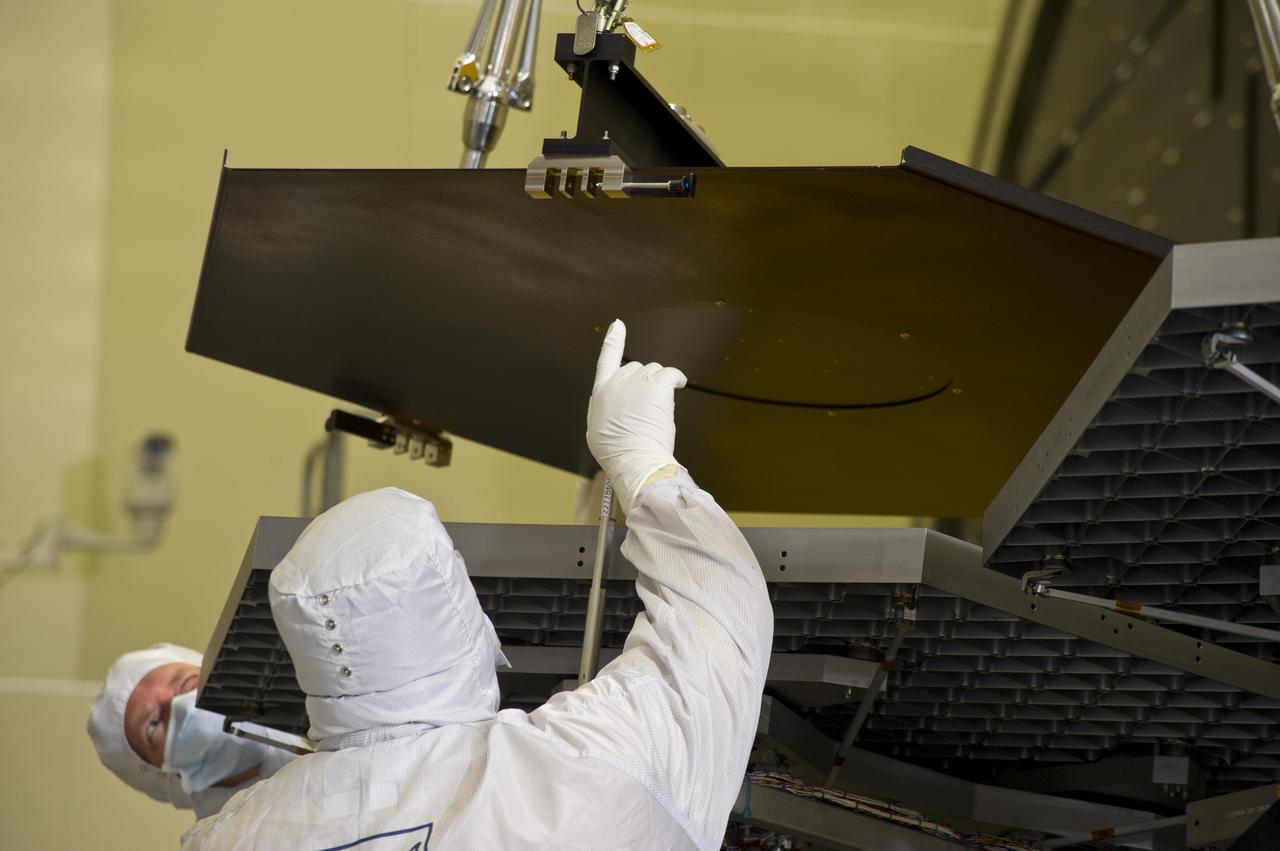
BALL ENGINEERS DISMANTLE ARRAY OF SIX GOLD-PLATED JAMES WEBB SPACE TELESCOPE MIRRORS FOR TRANSPORT TO BALL AEROSPACE AFTER CRYOGENIC TESTING AT MARSHALL'S X-RAY AND CRYOGENIC FACILITY.
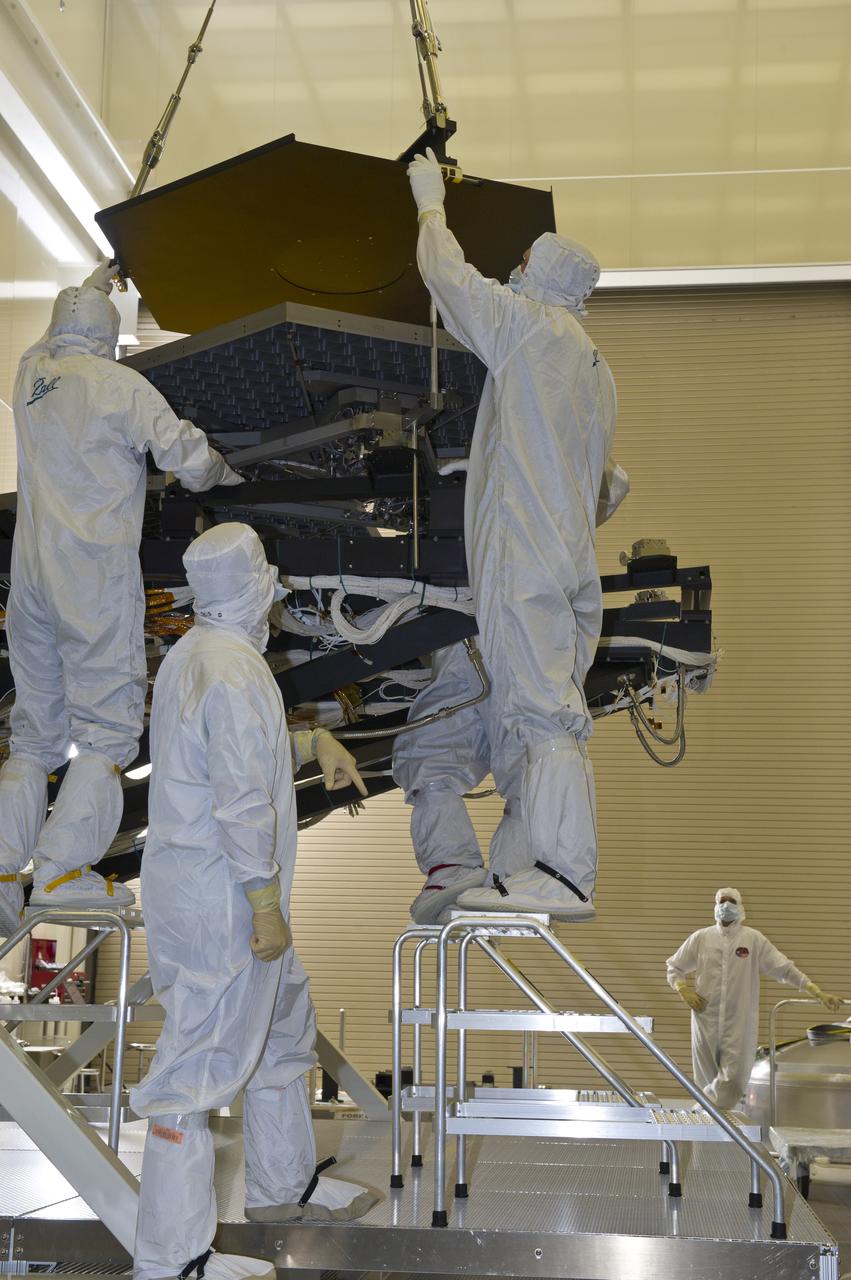
BALL ENGINEERS DISMANTLE ARRAY OF SIX GOLD-PLATED JAMES WEBB SPACE TELESCOPE MIRRORS FOR TRANSPORT TO BALL AEROSPACE AFTER CRYOGENIC TESTING AT MARSHALL'S X-RAY AND CRYOGENIC FACILITY.
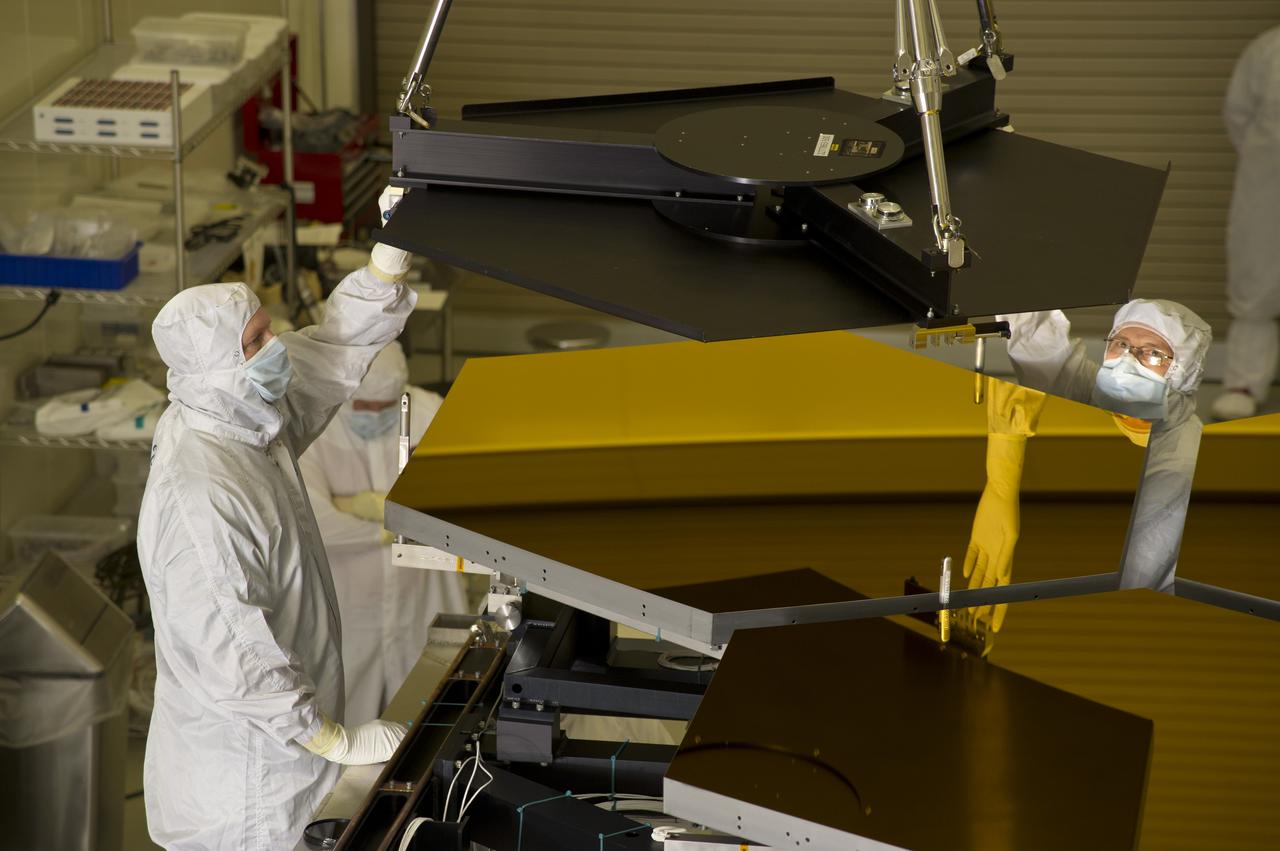
BALL ENGINEERS DISMANTLE ARRAY OF SIX GOLD-PLATED JAMES WEBB SPACE TELESCOPE MIRRORS FOR TRANSPORT TO BALL AEROSPACE AFTER CRYOGENIC TESTING AT MARSHALL'S X-RAY AND CRYOGENIC FACILITY.
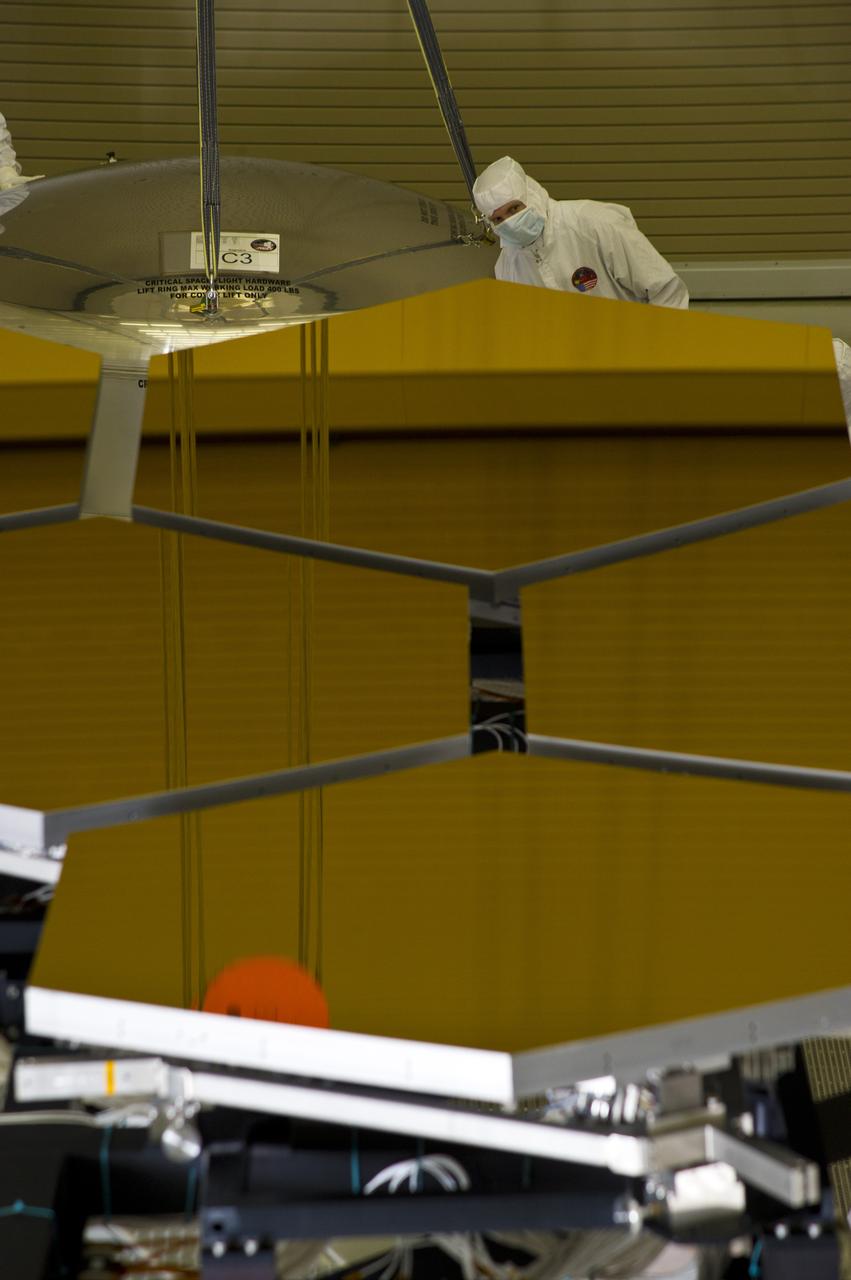
BALL ENGINEERS DISMANTLE ARRAY OF SIX GOLD-PLATED JAMES WEBB SPACE TELESCOPE MIRRORS FOR TRANSPORT TO BALL AEROSPACE AFTER CRYOGENIC TESTING AT MARSHALL'S X-RAY AND CRYOGENIC FACILITY.
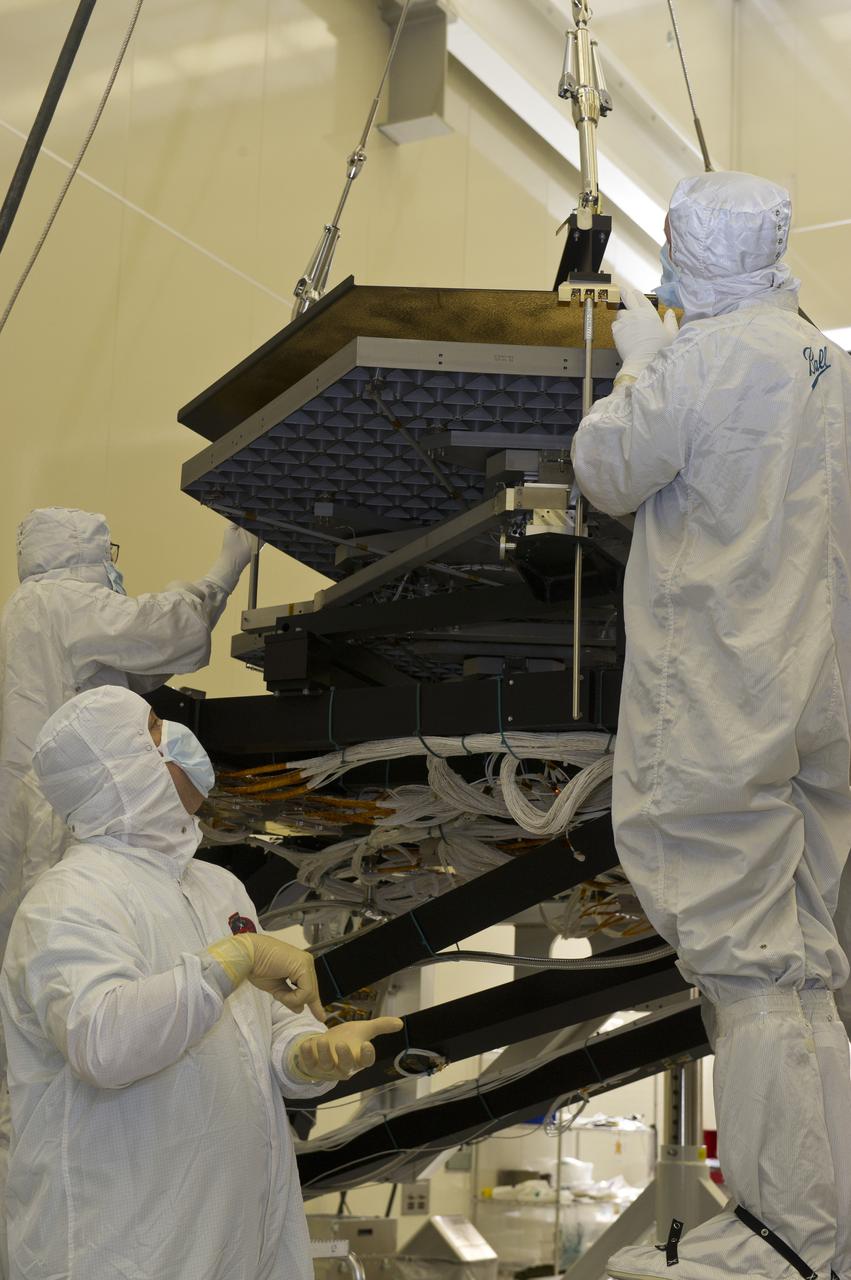
BALL ENGINEERS DISMANTLE ARRAY OF SIX GOLD-PLATED JAMES WEBB SPACE TELESCOPE MIRRORS FOR TRANSPORT TO BALL AEROSPACE AFTER CRYOGENIC TESTING AT MARSHALL'S X-RAY AND CRYOGENIC FACILITY.
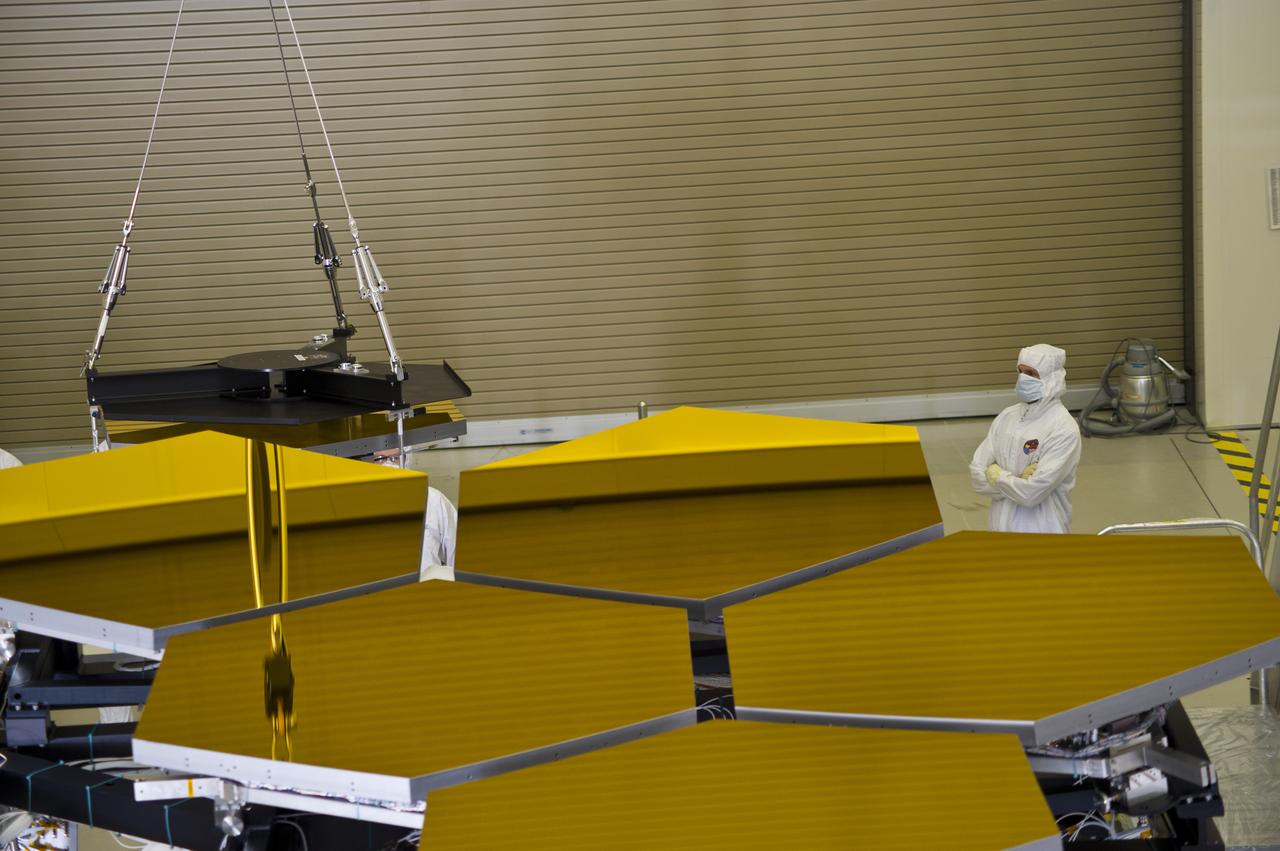
BALL ENGINEERS DISMANTLE ARRAY OF SIX GOLD-PLATED JAMES WEBB SPACE TELESCOPE MIRRORS FOR TRANSPORT TO BALL AEROSPACE AFTER CRYOGENIC TESTING AT MARSHALL'S X-RAY AND CRYOGENIC FACILITY.
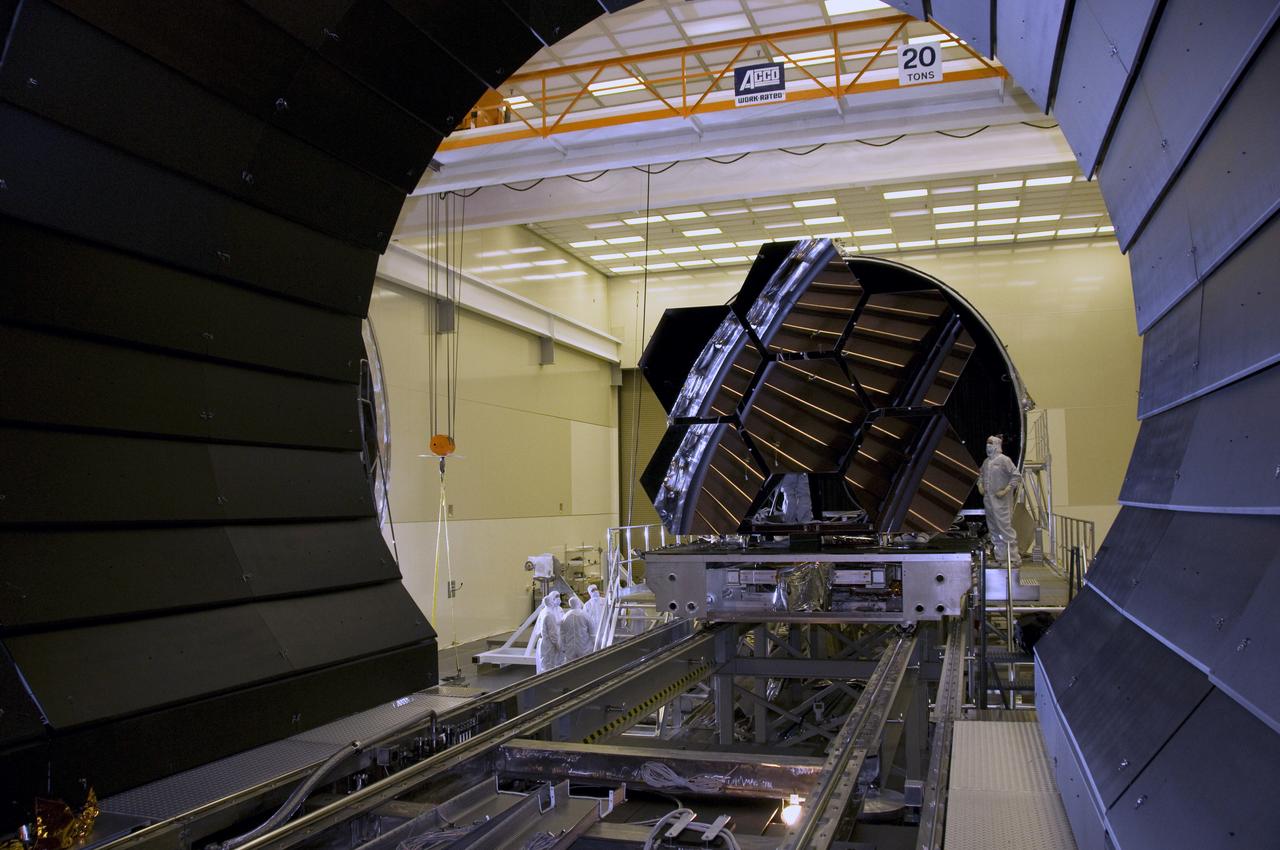
SIX MIRROR SEGMENTS OF THE JAMES WEBB SPACE TELESCOPE ARE REMOVED FROM THE CRYOGENIC TEST CHAMBER
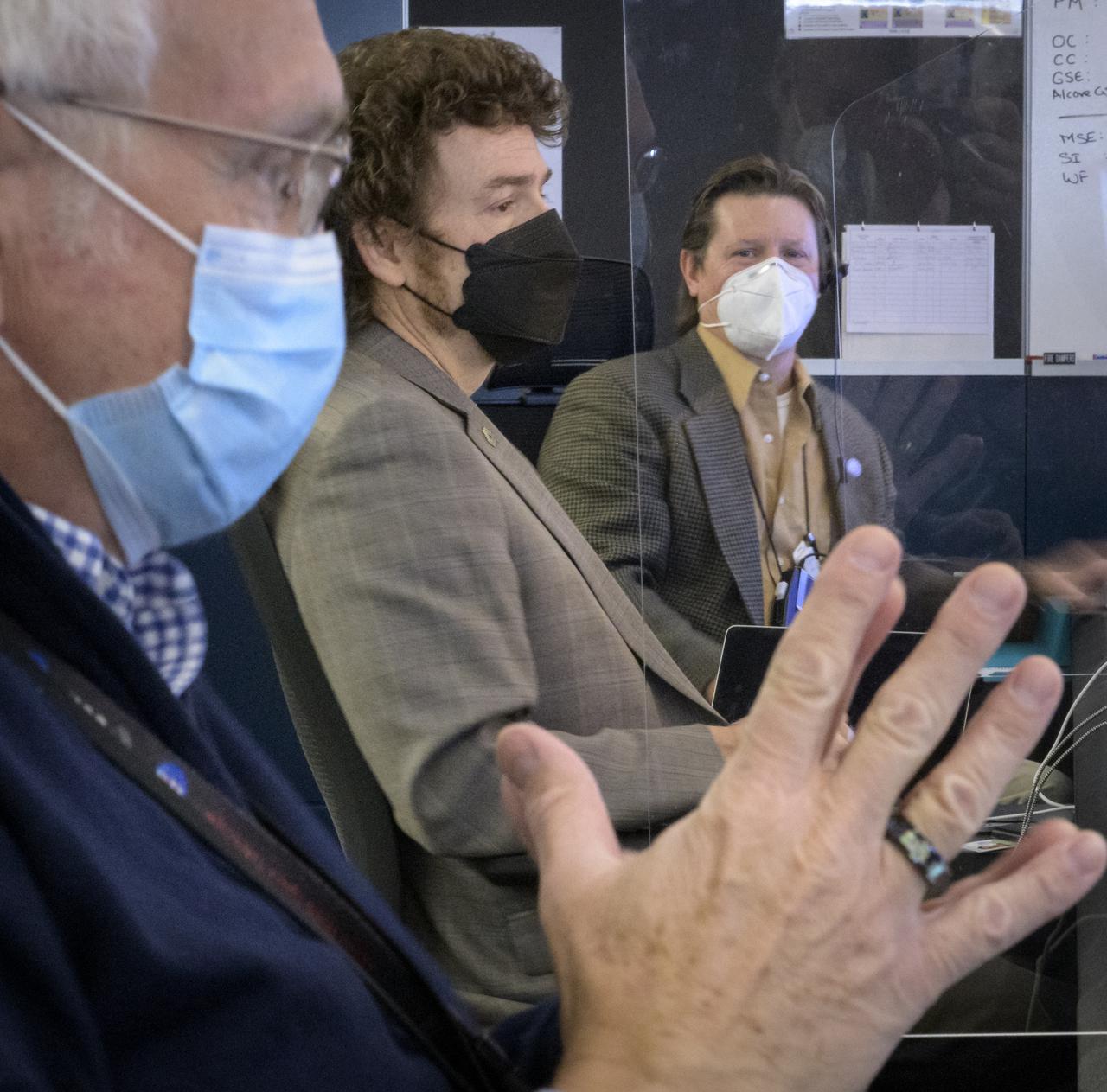
NASA James Webb Space Telescope Mission Operations Engineer Kenny McKenzie, background, NASA James Webb Space Telescope Mission Operations Manager Carl Starr, middle, and NASA James Webb Space Telescope Project Manager Bill Ochs, monitor the progress of the Webb observatory as it’s second primary mirror wing is prepared to rotate into position, Saturday, Jan. 8, 2022, from NASA’s James Webb Space Telescope Mission Operations Center at the Space Telescope Science Institute in Baltimore. Webb, an infrared telescope with a 21.3-foot (6.5-meter) primary mirror, was folded up for launch and underwent an unprecedented deployment process to unfold in space. As NASA's next flagship observatory, Webb will study every phase of cosmic history—from within our solar system to the most distant observable galaxies in the early universe. Photo Credit: (NASA/Bill Ingalls)
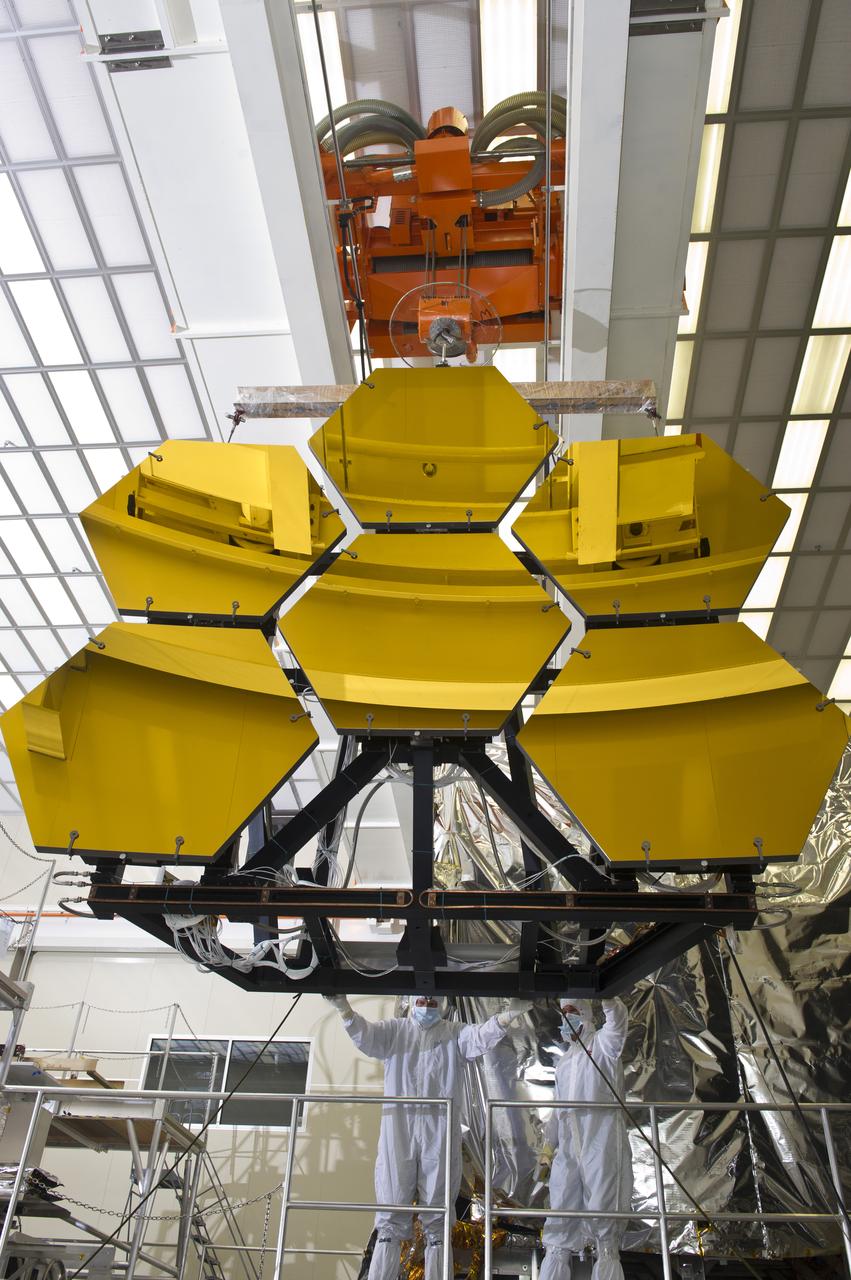
BALL AEROSPACE ENGINEER DAVE CHANEY, (L), AND MARSHALL ENGINEER HARLAN HAIGHT, (R), GUIDE ARRAY OF SIX GOLD-PLATED JAMES WEBB SPACE TELESCOPE MIRRORS AFTER FINAL ACCEPTANCE TESTING AT MARSHALL'S X-RAY AND CRYOGENIC FACILITY
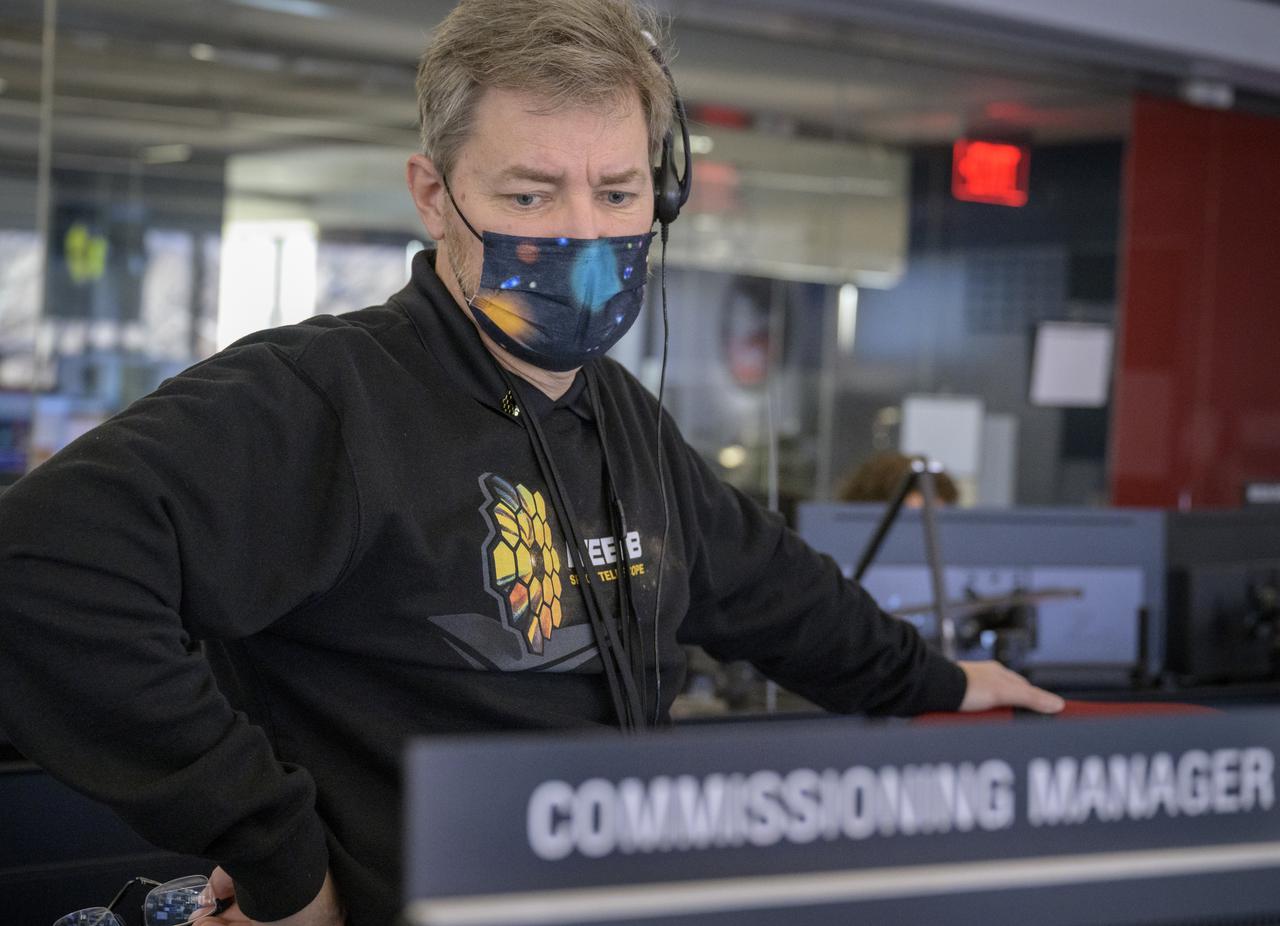
NASA James Webb Space Telescope Commissioning Manager John Durning monitors the progress of the Webb observatory as it’s second primary mirror wing is rotated into position, Saturday, Jan. 8, 2022, from NASA’s James Webb Space Telescope Mission Operations Center at the Space Telescope Science Institute in Baltimore. Webb, an infrared telescope with a 21.3-foot (6.5-meter) primary mirror, was folded up for launch and underwent an unprecedented deployment process to unfold in space. As NASA's next flagship observatory, Webb will study every phase of cosmic history—from within our solar system to the most distant observable galaxies in the early universe. Photo Credit: (NASA/Bill Ingalls)
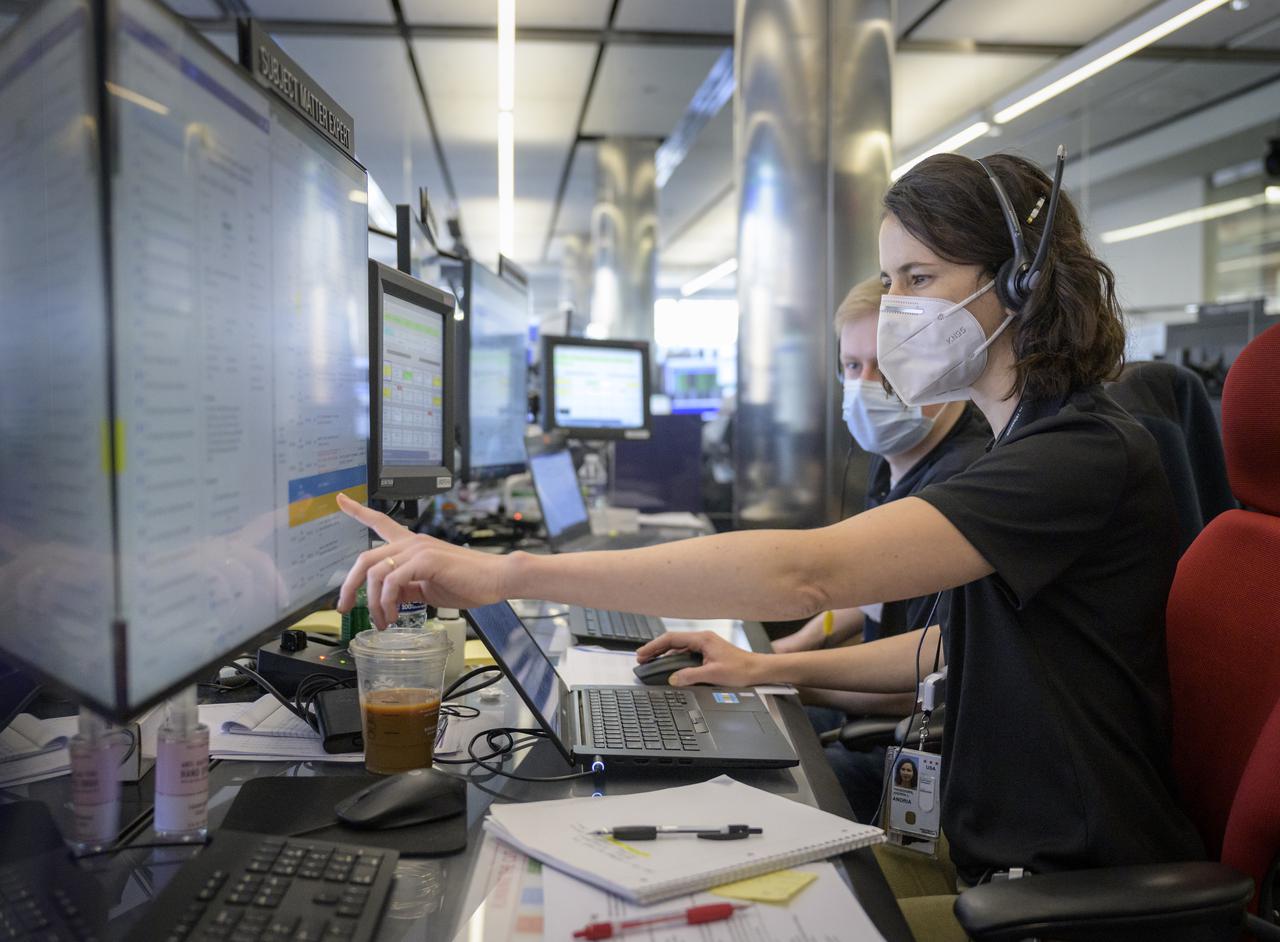
NASA James Webb Space Telescope Timeline Coordinator Andria Hagedorn monitors the progress of the Webb observatory’s second primary mirror wing as it rotates into position, Saturday, Jan. 8, 2022, from NASA’s James Webb Space Telescope Mission Operations Center at the Space Telescope Science Institute in Baltimore. Webb, an infrared telescope with a 21.3-foot (6.5-meter) primary mirror, was folded up for launch and underwent an unprecedented deployment process to unfold in space. As NASA's next flagship observatory, Webb will study every phase of cosmic history—from within our solar system to the most distant observable galaxies in the early universe. Photo Credit: (NASA/Bill Ingalls)
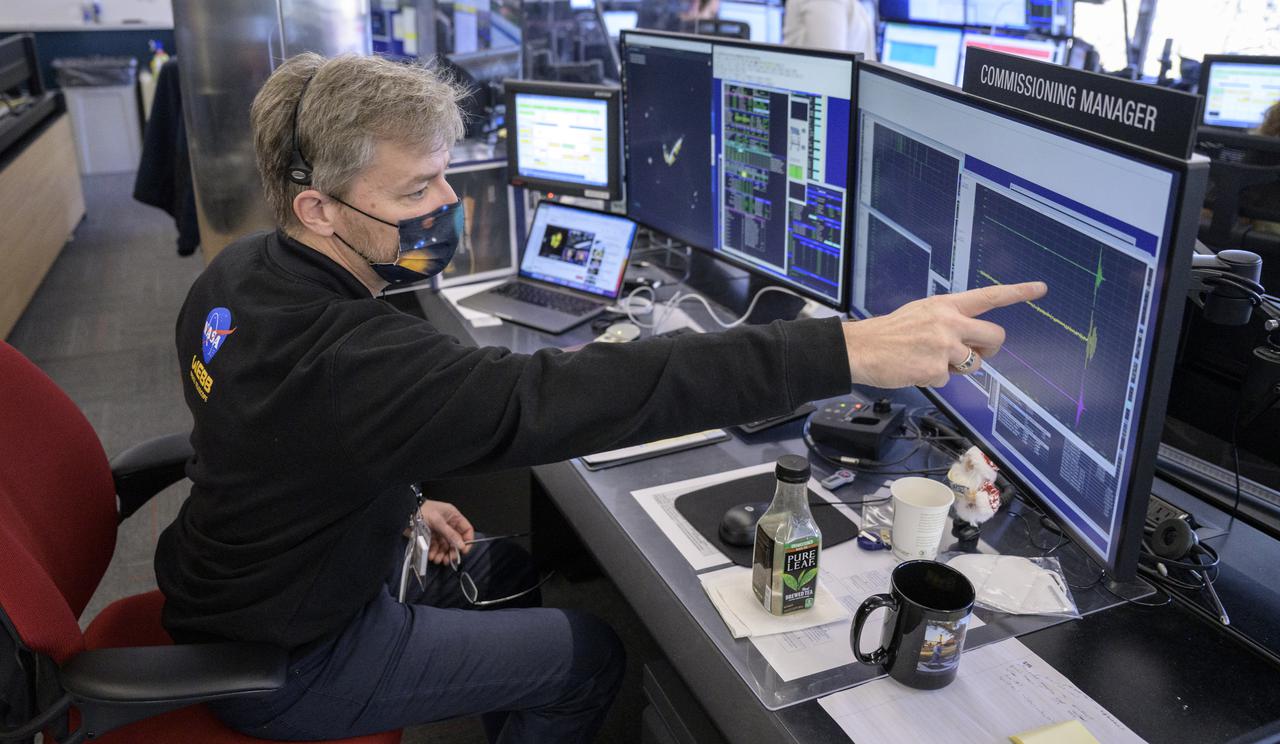
NASA James Webb Space Telescope Commissioning Manager John Durning monitors the progress of the Webb observatory as it’s second primary mirror wing is prepared to rotate into position, Saturday, Jan. 8, 2022, from NASA’s James Webb Space Telescope Mission Operations Center at the Space Telescope Science Institute in Baltimore. Webb, an infrared telescope with a 21.3-foot (6.5-meter) primary mirror, was folded up for launch and underwent an unprecedented deployment process to unfold in space. As NASA's next flagship observatory, Webb will study every phase of cosmic history—from within our solar system to the most distant observable galaxies in the early universe. Photo Credit: (NASA/Bill Ingalls)
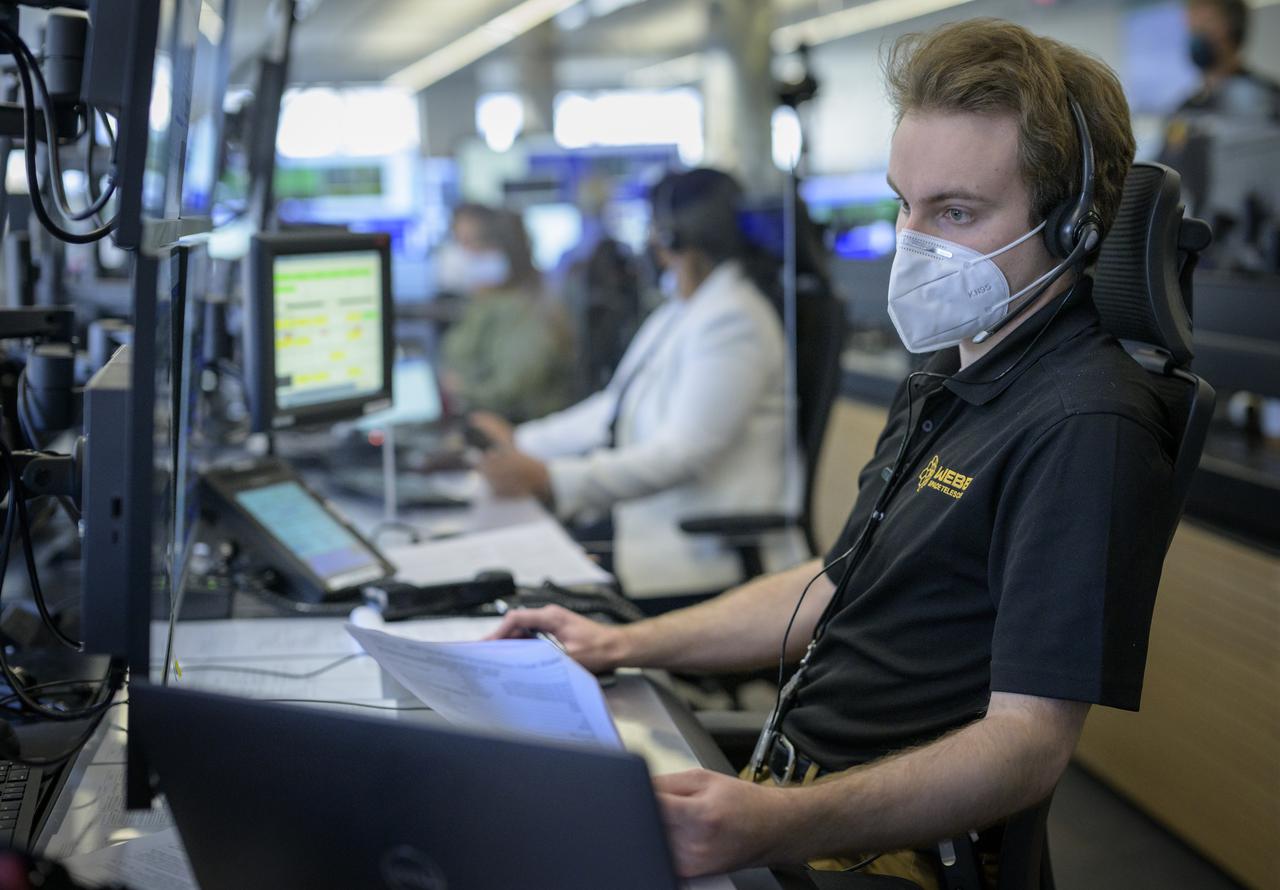
NASA James Webb Space Telescope Ground Engineer Evan Adams monitors the progress of the Webb observatory as it’s second primary mirror wing is prepared to rotate into position, Saturday, Jan. 8, 2022, from NASA’s James Webb Space Telescope Mission Operations Center at the Space Telescope Science Institute in Baltimore. Webb, an infrared telescope with a 21.3-foot (6.5-meter) primary mirror, was folded up for launch and underwent an unprecedented deployment process to unfold in space. As NASA's next flagship observatory, Webb will study every phase of cosmic history—from within our solar system to the most distant observable galaxies in the early universe. Photo Credit: (NASA/Bill Ingalls)
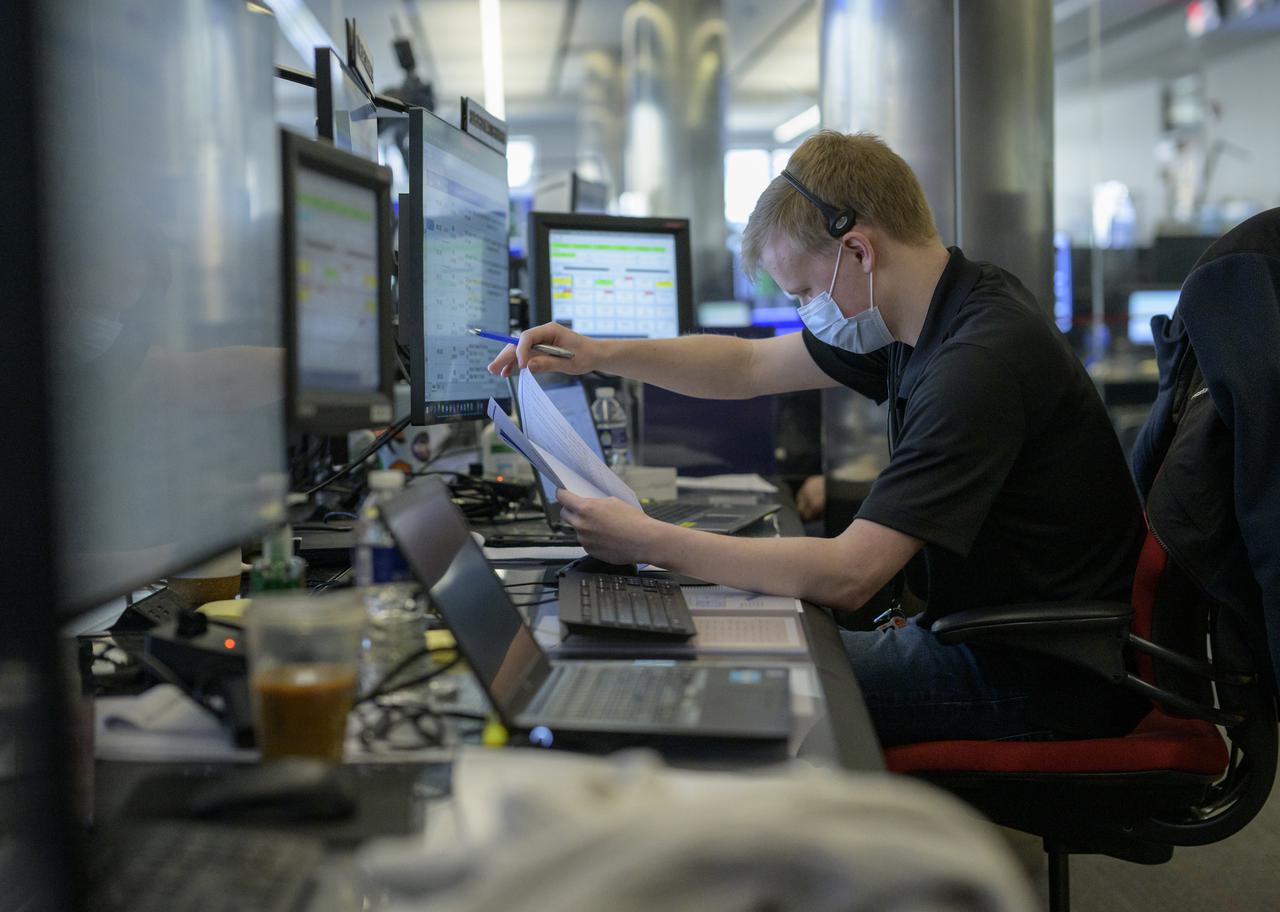
NASA James Webb Space Telescope Timeline Coordinator Matt Wasiak monitors the progress of the Webb observatory as it’s second primary mirror wing is prepared to rotate into position, Saturday, Jan. 8, 2022, from NASA’s James Webb Space Telescope Mission Operations Center at the Space Telescope Science Institute in Baltimore. Webb, an infrared telescope with a 21.3-foot (6.5-meter) primary mirror, was folded up for launch and underwent an unprecedented deployment process to unfold in space. As NASA's next flagship observatory, Webb will study every phase of cosmic history—from within our solar system to the most distant observable galaxies in the early universe. Photo Credit: (NASA/Bill Ingalls)
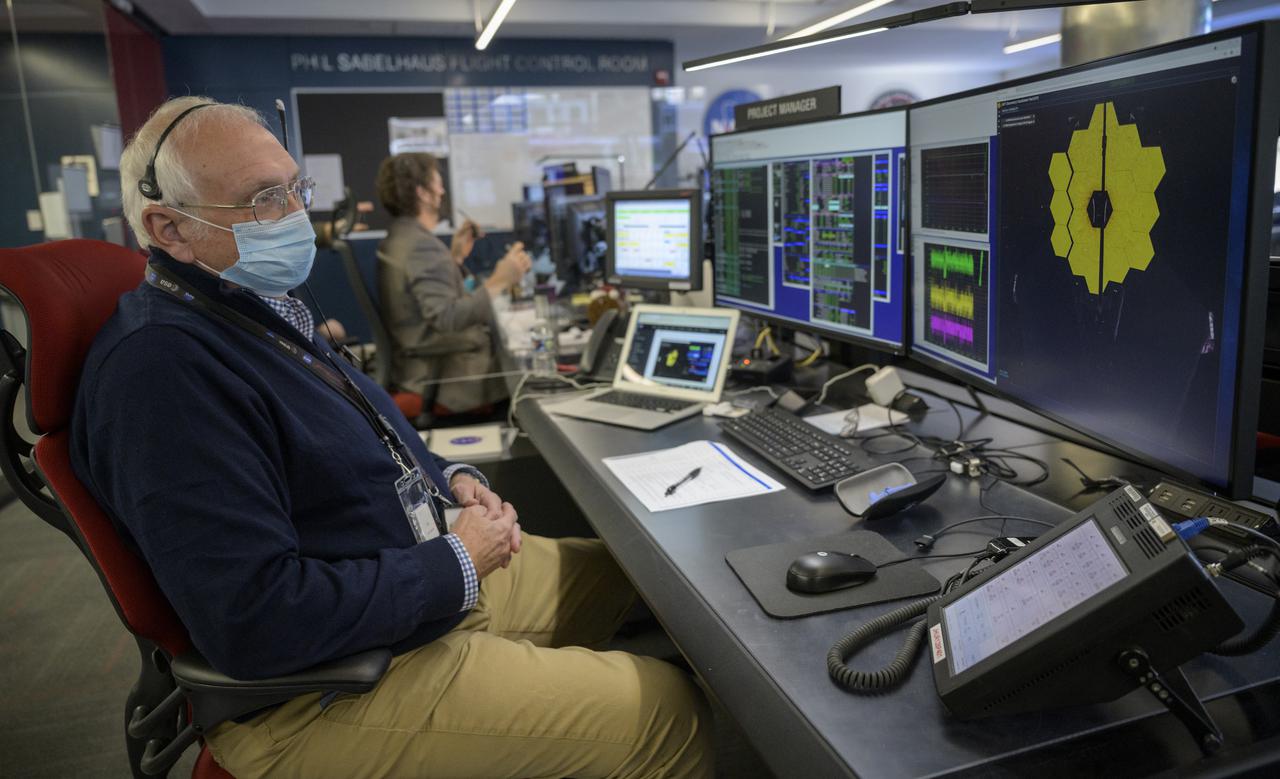
NASA James Webb Space Telescope Project Manager Bill Ochs monitors the progress of the observatory’s second primary mirror wing as it rotates into position, Saturday, Jan. 8, 2022, from NASA’s James Webb Space Telescope Mission Operations Center at the Space Telescope Science Institute in Baltimore. Webb, an infrared telescope with a 21.3-foot (6.5-meter) primary mirror, was folded up for launch and underwent an unprecedented deployment process to unfold in space. As NASA's next flagship observatory, Webb will study every phase of cosmic history—from within our solar system to the most distant observable galaxies in the early universe. Photo Credit: (NASA/Bill Ingalls)
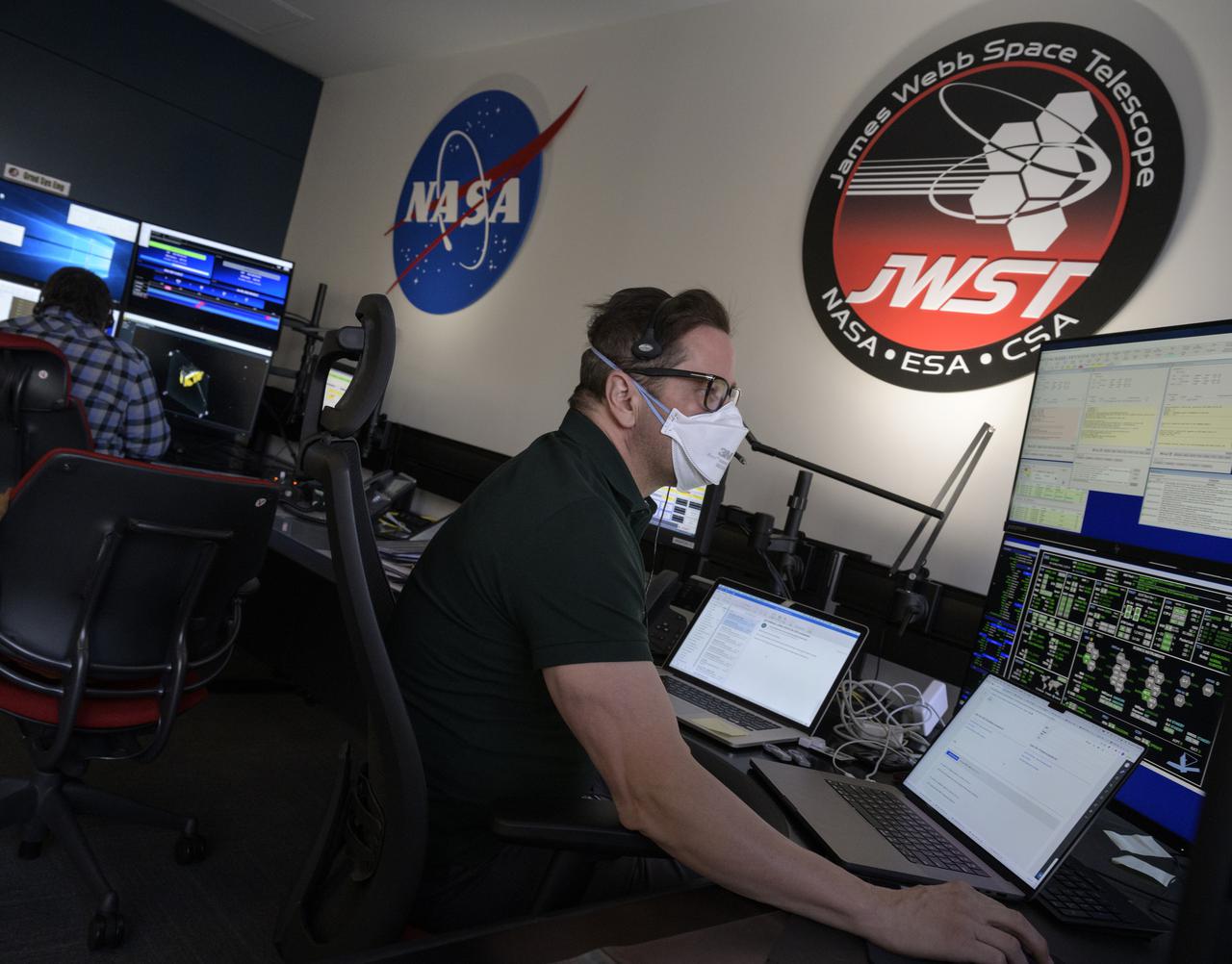
NASA James Webb Space Telescope Ground Systems Engineer Carl Reis at NASA’s James Webb Space Telescope Mission Operations Center at the Space Telescope Science Institute in Baltimore monitors the progress as the observatory’s second primary mirror wing rotates into position, Saturday, Jan. 8, 2022. Webb, an infrared telescope with a 21.3-foot (6.5-meter) primary mirror, was folded up for launch and underwent an unprecedented deployment process to unfold in space. As NASA's next flagship observatory, Webb will study every phase of cosmic history—from within our solar system to the most distant observable galaxies in the early universe. Photo Credit: (NASA/Bill Ingalls)
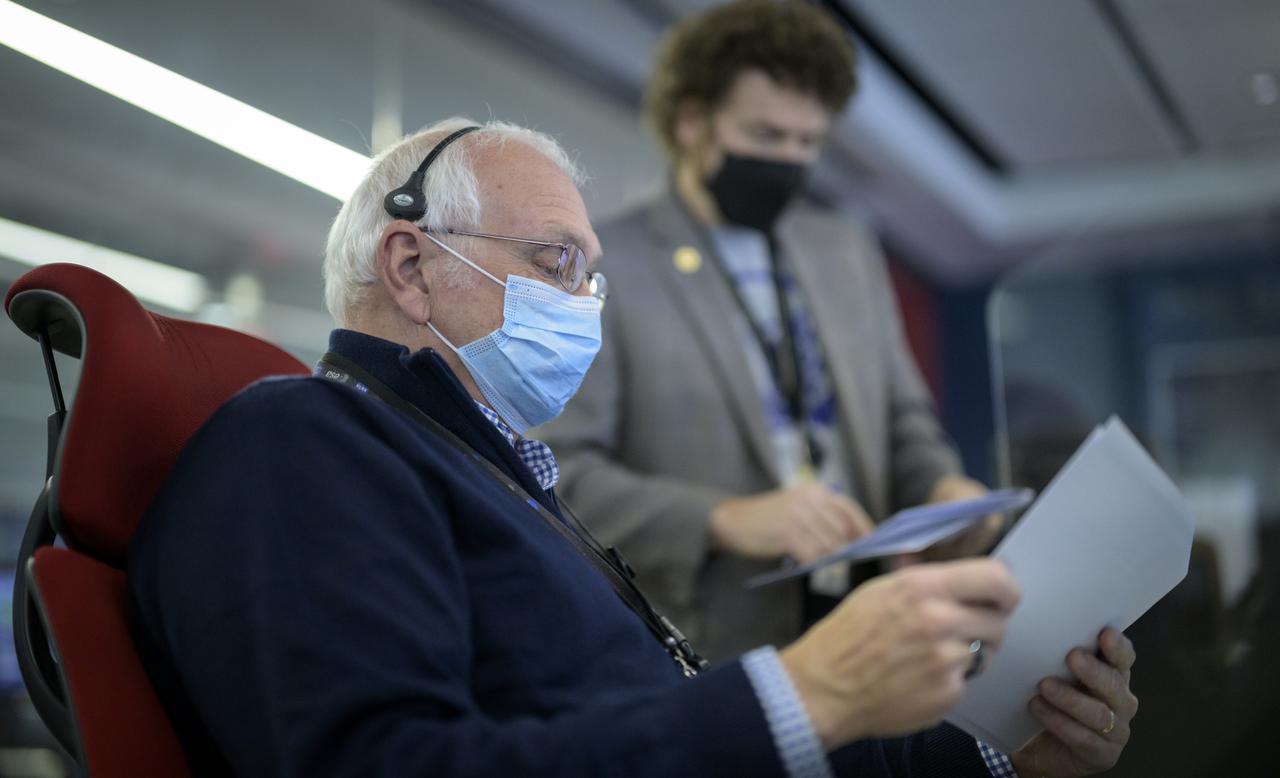
NASA James Webb Space Telescope Project Manager Bill Ochs, left, and NASA James Webb Space Telescope Mission Operations Manager Carl Starr, monitor the progress of the Webb observatory as it’s second primary mirror wing is prepared to rotate into position, Saturday, Jan. 8, 2022, from NASA’s James Webb Space Telescope Mission Operations Center at the Space Telescope Science Institute in Baltimore. Webb, an infrared telescope with a 21.3-foot (6.5-meter) primary mirror, was folded up for launch and underwent an unprecedented deployment process to unfold in space. As NASA's next flagship observatory, Webb will study every phase of cosmic history—from within our solar system to the most distant observable galaxies in the early universe. Photo Credit: (NASA/Bill Ingalls)
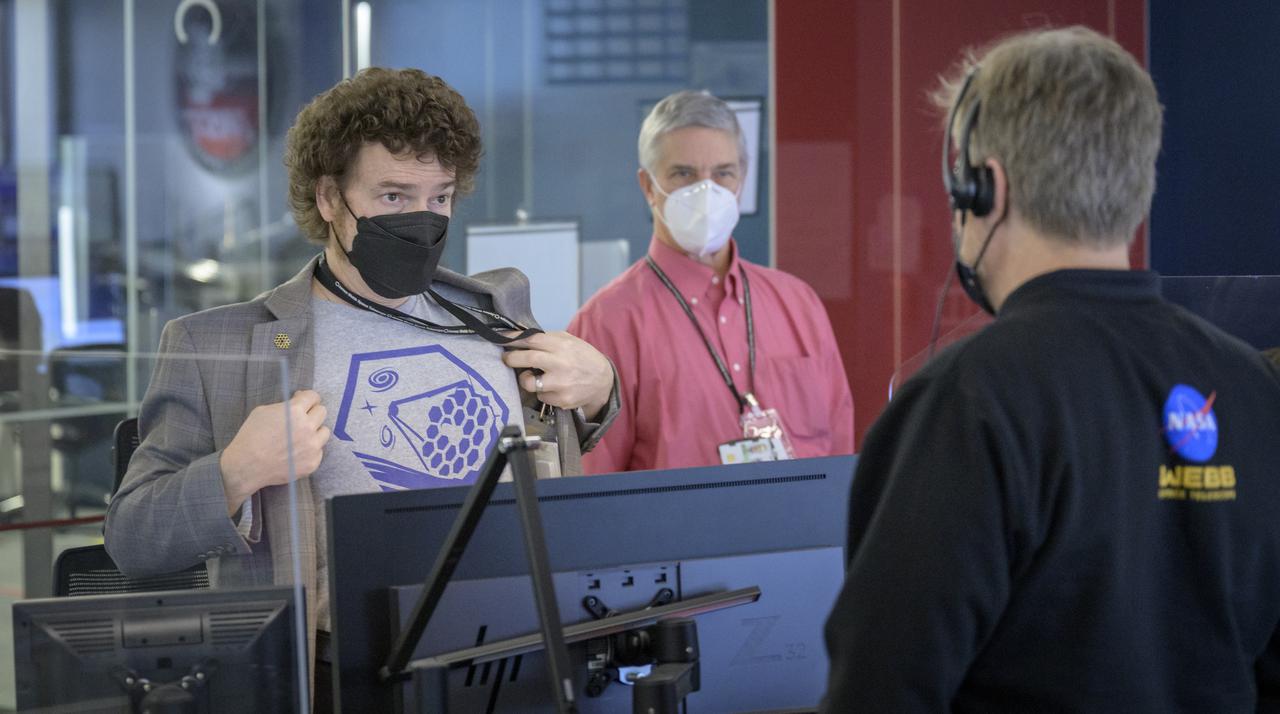
NASA James Webb Space Telescope Mission Operations Manager Carl Starr, left, shows his Webb shirt to NASA James Webb Space Telescope Commissioning Manager John Durning, right, as they prepare to monitor the progress of the observatory’s second primary mirror wing rotating into position, Saturday, Jan. 8, 2022, at NASA’s James Webb Space Telescope Mission Operations Center at the Space Telescope Science Institute in Baltimore. Webb, an infrared telescope with a 21.3-foot (6.5-meter) primary mirror, was folded up for launch and underwent an unprecedented deployment process to unfold in space. As NASA's next flagship observatory, Webb will study every phase of cosmic history—from within our solar system to the most distant observable galaxies in the early universe. Photo Credit: (NASA/Bill Ingalls)
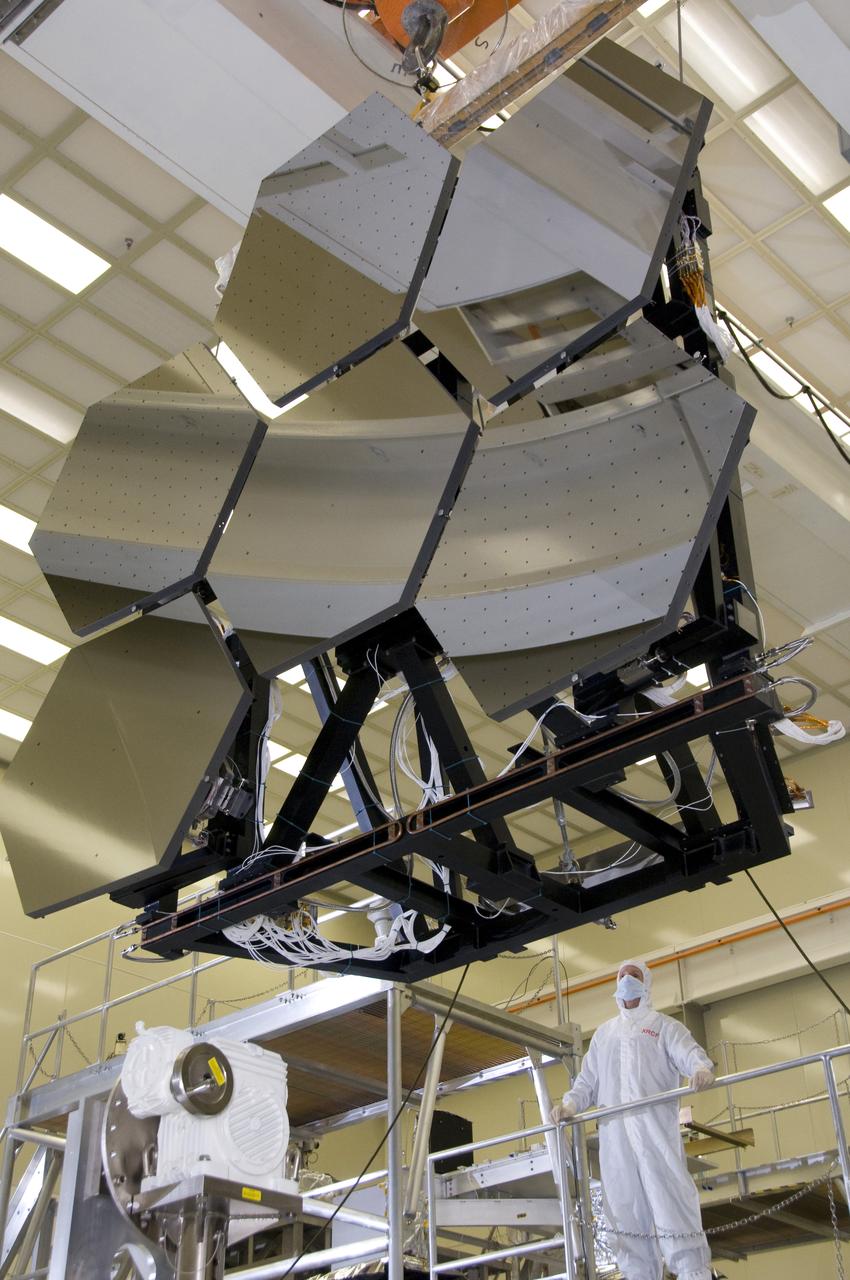
ERNIE WRIGHT, TEST DIRECTOR, MONITORS MOVE OF TEST STAND WITH SIX JWST (JAMES WEBB SPACE TELESCOPE) PRIMARY MIRROR SEGMENT ASSEMBLIES AT MARSHALL'S X-RAY AND CRYOGENIC FACILITY.
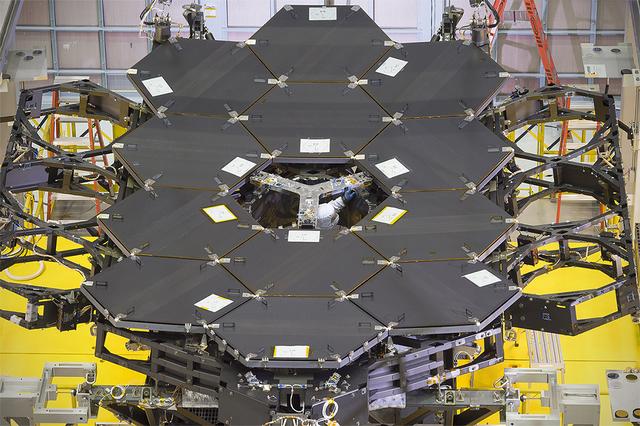
Caption: One dozen (out of 18) flight mirror segments that make up the primary mirror on NASA's James Webb Space Telescope have been installed at NASA's Goddard Space Flight Center. Credits: NASA/Chris Gunn More: Since December 2015, the team of scientists and engineers have been working tirelessly to install all the primary mirror segments onto the telescope structure in the large clean room at NASA's Goddard Space Flight Center in Greenbelt, Maryland. The twelfth mirror was installed on January 2, 2016. "This milestone signifies that all of the hexagonal shaped mirrors on the fixed central section of the telescope structure are installed and only the 3 mirrors on each wing are left for installation," said Lee Feinberg, NASA's Optical Telescope Element Manager at NASA Goddard. "The incredibly skilled and dedicated team assembling the telescope continues to find ways to do things faster and more efficiently." Each hexagonal-shaped segment measures just over 4.2 feet (1.3 meters) across and weighs approximately 88 pounds (40 kilograms). After being pieced together, the 18 primary mirror segments will work together as one large 21.3-foot (6.5-meter) mirror. The primary mirror will unfold and adjust to shape after launch. The mirrors are made of ultra-lightweight beryllium. The mirrors are placed on the telescope's backplane using a robotic arm, guided by engineers. The full installation is expected to be completed in a few months. The mirrors were built by Ball Aerospace & Technologies Corp., Boulder, Colorado. Ball is the principal subcontractor to Northrop Grumman for the optical technology and lightweight mirror system. The installation of the mirrors onto the telescope structure is performed by Harris Corporation of Rochester, New York. Harris Corporation leads integration and testing for the telescope. While the mirror assembly is a very significant milestone, there are many more steps involved in assembling the Webb telescope. The primary mirror and the tennis-court-sized sunshield are the largest and most visible components of the Webb telescope. However, there are four smaller components that are less visible, yet critical. The instruments that will fly aboard Webb - cameras and spectrographs with detectors able to record extremely faint signals — are part of the Integrated Science Instrument Module (ISIM), which is currently undergoing its final cryogenic vacuum test and will be integrated with the mirror later this year.
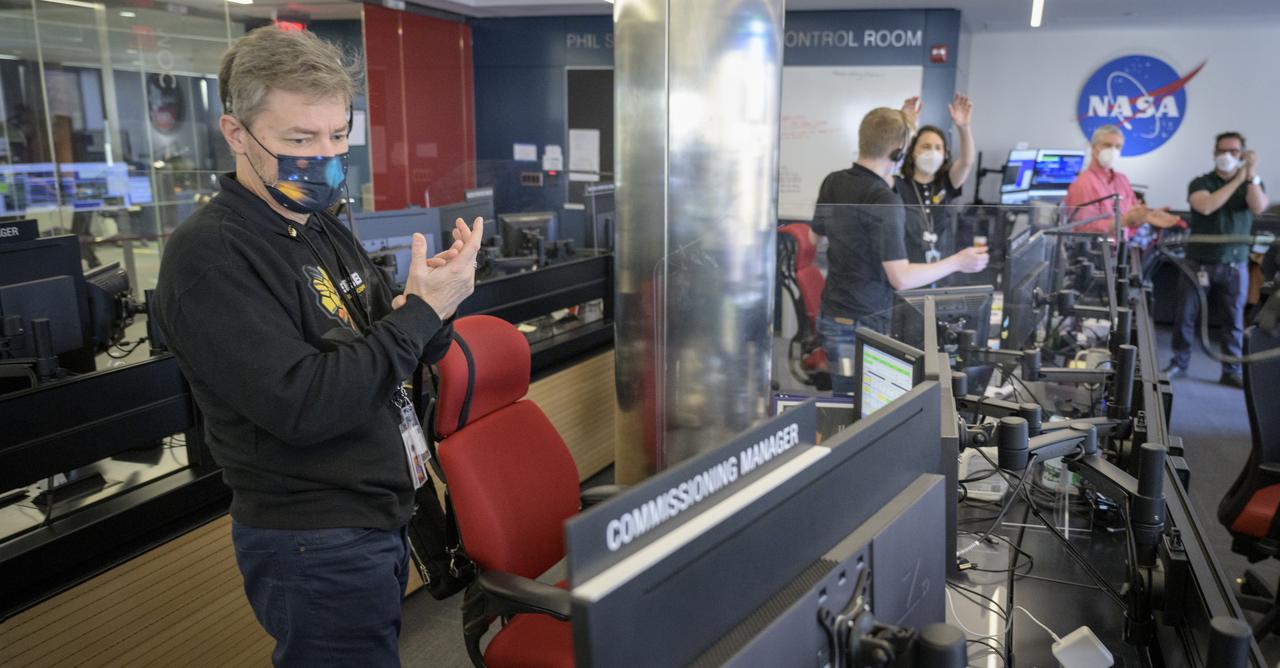
NASA James Webb Space Telescope Commissioning Manager John Durning, left, and engineering teams celebrate at the Space Telescope Science Institute in Baltimore as the second primary mirror wing of NASA’s James Webb Space Telescope unfolds, before beginning the process of latching the mirror wing into place, Saturday, Jan. 8, 2022. When fully latched, the infrared observatory will have completed its unprecedented process of unfolding in space to prepare for science operations. Webb will study every phase of cosmic history—from within our solar system to the most distant observable galaxies in the early universe. Photo Credit: (NASA/Bill Ingalls)
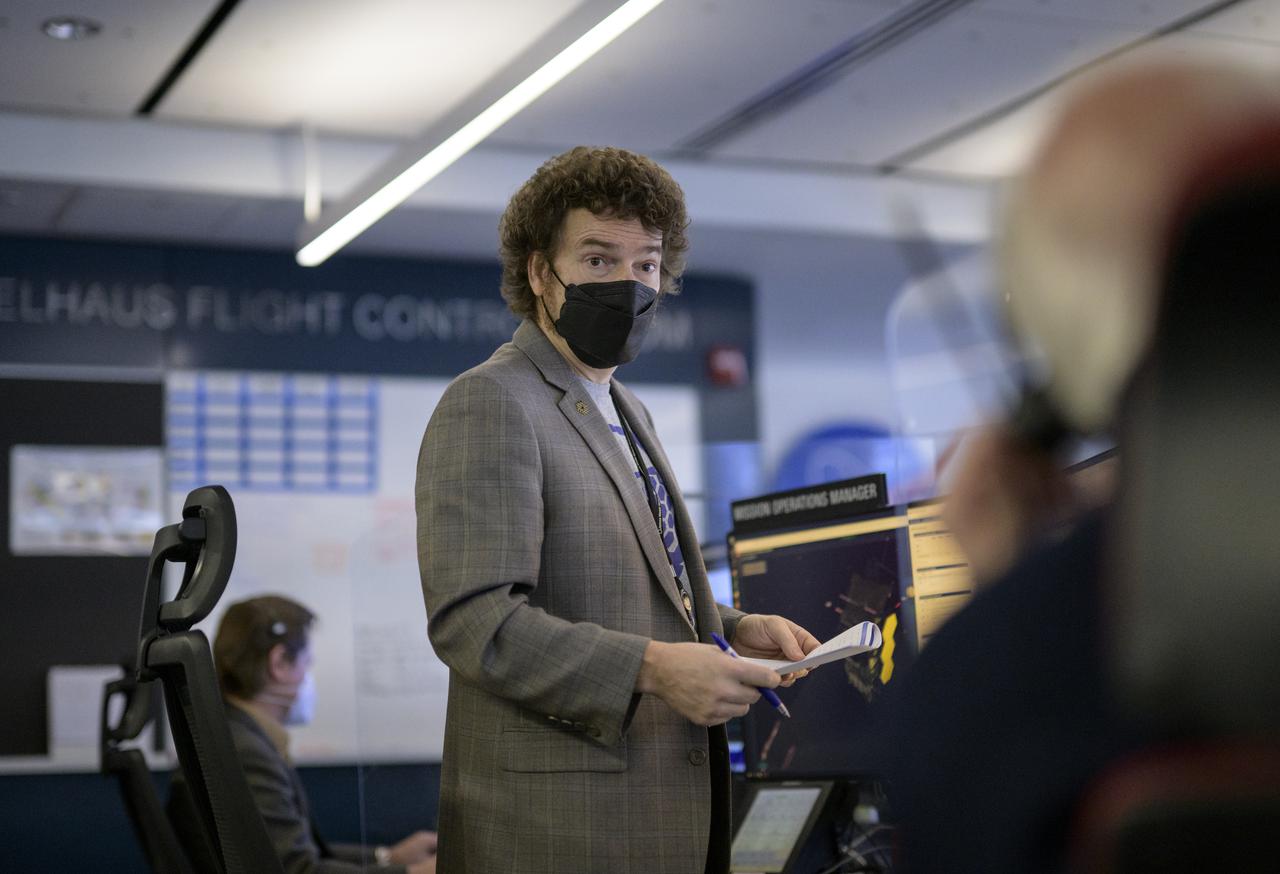
NASA James Webb Space Telescope Mission Operations Manager Carl Starr monitors the progress of the Webb observatory as it’s second primary mirror wing is prepared to rotate into position, Saturday, Jan. 8, 2022, from NASA’s James Webb Space Telescope Mission Operations Center at the Space Telescope Science Institute in Baltimore. Webb, an infrared telescope with a 21.3-foot (6.5-meter) primary mirror, was folded up for launch and underwent an unprecedented deployment process to unfold in space. As NASA's next flagship observatory, Webb will study every phase of cosmic history—from within our solar system to the most distant observable galaxies in the early universe. Photo Credit: (NASA/Bill Ingalls)
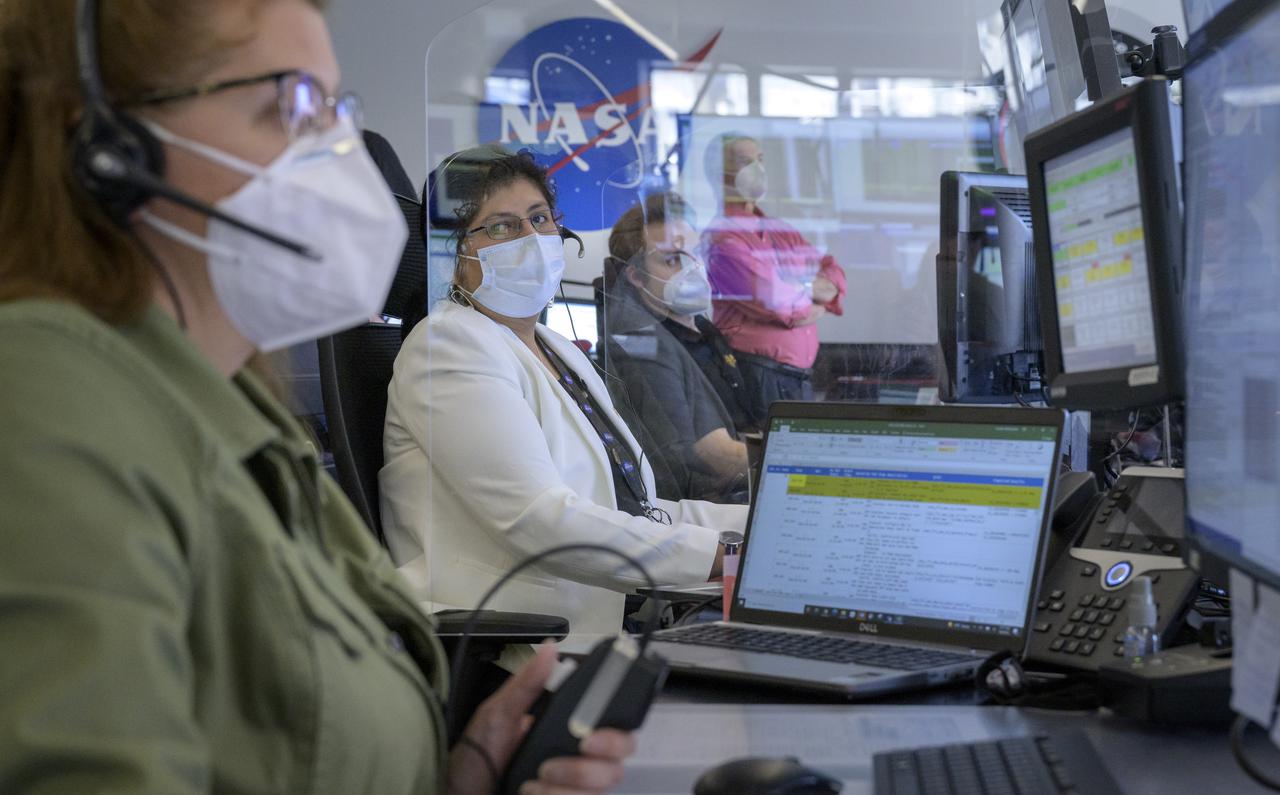
NASA James Webb Space Telescope Operations Controller Irma Quispe, 2nd from left, and other mission team members, monitor the progress of the Webb observatory as it’s second primary mirror wing is rotated into position, Saturday, Jan. 8, 2022, from NASA’s James Webb Space Telescope Mission Operations Center at the Space Telescope Science Institute in Baltimore. Webb, an infrared telescope with a 21.3-foot (6.5-meter) primary mirror, was folded up for launch and underwent an unprecedented deployment process to unfold in space. As NASA's next flagship observatory, Webb will study every phase of cosmic history—from within our solar system to the most distant observable galaxies in the early universe. Photo Credit: (NASA/Bill Ingalls)
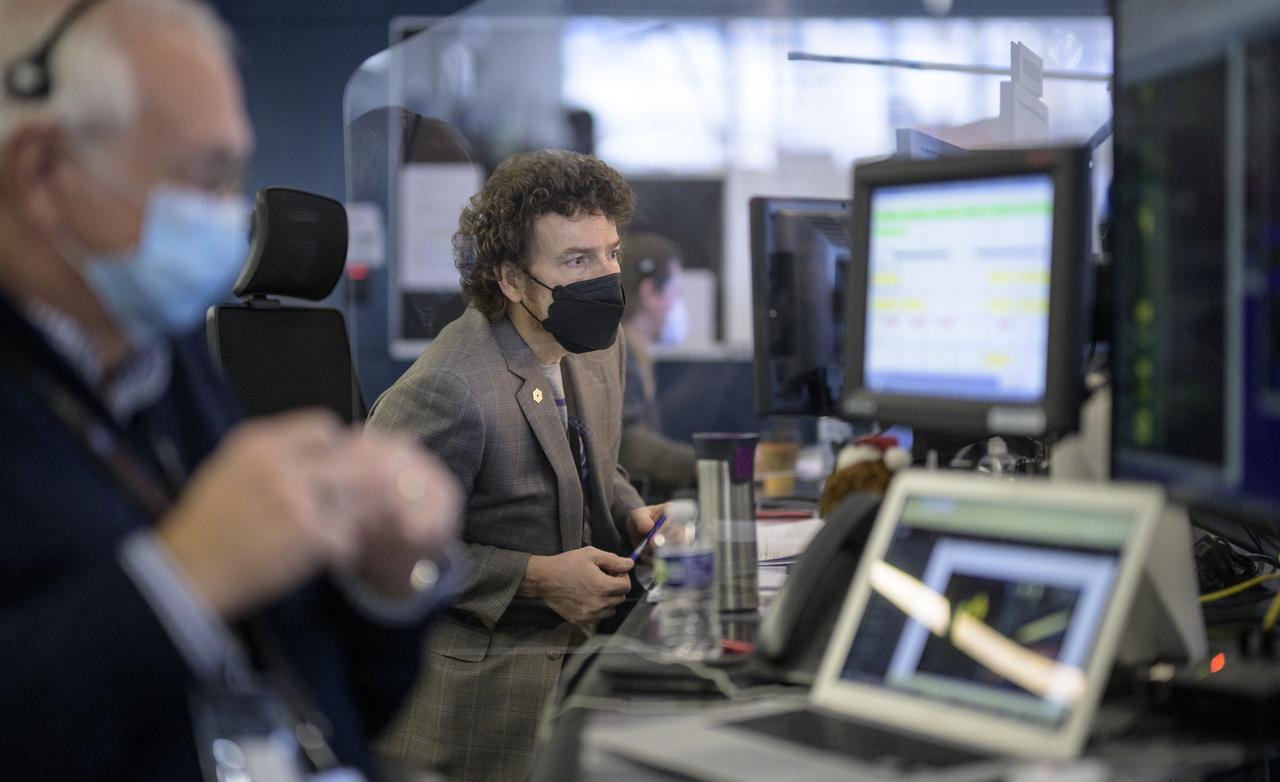
NASA James Webb Space Telescope Mission Operations Manager Carl Starr monitors the progress of the Webb observatory as it’s second primary mirror wing is prepared to rotate into position, Saturday, Jan. 8, 2022, from NASA’s James Webb Space Telescope Mission Operations Center at the Space Telescope Science Institute in Baltimore. Webb, an infrared telescope with a 21.3-foot (6.5-meter) primary mirror, was folded up for launch and underwent an unprecedented deployment process to unfold in space. As NASA's next flagship observatory, Webb will study every phase of cosmic history—from within our solar system to the most distant observable galaxies in the early universe. Photo Credit: (NASA/Bill Ingalls)
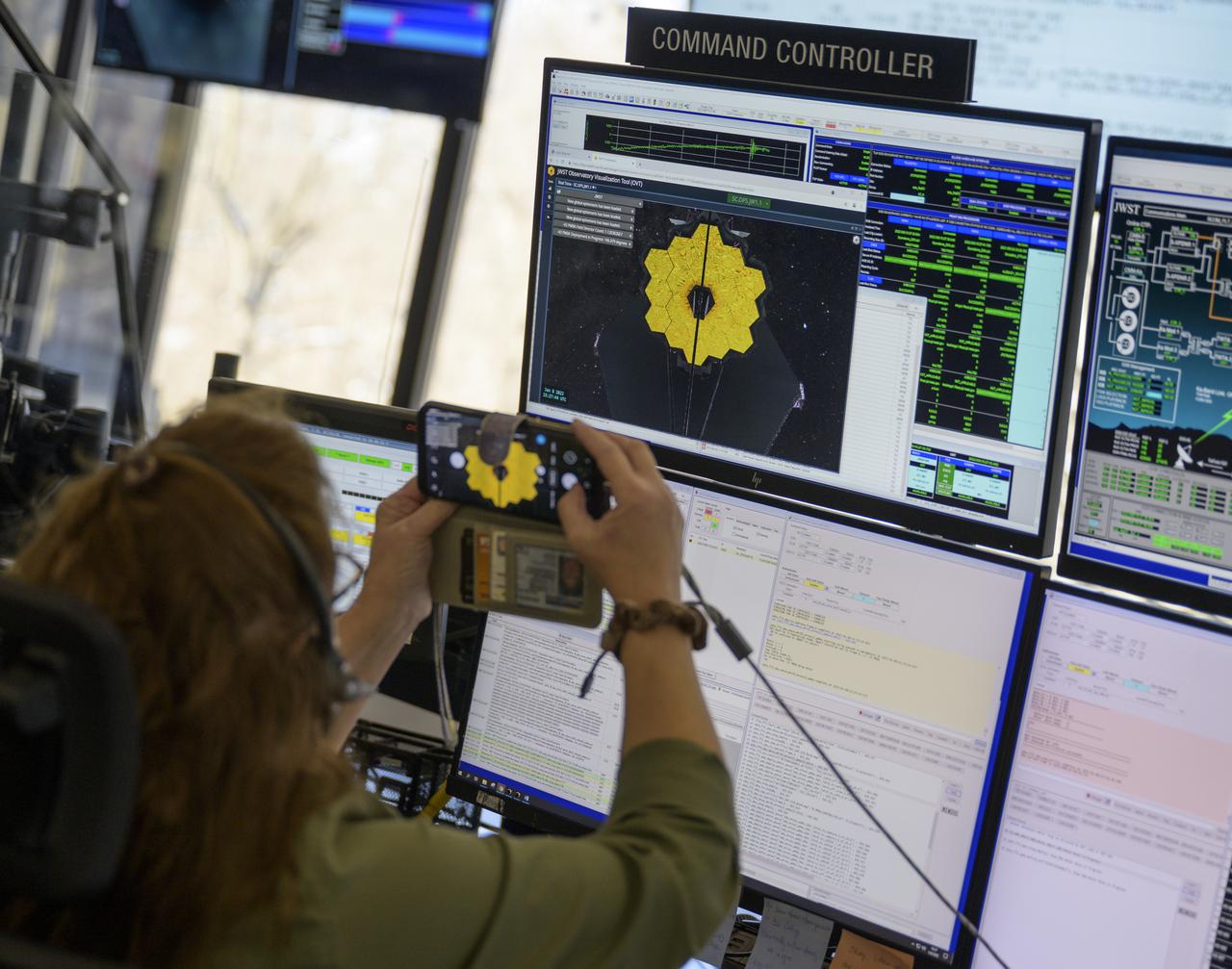
Engineering teams at NASA’s James Webb Space Telescope Mission Operations Center at the Space Telescope Science Institute in Baltimore monitor progress as the observatory’s second primary mirror wing rotates into position, Saturday, Jan. 8, 2022. Webb, an infrared telescope with a 21.3-foot (6.5-meter) primary mirror, was folded up for launch and underwent an unprecedented deployment process to unfold in space. As NASA's next flagship observatory, Webb will study every phase of cosmic history—from within our solar system to the most distant observable galaxies in the early universe. Photo Credit: (NASA/Bill Ingalls)
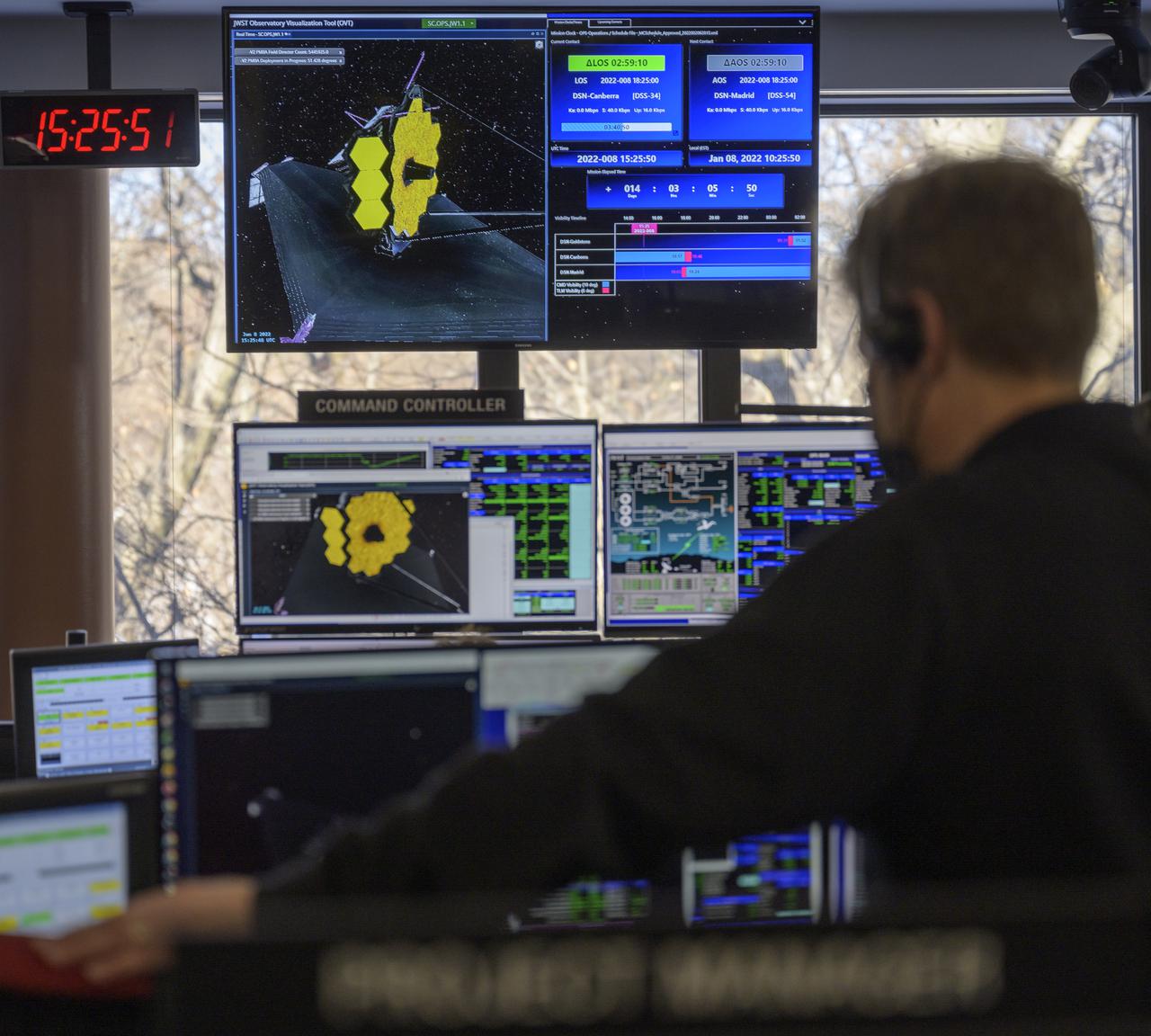
Engineering teams at NASA’s James Webb Space Telescope Mission Operations Center at the Space Telescope Science Institute in Baltimore monitor progress as the observatory’s second primary mirror wing rotates into position, Saturday, Jan. 8, 2022. Webb, an infrared telescope with a 21.3-foot (6.5-meter) primary mirror, was folded up for launch and underwent an unprecedented deployment process to unfold in space. As NASA's next flagship observatory, Webb will study every phase of cosmic history—from within our solar system to the most distant observable galaxies in the early universe. Photo Credit: (NASA/Bill Ingalls)
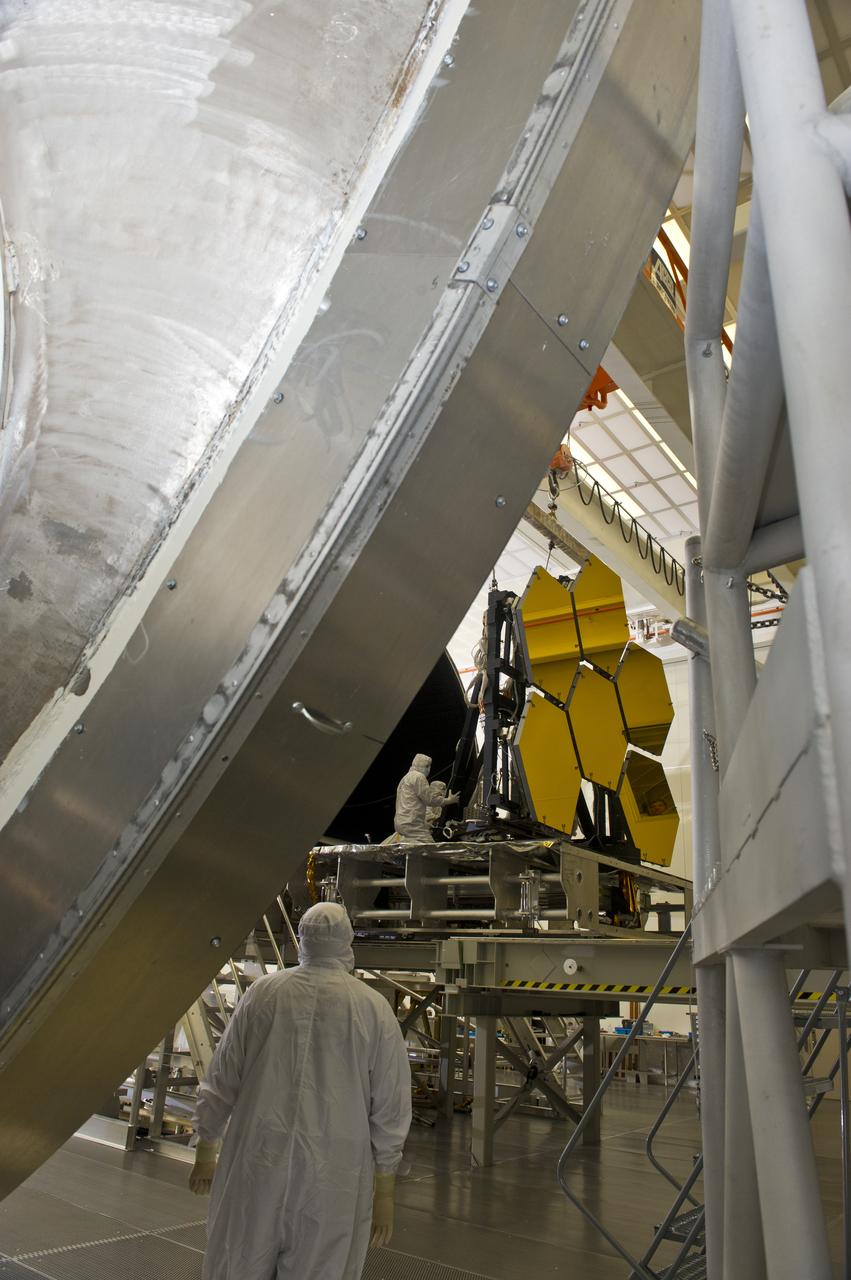
BALL AEROSPACE ENGINEER DAVE CHANEY, (L), AND MARSHALL ENGINEER HARLAN HAIGHT, (R), GUIDE ARRAY OF SIX GOLD-PLATED JAMES WEBB SPACE TELESCOPE MIRRORS AFTER FINAL ACCEPTANCE TESTING AT MARSHALL'S X-RAY AND CRYOGENIC FACILITY
BALL AEROSPACE ENGINEER DAVE CHANEY, (L), AND MARSHALL ENGINEER HARLAN HAIGHT, (R), GUIDE ARRAY OF SIX GOLD-PLATED JAMES WEBB SPACE TELESCOPE MIRRORS AFTER FINAL ACCEPTANCE TESTING AT MARSHALL'S X-RAY AND CRYOGENIC FACILITY
BALL AEROSPACE ENGINEER DAVE CHANEY, (L), AND MARSHALL ENGINEER HARLAN HAIGHT, (R), GUIDE ARRAY OF SIX GOLD-PLATED JAMES WEBB SPACE TELESCOPE MIRRORS AFTER FINAL ACCEPTANCE TESTING AT MARSHALL'S X-RAY AND CRYOGENIC FACILITY
BALL AEROSPACE ENGINEER DAVE CHANEY, (L), AND MARSHALL ENGINEER HARLAN HAIGHT, (R), GUIDE ARRAY OF SIX GOLD-PLATED JAMES WEBB SPACE TELESCOPE MIRRORS AFTER FINAL ACCEPTANCE TESTING AT MARSHALL'S X-RAY AND CRYOGENIC FACILITY
BALL AEROSPACE ENGINEER DAVE CHANEY, (L), AND MARSHALL ENGINEER HARLAN HAIGHT, (R), GUIDE ARRAY OF SIX GOLD-PLATED JAMES WEBB SPACE TELESCOPE MIRRORS AFTER FINAL ACCEPTANCE TESTING AT MARSHALL'S X-RAY AND CRYOGENIC FACILITY
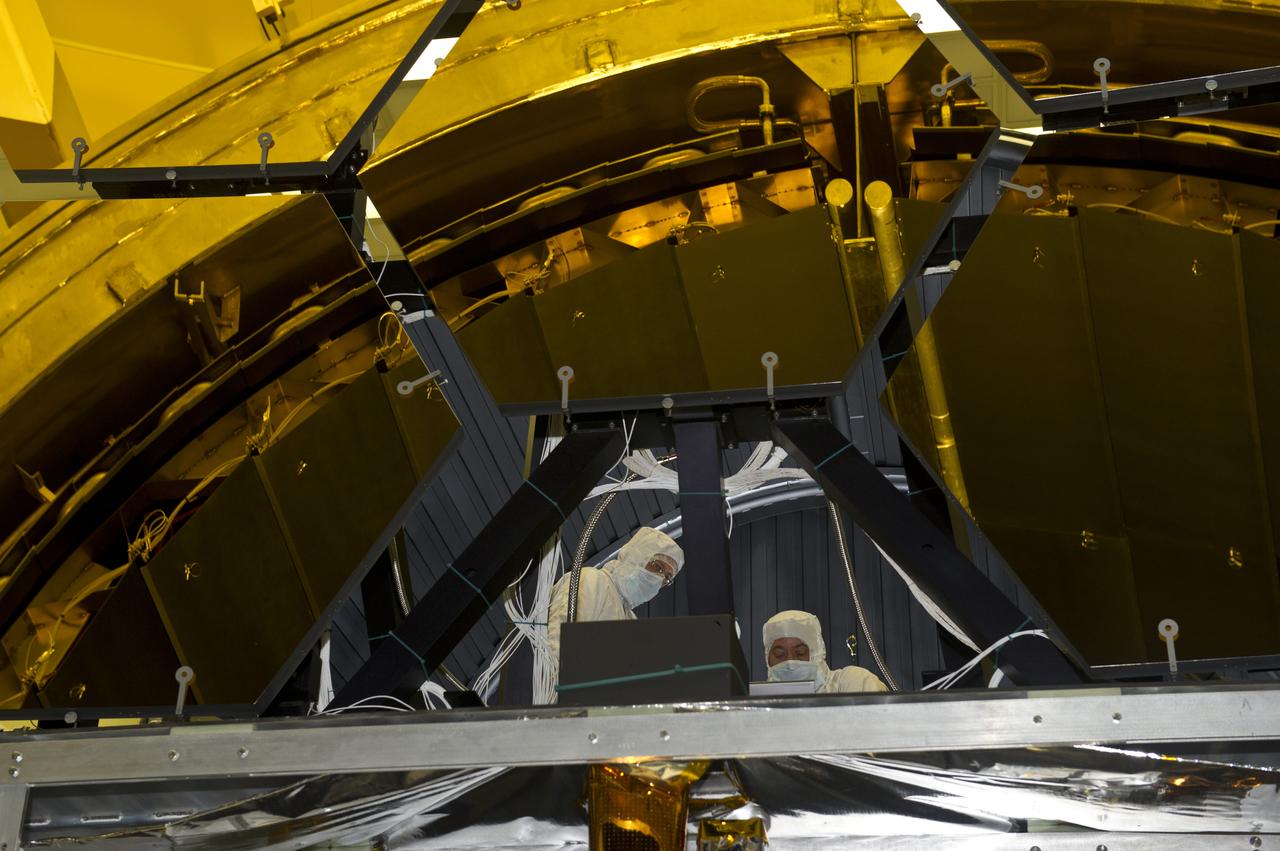
BALL AEROSPACE ENGINEER DAVE CHANEY, (L), AND MARSHALL ENGINEER HARLAN HAIGHT, (R), GUIDE ARRAY OF SIX GOLD-PLATED JAMES WEBB SPACE TELESCOPE MIRRORS AFTER FINAL ACCEPTANCE TESTING AT MARSHALL'S X-RAY AND CRYOGENIC FACILITY
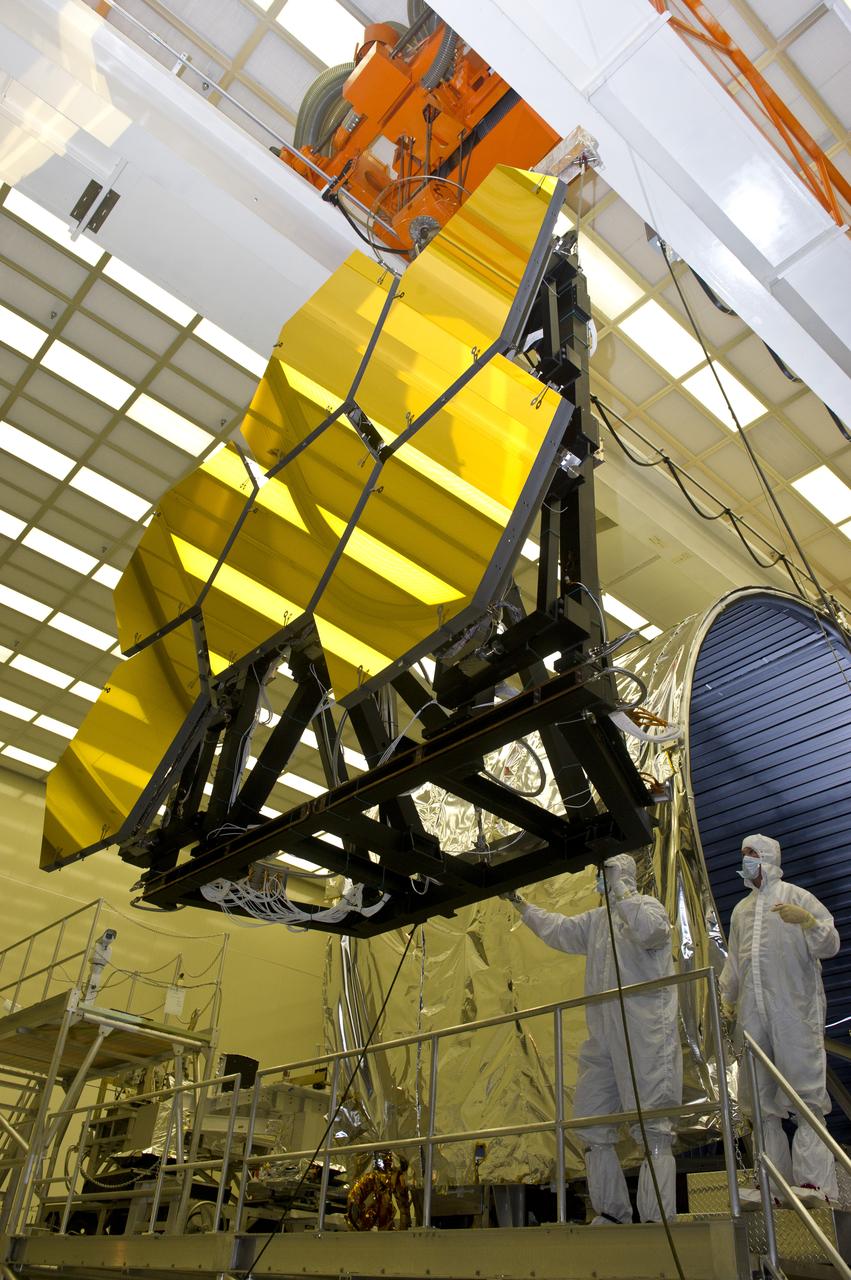
BALL AEROSPACE ENGINEER DAVE CHANEY, (L), AND MARSHALL ENGINEER HARLAN HAIGHT, (R), GUIDE ARRAY OF SIX GOLD-PLATED JAMES WEBB SPACE TELESCOPE MIRRORS AFTER FINAL ACCEPTANCE TESTING AT MARSHALL'S X-RAY AND CRYOGENIC FACILITY
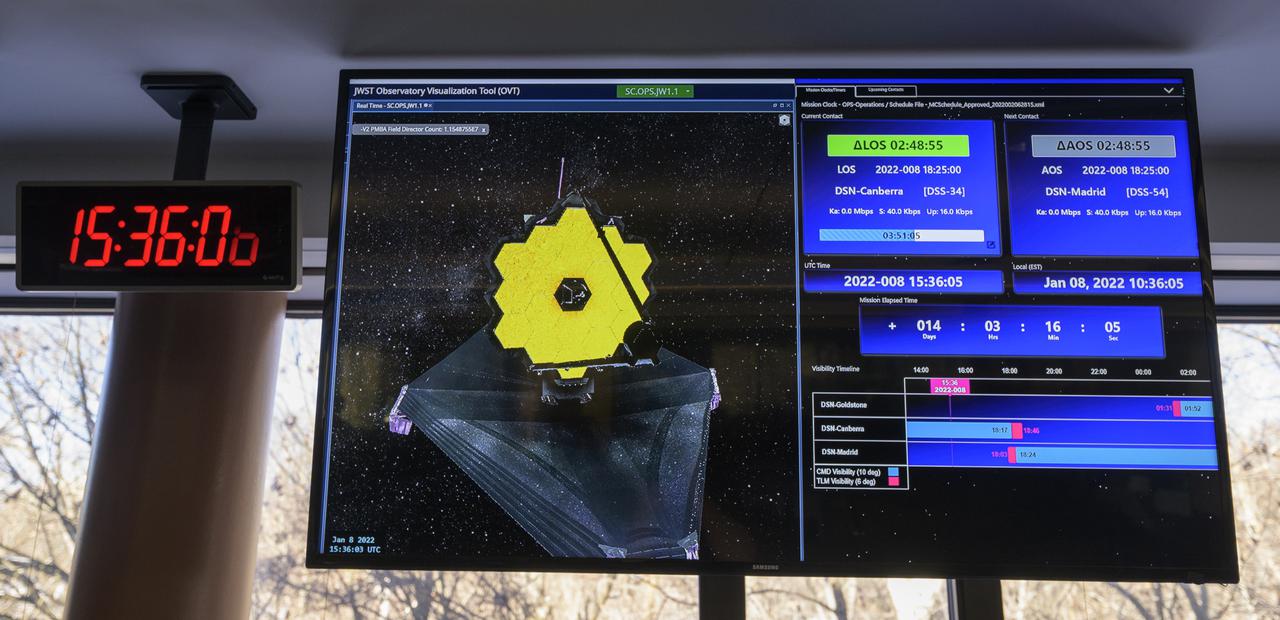
A monitor in the NASA James Webb Space Telescope flight control room of the Space Telescope Science Institute shows the progress of the second primary mirror wing latching on the Webb observatory, Saturday, Jan. 8, 2022, in Baltimore. When fully latched, the infrared observatory will have completed its unprecedented process of unfolding in space to prepare for science operations. Webb will study every phase of cosmic history—from within our solar system to the most distant observable galaxies in the early universe. Photo Credit: (NASA/Bill Ingalls)
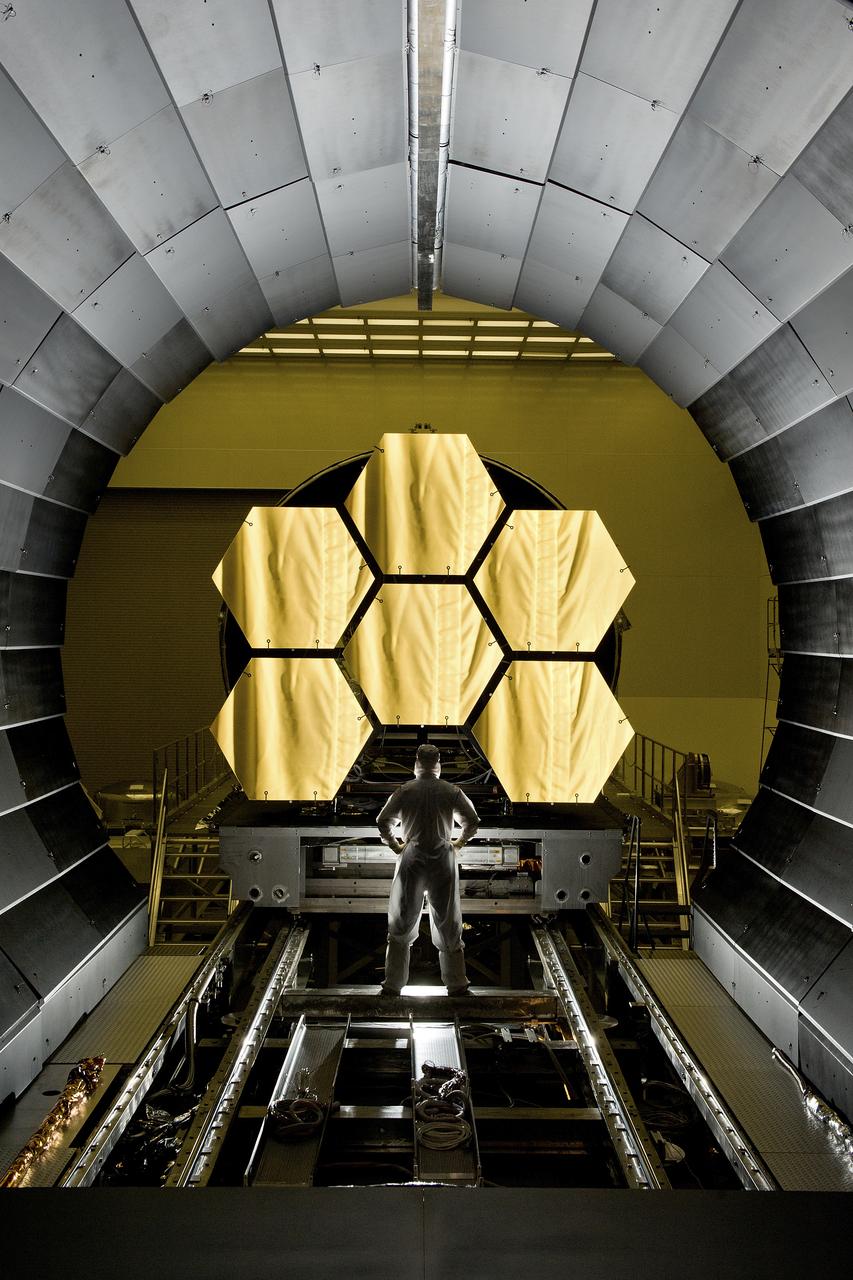
ERNIE WRIGHT STANDS NEAR THE JAMES WEBB SPACE TELESCOPE MIRRORS AS THEY SIT JUST OUTSIDE THE TESTING CHAMBER IN THE XRAY CALIBRATION FACILITY AT MSFC
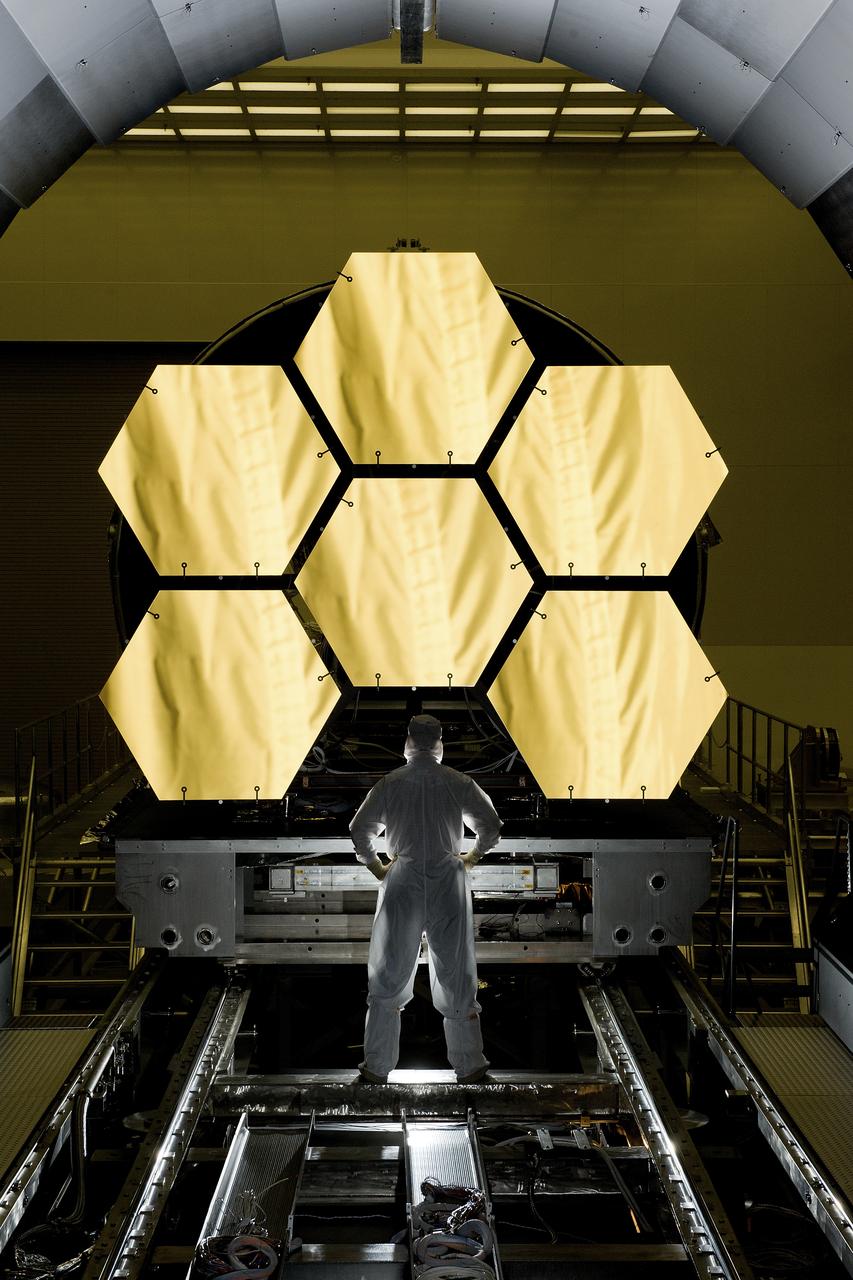
ERNIE WRIGHT STANDS NEAR THE JAMES WEBB SPACE TELESCOPE MIRRORS AS THEY SIT JUST OUTSIDE THE TESTING CHAMBER IN THE XRAY CALIBRATION FACILITY AT MSFC
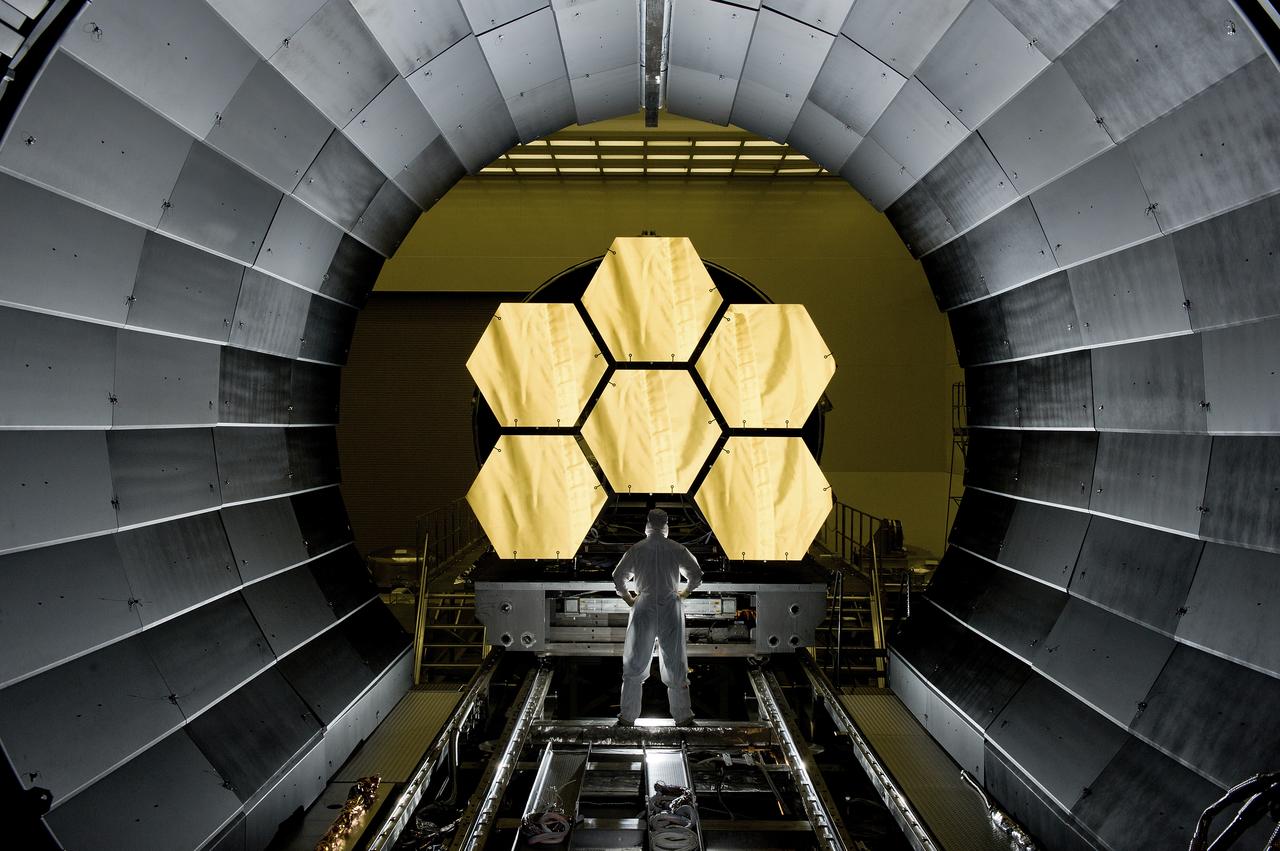
ERNIE WRIGHT STANDS NEAR THE JAMES WEBB SPACE TELESCOPE MIRRORS AS THEY SIT JUST OUTSIDE THE TESTING CHAMBER IN THE XRAY CALIBRATION FACILITY AT MSFC
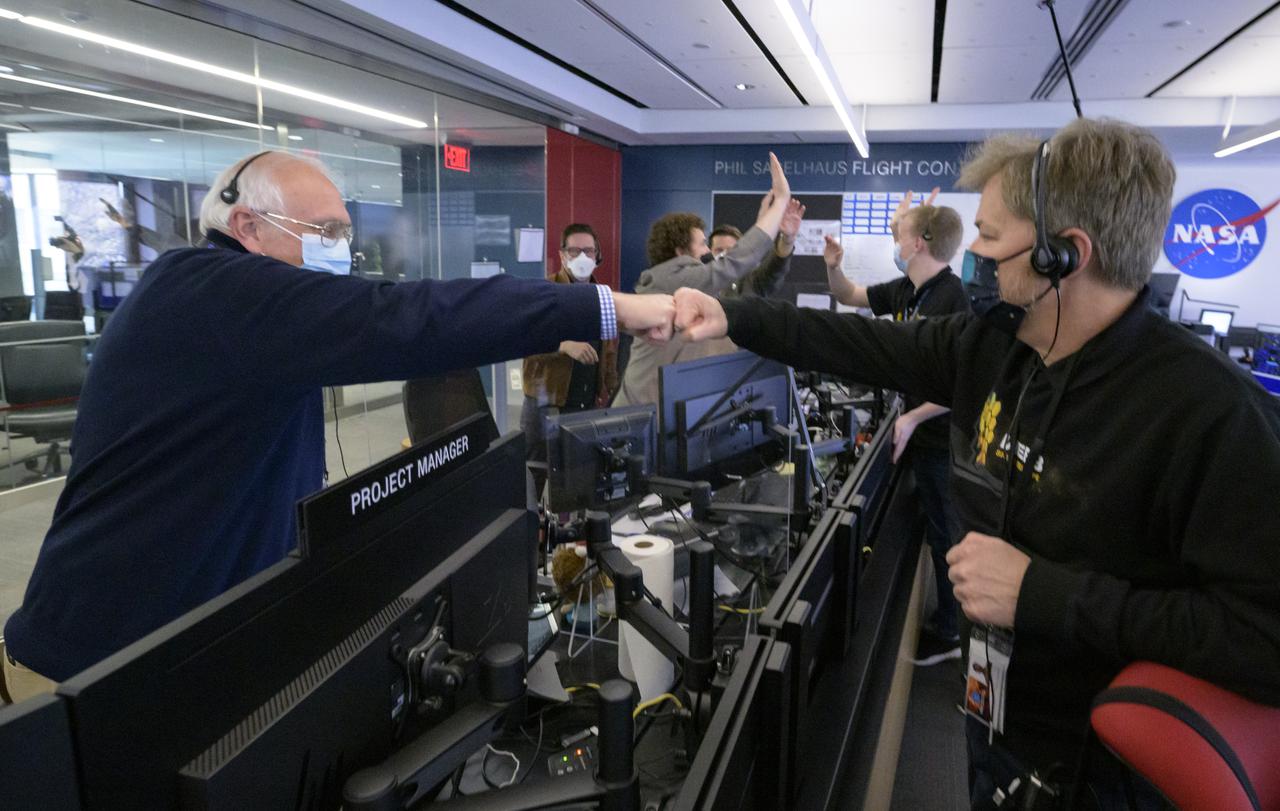
NASA James Webb Space Telescope Project Manager Bill Ochs, left, NASA James Webb Space Telescope Commissioning Manager John Durning, right and others from the operations team celebrate, Saturday, Jan. 8, 2022, at the Space Telescope Science Institute in Baltimore, after confirming that the observatory’s final primary mirror wing successfully extended and locked into place. With Webb’s 21.3-foot (6.5-meter) primary mirror fully deployed, the infrared observatory has completed its unprecedented process of unfolding in space to prepare for science operations. The observatory will study every phase of cosmic history—from within our solar system to the most distant observable galaxies in the early universe. Photo Credit: (NASA/Bill Ingalls)
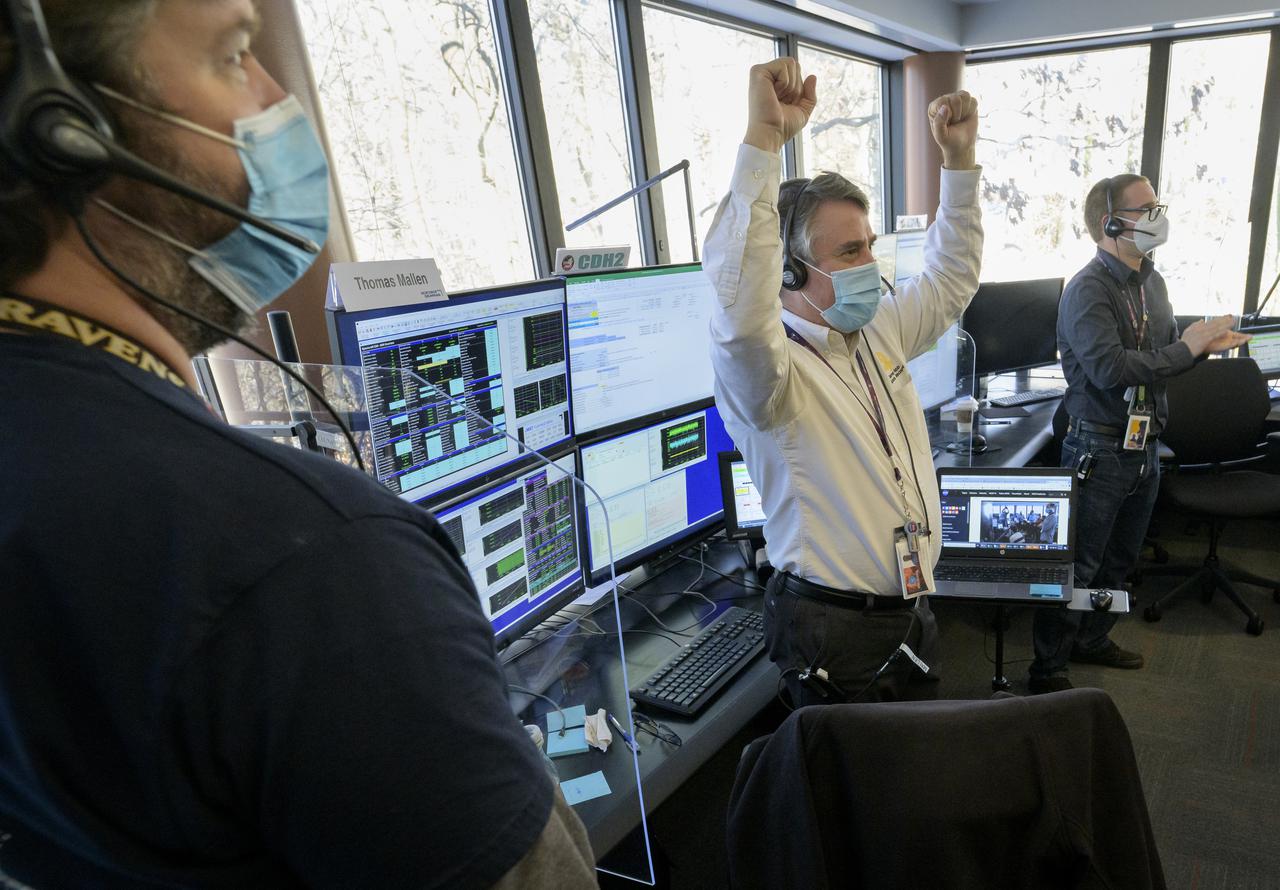
NASA’s James Webb Space Telescope mission operations team celebrates, Saturday, Jan. 8, 2022, at the Space Telescope Science Institute in Baltimore, after confirming that the observatory’s final primary mirror wing successfully extended and locked into place. With Webb’s 21.3-foot (6.5-meter) primary mirror fully deployed, the infrared observatory has completed its unprecedented process of unfolding in space to prepare for science operations. The observatory will study every phase of cosmic history—from within our solar system to the most distant observable galaxies in the early universe. Photo Credit: (NASA/Bill Ingalls)
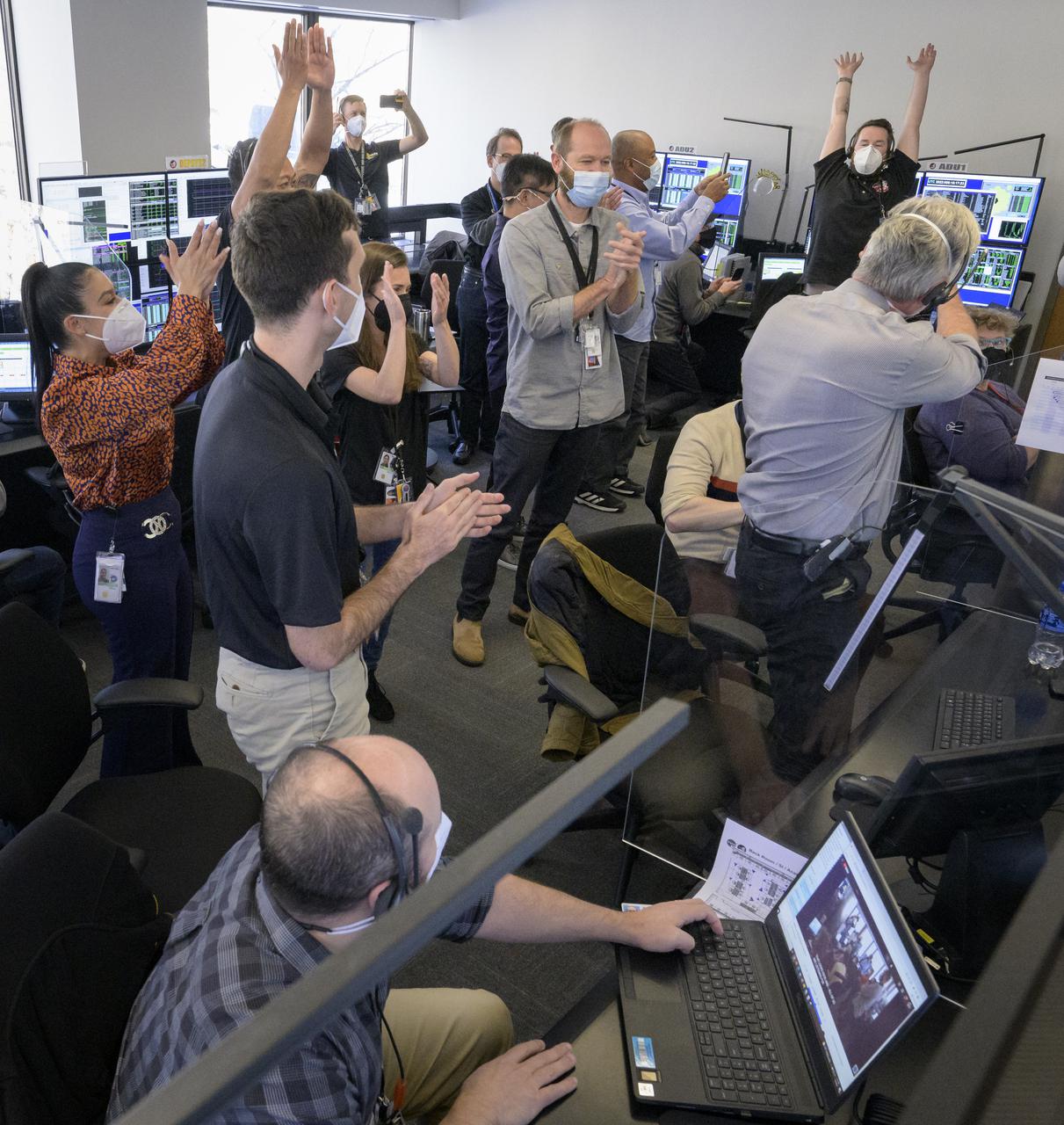
NASA’s James Webb Space Telescope mission operations team celebrates, Saturday, Jan. 8, 2022, at the Space Telescope Science Institute in Baltimore, after confirming that the observatory’s final primary mirror wing successfully extended and locked into place. With Webb’s 21.3-foot (6.5-meter) primary mirror fully deployed, the infrared observatory has completed its unprecedented process of unfolding in space to prepare for science operations. The observatory will study every phase of cosmic history—from within our solar system to the most distant observable galaxies in the early universe. Photo Credit: (NASA/Bill Ingalls)
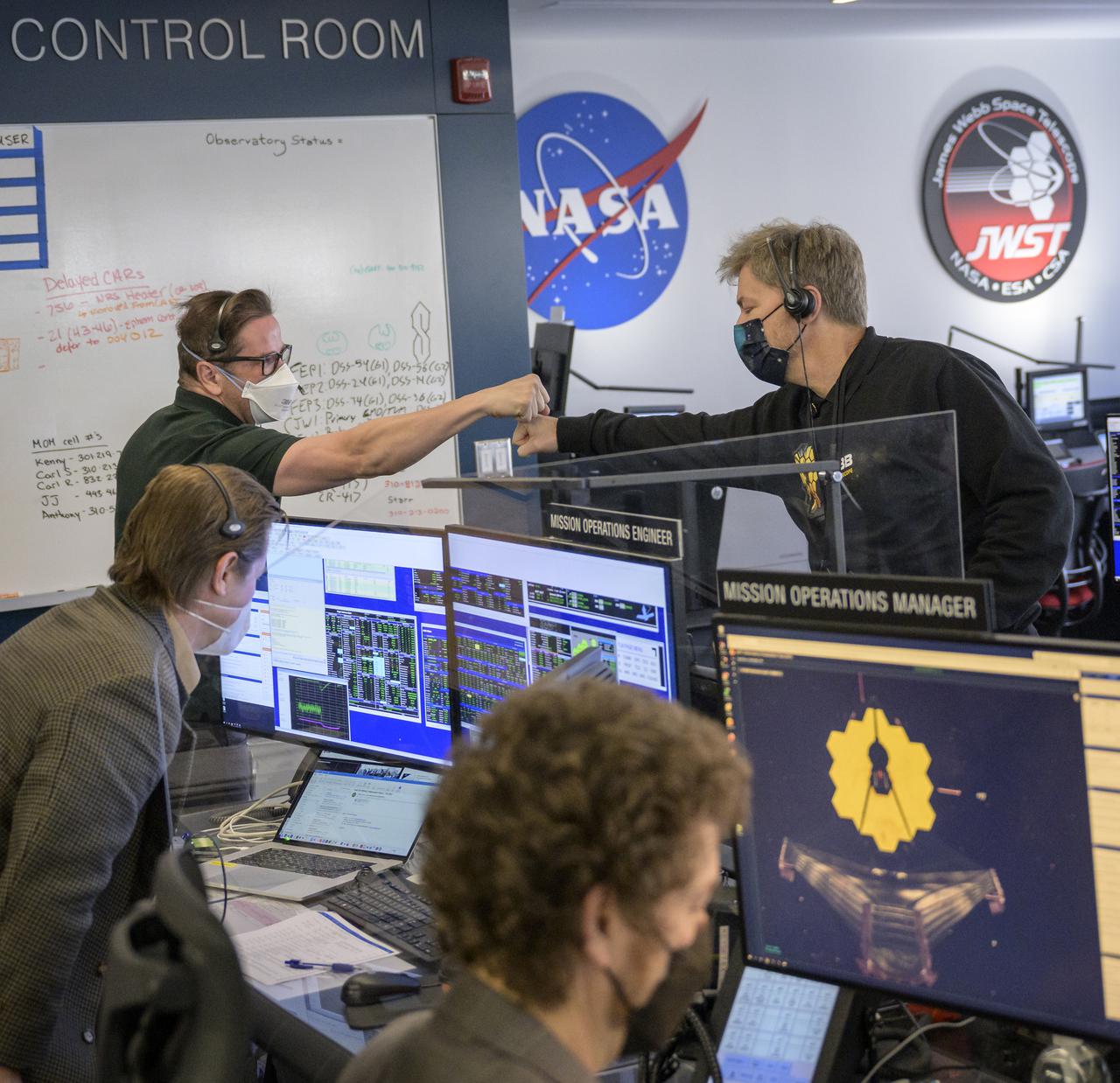
Engineering teams celebrate at the Space Telescope Science Institute in Baltimore as the second primary mirror wing of NASA’s James Webb Space Telescope unfolds, before beginning the process of latching the mirror wing into place, Saturday, Jan. 8, 2022. When fully latched, the infrared observatory will have completed its unprecedented process of unfolding in space to prepare for science operations. Webb will study every phase of cosmic history—from within our solar system to the most distant observable galaxies in the early universe. Photo Credit: (NASA/Bill Ingalls)
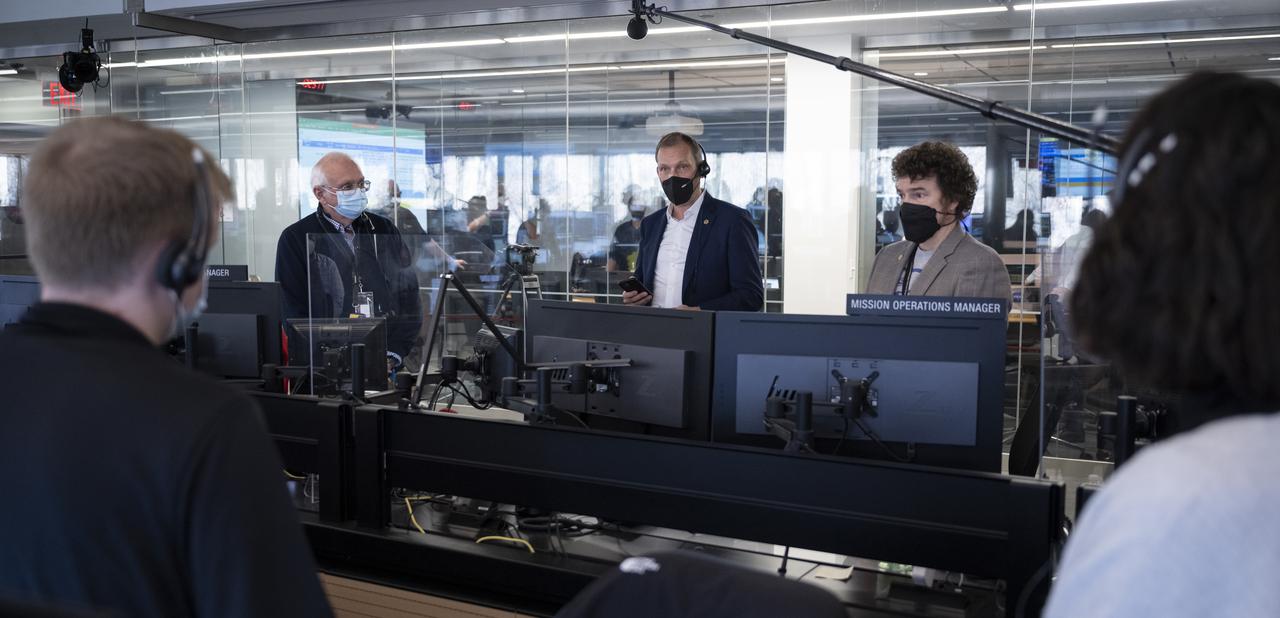
NASA Associate Administrator for the Science Mission Directorate Thomas Zurbuchen congratulates the NASA James Webb Space Telescope mission operations team after confirming that the observatory’s final primary mirror wing successfully extended and locked into place, Saturday, Jan. 8, 2022, at the Space Telescope Science Institute in Baltimore. With Webb’s 21.3-foot (6.5-meter) primary mirror fully deployed, the infrared observatory has completed its unprecedented process of unfolding in space to prepare for science operations. The observatory will study every phase of cosmic history—from within our solar system to the most distant observable galaxies in the early universe. Photo Credit: (NASA/Bill Ingalls)
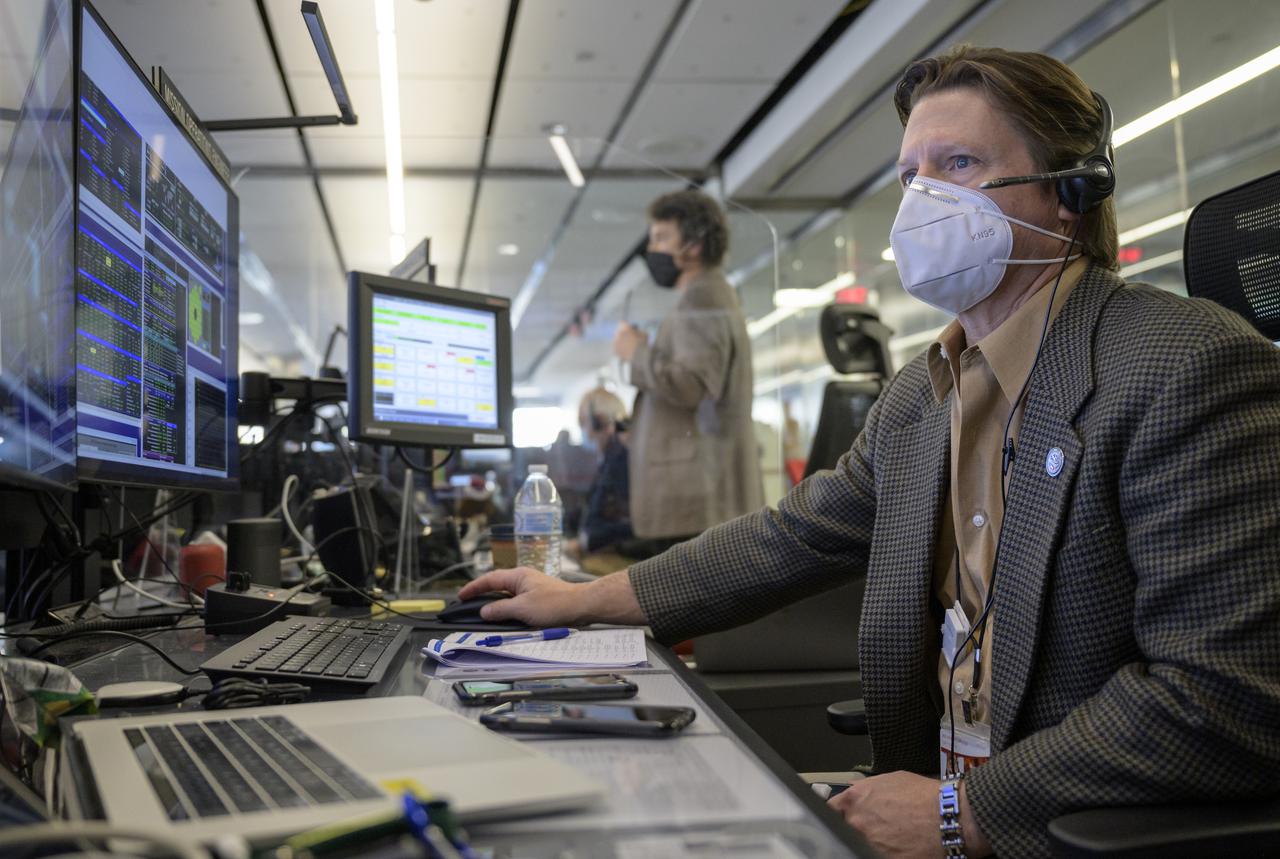
NASA James Webb Space Telescope Mission Operations Engineer Kenny McKenzie monitors the progress of Webb’s second primary mirror wing latching, Saturday, Jan. 8, 2022, in Baltimore. When fully latched, the infrared observatory will have completed its unprecedented process of unfolding in space to prepare for science operations. Webb will study every phase of cosmic history—from within our solar system to the most distant observable galaxies in the early universe. Photo Credit: (NASA/Bill Ingalls)
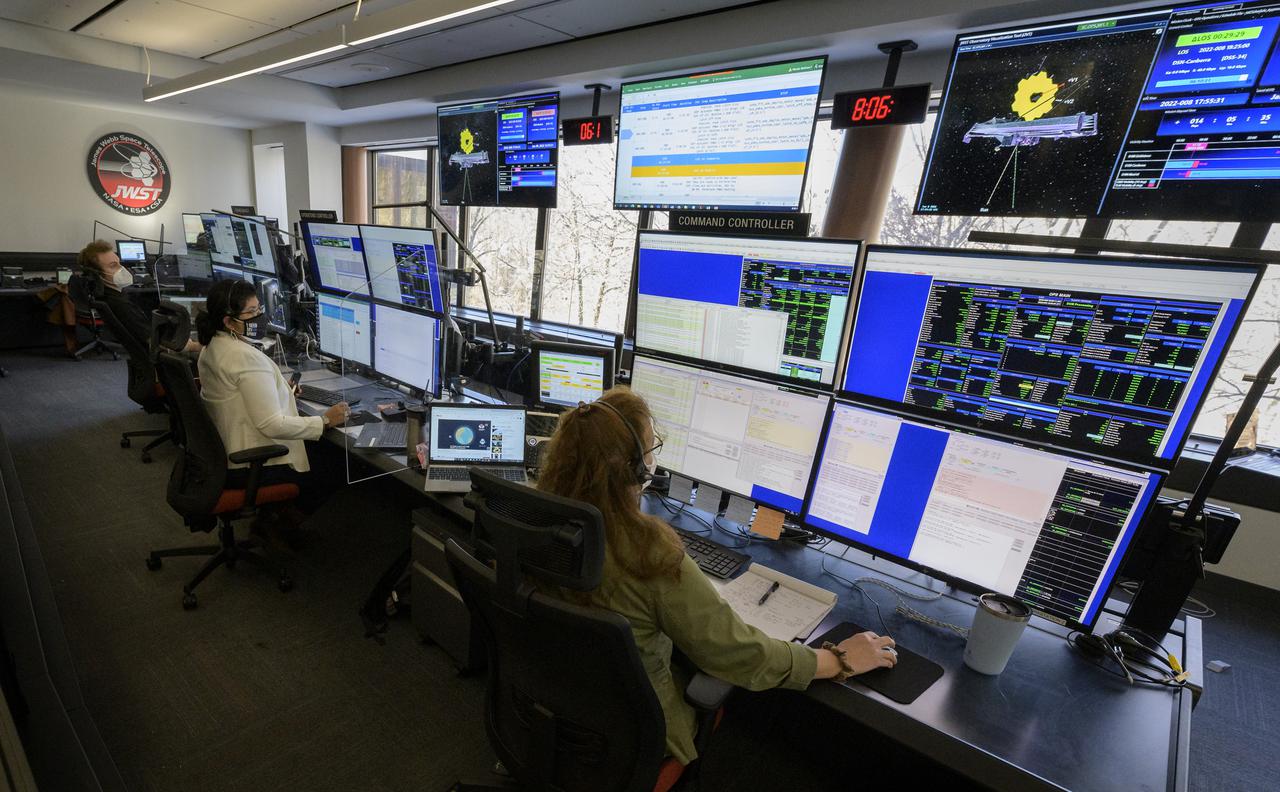
NASA James Webb Space Telescope Mission team members monitor the progress of Webb’s second primary mirror wing latching, Saturday, Jan. 8, 2022, in Baltimore. When fully latched, the infrared observatory will have completed its unprecedented process of unfolding in space to prepare for science operations. Webb will study every phase of cosmic history—from within our solar system to the most distant observable galaxies in the early universe. Photo Credit: (NASA/Bill Ingalls)
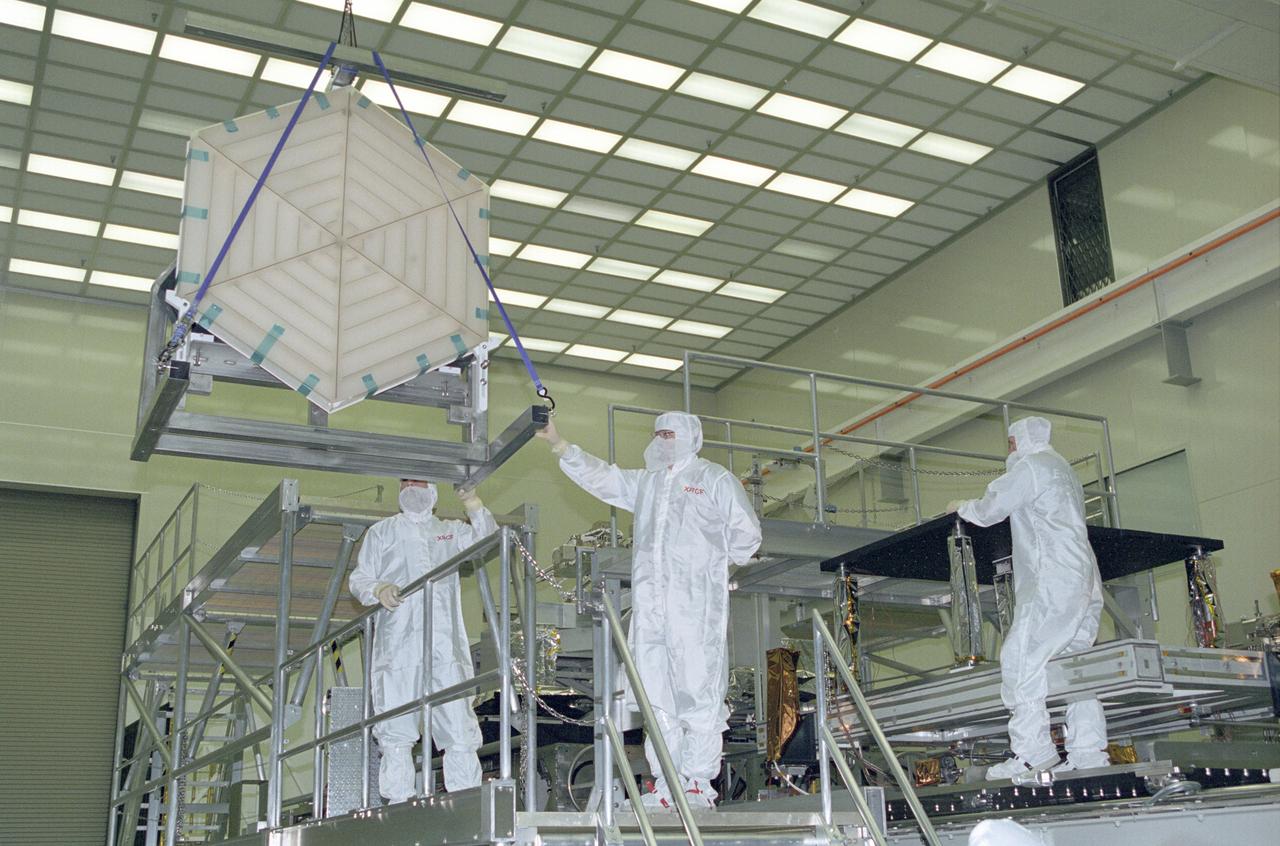
In this photograph, the composite material mirror is tested in the X-Ray Calibration Facility at the Marshall Space Flight Center for the James Webb Space Telescope (JWST). The mirror test conducted was to check the ability to accurately model and predict the cryogenic performance of complex mirror systems, and the characterization of cryogenic dampening properties of beryllium. The JWST, a next generation successor to the Hubble Space Telescope (HST), was named in honor of James W. Webb, NASA's second administrator, who led NASA in the early days of the fledgling Aerospace Agency. Scheduled for launch in 2010 aboard an expendable launch vehicle, the JWST will be able to look deeper into the universe than the HST because of the increased light-collecting power of its larger mirror and the extraordinary sensitivity of its instrument to infrared light.
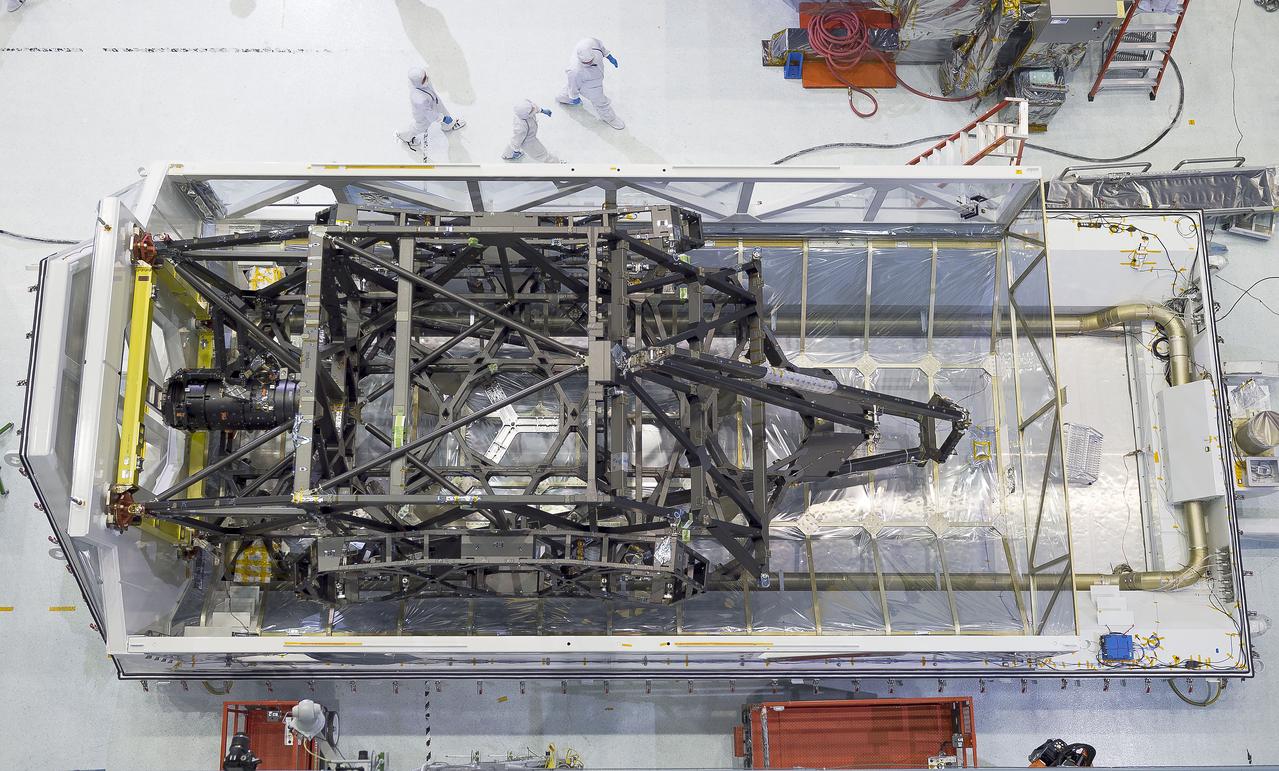
The James Webb Space Telescope's "spine" or backplane arrived on Aug. 25 at NASA's Goddard Space Flight Center in Greenbelt, Maryland from Northrop Grumman. Credits: NASA Goddard/Chris Gunn Read more: <a href="http://go.nasa.gov/1K2v8J2" rel="nofollow">go.nasa.gov/1K2v8J2</a> <b><a href="http://www.nasa.gov/audience/formedia/features/MP_Photo_Guidelines.html" rel="nofollow">NASA image use policy.</a></b> <b><a href="http://www.nasa.gov/centers/goddard/home/index.html" rel="nofollow">NASA Goddard Space Flight Center</a></b> enables NASA’s mission through four scientific endeavors: Earth Science, Heliophysics, Solar System Exploration, and Astrophysics. Goddard plays a leading role in NASA’s accomplishments by contributing compelling scientific knowledge to advance the Agency’s mission. <b>Follow us on <a href="http://twitter.com/NASAGoddardPix" rel="nofollow">Twitter</a></b> <b>Like us on <a href="http://www.facebook.com/pages/Greenbelt-MD/NASA-Goddard/395013845897?ref=tsd" rel="nofollow">Facebook</a></b> <b>Find us on <a href="http://instagrid.me/nasagoddard/?vm=grid" rel="nofollow">Instagram</a></b>
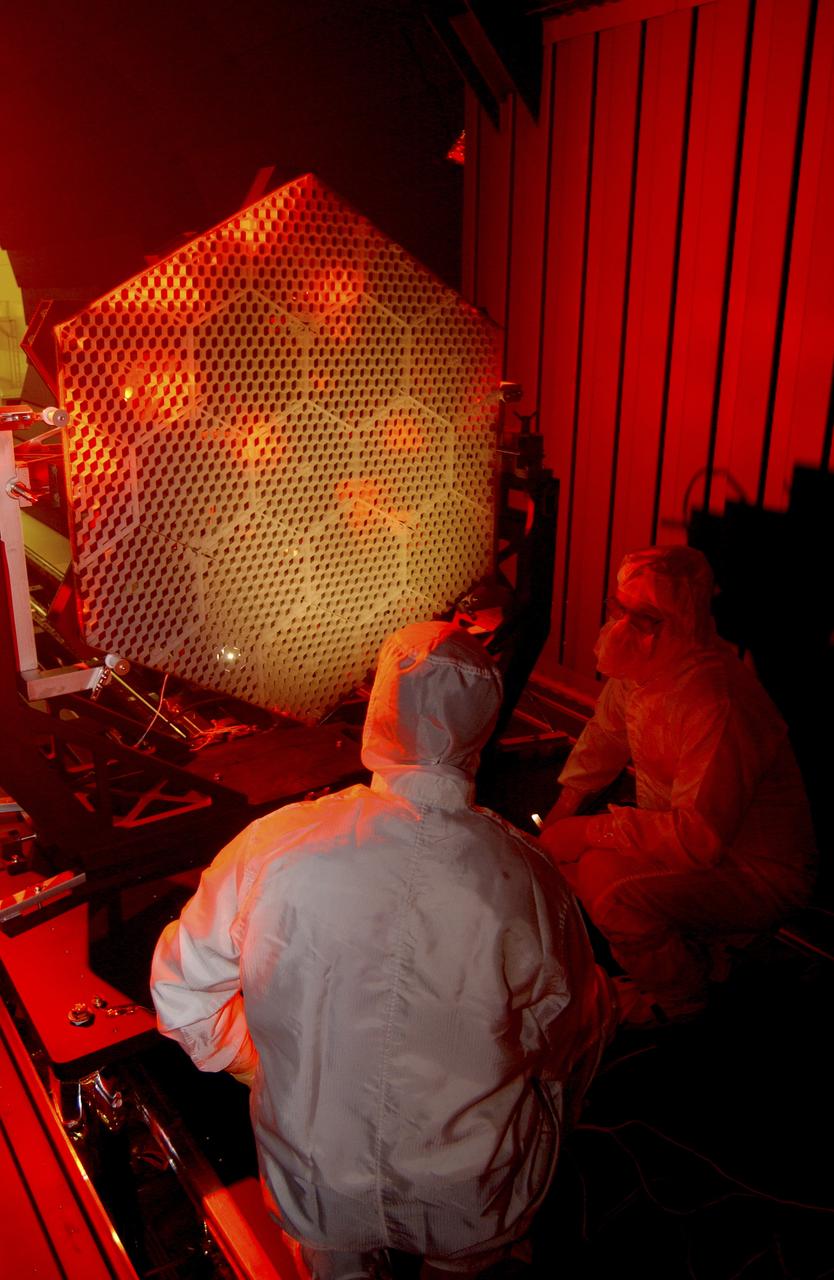
The Eastman-Kodak mirror assembly is being tested for the James Webb Space Telescope (JWST) project at the X-Ray Calibration Facility at Marshall Space Flight Center (MSFC). In this photo, one of many segments of the mirror assembly is being set up inside the 24-ft vacuum chamber where it will undergo x-ray calibration tests. MSFC is supporting Goddard Space Flight Center (GSFC) in developing the JWST by taking numerous measurements to predict its future performance. The tests are conducted in a vacuum chamber cooled to approximate the super cold temperatures found in space. During its 27 years of operation, the facility has performed testing in support of a wide array of projects, including the Hubble Space Telescope (HST), Solar A, Chandra technology development, Chandra High Resolution Mirror Assembly and science instruments, Constellation X-Ray Mission, and Solar X-Ray Imager, currently operating on a Geostationary Operational Environment Satellite. The JWST is NASA's next generation space telescope, a successor to the Hubble Space Telescope, named in honor of NASA's second administrator, James E. Webb. It is scheduled for launch in 2010 aboard an expendable launch vehicle. It will take about 3 months for the spacecraft to reach its destination, an orbit of 940,000 miles in space.
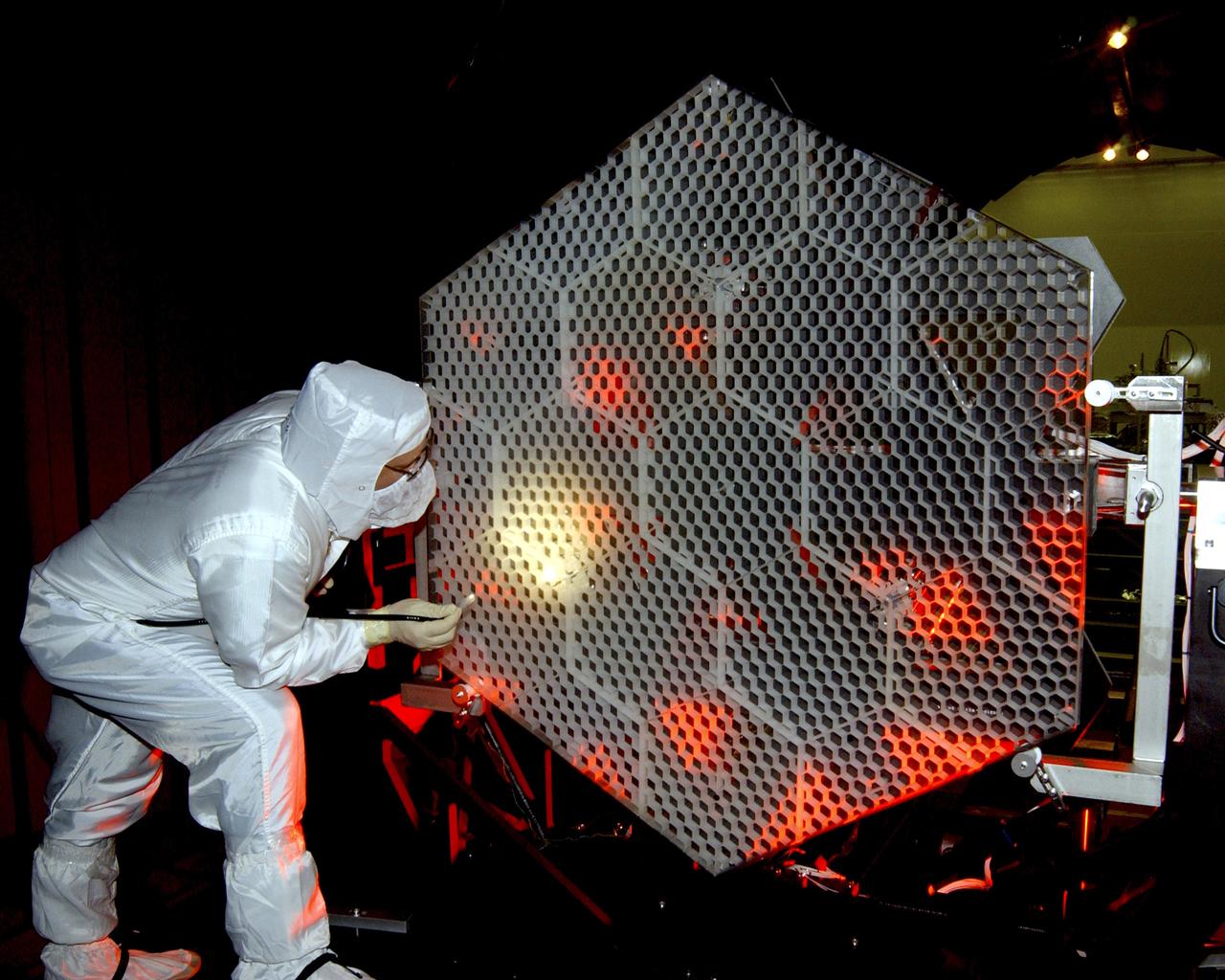
The Eastman-Kodak mirror assembly is being tested for the James Webb Space Telescope (JWST) project at the X-Ray Calibration Facility at Marshall Space Flight Center (MSFC). In this photo, an MSFC employee is inspecting one of many segments of the mirror assembly for flaws. MSFC is supporting Goddard Space Flight Center (GSFC) in developing the JWST by taking numerous measurements to predict its future performance. The tests are conducted in a vacuum chamber cooled to approximate the super cold temperatures found in space. During its 27 years of operation, the facility has performed testing in support of a wide array of projects, including the Hubble Space Telescope (HST), Solar A, Chandra technology development, Chandra High Resolution Mirror Assembly and science instruments, Constellation X-Ray Mission, and Solar X-Ray Imager, currently operating on a Geostationary Operational Environment Satellite. The JWST is NASA's next generation space telescope, a successor to the Hubble Space Telescope, named in honor of NASA's second administrator, James E. Webb. It is scheduled for launch in 2010 aboard an expendable launch vehicle. It will take about 3 months for the spacecraft to reach its destination, an orbit of 940,000 miles in space.
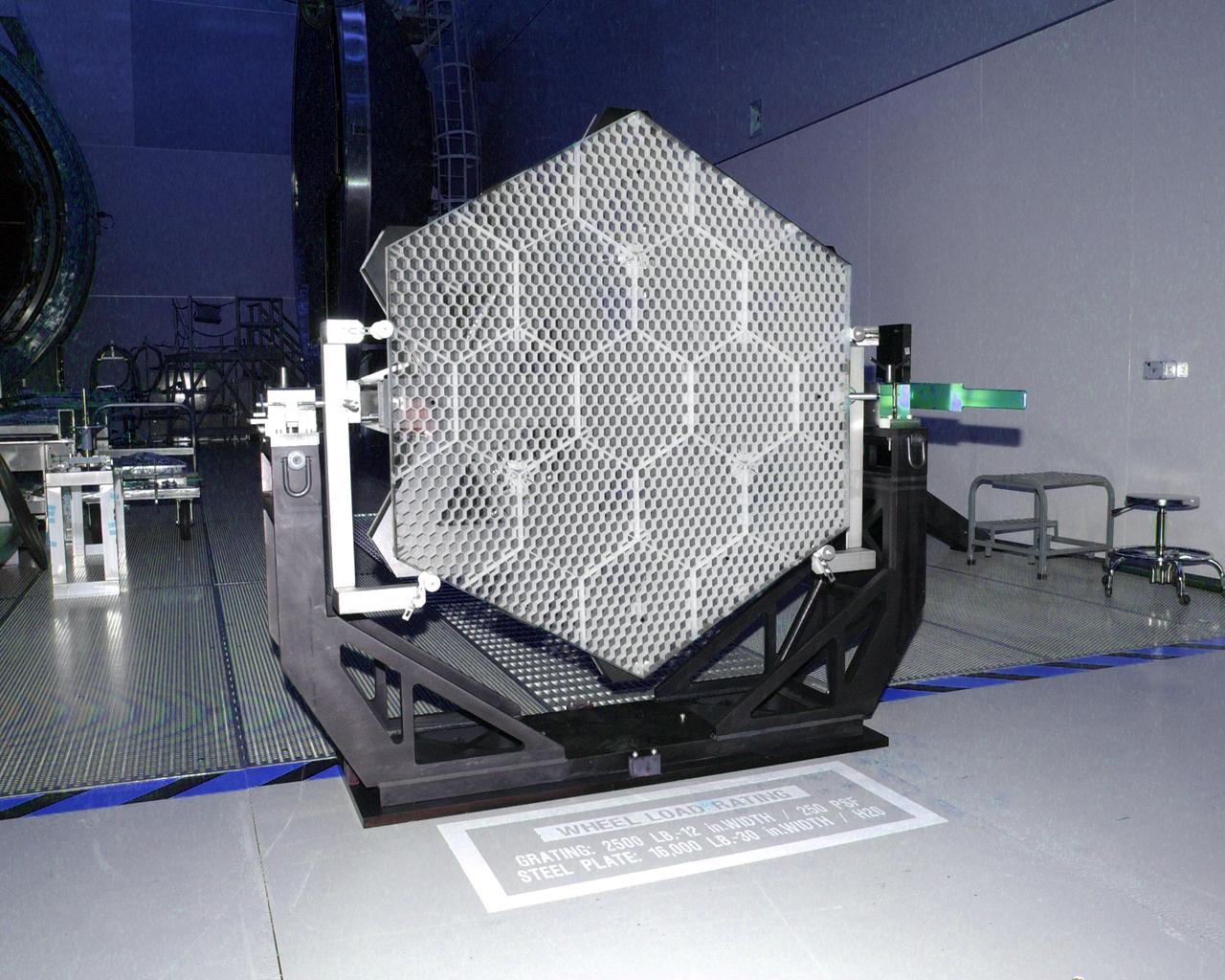
This photo (a frontal view) is of one of many segments of the Eastman-Kodak mirror assembly being tested for the James Webb Space Telescope (JWST) project at the X-Ray Calibration Facility at Marshall Space Flight Center (MSFC). MSFC is supporting Goddard Space Flight Center (GSFC) in developing the JWST by taking numerous measurements to predict its future performance. The tests are conducted in a vacuum chamber cooled to approximate the super cold temperatures found in space. During its 27 years of operation, the facility has performed testing in support of a wide array of projects, including the Hubble Space Telescope (HST), Solar A, Chandra technology development, Chandra High Resolution Mirror Assembly and science instruments, Constellation X-Ray Mission, and Solar X-Ray Imager, currently operating on a Geostationary Operational Environment Satellite. The JWST is NASA's next generation space telescope, a successor to the Hubble Space Telescope, named in honor of NASA's second administrator, James E. Webb. It is scheduled for launch in 2010 aboard an expendable launch vehicle. It will take about 3 months for the spacecraft to reach its destination, an orbit of 940,000 miles in space.
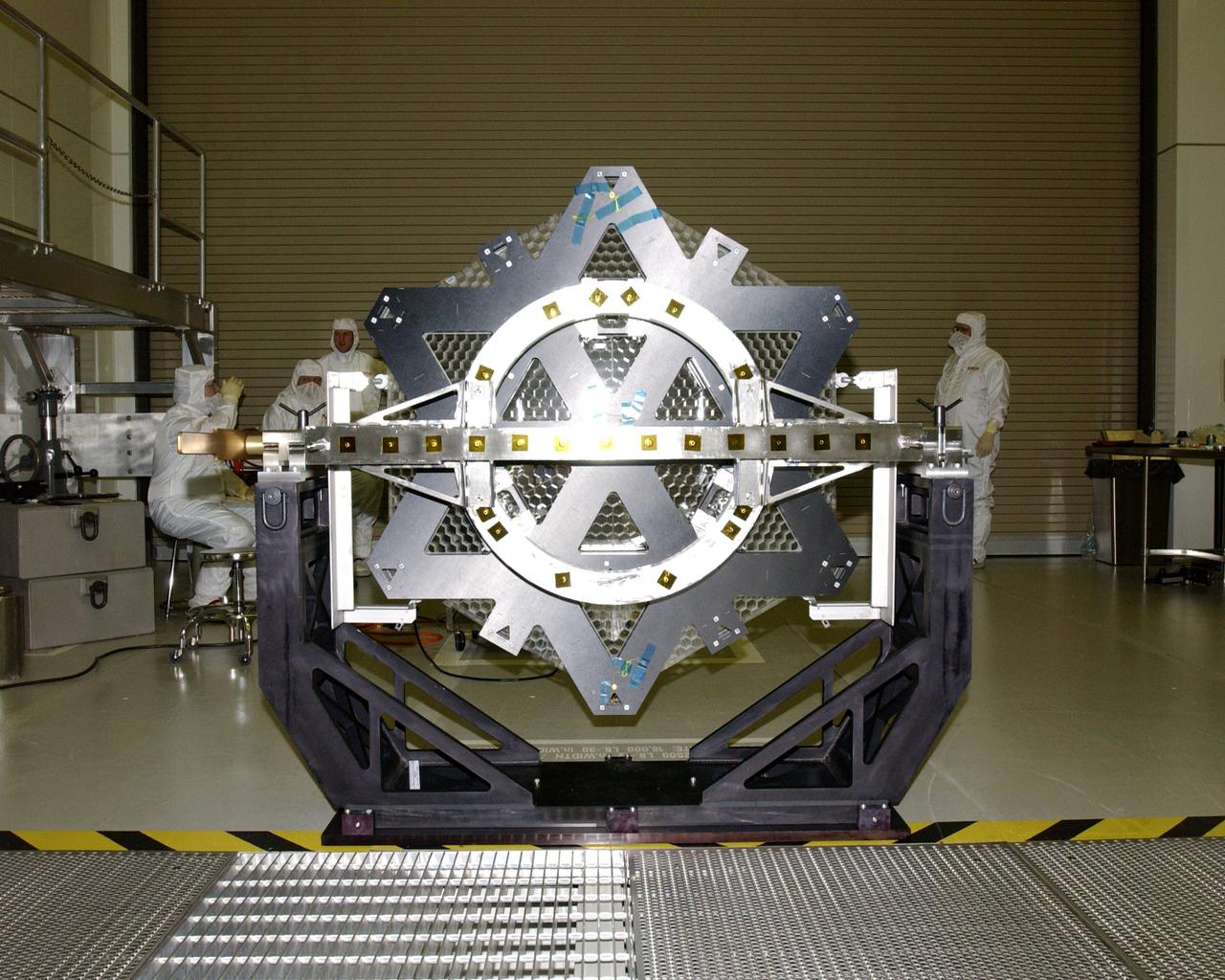
This photo (rear view) is of one of many segments of the Eastman-Kodak mirror assembly being tested for the James Webb Space Telescope (JWST) project at the X-Ray Calibration Facility at Marshall Space Flight Center (MSFC). MSFC is supporting Goddard Space Flight Center (GSFC) in developing the JWST by taking numerous measurements to predict its future performance. The tests are conducted in a vacuum chamber cooled to approximate the super cold temperatures found in space. During its 27 years of operation, the facility has performed testing in support of a wide array of projects, including the Hubble Space Telescope (HST), Solar A, Chandra technology development, Chandra High Resolution Mirror Assembly and science instruments, Constellation X-Ray Mission, and Solar X-Ray Imager, currently operating on a Geostationary Operational Environment Satellite. The JWST is NASA's next generation space telescope, a successor to the Hubble Space Telescope, named in honor of NASA's second administrator, James E. Webb. It is scheduled for launch in 2010 aboard an expendable launch vehicle. It will take about 3 months for the spacecraft to reach its destination, an orbit of 940,000 miles in space.
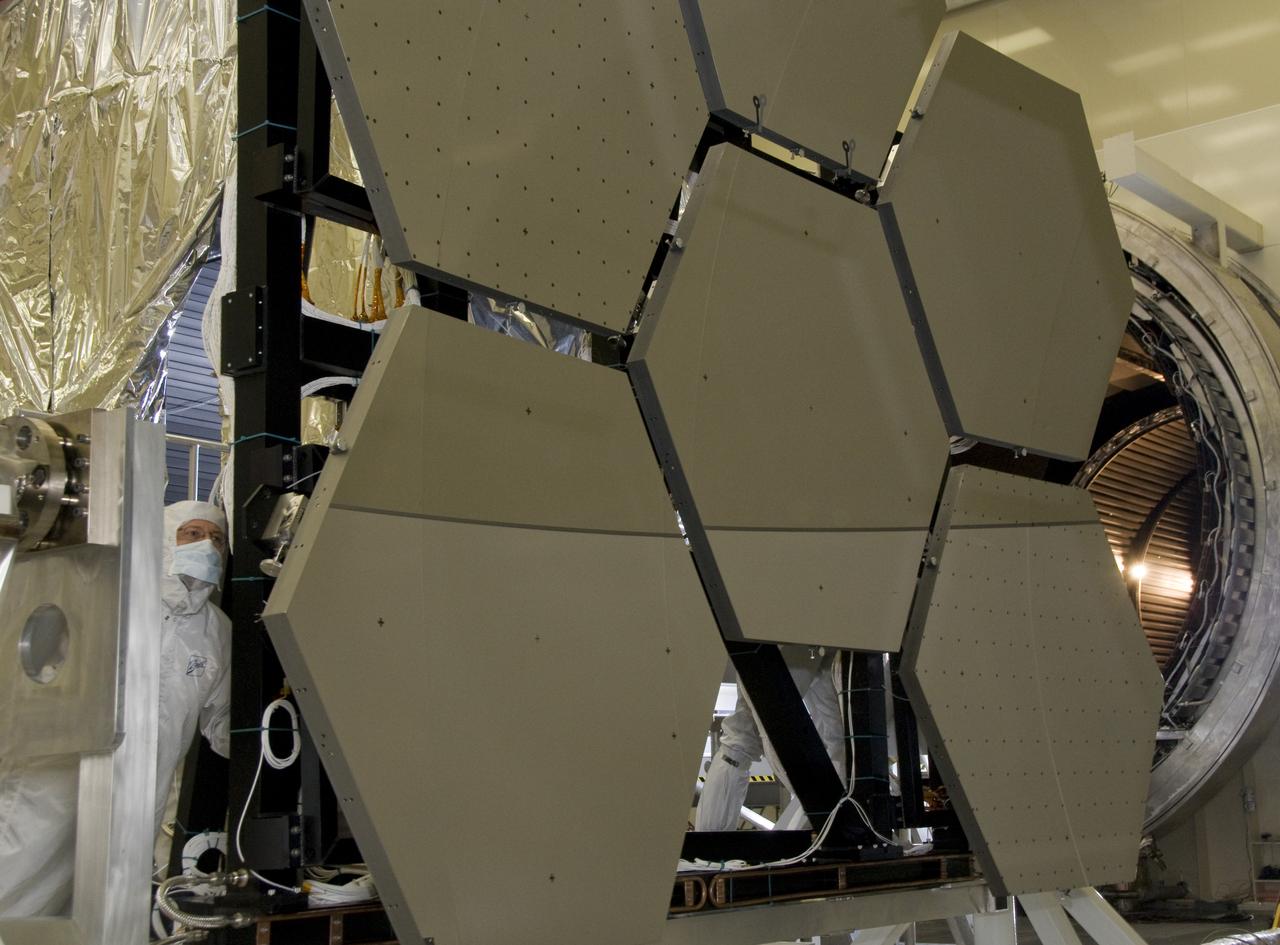
SIX OF THE EIGHTEEN JAMES WEBB SPACE TELESCOPE MIRROR SEGMENTS ARE BEING PREPPED TO MOVE INTO THE X-RAY AND CRYOGENIC FACILITY FOR TESTING.
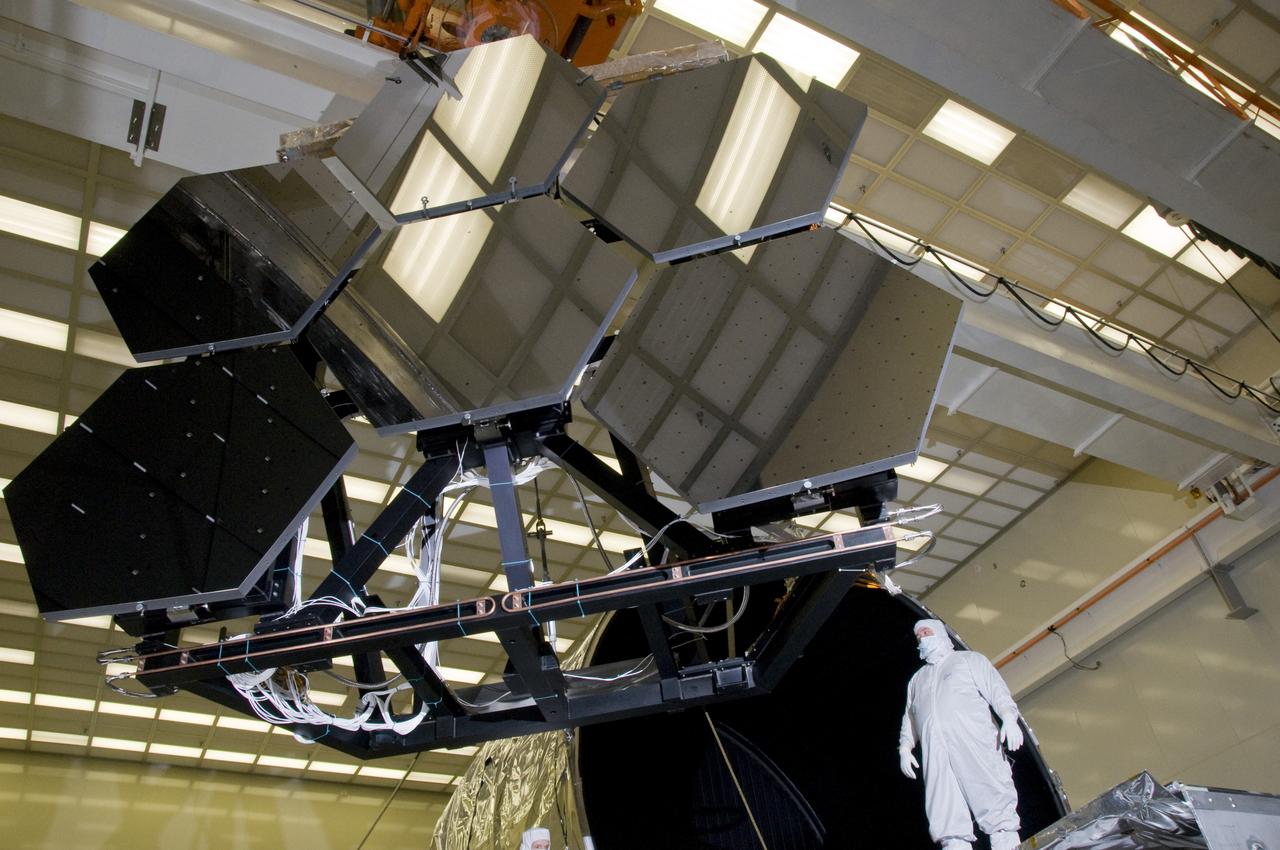
SIX OF THE EIGHTEEN JAMES WEBB SPACE TELESCOPE MIRROR SEGMENTS ARE BEING PREPPED TO MOVE INTO THE X-RAY AND CRYOGENIC FACILITY FOR TESTING.
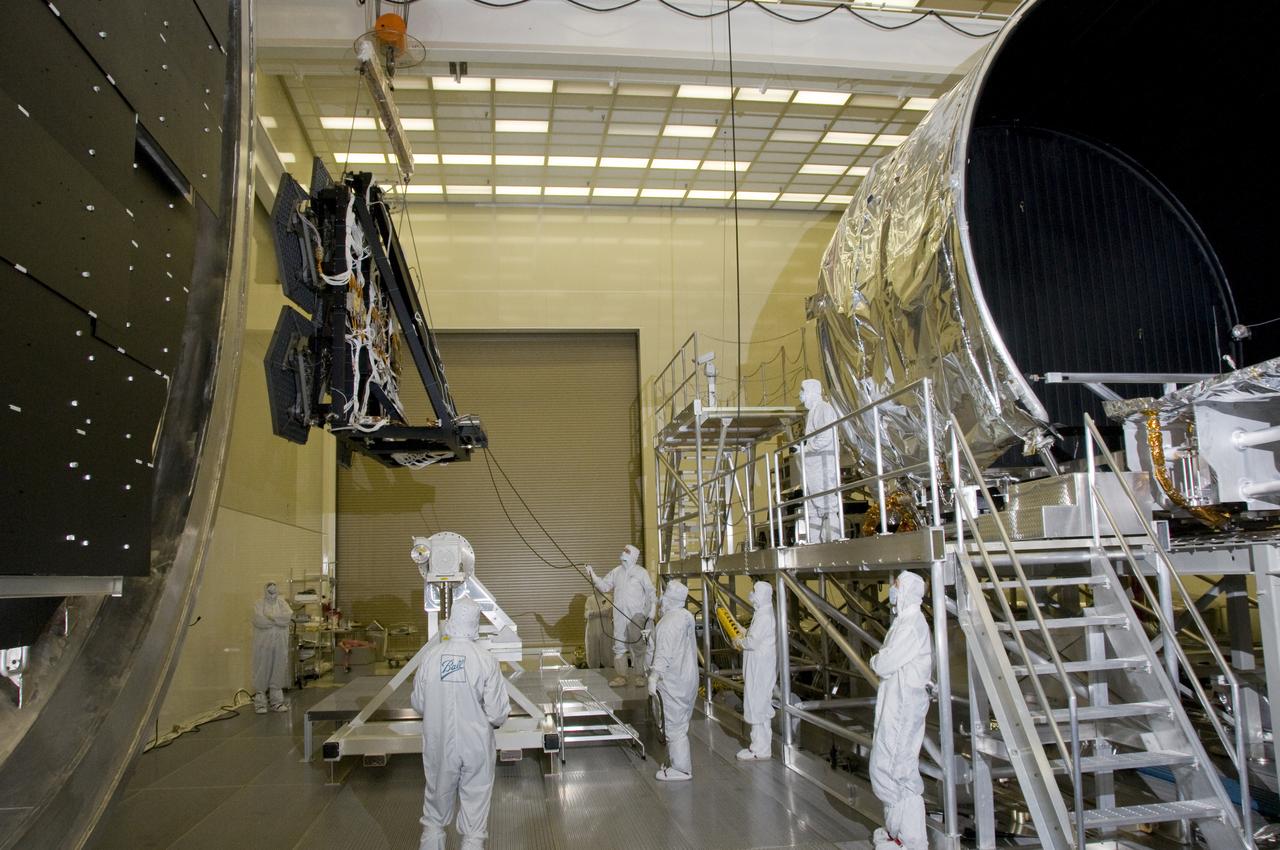
SIX OF THE EIGHTEEN JAMES WEBB SPACE TELESCOPE MIRROR SEGMENTS ARE BEING PREPPED TO MOVE INTO THE X-RAY AND CRYOGENIC FACILITY FOR TESTING.
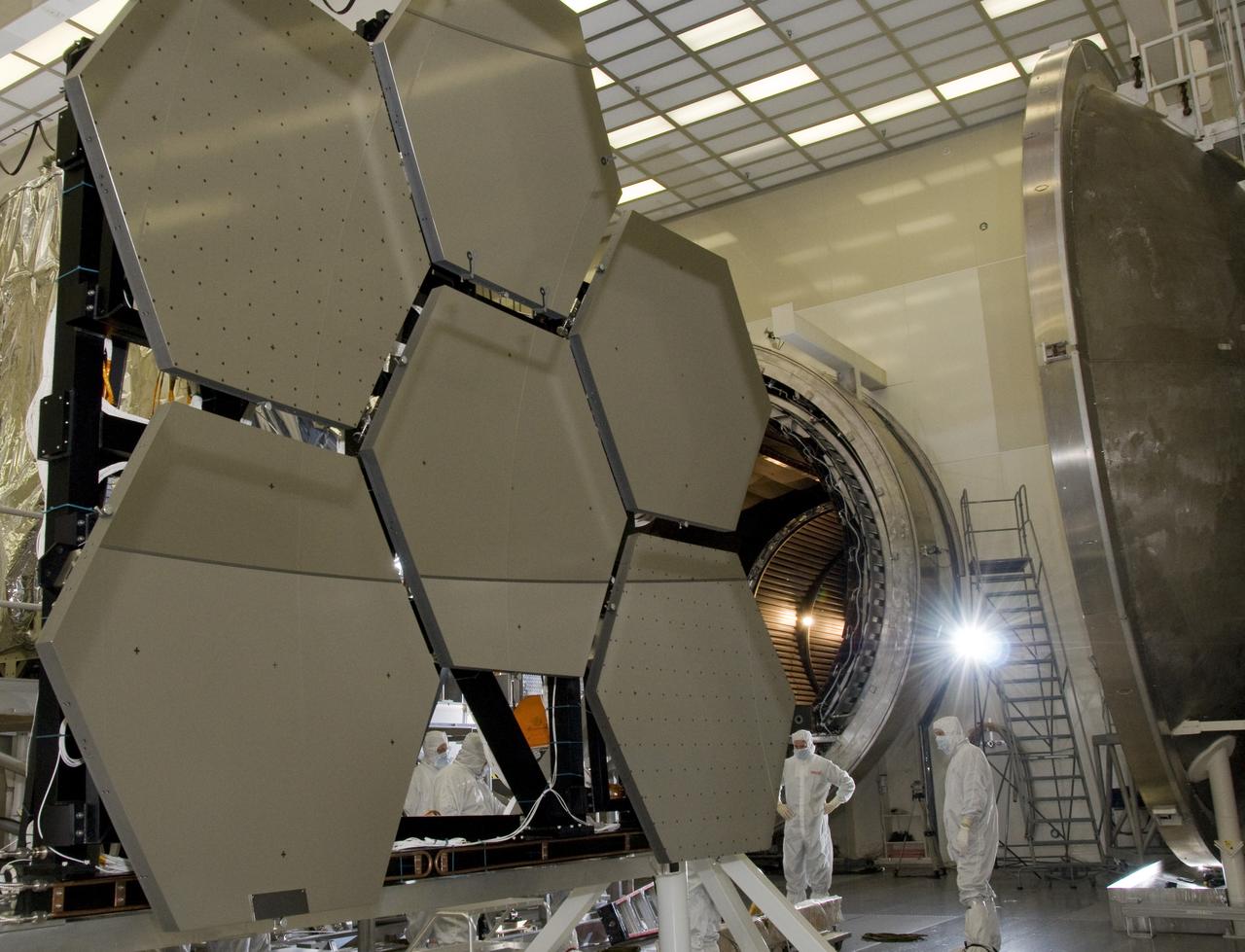
SIX OF THE EIGHTEEN JAMES WEBB SPACE TELESCOPE MIRROR SEGMENTS ARE BEING PREPPED TO MOVE INTO THE X-RAY AND CRYOGENIC FACILITY FOR TESTING.
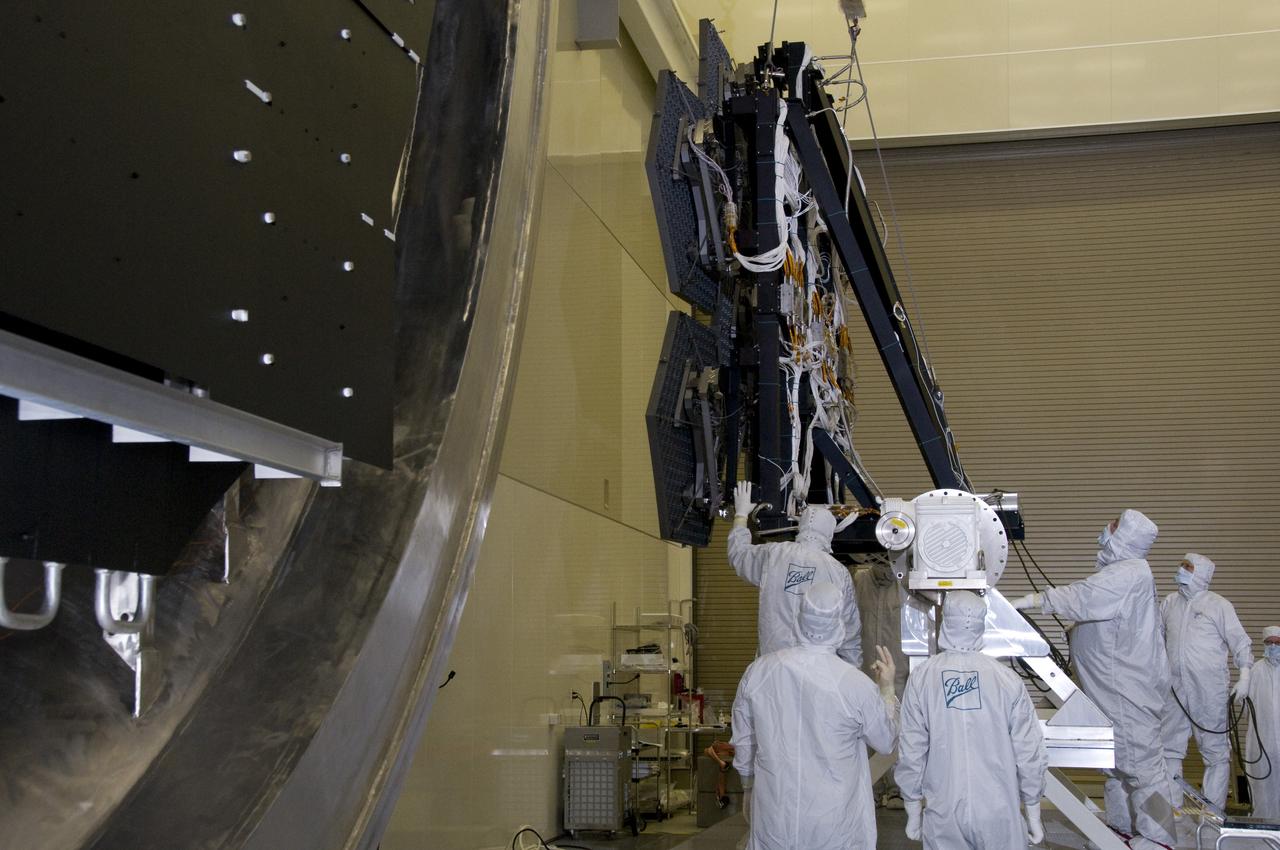
SIX OF THE EIGHTEEN JAMES WEBB SPACE TELESCOPE MIRROR SEGMENTS ARE BEING PREPPED TO MOVE INTO THE X-RAY AND CRYOGENIC FACILITY FOR TESTING.
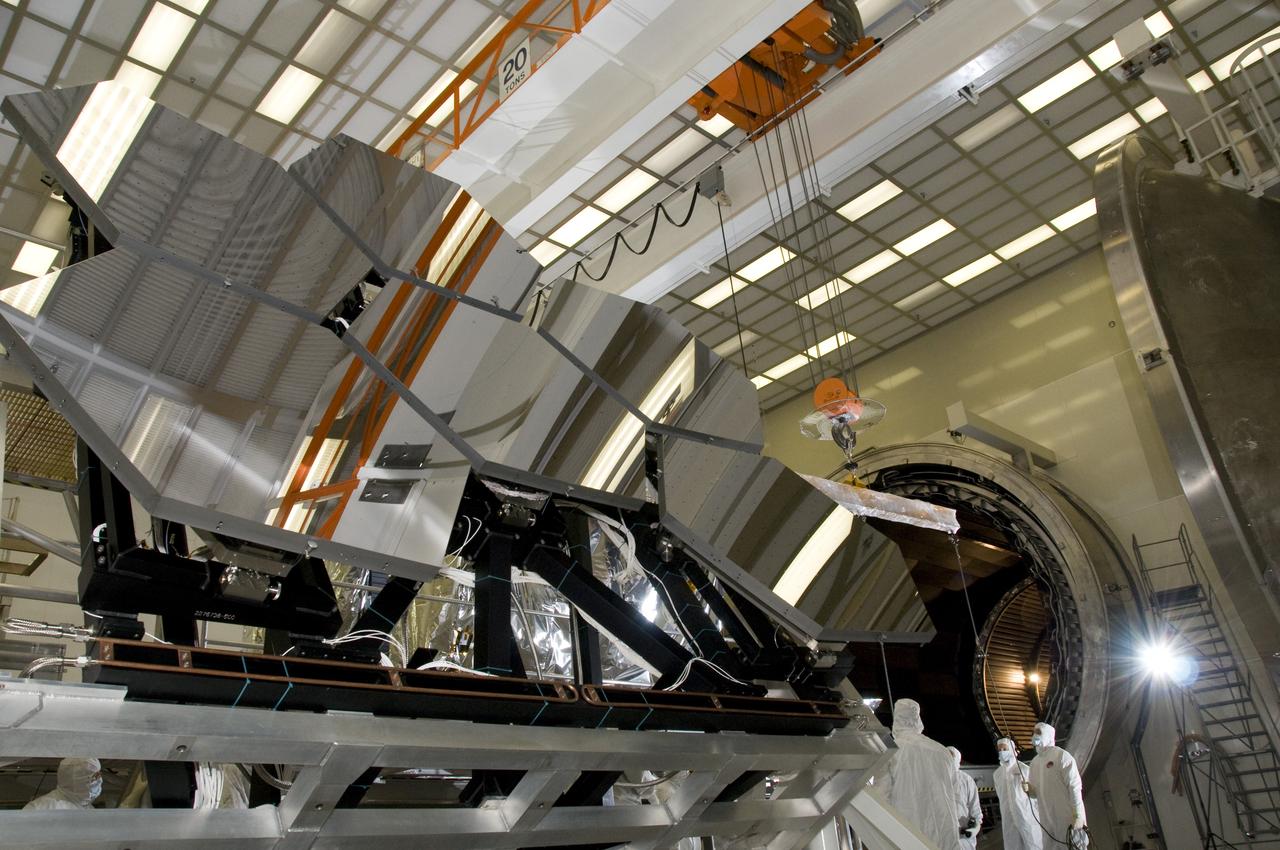
SIX OF THE EIGHTEEN JAMES WEBB SPACE TELESCOPE MIRROR SEGMENTS ARE BEING PREPPED TO MOVE INTO THE X-RAY AND CRYOGENIC FACILITY FOR TESTING.
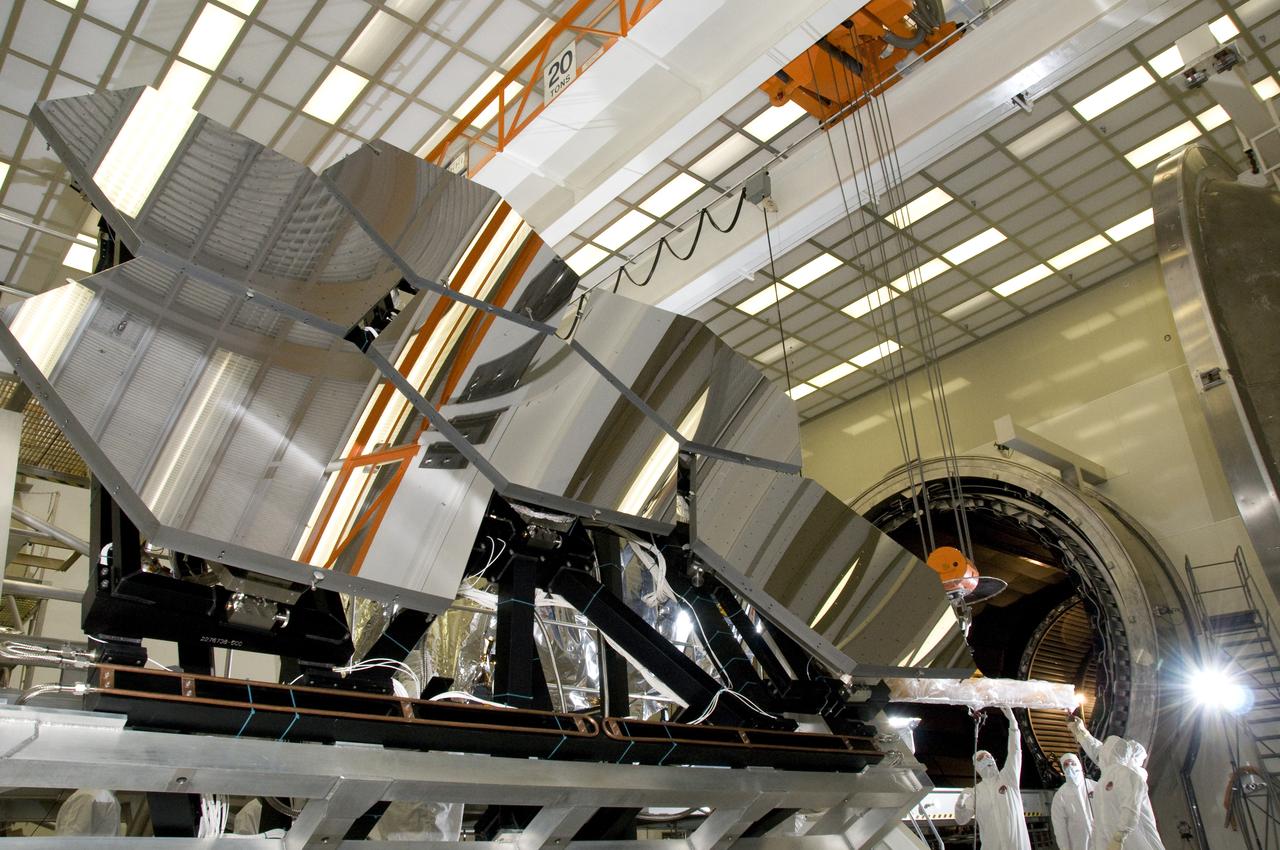
SIX OF THE EIGHTEEN JAMES WEBB SPACE TELESCOPE MIRROR SEGMENTS ARE BEING PREPPED TO MOVE INTO THE X-RAY AND CRYOGENIC FACILITY FOR TESTING.
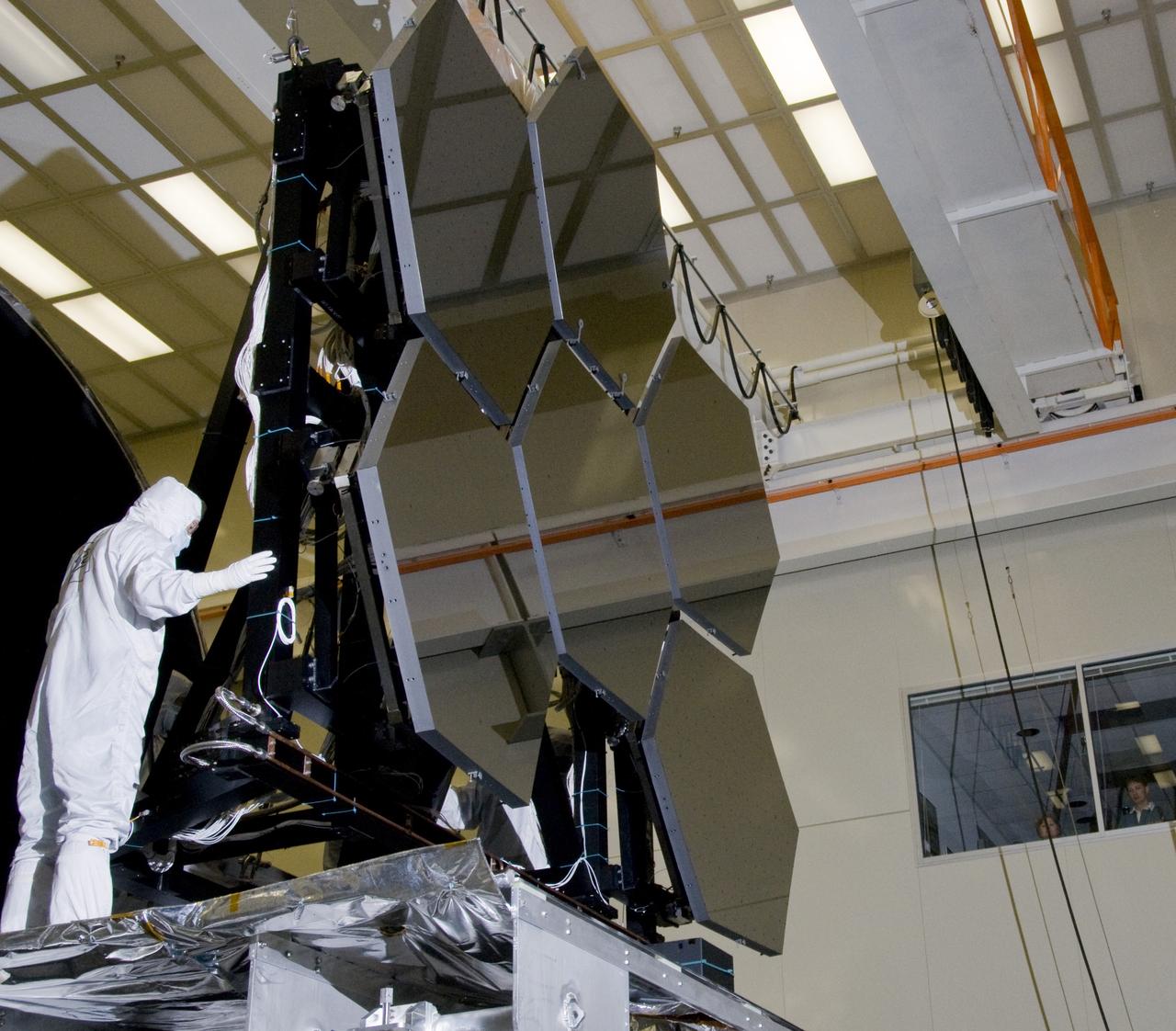
SIX OF THE EIGHTEEN JAMES WEBB SPACE TELESCOPE MIRROR SEGMENTS ARE BEING PREPPED TO MOVE INTO THE X-RAY AND CRYOGENIC FACILITY FOR TESTING.
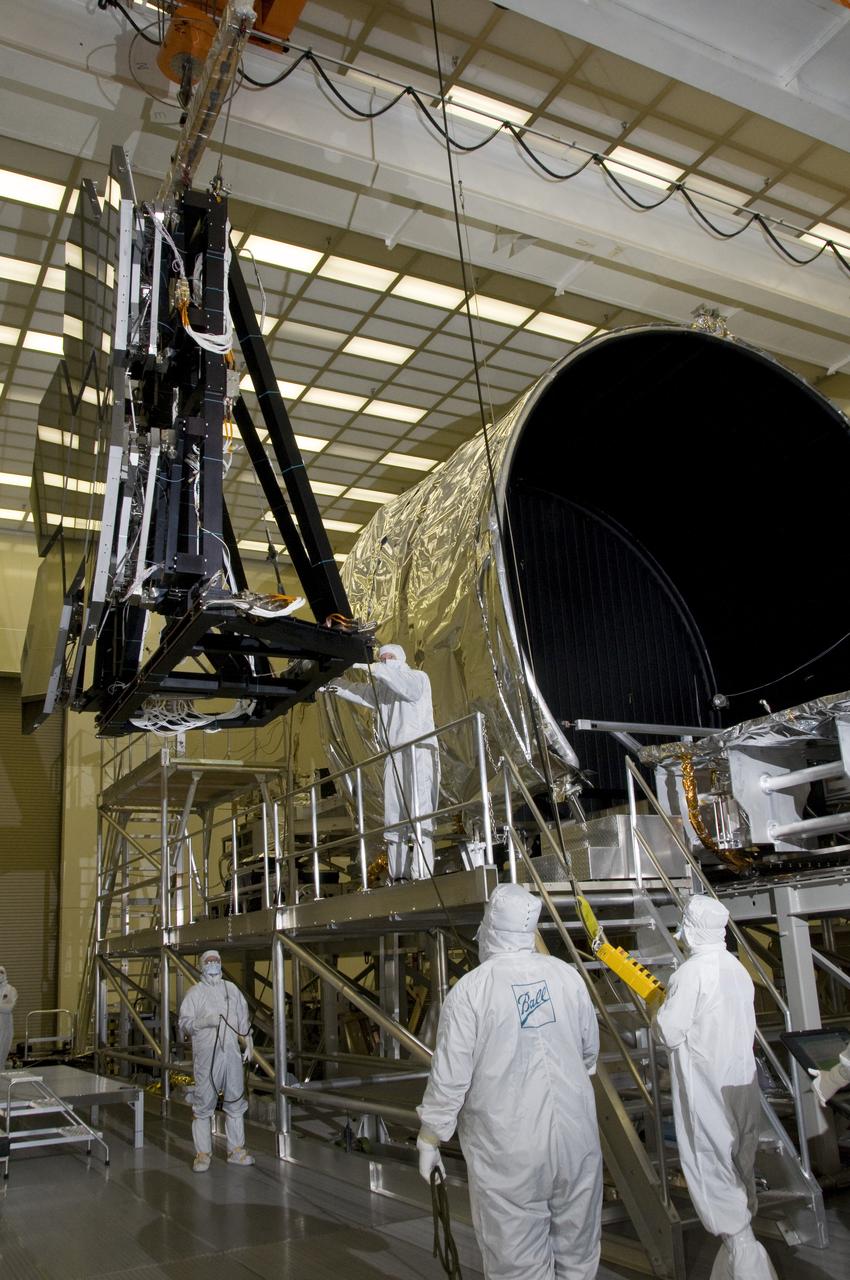
SIX OF THE EIGHTEEN JAMES WEBB SPACE TELESCOPE MIRROR SEGMENTS ARE BEING PREPPED TO MOVE INTO THE X-RAY AND CRYOGENIC FACILITY FOR TESTING.
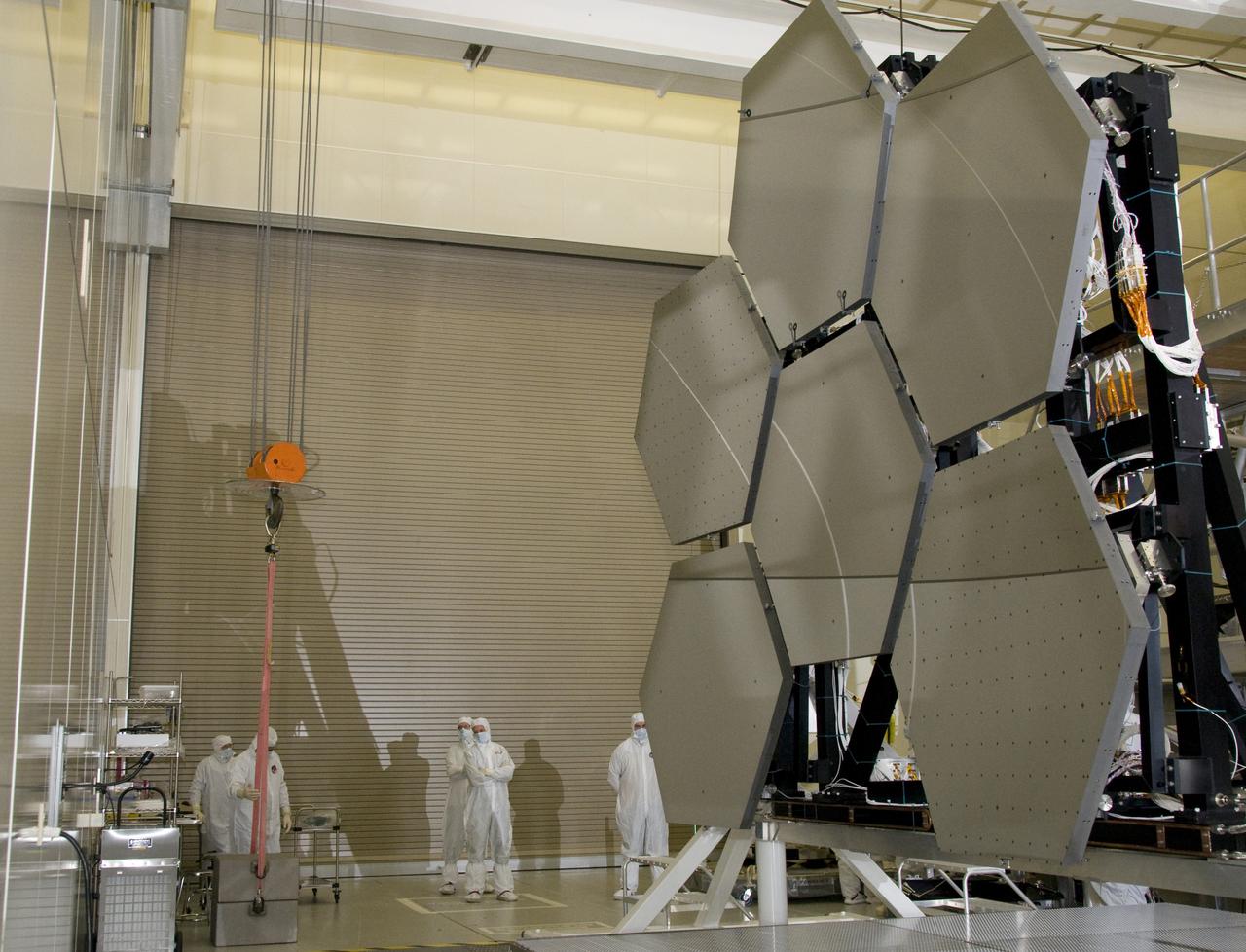
SIX OF THE EIGHTEEN JAMES WEBB SPACE TELESCOPE MIRROR SEGMENTS ARE BEING PREPPED TO MOVE INTO THE X-RAY AND CRYOGENIC FACILITY FOR TESTING.
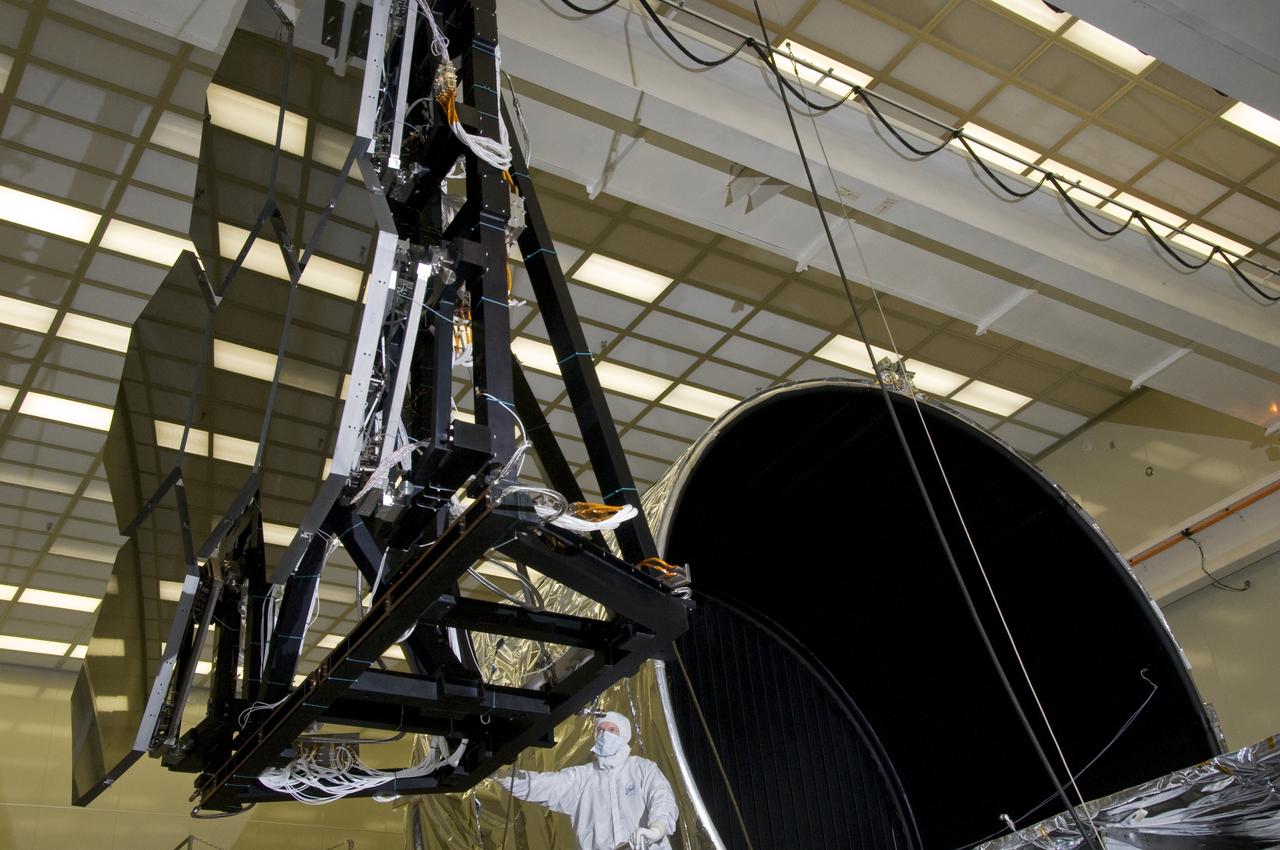
SIX OF THE EIGHTEEN JAMES WEBB SPACE TELESCOPE MIRROR SEGMENTS ARE BEING PREPPED TO MOVE INTO THE X-RAY AND CRYOGENIC FACILITY FOR TESTING.
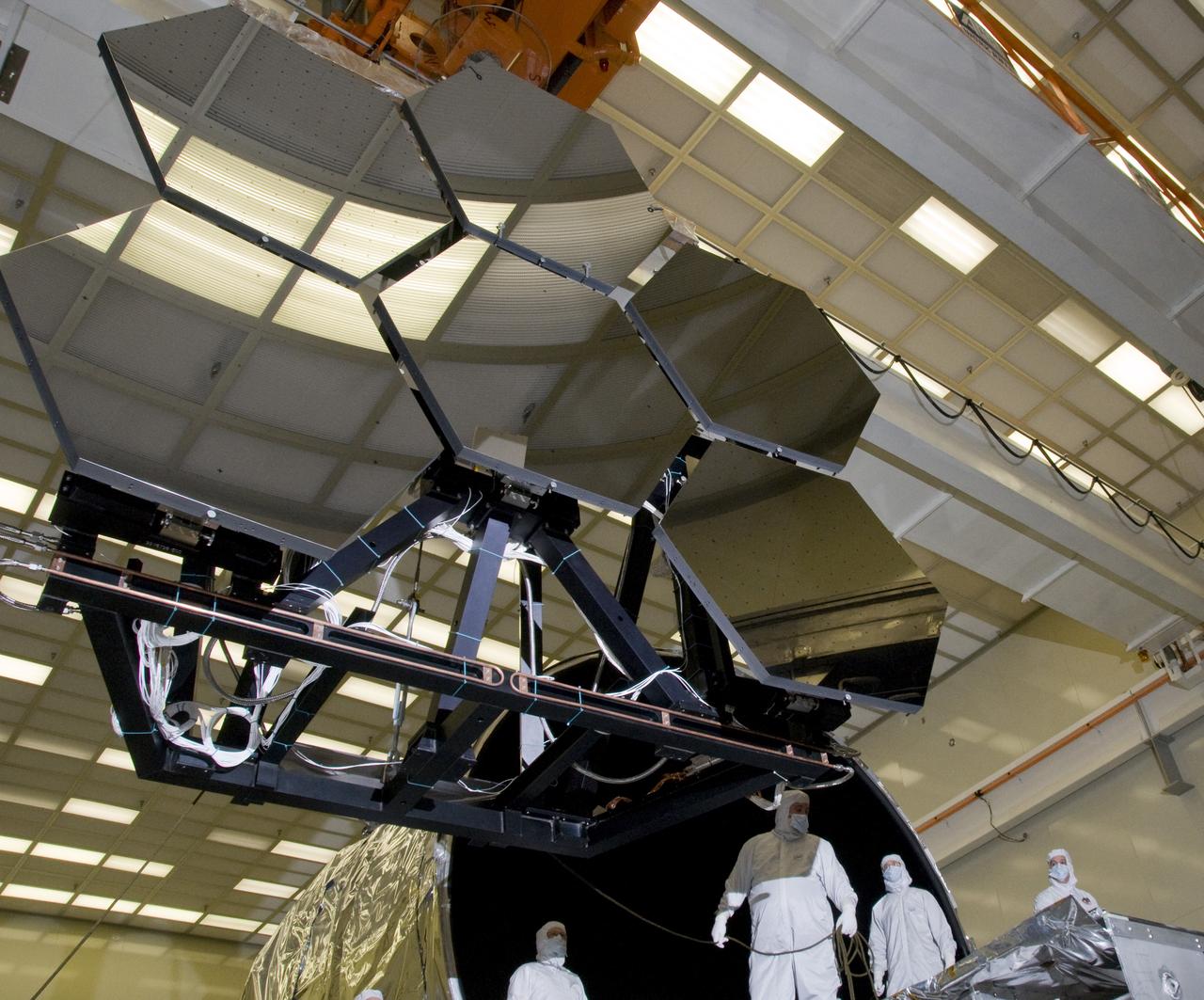
SIX OF THE EIGHTEEN JAMES WEBB SPACE TELESCOPE MIRROR SEGMENTS ARE BEING PREPPED TO MOVE INTO THE X-RAY AND CRYOGENIC FACILITY FOR TESTING.
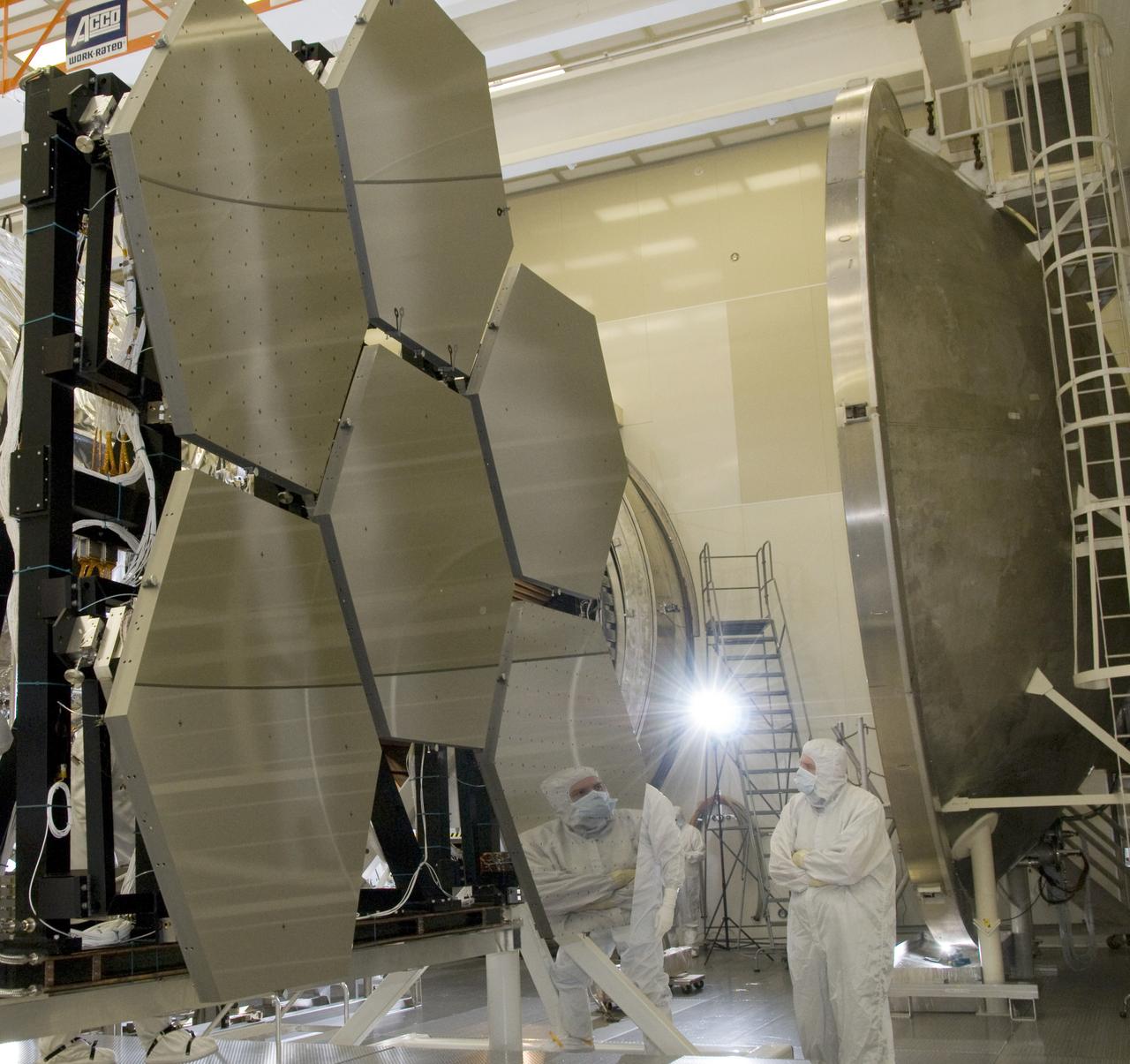
SIX OF THE EIGHTEEN JAMES WEBB SPACE TELESCOPE MIRROR SEGMENTS ARE BEING PREPPED TO MOVE INTO THE X-RAY AND CRYOGENIC FACILITY FOR TESTING.
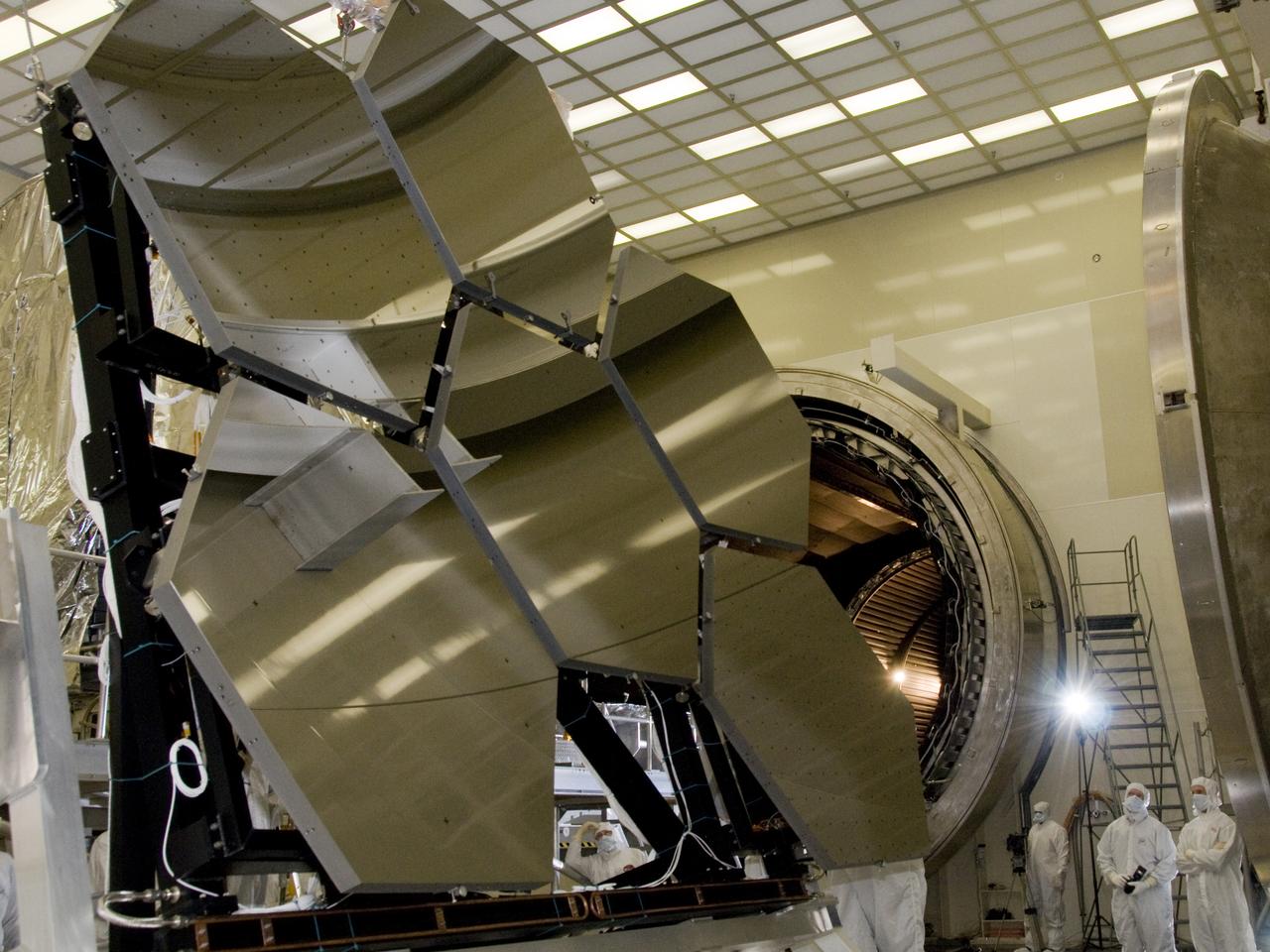
SIX OF THE EIGHTEEN JAMES WEBB SPACE TELESCOPE MIRROR SEGMENTS ARE BEING PREPPED TO MOVE INTO THE X-RAY AND CRYOGENIC FACILITY FOR TESTING.
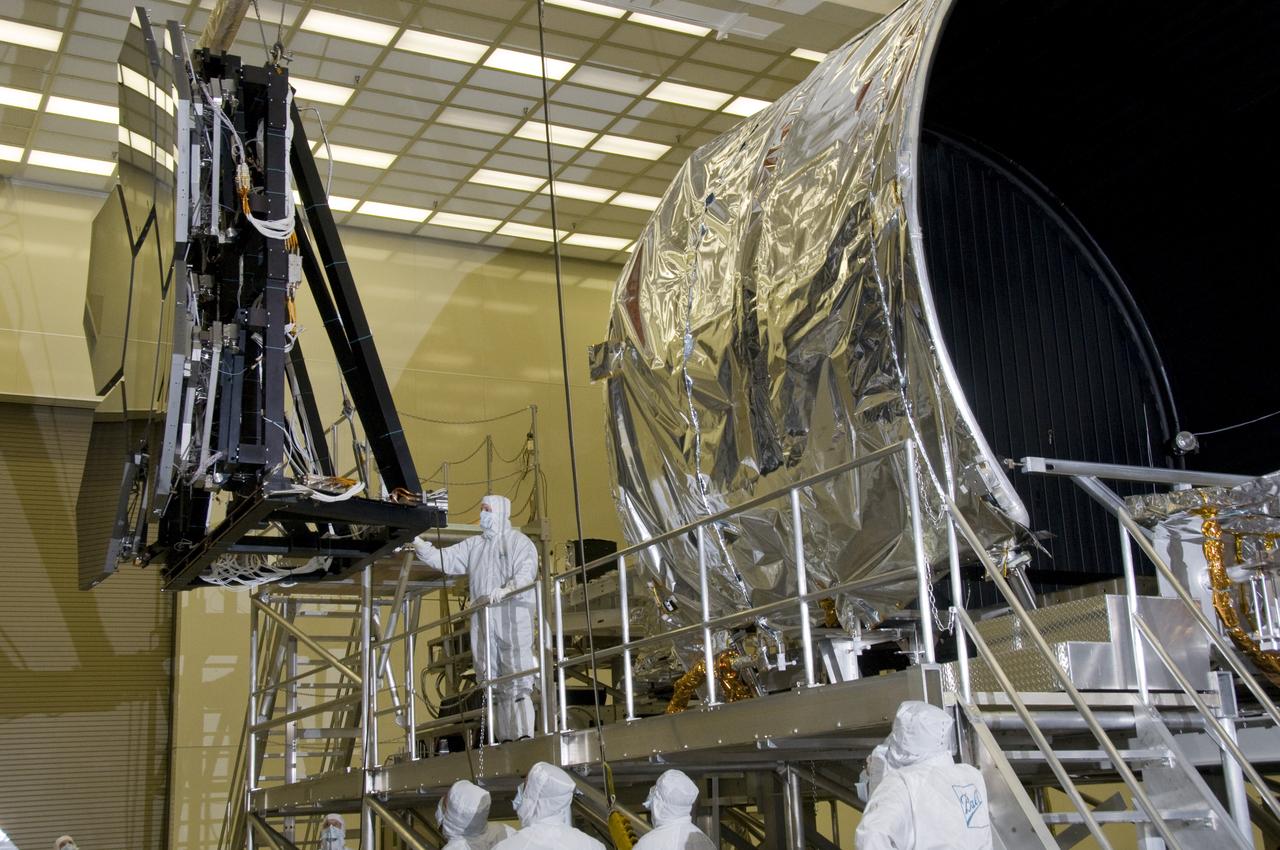
SIX OF THE EIGHTEEN JAMES WEBB SPACE TELESCOPE MIRROR SEGMENTS ARE BEING PREPPED TO MOVE INTO THE X-RAY AND CRYOGENIC FACILITY FOR TESTING.
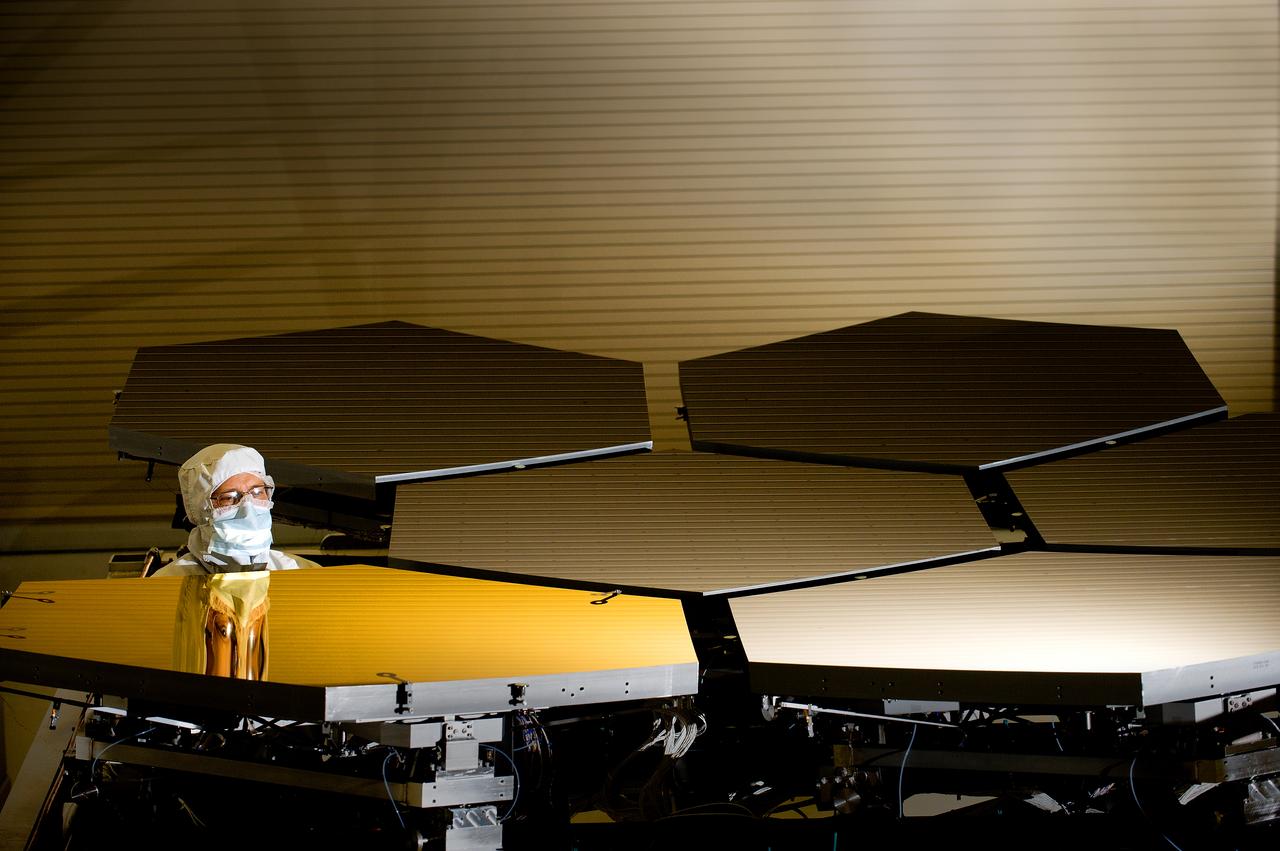
BALL AEROSPACE’S SCOTT MURRAY INSPECTS MIRRORS FOR THE JAMES WEBB SPACE TELESCOPE IN THE X-RAY AND CRYOGENIC FACILITY
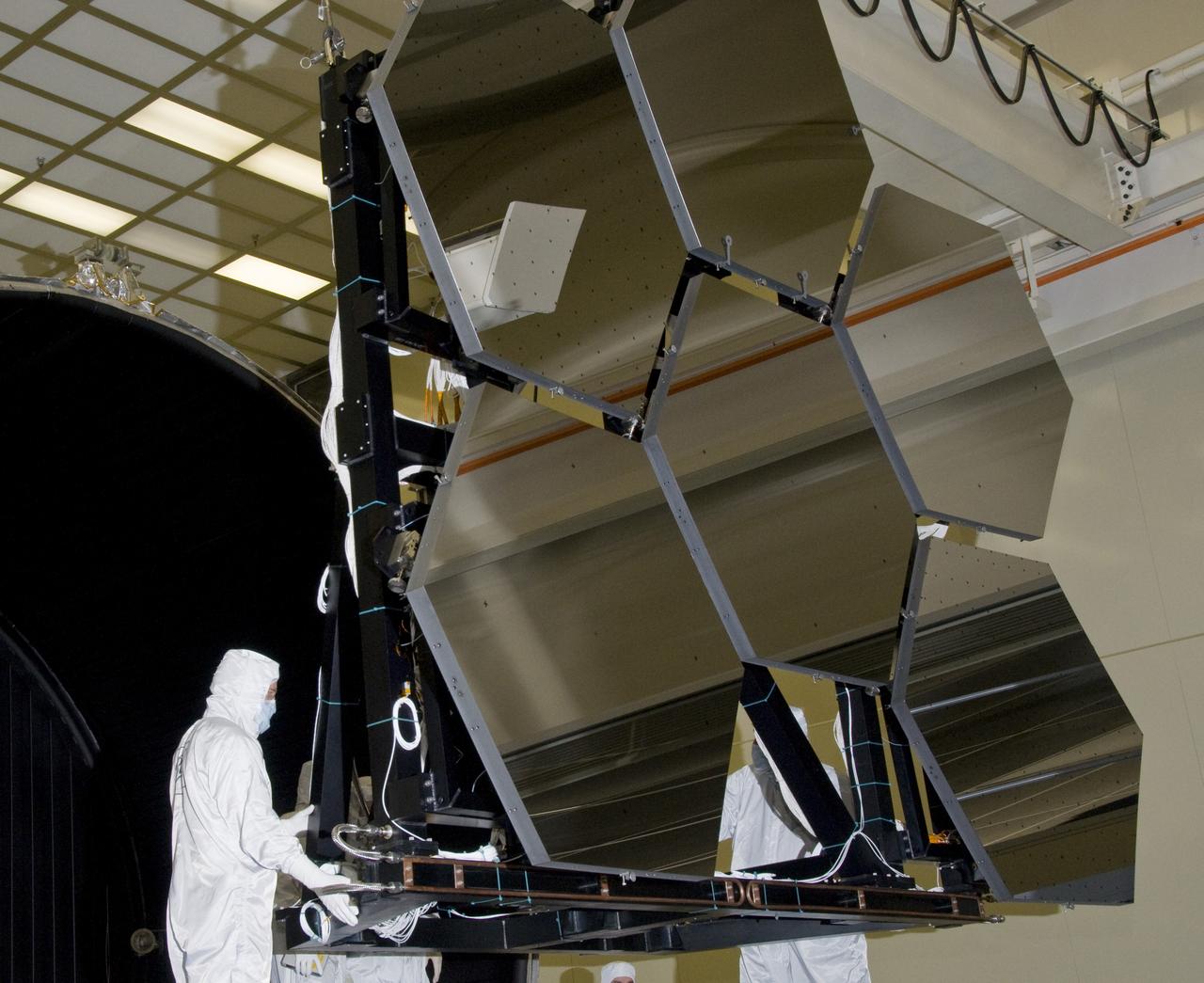
SIX OF THE EIGHTEEN JAMES WEBB SPACE TELESCOPE MIRROR SEGMENTS ARE BEING PREPPED TO MOVE INTO THE X-RAY AND CRYOGENIC FACILITY FOR TESTING.
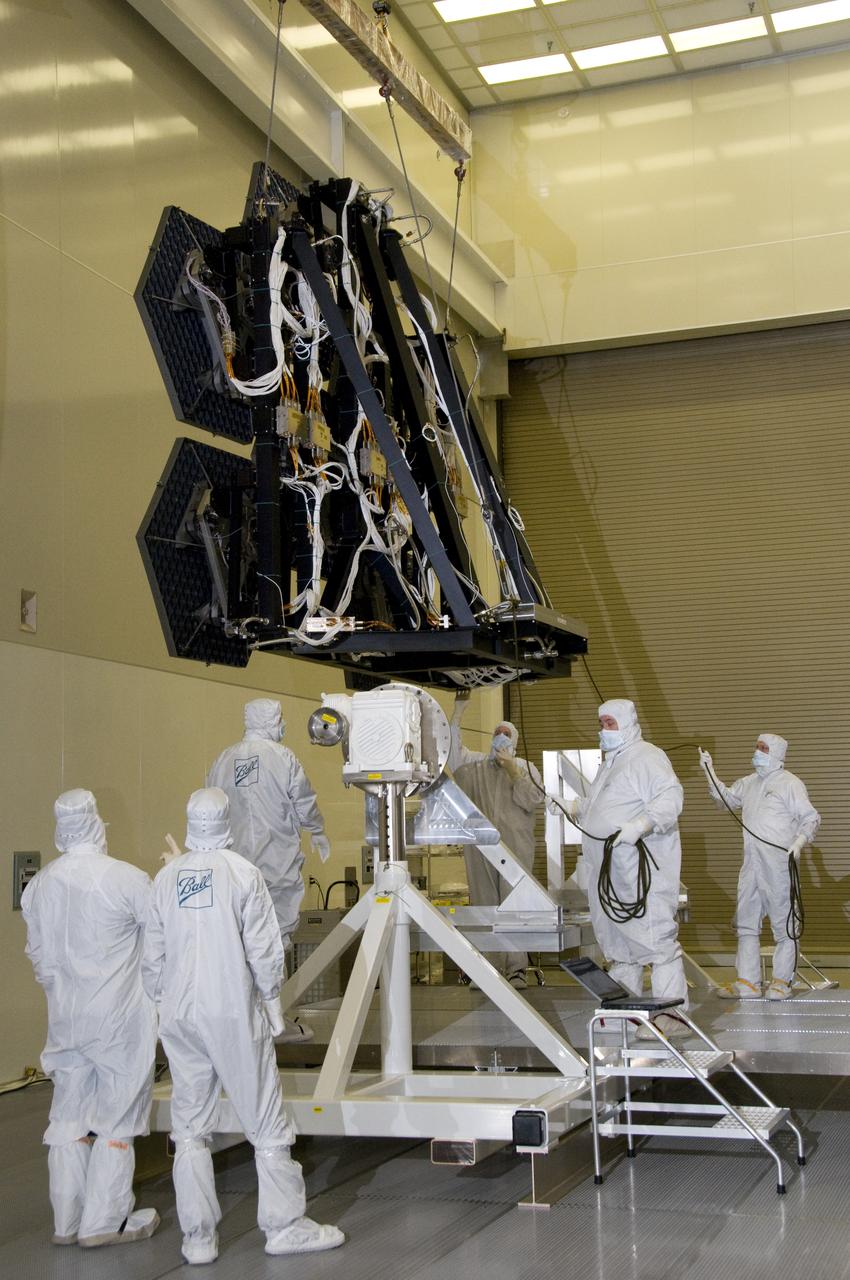
SIX OF THE EIGHTEEN JAMES WEBB SPACE TELESCOPE MIRROR SEGMENTS ARE BEING PREPPED TO MOVE INTO THE X-RAY AND CRYOGENIC FACILITY FOR TESTING.

SIX OF THE EIGHTEEN JAMES WEBB SPACE TELESCOPE MIRROR SEGMENTS ARE BEING PREPPED TO MOVE INTO THE X-RAY AND CRYOGENIC FACILITY FOR TESTING.
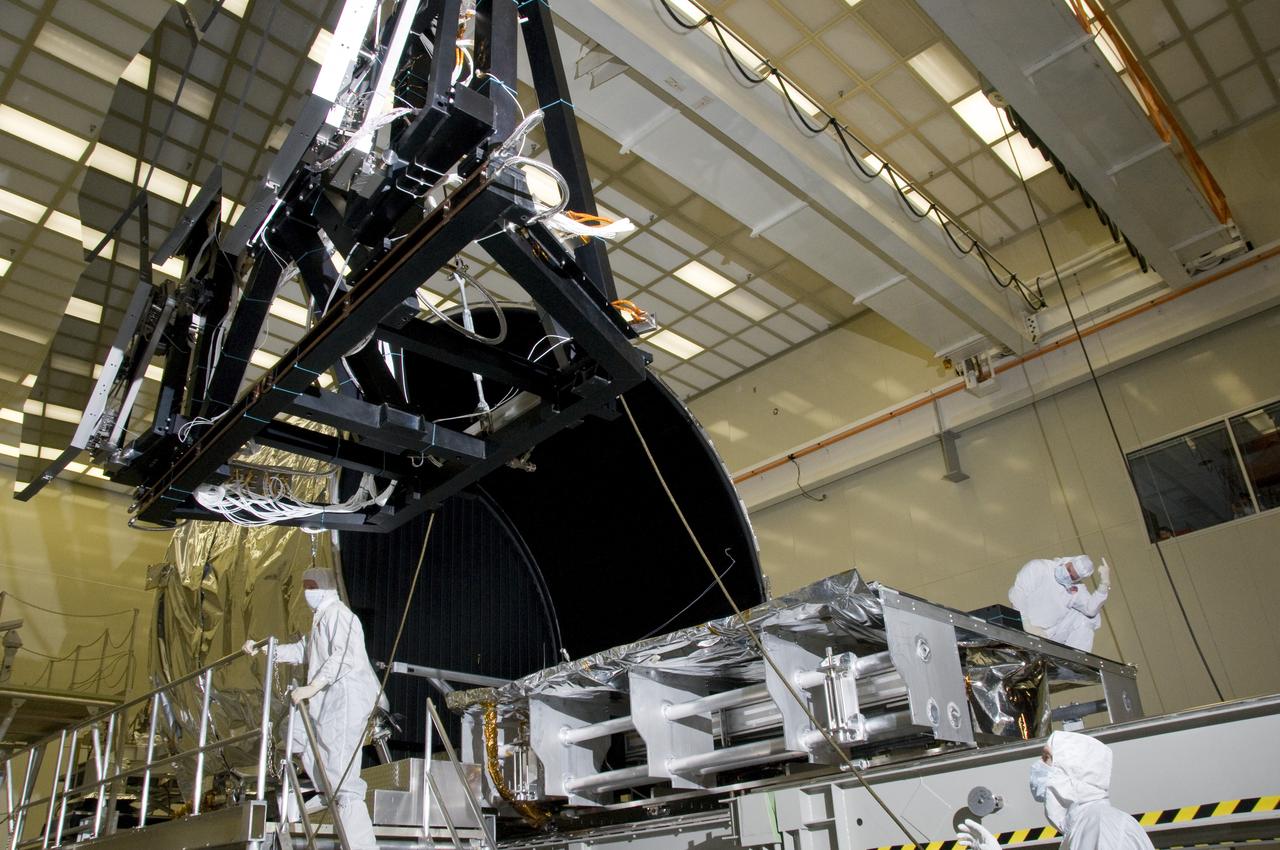
SIX OF THE EIGHTEEN JAMES WEBB SPACE TELESCOPE MIRROR SEGMENTS ARE BEING PREPPED TO MOVE INTO THE X-RAY AND CRYOGENIC FACILITY FOR TESTING.
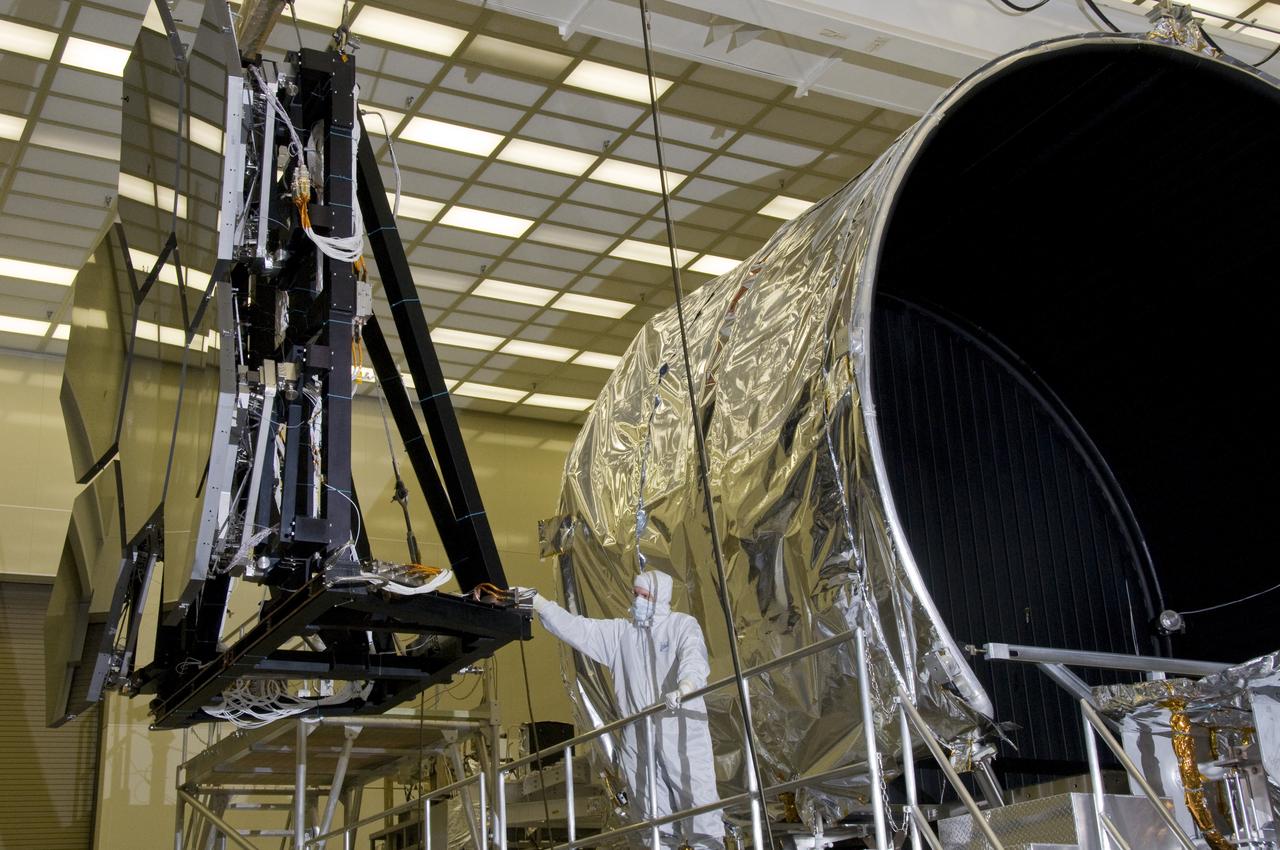
SIX OF THE EIGHTEEN JAMES WEBB SPACE TELESCOPE MIRROR SEGMENTS ARE BEING PREPPED TO MOVE INTO THE X-RAY AND CRYOGENIC FACILITY FOR TESTING.
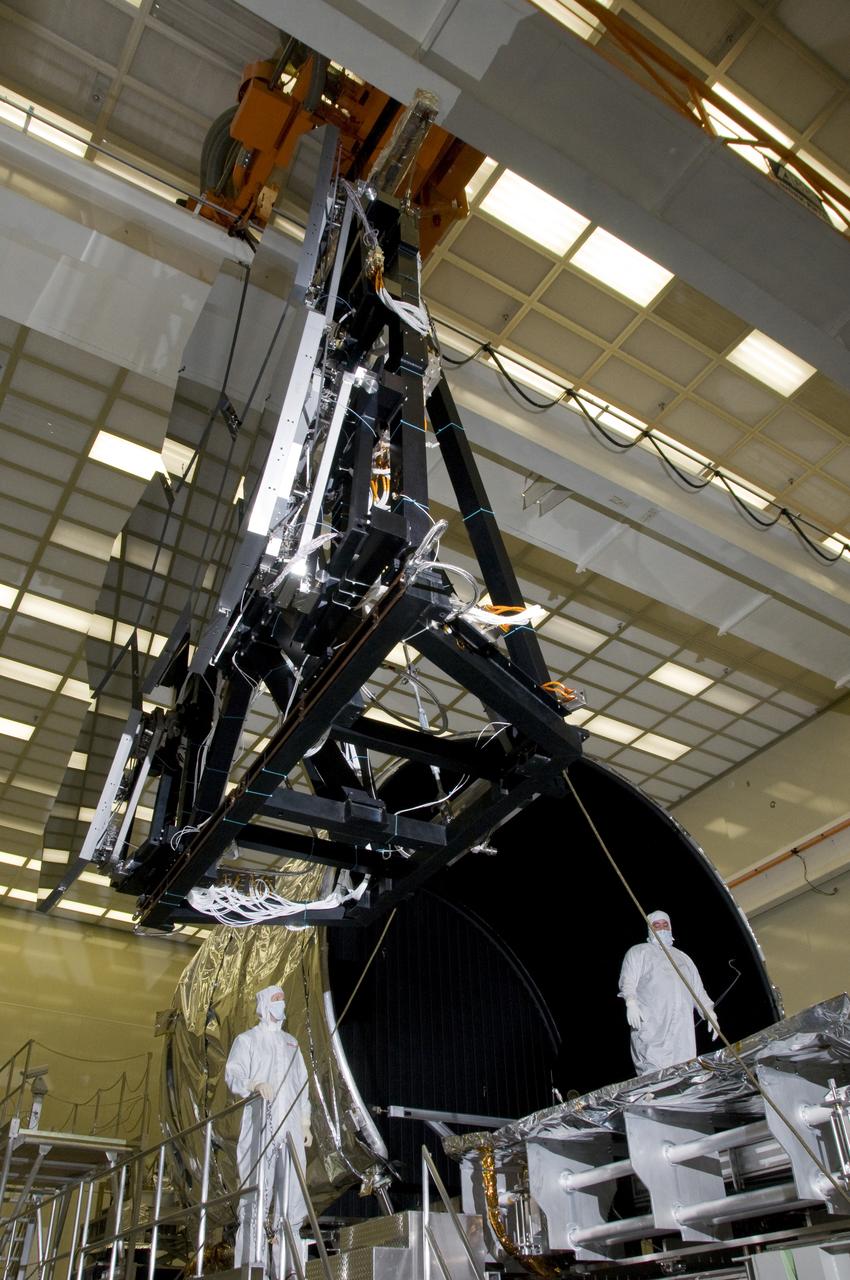
SIX OF THE EIGHTEEN JAMES WEBB SPACE TELESCOPE MIRROR SEGMENTS ARE BEING PREPPED TO MOVE INTO THE X-RAY AND CRYOGENIC FACILITY FOR TESTING.
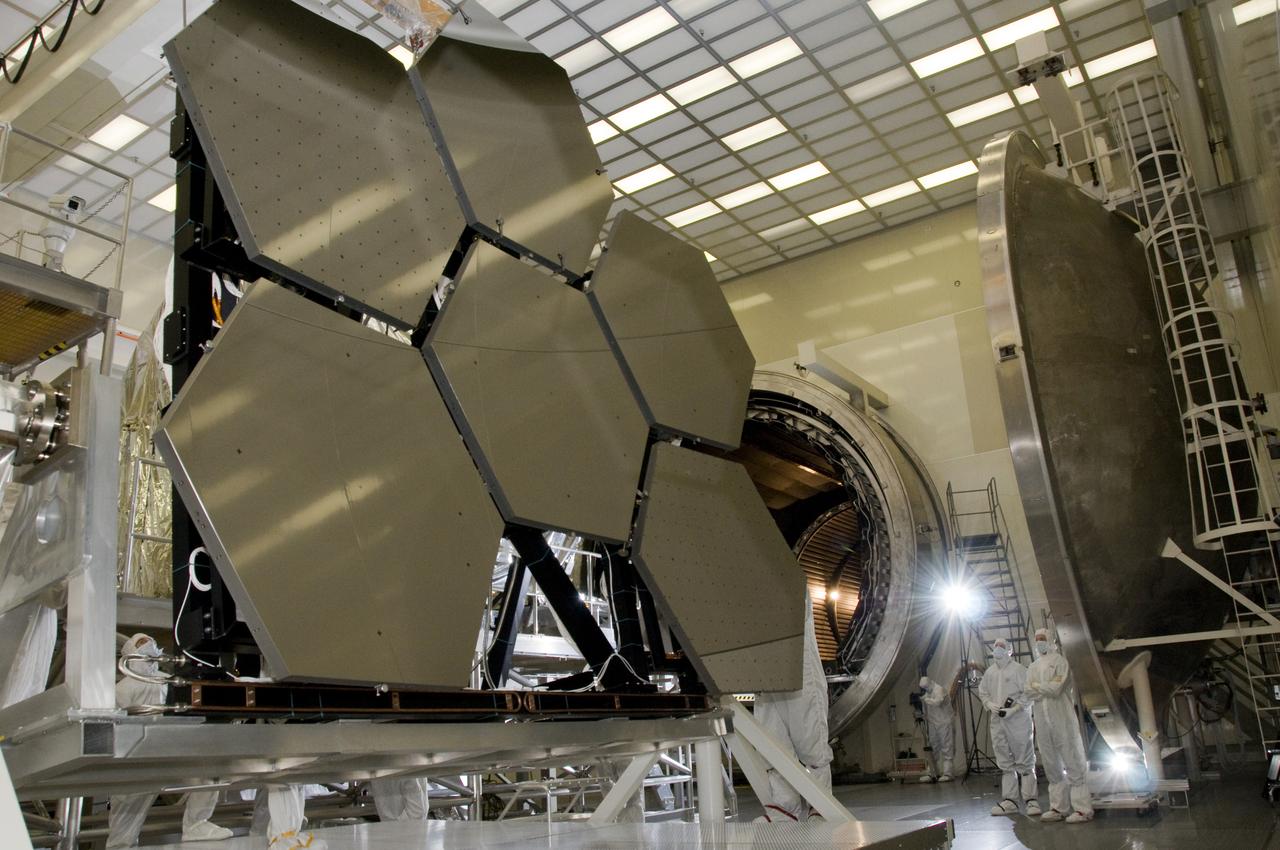
SIX OF THE EIGHTEEN JAMES WEBB SPACE TELESCOPE MIRROR SEGMENTS ARE BEING PREPPED TO MOVE INTO THE X-RAY AND CRYOGENIC FACILITY FOR TESTING.