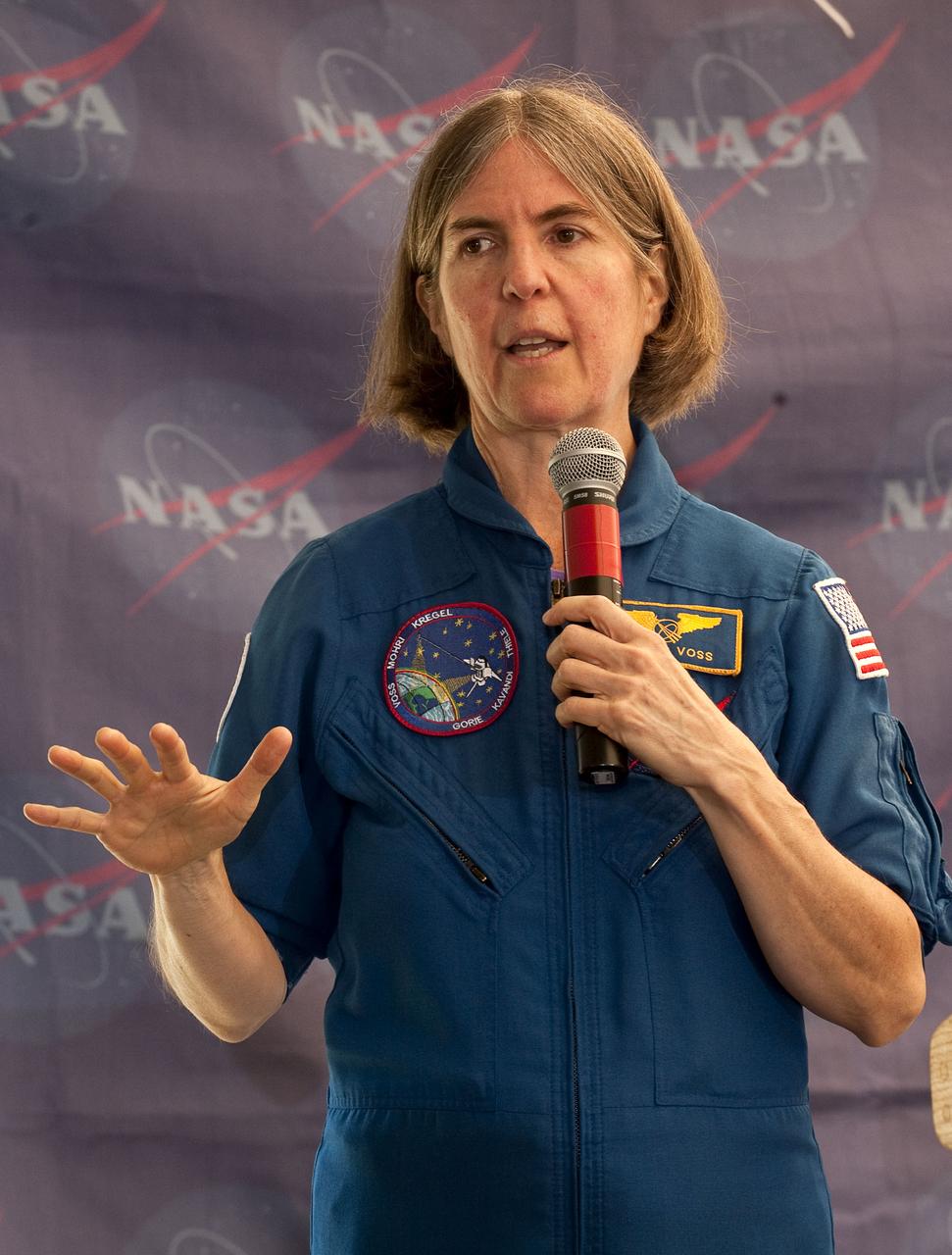
NASA Astronaut Janet Voss speaks to participants at the two-day STS-132 Launch Tweetup at Kennedy Space Center, Thursday, May 13, 2010, in Cape Canaveral, Fla. NASA Twitter followers in attendance will have the opportunity to take a tour of NASA's Kennedy Space Center, view the space shuttle launch and speak with shuttle technicians, engineers, astronauts and managers. Photo Credit: (NASA/Paul E. Alers)
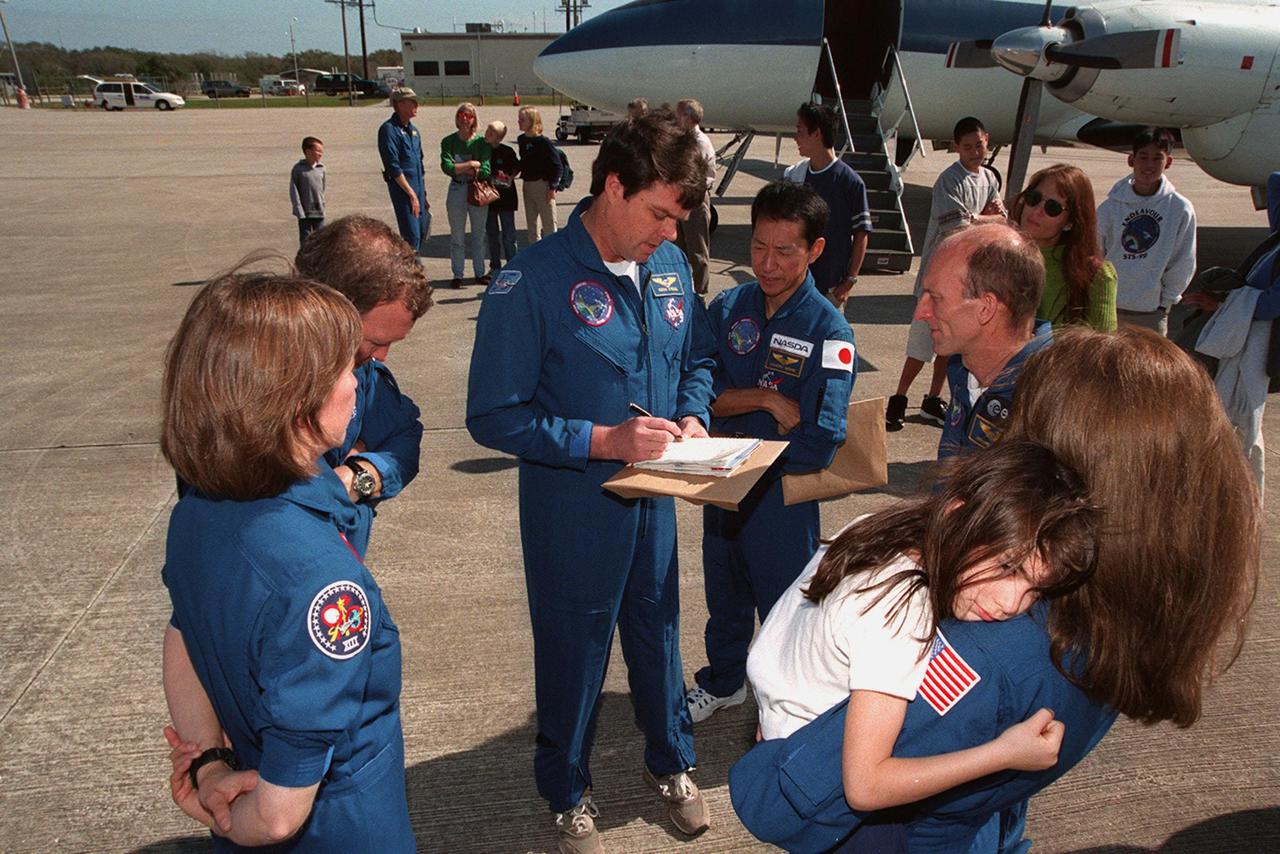
The STS-99 crew get ready to leave KSC with their families for a return trip to Houston. From left are Mission Specialist Janice Voss, Pilot Dominic Gorie, Commander Kevin Kregel, and Mission Specialists Mamoru Mohri of Japan, Gerhard Thiele of Germany, and Janet Kavandi, holding her daughter. The STS-99 crew completed a successful 11-day Shuttle Radar Topography Mission mapping 47 million square miles of the Earth's surface before landing at KSC Feb. 22
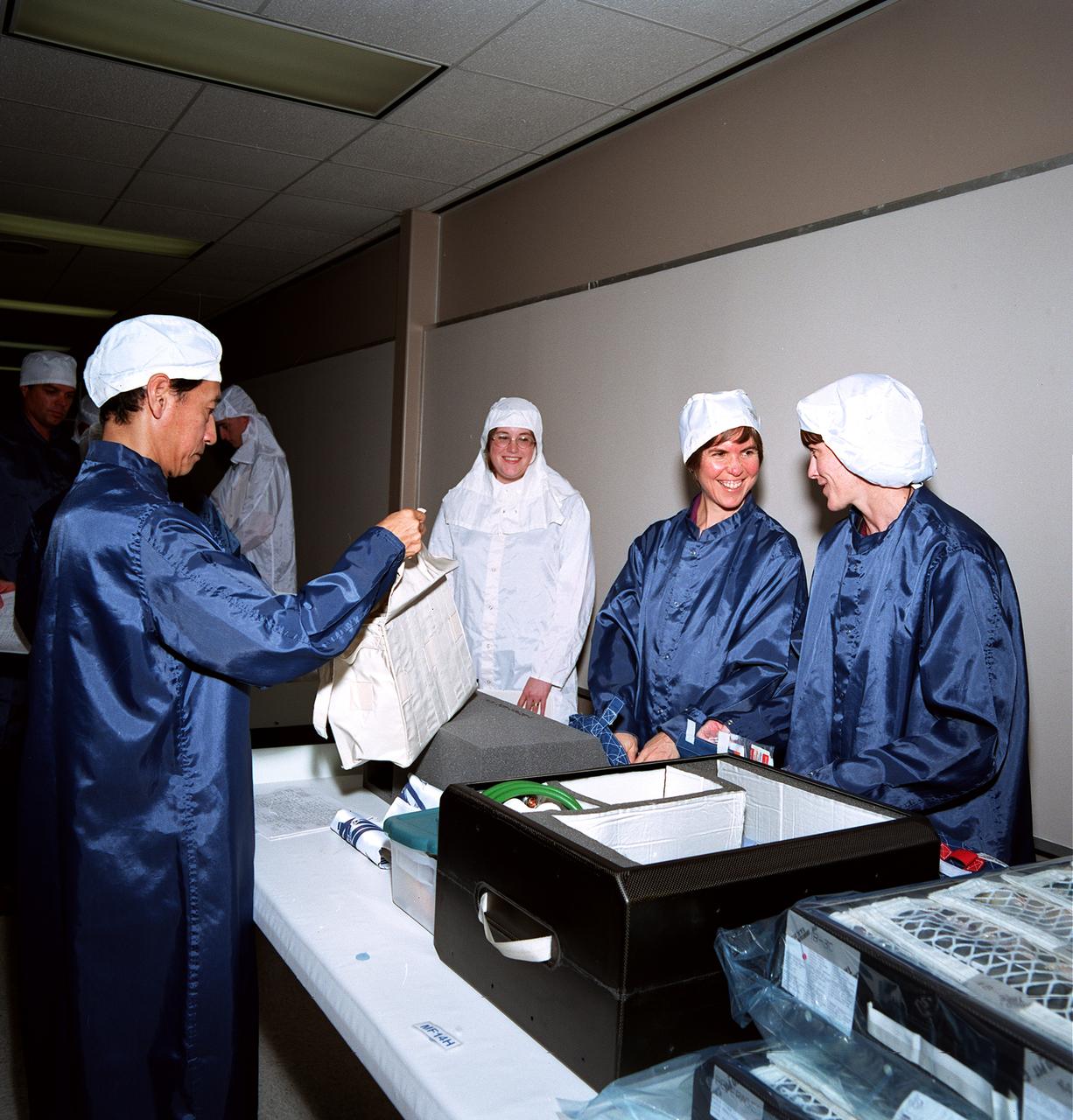
S99-09470 (11 August 1999) --- Three mission specialists participate in a STS-99 flight crew equipment (FCE) bench review. From the left (in the blue lab coats), astronauts Mamoru Mohri, Janice Voss and Janet L. Kavandi look over equipment and supplies for their assigned mission aboard the Space Shuttle Endeavour later this year. Mohri represents Japan's National Space Development Agency (NASDA). Such bench reviews are routine procedure for crews preparing for shuttle missions.
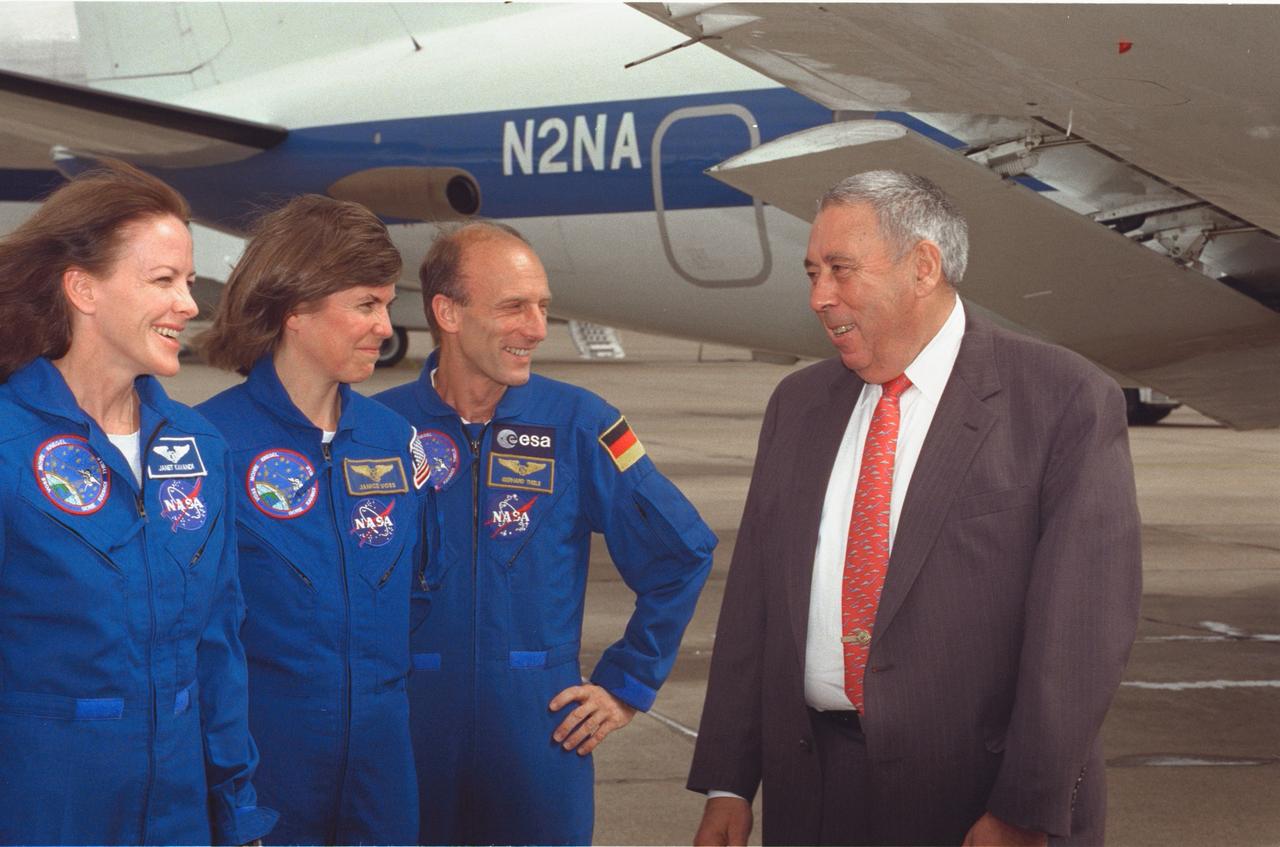
JSC2000-01646 (23 February 2000) --- Three members of the STS-99 crew are greeted by JSC Director George W.S. Abbey following their arrival at Ellington Field, near the Johnson Space Center (JSC). From the left are astronauts Janet L. Kavandi, Janice Voss and Gerhard P.J. Thiele, all mission specialists. Thiele represents the European Space Agency (ESA).
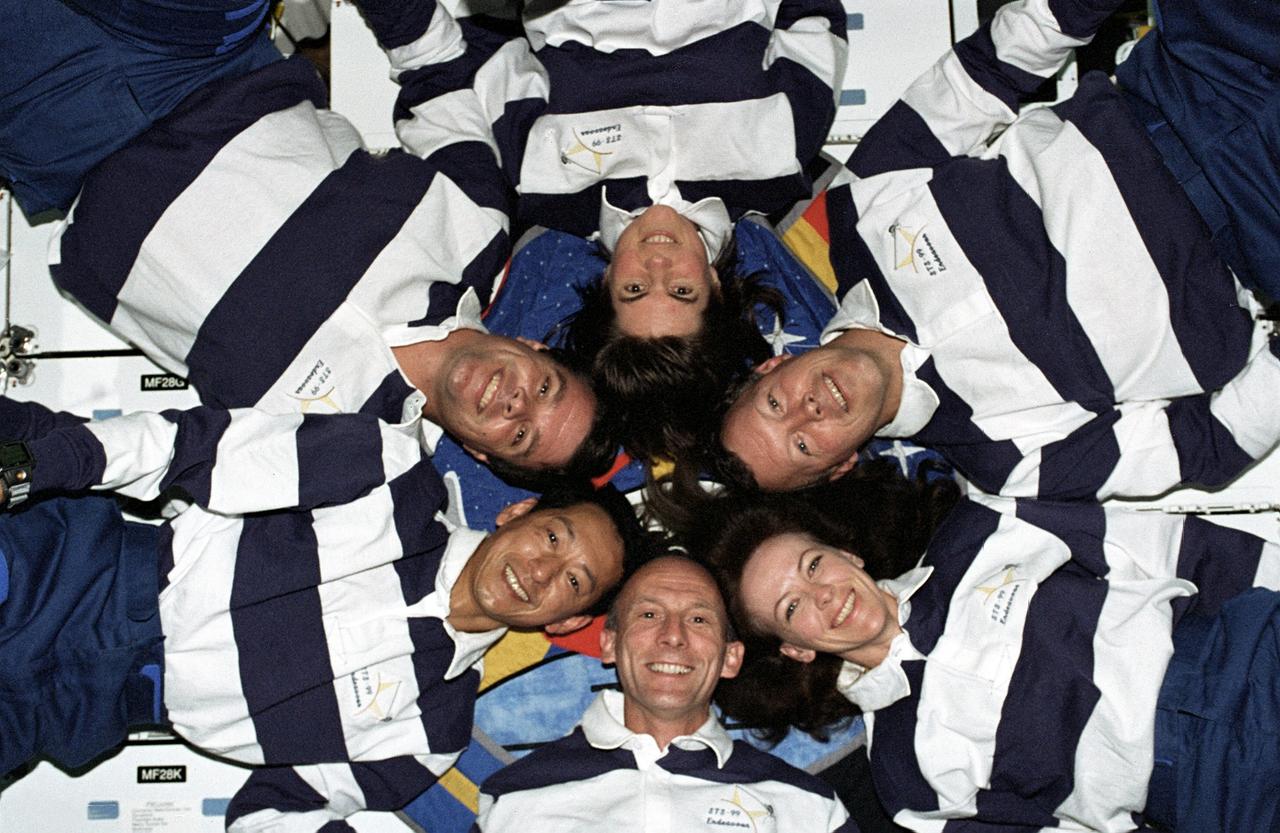
STS099-318-015 (11-22 February 2000) --- A "star-burst" pose by the STS-99 crew members helps to celebrate a successful Shuttle Radar Topographic Mission (SRTM) aboard NASA's Space Shuttle Endeavour. Astronaut Janice Voss is at top center. Clockwise, around the circle from her position, are astronauts Dominic L. Gorie, Janet L. Kavandi, Gerhard Thiele, Mamoru Mohri and Kevin R. Kregel. Mohri is with the Japanese Space Agency and Thiele represents the European Space Agency (ESA).
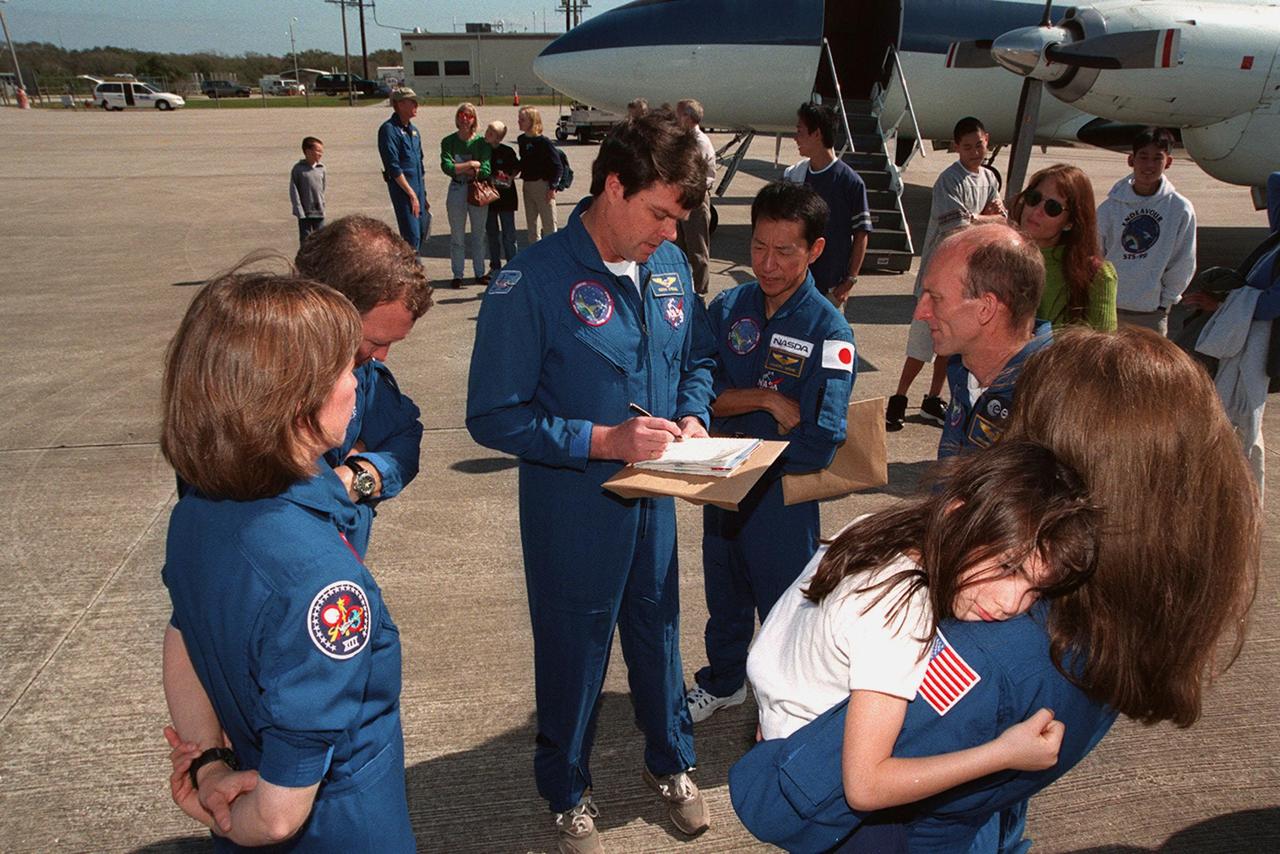
The STS-99 crew get ready to leave KSC with their families for a return trip to Houston. From left are Mission Specialist Janice Voss, Pilot Dominic Gorie, Commander Kevin Kregel, and Mission Specialists Mamoru Mohri of Japan, Gerhard Thiele of Germany, and Janet Kavandi, holding her daughter. The STS-99 crew completed a successful 11-day Shuttle Radar Topography Mission mapping 47 million square miles of the Earth's surface before landing at KSC Feb. 22
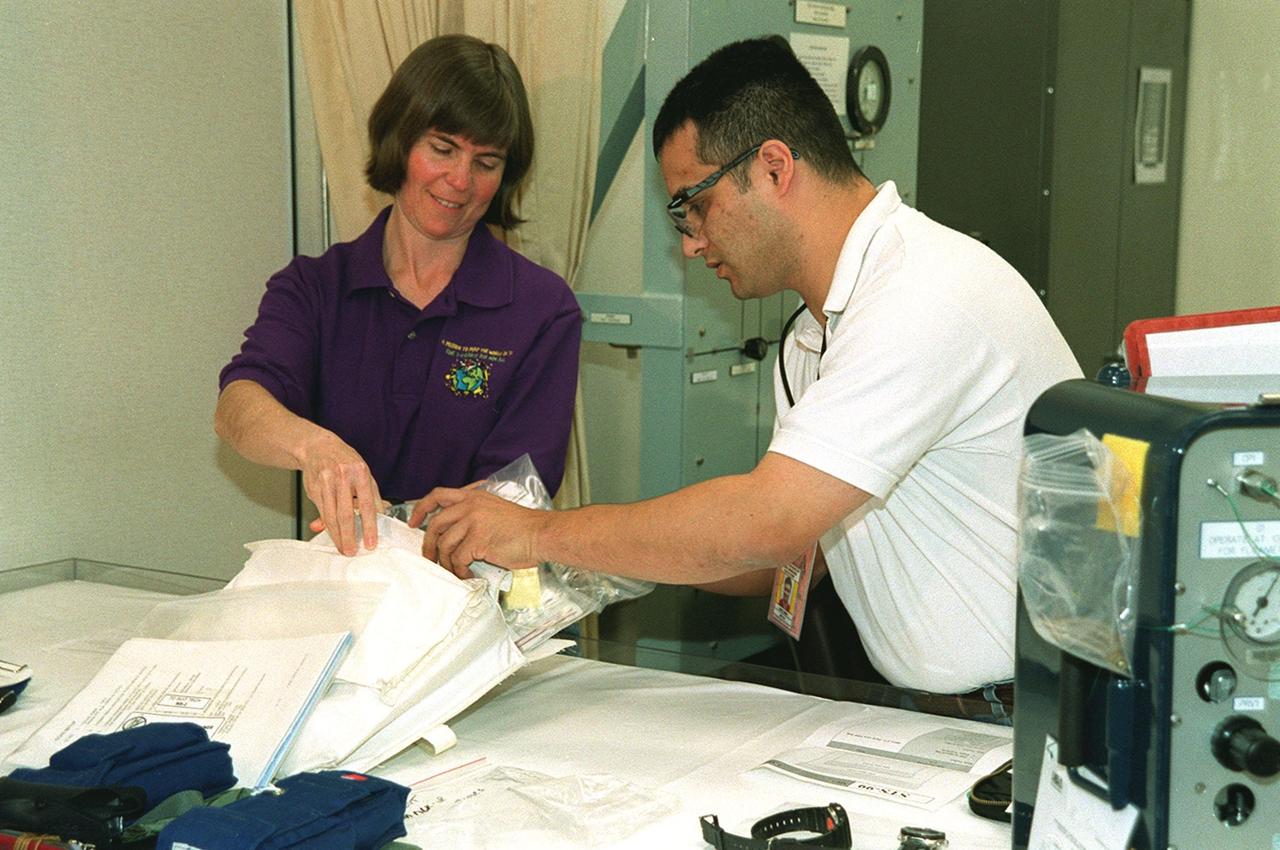
In the Operations and Checkout Building's suitup room, STS-99 Mission Specialist Janice Voss is helped with pre-pack and fit check by Santos Medina, with United Space Alliance. Voss and other crew members Commander Kevin Kregel, Pilot Dominic Gorie and Mission Specialists Janet Kavandi, Gerhard Thiele of Germany and Mamoru Mohri of Japan are preparing for launch of their mission on Feb. 11 at 12:30 p.m. EST aboard Space Shuttle Endeavour. STS-99 is the Shuttle Radar Topography Mission, which will produce unrivaled 3-D images of the Earth's surface. The result of the Shuttle Radar Topography Mission could be close to 1 trillion measurements of the Earth's topography. Landing is expected at KSC on Feb. 22 at 4:36 p.m. EST
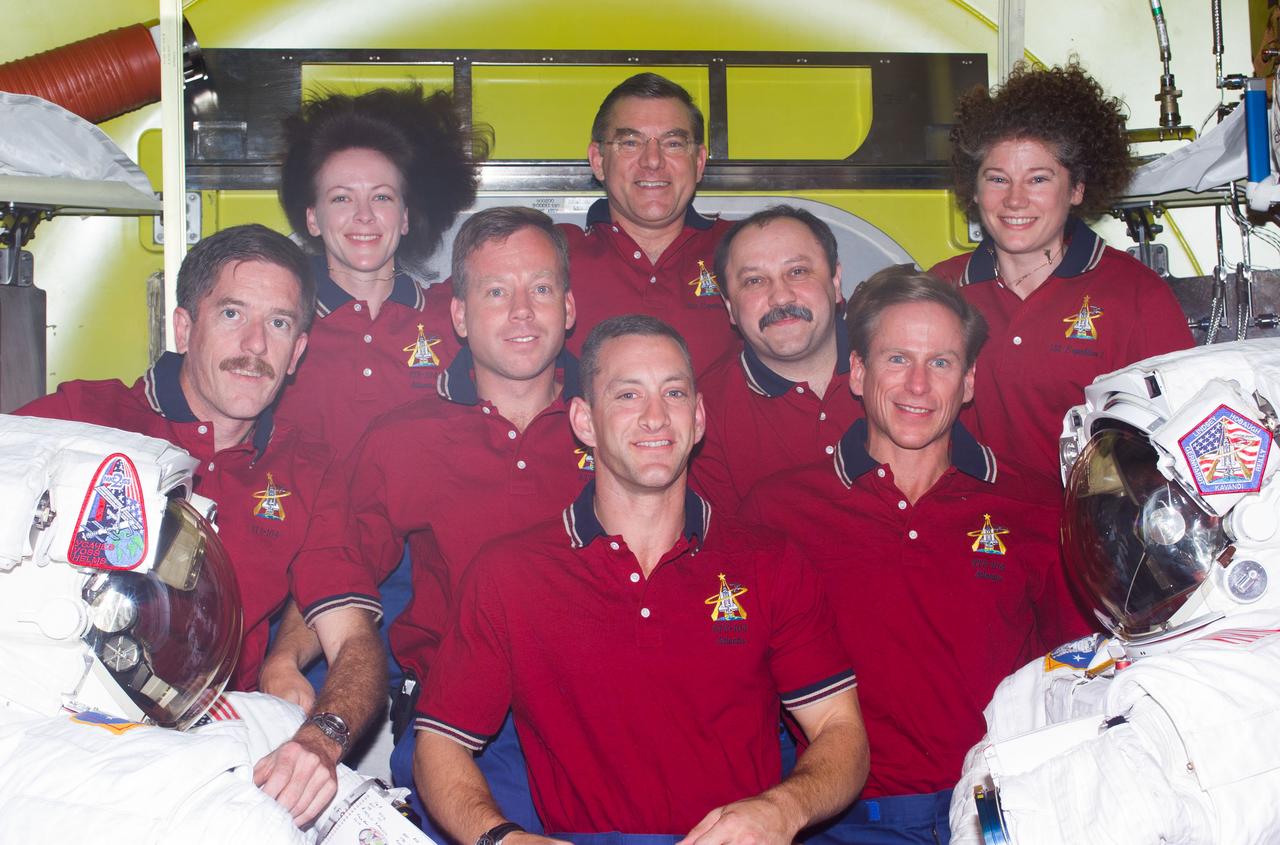
STS104-E-5177 (20 July 2001) --- Seven astronauts and a cosmonaut representing Rosaviakosmos take a break in joint activities involving the Expedition Two and STS-104 crews to pose for an in-flight portrait in the newly delivered Quest Airlock on the International Space Station (ISS). Flanked by two extravehicular mobility unit (EMU) space suits, Charles O. Hobaugh is in front. On the second row are, from the left, James F. Reilly, Steven W. Lindsey, Yury V. Usachev and Michael L. Gernhardt. In the rear are Janet L. Kavandi, James S. Voss and Susan J. Helms. Usachev, commander; along with Voss and Helms, both flight engineers, comprise the Expedition Two crew. Lindsey is STS-104 commander, with Hobaugh serving as pilot. Kavandi, STS-104 flight engineer, is joined by Gernhardt and Reilly as mission specialists on the mission. This image was recorded with a digital still camera.
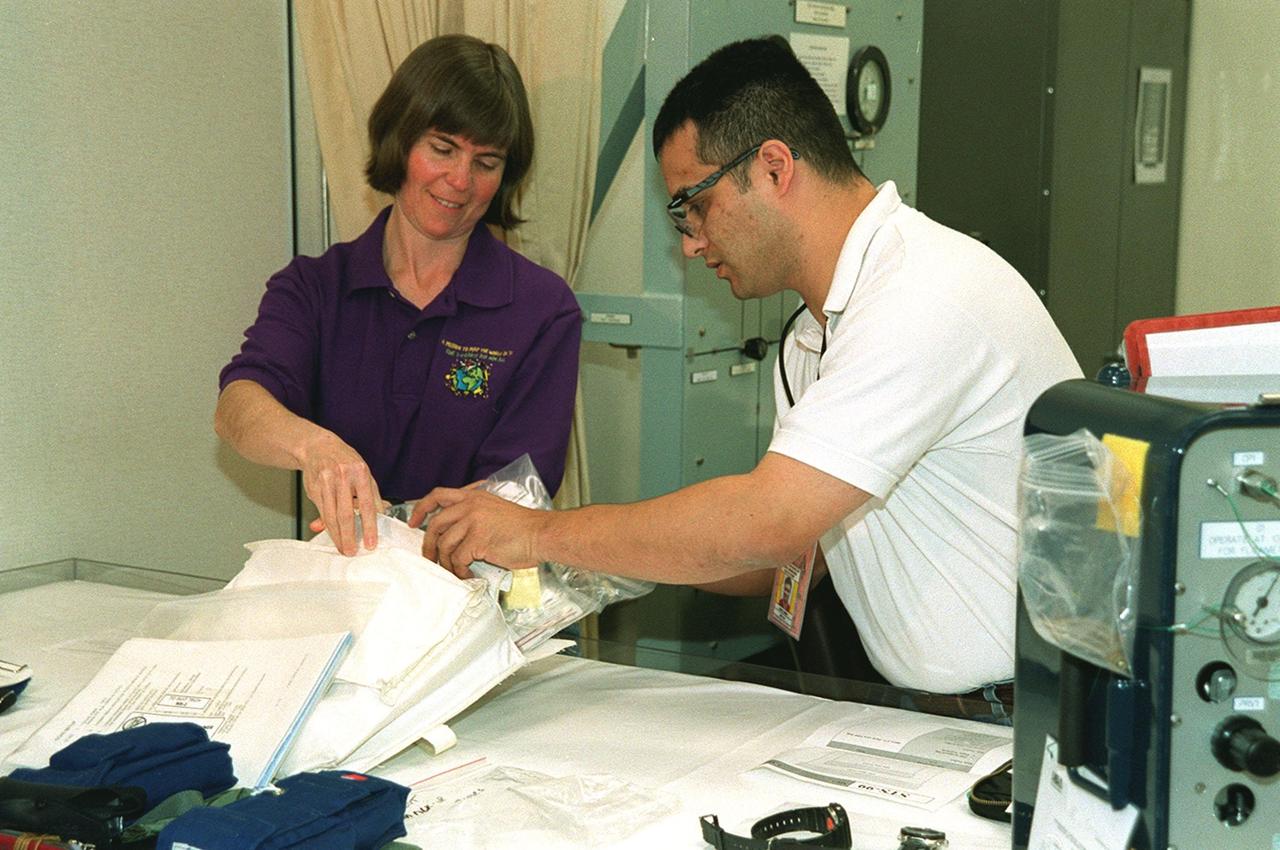
In the Operations and Checkout Building's suitup room, STS-99 Mission Specialist Janice Voss is helped with pre-pack and fit check by Santos Medina, with United Space Alliance. Voss and other crew members Commander Kevin Kregel, Pilot Dominic Gorie and Mission Specialists Janet Kavandi, Gerhard Thiele of Germany and Mamoru Mohri of Japan are preparing for launch of their mission on Feb. 11 at 12:30 p.m. EST aboard Space Shuttle Endeavour. STS-99 is the Shuttle Radar Topography Mission, which will produce unrivaled 3-D images of the Earth's surface. The result of the Shuttle Radar Topography Mission could be close to 1 trillion measurements of the Earth's topography. Landing is expected at KSC on Feb. 22 at 4:36 p.m. EST
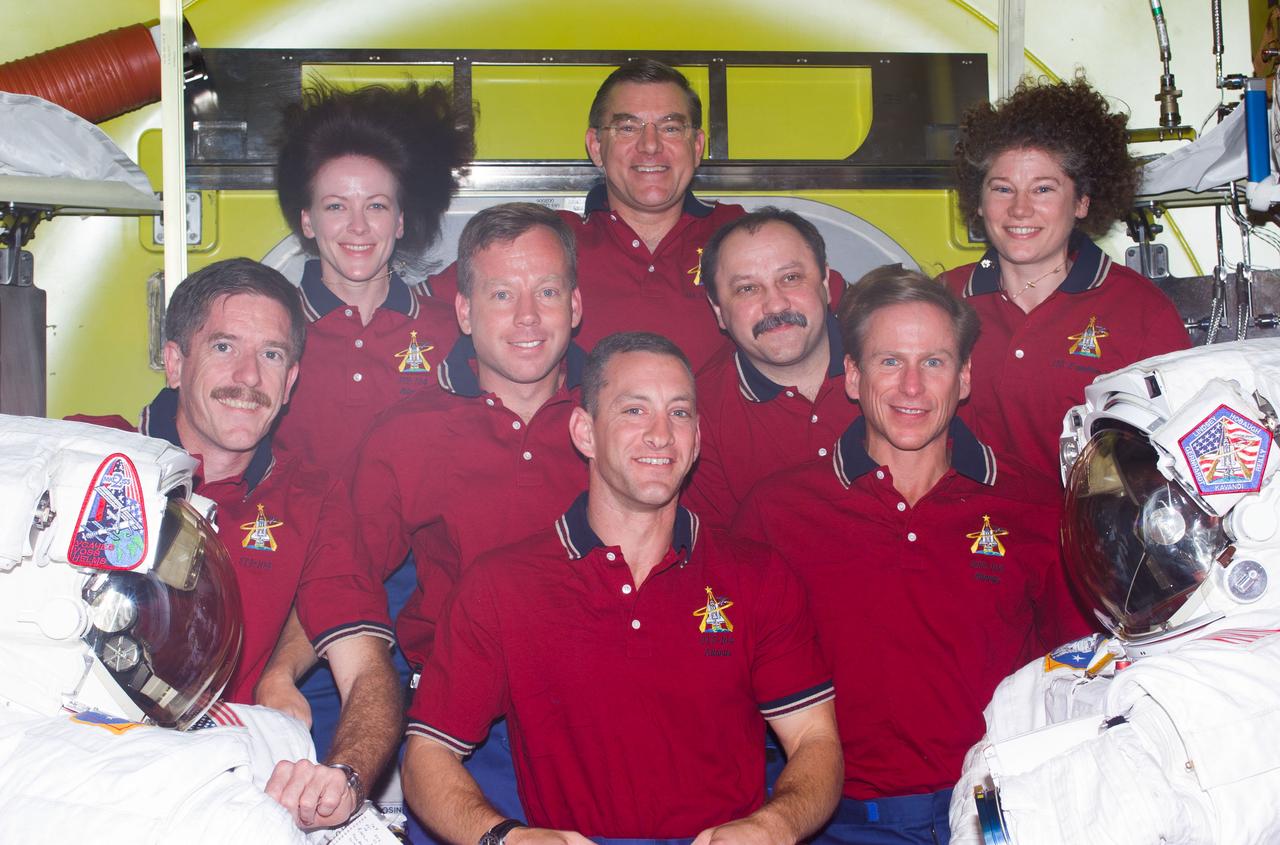
STS104-E-5178 (20 July 2001) --- Seven astronauts and a cosmonaut representing Rosaviakosmos take a break in joint activities involving the Expedition Two and STS-104 crews to pose for an inflight portrait in the newly delivered Quest Airlock on the International Space Station (ISS). Charles O. Hobaugh is in front. On the second row are, from the left, James F. Reilly, Steven W. Lindsey, Yury V. Usachev and Michael L. Gernhardt. In the rear are astronauts Janet L. Kavandi, James S. Voss and Susan J. Helms. Usachev, commander; along with Voss and Helms, both flight engineers, comprise the Expediton Two crew. Lindsey is STS-104 commander, with Hobaugh serving as pilot. Kavandi, STS-104 flight engineer, is joined by Gernhardt and Reilly as mission specialists on the mission. This image was recorded with a digital still camera.
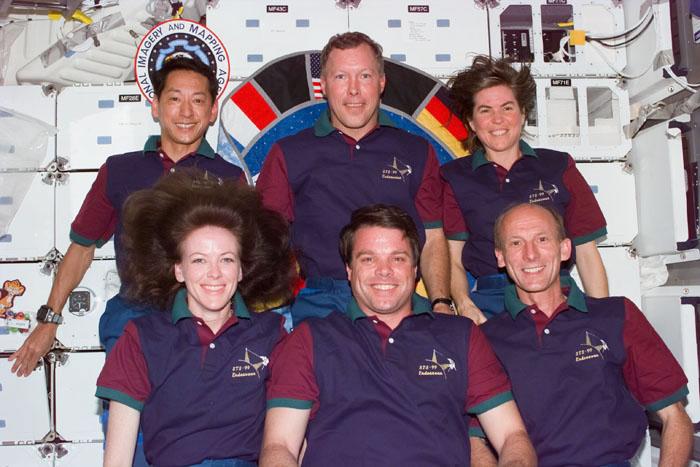
S99-E-5731 (18 February 2000) --- Not often seen together on the STS-99 flight which provides around-the-clock coverage for the Shuttle Radar Topography Mission (SRTM), the six astronauts pose for one of the traditional inflight crew portraits on Endeavour's mid deck. In the rear are the Blue Team members (from left), Mamoru Mohri, Dominic L. Gorie and Janice Voss. In front are Red Team members Janet L. Kavandi, Kevin R. Kregel and Gerhard P.J. Thiele. Mohri is with Japan's National Space Development Agency (NASDA) and Thiele represents the European Space Agency (ESA).
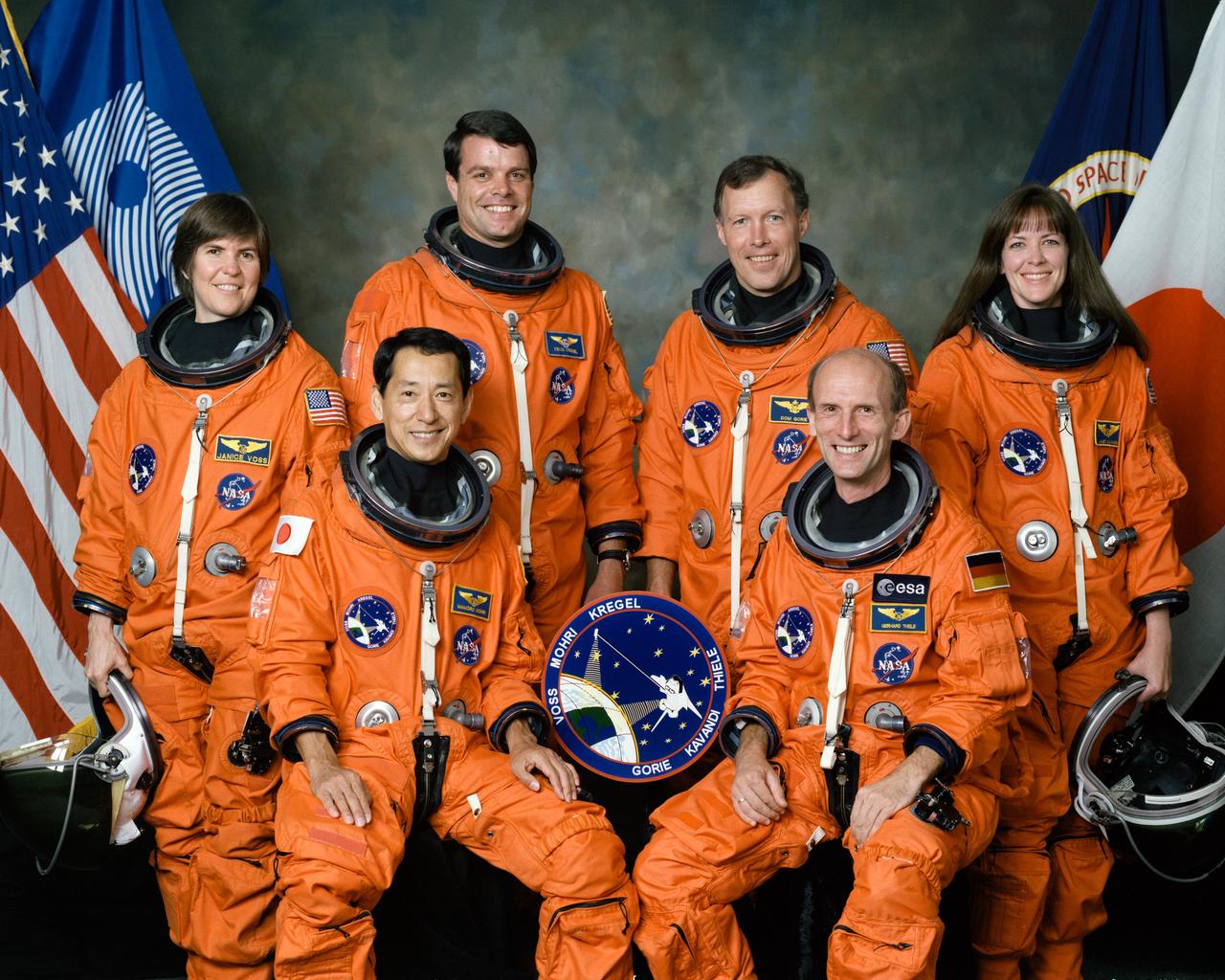
STS099-S-002 (June 1999) --- An international crew assigned to STS-99 takes a break from training to pose for the traditional crew portrait at NASA's Johnson Space Center (JSC). In front are international astronauts Mamoru Mohri and Gerhard P.J. Thiele, both mission specialists. In back are astronauts Janice Voss, mission specialist; Kevin R. Kregel, mission commander; Dominic L. Gorie, pilot; and Janet L. Kavandi, mission specialist. Mohri represents Japan's National Space Development Agency (NASDA) and Thiele represents the European Space Agency (ESA). The mission is scheduled as an eleven-day flight for late summer/early autumn of this year.
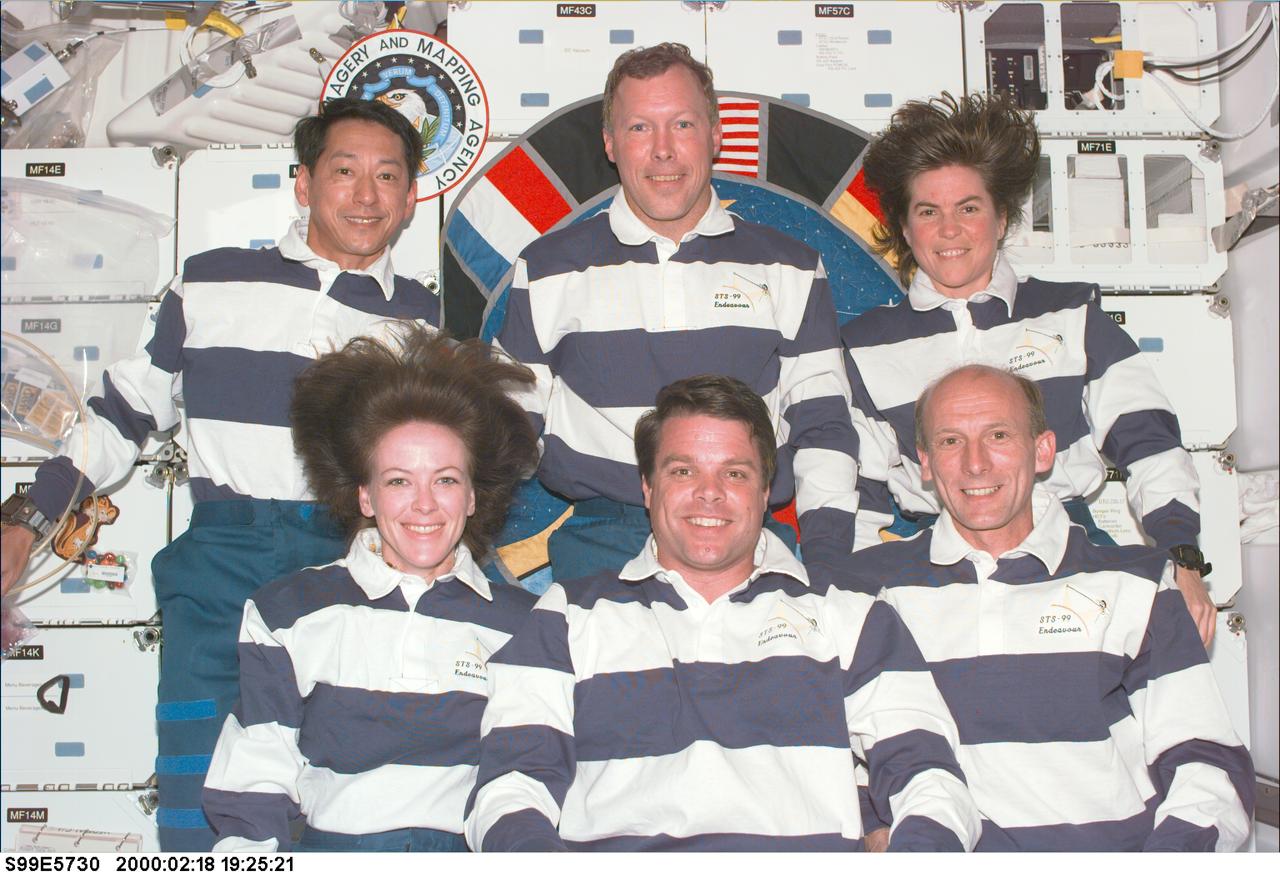
S99-E-5730 (18 February 2000) --- Not often seen together on the STS-99 flight which provides around-the-clock coverage for the Shuttle Radar Topography Mission (SRTM), the six astronauts pose for the traditional inflight crew portrait on Endeavour's mid deck. In the rear are the Blue Team members (from left), Mamoru Mohri, Dominic L. Gorie and Janice Voss. In front are Red Team members Janet L. Kavandi, Kevin R. Kregel and Gerhard P.J. Thiele. Mohri is with Japan's National Space Development Agency (NASDA) and Thiele represents the European Space Agency (ESA).
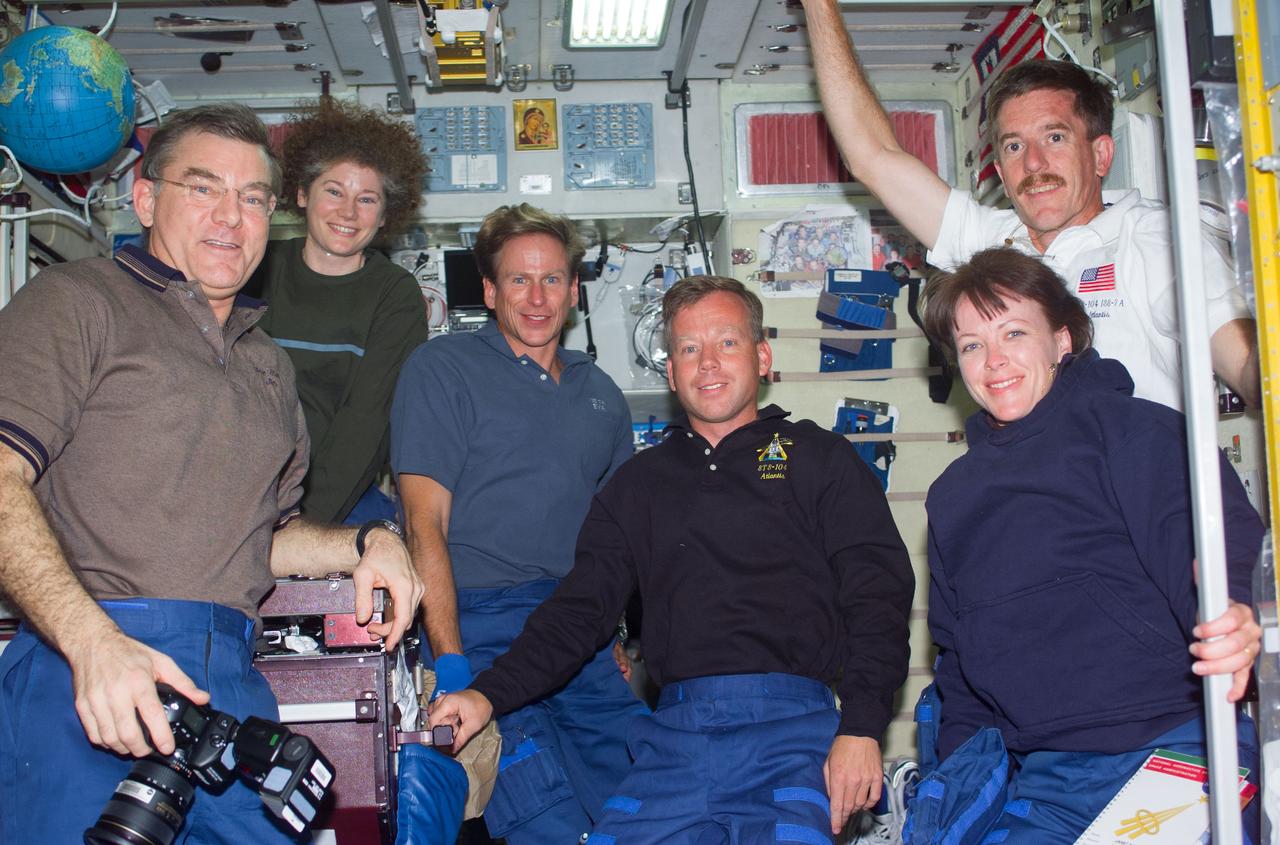
S104-E-5053 (14 July 2001) --- Soon after their ingress into the International Space Station (ISS), STS-104 crewmembers pose for a photograph with Expedition Two crewmembers in the Zvezda Service Module. From left to right are: James S. Voss, Expedition Two flight engineer; Susan J. Helms, Expedition Two flight engineer; Michael L. Gernhardt, STS-104 mission specialist; Steven W. Lindsey, STS-104 mission commander; Janet L. Kavandi, STS-104 mission specialist; and James F. Reilly, STS-104 mission specialist.
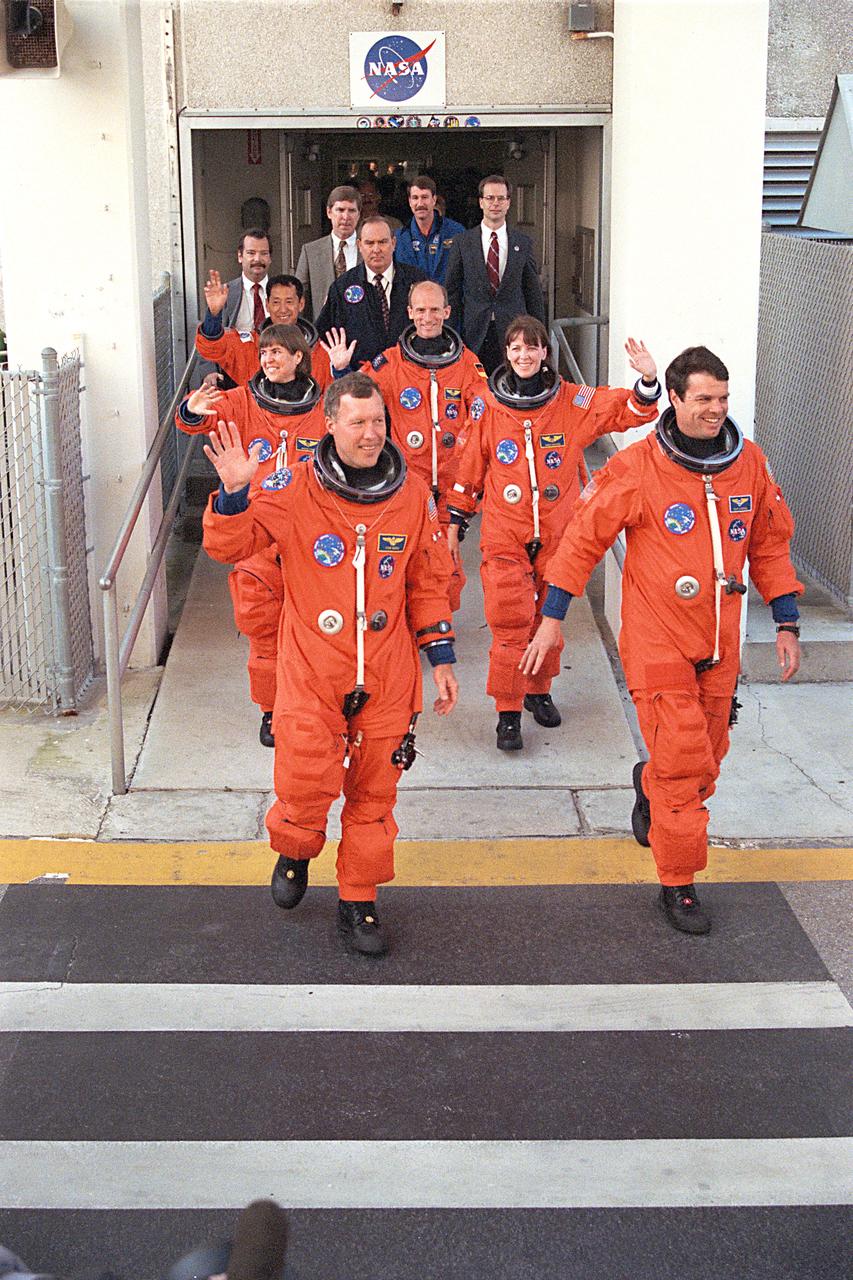
STS099-S-018 (11 February 2000) --- The STS-99 crew members wave to onlookers as they depart from the Operations and Checkout Building en route to Launch Pad 39A for liftoff of the Space Shuttle Endeavour. Attired in their burnt-orange launch and entry suits, the crewmembers are led in front by Dominic L. Gorie (left), pilot; and Kevin R. Kregel, mission commander. Behind them are the mission specialists (from the left) Janice Voss; Mamoru Mohri, with Japan's NASDA; Gerhard P. J. Thiele, representing the European Space Agency (ESA); and Janet L. Kavandi. This flight is the 97th shuttle mission and the 14th flight of the Space Shuttle Endeavour.
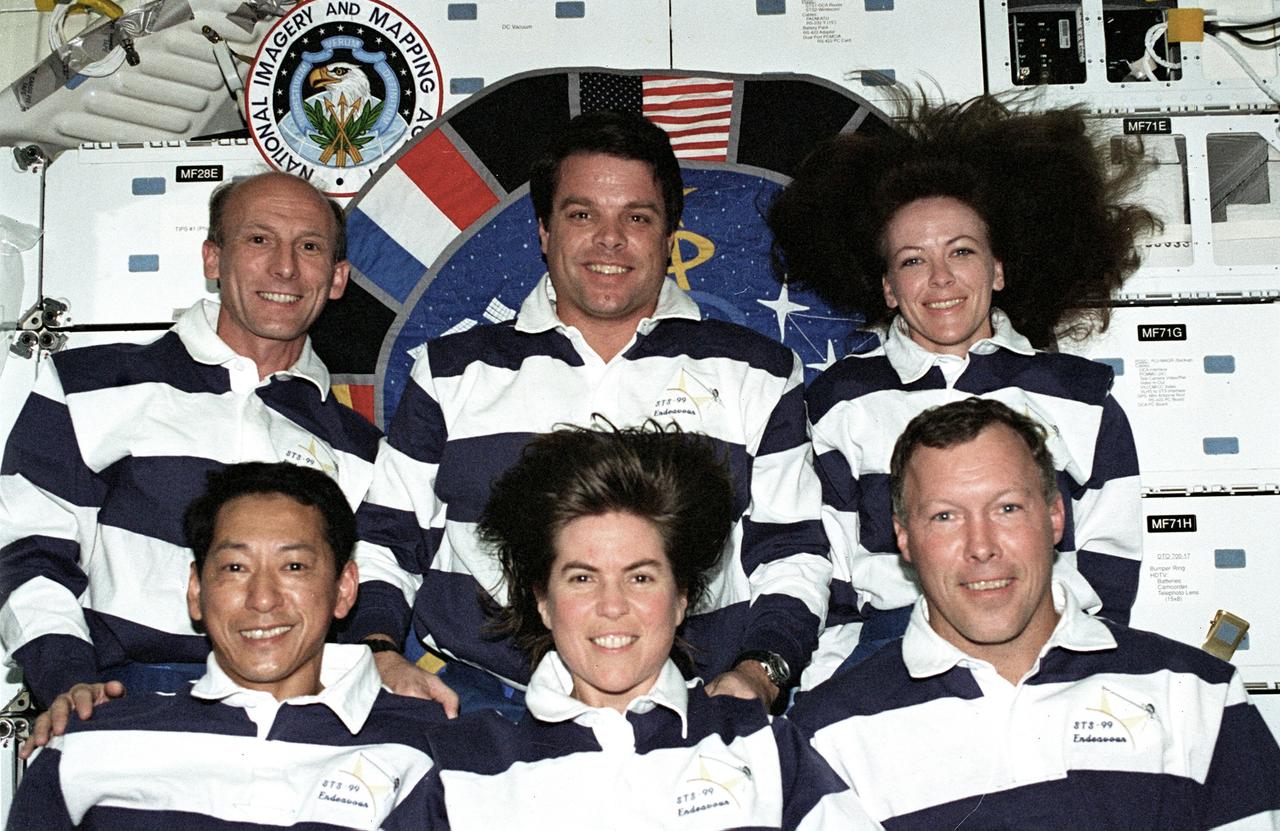
STS099-318-003 (11-22 February 2000) --- The six flight crew members for the Shuttle Radar Topography Mission (SRTM) pose for the traditional inflight crew portrait on Endeavour's mid deck. Blue Team members in front are (from the left), astronauts Mamoru Mohri, Janice Voss and Dominic L. Gorie. Red Team members are (from left, rear) astronauts Gerhard P.J. Thiele, Kevin R. Kregel and Janet L. Kavandi. Mohri is with Japan's National Space Development Agency (NASDA) and Thiele represents the European Space Agency (ESA).
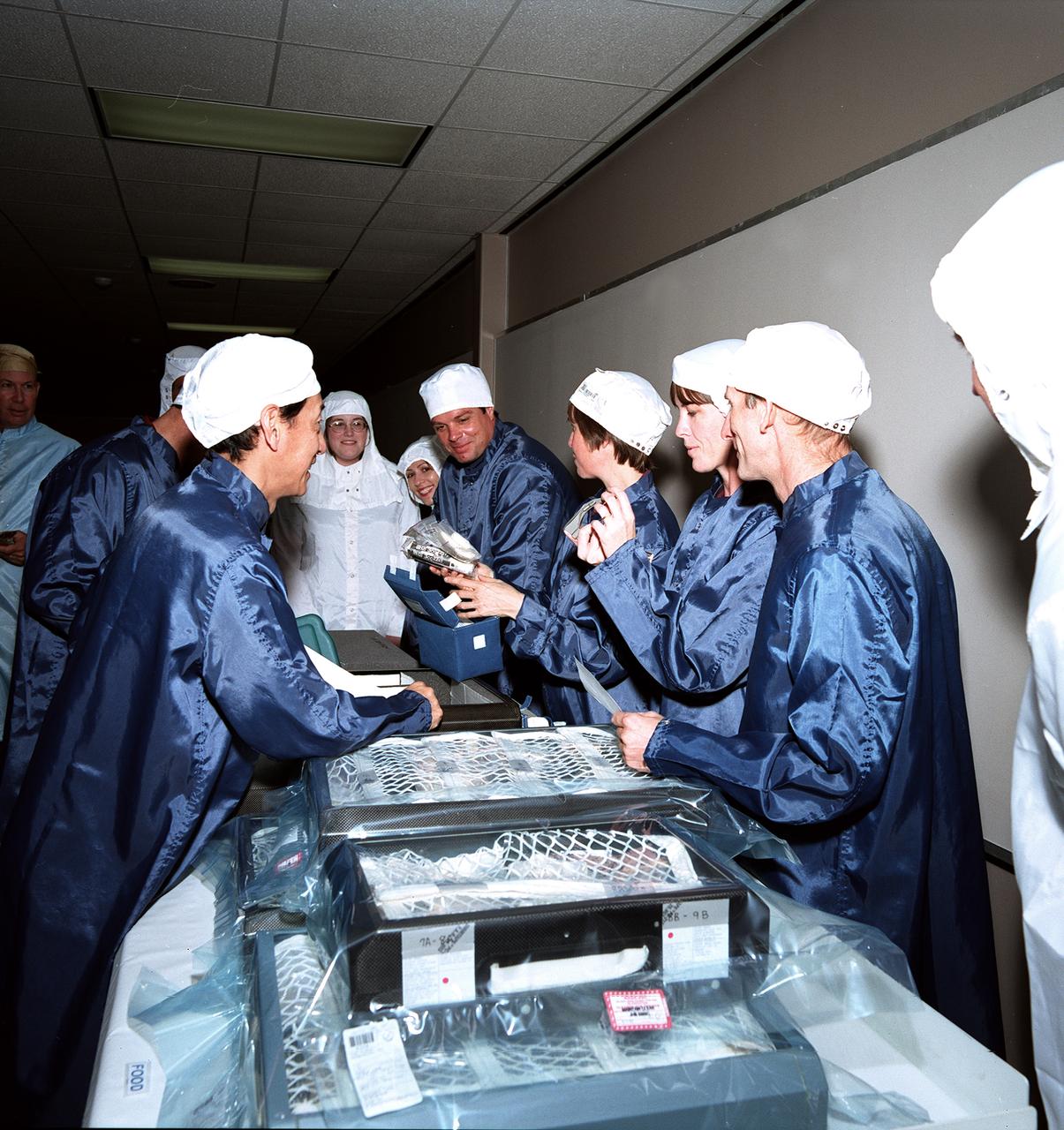
S99-09469 (11 August 1999) --- Wearing clean room suits, all six members of the STS-99 crew inspect some of the gear they will be using on their upcoming space shuttle mission. From the left (in blue lab coats) are astronauts Mamoru Mohri, mission specialist representing Japan's National Development Space Agency (NASDA); Dominic L. Gorie (partially obscured), pilot; Kevin R. Kregel, mission commander; Janice Voss, mission specialist; Janet L. Kavandi, mission specialist; and Gerhard P.J. Thiele, mission specialist representing the European Space Agency (ESA). This type flight crew equipment (FCE) bench review is routine preflight procedure for all shuttle crews.
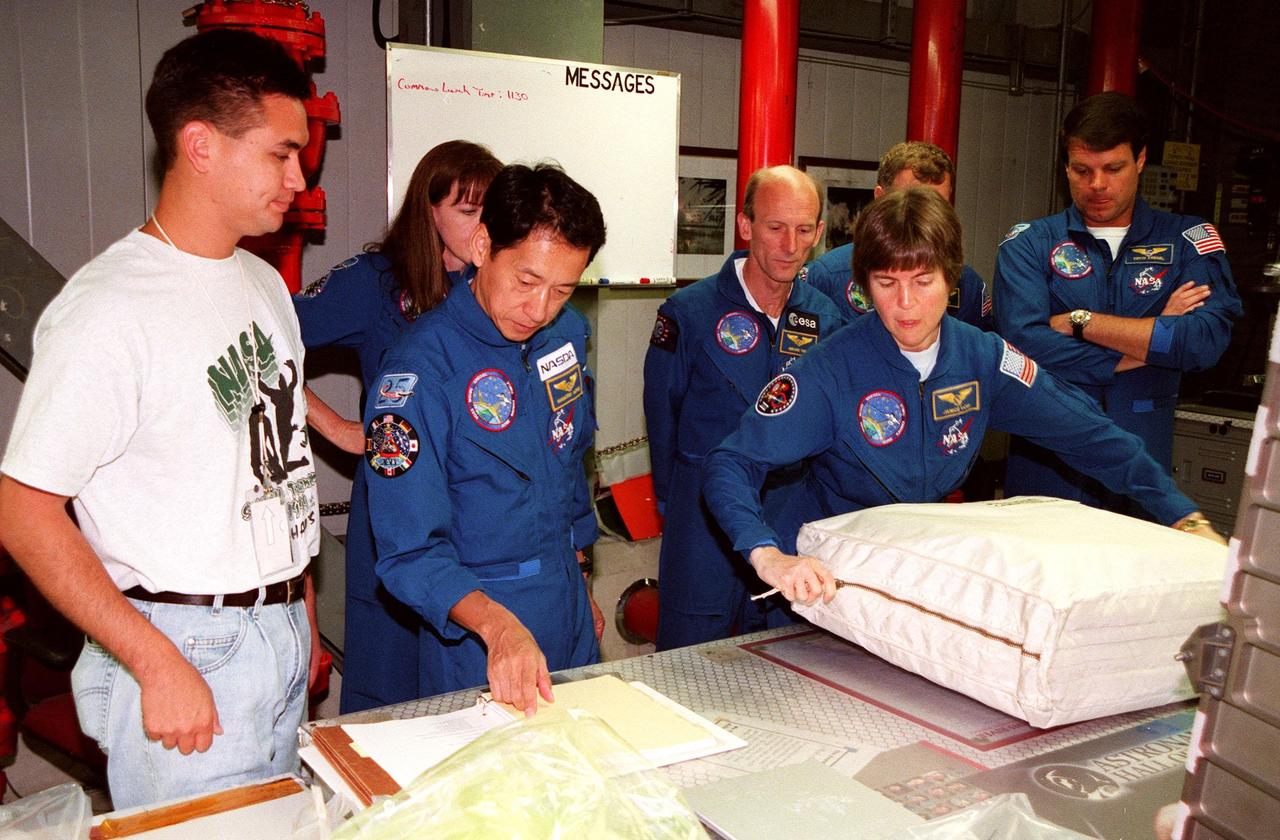
In the Orbiter Processing Facility (OPF) Bay 2, under the watchful eyes of a KSC worker (far left) the STS-99 crew look over equipment as part of a Crew Equipment Interface Test (CEIT). From left (second from right) are Mission Specialists Janet Lynn Kavandi (Ph.D.), Mamoru Mohri, Gerhard P.J. Thiele, and Janice Voss (Ph.D.); behind Voss are Pilot Dominic L. Pudwill Gorie and Commander Kevin R. Kregel. Mohri is with the National Space Development Agency (NASDA) of Japan, and Thiele is with the European Space Agency. The CEIT provides an opportunity for crew members to check equipment and facilities that will be aboard the orbiter during their mission. The STS-99 mission is the Shuttle Radar Topography Mission (SRTM), a specially modified radar system that will gather data for the most accurate and complete topographic map of the Earth's surface that has ever been assembled. SRTM will make use of radar interferometry, wherein two radar images are taken from slightly different locations. Differences between these images allow for the calculation of surface elevation, or change. The SRTM hardware will consist of one radar antenna in the shuttle payload bay and a second radar antenna attached to the end of a mast extended 60 meters (195 feet) out from the shuttle. STS-99 is scheduled to launch Sept. 16 at 8:47 a.m. from Launch Pad 39A
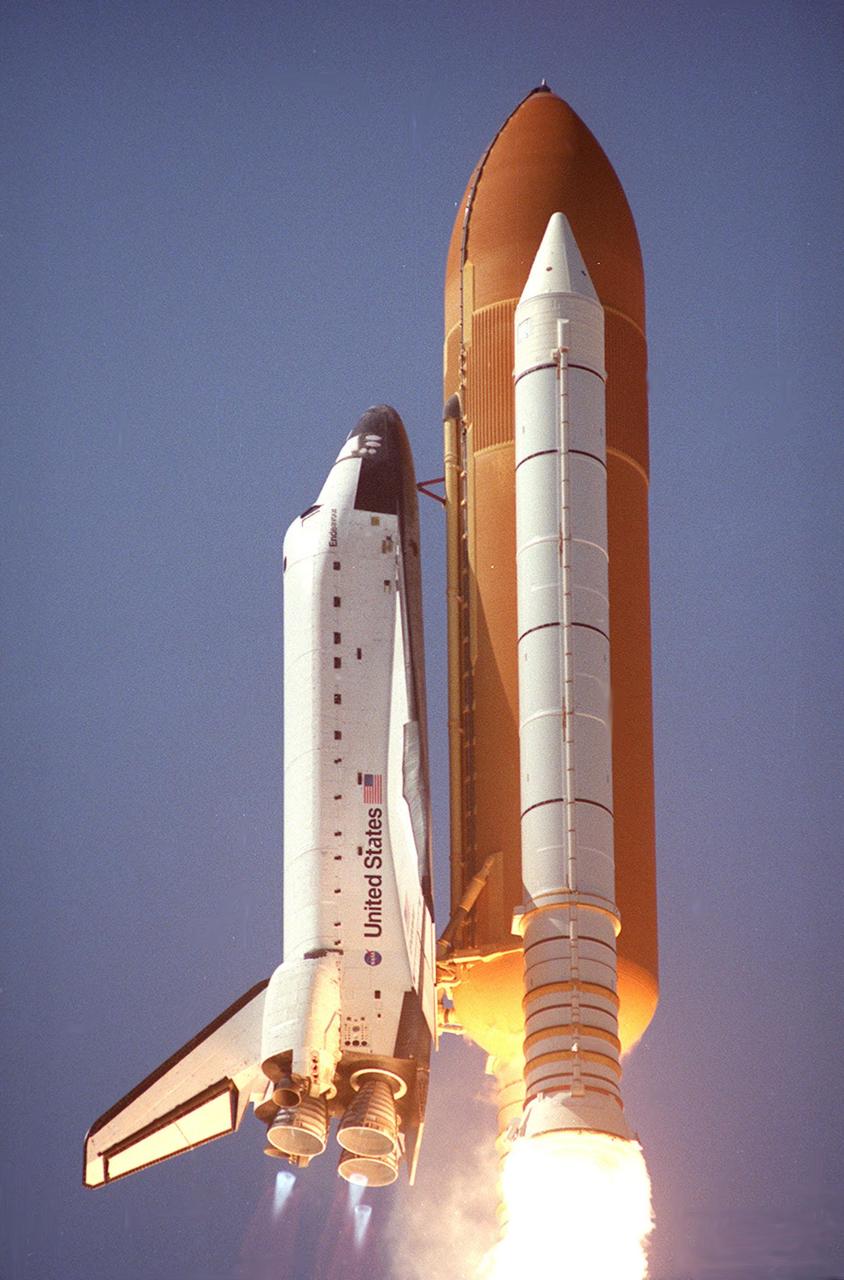
KENNEDY SPACE CENTER, FLA. -- A clear blue sky is the perfect setting behind Space Shuttle Endeavour as it hurtles into space. Launch of mission STS-99 occurred at 12:43:40 p.m. EST from Launch Pad 39A with a crew of five aboard: Commander Kevin Kregel, Pilot Dominic Gorie, and Mission Specialists Janet Kavandi, Janice Voss, Mamoru Mohri of Japan and Gerhard Thiele of Germany. Mohri is with the National Space Development Agency (NASDA) of Japan, and Thiele is with the European Space Agency. Known as the Shuttle Radar Topography Mission (SRTM), STS-99 will chart a new course to produce unrivaled 3-D images of the Earth's surface. The result of the SRTM could be close to 1 trillion measurements of the Earth's topography. The mission is expected to last 11days, with Endeavour landing at KSC Tuesday, Feb. 22, at 4:36 p.m. EST. This is the 97th Shuttle flight and 14th for Shuttle Endeavour
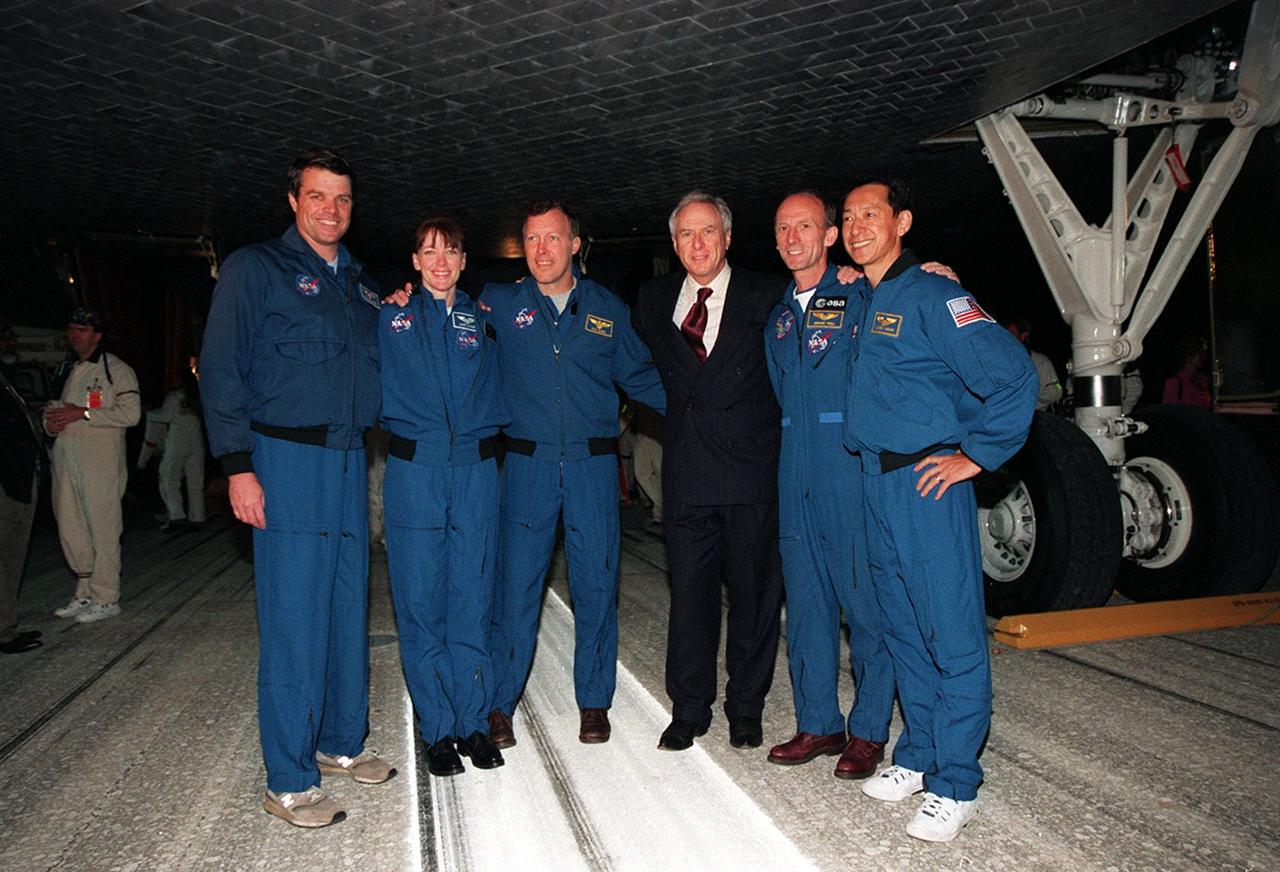
KENNEDY SPACE CENTER, FLA. -- Members of the STS-99 crew pose with NASA Administrator Dan Goldin underneath Space Shuttle Endeavour on KSC's Shuttle Landing Facility. From left are Commander Kevin Kregel, Mission Specialist Janet Kavandi, Pilot Dominic Gorie, Goldin, and Mission Specialists Gerhard Thiele and Mamoru Mohri. Not in the photo is Mission Specialist Janice Voss. Main gear touchdown was at 6:22:23 p.m. EST Feb. 22 , landing on orbit 181 of the mission. Nose gear touchdown was at 6:22:35 p.m.. EST, and wheel stop at 6:23:25 p.m. EST. The crew returned from the Shuttle Radar Topography Mission after mapping more than 47 million square miles of the Earth's surface. This was the 97th flight in the Space Shuttle program and the 14th for Endeavour, also marking the 50th landing at KSC, the 21st consecutive landing at KSC, and the 28th in the last 29 Shuttle flights

In the Operations and Checkout Building's suitup room, Carlous Gillis, with United Space Alliance, helps STS-99 Pilot Dominic Gorie with pre-pack and fit check. Gorie and other crew members Commander Kevin Kregel, and Mission Specialists Janet Kavandi, Janice Voss, Gerhard Thiele of Germany and Mamoru Mohri of Japan are preparing for launch of their mission on Feb. 11 at 12:30 p.m. EST aboard Space Shuttle Endeavour. STS-99 is the Shuttle Radar Topography Mission, which will produce unrivaled 3-D images of the Earth's surface. The result of the Shuttle Radar Topography Mission could be close to 1 trillion measurements of the Earth's topography. Landing is expected at KSC on Feb. 22 at 4:36 p.m. EST
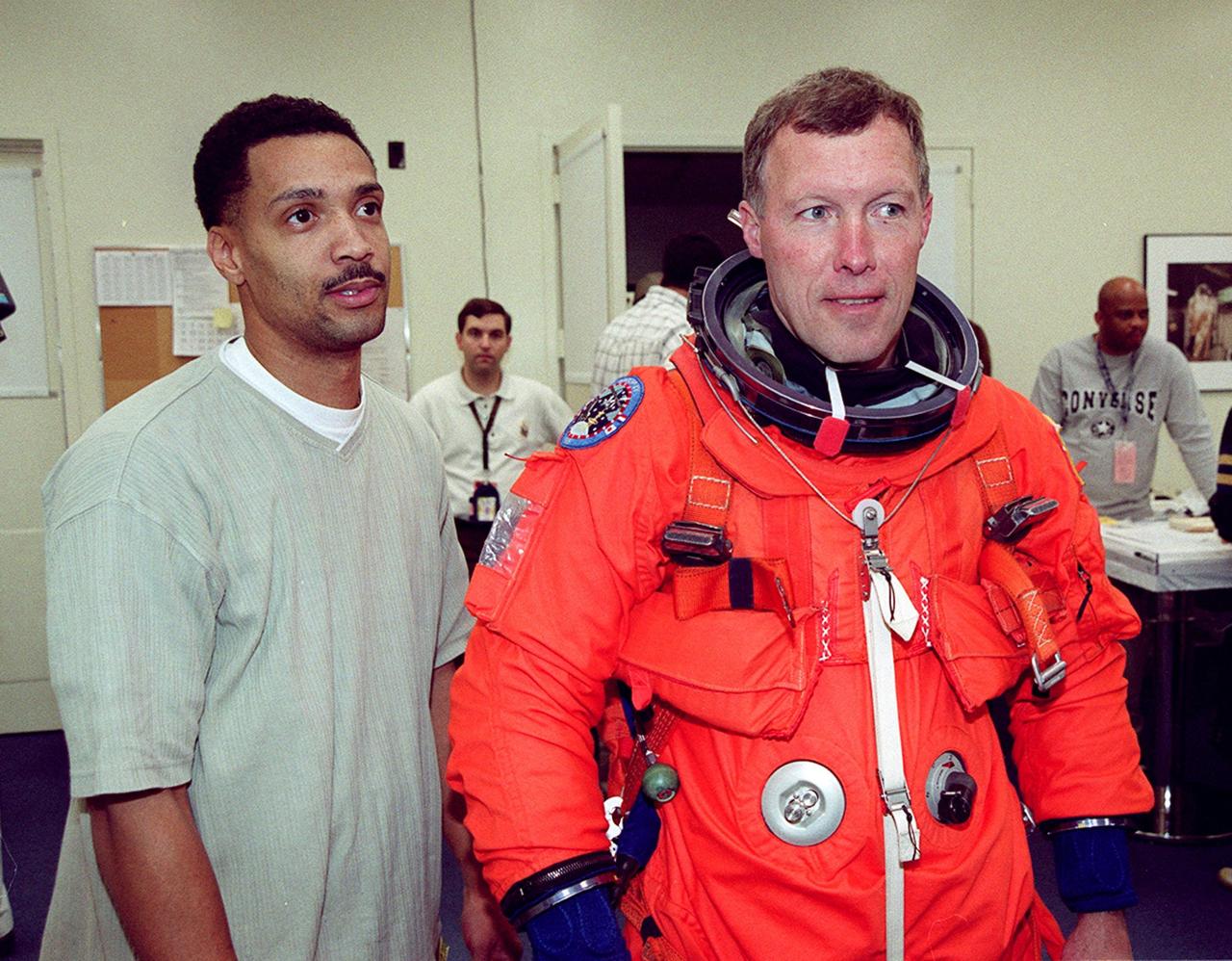
In the Operations and Checkout Building's suitup room, Carlous Gillis, with United Space Alliance, helps STS-99 Pilot Dominic Gorie with pre-pack and fit check. Gorie and other crew members Commander Kevin Kregel, and Mission Specialists Janet Kavandi, Janice Voss, Gerhard Thiele of Germany and Mamoru Mohri of Japan are preparing for launch of their mission on Feb. 11 at 12:30 p.m. EST aboard Space Shuttle Endeavour. STS-99 is the Shuttle Radar Topography Mission, which will produce unrivaled 3-D images of the Earth's surface. The result of the Shuttle Radar Topography Mission could be close to 1 trillion measurements of the Earth's topography. Landing is expected at KSC on Feb. 22 at 4:36 p.m. EST
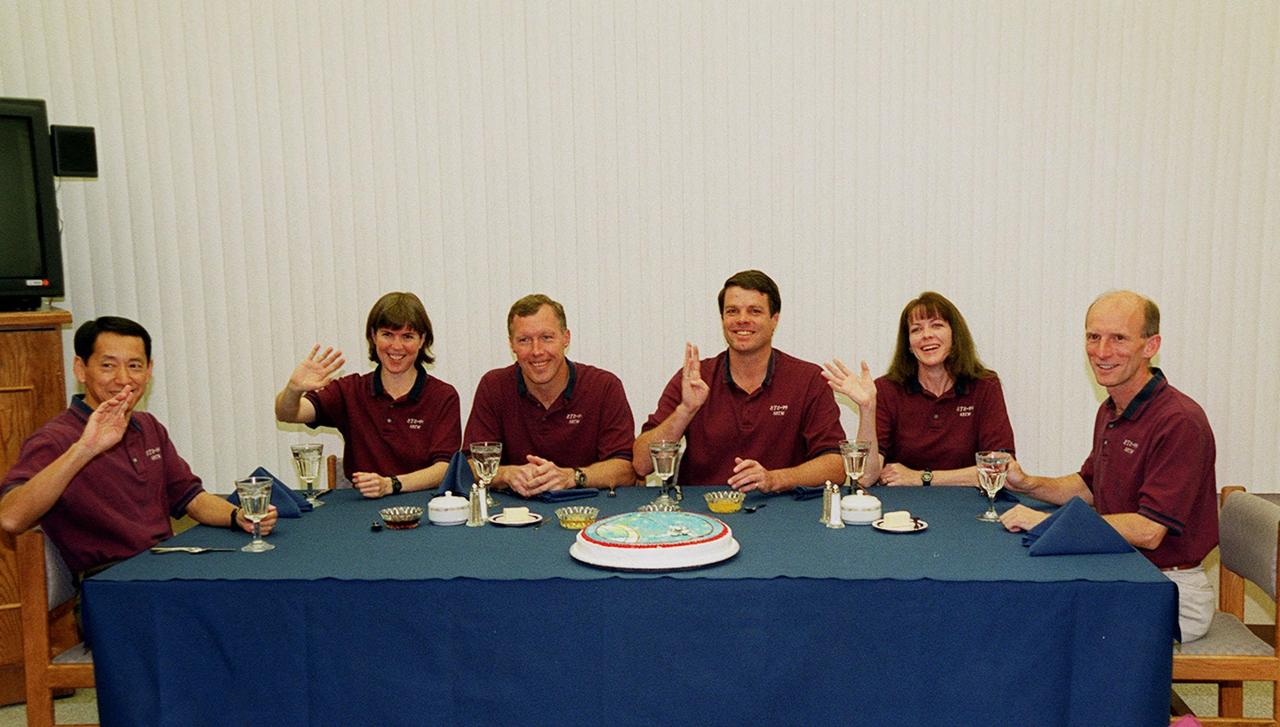
In the Operations and Checkout Building, an eager and smiling STS-99 crew gathers for breakfast before suiting up for launch. From left are Mission Specialists Mamoru Mohri and Janice Voss, Pilot Dominic Gorie, Commander Kevin Kregel, and Mission Specialists Janet Lynn Kavandi and Gerhard Thiele. Mohri is with the National Space Development Agency (NASDA) of Japan, and Thiele is with the European Space Agency. Known as the Shuttle Radar Topography Mission (SRTM), STS-99 is scheduled for liftoff at 12:30 p.m. EST from Launch Pad 39A. The SRTM will chart a new course to produce unrivaled 3-D images of the Earth's surface. The result of the Shuttle Radar Topography Mission could be close to 1 trillion measurements of the Earth's topography. The mission is expected to last about 11days, with Endeavour landing at KSC Tuesday, Feb. 22, at 4:36 p.m. EST. This is the 97th Shuttle flight and 14th for Shuttle Endeavour
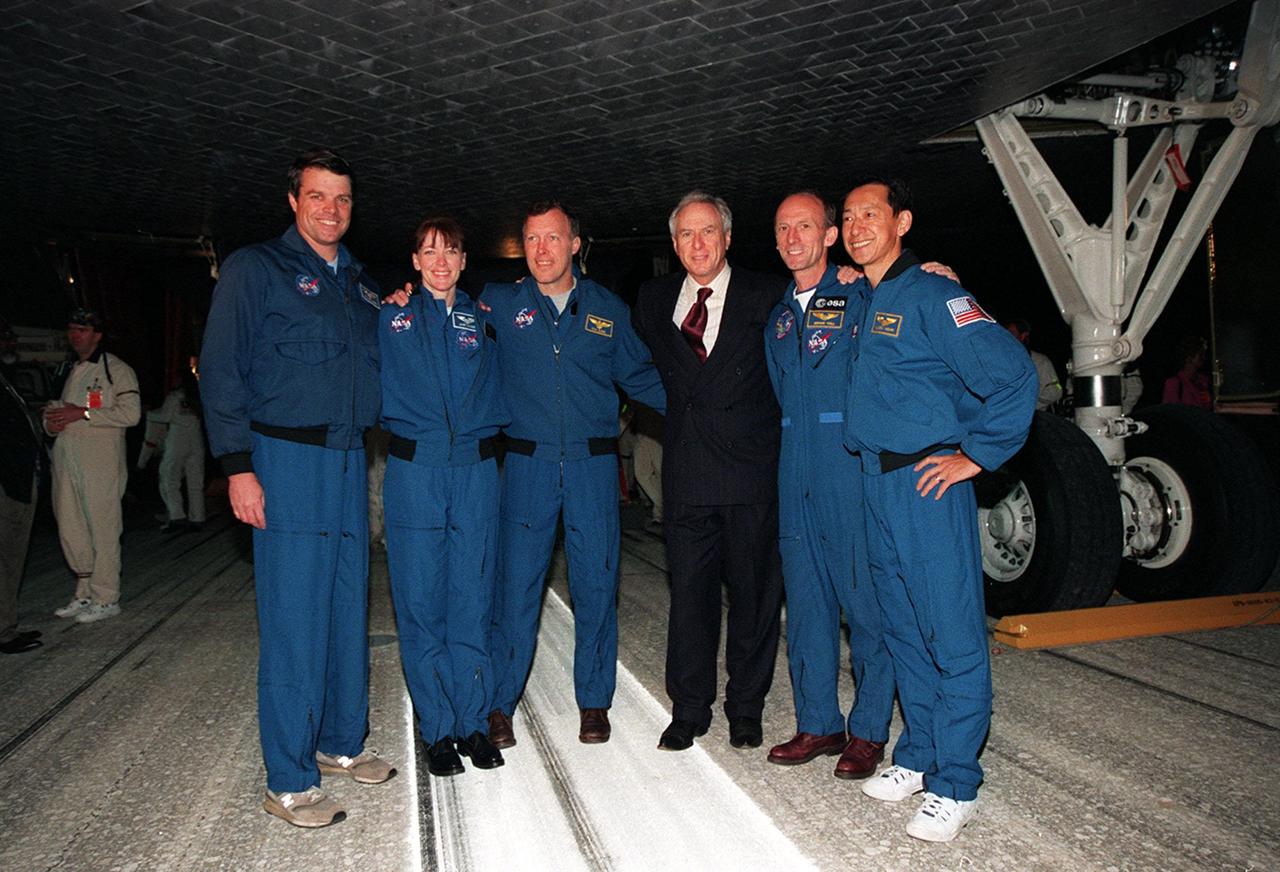
KENNEDY SPACE CENTER, FLA. -- Members of the STS-99 crew pose with NASA Administrator Dan Goldin underneath Space Shuttle Endeavour on KSC's Shuttle Landing Facility. From left are Commander Kevin Kregel, Mission Specialist Janet Kavandi, Pilot Dominic Gorie, Goldin, and Mission Specialists Gerhard Thiele and Mamoru Mohri. Not in the photo is Mission Specialist Janice Voss. Main gear touchdown was at 6:22:23 p.m. EST Feb. 22 , landing on orbit 181 of the mission. Nose gear touchdown was at 6:22:35 p.m.. EST, and wheel stop at 6:23:25 p.m. EST. The crew returned from the Shuttle Radar Topography Mission after mapping more than 47 million square miles of the Earth's surface. This was the 97th flight in the Space Shuttle program and the 14th for Endeavour, also marking the 50th landing at KSC, the 21st consecutive landing at KSC, and the 28th in the last 29 Shuttle flights
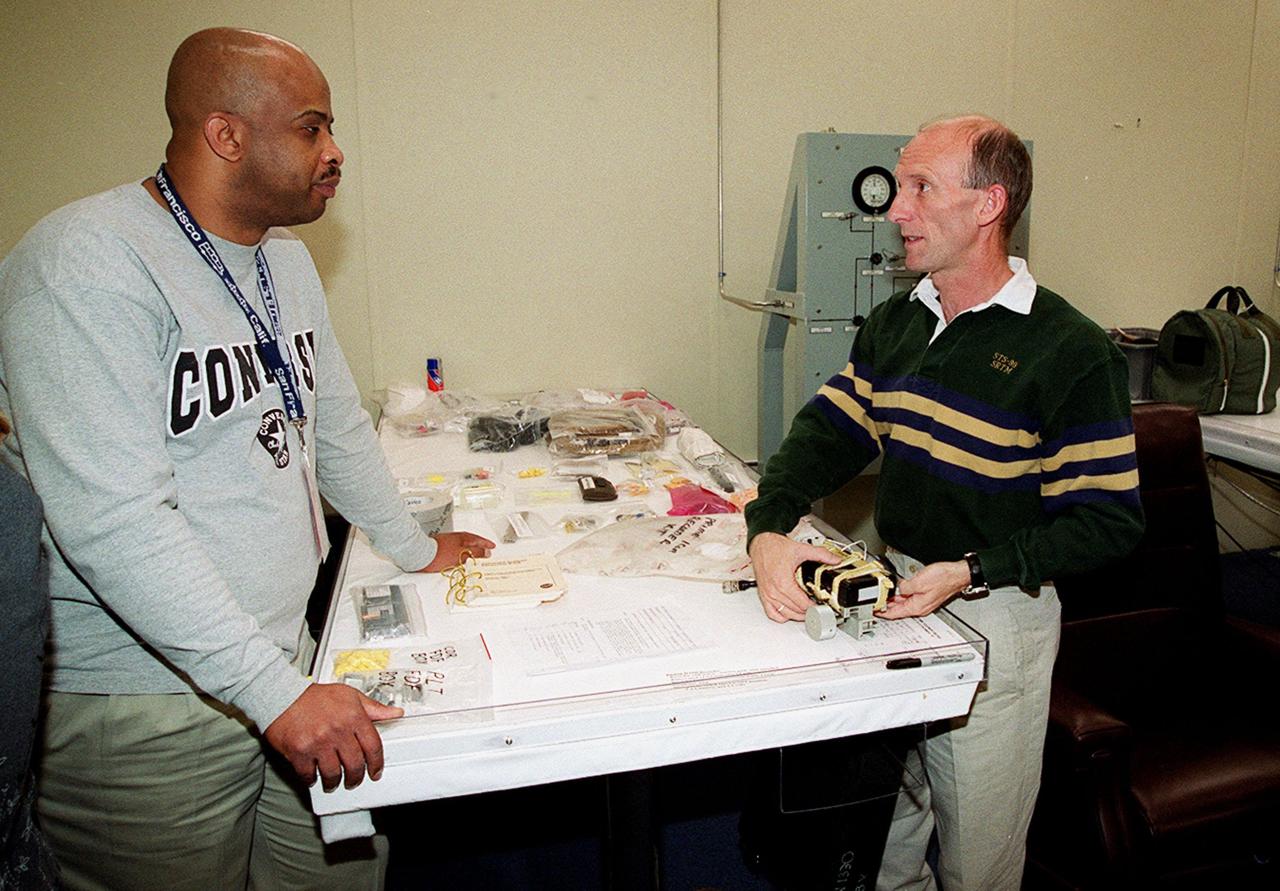
In the Operations and Checkout Building's suitup room, Andre Denard, with United Space Alliance, helps STS-99 Mission Specialist Gerhard Thiele with pre-pack and fit check. Thiele and other crew members Commander Kevin Kregel, Pilot Dominic Gorie, and Mission Specialists Janet Kavandi, Janice Voss, and Mamoru Mohri of Japan are preparing for launch of their mission on Feb. 11 at 12:30 p.m. EST aboard Space Shuttle Endeavour. STS-99 is the Shuttle Radar Topography Mission, which will produce unrivaled 3-D images of the Earth's surface. The result of the Shuttle Radar Topography Mission could be close to 1 trillion measurements of the Earth's topography. Landing is expected at KSC on Feb. 22 at 4:36 p.m. EST
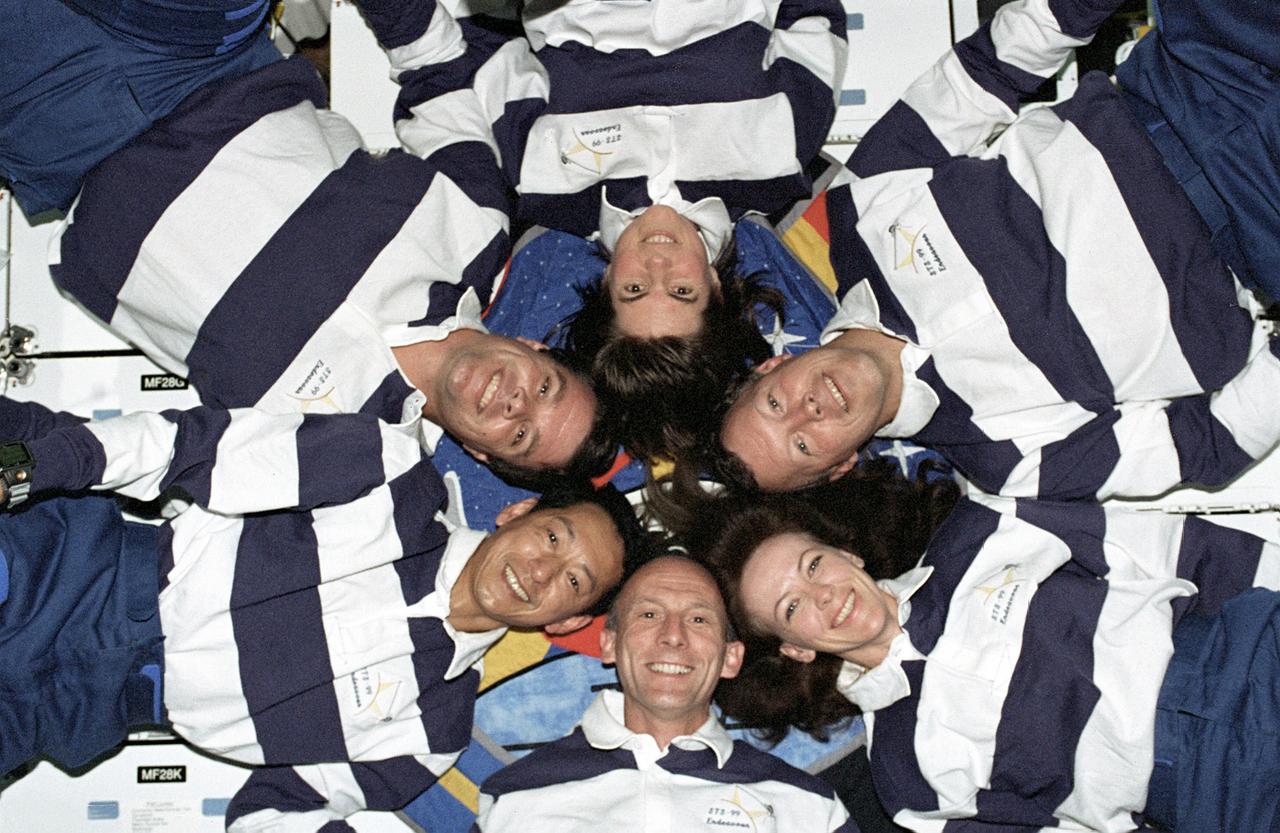
The STS-99 crew pose for a "star-burst" pose in celebration of a successful Shuttle Radar Topographic Mission (SRTM) aboard NASA's Space Shuttle Endeavor. Clockwise, around the circle, from top center are astronauts Janice Voss, Dominic L. Gorie, Janet L. Kavandi, Gerhard Thiele of the European Space Agency, Mamoru Mohri of the Japanese Space Agency, and Kevin Kregel. The STS-99 SRTM mission was the most ambitious Earth mapping mission to date. Orbiting at 233 kilometers (145 miles) above Earth, two radar anternas, one located in the Shuttle bay and the other located on the end of a 60-meter deployable mast, was used during the mission to map Earth's features. The goal was to provide a 3-dimensional topographic map of the world's surface up to the Arctic and Antarctic Circles. The mission completed 222 hours of around the clock radar mapping gathering enough information to fill more than 20,000 CDs.
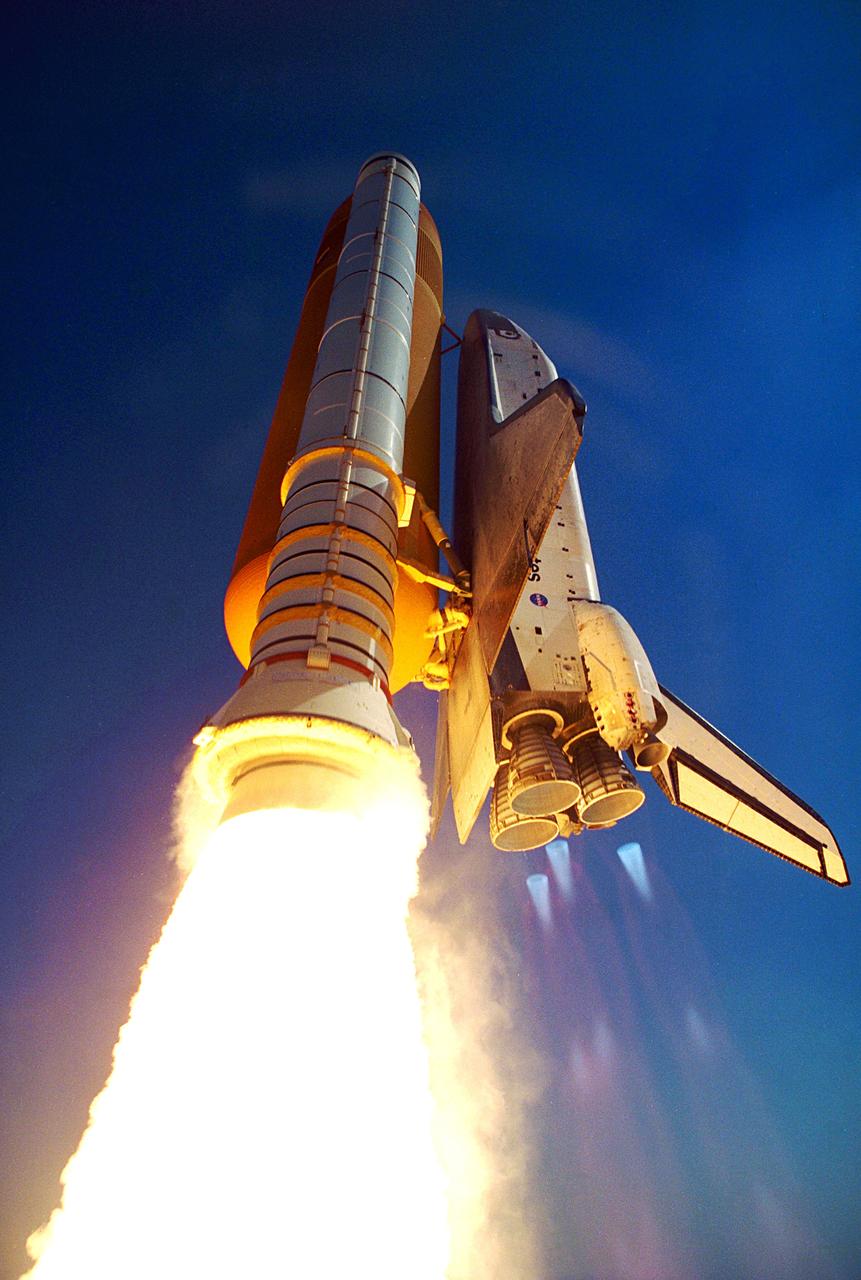
STS099-S-022 (11 February 2000) --- The Space Shuttle Endeavour lifts off from Kennedy Space Center’s (KSC) Launch Pad 39A to officially begin the Shuttle Radar Topography Mission (SRTM). Launch occurred at 12:43:40 p.m. (EST), February 11, 2000. This low-angle view clearly shows the "diamond-shock" effect of the shuttle's engines. Onboard were astronauts Kevin R. Kregel, mission commander, and Dominic L. Gorie, pilot; along with Janice Voss, Janet L. Kavandi, Mamoru Mohri and Gerhard P. J. Thiele, all mission specialists. Mohri is with Japan's National Space Development Agency (NASDA) and Thiele represents the European Space Agency (ESA).
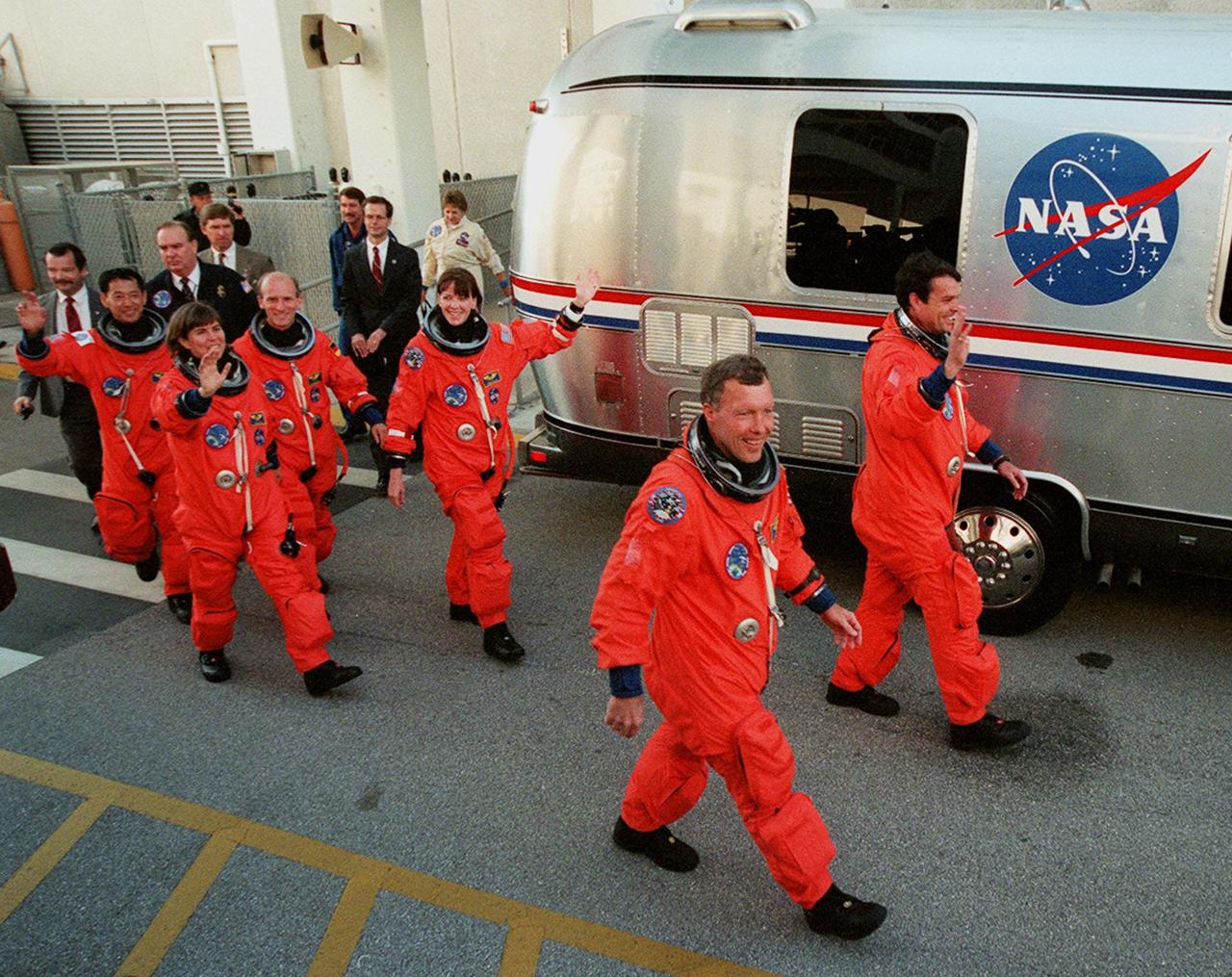
The STS-99 crew step eagerly to the "Astrovan," the bus that will take them to Launch Pad 39A for liftoff of Space Shuttle Endeavour. In their orange launch and entry suits, they are (left to right) Mission Specialists Mamoru Mohri of Japan, Janice Voss, Gerhard Thiele of Germany and Janet Lynn Kavandi, Pilot Dominic Gorie and Commander Kevin Kregel. Mohri is with the National Space Development Agency (NASDA) of Japan, and Thiele is with the European Space Agency. Known as the Shuttle Radar Topography Mission (SRTM), STS-99 is scheduled for liftoff at 12:30 p.m. EST. The SRTM will chart a new course to produce unrivaled 3-D images of the Earth's surface. The result of the Shuttle Radar Topography Mission could be close to 1 trillion measurements of the Earth's topography. The mission is expected to last 11days, with Endeavour landing at KSC Tuesday, Feb. 22, at 4:36 p.m. EST. This is the 97th Shuttle flight and 14th for Shuttle Endeavour
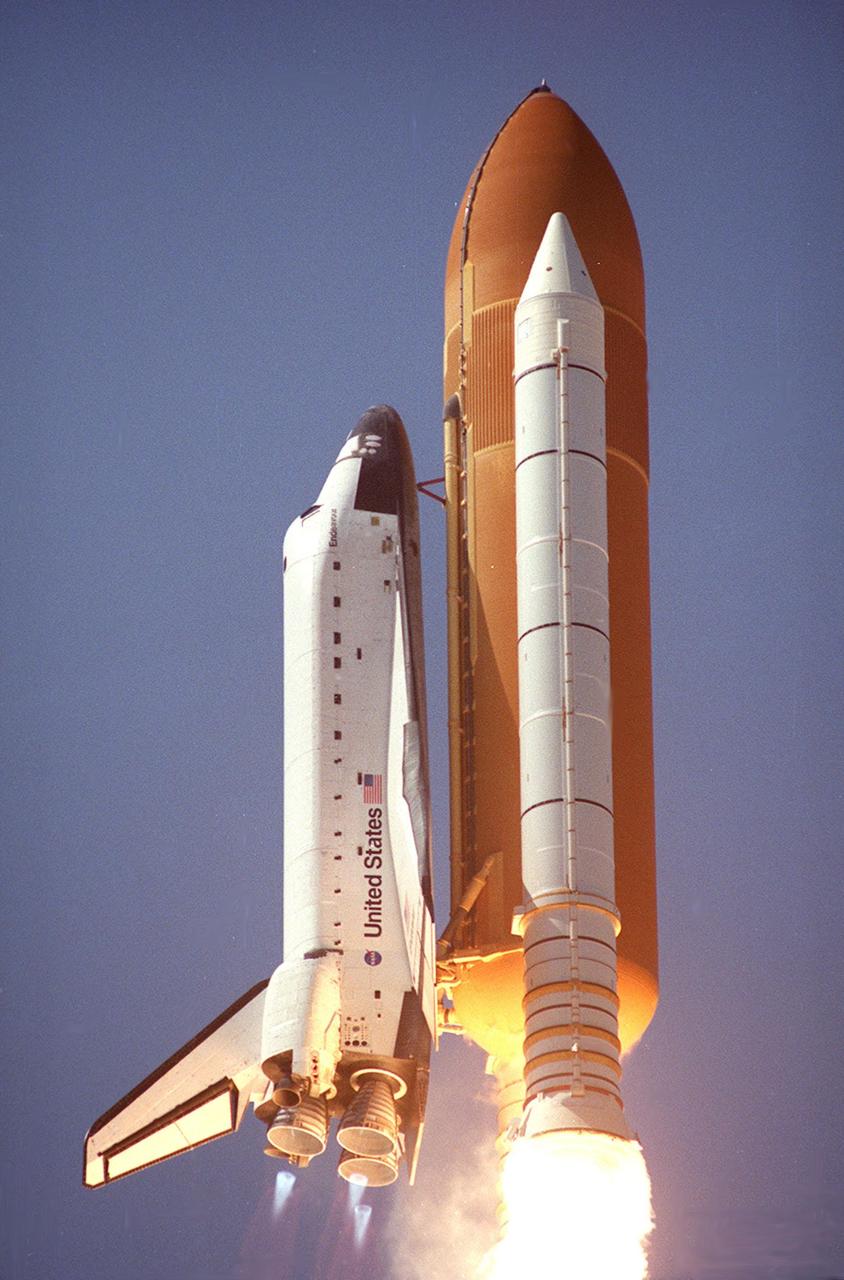
KENNEDY SPACE CENTER, FLA. -- A clear blue sky is the perfect setting behind Space Shuttle Endeavour as it hurtles into space. Launch of mission STS-99 occurred at 12:43:40 p.m. EST from Launch Pad 39A with a crew of five aboard: Commander Kevin Kregel, Pilot Dominic Gorie, and Mission Specialists Janet Kavandi, Janice Voss, Mamoru Mohri of Japan and Gerhard Thiele of Germany. Mohri is with the National Space Development Agency (NASDA) of Japan, and Thiele is with the European Space Agency. Known as the Shuttle Radar Topography Mission (SRTM), STS-99 will chart a new course to produce unrivaled 3-D images of the Earth's surface. The result of the SRTM could be close to 1 trillion measurements of the Earth's topography. The mission is expected to last 11days, with Endeavour landing at KSC Tuesday, Feb. 22, at 4:36 p.m. EST. This is the 97th Shuttle flight and 14th for Shuttle Endeavour
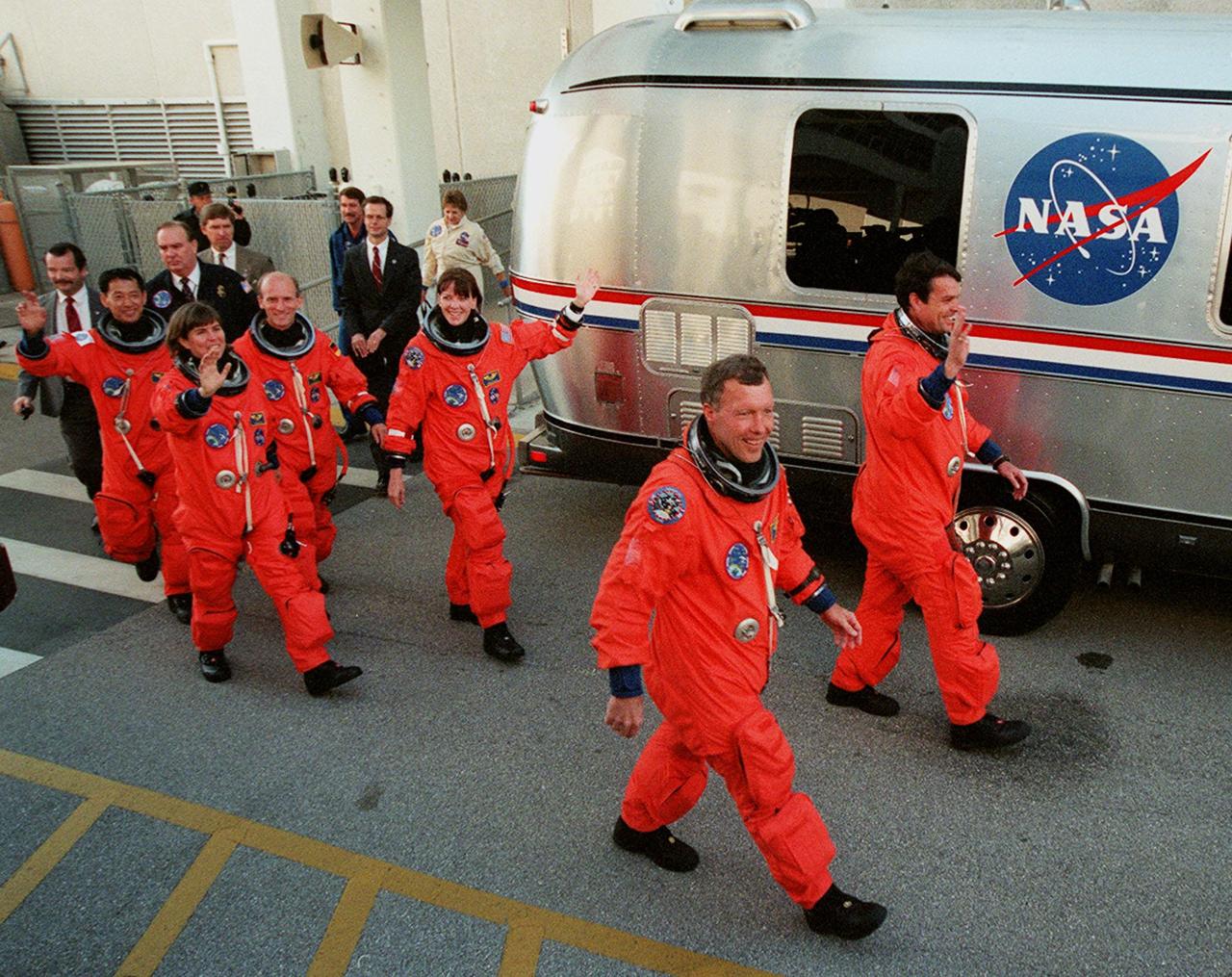
The STS-99 crew step eagerly to the "Astrovan," the bus that will take them to Launch Pad 39A for liftoff of Space Shuttle Endeavour. In their orange launch and entry suits, they are (left to right) Mission Specialists Mamoru Mohri of Japan, Janice Voss, Gerhard Thiele of Germany and Janet Lynn Kavandi, Pilot Dominic Gorie and Commander Kevin Kregel. Mohri is with the National Space Development Agency (NASDA) of Japan, and Thiele is with the European Space Agency. Known as the Shuttle Radar Topography Mission (SRTM), STS-99 is scheduled for liftoff at 12:30 p.m. EST. The SRTM will chart a new course to produce unrivaled 3-D images of the Earth's surface. The result of the Shuttle Radar Topography Mission could be close to 1 trillion measurements of the Earth's topography. The mission is expected to last 11days, with Endeavour landing at KSC Tuesday, Feb. 22, at 4:36 p.m. EST. This is the 97th Shuttle flight and 14th for Shuttle Endeavour
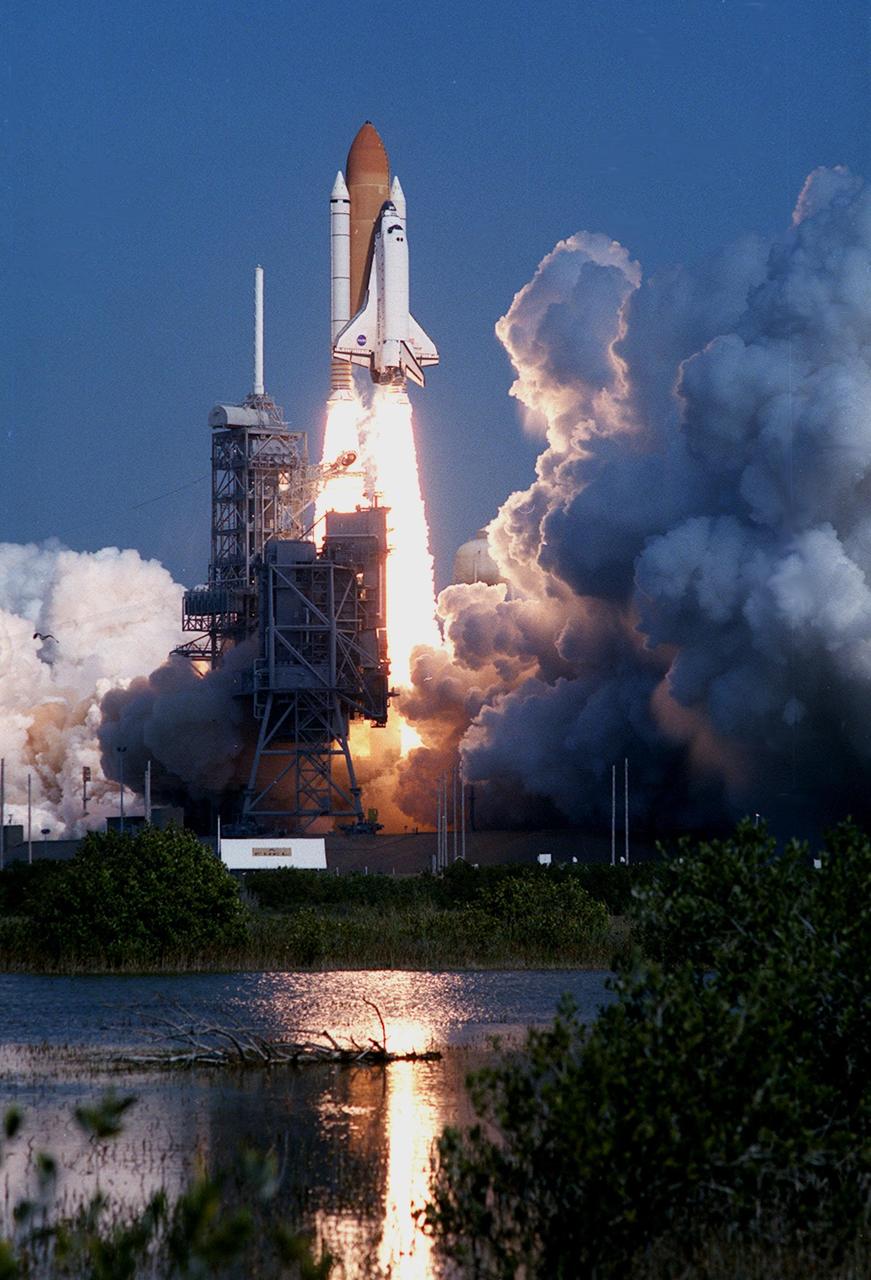
KENNEDY SPACE CENTER, Fla. -- The water below Launch Pad 39A reflects the perfect launch of Space Shuttle Endeavour on mission STS-99, while nearby billows of cloud and smoke are tinged with shadows. Launch of Endeavour occurred at 12:43:40 p.m. EST with a crew of five aboard: Commander Kevin Kregel, Pilot Dominic Gorie, and Mission Specialists Janet Kavandi, Janice Voss, Mamoru Mohri of Japan and Gerhard Thiele of Germany. Mohri is with the National Space Development Agency (NASDA) of Japan, and Thiele is with the European Space Agency. Known as the Shuttle Radar Topography Mission (SRTM), STS-99 will chart a new course to produce unrivaled 3-D images of the Earth's surface. The result of the SRTM could be close to 1 trillion measurements of the Earth's topography. The mission is expected to last 11days, with Endeavour landing at KSC Tuesday, Feb. 22, at 4:36 p.m. EST. This is the 97th Shuttle flight and 14th for Shuttle Endeavour
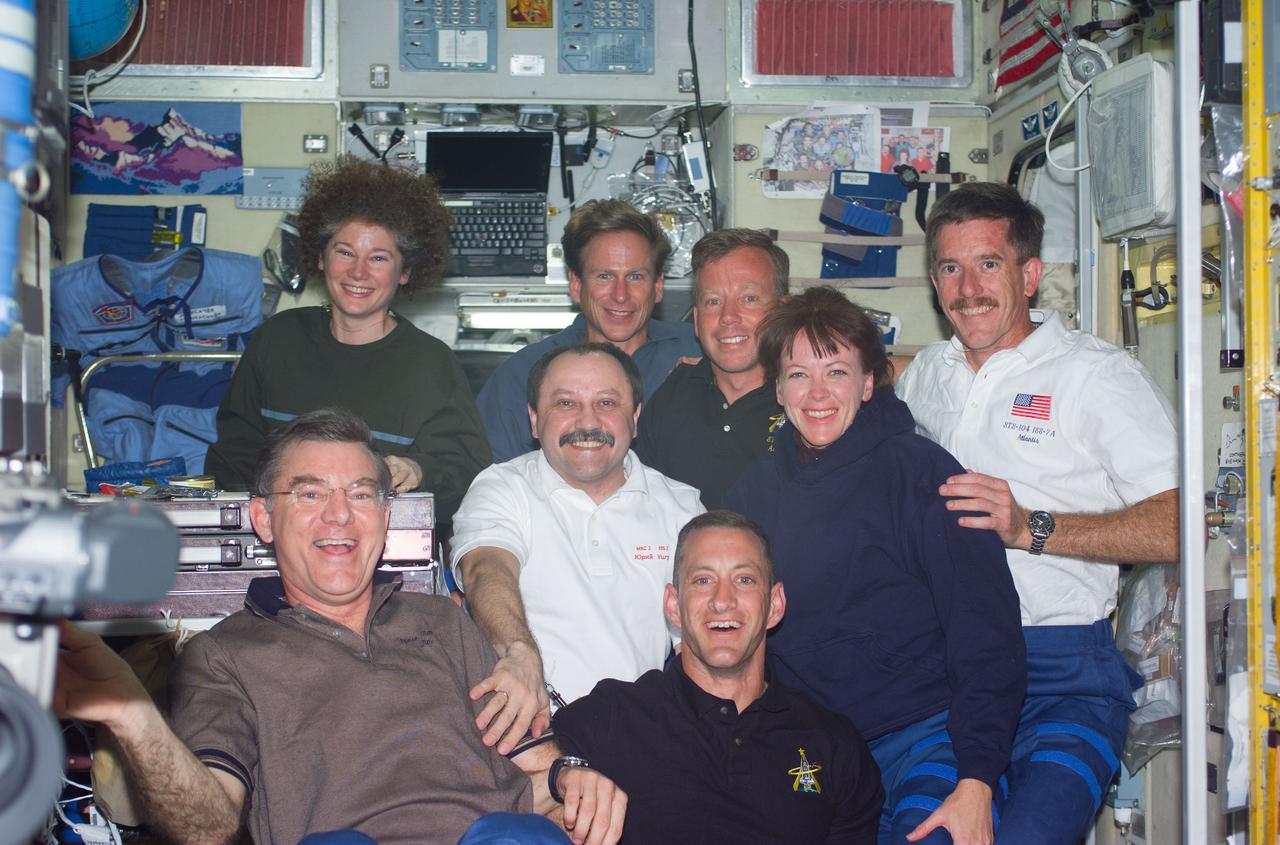
S104-E-5057 (14 July 2001) --- Soon after their ingress into the International Space Station (ISS), the STS-104 crewmembers pose for a photograph with the Expedition Two crewmembers in the Zvezda Service Module. From left to right are: back row - Susan J. Helms, Expedition Two flight engineer; Michael L. Gernhardt, STS-104 mission specialist; Steven W. Lindsey, STS-104; James F. Reilly, STS-104 mission specialist; middle row - Yury V. Usachev, Expedition Two mission commander; Janet L. Kavandi, STS-104 mission specialist; front row - James S. Voss, Expedition Two flight engineer; and Charles O. Hobaugh, STS-104 pilot. Usachev represents Rosaviakosmos.
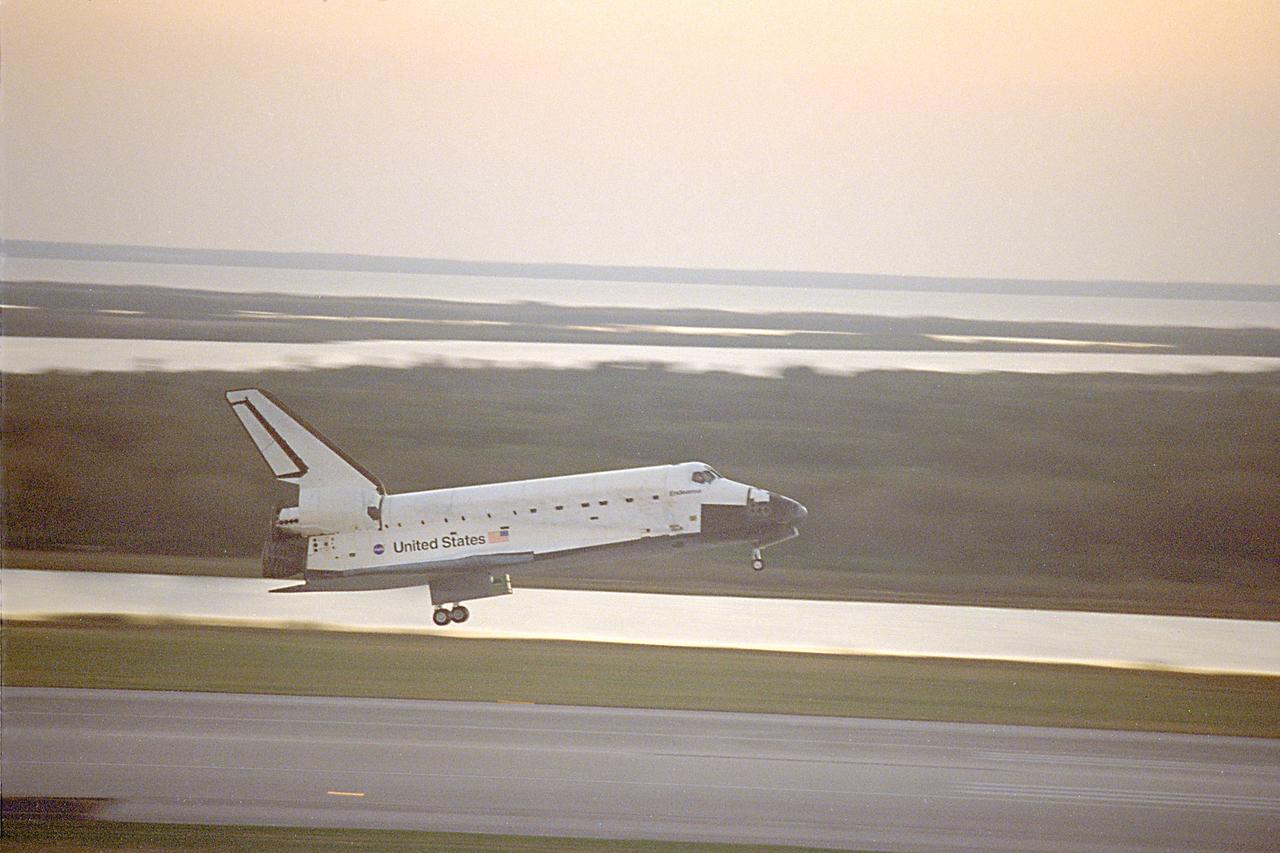
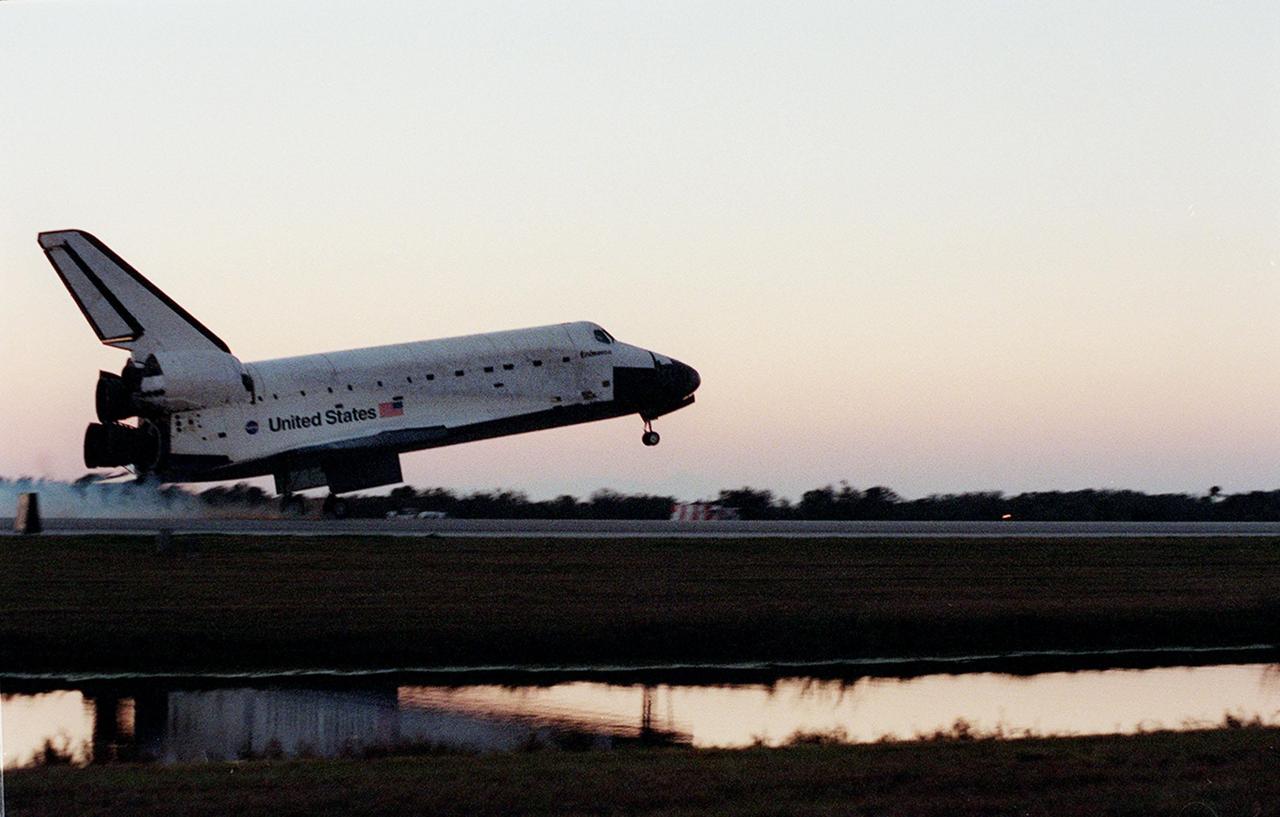
STS099-S-023 (22 February 2000) --- The Space Shuttle Endeavour prepares to land on Kennedy Space Center’s (KSC's) Shuttle Landing Facility Runway 33 to complete the 11-day, 5-hour, 38-minute-long STS-99 mission. Main gear touchdown was at 6:22:23 p.m. (EST) on February 22, 2000. The landing occurred following the completion of orbit 181. Nose gear touchdown was at 6:22:35 p.m., with wheel stop at 6:23:25 p.m. At the controls were Kevin R. Kregel, mission commander; and Dominic L. Gorie, pilot. The mission specialists onboard were Janet L. Kavandi and Janice Voss along with Japan's Mamoru Mohri and European Space Agency’s (ESA's) Gerhard P. J. Thiele.
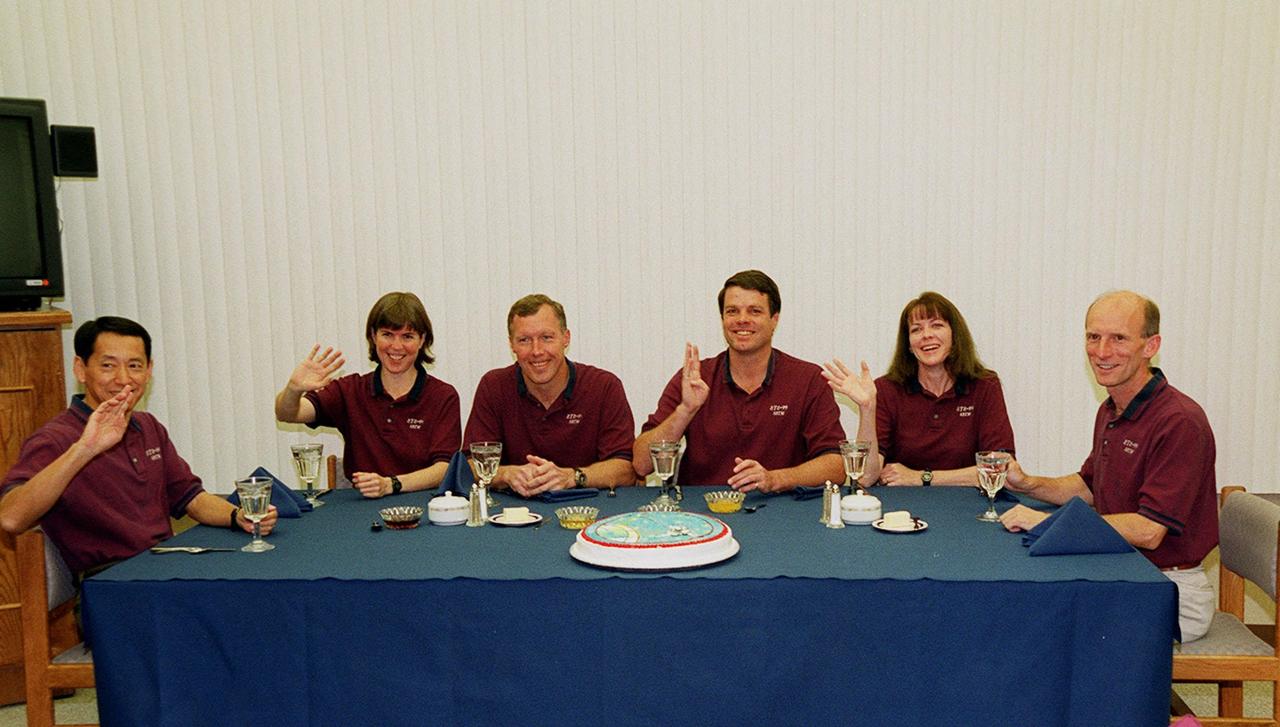
In the Operations and Checkout Building, an eager and smiling STS-99 crew gathers for breakfast before suiting up for launch. From left are Mission Specialists Mamoru Mohri and Janice Voss, Pilot Dominic Gorie, Commander Kevin Kregel, and Mission Specialists Janet Lynn Kavandi and Gerhard Thiele. Mohri is with the National Space Development Agency (NASDA) of Japan, and Thiele is with the European Space Agency. Known as the Shuttle Radar Topography Mission (SRTM), STS-99 is scheduled for liftoff at 12:30 p.m. EST from Launch Pad 39A. The SRTM will chart a new course to produce unrivaled 3-D images of the Earth's surface. The result of the Shuttle Radar Topography Mission could be close to 1 trillion measurements of the Earth's topography. The mission is expected to last about 11days, with Endeavour landing at KSC Tuesday, Feb. 22, at 4:36 p.m. EST. This is the 97th Shuttle flight and 14th for Shuttle Endeavour
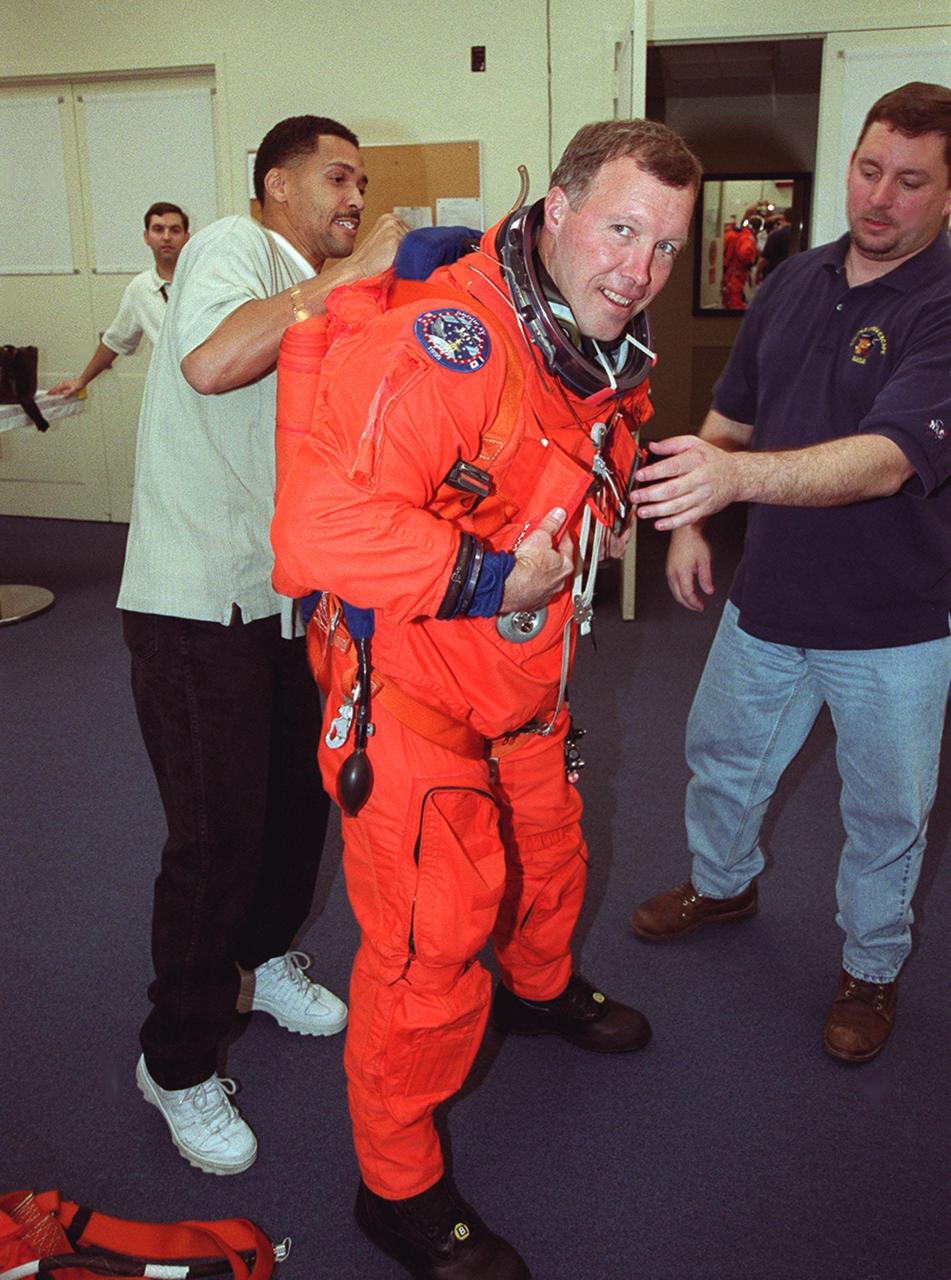
In the Operations and Checkout Building's suitup room, Carlos Gillis (left) and Leonard Groce (right)help STS-99 Pilot Dominic Gorie with his suit check. Gillis and Groce are with United Space Alliance. Gorie and other crew members Commander Kevin Kregel, and Mission Specialists Janet Kavandi, Janice Voss, Gerhard Thiele of Germany and Mamoru Mohri of Japan are preparing for launch of their mission on Feb. 11 at 12:30 p.m. EST aboard Space Shuttle Endeavour. STS-99 is the Shuttle Radar Topography Mission, which will produce unrivaled 3-D images of the Earth's surface. The result of the Shuttle Radar Topography Mission could be close to 1 trillion measurements of the Earth's topography. Landing is expected at KSC on Feb. 22 at 4:36 p.m. EST
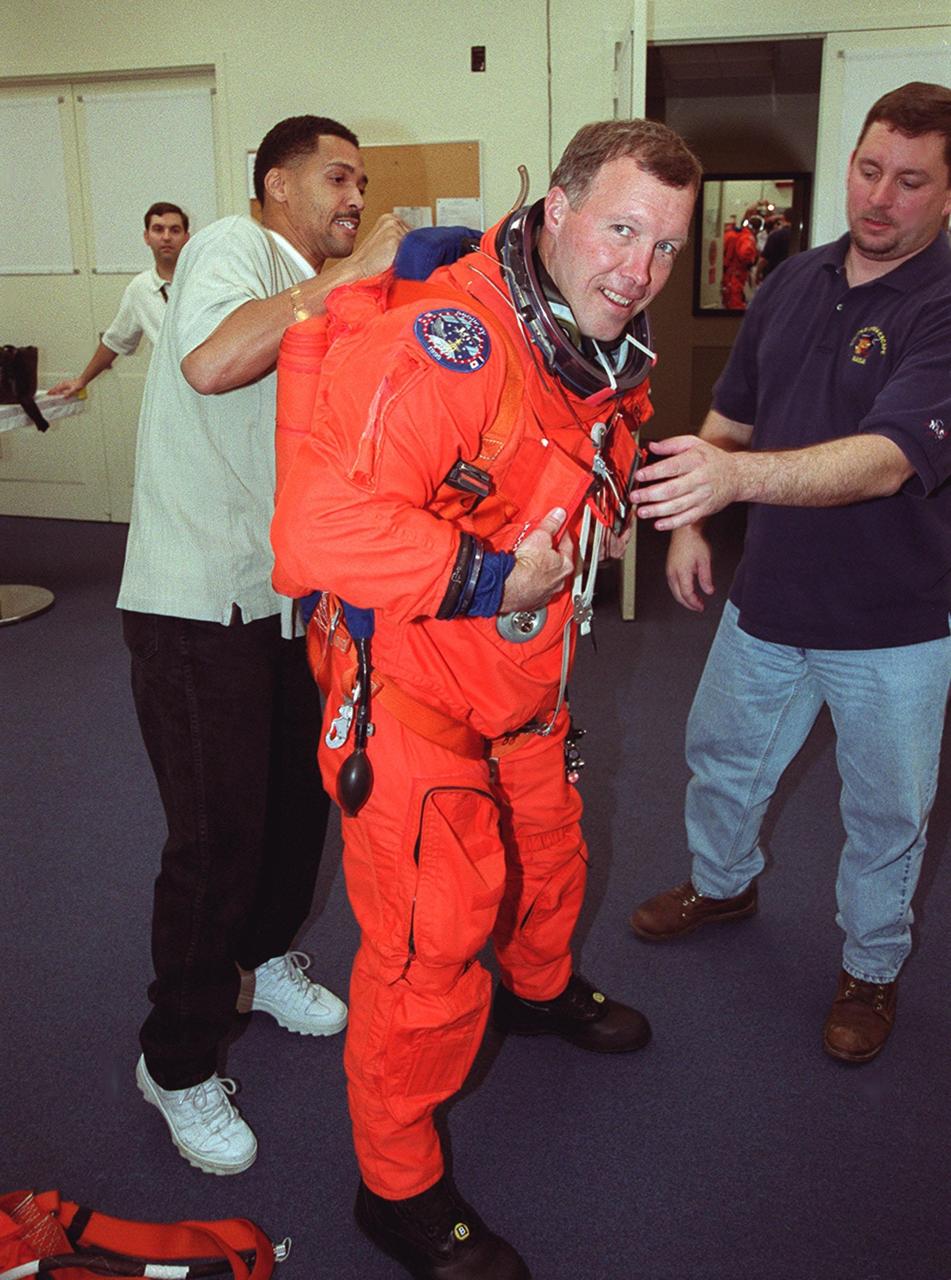
In the Operations and Checkout Building's suitup room, Carlos Gillis (left) and Leonard Groce (right)help STS-99 Pilot Dominic Gorie with his suit check. Gillis and Groce are with United Space Alliance. Gorie and other crew members Commander Kevin Kregel, and Mission Specialists Janet Kavandi, Janice Voss, Gerhard Thiele of Germany and Mamoru Mohri of Japan are preparing for launch of their mission on Feb. 11 at 12:30 p.m. EST aboard Space Shuttle Endeavour. STS-99 is the Shuttle Radar Topography Mission, which will produce unrivaled 3-D images of the Earth's surface. The result of the Shuttle Radar Topography Mission could be close to 1 trillion measurements of the Earth's topography. Landing is expected at KSC on Feb. 22 at 4:36 p.m. EST
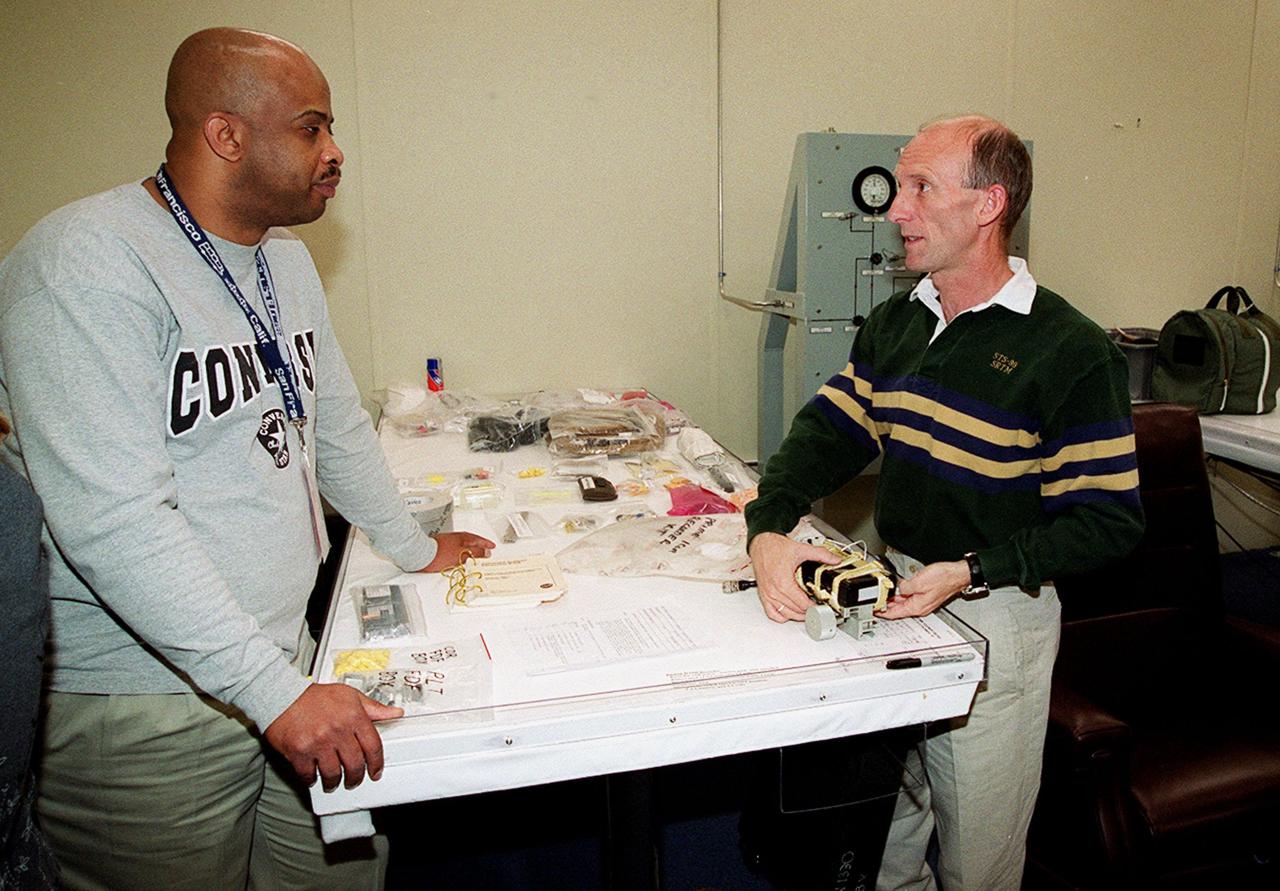
In the Operations and Checkout Building's suitup room, Andre Denard, with United Space Alliance, helps STS-99 Mission Specialist Gerhard Thiele with pre-pack and fit check. Thiele and other crew members Commander Kevin Kregel, Pilot Dominic Gorie, and Mission Specialists Janet Kavandi, Janice Voss, and Mamoru Mohri of Japan are preparing for launch of their mission on Feb. 11 at 12:30 p.m. EST aboard Space Shuttle Endeavour. STS-99 is the Shuttle Radar Topography Mission, which will produce unrivaled 3-D images of the Earth's surface. The result of the Shuttle Radar Topography Mission could be close to 1 trillion measurements of the Earth's topography. Landing is expected at KSC on Feb. 22 at 4:36 p.m. EST
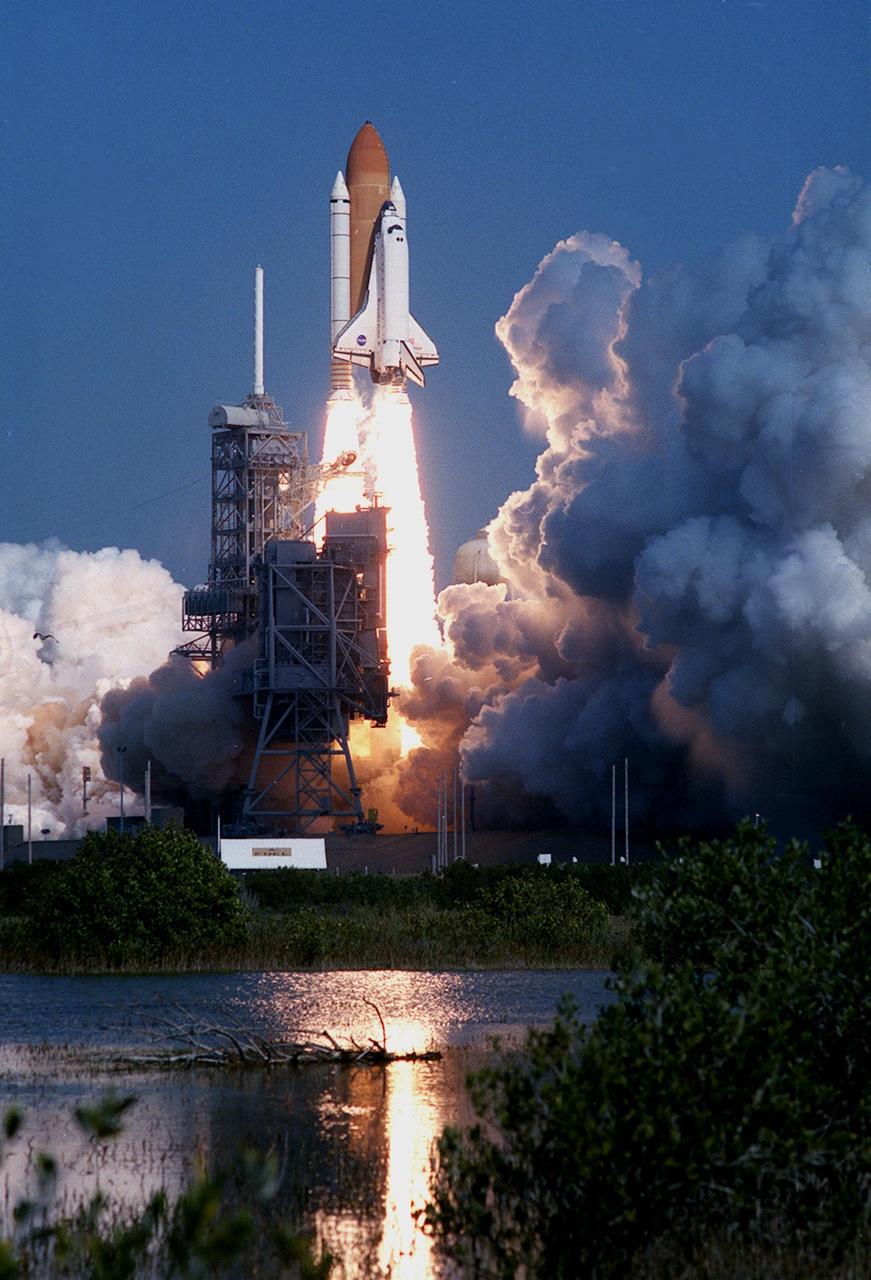
KENNEDY SPACE CENTER, Fla. -- The water below Launch Pad 39A reflects the perfect launch of Space Shuttle Endeavour on mission STS-99, while nearby billows of cloud and smoke are tinged with shadows. Launch of Endeavour occurred at 12:43:40 p.m. EST with a crew of five aboard: Commander Kevin Kregel, Pilot Dominic Gorie, and Mission Specialists Janet Kavandi, Janice Voss, Mamoru Mohri of Japan and Gerhard Thiele of Germany. Mohri is with the National Space Development Agency (NASDA) of Japan, and Thiele is with the European Space Agency. Known as the Shuttle Radar Topography Mission (SRTM), STS-99 will chart a new course to produce unrivaled 3-D images of the Earth's surface. The result of the SRTM could be close to 1 trillion measurements of the Earth's topography. The mission is expected to last 11days, with Endeavour landing at KSC Tuesday, Feb. 22, at 4:36 p.m. EST. This is the 97th Shuttle flight and 14th for Shuttle Endeavour
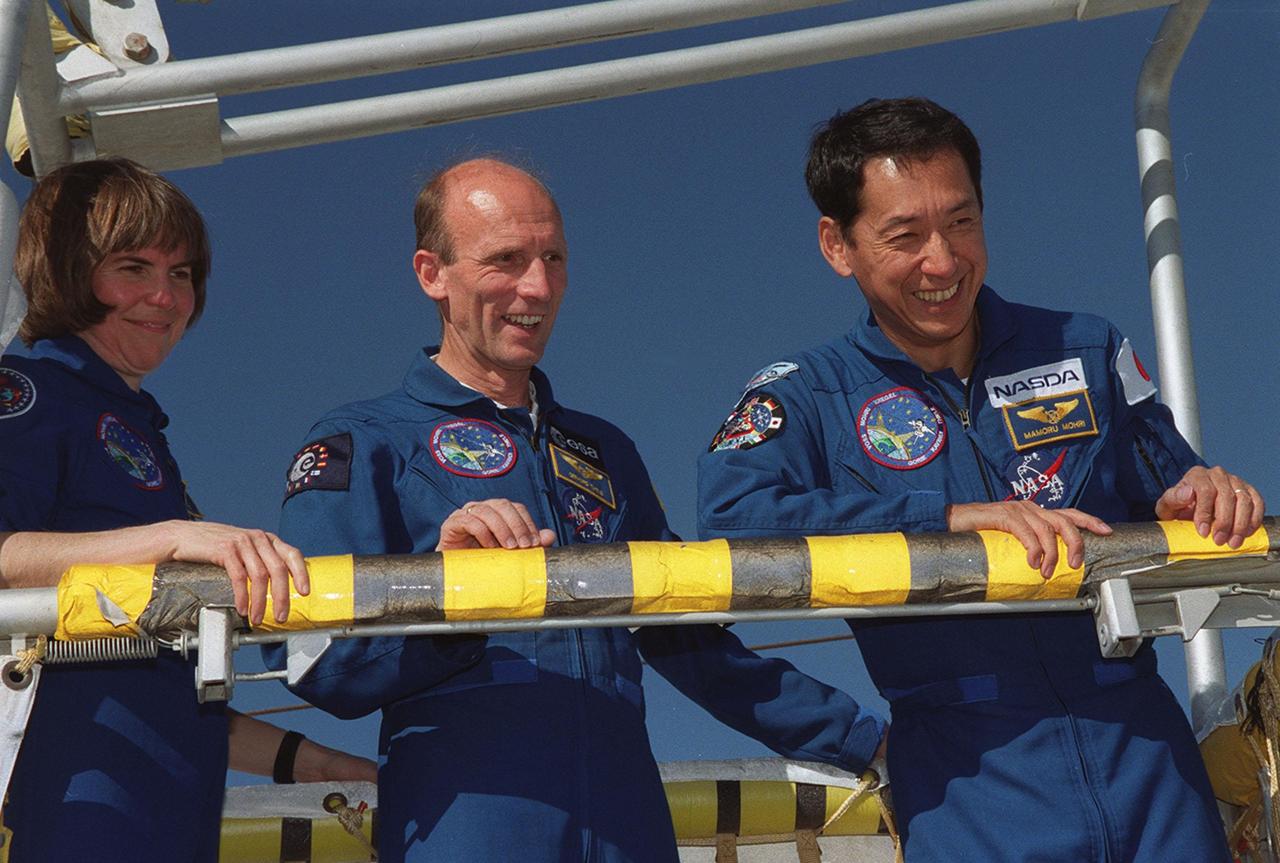
KENNEDY SPACE CENTER, Fla. -- At the 195-foot level on the Fixed Service Structure, Launch Pad 39A, the STS-99 crew receive instructions about emergency egress. From left (in uniform) are Mission Specialists Janice Voss (Ph.D.), Janet Lynn Kavandi (Ph.D.), Gerhard Thiele and Mamoru Mohri, Pilot Dominic Gorie and Commander Kevin Kregel. In the background can be seen the Vehicle Assembly Building at left and the waters of Banana Creek in between. The crew are taking part in Terminal Countdown Demonstration Test activities, which provide them with simulated countdown exercises, emergency egress training, and opportunities to inspect the mission payloads in the orbiter's payload bay. STS-99 is the Shuttle Radar Topography Mission, which will chart a new course, using two antennae and a 200-foot-long section of space station-derived mast protruding from the payload bay to produce unrivaled 3-D images of the Earth's surface. The result of the Shuttle Radar Topography Mission could be close to 1 trillion measurements of the Earth's topography. Besides contributing to the production of better maps, these measurements could lead to improved water drainage modeling, more realistic flight simulators, better locations for cell phone towers, and enhanced navigation safety. Launch of Endeavour on the 11-day mission is scheduled for Jan. 31 at 12:47 p.m. EST
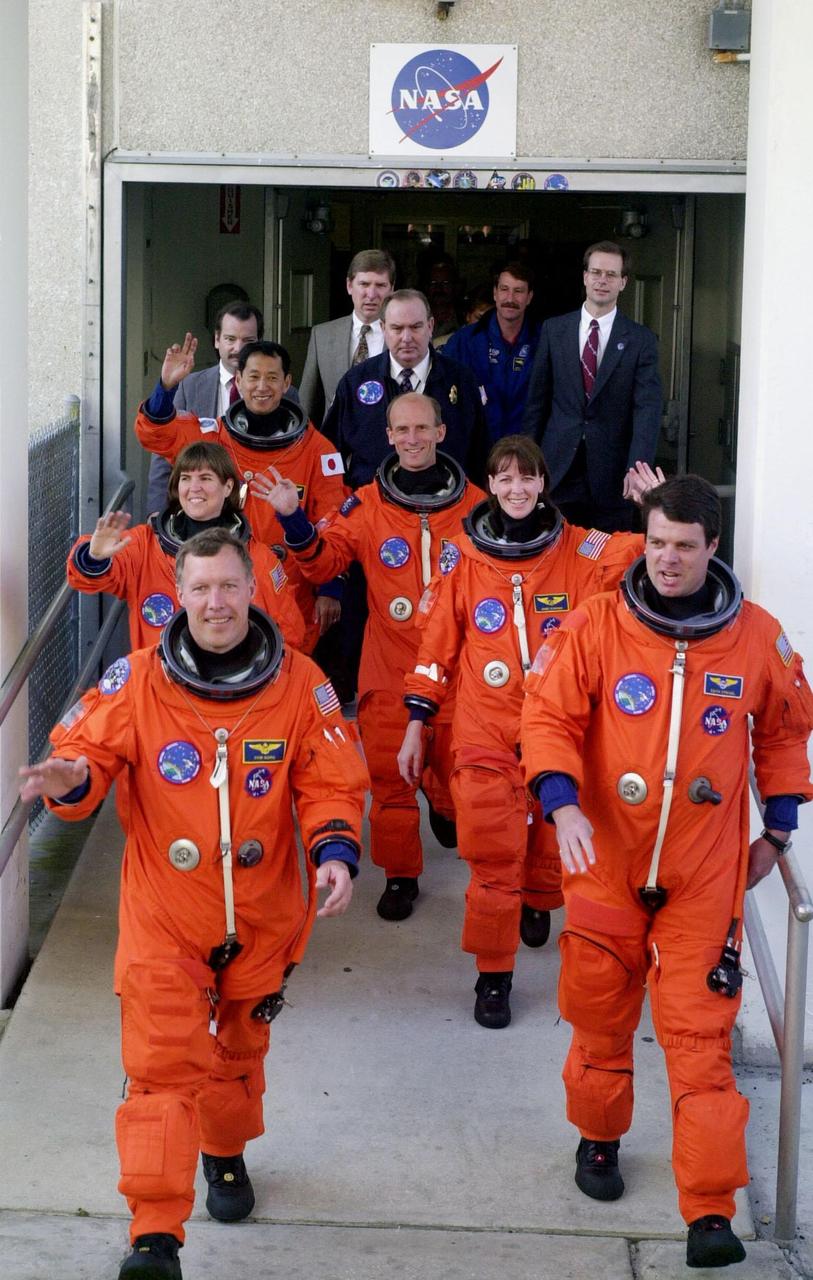
The STS-99 crew wave to onlookers as they step eagerly from the Operations and Checkout Building enroute to Launch Pad 39A for liftoff of Space Shuttle Endeavour. In their orange launch and entry suits, they are (foreground) Pilot Dominic Gorie and Commander Kevin Kregel. Behind them (left to right) are Mission Specialists Janice Voss, Mamoru Mohri of Japan, Gerhard Thiele of Germany and Janet Lynn Kavandi. Mohri is with the National Space Development Agency (NASDA) of Japan, and Thiele is with the European Space Agency. Known as the Shuttle Radar Topography Mission (SRTM), STS-99 is scheduled for liftoff at 12:30 p.m. EST. The SRTM will chart a new course to produce unrivaled 3-D images of the Earth's surface. The result of the Shuttle Radar Topography Mission could be close to 1 trillion measurements of the Earth's topography. The mission is expected to last 11days, with Endeavour landing at KSC Tuesday, Feb. 22, at 4:36 p.m. EST. This is the 97th Shuttle flight and 14th for Shuttle Endeavour
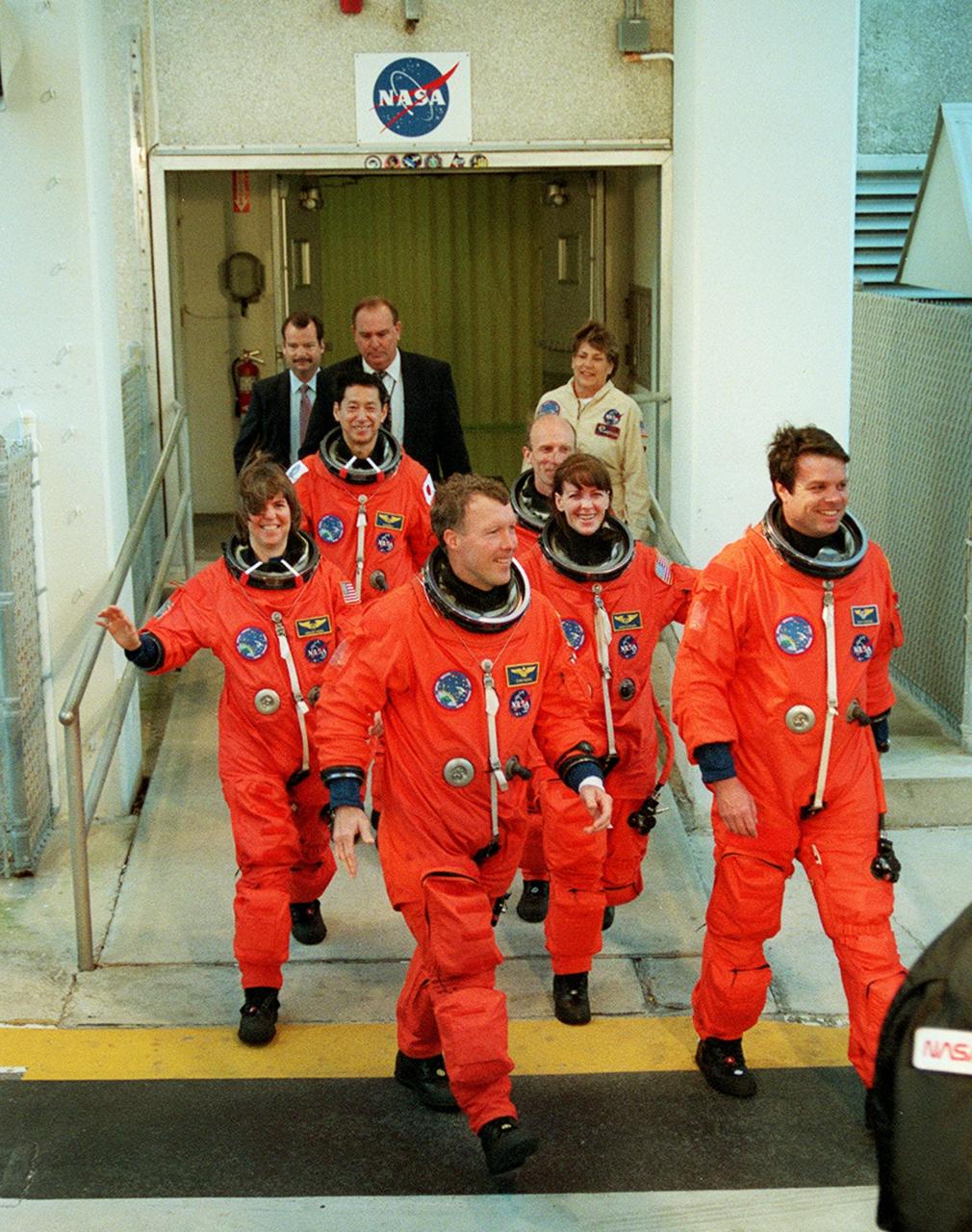
The STS-99 crew leave the Operations and Checkout Building on their way to Launch Pad 39A and a simulated countdown exercise. In the front row are Pilot Dominic Gorie and Commander Kevin Kregel; in the middle row are mission Specialists Janice Voss (Ph.D.) and Janet Lynn Kavandi (Ph.D.); in the back row are Mission Specialists Mamoru Mohri, who is with the National Space Development Agency (NASDA) of Japan, and Gerhard Thiele, who is with the European Space Agency. The crew are taking part in Terminal Countdown Demonstration Test activities, which provide them with simulated countdown exercises, emergency egress training, and opportunities to inspect the mission payloads in the orbiter's payload bay. STS-99 is the Shuttle Radar Topography Mission, which will chart a new course, using two antennae and a 200-foot-long section of space station-derived mast protruding from the payload bay to produce unrivaled 3-D images of the Earth's surface. The result of the Shuttle Radar Topography Mission could be close to 1 trillion measurements of the Earth's topography. Besides contributing to the production of better maps, these measurements could lead to improved water drainage modeling, more realistic flight simulators, better locations for cell phone towers, and enhanced navigation safety. Launch of Endeavour on the 11-day mission is scheduled for Jan. 31 at 12:47 p.m. EST
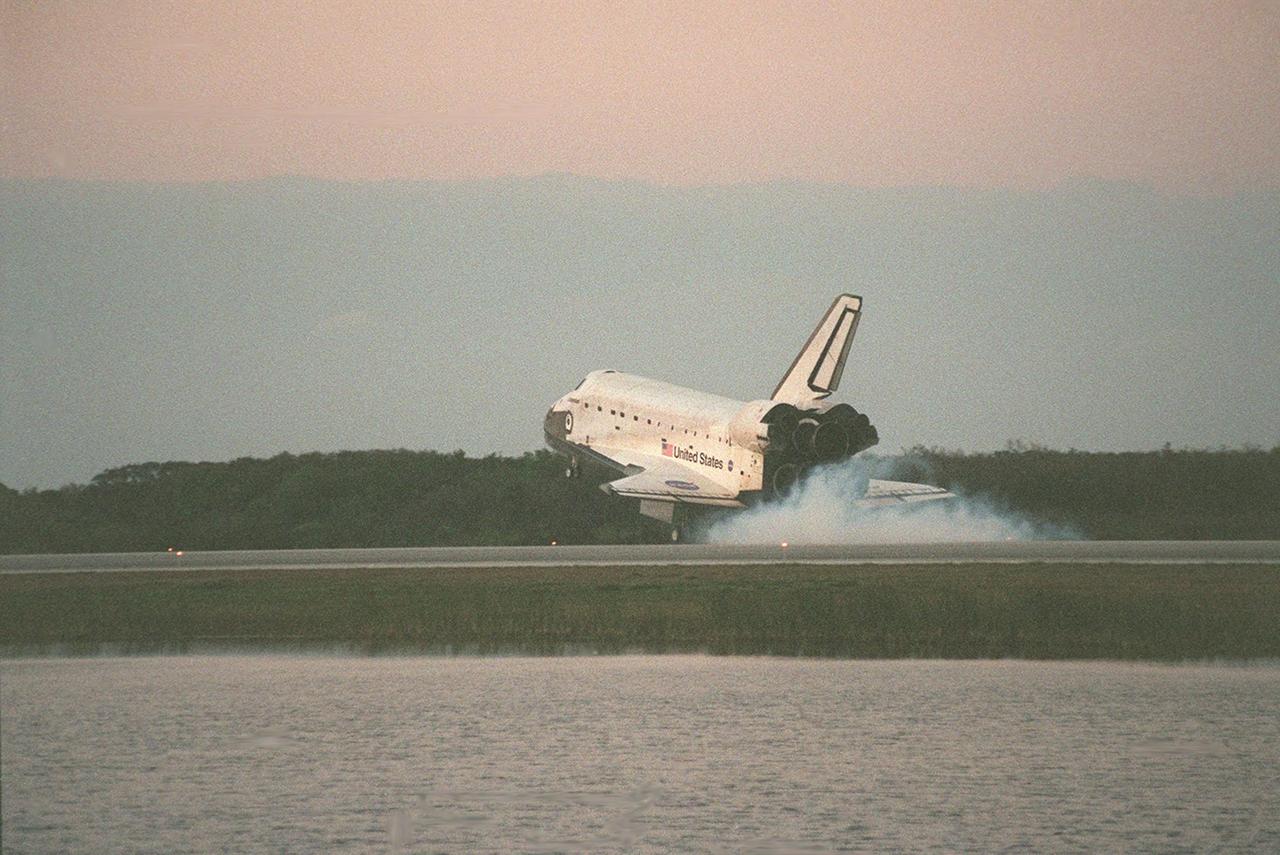
KENNEDY SPACE CENTER, FLA. -- Space Shuttle Endeavour stirs up dust as its wheels touch down on KSC's Shuttle Landing Facility Runway 33 to complete the 11-day, 5-hour, 38-minute-long STS-99 mission. At the controls are Commander Kevin Kregel and Pilot Dominic Gorie. Also onboard the orbiter are Mission Specialists Janet Kavandi, Janice Voss, Mamoru Mohri of Japan and Gerhard Thiele of Germany. Mohri is with the National Space Development Agency (NASDA) and Thiele is with the European Space Agency. The crew is returning from the Shuttle Radar Topography Mission after mapping more than 47 million square miles of the Earth's surface. Main gear touchdown was at 6:22:23 p.m. EST Feb. 22 , landing on orbit 181 of the mission. Nose gear touchdown was at 6:22:35 p.m.. EST, and wheel stop at 6:23:25 p.m. EST. This was the 97th flight in the Space Shuttle program and the 14th for Endeavour, also marking the 50th landing at KSC, the 21st consecutive landing at KSC, and the 28th in the last 29 Shuttle flights
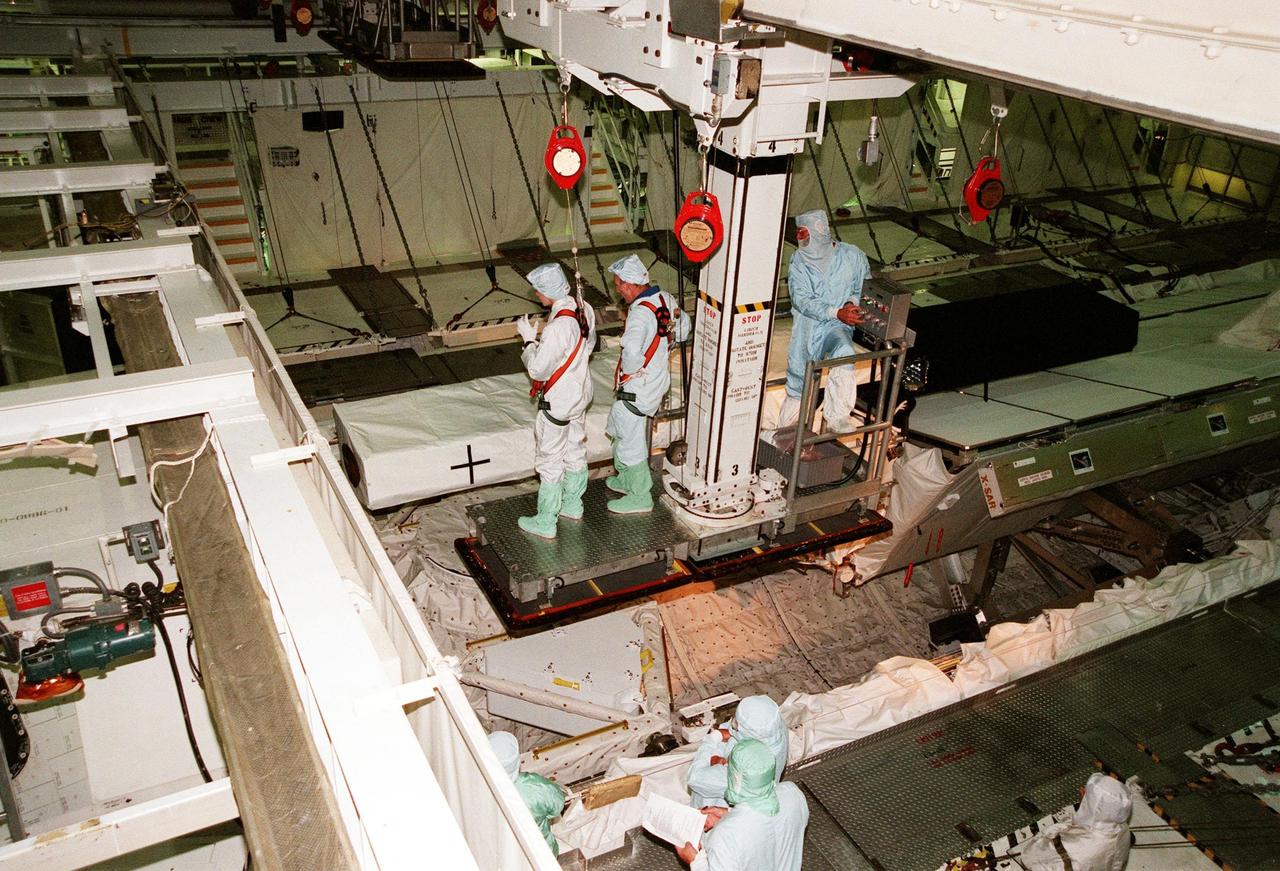
KENNEDY SPACE CENTER, FLA. -- In the Orbiter Processing Facility, members of the STS-99 crew look over the Shuttle Radar Topography Mission (SRTM), primary payload for their mission, as part of a Crew Equipment Interface Test (CEIT). Participating are Commander Kevin R. Kregel, Pilot Dominic L. Pudwill Gorie, and Mission Specialists Janet Lynn Kavandi (Ph.D.), Janice Voss (Ph.D), Mamoru Mohri, and Gerhard P.J. Thiele. Mohri is with the National Space Development Agency (NASDA) of Japan, and Thiele is with the European Space Agency. The CEIT provides an opportunity for crew members to check equipment and facilities that will be aboard the orbiter during their mission. The SRTM is a specially modified radar system that will gather data for the most accurate and complete topographic map of the Earth's surface that has ever been assembled. SRTM will make use of radar interferometry, wherein two radar images are taken from slightly different locations. Differences between these images allow for the calculation of surface elevation, or change. The SRTM hardware will consist of one radar antenna in the shuttle payload bay and a second radar antenna attached to the end of a mast extended 60 meters (195 feet) out from the shuttle. STS-99 is scheduled to launch Sept. 16 at 8:47 a.m. from Launch Pad 39A
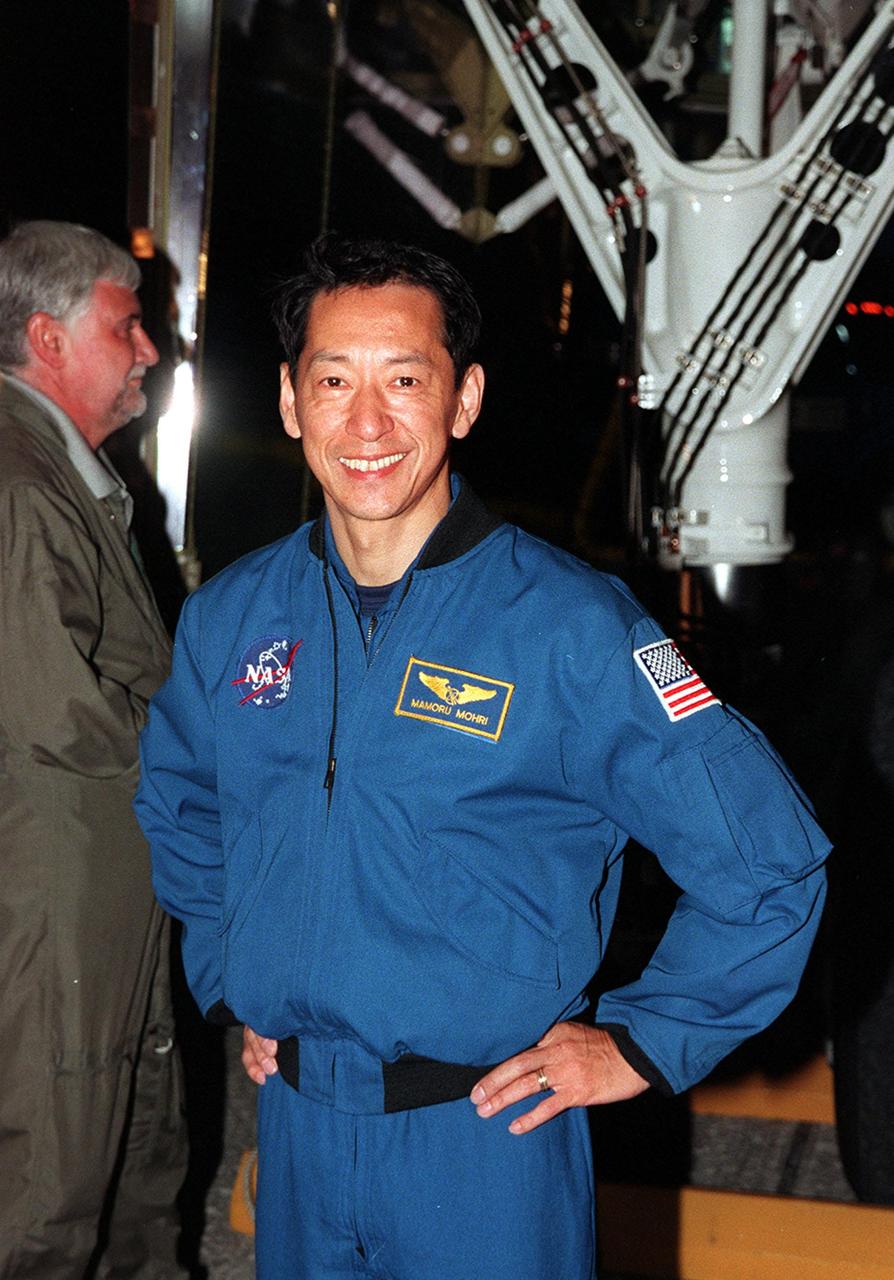
KENNEDY SPACE CENTER, FLA. -- STS-99 Mission Specialist Mamoru Mohri of Japan has only smiles after Space Shuttle Endeavour's landing on KSC's Shuttle Landing Facility completing the 11-day, 5-hour, 38-minute-long STS-99 mission. Main gear touchdown was at 6:22:23 p.m. EST Feb. 22 , landing on orbit 181 of the mission. Nose gear touchdown was at 6:22:35 p.m.. EST, and wheel stop at 6:23:25 p.m. EST. At the controls were Commander Kevin Kregel and Pilot Dominic Gorie. Also onboard the orbiter were Mission Specialists Janet Kavandi, Janice Voss, and Gerhard Thiele of Germany. Mohri is with the National Space Development Agency (NASDA) and Thiele is with the European Space Agency. The crew returned from the Shuttle Radar Topography Mission after mapping more than 47 million square miles of the Earth's surface. This was the 97th flight in the Space Shuttle program and the 14th for Endeavour, also marking the 50th landing at KSC, the 21st consecutive landing at KSC, and the 28th in the last 29 Shuttle flights
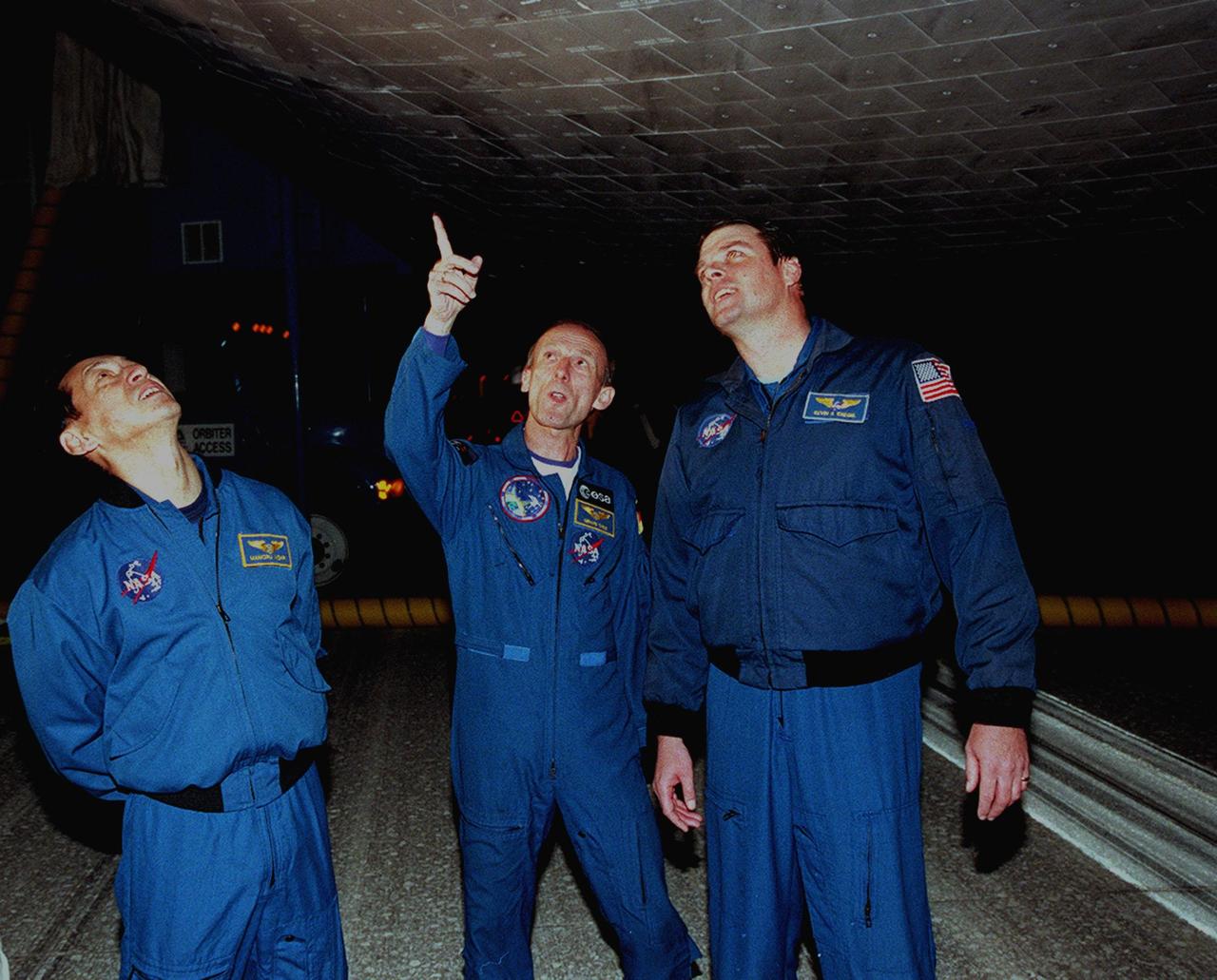
KENNEDY SPACE CENTER, FLA. -- On KSC's Shuttle Landing Facility, STS-99 crew members check the underside of Space Shuttle Endeavour after completing the 11-day, 5-hour, 38-minute-long mission. From left are Mission Specialists Mamoru Mohri of Japan and Gerhard Thiele of Germany, with Commander Kevin Kregel. Main gear touchdown was at 6:22:23 p.m. EST Feb. 22 , landing on orbit 181 of the mission. Nose gear touchdown was at 6:22:35 p.m.. EST, and wheel stop at 6:23:25 p.m. EST. The other crew members are Pilot Dominic Gorie and Mission Specialists Janet Kavandi and Janice Voss. The crew are returning from the Shuttle Radar Topography Mission, after mapping more than 47 million square miles of the Earth's surface. This was the 97th flight in the Space Shuttle program and the 14th for Endeavour, also marking the 50th landing at KSC, the 21st consecutive landing at KSC, and the 28th in the last 29 Shuttle flights
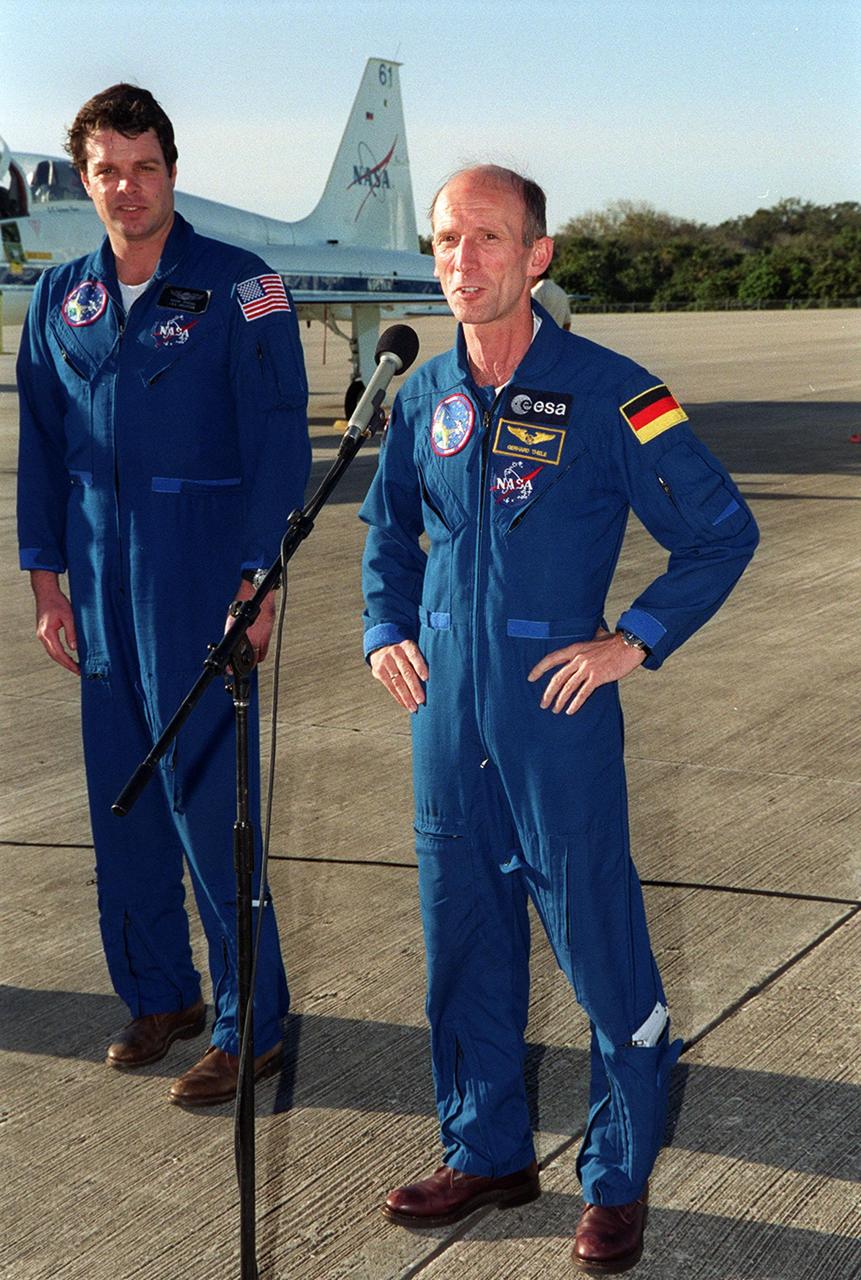
After their arrival at the Shuttle Landing Facility, the STS-99 crew talk to the media. At the microphone is Mission Specialist Gerhard Thiele, with the European Space Agency. At left is Commander Kevin Kregel. . The crew are here to take part in a Terminal Countdown Demonstration Test (TCDT), which provides simulated countdown exercises, emergency egress training, and opportunities to inspect the mission payloads in the orbiter's payload bay. Others taking part in the TCDT are Pilot Dominic Gorie and Mission Specialists Janice Voss (Ph.D.), Janet Lynn Kavandi (Ph.D.), Mamoru Mohri, who is with the National Space Development Agency (NASDA) of Japan. STS-99 is the Shuttle Radar Topography Mission, which will chart a new course, using two antennae and a 200-foot-long section of space station-derived mast protruding from the payload bay to produce unrivaled 3-D images of the Earth's surface. The result of the Shuttle Radar Topography Mission could be close to 1 trillion measurements of the Earth's topography. Besides contributing to the production of better maps, these measurements could lead to improved water drainage modeling, more realistic flight simulators, better locations for cell phone towers, and enhanced navigation safety. Launch of Endeavour on the 11-day mission is scheduled for Jan. 31 at 12:47 p.m. EST
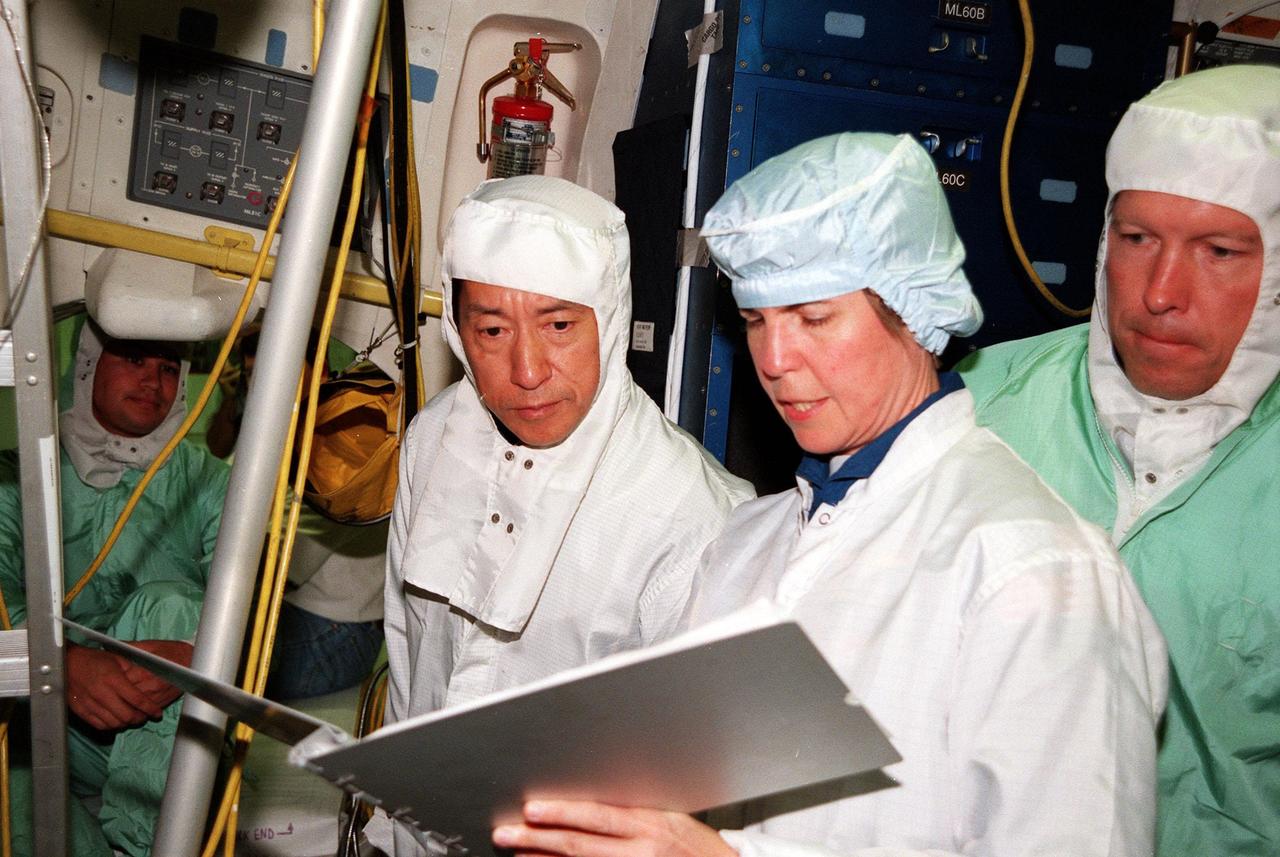
KENNEDY SPACE CENTER, FLA. -- In the Orbiter Processing Facility, STS-99 Mission Specialists Mamoru Mohri (left center), who is with the National Space Development Agency (NASDA) of Japan, and Janice Voss (Ph.D.) look over equipment during a Crew Equipment Interface Test (CEIT). The CEIT provides an opportunity for crew members to check equipment and facilities that will be aboard the orbiter during their mission. Others taking part are Commander Kevin R. Kregel, Pilot Dominic L. Pudwill Gorie, and Mission Specialists Janet Lynn Kavandi (Ph.D.) and Gerhard P.J. Thiele, who is with the European Space Agency. The SRTM is a specially modified radar system that will gather data for the most accurate and complete topographic map of the Earth's surface that has ever been assembled. SRTM will make use of radar interferometry, wherein two radar images are taken from slightly different locations. Differences between these images allow for the calculation of surface elevation, or change. The SRTM hardware will consist of one radar antenna in the shuttle payload bay and a second radar antenna attached to the end of a mast extended 60 meters (195 feet) out from the shuttle. STS-99 is scheduled to launch Sept. 16 at 8:47 a.m. from Launch Pad 39A
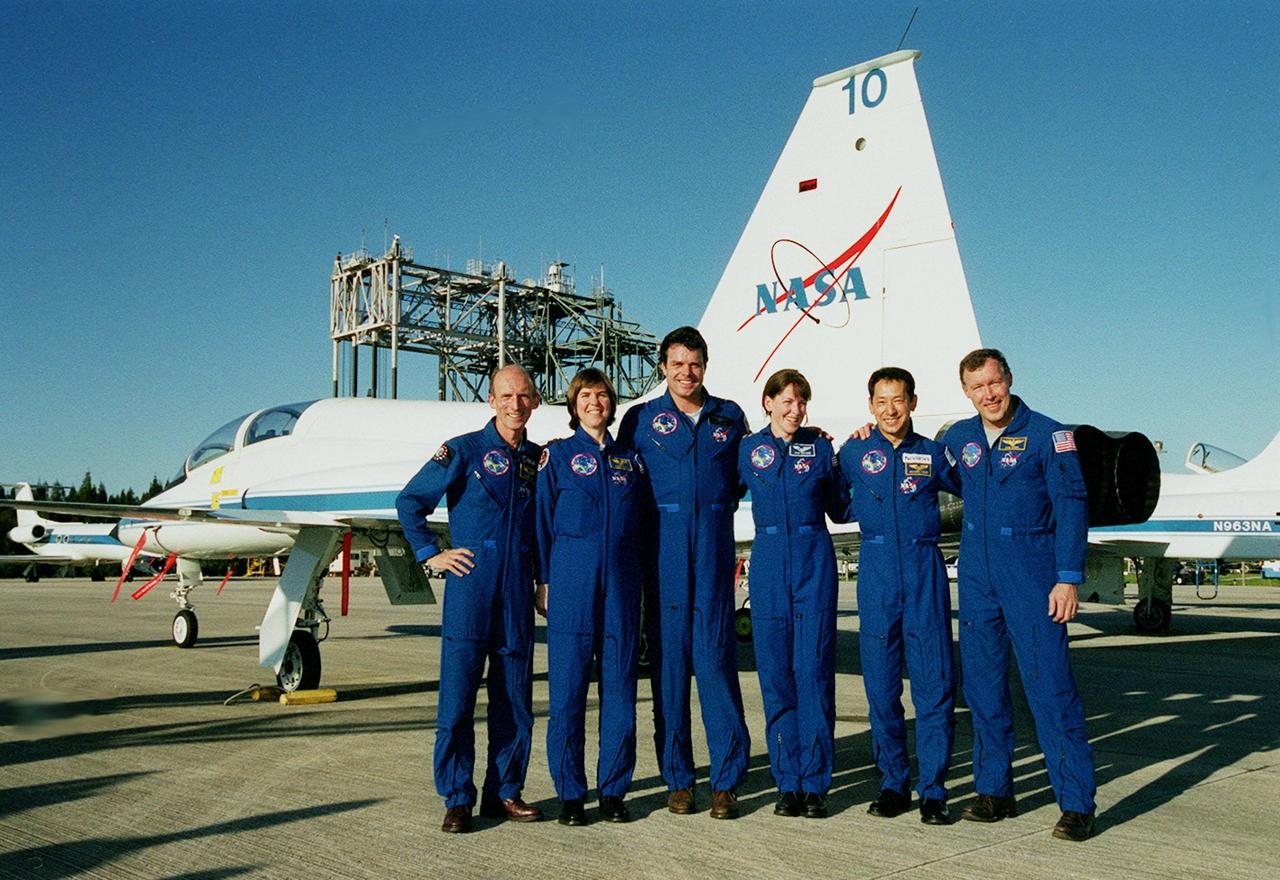
The STS-99 crew pose for a photo after their arrival at KSC's Shuttle Landing Facility. From left are Mission Specialists Gerhard Thiele, and Janice Voss (Ph.D.), Commander Kevin Kregel, Mission Specialists Janet Lynn Kavandi (Ph.D.) and Mamoru Mohri, and Pilot Dominic Gorie. Thiele is with the European Space Agency and Mohri is with the National Space Development Agency (NASDA) of Japan. The crew are here to take part in a Terminal Countdown Demonstration Test (TCDT), which provides simulated countdown exercises, emergency egress training, and opportunities to inspect the mission payloads in the orbiter's payload bay. STS-99 is the Shuttle Radar Topography Mission, which will chart a new course, using two antennae and a 200-foot-long section of space station-derived mast protruding from the payload bay to produce unrivaled 3-D images of the Earth's surface. The result of the Shuttle Radar Topography Mission could be close to 1 trillion measurements of the Earth's topography. Besides contributing to the production of better maps, these measurements could lead to improved water drainage modeling, more realistic flight simulators, better locations for cell phone towers, and enhanced navigation safety. Launch of Endeavour on the 11-day mission is scheduled for Jan. 31 at 12:47 p.m. EST
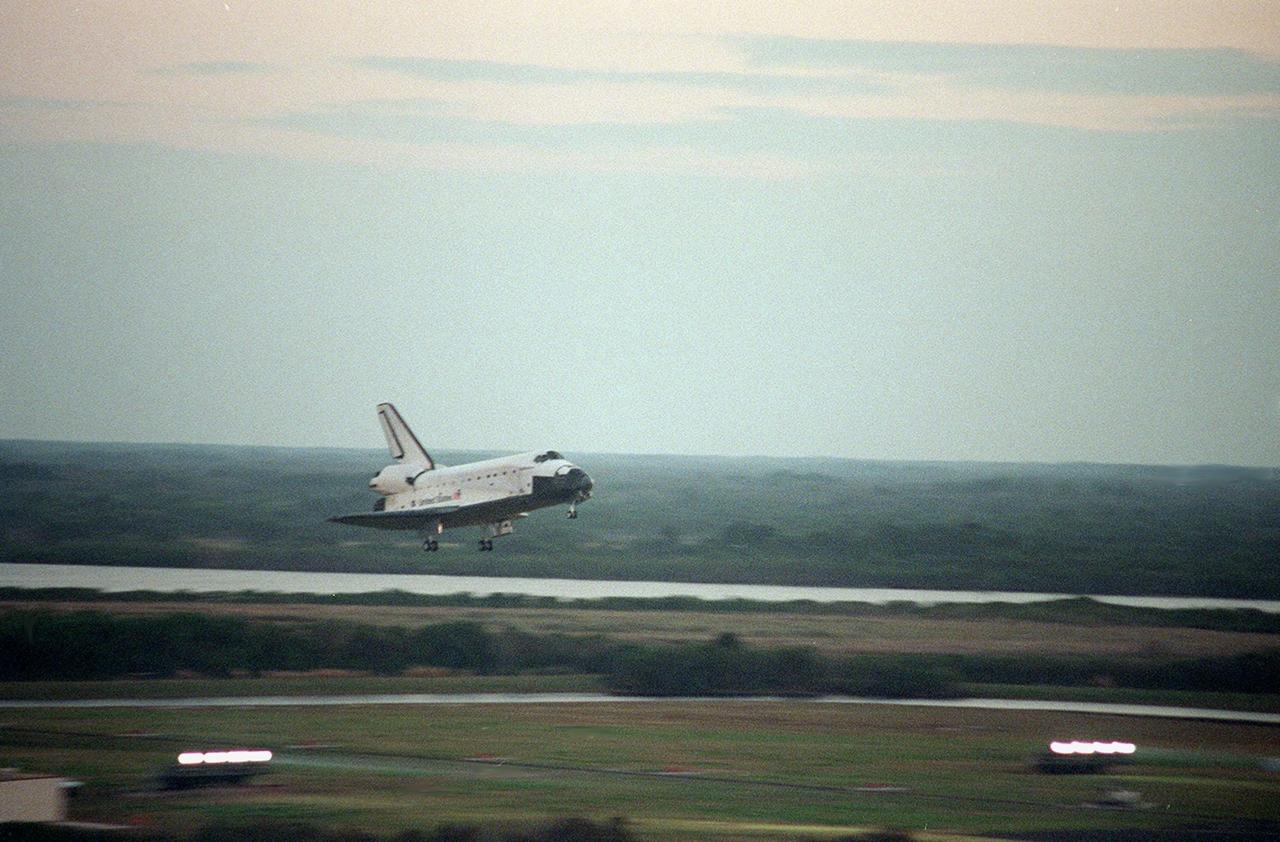
KENNEDY SPACE CENTER, Fla. -- Space Shuttle Endeavour prepares to land on KSC's Shuttle Landing Facility Runway 33 to complete the 11-day, 5-hour, 38-minute-long STS-99 mission. Main gear touchdown was at 6:22:23 p.m. EST Feb. 22 , landing on orbit 181 of the mission. Nose gear touchdown was at 6:22:35 p.m.. EST, and wheel stop at 6:23:25 p.m. EST. At the controls are Commander Kevin Kregel and Pilot Dominic Gorie. Also onboard the orbiter are Mission Specialists Janet Kavandi, Janice Voss, Mamoru Mohri of Japan and Gerhard Thiele of Germany. Mohri is with the National Space Development Agency (NASDA) and Thiele is with the European Space Agency. The crew are returning from the Shuttle Radar Topography Mission, after mapping more than 47 million square miles of the Earth. This was the 97th flight in the Space Shuttle program and the 14th for Endeavour, also marking the 50th landing at KSC, the 21st consecutive landing at KSC, and the 28th in the last 29 Shuttle flights
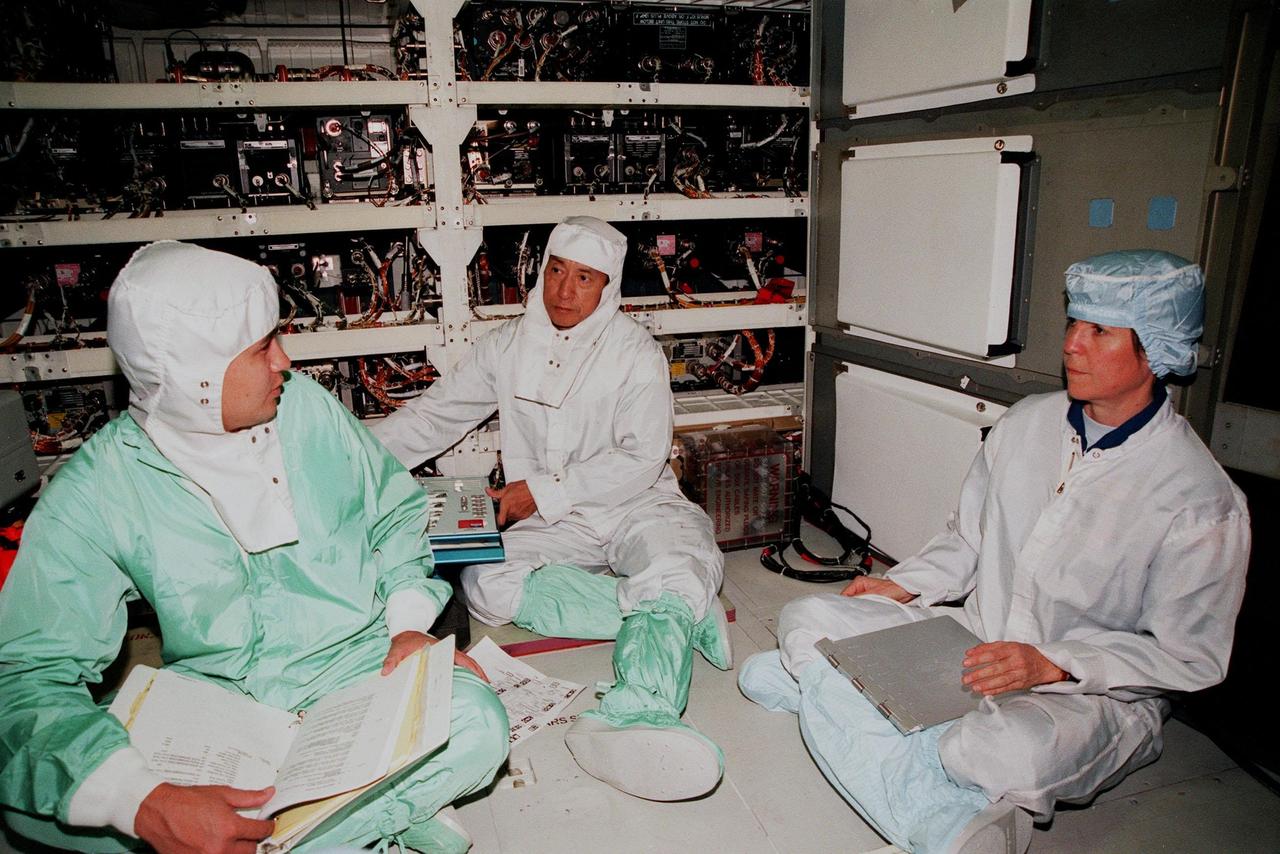
KENNEDY SPACE CENTER, FLA. -- In the Orbiter Processing Facility, STS-99 Mission Specialists Mamoru Mohri (center), who is with the National Space Development Agency (NASDA) of Japan, and Janice Voss (Ph.D.) (right) talk with a KSC worker (left) during a Crew Equipment Interface Test (CEIT). The CEIT provides an opportunity for crew members to check equipment and facilities that will be aboard the orbiter during their mission. Others taking part are Commander Kevin R. Kregel, Pilot Dominic L. Pudwill Gorie, and Mission Specialists Janet Lynn Kavandi (Ph.D.) and Gerhard P.J. Thiele, who is with the European Space Agency. The SRTM is a specially modified radar system that will gather data for the most accurate and complete topographic map of the Earth's surface that has ever been assembled. SRTM will make use of radar interferometry, wherein two radar images are taken from slightly different locations. Differences between these images allow for the calculation of surface elevation, or change. The SRTM hardware will consist of one radar antenna in the shuttle payload bay and a second radar antenna attached to the end of a mast extended 60 meters (195 feet) out from the shuttle. STS-99 is scheduled to launch Sept. 16 at 8:47 a.m. from Launch Pad 39A
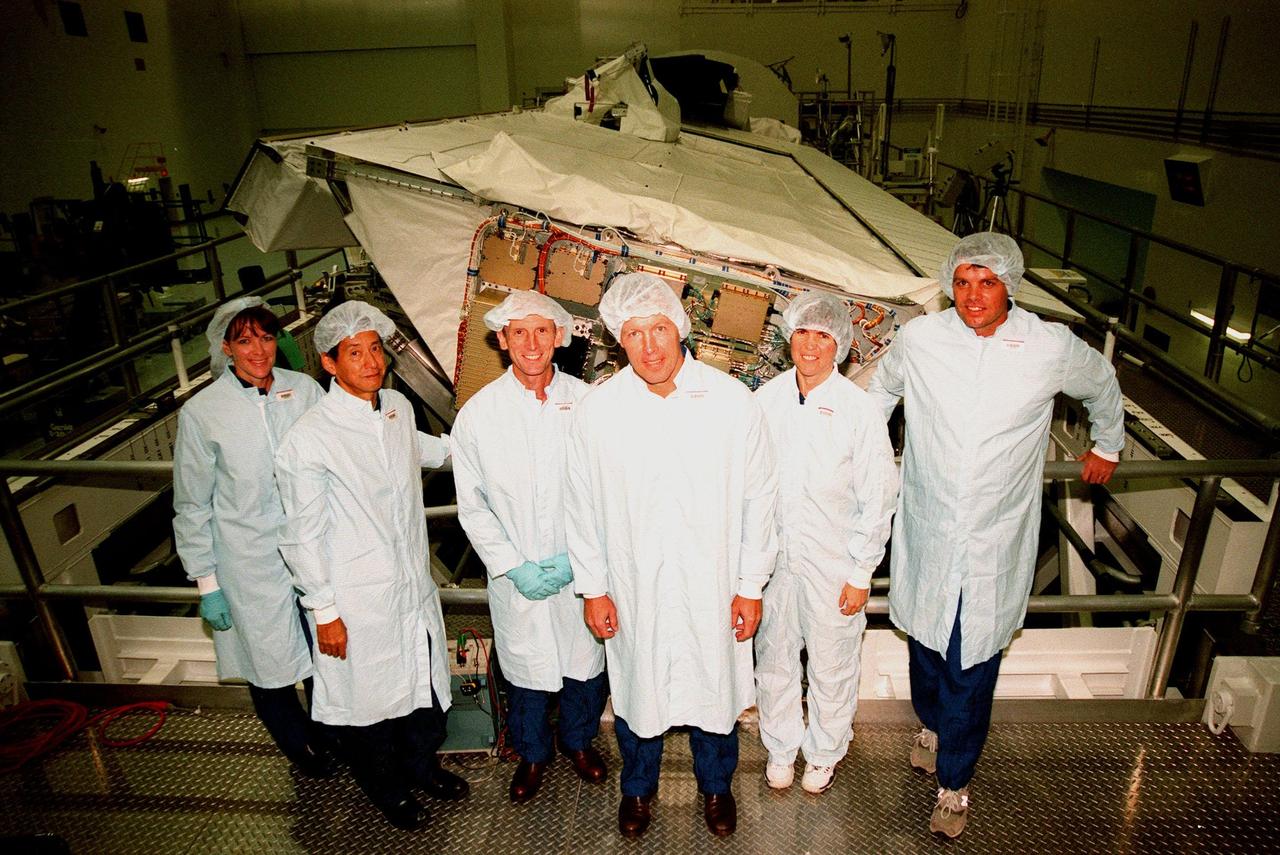
The STS-99 crew poses in front of the Shuttle Radar Topography Mission (SRTM) in the Space Station Processing Facility. The crew has been checking out the SRTM, which is the payload for their mission. From left are Mission Specialists Janet Lynn Kavandi (Ph.D.), Mamoru Mohri of Japan, and Gerhard Thiele of Germany; Pilot Dominic L. Pudwill Gorie; Mission Specialist Janice Voss (Ph.D.); and Commander Kevin R. Kregel. Mohri represents the National Space Development Agency of Japan and Thiele represents the European Space Agency. An international project spearheaded by the National Imagery and Mapping Agency and NASA, with participation of the German Aerospace Center DLR, the SRTM consists of a specially modified radar system that will gather data for the most accurate and complete topographic map of the Earth's surface that has ever been assembled. SRTM will make use of radar interferometry, wherein two radar images are taken from slightly different locations. Differences between these images allow for the calculation of surface elevation, or change. The SRTM hardware will consist of one radar antenna in the shuttle payload bay and a second radar antenna attached to the end of a mast extended 60 meters (195 feet) out from the shuttle. STS-99 is scheduled to launch Sept. 16 at 8:47 a.m. from Launch Pad 39A
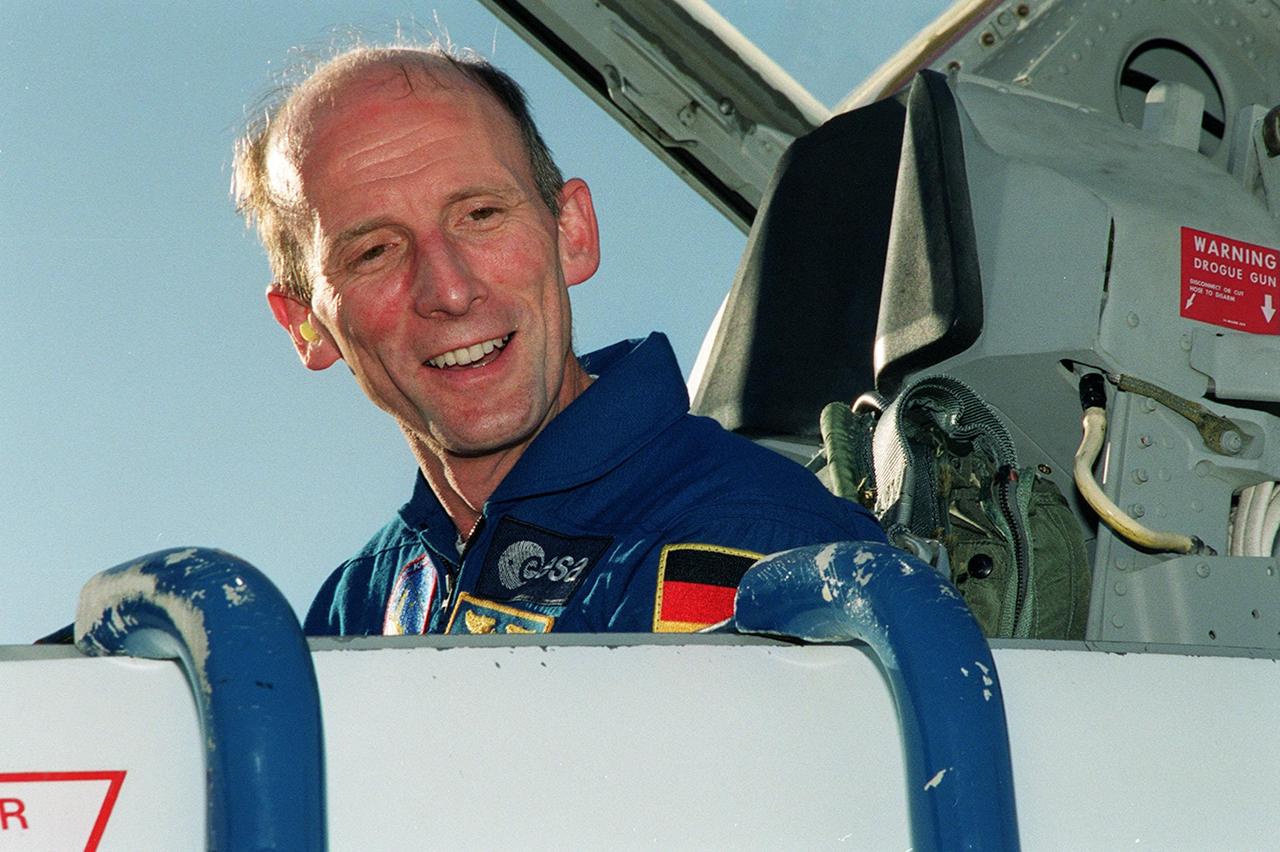
STS-99 Mission Specialist Gerhard Thiele, with the European Space Agency, arrives at KSC aboard a T-38 training jet aircraft to take part in a Terminal Countdown Demonstration Test (TCDT). The TCDT provides the crew with simulated countdown exercises, emergency egress training, and opportunities to inspect the mission payloads in the orbiter's payload bay. Other crew members taking part are Commander Kevin Kregel, Pilot Dominic Gorie, and Mission Specialists Janet Lynn Kavandi (Ph.D.), Janice Voss (Ph.D.), and Mamoru Mohri, who is with the National Space Development Agency (NASDA) of Japan. STS-99 is the Shuttle Radar Topography Mission, which will chart a new course, using two antennae and a 200-foot-long section of space station-derived mast protruding from the payload bay to produce unrivaled 3-D images of the Earth's surface. The result of the Shuttle Radar Topography Mission could be close to 1 trillion measurements of the Earth's topography. Besides contributing to the production of better maps, these measurements could lead to improved water drainage modeling, more realistic flight simulators, better locations for cell phone towers, and enhanced navigation safety. Launch of Endeavour on the 11-day mission is scheduled for Jan. 31 at 12:47 p.m. EST
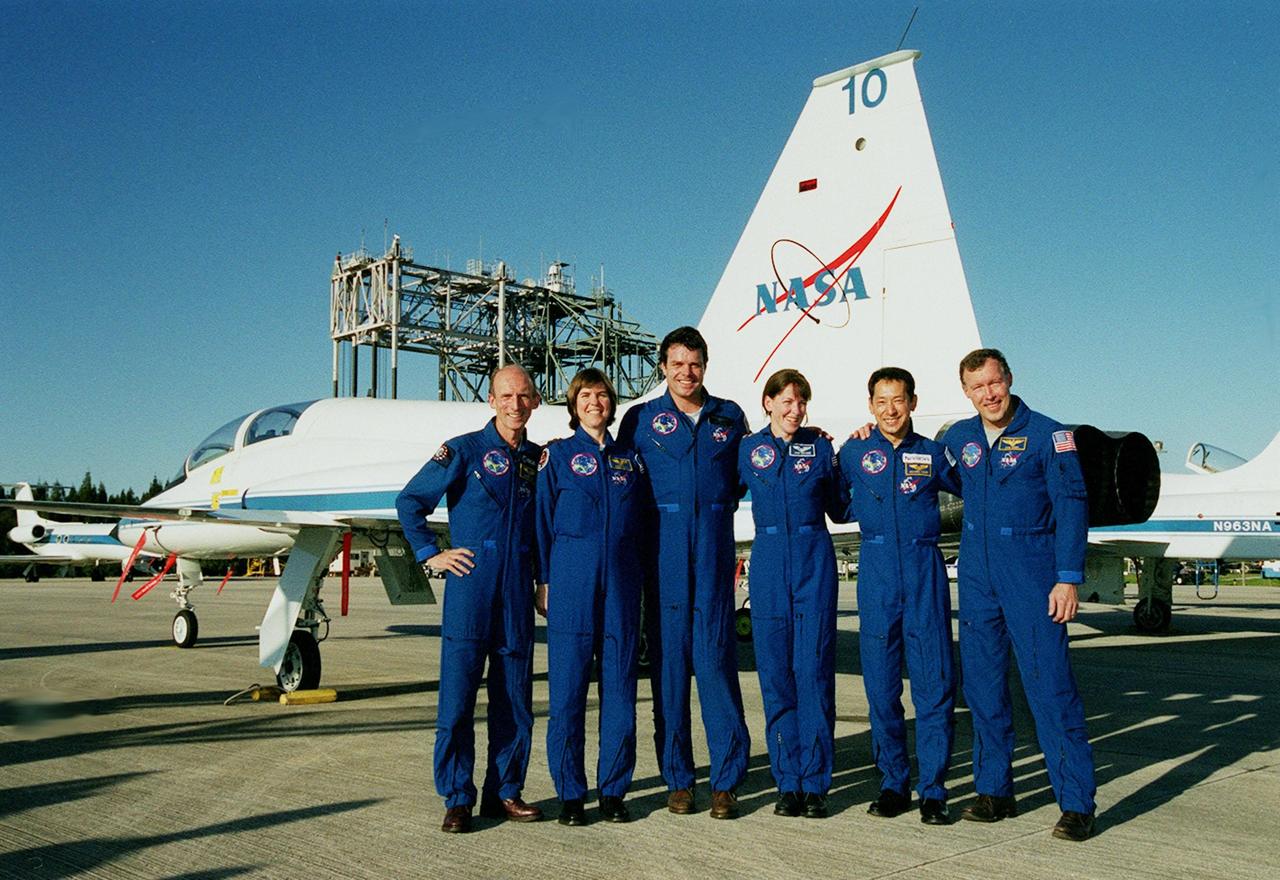
The STS-99 crew pose for a photo after their arrival at KSC's Shuttle Landing Facility. From left are Mission Specialists Gerhard Thiele, and Janice Voss (Ph.D.), Commander Kevin Kregel, Mission Specialists Janet Lynn Kavandi (Ph.D.) and Mamoru Mohri, and Pilot Dominic Gorie. Thiele is with the European Space Agency and Mohri is with the National Space Development Agency (NASDA) of Japan. The crew are here to take part in a Terminal Countdown Demonstration Test (TCDT), which provides simulated countdown exercises, emergency egress training, and opportunities to inspect the mission payloads in the orbiter's payload bay. STS-99 is the Shuttle Radar Topography Mission, which will chart a new course, using two antennae and a 200-foot-long section of space station-derived mast protruding from the payload bay to produce unrivaled 3-D images of the Earth's surface. The result of the Shuttle Radar Topography Mission could be close to 1 trillion measurements of the Earth's topography. Besides contributing to the production of better maps, these measurements could lead to improved water drainage modeling, more realistic flight simulators, better locations for cell phone towers, and enhanced navigation safety. Launch of Endeavour on the 11-day mission is scheduled for Jan. 31 at 12:47 p.m. EST
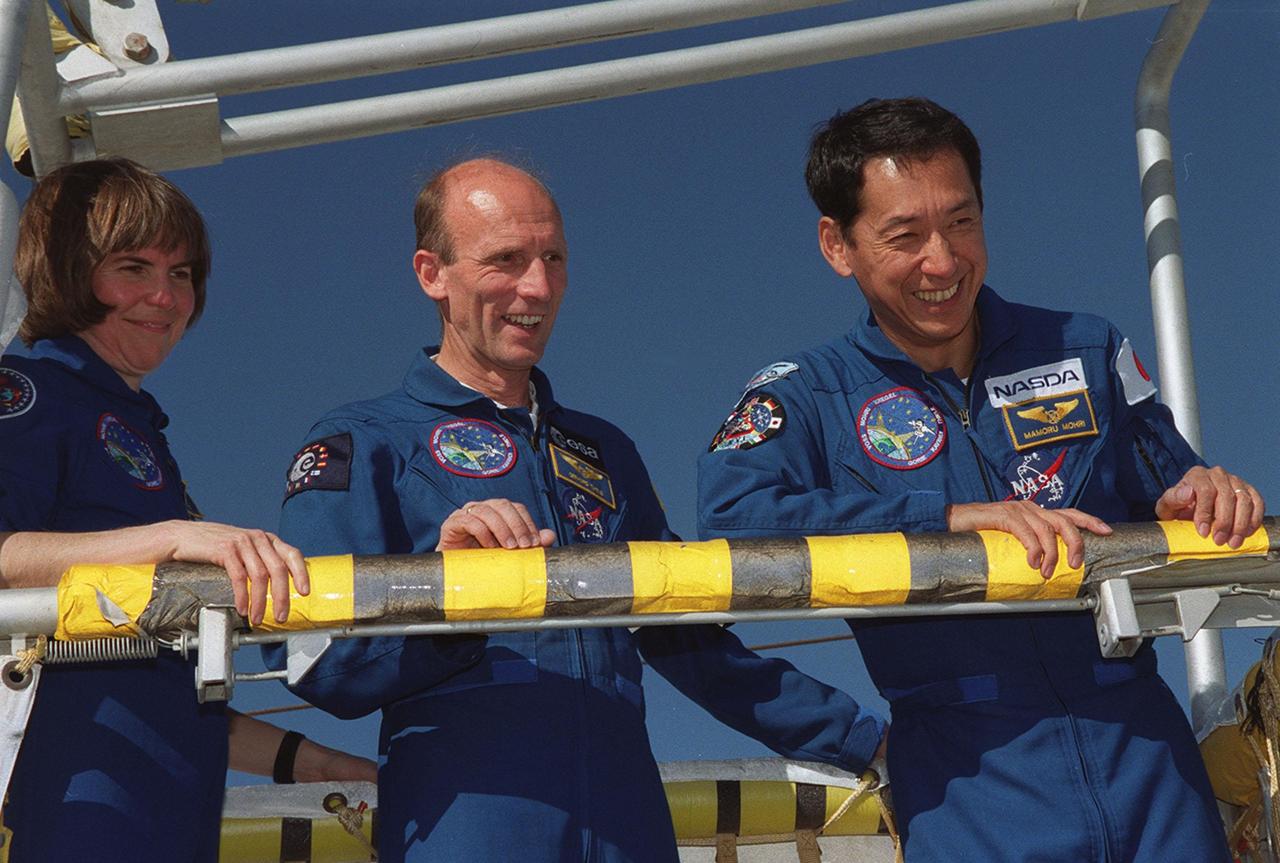
KENNEDY SPACE CENTER, Fla. -- At the 195-foot level on the Fixed Service Structure, Launch Pad 39A, the STS-99 crew receive instructions about emergency egress. From left (in uniform) are Mission Specialists Janice Voss (Ph.D.), Janet Lynn Kavandi (Ph.D.), Gerhard Thiele and Mamoru Mohri, Pilot Dominic Gorie and Commander Kevin Kregel. In the background can be seen the Vehicle Assembly Building at left and the waters of Banana Creek in between. The crew are taking part in Terminal Countdown Demonstration Test activities, which provide them with simulated countdown exercises, emergency egress training, and opportunities to inspect the mission payloads in the orbiter's payload bay. STS-99 is the Shuttle Radar Topography Mission, which will chart a new course, using two antennae and a 200-foot-long section of space station-derived mast protruding from the payload bay to produce unrivaled 3-D images of the Earth's surface. The result of the Shuttle Radar Topography Mission could be close to 1 trillion measurements of the Earth's topography. Besides contributing to the production of better maps, these measurements could lead to improved water drainage modeling, more realistic flight simulators, better locations for cell phone towers, and enhanced navigation safety. Launch of Endeavour on the 11-day mission is scheduled for Jan. 31 at 12:47 p.m. EST
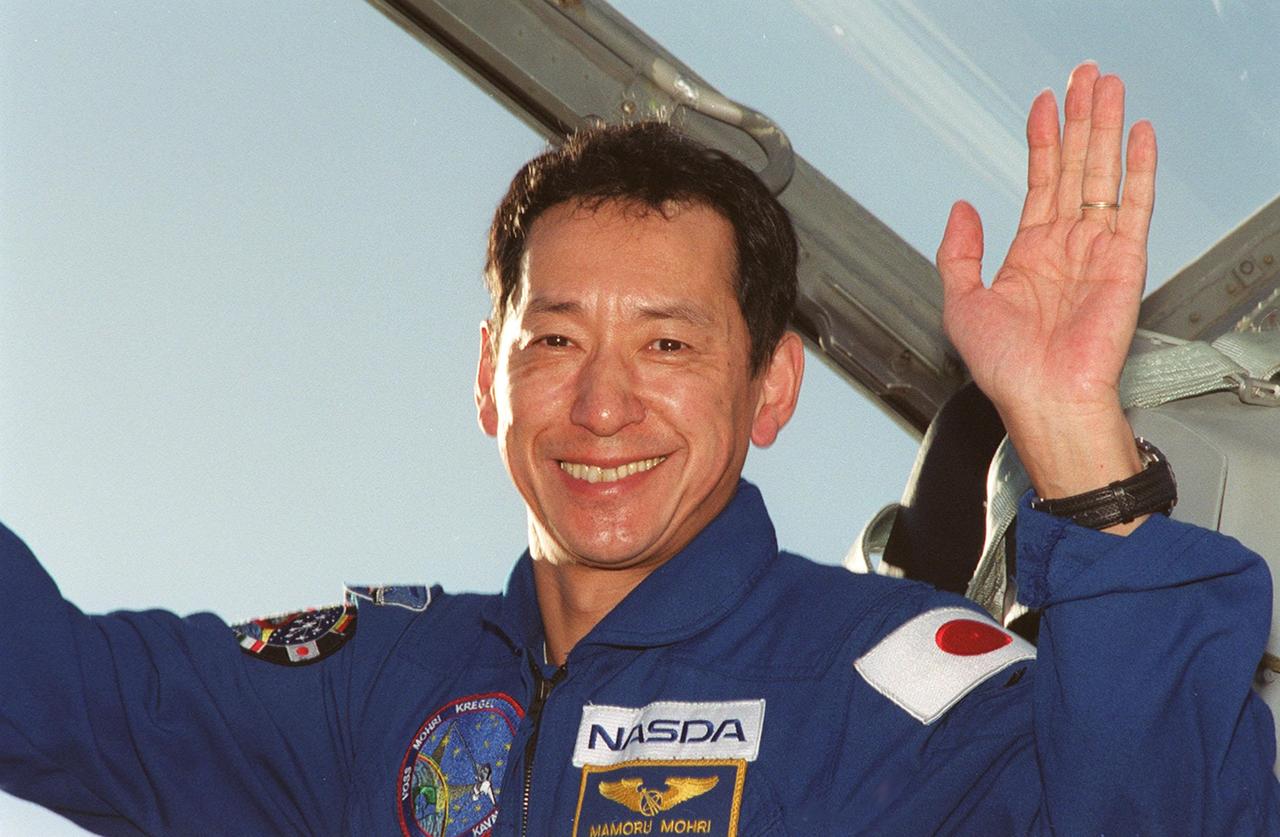
STS-99 Mission Specialist Mamoru Mohri, who is with the National Space Development Agency (NASDA) of Japan, waves after his arrival at KSC aboard a T-38 training jet aircraft to take part in a Terminal Countdown Demonstration Test (TCDT). The TCDT provides the crew with simulated countdown exercises, emergency egress training, and opportunities to inspect the mission payloads in the orbiter's payload bay. Other crew members taking part are Commander Kevin Kregel, Pilot Dominic L. Pudwill Gorie, and Mission Specialists Janet Lynn Kavandi (Ph.D.), Janice Voss (Ph.D.), and Gerhard P.J. Thiele, with the European Space Agency. STS-99 is the Shuttle Radar Topography Mission, which will chart a new course, using two antennae and a 200-foot-long section of space station-derived mast protruding from the payload bay to produce unrivaled 3-D images of the Earth's surface. The result of the Shuttle Radar Topography Mission could be close to 1 trillion measurements of the Earth's topography. Besides contributing to the production of better maps, these measurements could lead to improved water drainage modeling, more realistic flight simulators, better locations for cell phone towers, and enhanced navigation safety. Launch of Endeavour on the 11-day mission is scheduled for Jan. 31 at 12:47 p.m. EST
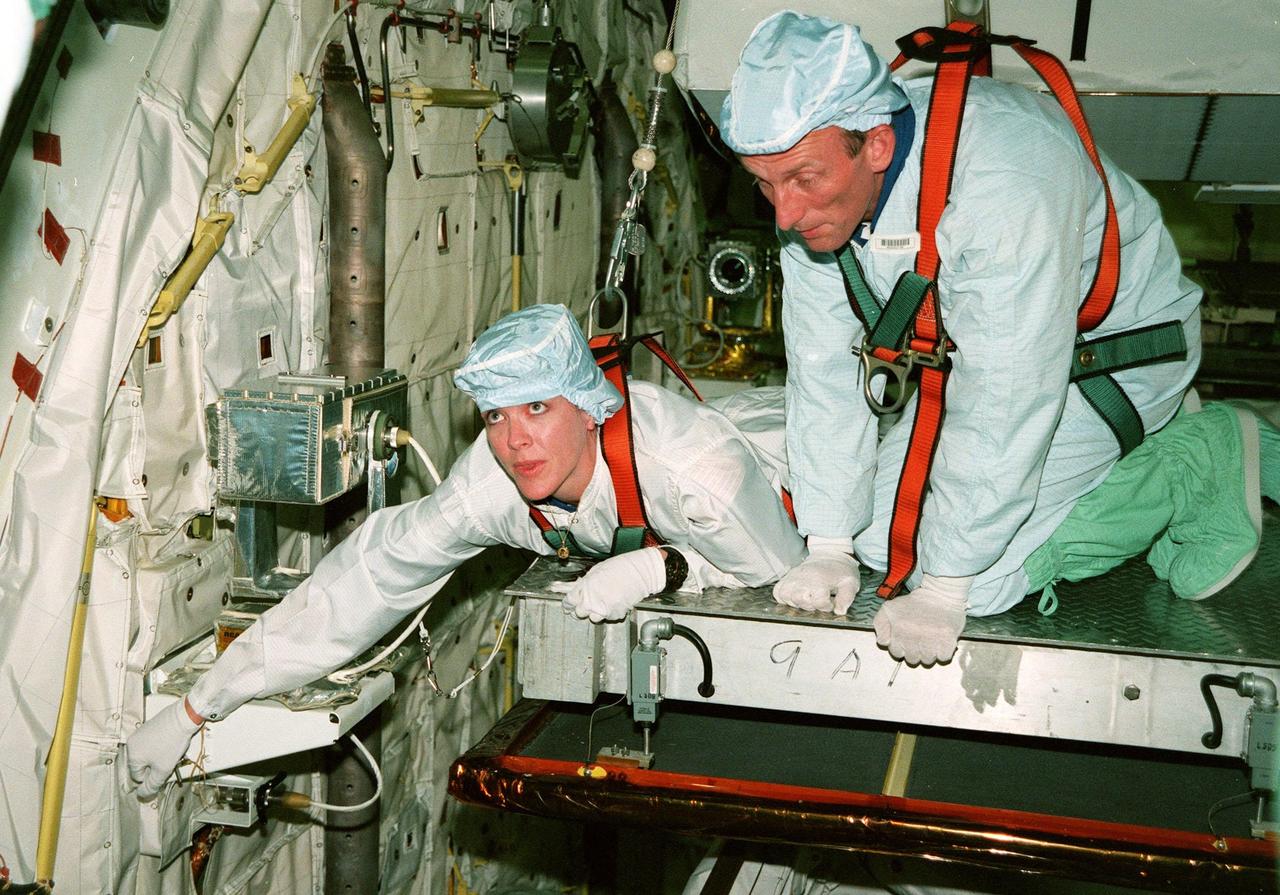
KENNEDY SPACE CENTER, FLA. -- In the Orbiter Processing Facility, STS-99 Mission Specialists Janet Lynn Kavandi (Ph.D.) and Gerhard P.J. Thiele look over part of the Shuttle Radar Topography Mission (SRTM), primary payload for their mission, as part of a Crew Equipment Interface Test (CEIT). Also taking part in the CEIT are Commander Kevin R. Kregel, Pilot Dominic L. Pudwill Gorie, and Mission Specialists Janice Voss (Ph.D.) and Mamoru Mohri. Mohri is with the National Space Development Agency (NASDA) of Japan, and Thiele is with the European Space Agency. The CEIT provides an opportunity for crew members to check equipment and facilities that will be aboard the orbiter during their mission. The SRTM is a specially modified radar system that will gather data for the most accurate and complete topographic map of the Earth's surface that has ever been assembled. SRTM will make use of radar interferometry, wherein two radar images are taken from slightly different locations. Differences between these images allow for the calculation of surface elevation, or change. The SRTM hardware will consist of one radar antenna in the shuttle payload bay and a second radar antenna attached to the end of a mast extended 60 meters (195 feet) out from the shuttle. STS-99 is scheduled to launch Sept. 16 at 8:47 a.m. from Launch Pad 39A
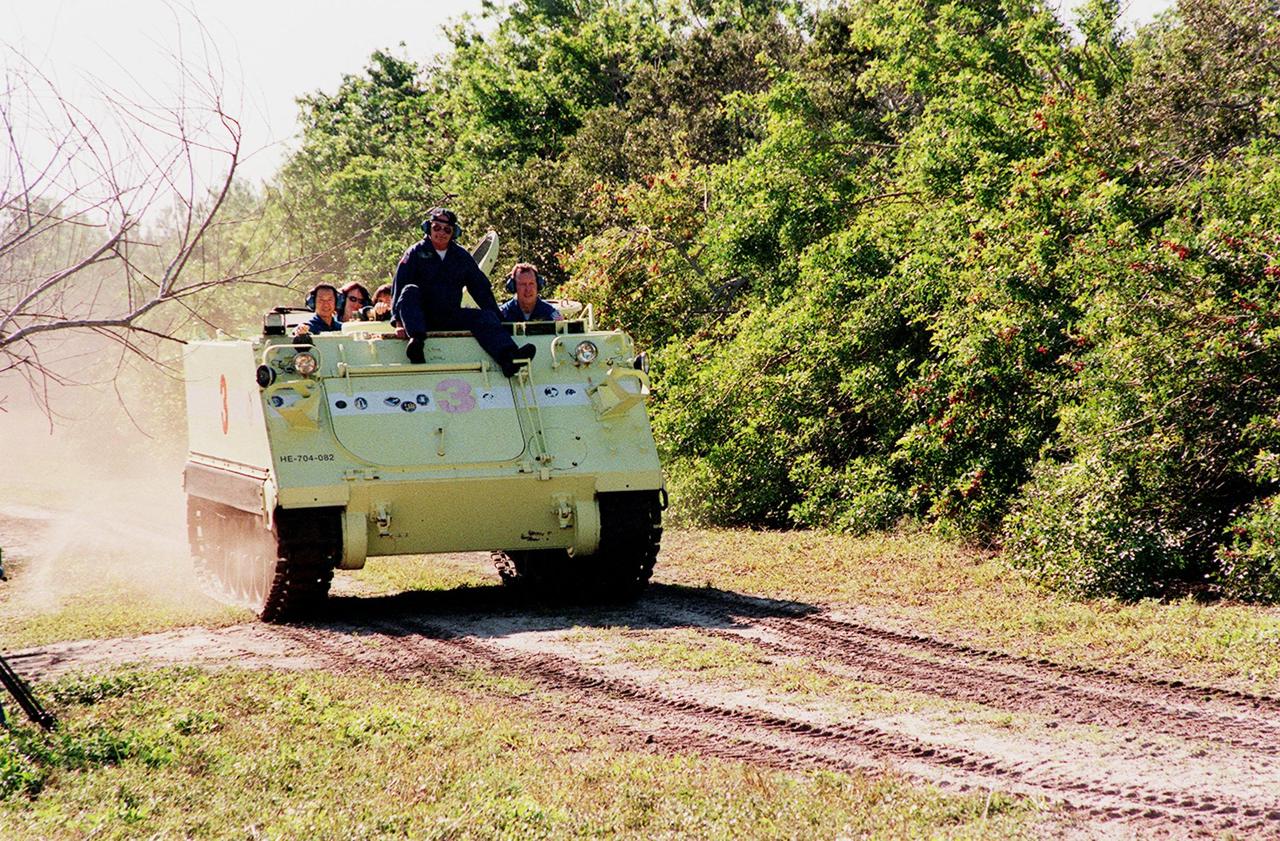
STS-99 Pilot Dominic Gorie, under the watchful eye of Capt. George Hoggard, a trainer with the KSC Fire Department, practices driving the M-113, an armored personnel carrier. Part of Terminal Countdown Demonstration Test (TCDT) activities, the M-113 could be used by the crew in the event of an emergency at the pad during which the crew must make a quick exit from the area. Riding in the rear are Mission Specialists Mamoru Mohri, who is with the National Space Development Agency (NASDA) of Japan, Janet Lynn Kavandi (Ph.D.) and Janice Voss (Ph.D.). TCDT provides the crew with simulated countdown exercises, emergency egress training, and opportunities to inspect the mission payloads in the orbiter's payload bay. STS-99 is the Shuttle Radar Topography Mission, which will chart a new course, using two antennae and a 200-foot-long section of space station-derived mast protruding from the payload bay to produce unrivaled 3-D images of the Earth's surface. The result of the Shuttle Radar Topography Mission could be close to 1 trillion measurements of the Earth's topography. Besides contributing to the production of better maps, these measurements could lead to improved water drainage modeling, more realistic flight simulators, better locations for cell phone towers, and enhanced navigation safety. Launch of Endeavour on the 11-day mission is scheduled for Jan. 31 at 12:47 p.m. EST
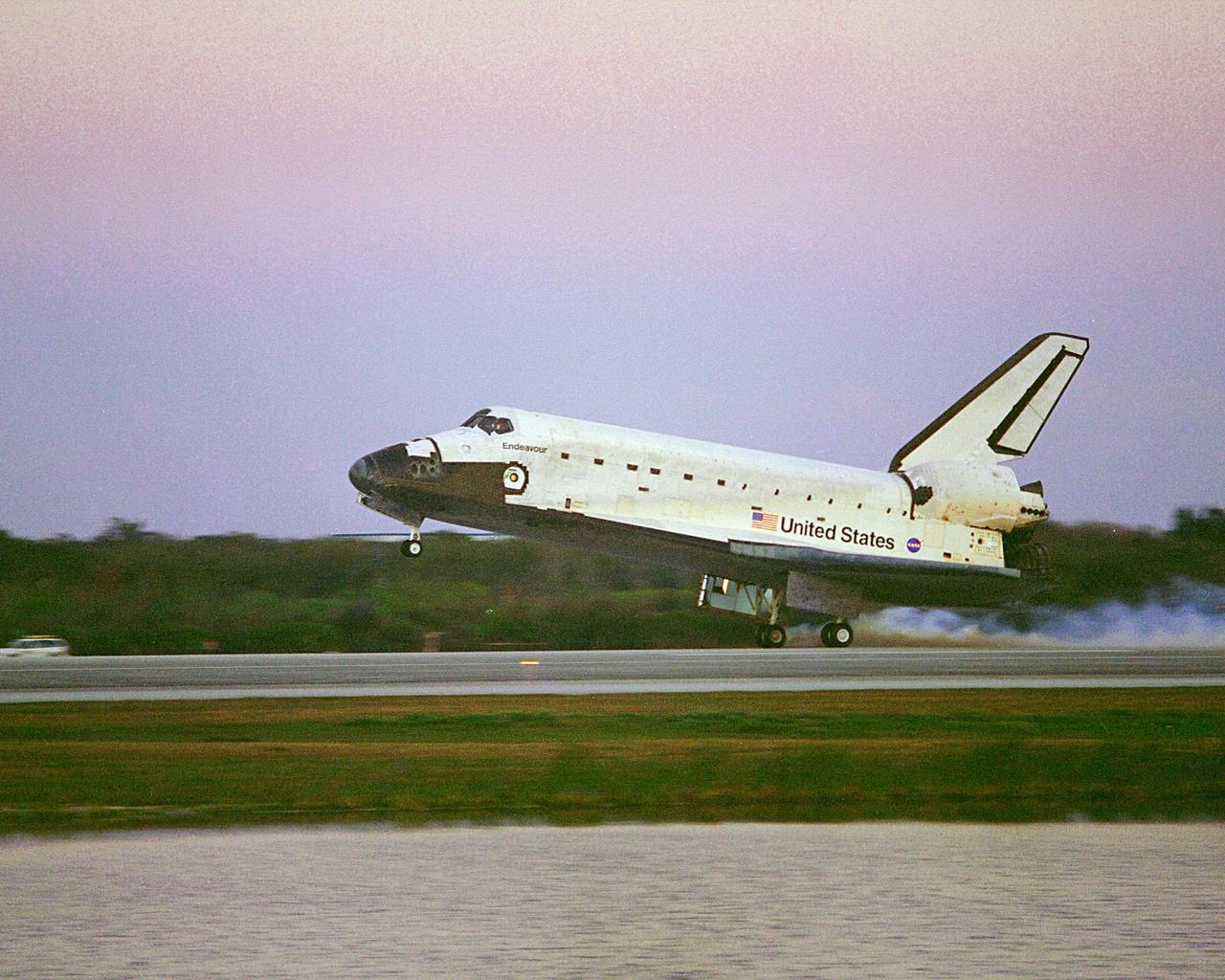
KENNEDY SPACE CENTER, FLA. -- In the waning light after sundown, Space Shuttle Endeavour touches down on KSC's Shuttle Landing Facility Runway 33 to complete the 11-day, 5-hour, 38-minute-long STS-99 mission. At the controls are Commander Kevin Kregel and Pilot Dominic Gorie. Also onboard the orbiter are Mission Specialists Janet Kavandi, Janice Voss, Mamoru Mohri of Japan and Gerhard Thiele of Germany. Mohri is with the National Space Development Agency (NASDA) and Thiele is with the European Space Agency. The crew are returning from the Shuttle Radar Topography Mission after mapping more than 47 million square miles of the Earth's surface. Main gear touchdown was at 6:22:23 p.m. EST Feb. 22 , landing on orbit 181 of the mission. Nose gear touchdown was at 6:22:35 p.m.. EST, and wheel stop at 6:23:25 p.m. EST. This was the 97th flight in the Space Shuttle program and the 14th for Endeavour, also marking the 50th landing at KSC, the 21st consecutive landing at KSC, and the 28th in the last 29 Shuttle flight
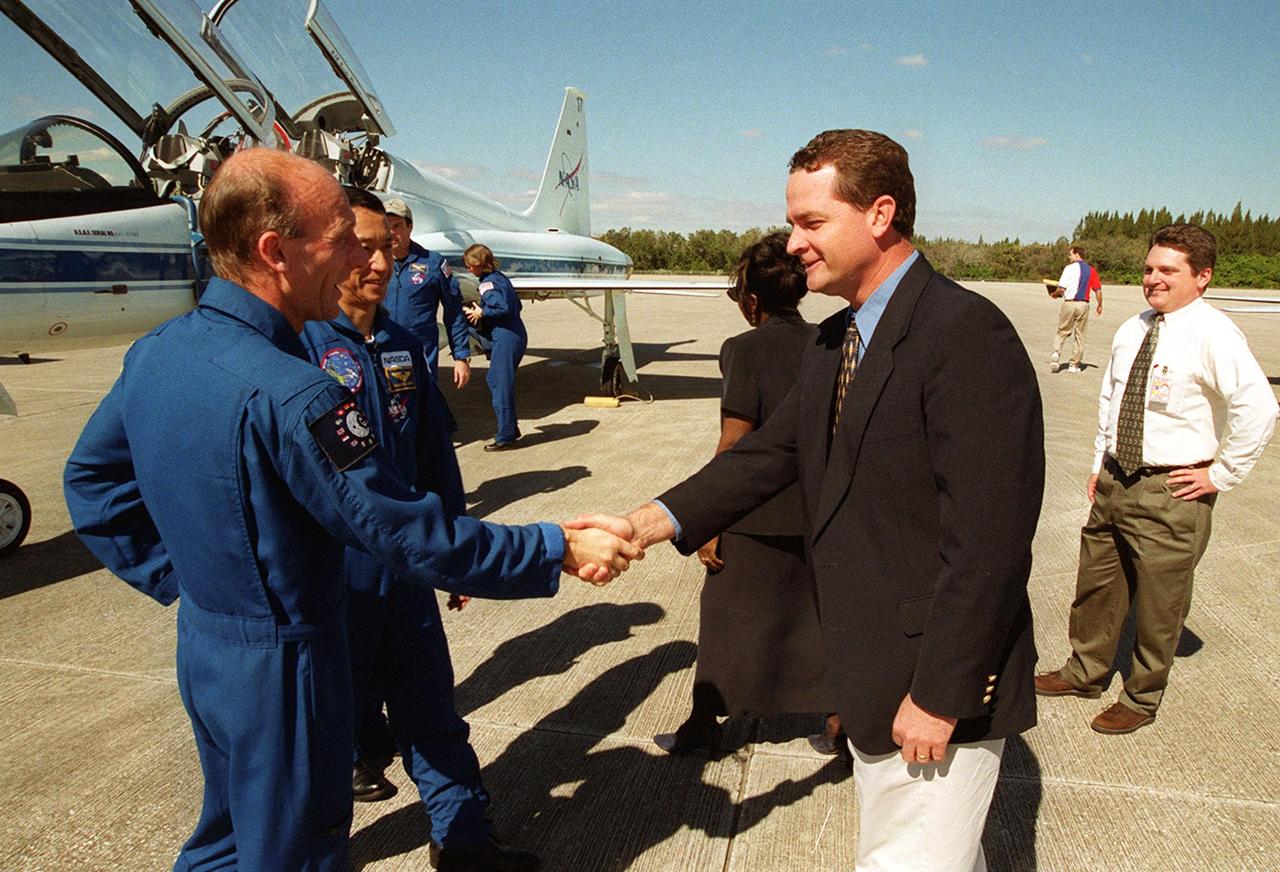
After landing at the Shuttle Landing Facility aboard T-38 jet aircraft, STS-99 Mission Specialists (from left) Gerhard Thiele of Germany and Mamoru Mohri of Japan are greeted by Dave King, director of Shuttle Operations. Behind Mohri can be seen Commander Kevin Kregel and Mission Specialist Janice Voss. The crew, which includes Pilot Dom gorie and Mission Specialist Janet Kavandi, are ready to prepare for the second launch attempt of Endeavour Feb. 11 at 12:30 p.m. EST from Launch Pad 39A. The earlier launch scheduled for Jan. 31 was scrubbed due to poor weather and a faulty Enhanced Master Events Controller in the orbiter's aft compartment. Over the next few days, the crew will review mission procedures, conduct test flights in the Shuttle Training Aircraft and undergo routine preflight medical exams. STS-99 is the Shuttle Radar Topography Mission, which will produce unrivaled 3-D images of the Earth's surface. The result of the Shuttle Radar Topography Mission could be close to 1 trillion measurements of the Earth's topography. Landing is expected at KSC on Feb. 22 at 4:36 p.m. EST
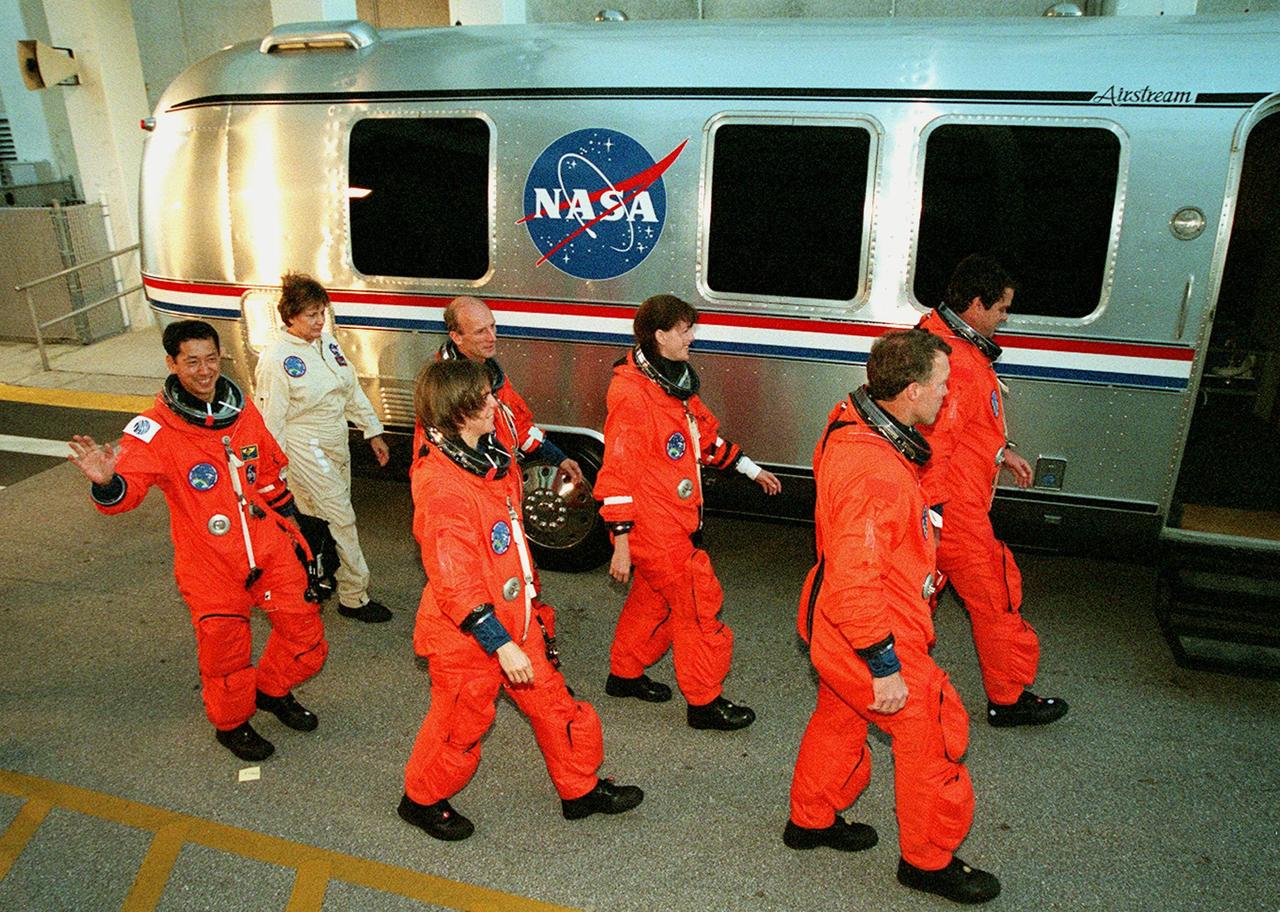
In their orange flight suits, the STS-99 crew head toward the "astrovan" that will take them to Launch Pad 39A for a simulated countdown exercise. From left to right are Mission Specialists Mamoru Mohri (waving), Gerhard Thiele, Janice Voss (Ph.D.) and Janet Lynn Kavandi (Ph.D.), Pilot Dominic Gorie and Commander Kevin Kregel. Mohri is with the National Space Development Agency (NASDA) of Japan and Thiele is with the European Space Agency. The crew are taking part in Terminal Countdown Demonstration Test activities, which provide them with simulated countdown exercises, emergency egress training, and opportunities to inspect the mission payloads in the orbiter's payload bay. STS-99 is the Shuttle Radar Topography Mission, which will chart a new course, using two antennae and a 200-foot-long section of space station-derived mast protruding from the payload bay to produce unrivaled 3-D images of the Earth's surface. The result of the Shuttle Radar Topography Mission could be close to 1 trillion measurements of the Earth's topography. Besides contributing to the production of better maps, these measurements could lead to improved water drainage modeling, more realistic flight simulators, better locations for cell phone towers, and enhanced navigation safety. Launch of Endeavour on the 11-day mission is scheduled for Jan. 31 at 12:47 p.m. EST
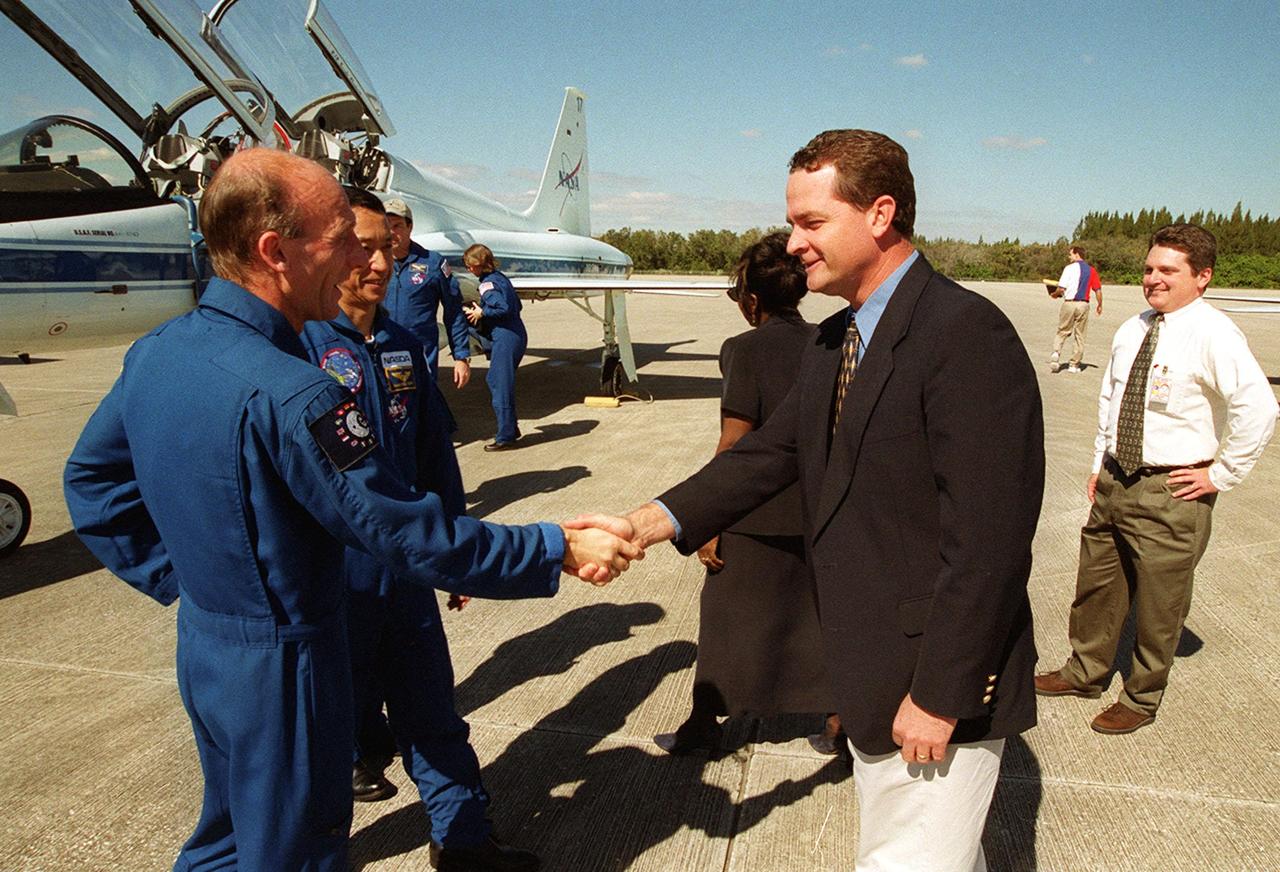
After landing at the Shuttle Landing Facility aboard T-38 jet aircraft, STS-99 Mission Specialists (from left) Gerhard Thiele of Germany and Mamoru Mohri of Japan are greeted by Dave King, director of Shuttle Operations. Behind Mohri can be seen Commander Kevin Kregel and Mission Specialist Janice Voss. The crew, which includes Pilot Dom gorie and Mission Specialist Janet Kavandi, are ready to prepare for the second launch attempt of Endeavour Feb. 11 at 12:30 p.m. EST from Launch Pad 39A. The earlier launch scheduled for Jan. 31 was scrubbed due to poor weather and a faulty Enhanced Master Events Controller in the orbiter's aft compartment. Over the next few days, the crew will review mission procedures, conduct test flights in the Shuttle Training Aircraft and undergo routine preflight medical exams. STS-99 is the Shuttle Radar Topography Mission, which will produce unrivaled 3-D images of the Earth's surface. The result of the Shuttle Radar Topography Mission could be close to 1 trillion measurements of the Earth's topography. Landing is expected at KSC on Feb. 22 at 4:36 p.m. EST
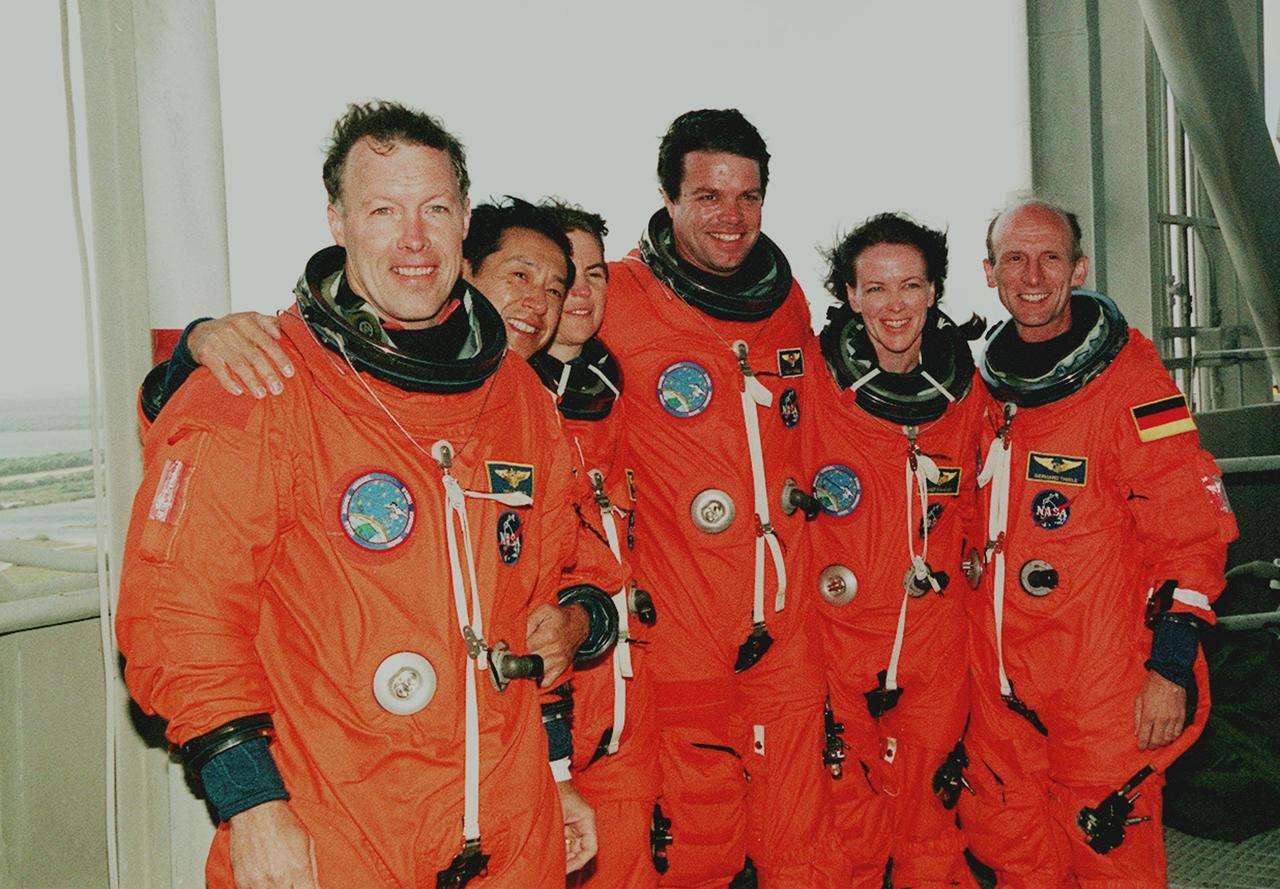
KENNEDY SPACE CENTER, Fla. -- At the 195-foot level of the Fixed Service Structure on Launch Pad 39A, the STS-99 crew pose for a photograph during Terminal Countdown Demonstration Test (TCDT) activities. Standing left to right are Pilot Dominic Gorie, Mission Specialist Mamoru Mohri (Ph.D.), Mission Specialist Janice Voss (Ph.D.), Commander Kevin Kregel, Mission Specialist Janet Lynn Kavandi (Ph.D.), and Mission Specialist Gerhard Thiele (Ph.D.). Thiele is with the European Space Agency and Mohri is with the National Space Development Agency (NASDA) of Japan. The TCDT provides the crew with simulated countdown exercises, emergency egress training, and opportunities to inspect the mission payloads in the orbiter's payload bay. STS-99 is the Shuttle Radar Topography Mission, which will chart a new course, using two antennae and a 200-foot-long section of space station-derived mast protruding from the payload bay to produce unrivaled 3-D images of the Earth's surface. The result of the Shuttle Radar Topography Mission could be close to 1 trillion measurements of the Earth's topography. Besides contributing to the production of better maps, these measurements could lead to improved water drainage modeling, more realistic flight simulators, better locations for cell phone towers, and enhanced navigation safety. Launch of Endeavour on the 11-day mission is scheduled for Jan. 31 at 12:47 p.m. EST
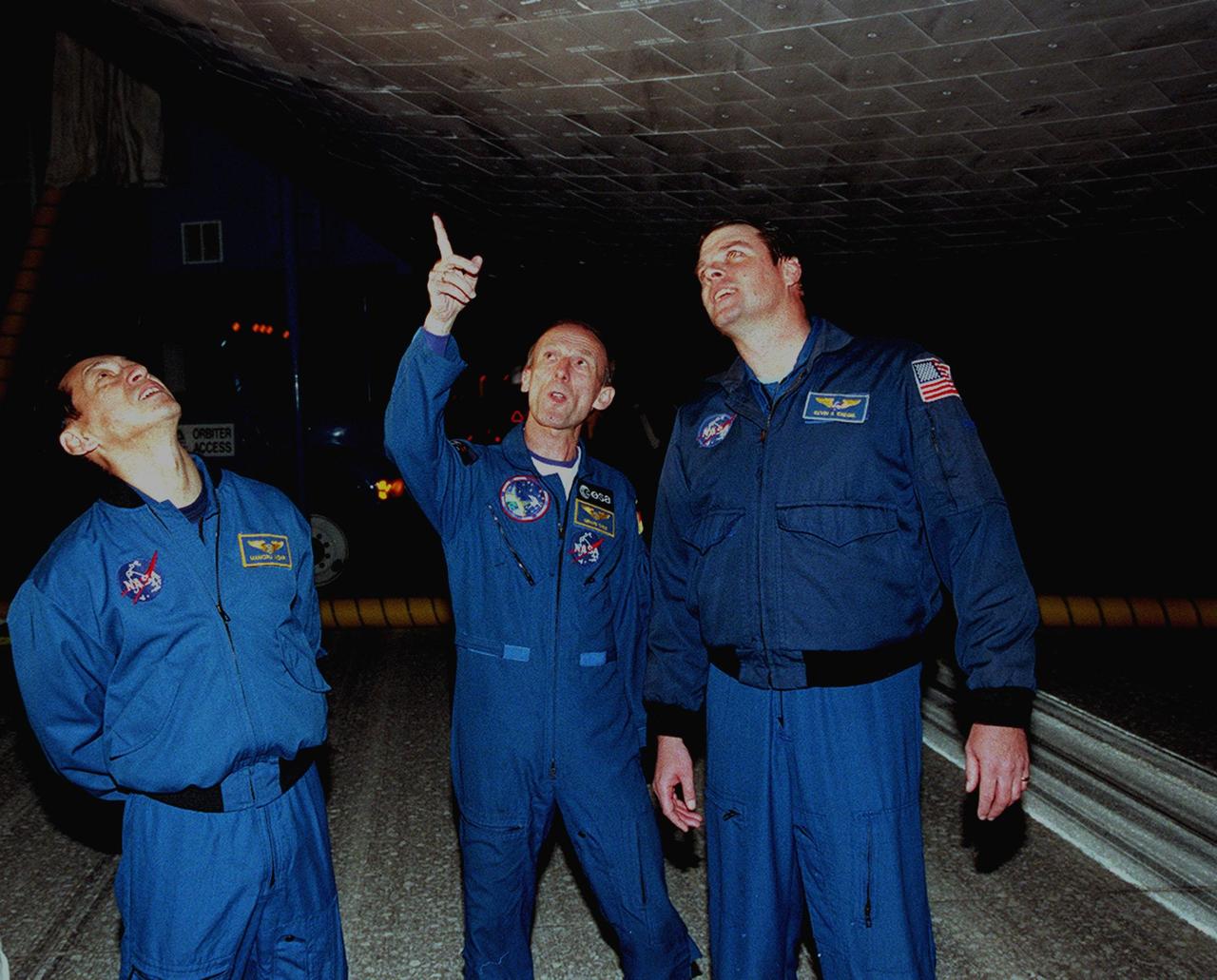
KENNEDY SPACE CENTER, FLA. -- On KSC's Shuttle Landing Facility, STS-99 crew members check the underside of Space Shuttle Endeavour after completing the 11-day, 5-hour, 38-minute-long mission. From left are Mission Specialists Mamoru Mohri of Japan and Gerhard Thiele of Germany, with Commander Kevin Kregel. Main gear touchdown was at 6:22:23 p.m. EST Feb. 22 , landing on orbit 181 of the mission. Nose gear touchdown was at 6:22:35 p.m.. EST, and wheel stop at 6:23:25 p.m. EST. The other crew members are Pilot Dominic Gorie and Mission Specialists Janet Kavandi and Janice Voss. The crew are returning from the Shuttle Radar Topography Mission, after mapping more than 47 million square miles of the Earth's surface. This was the 97th flight in the Space Shuttle program and the 14th for Endeavour, also marking the 50th landing at KSC, the 21st consecutive landing at KSC, and the 28th in the last 29 Shuttle flights
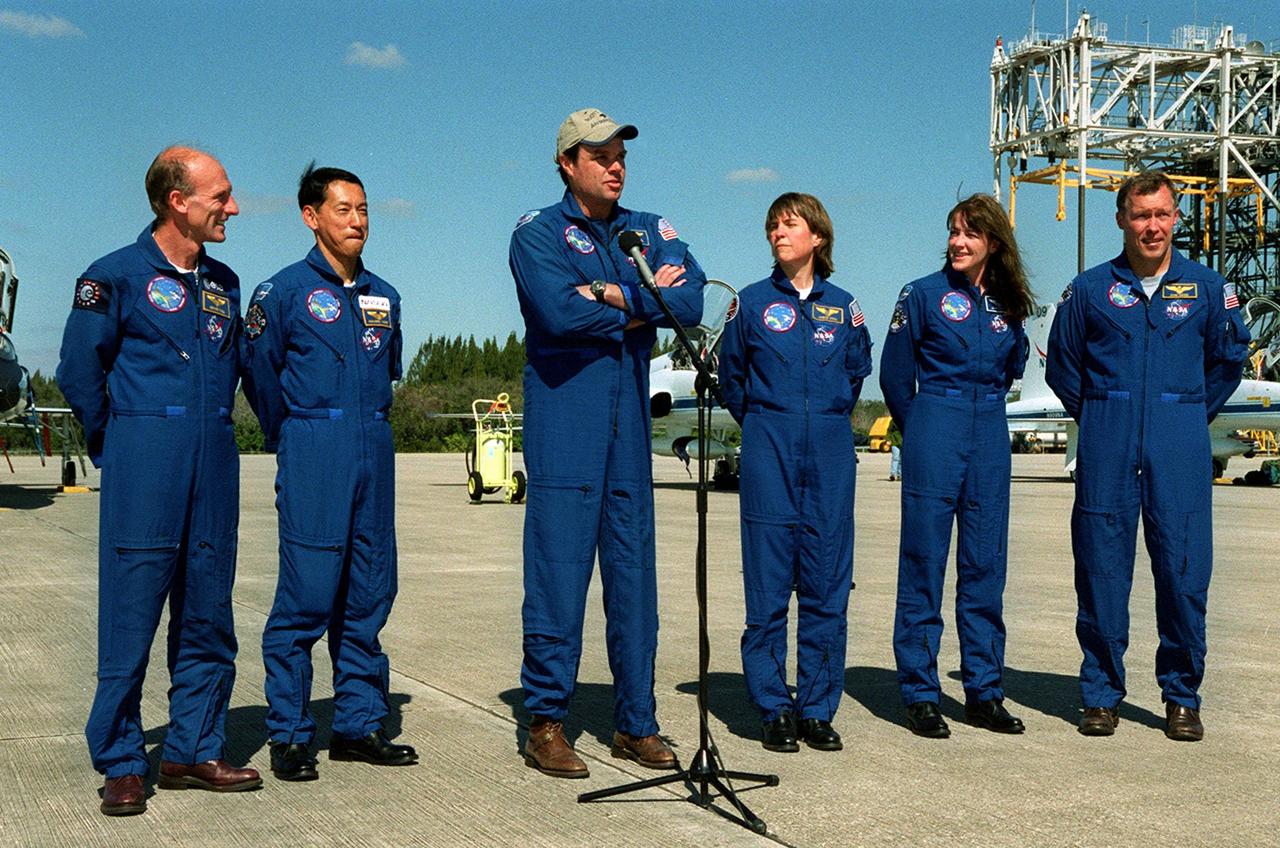
After landing at the Shuttle Landing Facility aboard T-38 jet aircraft, the STS-99 crew addresses the media. Standing, left to right, are Mission Specialists Gerhard Thiele of Germany and Mamoru Mohri of Japan, Commander Kevin Kregel (at the microphone), Mission Specialists Janice Voss and Janet Kavandi, and Pilot Dominic Gorie. They are ready to prepare for the second launch attempt of Endeavour Feb. 11 at 12:30 p.m. EST from Launch Pad 39A. The earlier launch scheduled for Jan. 31 was scrubbed due to poor weather and a faulty Enhanced Master Events Controller in the orbiter's aft compartment. Over the next few days, the crew will review mission procedures, conduct test flights in the Shuttle Training Aircraft and undergo routine preflight medical exams. STS-99 is the Shuttle Radar Topography Mission, which will produce unrivaled 3-D images of the Earth's surface. The result of the Shuttle Radar Topography Mission could be close to 1 trillion measurements of the Earth's topography. Landing is expected at KSC on Feb. 22 at 4:36 p.m. EST
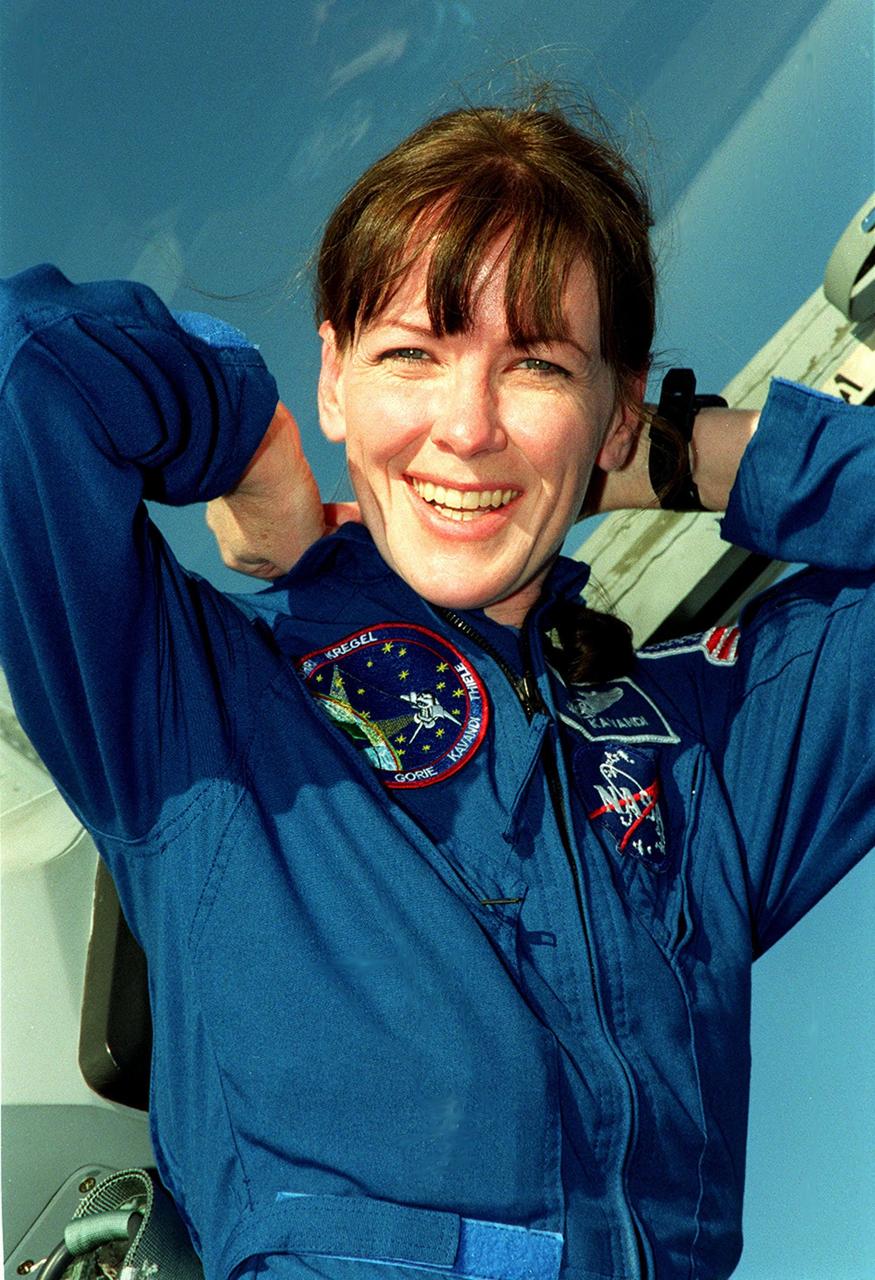
STS-99 Mission Specialist Janet Lynn Kavandi (Ph.D.) smiles on her arrival at KSC aboard a T-38 training jet aircraft to take part in a Terminal Countdown Demonstration Test (TCDT). The TCDT provides the crew with simulated countdown exercises, emergency egress training, and opportunities to inspect the mission payloads in the orbiter's payload bay. Other crew members taking part are Commander Kevin Kregel, Pilot Dominic Gorie, and Mission Specialists Janice Voss (Ph.D.), Mamoru Mohri, who is with the National Space Development Agency (NASDA) of Japan, and Gerhard Thiele, with the European Space Agency. STS-99 is the Shuttle Radar Topography Mission, which will chart a new course, using two antennae and a 200-foot-long section of space station-derived mast protruding from the payload bay to produce unrivaled 3-D images of the Earth's surface. The result of the Shuttle Radar Topography Mission could be close to 1 trillion measurements of the Earth's topography. Besides contributing to the production of better maps, these measurements could lead to improved water drainage modeling, more realistic flight simulators, better locations for cell phone towers, and enhanced navigation safety. Launch of Endeavour on the 11-day mission is scheduled for Jan. 31 at 12:47 p.m. EST
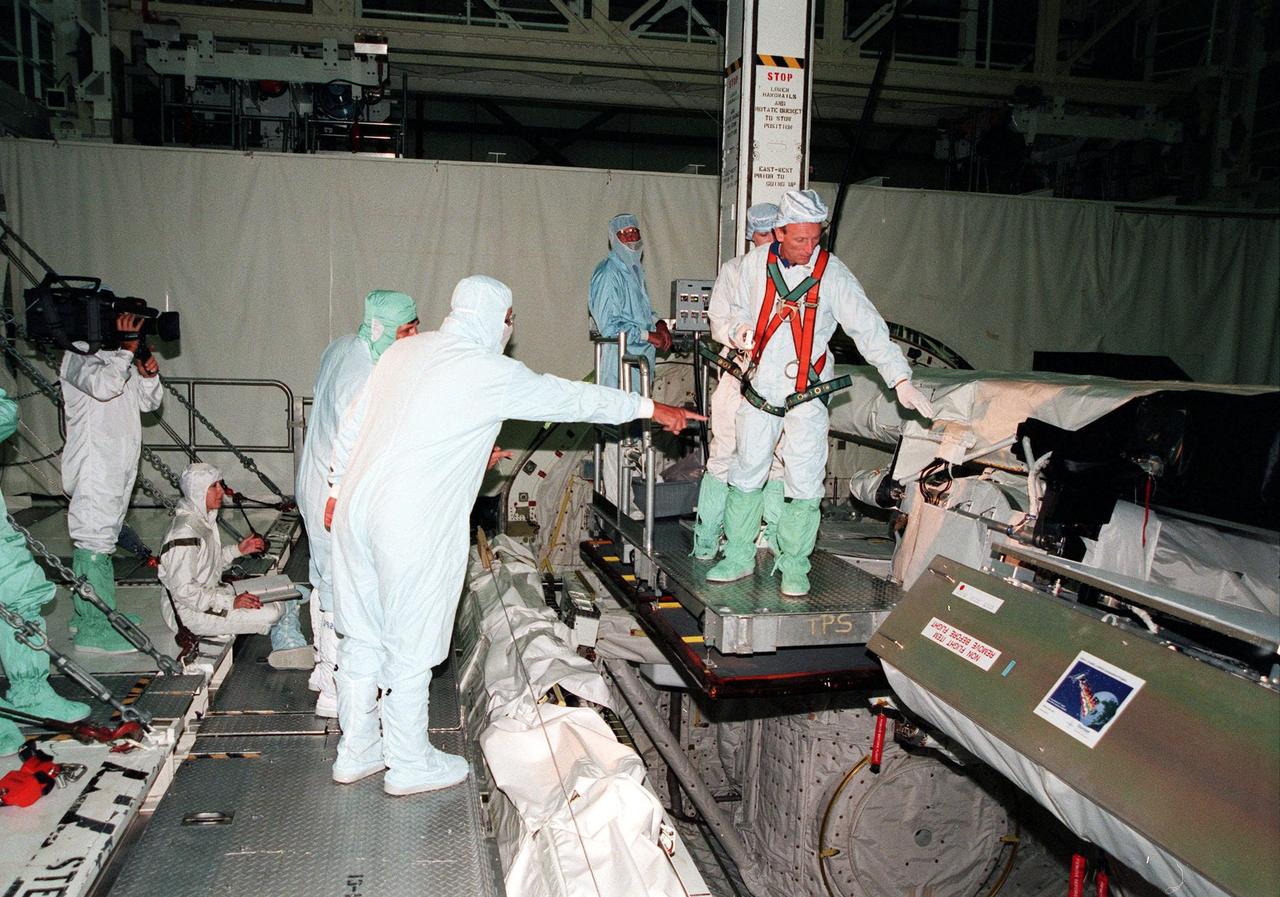
KENNEDY SPACE CENTER, FLA. -- In the Orbiter Processing Facility (OPF), the STS-99 crew take part in a Crew Equipment Interface Test (CEIT). Facing the camera and pointing is Mission Specialist Gerhard P.J. Thiele, who is with the European Space Agency. Other crew members in the OPF are Commander Kevin R. Kregel, Pilot Dominic L. Pudwill Gorie, and Mission Specialists Janet Lynn Kavandi (Ph.D.), Janice Voss (Ph.D.), and Mamoru Mohri, who is with the National Space Development Agency (NASDA) of Japan. The CEIT provides an opportunity for crew members to check equipment and facilities that will be aboard the orbiter during their mission. The STS-99 mission is the Shuttle Radar Topography Mission (SRTM), a specially modified radar system that will gather data for the most accurate and complete topographic map of the Earth's surface that has ever been assembled. SRTM will make use of radar interferometry, wherein two radar images are taken from slightly different locations. Differences between these images allow for the calculation of surface elevation, or change. The SRTM hardware will consist of one radar antenna in the shuttle payload bay and a second radar antenna attached to the end of a mast extended 60 meters (195 feet) out from the shuttle. STS-99 is scheduled to launch Sept. 16 at 8:47 a.m. from Launch Pad 39A
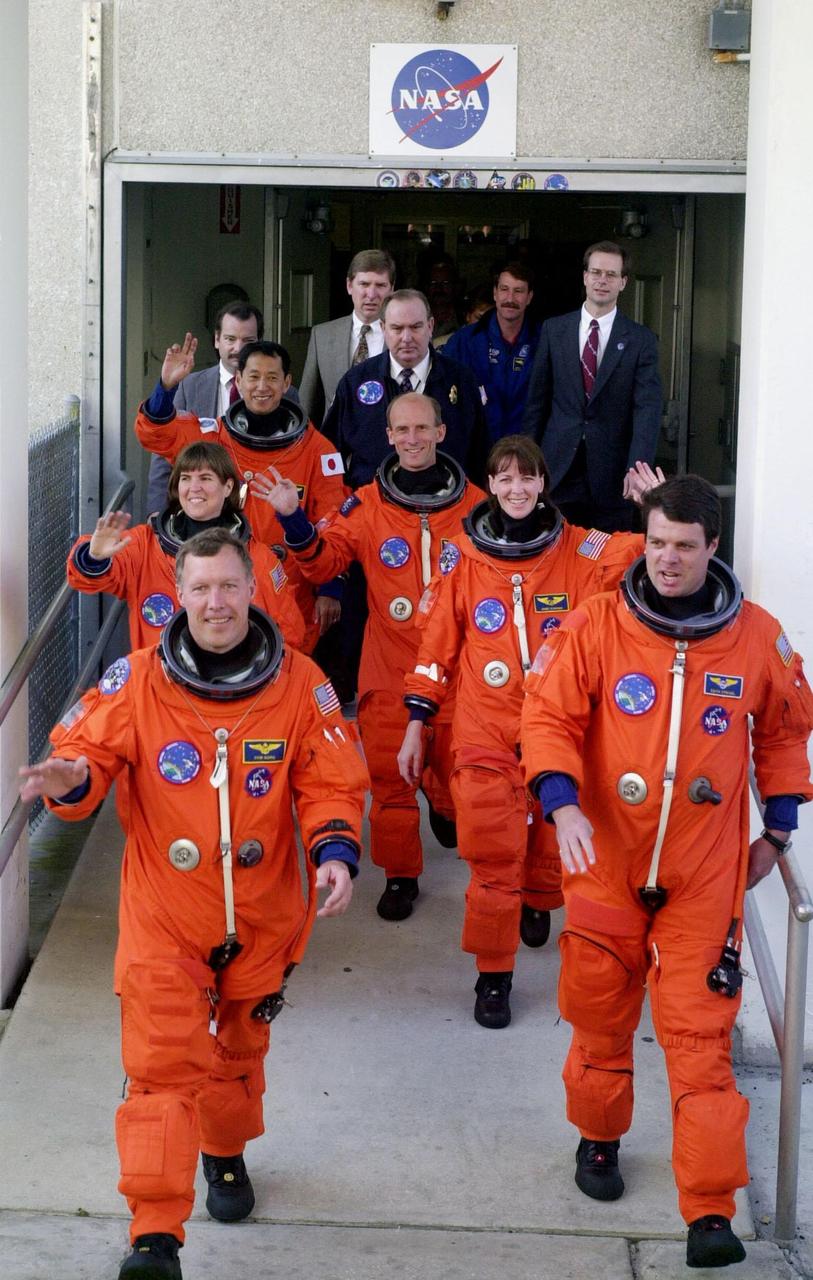
The STS-99 crew wave to onlookers as they step eagerly from the Operations and Checkout Building enroute to Launch Pad 39A for liftoff of Space Shuttle Endeavour. In their orange launch and entry suits, they are (foreground) Pilot Dominic Gorie and Commander Kevin Kregel. Behind them (left to right) are Mission Specialists Janice Voss, Mamoru Mohri of Japan, Gerhard Thiele of Germany and Janet Lynn Kavandi. Mohri is with the National Space Development Agency (NASDA) of Japan, and Thiele is with the European Space Agency. Known as the Shuttle Radar Topography Mission (SRTM), STS-99 is scheduled for liftoff at 12:30 p.m. EST. The SRTM will chart a new course to produce unrivaled 3-D images of the Earth's surface. The result of the Shuttle Radar Topography Mission could be close to 1 trillion measurements of the Earth's topography. The mission is expected to last 11days, with Endeavour landing at KSC Tuesday, Feb. 22, at 4:36 p.m. EST. This is the 97th Shuttle flight and 14th for Shuttle Endeavour
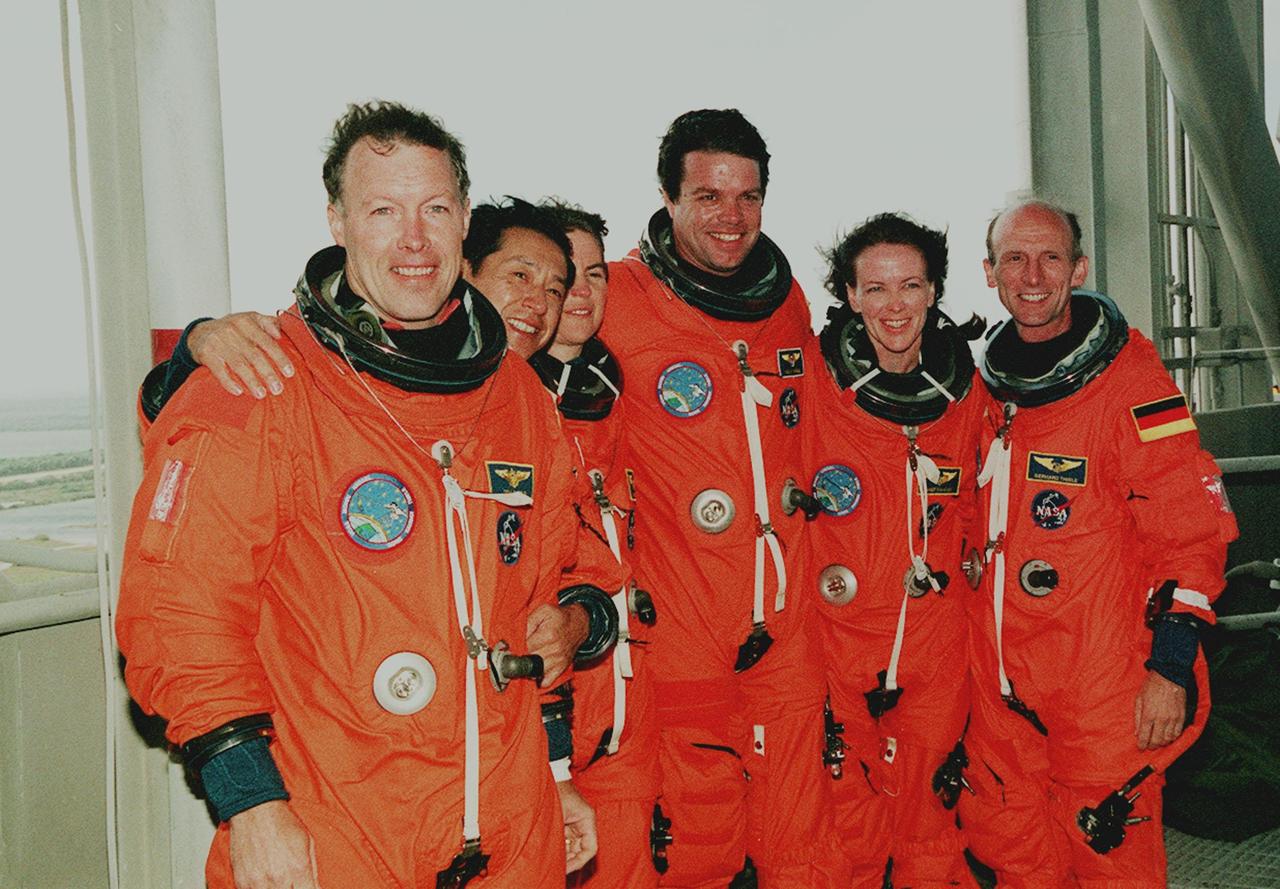
KENNEDY SPACE CENTER, Fla. -- At the 195-foot level of the Fixed Service Structure on Launch Pad 39A, the STS-99 crew pose for a photograph during Terminal Countdown Demonstration Test (TCDT) activities. Standing left to right are Pilot Dominic Gorie, Mission Specialist Mamoru Mohri (Ph.D.), Mission Specialist Janice Voss (Ph.D.), Commander Kevin Kregel, Mission Specialist Janet Lynn Kavandi (Ph.D.), and Mission Specialist Gerhard Thiele (Ph.D.). Thiele is with the European Space Agency and Mohri is with the National Space Development Agency (NASDA) of Japan. The TCDT provides the crew with simulated countdown exercises, emergency egress training, and opportunities to inspect the mission payloads in the orbiter's payload bay. STS-99 is the Shuttle Radar Topography Mission, which will chart a new course, using two antennae and a 200-foot-long section of space station-derived mast protruding from the payload bay to produce unrivaled 3-D images of the Earth's surface. The result of the Shuttle Radar Topography Mission could be close to 1 trillion measurements of the Earth's topography. Besides contributing to the production of better maps, these measurements could lead to improved water drainage modeling, more realistic flight simulators, better locations for cell phone towers, and enhanced navigation safety. Launch of Endeavour on the 11-day mission is scheduled for Jan. 31 at 12:47 p.m. EST
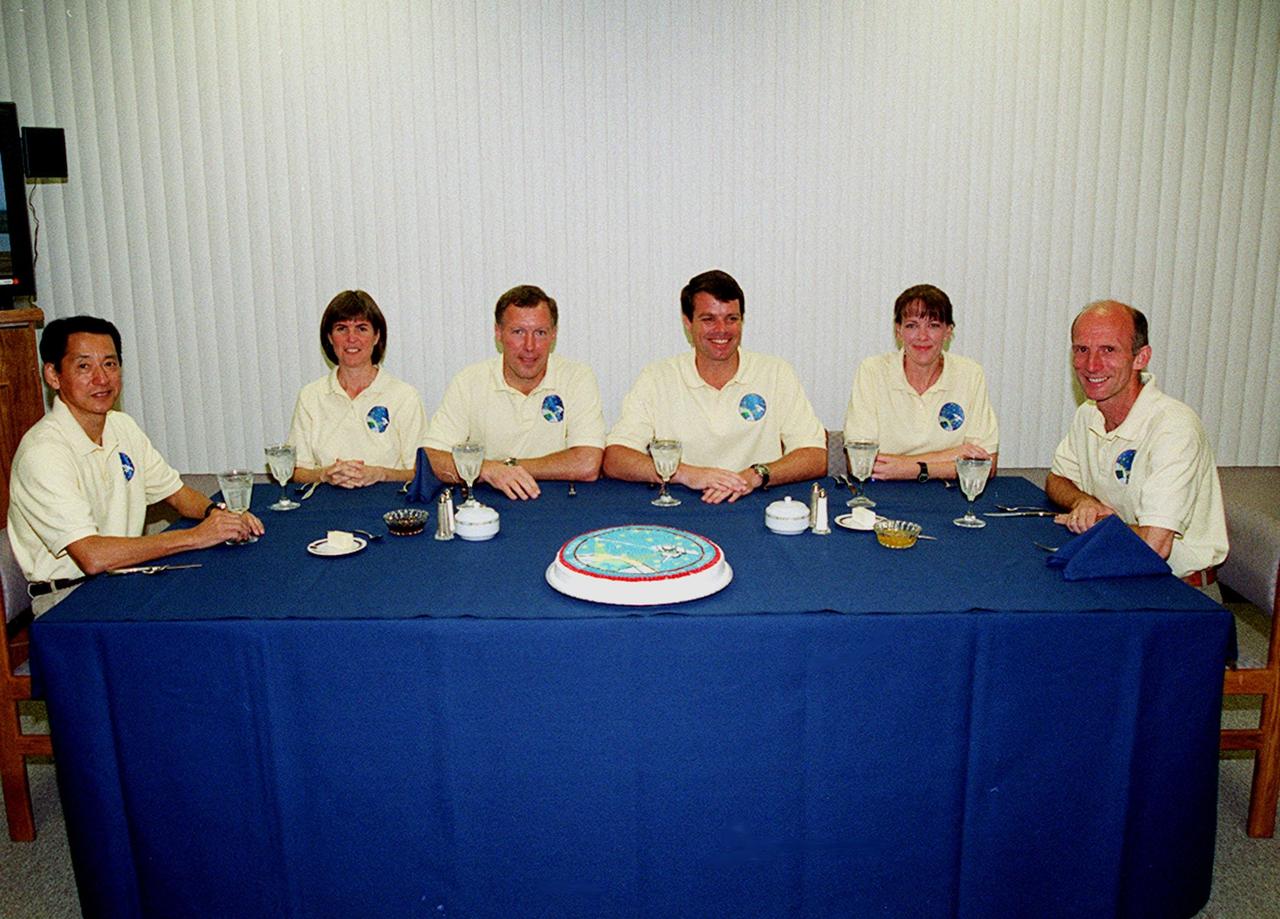
In the Operations and Checkout Building, the STS-99 crew gathers for breakfast before suiting up for launch. From left are Mission Specialists Mamoru Mohri (Ph.D.) and Janice Voss (Ph.D.); Pilot Dominic Gorie; Commander Kevin Kregel; and Mission Specialists Janet Lynn Kavandi (Ph.D.) and Gerhard Thiele. Mohri is with the National Space Development Agency (NASDA) of Japan, and Thiele is with the European Space Agency. Known as the Shuttle Radar Topography Mission, liftoff is scheduled for 12:47 p.m. EST from Launch Pad 39A. The SRTM will chart a new course to produce unrivaled 3-D images of the Earth's surface, using two antennae and a 200-foot-long section of space station-derived mast protruding from the payload bay. The result of the Shuttle Radar Topography Mission could be close to 1 trillion measurements of the Earth's topography. Besides contributing to the production of better maps, these measurements could lead to improved water drainage modeling, more realistic flight simulators, better locations for cell phone towers, and enhanced navigation safety. The mission is expected to last about 11days, with Endeavour landing at KSC Friday, Feb. 11, at 4:55 p.m. EST
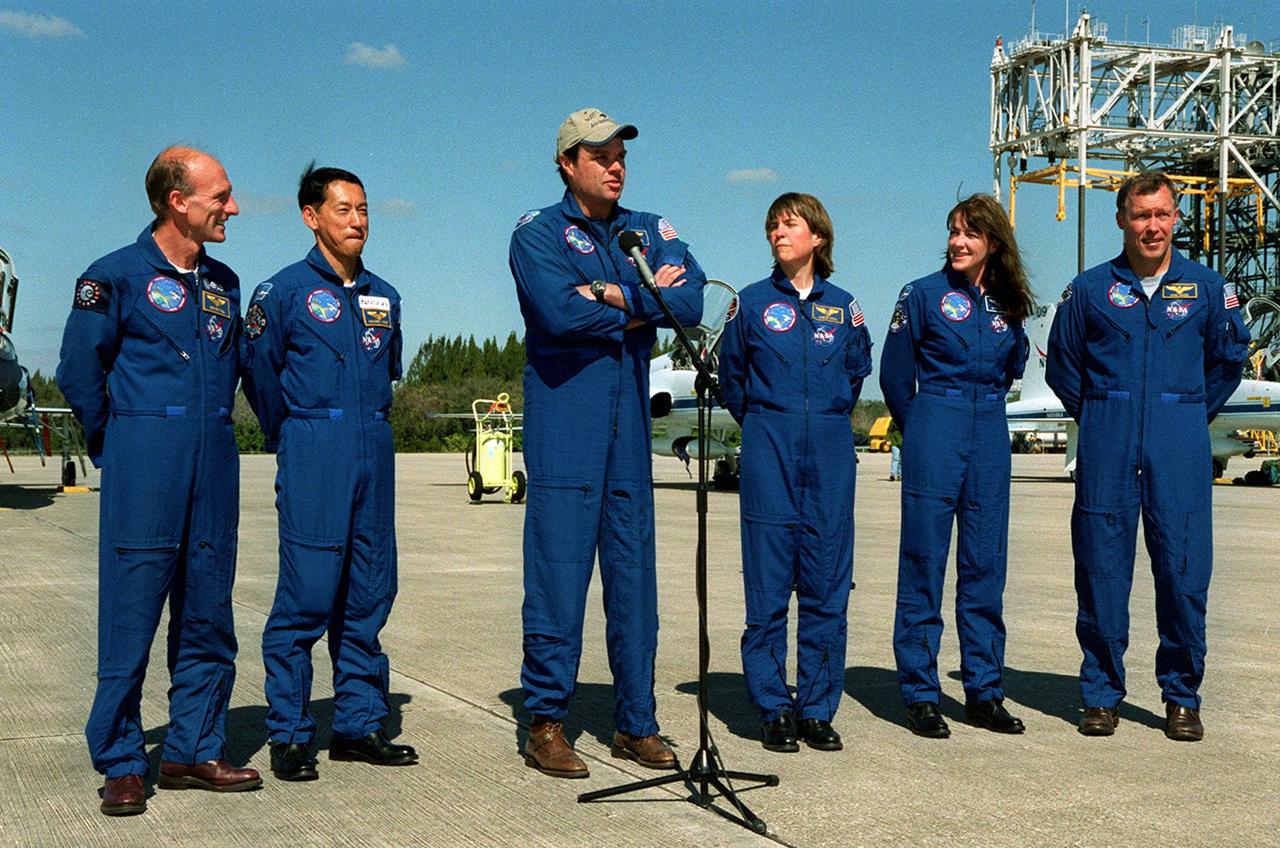
After landing at the Shuttle Landing Facility aboard T-38 jet aircraft, the STS-99 crew addresses the media. Standing, left to right, are Mission Specialists Gerhard Thiele of Germany and Mamoru Mohri of Japan, Commander Kevin Kregel (at the microphone), Mission Specialists Janice Voss and Janet Kavandi, and Pilot Dominic Gorie. They are ready to prepare for the second launch attempt of Endeavour Feb. 11 at 12:30 p.m. EST from Launch Pad 39A. The earlier launch scheduled for Jan. 31 was scrubbed due to poor weather and a faulty Enhanced Master Events Controller in the orbiter's aft compartment. Over the next few days, the crew will review mission procedures, conduct test flights in the Shuttle Training Aircraft and undergo routine preflight medical exams. STS-99 is the Shuttle Radar Topography Mission, which will produce unrivaled 3-D images of the Earth's surface. The result of the Shuttle Radar Topography Mission could be close to 1 trillion measurements of the Earth's topography. Landing is expected at KSC on Feb. 22 at 4:36 p.m. EST
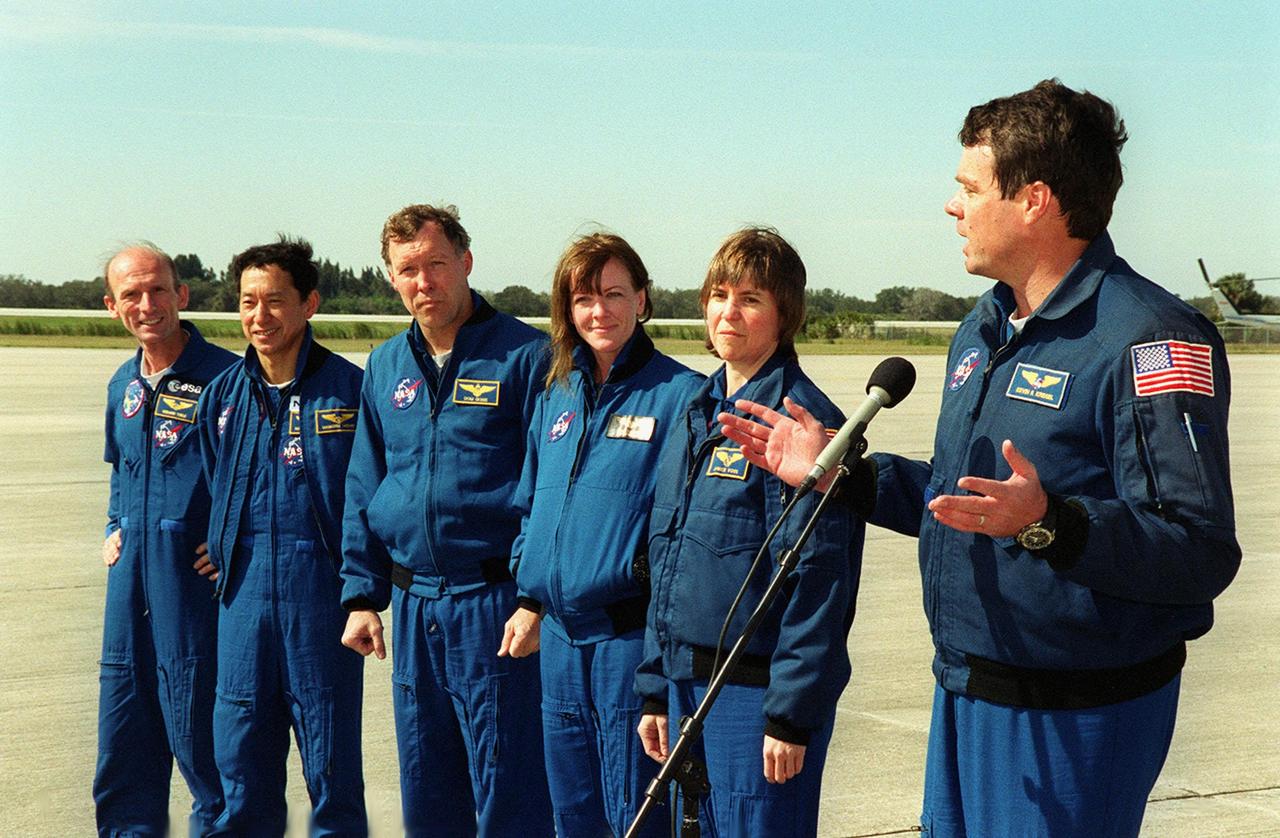
After arriving at KSC's Shuttle Landing Facility, the STS-99 crew pause to greet the media and Commander Kevin Kregel (right) introduces his crew: (from left) Mission Specialists Gerhard Thiele (Ph.D.) and Mamoru Mohri (Ph.D.); Pilot Dominic Gorie; and Mission Specialists Janet Lynn Kavandi (Ph.D.) and Janice Voss (Ph.D.). Thiele is with the European Space Agency and Mohri is with the National Space Development Agency (NASDA) of Japan. Over the next few days, the crew will review mission procedures, conduct test flights in the Shuttle Training Aircraft and undergo routine preflight medical exams. STS-99 is the Shuttle Radar Topography Mission, which will chart a new course, using two antennae and a 200-foot-long section of space station-derived mast protruding from the payload bay to produce unrivaled 3-D images of the Earth's surface. The result of the Shuttle Radar Topography Mission could be close to 1 trillion measurements of the Earth's topography. Besides contributing to the production of better maps, these measurements could lead to improved water drainage modeling, more realistic flight simulators, better locations for cell phone towers, and enhanced navigation safety. Launch of Endeavour is scheduled for Jan. 31 at 12:47 p.m. EST
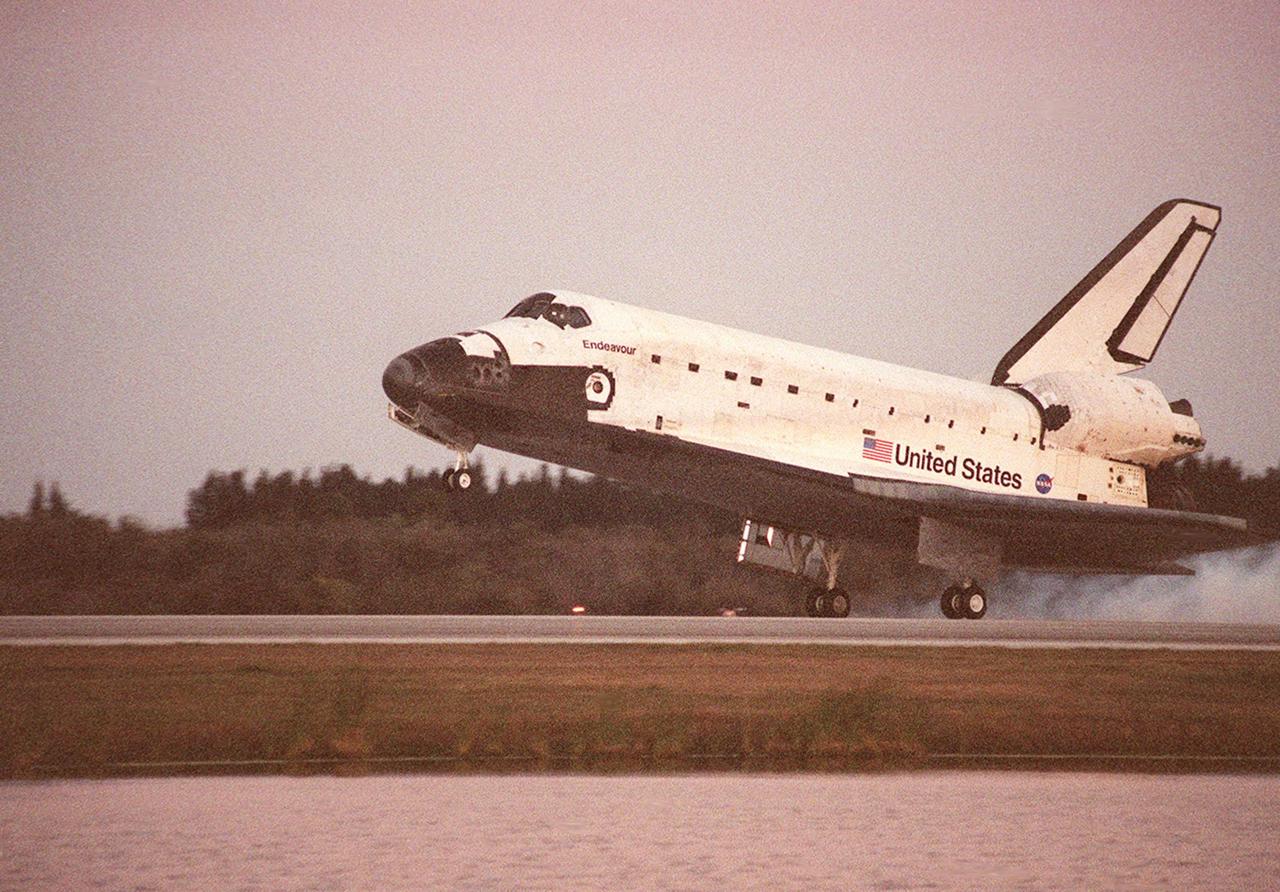
KENNEDY SPACE CENTER, FLA. -- In the waning light after sundown, Space Shuttle Endeavour touches down on KSC's Shuttle Landing Facility Runway 33 to complete the 11-day, 5-hour, 38-minute-long STS-99 mission. At the controls are Commander Kevin Kregel and Pilot Dominic Gorie. Also onboard the orbiter are Mission Specialists Janet Kavandi, Janice Voss, Mamoru Mohri of Japan and Gerhard Thiele of Germany. Mohri is with the National Space Development Agency (NASDA) and Thiele is with the European Space Agency. The crew is returning from the Shuttle Radar Topography Mission after mapping more than 47 million square miles of the Earth's surface. Main gear touchdown was at 6:22:23 p.m. EST Feb. 22 , landing on orbit 181 of the mission. Nose gear touchdown was at 6:22:35 p.m.. EST, and wheel stop at 6:23:25 p.m. EST. This was the 97th flight in the Space Shuttle program and the 14th for Endeavour, also marking the 50th landing at KSC, the 21st consecutive landing at KSC, and the 28th in the last 29 Shuttle flights
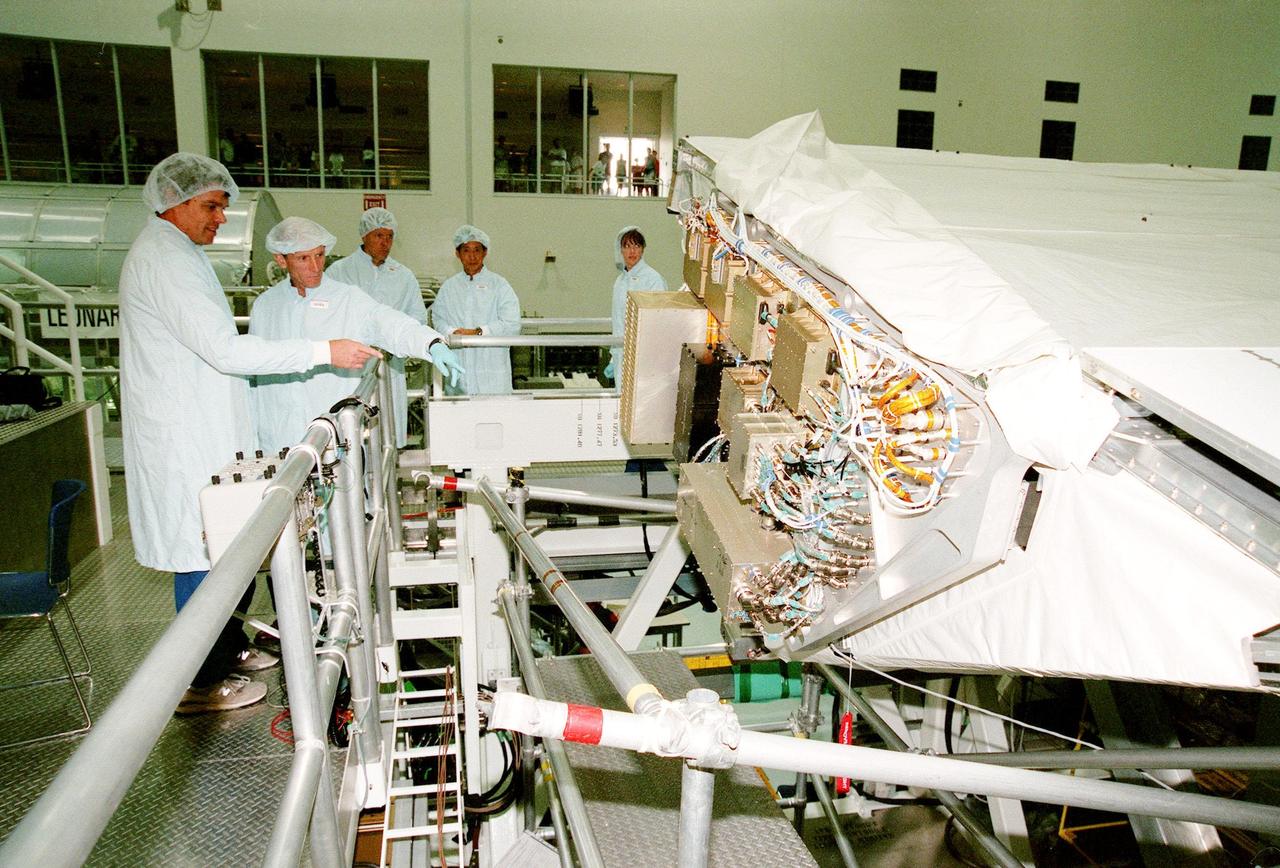
In the Space Station Processing Facility, the STS-99 crew looks over the payload for their mission, the Shuttle Radar Topography Mission (SRTM). Pointing to the SRTM are Commander Kevin R. Kregel and Mission Specialist Gerhard Thiele of Germany. Behind them are (left to right) Pilot Dominic L. Pudwill Gorie and Mission Specialists Mamoru Mohri of Japan and Janet Lynn Kavandi (Ph.D.) The remaining crew member (not shown) is Mission Specialist Janice Voss (Ph.D.) Mohri represents the National Space Development Agency of Japan and Thiele represents the European Space Agency. An international project spearheaded by the National Imagery and Mapping Agency and NASA, with participation of the German Aerospace Center DLR, the SRTM consists of a specially modified radar system that will gather data for the most accurate and complete topographic map of the Earth's surface that has ever been assembled. SRTM will make use of radar interferometry, wherein two radar images are taken from slightly different locations. Differences between these images allow for the calculation of surface elevation, or change. The SRTM hardware will consist of one radar antenna in the shuttle payload bay and a second radar antenna attached to the end of a mast extended 60 meters (195 feet) out from the shuttle. STS-99 is scheduled to launch Sept. 16 at 8:47 a.m. from Launch Pad 39A
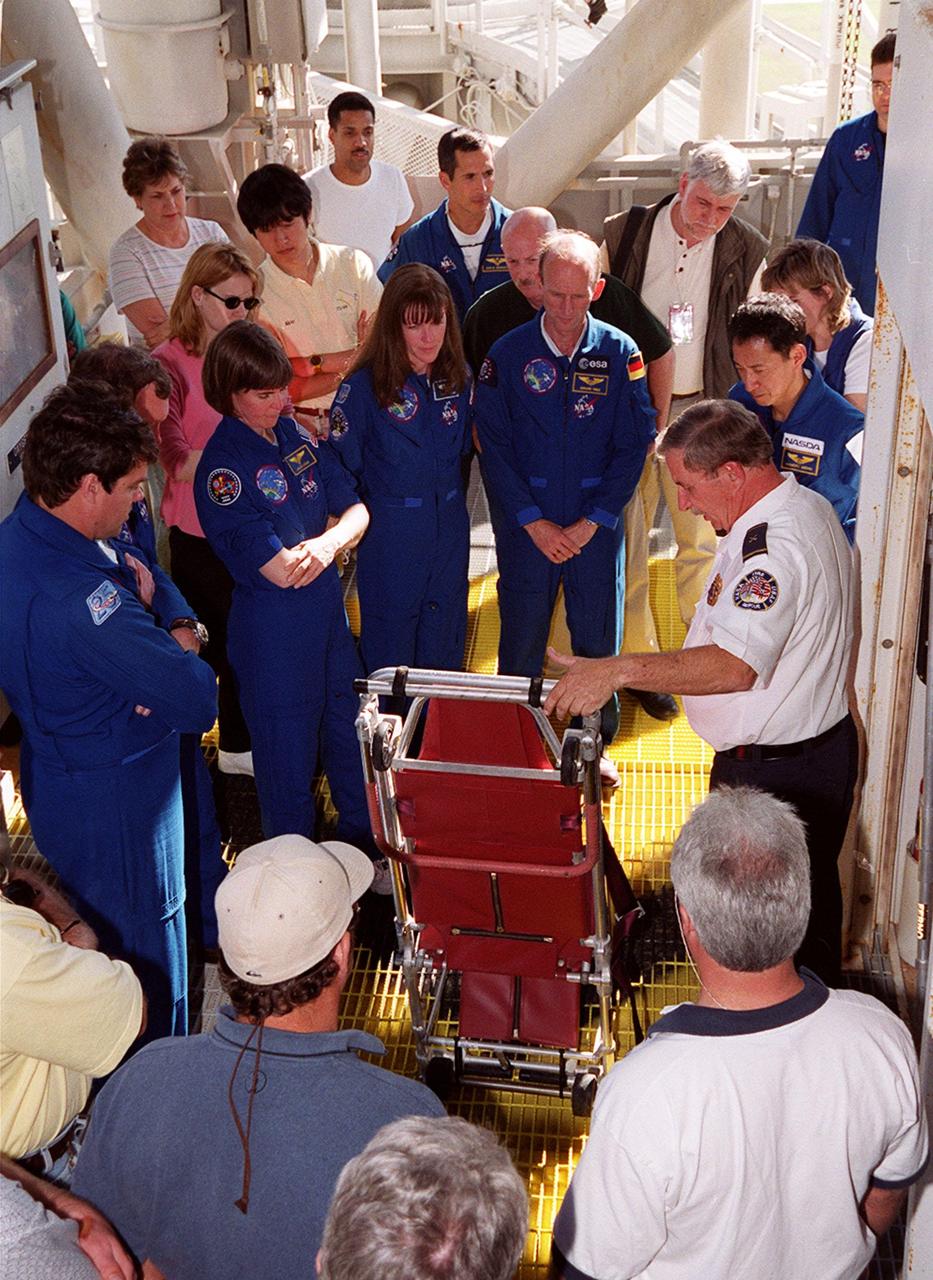
At Launch Pad 39A, members of the STS-99 crew and others look over part of the safety equipment. Standing left to right (in uniform) are Commander Kevin Kregel, Pilot Dominic Gorie, and Mission Specialists Janice Voss (Ph.D.), Janet Lynn Kavandi (Ph.D.), Gerhard Thiele and Mamoru Mohri. Thiele is with the European Space Agency and Mohri is with the National Space Development Agency (NASDA) of Japan. The crew are taking part in Terminal Countdown Demonstration Test activities, which provide them with simulated countdown exercises, emergency egress training, and opportunities to inspect the mission payloads in the orbiter's payload bay. STS-99 is the Shuttle Radar Topography Mission, which will chart a new course, using two antennae and a 200-foot-long section of space station-derived mast protruding from the payload bay to produce unrivaled 3-D images of the Earth's surface. The result of the Shuttle Radar Topography Mission could be close to 1 trillion measurements of the Earth's topography. Besides contributing to the production of better maps, these measurements could lead to improved water drainage modeling, more realistic flight simulators, better locations for cell phone towers, and enhanced navigation safety. Launch of Endeavour on the 11-day mission is scheduled for Jan. 31 at 12:47 p.m. EST

STS-99 Pilot Dominic Gorie, under the watchful eye of Capt. George Hoggard, a trainer with the KSC Fire Department, practices driving the M-113, an armored personnel carrier. Part of Terminal Countdown Demonstration Test (TCDT) activities, the M-113 could be used by the crew in the event of an emergency at the pad during which the crew must make a quick exit from the area. Riding in the rear are Mission Specialists Mamoru Mohri, who is with the National Space Development Agency (NASDA) of Japan, Janet Lynn Kavandi (Ph.D.) and Janice Voss (Ph.D.). TCDT provides the crew with simulated countdown exercises, emergency egress training, and opportunities to inspect the mission payloads in the orbiter's payload bay. STS-99 is the Shuttle Radar Topography Mission, which will chart a new course, using two antennae and a 200-foot-long section of space station-derived mast protruding from the payload bay to produce unrivaled 3-D images of the Earth's surface. The result of the Shuttle Radar Topography Mission could be close to 1 trillion measurements of the Earth's topography. Besides contributing to the production of better maps, these measurements could lead to improved water drainage modeling, more realistic flight simulators, better locations for cell phone towers, and enhanced navigation safety. Launch of Endeavour on the 11-day mission is scheduled for Jan. 31 at 12:47 p.m. EST
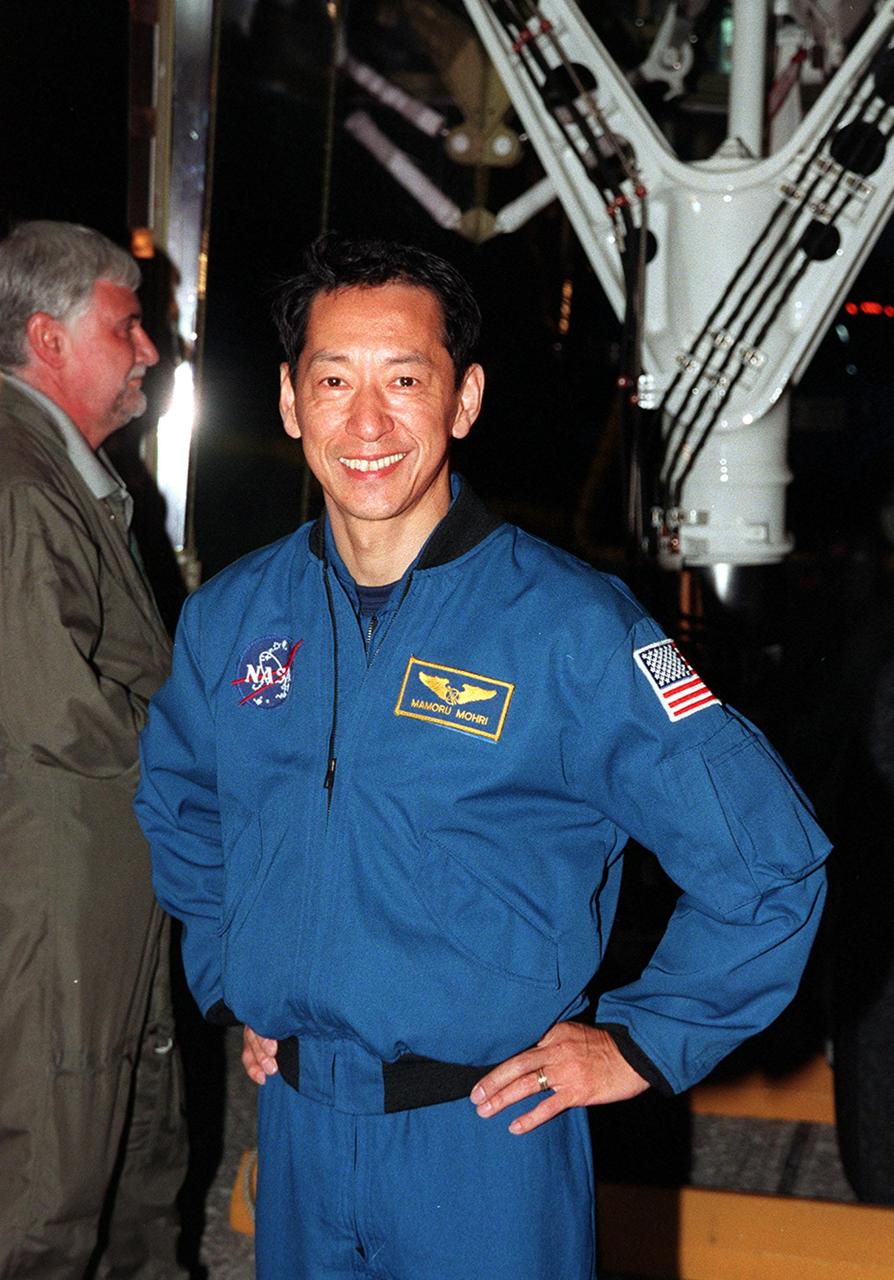
KENNEDY SPACE CENTER, FLA. -- STS-99 Mission Specialist Mamoru Mohri of Japan has only smiles after Space Shuttle Endeavour's landing on KSC's Shuttle Landing Facility completing the 11-day, 5-hour, 38-minute-long STS-99 mission. Main gear touchdown was at 6:22:23 p.m. EST Feb. 22 , landing on orbit 181 of the mission. Nose gear touchdown was at 6:22:35 p.m.. EST, and wheel stop at 6:23:25 p.m. EST. At the controls were Commander Kevin Kregel and Pilot Dominic Gorie. Also onboard the orbiter were Mission Specialists Janet Kavandi, Janice Voss, and Gerhard Thiele of Germany. Mohri is with the National Space Development Agency (NASDA) and Thiele is with the European Space Agency. The crew returned from the Shuttle Radar Topography Mission after mapping more than 47 million square miles of the Earth's surface. This was the 97th flight in the Space Shuttle program and the 14th for Endeavour, also marking the 50th landing at KSC, the 21st consecutive landing at KSC, and the 28th in the last 29 Shuttle flights
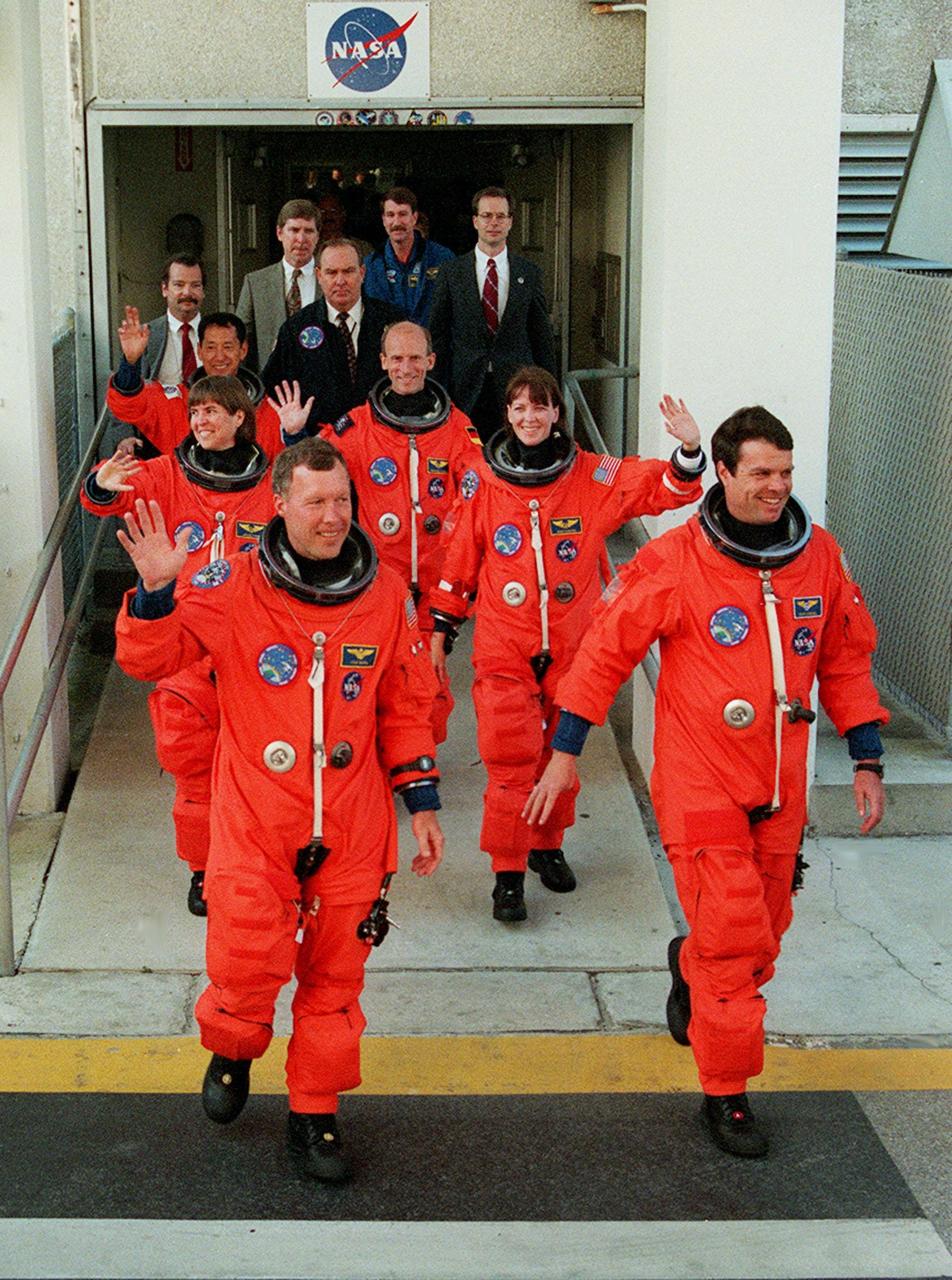
The STS-99 crew wave to onlookers as they step eagerly from the Operations and Checkout Building enroute to Launch Pad 39A for liftoff of Space Shuttle Endeavour. In their orange launch and entry suits, they are (foreground) Pilot Dominic Gorie and Commander Kevin Kregel. Behind them (left to right) are Mission Specialists Janice Voss, Mamoru Mohri of Japan, Gerhard Thiele of Germany and Janet Lynn Kavandi. Mohri is with the National Space Development Agency (NASDA) of Japan, and Thiele is with the European Space Agency. Known as the Shuttle Radar Topography Mission (SRTM), STS-99 is scheduled for liftoff at 12:30 p.m. EST. The SRTM will chart a new course to produce unrivaled 3-D images of the Earth's surface. The result of the Shuttle Radar Topography Mission could be close to 1 trillion measurements of the Earth's topography. The mission is expected to last 11days, with Endeavour landing at KSC Tuesday, Feb. 22, at 4:36 p.m. EST. This is the 97th Shuttle flight and 14th for Shuttle Endeavour

STS-99 Mission Specialist Gerhard Thiele, with the European Space Agency, arrives at KSC aboard a T-38 training jet aircraft to take part in a Terminal Countdown Demonstration Test (TCDT). The TCDT provides the crew with simulated countdown exercises, emergency egress training, and opportunities to inspect the mission payloads in the orbiter's payload bay. Other crew members taking part are Commander Kevin Kregel, Pilot Dominic Gorie, and Mission Specialists Janet Lynn Kavandi (Ph.D.), Janice Voss (Ph.D.), and Mamoru Mohri, who is with the National Space Development Agency (NASDA) of Japan. STS-99 is the Shuttle Radar Topography Mission, which will chart a new course, using two antennae and a 200-foot-long section of space station-derived mast protruding from the payload bay to produce unrivaled 3-D images of the Earth's surface. The result of the Shuttle Radar Topography Mission could be close to 1 trillion measurements of the Earth's topography. Besides contributing to the production of better maps, these measurements could lead to improved water drainage modeling, more realistic flight simulators, better locations for cell phone towers, and enhanced navigation safety. Launch of Endeavour on the 11-day mission is scheduled for Jan. 31 at 12:47 p.m. EST
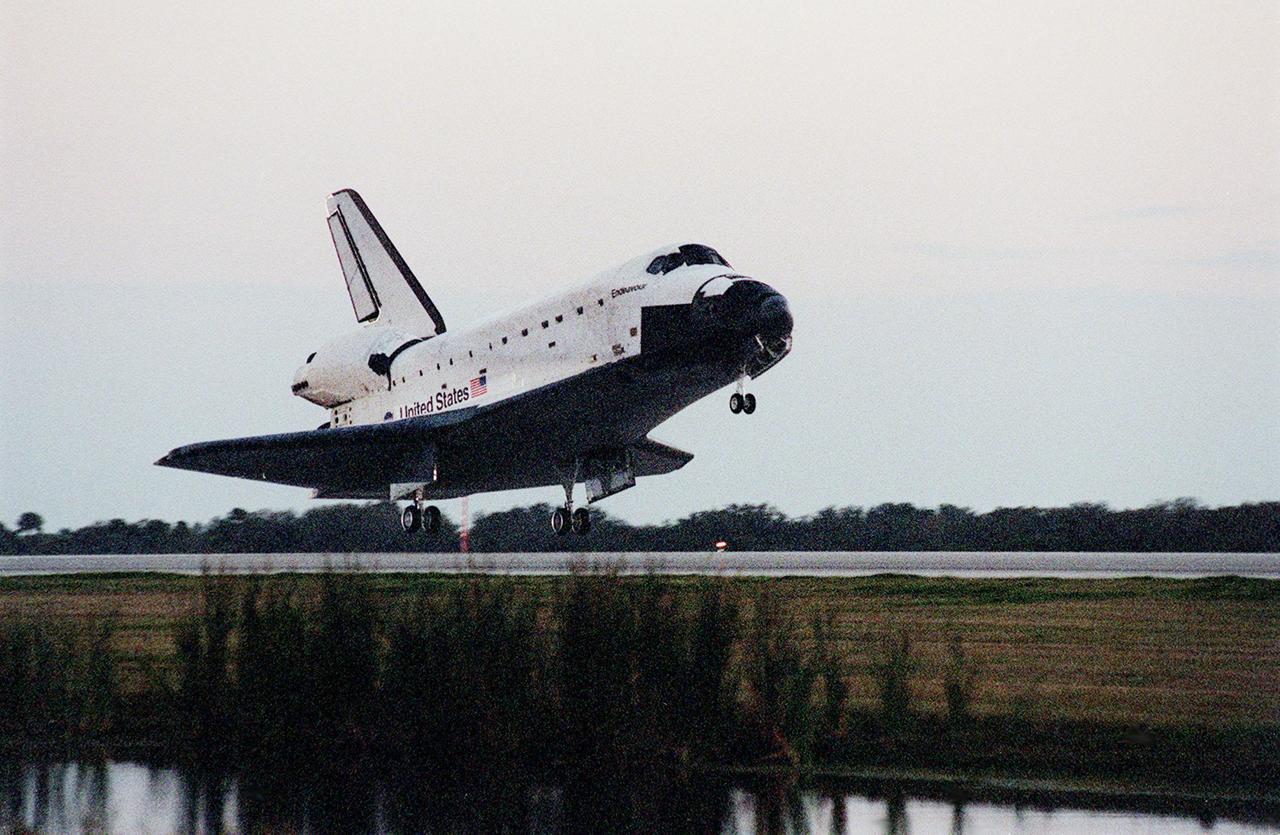
KENNEDY SPACE CENTER, Fla. -- Just after sundown, Space Shuttle Endeavour approaches touchdown on KSC's Shuttle Landing Facility Runway 33 to complete the 11-day, 5-hour, 38-minute-long STS-99 mission. Main gear touchdown was at 6:22:23 p.m. EST Feb. 22 , landing on orbit 181 of the mission. Nose gear touchdown was at 6:22:35 p.m.. EST, and wheel stop at 6:23:25 p.m. EST. At the controls are Commander Kevin Kregel and Pilot Dominic Gorie. Also onboard the orbiter are Mission Specialists Janet Kavandi, Janice Voss, Mamoru Mohri of Japan and Gerhard Thiele of Germany. Mohri is with the National Space Development Agency (NASDA) and Thiele is with the European Space Agency. The crew are returning from the Shuttle Radar Topography Mission, after mapping more than 47 million square miles of the Earth. This was the 97th flight in the Space Shuttle program and the 14th for Endeavour, also marking the 50th landing at KSC, the 21st consecutive landing at KSC, and the 28th in the last 29 Shuttle flights
KENNEDY SPACE CENTER, Fla. -- The nearby water reflects Space Shuttle Endeavour as it touches down on KSC's Shuttle Landing Facility Runway 33 to complete the 11-day, 5-hour, 38-minute-long STS-99 mission. Main gear touchdown was at 6:22:23 p.m. EST Feb. 22 , landing on orbit 181 of the mission. Nose gear touchdown was at 6:22:35 p.m.. EST, and wheel stop at 6:23:25 p.m. EST. At the controls are Commander Kevin Kregel and Pilot Dominic Gorie. Also onboard the orbiter are Mission Specialists Janet Kavandi, Janice Voss, Mamoru Mohri of Japan and Gerhard Thiele of Germany. Mohri is with the National Space Development Agency (NASDA) and Thiele is with the European Space Agency. The crew are returning from the Shuttle Radar Topography Mission, after mapping more than 47 million square miles of the Earth. This was the 97th flight in the Space Shuttle program and the 14th for Endeavour, also marking the 50th landing at KSC, the 21st consecutive landing at KSC, and the 28th in the last 29 Shuttle flights

The STS-99 crew wave to onlookers as they walk to the astrovan which will take them to Launch Pad 39A and liftoff of Space Shuttle Endeavour, targeted for 12:47 p.m. EST. In their orange launch and entry suits, they are (foreground) Pilot Dominic Gorie and Commander Kevin Kregel. Behind them (left to right) are Mission Specialists Janice Voss (Ph.D.), Mamoru Mohri (Ph.D.), Gerhard Thiele and Janet Lynn Kavandi (Ph.D.). Mohri is with the National Space Development Agency (NASDA) of Japan, and Thiele is with the European Space Agency. The SRTM will chart a new course to produce unrivaled 3-D images of the Earth's surface, using two antennae and a 200-foot-long section of space station-derived mast protruding from the payload bay. The result of the Shuttle Radar Topography Mission could be close to 1 trillion measurements of the Earth's topography. Besides contributing to the production of better maps, these measurements could lead to improved water drainage modeling, more realistic flight simulators, better locations for cell phone towers, and enhanced navigation safety. The mission is expected to last about 11days, with Endeavour landing at KSC Friday, Feb. 11, at 4:55 p.m. EST
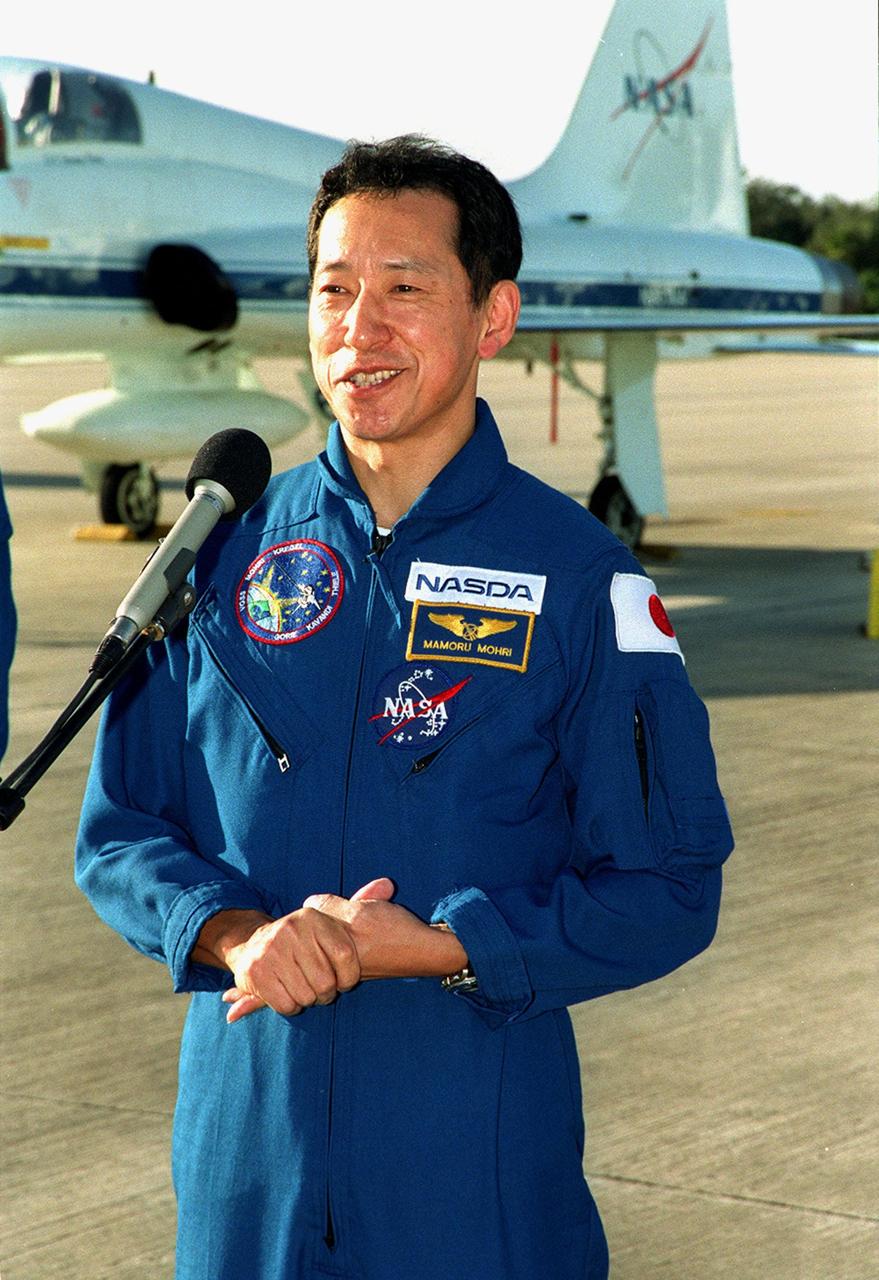
After their arrival at the Shuttle Landing Facility, the STS-99 crew talk to the media. At the microphone is Mission Specialist Mamoru Mohri, who is with the National Space Development Agency (NASDA) of Japan. The crew are here to take part in a Terminal Countdown Demonstration Test (TCDT), which provides simulated countdown exercises, emergency egress training, and opportunities to inspect the mission payloads in the orbiter's payload bay. Others taking part in the TCDT are Commander Kevin Kregel, Pilot Dominic Gorie and Mission Specialists Janice Voss (Ph.D.), Janet Lynn Kavandi (Ph.D.), and Gerhard Thiele, with the European Space Agency. STS-99 is the Shuttle Radar Topography Mission, which will chart a new course, using two antennae and a 200-foot-long section of space station-derived mast protruding from the payload bay to produce unrivaled 3-D images of the Earth's surface. The result of the Shuttle Radar Topography Mission could be close to 1 trillion measurements of the Earth's topography. Besides contributing to the production of better maps, these measurements could lead to improved water drainage modeling, more realistic flight simulators, better locations for cell phone towers, and enhanced navigation safety. Launch of Endeavour on the 11-day mission is scheduled for Jan. 31 at 12:47 p.m. EST
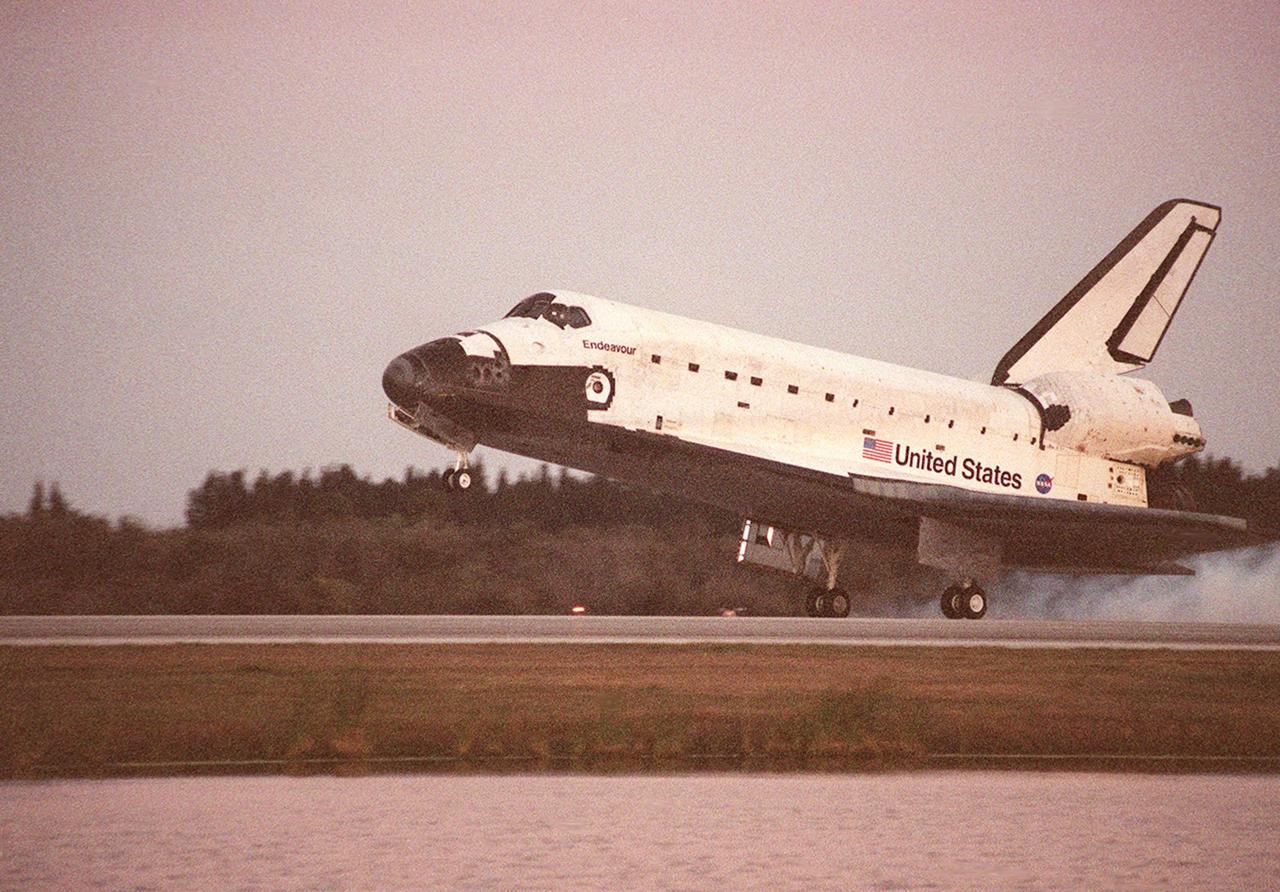
KENNEDY SPACE CENTER, FLA. -- In the waning light after sundown, Space Shuttle Endeavour touches down on KSC's Shuttle Landing Facility Runway 33 to complete the 11-day, 5-hour, 38-minute-long STS-99 mission. At the controls are Commander Kevin Kregel and Pilot Dominic Gorie. Also onboard the orbiter are Mission Specialists Janet Kavandi, Janice Voss, Mamoru Mohri of Japan and Gerhard Thiele of Germany. Mohri is with the National Space Development Agency (NASDA) and Thiele is with the European Space Agency. The crew is returning from the Shuttle Radar Topography Mission after mapping more than 47 million square miles of the Earth's surface. Main gear touchdown was at 6:22:23 p.m. EST Feb. 22 , landing on orbit 181 of the mission. Nose gear touchdown was at 6:22:35 p.m.. EST, and wheel stop at 6:23:25 p.m. EST. This was the 97th flight in the Space Shuttle program and the 14th for Endeavour, also marking the 50th landing at KSC, the 21st consecutive landing at KSC, and the 28th in the last 29 Shuttle flights
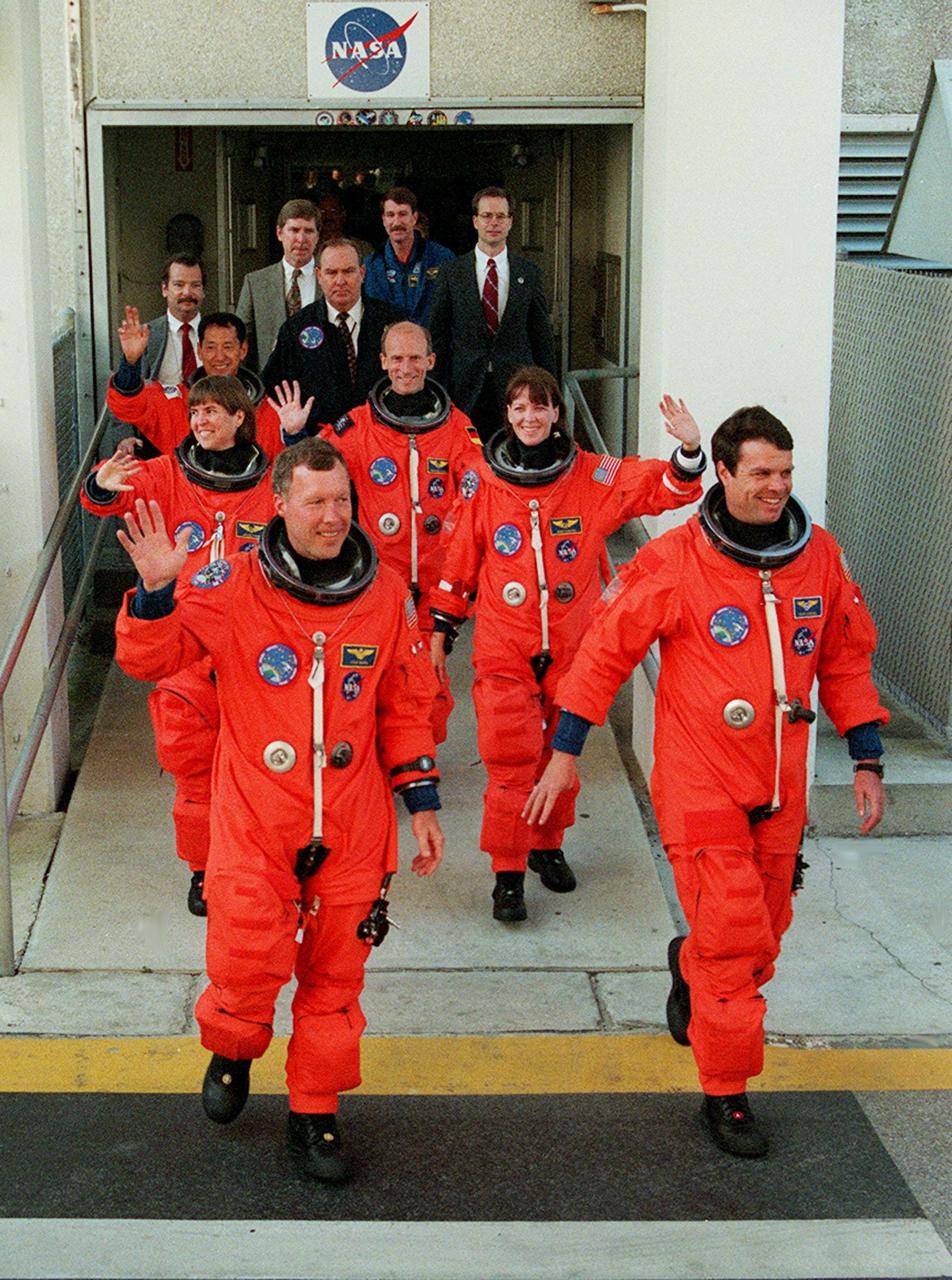
The STS-99 crew wave to onlookers as they step eagerly from the Operations and Checkout Building enroute to Launch Pad 39A for liftoff of Space Shuttle Endeavour. In their orange launch and entry suits, they are (foreground) Pilot Dominic Gorie and Commander Kevin Kregel. Behind them (left to right) are Mission Specialists Janice Voss, Mamoru Mohri of Japan, Gerhard Thiele of Germany and Janet Lynn Kavandi. Mohri is with the National Space Development Agency (NASDA) of Japan, and Thiele is with the European Space Agency. Known as the Shuttle Radar Topography Mission (SRTM), STS-99 is scheduled for liftoff at 12:30 p.m. EST. The SRTM will chart a new course to produce unrivaled 3-D images of the Earth's surface. The result of the Shuttle Radar Topography Mission could be close to 1 trillion measurements of the Earth's topography. The mission is expected to last 11days, with Endeavour landing at KSC Tuesday, Feb. 22, at 4:36 p.m. EST. This is the 97th Shuttle flight and 14th for Shuttle Endeavour
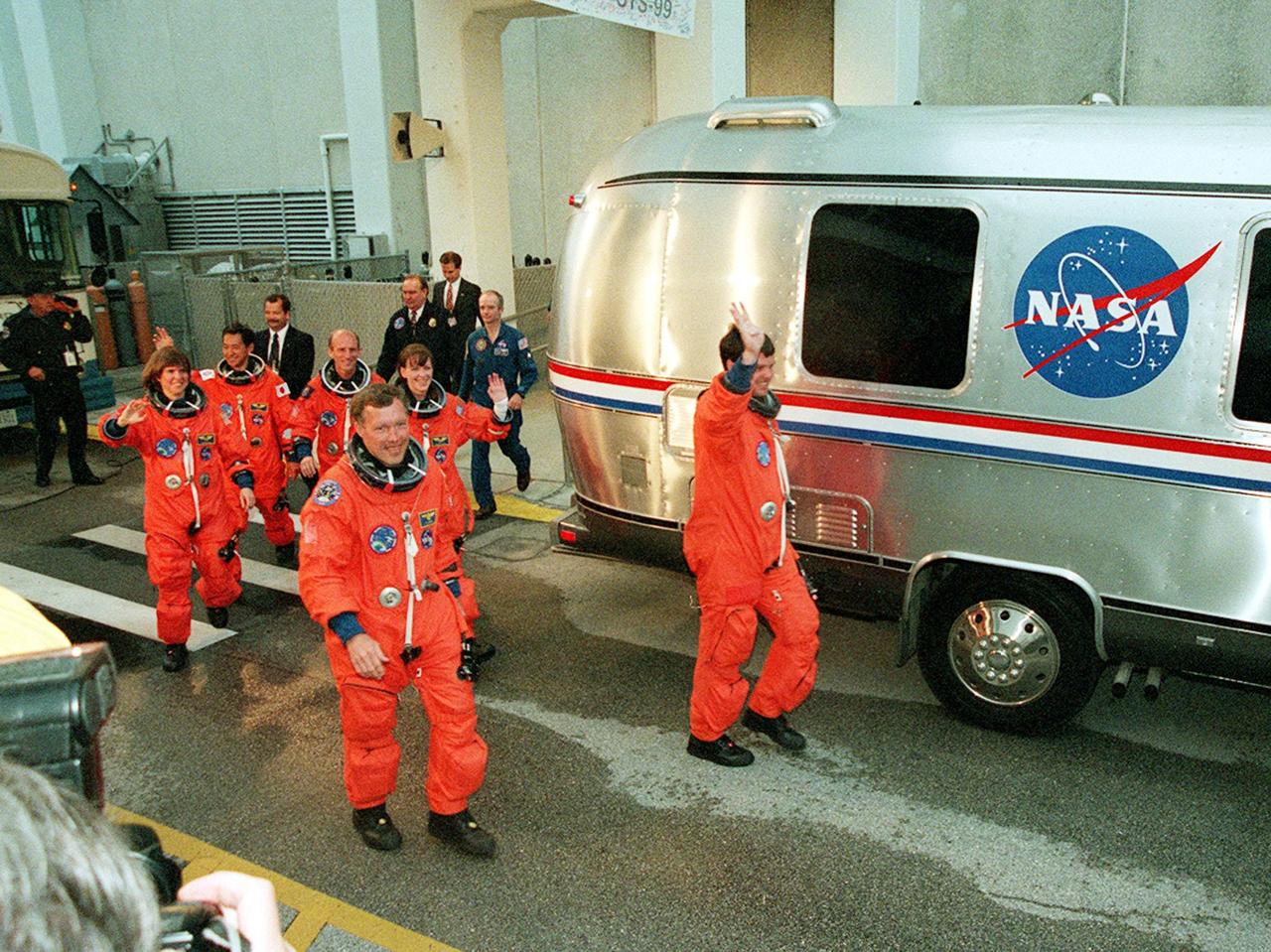
The STS-99 crew wave to onlookers as they walk to the astrovan which will take them to Launch Pad 39A and liftoff of Space Shuttle Endeavour, targeted for 12:47 p.m. EST. In their orange launch and entry suits, they are (foreground) Pilot Dominic Gorie and Commander Kevin Kregel. Behind them (left to right) are Mission Specialists Janice Voss (Ph.D.), Mamoru Mohri (Ph.D.), Gerhard Thiele and Janet Lynn Kavandi (Ph.D.). Mohri is with the National Space Development Agency (NASDA) of Japan, and Thiele is with the European Space Agency. The SRTM will chart a new course to produce unrivaled 3-D images of the Earth's surface, using two antennae and a 200-foot-long section of space station-derived mast protruding from the payload bay. The result of the Shuttle Radar Topography Mission could be close to 1 trillion measurements of the Earth's topography. Besides contributing to the production of better maps, these measurements could lead to improved water drainage modeling, more realistic flight simulators, better locations for cell phone towers, and enhanced navigation safety. The mission is expected to last about 11days, with Endeavour landing at KSC Friday, Feb. 11, at 4:55 p.m. EST
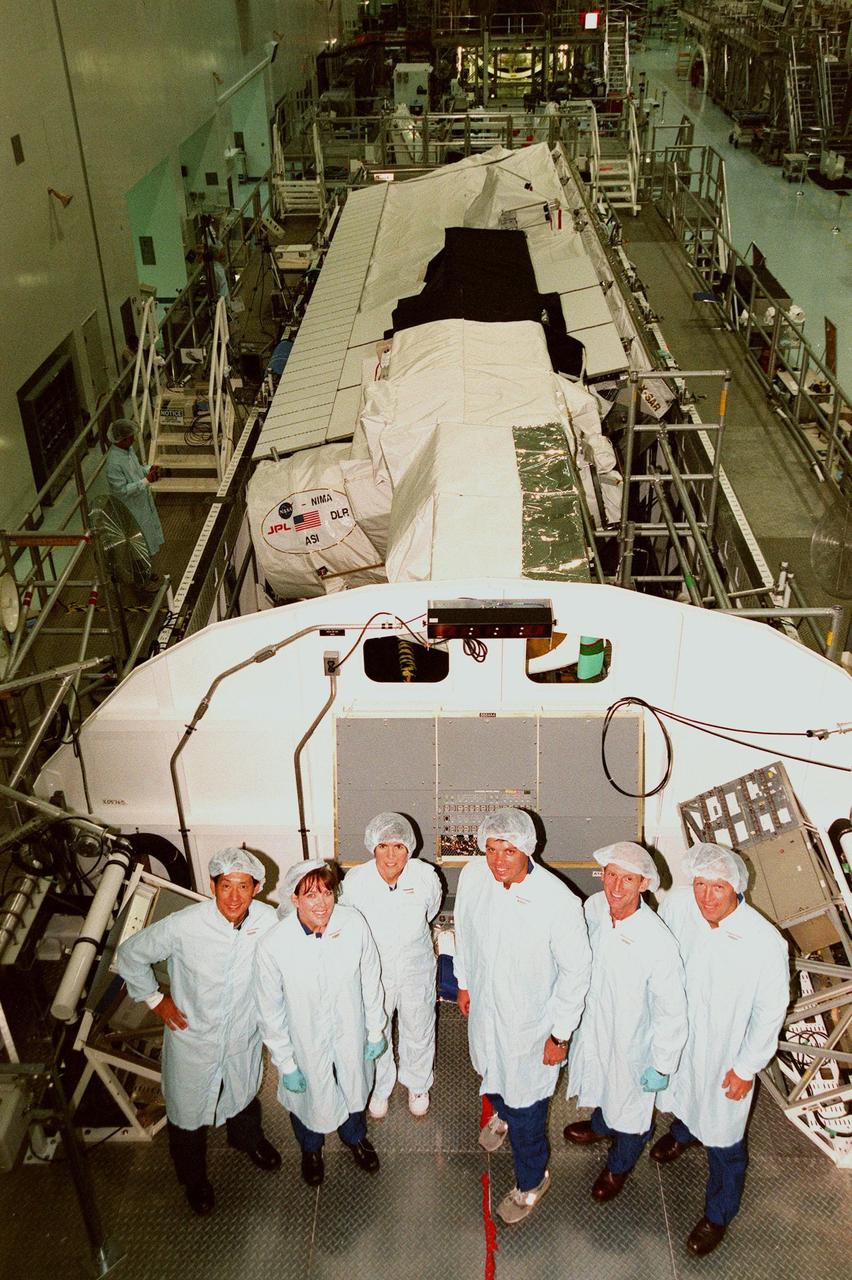
In the Space Station Processing Facility, the STS-99 crew pose in front of the Shuttle Radar Topography Mission, the payload for their mission. From left are Mission Specialists Mamoru Mohri of Japan, Janet Lynn Kavandi (Ph.D.), and Janice Voss (Ph.D.); Commander Kevin R. Kregel; Mission Specialist Gerhard Thiele of Germany; and Pilot Dominic L. Pudwill Gorie. Mohri represents the National Space Development Agency of Japan and Thiele represents the European Space Agency. An international project spearheaded by the National Imagery and Mapping Agency and NASA, with participation of the German Aerospace Center DLR, the SRTM consists of a specially modified radar system that will gather data for the most accurate and complete topographic map of the Earth's surface that has ever been assembled. SRTM will make use of radar interferometry, wherein two radar images are taken from slightly different locations. Differences between these images allow for the calculation of surface elevation, or change. The SRTM hardware will consist of one radar antenna in the shuttle payload bay and a second radar antenna attached to the end of a mast extended 60 meters (195 feet) out from the shuttle. STS-99 is scheduled to launch Sept. 16 at 8:47 a.m. from Launch Pad 39A
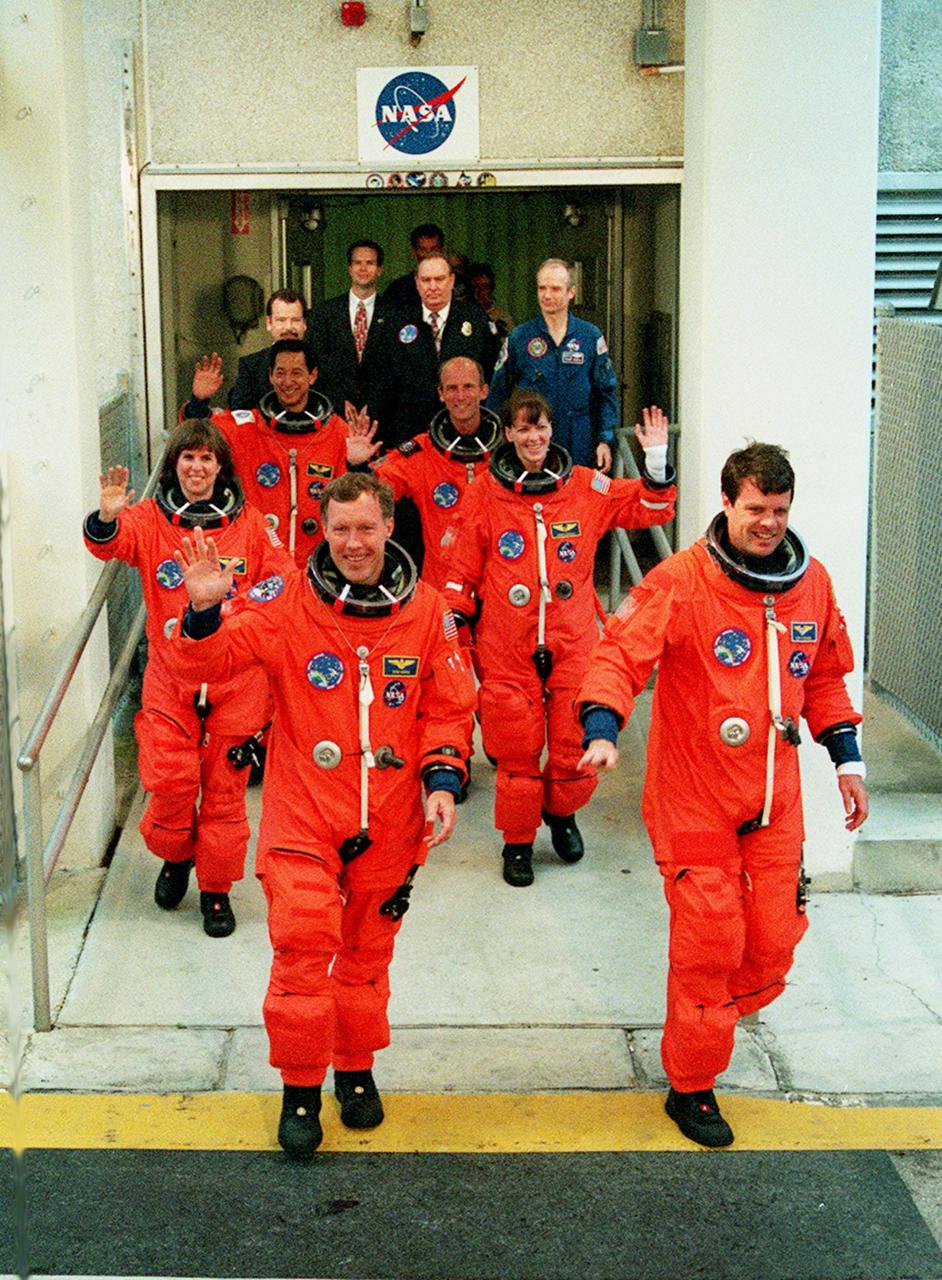
The STS-99 crew wave to onlookers as they leave the Operations and Checkout Building enroute to Launch Pad 39A and liftoff of Space Shuttle Endeavour, targeted for 12:47 p.m. EST. In their orange launch and entry suits, they are (foreground) Pilot Dominic Gorie and Commander Kevin Kregel. Behind them (left to right) are Mission Specialists Janice Voss (Ph.D.), Mamoru Mohri (Ph.D.), Gerhard Thiele and Janet Lynn Kavandi (Ph.D.). Mohri is with the National Space Development Agency (NASDA) of Japan, and Thiele is with the European Space Agency. The SRTM will chart a new course to produce unrivaled 3-D images of the Earth's surface, using two antennae and a 200-foot-long section of space station-derived mast protruding from the payload bay. The result of the Shuttle Radar Topography Mission could be close to 1 trillion measurements of the Earth's topography. Besides contributing to the production of better maps, these measurements could lead to improved water drainage modeling, more realistic flight simulators, better locations for cell phone towers, and enhanced navigation safety. The mission is expected to last about 11days, with Endeavour landing at KSC Friday, Feb. 11, at 4:55 p.m. EST
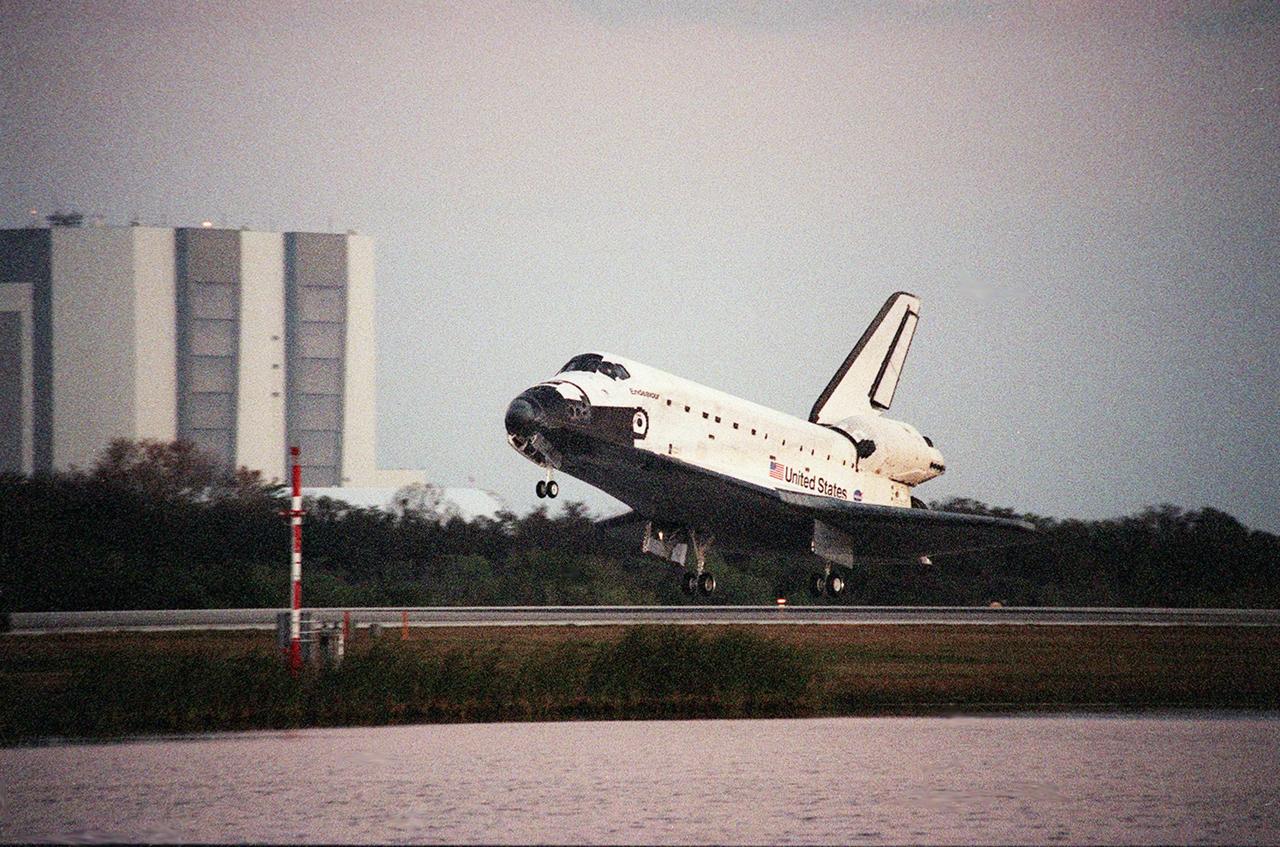
KENNEDY SPACE CENTER, FLA. -- In the waning light after sundown, Space Shuttle Endeavour nears touchdown on KSC's Shuttle Landing Facility Runway 33 to complete the 11-day, 5-hour, 38-minute-long STS-99 mission. In the background is the Vehicle Assembly Building. At the controls are Commander Kevin Kregel and Pilot Dominic Gorie. Also onboard the orbiter are Mission Specialists Janet Kavandi, Janice Voss, Mamoru Mohri of Japan and Gerhard Thiele of Germany. Mohri is with the National Space Development Agency (NASDA) and Thiele is with the European Space Agency. The crew is returning from the Shuttle Radar Topography Mission, after mapping more than 47 million square miles of the Earth's surface. Main gear touchdown was at 6:22:23 p.m. EST Feb. 22 , landing on orbit 181 of the mission. Nose gear touchdown was at 6:22:35 p.m.. EST, and wheel stop at 6:23:25 p.m. EST. This was the 97th flight in the Space Shuttle program and the 14th for Endeavour, also marking the 50th landing at KSC, the 21st consecutive landing at KSC, and the 28th in the last 29 Shuttle flights
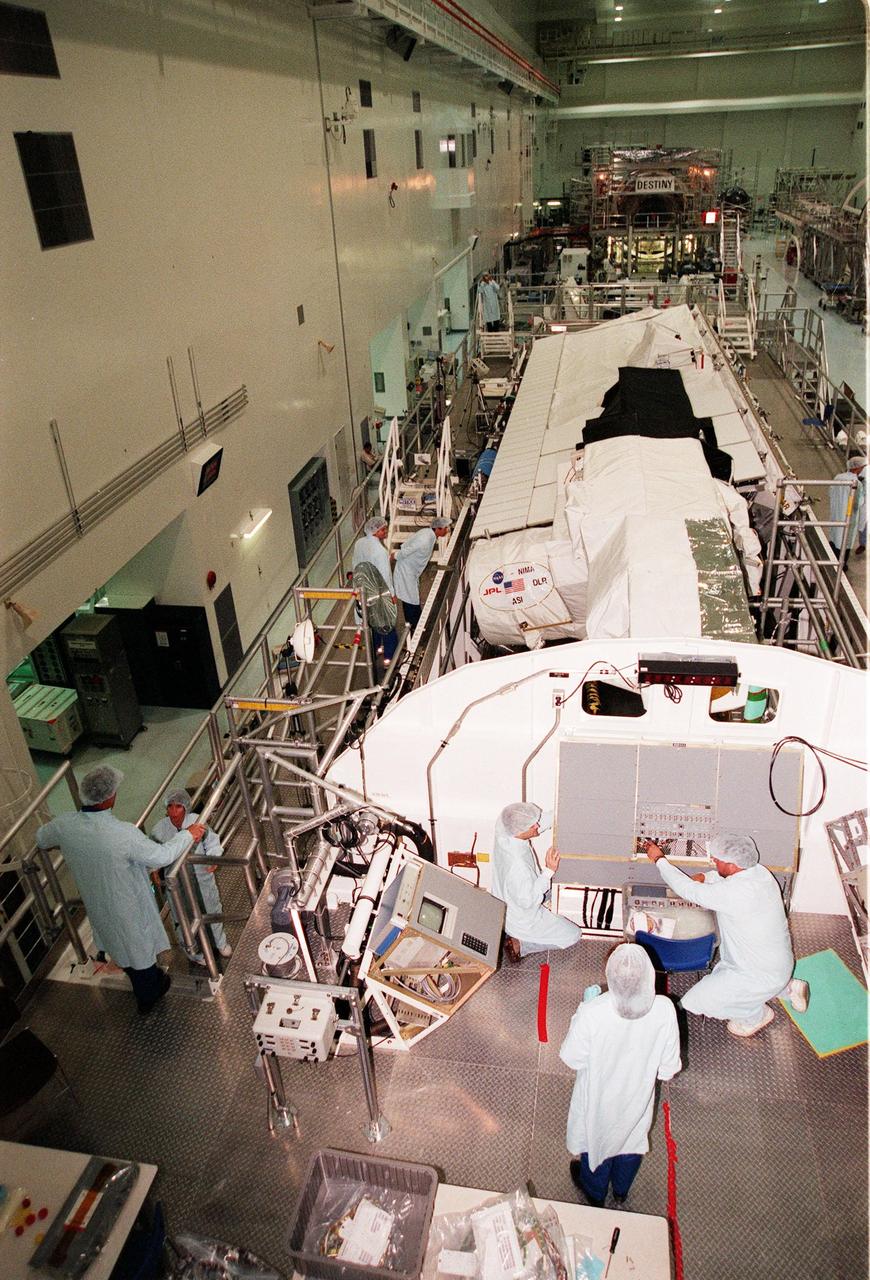
In the Space Station Processing Facility, STS-99 crew members inspect the Shuttle Radar Topography Mission (SRTM), the payload for their mission. At left is Commander Kevin R. Kregel talking to Mission Specialist Janice Voss (Ph.D.); and Mission Specialists Gerhard Thiele of Germany and Mamoru Mohri of Japan farther back. In the foreground (back to camera) is Mission Specialist Janet Lynn Kavandi (Ph.D.). The final crew member (not shown) is Pilot Dominic L. Pudwill Gorie. Thiele represents the European Space Agency and Mohri represents the National Space Agency of Japan. An international project spearheaded by the National Imagery and Mapping Agency and NASA, with participation of the German Aerospace Center DLR, the SRTM consists of a specially modified radar system that will gather data for the most accurate and complete topographic map of the Earth's surface that has ever been assembled. SRTM will make use of radar interferometry, wherein two radar images are taken from slightly different locations. Differences between these images allow for the calculation of surface elevation, or change. The SRTM hardware will consist of one radar antenna in the shuttle payload bay and a second radar antenna attached to the end of a mast extended 60 meters (195 feet) out from the shuttle. STS-99 is scheduled to launch Sept. 16 at 8:47 a.m. from Launch Pad 39A
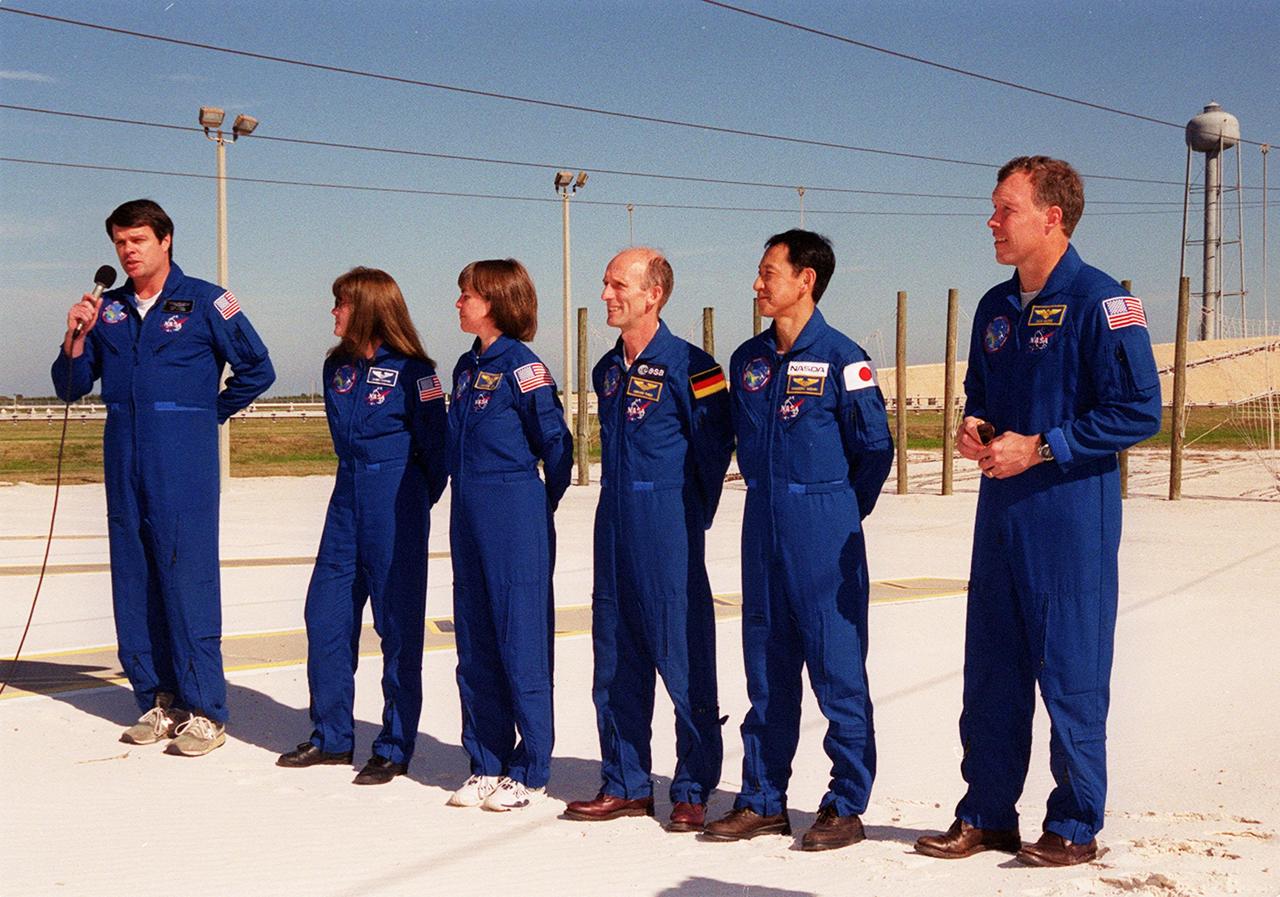
KENNEDY SPACE CENTER, Fla. -- The STS-99 crew take time out during Terminal Countdown Demonstration Test (TCDT) activities to talk to the media. From left to right are Commander Kevin Kregel, Mission Specialists Janet Lynn Kavandi (Ph.D.), Janice Voss (Ph.D.), Gerhard Thiele and Mamoru Mohri, and Pilot Dominic Gorie. Thiele is with the European Space Agency and Mohri is with the National Space Development Agency (NASDA) of Japan. The TCDT provides the crew with simulated countdown exercises, emergency egress training, and opportunities to inspect the mission payloads in the orbiter's payload bay. STS-99 is the Shuttle Radar Topography Mission, which will chart a new course, using two antennae and a 200-foot-long section of space station-derived mast protruding from the payload bay to produce unrivaled 3-D images of the Earth's surface. The result of the Shuttle Radar Topography Mission could be close to 1 trillion measurements of the Earth's topography. Besides contributing to the production of better maps, these measurements could lead to improved water drainage modeling, more realistic flight simulators, better locations for cell phone towers, and enhanced navigation safety. Launch of Endeavour on the 11-day mission is scheduled for Jan. 31 at 12:47 p.m. ES
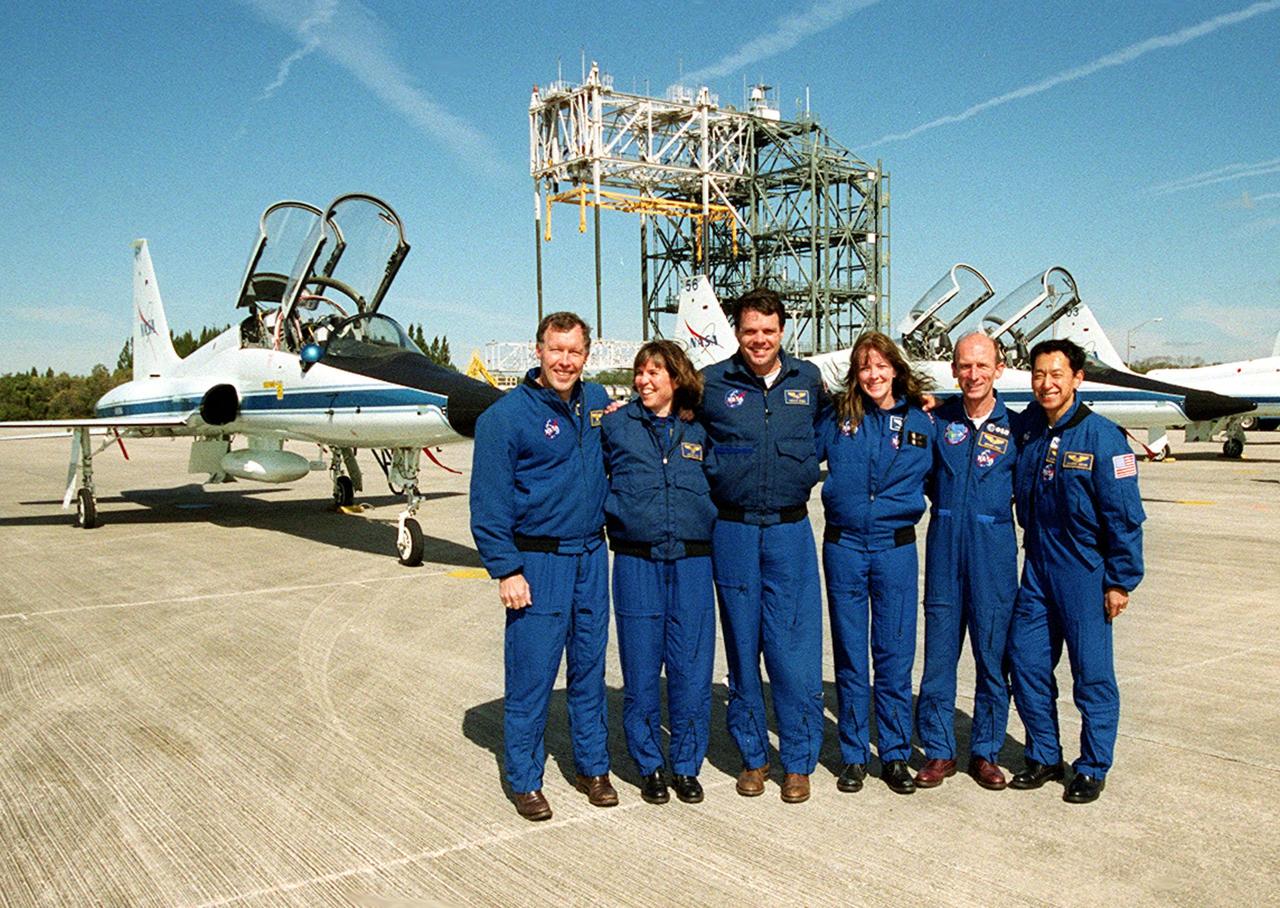
The STS-99 crew pose for a photograph after their arrival at the Shuttle Landing Facility to prepare for launch. From left are Pilot Dominic Gorie, Mission Specialist Janice Voss (Ph.D.), Commander Kevin Kregel, and Mission Specialists Janet Lynn Kavandi (Ph.D.), Gerhard Thiele (Ph.D.) and Mamoru Mohri (Ph.D.). Thiele is with the European Space Agency and Mohri is with the National Space Development Agency (NASDA) of Japan. Behind them are the T-38 jets in which they arrived, and the mate/demate device. Over the next few days, the crew will review mission procedures, conduct test flights in the Shuttle Training Aircraft and undergo routine preflight medical exams. STS-99 is the Shuttle Radar Topography Mission, which will chart a new course, using two antennae and a 200-foot-long section of space station-derived mast protruding from the payload bay to produce unrivaled 3-D images of the Earth's surface. The result of the Shuttle Radar Topography Mission could be close to 1 trillion measurements of the Earth's topography. Besides contributing to the production of better maps, these measurements could lead to improved water drainage modeling, more realistic flight simulators, better locations for cell phone towers, and enhanced navigation safety. Launch of Endeavour is scheduled for Jan. 31 at 12:47 p.m. EST

KENNEDY SPACE CENTER, Fla. -- In the bunker at Launch Pad 39A, the STS-99 crew try on oxygen masks. From left are Pilot Dominic Gorie, Mission Specialist Janice Voss (Ph.D.), Commander Kevin Kregel, and Mission Specialists Mamoru Mohri, Janet Lynn Kavandi (Ph.D.) and Gerhard Thiele. Mohri is with the National Space Development Agency (NASDA) of Japan and Thiele is with the European Space Agency. The crew are taking part in Terminal Countdown Demonstration Test activities, which provide them with simulated countdown exercises, emergency egress training, and opportunities to inspect the mission payloads in the orbiter's payload bay. STS-99 is the Shuttle Radar Topography Mission, which will chart a new course, using two antennae and a 200-foot-long section of space station-derived mast protruding from the payload bay to produce unrivaled 3-D images of the Earth's surface. The result of the Shuttle Radar Topography Mission could be close to 1 trillion measurements of the Earth's topography. Besides contributing to the production of better maps, these measurements could lead to improved water drainage modeling, more realistic flight simulators, better locations for cell phone towers, and enhanced navigation safety. Launch of Endeavour on the 11-day mission is scheduled for Jan. 31 at 12:47 p.m. EST

After their arrival at the Shuttle Landing Facility aboard T-38 training jet aircraft (background), the STS-99 crew talk to the media. From left are Mission Specialists Janice Voss (Ph.D.), Janet Lynn Kavandi (Ph.D.), Mamoru Mohri, who is with the National Space Development Agency (NASDA) of Japan, and Gerhard Thiele, with the European Space Agency, Commander Kevin Kregel (at microphone) and Pilot Dominic Gorie. The crew are here to take part in a Terminal Countdown Demonstration Test (TCDT), which provides simulated countdown exercises, emergency egress training, and opportunities to inspect the mission payloads in the orbiter's payload bay. STS-99 is the Shuttle Radar Topography Mission, which will chart a new course, using two antennae and a 200-foot-long section of space station-derived mast protruding from the payload bay to produce unrivaled 3-D images of the Earth's surface. The result of the Shuttle Radar Topography Mission could be close to 1 trillion measurements of the Earth's topography. Besides contributing to the production of better maps, these measurements could lead to improved water drainage modeling, more realistic flight simulators, better locations for cell phone towers, and enhanced navigation safety. Launch of Endeavour on the 11-day mission is scheduled for Jan. 31 at 12:47 p.m. EST
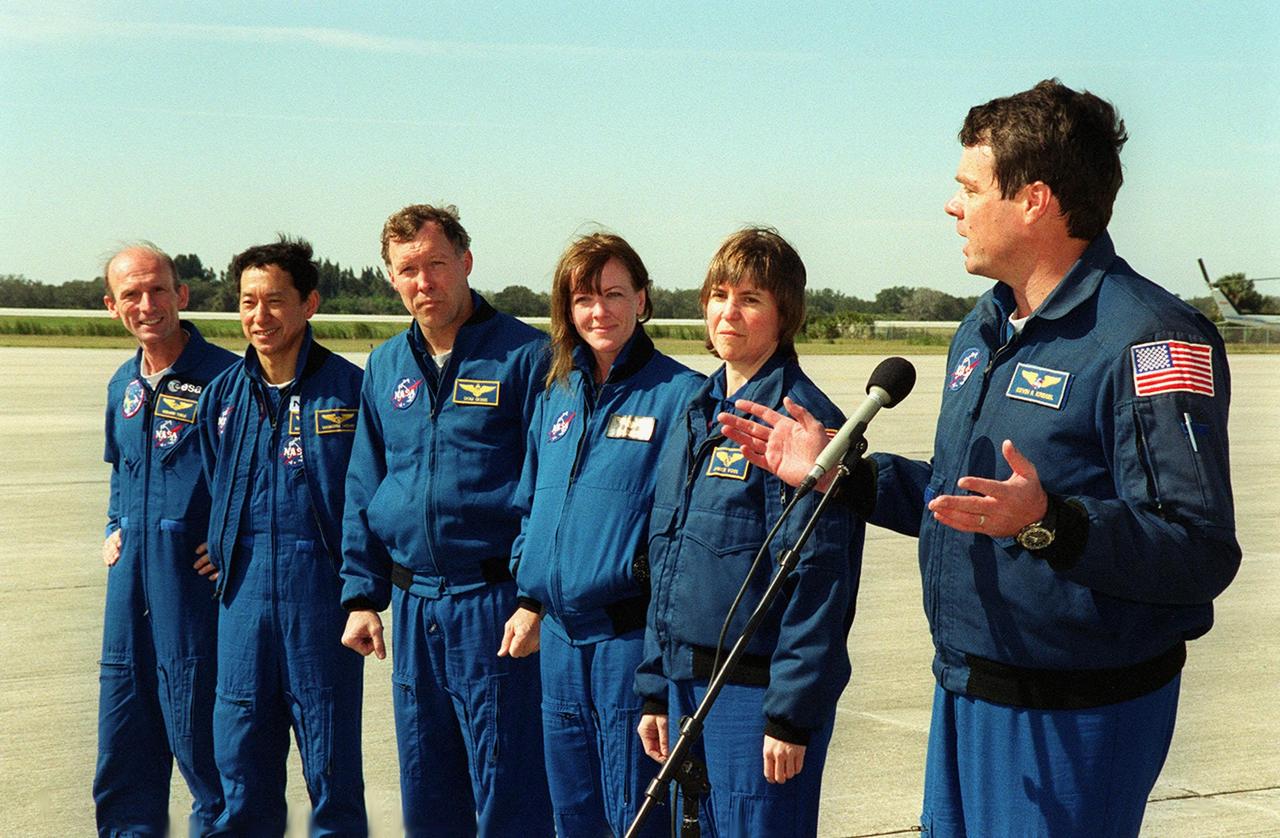
After arriving at KSC's Shuttle Landing Facility, the STS-99 crew pause to greet the media and Commander Kevin Kregel (right) introduces his crew: (from left) Mission Specialists Gerhard Thiele (Ph.D.) and Mamoru Mohri (Ph.D.); Pilot Dominic Gorie; and Mission Specialists Janet Lynn Kavandi (Ph.D.) and Janice Voss (Ph.D.). Thiele is with the European Space Agency and Mohri is with the National Space Development Agency (NASDA) of Japan. Over the next few days, the crew will review mission procedures, conduct test flights in the Shuttle Training Aircraft and undergo routine preflight medical exams. STS-99 is the Shuttle Radar Topography Mission, which will chart a new course, using two antennae and a 200-foot-long section of space station-derived mast protruding from the payload bay to produce unrivaled 3-D images of the Earth's surface. The result of the Shuttle Radar Topography Mission could be close to 1 trillion measurements of the Earth's topography. Besides contributing to the production of better maps, these measurements could lead to improved water drainage modeling, more realistic flight simulators, better locations for cell phone towers, and enhanced navigation safety. Launch of Endeavour is scheduled for Jan. 31 at 12:47 p.m. EST
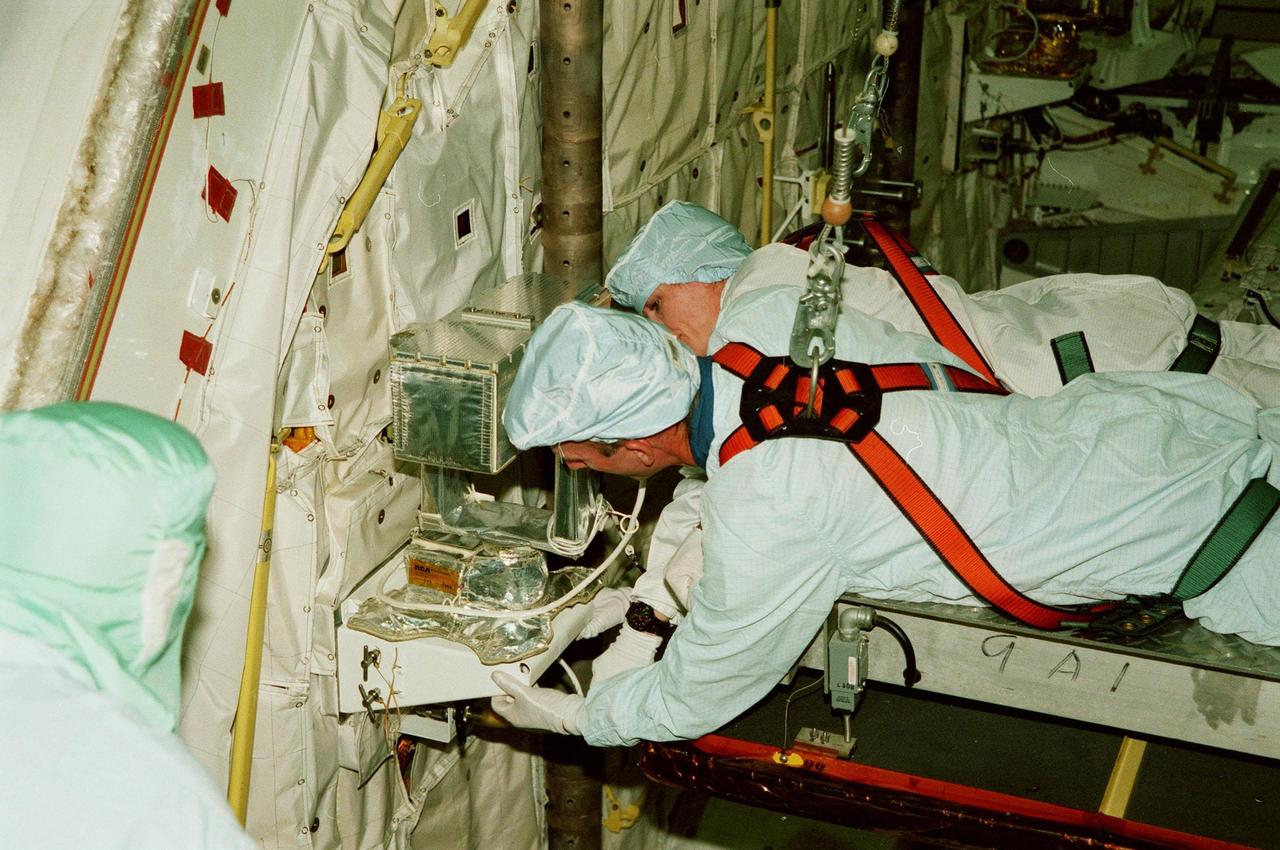
KENNEDY SPACE CENTER, FLA. -- In the Orbiter Processing Facility, STS-99 Mission Specialists Gerhard P.J. Thiele and Janet Lynn Kavandi (Ph.D.) look over part of the Shuttle Radar Topography Mission (SRTM), primary payload for their mission, as part of a Crew Equipment Interface Test (CEIT). Also taking part in the CEIT are Commander Kevin R. Kregel, Pilot Dominic L. Pudwill Gorie, and Mission Specialists Janice Voss (Ph.D.) and Mamoru Mohri. Mohri is with the National Space Development Agency (NASDA) of Japan, and Thiele is with the European Space Agency. The CEIT provides an opportunity for crew members to check equipment and facilities that will be aboard the orbiter during their mission. The SRTM is a specially modified radar system that will gather data for the most accurate and complete topographic map of the Earth's surface that has ever been assembled. SRTM will make use of radar interferometry, wherein two radar images are taken from slightly different locations. Differences between these images allow for the calculation of surface elevation, or change. The SRTM hardware will consist of one radar antenna in the shuttle payload bay and a second radar antenna attached to the end of a mast extended 60 meters (195 feet) out from the shuttle. STS-99 is scheduled to launch Sept. 16 at 8:47 a.m. from Launch Pad 39A
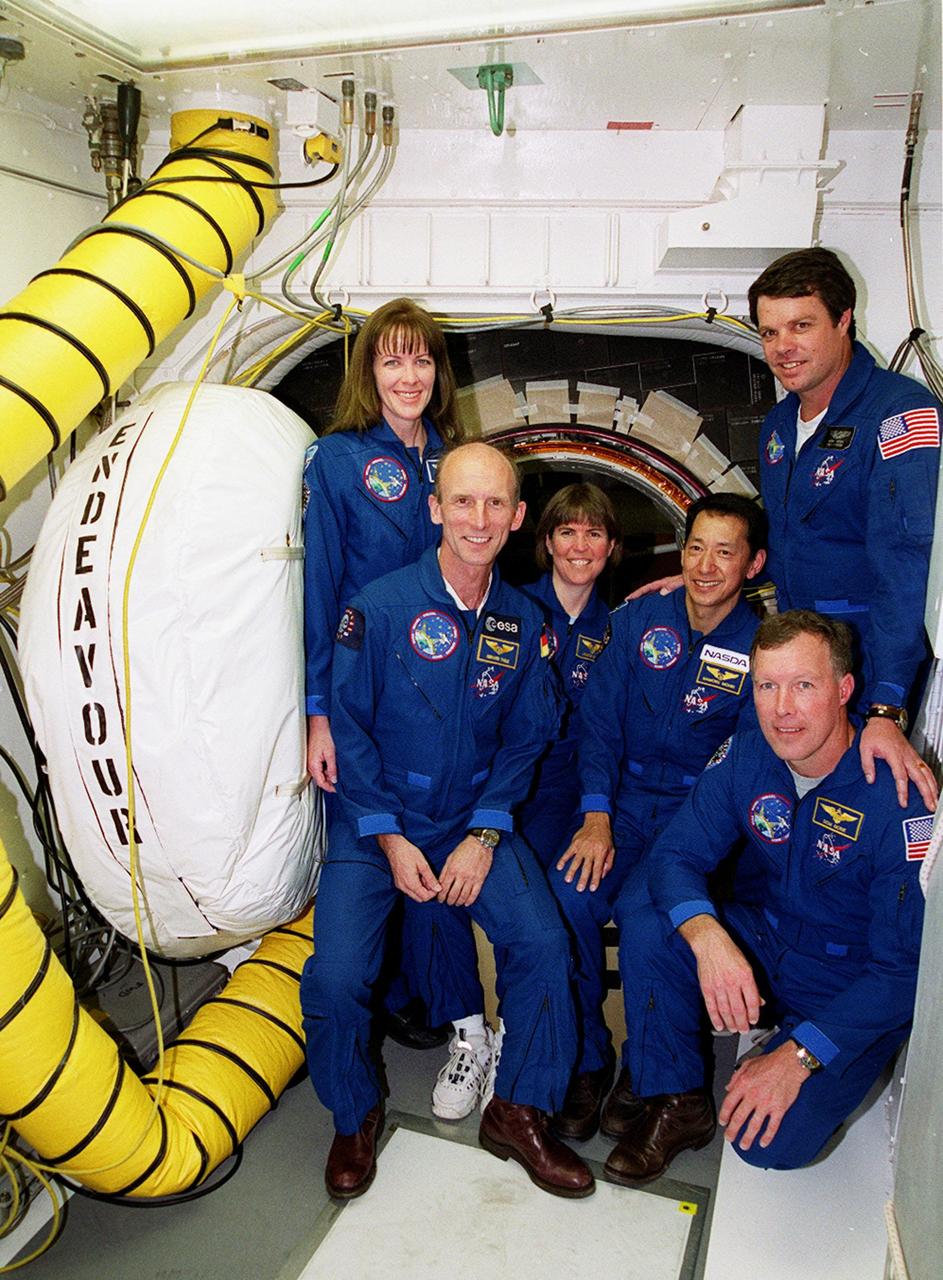
Inside the White Room attached to the Fixed Service Structure on Launch Pad 39A, the STS-99 crew pose at the entrance to the orbiter Endeavour. From left are Mission Specialists Janet Lynn Kavandi (Ph.D.), Gerhard Thiele, Janice Voss (Ph.D.) and Mamoru Mohri, Commander Kevin Kregel (standing) and Pilot Dominic Gorie (kneeling in front). Thiele is with the European Space Agency and Mohri is with the National Space Development Agency (NASDA) of Japan. The crew are taking part in Terminal Countdown Demonstration Test activities, which provide them with simulated countdown exercises, emergency egress training, and opportunities to inspect the mission payloads in the orbiter's payload bay. STS-99 is the Shuttle Radar Topography Mission, which will chart a new course, using two antennae and a 200-foot-long section of space station-derived mast protruding from the payload bay to produce unrivaled 3-D images of the Earth's surface. The result of the Shuttle Radar Topography Mission could be close to 1 trillion measurements of the Earth's topography. Besides contributing to the production of better maps, these measurements could lead to improved water drainage modeling, more realistic flight simulators, better locations for cell phone towers, and enhanced navigation safety. Launch of Endeavour on the 11-day mission is scheduled for Jan. 31 at 12:47 p.m. EST
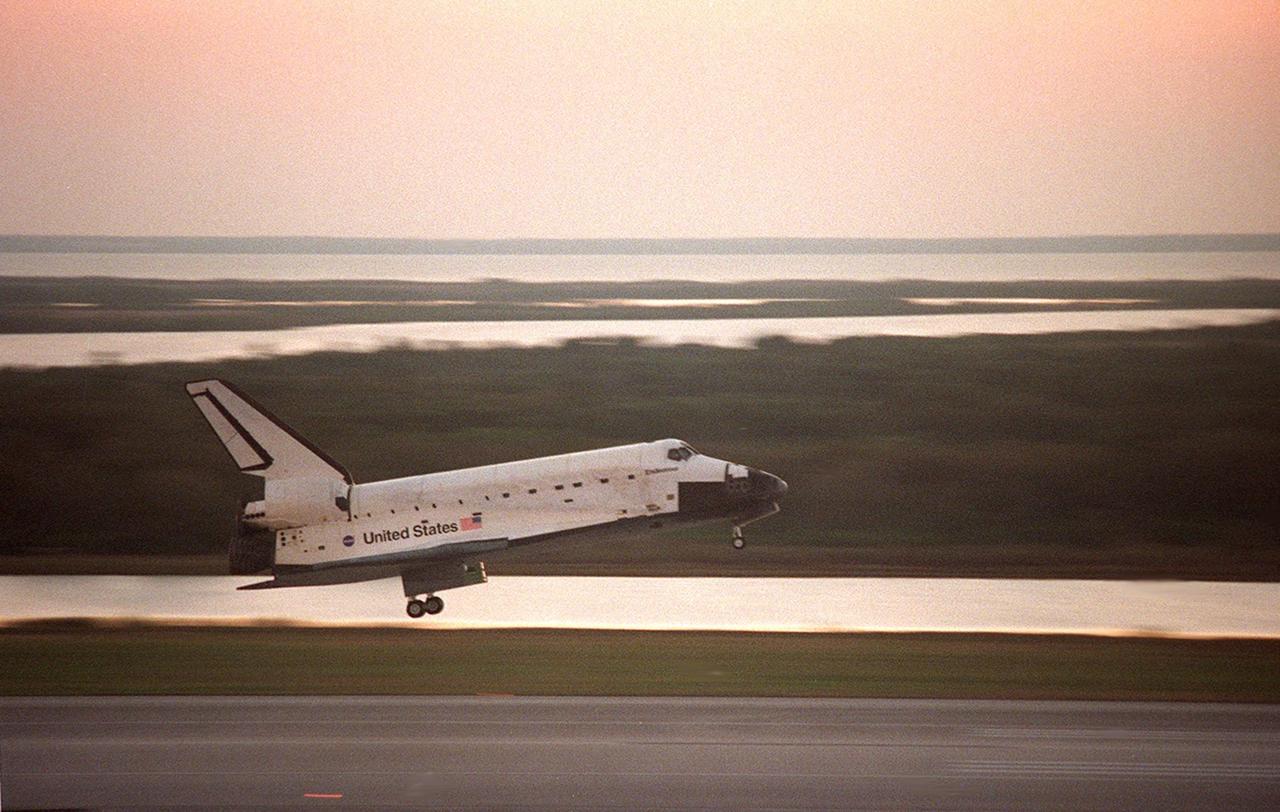
KENNEDY SPACE CENTER, FLA. -- Space Shuttle Endeavour prepares to land on KSC's Shuttle Landing Facility Runway 33 to complete the 11-day, 5-hour, 38-minute-long STS-99 mission. Main gear touchdown was at 6:22:23 p.m. EST Feb. 22 , landing on orbit 181 of the mission. Nose gear touchdown was at 6:22:35 p.m.. EST, and wheel stop at 6:23:25 p.m. EST. At the controls are Commander Kevin Kregel and Pilot Dominic Gorie. Also onboard the orbiter are Mission Specialists Janet Kavandi, Janice Voss, Mamoru Mohri of Japan and Gerhard Thiele of Germany. Mohri is with the National Space Development Agency (NASDA) and Thiele is with the European Space Agency. The crew are returning from the Shuttle Radar Topography Mission, after mapping more than 47 million square miles of the Earth. This was the 97th flight in the Space Shuttle program and the 14th for Endeavour, also marking the 50th landing at KSC, the 21st consecutive landing at KSC, and the 28th in the last 29 Shuttle flights
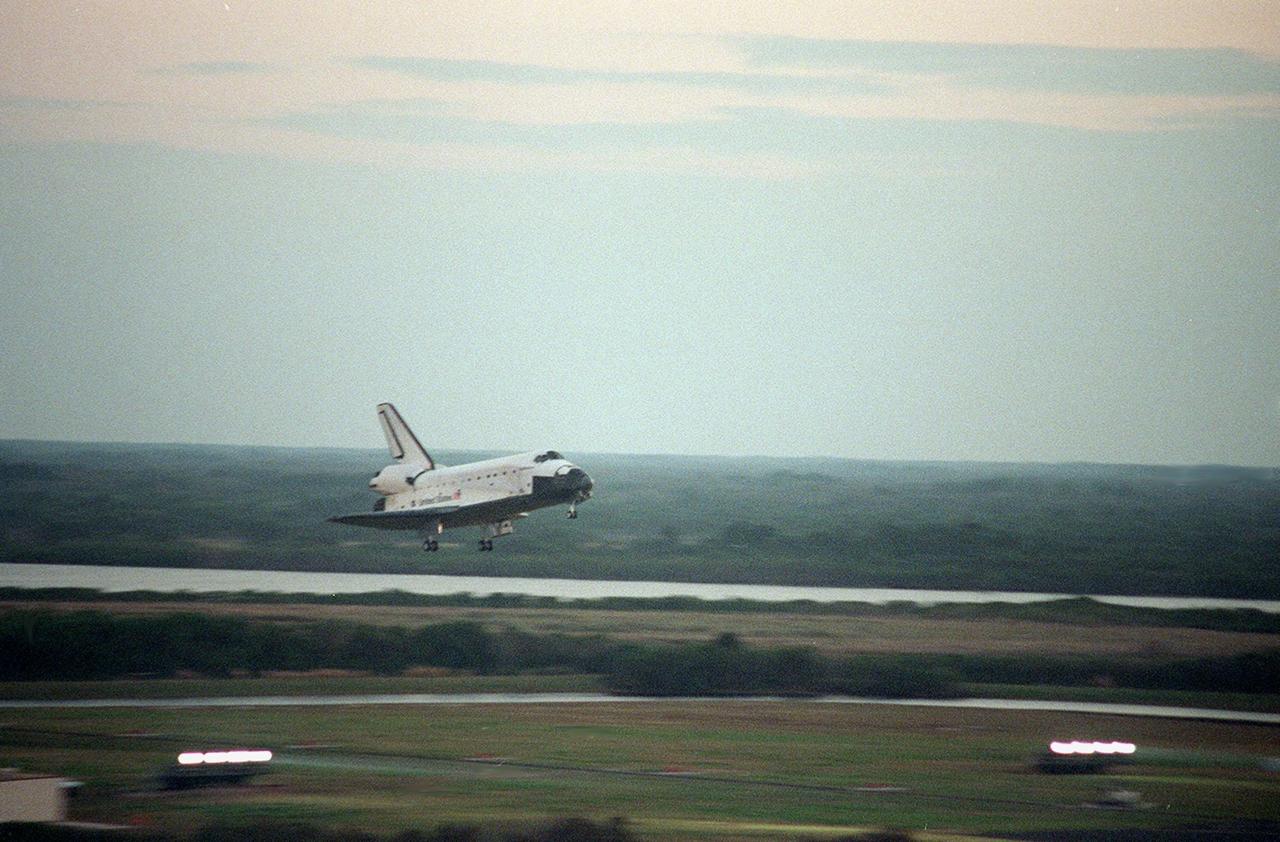
KENNEDY SPACE CENTER, Fla. -- Space Shuttle Endeavour prepares to land on KSC's Shuttle Landing Facility Runway 33 to complete the 11-day, 5-hour, 38-minute-long STS-99 mission. Main gear touchdown was at 6:22:23 p.m. EST Feb. 22 , landing on orbit 181 of the mission. Nose gear touchdown was at 6:22:35 p.m.. EST, and wheel stop at 6:23:25 p.m. EST. At the controls are Commander Kevin Kregel and Pilot Dominic Gorie. Also onboard the orbiter are Mission Specialists Janet Kavandi, Janice Voss, Mamoru Mohri of Japan and Gerhard Thiele of Germany. Mohri is with the National Space Development Agency (NASDA) and Thiele is with the European Space Agency. The crew are returning from the Shuttle Radar Topography Mission, after mapping more than 47 million square miles of the Earth. This was the 97th flight in the Space Shuttle program and the 14th for Endeavour, also marking the 50th landing at KSC, the 21st consecutive landing at KSC, and the 28th in the last 29 Shuttle flights
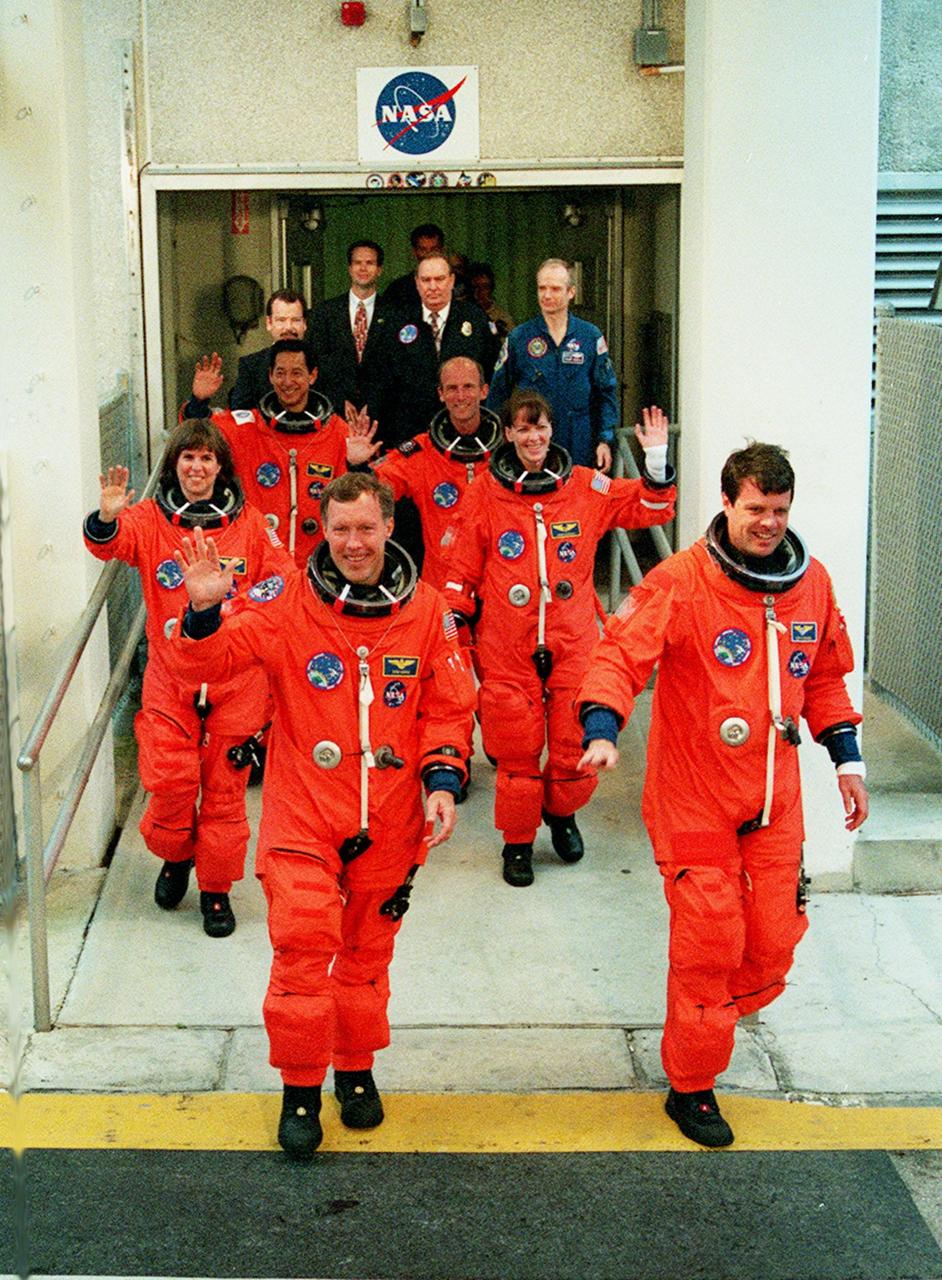
The STS-99 crew wave to onlookers as they leave the Operations and Checkout Building enroute to Launch Pad 39A and liftoff of Space Shuttle Endeavour, targeted for 12:47 p.m. EST. In their orange launch and entry suits, they are (foreground) Pilot Dominic Gorie and Commander Kevin Kregel. Behind them (left to right) are Mission Specialists Janice Voss (Ph.D.), Mamoru Mohri (Ph.D.), Gerhard Thiele and Janet Lynn Kavandi (Ph.D.). Mohri is with the National Space Development Agency (NASDA) of Japan, and Thiele is with the European Space Agency. The SRTM will chart a new course to produce unrivaled 3-D images of the Earth's surface, using two antennae and a 200-foot-long section of space station-derived mast protruding from the payload bay. The result of the Shuttle Radar Topography Mission could be close to 1 trillion measurements of the Earth's topography. Besides contributing to the production of better maps, these measurements could lead to improved water drainage modeling, more realistic flight simulators, better locations for cell phone towers, and enhanced navigation safety. The mission is expected to last about 11days, with Endeavour landing at KSC Friday, Feb. 11, at 4:55 p.m. EST
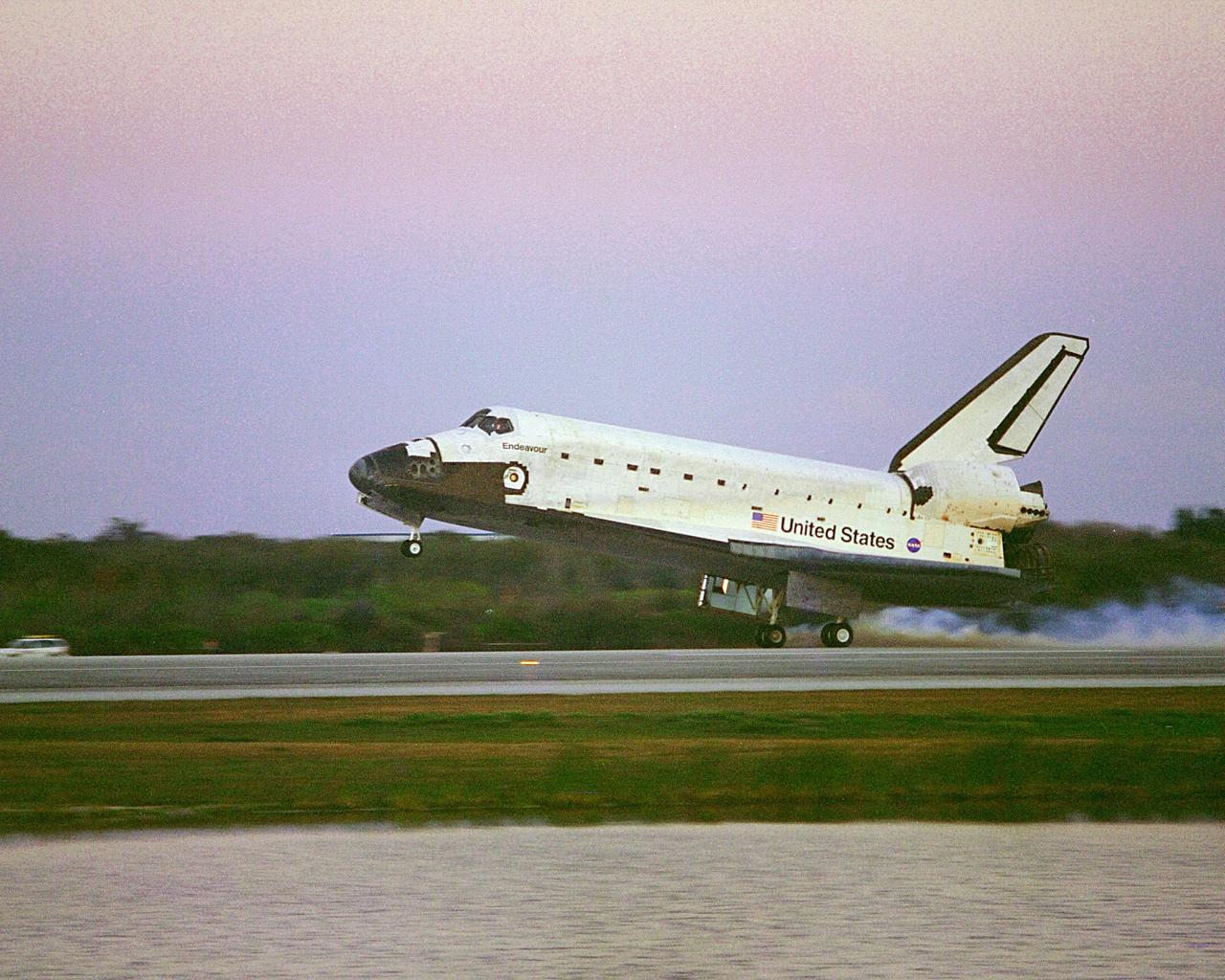
KENNEDY SPACE CENTER, FLA. -- In the waning light after sundown, Space Shuttle Endeavour touches down on KSC's Shuttle Landing Facility Runway 33 to complete the 11-day, 5-hour, 38-minute-long STS-99 mission. At the controls are Commander Kevin Kregel and Pilot Dominic Gorie. Also onboard the orbiter are Mission Specialists Janet Kavandi, Janice Voss, Mamoru Mohri of Japan and Gerhard Thiele of Germany. Mohri is with the National Space Development Agency (NASDA) and Thiele is with the European Space Agency. The crew are returning from the Shuttle Radar Topography Mission after mapping more than 47 million square miles of the Earth's surface. Main gear touchdown was at 6:22:23 p.m. EST Feb. 22 , landing on orbit 181 of the mission. Nose gear touchdown was at 6:22:35 p.m.. EST, and wheel stop at 6:23:25 p.m. EST. This was the 97th flight in the Space Shuttle program and the 14th for Endeavour, also marking the 50th landing at KSC, the 21st consecutive landing at KSC, and the 28th in the last 29 Shuttle flight