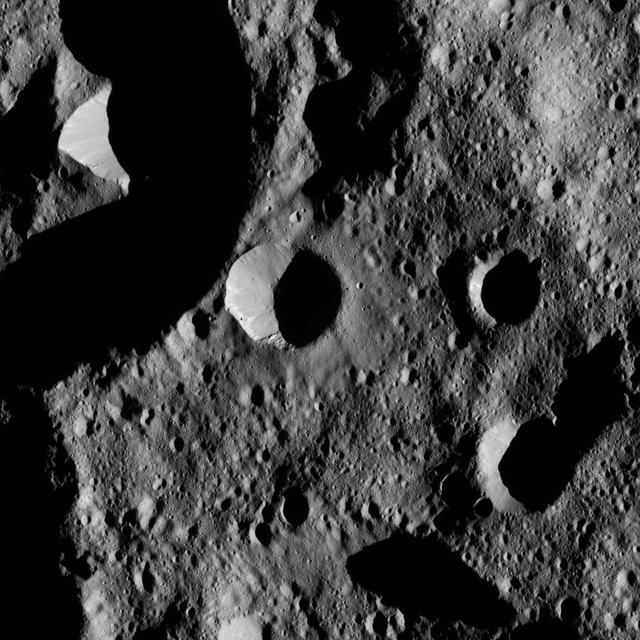
This view from NASA's Dawn spacecraft shows terrain in the northern hemisphere of Ceres, near Jarovit Crater. Dawn took this image on June 2, 2016, from its low-altitude mapping orbit, at a distance of about 240 miles (385 kilometers) above the surface. The image resolution is 120 feet (35 meters) per pixel. http://photojournal.jpl.nasa.gov/catalog/PIA20939
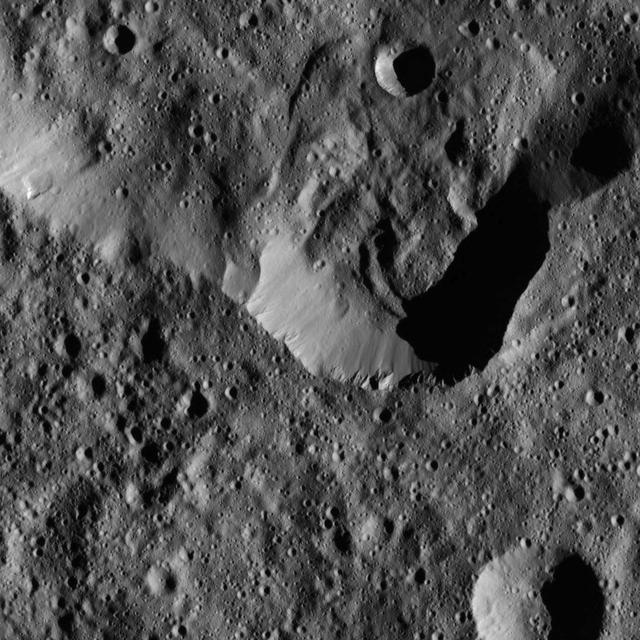
This image, taken by NASA Dawn spacecraft, shows a portion of the southern rim of Jarovit Crater in the northern hemisphere of Ceres. Compacted material forms spurs along the upper part of the crater wall, near the center of the image.
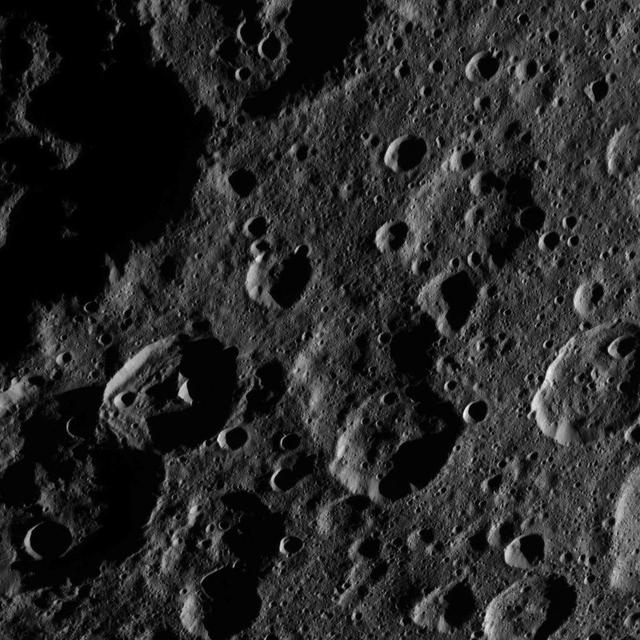
This image, taken by NASA's Dawn spacecraft, shows a portion of the northern hemisphere of dwarf planet Ceres from an altitude of 915 miles (1,470 kilometers). The image was taken on Sept. 22, 2015, and has a resolution of 450 feet (140 meters) per pixel. Jarovit crater, named for the Slavic god of fertility and harvest, is seen at lower left. Its diameter is 41 miles (66 kilometers). http://photojournal.jpl.nasa.gov/catalog/PIA19989
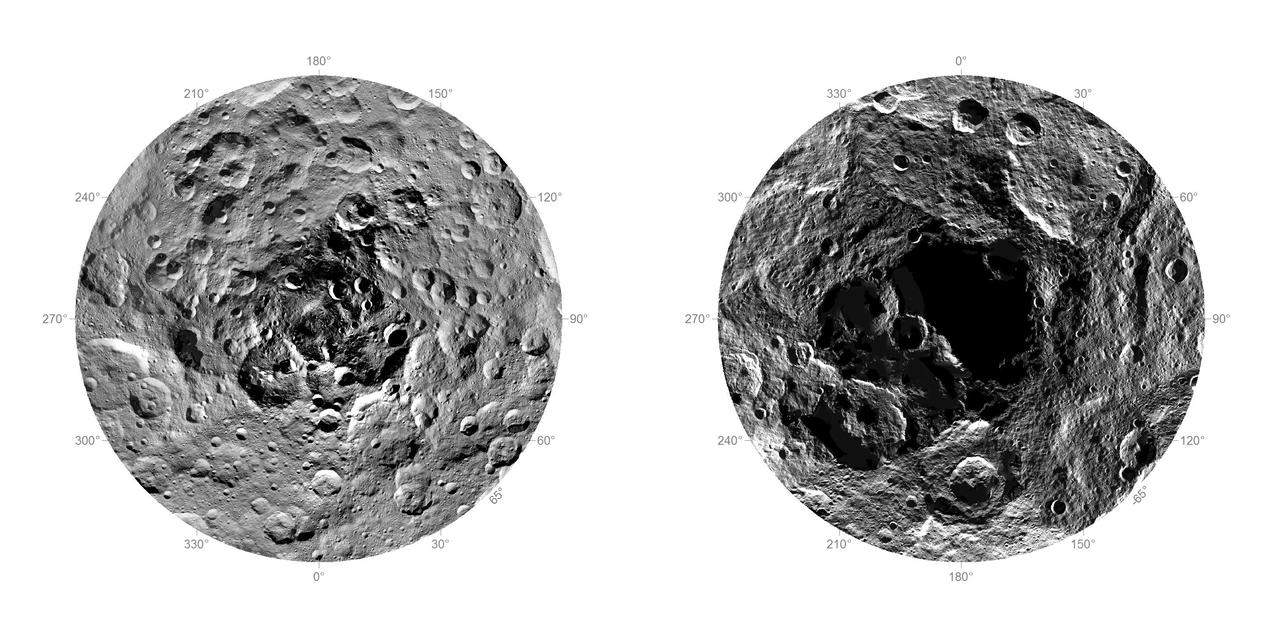
Researchers from NASA's Dawn mission have composed the first comprehensive views of the north (left) and south pole regions (right) of dwarf planet Ceres, using images obtained by the Dawn spacecraft. The images were taken between Aug. 17 and Oct. 23, 2015, from an altitude of 915 miles (1,470 kilometers). The region around the south pole appears black in this view because this area has been in shade ever since Dawn's arrival on March 6, 2015, and is therefore not visible. At the north polar region, craters Jarovit, Ghanan and Asari are visible, as well as the mountain Ysolo Mons. Near the south pole, craters Attis and Zadeni can be seen. Detailed maps of the polar regions allow researchers to study the craters in this area and compare them to those covering other parts of Ceres. Variations in shape and complexity can point to different surface compositions. In addition, the bottoms of some craters located close to the poles receive no sunlight throughout Ceres' orbit around the sun. Scientists want to investigate whether surface ice can be found there. http://photojournal.jpl.nasa.gov/catalog/PIA20126