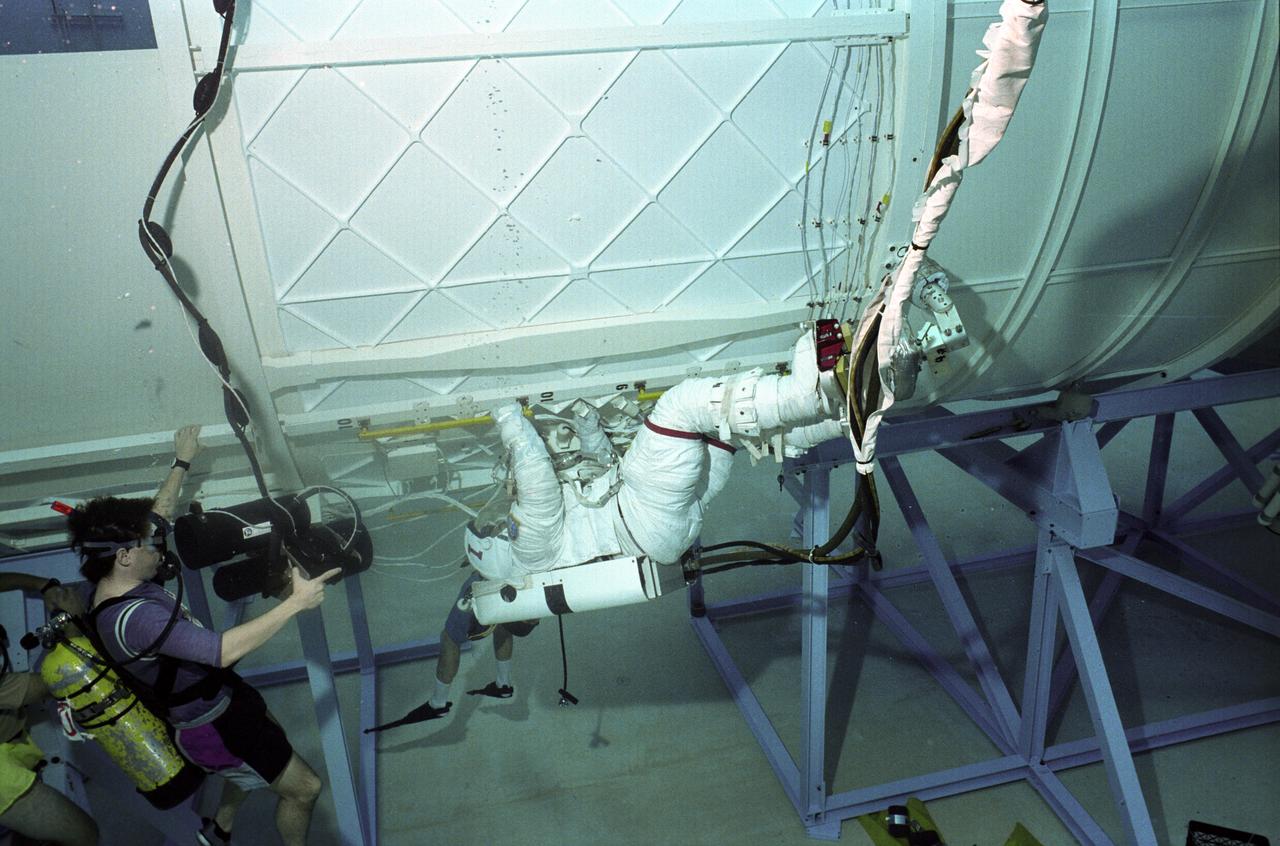
Astronauts Tamara Jernigan (#1) and David Wolf (#2) are training in the Neutral Buoyancy Simulator (NBS) at Marshall Space Flight center with an exercise for International Space Station Alpha. The NBS provided the weightless environment encountered in space needed for testing and the practices of Extravehicular Activities (EVA).
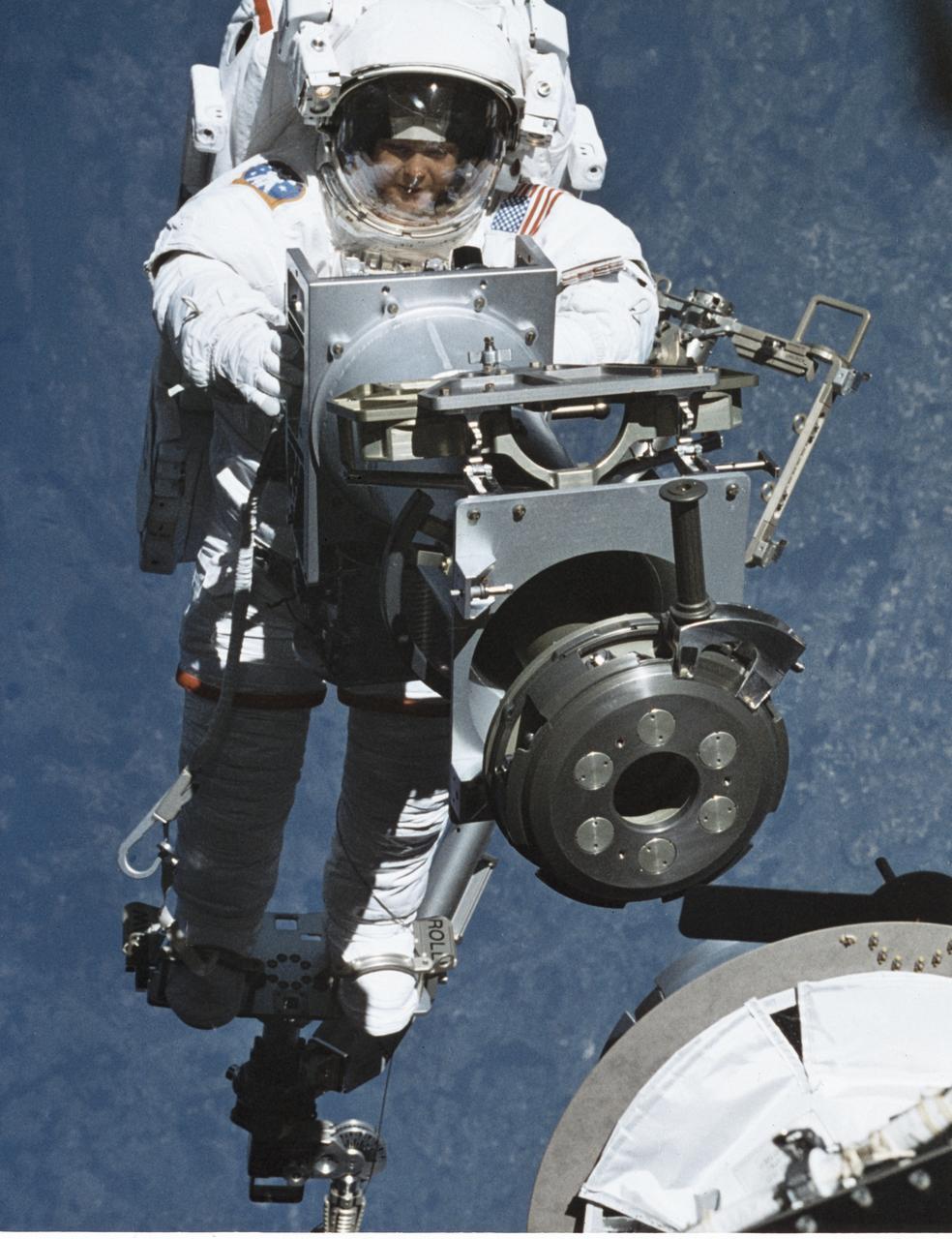
The STS-96 mission, the second International Space Station (ISS) assembly and resupply flight, launched on May 27, 1999 aboard the Orbiter Discovery for an almost 10 day mission. The Shuttle's SPACEHAB double module carried internal and resupply cargo for station outfitting and the Russian cargo crane, STRELA, was carried aboard the shuttle in the integrated Cargo Carrier (ICC). In this STS-96 onboard photo of the first Extra Vehicular Activity (EVA), Mission Specialist Tamara Jernigan totes part of the Russian built crane. Jernigans' feet are anchored on a mobile foot restraint cornected to the Shuttle's Remote Manipulator System (RMS) operated by Mission Specialist Ellen Ochoa. The STS-96 flight was the first to perform docking with the ISS.
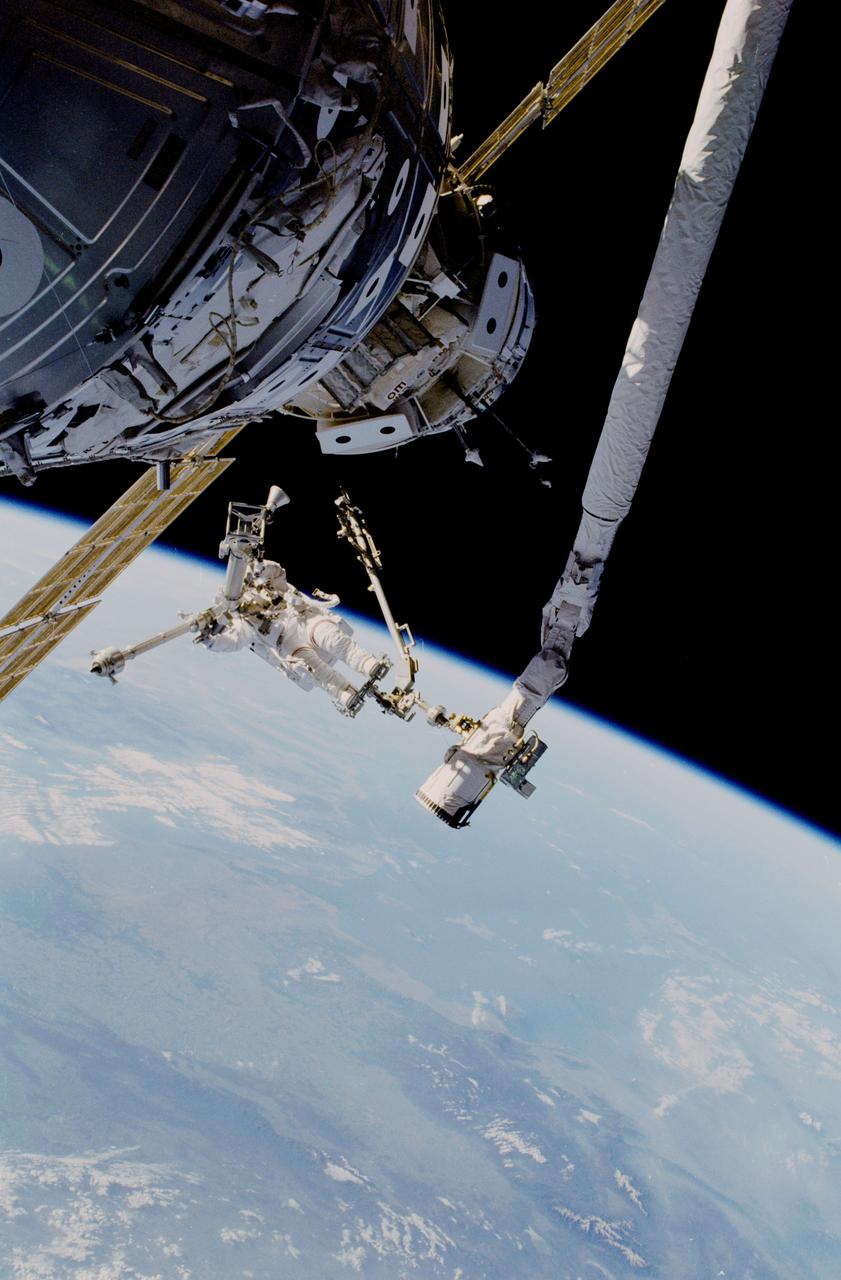
STS096-330-004 (30 May 1999) --- Astronaut Tamara E. Jernigan, mission specialist, is backdropped over the Aegean Sea as she handles the American-built crane which she helped to install on the International Space Station (ISS) during the May 30th space walk. Jernigan's feet are anchored to a mobile foot restraint connected to the Space Shuttle Discovery's Canadian-built Remote Manipulator System (RMS). Jernigan was joined by astronaut Daniel T. Barry, mission specialist, for the lengthy extravehicular activity (EVA). Parts of Greece, Turkey and the Dardenelles are visible some 171 nautical miles below the docked tandem of Discovery and the ISS.
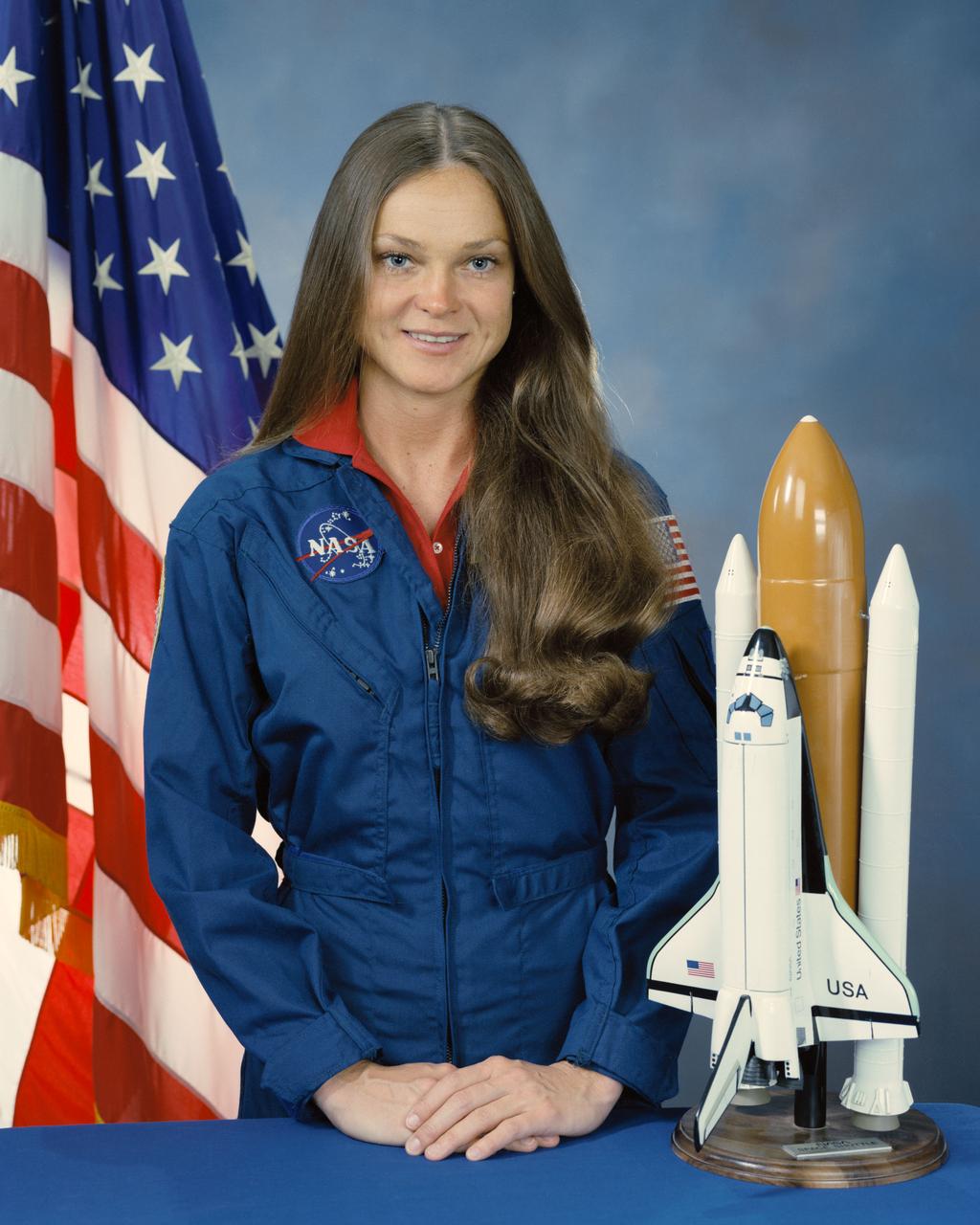
S90-34899 (16 April 1990) --- Astronaut Tamara E. Jernigan, mission specialist
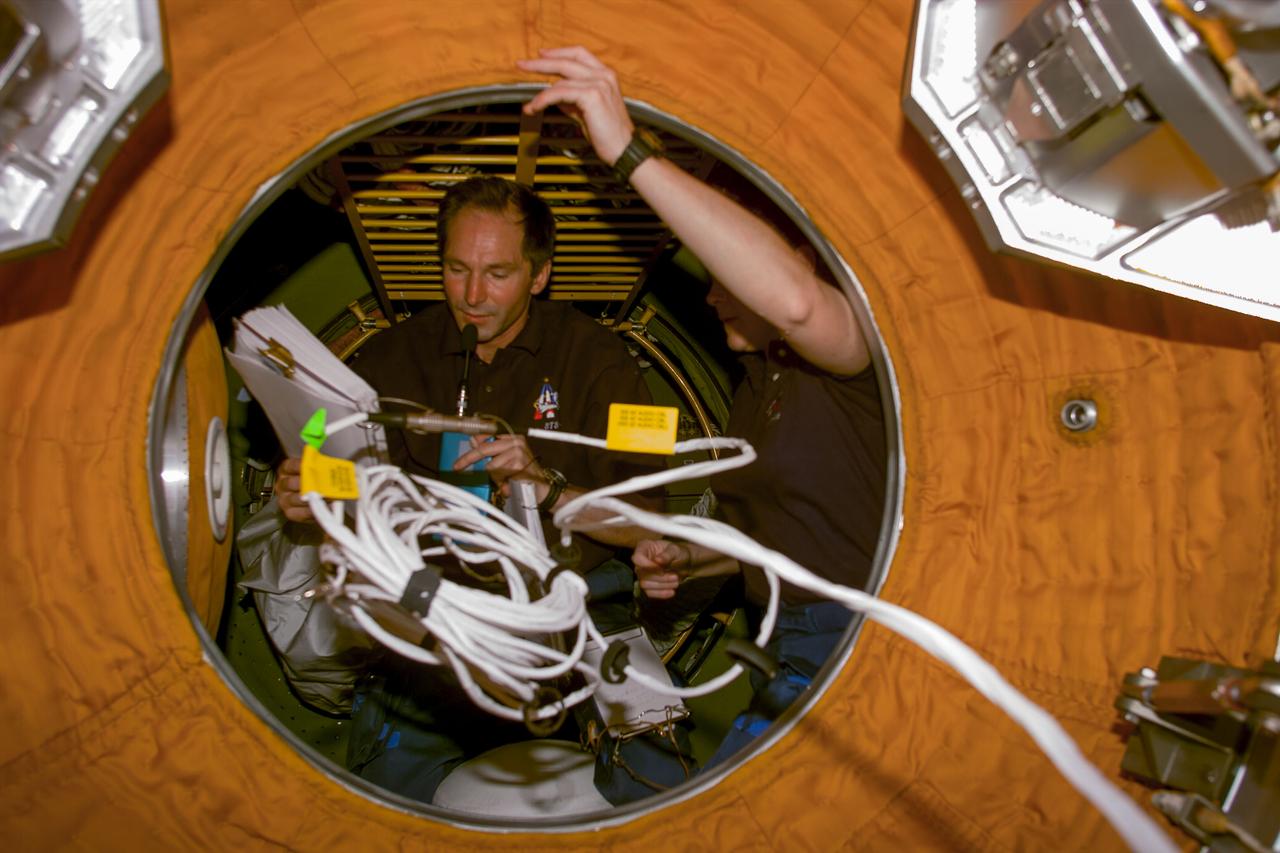
S96-E-5084 (31 May 1999) --- Cosmonaut Valery I. Tokarev and astronaut Tamara Jernigan are almost obscured by communications gear in this scene recorded in the passageway to the Russian-built Zarya module. Tokarev is a mission specialist representing the Russian Space Agency (RSA). Jernigan is one of two mission specialists that earlier had performed a lengthy space walk to do some exterior work on the International Space Station (ISS). The scene was recorded with an electronic still camera (ESC) at 02:09:00 GMT, May 31, 1999.
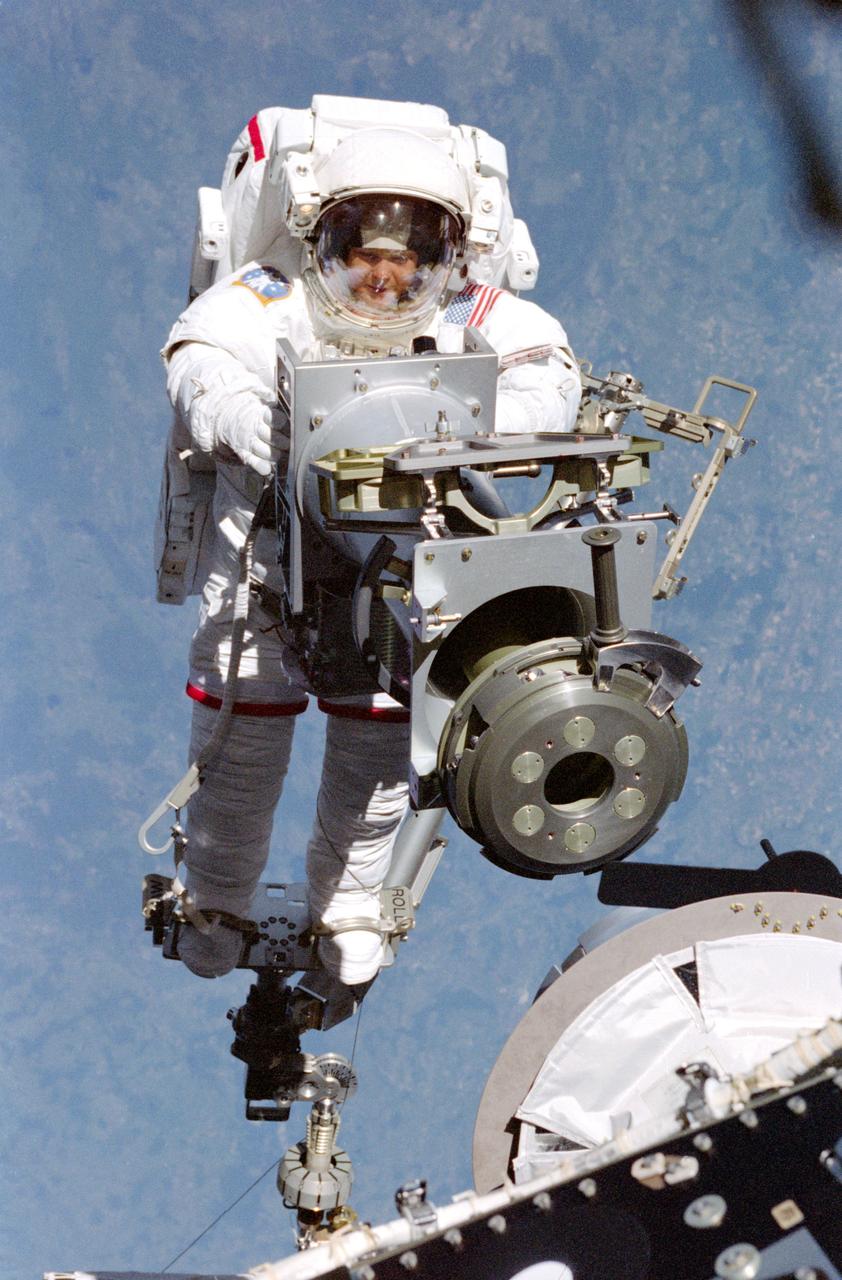
STS096-357-003 (30 May 1999) --- Astronaut Tamara E. Jernigan, backdropped against terrain some 173 nautical miles beneath Discovery, totes part of a Russian-built crane, called Strela (a Russian word meaning "arrow"). Jernigan's feet are anchored on a mobile foot restraint connected to the shuttle's remote manipulator system (RMS). Astronauts Jernigan and Daniel T. Barry eventually spent over seven hours on the space walk.
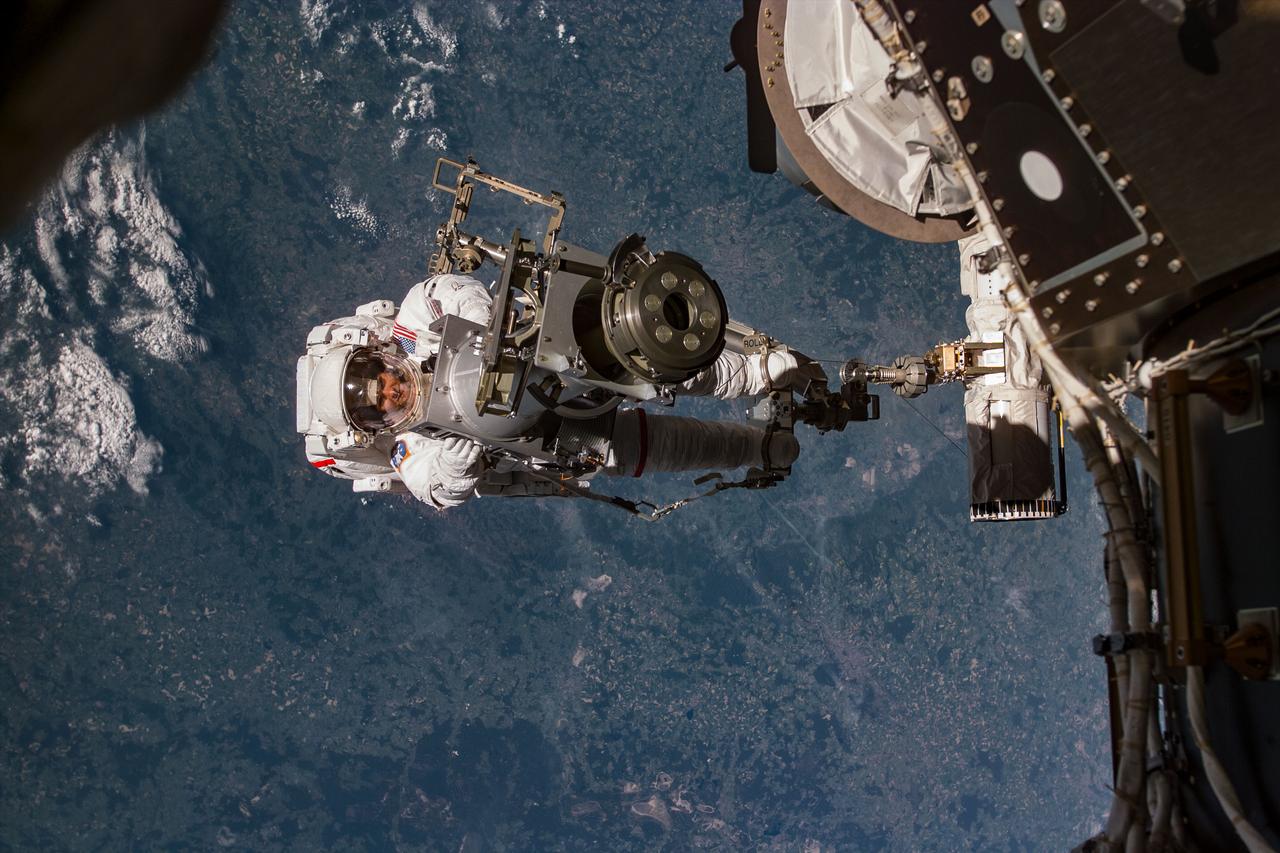
S96-E-5020 (30 May 1999) --- Astronaut Tamara Jernigan, backdropped against terrain, totes part of a Russian-built crane, called Strela (a Russian word meaning "arrow"). Jernigan's feet are anchored on a mobile foot restraint connected to Discovery's remote manipulator sytsem (RMS). Astronauts Jernigan and Daniel T. Barry went on to spend over seven hours on the space walk. The photo was recorded with an electronic still camera (ESC) at 06:36:22 GMT, May 30, 1999.
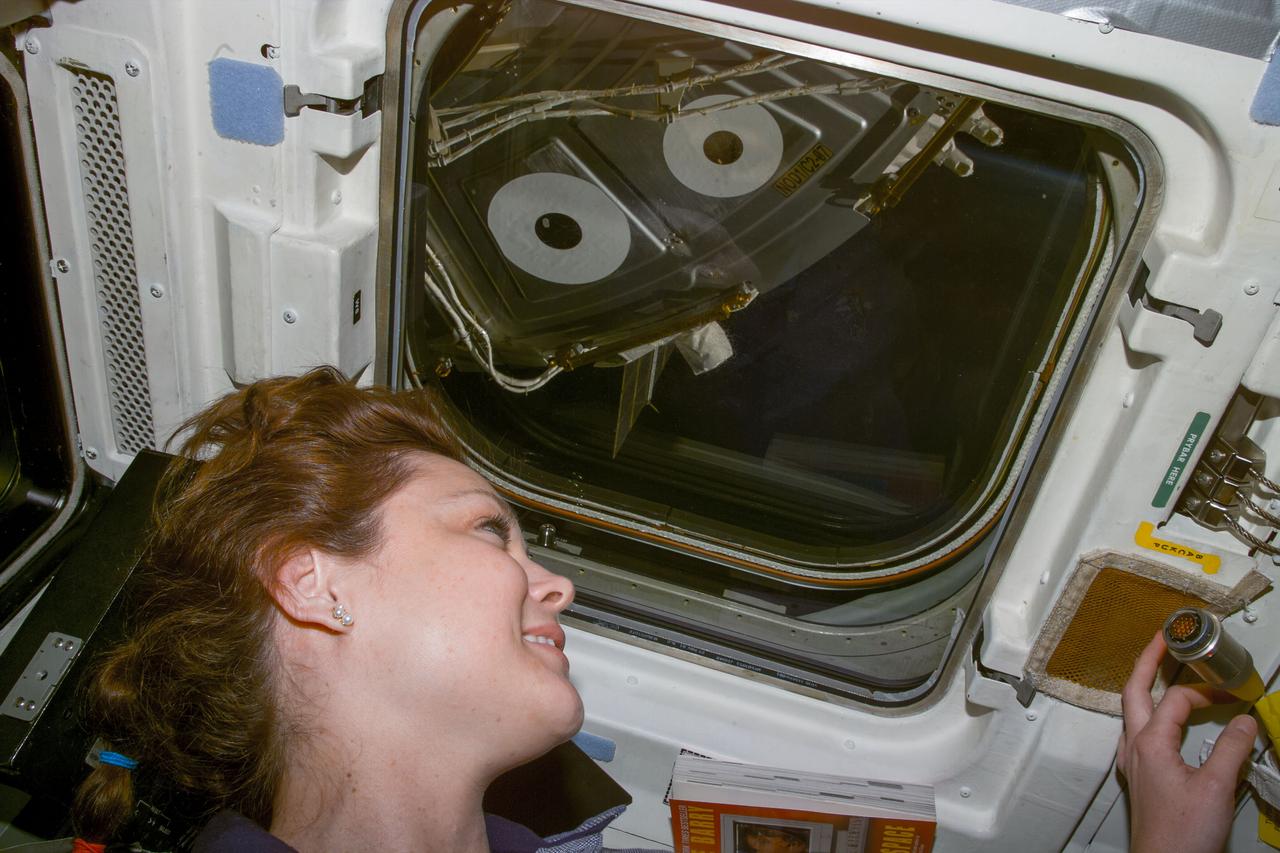
S96-E-5131 (1 June 1999) --- Astronaut Tamara Jernigan looks toward the docked International Space Station (ISS) from the aft flight deck of the Earth-orbiting Space Shuttle Discovery. The scene was recorded with an electronic still camera (ESC) at 11:29:21 GMT, June 1, 1999.
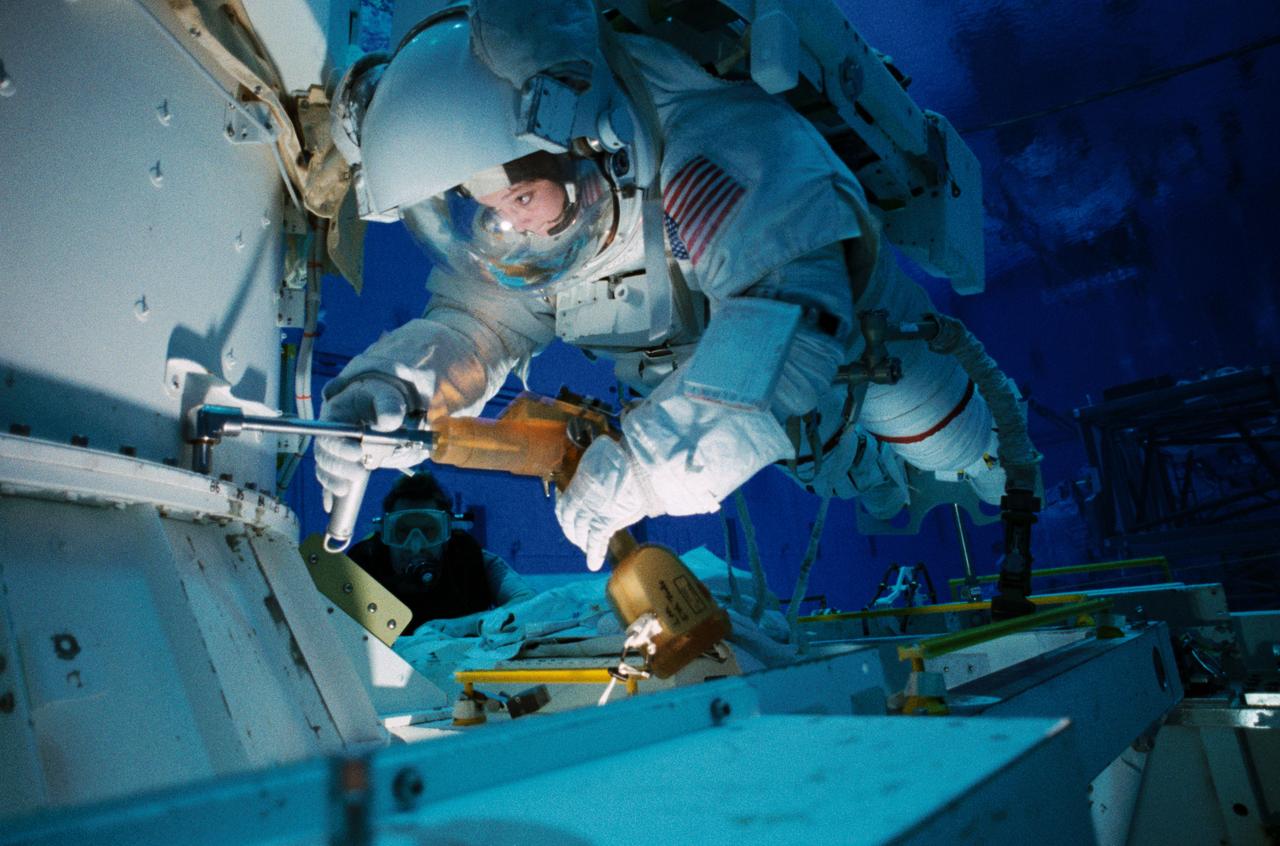
S99-01054 (15 Jan 1999) --- Astronaut Tamara E. Jernigan, mission specialist, uses a special tool during an underwater simulation of a Extravehicular Activity (EVA) scheduled for the mission. Jernigan was joined by astronaut Daniel T. Barry (out of frame) for the simulation, conducted in the Neutral Buoyancy Laboratory (NBL), at Johnson Space Center?s (JSC) Sonny Carter Training Facility (SCTF).
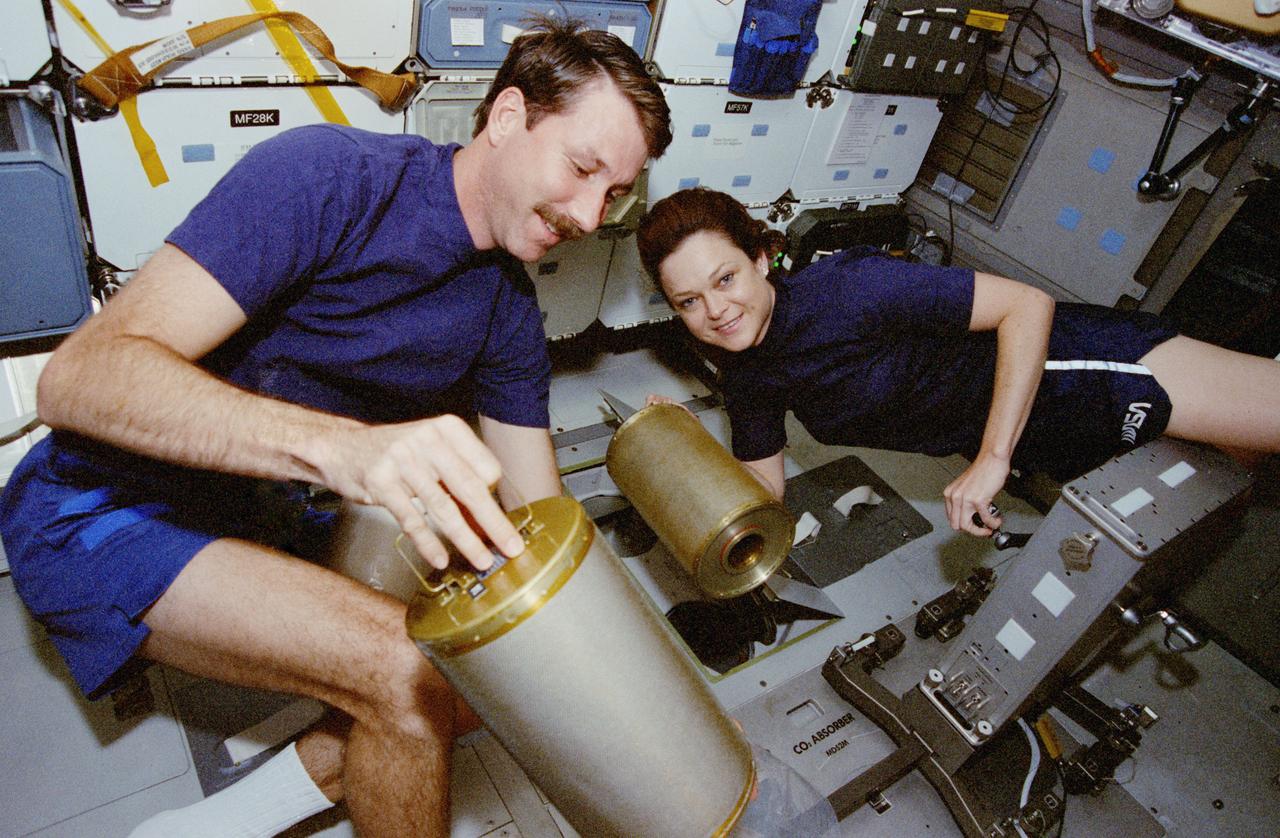
STS080-331-030 (19 Nov.-7 Dec. 1996) --- Astronauts Kent V. Rominger, STS-80 pilot, and Tamara E. Jernigan, mission specialist, perform a routine housekeeping chore during the space shuttle Columbia's record stay in Earth-orbit. The two are changing out the lithium hydroxide canisters beneath the middeck.
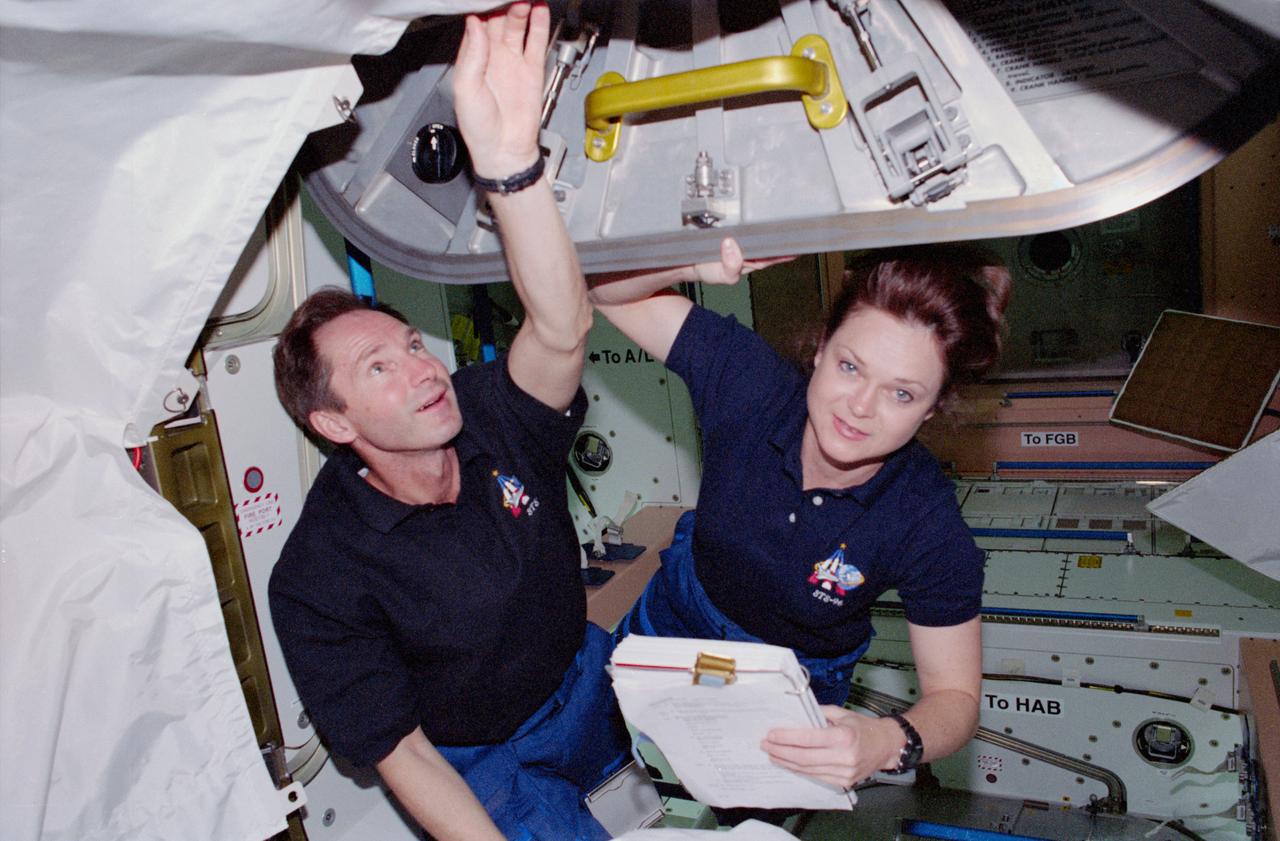
STS096-376-012 (30 May 1999) --- Cosmonaut Valery I. Tokarev and astronaut Tamara E. Jernigan, mission specialists, tote a checklist as they ingress the Unity node aboard the International Space Station (ISS) currently docked with the Space Shuttle Discovery in Earth orbit. Tokarev represents the Russian Space Agency (RSA).
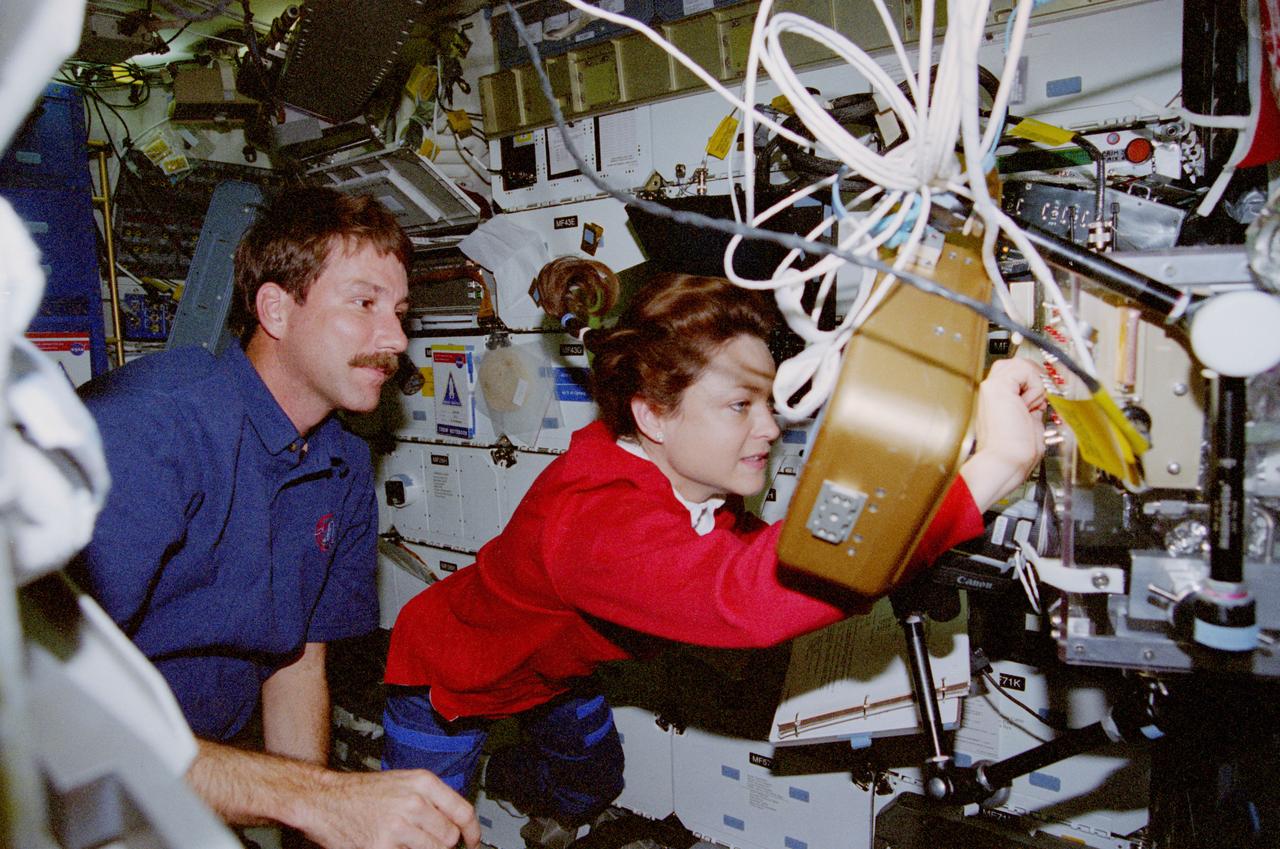
STS080-345-008 (19 Nov.-7 Dec. 1996) --- Continuing with a heavy agenda of middeck science, astronaut Tamara E. Jernigan, STS-80 mission specialist, works with the Capillary Pumped Loop (CPL) experiment while astronaut Kent V. Rominger, pilot, offers a hand.
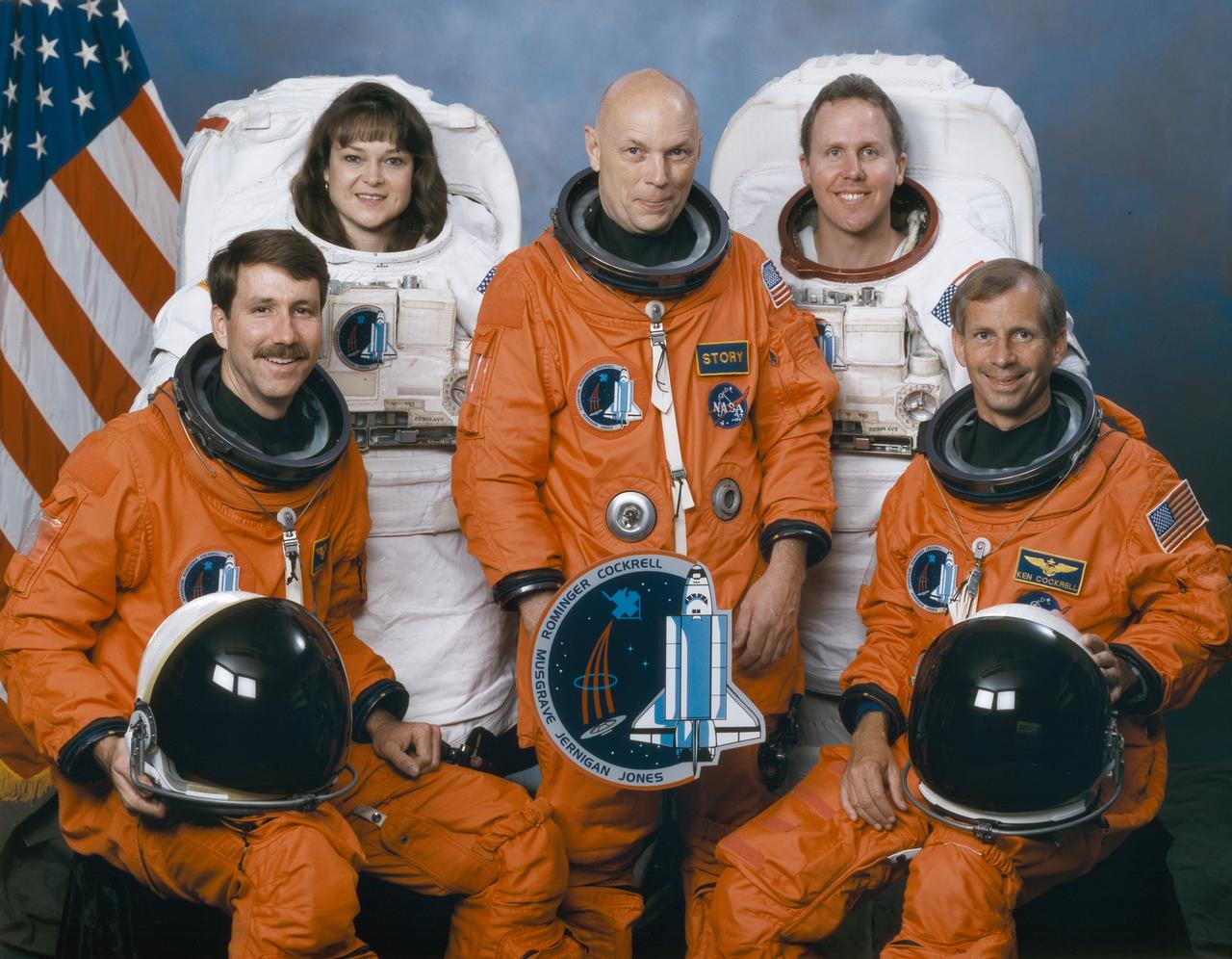
The crew assigned to the STS-79 mission included (seated left to right) Kent V. Rominger, pilot; and Kenneth D. Cockrell, commander. Standing (left to right) are mission specialists Tamara E. Jernigan, F. Story Musgrave, and Thomas D. Jones. Launched aboard the Space Shuttle Columbia on November 19, 1996 at 2:55:47 pm (EST), the STS-80 mission marked the final flight of 1996. The crew successfully deployed and operated the Orbiting and Retrievable Far and Extreme Ultraviolet Spectrometer-Shuttle Pallet Satellite II (ORFEUS-SPAS II), and deployed and retrieved the Wake Shield Facility-3 (WSF-3).
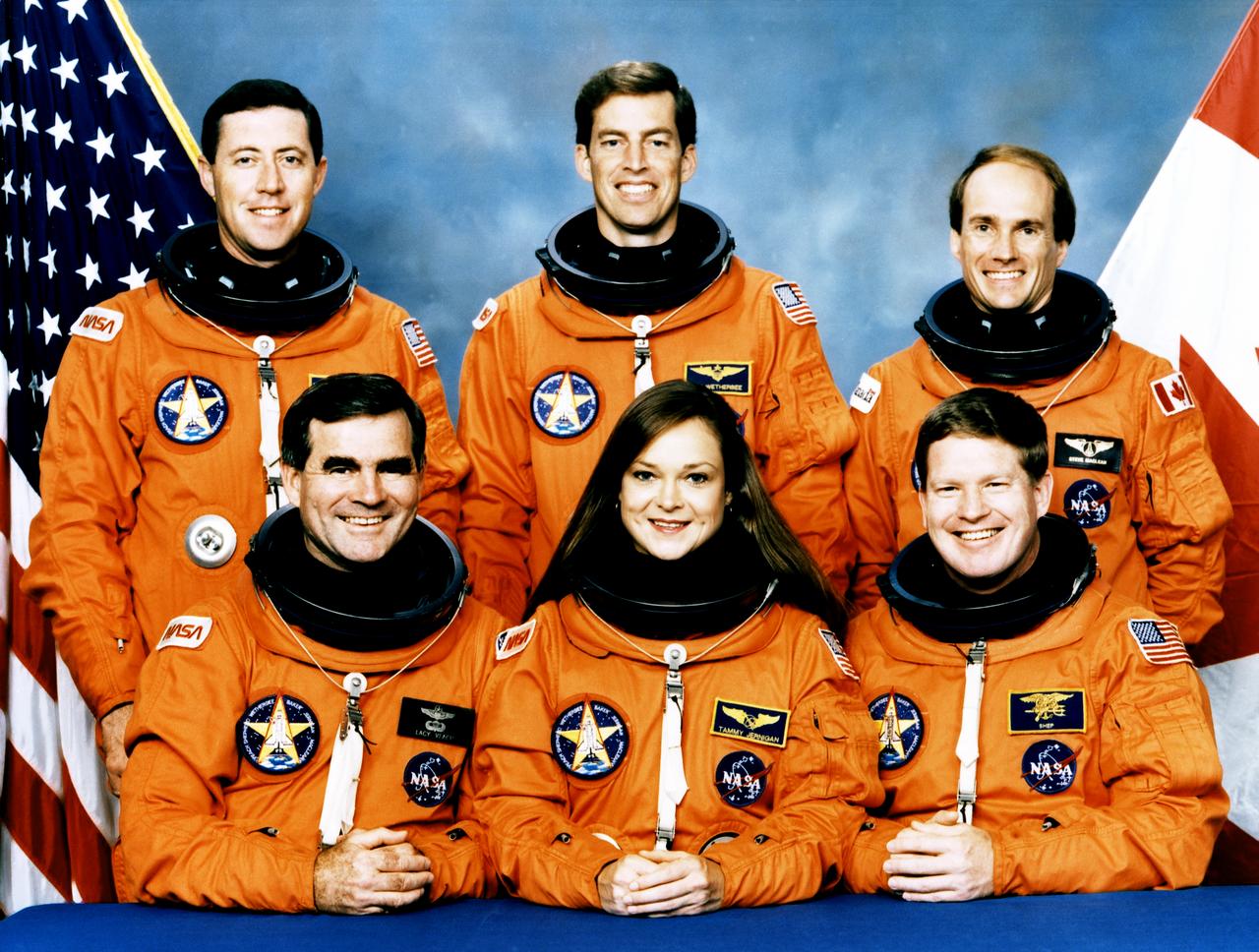
Five NASA astronauts and one Canadian payload specialist composed the STS-52 crew. Pictured on the back row, left to right, are Michael A. Baker, pilot; James B. Wetherbee, commander; and Steven G. Maclean, payload specialist. On the front row, left to right, are mission specialists Charles (Lacy) Veach, Tamara Jernigan, and William Shepherd. Launched aboard the Space Shuttle Columbia on October 22, 1992 at 1:09:39 p.m. (EDT), the crew’s primary objectives were the deployment of the Laser Geodynamic Satellite (LAGEOS II) and operation of the U.S. Microgravity Payload-1 (USMP-1).
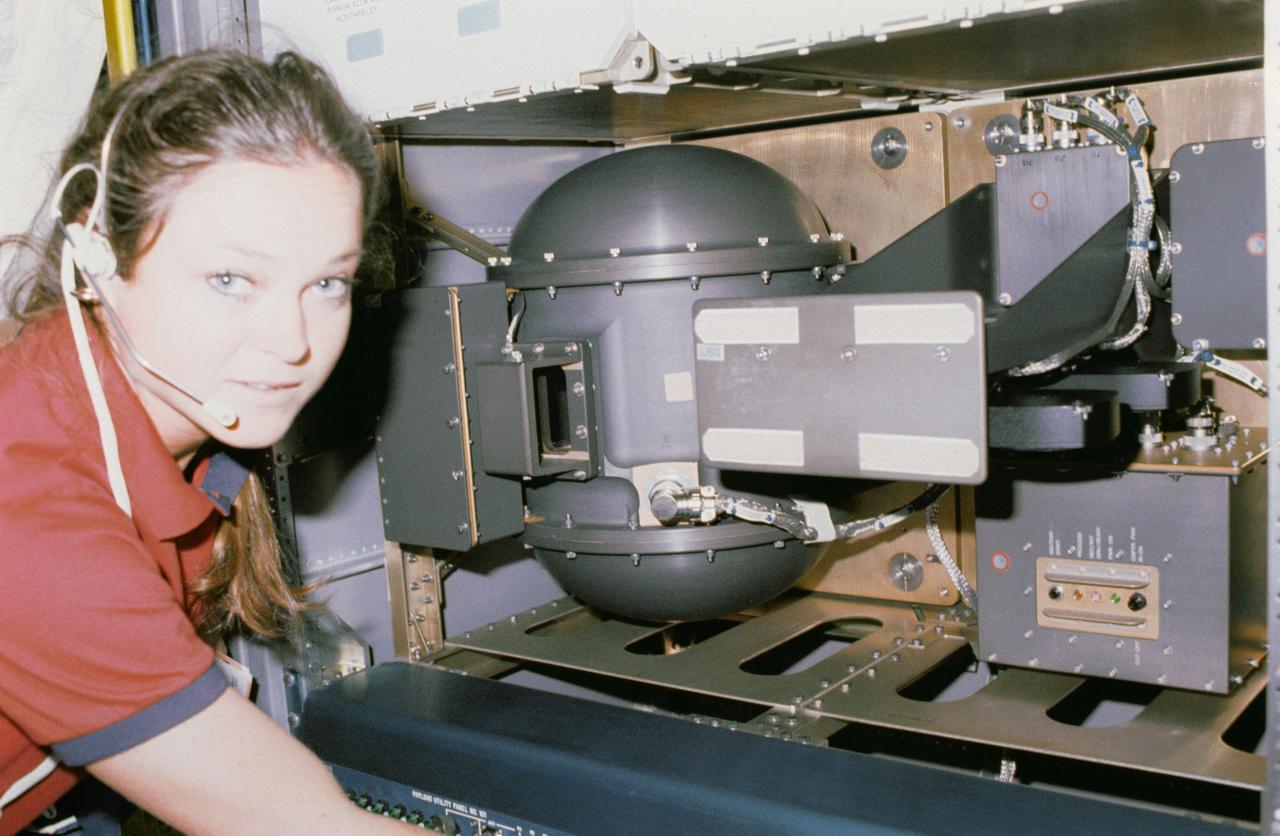
STS040-204-010 (5-14 June 1991) --- Astronaut Tamara E. Jernigan, STS 40 mission specialist, is pictured at the Solid Surface Combustion Experiment aboard the Earth orbiting Columbia. Dr. Jernigan is one of seven crewmembers spending nine days in space.
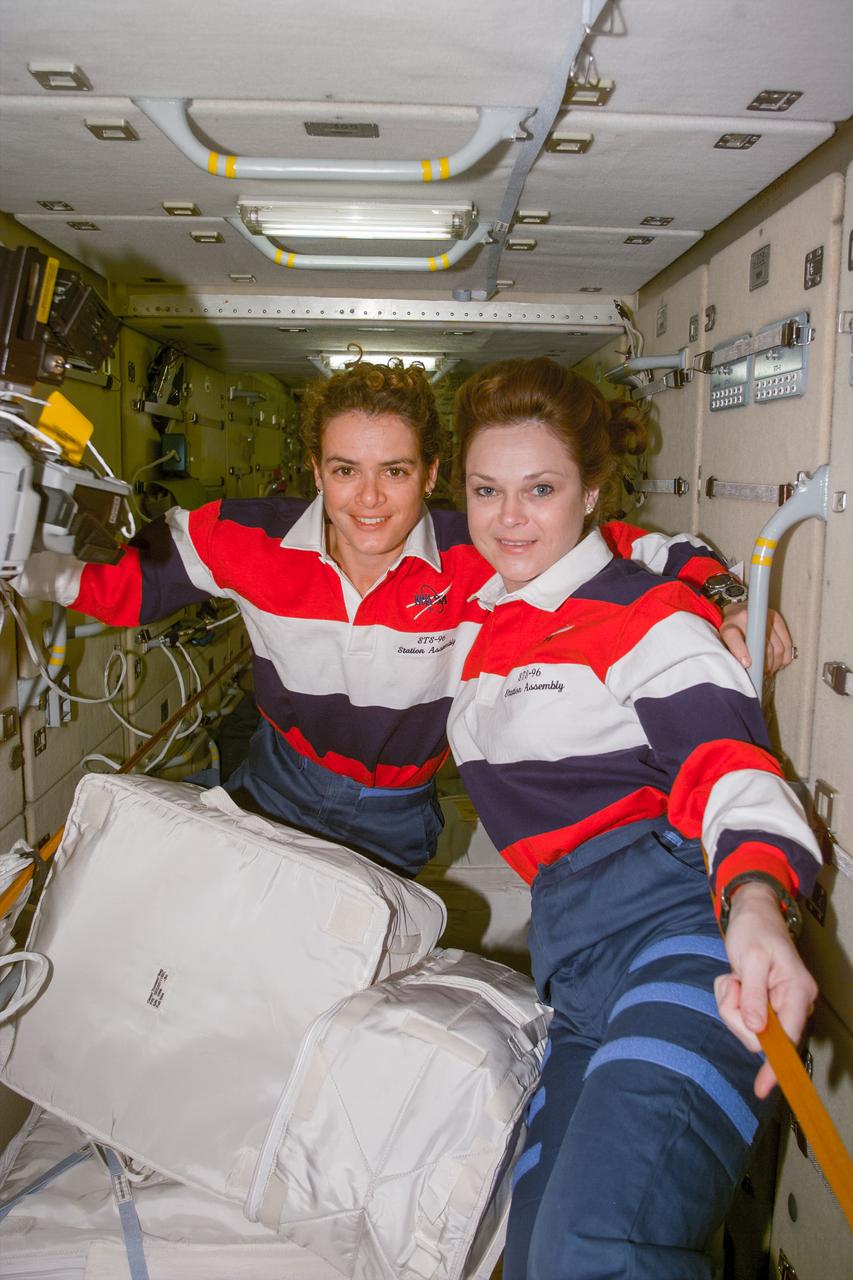
S96-E-5161 (2 June 1999) --- Astronauts Jule Payette (left) and Tamara E. Jernigan, mission specialists, participate in the final hours of tasks designed to prepare the International Space Station (ISS) for business. Here, on the Russian-built Zarya module, the two are seen with a small part of the supplies brought up by the Space Shuttle Discovery. The photo was taken with an electronic still camera (ESC) at 05:58:37 GMT, June 2, 1999.
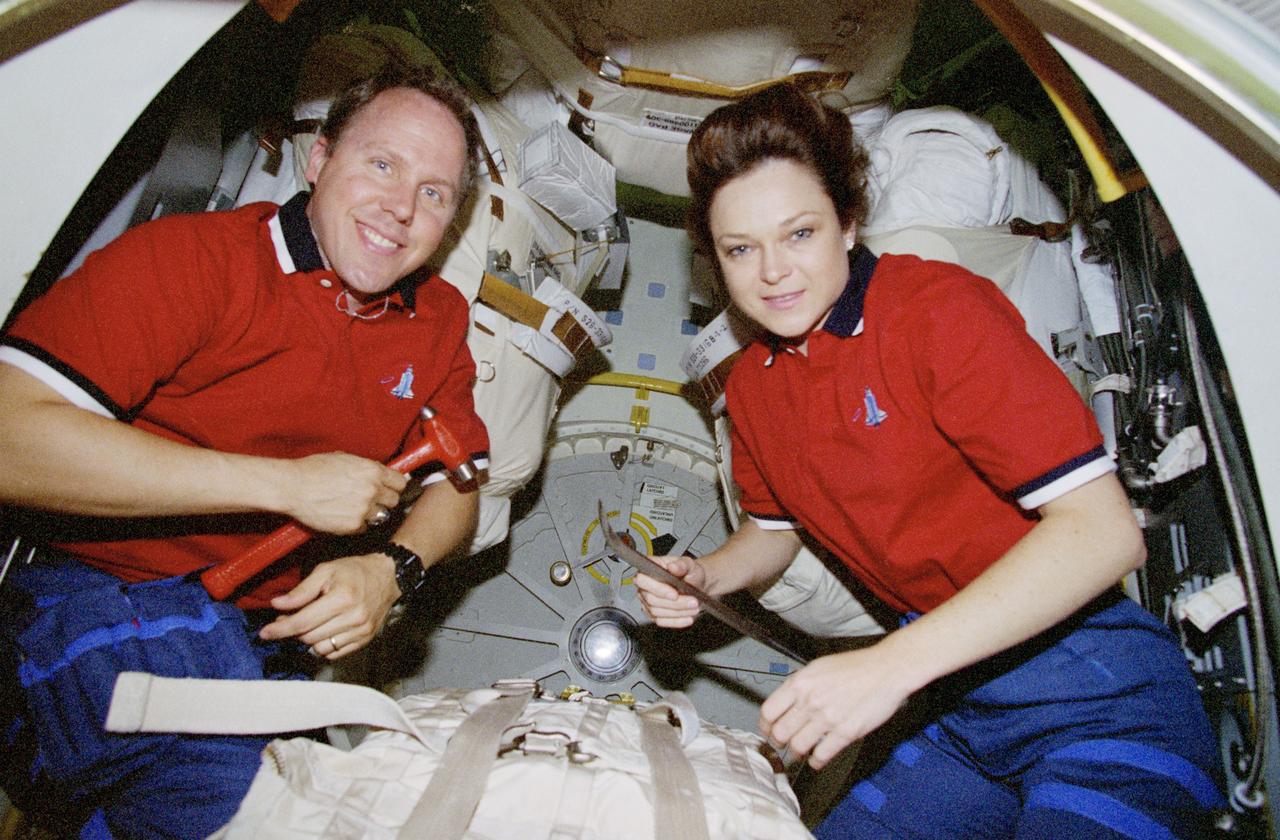
STS080-317-018 (28 Nov. 1996) --- Astronauts Thomas D. Jones, with a hammer, and Tamara E. Jernigan, holding a crow bar, display just two of the tools they called on during an intense effort to open the space shuttle Columbia's hatch leading to the cargo bay. Scheduled Extravehicular Activities (EVA) for the two were canceled by NASA when all efforts to open the hatch were unsuccessful.
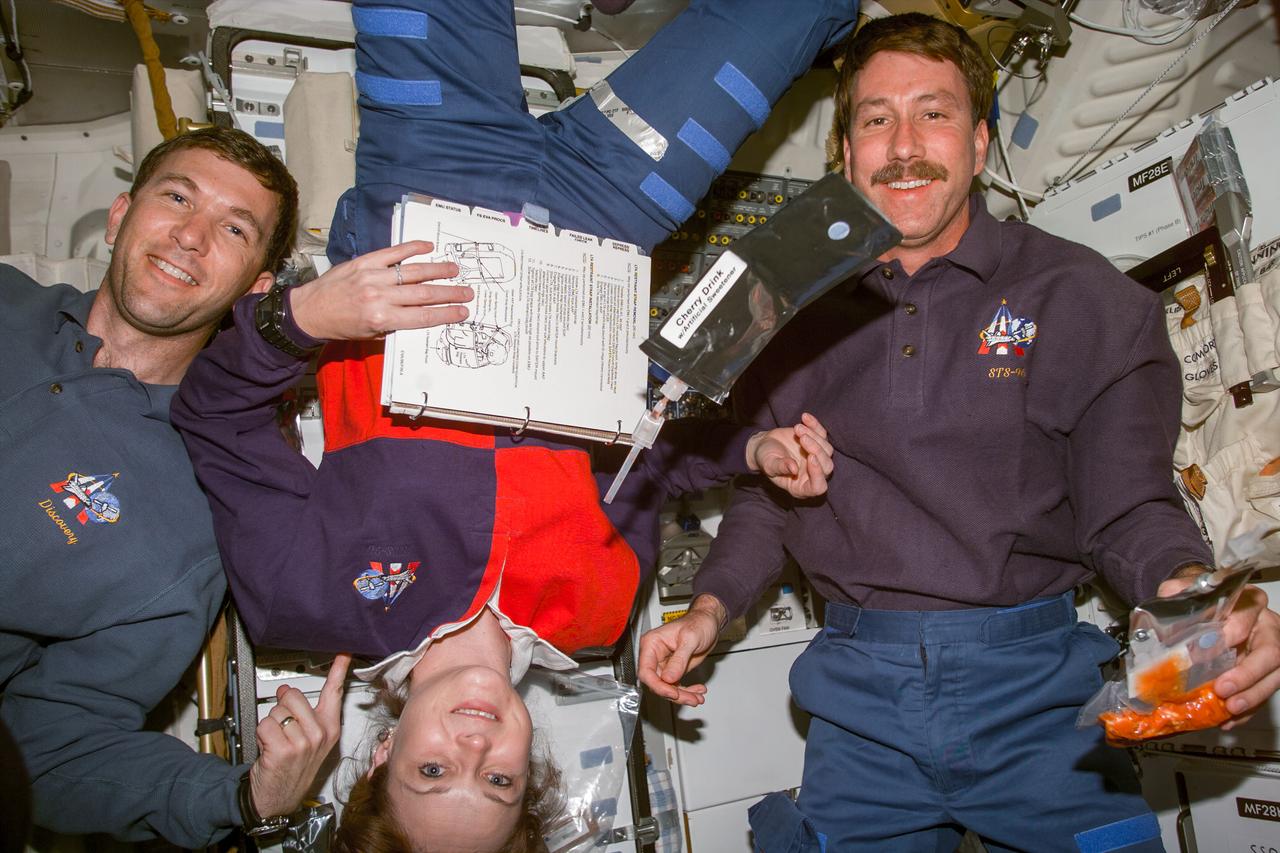
S96-E-5017 (29 May 1999) --- Three of Discovery's seven crew members are pictured during a break from activity on the mission's fourth day in space. From the left are Rick D. Husband, pilot; Tamara Jernigan, mission specialist, and Kent V. Rominger, commander. The photo was taken with an electronic still camera (ESC) at 09:50:34 GMT, May 29, 1999.

S90-46492 (16 Aug 1990) --- Astronaut Tamara E. Jernigan, STS-40 mission specialist, is pictured in a training version of the extravehicular mobility unit (EMU) spacesuit. Dr. Jernigan was about to be submerged in the Johnson Space Center's 25-ft. deep weightless environment training facility (WET-F) pool to simulate a contingency extravehicular activity (EVA). There is no EVA scheduled for STS-40, the Spacelab Life Sciences (SLS-1) mission.
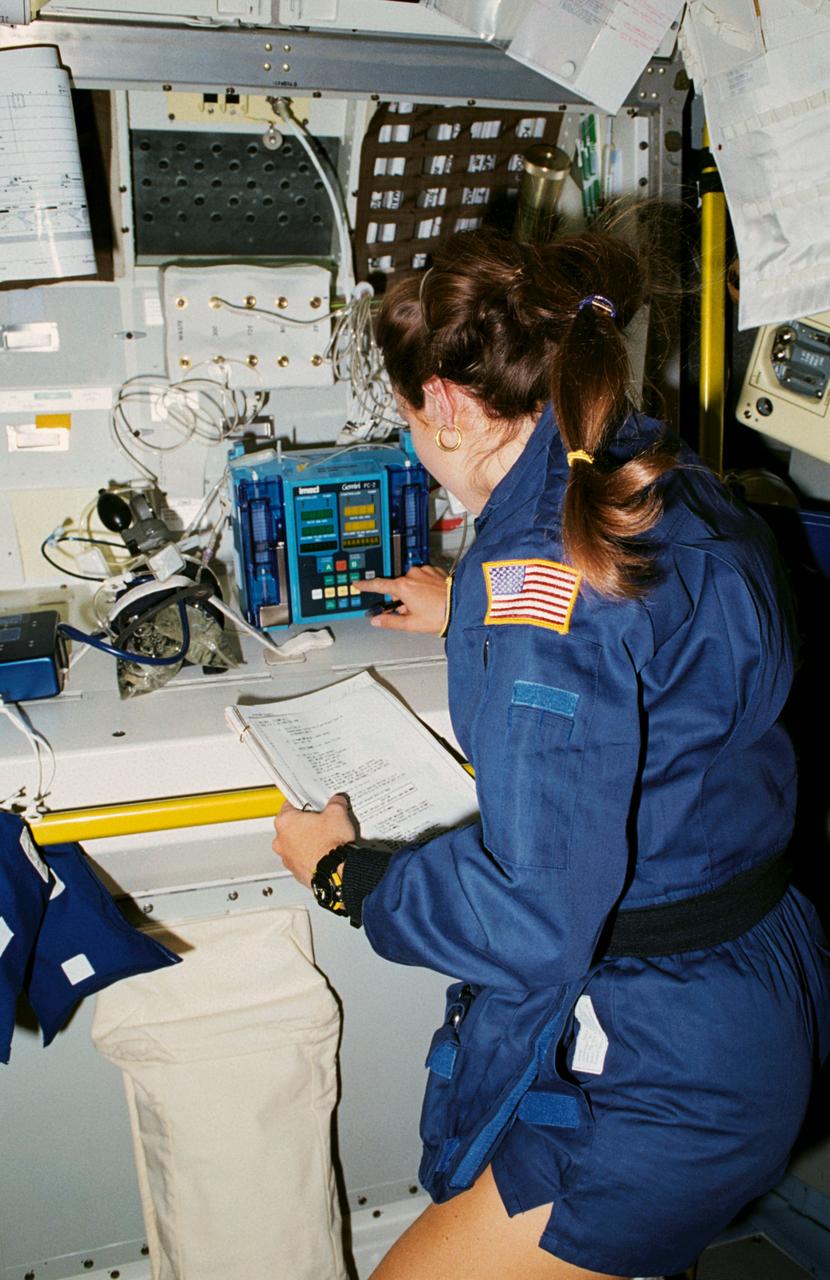
STS040-30-008 (5-14 June 1991) --- Astronaut Tamara E. Jernigan, after applying a blood pressure cuff to an experiment, watches it in operation. The experiment is the intravenous infusion pump. The device is being considered for use on Space Station Freedom's Health Maintenance Facility. Dr. Jernigan is one of seven crew members supporting the nine-day Spacelab Life Sciences (SLS-1) mission aboard the Earth-orbiting Space Shuttle Columbia.
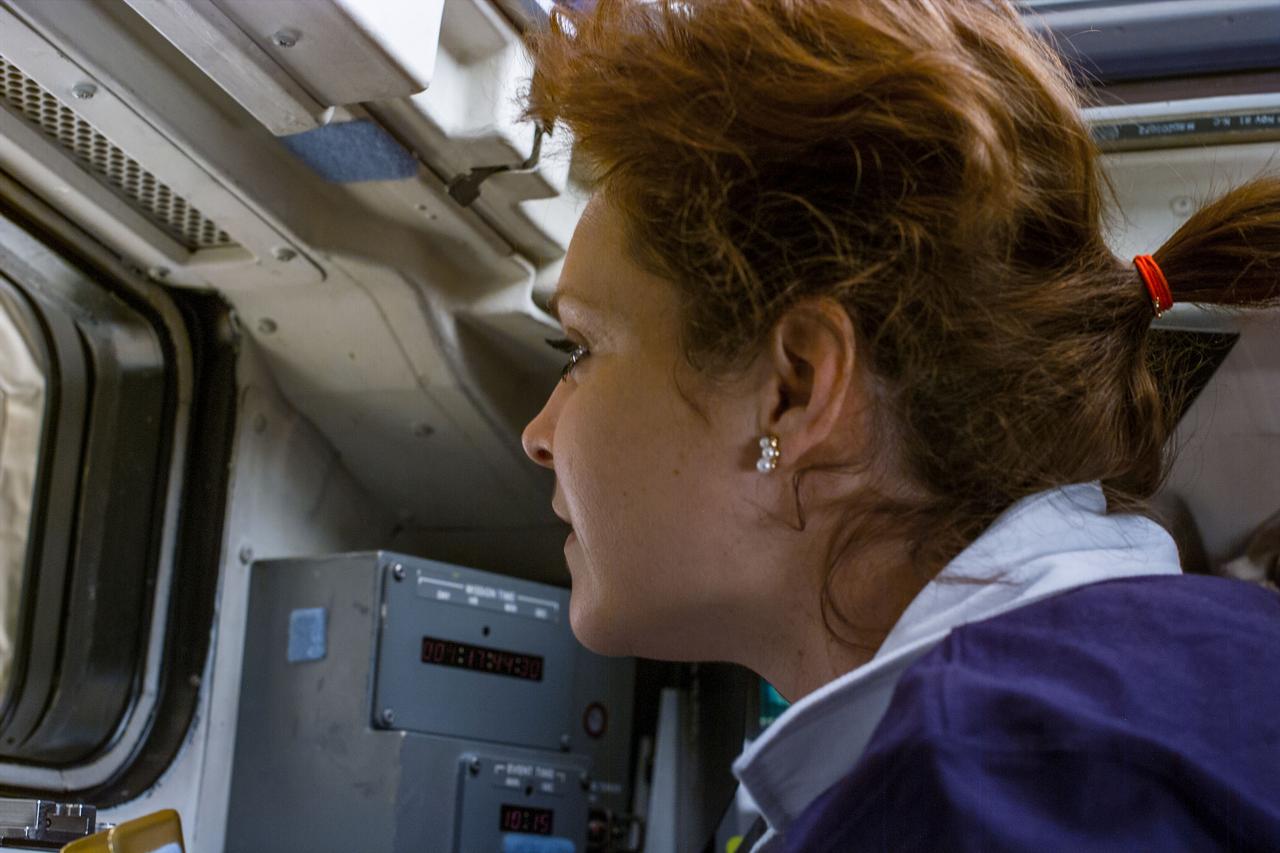
S96-E-5059 (29 May 1999) --- Astronaut Tamara Jernigan looks at the docked International Space Station (ISS) in Discovery's cargo bay. The photo was taken at 04:37:30 GMT, May 29, 1999.
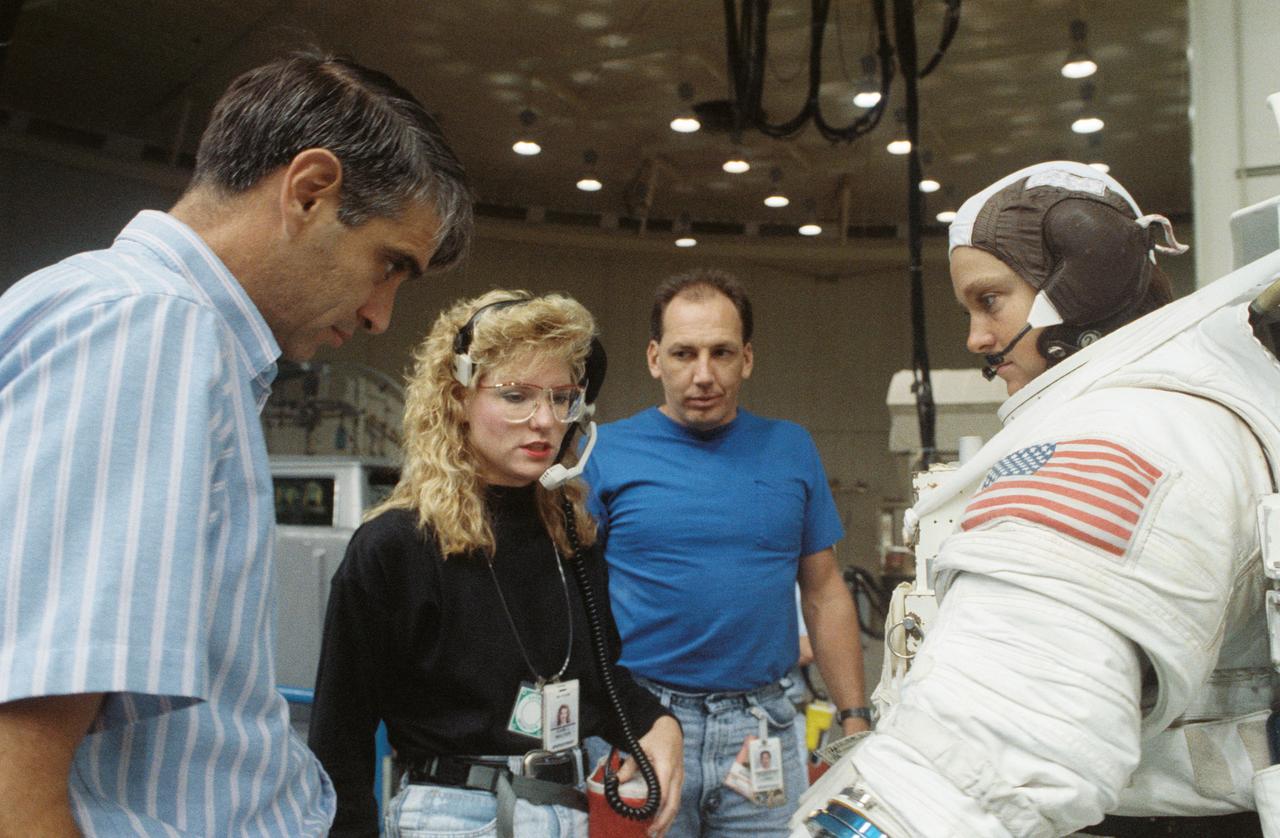
S90-45785 (16 Aug 1990) --- Astronaut Tamara E. Jernigan, STS-40 mission specialist, is pictured in a training version of the extravehicular mobility unit (EMU) spacesuit talking with a fellow crewmember and members of the crew training staff. At left is astronaut Sidney M. Gutierrez, pilot for the flight. Dr. Jernigan was about to be submerged in the Johnson Space Center's 25-ft. deep weightless environment training facility (WET-F) pool to simulate a contingency extravehicular activity (EVA). There is no EVA scheduled for STS-40, the Spacelab Life Sciences (SLS-1) mission.
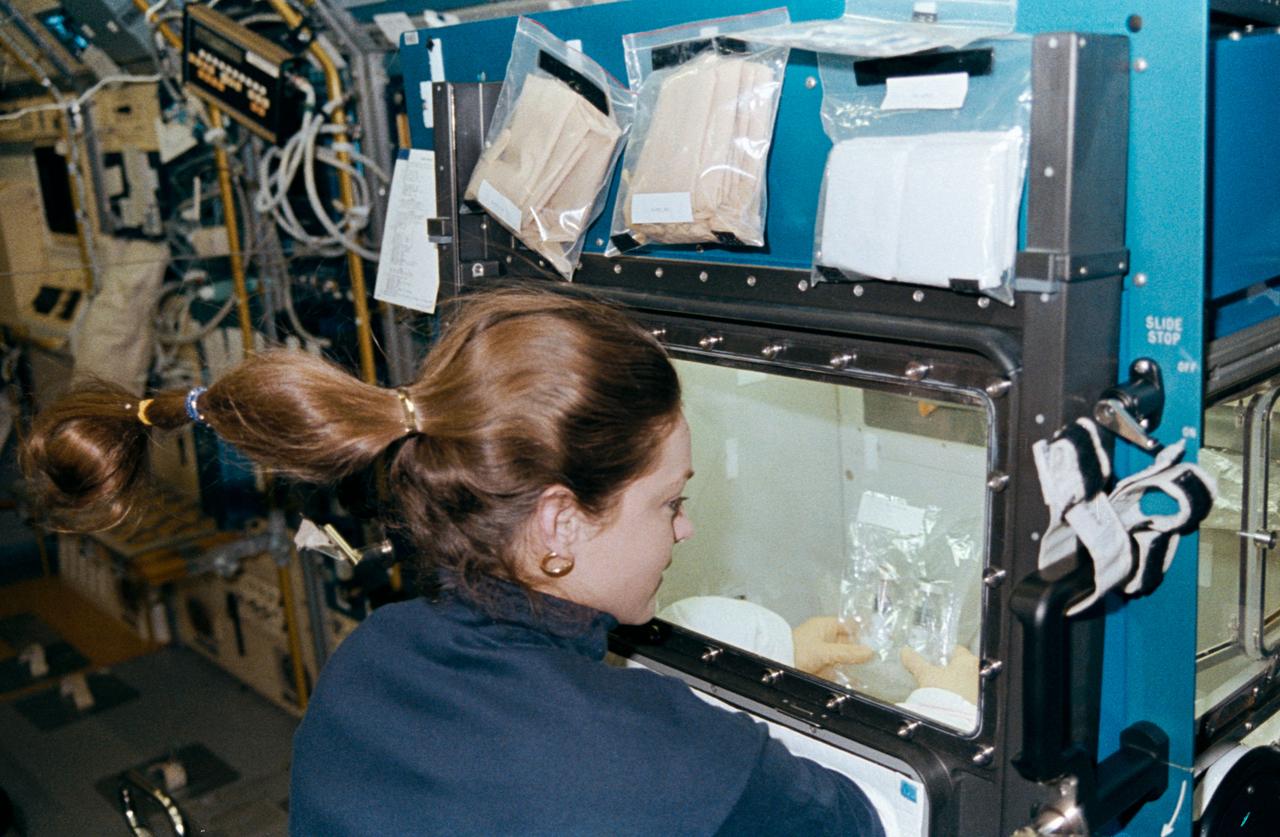
STS040-224-005 (5-14 June 1991) --- Astronaut Tamara E. Jernigan, STS-40 mission specialist, conducts an evaluation of the General Purpose Work Station (GPWS) in the Spacelab Life Sciences (SLS-1) module onboard the Earth-orbiting Space Shuttle Columbia. The photograph was taken with a 35mm camera.
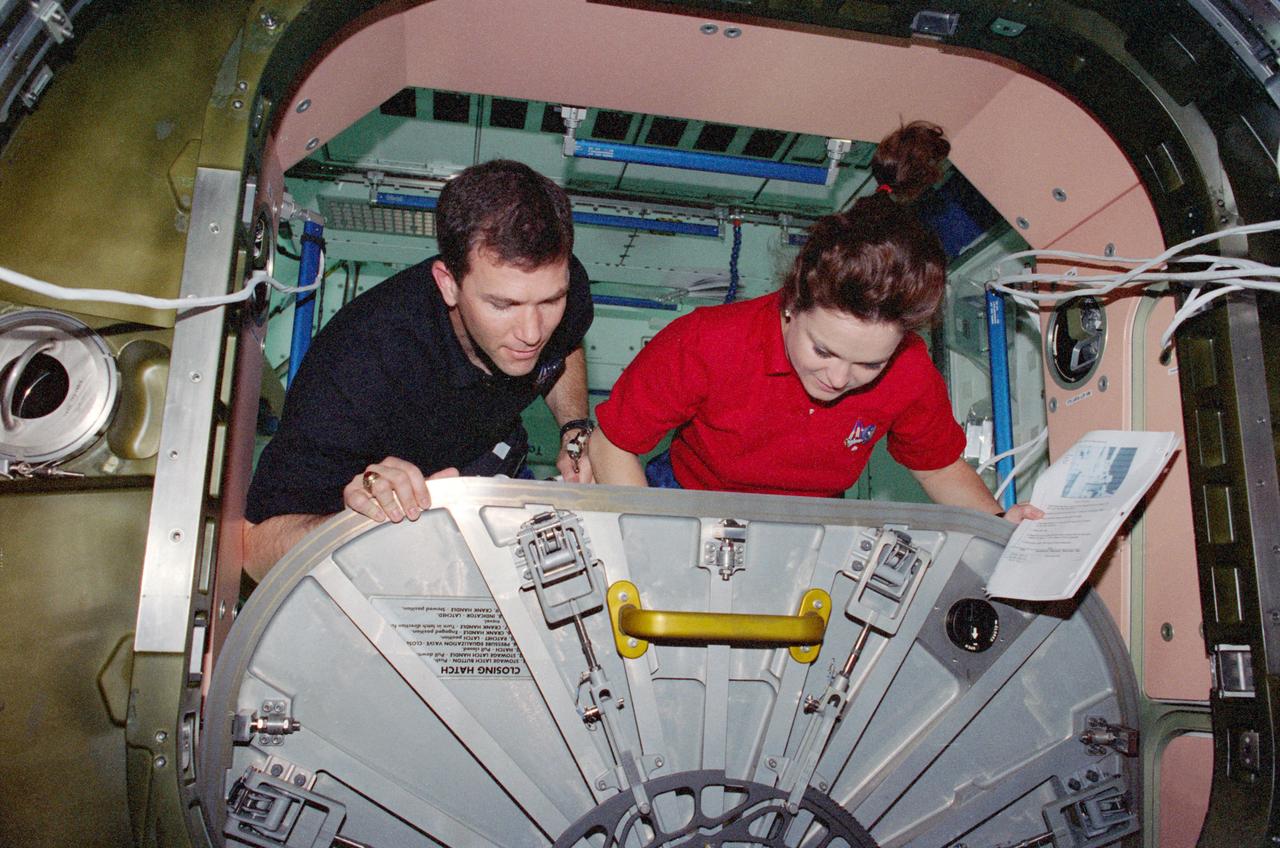
STS096-383-021 (27 May - 6 June 1999) -- Astronauts Rick D. Husband and Tamara E. Jernigan adjust the hatch for the U.S.-built Unity node. The task was part of the overall effort by the seven-member STS-96 crew to prepare the existing portion of the International Space Station (ISS).
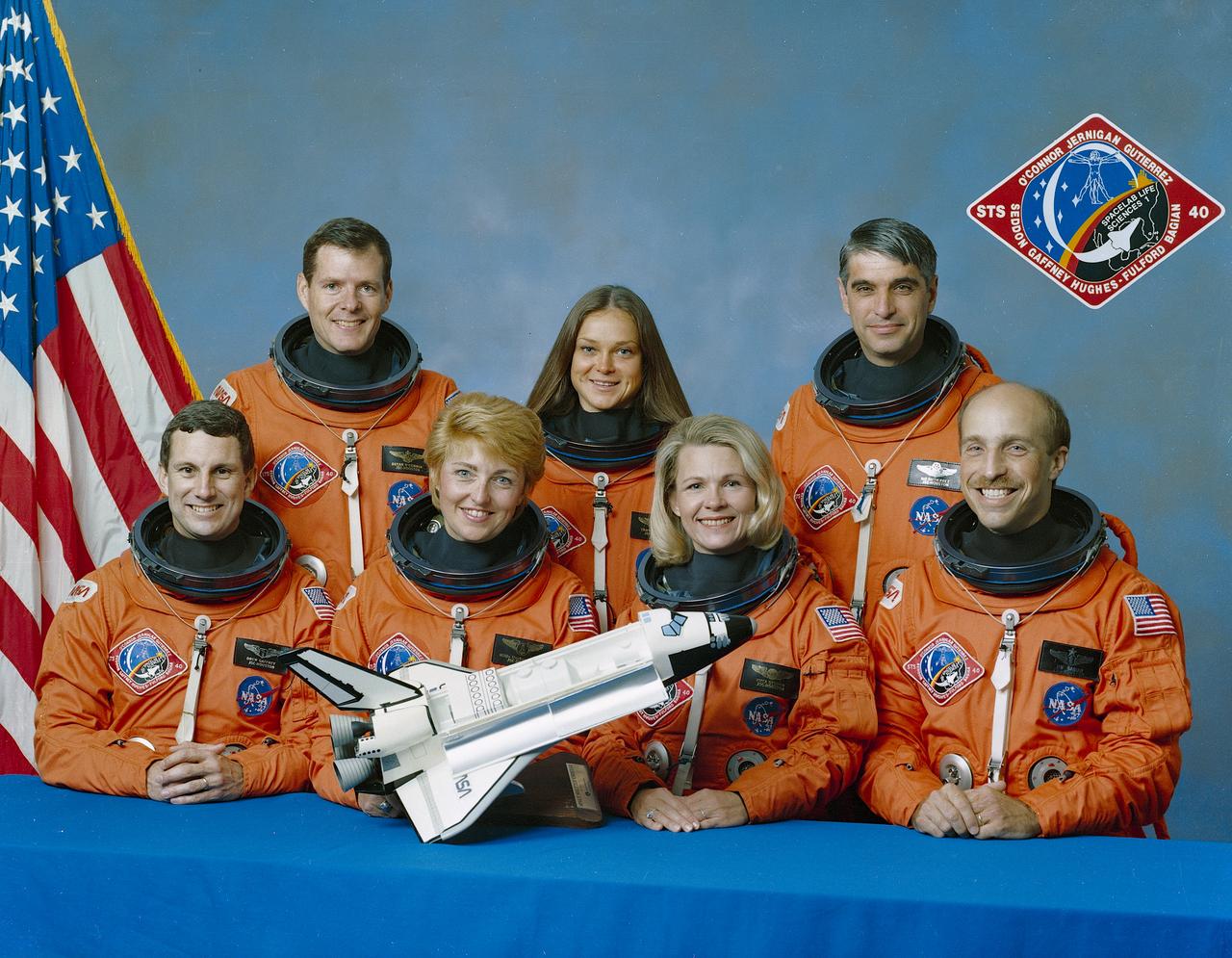
The STS-40 crew portrait includes 7 astronauts. Pictured on the front row from left to right are F. Drew Gaffney, payload specialist 1; Milli-Hughes Fulford, payload specialist 2; M. Rhea Seddon, mission specialist 3; and James P. Bagian, mission specialist 1. Standing in the rear, left to right, are Bryan D. O’Connor, commander; Tamara E. Jernigan, mission specialist 2; and Sidney M. Gutierrez, pilot. Launched aboard the Space Shuttle Columbia on June 5, 1991 at 9:24; am (EDT), the STS-40 mission was the fifth dedicated Spacelab Mission, Spacelab Life Sciences-1 (SLS-1), and the first mission dedicated solely to life sciences.
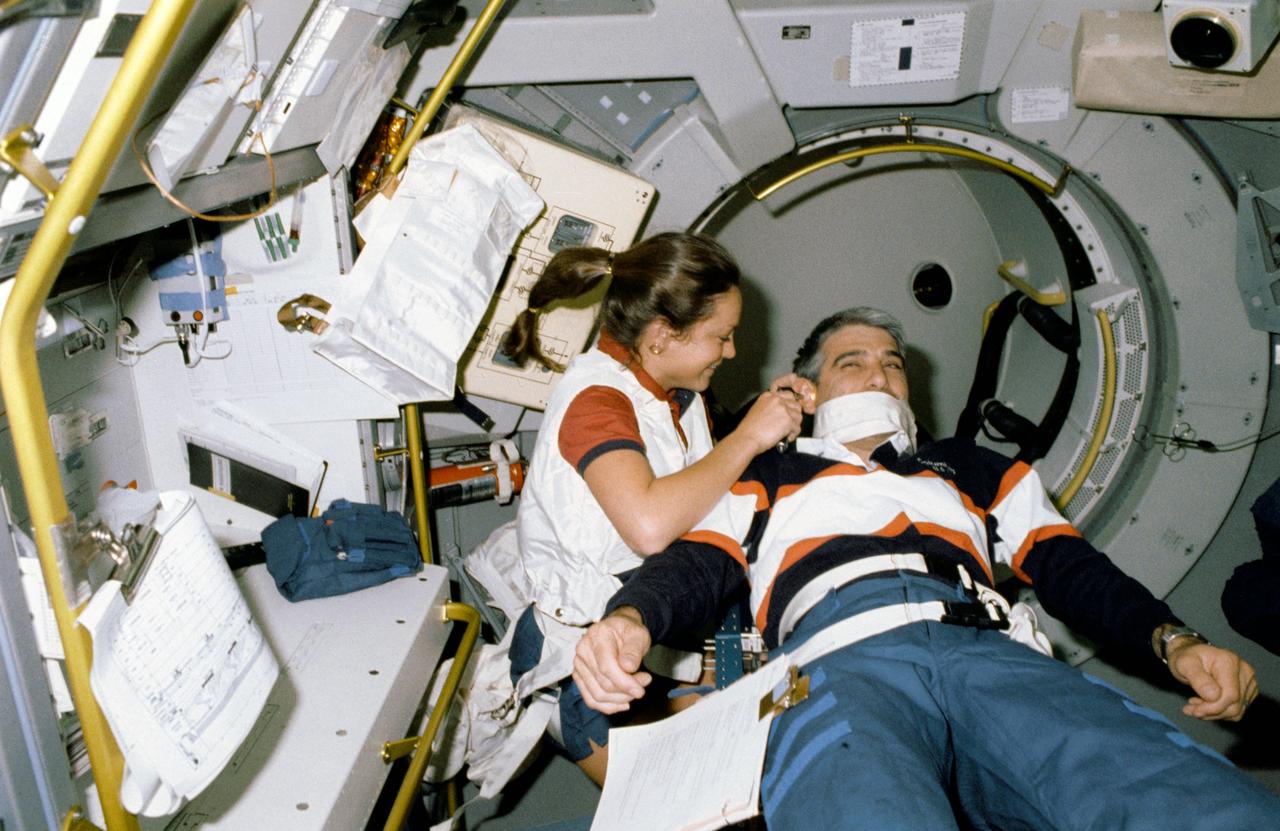
STS040-206-002 (5-14 June 1991) --- Held in place by the Spacelab Life Sciences (SLS-1) Medical Restraint System (MRS), astronaut Sidney M. Gutierrez, pilot, gets his ears checked by astronaut Tamara E. Jernigan, mission specialist. The two are in the SLS-1 module, onboard the Space Shuttle Columbia. The scene was photographed with a 35mm camera.
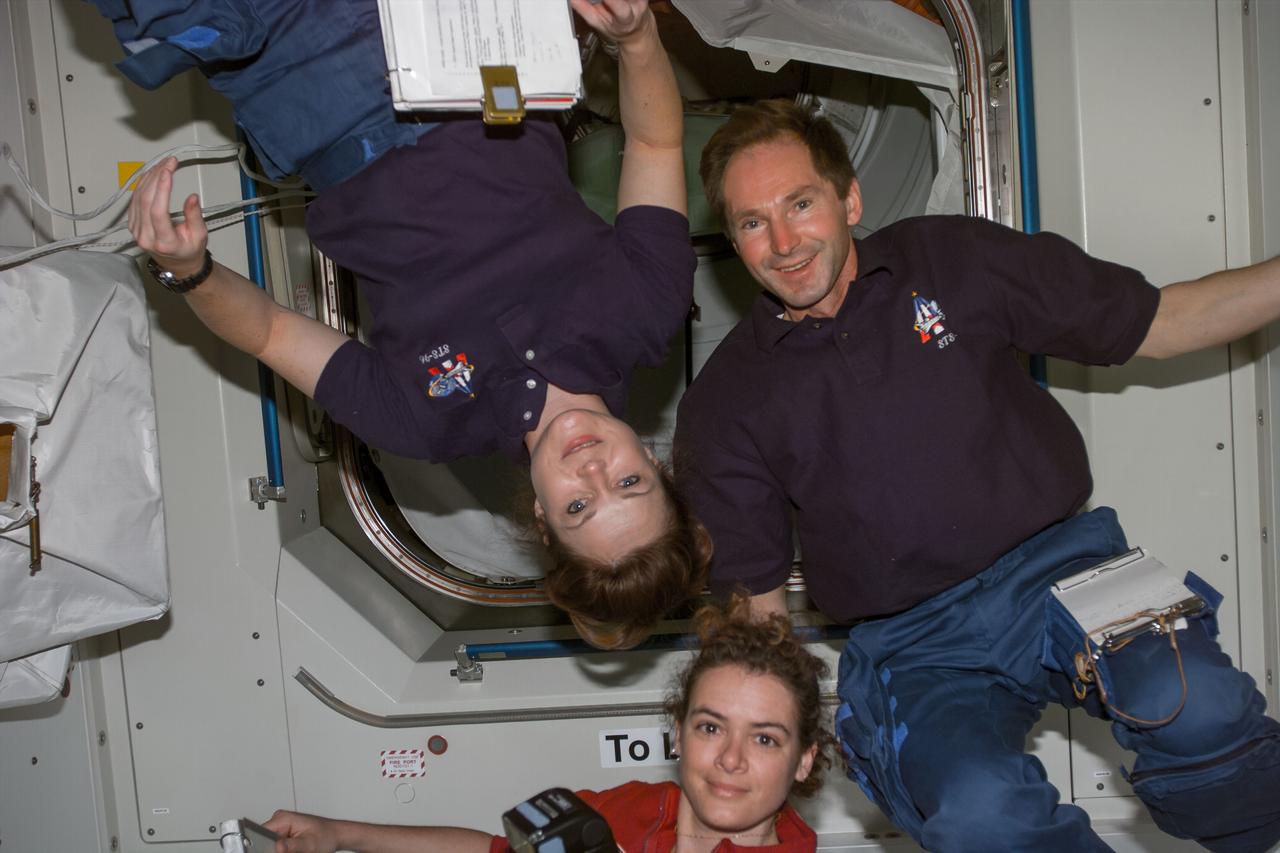
S96-E-5078 (31 May 1999) --- Flight Day 5 activity called for some of Discovery's crew members to work in the Unity node, part of the International Space Station (ISS). From the left are astronauts Tamara Jernigan and Julie Payette, along with cosmonaut Valery I. Tokarev. Payette represents the Canadian Space Agency (CSA) and Tokarev is with the Russian Space Agency (RSA). The photo was taken at 01:50:38, May 31, 1999.
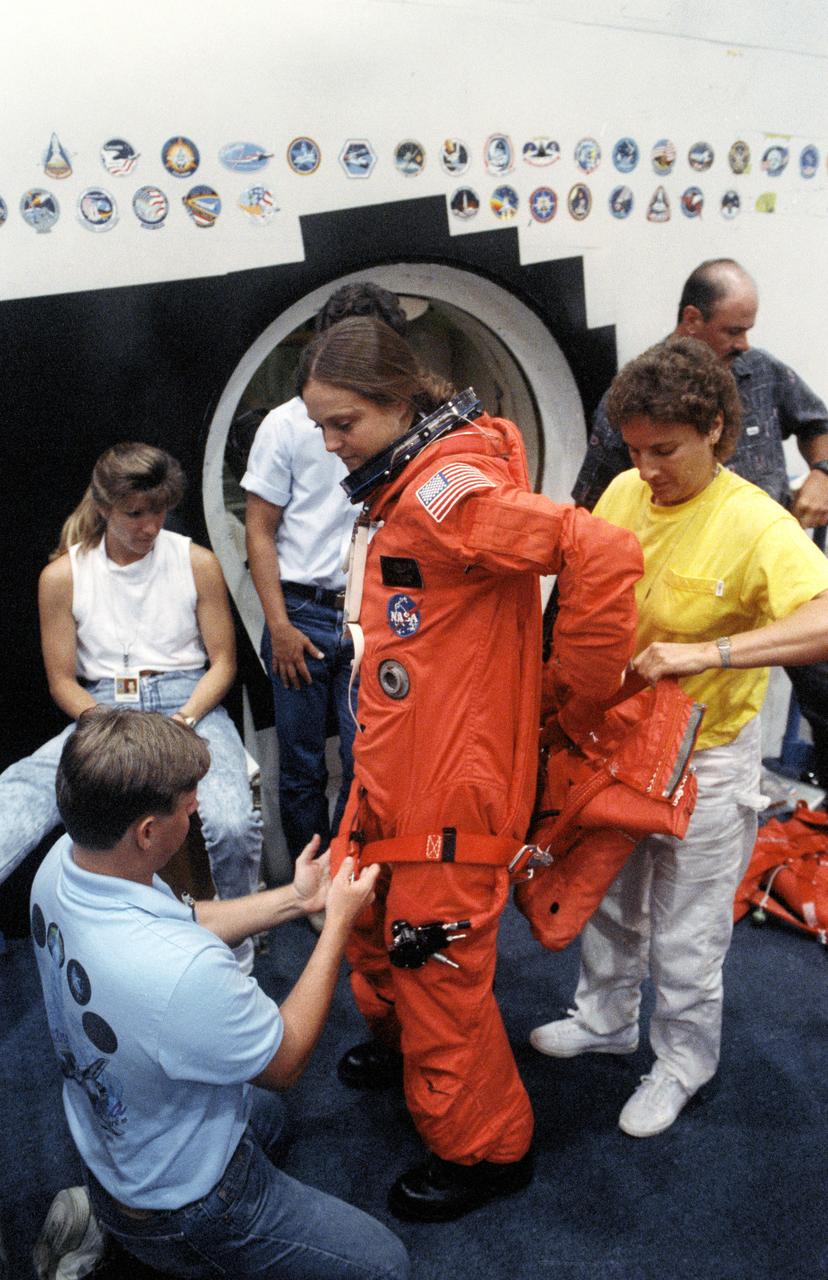
S90-41359 (11 June 1990) --- Astronaut James P. Bagian, STS-40 mission specialist, is seen in his partial pressure ascent/entry suit during a training exercise in the Johnson Space Center's Shuttle mockup and integration laboratory. Dr. Bagian will be joined on the Spacelab Life Sciences (SLS-1) mission, scheduled for launch in less than a year, by astronauts Bryan D. O'Connor, Sidney M. Gutierrez, Rhea Seddon and Tamara E. Jernigan, along with payload specialists F. Drew Gaffney and Millie Hughes-Fulford.
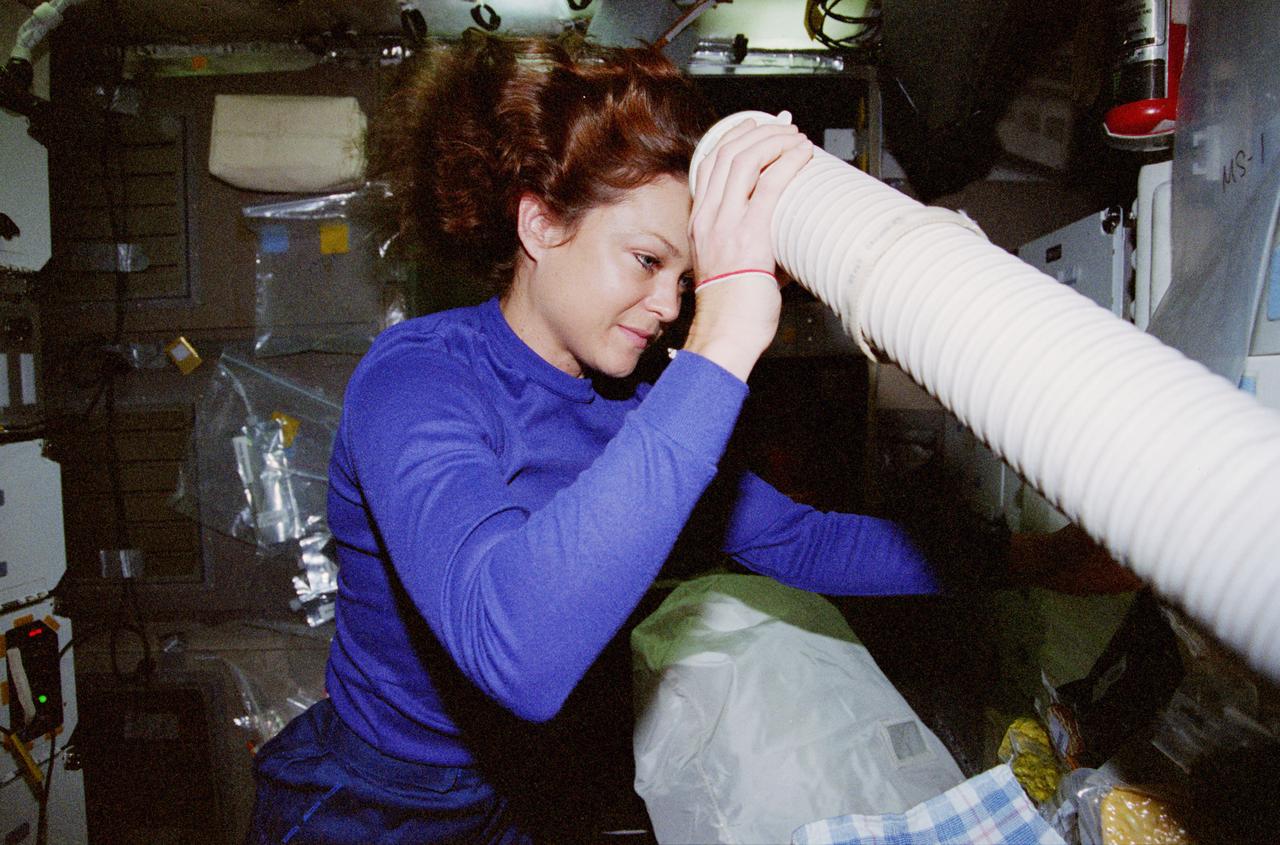
STS080-361-007 (19 Nov.-7 Dec. 1996) --- Astronaut Tamara E. Jernigan, STS-80 mission specialist, improvises onboard the space shuttle Columbia. Having just washed her hair, Jernigan temporarily "borrowed" a duct from the orbiter's air conditioning system to dry it. The off-duty activity was recorded with a 35mm camera.
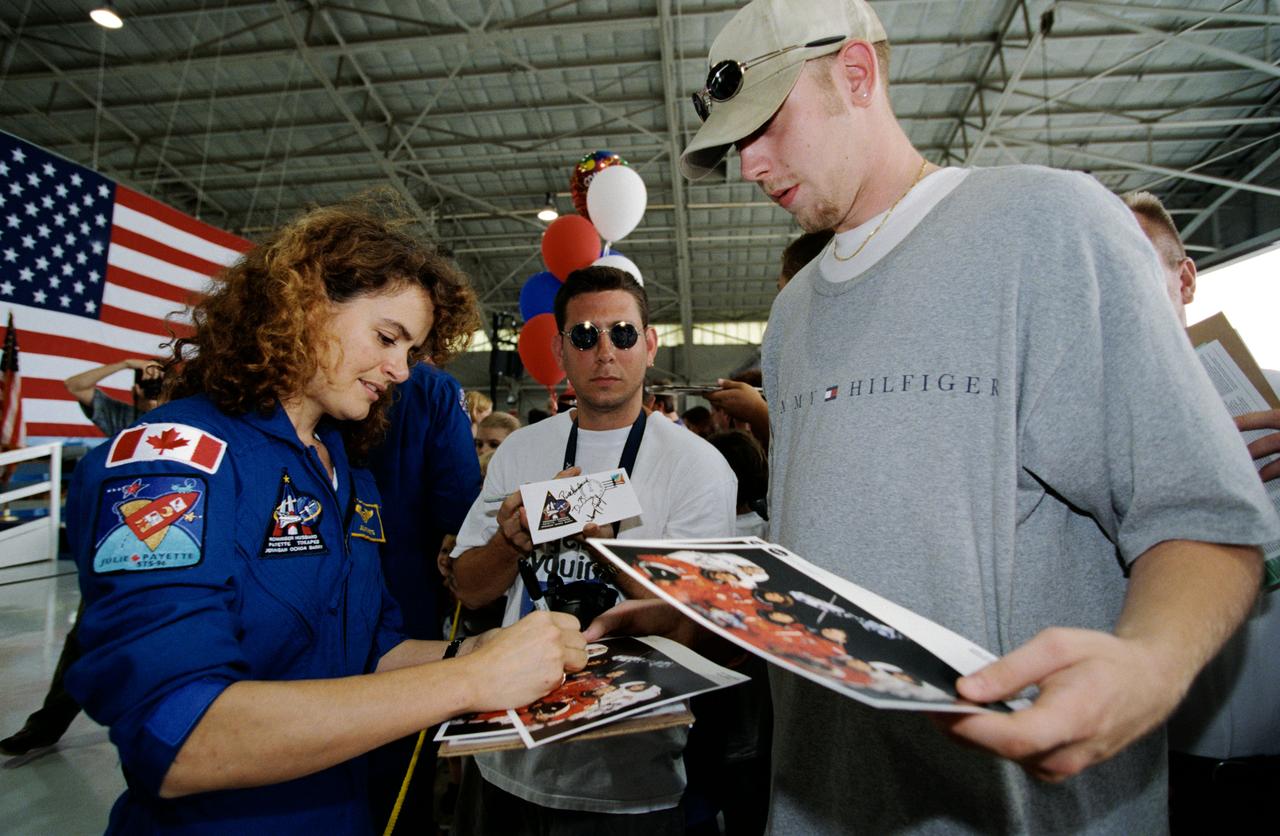
Photographic documentation showing the STS-96 crew return ceremony at Ellington Field. Views include: pilot Rick D. Husband with his two children, Mission Specialist (MS) Daniel T. Barry is partially visible behind him (05966); MS Ellen Ochoa holds a baby (05967); slanted side view of the stage with mission commander Kent V. Rominger at the podium, and seated behind him (left to right): Mr. George Abbey, JSC director, MS Valery Tokarev, MS Julie Payette, MS Daniel T. Barry, MS Ellen Ochoa, MS Tamara E. Jernigan and pilot Rick D. Husband (05968); Payette sign photographs for visitors (05969); Tokarev at the podium (05970); Husband at the podium (05971); Ochoa at the podium (05972); Rominger at the podium (05973); Tokarev signs photographs for visitors (05974); front, wide shot showing MS Tamara E. Jernigan at the podium, and seated behind her (left to right); Mr. George Abbey, MS Valery Tokarev, MS Julie Payette, MS Daniel T. Barry, MS Ellen Ochoa, pilot Rick D. Husband and mission commander Kent V. Rominger (05975); Jernigan signs photographs for visitors (05976).
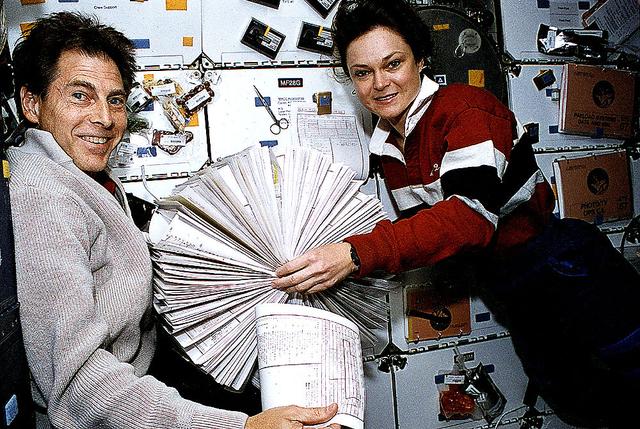
Astronaut Tamara Jernigan, STS-67 payload commander, and payload specialist Samuel T. Durrance use the absence of gravity for a perusal of Astro-2 targets in a loose-leaf, Rolodex-type collection of data. The two are in the mid-deck of the Earth-orbiting Space Shuttle Endeavour.
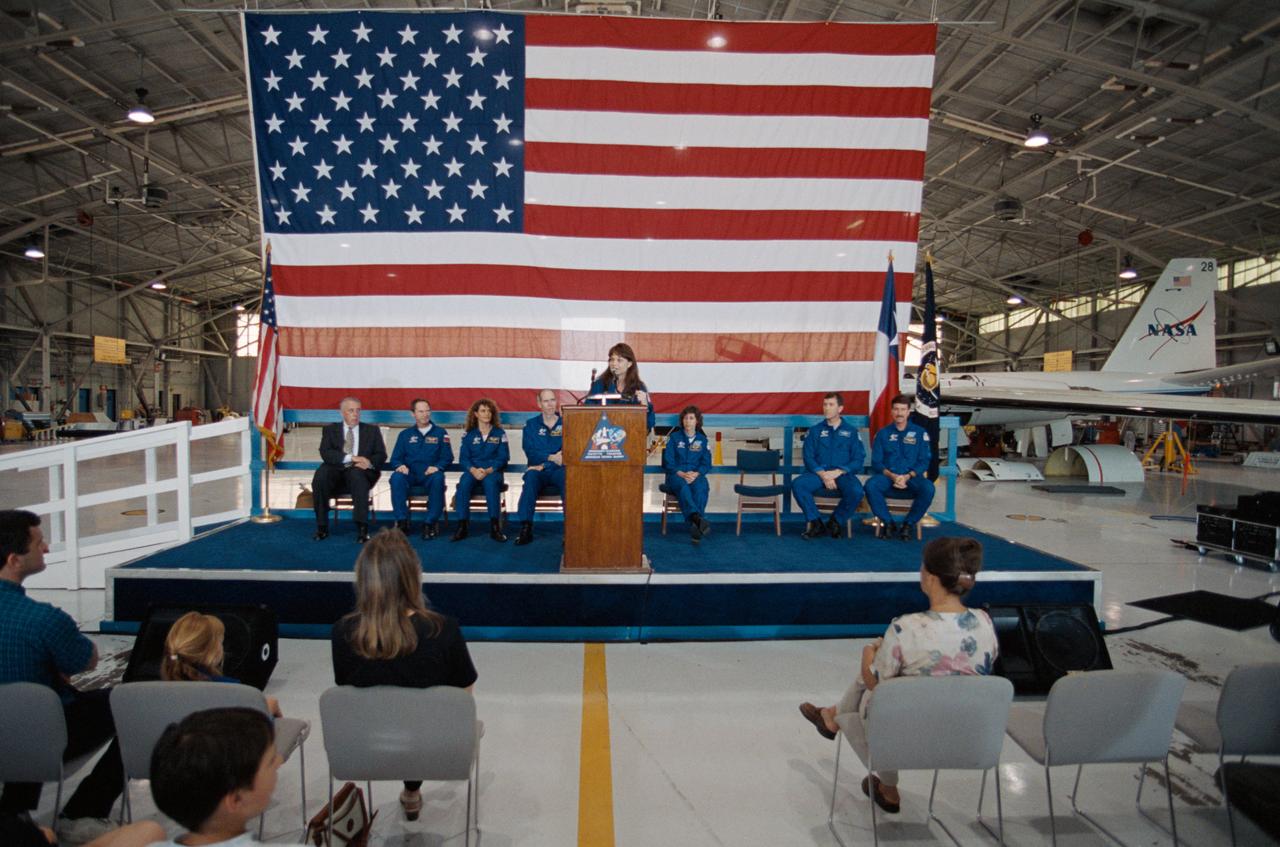
S99-05975 (7 June 1999) --- Astronaut Tamara E. Jernigan takes her turn at the lectern in Ellington Field's Hangar 990. Her six crew mates and JSC Director George W.S. Abbey, all seated behind, also spoke to the crowd gathered for the welcome home ceremonies.
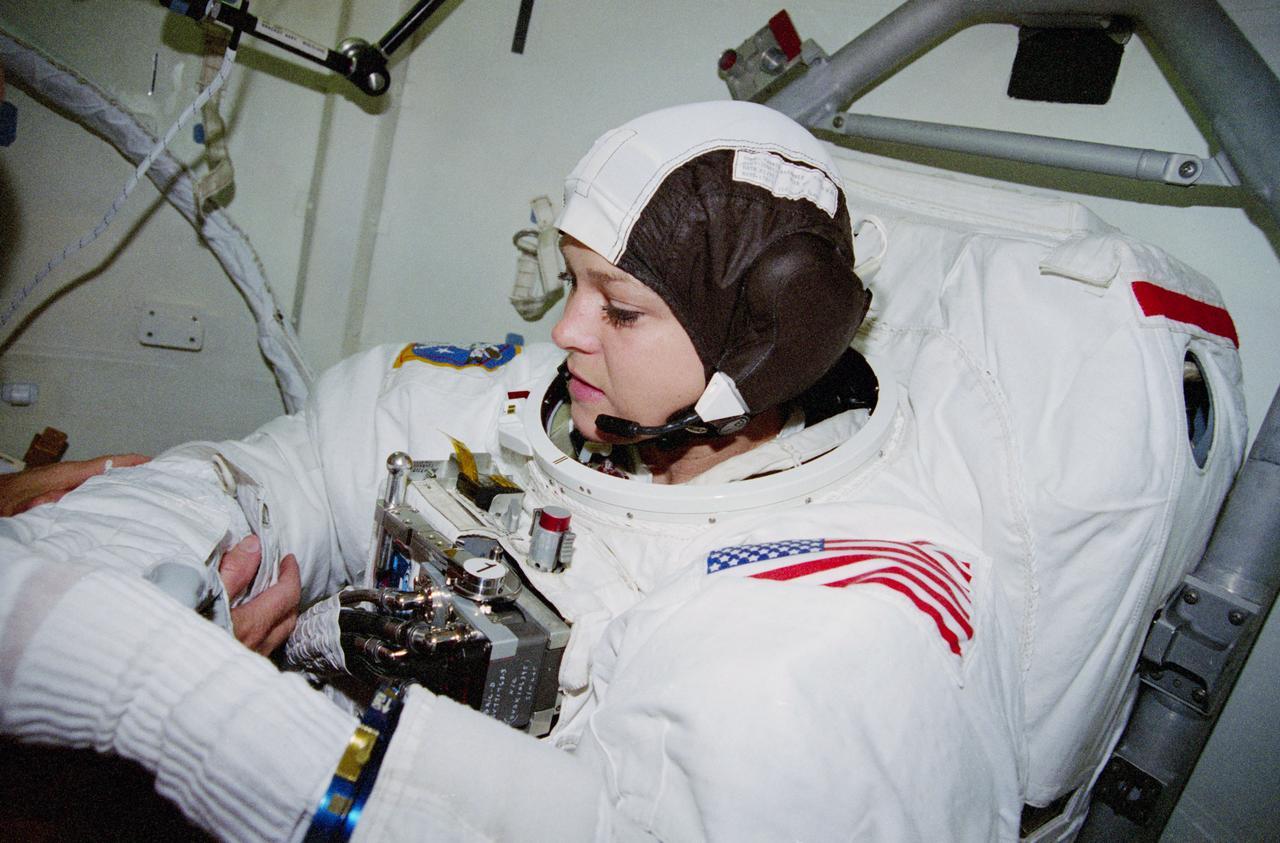
STS080-312-027 (28 Nov. 1996) --- Astronaut Tamara E. Jernigan uses the assistance of astronaut Story Musgrave (out of frame, left) during suit donning for a scheduled Extravehicular Activity (EVA). Unfortunately, the EVA was canceled after the astronauts were unable to open the Space Shuttle Columbia's hatch leading to the cargo bay.
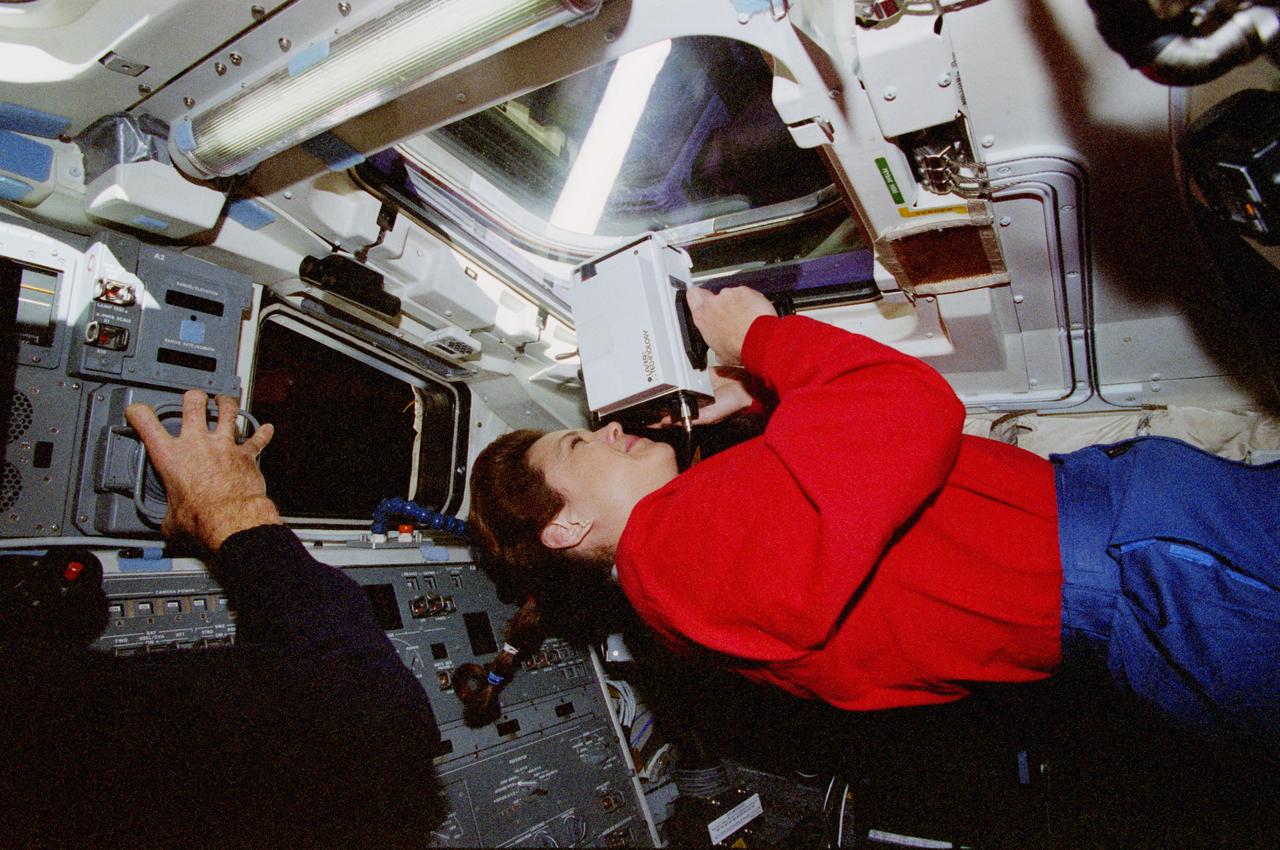
STS080-370-022 (19 Nov.-7 Dec. 1996) --- Astronaut Tamara E. Jernigan, STS-80 mission specialist, uses a laser ranging device during the space shuttle Columbia's rendezvous operations with the Orbiting Retrievable Far and Extreme Ultraviolet Spectrometer - Shuttle Pallet Satellite (ORFEUS-SPAS).
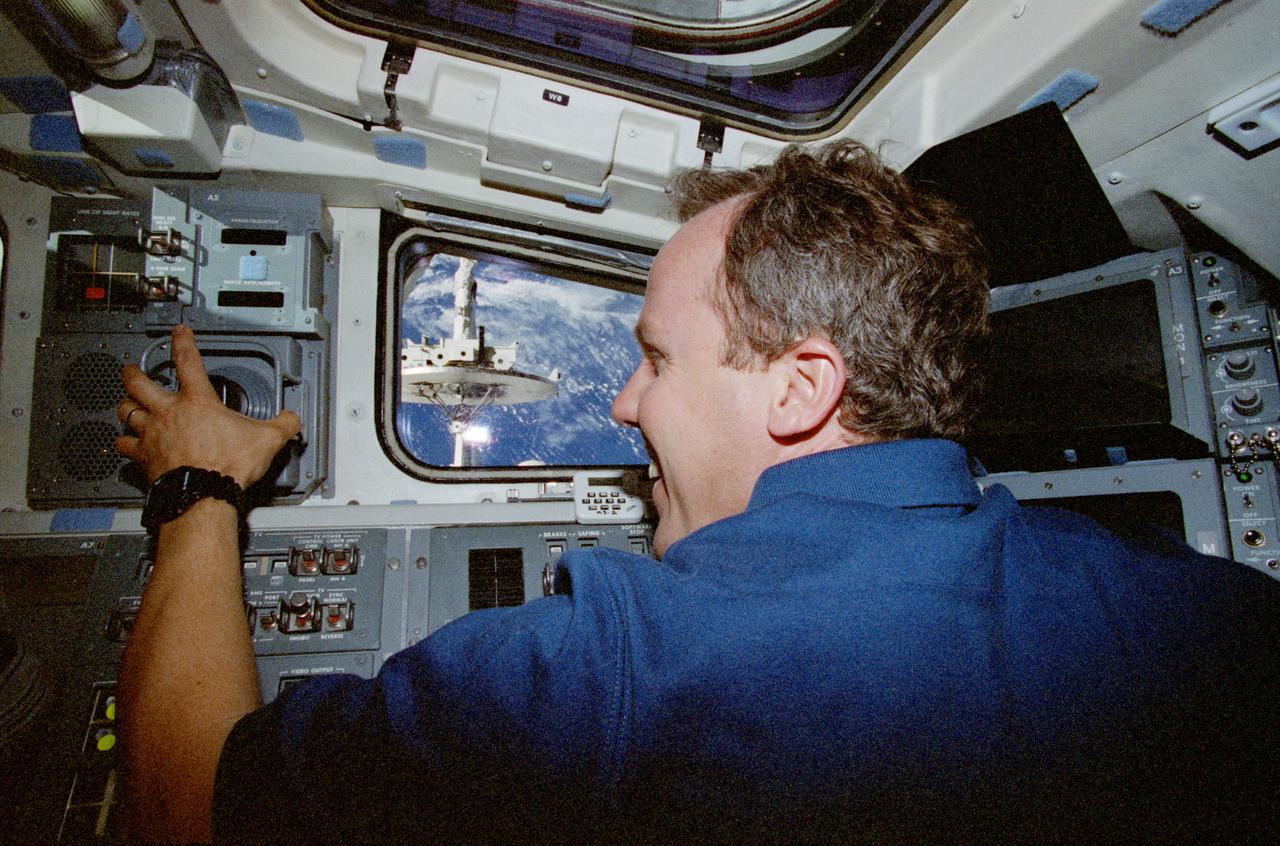
STS080-337-026 (19 Nov.-7 Dec. 1996) --- Astronaut Thomas D. Jones, STS-80 mission specialist, uses the controls of the space shuttle Columbia's Remote Manipulator System (RMS) to conduct a test with the captured Wake Shield Facility (WSF) seen through window at frame center.
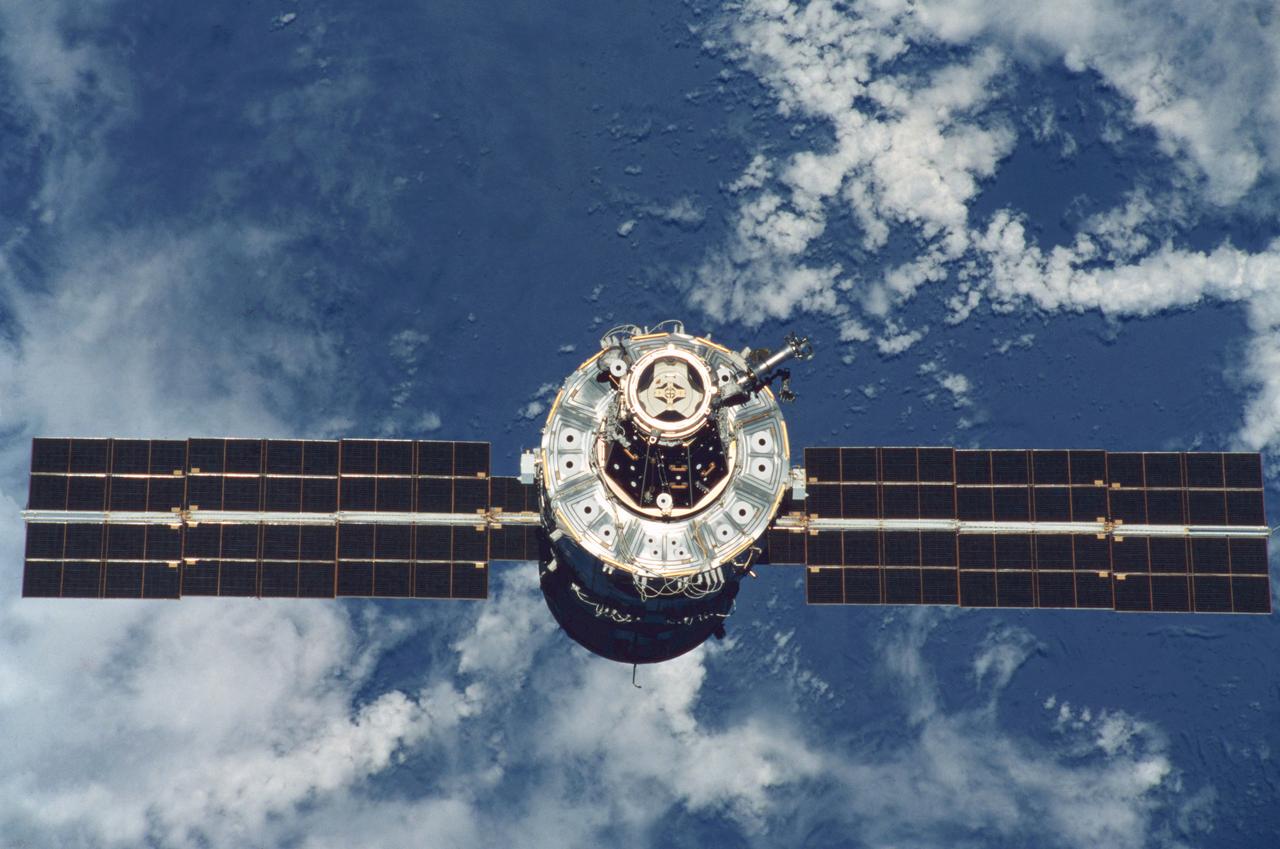
STS096-345-033 (3 June 1999) --- A STS-96 crew member aboard Discovery handling a 35mm camera recorded this image of the International Space Station (ISS) during a fly-around following separation of the two spacecraft. A portion of the work performed on the May 30 space walk by astronauts Tamara E. Jernigan and Daniel T. Barry is evident in the photo, including the installation of the Russian-built crane (called Strela).

STS096-712-034 (3 June 1999) --- A STS-96 crew member aboard Discovery handling a 70mm camera recorded this image of the International Space Station (ISS) during a fly-around following separation of the two spacecraft. A portion of the work performed on the May 30 space walk by astronauts Tamara E. Jernigan and Daniel T. Barry is evident in the photo, including the installation of the Russian-built crane (called Strela).

STS080-701-004 (19 Nov.-7 Dec. 1996) --- The STS-80 crew used a pre-set 70mm camera onboard the space shuttle Columbia's middeck to record its traditional inflight crew portrait. Back row, left to right, astronauts Kenneth D. Cockrell, mission commander; Tamara E. Jernigan, mission specialist; and Kent V. Rominger, pilot. Front row, astronauts Thomas D. Jones (left) and Story Musgrave, both mission specialists.
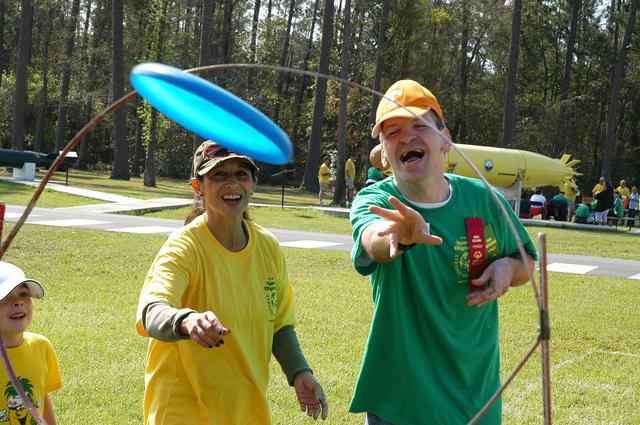
Chris Jernigan from Biloxi Community Homes throws a flying disc through a target during the 2011 John C. Stennis Area III Track and Field Competitions on March 19, as NASA employee Jacqueline Wall offers encouragement. Stennis Space Center is an annual host for the Special Olympics games. Wall was one of a number of Stennis employees to serve as volunteers during the annual competition.
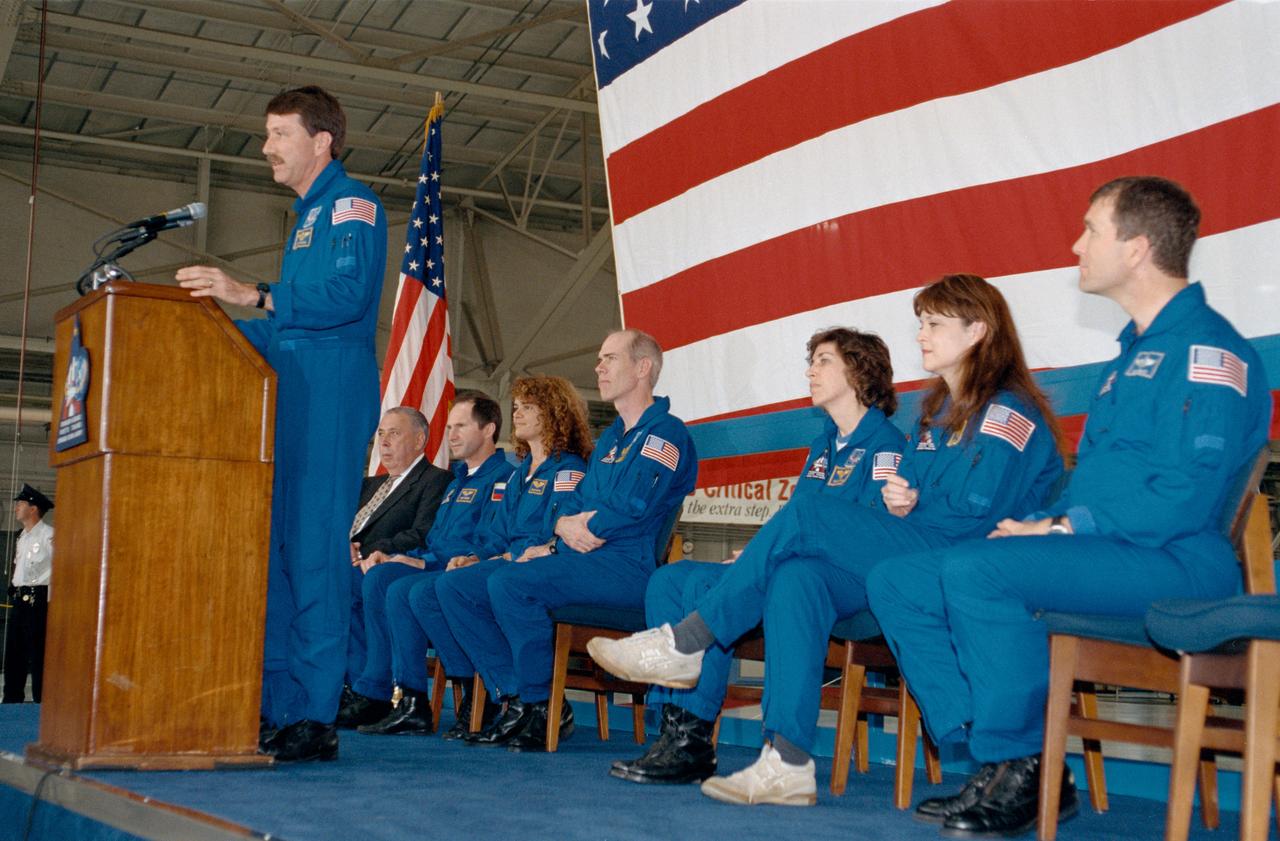
S99-05968 (7 June 1999) --- Astronaut Kent V. Rominger, mission commander, speaks to crowd on hand at Ellington Field's Hangar 990 following crew arrival. In the background, from the left, are JSC Director George W.S. Abbey and cosmonaut Valeriy I. Tokarev along with astronauts Julie Payette, Daniel T. Barry, Ellen Ocoa and Tamara E. Jernigan, all mission specialists; and Rick D. Husband, pilot. Tokarev represents the Russian Space Agency (RSA) and Payette, the Canadian Space Agency (CSA).
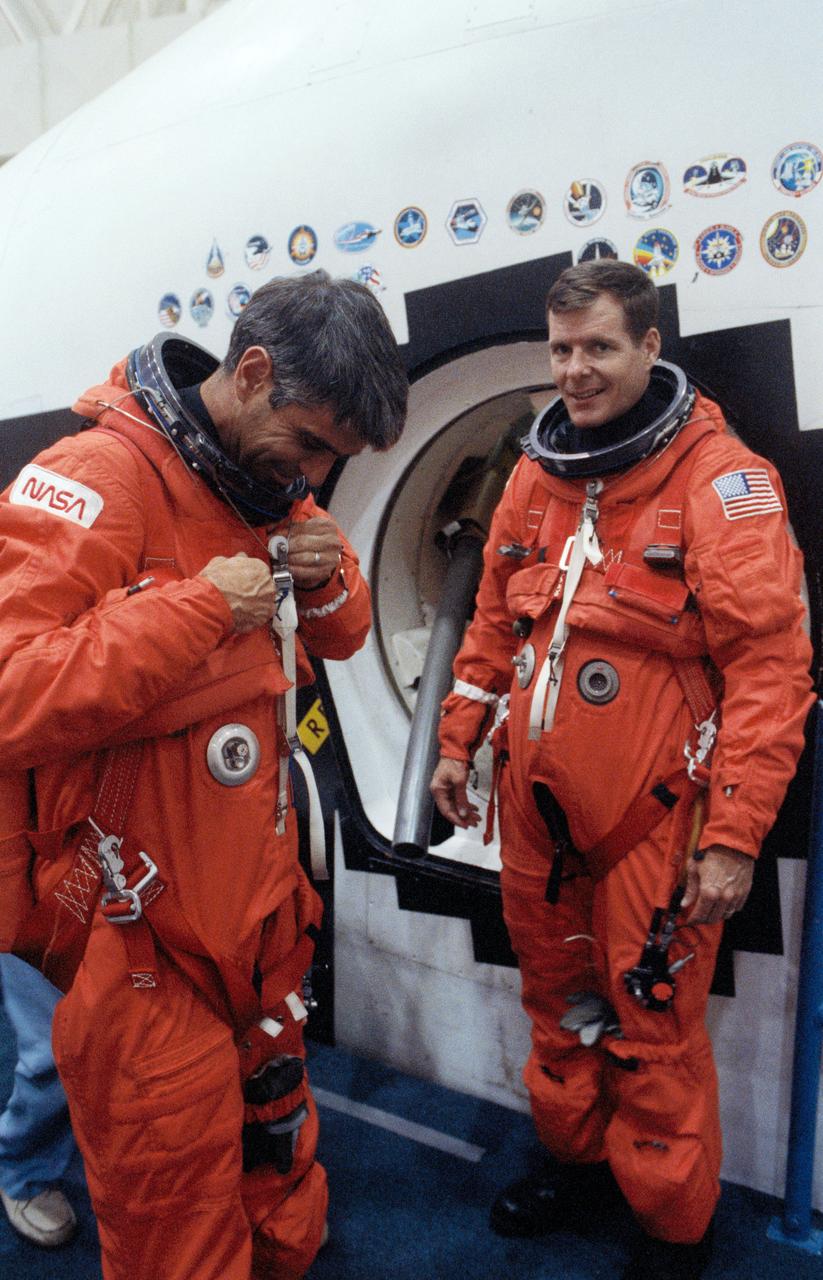
S90-41360 (11 June 1990) --- Two crewmembers assigned to NASA's Spacelab Life Sciences (SLS-1)/STS-40 mission are pictured during emergency egress training in the Shuttle mockup and integration laboratory at the Johnson Space Center (JSC). Seen are astronauts Sidney M. Gutierrez (left) pilot, and Bryan D. O'Connor, mission commander. Out of frame are astronauts Rhea Seddon, James P. Bagian, Tamara E. Jernigan, all mission specialists; and payload specialists Millie Hughes-Fulford and F. Drew Gaffney.

House Majority Leader U.S. Rep. Steny Hoyer, D-Md., left, holds up an award presented to him by Mark Riccobono, executive director of the Jernigan Institute of the National Federation of the Blind at a ceremony where senior NASA officials presented the NFB with two Louis Braille Bicentennial Silver Dollars that flew on Space Shuttle Atlantis' mission (STS-125) to the Hubble Space Telescope in May 2009, Friday evening, July 31, 2009, at the Capitol Visitors Center in Washington. Photo Credit: (NASA/Paul E. Alers)
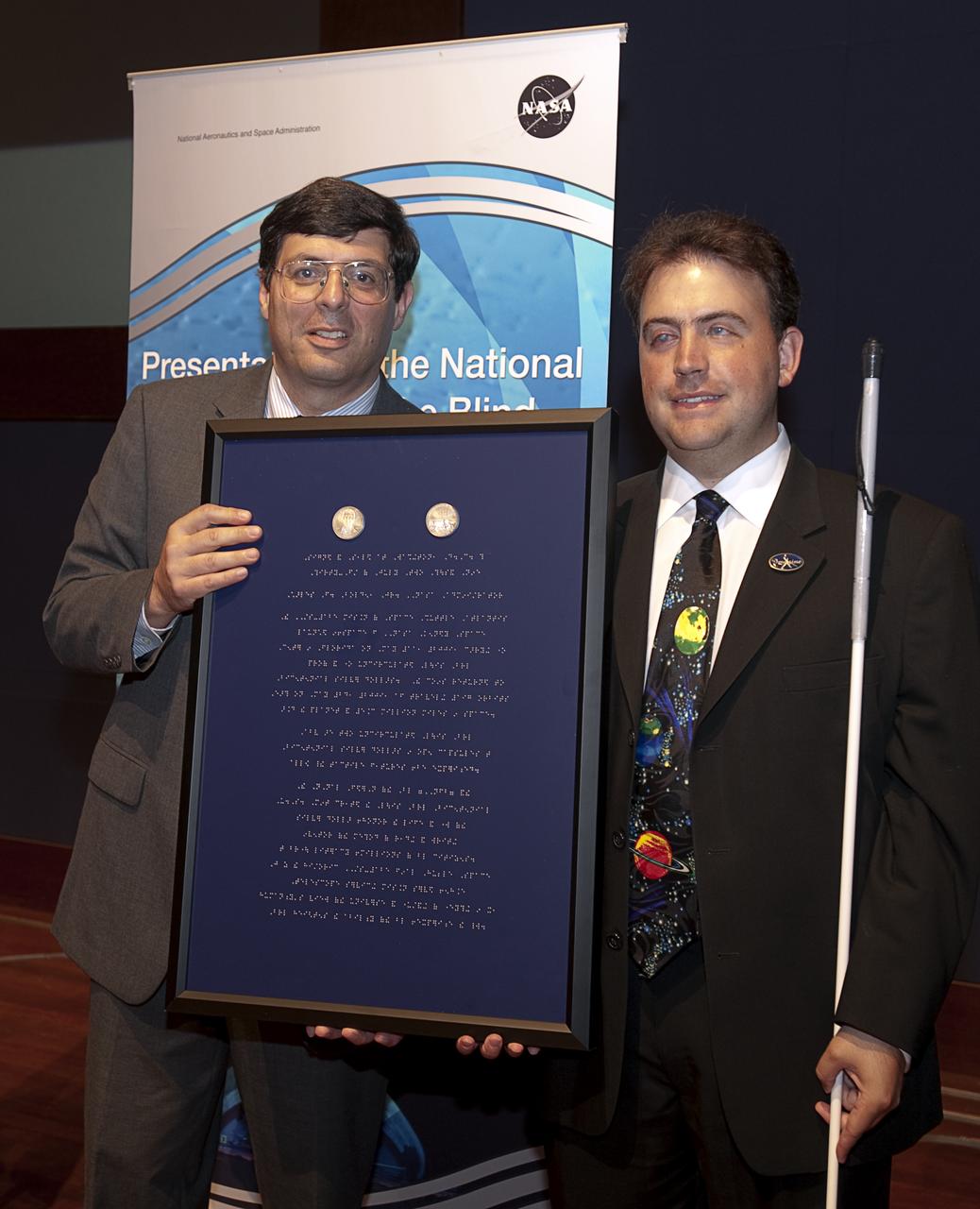
NASA Associate Administrator Chris Scolese, left, and Mark Riccobono, executive director of the Jernigan Institute of the National Federation of the Blind hold up a Braille enscribed award with two Louis Braille Bicentennial Silver Dollars at a ceremony where senior NASA officials presented the NFB with coins that flew on Space Shuttle Atlantis' mission (STS-125) to the Hubble Space Telescope in May 2009, Friday evening, July 31, 2009, at the Capitol Visitors Center in Washington. Photo Credit: (NASA/Paul E. Alers)
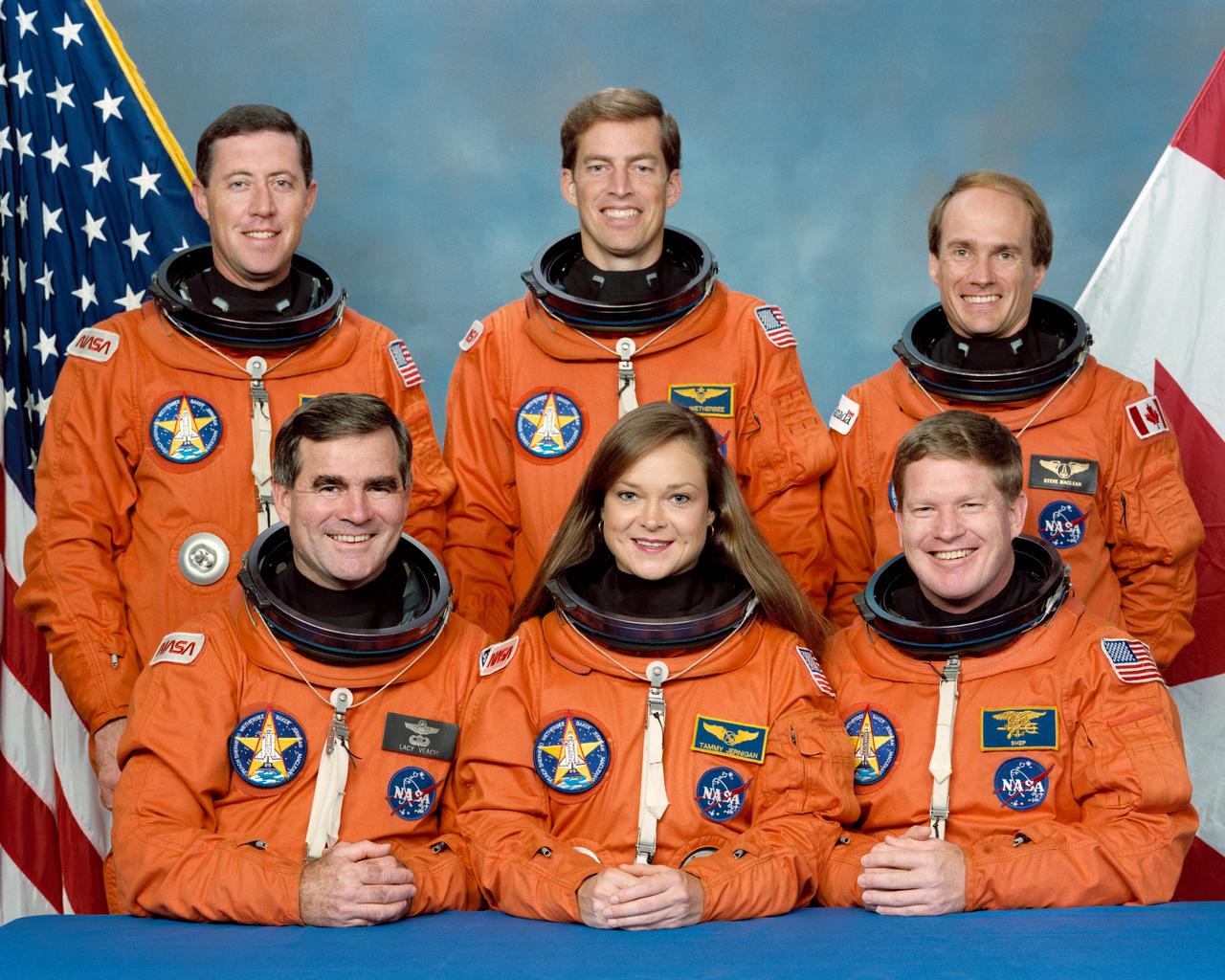
STS052-S-002 (August 1992) --- These five NASA astronauts and a Canadian payload specialist are assigned to the flight, scheduled for later this year. Pictured on the back row are, left to right, astronauts Michael A. Baker, pilot; James D. Wetherbee, mission commander; and Steven G. MacLean, payload specialist representing the Canadian Space Agency (CSA). In front are, left to right, astronauts Charles L. (Lacy) Veach, Tamara E. Jernigan and William M. Shepherd, all mission specialists.
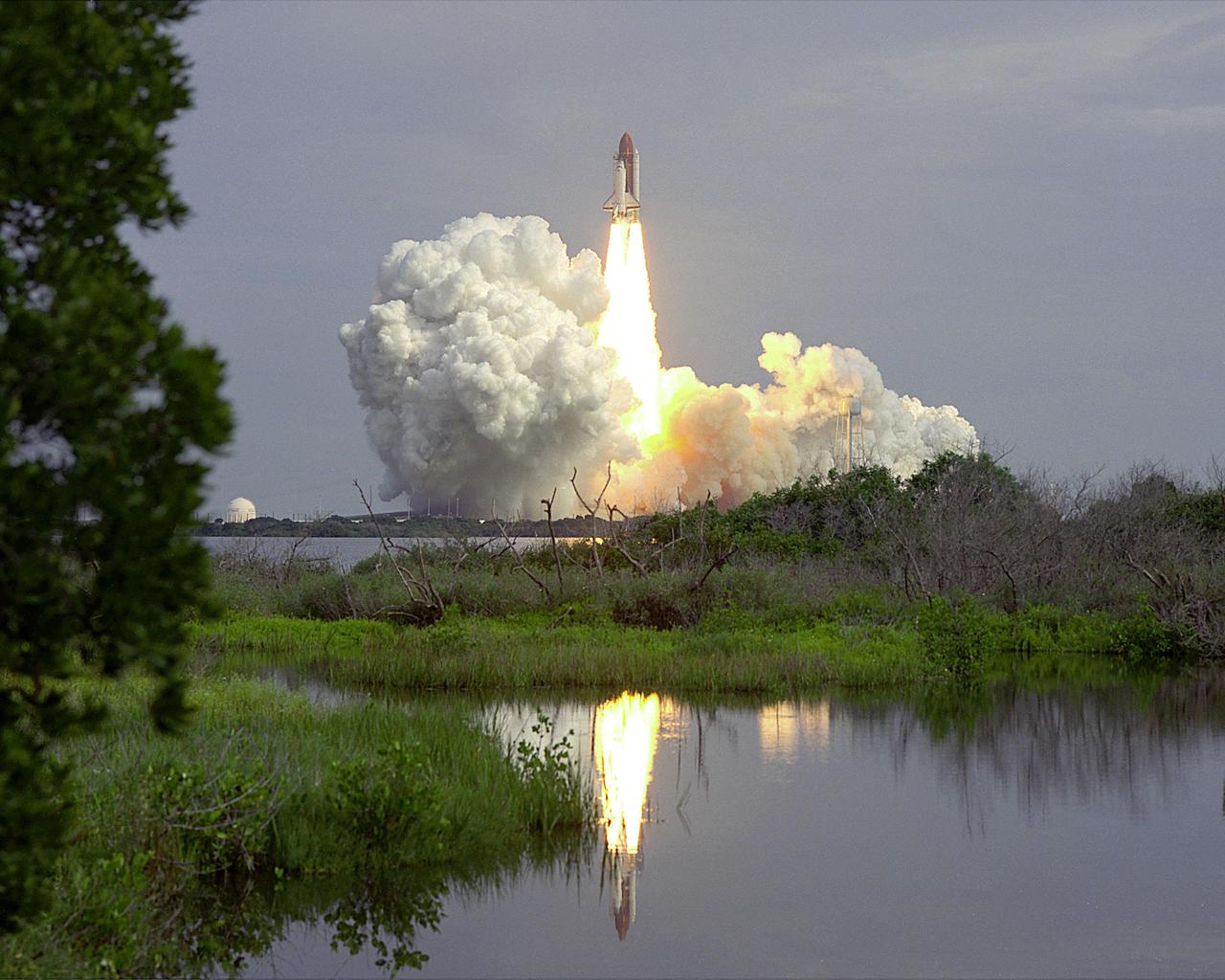
KENNEDY SPACE CENTER, FLA. -- Columbia launches on mission STS-40. Carrying Spacelab Life Sciences-1, it is the first dedicated solely to life sciences, using the habitable module. The crew of seven comprises Commander Bryan D. O'Connor, Pilot Sidney M. Gutierrez, Mission Specialists James P. Bagian, Tamara E. Jernigan and M. Rhea Seddon, and Payload Specialists F. Drew Gaffney and Millie Hughes-Fulford.
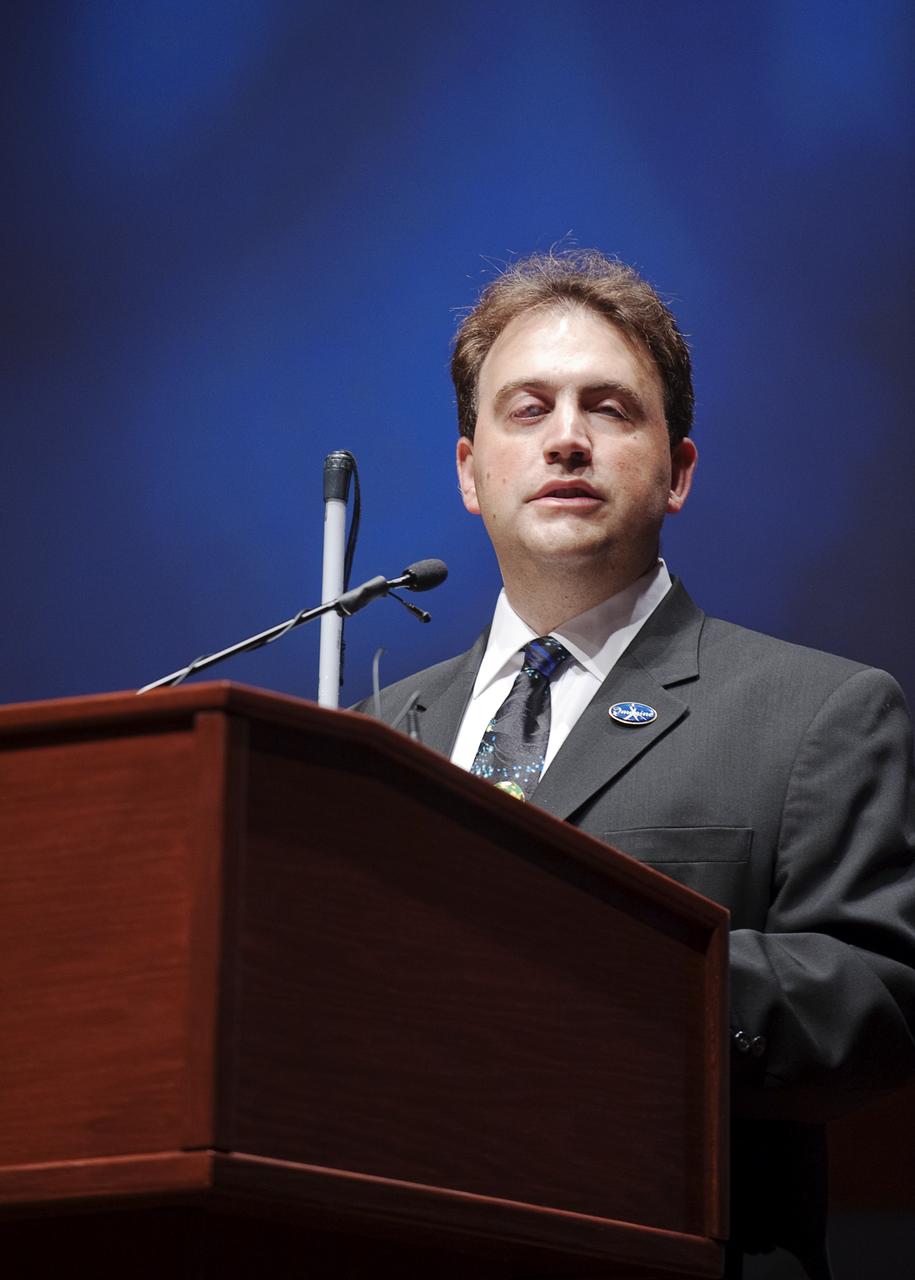
Mark Riccobono, executive director of the Jernigan Institute of the National Federation of the Blind speaks at a ceremony where senior NASA officials presented the NFB with two Louis Braille Bicentennial Silver Dollars that flew on Space Shuttle Atlantis' mission (STS-125) to the Hubble Space Telescope in May 2009, Friday evening, July 31, 2009, at the Capitol Visitors Center in Washington. Photo Credit: (NASA/Paul E. Alers)

STS080-S-002 (August 1996) --- These five NASA astronauts are in training for the STS-80 mission, scheduled for launch aboard the Space Shuttle Columbia in the fall of this year. From the left are astronauts Kent V. Rominger, pilot; Tamara E. Jernigan, Story Musgrave and Thomas D. Jones, all mission specialists; and Kenneth D. Cockrell, mission commander.
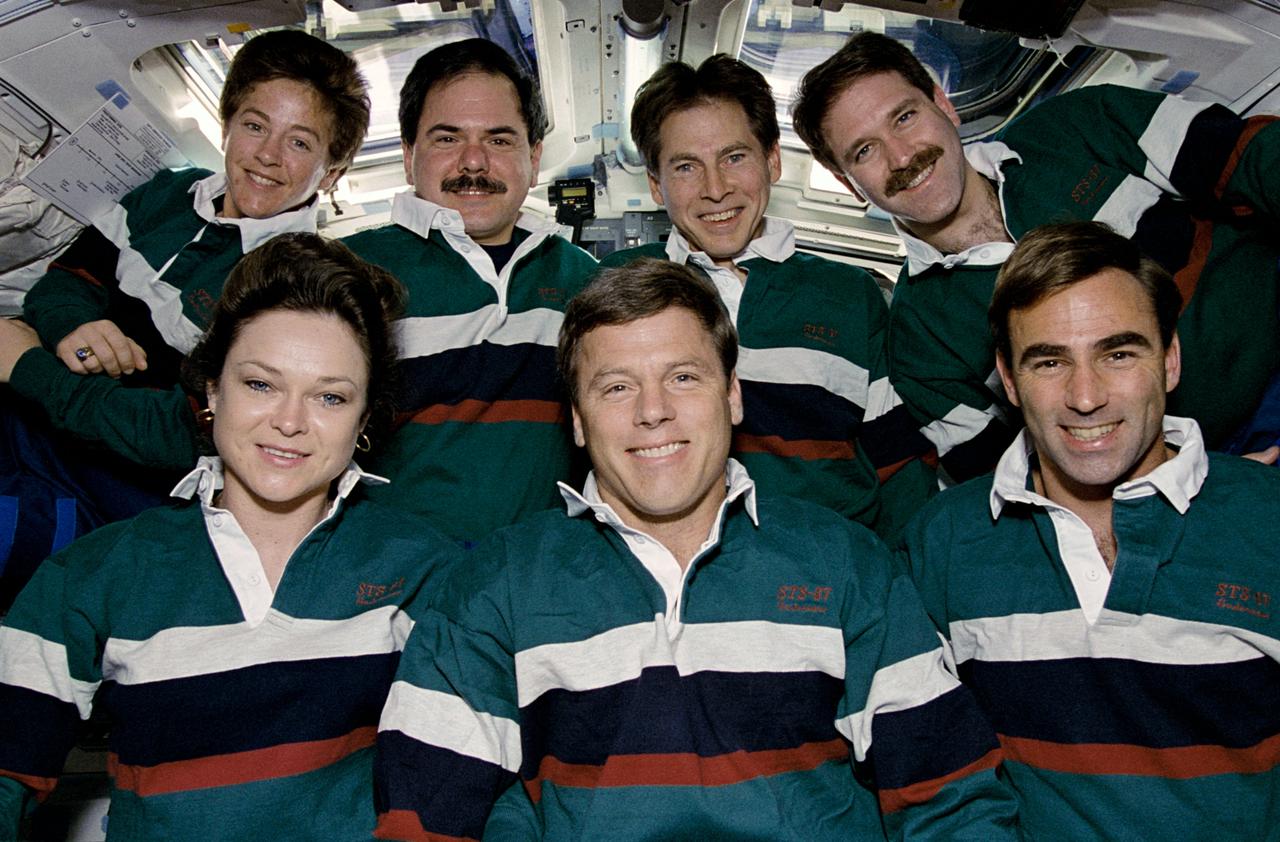
The STS-67/ASTRO-2 crew members pose for their traditional inflight portrait on the aft flight deck of the Earth orbiting Space Shuttle Endeavour. Left to right in the front are astronauts Tamara E. Jernigan, payload commander; Steven S. Oswald, mission commander; and William G. Gregory, pilot. Left to right on the back row are astronaut Wendy B. Lawrence, flight engineer; payload specialists Ronald A. Parise and Samuel T. Durrance; and John M. Grunsfeld, mission specialist.
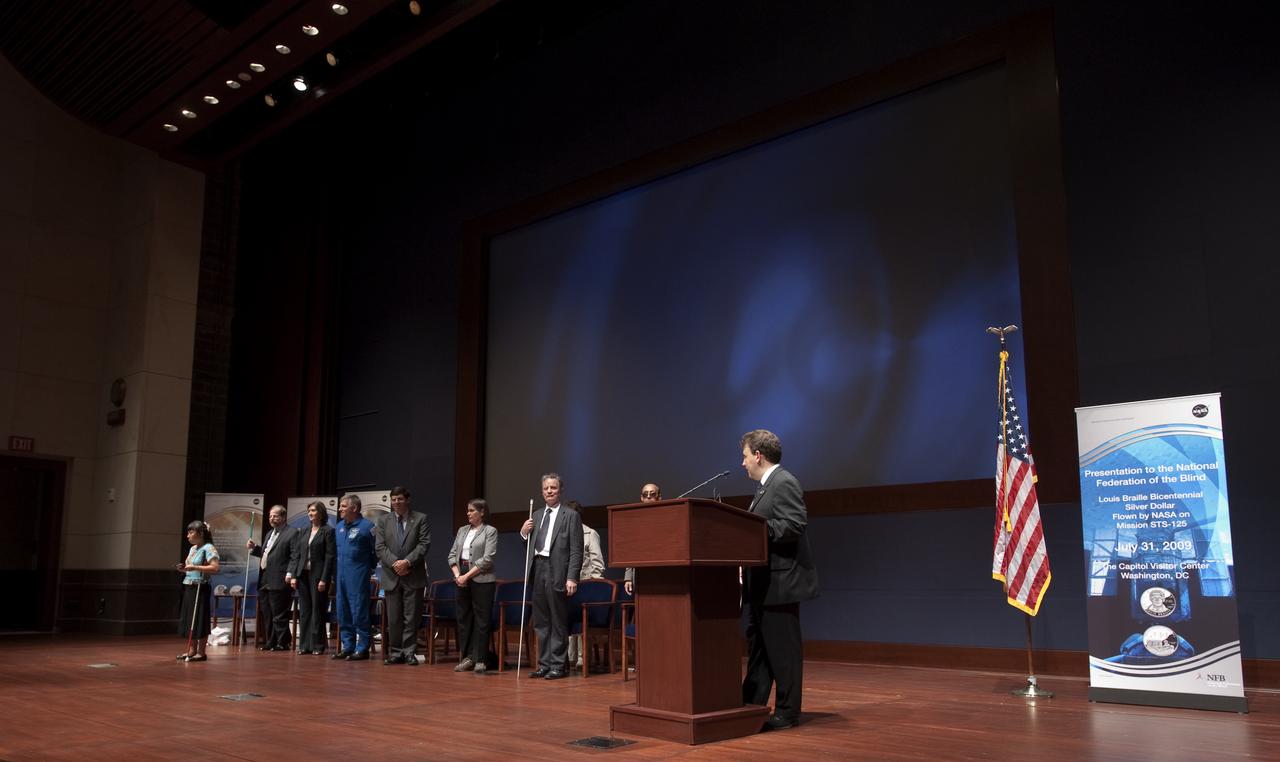
Mark Riccobono, executive director of the Jernigan Institute of the National Federation of the Blind, at podium, delivers remarks at a ceremony where senior NASA officials presented the NFB with two Louis Braille Bicentennial Silver Dollars that flew on Space Shuttle Atlantis' mission (STS-125) to the Hubble Space Telescope in May 2009, Friday evening, July 31, 2009, at the Capitol Visitors Center in Washington. Photo Credit: (NASA/Paul E. Alers)
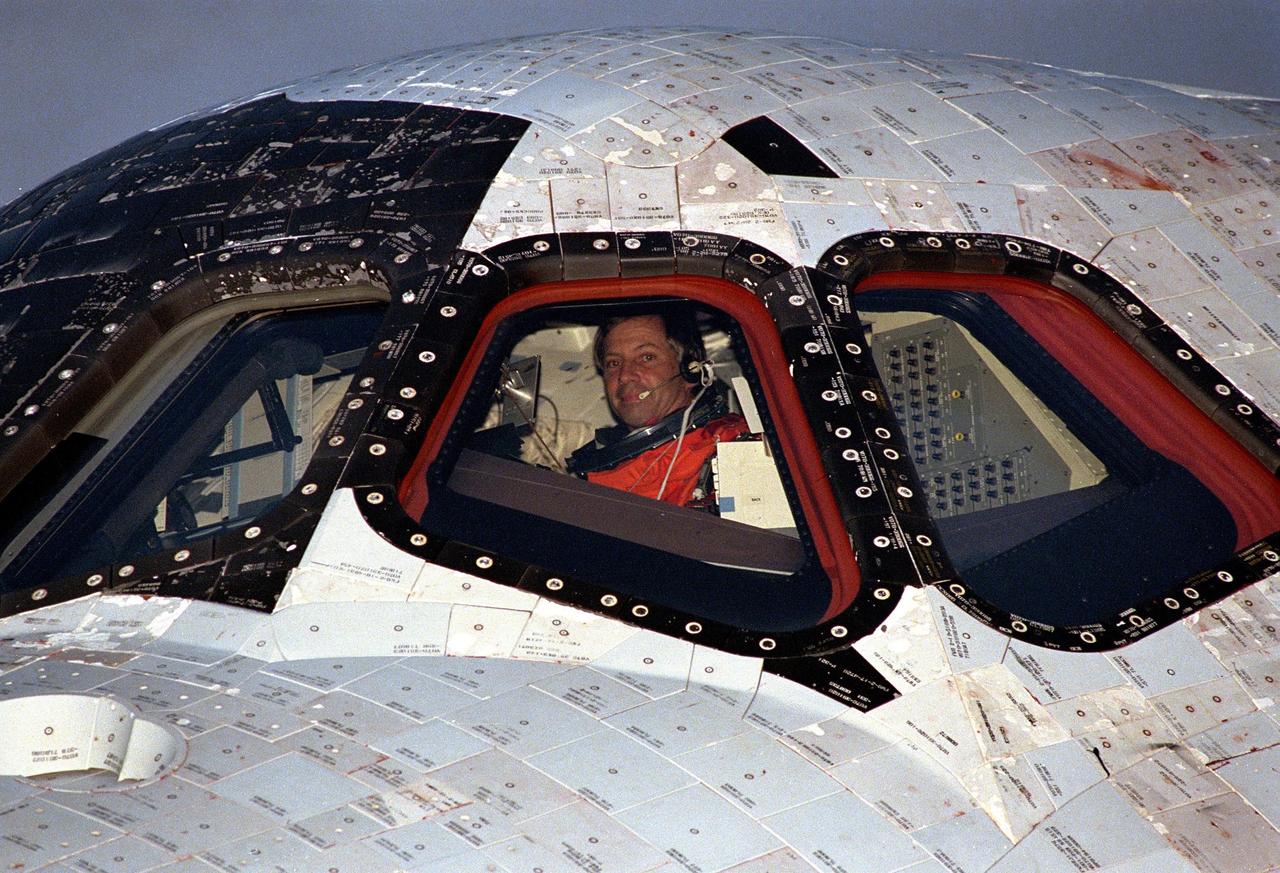
KENNEDY SPACE CENTER, FLA. -- STS-80 Commander Kenneth D. Cockrell peers out the window of the orbiter Columbia minutes after guiding the spacecraft to a successful landing on KSC’s Runway 33. Main gear touchdown occurred at 6:49:04 a.m. EST, Dec. 7. On board with Cockrell are four fellow crew members, Pilot Kent V. Rominger, and Mission Specialists Story Musgrave, Thomas D. Jones, and Tamara E. Jernigan, and the two primary payloads of the mission, the Wake Shield Facility-3 (WSF-3) and the Orbiting and Retrievable Far and Extreme Ultraviolet Spectrometer-Shuttle Pallet Satellite II (ORFEUS-SPAS II).
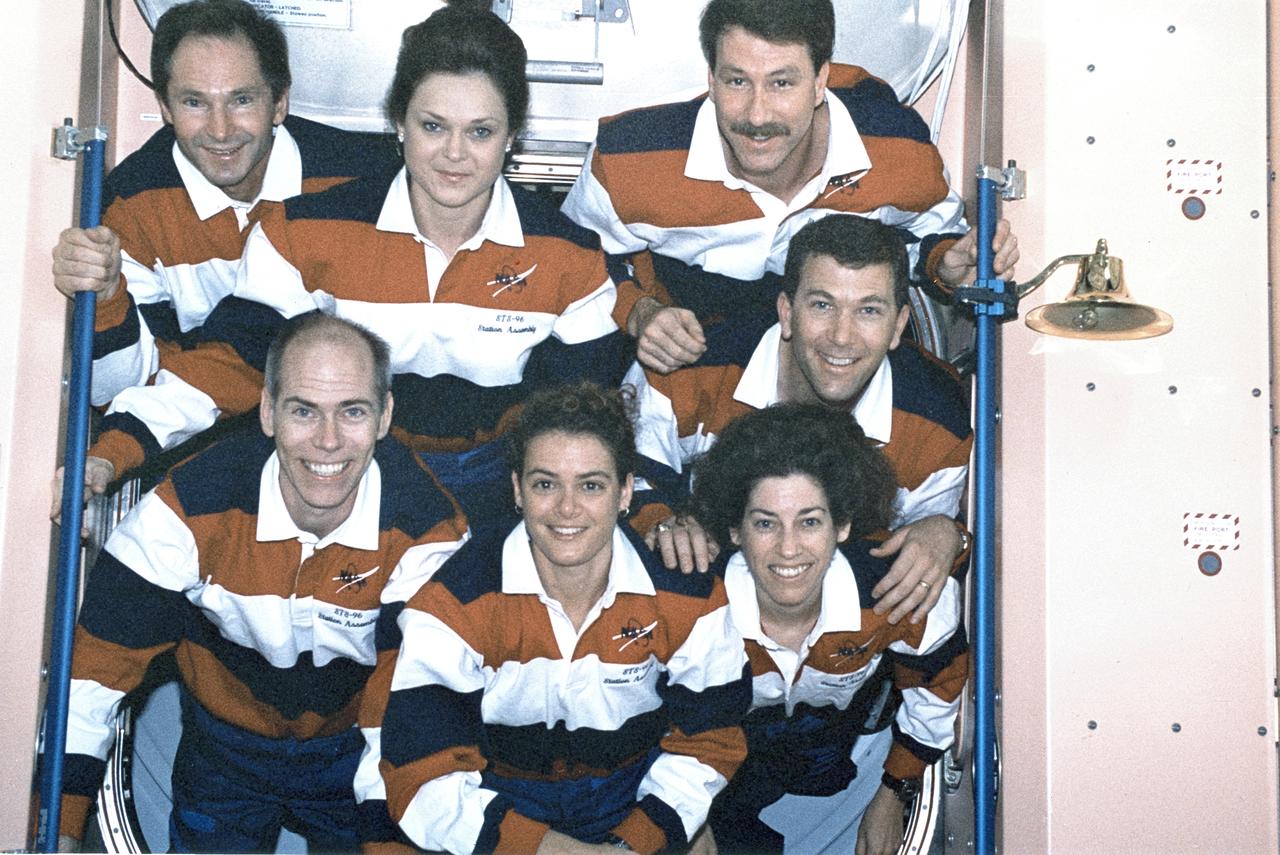
The STS-96 crew paused for an International Space Station (ISS) onboard group photo. Pictured on the bottom row (left to right) are Mission Specialists Daniel Barry, Julie Payette, and Ellen Ochoa. Pictured on the top row (left to right) are Cosmonaut Valery Ivanovich Tokarev, and Tamara Jernigan, Mission Specialists; Kent Rominger, Commander; and Rick Husband, Pilot. STS-96 was the second ISS assembly flight and the first flight to dock with the station. The 10 day mission crew launched aboard the Space Shuttle Orbiter Discovery on May 27, 1999.
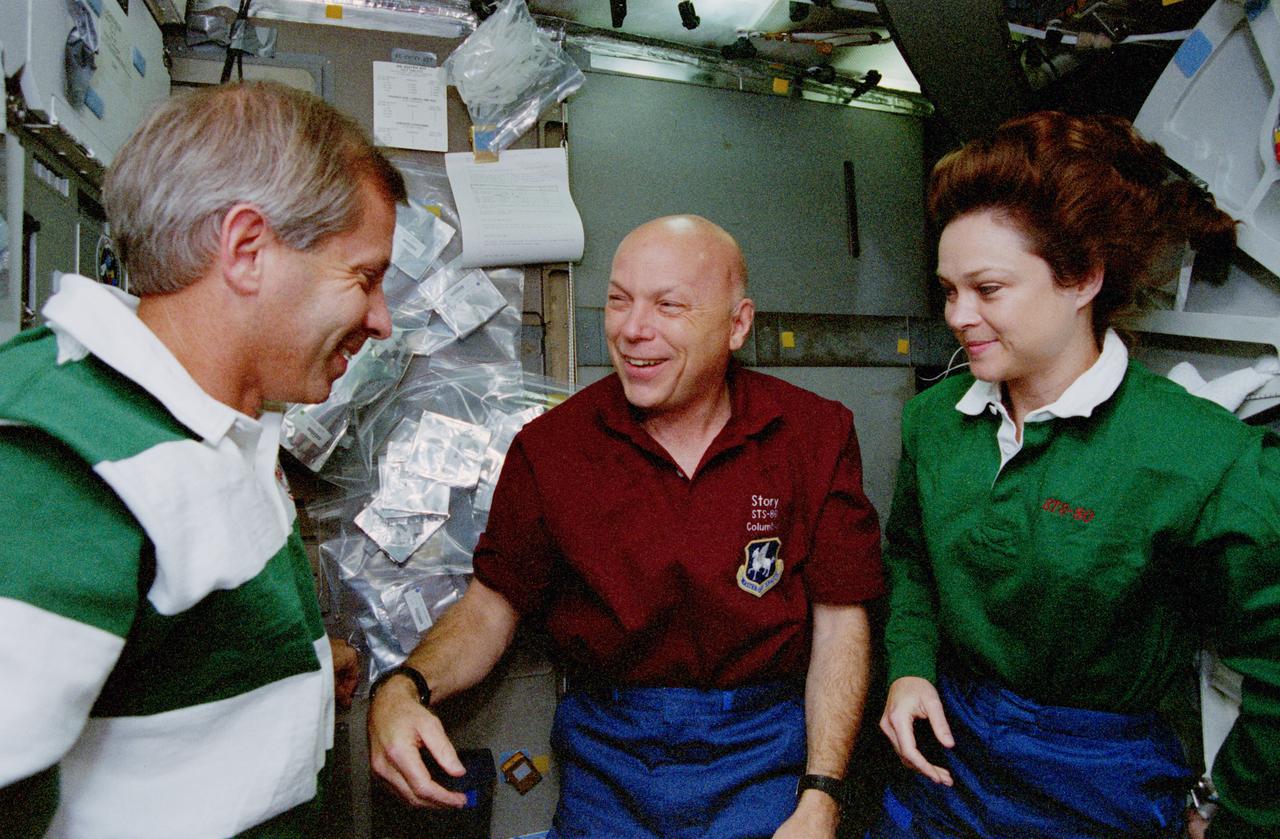
STS080-375-023 (19 Nov.-7 Dec. 1996) --- Astronauts Kenneth D. Cockrell, STS-80 mission commander, and Tamara E. Jernigan, payload commander, share a moment of off-duty time with astronaut Story Musgrave on the middeck of the Earth-orbiting space shuttle Columbia. Musgrave was making his sixth flight aboard the Space Shuttle as a mission specialist. His fellow crewmembers presented him with a patch that reads, "Master of Space." Before and during his 30 years with NASA, Musgrave obtained several academic degrees, including several Masters, a medical doctorate and several Ph.D.
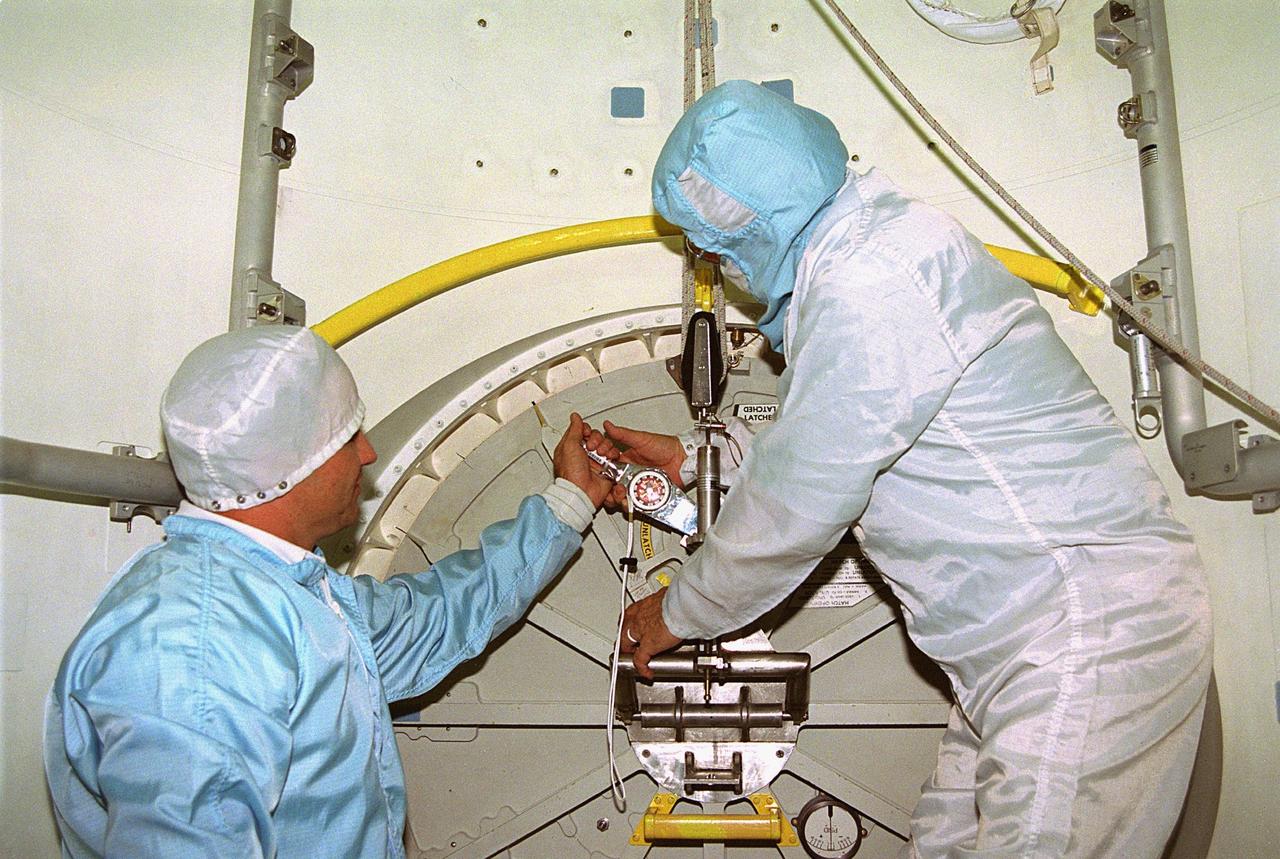
KENNEDY SPACE CENTER, FLA. -- In Orbiter Processing Facility Bay 1, United Space Alliance (USA) technicians Dave Lawrence, at left, and James Cullop troubleshoot the orbiter Columbia’s outer hatch of the airlock, which failed to open during the recent STS-80 Space Shuttle mission. Mission Specialists Tamara E. Jernigan and Thomas D. Jones did not perform the mission’s planned two extravehicular activities (EVAs) or spacewalks because the hatch would not open on orbit. The spacewalks were to be part of the continuing series of EVA Development Flight Tests to evaluate equipment and procedures and to build spacewalking experience in preparation for the International Space Station.
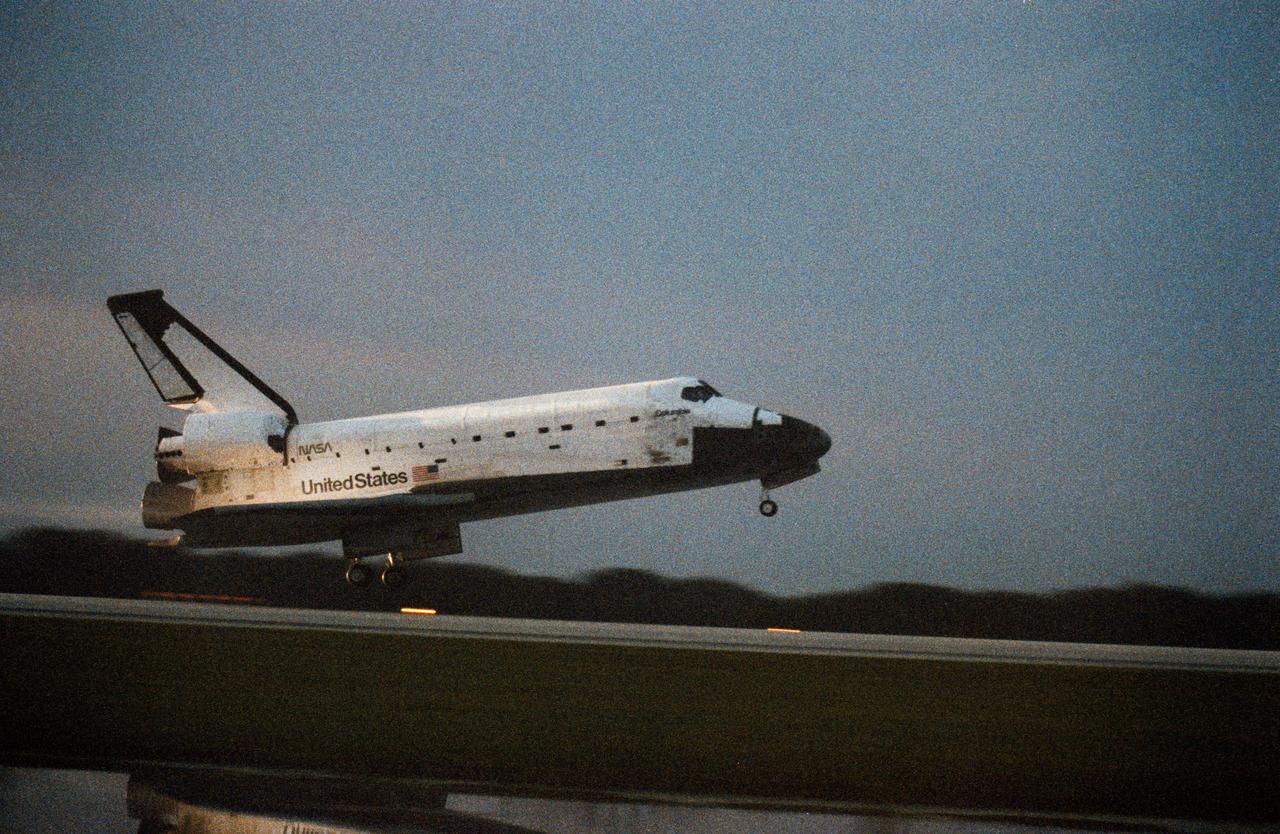
STS080-S-009 (7 Dec. 1996) --- Just prior to main gear touchdown, the space shuttle Columbia is pictured during landing on Runway 33 at the Kennedy Space Center's (KSC) Shuttle Landing Facility (SLF). Landing occurred at 6:49 a.m. (EST), Dec. 7, 1996 marking a total duration only eight hours short of 18 days. The landing is the 33rd at KSC for the Space Transportation System (STS). Crewmembers aboard were astronauts Kenneth D. Cockrell, mission commander; and Kent V. Rominger, pilot; along with Story Musgrave, Tamara E. Jernigan and Thomas D. Jones, all mission specialists.
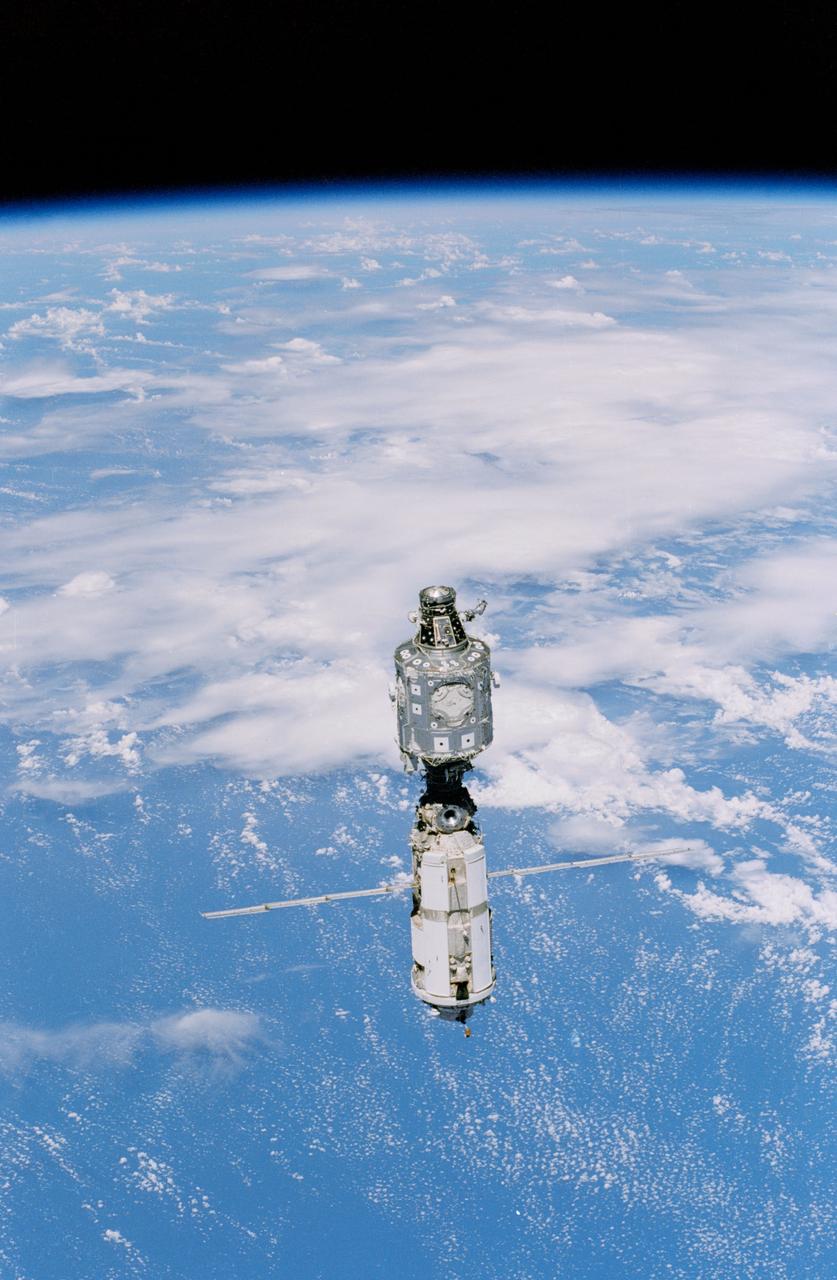
STS096-333-021 (3 June 1999) --- Backdropped against white clouds and blue ocean waters, the International Space Station (ISS) moves away from the Space Shuttle Discovery. The U.S.-built Unity node (left) and the Russian-built Zarya or FGB module (with the solar array panels deployed) were joined during a December 1998 mission. A portion of the work performed on the May 30 space walk by astronauts Tamara E. Jernigan and Daniel T. Barry is evident at various points on the ISS, including the installation of the Russian-built crane (called Strela). A STS-96 crew member aboard Discovery recorded this image with a 35mm camera on June 3, 1999.
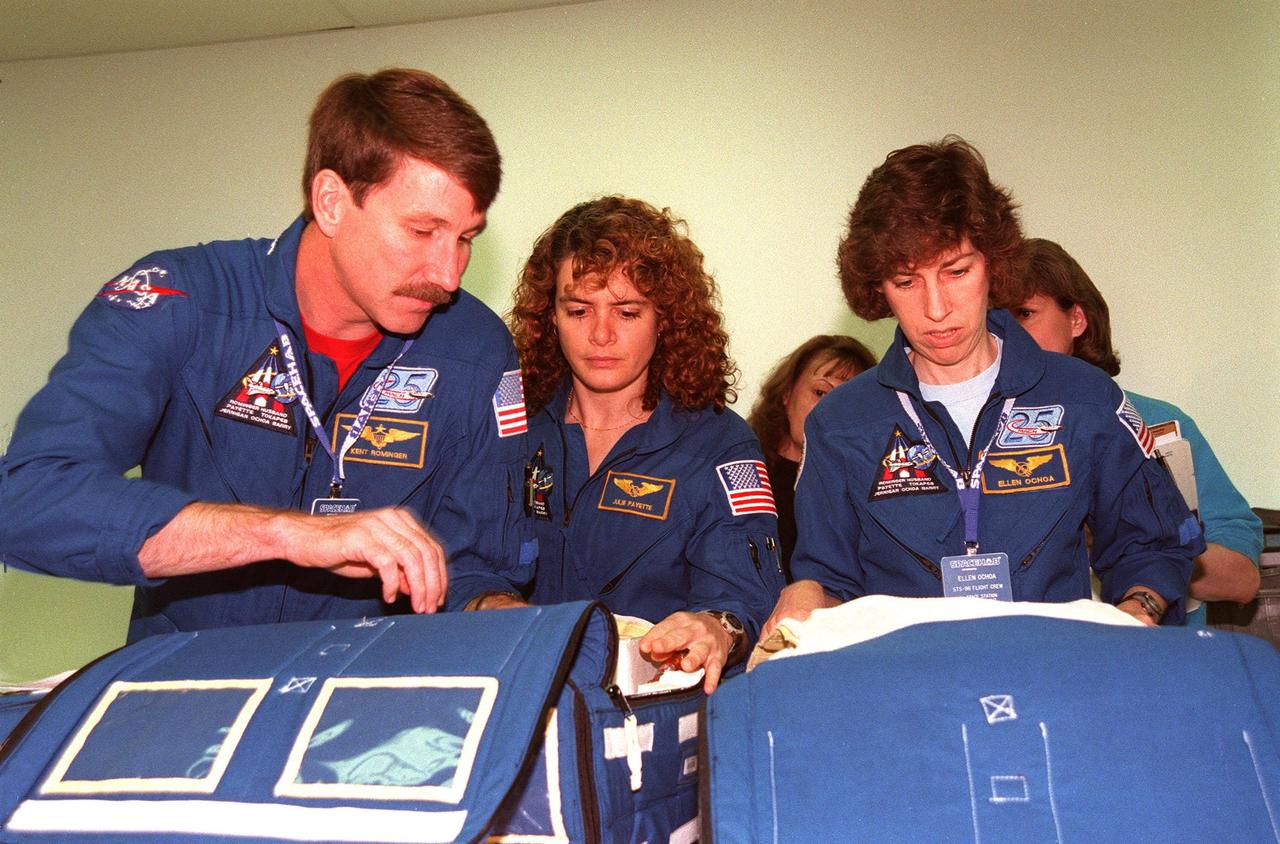
KENNEDY SPACE CENTER, FLA. -- (From left) STS-96 Commander Kent V. Rominger and Mission Specialists Julie Payette and Ellen Ochoa look over equipment at the SPACEHAB Facility. Members of the STS-96 crew are taking part in a bench review at SPACEHAB as part of familiarization activities for their upcoming mission. The crew also includes Pilot Rick Husband and Mission Specialists Tamara E. Jernigan, Daniel Barry, and Valery Ivanovich Tokarev. Payette is with the Canadian Space Agency and Tokarev with the Russian Space Agency. Mission STS-96 is the second flight in construction of the International Space Station and will include the SPACEHAB. The 10-day mission is targeted for launch on May 24, 1999, at Launch Pad 39B
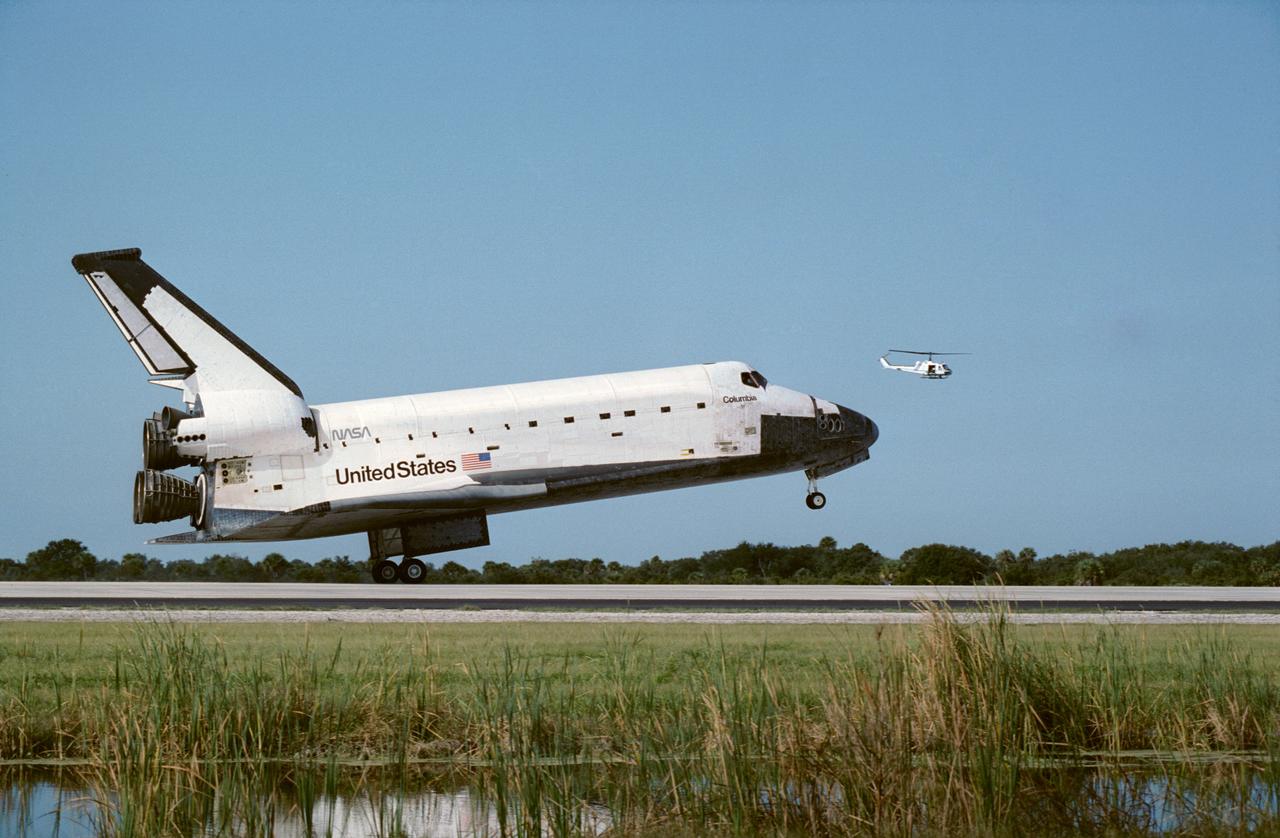
STS052-S-098 (1 Nov 1992) --- This ground-level side view shows the Space Shuttle Columbia just prior to main landing gear touchdown at KSC's Shuttle Landing Facility to successfully complete a ten-day Earth-orbital mission. Onboard were a crew of five NASA astronauts and a Canadian payload specialist. Landing occurred at 9:05:53 a.m. (EST), November 1, 1992. Crewmembers are astronauts James D. Wetherbee, Michael A. Baker, Tamara E. Jernigan, Charles L. (Lacy) Veach and William M. Shepherd along with payload specialist Steven G. MacLean. The view was recorded with a 35mm camera.
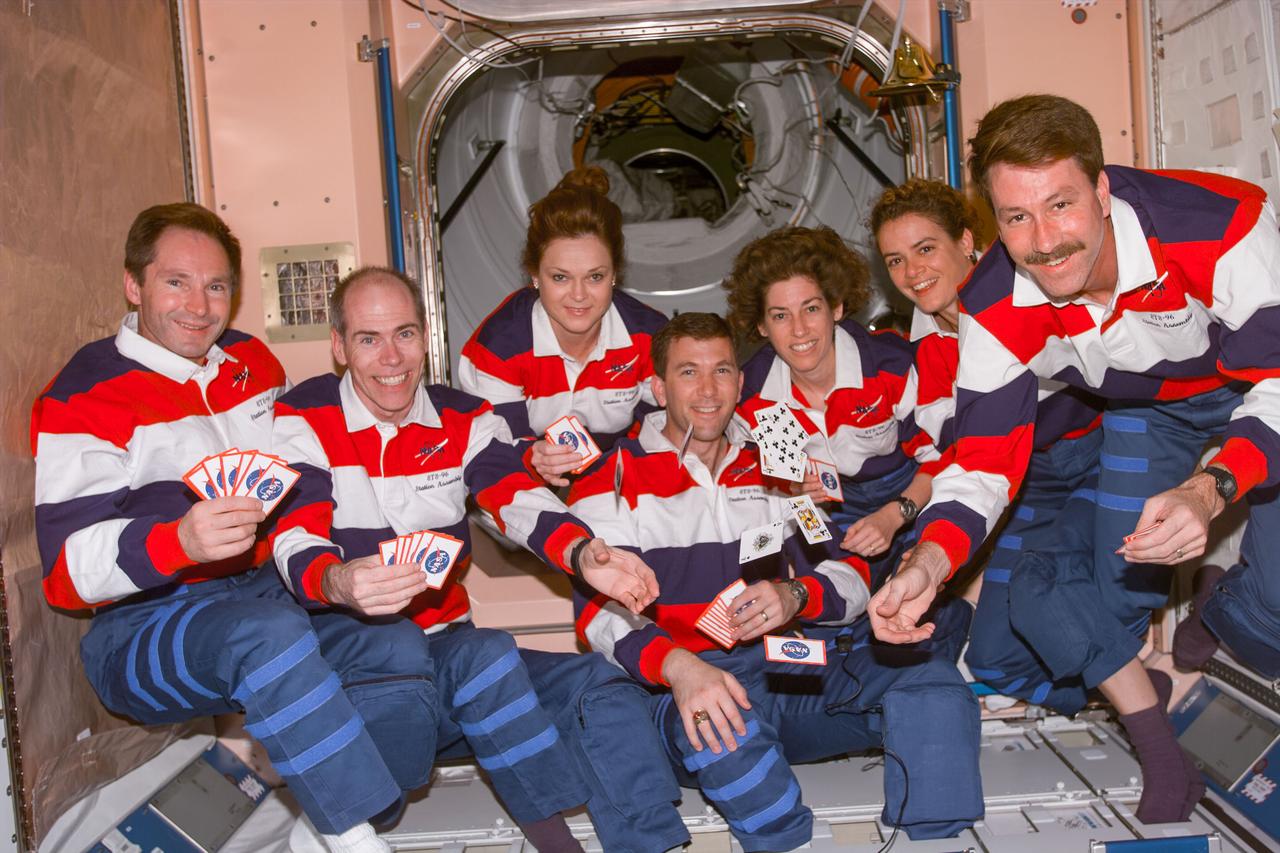
S96-E-5173 (2 June 1999) --- A pre-set electronic still camera (ESC) recorded this image of the STS-96 crewmembers playing cards on a break aboard the International Space Station (ISS). From the left are cosmonaut Valery I. Tokarev, Daniel T. Barry, Tamara E. Jernigan, Rick D. Husband, Ellen Ochoa, Julie Payette and Kent V. Rominger. Tokarev represents the Russian Space Agency (RSA) and Payette represents the Canadian Space Agency (CSA). The photograph was taken at 11:13:59 GMT, June 2, 1999.
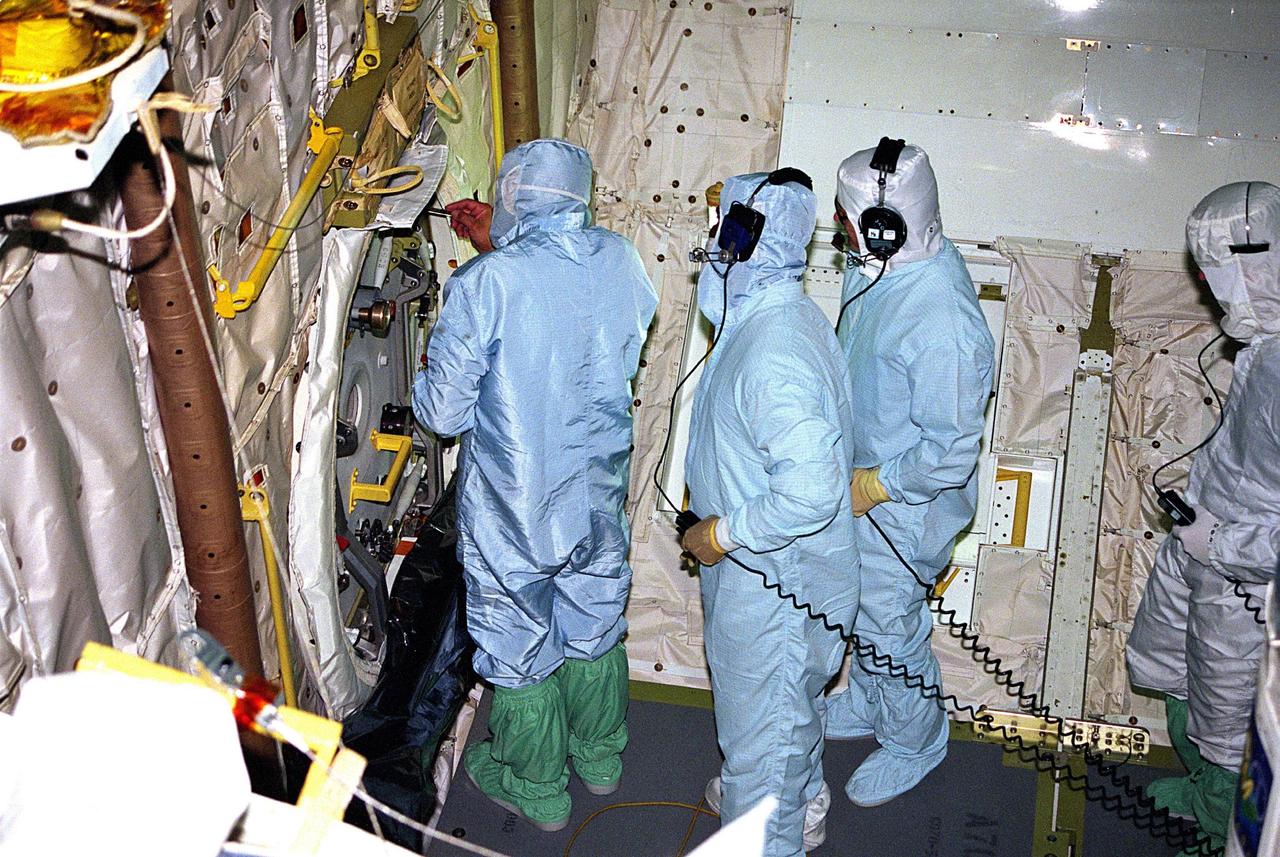
KENNEDY SPACE CENTER, FLA. -- United Space Alliance (USA) technicians in Orbiter Processing Facility Bay 1 troubleshoot the orbiter Columbia’s outer hatch of the airlock, which failed to open during the recent STS-80 Space Shuttle mission. Mission Specialists Tamara E. Jernigan and Thomas D. Jones did not perform the mission’s planned two extravehicular activities (EVAs) or spacewalks because the hatch would not open on orbit. The spacewalks were to be part of the continuing series of EVA Development Flight Tests to evaluate equipment and procedures and to build spacewalking experience in preparation for the International Space Station.
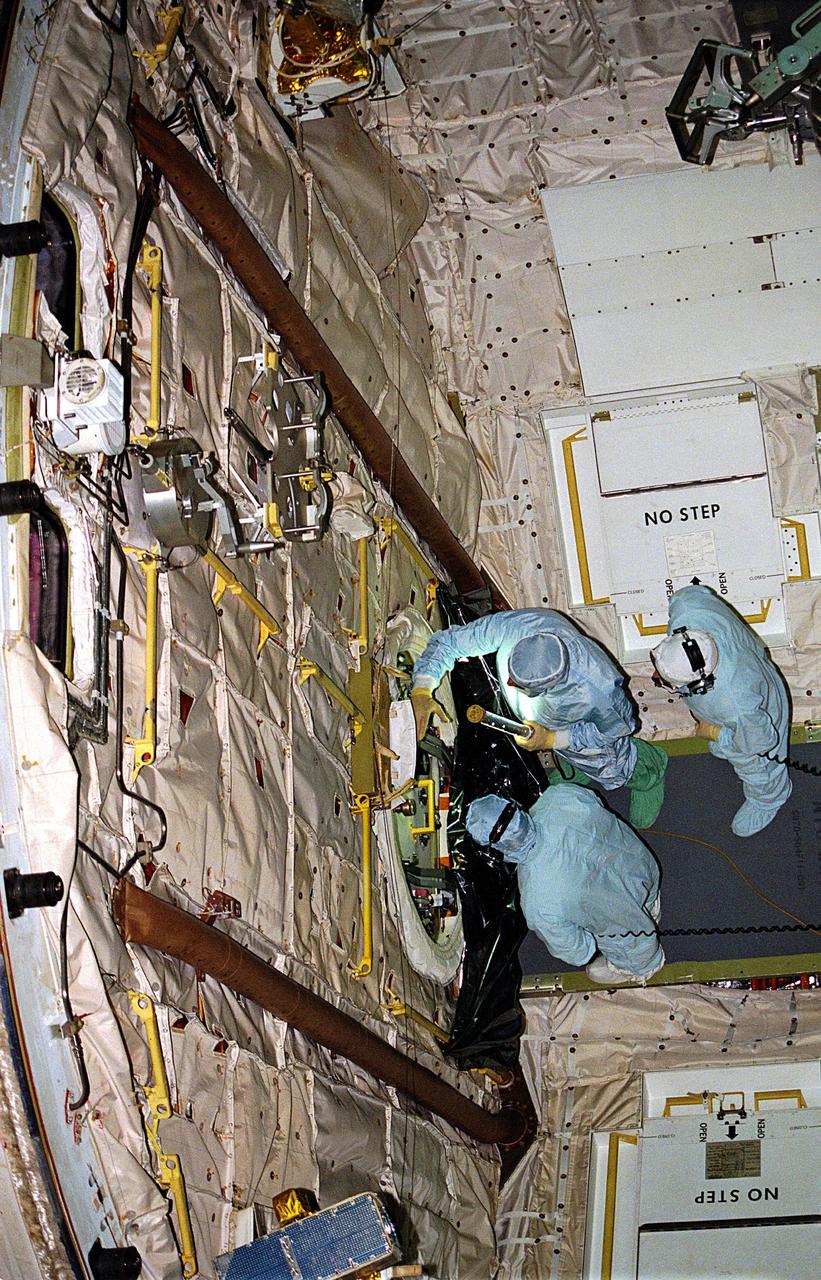
KENNEDY SPACE CENTER, FLA. -- United Space Alliance (USA) technicians in Orbiter Processing Facility Bay 1 troubleshoot the orbiter Columbia’s outer hatch of the airlock, which failed to open during the recent STS-80 Space Shuttle mission. Mission Specialists Tamara E. Jernigan and Thomas D. Jones did not perform the mission’s planned two extravehicular activities (EVAs) or spacewalks because the hatch would not open on orbit. The spacewalks were to be part of the continuing series of EVA Development Flight Tests to evaluate equipment and procedures and to build spacewalking experience in preparation for the International Space Station.
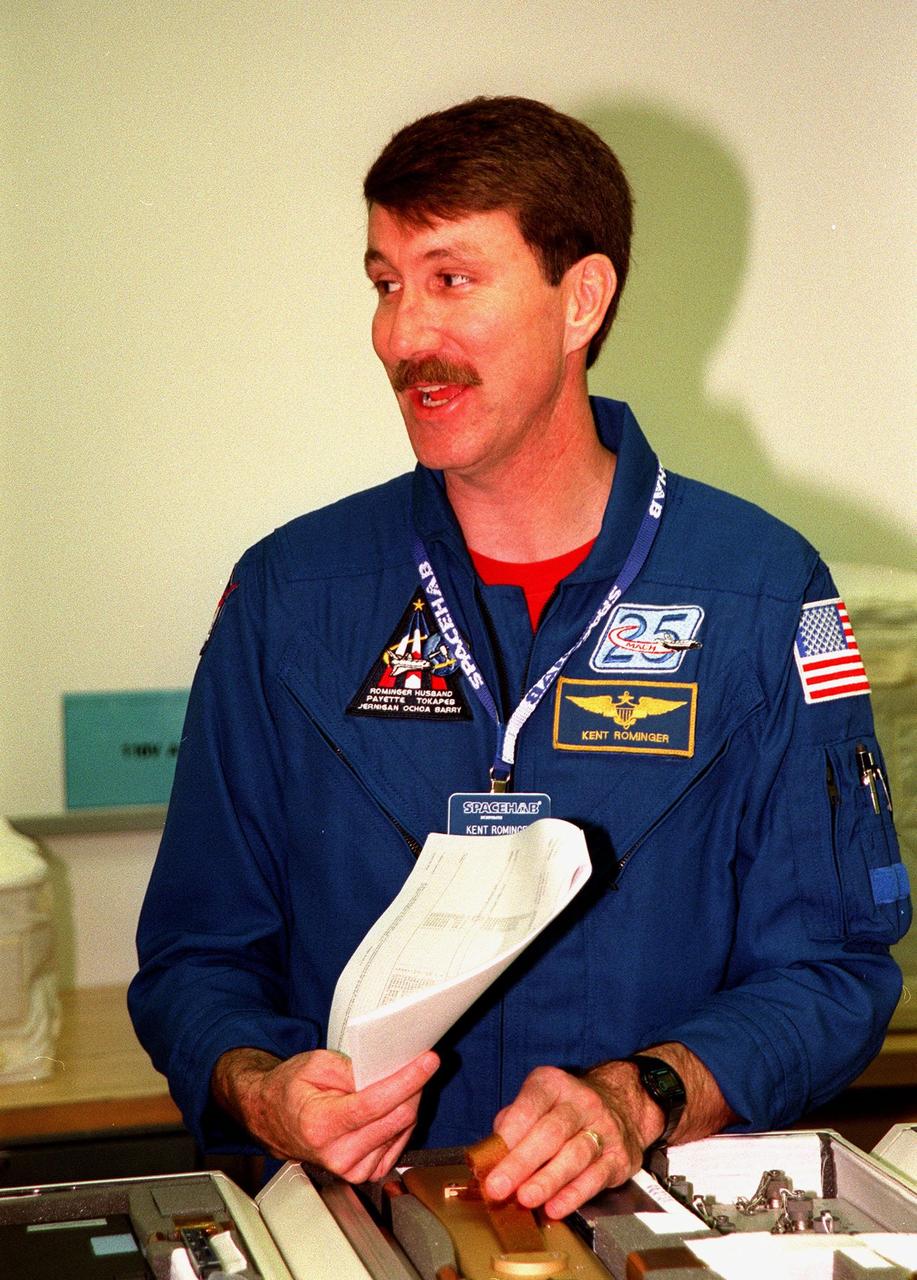
KENNEDY SPACE CENTER, FLA. -- STS-96 Commander Kent V. Rominger gets a hands-on look at equipment at the SPACEHAB Facility. Members of the STS-96 crew are taking part in a bench review at SPACEHAB as part of familiarization activities for their upcoming mission. The crew also includes Pilot Rick Husband and Mission Specialists Ellen Ochoa, Tamara E. Jernigan, Daniel Barry, Julie Payette and Valery Ivanovich Tokarev. Payette is with the Canadian Space Agency and Tokarev with the Russian Space Agency. Mission STS-96 is the second flight in construction of the International Space Station and will include the SPACEHAB. The 10-day mission is targeted for launch on May 24, 1999, at Launch Pad 39B
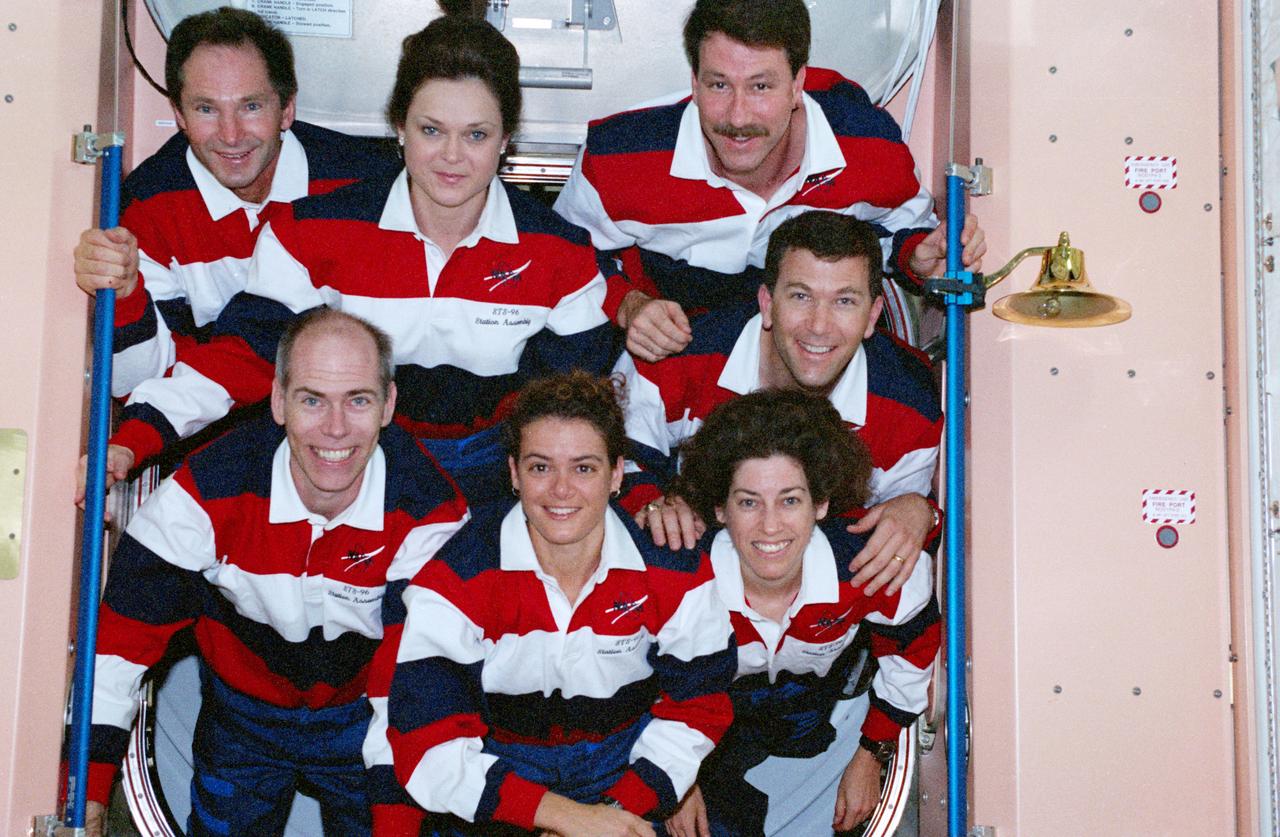
STS096-380-019 (27 May - 6 June 1999) --- The seven crew members for the STS-96 mission pose for the traditional inflight crew portrait in the hatch way of the U.S.-built Unity node for the International Space Station (ISS). From to left to right, bottom, are astronauts Daniel T. Barry, Julie Payette and Ellen Ochoa. On top are cosmonaut Valery I. Tokarev, along with astronauts Tamara E. Jernigan and Kent V. Rominger. Astronaut Rick D. Husband is between Rominger and Ochoa. Payette represents the Canadian Space Agency (CSA) and Tokarev is with the Russian Space Agency (RSA).
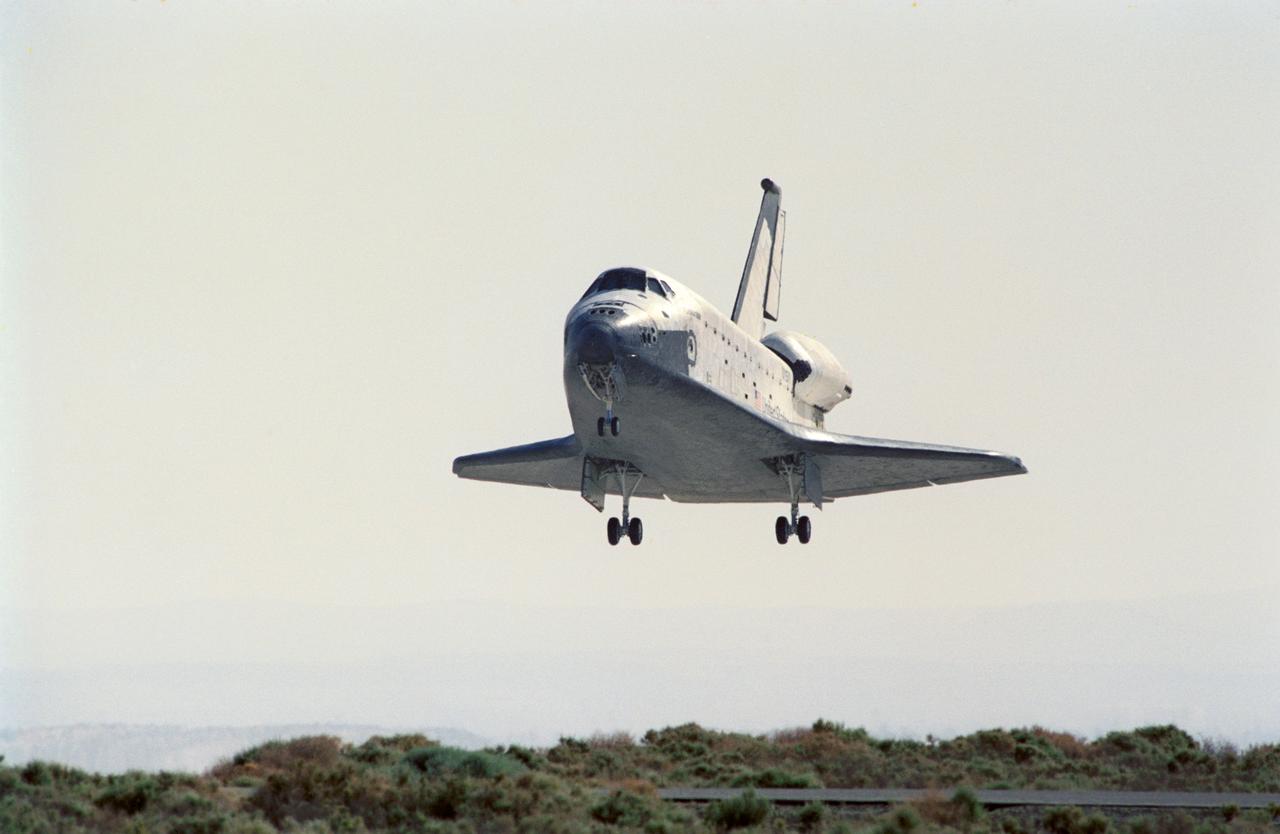
STS040-S-174 (14 June 1991) --- The Space Shuttle Columbia is only moments away from touchdown on Runway 22 at Edwards Air Force Base in California. The landing completes a successful nine-day Spacelab Life Sciences (SLS-1) mission, the first ever devoted exclusively to life sciences research. Onboard the spacecraft were astronauts Bryan D. O'Connor, Sidney M. Gutierrez, Rhea Seddon, James P. Bagian and Tamara E. Jernigan; and payload specialists F. Drew Gaffney and Millie Hughes-Fulford. Landing occurred at 8:39:11 a.m. (PDT), June 14, 1991.
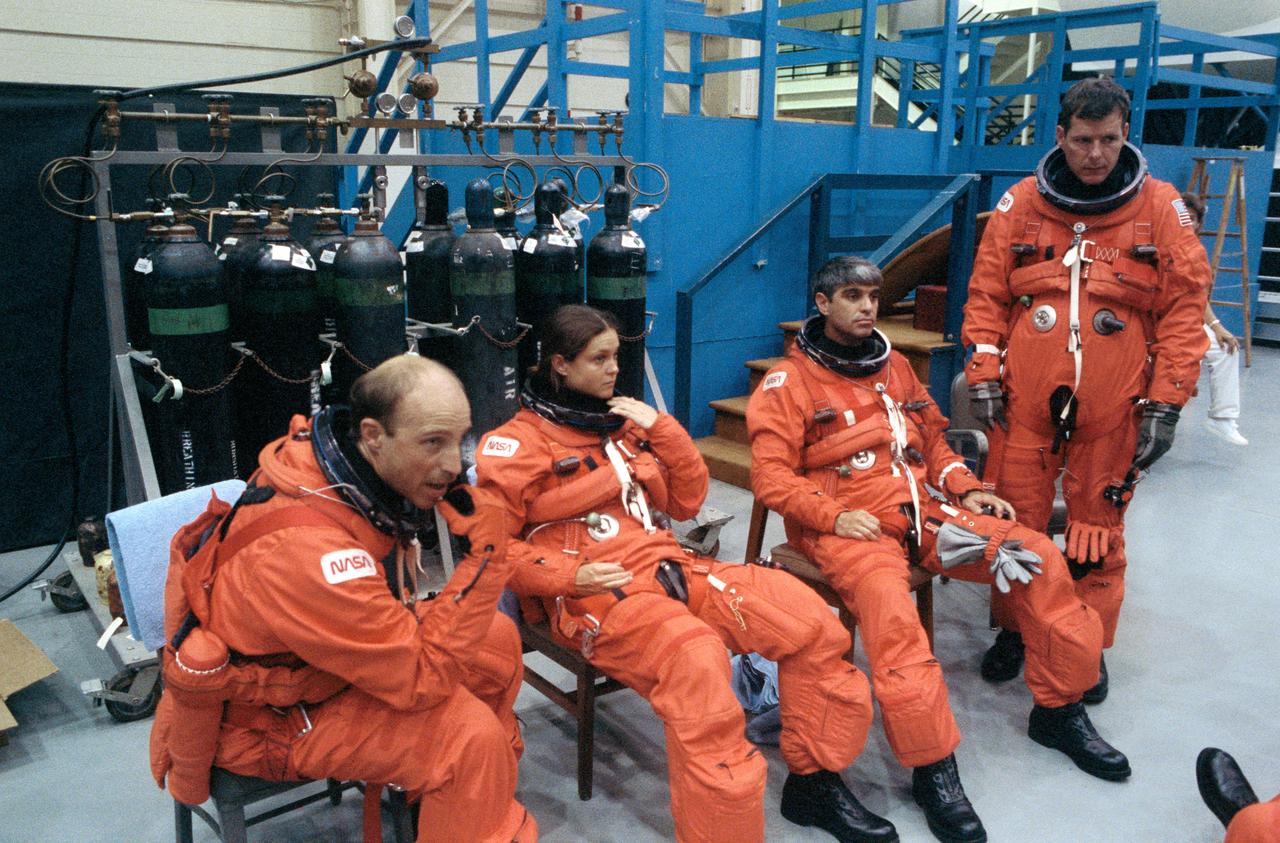
S90-41372 (11 June 1990) --- Crewmembers assigned to NASA's STS 40 Spacelab Life Sciences (SLS-1) mission take a brief break during emergency egress training in the Shuttle mockup and integration laboratory at the Johnson Space Center (JSC). Left to right are astronauts James P. Bagian, Tamara E. Jernigan, both mission specialists; and Sidney M. Gutierrez, pilot; and Bryan D. O'Connor, mission commander. Out of frame are astronaut Rhea Seddon, mission specialist, and payload specialists Millie Hughes-Fulford and Drew Gaffney.
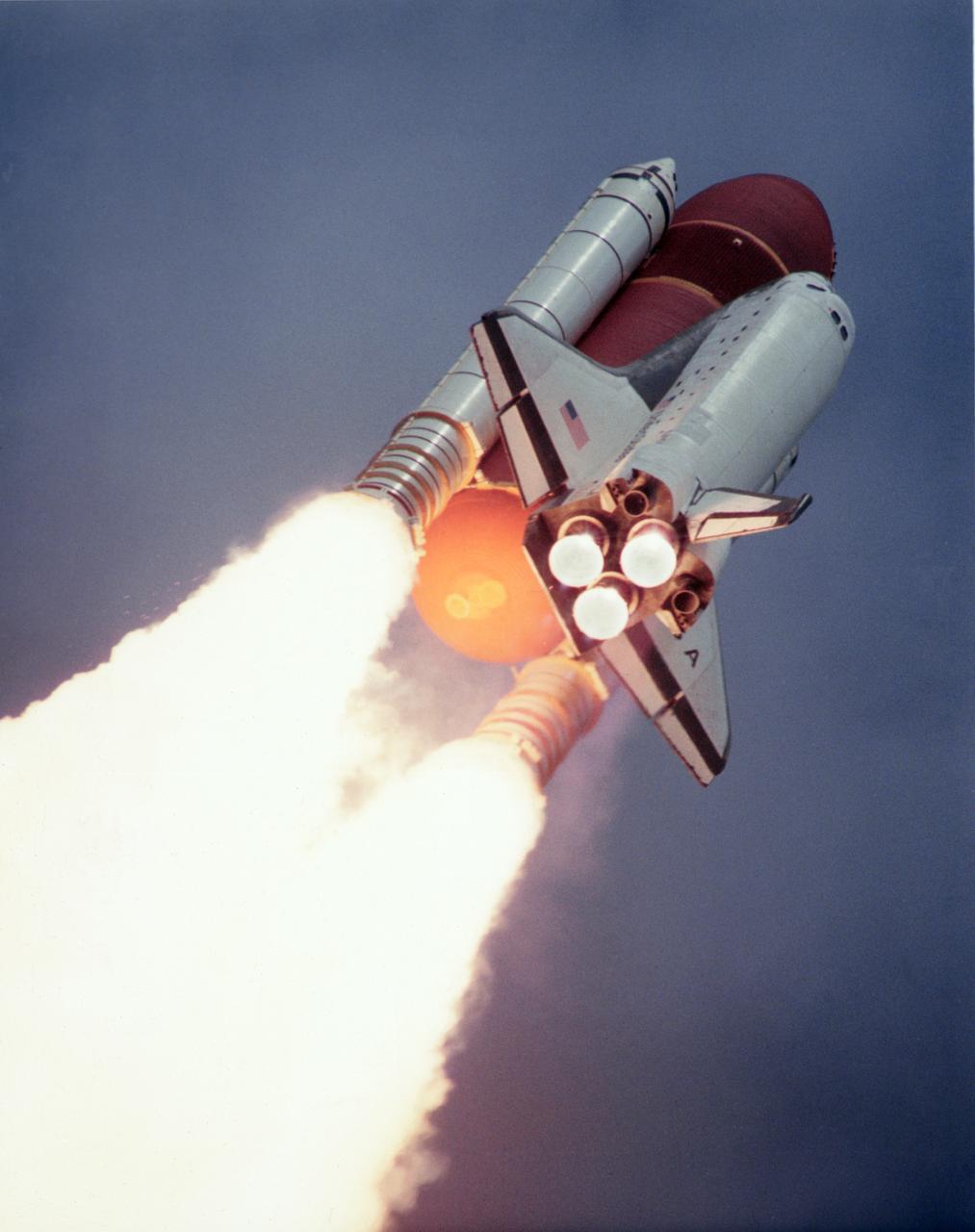
Launched aboard the Space Shuttle Columbia on June 5, 1991 at 9:24; am (EDT), the STS-40 mission was the fifth dedicated Spacelab Mission, Spacelab Life Sciences-1 (SLS-1), and the first mission dedicated solely to life sciences. The STS-40 crew included 7 astronauts: Bryan D. O’Connor, commander; Sidney M. Gutierrez, pilot; F. Drew Gaffney, payload specialist 1; Milli-Hughes Fulford, payload specialist 2; James P. Bagian, mission specialist 1; Tamara E. Jernigan, mission specialist 2; and M. Rhea Seddon, mission specialist 3.
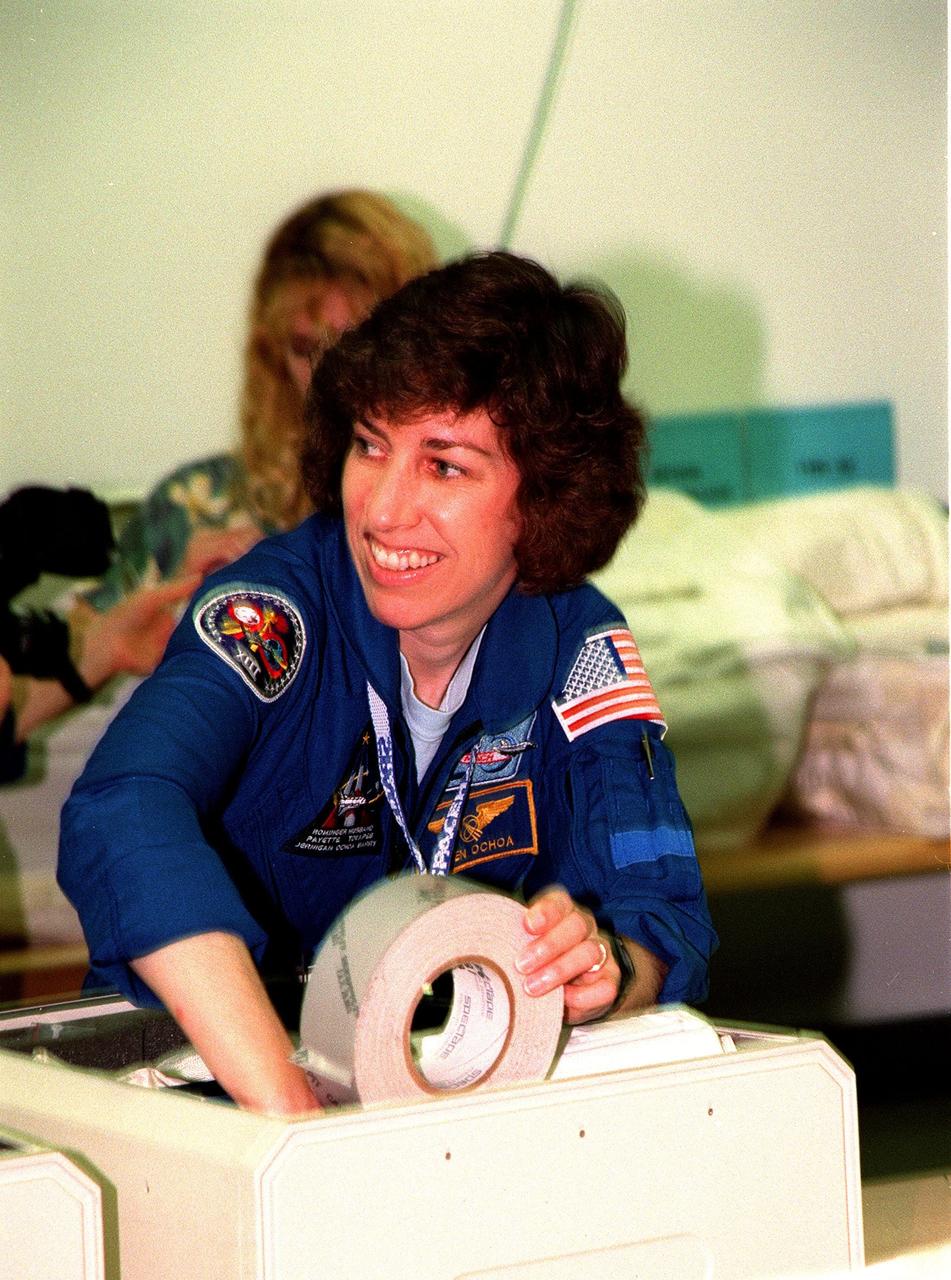
KENNEDY SPACE CENTER, FLA. -- STS-96 Mission Specialist Ellen Ochoa gets a hands-on look at equipment at the SPACEHAB Facility. Members of the STS-96 crew are taking part in a bench review at SPACEHAB as part of familiarization activities for their upcoming mission. The crew also includes Commander Kent V. Rominger, Pilot Rick Husband and Mission Specialists Tamara E. Jernigan, Daniel Barry, Julie Payette and Valery Ivanovich Tokarev. Payette is with the Canadian Space Agency and Tokarev with the Russian Space Agency. Mission STS-96 is the second flight in construction of the International Space Station and will include the SPACEHAB. The 10-day mission is targeted for launch on May 24, 1999, at Launch Pad 39B
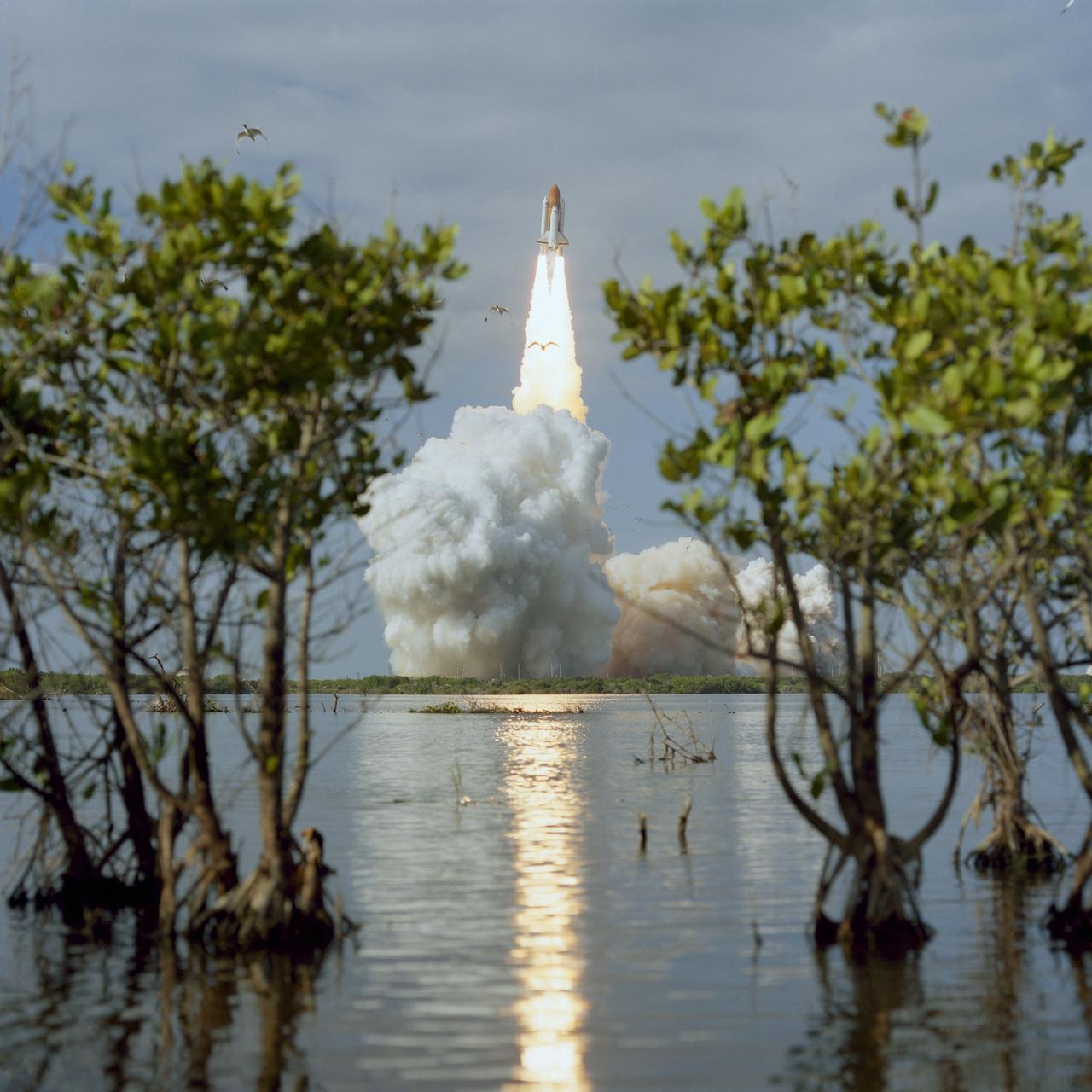
STS080-S-006 (19 Nov. 1996) --- The space shuttle Columbia lifts off from the Kennedy Space Center's (KSC) Launch Pad 39B at 2:55:47 p.m. (EST), Nov. 19, 1996. Onboard are astronauts Kenneth D. Cockrell, mission commander; Kent V. Rominger, pilot; along with Story Musgrave, Tamara E. Jernigan and Thomas D. Jones, all mission specialists. The two primary payloads for STS-80 stowed in Columbia's cargo bay for later deployment and testing are the Wake Shield Facility (WSF-3) and the Orbiting and Retrievable Far and Extreme Ultraviolet Spectrometer (ORFEUS) with its associated Shuttle Pallet Satellite (SPAS).
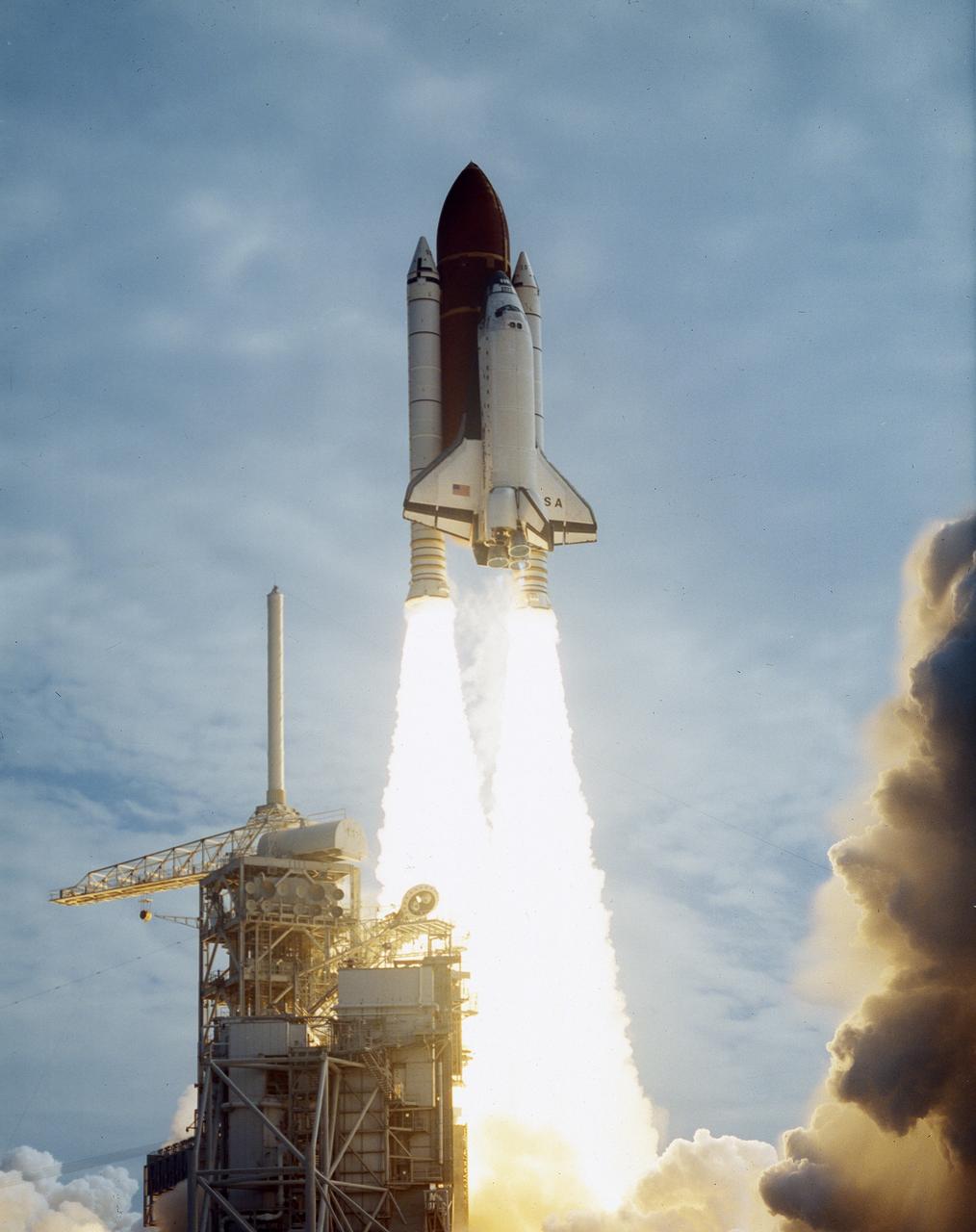
Launched aboard the Space Shuttle Columbia on June 5, 1991 at 9:24; am (EDT), the STS-40 mission was the fifth dedicated Spacelab Mission, Spacelab Life Sciences-1 (SLS-1), and the first mission dedicated solely to life sciences. The STS-40 crew included 7 astronauts: Bryan D. O’Connor, commander; Sidney M. Gutierrez, pilot; F. Drew Gaffney, payload specialist 1; Milli-Hughes Fulford, payload specialist 2; James P. Bagian, mission specialist 1; Tamara E. Jernigan, mission specialist 2; and M. Rhea Seddon, mission specialist 3.
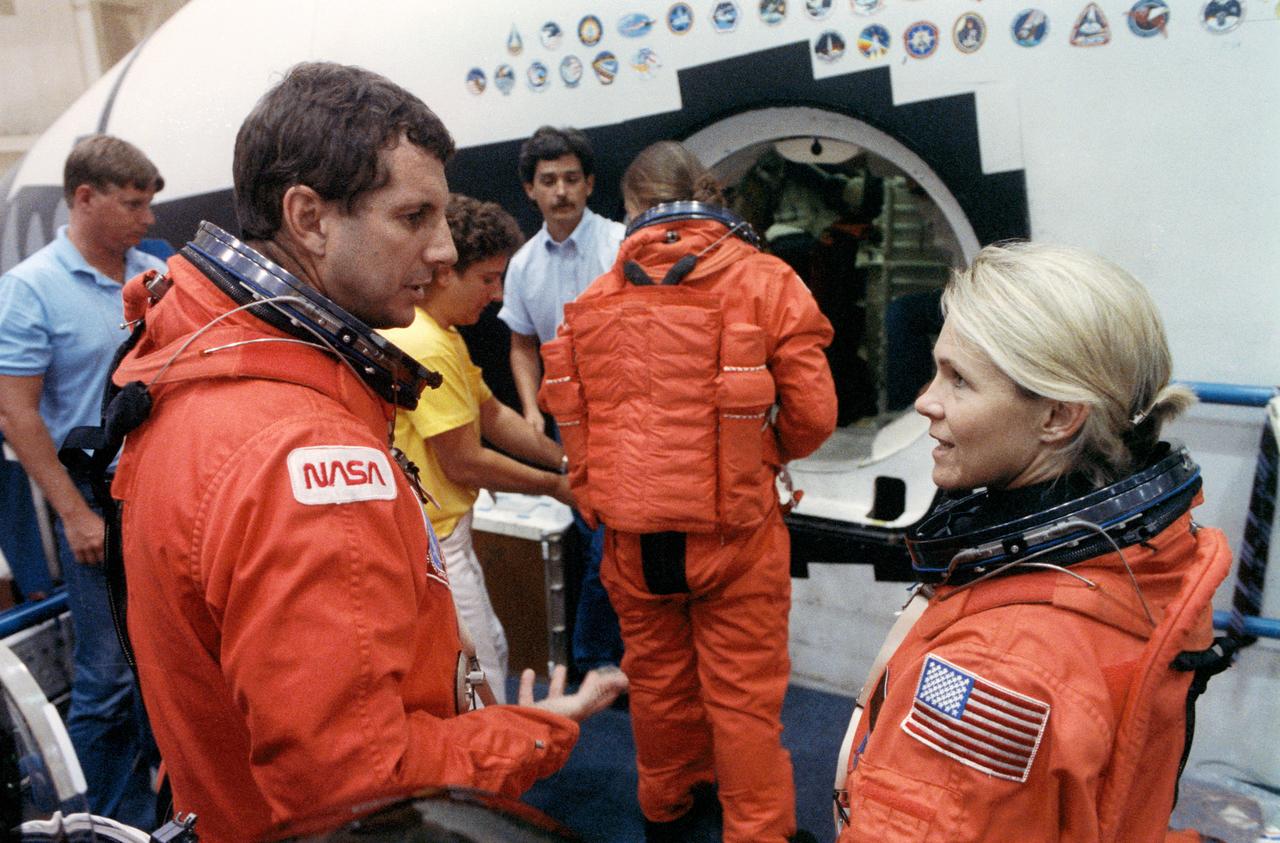
S90-41365 (11 June 1990) --- Crewmembers assigned to NASA's STS-40/Spacelab Life Sciences (SLS-1) mission take a brief break during emergency egress training in the Shuttle mockup and integration laboratory at the Johnson Space Center (JSC). In the foreground are astronauts Rhea Seddon and payload specialist F. Drew Gaffney. In the background, also wearing an orange partial pressure, ascent/entry suit is astronaut Tamara E. Jernigan, mission specialist. Not in the frame are astronauts Bryan D. O'Connor, mission commander; Sidney M. Gutierrez, pilot; James P. Bagian, mission specialist, and payload specialist Millie Fulford-Hughes.
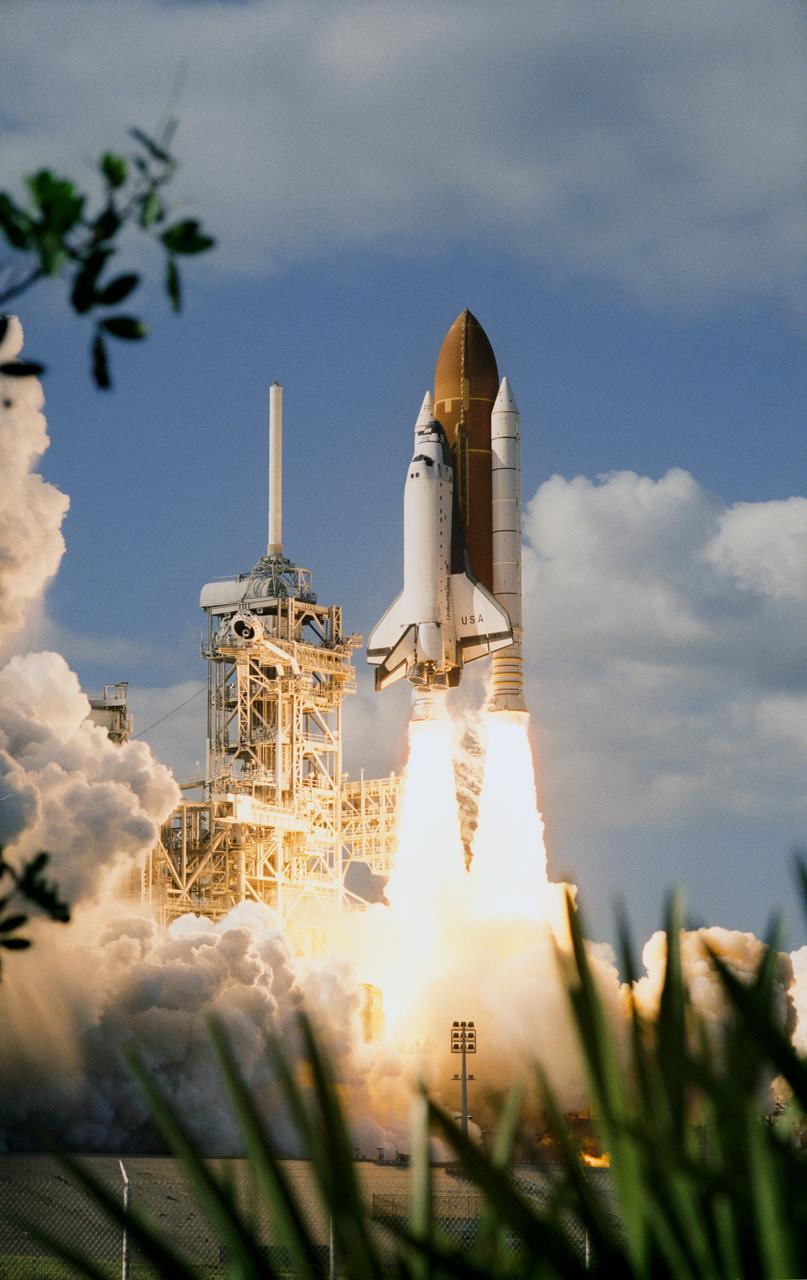
STS080-S-004 (19 Nov. 1996) --- The space shuttle Columbia lifts off from the Kennedy Space Center's (KSC) Launch Pad 39B at 2:55:47 p.m. (EST), Nov. 19, 1996. Onboard are astronauts Kenneth D. Cockrell, STS-80 mission commander; Kent V. Rominger, pilot; along with Story Musgrave, Tamara E. Jernigan and Thomas D. Jones, all mission specialists. The two primary payloads for STS-80 stowed in Columbia's cargo bay for later deployment and testing are the Wake Shield Facility (WSF-3) and the Orbiting and Retrievable Far and Extreme Ultraviolet Spectrometer (ORFEUS) with its associated Shuttle Pallet Satellite (SPAS).
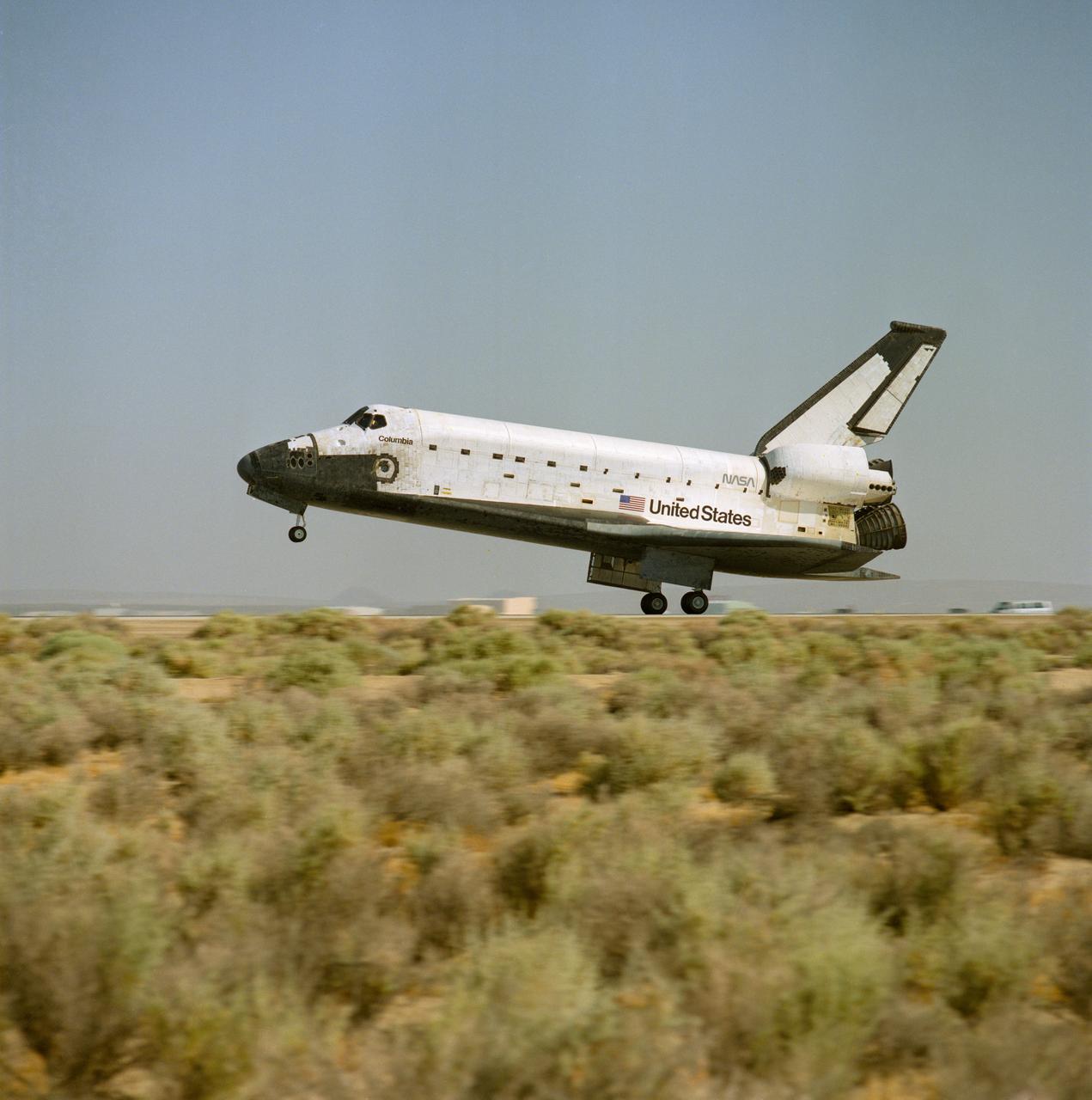
STS040-S-175 (14 June 1991) --- The main landing gear of the Space Shuttle Columbia touches down, on Runway 22 at Edwards Air Force Base in California, to complete a successful nine-day mission. The Spacelab Life Sciences (SLS-1) mission was the first ever devoted exclusively to life sciences research. Onboard the spacecraft were astronauts Bryan D. O'Connor, Sidney M. Gutierrez, Rhea Seddon, James P. Bagian and Tamara E. Jernigan; and payload specialists F. Drew Gaffney and Millie Hughes-Fulford. Landing occurred at 8:39:11 a.m. (PDT), June 14, 1991.
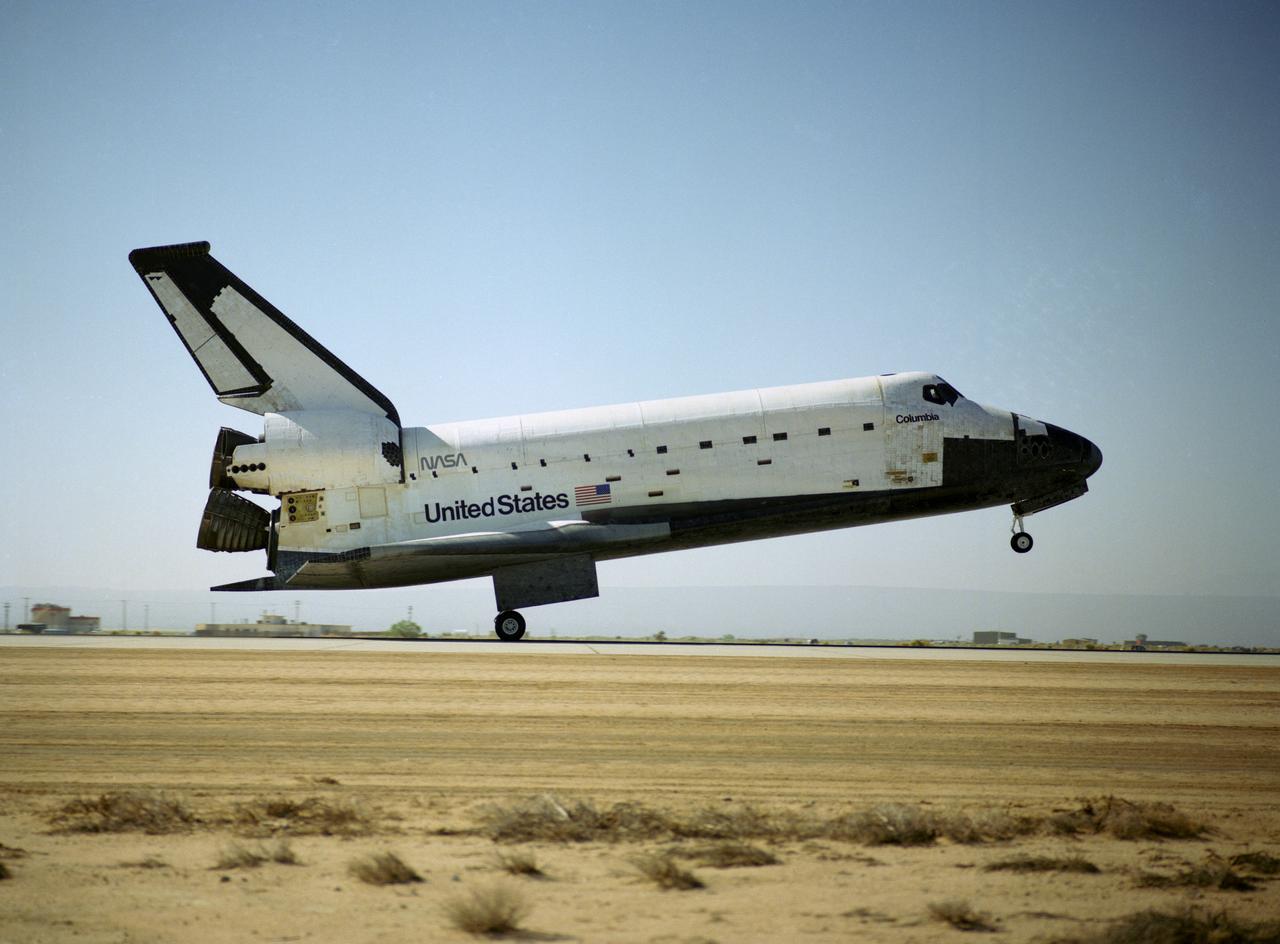
STS040-S-176 (14 June 1991) --- The main landing gear of the Space Shuttle Columbia touches down, on Runway 22 at Edwards Air Force Base in California, to complete a successful nine-day mission. The Spacelab Life Sciences (SLS-1) mission was the first ever devoted exclusively to life sciences research. Onboard the spacecraft were astronauts Bryan D. O'Connor, Sidney M. Gutierrez, Rhea Seddon, James P. Bagian and Tamara E. Jernigan; and payload specialists F. Drew Gaffney and Millie Hughes-Fulford. Landing occurred at 8:39:11 a.m. (PDT), June 14, 1991.
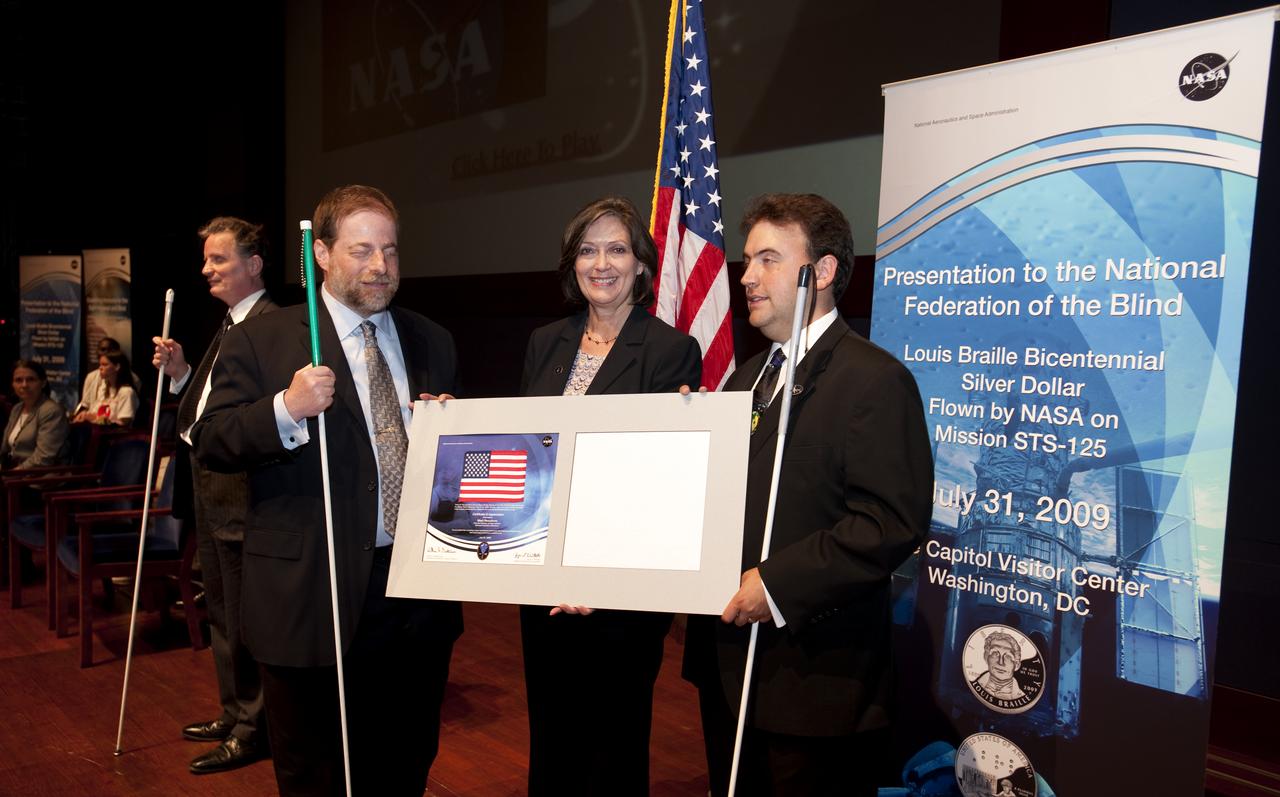
Mark Riccobono, executive director of the Jernigan Institute of the National Federation of the Blind, right, accepts an award from Dr. Joyce Winterton, Assistant Administrator, Office of Education, NASA Headquarters, center, and Ken Silberman, from Goddard Space Flight Center, at a ceremony where senior NASA officials presented the NFB with two Louis Braille Bicentennial Silver Dollars that flew on Space Shuttle Atlantis' mission (STS-125) to the Hubble Space Telescope in May 2009, Friday evening, July 31, 2009, at the Capitol Visitors Center in Washington. Photo Credit: (NASA/Paul E. Alers)
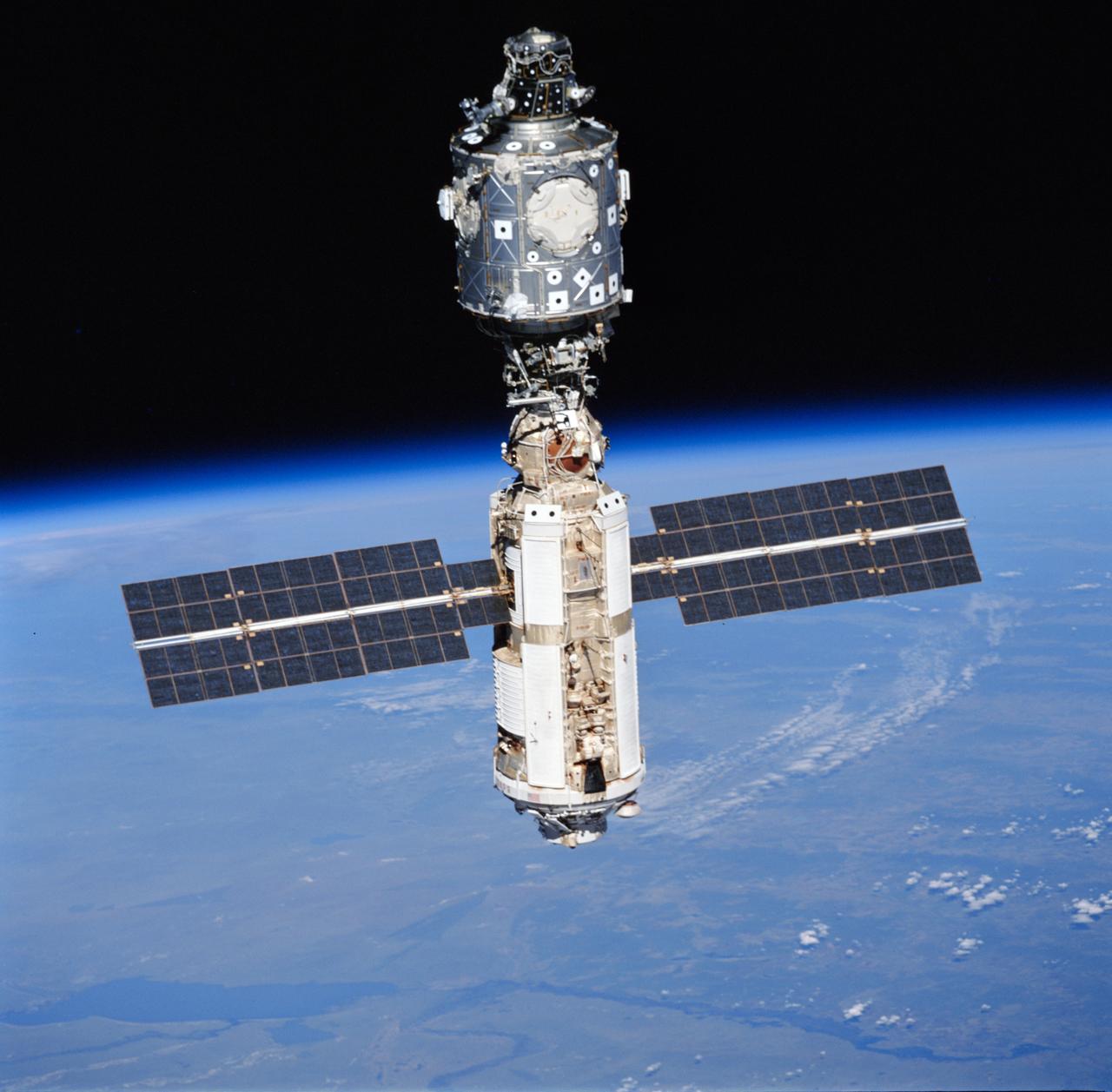
STS096-715-042 (3 June 1999) --- A STS-96 crew member aboard Discovery recorded this image of the International Space Station (ISS) with a 70mm camera during a fly-around following separation of the two spacecraft. Lake Hulun Nur in the People's Republic of China is visible in the lower left portion of the frame. A portion of the work performed on the May 30 space walk by astronauts Tamara E. Jernigan and Daniel T. Barry is evident at various points on the ISS, including the installation of the Russian-built crane (called Strela) and the U.S.-built crane.
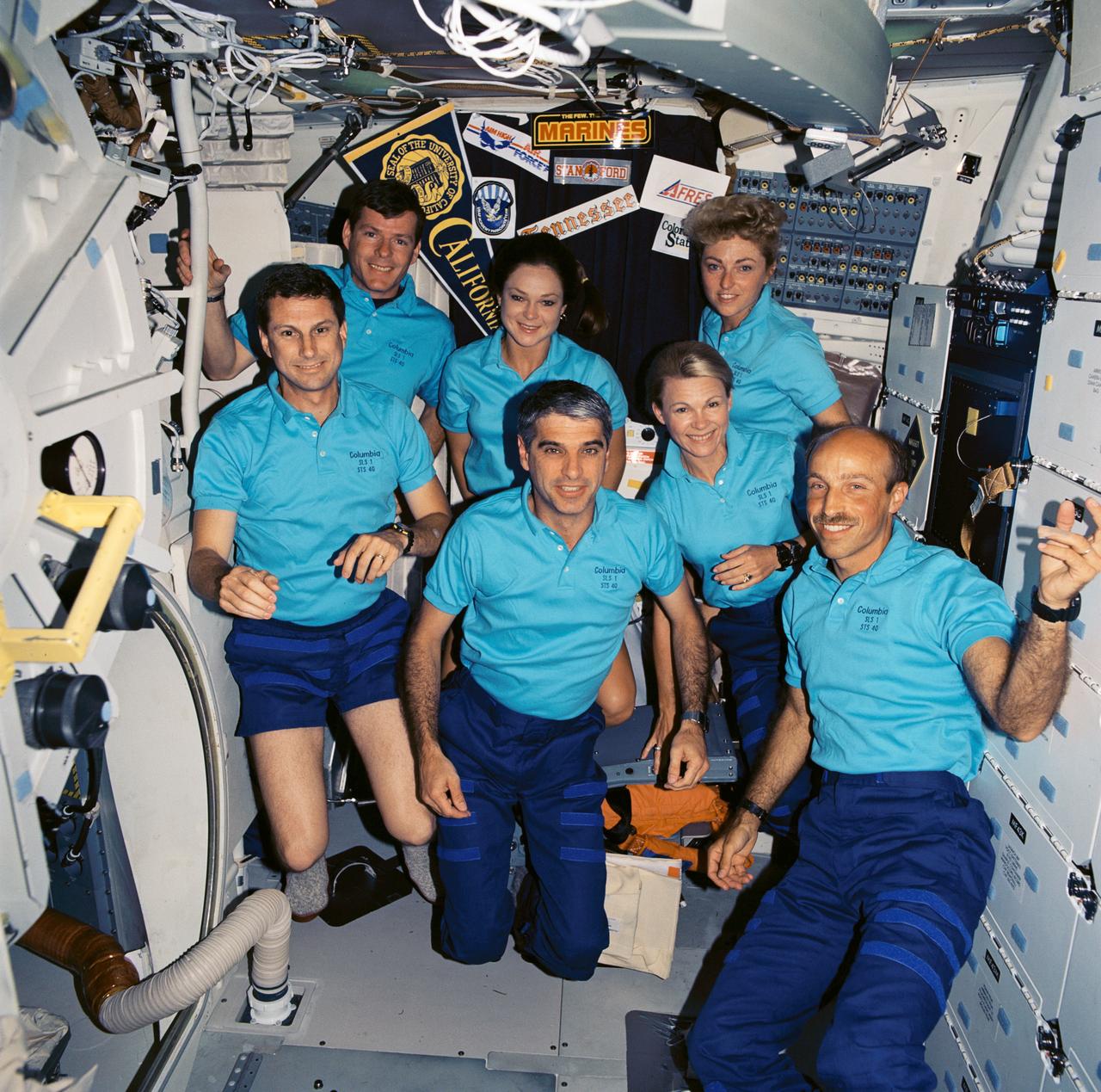
STS040-605-009 (5-14 June 1991) --- The seven crew members for STS-40 pose for an in-space portrait on the Space Shuttle Columbia's mid-deck. Left to right, in front are F. Andrew Gaffney, Sidney M. Gutierrez, Rhea Seddon and James P. Bagian; in back, Bryan D. O'Connor, Tamara E. Jernigan and Millie Hughes-Fulford. The five astronauts and two payload specialists are spending nine days in space in support of the Spacelab Life Sciences (SLS-1) mission. The image was one of 25 visuals used by the STS-40 crew at its Post Flight Press Conference (PFPC) on June 28, 1991.
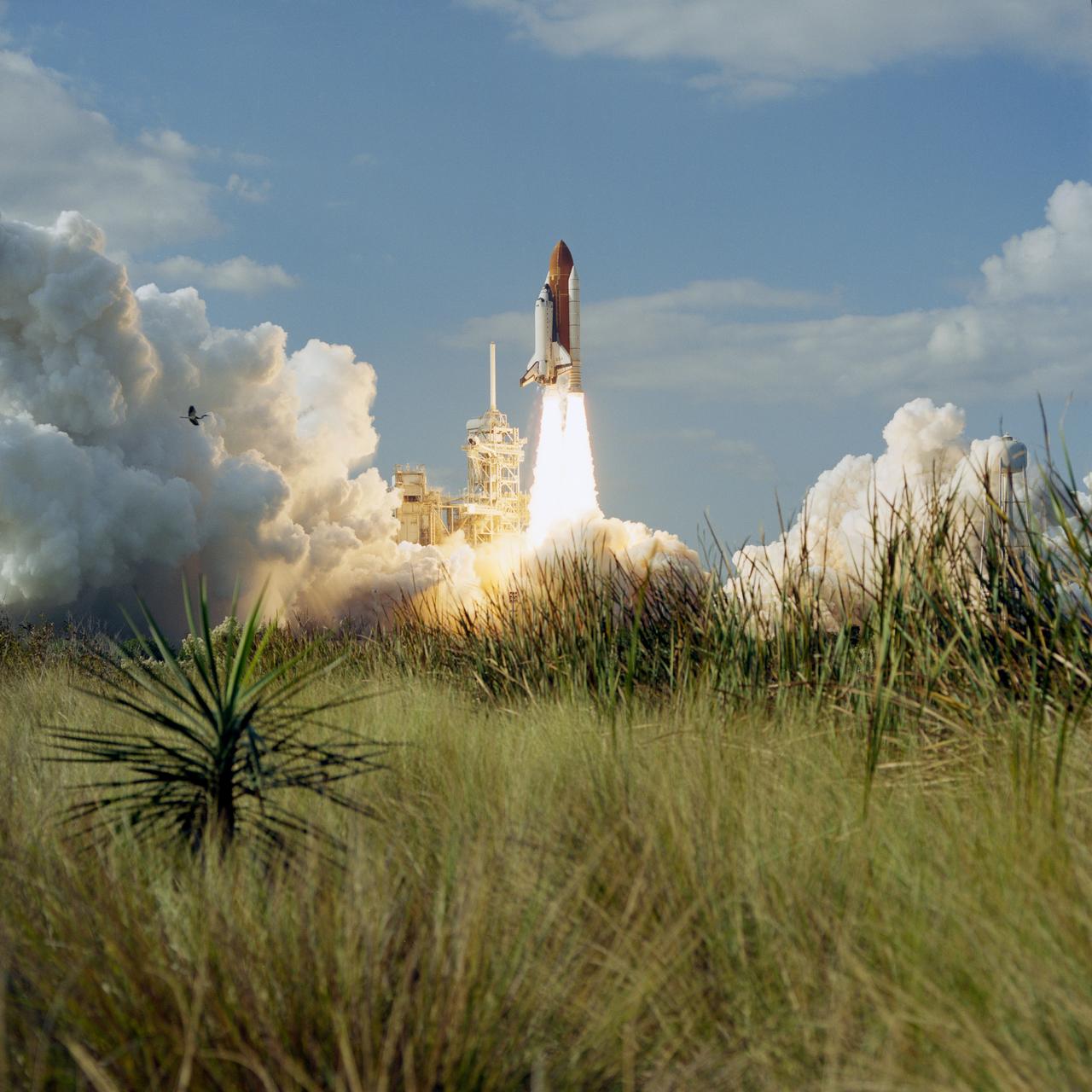
STS080-S-005 (19 Nov. 1996) --- The space shuttle Columbia lifts off from the Kennedy Space Center's (KSC) Launch Pad 39B at 2:55:47 p.m. (EST), Nov. 19, 1996. Onboard are astronauts Kenneth D. Cockrell, mission commander; Kent V. Rominger, pilot; along with Story Musgrave, Tamara E. Jernigan and Thomas D. Jones, all mission specialists. The two primary payloads for STS-80 stowed in Columbia's cargo bay for later deployment and testing are the Wake Shield Facility (WSF-3) and the Orbiting and Retrievable Far and Extreme Ultraviolet Spectrometer (ORFEUS) with its associated Shuttle Pallet Satellite (SPAS).
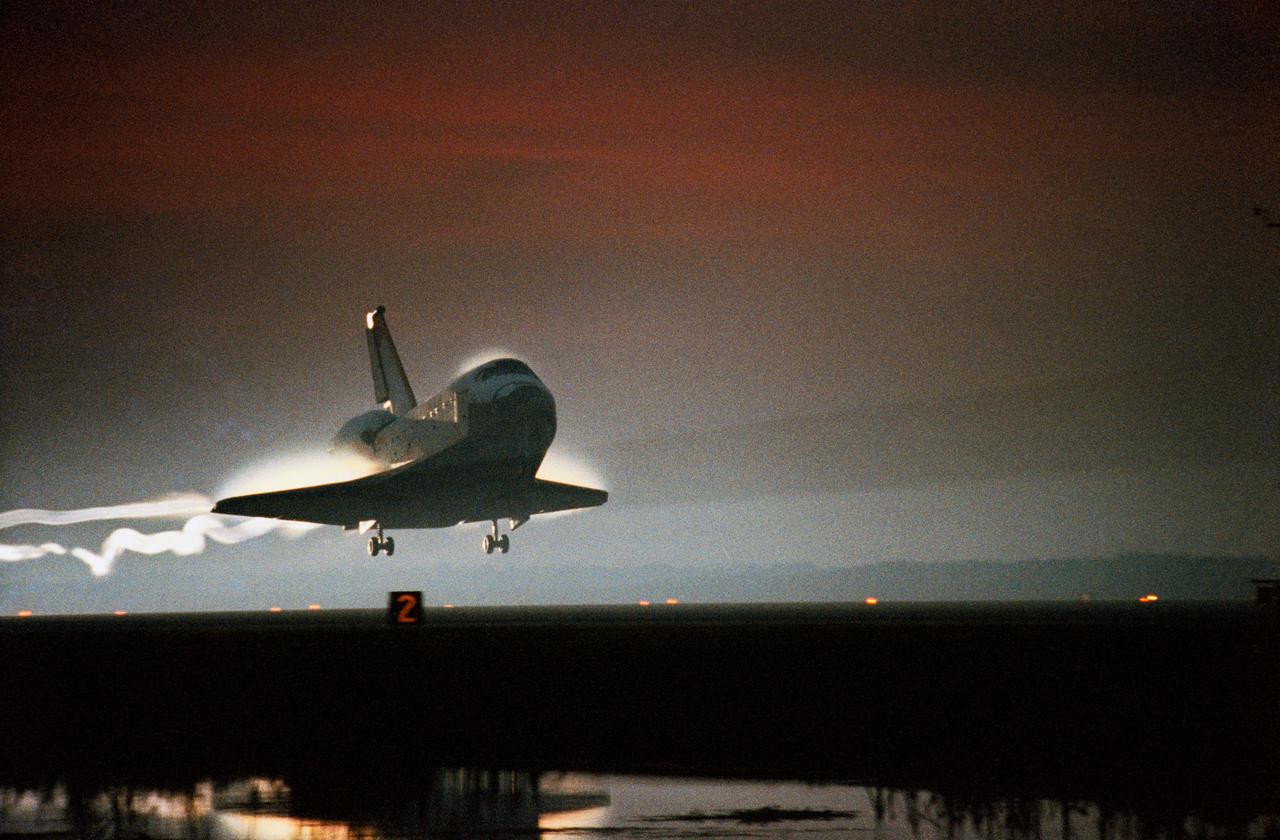
STS080-S-008 (7 Dec. 1996) --- Just prior to dawn, the space shuttle Columbia heads for a landing on Runway 33 at the Kennedy Space Center's (KSC) Shuttle Landing Facility (SLF) to successfully complete a 17-day mission. Landing occurred just before dawn, at 6:49 a.m. (EST). The landing is the 33rd at KSC for the Space Transportation System (STS). Crew members aboard were astronauts Kenneth D. Cockrell, mission commander; and Kent V. Rominger, pilot; along with Story Musgrave, Tamara E. Jernigan and Thomas D. Jones, all mission specialists.
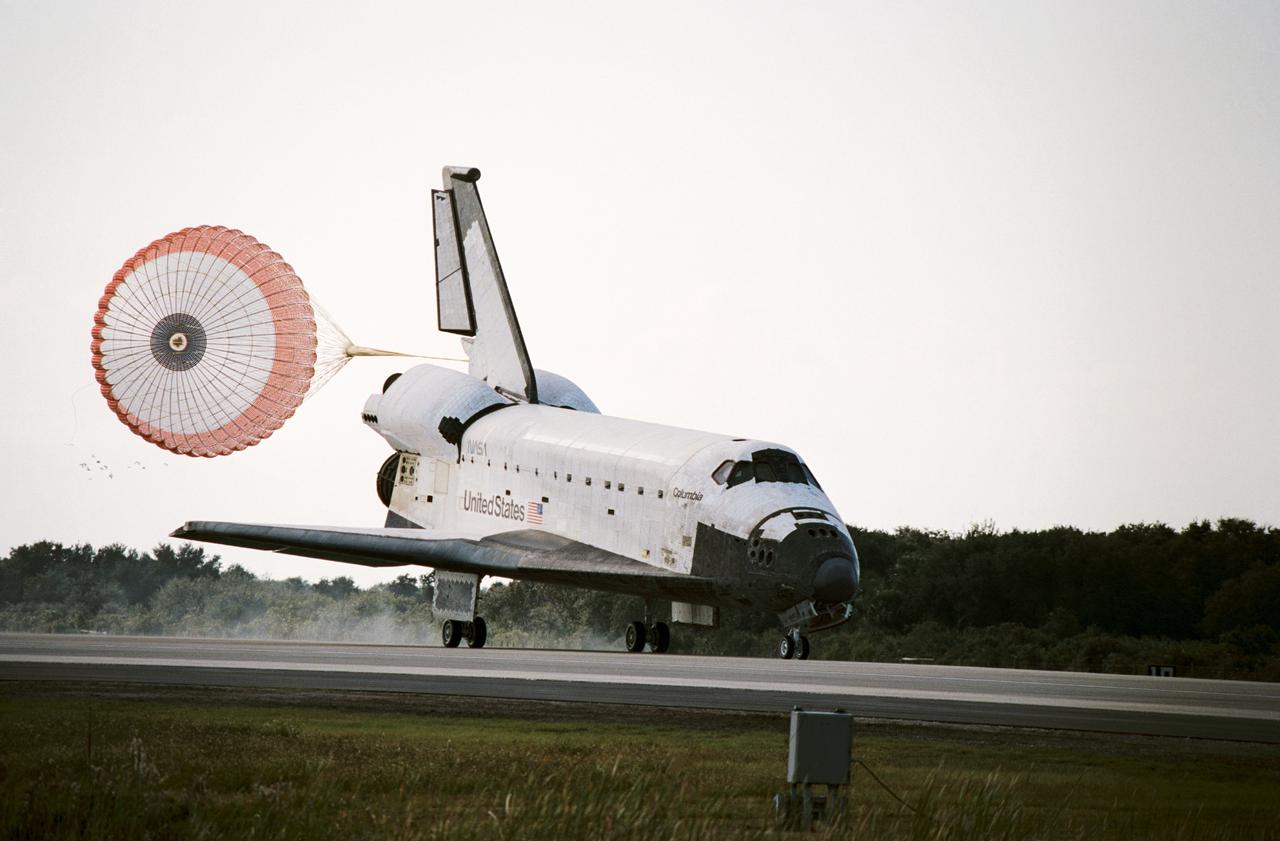
STS052-S-099 (1 Nov. 1992) --- This three-quarter front view shows the Space Shuttle Columbia just after deployment of the drag chute during landing at KSC's Shuttle Landing Facility. Onboard were a crew of five NASA astronauts and a Canadian payload specialist. Landing occurred at 9:05:53 a.m. (EST), November 1, 1992. Crewmembers are astronauts James D. Wetherbee, Michael A. Baker, Tamara E. Jernigan, Charles L. (Lacy) Veach and William M. Shepherd along with payload specialist Steven G. MacLean. The photo was taken with a 35mm camera.
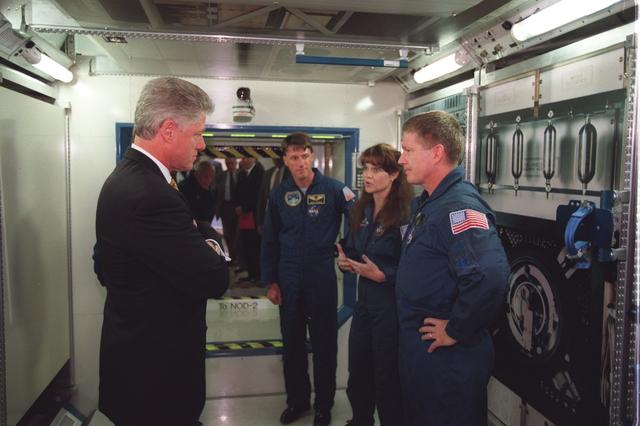
S98-05025 (14 April 1998) --- President Bill Clinton tours a laboratory mockup used for training purposes by astronauts assigned to fly aboard the International Space Station (ISS). Astronaut William Shepherd (right), mission commander for the first ISS expedition crew, briefs the Chief Executive. Looking on are astronauts C. Michael Foale and Tamara C. Jernigan. Foale spent four months last year aboard Russia's Mir space station. President Clinton toured several mockups and other training components before speaking to a crowd of JSC employees. Photo Credit: Joe McNally, National Geographic, for NASA
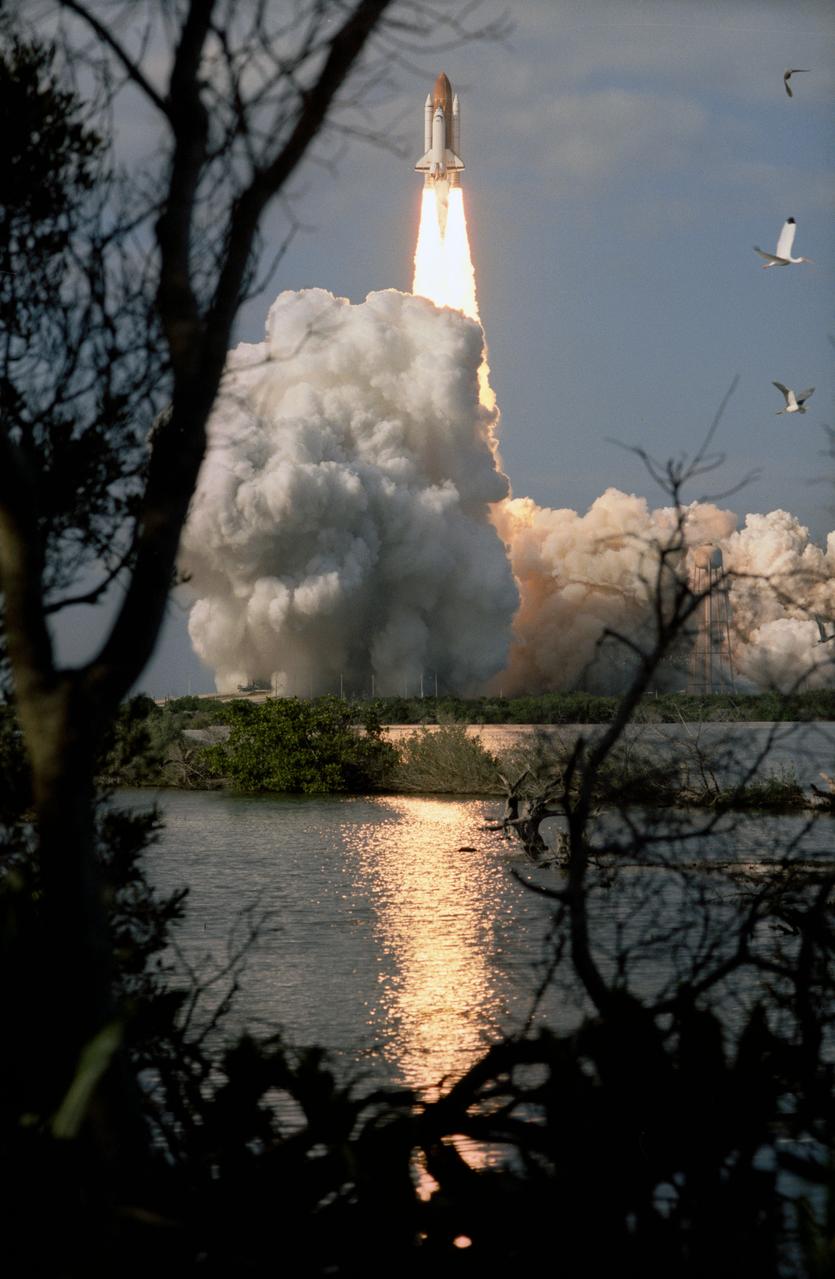
STS080-S-003 (19 Nov. 1996) --- The space shuttle Columbia lifts off from the Kennedy Space Center's (KSC) Launch Pad 39B at 2:55:47 p.m. (EST), November 19, 1996. Onboard are astronauts Kenneth D. Cockrell, mission commander; Kent V. Rominger, pilot; along with Story Musgrave, Tamara E. Jernigan and Thomas D. Jones, all mission specialists. The two primary payloads for STS-80 stowed in Columbia's cargo bay for later deployment and testing are the Wake Shield Facility (WSF-3) and the Orbiting and Retrievable Far and Extreme Ultraviolet Spectrometer (ORFEUS) with its associated Shuttle Pallet Satellite (SPAS).
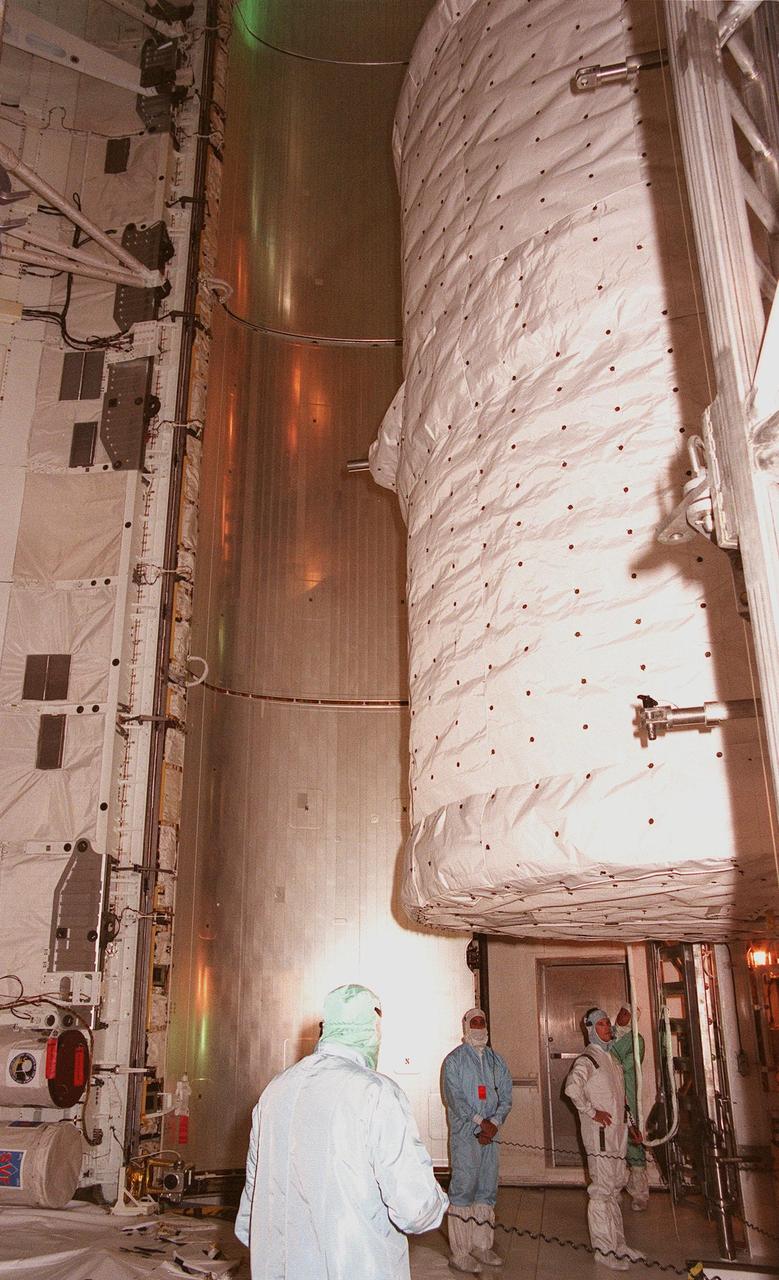
KENNEDY SPACE CENTER, FLA. -- In the payload changeout room at Launch Pad 39B, the SPACEHAB Double module is moved from the payload canister before being placed in Space Shuttle Discovery's payload bay for mission STS-96. The second flight supporting construction of the International Space Station, STS-96 is a logistics and resupply mission, carrying more than 5,000 pounds of supplies, a Russian-built crane and a U.S.-built crane, plus experiments such as STARSHINE, which was developed by and for students. Comprising the crew are Commander Kent V. Rominger, Pilot Rick Douglas Husband, and Mission Specialists Ellen Ochoa (Ph.D.), Tamara E. Jernigan (Ph.D.), Daniel Barry (M.D., Ph.D.), Julie Payette, with the Canadian Space Agency, and Valery Ivanovich Tokarev, with the Russian Space Agency. Liftoff is scheduled for May 20 at 9:32 a.m. EDT
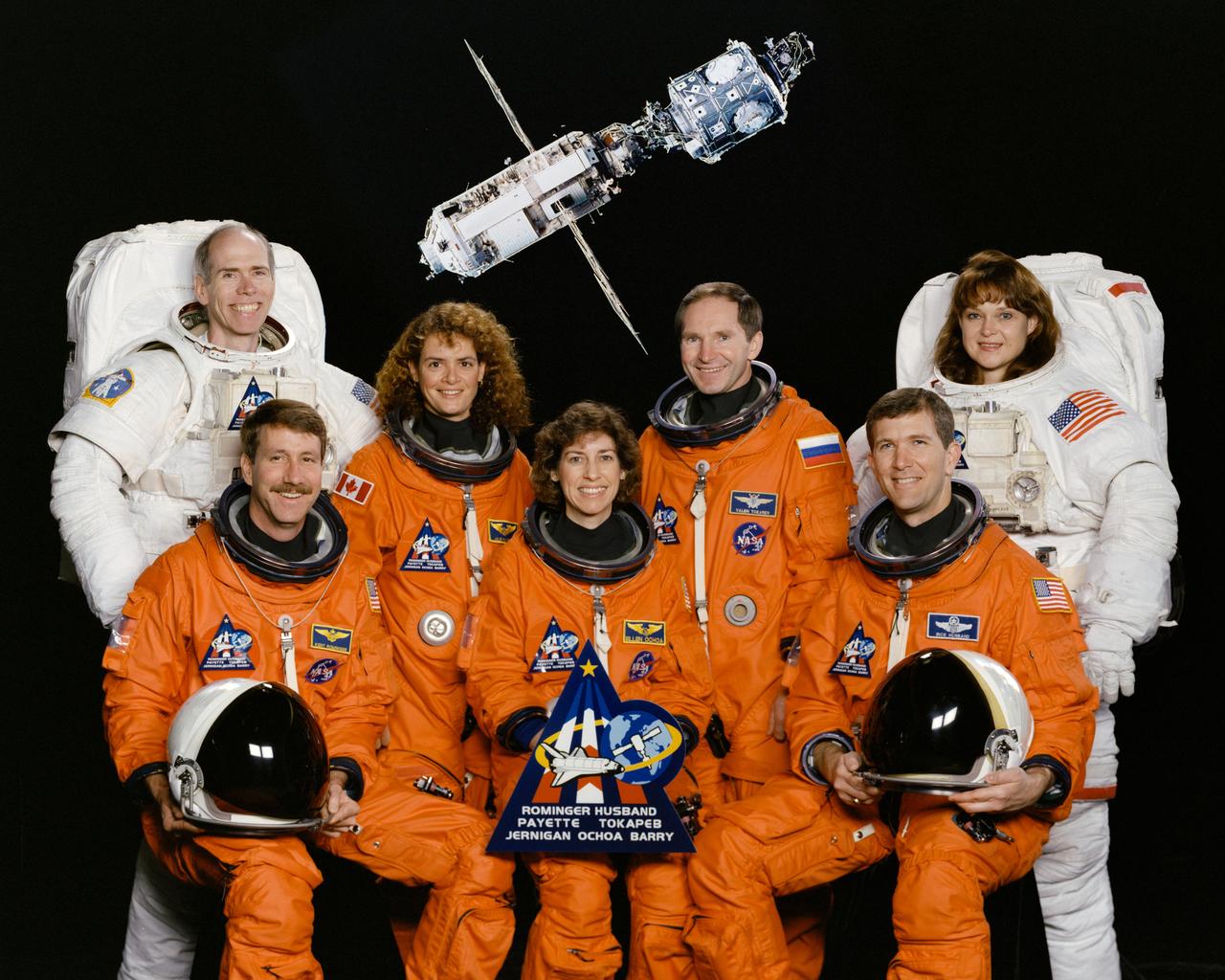
STS096-S-002 (April 1999) --- Six NASA astronauts and a Russian cosmonaut take a break from training to pose for the crew portrait. Astronaut Kent V. Rominger, mission commander, is at left on the front row. Astronaut Rick D. Husband, pilot, is right. The remaining astronauts are Ellen Ochoa (front center) and, from the left on the back row, Daniel T. Barry, Julie Payette, Valeriy I. Tokarev, and Tamara Jernigan, all mission specialists. Payette represents the Canadian Space Agency (CSA) and Tokarev is with the Russian Space Agency (RSA). The crew will perform the first station docking and will become the first visitors to the new International Space Station (ISS) since its launch and start of orbital assembly last year. Space Shuttle Discovery's launch date is now scheduled for May 20.
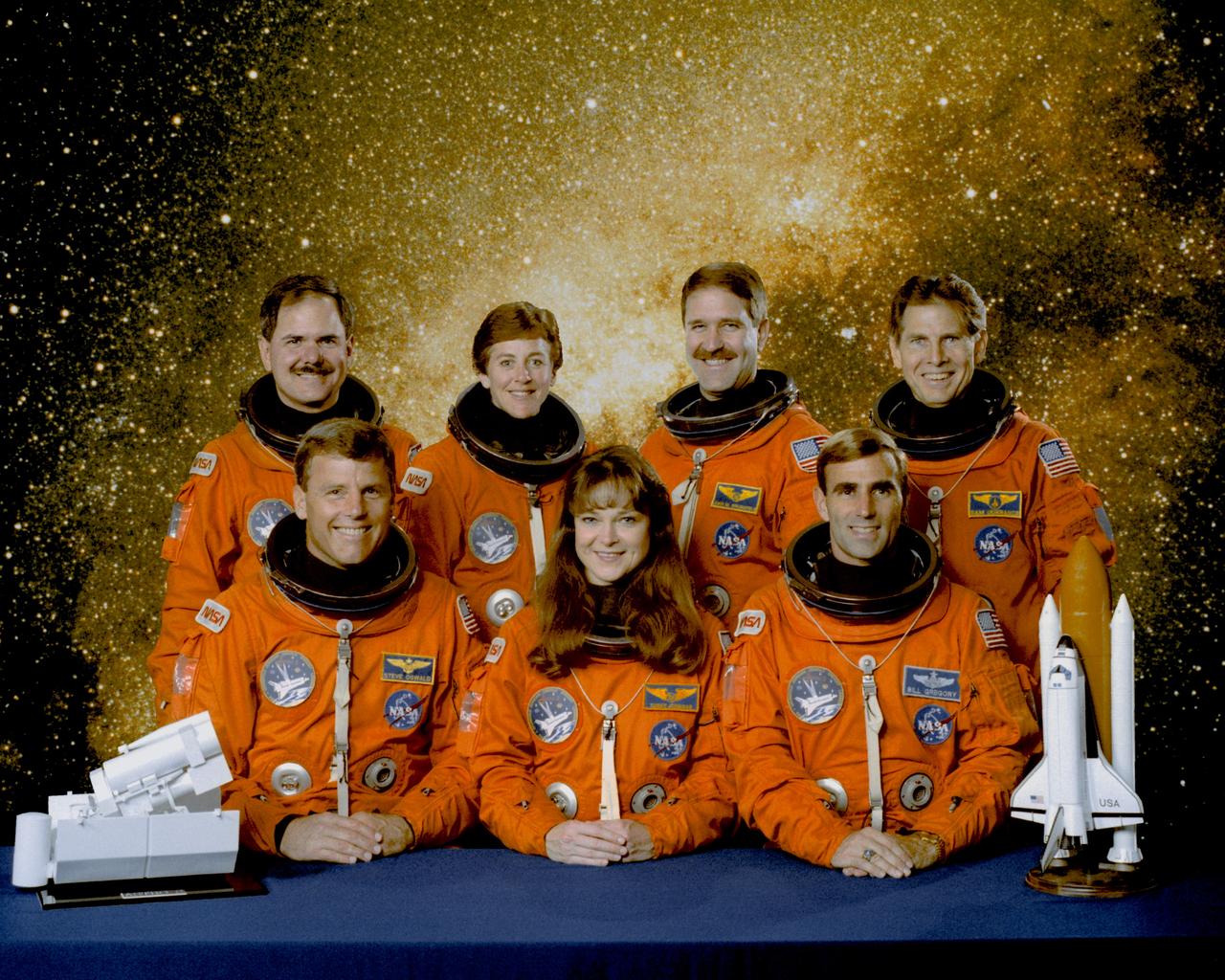
STS067-S-002 (December 1994) --- Five NASA astronauts and two payload specialists from the private sector have been named to fly aboard the Space Shuttle Endeavour for the STS-67/ASTRO-2 mission, scheduled for March 1995. In front are astronauts (left to right) Stephen S. Oswald, mission commander; Tamara E. Jernigan, payload commander; and William G. Gregory, pilot. In the back are (left to right) Ronald A. Parise, payload specialist; astronauts Wendy B. Lawrence, and John M. Grunsfeld, both mission specialists; and Samuel T. Durrance, payload specialist. Dr. Durrance is a research scientist in the Department of Physics and Astronomy at Johns Hopkins University, Baltimore, Maryland. Dr. Parise is a senior scientist in the Space Observatories Department, Computer Sciences Corporation, Silver Spring, Maryland. Both payload specialist's flew aboard the Space Shuttle Columbia for the STS-35/ASTRO-1 mission in December 1990.

KENNEDY SPACE CENTER, FLA. -- This fish-eye view shows the SPACEHAB Double module being moved into the payload changeout room at Launch Pad 39B before being transferred to Space Shuttle Discovery's payload bay for mission STS-96. The second flight supporting construction of the International Space Station, STS-96 is a logistics and resupply mission, carrying more than 5,000 pounds of supplies, a Russian-built crane and a U.S.-built crane, plus experiments such as STARSHINE, which was developed by and for students. Comprising the crew are Commander Kent V. Rominger, Pilot Rick Douglas Husband, and Mission Specialists Ellen Ochoa (Ph.D.), Tamara E. Jernigan (Ph.D.), Daniel Barry (M.D., Ph.D.), Julie Payette, with the Canadian Space Agency, and Valery Ivanovich Tokarev, with the Russian Space Agency. Liftoff is scheduled for May 20 at 9:32 a.m. EDT
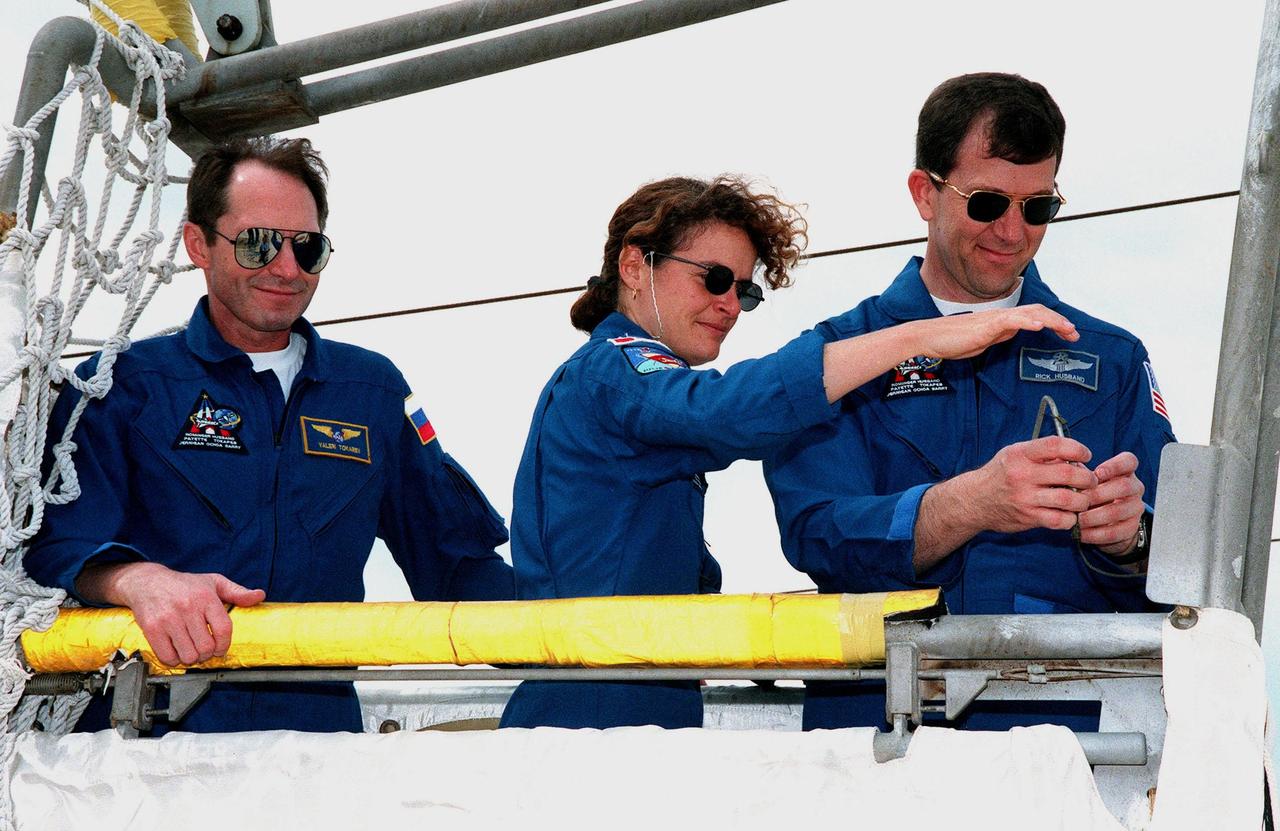
At the 195-foot level of Launch Pad 39B, STS-96 Mission Specialists Valery Ivanovich Tokarev and Julie Payette, plus Pilot Rick Douglas Husband, inspect the slidewire basket used for emergency egress. The training is part of Terminal Countdown Demonstration Test (TCDT) activities, which also provide the crew with simulated countdown exercises and opportunities to inspect the mission payloads in the orbiter's payload bay. Other crew members taking part in the TCDT are Commander Kent V. Rominger and Mission Specialists Tamara E. Jernigan (Ph.D.), Daniel Barry (M.D., Ph.D.), and Ellen Ochoa (Ph.D.). Scheduled for liftoff on May 20 at 9:32 a.m., STS-96 is a logistics and resupply mission for the International Space Station, carrying such payloads as a Russian crane, the Strela; a U.S.-built crane; the Spacehab Oceaneering Space System Box (SHOSS), a logistics items carrier; and STARSHINE, a student-led experiment
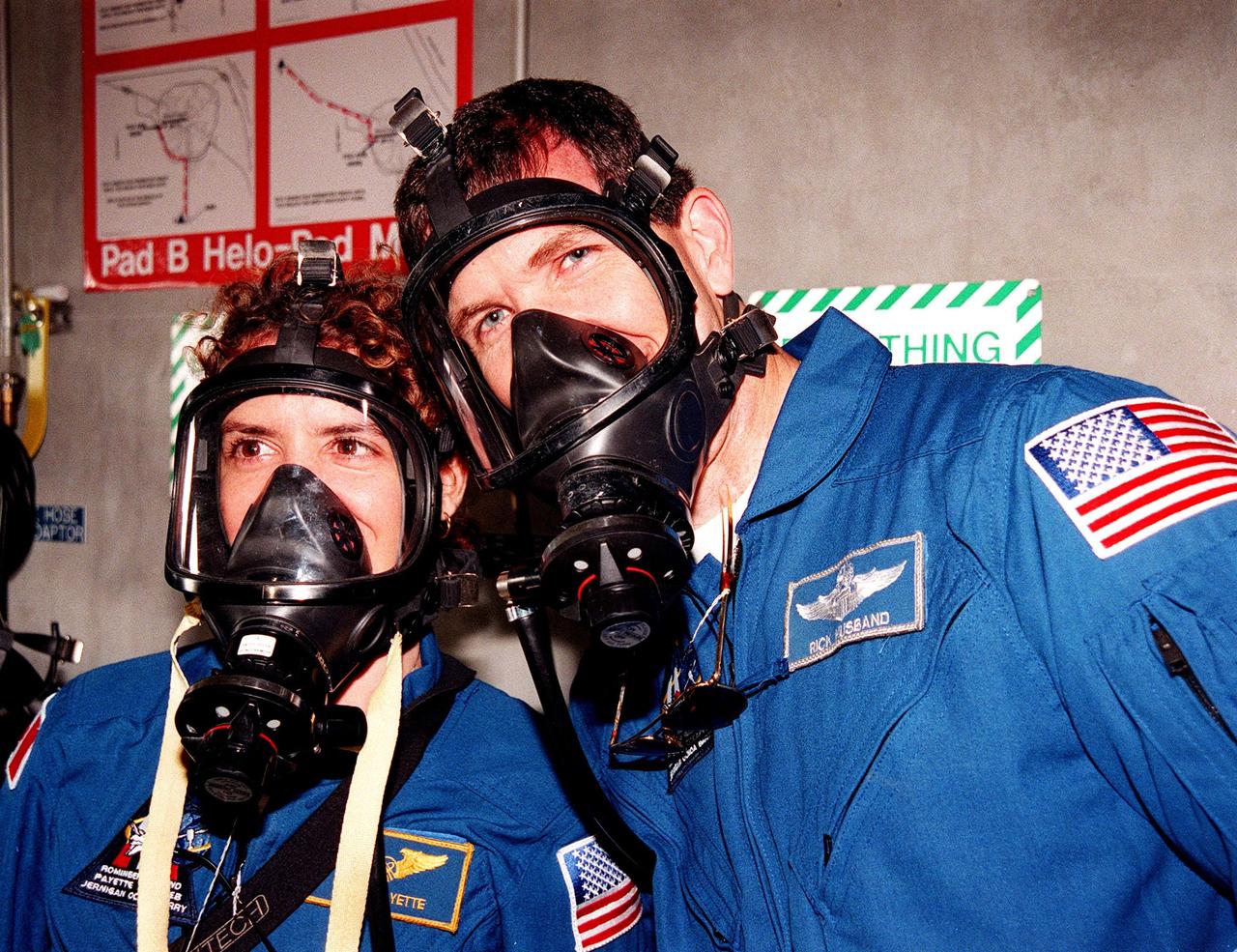
At Launch Pad 39B, STS-96 Mission Specialist Julie Payette, with the Canadian Space Agency, and Pilot Rick Douglas Husband practice putting on oxygen gas masks as part of Terminal Countdown Demonstration Test (TCDT) activities. The TCDT provides the crew with emergency egress traiing, simulated countdown exercises and opportunities to inspect the mission payloads in the orbiter's payload bay. Other crew members taking part in the TCDT are Commander Kent V. Rominger and Mission Specialists Tamara E. Jernigan (Ph.D.), Daniel Barry (M.D., Ph.D.), Ellen Ochoa (Ph.D.) and Valery Ivanovich Tokarev, with the Russian Space Agency. Scheduled for liftoff on May 20 at 9:32 a.m., STS-96 is a logistics and resupply mission for the International Space Station, carrying such payloads as a Russian crane, the Strela; a U.S.-built crane; the Spacehab Oceaneering Space System Box (SHOSS), a logistics items carrier; and STARSHINE, a student-led experiment
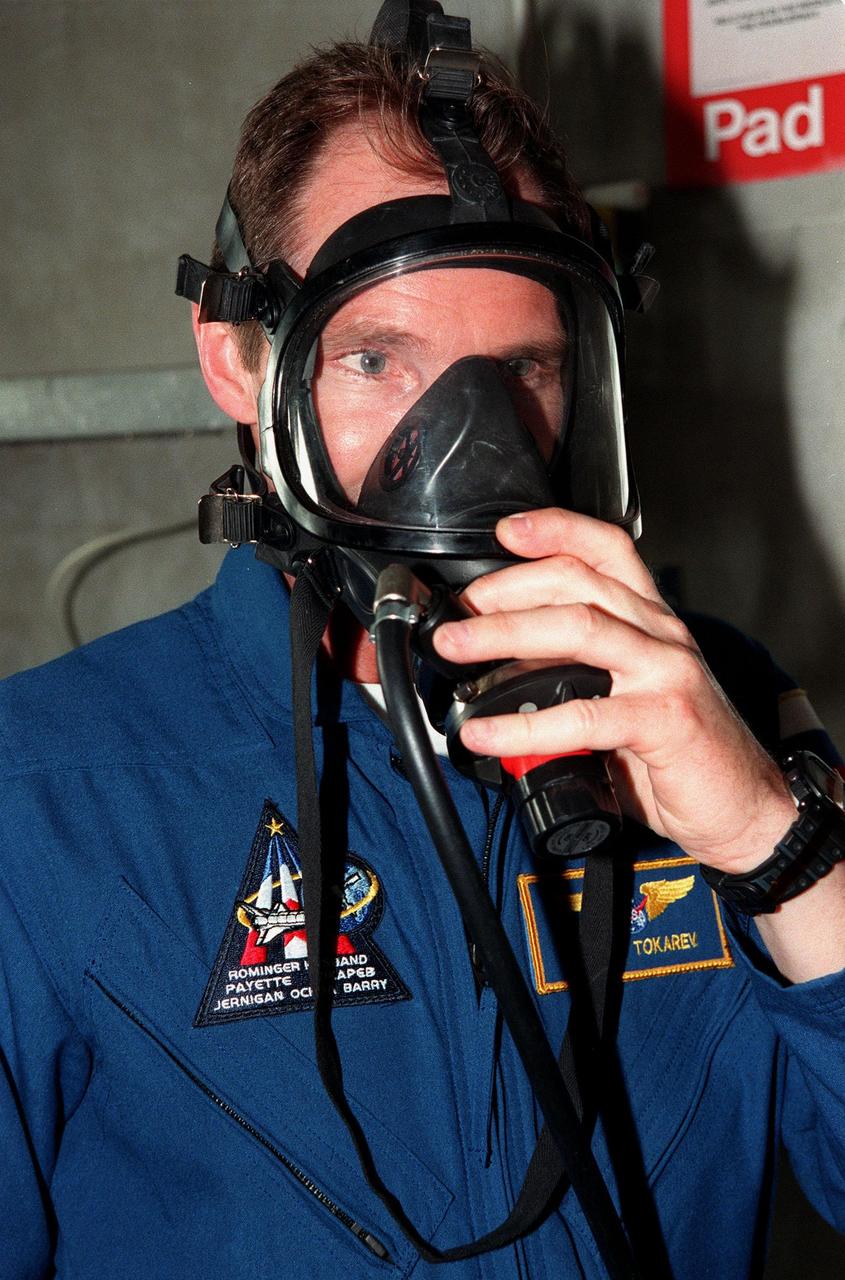
STS-96 Mission Specialist Valery Ivanovich Tokarev, with the Russian Space Agency, tries on an oxygen gas mask during Terminal Countdown Demonstration Test (TCDT) activities at Launch Pad 39B. The TCDT provides the crew with simulated countdown exercises, emergency egress training and opportunities to inspect the mission payloads in the orbiter's payload bay. Other crew members taking part in the TCDT are Commander Kent V. Rominger, Pilot Rick Douglas Husband, and Mission Specialists Tamara E. Jernigan (Ph.D.), Daniel Barry (M.D., Ph.D.), Ellen Ochoa (Ph.D.) and Julie Payette, with the Canadian Space Agency. Scheduled for liftoff on May 20 at 9:32 a.m., STS-96 is a logistics and resupply mission for the International Space Station, carrying such payloads as a Russian crane, the Strela; a U.S.-built crane; the Spacehab Oceaneering Space System Box (SHOSS), a logistics items carrier; and STARSHINE, a student-led experiment
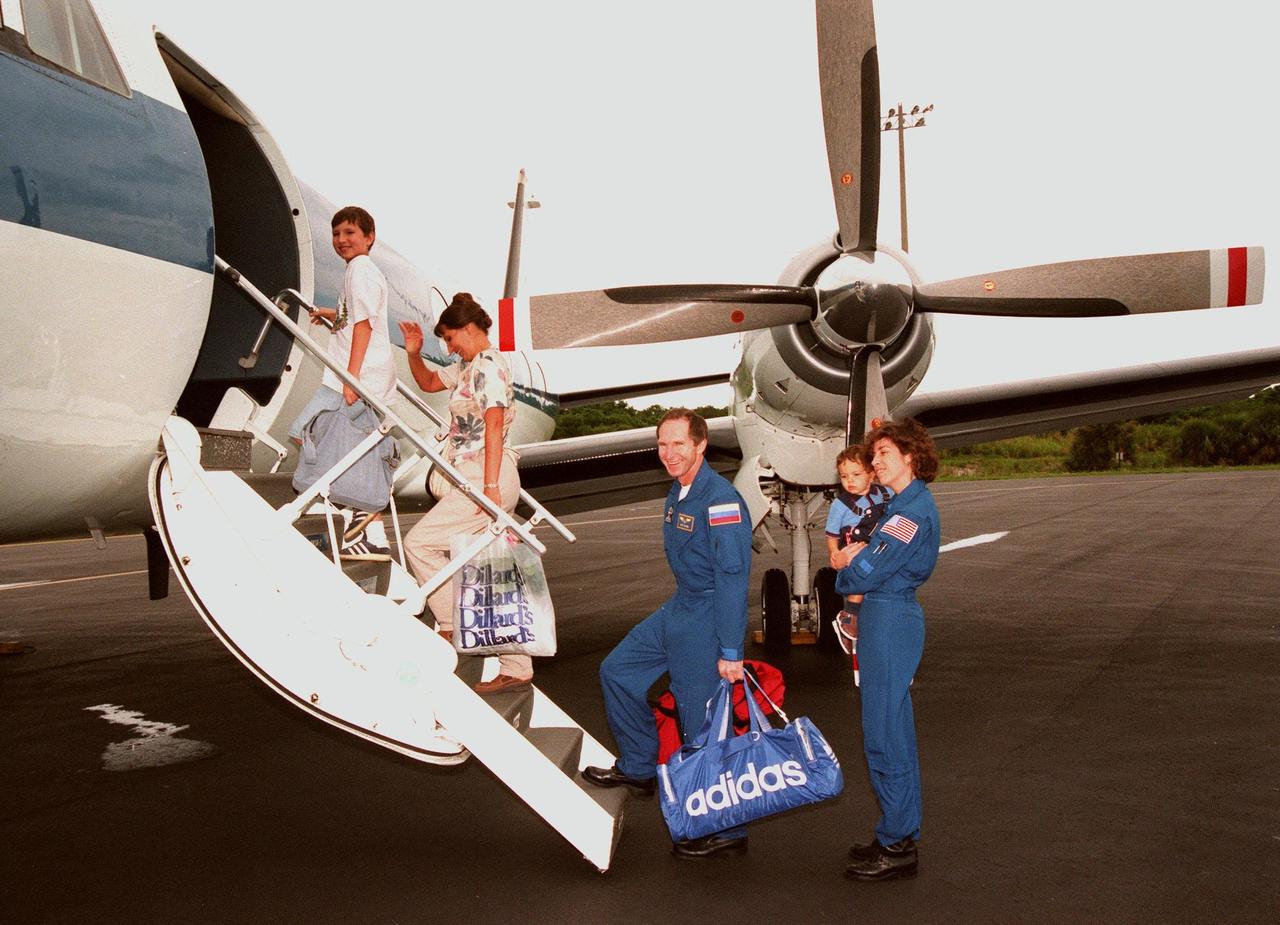
At the Cape Canaveral Air Station Skid Strip, STS-96 crew members and their families board a plane to return to the Johnson Space Center in Houston, Texas. From left are the son, Ivan, and wife, Irina, of Mission Specialist Valery Ivanovich Tokarev (carrying a duffel bag); and Mission Specialist Ellen Ochoa, holding her son, Wilson Miles-Ochoa. Other crew members also returning are Commander Kent V. Rominger, Pilot Rick D. Husband, and Mission Specialists Tamara E. Jernigan (Ph.D.), Daniel Barry (M.D., Ph.D.) and Julie Payette (with the Canadian Space Agency). After a successful 10-day mission to the International Space Station aboard Space Shuttle Discovery, the crew landed June 6 at 2:02:43 a.m. EDT, in the 11th night landing at KSC
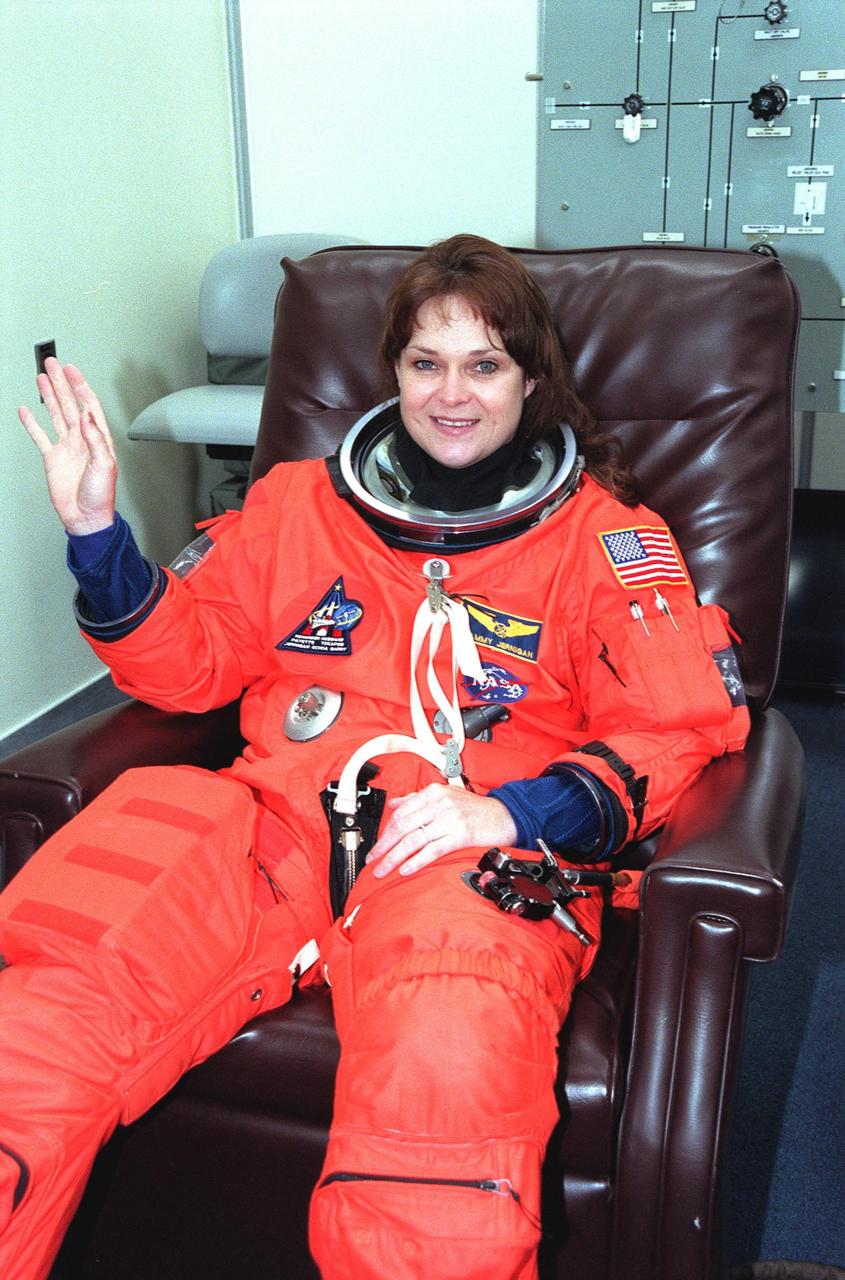
In the Operations and Checkout Building, STS-96 Mission Specialist Tamara E. Jernigan waves after donning her launch and entry suit during final launch preparations. STS-96 is a 10-day logistics and resupply mission for the International Space Station, carrying about 4,000 pounds of supplies, to be stored aboard the station for use by future crews, including laptop computers, cameras, tools, spare parts, and clothing. The mission also includes such payloads as a Russian crane, the Strela; a U.S.-built crane; the Spacehab Oceaneering Space System Box (SHOSS), a logistics items carrier; and STARSHINE, a student-involved experiment. It will include a space walk to attach the cranes to the outside of the ISS for use in future construction.. Space Shuttle Discovery is due to launch today at 6:49 a.m. EDT. Landing is expected at the SLF on June 6 about 1:58 a.m. EDT
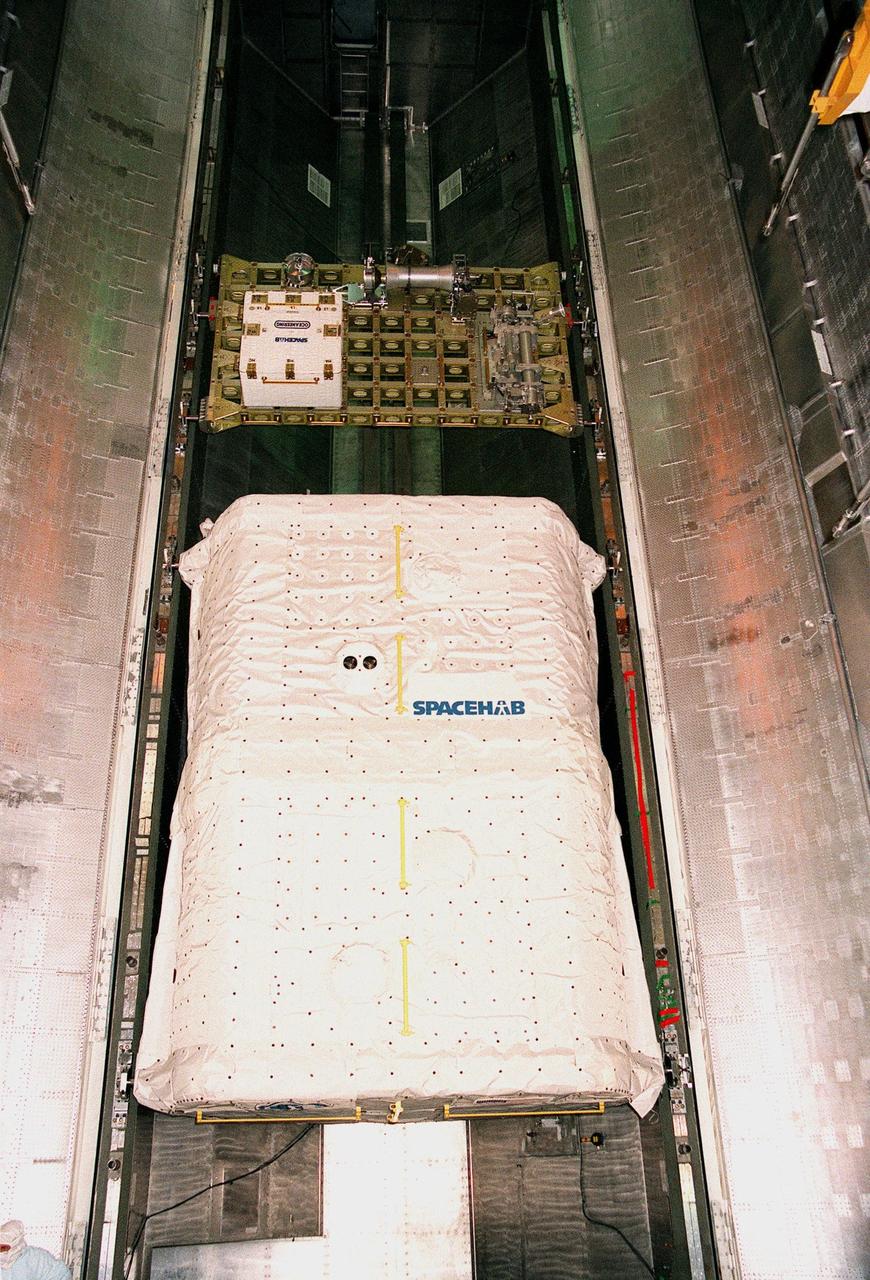
KENNEDY SPACE CENTER, FLA. -- The SPACEHAB Double module arrives at the payload changeout room at Launch Pad 39B before being transferred to Space Shuttle Discovery's payload bay for mission STS-96. Above it is the Integrated Cargo Carrier, which holds nonpressurized payloads such as a Russian crane, the Strela, and a U.S.-built crane. The second flight supporting construction of the International Space Station, STS-96 is a logistics and resupply mission, carrying more than 5,000 pounds of supplies, plus experiments such as STARSHINE, which was developed by and for students. The crew of seven are Commander Kent V. Rominger, Pilot Rick Douglas Husband, and Mission Specialists Ellen Ochoa (Ph.D.), Tamara E. Jernigan (Ph.D.), Daniel Barry (M.D., Ph.D.), Julie Payette, with the Canadian Space Agency, and Valery Ivanovich Tokarev, with the Russian Space Agency. Liftoff is scheduled for May 20 at 9:32 a.m. EDT
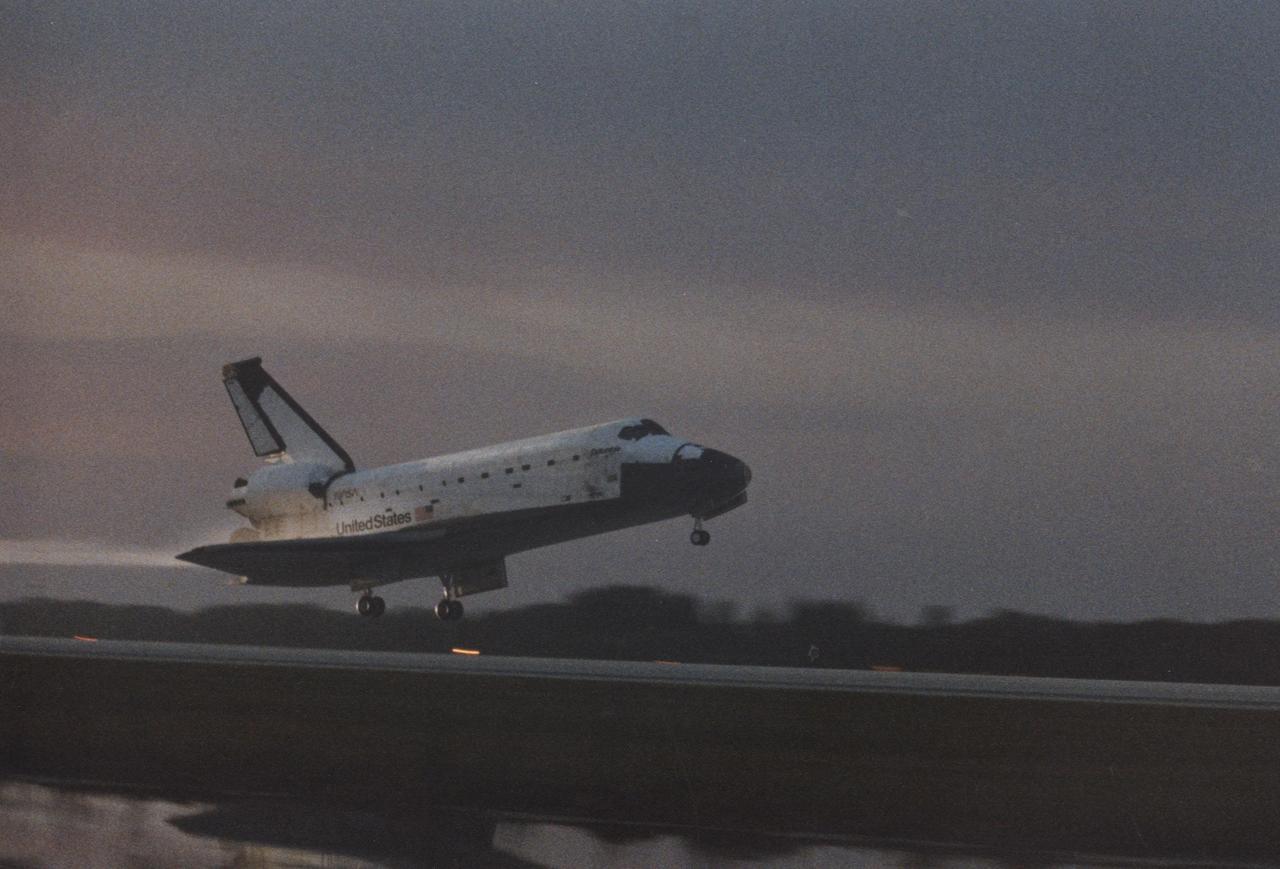
KENNEDY SPACE CENTER, FLA. -- With sunrise just minutes away, the orbiter Columbia swoops down on KSC’s Shuttle Landing Facility, Runway 33. The 33rd KSC landing in Shuttle program history is set to occur on the first opportunity Dec. 7 at 6:49 a.m. EST. Prior landing attempts Dec. 5 and 6 were scrubbed due to weather conditions. The extended time aloft allowed the five- member crew of Mission STS-80 to set a new record for long-duration Shuttle flight. At main gear touchdown, mission duration will be about 17 days, 16 hours, surpassing the 16-day, 21-hour set by the STS-78 crew earlier this year. Guiding Columbia onto the runway is STS-80 Commander Kenneth D. Cockrell; the pilot is Kent V. Rominger. The three mission specialists are Tamara E. Jernigan, Thomas D. Jones and Story Musgrave.
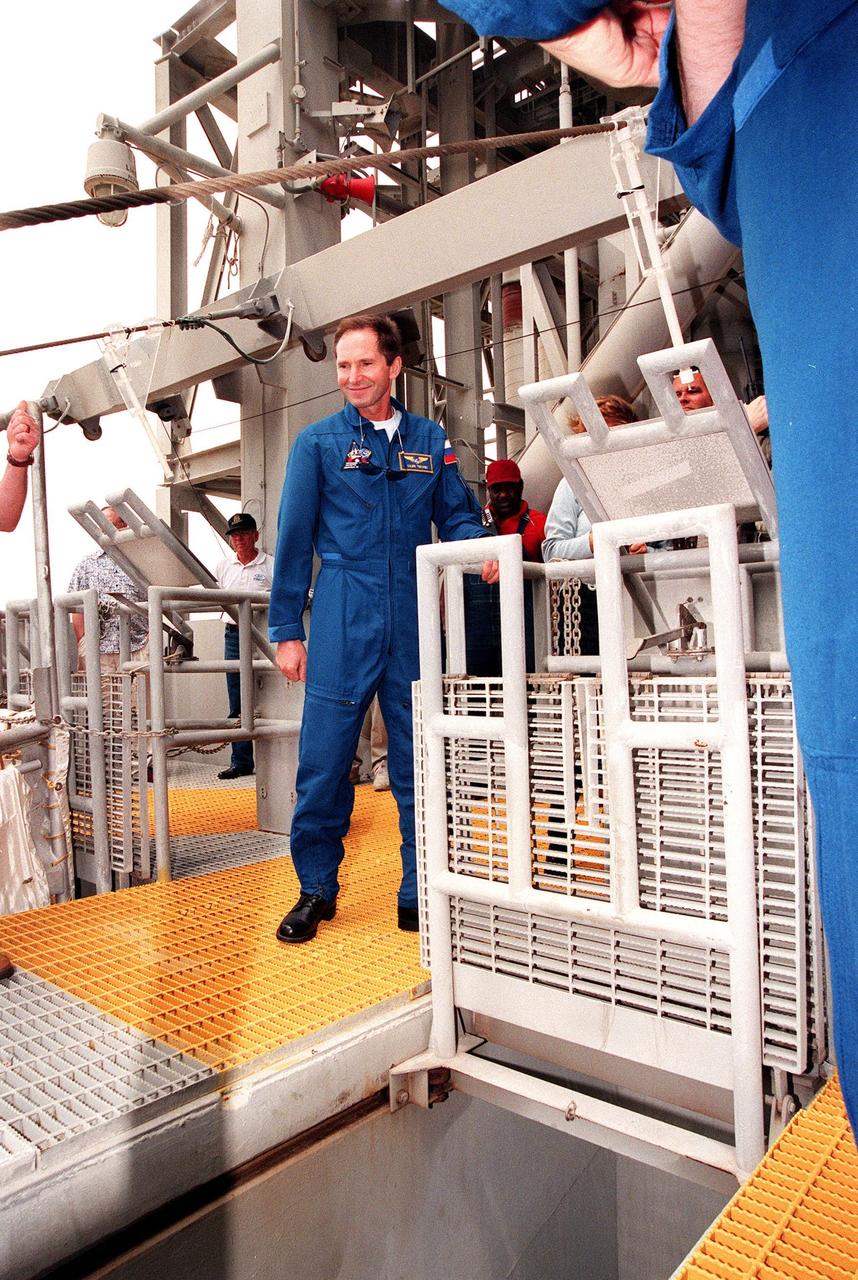
At the 195-foot level of Launch Pad 39B, STS-96 Mission Specialist Valery Ivanovich Tokarev releases a slidewire basket, part of emergency egress training. The STS-96 crew are taking part in Terminal Countdown Demonstration Test activities which also provide simulated countdown exercises and opportunities to inspect the mission payloads in the orbiter's payload bay. The other crew members are Commander Kent V. Rominger, Pilot Rick Douglas Husband and Mission Specialists Ellen Ochoa (Ph.D.), Tamara E. Jernigan (Ph.D.), Daniel Barry (M.D., Ph.D.) and Julie Payette, with the Canadian Space. STS-96, which is scheduled for liftoff on May 20 at 9:32 a.m., is a logistics and resupply mission for the International Space Station, carrying such payloads as a Russian crane, the Strela; a U.S.-built crane; the Spacehab Oceaneering Space System Box (SHOSS), a logistics items carrier; and STARSHINE, a student-led experiment
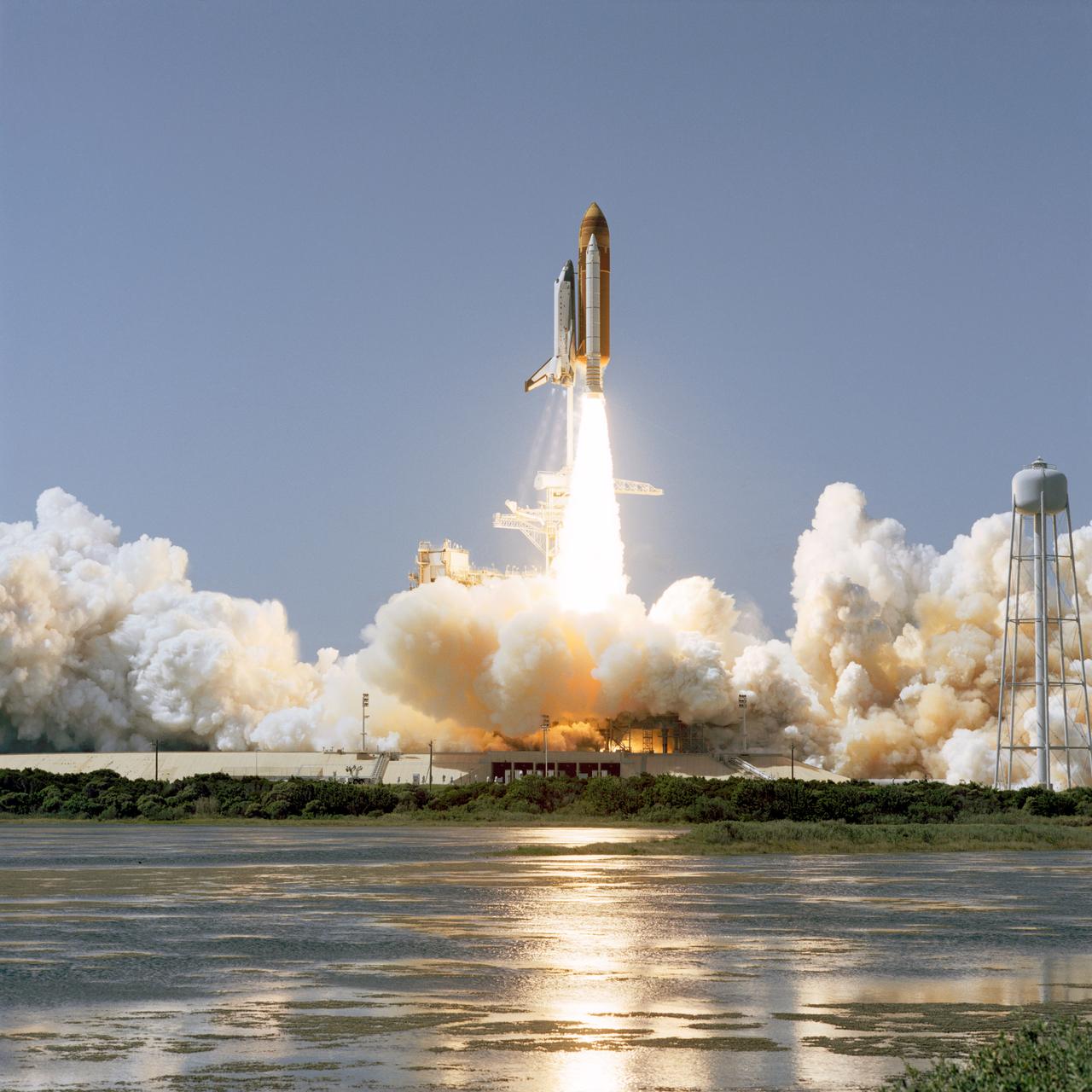
STS052-S-051 (22 Oct 1992) --- This distant 70mm image shows the Space Shuttle Columbia clearing the tower at Launch Pad 39B, at the Kennedy Space Center (KSC), on its way toward a ten-day Earth-orbital mission with a crew of five NASA astronauts and a Canadian payload specialist. Liftoff occurred at 1:09:39 p.m. (EDT), October 22, 1992. Crew members are astronauts James D. Wetherbee, Michael A. Baker, Tamara E. Jernigan, Charles L. (Lacy) Veach and William M. Shepherd, along with payload specialist Steven G. MacLean. Payloads onboard include the Laser Geodynamic Satellite II (LAGEOS II), which will be deployed early in the mission, a series of Canadian experiments, and the United States Microgravity Payload-1 (USMP-1).
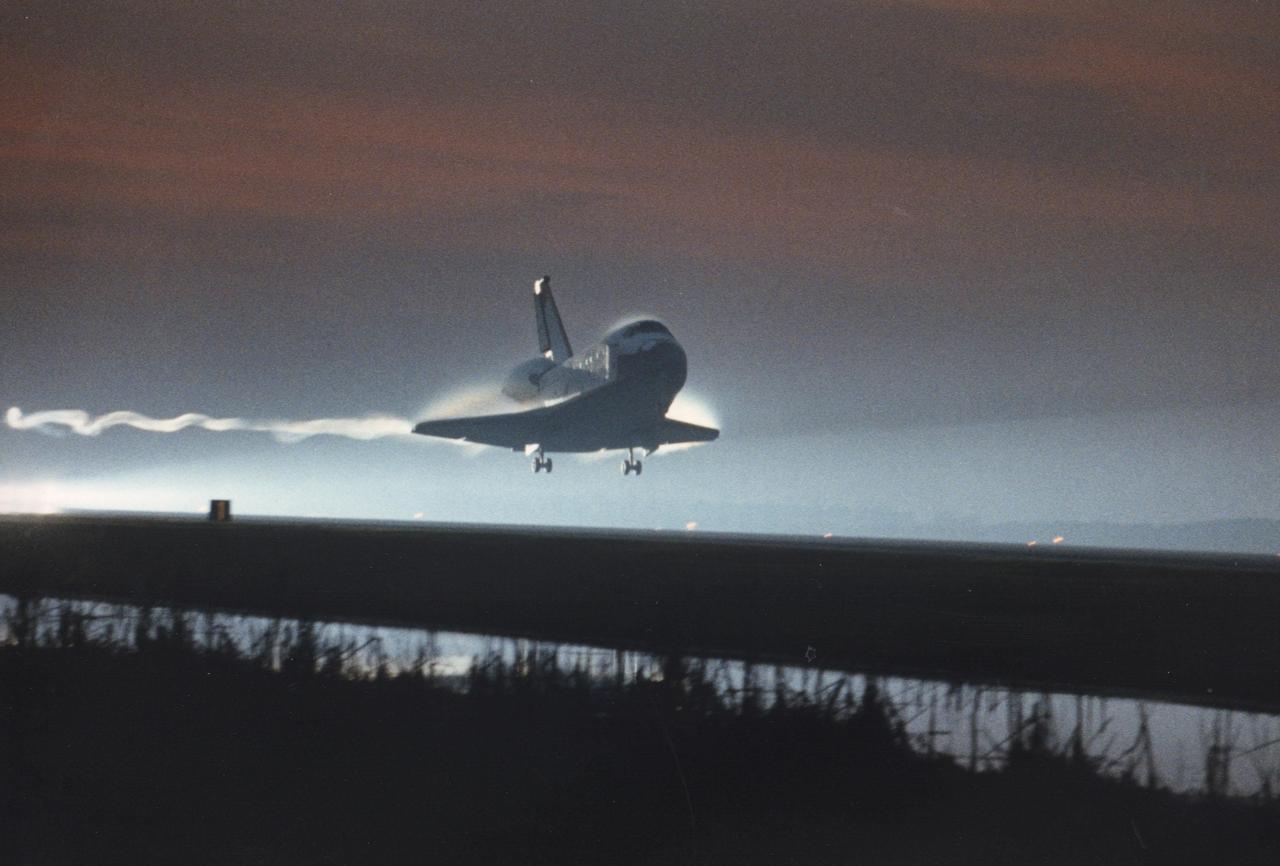
KENNEDY SPACE CENTER, FLA. -- With sunrise just minutes away, the orbiter Columbia swoops down on KSC’s Shuttle Landing Facility, Runway 33. The 33rd KSC landing in Shuttle program history is set to occur on the first opportunity Dec. 7 at 6:49 a.m. EST. Prior landing attempts Dec. 5 and 6 were scrubbed due to weather conditions. The extended time aloft allowed the five- member crew of Mission STS-80 to set a new record for long-duration Shuttle flight. At main gear touchdown, mission duration will be about 17 days, 16 hours, surpassing the 16-day, 21-hour set by the STS-78 crew earlier this year. Guiding Columbia onto the runway is STS-80 Commander Kenneth D. Cockrell; the pilot is Kent V. Rominger. The three mission specialists are Tamara E. Jernigan, Thomas D. Jones and Story Musgrave.
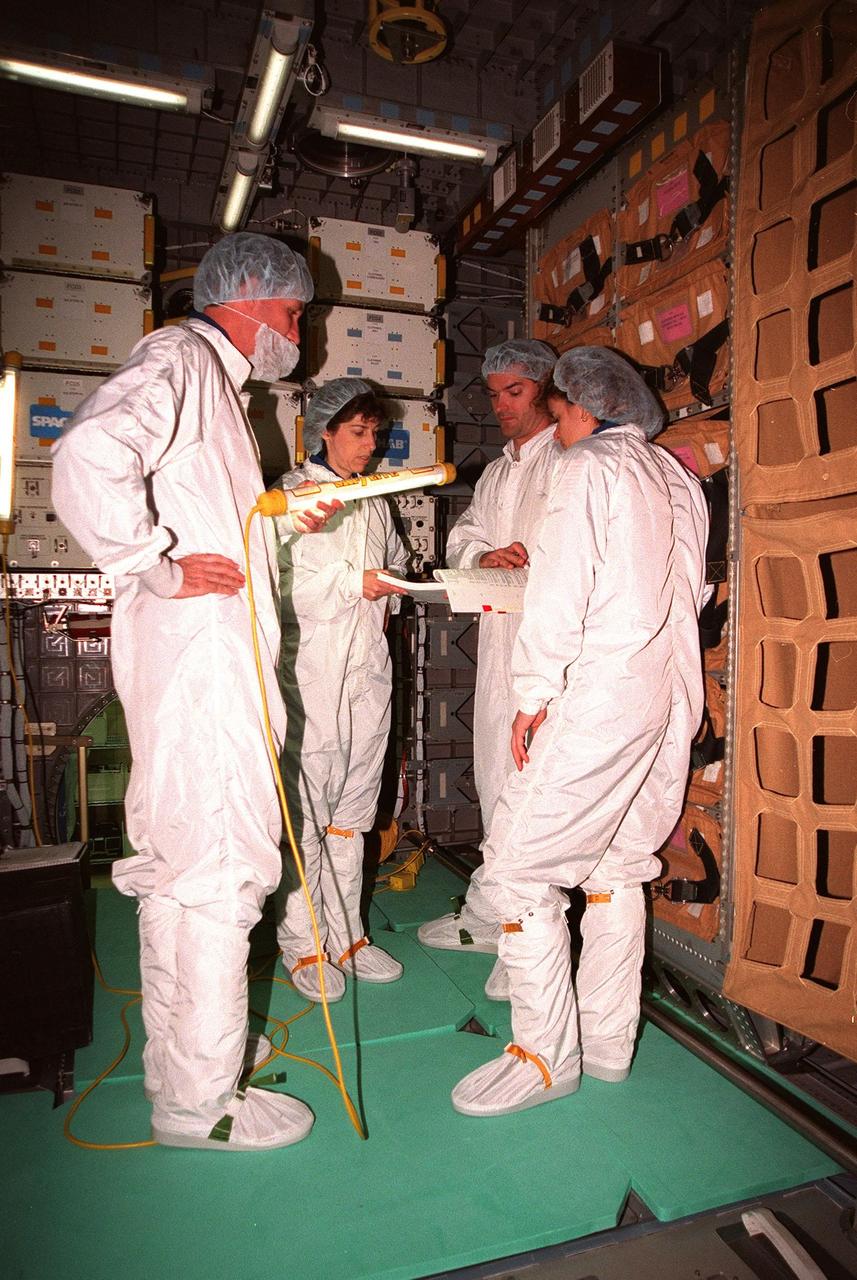
KENNEDY SPACE CENTER, FLA. -- Inside the SPACEHAB module, (left to right) STS-96 Commander Kent V. Rominger and Mission Specialists Ellen Ochoa and Julie Payette (far right) review equipment use with Chris Jaskoika (second from right), of Boeing SPACEHAB. Members of the STS-96 crew are taking part in a bench review at SPACEHAB as part of familiarization activities for their upcoming mission. The crew also includes Pilot Rick Husband and Mission Specialists Tamara E. Jernigan, Daniel Barry, and Valery Ivanovich Tokarev. Payette is with the Canadian Space Agency and Tokarev with the Russian Space Agency. Mission STS-96 is the second flight in construction of the International Space Station and will include the SPACEHAB. The 10-day mission is targeted for launch on May 24, 1999, at Launch Pad 39B
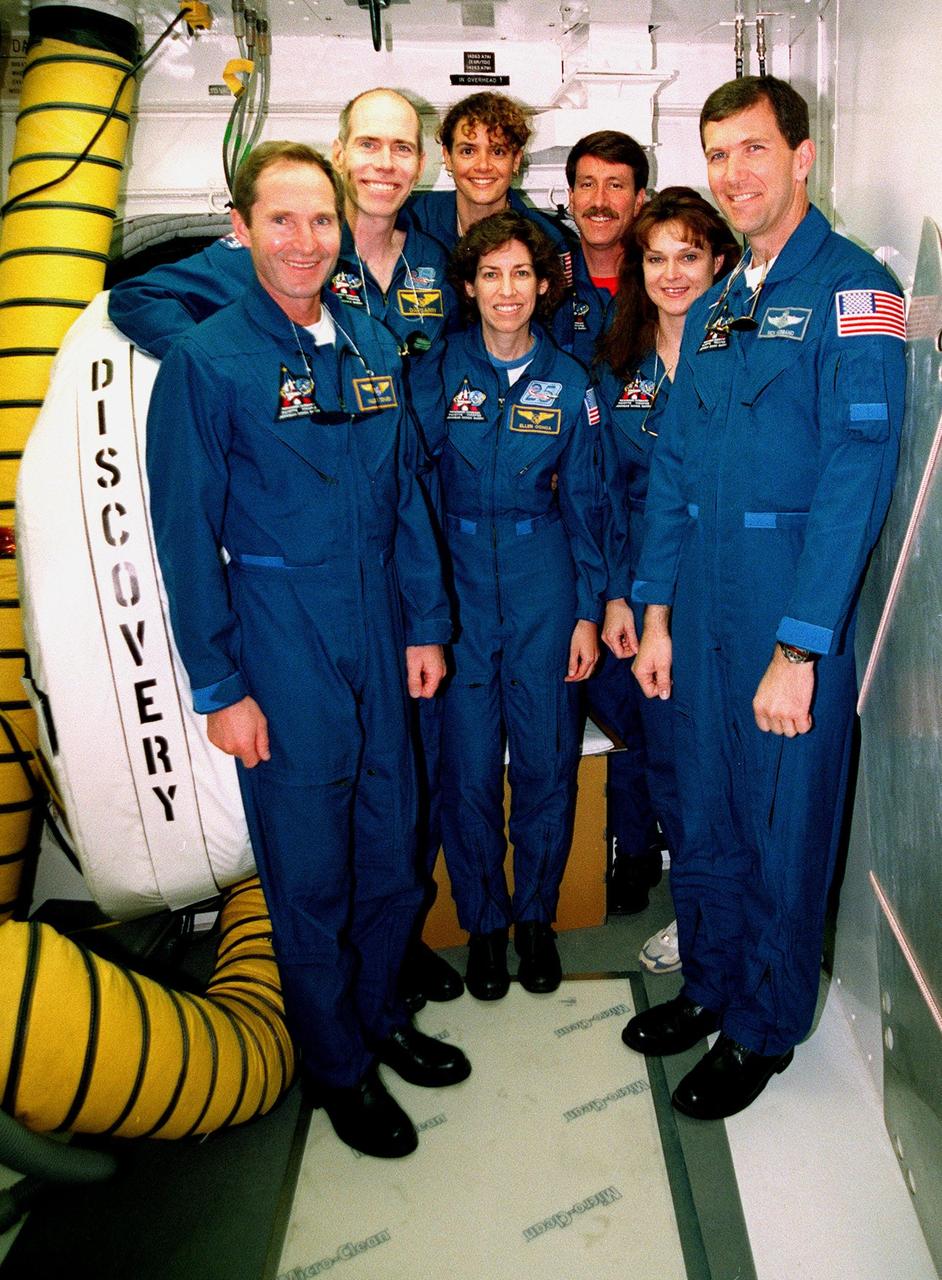
The STS-96 crew take a photo break during Terminal Countdown Demonstration Test (TCDT) activities at Launch Pad 39B. From left, they are Mission Specialists Valery Ivanovich Tokarev, Daniel Barry (M.D., Ph.D.), Julie Payette, Ellen Ochoa (Ph.D.), Commander Kent V. Rominger, Mission Specialist Tamara E. Jernigan (Ph.D.) and Pilot Rick Douglas Husband. Payette is with the Canadian Space Agency and Tokarev with the Russian Space Agency. The TCDT provides simulated countdown exercises, emergency egress training and opportunities to inspect the mission payloads in the orbiter's payload bay. STS-96, which is scheduled for liftoff on May 20 at 9:32 a.m., is a logistics and resupply mission for the International Space Station, carrying such payloads as a Russian crane, the Strela; a U.S.-built crane; the Spacehab Oceaneering Space System Box (SHOSS), a logistics items carrier; and STARSHINE, a student-led experiment
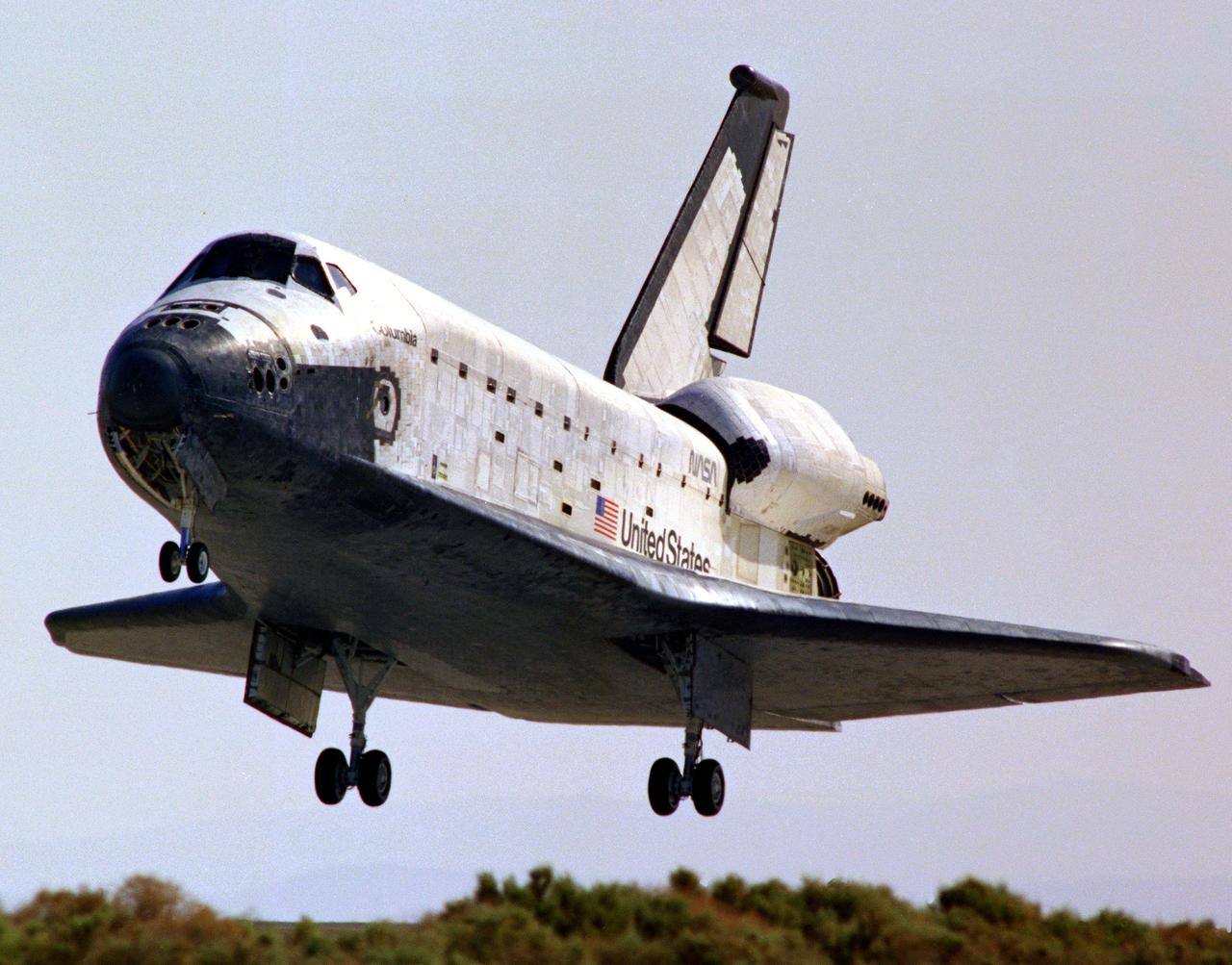
Space Shuttle Columbia nears its touchdown on Runway 22 at Edwards, California, at 8:39 a.m., 14 June 1991, as the STS-40 life sciences mission comes to an end at NASA's Ames-Dryden Flight Research Facility (later redesignated Dryden Flight Research Center) after nine days of orbital flight. Aboard Columbia during the extended mission were Bryan D. O'Connor, mission commander; Sidney M. Gutierrez, pilot; mission specialists James P. Bagian, Tamara E. Jernigan, and Margaret Rhea Seddon; and payload specialists Francis Andrew Gaffney and Millie Hughes-Fulford. STS-40 was the first space shuttle mission dedicated to life sciences research to explore how the body reacts to a weightless environment and how it readjusts to gravity on return to earth. Columbia was launched on the STS-40 mission 5 June 1991, from Kennedy Space Center in Florida.
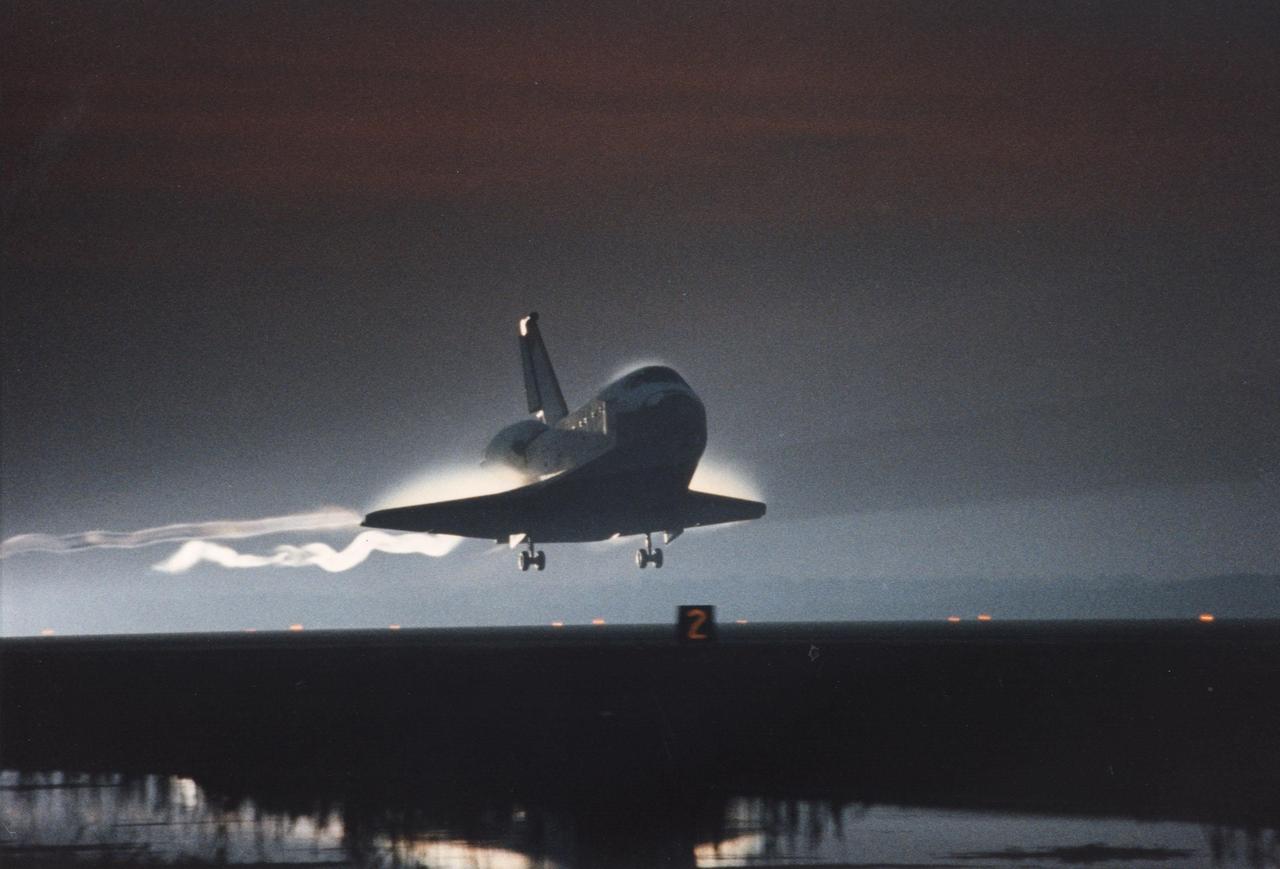
KENNEDY SPACE CENTER, FLA. -- With sunrise just minutes away, the orbiter Columbia swoops down on KSC’s Shuttle Landing Facility, Runway 33. The 33rd KSC landing in Shuttle program history is set to occur on the first opportunity Dec. 7 at 6:49 a.m. EST. Prior landing attempts Dec. 5 and 6 were scrubbed due to weather conditions. The extended time aloft allowed the five- member crew of Mission STS-80 to set a new record for long-duration Shuttle flight. At main gear touchdown, mission duration will be about 17 days, 16 hours, surpassing the 16-day, 21-hour set by the STS-78 crew earlier this year. Guiding Columbia onto the runway is STS-80 Commander Kenneth D. Cockrell; the pilot is Kent V. Rominger. The three mission specialists are Tamara E. Jernigan, Thomas D. Jones and Story Musgrave.
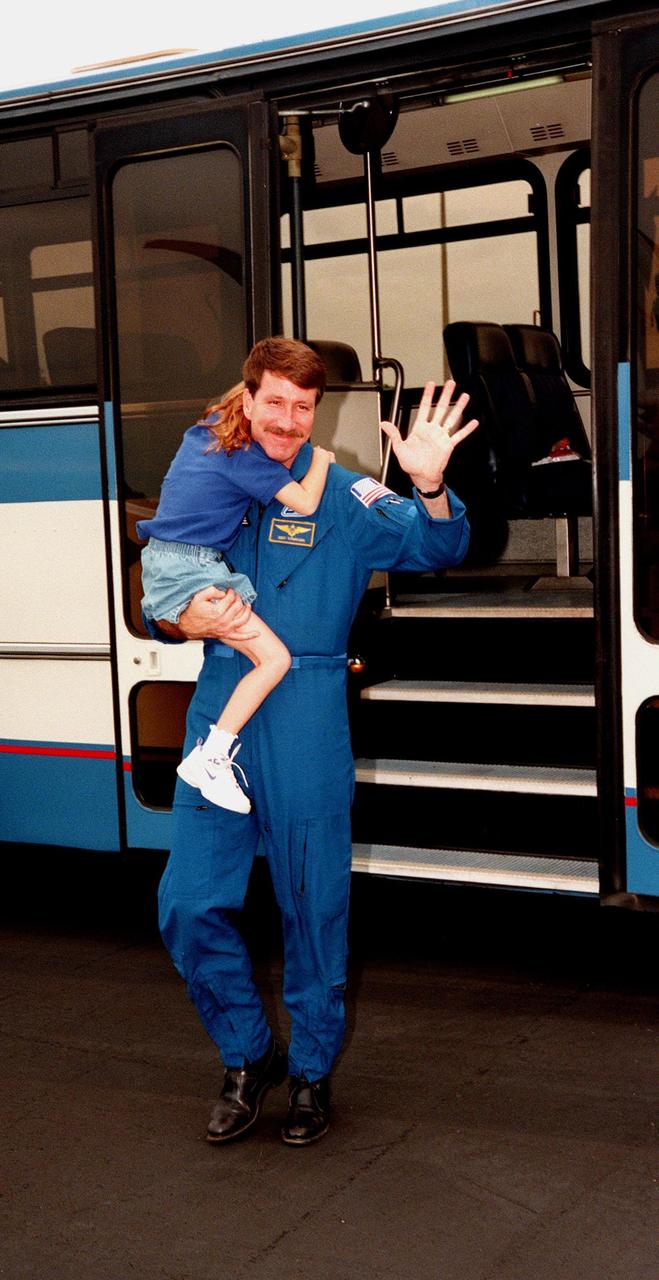
STS-96 Commander Kent V. Rominger, holding his daughter, Kristen, exits the bus at the Cape Canaveral Air Station Skid Strip before boarding a plane for a return to the Johnson Space Center in Houston, Texas. Other crew members also returning are Pilot Rick D. Husband, and Mission Specialists Ellen Ochoa (Ph.D.), Tamara E. Jernigan (Ph.D.), Daniel T. Barry (M.D., Ph.D.), Julie Payette, with the Canadian Space Agency, and Valery Ivanovich Tokarev, with the Russian Space Agency. After a successful 10-day mission to the International Space Station aboard Space Shuttle Discovery, the STS-96 crew landed June 6 at 2:02:43 a.m. EDT, in the 11th night landing at KSC
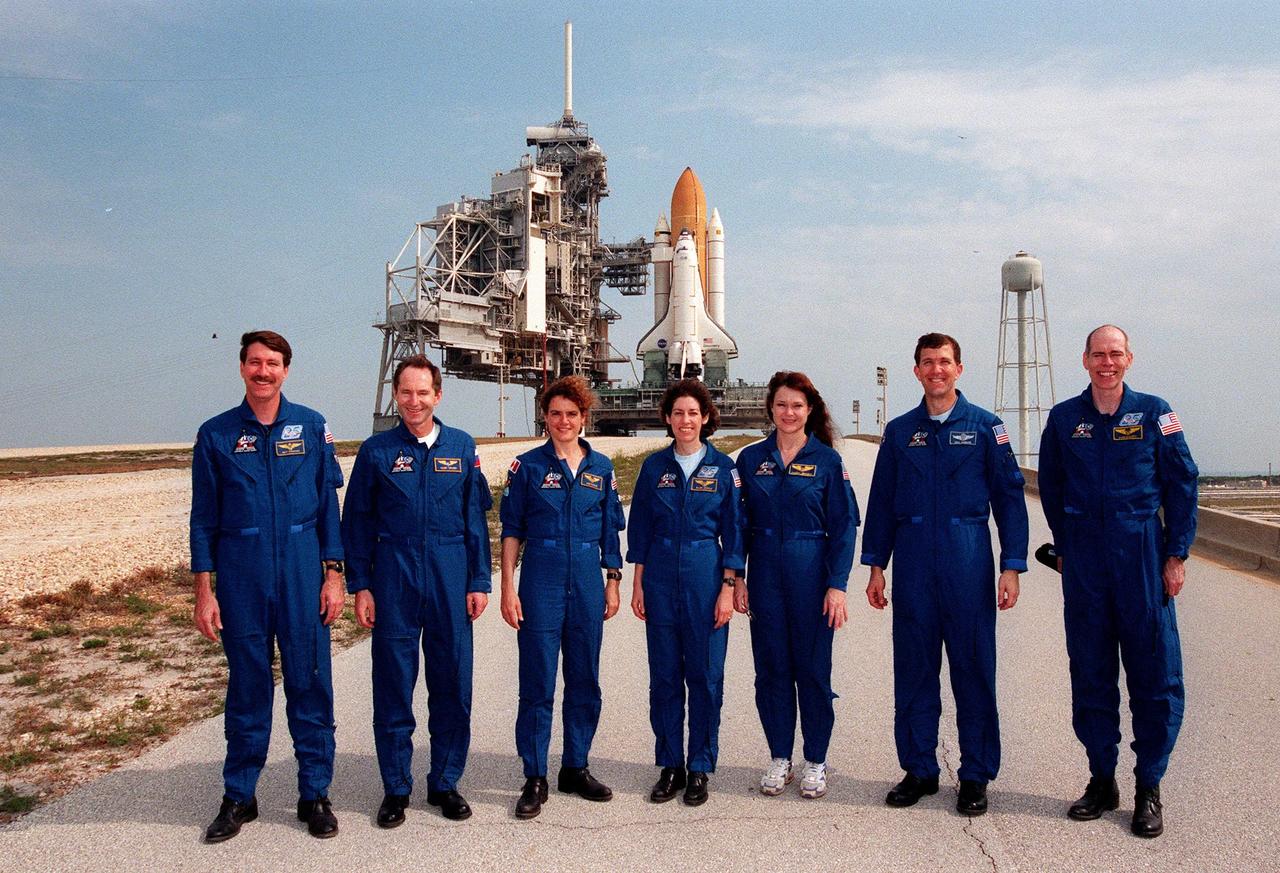
The STS-96 crew visit Launch Pad 39B where Space Shuttle Discovery, in the background, is being prepared for the mission launch on May 20. From left to right are Commander Kent V. Rominger; Mission Specialists Valery Ivanovich Tokarev, Julie Payette, Ellen Ochoa (Ph.D.), and Tamara E. Jernigan (Ph.D.); Pilot Rick Douglas Husband; and Mission Specialist Daniel Barry (M.D., Ph.D.). The crew are taking part in Terminal Countdown Demonstration Test (TCDT) activities. The TCDT provides simulated countdown exercises, emergency egress training, and opportunities to inspect the mission payloads in the orbiter's payload bay. Mission STS-96 is a logistics and resupply mission for the International Space Station, carrying such payloads as a Russian crane, the Strela; a U.S.-built crane; the Spacehab Oceaneering Space System Box (SHOSS), a logistics items carrier; and STARSHINE, a student-led experiment