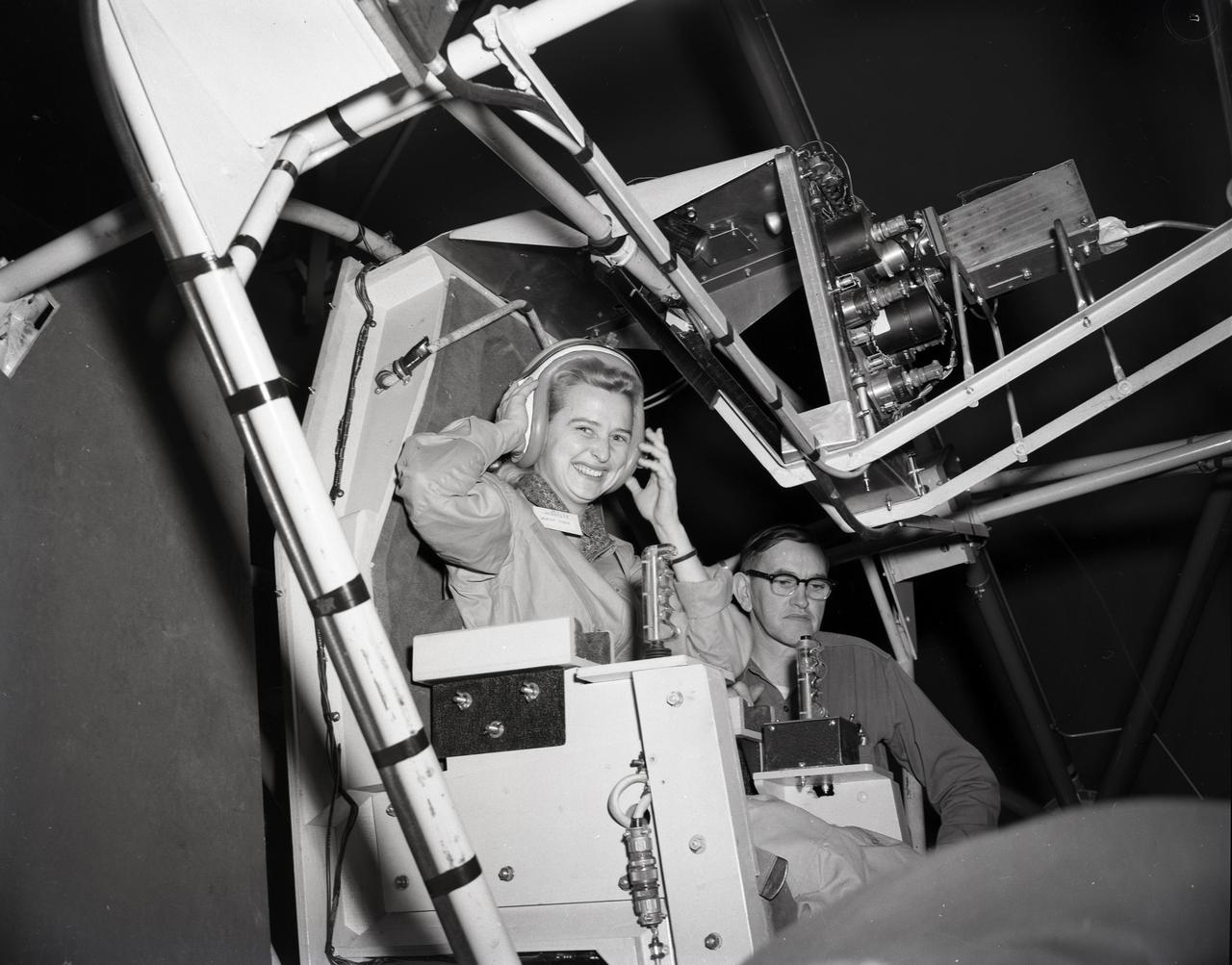
JERRIE COBB - PILOT - TESTING GIMBAL RIG IN THE ALTITUDE WIND TUNNEL, AWT

Jerrie Cobb prepares to operate the Multi-Axis Space Test Inertia Facility (MASTIF) inside the Altitude Wind Tunnel at the National Aeronautics and Space Administration (NASA) Lewis Research Center. The MASTIF was a three-axis rig with a pilot’s chair mounted in the center to train Project Mercury pilots to bring a spinning spacecraft under control. An astronaut was secured in a foam couch in the center of the rig. The rig was then spun on three axes from 2 to 50 rotations per minute. The pilots were tested on each of the three axis individually, then all three simultaneously. The two controllers in Cobb’s hands activated the small nitrogen gas thrusters that were used to bring the MASTIF under control. A makeshift spacecraft control panel was set up in front of the trainee’s face. Cobb was one of several female pilots who underwent the skill and endurance testing that paralleled that of the Project Mercury astronauts. In 1961 Jerrie Cobb was the first female to pass all three phases of the Mercury Astronaut Program. NASA rules, however, stipulated that only military test pilots could become astronauts and there were no female military test pilots. The seven Mercury astronauts had taken their turns on the MASTIF in February and March 1960.
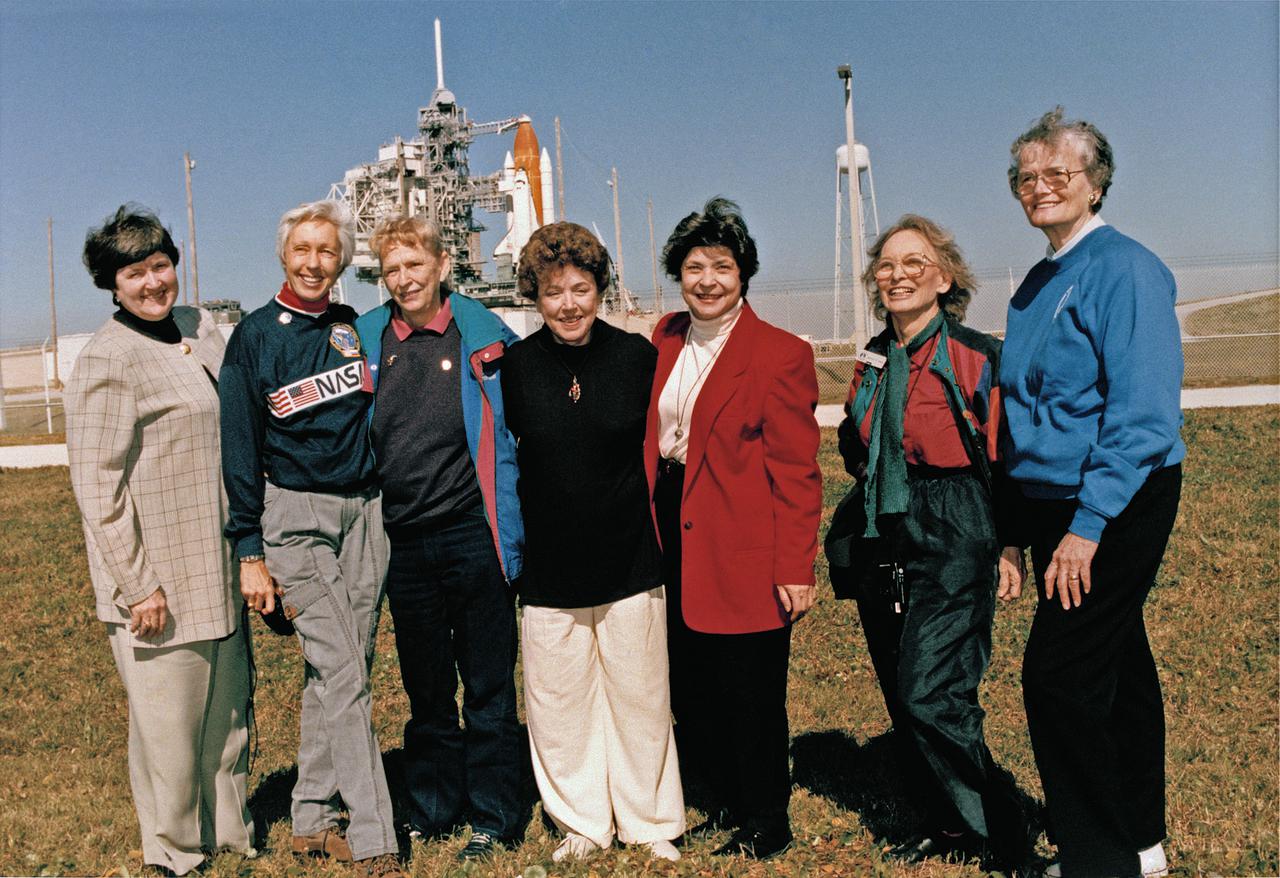
CAPE CANAVERAL, Fla. -- Exuberant and thrilled to be at Kennedy Space Center, seven women who once aspired to fly into space stand outside Launch Pad 39B near the space shuttle Discovery, poised for liftoff on the first flight of 1995. Visiting the space center as invited guests of STS-63 Pilot Eileen Collins are from left Gene Nora Jessen, Wally Funk, Jerrie Cobb, Jerri Truhill, Sarah Rutley, Myrtle Cagle and Bernice Steadman. They are members of the Mercury 13 group of women who trained to become astronauts for America's first human spaceflight program back in the early 1960s. Although the Mercury 13 effort was eventually cancelled, the women are proud to know that their commitment helped pave the way for the milestone Collins will soon set: becoming the first female shuttle pilot. Photo credit: NASA