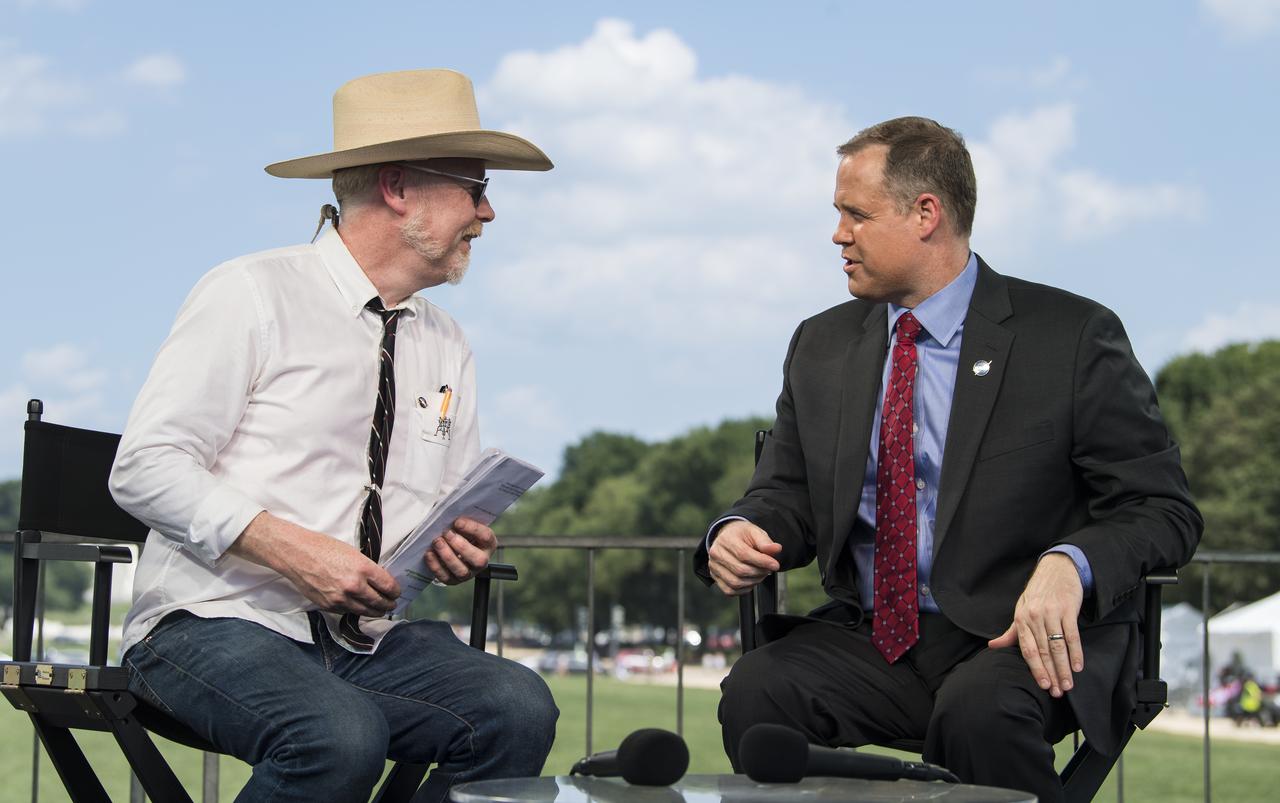
NASA Administrator Jim Bridenstine, right, speaks with Adam Savage, maker and host of Savage Builds, at the conclusion of “NASA’s Giant Leaps: Past and Future," a live television program on Friday, July 19, 2019 on the National Mall in Washington. NASA and the world are recognizing the 50th anniversary of Apollo 11, in which astronauts Neil Armstrong, Michael Collins, and Buzz Aldrin crewed the first mission to land astronauts on the Moon. Photo Credit: (NASA/Aubrey Gemignani)
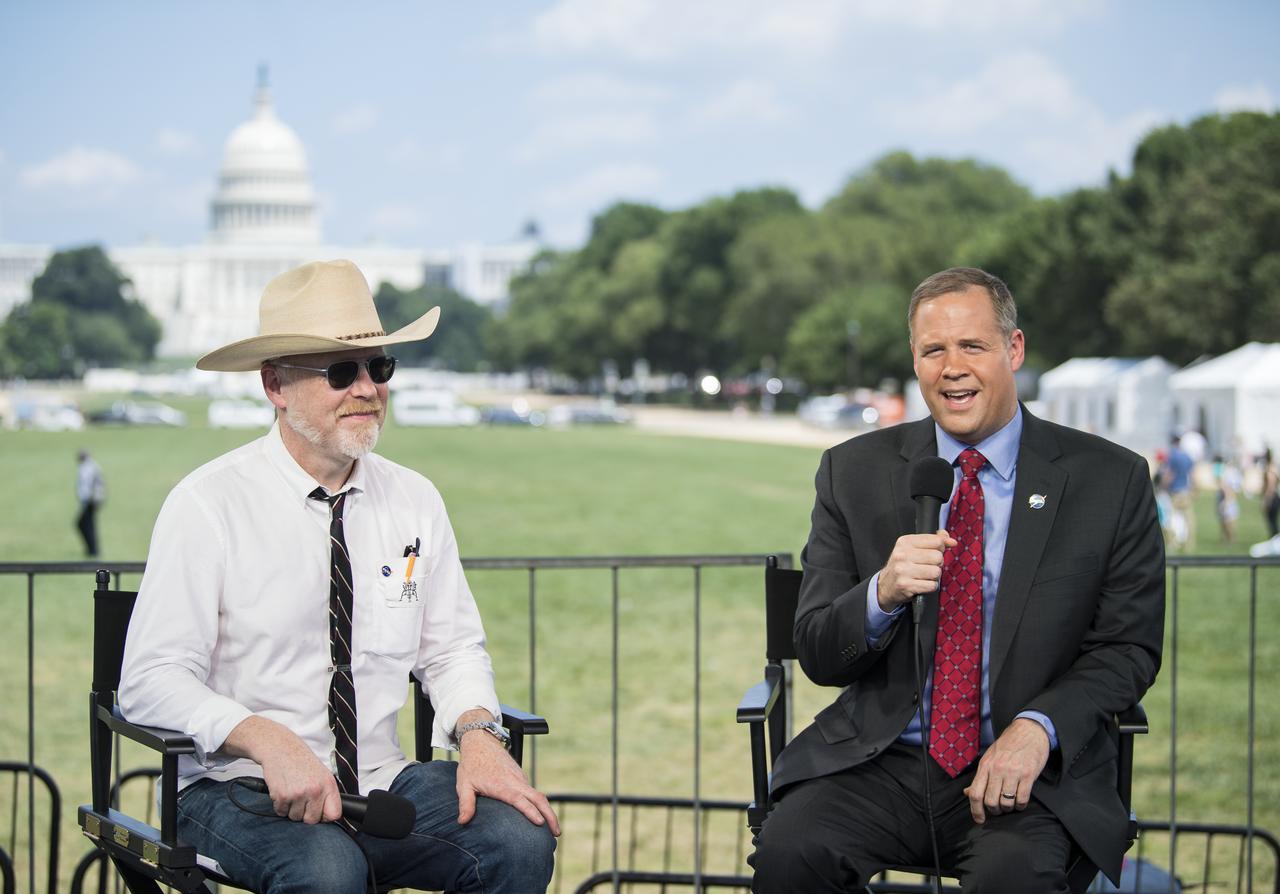
NASA Administrator Jim Bridenstine, right, speaks with Adam Savage, maker and host of Savage Builds, during “NASA’s Giant Leaps: Past and Future," a live television program on Friday, July 19, 2019 on the National Mall in Washington. NASA and the world are recognizing the 50th anniversary of Apollo 11, in which astronauts Neil Armstrong, Michael Collins, and Buzz Aldrin crewed the first mission to land astronauts on the Moon. Photo Credit: (NASA/Aubrey Gemignani)
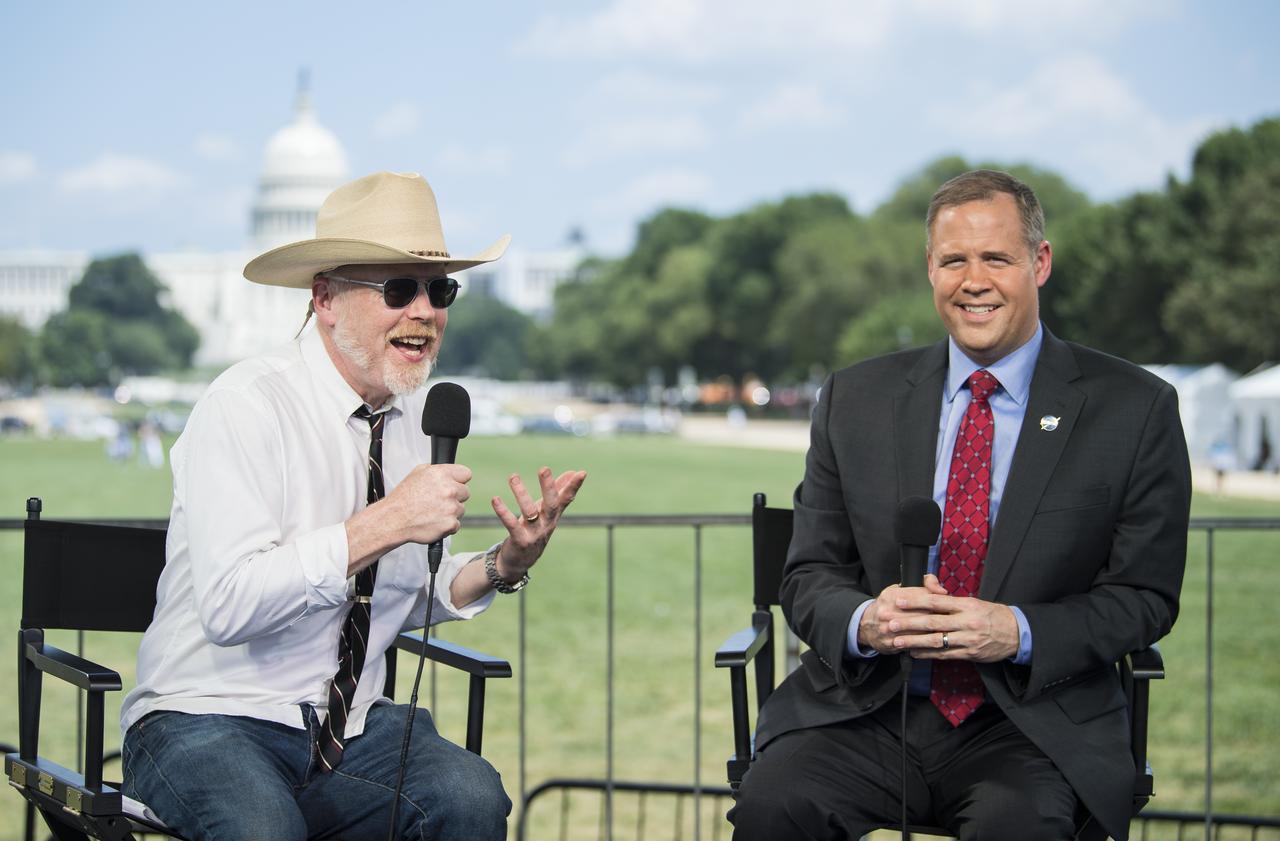
Adam Savage, maker and host of Savage Builds, left, speaks with NASA Administrator Jim Bridenstine during “NASA’s Giant Leaps: Past and Future," a live television program on Friday, July 19, 2019 on the National Mall in Washington. NASA and the world are recognizing the 50th anniversary of Apollo 11, in which astronauts Neil Armstrong, Michael Collins, and Buzz Aldrin crewed the first mission to land astronauts on the Moon. Photo Credit: (NASA/Aubrey Gemignani)
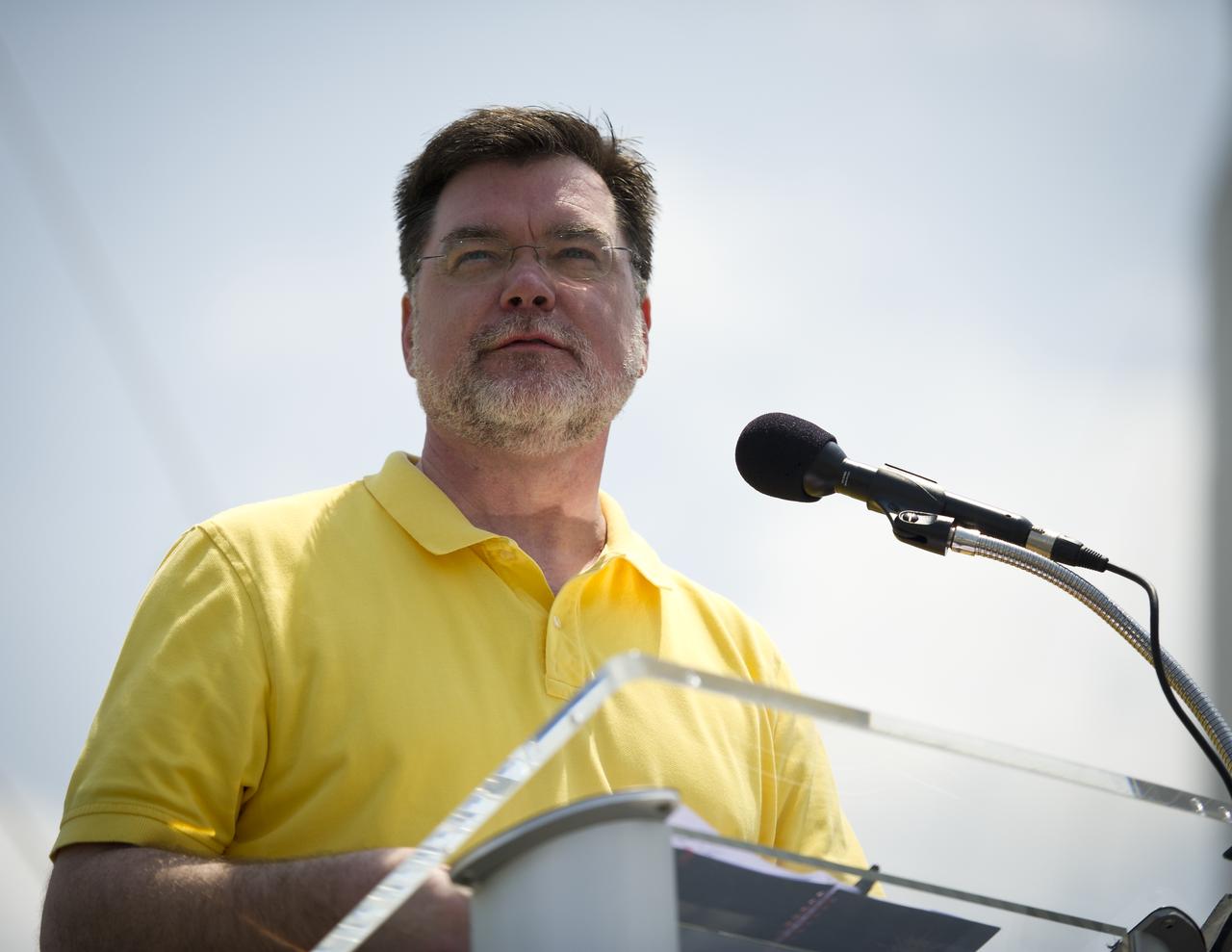
Jim Adams, NASA Deputy Director, Planetary Science Division, Science Mission Directorate, speaks during an unveiling ceremony of two USPS stamps that commemorate and celebrate 50 years of US Spaceflight and the MESSENGER program during an event, Wednesday, May 4, 2011 at the NASA Kennedy Space Center in Cape Canaveral, Fla. One stamp commemorates NASA’s Project Mercury, America’s first manned spaceflight program, and NASA astronaut Alan Shepard’s historic flight on May 5, 1961, aboard spacecraft Freedom 7. The other stamp draws attention to NASA’s unmanned MESSENGER mission, a scientific investigation of the planet Mercury. On March 17, 2011, MESSENGER became the first spacecraft to enter into orbit around Mercury. Photo Credit: (NASA/Bill Ingalls)
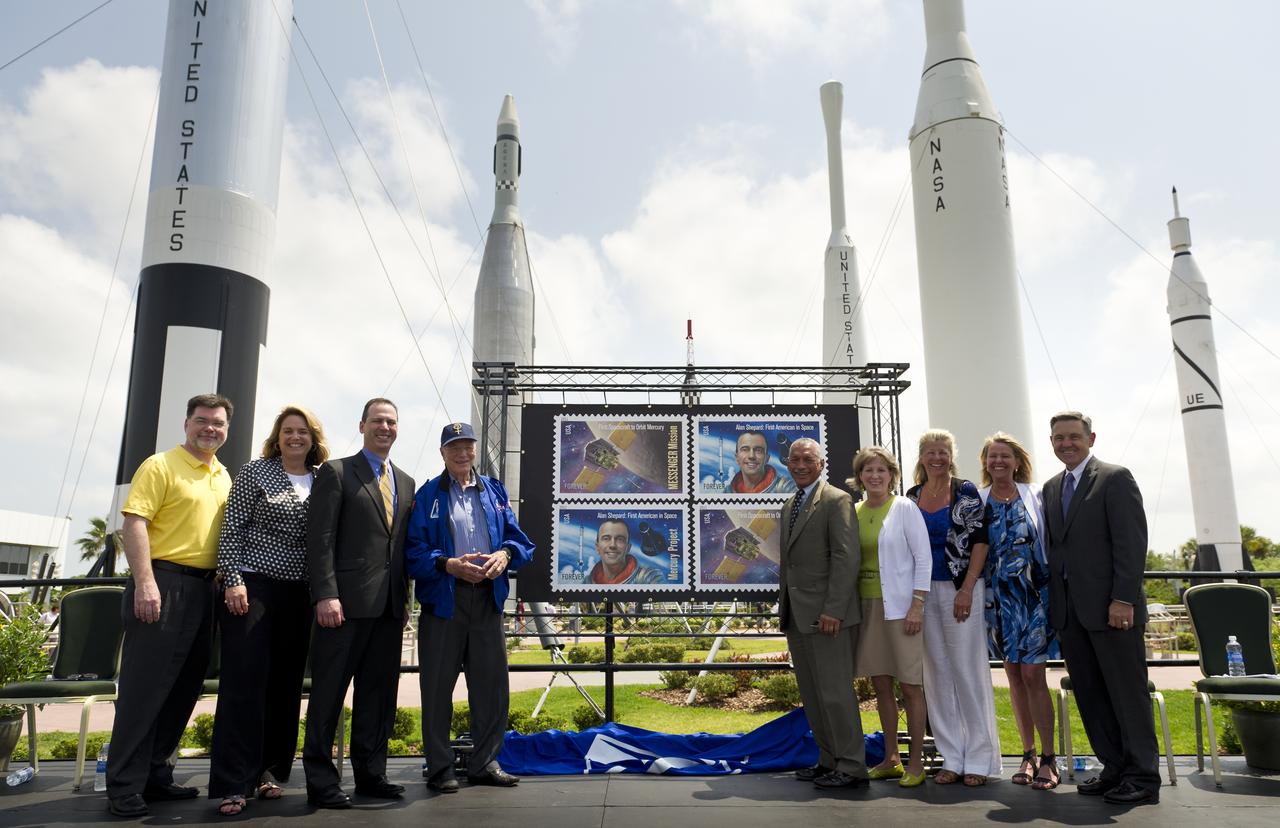
From left, NASA Deputy Director, Planetary Science Division, Science Mission Directorate, Jim Adams, NASA Kennedy Space Center Director of Education and External Relations Cheryl Hurst, United States Postal Service Vice President of Finance Steve Masse, NASA Mercury Astronaut Scott Carpenter, NASA Administrator Charles Boldin, Daughters of NASA astronaut Alan Shepard, Alice Wackermann, Laura Shepard Churchley, and Julie Jenkins, and NASA Kennedy Space Center Director Robert Cabana pose for a photograph during an unveiling ceremony of two USPS stamps that commemorate and celebrate 50 years of US Spaceflight and the MESSENGER program during an event, Wednesday, May 4, 2011 at the NASA Kennedy Space Center in Cape Canaveral, Fla. One stamp commemorates NASA’s Project Mercury, America’s first manned spaceflight program, and NASA astronaut Alan Shepard’s historic flight on May 5, 1961, aboard spacecraft Freedom 7. The other stamp draws attention to NASA’s unmanned MESSENGER mission, a scientific investigation of the planet Mercury. On March 17, 2011, MESSENGER became the first spacecraft to enter into orbit around Mercury. Photo Credit: (NASA/Bill Ingalls)

CAPE CANAVERAL, Fla. –Jim Adams, NASA's deputy chief technologist, discusses the successful landing of the Mars Science Laboratory rover Curiosity on Mars during a session with NASA's Kennedy Space Center employees in the training auditorium at the center. Photo credit: NASA/Cory Huston

CAPE CANAVERAL, Fla. –Jim Adams, NASA's deputy chief technologist, discusses the successful landing of the Mars Science Laboratory rover Curiosity on Mars during a session with NASA's Kennedy Space Center employees in the training auditorium at the center. Photo credit: NASA/Cory Huston
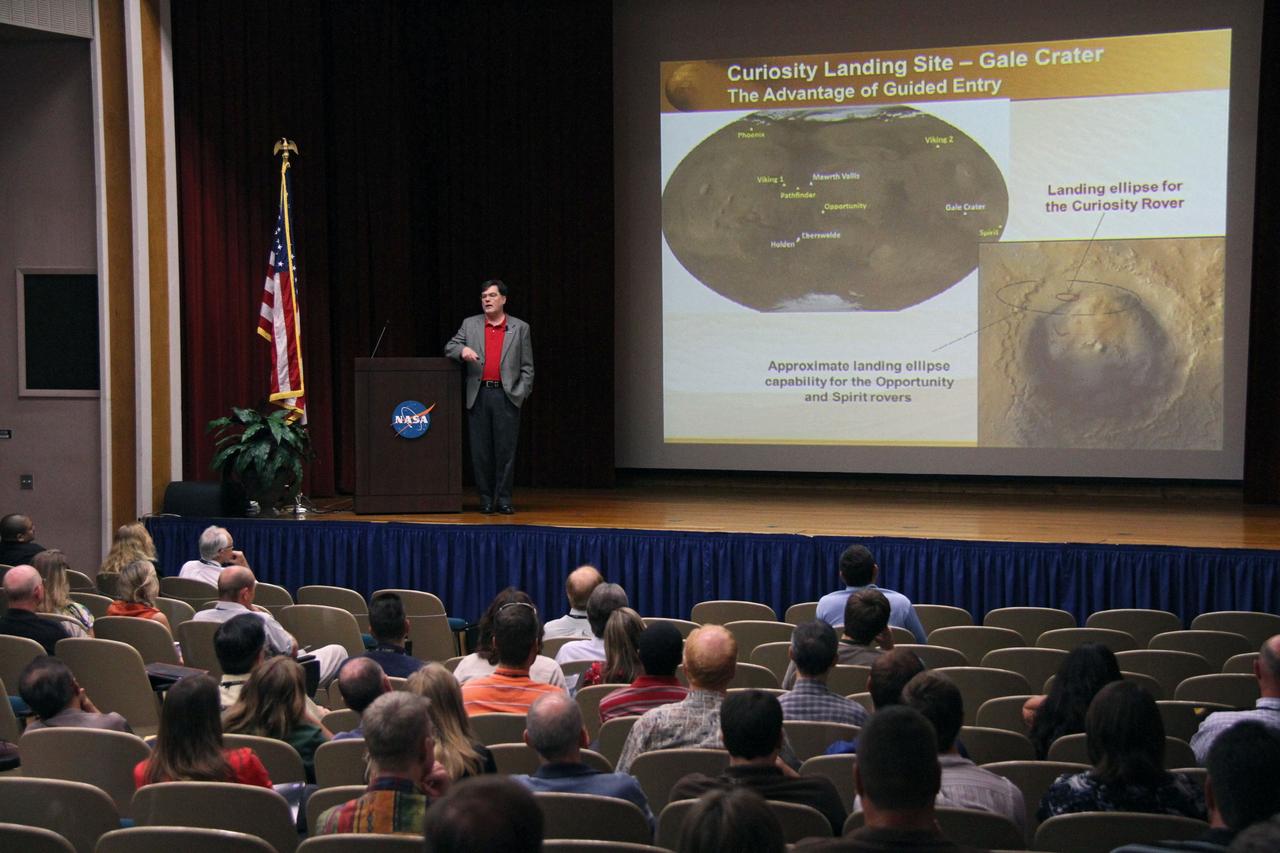
CAPE CANAVERAL, Fla. –Jim Adams, NASA's deputy chief technologist, discusses the successful landing of the Mars Science Laboratory rover Curiosity on Mars during a session with NASA's Kennedy Space Center employees in the training auditorium at the center. Photo credit: NASA/Cory Huston
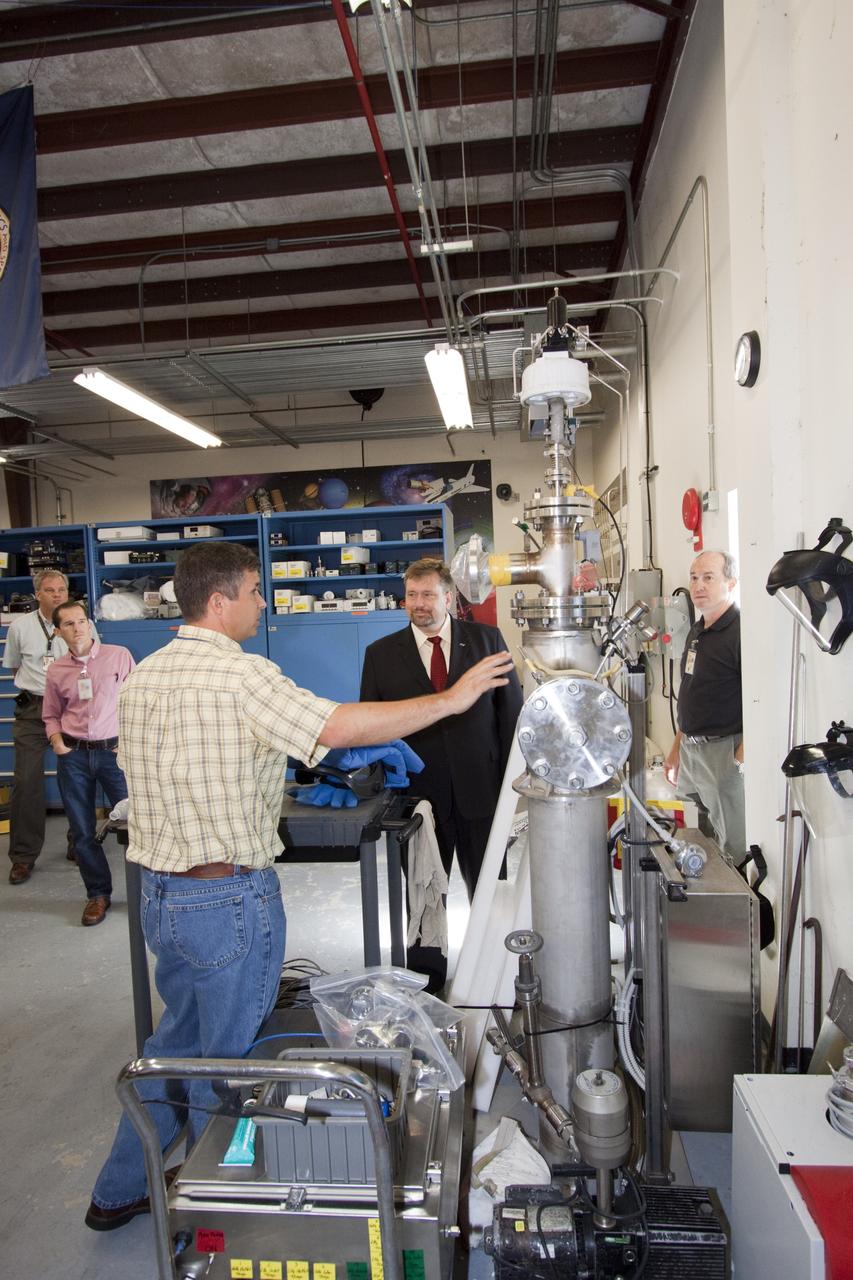
CAPE CANAVERAL, Fla. – Jared Sass talks to Dr. Mason Peck, NASA's chief technologist, inside the Cryogenics lab at NASA's Kennedy Space Center in Florida as Robert Johnson, left, Adam Swanger and James Fesmire look on. Photo credit: NASA/Jim Grossmann
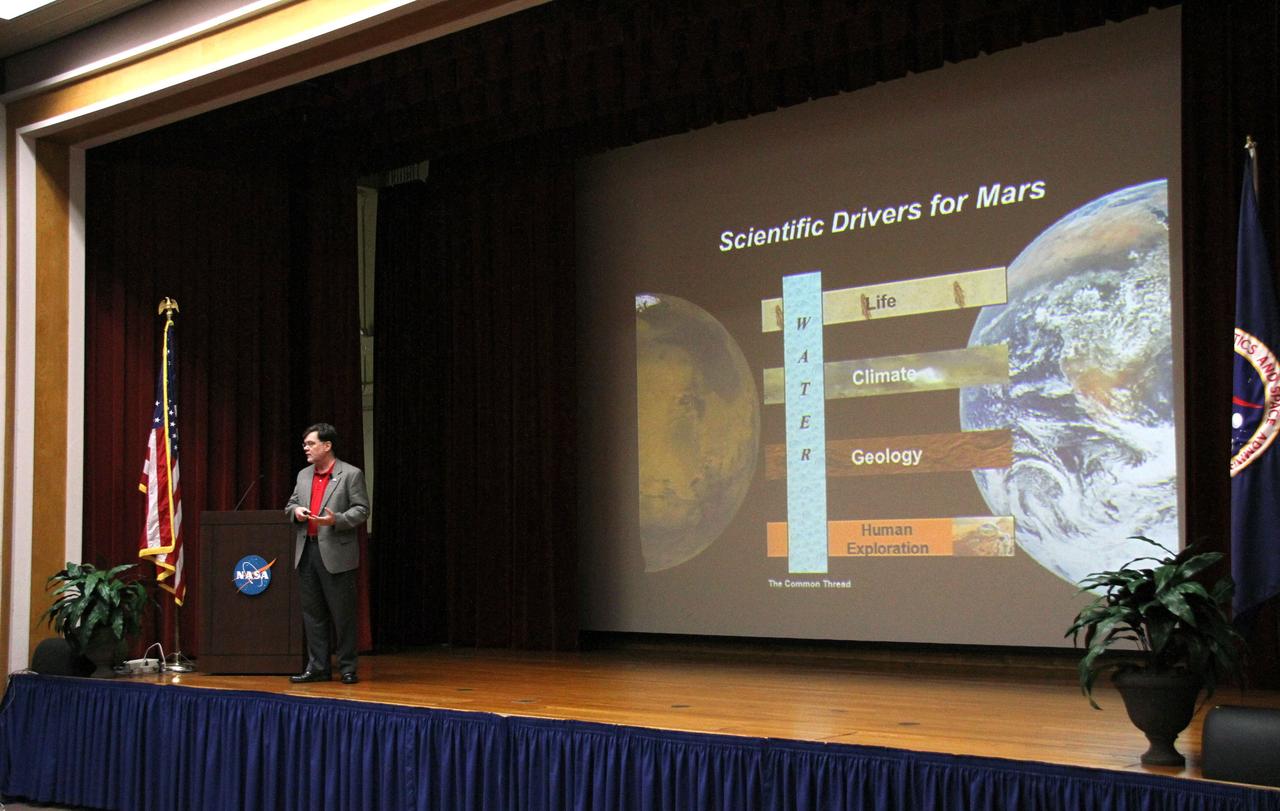
CAPE CANAVERAL, Fla. –Jim Adams, NASA's deputy chief technologist, discusses the successful landing of the Mars Science Laboratory rover Curiosity on Mars during a session with NASA's Kennedy Space Center employees in the training auditorium at the center. Photo credit: NASA/Cory Huston
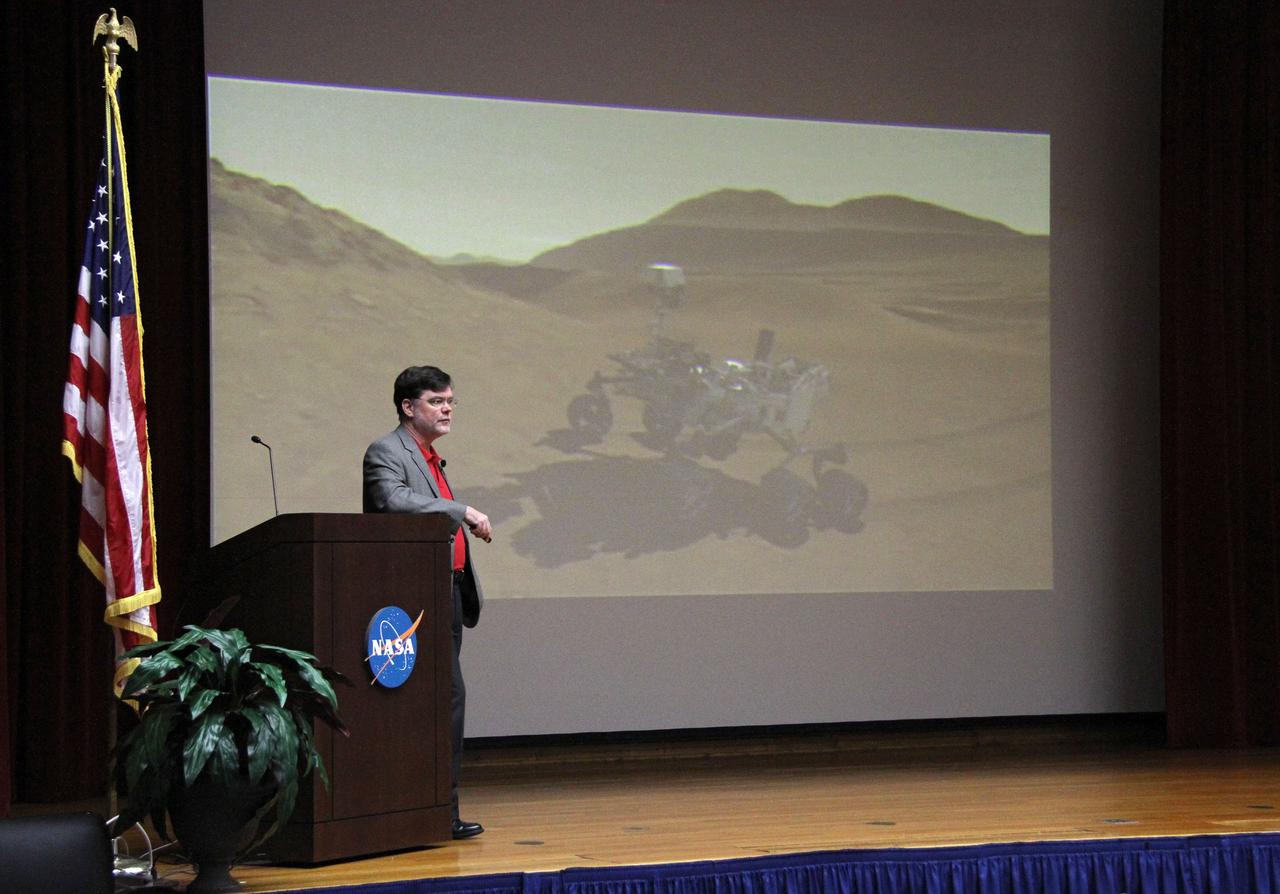
CAPE CANAVERAL, Fla. –Jim Adams, NASA's deputy chief technologist, discusses the successful landing of the Mars Science Laboratory rover Curiosity on Mars during a session with NASA's Kennedy Space Center employees in the training auditorium at the center. Photo credit: NASA/Cory Huston

CAPE CANAVERAL, Fla. –Jim Adams, NASA's deputy chief technologist, discusses the successful landing of the Mars Science Laboratory rover Curiosity on Mars during a session with NASA's Kennedy Space Center employees in the training auditorium at the center. Photo credit: NASA/Cory Huston

CAPE CANAVERAL, Fla. –Jim Adams, NASA's deputy chief technologist, discusses the successful landing of the Mars Science Laboratory rover Curiosity on Mars during a session with NASA's Kennedy Space Center employees in the training auditorium at the center. Photo credit: NASA/Cory Huston
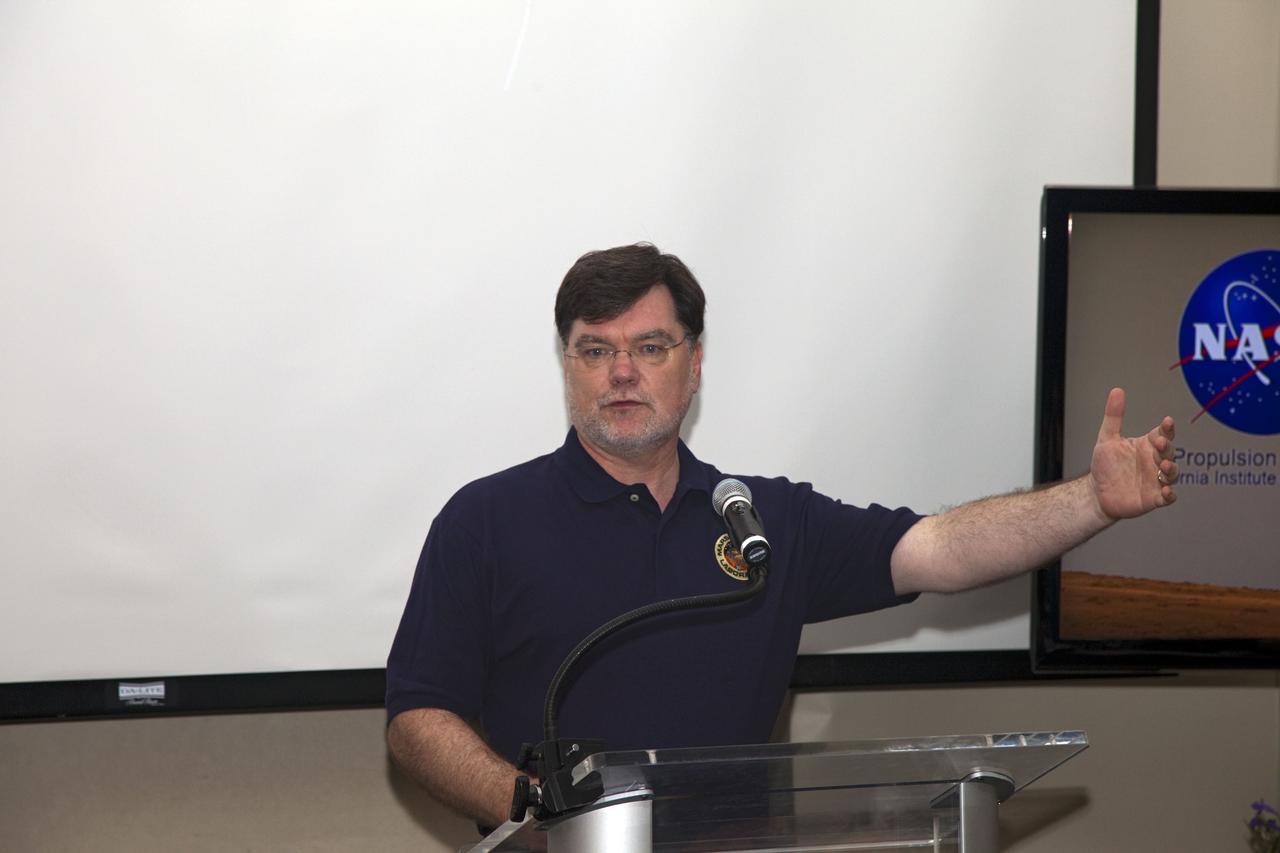
CAPE CANAVERAL, Fla. -- Jim Adams, NASA deputy chief technologist, speaks to about 45 of NASA’s social media followers for two days of presentations on the Kennedy's past, present and future. The social media participants gathered at the Florida spaceport on Aug. 2 and 3, 2012 to hear from key former and current leaders who related stories of the space agency's efforts to explore the unknown. It was the first social media event totally run by Kennedy. Photo credit: NASA/ Gianni Woods
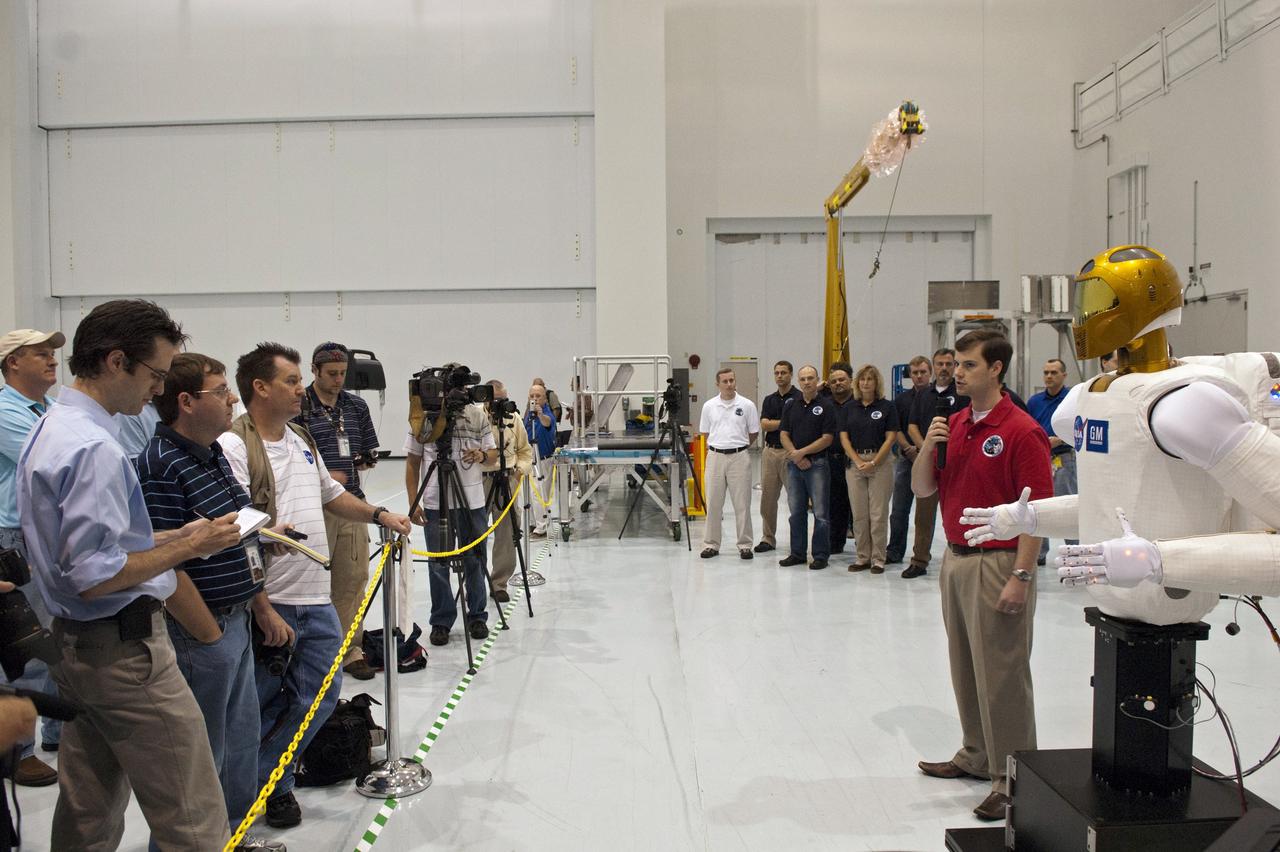
CAPE CANAVERAL, Fla. -- In the Space Station Processing Facility at NASA's Kennedy Space Center in Florida, Adam Sanders, General Motors robotics engineer, addresses the media at an event hosted by NASA to introduce the dexterous humanoid astronaut helper, Robonaut (R2) to the participants. R2 will fly to the International Space Station aboard space shuttle Discovery on the STS-133 mission. Although it will initially only participate in operational tests, upgrades could eventually allow the robot to realize its true purpose -- helping spacewalking astronauts with tasks outside the space station. Photo credit: NASA/Jim Grossmann
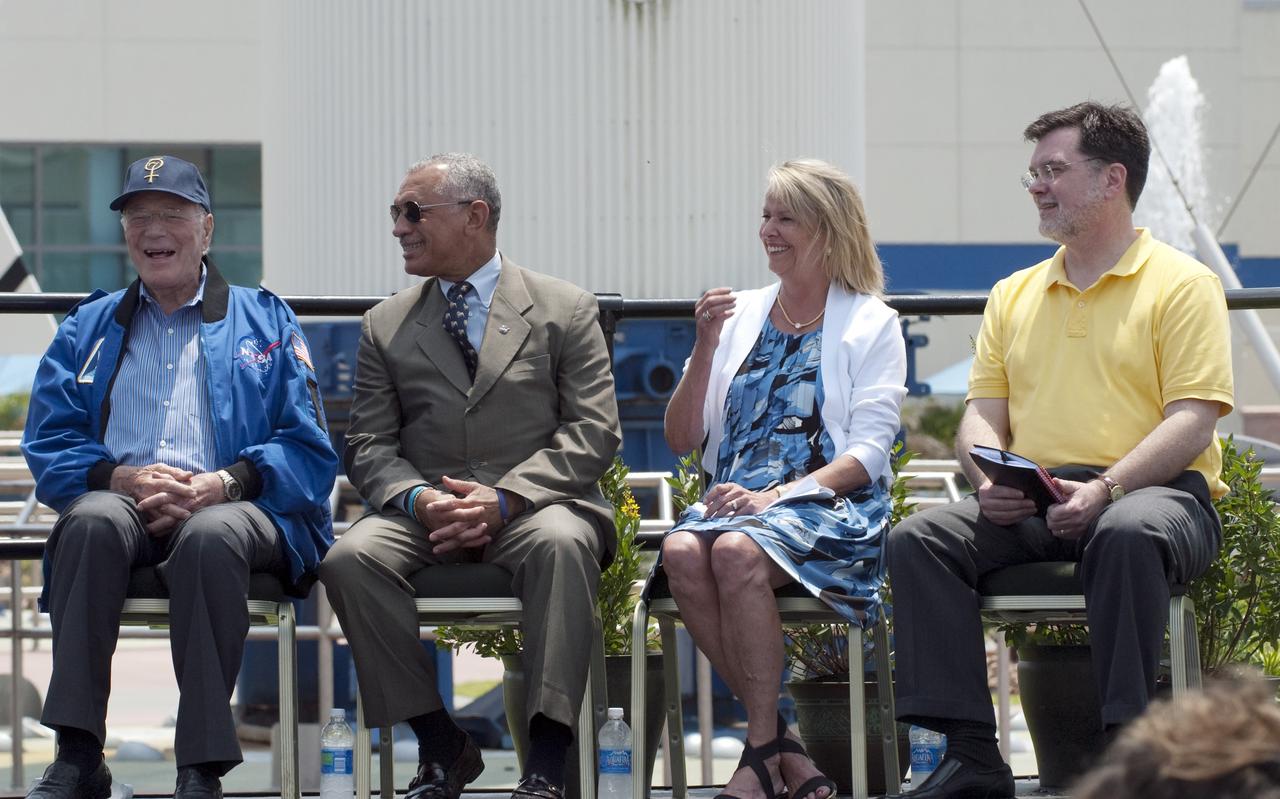
CAPE CANAVERAL, Fla. -- In the Rocket Garden at NASA's Kennedy Space Center Visitor Complex in Florida, Mercury Astronaut Scott Carpenter, NASA Administrator Charlie Bolden, Julie Jenkins, daughter of Mercury Astronaut Alan Shepard, and NASA's Deputy Director for Planetary Science, Jim Adams, enjoy a light moment during an event unveiling two new stamps to commemorate the 50th anniversary of human spaceflight from the United States Postal Service. One stamp commemorates NASA's Project Mercury and Alan Shepard's historic launch on May 5, 1961, aboard the spacecraft Freedom 7. The second stamp honors NASA's MESSENGER, which reached Mercury in March to become the first spacecraft to orbit the planet. The two missions frame a remarkable 50-year period in which America advanced space exploration through more than 1,500 crewed and uncrewed flights. Photo credit: NASA/Kim Shiflett
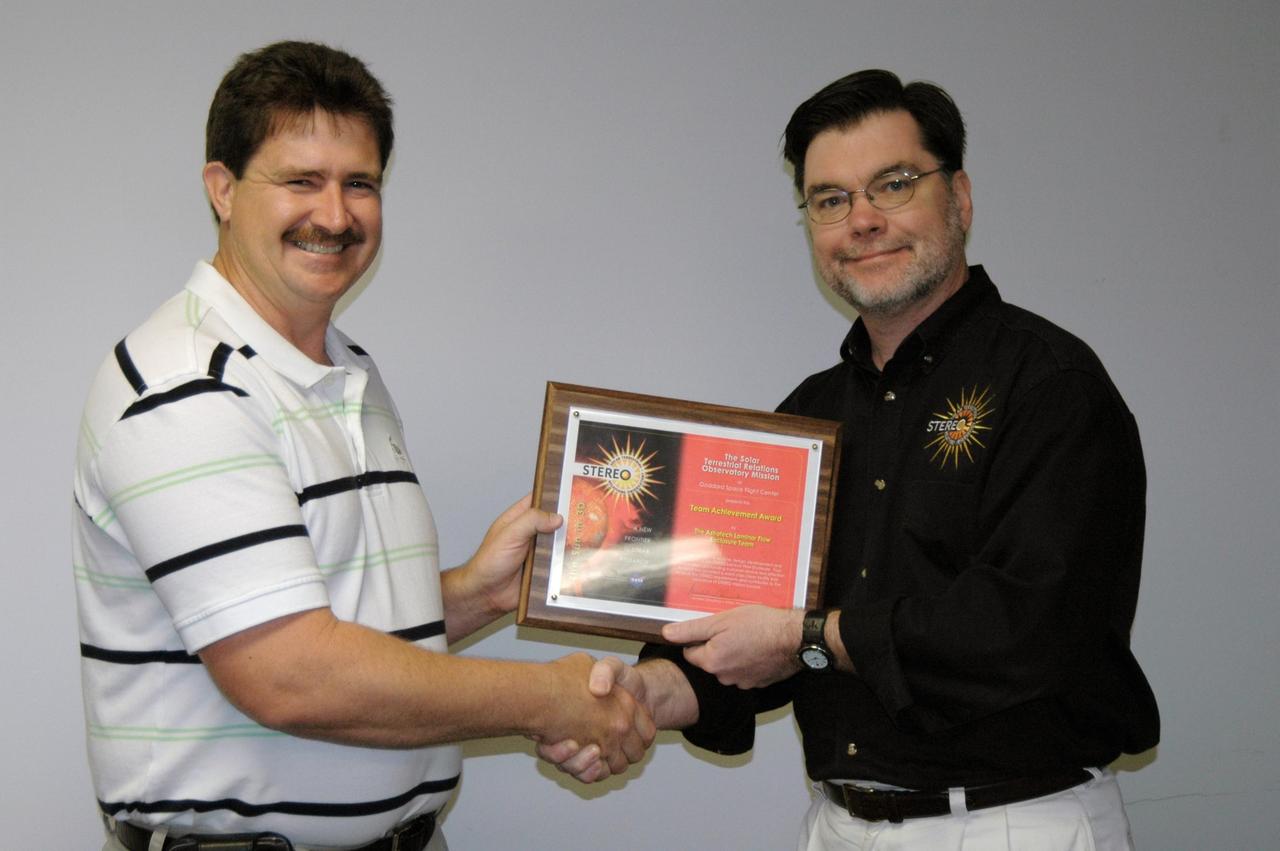
KENNEDY SPACE CENTER, FLA. - Jim Adams (right), deputy project manager for NASA's Solar Terrestrial Relations Observatory (STEREO), Goddard Space Flight Center, presents a certificate of appreciation to Dwayne Light, director of Florida Operations, Astrotech, a payload processing facility near Kennedy Space Center. The occasion was the ribbon-cutting for a clean-room enclosure, within the high bay at Astrotech. The enclosure meets the additional stringent cleanliness requirements necessary for processing STEREO for launch. It was designed and constructed by Astrotech to meet the spacecraft requirements provided by STEREO project management at NASA's Goddard Space Flight Center, Greenbelt, Md. STEREO consists of two spacecraft whose mission is the first to take measurements of the sun and solar wind in 3-D. Launch aboard a Boeing Delta II rocket from Launch Complex 17 on Cape Canaveral Air Force Station is scheduled to occur over the summer. Photo credit: NASA/Dimitri Gerondidakis
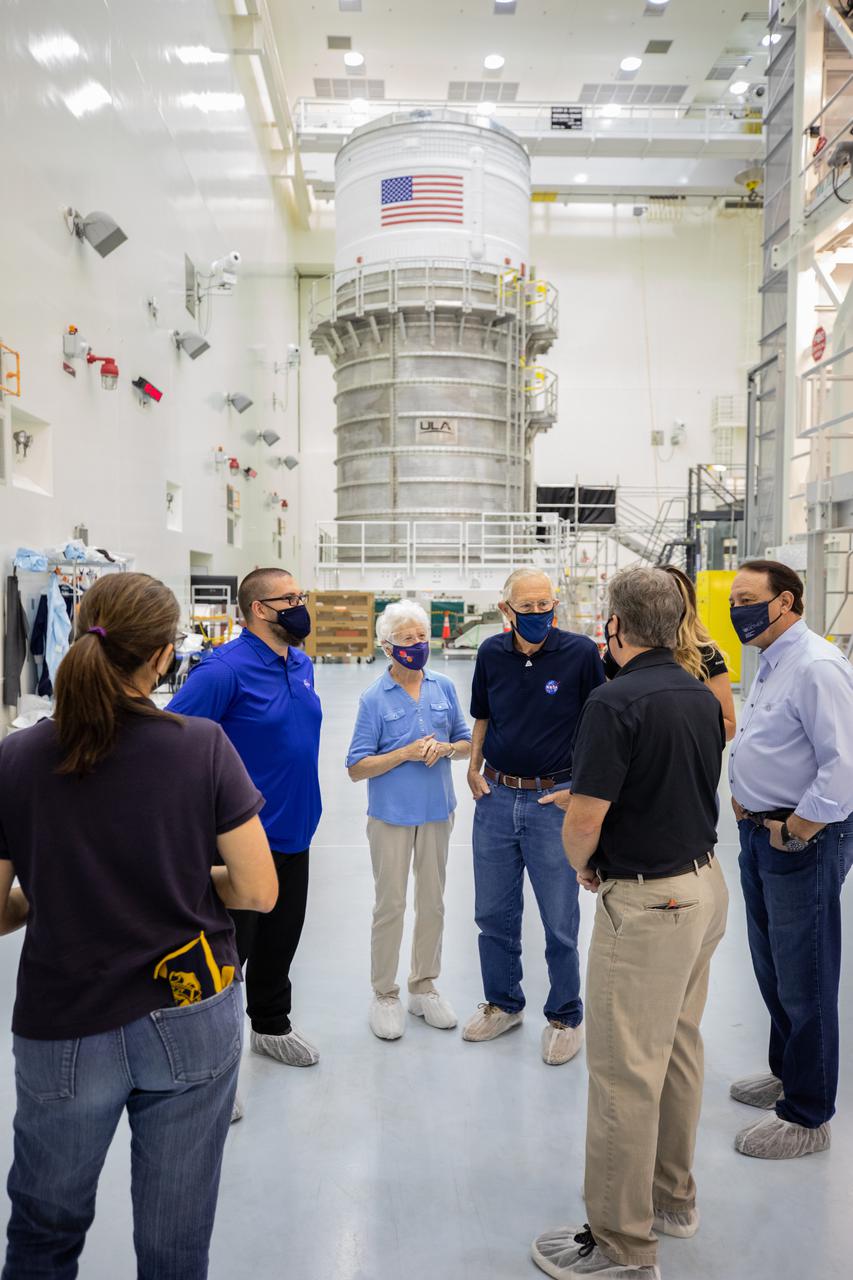
From left to right, Nicole Stott (black shirt back facing camera), NASA Astronaut (former); Adam Leppek, ARES Corporation (KLXSIII), Deputy Element Operations Manager; Dottie Duke, wife of Charlie Duke; Charlie Duke, NASA Astronaut (former); Nick Kindred, Jacobs Technology, Flow Manager; and Jim Keys, Pilot, tour the inside of the Multi-Payload Processing Facility (MPPF) during a visit to NASA’s Kennedy Space Center in Florida on May 10, 2021. Shown in the background is the Interim Cryogenic Propulsion Stage for the Artemis I mission. The first in a series of increasingly complex missions, Artemis I will test Orion and the Space Launch System rocket as an integrated system prior to crewed flights to the Moon.
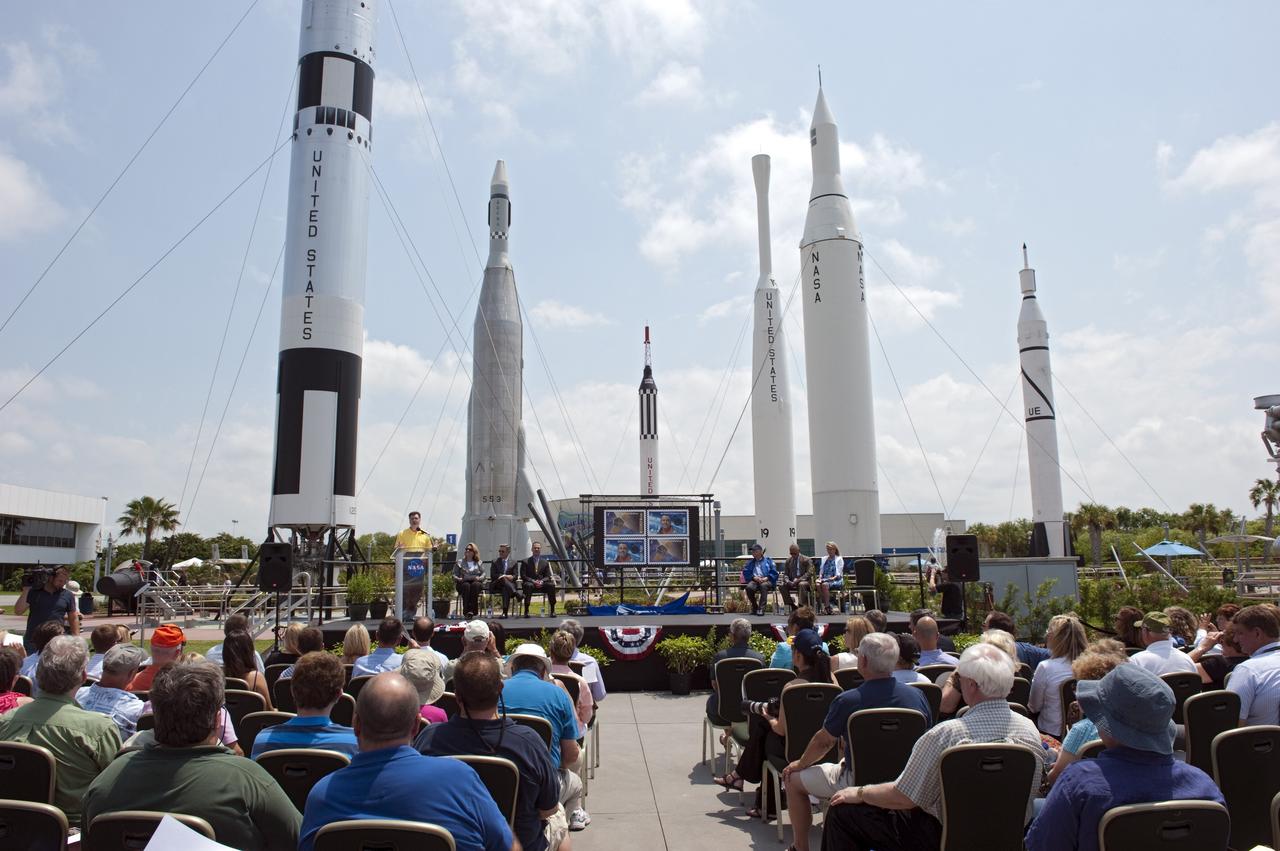
CAPE CANAVERAL, Fla. -- In the Rocket Garden at NASA's Kennedy Space Center Visitor Complex in Florida, NASA's Deputy Director for Planetary Science, Jim Adams speaks to the audience after the unveiling of the two new stamps that commemorate the 50th anniversary of human spaceflight designed by the United States Postal Service. One stamp commemorates NASA's Project Mercury and Alan Shepard's historic launch on May 5, 1961, aboard the spacecraft Freedom 7. The second stamp honors NASA's MESSENGER, which reached Mercury in March to become the first spacecraft to orbit the planet. The two missions frame a remarkable 50-year period in which America advanced space exploration through more than 1,500 crewed and uncrewed flights. Photo credit: NASA/Kim Shiflett
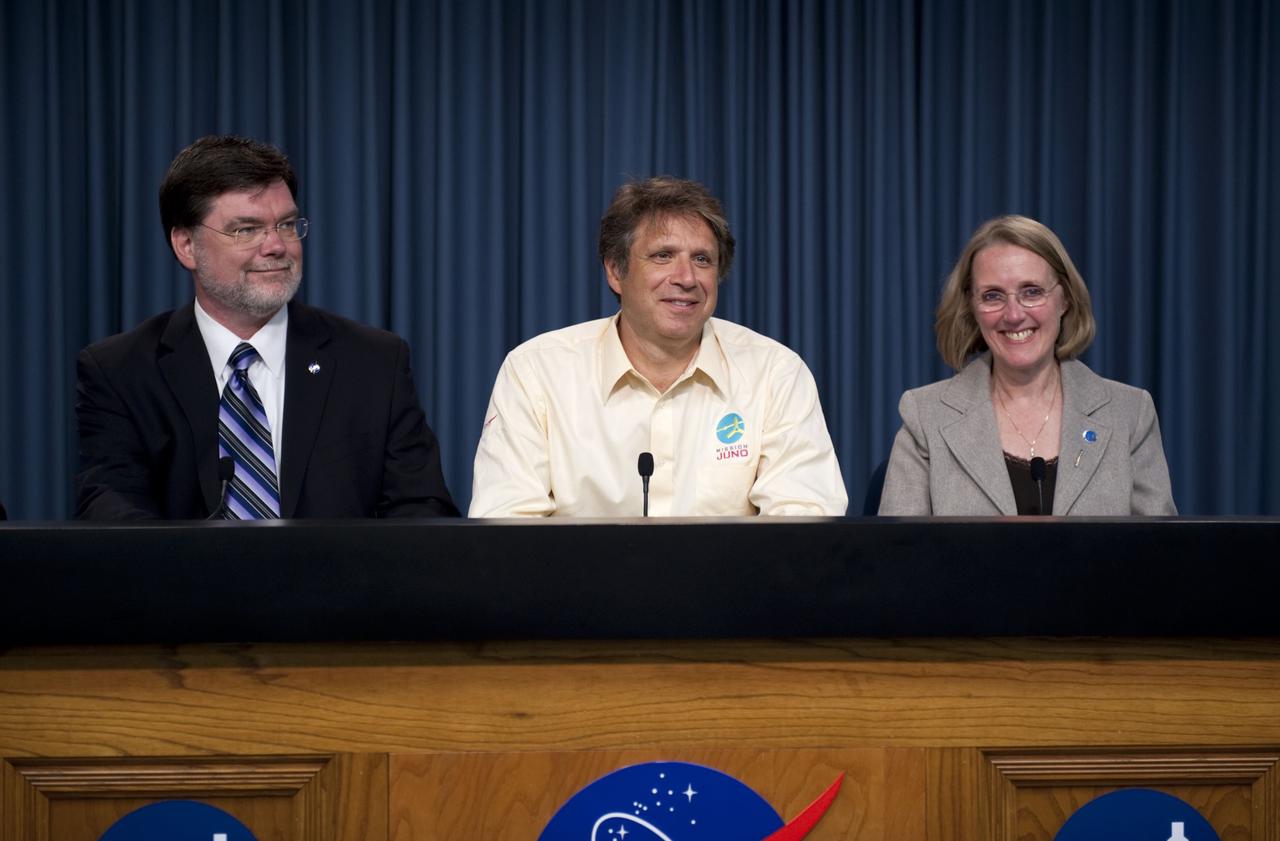
CAPE CANAVERAL, Fla. -- From left, Jim Adams, the deputy director of NASA's Planetary Science Division; Scott Bolton, Juno's principal investigator at the Southwest Research Institute (SWRI); and Jan Chodas, Juno's project manager at the Jet Propulsion Laboratory (JPL), participate in a post-launch news conference following the successful liftoff of the Juno spacecraft atop a United Launch Alliance Atlas V rocket. Launch was at 12:25 p.m. EDT Aug. 5. The solar-powered spacecraft now is on a five-year journey to Jupiter, where it will orbit the planet's poles 33 times to find out more about the gas giant's origins, structure, atmosphere and magnetosphere and investigate the existence of a solid planetary core. For more information, visit www.nasa.gov/juno. Photo credit: Kim Shiflett
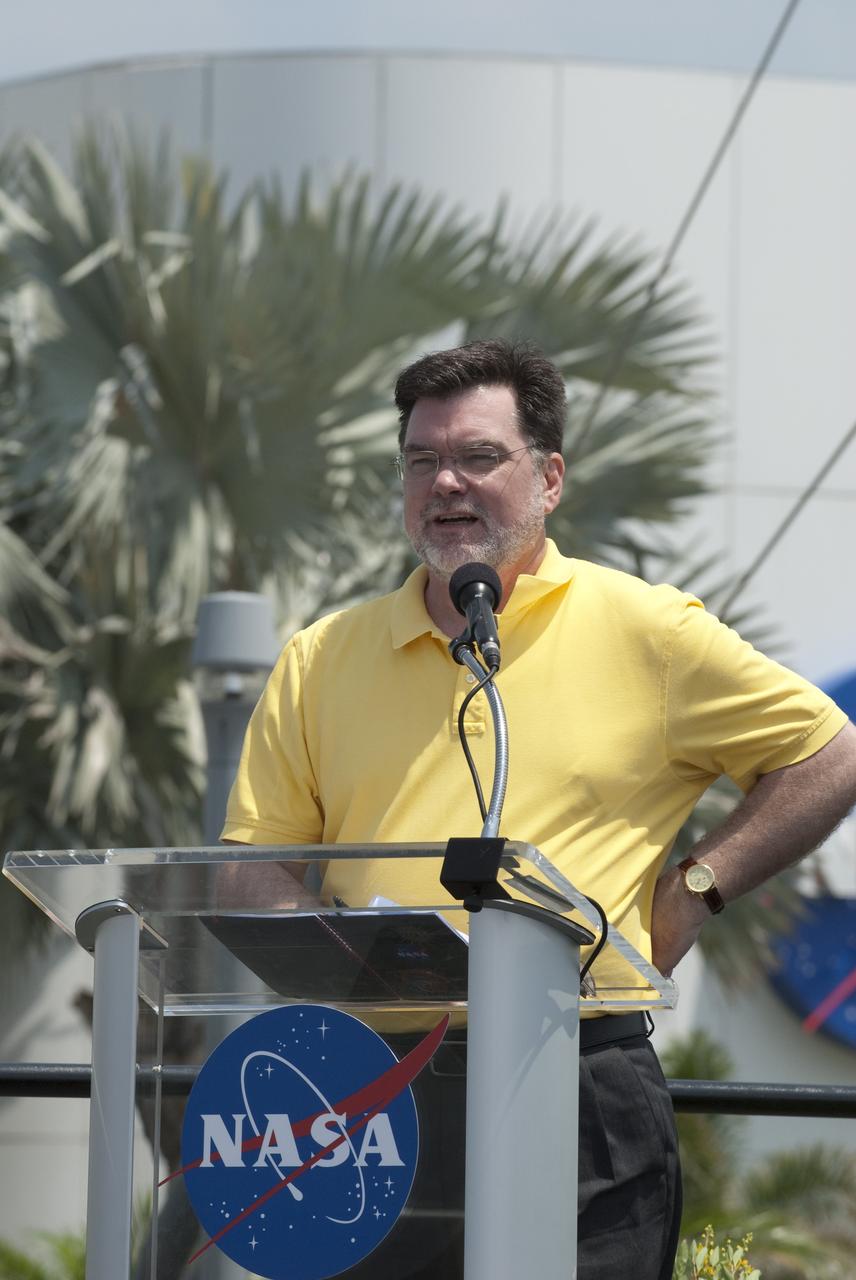
CAPE CANAVERAL, Fla. -- In the Rocket Garden at NASA's Kennedy Space Center Visitor Complex in Florida, NASA's Deputy Director for Planetary Science, Jim Adams speaks to the audience in attendance for the United States Postal Service unveiling of two new stamps that commemorates the 50th anniversary of human spaceflight. One stamp commemorates NASA's Project Mercury and Alan Shepard's historic launch on May 5, 1961, aboard the spacecraft Freedom 7. The second stamp honors NASA's MESSENGER, which reached Mercury in March to become the first spacecraft to orbit the planet. The two missions frame a remarkable 50-year period in which America advanced space exploration through more than 1,500 crewed and uncrewed flights. Photo credit: NASA/Kim Shiflett
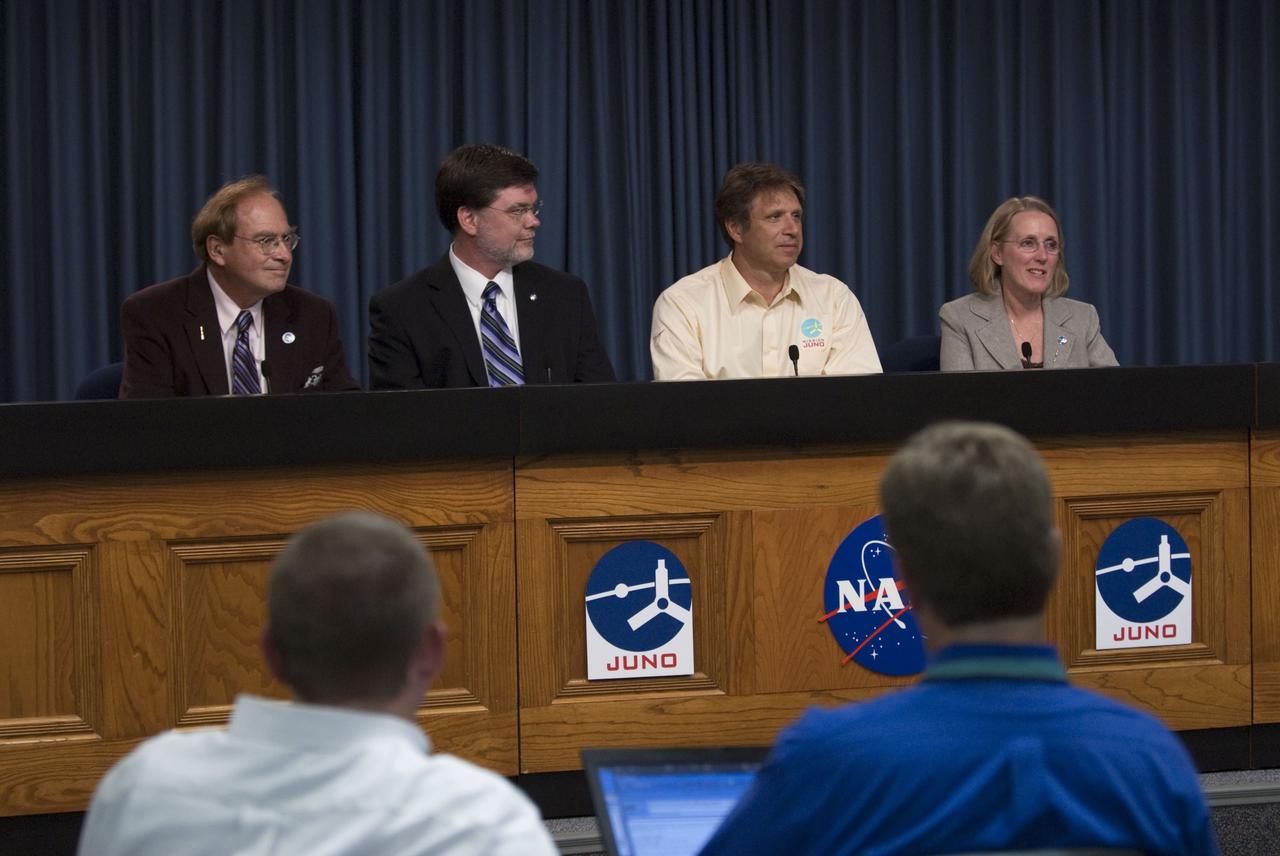
CAPE CANAVERAL, Fla. -- From left, NASA Public Affairs Officer George Diller; Jim Adams, the deputy director of NASA's Planetary Science Division; Scott Bolton, Juno's principal investigator at the Southwest Research Institute (SWRI); and Jan Chodas, Juno's project manager at the Jet Propulsion Laboratory (JPL), participate in a post-launch news conference following the successful liftoff of the Juno spacecraft atop a United Launch Alliance Atlas V rocket. Launch was at 12:25 p.m. EDT Aug. 5. The solar-powered spacecraft now is on a five-year journey to Jupiter, where it will orbit the planet's poles 33 times to find out more about the gas giant's origins, structure, atmosphere and magnetosphere and investigate the existence of a solid planetary core. For more information, visit www.nasa.gov/juno. Photo credit: Kim Shiflett
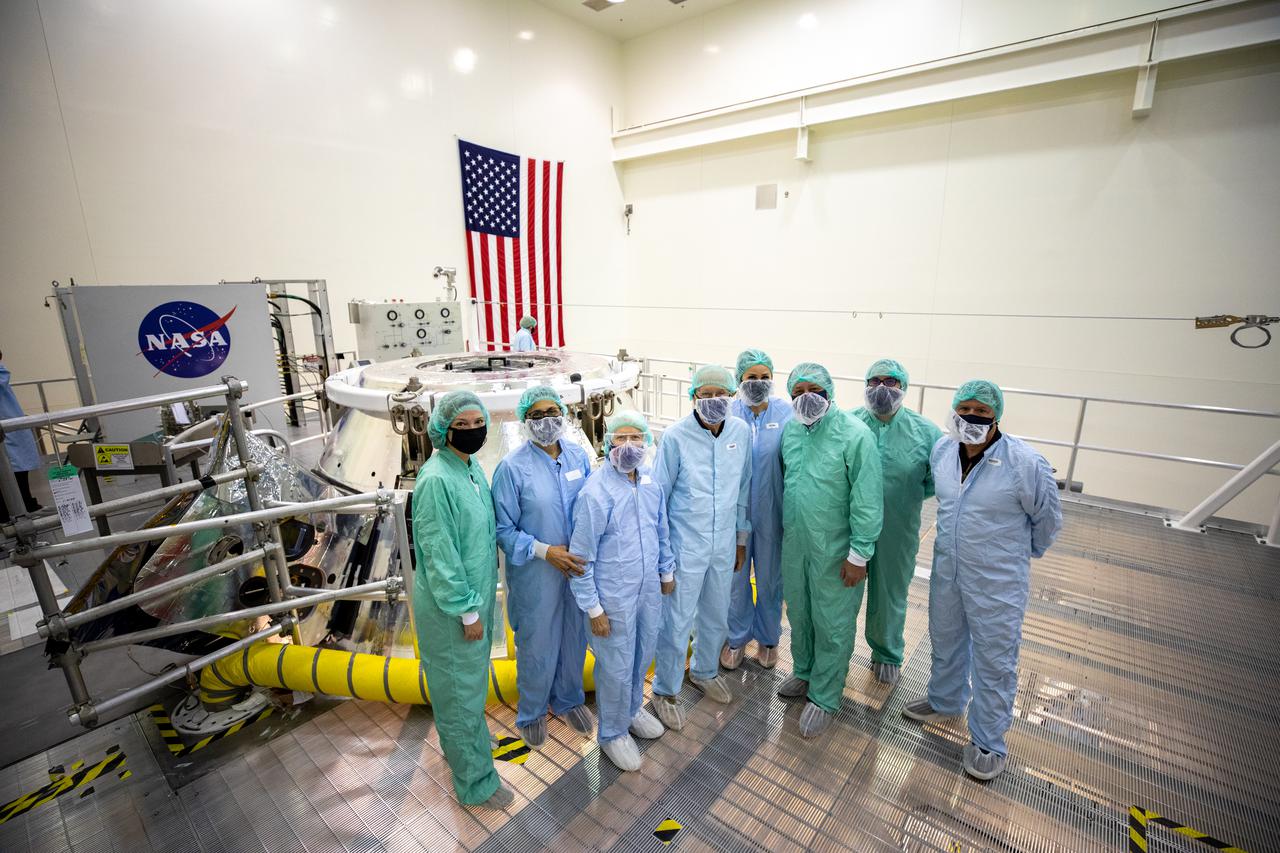
From left to right, Tiffany Nail, KSC Protocol Officer; Nicole Stott, NASA Astronaut (former); Dottie Duke, wife of Charlie Duke; Charlie Duke, NASA Astronaut (former); Christina Korp, Assistant to Charlie Duke; Jim Keys, Pilot; Adam Leppek, ARES Corporation (KLXSIII), Deputy Element Operations Manager; and Nick Kindred, Jacobs Technology, Flow Manager, shown in front of the Orion spacecraft for the Artemis I mission, inside the Multi-Payload Processing Facility (MPPF) during a visit to NASA’s Kennedy Space Center in Florida on May 10, 2021. The first in a series of increasingly complex missions, Artemis I will test Orion and the Space Launch System rocket as an integrated system prior to crewed flights to the Moon.
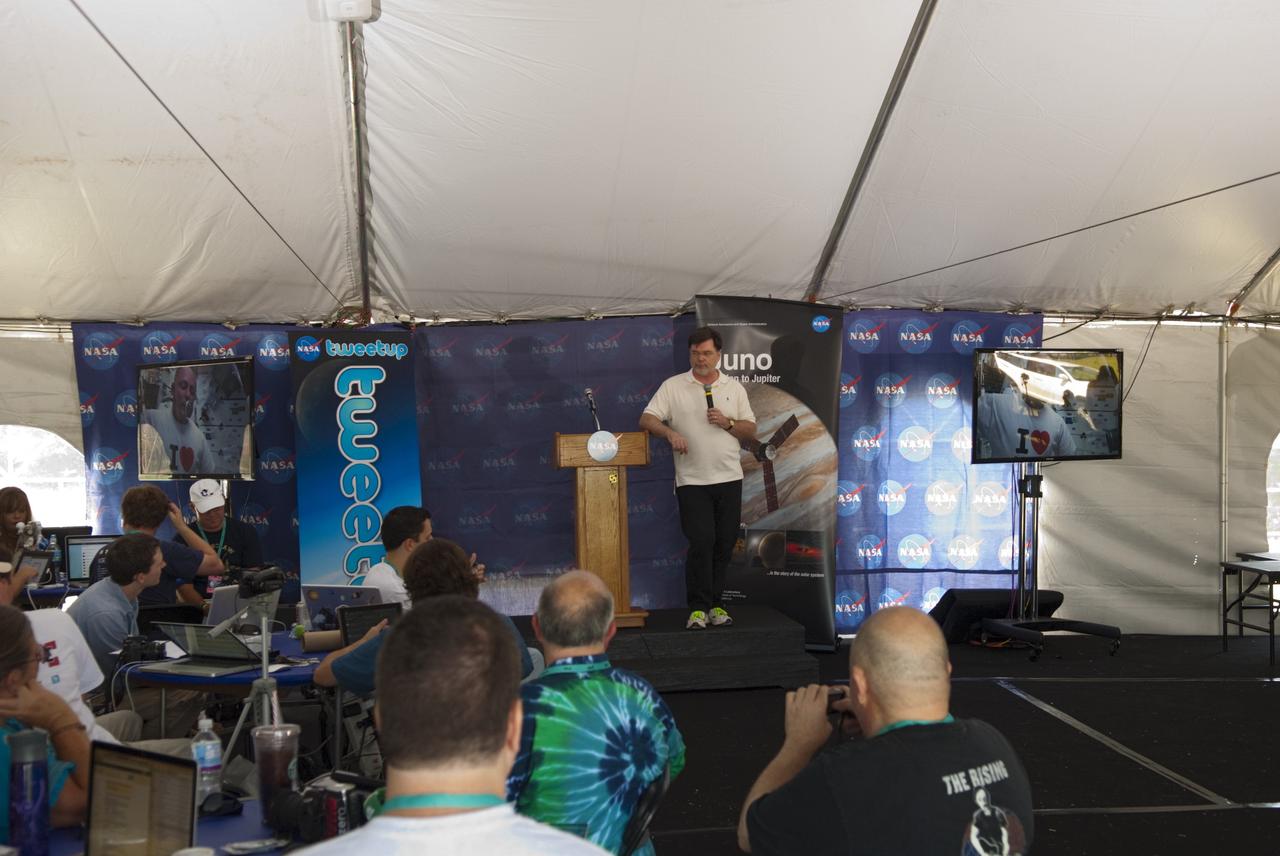
CAPE CANAVERAL, Fla. – At NASA’s Kennedy Space Center in Florida, Jim Adams, NASA deputy director of Planetary Science, speaks to about 150 followers of the agency’s Twitter account during Juno Tweetup activities inside a tent at the Press Site. The tweeters are at the center for two days of prelaunch activities. Juno is NASA’s mission to Jupiter to study the giant planet and improve our understanding of the planet’s formation and evolution. The tweeters will share their experiences with followers through the social networking site Twitter. Attendees represent 28 states, the District of Columbia and five other countries: Canada, Finland, Norway, Spain and the United Kingdom. This is the first time NASA has invited Twitter followers to experience the launch of a planetary spacecraft. The Juno spacecraft is scheduled to launch on an Atlas V rocket from Space Launch Complex 41 at Cape Canaveral Air Force Station in Florida, Aug. 5, at 11:34 a.m. EDT. For more information, visit http://www.nasa.gov/juno. Photo credit: Jim Grossmann
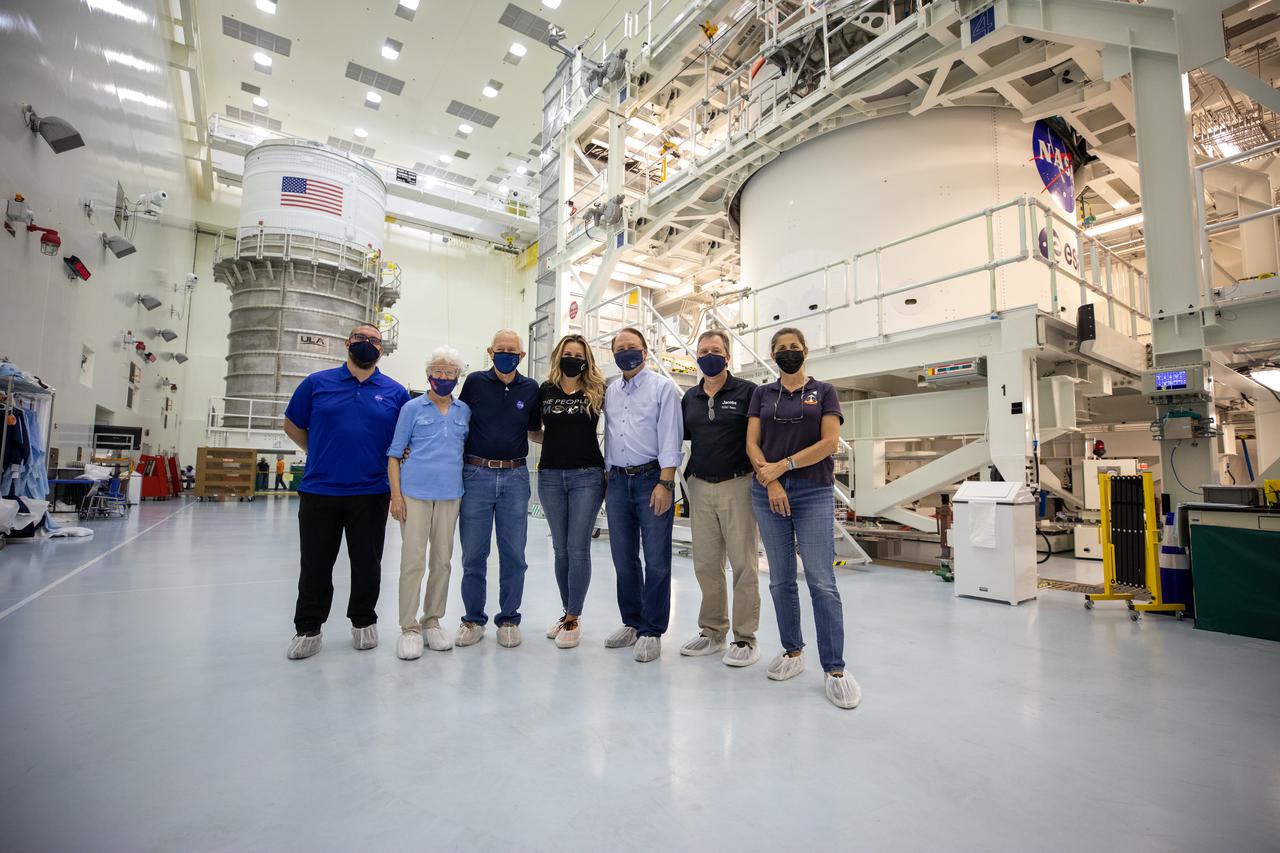
From left to right, Adam Leppek, ARES Corporation (KLXSIII), Deputy Element Operations Manager; Dottie Duke, wife of Charlie Duke; Charlie Duke, NASA Astronaut (former); Christina Korp, Assistant to Charlie Duke; Jim Keys, Pilot; Nick Kindred, Jacobs Technology, Flow Manager; and Nicole Stott, NASA Astronaut (former), shown in the Multi-Payload Processing Facility (MPPF) at NASA's Kennedy Space Center in Florida on May 10, 2021. In the background, on the left, is the Interim Cryogenic Propulsion Stage for the Space Launch System (SLS) rocket. On the right, the NASA “meatball” insignia and ESA (European Space Agency) logos on the European-built service module are visible. Both pieces of hardware will undergo fueling and servicing in the facility ahead of the Artemis I launch by teams from NASA’s Exploration Ground Systems and their primary contractor, Jacobs Technology. The first in a series of increasingly complex missions, Artemis I will test Orion and the Space Launch System rocket as an integrated system prior to crewed flights to the Moon.
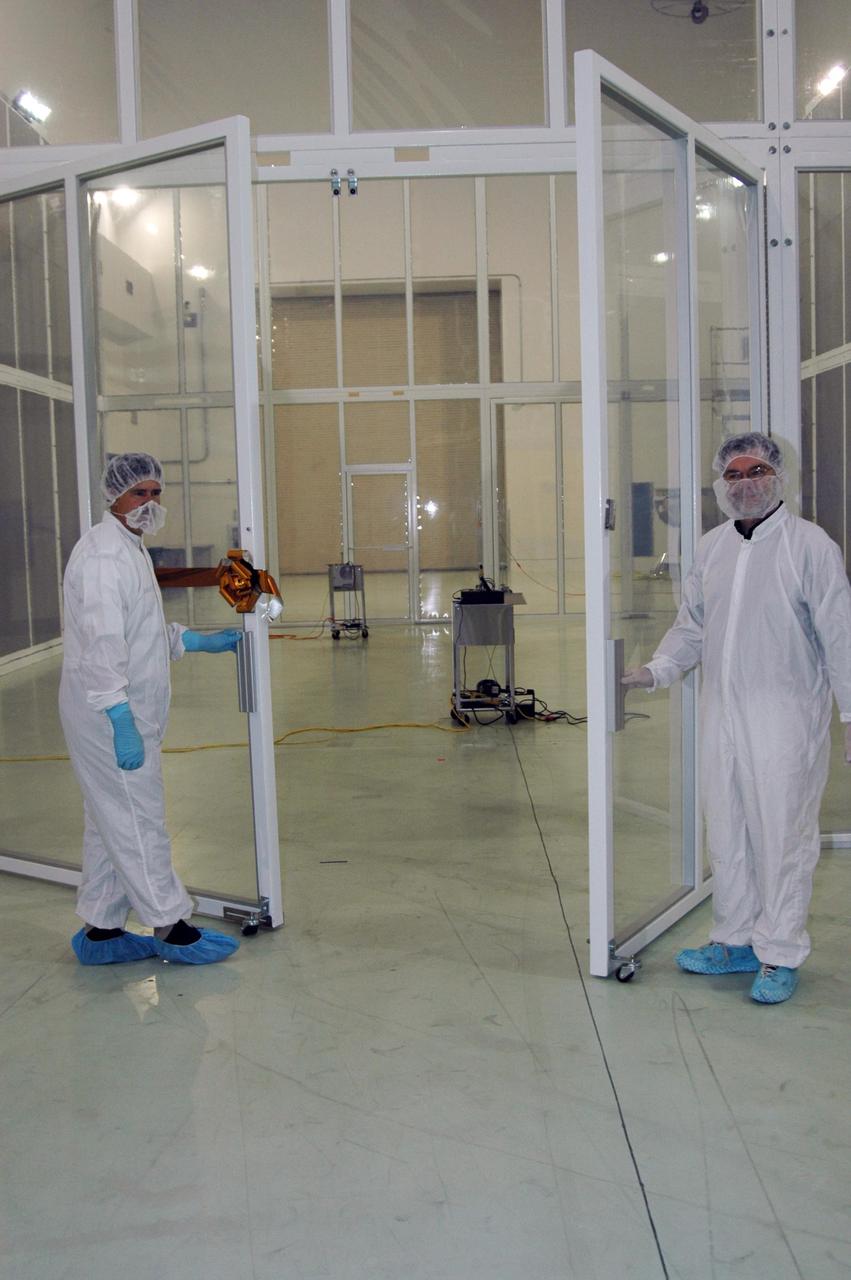
KENNEDY SPACE CENTER, FLA. - Dwayne Light (left), director of Florida Operations, Astrotech, and Jim Adams, deputy project manager for NASA's Solar Terrestrial Relations Observatory (STEREO), Goddard Space Flight Center, ceremonially open the doors of the new class 10,000 clean-room enclosure at Astrotech, signaling the enclosure is ready for operation. Astrotech is a payload processing facility in Titusville, near Kennedy Space Center. This clean-room enclosure, within the high bay at Astrotech, meets the additional stringent cleanliness requirements necessary for processing STEREO for launch. The enclosure was designed and constructed by Astrotech to meet the spacecraft requirements provided by STEREO project management at NASA's Goddard Space Flight Center, Greenbelt, Md. STEREO consists of two spacecraft whose mission is the first to take measurements of the sun and solar wind in 3-D. Launch aboard a Boeing Delta II rocket from Launch Complex 17 on Cape Canaveral Air Force Station is scheduled to occur over the summer. Photo credit: NASA/Dimitri Gerondidakis
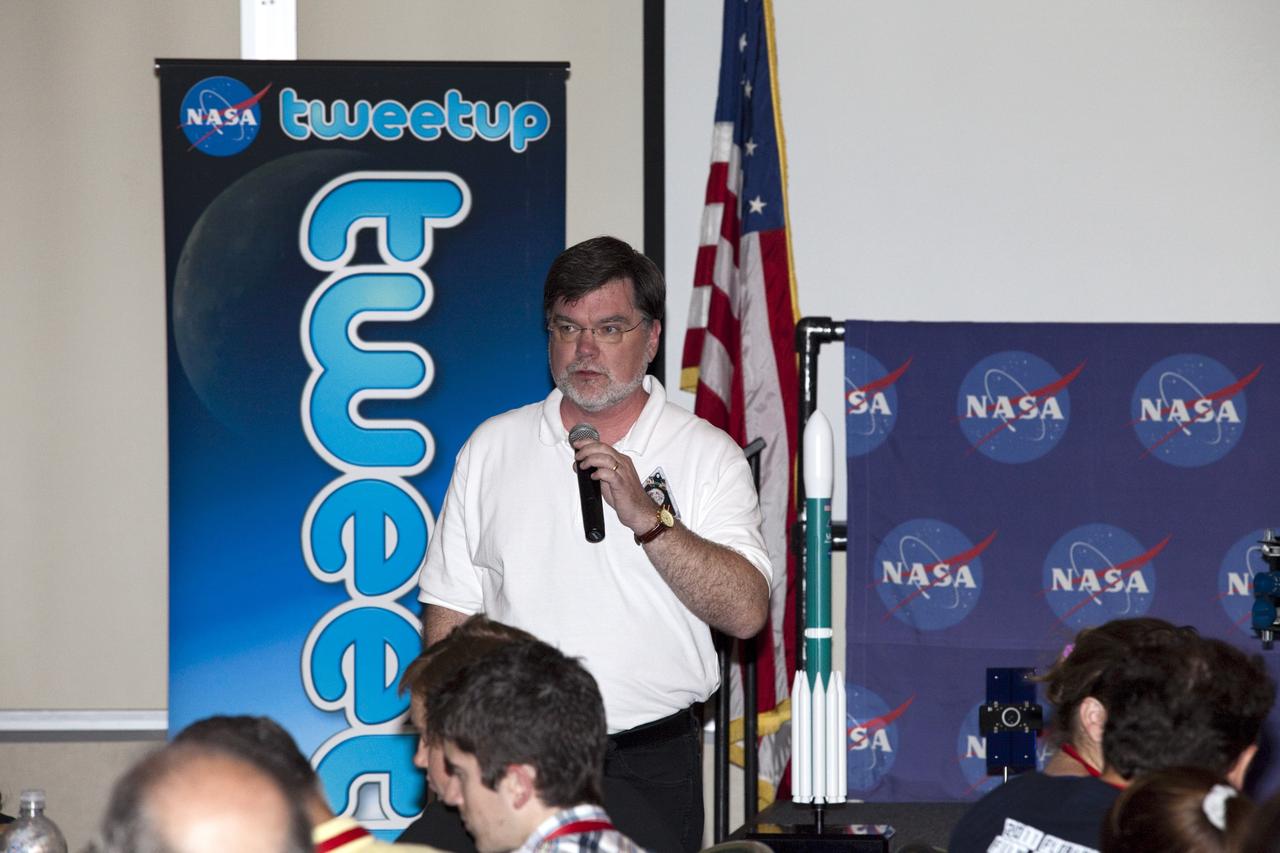
CAPE CANAVERAL, Fla. – Jim Adams, deputy director of planetary science at NASA Headquarters in Washington, speaks to a group of Tweetup participants at the Kennedy Space Center Visitor Complex in Florida during prelaunch activities for the agency’s Gravity Recovery and Interior Laboratory (GRAIL) mission. Participants toured NASA’s Kennedy Space Center and got a close-up view of Space Launch Complex 17B at Cape Canaveral Air Force Station. The tweeters will share their experiences with followers through the social networking site Twitter. GRAIL will fly twin spacecraft in tandem around the moon to precisely measure and map variations in the moon’s gravitational field. The mission will provide the most accurate global gravity field to date for any planet, including Earth. This detailed information will reveal differences in the density of the moon’s crust and mantle and will help answer fundamental questions about the moon’s internal structure, thermal evolution, and history of collisions with asteroids. The aim is to map the moon’s gravity field so completely that future lunar vehicles can safely navigate anywhere on the moon’s surface. Launch is scheduled for 8:37:06 a.m. EDT Sept. 8. For more information, visit http://www.nasa.gov/grail. Photo credit: NASA/Gianni Woods
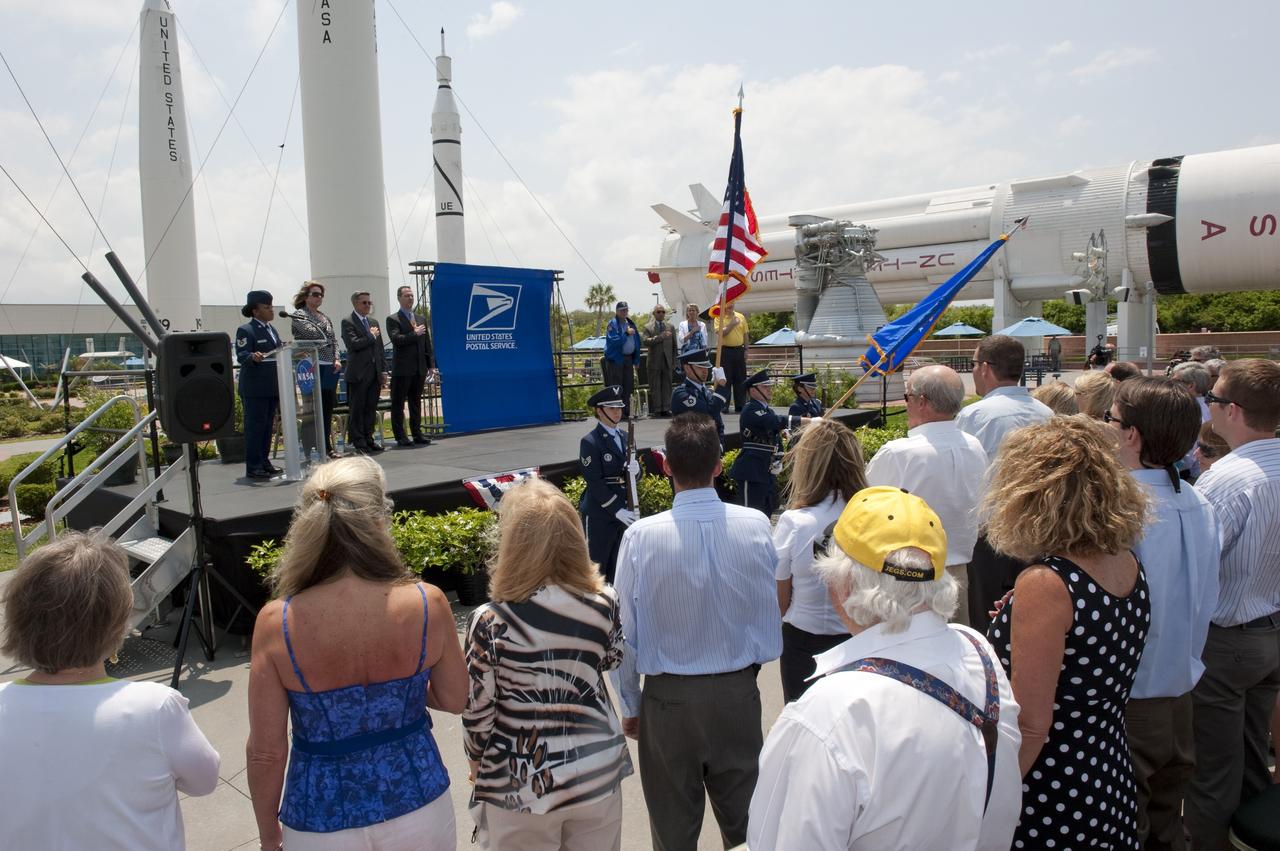
CAPE CANAVERAL, Fla. -- In the Rocket Garden at NASA's Kennedy Space Center Visitor Complex in Florida, the audience and speakers stand for the Pledge of Allegiance and the singing of the National Anthem by a member of the 45th Space Wing Honor Guard from Patrick Air Force Base in Florida. Also on stage are, from left, Director of Education and External Relations for Kennedy Cheryl Hurst, Center Director Bob Cabana and United States Postal Service official Steve Massey, Mercury Astronaut Scott Carpenter, NASA Administrator, Charlie Bolden, Julie Jenkins and NASA's Deputy Director for Planetary Science, Jim Adams, all in attendance for the United States Postal Service unveiling of two new stamps to commemorate the 50th anniversary of human spaceflight. One stamp commemorates NASA's Project Mercury and Alan Shepard's historic launch on May 5, 1961, aboard the spacecraft Freedom 7. The second stamp honors NASA's MESSENGER, which reached Mercury in March to become the first spacecraft to orbit the planet. The two missions frame a remarkable 50-year period in which America advanced space exploration through more than 1,500 crewed and uncrewed flights. Photo credit: NASA/Kim Shiflett
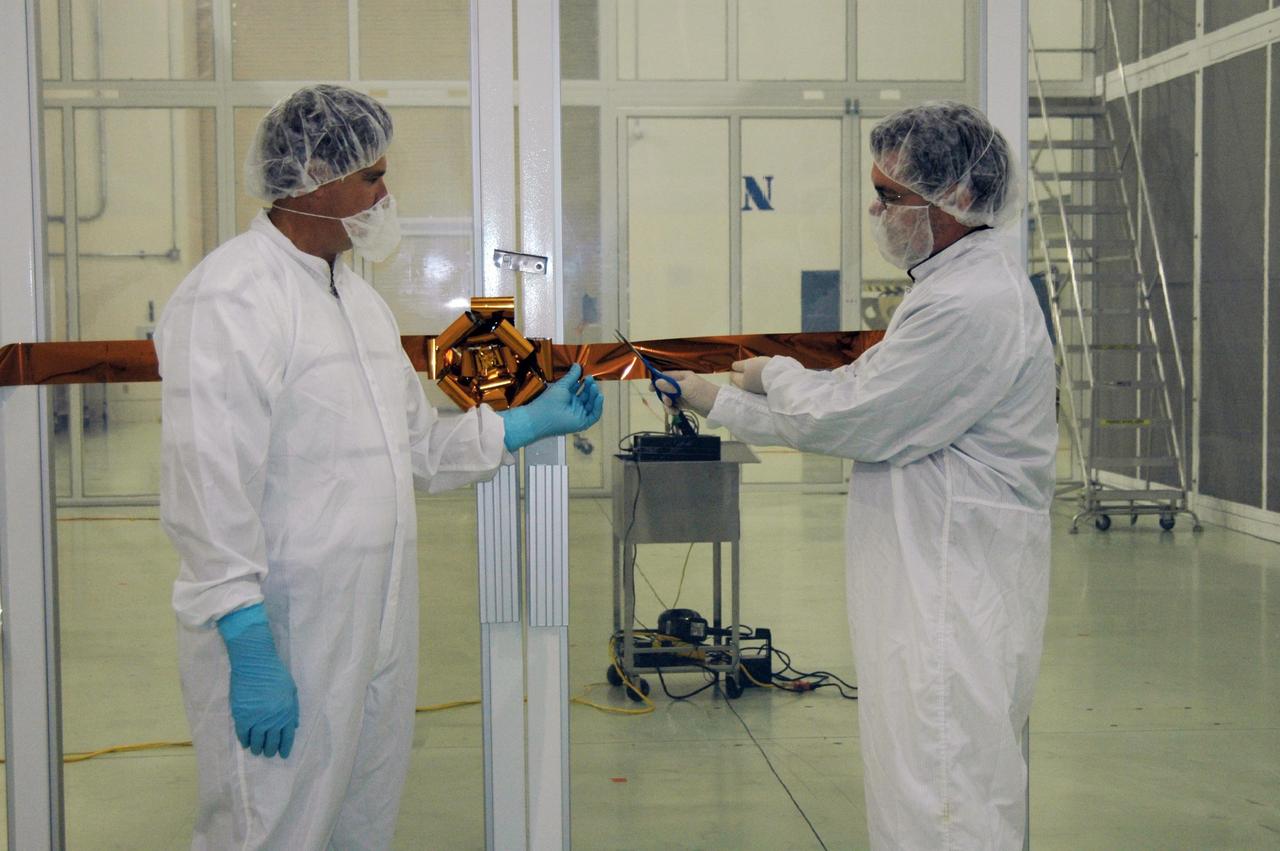
KENNEDY SPACE CENTER, FLA. - Dwayne Light (left), director of Florida Operations, Astrotech, assists Jim Adams, deputy project manager for NASA's Solar Terrestrial Relations Observatory (STEREO), Goddard Space Flight Center, as he cuts the ribbon to officially open the new class 10,000 clean-room enclosure at Astrotech, a payload processing facility near Kennedy Space Center. This clean-room enclosure, within the high bay at Astrotech, meets the additional stringent cleanliness requirements necessary for processing STEREO for launch. The enclosure was designed and constructed by Astrotech to meet the spacecraft requirements provided by STEREO project management at NASA's Goddard Space Flight Center, Greenbelt, Md. STEREO consists of two spacecraft whose mission is the first to take measurements of the sun and solar wind in 3-D. Launch aboard a Boeing Delta II rocket from Launch Complex 17 on Cape Canaveral Air Force Station is scheduled to occur over the summer. Photo credit: NASA/Dimitri Gerondidakis
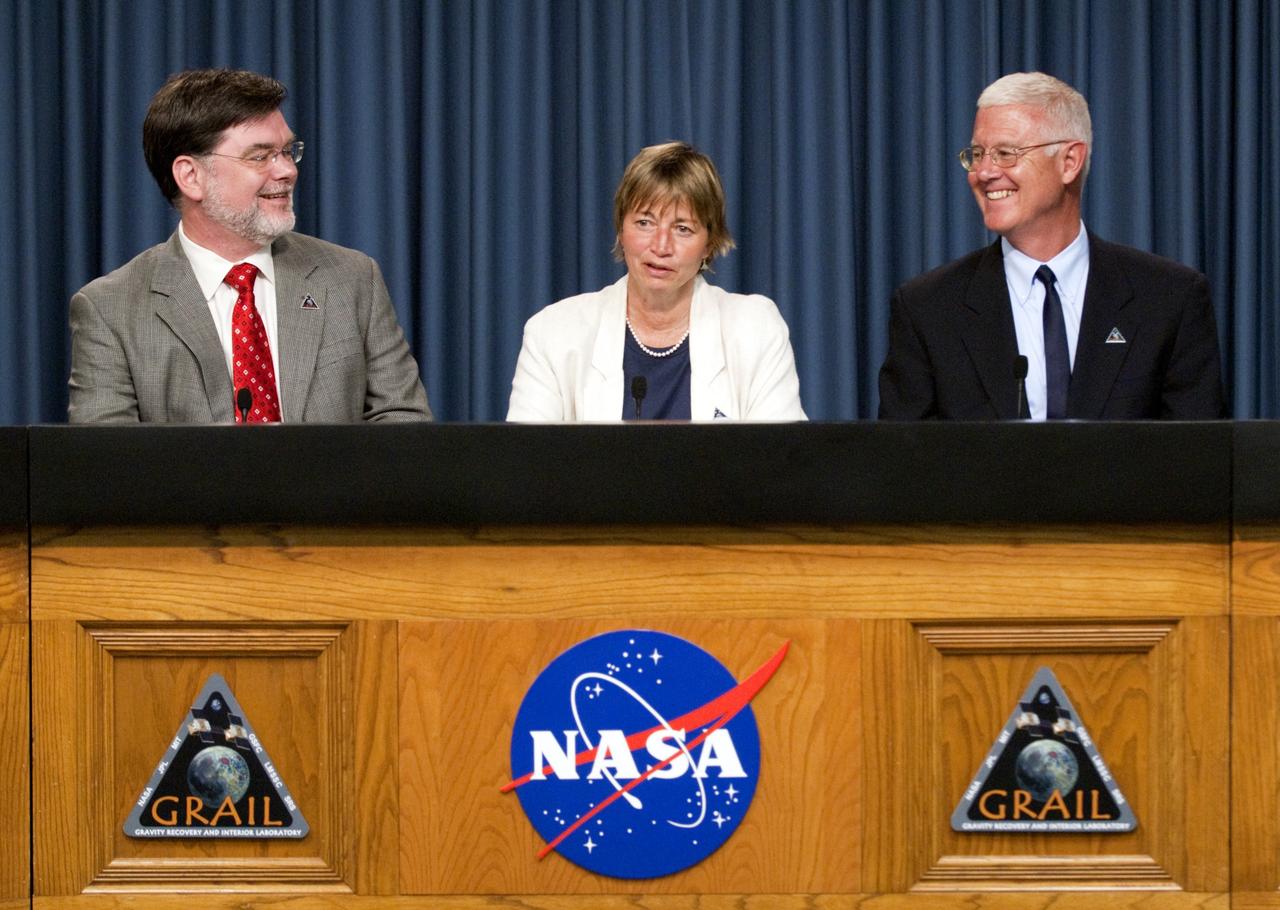
CAPE CANAVERAL, Fla. – Managers of NASA’s Gravity Recovery and Interior Laboratory (GRAIL) mission participate in a post-launch news conference in the Press Site television auditorium at NASA's Kennedy Space Center in Florida. From left are Jim Adams, deputy director, Planetary Science Division, NASA's Science Mission Directorate; Maria Zuber, GRAIL principal investigator, Massachusetts Institute of Technology; and David Lehman, GRAIL project manager, Jet Propulsion Laboratory. Liftoff of the twin GRAIL spacecraft aboard a United Launch Alliance Delta II Heavy rocket was at 9:08:52 EDT Sept. 10 from Space Launch Complex 17B on Cape Canaveral Air Force Station in Florida. The spacecraft are embarking on a three-month journey to reach the moon. GRAIL will fly twin spacecraft in tandem around the moon to precisely measure and map variations in the moon's gravitational field. The mission will provide the most accurate global gravity field to date for any planet, including Earth. For more information, visit http://www.nasa.gov/grail. Photo credit: NASA/Kim Shiflett