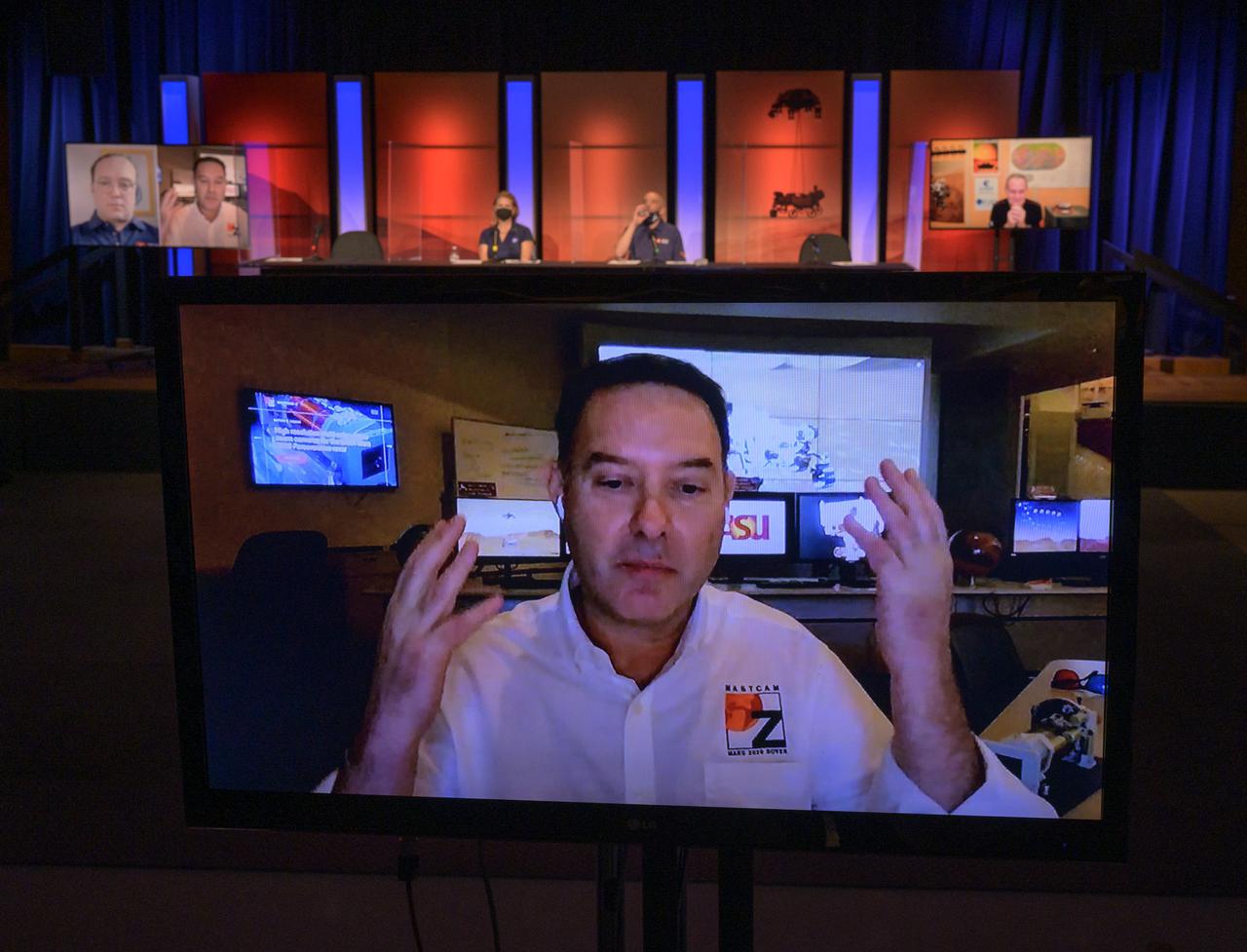
Principal investigator, Mastcam-Z instrument, Arizona State University, Tempe, Jim Bell, gives remarks via remote during a NASA Perseverance rover mission science overview, Tuesday, Feb. 16, 2021, at NASA's Jet Propulsion Laboratory in Pasadena, California. The Perseverance Mars rover is due to land on Mars Thursday, Feb. 18, 2021. A key objective for Perseverance’s mission on Mars is astrobiology, including the search for signs of ancient microbial life. The rover will characterize the planet’s geology and past climate, pave the way for human exploration of the Red Planet, and be the first mission to collect and cache Martian rock and regolith. Photo Credit: (NASA/Bill Ingalls)
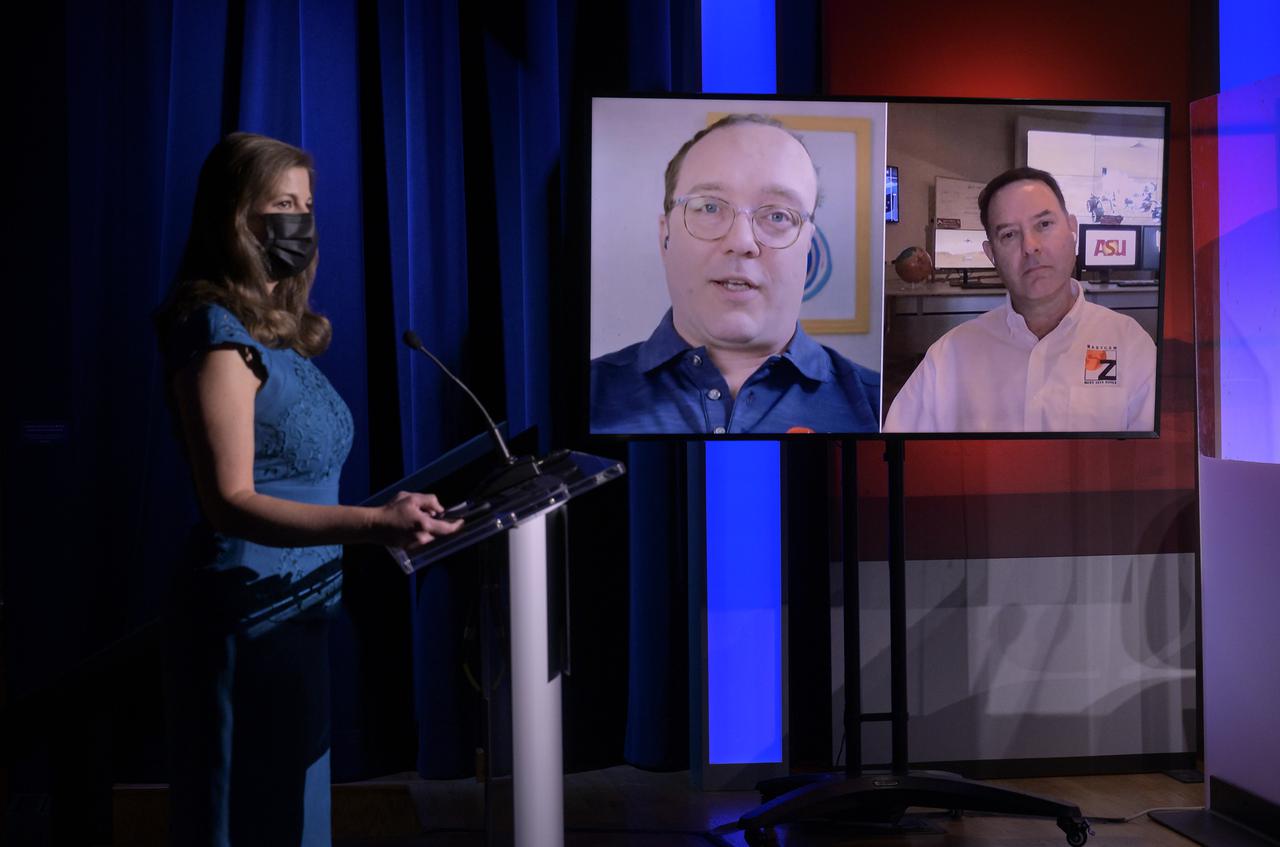
Perseverance deputy project scientist, JPL, Ken Williford, screen left, and Principal investigator, Mastcam-Z instrument, Arizona State University, Tempe, Jim Bell, give remarks via remote during a NASA Perseverance rover mission science overview, Tuesday, Feb. 16, 2021, at NASA's Jet Propulsion Laboratory in Pasadena, California. The Perseverance Mars rover is due to land on Mars Thursday, Feb. 18, 2021. A key objective for Perseverance’s mission on Mars is astrobiology, including the search for signs of ancient microbial life. The rover will characterize the planet’s geology and past climate, pave the way for human exploration of the Red Planet, and be the first mission to collect and cache Martian rock and regolith. Photo Credit: (NASA/Bill Ingalls)
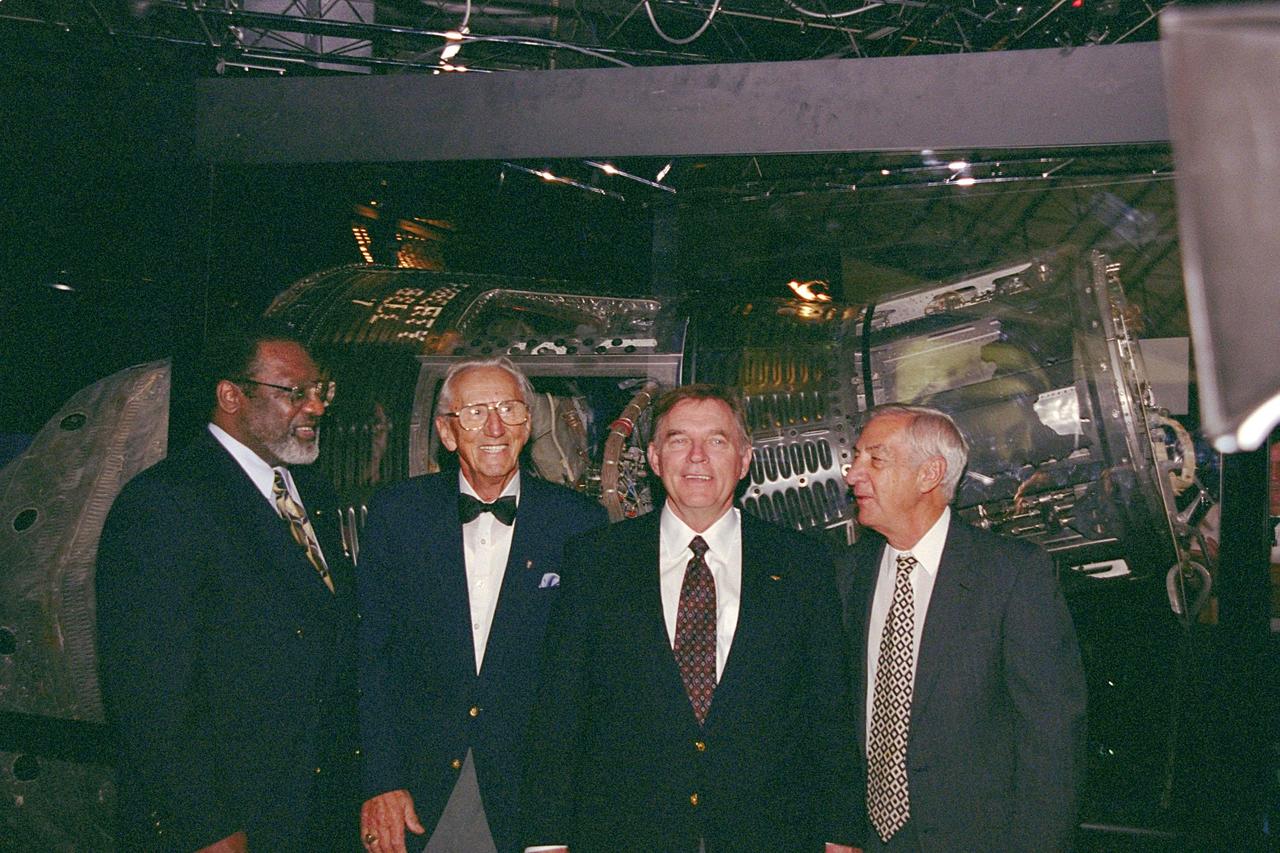
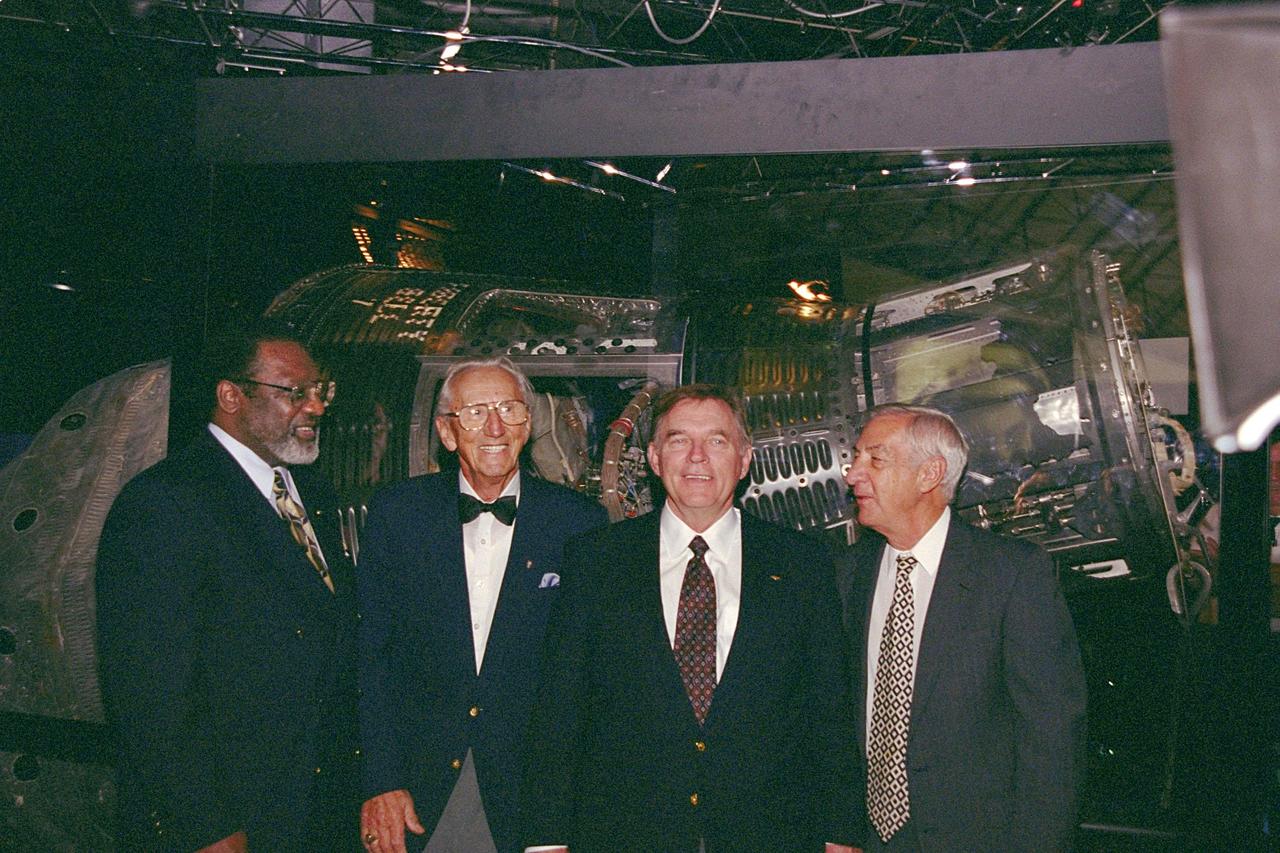
The Discovery Channel’s Liberty Bell 7 Space Capsule Exhibit, which opens to the public at the KSC Visitor Complex on Saturday, June 17, had a preview for the press today. Liberty Bell 7 launched U.S. Air Force Captain Virgil "Gus" Grissom July 21, 1961, on a mission that lasted 15 minutes and 37 seconds before sinking. The capsule lay undetected for nearly four decades before a Discovery Channel expedition located it and recovered it. Standing in front of the restored Liberty Bell 7 capsule are (left to right) KSC’s Deputy Director Jim Jennings; Gunther Wendt, who worked on the Liberty Bell 7 before its launch; Jim Lewis, who piloted the Hunt Club 1 helicopter that rescued Gus Grissom; and Larry Grissom, brother of Gus Grissom. The space capsule, now restored and preserved, is part of an interactive exhibit touring science centers and museums in 12 cities throughout the United States until 2003. The exhibit also includes hands-on elements such as a capsule simulator, a centrifuge, and ROV pilot
The Discovery Channel’s Liberty Bell 7 Space Capsule Exhibit, which opens to the public at the KSC Visitor Complex on Saturday, June 17, had a preview for the press today. Liberty Bell 7 launched U.S. Air Force Captain Virgil "Gus" Grissom July 21, 1961, on a mission that lasted 15 minutes and 37 seconds before sinking. The capsule lay undetected for nearly four decades before a Discovery Channel expedition located it and recovered it. Standing in front of the restored Liberty Bell 7 capsule are (left to right) KSC’s Deputy Director Jim Jennings; Gunther Wendt, who worked on the Liberty Bell 7 before its launch; Jim Lewis, who piloted the Hunt Club 1 helicopter that rescued Gus Grissom; and Larry Grissom, brother of Gus Grissom. The space capsule, now restored and preserved, is part of an interactive exhibit touring science centers and museums in 12 cities throughout the United States until 2003. The exhibit also includes hands-on elements such as a capsule simulator, a centrifuge, and ROV pilot
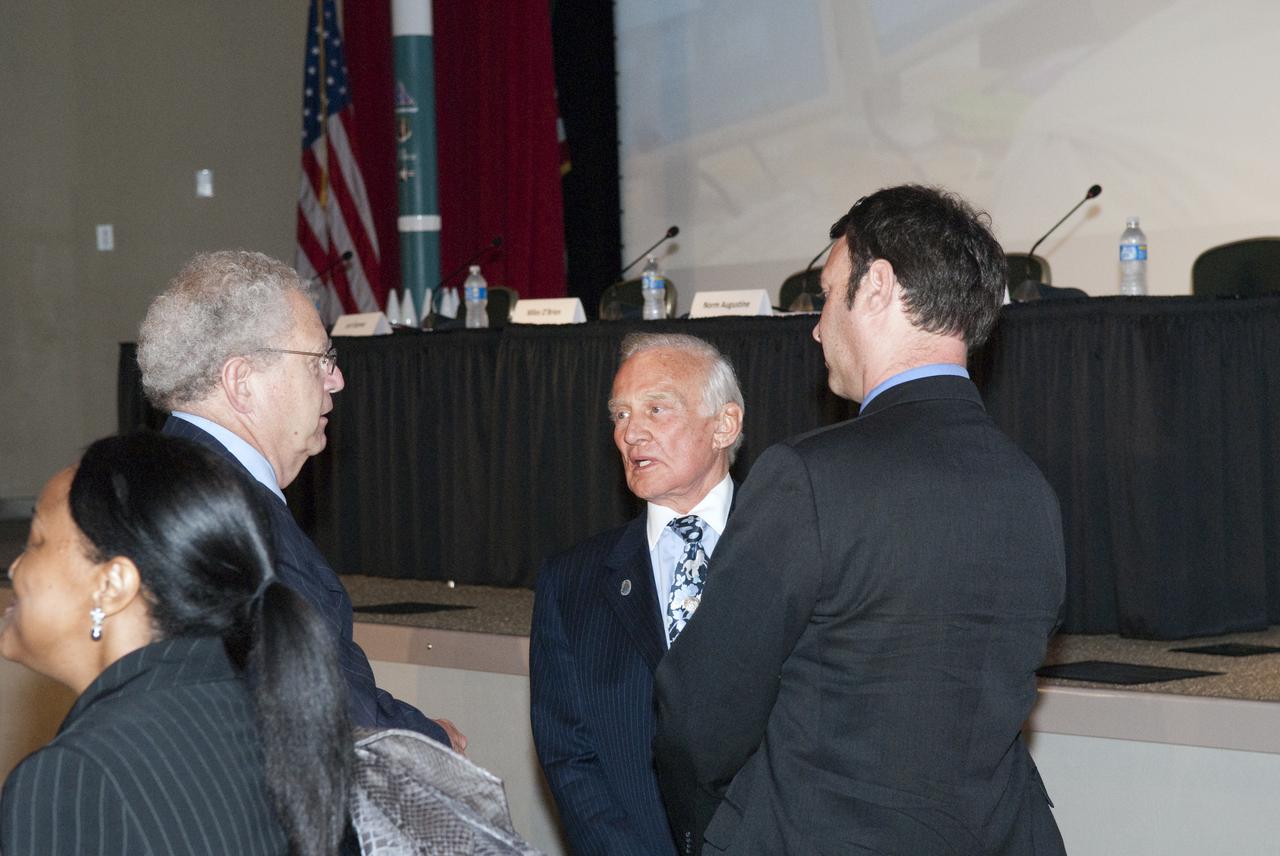
CAPE CANAVERAL, Fla. - Wrap up of the Conference on the American Space Program for the 21st Century took place in the Astronaut Encounter Theater at the NASA Kennedy Space Center Visitor Complex. Before the panel began their remarks, Apollo astronaut Buzz Aldrin (center), Louis Friedman, Founder and Executive director of The Planetary Society (left) and Jim Bell, professor, Department of Astronomy at Cornell University, took a few moments to discuss the event. Photo Credit: NASA_Jim Grossmann
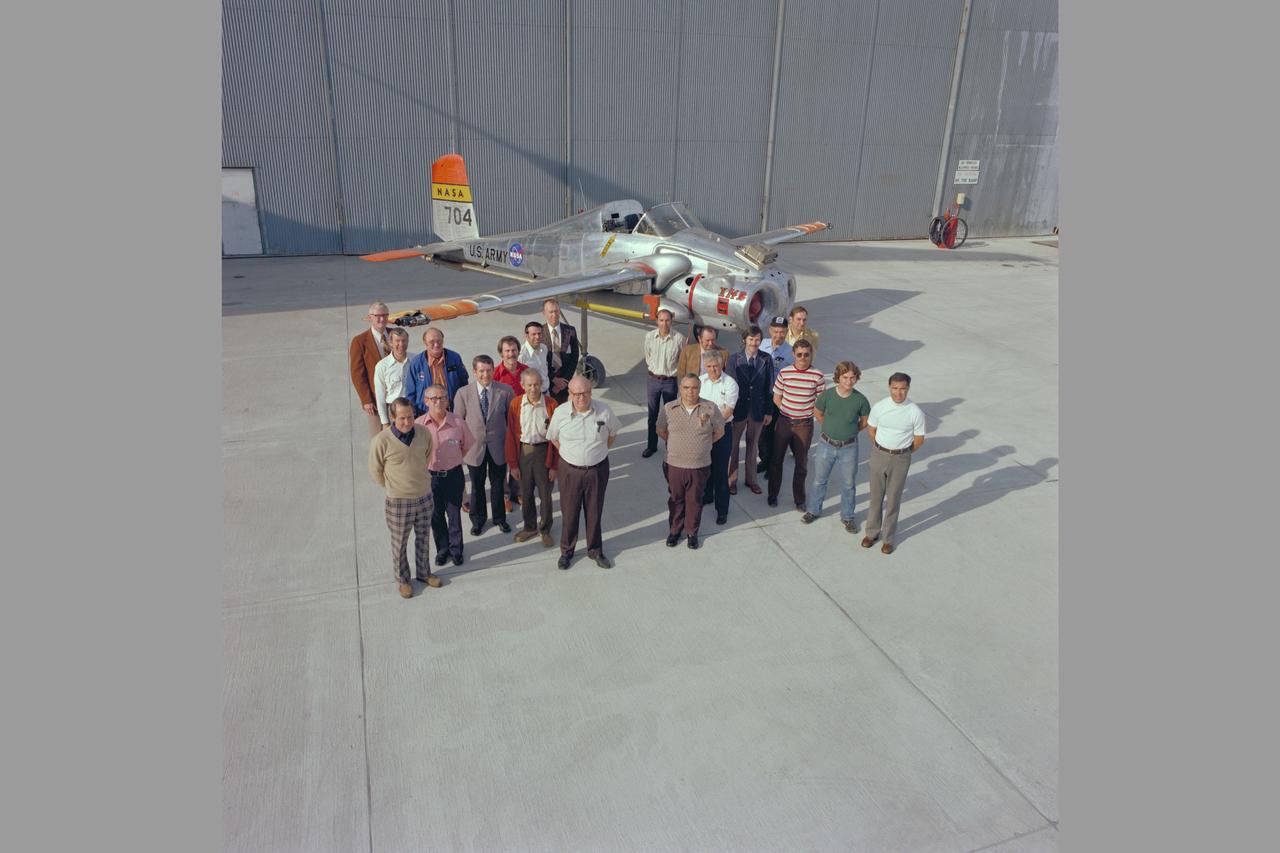
Olczak Bell X-14 AIRCRAFT TWENTIETH ANNIVERSARY. Research Team: Front Row: Fred Drinkwater, Jim Meeks, Lonnie Phillips, Jim Kozalski, Vic Bravo. Second Row: Bill Carpenter, Sid Selan, Dick Gallant, Terry Stoeffler. Third row: Ron Gerdes, Lloyd Corliss. Fourth row: Cy Sewell, Dick Greif, Ed Vernon, Lee Jones. Fifth Row: Dan Dugan, Jim Rogers, Dave Walton, Terry Feistel. Back Row: Frank Pauli, Seth Anderson. Not pictured: Terry Gossett, Bob Innis, Stew Rolls, Lawson Williamson. Note: Used in publication in Flight Research at Ames; 57 Years of Development and Validation of Aeronautical Technology NASA SP-1998-3300 fig. 118
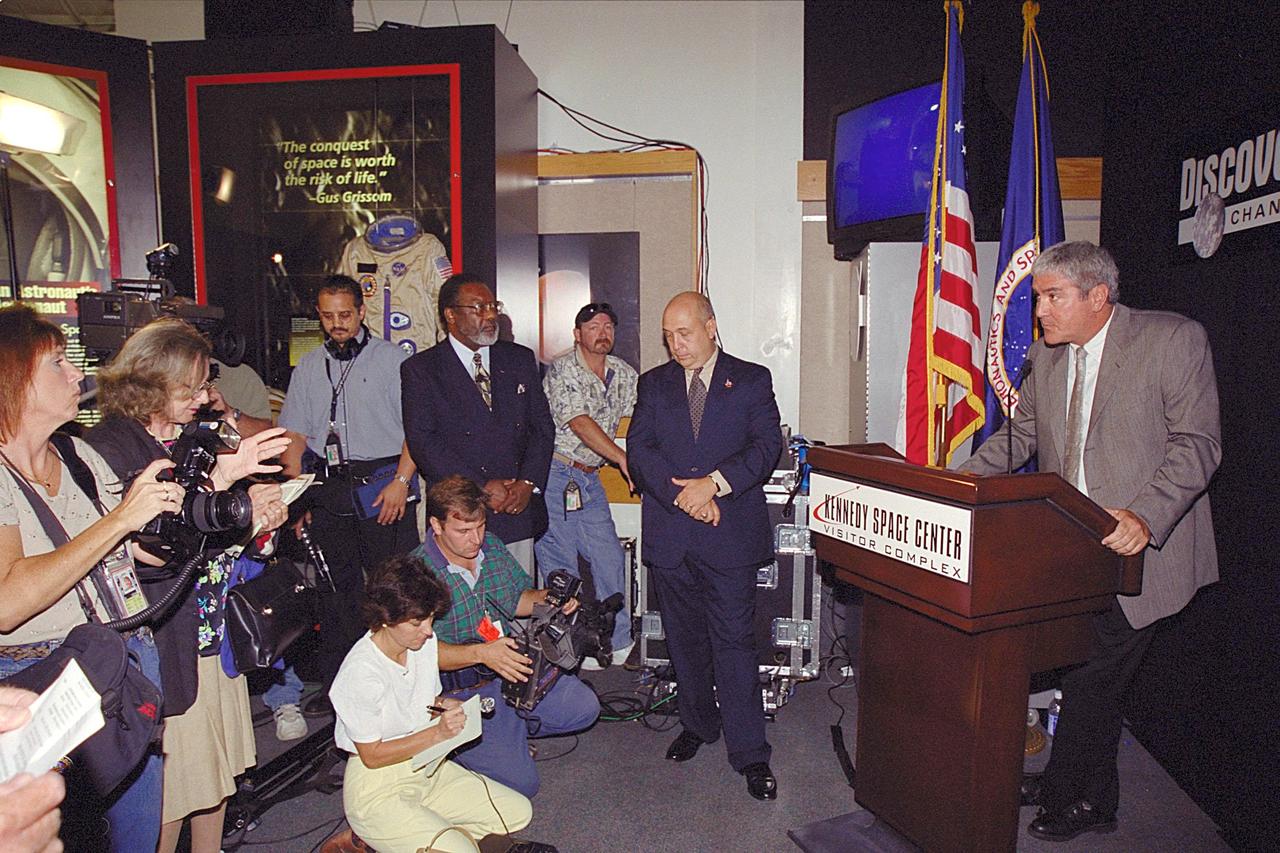
Media gather at the KSC Visitor Complex for the kickoff of the Discovery Channel's Liberty Bell 7 Space Capsule Exhibit, which will open to the public on Saturday, June 17. At the podium is Mike Quattrone, executive vice president and general manager, Discovery Channel.; Standing to the left of the podium is Rick Abramson, president and chief operating officer of Delaware North Parks Services of Spaceport, Inc., and far left, Jim Jennings, deputy director of Kennedy Space Center.; Liberty Bell 7 launched U.S. Air Force Captain Virgil “Gus” Grissom July 21, 1961 on a mission that lasted 15 minutes and 37 seconds before sinking to the floor of the Atlantic Ocean, three miles deep. It lay undetected for nearly four decades before a Discovery Channel expedition located it and recovered it. The space capsule is now restored and preserved, and part of an interactive exhibit touring science centers and museums in 12 cities throughout the United States until 2003. The exhibit includes hands-on elements such as a capsule simulator, a centrifuge, and ROV pilot
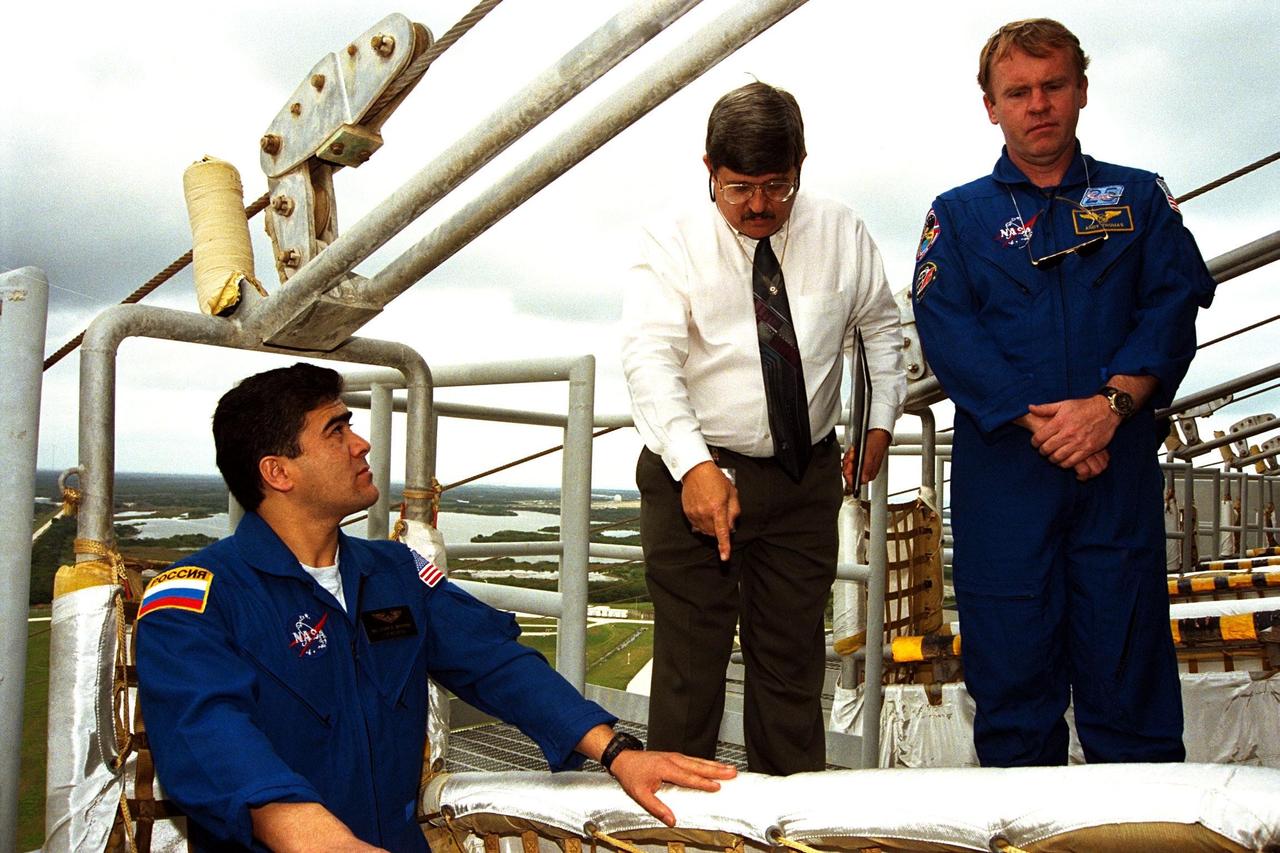
KENNEDY SPACE CENTER, Fla. -- STS-89 Mission Specialist Salizhan Sharipov of the Russian Space Agency stands in a slidewire basket on the emergency egress system at KSC’s Launch Pad 39A, as Jim Bell, USA senior instructor for technical training, explains the egress system to him and to STS-89 Mission Specialist Andrew Thomas, Ph.D, at right. Dr. Thomas will transfer to the Russian Space Station Mir and succeed David Wolf, M.D., who will return to Earth aboard Endeavour. The seven astronauts assigned to the eighth Shuttle-Mir docking flight are completing Terminal Countdown Demonstration Test (TCDT) activities. A dress rehearsal for launch, the TCDT includes emergency egress training at the launch pad and culminates with a simulated countdown. The Space Shuttle Endeavour is undergoing preparations for liftoff, scheduled for Jan. 22. Dr. Thomas will live and work on Mir until June
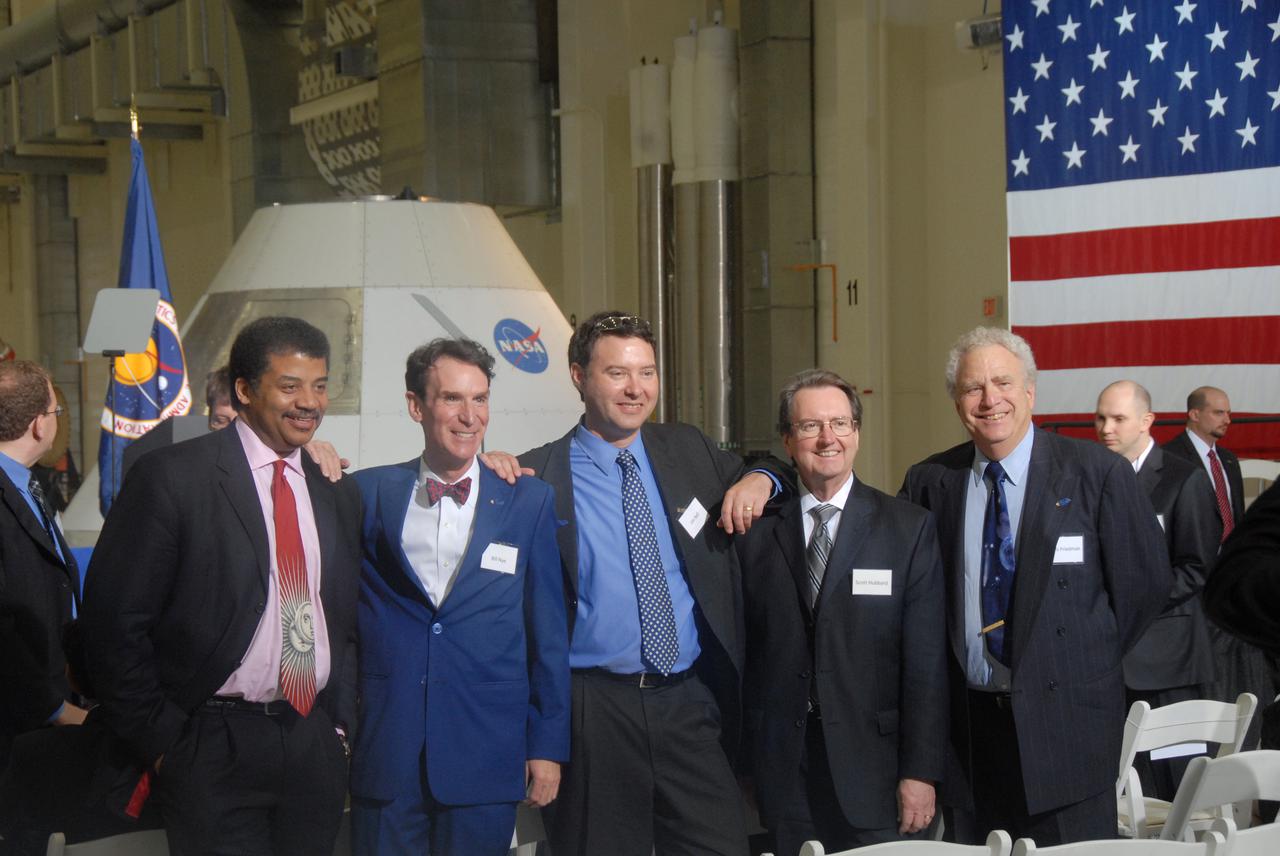
CAPE CANAVERAL, Fla. - In the Operations and Checkout Building at NASA's Kennedy Space Center in Florida, some of the participants and invited guests of the Conference on the American Space Program for the 21st Century pose for a group portrait. From left are Neil deGrasse Tyson, director, Hayden Planetarium, American Museum of Natural History; Bill Nye The Science Guy, engineer and television personality; Jim Bell, professor, Department of Astronomy, Cornell University; Scott Hubbard, former director, NASA's Ames Research Center; and Louis Friedman, founder and executive director, The Planetary Society. President Barack Obama opened the Conference on the American Space Program for the 21st Century with remarks on the new course his administration is charting for NASA and the future of U.S. leadership in human spaceflight. Photo credit: NASA_Jim Grossmann
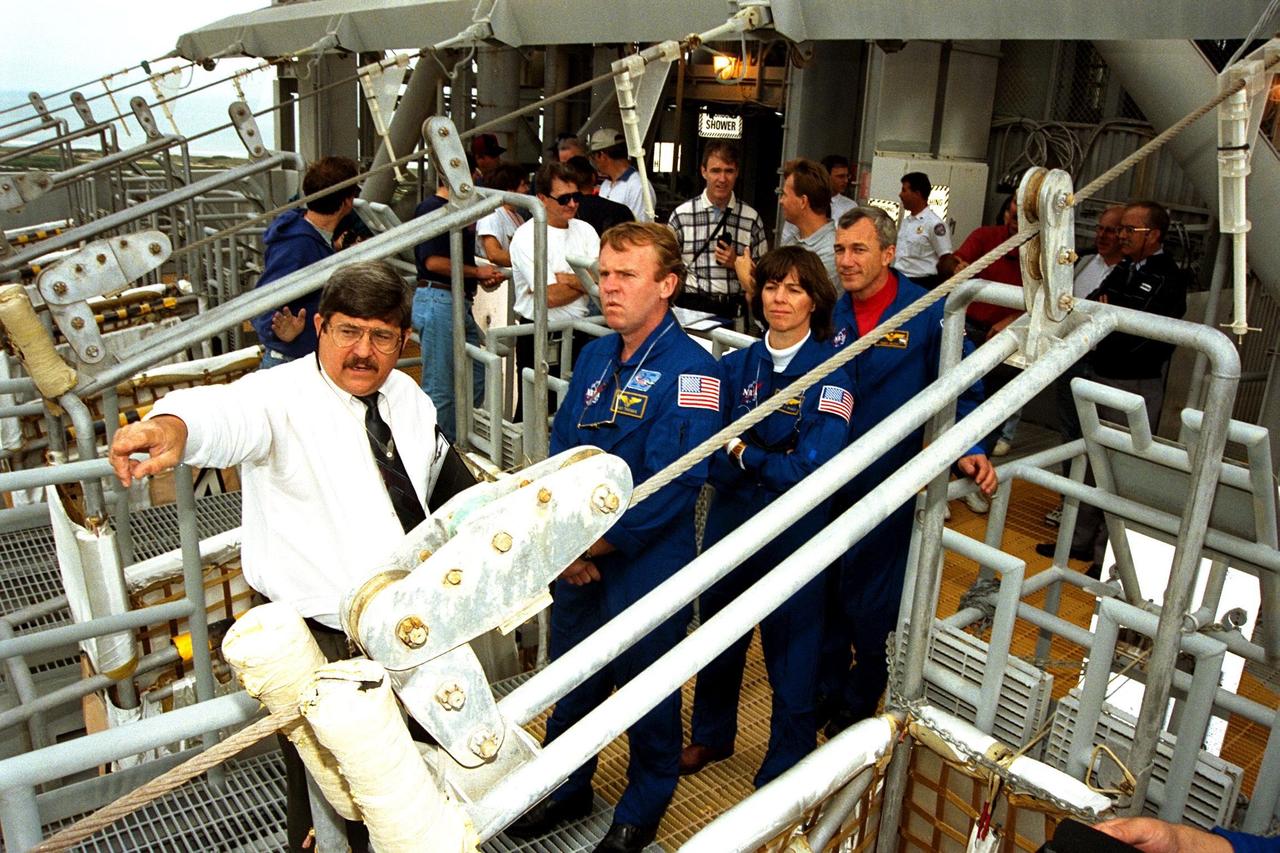
KENNEDY SPACE CENTER, Fla. -- Jim Bell, USA senior instructor for technical training, explains the emergency egress system at KSC’s Launch Pad 39A to, left to right, STS-89 Mission Specialists Andrew Thomas, Ph.D., who will transfer to the Russian Space Station Mir, and Bonnie Dunbar, Ph.D., as well as to Commander Terrence Wilcutt. Dr. Thomas will succeed David Wolf, M.D., who will return to Earth aboard Endeavour. The seven astronauts assigned to the eighth Shuttle-Mir docking flight are completing Terminal Countdown Demonstration Test (TCDT) activities at KSC. A dress rehearsal for launch, the TCDT includes emergency egress training at the launch pad and culminates with a simulated countdown. The Space Shuttle Endeavour is undergoing preparations for liftoff, scheduled for Jan. 22. Dr. Thomas will live and work on Mir until June
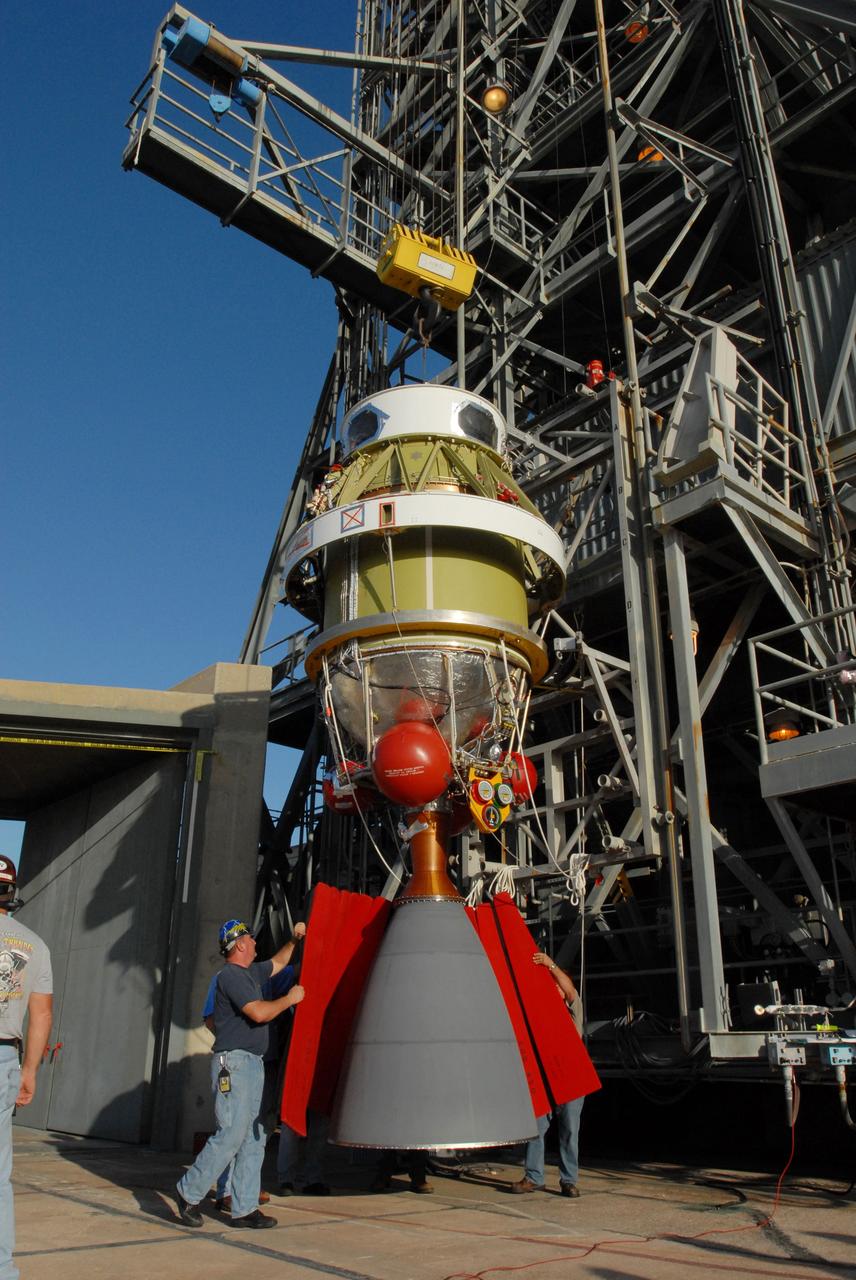
CAPE CANAVERAL, Fla. -- On Complex 17-B at Cape Canaveral Air Force Station in Florida, workers wrap protective covers around the engine bell of the second stage of the Delta 2 rocket before it is lifted into the mobile service tower. In the tower, the second stage will be mated to the first stage of the Delta 2, which is the launch vehicle for NASA's Kepler spacecraft. The Kepler mission is specifically designed to survey our region of the Milky Way galaxy to discover hundreds of Earth-size and smaller planets in or near the habitable zone and determine how many of the billions of stars in our galaxy have such planets. Results from this mission will allow us to place our solar system within the continuum of planetary systems in the Galaxy. NASA's planet-hunting Kepler mission is scheduled to launch no earlier than March 5, 2009. Photo credit: NASA/Jim Grossmann
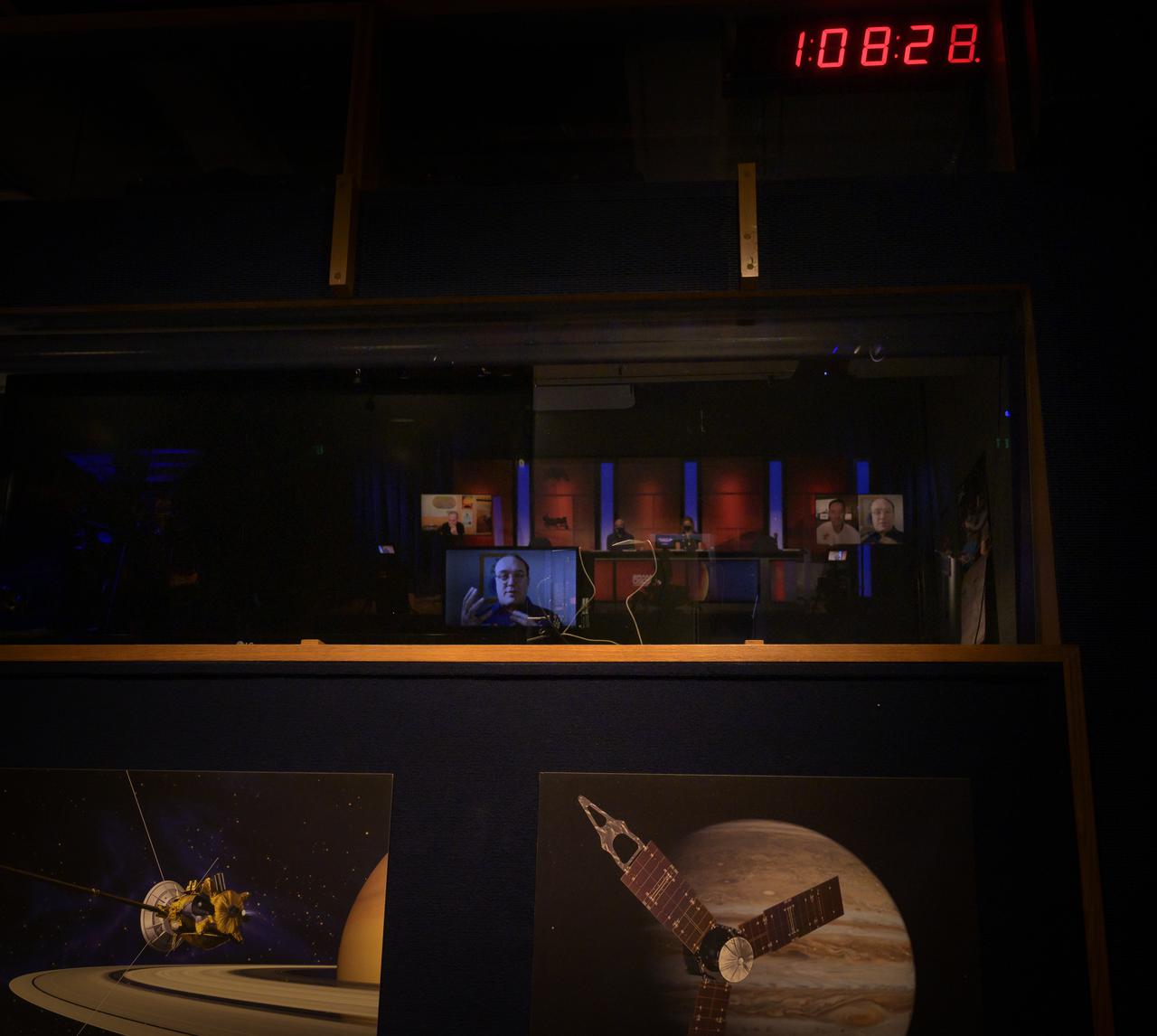
Mission managers and scientist are seen reflected in the television control room window during a NASA Perseverance rover mission science overview, Tuesday, Feb. 16, 2021, at NASA's Jet Propulsion Laboratory in Pasadena, California. The Perseverance Mars rover is due to land on Mars Thursday, Feb. 18, 2021. A key objective for Perseverance’s mission on Mars is astrobiology, including the search for signs of ancient microbial life. The rover will characterize the planet’s geology and past climate, pave the way for human exploration of the Red Planet, and be the first mission to collect and cache Martian rock and regolith. Photo Credit: (NASA/Bill Ingalls)
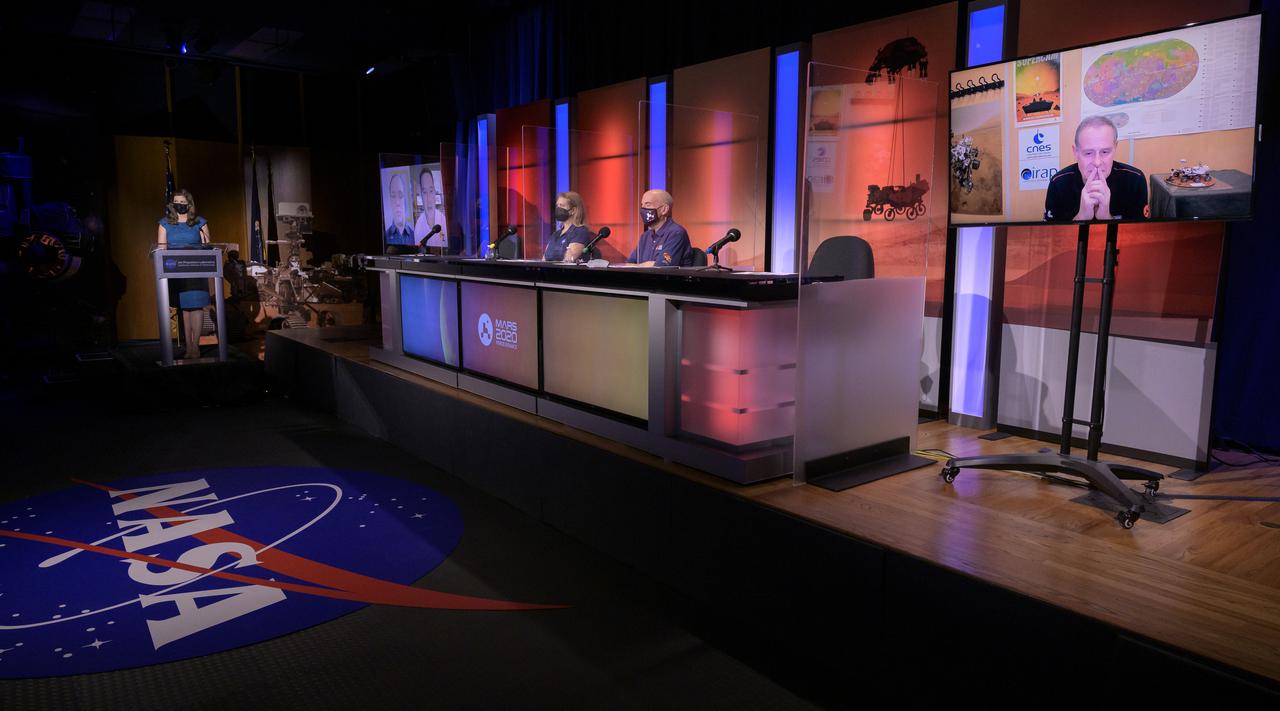
Mission managers and scientist are seen during a NASA Perseverance rover mission science overview, Tuesday, Feb. 16, 2021, at NASA's Jet Propulsion Laboratory in Pasadena, California. The Perseverance Mars rover is due to land on Mars Thursday, Feb. 18, 2021. A key objective for Perseverance’s mission on Mars is astrobiology, including the search for signs of ancient microbial life. The rover will characterize the planet’s geology and past climate, pave the way for human exploration of the Red Planet, and be the first mission to collect and cache Martian rock and regolith. Photo Credit: (NASA/Bill Ingalls)
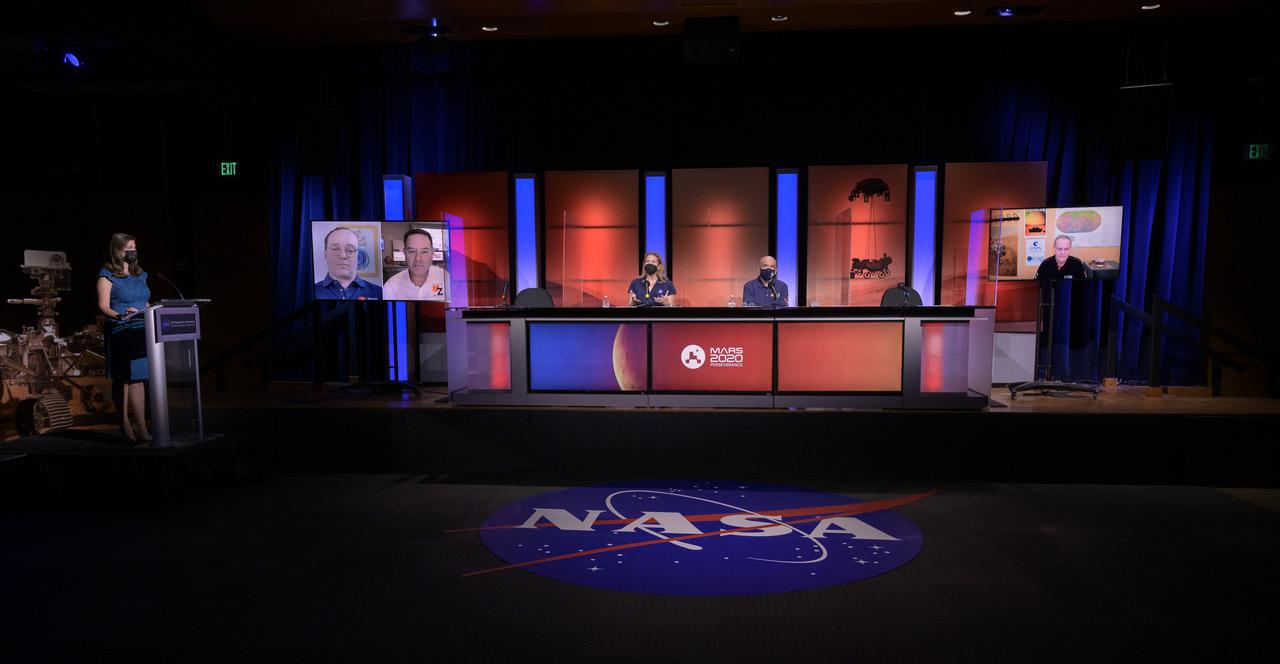
Mission managers and scientist are seen during a NASA Perseverance rover mission science overview, Tuesday, Feb. 16, 2021, at NASA's Jet Propulsion Laboratory in Pasadena, California. The Perseverance Mars rover is due to land on Mars Thursday, Feb. 18, 2021. A key objective for Perseverance’s mission on Mars is astrobiology, including the search for signs of ancient microbial life. The rover will characterize the planet’s geology and past climate, pave the way for human exploration of the Red Planet, and be the first mission to collect and cache Martian rock and regolith. Photo Credit: (NASA/Bill Ingalls)

A Closer Hubble Encounter With Mars - Tharsis

A Closer Hubble Encounter With Mars - Elysium

A Closer Hubble Encounter With Mars - Syrtis Major

A Closer Hubble Encounter With Mars - Pathfinder Landing Site

A Closer Hubble Encounter With Mars - Global View

A Closer Hubble Encounter With Mars - 4 Views