
S79-36838 (3 Oct 1979) --- Asttronaut Joe H. Engle.

S71-52272 (1971) --- Astronaut Joe H. Engle

S86-26417 (Feb. 1986) --- Astronaut Joe H. Engle.
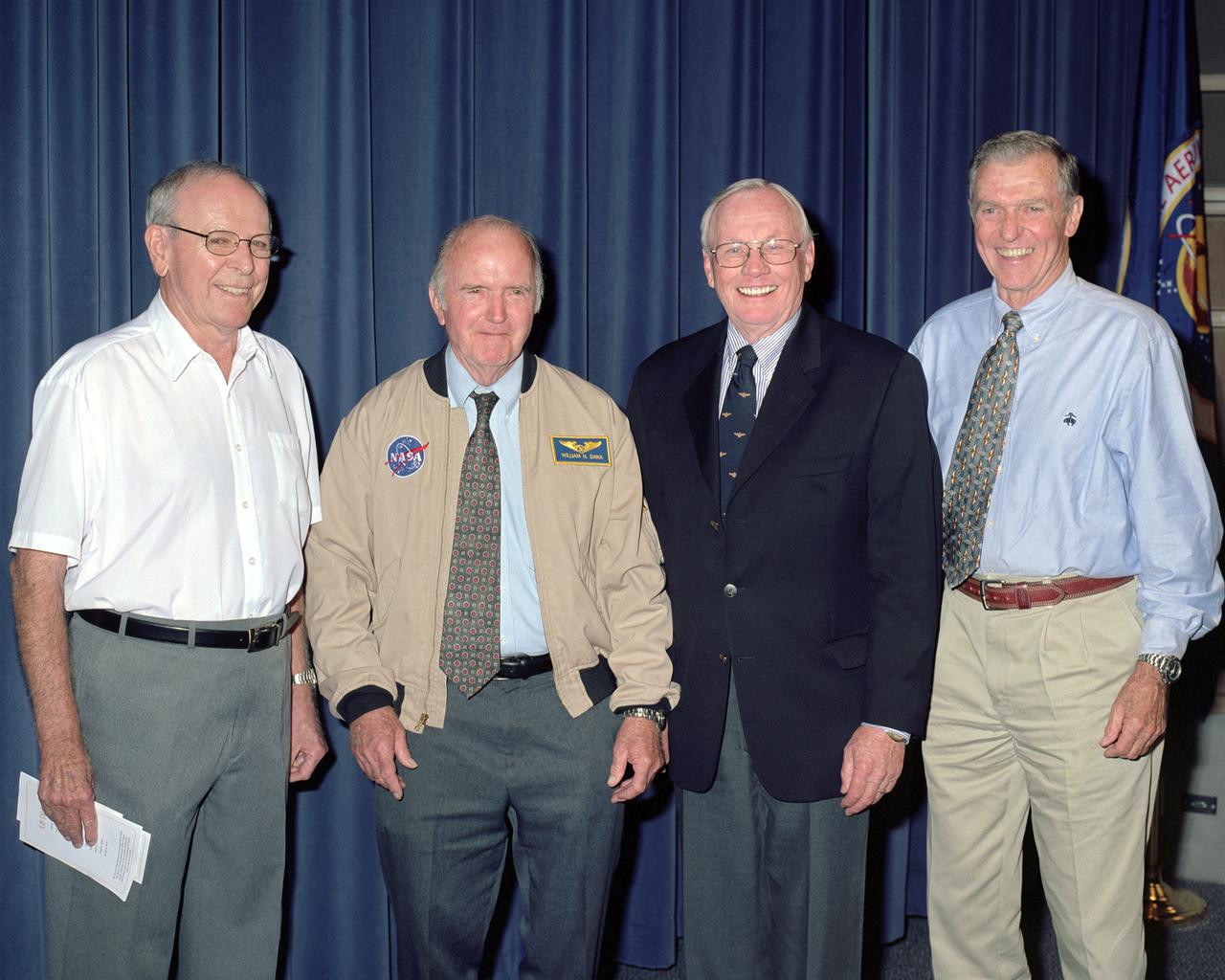
Four of the five surviving X-15 pilots were on hand when astronaut wings were presented to the three NASA pilots who flew the X-15 rocket plane into space in the 1960s, Bill Dana, Joe Walker (deceased) and Jack McKay (deceased). From left, Robert White, Dana, Neil Armstrong, Joe Engle.

Portrait photograph, Astronaut Joe H. Engle, selected as official portrait for the STS-2 Mission. JSC, HOUSTON, TX. ( S81-34642 );
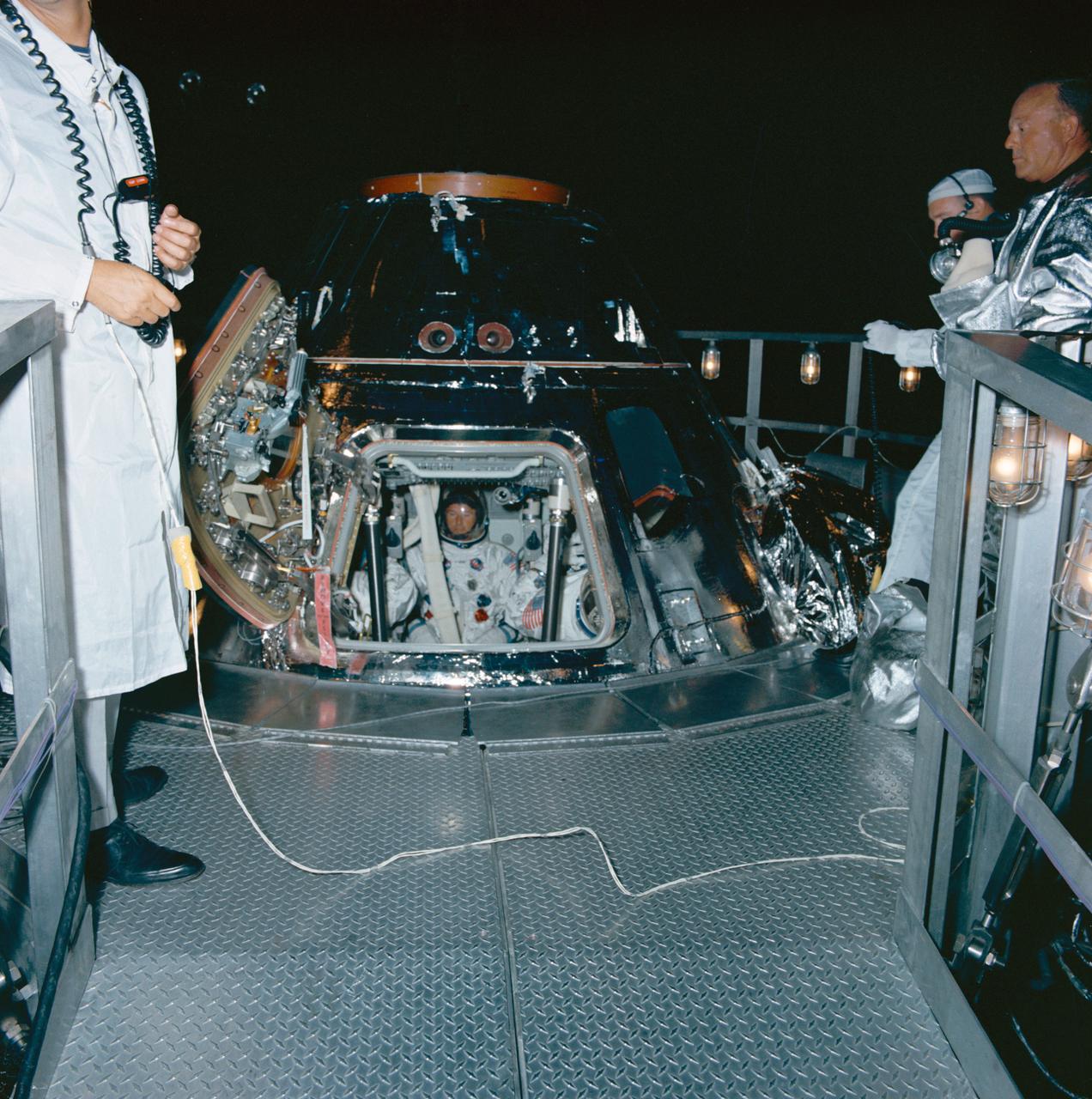
Crew ingress and beginnings of 7 1/2-day Manned Thermal Vacuum Test with Astronauts Joe Engle, Dr. Joseph Kerwin and Brand in the Apollo S/C-2TV-1, Chamber "A", Bldg. 32. Note - 35mm BW (S68-35881 thru S68-35882) - 120 CN (S68-35883 thru S68-35908) 1. ASTRONAUT BRAND, VANCE D. - VACUUM TEST 2. ASTRONAUT KERWIN, JOSEPH - VACUUM TEST 3. ASTRONAUT ENGLE, JOE - VACUUM MSC, HOUSTON, TX
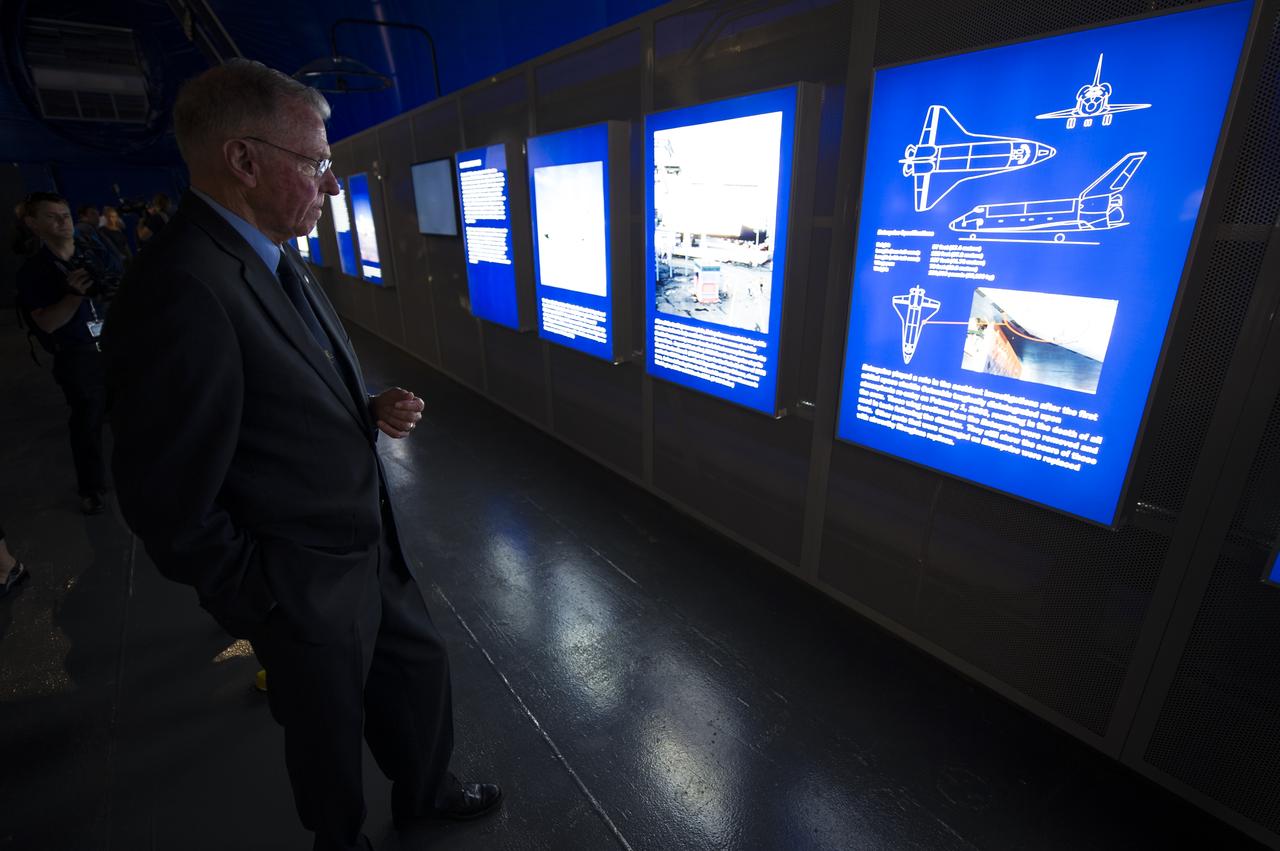
Former NASA Astronaut and Enterprise Commander Joe Engle looks at an exhibit in the Intrepid Sea, Air & Space Museum's Space Shuttle Pavilion where the space shuttle Enterprise is on Thursday, July 19, 2012 in New York. Photo Credit: (NASA/Bill Ingalls)

Astronaut Joe H. Engle, STS-2 commander, practices donning and doffing his extravehicular mobility unit (EMU) in the weightless environment afforded aboard a KC-135 "zero-gravity" aircraft.
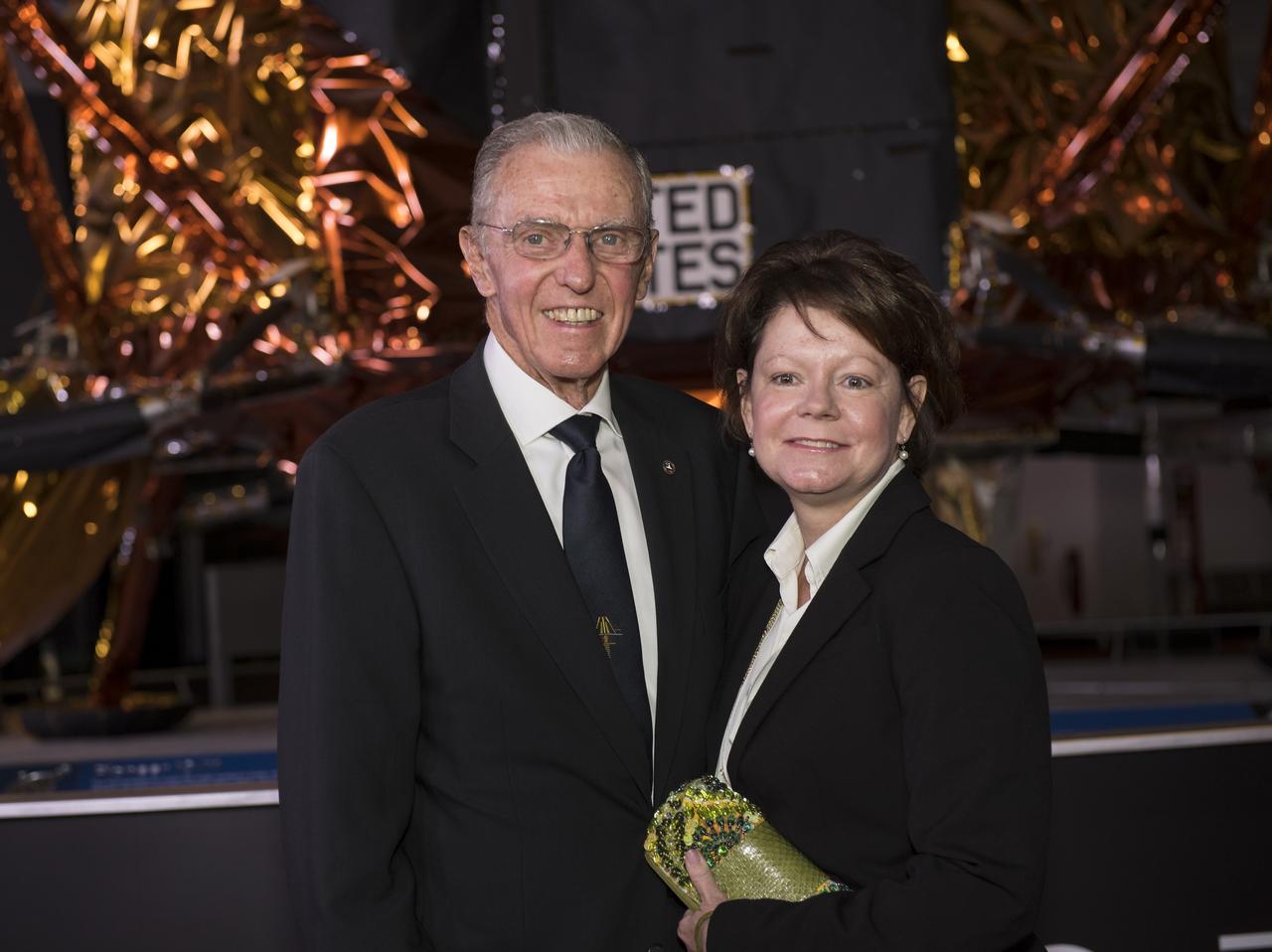
NASA astronaut Joe Engle attends the premiere of Universal's feature film "First Man” Thursday, Oct. 4, 2018 at the Smithsonian National Air and Space Museum in Washington. The movie is based on the book by Jim Hansen that chronicles the life of NASA astronaut Neil Armstrong from test pilot to his historic Moon landing. It was directed by Damien Chazelle and stars Ryan Gosling and Claire Foy. Photo Credit: (NASA/Aubrey Gemignani)
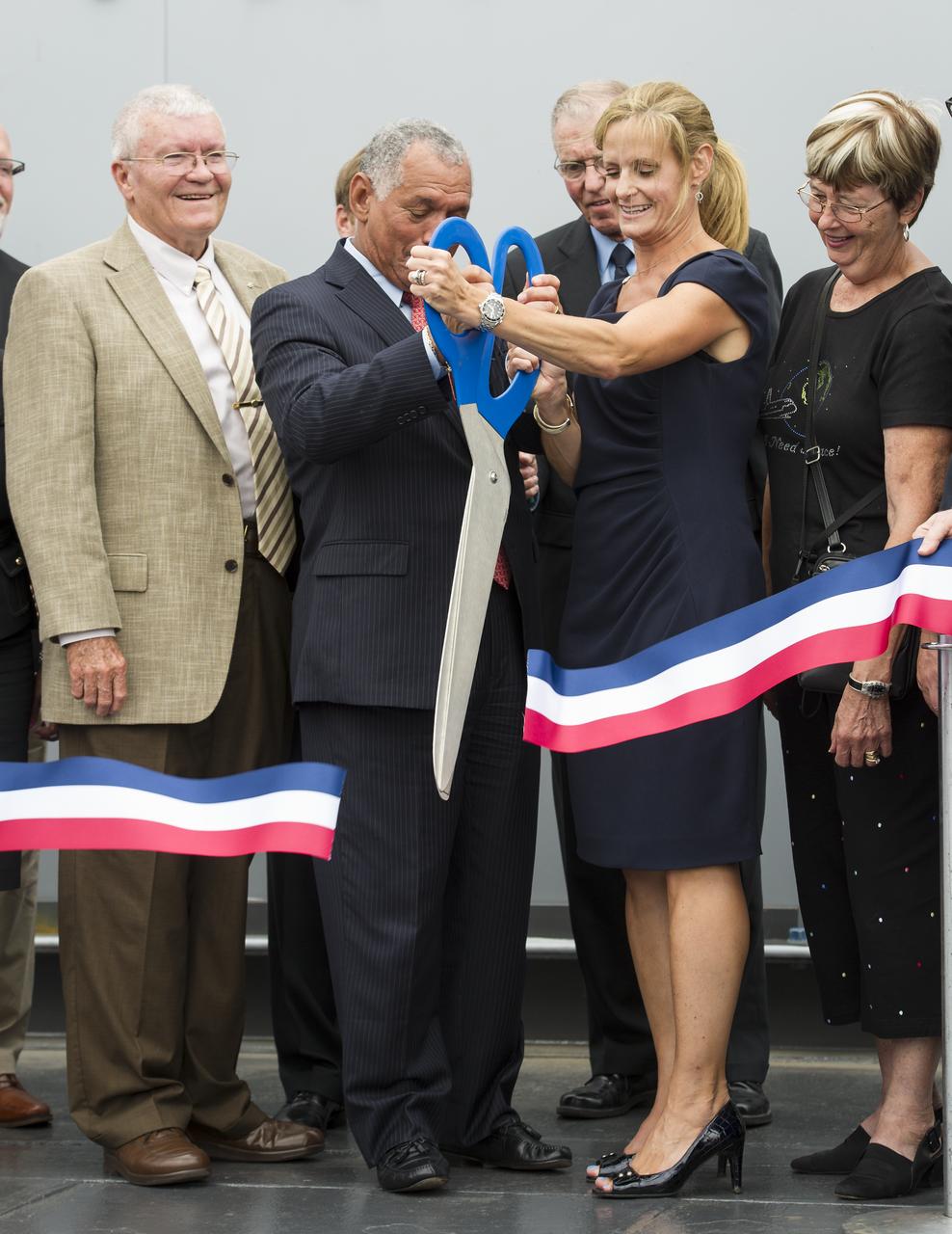
NASA Administrator Charlie Bolden and Intrepid Sea, Air & Space Museum President Susan Marenoff-Zausner cut a ribbon at the museum marking the opening of the new Space Shuttle Pavilion which exhibits the space shuttle Enterprise while NASA Astronaut and Enterprise Commander Fred Haise, left, NASA Astronaut and Enterprise Commander Joe Engle, background, and Marie Fullerton, wife of NASA Astronaut and Enterprise Pilot Gordon Fullerton, right, look on, Thursday, July 19, 2012 in New York City. Photo Credit: (NASA/Bill Ingalls)
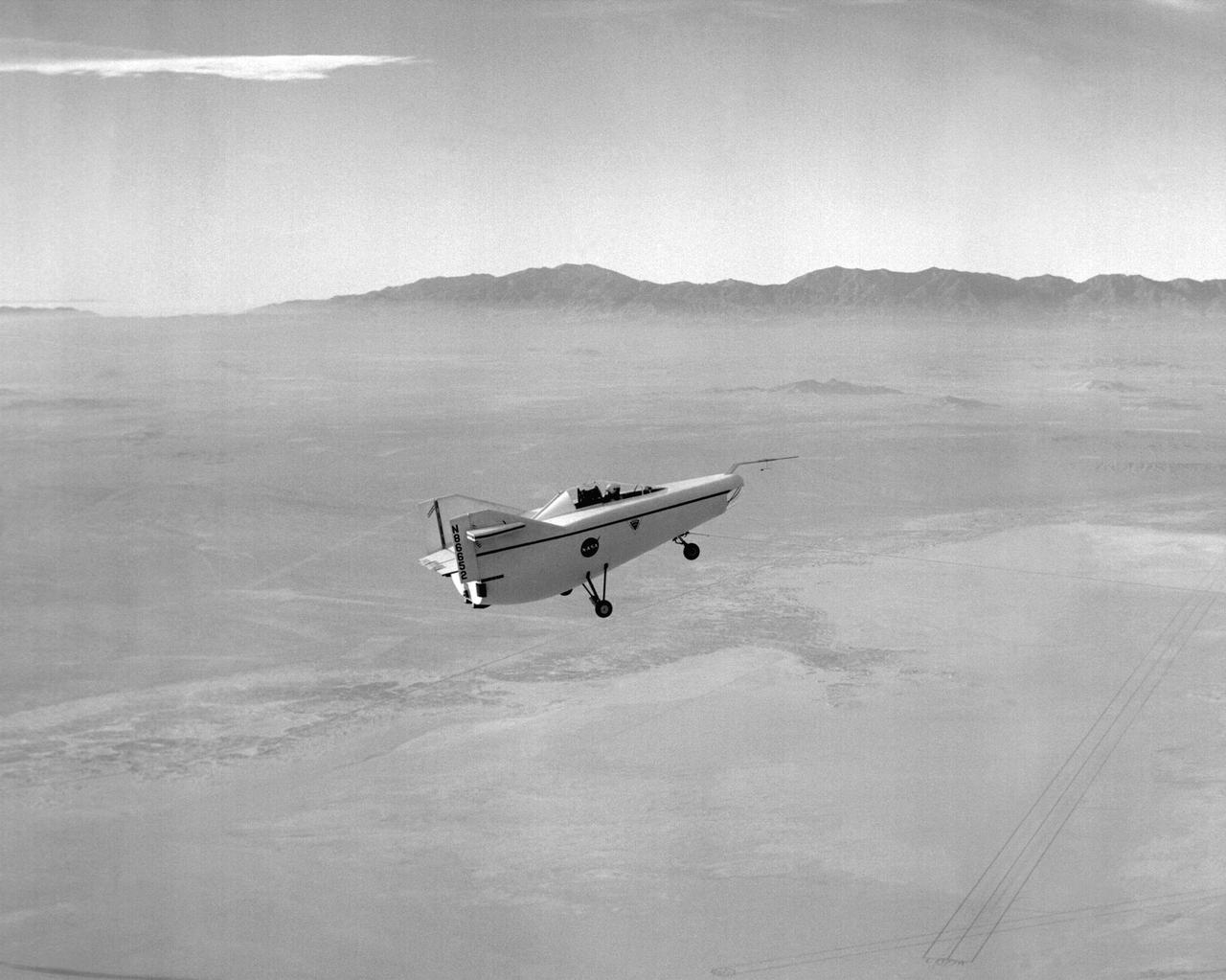
Following the first M2-F1 airtow flight on 16 August 1963, the Flight Research Center used the vehicle for both research flights and to check out new lifting-body pilots. These included Bruce Peterson, Don Mallick, Fred Haise, and Bill Dana from NASA. Air Force pilots who flew the M2-F1 included Chuck Yeager, Jerry Gentry, Joe Engle, Jim Wood, and Don Sorlie, although Wood, Haise, and Engle only flew on car tows. In the three years between the first and last flights of the M2-F1, it made about 400 car tows and 77 air tows.
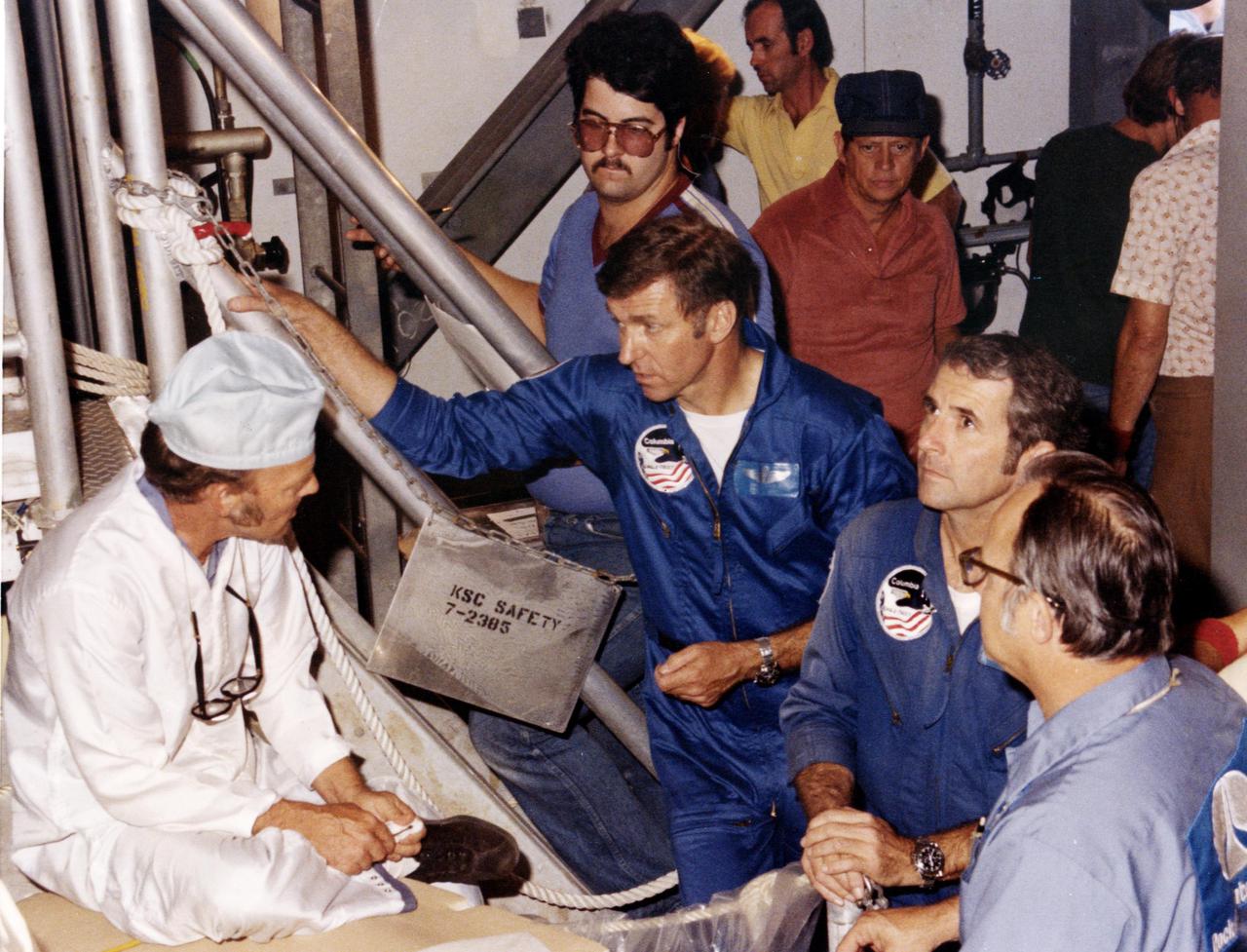
KENNEDY SPACE CENTER, FLA. -- At Pad A, Launch Complex 39, astronauts Joe Engle, left, and Richard Truly talk with technicians and inspect the Space Shuttle vehicle that will propel them into orbit later this fall.

KENNEDY SPACE CENTER, FLA. - As the Stafford-Covey Return to Flight Task Group (SCTG) tours the Orbiter Processing Facility, Richard O. Covey (second from left), former Space Shuttle commander, points to equipment. Covey is co-chair of the SCTG along with Thomas P. Stafford, Apollo commander. Others in the photo are William Wegner, James Adamson and Joe Engle. Chartered by NASA Administrator Sean O’Keefe, the task group will perform an independent assessment of NASA’s implementation of the final recommendations by the Columbia Accident Investigation Board.

S81-30479 (April 1981) --- Astronauts John W. Young, second from left, and Robert L. Crippen, left, discuss photography from their recent STS-1 mission with astronauts Joe H. Engle, right, and Richard H. Truly during a post-mission debriefing session. Engle and Truly were backup crewmen for STS-1 and they have been named as prime crew members for STS-2, scheduled for a Sept. 30, 1981 liftoff. Photo credit: NASA

S81-39570 (12-14 Nov 1981) --- Astronaut Joe H. Engle, STS-2 commander, enjoys a rare in-space exercise session on a device called a treadmill, which is specially designed for astronauts in zero gravity. He is in the mid-deck are of the Space Shuttle Columbia flying 160 miles (226 kilometers) above the Earth. The STS-2 mission of Astronauts Engle and Richard H. Truly, pilot, lasted a total of two days, six hours, 13 minutes and 10 seconds. Truly took the picture with a 35mm camera.

S77-28210 (13 Sept 1977) --- Astronauts Joe H. Engle (face down), commander, and Richard H. Truly (face partially obscured by Engle), pilot, are greeted by Rockwell technicians following egress from the shuttle Orbiter 101 "Enterprise." They had just completed a five-minute, 31-second unpowered free flight in the "Enterprise," the second of a series of such flights, conducted on September 13, 1977, at the Dryden Flight Research Center (DFRC) and Edwards Air Force Base.

S81-34641 (May 1981) --- Astronauts Joe H. Engle, left, and Richard H. Truly are the commander and pilot, respectively, for the NASA STS-2 flight of the space shuttle Columbia, scheduled for Sept. 30, 1981 launch. Photo credit: NASA
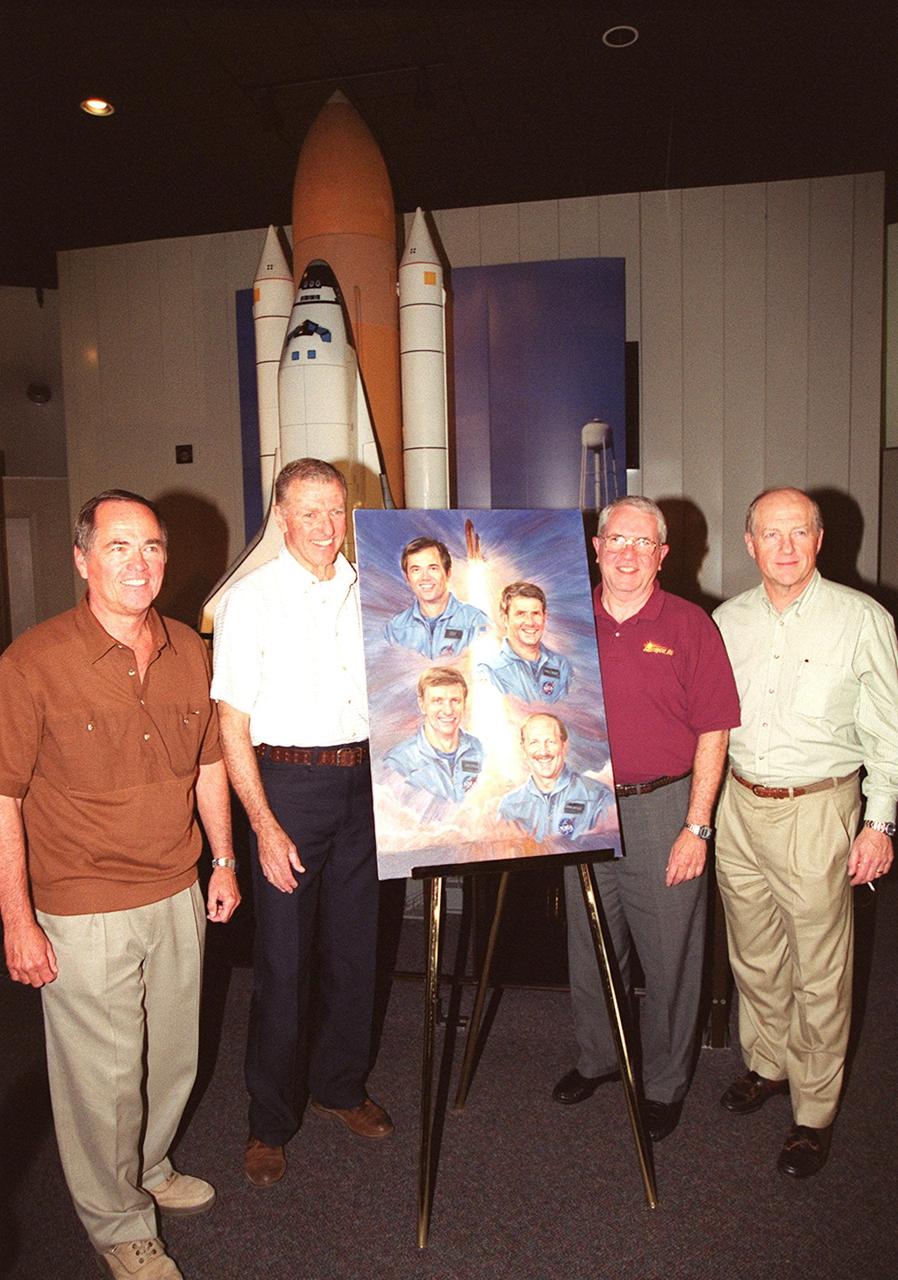
KENNEDY SPACE CENTER, Fla. -- The 2001 inductees into the Astronaut Hall of Fame gather around a drawing of all four. From left, Robert Crippen, Joe Engle, Richard Truly and Frederick "Rick" Hauck were honored as the first four Shuttle astronauts in a ceremony at the KSC Visitor Complex Nov. 10
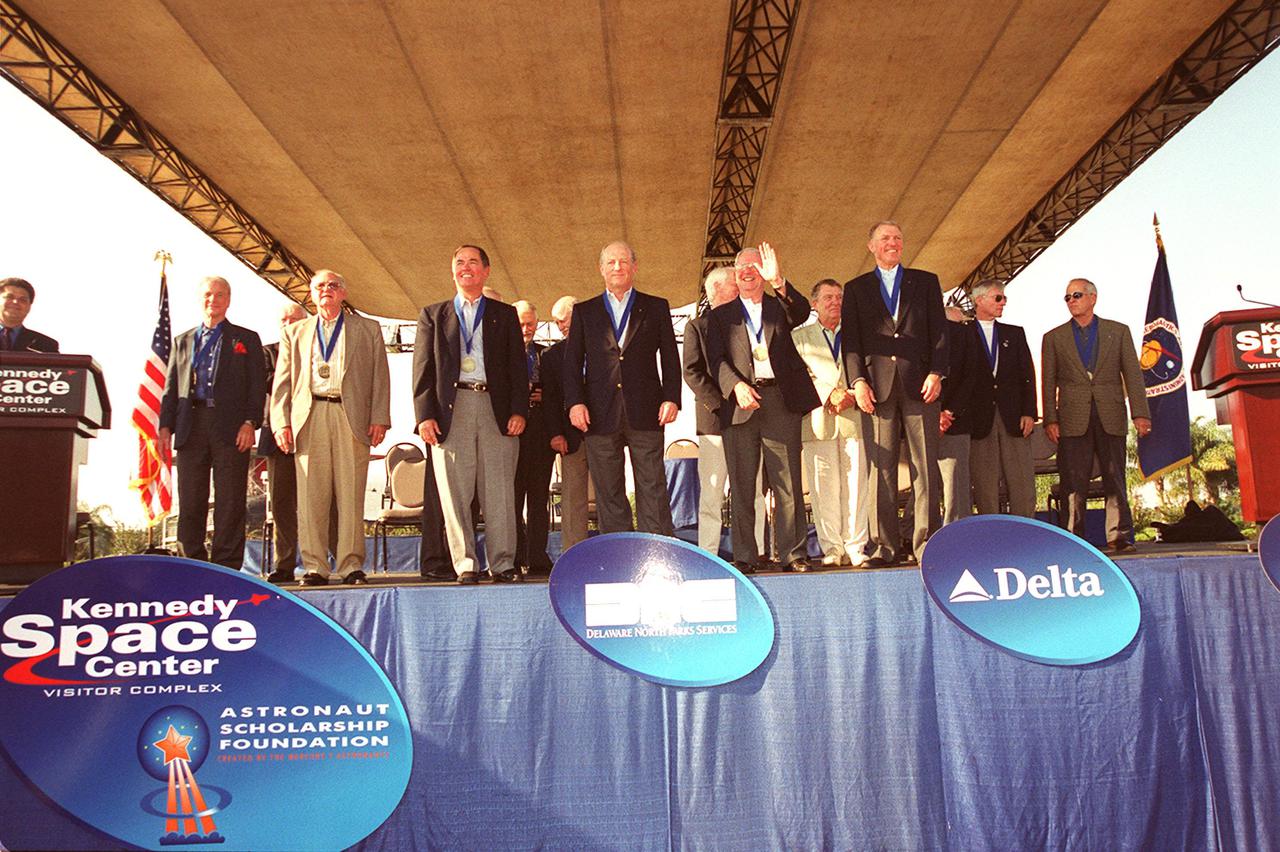
KENNEDY SPACE CENTER, Fla. -- The outdoor stage at the KSC Visitor Complex is filled with members of the Astronaut Hall of Fame who gathered to honor the four standing in the front center: Robert Crippen (second from left), Frederick 'Rick' Hauck, Richard Truly and Joe Engle. These first Shuttle astronauts were the 2001 inductees.
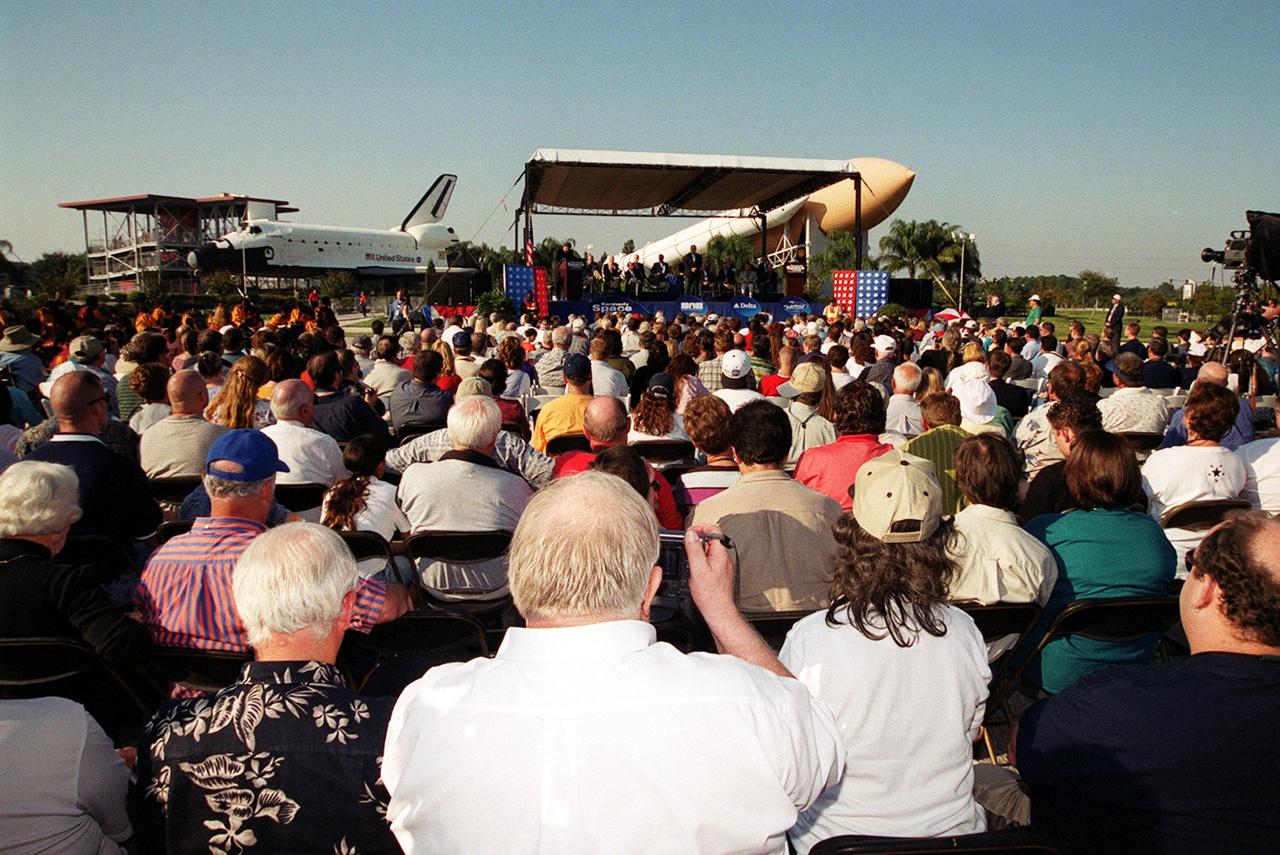
KENNEDY SPACE CENTER, Fla. -- A large crowd is gathered at the KSC Visitor Complex to honor the induction of the first four Shuttle astronauts into the Astronaut Hall of Fame. The four honored were Robert Crippen, Frederick "Rick" Hauck, Richard Truly and Joe Engle.
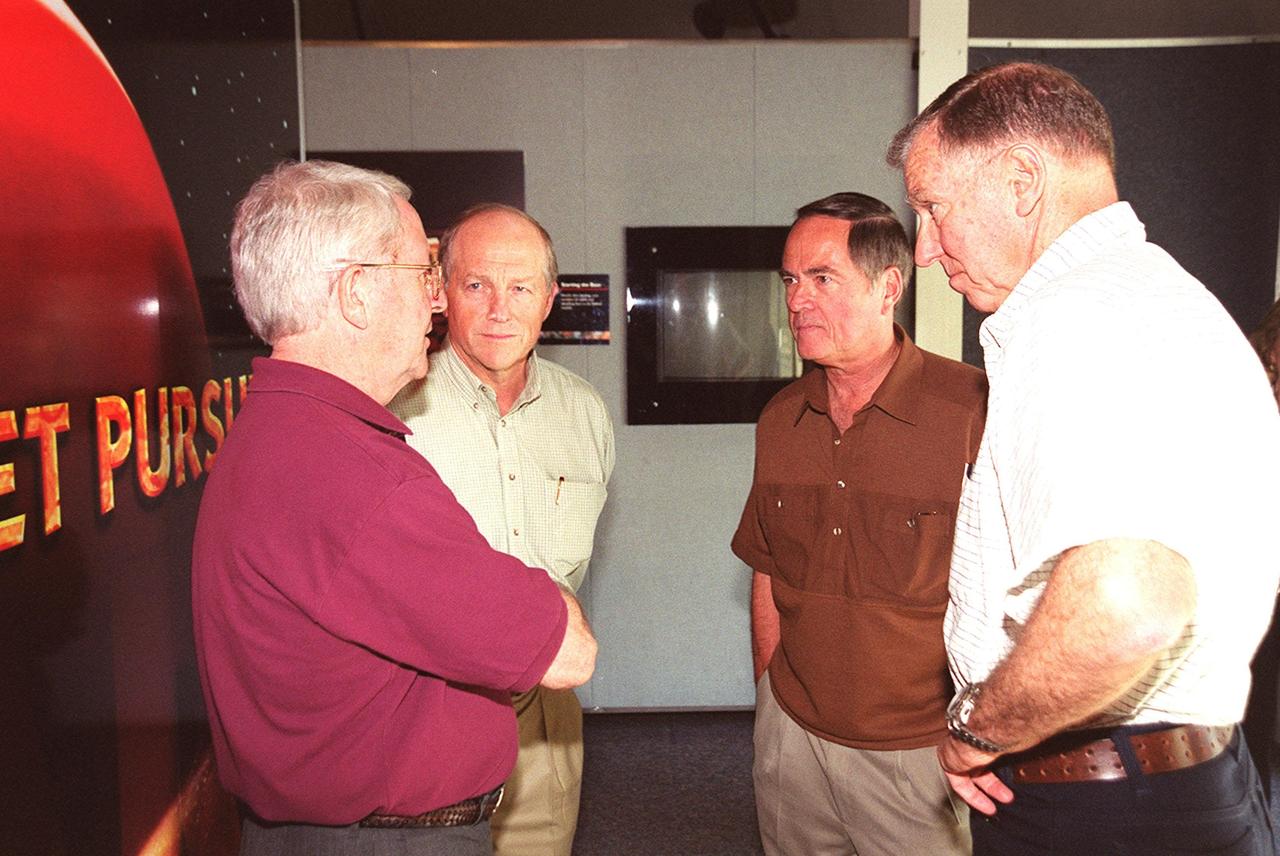
KENNEDY SPACE CENTER, Fla. -- The first four Shuttle astronauts share a moment of nostalgia at the Kennedy Space Center Visitor Complex. Pictured from left are Richard Truly, Frederick "Rick" Hauck, Robert Crippen and Joe Engle. All were inducted into the U.S. Astronaut Hall of Fame Nov. 10.
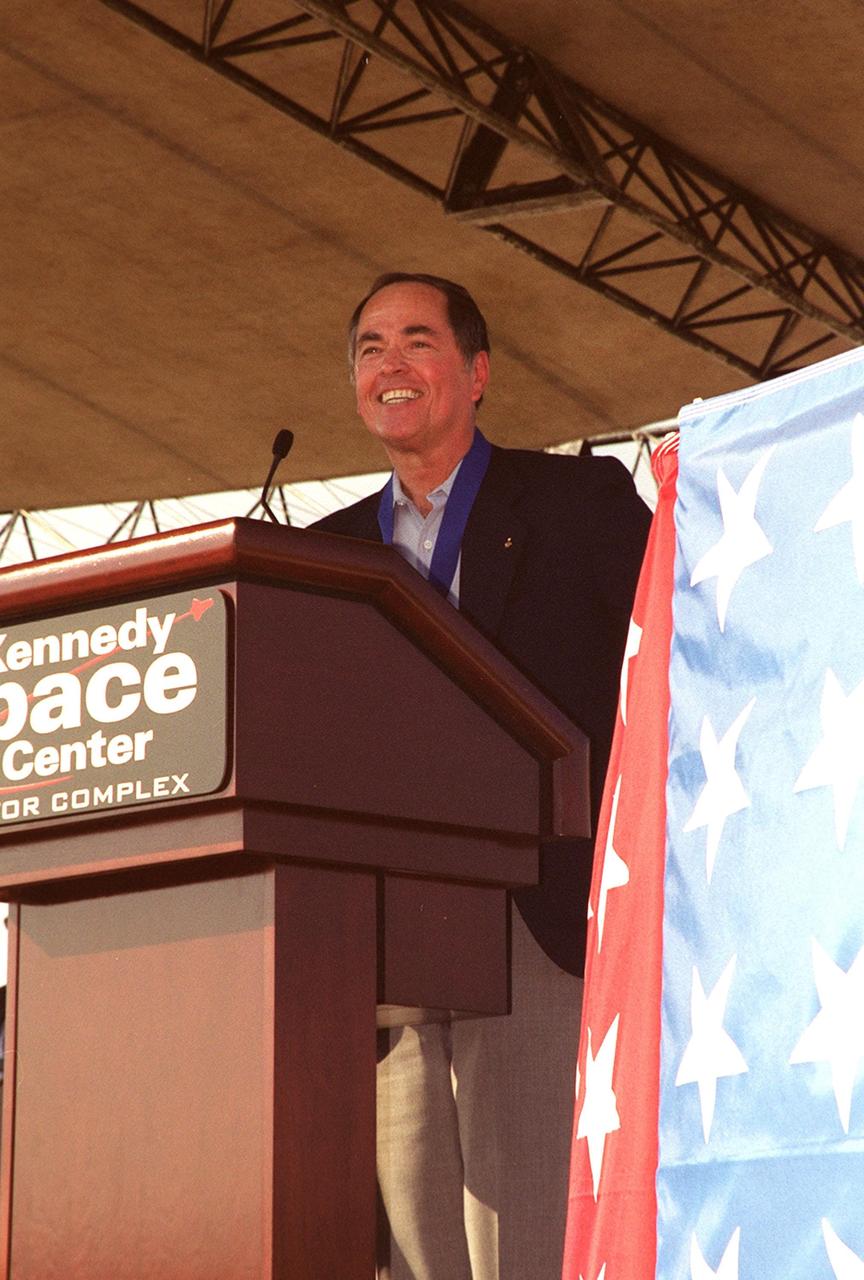
KENNEDY SPACE CENTER, Fla. -- Astronaut Robert Crippen, who served as pilot on STS-1, speaks to the guests gathered at the KSC Visitor Complex Nov. 10 for induction ceremonies into the Astronaut Hall of Fame. Crippen and other astronauts Frederick "Rick" Hauck, Richard Truly and Joe Engle were honored as the first Shuttle astronauts.
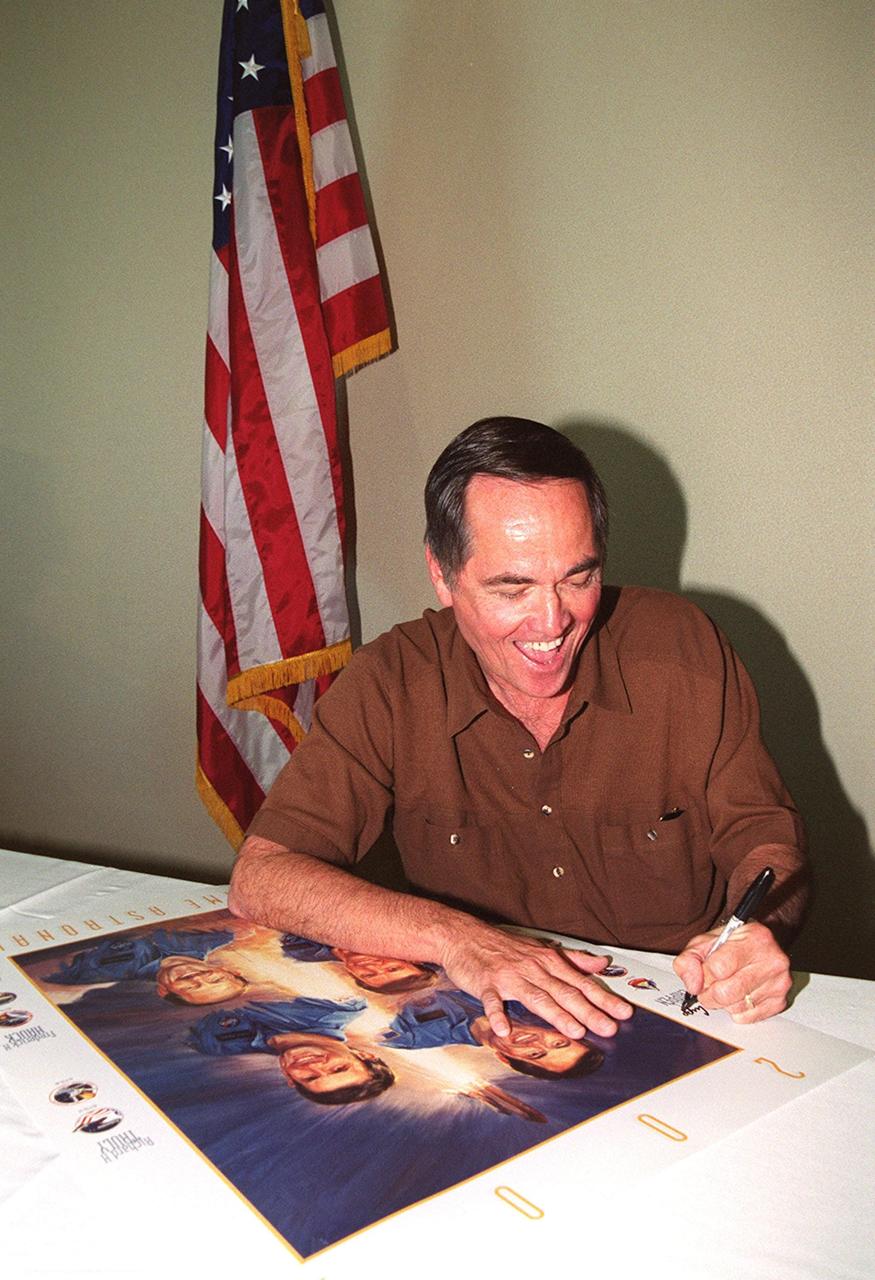
KENNEDY SPACE CENTER, Fla. -- One of the first Shuttle astronauts, Robert Crippen signs a poster during induction ceremonies into the U.S. Astronaut Hall of Fame Nov. 10. He shared the induction honor with astronauts Richard Truly, Joe Engle, and Frederick "Rick" Hauck. The event took place at the KSC Visitor Complex

51I-13-024 (2 Sept. 1985) --- Astronaut Joe H. Engle, STS51-I commander, is seen in a 35mm frame exposed with a fisheye lens as he works at controls between the commander and pilot stations on the forward flight deck of the space shuttle Discovery. Photo credit: NASA
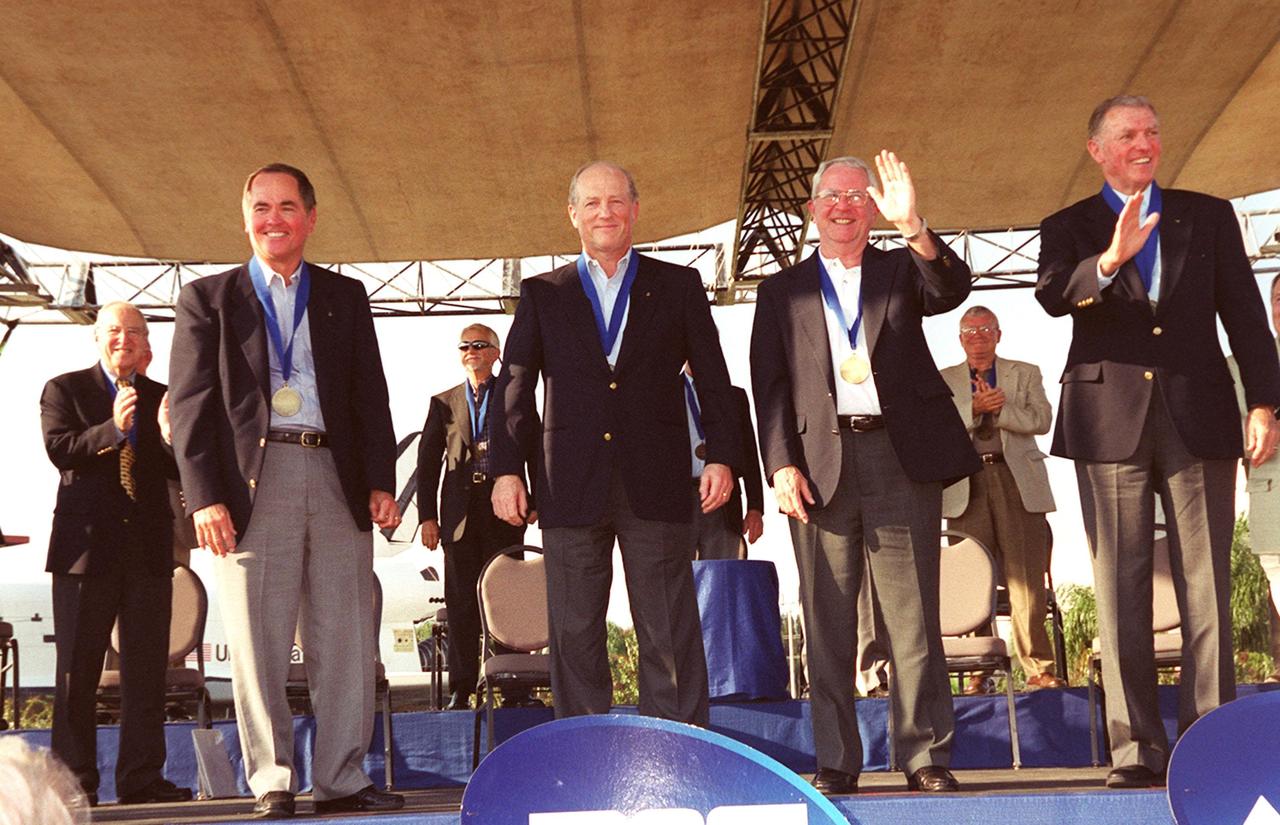
KENNEDY SPACE CENTER, Fla. -- Astronaut Hall of Fame inductees Robert Crippen, Frederick "Rick" Hauck, Richard Truly and Joe Engle acknowledge the applause from the audience. The four were honored as the first Shuttle astronauts in a ceremony at the KSC Visitor Complex Nov. 10.
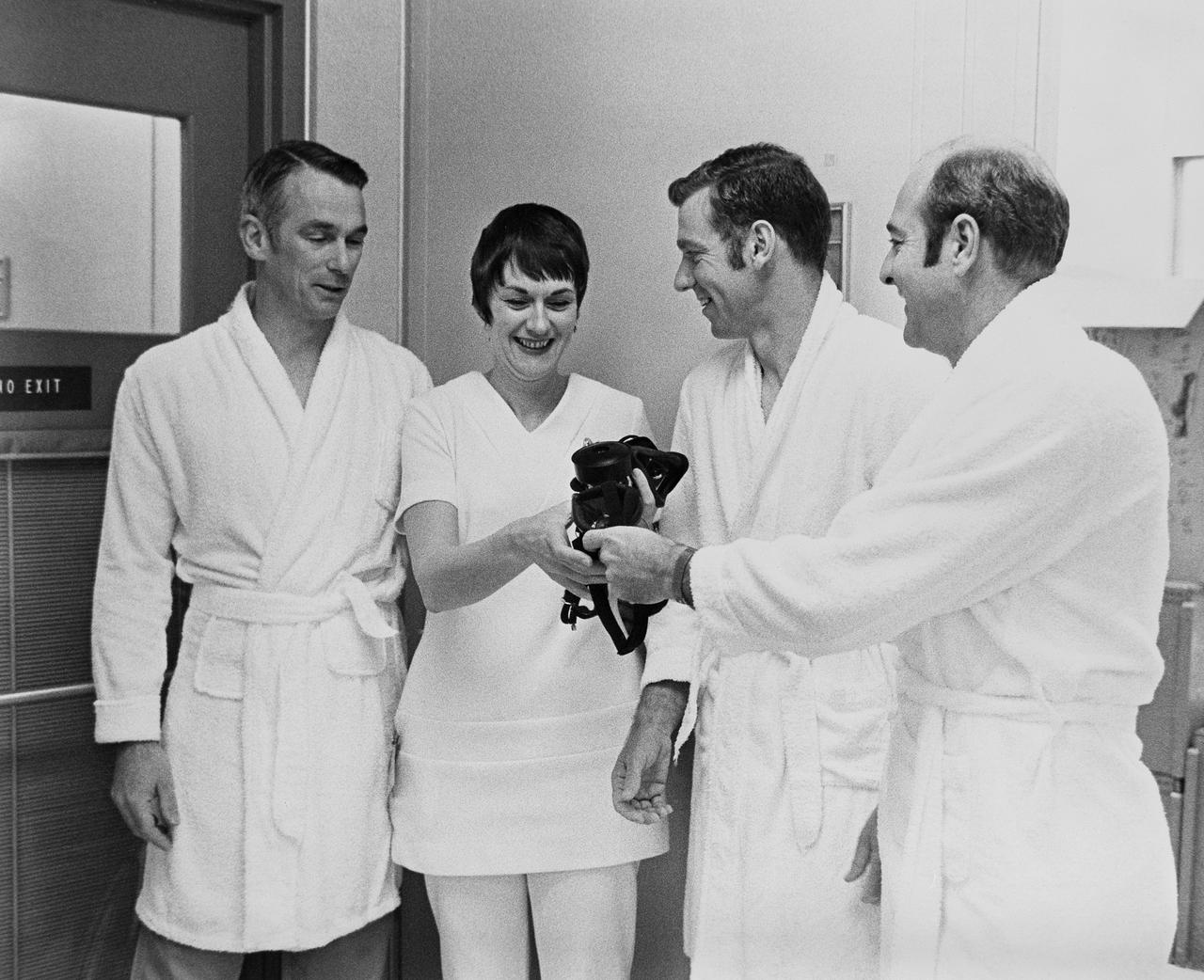
CAPE CANAVERAL, Fla. -- Apollo 14 backup crewmen, left to right, Eugene A. Cernan, Joe H. Engle and Ronald E. Evans speak with nurse Dee O’Hara prior to undergoing flight physicals today at the Kennedy Space Center. Photo credit: NASA
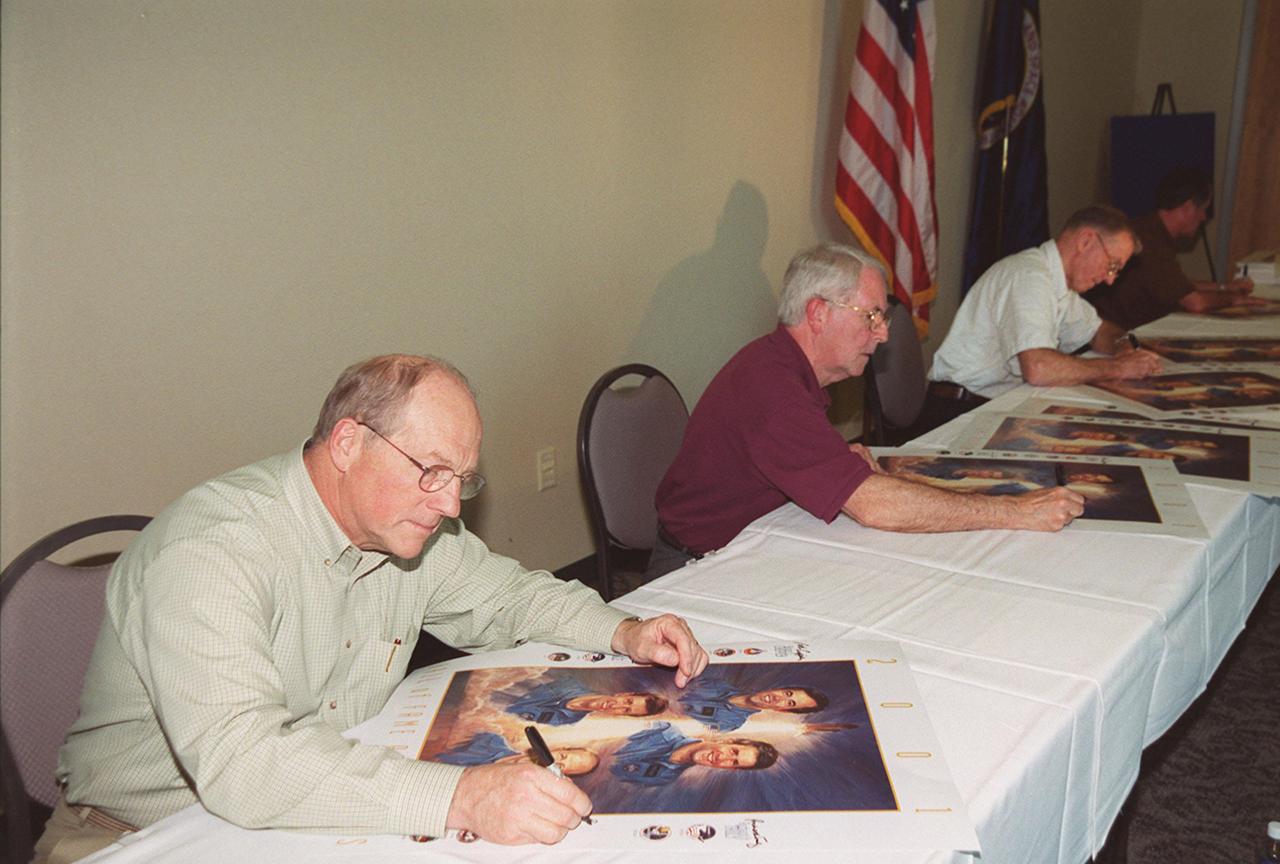
KENNEDY SPACE CENTER, Fla. -- The first four Shuttle astronauts take time to sign posters commemorating their induction into the U.S. Astronaut Hall of Fame Nov. 10. Seated from left are Frederick 'Rick' Hauck, Richard Truly, Joe Engle and Robert Crippen. The event took place at the KSC Visitor Complex
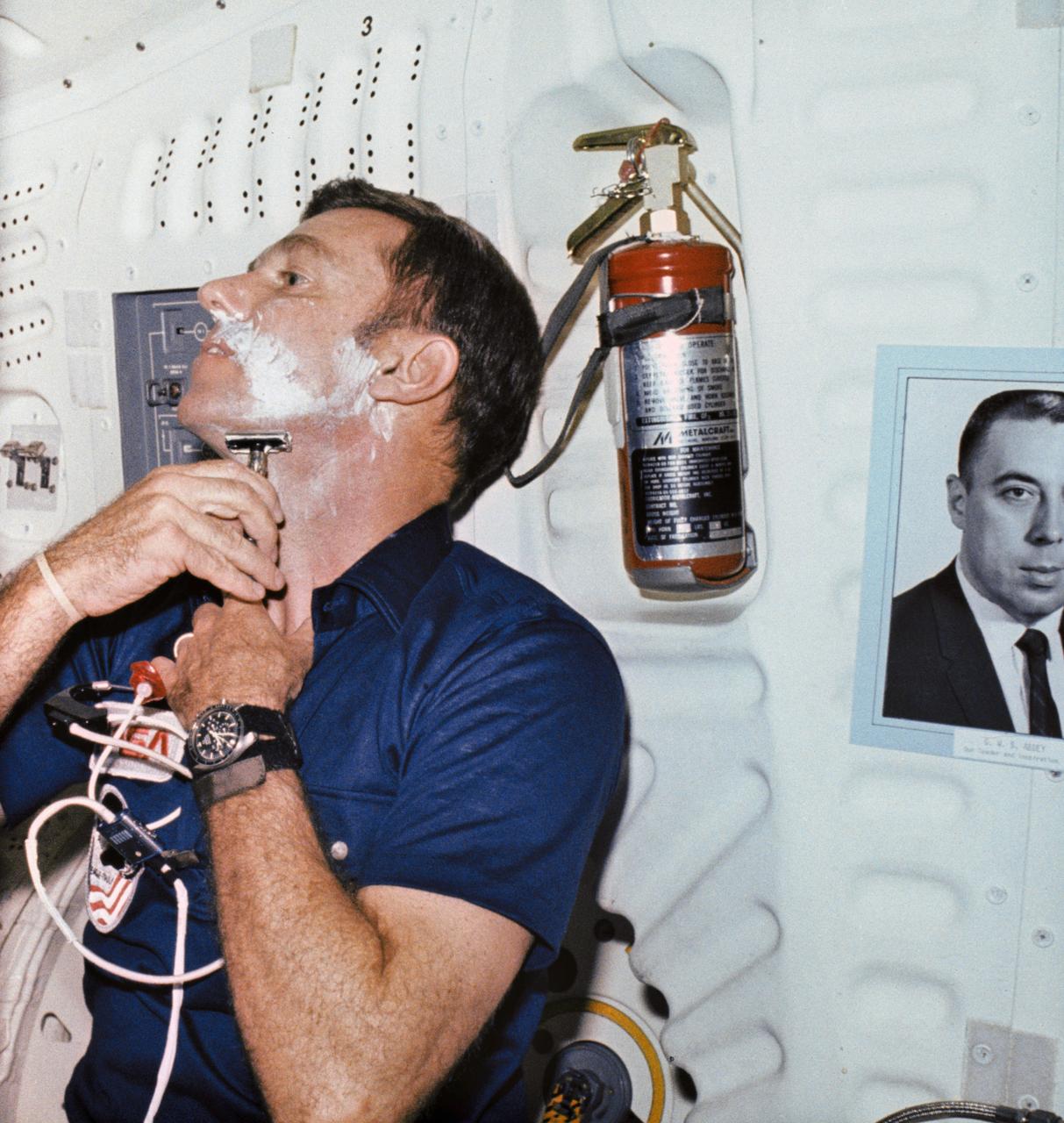
S81-39573 (12-14 Nov. 1981) --- This photograph was taken during a two-and a fourth-day stay in Earth orbit by astronauts Joe H. Engle, here shaving, and Richard H. Truly, photographer for this frame. A portion of that time was spent in the living area of middeck portion of the 122-ft-long (37 meters) vehicle as the astronauts ate, slept and took care of hygiene matters here. An onboard fire extinguisher is in upper right corner. Partially out of the frame at right edge is a photograph of George W. S. Abbey, Director of Flight Operations at Johnson Space Center. Engle is attired in an onboard constant wear type garment. Photo credit: NASA
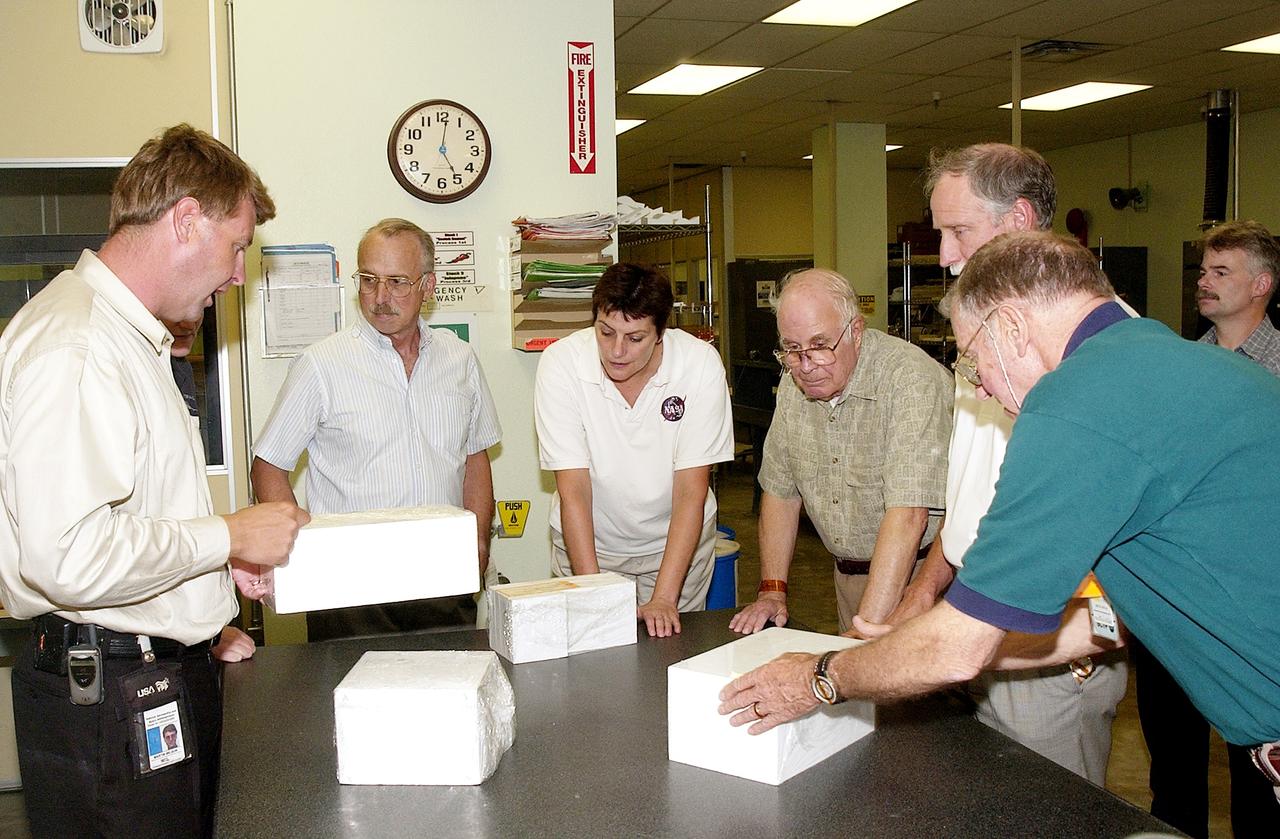
KENNEDY SPACE CENTER, FLA. - On a tour of the Tile Shop, members of the Stafford-Covey Return to Flight Task Group (SCTG) learn about PU-tiles, part of an orbiter’s Thermal Protection System. At left is Martin Wilson, with United Space Alliance. Others (left to right) around the table are James Adamson, Dr. Kathryn Clark, William Wegner, Richard Covey and Joe Engle. Covey, former Space Shuttle commander, is co-chair of the SCTG, along with Thomas P. Stafford, Apollo commander. Chartered by NASA Administrator Sean O’Keefe, the task group will perform an independent assessment of NASA’s implementation of the final recommendations by the Columbia Accident Investigation Board.
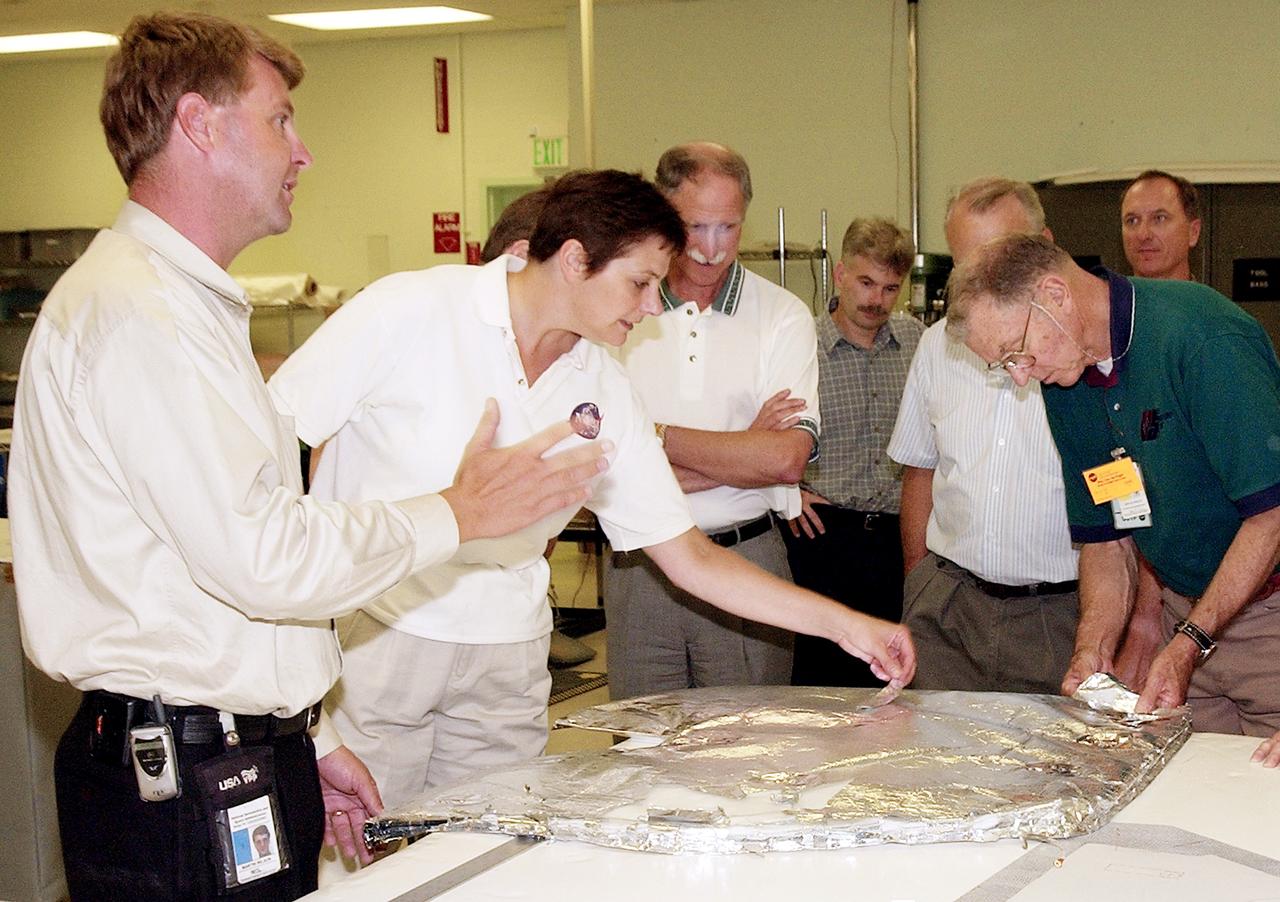
KENNEDY SPACE CENTER, FLA. - Martin Wilson, with United Space Alliance, describes an orbiter’s Thermal Protection System for members of the Stafford-Covey Return to Flight Task Group (SCTG). Handling some of the blanket insulation are Dr. Kathryn Clark and Joe Engle. Third from left is Richard Covey, former Space Shuttle commander, who is co-chair of the SCTG, along with Thomas P. Stafford, Apollo commander. Chartered by NASA Administrator Sean O’Keefe, the task group will perform an independent assessment of NASA’s implementation of the final recommendations by the Columbia Accident Investigation Board.
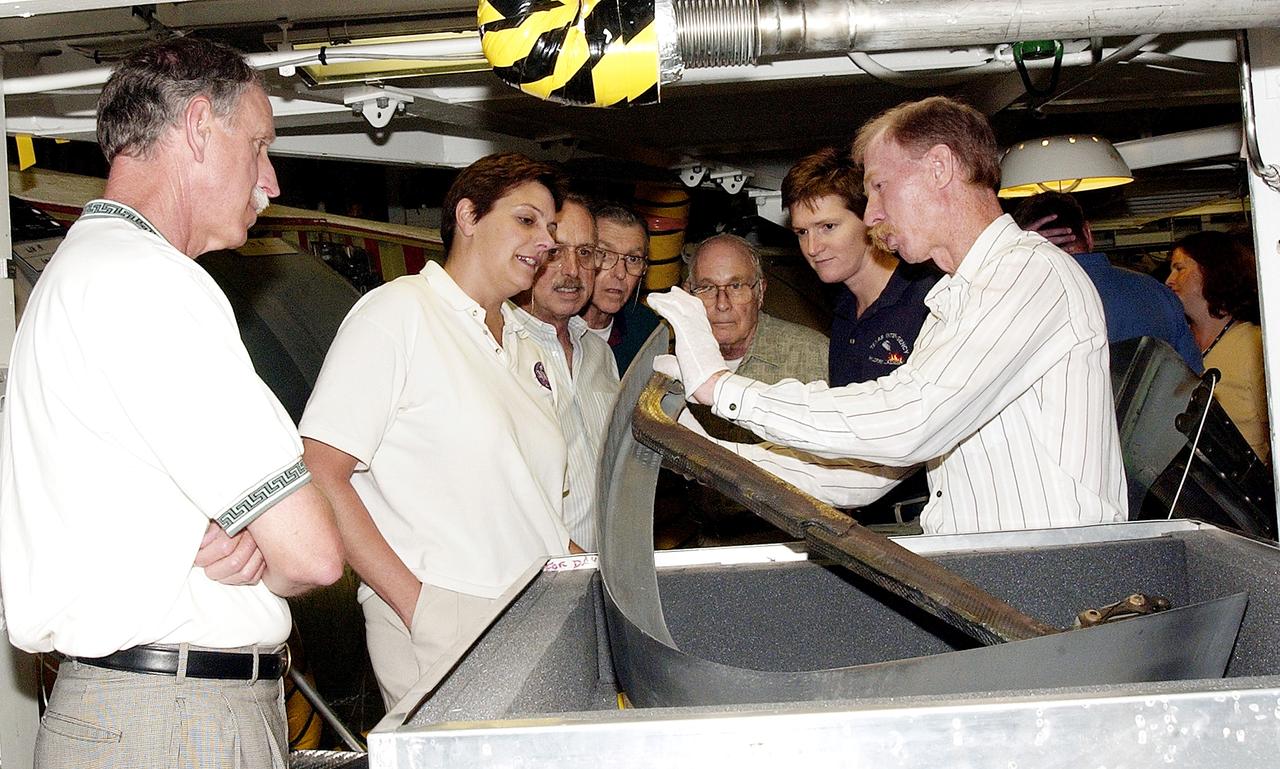
KENNEDY SPACE CENTER, FLA. - On a tour of the Orbiter Processing Facility, members of the Stafford-Covey Return to Flight Task Group (RTFTG) look at a Reinforced Carbon-Carbon panels with a T-seal held by Tom Roberts, with United Space Alliance. From left are Richard O. Covey, former Space Shuttle commander, Dr. Kathryn Clark, James Adamson, Joe Engle, William Wegner and Dr. Amy Donahue. Chairing the task group are Covey and Thomas P. Stafford, Apollo commander. Chartered by NASA Administrator Sean O’Keefe, the task group will perform an independent assessment of NASA’s implementation of the final recommendations by the Columbia Accident Investigation Board.
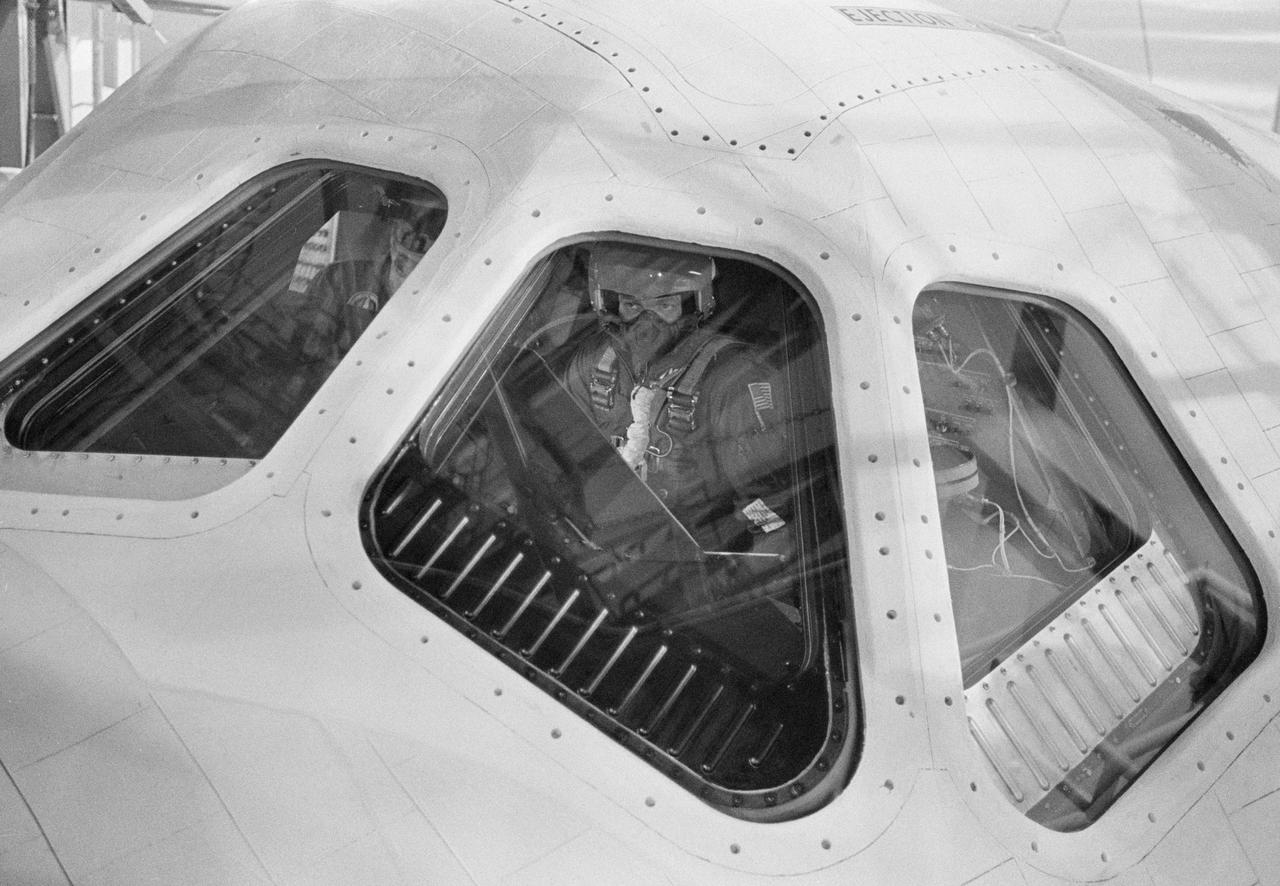
S77-28212 (13 Sept 1977) --- Astronauts Joe H. Engle (right), commander, and Richard H. Truly, pilot, sit in the cockpit of the shuttle Orbiter 101 "Enterprise" at the Dryden Flight Research Center (DFRC) prior to takeoff of the NASA 747 carrier aircraft to which the "Enterprise" was mated. The pair later made a five-minute, 31-second free-flight in the craft, the second in a series of such flights for the Shuttle Approach and Landing Tests (ALT) program. The photograph was made from the Mate-Demate Device (MDD).
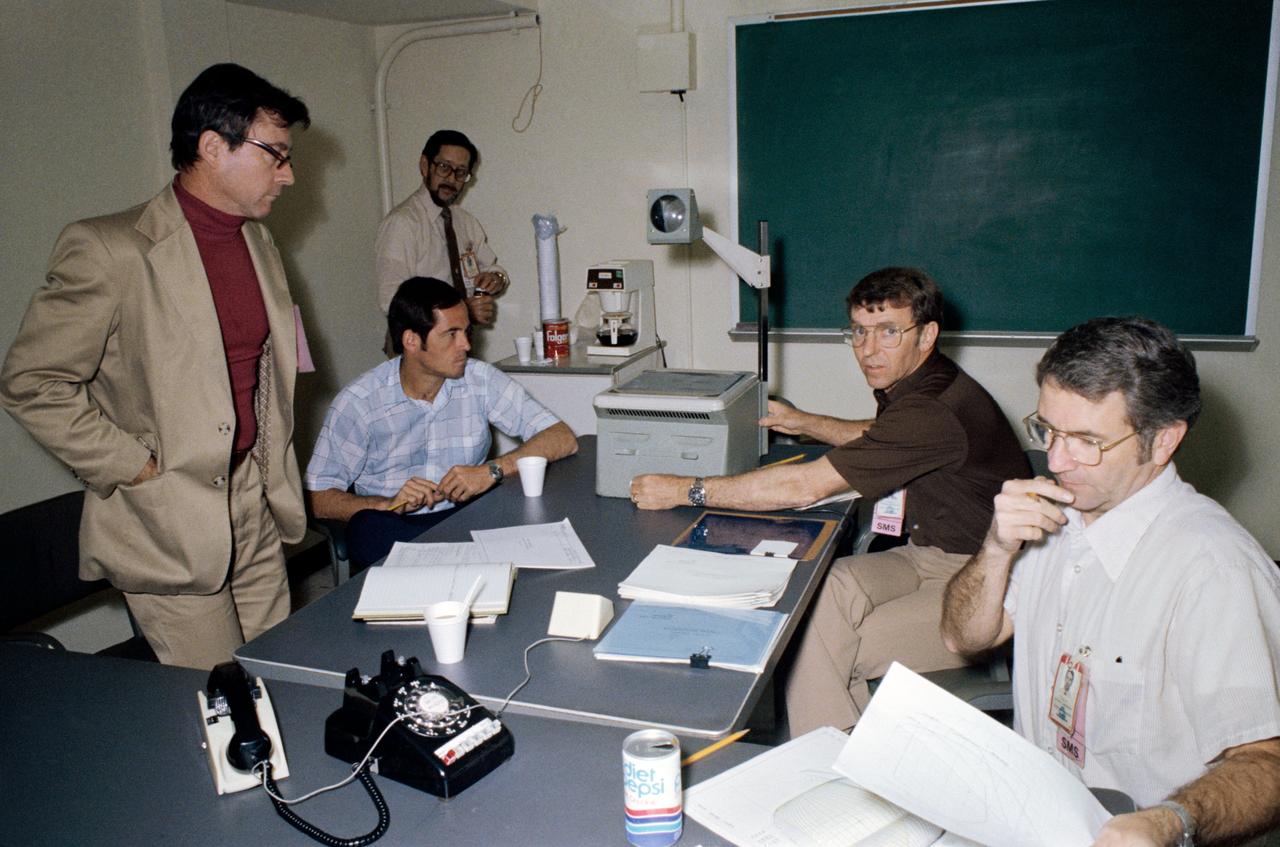
S81-29620 (6 April 1981) --- Prime and backup crew members for STS-1 take part in a briefing with engineers located in another building at NASA's Johnson Space Center (JSC) and with Rockwell International representatives in California via telephone. Astronauts John W. Young, left, and Robert L. Crippen, second from left, are STS-1 prime crewmen. Backup crewmen are astronauts Joe H. Engle, second from right, and Richard H. Truly. Photo credit: NASA
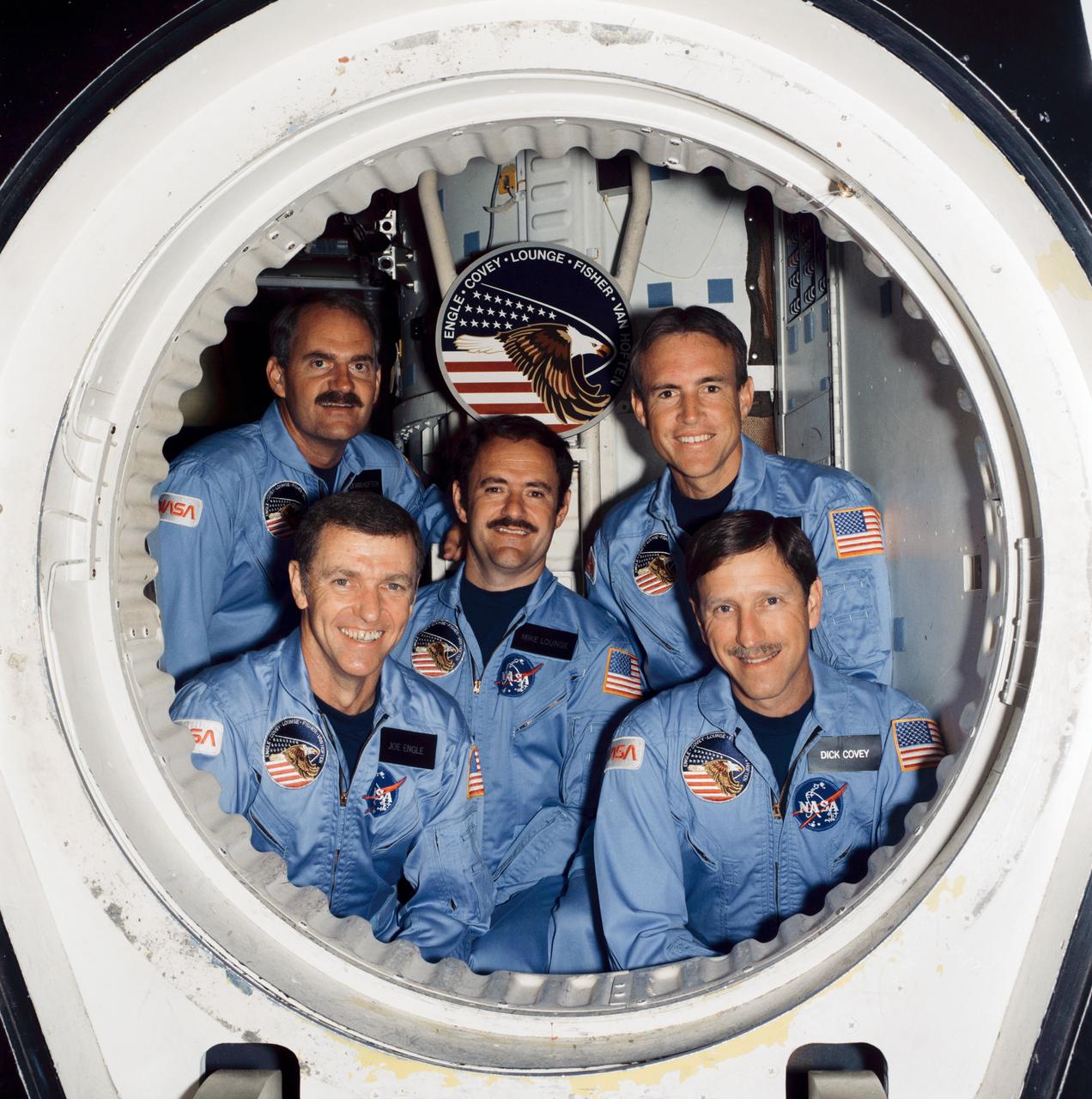
S85-36062 (1 July 1985) --- These five NASA astronauts make up the crew for the mission STS-51I, scheduled for launch in August of this year. Taking a break from rehearsals in the crew compartment trainer in the Shuttle Mockup and Integration Laboratory at JSC are astronauts Joe H. Engle (front left), crew commander; Richard O. Covey (front right), pilot; and (back row, left-to-right) astronauts James D. van Hoften, John M. (Mike) Lounge and William F. Fisher -- all mission specialists.
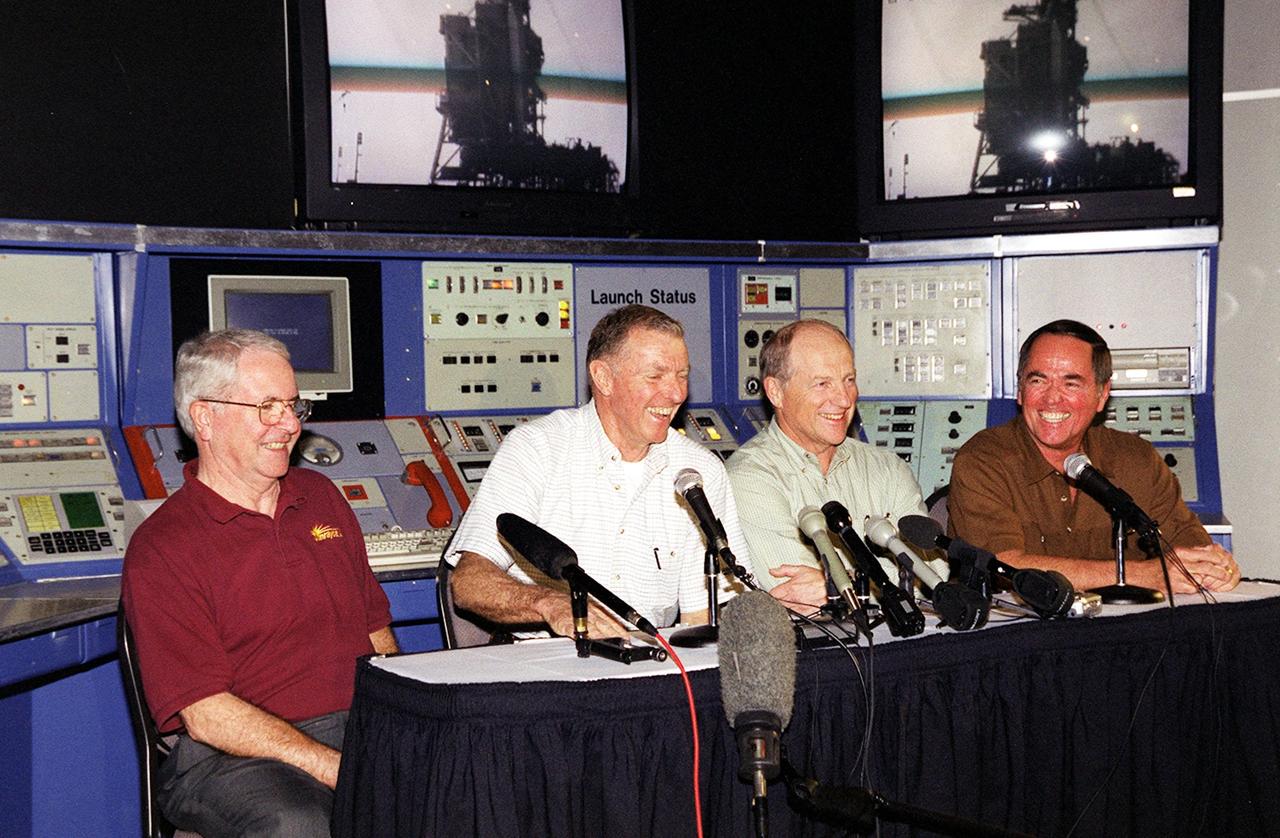
KENNEDY SPACE CENTER, Fla. -- The first four Shuttle astronauts -- seated, from left, Richard Truly, Joe Engle, Frederick "Rick" Hauck and Robert Crippen -- share a light moment about their experiences while seated in a replica of the early launch control center in the KSC Visitor Complex. All were inducted into the U.S. Astronaut Hall of Fame Nov. 10
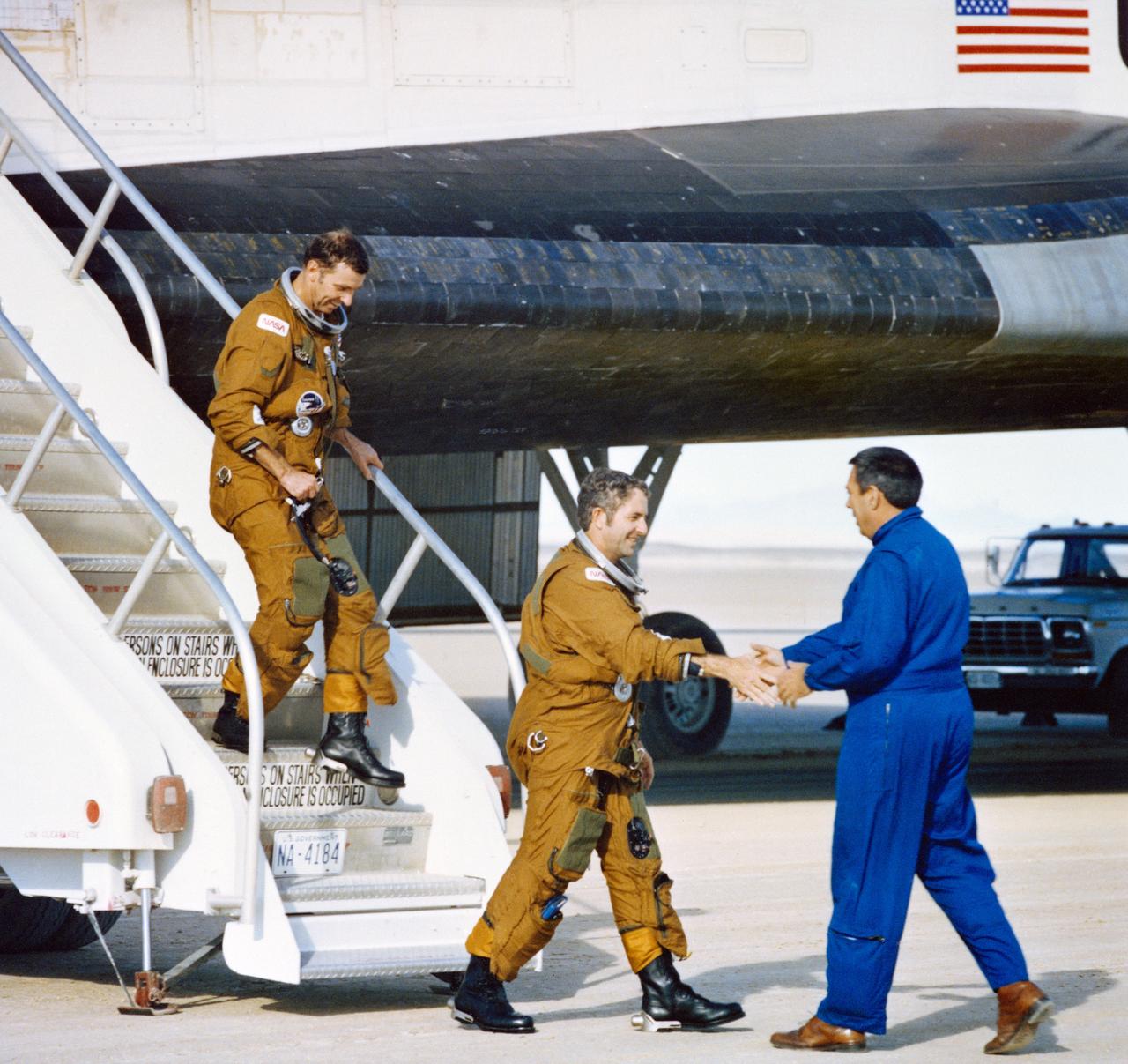
S81-39582 (14 Nov. 1981) --- Astronauts Joe H. Engle, rear, and Richard H. Truly are greeted by George W.S. Abbey, Director of Flight Operations at the Johnson Space Center, as they egress the space shuttle Columbia after spending two days, six hours and 13 minutes on NASA?s STS-2 mission. Photo credit: NASA
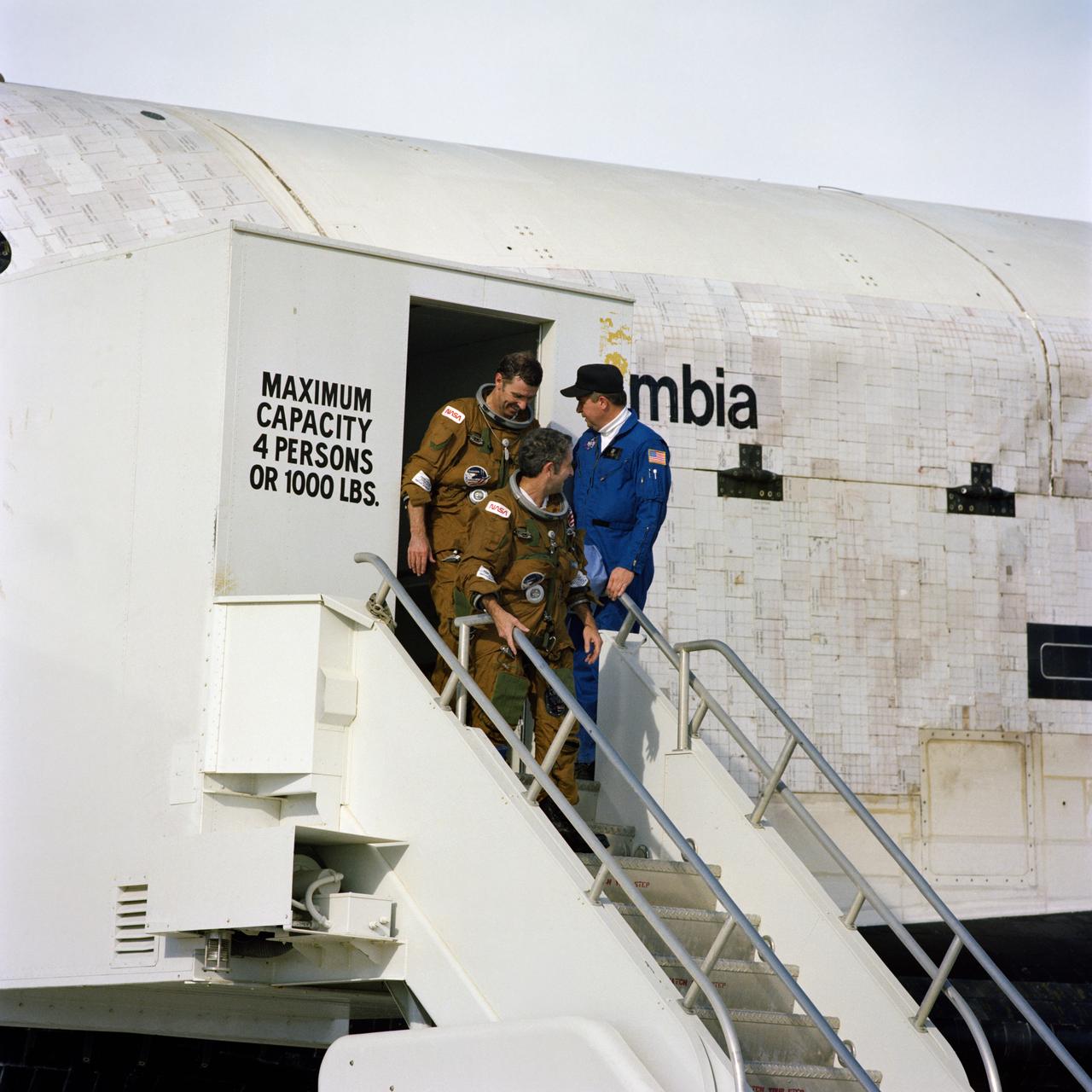
S81-39580 (14 Nov. 1981) --- Astronauts Joe H. Engle, rear, and Richard H. Truly egress the space shuttle Columbia after spending two days, six hours and 13 minutes on NASA?s STS-2 mission. At right is their physician, Dr. Charles La Pinta of the JSC Medical Sciences Division. Photo credit: NASA
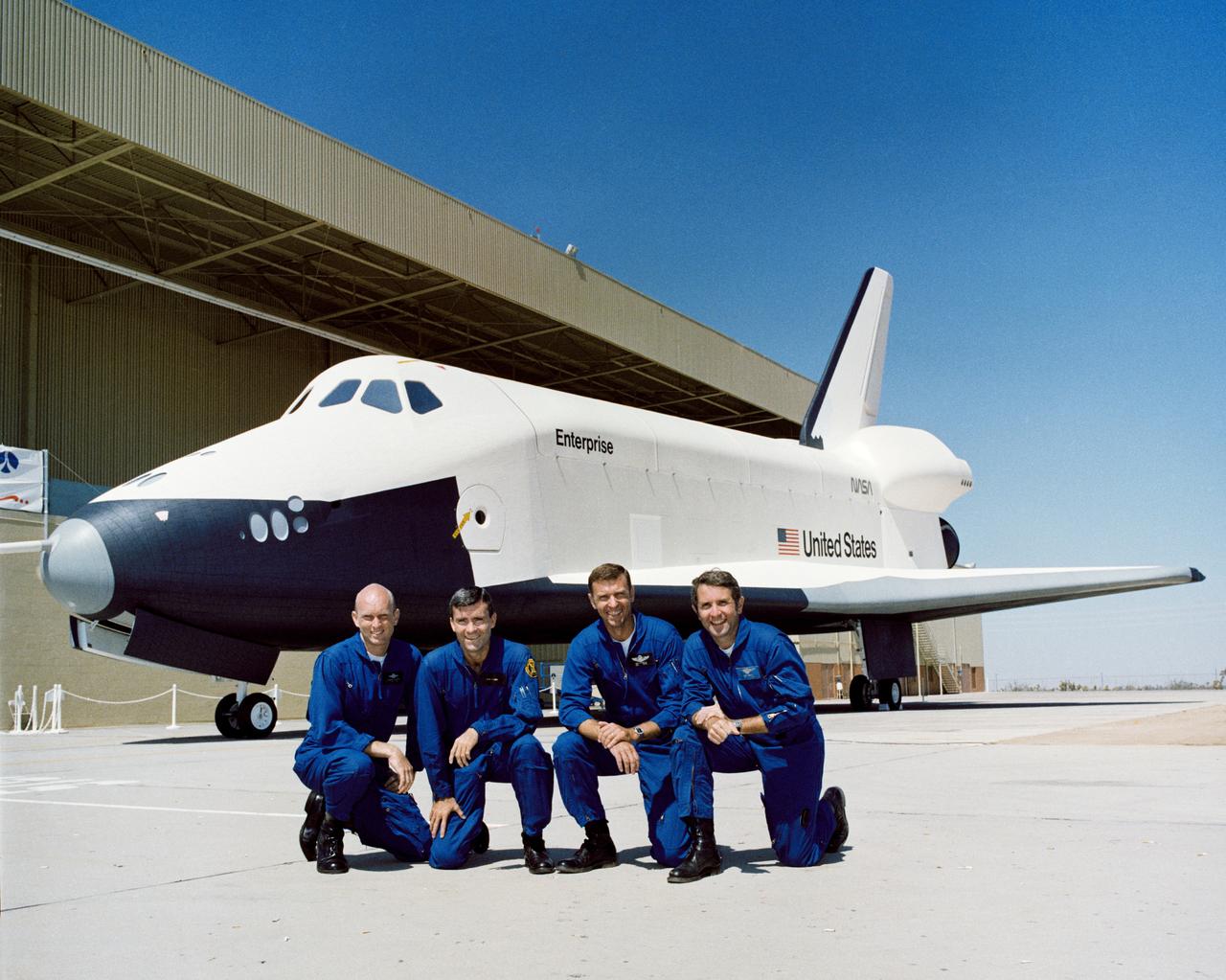
S76-29562 --- The two crews for the Space Shuttle Approach and Landing Tests (ALT) are photographed at the Rockwell International Space Division's Orbiter assembly facility at Palmdale, California on the day of the rollout of the Shuttle Orbiter 101 "Enterprise" spacecraft. They are, left to right, Astronauts C. Gordon Fullerton, pilot of the first crew; Fred W. Haise Jr., commander of the first crew; Joe H. Engle, commander of the second crew; and Richard H. Truly, pilot of the second crew. The DC-9 size airplane-like Orbiter 101 is in the background.
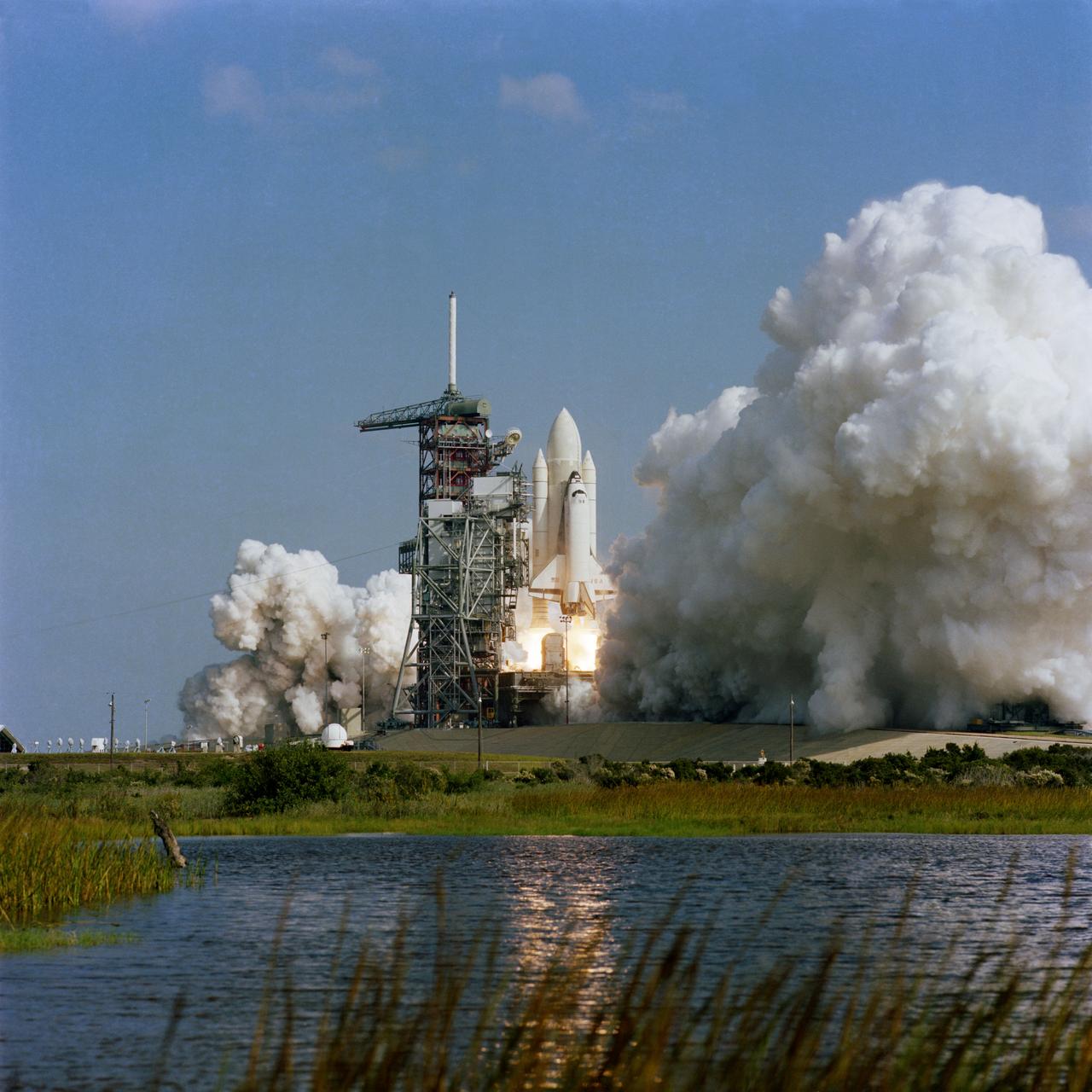
S81-39548 (12 Nov. 1981) --- NASA's space shuttle Columbia climbs toward space for a return visit after its 10:10 a.m. liftoff from Launch Pad 39A. Aboard the space shuttle, astronauts Joe H. Engle and Richard H. Truly man the flight deck. On its second mission (STS-2), Columbia carries a payload of science and applications experiments and an arm-like robot device named a remote manipulator system (RMS). Photo credit: NASA
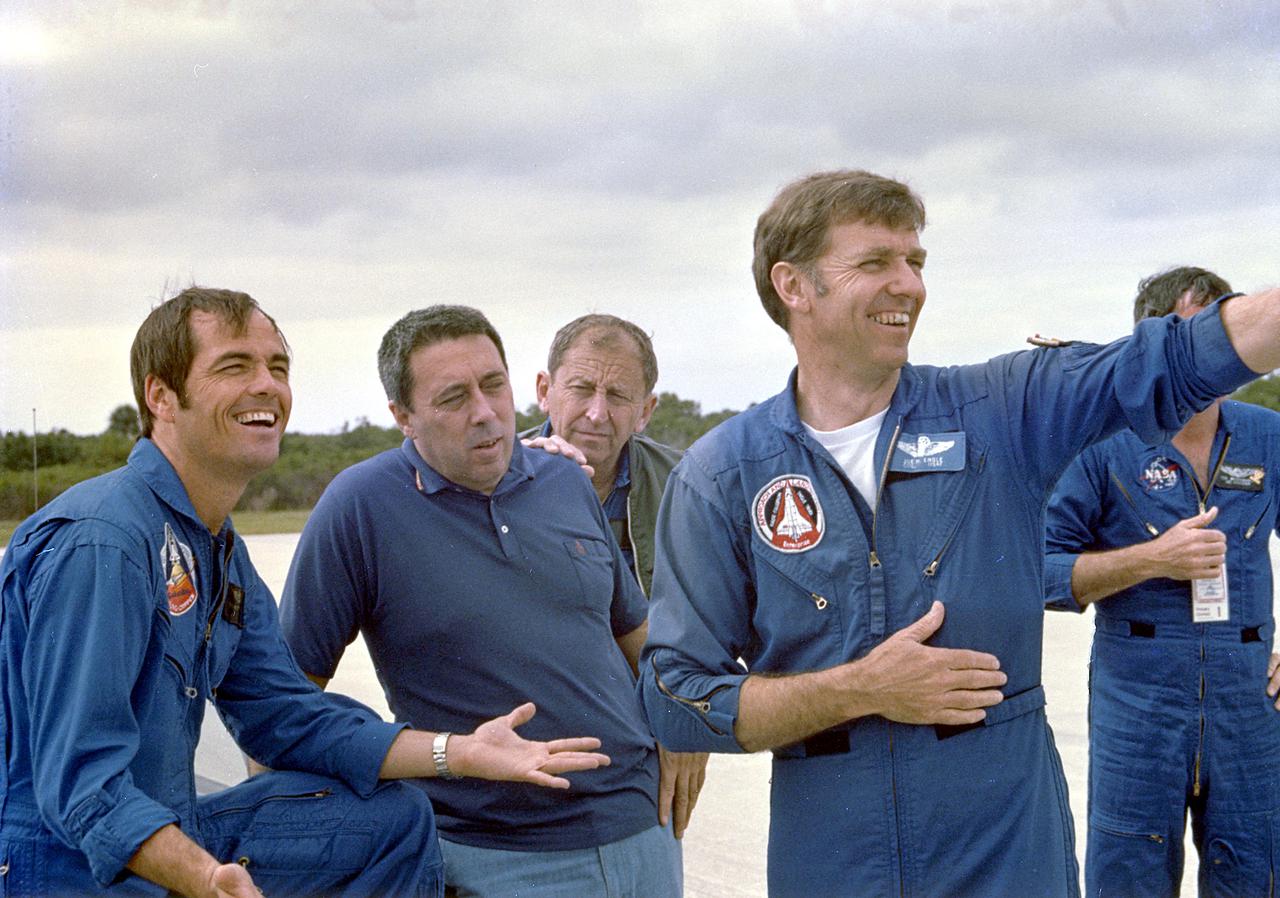
KENNEDY SPACE CENTER, FLA. - Astronaut Robert Crippen, left, relaxed despite the 'scrub' of the Space Shuttle launch on April 10, is joined at the Shuttle Landing Facility on April 11 by (from left) George Abbey, flight operations director; Joseph Algrantic, chief of Aircraft OPERATIONS Division, both with Johnson Space Center; and astronaut Joe Engle. Crippen and Young spent part of the day between the 'scrub' and the successful launch on April 12 in Shuttle landing practice, using a specially modified Grumman Airstream jet aircraft.
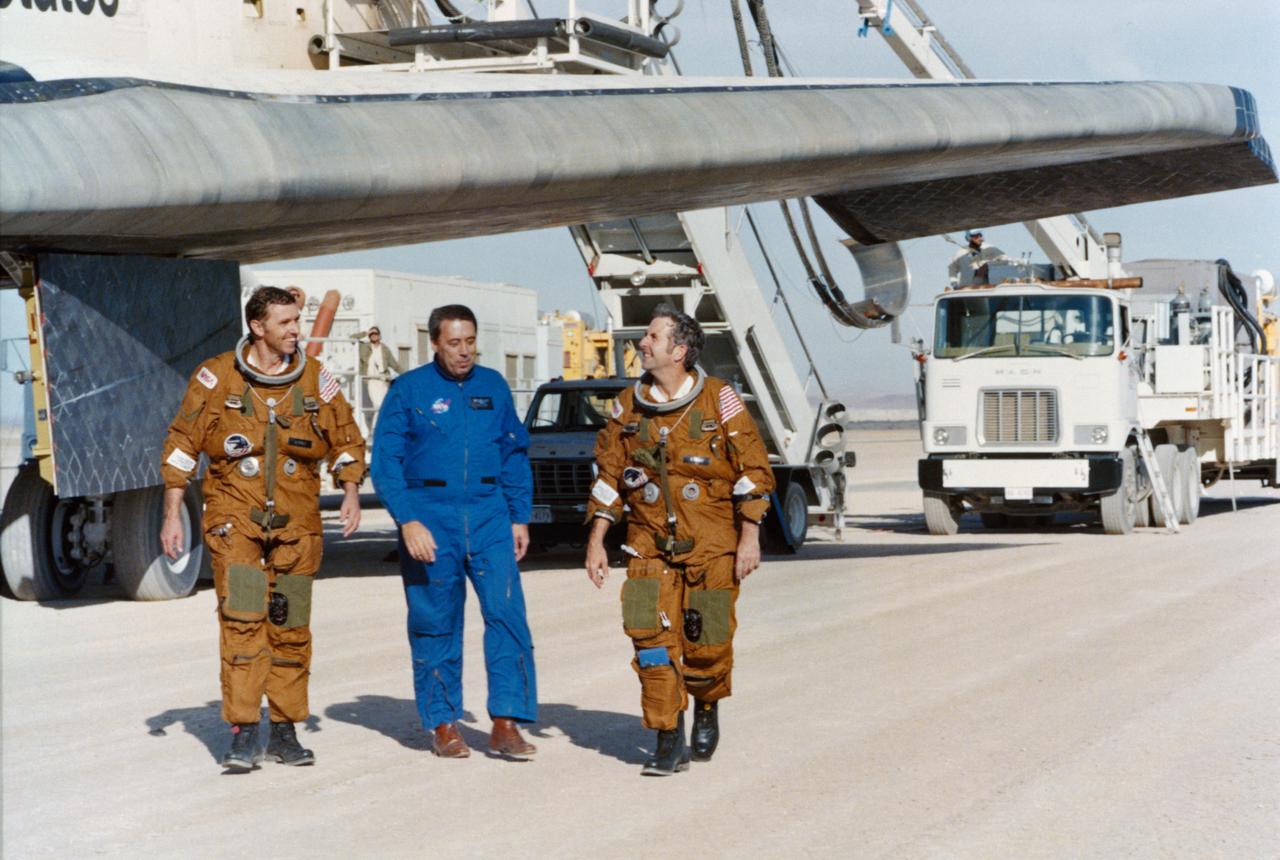
S81-39577 (14 Nov. 1981) --- Astronauts Joe H. Engle (left) and Richard H. Truly walk with George W.S. Abbey (center), Director of Flight Operations at the Johnson Space Center, after they egressed the space shuttle Columbia after spending two days, six hours and 13 minutes on NASA?s STS-2 mission. Photo credit: NASA
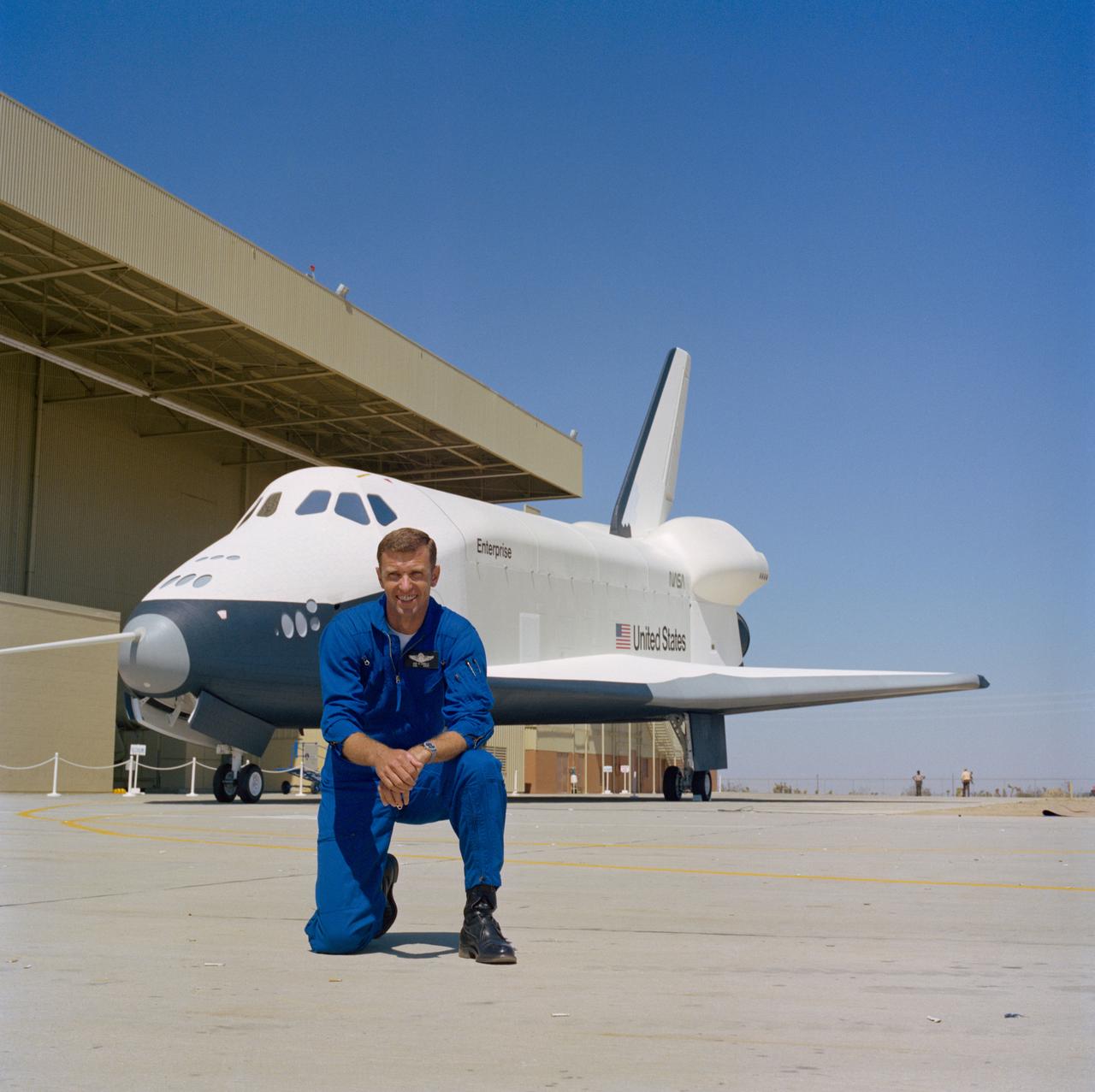
S76-29560 (17 Sept 1976) - - - Astronaut Joe H. Engle, commander of the second crew for the Space Shuttle Approach and Landing Tests (ALT), is photographed at the Rockwell International Space Division?s Orbiter assembly facility at Palmdale, California on the day of the roll out of the Space Shuttle Orbiter 101 ?Enterprise? spacecraft. The DC-size airplane-like Orbiter 101 is in the background.
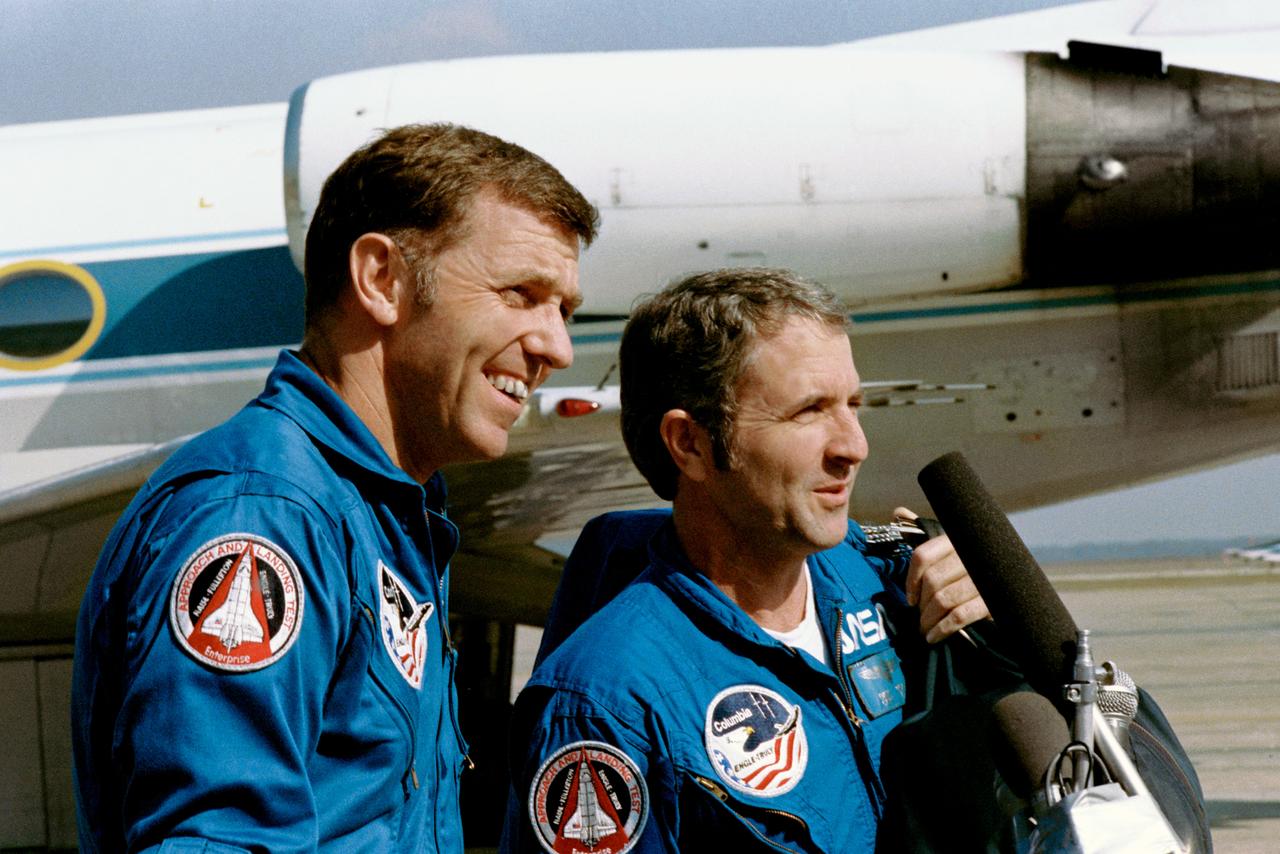
S81-39413 (5 Nov. 1981) --- Astronauts Joe H. Engle, left, and Richard H. Truly greet newsmen upon their return to Ellington Air Force Base near NASA's Johnson Space Center (JSC), from Kennedy Space Center (KSC) after learning their flight (STS-2) has been postponed a week. The launch of NASA?s second space shuttle mission, in the Columbia, has been rescheduled for Nov. 12, 1981. Photo credit: NASA
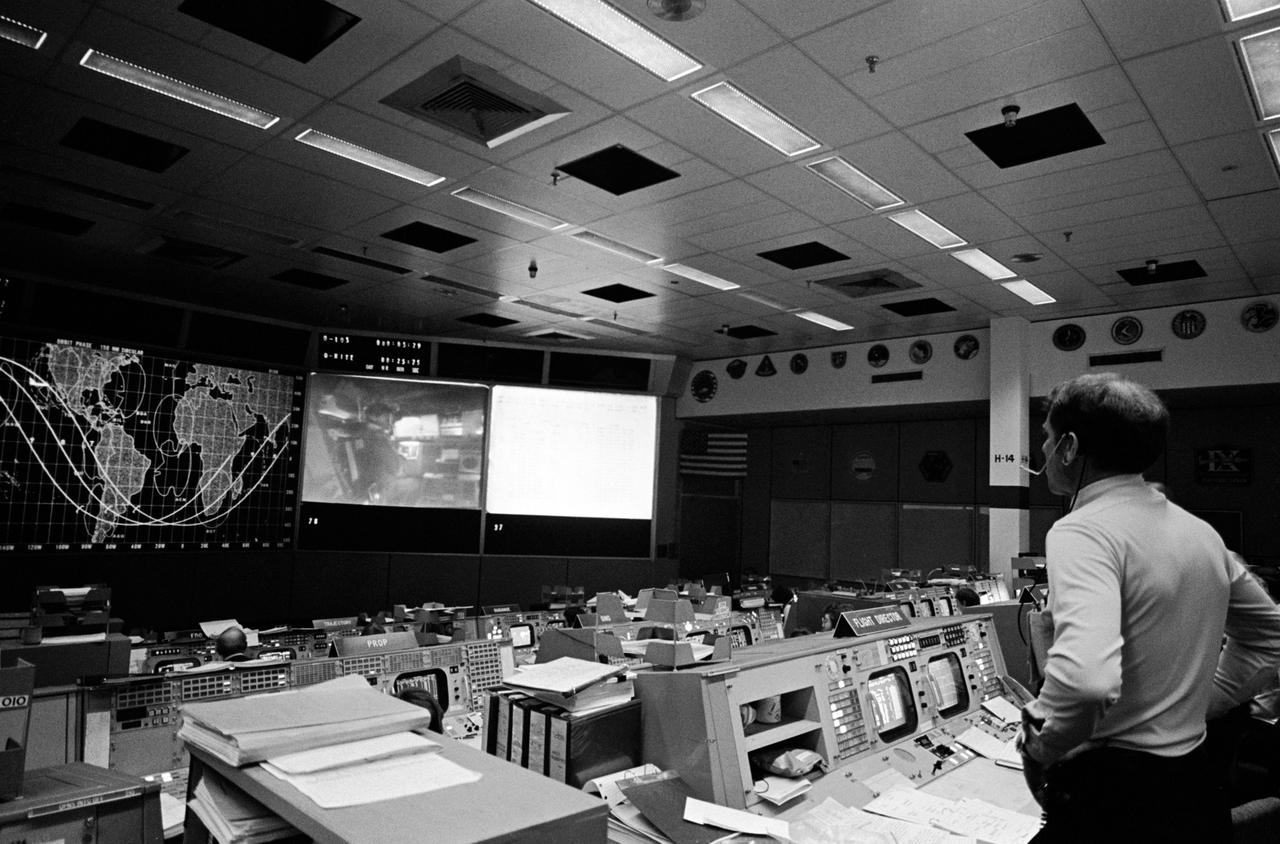
S81-30216 (12 April 1981) --- Astronaut Joe H. Engle, backup crew commander for STS-1, watches a large screen in the mission operations control room of the Johnson Space Center?s Mission Control Center during the STS-1 flight?s prime crew commander?s status report. Astronaut John W. Young, commander, can be seen in the image at left center, which is displayed via rear screen projector. Photo credit: NASA
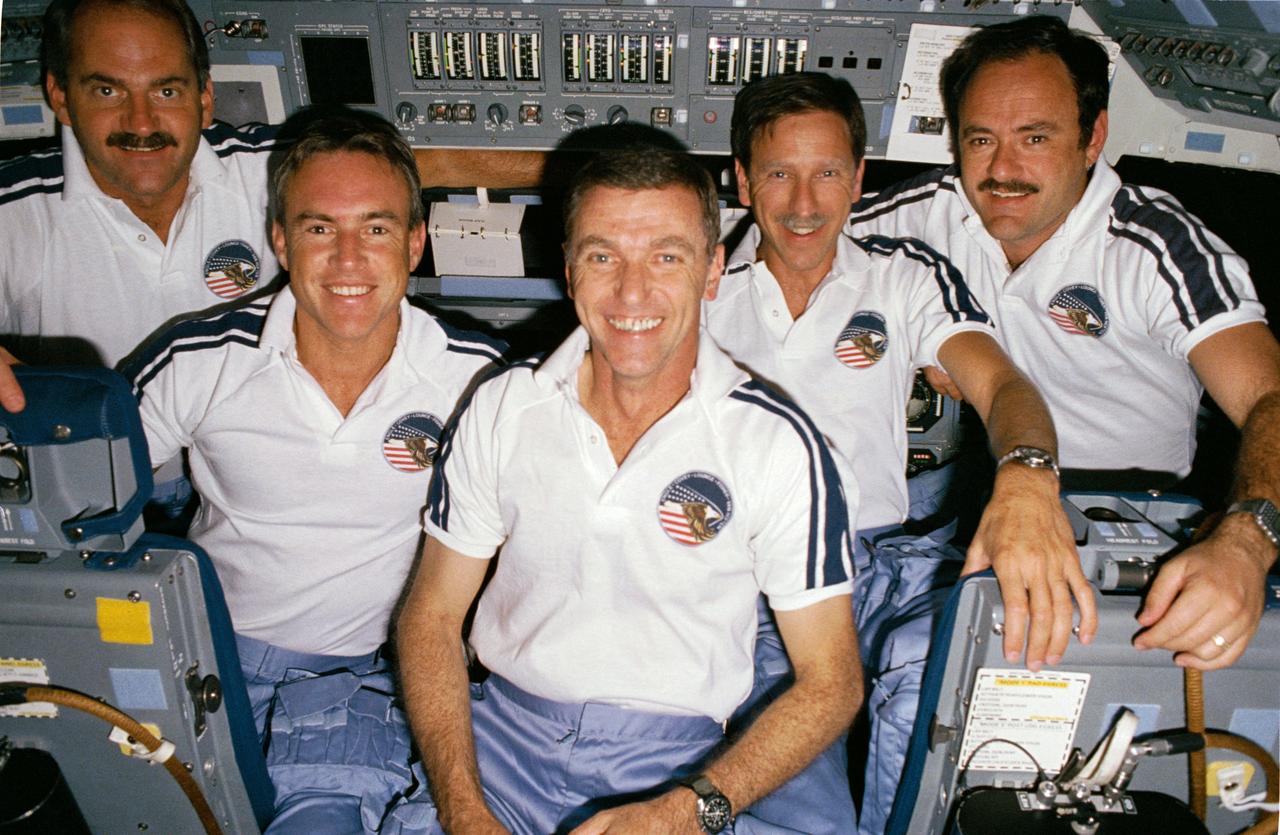
51I-17-029 (Aug-Sept 1985) --- A group portrait, recorded by a pre-set 35mm camera, shows all five STS- 51-I crewmembers on the flight deck of the Earth-orbiting Discovery in early September 1985, following the successful Syncom repair performed by the crewmembers. Left to right are Astronauts James D. van Hoften, William F. Fisher, Joe H. Engle, Richard O. Covey and John M. (Mike) Lounge.
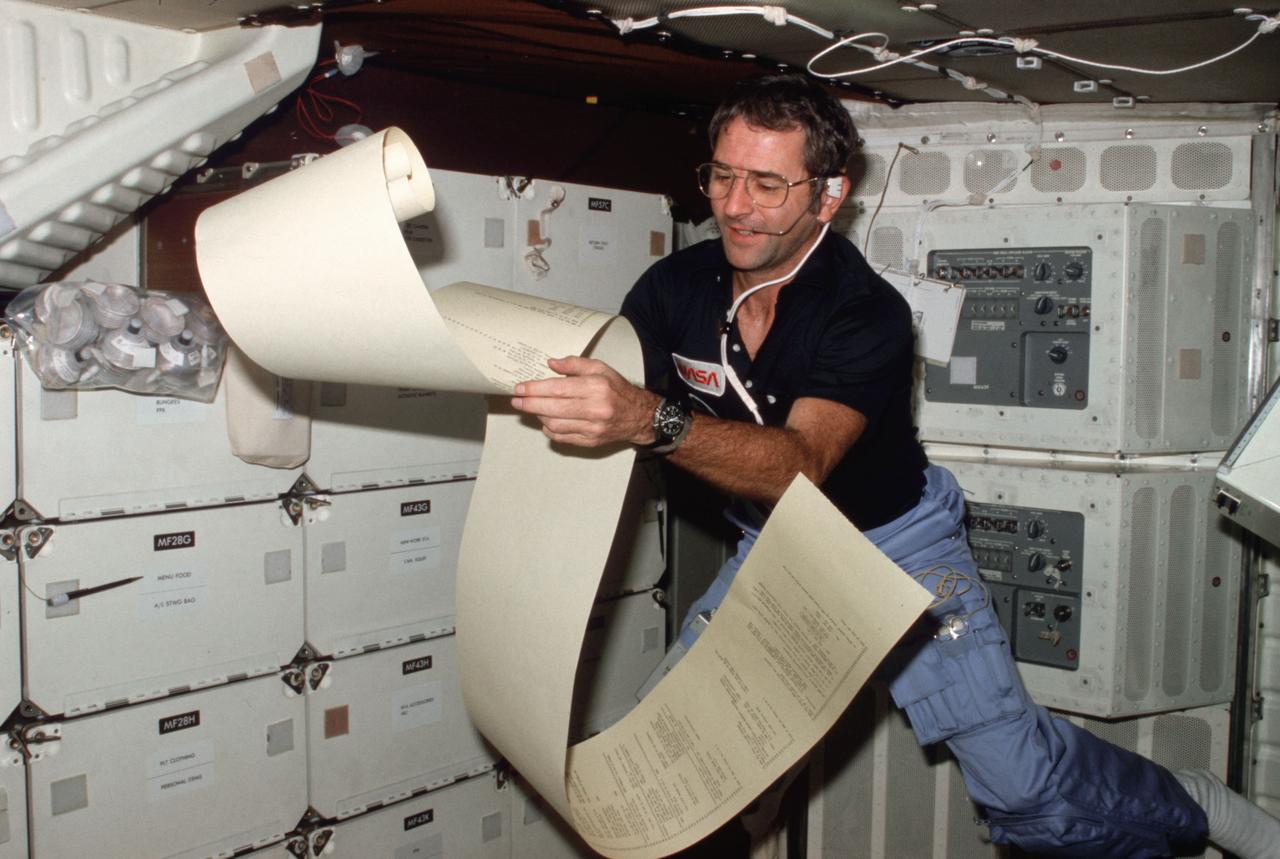
STS002-02-865 (12-14 Nov. 1981) --- Astronaut Richard H. Truly, STS-2 pilot, peruses some teleprinter copy, floating partially about the middeck area of NASA’s space shuttle Columbia during one of 1,813 minutes of activity of STS-2. This photograph was recorded with 35mm camera in the hands of astronaut Joe H. Engle, STS-2 crew commander. Truly communicates with spacecraft communicators on the ground. Photo credit: NASA
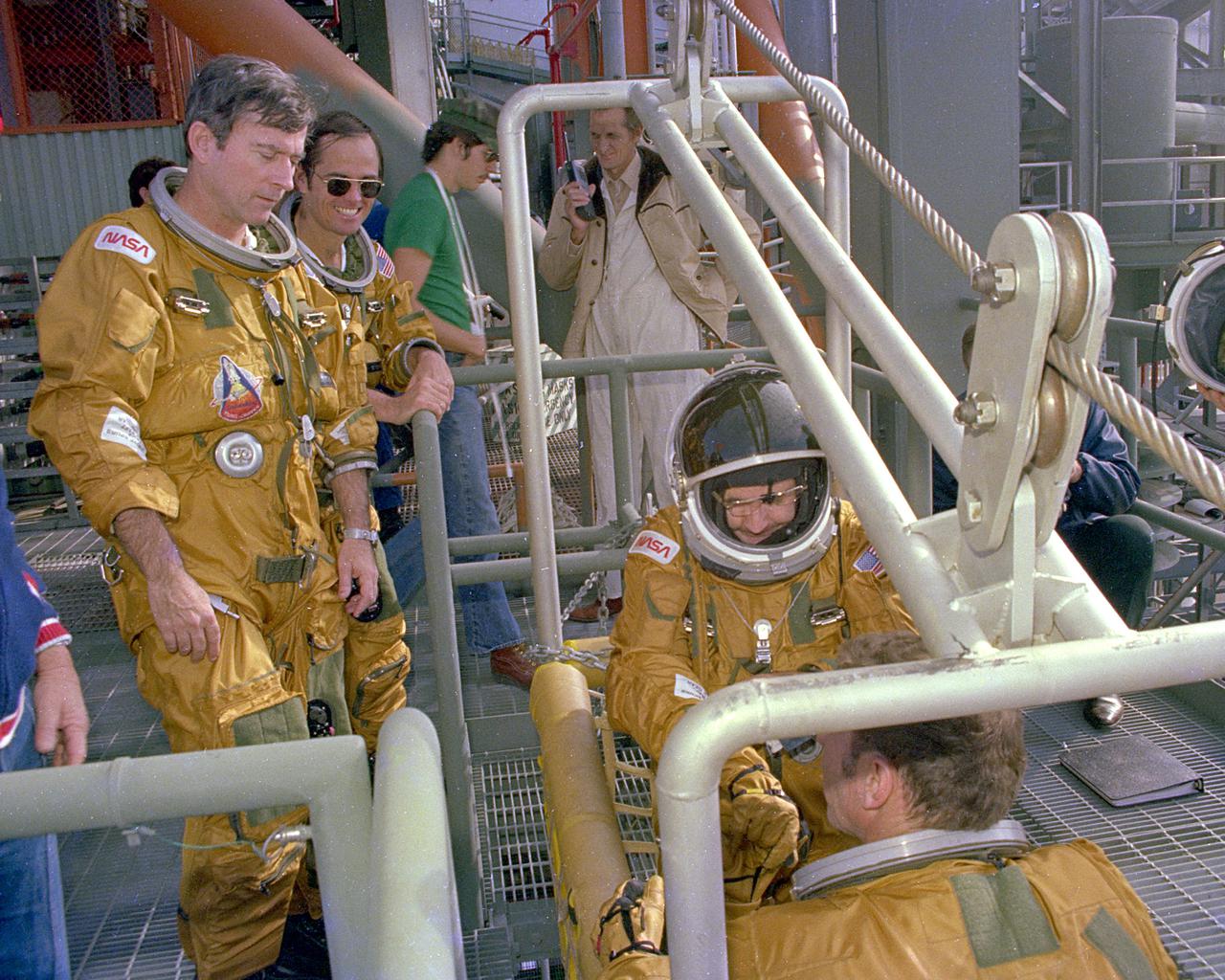
KENNEDY SPACE CENTER, FLA. - Space Shuttle prime crew Commander John Young and Pilot Bob Crippen watch as backup crew members Richard Truly and Joe Engle board the emergency pad escape system known as the slidewire. The slidewire system provides a quick escape from upper launch pad platforms in case of a serious emergency. The flight crews wore the spacesuits and other equipment to be worn during a mission, but sandbags were used to duplicate the weight of riders in the slidewire baskeets during the training.
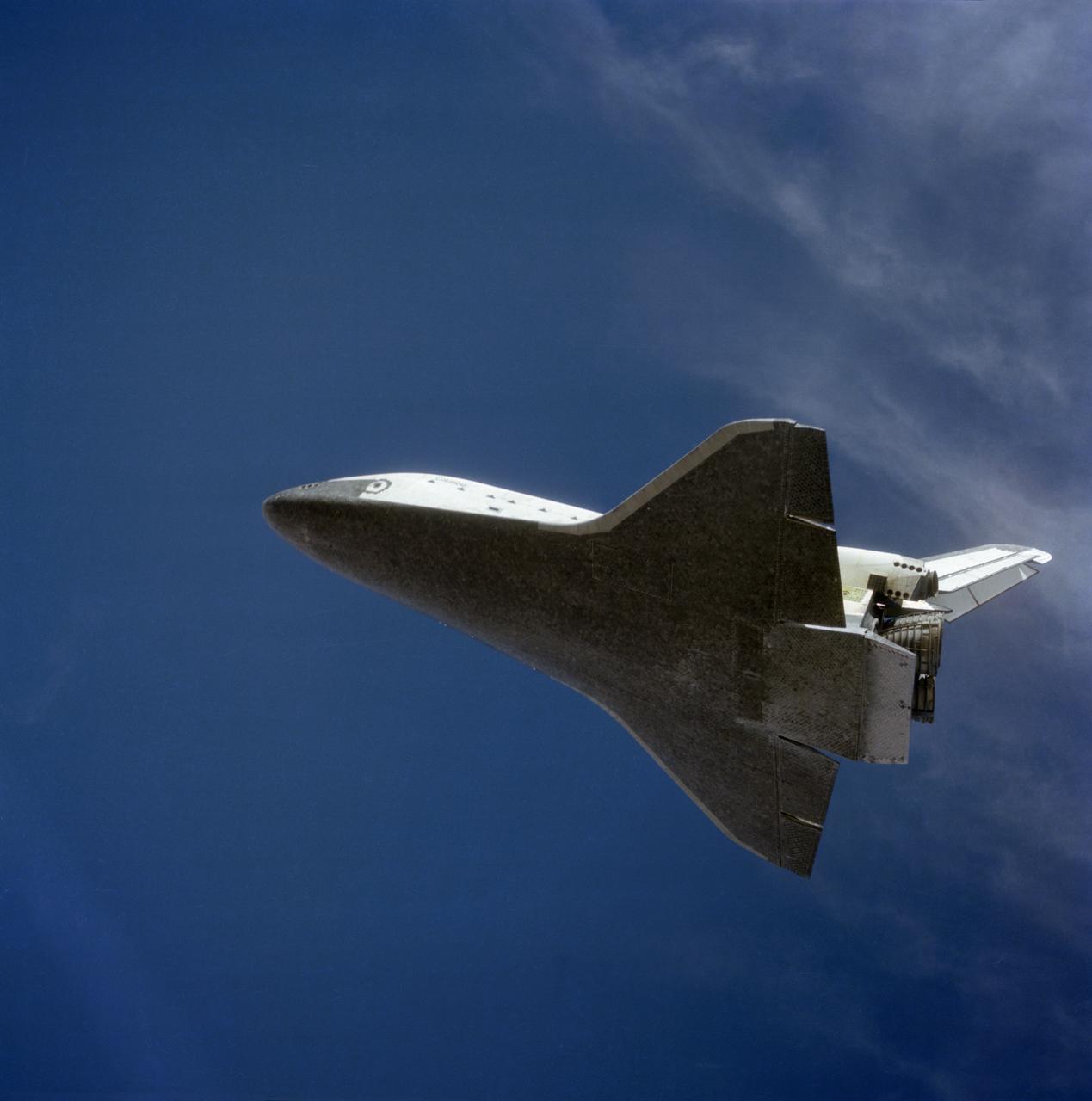
S81-39564 (14 Nov. 1981) --- This view of the space shuttle Columbia (STS-2) was made with a hand-held 70mm camera in the rear station of the T-38 chase plane. Mission specialist/astronaut Kathryn D. Sullivan exposed the frame as astronauts Joe N. Engle and Richard H. Truly aboard the Columbia guided the vehicle to an unpowered but smooth landing on the desert area of Edwards Air Force base in California. The picture provides a good view of the underside of the returning spacecraft. Photo credit: NASA
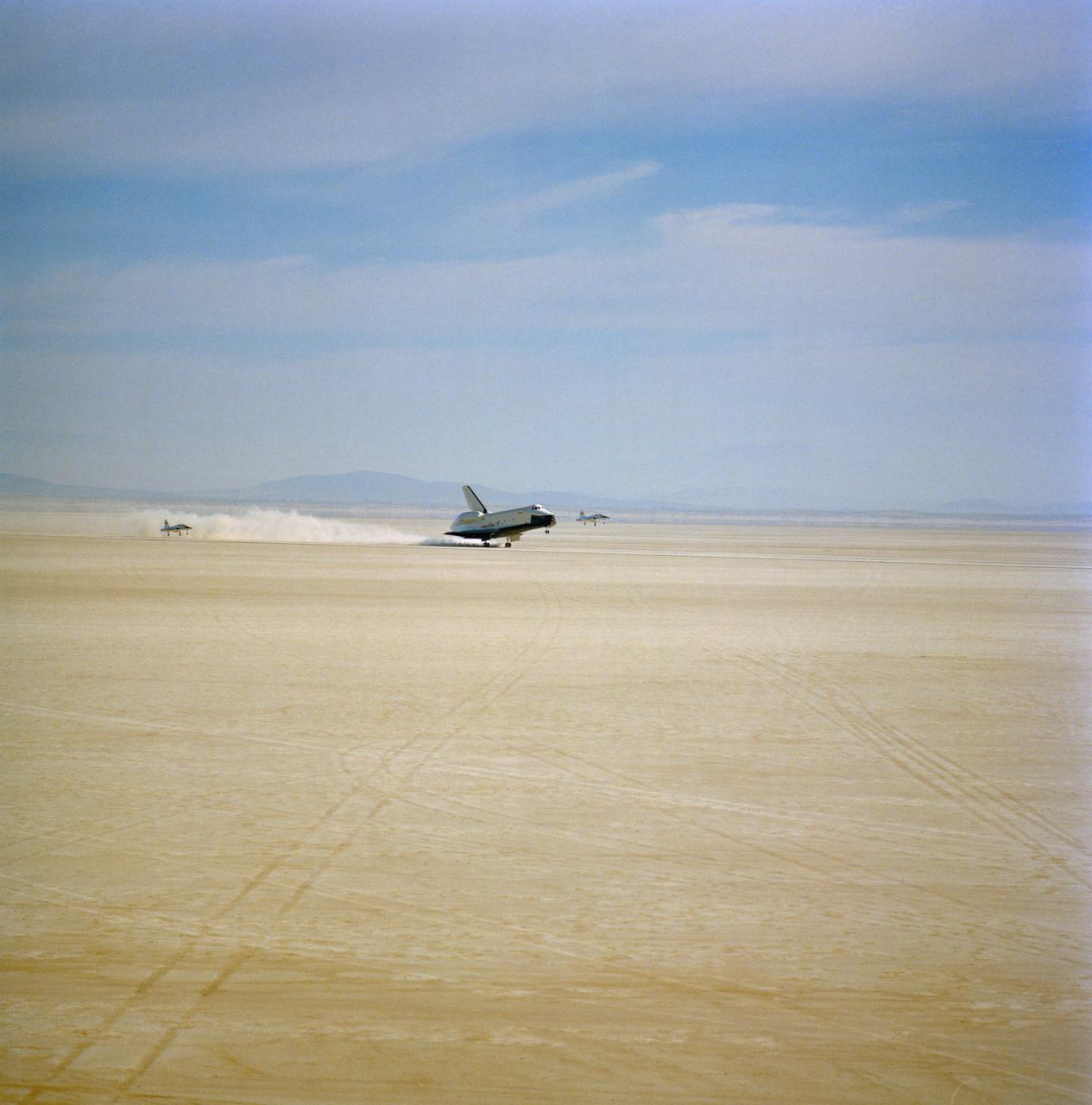
S77-28209 (13 Sept 1977) --- The shuttle orbiter 101 "Enterprise" lands on the desert at Edwards Air Force Base to conclude a five-minute, 31-second unpowered flight during the second free-flight of the Shuttle Approach and Landing Test (ALT) series, on September 13, 1977. Two T-38 chase planes remain with the "Enterprise" for the landing. Asstronauts Joe H. Engle, commander, and Richard H. Truly, pilot, were the crewmen for the flight.
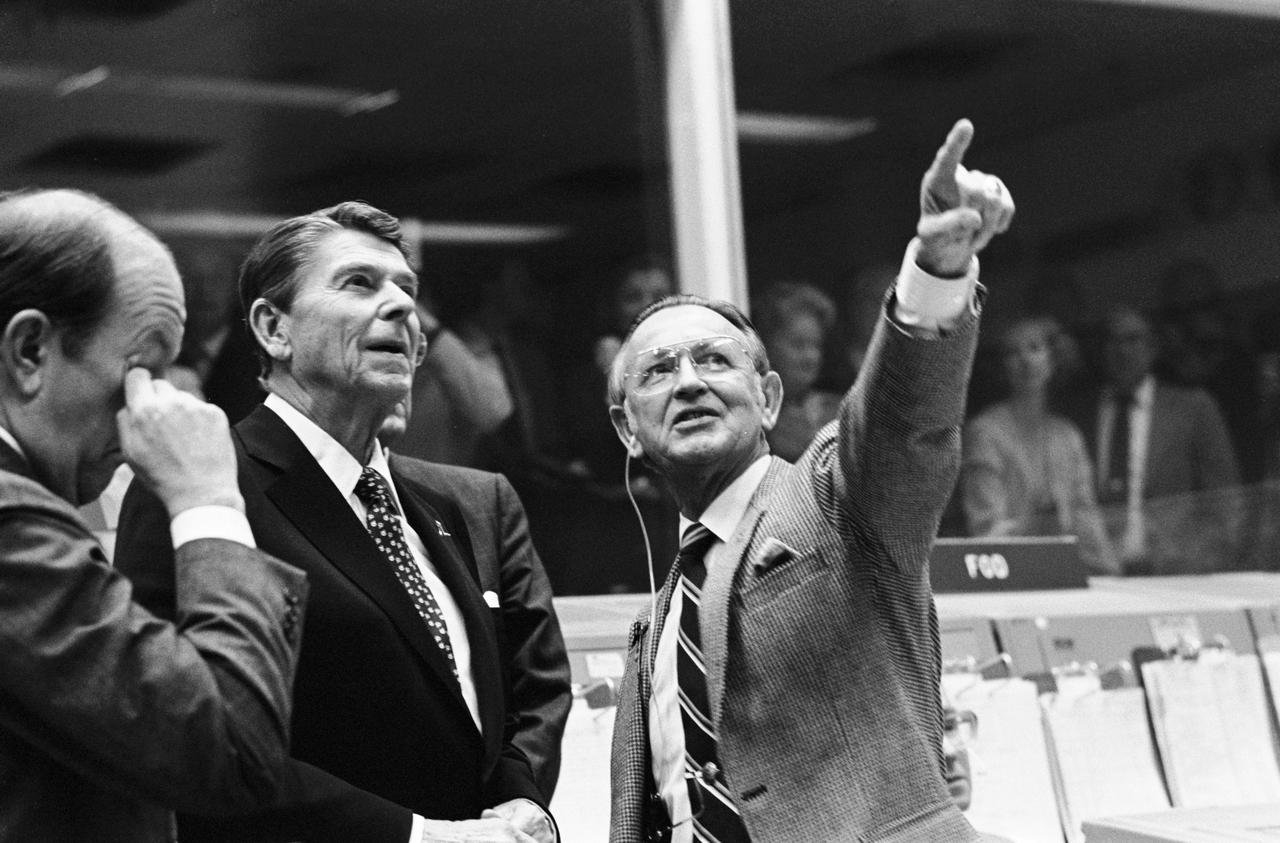
S81-39499 (13 Nov. 1981) --- President Ronald Reagan is briefed by JSC Director Christopher C. Kraft Jr., who points toward the orbiter spotter on the projection plotter in the front of the mission operations control room in the Johnson Space Center's Mission Control Center. This picture was taken just prior to a space-to-ground conversation between STS-2 crew members Joe H. Engle and Richard H. Truly, who were orbiting Earth in the space shuttle Columbia. Photo credit: NASA
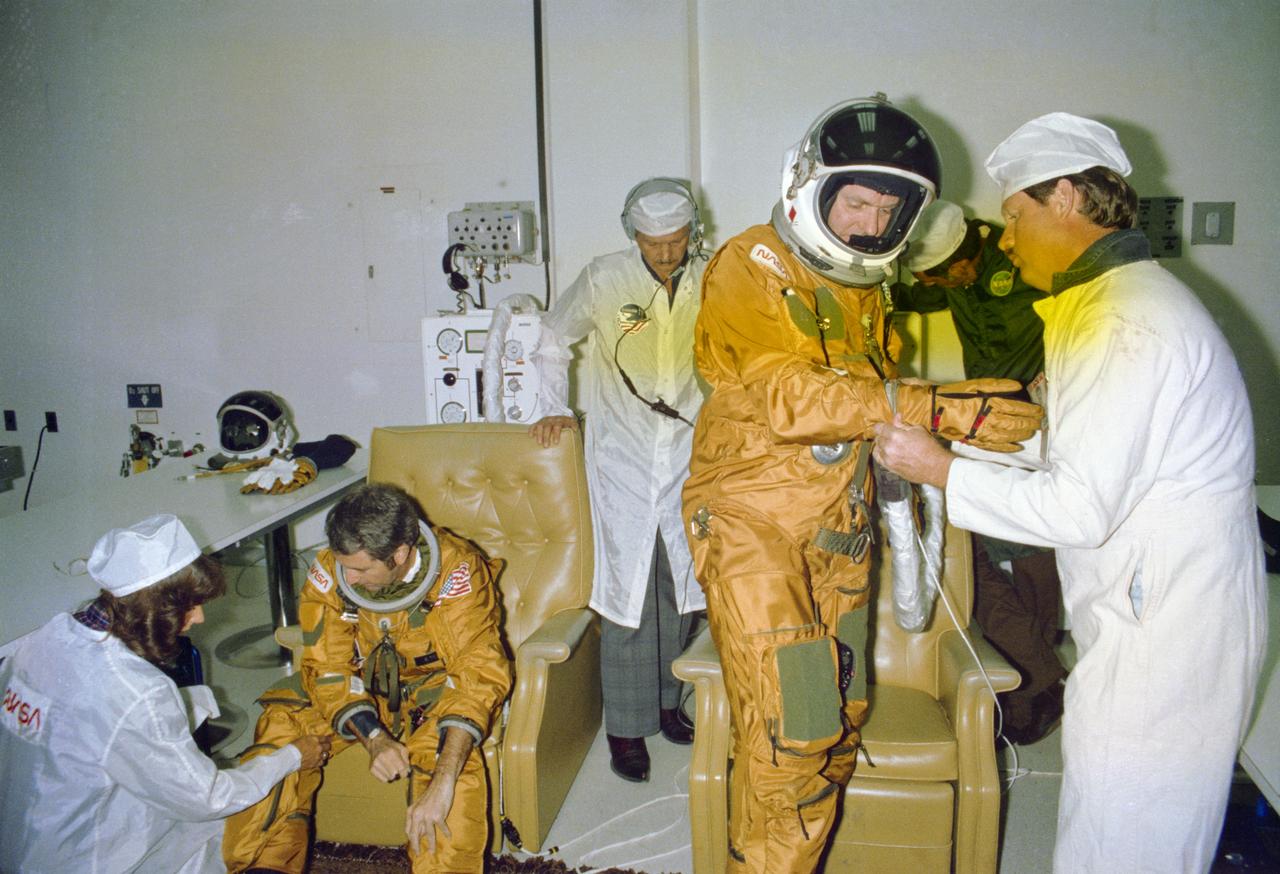
S81-38547 (10 Sept. 1981) --- Astronauts Joe H. Engle, right, and Richard H. Truly, prime crew members for STS-2, complete their suiting up chores prior to a countdown demonstration test (CDDT). They are in the operations and checkout building at the Kennedy Space Center. The two have a launch scheduled for late autumn of this year. Photo credit: NASA
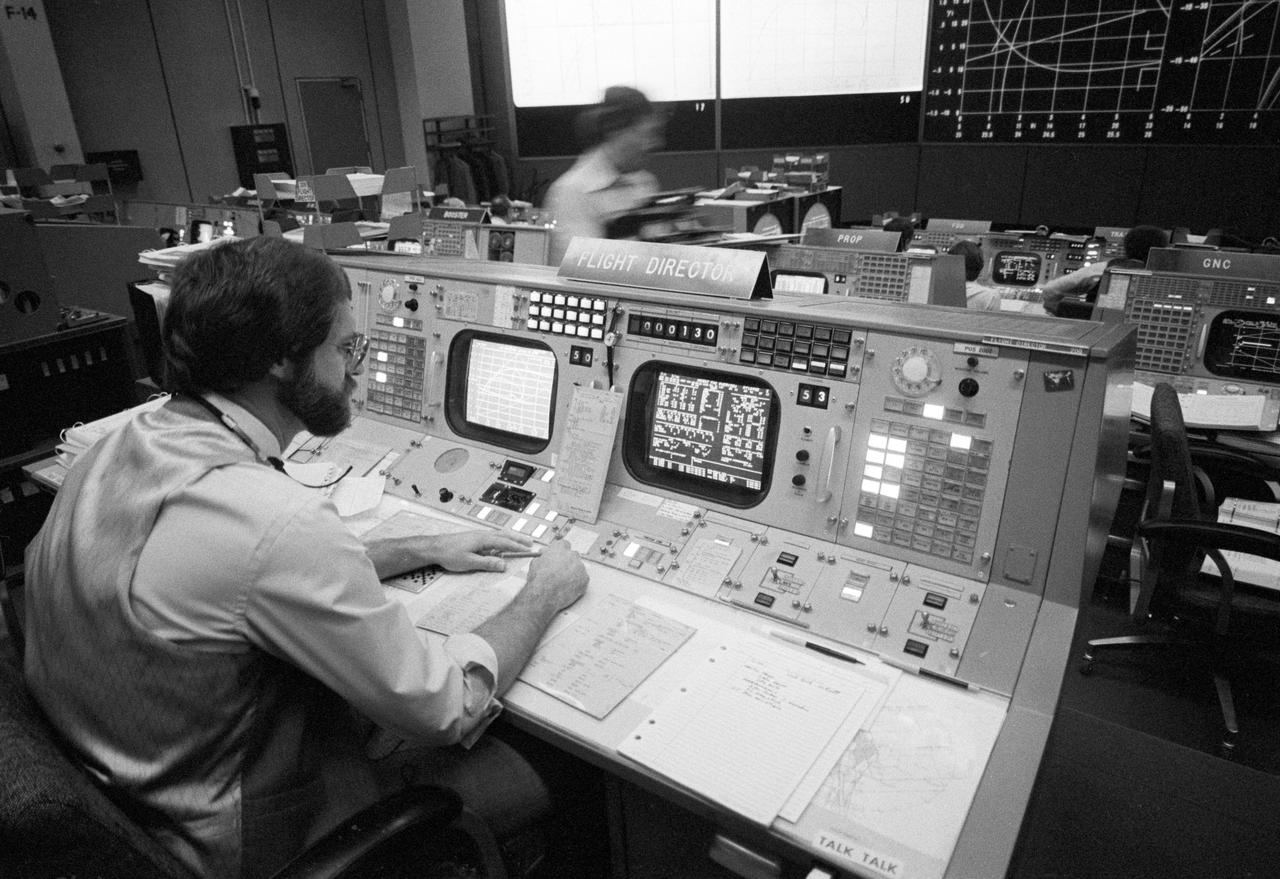
S81-39433 (12 Nov. 1981) --- Flight director Neil B. Hutchinson monitors data displayed on a cathode ray tube (CRT) at his console in the mission operations control room (MOCR) in the Johnson Space Center?s Mission Control Center (MCC) during the launch phase of STS-2. Launch of the Columbia occurred at 9:10 a.m. CST today with astronauts Joe H. Engle and Richard H. Truly aboard the Columbia. Photo credit: NASA
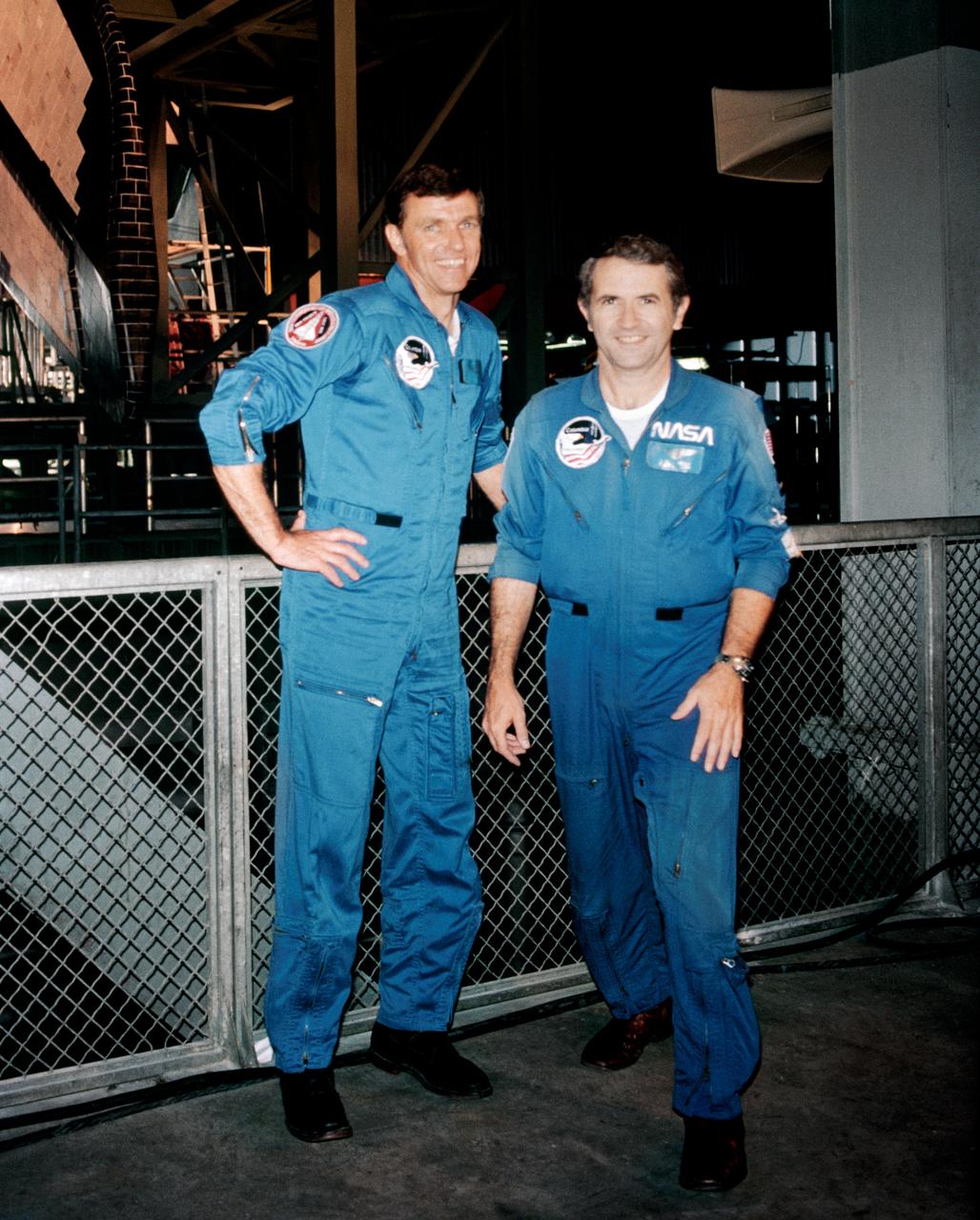
S81-36331 (24 Aug. 1981) --- Astronauts Joe H. Engle, left, and Richard H. Truly pause before participating in the integrated test of the assembled space shuttle components scheduled for launch no earlier than Sept. 30, 1981. Moments later, Engle, STS-2 crew commander, and Truly, pilot, entered the cabin of the orbiter Columbia for a mission simulation. The shuttle integrated tests (SIT) are designed to check out every connection and signal path in the STS-2 vehicle composed of the orbiter, two solid rocket boosters (SRB) and an external fuel tank (ET) for Columbia?s main engines. Completion of the tests will clear the way for preparations for rollout to Pad A at Launch Complex 39, scheduled for the latter part of August or early September. Photo credit: NASA
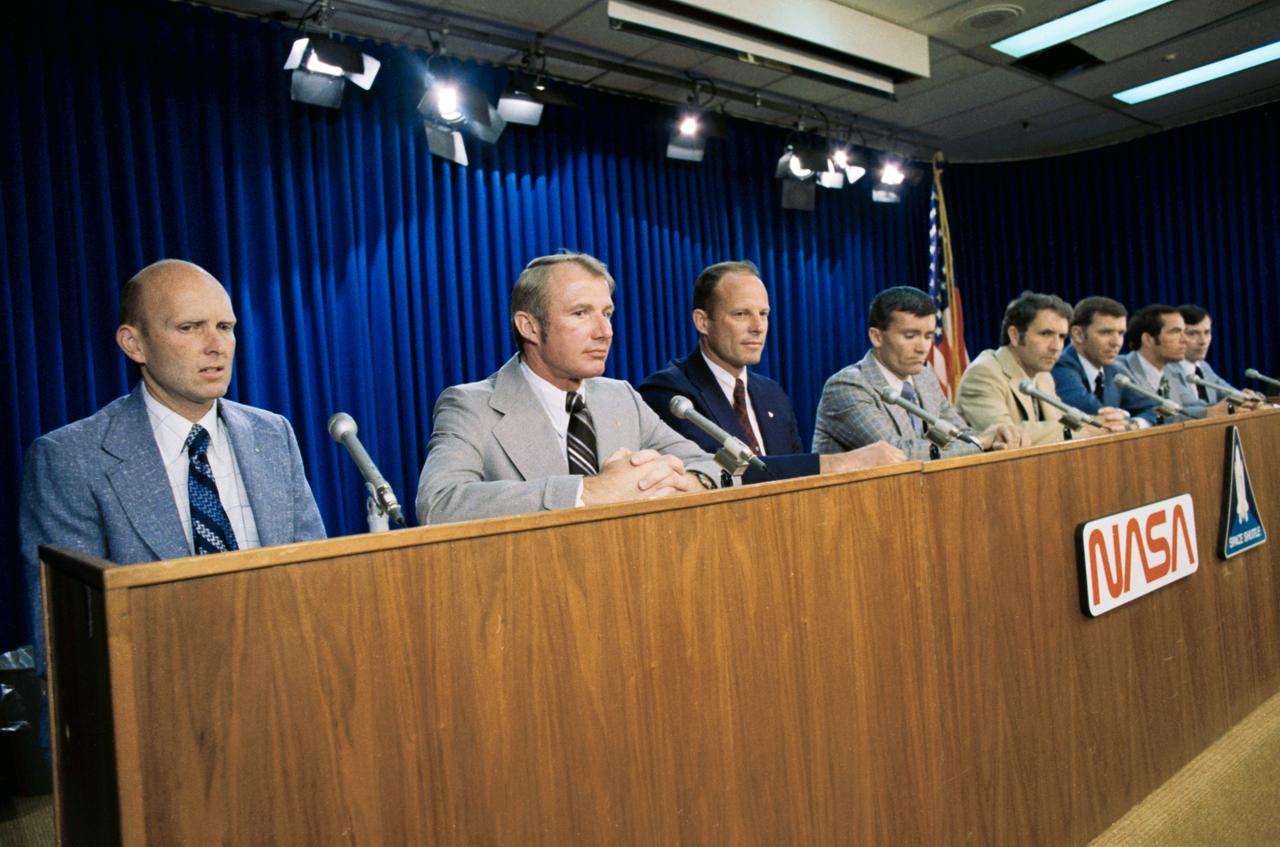
S78-27531 (22 March 1978) --- These eight men have been named on four two-man crews who will fly the space shuttle orbiter vehicle during orbital flight tests (OFT) scheduled to begin in 1979. Pictured during their press conference, right to left, astronauts John W. Young, Robert L. Crippen, Joe H. Engle, Richard H. Truly, Fred W. Haise Jr., Jack R. Lousma, Vance D. Brand and C. Gordon Fullerton. Young and Crippen are commander and pilot, respectively, for the first OFT mission. Other crews are comprised of Engle, commander, and Truly, pilot; Haise, commander, and Lousma, pilot; Brand, commander, and Fullerton, pilot. Photo credit: NASA
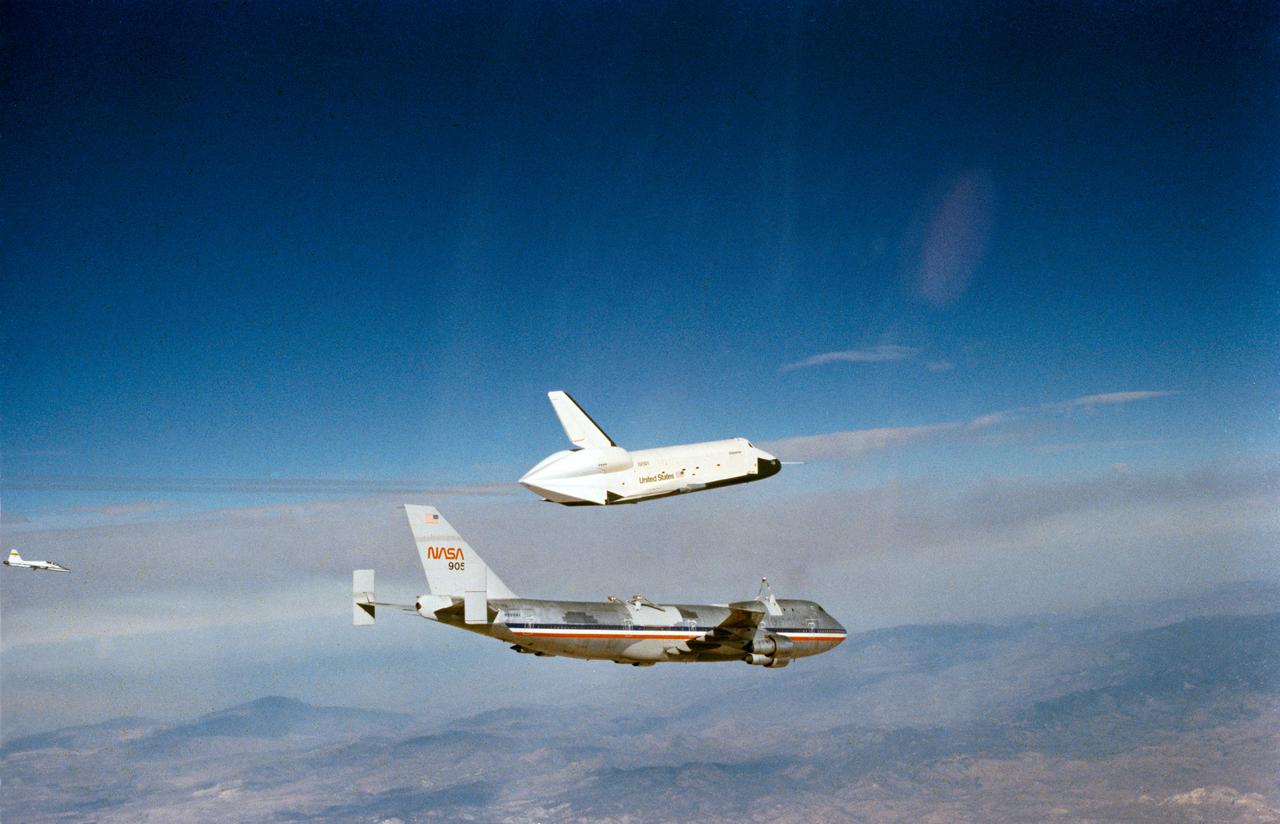
S77-28137 (13 Sept 1977) --- The Orbiter 101 "Enterprise" soars above the NASA 747 carrier aircraft during the second free flight of the Shuttle Approach and Landing Tests (ALTs) conducted on September 13, 1977 at Dryden Flight Research Center in Southern California. Astronauts Joe H. Engle, and Richard H. Truly were the crew of the "Enterprise." The ALT free flights are designed to verify Orbiter subsonic airworthiness, integrated systems operations and pilot-guided approach and landing capability and satisfying prerequisites to automatic flight control and navigation mode.
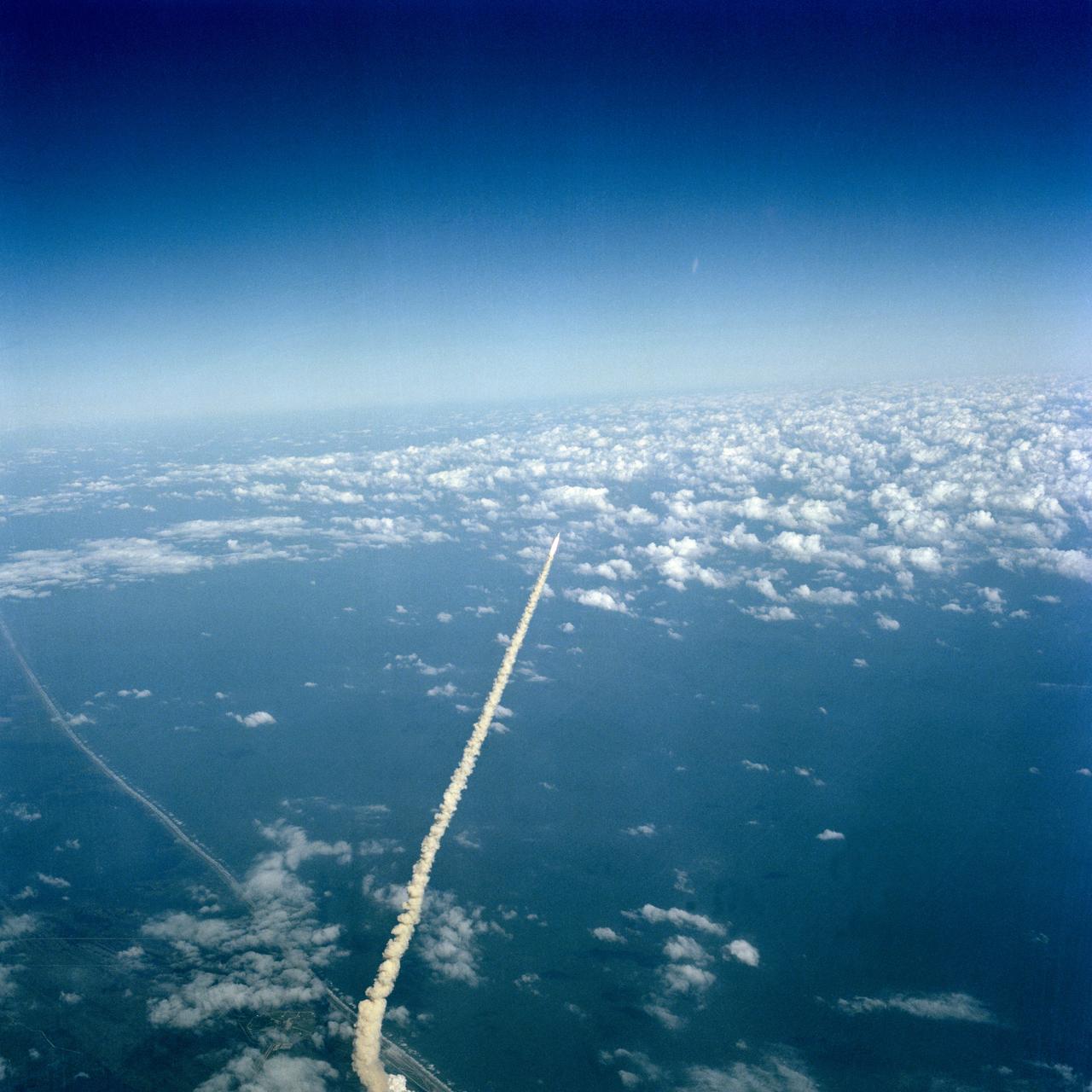
S81-39440 (12 Nov. 1981) --- The tiny image of the space shuttle Columbia, its two solid rocket boosters and an external fuel tank feeding Columbia?s engines was captured on camera by one who can truly relate to the thoughts of the astronauts aboard ? John W. Young who was aboard the same spacecraft for its successful debut in April of this year. Young was flying NASA?s shuttle training aircraft (STA) when he used a hand-held camera to record this scene on 70mm film. Astronauts Joe H. Engle, STS-2 commander, and Richard H. Truly, pilot, were aboard Columbia. Photo credit: NASA
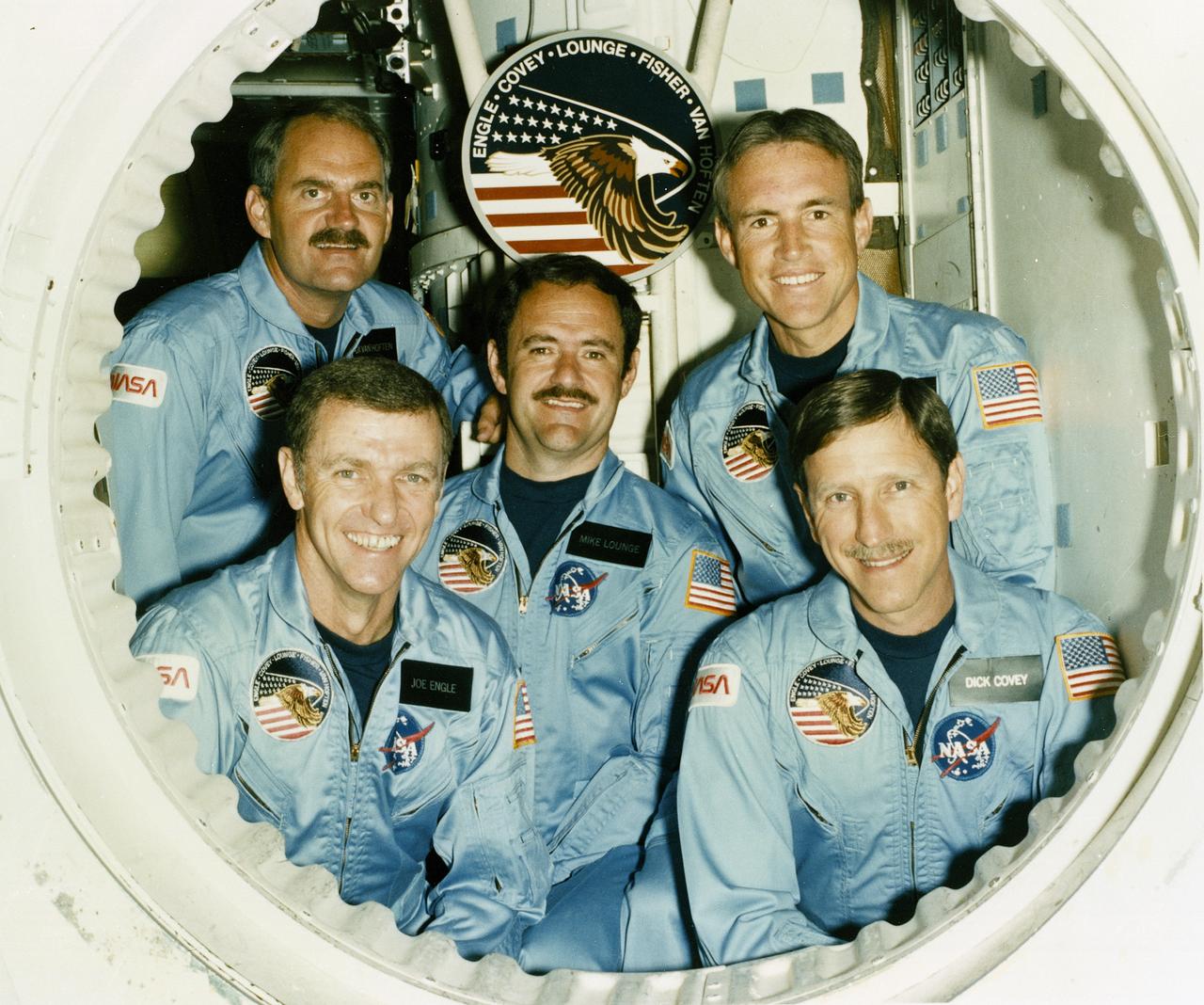
The crew assigned to the STS-51I mission included (front row left to right) Joe H. Engle, commander; and Richard O. Covey, pilot. In the center is John M. (Mike) Lounge, mission specialist. On the back row, from left to right, are mission specialists James D. van Hoften, and William F. Fisher. Launched aboard the Space Shuttle Discovery on August 27, 1985 at 6:58:01 am (EDT), the STS-51I mission’s primary payloads were three communication satellites: the ASC-1 for the American Satellite Company; the AUSSAT-1, an Australian communications satellite; and the SYNCOM-IV-4, the synchronous communications satellite.
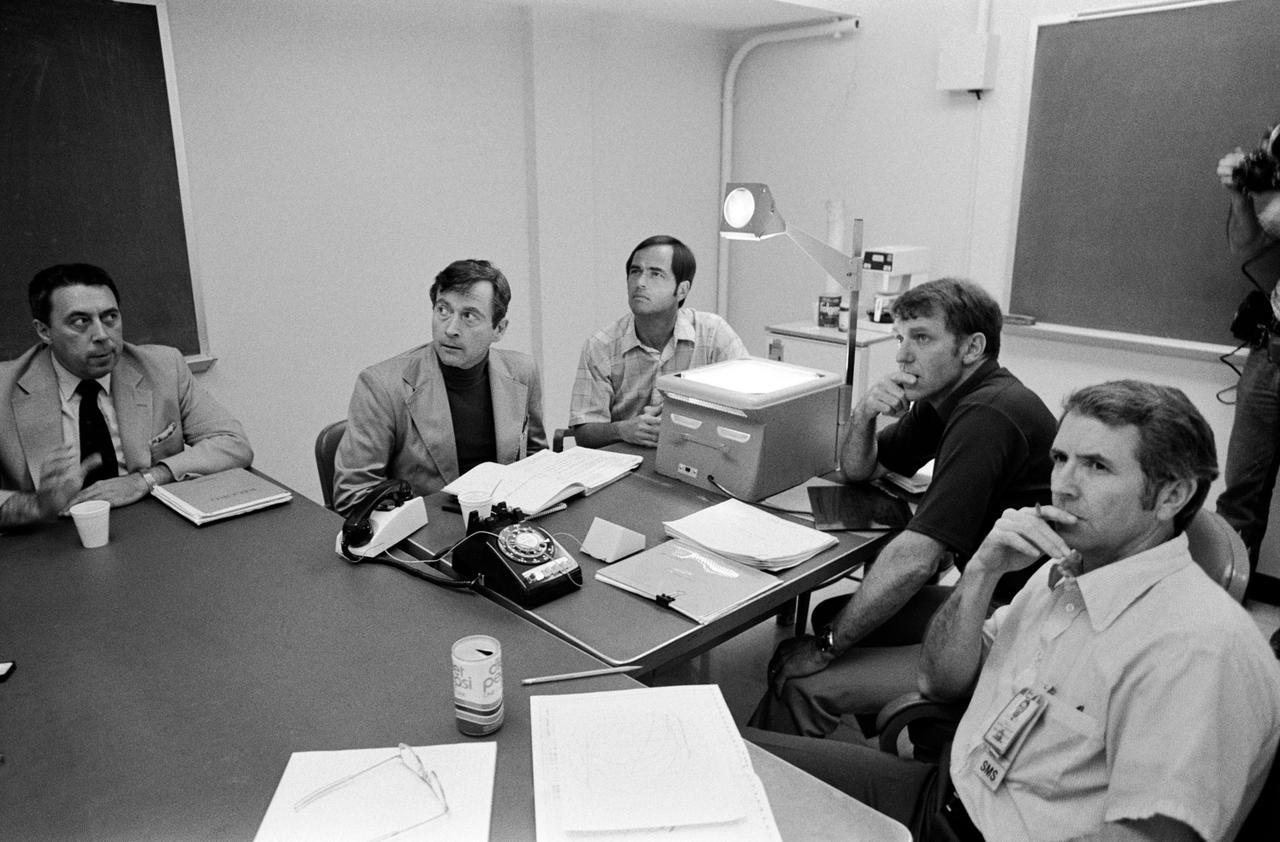
S81-29618 (6 April 1981) --- STS-1 prime and backup astronaut crew members look at visuals during a coordinated teleconference with engineers. Seated at the table in a briefing room at NASA's Johnson Space Center are, clockwise from the left, George W.S. Abbey, Director of Flight Operations, John W. Young, Robert L. Crippen, Joe H. Engle and Richard H. Truly. Young and Crippen are prime crewmen preparing to man the Columbia later this week for the flight of STS-1. Rockwell International engineers in California as well as JSC engineers participated in this telecon. Photo credit: NASA
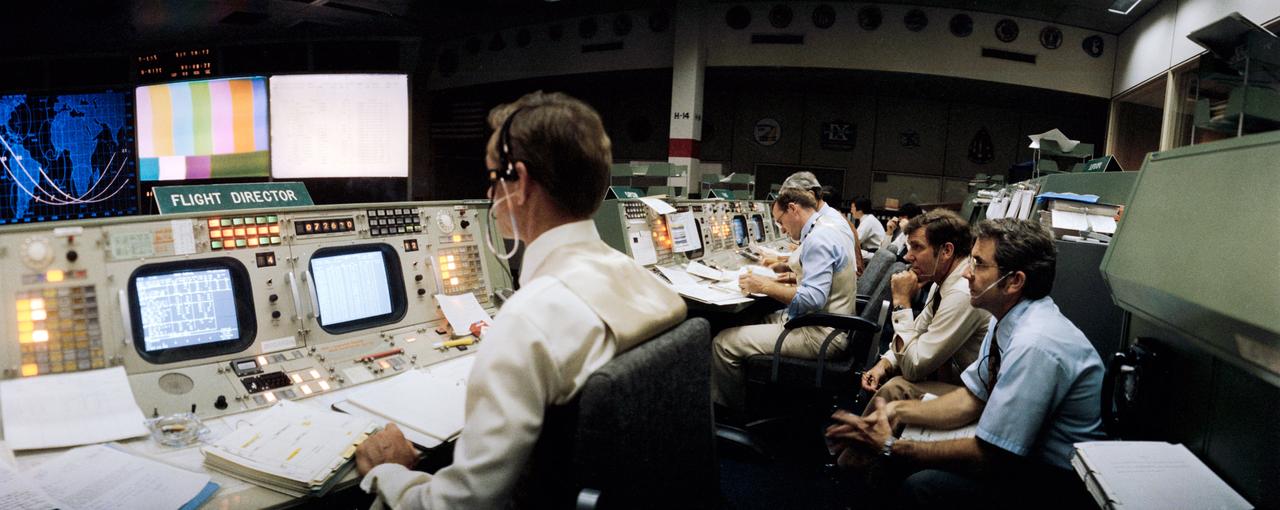
S81-30386 (14 April 1981) --- Flight director Charles R. Lewis, left, studies a chart display on his console?s monitor in the mission operations control room (MOCR) in the Johnson Space Center?s Mission Control Center. The photograph was taken just prior to a TV transmission on day two of STS-1, with a special wide-angle lens. Astronauts Joe H. Engle (second from right) and Richard H. Truly, right, are backup commander and pilot, respectively, for NASA?s first space shuttle orbital test mission. Astronaut James F. Buchli, spacecraft communicator, is at right center. Photo credit: NASA
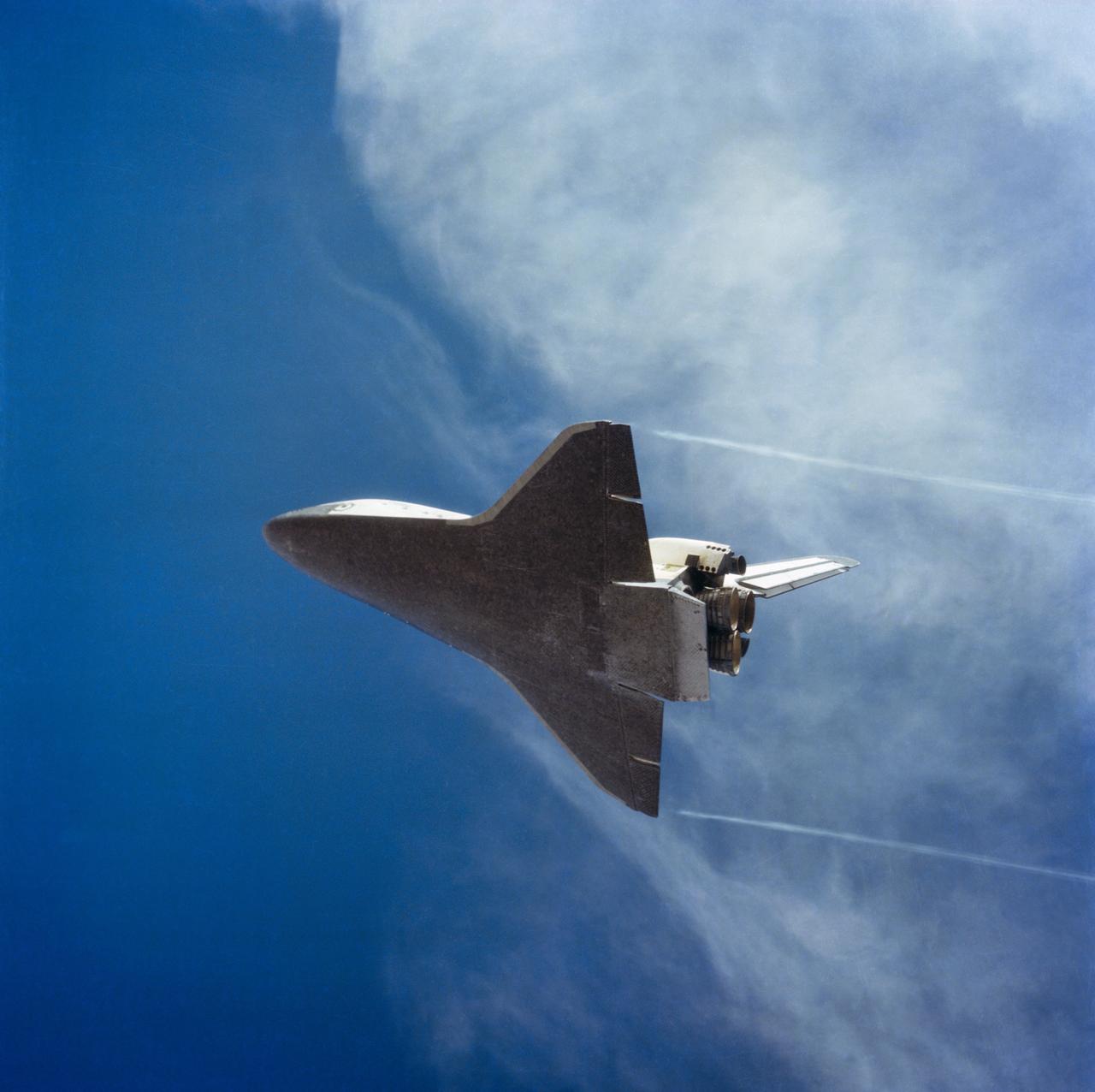
S81-39563 (14 Nov. 1981) --- This view of the space shuttle Columbia (STS-2) was made with a hand-held 70mm camera in the rear station of the T-38 chase plane. Mission specialist/astronaut Kathryn D. Sullivan exposed the frame as astronauts Joe N. Engle and Richard H. Truly aboard the Columbia guided the vehicle to an unpowered but smooth landing on the desert area of Edwards Air Force base in California. The view provides a good study of the high temperature protection material on the underside of the spacecraft which is exposed to the friction on the atmospheric entry on the return to Earth. Also note trails from the wing tips. Photo credit: NASA
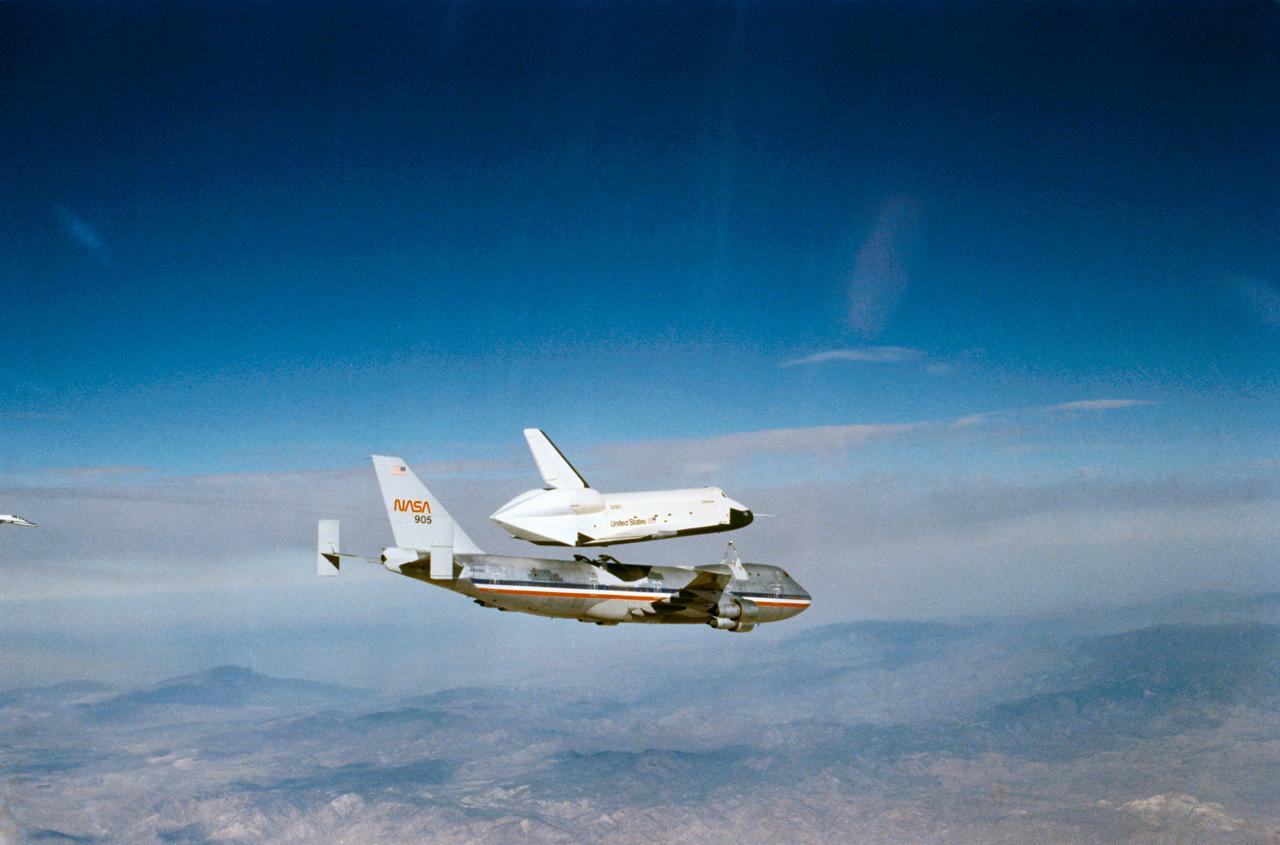
S77-28136 (13 Sept 1977) --- The Orbiter 101 "Enterprise" is seen separating from the NASA 747 carrier aircraft during the second free flight of the Shuttle Approach and Landing Tests (ALTs) conducted on September 13, 1977 at Dryden Flight Research Center in Southern California. Astronauts Joe H. Engle, and Richard H. Truly were the crew of the "Enterprise." The ALT free flights are designed to verify Orbiter subsonic airworthiness, integrated systems operations and pilot-guided approach and landing capability and satisfying prerequisites to automatic flight control and navigation mode.
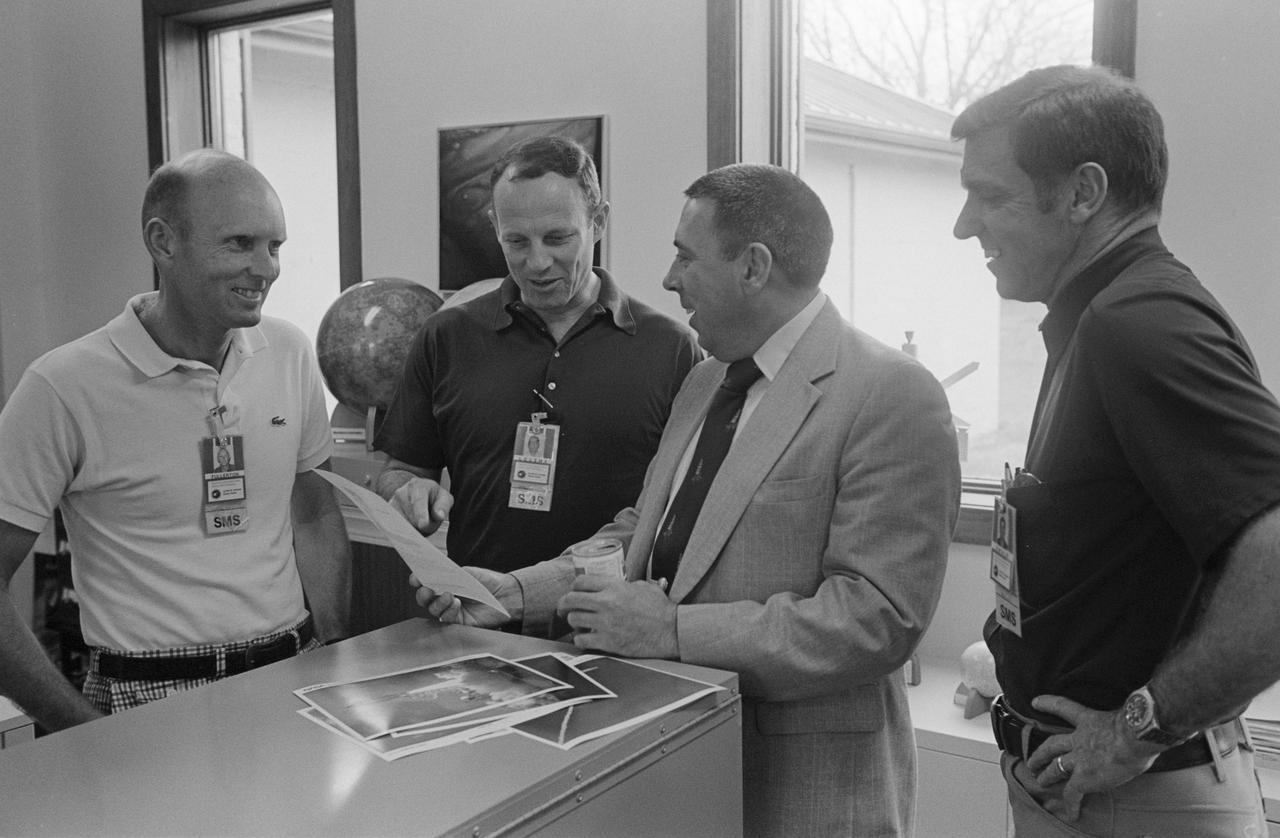
S82-28950 (1 April 1982) --- During a break from a debriefing session, the STS-3 crew members look over some of the photography of their launch from the Kennedy Space Center along with other participants of the meeting. Astronaut Jack R. Lousma is second from left; astronaut C. Gordon Fullerton is at left. They are commander and pilot, respectively, of STS-3. George W. S. Abbey, director of flight operations at JSC, is second from right, and astronaut Joe H. Engle, STS-2 commander, is at right. Photo credit: NASA
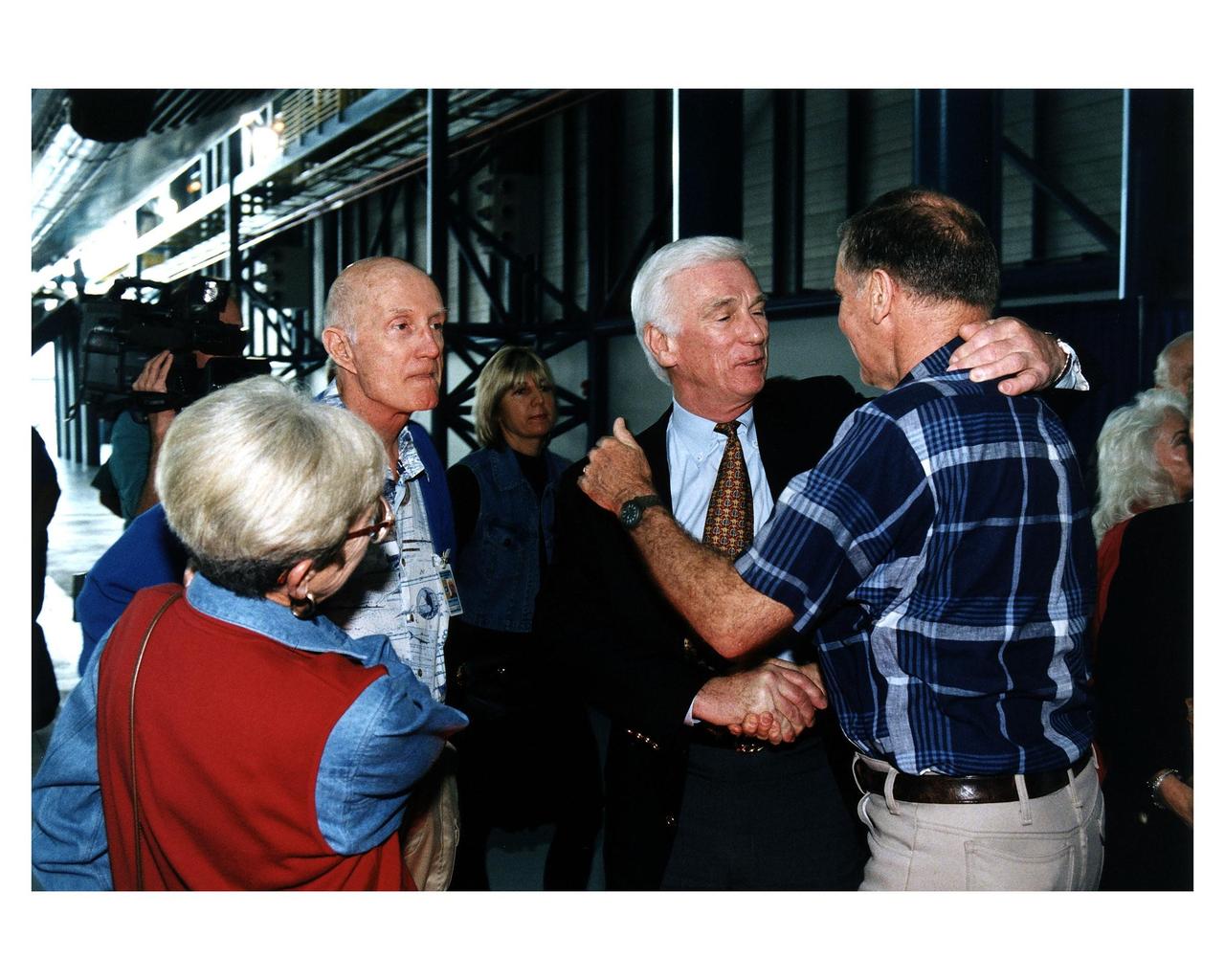
KENNEDY SPACE CENTER, FLA. -- Some of the former Apollo program astronauts tour the new Apollo/Saturn V Center (ASVC) at KSC prior to the gala grand opening ceremony for the facility that was held Jan. 8, 1997. The astronauts were invited to participate in the event, which also featured NASA Administrator Dan Goldin and KSC Director Jay Honeycutt. Greeting friends in the ASVC (left) is Apollo 10 Commander Thomas P. Stafford. Apollo 10 Lunar Module Pilot and Apollo 17 Commander Eugene A. Cernan shakes hands with Apollo 14 Back-up Lunar Module Pilot Joe H. Engle. The ASVC also features several other Apollo program spacecraft components, multimedia presentations and a simulated Apollo/ Saturn V liftoff. The facility will be a part of the KSC bus tour that embarks from the KSC Visitor Center
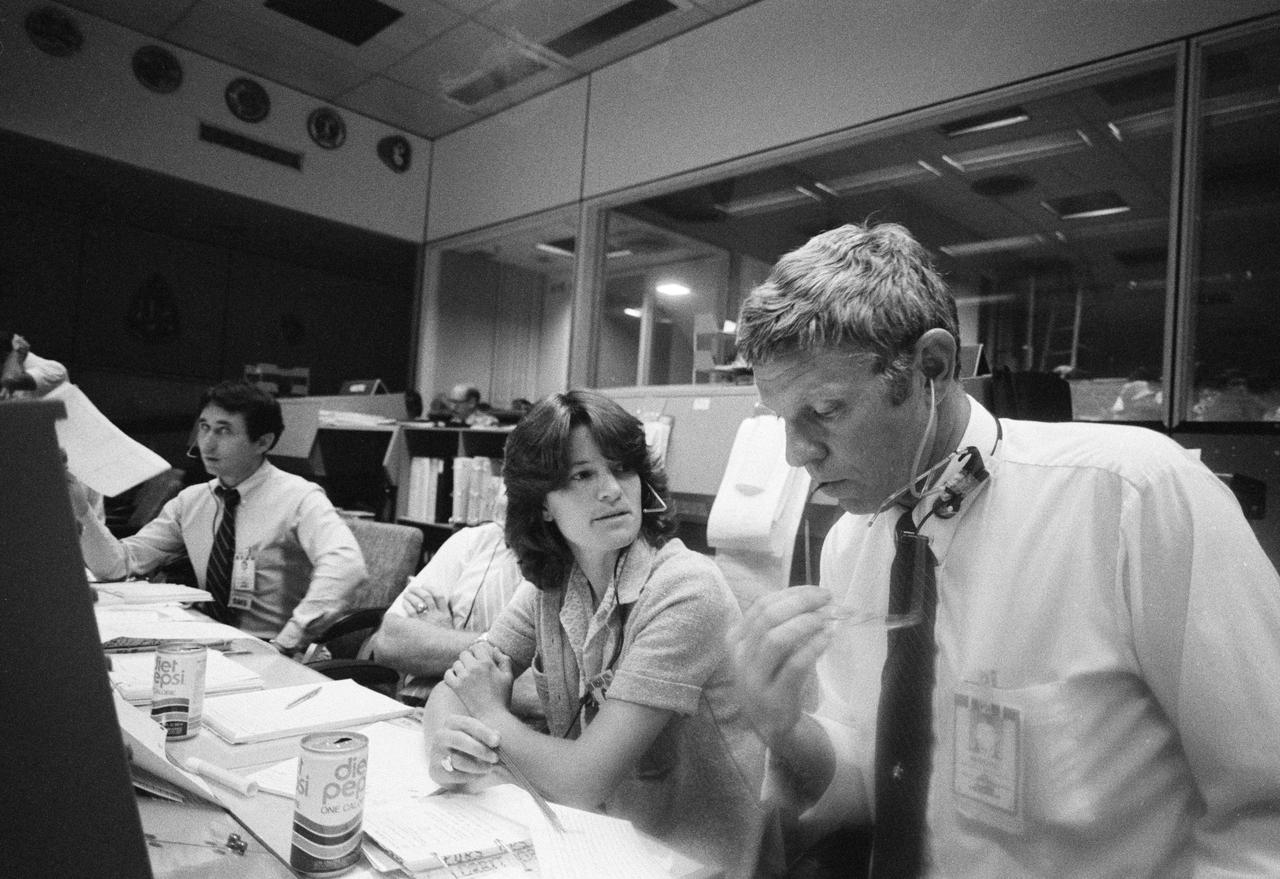
S81-33963 (July 1981) --- Mission specialist/astronaut Sally K. Ride and Dale E. Moore of the flight control division?s electrical, mechanical and environmental systems branch take a special interest in a simulations session during which the remote manipulator system (RMS, a mechanized arm) takes a momentary spotlight. They are seated at the CAPCOM or capsule communicator console in the mission operations control room of JSC?s mission control center. Dr. Ride will converse with astronauts Joe H. Engle and Richard H. Truly during their STS-2 mission in space when the RMS will have its debut in the Columbia?s cargo bay. Astronaut James F. Buchli, serving in a CAPCOM capacity, is partially obscured behind Dr. Ride. Photo credit: NASA

S81-39549 (12 Nov. 1981) --- Framed here by Florida vegetation, the 37-meter-tall (122 feet) NASA space shuttle Columbia lifts off from Launch Pad 39A at NASA-Kennedy Space Center (KSC). Astronauts Joe H. Engle and Richard H. Truly begin the second space shuttle (STS-2) flight with at least two new items of cargo aboard. One is a collection of experiments developed by the Office of Space and Terrestrial Applications (OSTA) and another is a robot arm with in-space/in-cabin controls known as the remote manipulator system (RMS). Liftoff took place just a few seconds past 10:10 a.m. EST on Nov. 12, 1981. Photo credit: NASA
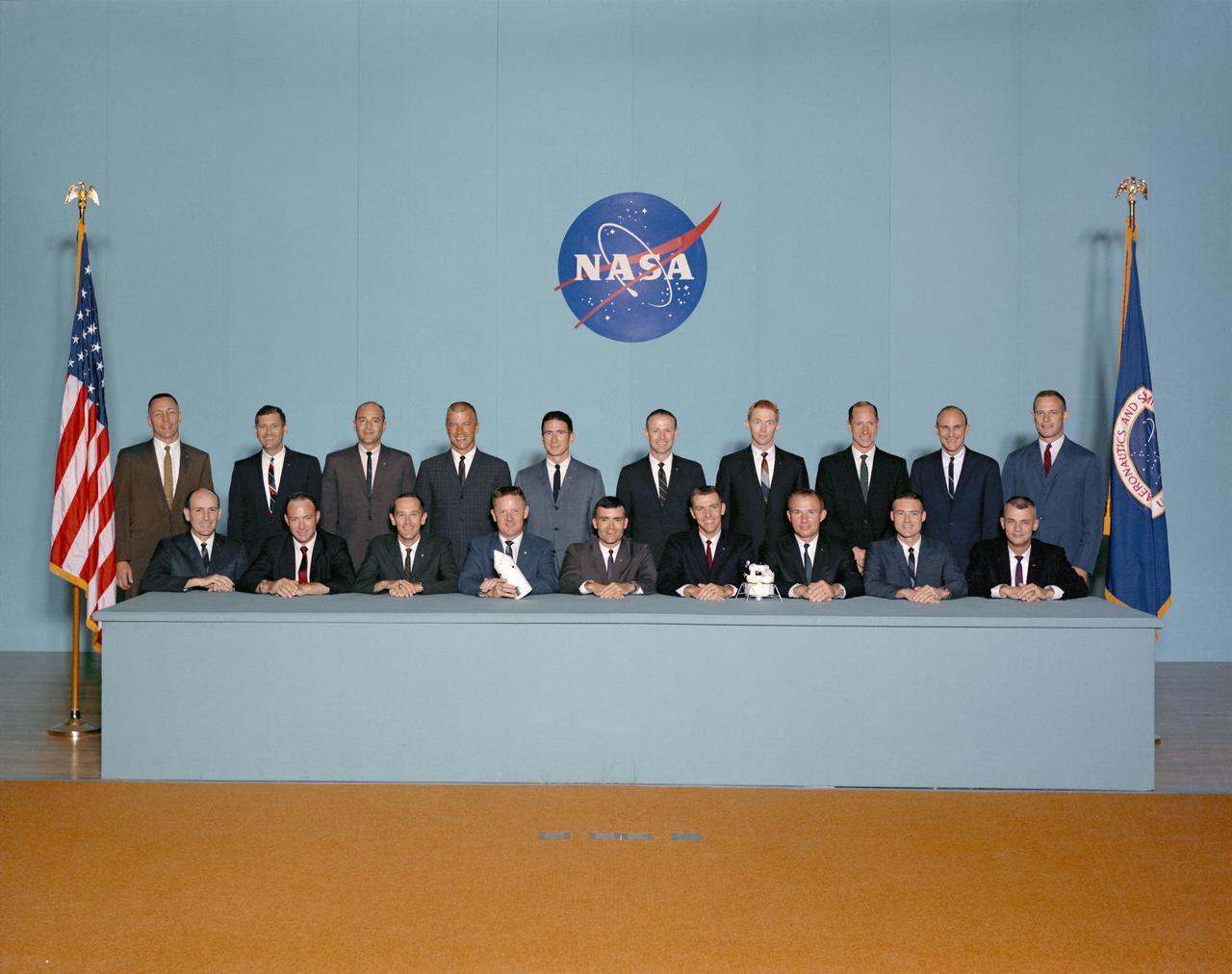
S67-30404 (May 1967) --- Portrait of astronaut group selected April 4, 1966. Seated, left to right, are Edward G. Givens Jr., Edgar D. Mitchell, Charles M. Duke Jr., Don L. Lind, Fred W. Haise Jr., Joe H. Engle, Vance D. Brand, John S. Bull and Bruce McCandless II. Standing, left to right, are John L. Swigert Jr., William R. Pogue, Ronald E. Evans, Paul J. Weitz, James B. Irwin, Gerald P. Carr, Stuart A. Roosa, Alfred M. Worden, Thomas K. Mattingly and Jack R. Lousma. Photo credit: NASA or National Aeronautics and Space Administration
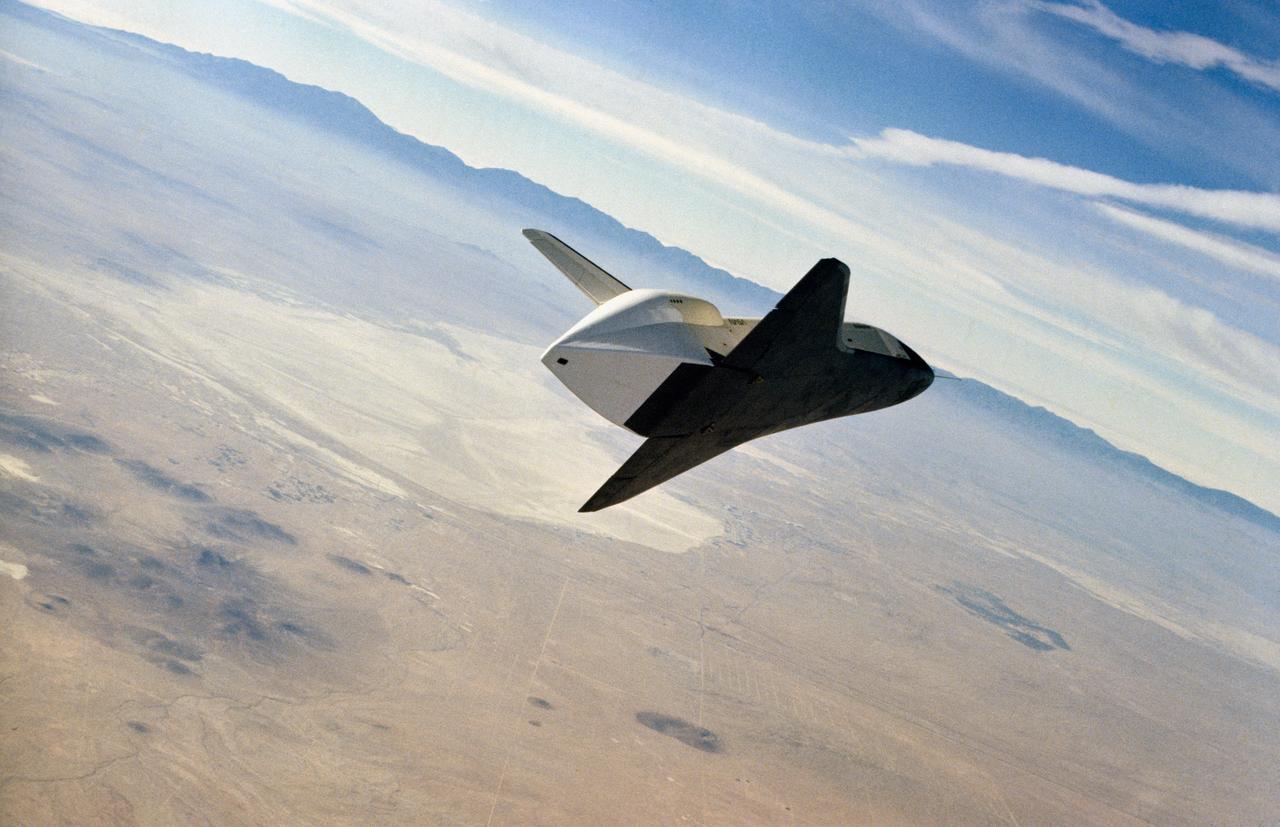
S77-28138 (13 Sept 1977) --- The shuttle Orbiter 101 "Enterprise" makes a slight turn and bank maneuver during the second free flight of the Shuttle Approach and Landing Tests (ALT) conducted on September 13, 1977, at the Dryden Flight Research Center in Southern California. The "Enterprise" separated from the NASA 747 carrier aircraft and landed following a five-minute, 28-second unpowered flight. The Orbiter 101 crew was astronauts Joe H. Engle, commander, and Richard H. Truly, pilot. The ALT free flights are designed to verify orbiter subsonic airworthiness, integrated systems operations and pilot-guided approach and landing capability and satisfy prerequisites to automatic flight control and navigation mode. The orbiter soars above the dry California desert in this post-separation view. Astronaut C. Gordon Fullerton took this picture while riding in T-38 chase plane number one. He used a 35mm Nikon camera with a 50mm lens.
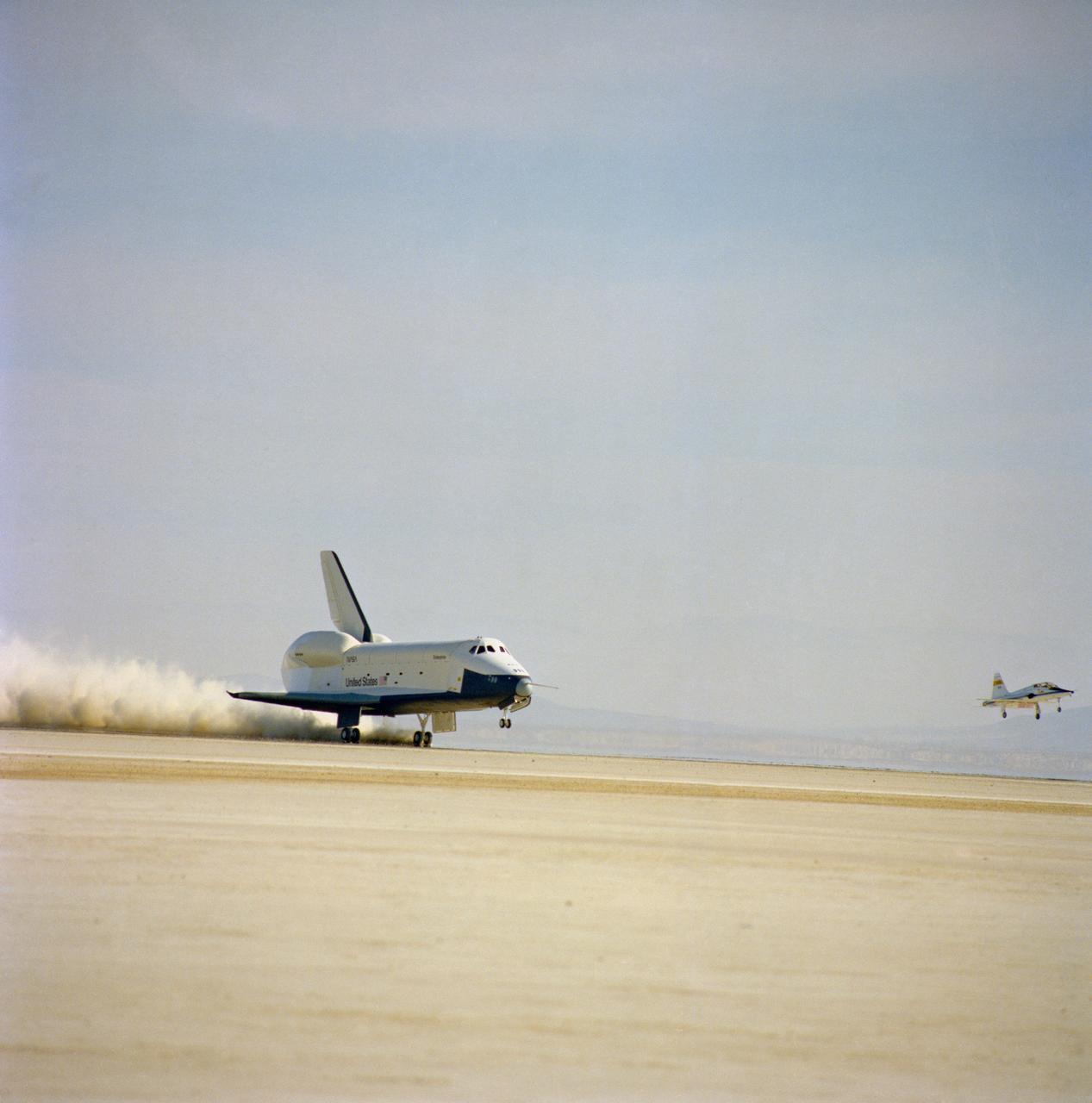
S77-28144 (13 Sept 1977) --- The shuttle orbiter 101 "Enterprise" stirs up a cloud of desert sand and dust as it lands to conclude a five-minute, 28-second unpowered flight during the second free flight of the Shuttle Approach and Landing Tests (ALT) conduced on September 13, 1977 at the Dryden Flight Research Center in Southern California. The Orbiter 101 crew astronauts Joe H. Engle, commander, and Richard H. Truly, pilot. The ALT free flights are designed to verify orbiter subsonic airworthiness, integrated systems operations and pilot-guided approach and landing capability and satisfy prerequisites to automatic flight control and navigation mode. On the right a T-38 chase plane comes in for a landing, also. This picture was taken with an Air Force Test Center 70mm Hasselblad camera installed on a tracking mount parked on the lake bed.
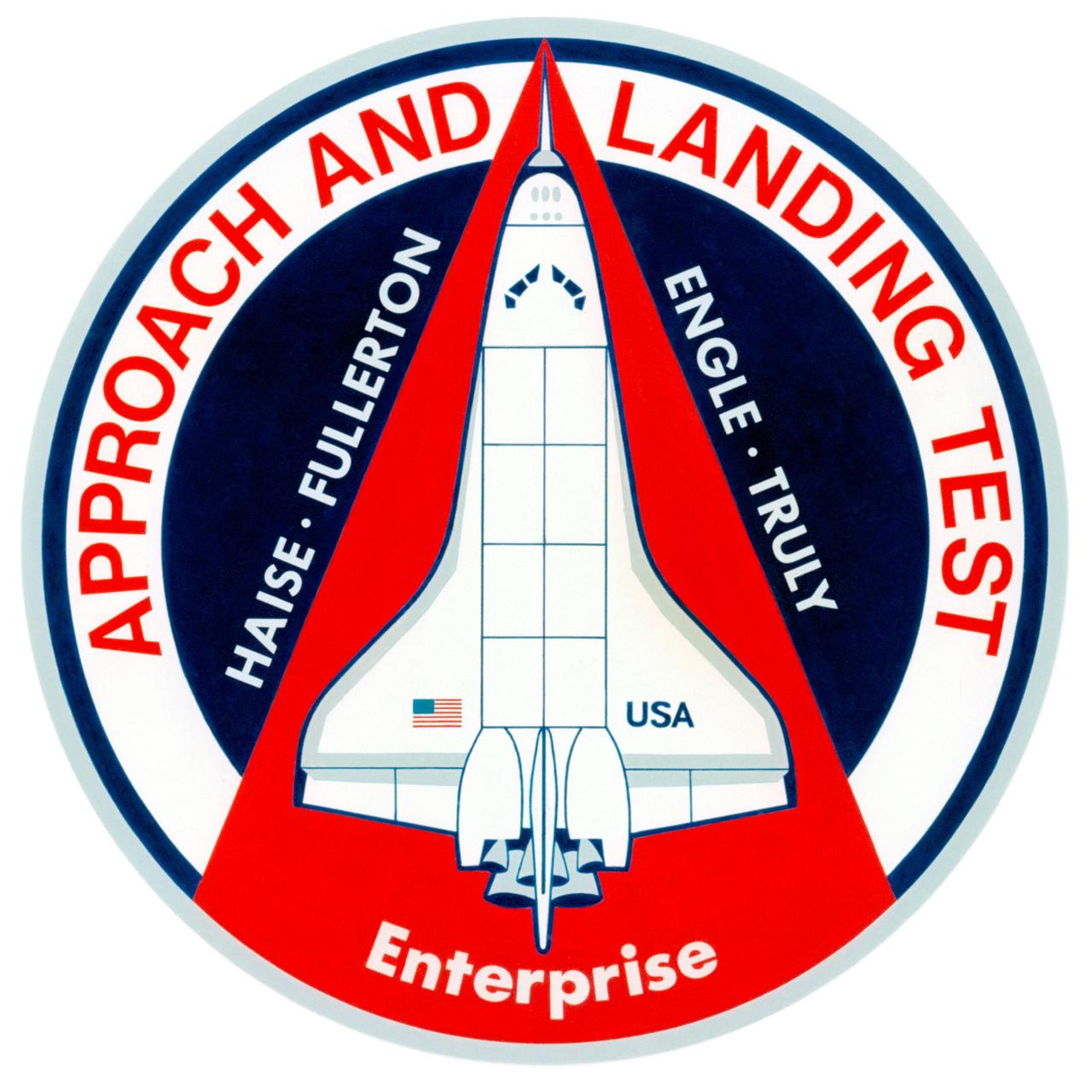
S76-30340 (1976) --- This circular, red, white and blue emblem has been chosen as the official insignia for the Space Shuttle Approach and Landing Test (ALT) flights. A picture of the Orbiter 101 "Enterprise" is superimposed over a red triangle, which in turn is superimposed over a large inner circle of dark blue. The surnames of the members of the two ALT crews are in white in the field of blue. The four crew men are astronauts Fred W. Haise Jr., commander of the first crew; Joe H. Engle, commander of the second crew; and Richard H. Truly, pilot of the second crew. ALT is a series of flights with a modified Boeing 747 Shuttle Carrier Aircraft (SCA) as a ferry aircraft and airborne launch platform for the 67,300 kilogram (75-ton) "Enterprise". The Shuttle Orbiter atmospheric testing is in preparation for the first Earth-orbital flights scheduled in 1979.
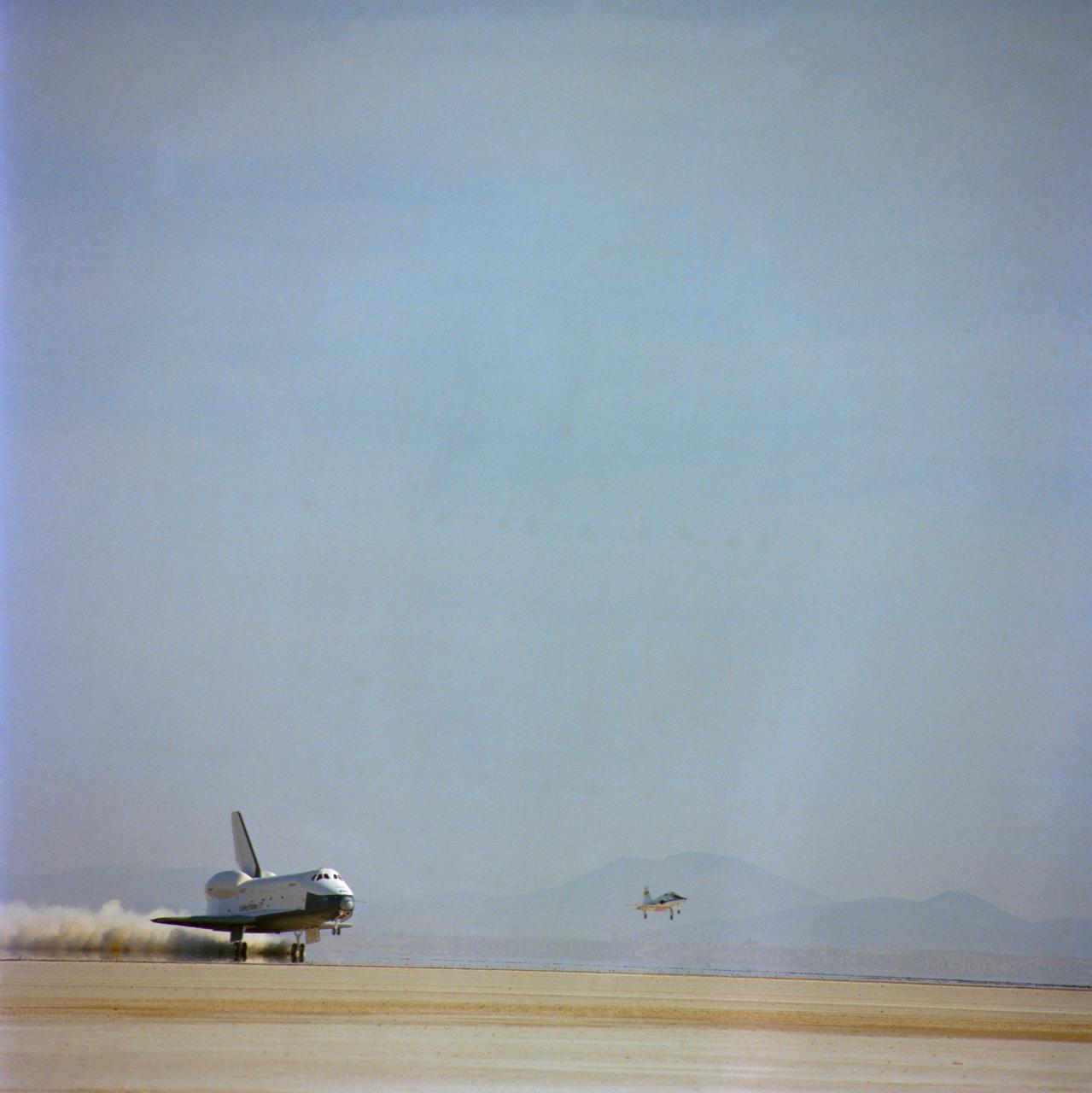
S77-28327 (13 Sept 1977) --- The shuttle orbiter 101 "Enterprise" stirs up a cloud of desert sand and dust as it lands to conclude a five-minute, 28-second unpowered flight during the second free flight of the Shuttle Approach and Landing Tests (ALT) conduced on September 13, 1977 at the Dryden Flight Research Center in Southern California. The Orbiter 101 crew astronauts Joe H. Engle, commander, and Richard H. Truly, pilot. The ALT free flights are designed to verify orbiter subsonic airworthiness, integrated systems operations and pilot-guided approach and landing capability and satisfy prerequisites to automatic flight control and navigation mode. On the right a T-38 chase plane comes in for a landing, also. This picture was taken with an Air Force Test Center 70mm Hasselblad camera installed on a tracking mount parked on the lake bed.
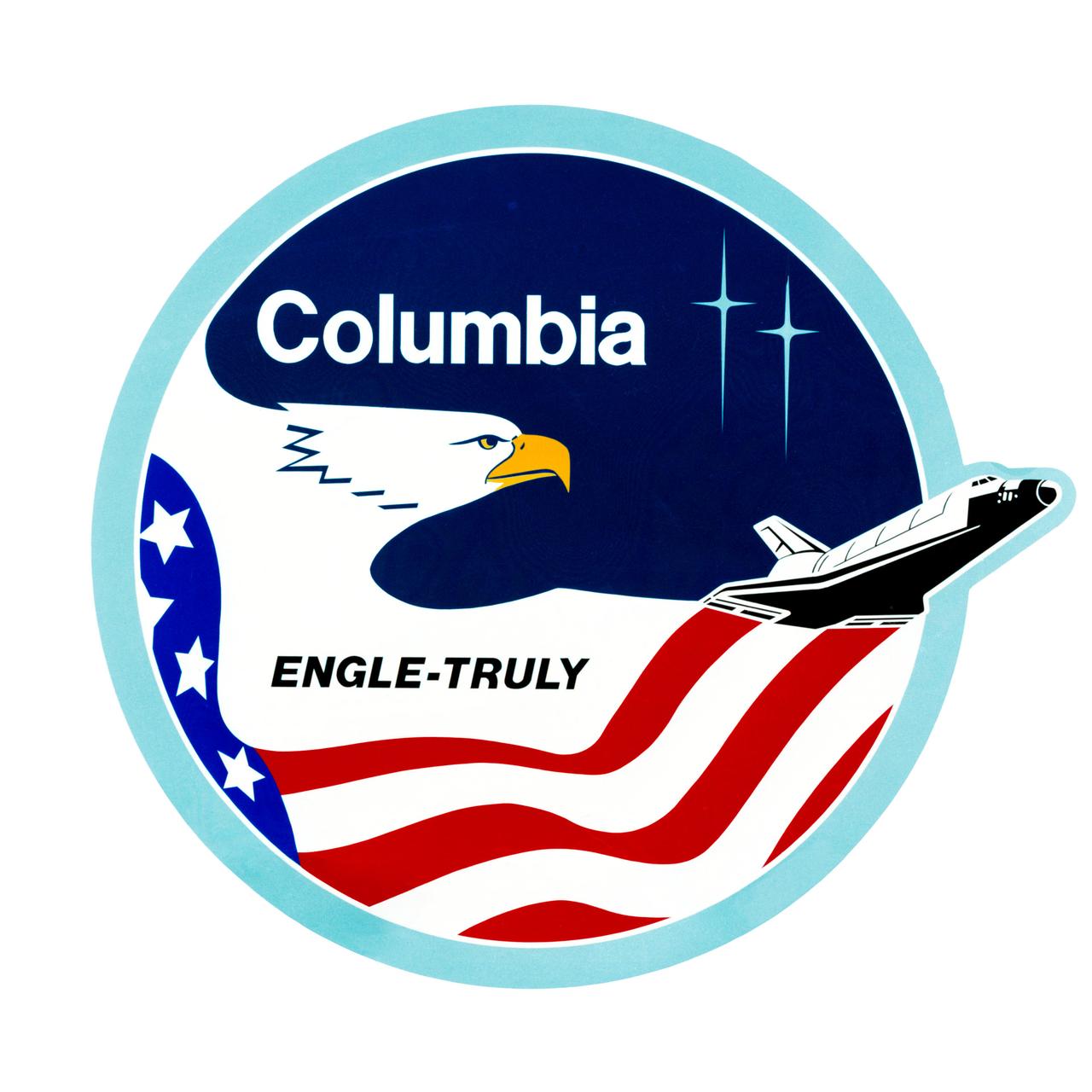
S81-29900 (May 1981) --- This is the official insignia for STS-2 the United States second space shuttle orbital flight test mission. Crewmen are astronauts Joe H. Engle, commander, and Richard H. Truly, pilot. Their spacecraft, orbiter 102 Columbia, is depicted along with the crew members surnames, and the merged eagle and American flag. The number two is significant, as it applies to the number of crew members as well as the second flight for the Columbia and the second in a series of space shuttle missions. The NASA insignia design for space shuttle flights is reserved for use by the astronauts and for other official use as the NASA Administrator may authorize. Public availability has been approved only in the forms of illustrations by the various news media. When and if there is any change in this policy, which is not anticipated, the change will be publicly announced. Photo credit: NASA
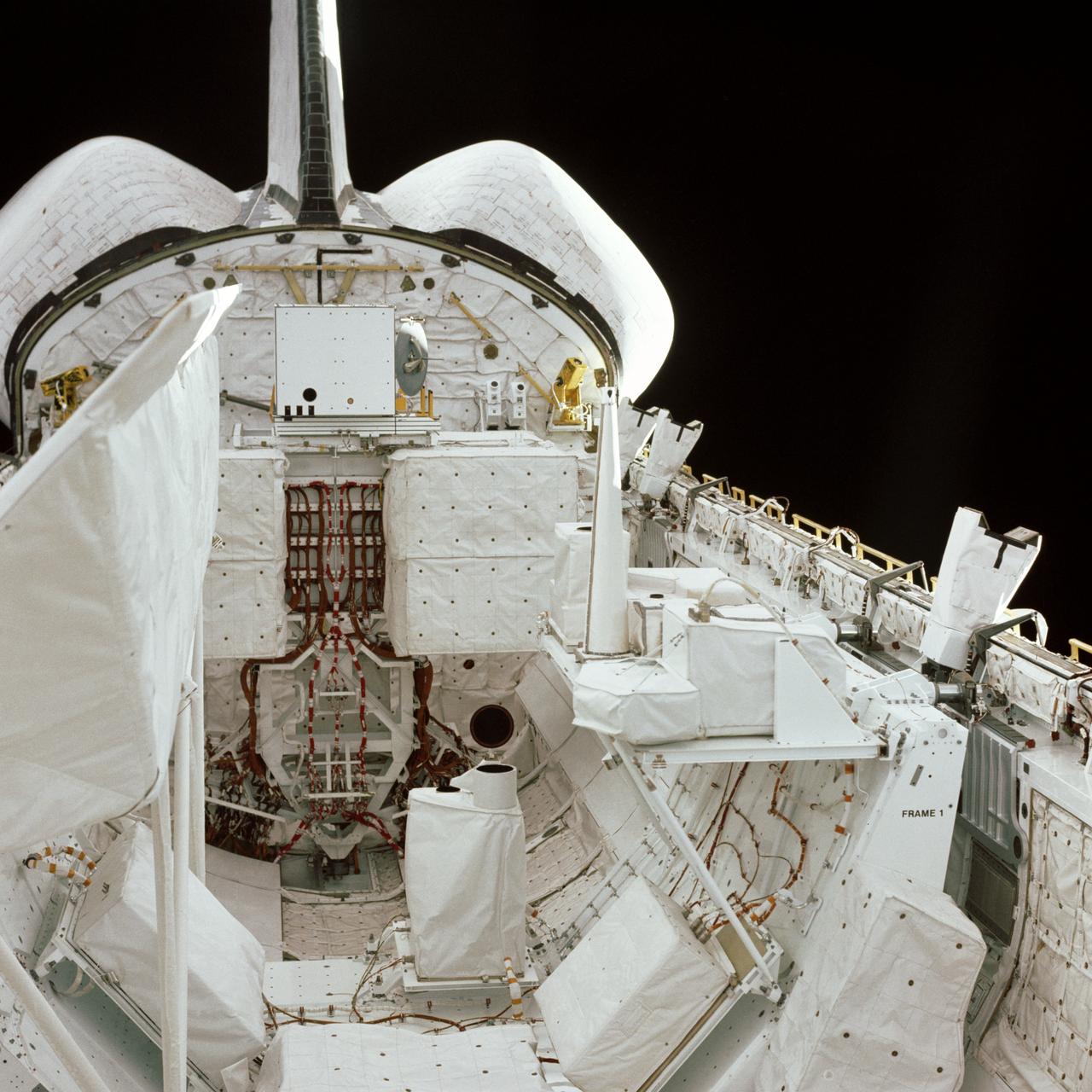
S81-39556 (13 Nov. 1981) --- This photograph of the cargo bay of NASA?s space shuttle Columbia was taken by the STS-2 crewmen from inside the shuttle?s cabin. In the foreground is the pallet of experiments developed by NASA?s Office of Space and Terrestrial Applications (OSTA). The orbital maneuvering system (OMS) pods and vertical stabilizer of Columbia are in upper left corner. The window through which this 70mm frame was exposed is one of two on the aft side of the flight deck. Astronauts Joe H. Engle, commander, and Richard H. Truly, pilot, were aboard the Columbia on its second trip for two days, six hours, 13 minutes and 10 seconds prior to landing at Edwards Air Force Base. Photo credit: NASA
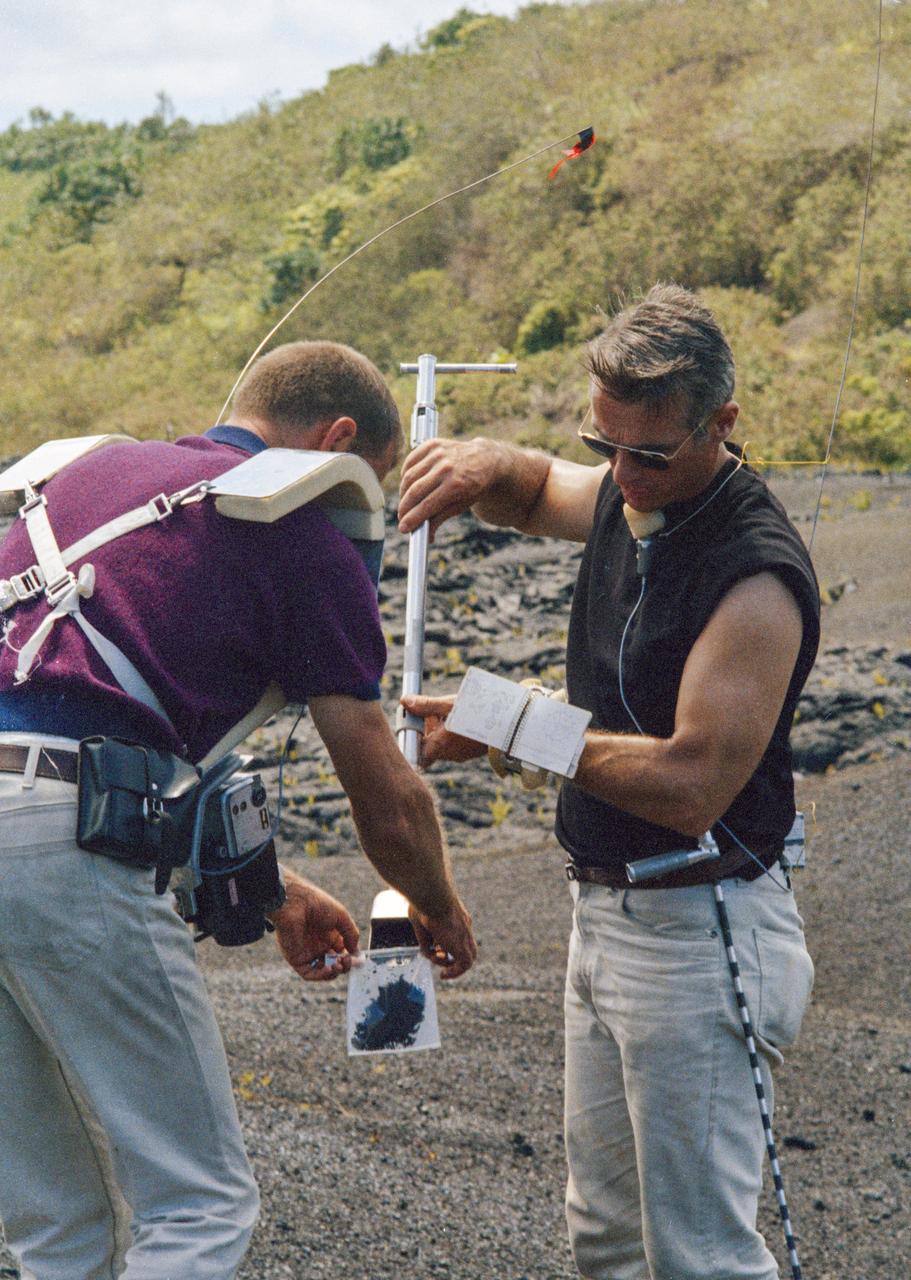
S70-34413 (April 1970) --- Astronaut Eugene A. Cernan (right), backup crew commander of the Apollo 14 lunar landing mission, pours a scoop-full of sample material into a bag held by astronaut Joe H. Engle, Apollo 14 backup crew lunar module pilot. The two joined the prime crew members and other Manned Spacecraft Center (MSC) personnel on a training trip to various areas of Hawaii. Here in Kapoho, the two backup crew members for NASA?s next lunar landing mission are taking part in a full simulation of a traverse on the lunar surface. Note the check-list on Cernan's left wrist. He carries a penetrometer in his belt. The terrain in this area bears many similarities to that on the lunar surface. Photo credit: NASA
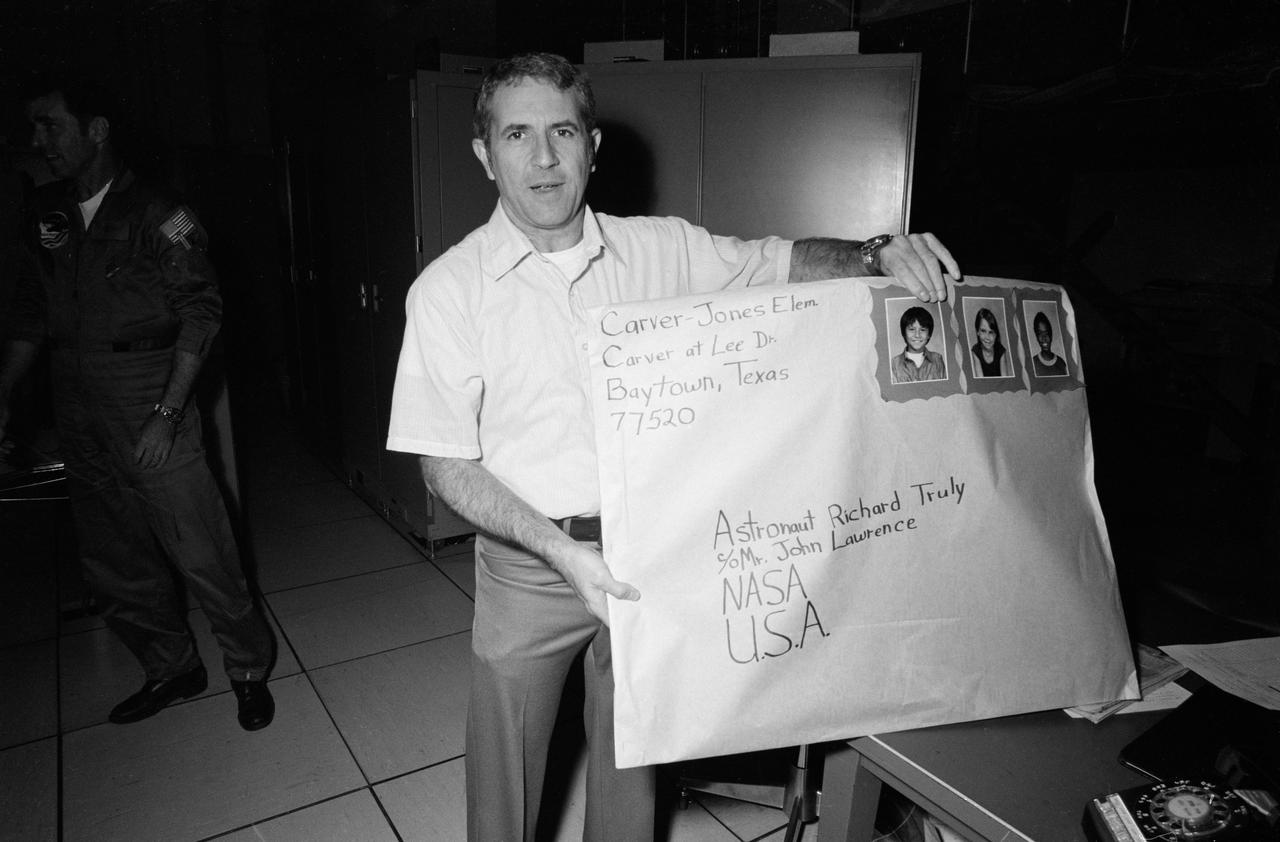
S81-39418 (10 Nov. 1981) --- Aware that astronaut Richard H. Truly, pictured, would be difficult to reach on his 44th birthday Nov. 12, pupils at Carver-Jones Elementary School in Baytown, Texas made certain the STS-2 pilot got his birthday card early. Some art pupils of Shirley Dynum got together and decided that they?d like to custom-make Truly a nice remembrance for a day expected to be filled with remembrances. Nov. 12 is also the date for launch of NASA?s second space shuttle flight in the space shuttle Columbia, with astronauts Truly and Joe H. Engle, commander, at the flight deck. In fact, only moments after this photo was taken, the two departed from JSC to Ellington Air Force Base from which they took T-38 flights to the launch facility in Florida. Photo credit: NASA
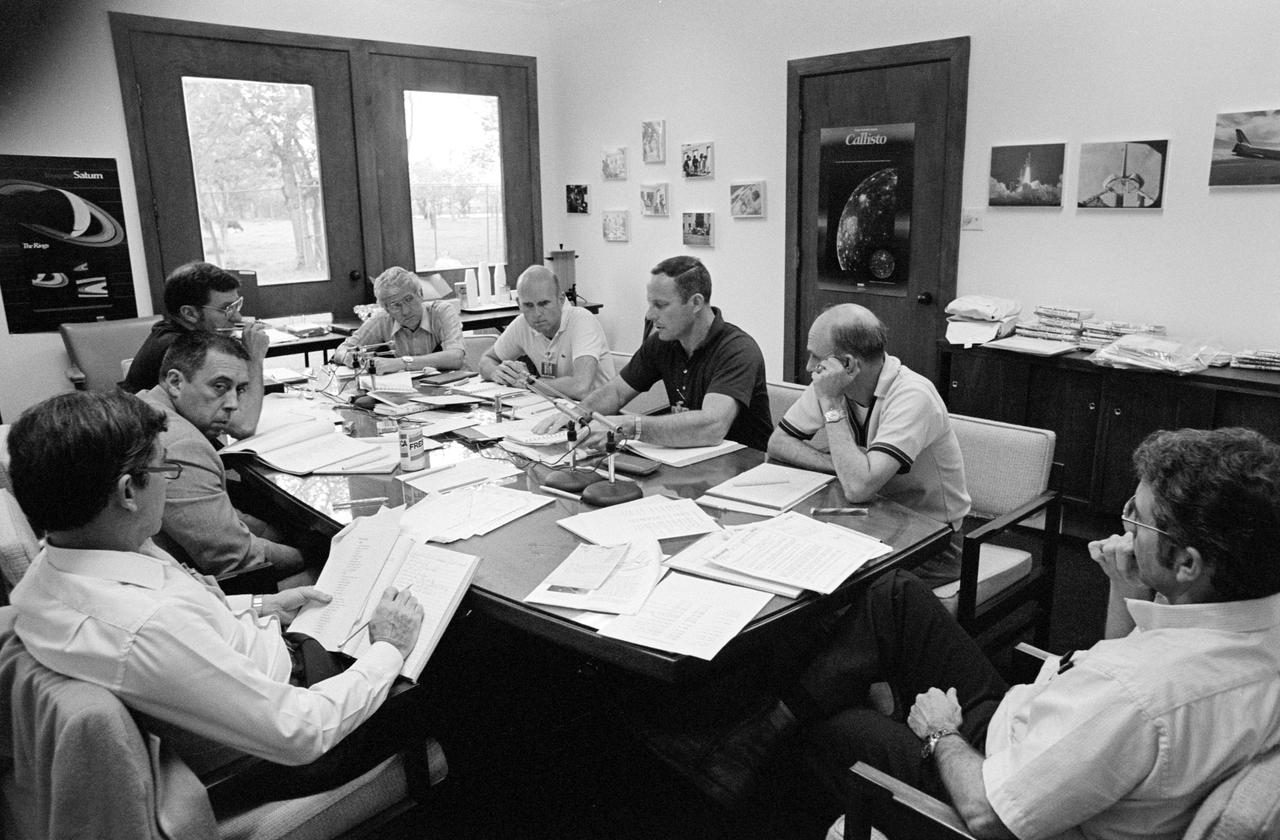
S82-28952 (1 April 1982) --- Crew members from STS-2 and STS-4 meet with the recently returned STS-3 astronauts for a debriefing session at the Johnson Space Center. Taking notes at bottom left foreground is astronaut John W. Young, STS-1 commander and chief of the Astronaut Office at JSC. Clockwise around the table, beginning with Young, are George W. S. Abbey, JSC Director of Flight Operations; and astronauts Joe E. Engle, STS-2 commander; Henry W. Hartsfield Jr., STS-4 pilot; C. Gordon Fullerton, STS-3 pilot; Jack R. Lousma, STS-3 commander; Thomas K. (Ken) Mattingly, STS-4 commander; and Richard H. Truly, STS-2 pilot. Photo credit: NASA
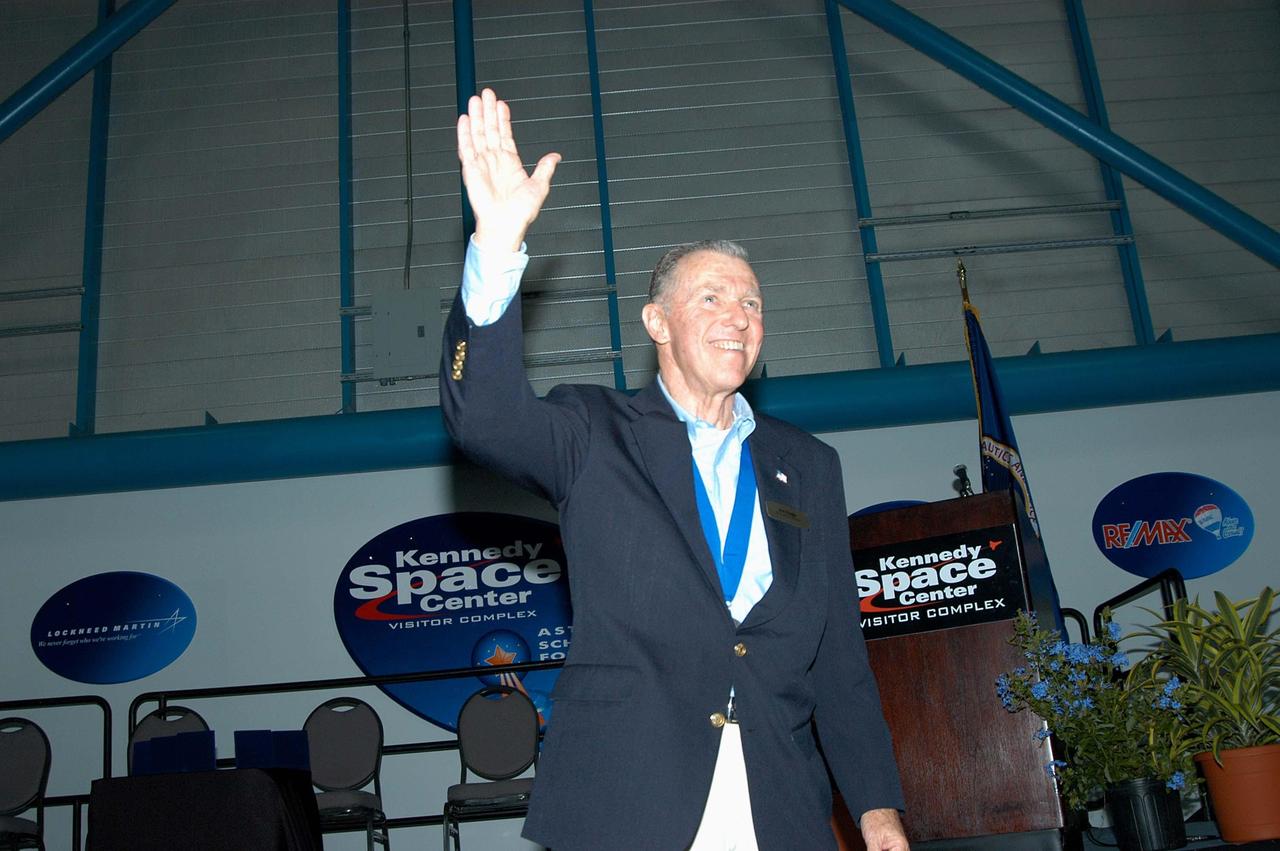
KENNEDY SPACE CENTER, FLA. -- Former astronaut Joe Engle acknowledges the applause as he is introduced as a previous inductee into the U.S. Astronaut Hall of Fame. He and other Hall of Fame members were present for the induction of five new space program heroes into the U.S. Astronaut Hall of Fame: Richard O. Covey, commander of the Hubble Space Telescope repair mission; Norman E. Thagard, the first American to occupy Russia’s Mir space station; the late Francis R. "Dick" Scobee, commander of the ill-fated 1986 Challenger mission; Kathryn D. Sullivan, the first American woman to walk in space; and Frederick D. Gregory, the first African-American to command a space mission and the current NASA deputy administrator. Engle made 16 flights in the X-15 rocket plane before he became a NASA astronaut and flew two Space Shuttle missions. In 1981, he commanded the second flight of Columbia, the first manned spacecraft to be reflown in space, and in 1985 he commanded a five-man crew on the 20th shuttle flight, a satellite-deploy and repair mission. The induction ceremony was held at the Apollo/Saturn V Center at KSC. The U.S. Astronaut Hall of Fame opened in 1990 to provide a place where space travelers could be remembered for their participation and accomplishments in the U.S. space program. The five inductees join 52 previously honored astronauts from the ranks of the Gemini, Apollo, Skylab, Apollo-Soyuz, and Space Shuttle programs.
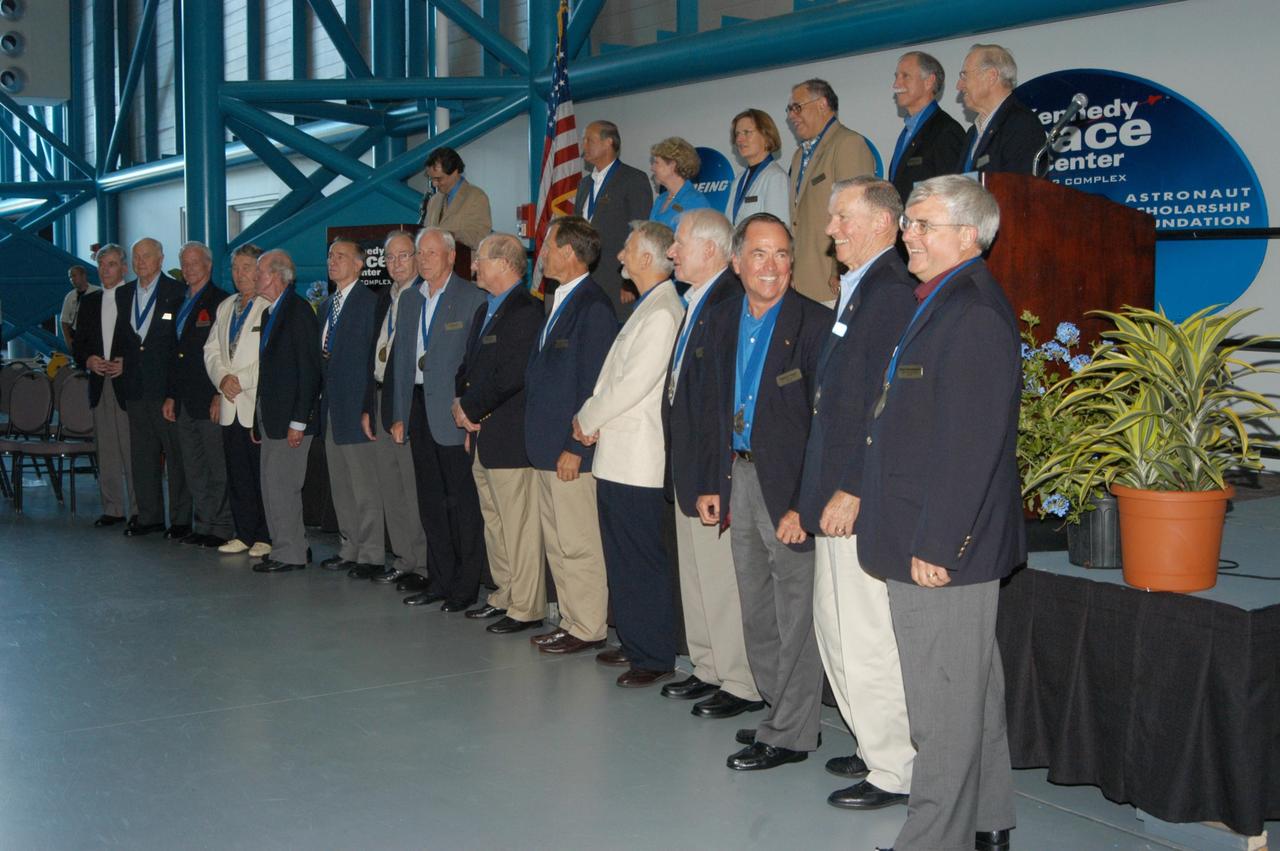
KENNEDY SPACE CENTER, FLA. -- Following the induction ceremony welcoming five new space program heroes in the U.S. Astronaut Hall of Fame, the members line up for a commemorative photo. From left, in front, are John Young, John Glenn Jr., Scott Carpenter, Wally Schirra, Gordon Cooper, Walt Cunningham, Ed Mitchell, Al Worden, Rick Hauck, Ed Gibson, Owen Garriott, Vance Brand, Robert Crippen, Joe Engle, Dan Brandenstein. In back are space author Andrew Chaikin, at the podium; and Norm Thagard, June Scobee representing her late husband Dick Scobee, Kathryn Sullivan, Fred Gregory, Richard Covey and Jim Lovell. The induction ceremony was held at the Apollo/Saturn V Center at KSC. The U.S. Astronaut Hall of Fame opened in 1990 to provide a place where space travelers could be remembered for their participation and accomplishments in the U.S. space program. The five inductees join 52 previously honored astronauts from the ranks of the Gemini, Apollo, Skylab, Apollo-Soyuz, and Space Shuttle programs.
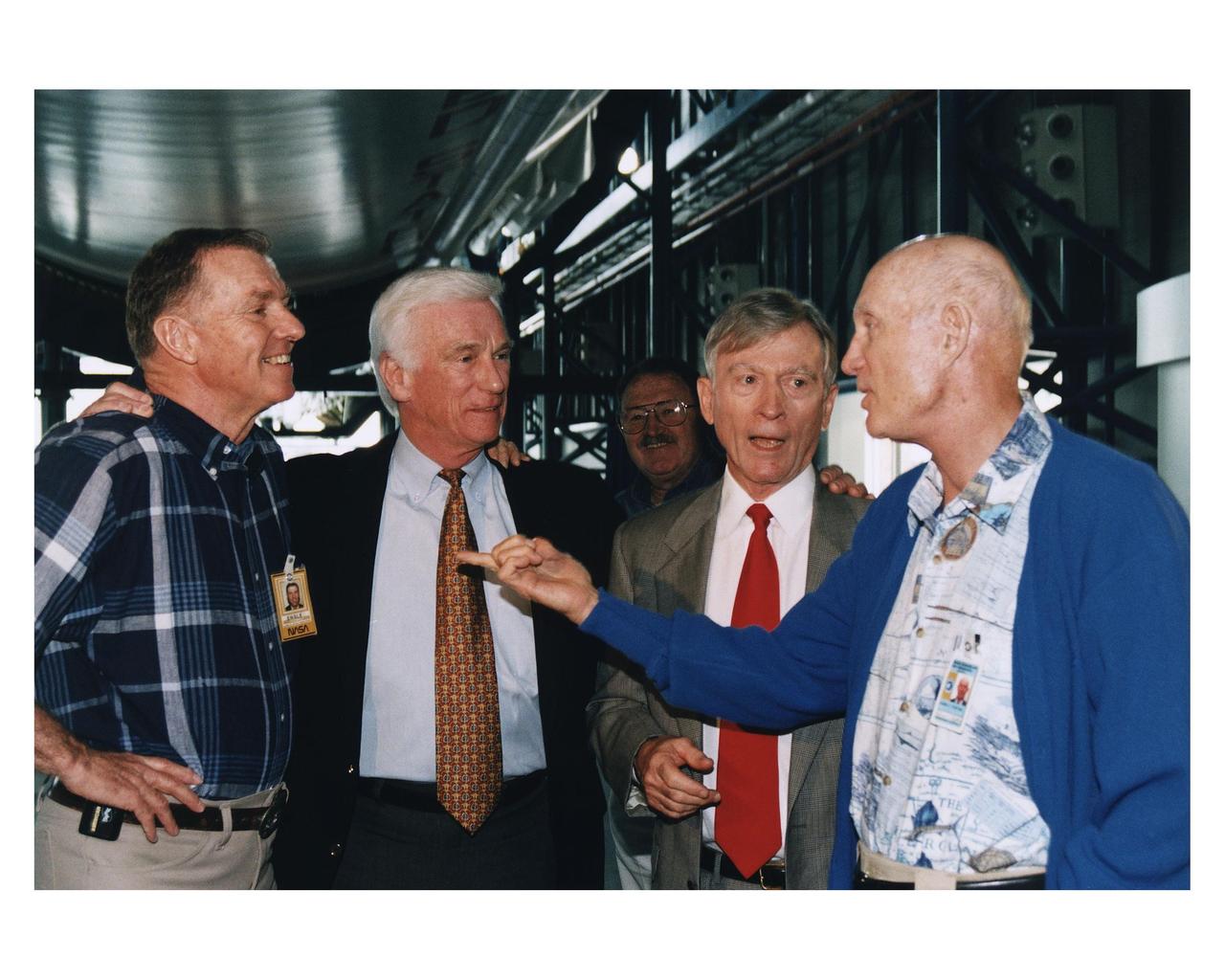
KENNEDY SPACE CENTER, FLA. -- Some of the former Apollo program astronauts recall the past as they tour the new Apollo/Saturn V Center (ASVC) at KSC prior to the gala grand opening ceremony for the facility that was held Jan. 8, 1997. The astronauts were invited to participate in the event, which also featured NASA Administrator Dan Goldin and KSC Director Jay Honeycutt. Standing underneath the KSC Apollo/Saturn V inside the building are (from left): Apollo 14 Back-up Lunar Module Pilot Joe H. Engle; Apollo 10 Lunar Module Pilot and Apollo 17 Commander Eugene A. Cernan; Apollo 10 Command Module Pilot and Apollo 16 Commander John W. Young; and Apollo 10 Commander Thomas P. Stafford. The ASVC also features several other Apollo program spacecraft components, multimedia presentations and a simulated Apollo/Saturn V liftoff. The facility will be a part of the KSC bus tour that embarks from the KSC Visitor Center
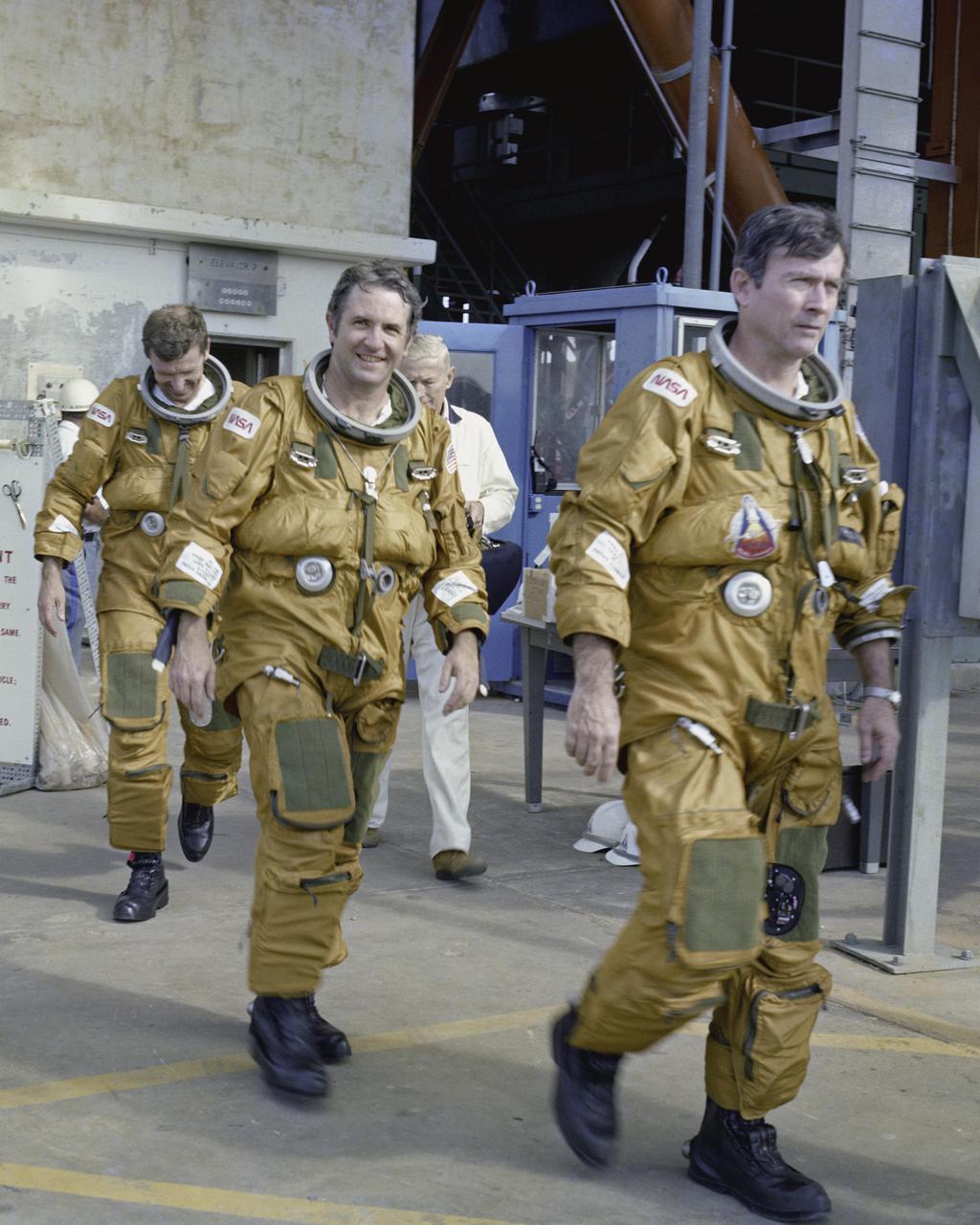
KENNEDY SPACE CENTER, FLA. - Space Shuttle prime and backup astronaut crews are preparing to be briefed on the use of the emergency pad escape system, known as the “slidewire”. From left to right are backup astronauts Joe Engle and Richard Truly, and primary crew Commander John Young. Both the prime and backup crews wore the spacesuits and other equipment they will wear during a mission. The slidewire system provides a quick and sure escape from the upper pad platforms in case of a serious emergency. The flight crews wore the spacesuits and other equipment to be worn during a mission, but sandbags were used to duplicate the weight of riders in the slidewire baskets during the training. The STS-1 mission, known as a shuttle systems test flight, will seek to demonstrate safe launch into orbit and safe return of the orbiter and crew and verify the combined performance of the entire shuttle vehicle -- orbiter, solid rocket boosters and external tank. STS-1 will be launched from Pad A at the Kennedy Space Center's Launch Complex 39 no earlier than March 1981.
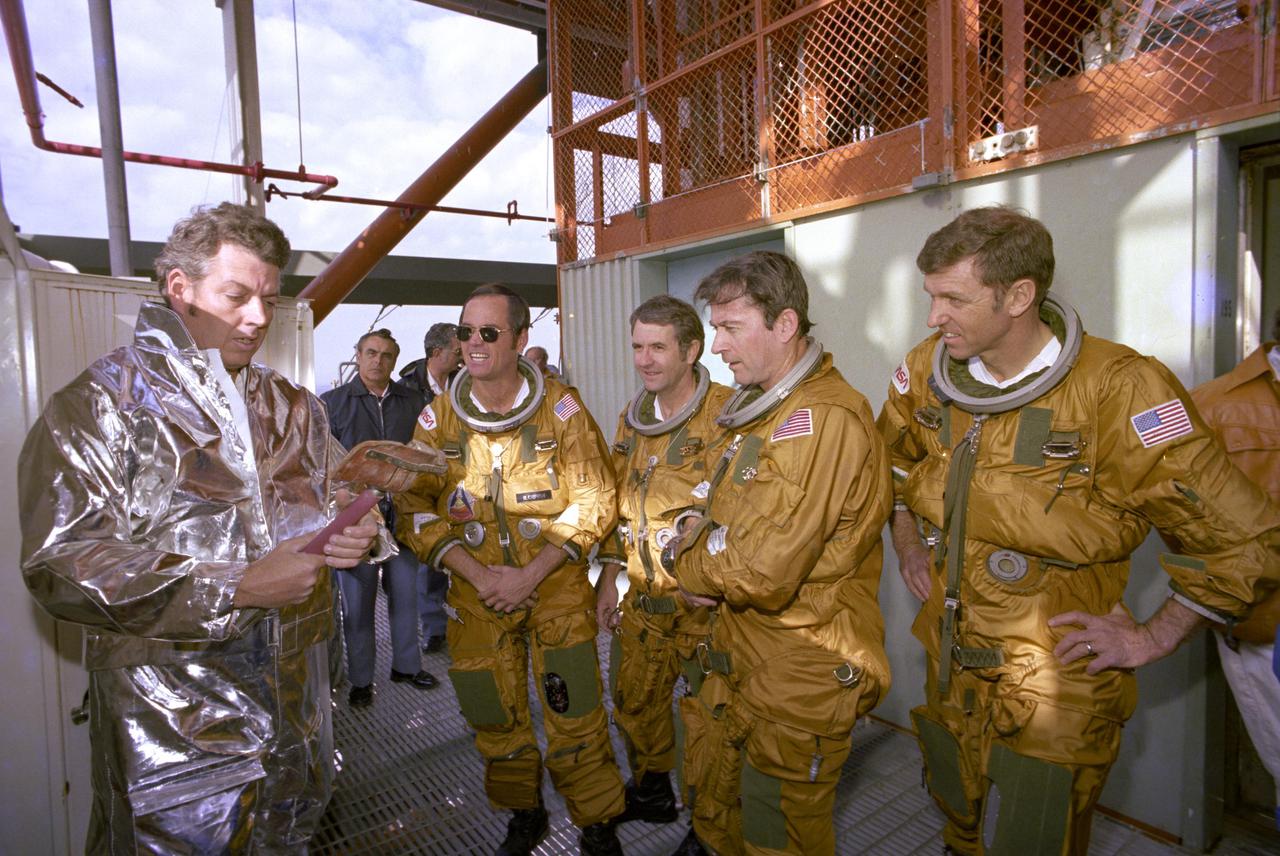
KENNEDY SPACE CENTER, FLA. - On the Fixed Service Structure on Launch Complex 39A, space shuttle astronauts being briefed on the slidewire emergency pad escape system are (left to right) prime crew Pilot Bob Crippen, backup crew member Richard Truly, prime crew Commander John Young and backup crew member Joe Engle. The slidewire system provides a quick escape from upper launch pad platforms in case of a serious emergency. The flight crews wore the spacesuits and other equipment to be worn during a mission, but sandbags were used to duplicate the weight of riders in the slidewire baskets during the training. The STS-1 mission, known as a shuttle systems test flight, will seek to demonstrate safe launch into orbit and safe return of the orbiter and crew and verify the combined performance of the entire shuttle vehicle -- orbiter, solid rocket boosters and external tank. STS-1 will be launched from Pad A at the Kennedy Space Center's Launch Complex 39 no earlier than March 1981.
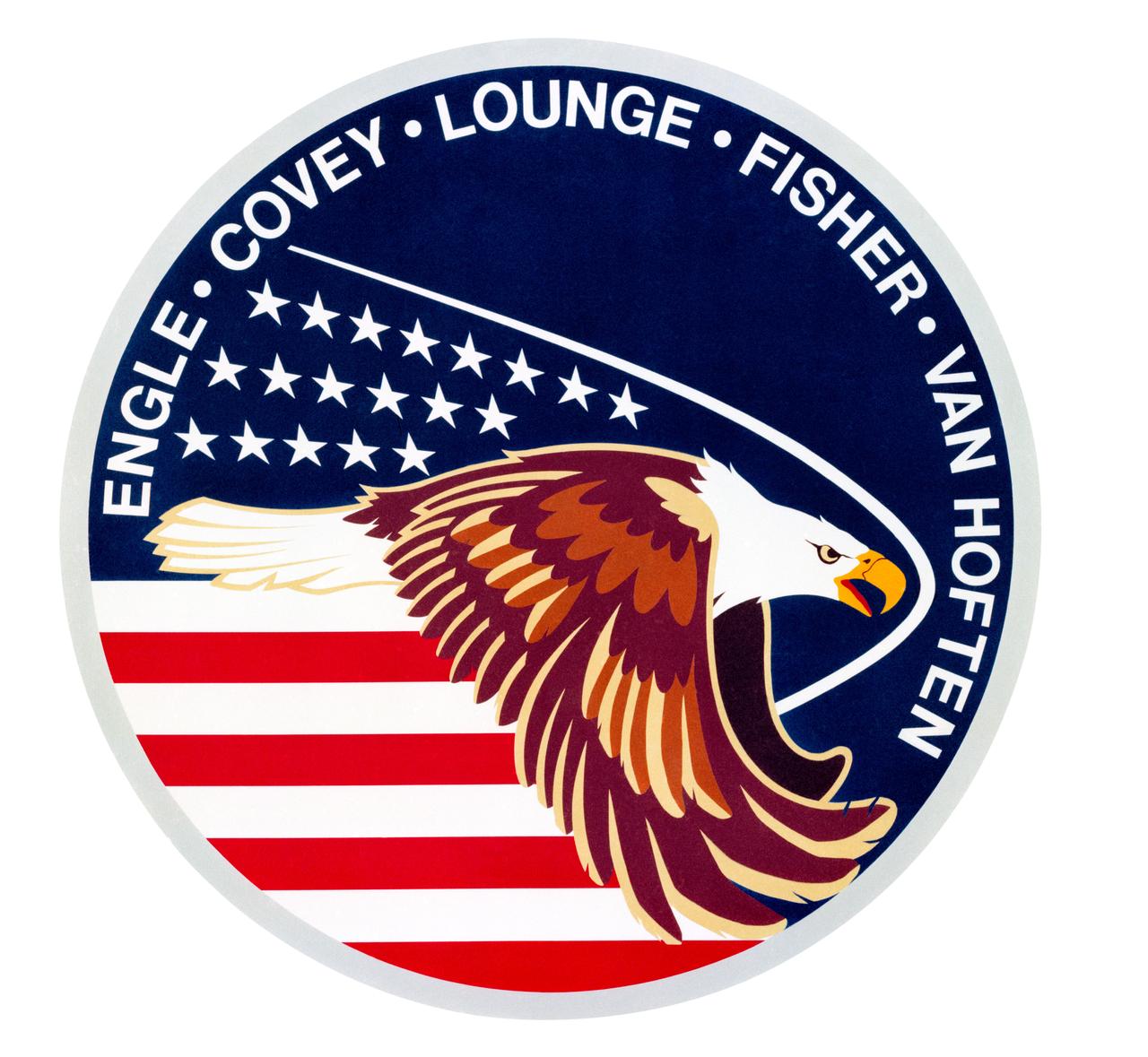
S85-25870 (August 1985) --- The crew emblem for STS-51I is based on a strong patriotic theme with the basic colors of red, white and blue suggesting the American flag and a dominant American bald eagle in aggressive flight. The 19 stars signify the numerical sequence of the flight. The shock wave represents that formed by the orbiter during the entry phase of the flight. Surnames of crew members surround the top part of the circular design. The five-member crew composed of astronauts Joe H. Engle, commander; Richard O. Covey, pilot; John Michael (Mike) Lounge, William F. Fisher and James D. van Hoften, all mission specialists. The NASA insignia design for space shuttle flights is reserved for use by the astronauts and for other official use as the NASA Administrator may authorize. Public availability has been approved only in the forms of illustrations by the various news media. When and if there is any change in this policy, which is not anticipated, the change will be publicly announced. Photo credit: NASA
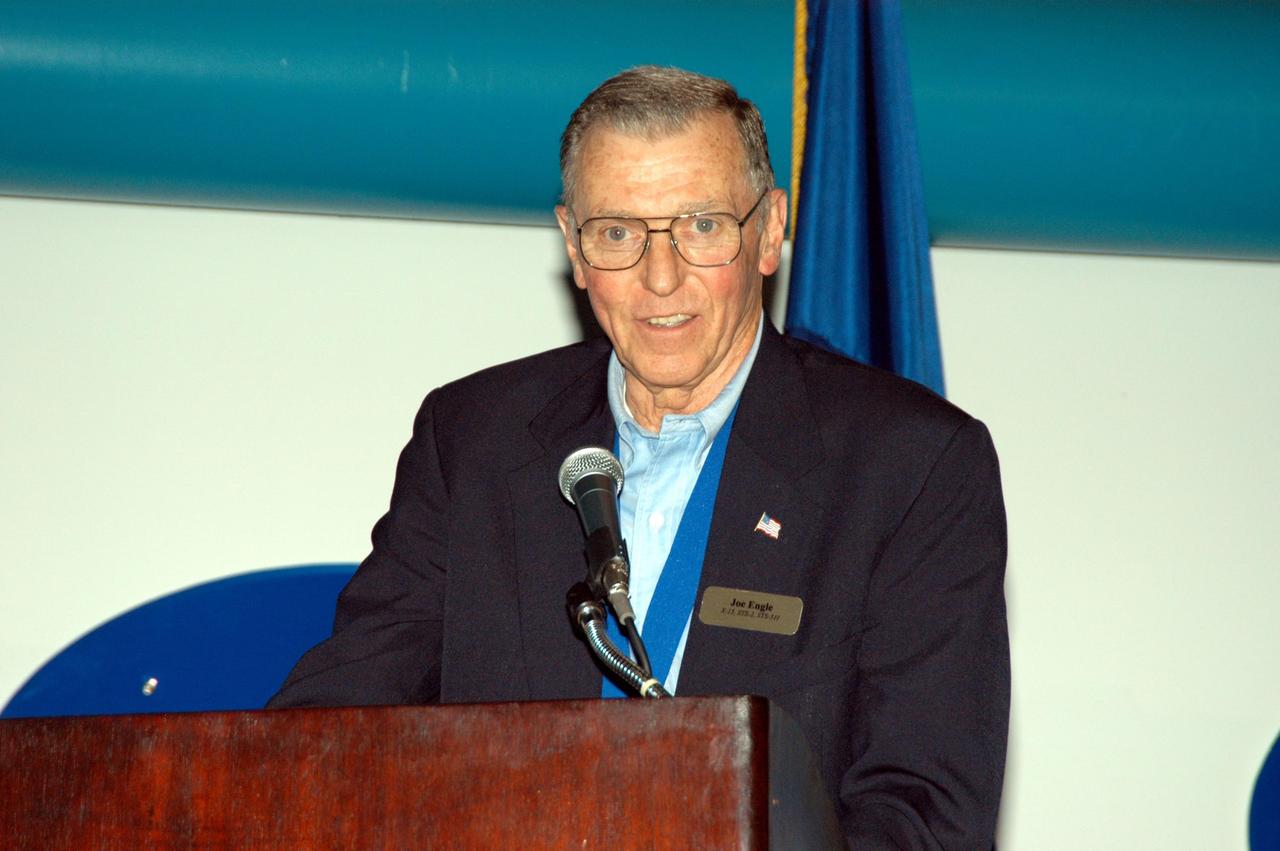
KENNEDY SPACE CENTER, FLA. -- At the Kennedy Space Center Visitor Complex, former NASA astronaut Joe H. Engle participates in the 2004 U.S. Astronaut Hall of Fame induction ceremony. He is introducing inductee Richard O. Covey, commander of the Hubble Space Telescope repair mission. Also chosen for induction in 2004 are Kathryn D. Sullivan, the first American woman to walk in space; Frederick D. Gregory, the first African-American to command a space mission; Norman E. Thagard, the first American to occupy Russia's Mir space station; and the late Francis R. "Dick" Scobee, commander of the ill-fated 1986 Challenger mission. The U.S. Astronaut Hall of Fame opened in 1990 to provide a place where space travelers could be remembered for their participation and accomplishments in the U.S. space program. To be eligible for induction, an individual must have been a U.S. citizen, a NASA astronaut, and out of the active astronaut corps at least five years. The five inductees join 52 previously honored astronauts from the ranks of the Gemini, Apollo, Skylab, Apollo-Soyuz, and Space Shuttle programs.
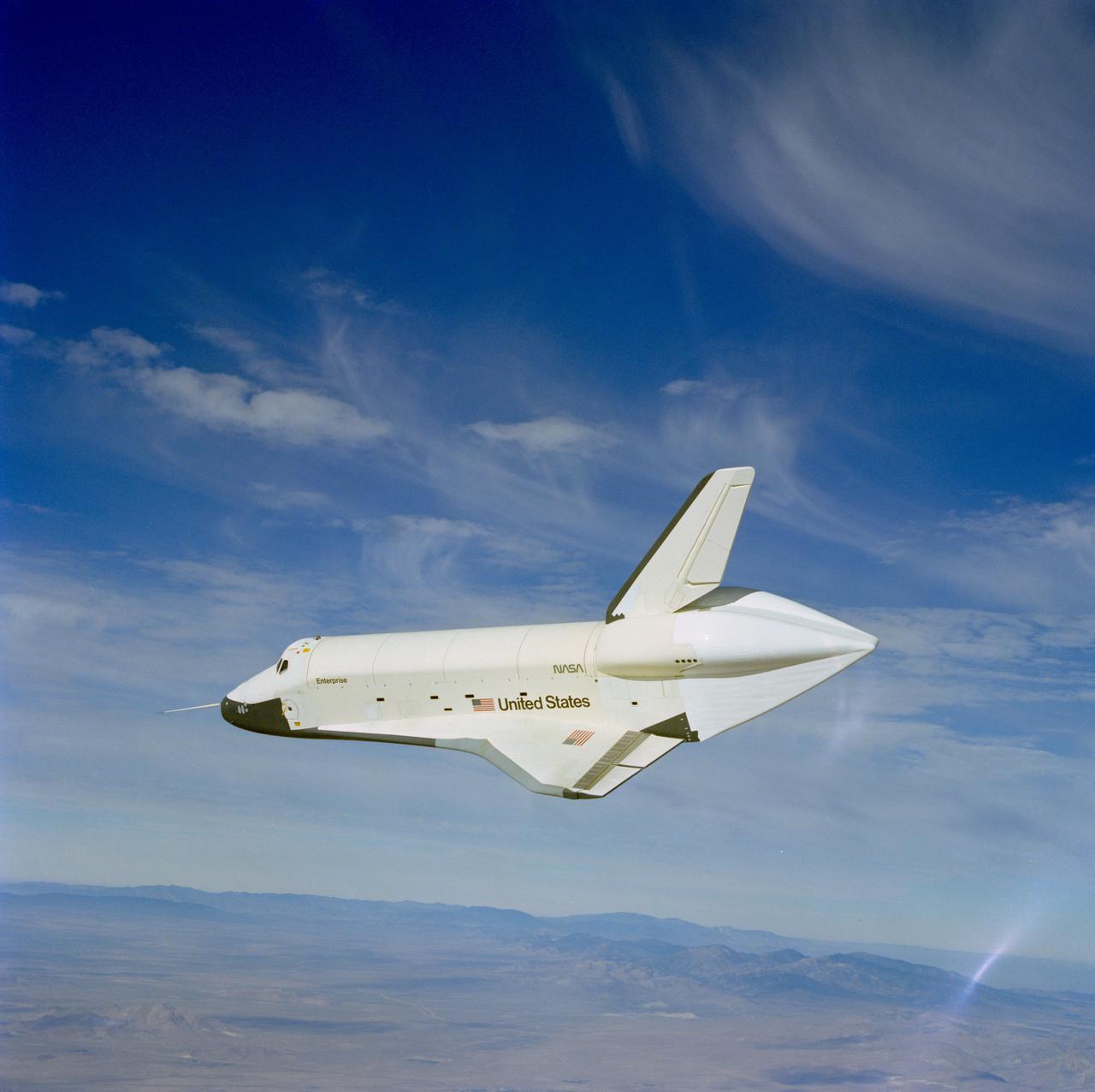
S77-28141 (13 Sept 1977) --- The shuttle Orbiter 101 "Enterprise" makes a slight turn and bank maneuver during the second free flight of the Shuttle Approach and Landing Tests (ALT) conducted on September 13, 1977, at the Dryden Flight Research Center in Southern California. The "Enterprise" separated from the NASA 747 carrier aircraft and landed following a five-minute, 28-second unpowered flight. The Orbiter 101 crew was astronauts Joe H. Engle, commander, and Richard H. Truly, pilot. The ALT free flights are designed to verify orbiter subsonic airworthiness, integrated systems operations and pilot-guided approach and landing capability and satisfy prerequisites to automatic flight control and navigation mode. The orbiter soars above the dry California desert in this post-separation view. Photographer Bill Blunck of JSC's Photographic Technology Laboratory took this picture while riding in T-38 chase plane number two. He used a 70mm Hasselblad camera with an 80mm lens.
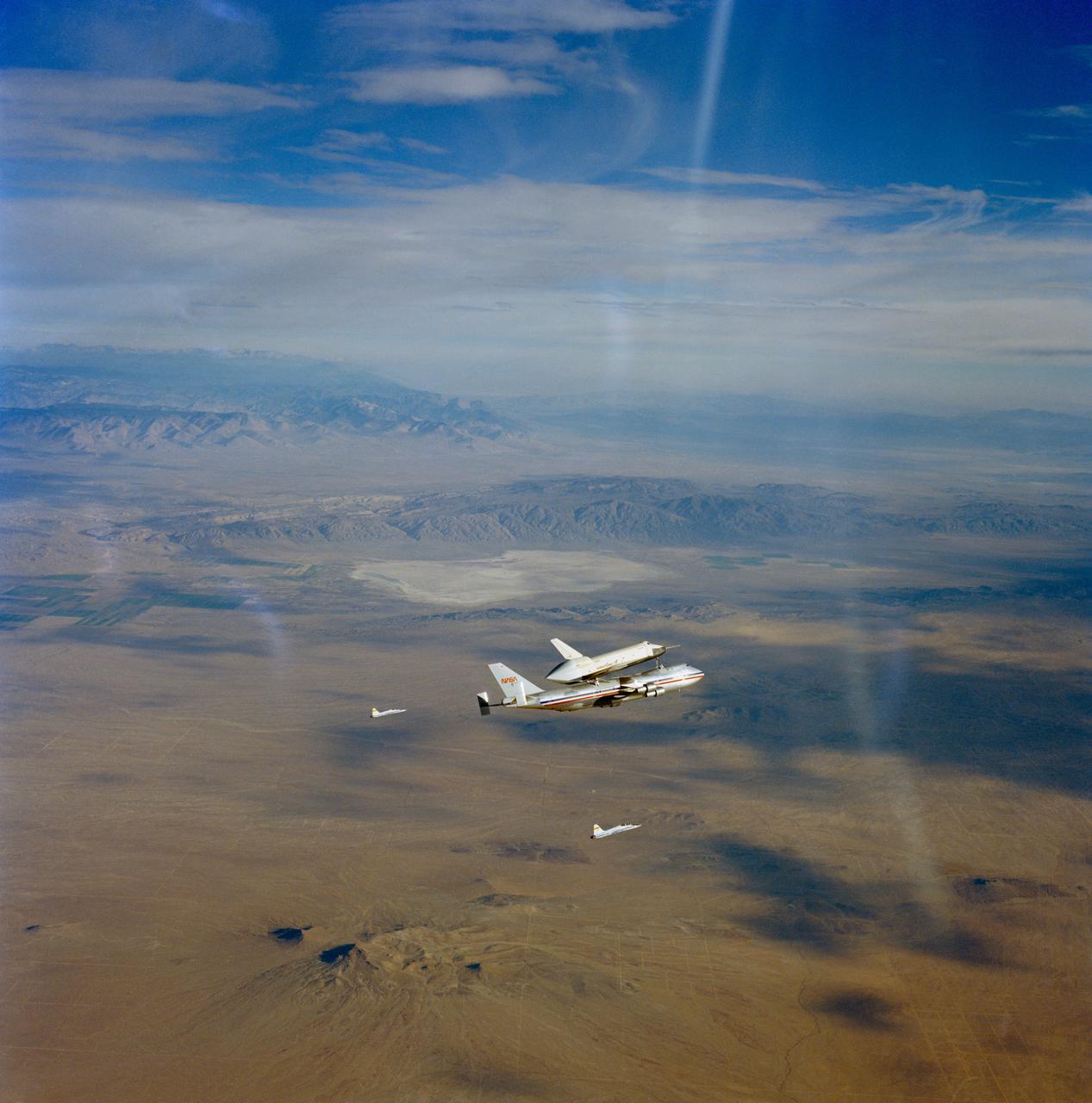
S77-28139 (13 Sept 1977) --- The Orbiter 101 "Enterprise" is seen riding "piggy-back" atope the NASA 747 carrier aircraft during the second free flight of the Shuttle Approach and Landing Tests (ALT) conducted on September 13, 1977, at the Dryden Flight Research Center in Southern California. Moments later the Orbiter 101 separated from the 747 and made a five-minute, 28-second unpowered flight before landing. Astronauts Joe H. Engle, commander, and Richard H. Truly, pilot, were the crew of the "Enterprise." two T-38 chase planes are seen in the background. The ALT free flights are designed to verify orbiter subsonic airworthiness, integrated systems operations and pilot-guided approach andlanding capability and satisfy prerequisites to automatic flight control and navigation mode. Astronaut Vance D. Brand took this picture while riding in T-38 chase plane number five. He used a 70mm Hasselblad camera with an 80mm lens.
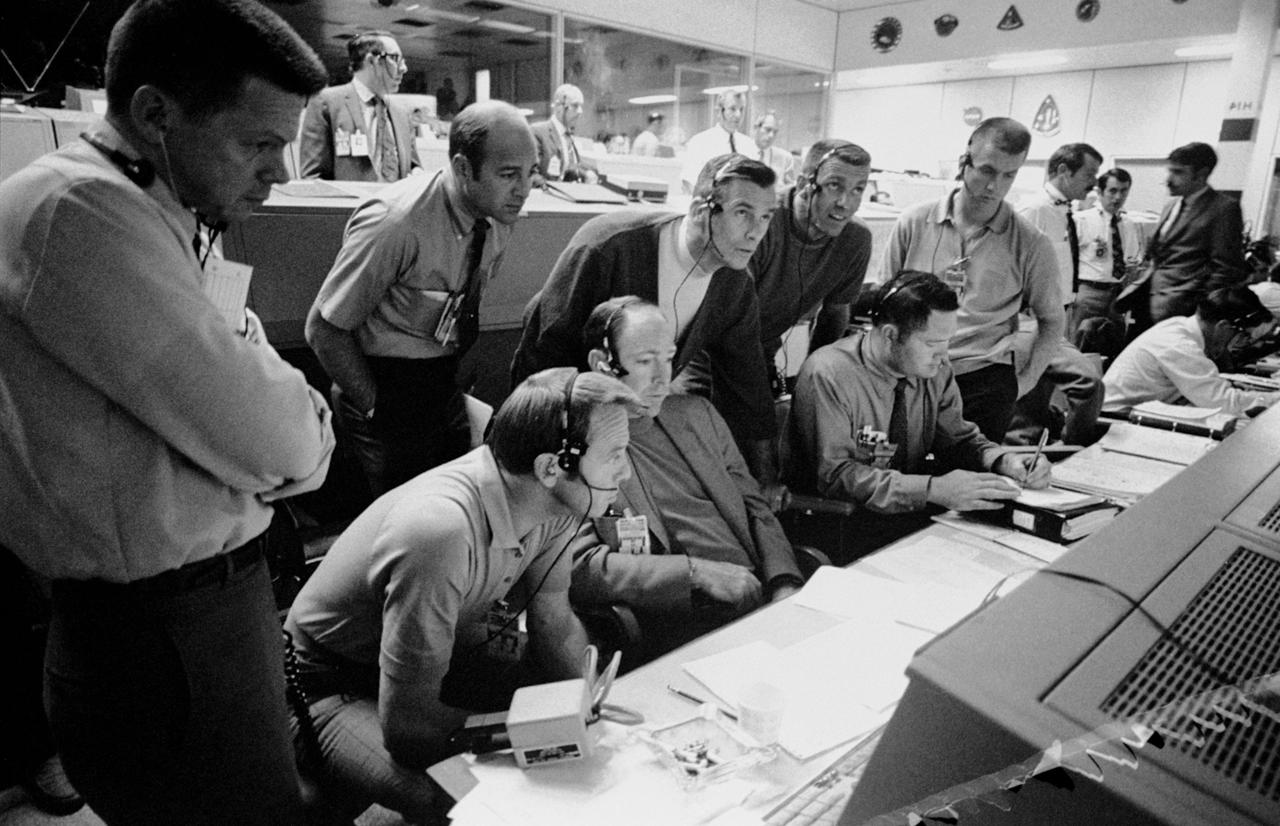
S70-34986 (14 April 1970) --- A group of six astronauts and two flight controllers monitor the console activity in the Mission Operations Control Room (MOCR) of the Mission Control Center (MCC) during the problem-plagued Apollo 13 lunar landing mission. Seated, left to right, are MOCR Guidance Officer Raymond F. Teague; astronaut Edgar D. Mitchell, Apollo 14 prime crew lunar module pilot; and astronaut Alan B. Shepard Jr., Apollo 14 prime crew commander. Standing, left to right, are scientist-astronaut Anthony W. England; astronaut Joe H. Engle, Apollo 14 backup crew lunar module pilot; astronaut Eugene A. Cernan, Apollo 14 backup crew commander; astronaut Ronald E. Evans, Apollo 14 backup crew command module pilot; and M.P. Frank, a flight controller. When this picture was made, the Apollo 13 moon landing had already been canceled, and the Apollo 13 crew men were in trans-Earth trajectory attempting to bring their damaged spacecraft back home.
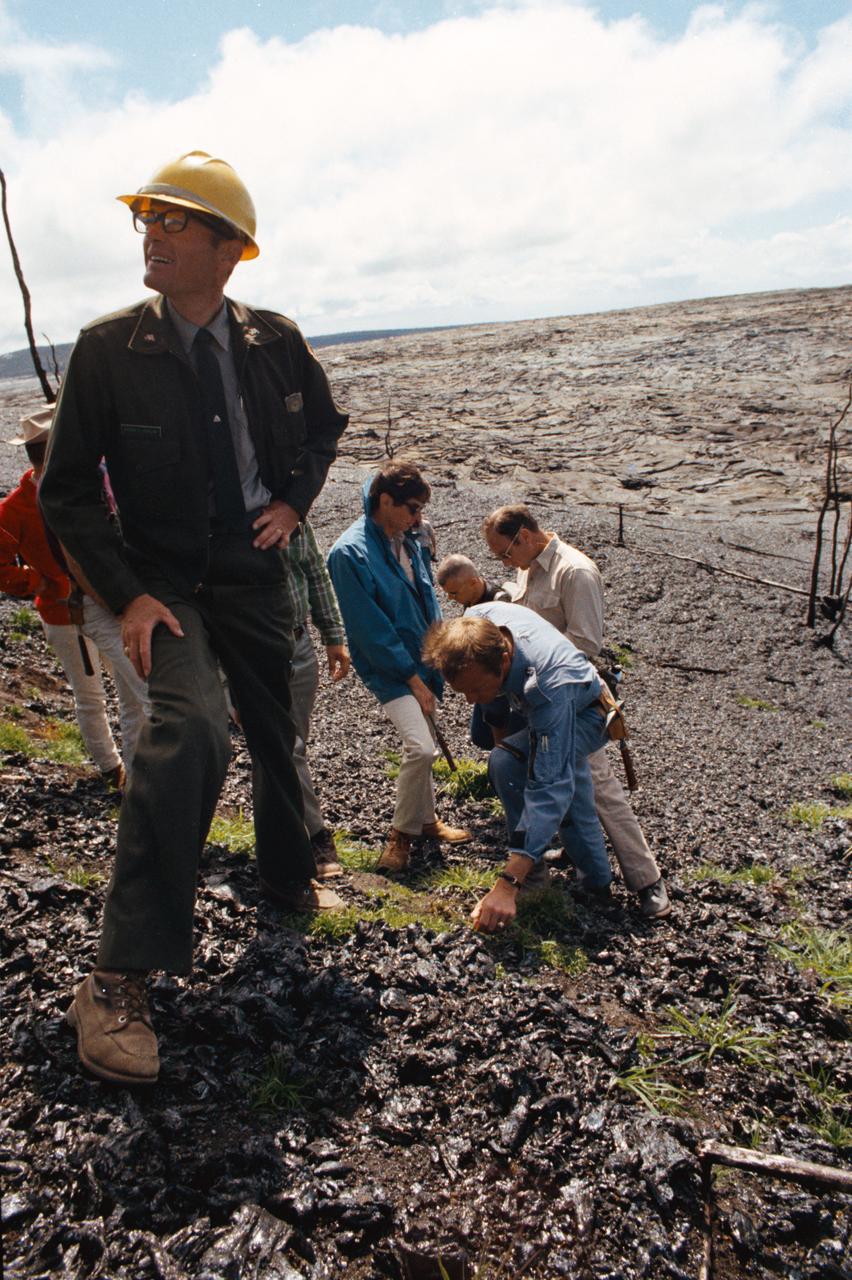
S70-34421 (April 1970) --- Prime crew men and backup crew men, of the Apollo 14 lunar landing mission, look over an area near the site of a volcanic eruption on Dec. 30, 1969. Astronauts Alan B. Shepard Jr. (leaning with left hand on ground) and Edgar D. Mitchell (behind Shepard, wearing dark glasses) are the prime crew men scheduled to walk on the moon. Astronauts Eugene A. Cernan (almost obscured at extreme left) and Joe H. Engle (partially visible, on Cernan's right) are backup crew commander and lunar module pilot, respectively, for the mission. Others in the photograph are Pat Crosland (in hard hat), a geologist and a park ranger in Hawaii Volcanoes State Park; Michael C. McEwen (facing Mitchell) of the Geology Branch, Lunar and Earth Sciences Division, Manned Spacecraft Center (MSC); and astronaut Bruce McCandless II, who made the trip to serve as a spacecraft communicator during simulations of extravehicular activity (EVA) on the lunar surface.
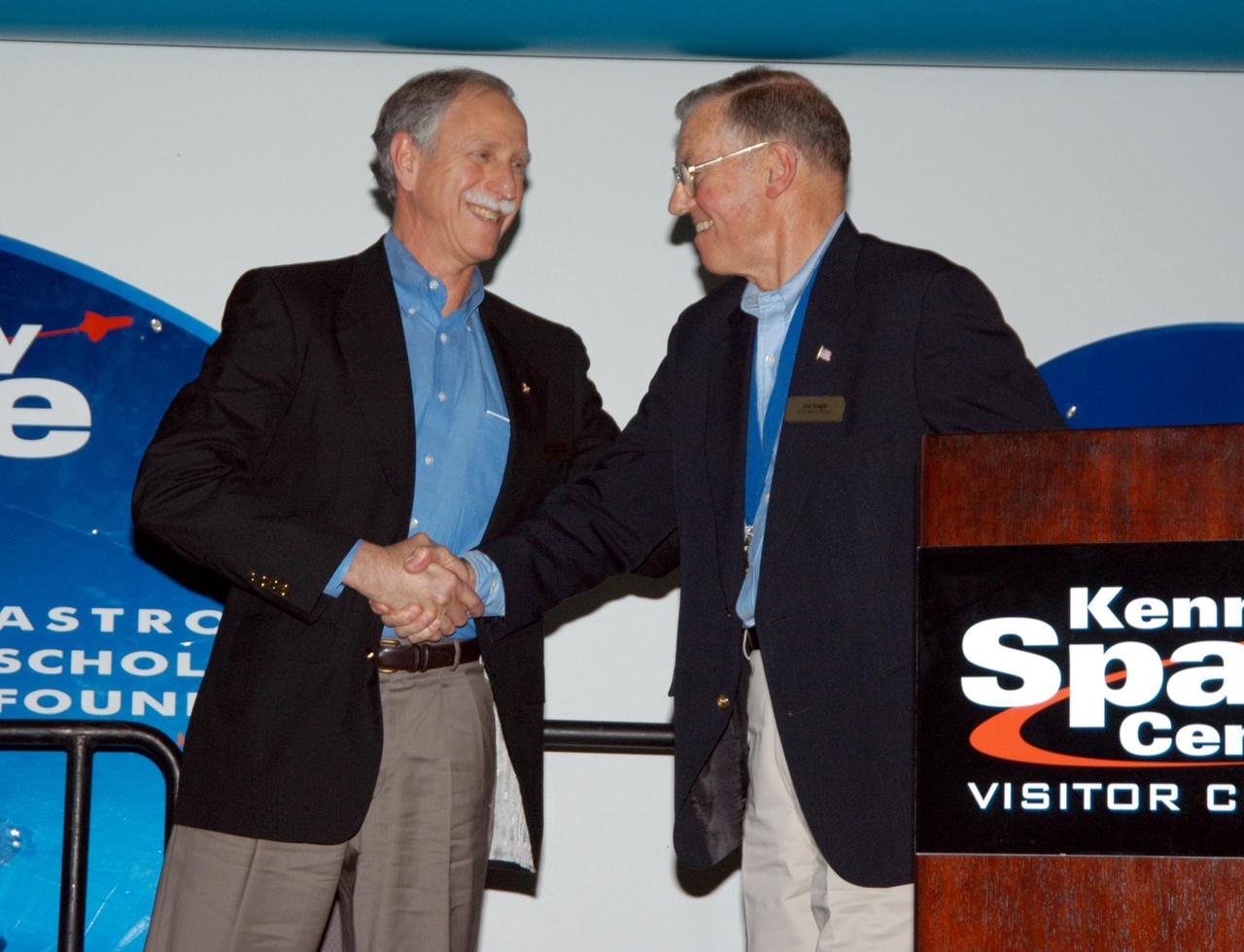
KENNEDY SPACE CENTER, FLA. -- At the Kennedy Space Center Visitor Complex, former NASA astronaut Joe H. Engle (right) congratulates Richard O. Covey, commander of the Hubble Space Telescope repair mission, on his induction into the U.S. Astronaut Hall of Fame. Also chosen for this honor in 2004 are Kathryn D. Sullivan, the first American woman to walk in space; Frederick D. Gregory, the first African-American to command a space mission; Norman E. Thagard, the first American to occupy Russia's Mir space station; and the late Francis R. "Dick" Scobee, commander of the ill-fated 1986 Challenger mission. The U.S. Astronaut Hall of Fame opened in 1990 to provide a place where space travelers could be remembered for their participation and accomplishments in the U.S. space program. To be eligible for induction, an individual must have been a U.S. citizen, a NASA astronaut, and out of the active astronaut corps at least five years. The five inductees join 52 previously honored astronauts from the ranks of the Gemini, Apollo, Skylab, Apollo-Soyuz, and Space Shuttle programs.
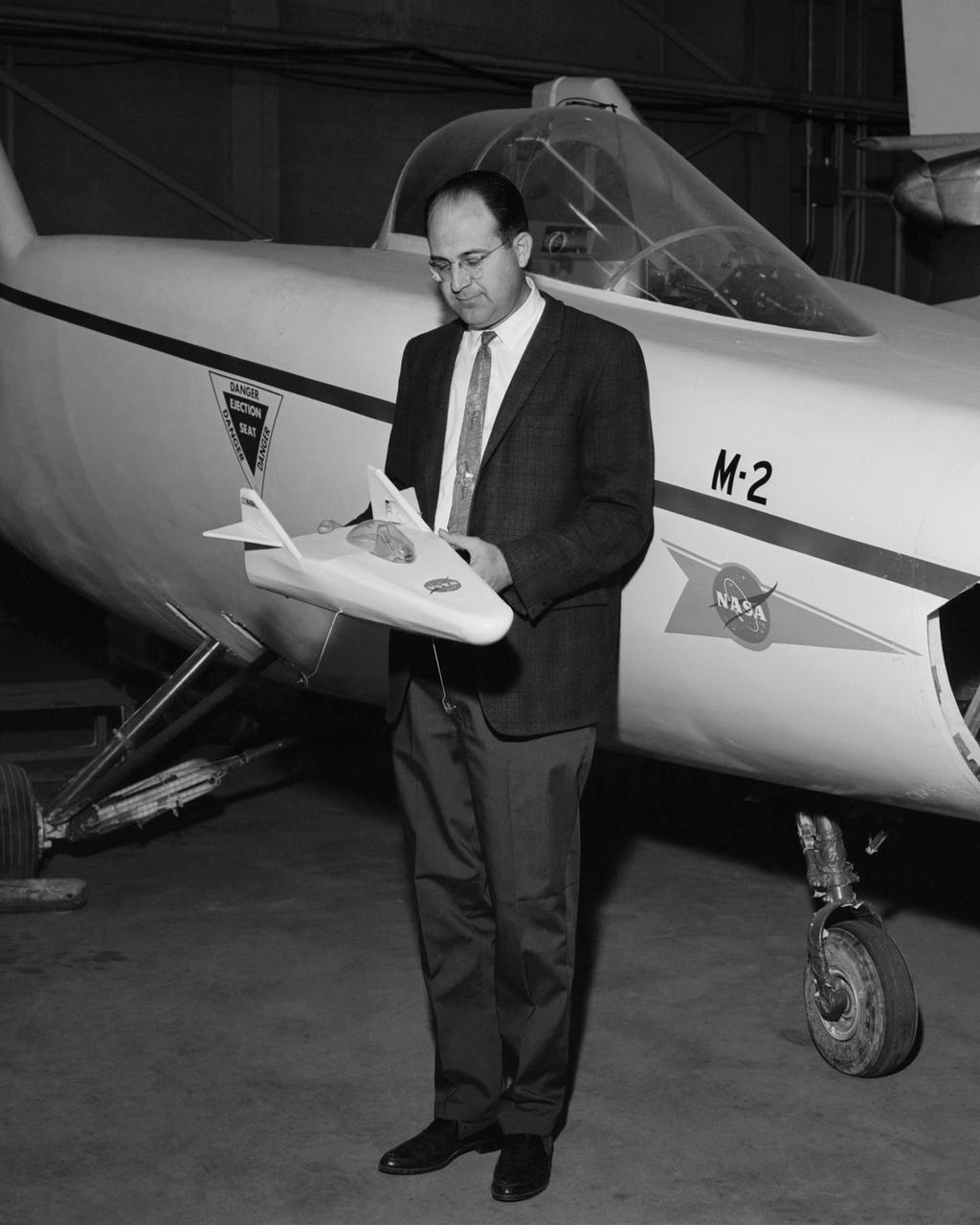
Dale Reed with a model of the M2-F1 in front of the actual lifting body. Reed used the model to show the potential of the lifting bodies. He first flew it into tall grass to test stability and trim, then hand-launched it from buildings for longer flights. Finally, he towed the lifting-body model aloft using a powered model airplane known as the "Mothership." A timer released the model and it glided to a landing. Dale's wife Donna used a 9 mm. camera to film the flights of the model. Its stability as it glided--despite its lack of wings--convinced Milt Thompson and some Flight Research Center engineers including the center director, Paul Bikle, that a piloted lifting body was possible.