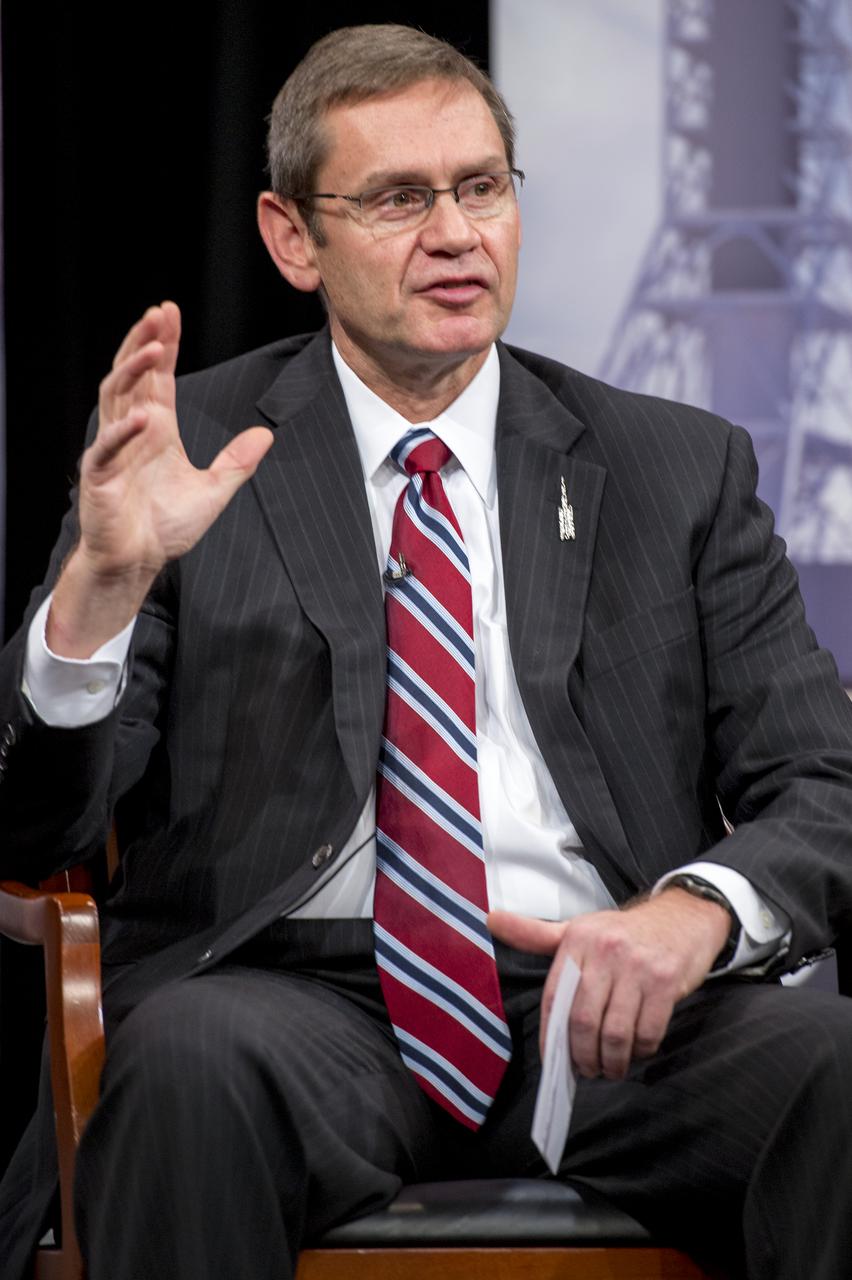
John Elbon, Vice President and General Manager, Boeing Space Exploration, gestures while speaking at a panel discussion on deep space exploration using the Space Launch System and Orion spacecraft at the Newseum in Washington on Tuesday, November 12, 2013. Photo Credit: (NASA/Jay Westcott)
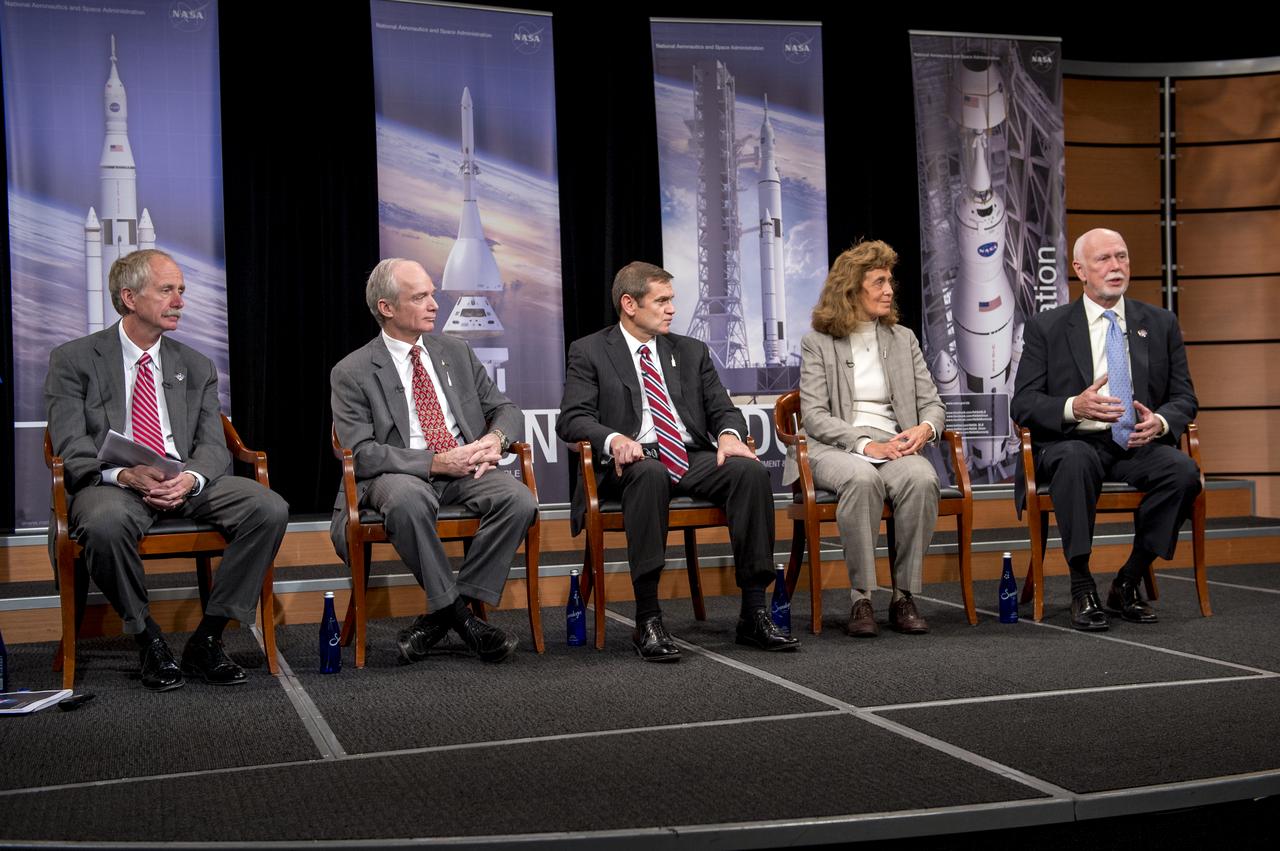
L-R: William Gerstenmaier, NASA Associate Administrator for human exploration and operations; Charlie Precourt, Vice President and General Manager, ATK Space Launch Division; John Elbon, Vice President and General Manager, Boeing Space Exploration; Julie Van Kleek, Vice President, space programs, Aerojet Rocketdyne; and Jim Crocker, Vice President and General Manager, civil space, Lockheed Martin Space Systems, participate in a panel discussion on deep space exploration using the Space Launch System and Orion spacecraft at the Newseum in Washington on Tuesday, November 12, 2013. Photo Credit: (NASA/Jay Westcott)
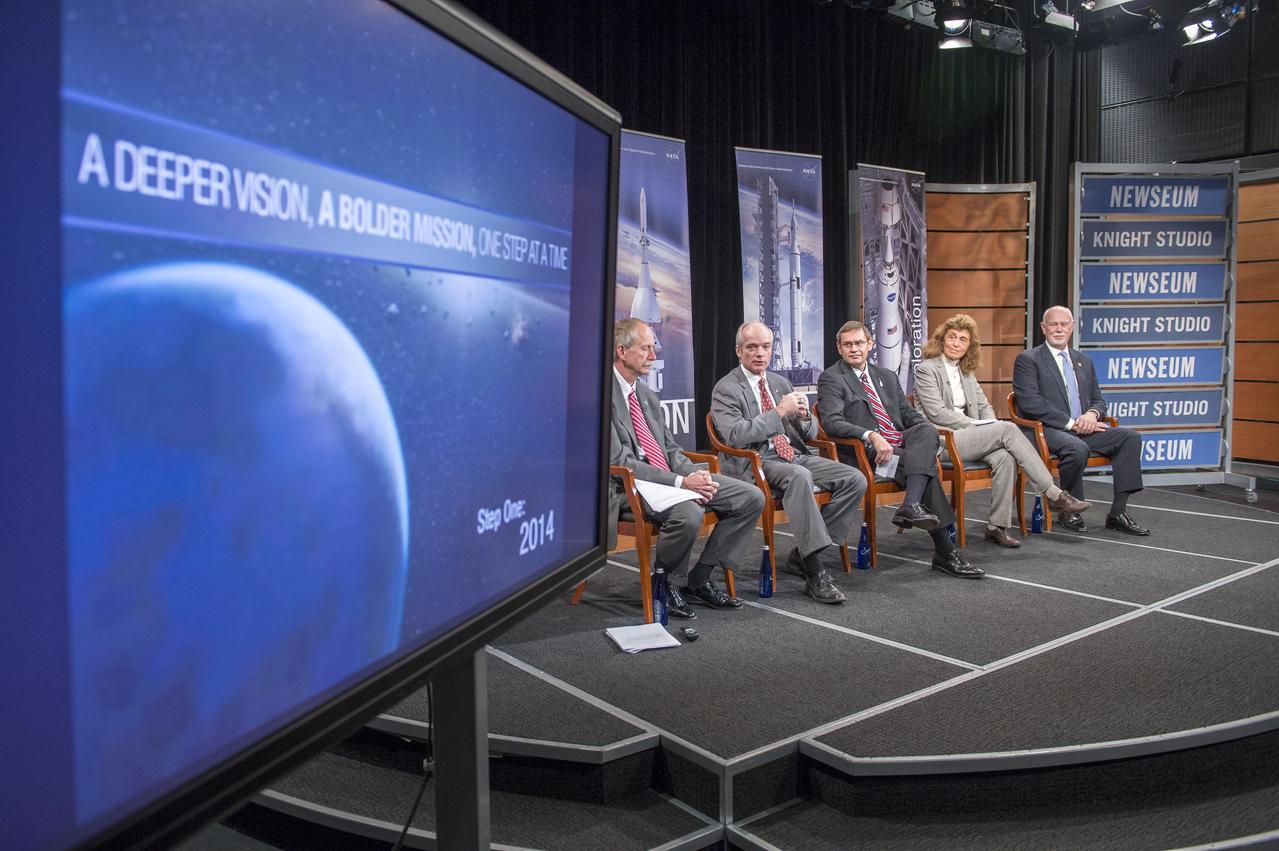
L-R: William Gerstenmaier, NASA Associate Administrator for human exploration and operations; Charlie Precourt, Vice President and General Manager, ATK Space Launch Division; John Elbon, Vice President and General Manager, Boeing Space Exploration; Julie Van Kleek, Vice President, space programs, Aerojet Rocketdyne; and Jim Crocker, Vice President and General Manager, civil space, Lockheed Martin Space Systems, participate in a panel discussion on deep space exploration using the Space Launch System and Orion spacecraft at the Newseum in Washington on Tuesday, November 12, 2013. Photo Credit: (NASA/Jay Westcott)
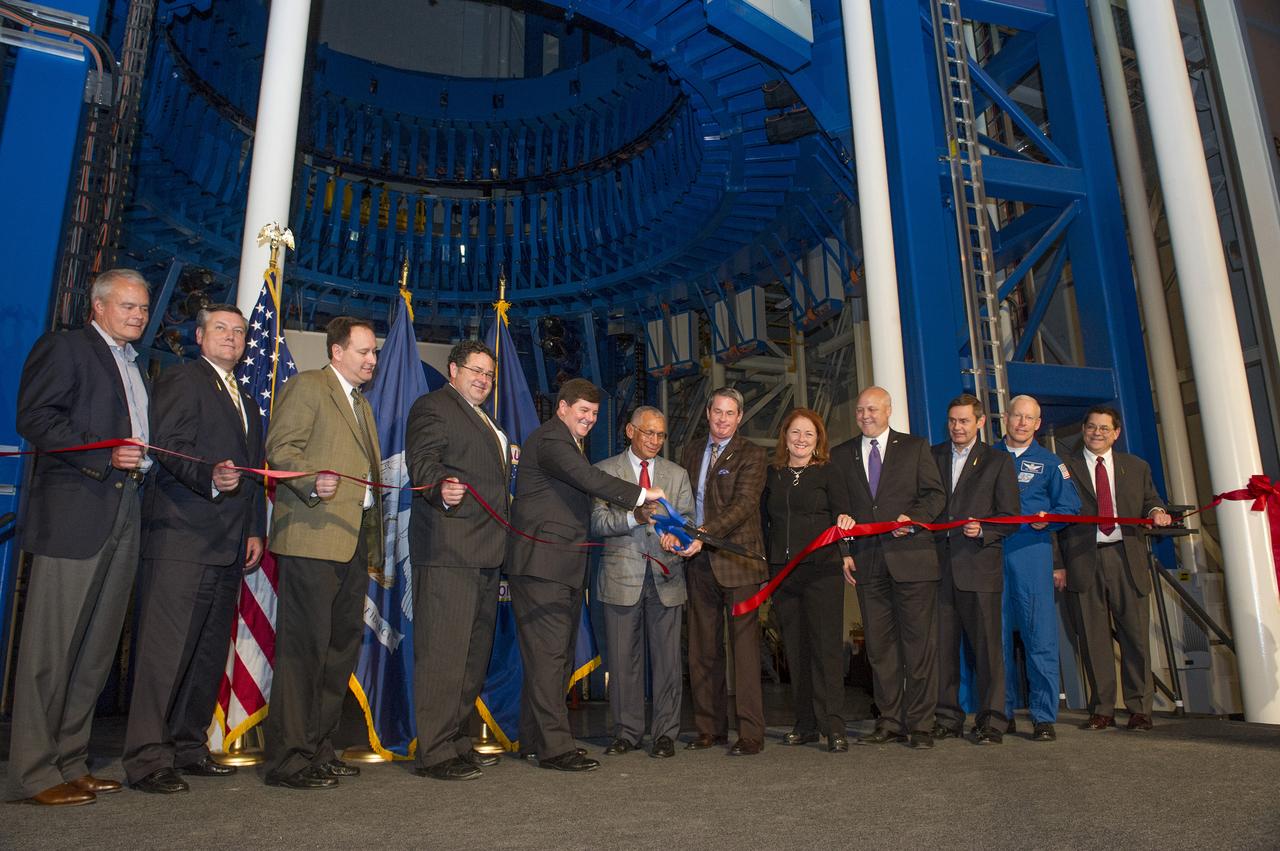
RIBBON CUTTING AT VERTICAL ASSEMBLY CENTER, MICHOUD ASSEMBLY FACILITY, SEPTEMBER 12, 2014, (L TO R): CLAY KIEFABER, CEO OF ESAB (COMPANY THAT BUILT WELDING TOOL)…PATRICK SCHEUERMANN…ROBERT LIGHTFOOT…TODD MAY…MISSISSIPPI CONGRESSMAN STEVEN PALAZZO…CHARLIE BOLDEN…LOUISIANA SENATOR DAVID VITTER…VIRGINIA BARNES, VICE-PRESIDENT AND PROGRAM MANAGER FOR SLS - BOEING… MITCH LANDRIEU, MAYOR OF NEW ORLEANS… JOHN ELBON, VICE PRESIDENT/GENERAL MANAGER, SPACE EXPLORATIONS – BOEING…PATRICK FORRESTER, ASTRONAUT…ROY MALONE.
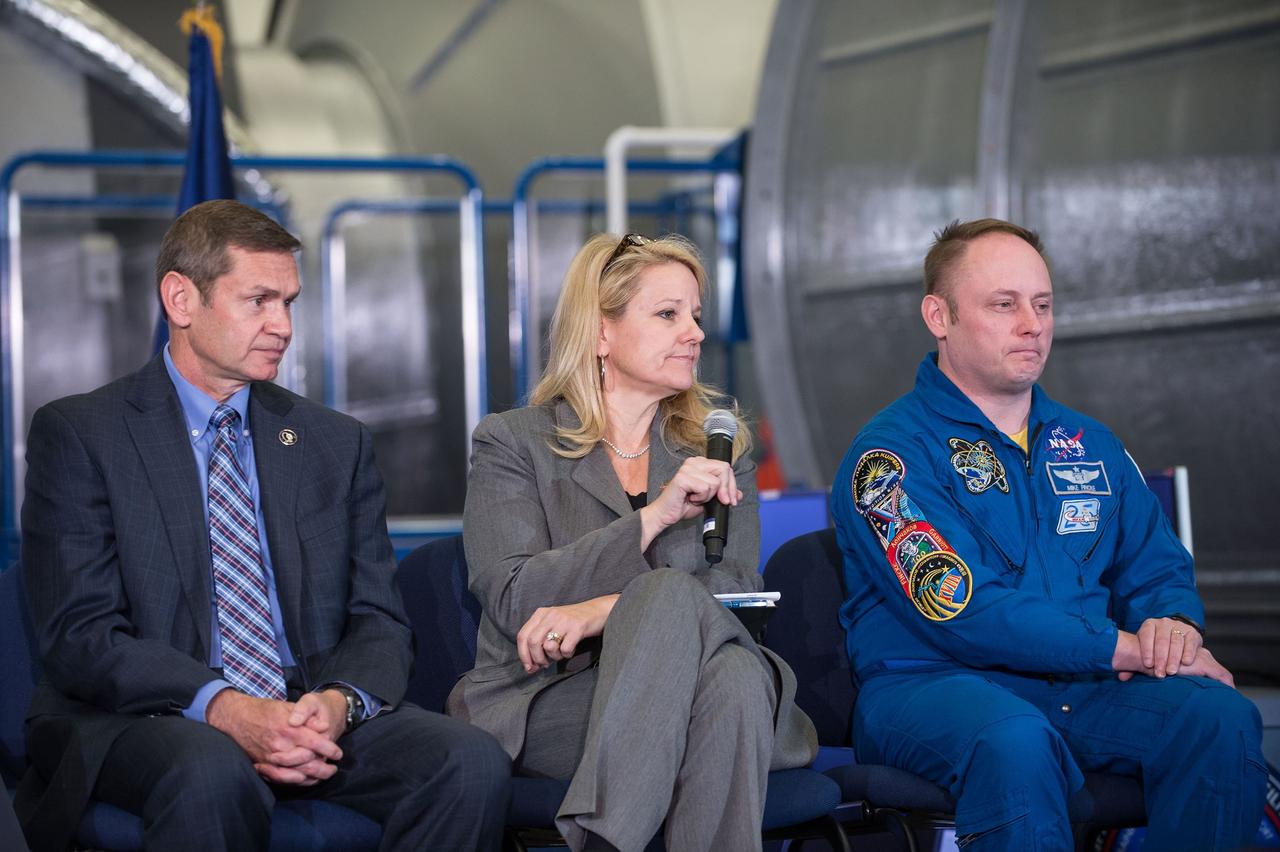
HOUSTON, Texas - jsc2015e031266 - Gwynne Shotwell, SpaceX President and Chief Operating Officer discusses the company's work with NASA's Commercial Crew Program as Boeing's John Elbon, left, and NASA astronaut Mike Fincke look on. Photo credit: NASA/Robert Markowitz
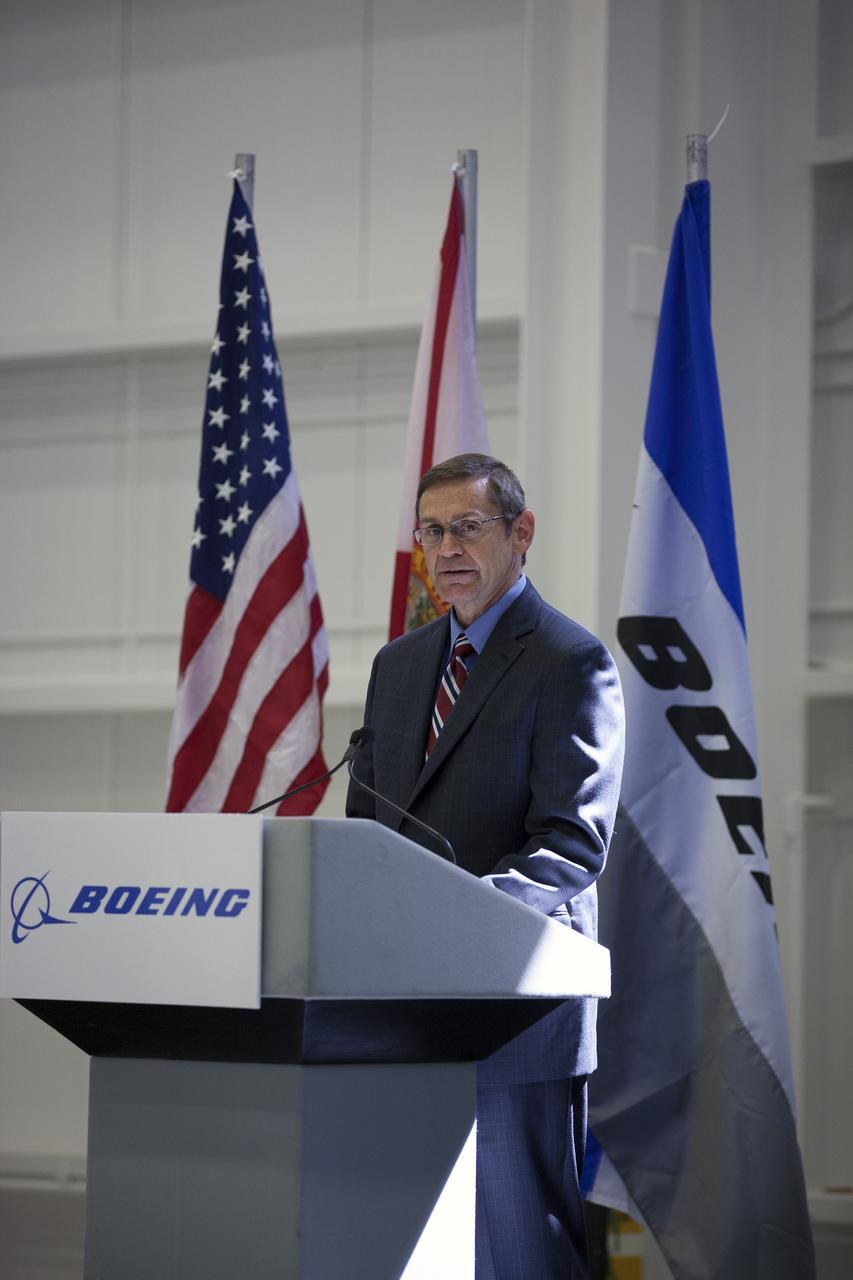
CAPE CANAVERAL, Fla. – John Elbon, The Boeing Company's vice president general manager of Boeing Space Systems, discusses the CST-100 spacecraft during a ceremony inside Orbiter Processing Facility 3 at NASA's Kennedy Space Center in Florida. Photo credit: NASA/Kim Shiflett
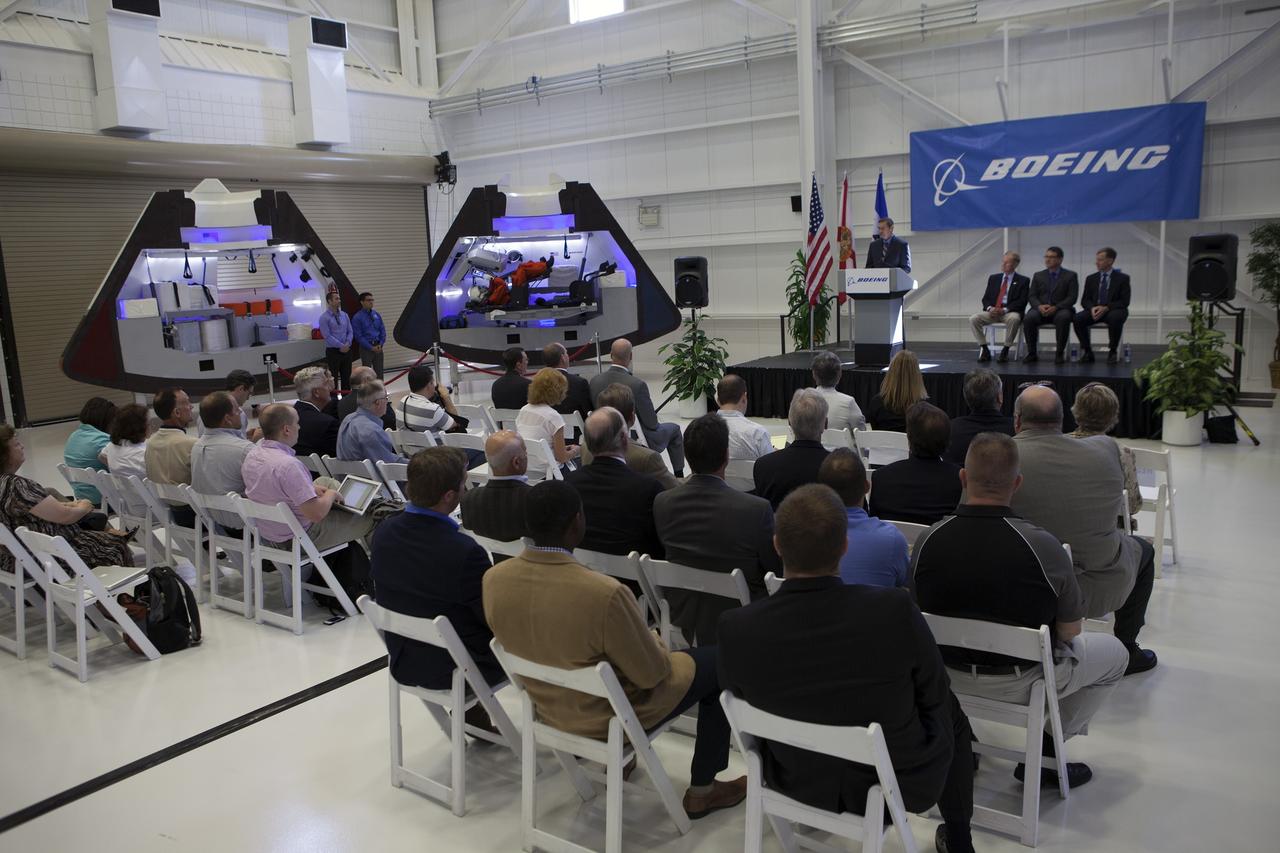
CAPE CANAVERAL, Fla. – John Elbon, The Boeing Company's vice president general manager of Boeing Space Systems, discusses the CST-100 spacecraft during a ceremony inside Orbiter Processing Facility 3 at NASA's Kennedy Space Center in Florida. Photo credit: NASA/Kim Shiflett
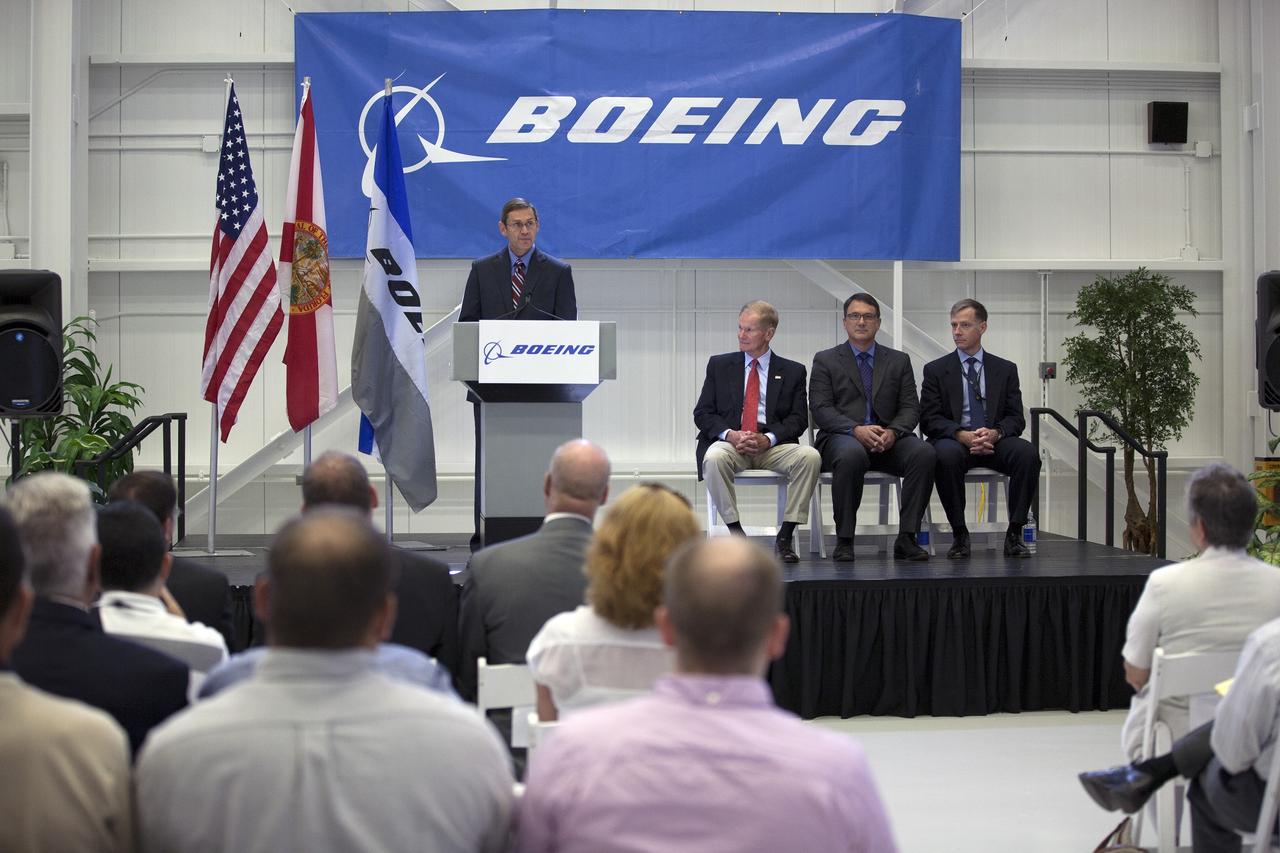
CAPE CANAVERAL, Fla. – John Elbon, The Boeing Company's vice president general manager of Boeing Space Systems, discusses the CST-100 spacecraft during a ceremony inside Orbiter Processing Facility 3 at NASA's Kennedy Space Center in Florida. Looking on are, from left, U.S. Sen. Bill Nelson of Florida, John Mulholland, Boeing's program manager for the CST-100, and Chris Ferguson, Boeing's director of Crew and Mission Operations. Photo credit: NASA/Kim Shiflett
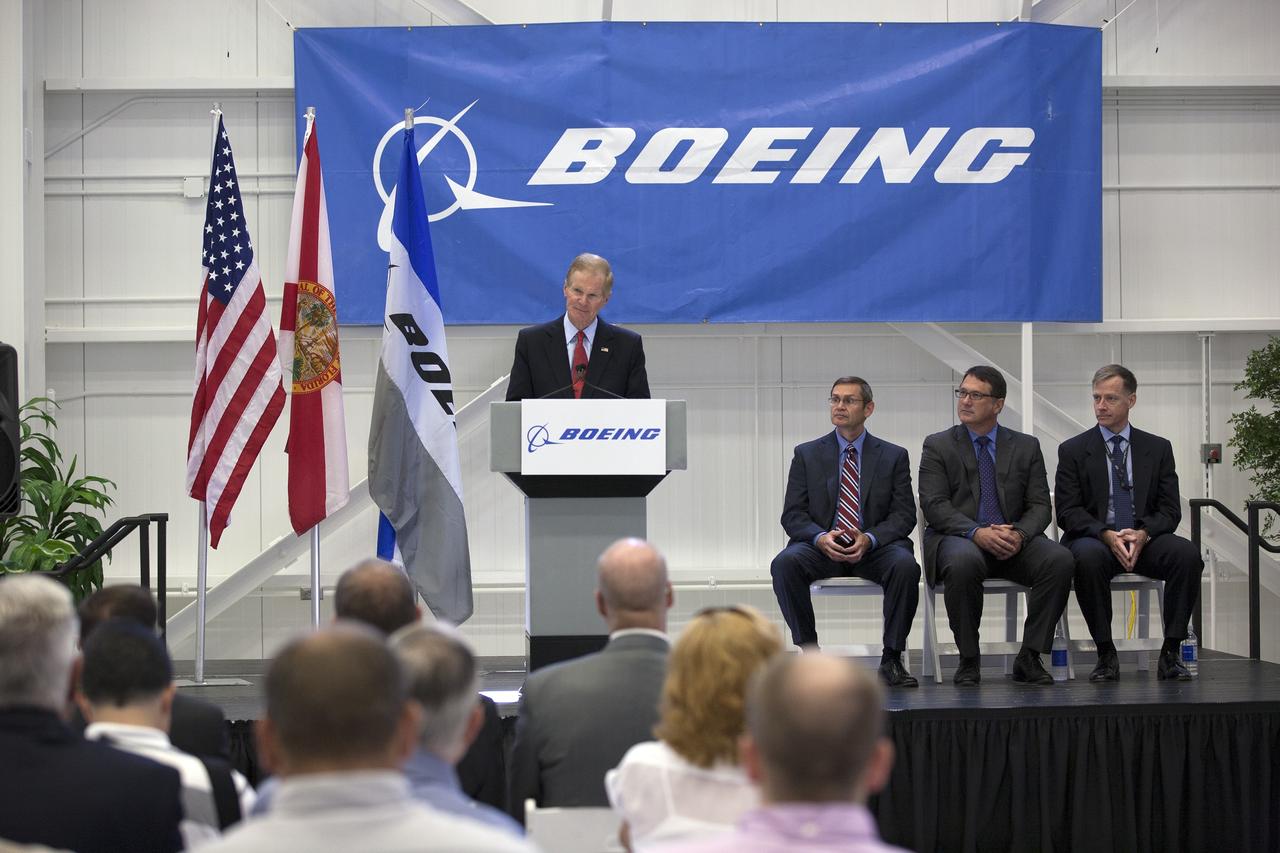
CAPE CANAVERAL, Fla. – U.S. Sen. Bill Nelson of Florida discusses The Boeing Company's CST-100 spacecraft during a ceremony inside Orbiter Processing Facility 3 at NASA's Kennedy Space Center in Florida. Looking on are, from left, John Elbon, Boeing's vice president general manager of Boeing Space Systems,, John Mulholland, Boeing's program manager for the CST-100, and Chris Ferguson, Boeing's director of Crew and Mission Operations. Photo credit: NASA/Kim Shiflett

John Elbon, Chief Operating Officer, United Launch Alliance, is introduced during a prelaunch news conference for the Lucy mission held inside the TV Auditorium at NASA’s Kennedy Space Center in Florida on Oct. 13, 2021. The mission is targeted to launch at 5:34 a.m. EDT Saturday, Oct. 16, on a United Launch Alliance Atlas V 401 rocket from Space Launch Complex 41 at Cape Canaveral Space Force Station. NASA’s Launch Services Program, based at Kennedy, is managing the launch. During its 12-year primary mission, Lucy will explore a record-breaking number of asteroids, flying by one asteroid in the solar system’s main belt and seven Trojan asteroids. Additionally, Lucy’s path will circle back to Earth three times for gravity assists, making it the first spacecraft to return to the vicinity of Earth from the outer solar system.
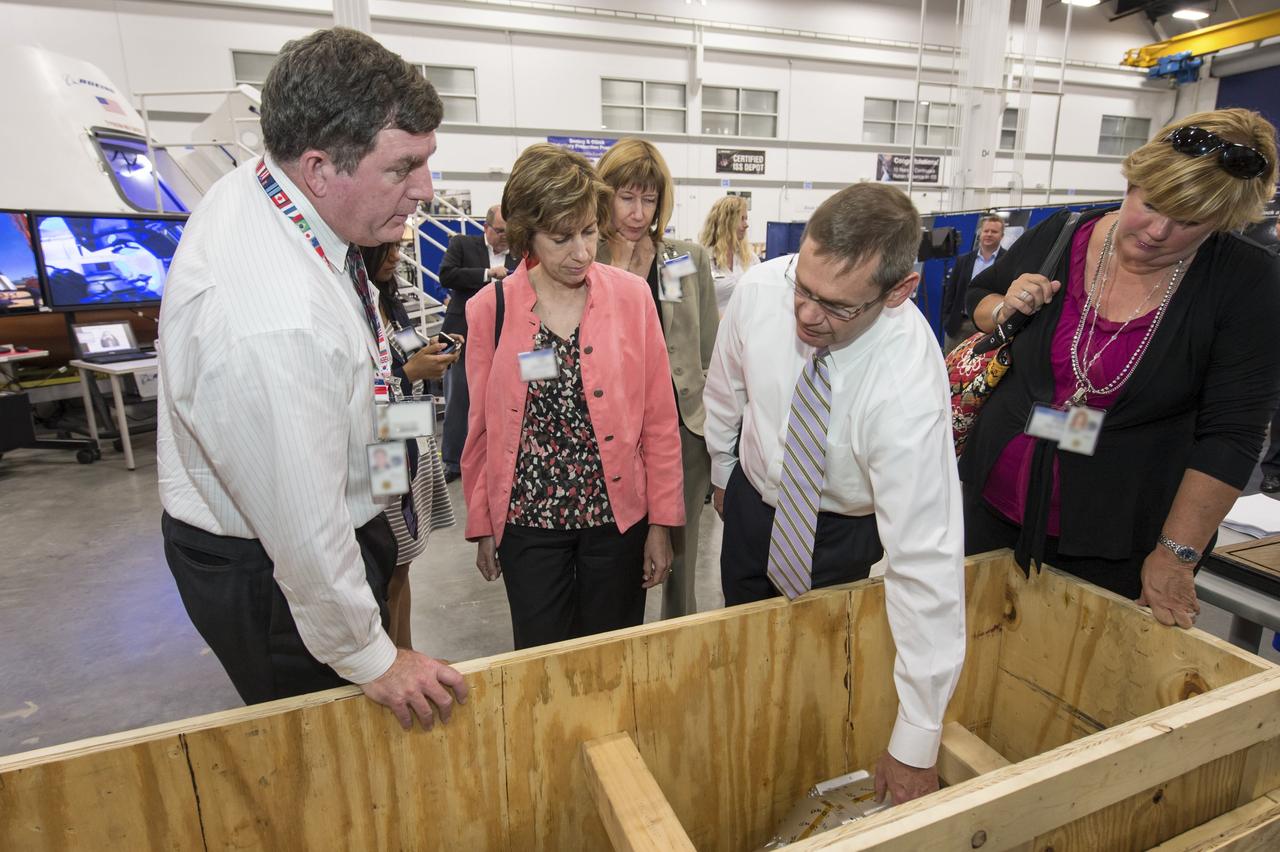
HOUSTON -- JSC-2013-E076043 -- John Elbon, The Boeing Company's vice president of Space Exploration, second right, shows off a wind tunnel model of the CST-100 spacecraft to Johnson Space Center management at the company's Houston Product Support Center. From left, are Kirk Shireman, Johnson's deputy director, Ellen Ochoa, Johnson's director, Kathy Lueders, deputy director of NASA's Commercial Crew Program, Elbon, and Melanie Saunders, Johnson's associate director. Boeing's CST-100 is designed to transport a mix of crew and cargo to low-Earth-orbit destinations. Boeing is one of three aerospace industry partners working with NASA's Commercial Crew Program, or CCP, during the Commercial Crew Integrated Capability, or CCiCap, initiative, which is intended to make commercial human spaceflight services available for government and commercial customers. To learn more about CCP, visit www.nasa.gov/commercialcrew. Photo credit: NASA/James Blair
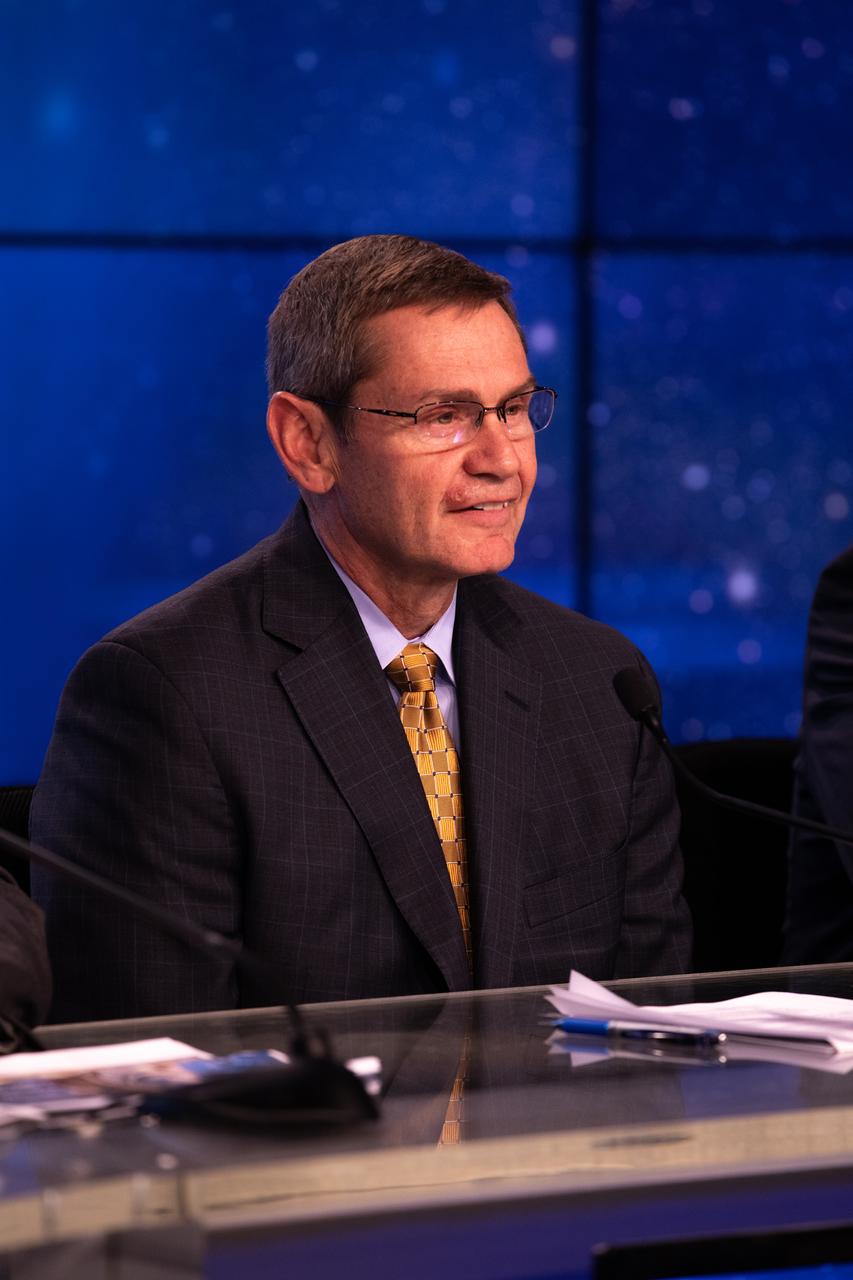
John Elbon, chief operating officer, United Launch Alliance, speaks during a prelaunch briefing for Boeing’s Orbital Flight Test at the agency’s Kennedy Space Center in Florida, Dec. 17, 2019. Boeing’s CST-100 Starliner spacecraft will launch atop a United Launch Alliance Atlas V rocket from Space Launch Complex 41 at Cape Canaveral Air Force Station. The uncrewed Orbital Flight Test will be the Starliner’s first flight to the International Space Station for NASA’s Commercial Crew Program.
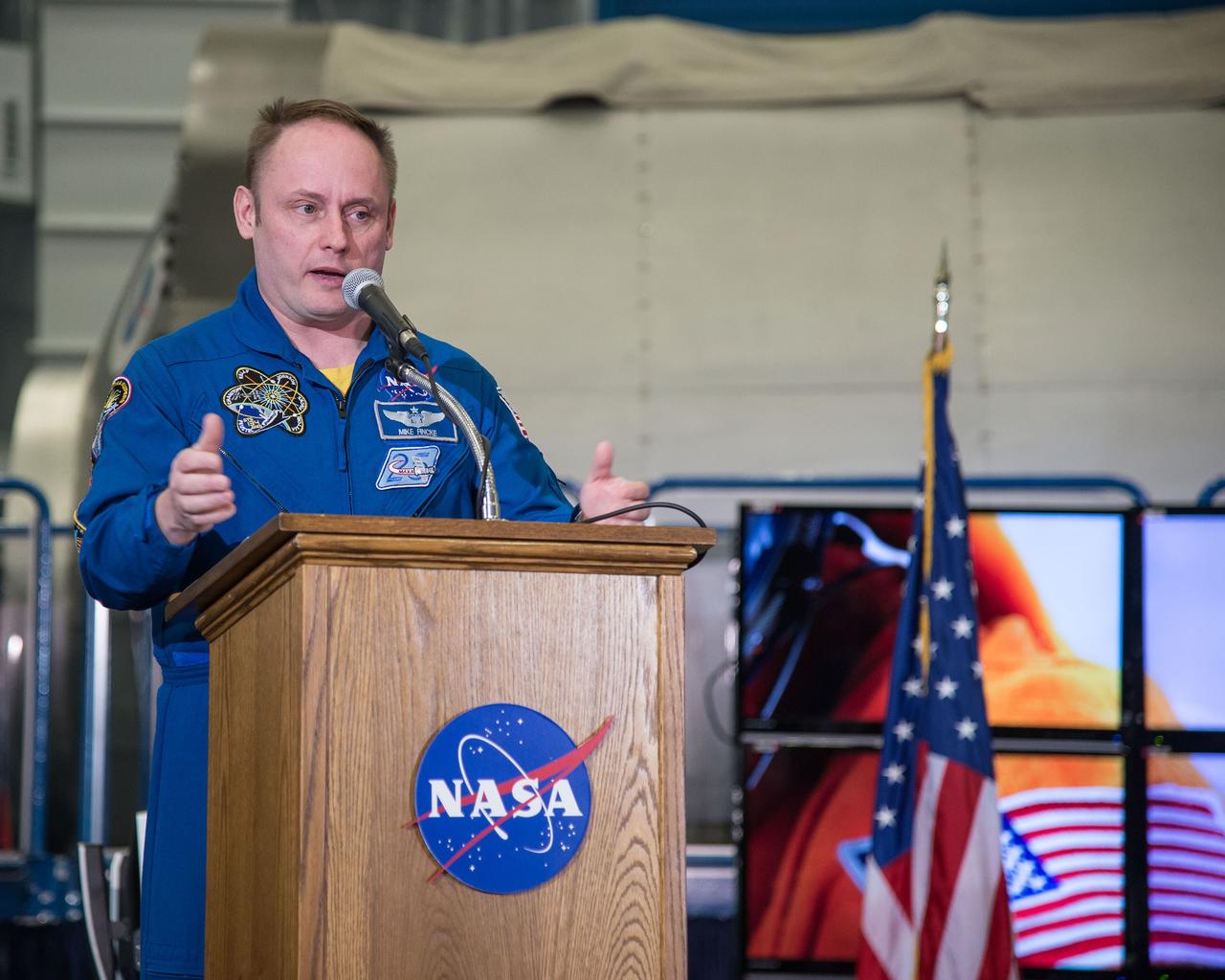
HOUSTON, Texas - jsc2015e031248 - NASA astronaut Mike Fincke discusses the agency's Commercial Crew Program during a presentation highlighting key development activities, test plans and objectives for achieving certification of two American crew transportation systems with NASA Administrator Charlie Bolden, Commercial Crew Program Manager Kathy Lueders, Boeing Space Exploration Vice President and General Manager John Elbon, Space X President and Chief Operating Officer Gwynne Shotwell and NASA Astronaut Mike Fincke. Photo credit: NASA/Robert Markowitz
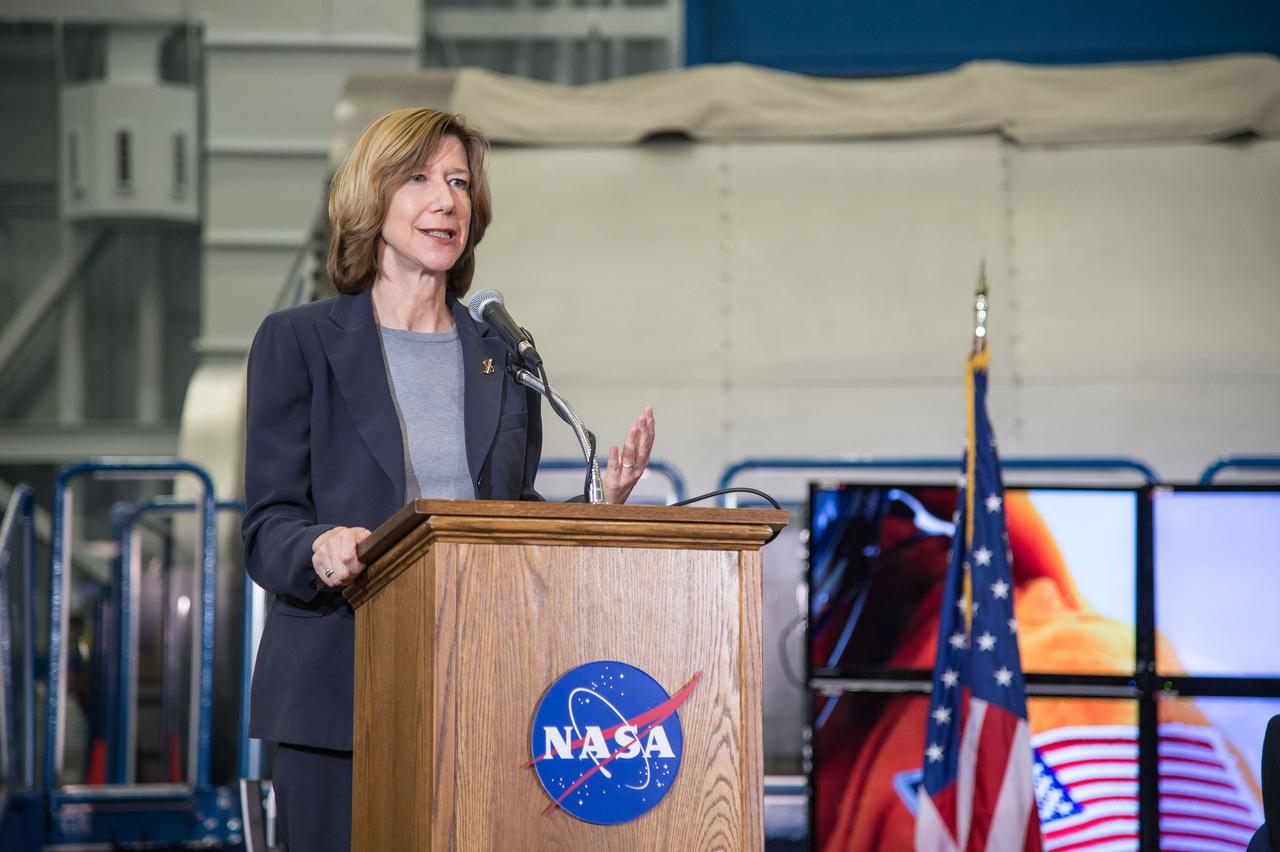
HOUSTON, Texas - jsc2015e031234 - Kathy Lueders, program manager of NASA's Commercial Crew Program, discusses the agency's approach during a presentation highlighting key development activities, test plans and objectives for achieving certification of two American crew transportation systems with NASA Administrator Charlie Bolden, Boeing Space Exploration Vice President and General Manager John Elbon, Space X President and Chief Operating Officer Gwynne Shotwell and NASA Astronaut Mike Fincke. Photo credit: NASA/Robert Markowitz
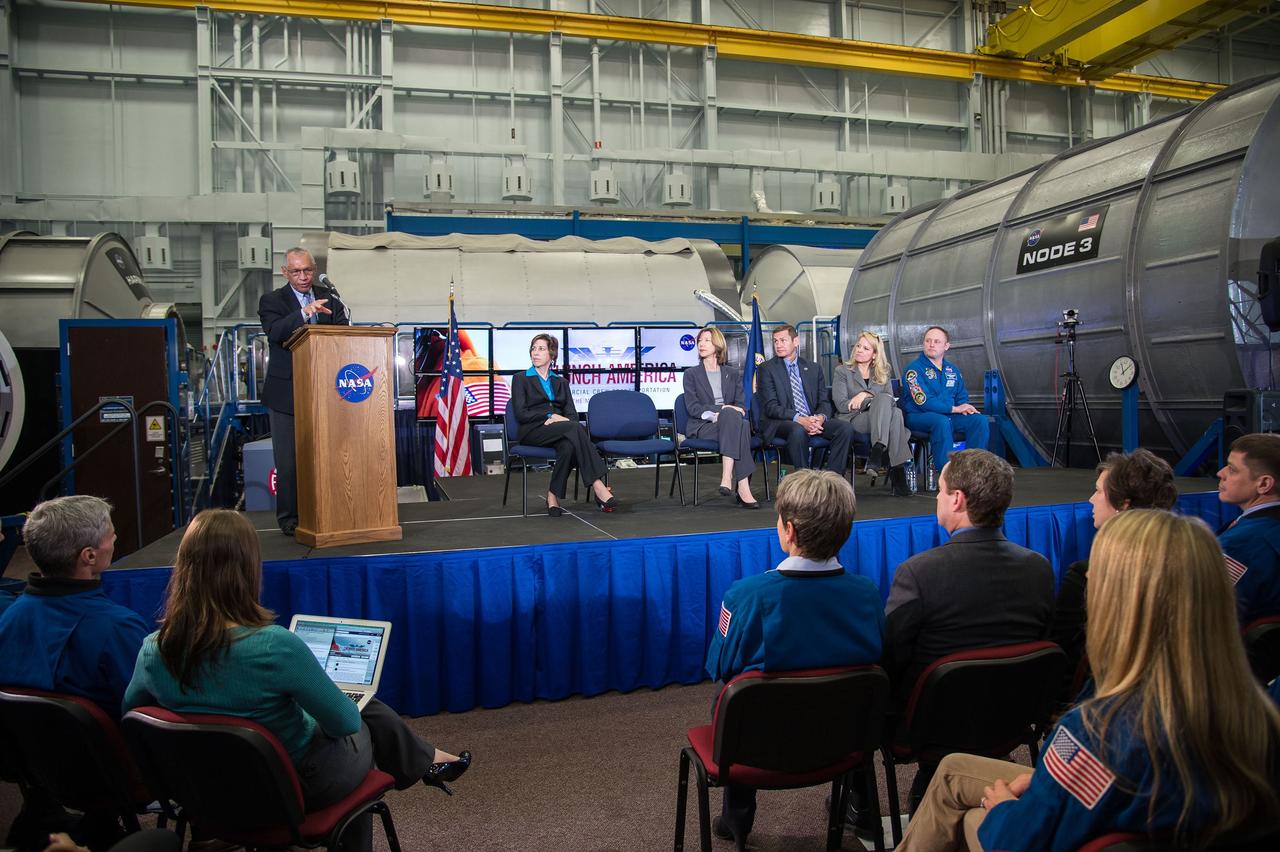
HOUSTON, Texas - jsc2015e031229 - NASA Administrator Charles Bolden discusses the agency's Commercial Crew Program during a presentation highlighting key development activities, test plans and objectives for achieving certification of two American crew transportation systems with Commercial Crew Program Manager Kathy Lueders, Boeing Space Exploration Vice President and General Manager John Elbon, Space X President and Chief Operating Officer Gwynne Shotwell and NASA Astronaut Mike Fincke. Photo credit: NASA/Robert Markowitz
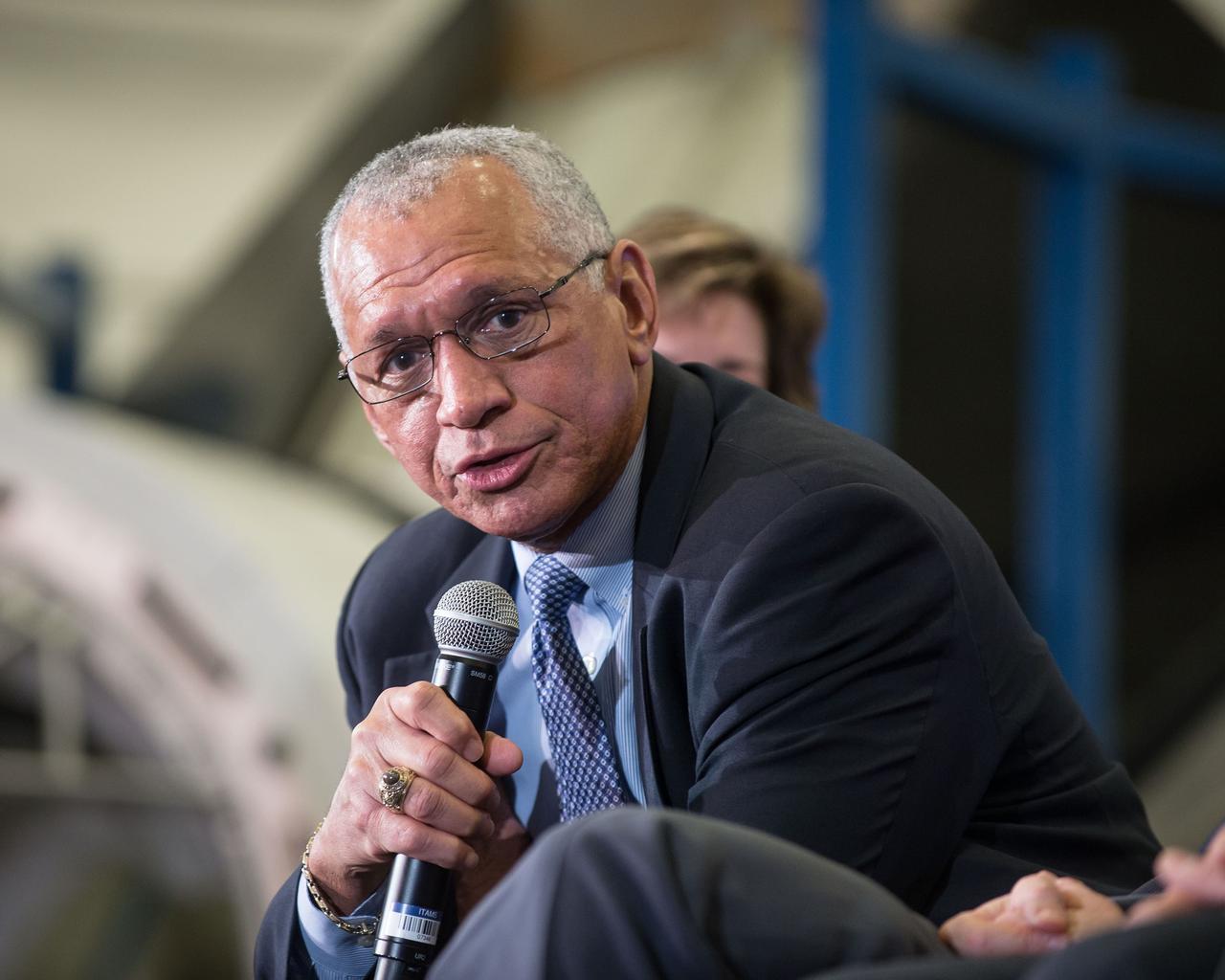
HOUSTON, Texas- jsc2015e031278 - NASA Administrator Charles Bolden discusses the agency's Commercial Crew Program during a presentation highlighting key development activities, test plans and objectives for achieving certification of two American crew transportation systems with Commercial Crew Program Manager Kathy Lueders, Boeing Space Exploration Vice President and General Manager John Elbon, Space X President and Chief Operating Officer Gwynne Shotwell and NASA Astronaut Mike Fincke. Photo credit: NASA/Robert Markowitz
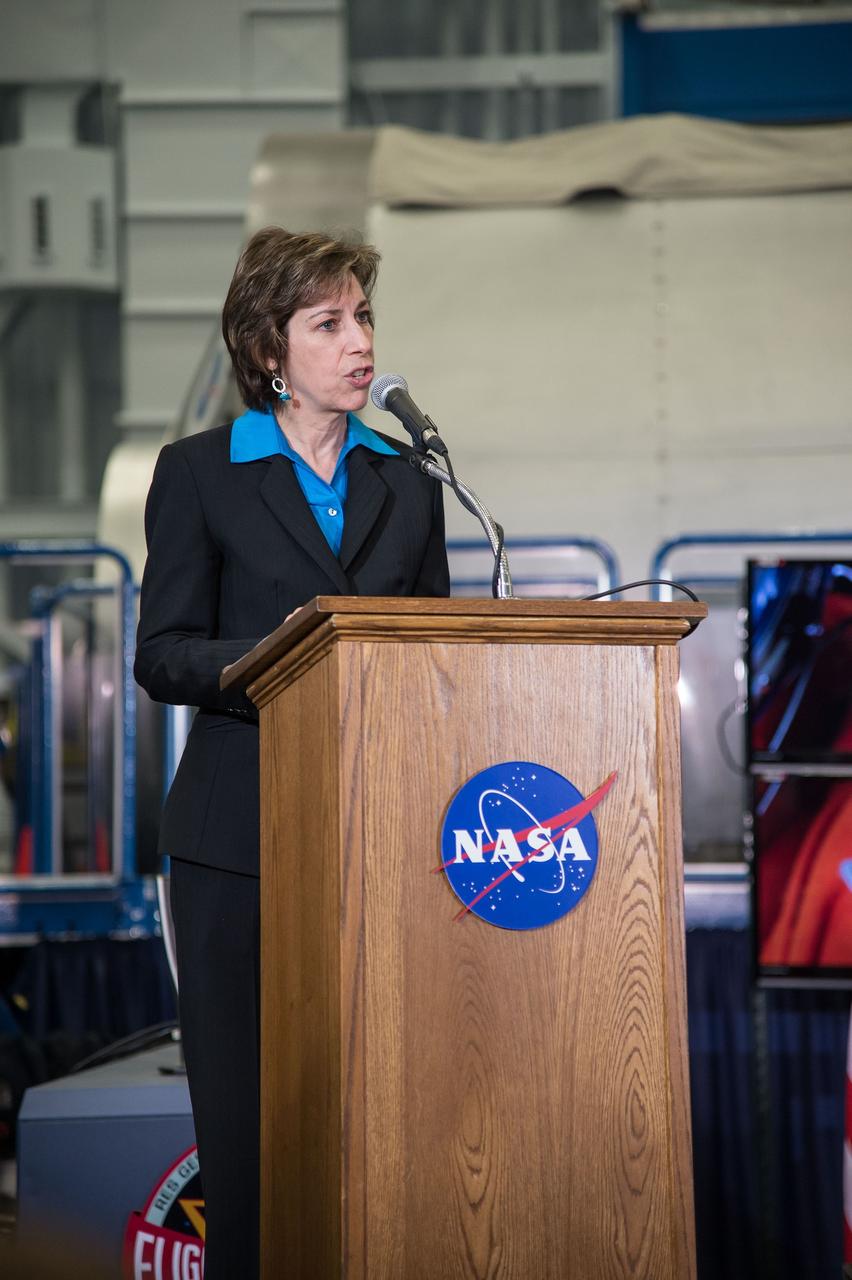
HOUSTON, Texas - jsc2015e031223 - Dr. Ellen Ochoa, director of NASA's Johnson Space Center in Houston, opens NASA's presentation about the agency's Commercial Crew Program highlighting key development activities, test plans and objectives for achieving certification of two American crew transportation systems with NASA Administrator Charlie Bolden, Commercial Crew Program Manager Kathy Lueders, Boeing Space Exploration Vice President and General Manager John Elbon, SpaceX President and Chief Operating Officer Gwynne Shotwell and NASA Astronaut Mike Fincke. Photo credit: NASA/Robert Markowitz
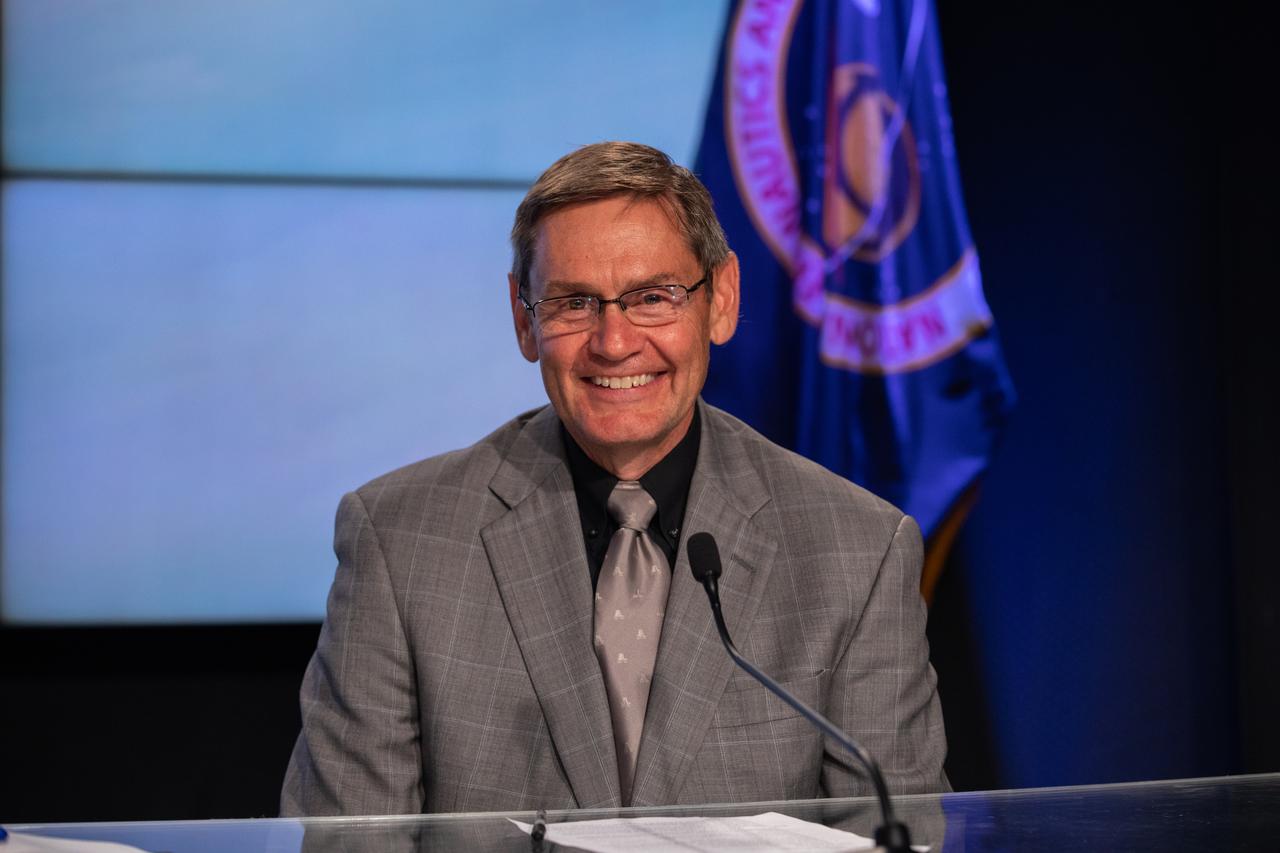
John Elbon, chief operating officer, United Launch Alliance, participates in a postlaunch news conference following the liftoff of NASA Boeing’s Orbital Flight Test-2 (OFT-2) on May 19, 2022. Liftoff occurred at 6:54 p.m. EDT from Space Launch Complex-41 at Florida’s Cape Canaveral Space Force Station. Boeing’s uncrewed flight test is designed to test the system’s end-to-end capabilities for NASA’s Commercial Crew Program providing valuable data towards NASA certifying Boeing’s crew transportation system for regular crewed flights to and from the International Space Station.
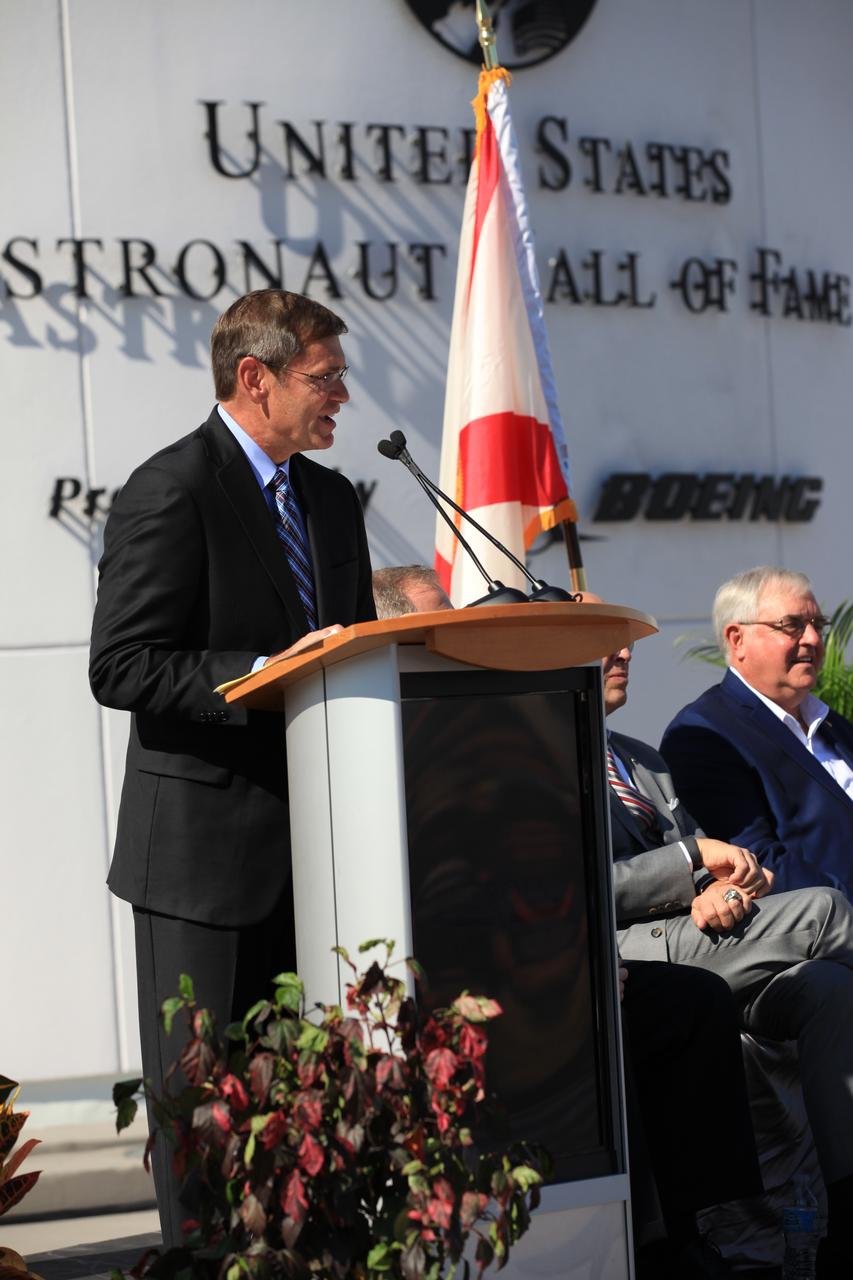
Boeing Vice President and General Manager John Elbon addresses the crowd gathered for the grand opening of the Heroes and Legends attraction at the Kennedy Space Center Visitor Complex. Boeing is sponsoring the new attraction. Seated, to the left, is former space shuttle astronaut Dan Brandenstein, chairman of the Astronaut Scholarship Foundation board of directors. The new facility includes the U.S. Astronaut Hall of Fame and looks back to the pioneering efforts of Mercury, Gemini and Apollo. It sets the stage by providing the background and context for space exploration and the legendary men and women who pioneered the nation's journey into space.

L-R: William Gerstenmaier, NASA Associate Administrator for human exploration and operations; Charlie Precourt, Vice President and General Manager, ATK Space Launch Division; John Elbon, Vice President and General Manager, Boeing Space Exploration; Julie Van Kleek, Vice President, space programs, Aerojet Rocketdyne; and Jim Crocker, Vice President and General Manager, civil space, Lockheed Martin Space Systems, participate in a panel discussion on deep space exploration using the Space Launch System and Orion spacecraft at the Newseum in Washington on Tuesday, November 12, 2013. Photo Credit: (NASA/Jay Westcott)
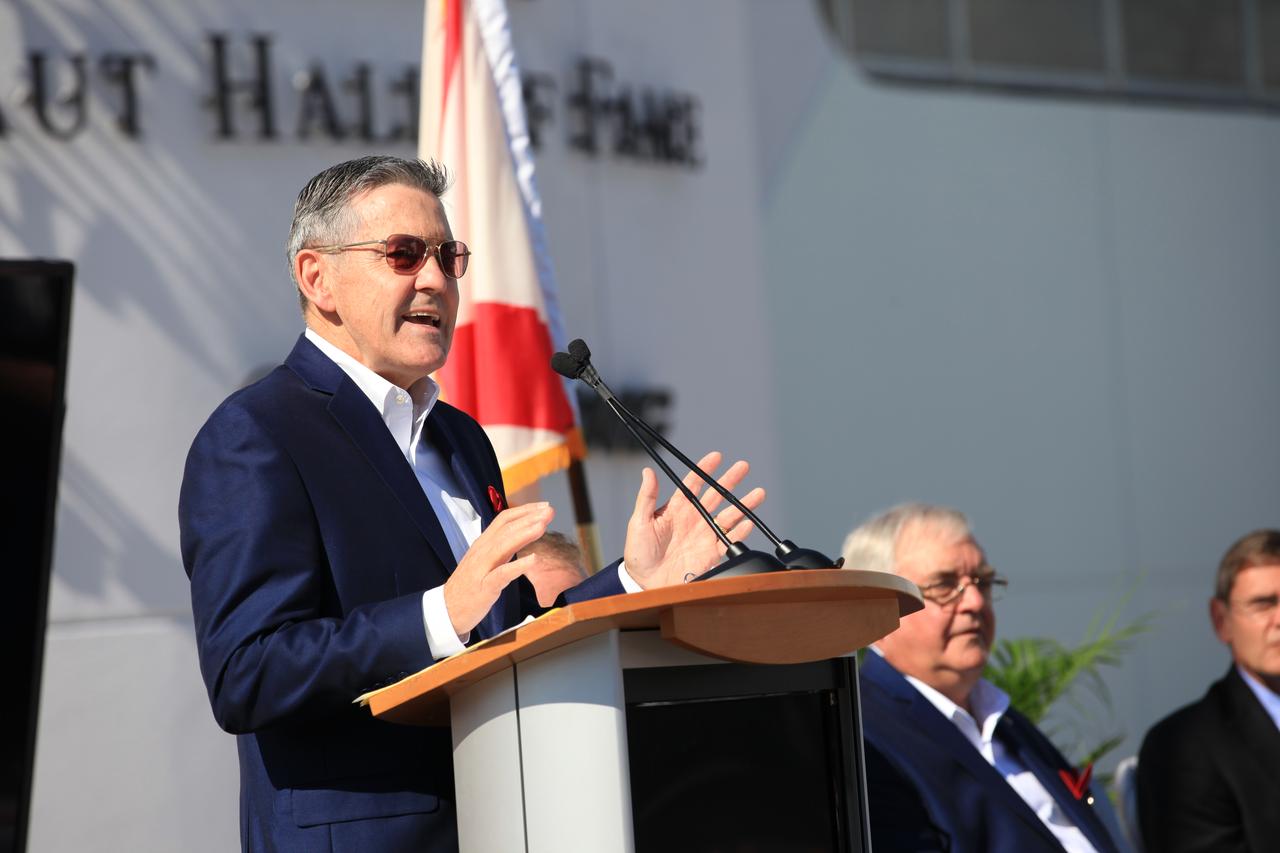
Kennedy Space Center Director Bob Cabana, a former space shuttle astronaut and member of the Astronaut Hall of Fame, speaks to guests during the opening of the Heroes and Legends attraction at the Kennedy Space Center Visitor Complex. Seated, from the left, are former space shuttle astronaut Dan Brandenstein, chairman of the Astronaut Scholarship Foundation board of directors, and, partially visible, John Elbon, vice president and general manager of Boeing. The new facility includes the U.S. Astronaut Hall of Fame and looks back to the pioneering efforts of Mercury, Gemini and Apollo. It sets the stage by providing the background and context for space exploration and the legendary men and women who pioneered the nation's journey into space.
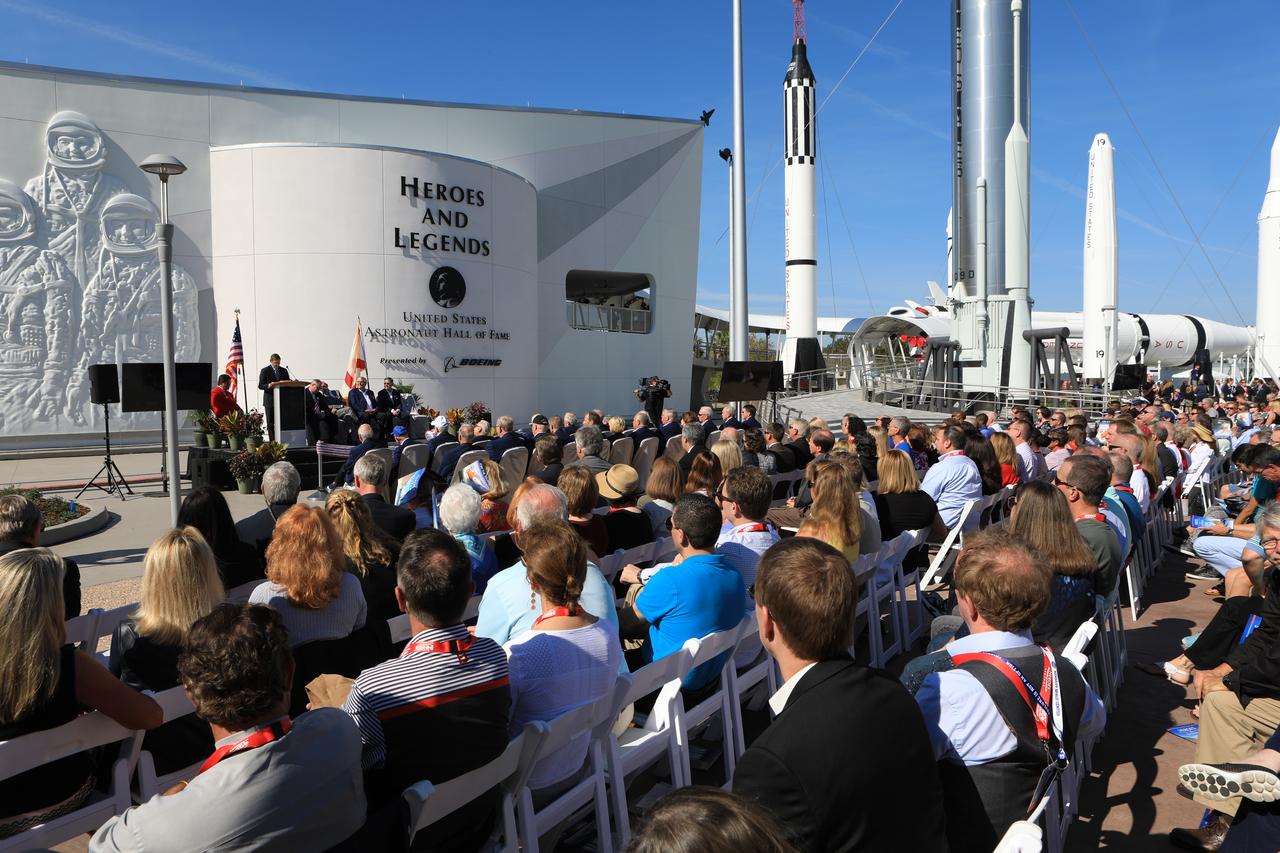
Boeing Vice President and General Manager John Elbon addresses the crowd gathered for the grand opening of the Heroes and Legends attraction at the Kennedy Space Center Visitor Complex. Boeing is sponsoring the new attraction. Launch vehicles used by NASA in its history of exploring space also are displayed in the "Rocket Garden" adjacent to the new Heroes and Legends facility. The new facility includes the U.S. Astronaut Hall of Fame and looks back to the pioneering efforts of Mercury, Gemini and Apollo. It sets the stage by providing the background and context for space exploration and the legendary men and women who pioneered the nation's journey into space.
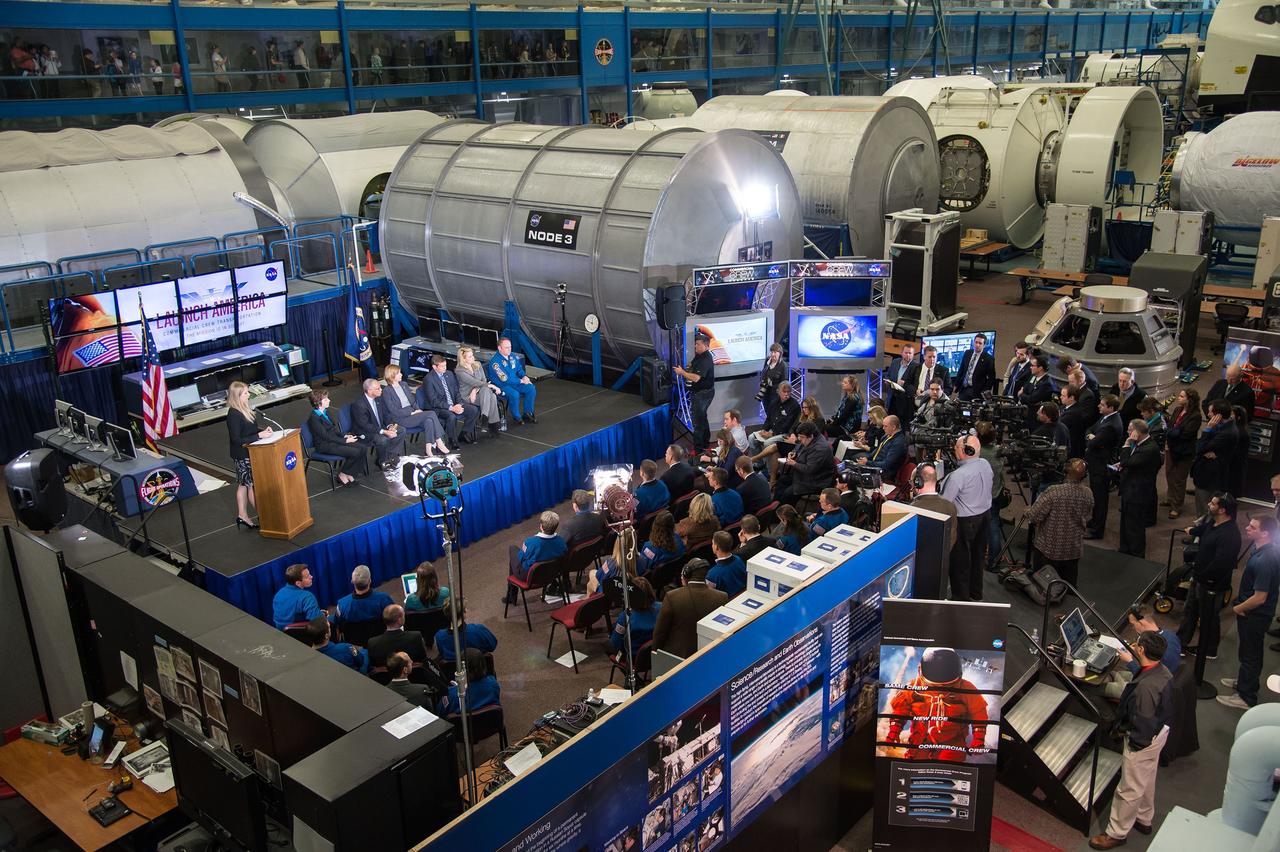
HOUSTON, Texas - jsc2015e031268 - HOUSTON, Texas - NASA's Stephanie Schierholz opens a presentation about the agency's Commercial Crew Program highlighting key development activities, test plans and objectives for achieving certification of two American crew transportation systems with Dr. Ellen Ochoa, director of NASA's Johnson Space Center in Houston, NASA Administrator Charlie Bolden, Commercial Crew Program Manager Kathy Lueders, Boeing Space Exploration Vice President and General Manager John Elbon, SpaceX President and Chief Operating Officer Gwynne Shotwell and NASA Astronaut Mike Fincke. Photo credit: NASA/Robert Markowitz
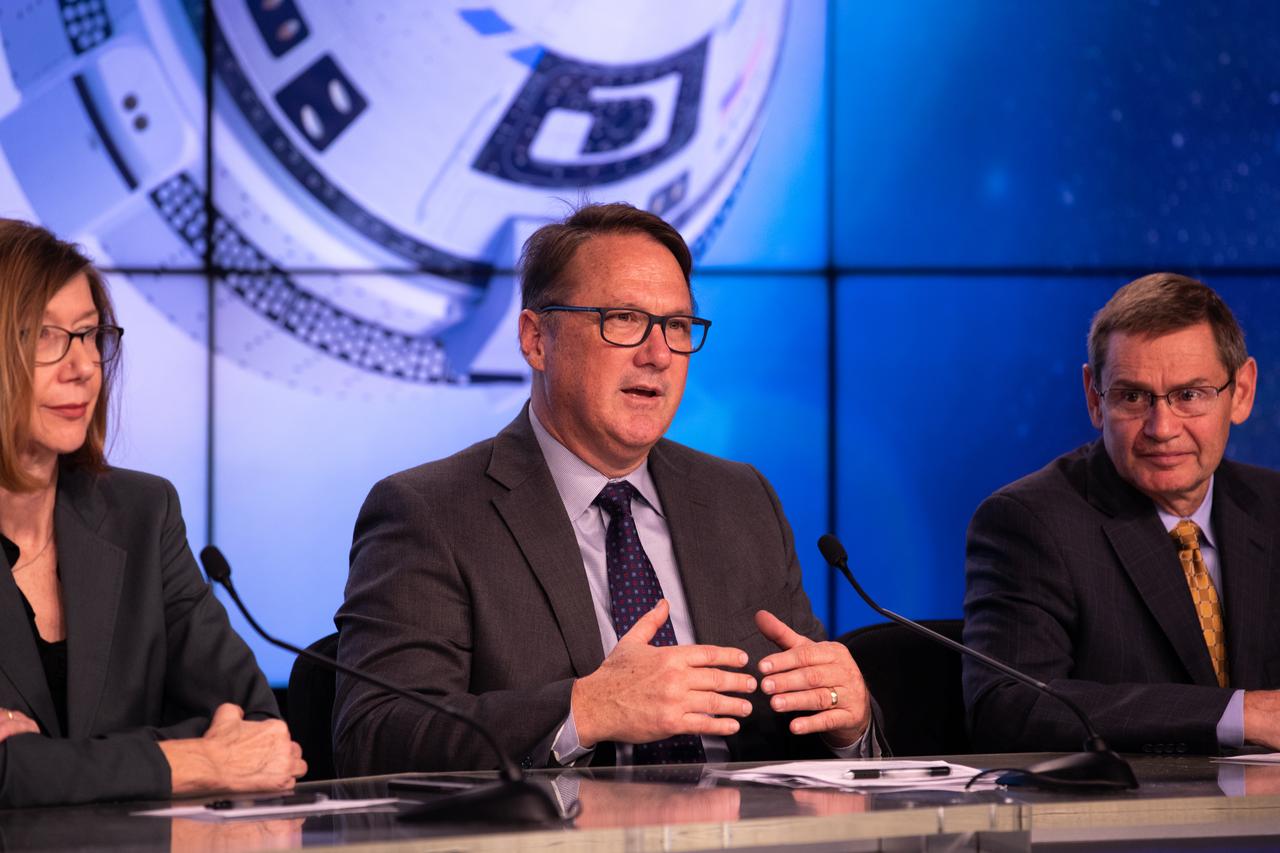
Officials from NASA, Boeing, United Launch Alliance and the U.S. Air Force 45th Weather Squadron participate in a prelaunch briefing for Boeing’s Orbital Flight Test at the agency’s Kennedy Space Center in Florida, Dec. 17, 2019. From left are Kathy Lueders, NASA Commercial Crew Program; John Mulholland, vice president and program manager, Boeing Commercial Crew Program; and John Elbon, chief operating officer, United Launch Alliance. Boeing’s CST-100 Starliner spacecraft will launch atop a United Launch Alliance Atlas V rocket from Space Launch Complex 41 at Cape Canaveral Air Force Station. The uncrewed Orbital Flight Test will be the Starliner’s first flight to the International Space Station for NASA’s Commercial Crew Program.
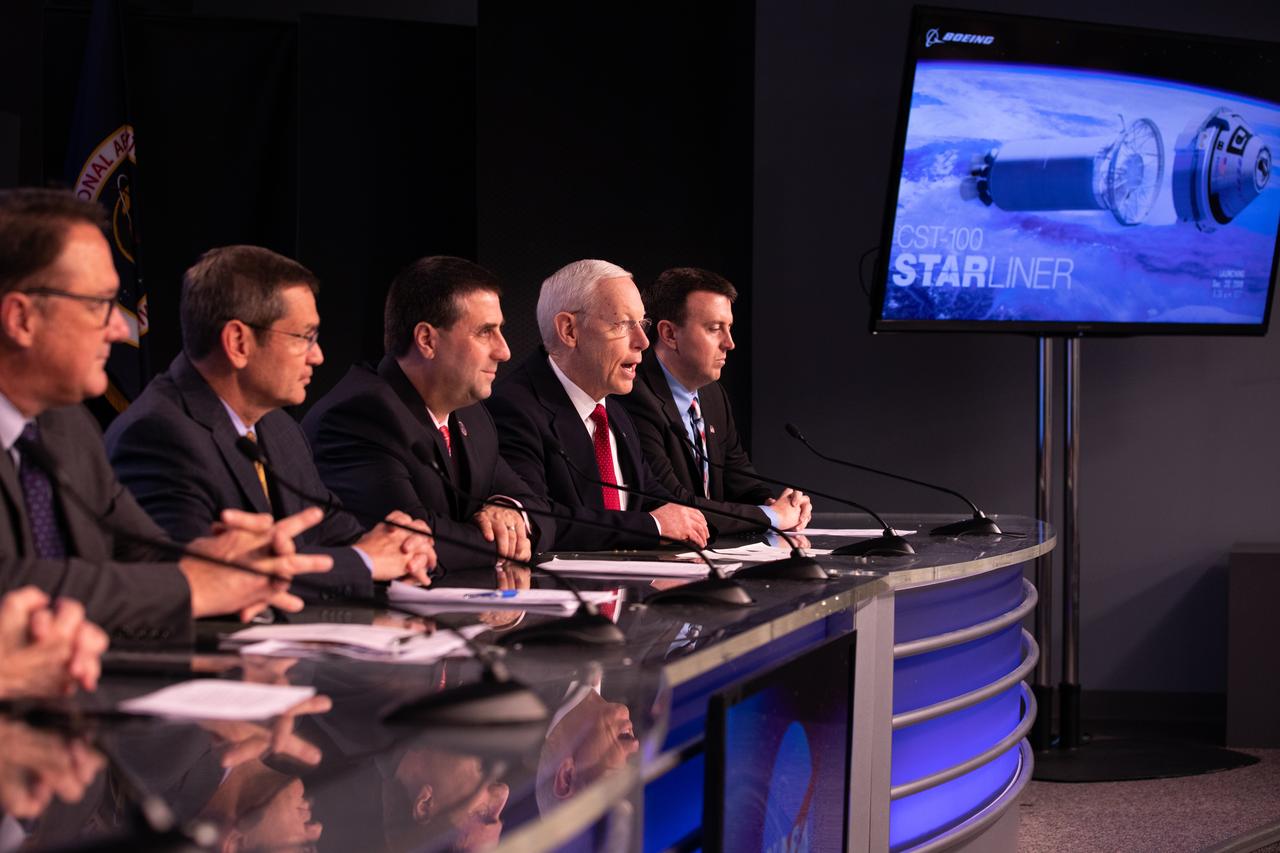
Officials from NASA, Boeing, United Launch Alliance and the U.S. Air Force 45th Weather Squadron participate in a prelaunch briefing for Boeing’s Orbital Flight Test at the agency’s Kennedy Space Center in Florida, Dec. 17, 2019. From left are John Mulholland, vice president and program manager, Boeing Commercial Crew Program; John Elbon, chief operating officer, United Launch Alliance; Joel Montalbano, deputy manager, International Space Station Program; Pat Forrester, Astronaut Office chief, Johnson Space Center; and Will Ulrich, launch weather officer, 45th Weather Squadron. Boeing’s CST-100 Starliner spacecraft will launch atop a United Launch Alliance Atlas V rocket from Space Launch Complex 41 at Cape Canaveral Air Force Station. The uncrewed Orbital Flight Test will be the Starliner’s first flight to the International Space Station for NASA’s Commercial Crew Program.
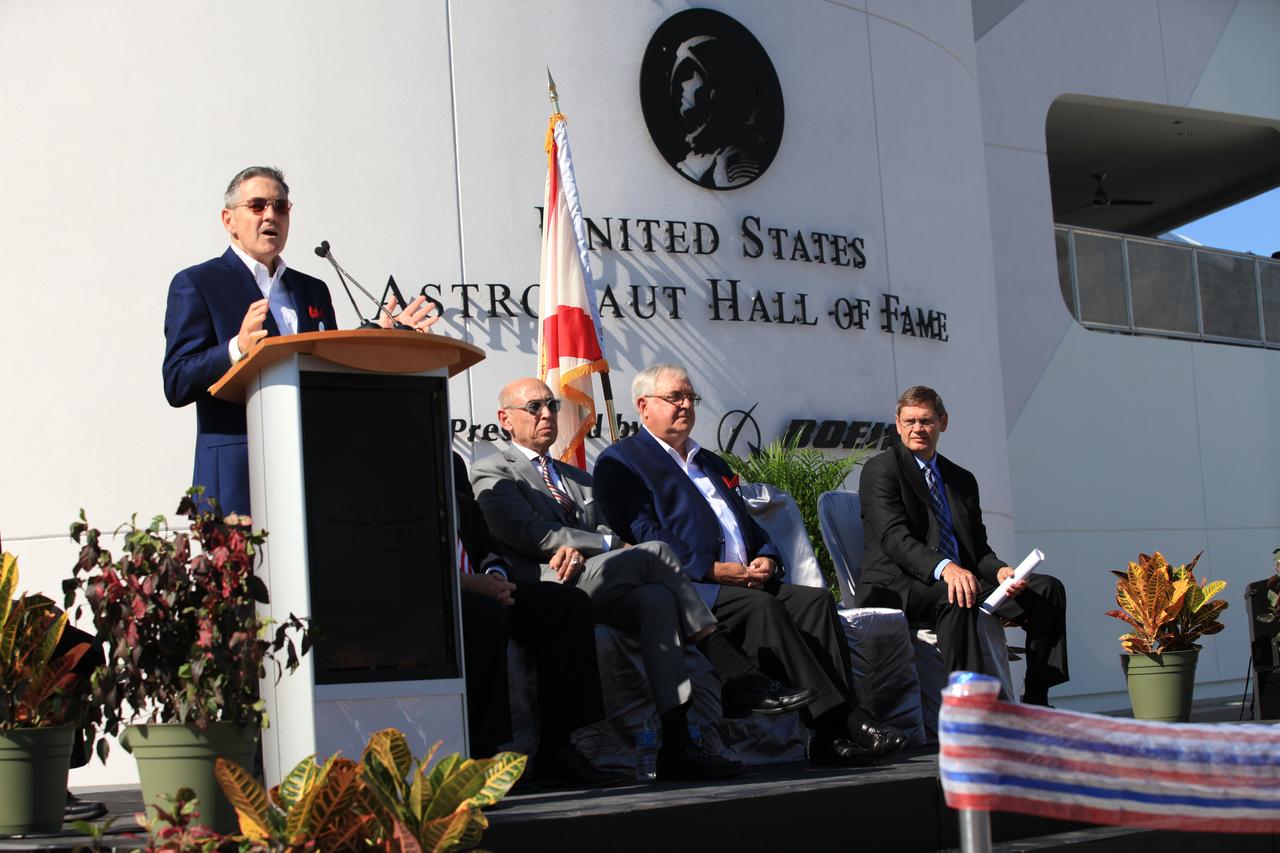
Kennedy Space Center Director Bob Cabana, a former space shuttle astronaut and member of the Astronaut Hall of Fame, speaks to guests during the opening of the Heroes and Legends attraction at the Kennedy Space Center Visitor Complex. Seated, from the left, are Rick Abramson, executive vice president and chief operating officer of Delaware North, former space shuttle astronaut Dan Brandenstein, chairman of the Astronaut Scholarship Foundation board of directors, and John Elbon, vice president and general manager of Boeing. The new facility includes the U.S. Astronaut Hall of Fame and looks back to the pioneering efforts of Mercury, Gemini and Apollo. It sets the stage by providing the background and context for space exploration and the legendary men and women who pioneered the nation's journey into space.
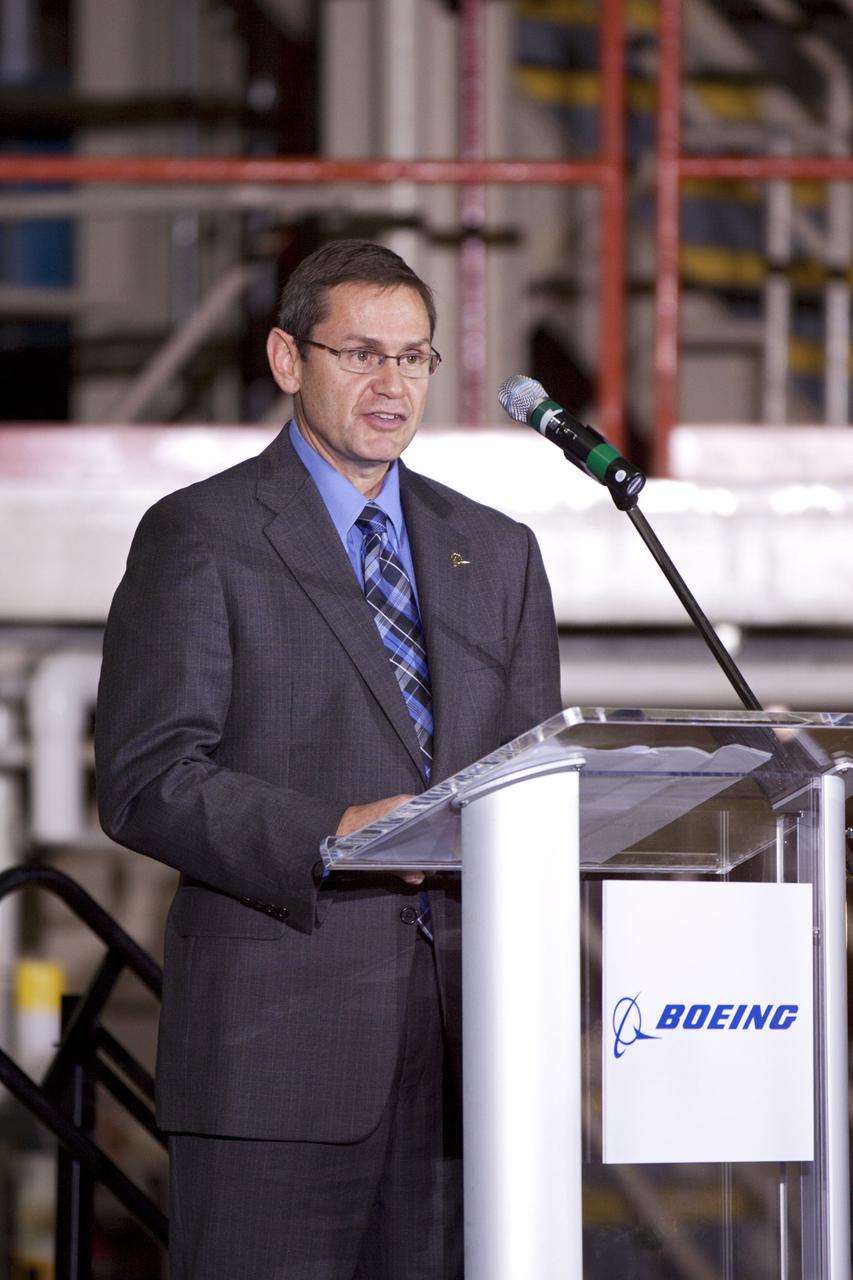
CAPE CANAVERAL, Fla. – In the Orbiter Processing Facility-3 (OPF-3) at NASA’s Kennedy Space Center in Florida, John Elbon, vice president and general manager of Boeing's Space Exploration, speaks to the audience during the ceremony announcing the signing of an innovative agreement between NASA and Space Florida. NASA announced a partnership with Space Florida to occupy, use and modify Kennedy Space Center's Orbiter Processing Facility-3 (OPF-3), the Space Shuttle Main Engine Processing Facility and Processing Control Center. Space Florida has an agreement for use of the OPF-3 with the Boeing Company to manufacture and test the company's Crew Space Transportation (CST-100) spacecraft. The 15-year use permit deal is the latest step Kennedy is making as the center transitions from a historically government-only launch complex to a multi-user spaceport. For more information, visit http:__www.nasa.gov_exploration_commercial_index.html. Photo credit: NASA_Kim Shiflett

Officials from NASA, Boeing, United Launch Alliance and the U.S. Air Force 45th Weather Squadron participate in a prelaunch briefing for Boeing’s Orbital Flight Test at the agency’s Kennedy Space Center in Florida, Dec. 17, 2019. From left are John Elbon, chief operating officer, United Launch Alliance; Joel Montalbano, deputy manager, International Space Station Program; Pat Forrester, Astronaut Office chief, Johnson Space Center; and Will Ulrich, launch weather officer, 45th Weather Squadron. Boeing’s CST-100 Starliner spacecraft will launch atop a United Launch Alliance Atlas V rocket from Space Launch Complex 41 at Cape Canaveral Air Force Station. The uncrewed Orbital Flight Test will be the Starliner’s first flight to the International Space Station for NASA’s Commercial Crew Program.
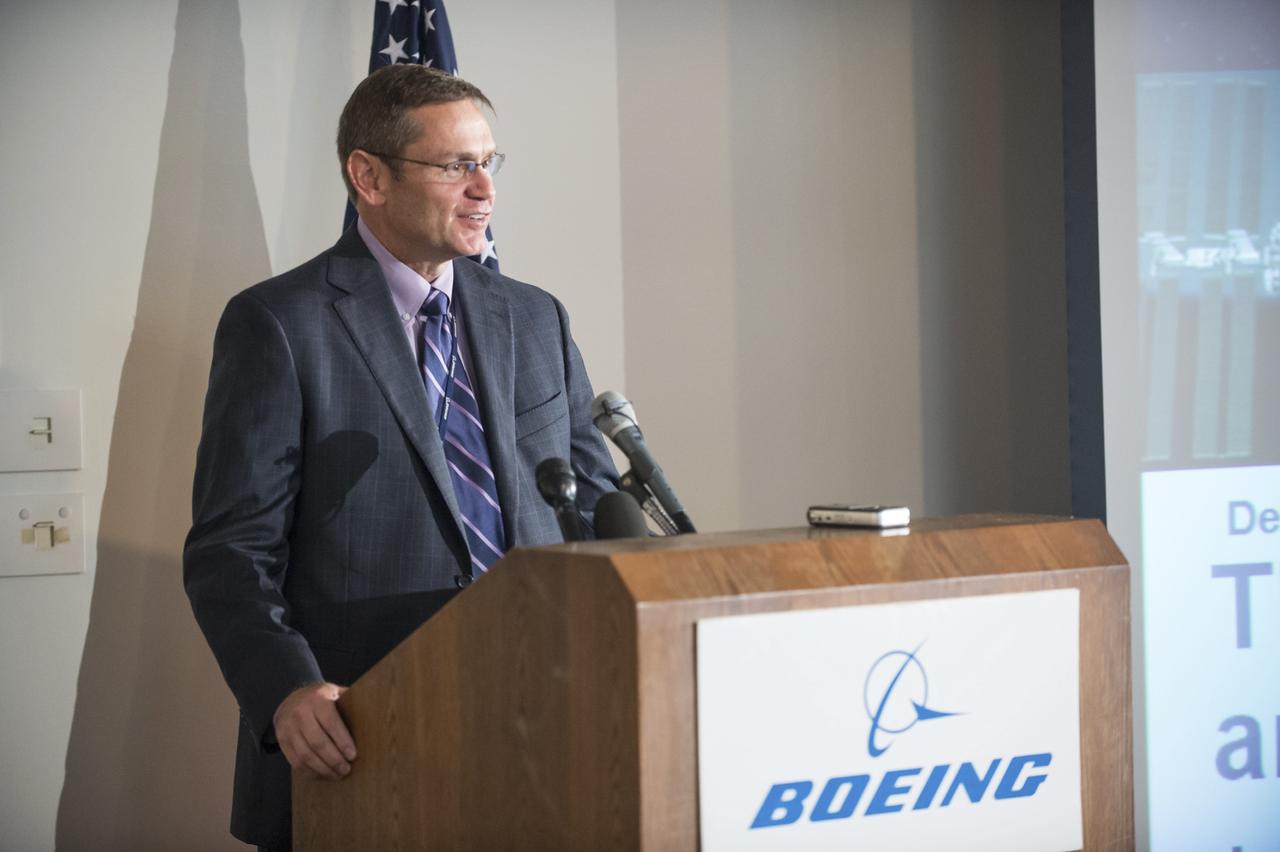
HOUSTON - JSC2013e068284 - John Elbon, vice president for Space Exploration for The Boeing Company, addresses the media before the unveiling of a CST-100 mock-up at the company's Houston Product Support Center. This test version is optimized to support five crew members and will allow the company to evaluate crew safety, interfaces, communications, maneuverability and ergonomics. Boeing's CST-100 is being designed to transport crew members or a mix of crew and cargo to low-Earth-orbit destinations. The evaluation is part of the ongoing work supporting Boeing's funded Space Act Agreement with NASA's Commercial Crew Program, or CCP, during the agency's Commercial Crew Integrated Capability, or CCiCap, initiative. CCiCap is intended to make commercial human spaceflight services available for government and commercial customers. To learn more about CCP, visit http://www.nasa.gov/commercialcrew. Photo credit: NASA/Robert Markowitz
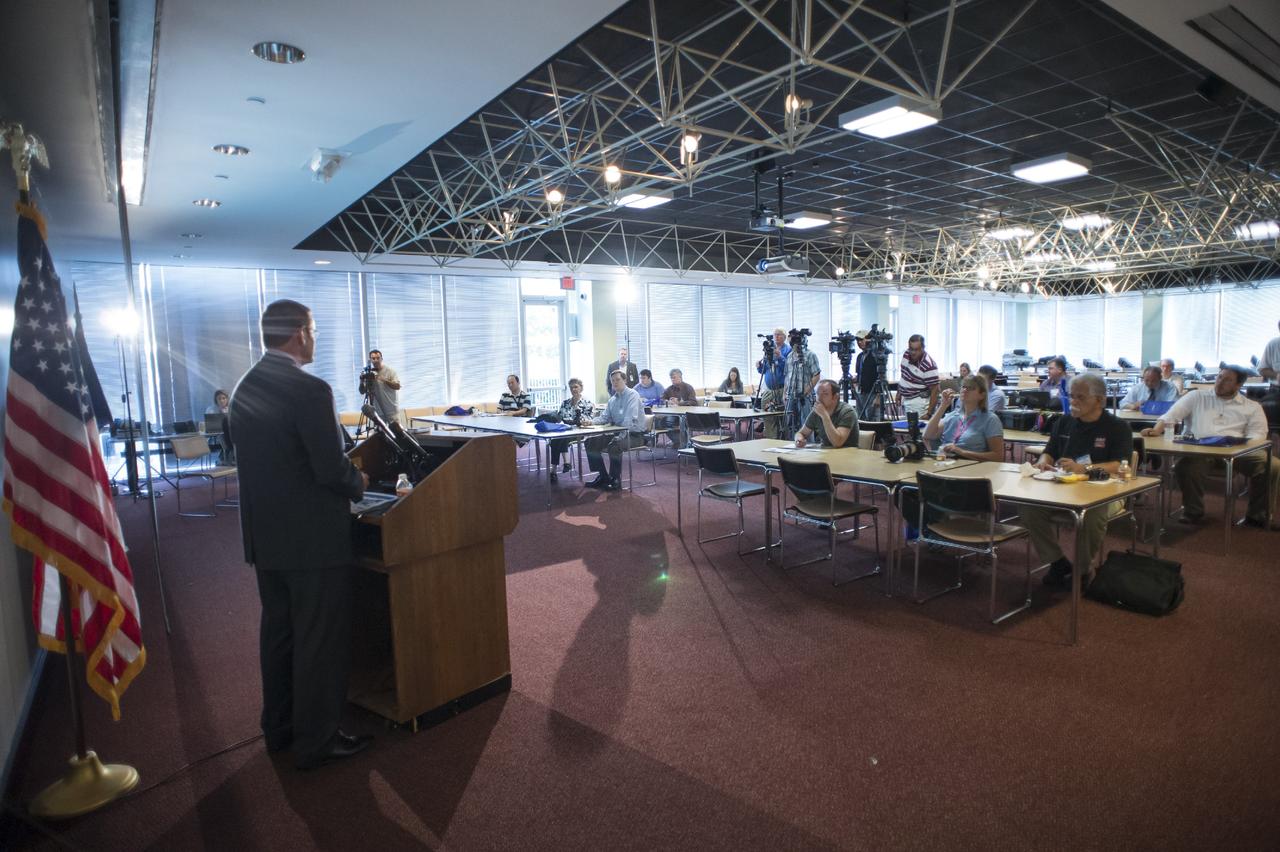
HOUSTON - JSC2013e068287 - John Elbon, vice president for Space Exploration for The Boeing Company, addresses the media before the unveiling of a CST-100 mock-up at the company's Houston Product Support Center. This test version is optimized to support five crew members and will allow the company to evaluate crew safety, interfaces, communications, maneuverability and ergonomics. Boeing's CST-100 is being designed to transport crew members or a mix of crew and cargo to low-Earth-orbit destinations. The evaluation is part of the ongoing work supporting Boeing's funded Space Act Agreement with NASA's Commercial Crew Program, or CCP, during the agency's Commercial Crew Integrated Capability, or CCiCap, initiative. CCiCap is intended to make commercial human spaceflight services available for government and commercial customers. To learn more about CCP, visit http://www.nasa.gov/commercialcrew. Photo credit: NASA/Robert Markowitz
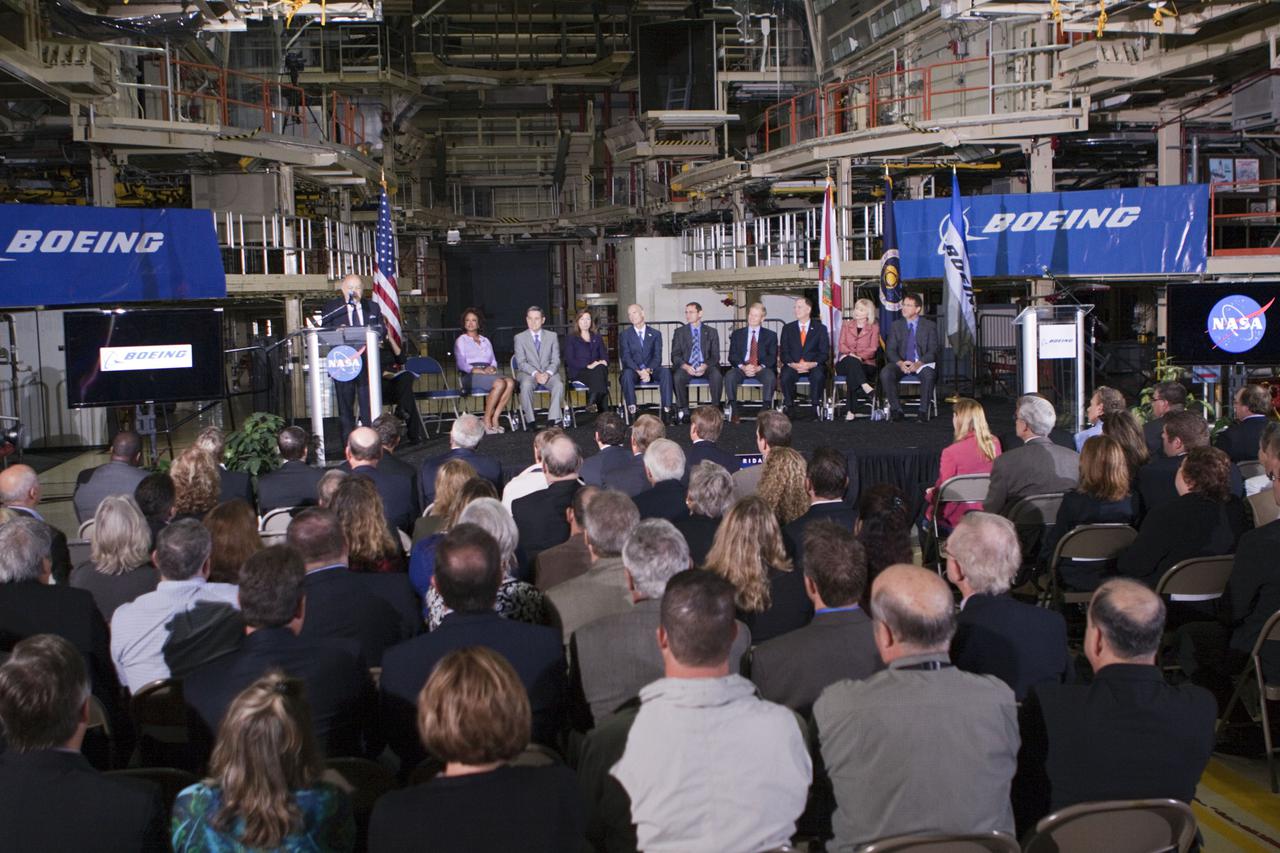
CAPE CANAVERAL, Fla. – In the Orbiter Processing Facility-3 (OPF-3) at NASA’s Kennedy Space Center in Florida, Frank DiBello, president of Space Florida, speaks to the audience after announcing the signing of an innovative agreement between NASA and Space Florida. From his left are, Florida Lt. Gov. Jennifer Carroll, chairwoman of Space Florida, Robert Cabana, Kennedy Space Center director, Lori Garver, NASA’s deputy administrator, Florida Gov. Rick Scott, John Elbon, vice president and general manager of Boeing's Space Exploration, Sen. Bill Nelson of Florida, Florida Congressman Bill Posey, Florida Representative Sandy Adams, and John Mulholland, vice president and program manager of Boeing's Commercial Crew Programs. NASA announced a partnership with Space Florida to occupy, use and modify Kennedy Space Center's Orbiter Processing Facility-3 (OPF-3), the Space Shuttle Main Engine Processing Facility and Processing Control Center. Space Florida has an agreement for use of the OPF-3 with the Boeing Company to manufacture and test the company's Crew Space Transportation (CST-100) spacecraft. The 15-year use permit deal is the latest step Kennedy is making as the center transitions from a historically government-only launch complex to a multi-user spaceport. For more information, visit http:__www.nasa.gov_exploration_commercial_index.html. Photo credit: NASA_Kim Shiflett
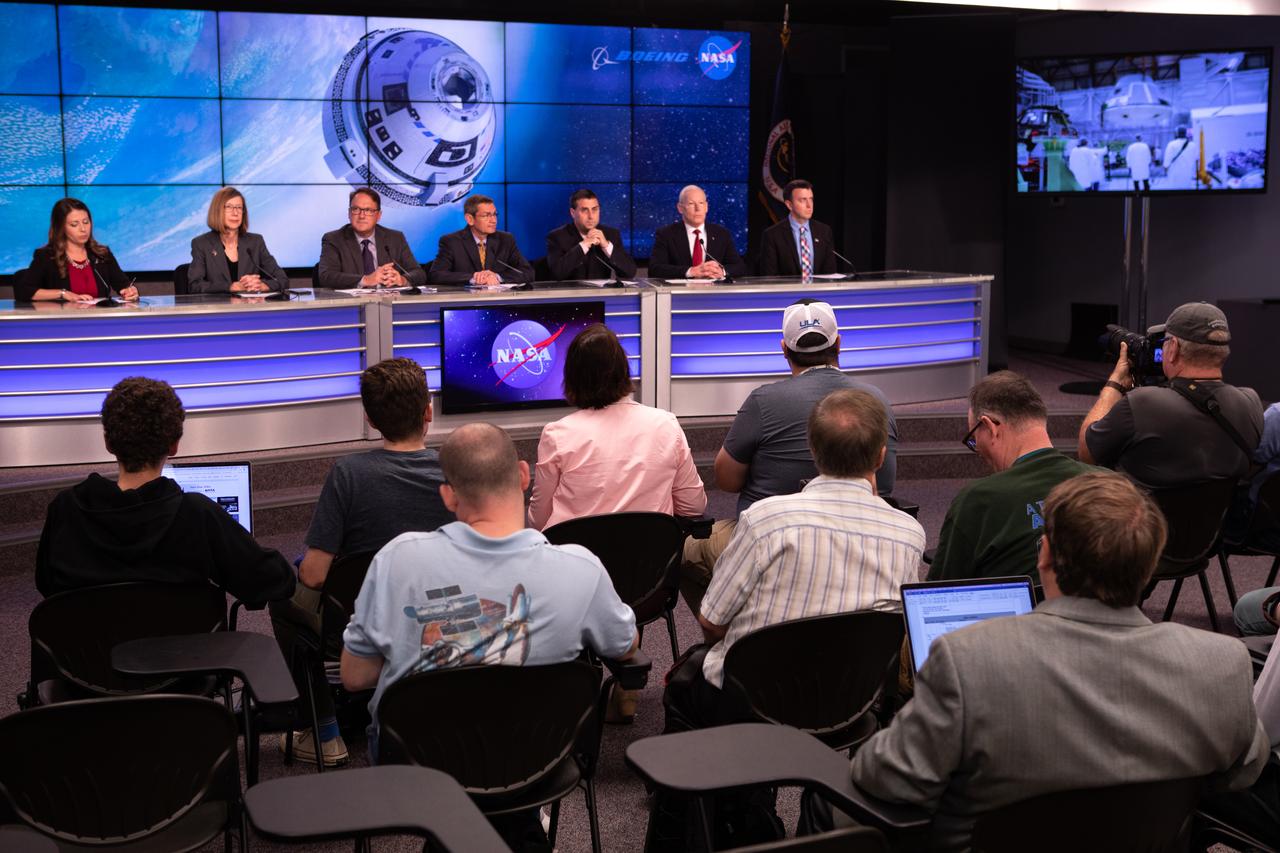
Officials from NASA, Boeing, United Launch Alliance and the U.S. Air Force 45th Weather Squadron participate in a prelaunch briefing for Boeing’s Orbital Flight Test at the agency’s Kennedy Space Center in Florida, Dec. 17, 2019. From left to right are Marie Lewis, NASA Communications; Kathy Lueders, NASA Commercial Crew Program; John Mulholland, vice president and program manager, Boeing Commercial Crew Program; John Elbon, chief operating officer, United Launch Alliance; Joel Montalbano, deputy manager, International Space Station Program; Pat Forrester, Astronaut Office chief, Johnson Space Center; and Will Ulrich, launch weather officer, 45th Weather Squadron. Boeing’s CST-100 Starliner spacecraft will launch atop a United Launch Alliance Atlas V rocket from Space Launch Complex 41 at Cape Canaveral Air Force Station. The uncrewed Orbital Flight Test will be the Starliner’s first flight to the International Space Station for NASA’s Commercial Crew Program.
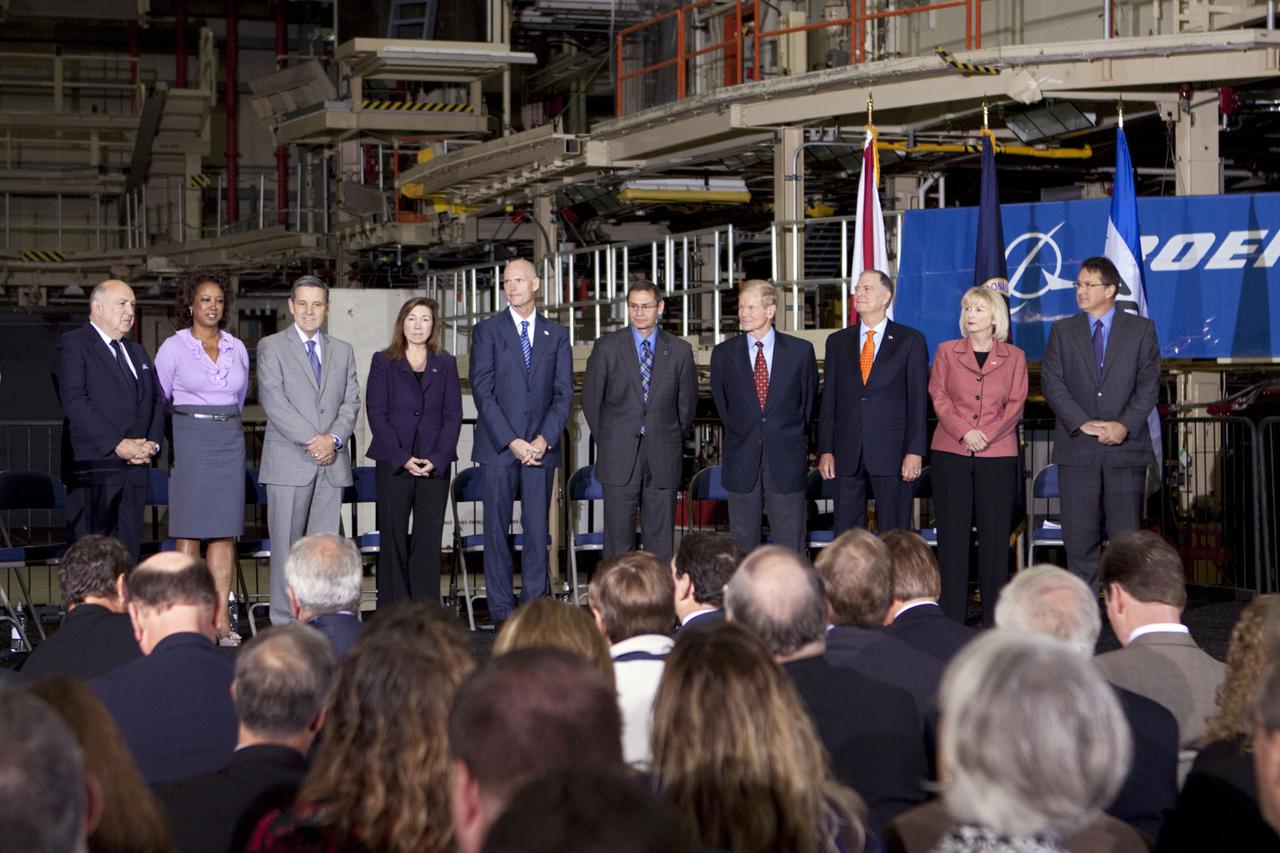
CAPE CANAVERAL, Fla. – In the Orbiter Processing Facility-3 (OPF-3) at NASA’s Kennedy Space Center in Florida, officials pose for a portrait proceeding the announcement of the signing of an innovative agreement between NASA and Space Florida. From left are, Frank DiBello, president of Space Florida, Florida Lt. Gov. Jennifer Carroll, chairwoman of Space Florida, Robert Cabana, Kennedy Space Center director, Lori Garver, NASA’s deputy administrator, Florida Gov. Rick Scott, John Elbon, vice president and general manager of Boeing's Space Exploration, Sen. Bill Nelson of Florida, Florida Congressman Bill Posey, Florida Representative Sandy Adams, and John Mulholland, vice president and program manager of Boeing's Commercial Crew Programs. NASA announced a partnership with Space Florida to occupy, use and modify Kennedy Space Center's Orbiter Processing Facility-3 (OPF-3), the Space Shuttle Main Engine Processing Facility and Processing Control Center. Space Florida has an agreement for use of the OPF-3 with the Boeing Company to manufacture and test the company's Crew Space Transportation (CST-100) spacecraft. The 15-year use permit deal is the latest step Kennedy is making as the center transitions from a historically government-only launch complex to a multi-user spaceport. For more information, visit http:__www.nasa.gov_exploration_commercial_index.html. Photo credit: NASA_Kim Shiflett
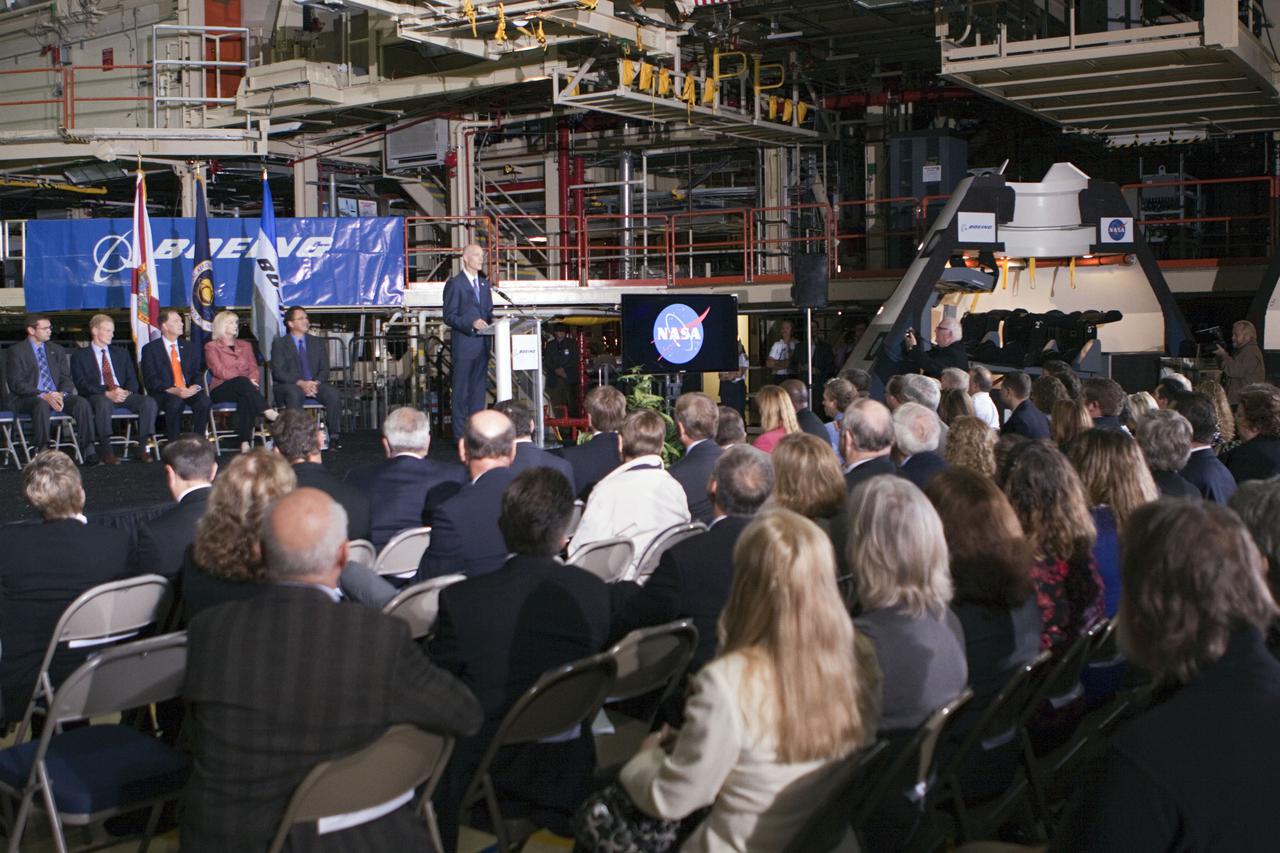
CAPE CANAVERAL, Fla. – In the Orbiter Processing Facility-3 (OPF-3) at NASA’s Kennedy Space Center in Florida, Florida Gov. Rick Scott speaks to the audience during the ceremony announcing the signing of an innovative agreement between NASA and Space Florida. Seated on the podium from left are, John Elbon, vice president and general manager of Boeing's Space Exploration, Sen. Bill Nelson of Florida, Florida Congressman Bill Posey, Florida Representative Sandy Adams, and John Mulholland, vice president and program manager of Boeing's Commercial Crew Programs. NASA announced a partnership with Space Florida to occupy, use and modify Kennedy Space Center's Orbiter Processing Facility-3 (OPF-3), the Space Shuttle Main Engine Processing Facility and Processing Control Center. Space Florida has an agreement for use of the OPF-3 with the Boeing Company to manufacture and test the company's Crew Space Transportation (CST-100) spacecraft. The 15-year use permit deal is the latest step Kennedy is making as the center transitions from a historically government-only launch complex to a multi-user spaceport. For more information, visit http:__www.nasa.gov_exploration_commercial_index.html. Photo credit: NASA_Kim Shiflett
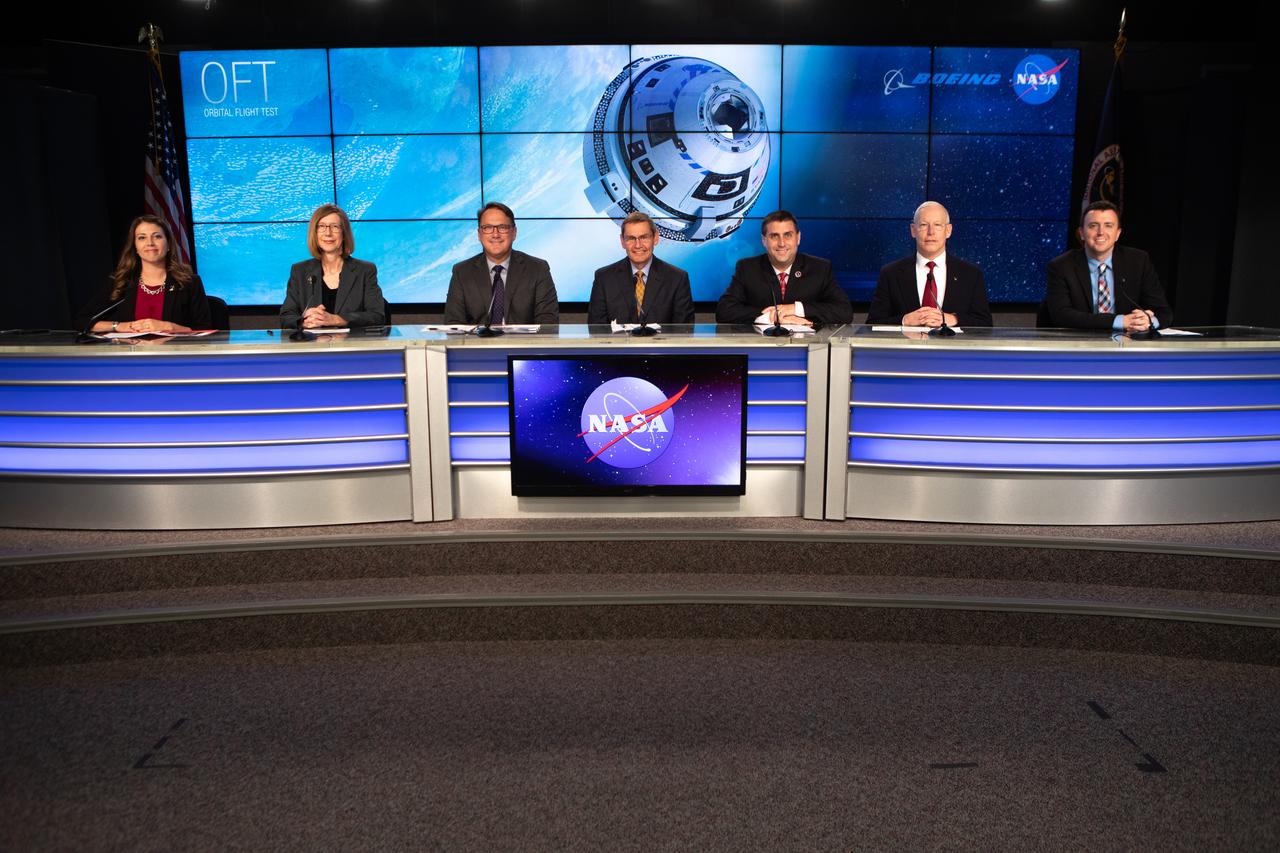
Officials from NASA, Boeing, United Launch Alliance and the U.S. Air Force 45th Weather Squadron participate in a prelaunch briefing for Boeing’s Orbital Flight Test at the agency’s Kennedy Space Center in Florida, Dec. 17, 2019. From left to right are Marie Lewis, NASA Communications; Kathy Lueders, NASA Commercial Crew Program; John Mulholland, vice president and program manager, Boeing Commercial Crew Program; John Elbon, chief operating officer, United Launch Alliance; Joel Montalbano, deputy manager, International Space Station Program; Pat Forrester, Astronaut Office chief, Johnson Space Center; and Will Ulrich, launch weather officer, 45th Weather Squadron. Boeing’s CST-100 Starliner spacecraft will launch atop a United Launch Alliance Atlas V rocket from Space Launch Complex 41 at Cape Canaveral Air Force Station. The uncrewed Orbital Flight Test will be the Starliner’s first flight to the International Space Station for NASA’s Commercial Crew Program.
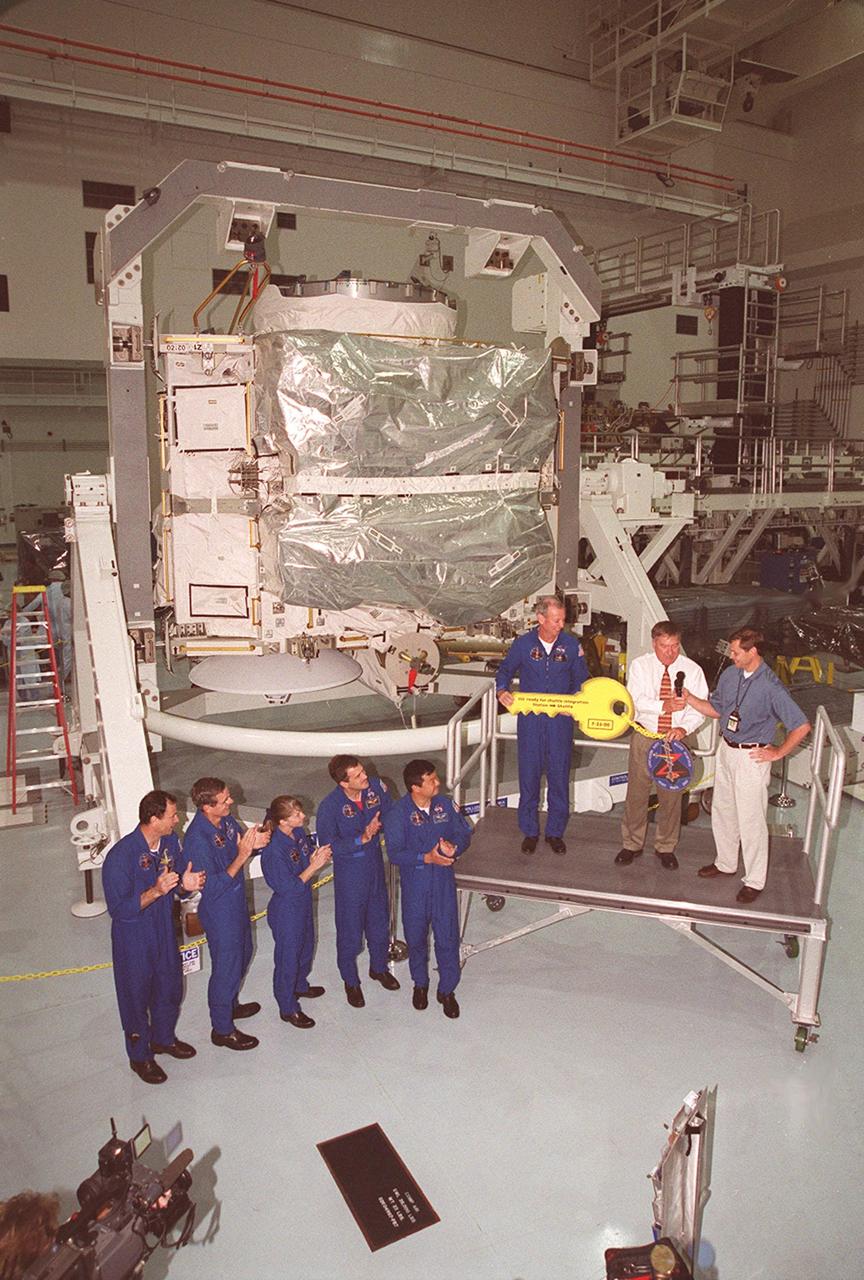
The Zenith-1 (Z-1) Truss is officially presented to NASA by The Boeing Co. on the Space Station Processing Facility floor on July 31. Astronauts from the STS-92 crew look on while their commander, Col. Brian Duffy, and Tip Talone, NASA director of International Space Station and Payload Processing at KSC, receive a symbolic key from John Elbon, Boeing director of ISS ground operations. The Z-1 Truss is the cornerstone truss of the International Space Station and is scheduled to fly in Space Shuttle Discovery's payload pay on STS-92 targeted for launch Oct. 5, 2000. The Z-1 is considered a cornerstone truss because it carries critical components of the Station's attitude, communications, thermal and power control systems as well as four control moment gyros, high and low gain antenna systems, and two plasma contactor units used to disperse electrical charge build-ups. The Z-1 truss and a Pressurized Mating Adapter (PMA-3), also flying to the Station on the same mission, will be the first major U.S. elements flown to the ISS aboard the Shuttle since the launch of the Unity element in December 1998
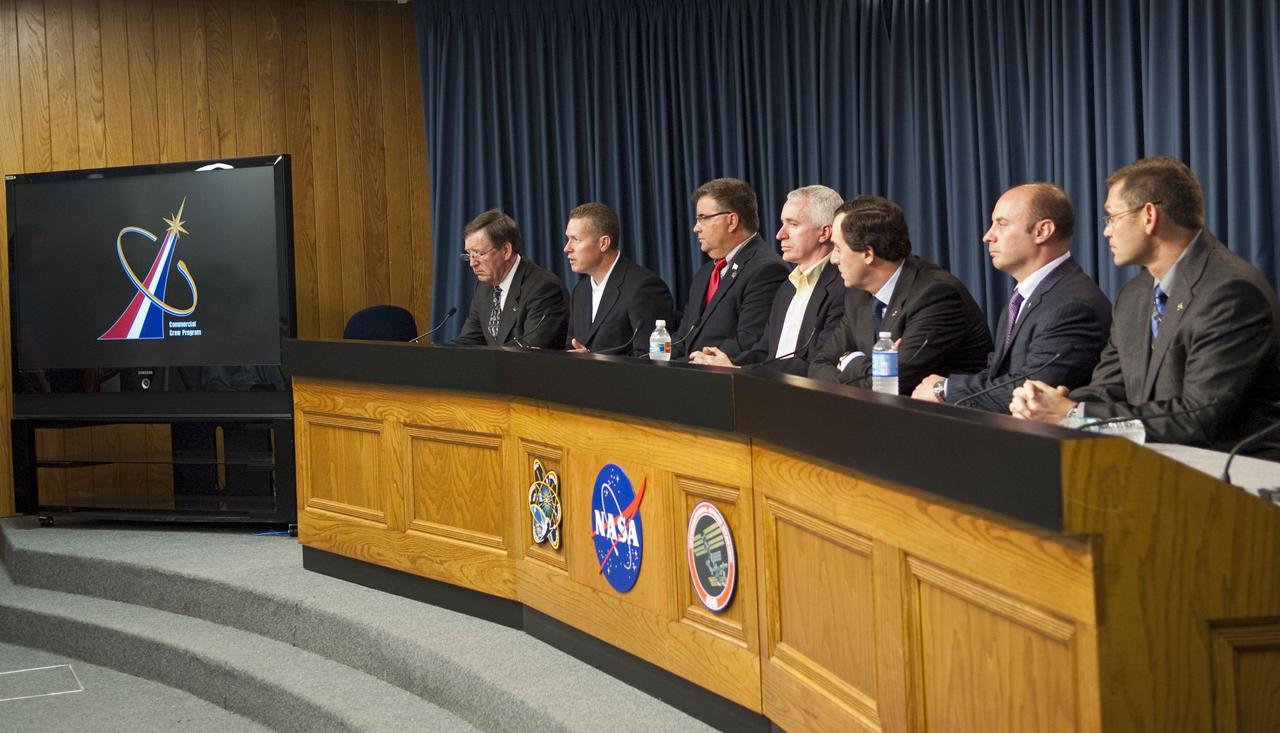
CAPE CANAVERAL, Fla. -- At NASA's Kennedy Space Center in Florida, the agency hosts a media briefing highlighting the four companies selected for the second round of the Commercial Crew Development (CCDev2) efforts. From left, are Michael Braukus, NASA Public Affairs specialist; Phil McAlister, acting director of Commercial Spaceflight Development at NASA Headquarters; Ed Mango, program manager for NASA's Commercial Crew Program at Kennedy; Rob Meyerson, program manager of Blue Origin; Mark Sirangelo, program manager of Sierra Nevada; Garrett Reisman, program manager of SpaceX; and John Elbon, program manager of The Boeing Company. NASA awarded $269.3 million to these companies to accelerate the availability of U.S. commercial crew transportation capabilities and reduce the gap in American human spaceflight capability. Through this activity, NASA also may be able to spur economic growth as potential new space markets are created. Once developed, crew transportation capabilities could become available to commercial and government customers. Photo credit: NASA_Jim Grossmann
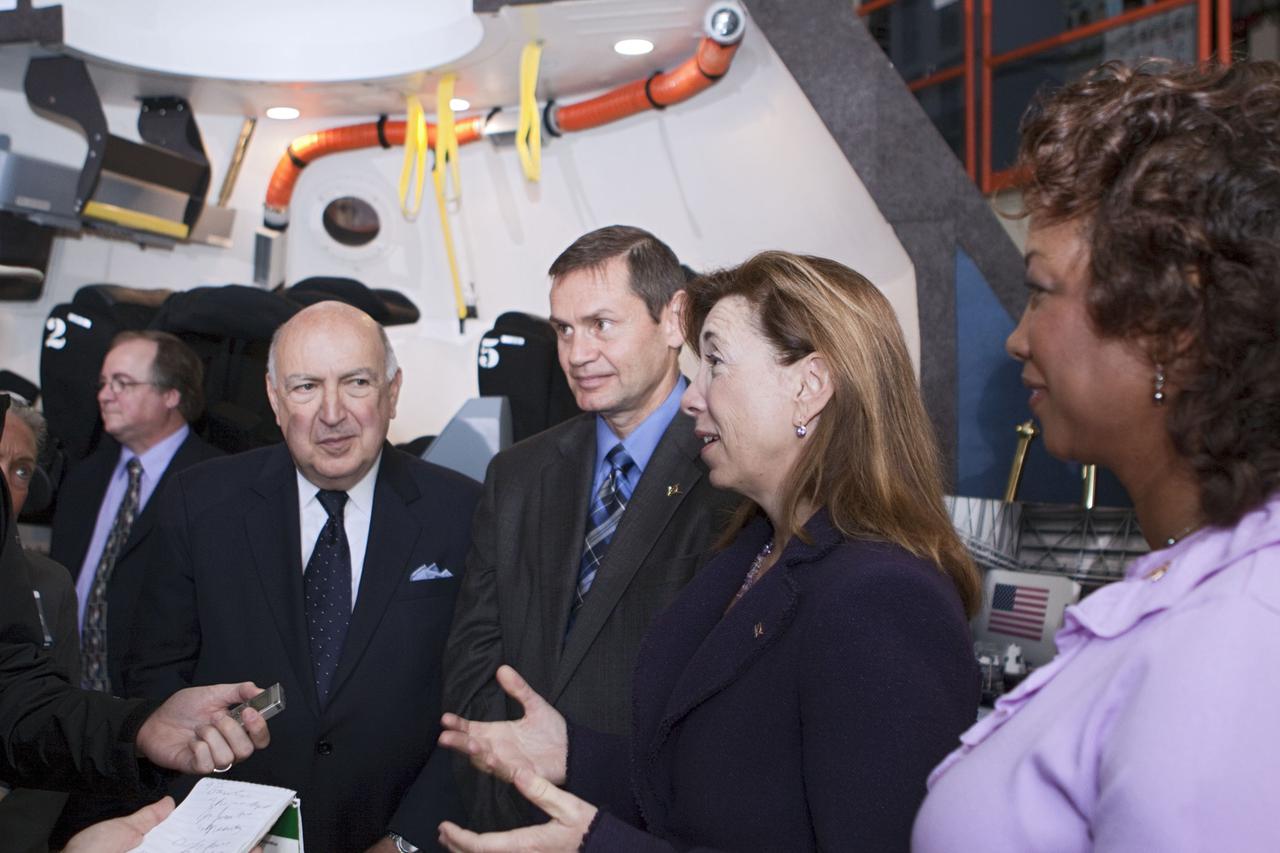
CAPE CANAVERAL, Fla. – In the Orbiter Processing Facility-3 (OPF-3) at NASA’s Kennedy Space Center in Florida, from left, Frank DiBello, president of Space Florida, John Elbon, vice president and general manager of Boeing's Space Exploration, Lori Garver, NASA’s deputy administrator, and Florida Lt. Gov. Jennifer Carroll, chairwoman of Space Florida, speak to media before a full-scale mockup of The Boeing Company’s CST-100 spacecraft at the ceremony announcing the signing of an innovative agreement between NASA and Space Florida. NASA announced a partnership with Space Florida to occupy, use and modify Kennedy Space Center's Orbiter Processing Facility-3 (OPF-3), the Space Shuttle Main Engine Processing Facility and Processing Control Center. Space Florida has an agreement for use of the OPF-3 with the Boeing Company to manufacture and test the company's Crew Space Transportation (CST-100) spacecraft. The 15-year use permit deal is the latest step Kennedy is making as the center transitions from a historically government-only launch complex to a multi-user spaceport. For more information, visit http:__www.nasa.gov_exploration_commercial_index.html. Photo credit: NASA_Kim Shiflett
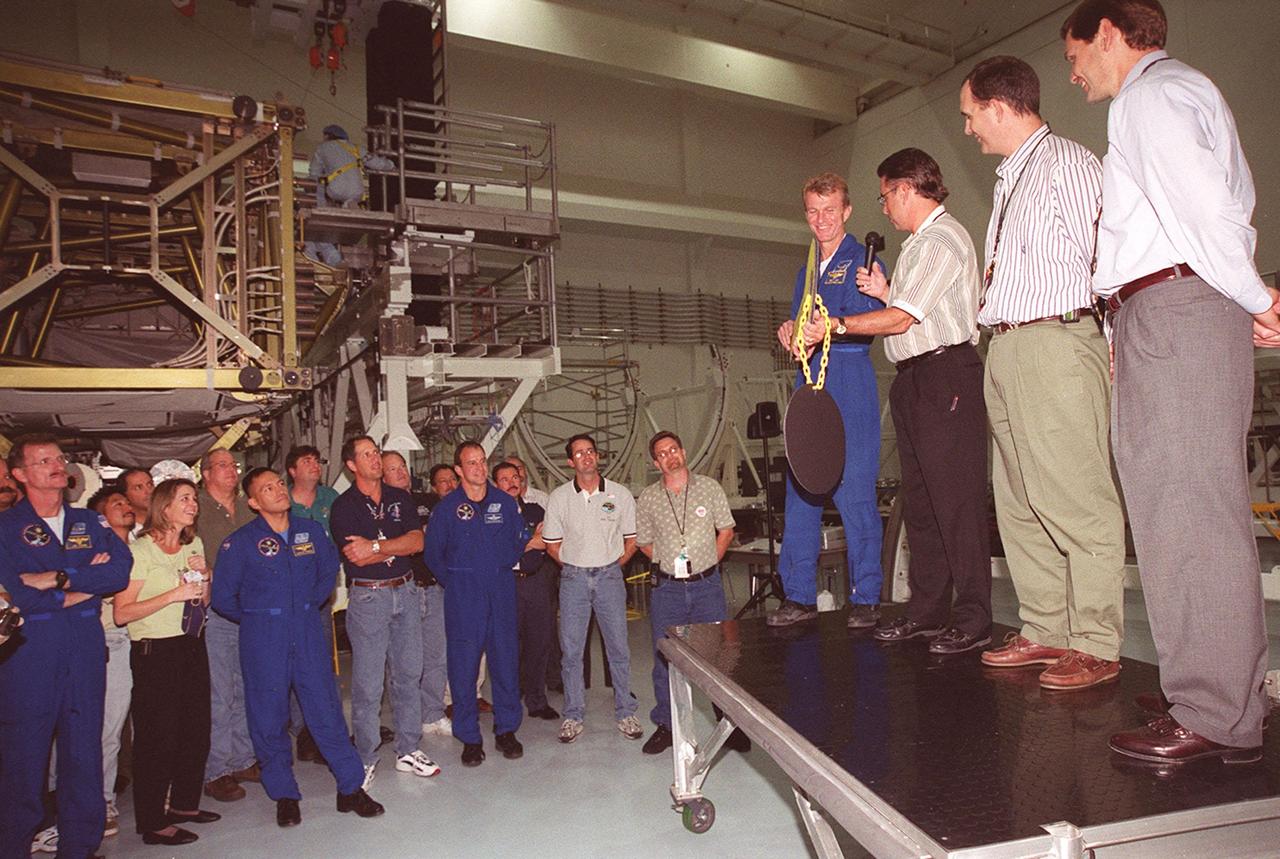
The International Space Station ground operations officially turn over the P6 Integrated Truss Structure to the NASA shuttle integration team in a ceremony in the Space Station Processing Facility. A symbolic key is presented to Brent Jett (at left), commander on mission STS-97, which is taking the P6 to the International Space Station. Next to him are (left to right) Bill Dowdell, mission manager; Mark Sorensen, outboard truss cargo element manager for Boeing; and John Elbon, Boeing ISS director of ground operations at KSC. Among the attendees at left watching the ceremony are other STS-97 crew members (in uniform, from left) Mission Specialists Joe Tanner and Carlos Noriega and Pilot Mike Bloomfield. Mission STS-97is the sixth construction flight to the International Space Station. Its payload includes a photovoltaic (PV) module, with giant solar arrays that will provide power to the Station. The mission involves two spacewalks to complete the solar array connections. STS-97 is scheduled to launch Nov. 30 at 10:05 p.m. EST
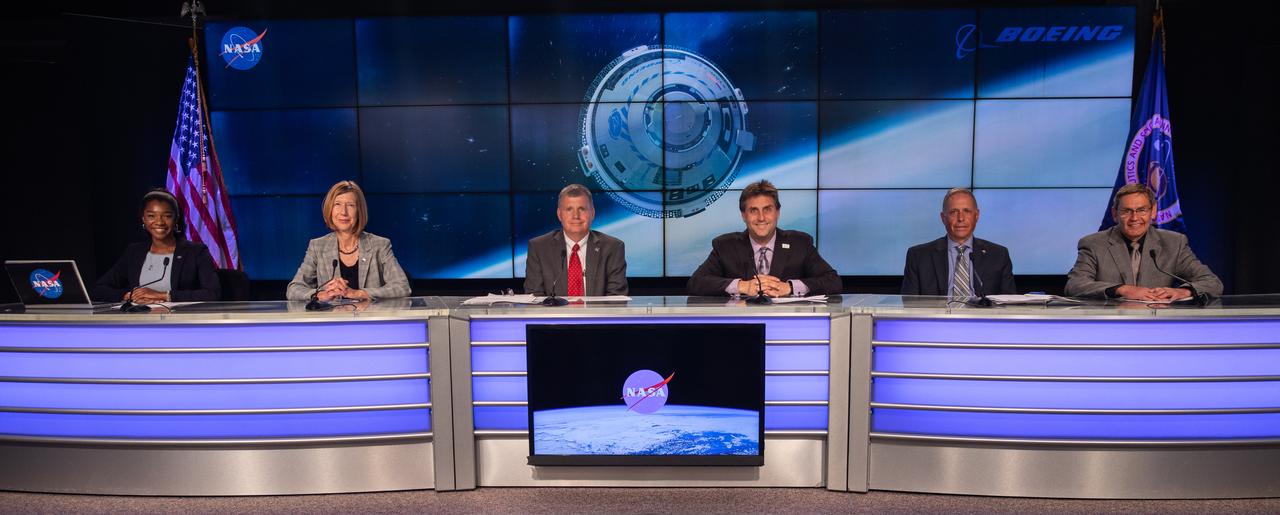
In the Press Site auditorium of NASA's Kennedy Space Center in Florida, officials from NASA, Boeing, and United Launch Alliance (ULA) participate in a postlaunch news conference following the liftoff of NASA Boeing’s Orbital Flight Test-2 (OFT-2) on May 19, 2022. From left are Jasmine Hopkins, NASA Communications; Kathryn Lueders, associate administrator, Space Operations Mission Directorate at NASA; Steve Stich, manager, NASA Commercial Crew Program; Joel Montalbano, manager, NASA’s International Space Station Program; Mark Nappi, vice president and program manager, Boeing Commercial Crew Program; John Elbon, chief operating officer, United Launch Alliance. Liftoff occurred at 6:54 p.m. EDT from Space Launch Complex-41 at Florida’s Cape Canaveral Space Force Station. Boeing’s uncrewed flight test is designed to test the system’s end-to-end capabilities for NASA’s Commercial Crew Program providing valuable data towards NASA certifying Boeing’s crew transportation system for regular crewed flights to and from the International Space Station.
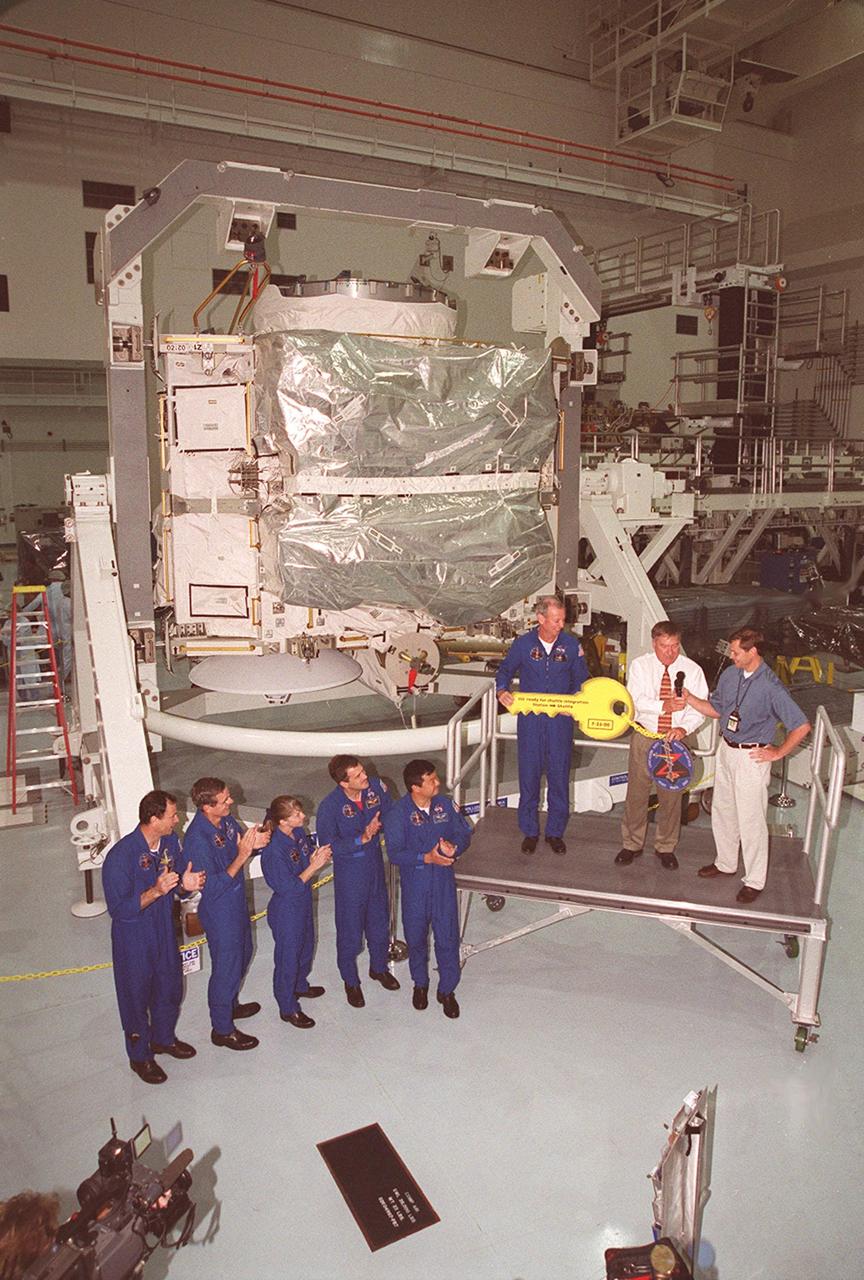
The Zenith-1 (Z-1) Truss is officially presented to NASA by The Boeing Co. on the Space Station Processing Facility floor on July 31. Astronauts from the STS-92 crew look on while their commander, Col. Brian Duffy, and Tip Talone, NASA director of International Space Station and Payload Processing at KSC, receive a symbolic key from John Elbon, Boeing director of ISS ground operations. The Z-1 Truss is the cornerstone truss of the International Space Station and is scheduled to fly in Space Shuttle Discovery's payload pay on STS-92 targeted for launch Oct. 5, 2000. The Z-1 is considered a cornerstone truss because it carries critical components of the Station's attitude, communications, thermal and power control systems as well as four control moment gyros, high and low gain antenna systems, and two plasma contactor units used to disperse electrical charge build-ups. The Z-1 truss and a Pressurized Mating Adapter (PMA-3), also flying to the Station on the same mission, will be the first major U.S. elements flown to the ISS aboard the Shuttle since the launch of the Unity element in December 1998
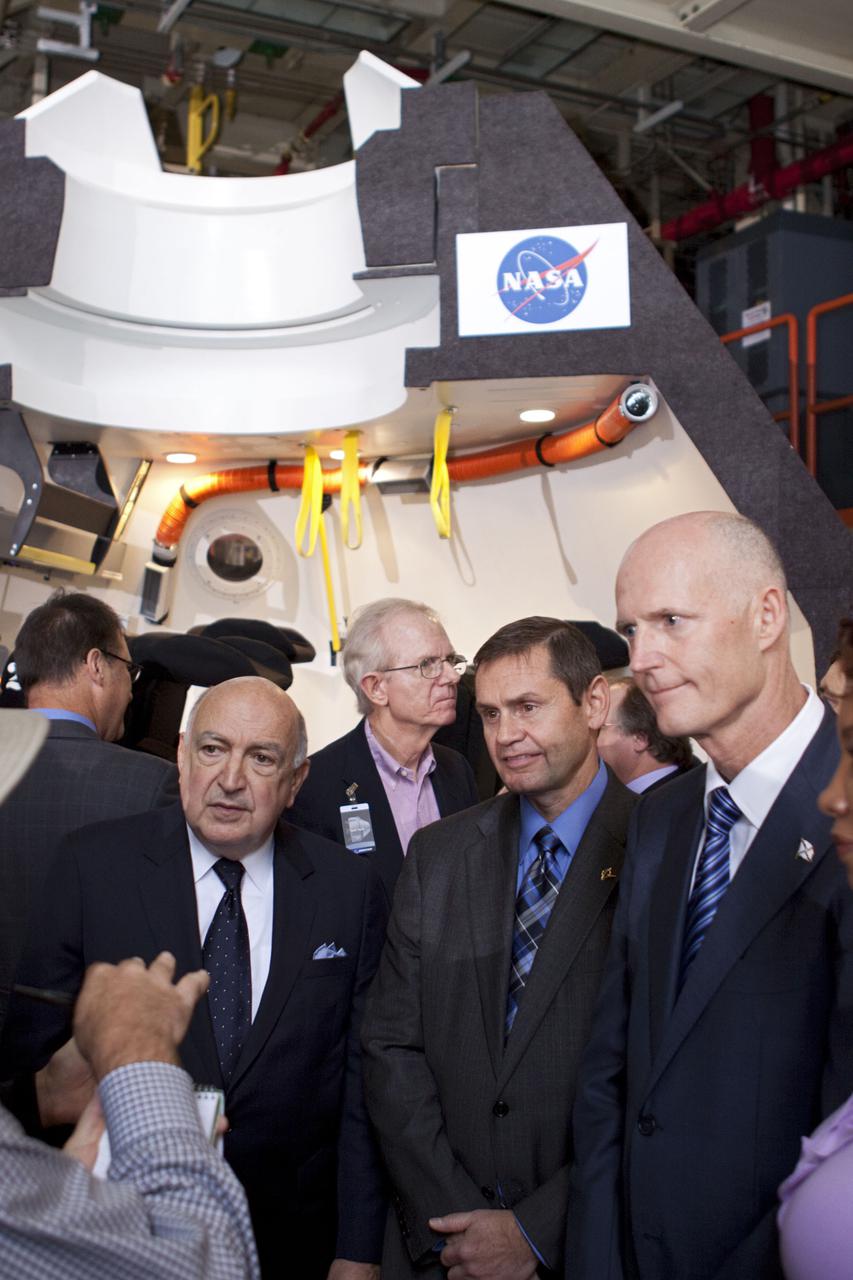
CAPE CANAVERAL, Fla. – In the Orbiter Processing Facility-3 (OPF-3) at NASA’s Kennedy Space Center in Florida, from left, Frank DiBello, president of Space Florida, John Elbon, vice president and general manager of Boeing's Space Exploration, and Florida Gov. Rick Scott, speak to media before a full-scale mockup of The Boeing Company’s CST-100 spacecraft at the ceremony announcing the signing of an innovative agreement between NASA and Space Florida. NASA announced a partnership with Space Florida to occupy, use and modify Kennedy Space Center's Orbiter Processing Facility-3 (OPF-3), the Space Shuttle Main Engine Processing Facility and Processing Control Center. Space Florida has an agreement for use of the OPF-3 with the Boeing Company to manufacture and test the company's Crew Space Transportation (CST-100) spacecraft. The 15-year use permit deal is the latest step Kennedy is making as the center transitions from a historically government-only launch complex to a multi-user spaceport. For more information, visit http:__www.nasa.gov_exploration_commercial_index.html. Photo credit: NASA_Kim Shiflett
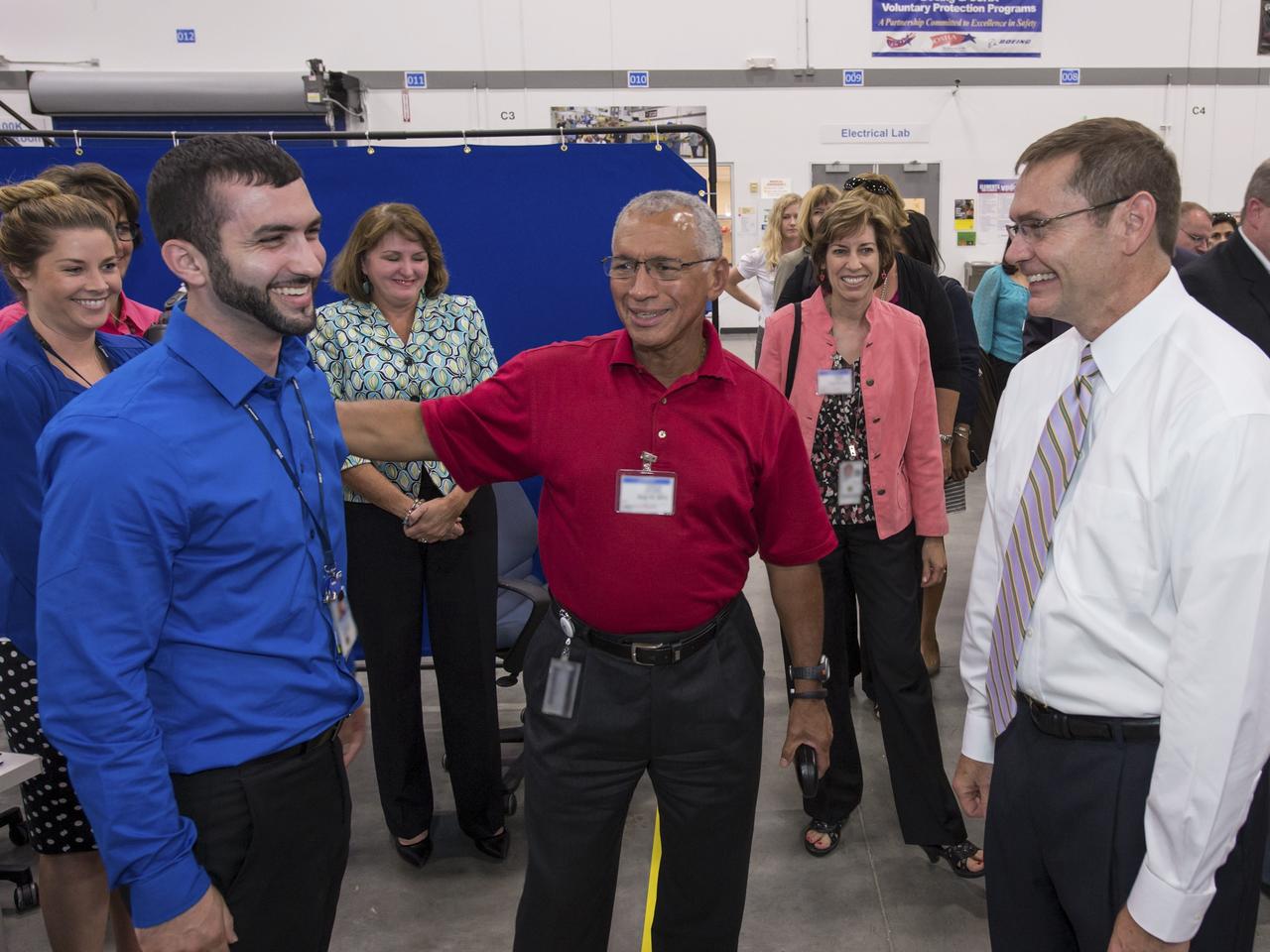
HOUSTON -- JSC-2013-E076038 -- NASA Administrator Charlie Bolden, center, talks to members of The Boeing Company's CST-100 team at the company's Houston Product Support Center near Johnson Space Center. At left is Brandon Setayesh, a mechanical engineer who helped build a fully outfitted test version of the CST-100. At right is John Elbon, vice president of Boeing's Space Exploration. Also joining Bolden during his tour of the CST-100 mock-up is Johnson Center Director Ellen Ochoa, behind Bolden at right, and other Johnson management. Boeing's CST-100 is designed to transport a mix of crew and cargo to low-Earth-orbit destinations. Boeing is one of three aerospace industry partners working with NASA's Commercial Crew Program, or CCP, during the Commercial Crew Integrated Capability, or CCiCap, initiative, which is intended to make commercial human spaceflight services available for government and commercial customers. To learn more about CCP, visit www.nasa.gov/commercialcrew. Photo credit: NASA/James Blair
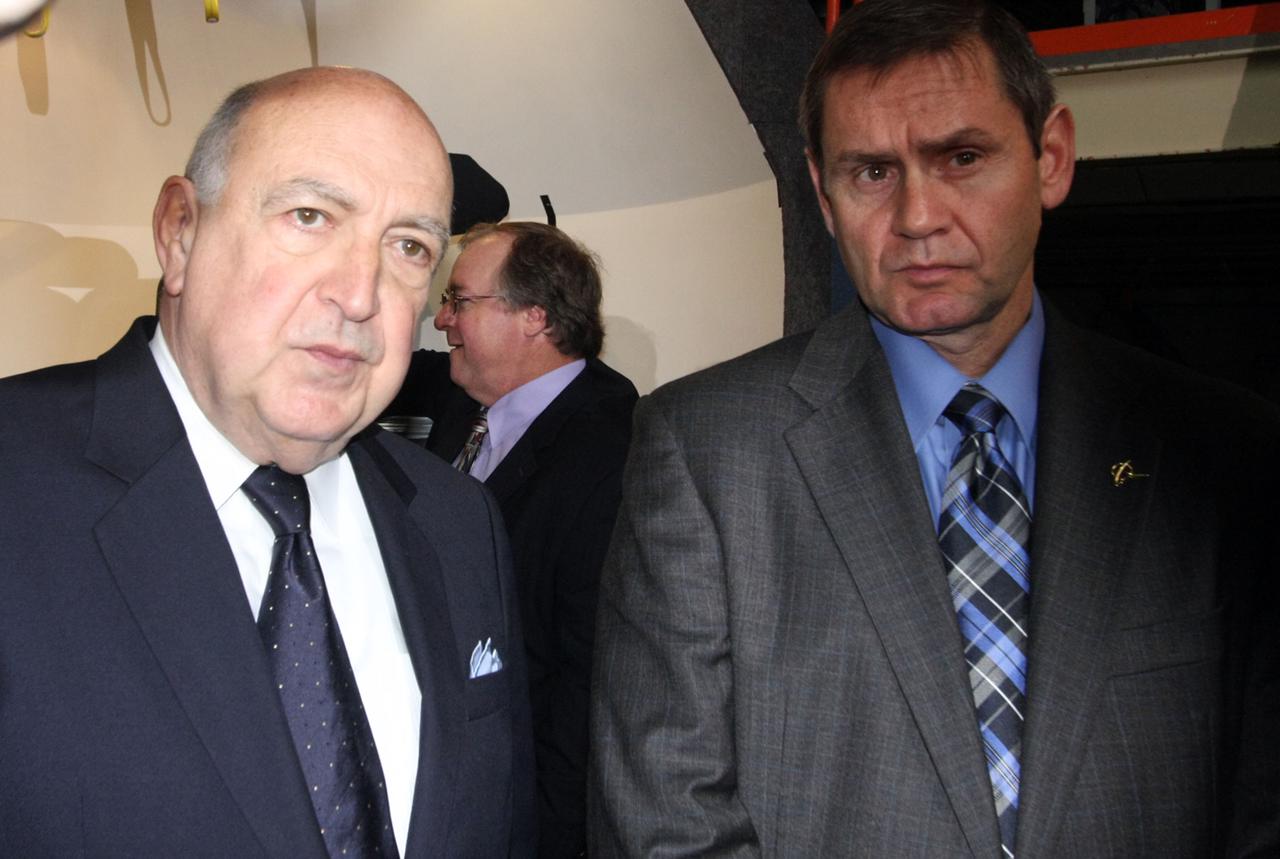
CAPE CANAVERAL, Fla. – In the Orbiter Processing Facility-3 (OPF-3) at NASA’s Kennedy Space Center in Florida, from left, Frank DiBello, president of Space Florida and John Elbon, vice president and general manager of Boeing's Space Exploration, stand before a full-scale mockup of The Boeing Company’s CST-100 spacecraft after the ceremony which announced the signing of an innovative agreement between NASA and Space Florida. NASA announced a partnership with Space Florida to occupy, use and modify Kennedy Space Center's Orbiter Processing Facility-3 (OPF-3), the Space Shuttle Main Engine Processing Facility and Processing Control Center. Space Florida has an agreement for use of the OPF-3 with the Boeing Company to manufacture and test the company's Crew Space Transportation (CST-100) spacecraft. The 15-year use permit deal is the latest step Kennedy is making as the center transitions from a historically government-only launch complex to a multi-user spaceport. For more information, visit http:__www.nasa.gov_exploration_commercial_index.html. Photo credit: NASA_Ken Thornsley
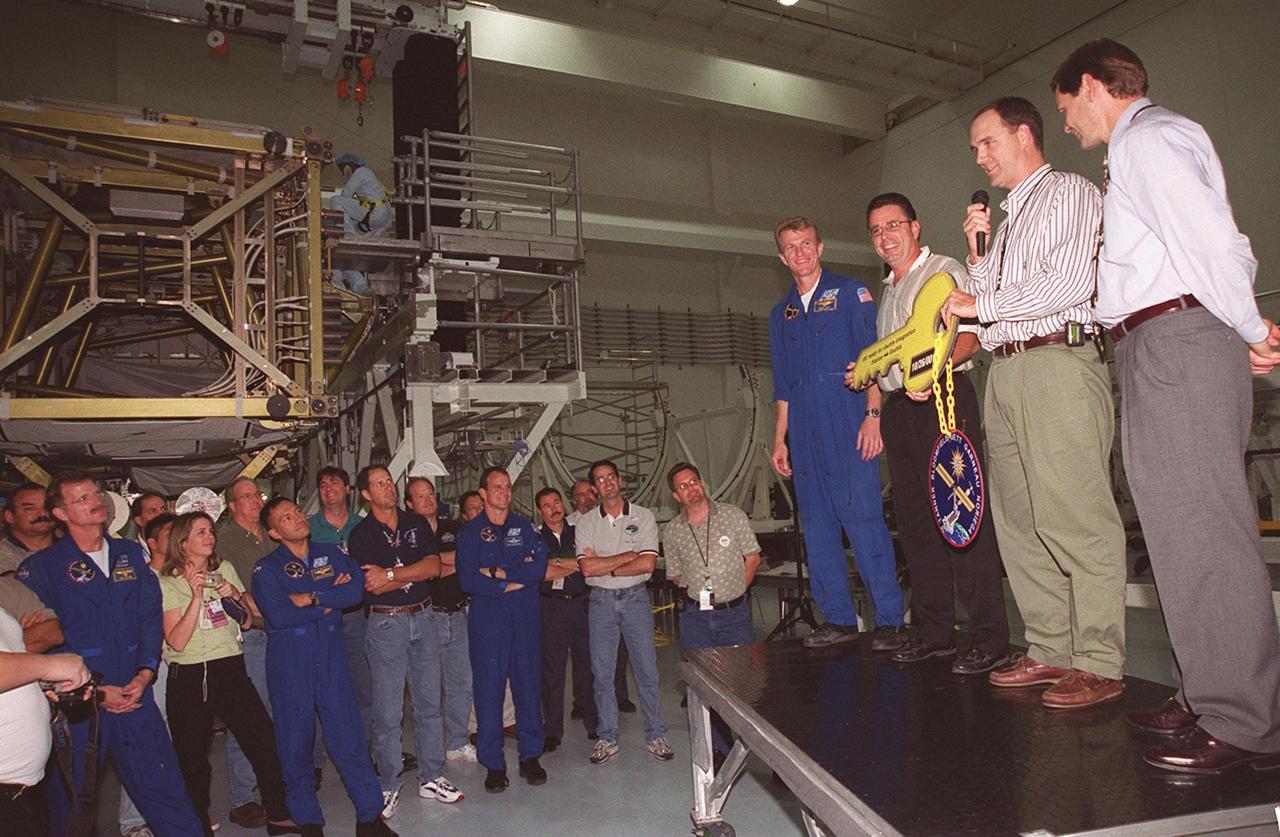
Boeing workers officially turn over the P6 Integrated Truss Structure to the NASA shuttle integration team in a ceremony in the Space Station Processing Facility. A symbolic key will be presented to Brent Jett (at left), commander on mission STS-97, which is taking the P6 to the International Space Station. Next to Jett are (left to right) Bill Dowdell, mission manager; Mark Sorensen, outboard truss cargo element manager for Boeing; and John Elbon, Boeing ISS director of ground operations at KSC. Among the attendees at left watching the ceremony are other STS-97 crew members (in uniform, from left) Mission Specialists Joe Tanner and Carlos Noriega and Pilot Mike Bloomfield. Mission STS-97is the sixth construction flight to the International Space Station. Its payload includes a photovoltaic (PV) module, with giant solar arrays that will provide power to the Station. The mission involves two spacewalks to complete the solar array connections. STS-97 is scheduled to launch Nov. 30 at 10:05 p.m. EST
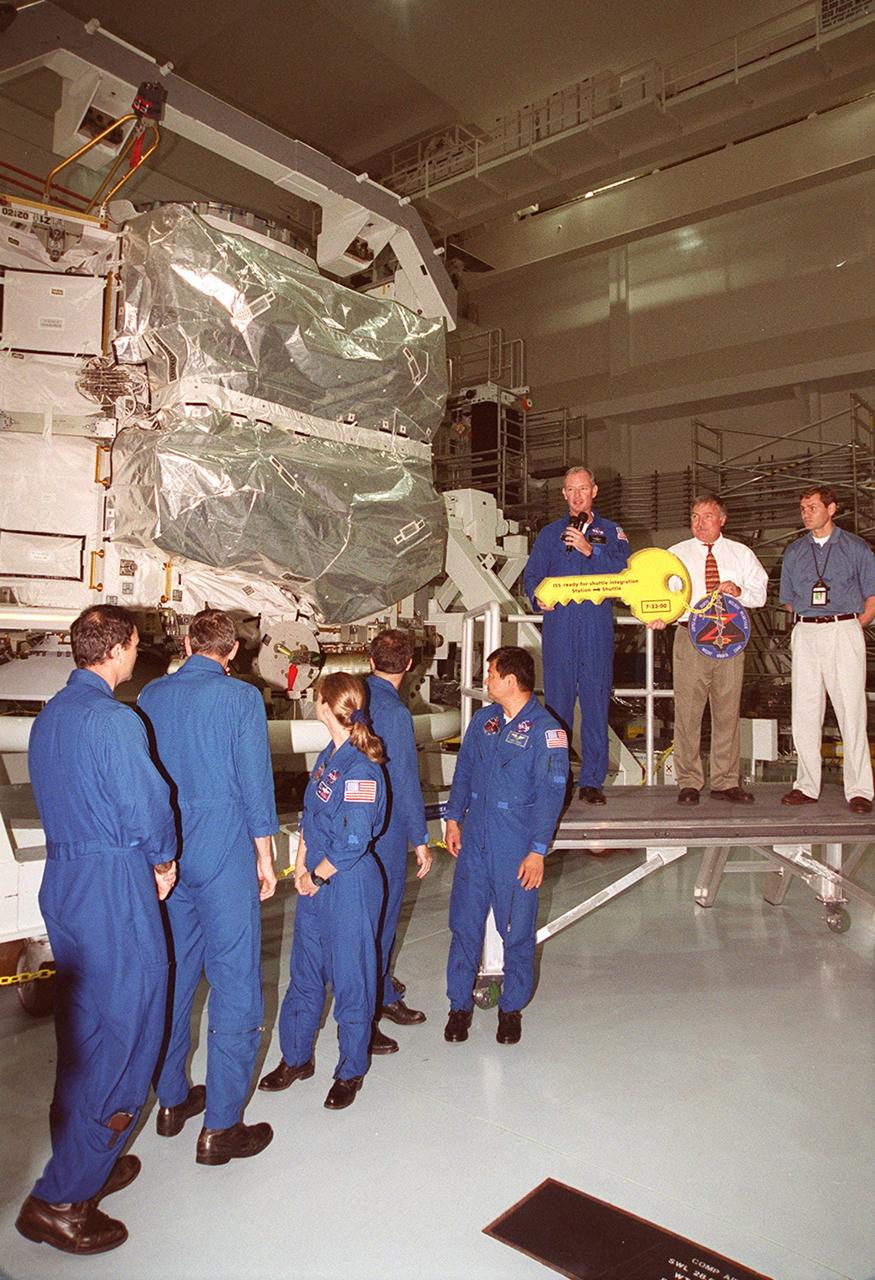
The Zenith-1 (Z-1) Truss is officially presented to NASA by The Boeing Co. on the Space Station Processing Facility floor on July 31. STS-92 Commander Col. Brian Duffy, comments on the presentation. At his side is Tip Talone, NASA director of International Space Station and Payload Processing at KSC. Talone and Col. Duffy received a symbolic key for the truss from John Elbon, Boeing director of ISS ground operations. The Z-1 Truss is the cornerstone truss of the International Space Station and is scheduled to fly in Space Shuttle Discovery's payload pay on STS-92 targeted for launch Oct. 5, 2000. The Z-1 is considered a cornerstone truss because it carries critical components of the Station's attitude, communications, thermal and power control systems as well as four control moment gyros, high and low gain antenna systems, and two plasma contactor units used to disperse electrical charge build-ups. The Z-1 truss and a Pressurized Mating Adapter (PMA-3), also flying to the Station on the same mission, will be the first major U.S. elements flown to the ISS aboard the Shuttle since the launch of the Unity element in December 1998
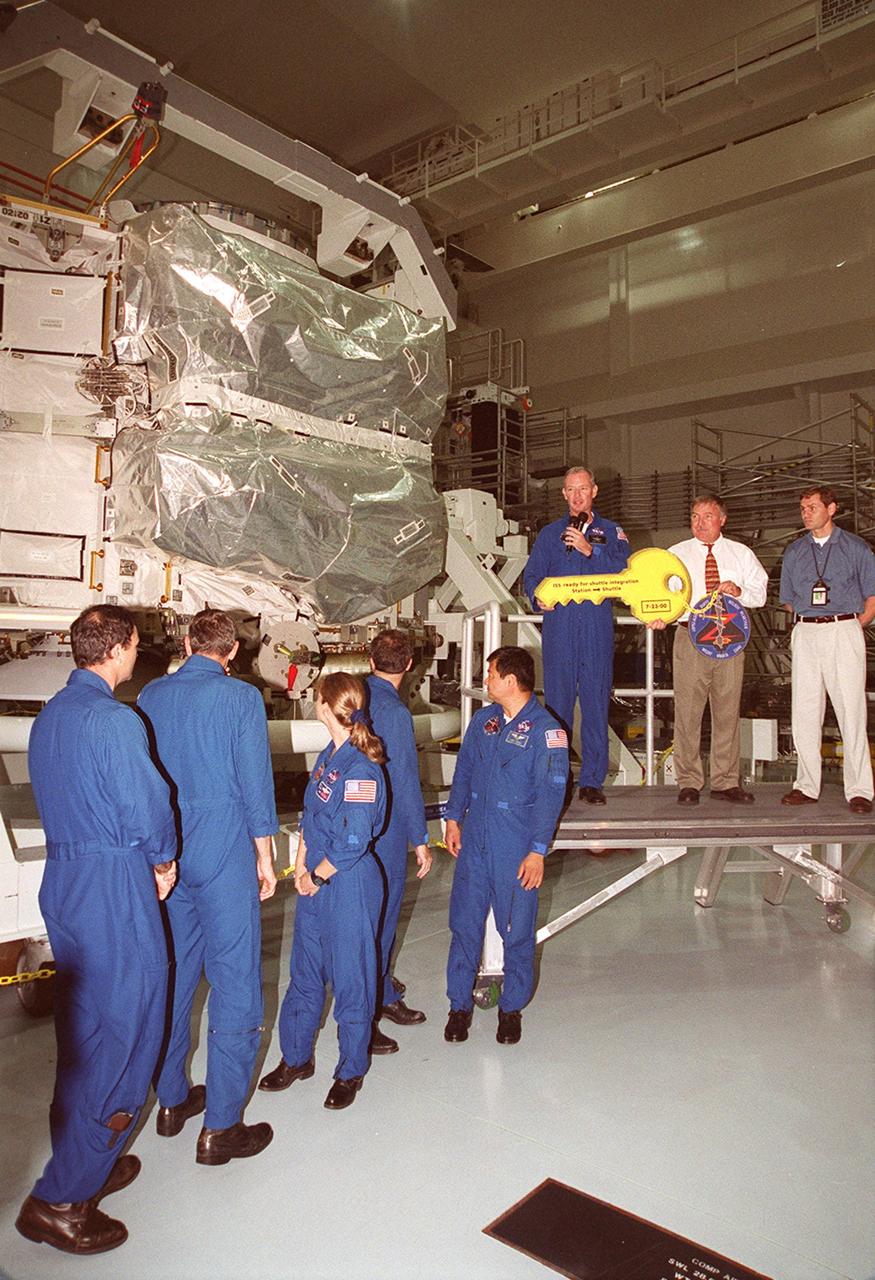
The Zenith-1 (Z-1) Truss is officially presented to NASA by The Boeing Co. on the Space Station Processing Facility floor on July 31. STS-92 Commander Col. Brian Duffy, comments on the presentation. At his side is Tip Talone, NASA director of International Space Station and Payload Processing at KSC. Talone and Col. Duffy received a symbolic key for the truss from John Elbon, Boeing director of ISS ground operations. The Z-1 Truss is the cornerstone truss of the International Space Station and is scheduled to fly in Space Shuttle Discovery's payload pay on STS-92 targeted for launch Oct. 5, 2000. The Z-1 is considered a cornerstone truss because it carries critical components of the Station's attitude, communications, thermal and power control systems as well as four control moment gyros, high and low gain antenna systems, and two plasma contactor units used to disperse electrical charge build-ups. The Z-1 truss and a Pressurized Mating Adapter (PMA-3), also flying to the Station on the same mission, will be the first major U.S. elements flown to the ISS aboard the Shuttle since the launch of the Unity element in December 1998
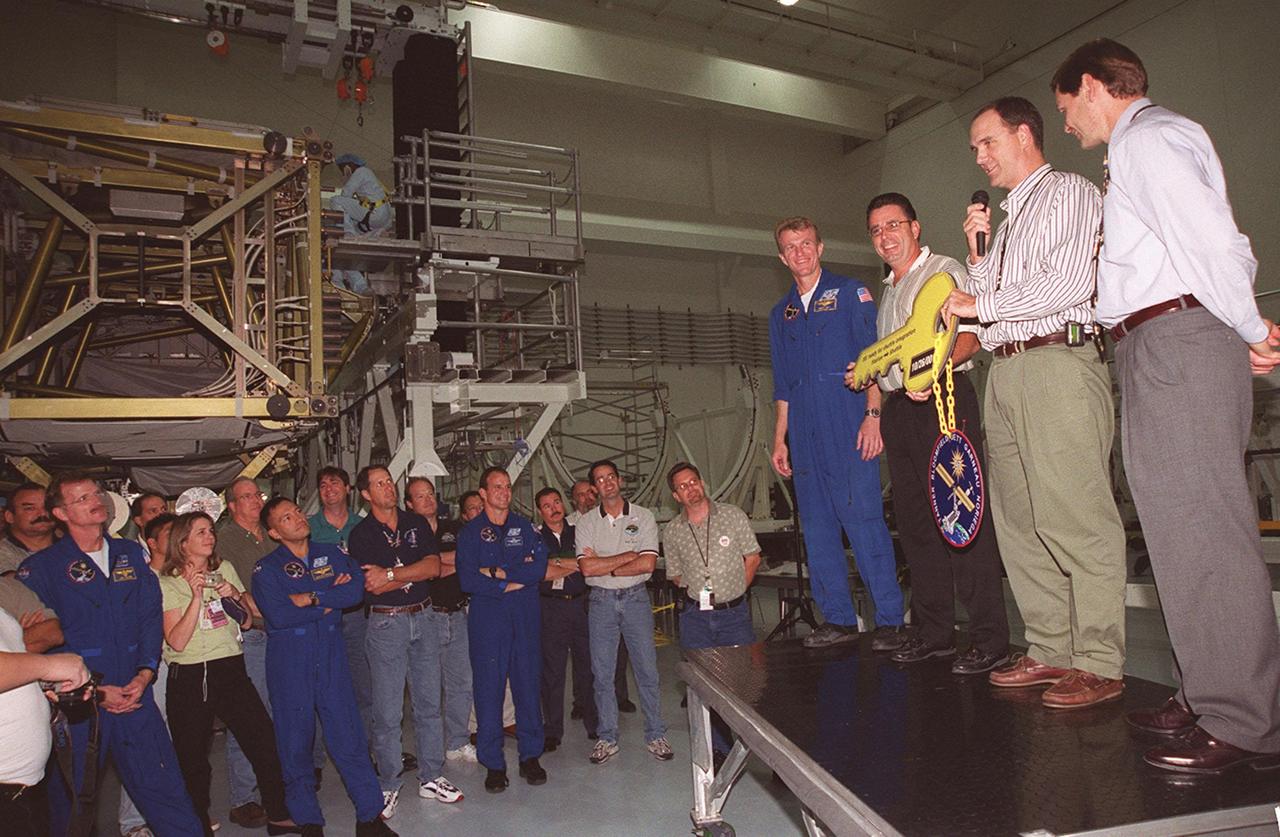
Boeing workers officially turn over the P6 Integrated Truss Structure to the NASA shuttle integration team in a ceremony in the Space Station Processing Facility. A symbolic key will be presented to Brent Jett (at left), commander on mission STS-97, which is taking the P6 to the International Space Station. Next to Jett are (left to right) Bill Dowdell, mission manager; Mark Sorensen, outboard truss cargo element manager for Boeing; and John Elbon, Boeing ISS director of ground operations at KSC. Among the attendees at left watching the ceremony are other STS-97 crew members (in uniform, from left) Mission Specialists Joe Tanner and Carlos Noriega and Pilot Mike Bloomfield. Mission STS-97is the sixth construction flight to the International Space Station. Its payload includes a photovoltaic (PV) module, with giant solar arrays that will provide power to the Station. The mission involves two spacewalks to complete the solar array connections. STS-97 is scheduled to launch Nov. 30 at 10:05 p.m. EST
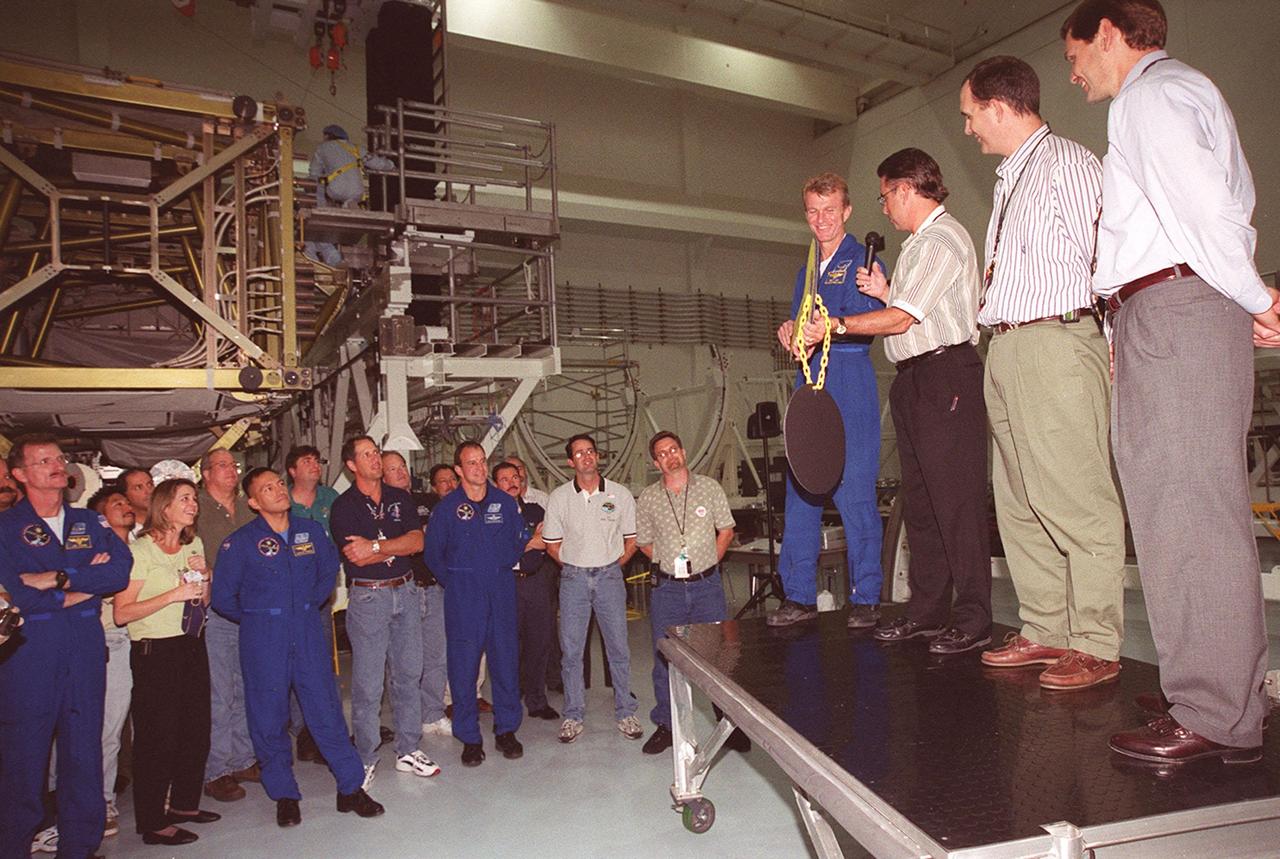
The International Space Station ground operations officially turn over the P6 Integrated Truss Structure to the NASA shuttle integration team in a ceremony in the Space Station Processing Facility. A symbolic key is presented to Brent Jett (at left), commander on mission STS-97, which is taking the P6 to the International Space Station. Next to him are (left to right) Bill Dowdell, mission manager; Mark Sorensen, outboard truss cargo element manager for Boeing; and John Elbon, Boeing ISS director of ground operations at KSC. Among the attendees at left watching the ceremony are other STS-97 crew members (in uniform, from left) Mission Specialists Joe Tanner and Carlos Noriega and Pilot Mike Bloomfield. Mission STS-97is the sixth construction flight to the International Space Station. Its payload includes a photovoltaic (PV) module, with giant solar arrays that will provide power to the Station. The mission involves two spacewalks to complete the solar array connections. STS-97 is scheduled to launch Nov. 30 at 10:05 p.m. EST
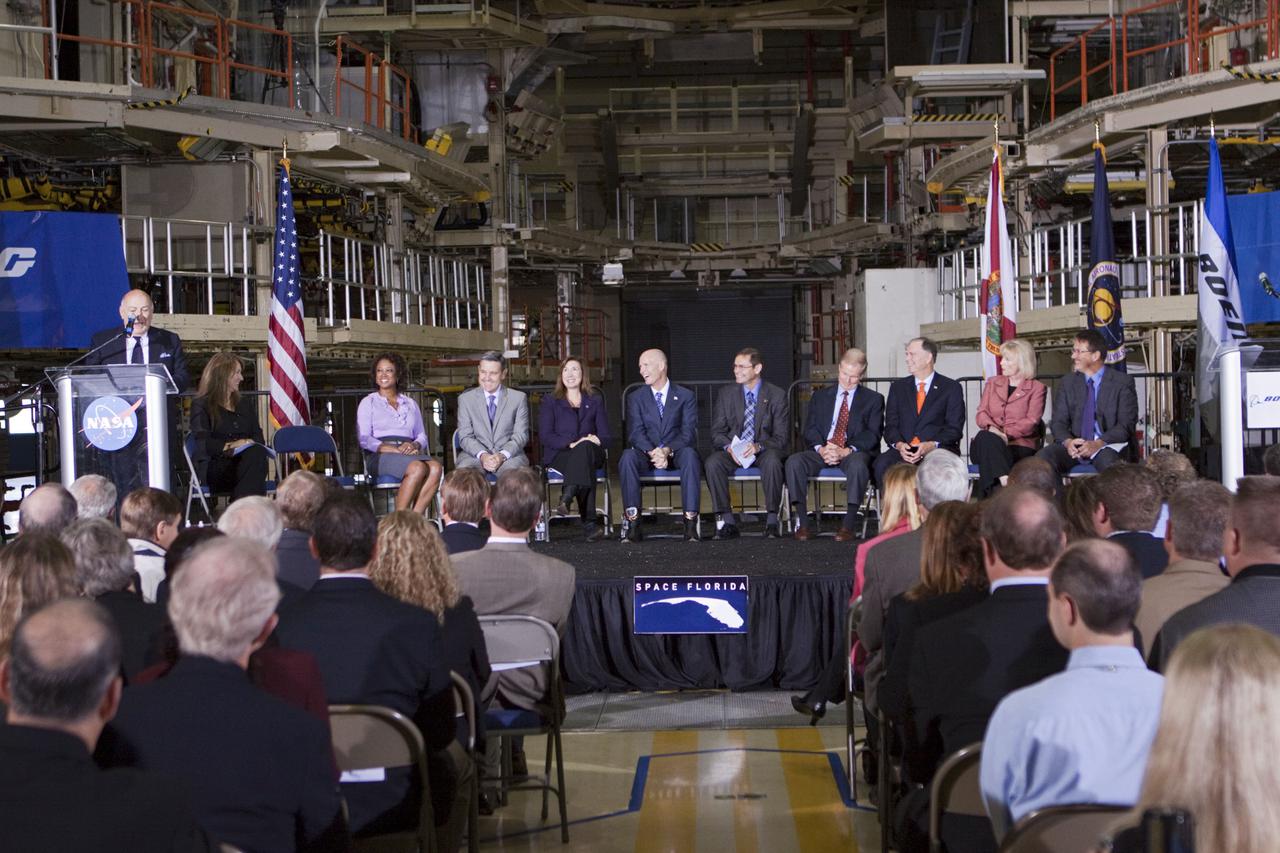
CAPE CANAVERAL, Fla. – In the Orbiter Processing Facility-3 (OPF-3) at NASA’s Kennedy Space Center in Florida, Frank DiBello, president of Space Florida, speaks to the audience after announcing the signing of an innovative agreement between NASA and Space Florida. From his left are, Joyce Riquelme, manager of Kennedy's Center Planning and Development Office, Florida Lt. Gov. Jennifer Carroll, chairwoman of Space Florida, Robert Cabana, Kennedy Space Center director, Lori Garver, NASA’s deputy administrator, Florida Gov. Rick Scott, John Elbon, vice president and general manager of Boeing's Space Exploration, Sen. Bill Nelson of Florida, Florida Congressman Bill Posey, Florida Representative Sandy Adams, and John Mulholland, vice president and program manager of Boeing's Commercial Crew Programs. NASA announced a partnership with Space Florida to occupy, use and modify Kennedy Space Center's Orbiter Processing Facility-3 (OPF-3), the Space Shuttle Main Engine Processing Facility and Processing Control Center. Space Florida has an agreement for use of the OPF-3 with the Boeing Company to manufacture and test the company's Crew Space Transportation (CST-100) spacecraft. The 15-year use permit deal is the latest step Kennedy is making as the center transitions from a historically government-only launch complex to a multi-user spaceport. For more information, visit http:__www.nasa.gov_exploration_commercial_index.html. Photo credit: NASA_Kim Shiflett
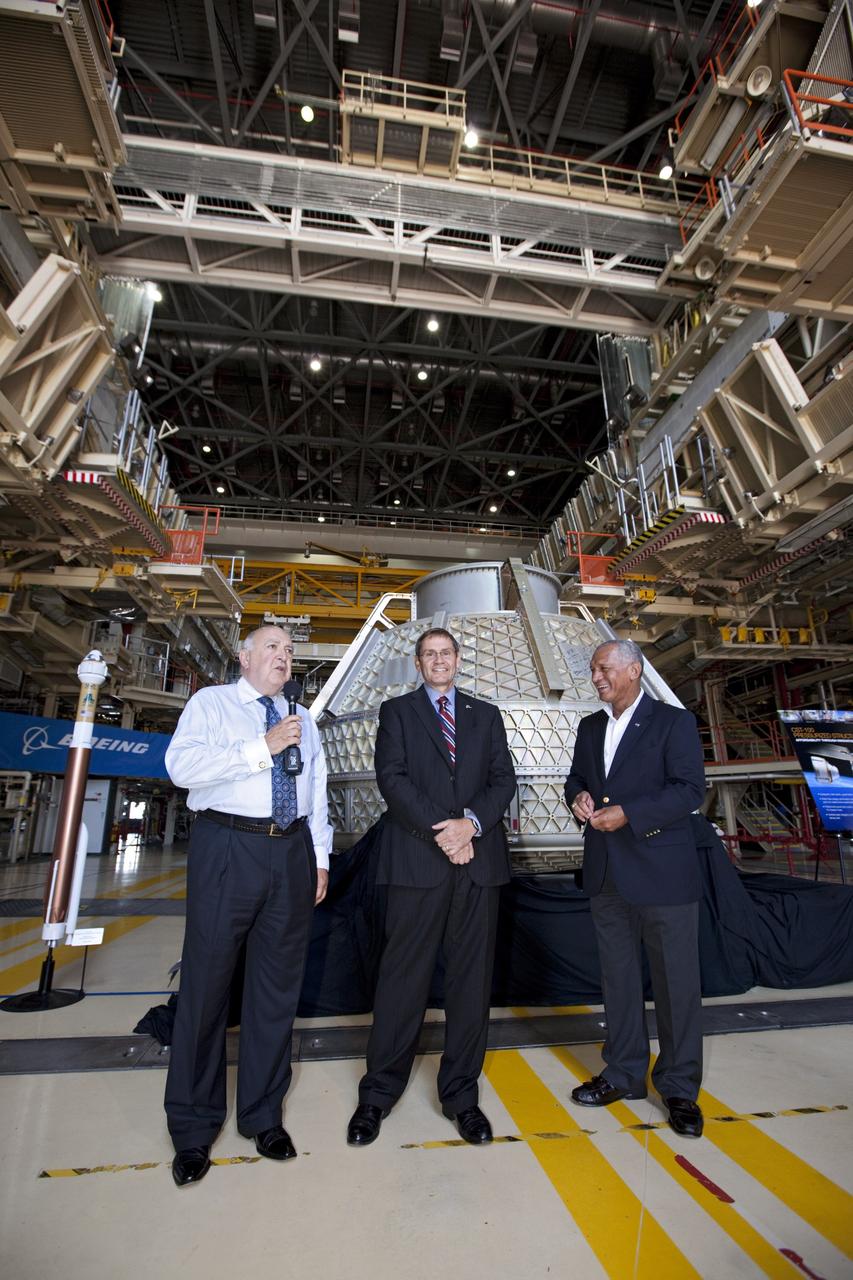
CAPE CANAVERAL, Fla. – Space Florida President Frank DiBello, NASA Administrator Charlie Bolden, and Boeing's Vice President and General Manager of Space Exploration John Elbon address the media inside Orbiter Processing Facility-3, or OPF-3, at NASA's Kennedy Space Center in Florida. Bolden took a few dozen media on a road show tour of the center and adjacent Cape Canaveral Air Force Station to show the progress being made for future government and commercial space endeavors that will begin from Florida's Space Coast. Boeing is leasing OPF-3 through an agreement with Space Florida for the manufacturing and assembly of its CST-100 spacecraft, which is under development in collaboration with NASA's Commercial Crew Program. During his tour, Bolden announced that Space Exploration Technologies, or SpaceX, has completed its Space Act Agreement with NASA for Commercial Orbital Transportation Services. SpaceX is scheduled to launch the first of its 12 contracted cargo flights to the space station from Cape Canaveral this October, under NASA’s Commercial Resupply Services Program. Bolden also announced NASA partner Sierra Nevada Corp. has conducted its first milestone under the agency’s recently announced Commercial Crew Integrated Capability CCiCap initiative. The milestone, a program implementation plan review, marks an important first step in Sierra Nevada’s efforts to develop a crew transportation system with its Dream Chaser spacecraft. Through NASA’s commercial space initiatives and programs, the agency is providing investments to stimulate the American commercial space industry. Photo credit: NASA/Kim Shiflett
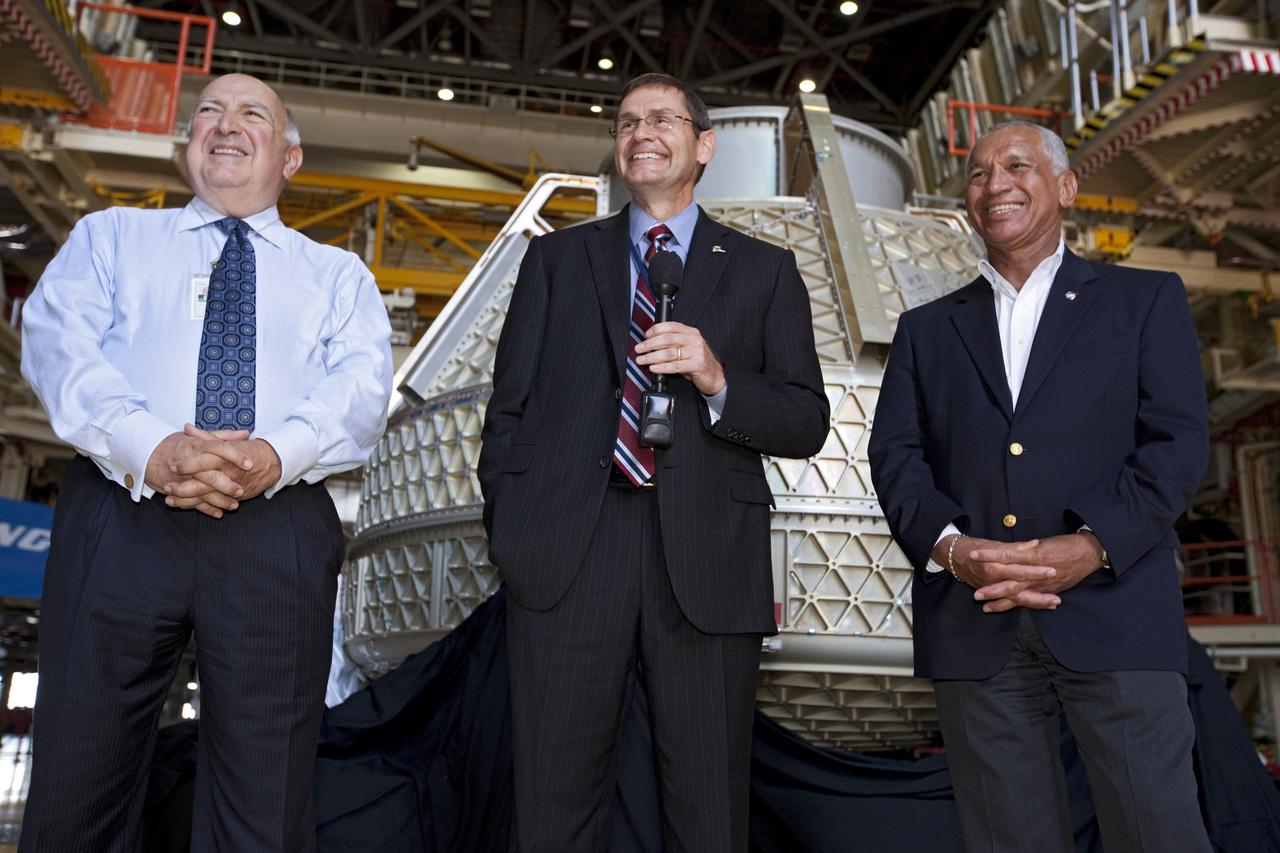
CAPE CANAVERAL, Fla. – Space Florida President Frank DiBello, NASA Administrator Charlie Bolden, and Boeing's Vice President and General Manager of Space Exploration John Elbon address the media inside Orbiter Processing Facility-3, or OPF-3, at NASA's Kennedy Space Center in Florida. Bolden took a few dozen media on a road show tour of the center and adjacent Cape Canaveral Air Force Station to show the progress being made for future government and commercial space endeavors that will begin from Florida's Space Coast. Boeing is leasing OPF-3 through an agreement with Space Florida for the manufacturing and assembly of its CST-100 spacecraft, which is under development in collaboration with NASA's Commercial Crew Program. During his tour, Bolden announced that Space Exploration Technologies, or SpaceX, has completed its Space Act Agreement with NASA for Commercial Orbital Transportation Services. SpaceX is scheduled to launch the first of its 12 contracted cargo flights to the space station from Cape Canaveral this October, under NASA’s Commercial Resupply Services Program. Bolden also announced NASA partner Sierra Nevada Corp. has conducted its first milestone under the agency’s recently announced Commercial Crew Integrated Capability CCiCap initiative. The milestone, a program implementation plan review, marks an important first step in Sierra Nevada’s efforts to develop a crew transportation system with its Dream Chaser spacecraft. Through NASA’s commercial space initiatives and programs, the agency is providing investments to stimulate the American commercial space industry. Photo credit: NASA/Kim Shiflett

CAPE CANAVERAL, Fla. – Space Florida President Frank DiBello, NASA Administrator Charlie Bolden, and Boeing's Vice President and General Manager of Space Exploration John Elbon address the media inside Orbiter Processing Facility-3, or OPF-3, at NASA's Kennedy Space Center in Florida. Bolden took a few dozen media on a road show tour of the center and adjacent Cape Canaveral Air Force Station to show the progress being made for future government and commercial space endeavors that will begin from Florida's Space Coast. Boeing is leasing OPF-3 through an agreement with Space Florida for the manufacturing and assembly of its CST-100 spacecraft, which is under development in collaboration with NASA's Commercial Crew Program. During his tour, Bolden announced that Space Exploration Technologies, or SpaceX, has completed its Space Act Agreement with NASA for Commercial Orbital Transportation Services. SpaceX is scheduled to launch the first of its 12 contracted cargo flights to the space station from Cape Canaveral this October, under NASA’s Commercial Resupply Services Program. Bolden also announced NASA partner Sierra Nevada Corp. has conducted its first milestone under the agency’s recently announced Commercial Crew Integrated Capability CCiCap initiative. The milestone, a program implementation plan review, marks an important first step in Sierra Nevada’s efforts to develop a crew transportation system with its Dream Chaser spacecraft. Through NASA’s commercial space initiatives and programs, the agency is providing investments to stimulate the American commercial space industry. Photo credit: NASA/Kim Shiflett
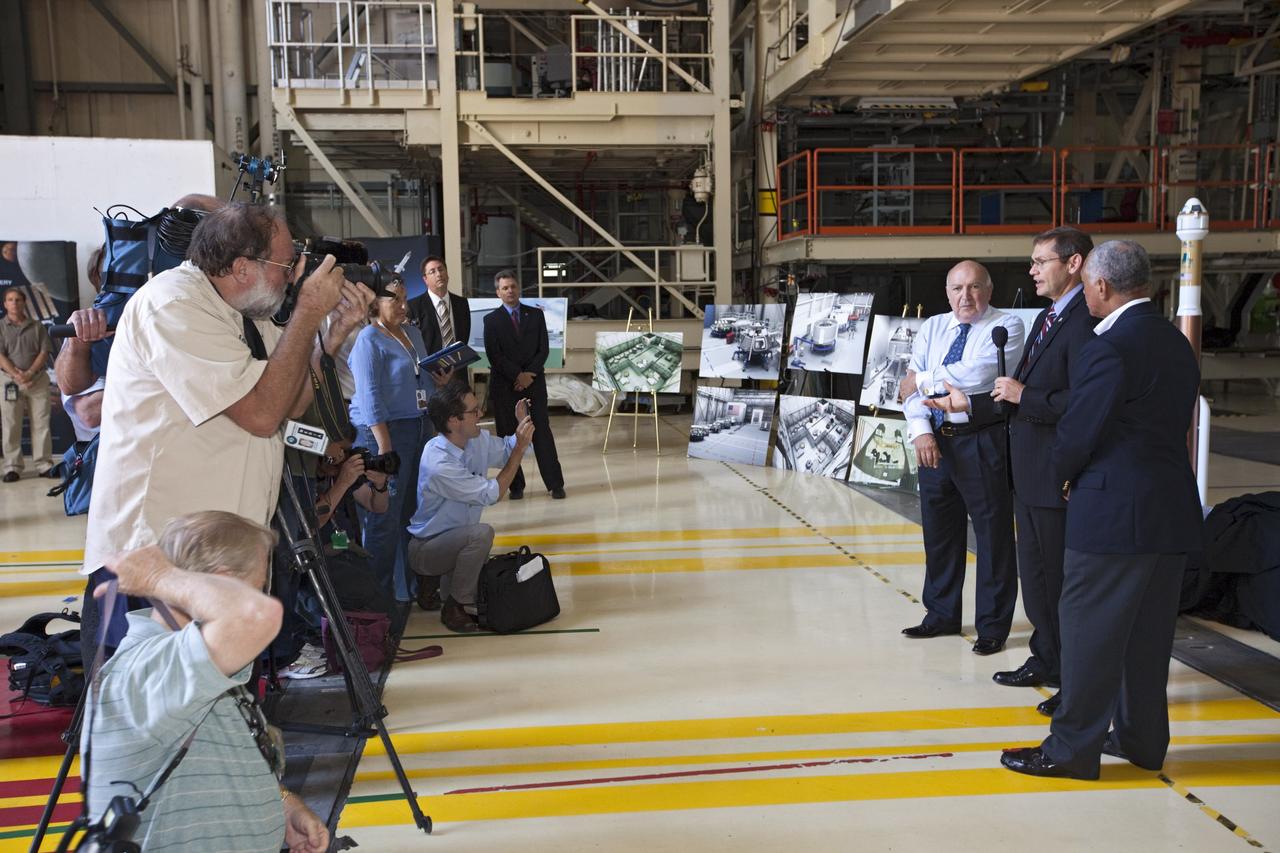
CAPE CANAVERAL, Fla. – Space Florida President Frank DiBello, NASA Administrator Charlie Bolden, and Boeing's Vice President and General Manager of Space Exploration John Elbon address the media inside Orbiter Processing Facility-3, or OPF-3, at NASA's Kennedy Space Center in Florida. Bolden took a few dozen media on a road show tour of the center and adjacent Cape Canaveral Air Force Station to show the progress being made for future government and commercial space endeavors that will begin from Florida's Space Coast. Boeing is leasing OPF-3 through an agreement with Space Florida for the manufacturing and assembly of its CST-100 spacecraft, which is under development in collaboration with NASA's Commercial Crew Program. During his tour, Bolden announced that Space Exploration Technologies, or SpaceX, has completed its Space Act Agreement with NASA for Commercial Orbital Transportation Services. SpaceX is scheduled to launch the first of its 12 contracted cargo flights to the space station from Cape Canaveral this October, under NASA’s Commercial Resupply Services Program. Bolden also announced NASA partner Sierra Nevada Corp. has conducted its first milestone under the agency’s recently announced Commercial Crew Integrated Capability CCiCap initiative. The milestone, a program implementation plan review, marks an important first step in Sierra Nevada’s efforts to develop a crew transportation system with its Dream Chaser spacecraft. Through NASA’s commercial space initiatives and programs, the agency is providing investments to stimulate the American commercial space industry. Photo credit: NASA/Kim Shiflett
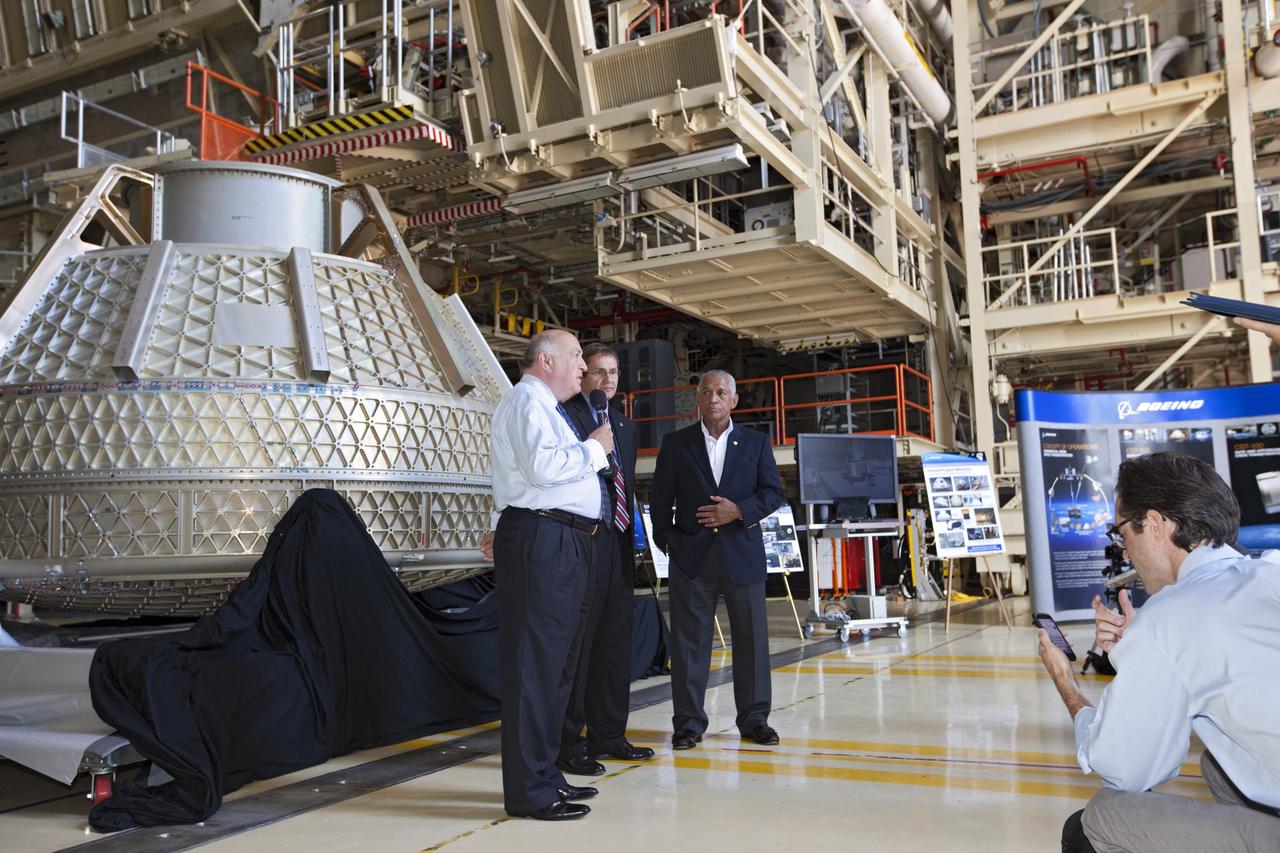
CAPE CANAVERAL, Fla. – Space Florida President Frank DiBello, NASA Administrator Charlie Bolden, and Boeing's Vice President and General Manager of Space Exploration John Elbon address the media inside Orbiter Processing Facility-3, or OPF-3, at NASA's Kennedy Space Center in Florida. Bolden took a few dozen media on a road show tour of the center and adjacent Cape Canaveral Air Force Station to show the progress being made for future government and commercial space endeavors that will begin from Florida's Space Coast. Boeing is leasing OPF-3 through an agreement with Space Florida for the manufacturing and assembly of its CST-100 spacecraft, which is under development in collaboration with NASA's Commercial Crew Program. During his tour, Bolden announced that Space Exploration Technologies, or SpaceX, has completed its Space Act Agreement with NASA for Commercial Orbital Transportation Services. SpaceX is scheduled to launch the first of its 12 contracted cargo flights to the space station from Cape Canaveral this October, under NASA’s Commercial Resupply Services Program. Bolden also announced NASA partner Sierra Nevada Corp. has conducted its first milestone under the agency’s recently announced Commercial Crew Integrated Capability CCiCap initiative. The milestone, a program implementation plan review, marks an important first step in Sierra Nevada’s efforts to develop a crew transportation system with its Dream Chaser spacecraft. Through NASA’s commercial space initiatives and programs, the agency is providing investments to stimulate the American commercial space industry. Photo credit: NASA/Kim Shiflett
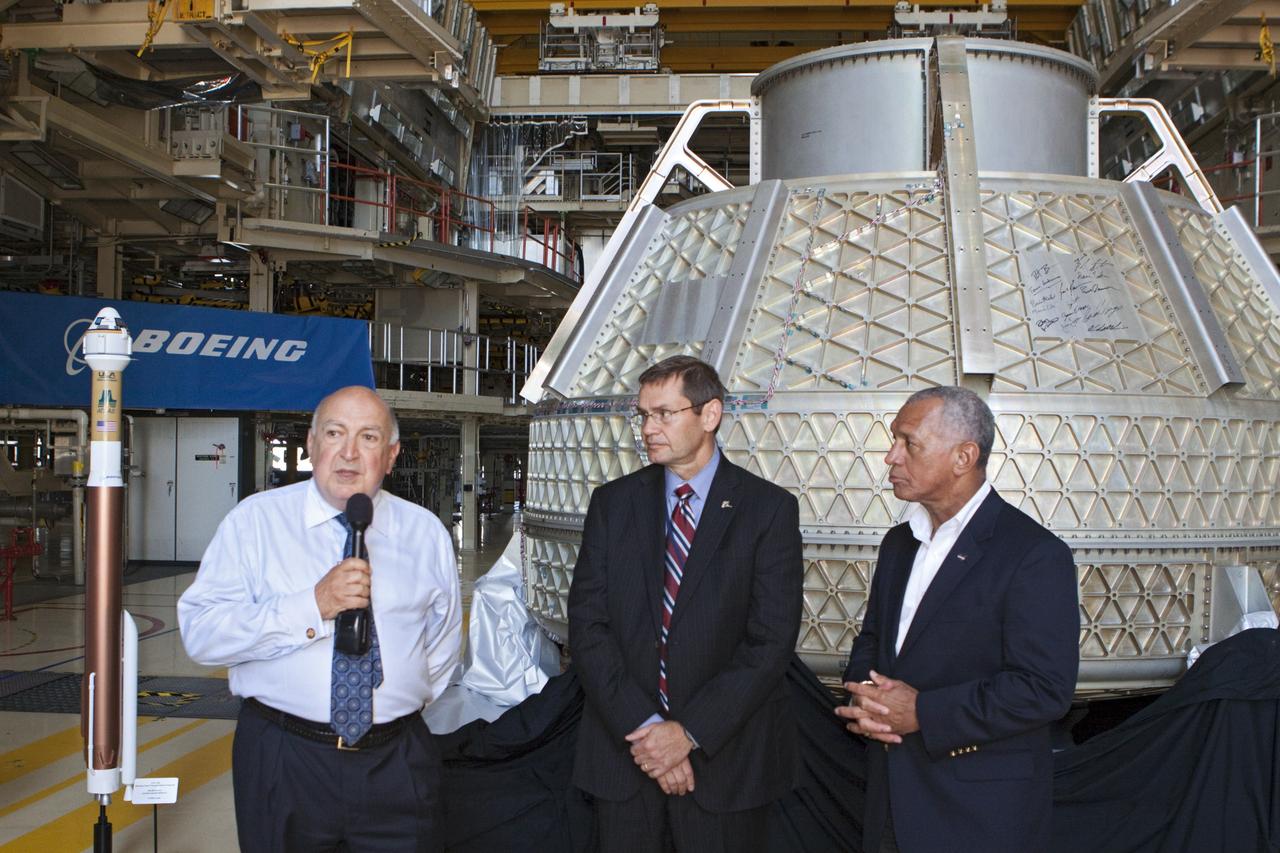
CAPE CANAVERAL, Fla. – Space Florida President Frank DiBello, NASA Administrator Charlie Bolden, and Boeing's Vice President and General Manager of Space Exploration John Elbon address the media inside Orbiter Processing Facility-3, or OPF-3, at NASA's Kennedy Space Center in Florida. Bolden took a few dozen media on a road show tour of the center and adjacent Cape Canaveral Air Force Station to show the progress being made for future government and commercial space endeavors that will begin from Florida's Space Coast. Boeing is leasing OPF-3 through an agreement with Space Florida for the manufacturing and assembly of its CST-100 spacecraft, which is under development in collaboration with NASA's Commercial Crew Program. During his tour, Bolden announced that Space Exploration Technologies, or SpaceX, has completed its Space Act Agreement with NASA for Commercial Orbital Transportation Services. SpaceX is scheduled to launch the first of its 12 contracted cargo flights to the space station from Cape Canaveral this October, under NASA’s Commercial Resupply Services Program. Bolden also announced NASA partner Sierra Nevada Corp. has conducted its first milestone under the agency’s recently announced Commercial Crew Integrated Capability CCiCap initiative. The milestone, a program implementation plan review, marks an important first step in Sierra Nevada’s efforts to develop a crew transportation system with its Dream Chaser spacecraft. Through NASA’s commercial space initiatives and programs, the agency is providing investments to stimulate the American commercial space industry. Photo credit: NASA/Kim Shiflett
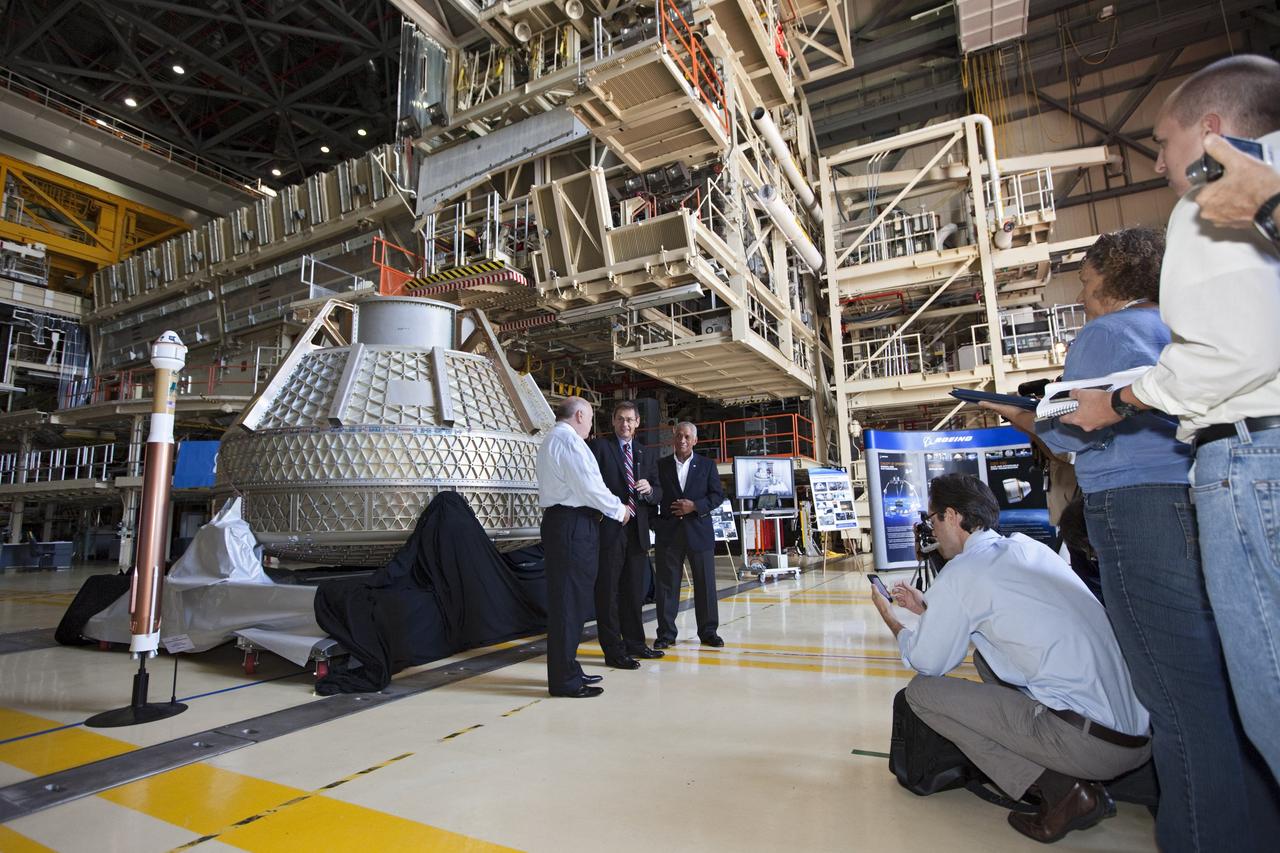
CAPE CANAVERAL, Fla. – Space Florida President Frank DiBello, NASA Administrator Charlie Bolden, and Boeing's Vice President and General Manager of Space Exploration John Elbon address the media inside Orbiter Processing Facility-3, or OPF-3, at NASA's Kennedy Space Center in Florida. Bolden took a few dozen media on a road show tour of the center and adjacent Cape Canaveral Air Force Station to show the progress being made for future government and commercial space endeavors that will begin from Florida's Space Coast. Boeing is leasing OPF-3 through an agreement with Space Florida for the manufacturing and assembly of its CST-100 spacecraft, which is under development in collaboration with NASA's Commercial Crew Program. During his tour, Bolden announced that Space Exploration Technologies, or SpaceX, has completed its Space Act Agreement with NASA for Commercial Orbital Transportation Services. SpaceX is scheduled to launch the first of its 12 contracted cargo flights to the space station from Cape Canaveral this October, under NASA’s Commercial Resupply Services Program. Bolden also announced NASA partner Sierra Nevada Corp. has conducted its first milestone under the agency’s recently announced Commercial Crew Integrated Capability CCiCap initiative. The milestone, a program implementation plan review, marks an important first step in Sierra Nevada’s efforts to develop a crew transportation system with its Dream Chaser spacecraft. Through NASA’s commercial space initiatives and programs, the agency is providing investments to stimulate the American commercial space industry. Photo credit: NASA/Kim Shiflett
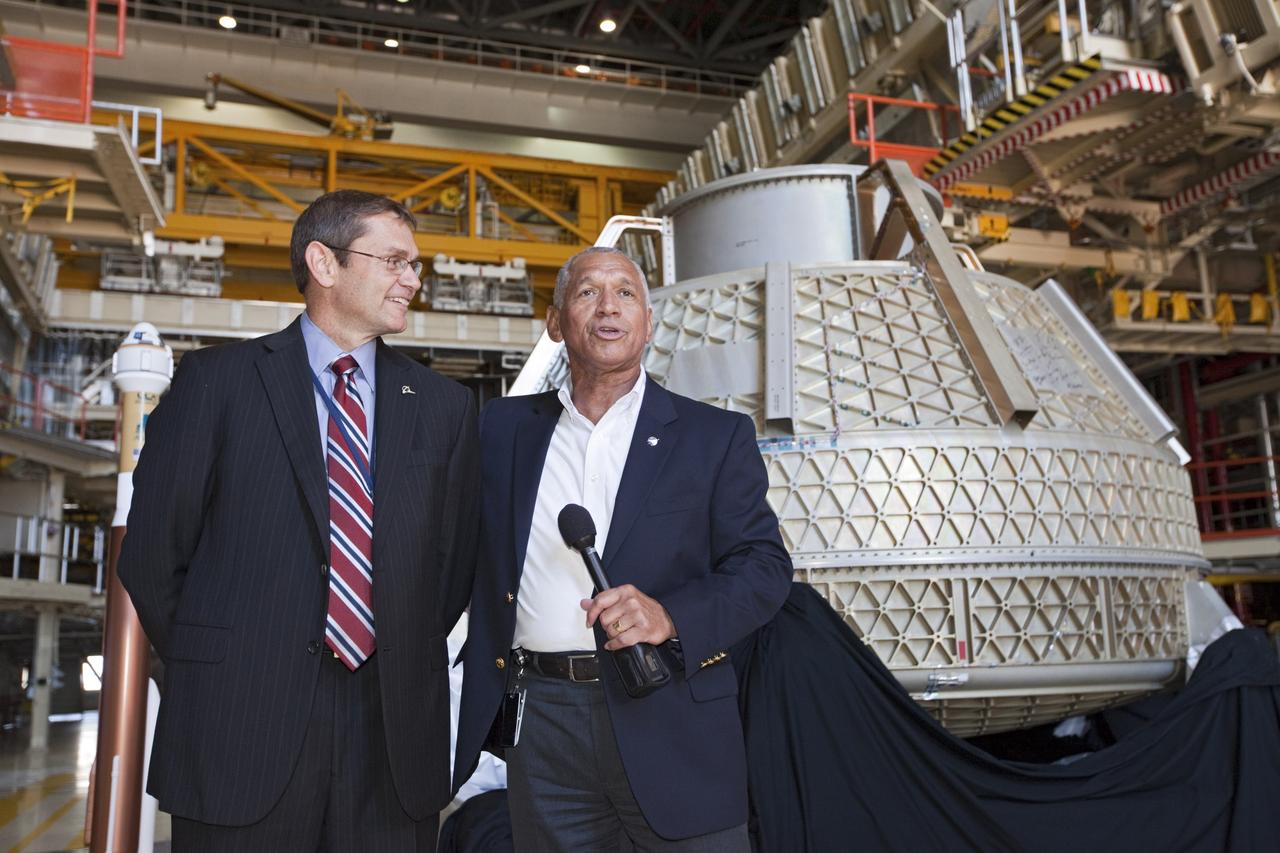
CAPE CANAVERAL, Fla. – NASA Administrator Charlie Bolden, right, and Boeing's Vice President and General Manager of Space Exploration John Elbon address the media inside Orbiter Processing Facility-3, or OPF-3, at NASA's Kennedy Space Center in Florida. Bolden took a few dozen media on a road show tour of the center and adjacent Cape Canaveral Air Force Station to show the progress being made for future government and commercial space endeavors that will begin from Florida's Space Coast. Boeing is leasing OPF-3 through an agreement with Space Florida for the manufacturing and assembly of its CST-100 spacecraft, which is under development in collaboration with NASA's Commercial Crew Program. During his tour, Bolden announced that Space Exploration Technologies, or SpaceX, has completed its Space Act Agreement with NASA for Commercial Orbital Transportation Services. SpaceX is scheduled to launch the first of its 12 contracted cargo flights to the space station from Cape Canaveral this October, under NASA’s Commercial Resupply Services Program. Bolden also announced NASA partner Sierra Nevada Corp. has conducted its first milestone under the agency’s recently announced Commercial Crew Integrated Capability CCiCap initiative. The milestone, a program implementation plan review, marks an important first step in Sierra Nevada’s efforts to develop a crew transportation system with its Dream Chaser spacecraft. Through NASA’s commercial space initiatives and programs, the agency is providing investments to stimulate the American commercial space industry. Photo credit: NASA/Kim Shiflett
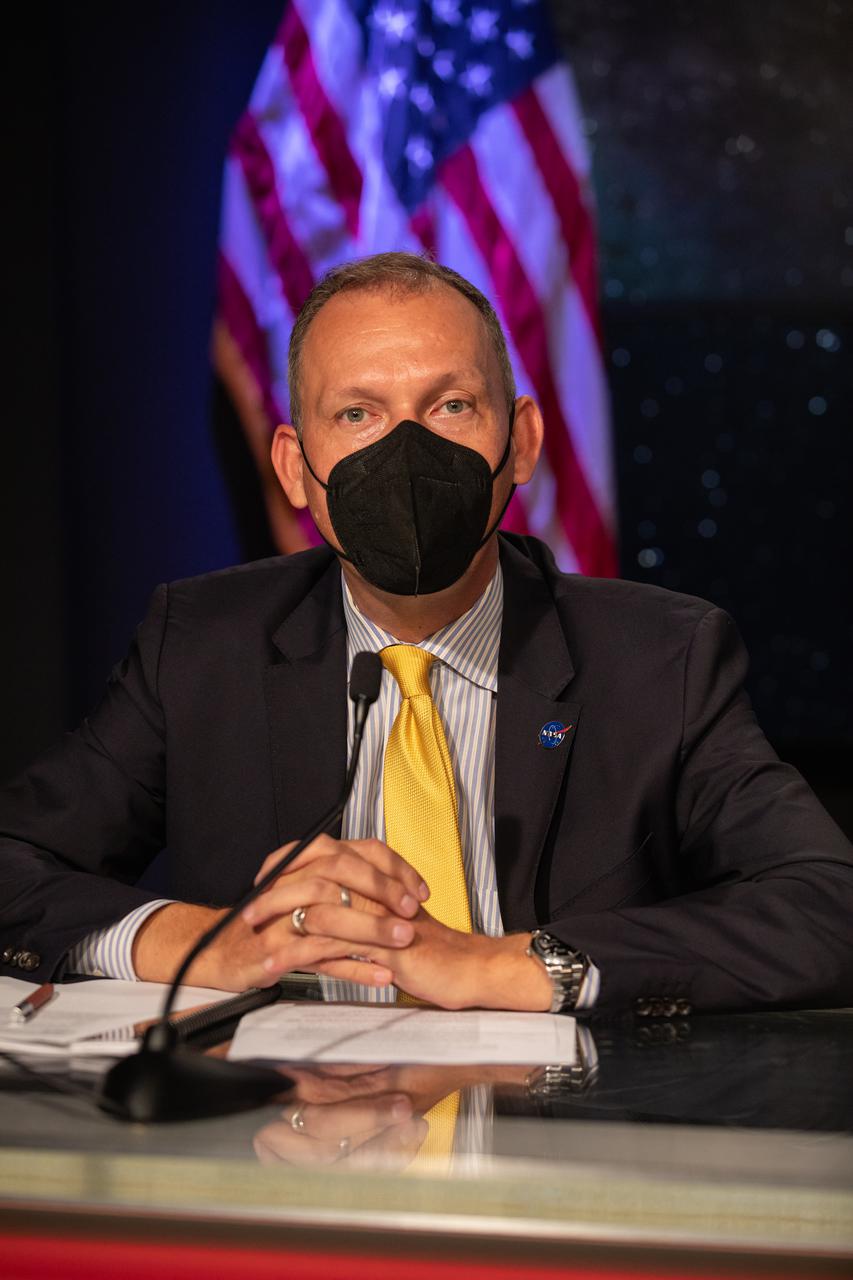
Thomas Zurbuchen, associate administrator, NASA’s Science Mission Directorate, is introduced during a prelaunch news conference for the Lucy mission held inside the TV Auditorium at NASA’s Kennedy Space Center in Florida on Oct. 13, 2021. The mission is scheduled to launch no earlier than 5:34 a.m. EDT Saturday, Oct. 16, on a United Launch Alliance Atlas V 401 rocket from Space Launch Complex 41 at Cape Canaveral Space Force Station. NASA’s Launch Services Program, based at Kennedy, is managing the launch. During its 12-year primary mission, Lucy will explore a record-breaking number of asteroids, flying by one asteroid in the solar system’s main belt and seven Trojan asteroids. Additionally, Lucy’s path will circle back to Earth three times for gravity assists, making it the first spacecraft to return to the vicinity of Earth from the outer solar system.

Lucy Prelaunch News Conference with representatives from NASA, Southwest Research Institute, United Launch Alliance, and Space Launch Delta 45. Lucy, NASA’s first mission to explore the Trojan Asteroids, is set to launch on a United Launch Alliance Atlas V rocket from Cape Canaveral Space Force Station in Florida on Oct. 16. The launch is managed by NASA’s Launch Services Program based at Kennedy Space Center.
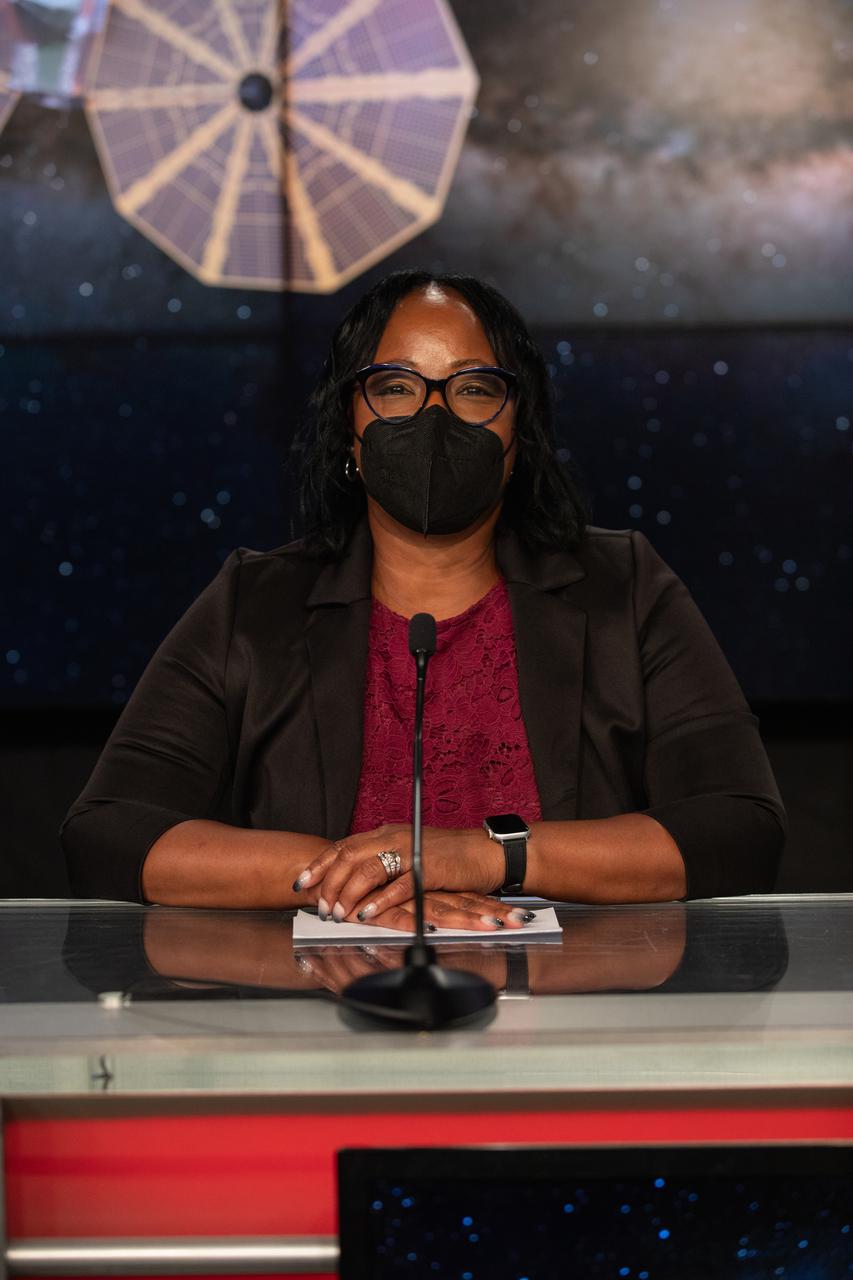
Donya Douglas-Bradshaw, Lucy project manager at NASA’s Goddard Space Flight Center, is introduced during a prelaunch news conference for the Lucy mission held inside the TV Auditorium at NASA’s Kennedy Space Center in Florida on Oct. 13, 2021. The mission is scheduled to launch no earlier than 5:34 a.m. EDT Saturday, Oct. 16, on a United Launch Alliance Atlas V 401 rocket from Space Launch Complex 41 at Cape Canaveral Space Force Station. NASA’s Launch Services Program, based at Kennedy, is managing the launch. During its 12-year primary mission, Lucy will explore a record-breaking number of asteroids, flying by one asteroid in the solar system’s main belt and seven Trojan asteroids. Additionally, Lucy’s path will circle back to Earth three times for gravity assists, making it the first spacecraft to return to the vicinity of Earth from the outer solar system.

Lucy Prelaunch News Conference with representatives from NASA, Southwest Research Institute, United Launch Alliance, and Space Launch Delta 45. Lucy, NASA’s first mission to explore the Trojan Asteroids, is set to launch on a United Launch Alliance Atlas V rocket from Cape Canaveral Space Force Station in Florida on Oct. 16. The launch is managed by NASA’s Launch Services Program based at Kennedy Space Center.
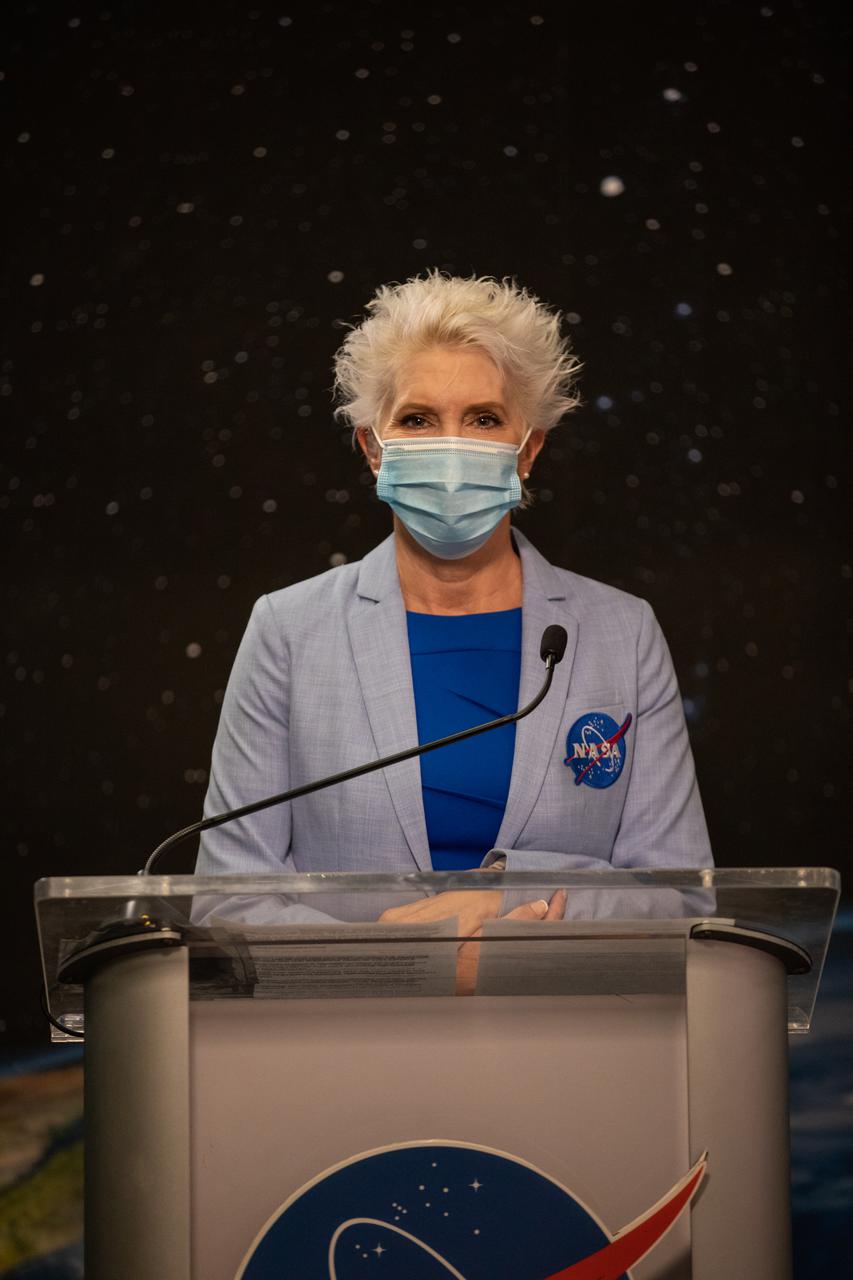
Tammy Long, NASA Communications, addresses the audience during a prelaunch news conference for the Lucy mission held inside the TV Auditorium at NASA’s Kennedy Space Center in Florida on Oct. 13, 2021. The mission is targeted to launch at 5:34 a.m. EDT Saturday, Oct. 16, on a United Launch Alliance Atlas V 401 rocket from Space Launch Complex 41 at Cape Canaveral Space Force Station. NASA’s Launch Services Program, based at Kennedy, is managing the launch. Lucy is the first space mission to study the Trojan asteroids, which hold vital clues to the formation of our solar system.
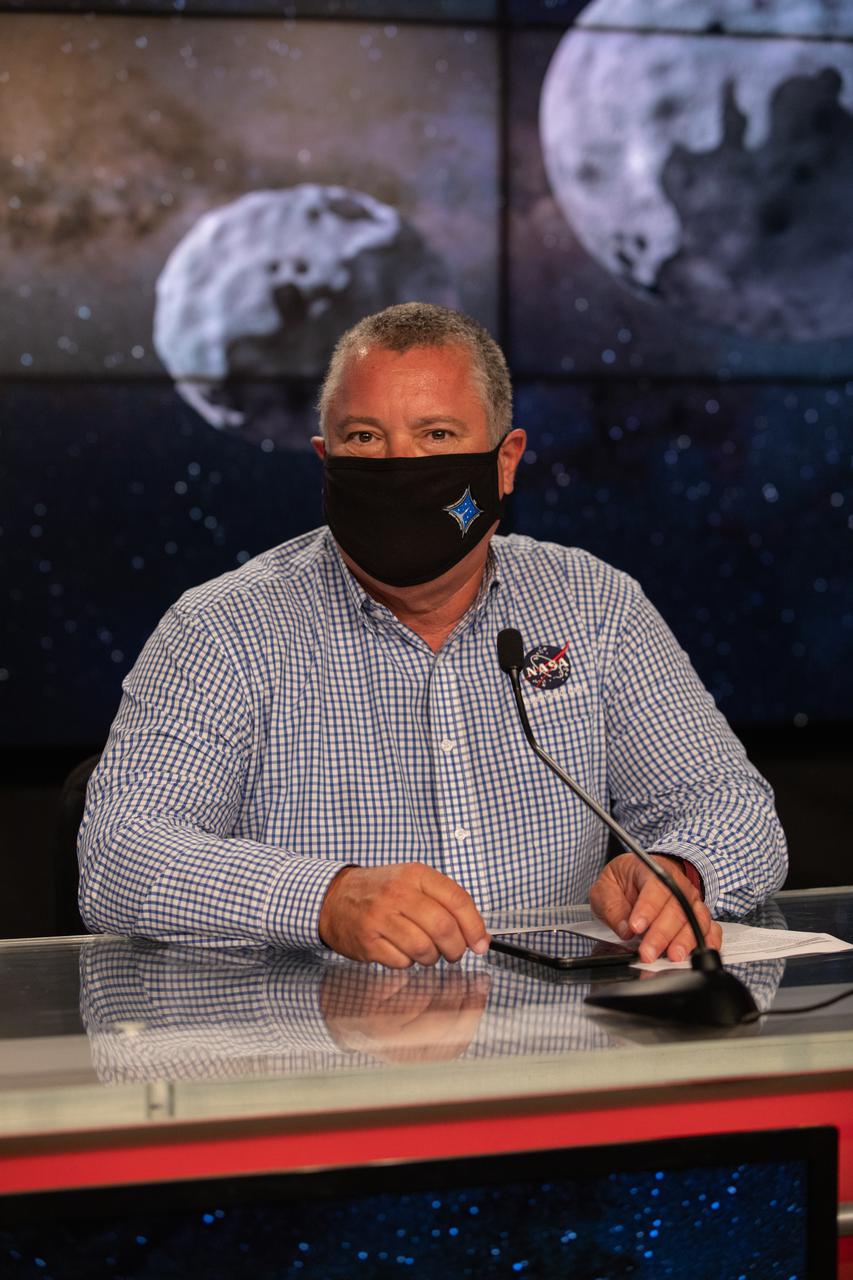
Omar Baez, Lucy Launch Director, NASA’s Launch Services Program, speaks during a prelaunch news conference for the Lucy mission held inside the TV Auditorium at NASA’s Kennedy Space Center in Florida on Oct. 13, 2021. The mission is targeted to launch at 5:34 a.m. EDT Saturday, Oct. 16, on a United Launch Alliance Atlas V 401 rocket from Space Launch Complex 41 at Cape Canaveral Space Force Station. NASA’s Launch Services Program, based at Kennedy, is managing the launch. Lucy is the first space mission to study the Trojan asteroids, which hold vital clues to the formation of our solar system.
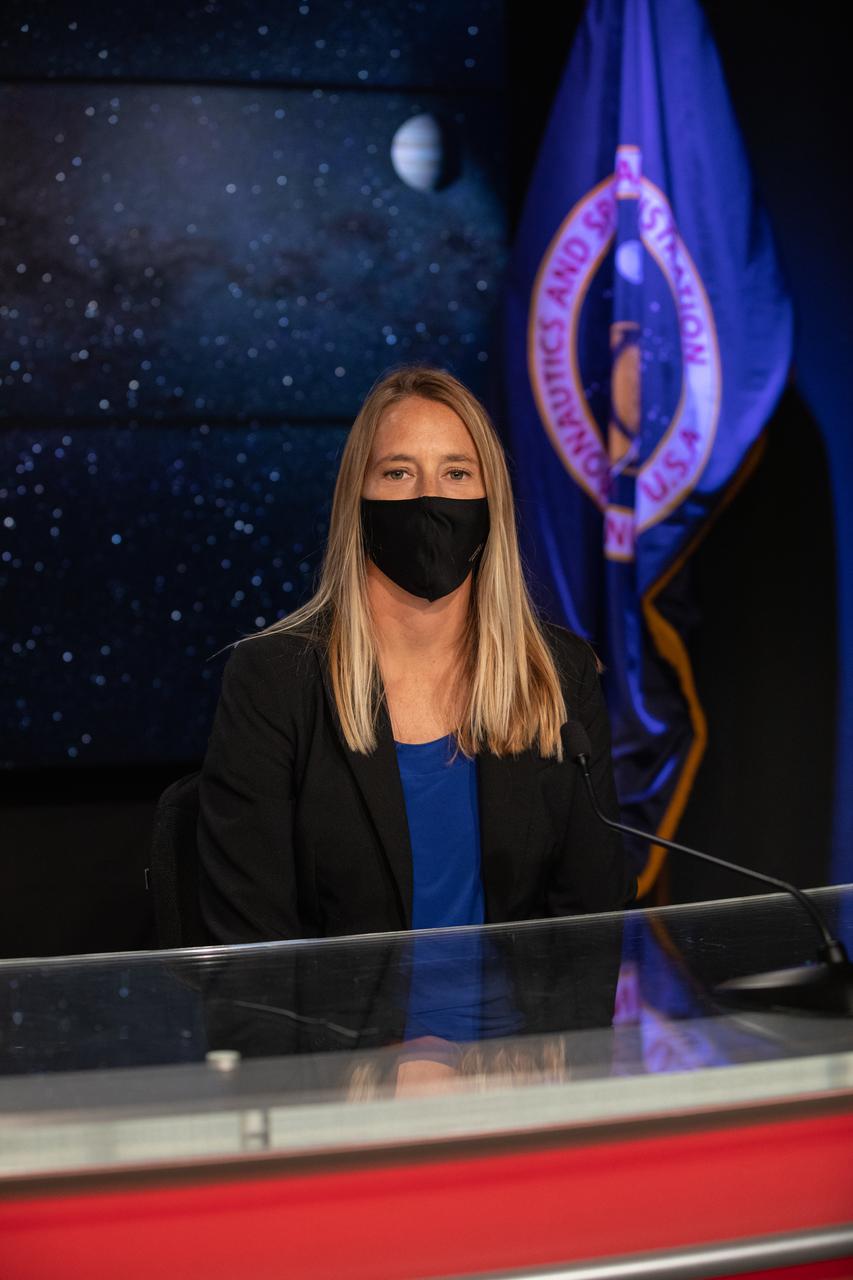
Jessica Williams, Launch Weather Officer, 45th Weather Squadron, Space Launch Delta 45, Cape Canaveral Space Force Station, is introduced during a prelaunch news conference for the Lucy mission held inside the TV Auditorium at NASA’s Kennedy Space Center in Florida on Oct. 13, 2021. The mission is targeted to launch at 5:34 a.m. EDT Saturday, Oct. 16, on a United Launch Alliance Atlas V 401 rocket from Space Launch Complex 41 at Cape Canaveral Space Force Station. NASA’s Launch Services Program, based at Kennedy, is managing the launch. Lucy is the first space mission to study the Trojan asteroids, which hold vital clues to the formation of our solar system.