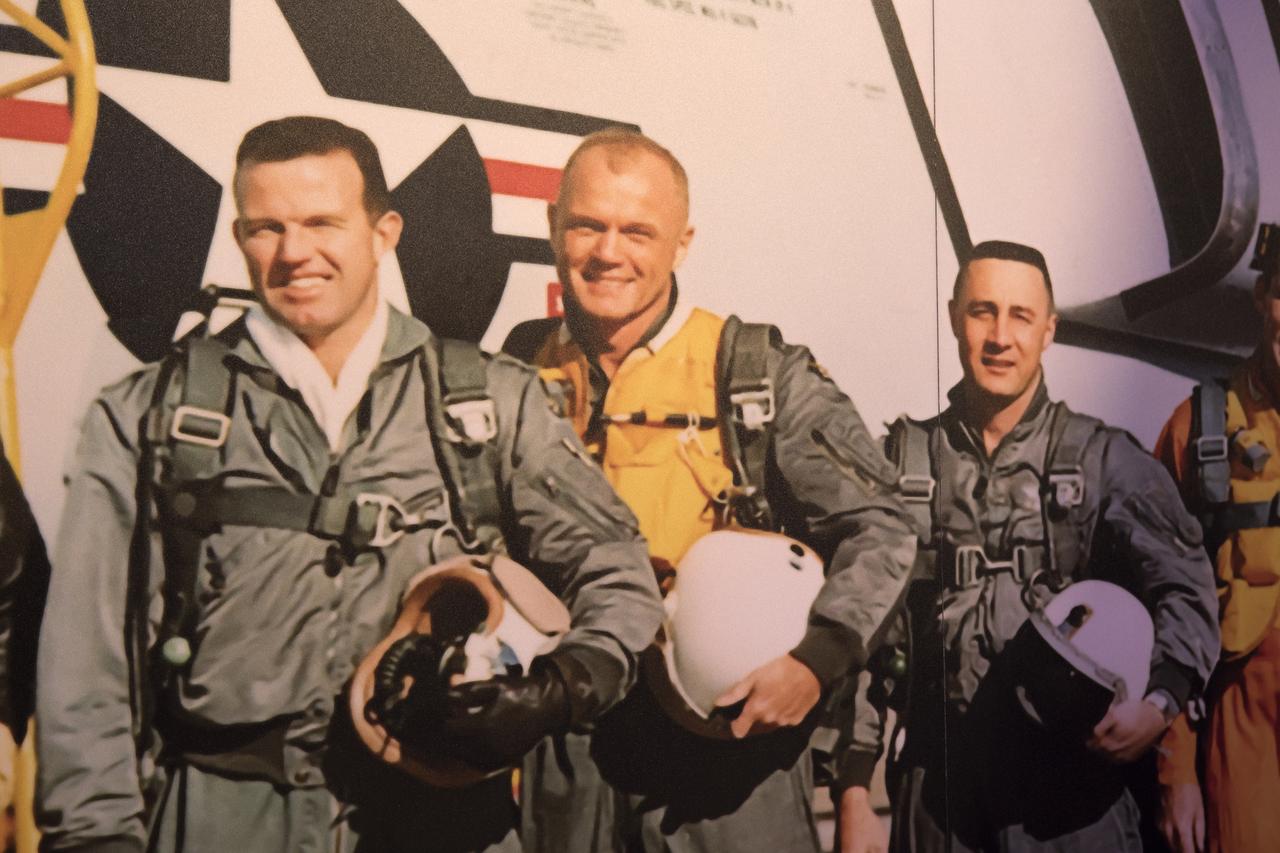
A life-size photo inside the Heroes and Legends exhibit hall at the Kennedy Space Center Visitor Complex shows astronaut Sen. John Glenn, center, with fellow Mercury Seven astronauts Gordon Cooper, left, and Gus Grissom. Glenn, who passed away Dec. 8, 2016 at age 95. Glenn, was the last surviving member of NASA's original astronaut class. He gained worldwide acclaim during his Mercury mission that made him the first American to orbit the Earth. He flew again in 1998 aboard space shuttle Discovery at age 77.
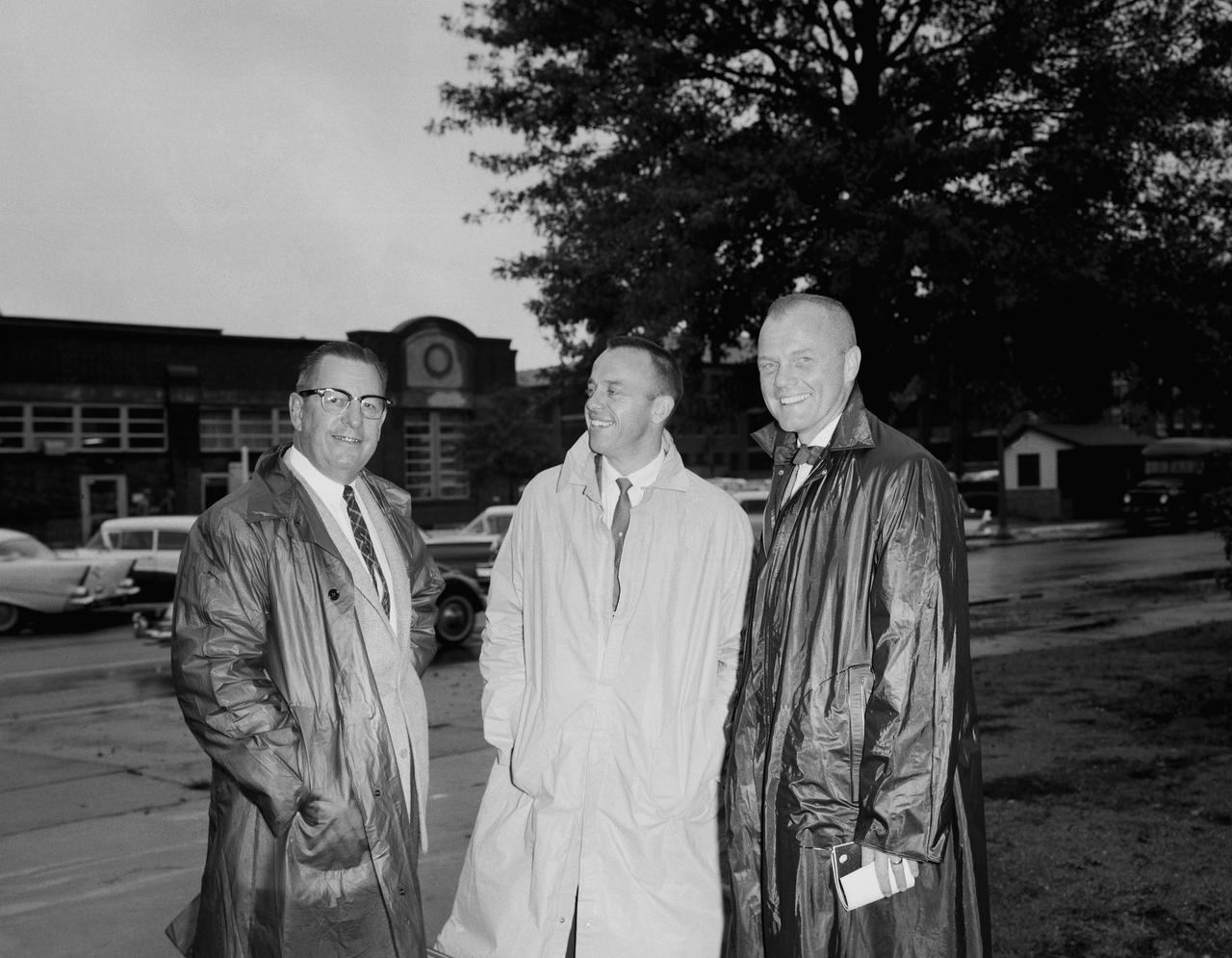
Astronauts at 1959 Langley Inspection. Astronauts at 1959 Langley Inspection: The seven are shown in the Unitary Plan Wind Tunnel NASA Langley. The astronauts left to right: John H. Glenn Jr., M.Scot Carpenter, Virgil I.Grissom, Walter M. Schirra Jr., L. Gordon Cooper, Alan B. Shepard Jr.and Donald K. Slayton.
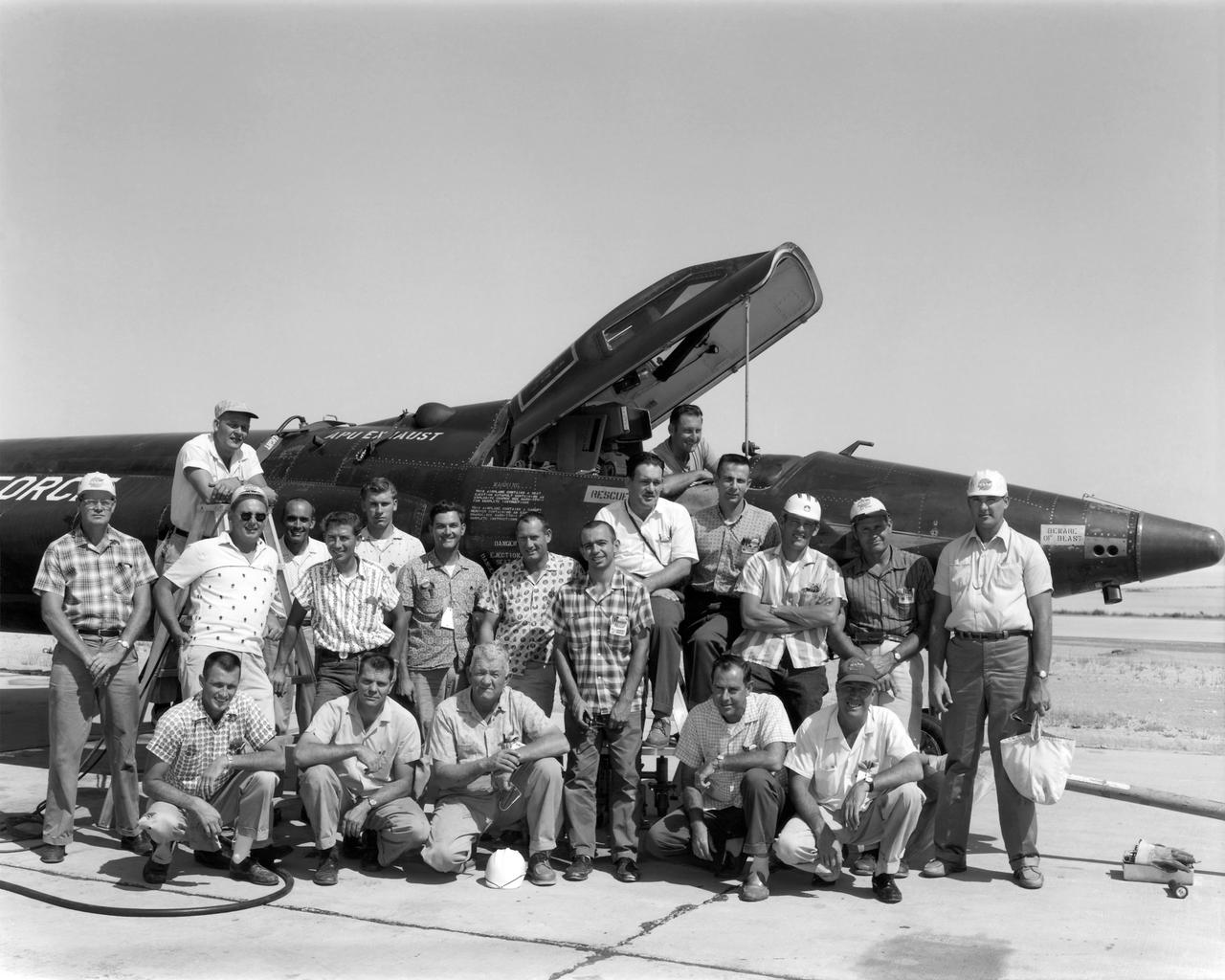
X-15 personnel July 1962 Cockpit: Edward "Ed" Nice Ladder: Thomas "Tom" McAlister Back Row, left to right: William Clark, Edward "Ed" Sabo, Donald "Don" Hall, Billy Furr, Allen Dustin, Raymond "Ray" White, George E. Trott, Alfred "Al" Grieshaber, Merle Curtis, LeRoy "Lee" Adelsbach, Allen Lowe, Jay L. King, Lorenzo "Larry" Barnett. Kneeling, left to right: Byron Gibbs, Price "Bob" Workman, Ira Cupp, unidentified, John Gordon.
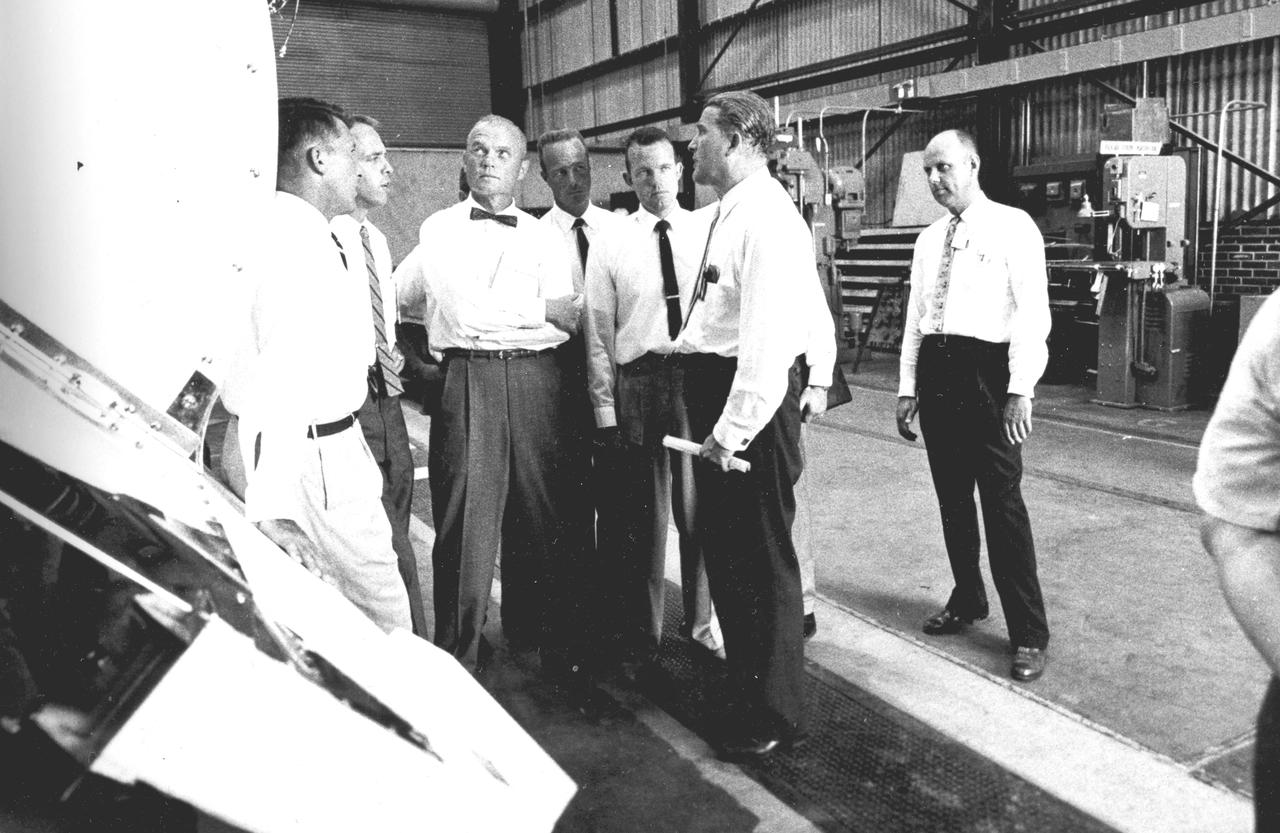
Five of the seven original astronauts are seen with Dr. von Braun inspecting the Mercury-Redstone hardware in the Fabrication Laboratory of Army Ballistic Missile Agency (ABMA) in 1959. Left to right: Astronauts Walter Schirra, Alan Shepard, John Glenn, Scott Carpenter, Gordon Cooper, and Dr. von Braun.
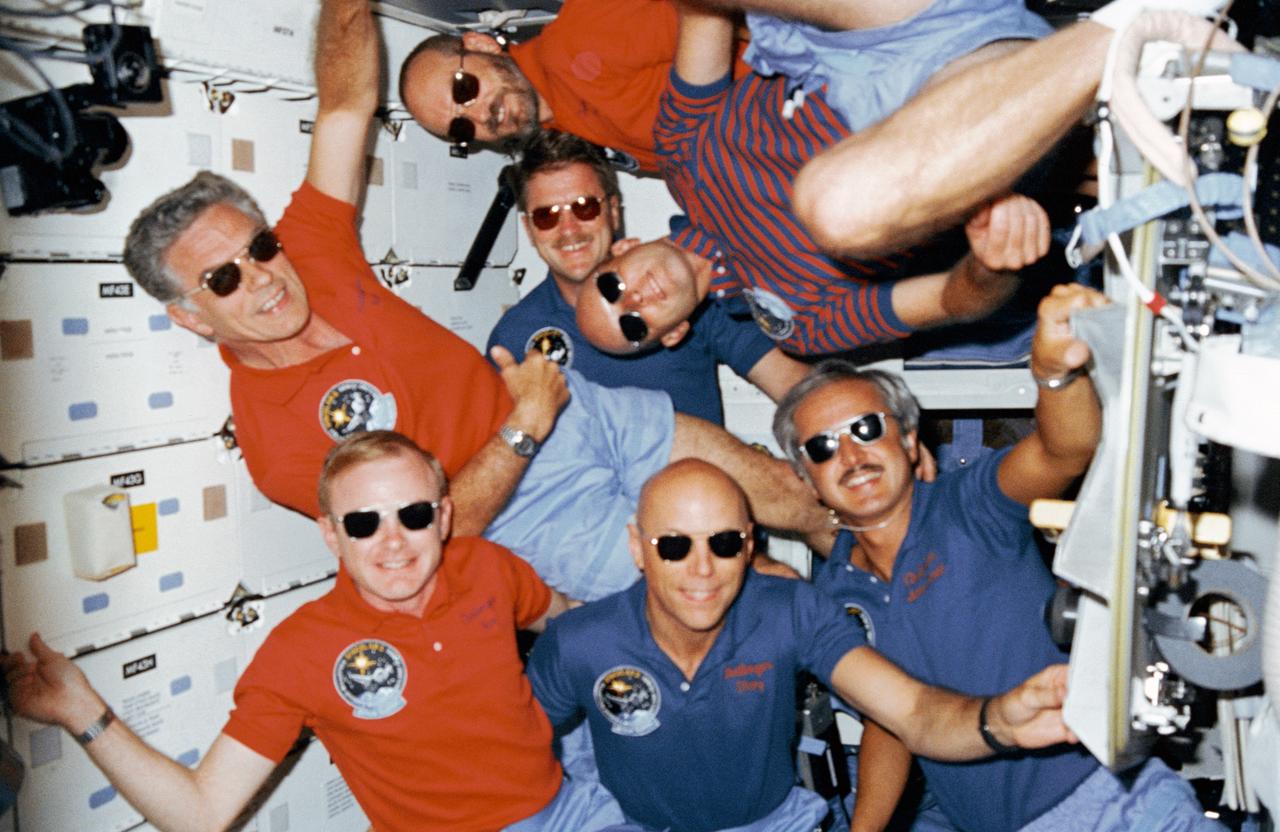
51F-06-017 (29 July-6 Aug. 1985) --- Crew portrait with sunglasses. C. Gordon Fullerton's head is at center. Others (bottom, l.-r.) are Roy D. Bridges, F. Story Musgrave and John David Bartoe; and (top) Karl J. Henize, Loren W. Acton and Anthony W. England.
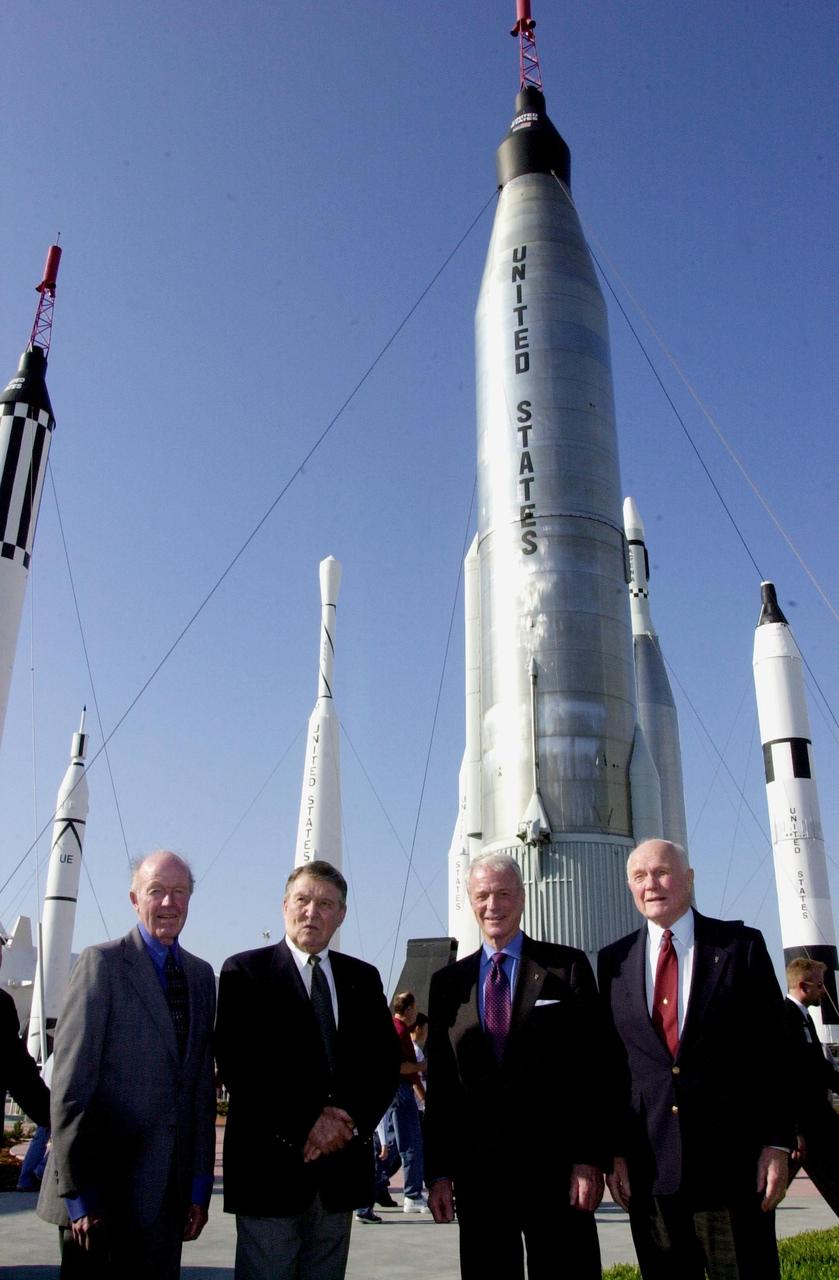
KENNEDY SPACE CENTER, FLA. -- Four space pioneers pose for a photo in the Rocket Garden at the KSC Visitor Complex. From left are Gordon Cooper, Wally Schirra, Scott Carpenter and John Glenn Jr. The occasion was the celebration of the 40th anniversary of American spaceflight. The event was held Feb. 24, 2002

The original seven astronauts for the Mercury Project pose in front of an Air Force Jet. From left to right: Scott Carpenter, L. Gordon Cooper, John H. Glenn, Virgil I. Gus Grissom, Walter M. Wally Schirra, Alan B. Shepard, and Donald K. Deke Slayton.
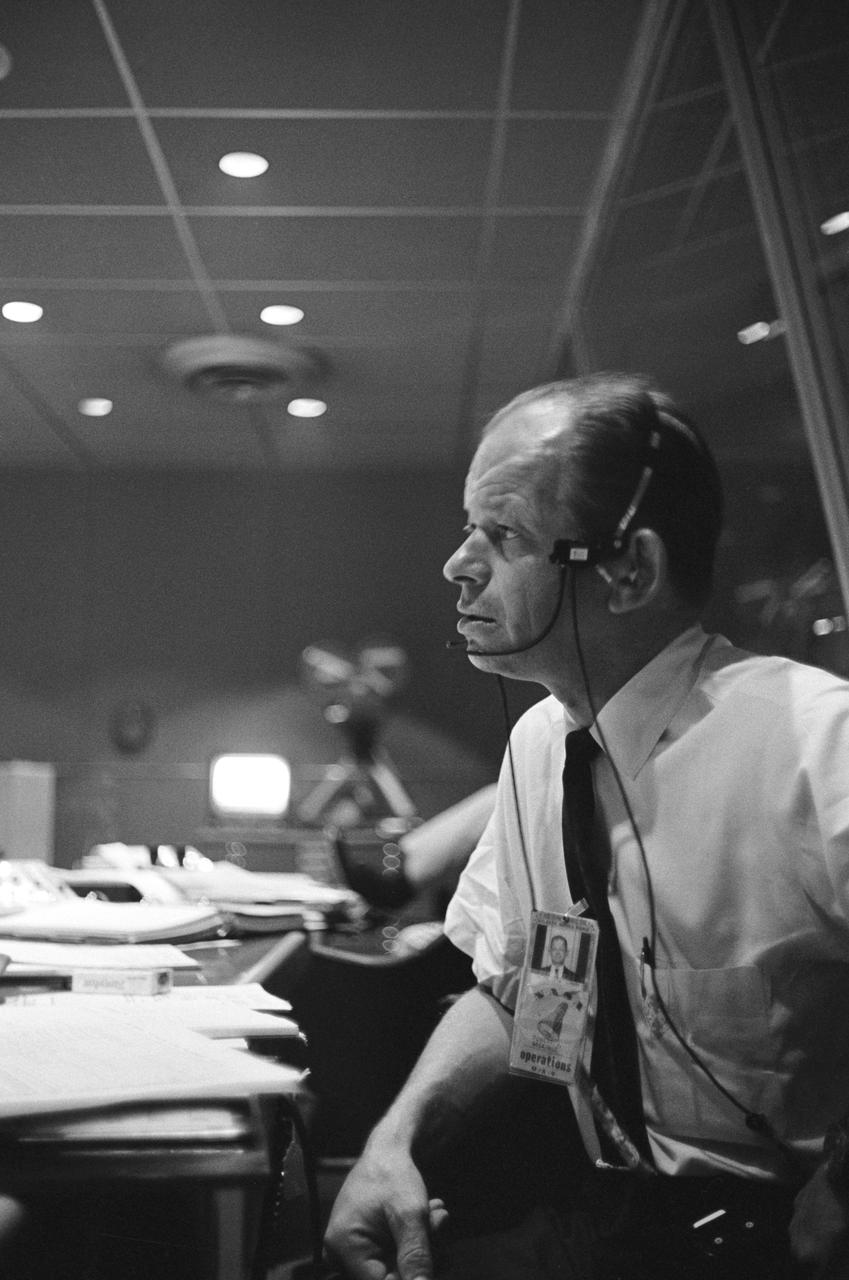
S63-09593 (15-16 May 1963) --- John A. Powers sits at the Public Affairs Officer console in Mercury Control Center at Cape Canaveral, Florida during the Mercury Atlas 9 (MA-9) 22-orbit mission of astronaut L. Gordon Cooper Jr. Photo credit: NASA
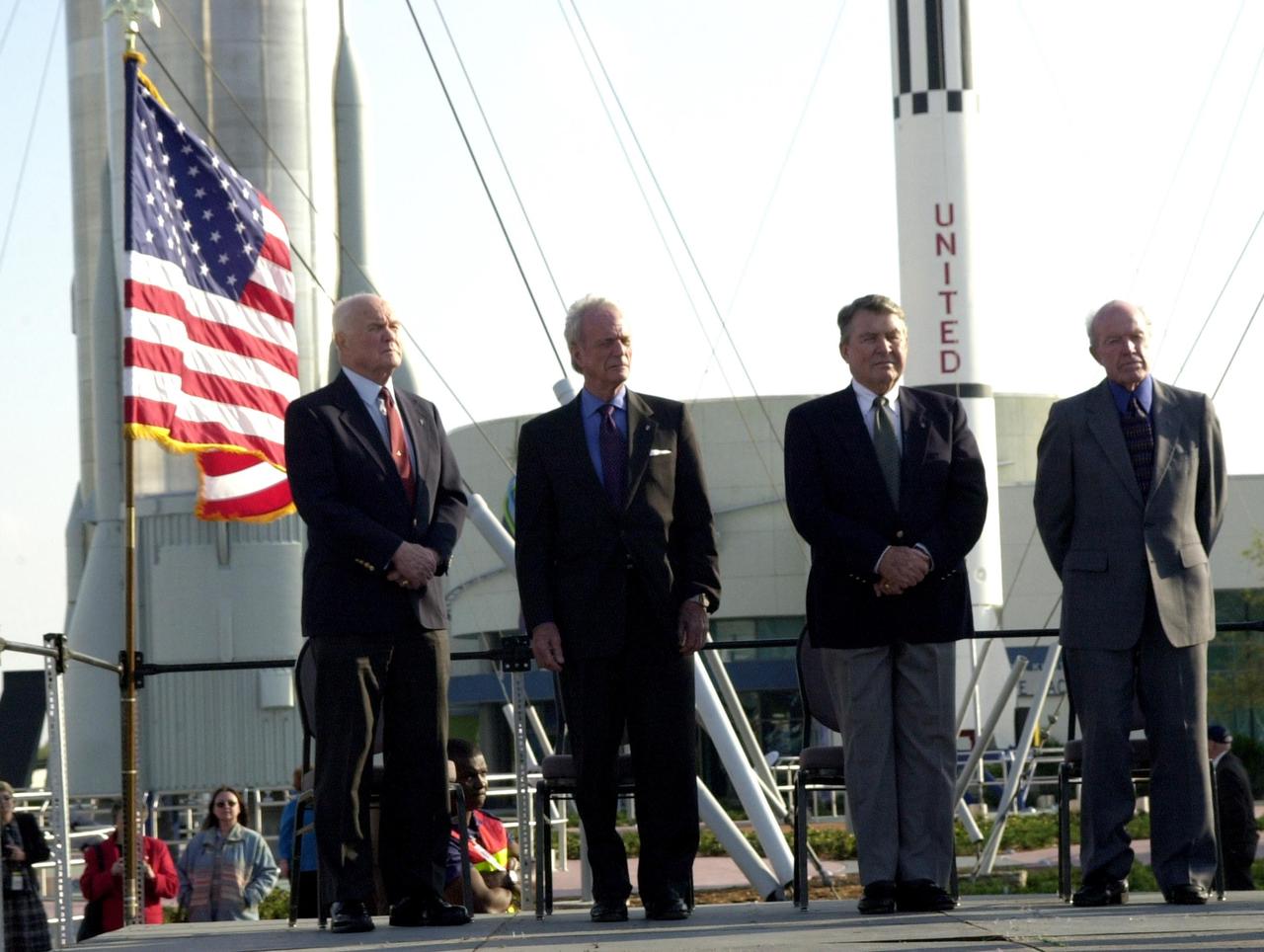
KENNEDY SPACE CENTER, FLA. -- During opening ceremonies for the 40th anniversary celebration of American spaceflight, four space pioneers stand at attention: (from left) John Glenn Jr., Scott Carpenter, Wallly Schirra and Gordon Cooper. The site is the Rocket Garden in the KSC Visitor Complex
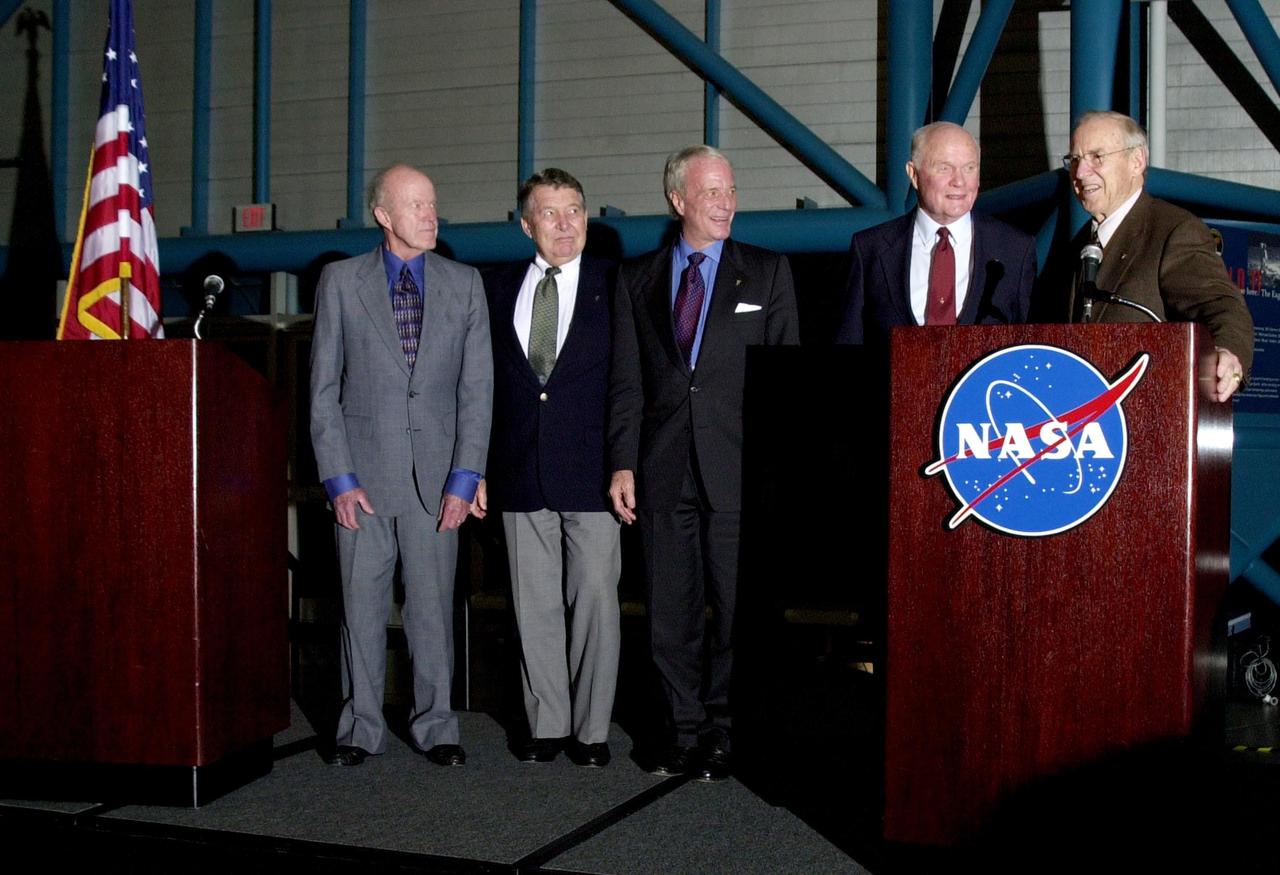
KENNEDY SPACE CENTER, FLA. - Five of the Mercury astronauts gathered on the stage of KSC's Apollo/Saturn V Center during the celebration of the 40th anniversary of American spaceflight. From left are former astronauts Gordon Cooper, Wally Schirra, Scott Carpenter, John Glenn and James Lovell, who served as host of the celebration.
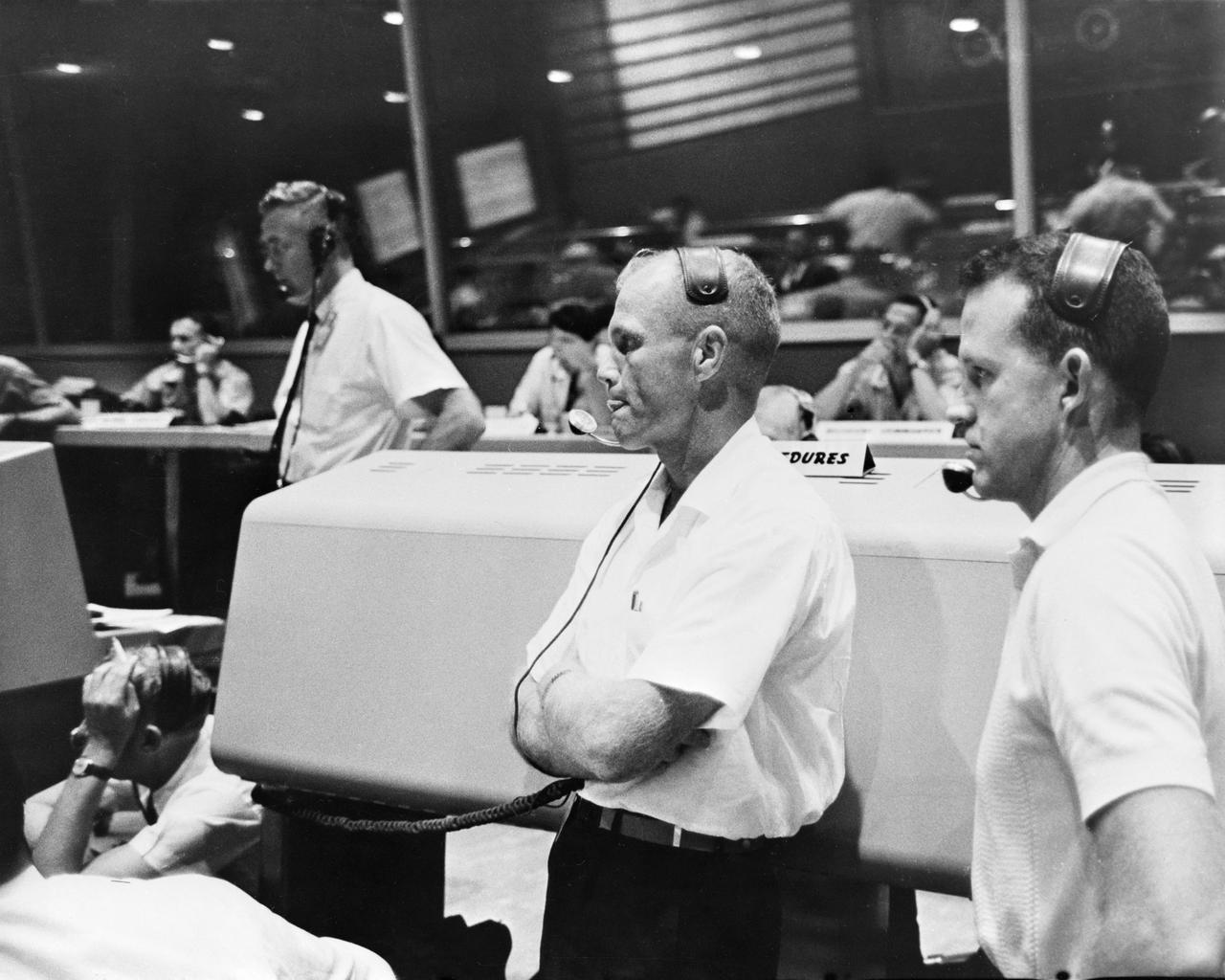
S61-03829 (21 July 1961) --- View of the Mission Control Center at Cape Canaveral during the Mercury-Redstone 4 (MR-4) mission. Astronauts John Glenn (left) and L. Gordon Cooper (right) act as spacecraft communicators (CAPCOM). Photo credit: NASA
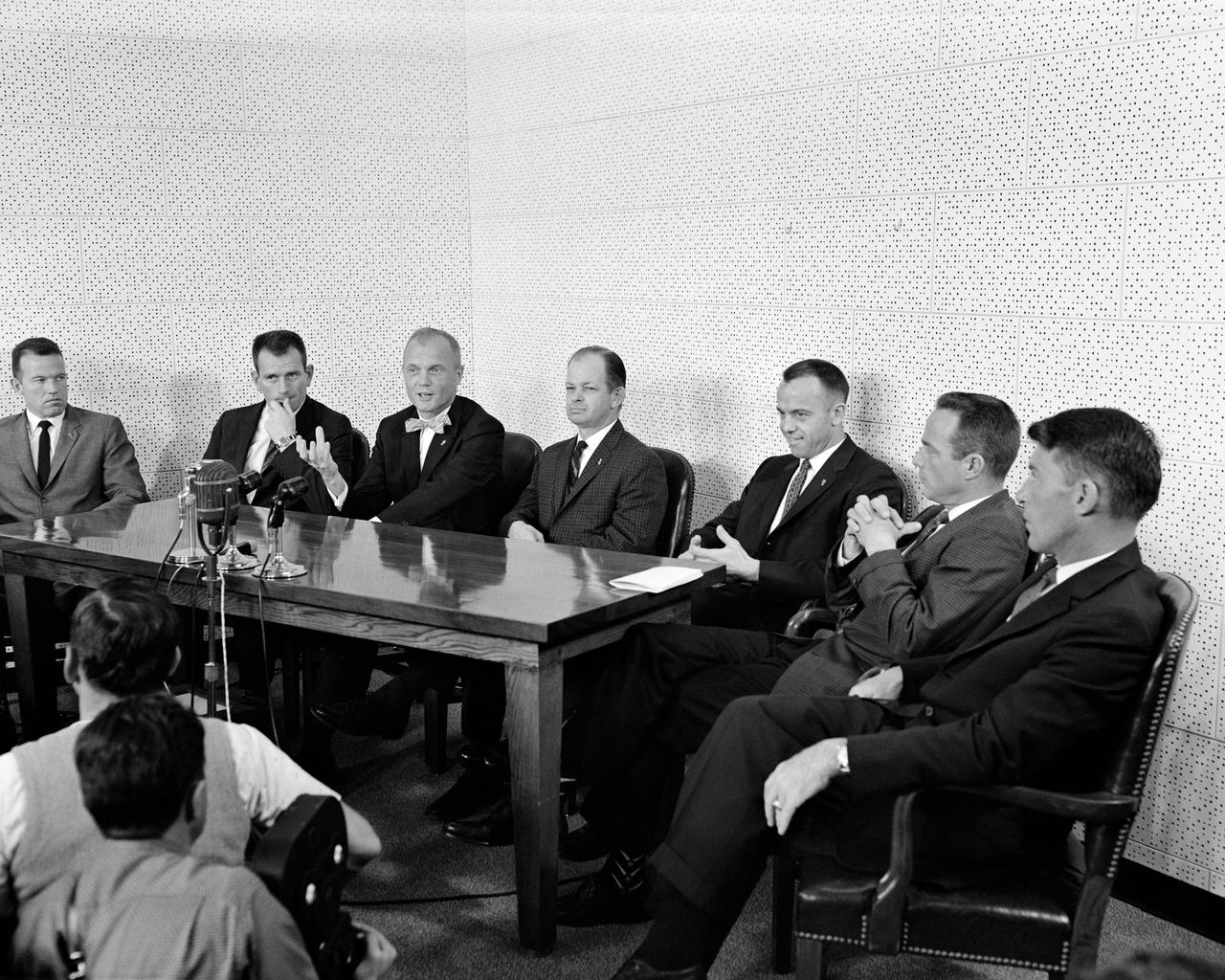
S61-00246 (25 July 1961) --- Photo of the original Mercury astronauts with Col. John A. (Shorty) Powers seated around a table talking to the news media. From left to right are: L. Gordon Cooper, Donald K. Slayton, John H. Glenn Jr., Col. Powers, Alan B. Shepard Jr., M. Scott Carpenter and Walter M. Schirra Jr. Virgil I. Grissom is out of the frame. Photo credit: NASA
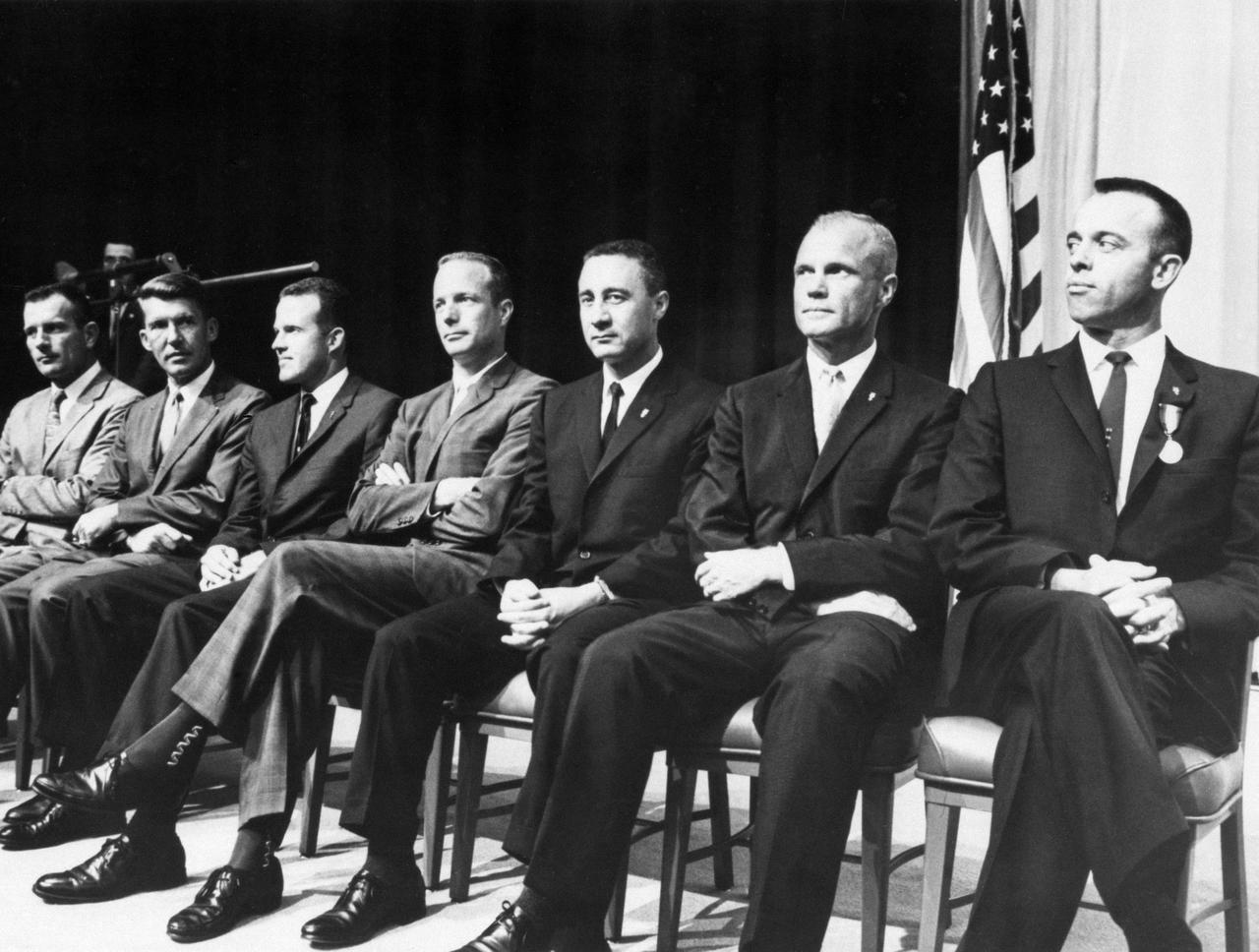
S61-02357 (8 May 1961) --- The original seven Mercury astronauts at the State Department Auditorium on May 8, 1961. The astronauts are (left to right) Donald K. Slayton, Walter M. Schirra, Jr., L. Gordon Cooper, Jr., M. Scott Carpenter, Virgil I. Grissom, John H. Glenn, Jr. and Alan B. Shepard, Jr. Earlier President John F. Kennedy had presented astronaut Shepard with the NASA Distinguished Service Medal (note it on his lapel) in the White House Rose Garden.
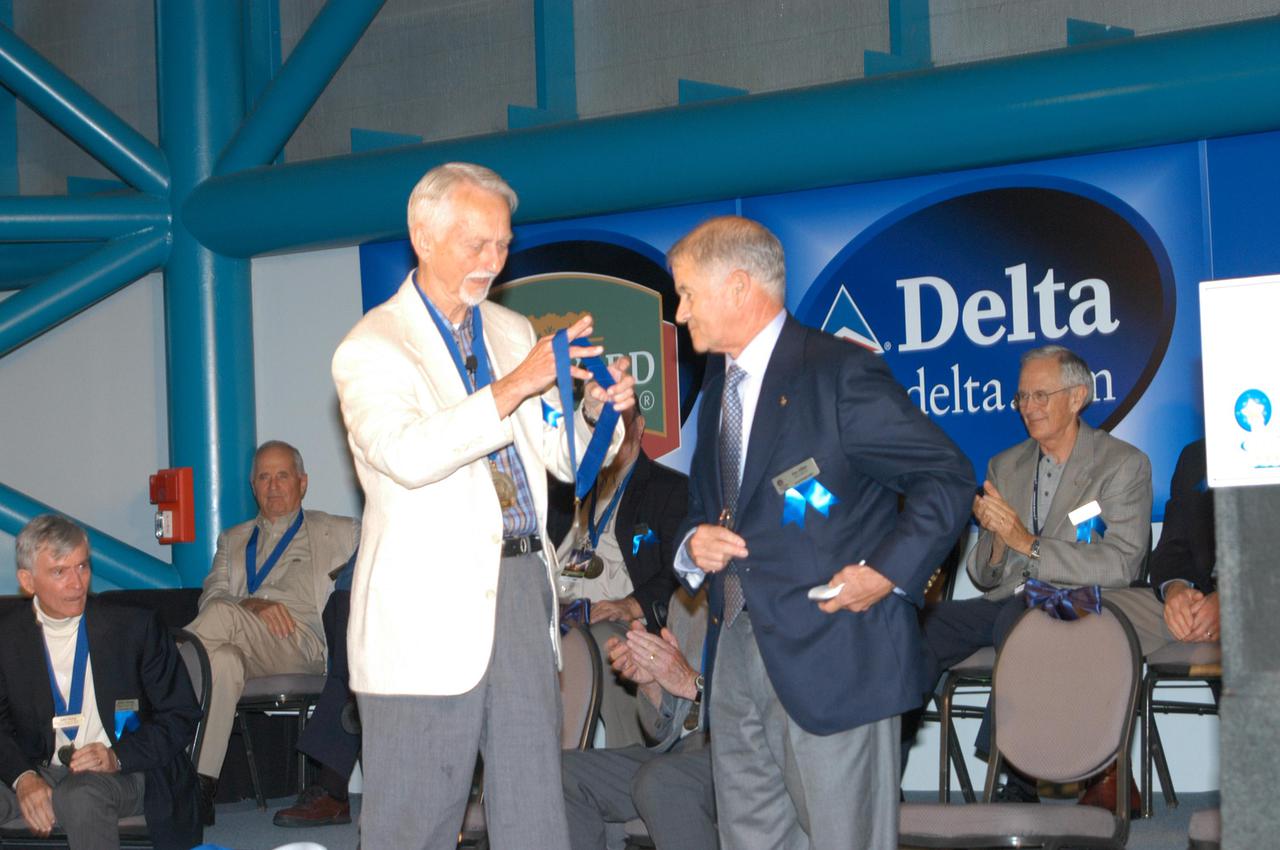
KENNEDY SPACE CENTER, FLA. - At the Astronaut Hall of Fame Induction Ceremony, Chairman Owen Garriott prepares to place a medal on the neck of new inductee Joe Allen. Current Hall of Famers in the background are John Young and Dick Gordon (at left) and Al Worden (at right). The other new inductees are Bruce McCandless and Gordon Fullerton. The event is being held in the Kennedy Space Center Visitor Complex’s Apollo_Saturn V Center. Recognized for their individual flight accomplishments and contributions to the success and future success of the U.S. space program, this elite group of inductees is among only 60 astronauts to be honored in the Hall of Fame and the fourth group of Space Shuttle astronauts named.
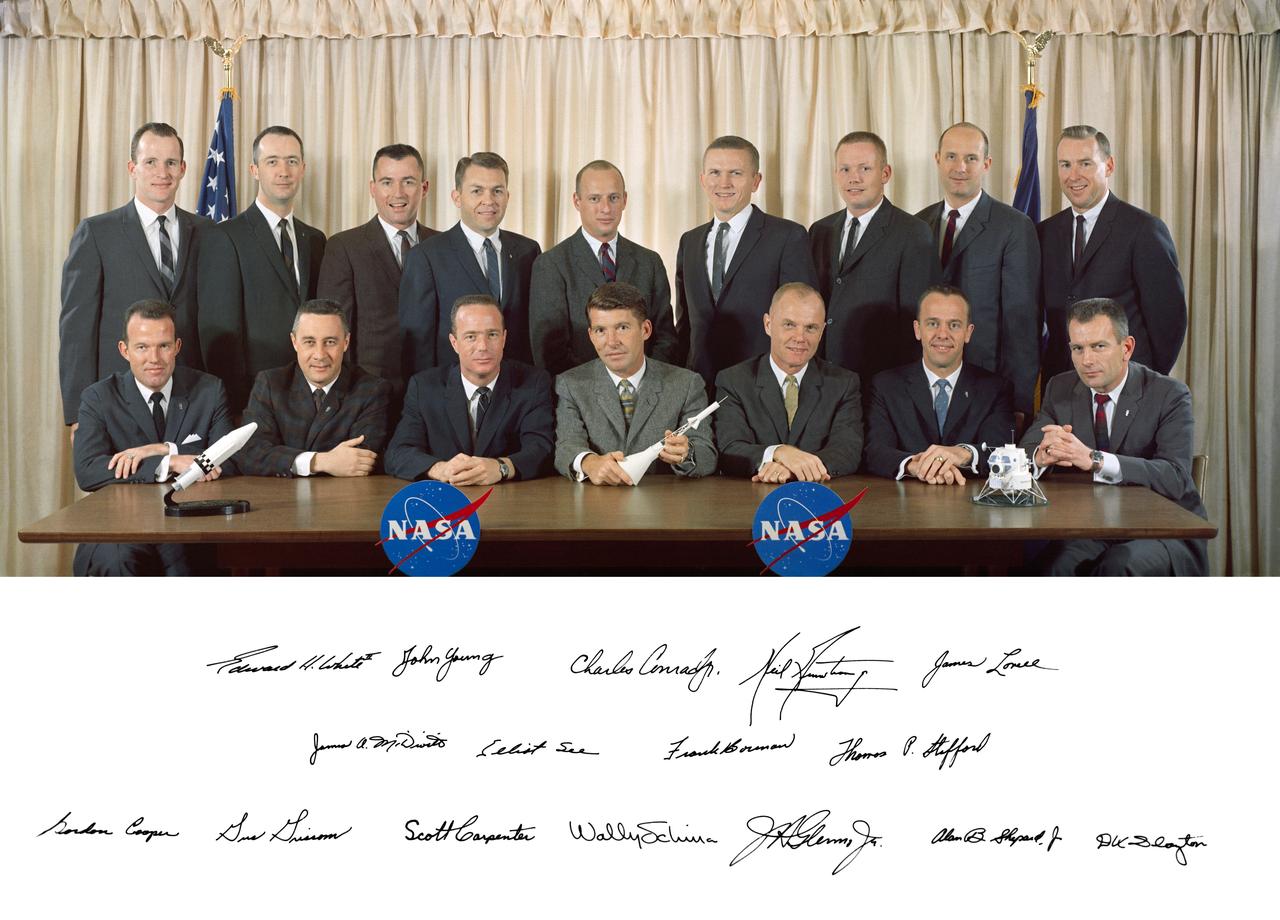
S63-01419A (1963) --- Portrait of the first two groups of astronauts. The seven original Mercury astronauts plus new members of the astronaut corps. Seated from left to right are: Gordon Cooper, Gus Grissom, Scott Carpenter, Wally Schirra, John Glenn, Alan Shepard and Deke Slayton. Standing from left to right are: Edward White, James McDivitt, John Young, Elliot See, Charles Conrad, Frank Borman, Neil Armstrong, Thomas Stafford, and James Lovell. Signatures are also visible at the bottom of the frame. Photo credit: NASA
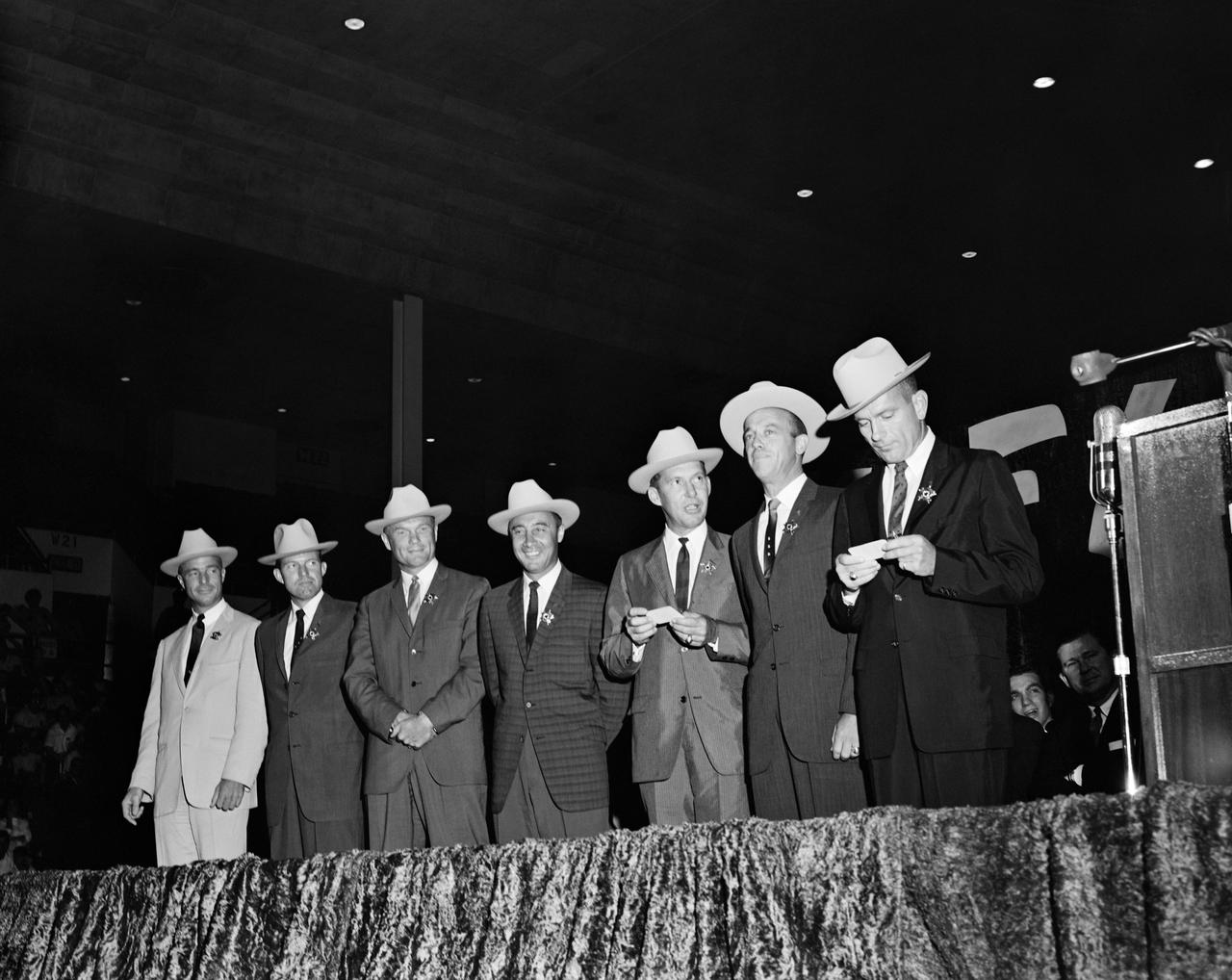
S62-03709 (4 July 1962) --- The original seven Mercury astronauts, each wearing new cowboy hats and a badge in the shape of a star, are pictured on stage at the Sam Houston Coliseum. A large crowd was on hand to welcome them to Houston, Texas. Left to right are astronauts M. Scott Carpenter, L. Gordon Cooper Jr., John H. Glenn Jr., Virgil I. Grissom, Walter M. Schirra Jr., Alan B. Shepard Jr., and Donald K. Slayton. Sen. John Tower (R.-Texas) is seen in far right background. Photo credit: NASA
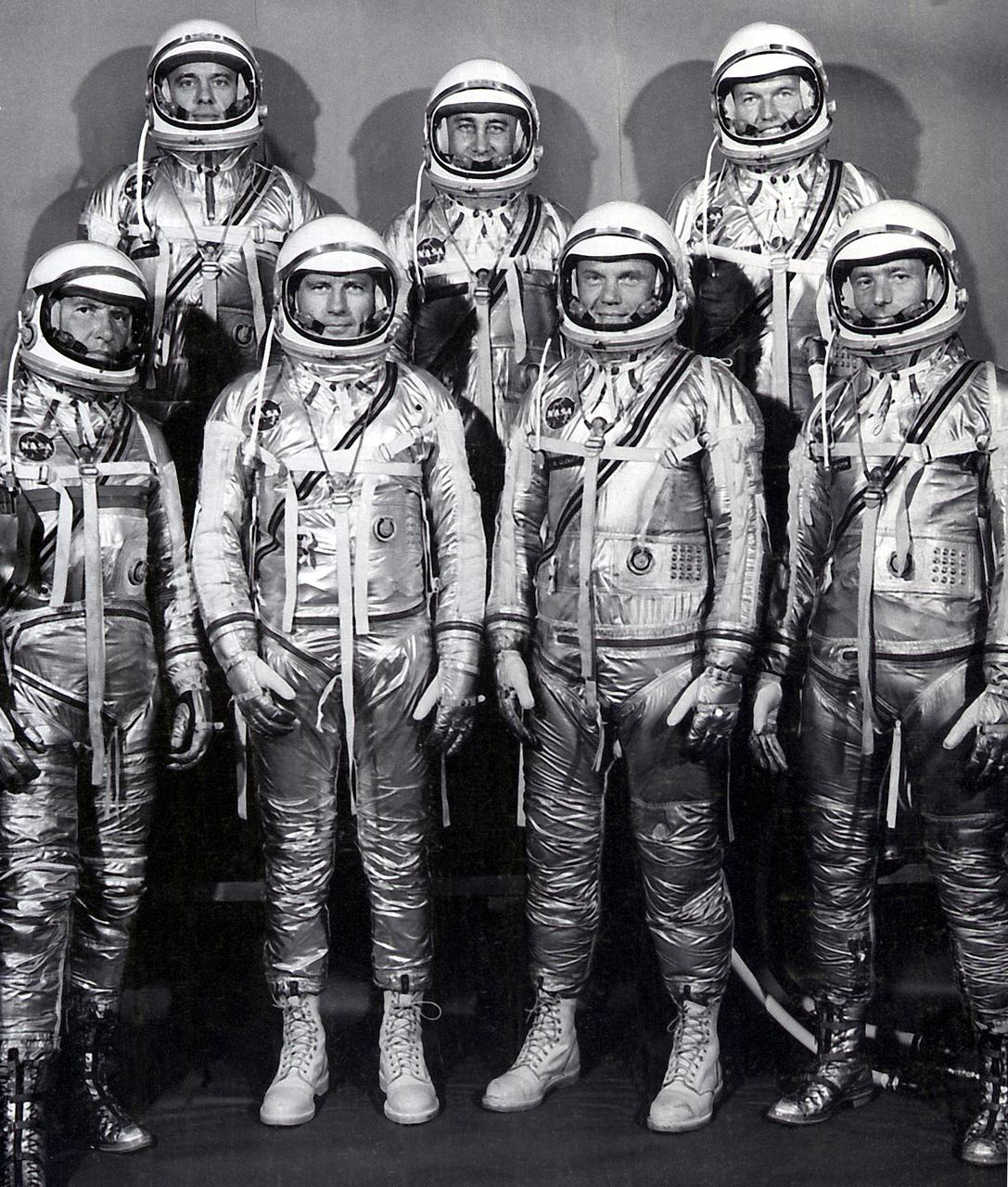
The group portrait of the original seven astronauts for the Mercury Project. NASA selected its first seven astronauts on April 27, 1959. Left to right at front: Walter M. Wally Schirra, Donald K. Deke Slayton, John H. Glenn, Jr., and Scott Carpenter. Left to right at rear: Alan B. Shepard, Virgil I. Gus Grissom, and L. Gordon Cooper, Jr.
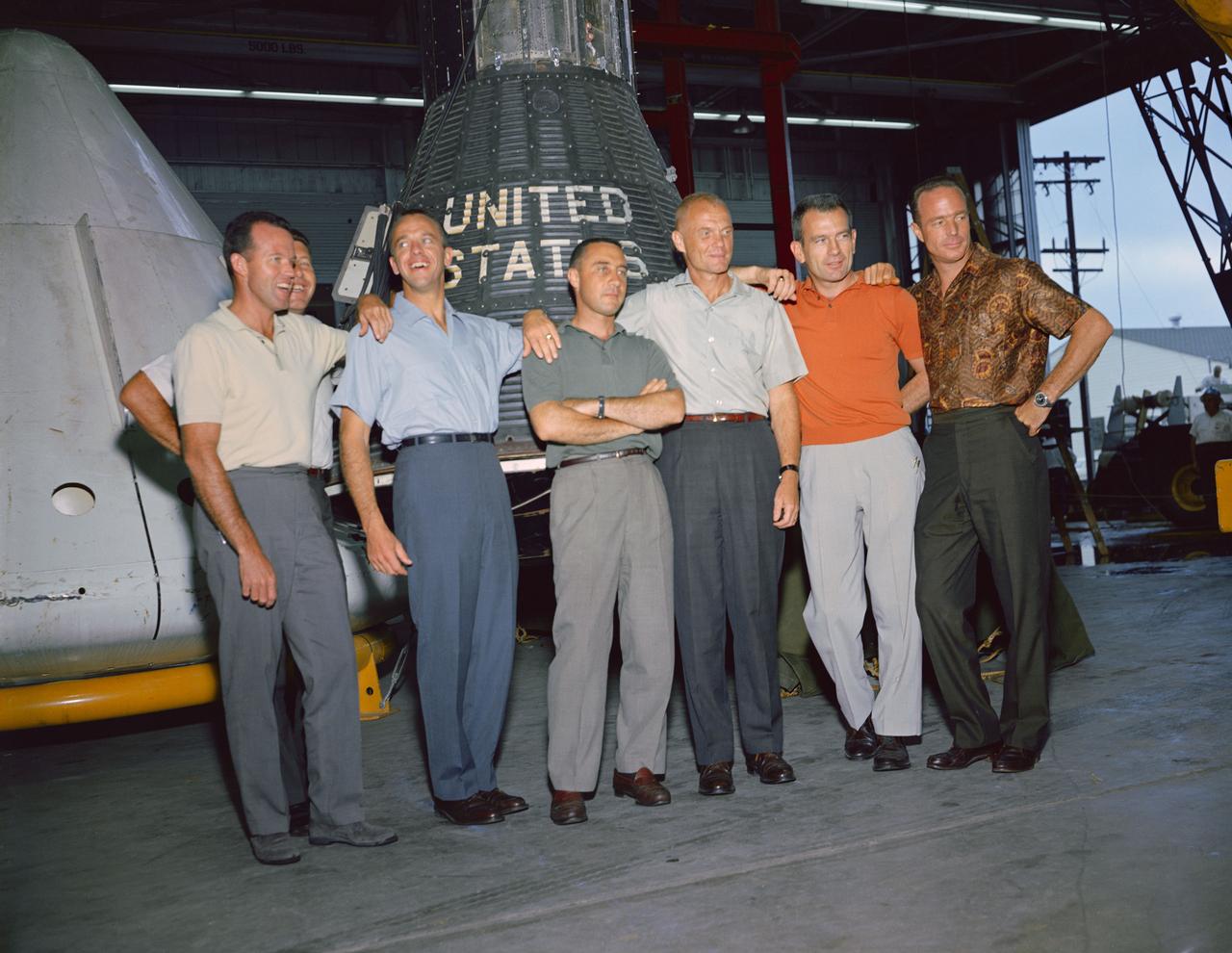
S63-18853 (1963) --- Group shot of the original Mercury astronauts taken at the Manned Spacecraft Center (MSC), Houston, Texas. The astronauts are left-to-right: L. Gordon Cooper Jr., Walter M. Schirra, Alan B. Shepard Jr., Virgil I. Grissom, John H. Glenn Jr., Donald K. Slayton and M. Scott Carpenter. Photo credit: NASA
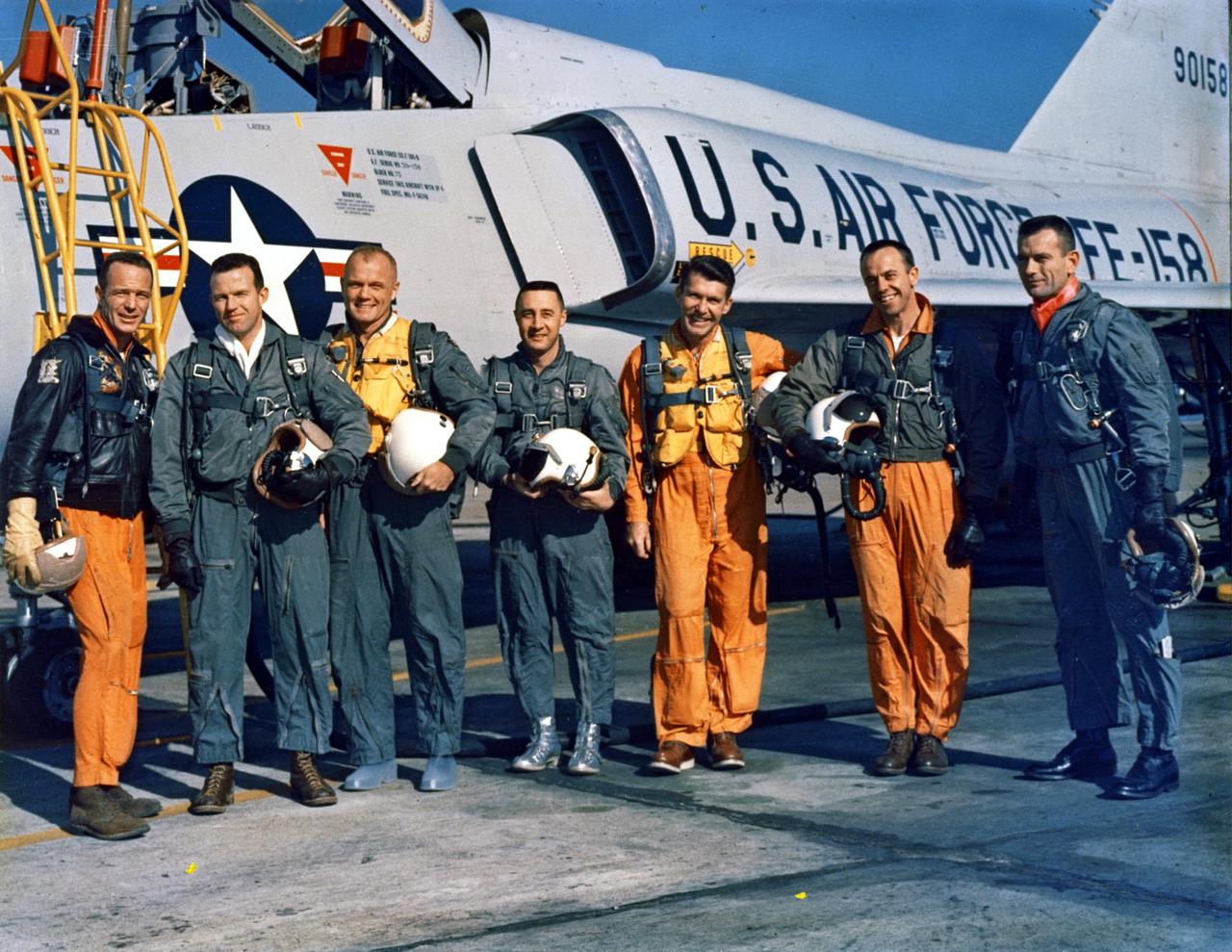
CAPE CANAVERAL, FLA. -- The Original Seven Mercury Astronauts pose beside an Air Force F-102 jet. Standing, left to right, are M. Scott Carpenter, L. Gordon Cooper, John H. Glenn Jr., Virgil I. 'Gus' Grissom, Walter M. Schirra Jr., Alan B. Shepherd Jr., and Donald K. 'Deke' Slayton.
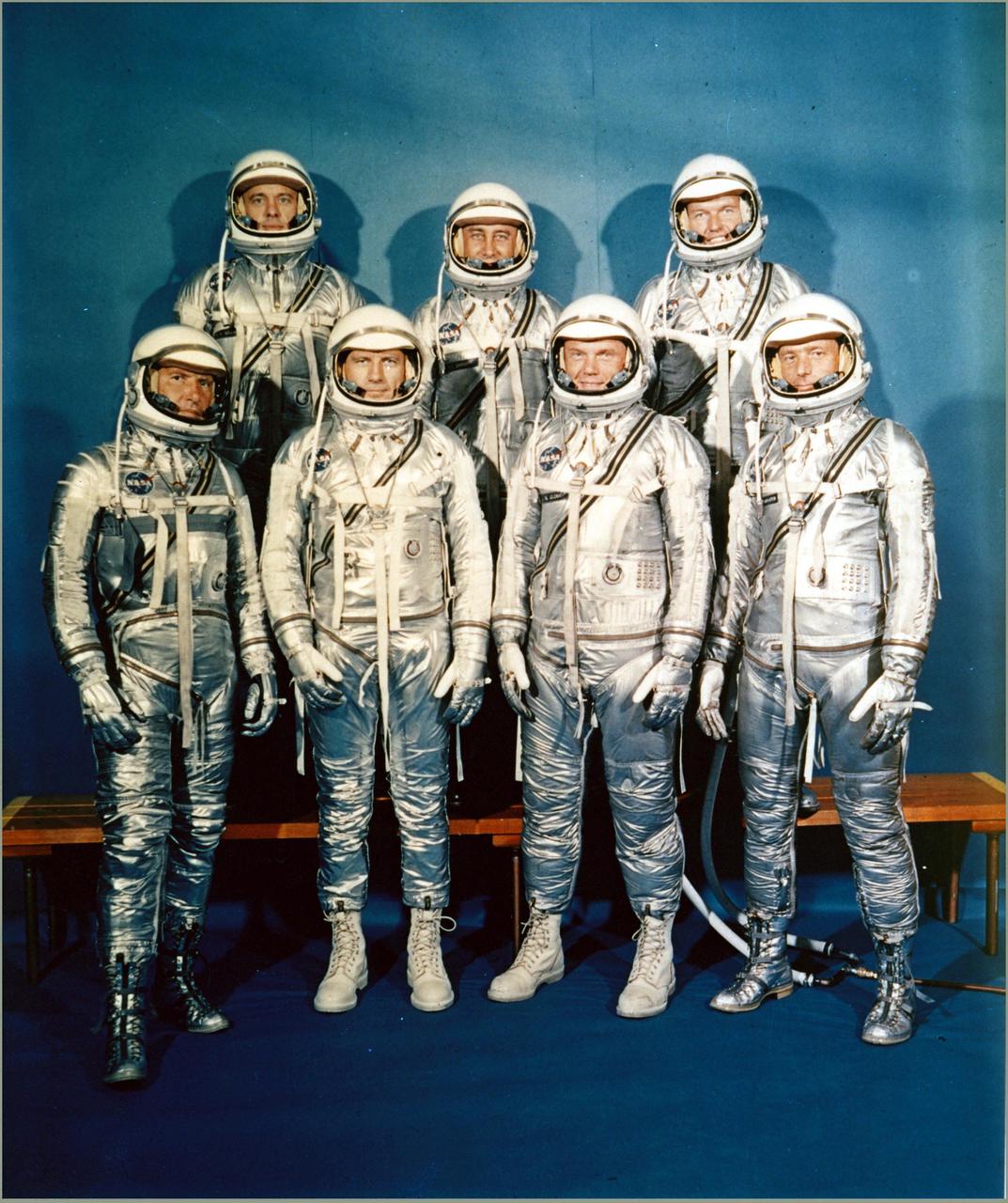
MANNED SPACECRAFT CENTER, HOUSTON, TX. -- FIRST ASTRONAUT TEAM -- Project Mercury Astronauts, whose selection was announced on April 9, 1959, only six months after the National Aeronautics and Space Administration was formally established on Oct. 1, 1958, included: front row, left to right, Walter H. Schirra Jr., Donald K. Slayton, John H. Glenn Jr., and Scott Carpenter back row, Alan B. Shepard Jr., Virgil I. 'Gus' Grissom, and L. Gordon Cooper.
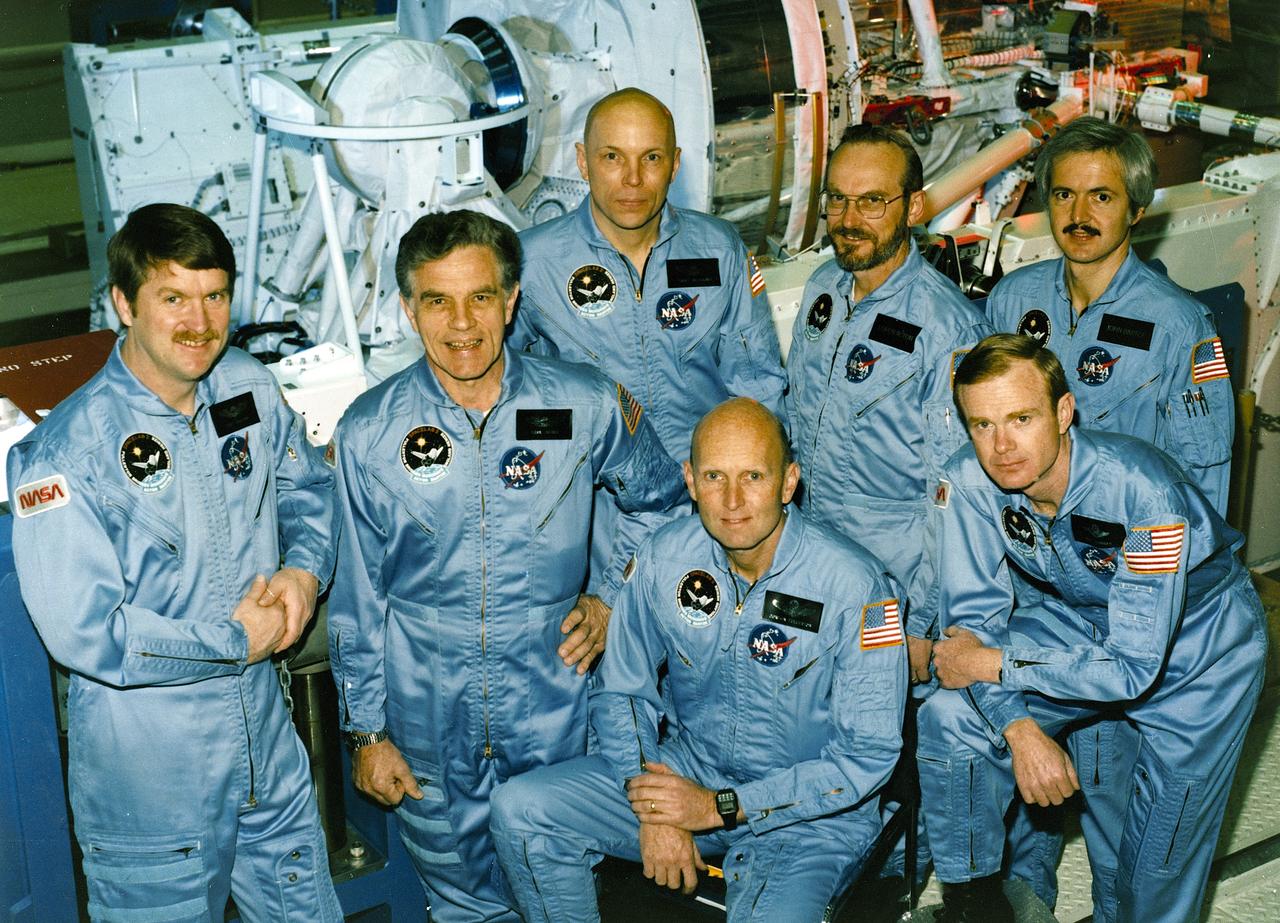
The crew assigned to the STS-51F mission included (kneeling left to right) Gordon Fullerton, commander; and Roy D. Bridges, pilot. Standing, left to right, are mission specialists Anthony W. England, Karl J. Henize, and F. Story Musgrave; and payload specialists Loren W. Acton, and John-David F. Bartoe. Launched aboard the Space Shuttle Challenger on July 29, 1985 at 5:00:00 pm (EDT), the STS-51F mission’s primary payload was the Spacelab-2.
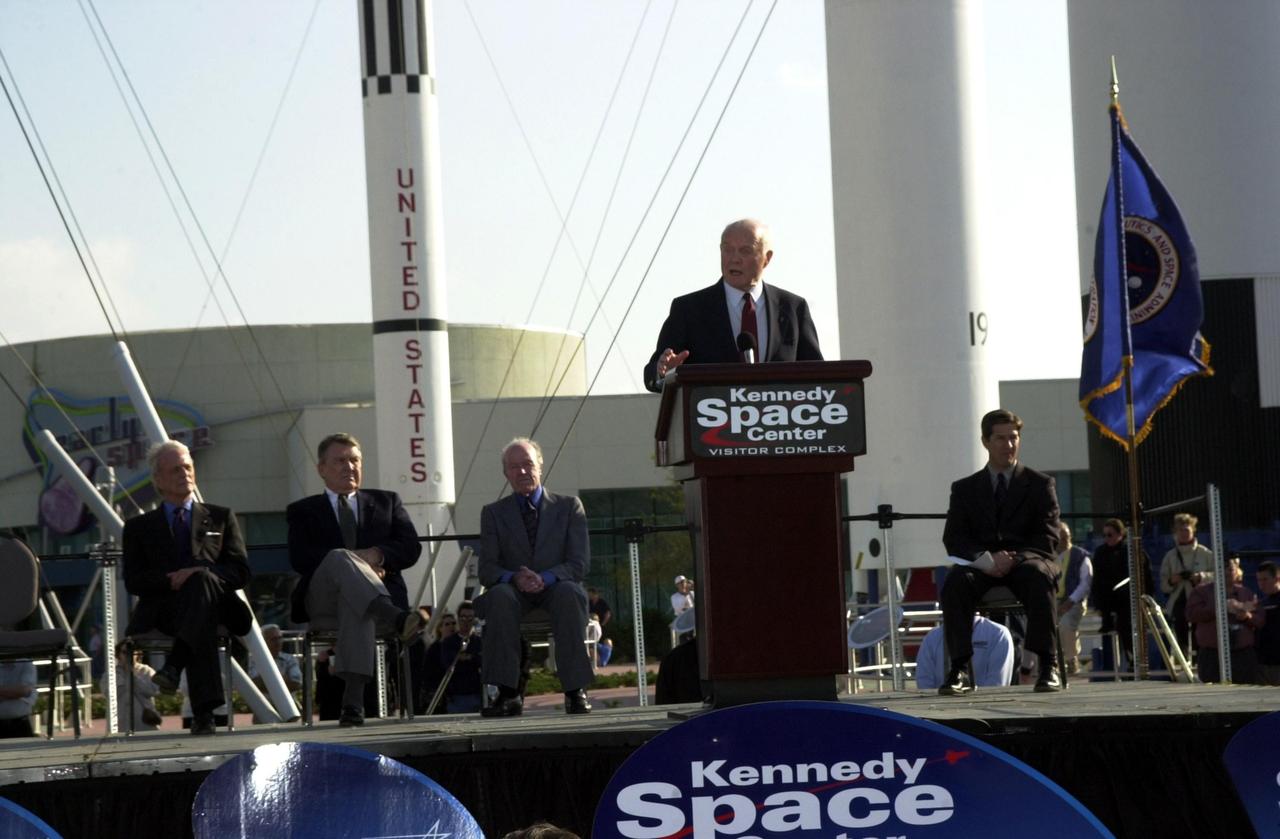
KENNEDY SPACE CENTER, FLA. -- At opening ceremonies of the celebration of the 40th anniversary of American spaceflight, space pioneer John Glenn Jr. addresses attendees in the Rocket Garden of the KSC Visitor Complex. Behind him on the stage are (left to right) Scott Carpenter, Wally Schirra and Gordon Cooper; at right is WESH-TV (NBC) newsman Dan Billow, who served as emcee
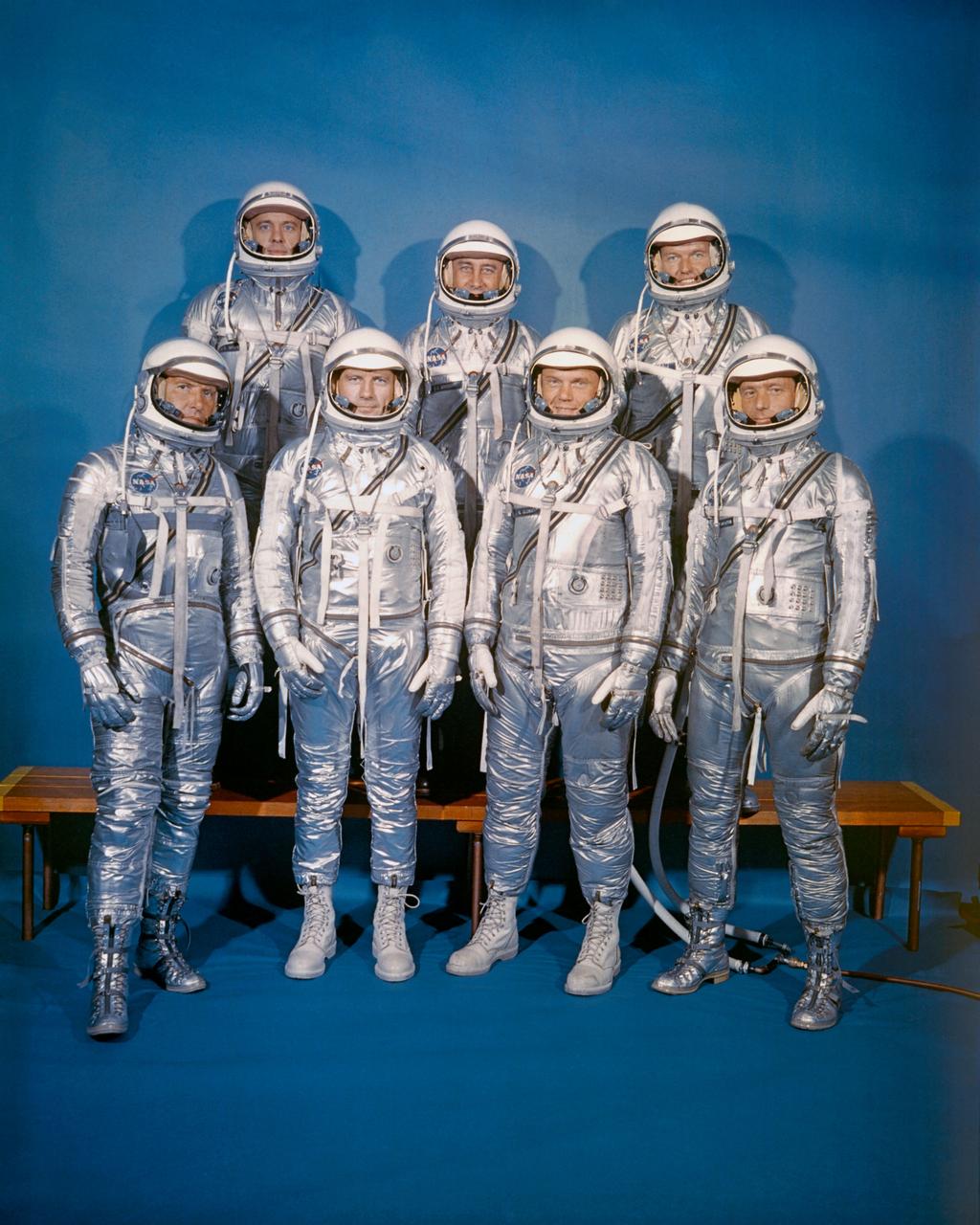
S62-08774 (July 1960) --- These seven men, wearing spacesuits in this portrait, composed the first group of astronauts announced by the National Aeronautics and Space Administration (NASA). They were selected in April of 1959 for the Mercury Program. Front row, left to right, are Walter M. Schirra Jr., Donald K. Slayton, John H. Glenn Jr., and M. Scott Carpenter. Back row, left to right, are Alan B. Shepard Jr., Virgil I. Grissom and L. Gordon Cooper Jr. Photo credit: NASA
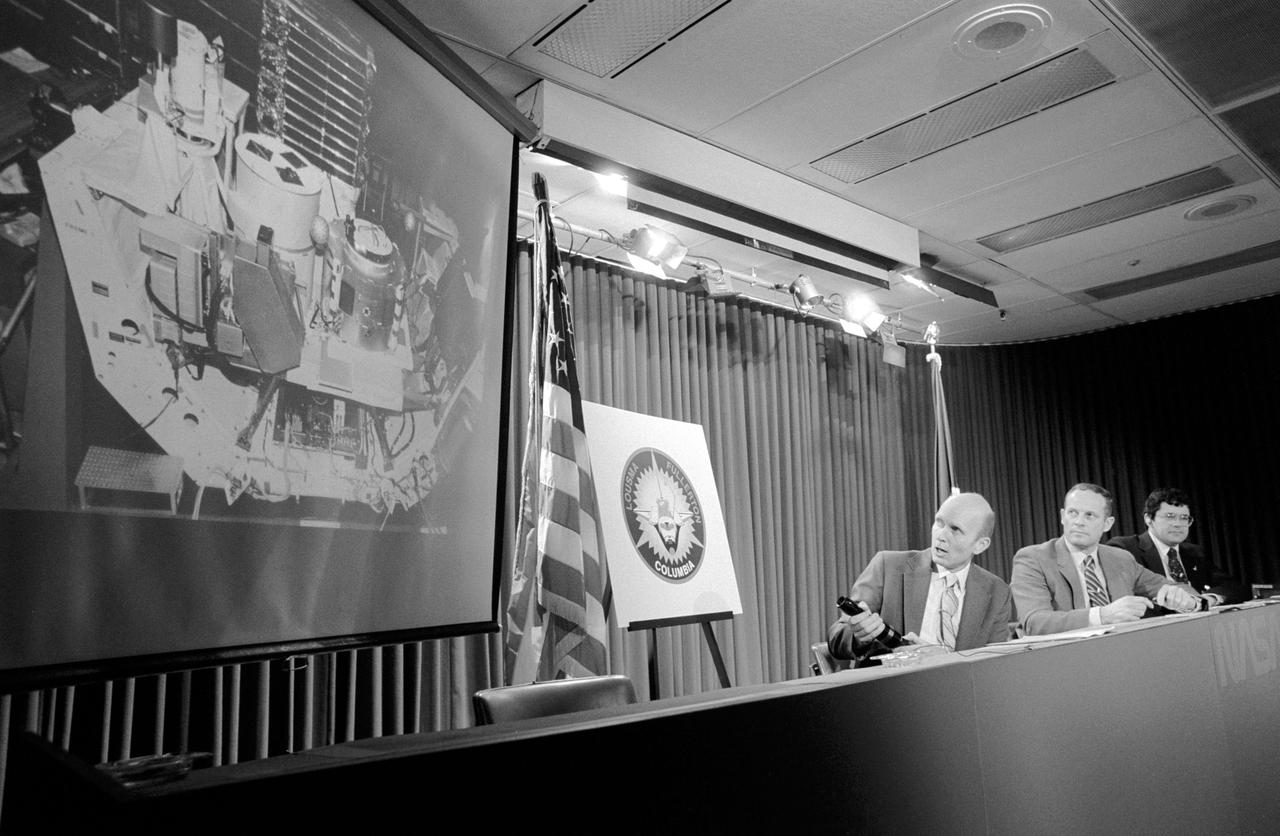
S82-25905 (21 Jan. 1982) --- Astronaut C. Gordon Fullerton uses an electronic pointer to localize an area on a projected visual of the OSS payload package to be carried in the cargo bay of the Columbia on STS-3. Fullerton is pilot for the flight and Jack R. Lousma, center, is mission commander. The two were holding one of a series of pre-STS-3 press briefings. They were introduced by Dr. John Lawrence, far right, a public information specialist for JSC?s Office of Public Affairs. Photo credit: NASA
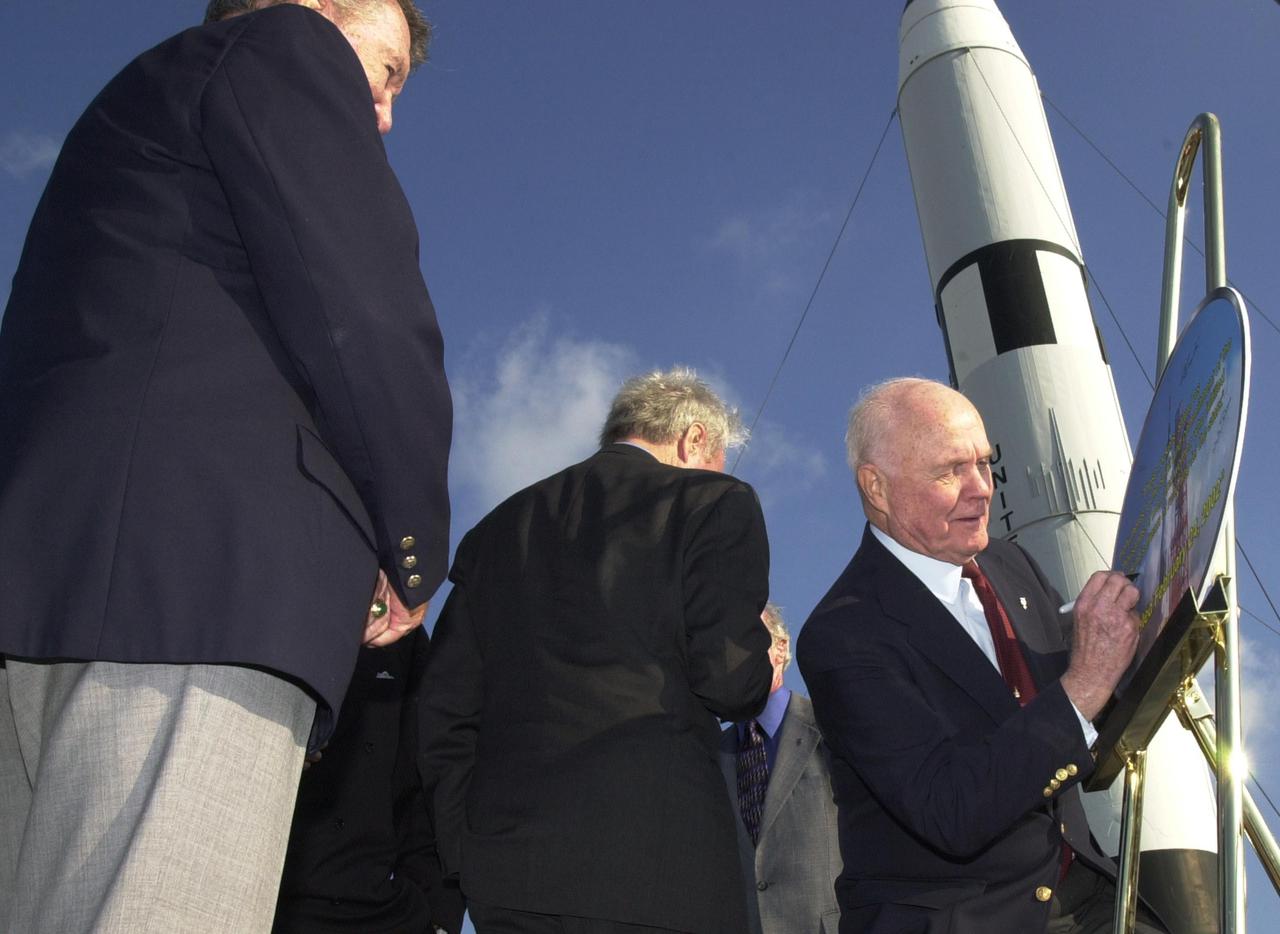
KENNEDY SPACE CENTER, FLA. -- After opening ceremonies for the 40th anniversary celebration of American spaceflight, space pioneer John Glenn Jr., who made that historic flight orbiting the Earth, signs a commemorative painting. The site is the Rocket Garden in the KSC Visitor Complex. Other Mercury astronauts who attended the celebration were Scott Carpenter, Gordon Cooper and Wally Schirra. The event was capped with a dinner held at the KSC Apollo_Saturn V Center.
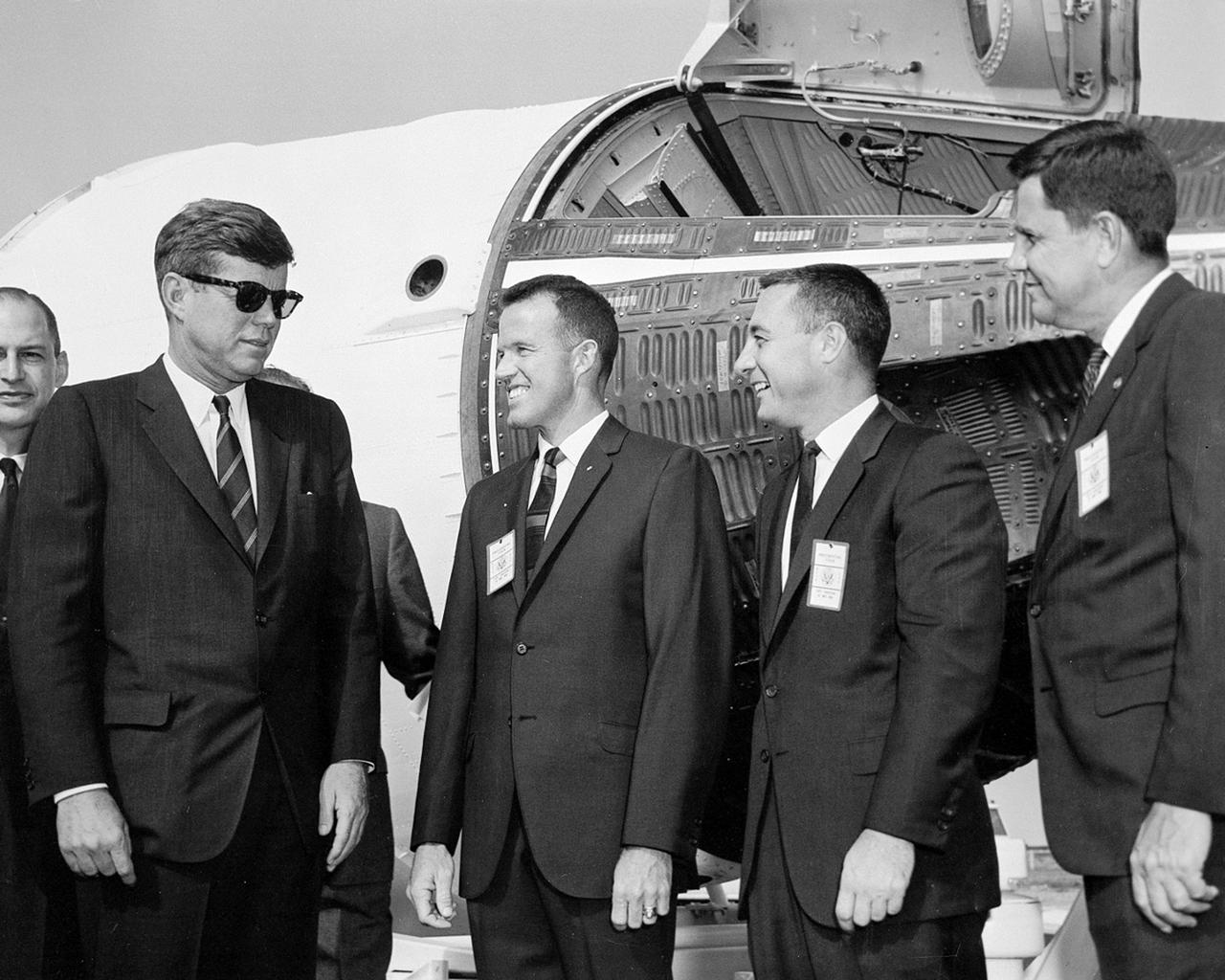
CAPE CANAVERAL Fla. -- President John F. Kennedy tours the Cape Canaveral Missile Test Annex in Florida. Standing in front of a Gemini spacecraft, from the left, are George M. Low, NASA chief of Manned Space Flight partially visible, Kennedy, astronaut L. Gordon Cooper, astronaut Virgil I. Grissom and G. Merritt Preston, NASA's manager of the Atlantic Missile Range. Photo Credit: NASA
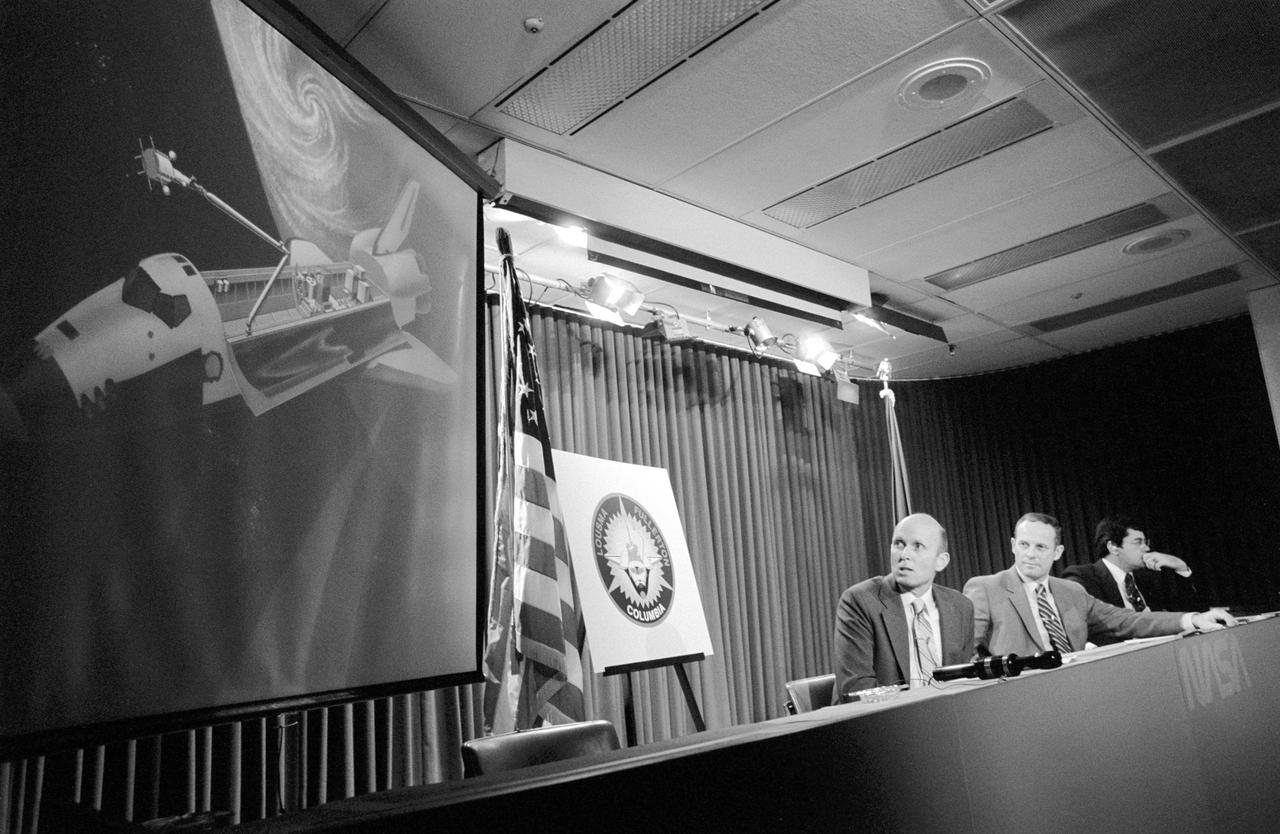
S82-25903 (21 Jan. 1982) --- Astronaut Jack R. Lousma, center, and C. Gordon Fullerton, left, respond to a visual depicting the Columbia and its remote manipulator system in space during a pre-STS-3 press conference in JSC?s pubic affairs building. Dr. John Lawrence, public information specialist who introduced the crew to news media representatives, is at far right. Photo credit: NASA
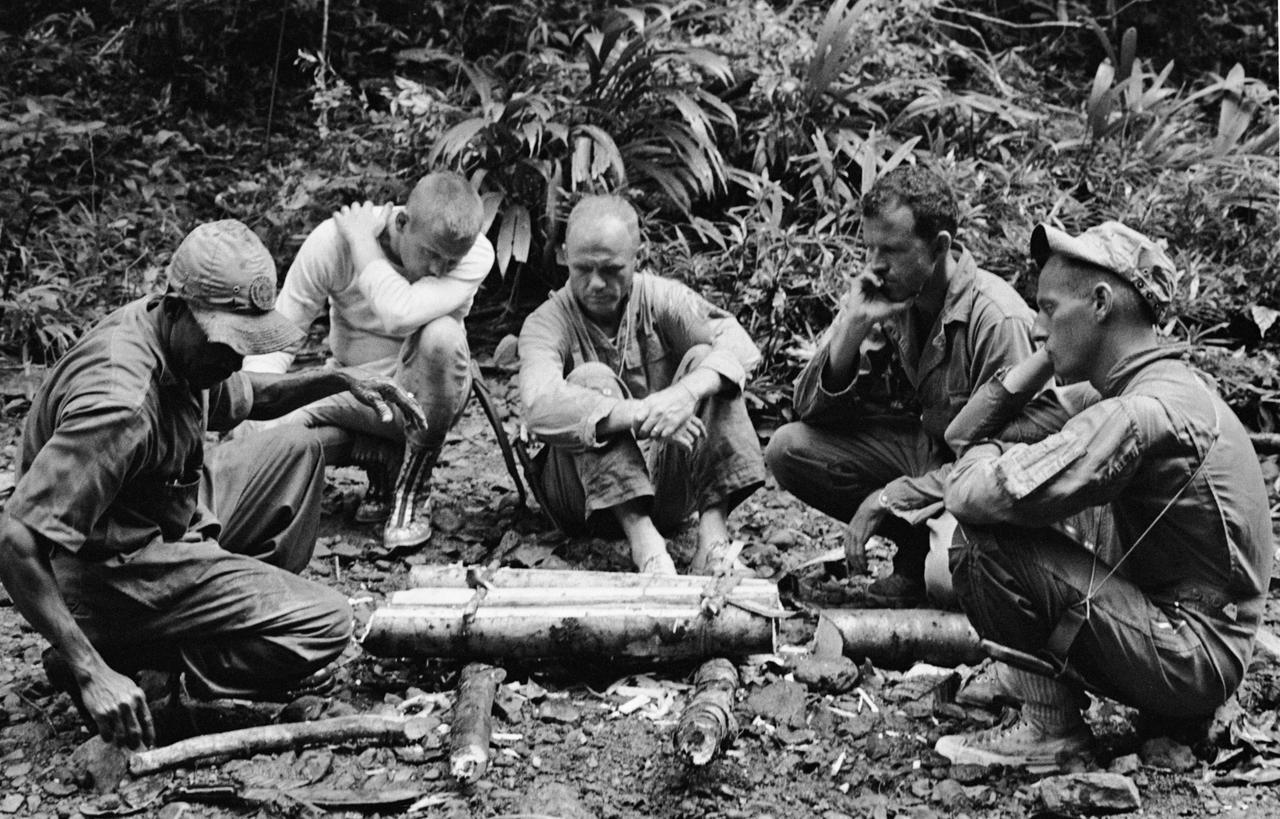
S63-08394 (3-6 June 1963) --- Some of NASA's sixteen astronauts participate in tropic survival training from June 3 through June 6, 1963, at Albrook Air Force Base, Canal Zone. From left to right are unidentified trainer, Neil Armstrong, John H. Glenn Jr., L. Gordon Cooper and Pete Conrad. Photo credit: NASA
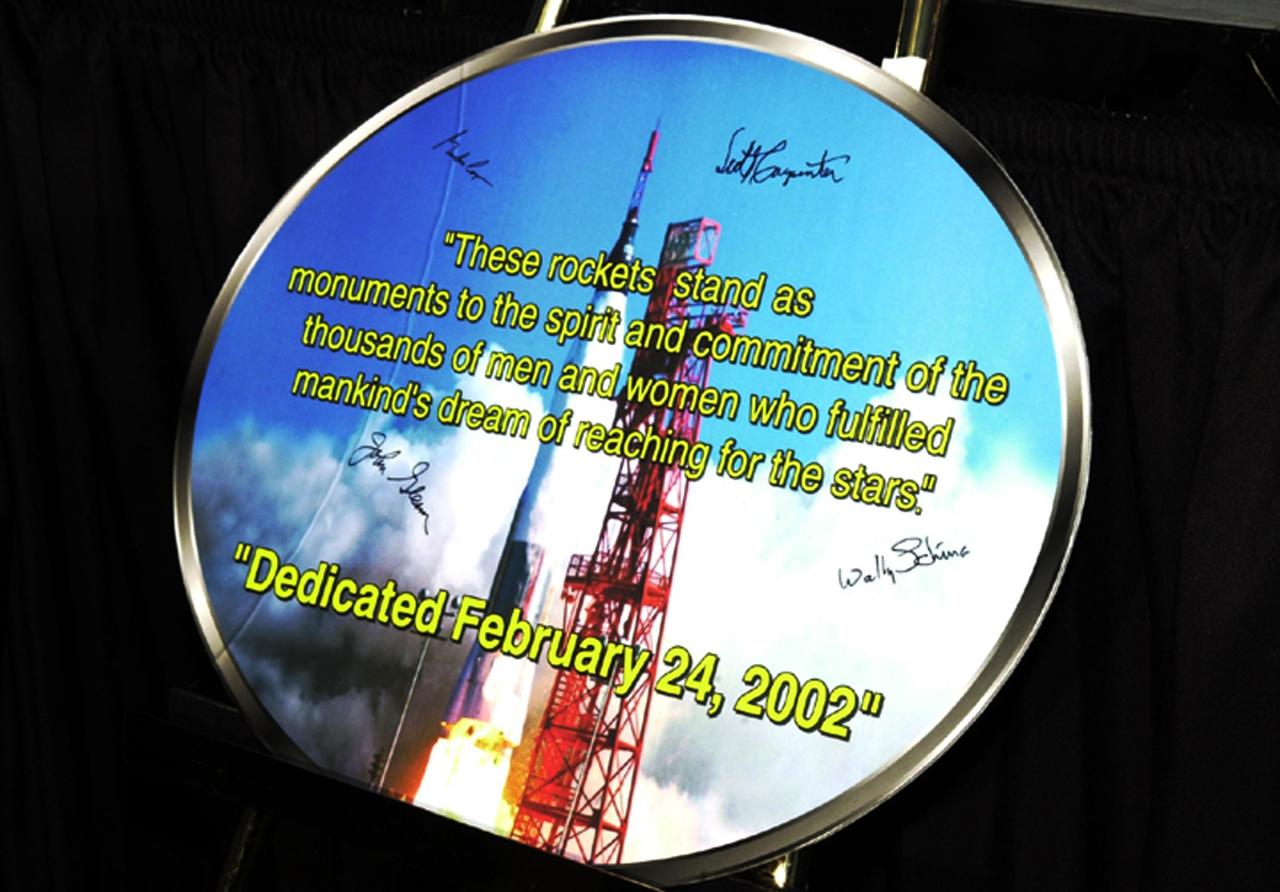
KENNEDY SPACE CENTER, FLA. -- This commemorative painting was presented during opening ceremonies for the 40th anniversary celebration of American spaceflight, It was signed by four of the space pioneers being honored: Wally Schirra, Gordon Cooper, John Glenn Jr. and Scott Carpenter. The ceremonies were held in the KSC Visitor Complex Rocket Garden. The event was capped with a dinner held at the KSC Apollo/Saturn V Center
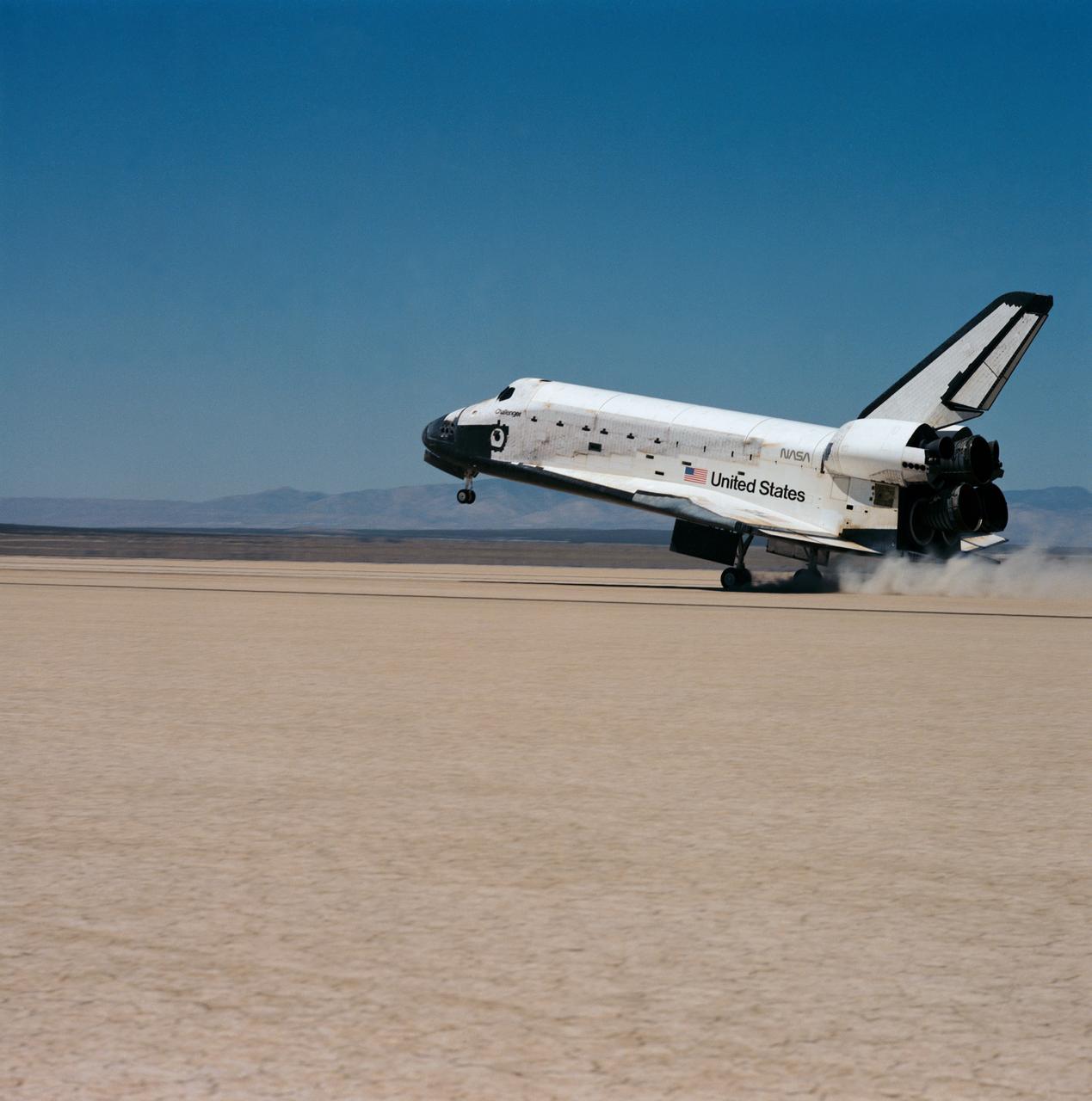
51F-S-161 (6 Aug 1985) --- The Space Shuttle Challenger, with its seven member crew and battery of scientific experiments aboard, eases its rear landing gear onto the dry lake bed at Edwards Air Force Base in California. Onboard for the eight-day mission were C. Gordon Fullerton, Roy D. Bridges Jr., F. Story Musgrave, Karl J. Henize, Anthony W. England, Loren W. Acton and John-David Bartoe.
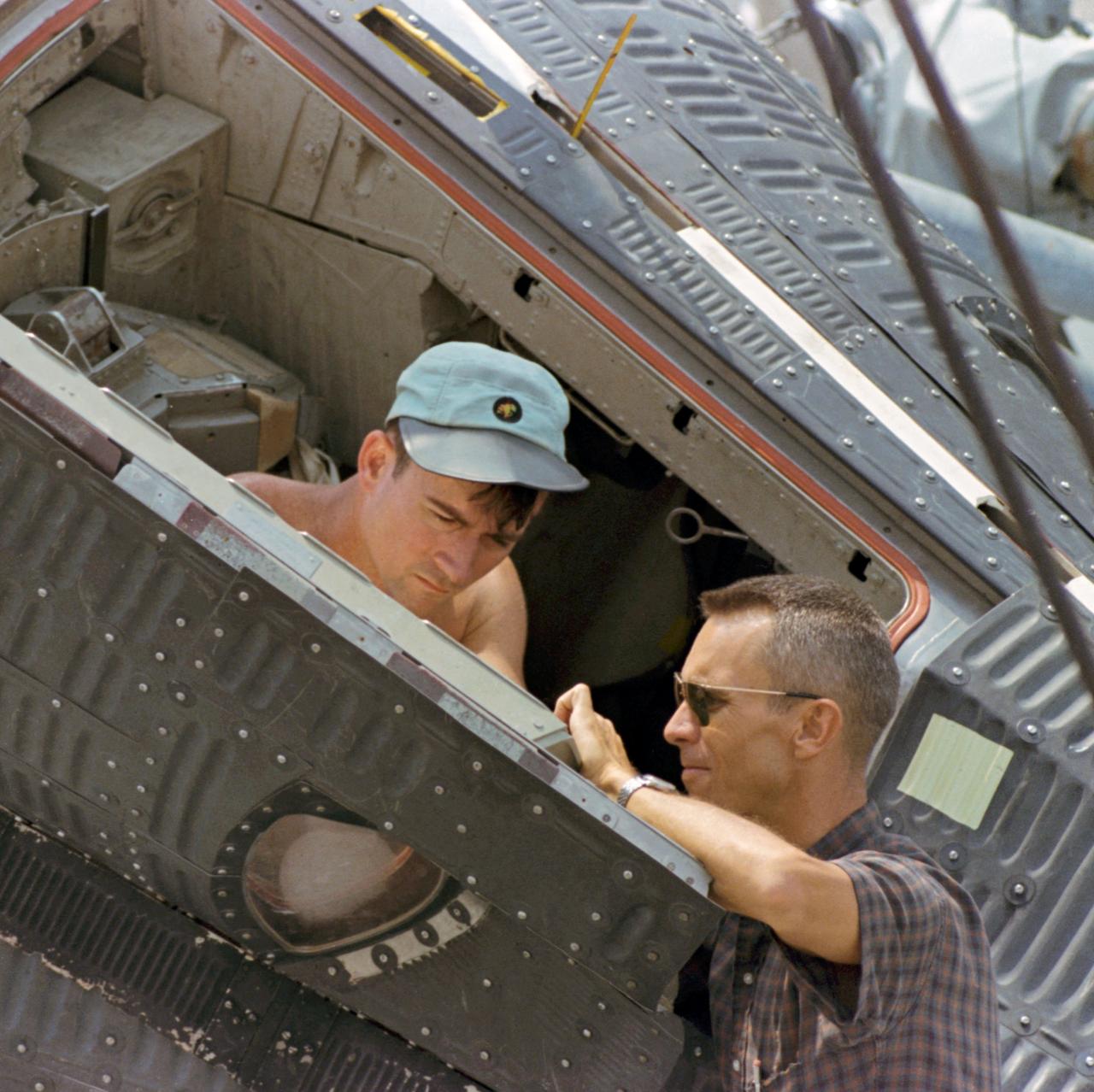
S66-39691 (18 June 1966) --- Astronaut John W. Young, prime crew command pilot for the Gemini-10 spaceflight, sits in Static Article 5 during water egress training activity onboard the NASA Motor Vessel Retriever. The SA-5 will be placed in the water and he and astronaut Michael Collins will then practice egress and water survival techniques. At right is Gordon Harvey, Spacecraft Operations Branch, Flight Crew Support Division. Photo credit: NASA
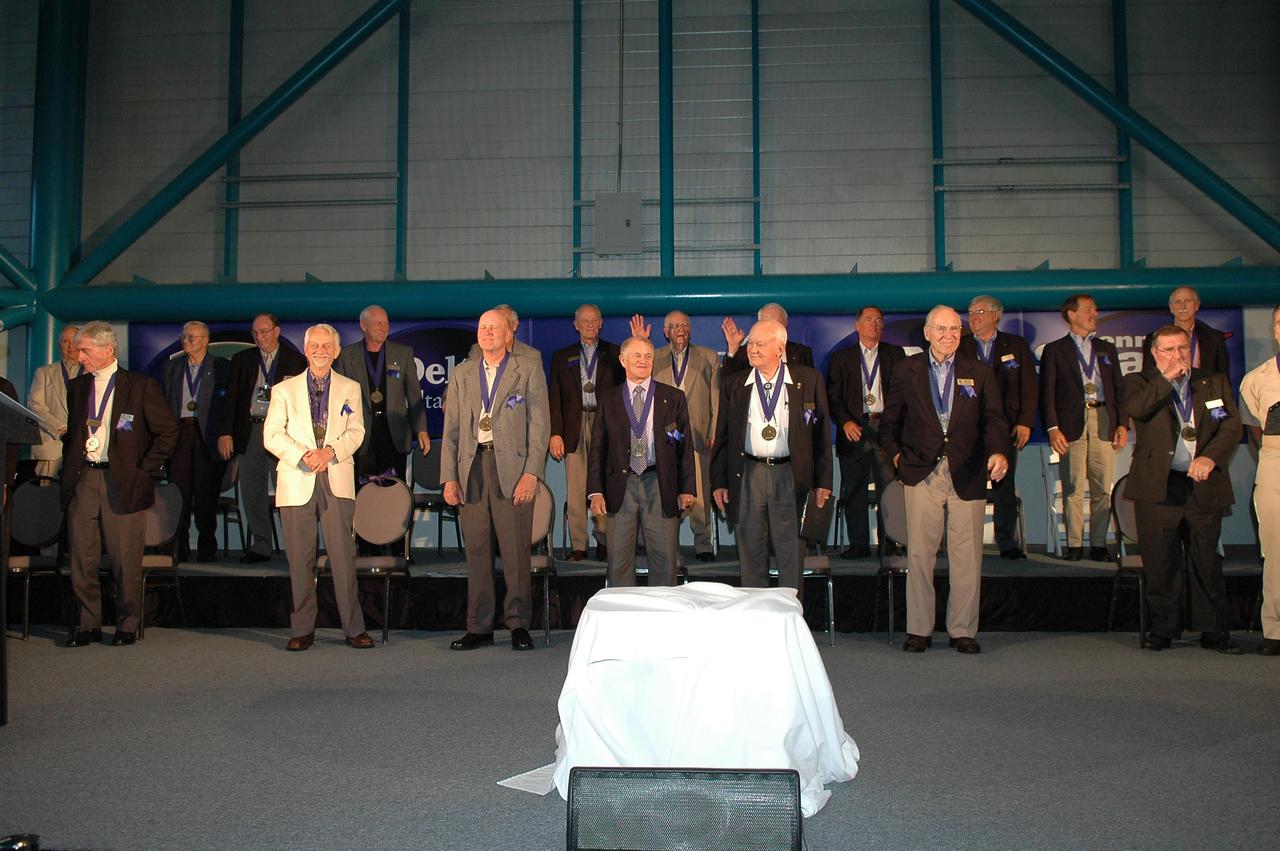
KENNEDY SPACE CENTER, FLA. - Members of the Astronaut Hall of Fame are applauded by the guests at the Astronaut Hall of Fame Induction Ceremony held at the Kennedy Space Center Visitor Complex’s Apollo_Saturn V Center. From left are Al Gordon, John Young, Walt Cunningham, Bill Anders, Owen Garriott, Ed Mitchell, Gordon Fullerton, Al Worden, Charlie Duke, Joe Allen, Jack Lousma, Bruce McCandless, Bill Pogue, Robert Crippen, Jim Lovell, Dan Brandenstein, Robert “Hoot” Gibson, Fred Haise, and Stephen Covey. Not pictured are Scott Carpenter and Vance Brand. McCandless, Allen and Fullerton are the 2005 inductees. Recognized for their individual flight accomplishments and contributions to the success and future success of the U.S. space program, this elite group of inductees is among only 60 astronauts to be honored in the Hall of Fame and the fourth group of Space Shuttle astronauts named.
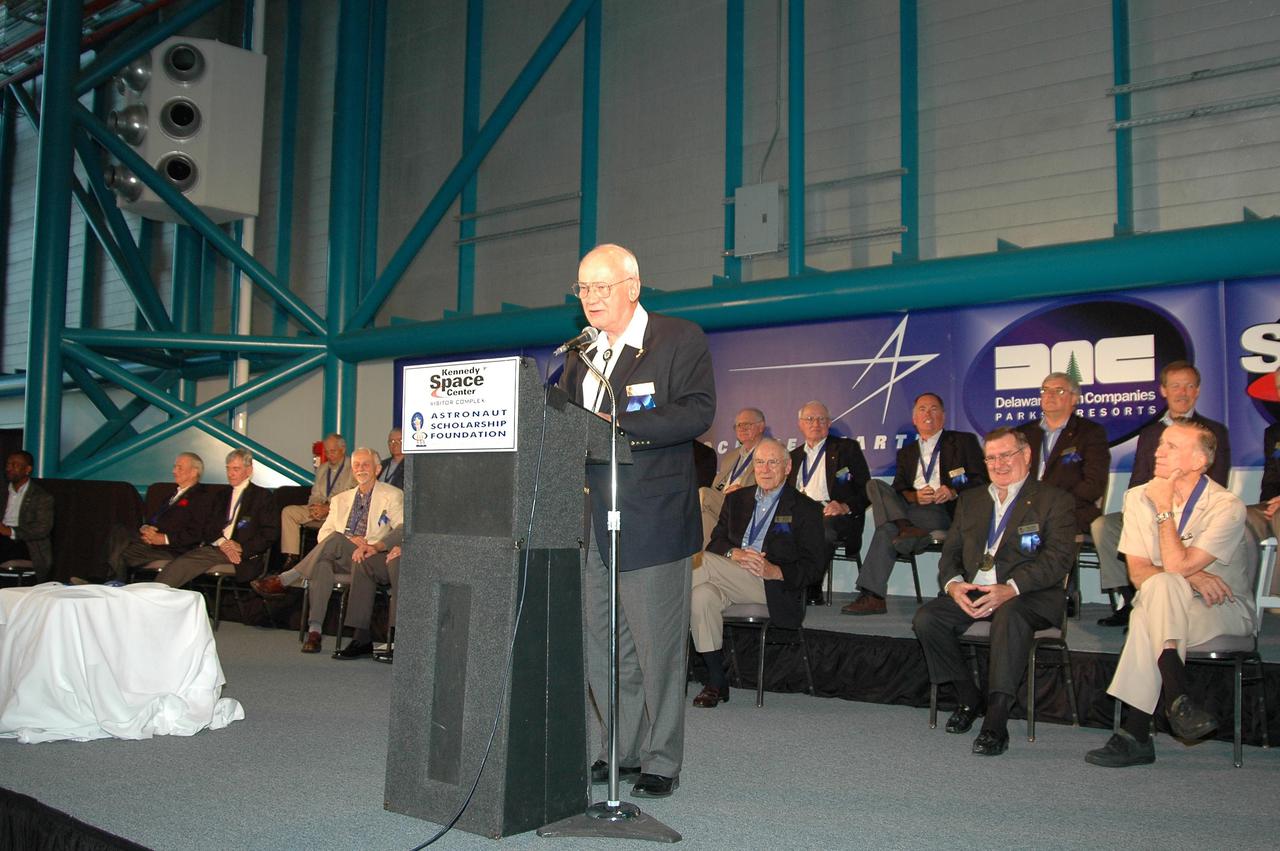
KENNEDY SPACE CENTER, FLA. - At the Astronaut Hall of Fame Induction Ceremony, new inductee Bruce McCandless speaks to the guests. Seen behind him are current Hall of Famers (back row) Al Gordon, Walt Cunningham, Jack Lousma, Bill Pogue, Robert Crippen, Dan Brandenstein and Robert “Hoot” Gibson; (front row) Scott Carpenter, John Young, Owen Garriott, Jim Lovell, Fred Haise and Vance Brand. Garriott is chairman of the Astronaut Hall of Fame. The other new inductees are Joe Allen and Gordon Fullerton. The event is being held in the Kennedy Space Center Visitor Complex’s Apollo_Saturn V Center. Recognized for their individual flight accomplishments and contributions to the success and future success of the U.S. space program, this elite group of inductees is among only 60 astronauts to be honored in the Hall of Fame and the fourth group of Space Shuttle astronauts named.

KENNEDY SPACE CENTER, FLA. - At the KSC Visitor Complex, former astronaut Frederick H. (Rick) Hauck (standing right) congratulates former astronaut Daniel Brandenstein (standing center) at his induction ceremony into the U.S. Astronaut Hall of Fame. Also standing is former astronaut James A. Lovell. Seated on the dais, from left, are former astronauts John H. Glenn and Gordon Cooper, both previously inducted into the Hall of Fame. Being inducted with Brandenstein are Space Shuttle astronauts Robert "Hoot" Gibson, Story Musgrave, and Sally K. Ride. Conceived by six of the Mercury Program astronauts, the U.S. Astronaut Hall of Fame opened in 1990 to provide a place where space travelers could be remembered for their participation and accomplishments in the U.S. space program. The four new inductees join 48 previously honored astronauts from the ranks of the Gemini, Apollo, Skylab, Apollo-Soyuz, and Space Shuttle programs.
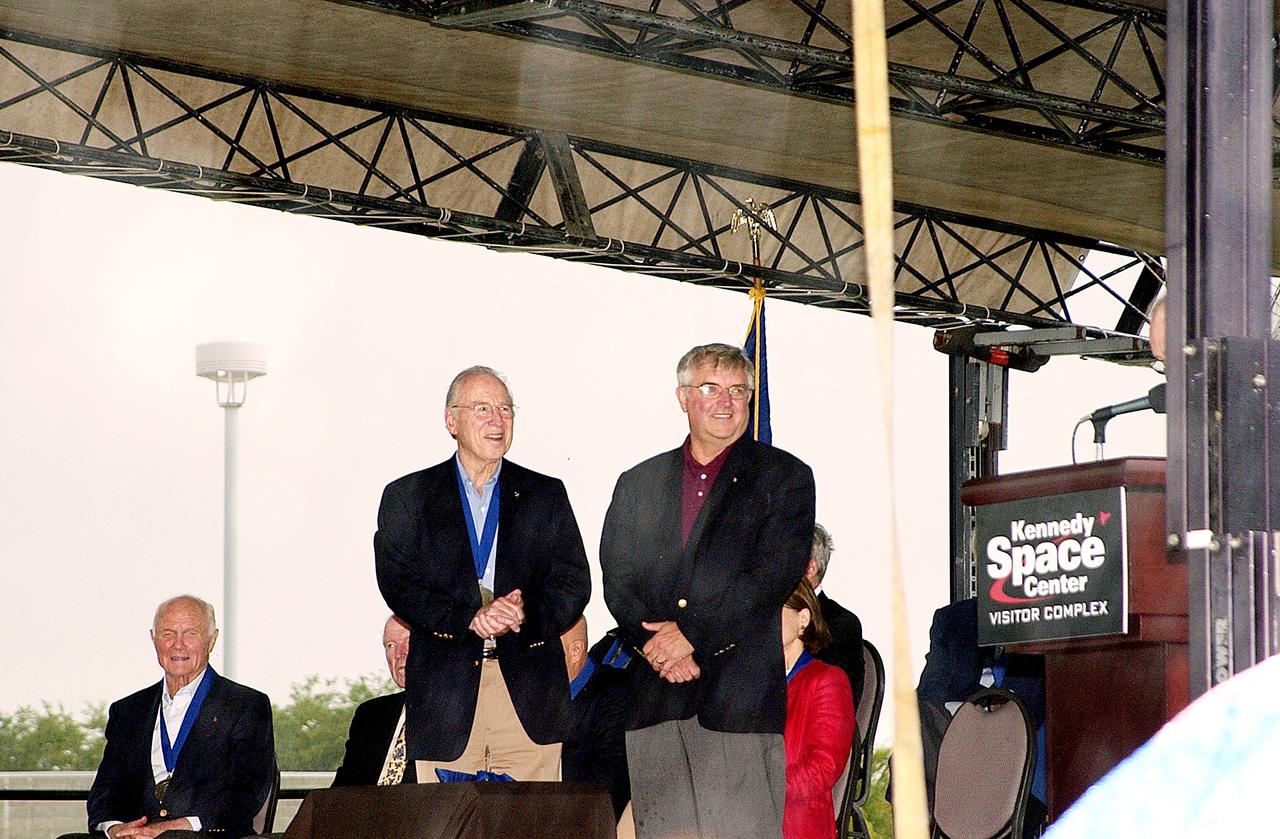
KENNEDY SPACE CENTER, FLA. - At the KSC Visitor Complex, former astronaut Daniel Brandenstein (standing right) is presented to the audience at his induction ceremony into the U.S. Astronaut Hall of Fame. Also standing is former astronaut James A. Lovell. Seated on the dais, from left, are former astronauts John H. Glenn and Gordon Cooper, both previously inducted into the Hall of Fame. Being inducted with Brandenstein are Space Shuttle astronauts Robert "Hoot" Gibson, Story Musgrave, and Sally K. Ride. Conceived by six of the Mercury Program astronauts, the U.S. Astronaut Hall of Fame opened in 1990 to provide a place where space travelers could be remembered for their participation and accomplishments in the U.S. space program. The four new inductees join 48 previously honored astronauts from the ranks of the Gemini, Apollo, Skylab, Apollo-Soyuz, and Space Shuttle programs.

KENNEDY SPACE CENTER, FLA. - At the KSC Visitor Complex, former astronaut Robert L. Crippen (right) presents former astronaut Sally K. Ride (standing center) at her induction ceremony into the U.S. Astronaut Hall of Fame. Also standing is former astronaut James A. Lovell. Seated on the dais are, from left, former astronauts John H. Glenn, Gordon Cooper, Buzz Aldrin, and Walter Cunningham, all previously inducted into the Hall of Fame. Being inducted with Ride are Space Shuttle astronauts Daniel Brandenstein, Robert "Hoot" Gibson, and Story Musgrave. Conceived by six of the Mercury Program astronauts, the U.S. Astronaut Hall of Fame opened in 1990 to provide a place where space travelers could be remembered for their participation and accomplishments in the U.S. space program. The four new inductees join 48 previously honored astronauts from the ranks of the Gemini, Apollo, Skylab, Apollo-Soyuz, and Space Shuttle programs.

S63-00562 (February 1963) --- Portrait of astronaut groups 1 and 2. The original seven Mercury astronauts selected by NASA in April 1959, are seated (left to right): L. Gordon Cooper Jr., Virgil I. Grissom, M. Scott Carpenter, Water M. Schirra Jr., John H. Glenn Jr., Alan B. Shepard Jr., and Donald K. Slayton. The second group of NASA astronauts, which were named in September 1962, are standing (left to right): Edward H. White II, James A. McDivitt, John W. Young, Elliot M. See Jr., Charles Conrad Jr., Frank Borman, Neil A. Armstrong, Thomas P. Stafford, and James A. Lovell Jr. Photo credit: NASA or National Aeronautics and Space Administration
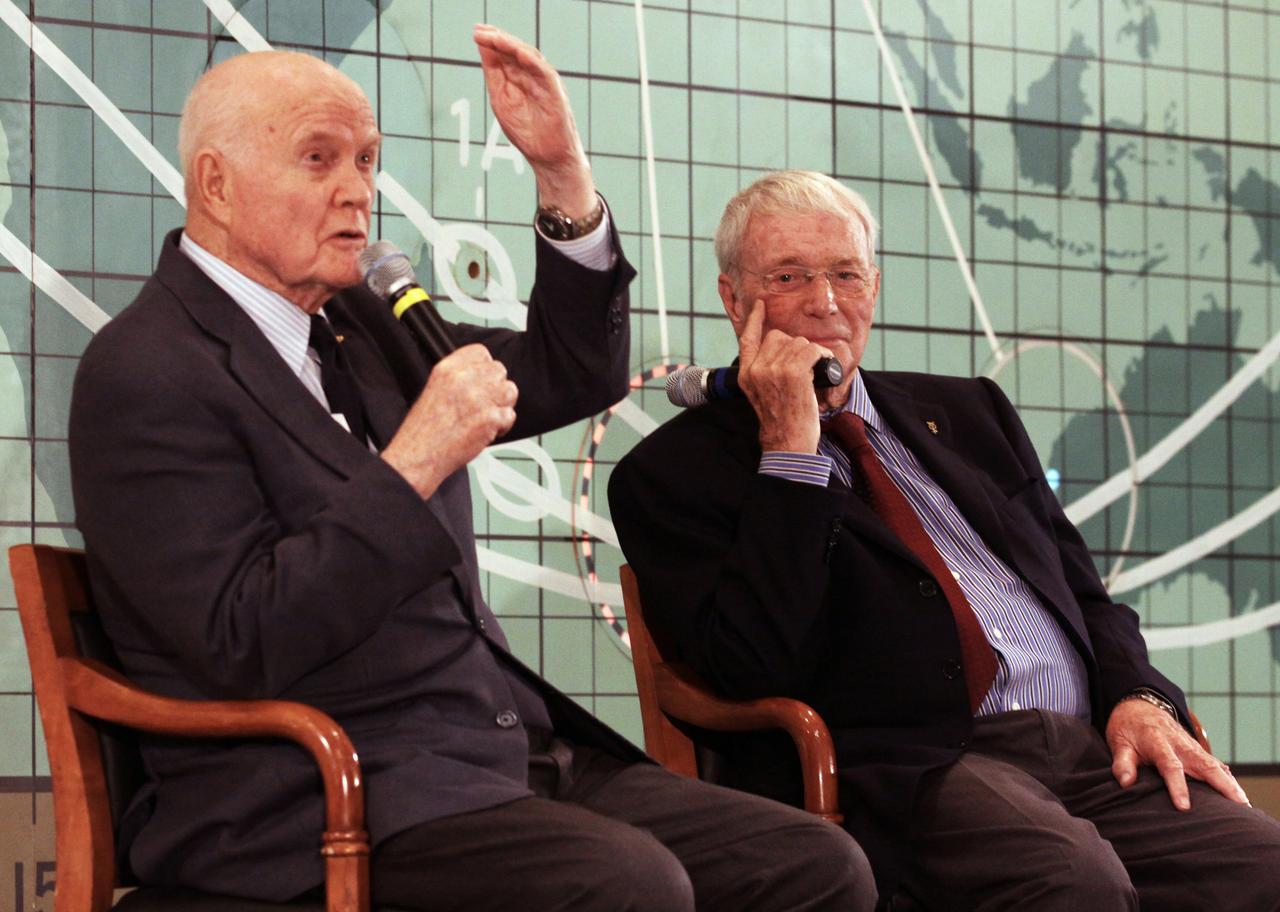
Mercury astronauts John Glenn, left, and Scott Carpenter sit in front of the plot board from the Mercury control center on display at the Kennedy Space Center Visitor Complex. The astronauts, part of the original class of seven astronauts chosen by NASA, were taking part in a question-and-answer session with the media as part of events celebrating 50 years of Americans in orbit, an era which began with John Glenn's Mercury mission MA-6, on Feb. 20, 1962. Glenn's launch aboard an Atlas rocket took with it the hopes of an entire nation and ushered in a new era of space travel that eventually led to Americans walking on the moon by the end of the 1960s. Glenn soon was followed into orbit by Carpenter, Walter Schirra and Gordon Cooper. Their fellow Mercury astronauts Alan Shepard and Virgil "Gus" Grissom flew earlier suborbital flights. Deke Slayton was grounded by a medical condition until the Apollo-Soyuz Test Project in 1975.
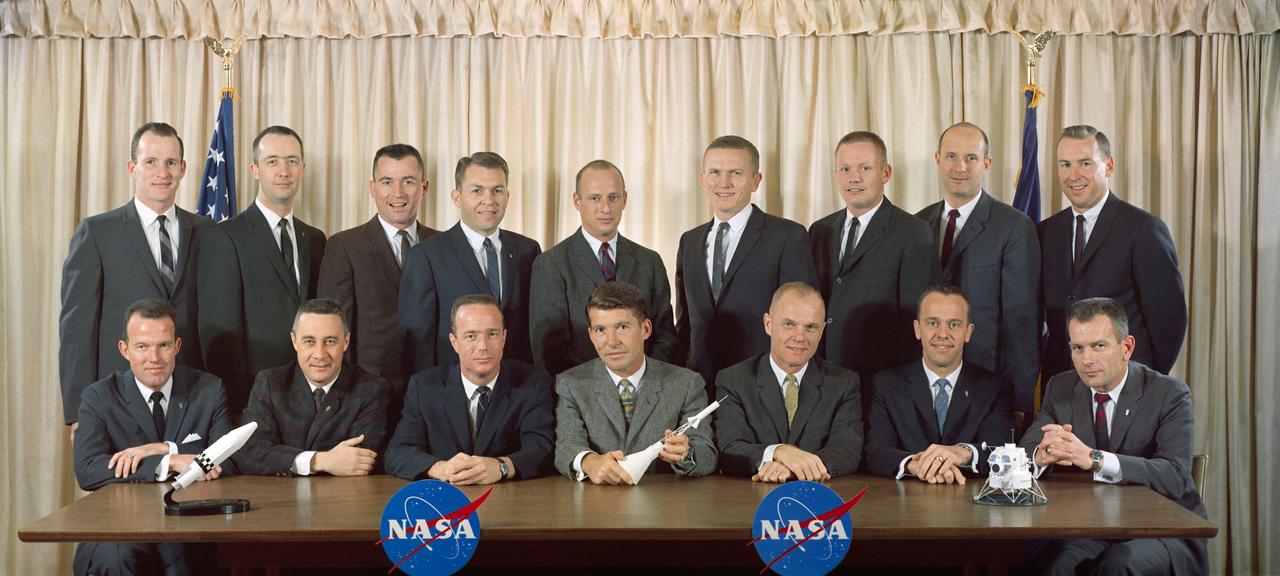
S63-01419 (1963) --- The first two groups of astronauts selected by the National Aeronautics and Space Administration (NASA). The original seven Mercury astronauts, selected in April 1959, are seated left to right, L. Gordon Cooper Jr., Virgil I. Grissom, M. Scott Carpenter, Walter M. Schirra Jr., John H. Glenn Jr., Alan B. Shepard Jr. and Donald K. Slayton. The second group of NASA astronauts, named in September 1962 are, standing left to right, Edward H. White II, James A. McDivitt, John W. Young, Elliot M. See Jr., Charles Conrad Jr., Frank Borman, Neil A. Armstrong, Thomas P. Stafford and James A. Lovell Jr. Photo credit: NASA
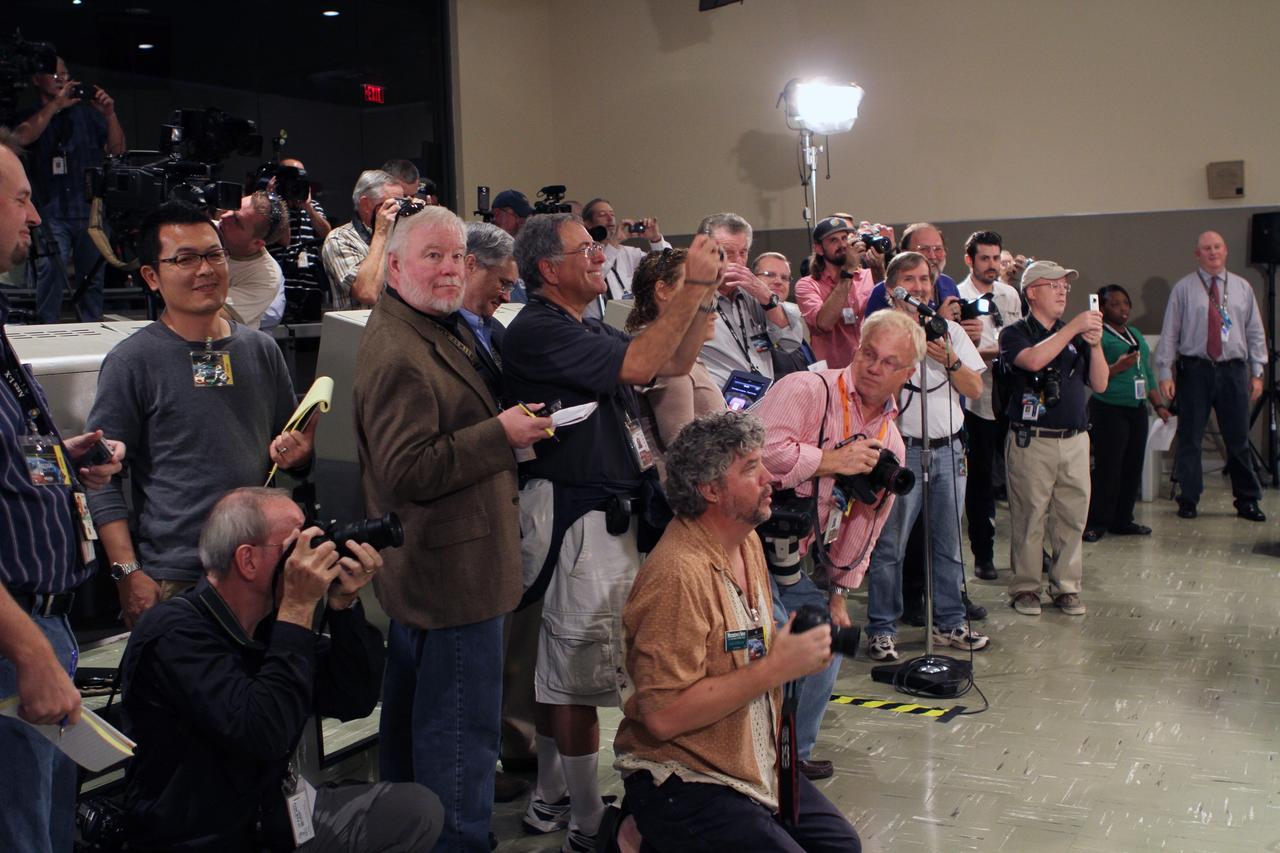
CAPE CANAVERAL, Fla. -- The international news media takes part in a question-and-answer session with Mercury astronauts John Glenn and Scott Carpenter at the Kennedy Space Center Visitor Complex in Florida. The astronauts, part of the original class of seven astronauts chosen by NASA, were taking part in events celebrating 50 years of Americans in orbit, an era which began with John Glenn's Mercury mission MA-6, on Feb. 20, 1962. Glenn's launch aboard an Atlas rocket took with it the hopes of an entire nation and ushered in a new era of space travel that eventually led to Americans walking on the moon by the end of the 1960s. Glenn soon was followed into orbit by Carpenter, Walter Schirra and Gordon Cooper. Their fellow Mercury astronauts Alan Shepard and Virgil "Gus" Grissom flew earlier suborbital flights. Deke Slayton was grounded by a medical condition until the Apollo-Soyuz Test Project in 1975. Photo credit: NASA/Kim Shiflett
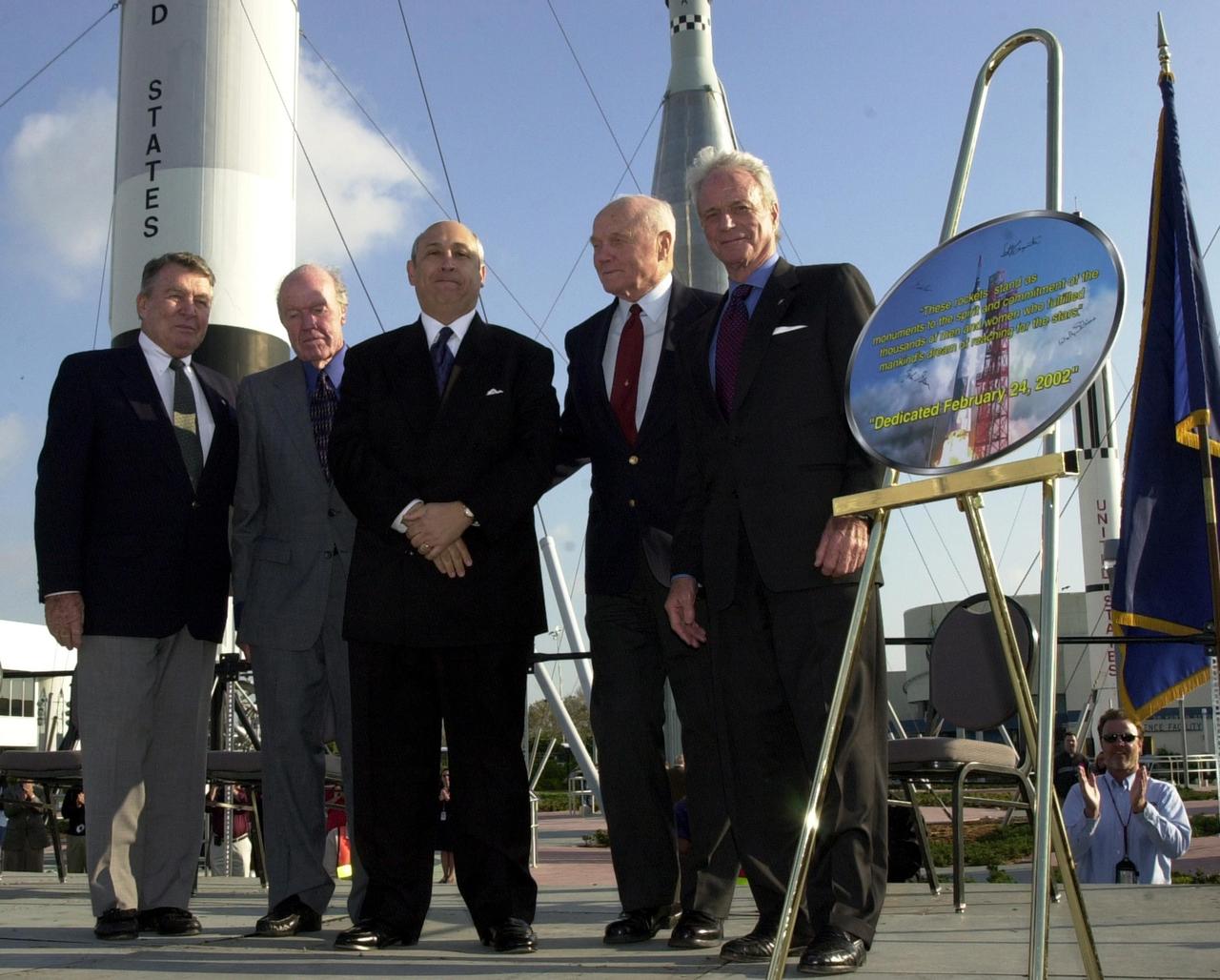
KENNEDY SPACE CENTER, FLA. -- Four space pioneers gather on stage with Rick Abramson, president of Delaware North Parks Services of Spaceport, Inc., during opening ceremonies for the 40th anniversary celebration of American spaceflight. The former astronauts had just signed a commemorative painting of the first Mercury rocket launch to send John Glenn Jr. orbiting the Earth. From left are Wally Schirra, Gordon Cooper, Abramson, Glenn and Scott Carpenter. The site is the Rocket Garden in the KSC Visitor Complex. The event was capped with a dinner held at the KSC Apollo/Saturn V Center
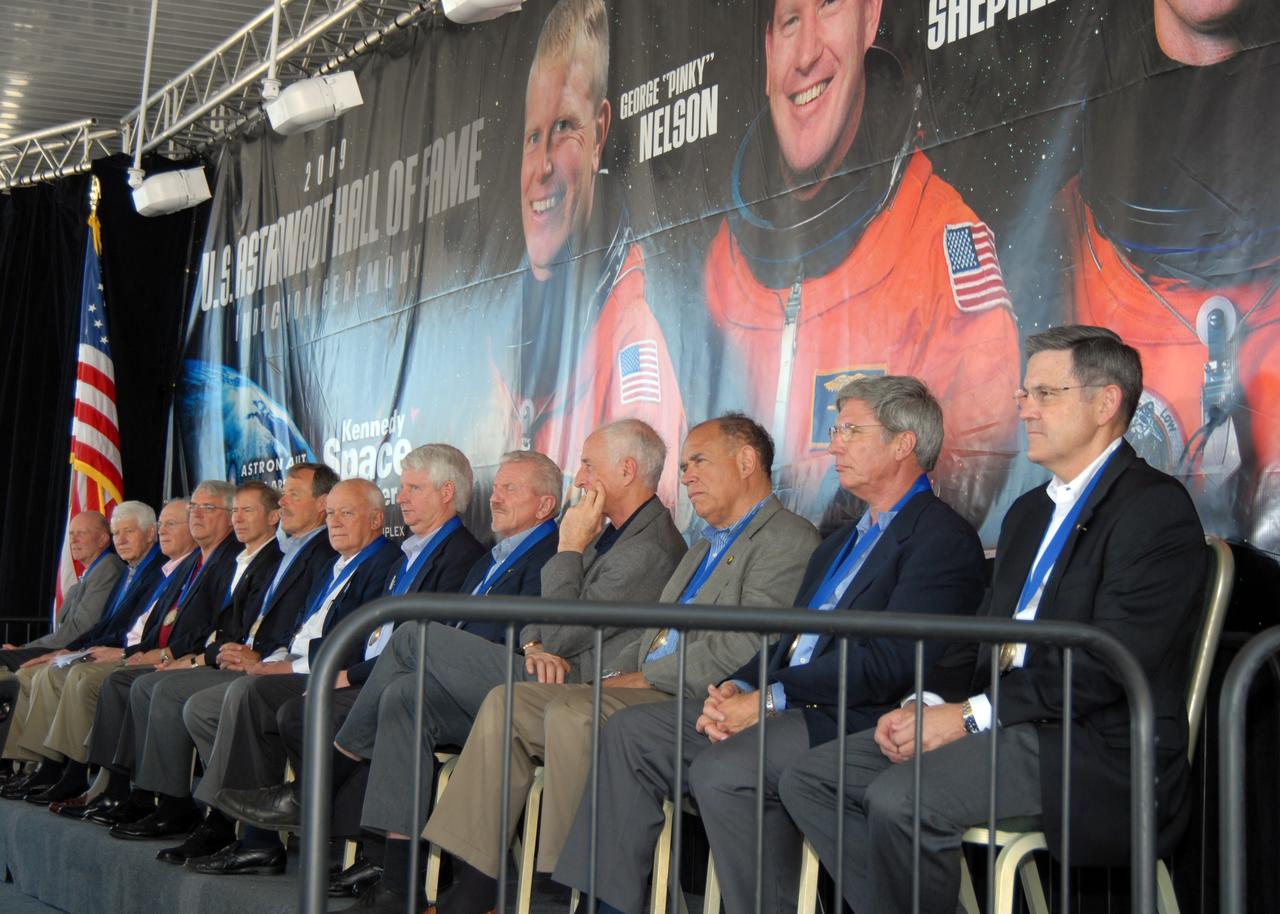
CAPE CANAVERAL, Fla. –– Hall of Fame astronauts (from left) Gordon Fullerton, Henry W. "Hank" Hartsfield Jr., Rick Hauk, Dan Brandenstein, Brewster Shaw, Robert "Hoot" Gibson, Bruce McCandless, Steven Hawley, Loren Shriver, Jeff Hoffman, Fred Gregory, John Blaha and Bob Cabana watch the U.S. Astronaut Hall of Fame induction ceremony at NASA's Kennedy Space Center Visitor Complex in Florida. Cabana is the Kennedy Space Center director. The ceremony took place May 2. More than 20 hall of fame astronauts attended, including Scott Carpenter, Walt Cunningham, Jim Lovell and Bob Crippen. Photo credit: NASA/Jim Grossmann
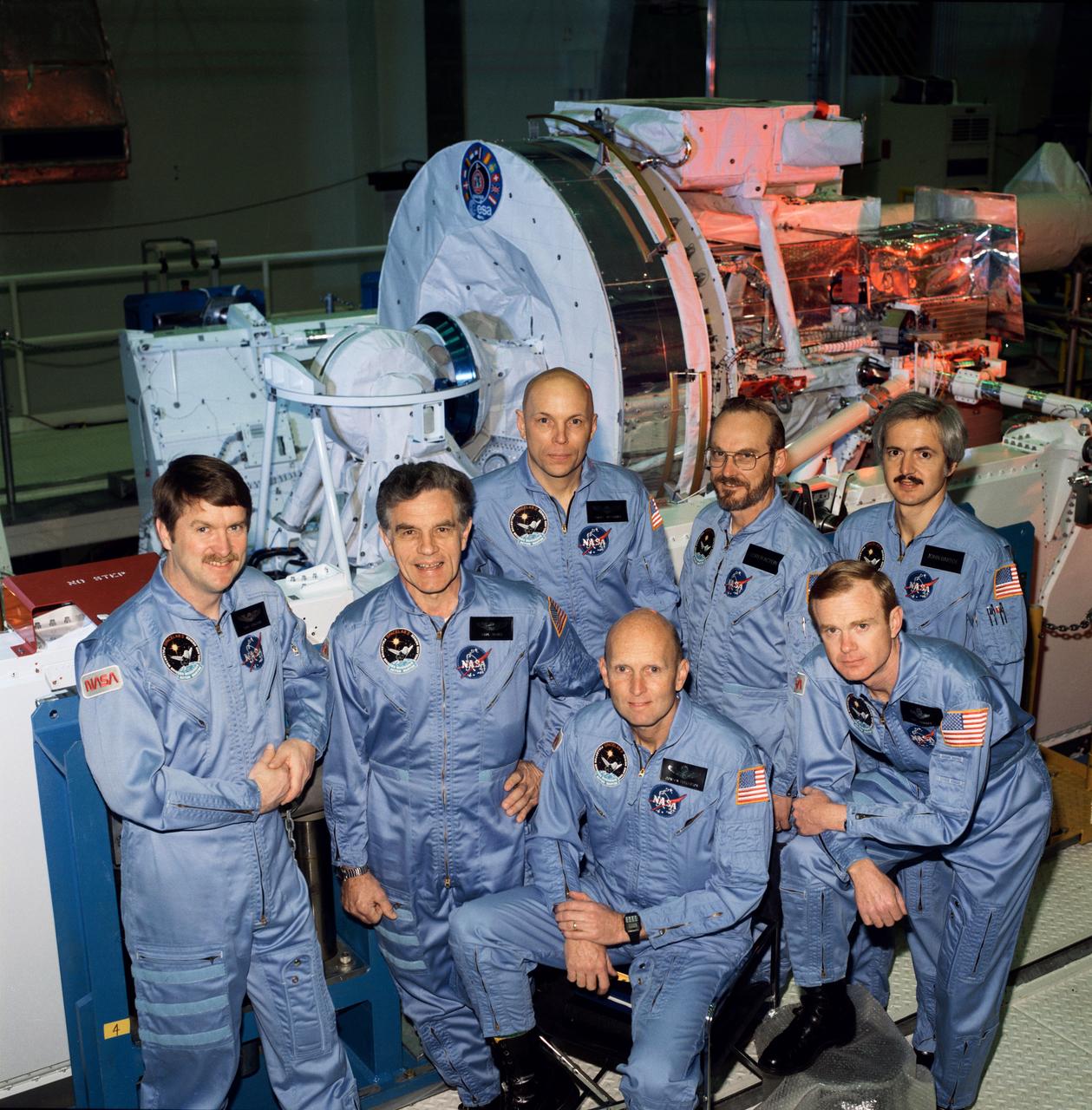
S85-29307 (May 1985) --- The seven crew members for the Space Shuttle STS-51F/Spacelab 2 mission take a pause from a KSC training session to pose for a pre-flight crew portrait. Astronauts C. Gordon Fullerton (kneeling center), mission commander; and Roy D. Bridges (kneeling right), pilot; are flanked by the payload specialists and mission specialists for the mission. Standing (left to right) are astronauts Anthony W. England, Karl J. Henize and Story Musgrave - all mission specialists; and payload specialist Loren Acton and John-David Bartoe.
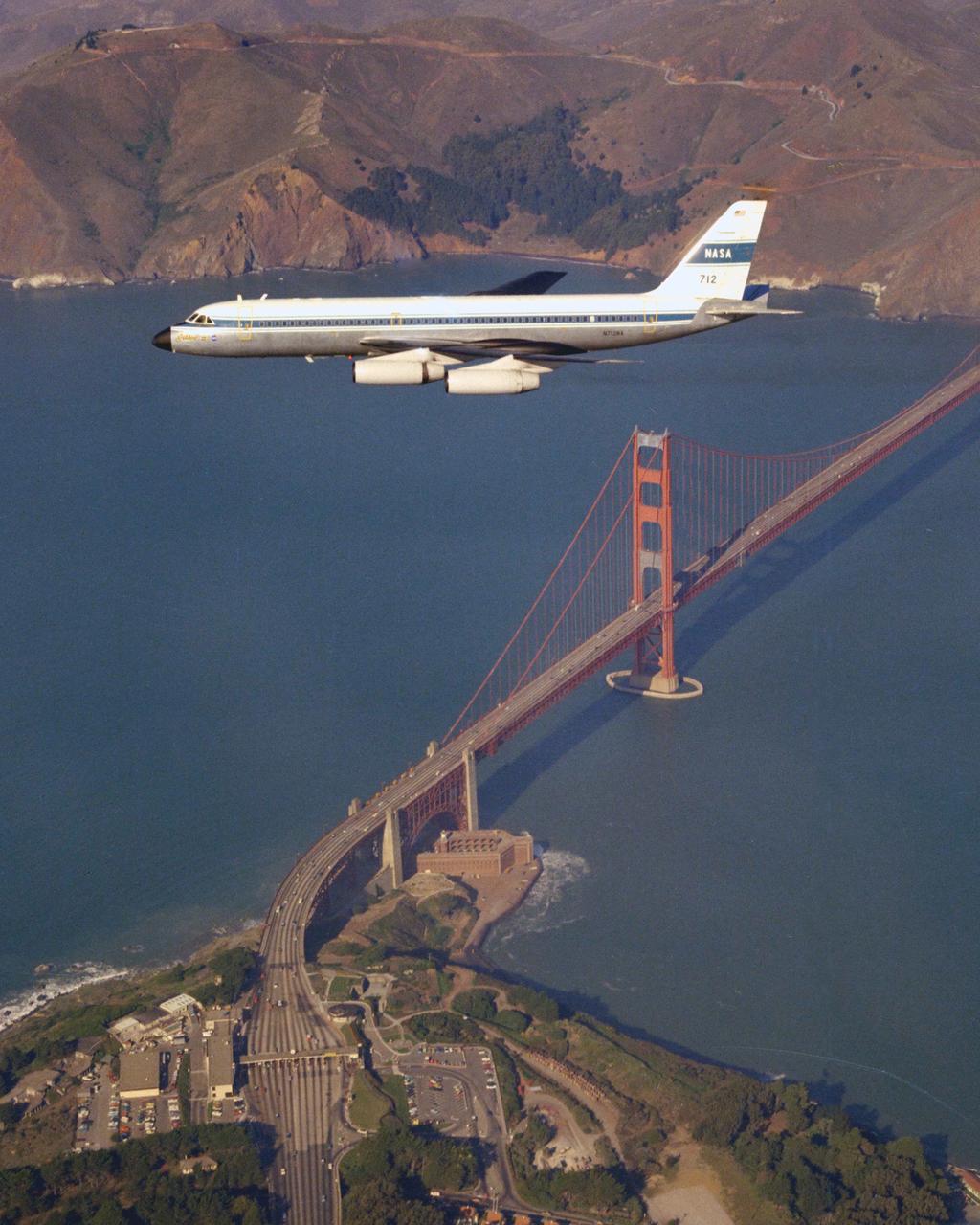
CV-990 (NASA-712) Galileo II aircraft in flight over the San Francisco's Golden Gate Bridge. A digital navigation, guidance and autopilot system tested on Galileo 1 and Galileo II in 1975 looked at the feasibility of energy-management approach concepts for an unpowered vehicle. Flight tests carried out by pilot Fred Drinkwater with technical direction by Fred Edwards and John D Foster along with significant input from Gordon Hardy on the pilot's system interface. Note: Used in publication in Flight Research at Ames; 57 Years of Development and Validation of Aeronautical Technology NASA SP-1998-3300 fig 95 ref 99
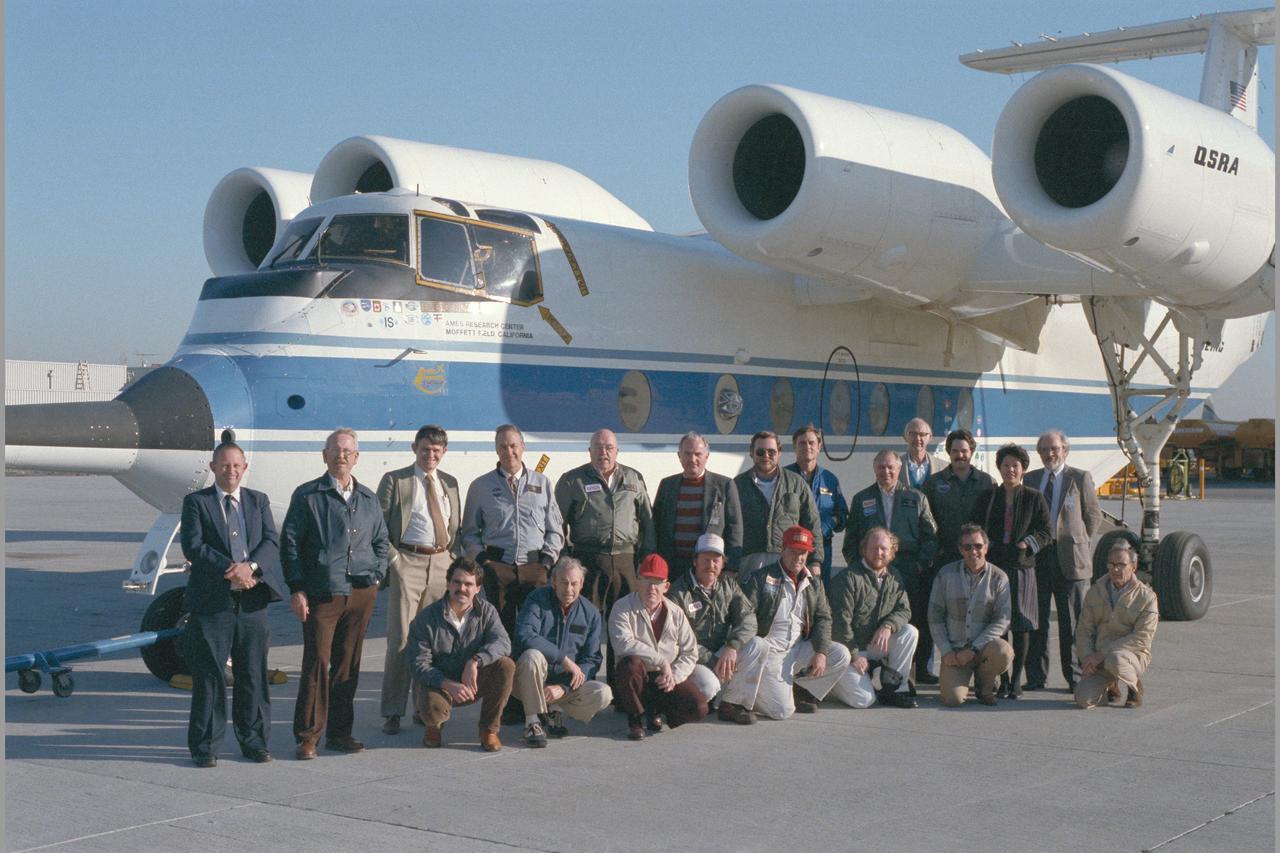
QSRA (NASA 715) 400TH FLIGHT PARTICIPANTS. L-R: front row: Jim Ahlman, Bob Innis, Del Watson, Jim Lesko, Lee Mountz, Mike Herschel, Tom Kaisersatt, Jack Stephenson, Back row: Dennis Riddle, Neis Watz, Jack Franklin, Gordon Hardy, Bob Hinds, Charlie Hynes, Richard Young, Jim Martin, Joe Eppel, John White, Bob America, Hien Tran, Bill Bjorkman. Note: Used in publication in Flight Research at Ames; 57 Years of Development and Validation of Aeronautical Technology NASA SP-1998-3300 fig. 112

The Ohio State University President E. Gordon Gee, left, Apollo 11 Astronaut Neil Armstrong, 2nd from left, Former space shuttle astronaut and former Under Secretary of the Air Force Dr. Ron Sega, and Captain Mark Kelly, commander of the space shuttle Endeavour’s final mission and husband of retired U.S. Representative Gabrielle Giffords, right, talk prior to a reception at Ohio State University honoring the 50th anniversary of John Glenn's historic flight aboard Friendship 7 Monday, Feb. 20, 2012, in Columbus, Ohio. Glenn was the first American to orbit Earth. Photo Credit: (NASA/Bill Ingalls)
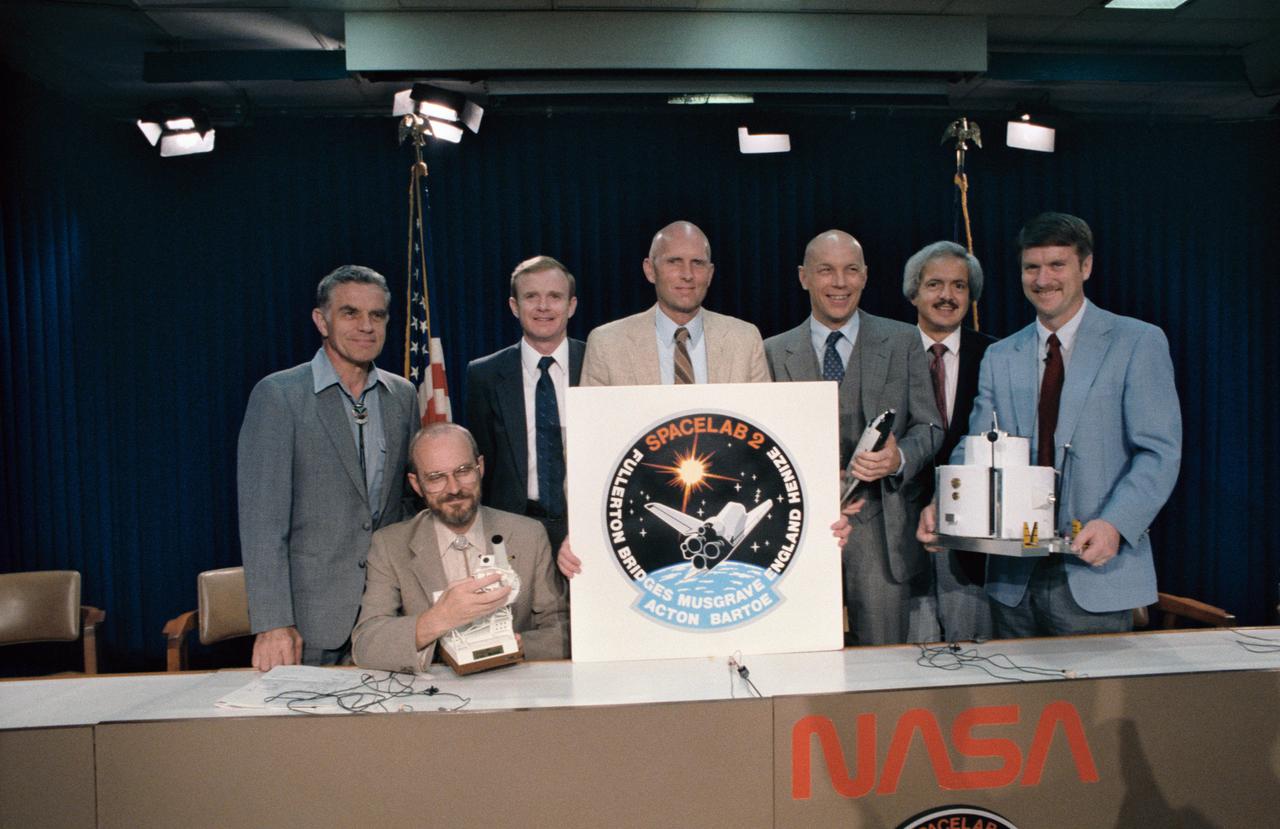
S85-36655 (24 June 1985) --- The seven crewmembers for STS 51-F/Spacelab 2 pose for photographers following their pre-flight press conference in the Johnson Space Center's public affairs facility. Standing, l.-r., are Karl J. Henize, mission specialist; Roy D. Bridges, pilot; C. Gordon Fullerton, mission commander; F. Story Musgrave, mission specialist; John-David Bartoe, payload specialist; and Anthony W. England, mission specialist. Loren W. Acton, payload specialist, is seated. Launch is scheduled for July of this year.
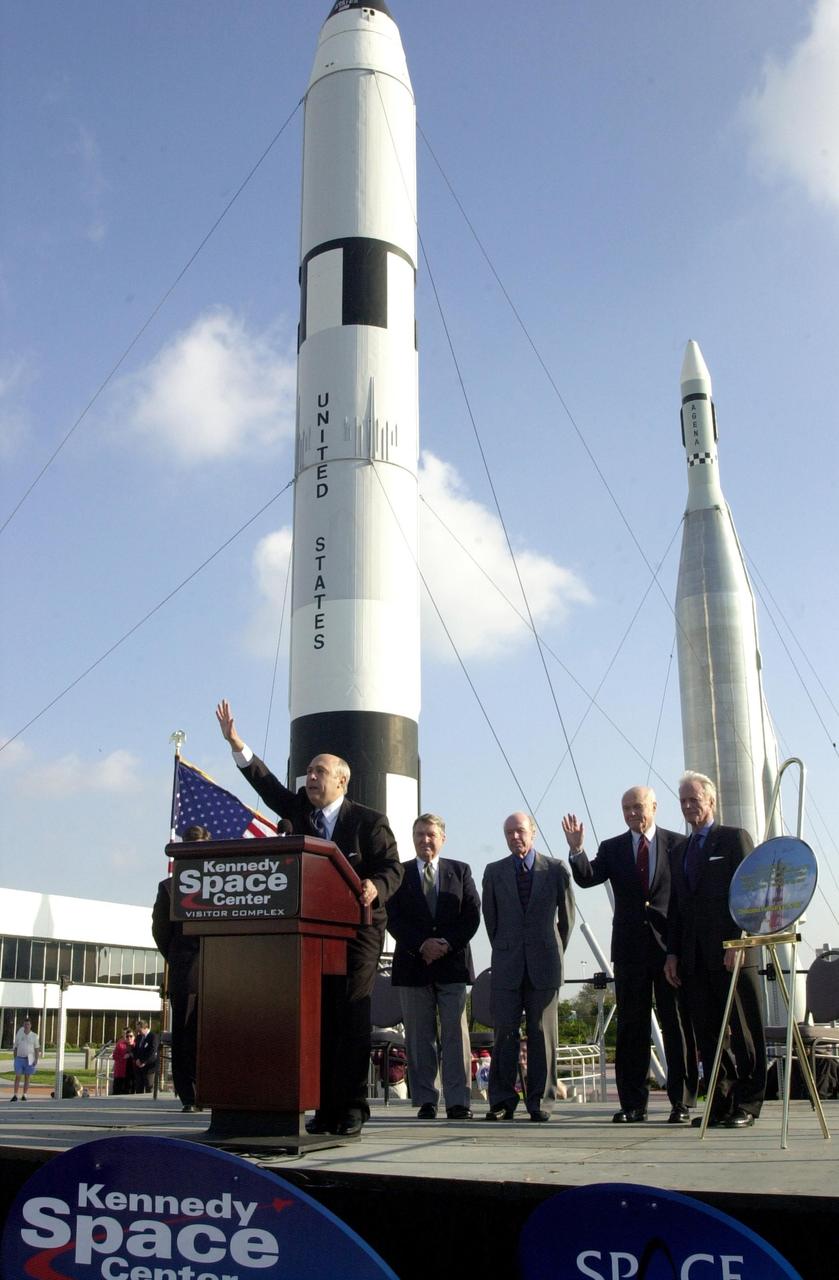
KENNEDY SPACE CENTER, FLA. -- During opening ceremonies for the 40th anniversary celebration of American spaceflight, Rick Abramson, president of Delaware North Parks Services of Spaceport, Inc., waves to the spectators. Behind him are four of the space pioneers being honored: (from left) Wally Schirra, Gordon Cooper, John Glenn Jr. and Scott Carpenter. Next to Carpenter stands a commemorative painting of a Mercury rocket launch that the four signed. The ceremonies were held in the KSC Visitor Complex Rocket Garden. The event was capped with a dinner held at the KSC Apollo/Saturn V Center
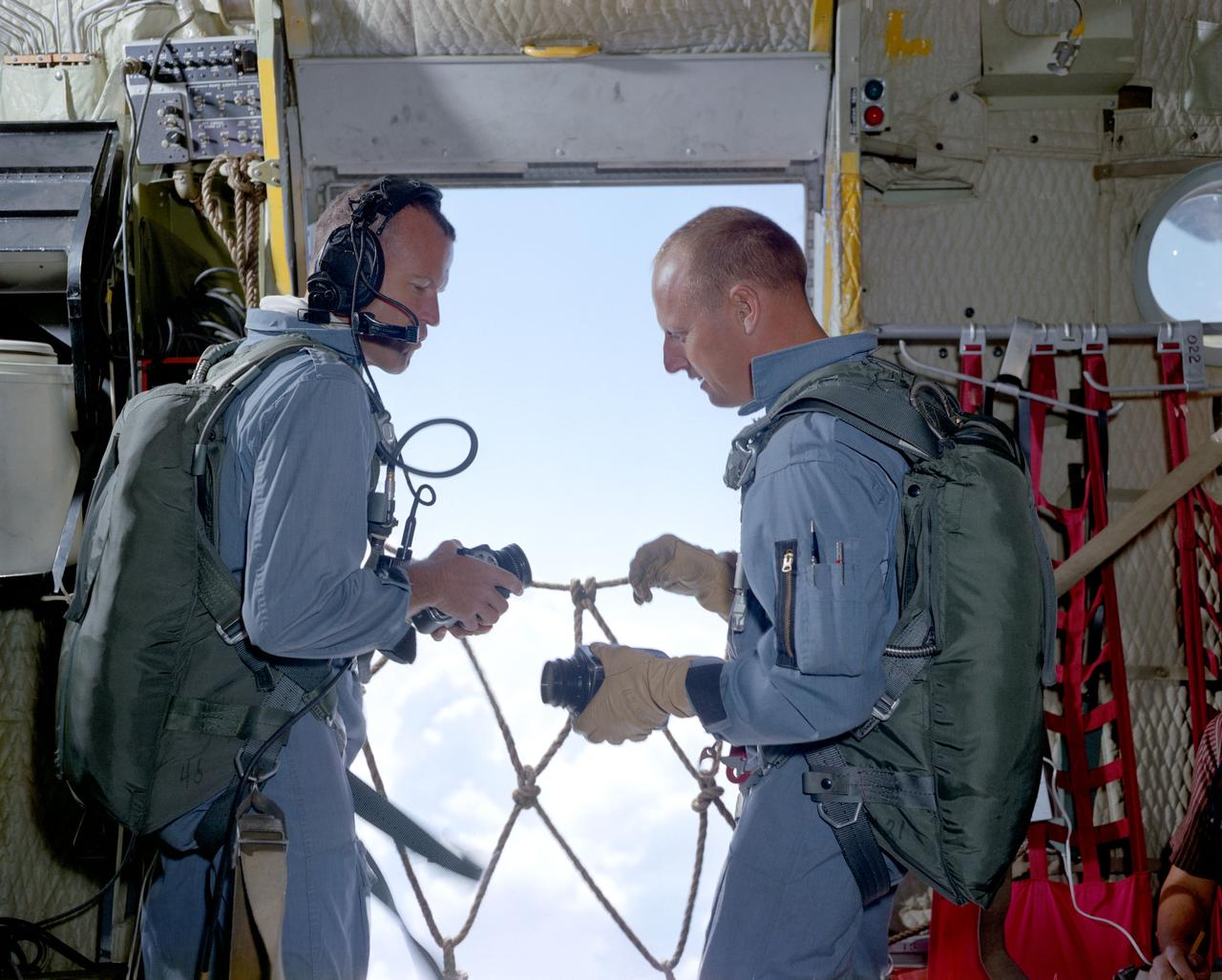
S65-35563 (18 June 1965) --- Astronauts L. Gordon Cooper Jr. (left), command pilot; and Charles Conrad Jr., pilot, the prime crew of the Gemini-5 spaceflight, prepare their cameras while aboard a C-130 aircraft flying near Laredo, Texas. The two astronauts are taking part in a series of visual acuity experiments to aid them in learning to identify known terrestrial features under controlled conditions. Knowledge gained from these experiments will have later application for space pilots identifying terrestrial features from space. Dr. John Billingham, chief, Environmental Physiology Branch, Crew Systems Division, is in charge of the Visual Acuity Experiments.
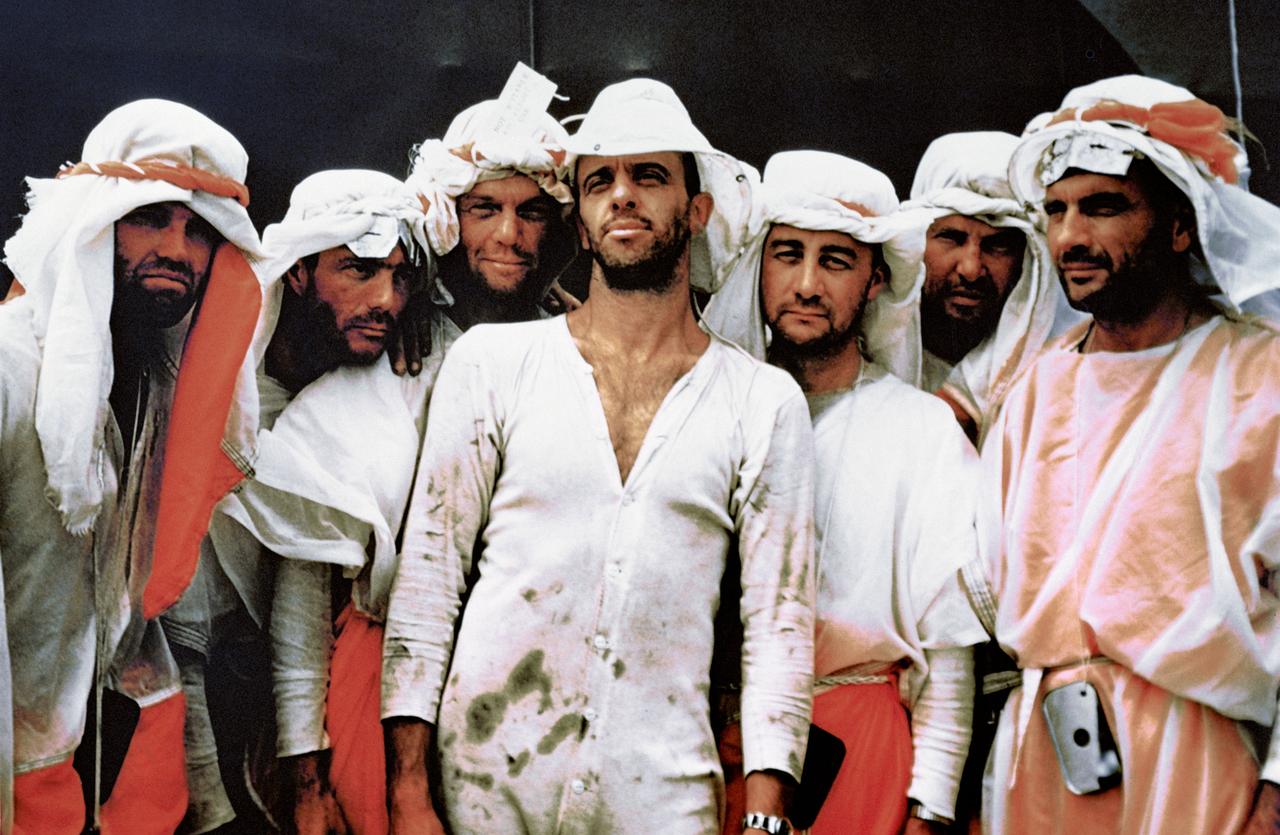
S88-31375 (1960) --- Although more easily recognized in their spacesuits, these seven men are actually NASA astronauts participating in a U.S. Air Force survival school at Stead Air Force Base in Nevada. The original seven Mercury astronauts are, left to right, L. Gordon Cooper Jr.; M. Scott Carpenter; John H. Glenn Jr.; Alan B. Shepard Jr.; Virgil I. Grissom; Walter M. Schirra Jr. and Donald K. Slayton. Portions of their clothing have been fashioned from parachute material. Photo credit: NASA

KENNEDY SPACE CENTER, FLA. - Owen Garriott, chairman of the Astronaut Hall of Fame, speaks to guests at the Induction Ceremony of three new additions to the Hall of Fame: Gordon Fullerton, Bruce McCandless and Joe Allen. Seated on stage are current Hall of Famers, from left in the back row, Dick Gordon, Walt Cunningham, Bill Anders, Ed Mitchell, Al Worden, Charles Duke, Jack Lousma, Bill Pogue, Robert Crippen, Dan Brandenstein, Robert “Hoot” Gibson and Stephen Covey. In front, from left, are Master of Ceremonies LeVar Burton, who starred in the television series “Star Trek: The Next Generation,” and Hall of Famers Scott Carpenter and John Young, and at right, Jim Lovell and Fred Haise. The ceremony is being held in the Kennedy Space Center Visitor Complex’s Apollo_Saturn V Center. Recognized for their individual flight accomplishments and contributions to the success and future success of the U.S. space program, this elite group of inductees is among only 60 astronauts to be honored in the Hall of Fame and the fourth group of Space Shuttle astronauts named.
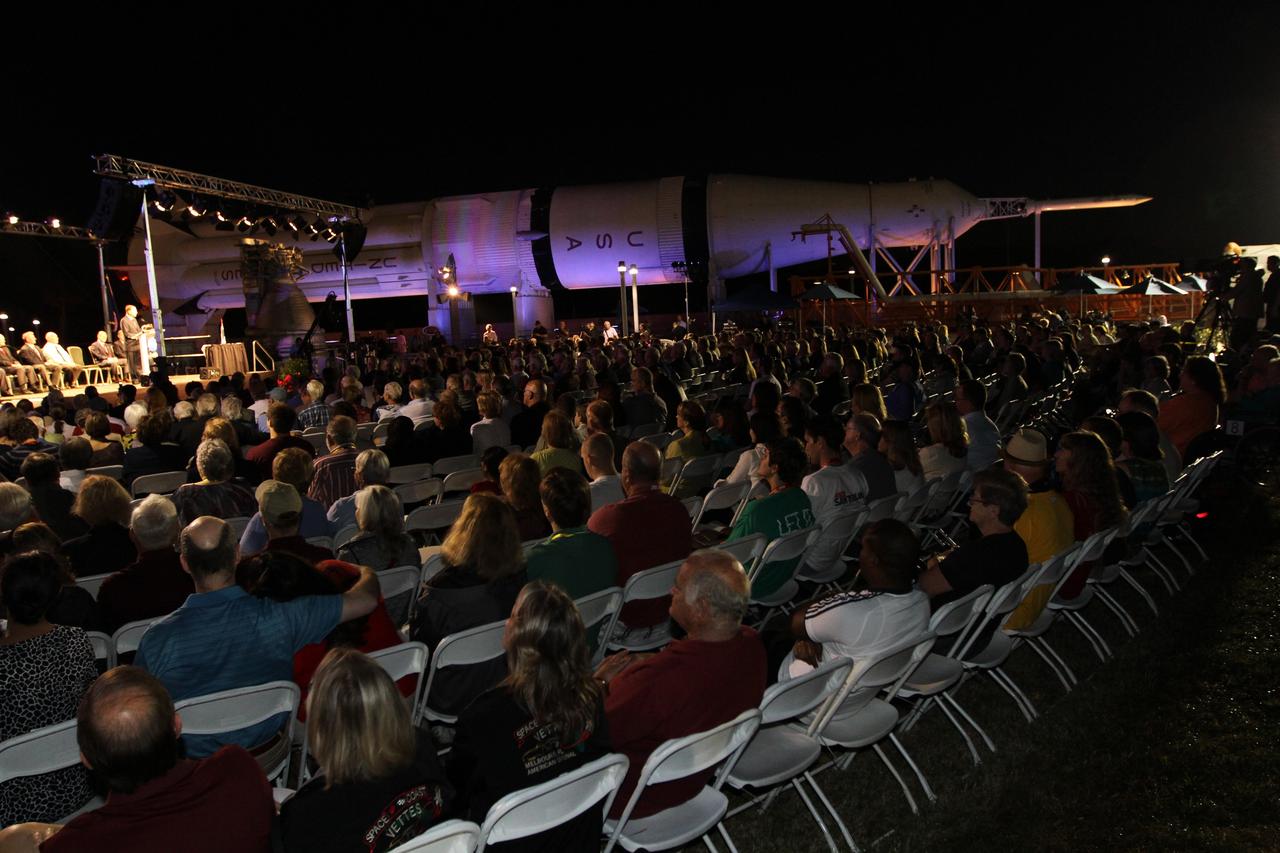
CAPE CANAVERAL, Fla. -- A crowd looks on during the "On Shoulders of Giants" program celebrating 50 years of Americans in orbit, an era which began with John Glenn's MA-6 mission on Feb. 20, 1962. The event was conducted in the Rocket Garden at the Kennedy Space Center Visitor Complex in Florida a few miles from the launch pad where Glenn and Scott Carpenter took flight in Mercury spacecraft. Glenn's launch aboard an Atlas rocket took with it the hopes of an entire nation and ushered in a new era of space travel that eventually led to Americans walking on the moon by the end of the 1960s. Glenn soon was followed into orbit by Scott Carpenter, Walter Schirra and Gordon Cooper. Their fellow Mercury astronauts Alan Shepard and Virgil "Gus" Grissom flew earlier suborbital flights. Deke Slayton, a member of NASA's original Mercury 7 astronauts, was grounded by a medical condition until the Apollo-Soyuz Test Project in 1975. Photo credit: Kim Shiflett
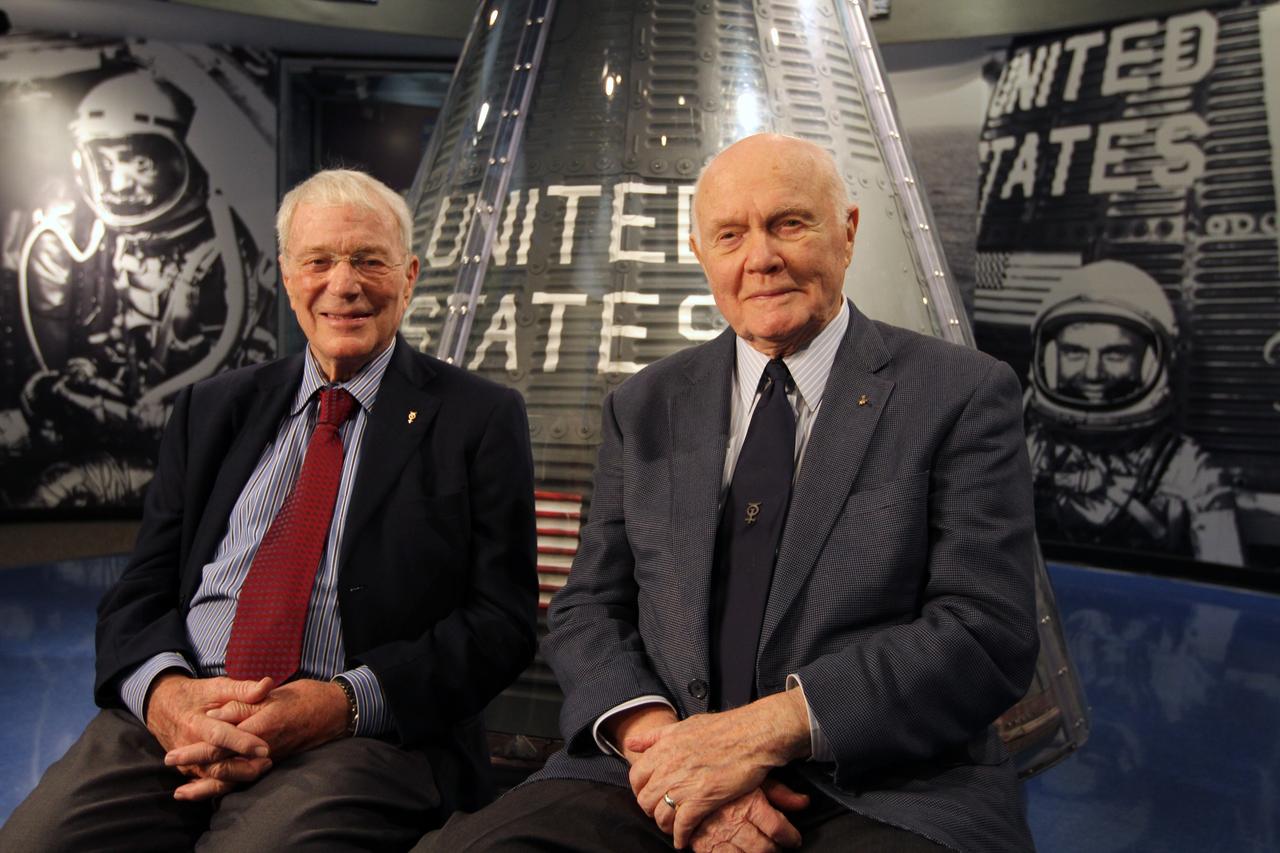
CAPE CANAVERAL, Fla. -- Mercury astronauts Scott Carpenter, left, and John Glenn sit in front of a capsule from the Mercury program on display at the Kennedy Space Center Visitor Complex in Florida. The two astronauts, part of the original class of seven astronauts chosen by NASA, were taking part in events celebrating 50 years of Americans in orbit, an era which began with Glenn's Mercury mission MA-6, on Feb. 20, 1962. Glenn's launch aboard an Atlas rocket took with it the hopes of an entire nation and ushered in a new era of space travel that eventually led to Americans walking on the moon by the end of the 1960s. Glenn soon was followed into orbit by Carpenter, Walter Schirra and Gordon Cooper. Their fellow Mercury astronauts Alan Shepard and Virgil "Gus" Grissom flew earlier suborbital flights. Deke Slayton was grounded by a medical condition until the Apollo-Soyuz Test Project in 1975. Photo credit: NASA/Kim Shiflett
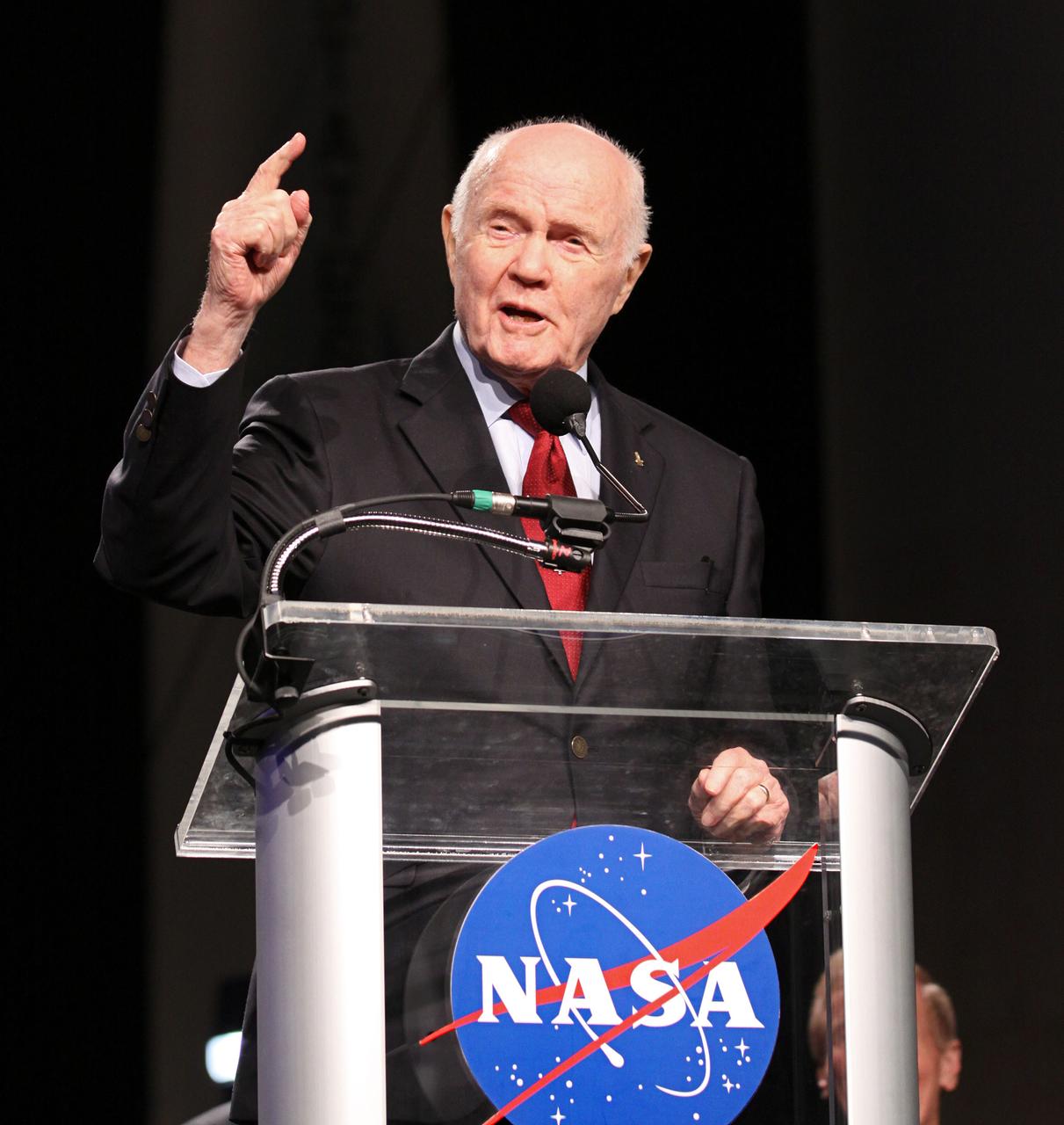
Mercury astronaut John Glenn speaks during the "On Shoulders of Giants" program celebrating 50 years of Americans in orbit, an era which began with Glenn's MA-6 mission on Feb. 20, 1962. The event was conducted in the Rocket Garden at the Kennedy Space Center Visitor Complex in Florida a few miles from the launch pad where Glenn and Scott Carpenter took flight in Mercury spacecraft. Glenn's launch aboard an Atlas rocket took with it the hopes of an entire nation and ushered in a new era of space travel that eventually led to Americans walking on the moon by the end of the 1960s. Glenn soon was followed into orbit by Scott Carpenter, Walter Schirra and Gordon Cooper. Their fellow Mercury astronauts Alan Shepard and Virgil "Gus" Grissom flew earlier suborbital flights. Deke Slayton, a member of NASA's original Mercury 7 astronauts, was grounded by a medical condition until the Apollo-Soyuz Test Project in 1975.
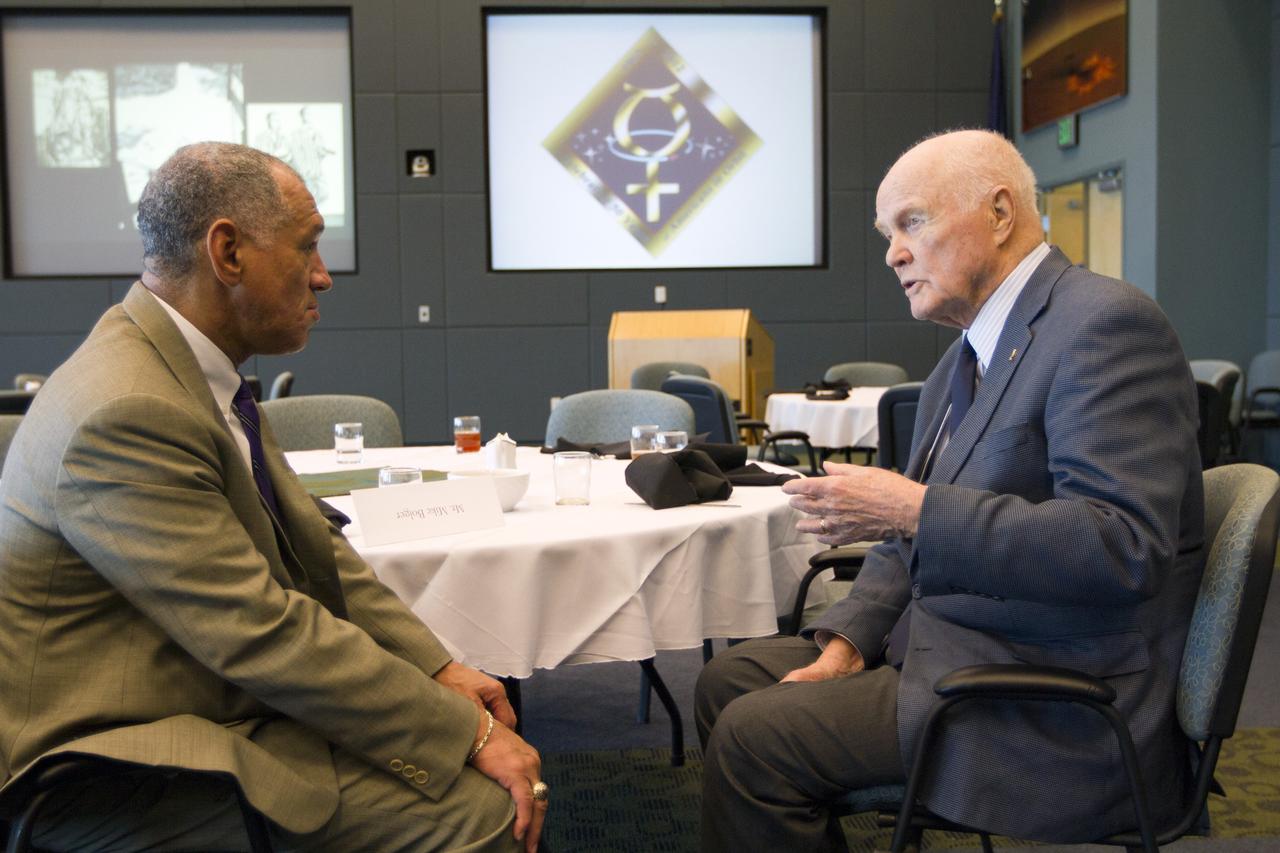
CAPE CANAVERAL, Fla. -NASA Administrator Charles Bolden, left, talks with astronaut John Glenn following a luncheon Feb. 17, 2012, celebrating 50 years of Americans in orbit, an era which began with Glenn's Mercury mission MA-6, on Feb. 20, 1962. Glenn's launch aboard an Atlas rocket took with it the hopes of an entire nation and ushered in a new era of space travel that eventually led to Americans walking on the moon by the end of the 1960s. Glenn soon was followed into orbit by Scott Carpenter, Walter Schirra and Gordon Cooper. Their fellow Mercury astronauts Alan Shepard and Virgil "Gus" Grissom flew earlier suborbital flights. Deke Slayton, a member of NASA's original Mercury 7 astronauts, was grounded by a medical condition until the Apollo-Soyuz Test Project in 1975. Photo credit: NASA/Kim Shiflett
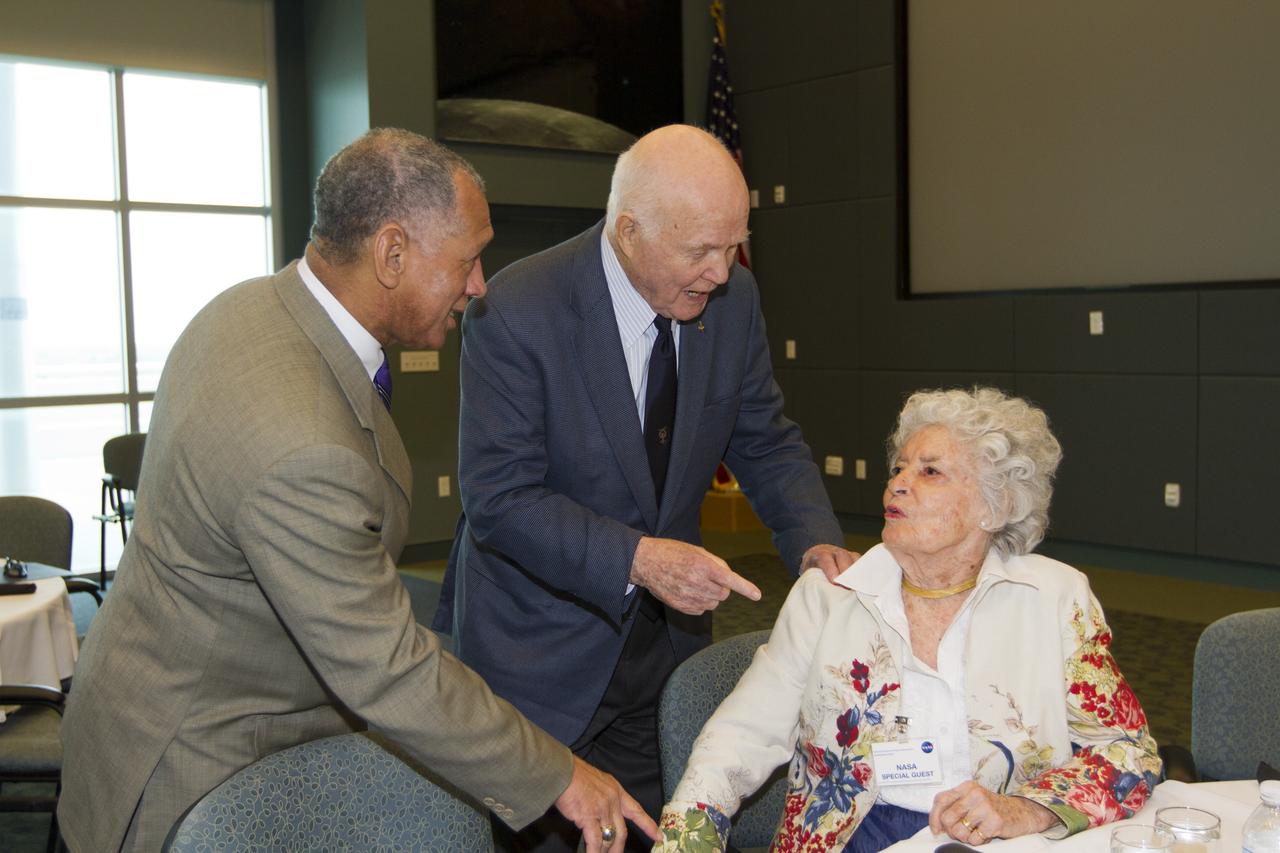
CAPE CANAVERAL, Fla. - NASA Administrator Charles Bolden, left, talks with astronaut John Glenn and his wife, Annie Glenn, before a luncheon Feb. 17, 2012, celebrating 50 years of Americans in orbit, an era which began with Glenn's Mercury mission MA-6, on Feb. 20, 1962. Glenn's launch aboard an Atlas rocket took with it the hopes of an entire nation and ushered in a new era of space travel that eventually led to Americans walking on the moon by the end of the 1960s. Glenn soon was followed into orbit by Scott Carpenter, Walter Schirra and Gordon Cooper. Their fellow Mercury astronauts Alan Shepard and Virgil "Gus" Grissom flew earlier suborbital flights. Deke Slayton, a member of NASA's original Mercury 7 astronauts, was grounded by a medical condition until the Apollo-Soyuz Test Project in 1975. Photo credit: NASA/Kim Shiflett
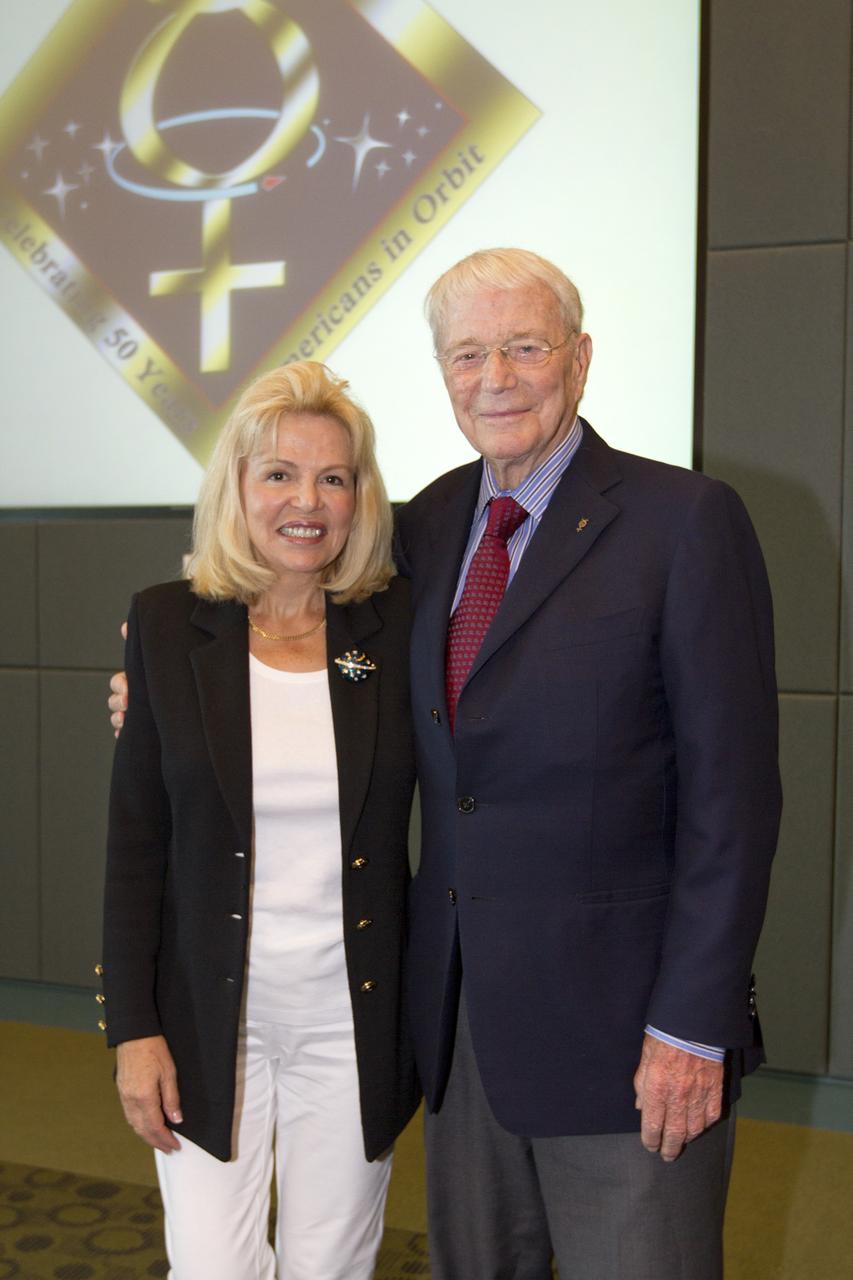
CAPE CANAVERAL, Fla. - Mercury astronaut Scott Carpenter and his wife, Patricia, pose during a luncheon Feb. 17, 2012, celebrating 50 years of Americans in orbit, an era which began with John Glenn's Mercury mission MA-6, on Feb. 20, 1962. Glenn's launch aboard an Atlas rocket took with it the hopes of an entire nation and ushered in a new era of space travel that eventually led to Americans walking on the moon by the end of the 1960s. Glenn soon was followed into orbit by Carpenter, Walter Schirra and Gordon Cooper. Their fellow Mercury astronauts Alan Shepard and Virgil "Gus" Grissom flew earlier suborbital flights. Deke Slayton, a member of NASA's original Mercury 7 astronauts, was grounded by a medical condition until the Apollo-Soyuz Test Project in 1975. Photo credit: NASA/Kim Shiflett
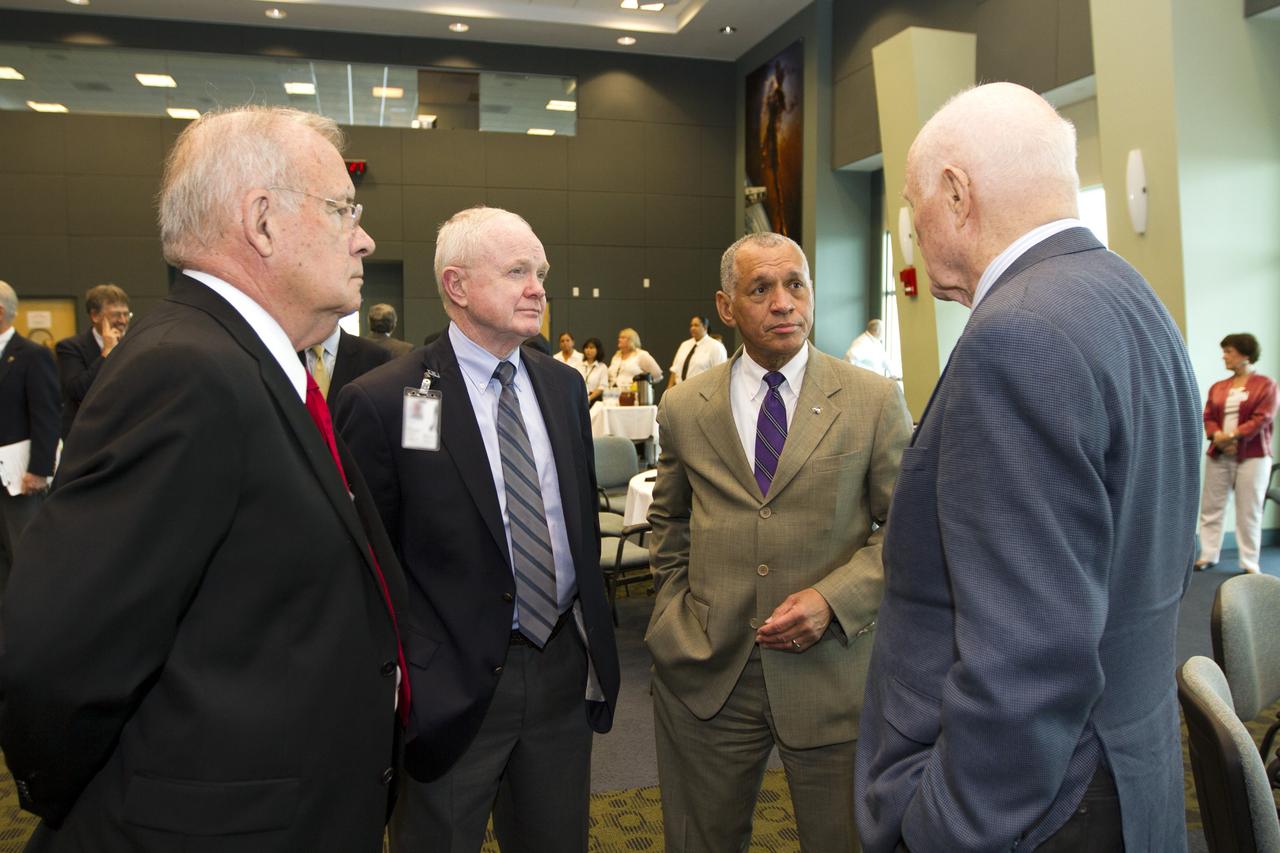
CAPE CANAVERAL, Fla. - Former Kennedy Space Center directors Jay Honeycutt, left, Roy Bridges and NASA Administrator Charles Bolden talk with astronaut John Glenn before a luncheon Feb. 17, 2012 celebrating 50 years of Americans in orbit, an era which began with Glenn's Mercury mission MA-6, on Feb. 20, 1962. Glenn's launch aboard an Atlas rocket took with it the hopes of an entire nation and ushered in a new era of space travel that eventually led to Americans walking on the moon by the end of the 1960s. Glenn soon was followed into orbit by Scott Carpenter, Walter Schirra and Gordon Cooper. Their fellow Mercury astronauts Alan Shepard and Virgil "Gus" Grissom flew earlier suborbital flights. Deke Slayton, a member of NASA's original Mercury 7 astronauts, was grounded by a medical condition until the Apollo-Soyuz Test Project in 1975. Photo credit: NASA/Kim Shiflett
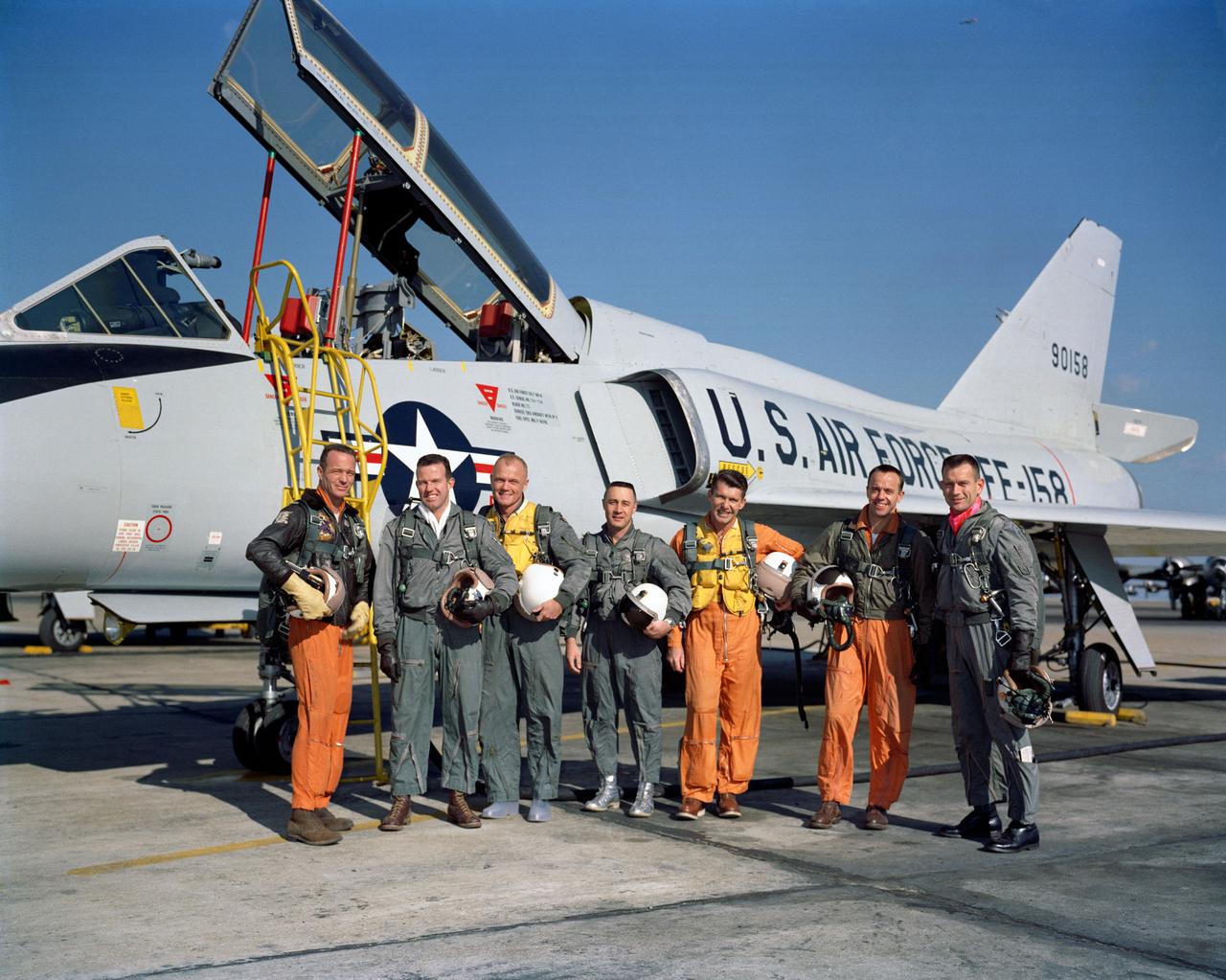
S61-01250 (20 Jan. 1961) --- Photo of the Mercury astronauts standing beside a Convair 106-B aircraft. They are, left to right, M. Scott Carpenter, L. Gordon Cooper Jr., John H. Glenn Jr., Virgil I. Grissom, Walter M. Schirra Jr., Alan B. Shepard Jr. and Donald K. Slayton. EDITOR'S NOTE: Astronaut Gus Grissom died in the Apollo 1 -- Apollo/Saturn (AS-204) -- fire at Cape Kennedy, Florida on Jan. 27, 1967. Astronaut Deke Slayton died from complications of a brain tumor, in League City, Texas on June 13, 1993. Astronaut Shepard died after a lengthy illness in Monterey, California, on July 21, 1998. As of Jan. 1, 1977 none of the seven astronauts remained with the NASA Space Program. However, in October 1998, United States Senator Glenn (Democrat-Ohio) flew as payload specialist on the STS-95 mission. Photo credit: NASA
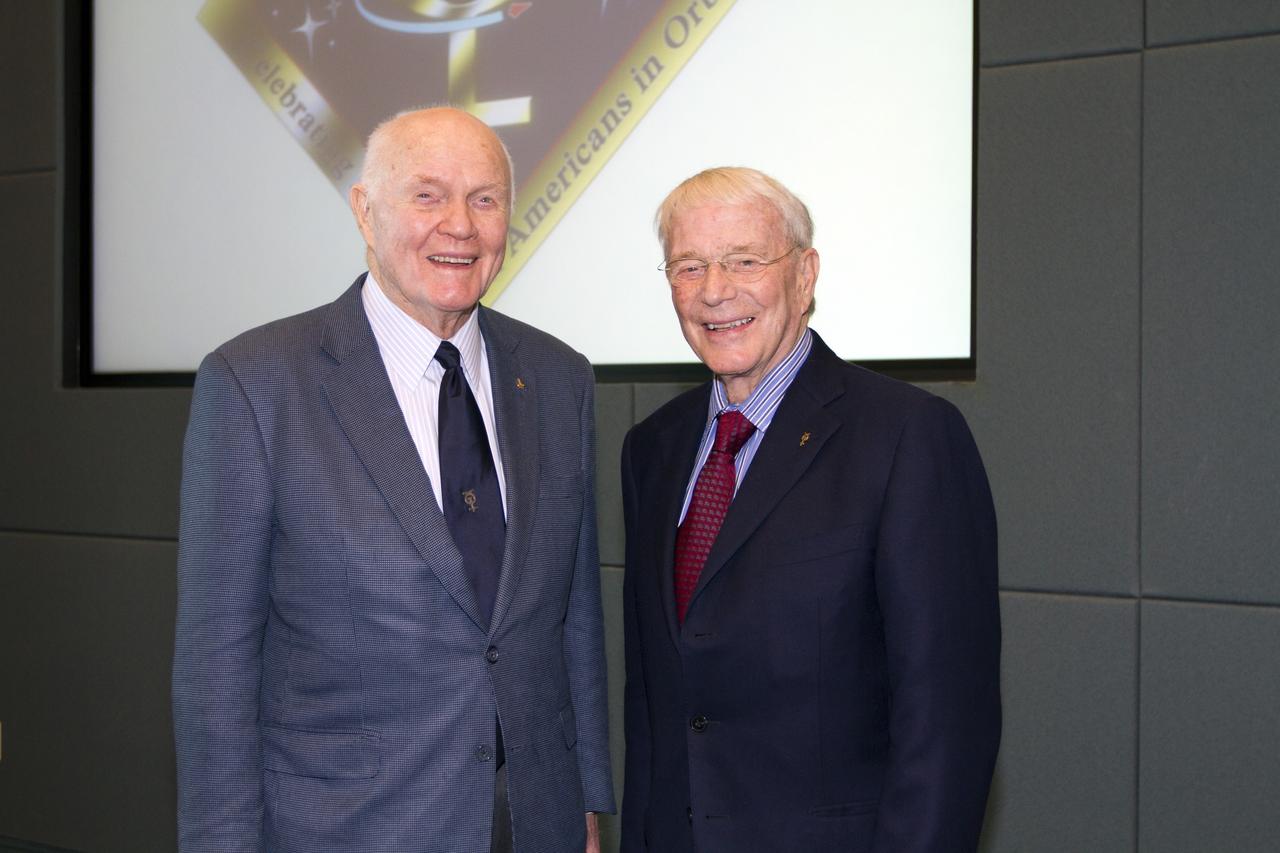
CAPE CANAVERAL, Fla. - Mercury astronauts John Glenn, left, and Scott Carpenter pose during a luncheon Feb. 17, 2012, celebrating 50 years of Americans in orbit, an era which began with Glenn's Mercury mission MA-6, on Feb. 20, 1962. Glenn's launch aboard an Atlas rocket took with it the hopes of an entire nation and ushered in a new era of space travel that eventually led to Americans walking on the moon by the end of the 1960s. Glenn soon was followed into orbit by Scott Carpenter, Walter Schirra and Gordon Cooper. Their fellow Mercury astronauts Alan Shepard and Virgil "Gus" Grissom flew earlier suborbital flights. Deke Slayton, a member of NASA's original Mercury 7 astronauts, was grounded by a medical condition until the Apollo-Soyuz Test Project in 1975. Photo credit: NASA/Kim Shiflett
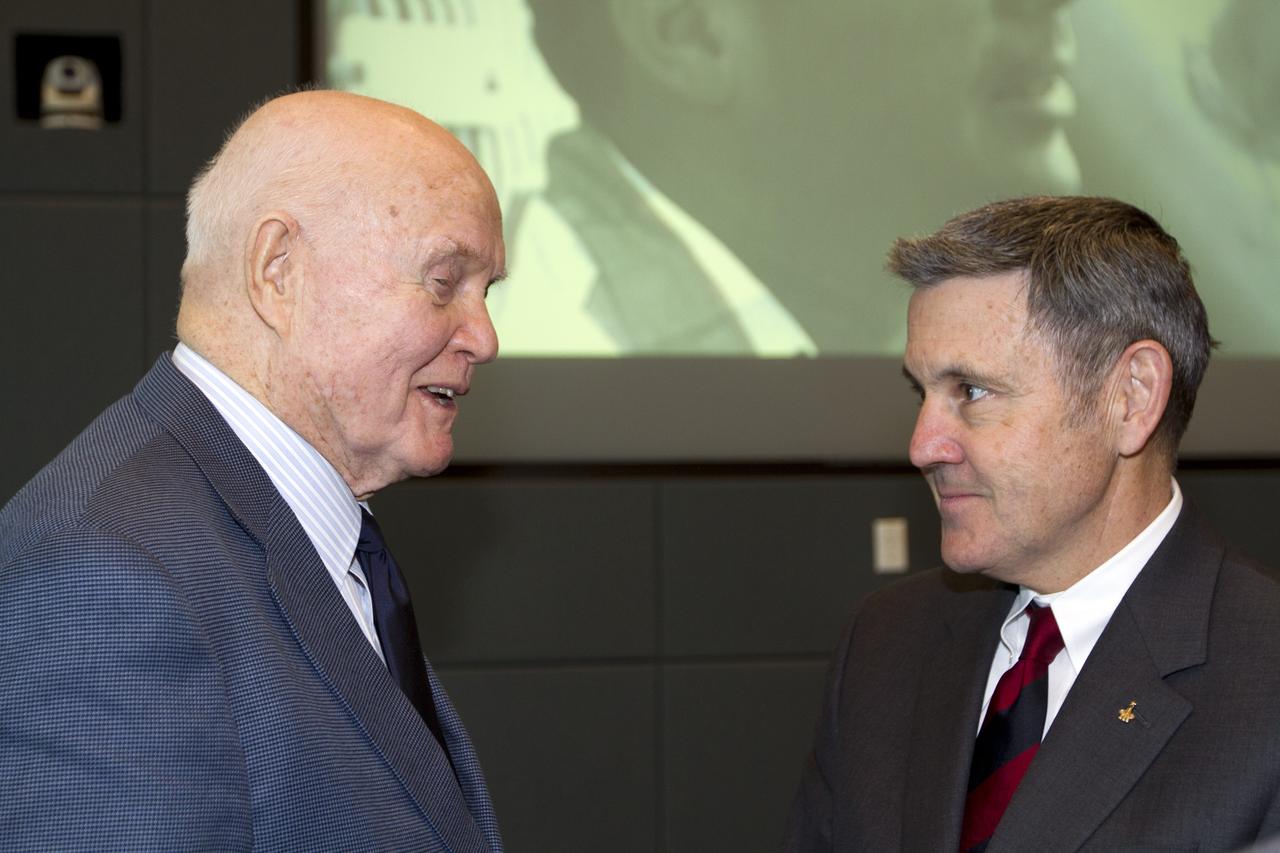
CAPE CANAVERAL, Fla. - Mercury astronaut John Glenn, left, talks with Kennedy Space Center Director Bob Cabana during a luncheon Feb. 17, 2012, celebrating 50 years of Americans in orbit, an era which began with Glenn's Mercury mission MA-6, on Feb. 20, 1962. Glenn's launch aboard an Atlas rocket took with it the hopes of an entire nation and ushered in a new era of space travel that eventually led to Americans walking on the moon by the end of the 1960s. Glenn soon was followed into orbit by Scott Carpenter, Walter Schirra and Gordon Cooper. Their fellow Mercury astronauts Alan Shepard and Virgil "Gus" Grissom flew earlier suborbital flights. Deke Slayton, a member of NASA's original Mercury 7 astronauts, was grounded by a medical condition until the Apollo-Soyuz Test Project in 1975. Photo credit: NASA/Kim Shiflett
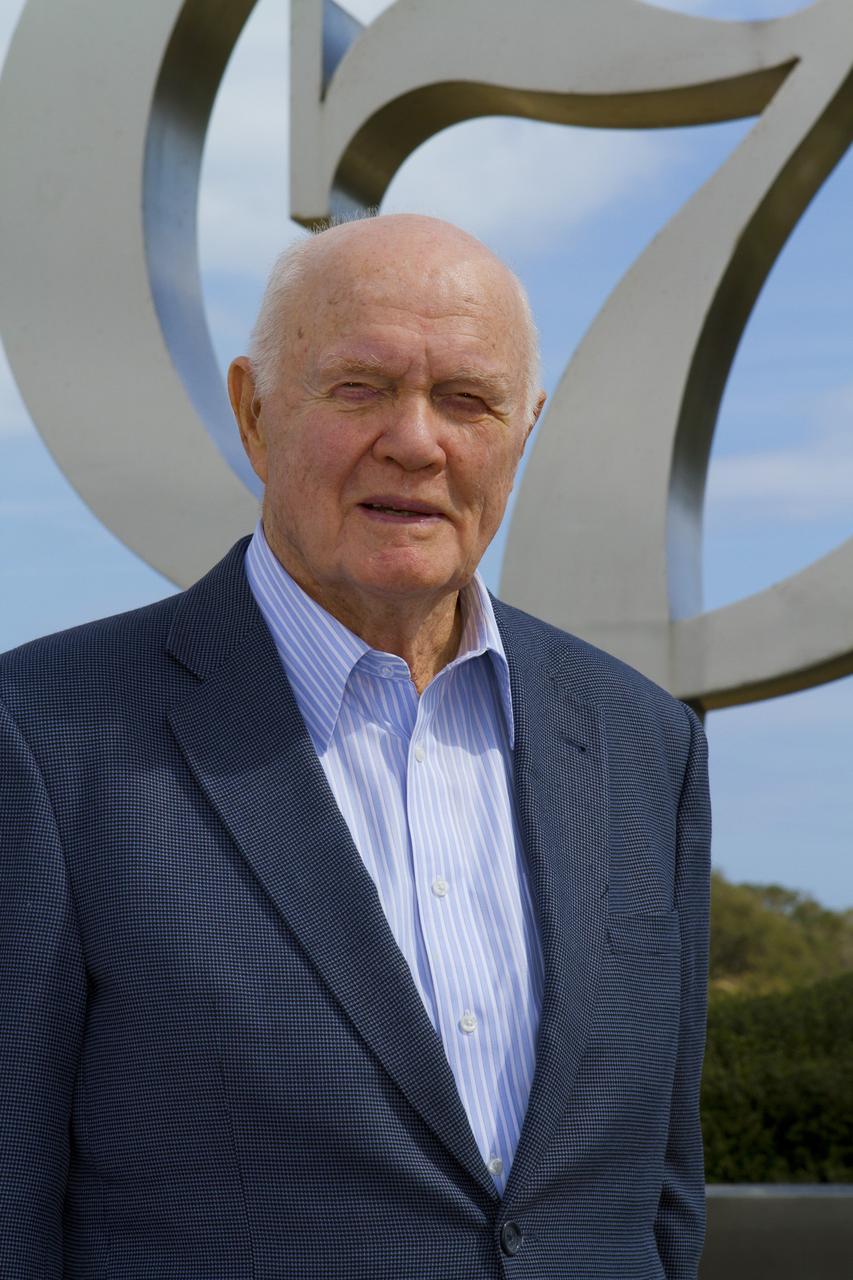
CAPE CANAVERAL, Fla. -- Mercury astronaut John Glenn poses for a photo in front of the Project Mercury monument at Launch Complex-14 LC-14 at Cape Canaveral Air Force Station in Florida. During events at the Cape and NASA's Kennedy Space Center, Glenn is marking the 50th anniversary of being the first American astronaut to orbit the Earth inside the Friendship 7 capsule on Feb. 20, 1962. Glenn's launch aboard an Atlas rocket took with it the hopes of an entire nation and ushered in a new era of space travel that eventually led to Americans walking on the moon by the end of the 1960s. Glenn soon was followed into orbit by Scott Carpenter, Walter Schirra and Gordon Cooper. Their fellow Mercury astronauts Alan Shepard and Virgil "Gus" Grissom flew earlier suborbital flights. Deke Slayton, a member of NASA's original Mercury 7 astronauts, was grounded by a medical condition until the Apollo-Soyuz Test Project in 1975. Photo credit: Kim Shiflett
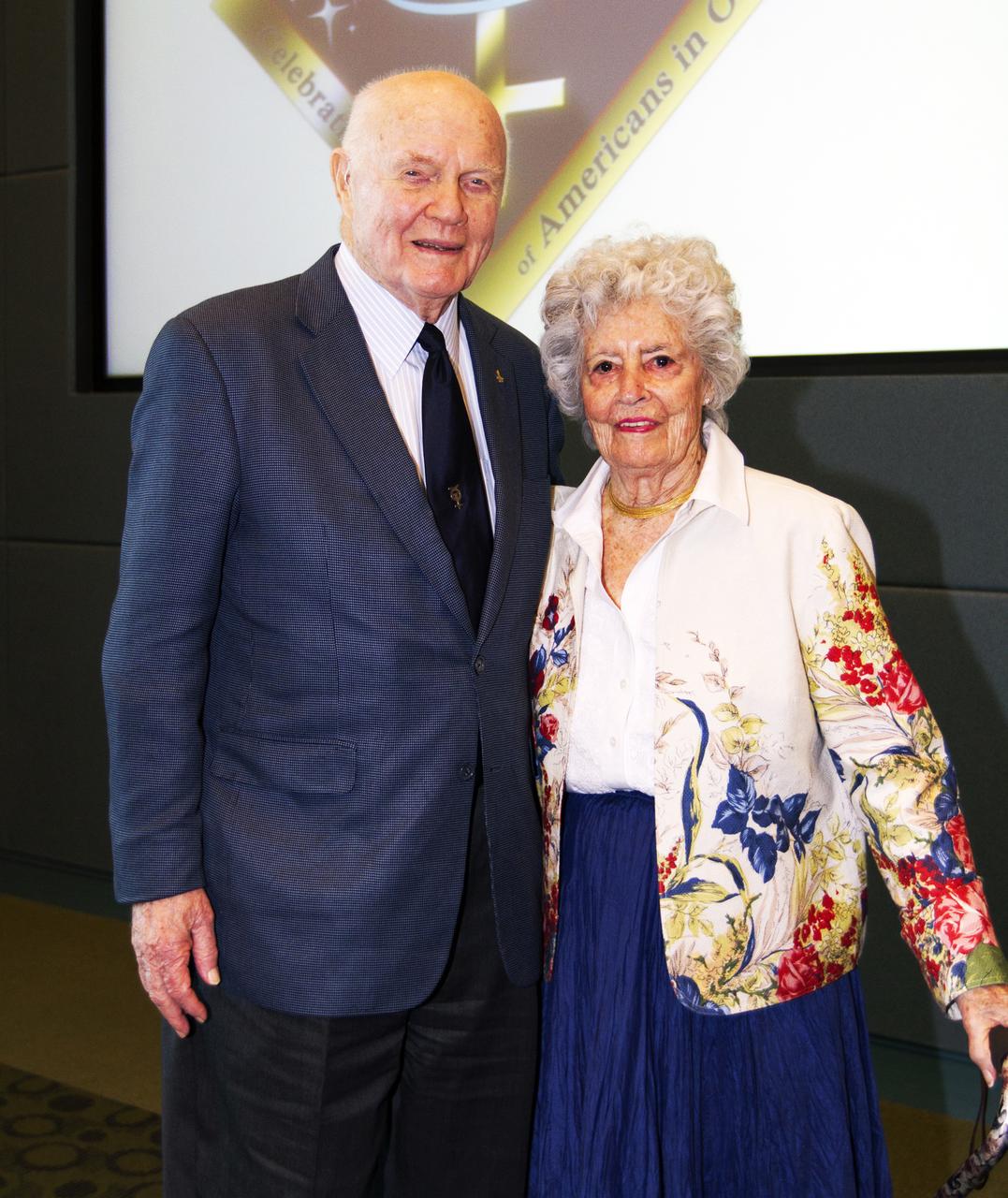
Mercury astronaut John Glenn and his wife, Annie, pose during a luncheon Feb. 17, 2012, celebrating 50 years of Americans in orbit, an era which began with Glenn's Mercury mission MA-6, on Feb. 20, 1962. Glenn's launch aboard an Atlas rocket took with it the hopes of an entire nation and ushered in a new era of space travel that eventually led to Americans walking on the moon by the end of the 1960s. Glenn soon was followed into orbit by Scott Carpenter, Walter Schirra and Gordon Cooper. Their fellow Mercury astronauts Alan Shepard and Virgil "Gus" Grissom flew earlier suborbital flights. Deke Slayton, a member of NASA's original Mercury 7 astronauts, was grounded by a medical condition until the Apollo-Soyuz Test Project in 1975.
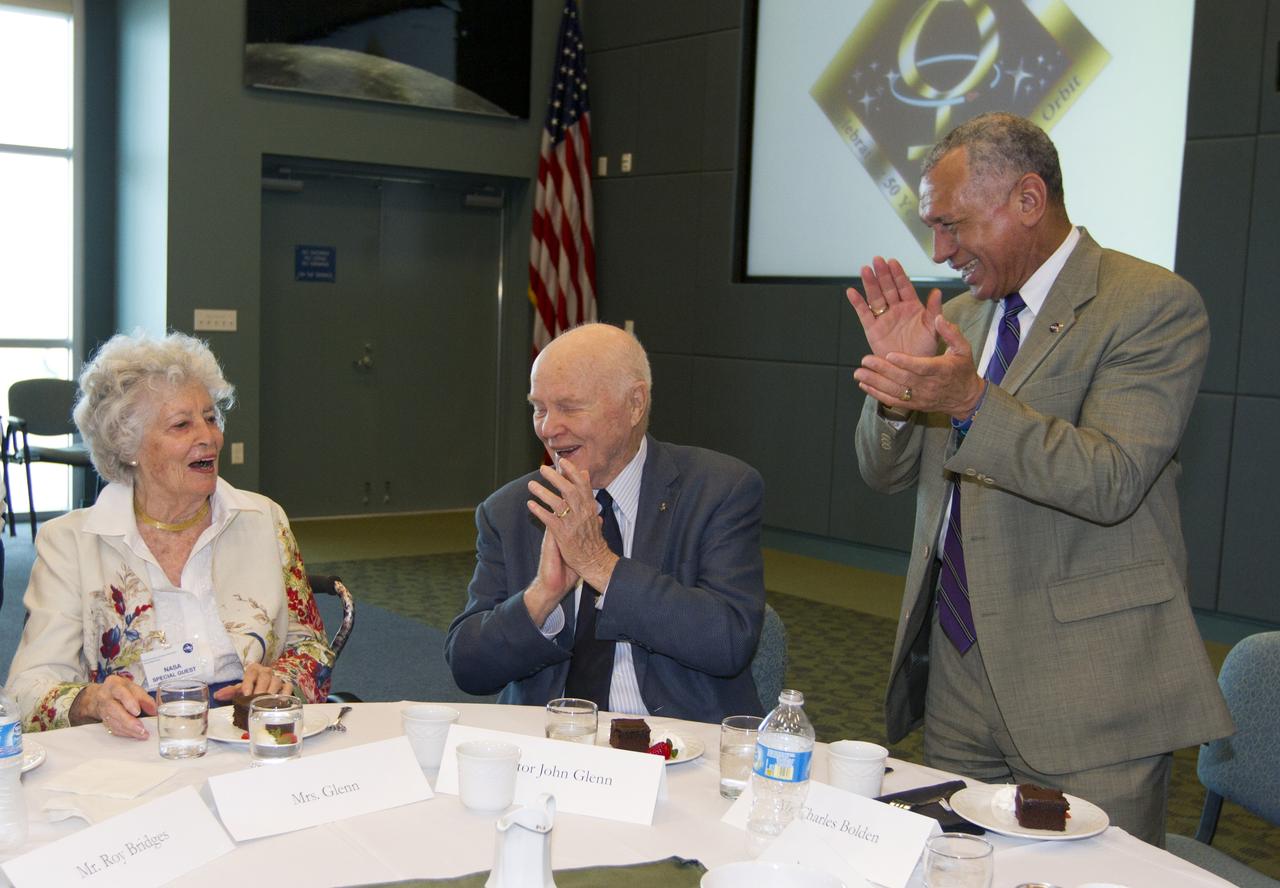
CAPE CANAVERAL, Fla. -Annie Glenn, left, astronaut John Glenn and NASA Administrator Charles Bolden take part in a luncheon Feb. 17, 2012, celebrating 50 years of Americans in orbit, an era which began with Glenn's Mercury mission MA-6, on Feb. 20, 1962. Glenn's launch aboard an Atlas rocket took with it the hopes of an entire nation and ushered in a new era of space travel that eventually led to Americans walking on the moon by the end of the 1960s. Glenn soon was followed into orbit by Scott Carpenter, Walter Schirra and Gordon Cooper. Their fellow Mercury astronauts Alan Shepard and Virgil "Gus" Grissom flew earlier suborbital flights. Deke Slayton, a member of NASA's original Mercury 7 astronauts, was grounded by a medical condition until the Apollo-Soyuz Test Project in 1975. Photo credit: NASA/Kim Shiflett
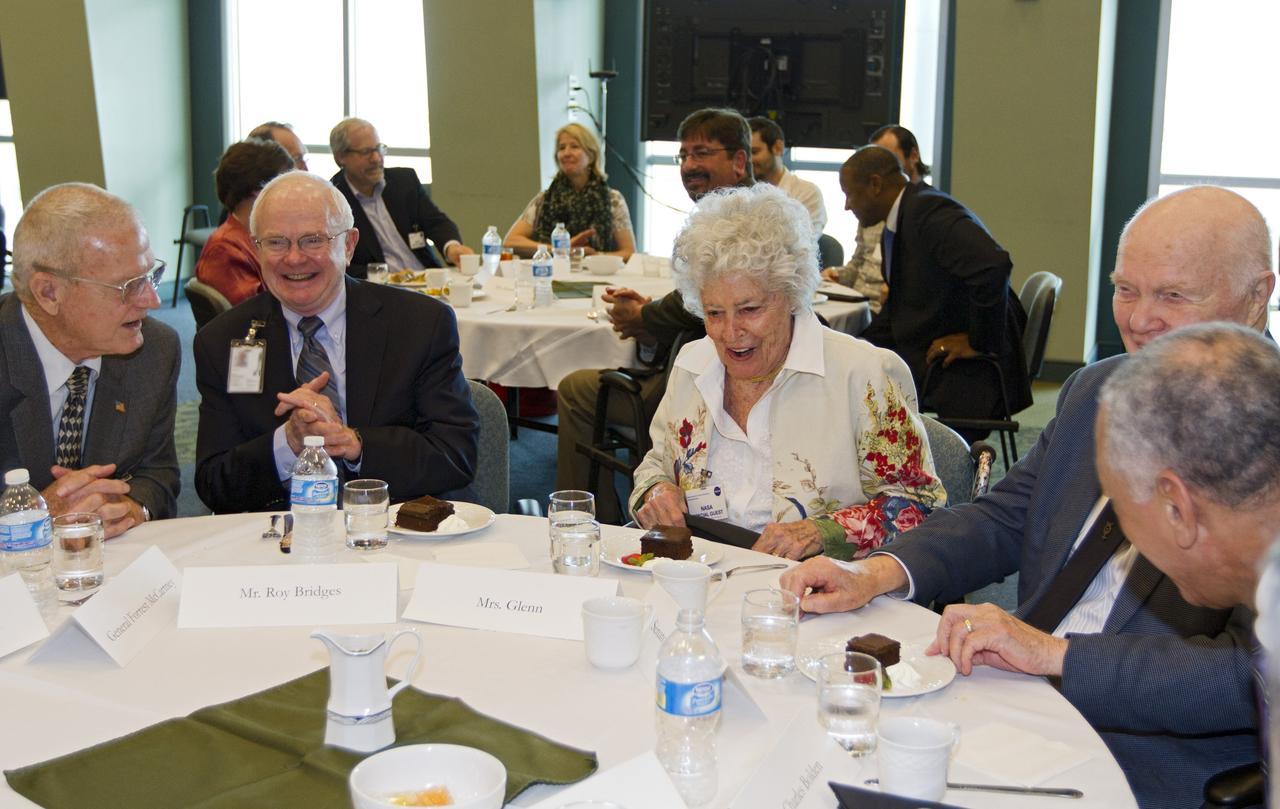
CAPE CANAVERAL, Fla. - Former Kennedy Space Center directors Forrest McCartney and Roy Bridges join Annie Glenn, astronaut John Glenn and NASA Administrator Charles Bolden during a luncheon Feb. 17, 2012, celebrating 50 years of Americans in orbit, an era which began with Glenn's Mercury mission MA-6, on Feb. 20, 1962. Glenn's launch aboard an Atlas rocket took with it the hopes of an entire nation and ushered in a new era of space travel that eventually led to Americans walking on the moon by the end of the 1960s. Glenn soon was followed into orbit by Scott Carpenter, Walter Schirra and Gordon Cooper. Their fellow Mercury astronauts Alan Shepard and Virgil "Gus" Grissom flew earlier suborbital flights. Deke Slayton, a member of NASA's original Mercury 7 astronauts, was grounded by a medical condition until the Apollo-Soyuz Test Project in 1975. Photo credit: NASA/Kim Shiflett
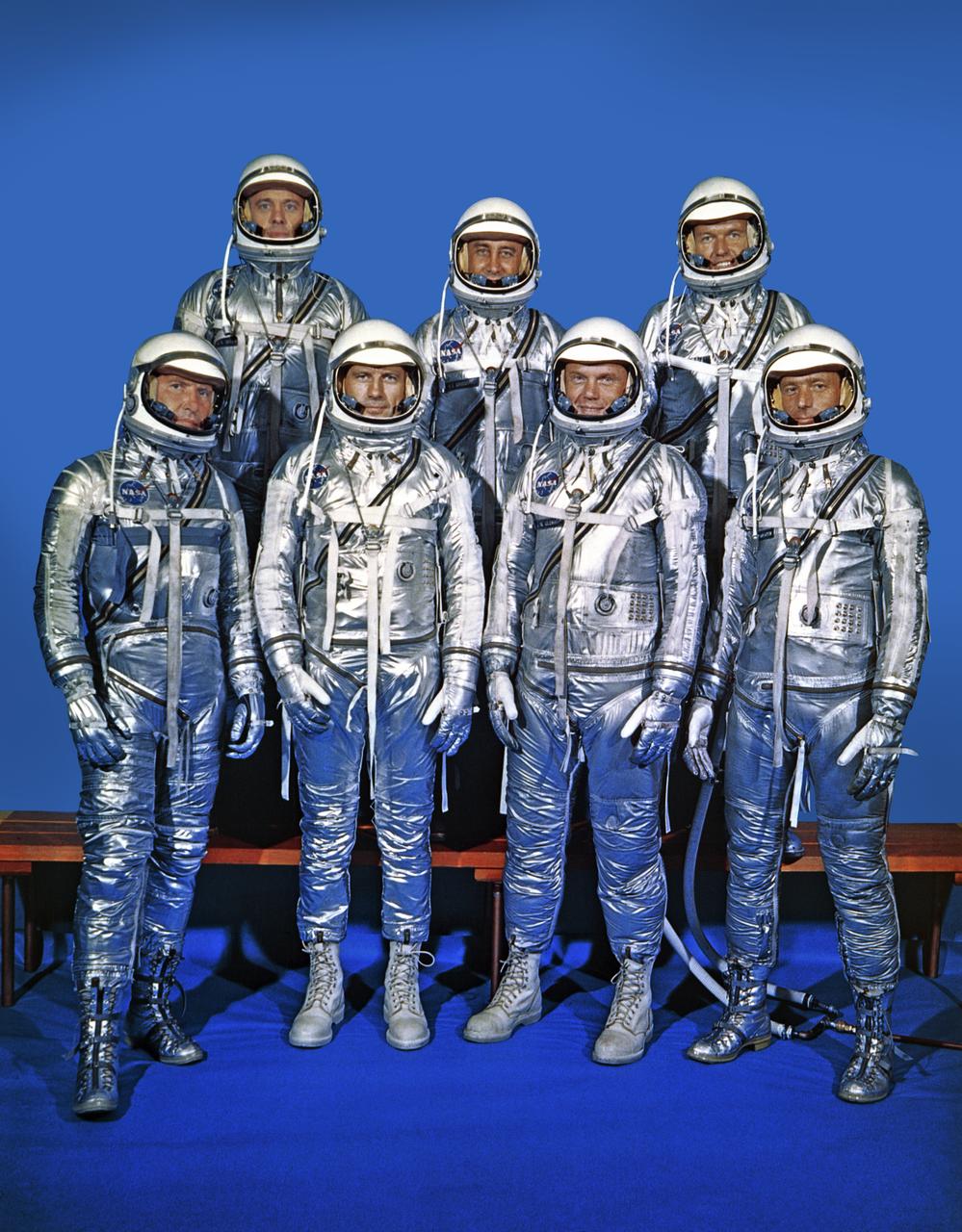
Press release information, September 13, 1968: "FIRST ASTRONAUT TEAM: Project Mercury Astronauts, whose selection was announced on April 9, 1959, only six months after the National Aeronautics and Space Administration was formally established on Oct. 1, 1958, Included: Front row, left to right, Walter M. Schirra, Jr., Donald K. Slayton, John H. Glenn, Jr., and M. Scott Carpenter; back row, Alan B. Shepard, Jr., Virgil I. "Gus" Grissom and L. Gordon Cooper. (1962), *89-361 Also in B&W. This copy of original negative was edited without shadows in the background. Photo taken at NASA Langley Research Center by Life Magazine photographer and negative copied for other centers.
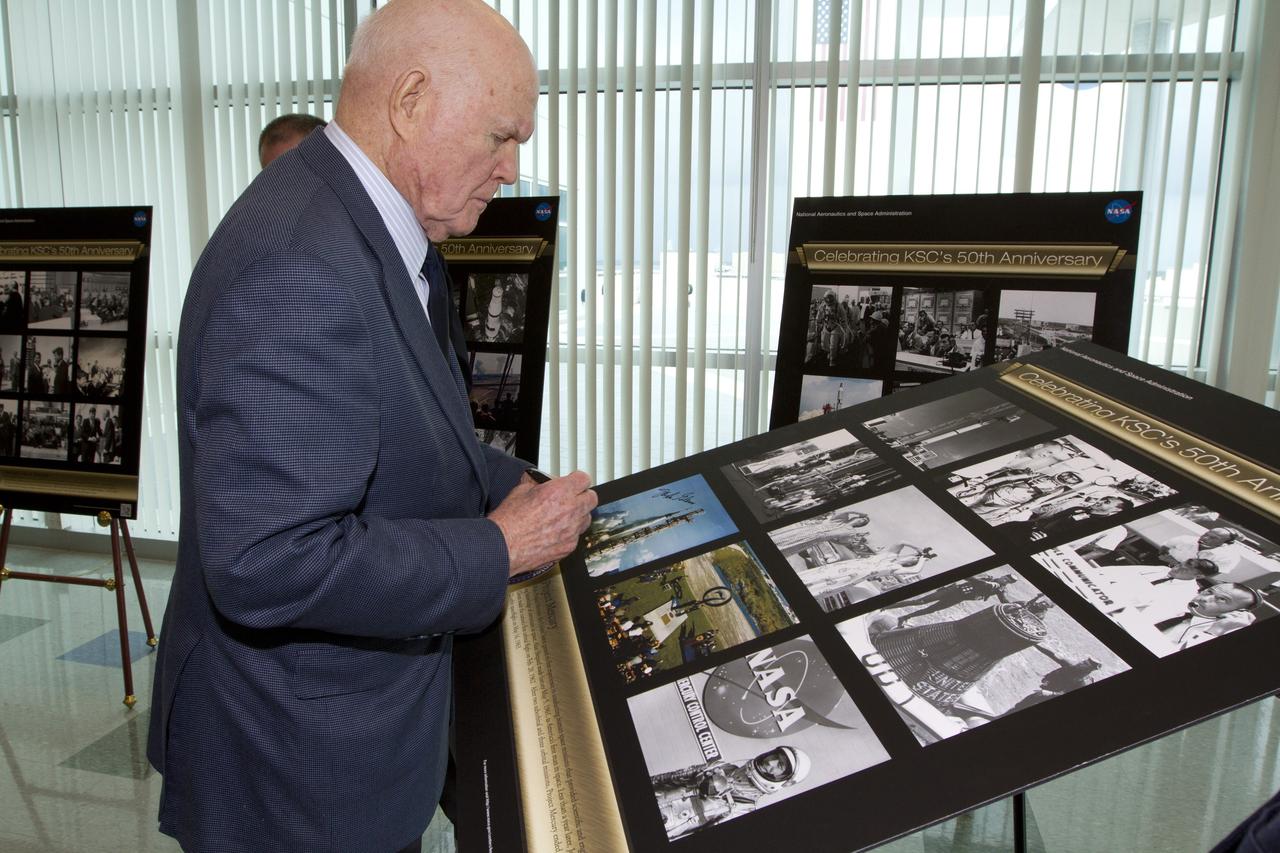
CAPE CANAVERAL, Fla. - Mercury astronaut John Glenn signs a poster celebrating 50 years of Americans in orbit, an era which began with Glenn's Mercury mission MA-6, on Feb. 20, 1962. Glenn's launch aboard an Atlas rocket took with it the hopes of an entire nation and ushered in a new era of space travel that eventually led to Americans walking on the moon by the end of the 1960s. Glenn soon was followed into orbit by Scott Carpenter, Walter Schirra and Gordon Cooper. Their fellow Mercury astronauts Alan Shepard and Virgil "Gus" Grissom flew earlier suborbital flights. Deke Slayton, a member of NASA's original Mercury 7 astronauts, was grounded by a medical condition until the Apollo-Soyuz Test Project in 1975. Photo credit: NASA/Kim Shiflett
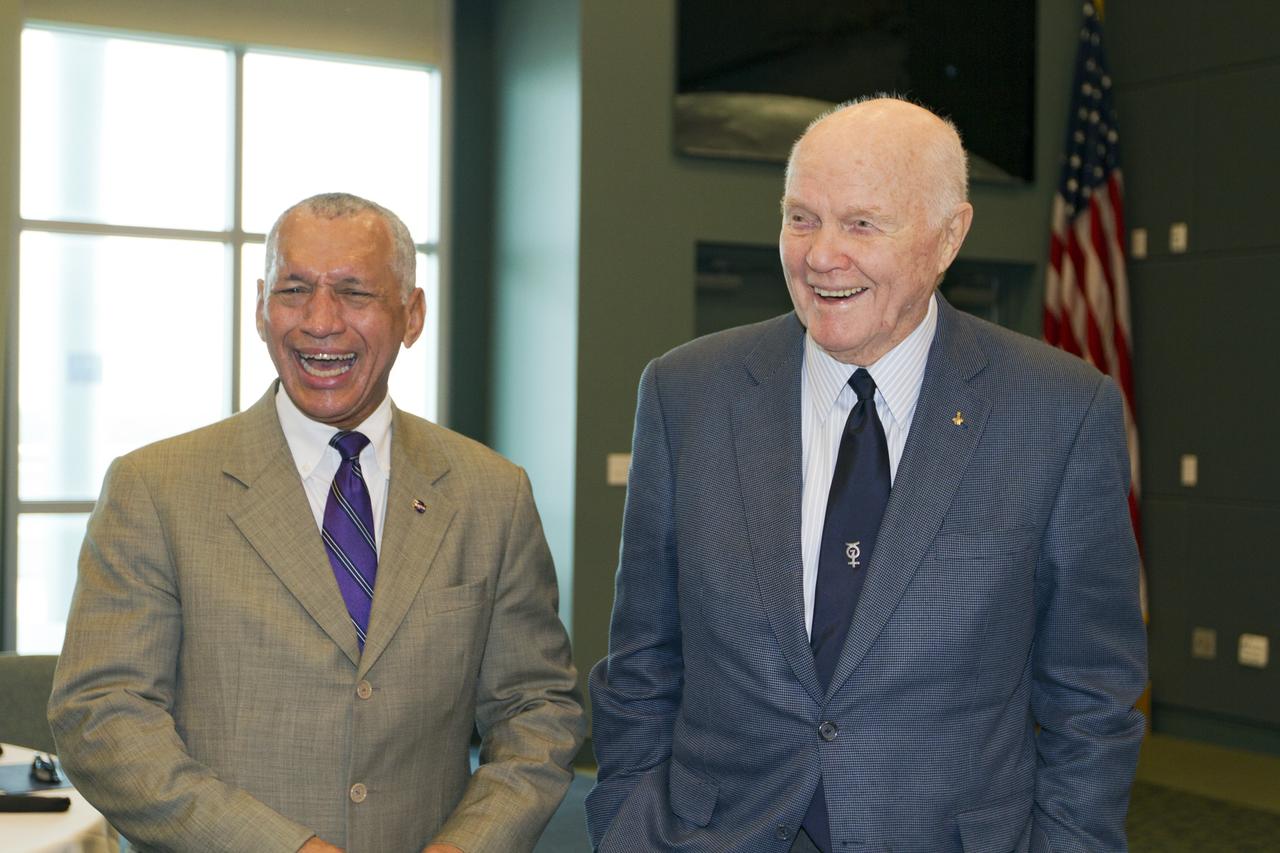
CAPE CANAVERAL, Fla. - NASA Administrator Charles Bolden, left, shares a laugh with astronaut John Glenn before a luncheon Feb. 17, 2012, celebrating 50 years of Americans in orbit, an era which began with Glenn's Mercury mission MA-6, on Feb. 20, 1962. Glenn's launch aboard an Atlas rocket took with it the hopes of an entire nation and ushered in a new era of space travel that eventually led to Americans walking on the moon by the end of the 1960s. Glenn soon was followed into orbit by Scott Carpenter, Walter Schirra and Gordon Cooper. Their fellow Mercury astronauts Alan Shepard and Virgil "Gus" Grissom flew earlier suborbital flights. Deke Slayton, a member of NASA's original Mercury 7 astronauts, was grounded by a medical condition until the Apollo-Soyuz Test Project in 1975. Photo credit: NASA/Kim Shiflett
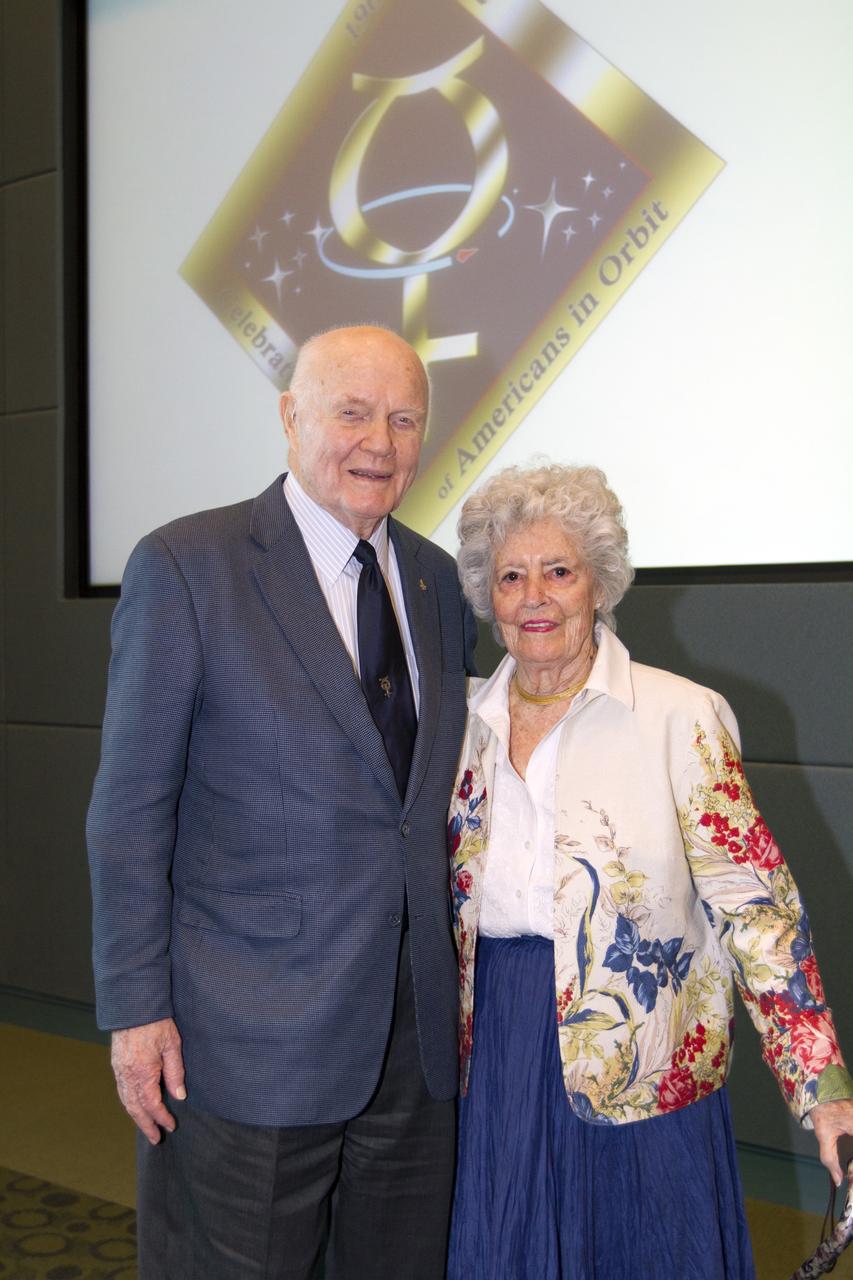
CAPE CANAVERAL, Fla. - Mercury astronaut John Glenn and his wife, Annie, pose during a luncheon Feb. 17, 2012, celebrating 50 years of Americans in orbit, an era which began with Glenn's Mercury mission MA-6, on Feb. 20, 1962. Glenn's launch aboard an Atlas rocket took with it the hopes of an entire nation and ushered in a new era of space travel that eventually led to Americans walking on the moon by the end of the 1960s. Glenn soon was followed into orbit by Scott Carpenter, Walter Schirra and Gordon Cooper. Their fellow Mercury astronauts Alan Shepard and Virgil "Gus" Grissom flew earlier suborbital flights. Deke Slayton, a member of NASA's original Mercury 7 astronauts, was grounded by a medical condition until the Apollo-Soyuz Test Project in 1975. Photo credit: NASA/Kim Shiflett
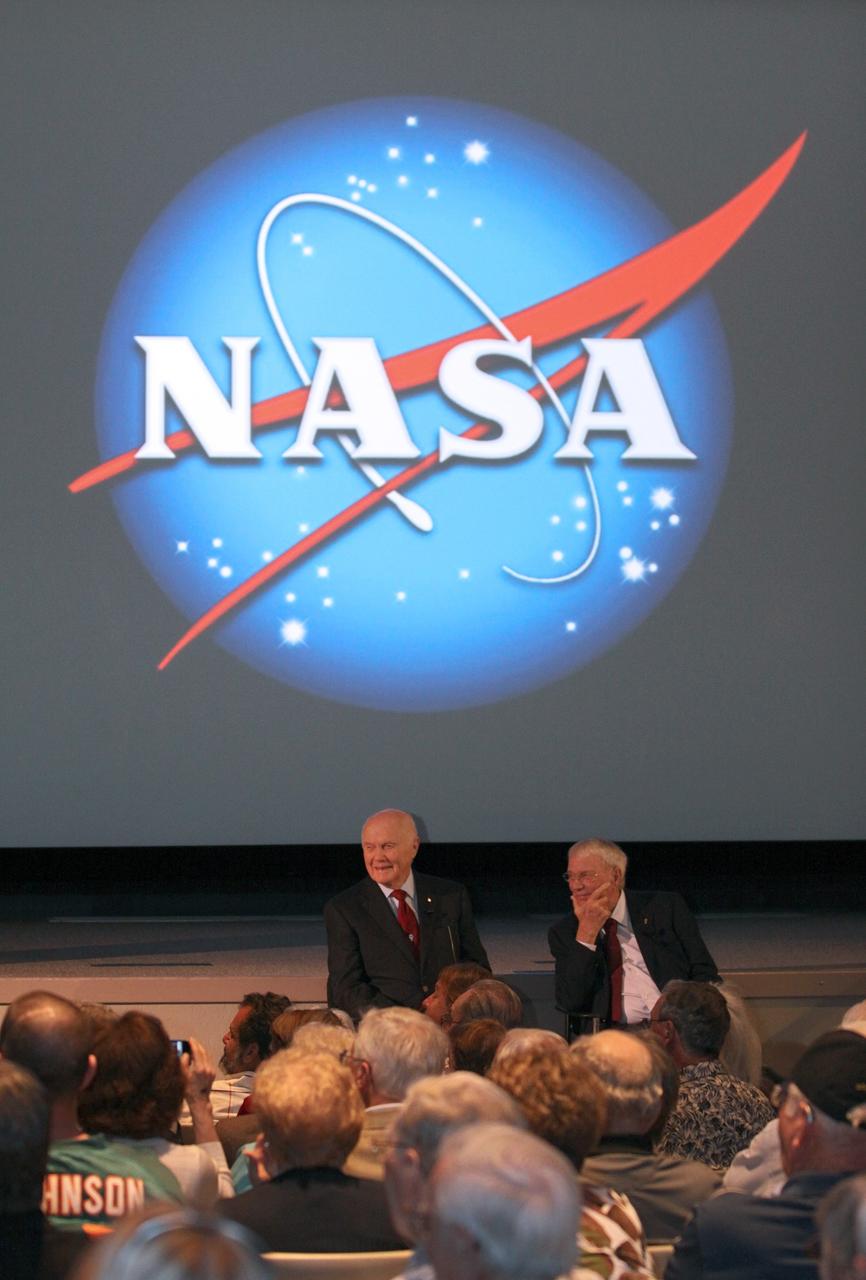
CAPE CANAVERAL, Fla. -- Mercury astronauts, John Glenn, left, and Scott Carpenter, talk to Mercury Project workers and other guests in the Astronaut Encounter Theater at the Kennedy Space Center Visitor Complex in Florida. The pair participated in 50th anniversary events at the launch site of Glenn's first orbital flight aboard NASA's Friendship 7 capsule, which launched Feb. 20, 1962, aboard an Atlas rocket. Glenn's launch aboard an Atlas rocket took with it the hopes of an entire nation and ushered in a new era of space travel that eventually led to Americans walking on the moon by the end of the 1960s. Glenn soon was followed into orbit by Carpenter, Walter Schirra and Gordon Cooper. Their fellow Mercury astronauts Alan Shepard and Virgil "Gus" Grissom flew earlier suborbital flights. Deke Slayton, a member of NASA's original Mercury 7 astronauts, was grounded by a medical condition until the Apollo-Soyuz Test Project in 1975. Photo credit: Kim Shiflett
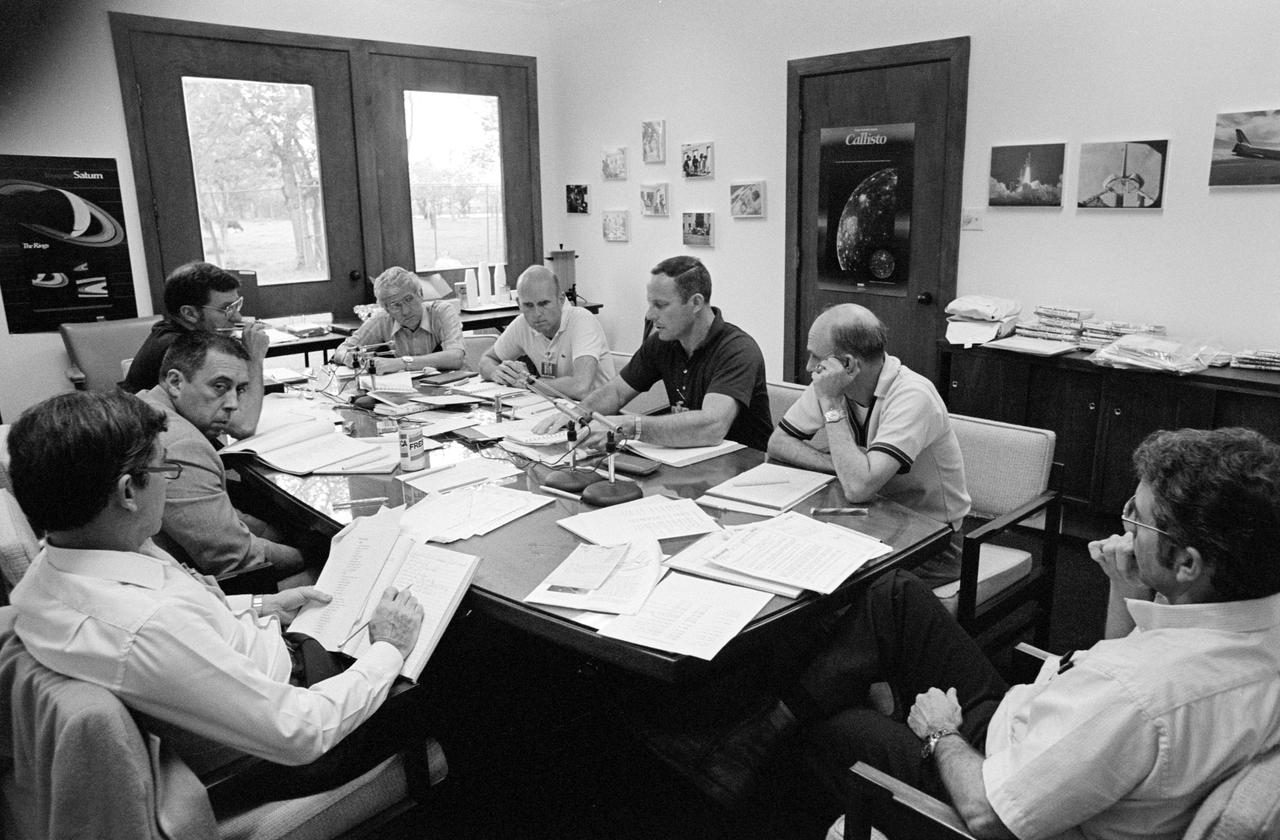
S82-28952 (1 April 1982) --- Crew members from STS-2 and STS-4 meet with the recently returned STS-3 astronauts for a debriefing session at the Johnson Space Center. Taking notes at bottom left foreground is astronaut John W. Young, STS-1 commander and chief of the Astronaut Office at JSC. Clockwise around the table, beginning with Young, are George W. S. Abbey, JSC Director of Flight Operations; and astronauts Joe E. Engle, STS-2 commander; Henry W. Hartsfield Jr., STS-4 pilot; C. Gordon Fullerton, STS-3 pilot; Jack R. Lousma, STS-3 commander; Thomas K. (Ken) Mattingly, STS-4 commander; and Richard H. Truly, STS-2 pilot. Photo credit: NASA
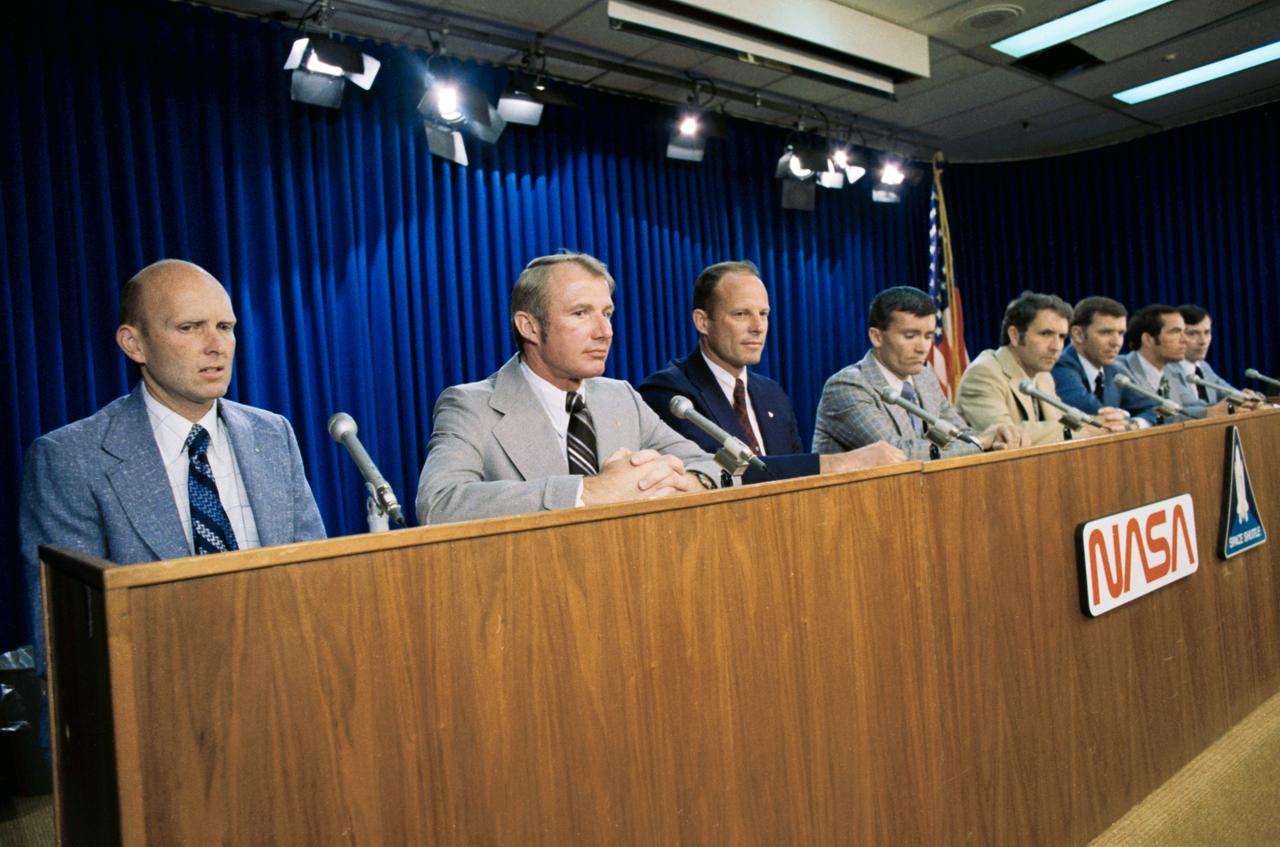
S78-27531 (22 March 1978) --- These eight men have been named on four two-man crews who will fly the space shuttle orbiter vehicle during orbital flight tests (OFT) scheduled to begin in 1979. Pictured during their press conference, right to left, astronauts John W. Young, Robert L. Crippen, Joe H. Engle, Richard H. Truly, Fred W. Haise Jr., Jack R. Lousma, Vance D. Brand and C. Gordon Fullerton. Young and Crippen are commander and pilot, respectively, for the first OFT mission. Other crews are comprised of Engle, commander, and Truly, pilot; Haise, commander, and Lousma, pilot; Brand, commander, and Fullerton, pilot. Photo credit: NASA
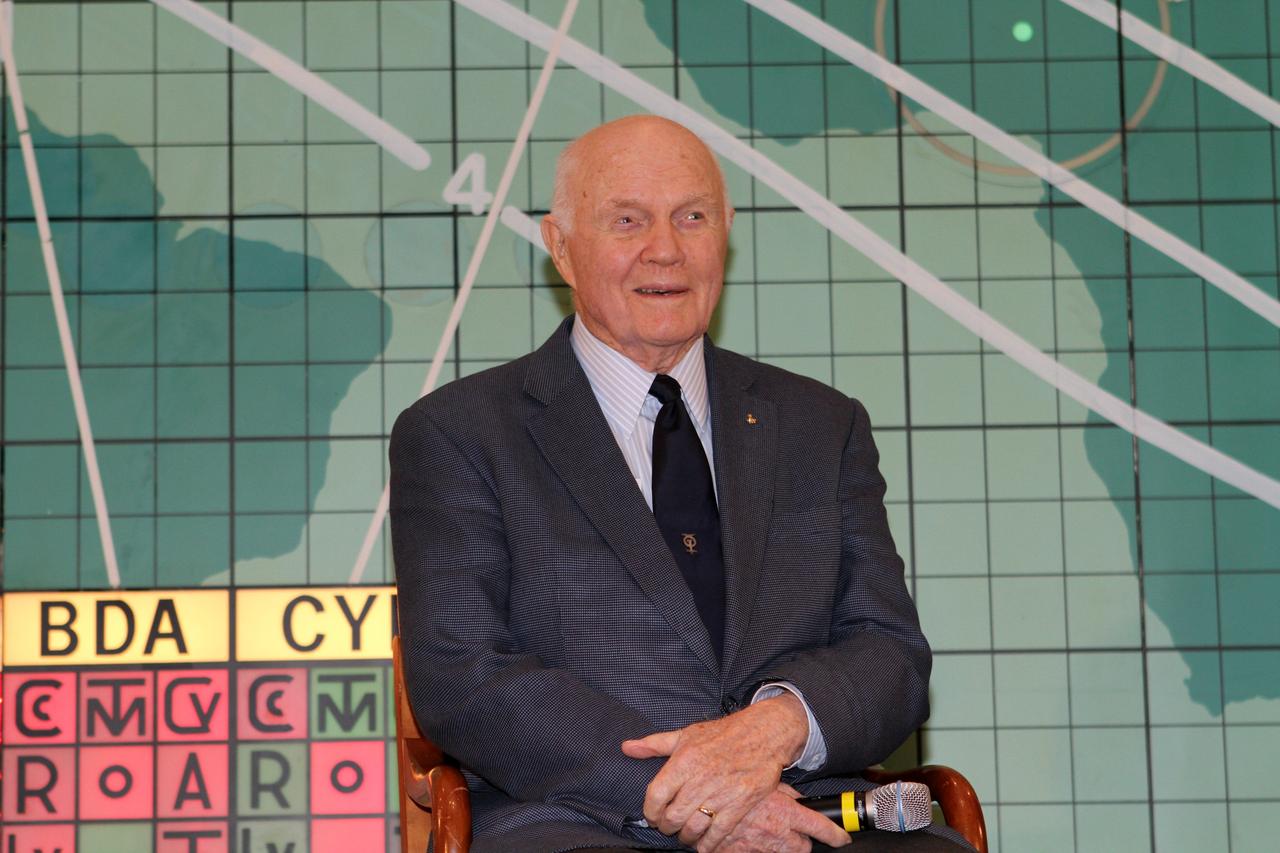
CAPE CANAVERAL, Fla. -- Mercury astronaut John Glenn sits in front of the plot board from the Mercury control center on display at the Kennedy Space Center Visitor Complex in Florida. The astronaut, part of the original class of seven astronauts chosen by NASA, was taking part in a question-and-answer session with the media as part of events celebrating 50 years of Americans in orbit, an era which began with Glenn's Mercury mission MA-6, on Feb. 20, 1962. Glenn's launch aboard an Atlas rocket took with it the hopes of an entire nation and ushered in a new era of space travel that eventually led to Americans walking on the moon by the end of the 1960s. Glenn soon was followed into orbit by Carpenter, Walter Schirra and Gordon Cooper. Their fellow Mercury astronauts Alan Shepard and Virgil "Gus" Grissom flew earlier suborbital flights. Deke Slayton was grounded by a medical condition until the Apollo-Soyuz Test Project in 1975. Photo credit: NASA/Kim Shiflett
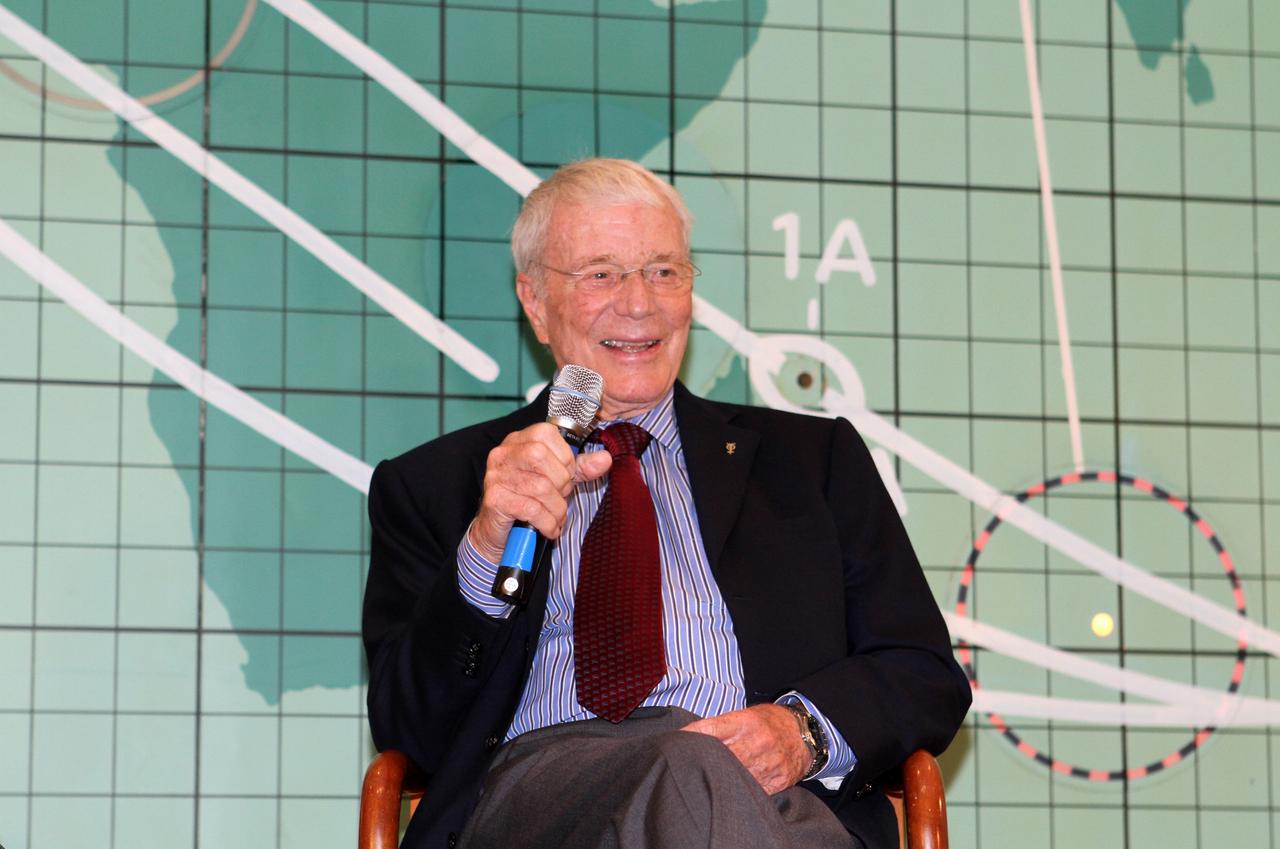
CAPE CANAVERAL, Fla. -- Mercury astronaut Scott Carpenter sits in front of the plot board from the Mercury control center on display at the Kennedy Space Center Visitor Complex in Florida. The astronaut, part of the original class of seven astronauts chosen by NASA, was taking part in a question-and-answer session with the media as part of events celebrating 50 years of Americans in orbit, an era which began with John Glenn's Mercury mission MA-6, on Feb. 20, 1962. Glenn's launch aboard an Atlas rocket took with it the hopes of an entire nation and ushered in a new era of space travel that eventually led to Americans walking on the moon by the end of the 1960s. Glenn soon was followed into orbit by Carpenter, Walter Schirra and Gordon Cooper. Their fellow Mercury astronauts Alan Shepard and Virgil "Gus" Grissom flew earlier suborbital flights. Deke Slayton was grounded by a medical condition until the Apollo-Soyuz Test Project in 1975. Photo credit: NASA/Kim Shiflett
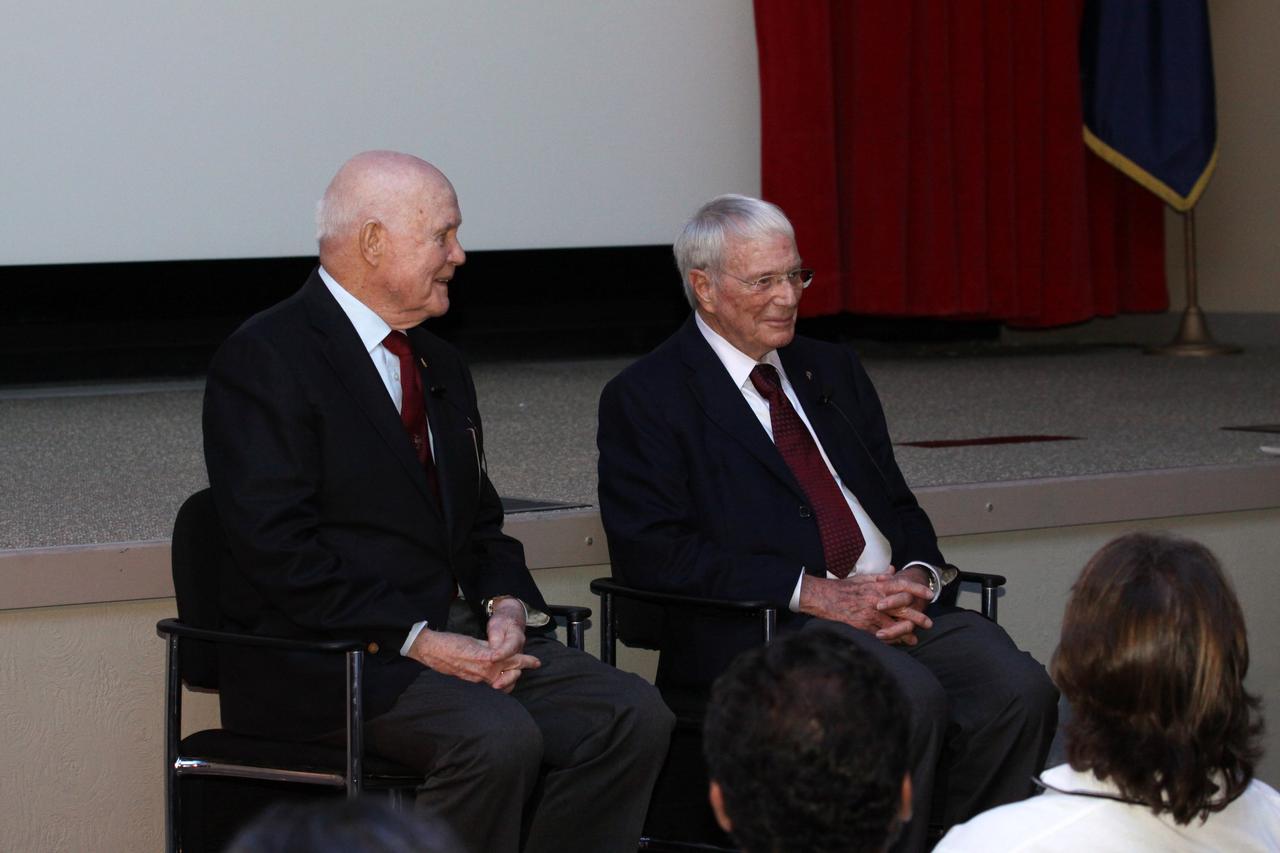
CAPE CANAVERAL, Fla. -- Mercury astronauts, John Glenn, left, and Scott Carpenter, talk to Mercury Project workers and other guests in the Astronaut Encounter Theater at the Kennedy Space Center Visitor Complex in Florida. The pair participated in 50th anniversary events at the launch site of Glenn's first orbital flight aboard NASA's Friendship 7 capsule, which launched Feb. 20, 1962, aboard an Atlas rocket. Glenn's launch aboard an Atlas rocket took with it the hopes of an entire nation and ushered in a new era of space travel that eventually led to Americans walking on the moon by the end of the 1960s. Glenn soon was followed into orbit by Carpenter, Walter Schirra and Gordon Cooper. Their fellow Mercury astronauts Alan Shepard and Virgil "Gus" Grissom flew earlier suborbital flights. Deke Slayton, a member of NASA's original Mercury 7 astronauts, was grounded by a medical condition until the Apollo-Soyuz Test Project in 1975. Photo credit: Kim Shiflett
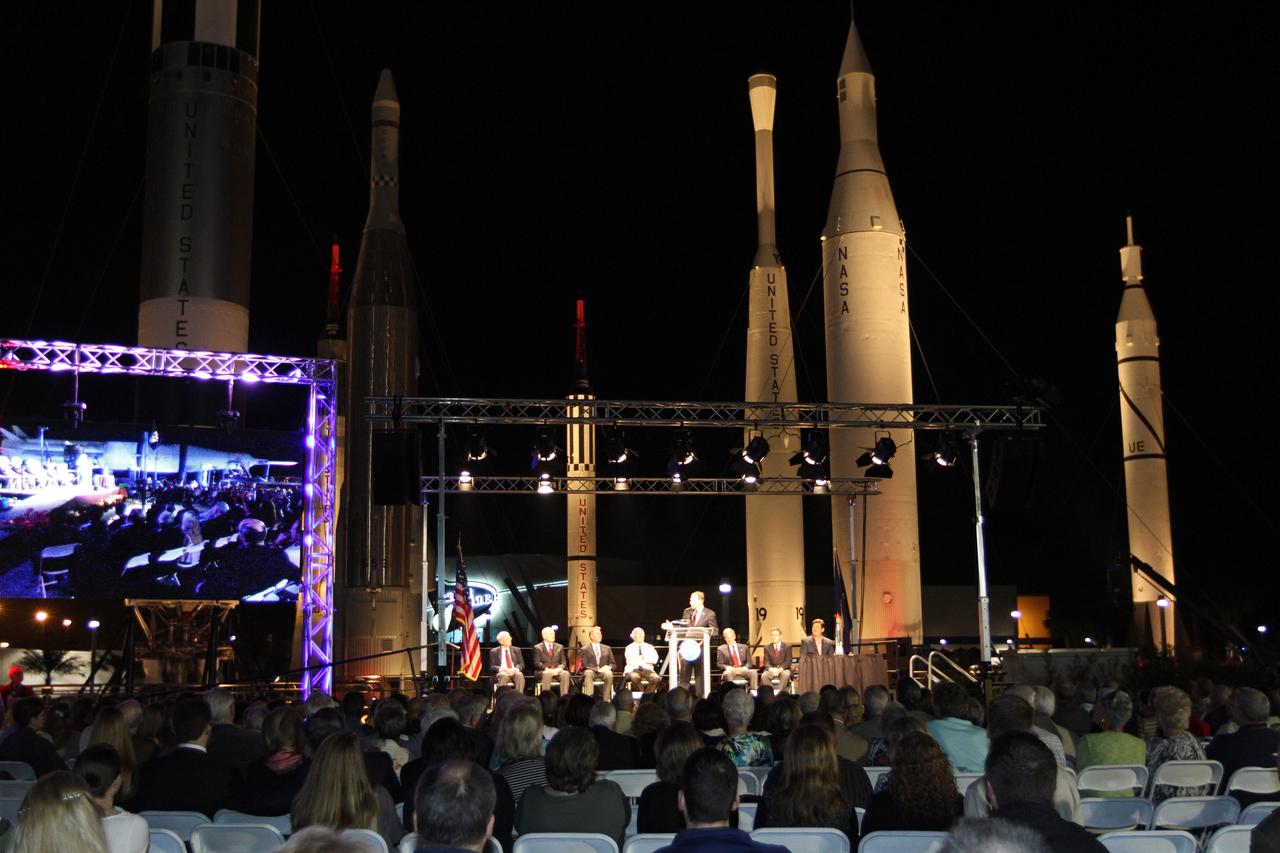
CAPE CANAVERAL, Fla. --A crowd looks on during the "On Shoulders of Giants" program celebrating 50 years of Americans in orbit, an era which began with John Glenn's MA-6 mission on Feb. 20, 1962. The event was conducted in the Rocket Garden at the Kennedy Space Center Visitor Complex in Florida a few miles from the launch pad where Glenn and Scott Carpenter took flight in Mercury spacecraft. Glenn's launch aboard an Atlas rocket took with it the hopes of an entire nation and ushered in a new era of space travel that eventually led to Americans walking on the moon by the end of the 1960s. Glenn soon was followed into orbit by Scott Carpenter, Walter Schirra and Gordon Cooper. Their fellow Mercury astronauts Alan Shepard and Virgil "Gus" Grissom flew earlier suborbital flights. Deke Slayton, a member of NASA's original Mercury 7 astronauts, was grounded by a medical condition until the Apollo-Soyuz Test Project in 1975. Photo credit: Kim Shiflett
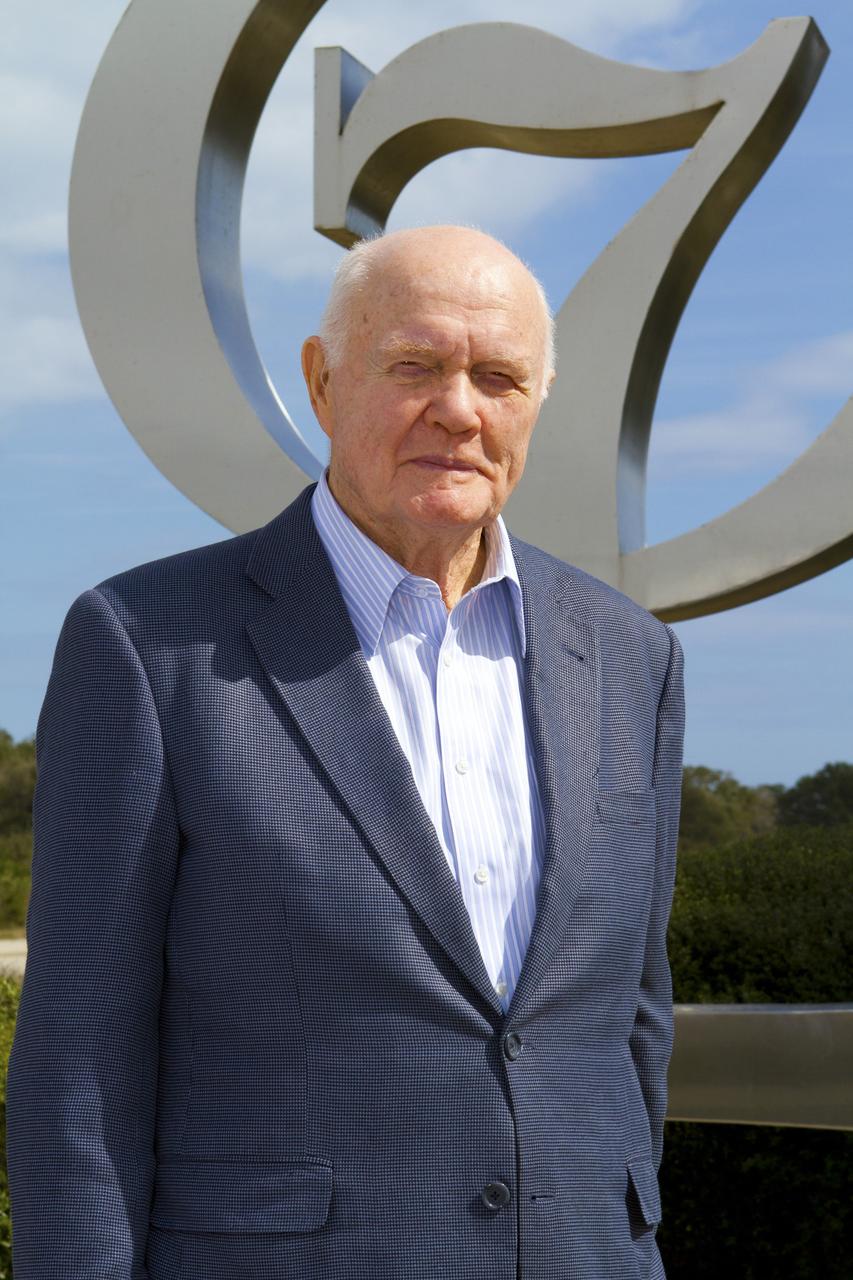
CAPE CANAVERAL, Fla. -- Mercury astronaut John Glenn poses for a photo in front of the Project Mercury monument at Launch Complex-14 LC-14 at Cape Canaveral Air Force Station in Florida. During events at the Cape and NASA's Kennedy Space Center, Glenn is marking the 50th anniversary of being the first American astronaut to orbit the Earth inside the Friendship 7 capsule on Feb. 20, 1962. Glenn's launch aboard an Atlas rocket took with it the hopes of an entire nation and ushered in a new era of space travel that eventually led to Americans walking on the moon by the end of the 1960s. Glenn soon was followed into orbit by Scott Carpenter, Walter Schirra and Gordon Cooper. Their fellow Mercury astronauts Alan Shepard and Virgil "Gus" Grissom flew earlier suborbital flights. Deke Slayton, a member of NASA's original Mercury 7 astronauts, was grounded by a medical condition until the Apollo-Soyuz Test Project in 1975. Photo credit: Kim Shiflett
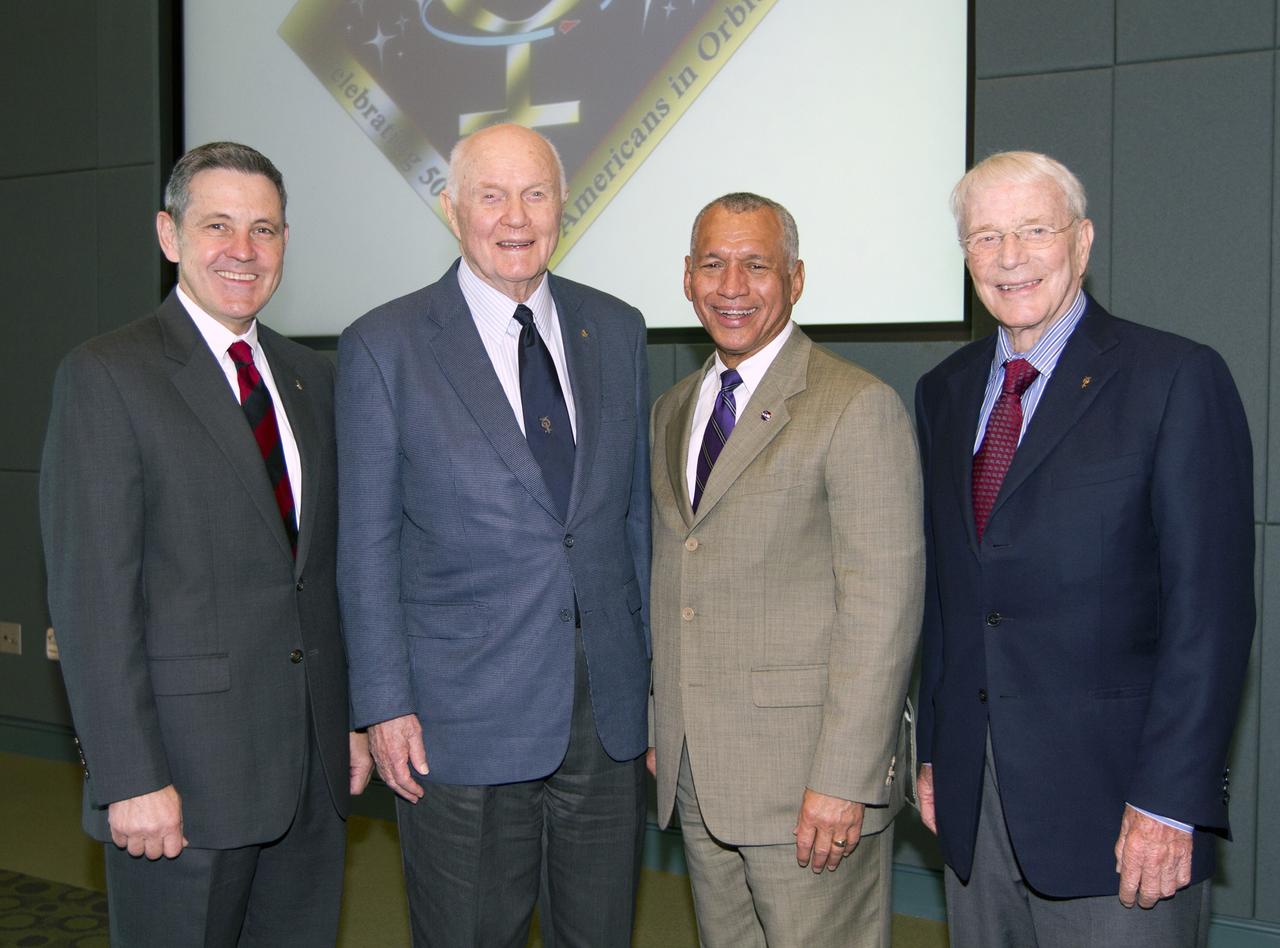
CAPE CANAVERAL, Fla. - Kennedy Space Center Director Bob Cabana, from left, Mercury astronaut John Glenn, NASA Administrator Charles Bolden and Mercury astronaut Scott Carpenter pose during a luncheon Feb. 17, 2012, celebrating 50 years of Americans in orbit, an era which began with Glenn's Mercury mission MA-6, on Feb. 20, 1962. Glenn's launch aboard an Atlas rocket took with it the hopes of an entire nation and ushered in a new era of space travel that eventually led to Americans walking on the moon by the end of the 1960s. Glenn soon was followed into orbit by Scott Carpenter, Walter Schirra and Gordon Cooper. Their fellow Mercury astronauts Alan Shepard and Virgil "Gus" Grissom flew earlier suborbital flights. Deke Slayton, a member of NASA's original Mercury 7 astronauts, was grounded by a medical condition until the Apollo-Soyuz Test Project in 1975. Photo credit: NASA/Kim Shiflett
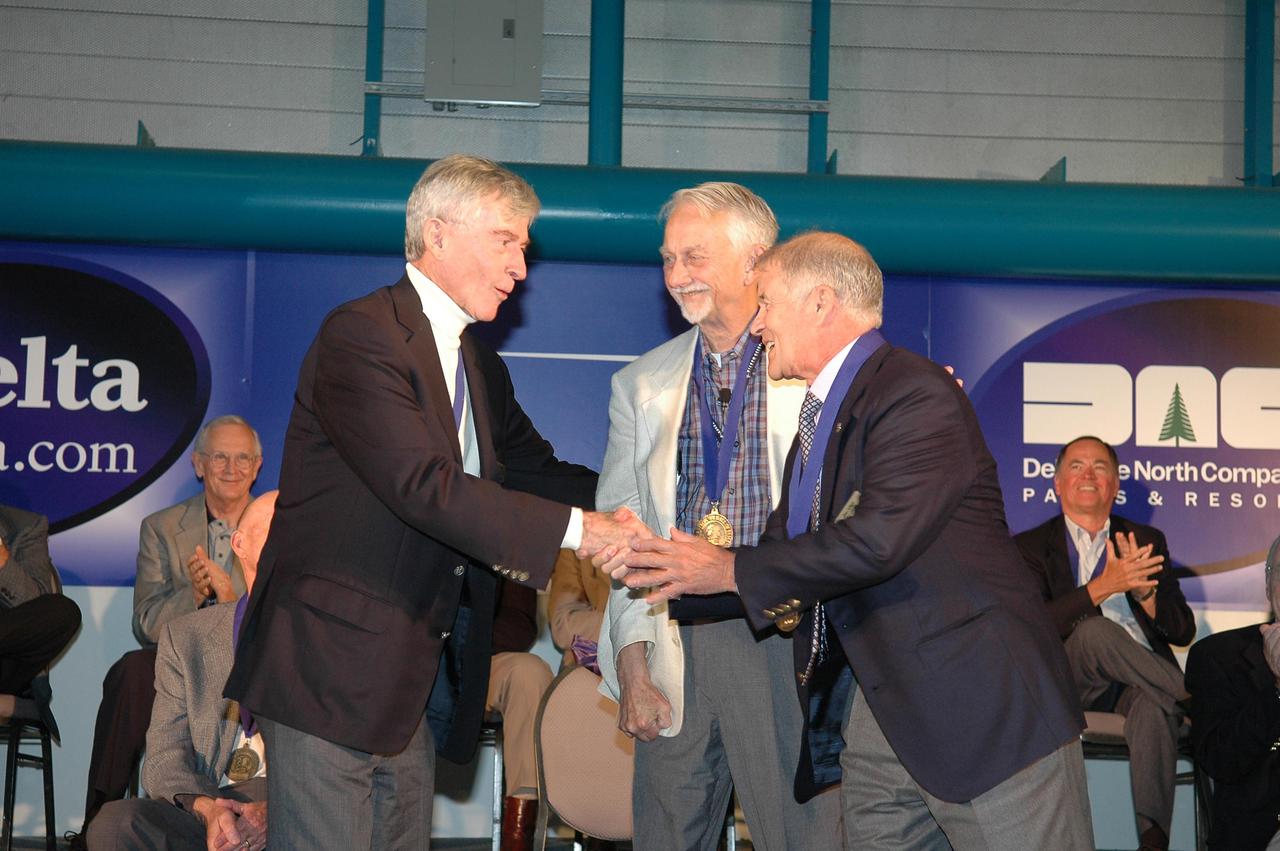
KENNEDY SPACE CENTER, FLA. - At the Astronaut Hall of Fame Induction Ceremony, Hall of Famer John Young (left) congratulates new inductee Joe Allen. Between them is Owen Garriott, chairman of the Astronaut Hall of Fame. Current Hall of Famers seen behind them are Al Worden (left) and Robert Crippen (right). The other new inductees are Bruce McCandless and Gordon Fullerton. The event is being held in the Kennedy Space Center Visitor Complex’s Apollo_Saturn V Center. Recognized for their individual flight accomplishments and contributions to the success and future success of the U.S. space program, this elite group of inductees is among only 60 astronauts to be honored in the Hall of Fame and the fourth group of Space Shuttle astronauts named.
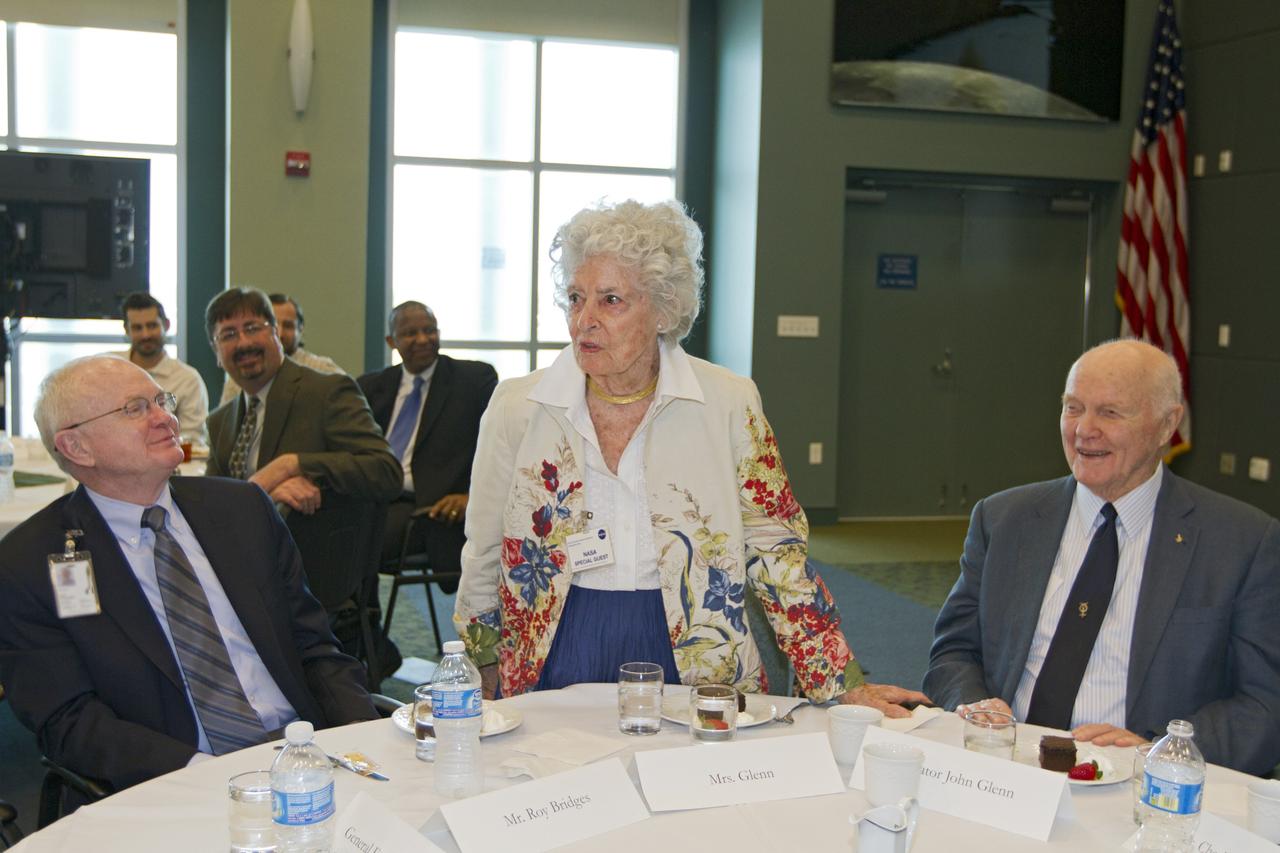
CAPE CANAVERAL, Fla. - Annie Glenn, center, speaks as former Kennedy Space Center director Roy Bridges, left, and astronaut John Glenn look on during a luncheon Feb. 17, 2012, celebrating 50 years of Americans in orbit, an era which began with Glenn's Mercury mission MA-6, on Feb. 20, 1962. Glenn's launch aboard an Atlas rocket took with it the hopes of an entire nation and ushered in a new era of space travel that eventually led to Americans walking on the moon by the end of the 1960s. Glenn soon was followed into orbit by Scott Carpenter, Walter Schirra and Gordon Cooper. Their fellow Mercury astronauts Alan Shepard and Virgil "Gus" Grissom flew earlier suborbital flights. Deke Slayton, a member of NASA's original Mercury 7 astronauts, was grounded by a medical condition until the Apollo-Soyuz Test Project in 1975. Photo credit: NASA/Kim Shiflett
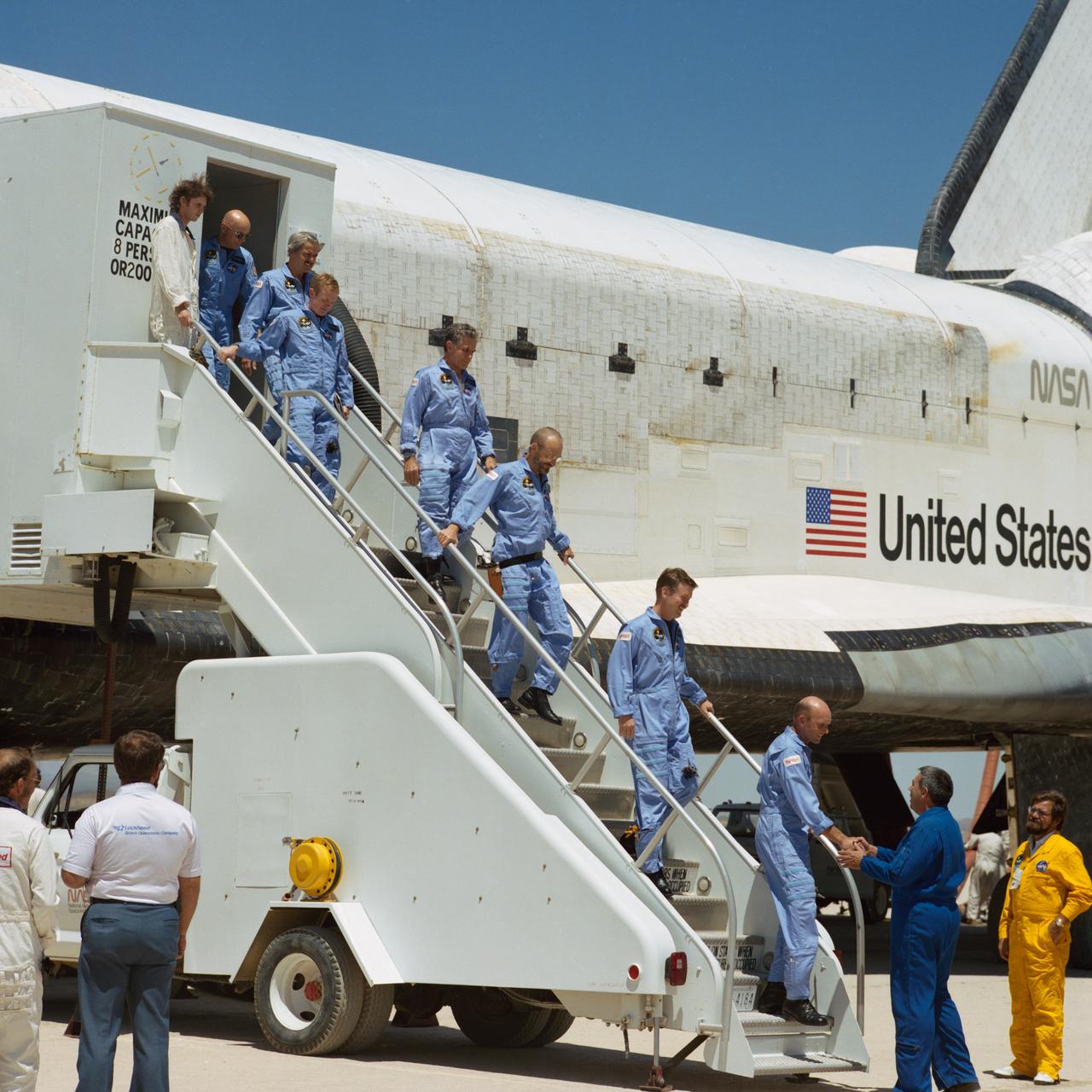
51F-S-162 (6 Aug 1985) ---Mission Operations Director George W.S. Abbey, right, shakes hands with Astronaut C. Gordon Fullerton, as the seven-member 51F crew descends from its "home" for eight days. Other Challenger crewmembers egressing the spacecraft are, left to right, F. Story Musgrave, mission specialist; John-David Bartoe, payload specialist; Roy D. Bridges, Jr., Karl J. Henize, mission specialist; Loren W. Acton, payload specialist; and Anthony W. England, mission specicalist. Fullerton, commander, earlier successfully landed Challenger on a Mojave desert dry lake bed. Three years ago, Fullerton was pilot of STS-3, on which the Columbia's scheduled Edwards landing was moved to New Mexico because of weather and runway conditions here.
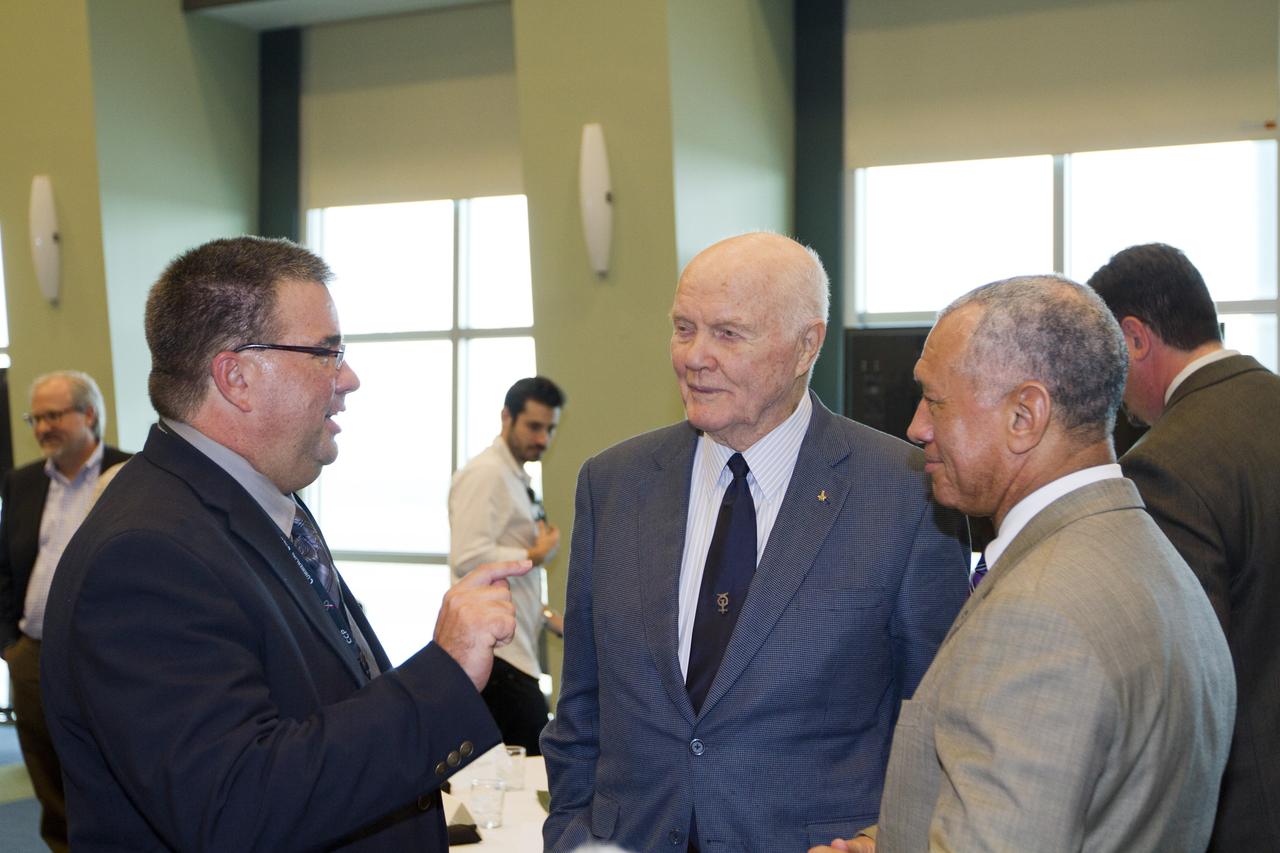
CAPE CANAVERAL, Fla. - Ed Mango, program manager of NASA's Commercial Crew Program, left, talks with astronaut John Glenn, center and NASA Administrator Charles Bolden before a luncheon Feb. 17, 2012, celebrating 50 years of Americans in orbit, an era which began with Glenn's Mercury mission MA-6, on Feb. 20, 1962. Glenn's launch aboard an Atlas rocket took with it the hopes of an entire nation and ushered in a new era of space travel that eventually led to Americans walking on the moon by the end of the 1960s. Glenn soon was followed into orbit by Scott Carpenter, Walter Schirra and Gordon Cooper. Their fellow Mercury astronauts Alan Shepard and Virgil "Gus" Grissom flew earlier suborbital flights. Deke Slayton, a member of NASA's original Mercury 7 astronauts, was grounded by a medical condition until the Apollo-Soyuz Test Project in 1975. Photo credit: NASA/Kim Shiflett
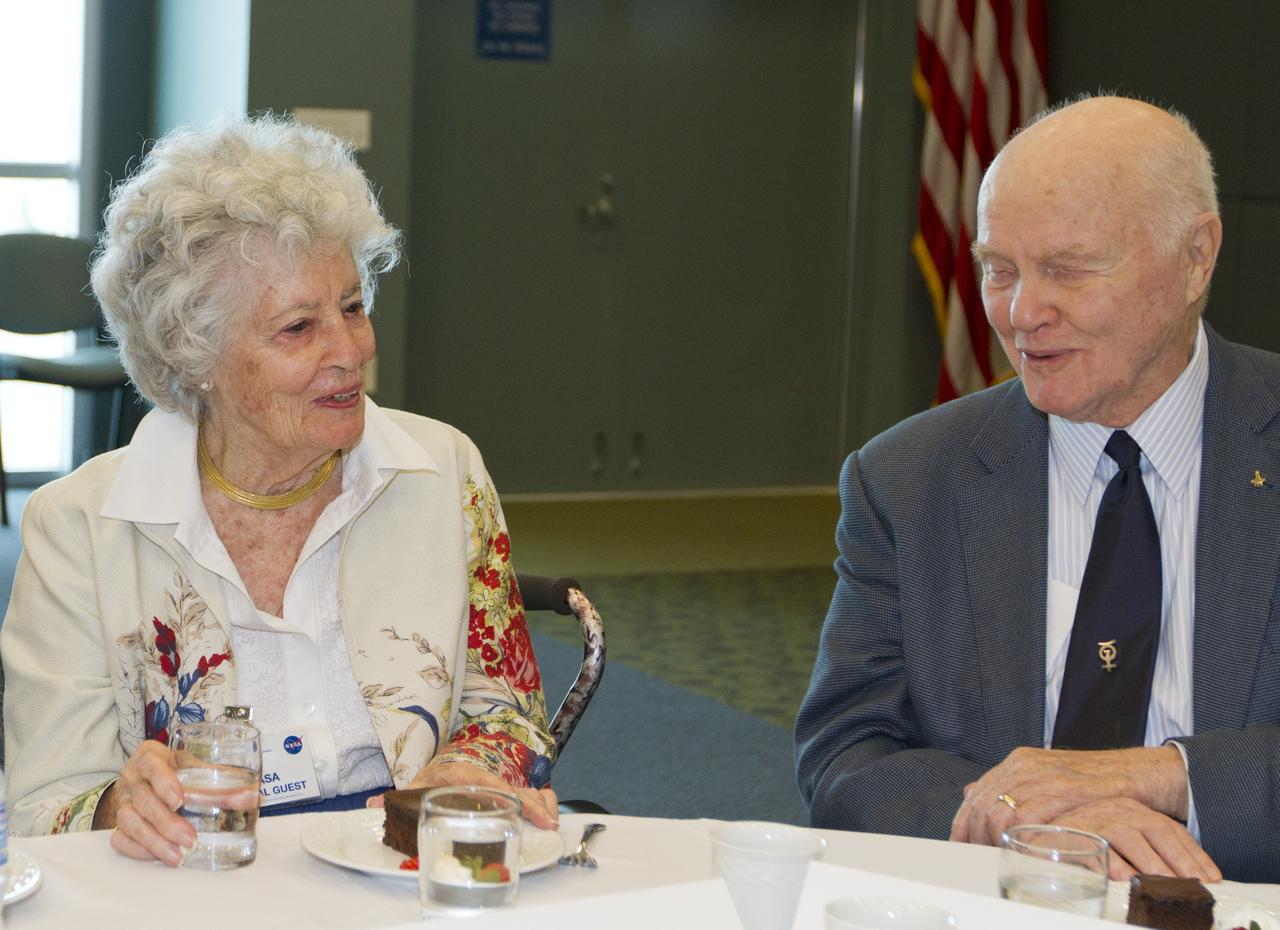
CAPE CANAVERAL, Fla. -Annie Glenn and astronaut John Glenn listen during a luncheon Feb. 17, 2012, celebrating 50 years of Americans in orbit, an era which began with Glenn's Mercury mission MA-6, on Feb. 20, 1962. Glenn's launch aboard an Atlas rocket took with it the hopes of an entire nation and ushered in a new era of space travel that eventually led to Americans walking on the moon by the end of the 1960s. Glenn soon was followed into orbit by Scott Carpenter, Walter Schirra and Gordon Cooper. Their fellow Mercury astronauts Alan Shepard and Virgil "Gus" Grissom flew earlier suborbital flights. Deke Slayton, a member of NASA's original Mercury 7 astronauts, was grounded by a medical condition until the Apollo-Soyuz Test Project in 1975. Photo credit: NASA/Kim Shiflett
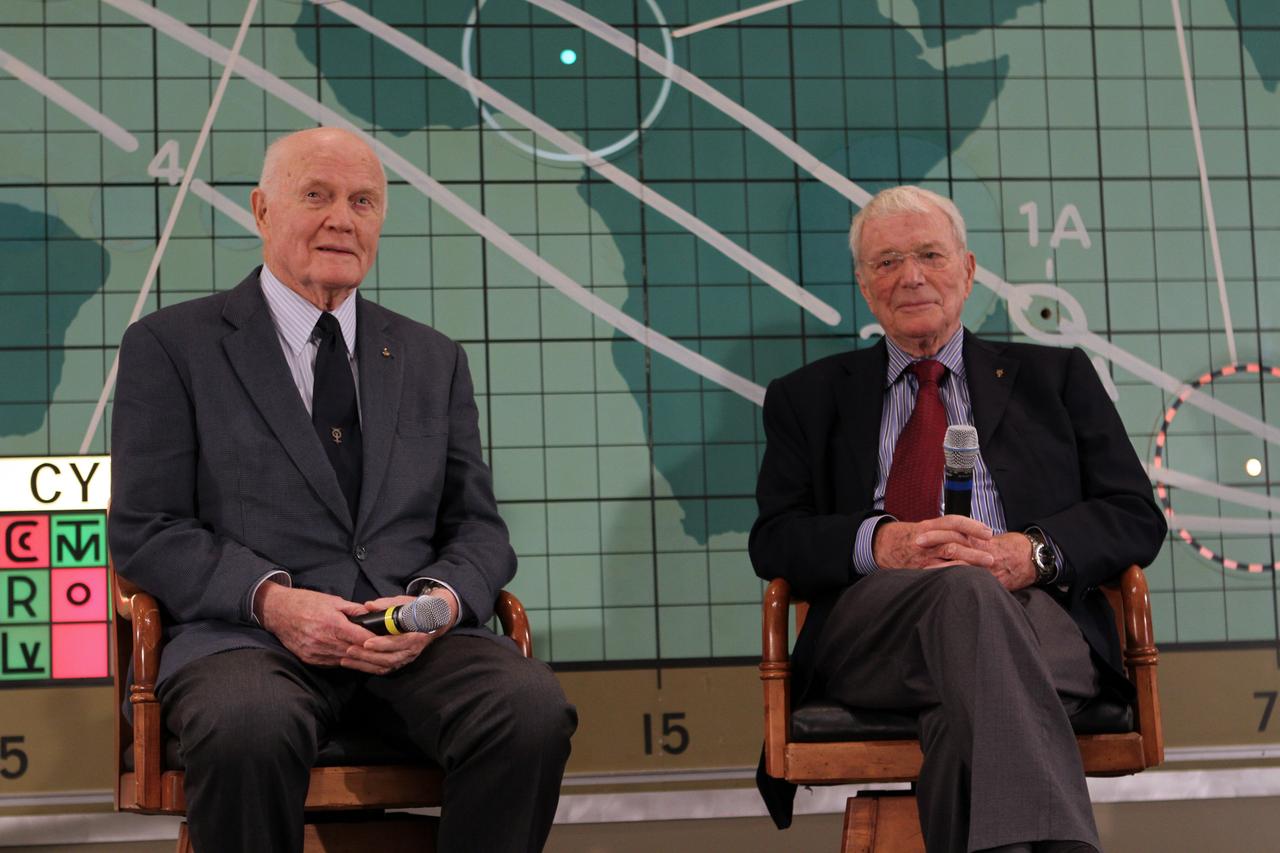
CAPE CANAVERAL, Fla. --Mercury astronauts John Glenn, left, and Scott Carpenter sit in front of the plot board from the Mercury control center on display at the Kennedy Space Center Visitor Complex in Florida. The astronaut, part of the original class of seven astronauts chosen by NASA, was taking part in a question-and-answer session with the media as part of events celebrating 50 years of Americans in orbit, an era which began with John Glenn's Mercury mission MA-6, on Feb. 20, 1962. Glenn's launch aboard an Atlas rocket took with it the hopes of an entire nation and ushered in a new era of space travel that eventually led to Americans walking on the moon by the end of the 1960s. Glenn soon was followed into orbit by Carpenter, Walter Schirra and Gordon Cooper. Their fellow Mercury astronauts Alan Shepard and Virgil "Gus" Grissom flew earlier suborbital flights. Deke Slayton was grounded by a medical condition until the Apollo-Soyuz Test Project in 1975. Photo credit: NASA/Kim Shiflett

CAPE CANAVERAL, Fla. --John Zarella leads a standing ovation during the "On Shoulders of Giants" program celebrating 50 years of Americans in orbit, an era which began with John Glenn's MA-6 mission on Feb. 20, 1962. The event was conducted in the Rocket Garden at the Kennedy Space Center Visitor Complex in Florida a few miles from the launch pad where Glenn and Scott Carpenter took flight in Mercury spacecraft. Glenn's launch aboard an Atlas rocket took with it the hopes of an entire nation and ushered in a new era of space travel that eventually led to Americans walking on the moon by the end of the 1960s. Glenn soon was followed into orbit by Scott Carpenter, Walter Schirra and Gordon Cooper. Their fellow Mercury astronauts Alan Shepard and Virgil "Gus" Grissom flew earlier suborbital flights. Deke Slayton, a member of NASA's original Mercury 7 astronauts, was grounded by a medical condition until the Apollo-Soyuz Test Project in 1975. Photo credit: Kim Shiflett
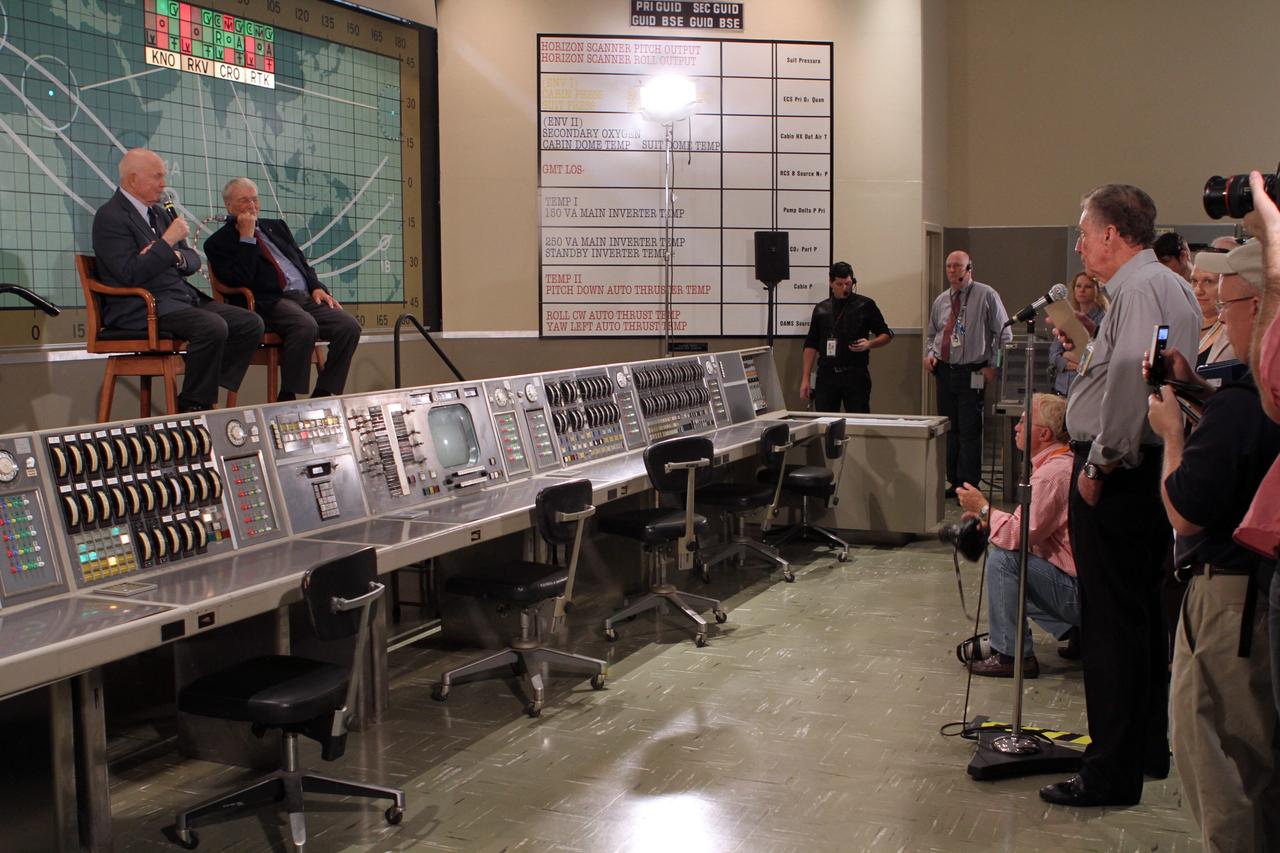
CAPE CANAVERAL, Fla. -- Mercury astronauts John Glenn, left, and Scott Carpenter sit in front of the plot board from the Mercury control center on display at the Kennedy Space Center Visitor Complex. The astronauts, part of the original class of seven astronauts chosen by NASA, were taking part in a question-and-answer session with the media as part of events celebrating 50 years of Americans in orbit, an era which began with John Glenn's Mercury mission MA-6, on Feb. 20, 1962. Glenn's launch aboard an Atlas rocket took with it the hopes of an entire nation and ushered in a new era of space travel that eventually led to Americans walking on the moon by the end of the 1960s. Glenn soon was followed into orbit by Carpenter, Walter Schirra and Gordon Cooper. Their fellow Mercury astronauts Alan Shepard and Virgil "Gus" Grissom flew earlier suborbital flights. Deke Slayton was grounded by a medical condition until the Apollo-Soyuz Test Project in 1975. Photo credit: NASA/Kim Shiflett
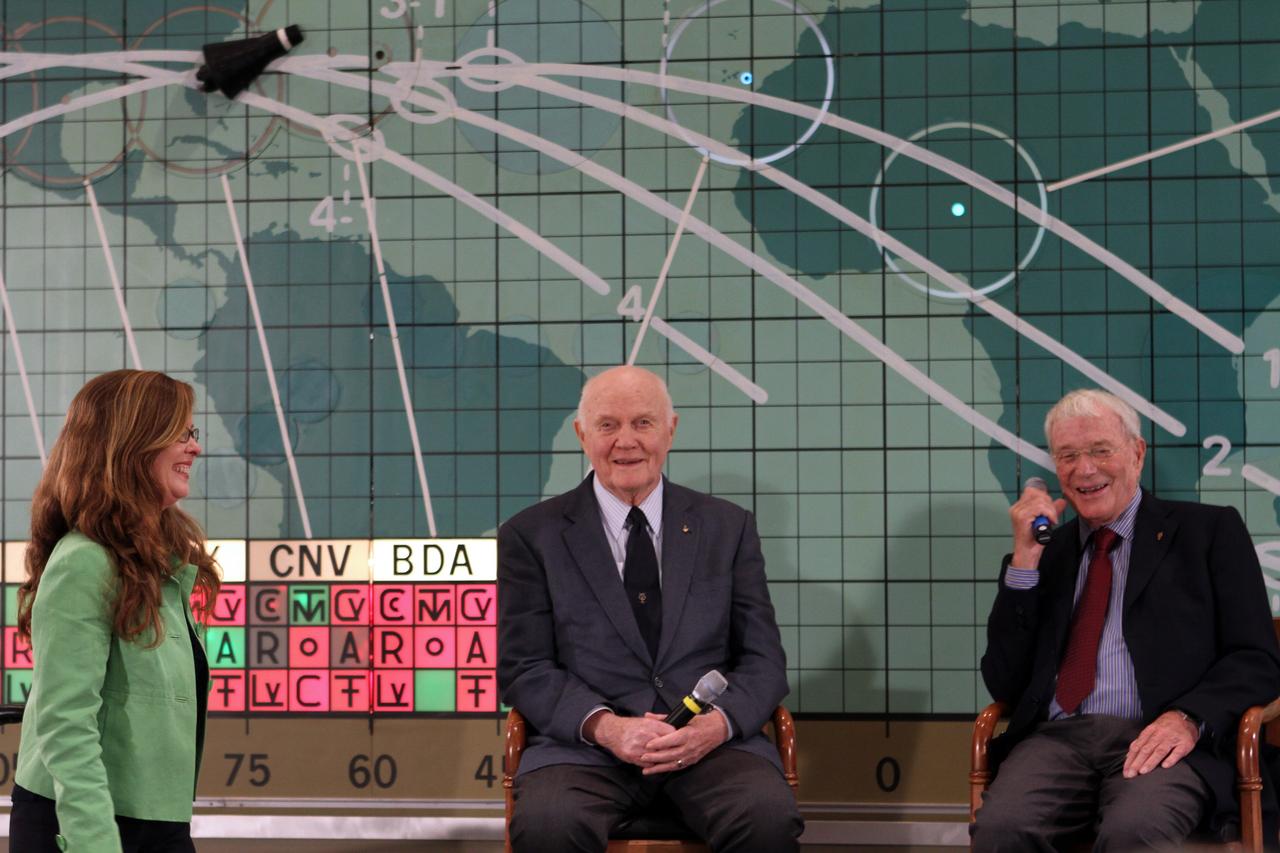
CAPE CANAVERAL, Fla. -- Lisa Malone, left, director of Public Affairs at NASA's Kennedy Space Center in Florida, talks with Mercury astronauts John Glenn, center, and Scott Carpenter in front of the plot board from the Mercury control center on display at the Kennedy Space Center Visitor Complex. The astronauts, part of the original class of seven astronauts chosen by NASA, were taking part in a question-and-answer session with the media as part of events celebrating 50 years of Americans in orbit, an era which began with John Glenn's Mercury mission MA-6, on Feb. 20, 1962. Glenn's launch aboard an Atlas rocket took with it the hopes of an entire nation and ushered in a new era of space travel that eventually led to Americans walking on the moon by the end of the 1960s. Glenn soon was followed into orbit by Carpenter, Walter Schirra and Gordon Cooper. Their fellow Mercury astronauts Alan Shepard and Virgil "Gus" Grissom flew earlier suborbital flights. Deke Slayton was grounded by a medical condition until the Apollo-Soyuz Test Project in 1975. Photo credit: NASA/Kim Shiflett
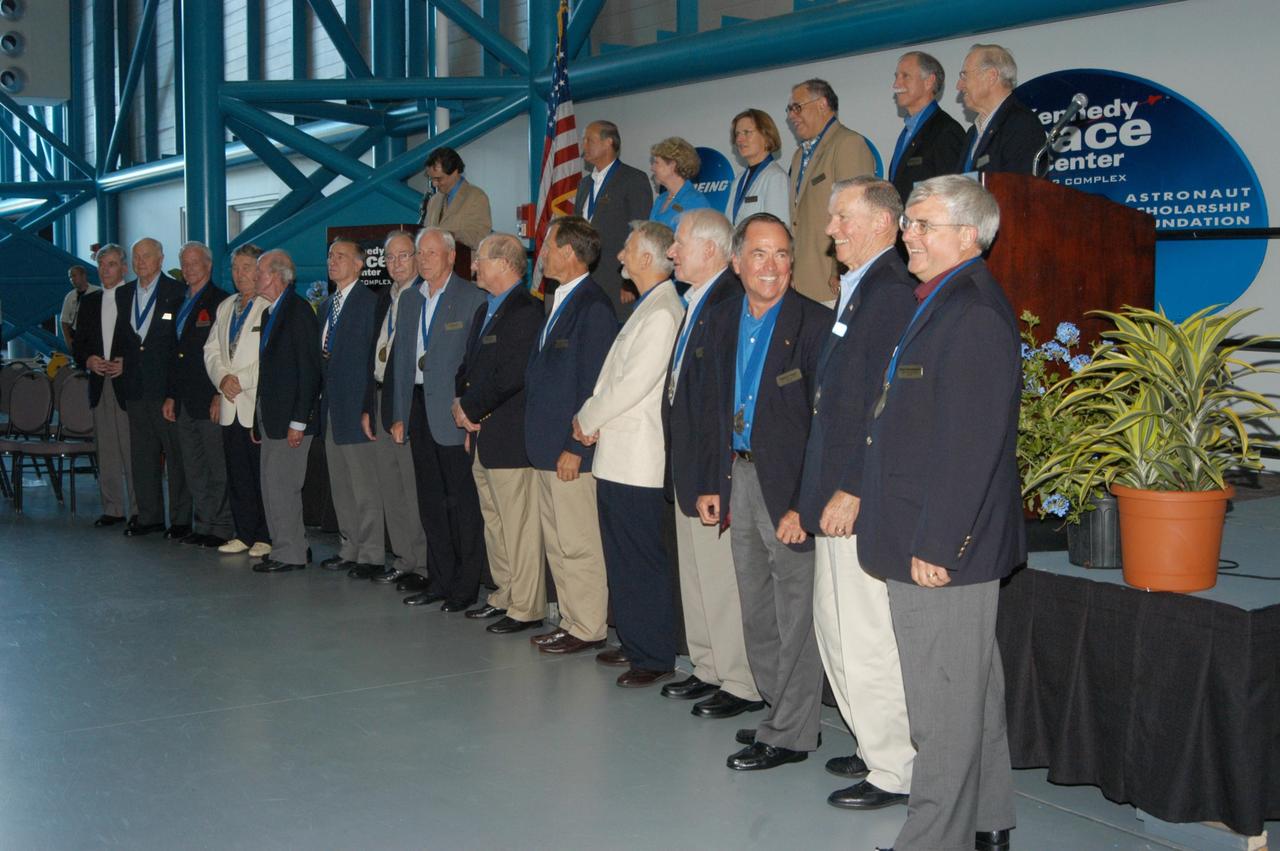
KENNEDY SPACE CENTER, FLA. -- Following the induction ceremony welcoming five new space program heroes in the U.S. Astronaut Hall of Fame, the members line up for a commemorative photo. From left, in front, are John Young, John Glenn Jr., Scott Carpenter, Wally Schirra, Gordon Cooper, Walt Cunningham, Ed Mitchell, Al Worden, Rick Hauck, Ed Gibson, Owen Garriott, Vance Brand, Robert Crippen, Joe Engle, Dan Brandenstein. In back are space author Andrew Chaikin, at the podium; and Norm Thagard, June Scobee representing her late husband Dick Scobee, Kathryn Sullivan, Fred Gregory, Richard Covey and Jim Lovell. The induction ceremony was held at the Apollo/Saturn V Center at KSC. The U.S. Astronaut Hall of Fame opened in 1990 to provide a place where space travelers could be remembered for their participation and accomplishments in the U.S. space program. The five inductees join 52 previously honored astronauts from the ranks of the Gemini, Apollo, Skylab, Apollo-Soyuz, and Space Shuttle programs.
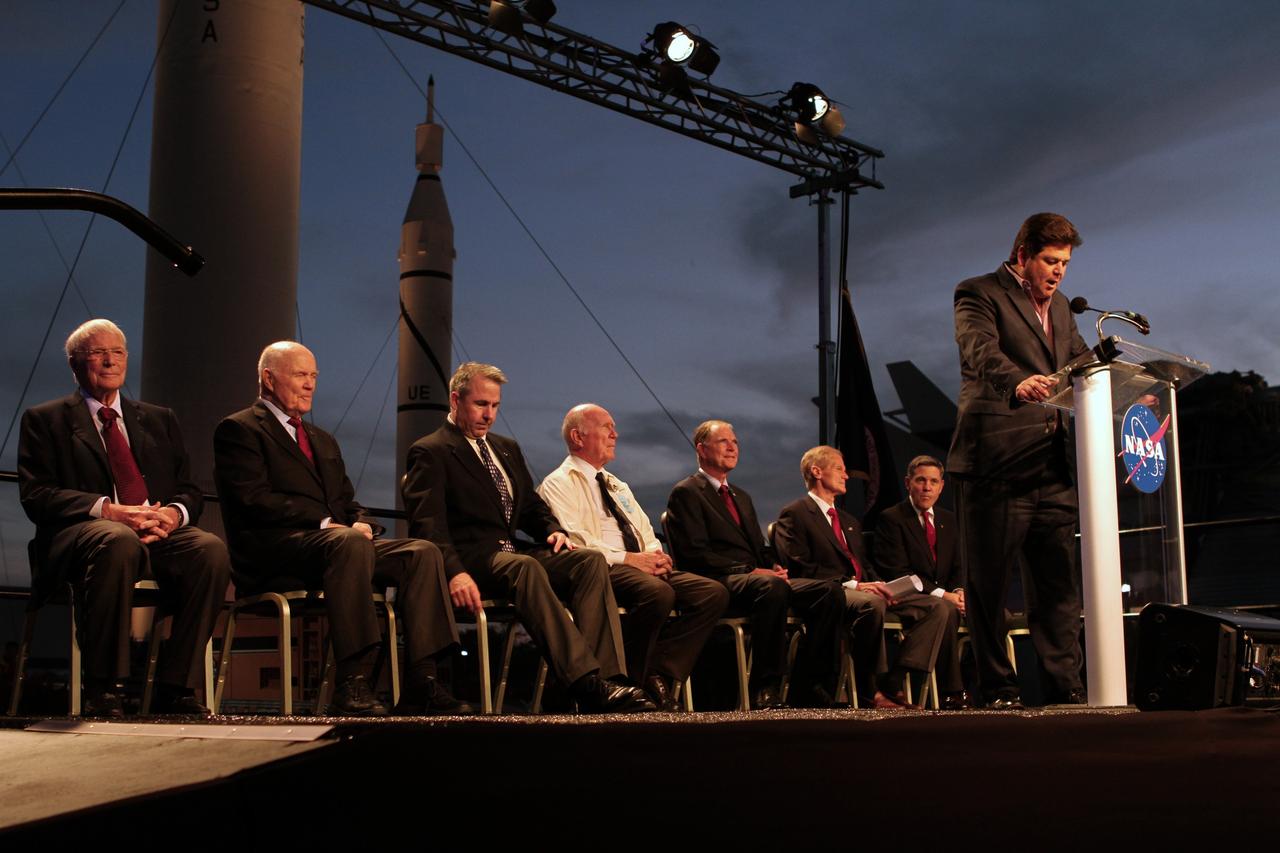
CAPE CANAVERAL, Fla. -- John Zarella makes remarks during the "On Shoulders of Giants" program celebrating 50 years of Americans in orbit, an era which began with John Glenn's MA-6 mission on Feb. 20, 1962. The event was conducted in the Rocket Garden at the Kennedy Space Center Visitor Complex in Florida a few miles from the launch pad where Glenn and Scott Carpenter took flight in Mercury spacecraft. Glenn's launch aboard an Atlas rocket took with it the hopes of an entire nation and ushered in a new era of space travel that eventually led to Americans walking on the moon by the end of the 1960s. Glenn soon was followed into orbit by Scott Carpenter, Walter Schirra and Gordon Cooper. Their fellow Mercury astronauts Alan Shepard and Virgil "Gus" Grissom flew earlier suborbital flights. Deke Slayton, a member of NASA's original Mercury 7 astronauts, was grounded by a medical condition until the Apollo-Soyuz Test Project in 1975. Photo credit: Kim Shiflett
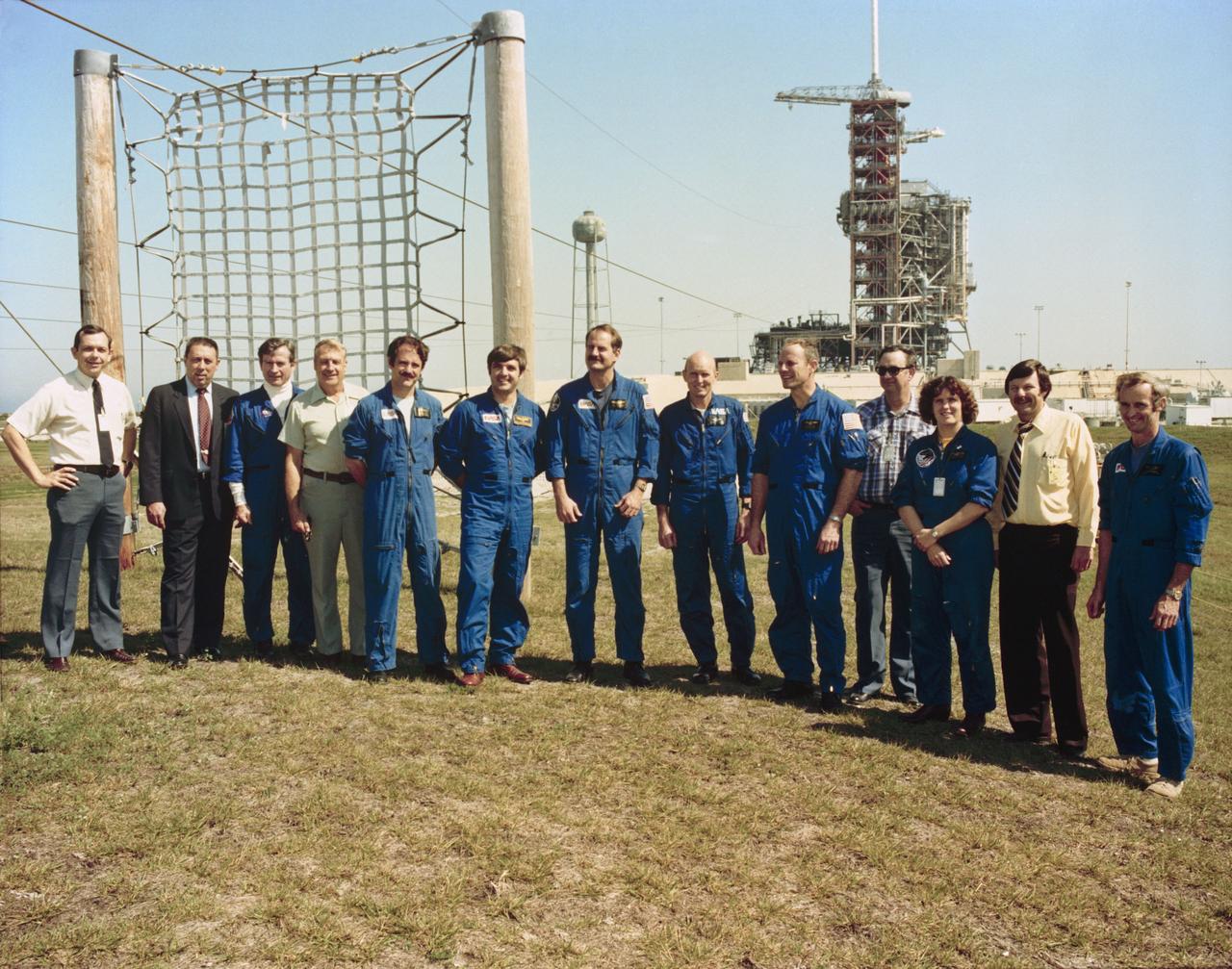
S82-28457 (19 Feb. 1982) --- Member of the JSC astronaut corps., STS-3 vehicle integration test (VIT) team and other personnel pose for a photograph at the completion of a countdown demonstration test (CDDT) and safety briefings at Launch Pad 39A, Kennedy Space Center (KSC). Participants are, from the left, Wilbur J. Etbauer, engineer with the VIT team; George W. S. Abbey, director of flight operations at JSC; astronaut John W. Young, chief of the astronaut office at JSC; Jack Fleming of Rockwell International; mission specialist-astronaut John M. Lounge; astronaut Daniel C. Brandenstein; mission specialist-astronaut James D. Van Hoften; astronauts C. Gordon Fullerton and Jack Lousma, prime crew for STS-3; Olan J. Bertrand, VIT team member; mission specialist-astronaut Kathryn D. Sullivan; Richard W. Nygren, head of the VIT team; and astronaut Donald E. Williams. The space shuttle Columbia is obscured by its service structure on Launch Pad 39A in the background. Part of slide-wire type emergency escape system is visible in the picture. Photo credit: NASA
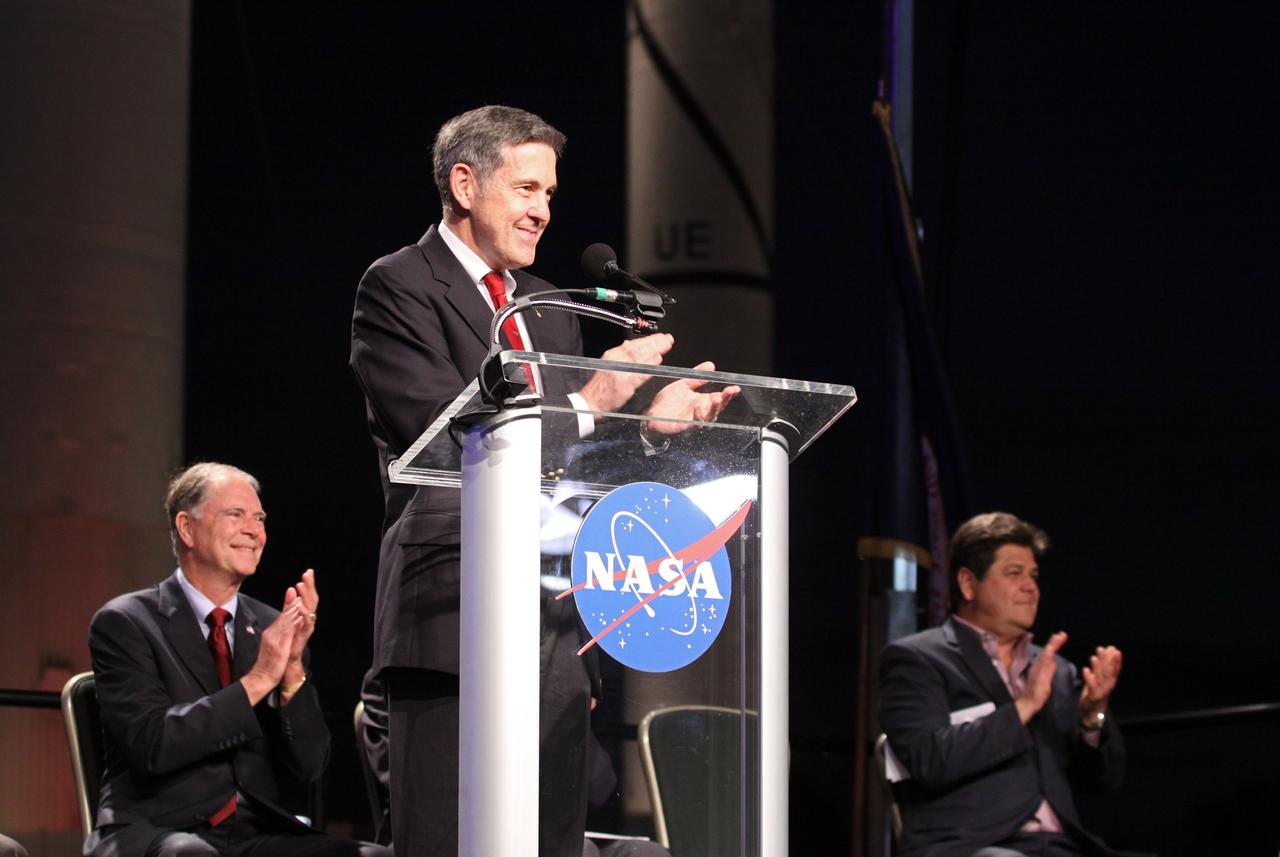
CAPE CANAVERAL, Fla. --Kennedy Space Center Director Bob Cabana makes remarks during the "On Shoulders of Giants" program celebrating 50 years of Americans in orbit, an era which began with John Glenn's MA-6 mission on Feb. 20, 1962. Looking on are U.S. Rep. Bill Posey, left, and event MC John Zarella. The event was conducted in the Rocket Garden at the Kennedy Space Center Visitor Complex in Florida a few miles from the launch pad where Glenn and Scott Carpenter took flight in Mercury spacecraft. Glenn's launch aboard an Atlas rocket took with it the hopes of an entire nation and ushered in a new era of space travel that eventually led to Americans walking on the moon by the end of the 1960s. Glenn soon was followed into orbit by Scott Carpenter, Walter Schirra and Gordon Cooper. Their fellow Mercury astronauts Alan Shepard and Virgil "Gus" Grissom flew earlier suborbital flights. Deke Slayton, a member of NASA's original Mercury 7 astronauts, was grounded by a medical condition until the Apollo-Soyuz Test Project in 1975. Photo credit: Kim Shiflett
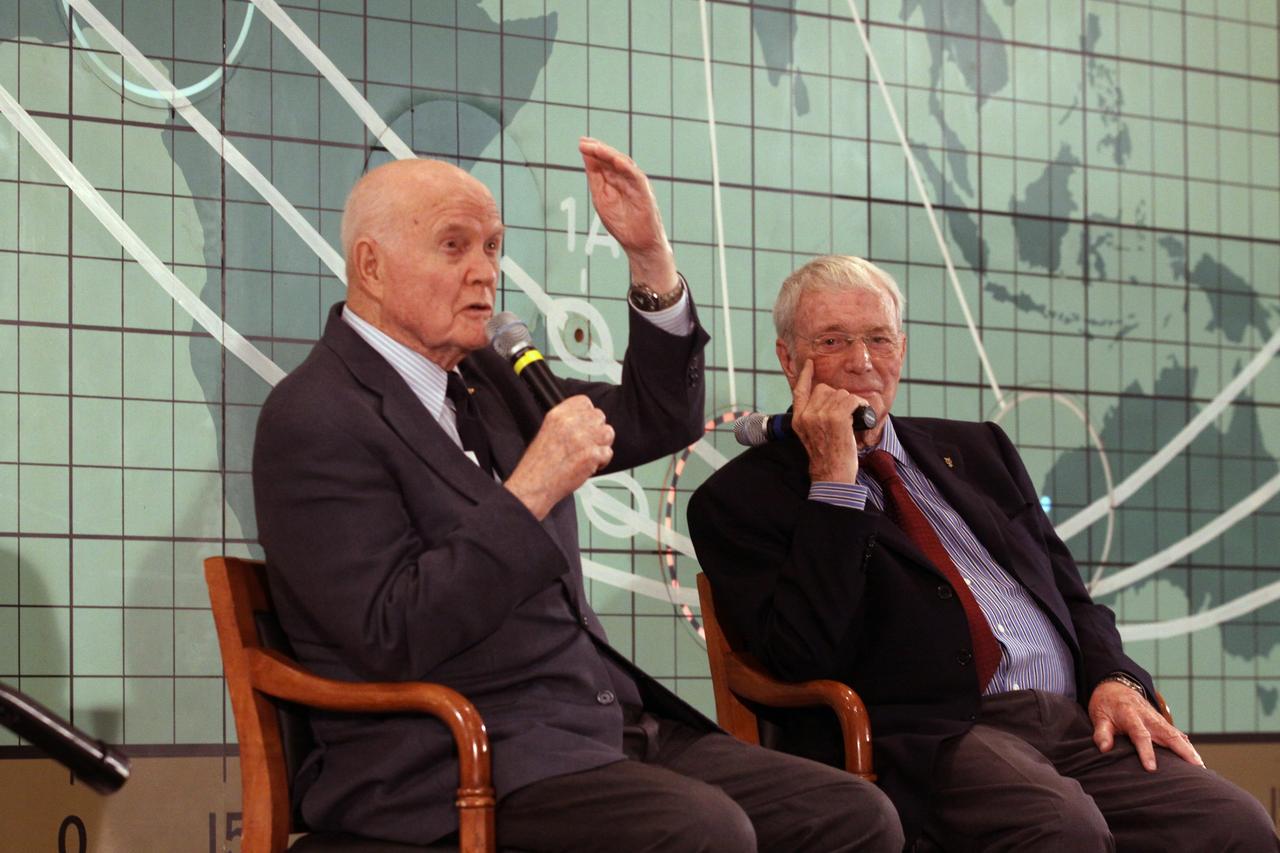
CAPE CANAVERAL, Fla. --Mercury astronauts John Glenn, left, and Scott Carpenter sit in front of the plot board from the Mercury control center on display at the Kennedy Space Center Visitor Complex. The astronauts, part of the original class of seven astronauts chosen by NASA, were taking part in a question-and-answer session with the media as part of events celebrating 50 years of Americans in orbit, an era which began with John Glenn's Mercury mission MA-6, on Feb. 20, 1962. Glenn's launch aboard an Atlas rocket took with it the hopes of an entire nation and ushered in a new era of space travel that eventually led to Americans walking on the moon by the end of the 1960s. Glenn soon was followed into orbit by Carpenter, Walter Schirra and Gordon Cooper. Their fellow Mercury astronauts Alan Shepard and Virgil "Gus" Grissom flew earlier suborbital flights. Deke Slayton was grounded by a medical condition until the Apollo-Soyuz Test Project in 1975. Photo credit: NASA/Kim Shiflett
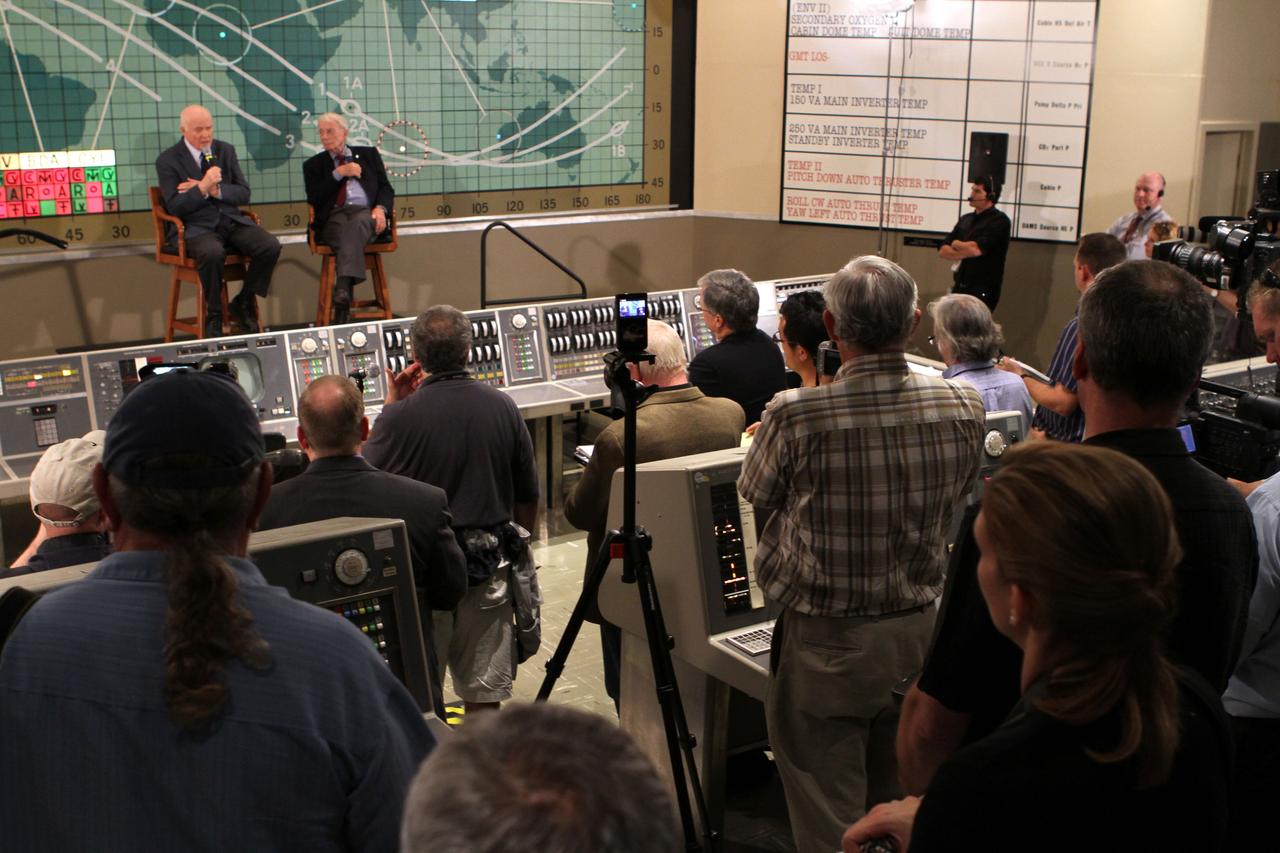
CAPE CANAVERAL, Fla. -- Mercury astronauts John Glenn, left, and Scott Carpenter sit in front of the plot board from the Mercury control center on display at the Kennedy Space Center Visitor Complex. The astronauts, part of the original class of seven astronauts chosen by NASA, were taking part in a question-and-answer session with the media as part of events celebrating 50 years of Americans in orbit, an era which began with John Glenn's Mercury mission MA-6, on Feb. 20, 1962. Glenn's launch aboard an Atlas rocket took with it the hopes of an entire nation and ushered in a new era of space travel that eventually led to Americans walking on the moon by the end of the 1960s. Glenn soon was followed into orbit by Carpenter, Walter Schirra and Gordon Cooper. Their fellow Mercury astronauts Alan Shepard and Virgil "Gus" Grissom flew earlier suborbital flights. Deke Slayton was grounded by a medical condition until the Apollo-Soyuz Test Project in 1975. Photo credit: NASA/Kim Shiflett
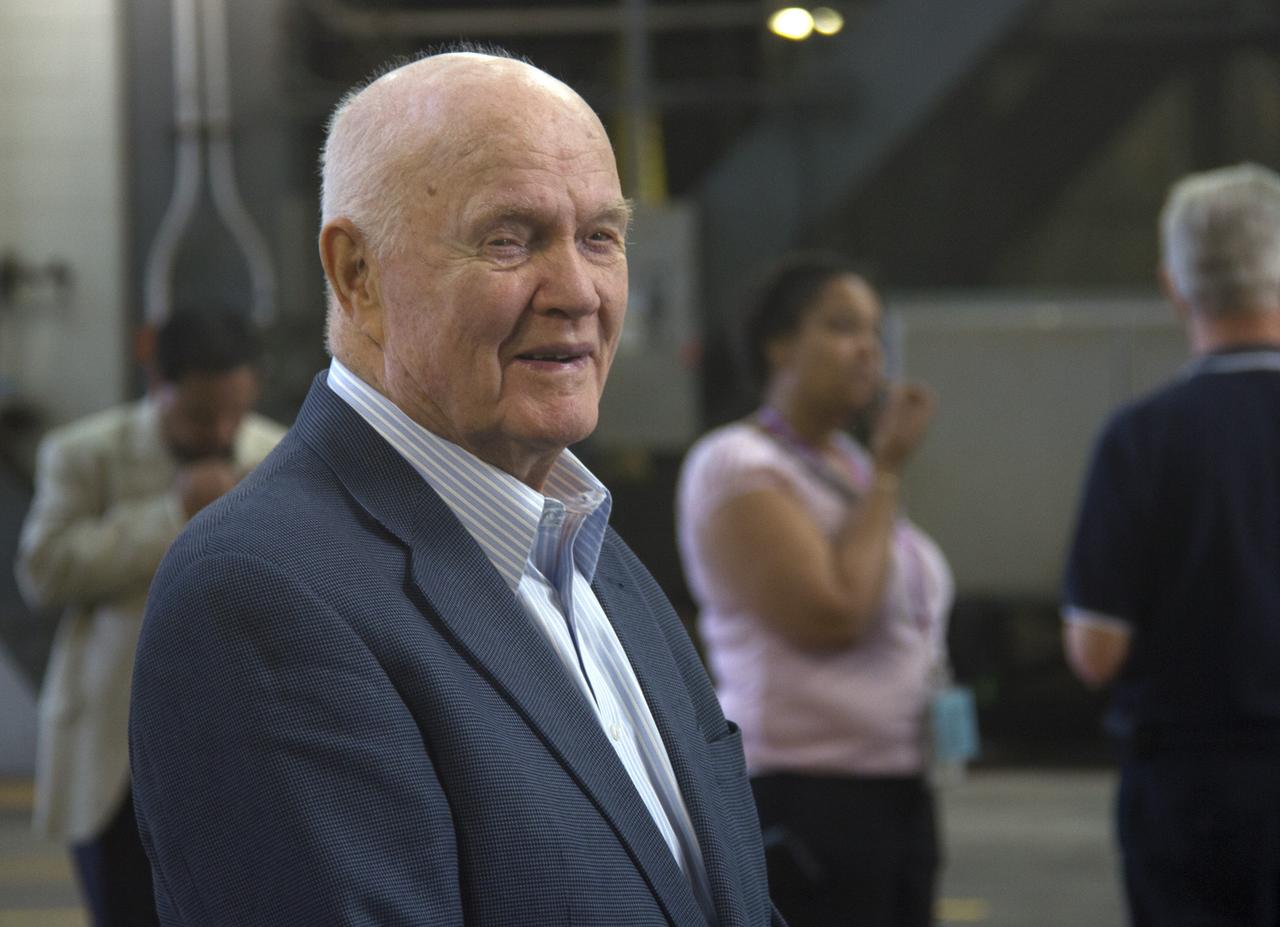
CAPE CANAVERAL, Fla. -- John Glenn tours the Vehicle Assembly Building at NASA's Kennedy Space Center in Florida. Glenn is at the space center to mark the 50th anniversary of being the first American astronaut to orbit the Earth inside the NASA Mercury Project's Friendship 7 capsule on Feb. 20, 1962. Glenn later returned to space in October 1998 as a payload specialist aboard space shuttle Discovery's STS-95 mission. Glenn's launch aboard an Atlas rocket took with it the hopes of an entire nation and ushered in a new era of space travel that eventually led to Americans walking on the moon by the end of the 1960s. Glenn soon was followed into orbit by Scott Carpenter, Walter Schirra and Gordon Cooper. Their fellow Mercury astronauts Alan Shepard and Virgil "Gus" Grissom flew earlier suborbital flights. Deke Slayton, a member of NASA's original Mercury 7 astronauts, was grounded by a medical condition until the Apollo-Soyuz Test Project in 1975. Photo credit: Cory Huston
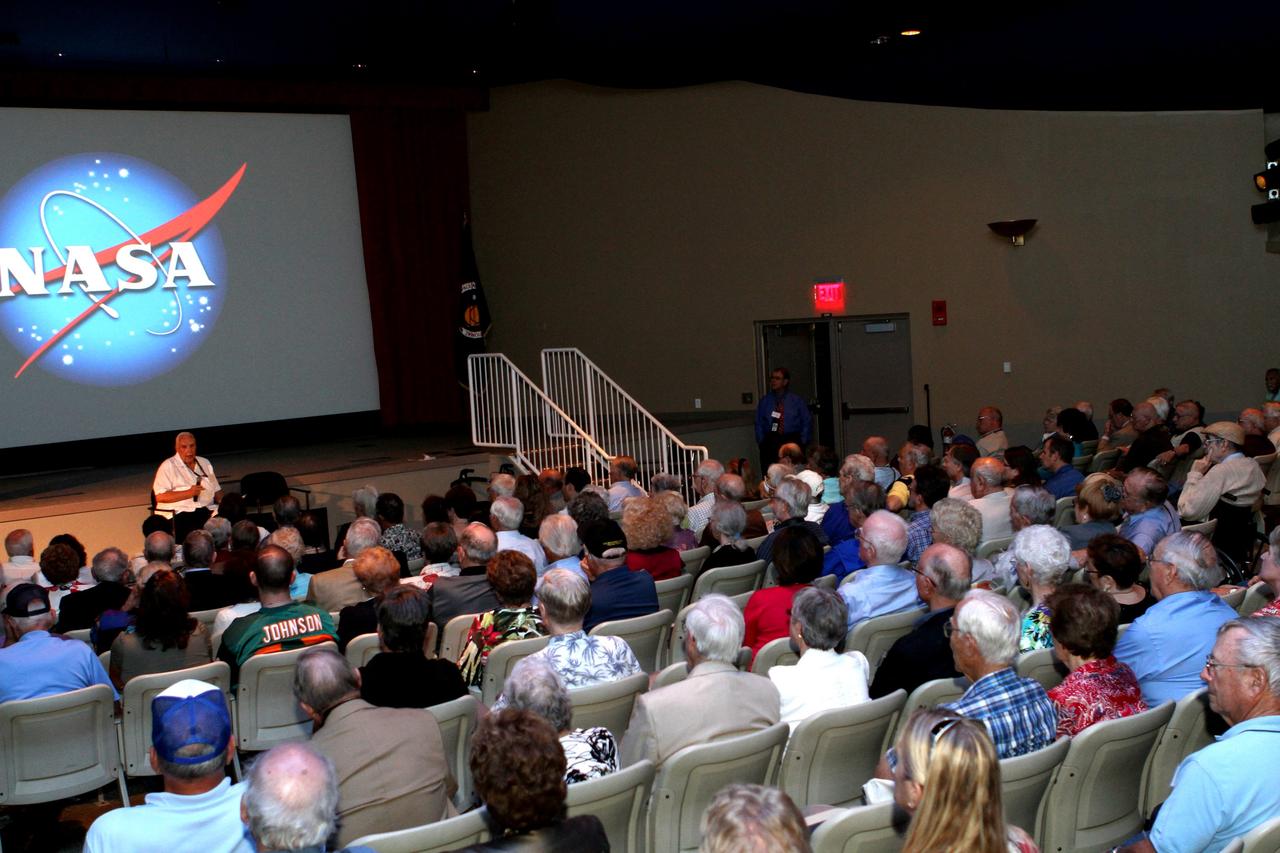
CAPE CANAVERAL, Fla. -- Hugh Harris, the former director of Public Affairs at NASA's Kennedy Space Center in Florida, talks to Mercury Project workers and other guests in the Astronaut Encounter Theater at the Kennedy Space Center Visitor Complex in Florida. Harris is helping Mercury astronauts, John Glenn and Scott Carpenter, mark the 50th anniversary of Glenn being the first American to orbit the Earth inside the NASA Mercury Project's Friendship 7 capsule on Feb. 20, 1962. Glenn's launch aboard an Atlas rocket took with it the hopes of an entire nation and ushered in a new era of space travel that eventually led to Americans walking on the moon by the end of the 1960s. Glenn soon was followed into orbit by Carpenter, Walter Schirra and Gordon Cooper. Their fellow Mercury astronauts Alan Shepard and Virgil "Gus" Grissom flew earlier suborbital flights. Deke Slayton, a member of NASA's original Mercury 7 astronauts, was grounded by a medical condition until the Apollo-Soyuz Test Project in 1975. Photo credit: Kim Shiflett
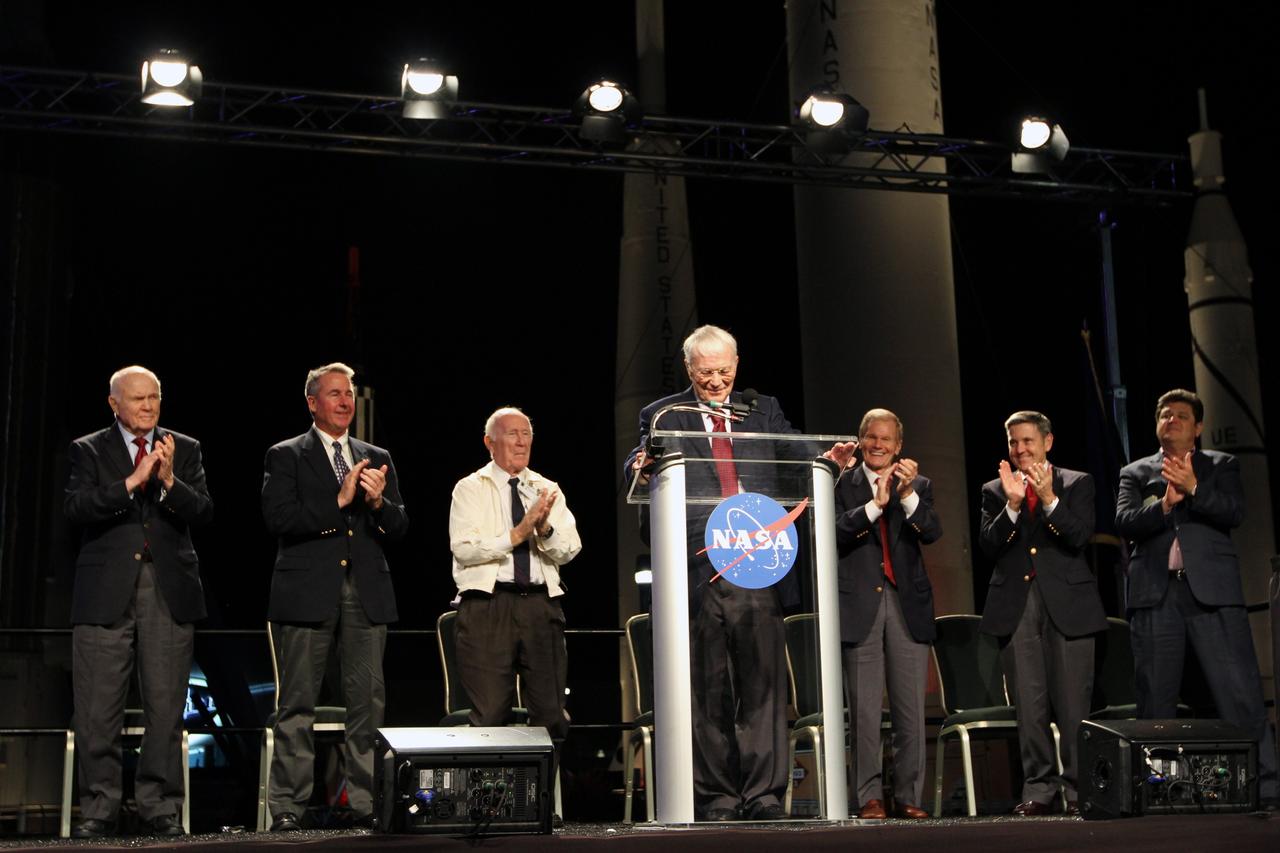
CAPE CANAVERAL, Fla. --Mercury astronaut Scott Carpenter speaks during the "On Shoulders of Giants" program celebrating 50 years of Americans in orbit, an era which began with John Glenn's MA-6 mission on Feb. 20, 1962. The event was conducted in the Rocket Garden at the Kennedy Space Center Visitor Complex in Florida a few miles from the launch pad where Glenn and Scott Carpenter took flight in Mercury spacecraft. Glenn's launch aboard an Atlas rocket took with it the hopes of an entire nation and ushered in a new era of space travel that eventually led to Americans walking on the moon by the end of the 1960s. Glenn soon was followed into orbit by Scott Carpenter, Walter Schirra and Gordon Cooper. Their fellow Mercury astronauts Alan Shepard and Virgil "Gus" Grissom flew earlier suborbital flights. Deke Slayton, a member of NASA's original Mercury 7 astronauts, was grounded by a medical condition until the Apollo-Soyuz Test Project in 1975. Photo credit: Kim Shiflett
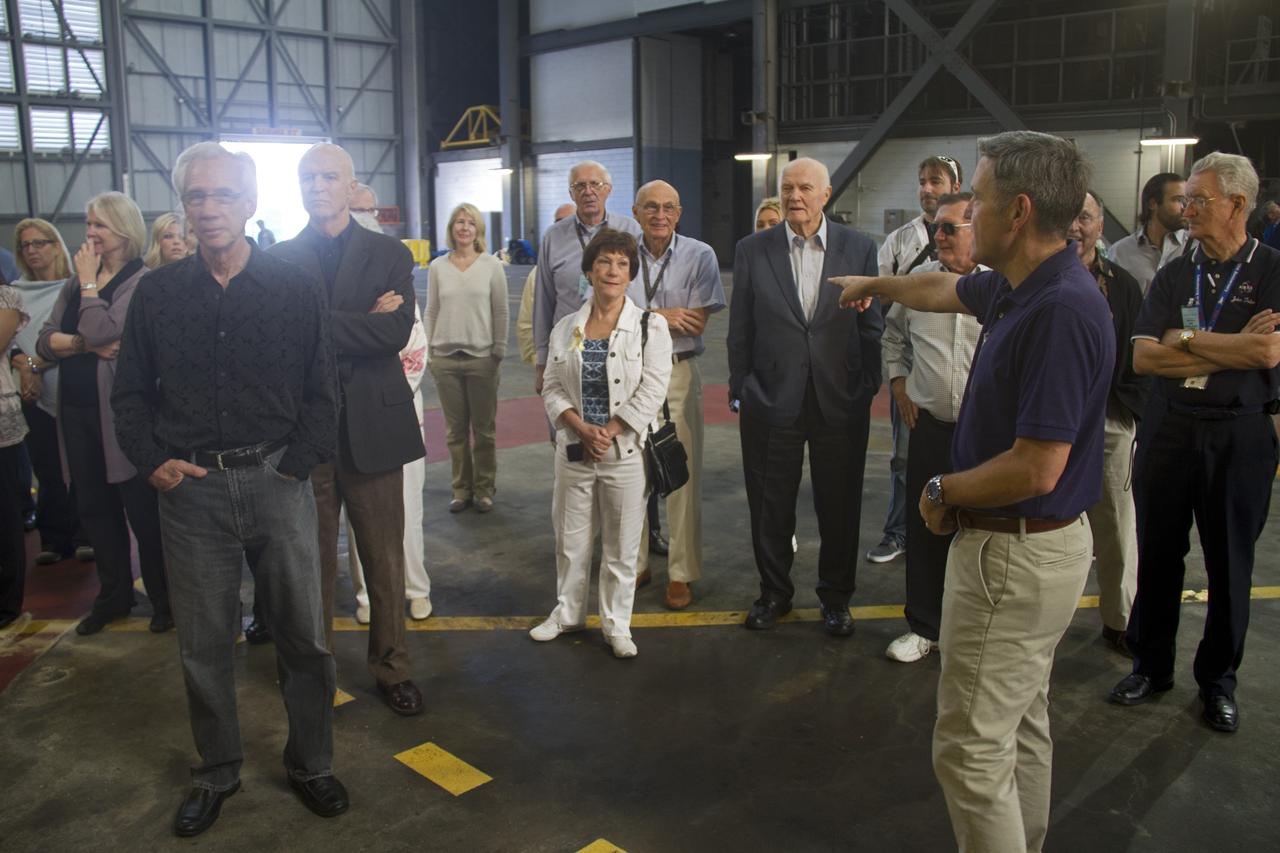
CAPE CANAVERAL, Fla. -- NASA Kennedy Space Center Bob Cabana talks to guests about the Mercury Project's Atlas rocket in the Vehicle Assembly Building. At the space center in Florida, Cabana is helping John Glenn mark the 50th anniversary of being the first American astronaut to orbit the Earth inside the NASA Mercury Project's Friendship 7 capsule on Feb. 20, 1962. Glenn later returned to space in October 1998 as a payload specialist aboard space shuttle Discovery's STS-95 mission. Glenn's launch aboard an Atlas rocket took with it the hopes of an entire nation and ushered in a new era of space travel that eventually led to Americans walking on the moon by the end of the 1960s. Glenn soon was followed into orbit by Scott Carpenter, Walter Schirra and Gordon Cooper. Their fellow Mercury astronauts Alan Shepard and Virgil "Gus" Grissom flew earlier suborbital flights. Deke Slayton, a member of NASA's original Mercury 7 astronauts, was grounded by a medical condition until the Apollo-Soyuz Test Project in 1975. Photo credit: Cory Huston
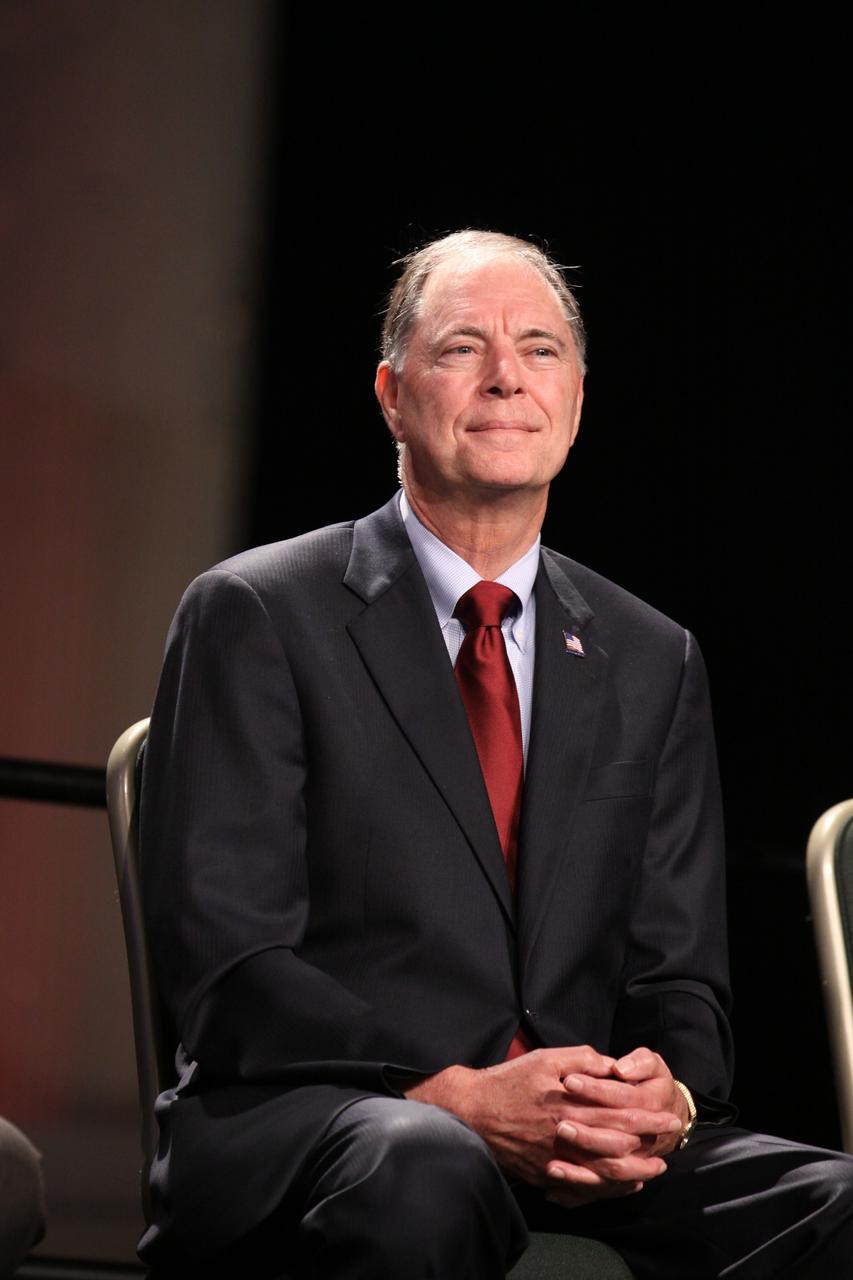
CAPE CANAVERAL, Fla. -- U.S. Rep. Bill Posey listens to remarks during the "On Shoulders of Giants" program celebrating 50 years of Americans in orbit, an era which began with John Glenn's MA-6 mission on Feb. 20, 1962. The event was conducted in the Rocket Garden at the Kennedy Space Center Visitor Complex in Florida a few miles from the launch pad where Glenn and Scott Carpenter took flight in Mercury spacecraft. Glenn's launch aboard an Atlas rocket took with it the hopes of an entire nation and ushered in a new era of space travel that eventually led to Americans walking on the moon by the end of the 1960s. Glenn soon was followed into orbit by Carpenter, Walter Schirra and Gordon Cooper. Their fellow Mercury astronauts Alan Shepard and Virgil "Gus" Grissom flew earlier suborbital flights. Deke Slayton, a member of NASA's original Mercury 7 astronauts, was grounded by a medical condition until the Apollo-Soyuz Test Project in 1975. Photo credit: Kim Shiflett
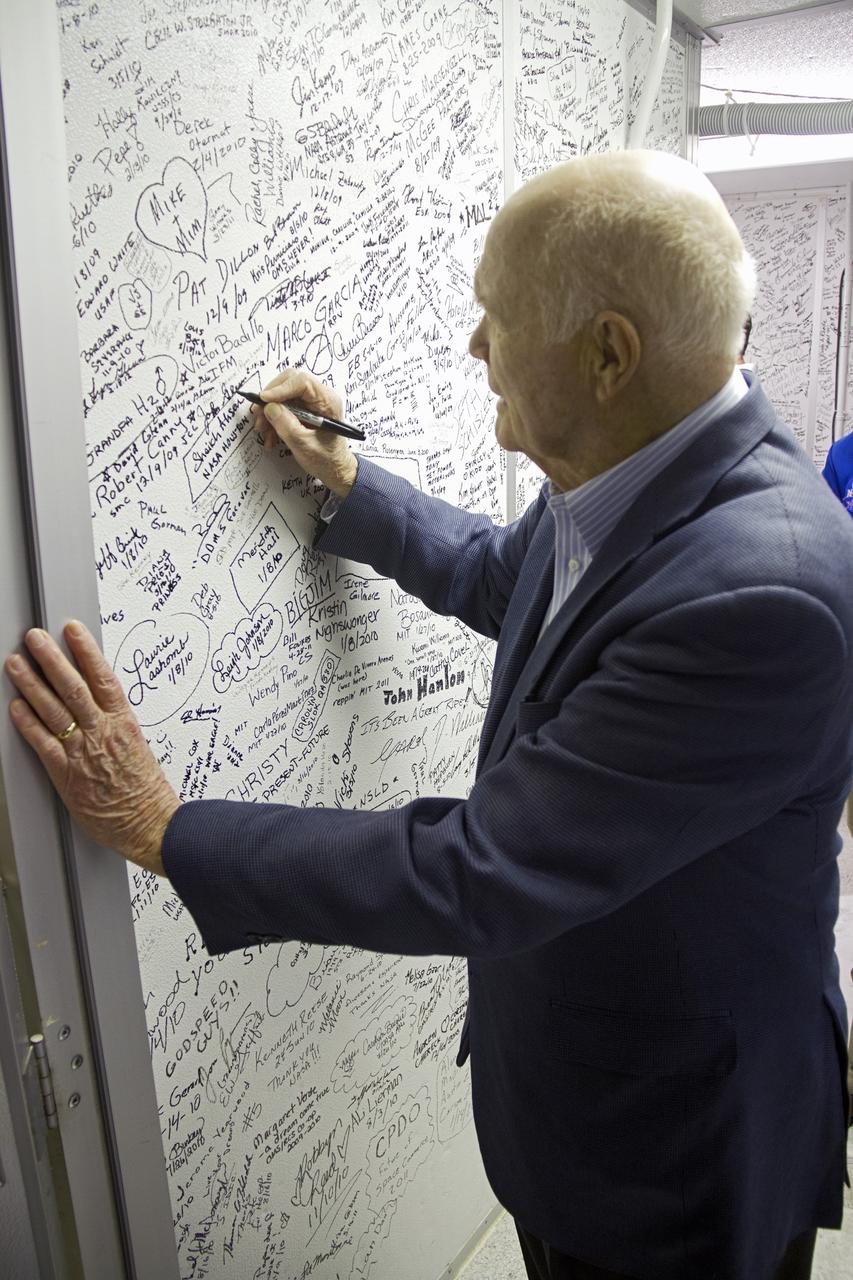
CAPE CANAVERAL, Fla. -- John Glenn signs the wall of the clean room leading into space shuttle Discovery in Orbiter Processing Facility-1 OPF-1 at NASA's Kennedy Space Center in Florida. Glenn is at the space center to mark the 50th anniversary of being the first American astronaut to orbit the Earth inside the NASA Mercury Project's Friendship 7 capsule on Feb. 20, 1962. Glenn later returned to space in October 1998 as a payload specialist aboard Discovery's STS-95 mission. Glenn's launch aboard an Atlas rocket took with it the hopes of an entire nation and ushered in a new era of space travel that eventually led to Americans walking on the moon by the end of the 1960s. Glenn soon was followed into orbit by Scott Carpenter, Walter Schirra and Gordon Cooper. Their fellow Mercury astronauts Alan Shepard and Virgil "Gus" Grissom flew earlier suborbital flights. Deke Slayton, a member of NASA's original Mercury 7 astronauts, was grounded by a medical condition until the Apollo-Soyuz Test Project in 1975. Shuttle Discovery currently is being prepared for display at Smithsonian’s National Air and Space Museum, Steven F. Udvar-Hazy Center in Chantilly, Va. Photo credit: Cory Huston
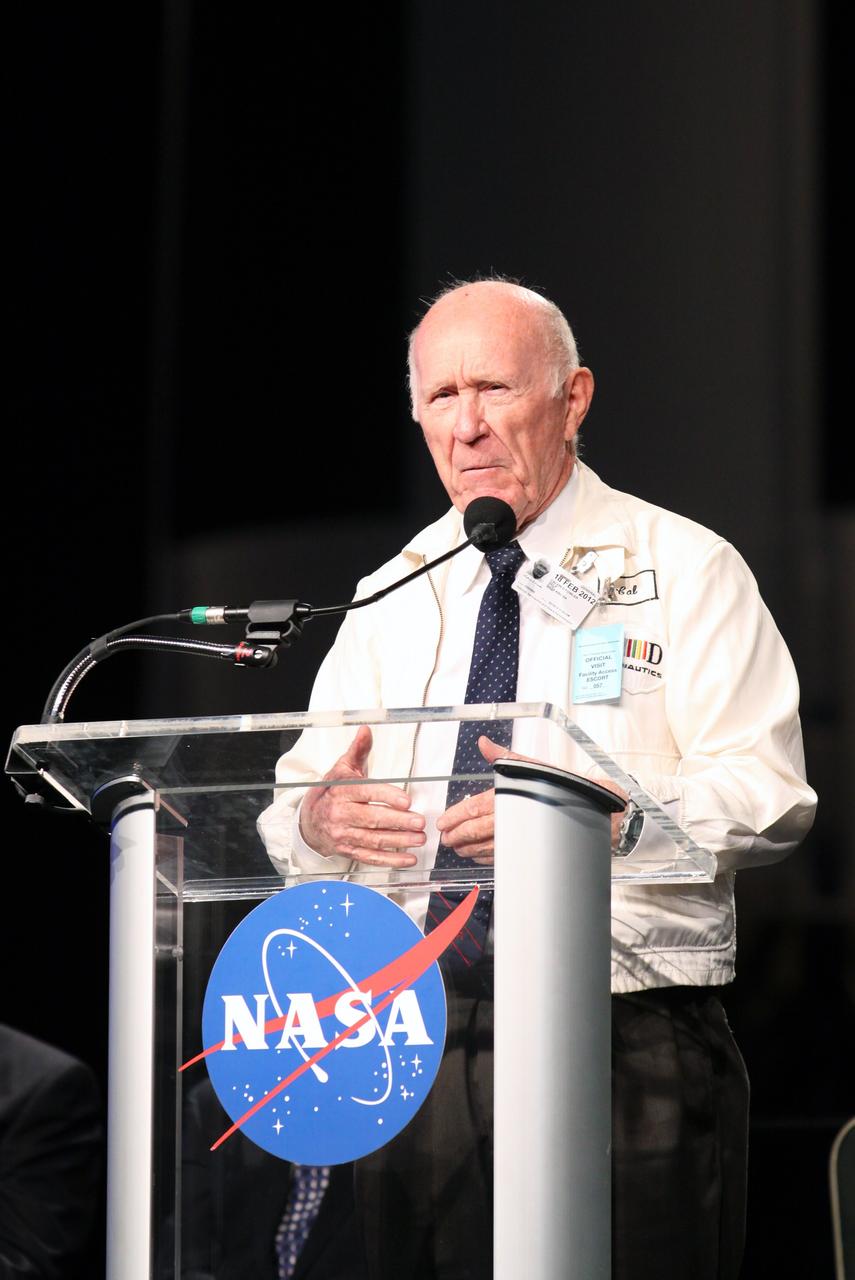
CAPE CANAVERAL, Fla. -- Cal Fowler, Launch test director during Mercury, speaks during the "On Shoulders of Giants" program celebrating 50 years of Americans in orbit, an era which began with John Glenn's MA-6 mission on Feb. 20, 1962. The event was conducted in the Rocket Garden at the Kennedy Space Center Visitor Complex in Florida a few miles from the launch pad where Glenn and Scott Carpenter took flight in Mercury spacecraft. Glenn's launch aboard an Atlas rocket took with it the hopes of an entire nation and ushered in a new era of space travel that eventually led to Americans walking on the moon by the end of the 1960s. Glenn soon was followed into orbit by Carpenter, Walter Schirra and Gordon Cooper. Their fellow Mercury astronauts Alan Shepard and Virgil "Gus" Grissom flew earlier suborbital flights. Deke Slayton, a member of NASA's original Mercury 7 astronauts, was grounded by a medical condition until the Apollo-Soyuz Test Project in 1975. Photo credit: Kim Shiflett