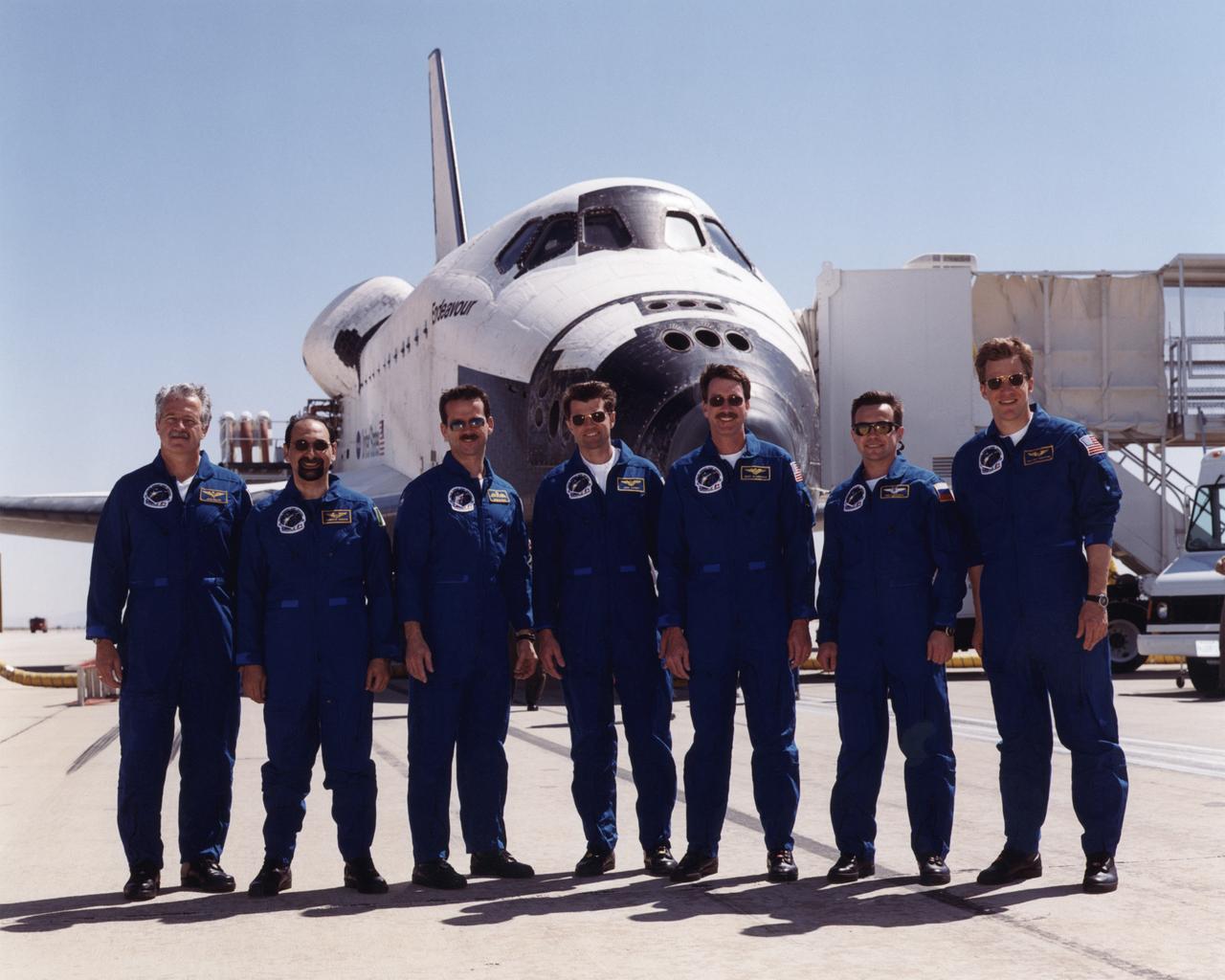
The crew of Space Shuttle mission STS-100 gathered in front of the shuttle Endeavour following landing at Edwards Air Force Base, California, 9:11 am, May 1, 2001. From left to right: John L. Phillips, mission specialist (U.S.); Umberto Guidoni, mission specialist (European Space Agency); Chris A. Hadfield, mission specialist (Canadian Space Agency); Jeffrey S. Ashby, pilot (U.S.); Kent V. Rominger, commander (U.S.); Yuri V. Lonchakov, mission specialist (Russia); Scott E. Prazynski, mission specialist (U.S.).
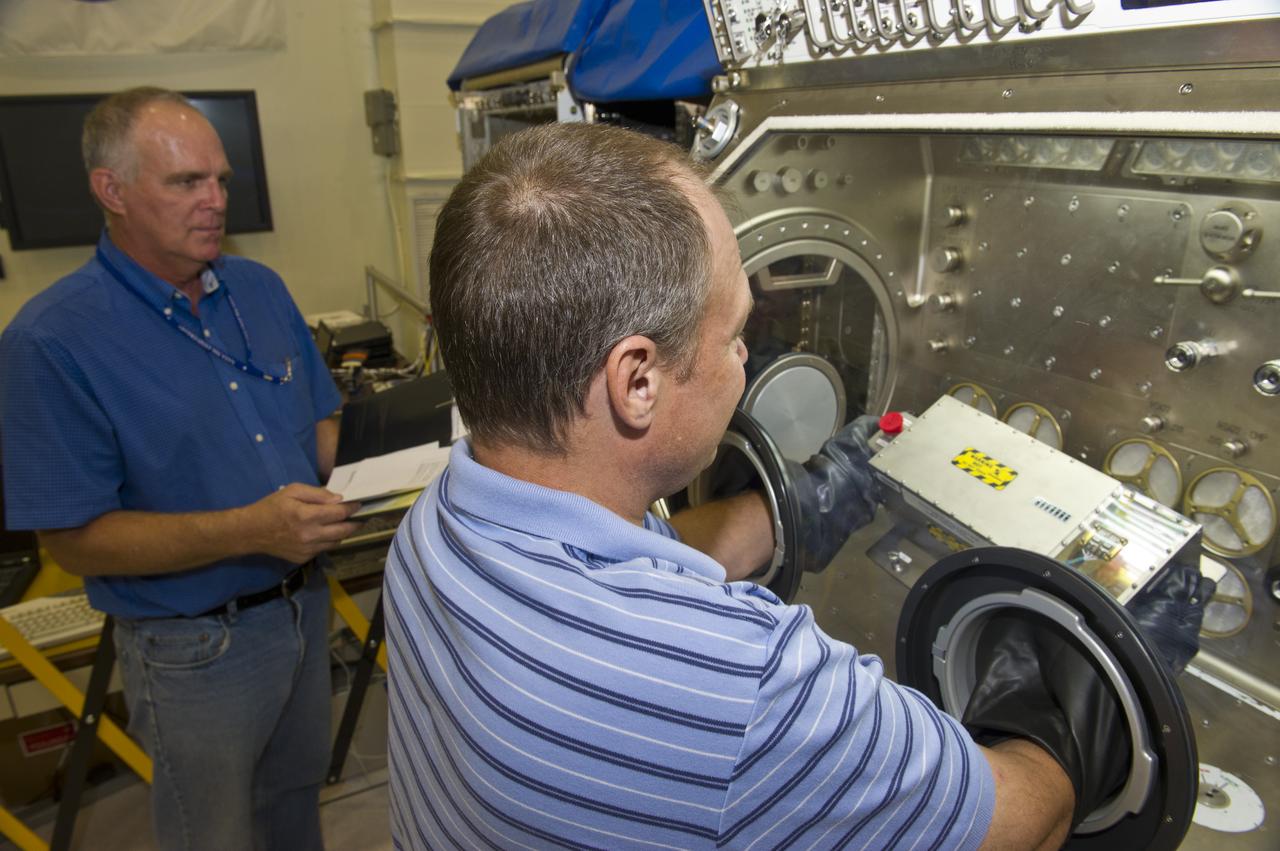
MSG TEAM MEMBERS JOHN WILSON, (L), AND PHILLIP BRYANT TEST AND INTEGRATE HARDWARE BEFORE SENDING TO ISS
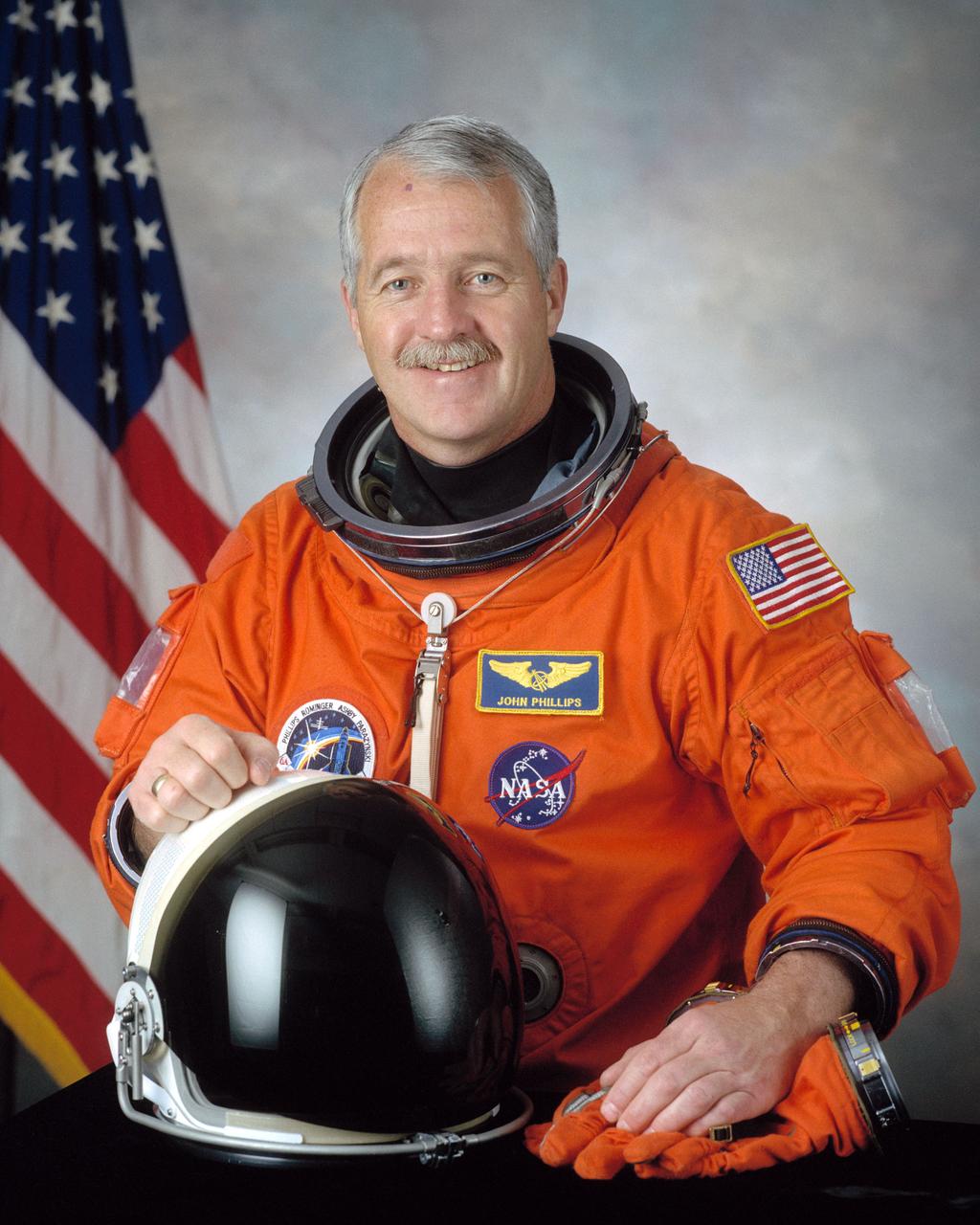
JSC2002-00859 (2 Feb. 2001) --- Astronaut John L. Phillips, mission specialist
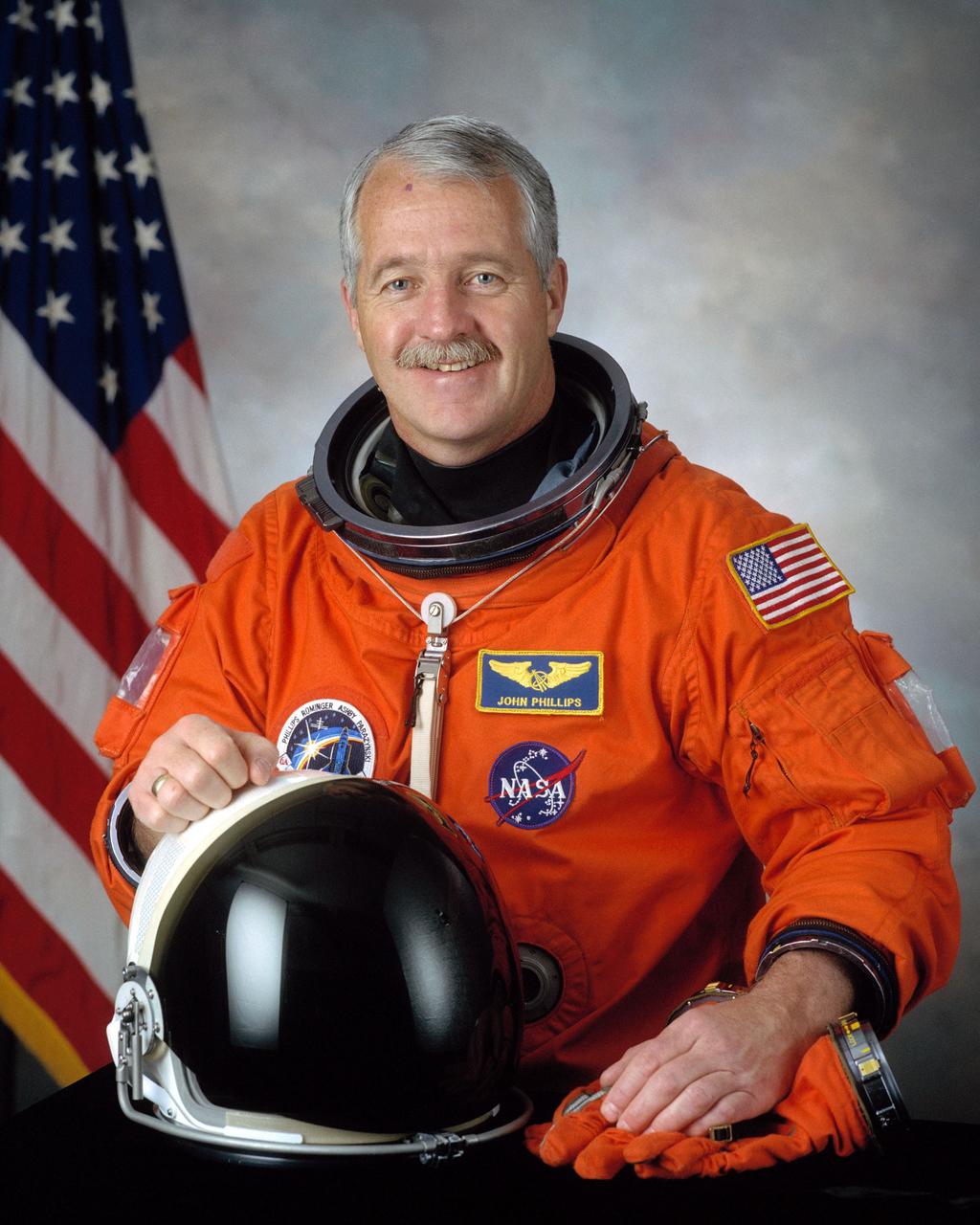
HOUSTON, Texas -- JSC2002-00859: Astronaut John L. Phillips, mission specialist, on mission STS-119.
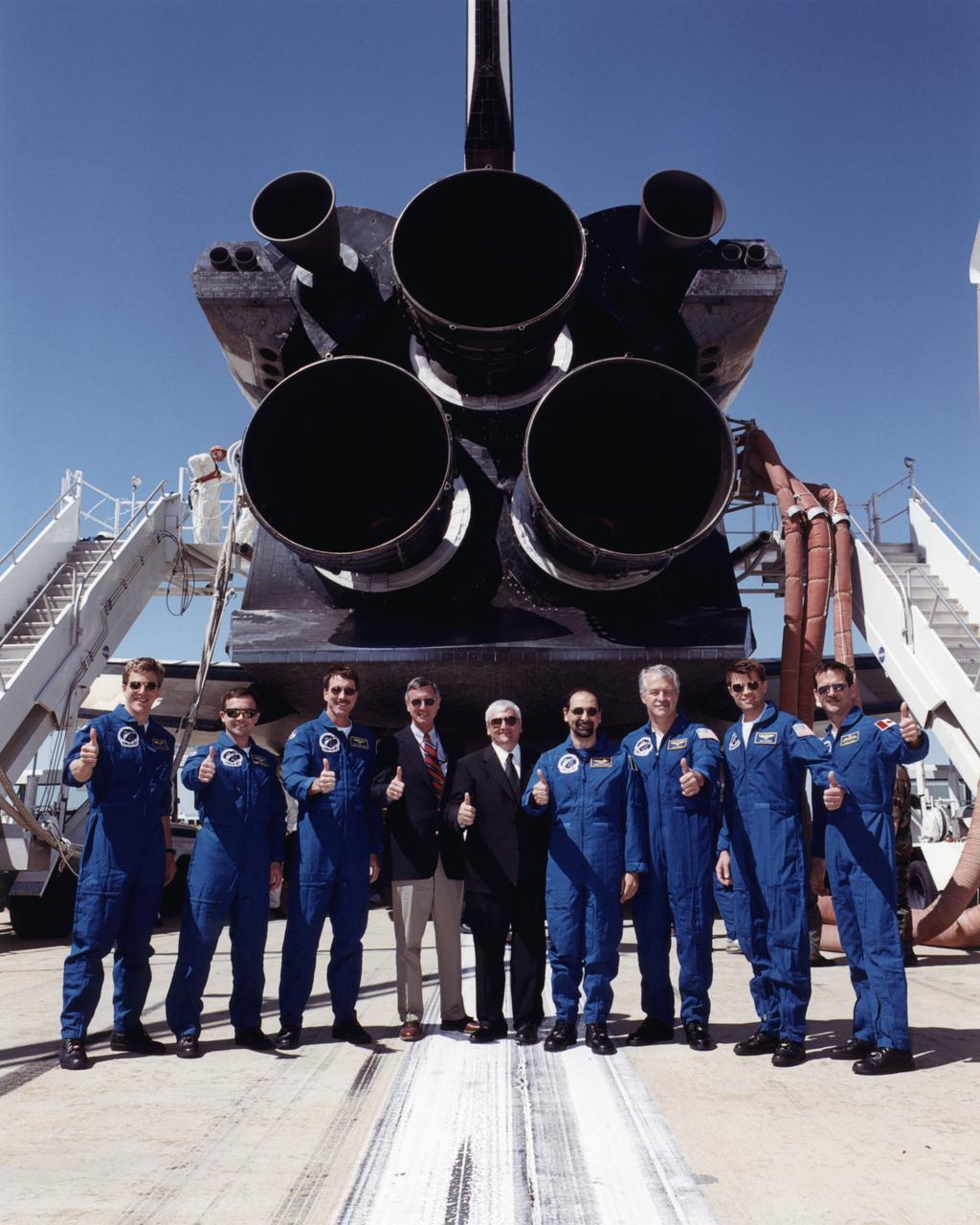
A happy "thumbs up" from the crew of the Space Shuttle Endeavour and NASA Dryden Flight Research Center officials heralded the successful completion of mission STS-100. Standing by the shuttle's rocket nozzles from left to right: Scott E. Prazynski, mission specialist (U.S.); Yuri V. Lonchakov, mission specialist (Russia); Kent V. Rominger, commander (U.S.); Wally Sawyer, NASA Dryden Flight Research Center deputy director; Kevin Petersen, NASA Dryden Flight Research Center director; Umberto Guidoni, mission specialist (European Space Agency); John L. Phillips, mission specialist (U.S.); Jeffrey S. Ashby, pilot (U.S.); and Chris A. Hadfield, mission specialist (Canadian Space Agency). The mission landed at Edwards Air Force Base, California, on May 1, 2001.
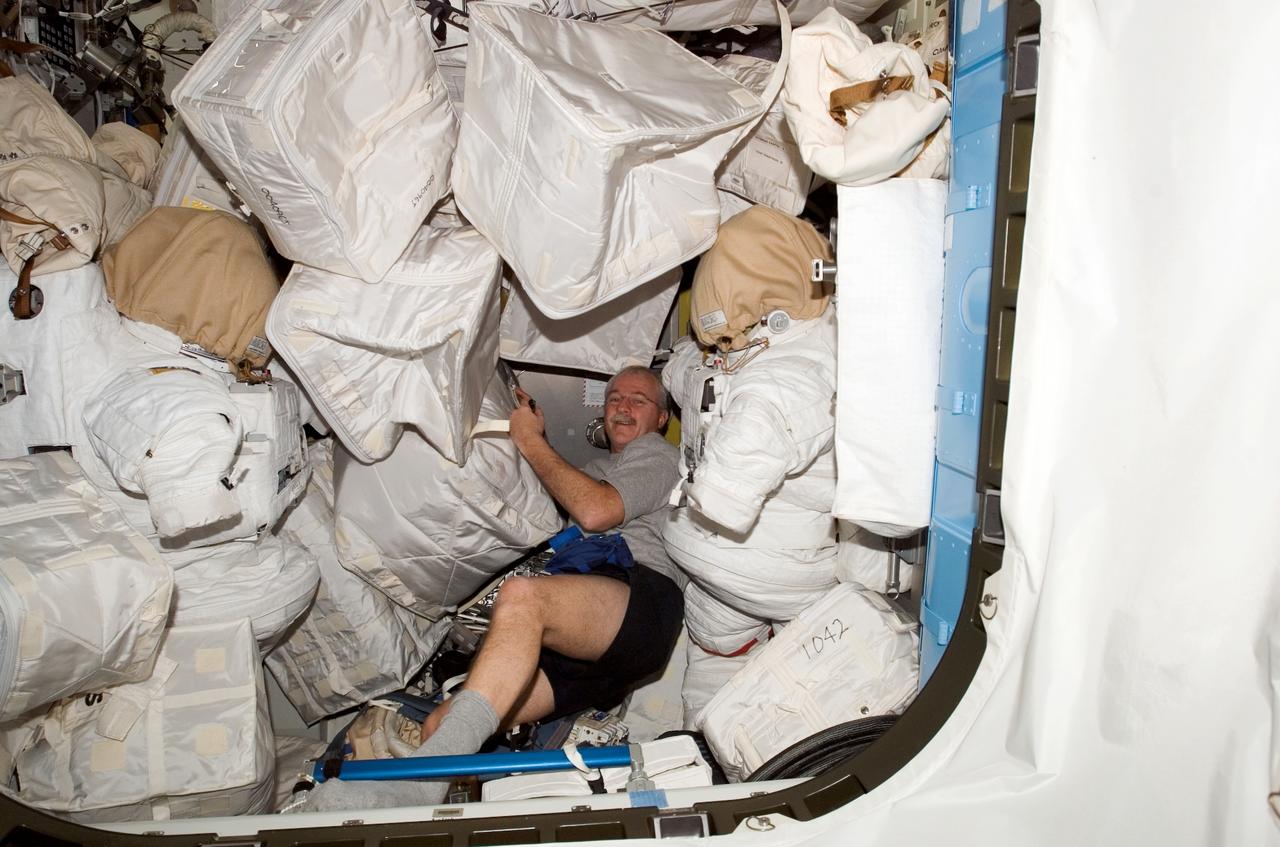
ISS011-E-06401 (18 May 2005) --- Astronaut John L. Phillips, Expedition 11 NASA science officer and flight engineer, is photographed among stowage bags in an airlock on the international space station.
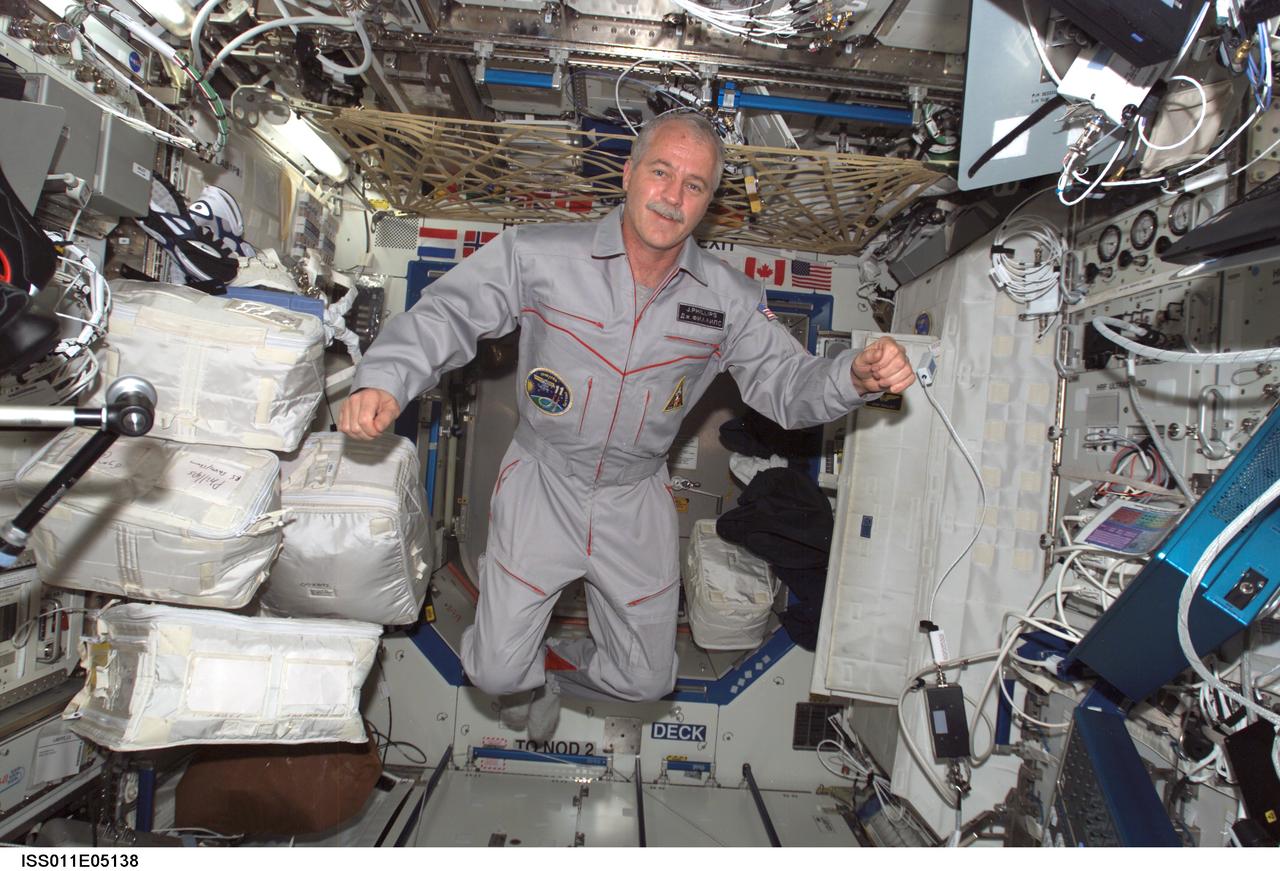
ISS011-E-05138 (17 April 2005) --- Astronaut John L. Phillips, Expedition 11 NASA ISS science officer and flight engineer, floats in the Destiny laboratory of the International Space Station (ISS).
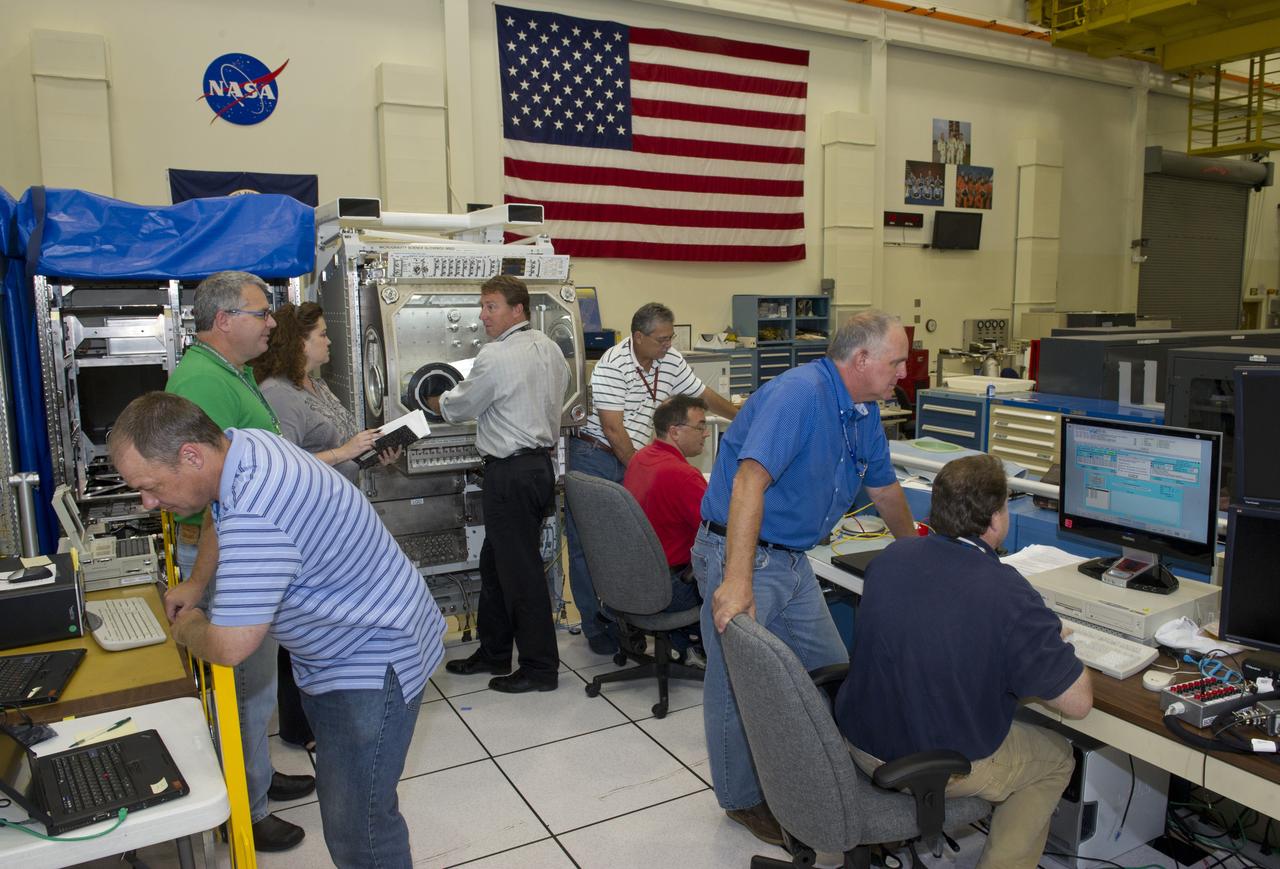
MSG TEAM MEMBERS AT WORK: (L TO R): PHILLIP BRYANT, CHRIS BUTLER, GINGER FLORES, REGGIE SPIVEY, NEAL SCOTT, ANDREW TYGIELSKI, JOHN WILSON, TIM BROACH
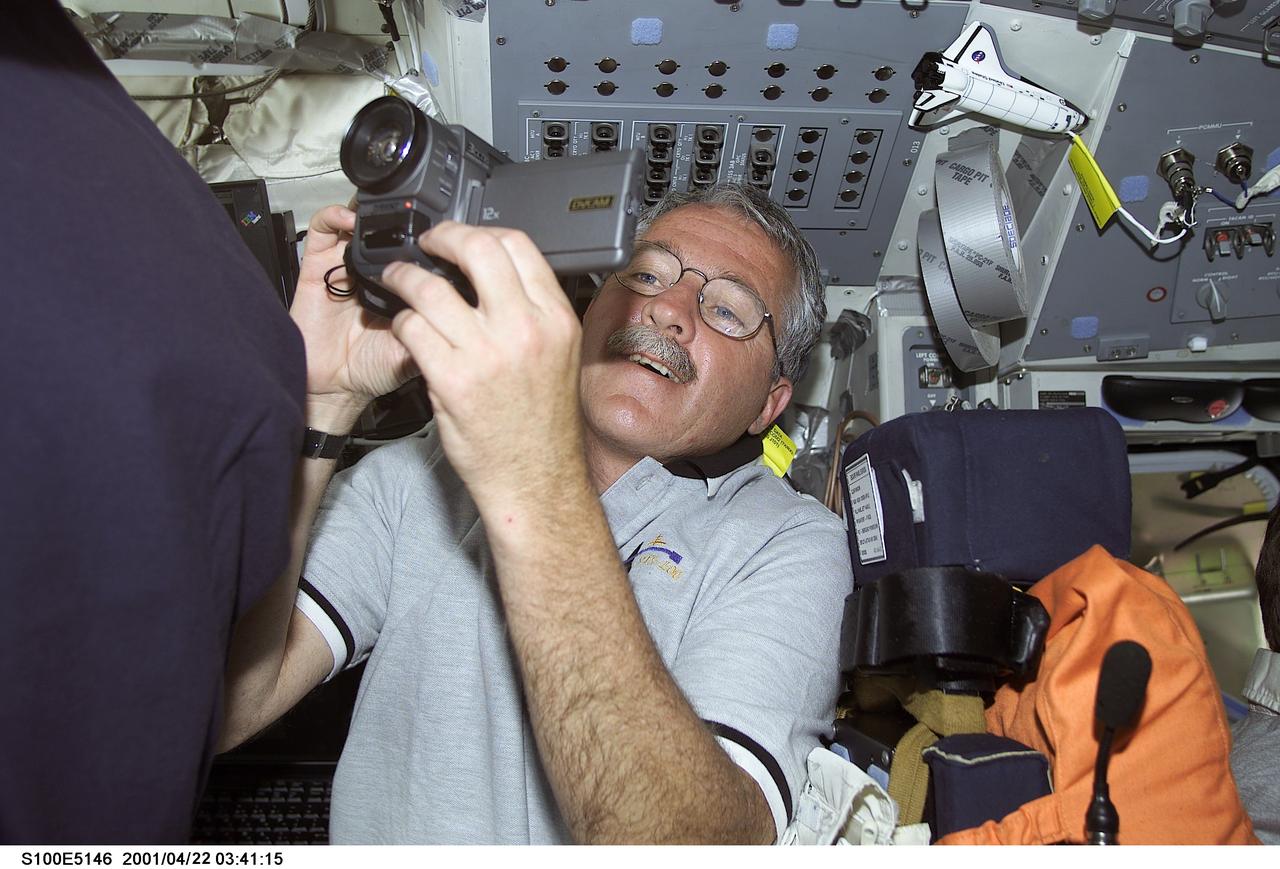
S100-E-5146 (21 April 2001) --- Astronaut John L. Phillips, mission specialist, uses a video camera to record activity on the flight deck of the Space Shuttle Endeavour.
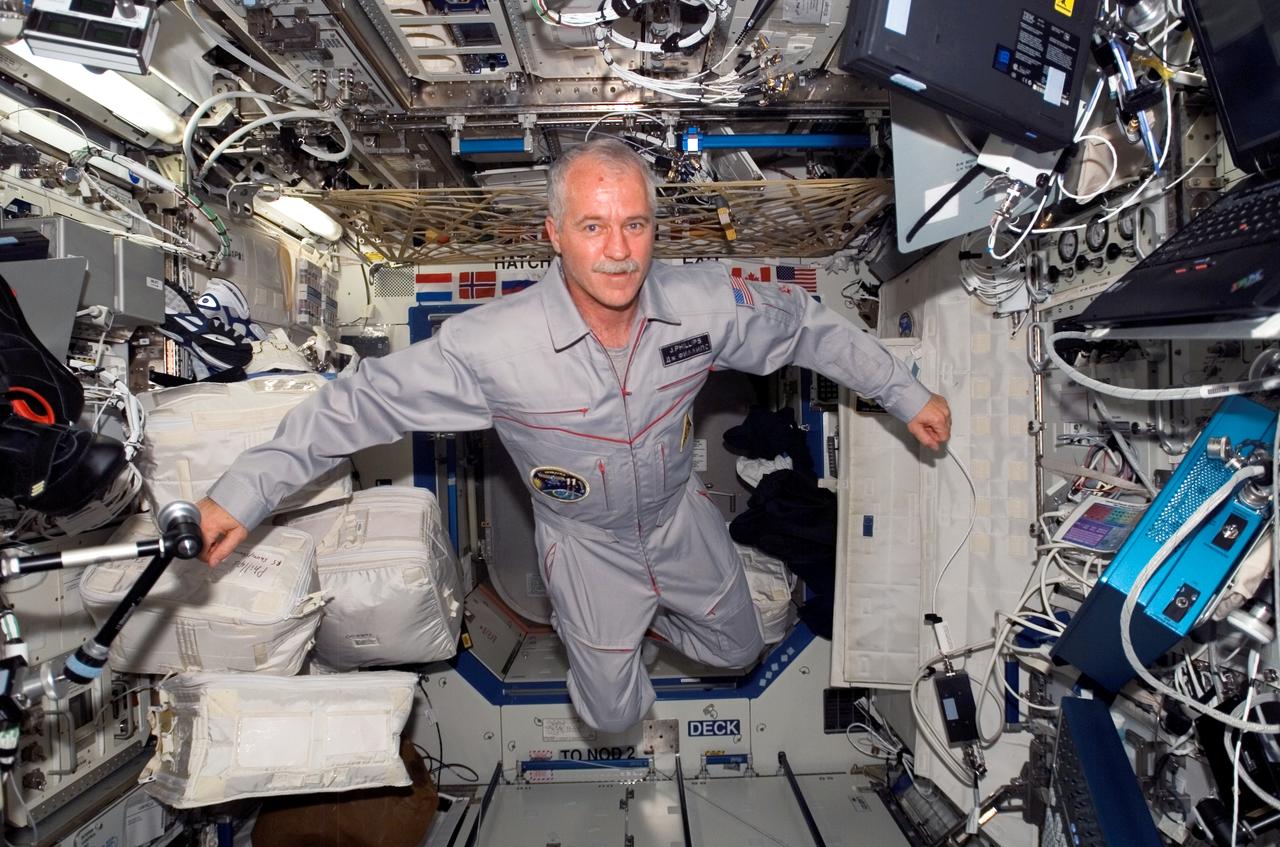
ISS011-E-05140 (17 April 2005) --- Astronaut John L. Phillips, Expedition 11 NASA science officer and flight engineer, floats in the Destiny laboratory of the international space station.
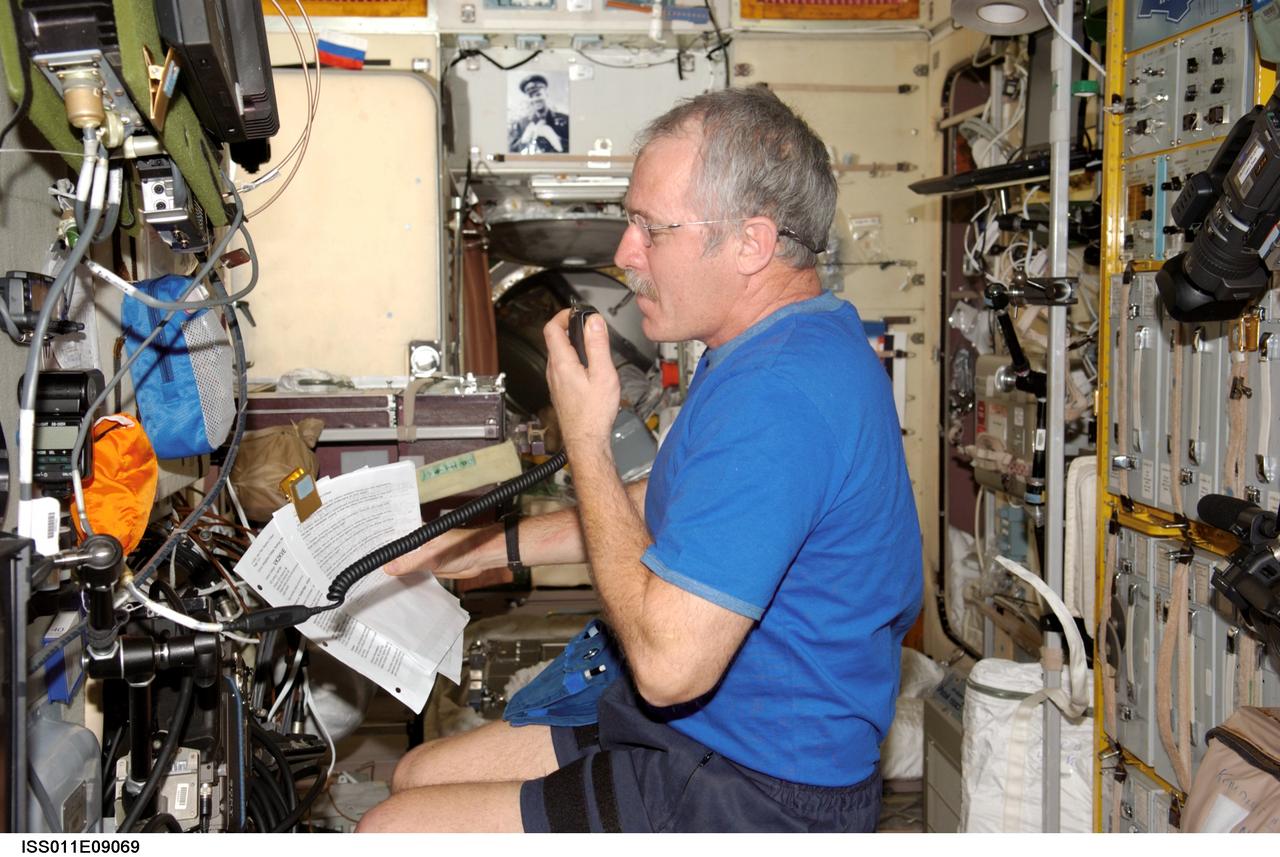
ISS011-E-09069 (2 June 2005) --- Astronaut John L. Phillips, Expedition 11 NASA ISS science officer and flight engineer, uses amateur radio equipment in the Zvezda Service Module of the International Space Station (ISS) while speaking with students from Brigidine College in Sydney, Australia.
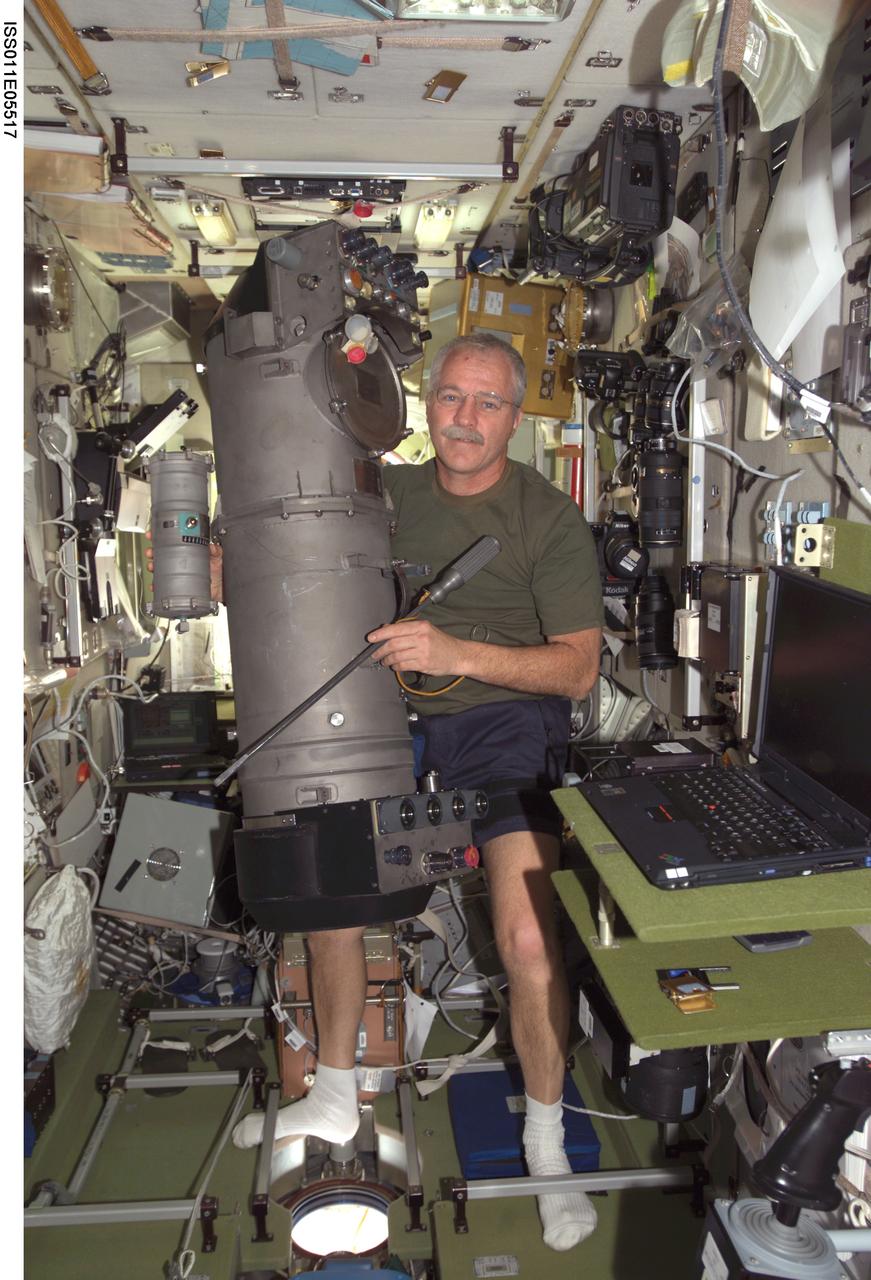
ISS011-E-05517 (5 May 2005) --- Astronaut John L. Phillips, Expedition 11 NASA ISS science officer and flight engineer, working on the Elektron oxygen-generation system in the Zvezda Service Module that has worked intermittently aboard the International Space Station (ISS).
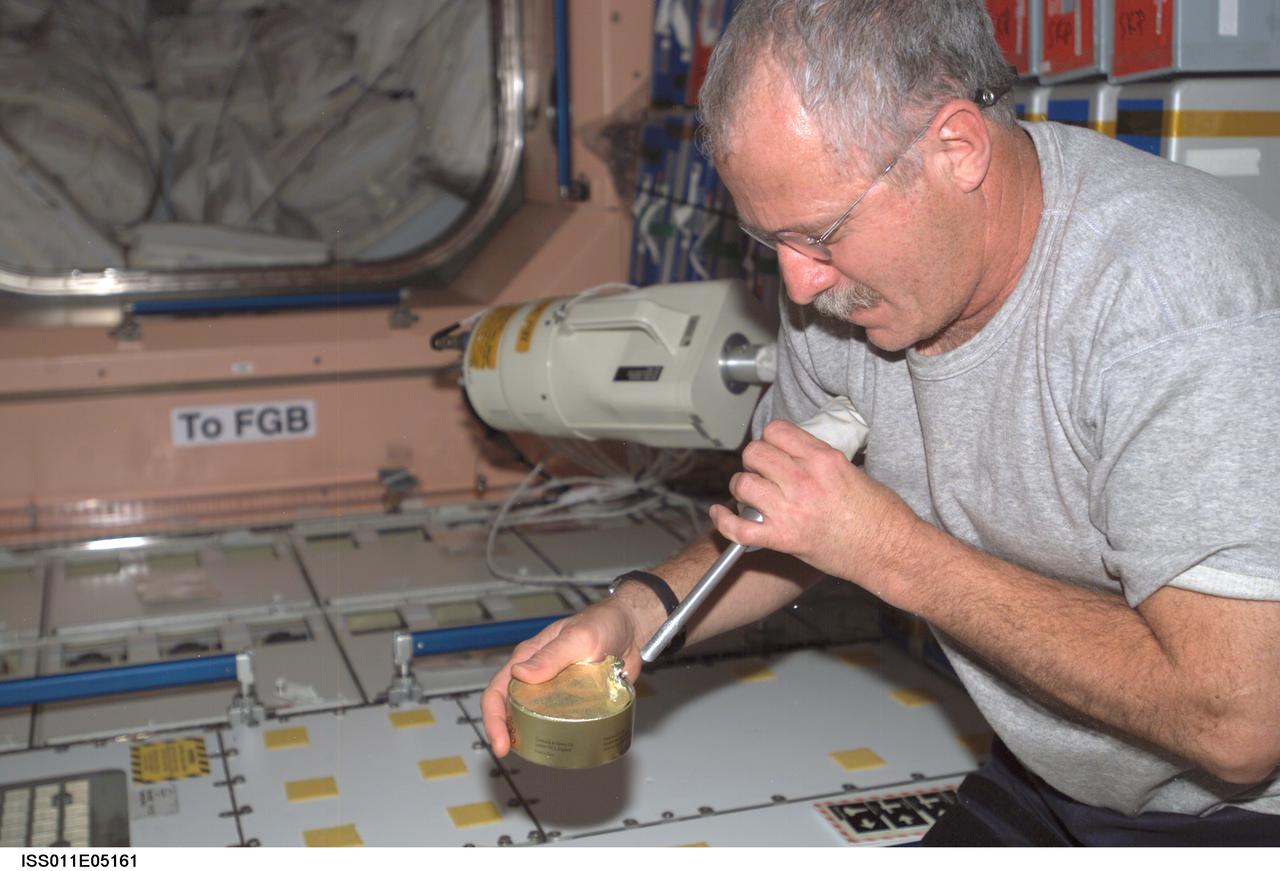
ISS011-E-05161 (17 April 2005) --- Astronaut John L. Phillips, Expedition 11 NASA ISS science officer and flight engineer, uses the ISS wet/dry vacuum cleaner assembly to catch floating debris from the top of a food can in the Unity node of the International Space Station (ISS).
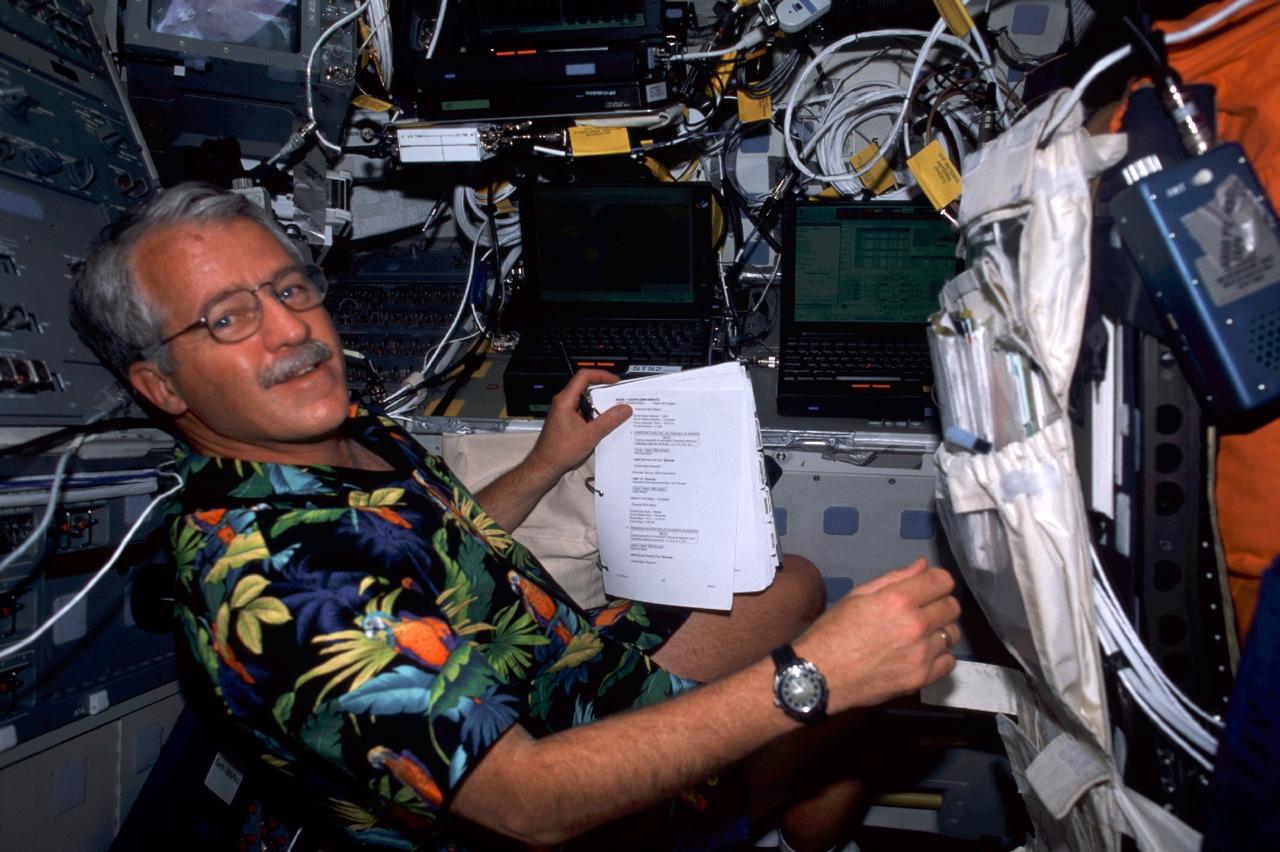
STS100-387-022 (19 April-1 May 2001) --- Astronaut John L. Phillips, STS-100 mission specialist, looks over a checklist on the flight deck of the Space Shuttle Endeavour. The alumnus of the 1996 class of astronaut candidates is making his first space flight.
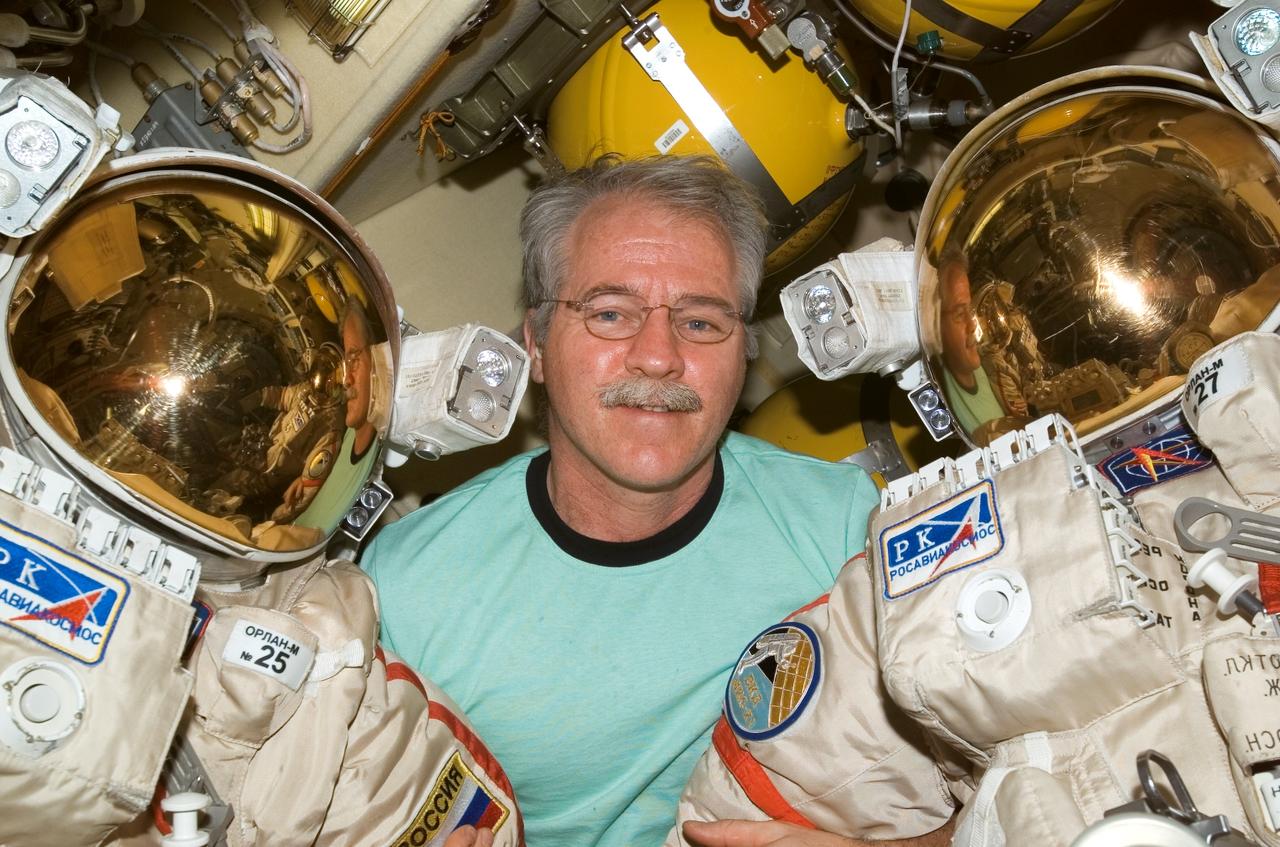
ISS011-E-11983 (17 August 2005) --- Astronaut John L. Phillips, Expedition 11 NASA science officer and flight engineer, poses with Russian Orlan spacesuits in the Pirs Docking Compartment of the international space station. The mission’s first spacewalk is scheduled for August 18.
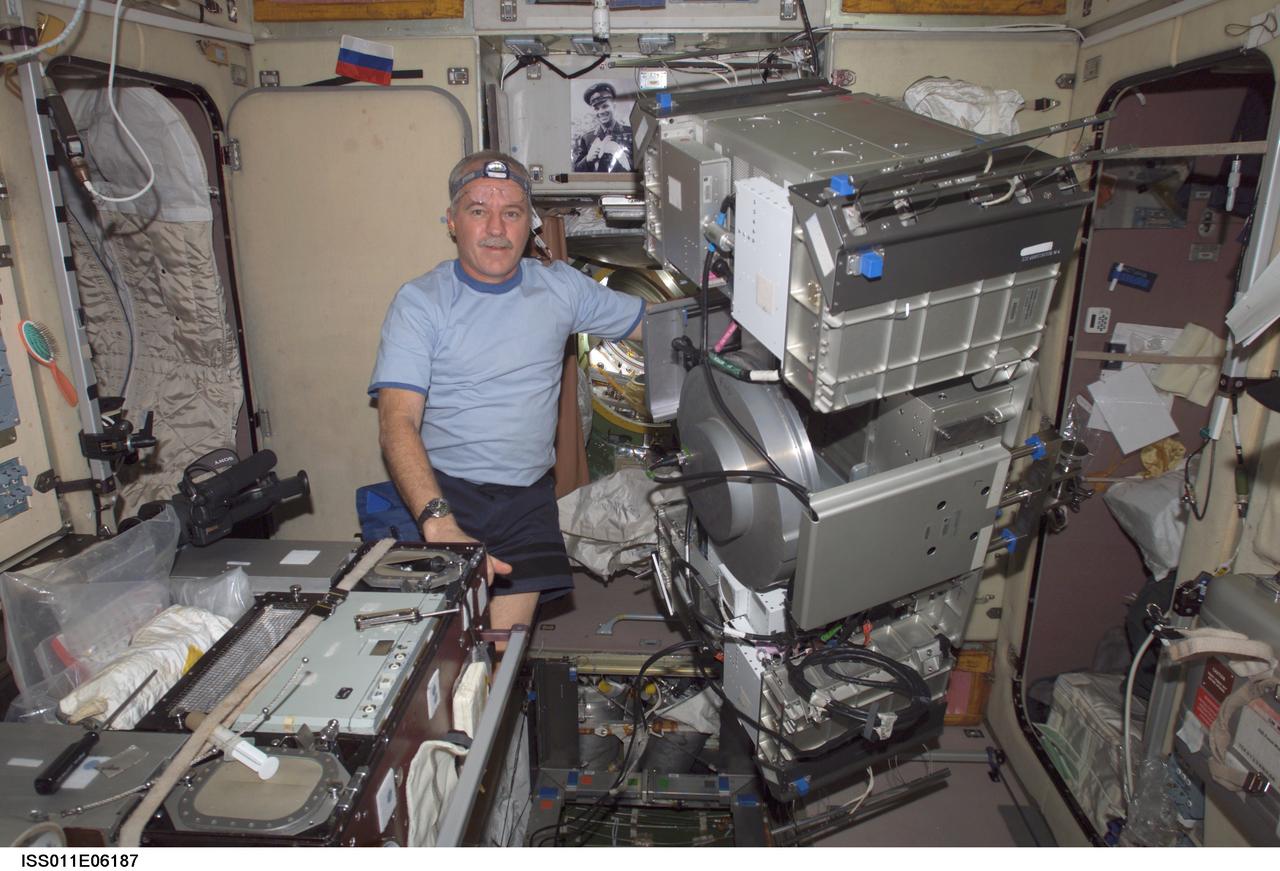
ISS011-E-06187 (16 May 2005) --- Astronaut John L. Phillips, Expedition 11 NASA ISS science officer and flight engineer, poses for a photo with the Treadmill Vibration Isolation System (TVIS) removed from the Zvezda Service Module floor during an In-Flight Maintenance (IFM) on the International Space Station (ISS).
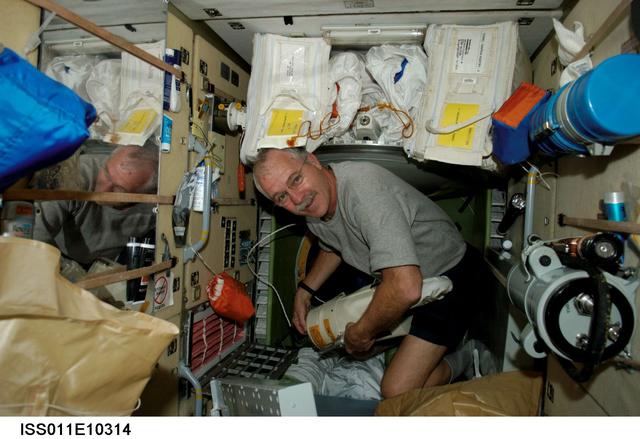
ISS011-E-10314 (4 May 2005) --- Astronaut John L. Phillips, Expedition 11 NASA Space Station science officer and flight engineer, assembles a vacuum cleaner in the functional cargo block (FGB) or Zarya on the International Space Station.
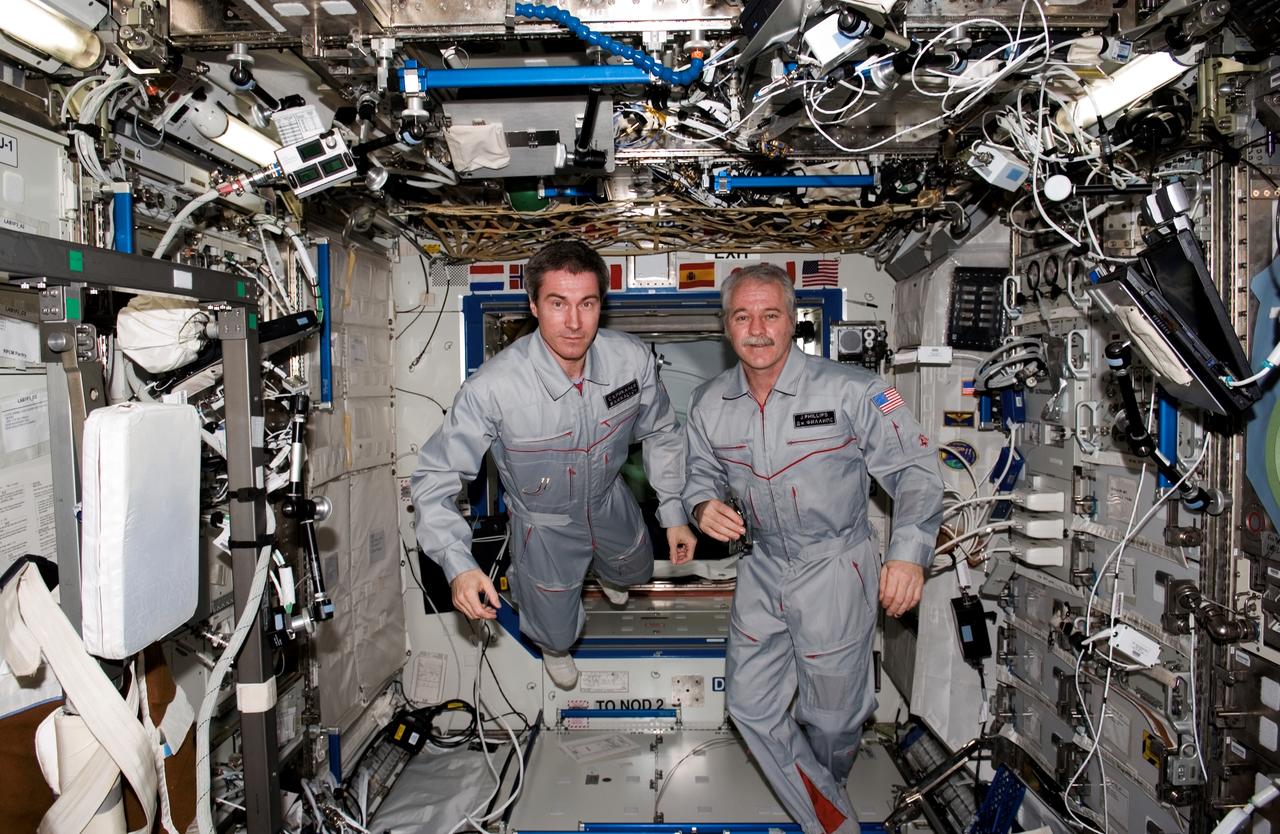
ISS011-E-12408 (2 August 2005) --- Cosmonaut Sergei K. Krikalev (left), Expedition 11 commander representing Russia's Federal Space Agency, and astronaut John L. Phillips, NASA space station science officer and flight engineer, pose for a photo in the Destiny laboratory of the international space station.
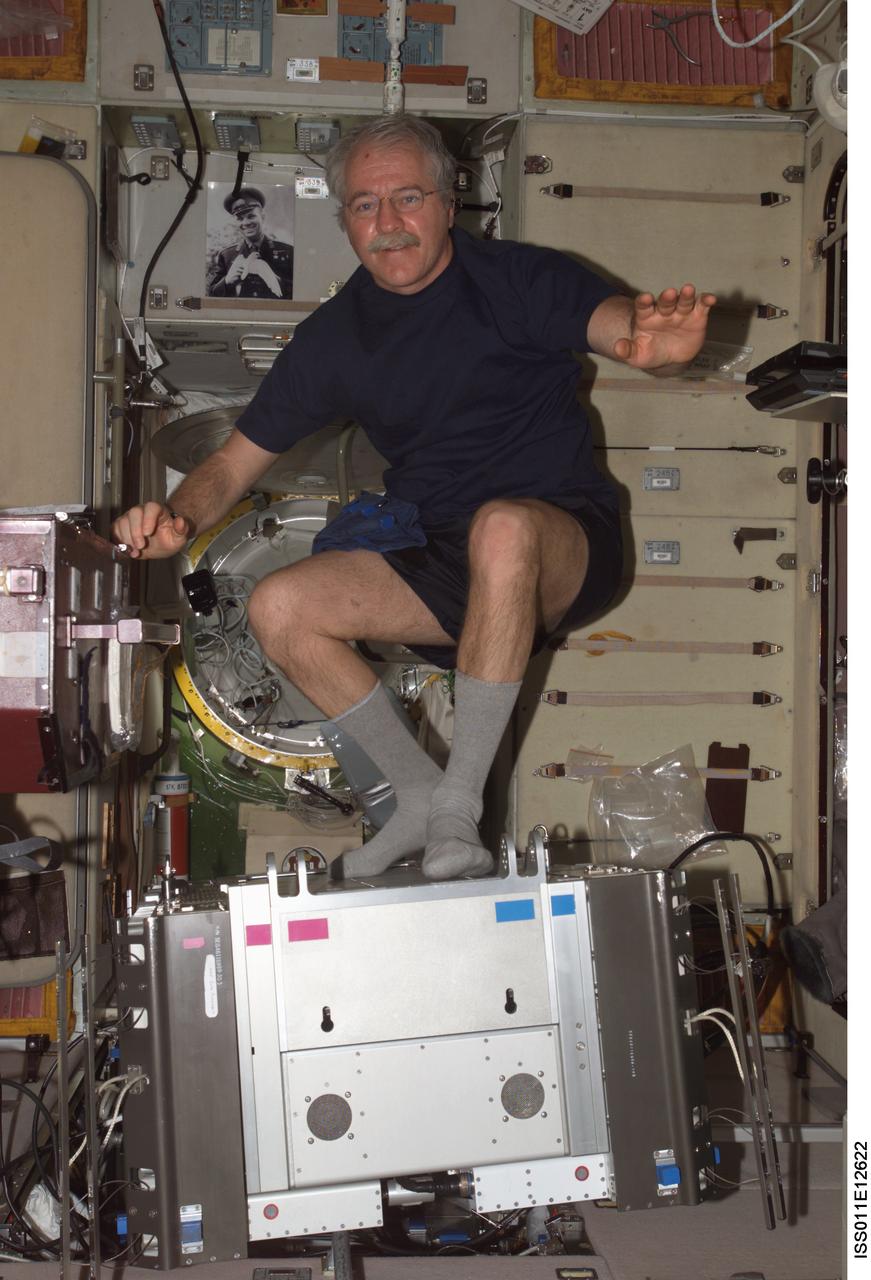
ISS011-E-12622 (7 September 2005) --- Astronaut John L. Phillips, Expedition 11 NASA Space Station science officer and flight engineer, poses with a portion of the Treadmill Vibration Isolation System (TVIS) during In-Flight Maintenance (IFM) in the Zvezda Service Module of the International Space Station.
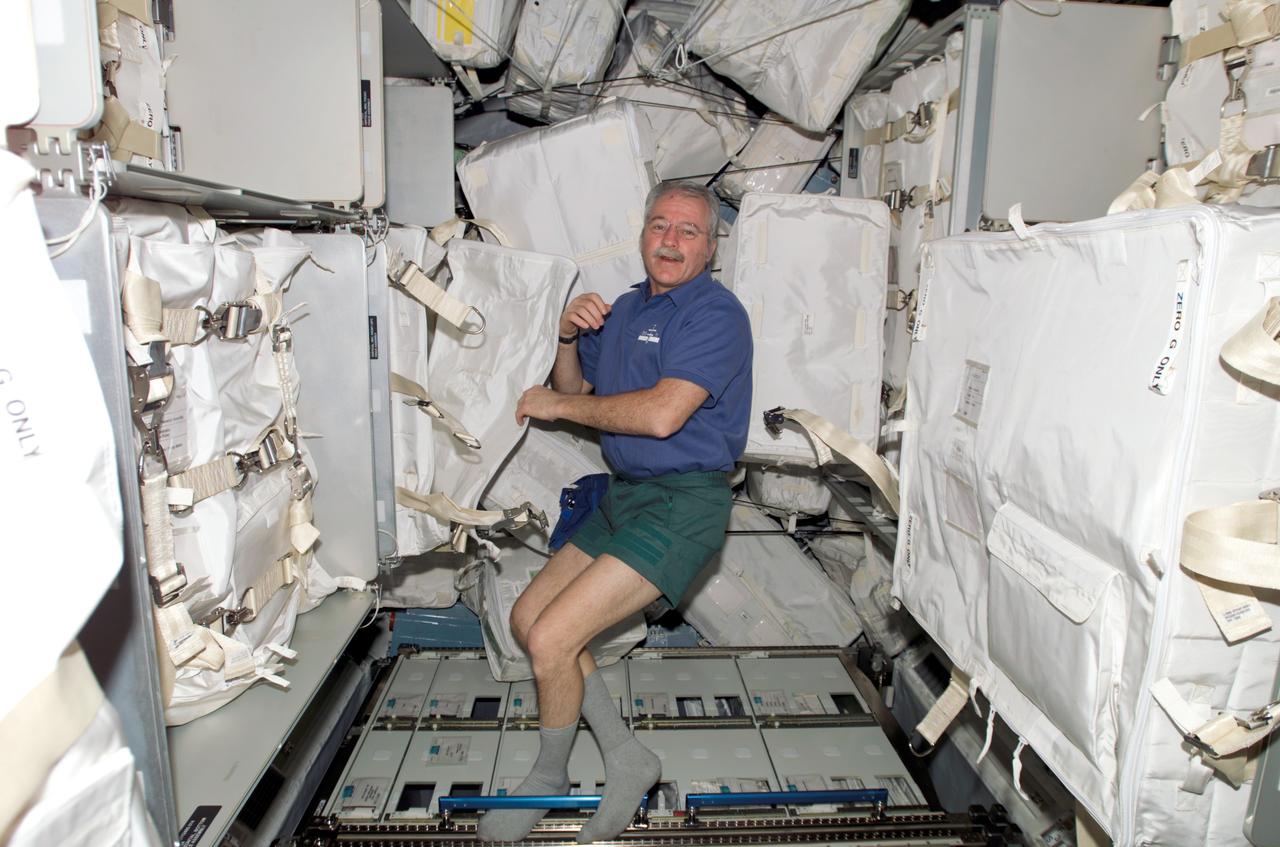
ISS011-E-11364 (31 July 2005) --- Astronaut John L. Phillips, Expedition 11 NASA Space Station science officer and flight engineer, participates in the movement of supplies and equipment inside Raffaello, the Italian Space Agency-built Multipurpose Logistics Module (MPLM) to the international space station.
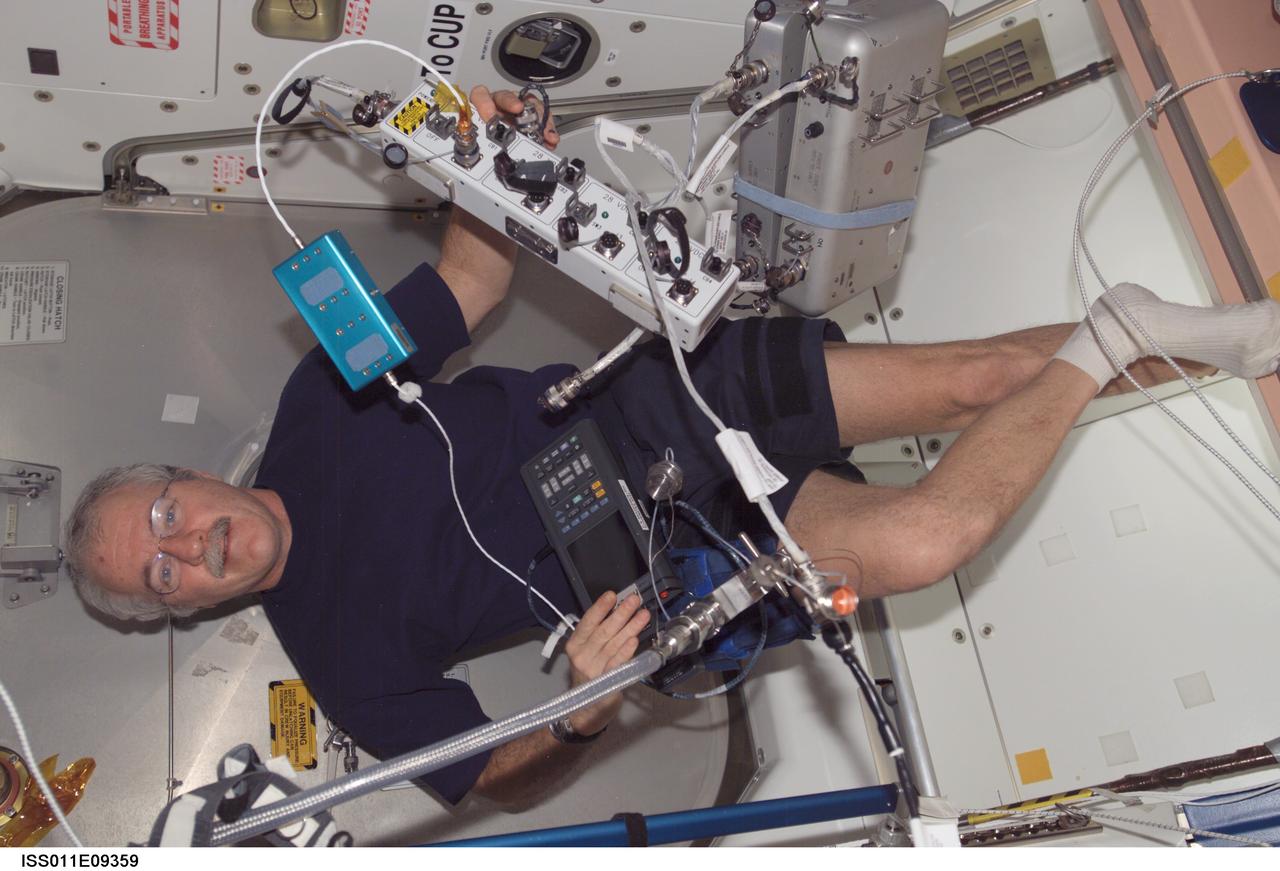
ISS011-E-09359 (21 June 2005) --- Astronaut John L. Phillips, Expedition 11 NASA ISS science officer and flight engineer, tries to sort out various hardware in the Unity node of the International Space Station (ISS).
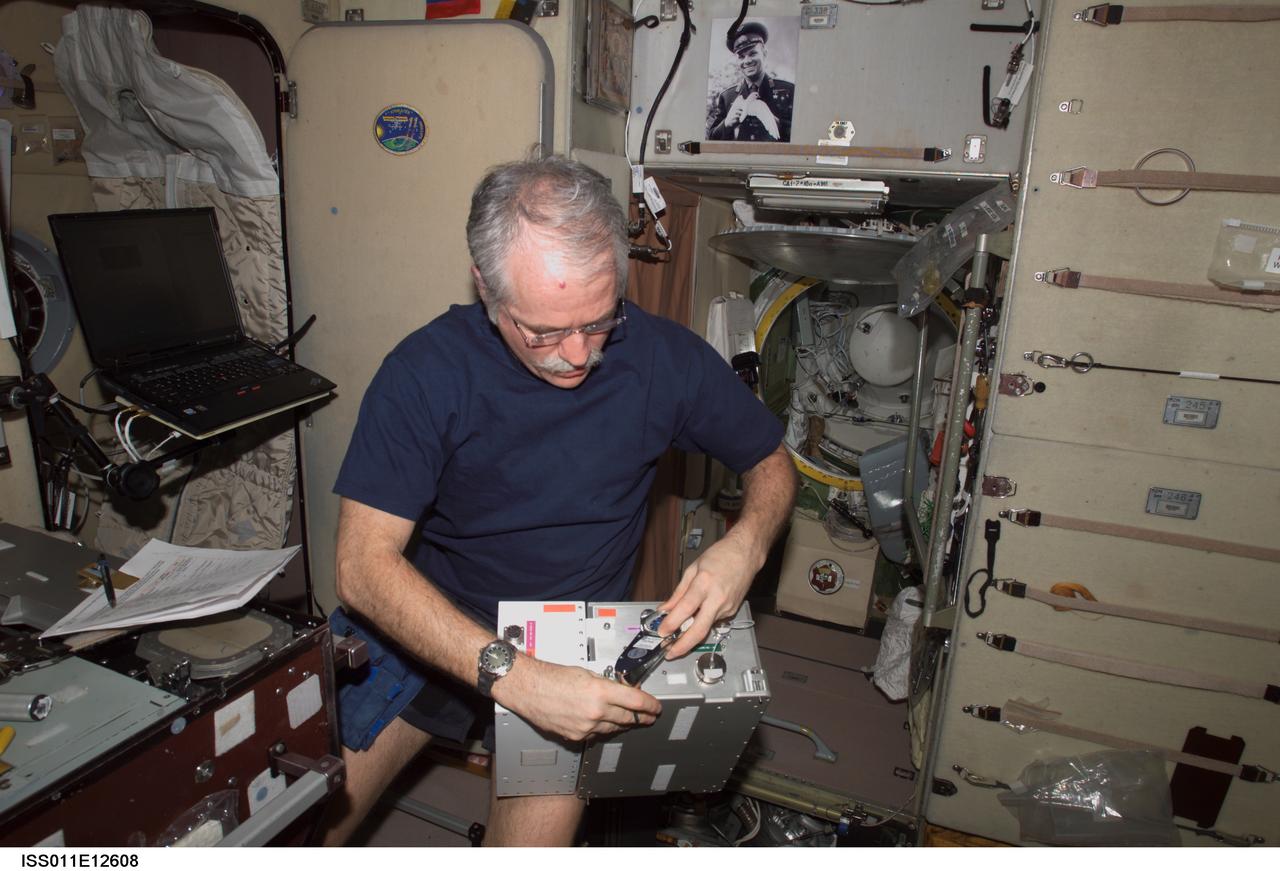
ISS011-E-12608 (7 September 2005) --- Astronaut John L. Phillips, Expedition 11 NASA Space Station science officer and flight engineer, works with a portion of the Treadmill Vibration Isolation System (TVIS) during In-Flight Maintenance (IFM) in the Zvezda Service Module of the International Space Station.
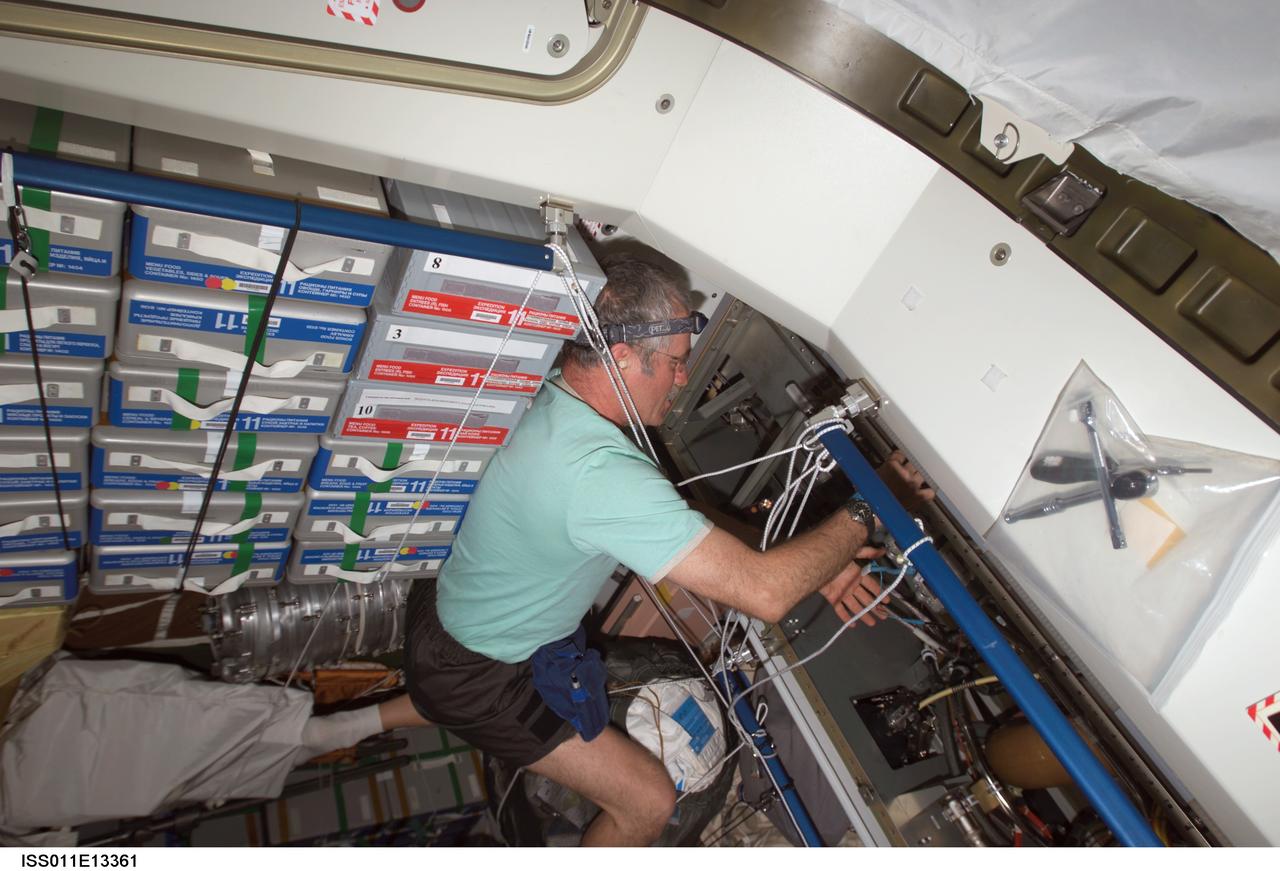
ISS011-E-13361 (20 September 2005) --- Astronaut John L. Phillips, Expedition 11 NASA science officer and flight engineer, performs a Remote Power Control Module (RPCM) remove and replacement in the Unity node of the international space station.
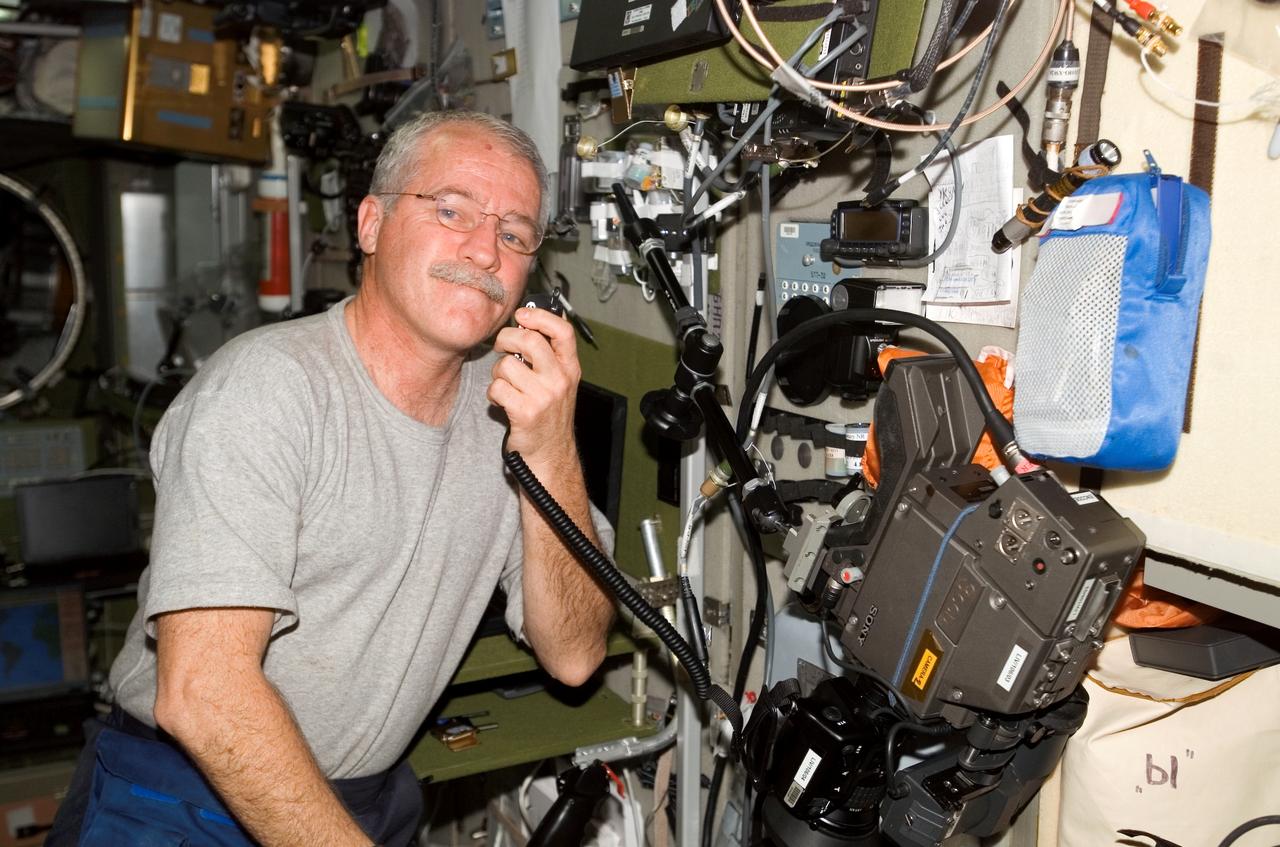
ISS011-E-05496 (4 May 2005) --- Astronaut John L. Phillips, Expedition 11 NASA science officer and flight engineer, participates in a ham radio exchange with students at Albany Hills State School in Brisbane, Australia from the Zvezda Service Module of the international space station.
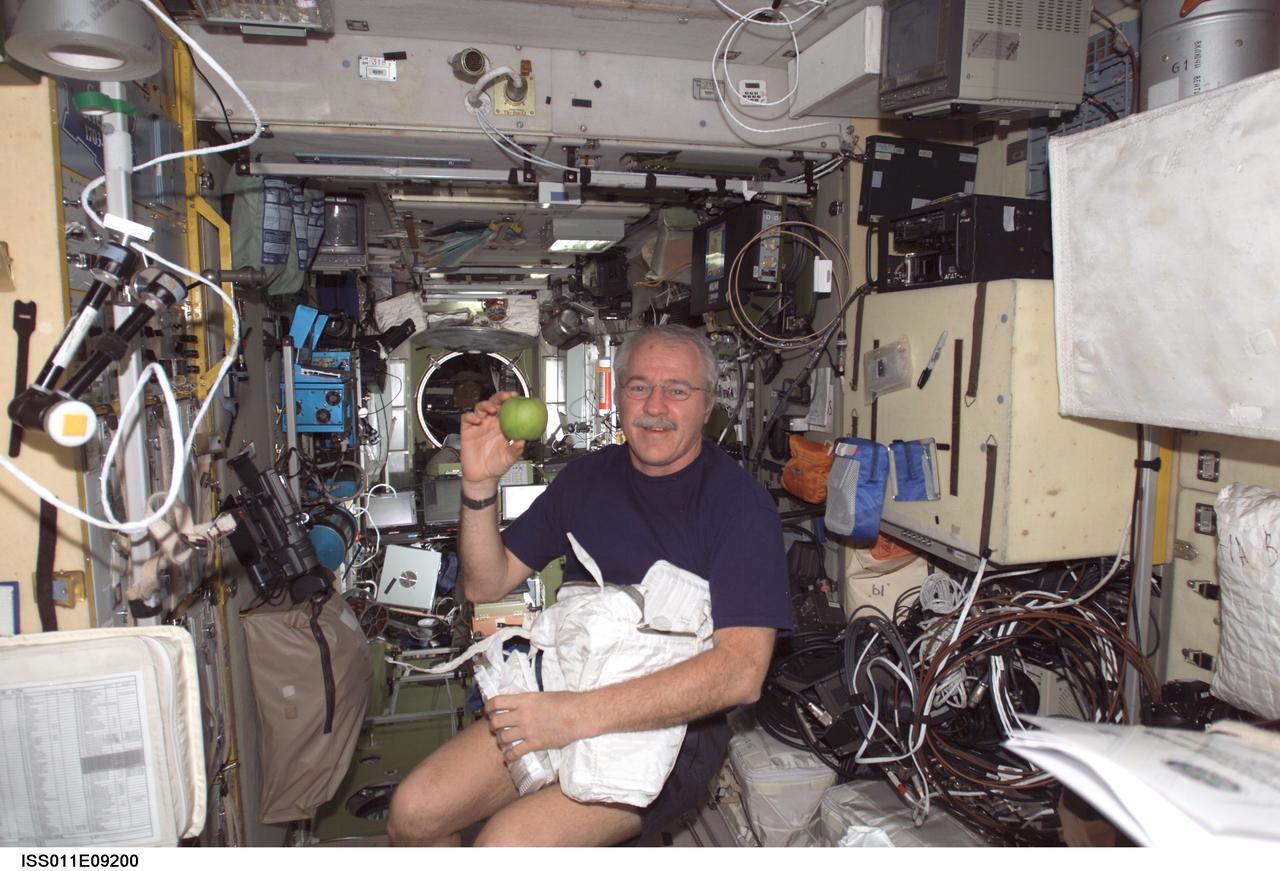
ISS011-E-09200 (19 June 2005) --- Astronaut John L. Phillips, Expedition 11 NASA space station science officer and flight engineer, holds small packages of supplies and fruit in the Zvezda Service Module of the International Space Station, which he un-stowed from the docked Progress 18 supply vehicle.
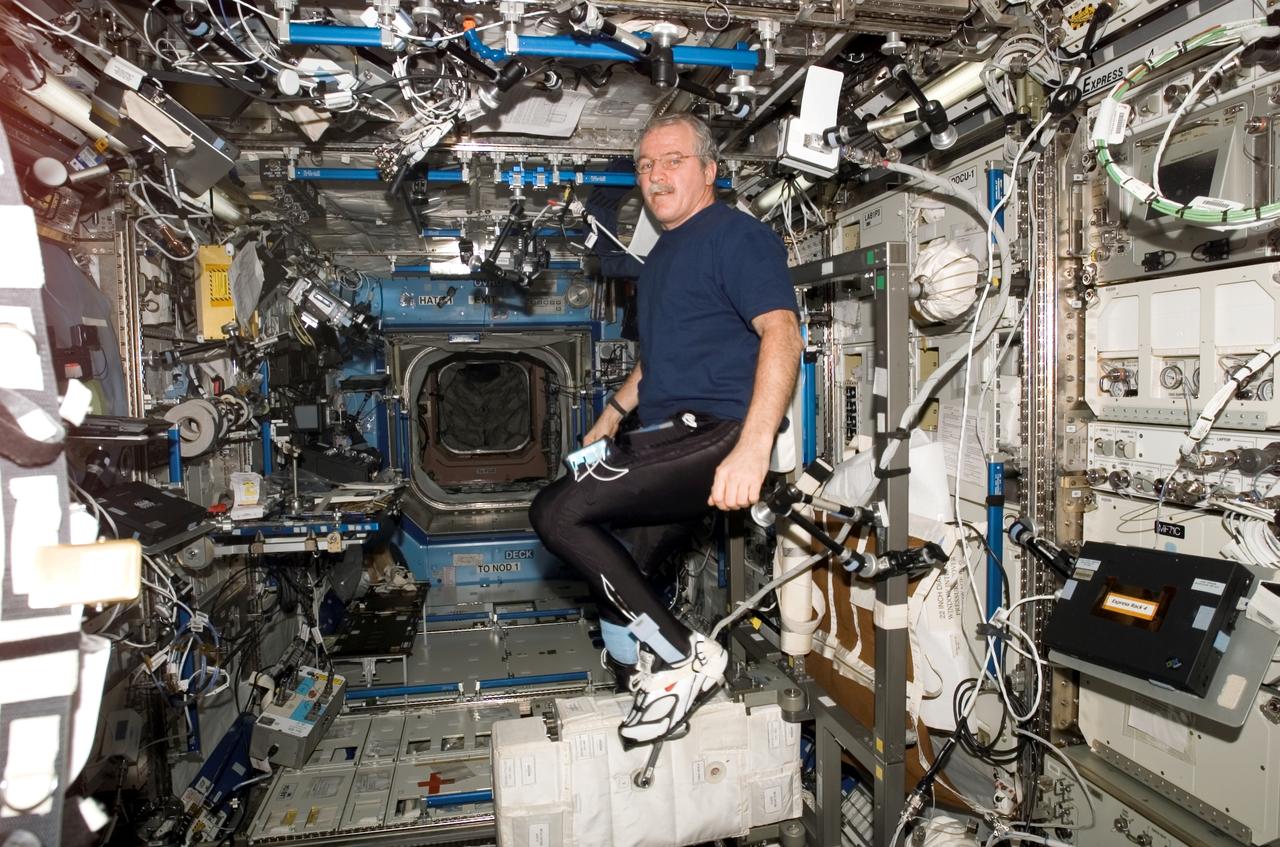
ISS011-E-13111 (16 September 2005) --- Astronaut John L. Phillips, Expedition 11 NASA science officer and flight engineer, exercises on the Cycle Ergometer with Vibration Isolation System (CEVIS) in the Destiny laboratory of the international space station.
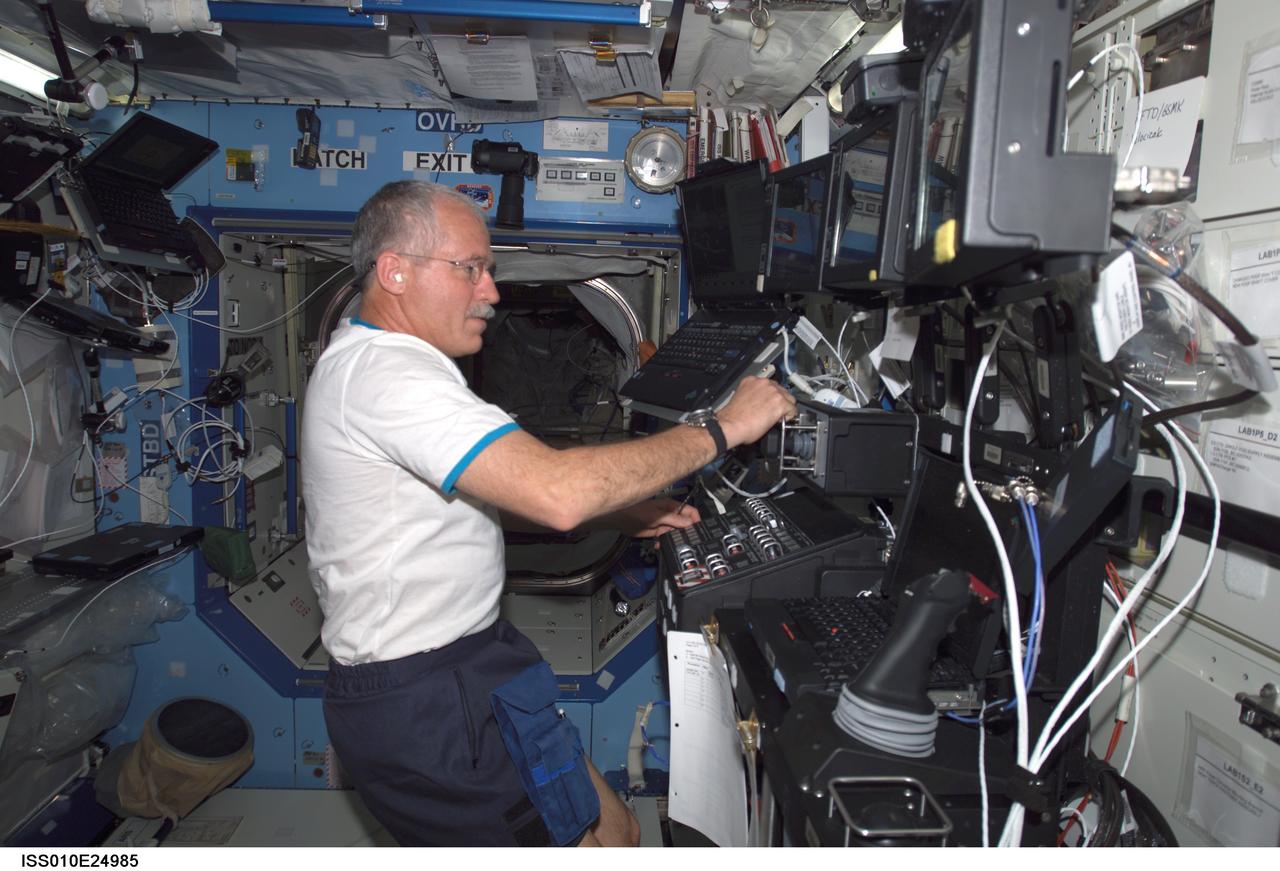
ISS010-E-24985 (19 April 2005) --- Astronaut John L. Phillips, Expedition 11 NASA ISS science officer and flight engineer, participates in a familiarization session with the Mobile Service System (MSS) and hands-on experience with the Canadarm2, or Space Station Remote Manipulator System (SSRMS) in the Destiny laboratory of the International Space Station (ISS).
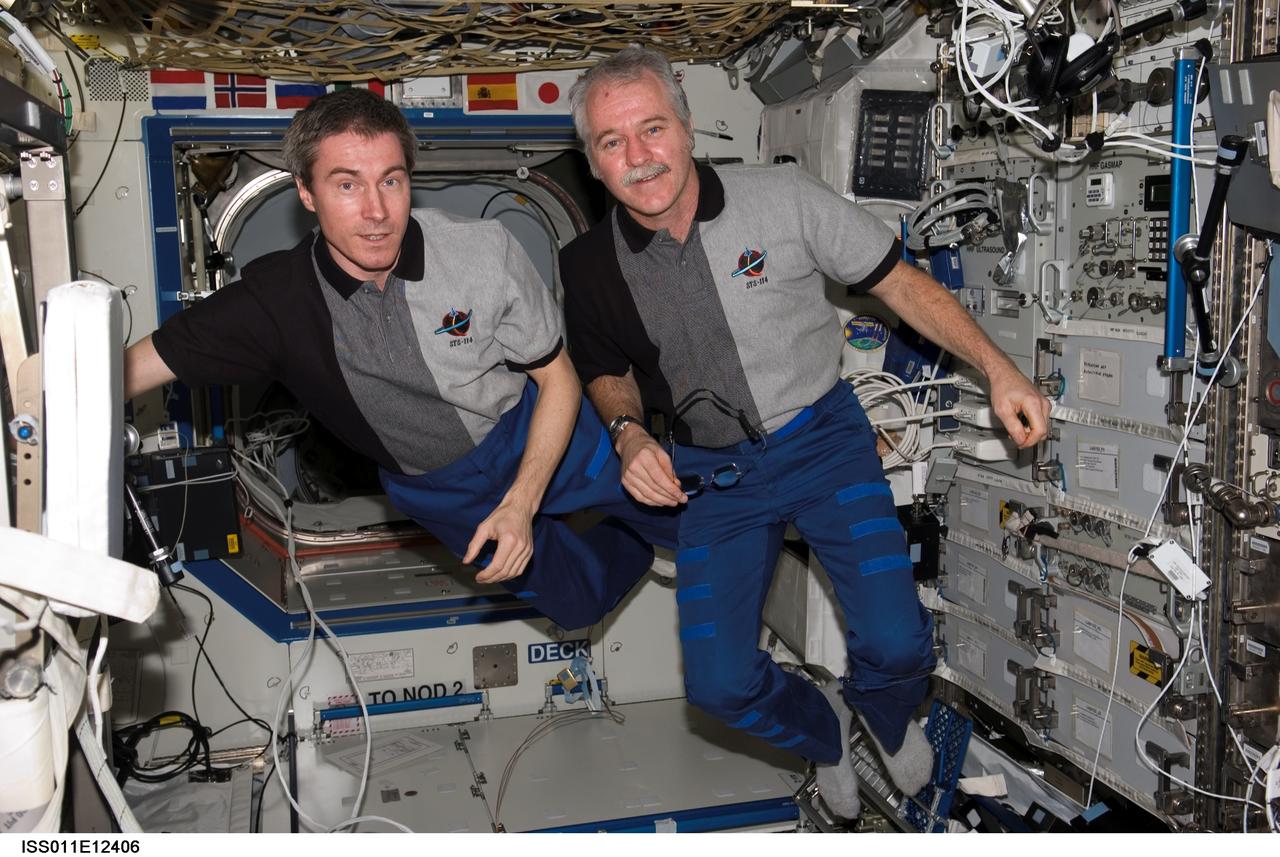
ISS011-E-12406 (2 August 2005) --- Cosmonaut Sergei K. Krikalev (left), Expedition 11 commander representing Russia's Federal Space Agency, and astronaut John L. Phillips, NASA Space Station science officer and flight engineer, pose for a photo in the Destiny laboratory of the International Space Station.
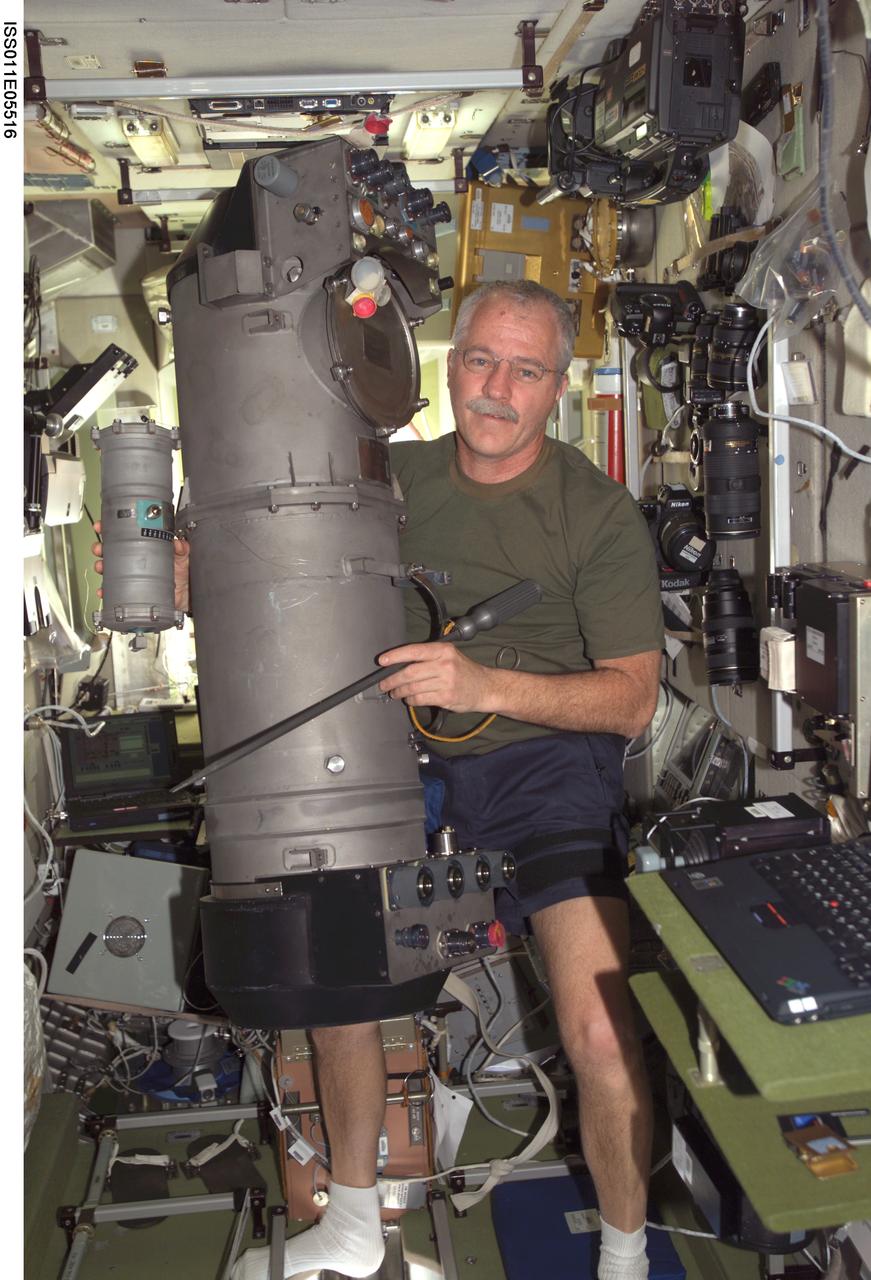
ISS011-E-05516 (5 May 2005) --- Astronaut John L. Phillips, Expedition 11 NASA ISS science officer and flight engineer, working on the Elektron oxygen-generation system in the Zvezda Service Module that has worked intermittently aboard the International Space Station (ISS).
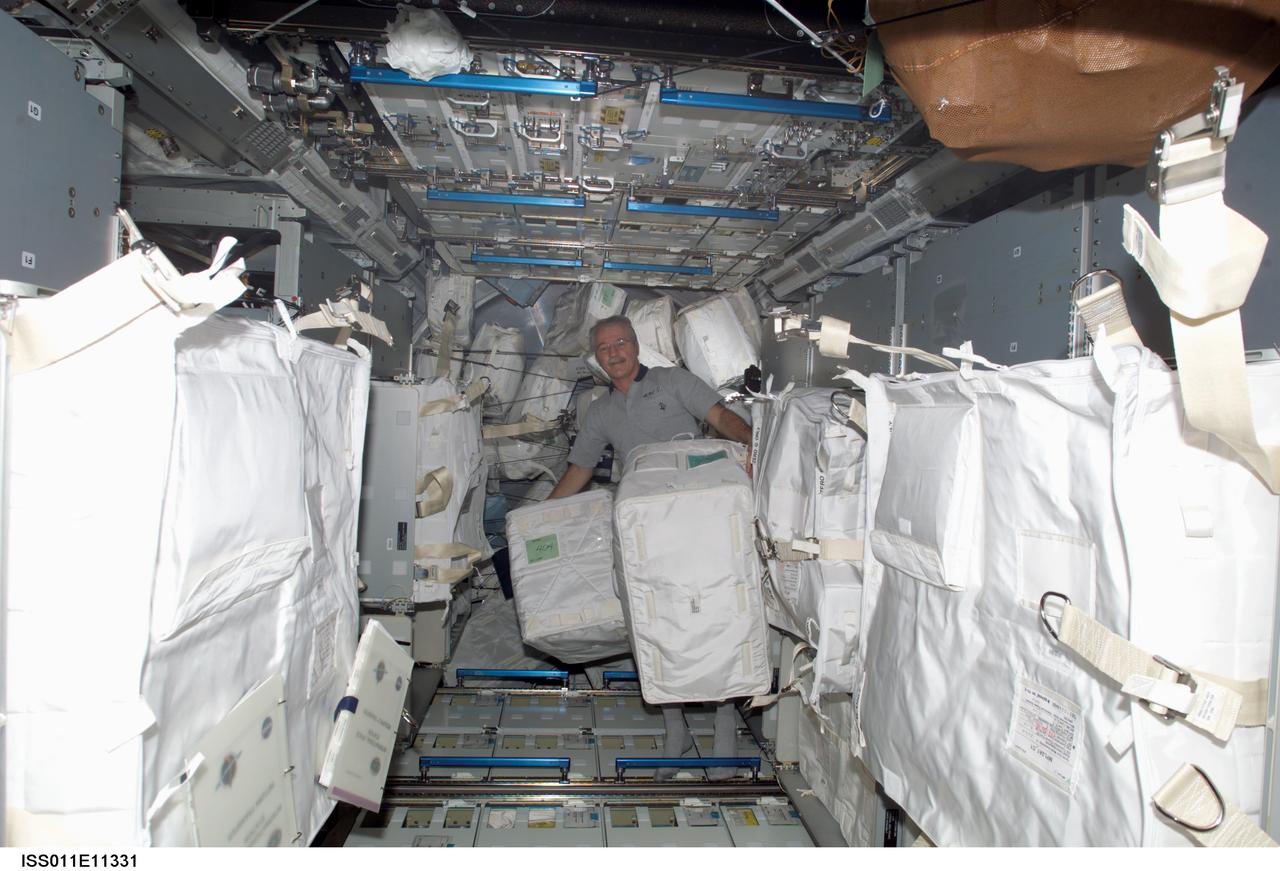
ISS011-E-11331 (30 July 2005) --- Astronaut John L. Phillips, Expedition 11 NASA space station science officer and flight engineer, retrieves supplies from the Raffaello Multi-Purpose Logistics Module (MPLM), which was brought to Earth-orbit by the seven-member STS-114 crew of the space shuttle Discovery.
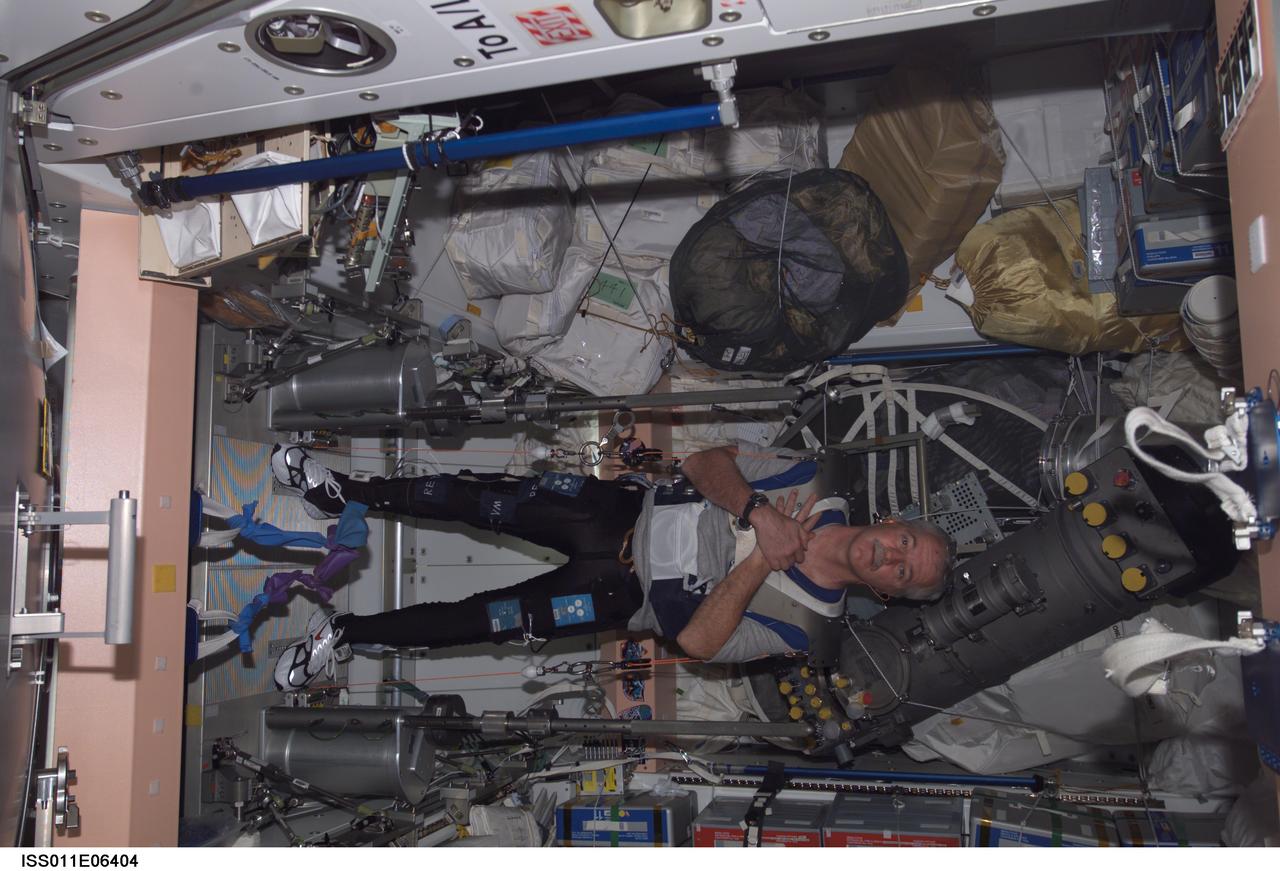
ISS011-E-06404 (18 May 2005) --- Astronaut John L. Phillips, Expedition 11 NASA space station science officer and flight engineer, wearing squat harness pads, exercises using the Interim Resistive Exercise Device (IRED) equipment in the Unity node of the International Space Station.
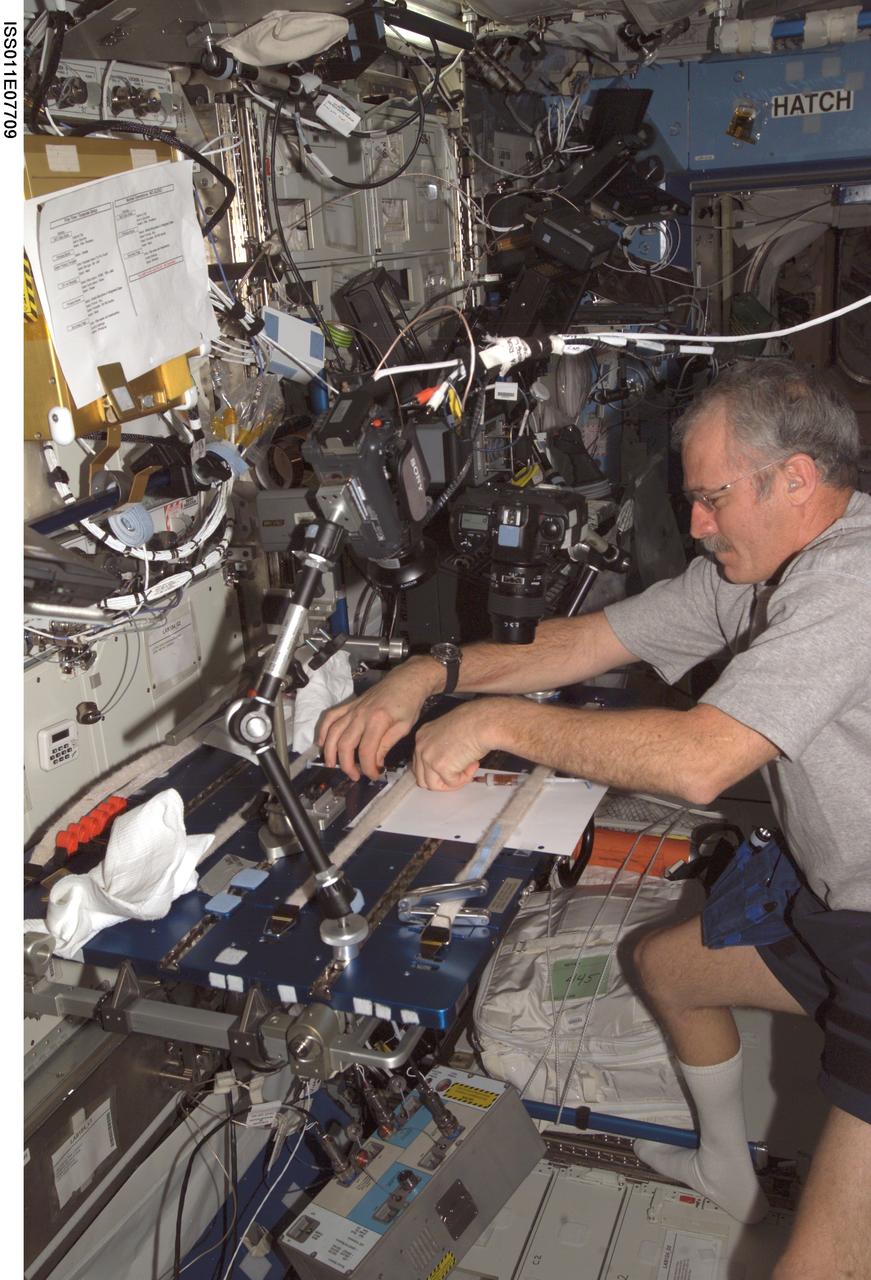
ISS011-E-07709 (2 June 2005) --- Astronaut John L. Phillips, Expedition 11 NASA ISS science officer and flight engineer, works with the Miscible Fluids in Microgravity (MFMG) payload activities in the Destiny laboratory of the International Space Station (ISS). At the work table, Phillips slowly injected tinted water into honey, as part of a thermal experiment.
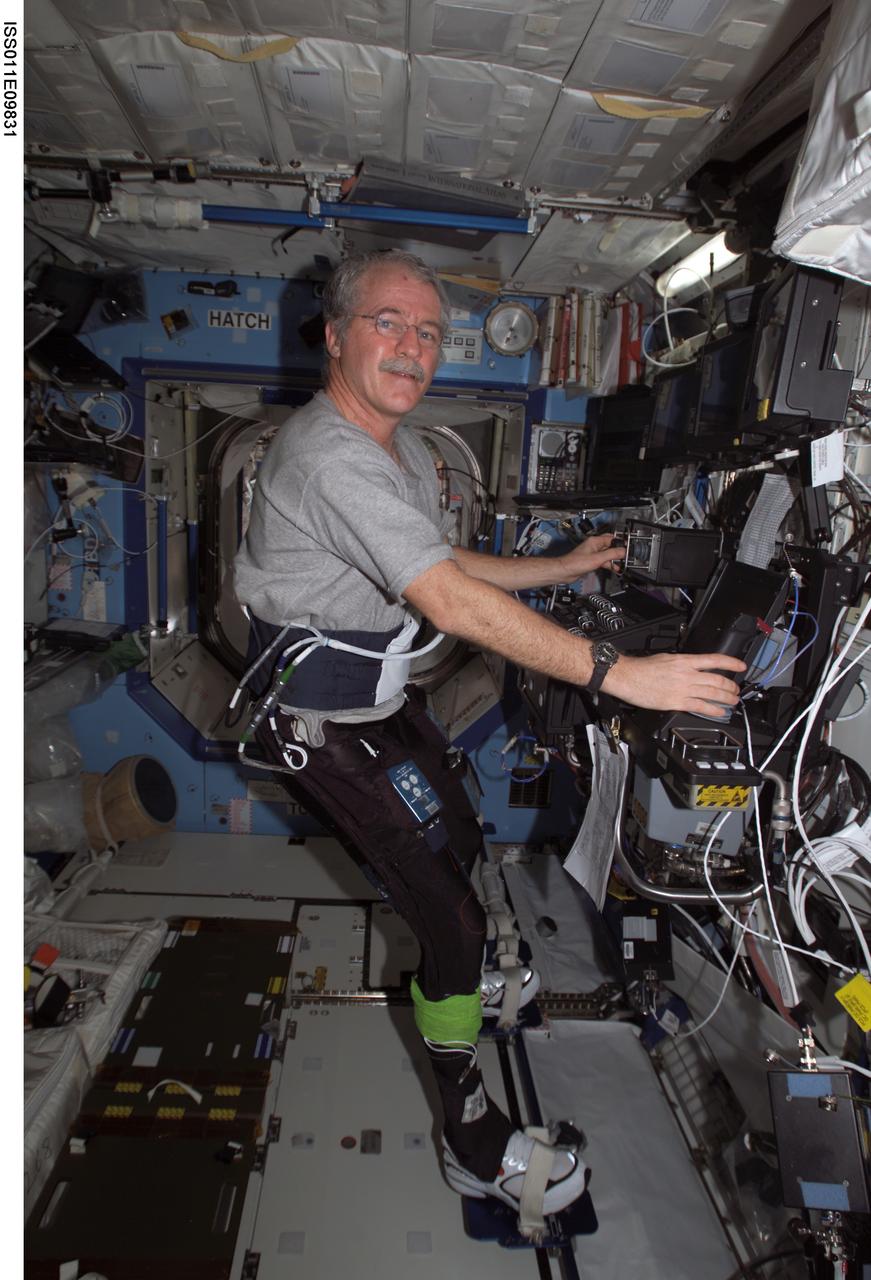
ISS011-E-09831 (29 June 2005) --- Astronaut John L. Phillips, Expedition 11 NASA Space Station science officer and flight engineer, works at the Canadarm2 controls while participating in the Foot/Ground Reaction Forces During Spaceflight (FOOT) experiment in the Destiny laboratory of the International Space Station. Phillips wore the specially instrumented Lower Extremity Monitoring Suit (LEMS), cycling tights outfitted with sensors, during the experiment.
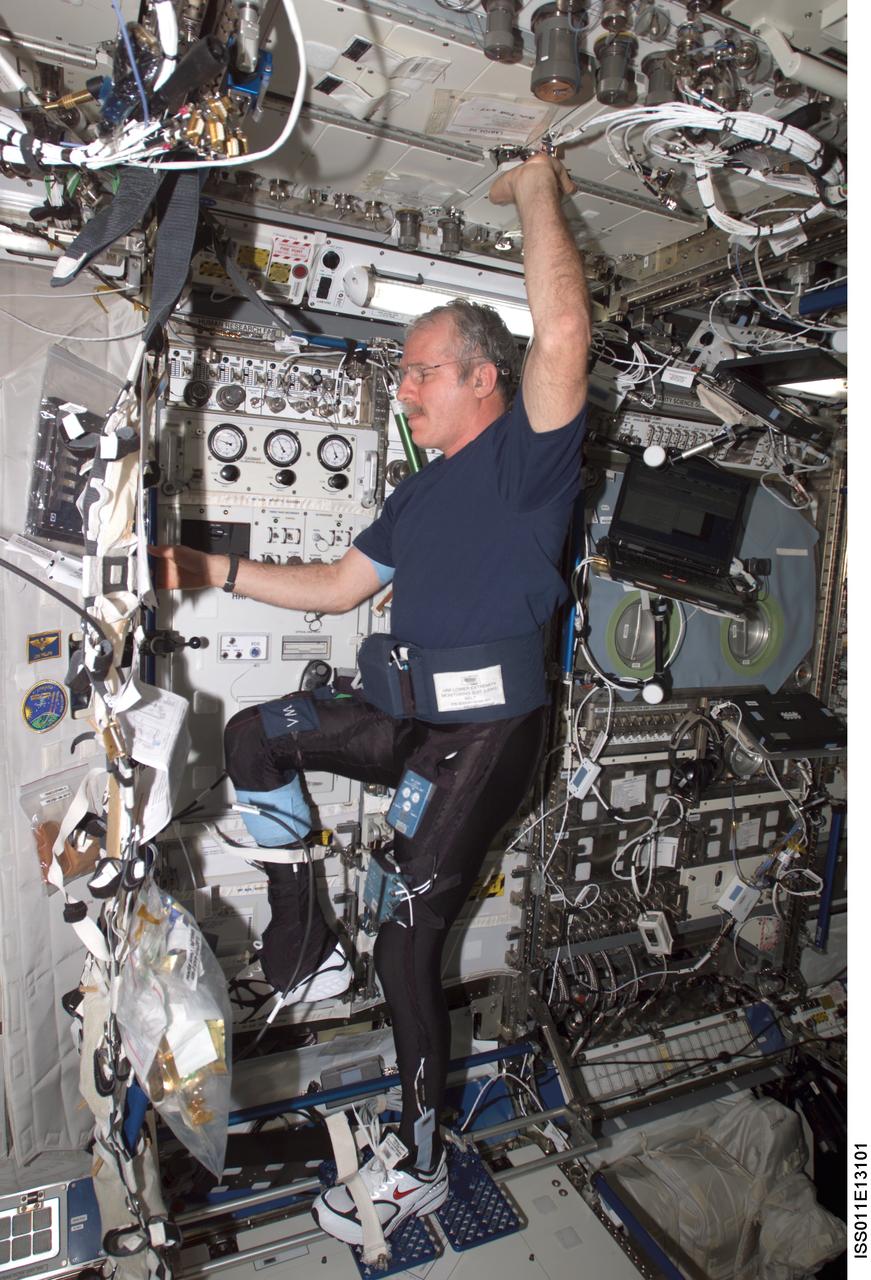
ISS011-E-13101 (16 Sept. 2005) --- Astronaut John L. Phillips, Expedition 11 NASA space station science officer and flight engineer, balances on the footplate of a special track attached to the Human Research Facility (HRF) rack in the Destiny laboratory on the International Space Station to perform Foot/Ground Reaction Forces During Spaceflight (FOOT) / Electromyography (EMG) calibration operations. Phillips is wearing the Lower Extremity Monitoring Suit (LEMS), the cycling tights outfitted with 20 sensors, which measures forces on joints and muscle activity.
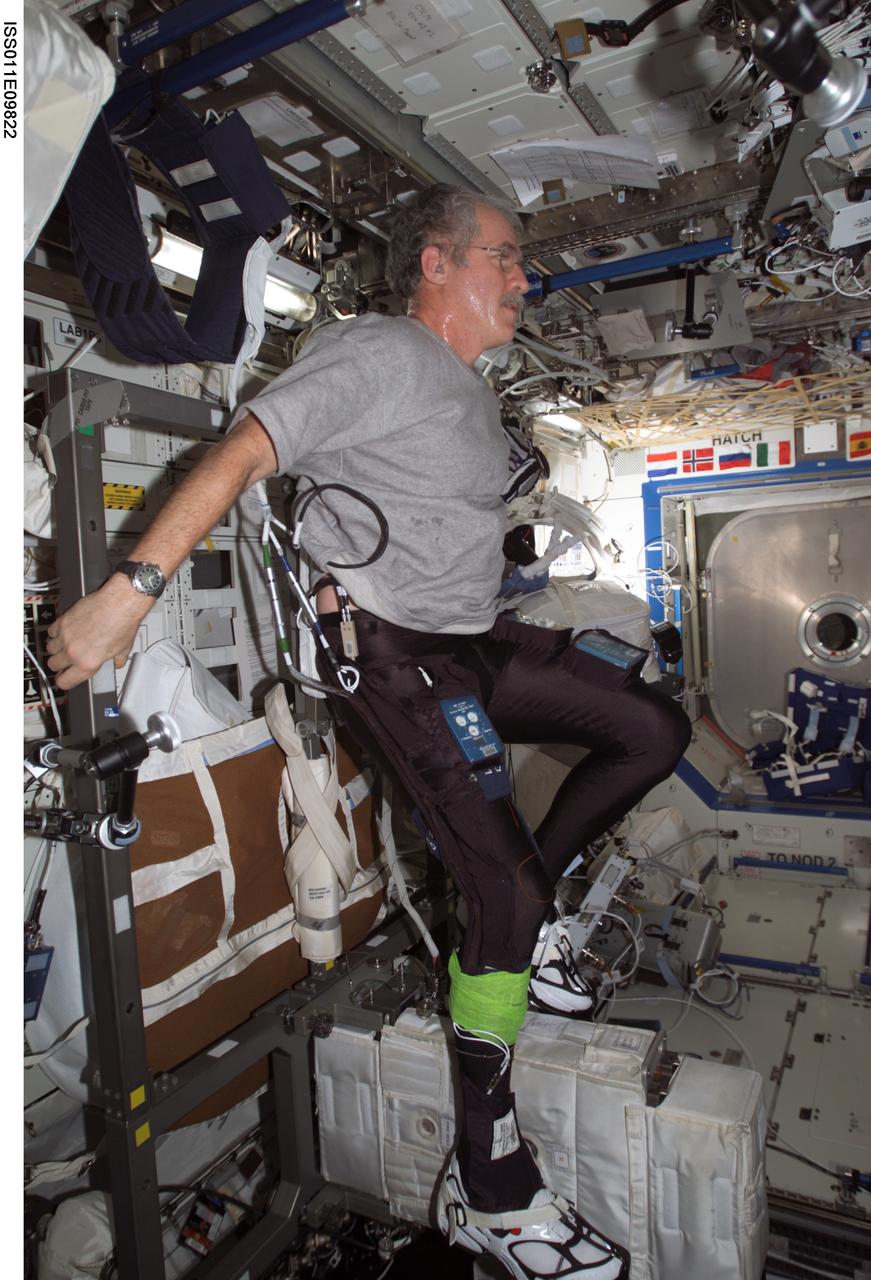
ISS011-E-09822 (29 June 2005) --- Astronaut John L. Phillips, Expedition 11 NASA Space Station science officer and flight engineer, uses the Cycle Ergometer with Vibration Isolation System (CEVIS) while participating in the Foot/Ground Reaction Forces During Spaceflight (FOOT) experiment in the Destiny laboratory of the International Space Station. Phillips wore the specially instrumented Lower Extremity Monitoring Suit (LEMS), cycling tights outfitted with sensors, during the experiment.
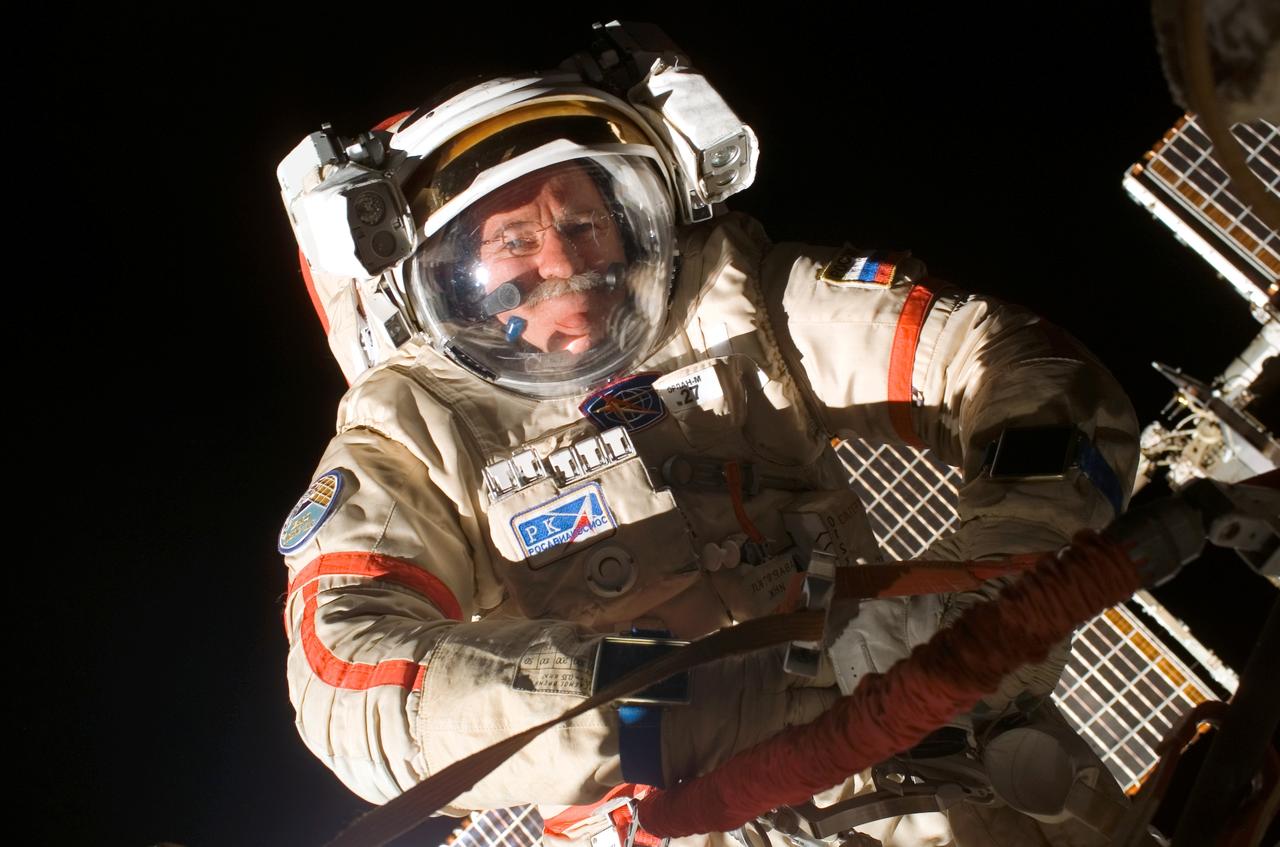
ISS011-E-11944 (18 August 2005) --- Attired in a Russian Orlan spacesuit, astronaut John L. Phillips, Expedition 11 NASA science officer and flight engineer, participates in a session of extravehicular activity (EVA). The 4 hour 58 minute spacewalk by Phillips and cosmonaut Sergei K. Krikalev (out of frame), commander representing Russia's Federal Space Agency, was the 62nd EVA in support of station assembly and maintenance, the 34th conducted from the station itself, and the 16th from the Pirs Docking Compartment.
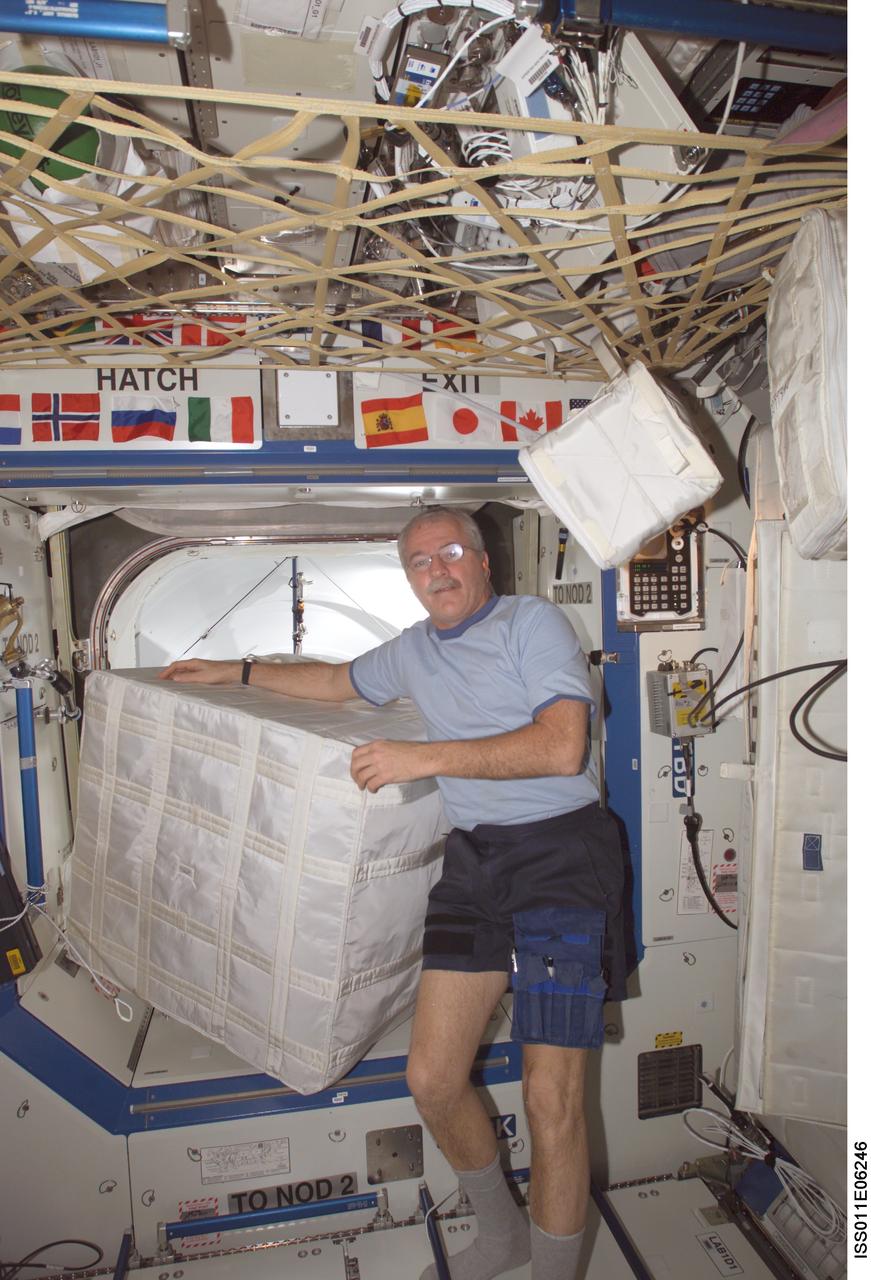
ISS011-E-06246 (18 May 2005) --- Astronaut John L. Phillips, Expedition 11 NASA ISS science officer and flight engineer, moves un-stowed cargo from the PMA-2 (Pressurized Mating Adapter-2) in preparation for the scheduled docking of the Space Shuttle Discovery. Phillips is in the Destiny laboratory of the International Space Station (ISS) with the hatch leading to the adapter in the background.
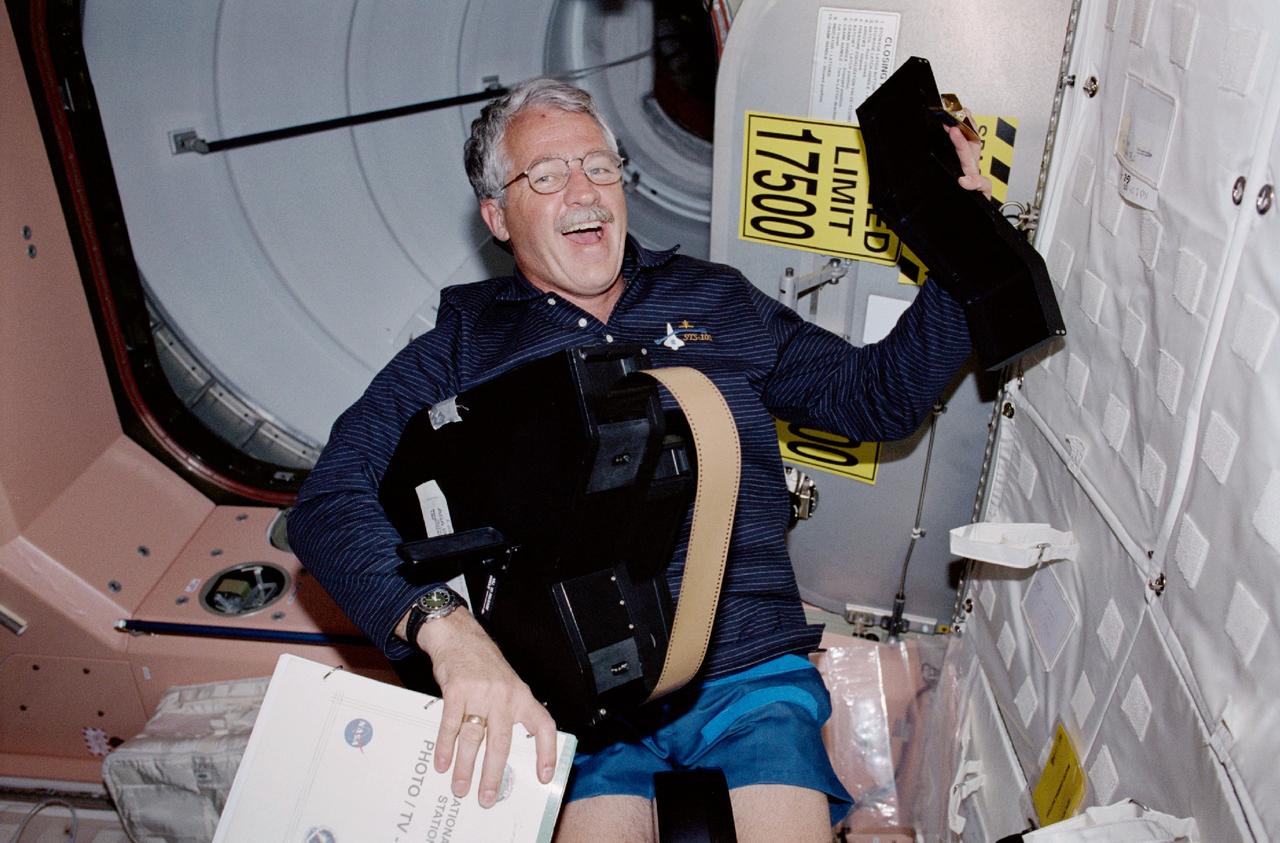
STS100-342-035 (19 April-1 May 2001) --- Astronaut John L. Phillips, mission specialist, works with the IMAX camera on the International Space Station (ISS). Phillips and his STS-100 crew mates transferred supplies to the station and recorded video, motion picture and still photography of their activities, including interaction with the Expedition Two crewmembers.
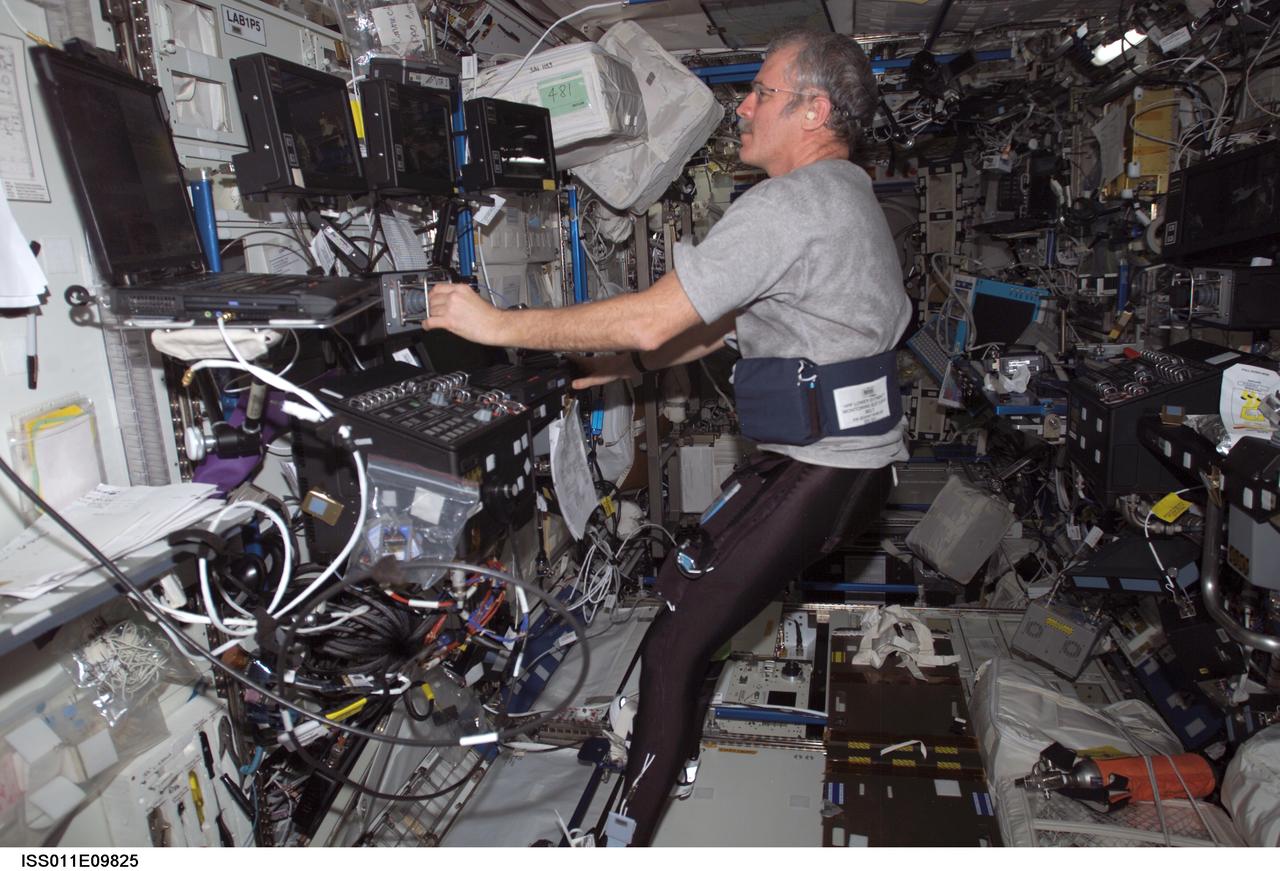
ISS011-E-09825 (29 June 2005) --- Astronaut John L. Phillips, Expedition 11 NASA Space Station science officer and flight engineer, enters data into a computer while participating in the Foot/Ground Reaction Forces During Spaceflight (FOOT) experiment in the Destiny laboratory of the International Space Station. Phillips wore the specially instrumented Lower Extremity Monitoring Suit (LEMS), cycling tights outfitted with sensors, during the experiment.
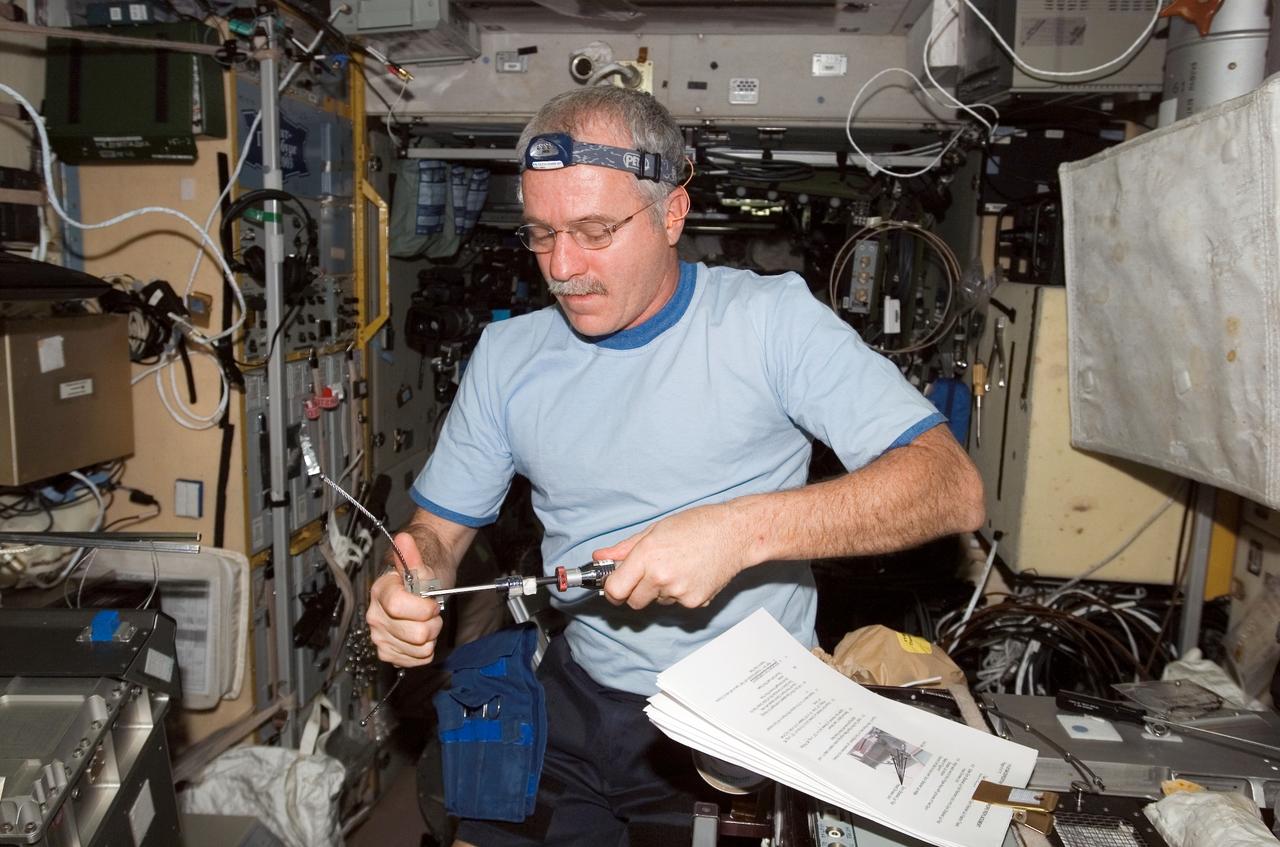
ISS011-E-06174 (16 May 2005) --- Astronaut John L. Phillips, Expedition 11 NASA science officer and flight engineer, works with the Treadmill Vibration Isolation System (TVIS) during In-Flight Maintenance (IFM) in the Zvezda Service Module of international space station. Phillips uses a screwdriver to repair one of the broken forward and aft gyroscope wire ropes.
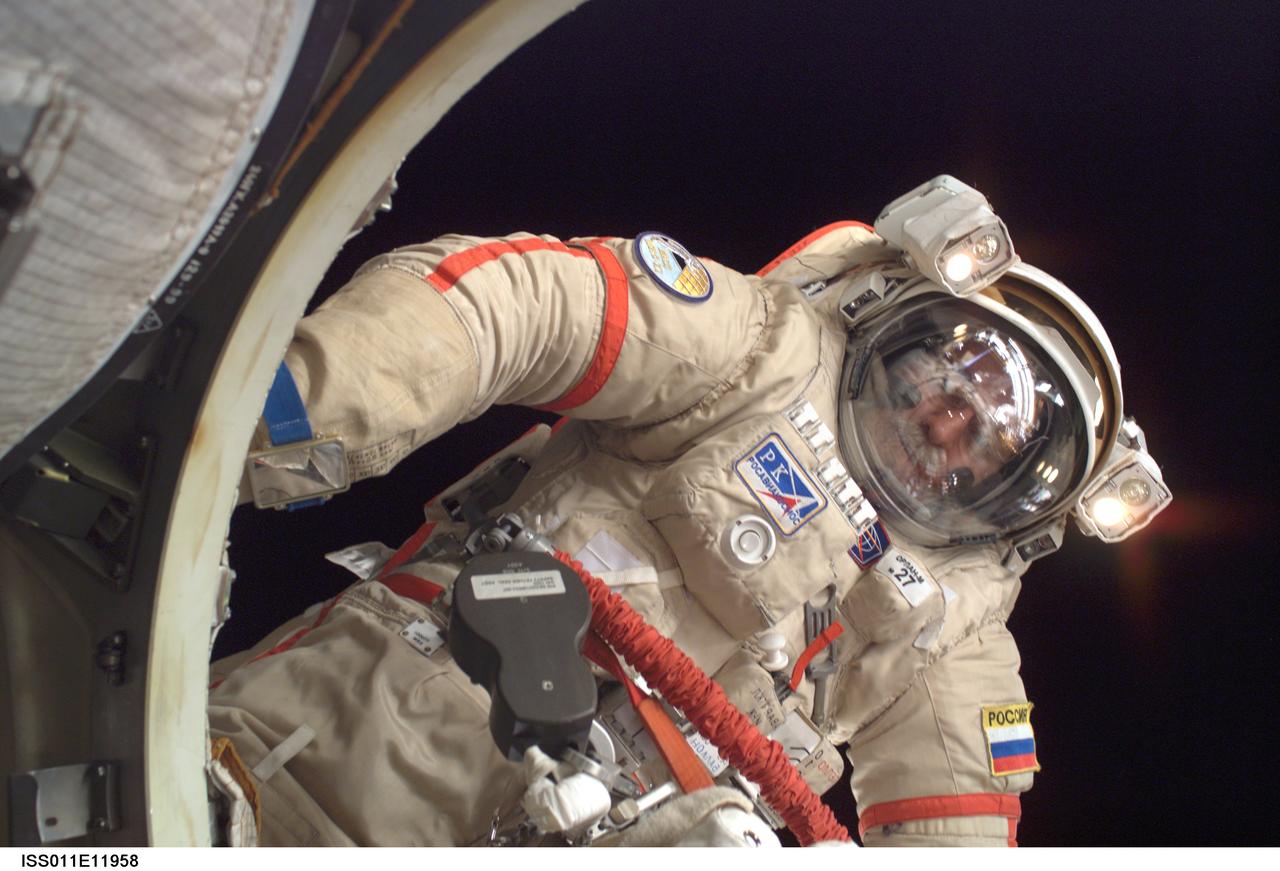
ISS011-E-11958 (18 August 2005) --- Attired in a Russian Orlan spacesuit, astronaut John L. Phillips, Expedition 11 NASA Space Station science officer and flight engineer, participates in a session of extravehicular activity (EVA). The 4 hour 58 minute spacewalk by Phillips and cosmonaut Sergei K. Krikalev (out of frame), commander representing Russia's Federal Space Agency, was the 62nd EVA in support of Station assembly and maintenance, the 34th conducted from the Station itself, and the 16th from the Pirs Docking Compartment.
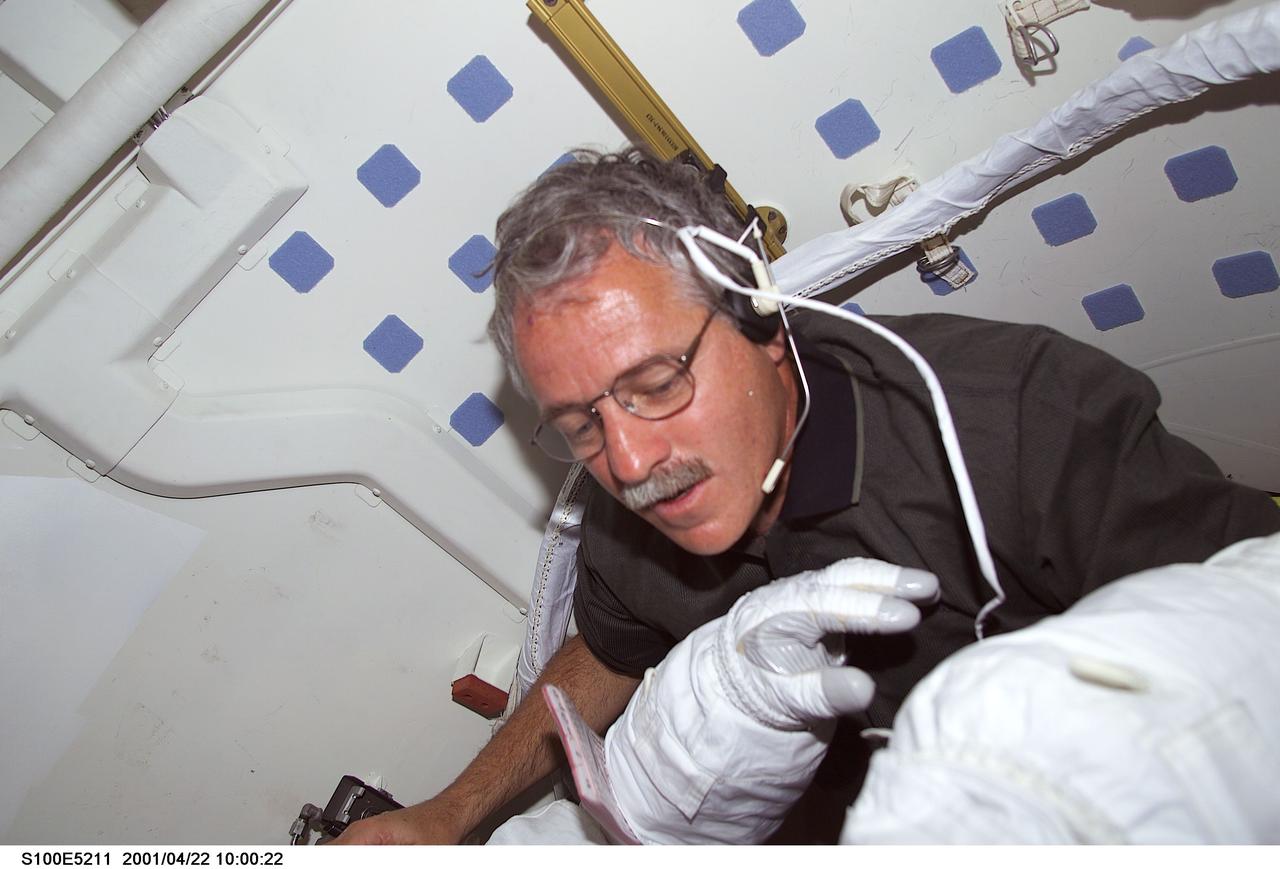
S100-E-5211 (22 April 2001) --- Astronaut John L. Phillips, mission specialist, assists one of the STS-100 spacewalkers during suit donning onboard the Space Shuttle Endeavour. Astronauts Chris A. Hadfield of the Canadian Space Agency (CSA) and Scott E. Parazynski, both mission specialists, shared the area with the helpful Phillips in preparation for the first of two scheduled days of extravehicular activity (EVA). The image was recorded with a digital still camera.
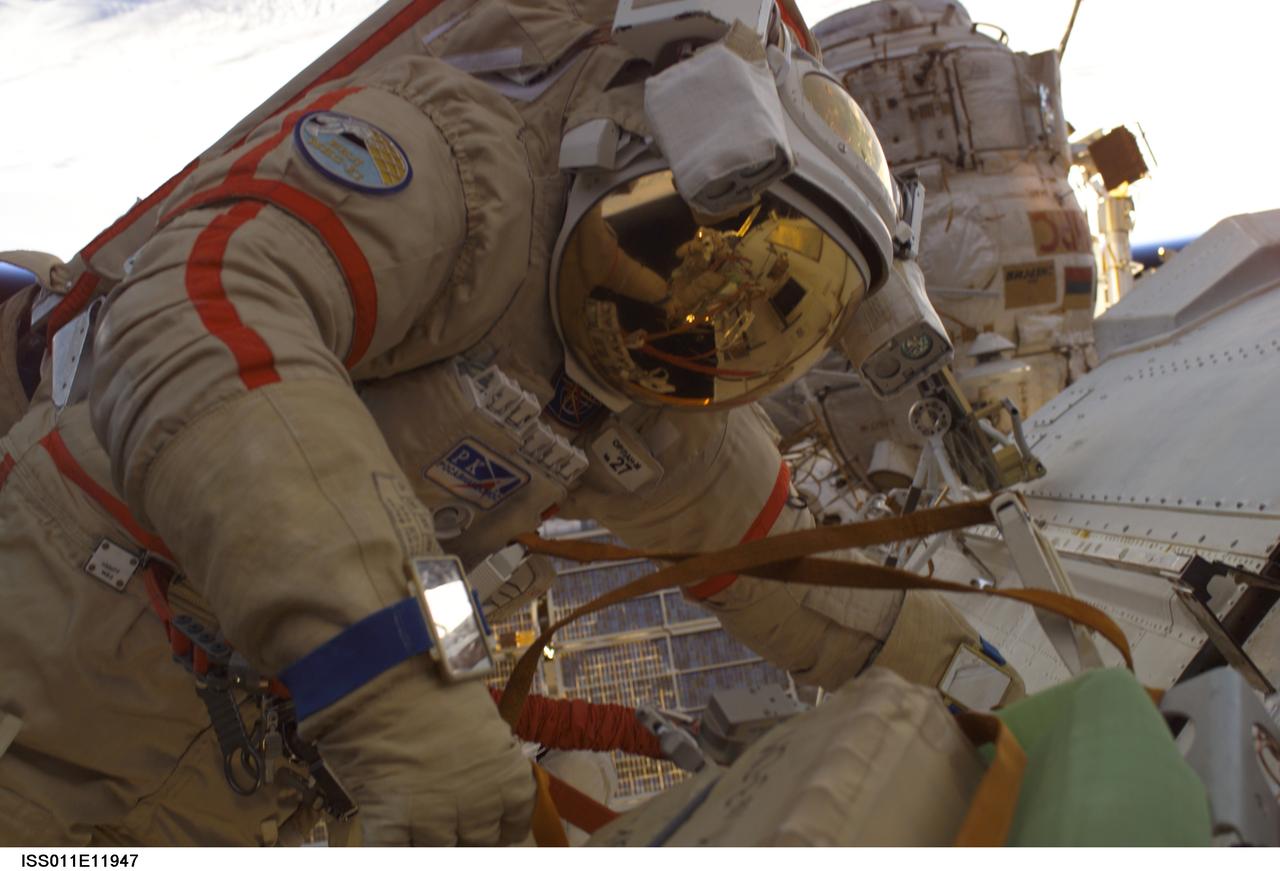
ISS011-E-11947 (18 August 2005) --- Attired in a Russian Orlan spacesuit, astronaut John L. Phillips, Expedition 11 NASA Space Station science officer and flight engineer, participates in a session of extravehicular activity (EVA). The 4 hour 58 minute spacewalk by Phillips and cosmonaut Sergei K. Krikalev (seen in Phillip;s helmet visor), commander representing Russia's Federal Space Agency, was the 62nd EVA in support of Station assembly and maintenance, the 34th conducted from the Station itself, and the 16th from the Pirs Docking Compartment.
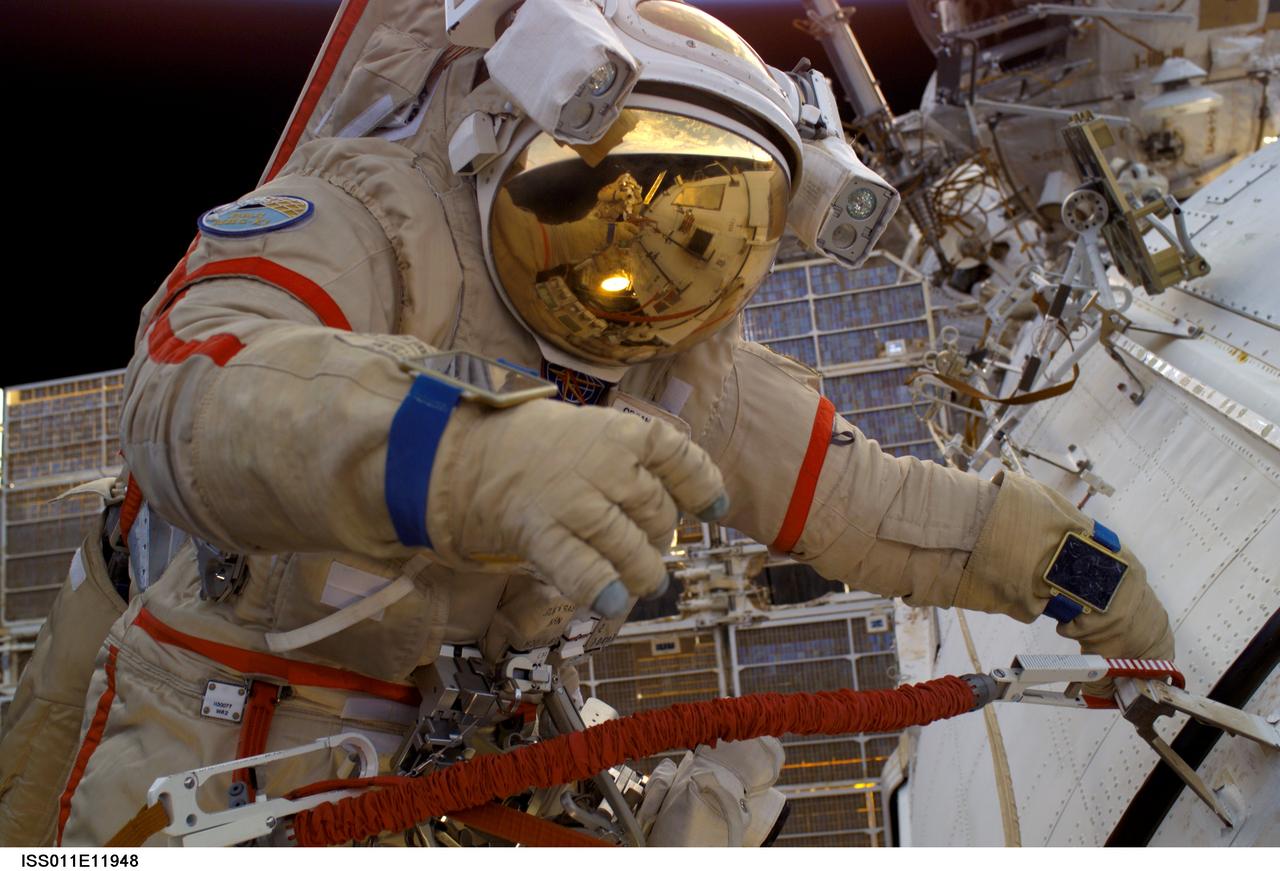
ISS011-E-11948 (18 August 2005) --- Attired in a Russian Orlan spacesuit, astronaut John L. Phillips, Expedition 11 NASA Space Station science officer and flight engineer, participates in a session of extravehicular activity (EVA). The 4 hour 58 minute spacewalk by Phillips and cosmonaut Sergei K. Krikalev (seen in Phillip;s helmet visor), commander representing Russia's Federal Space Agency, was the 62nd EVA in support of Station assembly and maintenance, the 34th conducted from the Station itself, and the 16th from the Pirs Docking Compartment.
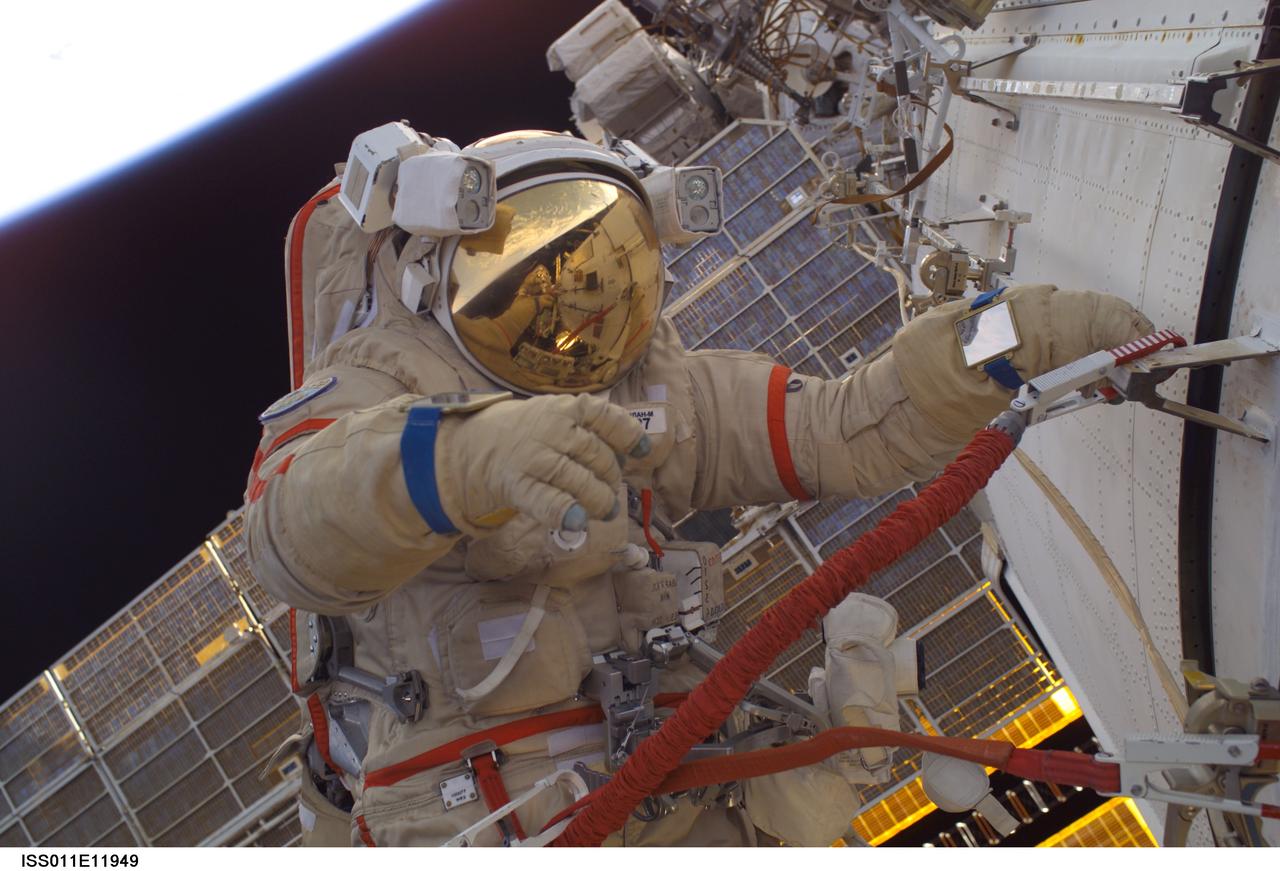
ISS011-E-11949 (18 August 2005) --- Attired in a Russian Orlan spacesuit, astronaut John L. Phillips, Expedition 11 NASA Space Station science officer and flight engineer, participates in a session of extravehicular activity (EVA). The 4 hour 58 minute spacewalk by Phillips and cosmonaut Sergei K. Krikalev (seen in Phillip;s helmet visor), commander representing Russia's Federal Space Agency, was the 62nd EVA in support of Station assembly and maintenance, the 34th conducted from the Station itself, and the 16th from the Pirs Docking Compartment.
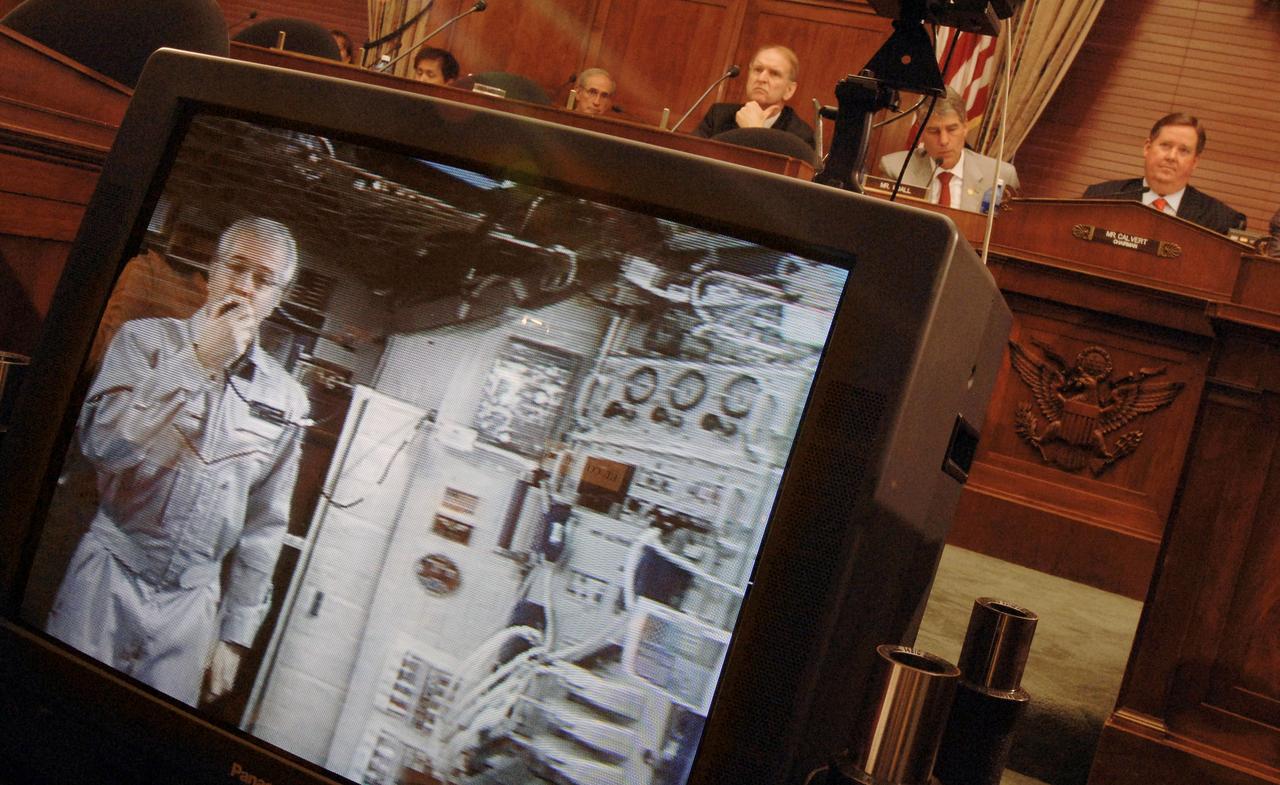
JSC2005-E-22364 (14 June 2005) --- Astronaut John L. Phillips, Expedition 11 NASA ISS science officer and flight engineer, testifies via video screen before the House Subcommittee on Space and Aeronautics chaired by Rep. Ken Calvert (R-Calif.), as he orbited Earth onboard the International Space Station (ISS) at a speed of five miles a second. Phillips was approximately 220 statute miles above Earth, but his radio transmissions were routed to a Tracking and Data Relay Satellite (TDRS) in geostationary orbit at an altitude of about 22,300 miles. Photo credit: NASA/Bill Ingalls.
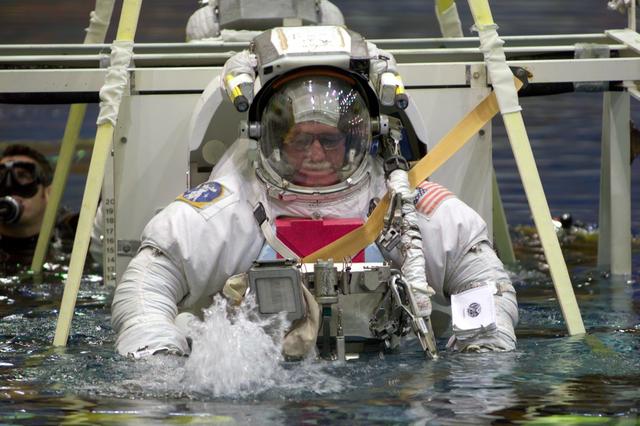
JSC2004-E-27324 (30 June 2004) --- Astronaut John L. Phillips, Expedition 11 NASA ISS science officer, and cosmonaut Sergei K. Krikalev (partially obscured), commander representing Russia’s Federal Space Agency, are submerged in the waters of the Neutral Buoyancy Laboratory (NBL) near Johnson Space Center (JSC). Phillips and Krikalev are wearing training versions of the Extravehicular Mobility Unit (EMU) space suit. Divers are in the water to assist the crewmembers in their rehearsal, intended to help prepare them for work on the exterior of the International Space Station (ISS).
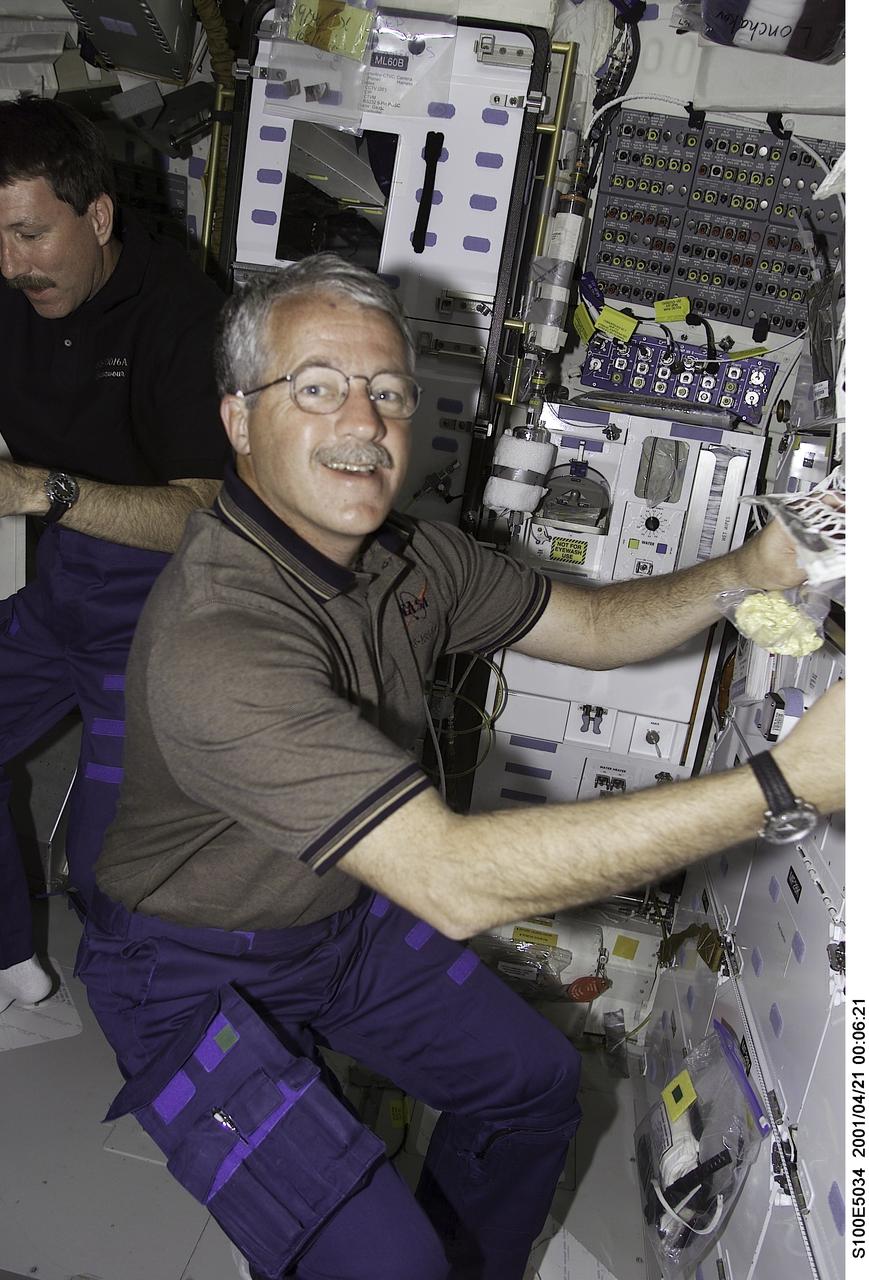
S100-E-5034 (21 April 2001) --- Astronauts Kent V. Rominger (background), STS-100 commander, and John L. Phillips, mission specialist, are seen on the middeck of the Space Shuttle Endeavour as the crew anticipates its union with the International Space Station (ISS). Assigned space-walking astronauts Chris A. Hadfield and Scott E. Parazynski (both out of frame) were later joined on the middeck by spacewalk coordinator Phillips in conducting some final checks of the suits and hardware that were to be used during the next day's planned 6-hour, 30-minute spacewalk. The image was recorded with a digital still camera.
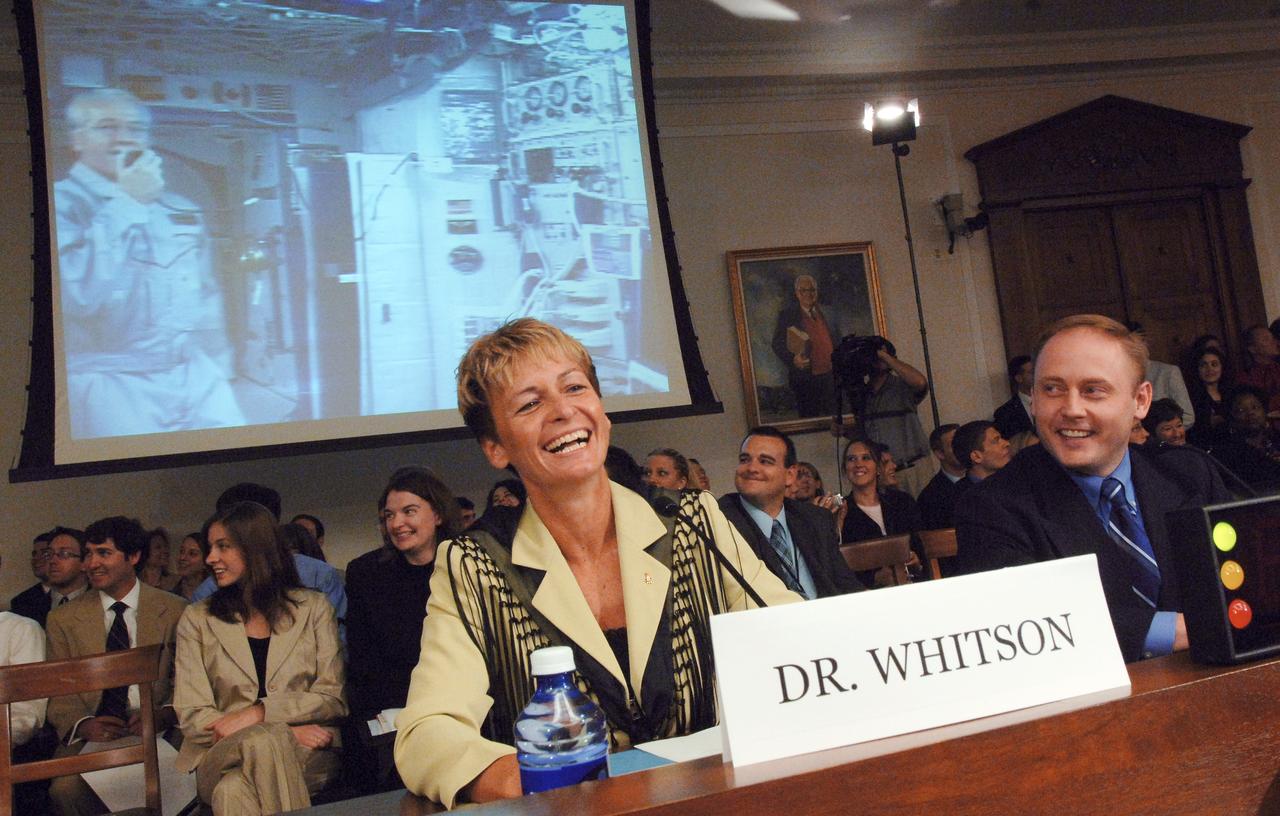
JSC2005-E-22363 (14 June 2005) --- Astronauts Peggy A. Whitson (left) and Edward M. (Mike) Fincke, former Station residents, share a laugh during the House Subcommittee on Space and Aeronautics hearing chaired by Rep. Ken Calvert (R-Calif.), as current Station astronaut John L. Phillips, Expedition 11 NASA ISS science officer and flight engineer, testifies via video screen in the background. Phillips was approximately 220 statute miles above Earth, but his radio transmissions were routed to a Tracking and Data Relay Satellite (TDRS) in geostationary orbit at an altitude of about 22,300 miles. Photo credit: NASA/Bill Ingalls.
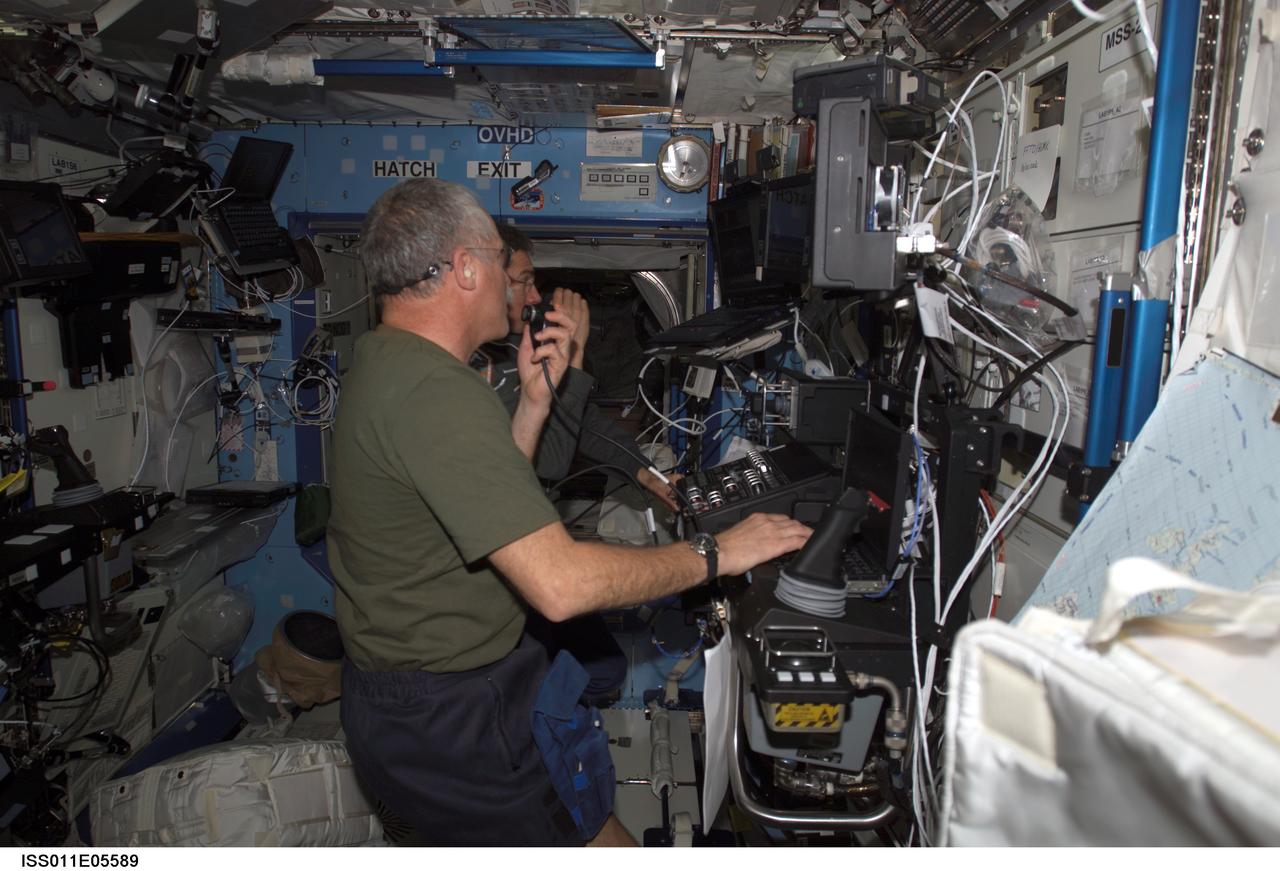
ISS011-E-05589 (6 May 2005) --- Astronaut John L. Phillips, Expedition 11 NASA ISS science officer, and cosmonaut Sergei K. Krikalev (obscured), commander representing Russia's Federal Space Agency, participate in a proficiency training session with the Canadarm2, or Space Station Remote Manipulator System (SSRMS) in the Destiny laboratory of the International Space Station (ISS).
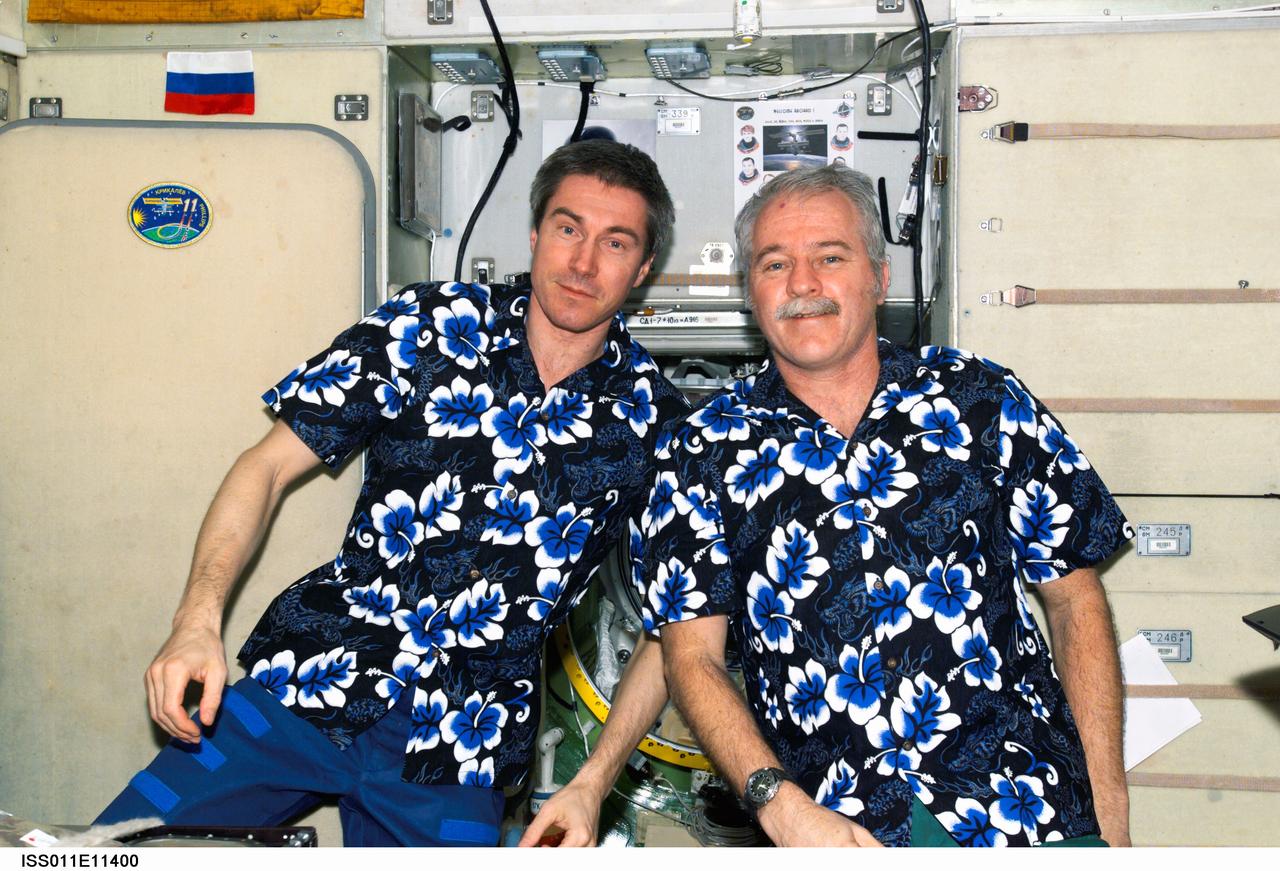
ISS011-E-11400 (31 July 2005) --- Cosmonaut Sergei K. Krikalev (left), Expedition 11 commander representing Russia's Federal Space Agency, and astronaut John L. Phillips, NASA Space Station science officer and flight engineer, pose for a photo in the Zvezda Service Module of the International Space Station. At the time, the two were playing host to the seven Discovery crewmembers.
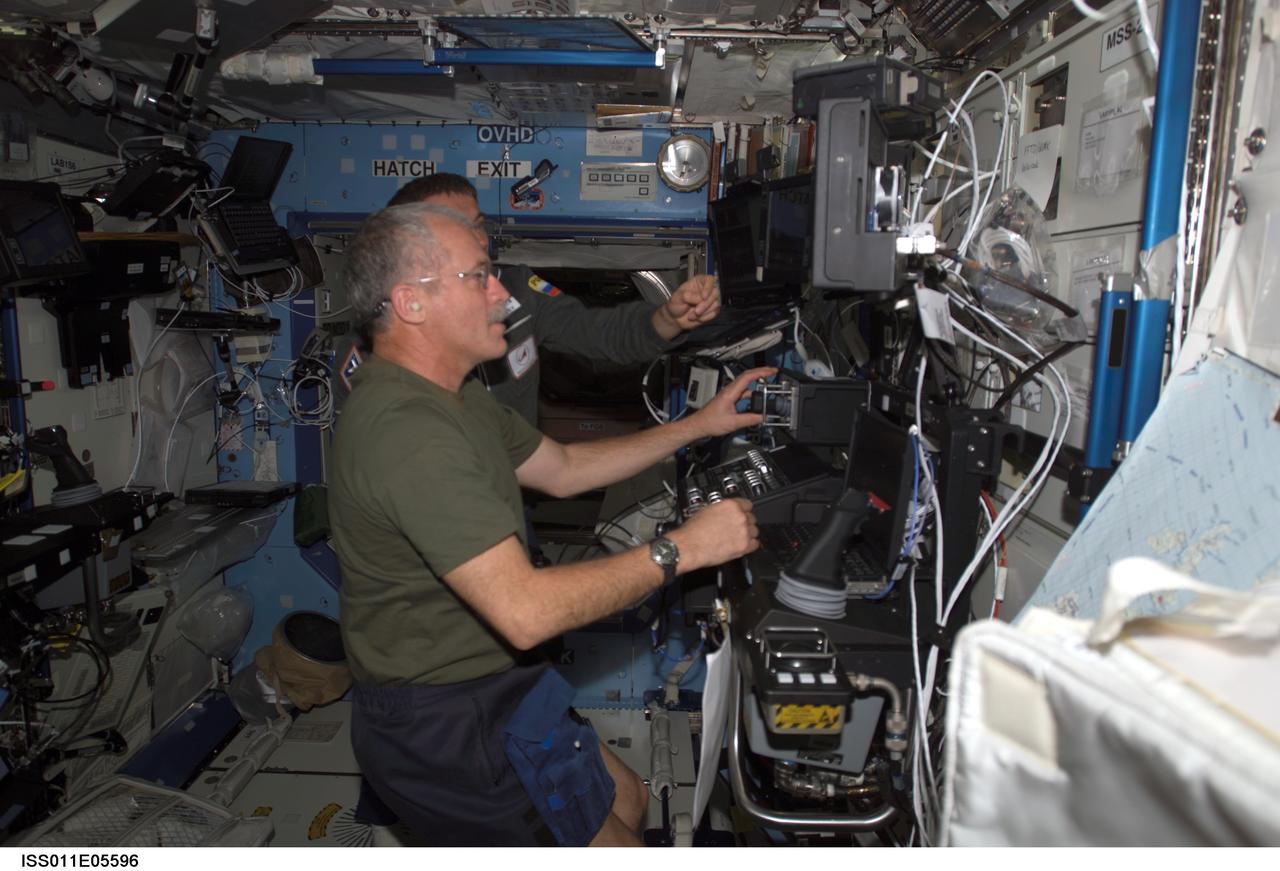
ISS011-E-05596 (6 May 2005) --- Astronaut John L. Phillips, Expedition 11 NASA ISS science officer, and cosmonaut Sergei K. Krikalev (obscured), commander representing Russia's Federal Space Agency, participate in a proficiency training session with the Canadarm2, or Space Station Remote Manipulator System (SSRMS) in the Destiny laboratory of the International Space Station (ISS).
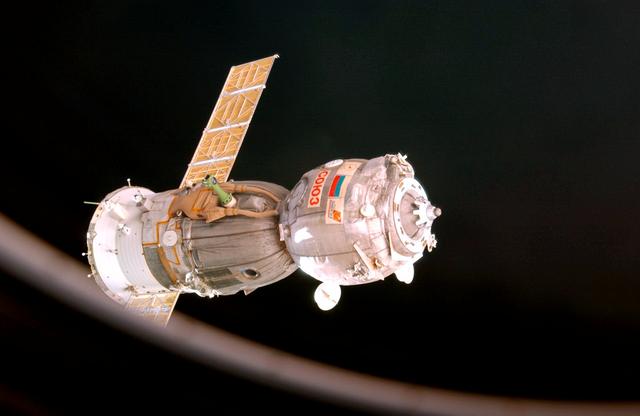
ISS012-E-05001 (10 October 2005) --- Backdropped by the blackness of space, the Soyuz TMA-6 spacecraft departs from the international space station carrying Russian Federal Space Agency cosmonaut Sergei K. Krikalev, Expedition 11 commander; astronaut John L. Phillips, Expedition 11 NASA science officer and flight engineer; and Greg Olsen, spaceflight participant. Undocking occurred at 4:43 p.m. (CDT) on Oct. 10.
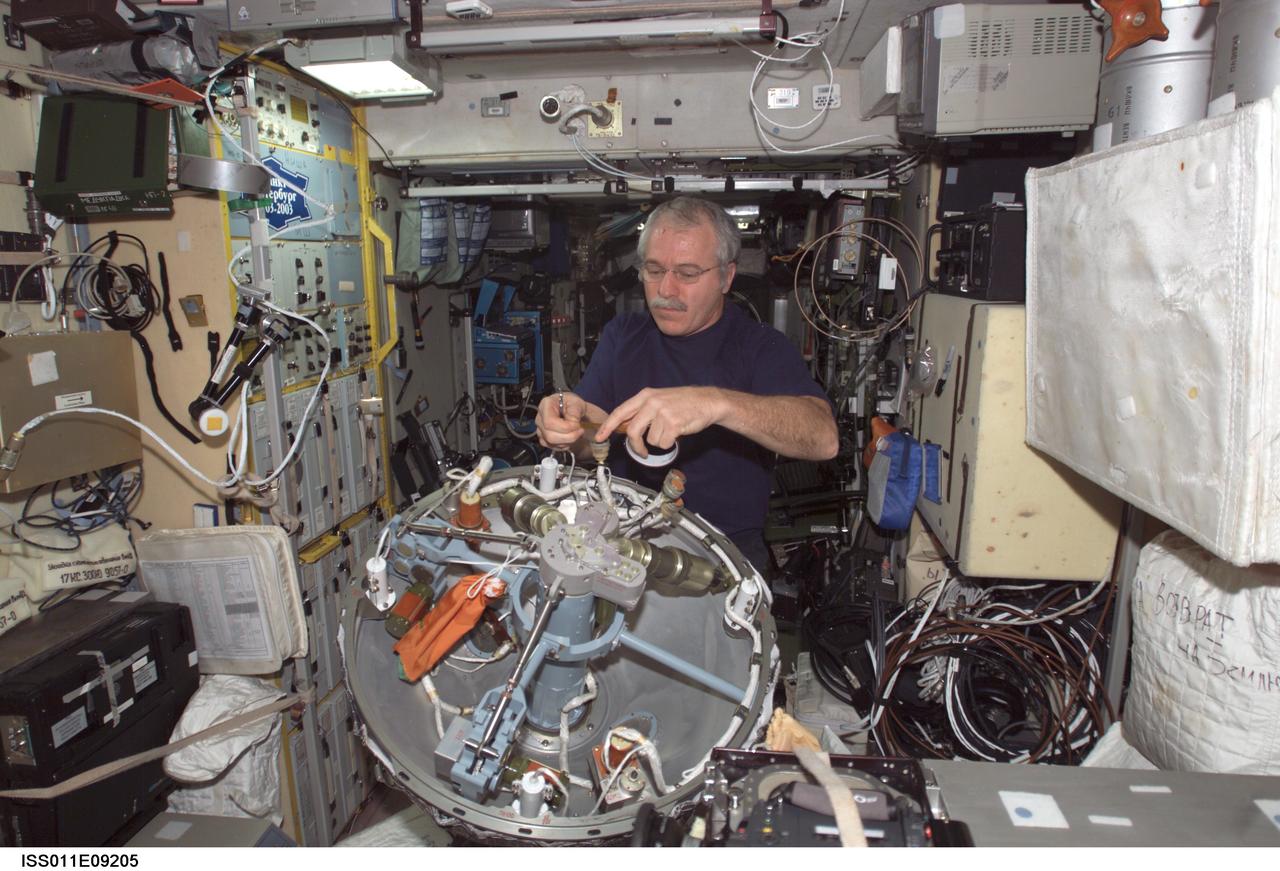
ISS011-E-09205 (19 June 2005) --- Astronaut John L. Phillips, Expedition 11 NASA ISS science officer and flight engineer, works on the dismantled probe-and-cone docking mechanism from the Progress 18 spacecraft in the Zvezda Service Module of the International Space Station (ISS). The Progress docked to the aft port of the Service Module at 7:42 p.m. (CDT) as the two spacecraft flew approximately 225 statute miles, above a point near Beijing, China.
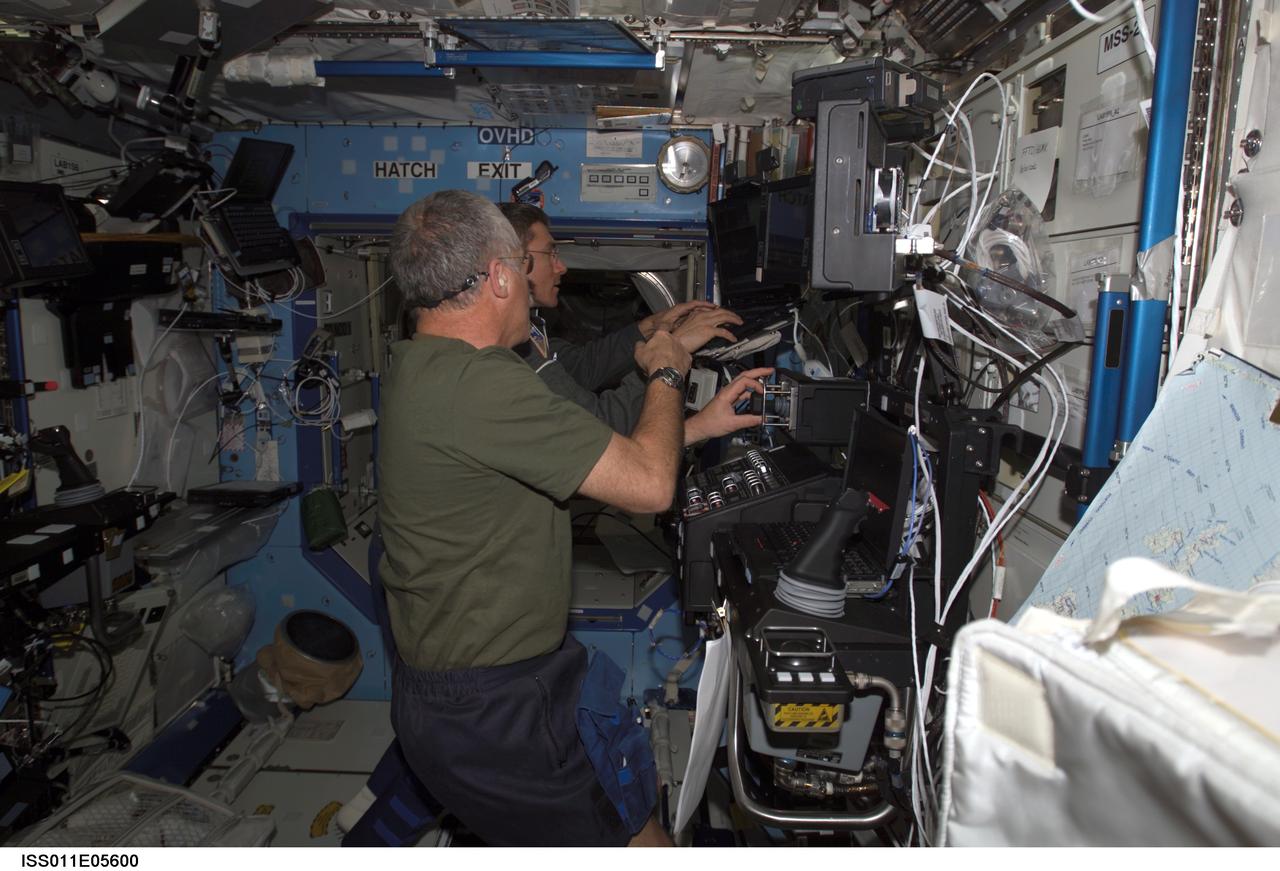
ISS011-E-05600 (6 May 2005) --- Astronaut John L. Phillips, Expedition 11 NASA ISS science officer, and cosmonaut Sergei K. Krikalev (obscured), commander representing Russia's Federal Space Agency, participate in a proficiency training session with the Canadarm2, or Space Station Remote Manipulator System (SSRMS) in the Destiny laboratory of the International Space Station (ISS).
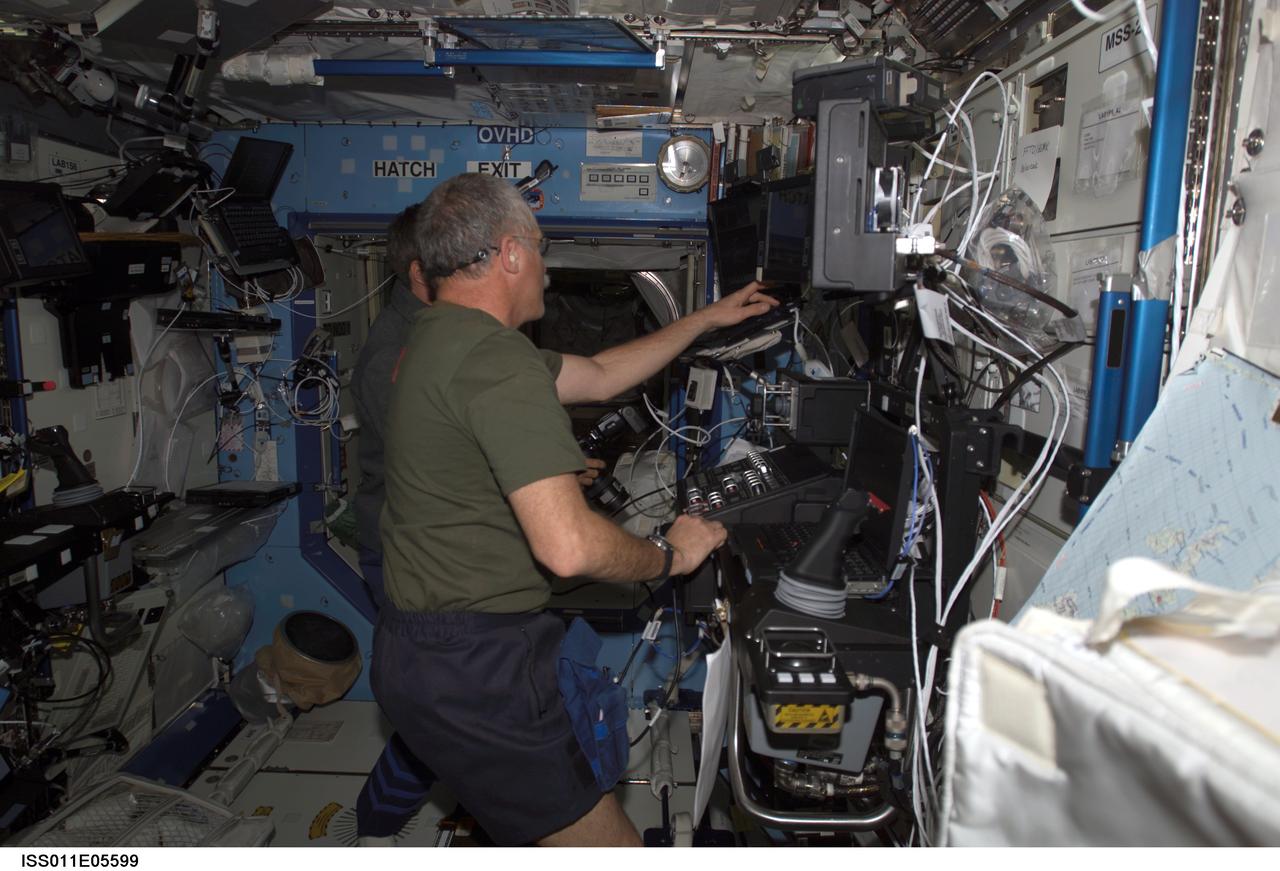
ISS011-E-05599 (6 May 2005) --- Astronaut John L. Phillips, Expedition 11 NASA ISS science officer, and cosmonaut Sergei K. Krikalev (obscured), commander representing Russia's Federal Space Agency, participate in a proficiency training session with the Canadarm2, or Space Station Remote Manipulator System (SSRMS) in the Destiny laboratory of the International Space Station (ISS).
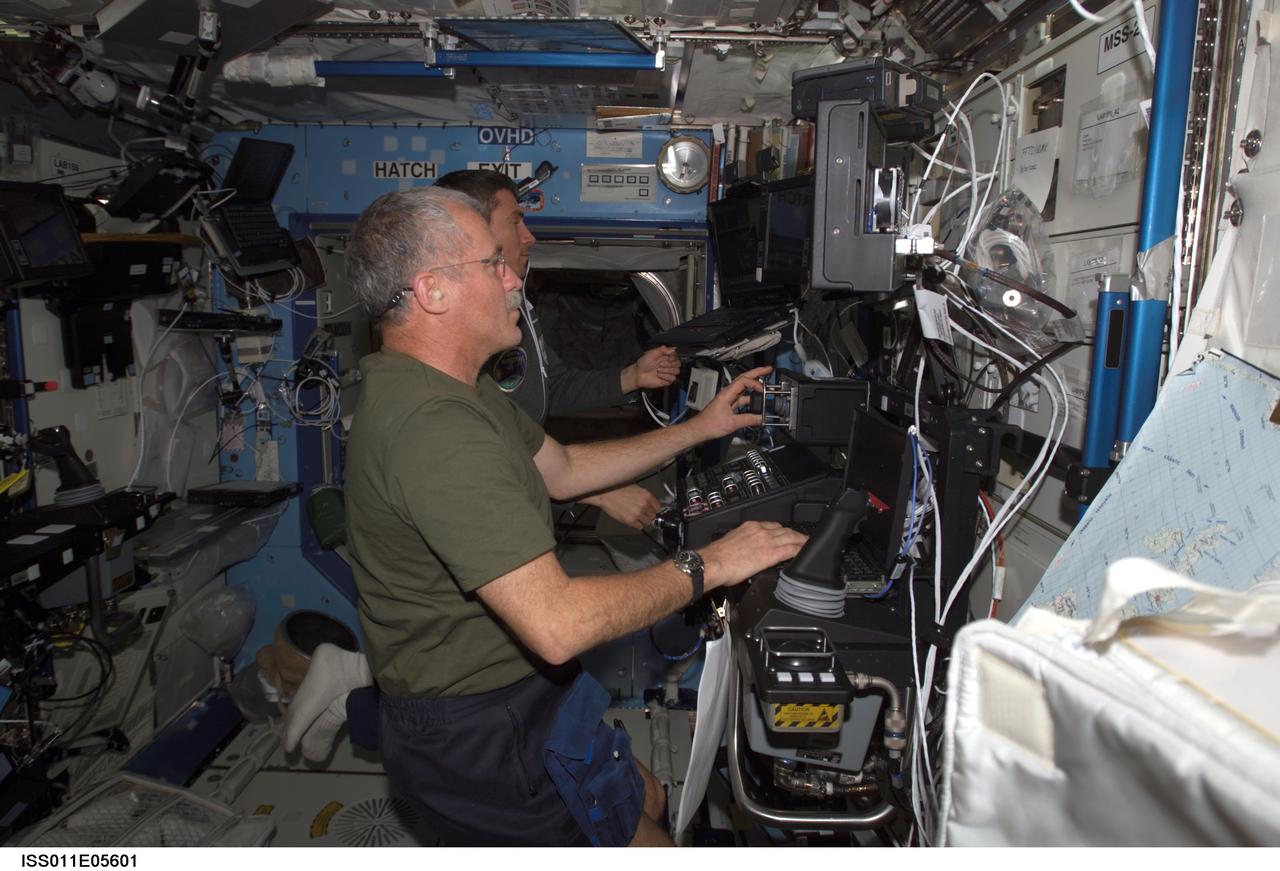
ISS011-E-05601 (6 May 2005) --- Astronaut John L. Phillips, Expedition 11 NASA ISS science officer, and cosmonaut Sergei K. Krikalev (partially obscured), commander representing Russia's Federal Space Agency, participate in a proficiency training session with the Canadarm2, or Space Station Remote Manipulator System (SSRMS) in the Destiny laboratory of the International Space Station (ISS).
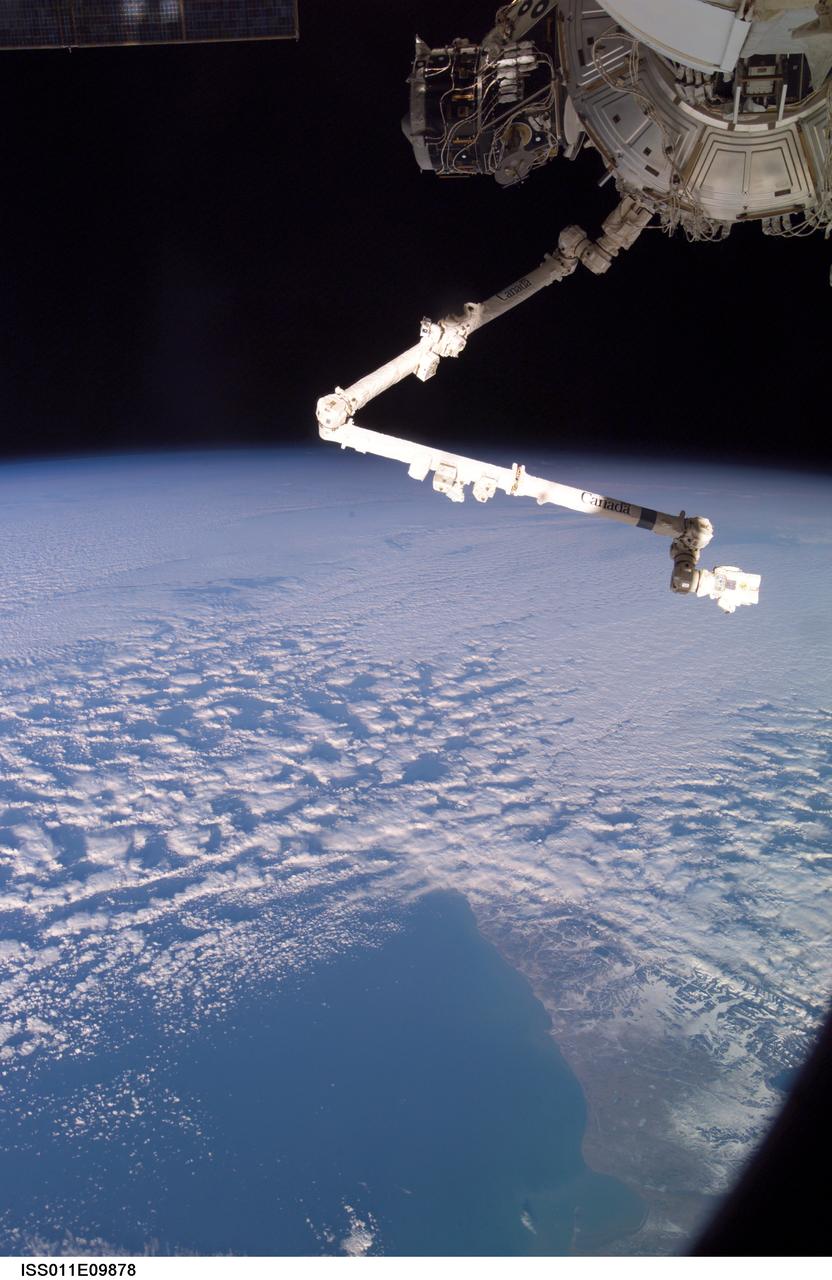
ISS011-E-09878 (30 June 2005) --- The Expedition 11 crew aboard the International Space Station flexes the robotic arm, Canadarm2, while flying approximately 225 miles above Cape Horn. Onboard are crewmembers, cosmonaut Sergei Krikalev of Russia's Federal Space Agency, commander, and astronaut John L. Phillips, NASA Space Station science officer and flight engineer.
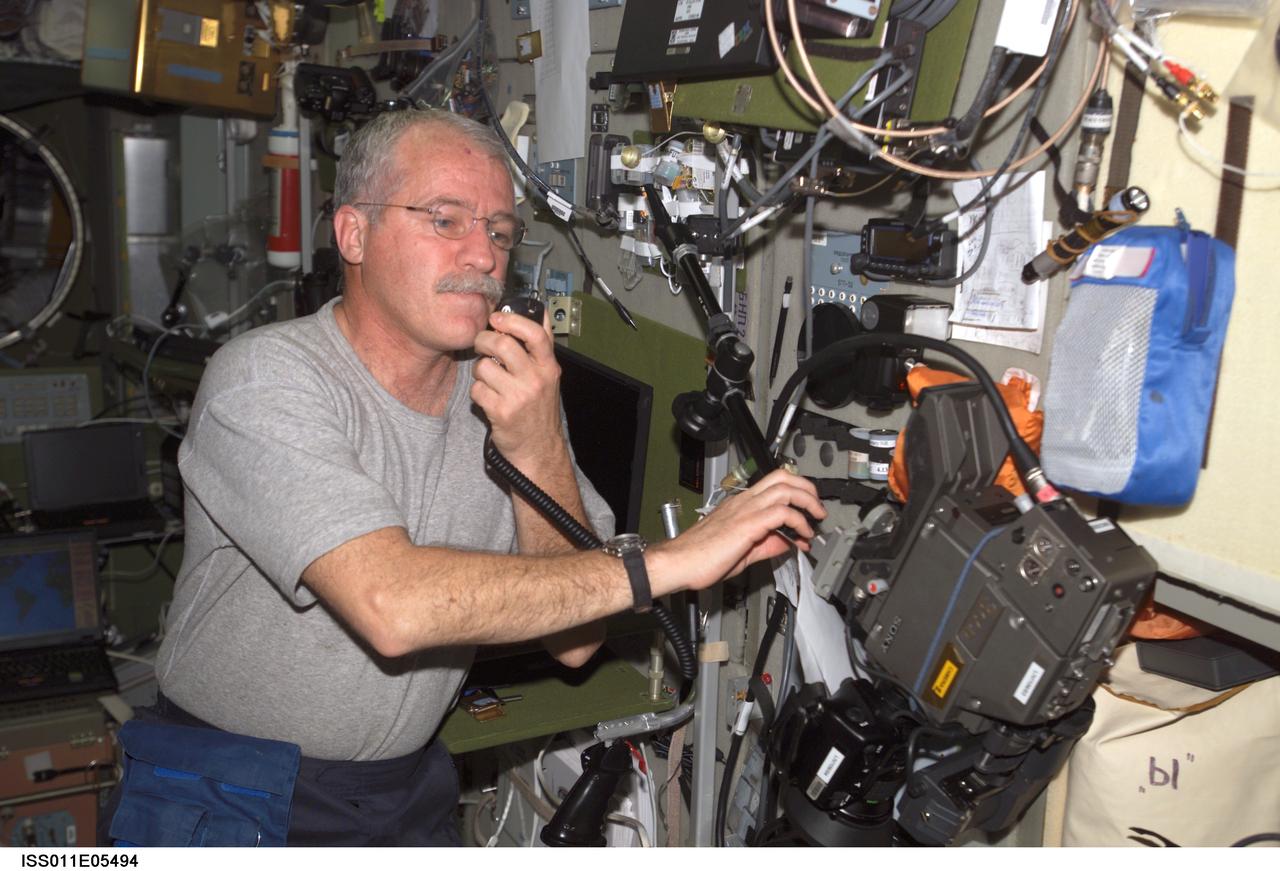
ISS011-E-05494 (4 May 2005) --- Astronaut John L. Phillips, Expedition 11 NASA ISS science officer and flight engineer, sets up amateur radio equipment in the Zvezda Service Module of the International Space Station (ISS) prior to conducting a ham radio exchange with students at Albany Hills State School in Brisbane, Australia.
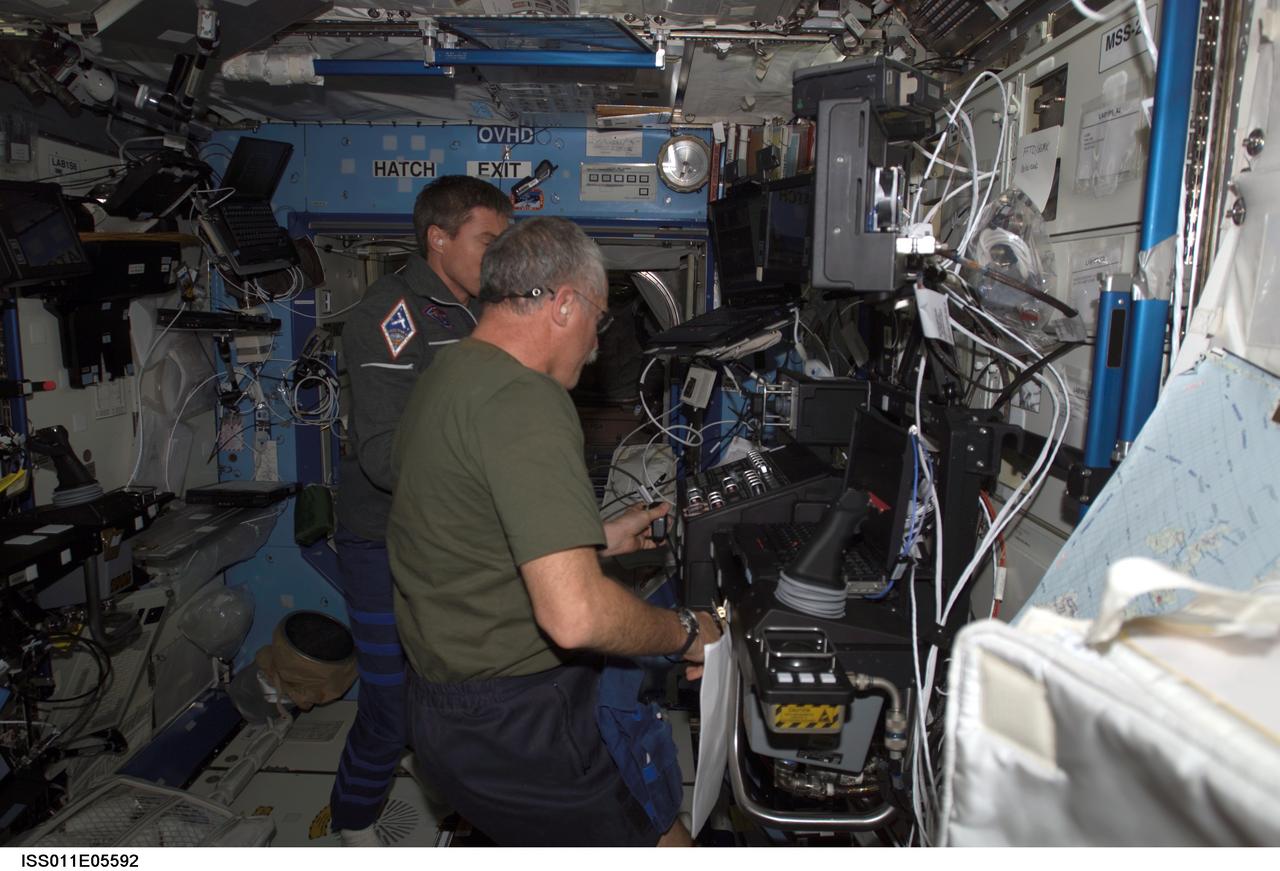
ISS011-E-05592 (6 May 2005) --- Astronaut John L. Phillips, Expedition 11 NASA ISS science officer, and cosmonaut Sergei K. Krikalev (obscured), commander representing Russia's Federal Space Agency, participate in a proficiency training session with the Canadarm2, or Space Station Remote Manipulator System (SSRMS) in the Destiny laboratory of the International Space Station (ISS).
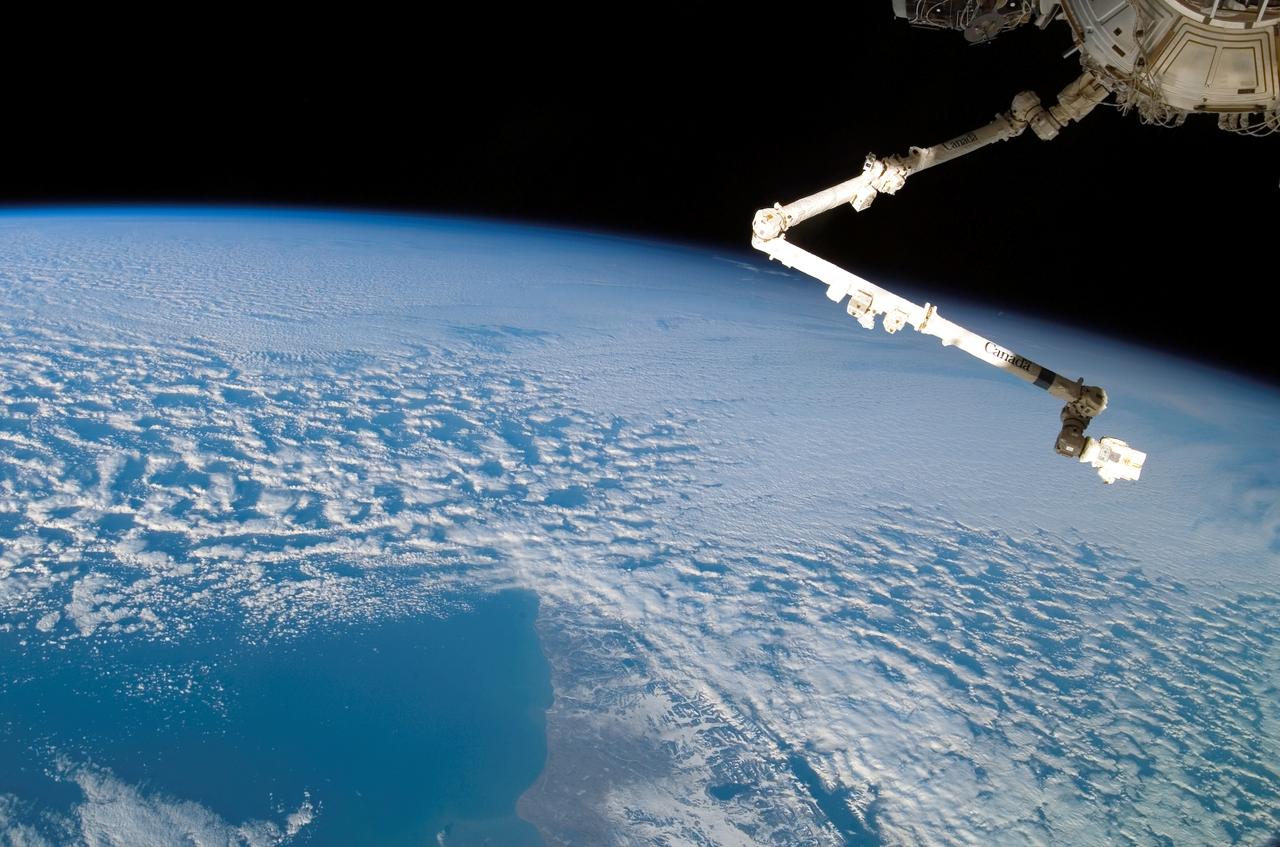
ISS011-E-09877 (30 June 2005) --- The Expedition 11 crew aboard the international space station flexes the robotic arm, Canadarm2, while flying approximately 225 miles above Cape Horn. Onboard are crewmembers, cosmonaut Sergei Krikalev of Russia's Federal Space Agency, commander, and astronaut John L. Phillips, NASA science officer and flight engineer.
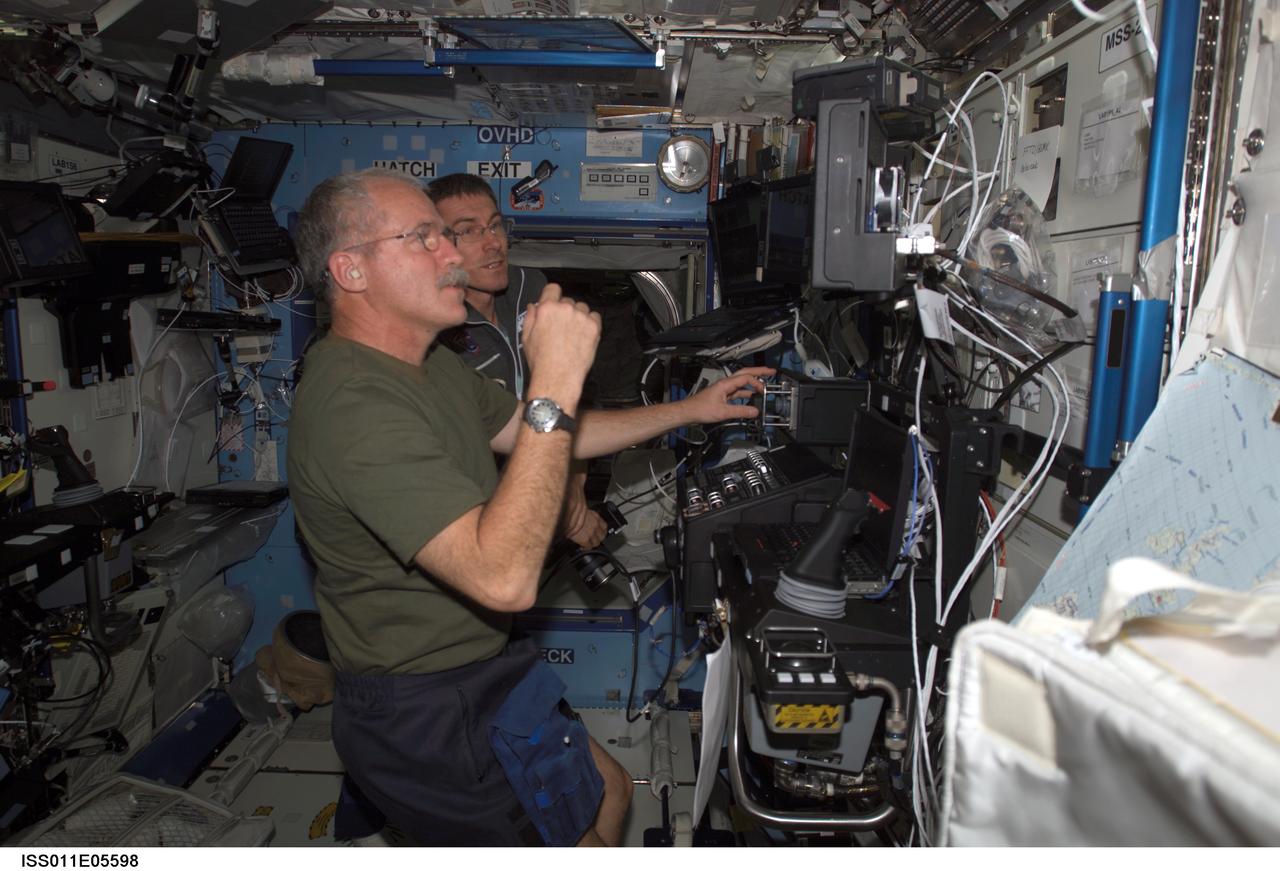
ISS011-E-05598 (6 May 2005) --- Astronaut John L. Phillips, Expedition 11 NASA ISS science officer, and cosmonaut Sergei K. Krikalev (partially obscured), commander representing Russia's Federal Space Agency, participate in a proficiency training session with the Canadarm2, or Space Station Remote Manipulator System (SSRMS) in the Destiny laboratory of the International Space Station (ISS).
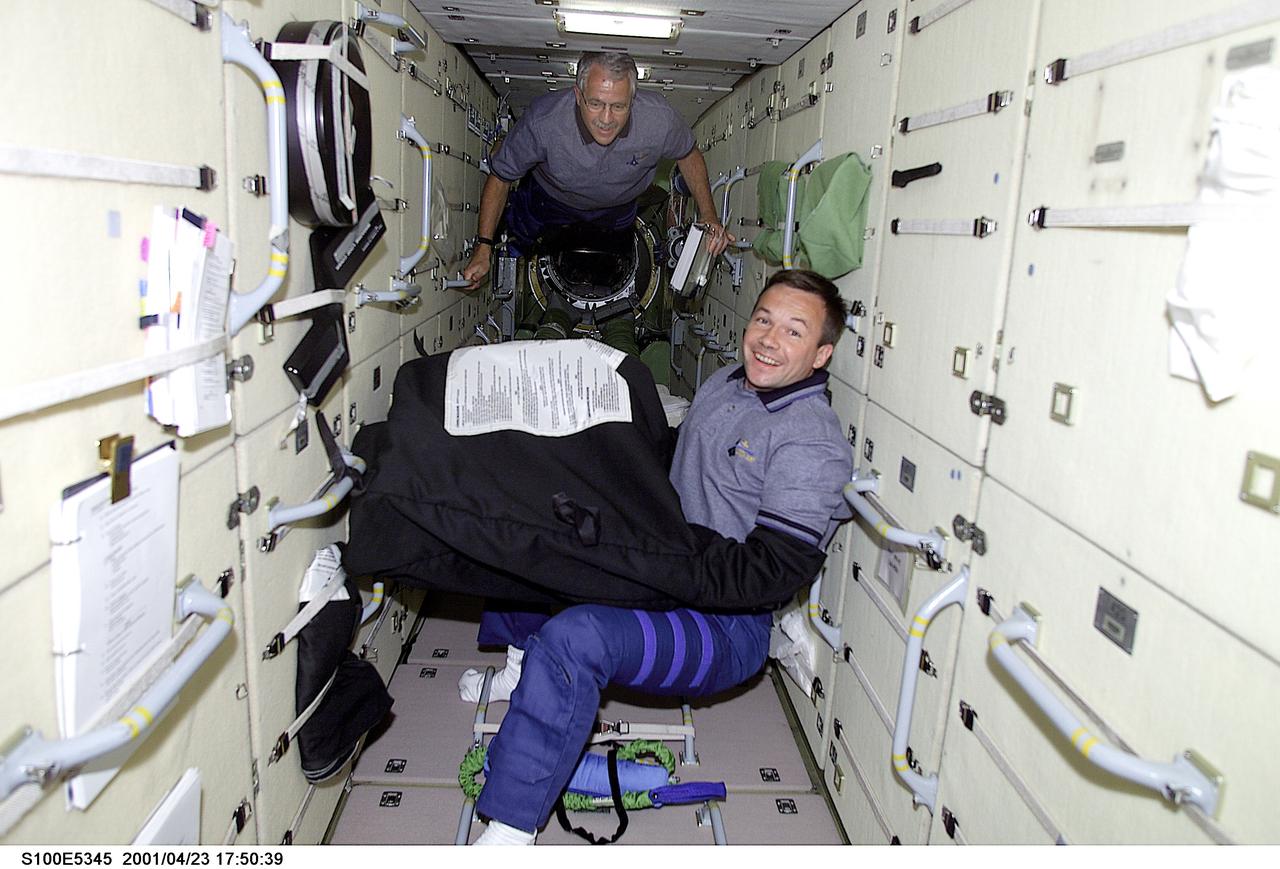
S100-E-5345 (23 April 2001) --- Cosmonaut Yuri V. Lonchakov, STS-100 mission specialist representing Rosaviakosmos, changes out a film magazine on an IMAX camera in the Functional Cargo Block (FGB) or Zarya aboard the International Space Station (ISS). Astronaut John L. Phillips, mission specialist, is in the background. The scene was recorded with a digital still camera.
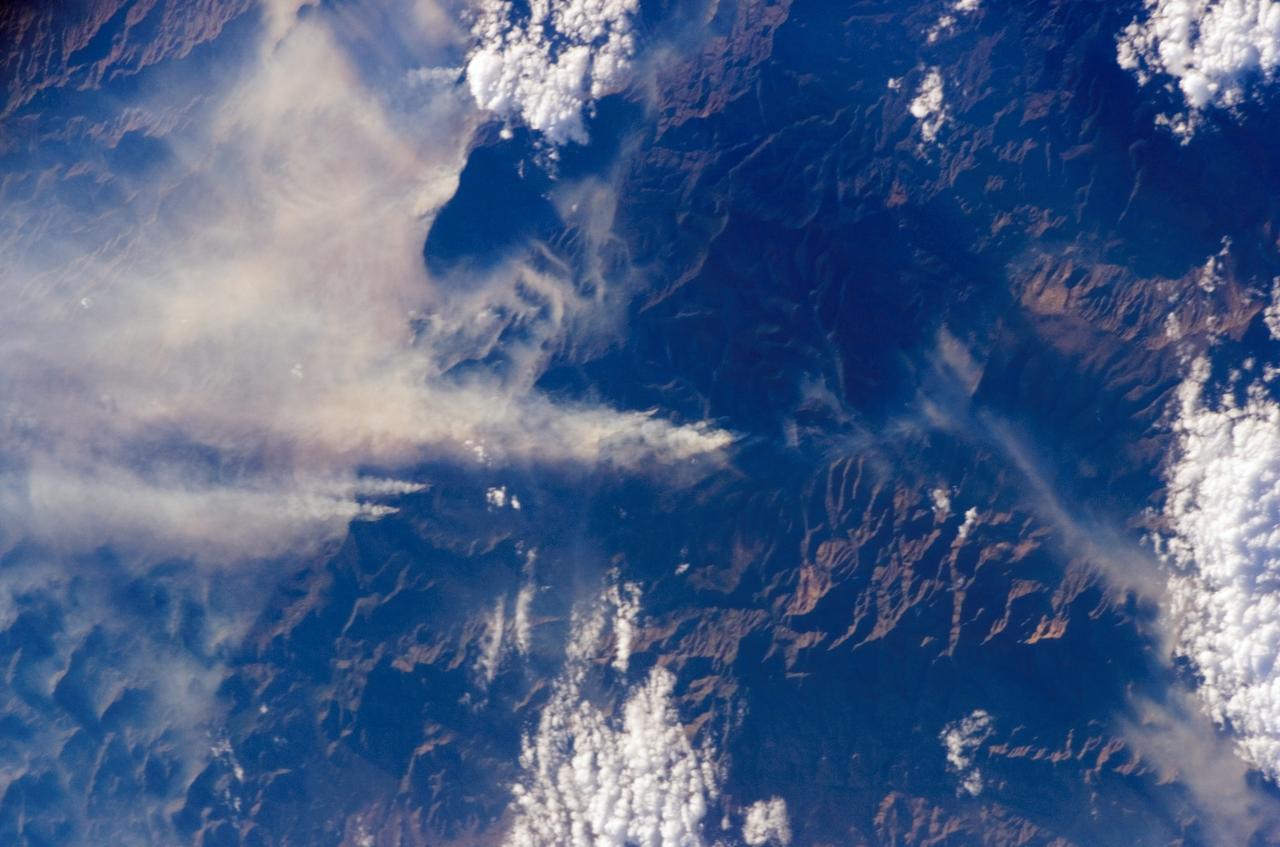
ISS011-E-09647 (27 June 2005) --- Lightning was the suspected cause of this giant wildfire, raging through an area northeast of Phoenix on Monday. This picture, taken shortly after 9 a.m. (CDT), is one of a series of images photographed by astronaut John L. Phillips, Expedition 11 flight engineer and NASA science officer, aboard the orbiting complex, flying at an altitude of 220 miles.
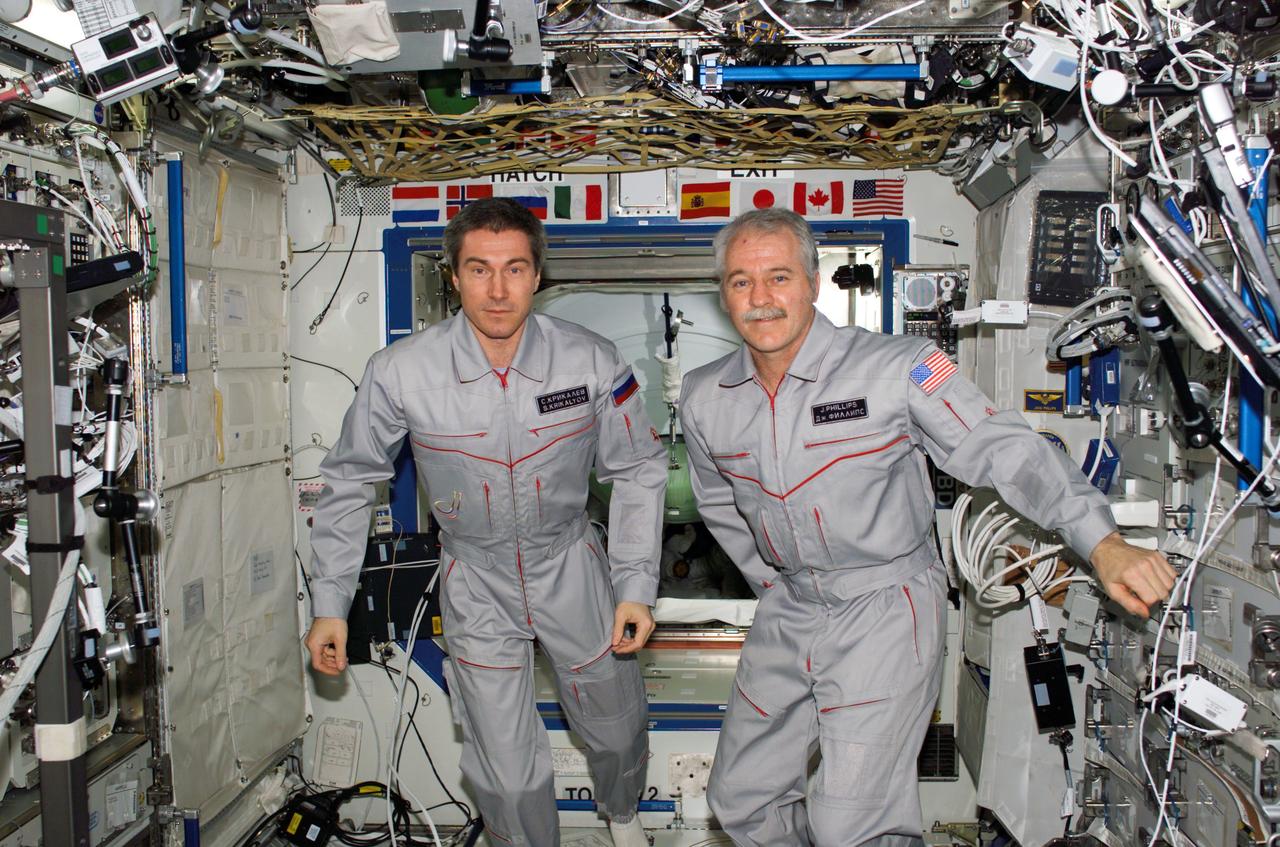
S114-E-6784 (2 August 2005) --- Cosmonaut Sergei K. Krikalev (left), Expedition 11 commander representing Russia's Federal Space Agency, and astronaut John L. Phillips, NASA Space Station science officer and flight engineer, pose for a crew photo in the Destiny laboratory of the International Space Station. At the time, the two were playing host to the seven Discovery crewmembers.
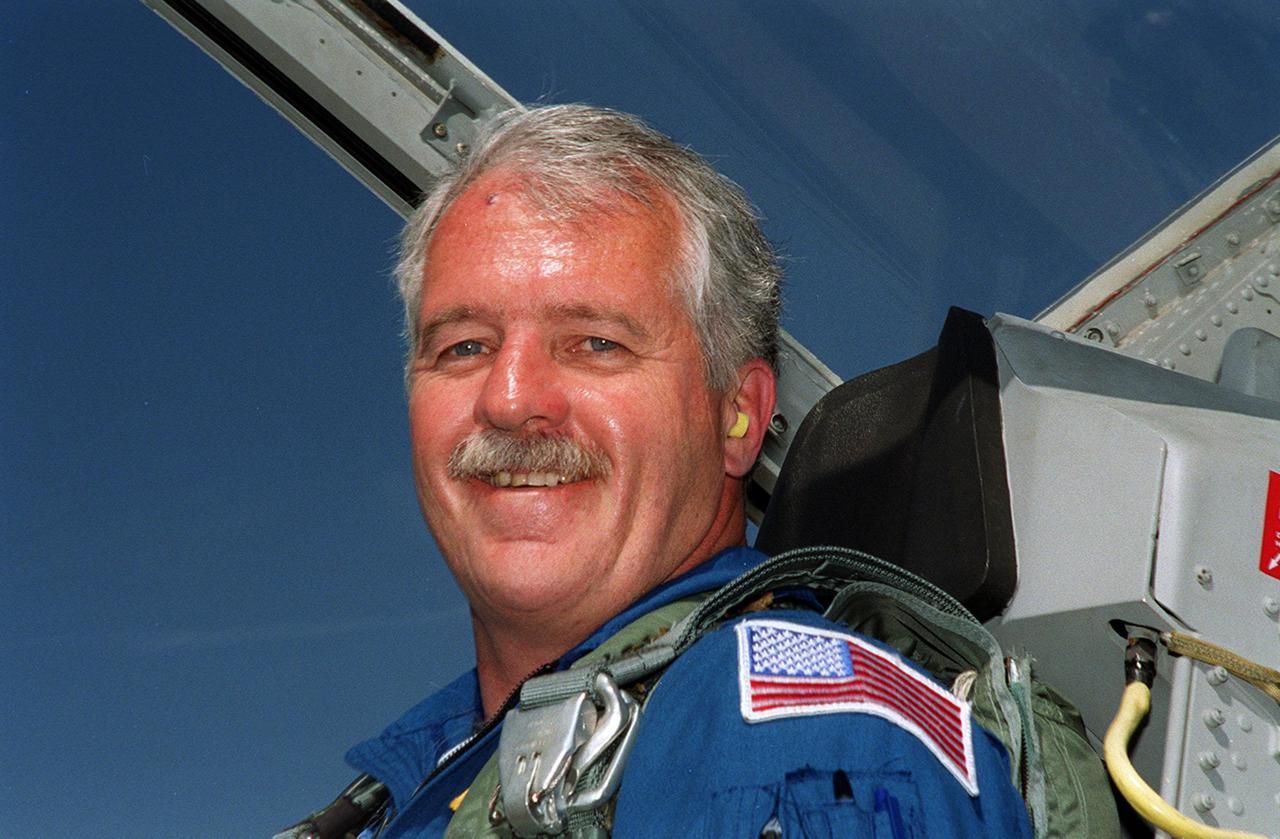
STS-100 Mission Specialist John L. Phillips arrives at the KSC Shuttle Landing Facility aboard a T-38 jet aircraft to get ready for launch. The 11-day mission to the International Space Station will deliver and integrate the Spacelab Logistics Pallet_Launch Deployment Assembly, which includes the Space Station Remote Manipulator system and the UHF Antenna, and the Multi-Purpose Logistics Module Raffaello. Liftoff on mission STS-100 is scheduled at 2:41 p.m. EDT April 19
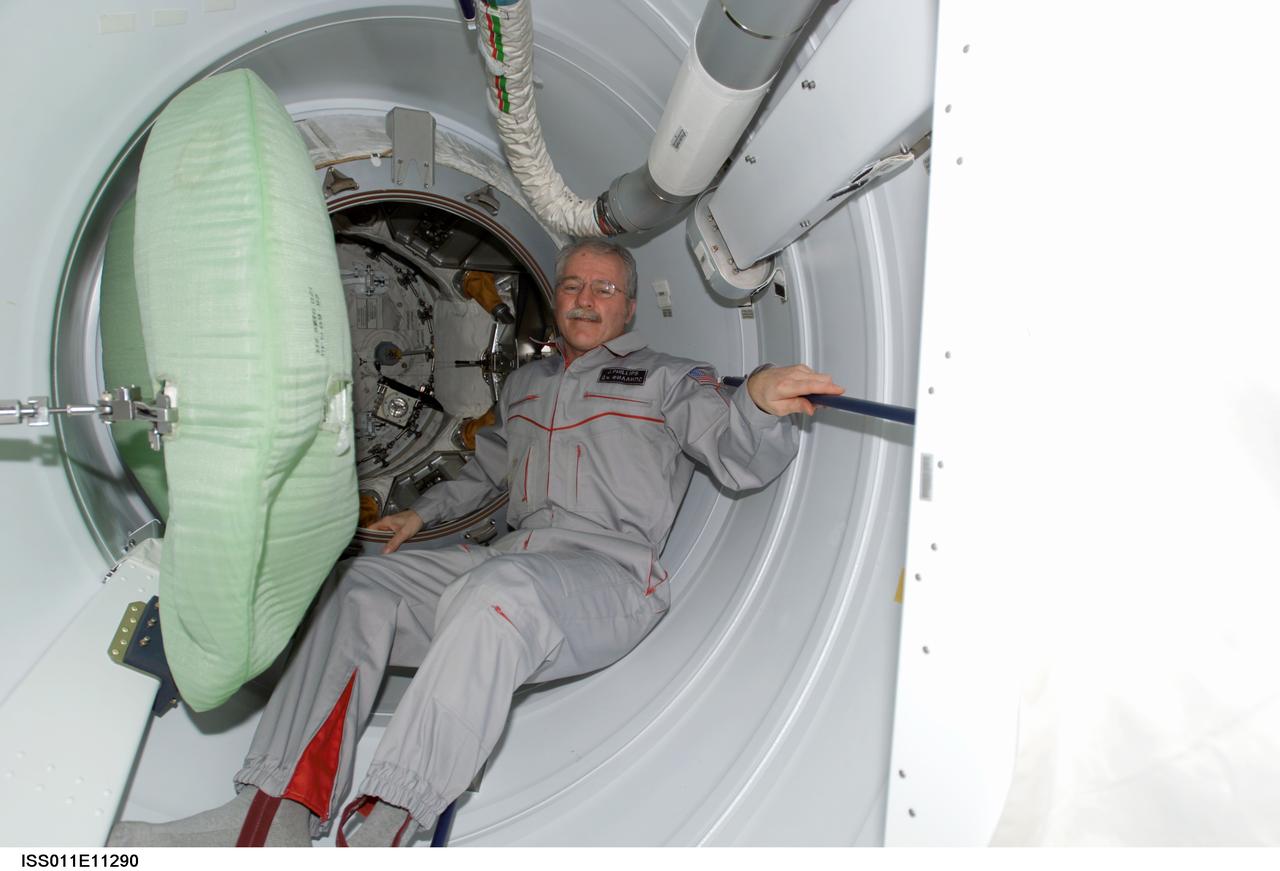
ISS011-E-11290 (28 July 2005) --- Onboard the International Space Station, astronaut John L. Phillips, flight engineer and NASA Space Station Science Officer for Expedition 11, comes through a hatch in the tunnel leading to the Space Shuttle Discovery. The seven-member Shuttle crew was only moments away from joining its hosts on the orbital outpost. The two crews are scheduled to share several days of joint activities in space.
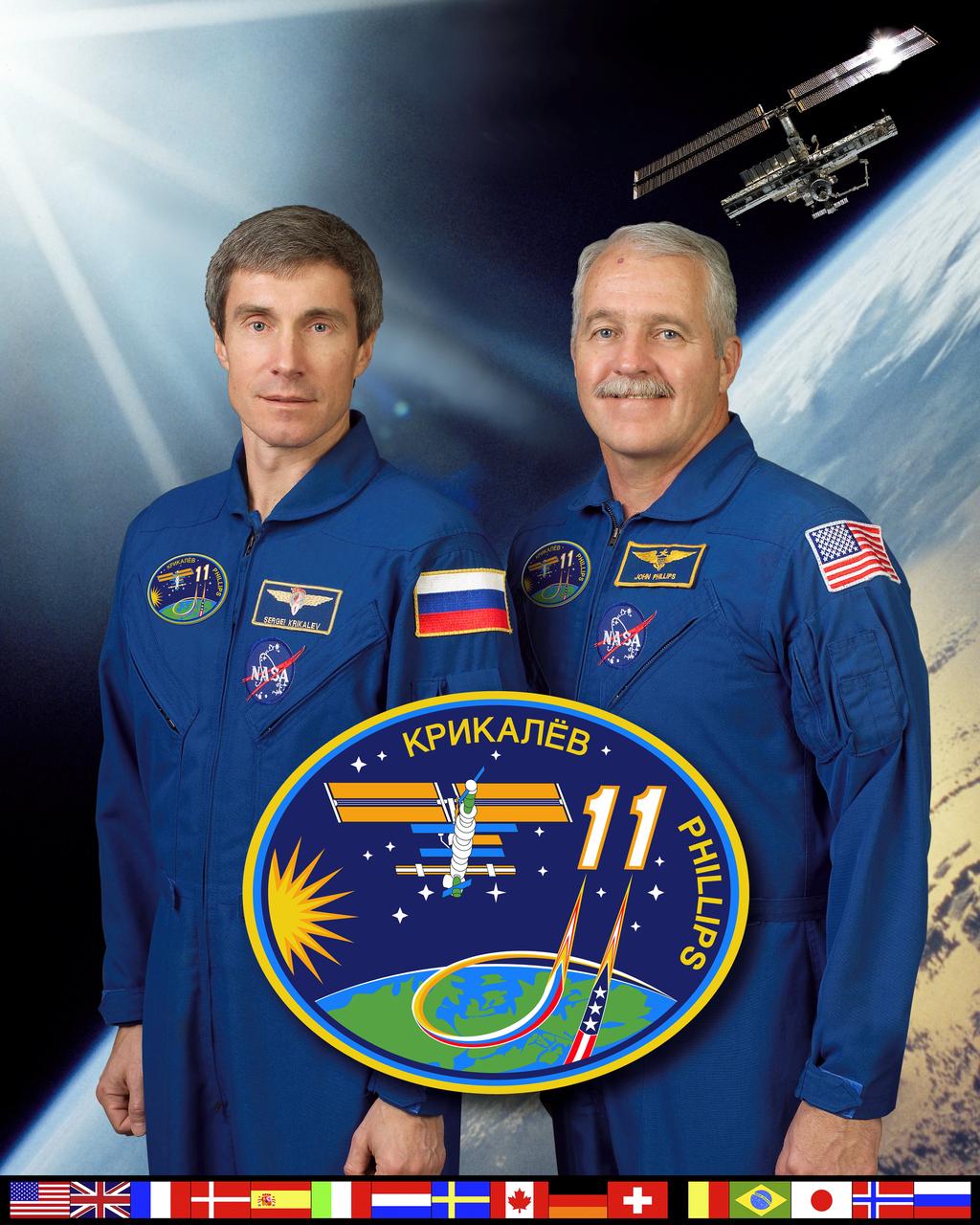
ISS011-S-002 (17 February 2005) --- Cosmonaut Sergei K. Krikalev (left), Expedition 11 commander representing Russia's Federal Space Agency; and astronaut John L. Phillips, NASA ISS science officer and flight engineer, pause from their training schedule for a crew portrait at Johnson Space Center (JSC). The two will be launched to the International Space Station (ISS) in early spring of this year in a Soyuz TMA-6 spacecraft.
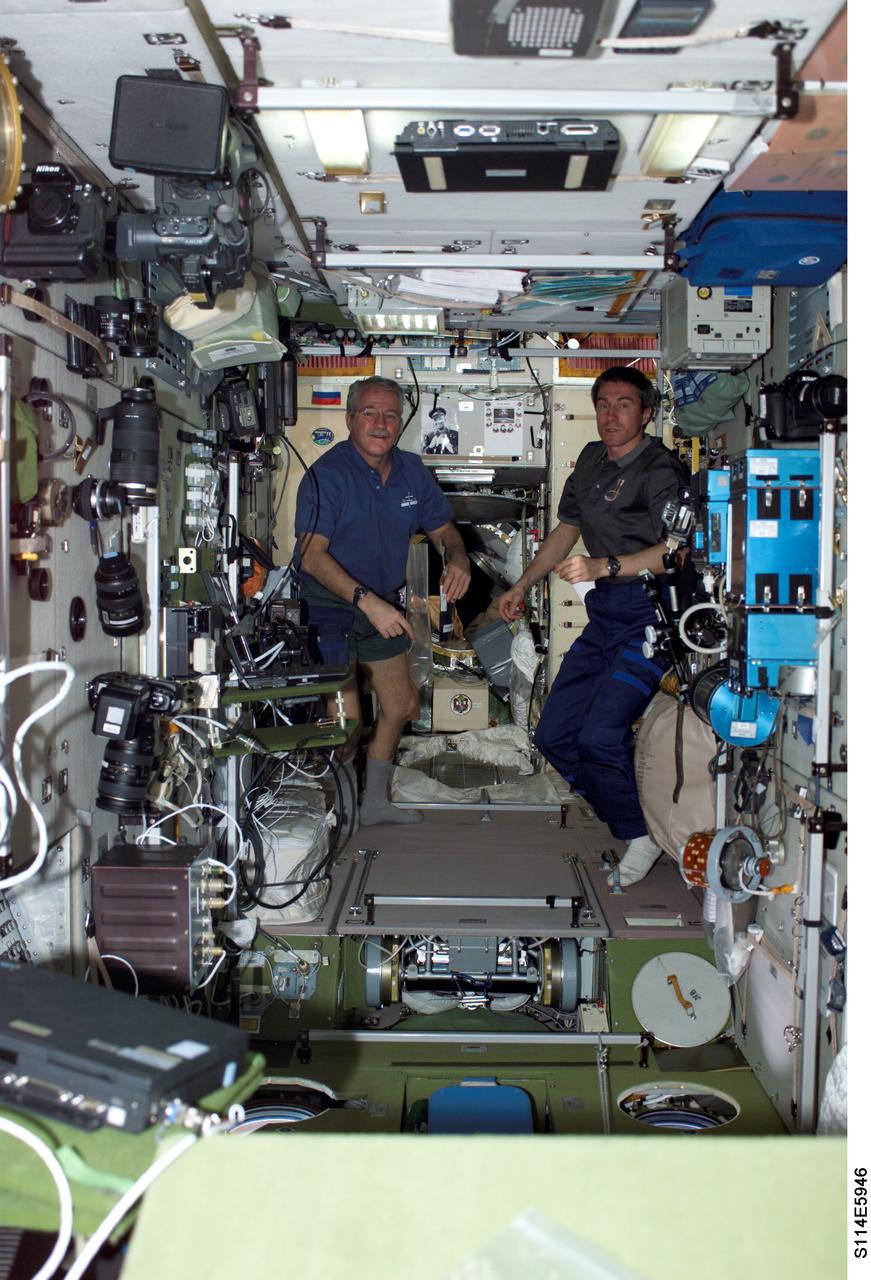
S114-E-5946 (31 July 2005) --- A Sunday morning picture onboard the International Space Station shows the Expedition 11 crew members--John L. Phillips (left) and Sergei Krikalev--in the Zvezda Service Module, while their "guests" from Discovery are at various other locations in the orbital outpost and the Shuttle. Transfer of supplies brought up from Earth still remains one of the high priority activities for the two crews.
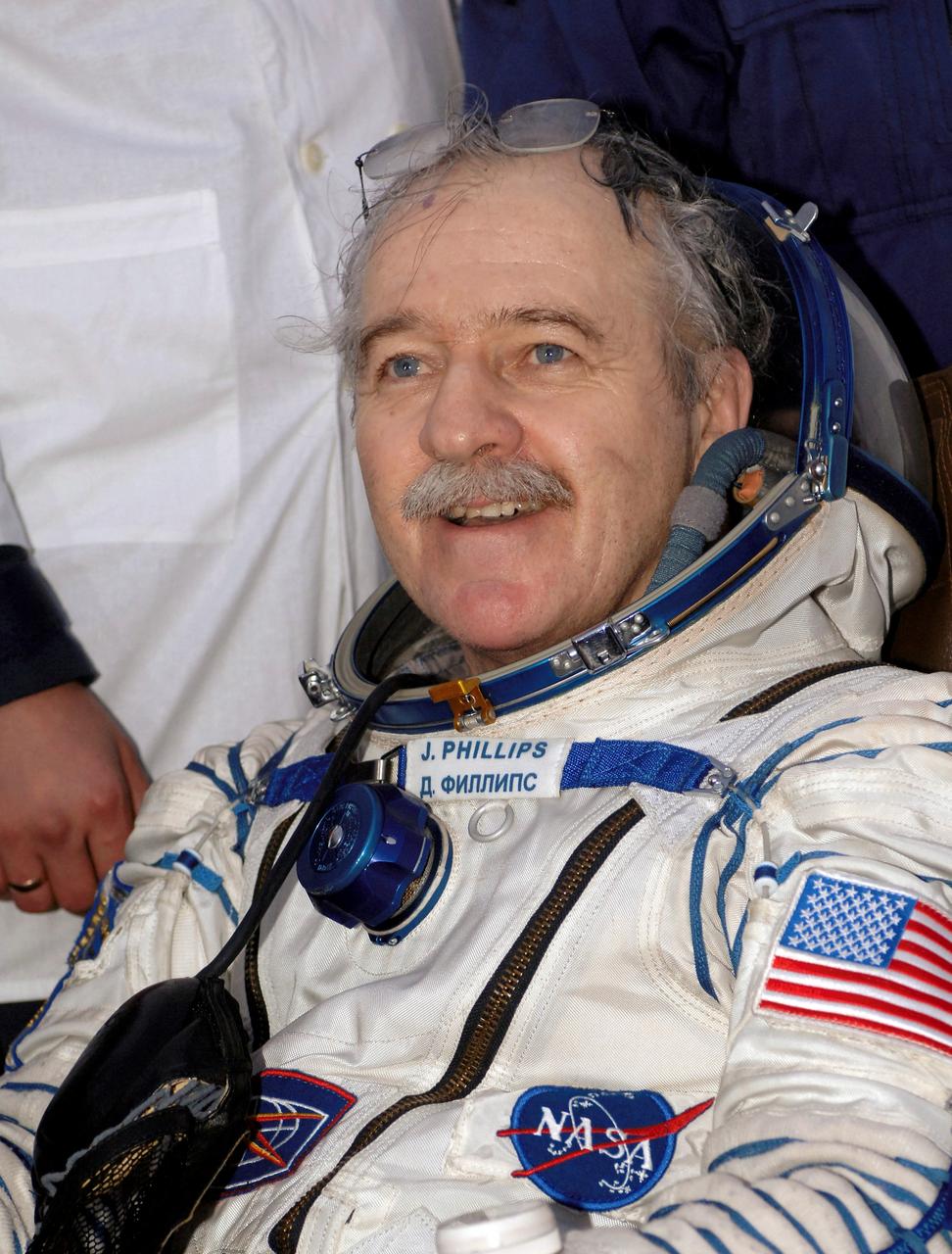
JSC2005-E-41363 (11 October 2005) --- Astronaut John L. Phillips, Expedition 11 NASA science officer and flight engineer is seated after having his first encounter with terra firma in several months following the successful landing of the Soyuz TMA-6 in Kazakhstan on Oct. 11 (local time). Photo Credit: NASA/Bill Ingalls

ISS011-E-11363 (31 July 2005) --- Astronauts Wendy B. Lawrence (foreground), STS-114 mission specialist, and John L. Phillips, Expedition 11 NASA Space Station science officer and flight engineer, participate in the movement of supplies and equipment inside Raffaello, the Italian Space Agency-built Multipurpose Logistics Module (MPLM) to the International Space Station. Lawrence was in charge of the transfer operations.
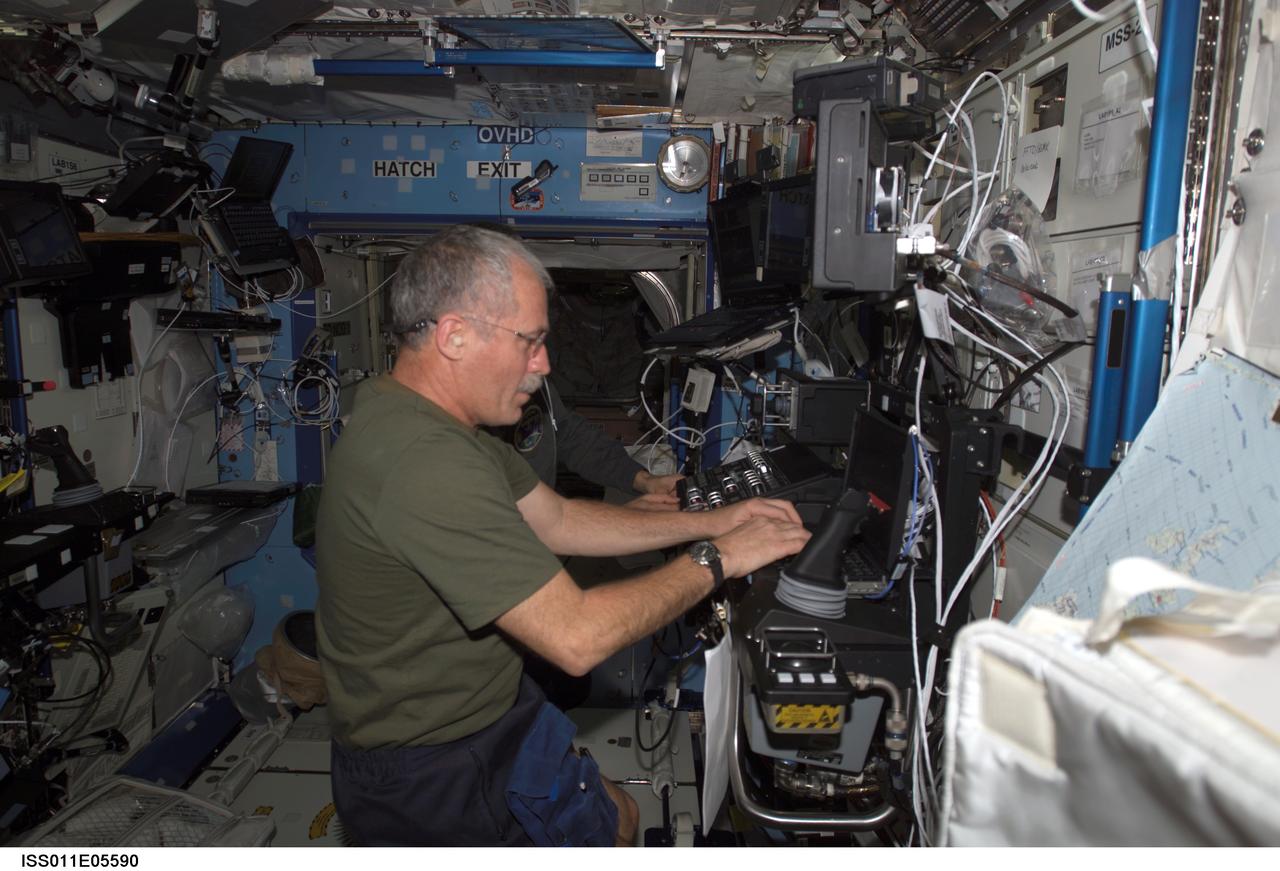
ISS011-E-05590 (6 May 2005) --- Astronaut John L. Phillips, Expedition 11 NASA ISS science officer, and cosmonaut Sergei K. Krikalev (obscured), commander representing Russia's Federal Space Agency, participate in a proficiency training session with the Canadarm2, or Space Station Remote Manipulator System (SSRMS) in the Destiny laboratory of the International Space Station (ISS).
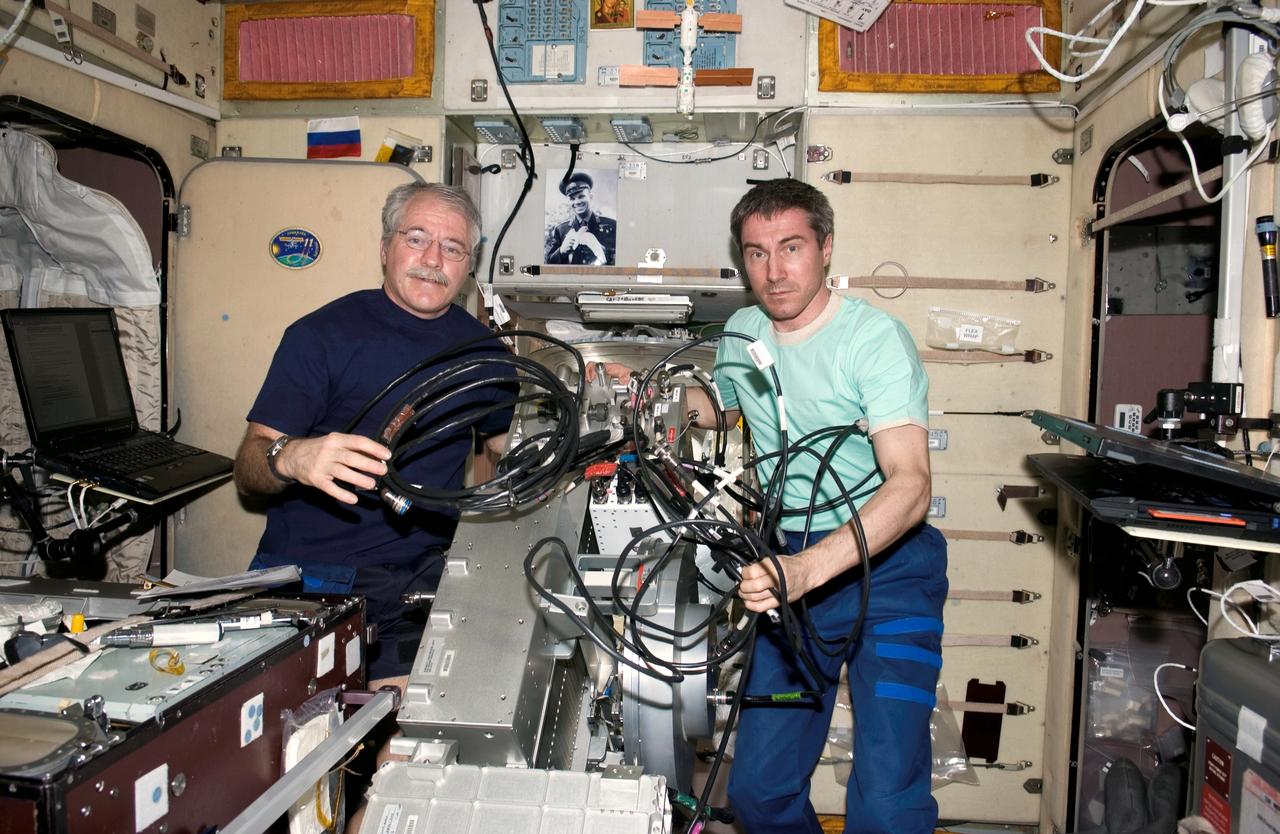
ISS011-E-12495 (7 September 2005) --- Cosmonaut Sergei K. Krikalev (right), Expedition 11 commander representing Russia's Federal Space Agency, and astronaut John L. Phillips, NASA space station science officer and flight engineer, work with the Treadmill Vibration Isolation System (TVIS) during In-Flight Maintenance (IFM) in the Zvezda Service Module of the international space station.
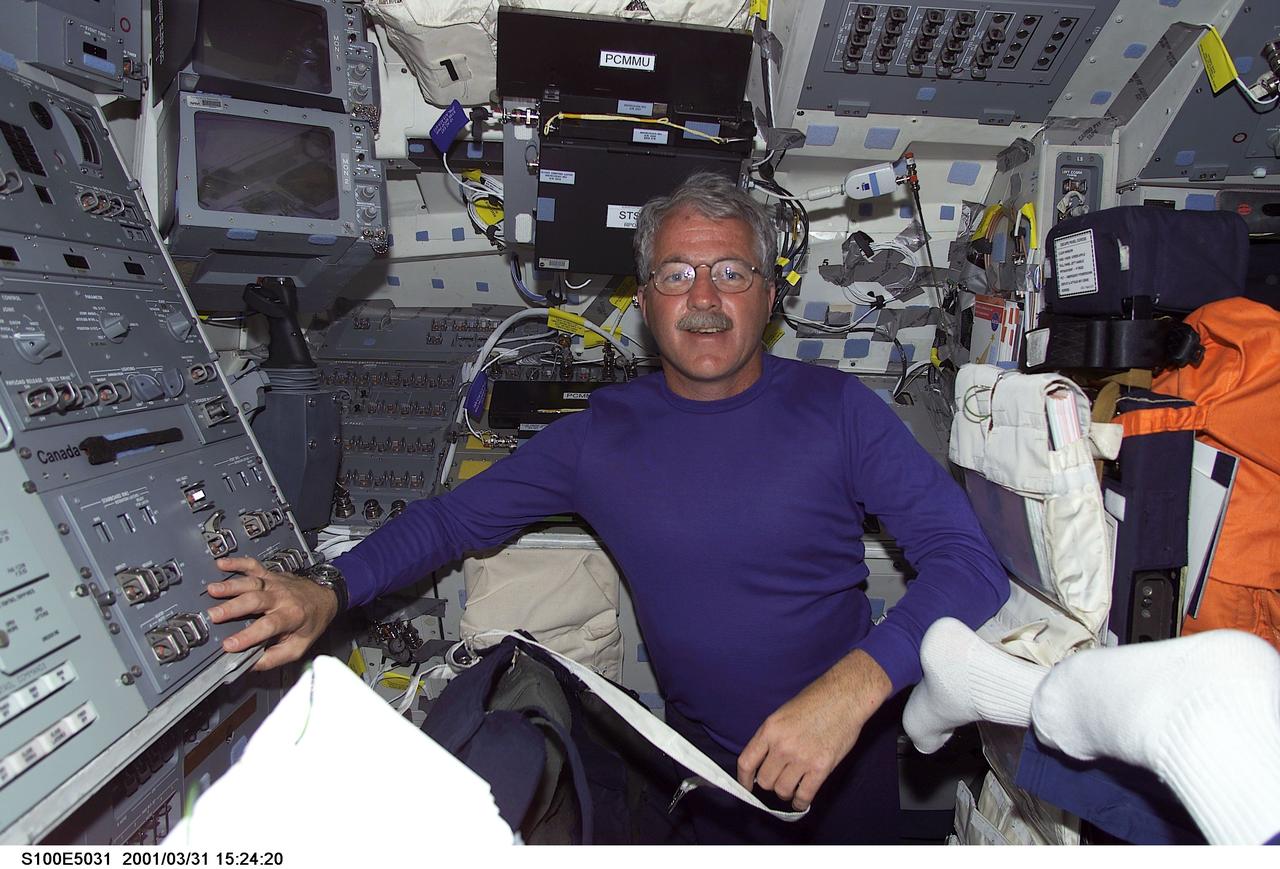
S100-E-5031 (20 April 2001)--- Astronaut John L. Phillips, mission specialist for STS-100, is pictured on the aft flight deck of the Space Shuttle Endeavour as the shuttle steadily makes its way toward the International Space Station (ISS) following an April 19 launch. This image was recorded by a fellow crew member using a digital still camera.
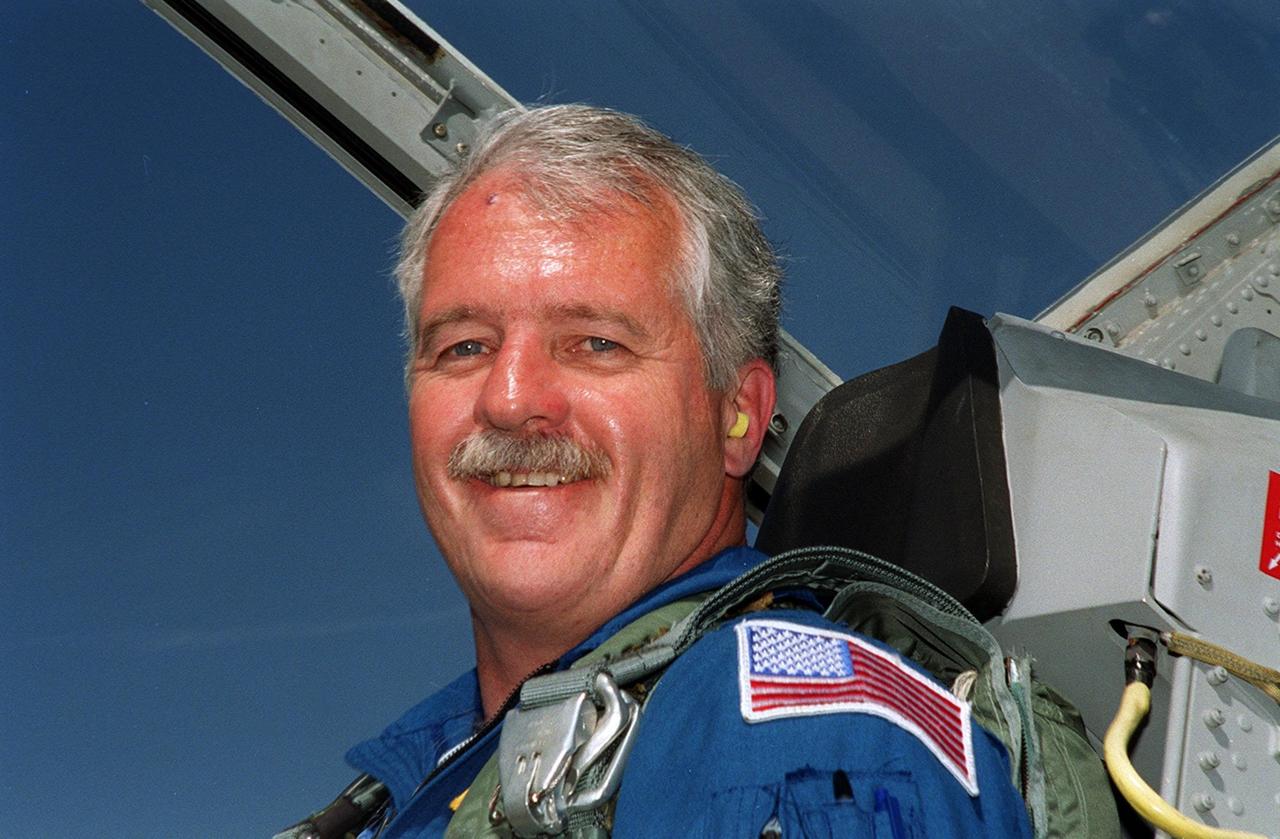
STS-100 Mission Specialist John L. Phillips arrives at the KSC Shuttle Landing Facility aboard a T-38 jet aircraft to get ready for launch. The 11-day mission to the International Space Station will deliver and integrate the Spacelab Logistics Pallet/Launch Deployment Assembly, which includes the Space Station Remote Manipulator system and the UHF Antenna, and the Multi-Purpose Logistics Module Raffaello. Liftoff on mission STS-100 is scheduled at 2:41 p.m. EDT April 19
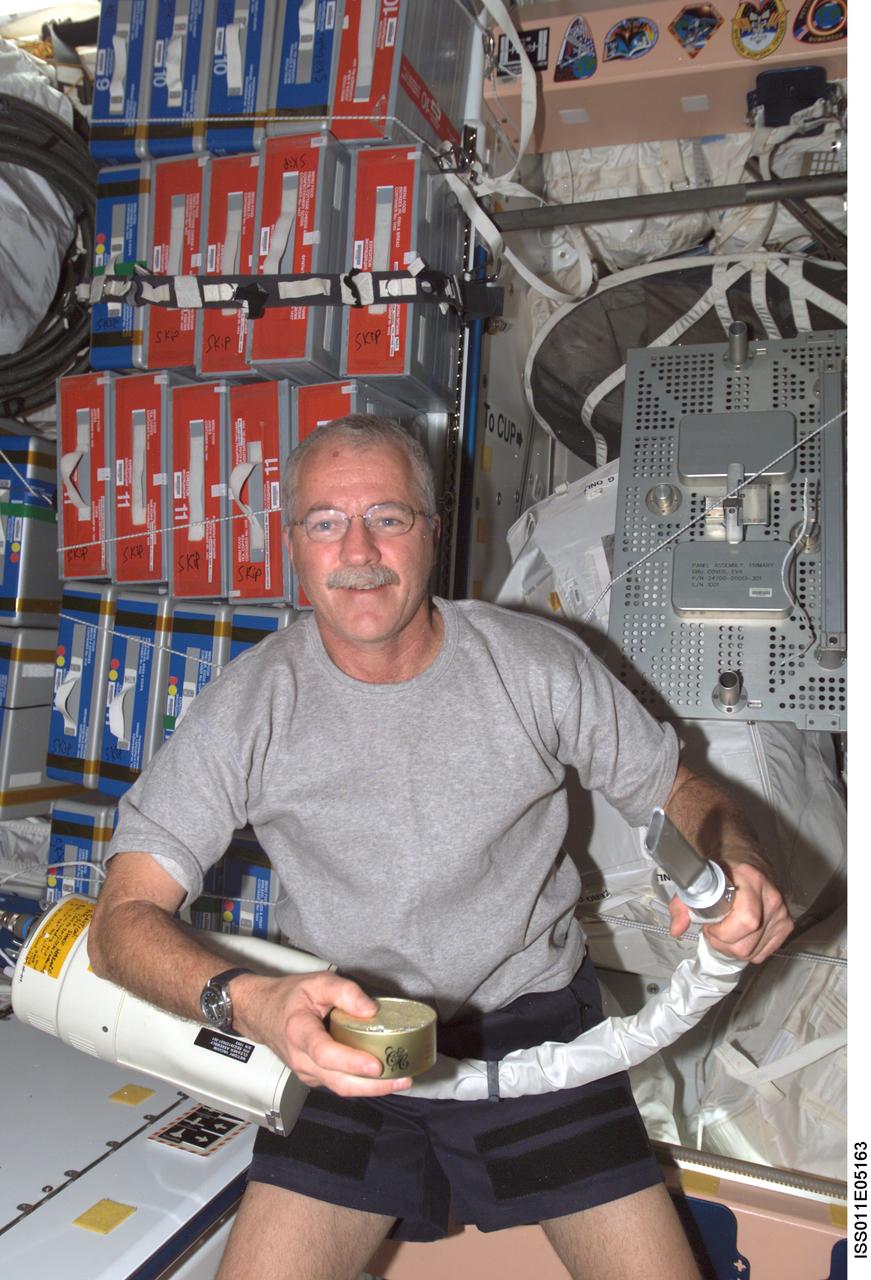
ISS011-E-05163 (17 April 2005) --- Astronaut John L. Phillips, Expedition 11 NASA ISS science officer and flight engineer, poses for a photo with the ISS wet/dry vacuum cleaner assembly he used to catch floating debris from the top of a food can in the Unity node of the International Space Station (ISS).
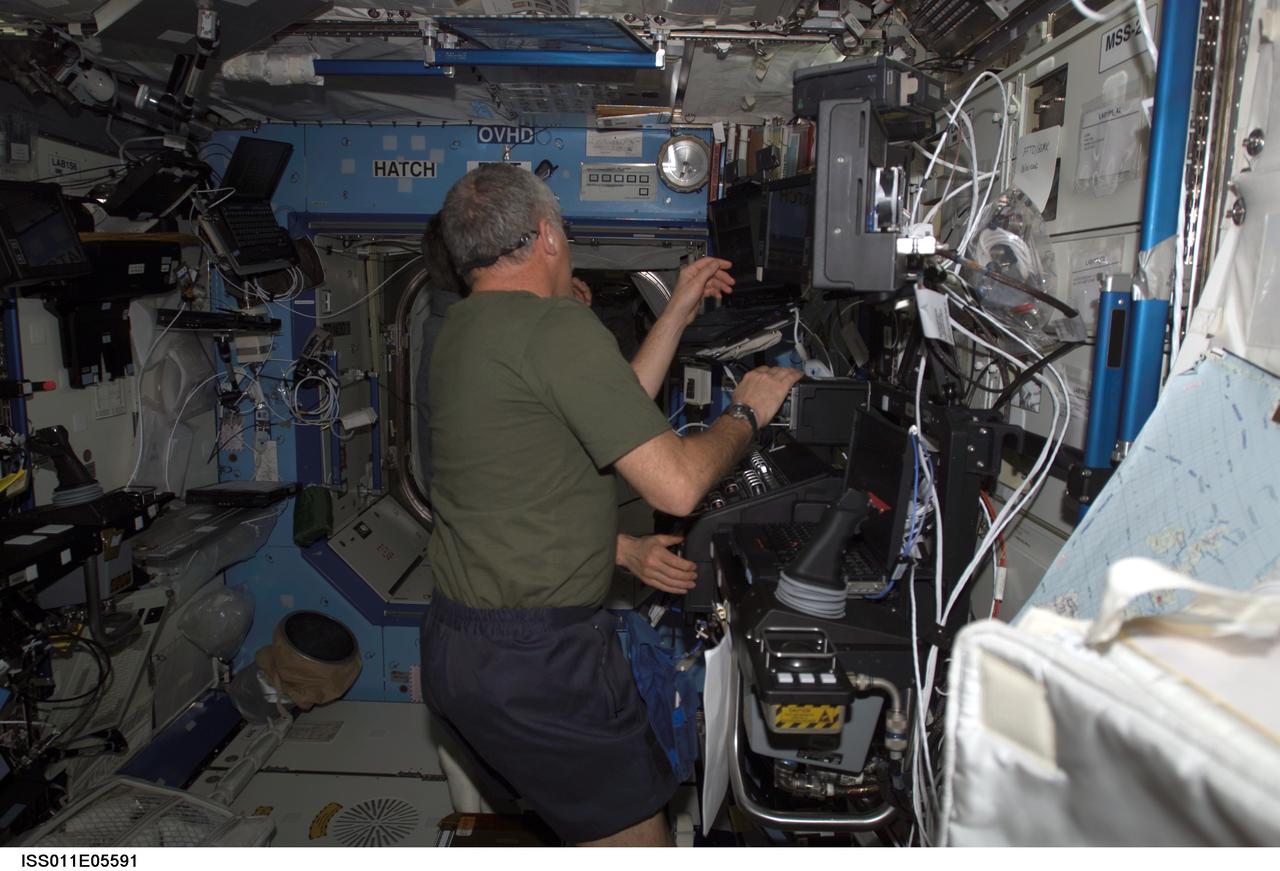
ISS011-E-05591 (6 May 2005) --- Astronaut John L. Phillips, Expedition 11 NASA ISS science officer, and cosmonaut Sergei K. Krikalev (obscured), commander representing Russia's Federal Space Agency, participate in a proficiency training session with the Canadarm2, or Space Station Remote Manipulator System (SSRMS) in the Destiny laboratory of the International Space Station (ISS).
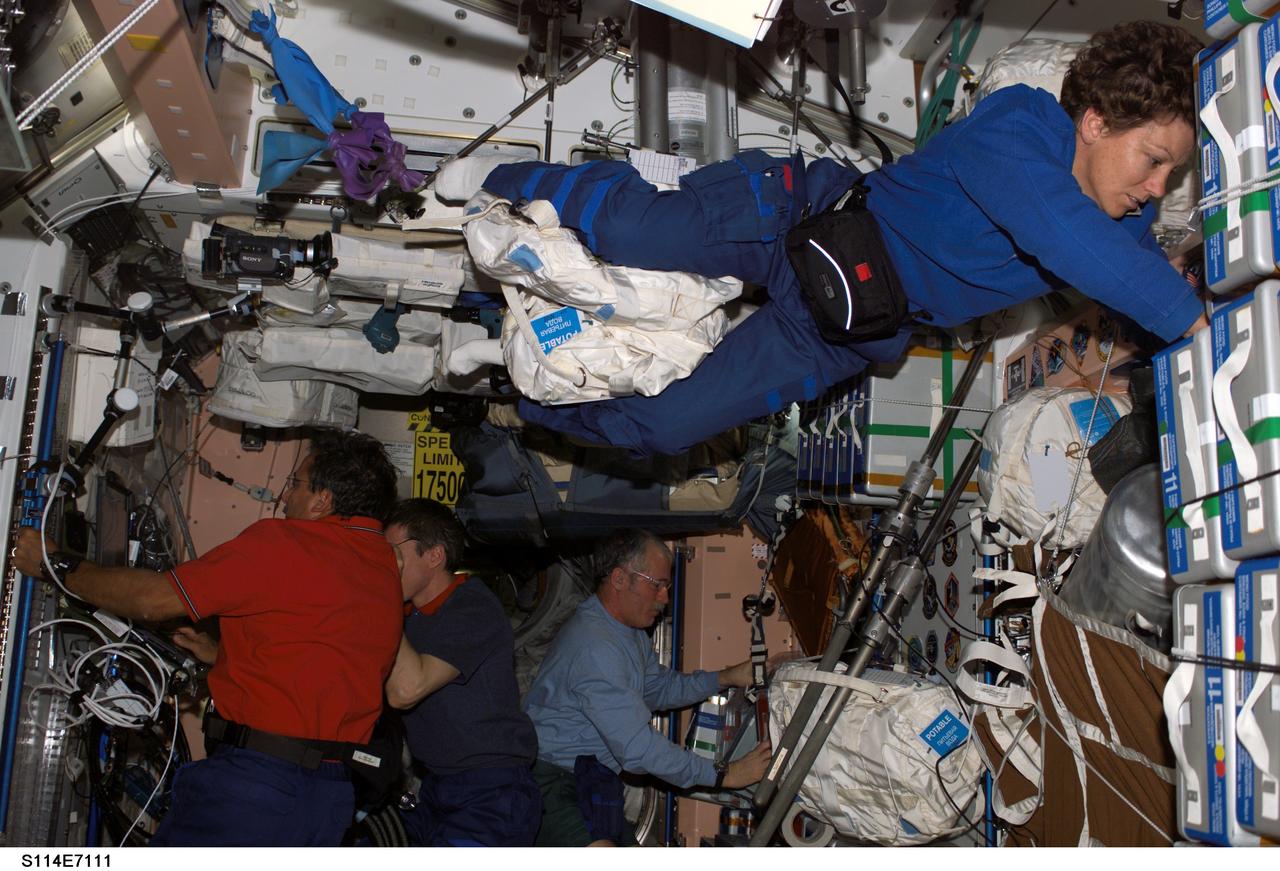
S114-E-7111 (5 August 2005) --- Crewmembers work on various tasks in the Unity node of the International Space Station. From the left are astronaut Charles J. Camarda, STS-114 mission specialist; cosmonaut Sergei K. Krikalev, Expedition 11 commander representing Russia's Federal Space Agency; astronaut John L. Phillips, Expedition 11 NASA Space Station science officer and flight engineer; and Eileen M. Collins, STS-114 commander.
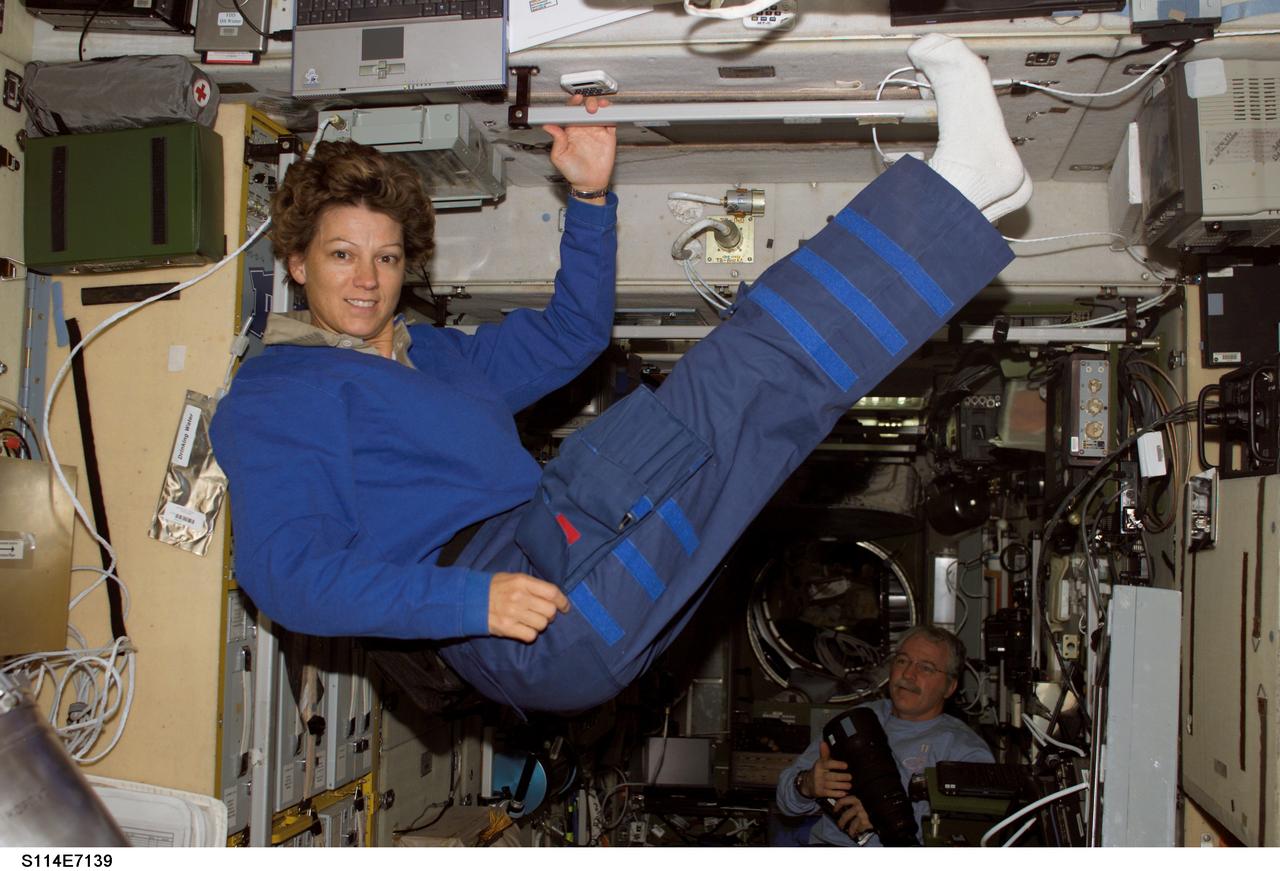
S114-E-7139 (5 August 2005) --- Astronaut Eileen M. Collins, STS-114 commander, floats in the Zvezda Service Module of the International Space Station while Space Shuttle Discovery was docked to the Station. Astronaut John L. Phillips, Expedition 11 NASA Space Station science officer and flight engineer, is visible at bottom right.
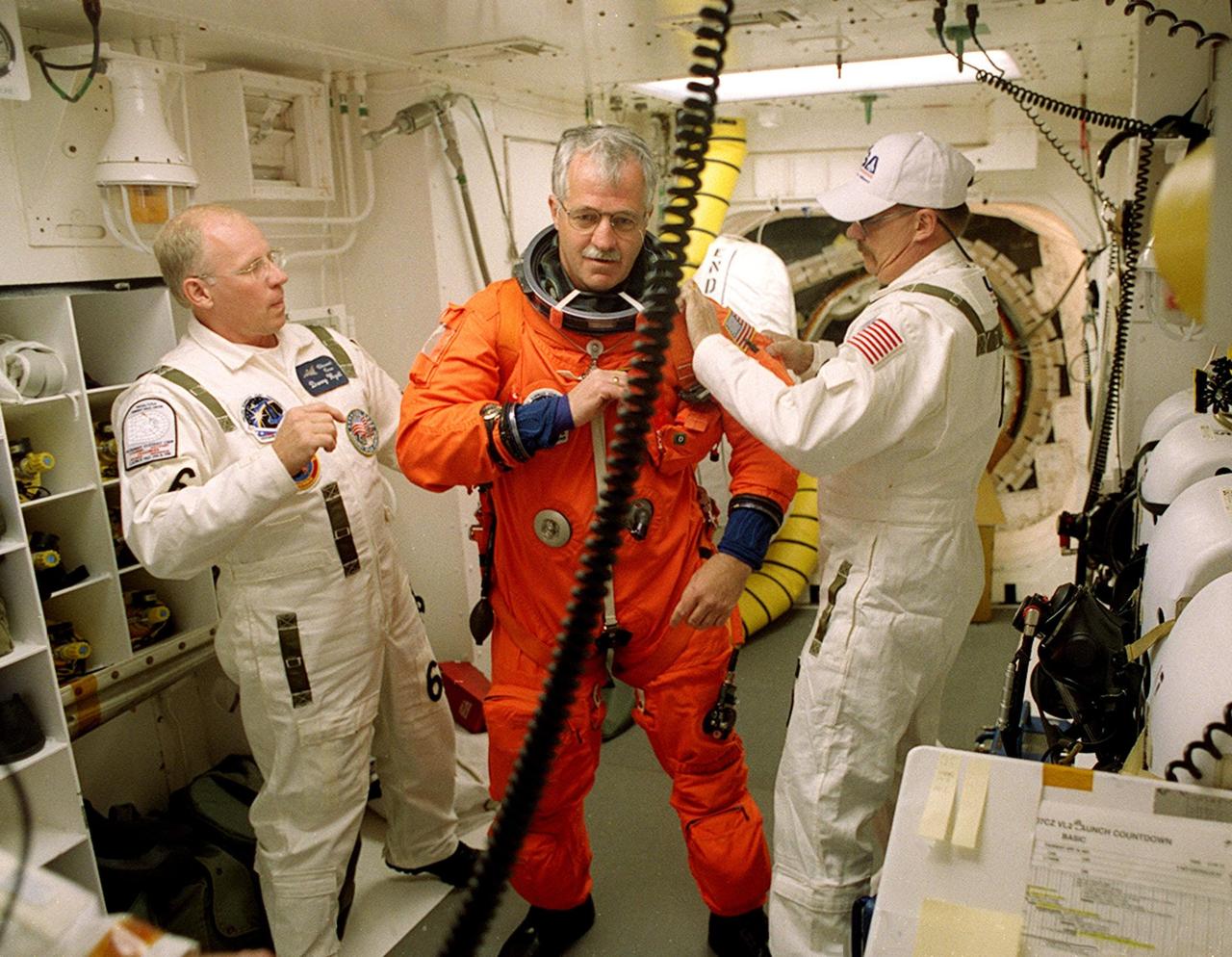
In the White Room, STS-100 Mission Specialist John L. Phillips is helped with his launch and entry suit by closeout crew members Danny Wyatt (left) and George Schramm (right). This is Phillips’ first Shuttle launch. The White Room is an environmental chamber at the end of the Orbiter Access Arm that provides entry into the orbiter on the launch pad. The mission will deliver and integrate the Spacelab Logistics Pallet/Launch Deployment Assembly, which includes the Canadian-built Space Station Remote Manipulator System and the UHF Antenna. Two spacewalks are planned for installation of the SSRMS, which will be performed by Mission Specialists Scott E. Parazynski and Chris A. Hadfield, who is with the Canadian Space Agency. The mission is also the inaugural flight of the Multi-Purpose Logistics Module Raffaello, carrying resupply stowage racks and resupply/return stowage platforms. Liftoff of Space Shuttle Endeavour on mission STS-100 is scheduled at 2:41 p.m. EDT April 19
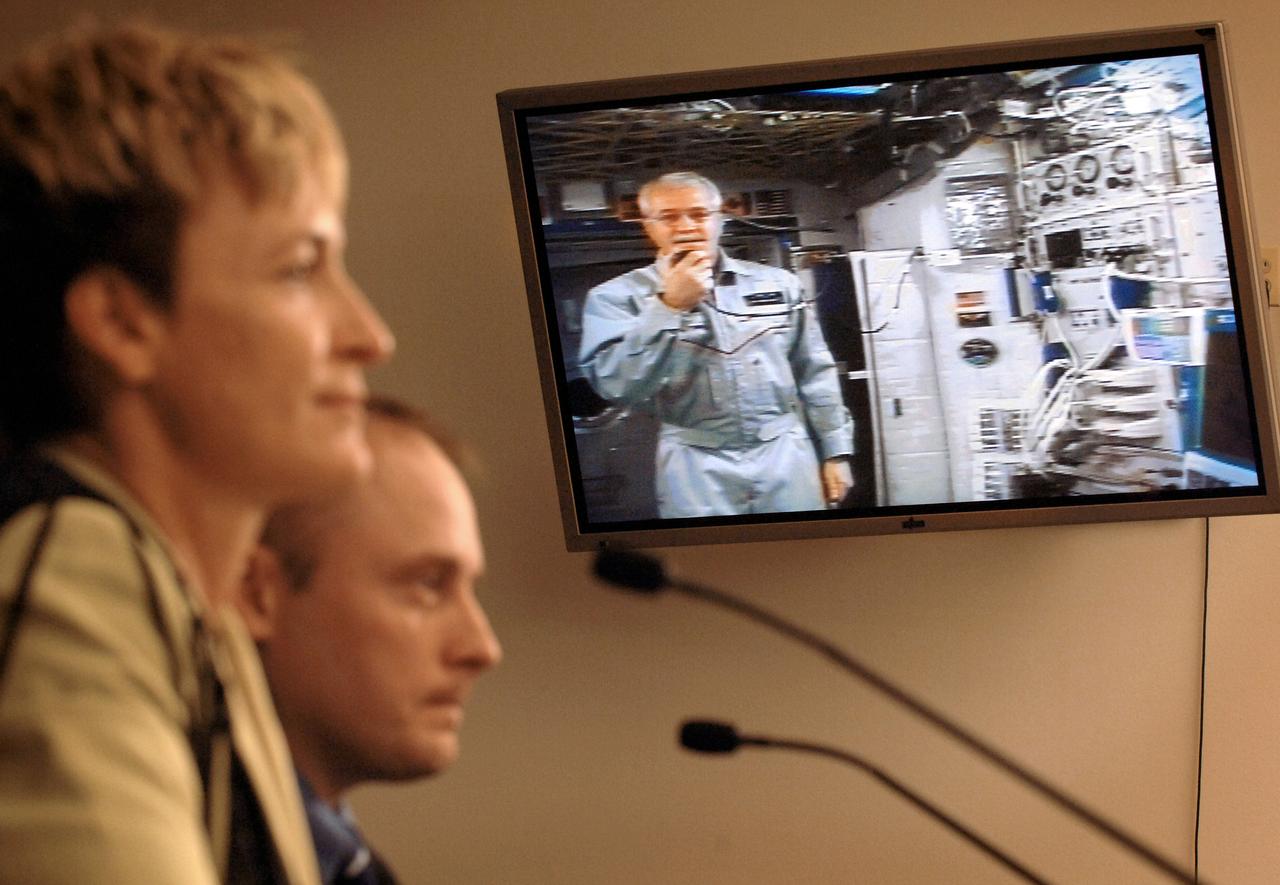
JSC2005-E-22365 (14 June 2005) --- Astronaut John L. Phillips, Expedition 11 NASA space station science officer and flight engineer, testifies via video screen before the House Subcommittee on Space and Aeronautics chaired by Rep. Ken Calvert (R-Calif.), as he orbited Earth onboard the international space station at a speed of five miles a second. Phillips was approximately 220 statute miles above Earth, but his radio transmissions were routed to a Tracking and Data Relay Satellite (TDRS) in geostationary orbit at an altitude of about 22,300 miles. Astronauts Peggy A. Whitson and Edward M. (Mike) Fincke, former station residents, are visible at left. Photo credit: NASA/Bill Ingalls.
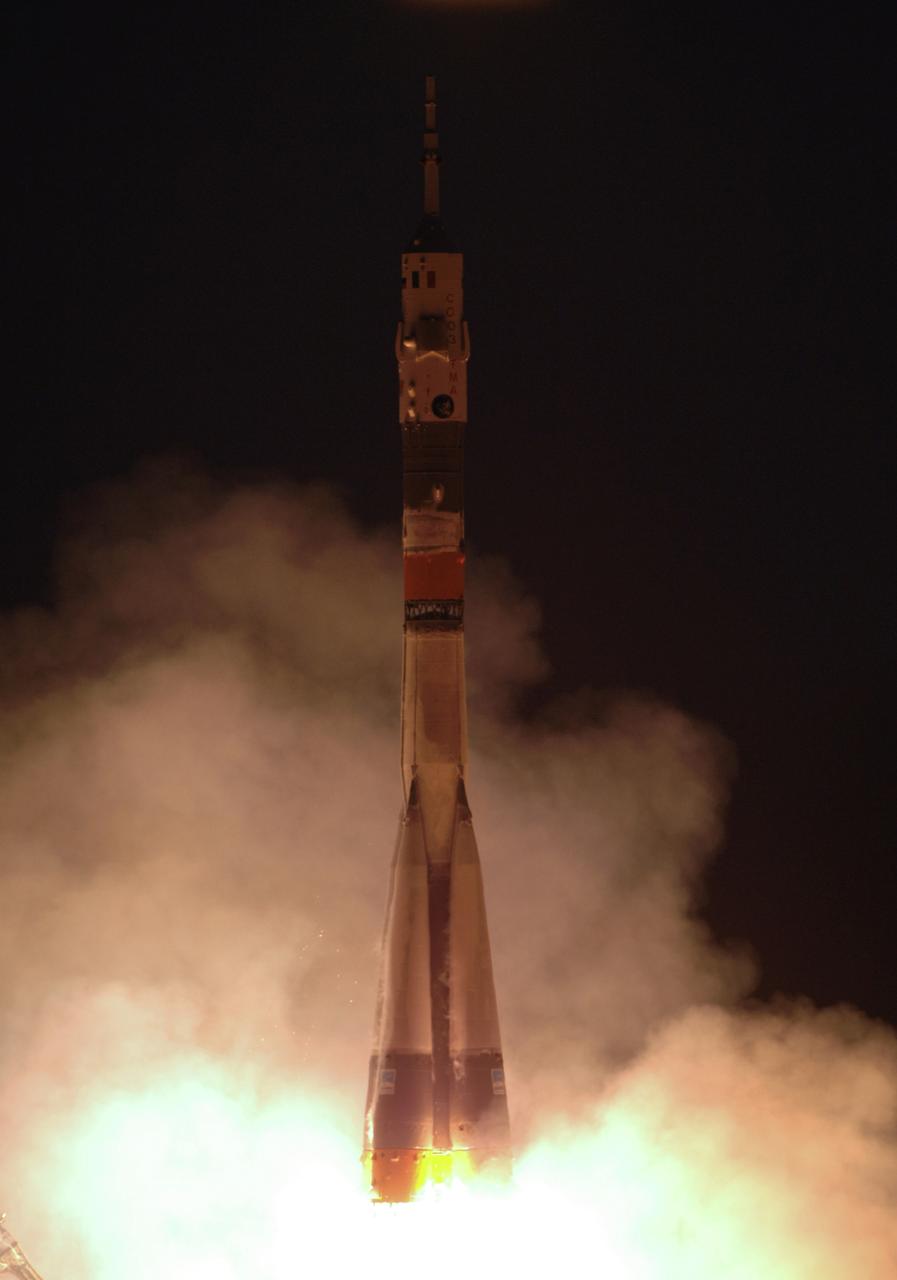
JSC2005-E-16325 (15 April 2005) --- The Soyuz TMA-6 spacecraft blasts off from the Baikonur Cosmodrome in Kazakhstan at daybreak on April 15, 2005 (Kazakhstan time), carrying cosmonaut Sergei K. Krikalev, Expedition 11 commander representing Russia's Federal Space Agency; astronaut John L. Phillips, NASA ISS science officer and flight engineer; and European Space Agency (ESA) astronaut Roberto Vittori of Italy for a two-day trip to the International Space Station (ISS). Krikalev and Phillips will spend six months on the Station, replacing Expedition 10 Commander Leroy Chiao and Flight Engineer Salizhan Sharipov, while Vittori will spend eight days on the ISS under a commercial contract between ESA and the Russian Federal Space Agency, returning to Earth with Chiao and Sharipov on April 25. Photo Credit: NASA/Bill Ingalls
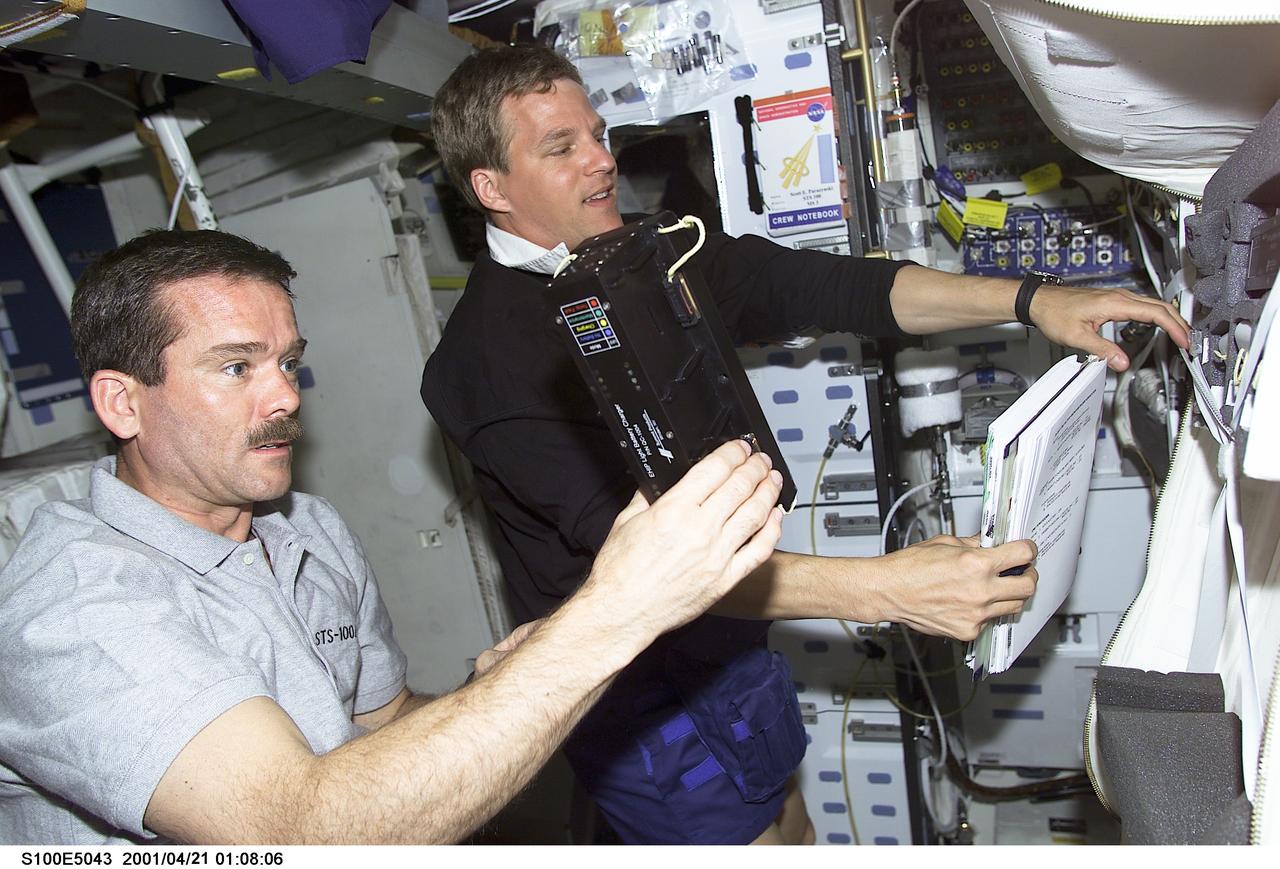
S100-E-5043 (21 April 2001) --- Astronauts Scott E. Parazynski (right) and Chris A. Hadfield of the Canadian Space Agency, both mission specialists, are seen on the middeck of the Space Shuttle Endeavour as the STS-100 crew anticipates its union with the International Space Station (ISS). Assigned space-walking astronauts Hadfield and Parazynski were later joined on the middeck by spacewalk coordinator John L. Phillips in conducting some final checks of the suits and hardware that are to be used during the next day's planned 6-hour, 30-minute spacewalk. The image was recorded with a digital still camera.
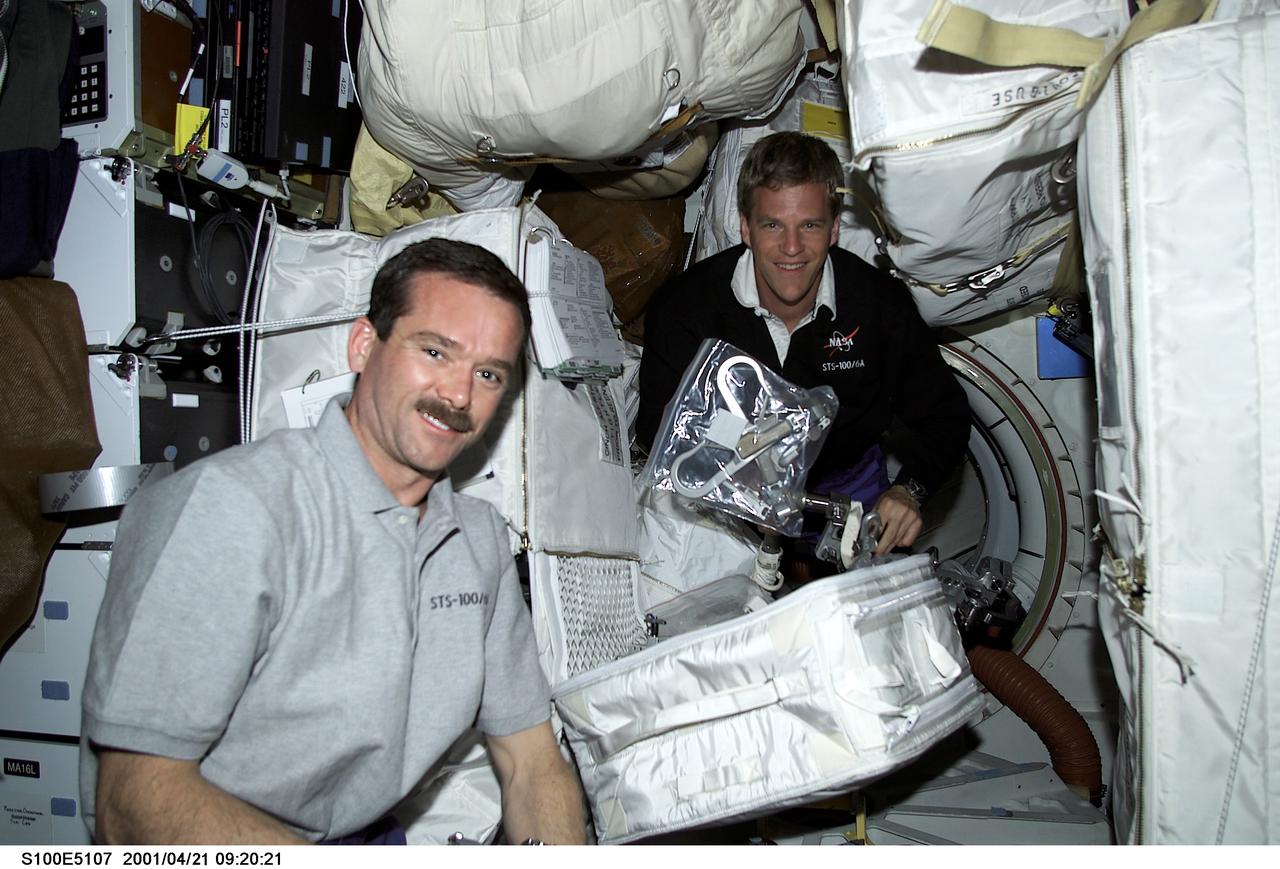
S100-E-5107 (21 April 2001) --- Astronauts Chris A. Hadfield (left) of the Canadian Space Agency and Scott E. Parazynski, both mission specialists, are seen on the middeck of the Space Shuttle Endeavour as the STS-100 crew anticipates its union with the International Space Station (ISS). Assigned space-walking astronauts Hadfield and Parazynski were later joined on the middeck by spacewalk coordinator John L. Phillips in conducting some final checks of the suits and hardware that are to be used during the next day's planned 6-hour, 30-minute spacewalk. The image was recorded with a digital still camera.
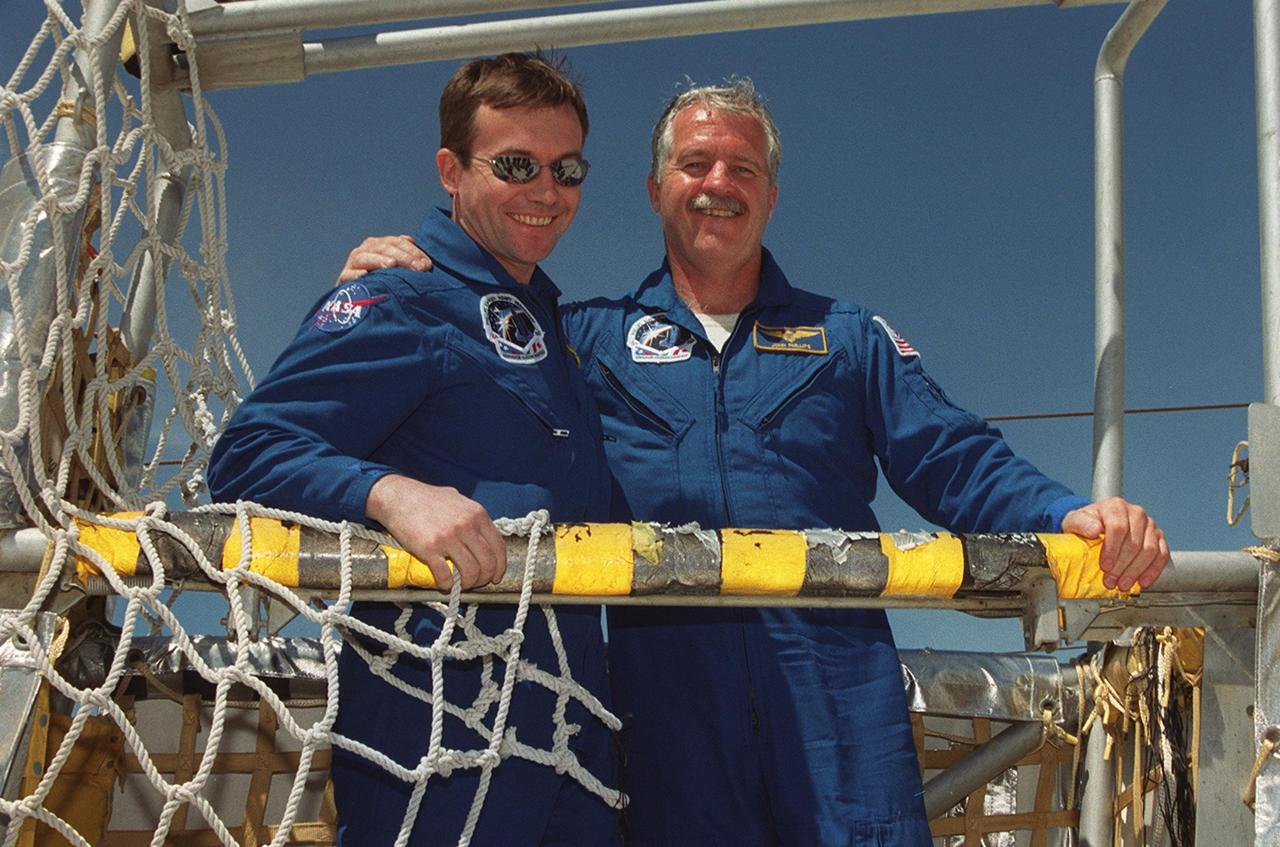
KENNEDY SPACE CENTER, FLA. -- STS-100 Mission Specialists Yuri V. Lonchakov and John L. Phillips pause during slidewire basket training on the 195-foot level of the Fixed Service Structure. They and the rest of the crew are taking part in Terminal Countdown Demonstration Test activities, which also include payload walkdown and a simulated launch countdown. The primary payload on mission STS-100 comprises the Canadian robotic arm, SSRMS, and Multi-Purpose Logistics Module, Raffaello. Launch of Space Shuttle Endeavour on mission STS-100 is targeted for April 19 at 2:41 p.m. EDT from Launch Pad 39A
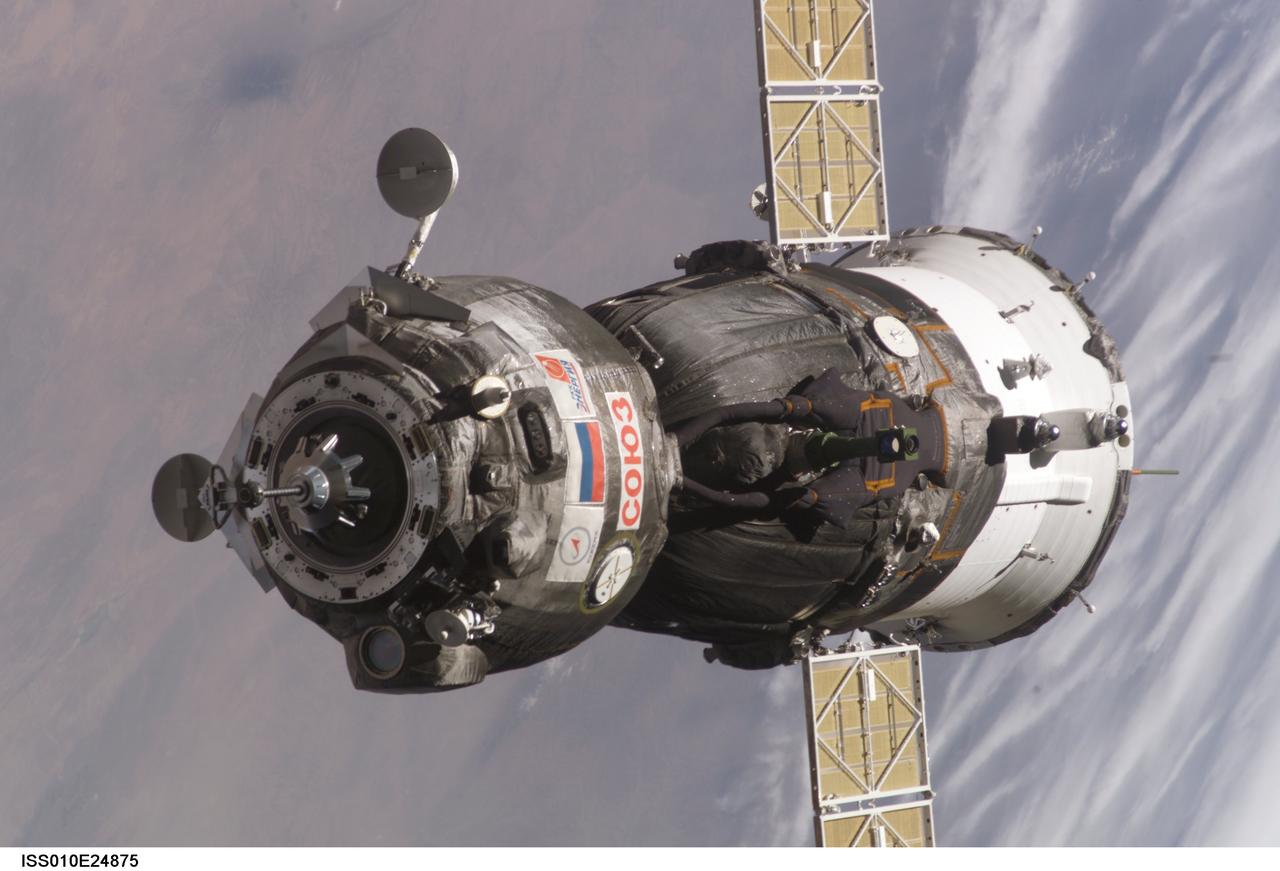
ISS010-E-24875 (16 April 2005) --- Backdropped by a blue and white Earth, this close-up view features the Soyuz TMA-6 spacecraft approaching the International Space Station (ISS). Onboard the spacecraft are cosmonaut Sergei K. Krikalev, Expedition 11 commander representing Russia's Federal Space Agency; astronaut John L. Phillips, NASA ISS science officer and flight engineer; and European Space Agency (ESA) astronaut Roberto Vittori of Italy. The Soyuz linked to the Pirs Docking Compartment at 9:20 p.m. (CDT) on April 16, 2005 as the two spacecraft flew over eastern Asia. The docking followed Friday’s launch from the Baikonur Cosmodrome in Kazakhstan.
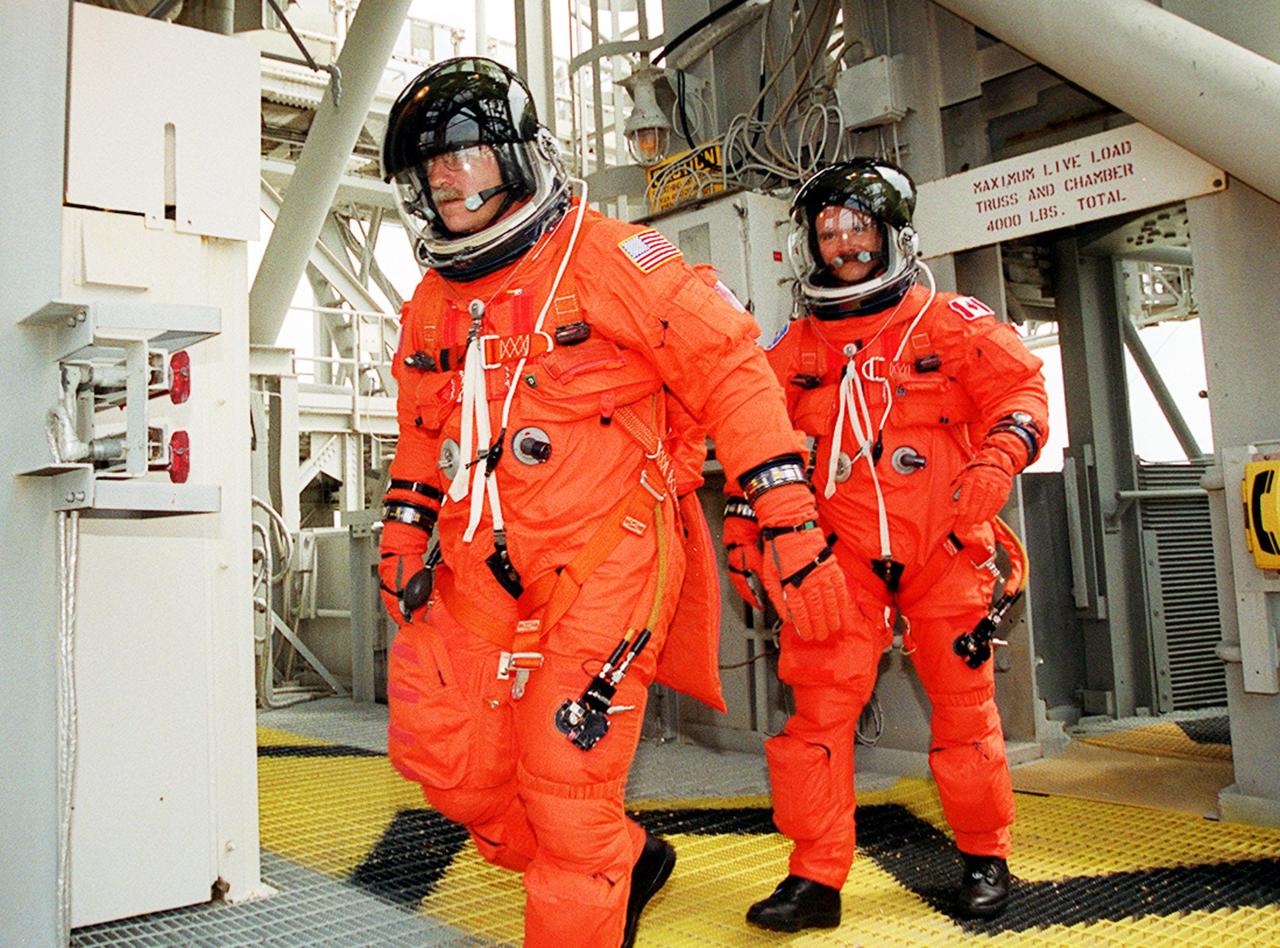
KENNEDY SPACE CENTER, FLA. -- STS-100 Mission Specialists John L. Phillips (left) and Chris A. Hadfield (right) move quickly toward the slidewire baskets during emergency escape training at Launch Pad 39A. The training is part of Terminal Countdown Demonstration Test activities that also include a simulated launch countdown. The mission is carrying the Multi-Purpose Logistics Module Raffaello and the SSRMS, to the International Space Station. Raffaello carries six system racks and two storage racks for the U.S. Lab. The SSRMS is crucial to the continued assembly of the orbiting complex. Launch of mission STS-100 is scheduled for April 19 at 2:41 p.m. EDT from Launch Pad 39A
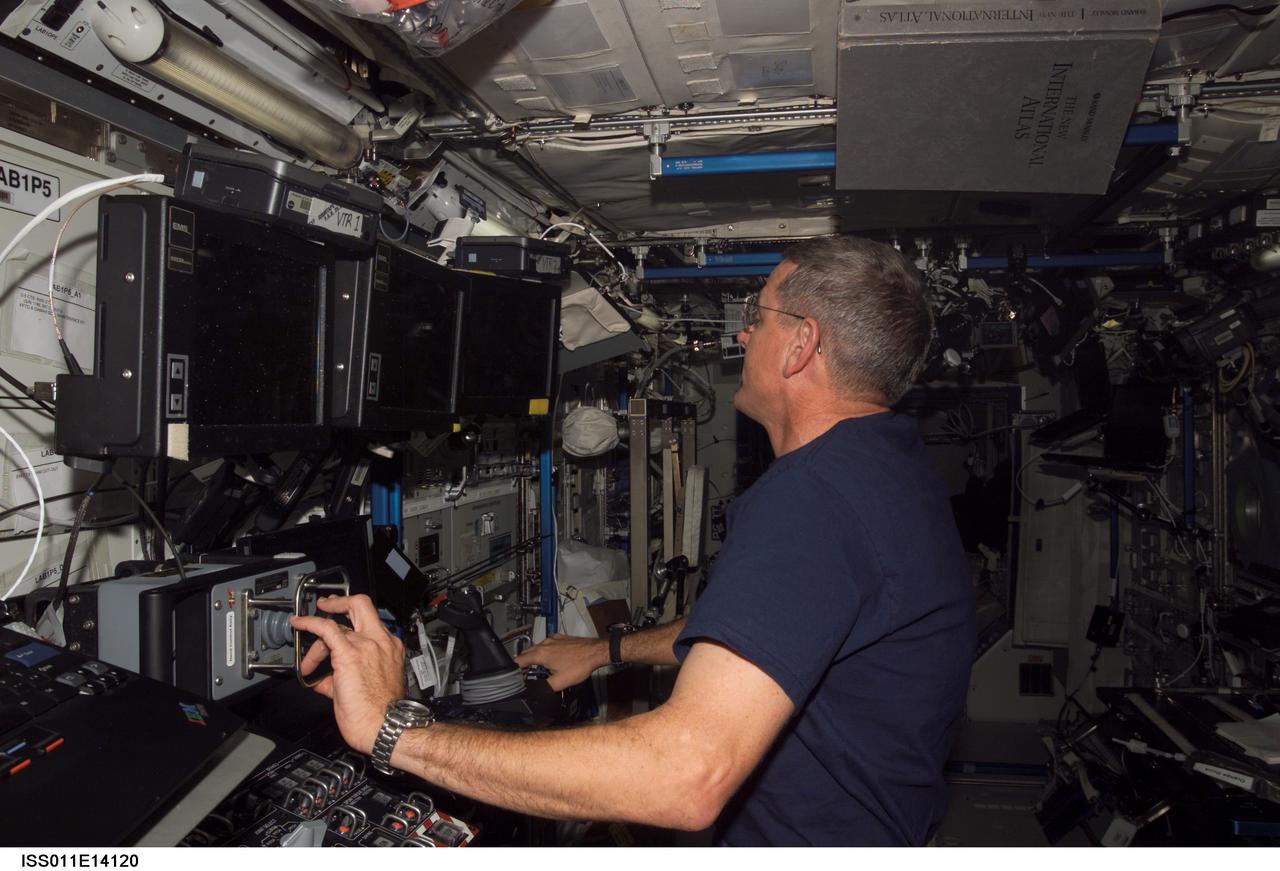
ISS011-E-14120 (5 October 2005) --- Astronaut William S. McArthur, Jr., Expedition 12 commander and NASA science officer, works with Space Station Remote Manipulator System or Canadarm2 controls located in the Destiny lab, while sharing duty time with the Expedition 11 crewmembers on the international space station. The Expedition 11 crew of cosmonaut Sergei K. Krikalev of Russia's Federal Space Agency, commander, and astronaut John L. Phillips, flight engineer and NASA science officer, along with spaceflight participant Greg Olsen, will be returning to Earth early next week.
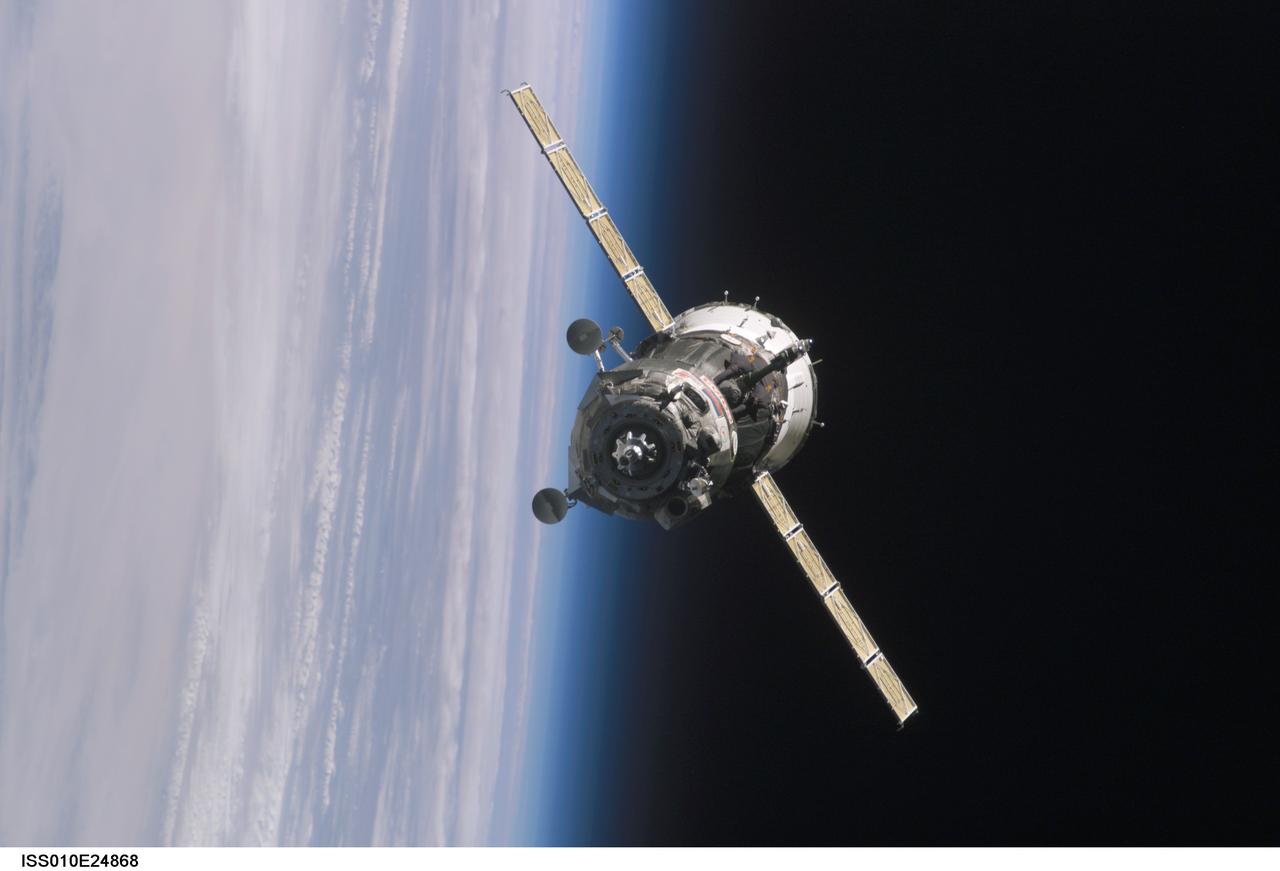
ISS010-E-24868 (16 April 2005) --- Backdropped by the blackness of space and Earth’s horizon, the Soyuz TMA-6 spacecraft approaches the International Space Station (ISS). Onboard the spacecraft are cosmonaut Sergei K. Krikalev, Expedition 11 commander representing Russia's Federal Space Agency; astronaut John L. Phillips, NASA ISS science officer and flight engineer; and European Space Agency (ESA) astronaut Roberto Vittori of Italy. The Soyuz linked to the Pirs Docking Compartment at 9:20 p.m. (CDT) on April 16, 2005 as the two spacecraft flew over eastern Asia. The docking followed Friday’s launch from the Baikonur Cosmodrome in Kazakhstan.
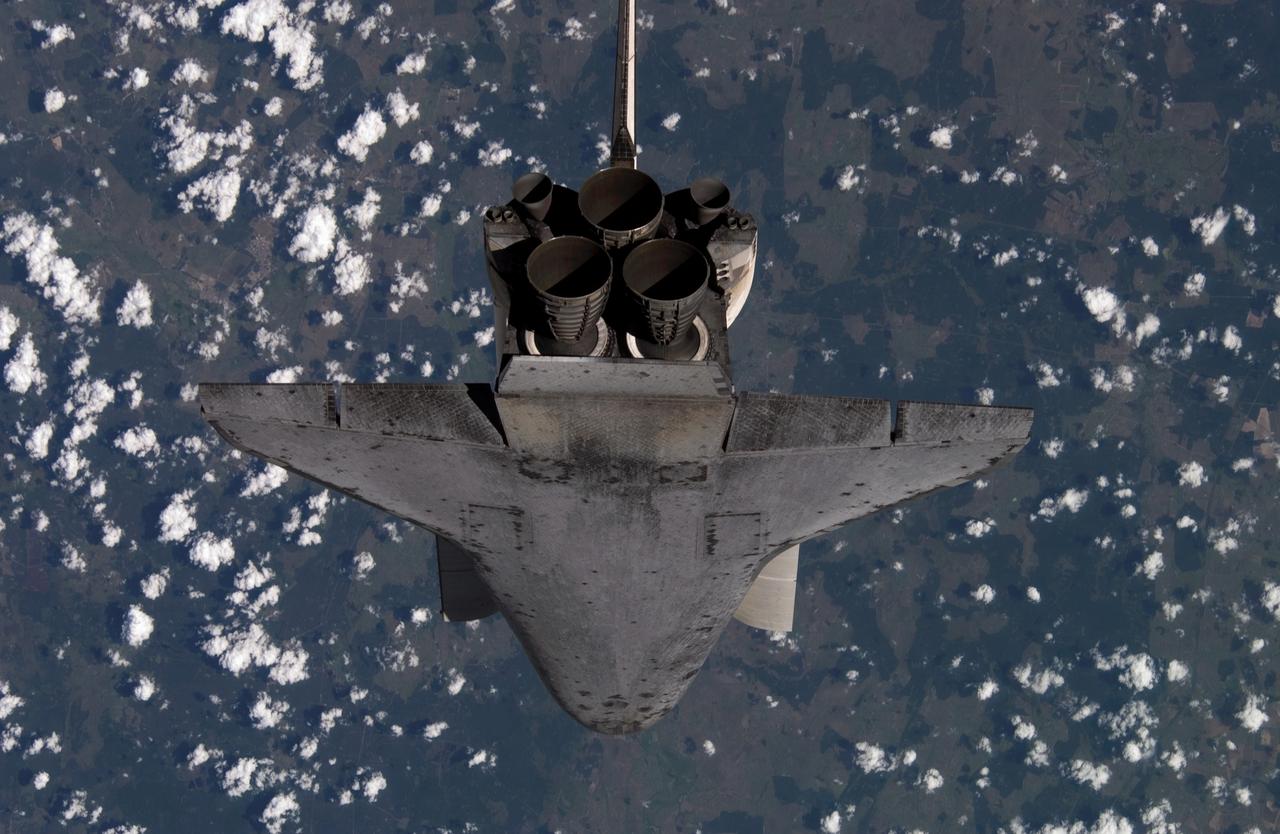
ISS011-E-11263 (28 July 2005) --- This underside view of the Space Shuttle Discovery was photographed by cosmonaut Sergei K. Krikalev, Expedition 11 commander, and astronaut John L. Phillips, NASA Space Station science officer and flight engineer, as Discovery approached the International Space Station and performed a backflip to allow photography of its heat shield. Astronaut Eileen M. Collins, STS-114 commander, guided the Shuttle through the flip. The photos will be analyzed by engineers on the ground as additional data to evaluate the condition of Discovery;s heat shield.
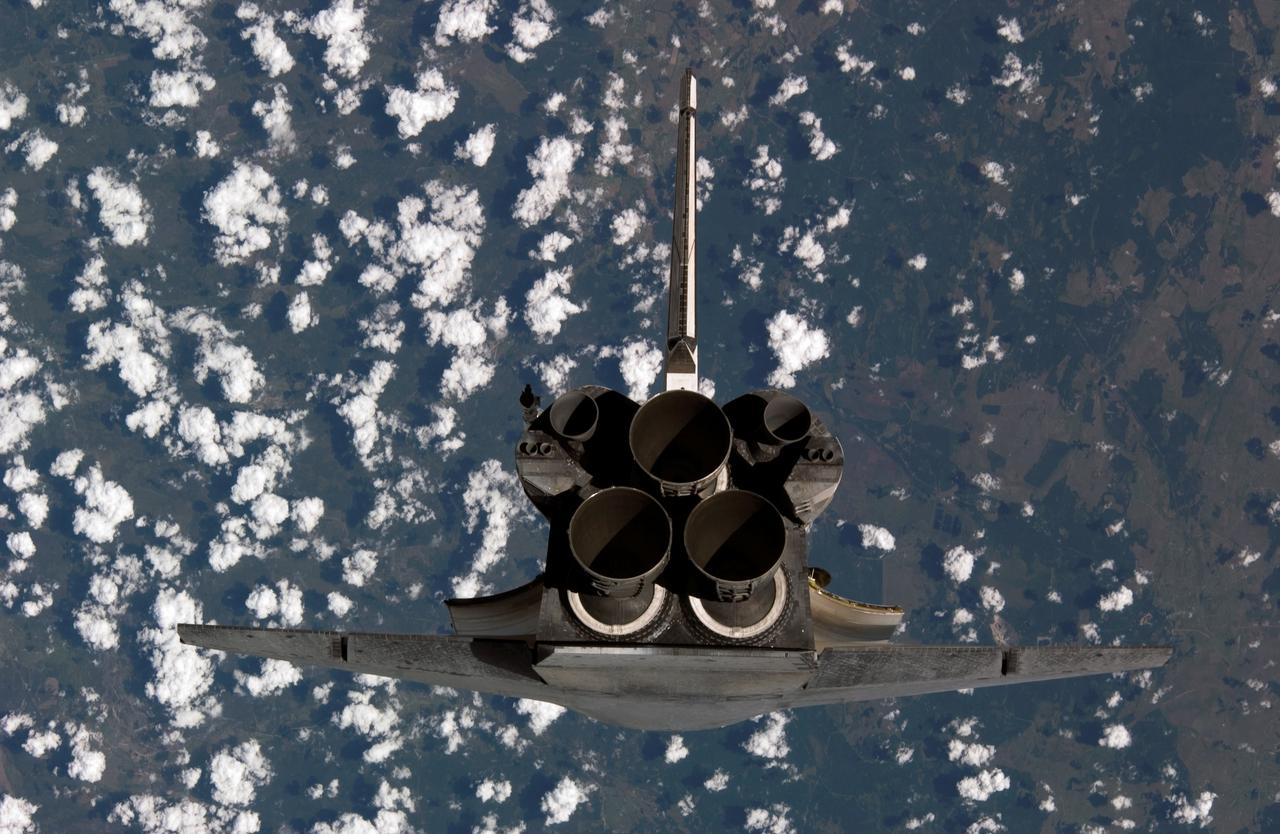
ISS011-E-11269 (28 July 2005) --- Space Shuttle Discovery was about 600 feet from the International Space Station when cosmonaut Sergei K. Krikalev, Expedition 11 commander, and astronaut John L. Phillips, NASA Space Station science officer and flight engineer, photographed the spacecraft as it approached the Station and performed a backflip to allow photography of its heat shield. Astronaut Eileen M. Collins, STS-114 commander, guided the Shuttle through the flip. The photos will be analyzed by engineers on the ground as additional data to evaluate the condition of Discovery;s heat shield.
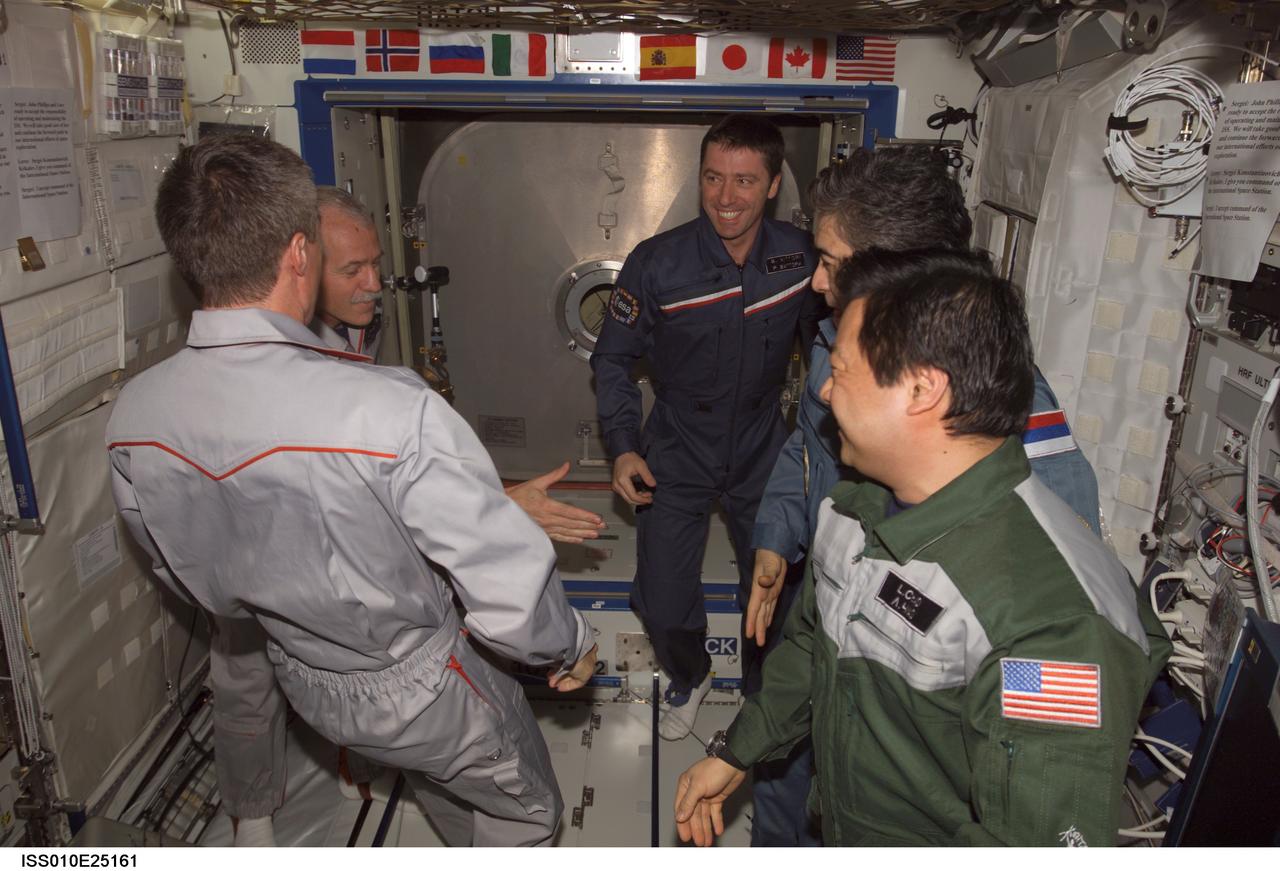
ISS010-E-25161 (22 April 2005) --- The crewmembers onboard the International Space Station (ISS) exchange greetings in the Destiny laboratory following the ceremony of Changing-of-Command from Expedition 10 to Expedition 11. From the left are cosmonaut Sergei K. Krikalev, Expedition 11 commander representing Russia's Federal Space Agency; astronaut John L. Phillips, Expedition 11 NASA ISS science officer and flight engineer; European Space Agency (ESA) astronaut Roberto Vittori of Italy; cosmonaut Salizhan S. Sharipov, Expedition 10 flight engineer representing Russia's Federal Space Agency; and astronaut Leroy Chiao, Expedition 10 commander and NASA ISS science officer.
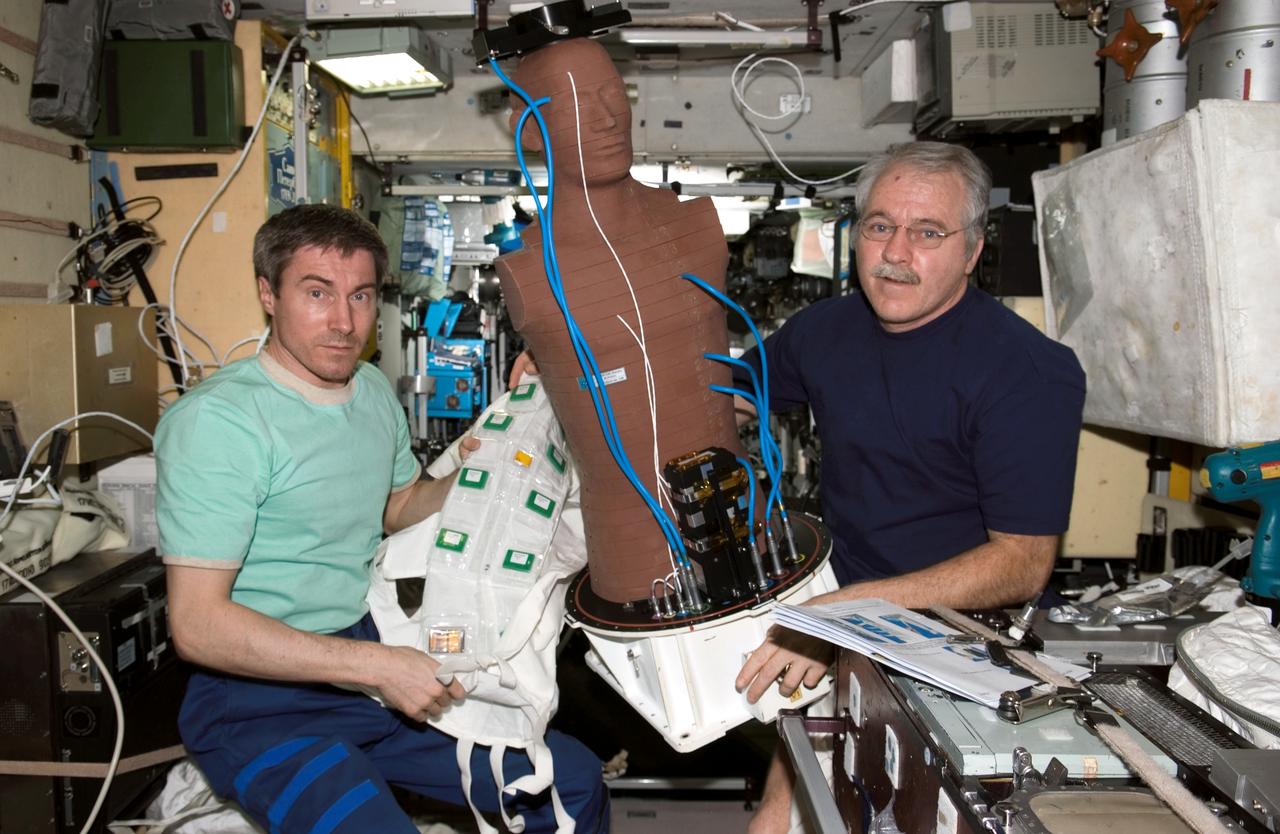
ISS011-E-13025 (14 September 2005) --- Cosmonaut Sergei K. Krikalev (left), Expedition 11 commander representing Russia's Federal Space Agency, and astronaut John L. Phillips, NASA space station science officer and flight engineer, hold the European Space Agency (ESA) Matroshka radiation experiment in the Zvezda Service Module of the international space station. Matroshka, a human-torso-like device, was retrieved from the exterior of the station during an August spacewalk, for return to Earth. The experiment is designed to better understand the exposure of astronauts, including those making spacewalks, to radiation.
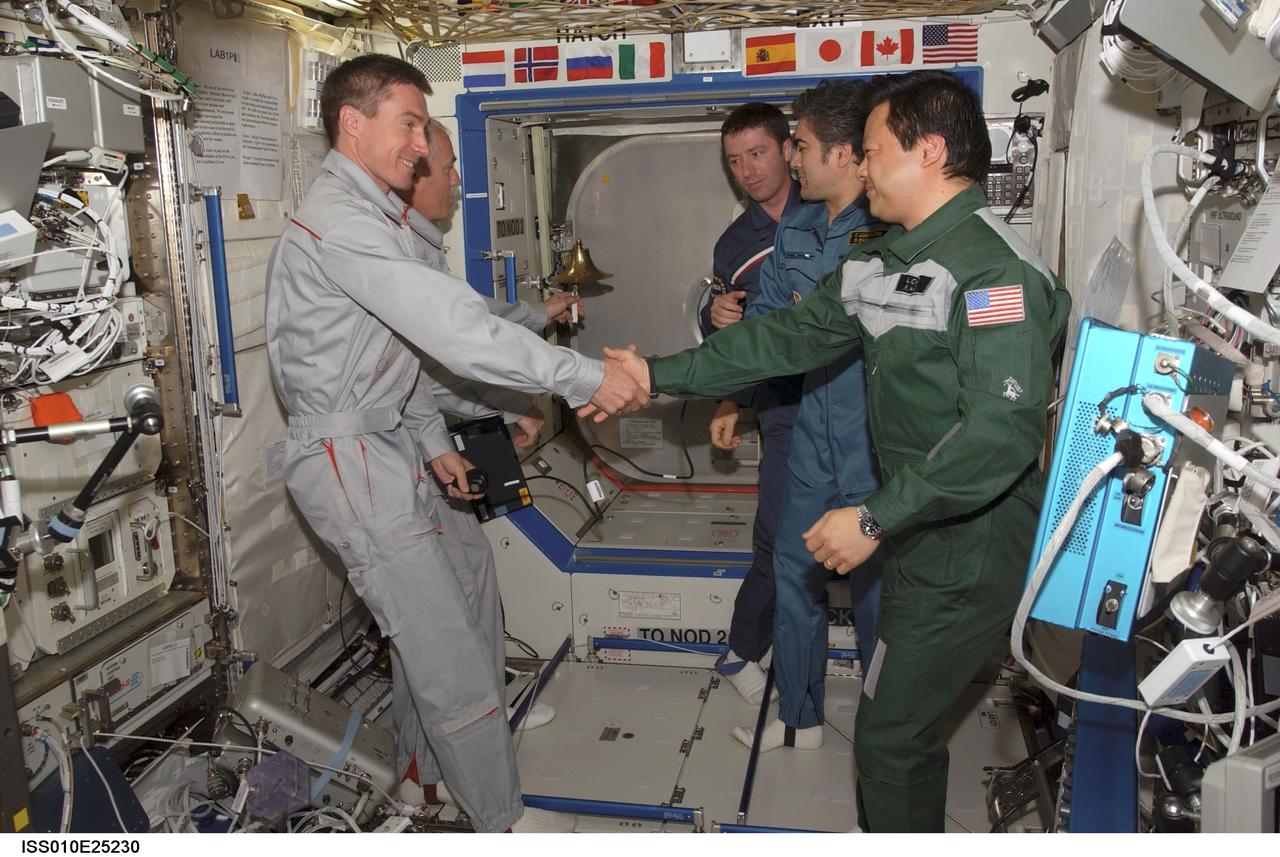
ISS010-E-25230 (22 April 2005) --- The crewmembers onboard the International Space Station (ISS) exchange greetings in the Destiny laboratory following the ceremony of Changing-of-Command from Expedition 10 to Expedition 11. From the left are cosmonaut Sergei K. Krikalev, Expedition 11 commander representing Russia's Federal Space Agency; astronaut John L. Phillips, Expedition 11 NASA ISS science officer and flight engineer; European Space Agency (ESA) astronaut Roberto Vittori of Italy; cosmonaut Salizhan S. Sharipov, Expedition 10 flight engineer representing Russia's Federal Space Agency; and astronaut Leroy Chiao, Expedition 10 commander and NASA ISS science officer.
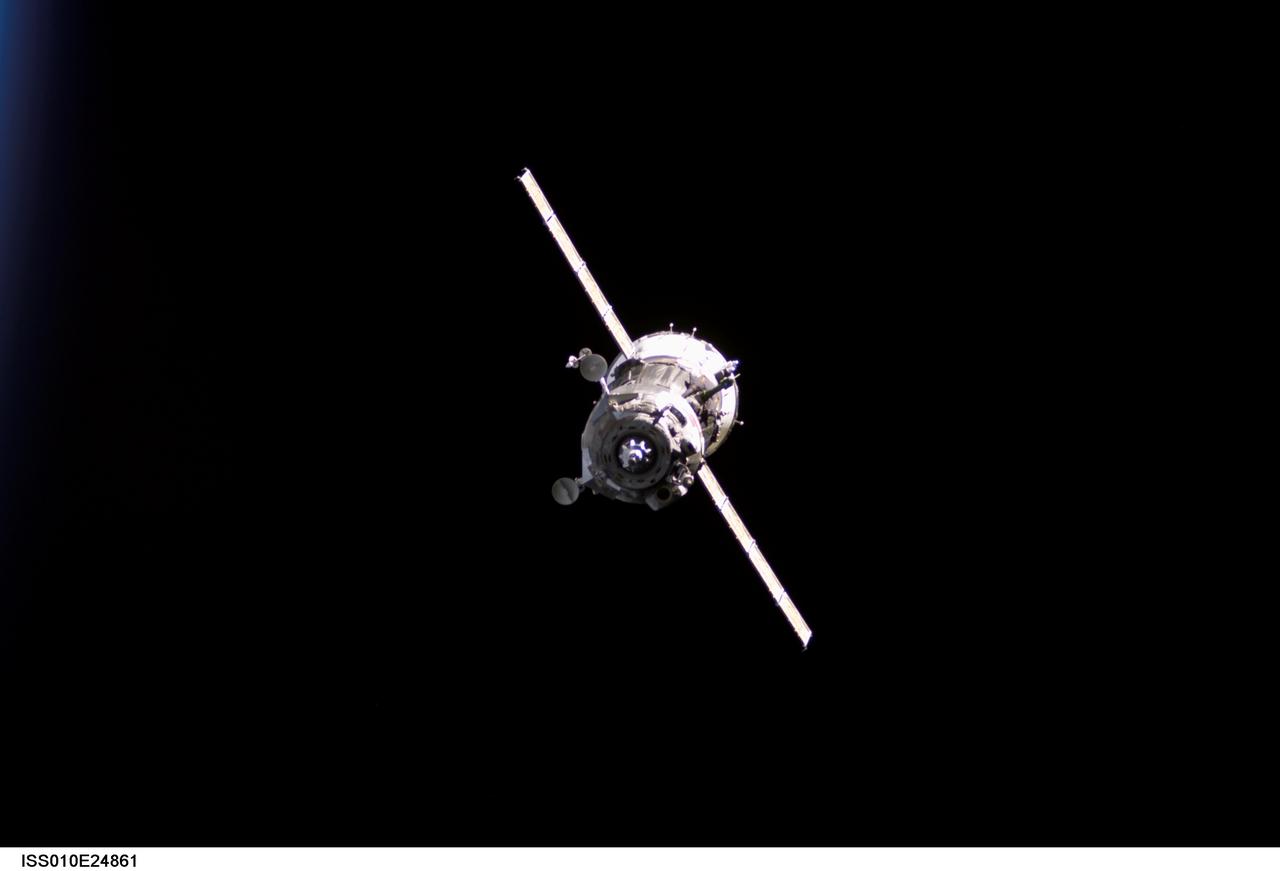
ISS010-E-24861 (16 April 2005) --- Backdropped by the blackness of space, the Soyuz TMA-6 spacecraft approaches the International Space Station (ISS). Onboard the spacecraft are cosmonaut Sergei K. Krikalev, Expedition 11 commander representing Russia's Federal Space Agency; astronaut John L. Phillips, NASA ISS science officer and flight engineer; and European Space Agency (ESA) astronaut Roberto Vittori of Italy. The Soyuz linked to the Pirs Docking Compartment at 9:20 p.m. (CDT) on April 16, 2005 as the two spacecraft flew over eastern Asia. The docking followed Friday’s launch from the Baikonur Cosmodrome in Kazakhstan.
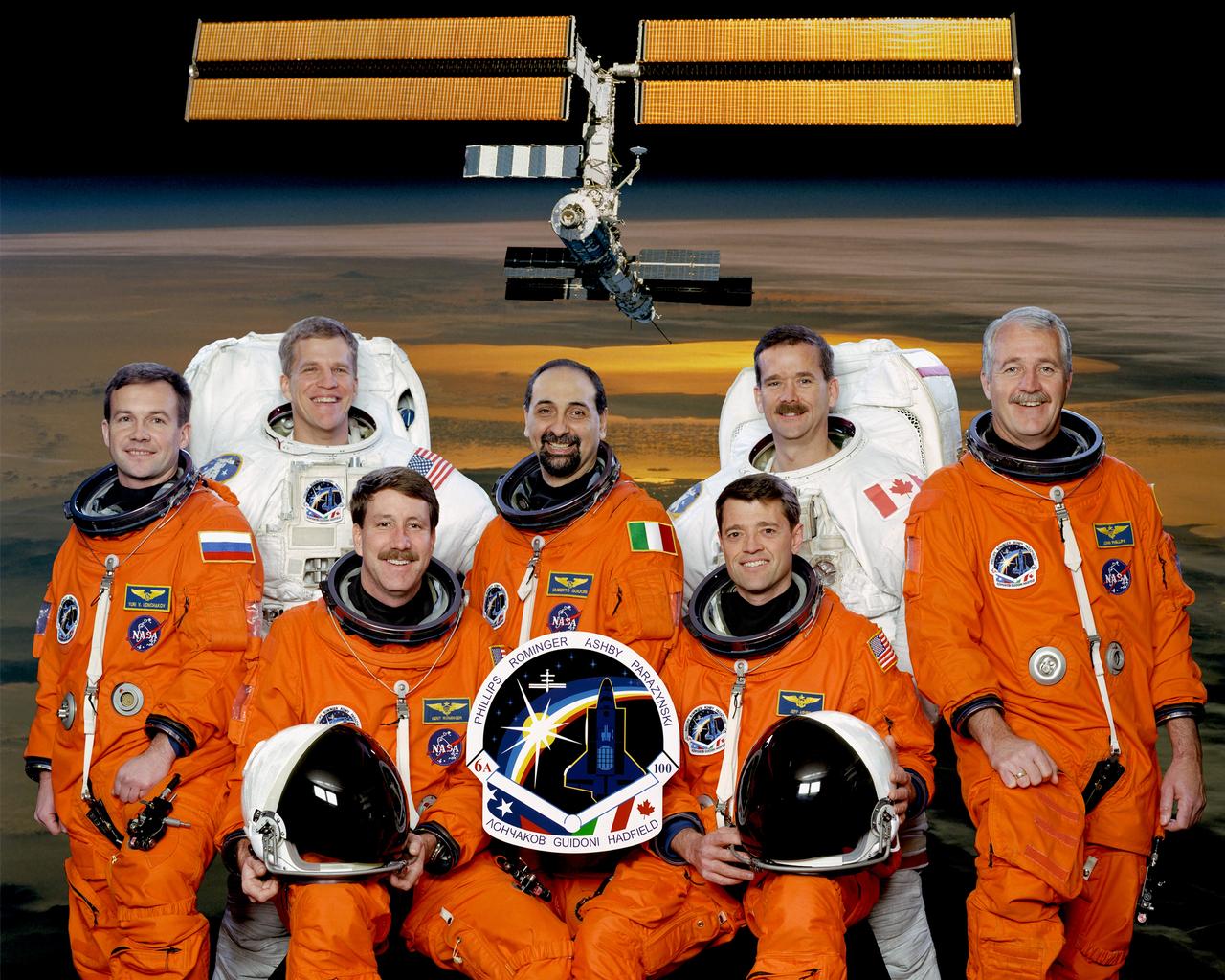
STS100-S-002 (March 2001) --- These international astronauts and cosmonaut have been in training in a number of venues for the April 2001 visit to the International Space Station (ISS). Seated are astronauts Kent V. Rominger (left) and Jeffrey S. Ashby, commander and pilot, respectively, for the STS-100 mission. Standing, from the left, are cosmonaut Yuri V. Lonchakov, with astronauts Scott E. Parazynski, Umberto Guidoni, Chris A. Hadfield and John L. Phillips, all mission specialists. Guidoni represents the European Space Agency (ESA); Hadfield is with the Canadian Space Agency (CSA) and Lonchakov is affiliated with Rosaviakosmos.
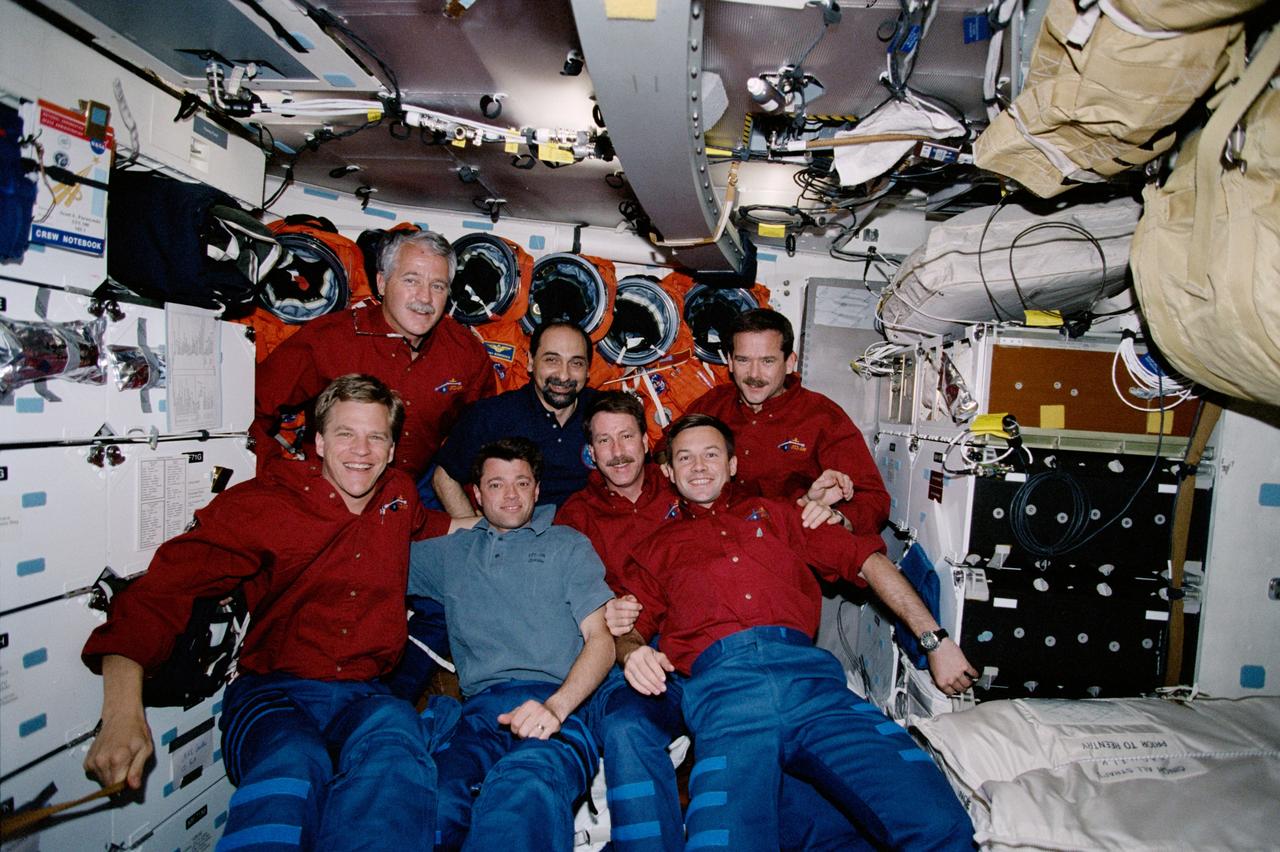
The STS-100 crew pose for their inflight crew photograph on the middeck of Endeavour, Orbiter Vehicle (OV) 105, during the STS-100 mission. Front row from left to right are: Mission Specialist (MS) Scott E. Parazynski, Pilot Jeffrey S. Ashby, Commander Kent V. Rominger and MS / Cosmonaut Yuri V. Lonchakov. Back row: MS John L. Phillips, MS Umberto Guidoni and MS Chris A. Hadfield. Lonchakov represents Rosaviakosmos. Guidoni represents European Space Agency (ESA). Hadfield represents Canadian Space Agency (CSA). This image was selected by the STS-100 crew for use in public presentations.
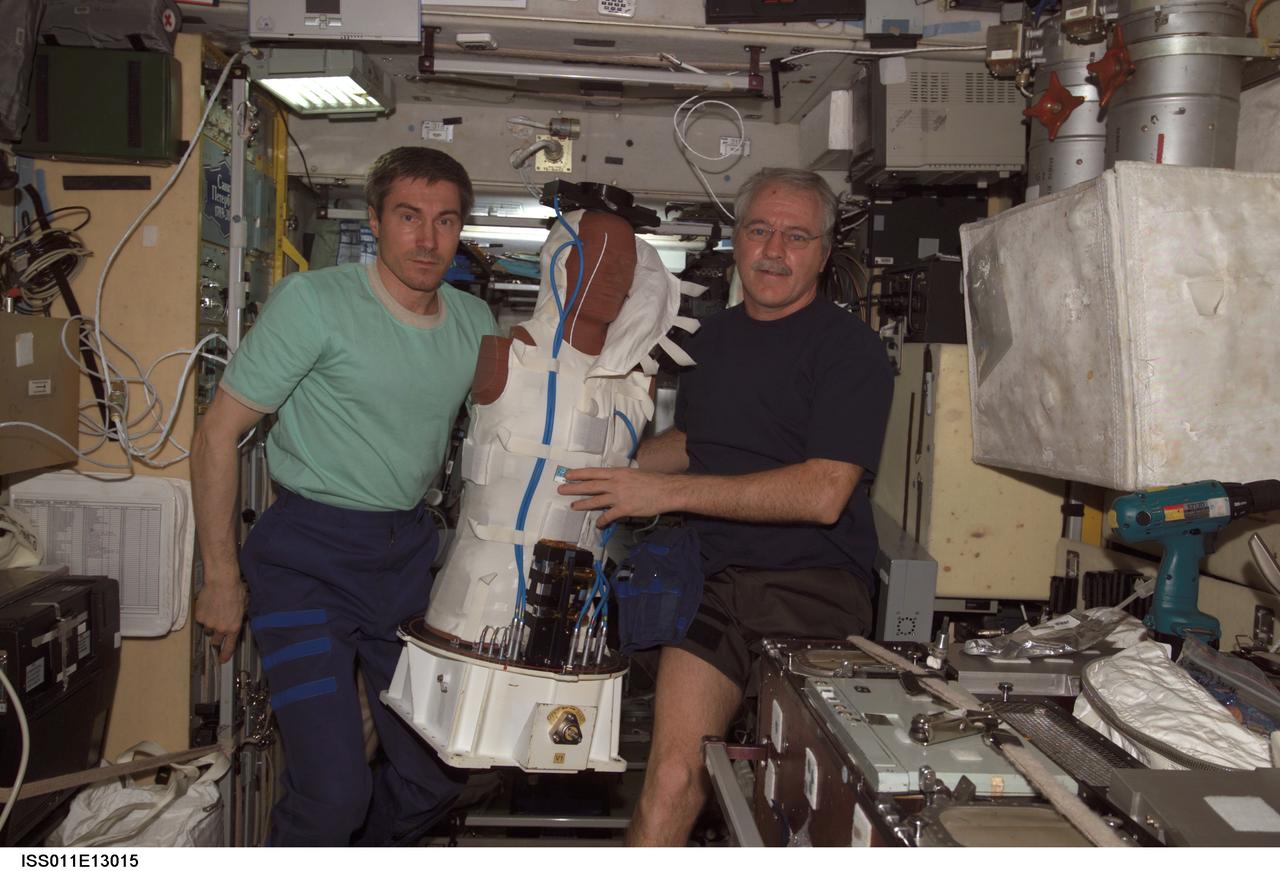
ISS011-E-13015 (14 September 2005) --- Cosmonaut Sergei K. Krikalev (left), Expedition 11 commander representing Russia's Federal Space Agency, and astronaut John L. Phillips, NASA Space Station science officer and flight engineer, hold the European Space Agency (ESA) Matroshka radiation experiment in the Zvezda Service Module of the International Space Station. Matroshka, a human-torso-like device, was retrieved from the exterior of the station during an August spacewalk, for return to Earth. The experiment is designed to better understand the exposure of astronauts, including those making spacewalks, to radiation.
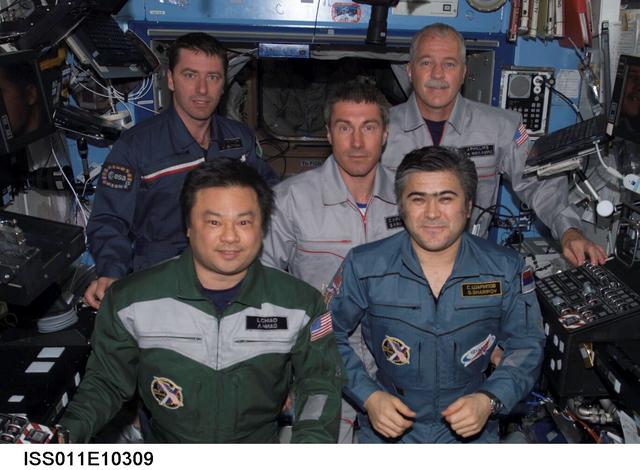
ISS011-E-10309 (21 April 2005) --- The crewmembers onboard the International Space Station gather for an in-flight group photo in the Destiny laboratory. From the left (front row) are astronaut Leroy Chiao, Expedition 10 commander and NASA Space Station science officer; and cosmonaut Salizhan S. Sharipov, Expedition 10 flight engineer representing Russia's Federal Space Agency. From the left (back row) are European Space Agency (ESA) astronaut Roberto Vittori of Italy; cosmonaut Sergei K. Krikalev, Expedition 11 commander representing Russia's Federal Space Agency; and astronaut John L. Phillips, Expedition 11 NASA Space Station science officer and flight engineer.
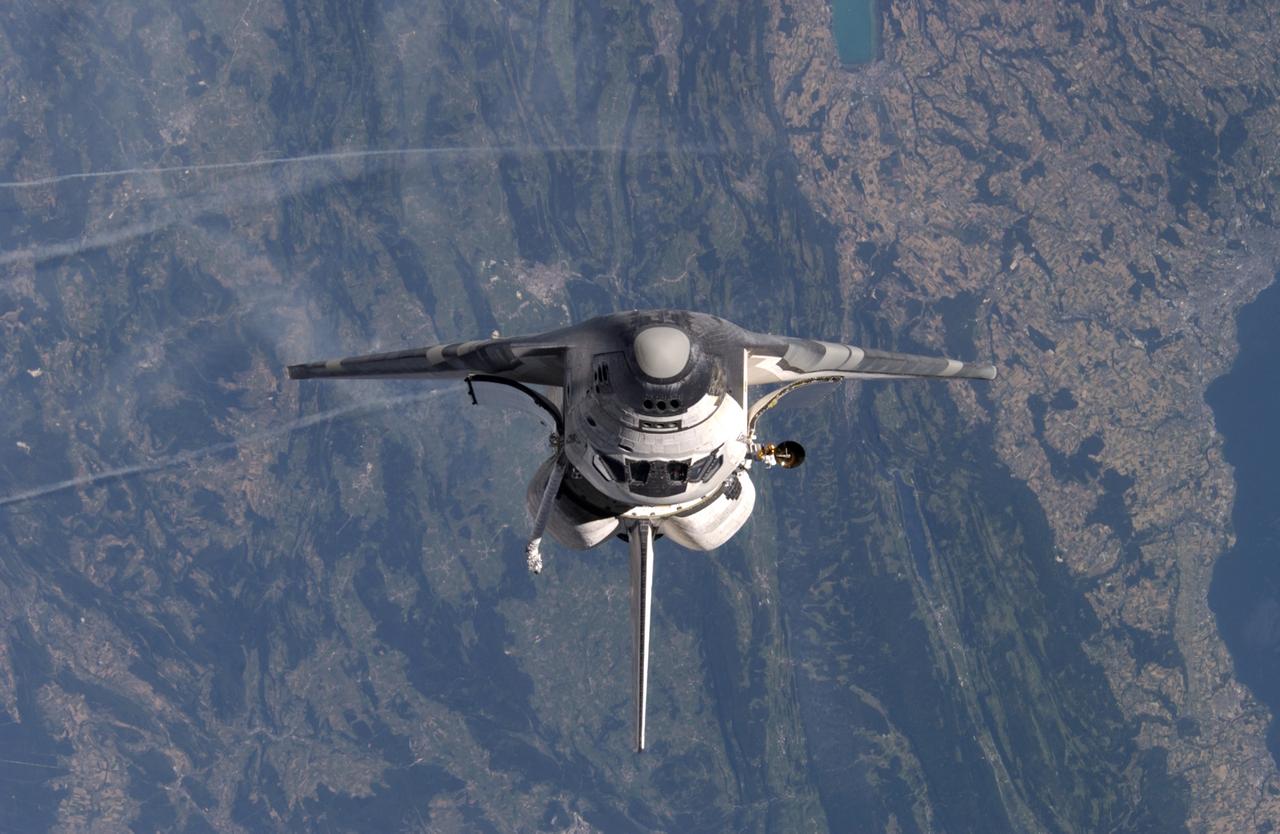
ISS011-E-11257 (28 July 2005) --- Space Shuttle Discovery was about 600 feet from the International Space Station when cosmonaut Sergei K. Krikalev, Expedition 11 commander, and astronaut John L. Phillips, NASA Space Station science officer and flight engineer, photographed the spacecraft as it approached the Station and performed a backflip to allow photography of its heat shield. Astronaut Eileen M. Collins, STS-114 commander, guided the Shuttle through the flip. The photos will be analyzed by engineers on the ground as additional data to evaluate the condition of Discovery’s heat shield. The scene is over Switzerland.