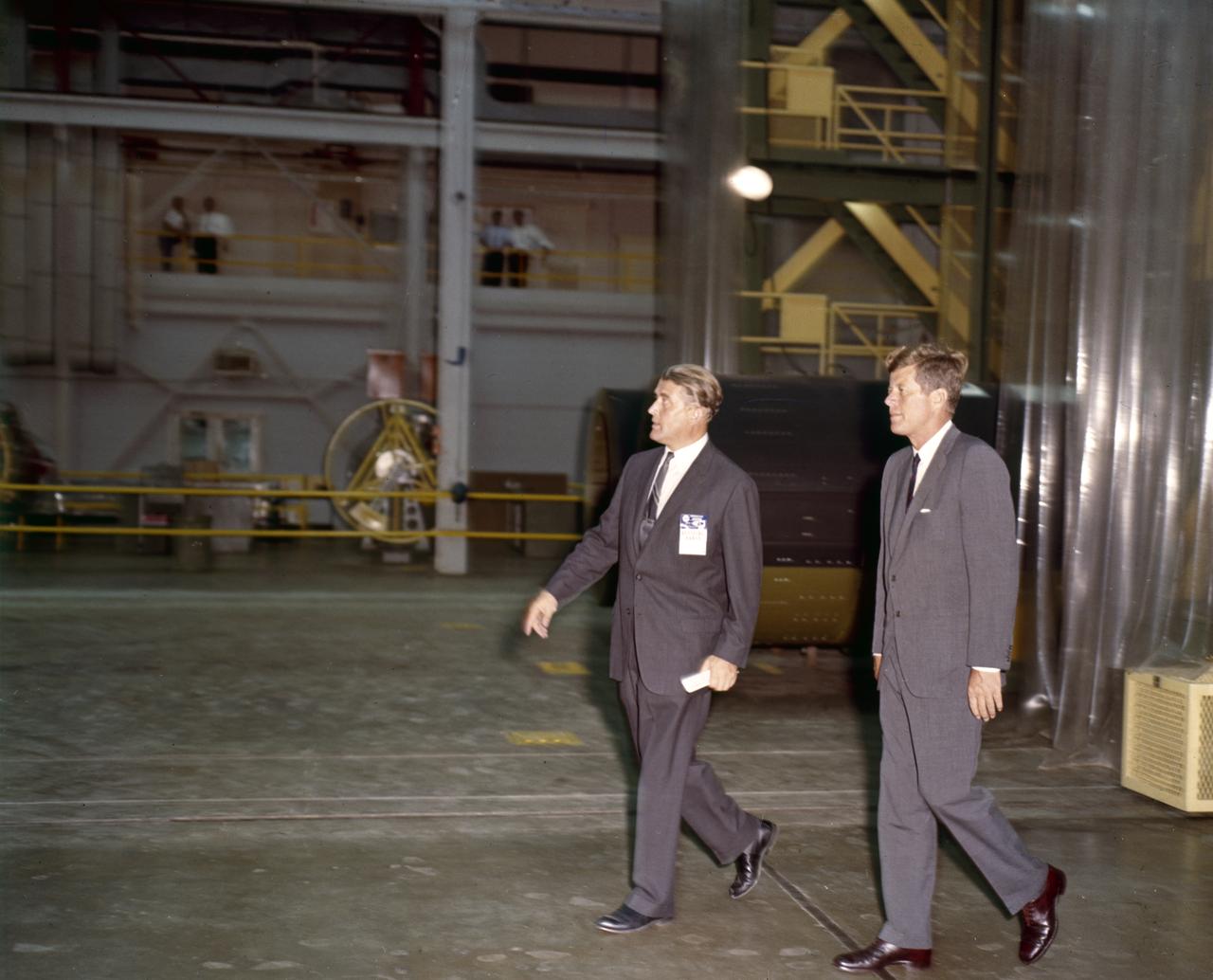
President John Kennedy and Dr. von Braun tour one of the laboratories at Marshall Space Flight Center, September 11, 1962.
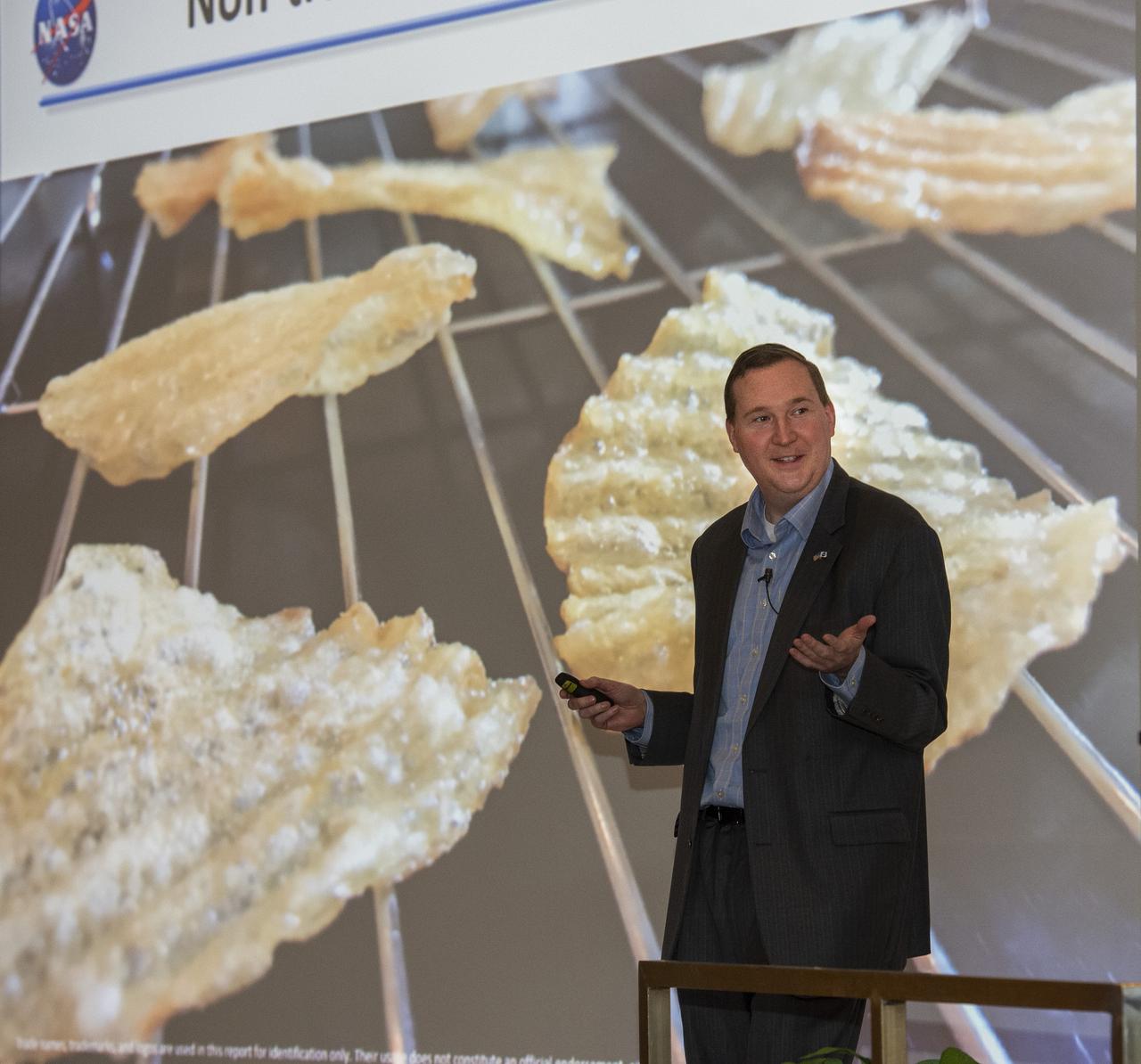
JOHN DANKANICH, MARSHALL’S CENTER CHIEF TECHNOLOGIST, ALSO GAVE A PRESENTATION ABOUT NASA INNOVATION. DANKANICH DISCUSSED TYPES OF INNOVATION, BARRIERS AND HOW TO OVERCOME THE CHALLENGES.
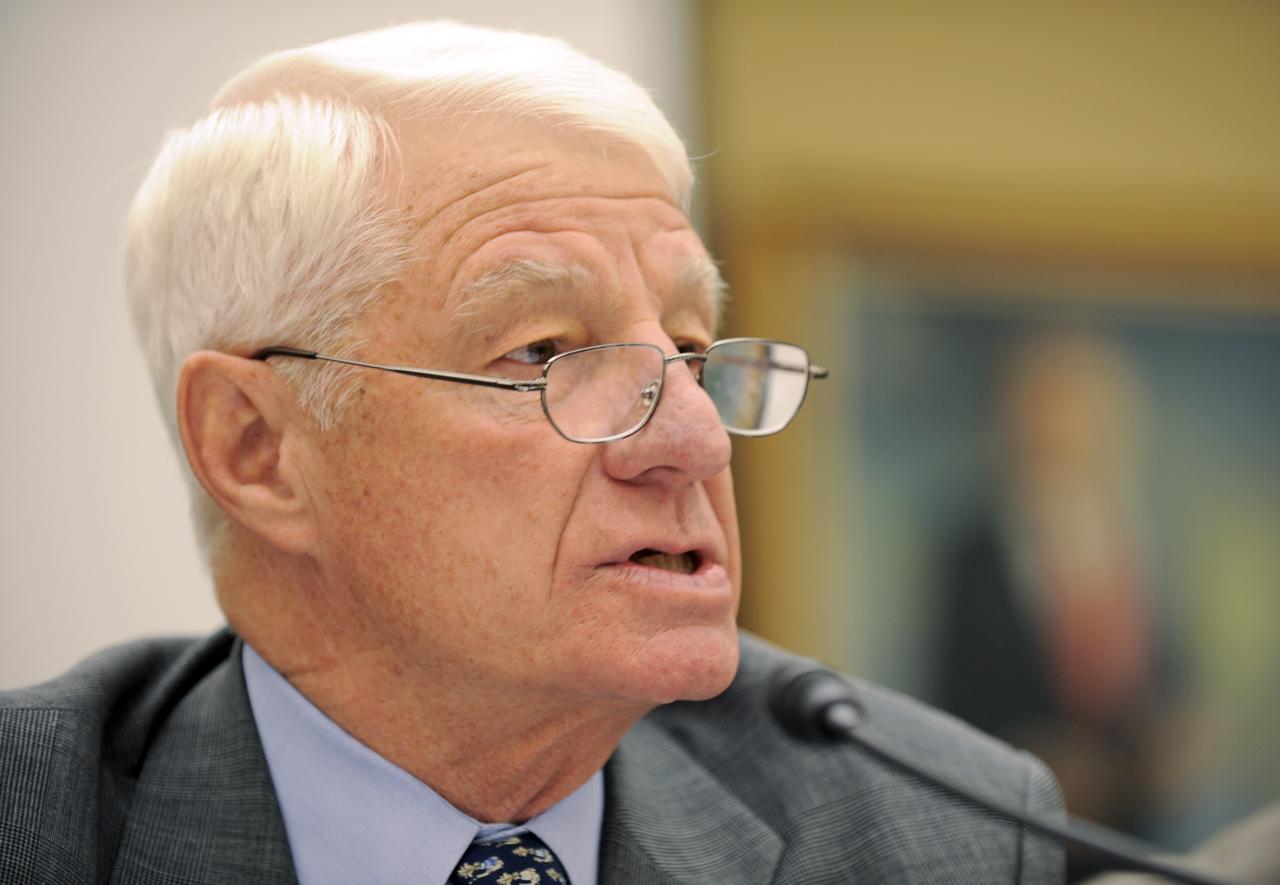
John Marshall, a member of the NASA Aerospace Safety Advisory Panel (ASAP), testifies during a hearing before the House Subcommitte on Space and Aeronautics regarding Safety of Human Spaceflight on Capitol Hill, Wednesday, Dec. 2, 2009, in Washington. Photo Credit: (NASA/Bill Ingalls)
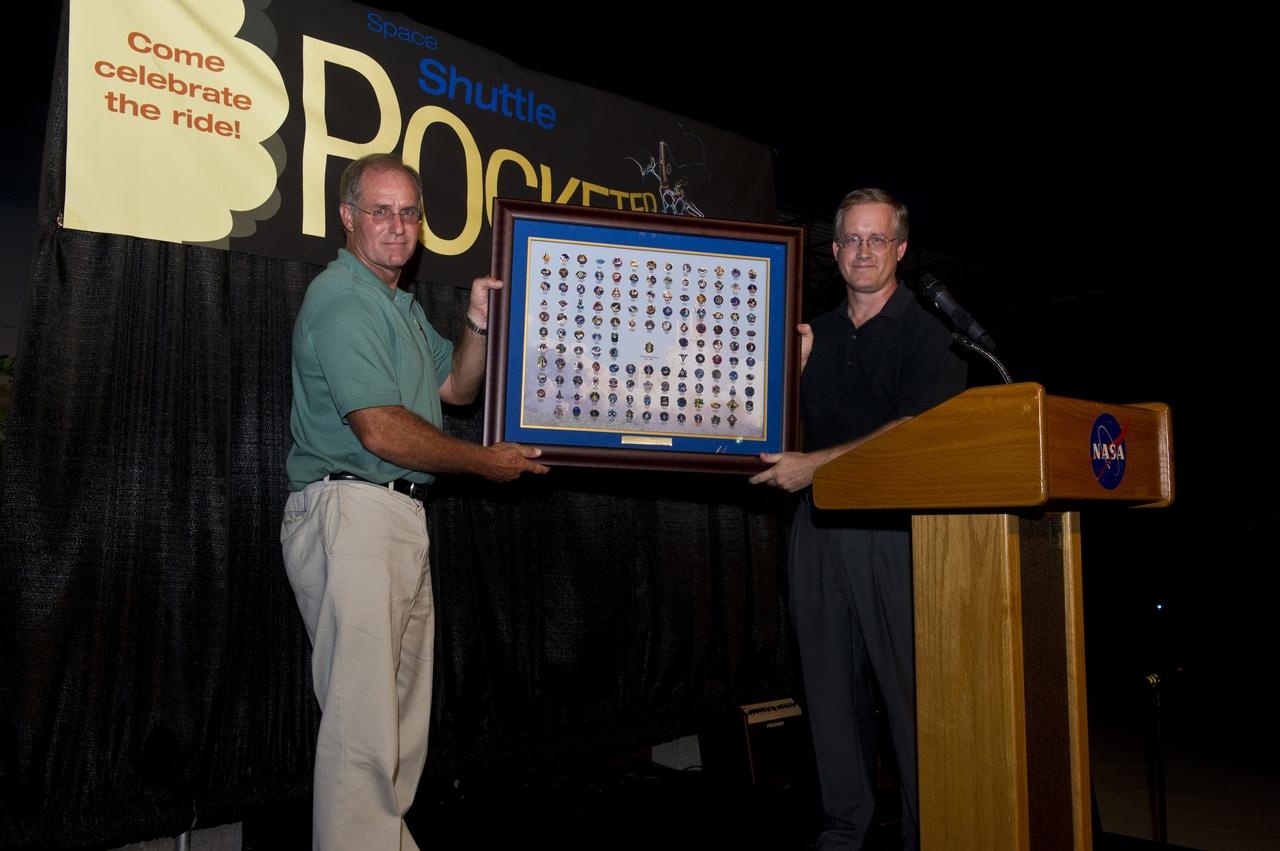
MARSHALL SHUTTLE PROPULSION OFFICE MANAGER STEVE CASH PRESENTS A MISSION PIN PLAQUE TO JOHN SHANNON, MANAGER OF THE SPACE SHUTTLE PROGRAM.
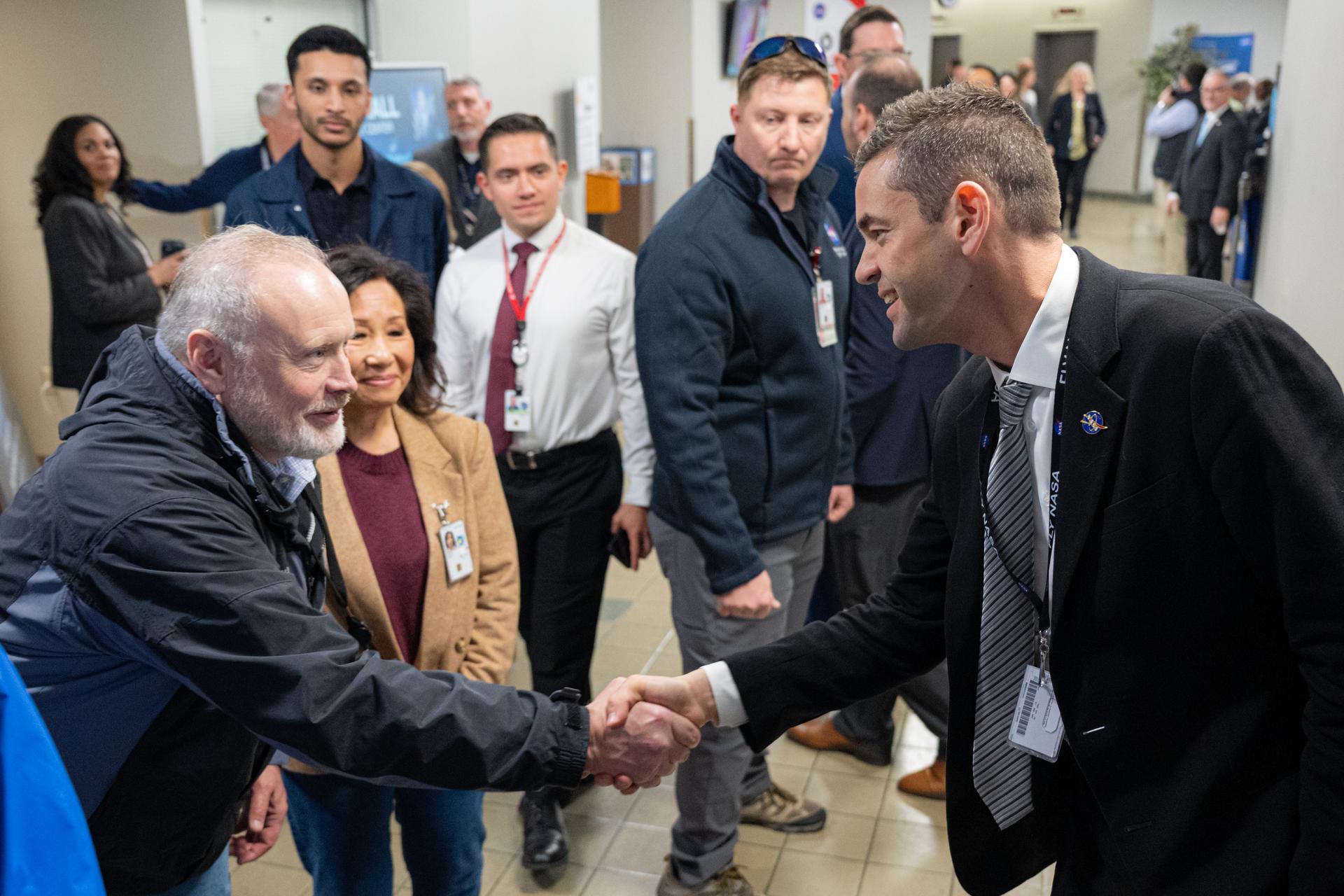
NASA Administrator Jared Isaacman, right, greets members of the workforce, Wednesday, Jan. 14, 2026, at NASA’s Marshall Space Flight Center in Huntsville, Ala. Marshall marks the fifth stop in Isaacman’s roadshow to visit NASA facilities and engage directly with the agency’s workforce. Photo Credit: (NASA/John Kraus)
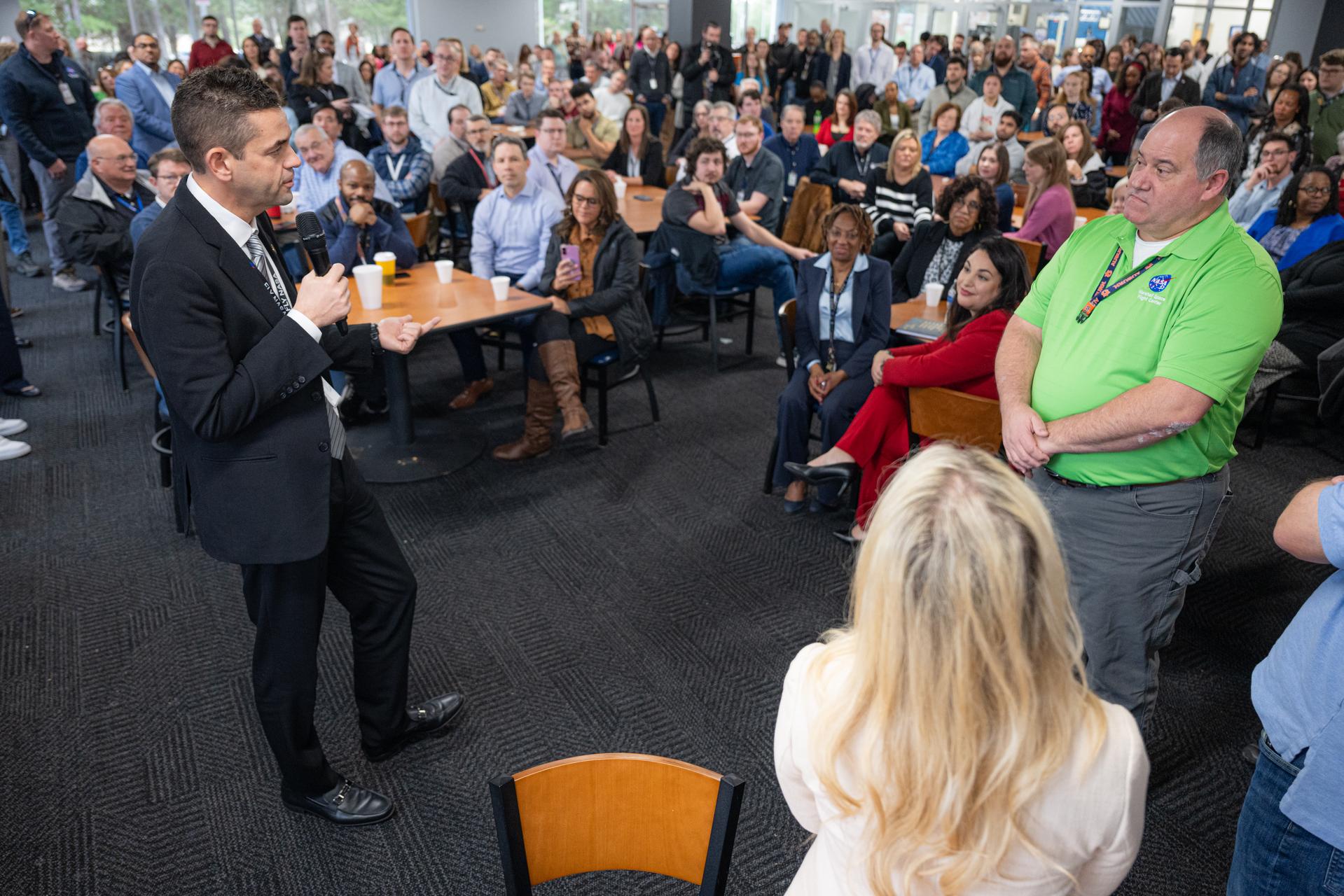
NASA Administrator Jared Isaacman, left, speaks during a workforce Q&A session, Wednesday, Jan. 14, 2026, at NASA’s Marshall Space Flight Center in Huntsville, Ala. Marshall marks the fifth stop in Isaacman’s roadshow to visit NASA facilities and engage directly with the agency’s workforce. Photo Credit: (NASA/John Kraus)
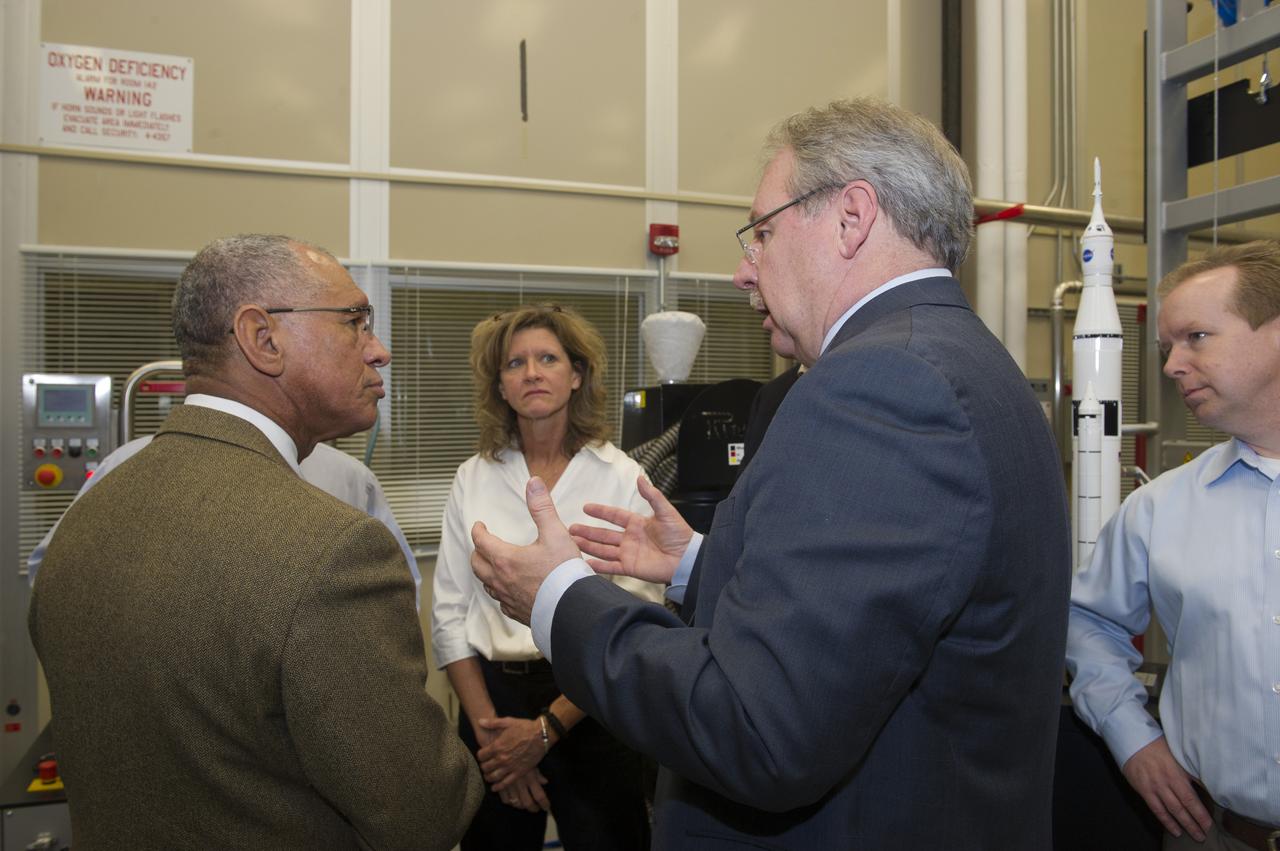
FROM LEFT, NASA ADMINISTRATOR CHARLES BOLDEN LISTENS TO MARSHALL MATERIALS ENGINEER NANCY TOLLIVER; JOHN VICKERS, MANAGER OF THE NATIONAL CENTER FOR ADVANCED MANUFACTURING; AND MARSHALL FLIGHT SYSTEMS DESIGN ENGINEER ROB BLACK AS THEY BRIEF HIM ON THE USE OF 3-D PRINTING AND PROTOTYPING TECHNOLOGY TO CREATE PARTS FOR THE SPACE LAUNCH SYSTEM
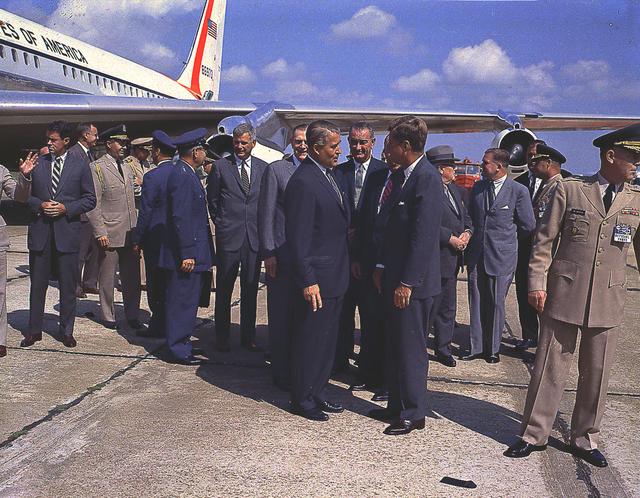
President John F. Kennedy, Vice President Lyndon B. Johnson and Marshall Space Flight Center Director Dr. Wernher von Braun at the Redstone Arsenal Airfield, September 11, 1962. Kennedy and Johnson visited the Marshall Center to tour national space facilities.
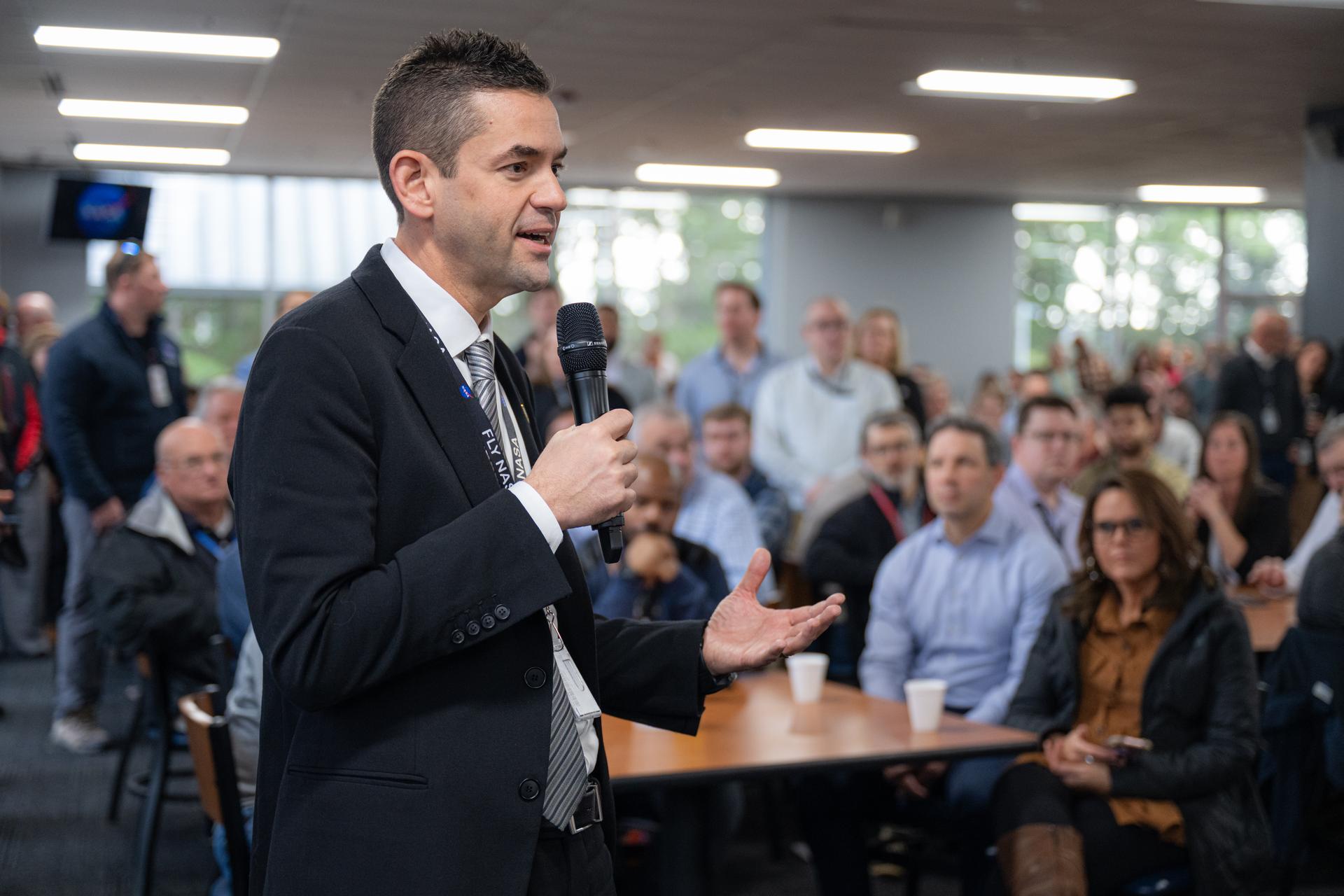
NASA Administrator Jared Isaacman speaks during a workforce Q&A session, Wednesday, Jan. 14, 2026, at NASA’s Marshall Space Flight Center in Huntsville, Ala. Marshall marks the fifth stop in Isaacman’s roadshow to visit NASA facilities and engage directly with the agency’s workforce. Photo Credit: (NASA/John Kraus)
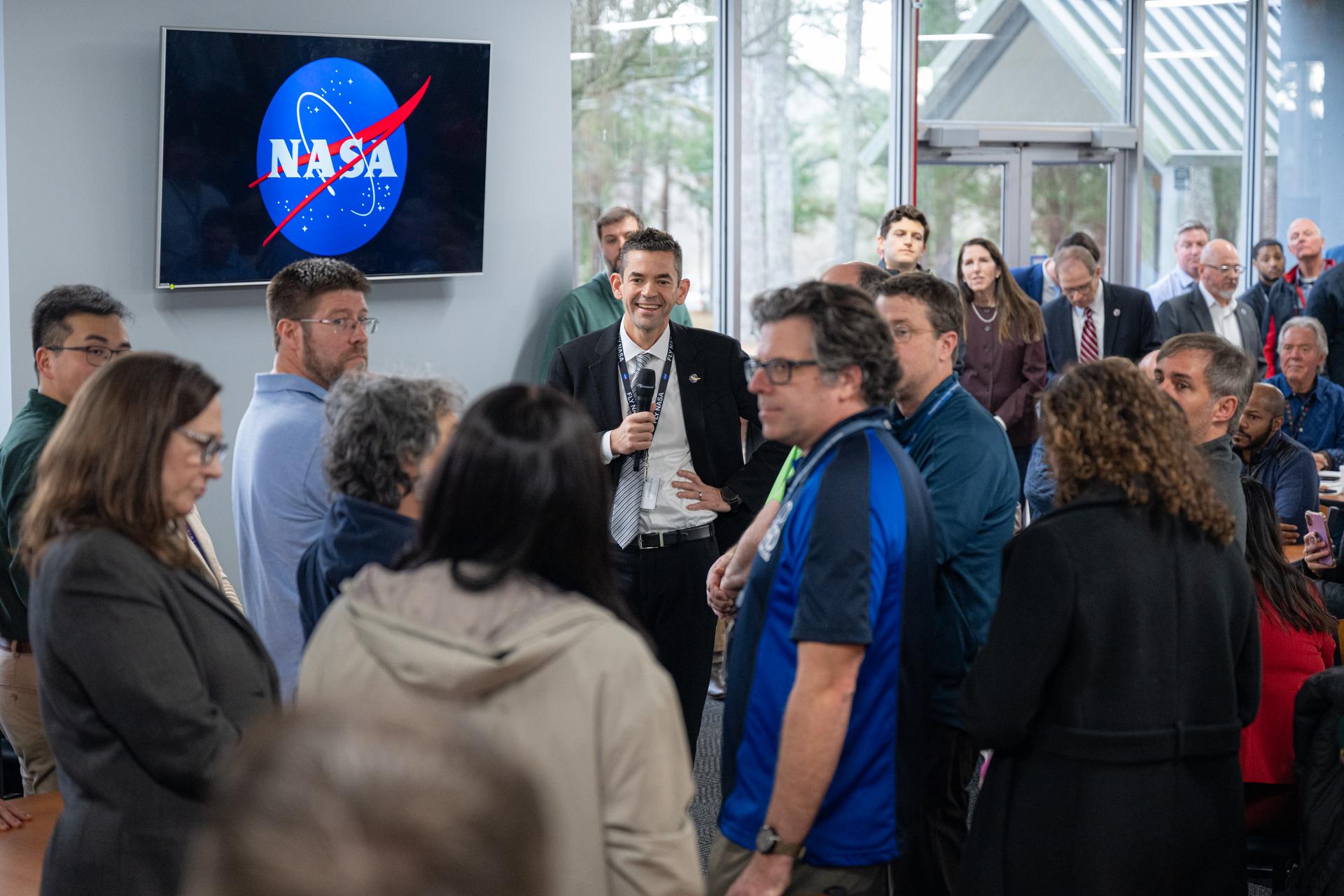
NASA Administrator Jared Isaacman, center, speaks during a workforce Q&A session, Wednesday, Jan. 14, 2026, at NASA’s Marshall Space Flight Center in Huntsville, Ala. Marshall marks the fifth stop in Isaacman’s roadshow to visit NASA facilities and engage directly with the agency’s workforce. Photo Credit: (NASA/John Kraus)
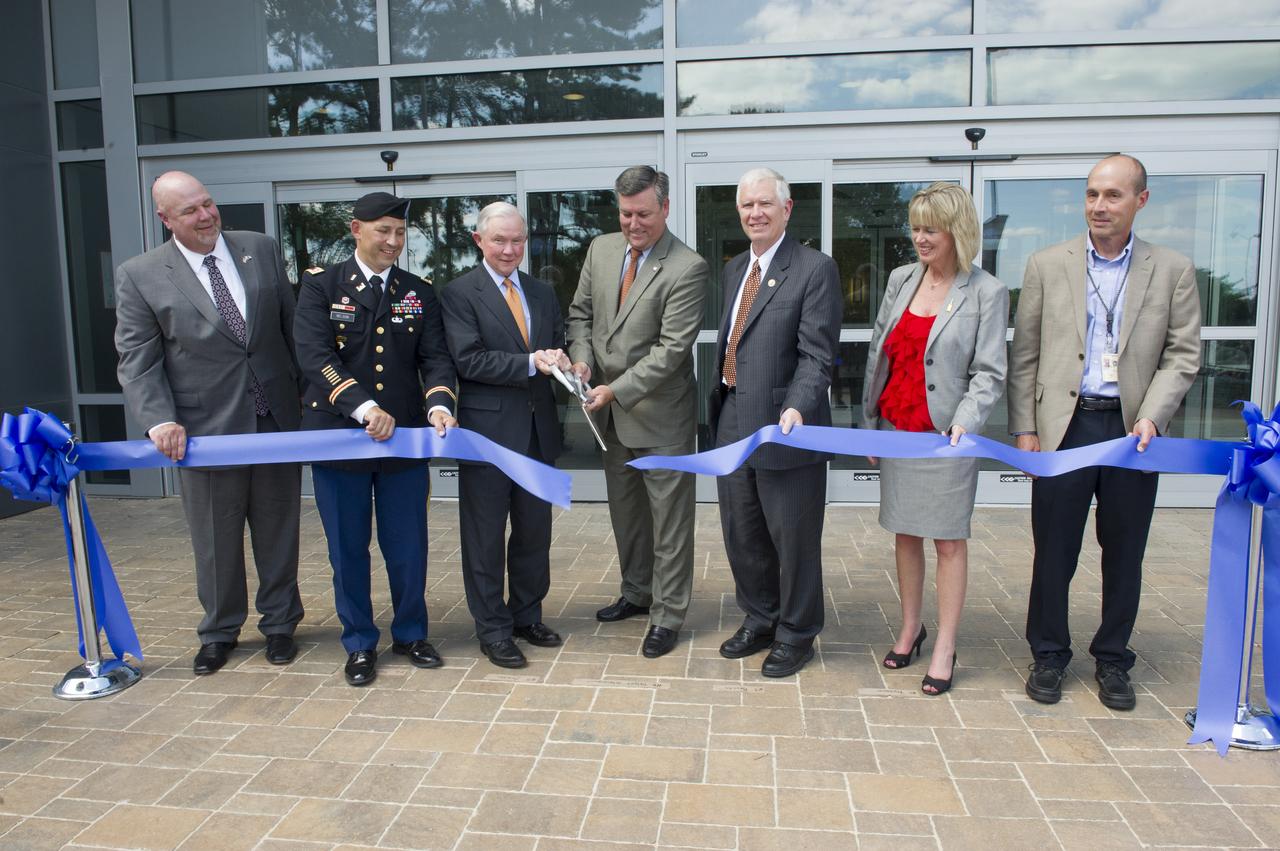
AIDING IN THE OFFICIAL BUILDING 4220 RIBBON-CUTTING ARE, FROM LEFT, JOHN HONEYCUTT, DEPUTY MANAGER OF THE SPACE LAUNCH SYSTEM PROGRAM OFFICE; LT. COL. TOM NELSON, DEPUTY COMMANDER OF THE U.S. ARMY CORPS OF ENGINEERS-MOBILE DISTRICT; U.S. SEN. JEFF SESSIONS OF ALABAMA; MARSHALL CENTER DIRECTOR PATRICK SCHEUERMANN; U.S. REP. MO BROOKS OF ALABAMA'S 5TH DISTRICT; MARSHALL DEPUTY DIRECTOR TERESA VANHOOSER; AND MARSHALL ENGINEER DAVID SKRIDULIS, TEAM LEAD FOR THE FACILITIES MANAGEMENT OFFICE'S CIVIL STRUCTURAL GROUP.
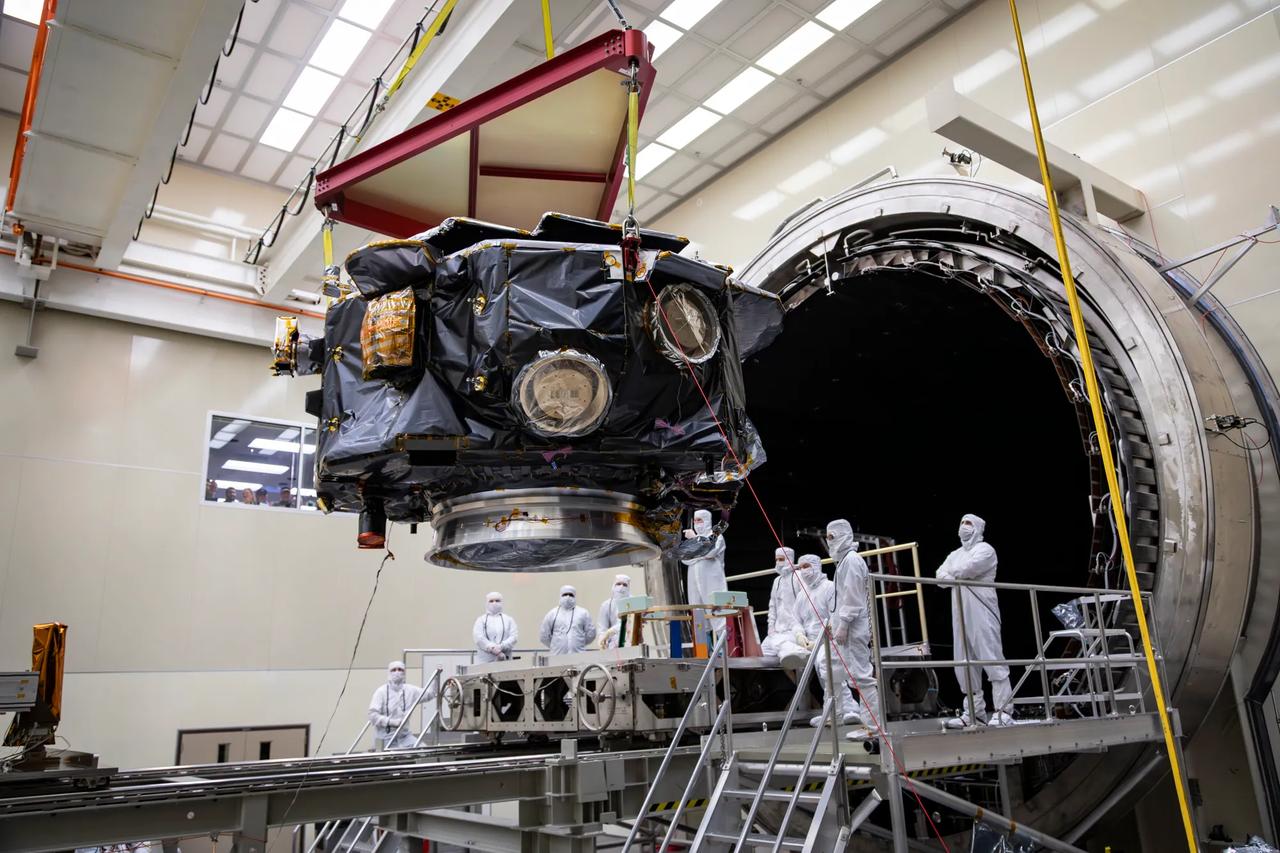
These photos and timelapse show NASA’s IMAP mission being loaded into the thermal vacuum chamber of NASA Marshall Space Flight Center’s X-Ray and Cryogenic Facility (XRCF) in Huntsville, Alabama. IMAP arrived at Marshall March 18 and was loaded into the chamber March 19. IMAP will undergo testing such as dramatic temperature changes to simulate the harsh environment of space. The XRCF’s vacuum chamber is is 20 feet in diameter and 60 feet long making it one of the largest across NASA. The IMAP mission is a modern-day celestial cartographer that will map the solar system by studying the heliosphere, a giant bubble created by the Sun’s solar wind that surrounds our solar system and protects it from harmful interstellar radiation. Photos and video courtesy of Ed Whitman from Johns Hopkins University’s Applied Physics Laboratory. For more information, contact NASA Marshall’s Office of Communications at 256-544-0034.
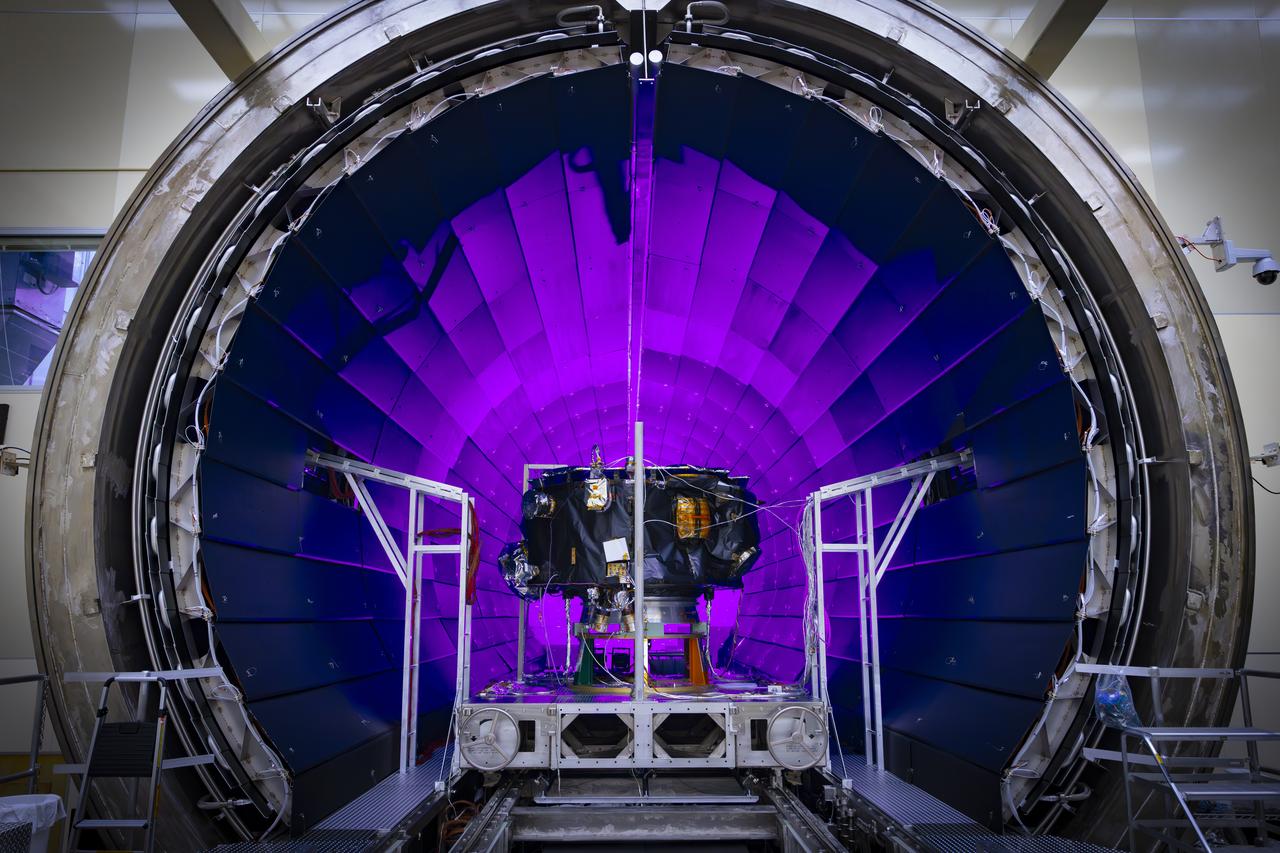
These photos and timelapse show NASA’s IMAP mission being loaded into the thermal vacuum chamber of NASA Marshall Space Flight Center’s X-Ray and Cryogenic Facility (XRCF) in Huntsville, Alabama. IMAP arrived at Marshall March 18 and was loaded into the chamber March 19. IMAP will undergo testing such as dramatic temperature changes to simulate the harsh environment of space. The XRCF’s vacuum chamber is is 20 feet in diameter and 60 feet long making it one of the largest across NASA. The IMAP mission is a modern-day celestial cartographer that will map the solar system by studying the heliosphere, a giant bubble created by the Sun’s solar wind that surrounds our solar system and protects it from harmful interstellar radiation. Photos and video courtesy of Ed Whitman from Johns Hopkins University’s Applied Physics Laboratory. For more information, contact NASA Marshall’s Office of Communications at 256-544-0034.
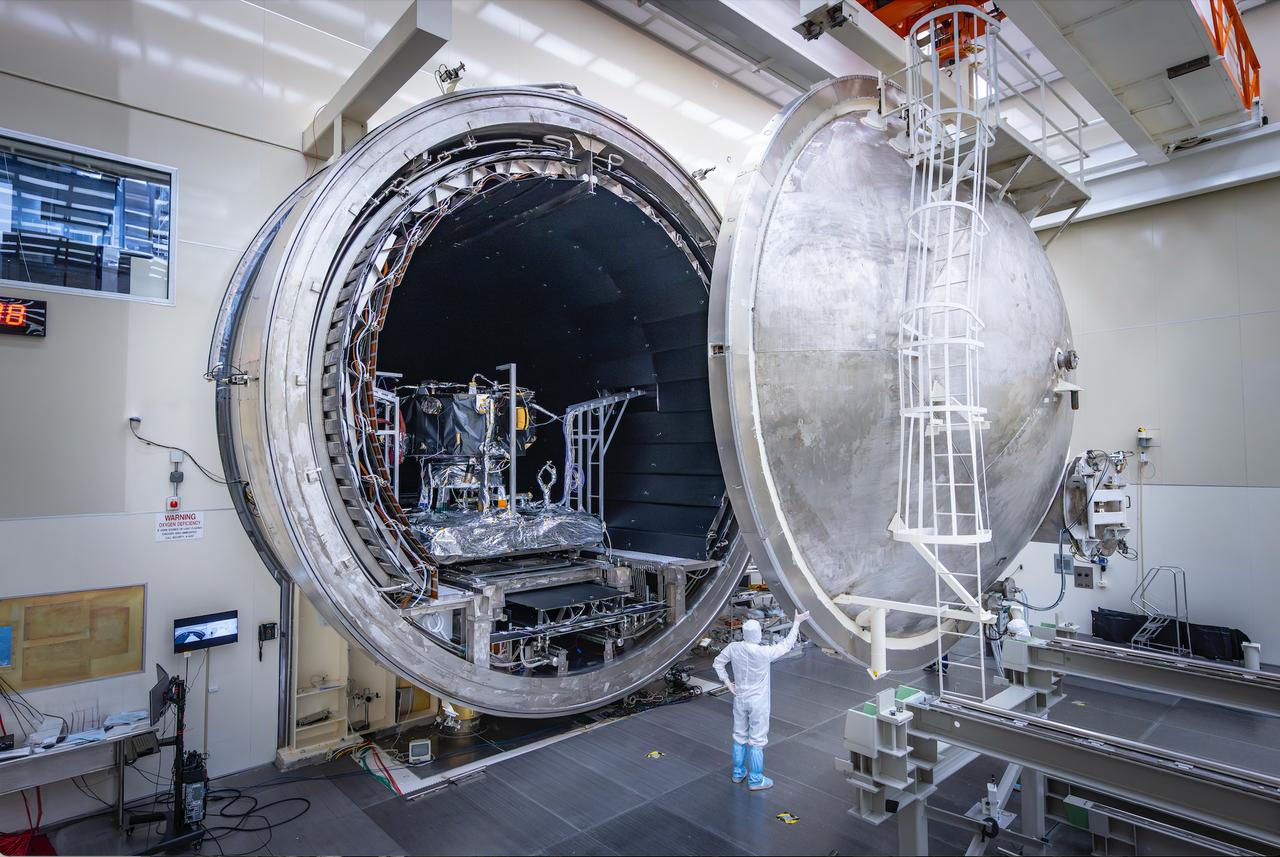
These photos and timelapse show NASA’s IMAP mission being loaded into the thermal vacuum chamber of NASA Marshall Space Flight Center’s X-Ray and Cryogenic Facility (XRCF) in Huntsville, Alabama. IMAP arrived at Marshall March 18 and was loaded into the chamber March 19. IMAP will undergo testing such as dramatic temperature changes to simulate the harsh environment of space. The XRCF’s vacuum chamber is is 20 feet in diameter and 60 feet long making it one of the largest across NASA. The IMAP mission is a modern-day celestial cartographer that will map the solar system by studying the heliosphere, a giant bubble created by the Sun’s solar wind that surrounds our solar system and protects it from harmful interstellar radiation. Photos and video courtesy of Ed Whitman from Johns Hopkins University’s Applied Physics Laboratory. For more information, contact NASA Marshall’s Office of Communications at 256-544-0034.
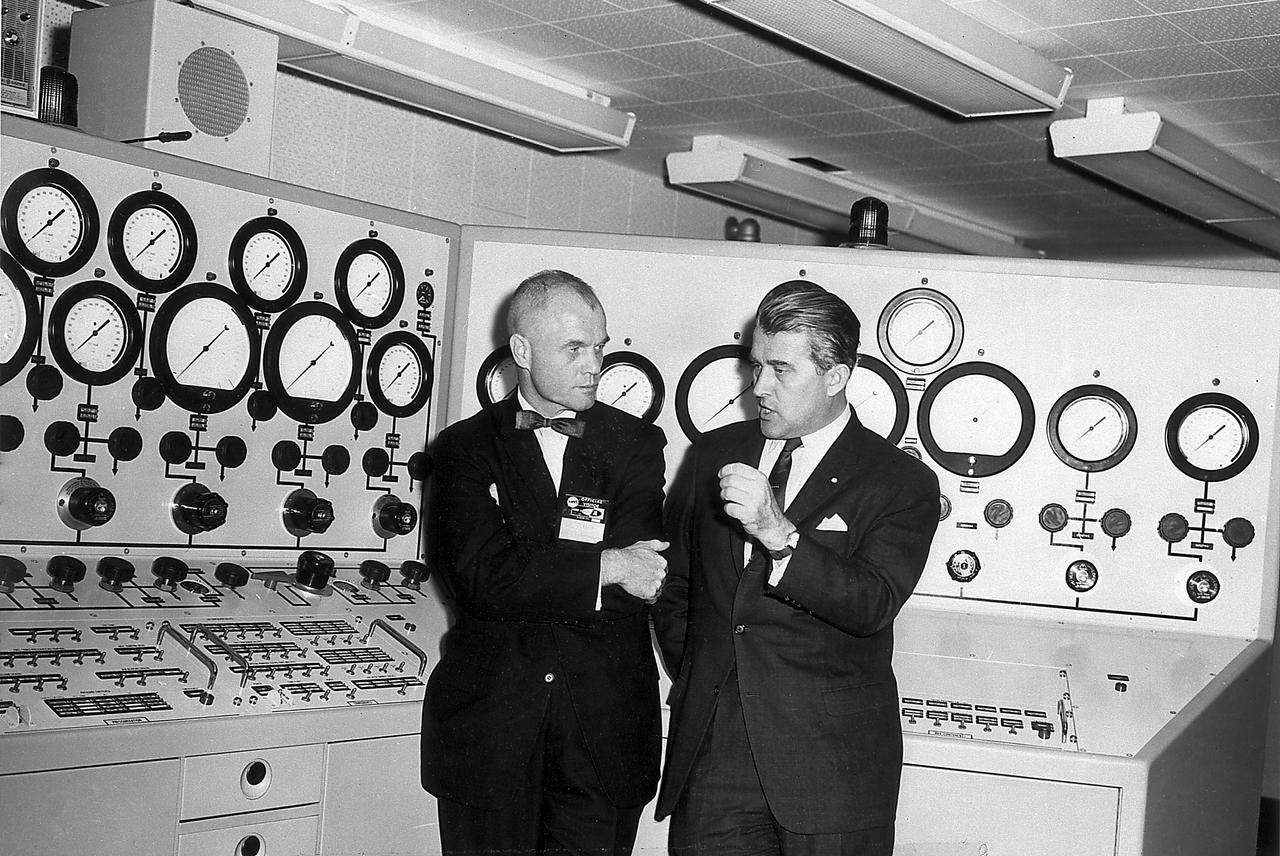
Dr. von Braun briefs Astronaut John Glenn in the control room of the Vehicle Test Section, Quality Assurance Division, Marshall Space Flight Center (MSFC), November 28, 1962.
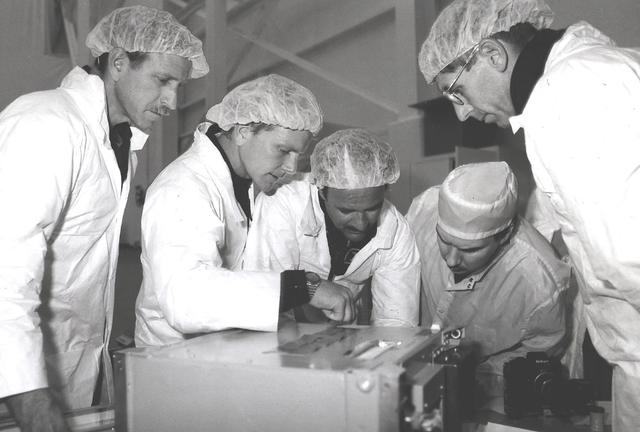
Space Shuttle Discovery (STS-26) astronauts George Nelson, John Lounge, and Richard Covey are pictured training on protein crystal growth (PCG) experiment in Marshall's Building 4708's clean room.
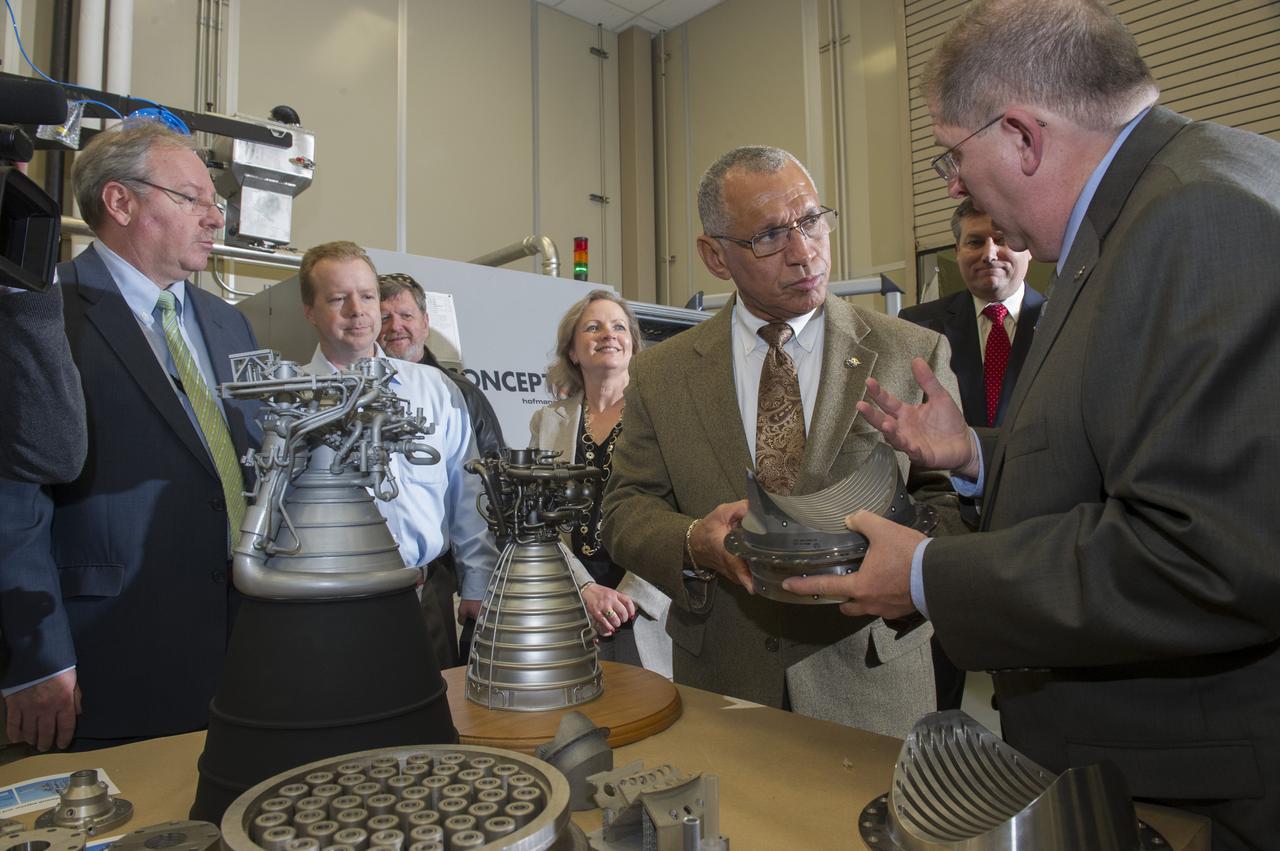
DURING HIS FEB. 22 VISIT TO THE NATIONAL CENTER FOR ADVANCED MANUFACTURING RAPID PROTOTYPING FACILITY AT NASA'S MARSHALL SPACE FLIGHT CENTER, NASA ADMINISTRATOR CHARLES BOLDEN, CENTER, TALKS WITH FRANK LEDBETTER, RIGHT, CHIEF OF THE NONMETALLIC MATERIALS AND MANUFACTURING DIVISION AT MARSHALL, ABOUT THE USE OF 3-D PRINTING AND PROTOTYPING TECHNOLOGY TO CREATE PARTS FOR THE SPACE LAUNCH SYSTEM. ALSO PARTICIPATING IN THE TOUR ARE, FROM BACK RIGHT, MARSHALL CENTER DIRECTOR PATRICK SCHEUERMANN; SHERRY KITTREDGE, DEPUTY MANAGER OF THE SLS LIQUID ENGINES OFFICE; MARSHALL FLIGHT SYSTEMS DESIGN ENGINEER ROB BLACK; AND JOHN VICKERS, MANAGER OF THE NATIONAL CENTER FOR ADVANCED MANUFACTURING.
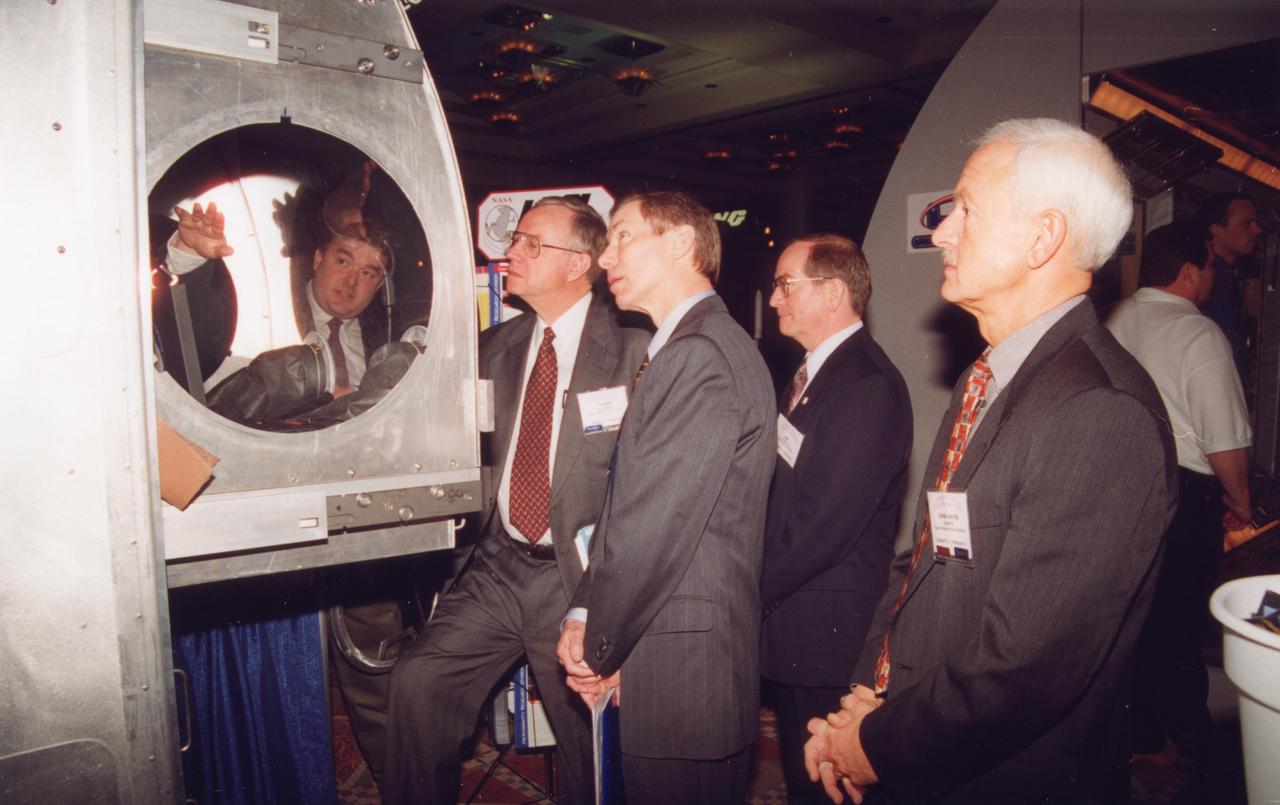
Tim Broach (seen through window) of NASA/Marshall Spce Flight Center (MSFC), demonstrates the working volume inside the Microgravity Sciences Glovebox being developed by the European Space Agency (ESA) for use aboard the U.S. Destiny laboratory module on the International Space Station (ISS). This mockup is the same size as the flight hardware. Observing are Tommy Holloway and Brewster Shaw of The Boeing Co. (center) and John-David Bartoe, ISS research manager at NASA/John Space Center and a payload specialist on Spacelab-2 mission (1985). Photo crdit: NASA/Marshall Space Flight Center (MSFC)
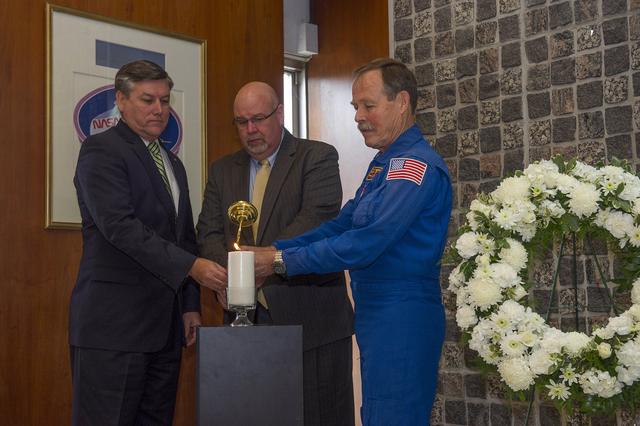
LIGHTING A MEMORIAL CANDLE DURING THE JAN. 29 DAY OF REMEMBRANCE OBSERVANCE AT NASA'S MARSHALL SPACE FLIGHT CENTER ARE, FROM LEFT, PATRICK SCHEUERMANN, MARSHALL DIRECTOR; JOHN HONEYCUTT, DEPUTY MANAGER OF THE SPACE LAUNCH SYSTEM; AND RETIRED ASTRONAUT ROBERT “HOOT” GIBSON. THE CEREMONY IN BUILDING 4200 PAID TRIBUTE TO THE CREWS OF APOLLO 1 AND SPACE SHUTTLES CHALLENGER AND COLUMBIA, AS WELL AS OTHER NASA COLLEAGUES.
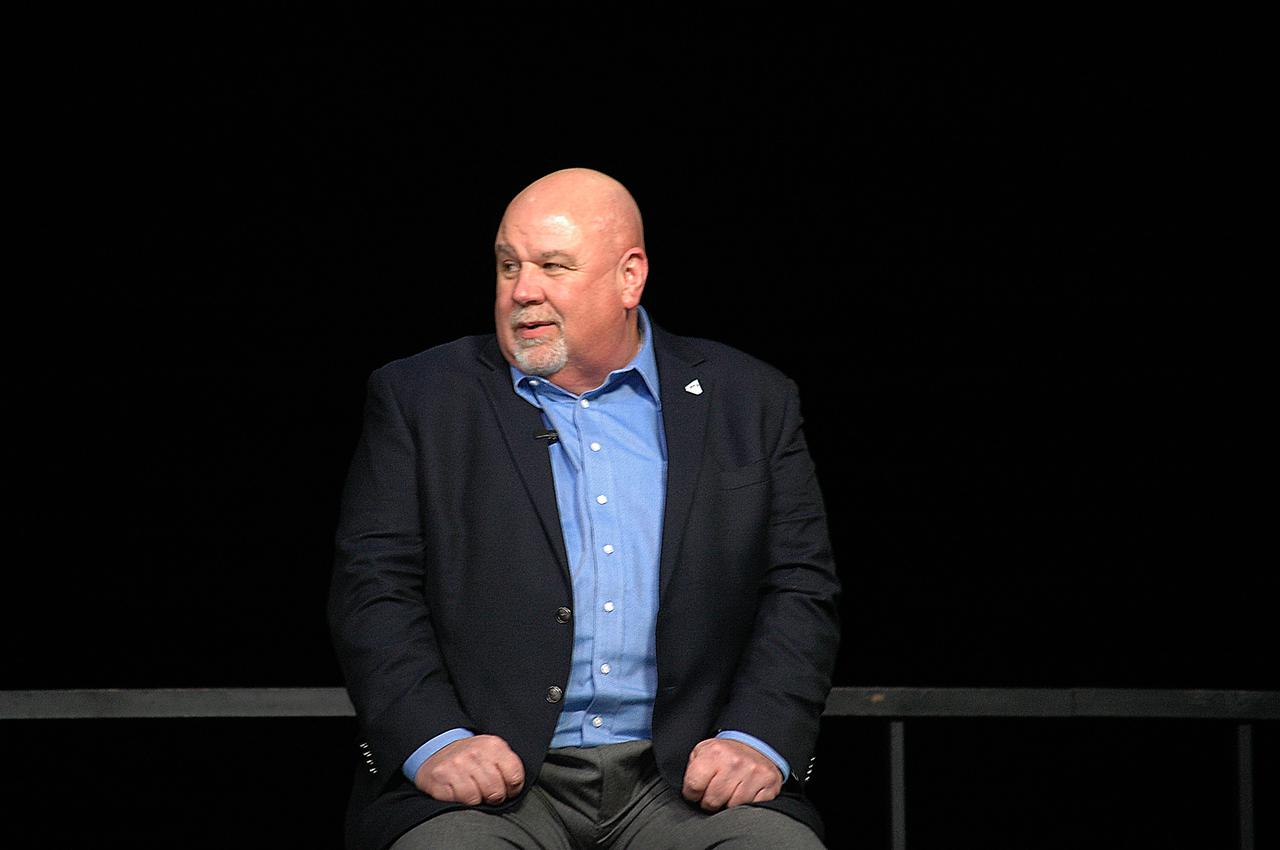
SLS Program Manager John Honeycutt from NASA’s Marshall Space Flight Center participates in a press conference following the Green Run hot fire test of the core stage for NASA’s Space Launch System (SLS) rocket on Saturday, January 16, 2021. NASA conducted a hot fire test of the core stage’s four RS-25 engines on the B-2 Test Stand at Stennis Space Center near Bay St. Louis, Mississippi. Scheduled for as long as eight minutes, the engines fired for a little more than one minute to generate a combined 1.6 million pounds of thrust, just as will occur during an actual launch. The hot fire is the final test of the Green Run test series, a comprehensive assessment of the SLS core stage prior to launching the Artemis I mission to the Moon.
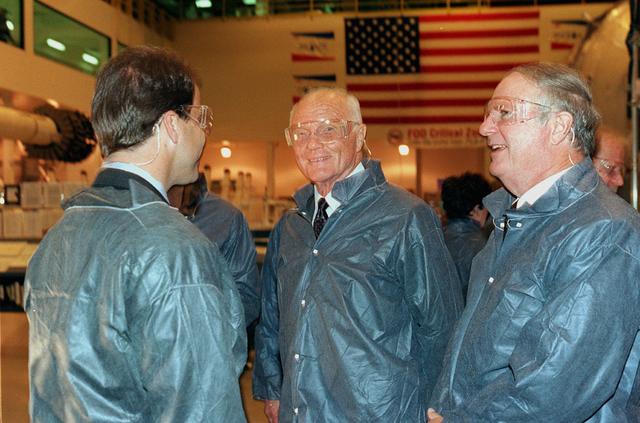
One of NASA's first astronauts, now Senator John Glenn and Alabama senatorial candidate Roger Bedford receive a tour of the Space Station manufacturing facility conducted by Marshall Space Flight Center (MSFC) Director Jerroll W. Littles.
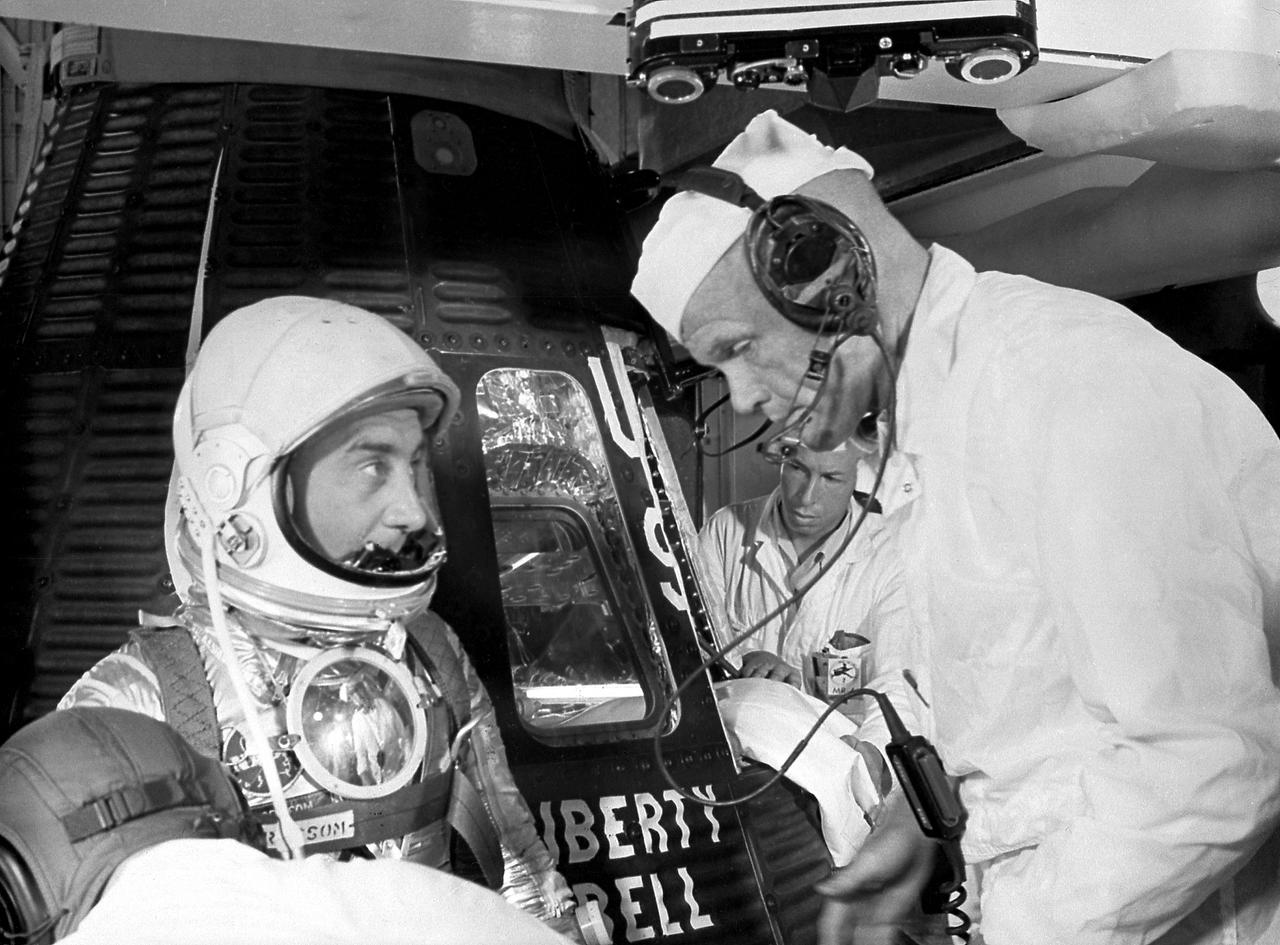
Astronaut Virgil Grissom chats with Astronaut John Glenn prior to entering the Liberty Bell 7 capsule for the MR-4 Mission. The MR-4 mission was the second manned suborbital flight using the Mercury-Redstone booster, which was developed by the Marshall Space Flight Center.
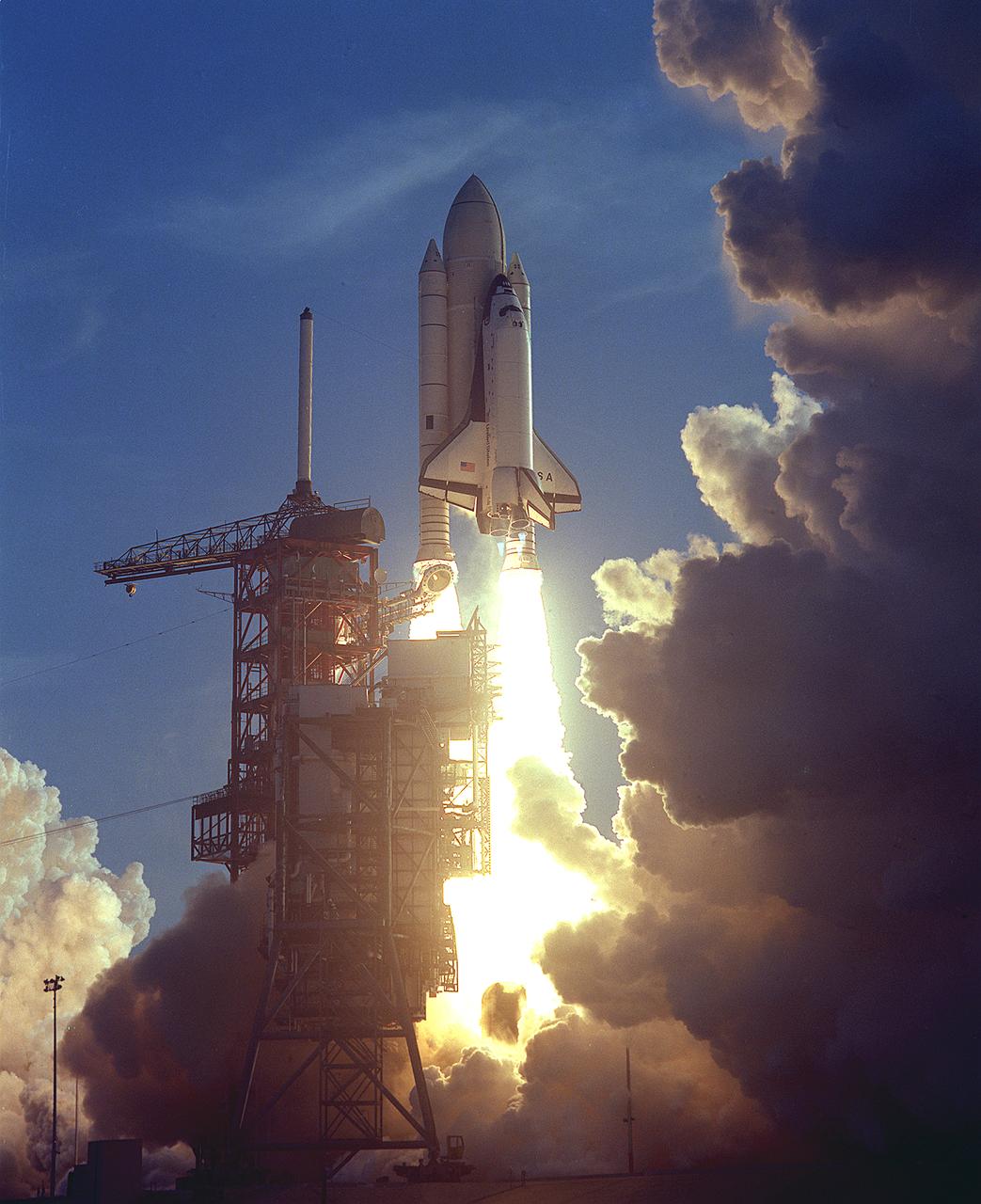
The new era in space flight began on April 12, 1981. That is when the first Space Shuttle mission (STS-1) was launched. The Marshall Space Flight Center developed the propulsion system for the Space Shuttle. This photograph depicts the launch of the Space Shuttle Orbiter Columbia marned with two astronauts, John Young and Robert Crippen.
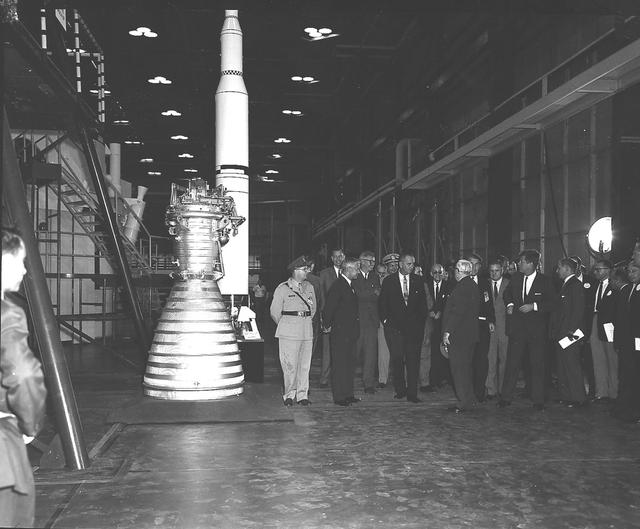
Marshall Space Flight Center Director Dr. Wernher von Braun explains a detail from a Saturn IB mockup and engine to President John F. Kennedy, Vice President Lyndon Johnson and other guests, September 11, 1962.
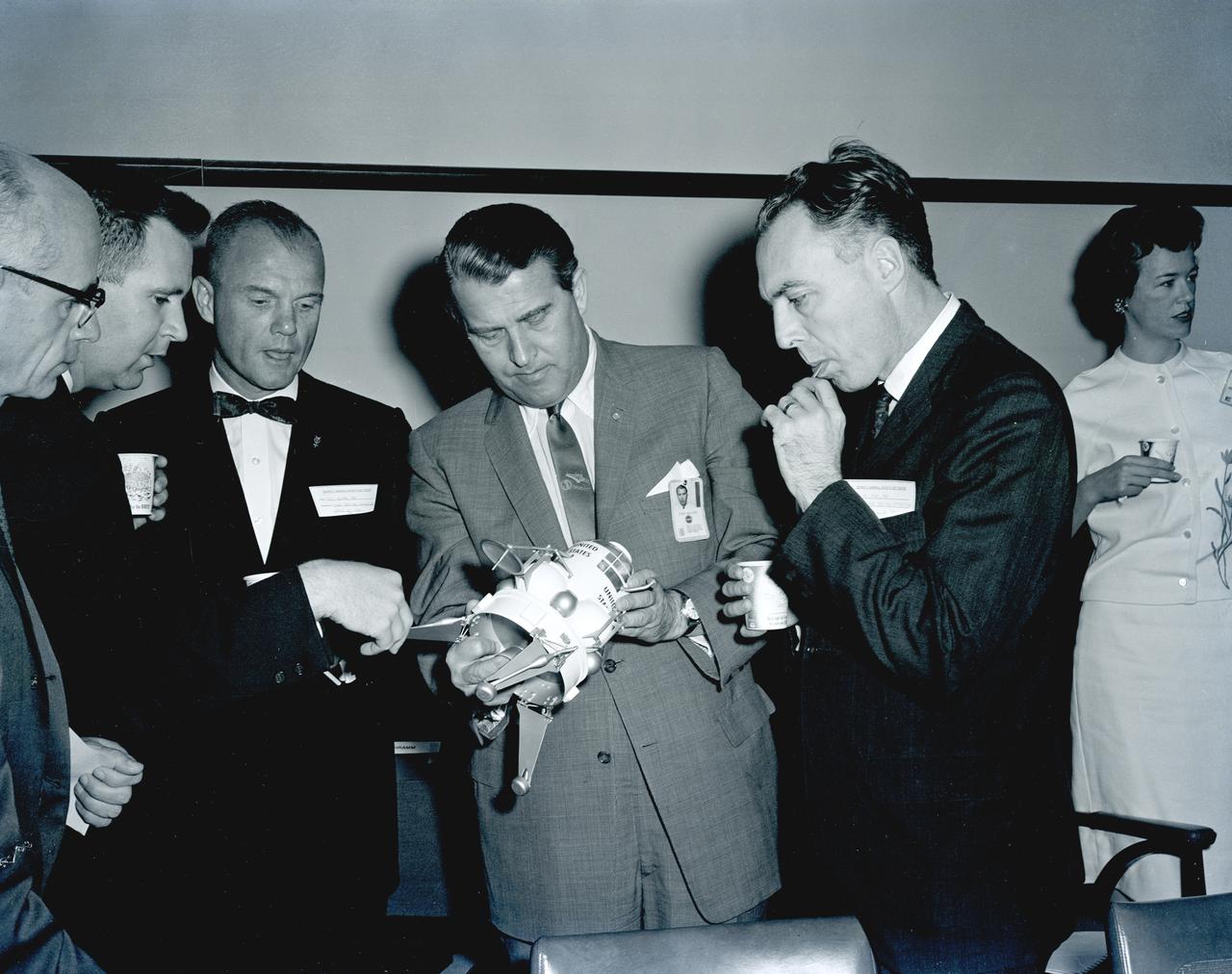
Dr. von Braun (right) and Astronaut John Glenn examine a model of a lunar landing stage during a talk on the manned lunar exploration program by about sixty key officials of the nation's space program at the Marshall Space Flight Center (MSFC).
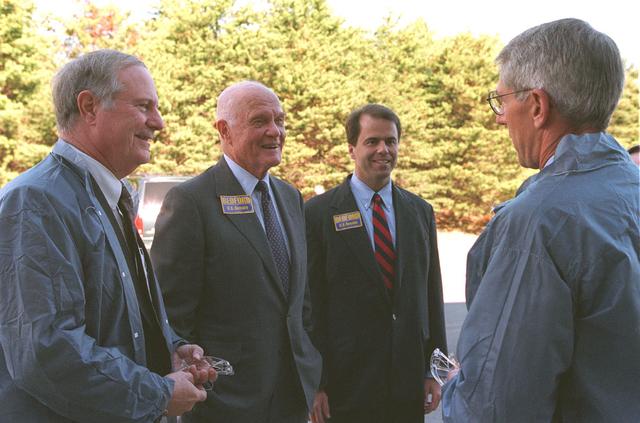
One of NASA's first astronauts, now Senator John Glenn and Alabama senatorial candidate Roger Bedford receive a tour of the Space Station manufacturing facility conducted by Marshall Space Flight Center (MSFC) Director Jerroll W. Littles.
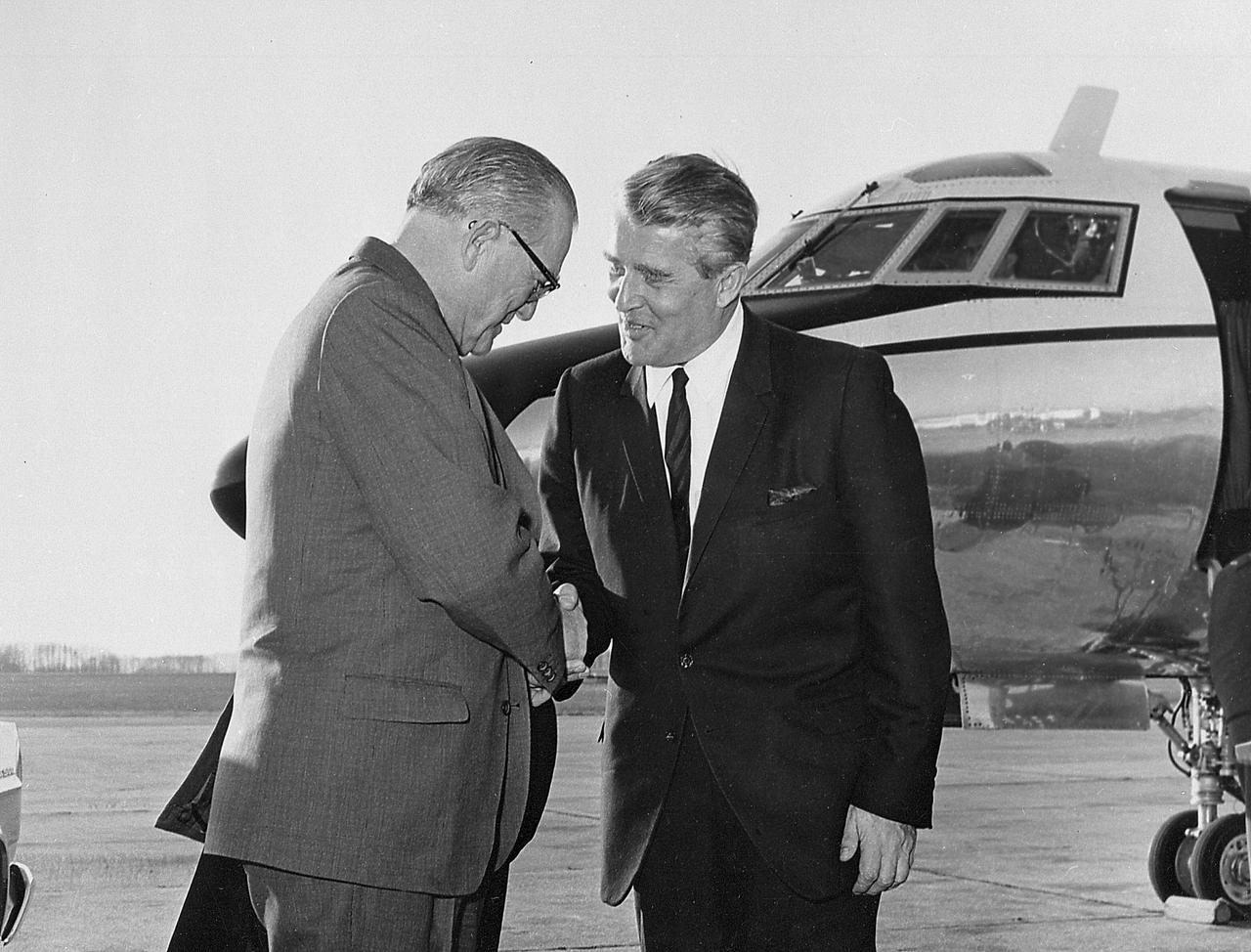
U.S. Senator from Mississippi, John Stennis (left) visited the Marshall Space Flight Center (MSFC) in mid-November 1967, where he was greeted at the Redstone Airfield by Center Director Dr. Wernher von Braun (right). During his visit to MSFC, Senator Stennis was given a tour and briefed on MSFC programs.
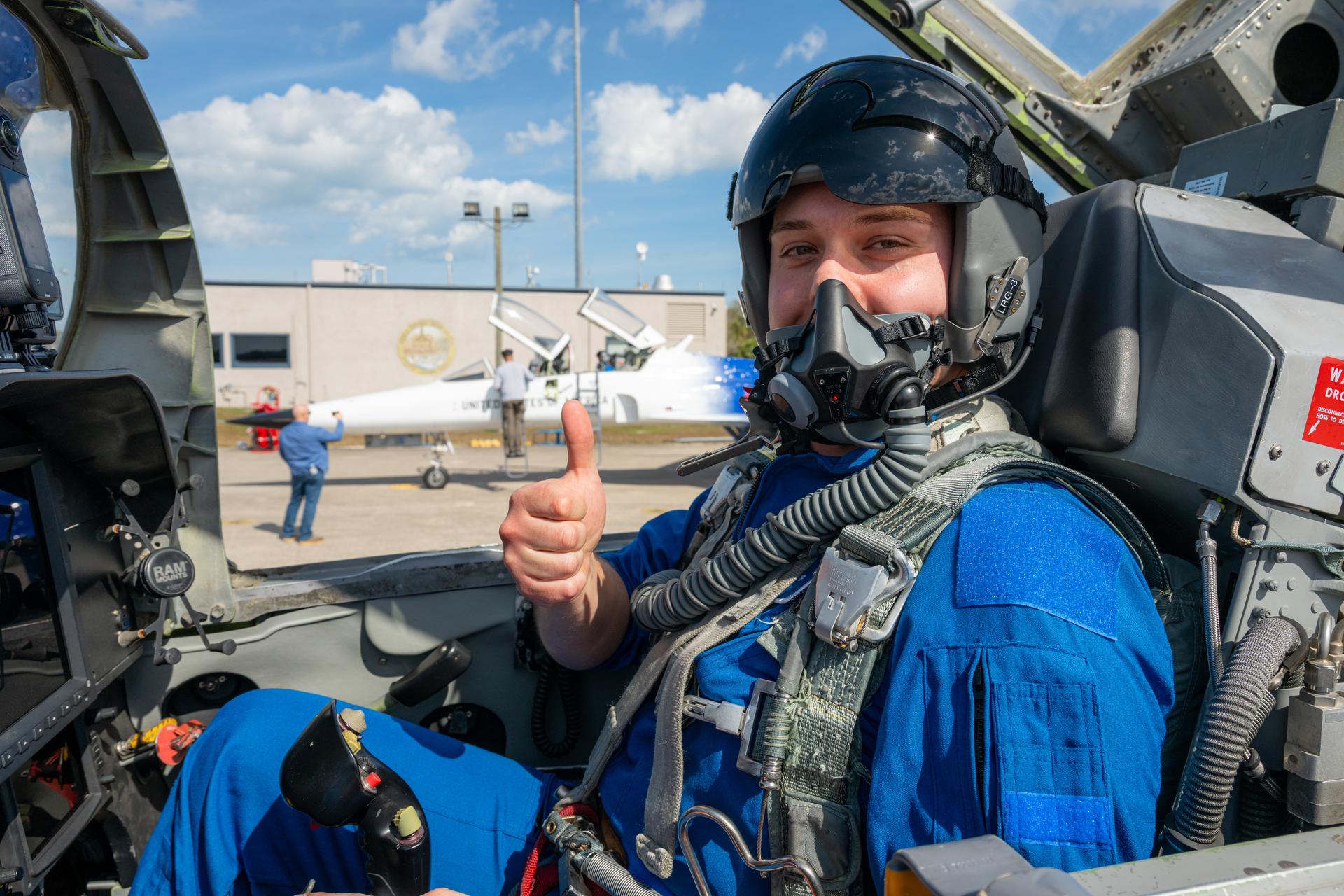
NASA employee Kristian Miasek, ET-10 test engineer at NASA’s Marshall Space Flight Center, participates in an employee incentive flying event with NASA Administrator Jared Isaacman's personal F-5 aircraft, Friday, Feb. 20, 2026, at NASA’s Kennedy Space Center in Florida. Photo Credit: (NASA/John Kraus)

John Honeycutt, manager of the Space Launch System Program at NASA’s Marshall Space Flight Center, speaks during an Artemis Program progress update panel at the 2024 Artemis Suppliers Conference, Tuesday, Feb. 27, 2024, at the Grand Hyatt Hotel in Washington. Photo Credit: (NASA/Joel Kowsky)
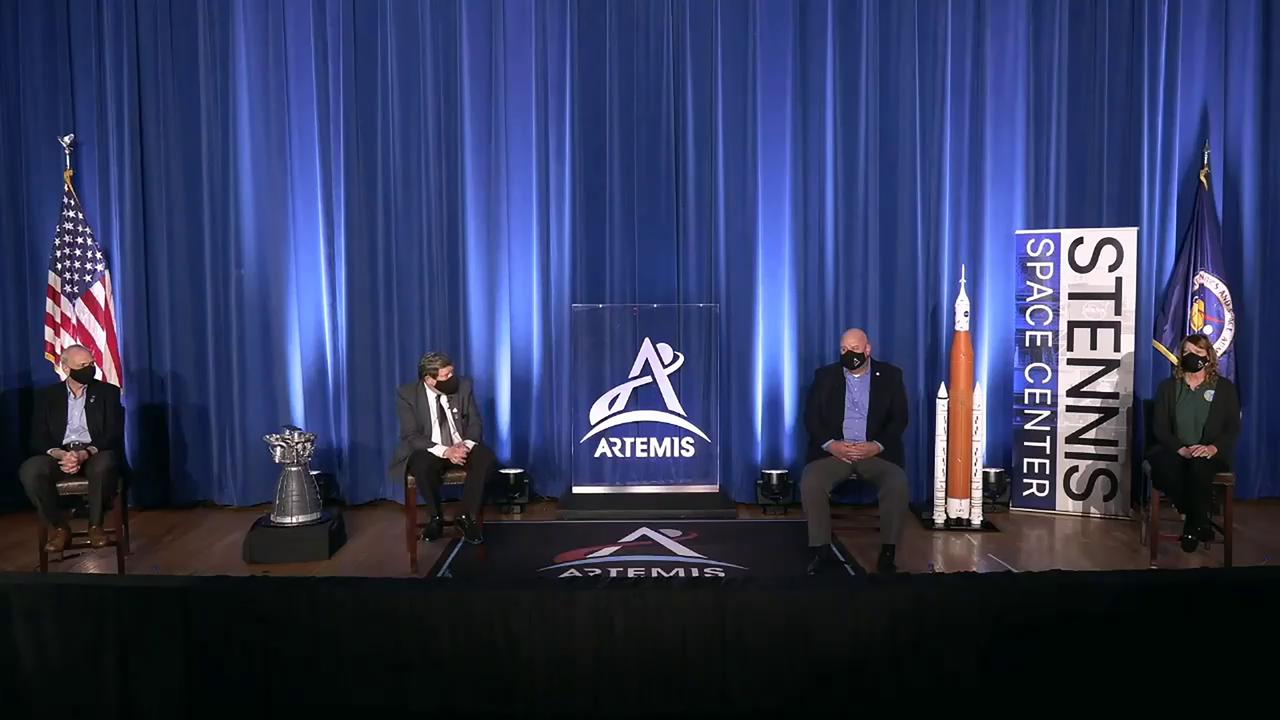
NASA leaders participated in a participate in a virtual press briefing following the Space Launch System core stage hot fire test at Stennis Space Center near Bay St. Louis, Mississippi, on March 18. The leaders fielded questions submitted by offsite media during the post-test session. Agency participants present at Stennis included (l to r): NASA acting Administrator Steve Jurczyk; Tom Whitmeyer, NASA deputy associate administrator for Exploration Systems Development; John Honeycutt, SLS Program manager at Marshall Space Flight Center; and Julie Bassler, SLS Stages Office manager at Marshall Space Flight Center.
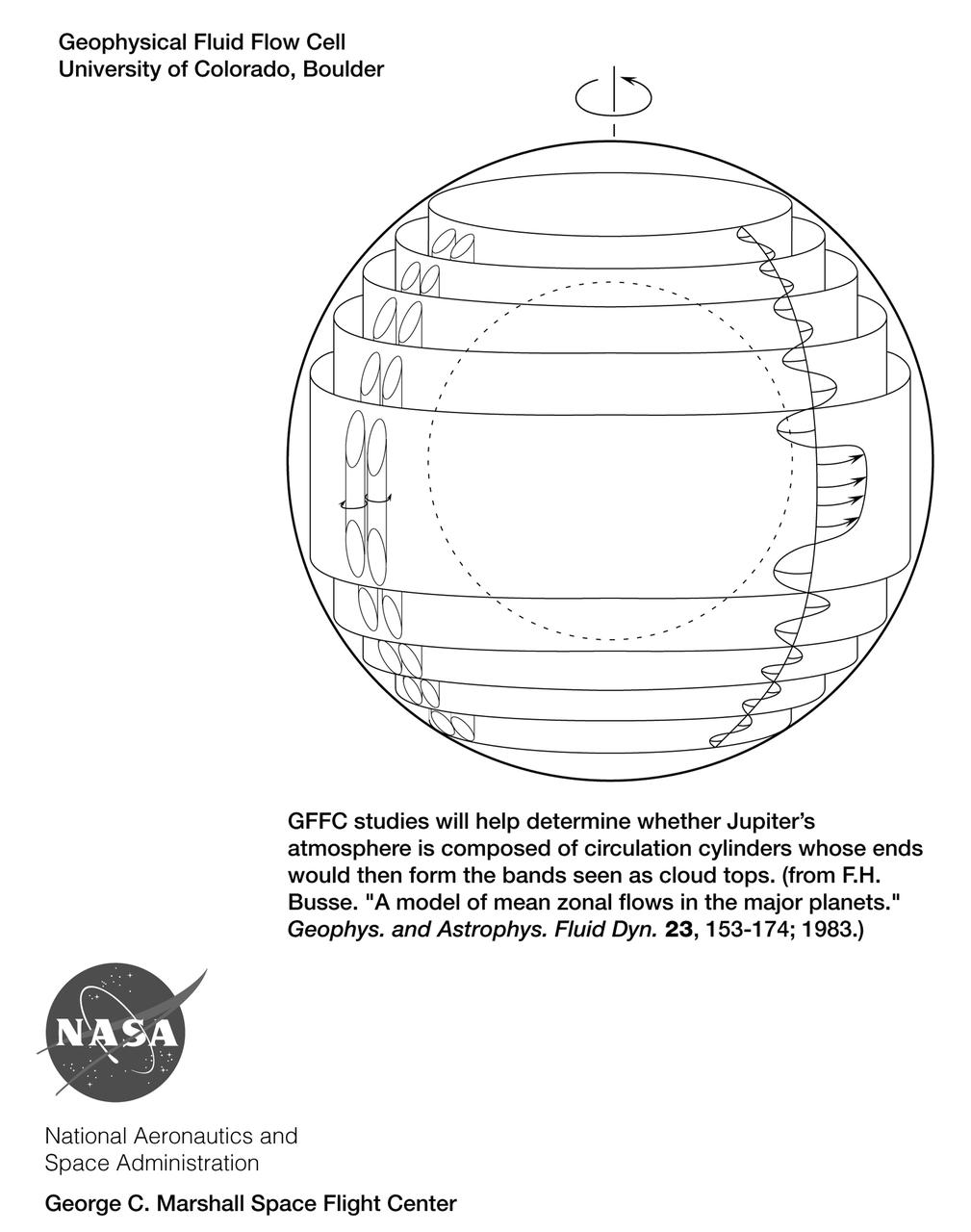
This drawing depicts one set of flow patterns simulated in the Geophysical Fluid Flow Cell (GFFC) that flew on two Spacelab missions. Silicone oil served as the atmosphere around a rotating steel hemisphere (dotted circle) and an electrostatic field pulled the oil inward to mimic gravity's effects during the experiments. The GFFC thus produced flow patterns that simulated conditions inside the atmospheres of Jupiter and the Sun and other stars. The principal investigator was John Hart of the University of Colorado at Boulder. It was managed by NASA's Marshall Space Flight Center (MSFC). An Acrobat PDF copy of this drawing is available at http://microgravity.nasa.gov/gallery. (Credit: NASA/Marshall Space Flight Center)
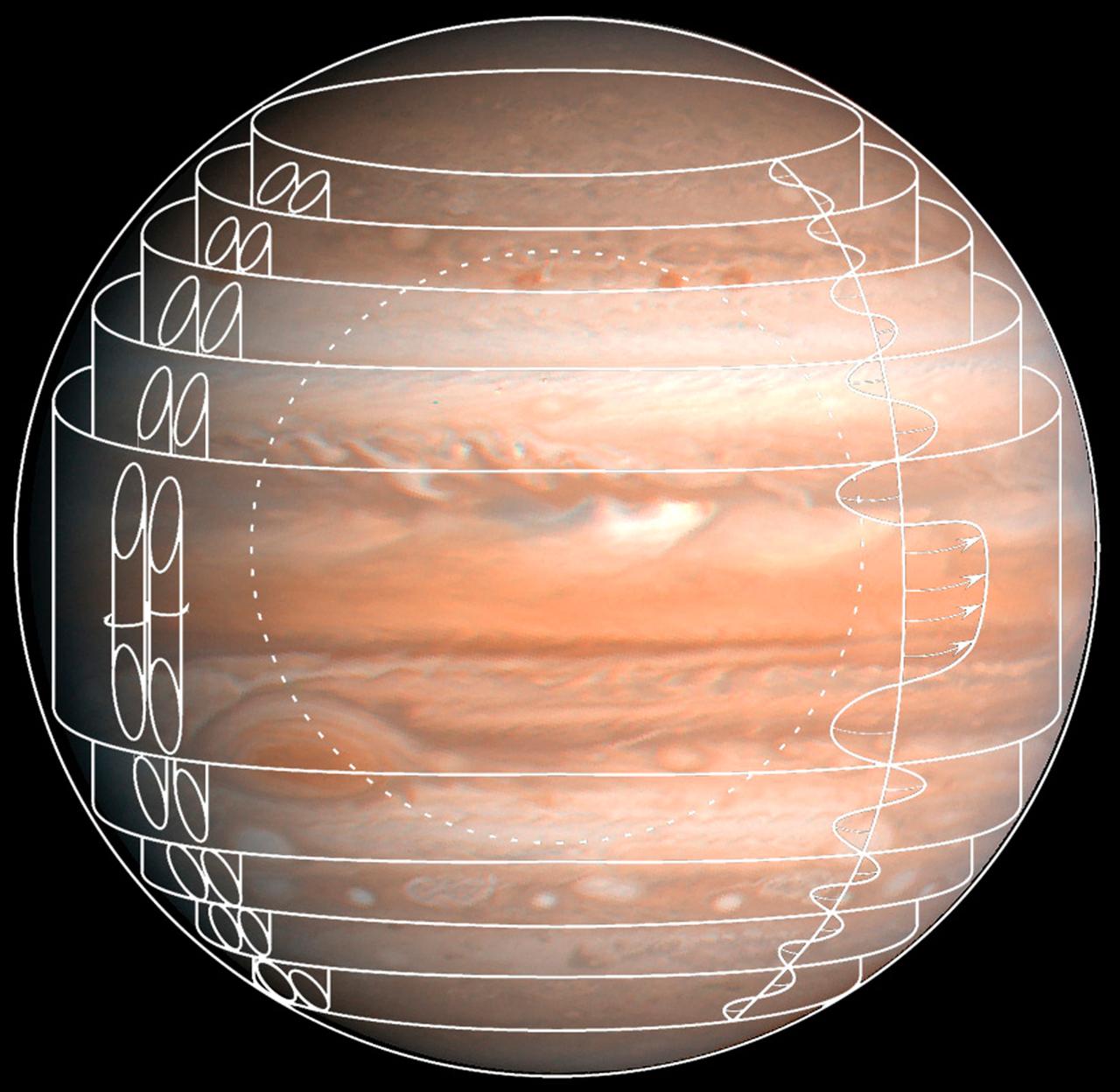
This composite image depicts one set of flow patterns simulated in the Geophysical Fluid Flow Cell (GFFC) that flew on two Spacelab missions. Silicone oil served as the atmosphere around a rotating steel hemisphere (dotted circle) and an electrostatic field pulled the oil inward to mimic gravity's effects during the experiments. The GFFC thus produced flow patterns that simulated conditions inside the atmospheres of Jupiter and the Sun and other stars. GFFC flew on Spacelab-3 in 1985 and U.S. Microgravity Laboratory-2 in 1995. The principal investigator was John Hart of the University of Colorado at Boulder. It was managed by NASA's Marshall Space Flight Center. (Credit: NASA/Marshall Space Flight Center)
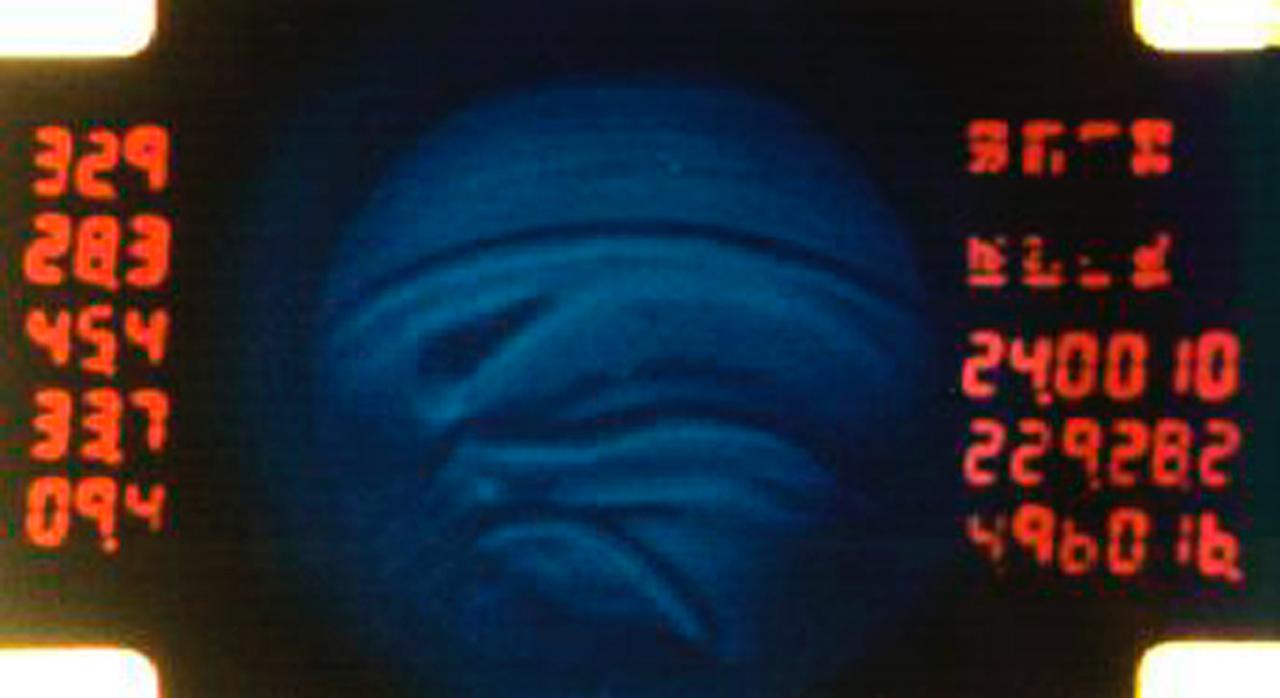
A 16mm film frame shows convective regions inside silicone oil playing the part of a stellar atmosphere in the Geophysical Fluid Flow Cell (GFFC). An electrostatic field pulled the oil inward to mimic gravity's effects during the experiments. The GFFC thus produced flow patterns that simulated conditions inside the atmospheres of Jupiter and the Sun and other stars. Numbers of the frame indicate temperatures and other conditions. This image is from the Spacelab-3 flight in 1985. GFFC was reflown on U.S. Microgravity Laboratory-2 in 1995. The principal investigator was John Hart of the University of Colorado at Boulder. It was managed by NASA's Marshall Space Flight Center. (Credit: NASA/Marshall Space Flight Center)
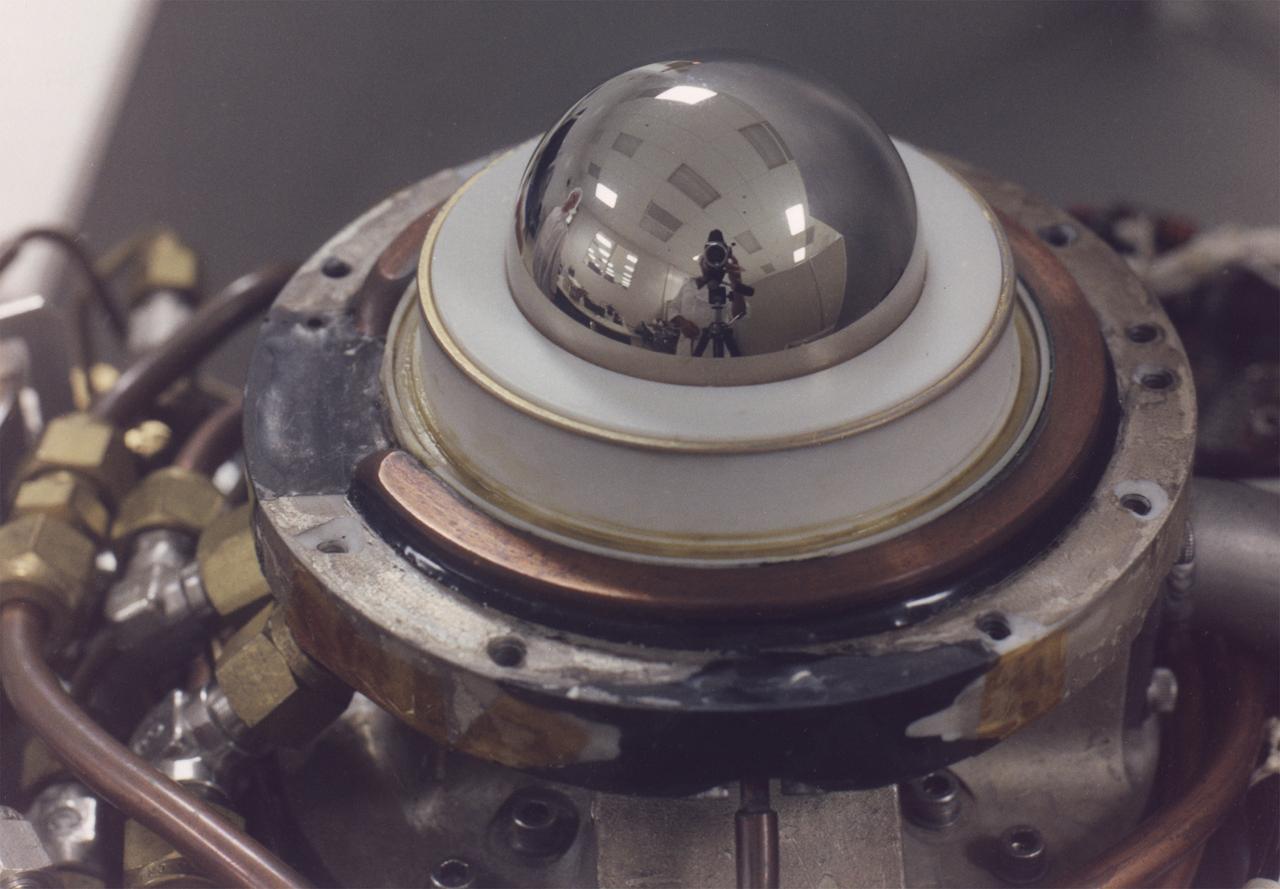
A steel hemisphere was at the core of the Geophysical Fluid Flow Cell (GFFC) that flew on two Spacelab missions. It was capped by a sapphire dome. Silicone oil between the two played the part of a steller atmosphere. An electrostatic field pulled the oil inward to mimic gravity's effects during the experiments. The GFFC thus produced flow patterns that simulated conditions inside the atmospheres of Jupiter and the Sun and other stars. GFFC flew on Spacelab-3 in 1985 and U.S. Microgravity Laboratory-2 in 1995. The principal investigator was John Hart of the University of Colorado at Boulder. It was managed by NASA's Marshall Space Flight Center. (Credit: NASA/Marshall Space Flight Center)
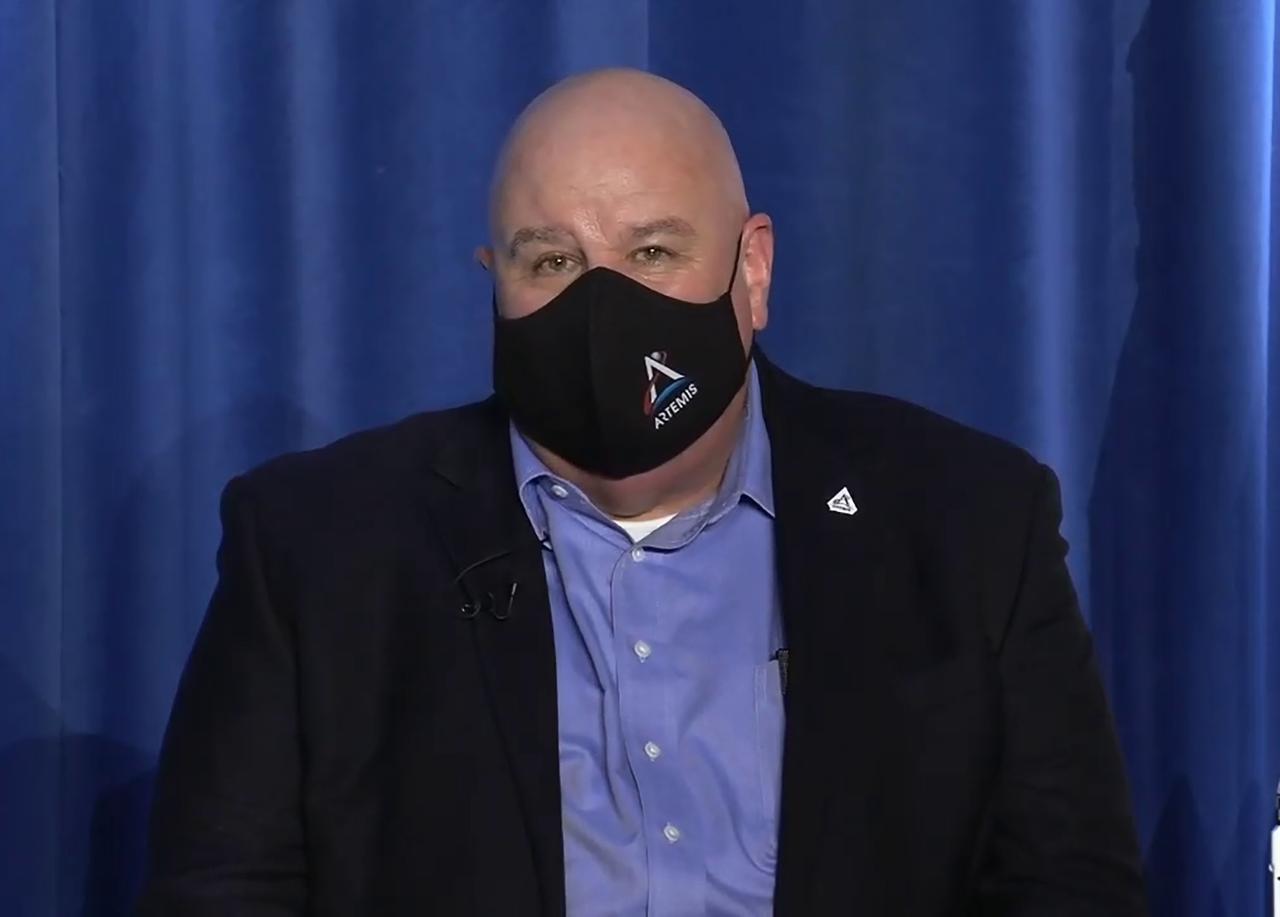
NASA leaders participated in a virtual press briefing following the Space Launch System core stage hot fire test at Stennis Space Center near Bay St. Louis, Mississippi, on March 18. The leaders fielded questions submitted by offsite media during the post-test session. Agency participants present at Stennis included John Honeycutt, SLS Program manager at Marshall Space Flight Center in Huntsville, Alabama.
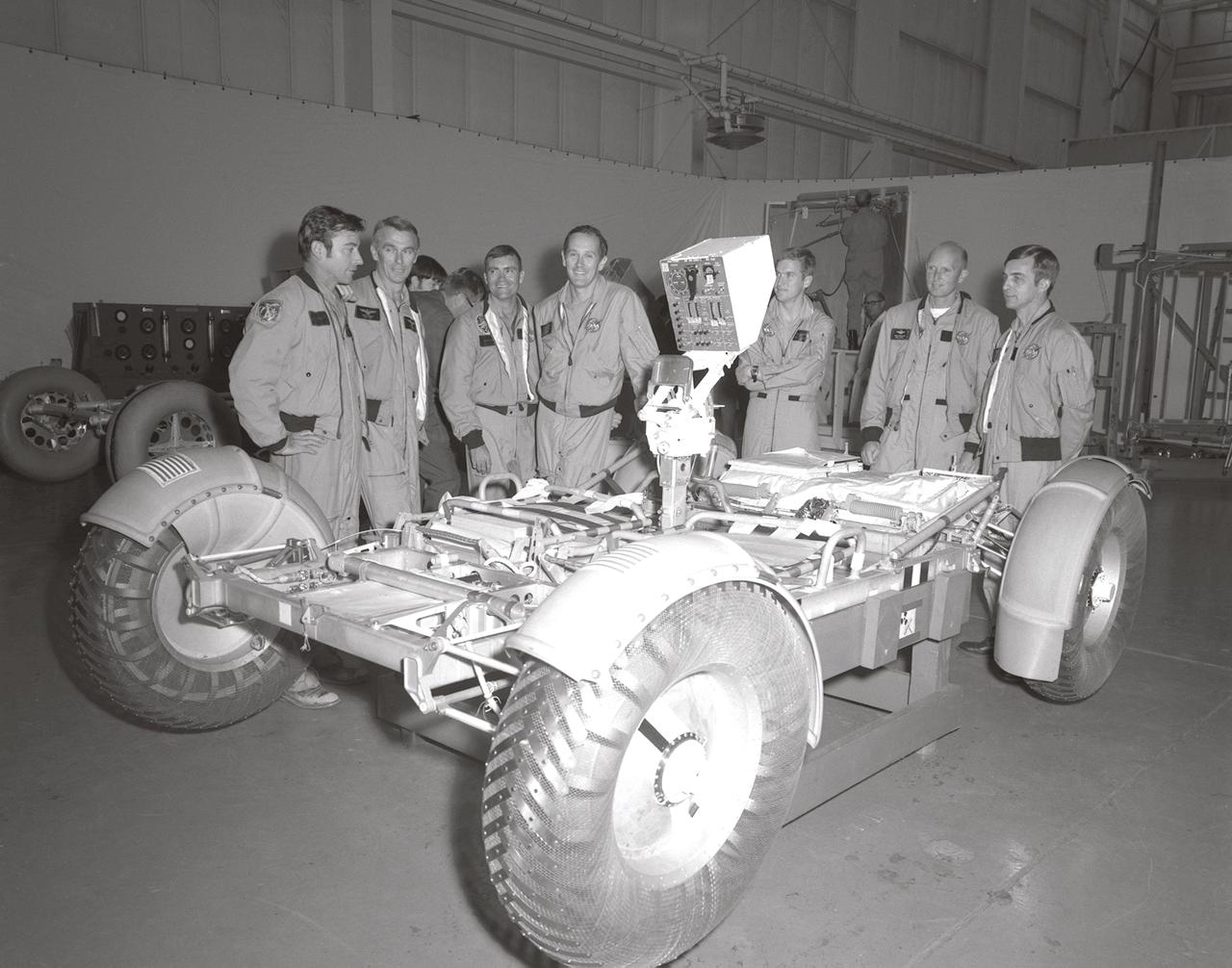
In this November 1971 photograph, (from left to right) Astronauts John Young, Eugene Cernan, Charles Duke, Fred Haise, Anthony England, Charles Fullerton, and Donald Peterson await deployment tests of the Lunar Roving Vehicle (LRV) qualification test unit in building 4649 at the Marshall Space Flight Center (MSFC). The LRV, developed under the direction of the MSFC, was designed to allow Apollo astronauts a greater range of mobility on the lunar surface during the last three lunar exploration missions; Apollo 15, Apollo 16, and Apollo 17.
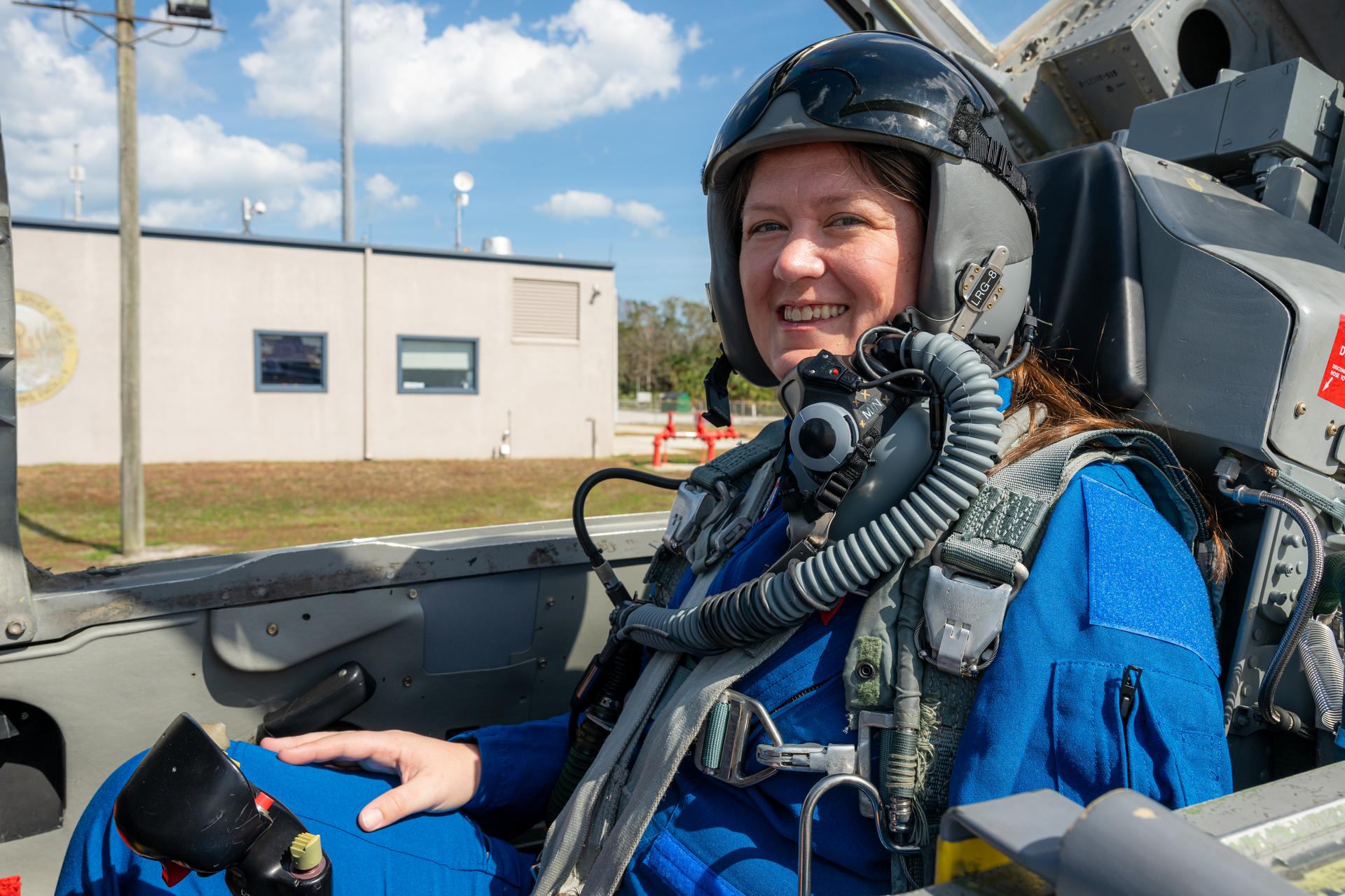
NASA employee Megan Vansant, chief architect and demolition program manager at NASA’s Marshall Space Flight Center, participates in an employee incentive flying event with NASA Administrator Jared Isaacman's personal F-5 aircraft, Friday, Feb. 20, 2026, at NASA’s Kennedy Space Center in Florida. Photo Credit: (NASA/John Kraus)
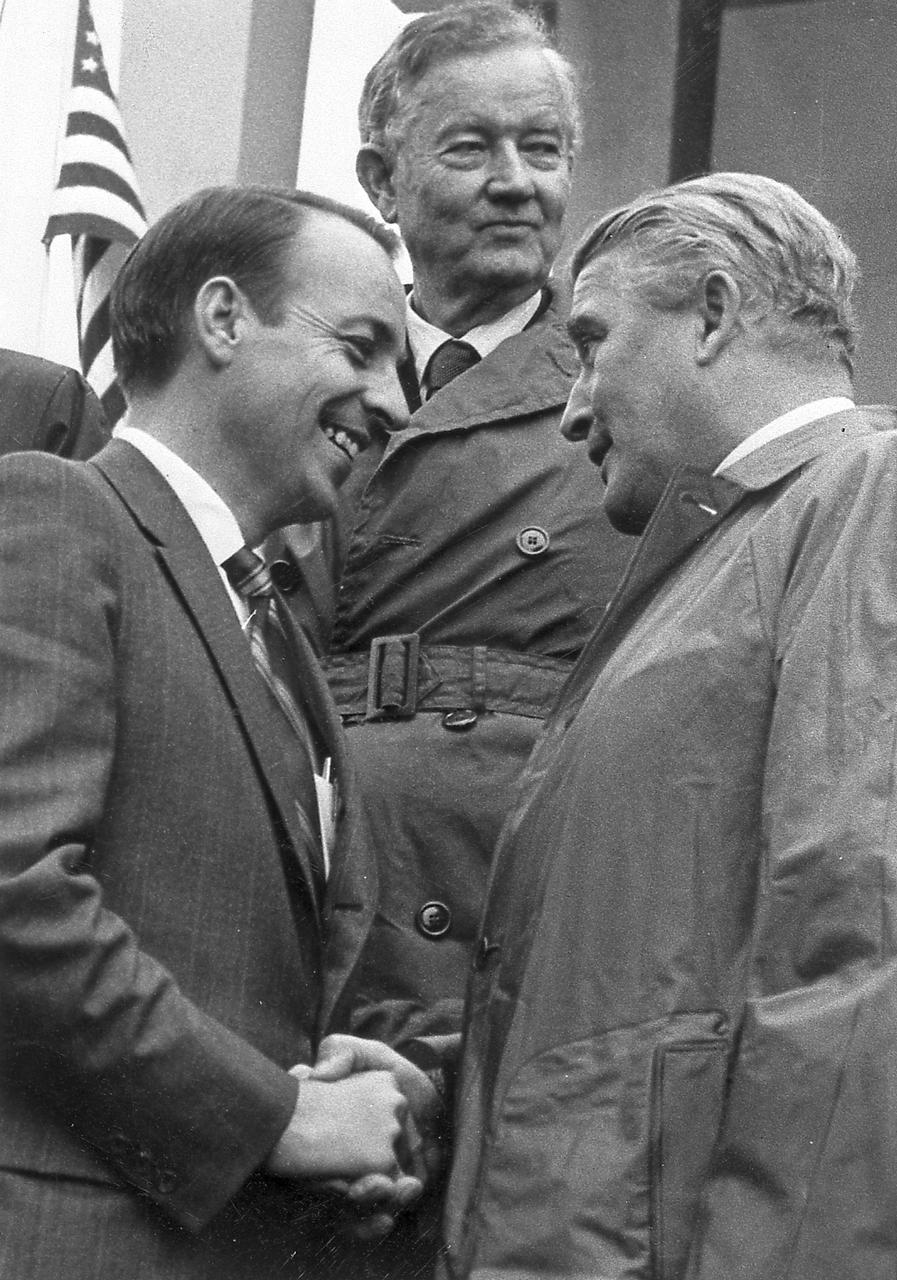
In 1970 Marshall Space Flight Center (MSFC) Director Dr. Wernher von Braun (right) was reassigned to NASA Headquarters to serve as Deputy Associate Administrator for Plarning. Prior to his transfer, Dr. von Braun was honored for his career in Huntsville, Alabama, with the celebration of "Wernher von Braun Day." Among those participating were Alabama Governor Albert Brewer (left) and Alabama Senator John Sparkman (center). (Courtesy of Huntsville/Madison County Public library)

This chart describes the Skylab student experiment Ultraviolet (UV) from Quasars, proposed by John C. Hamilton of Aiea, Hawaii. This experiment utilized Skylab's Ultraviolet Stellar Astronomy equipment to photograph quasars in the UV spectrum and compare those images to existing radio and visible data. In March 1972 NASA and the National Science Teachers Association selected 25 experiment proposals for flight on Skylab. Science advisors from the Marshall Space Flight Center aided and assisted the students in developing the proposals for flight on Skylab.
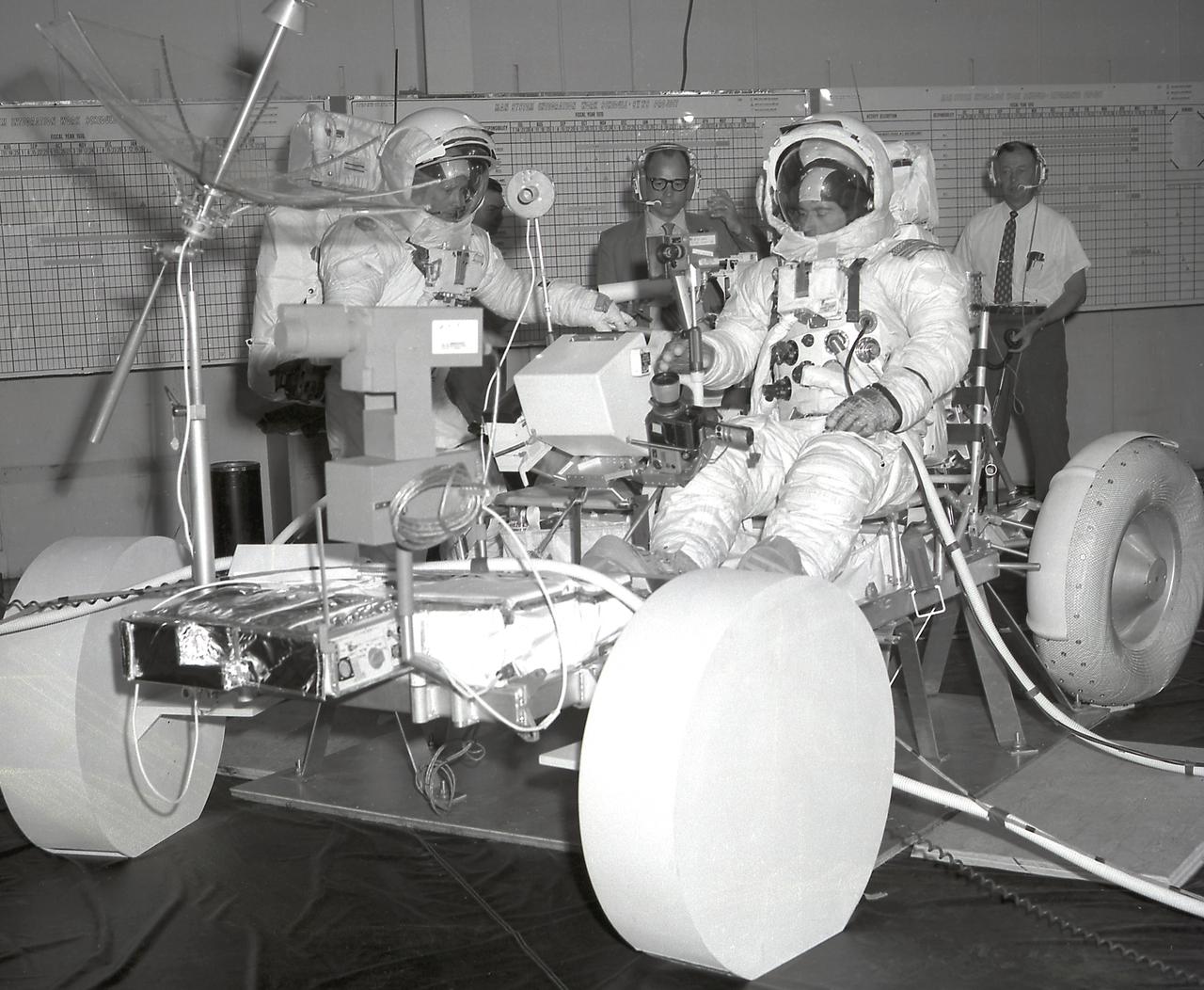
This image depicts the Apollo 16 mission astronauts John Young (right) and Charles Duke (left) in pressure suits during a final crew training on the Lunar Roving Vehicle (LRV) at the Marshall Space Flight Center (MSFC), building 4619. Developed by the MSFC, the LRV was the lightweight electric car designed to increase the range of mobility and productivity of astronauts on the lunar surface. It was used on the last three Apollo missions; Apollo 15, Apollo 16, and Apollo 17.
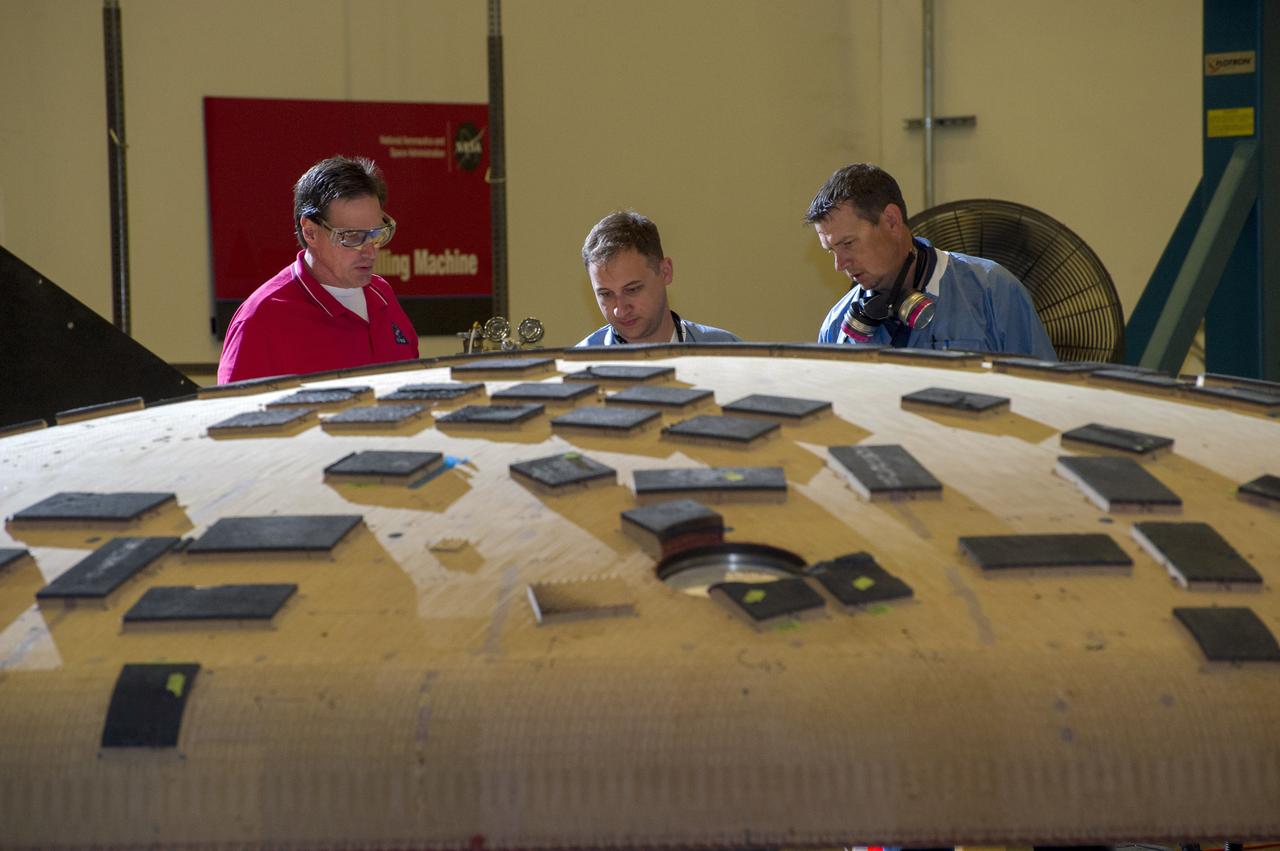
OVERSEEING ORION HEAT SHIELD WORK IN MARSHALL'S SEVEN-AXIS MILLING AND MACHINING FACILITY ARE, FROM LEFT, JOHN KOWAL, MANAGER OF ORION'S THERMAL PROTECTION SYSTEM AT JOHNSON SPACE CENTER; NICHOLAS CROWLEY, AN AMES ENGINEERING TECHNICIAN; AND ROB KORNIENKO, AMES ENGINEERING BRANCH CHIEF. THE HEAT SHIELD FLEW TO SPACE DURING THE EFT-1 FULL SCALE FLIGHT TEST OF ORION IN DECEMBER, 2014
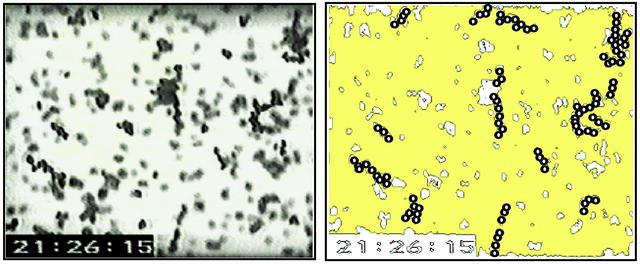
John Marshall, an investigator at Ames Research Center and a principal investigator in the microgravity fluid physics program, is studying the adhesion and cohesion of particles in order to shed light on how granular systems behave. These systems include everything from giant dust clouds that form planets to tiny compressed pellets, such as the ones you swallow as tablets. This knowledge should help us control the grains, dust, and powders that we encounter or use on a daily basis. Marshall investigated electrostatic charge in microgravity on the first and second U.S. Microgravity Laboratory shuttle missions to see how grains aggregate, or stick together. With gravity's effects eliminated on orbit, Marshall found that the grains of sand that behaved ever so freely on Earth now behaved like flour. They would just glom together in clumps and were quite difficult to disperse. That led to an understanding of the prevalence of the electrostatic forces. The granules wanted to aggregate as little chains, like little hairs, and stack end to end. Some of the chains had 20 or 30 grains. This phenomenon indicated that another force, what Marshall believes to be an electrostatic dipole, was at work.(The diagram on the right emphasizes the aggregating particles in the photo on the left, taken during the USML-2 mission in 1995.)
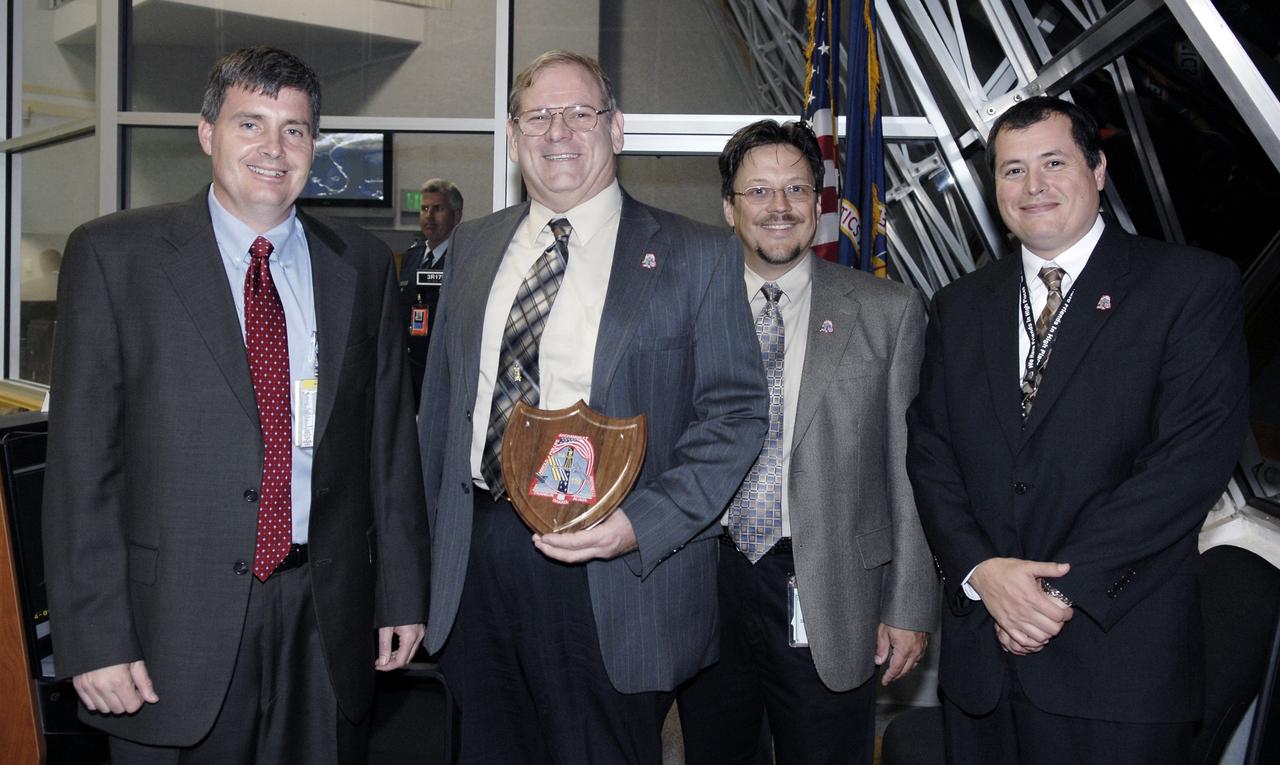
CAPE CANAVERAL, Fla. – In Firing Room 4 of the Launch Control Center at NASA's Kennedy Space Center in Florida, from left, Steve Stich, manager of the Kennedy Orbiter Project Office; John Fraser, with Boeing Co. at the Marshall Space Flight Center; Rick Russell, with the NASA Orbiter Sustaining Engineering Office; and Rene Ortega with Marshall Space Flight Center's Shuttle Propulsion Office, are presented with a plaque for their work on the fuel control valve problem on space shuttle Discovery. The award was presented after the successful launch of Discovery on the STS-119 mission. Liftoff was on time at 7:43 p. m. EDT. The STS-119 mission is the 28th to the space station and Discovery's 36th flight. Discovery will deliver the final pair of power-generating solar array wings and the S6 truss segment. Installation of S6 will signal the station's readiness to house a six-member crew for conducting increased science. Photo credit: NASA/Kim Shiflett
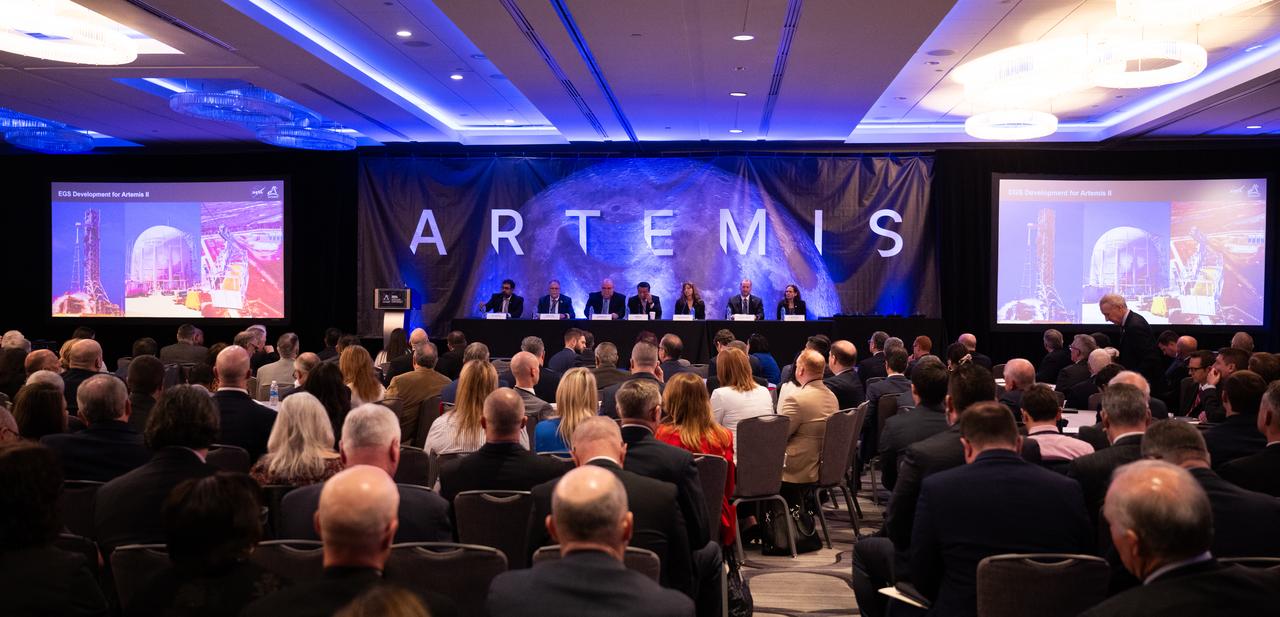
Shawn Quinn, manager of Exploration Ground Systems at NASA’s Kennedy Space Center, second from left, speaks during an Artemis Program progress update panel at the 2024 Artemis Suppliers Conference, Tuesday, Feb. 27, 2024, at the Grand Hyatt Hotel in Washington. Also participating in the panel was, from left, Amit Kshatriya, deputy associate administrator for the Moon to Mars Program in NASA’s Explorations Systems Development Mission Directorate; John Honeycutt, manager of the Space Launch System Program at NASA’s Marshall Space Flight Center; Howard Hu, manager of the Orion Program at NASA’s Johnson Space Center; Lisa Watson-Morgan, manager of the Human Landing System Program at NASA’s Marshall Space Flight Center; Jon B. Olansen, manager of the Gateway Program at NASA’s Johnson Space Center; and Lara Kearney, manager of Extravehicular Activity and Human Surface Mobility Program at NASA’s Johnson Space Center. Photo Credit: (NASA/Joel Kowsky)
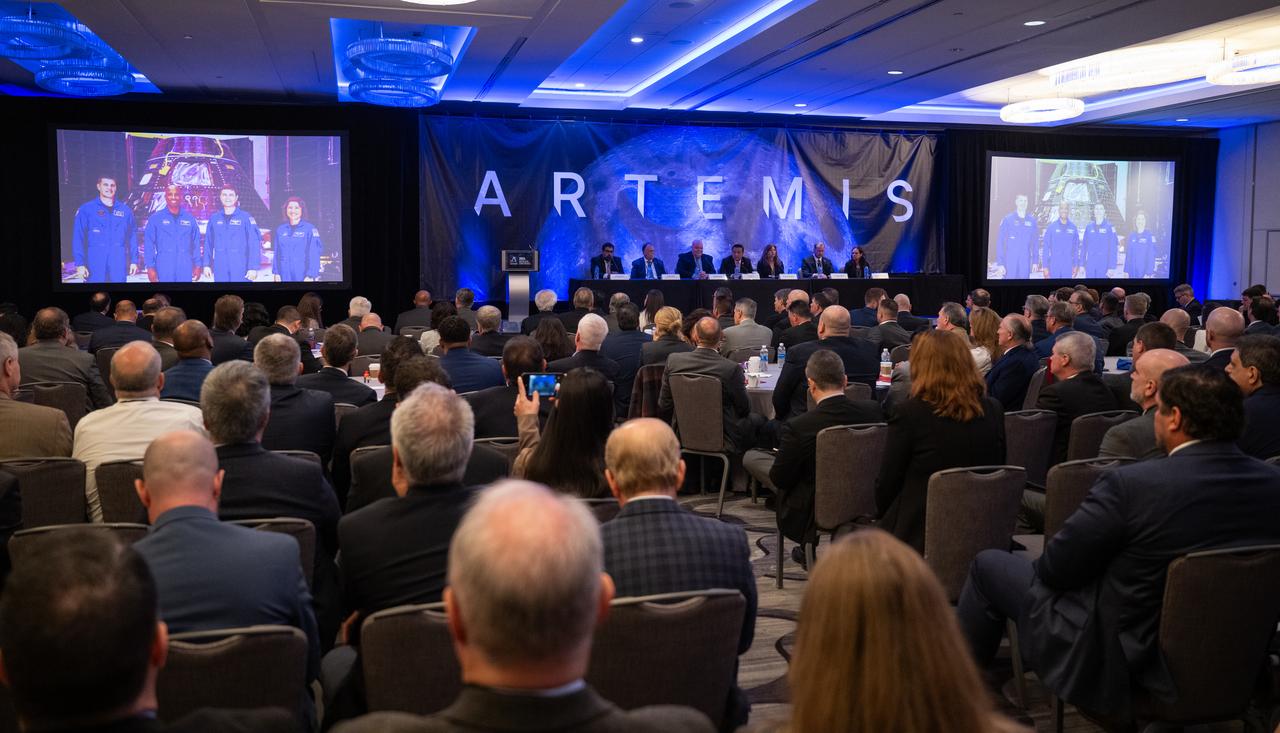
Howard Hu, manager of the Orion Program at NASA’s Johnson Space Center, center, speaks during an Artemis Program progress update panel at the 2024 Artemis Suppliers Conference, Tuesday, Feb. 27, 2024, at the Grand Hyatt Hotel in Washington. Also participating in the panel was, from left, Amit Kshatriya, deputy associate administrator for the Moon to Mars Program in NASA’s Explorations Systems Development Mission Directorate; Shawn Quinn, manager of Exploration Ground Systems at NASA’s Kennedy Space Center; John Honeycutt, manager of the Space Launch System Program at NASA’s Marshall Space Flight Center; Lisa Watson-Morgan, manager of the Human Landing System Program at NASA’s Marshall Space Flight Center; Jon B. Olansen, manager of the Gateway Program at NASA’s Johnson Space Center; and Lara Kearney, manager of Extravehicular Activity and Human Surface Mobility Program at NASA’s Johnson Space Center. Photo Credit: (NASA/Joel Kowsky)

Howard Hu, manager of the Orion Program at NASA’s Johnson Space Center, center, speaks during an Artemis Program progress update panel at the 2024 Artemis Suppliers Conference, Tuesday, Feb. 27, 2024, at the Grand Hyatt Hotel in Washington. Also participating in the panel was, from left, Amit Kshatriya, deputy associate administrator for the Moon to Mars Program in NASA’s Explorations Systems Development Mission Directorate; Shawn Quinn, manager of Exploration Ground Systems at NASA’s Kennedy Space Center; John Honeycutt, manager of the Space Launch System Program at NASA’s Marshall Space Flight Center; Lisa Watson-Morgan, manager of the Human Landing System Program at NASA’s Marshall Space Flight Center; Jon B. Olansen, manager of the Gateway Program at NASA’s Johnson Space Center; and Lara Kearney, manager of Extravehicular Activity and Human Surface Mobility Program at NASA’s Johnson Space Center. Photo Credit: (NASA/Joel Kowsky)
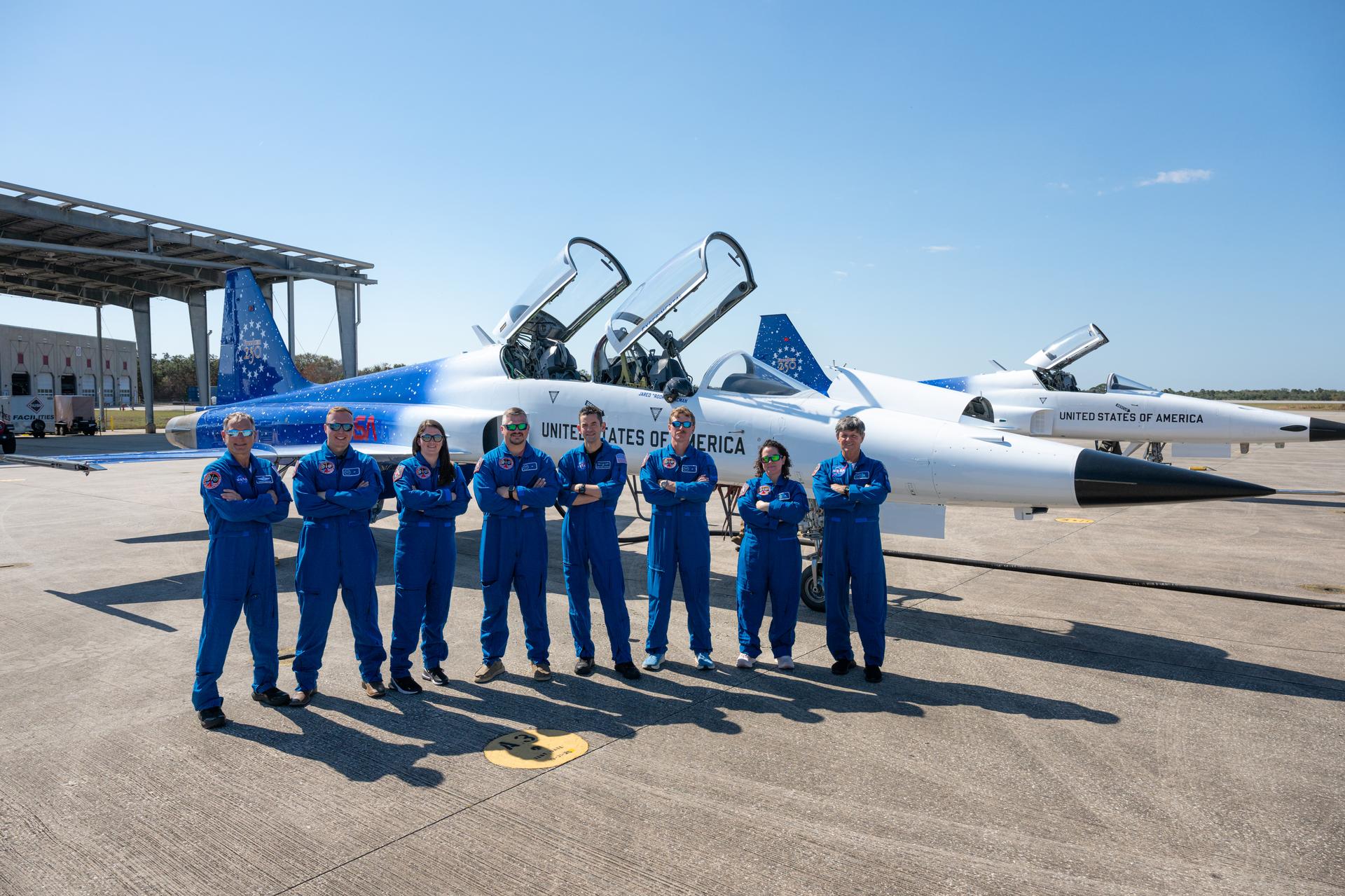
NASA Administrator Jared Isaacman, fifth from left, poses for a photograph with NASA employees and F-5 pilots following an employee incentive flying event using Isaacman's personal F-5 aircraft, Saturday, Feb. 21, 2026, at NASA’s Kennedy Space Center in Florida. From left to right: Sean Gustafson, pilot and senior advisor to the administrator; Kristian Miasek, ET-10 test engineer at NASA’s Marshall Space Flight Center; Megan Vansant, chief architect and demolition program manager at NASA’s Marshall Space Flight Center; James Hamilton, propellant and pressurant manager at NASA’s Stennis Space Center; NASA Administrator Jared Isaacman; Briou Bourgeois, E-3 test director at NASA’s Stennis Space Center; Brittany Bouché, acting deputy chief of facility engineering services at NASA’s Stennis Space Center; and Jerry Kerby, pilot. Photo Credit: (NASA/John Kraus)
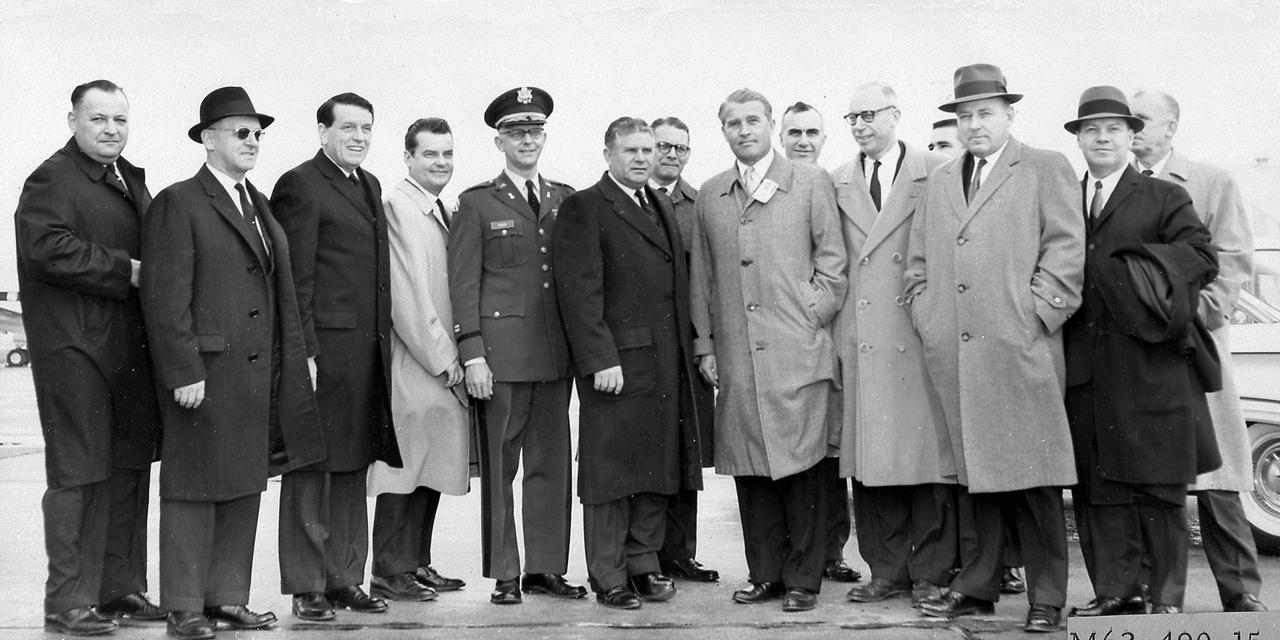
The members of the House Committee on Science and Astronautics visited the Marshall Space Flight Center (MSFC) on March 9, 1962 to gather first-hand information of the nation's space exploration program. The congressional group was composed of members of the Subcommittee on Marned Space Flight. Headed by Representative Olin E. Teague of Texas, other members were James G. Fulton, Pennsylvania; Ken Heckler, West Virginia; R. Walter Riehlman, New York; Richard L. Roudebush,, Indiana; John W. Davis, Georgia; James C. Corman, California; Joseph Waggoner, Louisiana; J. Edgar Chenoweth, Colorado; and William G. Bray, Indiana.
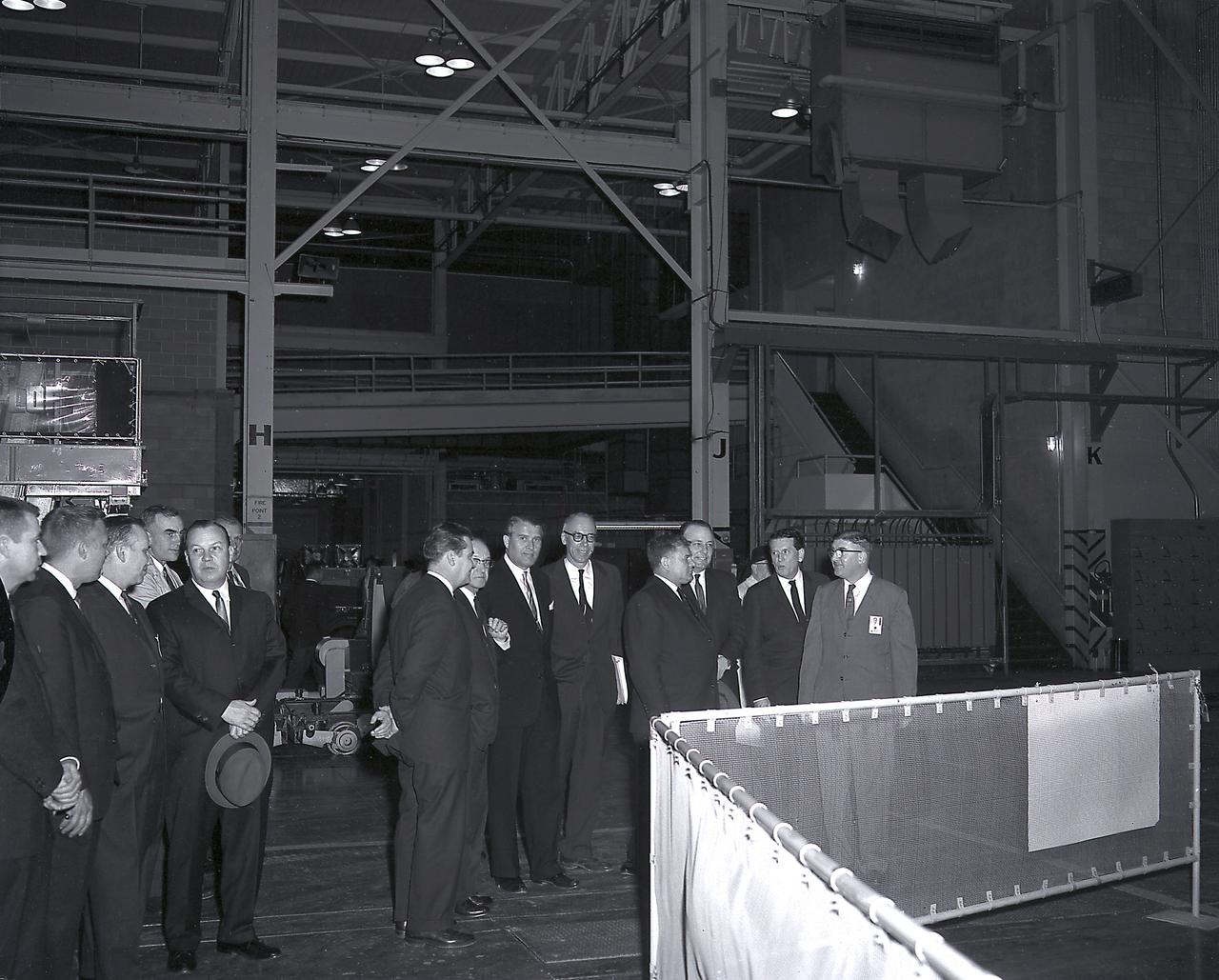
The members of the House Committee on Science and Astronautics visited the Marshall Space Flight Center (MSFC) on March 9, 1962 to gather first-hand information of the nation's space exploration program. The congressional group was composed of members of the Subcommittee on Marned Space Flight. Headed by Representative Olin E. Teague of Texas, other members were James G. Fulton, Pennsylvania; Ken Heckler, West Virginia; R. Walter Riehlman, New York; Richard L. Roudebush, Indiana; John W. Davis, Georgia; James C. Corman, California; Joseph Waggoner, Louisiana; J. Edgar Chenoweth, Colorado; and William G. Bray, Indiana.
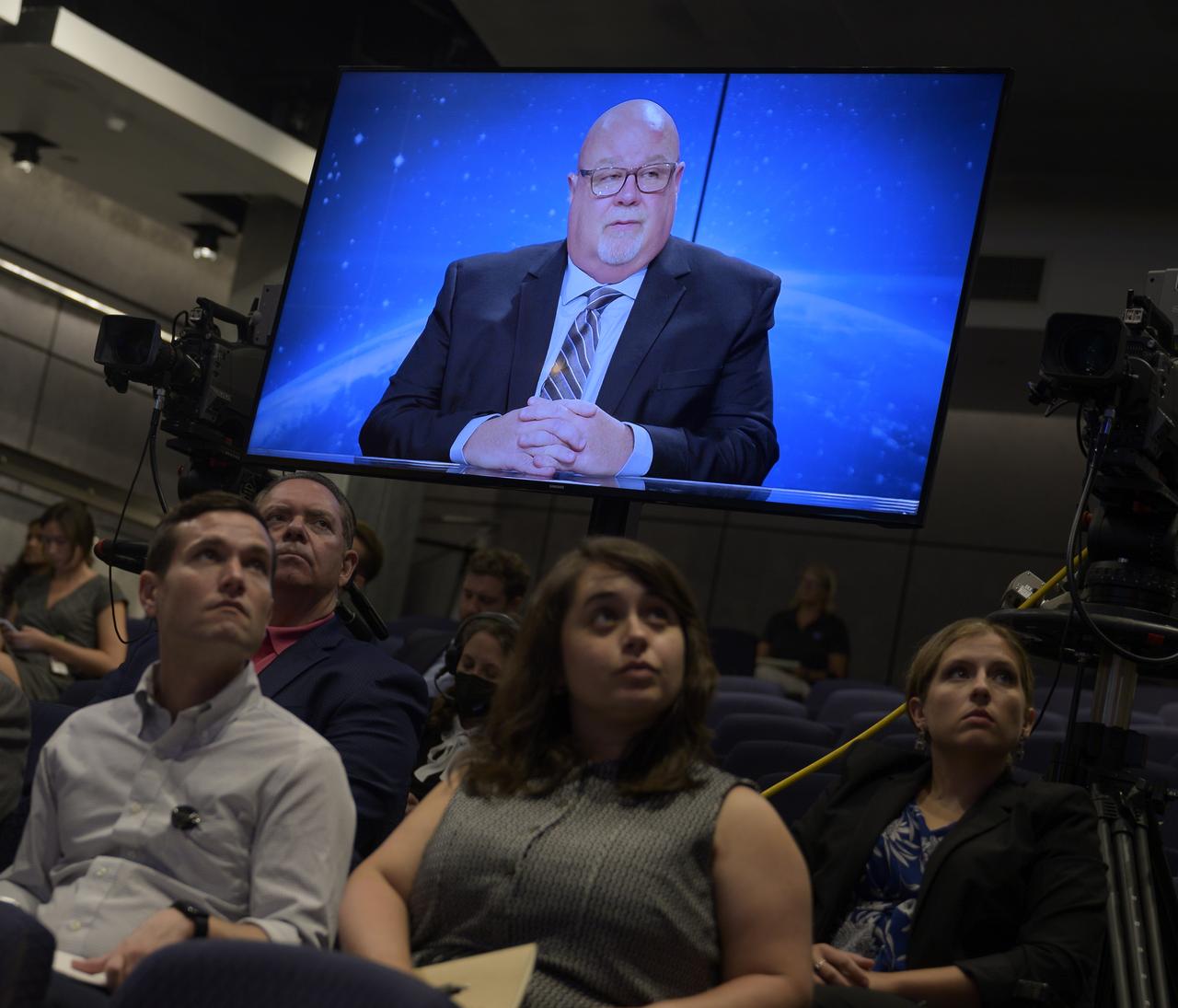
John Honeycutt, Space Launch System (SLS) program manager at NASA's Marshall Space Flight Center gives remarks remotely during a NASA briefing on the Artemis I Moon mission, Wednesday, Aug. 3, 2022, at the Mary W. Jackson NASA Headquarters building in Washington. NASA’s Artemis I mission is the first integrated test of the agency’s deep space exploration systems: the Orion spacecraft, Space Launch System rocket, and supporting ground systems. Launch of the uncrewed flight test is targeted for no earlier than Monday, Aug. 29. Photo Credit: (NASA/Bill Ingalls)
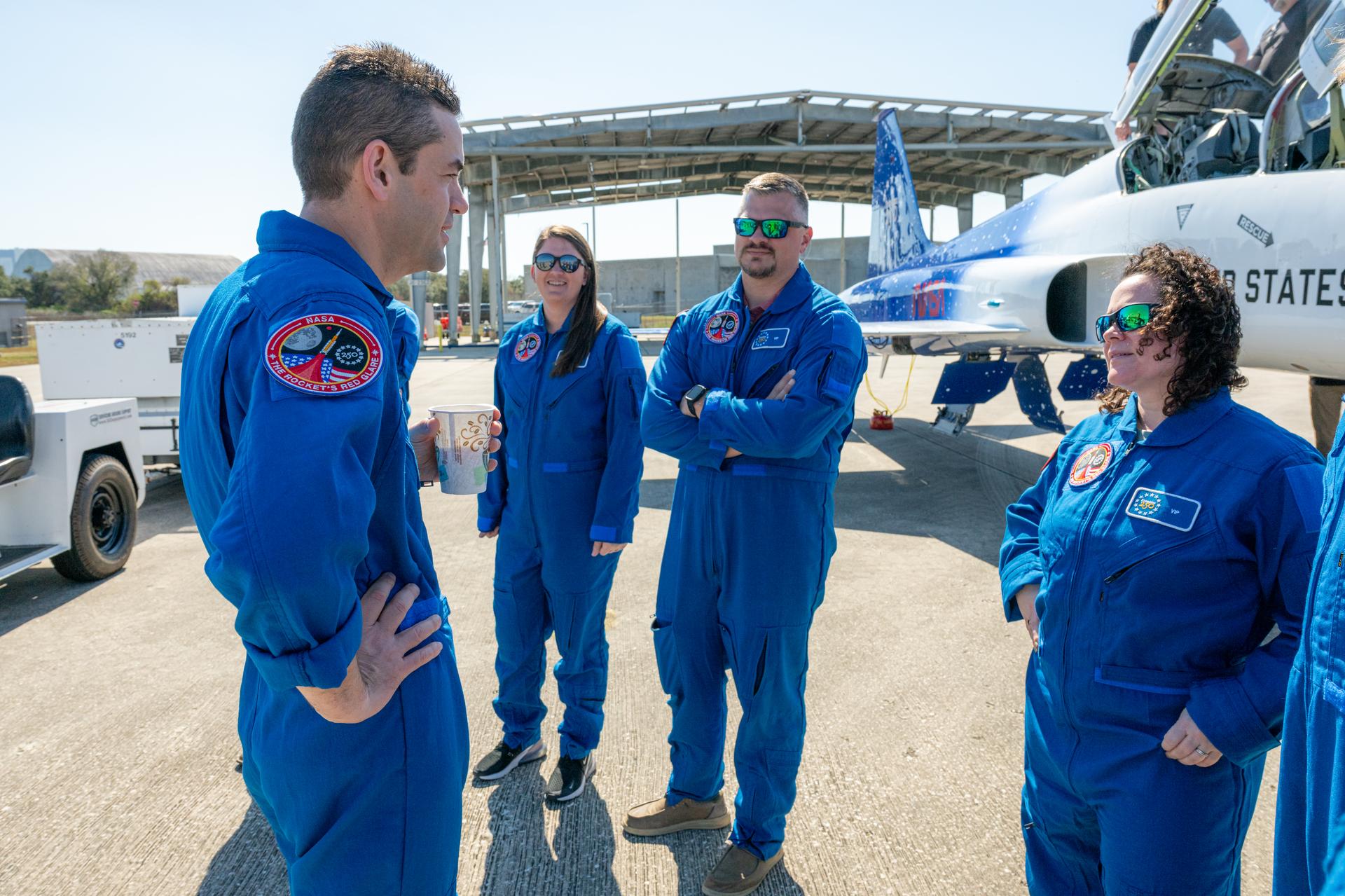
NASA Administrator Jared Isaacman, left, speaks with NASA employees Megan Vansant, chief architect and demolition program manager at NASA’s Marshall Space Flight Center, second from left; James Hamilton, propellant and pressurant manager at NASA’s Stennis Space Center, third from left; and Brittany Bouché, acting deputy chief of facility engineering services at NASA’s Stennis Space Center, right, following an employee incentive flying event using Isaacman's personal F-5 aircraft, Saturday, Feb. 21, 2026, at NASA’s Kennedy Space Center in Florida. Photo Credit: (NASA/John Kraus)
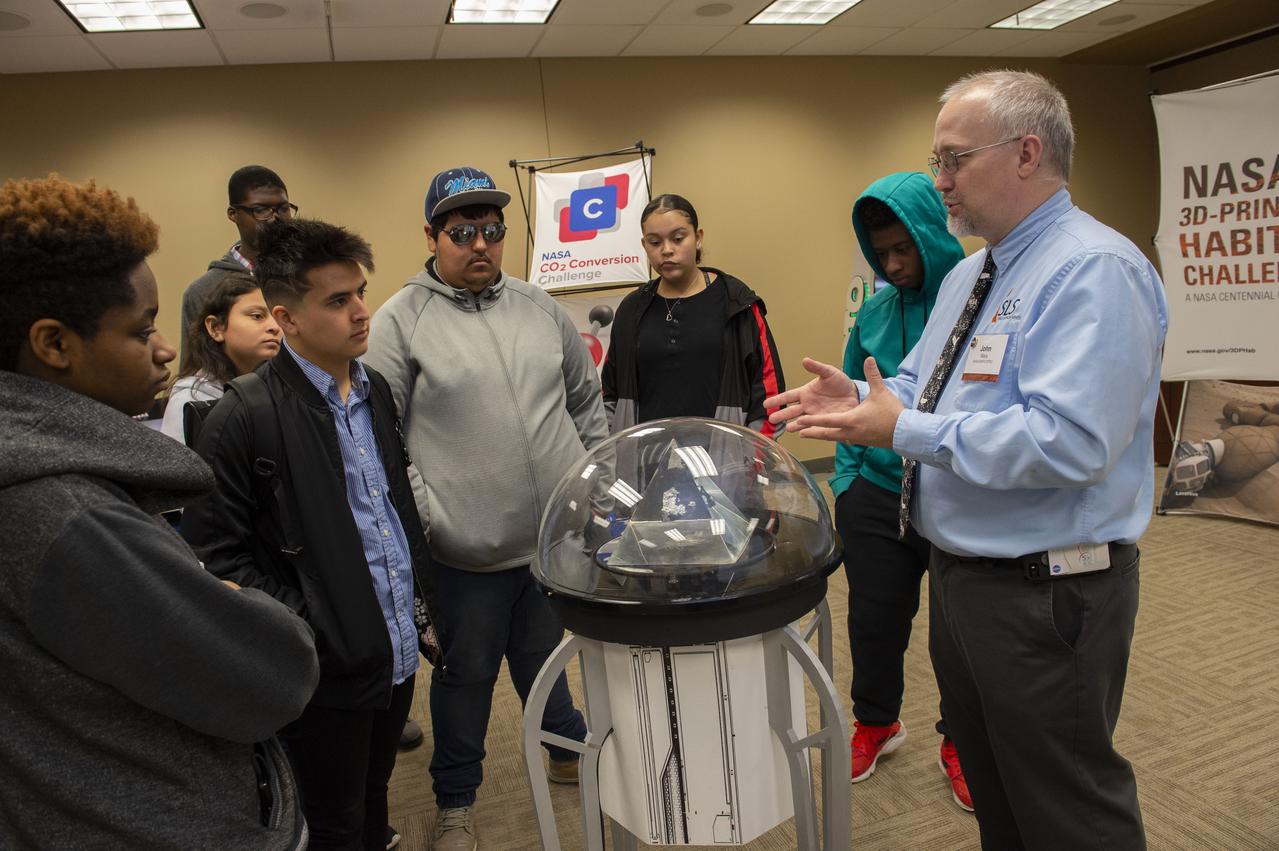
AI. SpaceFactory of New York and Pennsylvania State University of College Park print subscale habitat structures at NASA's 3D-Printed Habitat Challenge, held at the Caterpillar Edwards Demonstration & Learning Center in Edwards, Illinois, May 1-4, 2019. The habitat print is the final level of the multi-phase competition, which began in in 2015. The challenge is managed by NASA's Centennial Challenges program, and partner Bradley University of Peoria, Illinois. Marshall Space Flight Center educator john Weis, right, offers students from Manual Academic High School in Peoria, Illinois a first-hand look at a Moon rock retrieved by the Apollo 15 mission.
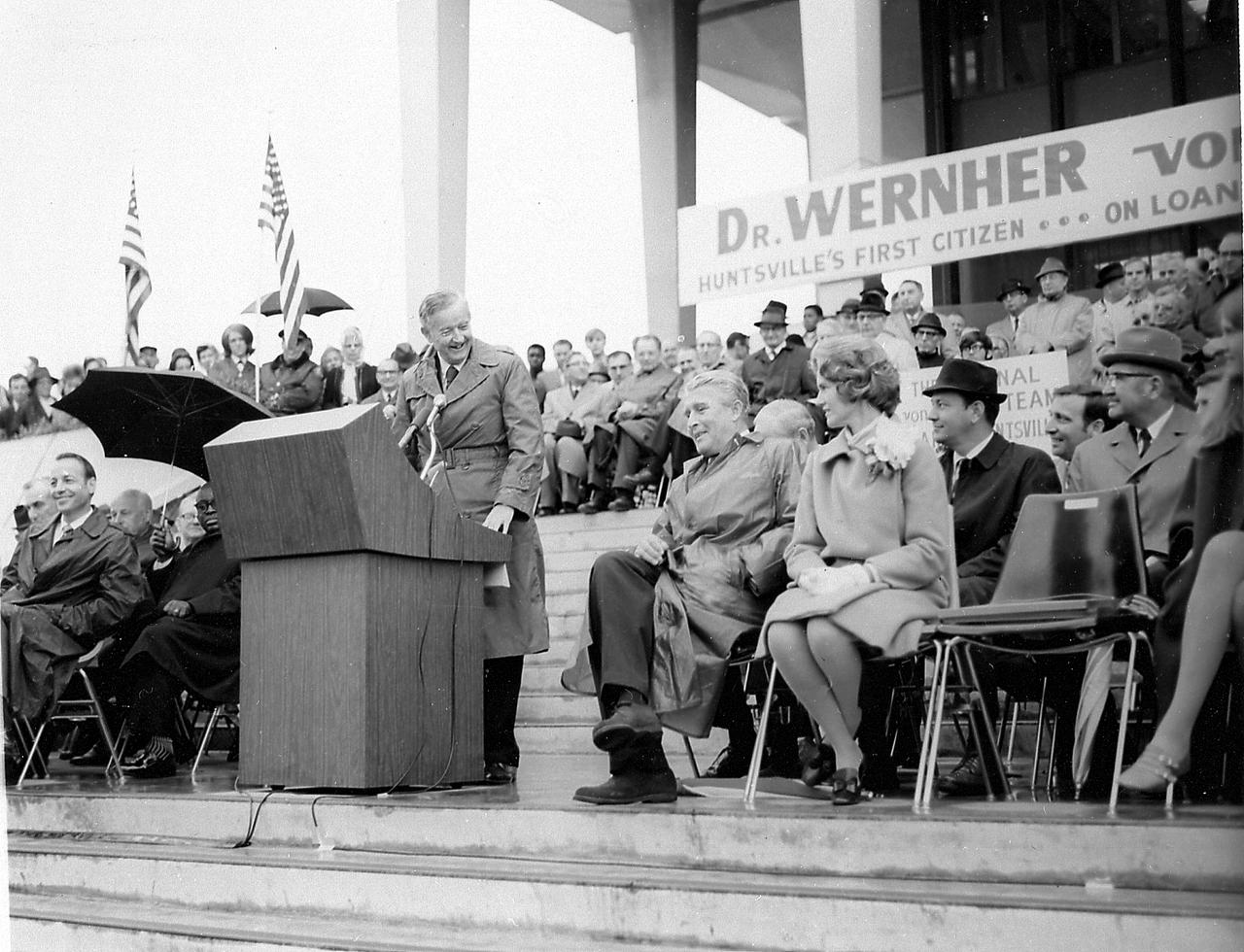
Prior to MSFC (Marshall Space Flight Center) Director, Dr. von Braun's transfer to NASA Headquarters where he had been appointed Deputy Associate Administrator for Plarning, he was honored during a series of events recognizing his contribution to the space effort during his career in Huntsville, Alabama. In this photo at the Madison County Courthouse, Dr. von Braun is shown seated next to his wife, Maria, as U.S. Senator John Sparkman comments on his career in Huntsville, Alabama, where he worked for both the Army and NASA (National Aeronautic Space Administration).
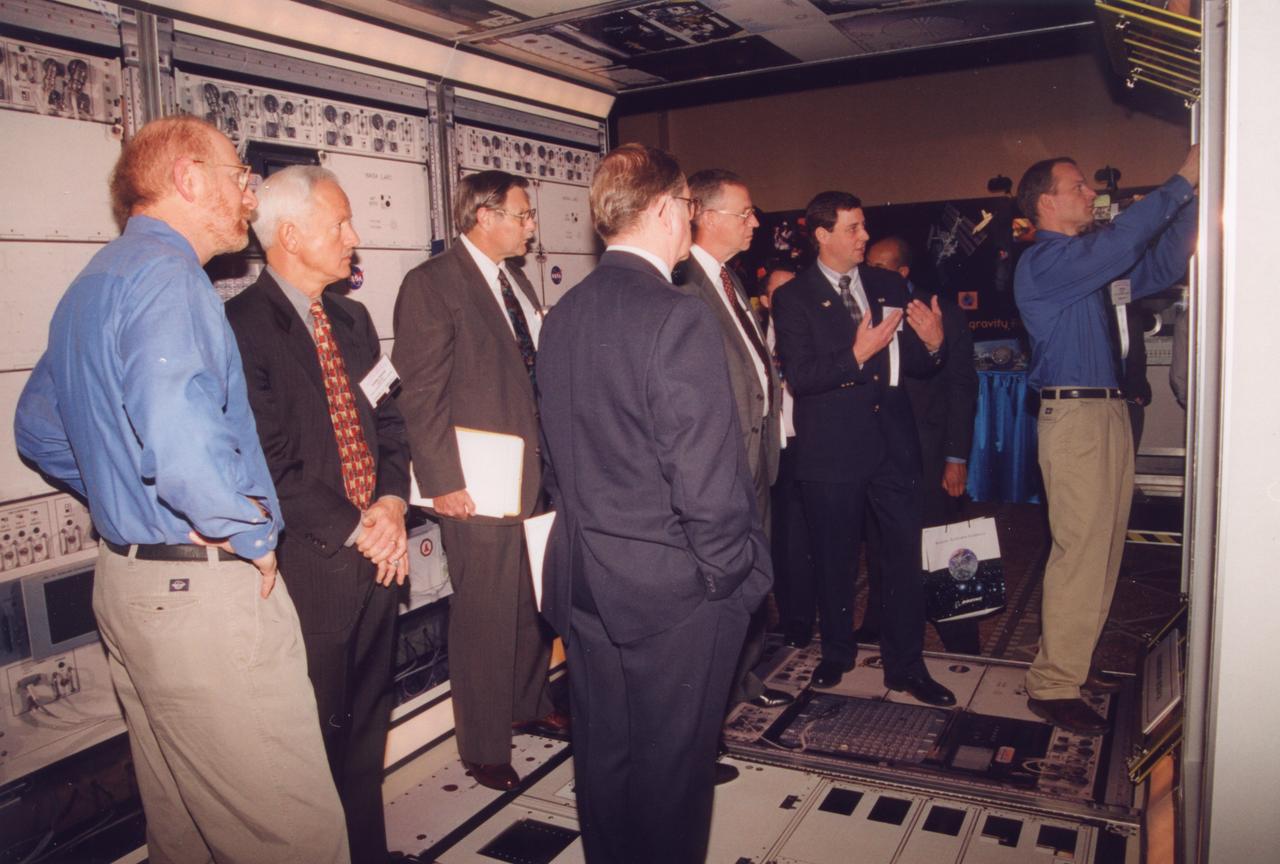
Engineers from NASA's Glenn Research Center demonstrate the access to one of the experiment racks planned for the U.S. Destiny laboratory module on the International Space Station (ISS). This mockup has the full diameter, full corridor width, and half the length of the module. The mockup includes engineering mockups of the Fluids and Combustion Facility being developed by NASA's Glenn Research Center. (The full module will be six racks long; the mockup is three racks long). Listening at left (coat and patterned tie) is John-David Bartoe, ISS research manager at NASA's Johnson Space Center and a payload specialist on Spacelab 2 mission (1985). Photo credit: NASA/Marshall Space Flight Center (MSFC)
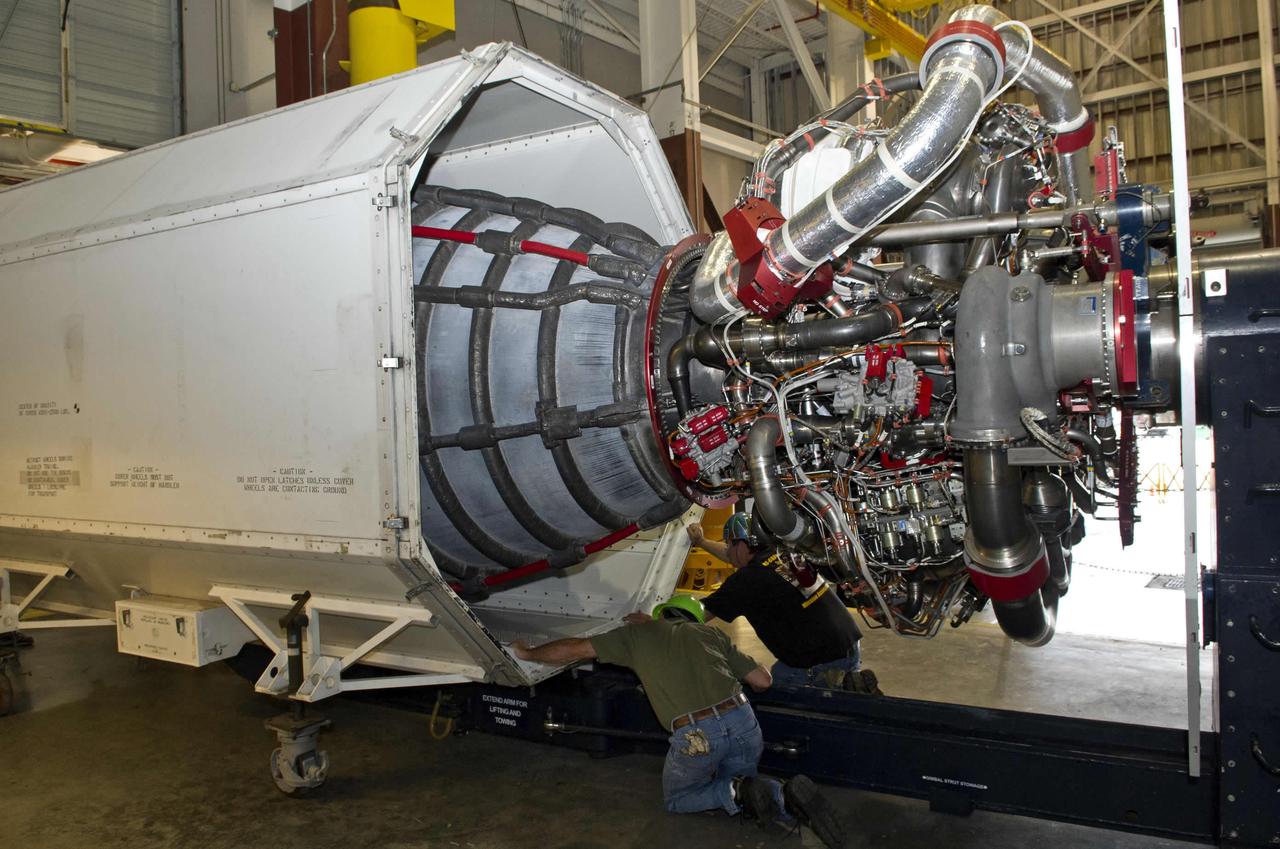
Employees unload a RS25D rocket engine at NASA's John C. Stennis Space Center on Jan. 17. The engine - and 14 others - will be stored at the facility for future testing and use on NASA's new Space Launch System (SLS). The SLS is a new heavy-lift launch vehicle that will expand human presence beyond low-Earth orbit and enable new missions of exploration across the solar system. NASA's Marshall Space Flight Center in Huntsville, Ala., is leading the design and development of the Space Launch System for NASA, including the engine testing program. Delivery of the 15 RS-25 engines will continue throughout the next few months
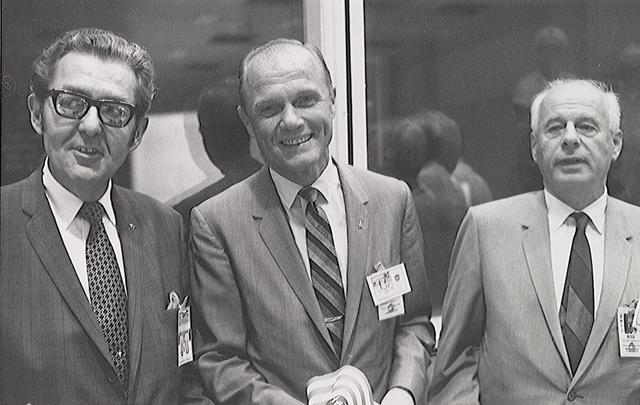
S69-44022 (7-24-69) --- On hand in Houston's mission control center to witness activity associated with the landing and recovery operations for the Apollo 11 mission were, from the left, Bob Kline, chief of the Mission Operations Procurement Branch at the Manned Spacecraft Center (MSC); astronaut John H. Glenn Jr.; and Eberhard Rees, deputy director of the Marshall Space Flight Center (MSFC). They were among a large number of personnel on hand in the MCC's mission operations control room (MOCR). Glenn holds one of the dozens of flags that were handed out for the return's celebration.
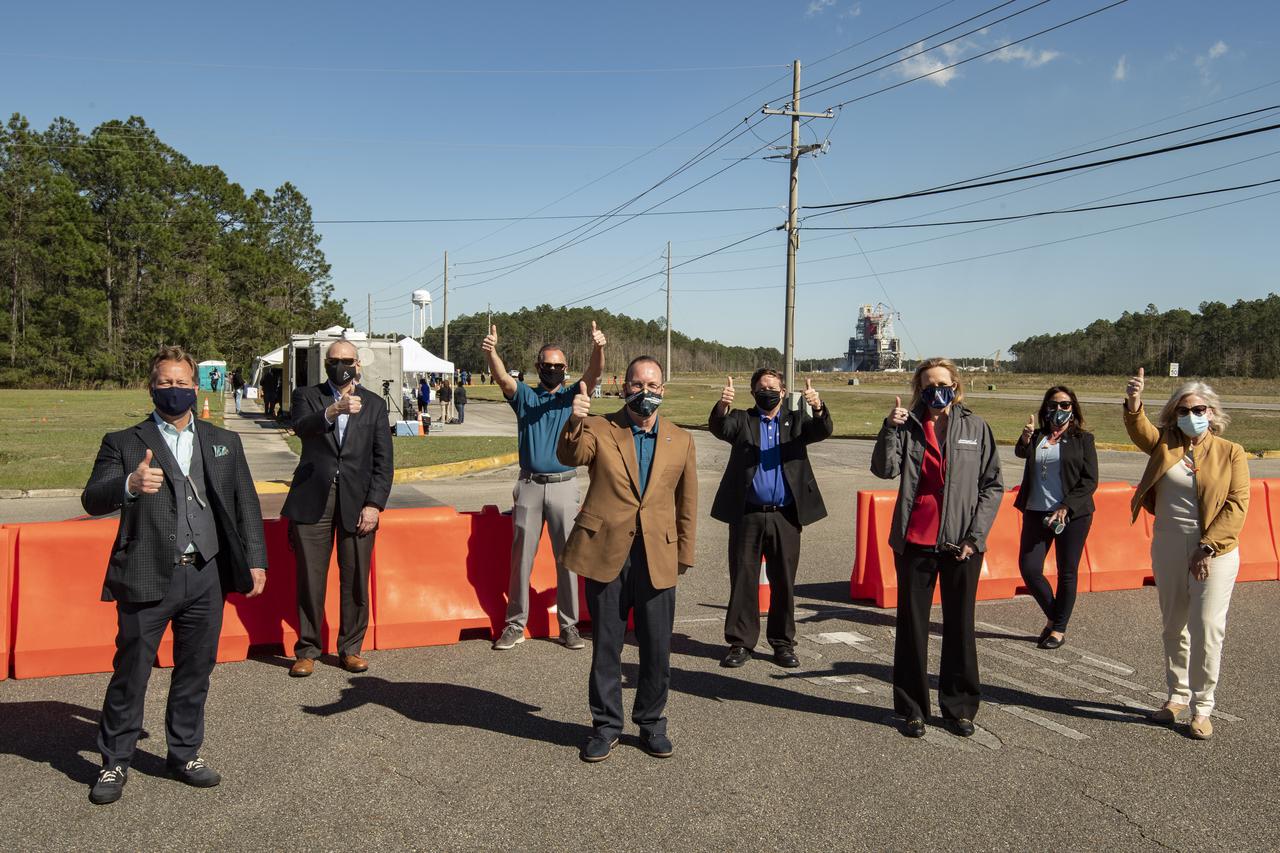
From left: Jim Maser, senior vice president of the Space Business Unit of Aerojet Rocketdyne; acting NASA Administrator Steve Jurzyck; John Bailey, associate director of NASA's Stennis Space Center; Rick Gilbrech, director of NASA's Stennis Space Center; Mike McDaniel, general manager of Aerojet Rocketdyne at Stennis Space Center; Amy Growder, chief operating officer of Aerojet Rocketdyne; Mary Byrd, associate director of NASA’s Marshall Space Flight Center; and Jody Singer, director of NASA's Marshall Space Flight Center; pose for a picture giving a thumbs-up following a second hot fire test of the core stage for the first flight of NASA’s Space Launch System rocket in the B-2 Test Stand, Thursday, March 18, 2021, at NASA’s Stennis Space Center near Bay St. Louis, Mississippi. The four RS-25 engines fired for the full-duration of 8 minutes during the test and generated 1.6 million pounds of thrust. The hot fire test is the final stage of the Green Run test series, a comprehensive assessment of the Space Launch System’s core stage prior to launching the Artemis I mission to the Moon. Photo Credit: (NASA/Robert Markowitz)

This is the Apollo 16 lunar landing mission crew portrait. Pictured from left to right are: Thomas K. Mattingly II, Command Module pilot; John W. Young, Mission Commander; and Charles M. Duke Jr., Lunar Module pilot. Launched from the Kennedy Space Center on April 16, 1972, Apollo 16 spent three days on Earth's Moon. The first study of the highlands area, the landing site for Apollo 16 was the Descartes Highlands. The fifth lunar landing mission out of six, Apollo 16 was famous for deploying and using an ultraviolet telescope as the first lunar observatory. The telescope photographed ultraviolet light emitted by Earth and other celestial objects. The Lunar Roving Vehicle, developed by the Marshall Space Flight Center, was also used for collecting rocks and data on the mysterious lunar highlands. In this photo, astronaut John W. Young photographs Charles M. Duke, Jr. collecting rock samples at the Descartes landing site. Duke stands by Plum Crater while the Lunar Roving Vehicle waits parked in the background. High above, Thomas K. Mattingly orbits in the Command Module. The mission ended April 27, 1972 as the crew splashed down into the Pacific Ocean.
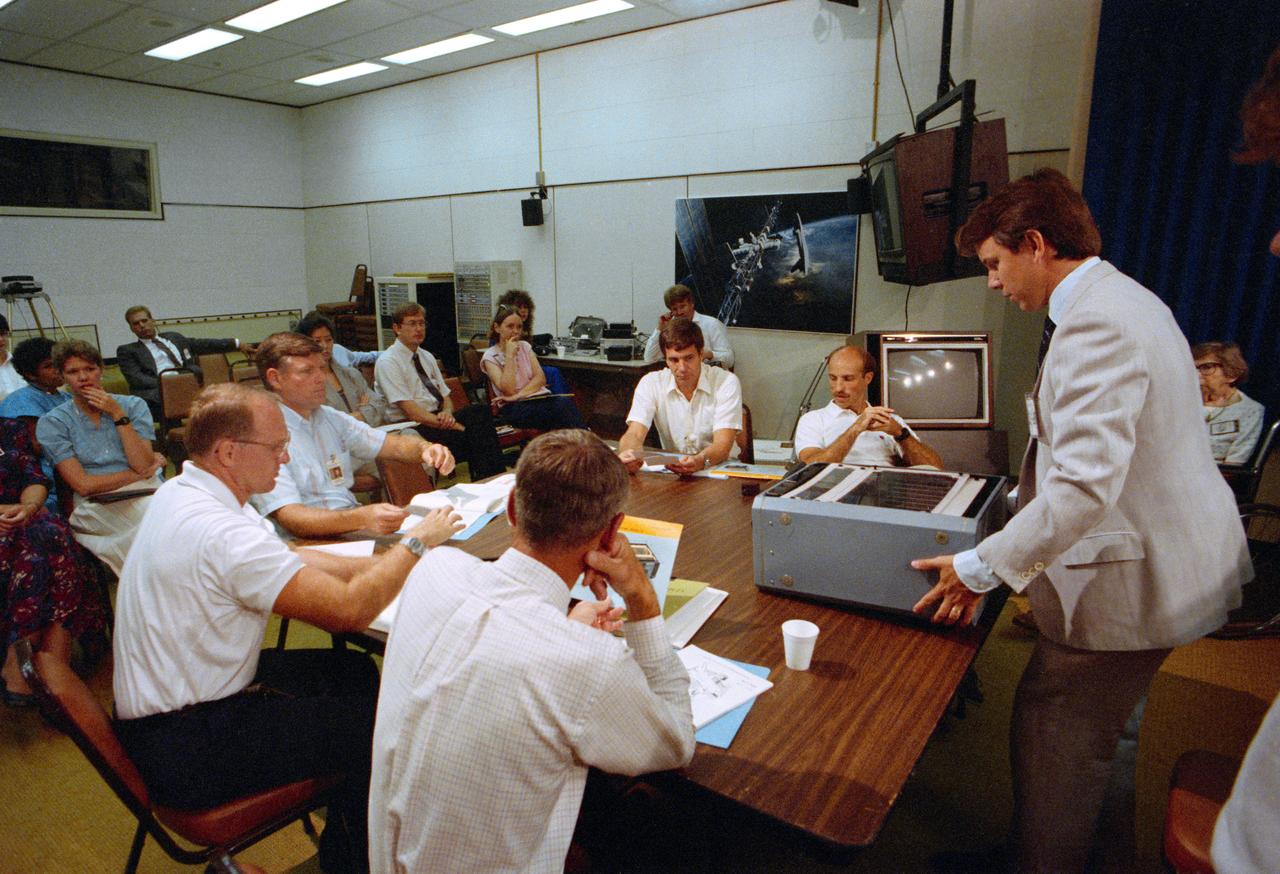
S88-44661 (13 Aug 1988) --- Tom Kestler, with Orthopaedic Hospital, USC, one of the sponsor representatives for student experimenter Andrew Fras explains components of Fras' experiment. It will be carried onboard theDiscovery for NASA's STS-29 mission next year. His primary audience is made up of members of the STS-29 crew who will monitor in-space operation of the experiment, titled "Effects of Weightlessness on Bone Healing." Crewmembers, clockwise around the table from the left, are Astronauts Robert C. Springer, James F. Buchli, Michael L. Coats, John E. Blaha and James P. Bagian. Seated in far right background is Dr. June Marshall of the University of Southern California School of Medicine, the student's sponsoring organization.
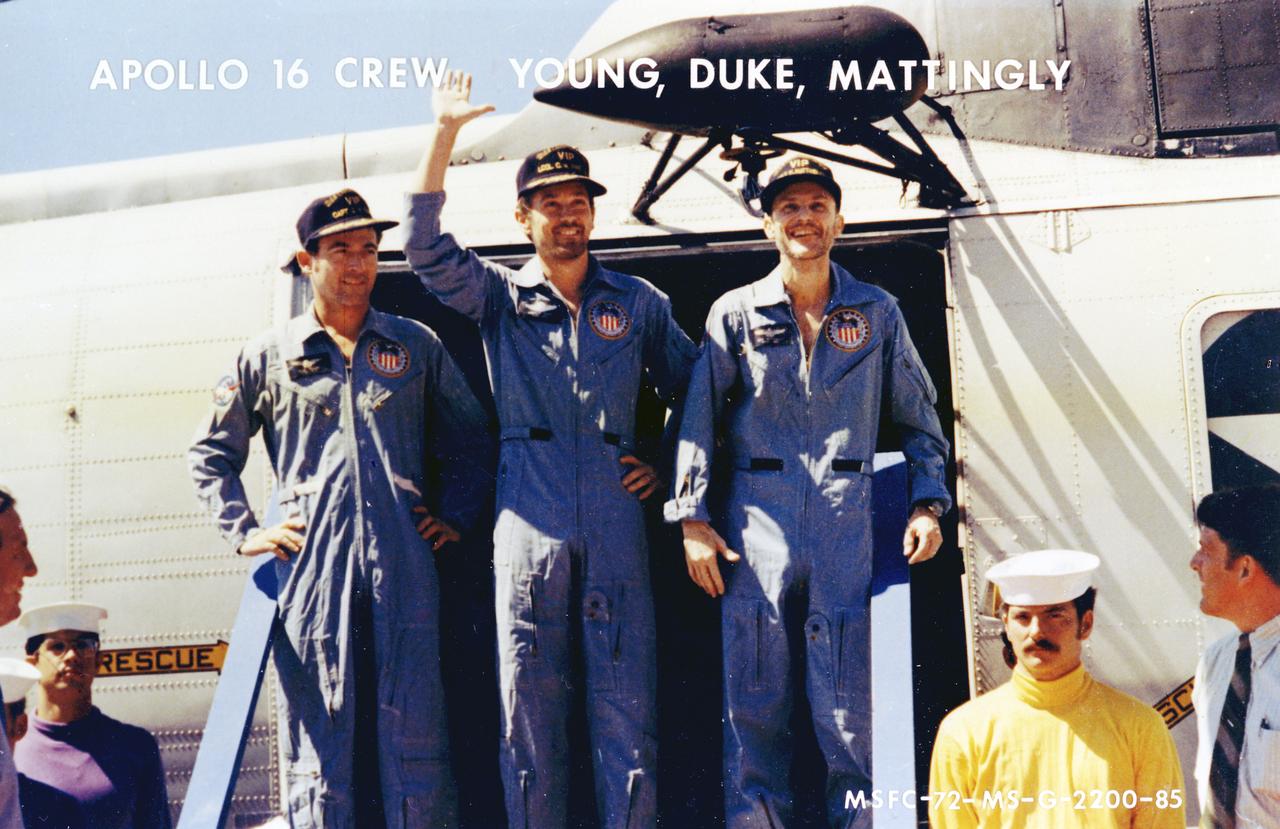
The Apollo 16 Command Module splashed down in the Pacific Ocean on April 27, 1972 after an 11-day moon exploration mission. The 3-man crew is shown here aboard the rescue ship, USS Horton. From left to right are: Mission Commander John W. Young, Lunar Module pilot Charles M. Duke, and Command Module pilot Thomas K. Mattingly II. The sixth manned lunar landing mission, the Apollo 16 (SA-511) lifted off on April 16, 1972. The Apollo 16 mission continued the broad-scale geological, geochemical, and geophysical mapping of the Moon’s crust, begun by the Apollo 15, from lunar orbit. This mission marked the first use of the Moon as an astronomical observatory by using the ultraviolet camera/spectrograph which photographed ultraviolet light emitted by Earth and other celestial objects. The Lunar Roving Vehicle, developed by the Marshall Space Flight Center, was also used.
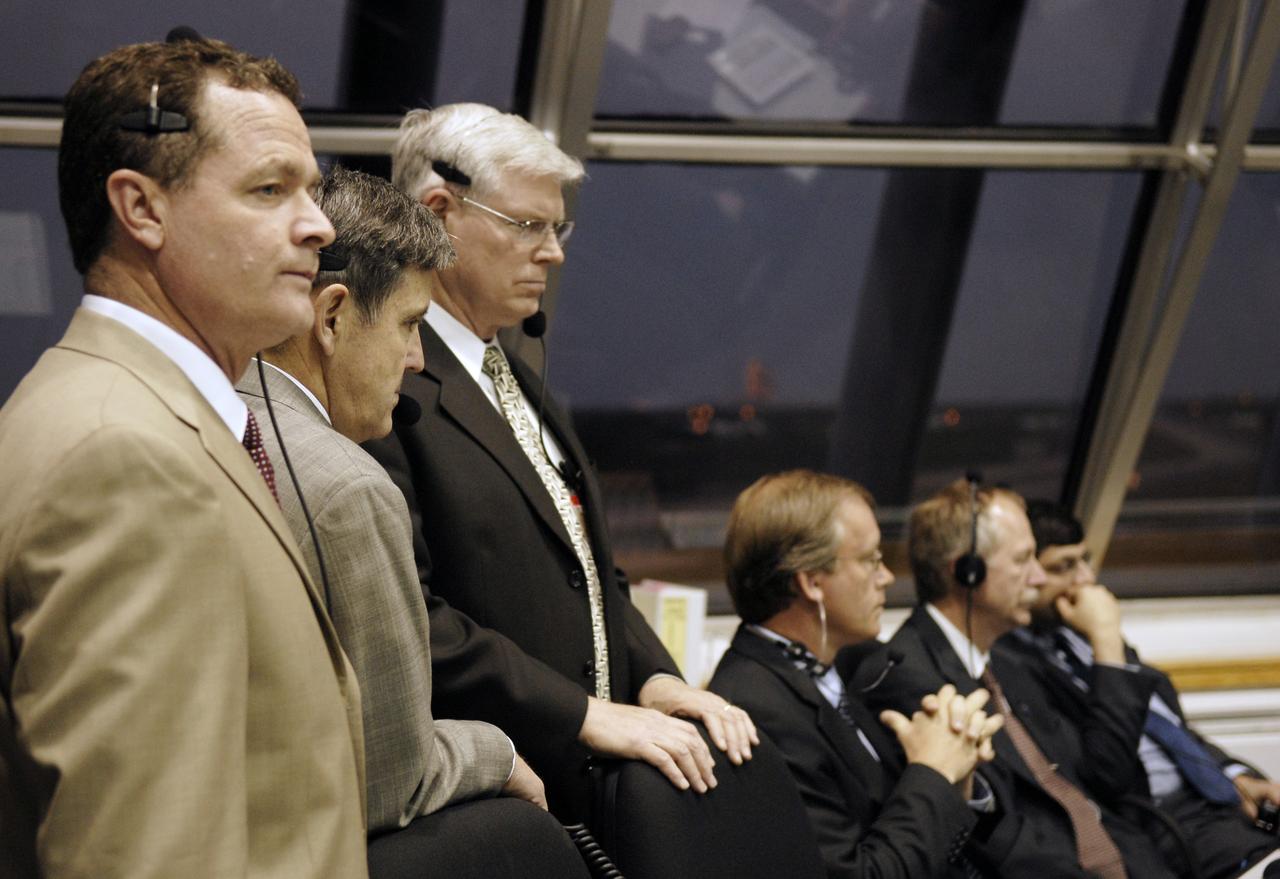
CAPE CANAVERAL, Fla. – In Firing Room 4 of the Launch Control Center at NASA's Kennedy Space Center in Florida, NASA management waits for the launch of space shuttle Discovery on the STS-119 mission. From left are (standing) Director of NASA's Marshall Space Flight Center Dave King, Center Director Bob Cabana, Director of NASA's Johnson Space Center Michael Coats, (seated) Space Shuttle Program Manager John Shannon, NASA Associate Administrator for Space Operations William Gerstenmaier and NASA Acting Administrator Chris Scolese. Launch was on time at 7:43 p.m. EDT. The STS-119 mission is the 28th to the space station and Discovery's 36th flight. Discovery will deliver the final pair of power-generating solar array wings and the S6 truss segment. Installation of S6 will signal the station's readiness to house a six-member crew for conducting increased science. Photo credit: NASA/Kim Shiflett
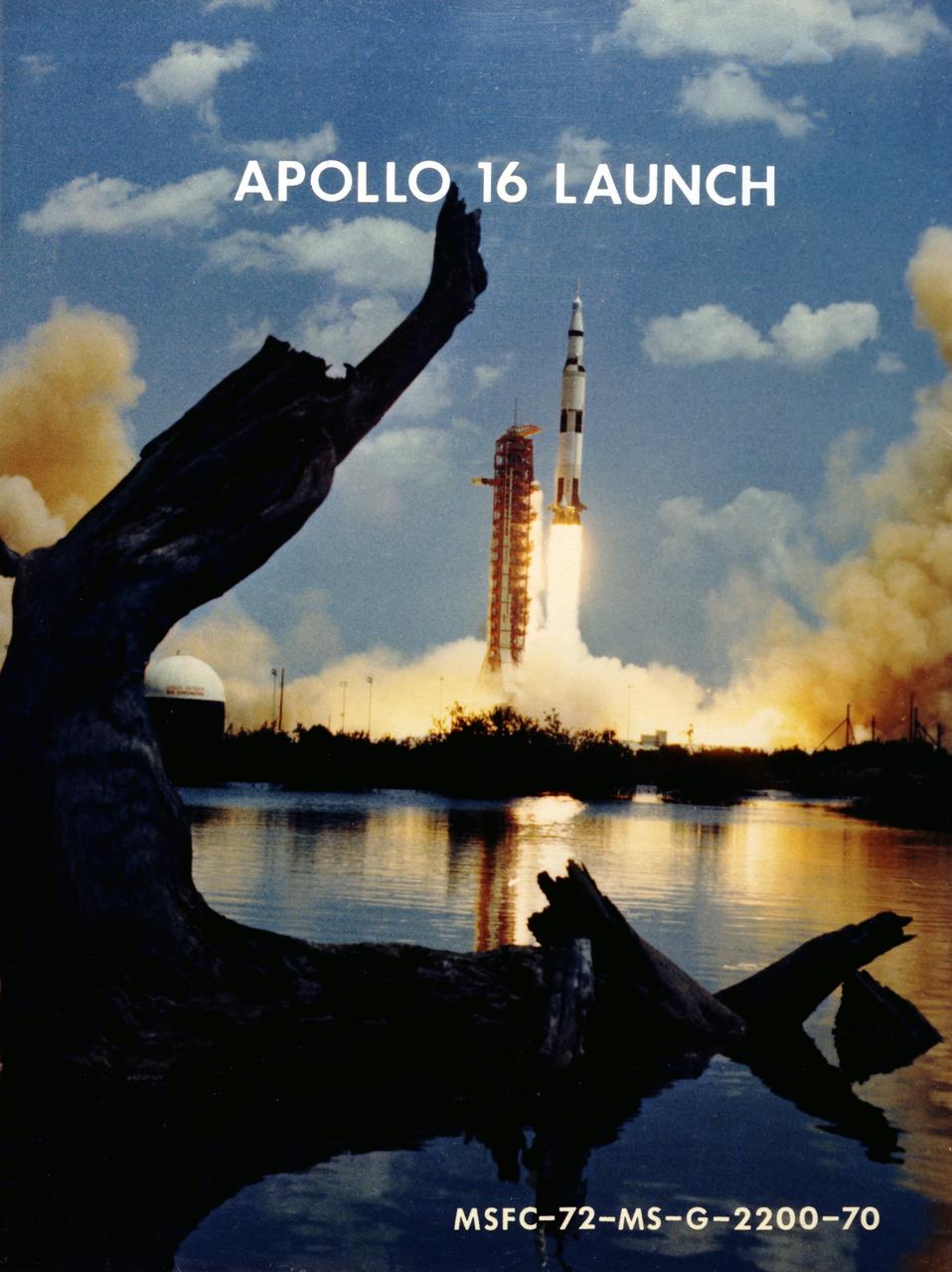
The sixth manned lunar landing mission, the Apollo 16 (SA-511), carrying three astronauts: Mission Commander John W. Young, Command Module pilot Thomas K. Mattingly II, and Lunar Module pilot Charles M. Duke, lifted off on April 16, 1972. The Apollo 16 mission continued the broad-scale geological, geochemical, and geophysical mapping of the Moon’s crust, begun by the Apollo 15, from lunar orbit. This mission marked the first use of the Moon as an astronomical observatory by using the ultraviolet camera/spectrograph which photographed ultraviolet light emitted by Earth and other celestial objects. The Lunar Roving Vehicle, developed by the Marshall Space Flight Center, was also used. The mission ended on April 27, 1972.
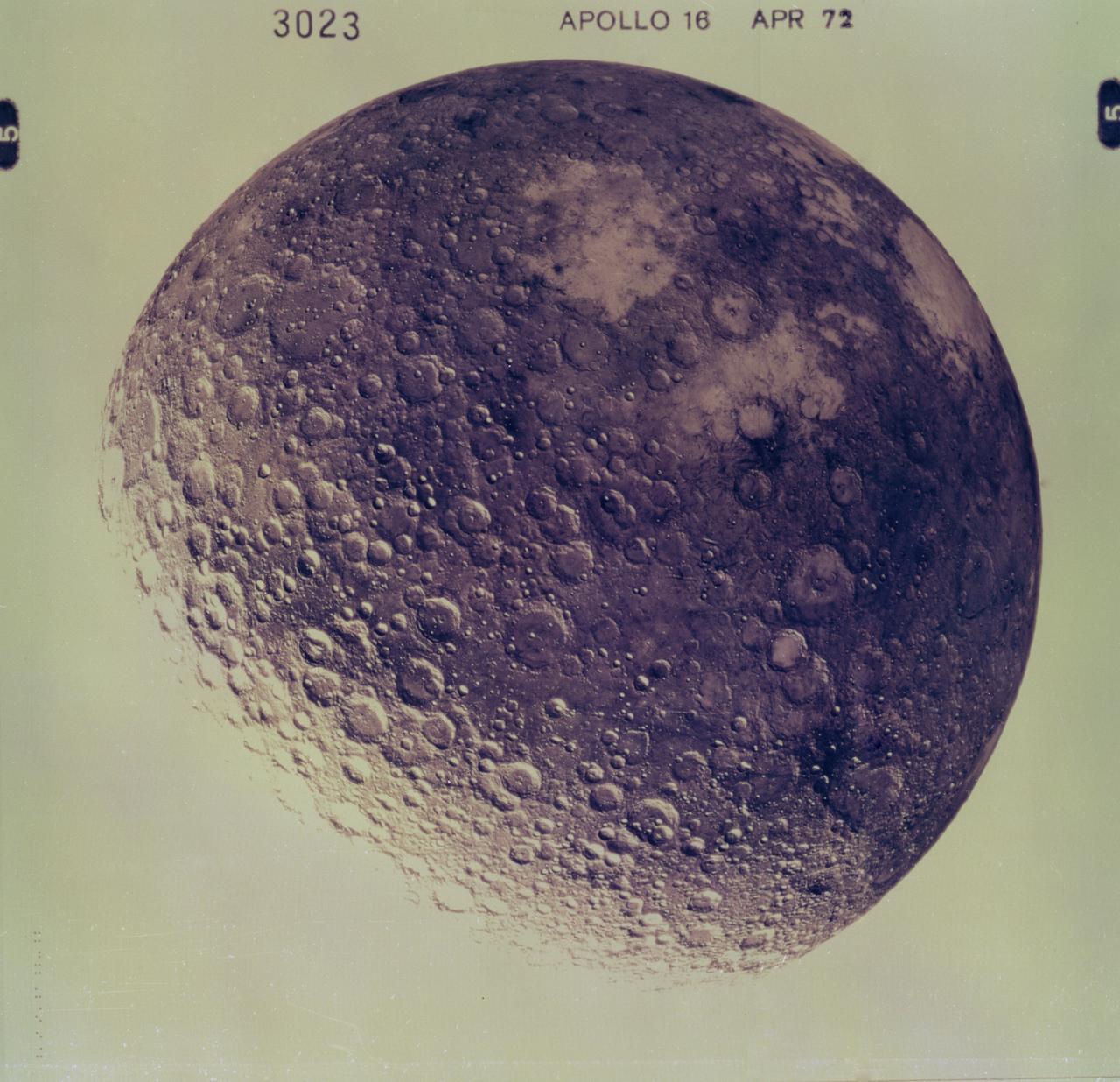
This view of the back side of the Moon was captured by the Apollo 16 mission crew. The sixth manned lunar landing mission, the Apollo 16 (SA-511), carrying three astronauts: Mission Commander John W. Young, Command Module pilot Thomas K. Mattingly II, and Lunar Module pilot Charles M. Duke, lifted off on April 16, 1972. The Apollo 16 continued the broad-scale geological, geochemical, and geophysical mapping of the Moon’s crust, begun by the Apollo 15, from lunar orbit. This mission marked the first use of the Moon as an astronomical observatory by using the ultraviolet camera/spectrograph which photographed ultraviolet light emitted by Earth and other celestial objects. The Lunar Roving Vehicle, developed by the Marshall Space Flight Center, was also used. The mission ended on April 27, 1972.
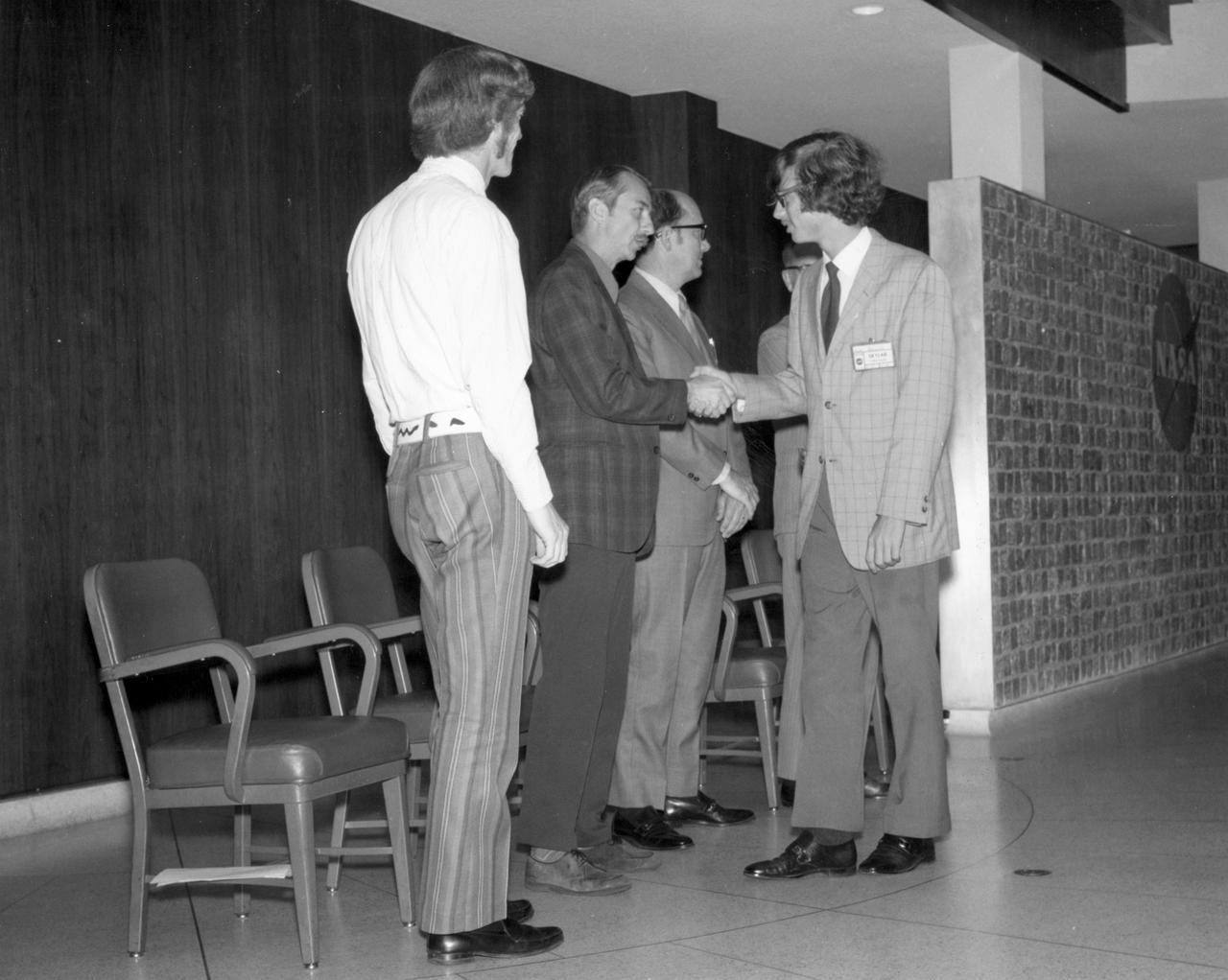
Aiea, Hawaii high school student, John C. Hamilton, is greeted by (left to right): Astronauts Russell L. Schweickart, and Owen K. Garriott; Marshall Space Flight Center (MSFC) Skylab Program Manager, Leland Belew; and MSFC Director of Administration and Technical Services, David Newby, during a tour of MSFC. Hamilton was among 25 winners of a contest in which some 3,500 high school students proposed experiments for the following year’s Skylab mission. The nationwide scientific competition was sponsored by the National Science Teachers Association and the National Aeronautics and Space Administration (NASA). The winning students, along with their parents and sponsor teachers, visited MSFC where they met with scientists and engineers, participated in design reviews for their experiments, and toured MSFC facilities. Of the 25 students, 6 did not see their experiments conducted on Skylab because the experiments were not compatible with Skylab hardware and timelines. Of the 19 remaining, 11 experiments required the manufacture of additional equipment.
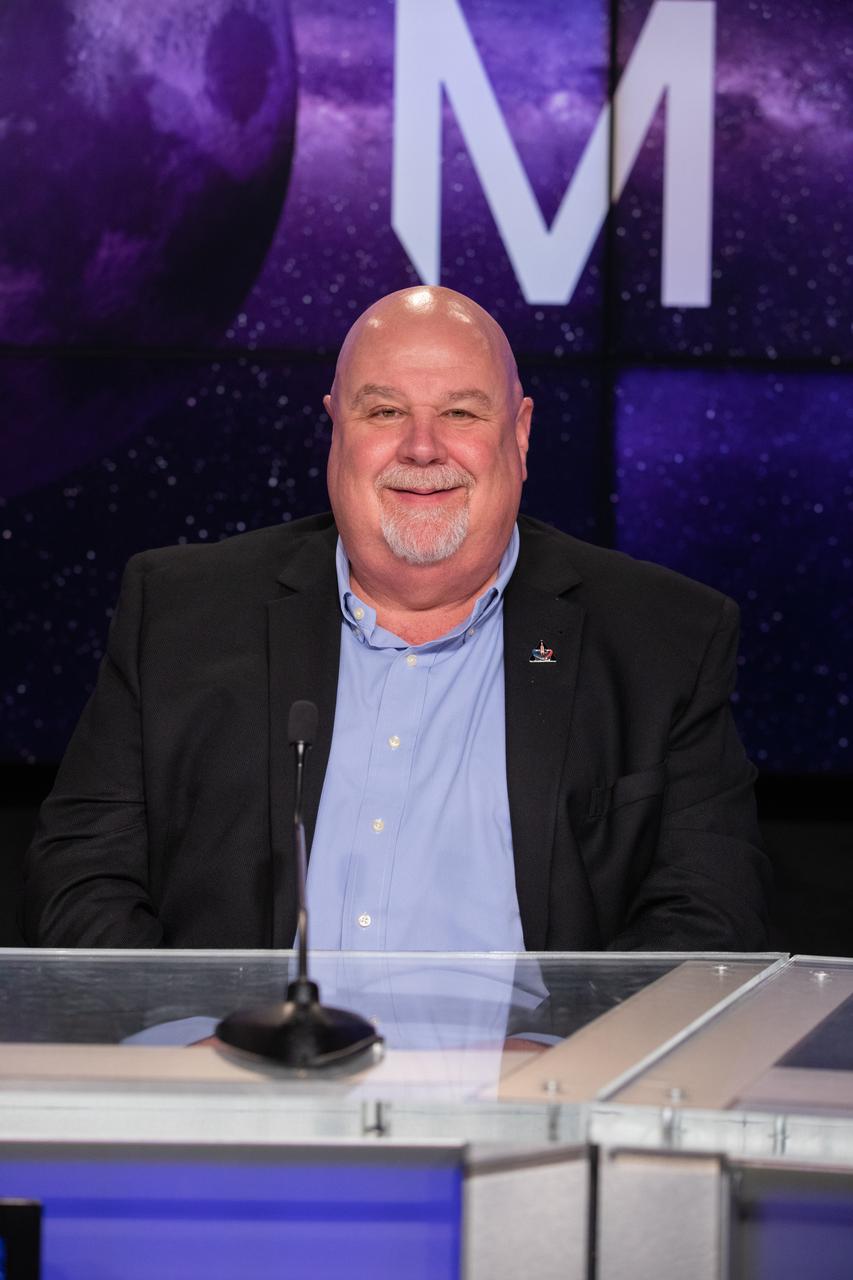
John Honeycutt, Space Launch System Program manager, Marshall Space Flight Center, participates in a postlaunch news conference on Nov. 16, 2022, at NASA’s Kennedy Space Center in Florida, after launch of Artemis I at 1:47 a.m. EST from Kennedy’s Launch Complex 39B. The first in a series of increasingly complex missions, Artemis I will provide a foundation for human deep space exploration and demonstrate our commitment and capability to extend human presence to the Moon and beyond. The primary goal of Artemis I is to thoroughly test the integrated systems before crewed missions by operating the spacecraft in a deep space environment, testing Orion’s heat shield, and recovering the crew module after reentry, descent, and splashdown
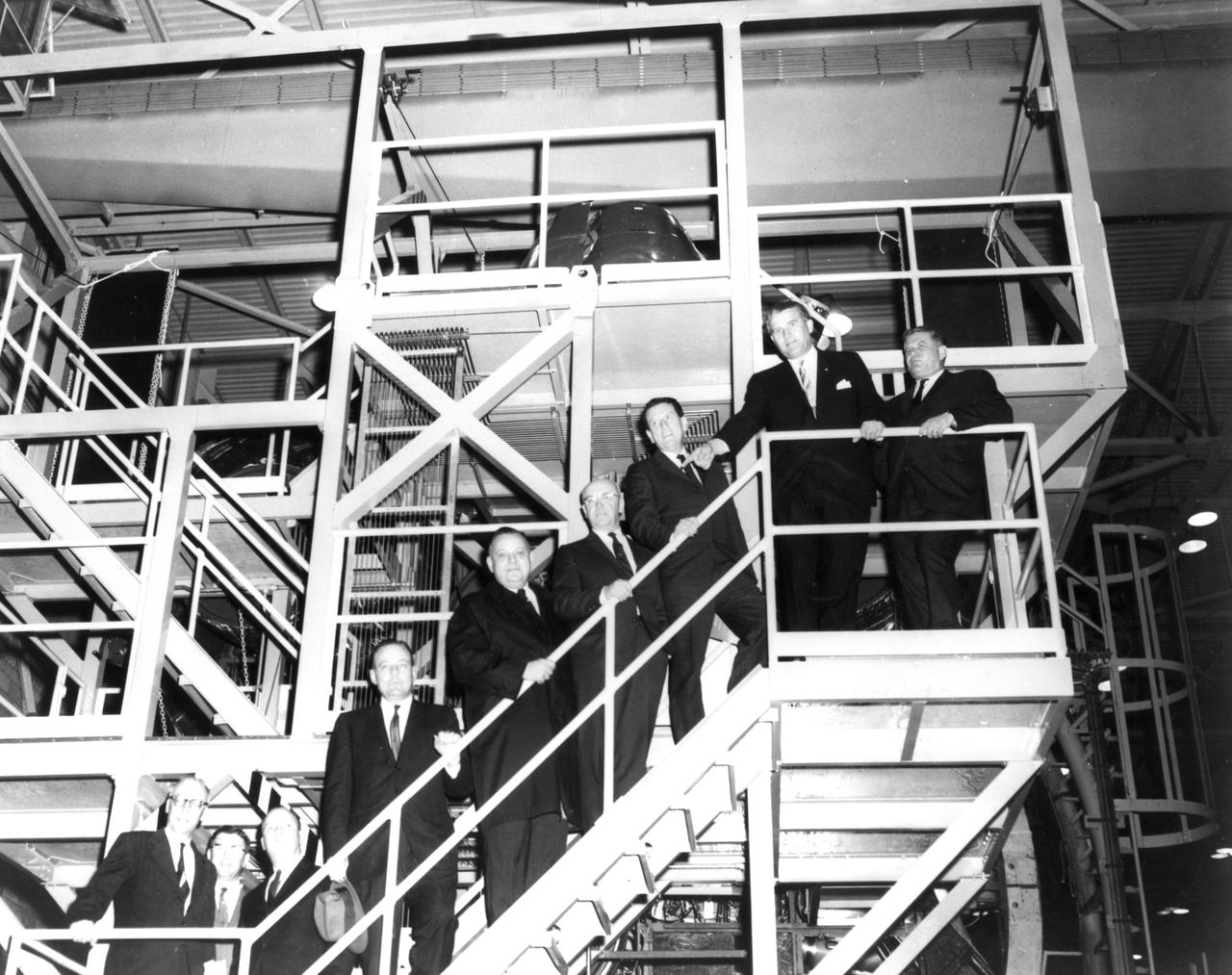
The members of the House Committee on Science and Astronautics visited the Marshall Space Flight Center (MSFC) on March 9, 1962 to gather firsthand information of the nation’s space exploration program. The congressional group was composed of members of the Subcommittee on Manned Space Flight. Pictured from left-to-right are Congressman Ken Hechler, Democratic representative of West Virginia; Dieter Grau, MSFC; Congressman John W. Davis, Democratic representative of Georgia; Congressman Joe Waggoner, Democratic representative of Louisiana; Congressman Richard L. Roudebush, Republican representative of Indiana; Congressman R. Walter Riehlman, Republican representative of New York; Congressman James G. Fulton, Republican representative of Pennsylvania; Dr. Wernher von Braun, MSFC; and Congressman Olin E. Teague, Democratic representative of Texas.
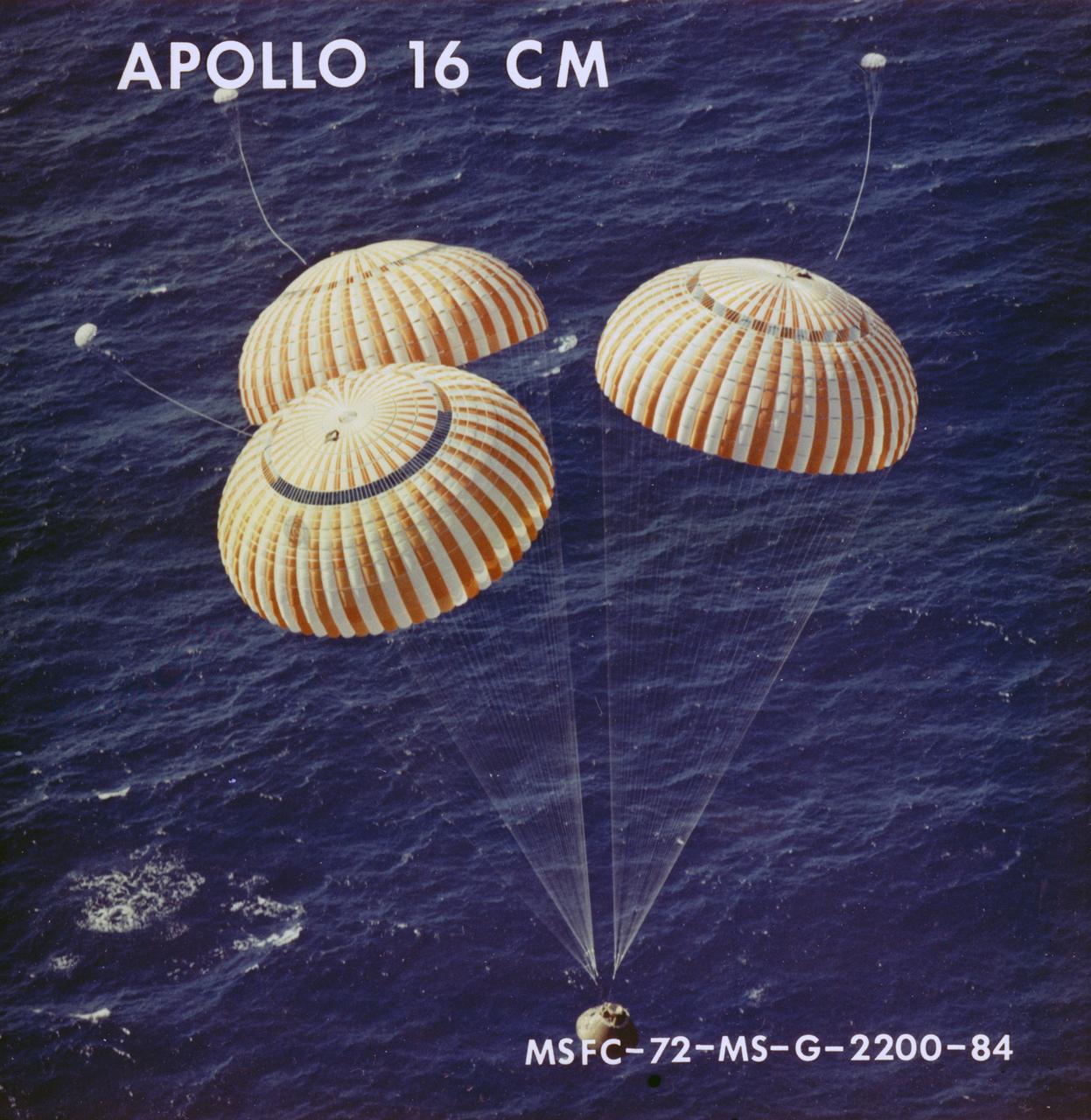
The Apollo 16 Command Module splashed down in the Pacific Ocean on April 27, 1972 after an 11-day moon exploration mission. The sixth manned lunar landing mission, the Apollo 16 (SA-511), carrying three astronauts: Mission Commander John W. Young, Command Module pilot Thomas K. Mattingly II, and Lunar Module pilot Charles M. Duke, lifted off on April 16, 1972. The Apollo 16 continued the broad-scale geological, geochemical, and geophysical mapping of the Moon’s crust, begun by the Apollo 15, from lunar orbit. This mission marked the first use of the Moon as an astronomical observatory by using the ultraviolet camera/spectrograph which photographed ultraviolet light emitted by Earth and other celestial objects. The Lunar Roving Vehicle, developed by the Marshall Space Flight Center, was also used.
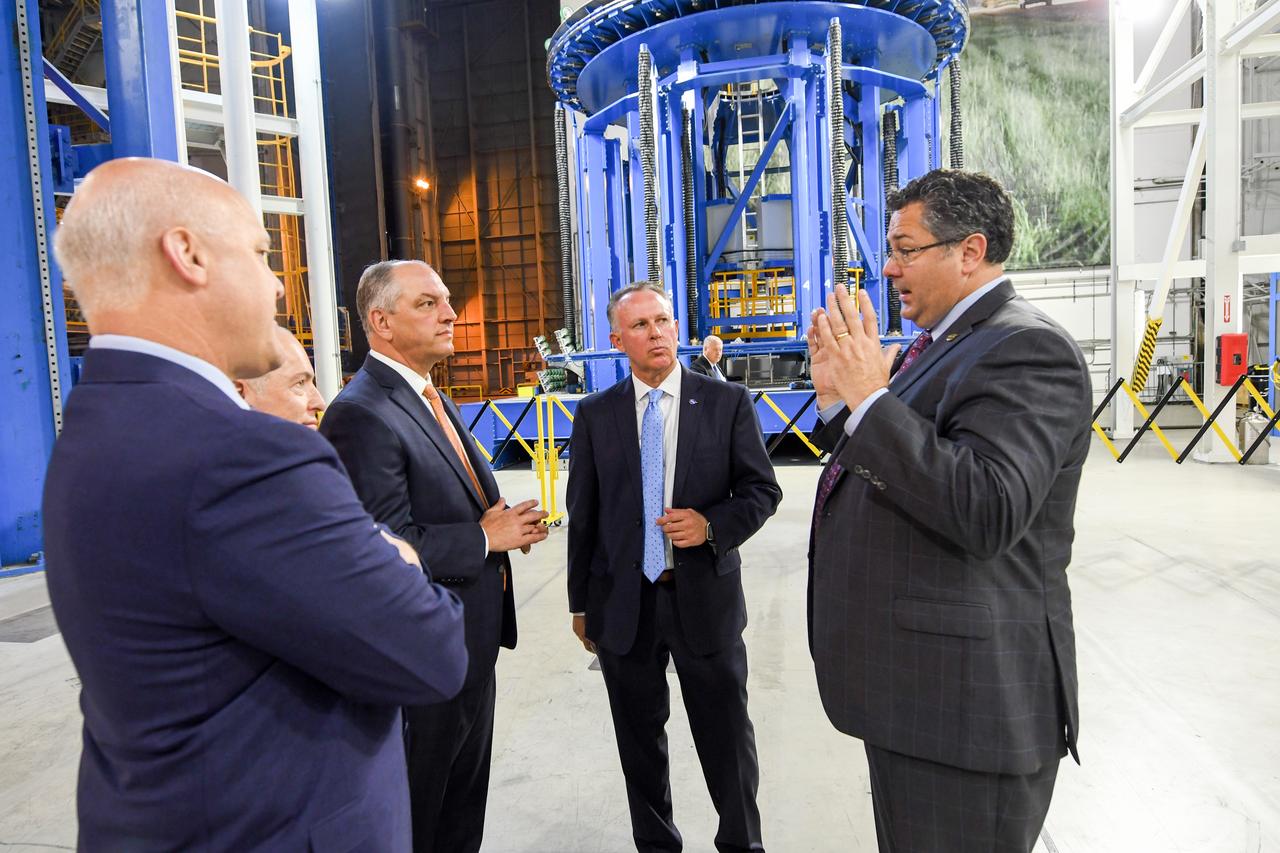
NASA officials were joined by Louisiana Gov. John Bel Edwards and New Orleans Mayor Mitch Landrieu, who toured the Michoud Assembly Facility in New Orleans and got a first-hand look at NASA’s new deep space vehicles being built at the facility.
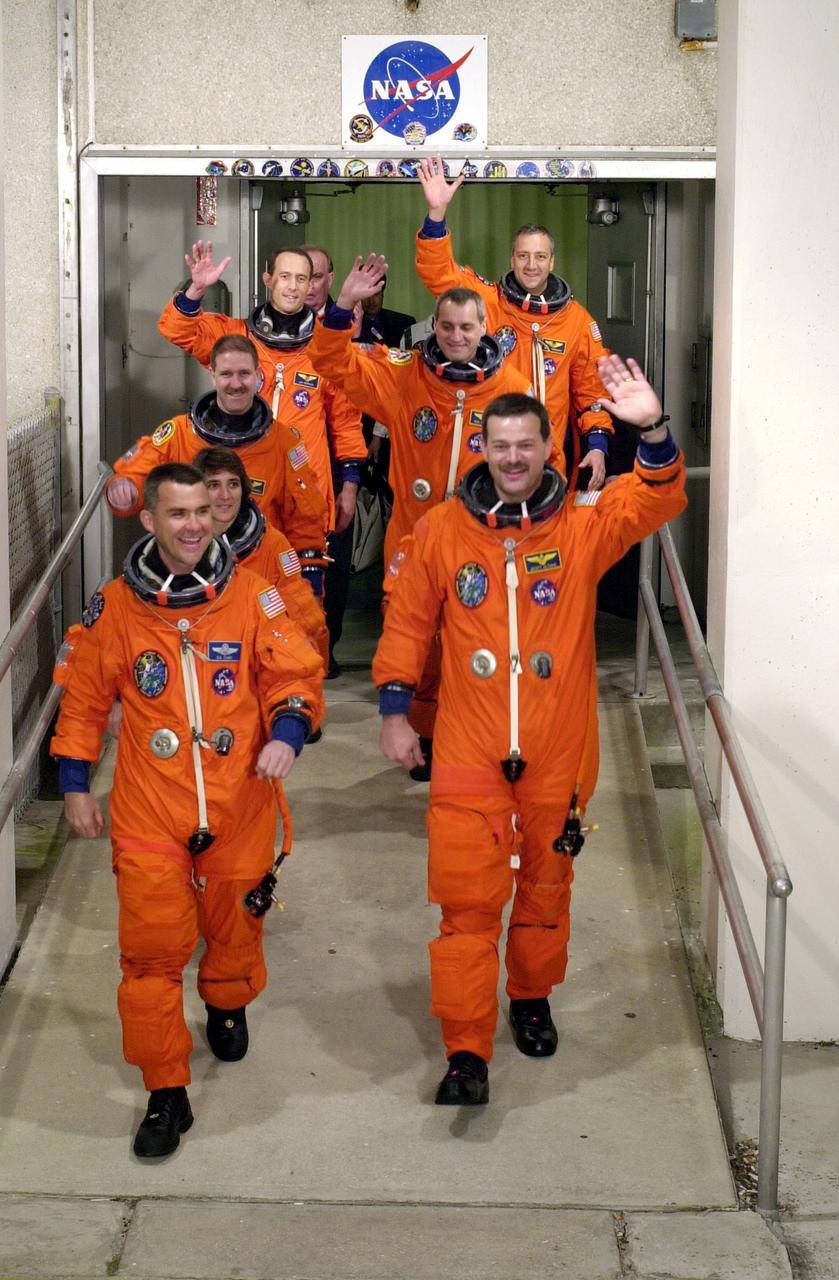
The STS-109 crew of seven waved to onlookers as they emerged from the Operations and Checkout Buildings at Kennedy Space Flight Center eager to get to the launch pad to embark upon the Space Shuttle Orbiter Columbia's 27th flight into space. Crew members included, from front to back, Duane G. Carey (left) and Scott D. Altman (right); Nancy J. Currie, mission specialist; John M. Grunsfield (left), payload commander, and Richard M. Linneham (right); James H. Newman (left) and Michael J. Massimino (right), all mission specialists. Launched March 1, 2002, the goal of the mission was the maintenance and upgrade of the Hubble Space Telescope (HST). The Marshall Space Flight Center had the responsibility for the design, development, and construction of the HST, which is the most complex and sensitive optical telescope ever made, to study the cosmos from a low-Earth orbit. By using Columbia's robotic arm, the telescope was captured and secured on a work stand in Columbia's payload bay where four members of the crew performed five spacewalks to complete system upgrades to the HST. Lasting 10 days, 22 hours, and 11 minutes, the STS-109 mission was the 108th flight overall in NASA's Space Shuttle Program.
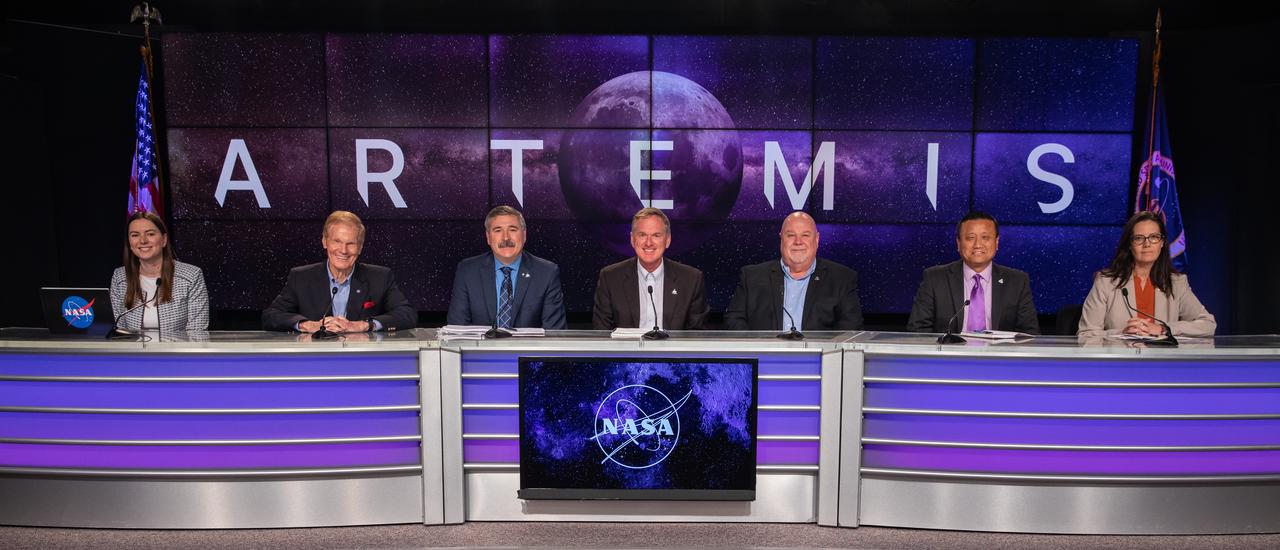
A postlaunch news conference is held on Nov. 16, 2022, at NASA’s Kennedy Space Center in Florida, after launch of Artemis I at 1:47 a.m. EST from Kennedy’s Launch Complex 39B. Participants are, from left, Jackie McGuiness, NASA Communications; Bill Nelson, NASA administrator; Mike Sarafin, Artemis mission manager, NASA Headquarters; Mike Bolger, Exploration Ground Systems Program manager, Kennedy; John Honeycutt, Space Launch System Program manager, Marshall; Howard Hu, Orion Program manager, NASA’s Johnson Space Center; and Emily Nelson, chief flight director, Johnson. The first in a series of increasingly complex missions, Artemis I will provide a foundation for human deep space exploration and demonstrate our commitment and capability to extend human presence to the Moon and beyond. The primary goal of Artemis I is to thoroughly test the integrated systems before crewed missions by operating the spacecraft in a deep space environment, testing Orion’s heat shield, and recovering the crew module after reentry, descent, and splashdown.
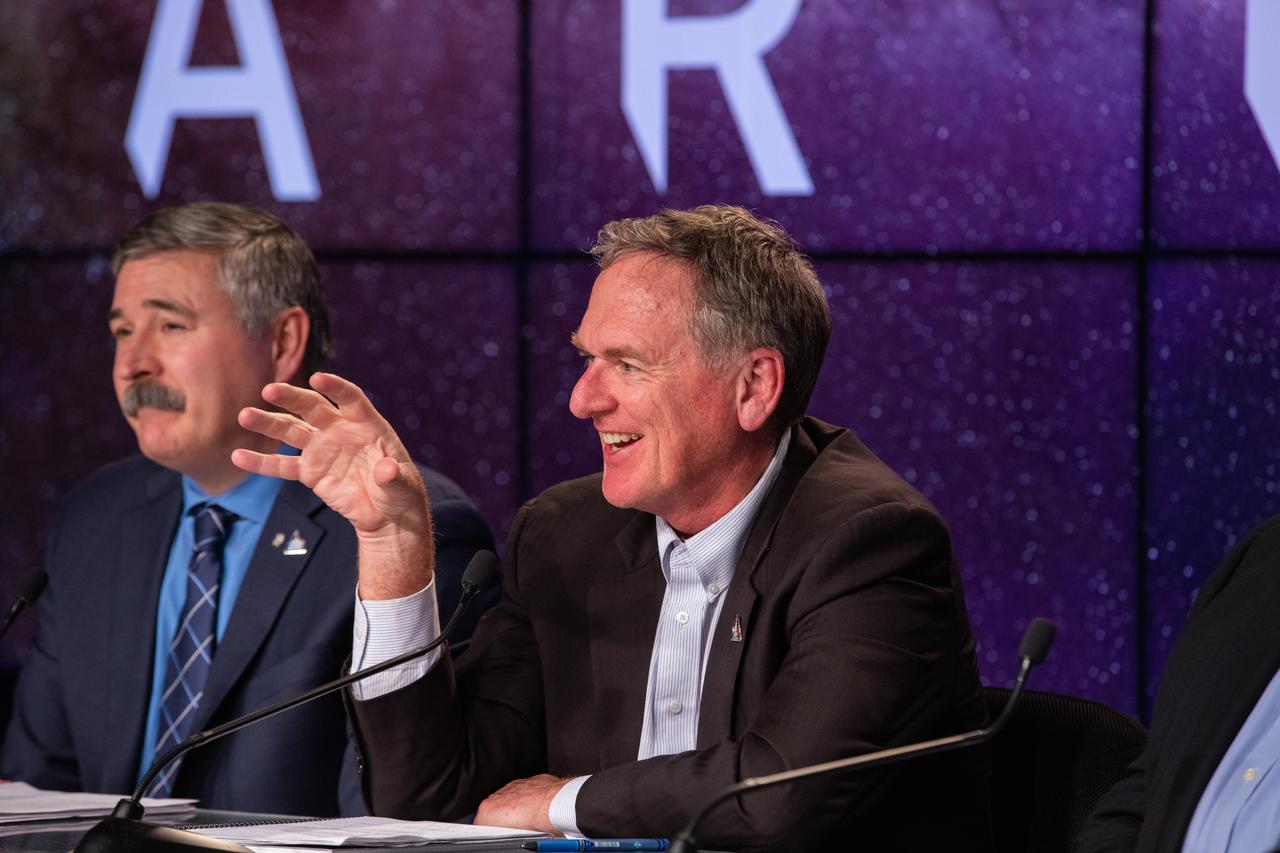
A postlaunch news conference is held on Nov. 16, 2022, at NASA’s Kennedy Space Center in Florida, after launch of Artemis I at 1:47 a.m. EST from Kennedy’s Launch Complex 39B. Participants were, from left, Mike Sarafin, Artemis mission manager, NASA Headquarters; and Mike Bolger, Exploration Ground Systems Program manager, Kennedy. Also participating were NASA Administrator Bill Nelson; John Honeycutt, Space Launch System Program manager, Marshall; Howard Hu, Orion Program manager, NASA’s Johnson Space Center; and Emily Nelson, chief flight director, Johnson. The first in a series of increasingly complex missions, Artemis I will provide a foundation for human deep space exploration and demonstrate our commitment and capability to extend human presence to the Moon and beyond. The primary goal of Artemis I is to thoroughly test the integrated systems before crewed missions by operating the spacecraft in a deep space environment, testing Orion’s heat shield, and recovering the crew module after reentry, descent, and splashdown.
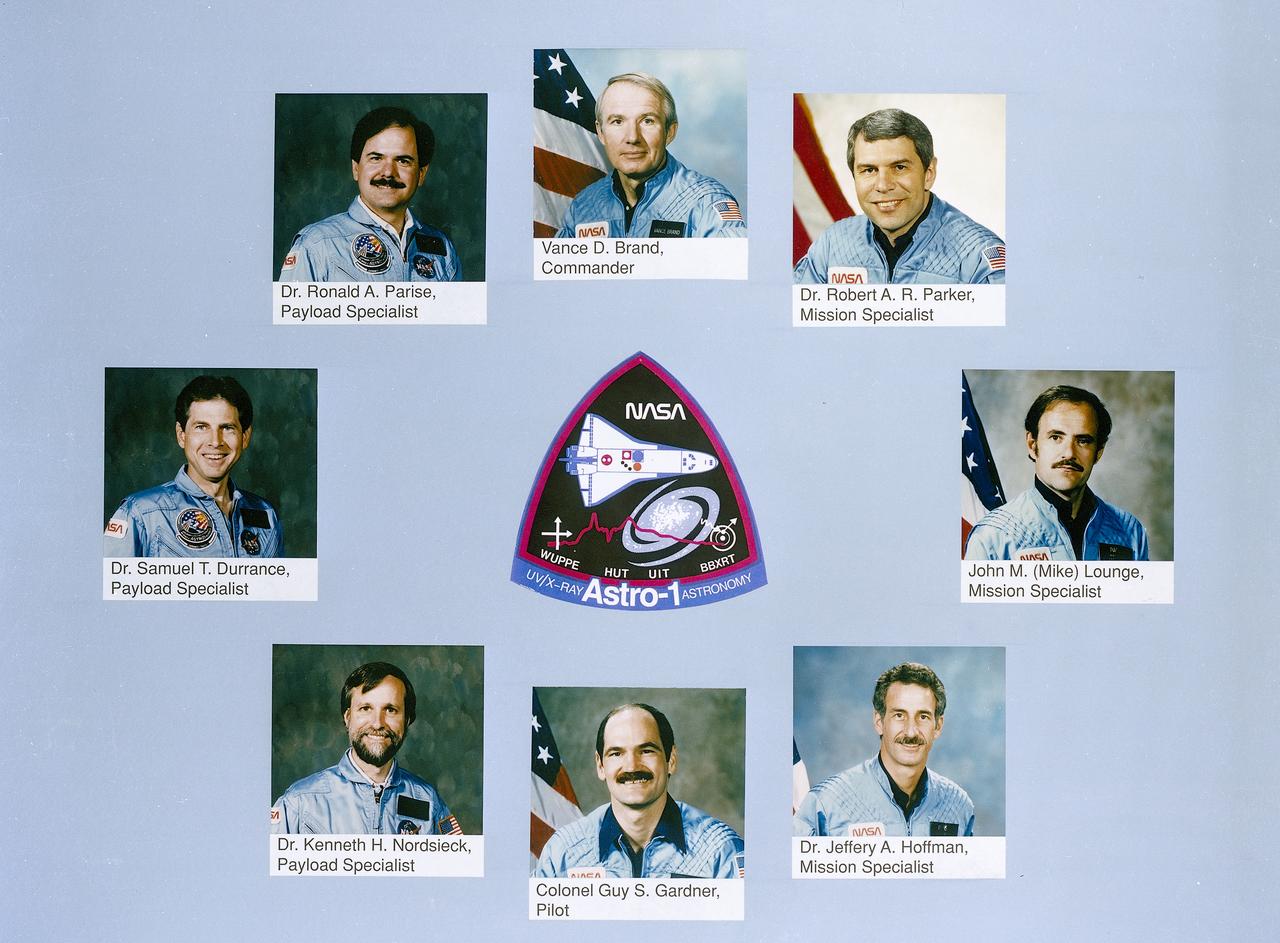
This montage consists of 8 individual STS-35 crew member portraits surrounding the mission’s insignia. Starting from top center, clockwise, are Vance D. Brand, commander; mission specialists Dr. Robert A. R. Parker, John M. (Mike) Lounge, and Dr. Jeffery A. Hoffman; Colonel Guy S. Gardner, pilot; and payload specialists Dr. Kenneth H. Nordsieck, Dr. Samual T. Durrance, and Dr. Ronald A. Parise. The crew of 8 launched aboard the Space Shuttle Orbiter Columbia on December 2, 1990 at 1:19:01am (EST). The primary objective of the mission was round the clock observation of the celestial sphere in ultrviolet and X-Ray astronomy with the Astro-1 observatory which consisted of four telescopes: the Hopkins Ultraviolet Telescope (HUT); the Wisconsin Ultraviolet Photo-Polarimeter Experiment (WUPPE); the Ultraviolet Imaging Telescope (UIT); and the Broad Band X-Ray Telescope (BBXRT). Due to loss of data used for pointing and operating the ultraviolet telescopes, Marshall Space Flight Center ground teams were forced to aim the telescopes with fine tuning by the flight crew.
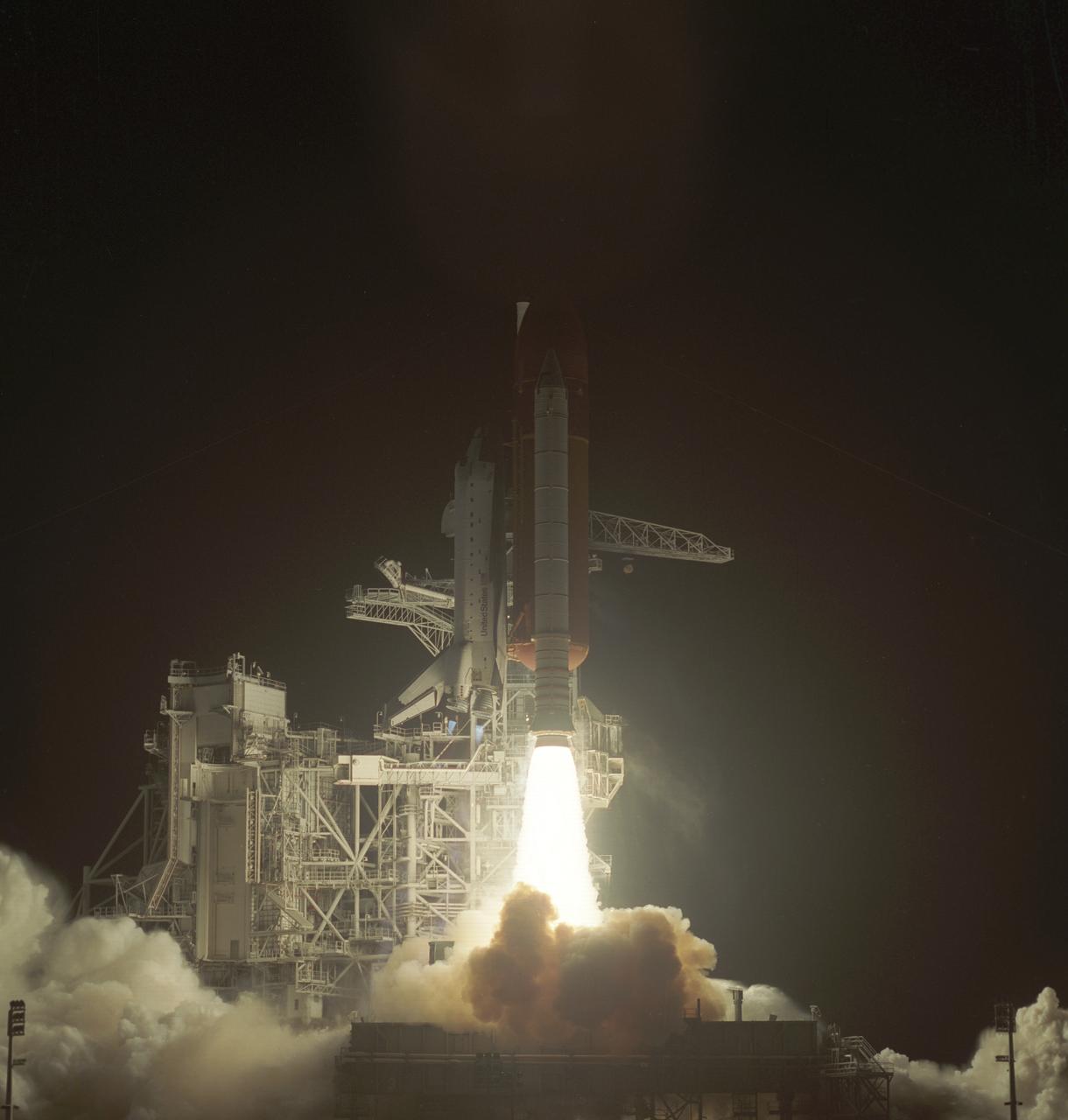
STS-35 lifted off December 2, 1990, at 1:19 am EST, aboard the Space Shuttle Orbiter Columbia. Her crew of eight included: Vance D. Brand, commander; Colonel Guy S. Gardner, pilot; mission specialists Dr. Robert A. R. Parker, John M. (Mike) Lounge, and Dr. Jeffery A. Hoffman; and payload specialists Dr. Kenneth H. Nordsieck, Dr. Samual T. Durrance, and Dr. Ronald A. Parise. The primary objective of the mission was round the clock observation of the celestial sphere in ultraviolet and X-Ray astronomy with the Astro-1 Observatory which consisted of four telescopes: the Hopkins Ultraviolet Telescope (HUT); the Wisconsin Ultraviolet Photo-Polarimeter Experiment (WUPPE); the Ultraviolet Imaging Telescope (UIT); and the Broad Band X-Ray Telescope (BBXRT). Due to loss of data used for pointing and operating the ultraviolet telescopes, Marshall Space Flight Center ground teams were forced to aim the telescopes with fine tuning by the flight crew.
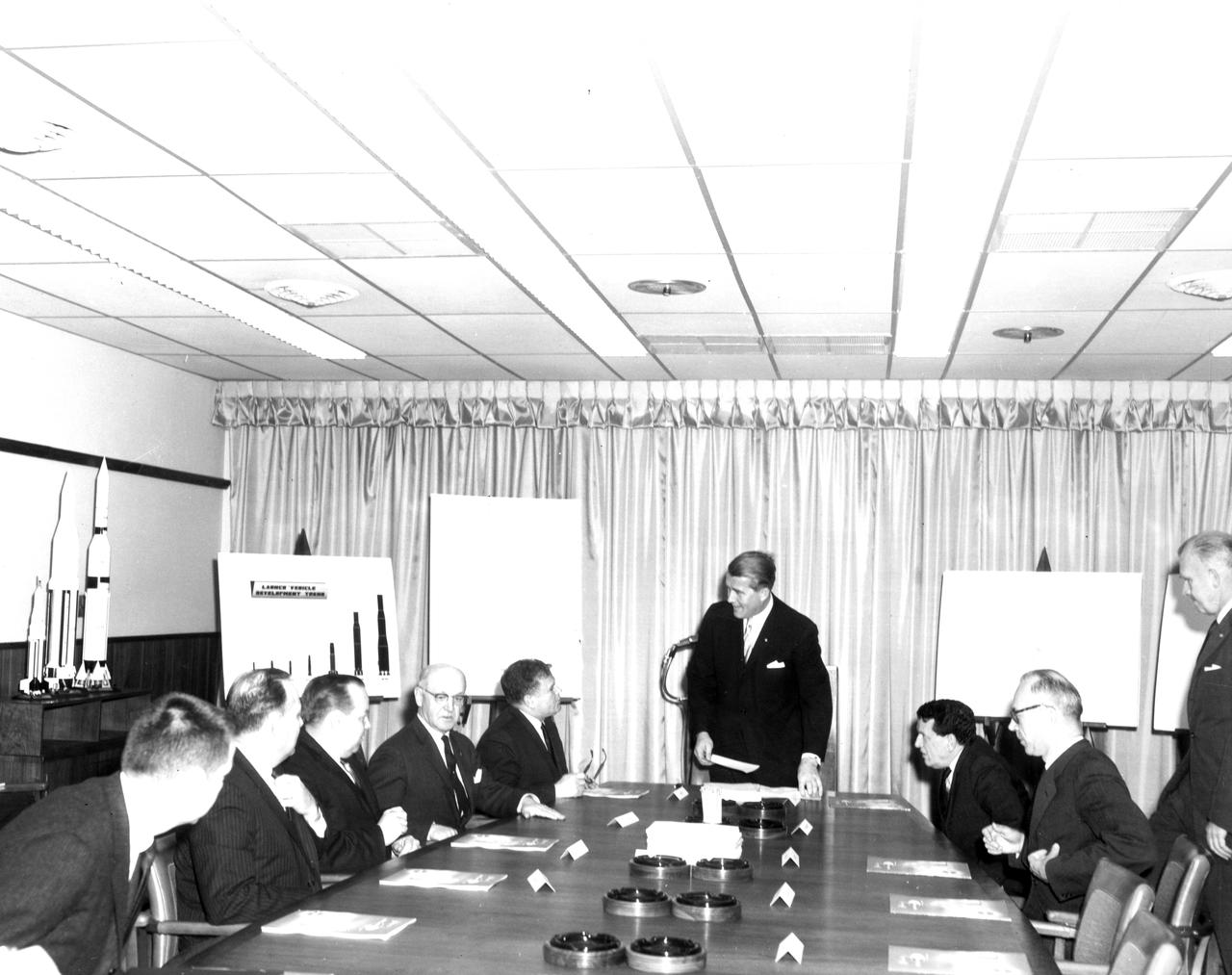
The members of the House Committee on Science and Astronautics visited the Marshall Space Flight Center (MSFC) on March 9, 1962 to gather firsthand information of the nation’s space exploration program. The congressional group was composed of members of the Subcommittee on Manned Space Flight. The subcommittee was briefed on MSFC’s manned space efforts earlier in the day and then inspected mockups of the Saturn I Workshop and the Apollo Telescope Mount, two projects developed by MSFC for the post-Apollo program. In this photograph, MSFC Director, Dr. Wernher von Braun meets with Congressmen in the MSFC boardroom. Pictured from left to right are: Jack Cramer, NASA Headquarters; Joe Waggoner, Democratic representative of Louisiana; John W. Davis, Democratic representative of Georgia; R. Walter Riehlman, Republican representative of New York; Olin E. Teague, Democratic representative of Texas; Dr. Wernher von Braun, Director of MSFC; James G. Fulton, Republican representative of Pennsylvania; Ken Hechler, Democratic representative of West Virginia; and Erich Neubert of MSFC.
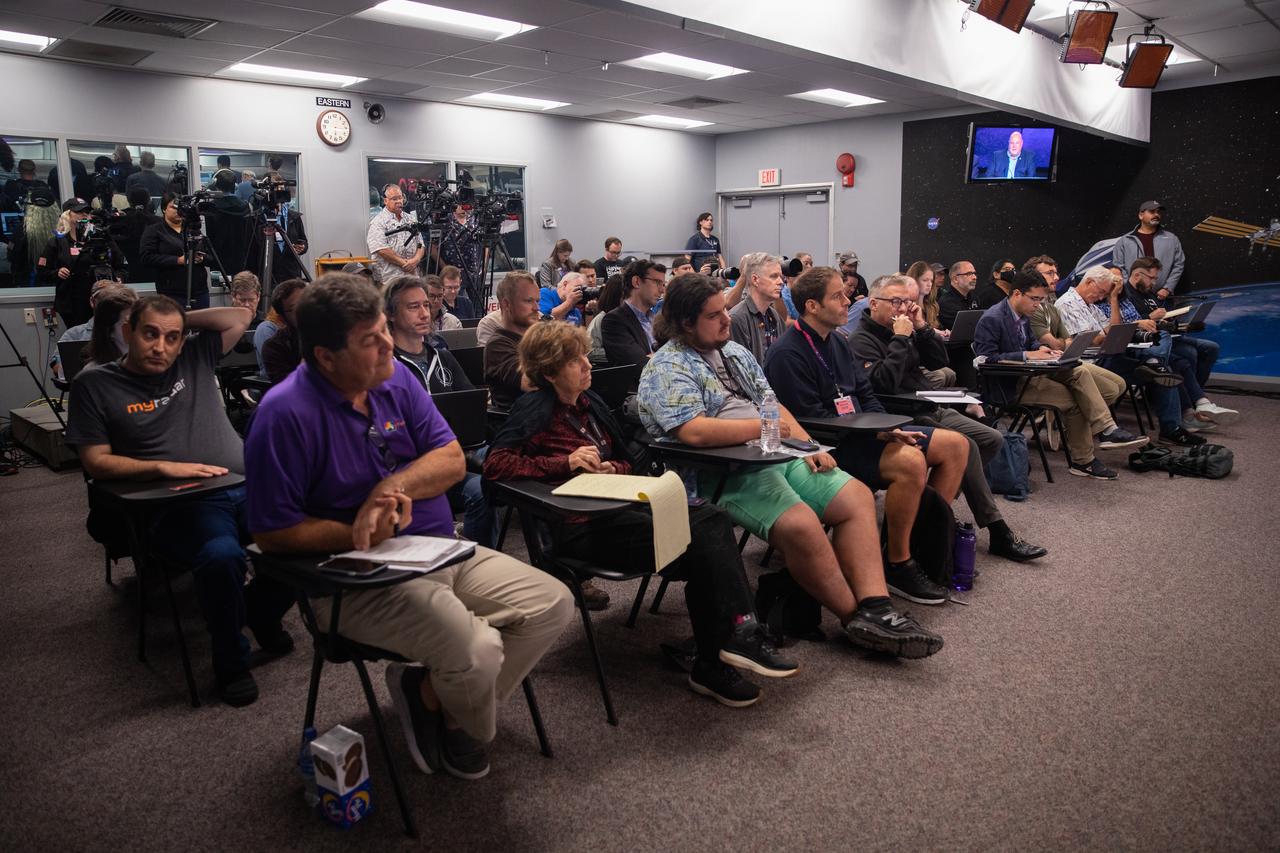
Members of the media attend a postlaunch news conference on Nov. 16, 2022, at NASA’s Kennedy Space Center in Florida, after launch of Artemis I at 1:47 a.m. EST from Kennedy’s Launch Complex 39B. Participants were Jackie McGuiness, NASA Communications; Bill Nelson, NASA administrator; Mike Sarafin, Artemis mission manager, NASA Headquarters; Mike Bolger, Exploration Ground Systems Program manager, Kennedy; John Honeycutt, Space Launch System Program manager, Marshall; Howard Hu, Orion Program manager, NASA’s Johnson Space Center; and Emily Nelson, chief flight director, Johnson. The first in a series of increasingly complex missions, Artemis I will provide a foundation for human deep space exploration and demonstrate our commitment and capability to extend human presence to the Moon and beyond. The primary goal of Artemis I is to thoroughly test the integrated systems before crewed missions by operating the spacecraft in a deep space environment, testing Orion’s heat shield, and recovering the crew module after reentry, descent, and splashdown.
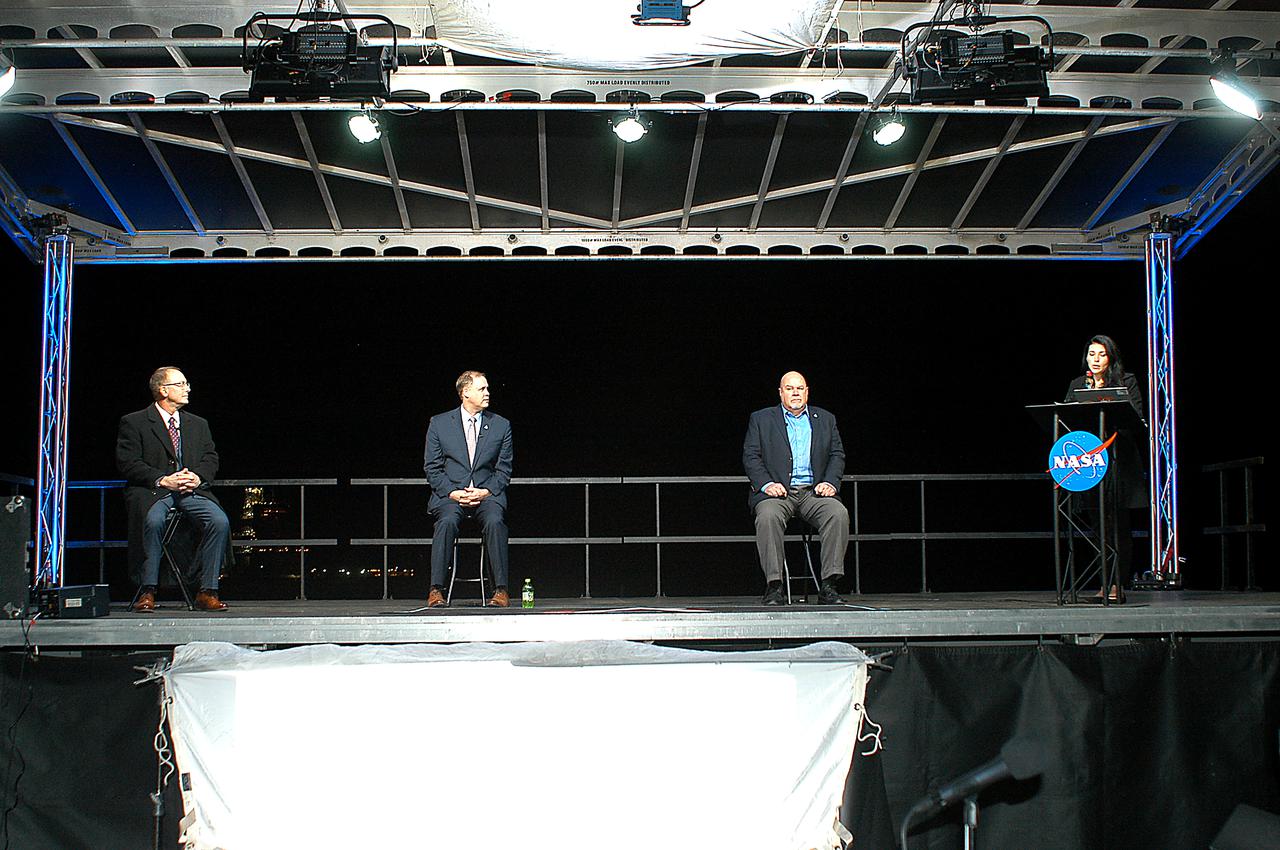
Outgoing NASA Associate Administrator for Communications Bettina Inclan (far right) hosts a press conference following the Green Run hot fire test of the core stage for NASA’s Space Launch System (SLS) rocket on Saturday, January 16, 2021. Seated press conference participants included outgoing NASA Administrator Jim Bridenstine (center), Stennis Space Center Director Rick Gilbrech (left) and SLS Program Manager John Honeycutt from Marshall Space Flight Center. NASA conducted a hot fire test of the core stage’s four RS-25 engines on the B-2 Test Stand at Stennis Space Center near Bay St. Louis, Mississippi. Scheduled for as long as eight minutes, the engines fired for a little more than one minute to generate a combined 1.6 million pounds of thrust, just as will occur during an actual launch. The hot fire is the final test of the Green Run test series, a comprehensive assessment of the SLS core stage prior to launching the Artemis I mission to the Moon.
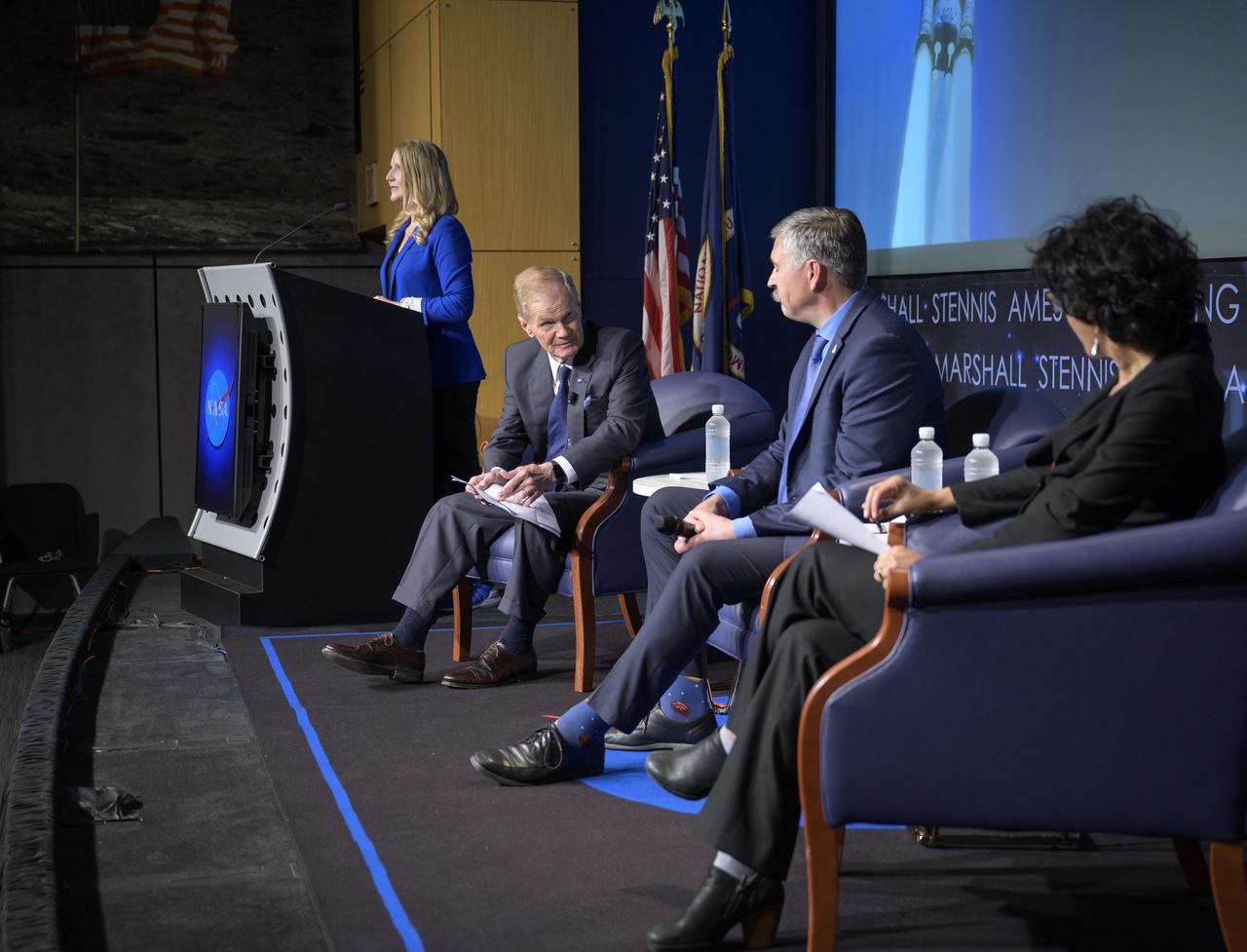
Stephanie Schierholz, a press secretary at NASA Headquarters, left, moderates a NASA briefing on the Artemis I Moon mission, with NASA Administrator Bill Nelson, Mike Sarafin, Artemis I mission manager at NASA Headquarters, and Bhavya Lal, associate administrator for technology, policy, and strategy at NASA Headquarters, right, Wednesday, Aug. 3, 2022, at the Mary W. Jackson NASA Headquarters building in Washington. Also participating remotely were Charlie Blackwell-Thompson, Artemis I launch director at NASA's Kennedy Space Center, John Honeycutt, Space Launch System (SLS) program manager at NASA's Marshall Space Flight Center, and Howard Hu, Orion program manager at NASA's Johnson Space Center. NASA’s Artemis I mission is the first integrated test of the agency’s deep space exploration systems: the Orion spacecraft, Space Launch System rocket, and supporting ground systems. Launch of the uncrewed flight test is targeted for no earlier than Monday, Aug. 29. Photo Credit: (NASA/Bill Ingalls)
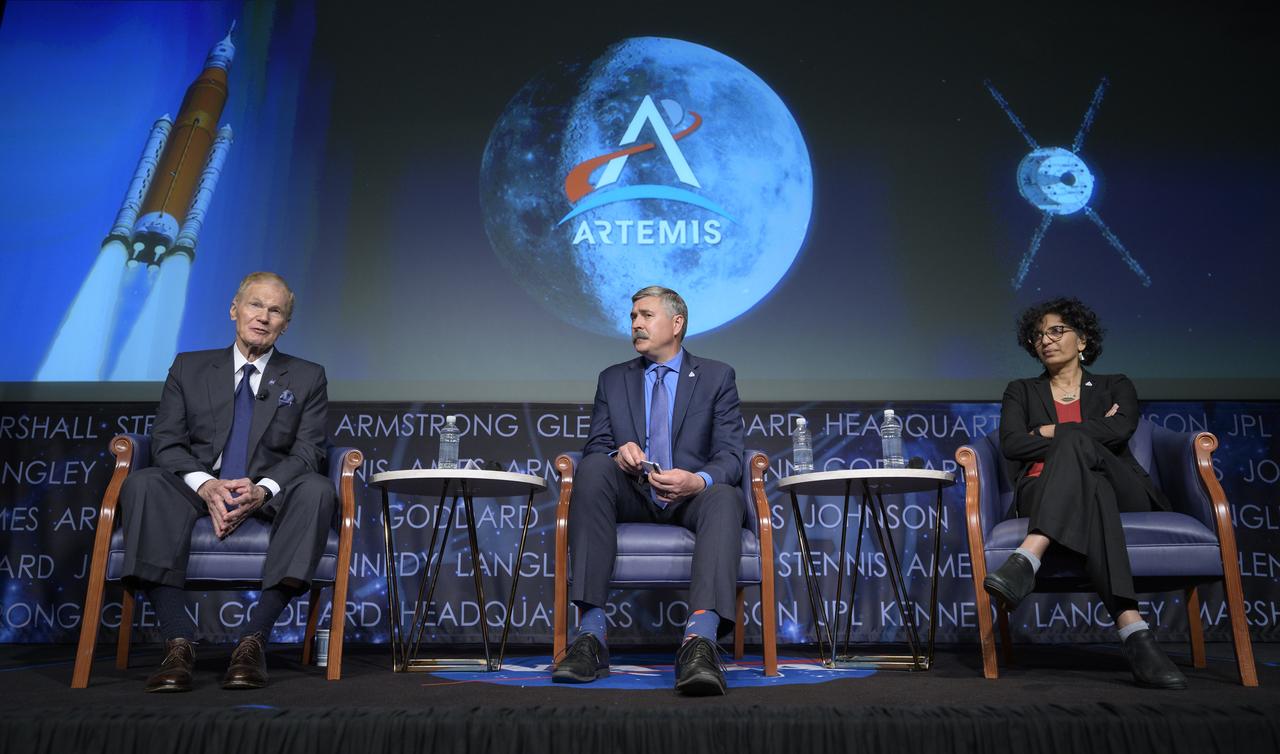
NASA Administrator Bill Nelson, left, Mike Sarafin, Artemis I mission manager at NASA Headquarters, and Bhavya Lal, associate administrator for technology, policy, and strategy at NASA Headquarters, right, are seen during a NASA briefing on the Artemis I Moon mission, Wednesday, Aug. 3, 2022, at the Mary W. Jackson NASA Headquarters building in Washington. Also participating remotely were Charlie Blackwell-Thompson, Artemis I launch director at NASA's Kennedy Space Center, John Honeycutt, Space Launch System (SLS) program manager at NASA's Marshall Space Flight Center, and Howard Hu, Orion program manager at NASA's Johnson Space Center. NASA’s Artemis I mission is the first integrated test of the agency’s deep space exploration systems: the Orion spacecraft, Space Launch System rocket, and supporting ground systems. Launch of the uncrewed flight test is targeted for no earlier than Monday, Aug. 29. Photo Credit: (NASA/Bill Ingalls)
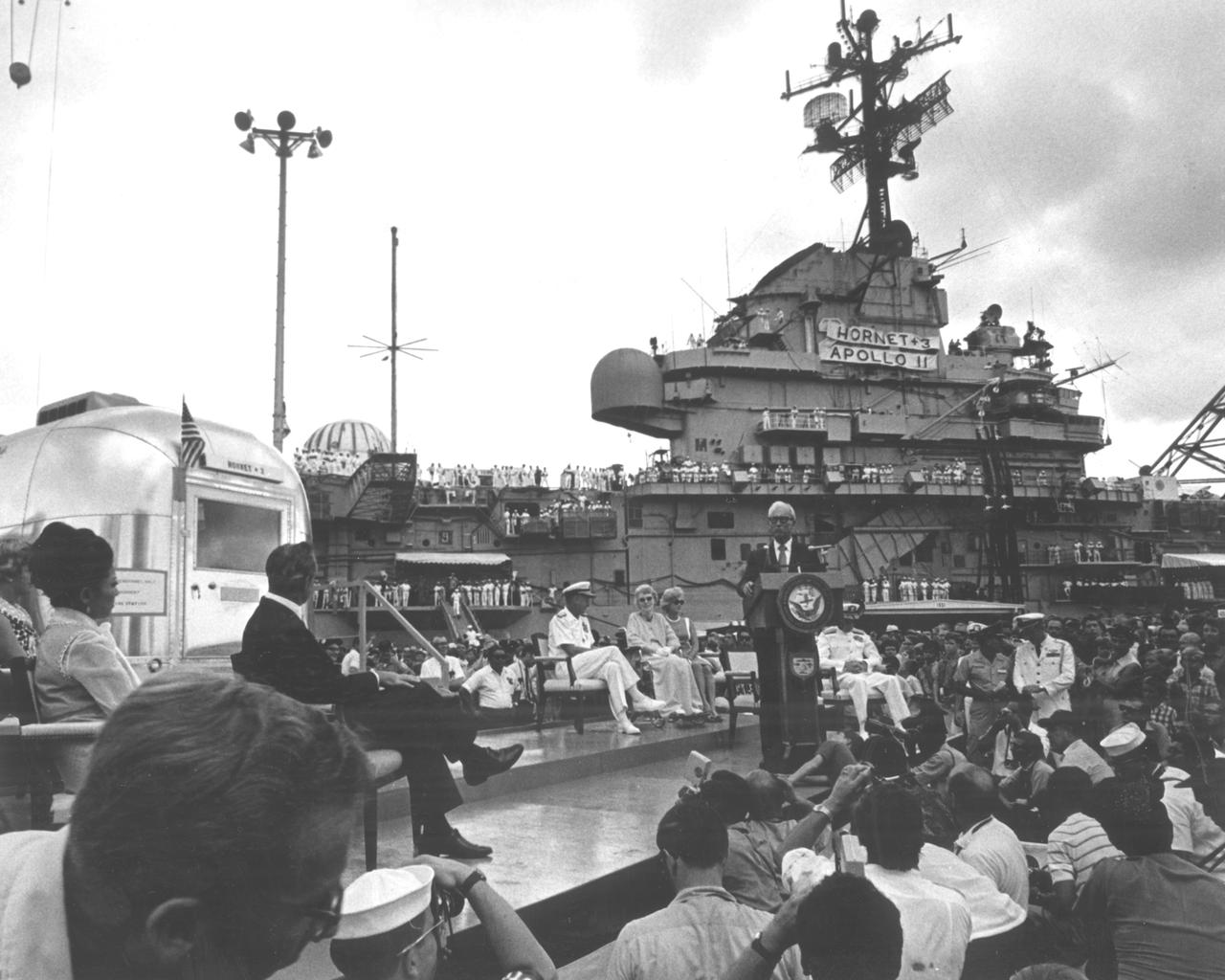
The Apollo 11 mission, the first manned lunar mission, launched from the Kennedy Space Center, Florida via the Marshall Space Flight Center (MSFC) developed Saturn V launch vehicle on July 16, 1969 and safely returned to Earth on July 24, 1969. Aboard the space craft were astronauts Neil A. Armstrong, commander; Michael Collins, Command Module (CM) pilot; and Edwin E. Aldrin Jr., Lunar Module (LM) pilot. The CM, piloted by Michael Collins remained in a parking orbit around the Moon while the LM, named “Eagle’’, carrying astronauts Neil Armstrong and Edwin Aldrin, landed on the Moon. During 2½ hours of surface exploration, the crew collected 47 pounds of lunar surface material for analysis back on Earth. The recovery operation took place in the Pacific Ocean where Navy para-rescue men recovered the capsule housing the 3-man Apollo 11 crew. The crew was airlifted to safety aboard the U.S.S. Hornet recovery ship, where they were quartered in a Mobile Quarantine Facility (MQF) for 21 days. The recovery vessel docked in Pearl Harbor Hawaii, where the occupied MQF was transferred for transport to the to NASA Manned Spacecraft Center (MSC) Lunar Receiving Laboratory in Houston, Texas. In this photo the quarantined astronauts are addressed by Hawaiian Governor John Burns upon their arrival at Pearl Harbor.

On the Space Shuttle Columbia's mid deck, the STS-109 crew of seven pose for the traditional in-flight portrait. From the left (front row), are astronauts Nancy J. Currie, mission specialist; Scott D. Altman, mission commander; and Duane G. Carey, pilot. Pictured on the back row from left to right are astronauts John M. Grunsfield, payload commander; and Richard M. Lirneham, James H. Newman, and Michael J. Massimino, all mission specialists. The 108th flight overall in NASA's Space Shuttle Program, the STS-109 mission launched March 1, 2002, and lasted 10 days, 22 hours, and 11 minutes. The goal of the mission was the maintenance and upgrade of the Hubble Space Telescope (HST). Using Columbia's robotic arm, the telescope was captured and secured on a work stand in Columbia's payload bay where four members of the crew performed five space walks to complete system upgrades to the HST. The Marshall Space Flight Center had the responsibility for the design, development, and construction of the HST, which is the most complex and sensitive optical telescope ever made, to study the cosmos from a low-Earth orbit.
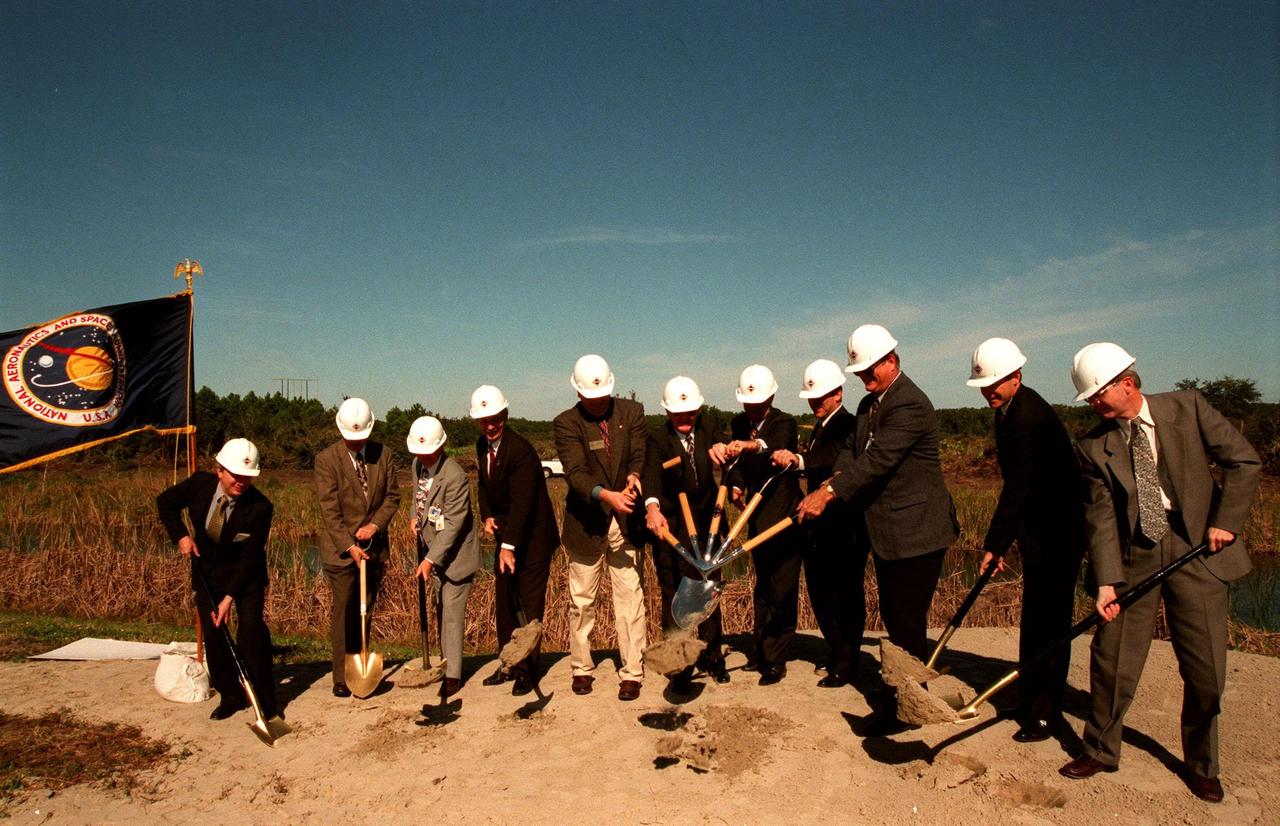
Federal, state, NASA, KSC and Space Florida Authority (SFA) officials dig in at the planned site of a multi-purpose hangar, phase one of the Reusable Launch Vehicle (RLV) Support Complex to be built near the Shuttle Landing Facility. From left, they are a representative from Rush Construction; Ed O'Connor, executive director of the Spaceport Florida Authority (SFA); Stephen T. Black, Lockheed Martin technical operations program manager; Warren Wiley, deputy director of engineering development; Tom Best, district director, representing U.S. Congressman Dave Weldon; Roy Bridges, director, Kennedy Space Center; Bill Posey, 32nd district representative; Randy Ball, state representative; Charlie Bronson, state senator; Donald McMonagle, manager of launch integration; and John London, Marshall Space Flight Center X-34 program manager. The new complex is jointly funded by SFA, NASA's Space Shuttle Program and Kennedy Space Center. It is intended to support the Space Shuttle and other RLV and X-vehicle systems. Completion is expected by the year 2000
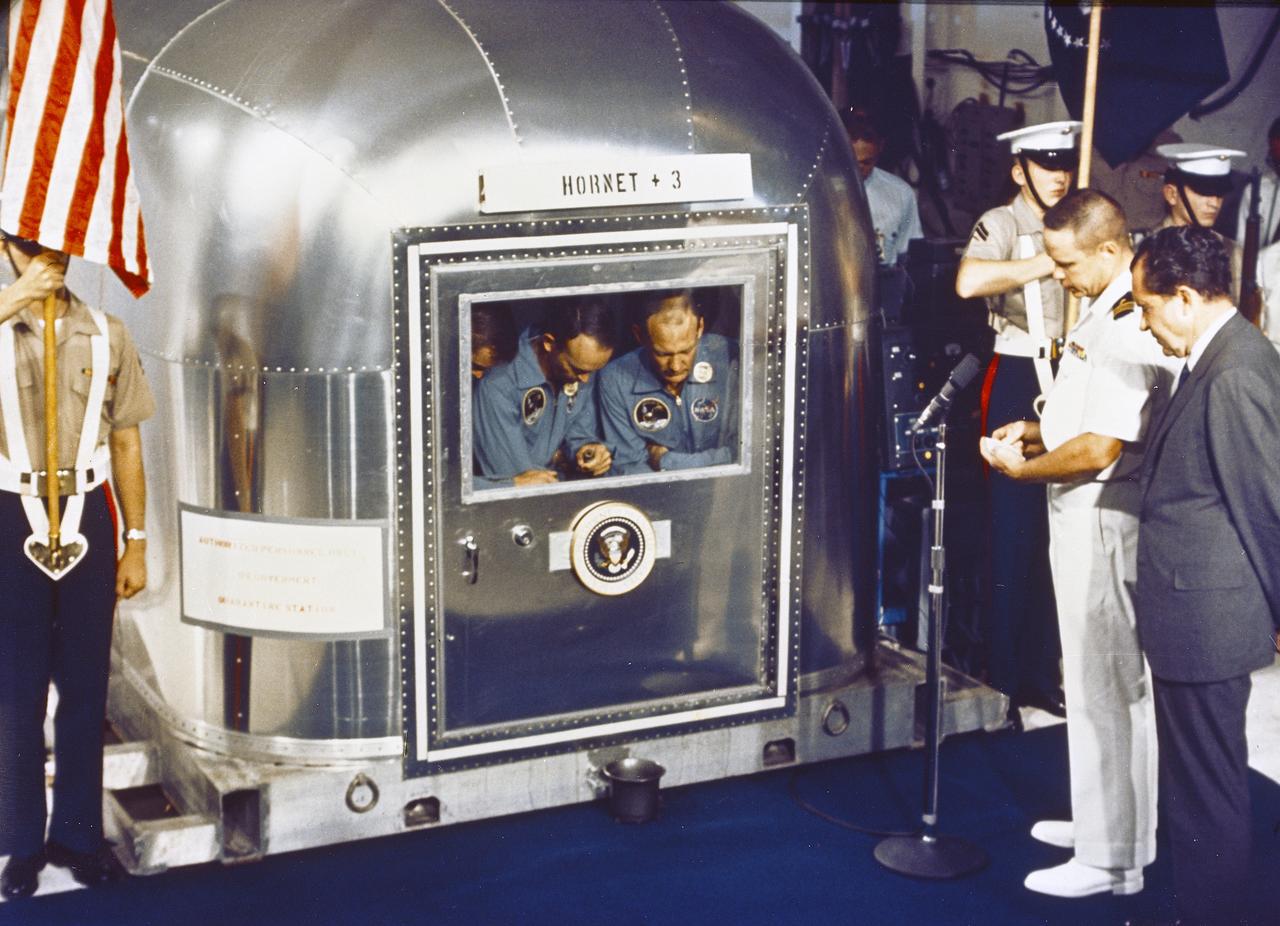
The Apollo 11 mission, the first manned lunar mission, launched from the Kennedy Space Center, Florida via a Saturn V launch vehicle on July 16, 1969 and safely returned to Earth on July 24, 1969. The Saturn V vehicle was developed by the Marshall Space Flight Center (MSFC) under the direction of Dr. Wernher von Braun. Aboard were Neil A. Armstrong, commander; Michael Collins, Command Module (CM) pilot; and Edwin E. Aldrin Jr., Lunar Module (LM) pilot. The CM, piloted by Michael Collins remained in a parking orbit around the Moon while the LM, named “Eagle’’, carrying astronauts Neil Armstrong and Edwin Aldrin, landed on the Moon. Armstrong was the first human to ever stand on the lunar surface, followed by Edwin (Buzz) Aldrin. During 2½ hours of surface exploration, the crew collected 47 pounds of lunar surface material for analysis back on Earth. The recovery operation took place in the Pacific Ocean where Navy para-rescue men recovered the capsule housing the 3-man Apollo 11 crew. The crew was taken to safety aboard the USS Hornet, where they were quartered in a mobile quarantine facility. Shown here is the Apollo 11 crew inside the quarantine facility as prayer is offered by Lt. Commander John Pirrto, USS Hornet Chaplain accompanied by U.S. President Richard Nixon (front right). With the success of Apollo 11, the national objective to land men on the Moon and return them safely to Earth had been accomplished.
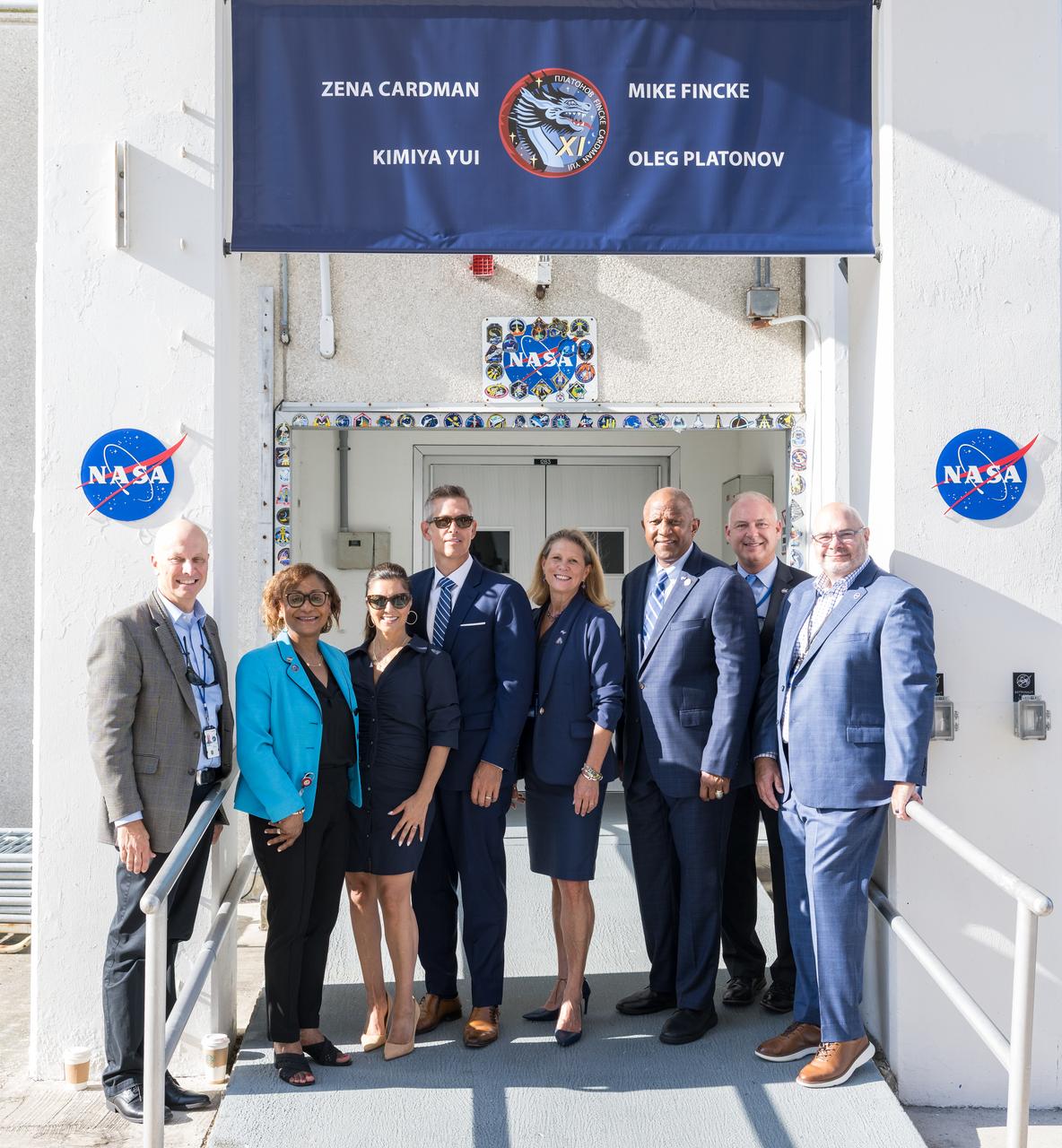
From left to right, Acting Director of NASA's Johnson Space Center, Steve Koerner, Acting NASA Associate Administrator, Vanessa Wyche, wife of Acting NASA Administrator Sean Duffy, Rachel Campos-Duffy, Sean Duffy, Acting Associate Administrator, Exploration Systems Development, Lori Glaze, Acting Director of NASA's John F. Kennedy Space Center, Kelvin Manning, Acting Deputy Director of NASA's Johnson Space Center, Norm Knight, and director of NASA's Marshall Space Flight Center, Joseph Pelfrey pose for a photo at the door to the Neil A. Armstrong Operations and Checkout Building after NASA astronauts Zena Cardman, Mike Fincke, JAXA (Japan Aerospace Exploration Agency) astronaut Kimiya Yui, and Roscosmos cosmonaut Oleg Platonov, departed for Launch Complex 39A to board the SpaceX Dragon spacecraft for the Crew-11 mission launch, before it was scrubbed due to weather concerns, Thursday, July 31, 2025, at NASA’s Kennedy Space Center in Florida. NASA’s SpaceX Crew-11 mission is the eleventh crew rotation mission of the SpaceX Crew Dragon spacecraft and Falcon 9 rocket to the International Space Station as part of the agency’s Commercial Crew Program. Cardman, Fincke, Yui, and Platonov launched at 11:43 a.m. EDT, Friday, August 1, from Launch Complex 39A at the NASA's Kennedy Space Center. Photo Credit: (NASA/Aubrey Gemignani)
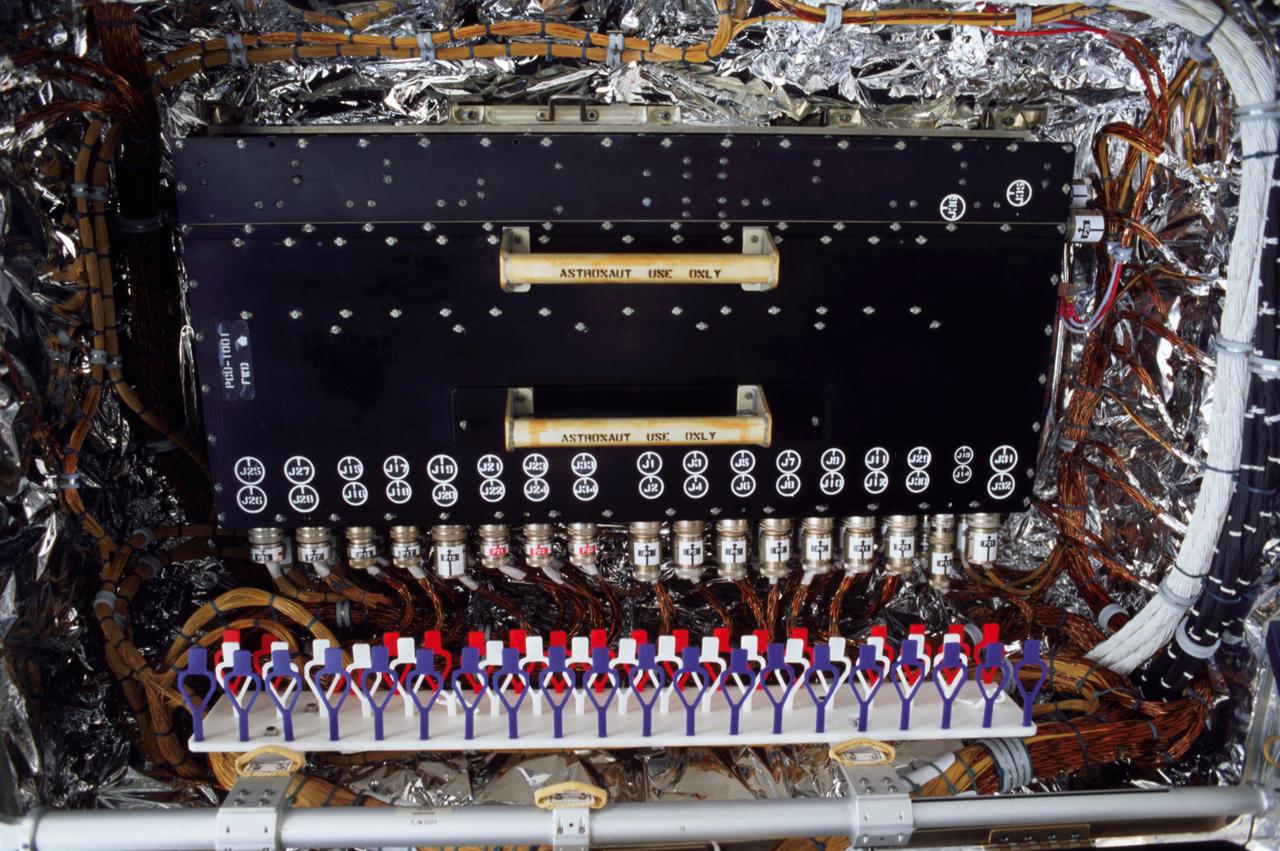
This is an onboard photo of the Hubble Space Telescope (HST) power control unit (PCU), the heart of the HST's power system. STS-109 payload commander John M. Grunsfeld, joined by Astronaut Richard M. Lirnehan, turned off the telescope in order to replace its PCU while participating in the third of five spacewalks dedicated to servicing and upgrading the HST. Other upgrades performed were: replacement of the solar array panels; replacement of the Faint Object Camera (FOC) with a new advanced camera for Surveys (ACS); and installation of the experimental cooling system for the Hubble's Near-Infrared Camera and Multi-Object Spectrometer (NICMOS), which had been dormant since January 1999 when its original coolant ran out. The telescope was captured and secured on a work stand in Columbia's payload bay using Columbia's robotic arm, where crew members completed the system upgrades. The Marshall Space Flight Center had the responsibility for the design, development, and construction of the HST, which is the most complex and sensitive optical telescope ever made, to study the cosmos from a low-Earth orbit. The HST detects objects 25 times fainter than the dimmest objects seen from Earth and provides astronomers with an observable universe 250 times larger than is visible from ground-based telescopes, perhaps as far away as 14 billion light-years. Launched March 1, 2002 the STS-109 HST servicing mission lasted 10 days, 22 hours, and 11 minutes. It was the 108th flight overall in NASA's Space Shuttle Program.
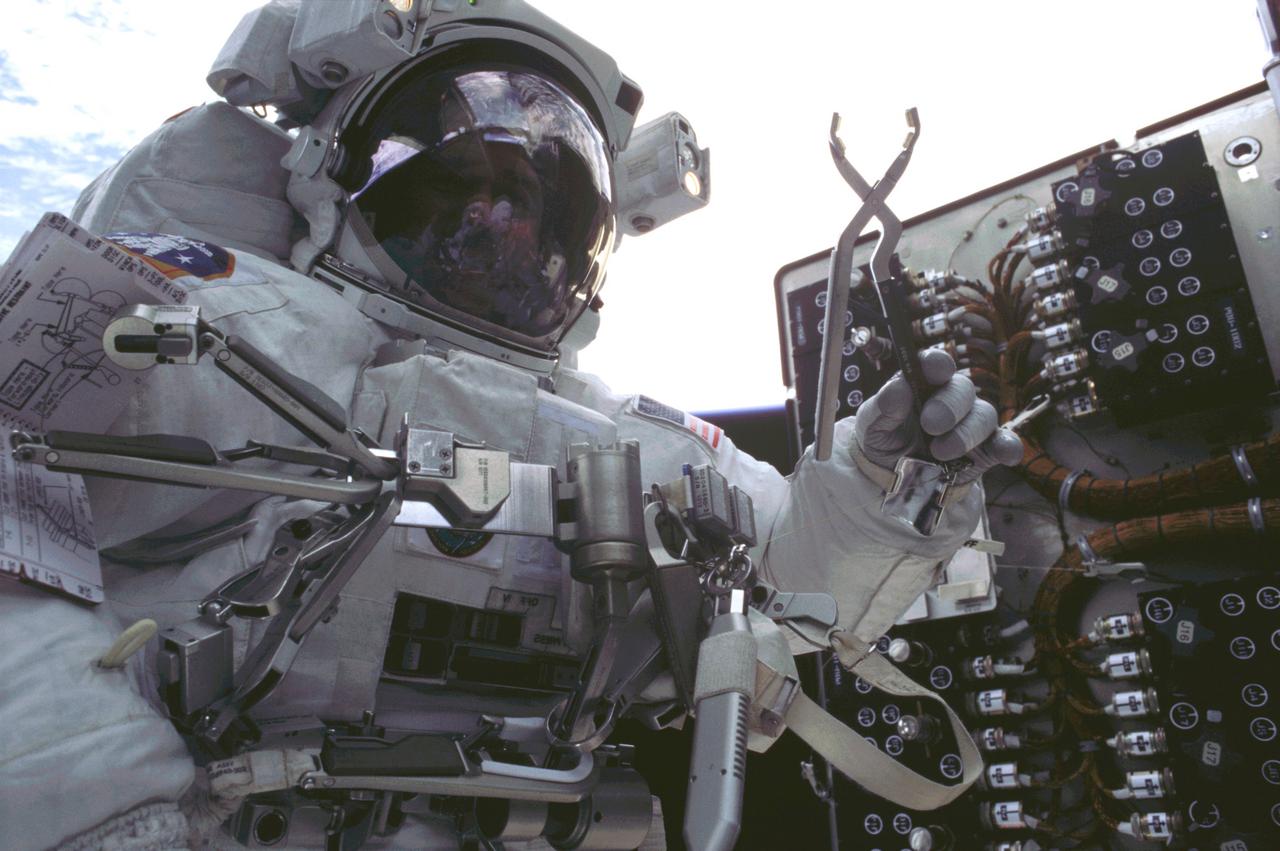
This is an onboard photo of Astronaut John M. Grunsfield, STS-109 payload commander, participating in the third of five spacewalks to perform work on the Hubble Space Telescope (HST). On this particular walk, Grunsfield, joined by Astronaut Richard M. Lirnehan, turned off the telescope in order to replace its power control unit (PCU), the heart of the HST's power system. The telescope was captured and secured on a work stand in Columbia's payload bay using Columbia's robotic arm, where crew members completed system upgrades to the HST. Included in those upgrades were: replacement of the solar array panels; replacement of the power control unit (PCU); replacement of the Faint Object Camera (FOC) with a new advanced camera for Surveys (ACS); and installation of the experimental cooling system for the Hubble's Near-Infrared Camera and Multi-object Spectrometer (NICMOS), which had been dormant since January 1999 when its original coolant ran out. The Marshall Space Flight Center had the responsibility for the design, development, and construction of the HST, which is the most complex and sensitive optical telescope ever made, to study the cosmos from a low-Earth orbit. The HST detects objects 25 times fainter than the dimmest objects seen from Earth and provides astronomers with an observable universe 250 times larger than is visible from ground-based telescopes, perhaps as far away as 14 billion light-years. The HST views galaxies, stars, planets, comets, possibly other solar systems, and even unusual phenomena such as quasars, with 10 times the clarity of ground-based telescopes. Launched March 1, 2002 the STS-109 HST servicing mission lasted 10 days, 22 hours, and 11 minutes. It was the 108th flight overall in NASA's Space Shuttle Program.
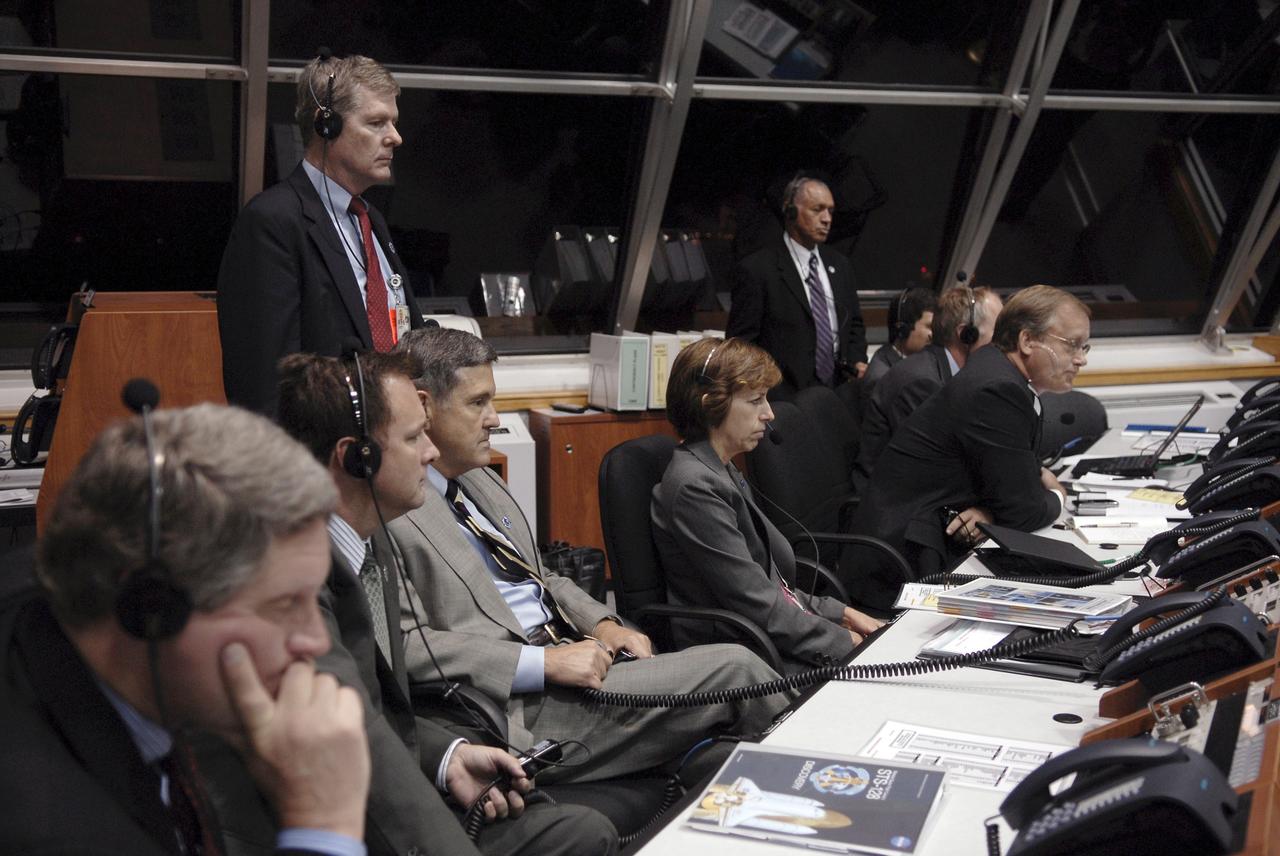
CAPE CANAVERAL, Fla. – In NASA Kennedy Space Center's Firing Room 4, NASA management watch the console during the countdown toward launch of space shuttle Discovery on the STS-128 mission. Seated (starting second from left) are Robert Lightfoot, director of NASA's Marshall Space Flight Center; Bob Cabana, director of Kennedy Space Center; Janet Kavandi, deputy director of Flight Crew Operations at Johnson Space Center; John Shannon, Shuttle Program manager (leaning forward); Bill Gerstenmaier, associate administrator for Space Operations; and Chris Scolese, NASA associate administrator. Standing in front of the windows at right is Charles Bolden, NASA Administrator. Liftoff from Launch Pad 39A was on time at 11:59 p.m. EDT. The first launch attempt on Aug. 24 was postponed due to unfavorable weather conditions. The second attempt on Aug. 25 also was postponed due to an issue with a valve in space shuttle Discovery's main propulsion system. The STS-128 mission is the 30th International Space Station assembly flight and the 128th space shuttle flight. The 13-day mission will deliver more than 7 tons of supplies, science racks and equipment, as well as additional environmental hardware to sustain six crew members on the International Space Station. The equipment includes a freezer to store research samples, a new sleeping compartment and the COLBERT treadmill. Photo credit: NASA/Kim Shiflett
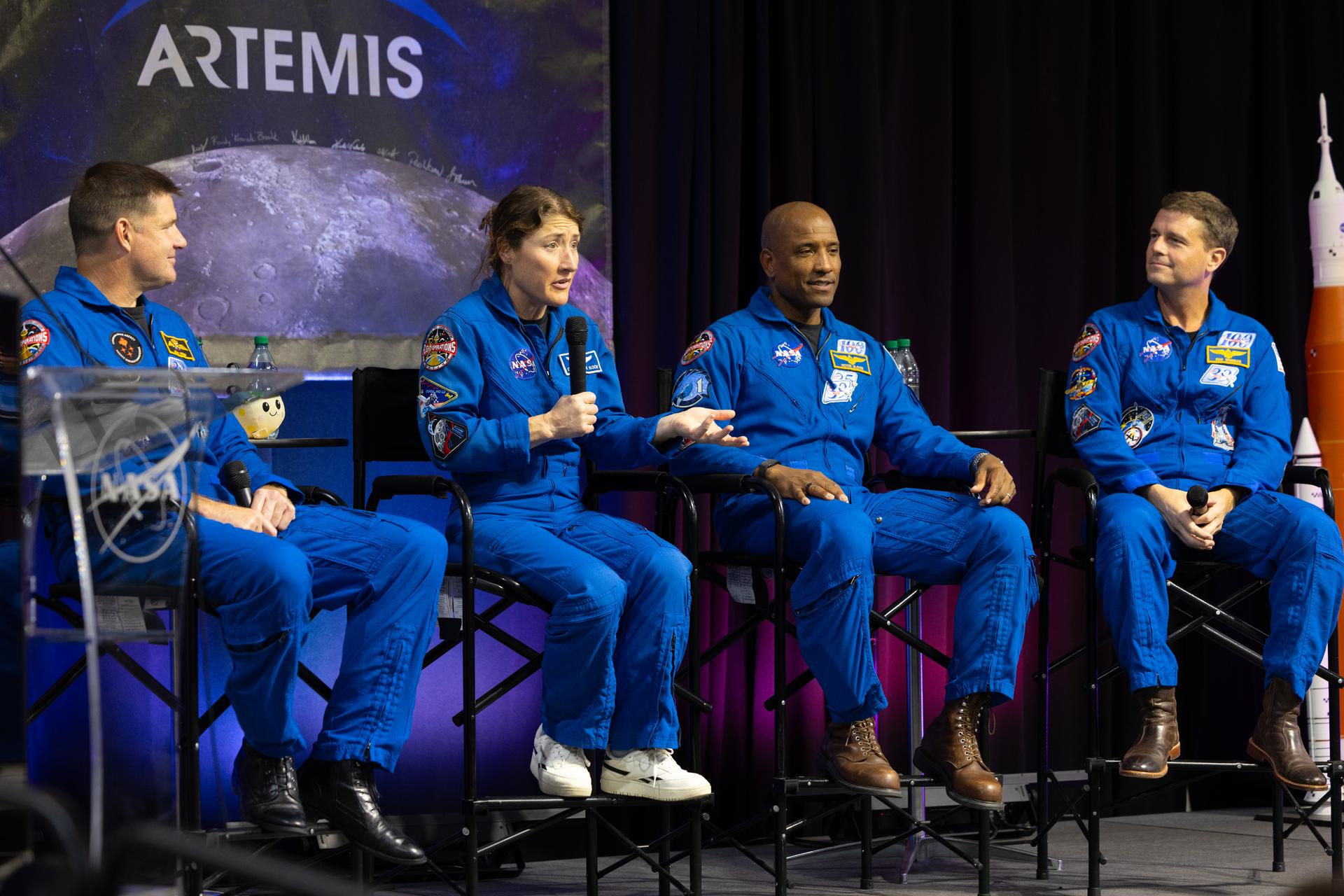
The crew of NASA's Artemis II mission visited NASA’s Michoud Assembly Facility on Sept. 3, 2026, marking their first return to the New Orleans factory since their historic test flight in April. The astronauts met with the workforce to share their gratitude for the facility's structural and manufacturing contributions to the mission's success. During an employee all-hands event, the crew reflected on their journey around the Moon, thanked Michoud team members for their contributions to the mission, and answered questions from the workforce. Artemis II was the first crewed mission of NASA’s Artemis campaign. Wiseman, Glover, Koch, and Hansen completed the approximately 10-day mission around the Moon in April 2026.
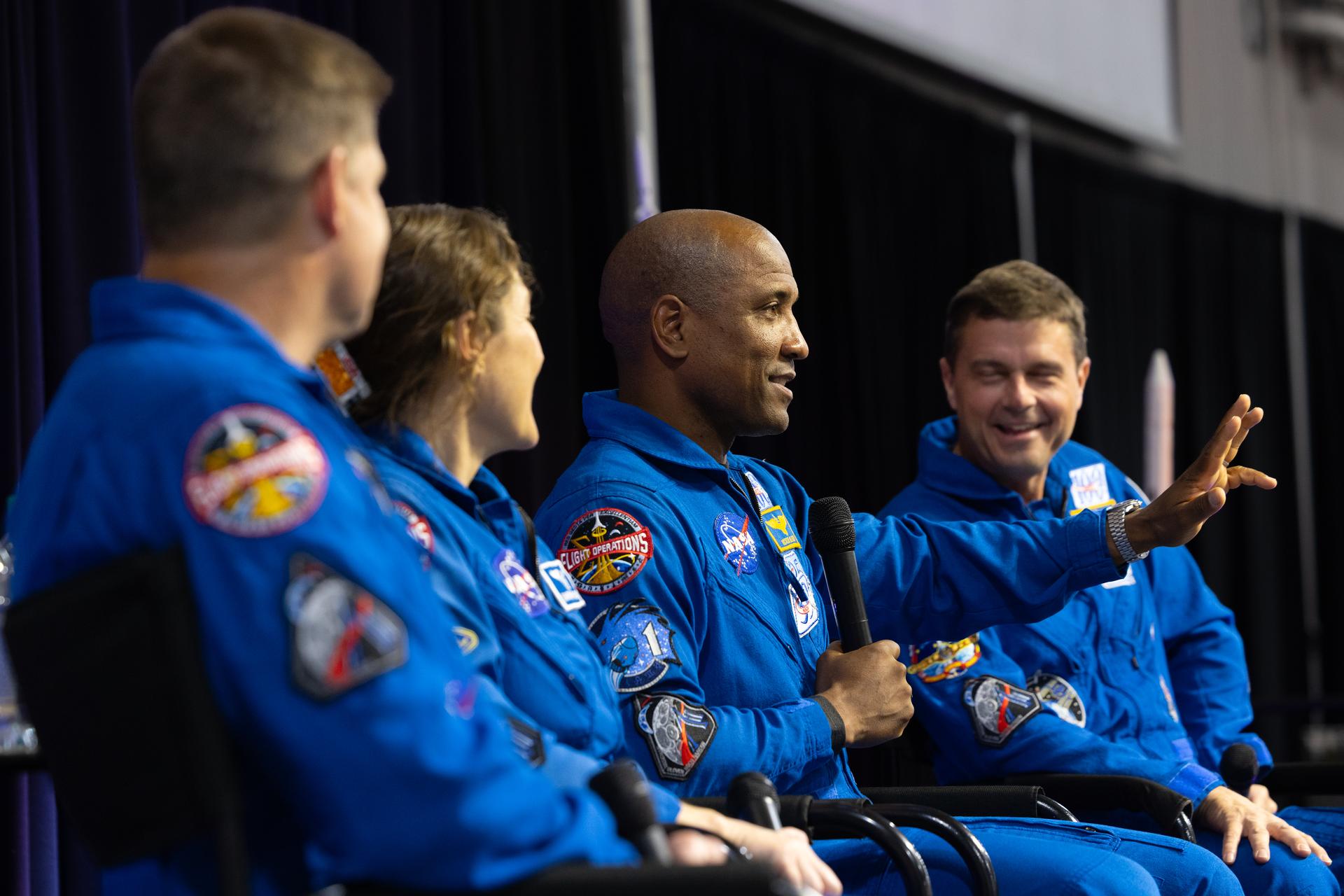
The crew of NASA's Artemis II mission visited NASA’s Michoud Assembly Facility on Sept. 3, 2026, marking their first return to the New Orleans factory since their historic test flight in April. The astronauts met with the workforce to share their gratitude for the facility's structural and manufacturing contributions to the mission's success. During an employee all-hands event, the crew reflected on their journey around the Moon, thanked Michoud team members for their contributions to the mission, and answered questions from the workforce. Artemis II was the first crewed mission of NASA’s Artemis campaign. Wiseman, Glover, Koch, and Hansen completed the approximately 10-day mission around the Moon in April 2026.
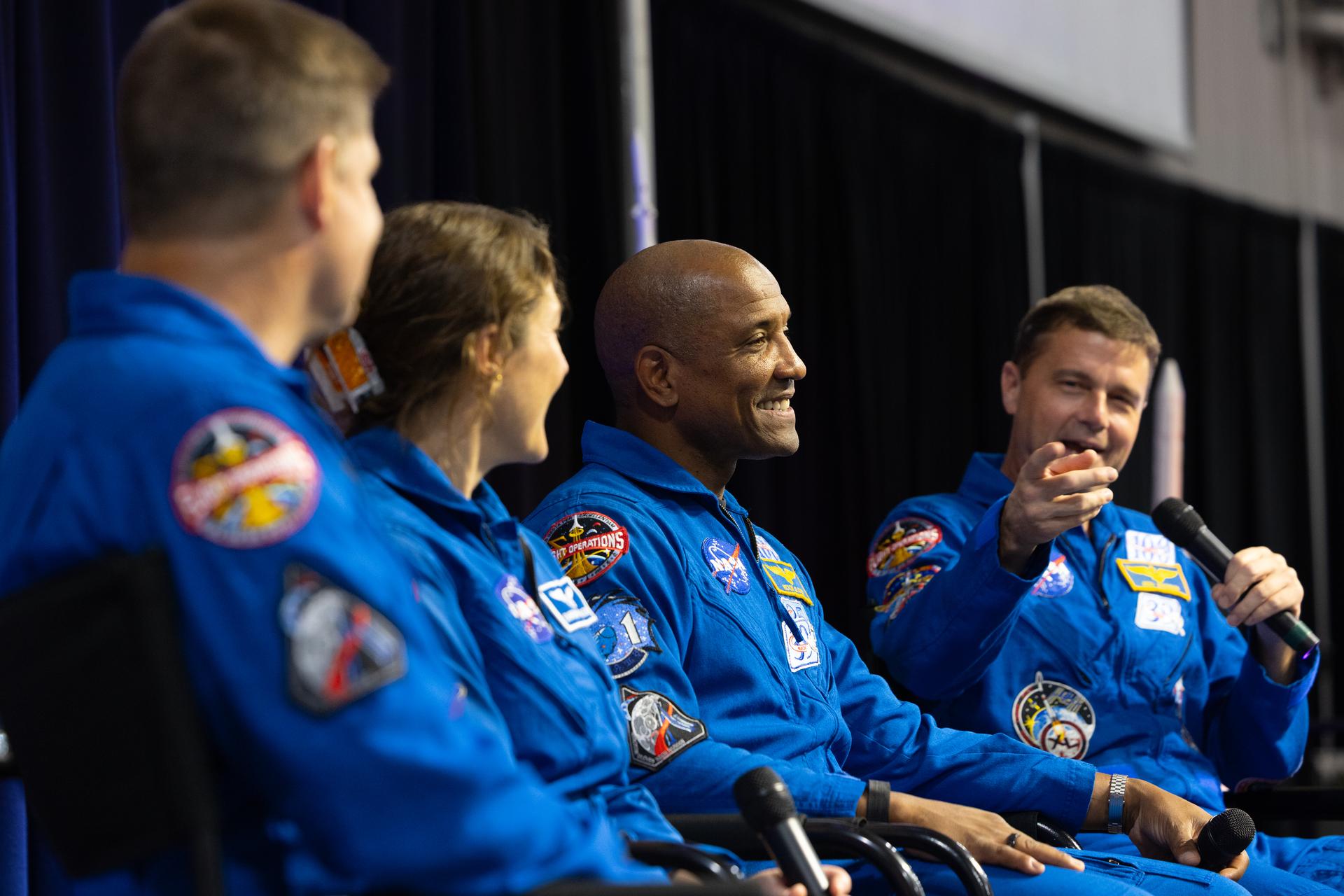
The crew of NASA's Artemis II mission visited NASA’s Michoud Assembly Facility on Sept. 3, 2026, marking their first return to the New Orleans factory since their historic test flight in April. The astronauts met with the workforce to share their gratitude for the facility's structural and manufacturing contributions to the mission's success. During an employee all-hands event, the crew reflected on their journey around the Moon, thanked Michoud team members for their contributions to the mission, and answered questions from the workforce. Artemis II was the first crewed mission of NASA’s Artemis campaign. Wiseman, Glover, Koch, and Hansen completed the approximately 10-day mission around the Moon in April 2026.
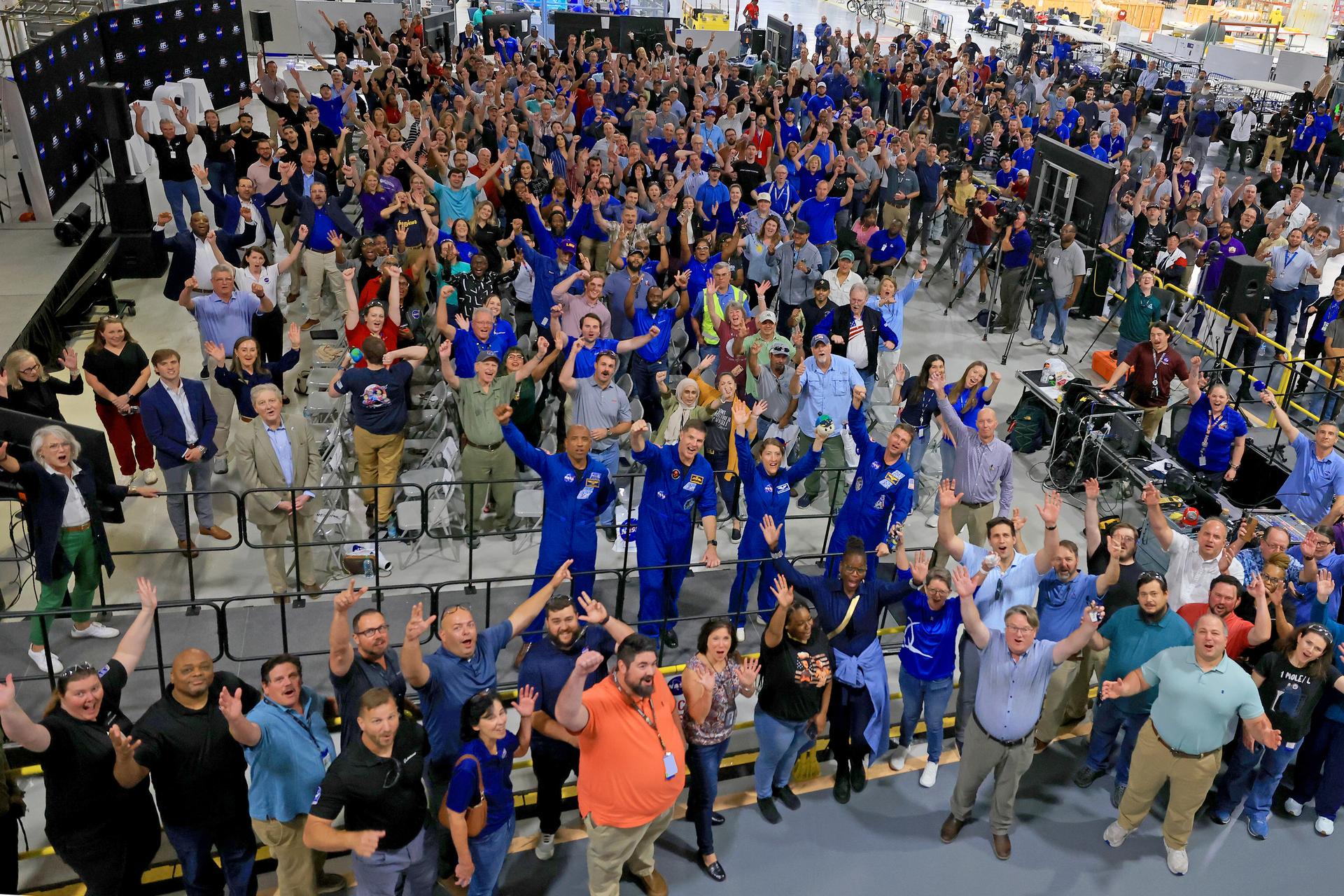
The crew of NASA's Artemis II mission visited NASA’s Michoud Assembly Facility on Sept. 3, 2026, marking their first return to the New Orleans factory since their historic test flight in April. The astronauts met with the workforce to share their gratitude for the facility's structural and manufacturing contributions to the mission's success. During an employee all-hands event, the crew reflected on their journey around the Moon, thanked Michoud team members for their contributions to the mission, and answered questions from the workforce. Artemis II was the first crewed mission of NASA’s Artemis campaign. Wiseman, Glover, Koch, and Hansen completed the approximately 10-day mission around the Moon in April 2026. Image credit: NASA/Michael DeMocker
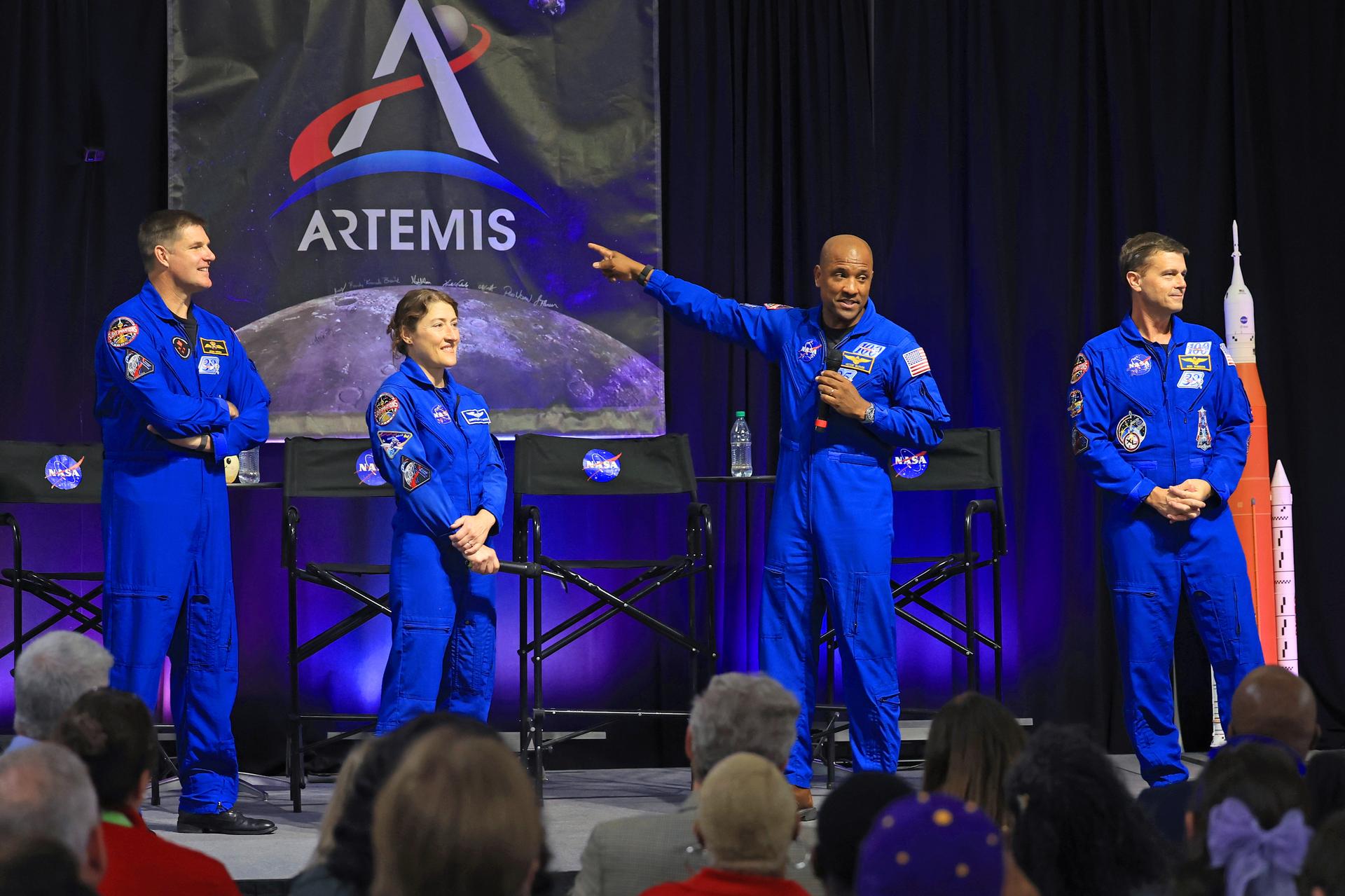
The crew of NASA's Artemis II mission visited NASA’s Michoud Assembly Facility on Sept. 3, 2026, marking their first return to the New Orleans factory since their historic test flight in April. The astronauts met with the workforce to share their gratitude for the facility's structural and manufacturing contributions to the mission's success. During an employee all-hands event, the crew reflected on their journey around the Moon, thanked Michoud team members for their contributions to the mission, and answered questions from the workforce. Artemis II was the first crewed mission of NASA’s Artemis campaign. Wiseman, Glover, Koch, and Hansen completed the approximately 10-day mission around the Moon in April 2026. Image credit: NASA/Michael DeMocker
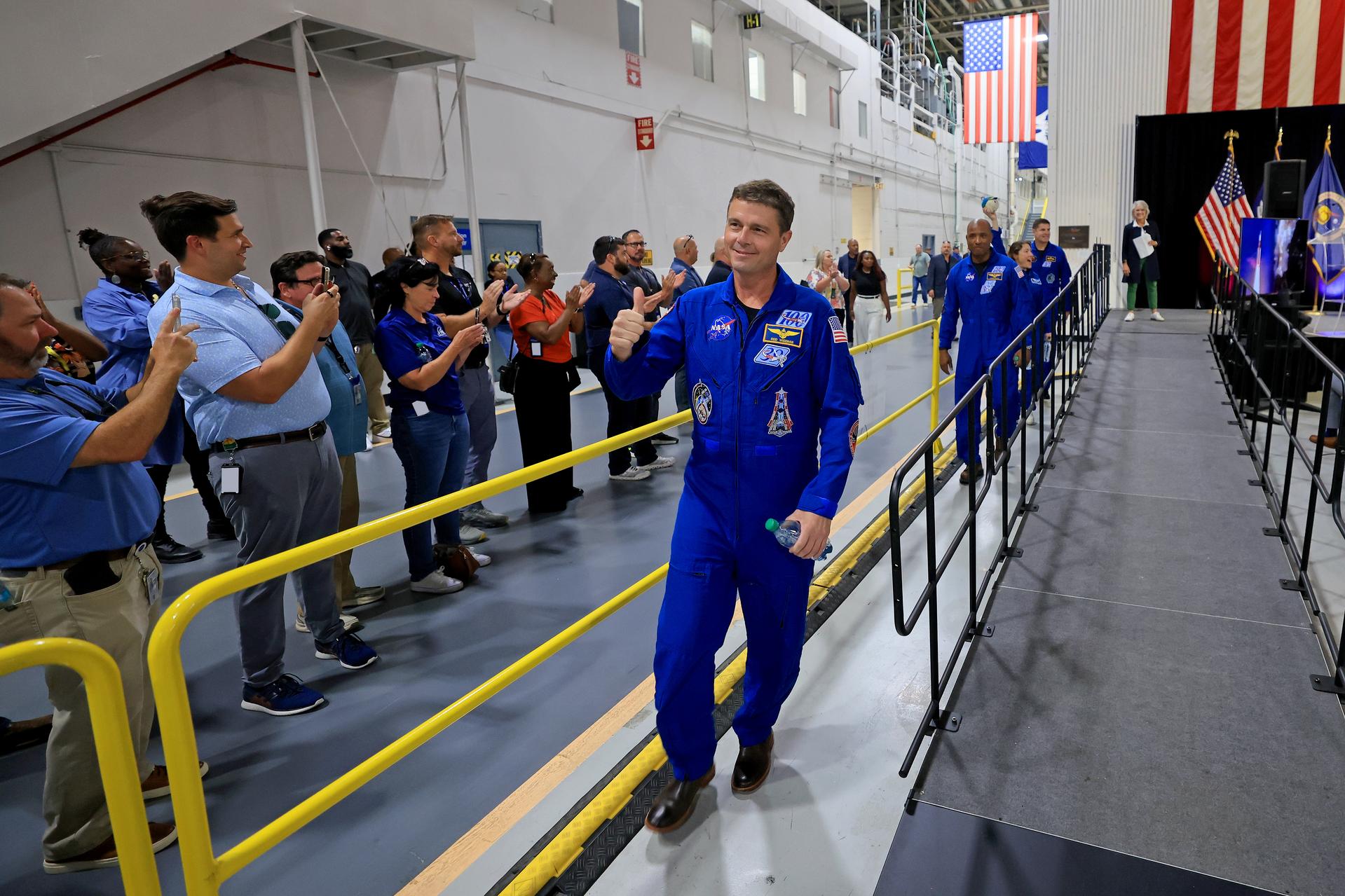
The crew of NASA's Artemis II mission visited NASA’s Michoud Assembly Facility on Sept. 3, 2026, marking their first return to the New Orleans factory since their historic test flight in April. The astronauts met with the workforce to share their gratitude for the facility's structural and manufacturing contributions to the mission's success. During an employee all-hands event, the crew reflected on their journey around the Moon, thanked Michoud team members for their contributions to the mission, and answered questions from the workforce. Artemis II was the first crewed mission of NASA’s Artemis campaign. Wiseman, Glover, Koch, and Hansen completed the approximately 10-day mission around the Moon in April 2026. Image credit: NASA/Michael DeMocker
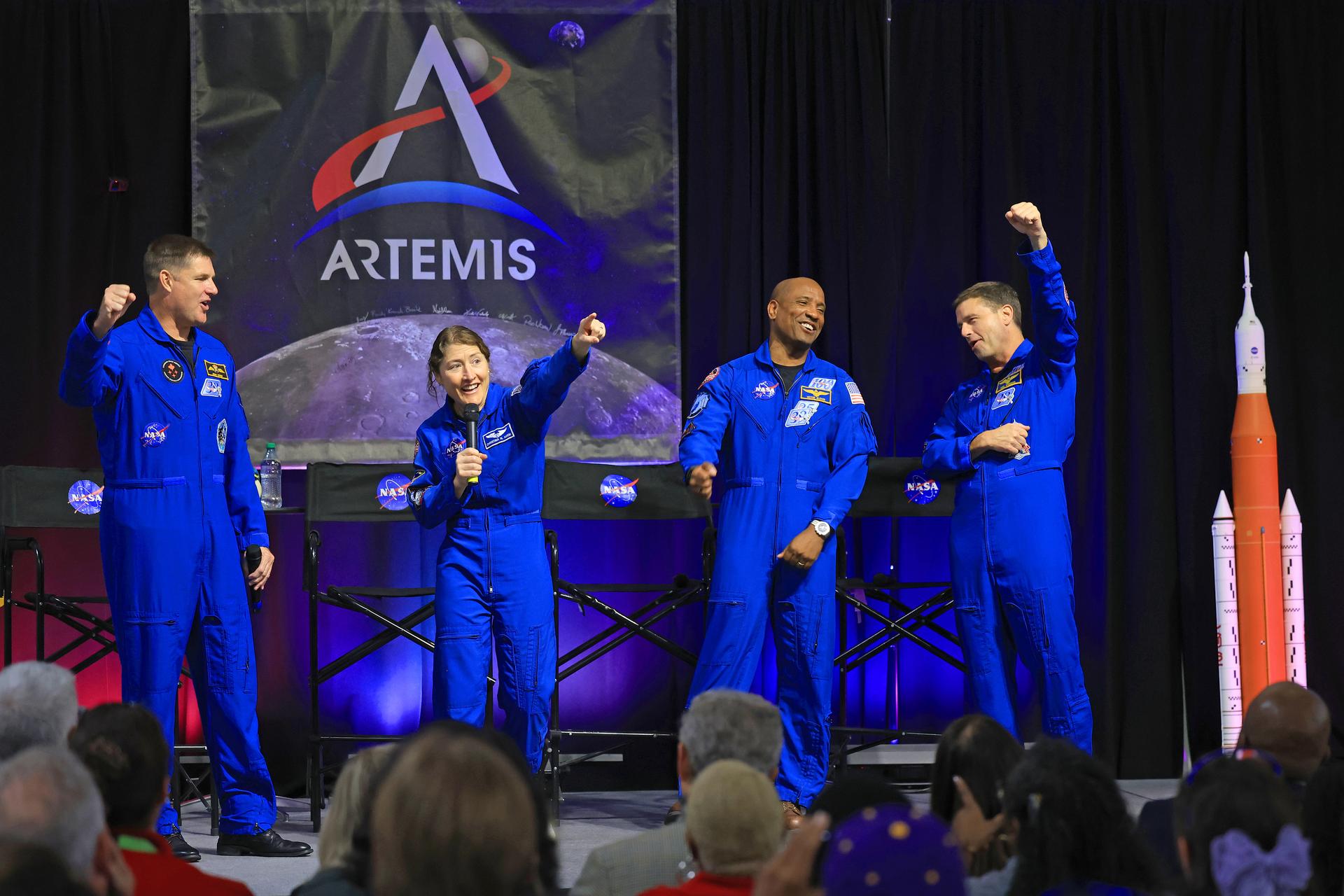
The crew of NASA's Artemis II mission visited NASA’s Michoud Assembly Facility on Sept. 3, 2026, marking their first return to the New Orleans factory since their historic test flight in April. The astronauts met with the workforce to share their gratitude for the facility's structural and manufacturing contributions to the mission's success. During an employee all-hands event, the crew reflected on their journey around the Moon, thanked Michoud team members for their contributions to the mission, and answered questions from the workforce. Artemis II was the first crewed mission of NASA’s Artemis campaign. Wiseman, Glover, Koch, and Hansen completed the approximately 10-day mission around the Moon in April 2026. Image credit: NASA/Michael DeMocker
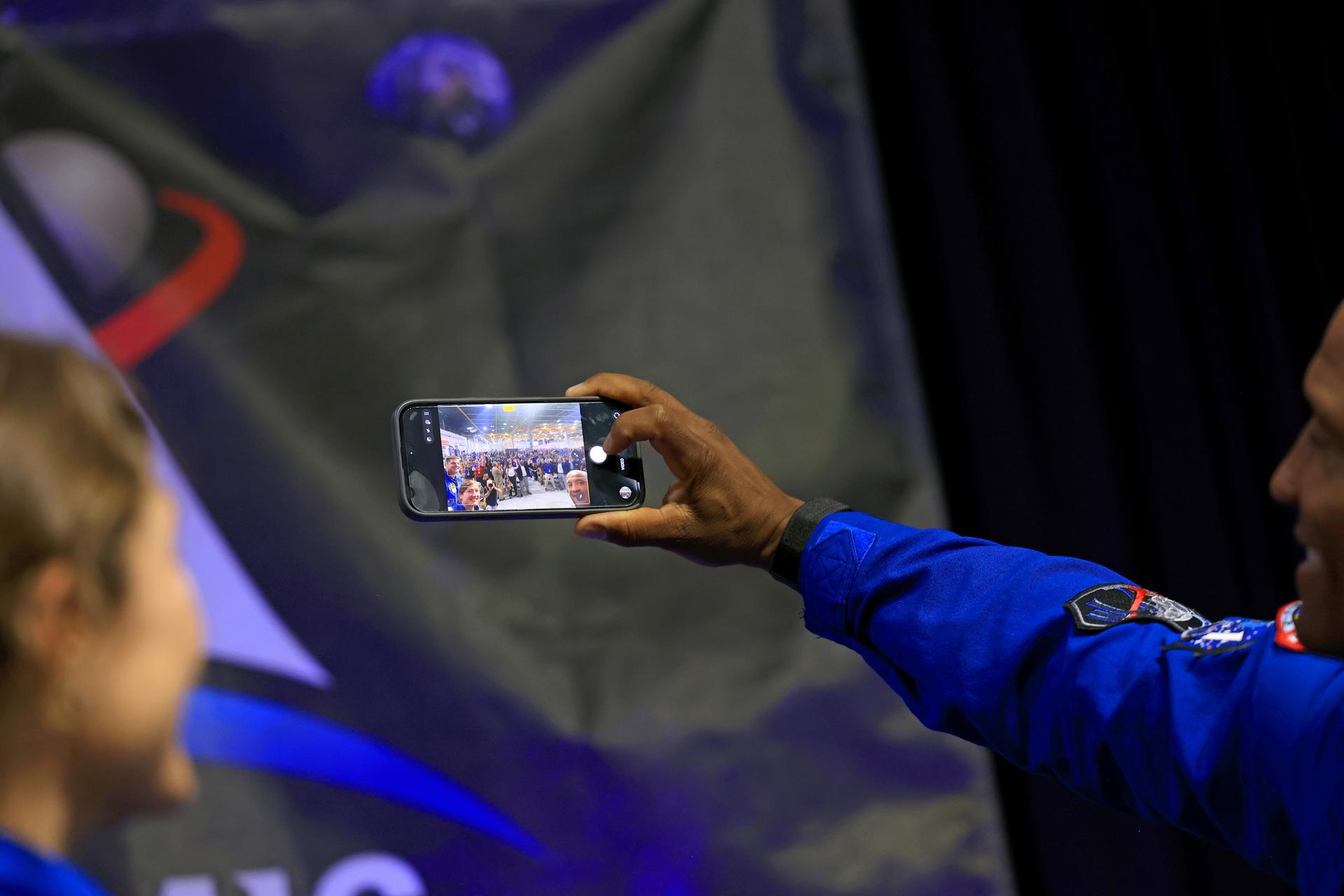
The crew of NASA's Artemis II mission visited NASA’s Michoud Assembly Facility on Sept. 3, 2026, marking their first return to the New Orleans factory since their historic test flight in April. The astronauts met with the workforce to share their gratitude for the facility's structural and manufacturing contributions to the mission's success. During an employee all-hands event, the crew reflected on their journey around the Moon, thanked Michoud team members for their contributions to the mission, and answered questions from the workforce. Artemis II was the first crewed mission of NASA’s Artemis campaign. Wiseman, Glover, Koch, and Hansen completed the approximately 10-day mission around the Moon in April 2026. Image credit: NASA/Michael DeMocker
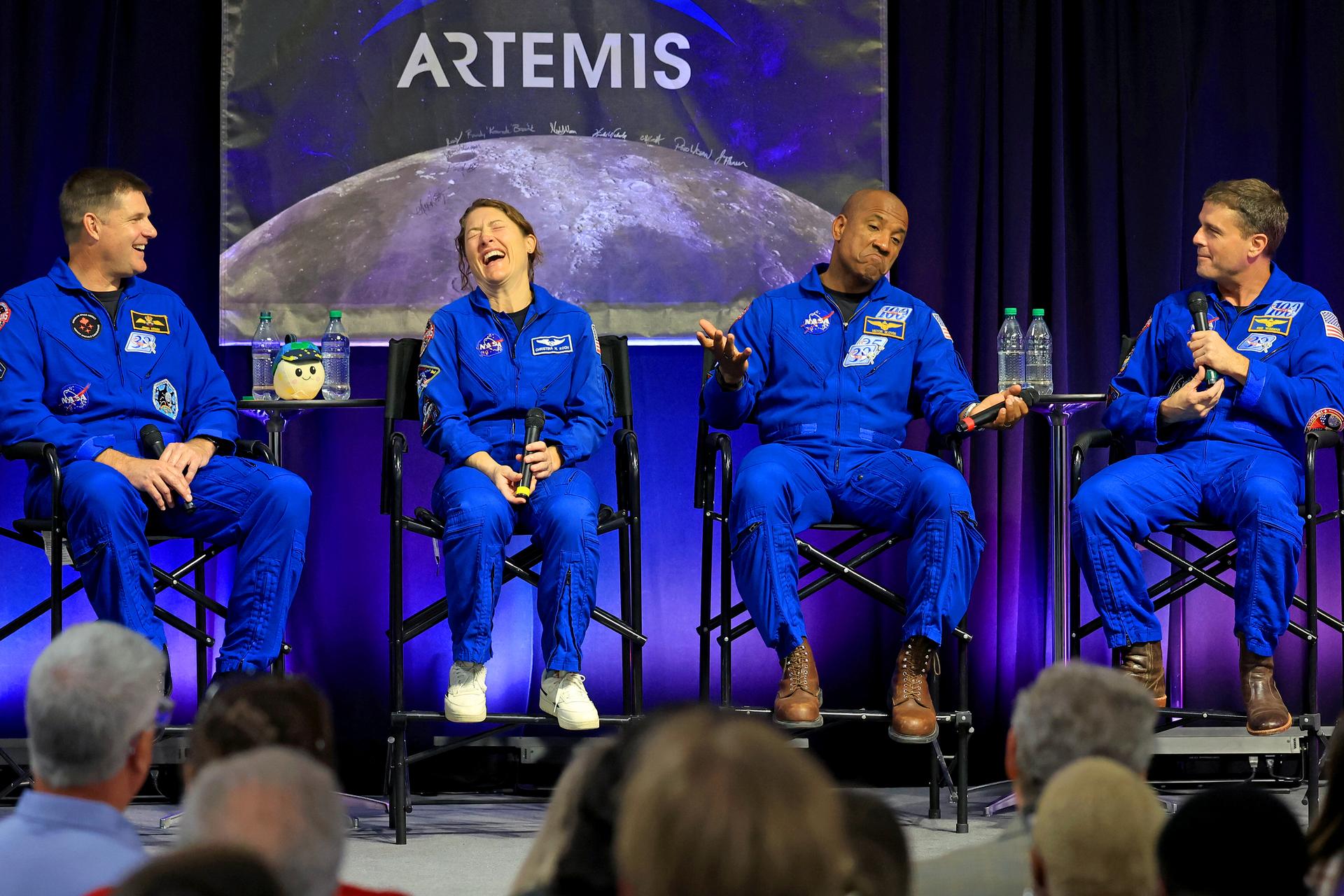
The crew of NASA's Artemis II mission visited NASA’s Michoud Assembly Facility on Sept. 3, 2026, marking their first return to the New Orleans factory since their historic test flight in April. The astronauts met with the workforce to share their gratitude for the facility's structural and manufacturing contributions to the mission's success. During an employee all-hands event, the crew reflected on their journey around the Moon, thanked Michoud team members for their contributions to the mission, and answered questions from the workforce. Artemis II was the first crewed mission of NASA’s Artemis campaign. Wiseman, Glover, Koch, and Hansen completed the approximately 10-day mission around the Moon in April 2026. Image credit: NASA/Michael DeMocker
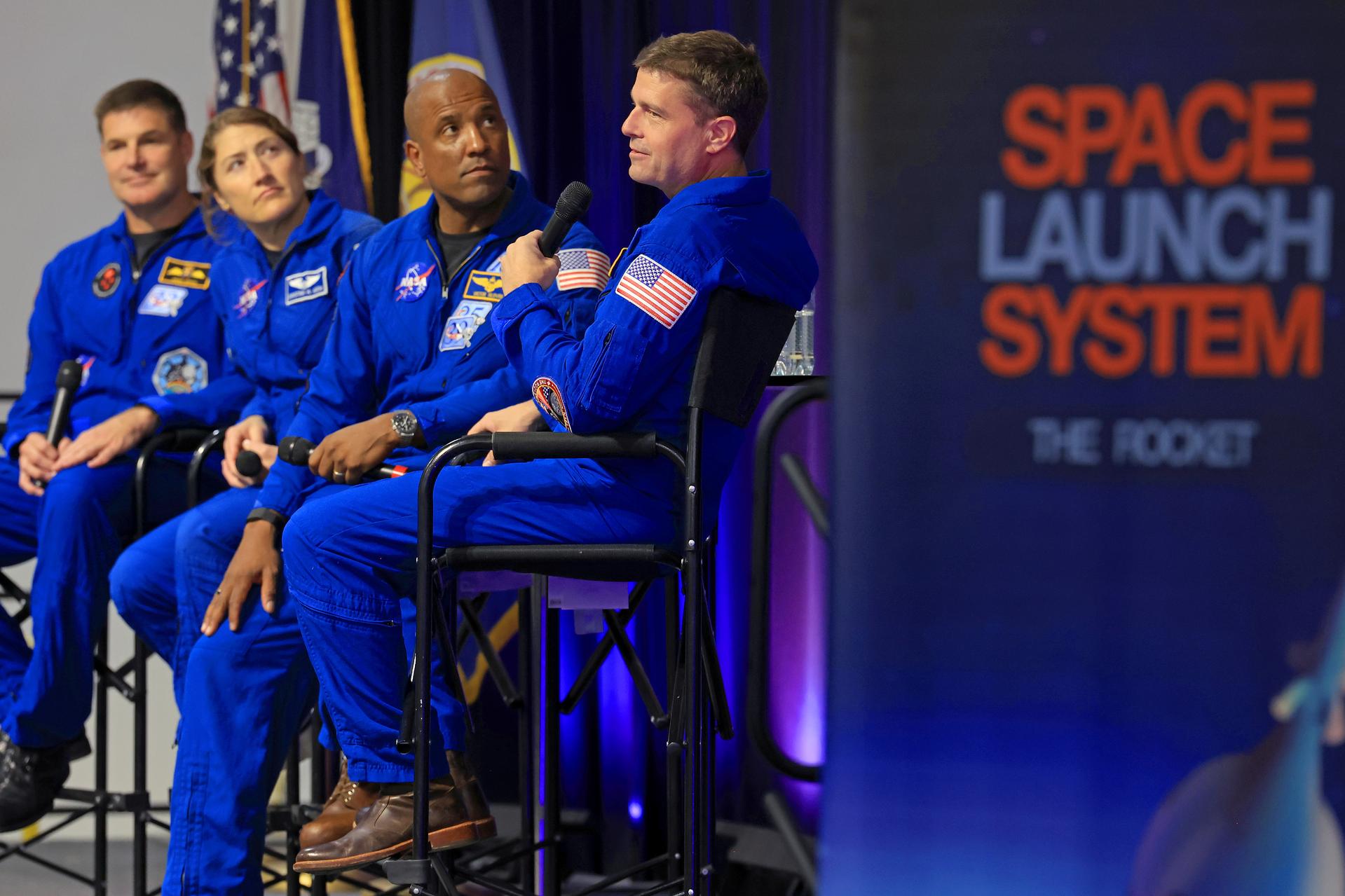
The crew of NASA's Artemis II mission visited NASA’s Michoud Assembly Facility on Sept. 3, 2026, marking their first return to the New Orleans factory since their historic test flight in April. The astronauts met with the workforce to share their gratitude for the facility's structural and manufacturing contributions to the mission's success. During an employee all-hands event, the crew reflected on their journey around the Moon, thanked Michoud team members for their contributions to the mission, and answered questions from the workforce. Artemis II was the first crewed mission of NASA’s Artemis campaign. Wiseman, Glover, Koch, and Hansen completed the approximately 10-day mission around the Moon in April 2026. Image credit: NASA/Michael DeMocker
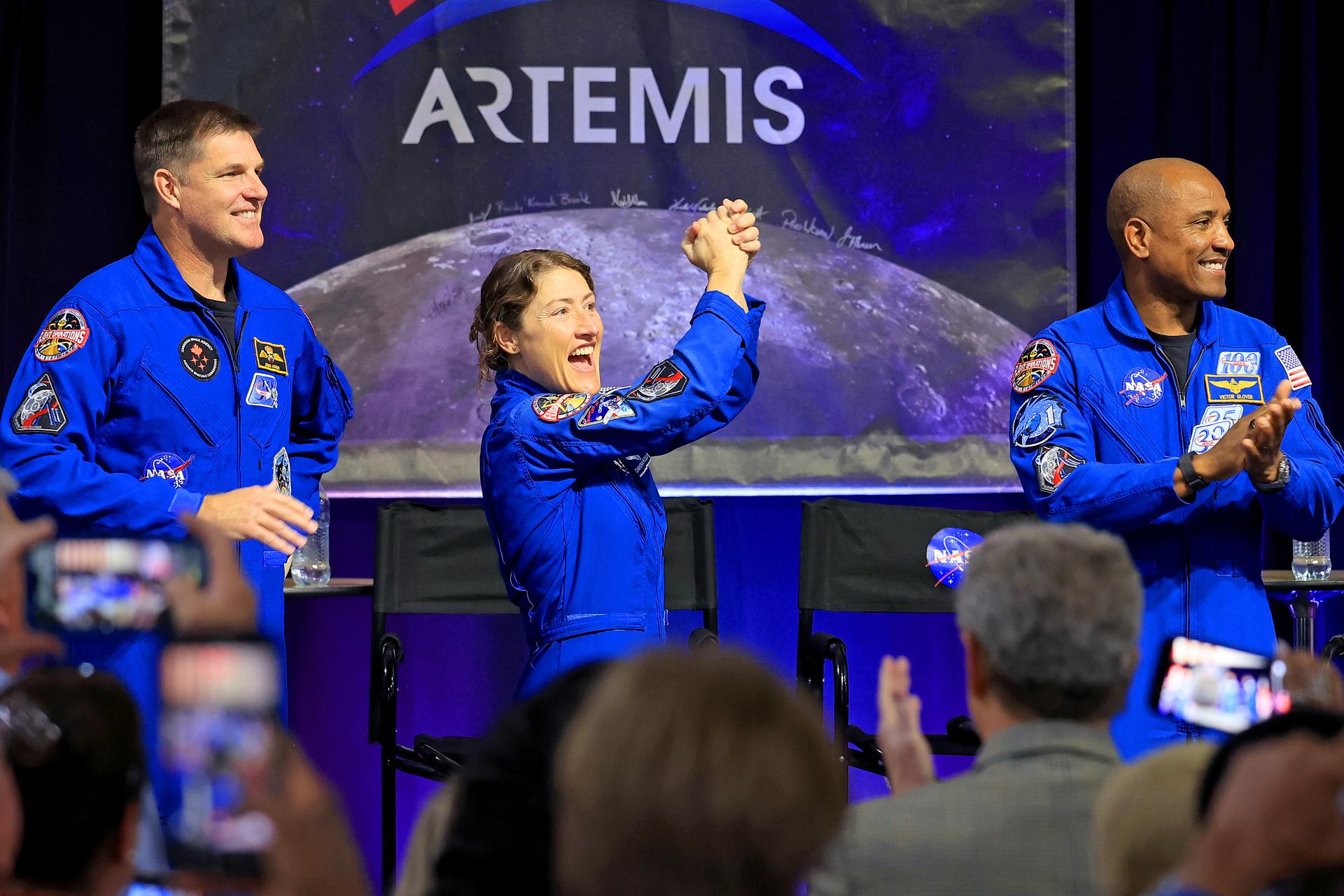
The crew of NASA's Artemis II mission visited NASA’s Michoud Assembly Facility on Sept. 3, 2026, marking their first return to the New Orleans factory since their historic test flight in April. The astronauts met with the workforce to share their gratitude for the facility's structural and manufacturing contributions to the mission's success. During an employee all-hands event, the crew reflected on their journey around the Moon, thanked Michoud team members for their contributions to the mission, and answered questions from the workforce. Artemis II was the first crewed mission of NASA’s Artemis campaign. Wiseman, Glover, Koch, and Hansen completed the approximately 10-day mission around the Moon in April 2026. Image credit: NASA/Michael DeMocker