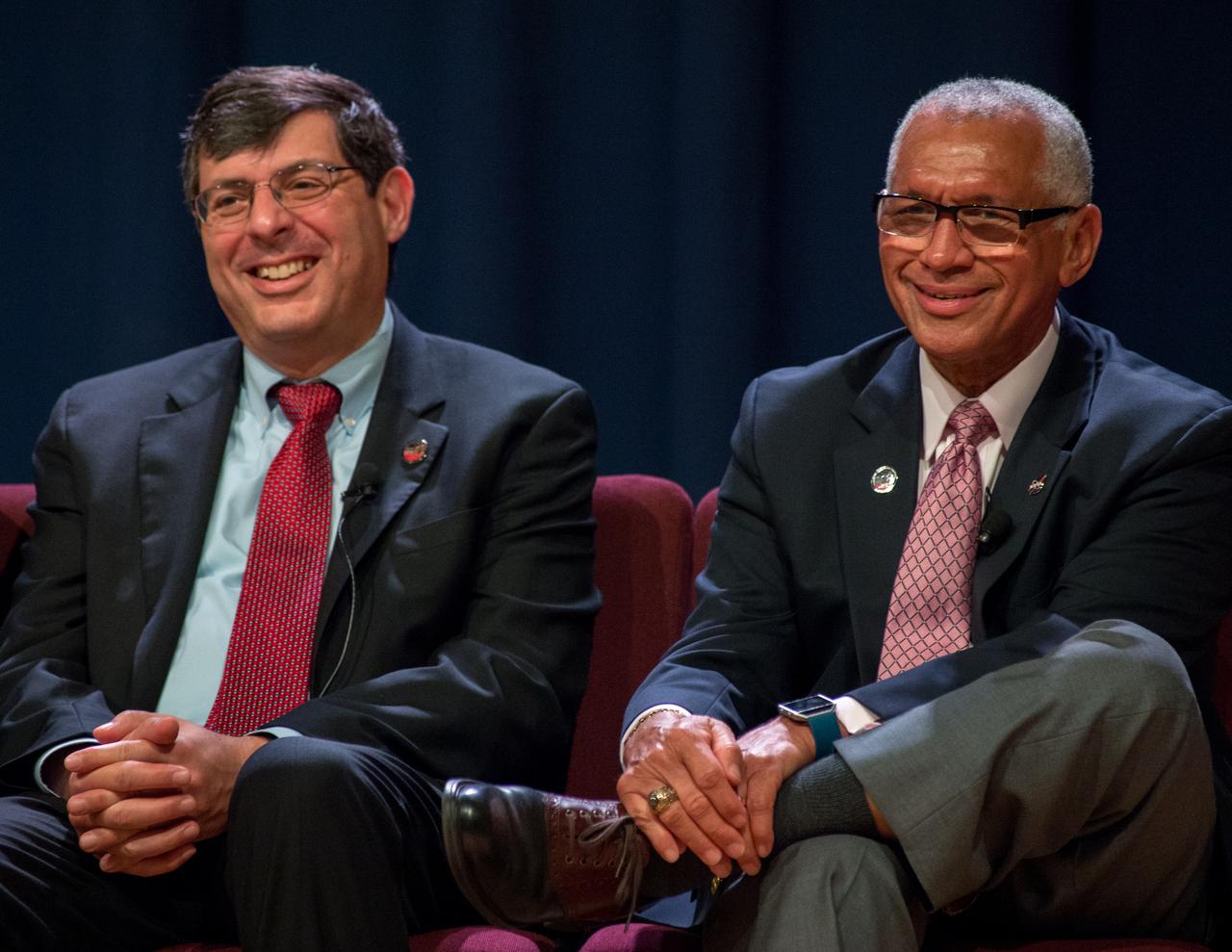
James Webb Space Telescope (JWST) Town Hall - Panel question and answer - Bill Ochs; Dr. John Mather; Dr. Eric Smith; Thomas Zurbuchen; Center Director Chris Scolese; NASA Administrator Charlie Bolden.
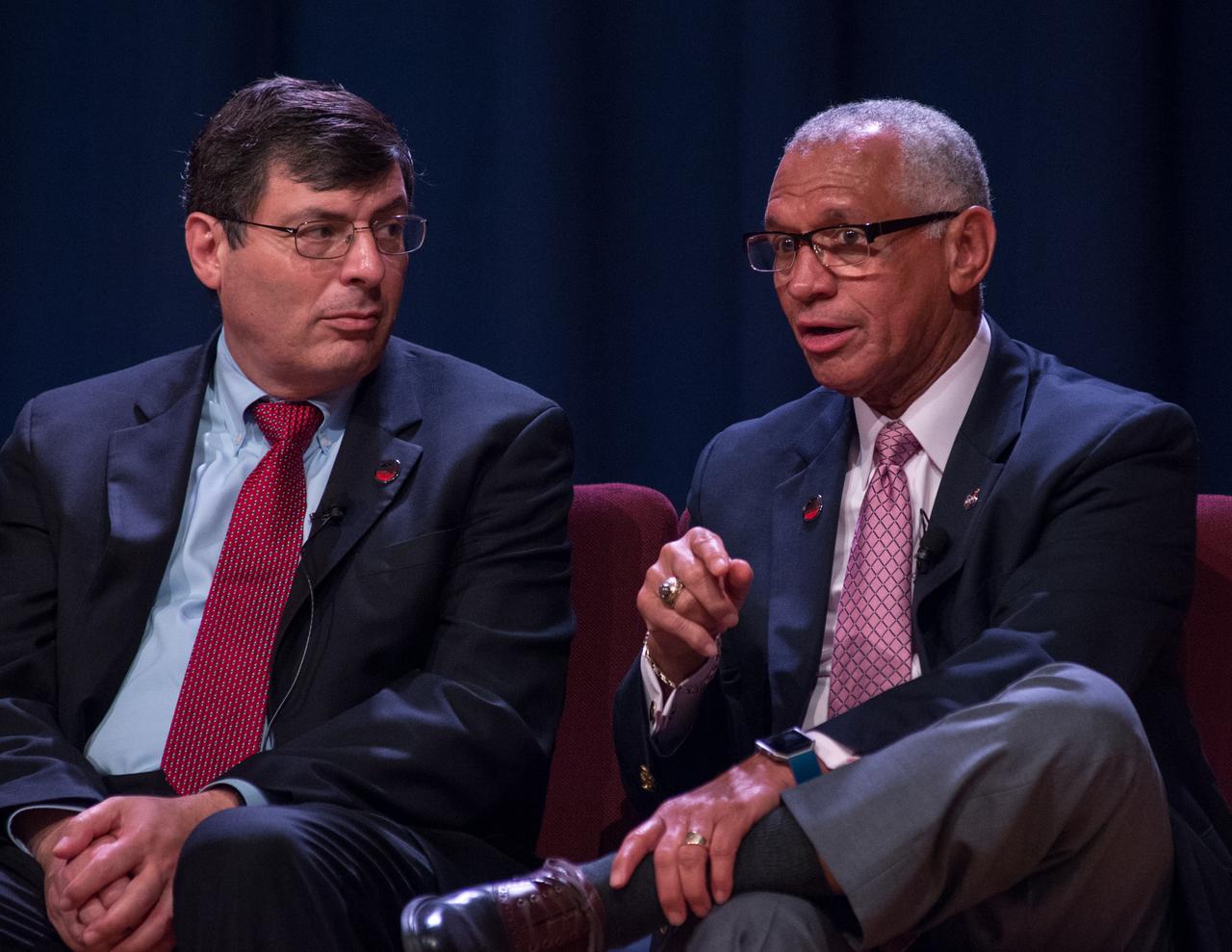
James Webb Space Telescope (JWST) Town Hall - Panel question and answer - Bill Ochs; Dr. John Mather; Dr. Eric Smith; Thomas Zurbuchen; Center Director Chris Scolese; NASA Administrator Charlie Bolden.
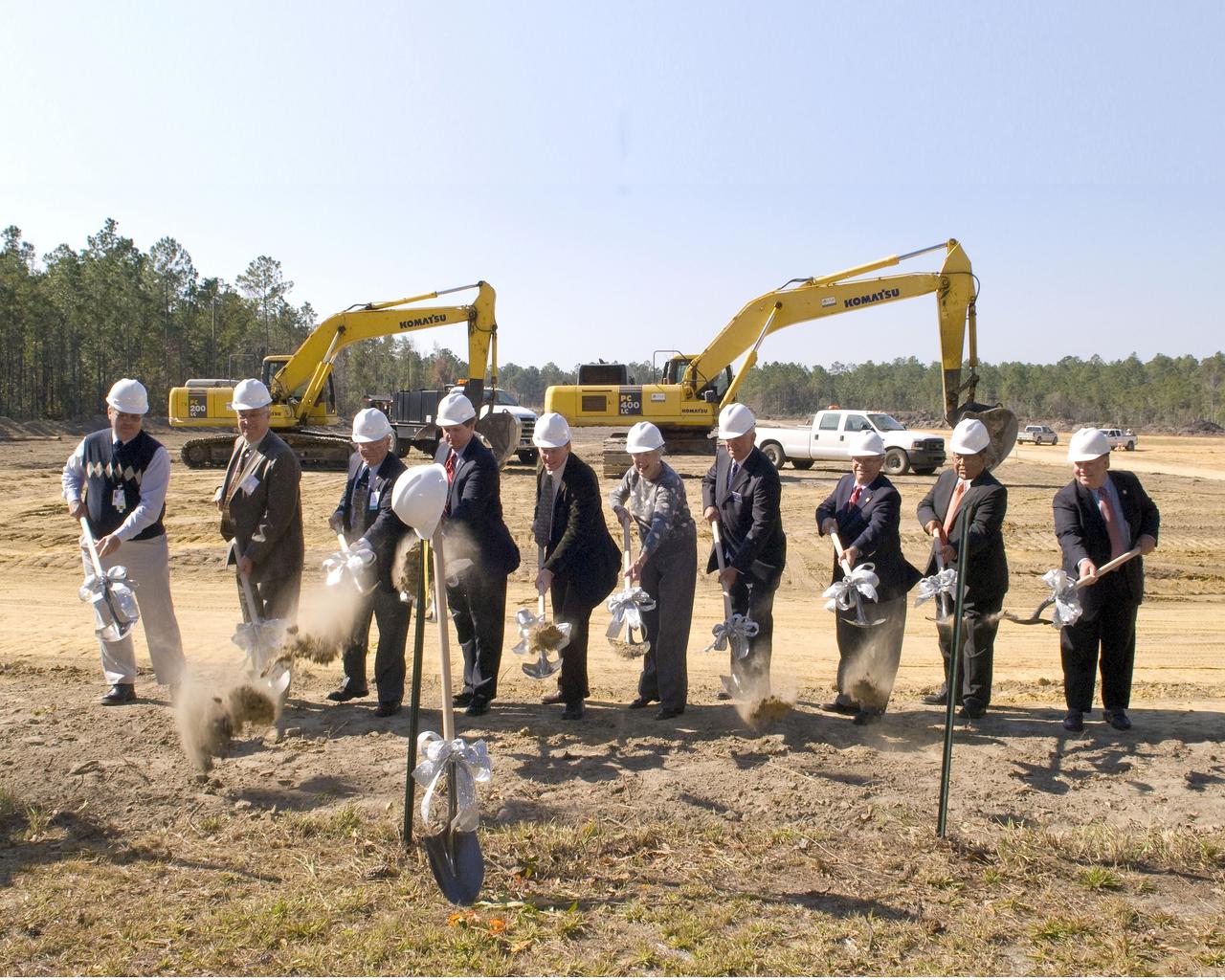
Community leaders from Mississippi and Louisiana break ground for the new INFINITY at NASA Stennis Space Center facility during a Nov. 20 ceremony. Groundbreaking participants included (l to r): Gottfried Construction representative John Smith, Mississippi Highway Commissioner Wayne Brown, INFINITY board member and Apollo 13 astronaut Fred Haise, Stennis Director Gene Goldman, Studio South representative David Hardy, Leo Seal Jr. family representative Virginia Wagner, Hancock Bank President George Schloegel, Mississippi Rep. J.P. Compretta, Mississippi Band of Choctaw Indians representative Charlie Benn and Louisiana Sen. A.G. Crowe.
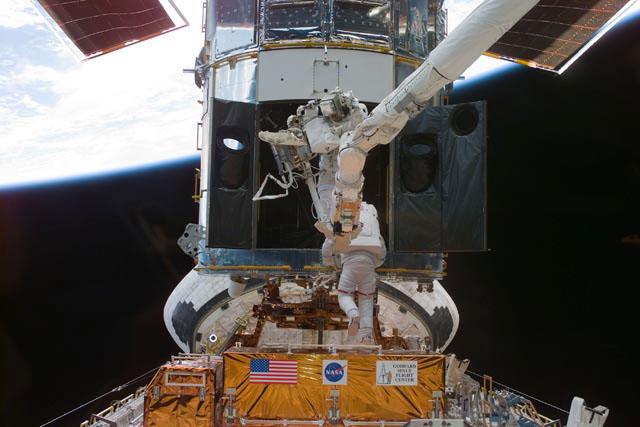
S103-E-5208 --- Astronauts Steven L. Smith (bottom), payload commander, and John M. Grunsfeld, mission specialist, perform servicing tasks on the temporarily-captured Hubble Space Telescope (HST). Grunsfeld is on a foot restraint connected to Discovery's remote manipulator system (RMS) robot arm. Smith, making his second servicing visit to HST, is using handrails on the telescope. The photo was taken with an electronic still camera (ESC).
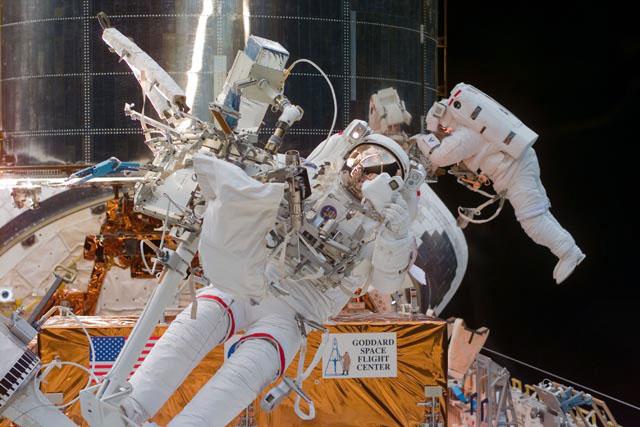
S103-E-5347 (24 December 1999) --- Astronaut Steven L. Smith, payload commander, prepares to use a 35mm camera during the final space walk of the STS-103 mission. Smith is standing on a foot restraint connected to the end of Discovery's remote manipulator system (RMS) robot arm. Astronaut John M. Grunsfeld, mission specialist, translates along a handrail system on the Hubble Space Telescope (HST) in the background.
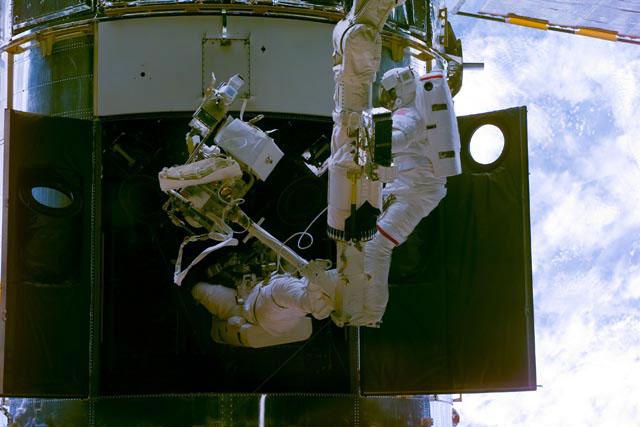
STS-103 mission specialist John M. Grunsfeld (attached to a workstation on the RMS arm) and payload commander Steven L. Smith (free-floating) perform a changeout of the Rate Sensor Units (RSU) in one of the bays of -V3 plane of the Hubble Space Telescope (HST). This repair was performed during the first of three extravehicular activities (EVAs) of the mission. Grunsfeld is distinguished by having no marks on his EMU and Smith is distinguished by the red strip on the pants of his EMU.
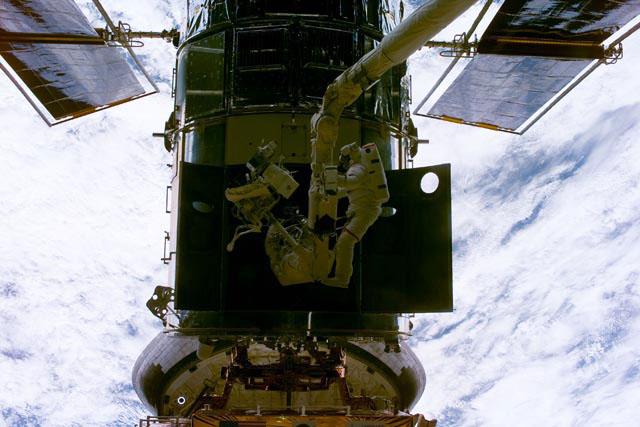
STS-103 mission specialist John M. Grunsfeld (attached to a workstation on the RMS arm) and payload commander Steven L. Smith (free-floating) perform a changeout of the Rate Sensor Units (RSU) in one of the bays of -V3 plane of the Hubble Space Telescope (HST). This repair was performed during the first of three extravehicular activities (EVAs) of the mission. Grunsfeld is distinguished by having no marks on his EMU and Smith is distinguished by the red strip on the pants of his EMU.

S103-E-5345 (24 December 1999) --- Astronaut Steven L. Smith, payload commander, takes a picture with a 35mm camera during the final space walk of the STS-103 mission. Smith is standing on a foot restraint connected to the end of Discovery's remote manipulator system (RMS) robot arm. Astronaut John M. Grunsfeld, mission specialist, translates along a handrail system on the Hubble Space Telescope (HST) in the background.
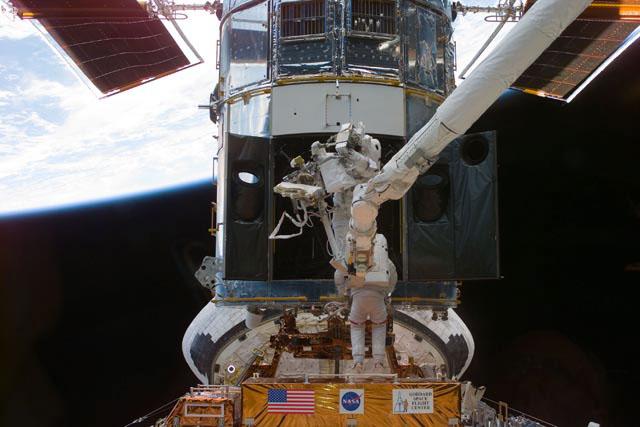
S103-E-5209 --- Astronauts Steven L. Smith (bottom), payload commander, and John M. Grunsfeld, mission specialist, perform servicing tasks on the temporarily-captured Hubble Space Telescope (HST). Grunsfeld is on a foot restraint connected to Discovery's remote manipulator system (RMS) robot arm. Smith, making his second servicing visit to HST, is using handrails on the telescope. The photo was taken with an electronic still camera (ESC).
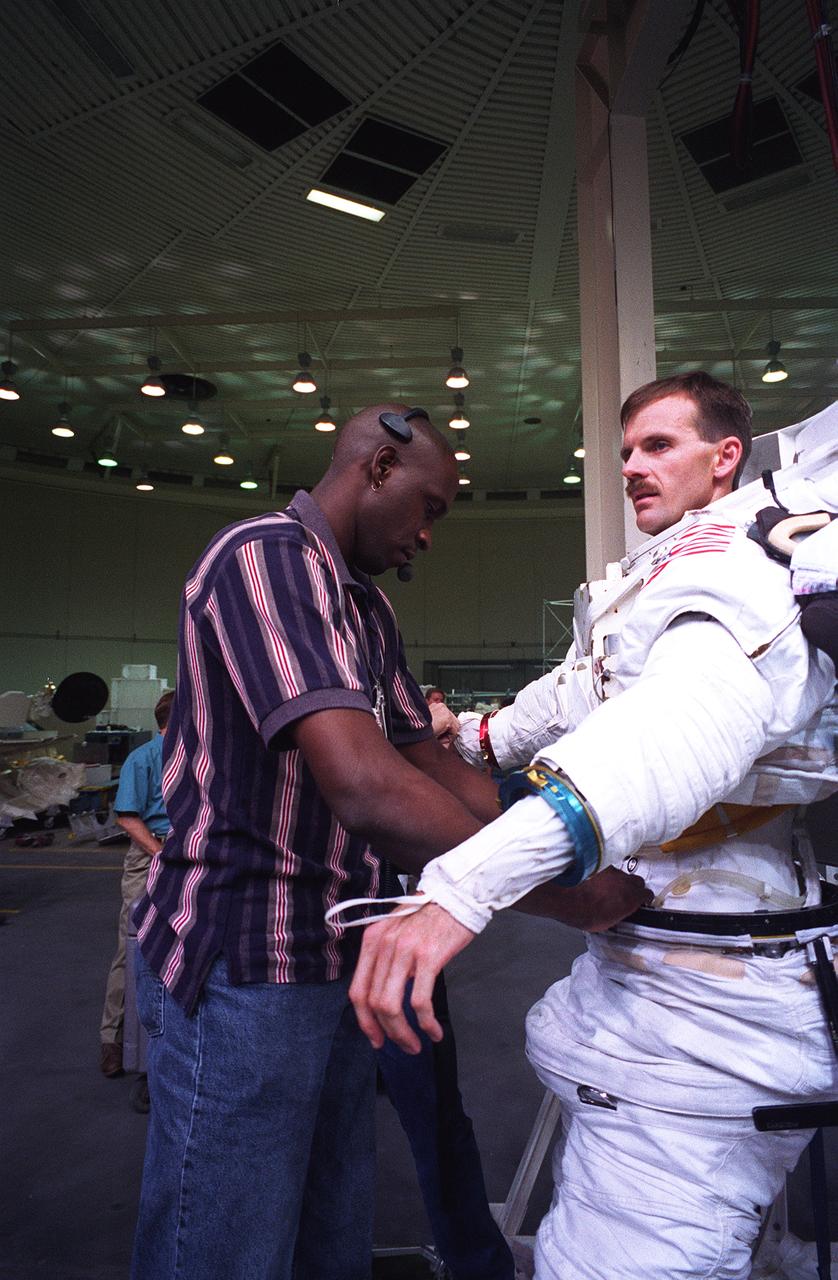
S96-11810 (10 June 1996) --- Astronaut Steven L. Smith, STS-82 mission specialist assigned to extravehicular activity (EVA) involved with the servicing of the Hubble Space Telescope (HST), gets help with the final touches of suit donning from John Williams, an Extravehicular Mobility Unit (EMU) technician. Minutes later, Smith was underwater in a nearby tank and neutrally buoyant, rehearsing some of the HST servicing chores with a crewmate.
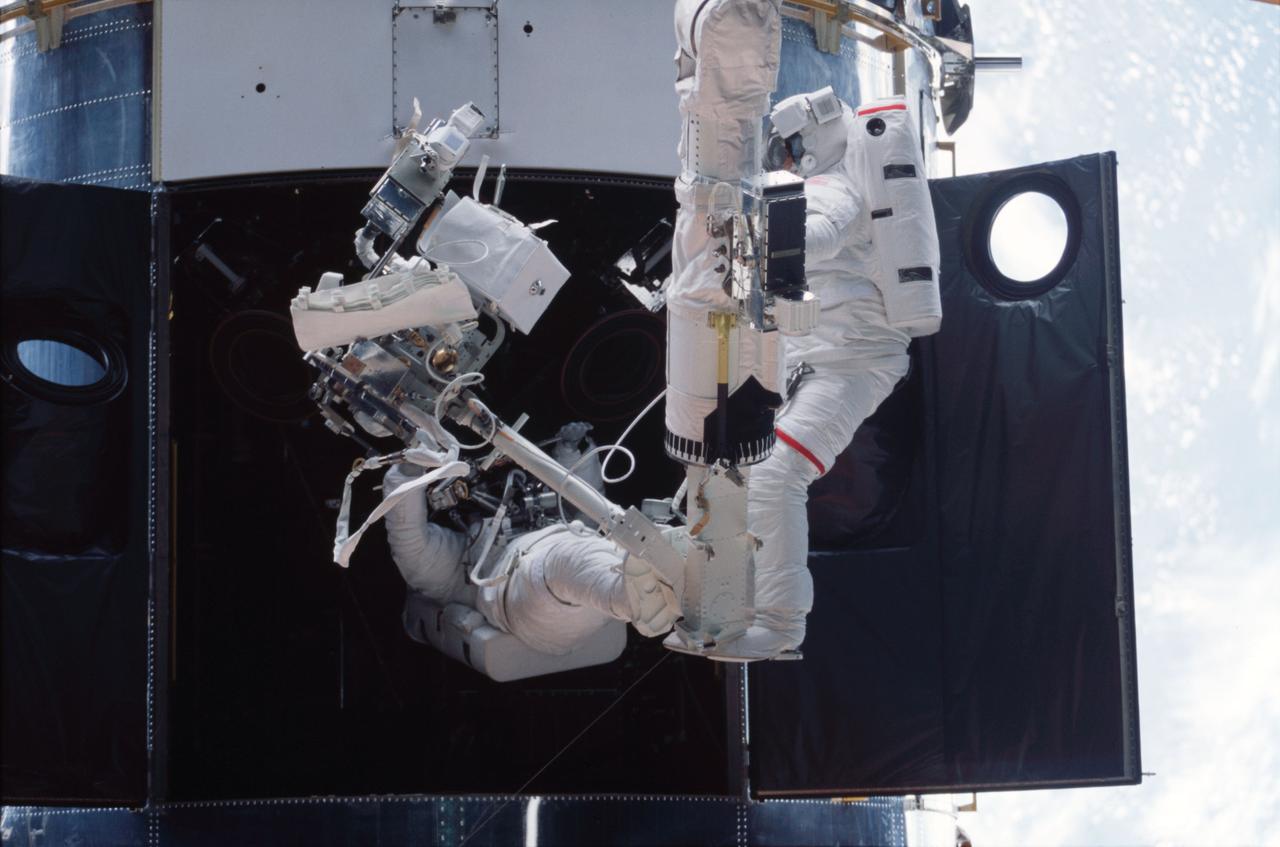
STS103-331-013 (19-27 December 1999) --- Astronauts John M. Grunsfeld (right) and Steven L. Smith share space on the end of the remote manipulator system (RMS) as they change out gyroscopes, contained in rate sensor units (RSU) inside the Hubble Space Telescope (HST).
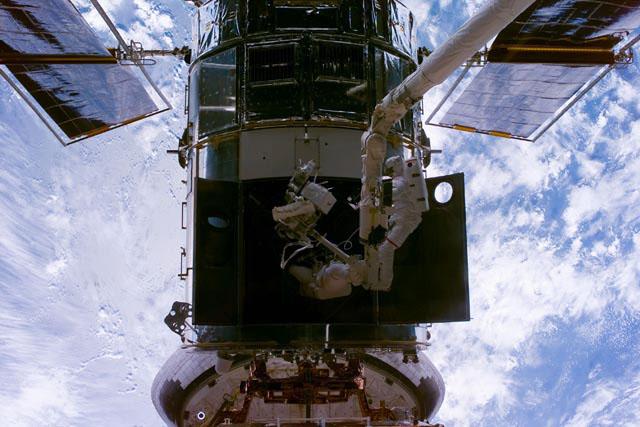
S103-E-5206 --- Astronauts Steven L. Smith (right), payload commander, and John M. Grunsfeld use the Canadian-built remote manipulator system (RMS) robot arm to perform servicing tasks on the temporarily-captured Hubble Space Telescope (HST). The photo was taken with an electronic still camera (ESC).
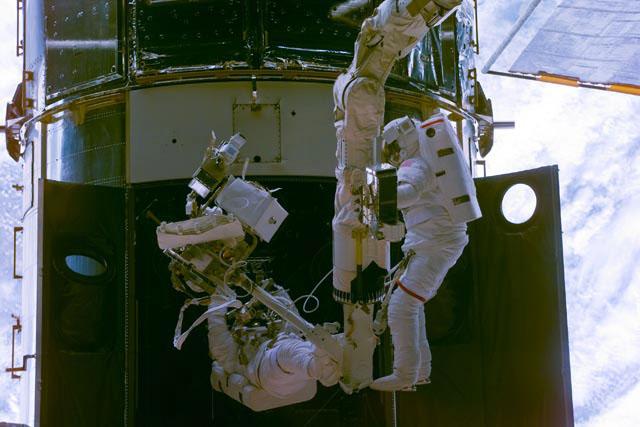
S103-E-5204 --- Astronauts Steven L. Smith (right), payload commander, and John M. Grunsfeld use the Canadian-built remote manipulator system (RMS) robot arm to perform servicing tasks on the temporarily-captured Hubble Space Telescope (HST). The photo was taken with an electronic still camera.
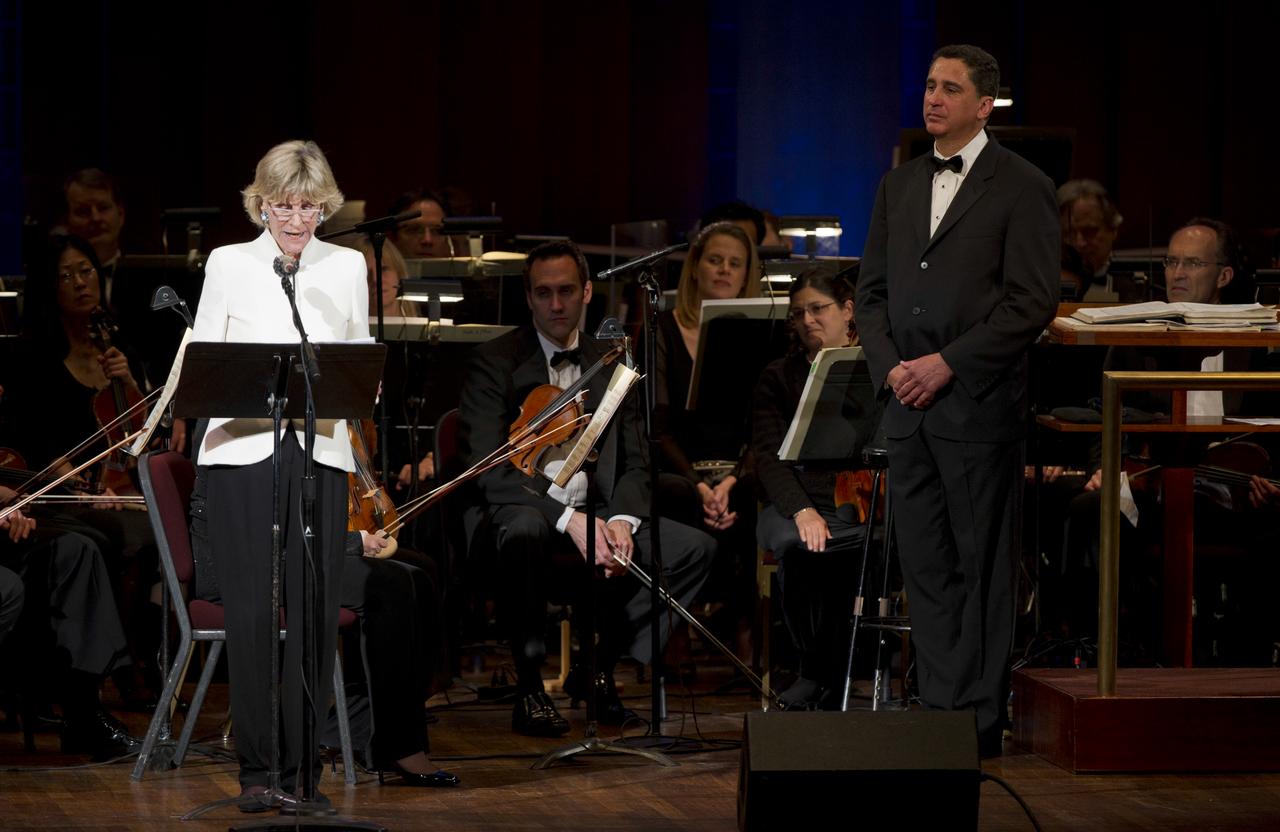
Jean Kennedy Smith, sister of John F. Kennedy, delivers remarks during a program entitled Human Spaceflight: The Kennedy Legacy as Emil de Cou, conductor of the Space Philharmonic, right, looks on, Wednesday, May 25, 2011, in the concert hall at the John F. Kennedy Center for the Performing Arts in Washington. The event marked the 50th Anniversary of President John F. Kennedy's Special Message to the Congress on Urgent National Needs in which he stated "landing a man on the moon and returning him safely to earth". Photo Credit: (NASA/Paul E. Alers)
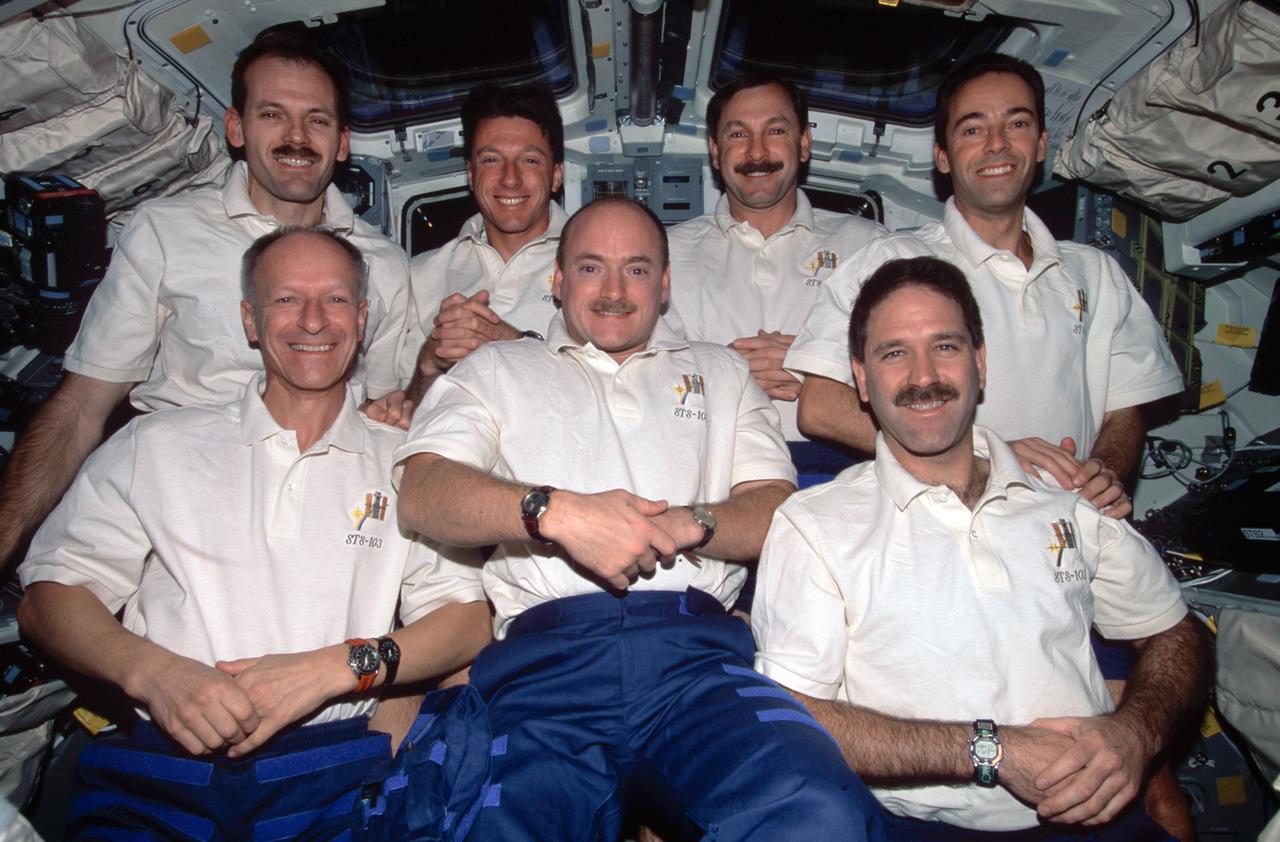
STS103-397-035 (19 - 27 December 1999) --- The seven astronauts aboard the Space Shuttle Discovery for NASA's third servicing visit to the Hubble Space Telescope (HST) pose for the traditional inflight crew portrait..In front are, from left, astronauts Claude Nicollier, Scott J. Kelly and John M. Grunsfeld. Behind them are.astronauts Steven L. Smith, C. Michael Foale, Curtis L. Brown, Jr., and Jean-Francois Clervoy. Nicollier and Clervoy are astronauts from the European Space Agency (ESA).
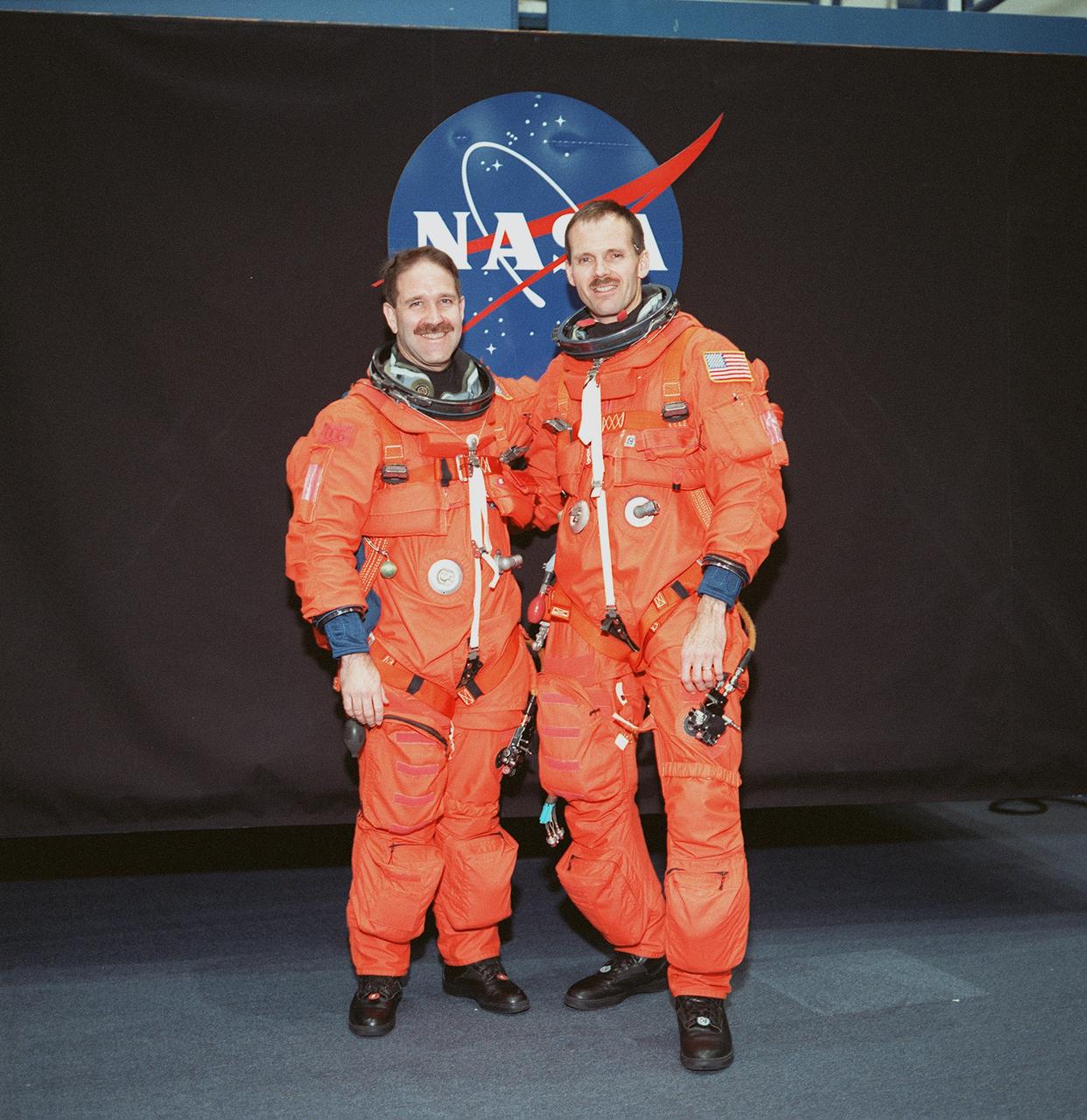
S99-08671 (24 May 1999) --- Astronauts John M. Grunsfeld (left) and Steven L. Smith, wearing training versions of the shuttle launch and entry garment, pose for an informal portrait prior to an emergency bailout training session in the Systems Integration Facility. The two mission specialists will join five other astronauts for the third servicing mission to the Earth-orbiting Hubble Space Telescope in the autumn of this year.
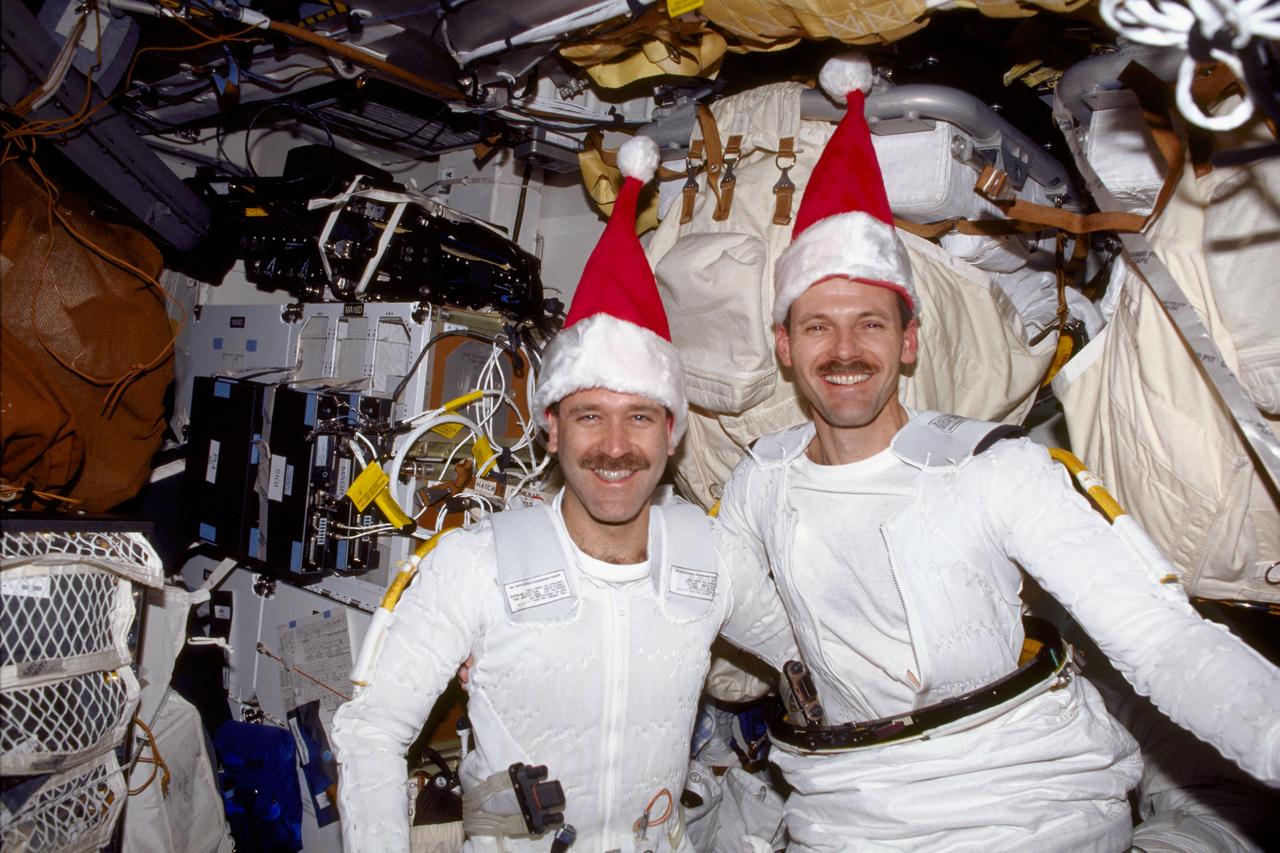
STS103-340-036 (19-27 December 1999) --- Wearing Santa hats, astronauts John M. Grunsfeld and Steven L. Smith blend with the season for a brief celebration on the mid deck of the Space Shuttle Discovery. The interruption was very brief as the two mission specialists shortly went about completing their suit-up process in order to participate in STS-103 space walk activity, performing needed work on the Hubble Space Telescope (HST).
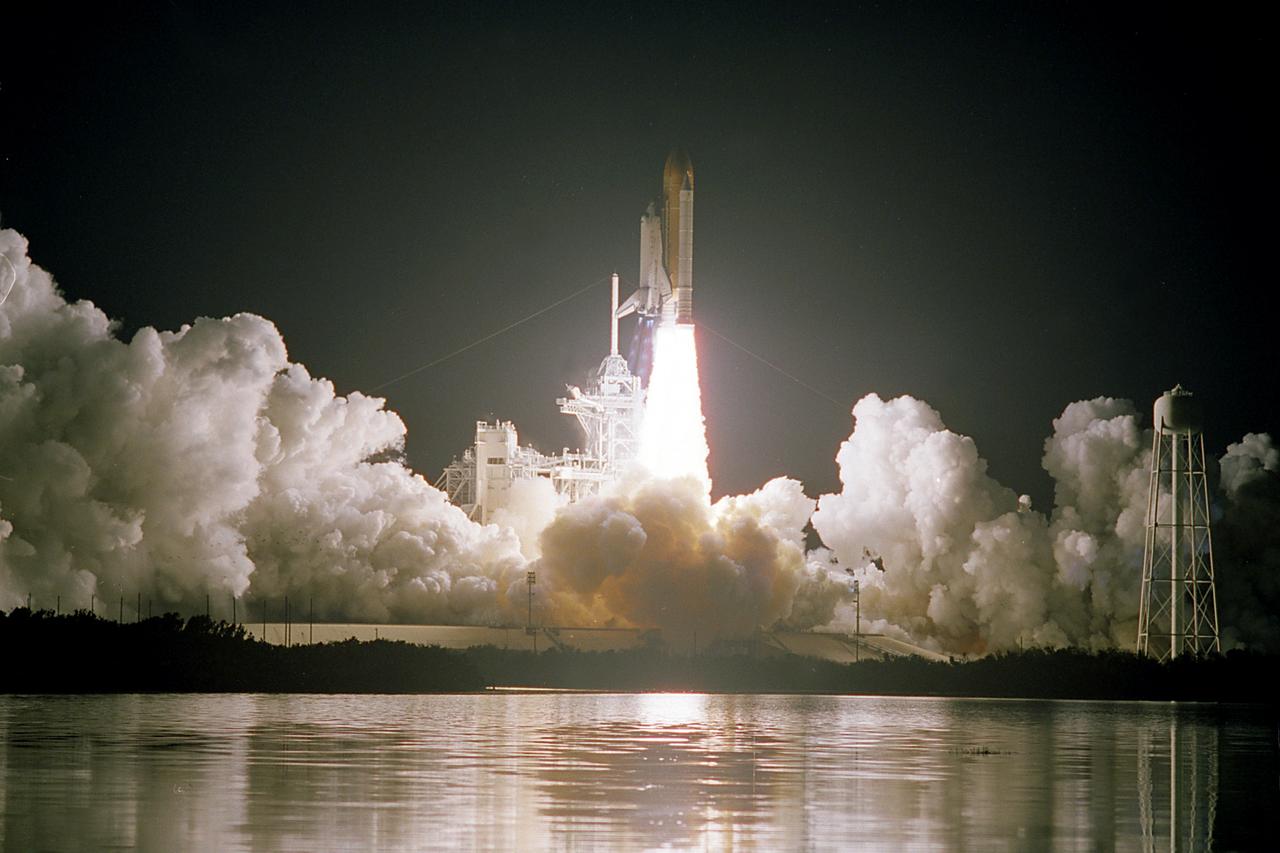
STS103-S-005 (19 December 1999) --- The Space Shuttle Discovery rises into the clear night sky to begin the 96th mission in the STS program. Liftoff occurred at 7:50 p.m. (EST), December 19, 1999, from Launch Pad 39B. Onboard were astronauts Curtis L. Brown, Jr., Scott J. Kelly, Steven L. Smith, C. Michael Foale, John M. Grunsfeld, Claude Nicollier and Jean-Francois Clervoy. Switzerland's Nicollier and France's Clervoy represent the European Space Agency (ESA).
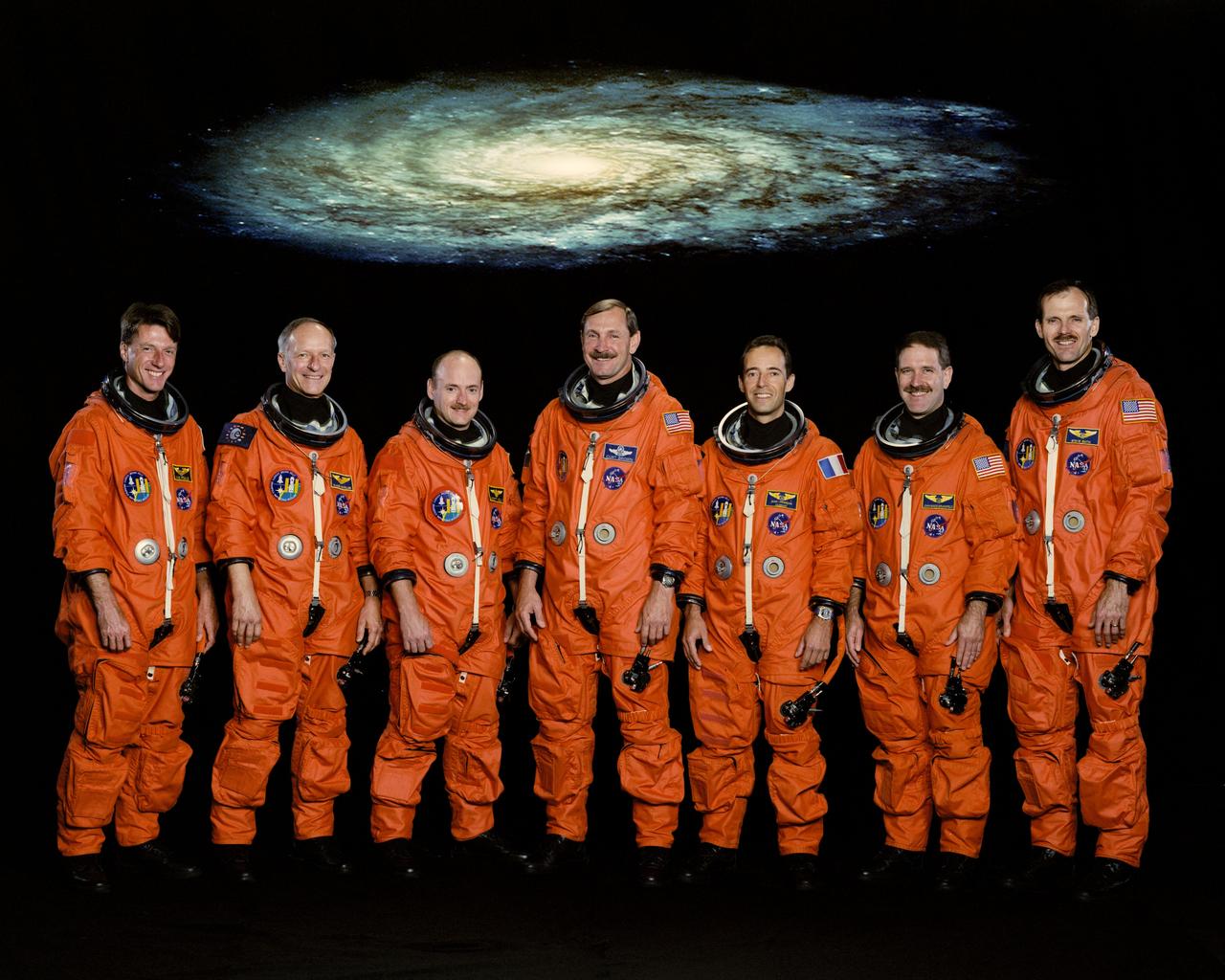
STS103-S-002 (August 1999) --- These seven astronauts have been assigned as crew members for NASA's third servicing mission to the Hubble Space Telescope (HST). They are, from the left, astronauts C. Michael Foale, Claude Nicollier, Scott J. Kelly, Curtis L. Brown, Jr., Jean-Francois Clervoy, John M. Grunsfeld and Steven L. Smith. Brown and Kelly are commander and pilot, respectively. All the others are mission specialists (MS), with international MS Nicollier and Clervoy representing the European Space Agency (ESA).
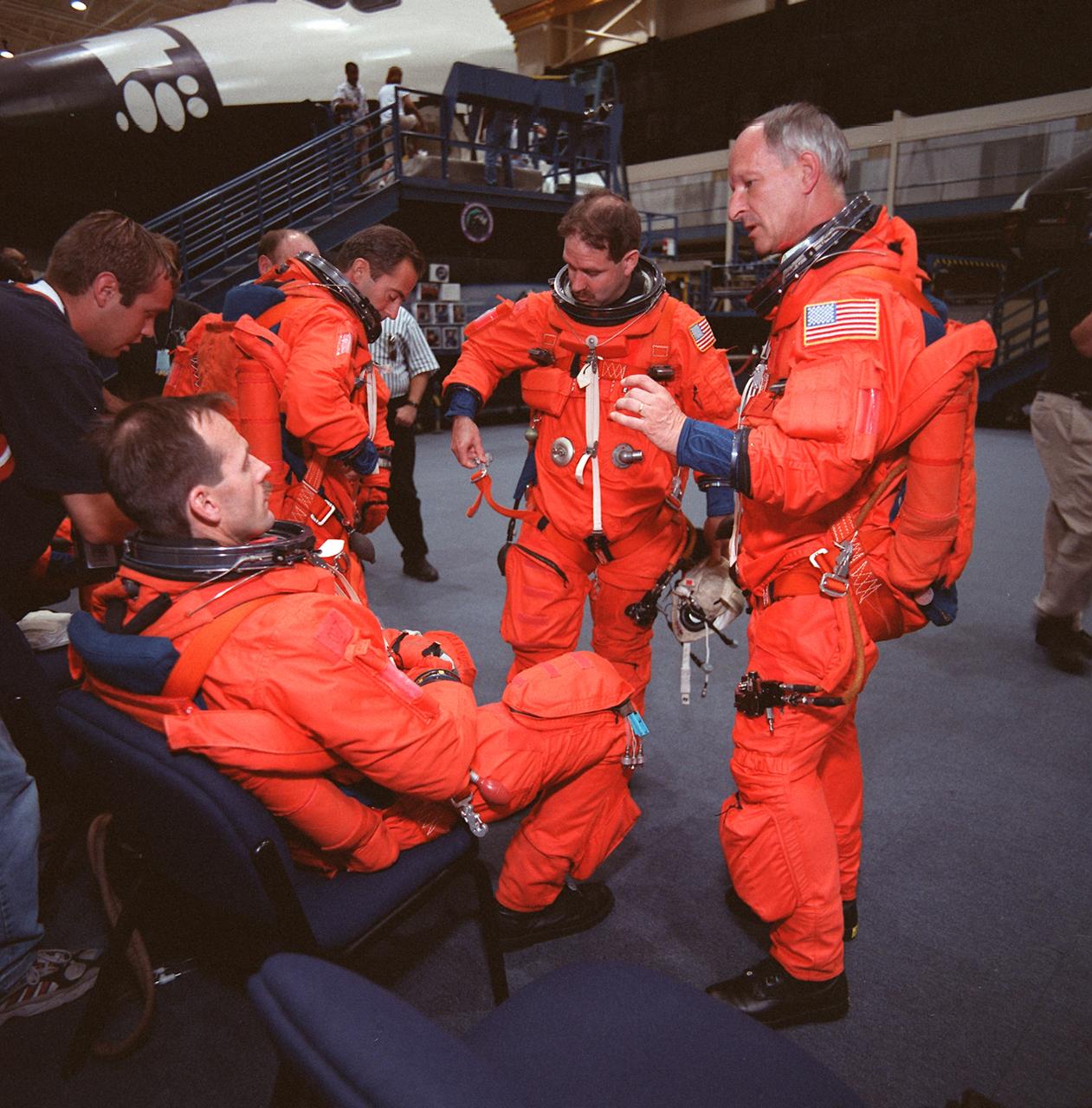
S99-08668 --- Four members of the STS-103 crew prepare their launch and entry suits for a training session on emergency bailout procedures in the Johnson Space Center's Systems Integration Facility. Astronaut Steven L. Smith is seated in the foreground. Others pictured are astronauts Jean-Francois Clervoy, John M. Grunsfeld and Claude Nicollier, all mission specialists. Nicollier and Clervoy are with the European Space Agency (ESA). One of two Crew Compartment Trainers (CCT) is in the background.
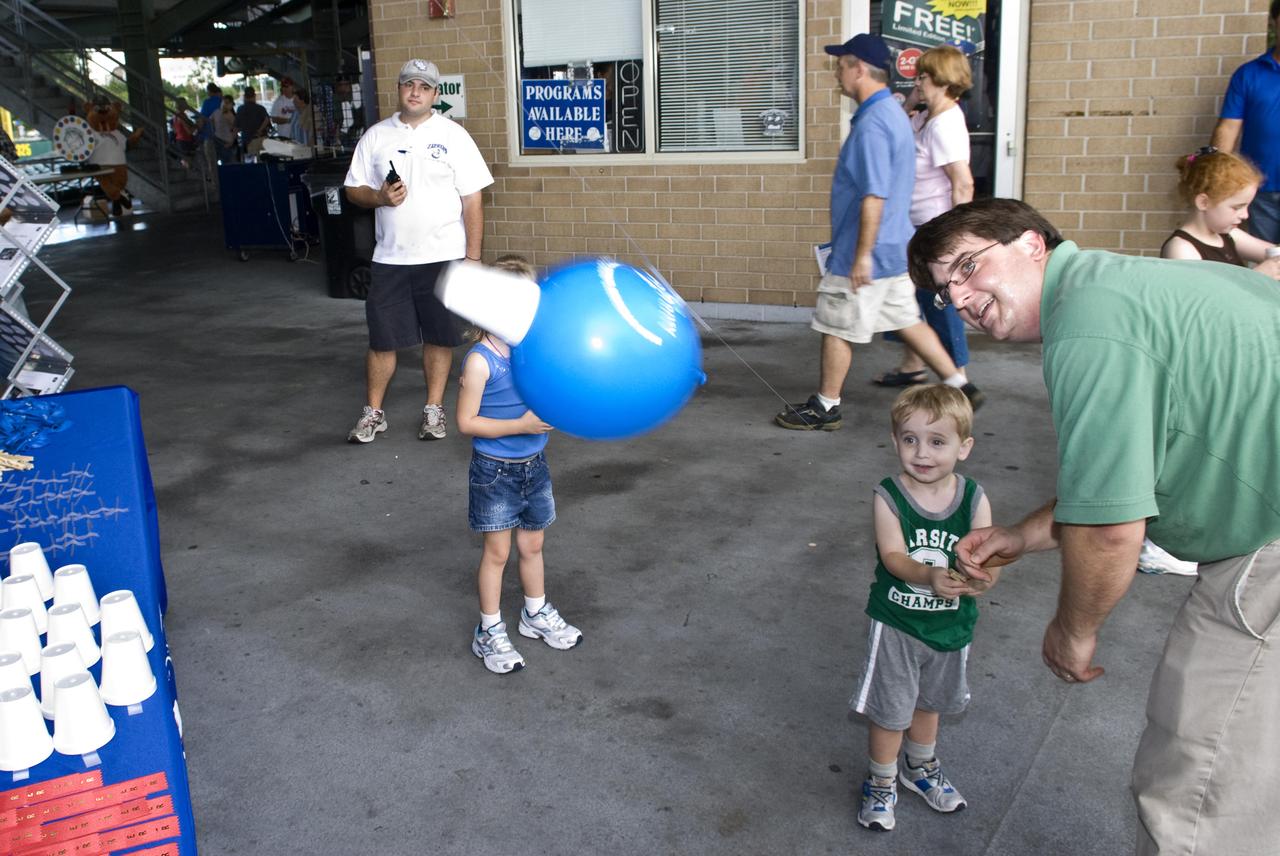
Stennis employee Chris Smith helps a young child 'launch' a balloon rocket. Employees from NASA's John C. Stennis Space Center traveled to New Orleans on Aug. 20 to host NASA Night at Zephyr Field. Stennis personnel provided a variety of activities and materials for persons attending a game between the New Orleans Zephyrs and the Las Vegas 51s.
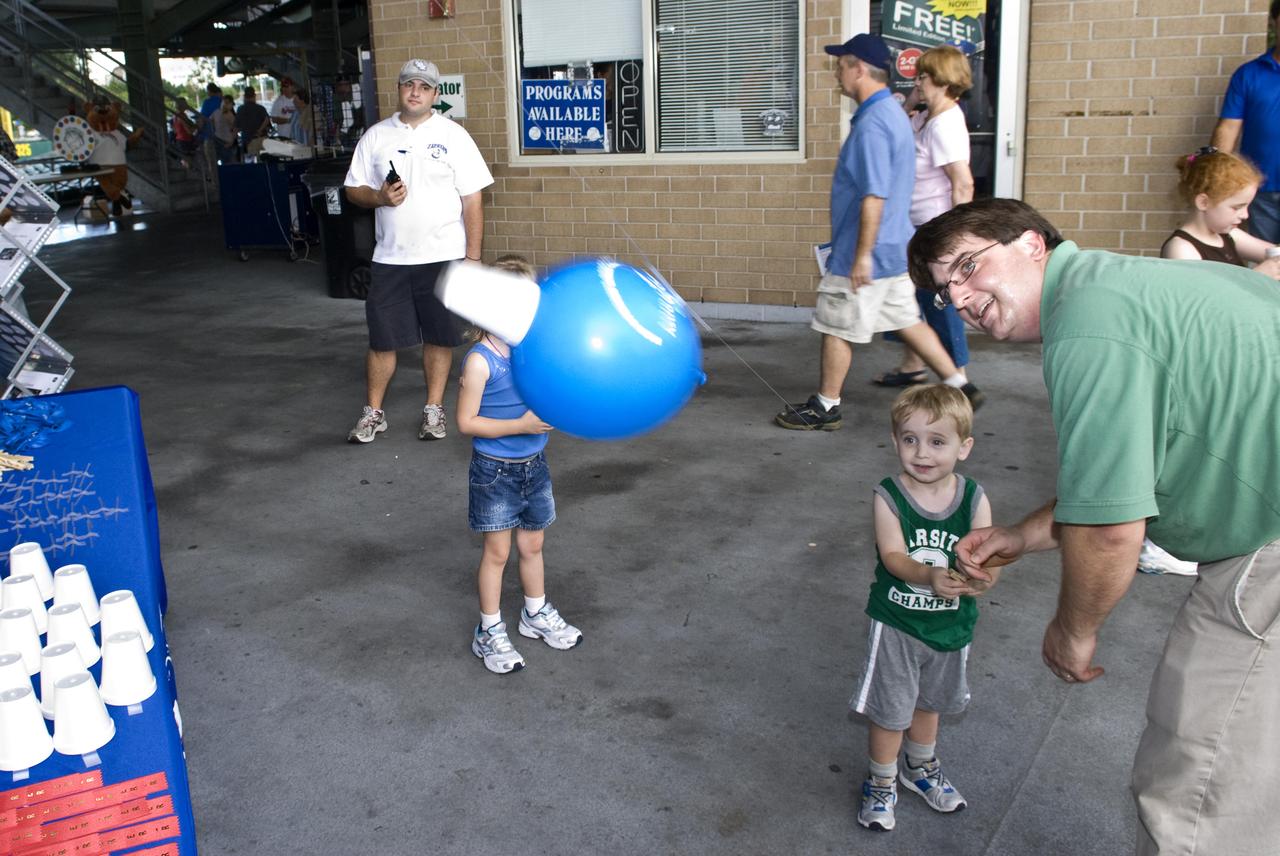
Stennis employee Chris Smith helps a young child 'launch' a balloon rocket. Employees from NASA's John C. Stennis Space Center traveled to New Orleans on Aug. 20 to host NASA Night at Zephyr Field. Stennis personnel provided a variety of activities and materials for persons attending a game between the New Orleans Zephyrs and the Las Vegas 51s.
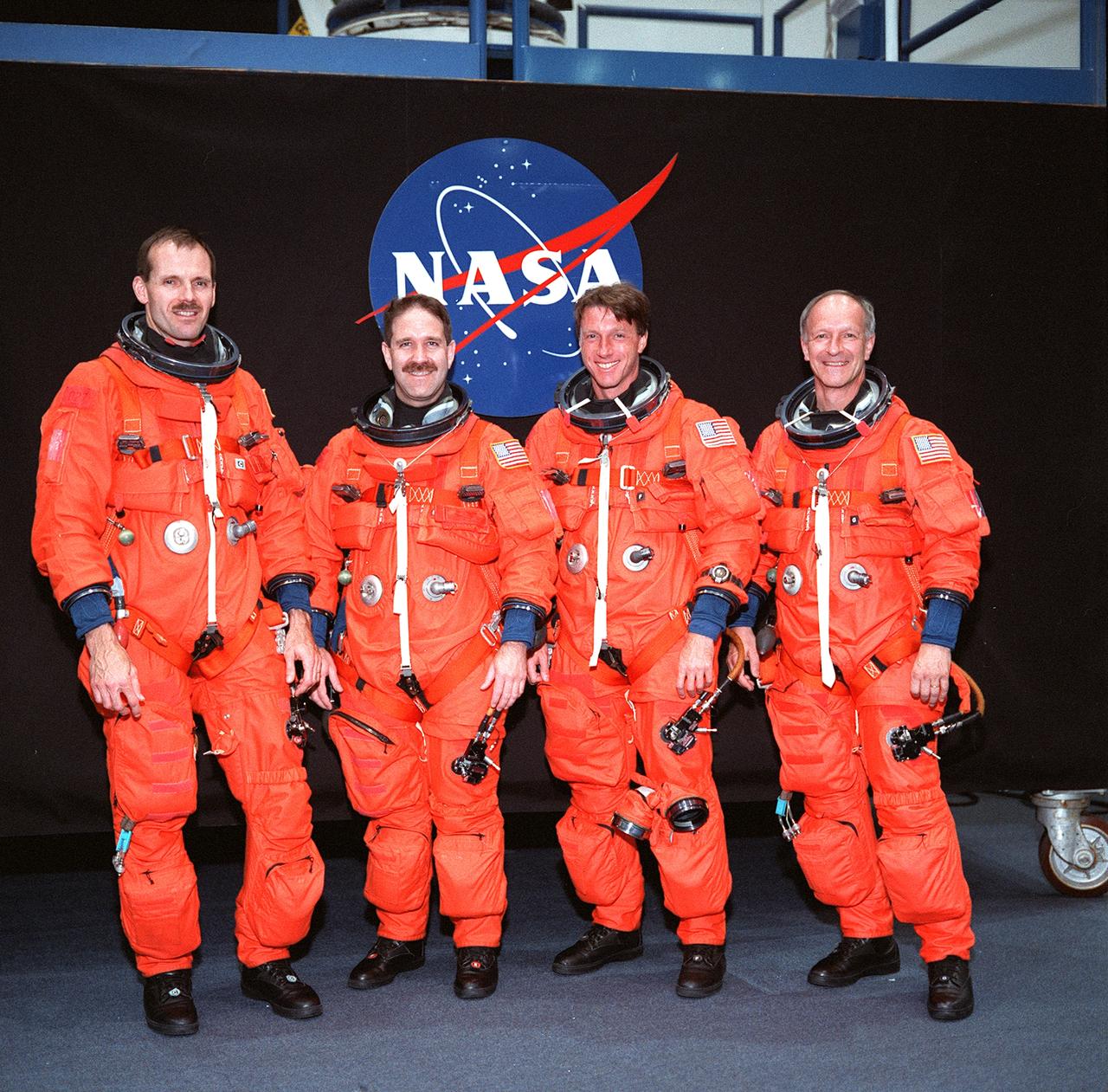
S99-08655 (24 May 1999) --- From the left, astronauts Steven L. Smith, John M. Grunsfeld, C. Michael Foale and Claude Nicollier, all mission specialists, pose for an informal portrait. The STS-103 crew members are wearing training versions of the shuttle partial-pressure launch and entry space garments. Nicollier is one of two astronauts on this flight who represents the European Space Agency (ESA).
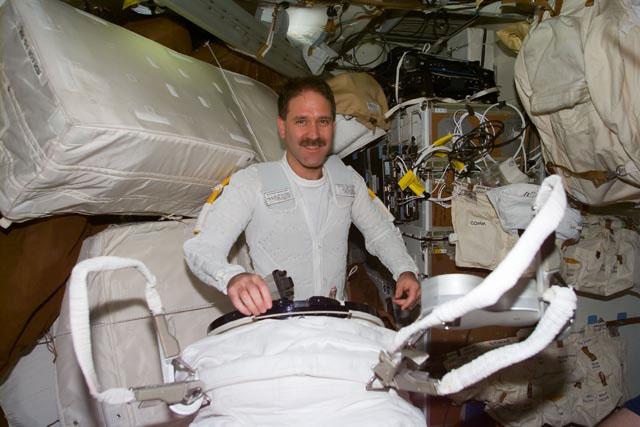
STS103-E-5243 (22 December 1999) --- Astronaut John M. Grunsfeld, mission specialist, on Discovery's mid deck wearing the thermal undergarment which complements the extravehicular mobility unit (EMU) space suit. Grunsfeld joined astronaut Steven L. Smith for the first scheduled space walk on this the third NASA visit to HST. This photo was taken with an electronic still camera (ESC).
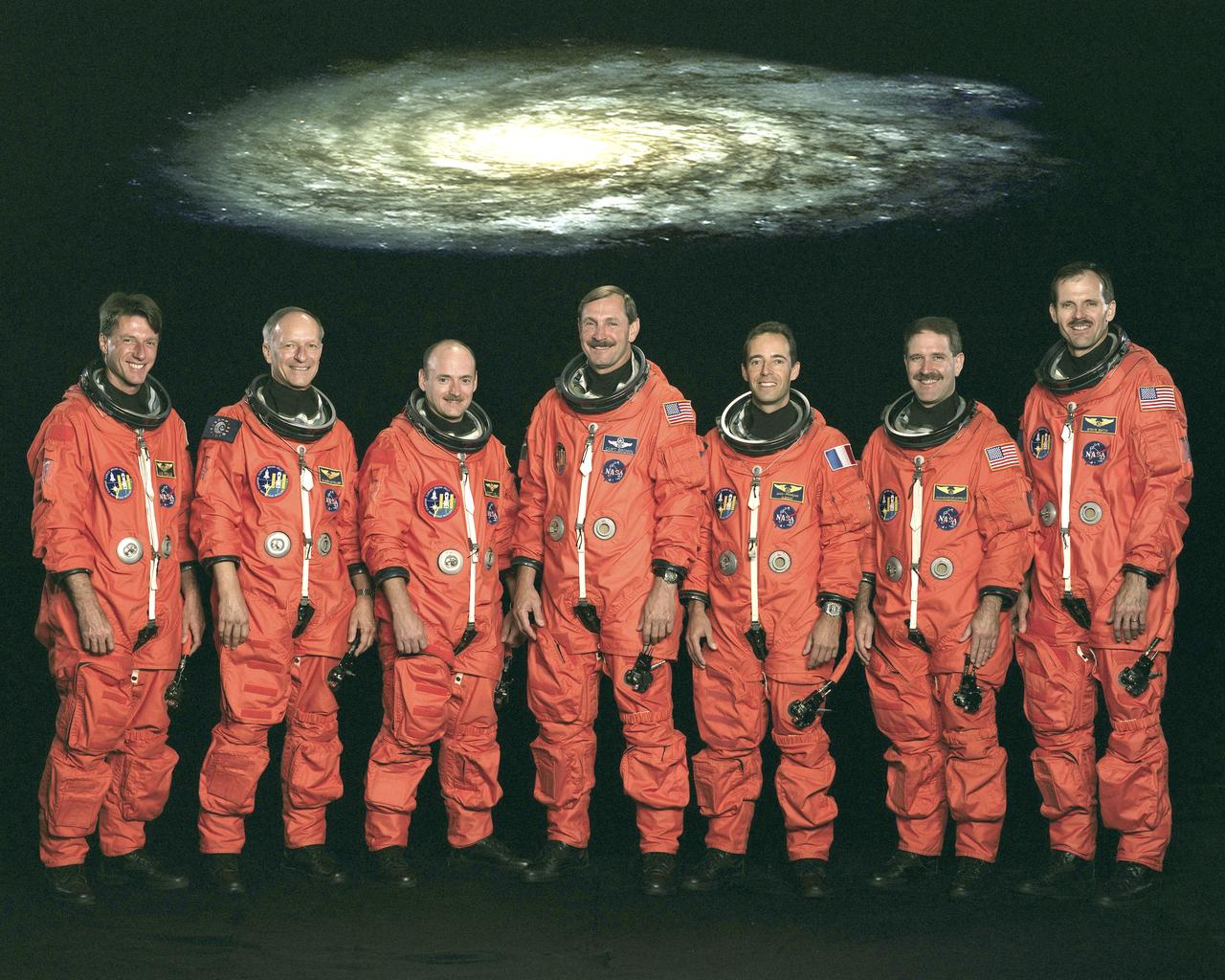
The STS-103 crew portrait includes (from left) C. Michael Foale, mission specialist; Claude Nicollier, mission specialist representing the European Space Agency (ESA) ; Scott J. Kelly, pilot; Curtis L. Brown, commander; and mission specialists Jean-Francois Clervoy (ESA), John M. Grunsfeld, and Steven L. Smith. Launched aboard the Space Shuttle Discovery on December 19, 1999 at 6:50 p.m. (CST), the STS-103 mission served as the third Hubble Space Telescope (HST) servicing mission.
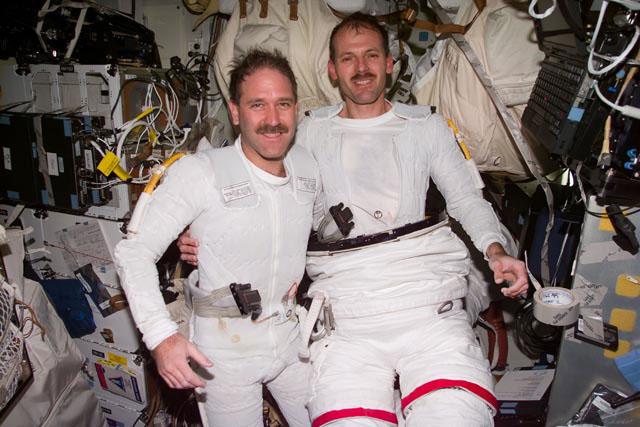
S103-E-5366 (24 December 1999) --- Astronauts John M. Grunsfeld (left), mission specialist, and Steven L. Smith, payload commander, are pictured prior to donning their extravehicular mobility unit (EMU) space suits onboard Discovery's mid deck. Hours later, the two completed the third and final space walk scheduled for NASA's third servicing mission to the Hubble Space Telescope (HST).
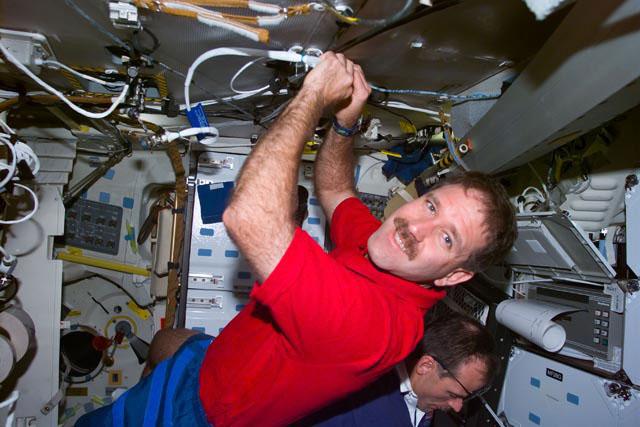
S103-E-5197 (21 Dec. 1998) --- Astronaut John M. Grunsfeld, mission specialist, checks a cable connection on Discovery's mid deck during Flight Day 2 activity. Astronaut Steven L. Smith, payload commander, is partially visible in the electronic still camera's (ESC) frame, recorded at 11:10:22 GMT, Dec. 21, 1999.
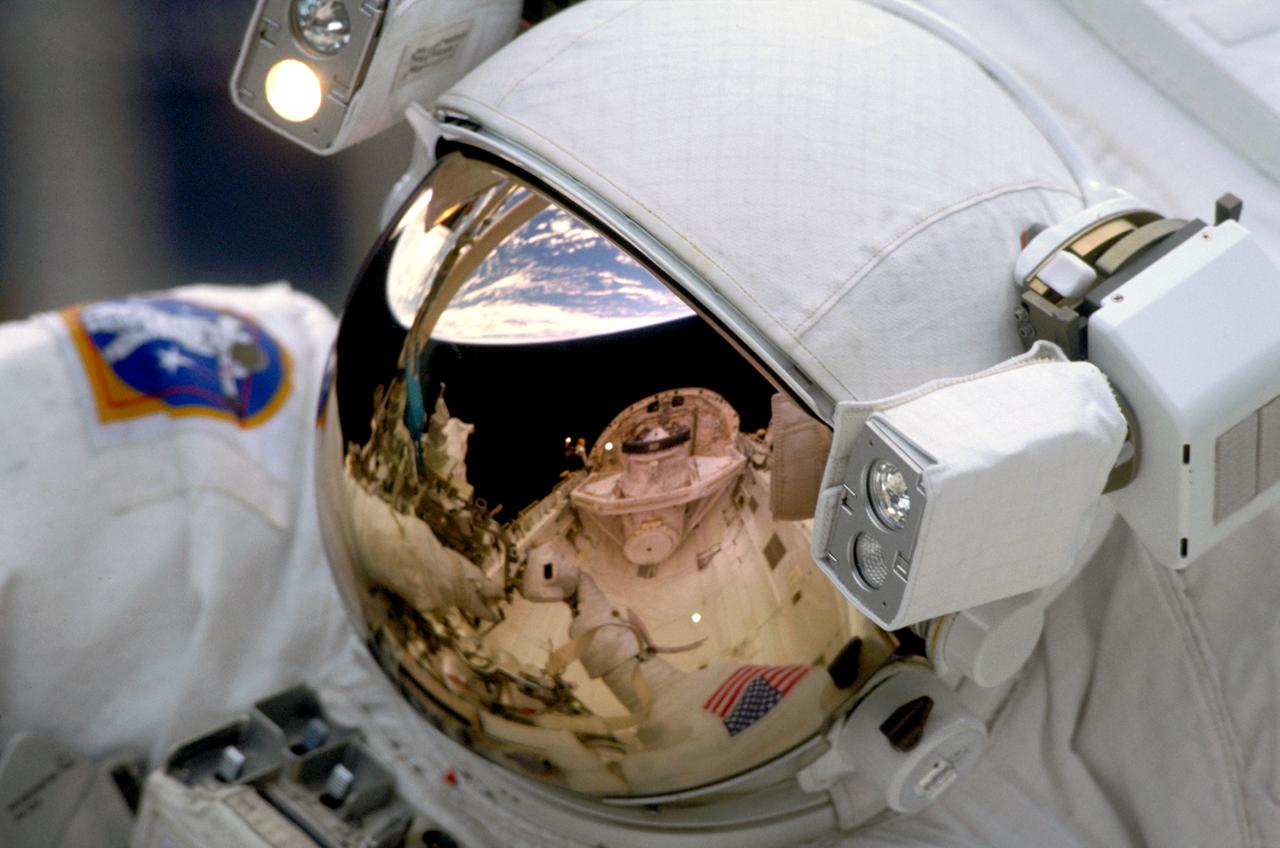
STS103-302-002 (19- 27 December 1999)---.The Space Shuttle Discovery's Cargo Bay and Crew Module, and the Earth's horizon are reflected in the helmet visor of one of the space walking astronauts on STS-103..Astronauts Steven L. Smith, John M. Grunsfeld, C. Michael Foale and Claude Nicollier participated in three days of.extravehicular activity on the NASA's third servicing visit to the Hubble Space Telescope (HST).
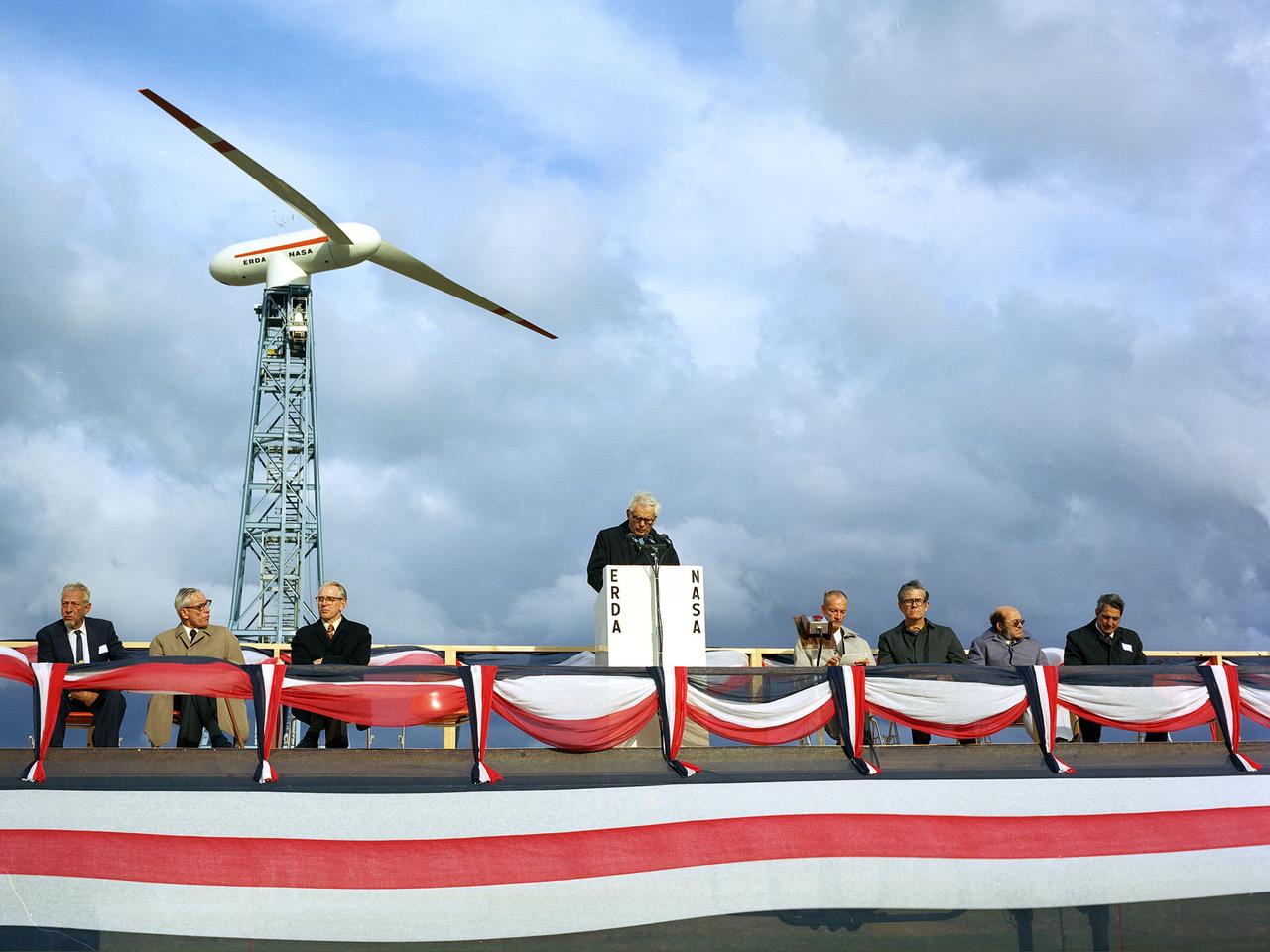
Energy Research and Development Administration (ERDA) Administrator Robert Seamans addresses the crowd at the dedication ceremony for the Mod-0 100-kilowatt wind turbine at the National Aeronautics and Space Administration’s (NASA) Plum Brook Station. The wind turbine program was a joint NASA/ERDA effort to develop less expensive forms of energy during the 1970s. NASA Lewis was able to use its experience with aerodynamics, powerplants, and energy transfer to develop efficient and cost-effective wind energy systems. The Plum Brook wind turbine was the first of a series of increasingly powerful NASA-ERDA wind turbines built around the nation. From left to right: Congressional Committee aide John Dugan, retired S. Morgan Smith Company chief engineer Carl Wilcox, windmill pioneer Beauchamp Smith, NASA Administrator James Fletcher, Seamans, and Lewis Center Director Bruce Lundin. The three men to the right are unidentified.
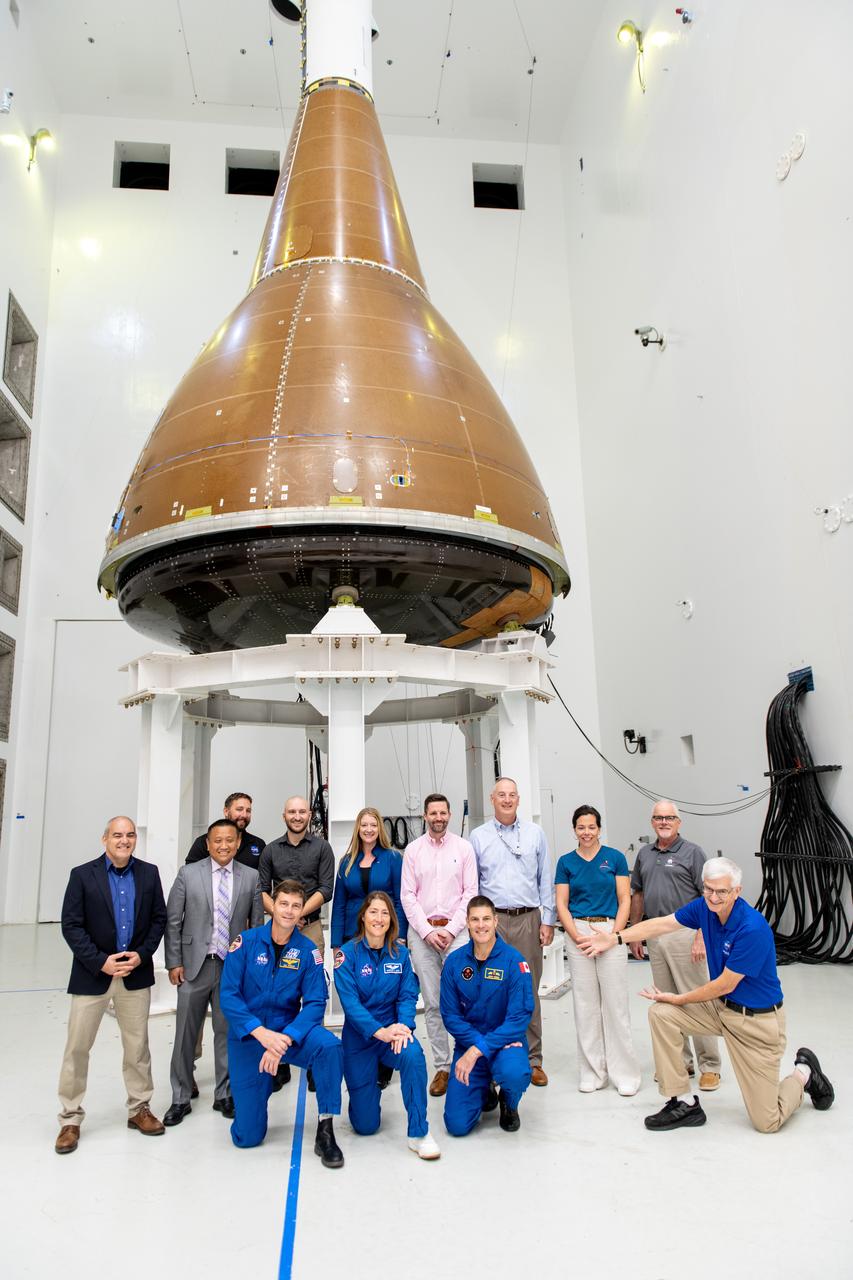
Front Row: Commander Reid Wiseman, Howard Hu, Mission Specialist Christina Koch, Mission Specialist Jeremy Hansen, General David Stringer, Back Row: Carlos Garcia Galan, Howard Hu, John Zang, Josh Pawlak, Nicole Smith, Jan-Henrik Horstmann, Robert Overy, Kathryn Oriti pose in front of the Orion Environmental Test Article at Armstrong Test Facility in Sandusky, OH. The team has begun vibro-acoustic testing on the Orion spacecraft that flew around the Moon on Artemis I, now known as the Environmental Test Article. The testing will help ensure the safety of future crews aboard Orion. Employees meet three of the four astronauts who will venture around the Moon on Artemis II, the first crewed flight paving the way for future lunar surface missions. Commander Reid Wiseman and Mission Specialists Christina Koch and Jeremy Hansen will be on hand to discuss their upcoming mission and participate in a Question and Answer session with employees afterward. Hansen is an astronaut with the Canadian Space Agency. Victor Glover, the pilot and fourth crew member, will not be present. Awards were given to employees that participated in Orion for Artemis I. Photo Credit: (NASA/Sara Lowthian-Hanna)

FDCD Branch Stability and Control branch: Names, rows front to back, people left to right: Ground level: 1. ?? 2. Debra L. Livingston 3. Katherine G. Johnson 4. Robert Dunning Step 1: 1. Ellie Fillmore (?) 2. Al Hamer 3. Suresh Joshi Step 2: 1. John Young 2. Ernest Armstrong 3. Vladislav Klein 4. Charles T. Woolley Step 3: 1. Lawrence Taylor 2. Tony Fontana Step 4: 1. Bill Suit 2. Jane Carpenter 3. Daniel P. Giesy 4. Mario Smith Step 5: 1. Albert Schy 2. Ray Montgomery 3. Sahajendra Singh Top level: 1: Jim Batterson 2. Jim Williams 3. Claude Keckler 4. N. Sundararajan Behind all: John Shebalin Names given by Danial P. Giesy
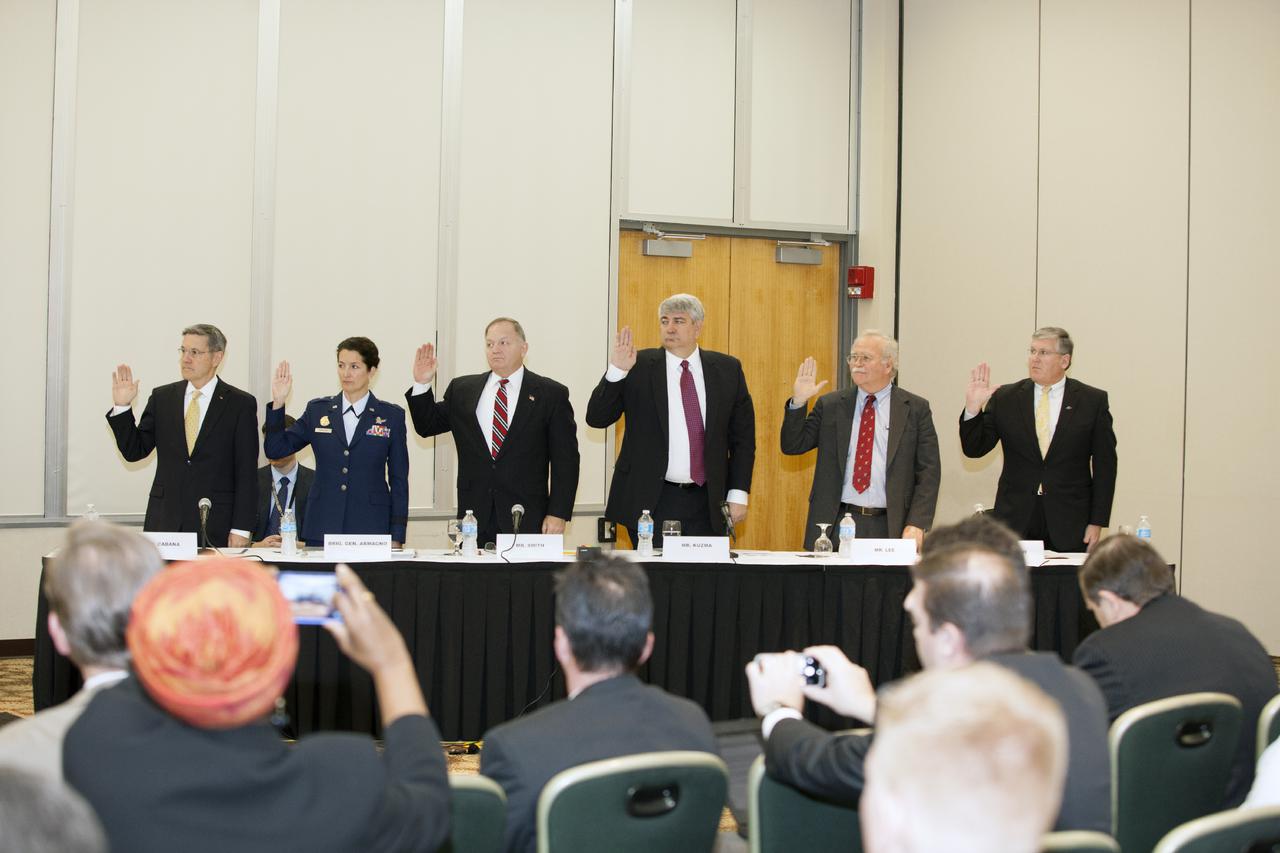
CAPE CANAVERAL, Fla. – At the Kurt H. Debus Conference Facility at the Kennedy Space Center Visitor Complex, witnesses are sworn in prior to a hearing of the U.S. House of Representatives'. From the left are Bob Cabana, director of the Kennedy Space Center, Brig. Gen. Nina Armagno, commander of the 45th Space Wing and director of the Eastern Range at Patrick Air Force Base, John Smith, regional commissioner of the U.S. General Services Administration, Jim Kuzma, chief operating officer of Space Florida, Charles Lee of the Audubon Society, and John Walsh, chief executive officer of the Canaveral Port Authority. The Congressional hearing took place to review plans for putting vacant buildings and excess property at the Kennedy Space Center to their best and most productive use. Photo credit: NASA_Daniel Casper
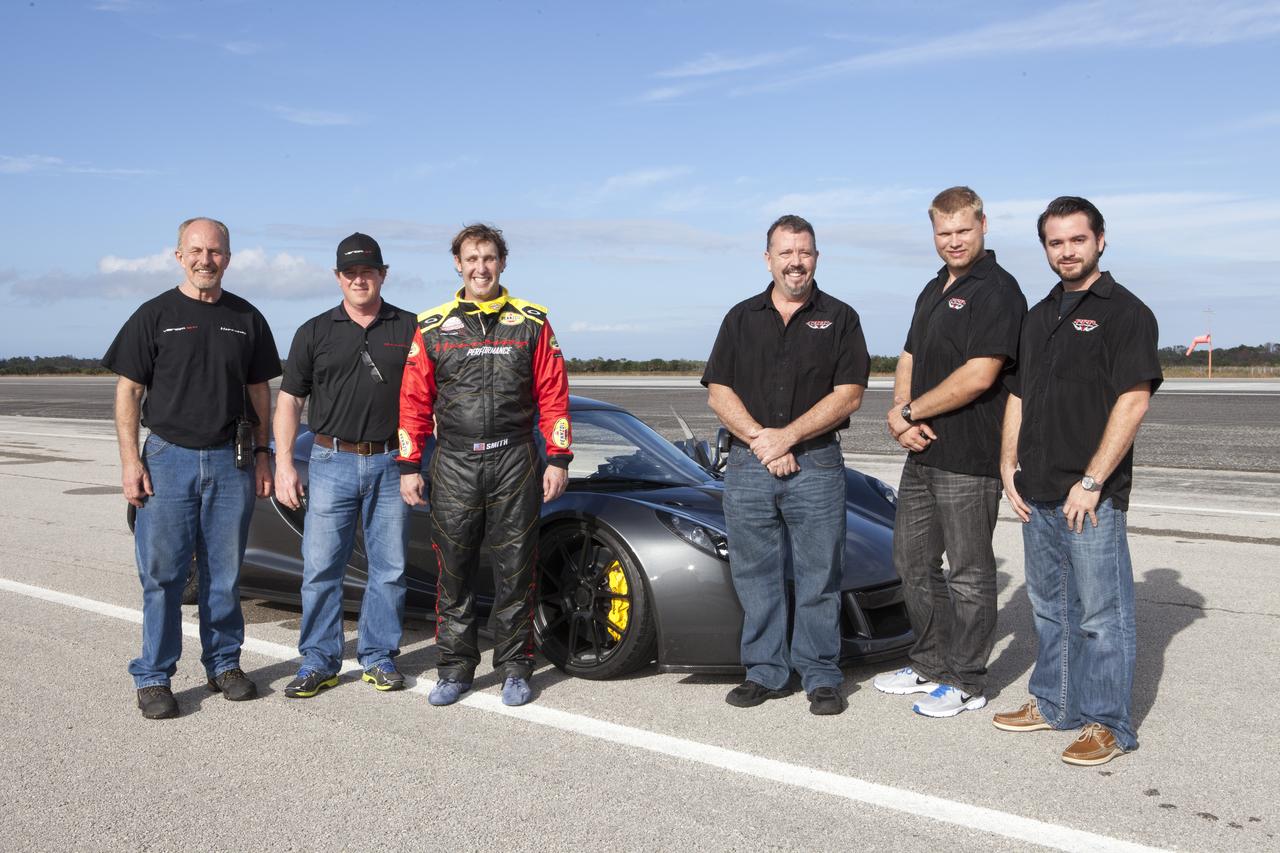
CAPE CANAVERAL, Fla. - The Performance Power Racing and Hennessey Performance teams pose with a Hennessey Venom GT at the 3.5-mile long runway at the Shuttle Landing Facility at NASA's Kennedy Space Center in Florida. The teams are, from left, Hennessey's John Heinricy, John Hennessey, Brian Smith, Performance Power Racing's Johnny Bohmer, Matt Lundy and Jeff McEachran. The flat concrete runway is one of the few places in the world where high performance automobiles can be tested for aerodynamic and safety designs. Hennessey Performance of Sealy, Texas, worked with Performance Power Racing in West Palm Beach to arrange use of the NASA facility. Performance Power Racing has conducted numerous engineering tests on the runway with a variety of vehicles.
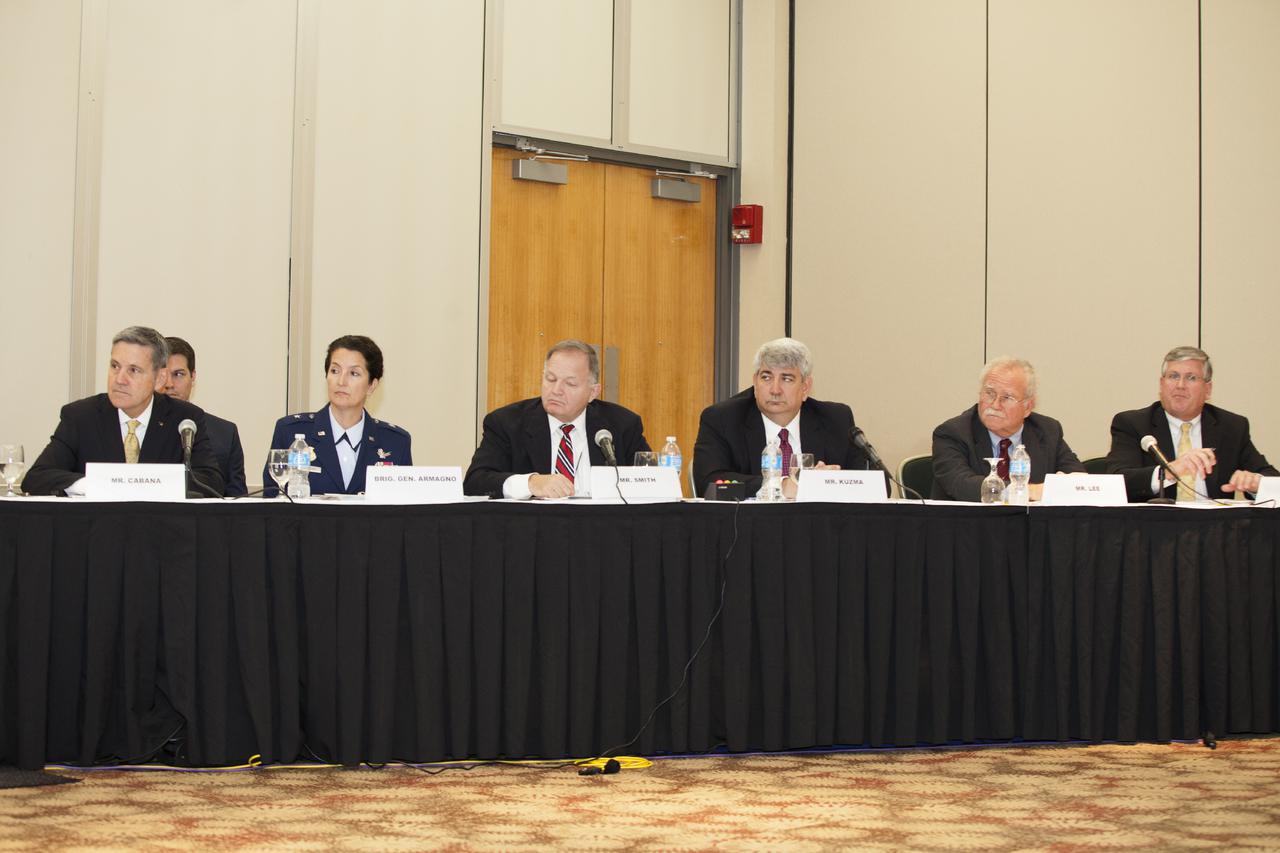
CAPE CANAVERAL, Fla. – At the Kurt H. Debus Conference Facility at the Kennedy Space Center Visitor Complex, witnesses listen during a hearing of the U.S. House of Representatives' Subcommittee on Government Operations. From the left are Bob Cabana, director of the Kennedy Space Center, Brig. Gen. Nina Armagno, commander of the 45th Space Wing and director of the Eastern Range at Patrick Air Force Base, John Smith, regional commissioner of the U.S. General Services Administration, Jim Kuzma, chief operating officer of Space Florida, Charles Lee of the Audubon Society, and John Walsh, chief executive officer of the Canaveral Port Authority. The Congressional hearing took place to review plans for putting vacant buildings and excess property at the Kennedy Space Center to their best and most productive use. Photo credit: NASA_Daniel Casper
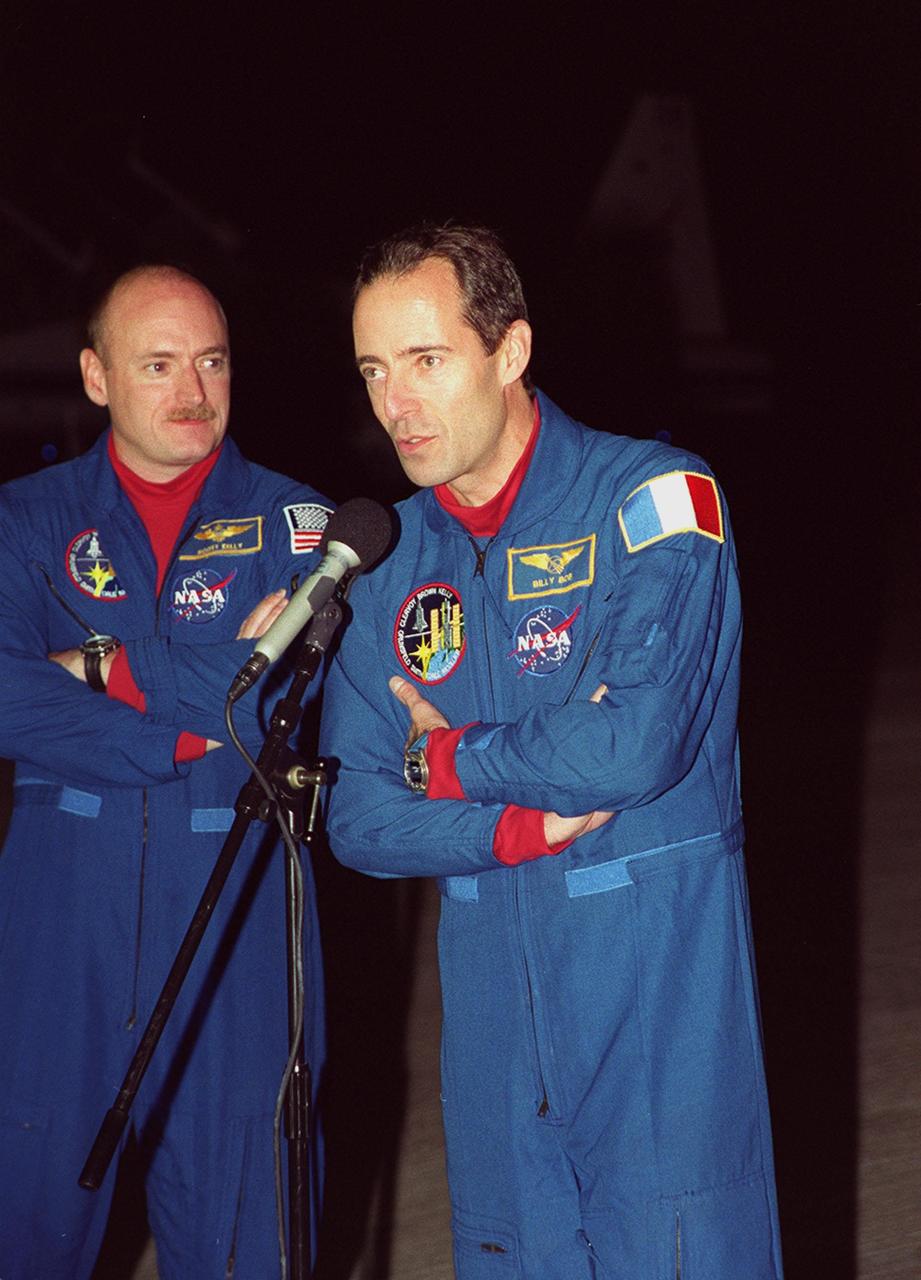
STS-103 Mission Specialist Jean-François Clervoy of France (at microphone) greets the media at the Shuttle Landing Facility as Pilot Scott J. Kelly looks on. The crew arrived at KSC aboard T-38 jets to make final preparations for their launch. The other STS-103 crew members are Commander Curtis L. Brown Jr. and Mission Specialists Steven L. Smith, C. Michael Foale (Ph.D.), John M. Grunsfeld (Ph.D.), and Claude Nicollier of Switzerland. Nicollier and Clervoy are with the European Space Agency. The mission, to service the Hubble Space Telescope a third time, is scheduled for launch Dec. 11 at 12:13 a.m. EST from Launch Pad 39B
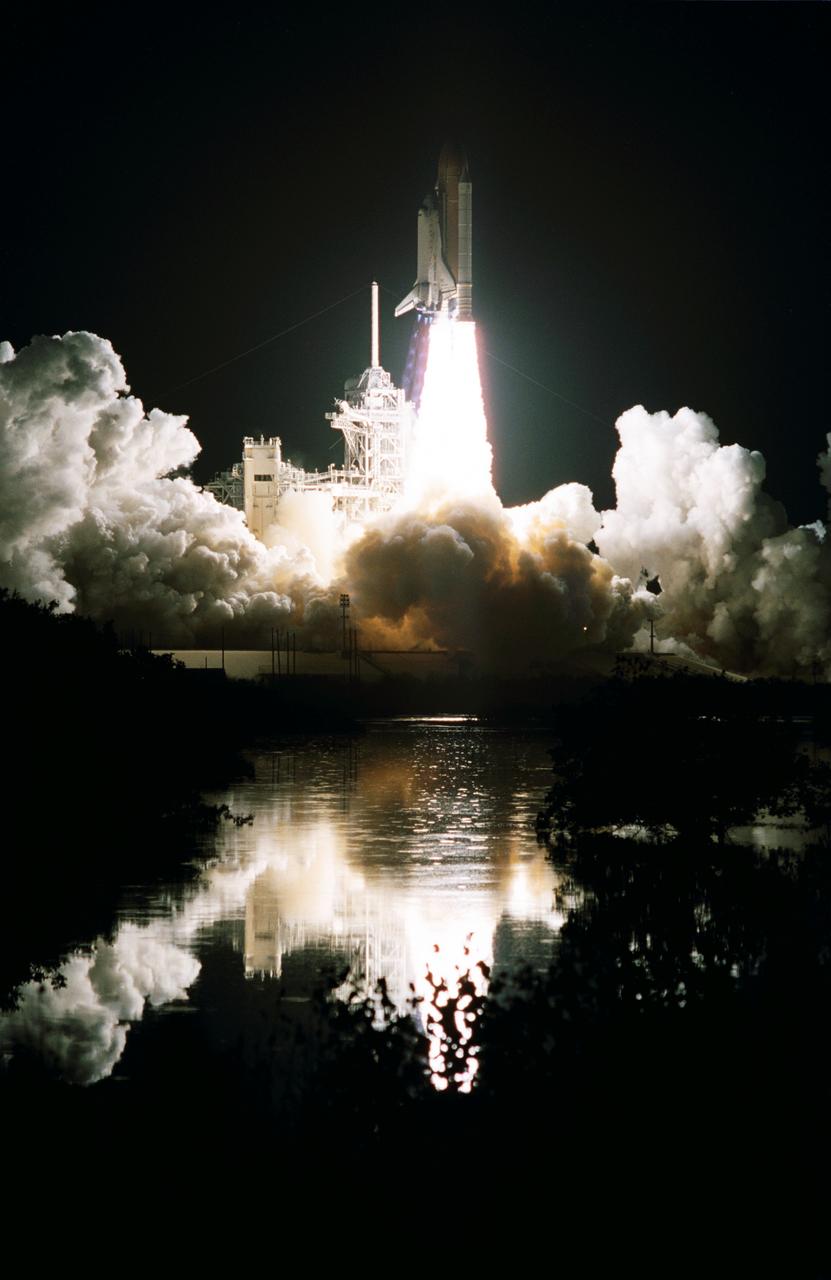
STS103-S-006 (19 December 1999) --- The Space Shuttle Discovery, reflected in nearby water, lifts off into the clear night sky to begin the 96th mission in the STS program. Liftoff occurred at 7:50 p.m. (EST), December 19, 1999, from Launch Pad 39B. Onboard were astronauts Curtis L. Brown, Jr., Scott J. Kelly, Steven L. Smith, C. Michael Foale, John M. Grunsfeld, Claude Nicollier and Jean-Francois Clervoy. Switzerland's Nicollier and France's Clervoy represent the European Space Agency (ESA).
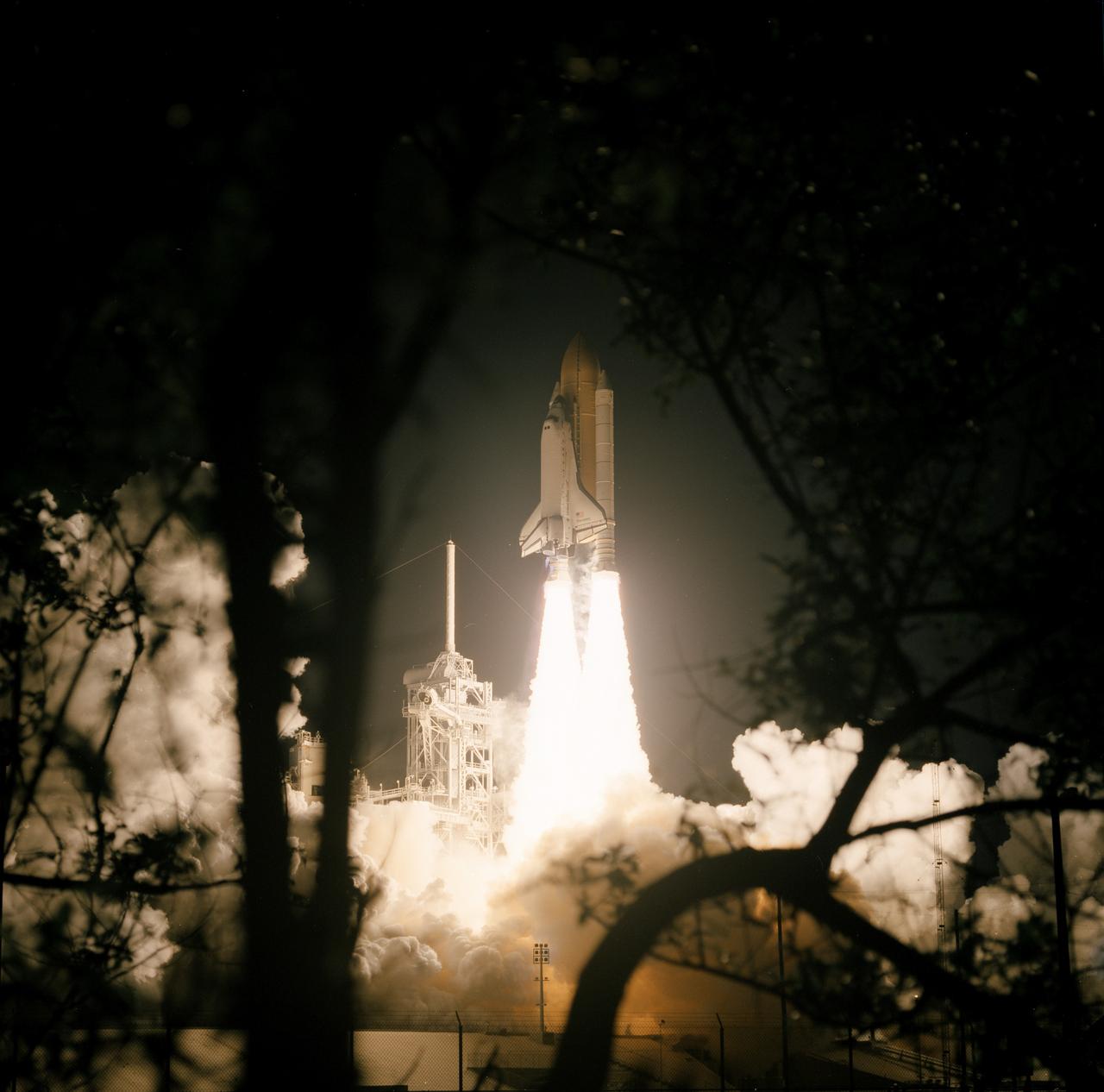
STS103-S-008 (19 December 1999) --- The Space Shuttle Discovery, framed by Florida foliage, clears the launch structure and heads toward the clear night sky to begin the 96th mission in the STS program. Liftoff occurred at 7:50 p.m. (EST), December 19, 1999, from Launch Pad 39B. Onboard were astronauts Curtis L. Brown, Jr., Scott J. Kelly, Steven L. Smith, C. Michael Foale, John M. Grunsfeld, Claude Nicollier and Jean-Francois Clervoy. Switzerland's Nicollier and France's Clervoy represent the European Space Agency (ESA).
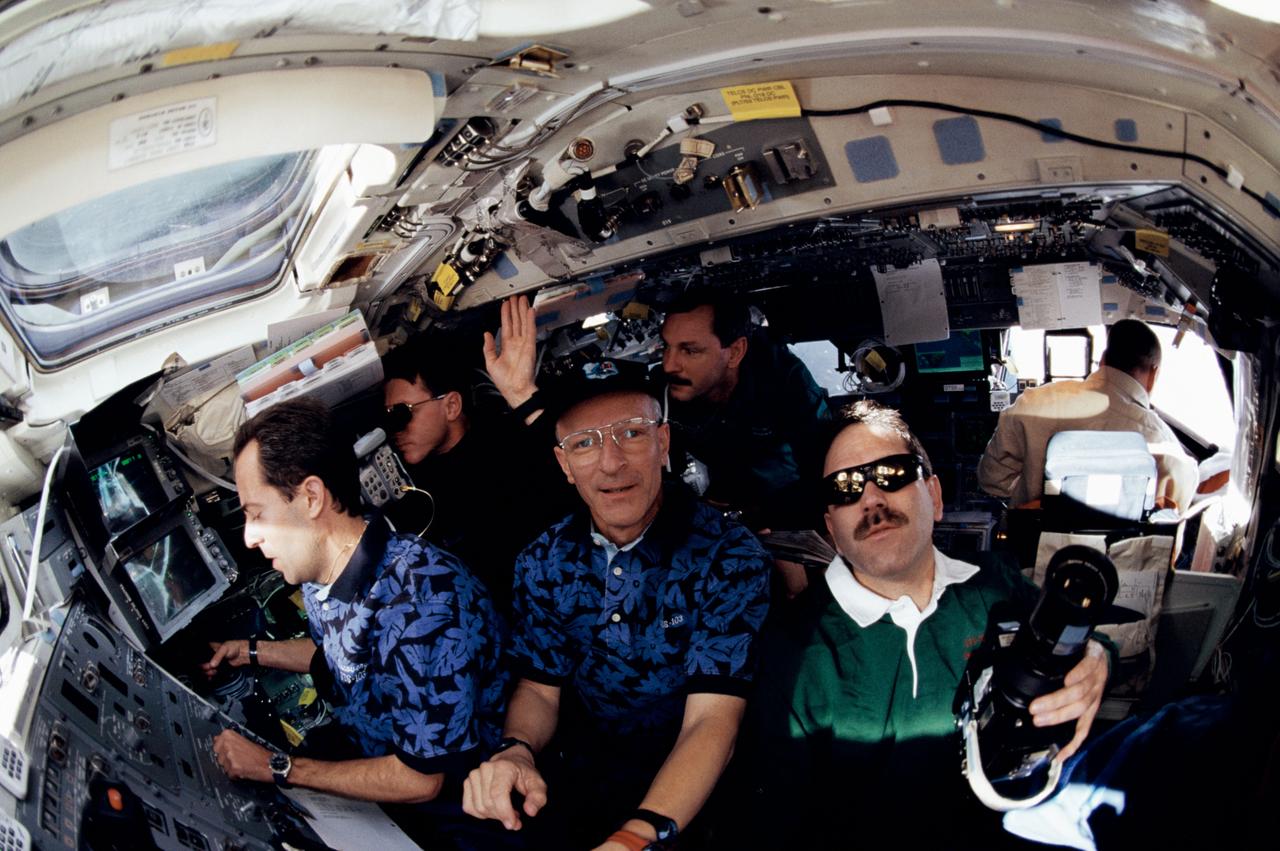
STS103-375-019 (19-27 December 1999) ---.Six members of the STS-103 crew are seen in this "fish-eye" lens scene taken on Discovery's flight deck during the deployment of the Hubble Space Telescope (HST). From left are astronauts Jean-Francois Clervoy, C. Michael Foale, Claude Nicollier, Curtis L. Brown, Jr., John M. Grunsfeld and Scott J. Kelly. Brown and Kelly are commander and pilot, respectively. All the others are mission specialists, with international MS Nicollier and Clervoy representing the European Space Agency (ESA). Astronaut Steven L. Smith, payload commander, took the photo.
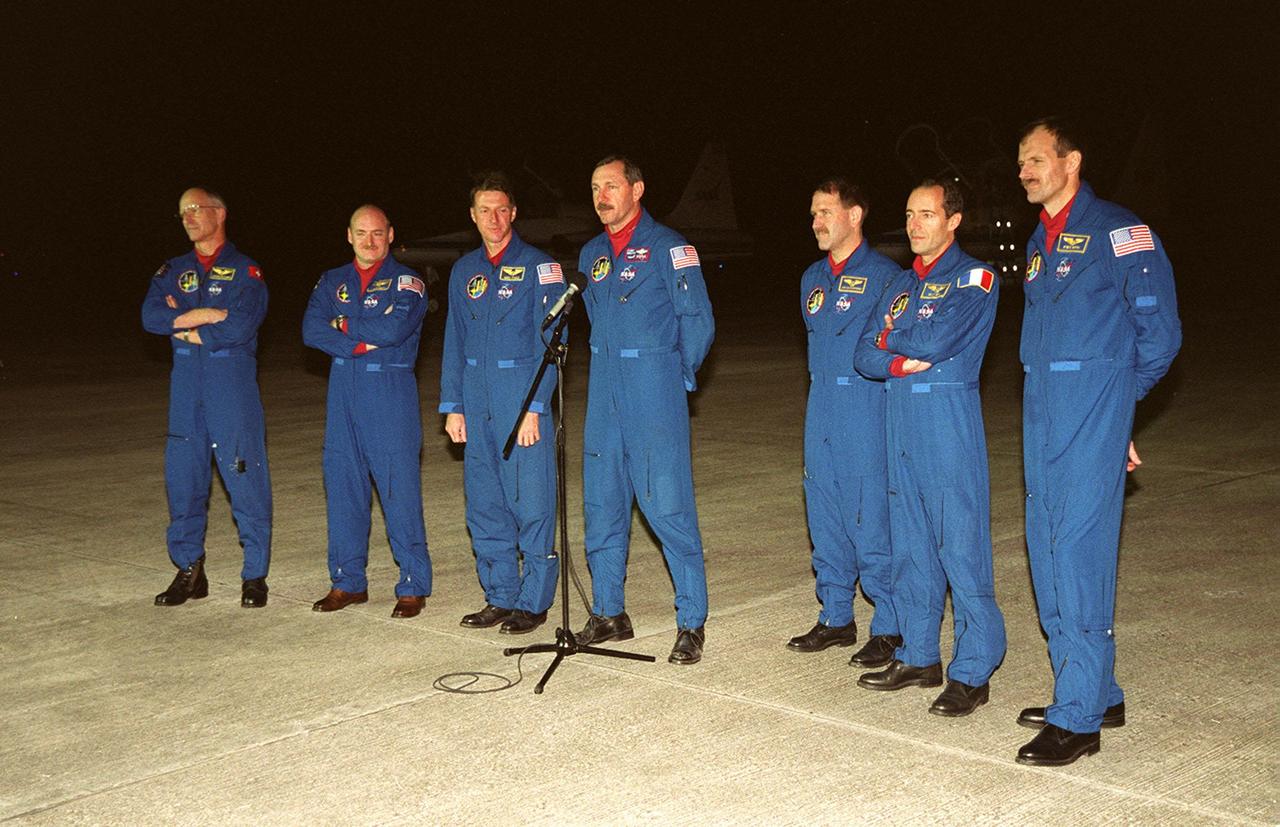
The STS-103 crew greets the media at the Shuttle Landing Facility after arriving aboard T-38 jets to make final preparations for their launch. From left, they are Mission Specialist Claude Nicollier of Switzerland, Pilot Scott J. Kelly, Mission Specialist C. Michael Foale (Ph.D.), Commander Curtis L. Brown Jr. (at microphone), and Mission Specialists John M. Grunsfeld (Ph.D.), Jean-François Clervoy of France, and Steven L. Smith. Nicollier and Clervoy both represent the European Space Agency. The STS-103 mission, to service the Hubble Space Telescope a third time, is scheduled for launch Dec. 11 at 12:13 a.m. EST from Launch Pad 39B
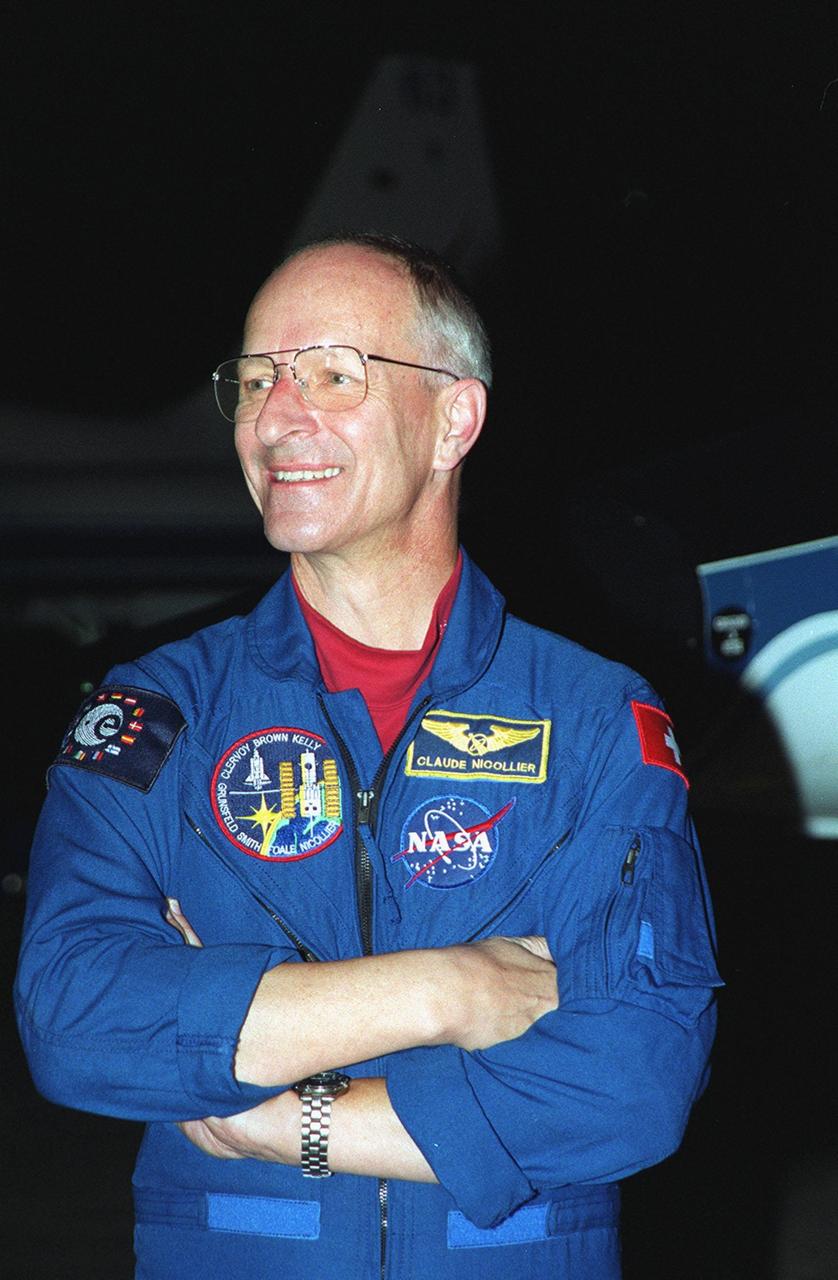
At the Shuttle Landing Facility, STS-103 Mission Specialist Claude Nicollier of Switzerland shows his pleasure at being at Kennedy Space Center to make final preparations for his launch. He is accompanied by the other STS-103 crew members: Commander Curtis L. Brown Jr., Pilot Scott J. Kelly and Mission Specialists Steven L. Smith, C. Michael Foale (Ph.D.), John M. Grunsfeld (Ph.D.), and Jean-François Clervoy of France. Nicollier and Clervoy both represent the European Space Agency. The STS-103 mission, to service the Hubble Space Telescope a third time, is scheduled for launch Dec. 11 at 12:13 a.m. EST from Launch Pad 39B
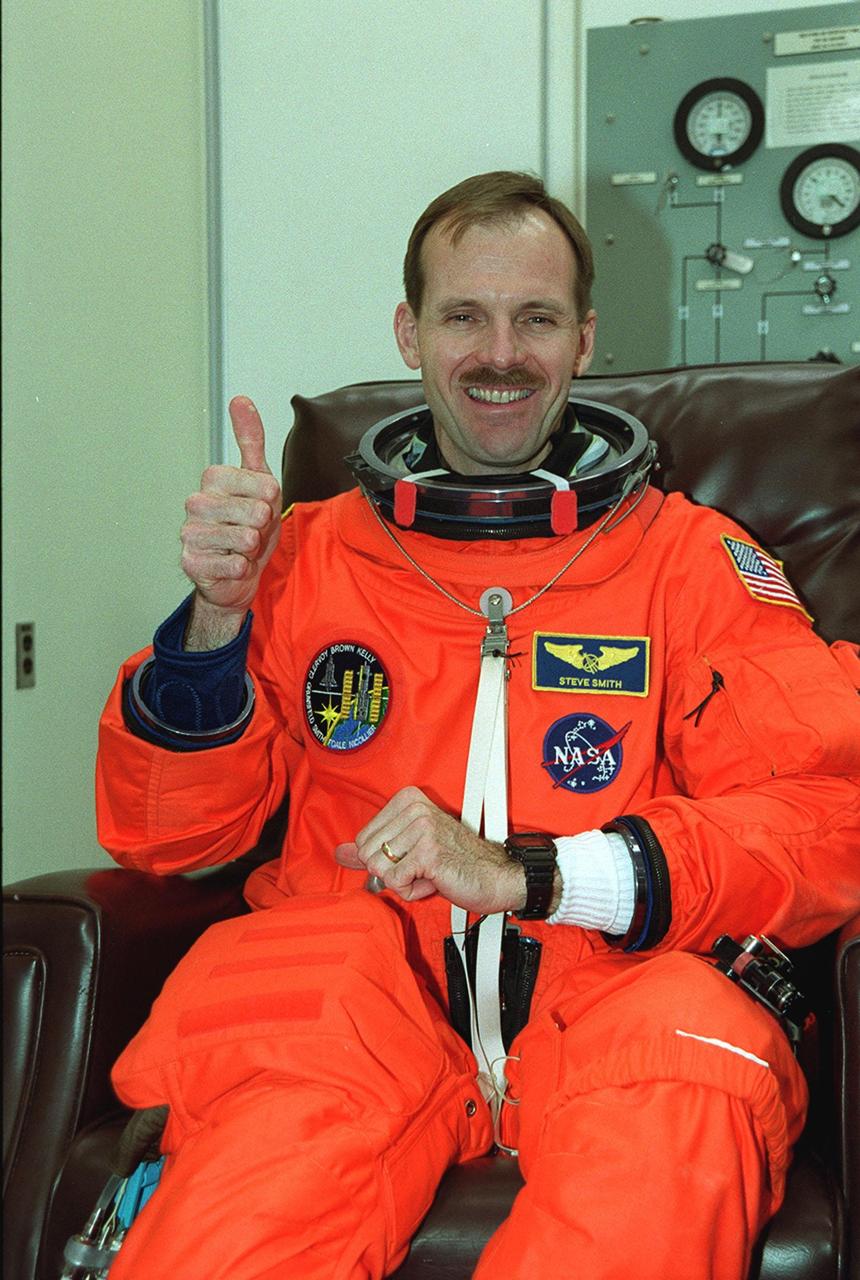
After donning his launch and entry suit, STS-103 Mission Specialist Steven L. Smith shows a positive attitude over the second launch attempt for Space Shuttle Discovery. The previous launch attempt on Dec. 17 was scrubbed about 8:52 p.m. due to numerous violations of weather launch commit criteria at KSC. Smith and other crew members Commander Curtis L. Brown Jr., Pilot Scott J. Kelly and Mission Specialists C. Michael Foale (Ph.D.), John M. Grunsfeld (Ph.D.), Claude Nicollier of Switzerland and Jean-Francois Clervoy of France are scheduled to lift off at 7:50 p.m. EST Dec. 19 on mission STS-103, servicing the Hubble Space Telescope. Objectives for the nearly eight-day mission include replacing gyroscopes and an old computer, installing another solid state recorder, and replacing damaged insulation in the telescope. Discovery is expected to land at KSC Monday, Dec. 27, at about 5:24 p.m. EST
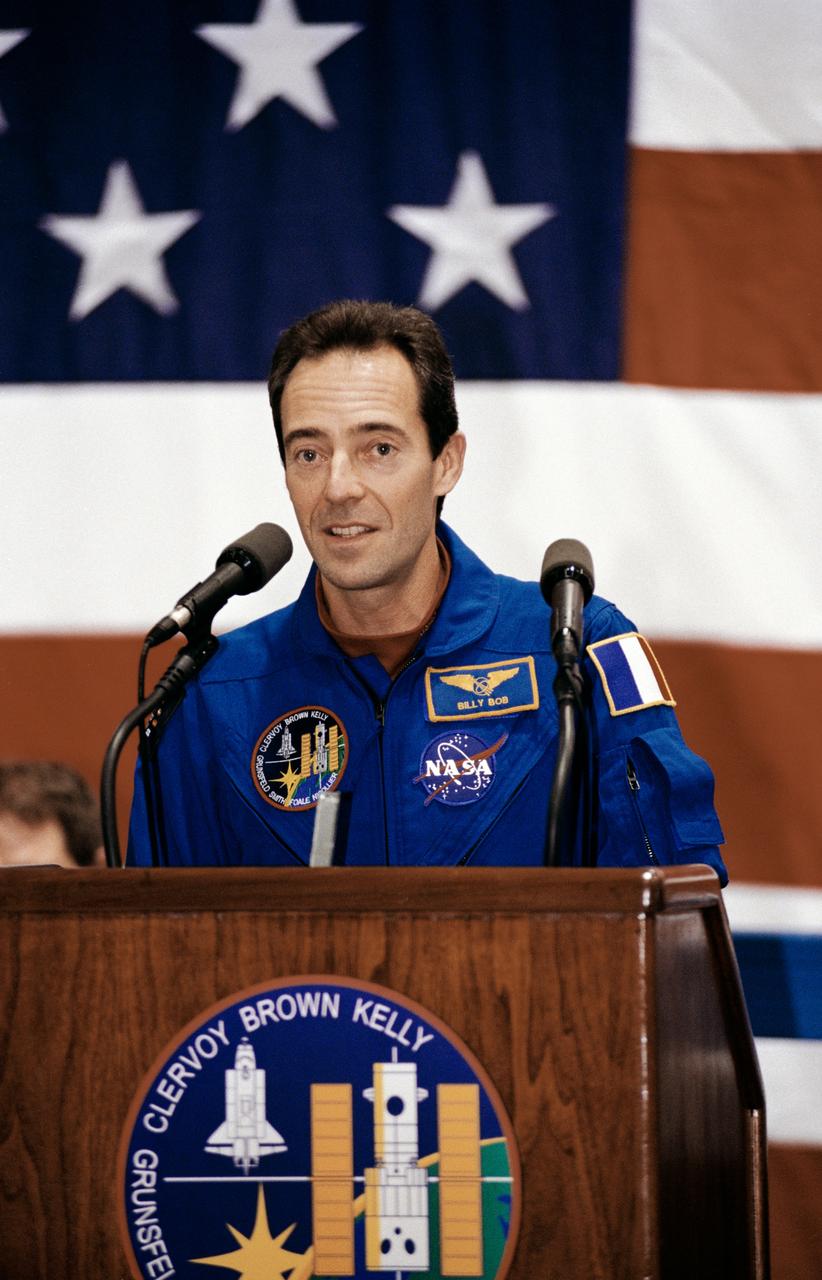
Photographic documentation showing STS-103 crew return at bldg. 990, Ellington Field. Views include: Mission Specialist (MS) John M. Grunsfeld at podium (16048); MS Jean-Francois Clervoy at podium (16049); Grunsfeld signs autographs (16050); woman and child (16051); MS Claude Nicollier meets his Swiss-American fan club (16052); Clervoy holds child (16053); mission commander Curtis L. Brown signs autographs (16054, 16057); MS E. Michael Foale signs autographs (16055); MS and Payload Commander (PLC) Steven L. Smith kneels and holds child (16056); overall view of stage showing Brown at podium with crew seated behind him; from left to right: Nicollier, pilot Scott J. Kelly, Clervoy, Grunsfeld, Mr. George Abbey (JSC director), Foale and Smith (16058); Nicollier at podium (16059); Mr. George Abbey at the podium (16060): Foale ath the podium (16061); Kelly signs autographs (16062).
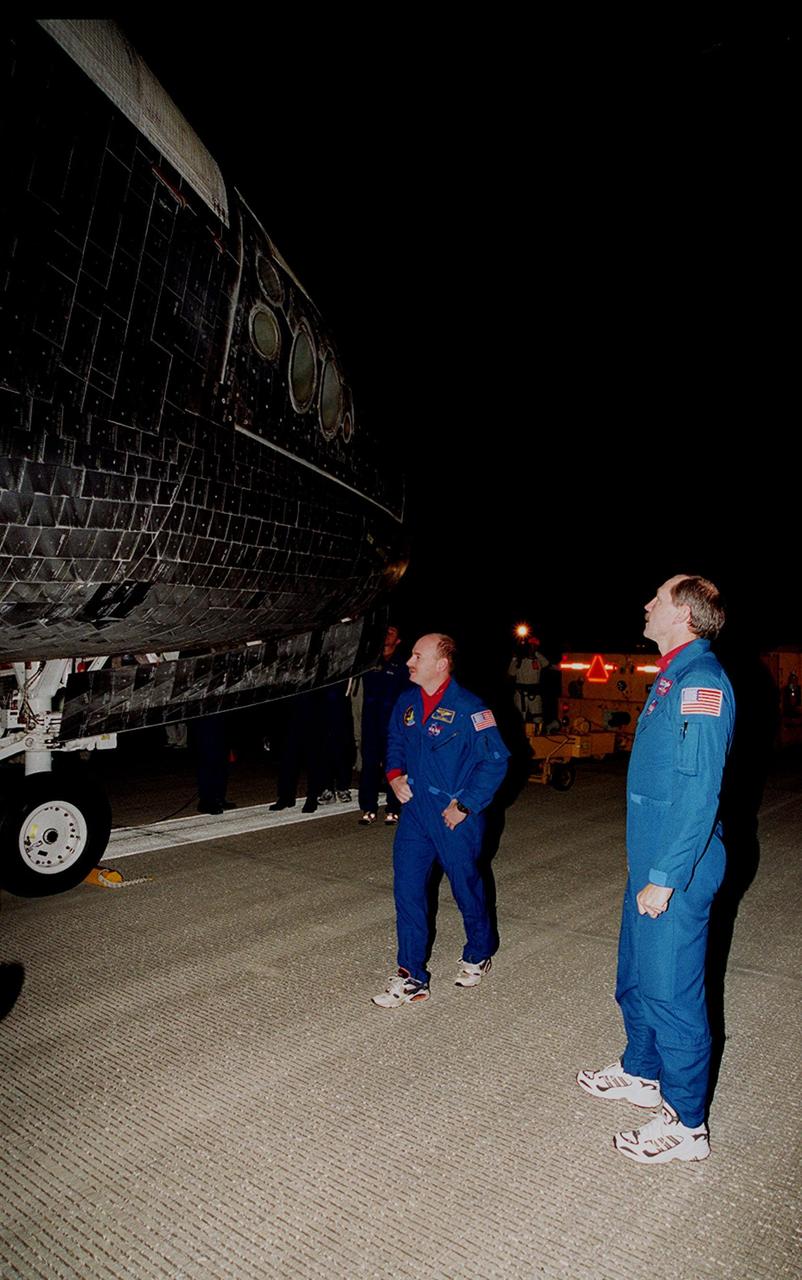
After landing at the Shuttle Landing Facility, STS-103 Pilot Scott J. Kelly (left) and Commander Curtis L. Brown Jr. (right) look at the tiles on orbiter Discovery. They and other crew members Mission Specialists Steven L. Smith, C. Michael Foale (Ph.D.), John M. Grunsfeld (Ph.D.), Jean-Francois Clervoy of France and Claude Nicollier of Switzerland, completed a successful eight-day mission to service the Hubble Space Telescope, spending the Christmas holiday in space in order to accomplish their mission before the end of 1999. During the mission, Discovery's four space-walking astronauts, Smith, Foale, Grunsfeld and Nicollier, spent 24 hours and 33 minutes upgrading and refurbishing Hubble, making it more capable than ever to renew its observations of the universe. Mission objectives included replacing gyroscopes and an old computer, installing another solid state recorder, and replacing damaged insulation in the telescope. Hubble was released from the end of Discovery's robot arm on Christmas Day. Main gear touchdown was at 7:00:47 p.m. EST. Nose gear touchdown occurred at 7:00:58 p.m. EST and wheel stop at 7:01:34 p.m. EST. This was the 96th flight in the Space Shuttle program and the 27th for the orbiter Discovery. The landing was the 20th consecutive Shuttle landing in Florida and the 13th night landing in Shuttle program history
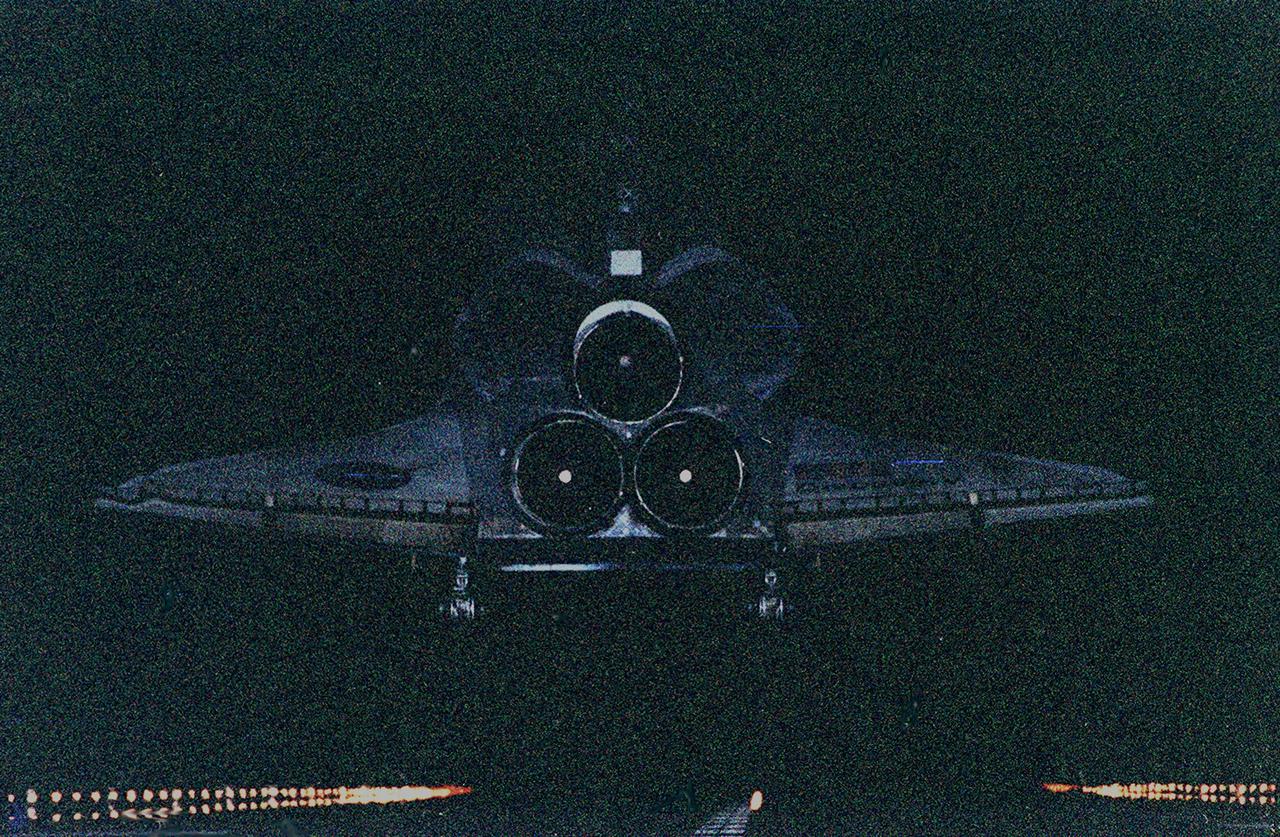
KENNEDY SPACE CENTER, Fla. -- The orbiter Discovery looks like a blue ghost as it drops from the darkness onto lighted runway 33 at KSC's Shuttle Landing Facility. After traveling more than 3,267,000 miles on a successful eight-day mission to service the Hubble Space Telescope, the orbiter touches down at 7:00:47 p.m. EST. Aboard are Commander Curtis L. Brown Jr., Pilot Scott J. Kelly, and Mission Specialists Steven L. Smith, C. Michael Foale (Ph.D.), John M. Grunsfeld (Ph.D.), Claude Nicollier of Switzerland and Jean-François Clervoy of France, who spent the Christmas holiday in space in order to accomplish their mission before the end of 1999. During the mission, Discovery's four space-walking astronauts, Smith, Foale, Grunsfeld and Nicollier, spent 24 hours and 33 minutes upgrading and refurbishing Hubble, making it more capable than ever to renew its observations of the universe. Mission objectives included replacing gyroscopes and an old computer, installing another solid state recorder, and replacing damaged insulation in the telescope. Hubble was released from the end of Discovery's robot arm on Christmas Day. This was the 96th flight in the Space Shuttle program and the 27th for the orbiter Discovery. The landing was the 20th consecutive Shuttle landing in Florida and the 13th night landing in Shuttle program history
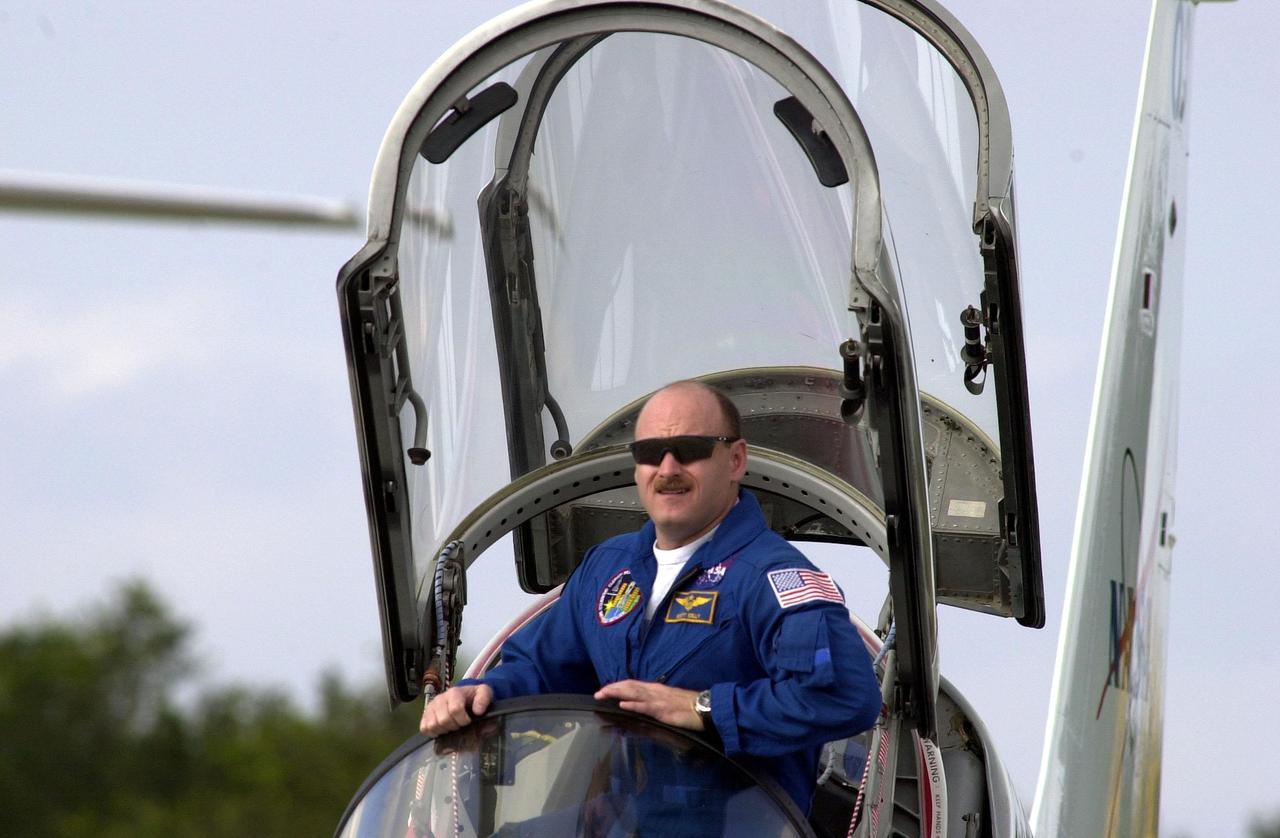
STS-103 Pilot Scott J. Kelly settles into the cockpit of a T-38 training jet for practice flights. He joins other crew members Commander Curtis L. Brown Jr. and Mission Specialists Steven L. Smith, C. Michael Foale (Ph.D.), John M. Grunsfeld (Ph.D.), Claude Nicollier of Switzerland and Jean-François Clervoy of France, for pre-launch preparations on mission STS-103 aboard Space Shuttle Discovery. Nicollier and Clervoy are with the European Space Agency. The mission, to service the Hubble Space Telescope, is scheduled for launch Dec. 16 at 9:18 p.m. EST from Launch Pad 39B. The mission is expected to last about 9 days and 21 hours. Discovery is expected to land at KSC Sunday, Dec. 26, at 6:56 p.m. EST
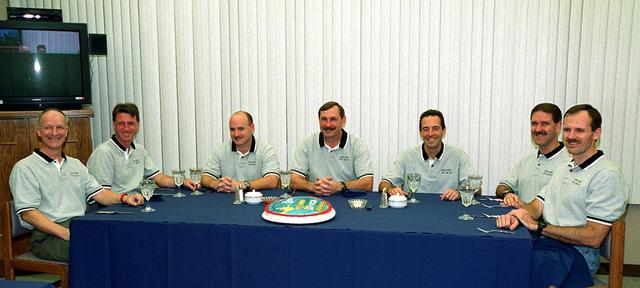
In the Operations and Checkout Building, the STS-103 crew are all smiles as they gather for breakfast before suiting up for launch. From left are Mission Specialists Claude Nicollier of Switzerland and C. Michael Foale (Ph.D.), Pilot Scott J. Kelly, Commander Curtis L. Brown Jr., and Mission Specialists Jean-Francois Clervoy of France, John M. Grunsfeld (Ph.D.) and Steven L. Smith. Nicollier and Clervoy are with the European Space Agency. The STS-103 mission, to service the Hubble Space Telescope, is scheduled for launch Dec. 17 at 8:47 p.m. EST from Launch Pad 39B. Mission objectives include replacing gyroscopes and an old computer, installing another solid state recorder, and replacing damaged insulation in the telescope. The mission is expected to last about 8 days and 21 hours. Discovery is expected to land at KSC Sunday, Dec. 26, at about 6:30 p.m. EST
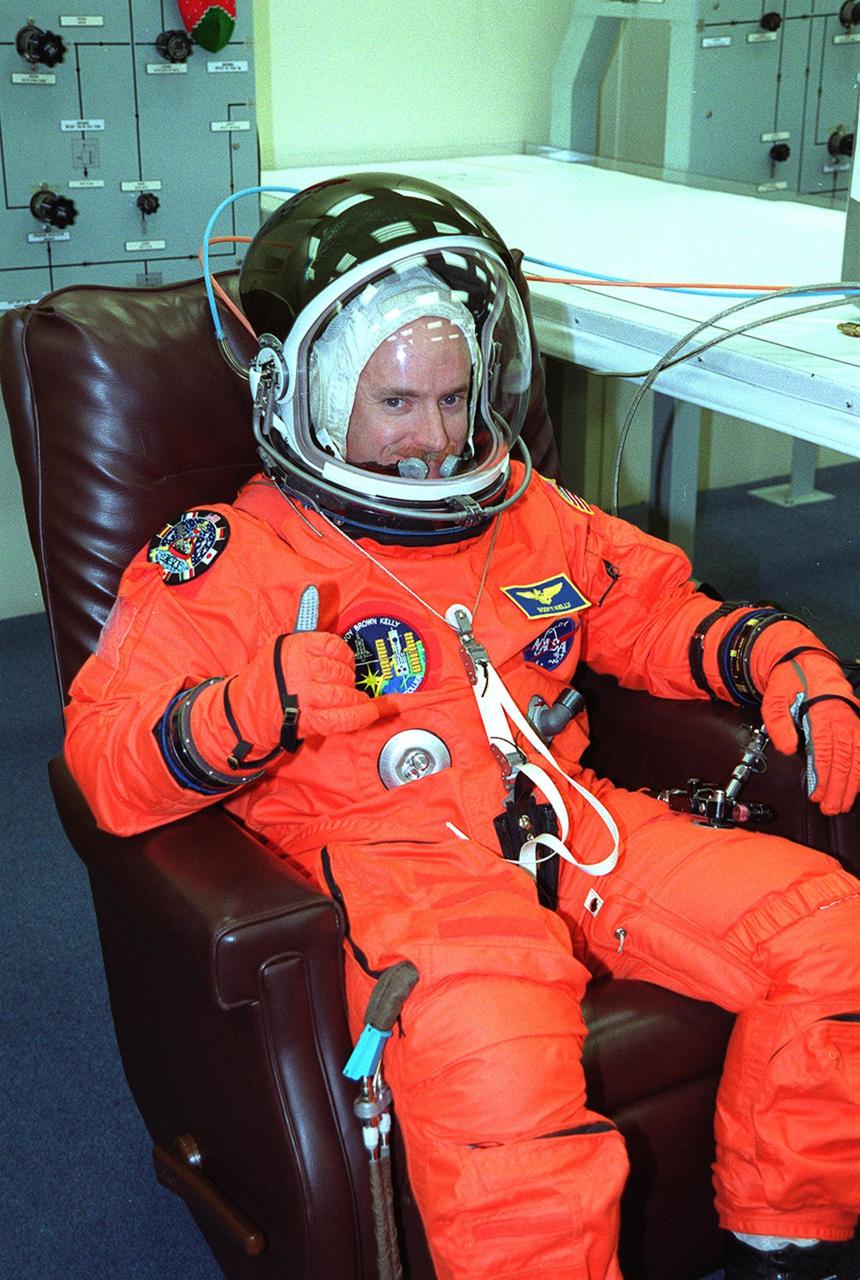
STS-103 Pilot Scott J. Kelly signals he is ready for launch after suiting up in the Operations and Checkout Building. Other crew members are Commander Curtis L. Brown Jr. and Mission Specialists Steven L. Smith, C. Michel Foale (Ph.D.), John M. Grunsfeld (Ph.D.), Jean-François Clervoy of France and Claude Nicollier of Switzerland. Clervoy and Nicollier are with the European Space Agency. The STS-103 mission, to service the Hubble Space Telescope, is scheduled for launch Dec. 17 at 8:47 p.m. EST from Launch Pad 39B. Mission objectives include replacing gyroscopes and an old computer, installing another solid state recorder, and replacing damaged insulation in the telescope. After the 8-day, 21-hour mission, Discovery is expected to land at KSC Sunday, Dec. 26, at about 6:30 p.m. EST
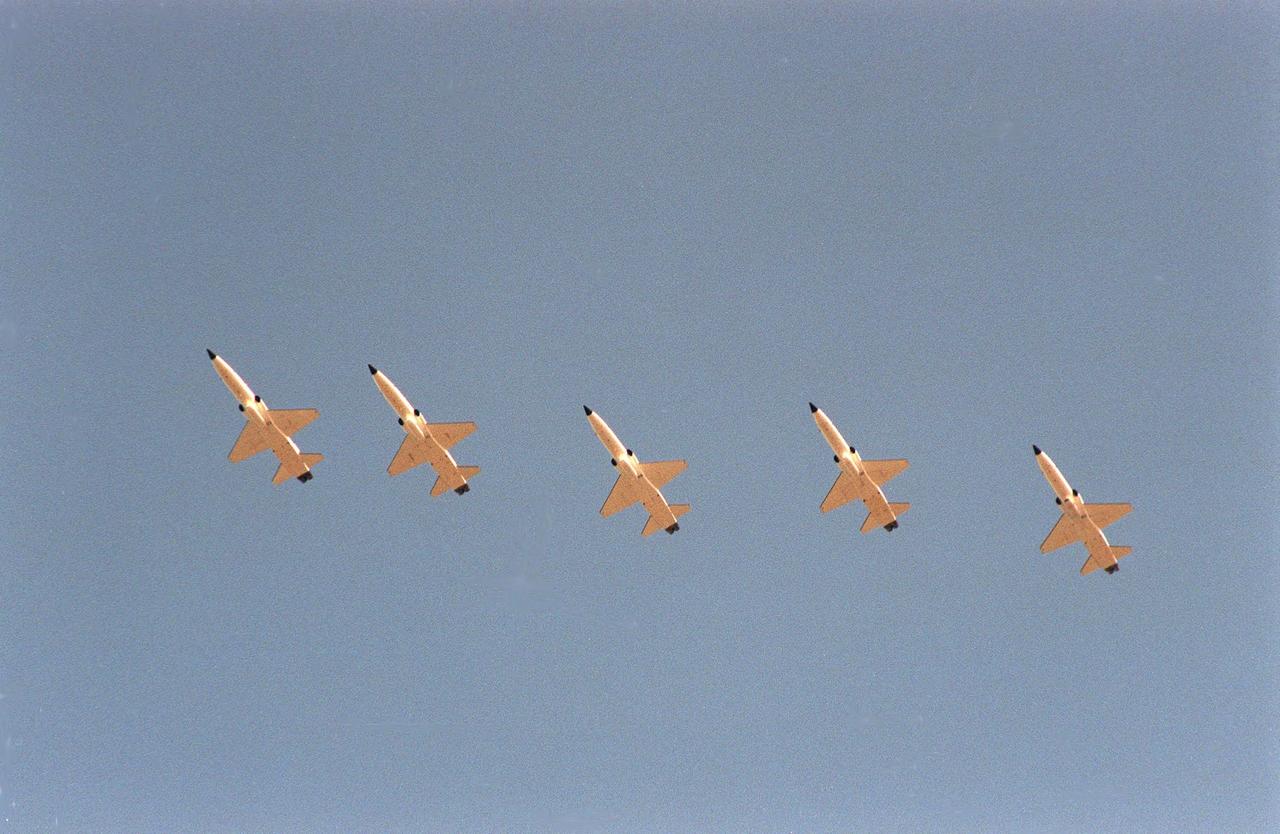
T-38 trainer jets carrying the STS-103 crew arrive in formation above Kennedy Space Center's Shuttle Landing Facility. The crew is here to take part in Terminal Countdown Demonstration Test activities this week. The TCDT provides the crew with emergency egress training, opportunities to inspect their mission payloads in the orbiter's payload bay, and simulated countdown exercises. Participating are Commander Curtis L. Brown Jr., Pilot Scott J. Kelly, and Mission Specialists Steven L. Smith, C. Michael Foale (Ph.D.), John M. Grunsfeld (Ph.D.), Claude Nicollier of Switzerland, with the European Space Agency, and Jean-François Clervoy of France, also with the European Space Agency. The mission, to service the Hubble Space Telescope, is targeted for launch Dec. 6 at 2:37 a.m. EST aboard Space Shuttle Discovery
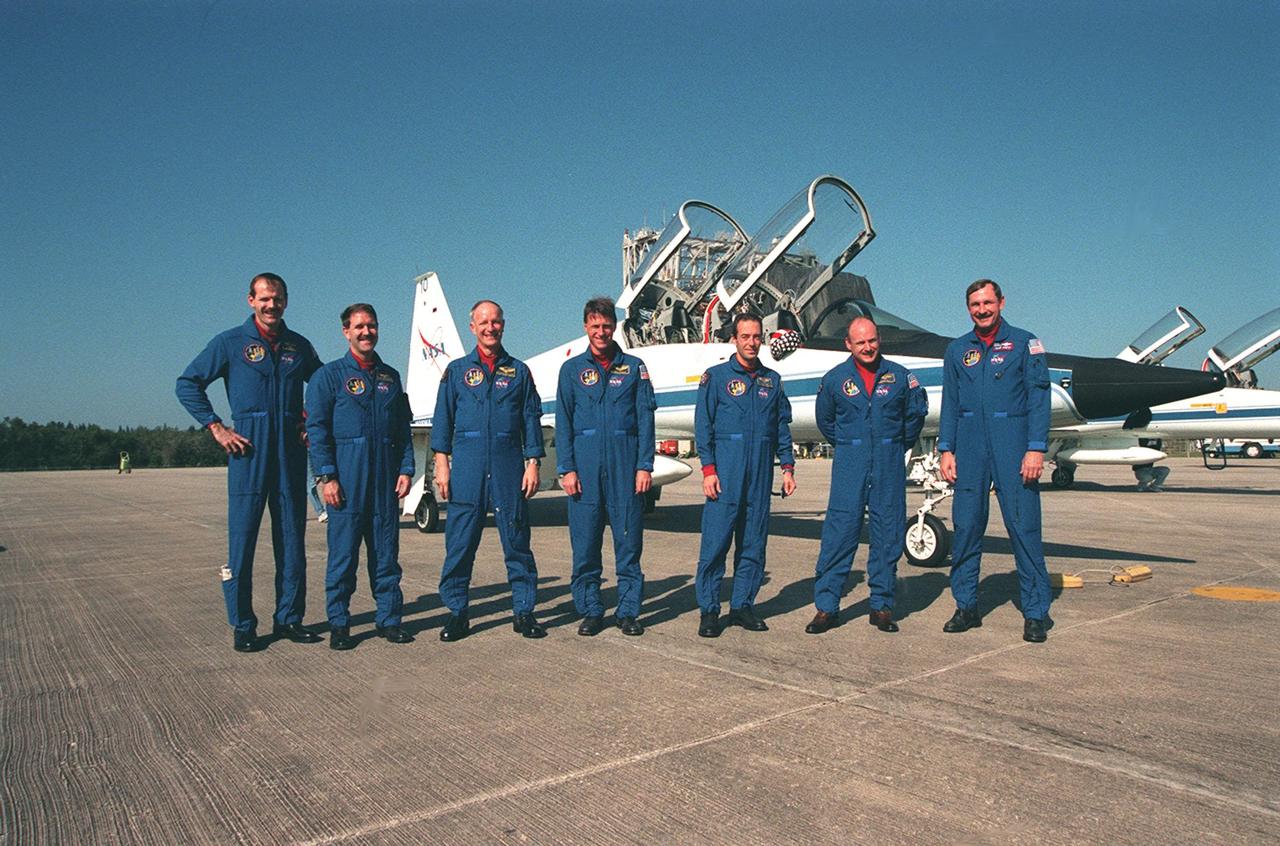
The STS-103 crew poses for photographers after landing at at Kennedy Space Center's Shuttle Landing Facility to begin Terminal Countdown Demonstration Test (TCDT) activities. Standing (left to right) in front of the T-38 jets that brought them are Mission Specialists Steven L. Smith, John M. Grunsfeld (Ph.D.), Claude Nicollier of Switzerland, with the European Space Agency, C. Michael Foale (Ph.D.), Jean-François Clervoy of France, also with the European Space Agency, Pilot Scott J. Kelly, and Commander Curtis L. Brown Jr. The TCDT provides the crew with emergency egress training, opportunities to inspect their mission payloads in the orbiter's payload bay, and simulated countdown exercises. The STS-103 mission, to service the Hubble Space Telescope, is targeted for launch Dec. 6 at 2:37 a.m. EST aboard Space Shuttle Discovery
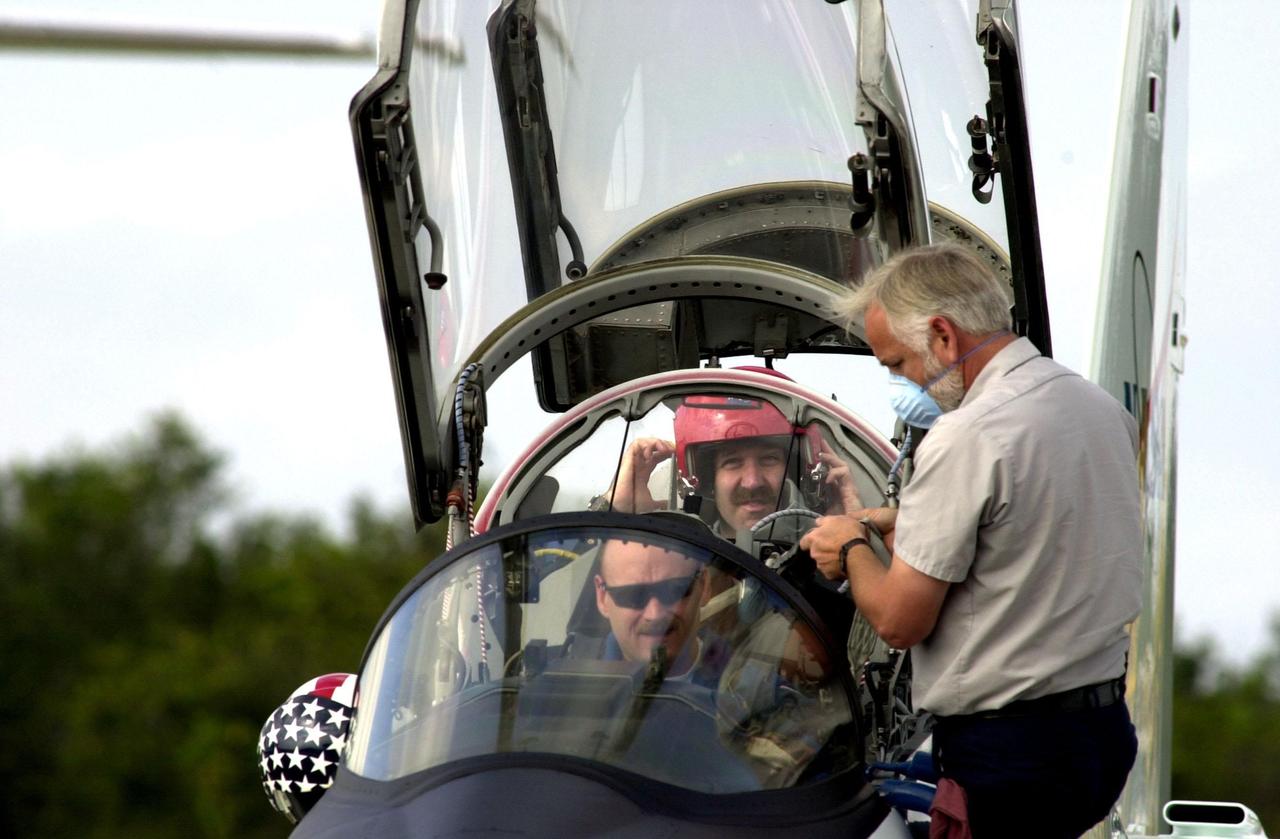
A worker at the Shuttle Landing Facility checks over STS-103 Pilot Scott J. Kelly (front) and Mission Specialist John M. Grunsfeld (Ph.D.) (behind) before they take off for practice flights in the T-38 training jet. They and other crew members Commander Curtis L. Brown Jr. and Mission Specialists Steven L. Smith, C. Michael Foale (Ph.D.), Claude Nicollier of Switzerland and Jean-François Clervoy of France are preparing for their mission on Space Shuttle Discovery. STS-103 is scheduled for launch Dec. 16 at 9:18 p.m. EST from Launch Pad 39B. The mission is expected to last about 9 days and 21 hours. Discovery is expected to land at KSC Sunday, Dec. 26, at 6:56 p.m. EST
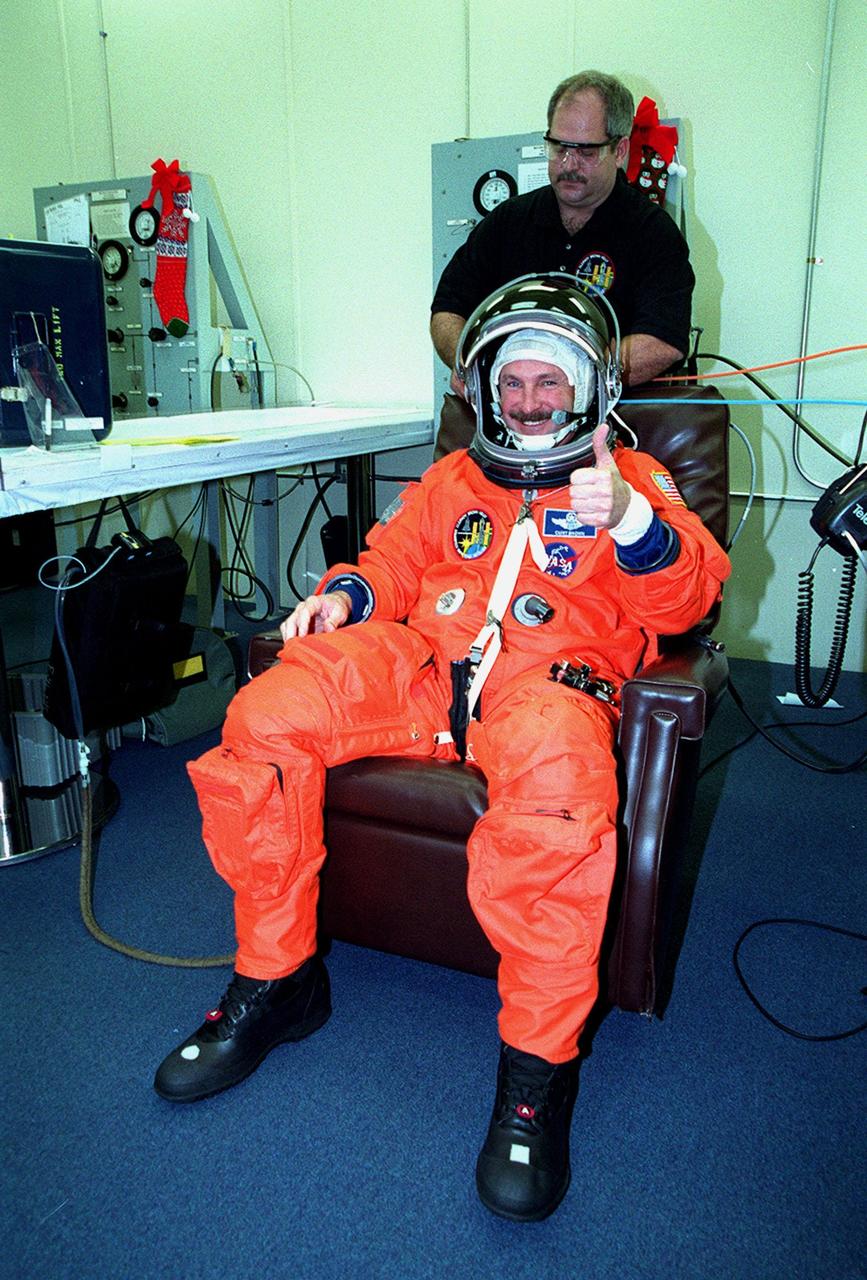
In the Operations and Checkout Building, STS-103 Commander Curtis L. Brown Jr. signals he's ready for launch while having his launch and entry suit checked by a suit technician. Other crew members are Pilot Scott J. Kelly and Mission Specialists Steven L. Smith, C. Michel Foale (Ph.D.), John M. Grunsfeld (Ph.D.), Claude Nicollier of Switzerland and Jean-François Clervoy of France. Nicollier and Clervoy are with the European Space Agency. The STS-103 mission, to service the Hubble Space Telescope, is scheduled for launch Dec. 17 at 8:47 p.m. EST from Launch Pad 39B. Mission objectives include replacing gyroscopes and an old computer, installing another solid state recorder, and replacing damaged insulation in the telescope. After the 8-day, 21-hour mission, Discovery is expected to land at KSC Sunday, Dec. 26, at about 6:30 p.m. EST
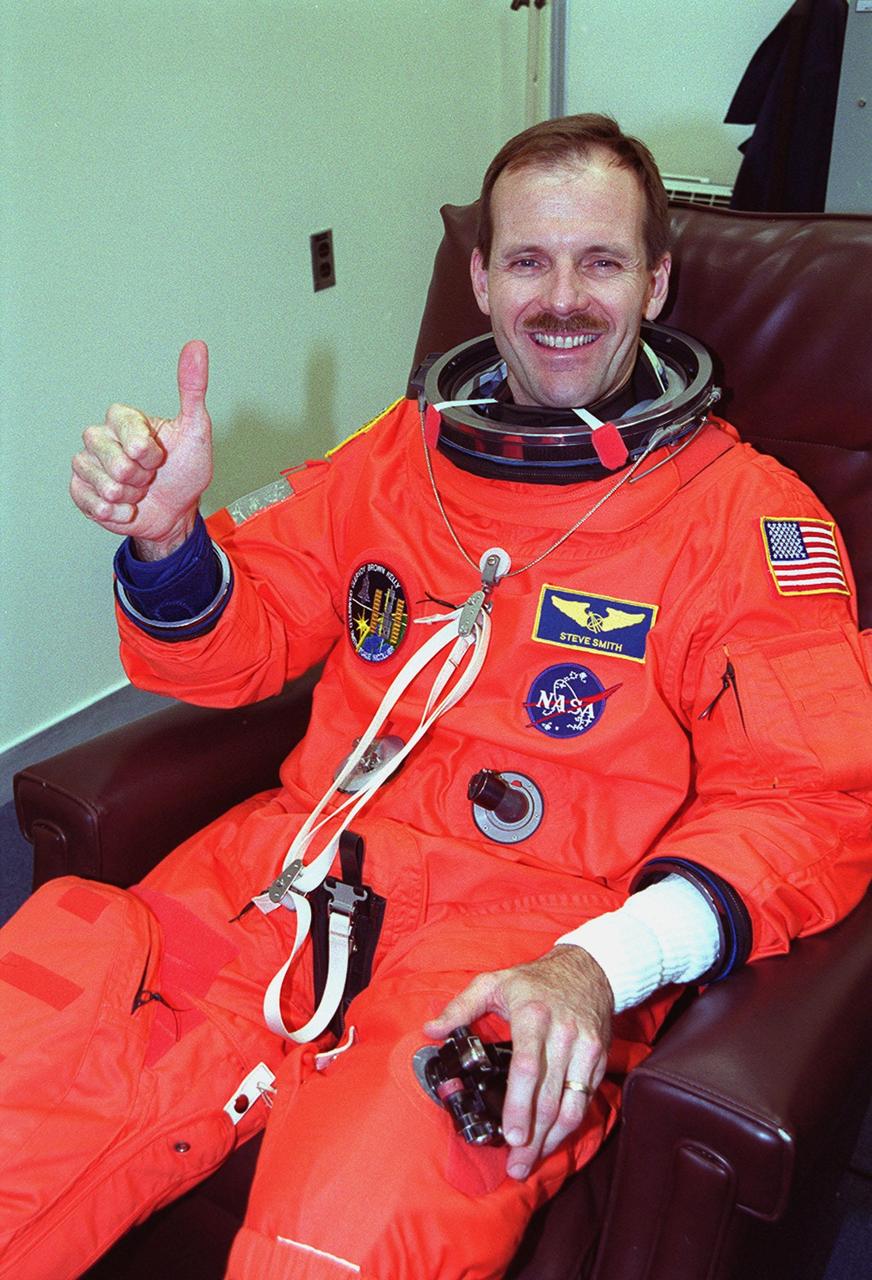
In the Operations and Checkout Building, STS-103 Mission Specialist Steven L. Smith signals he is suited up and ready for launch. Other crew members are Commander Curtis L. Brown Jr., Pilot Scott J. Kelly and Mission Specialists C. Michel Foale (Ph.D.), John M. Grunsfeld (Ph.D.), Jean-François Clervoy of France and Claude Nicollier of Switzerland. Clervoy and Nicollier are with the European Space Agency. The STS-103 mission, to service the Hubble Space Telescope, is scheduled for launch Dec. 17 at 8:47 p.m. EST from Launch Pad 39B. Mission objectives include replacing gyroscopes and an old computer, installing another solid state recorder, and replacing damaged insulation in the telescope. After the 8-day, 21-hour mission, Discovery is expected to land at KSC Sunday, Dec. 26, at about 6:30 p.m. EST
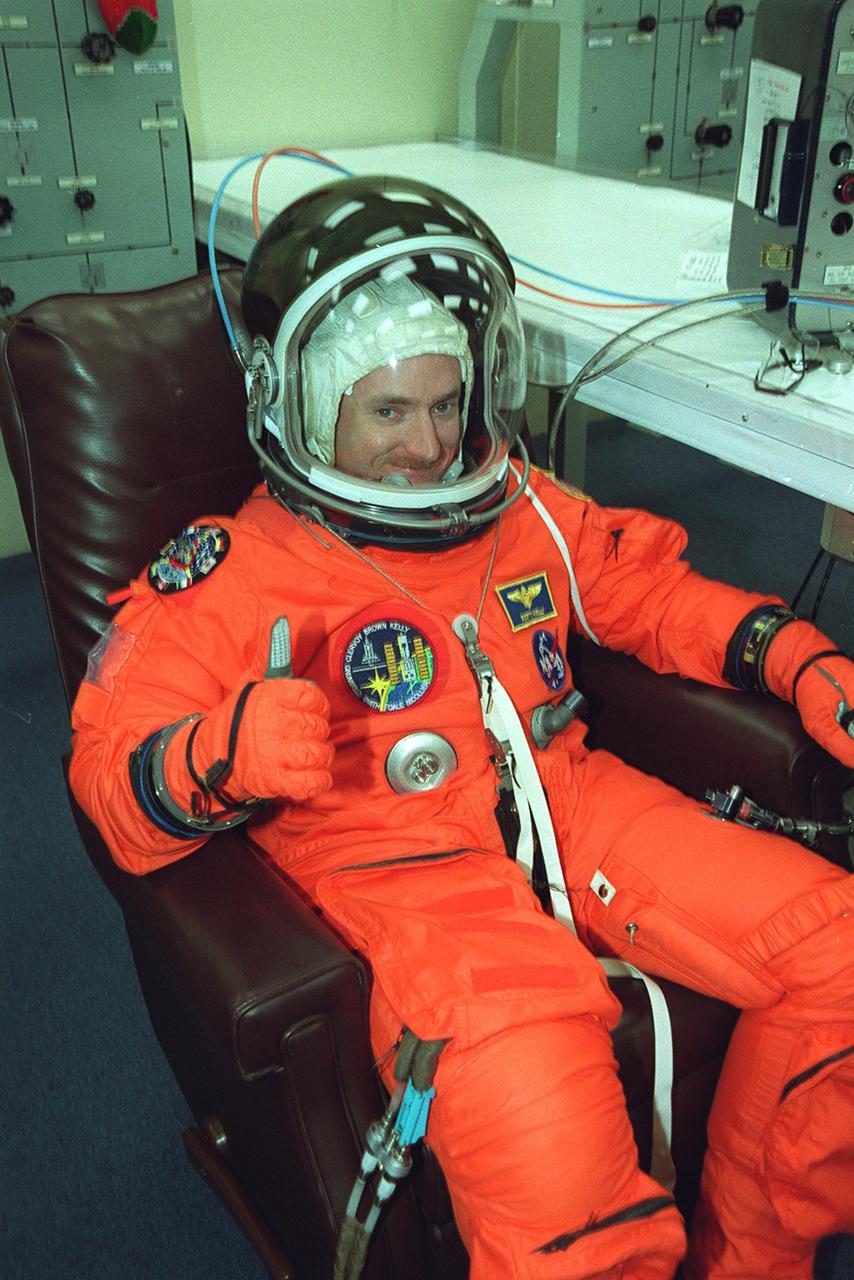
STS-103 Pilot Scott J. Kelly is suited up and ready for the second launch attempt of Space Shuttle Discovery. The previous launch attempt on Dec. 17 was scrubbed about 8:52 p.m. due to numerous violations of weather launch commit criteria at KSC. Kelly and fellow crew members Commander Curtis L. Brown Jr. and Mission Specialists Steven L. Smith, C. Michael Foale (Ph.D.), John M. Grunsfeld (Ph.D.), Claude Nicollier of Switzerland and Jean-Francois Clervoy of France are scheduled to lift off at 7:50 p.m. EST Dec. 19 on mission STS-103, servicing the Hubble Space Telescope. Objectives for the nearly eight-day mission include replacing gyroscopes and an old computer, installing another solid state recorder, and replacing damaged insulation in the telescope. Discovery is expected to land at KSC Monday, Dec. 27, at about 5:24 p.m. EST
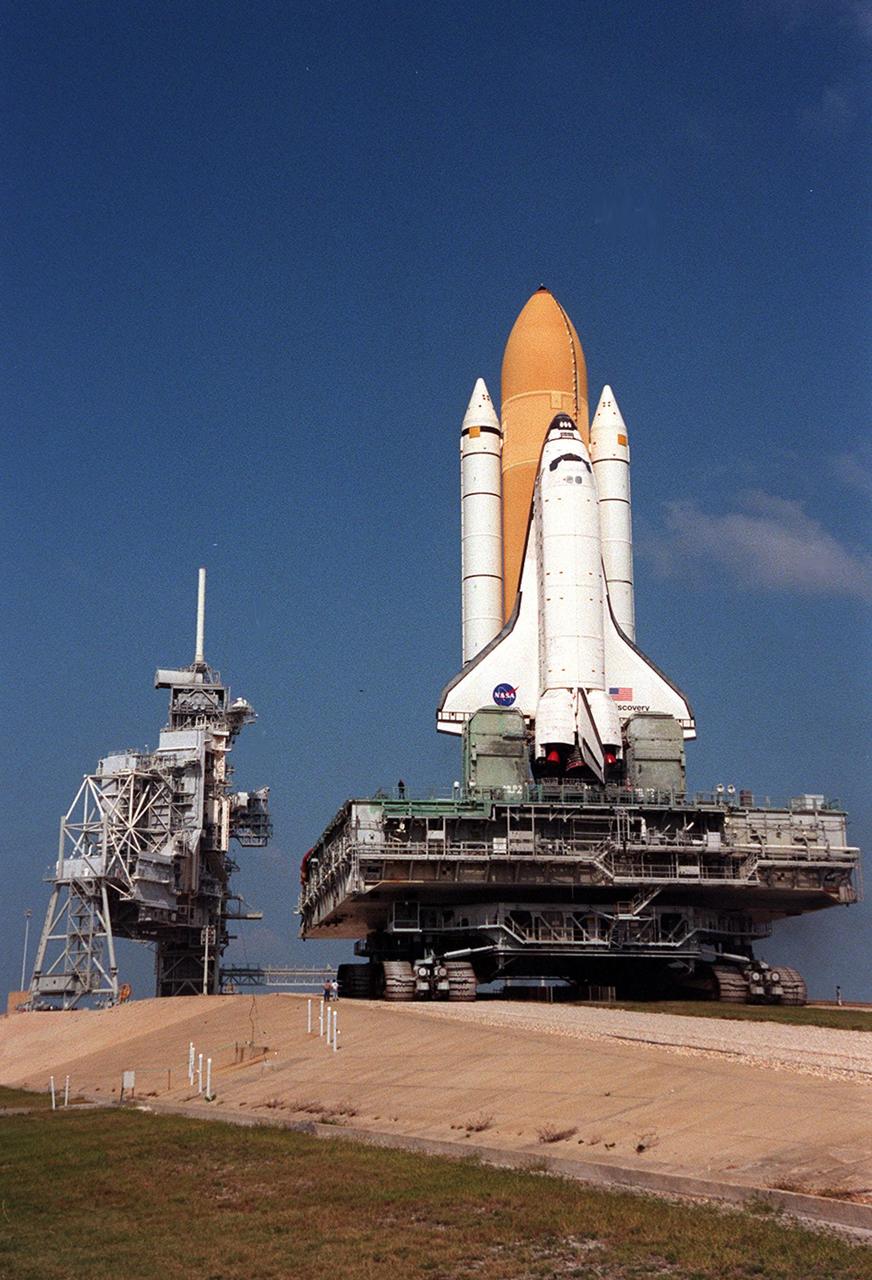
KENNEDY SPACE CENTER, Fla. -- Space Shuttle Discovery approaches Launch Pad 39B where the orbiter, external tank and solid rocket boosters will undergo final preparations for the STS-103 launch. The mission is a "call-up" due to the need to replace and repair portions of the Hubble Space Telescope. Although Hubble is operating normally and conducting its scientific observations, only three of its six gyroscopes are working properly. Four EVA's are planned to make the necessary repairs and replacements on the telescope. The STS-103 crew members are Commander Curtis L. Brown Jr., Pilot Scott J. Kelly, Steven L. Smith, C. Michael Foale (Ph.D.), John M. Grunsfeld (Ph.D.), and Claude Nicollier of Switzerland and Jean-François Clervoy of France, both with the European Space Agency. The mission is targeted for launch Dec. 6 at 2:37 a.m. EST.
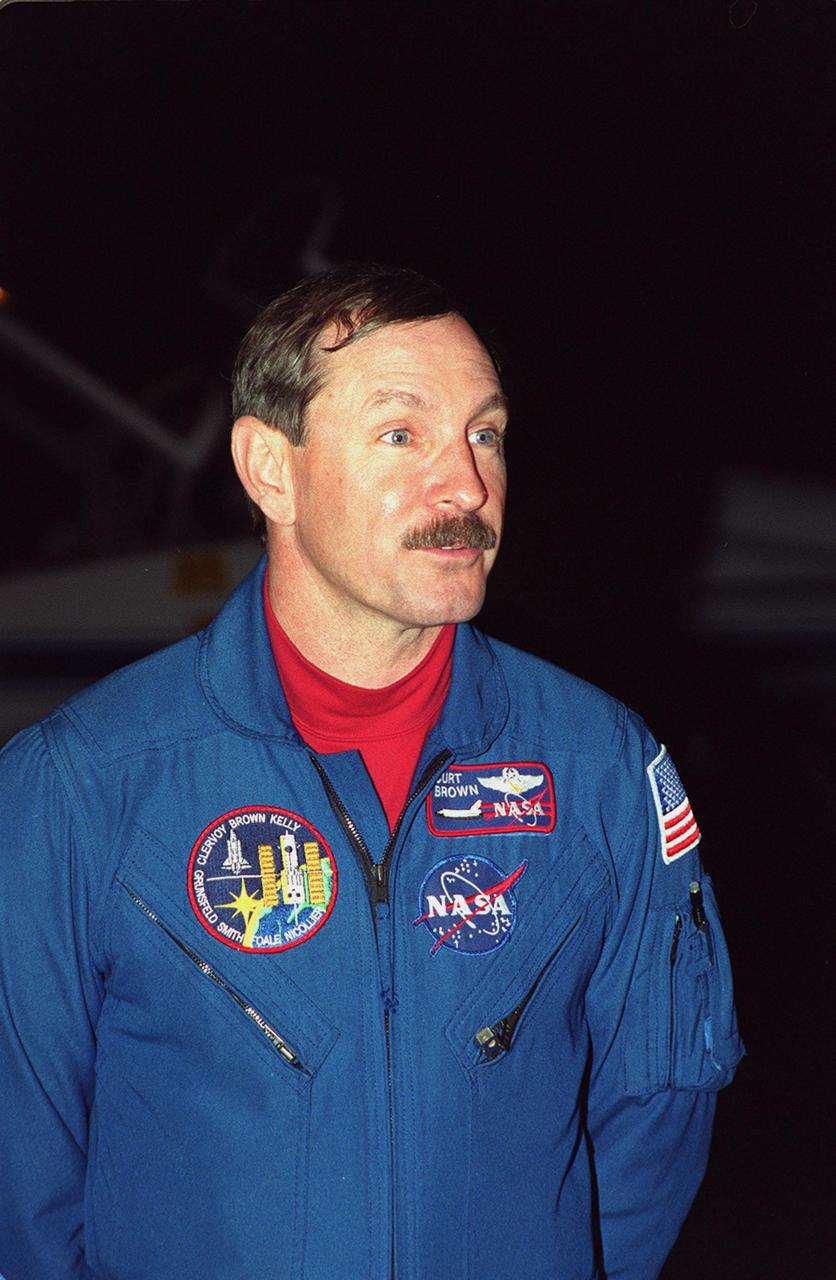
Commander Curtis L. Brown Jr. smiles on his arrival at the Shuttle Landing Facility aboard a T-38 jet aircraft. He joins other crew members Pilot Scott J. Kelly and Mission Specialists Steven L. Smith, C. Michael Foale (Ph.D.), John M. Grunsfeld (Ph.D.), Claude Nicollier of Switzerland and Jean-François Clervoy of France, for pre-launch preparations on mission STS-103 aboard Space Shuttle Discovery. Nicollier and Clervoy are with the European Space Agency. The mission, to service the Hubble Space Telescope, is scheduled for launch Dec. 11 at 12:13 a.m. EST from Launch Pad 39B. Discovery is expected to land at KSC Monday, Dec. 20, at 9:21 p.m. EST
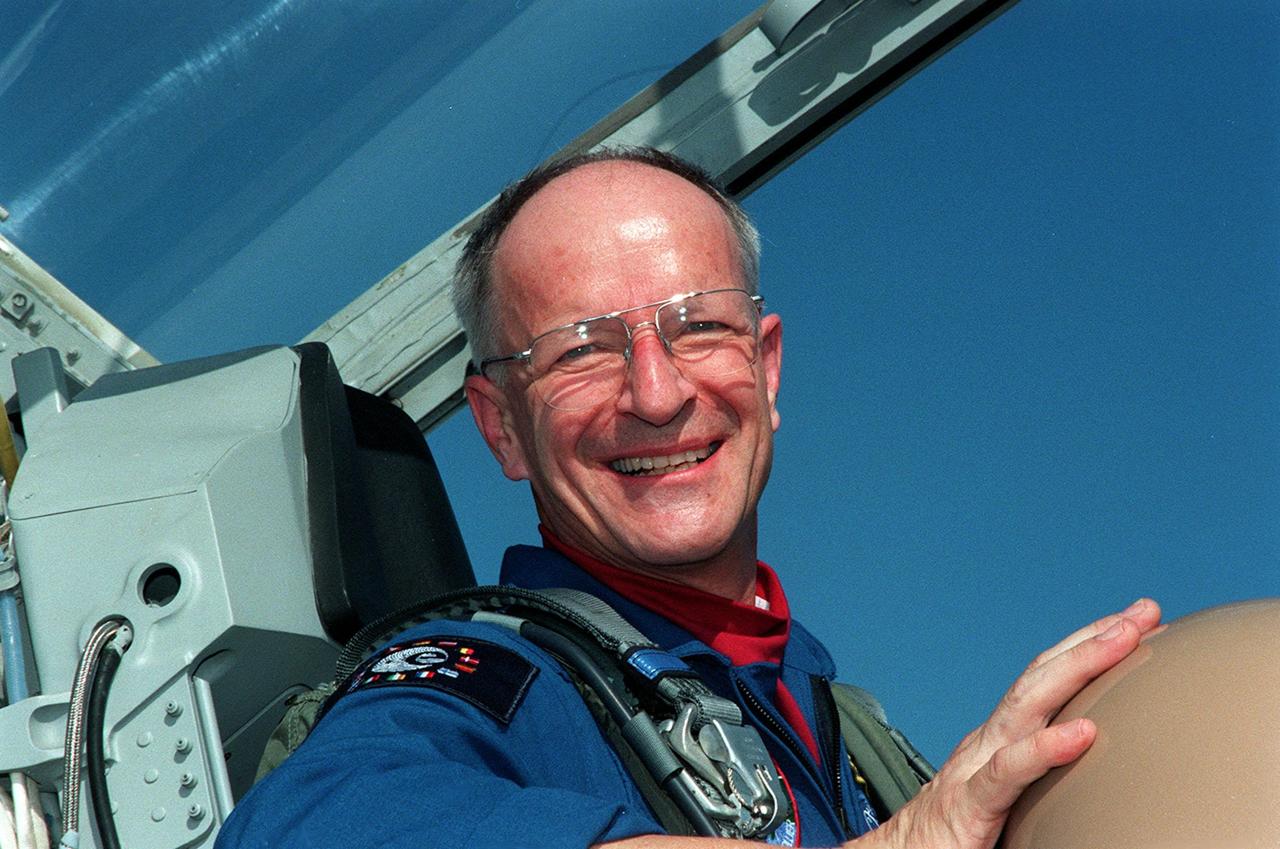
STS-103 Mission Specialist Claude Nicollier of Switzerland, with the European Space Agency, smiles after landing at Kennedy Space Center's Shuttle Landing Facility to begin Terminal Countdown Demonstration Test (TCDT) activities. The TCDT provides the crew with emergency egress training, opportunities to inspect their mission payloads in the orbiter's payload bay, and simulated countdown exercises. Also participating are Commander Curtis L. Brown Jr., Pilot Scott J. Kelly, and Mission Specialists Steven L. Smith, C. Michael Foale (Ph.D.), John M. Grunsfeld (Ph.D.), and Jean-François Clervoy of France, also with the European Space Agency. The mission, to service the Hubble Space Telescope, is targeted for launch Dec. 6 at 2:37 a.m. EST aboard Space Shuttle Discovery
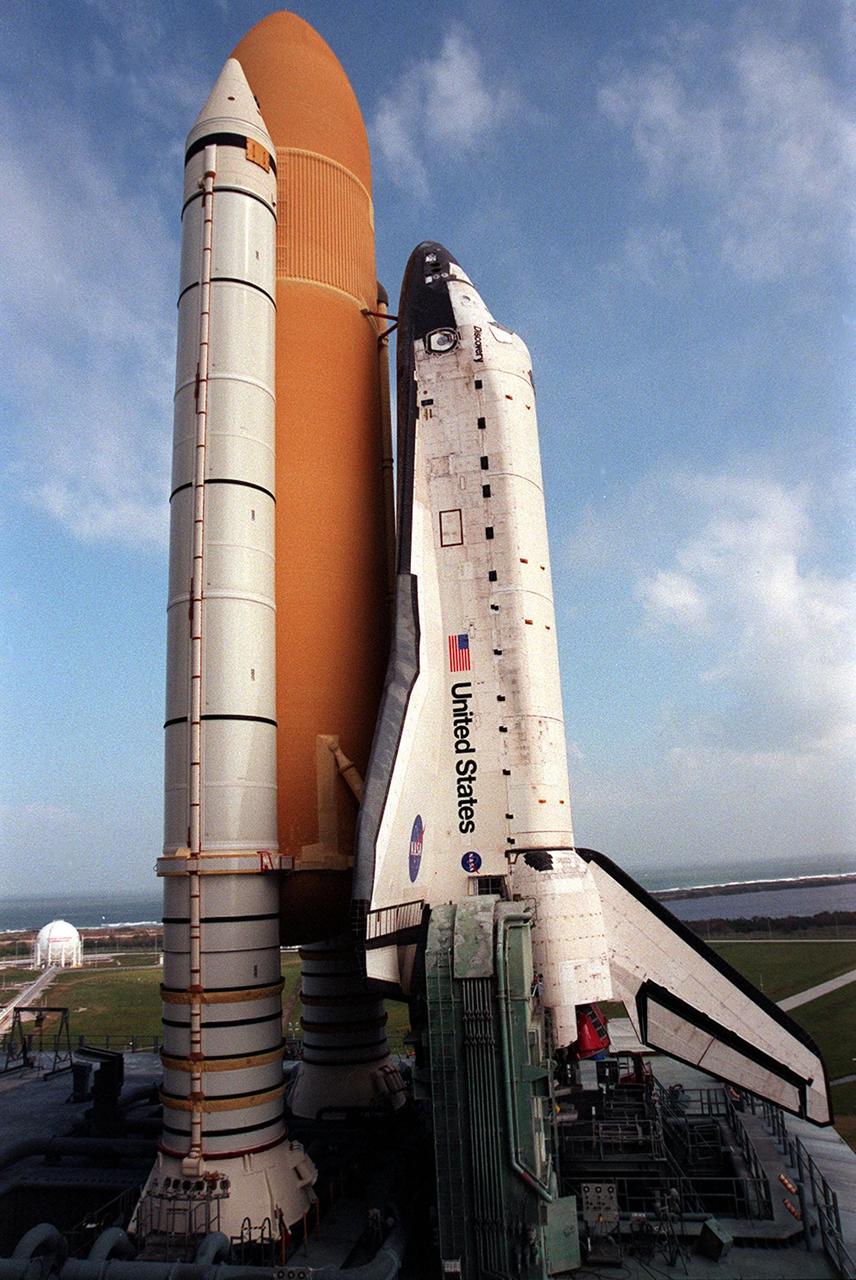
KENNEDY SPACE CENTER, Fla. -- At Launch Pad 39B, Space Shuttle Discovery towers against the hazy blue sky after a seven-hour trek from the Vehicle Assembly Building. The orbiter, external tank and solid rocket boosters will undergo final preparations for the STS-103 launch. The mission is a "call-up" due to the need to replace and repair portions of the Hubble Space Telescope. Although Hubble is operating normally and conducting its scientific observations, only three of its six gyroscopes are working properly. Four EVA's are planned to make the necessary repairs and replacements on the telescope. The STS-103 crew members are Commander Curtis L. Brown Jr., Pilot Scott J. Kelly, Steven L. Smith, C. Michael Foale (Ph.D.), John M. Grunsfeld (Ph.D.), and Claude Nicollier of Switzerland and Jean-François Clervoy of France, both with the European Space Agency. The mission is targeted for launch Dec. 6 at 2:37 a.m. EST
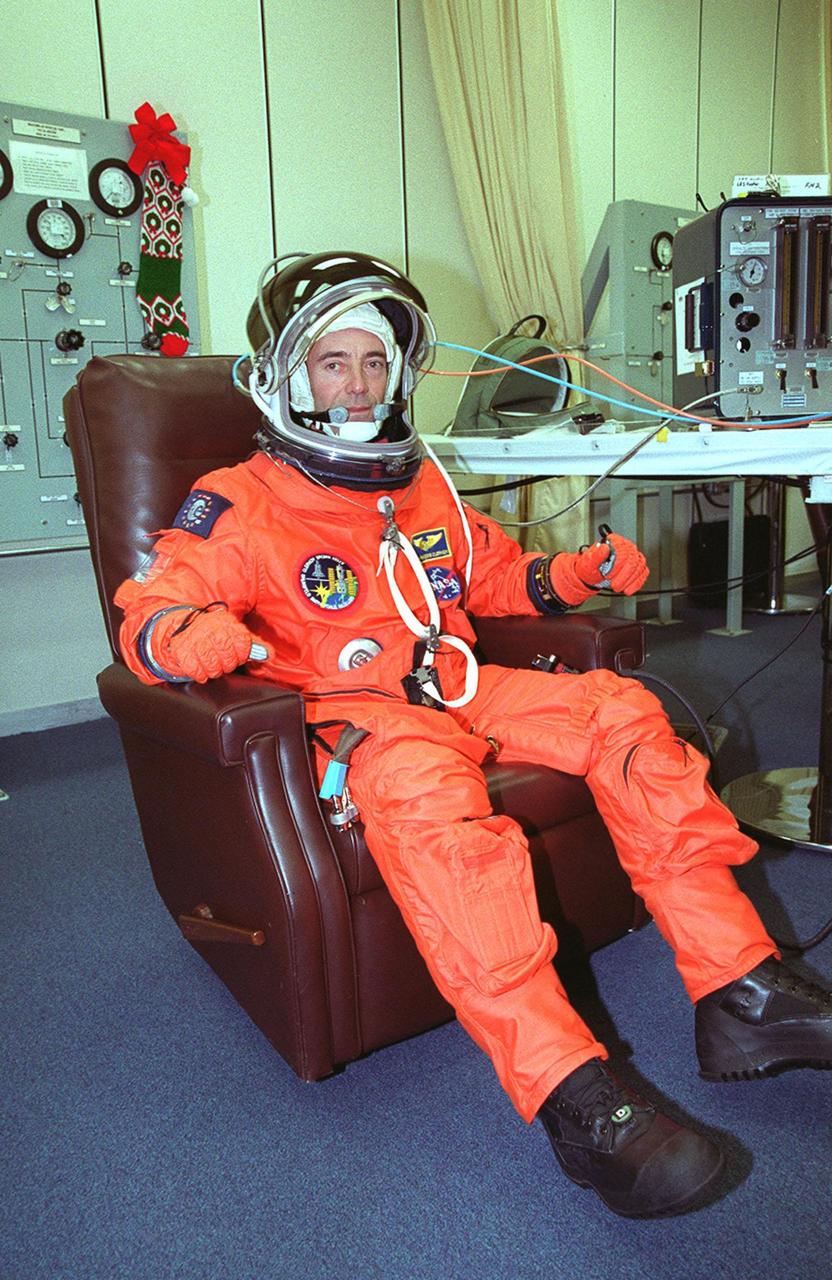
In the Operations and Checkout Building, STS-103 Mission Specialist Jean-François Clervoy of France has donned his launch and entry suit and is ready for launch. Other crew members are Commander Curtis L. Brown Jr., Pilot Scott J. Kelly and Mission Specialists Steven L. Smith, C. Michel Foale (Ph.D.), John M. Grunsfeld (Ph.D.), and Claude Nicollier of Switzerland. Nicollier and Clervoy are with the European Space Agency. The STS-103 mission, to service the Hubble Space Telescope, is scheduled for launch Dec. 17 at 8:47 p.m. EST from Launch Pad 39B. Mission objectives include replacing gyroscopes and an old computer, installing another solid state recorder, and replacing damaged insulation in the telescope. After the 8-day, 21-hour mission, Discovery is expected to land at KSC Sunday, Dec. 26, at about 6:30 p.m. EST
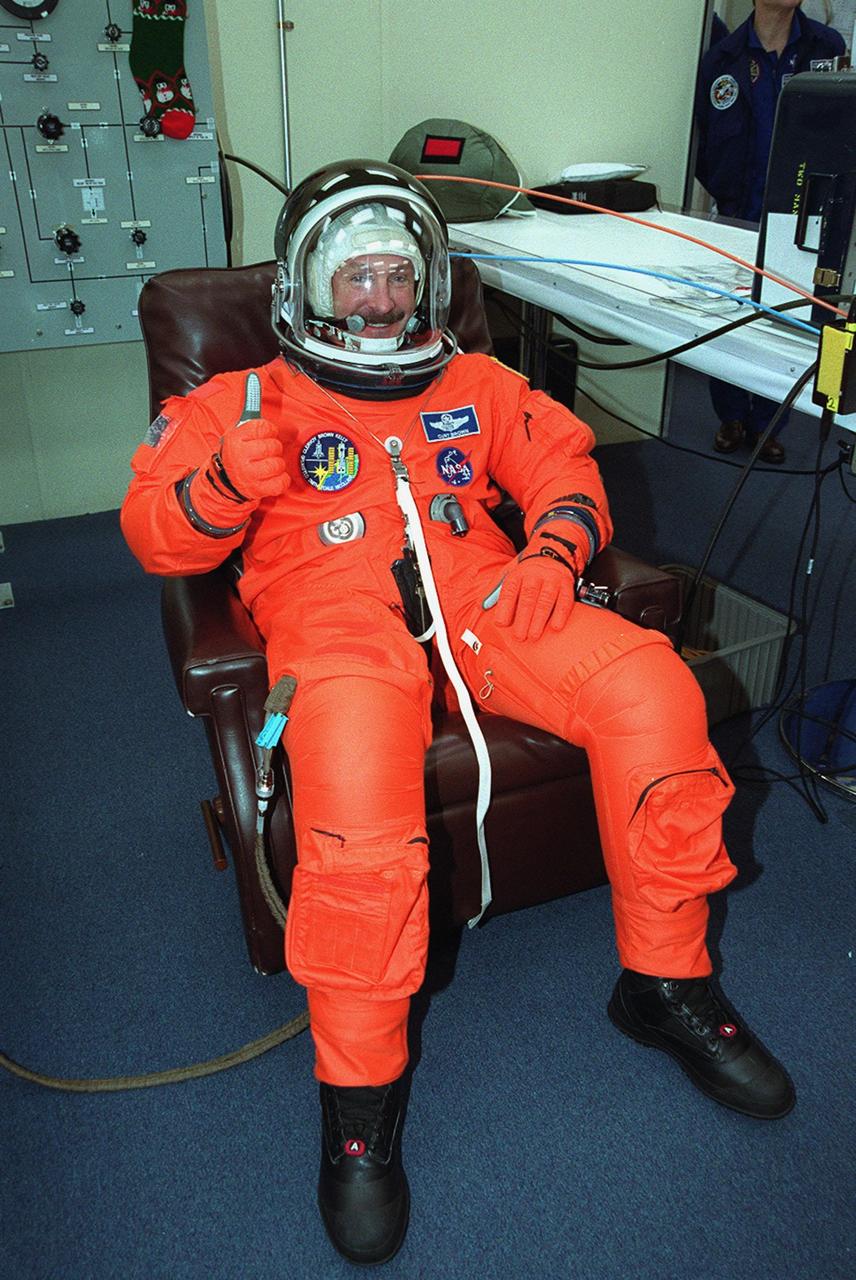
STS-103 Commander Curtis L. Brown Jr. is suited up and ready to go for the second launch attempt of Space Shuttle Discovery. The previous launch attempt on Dec. 17 was scrubbed about 8:52 p.m. due to numerous violations of weather launch commit criteria at KSC. Brown and fellow crew members Pilot Scott J. Kelly and Mission Specialists Steven L. Smith, C. Michael Foale (Ph.D.), John M. Grunsfeld (Ph.D.), Claude Nicollier of Switzerland and Jean-Francois Clervoy of France are scheduled to lift off at 7:50 p.m. EST Dec. 19 on mission STS-103, servicing the Hubble Space Telescope. Objectives for the nearly eight-day mission include replacing gyroscopes and an old computer, installing another solid state recorder, and replacing damaged insulation in the telescope. Discovery is expected to land at KSC Monday, Dec. 27, at about 5:24 p.m. EST
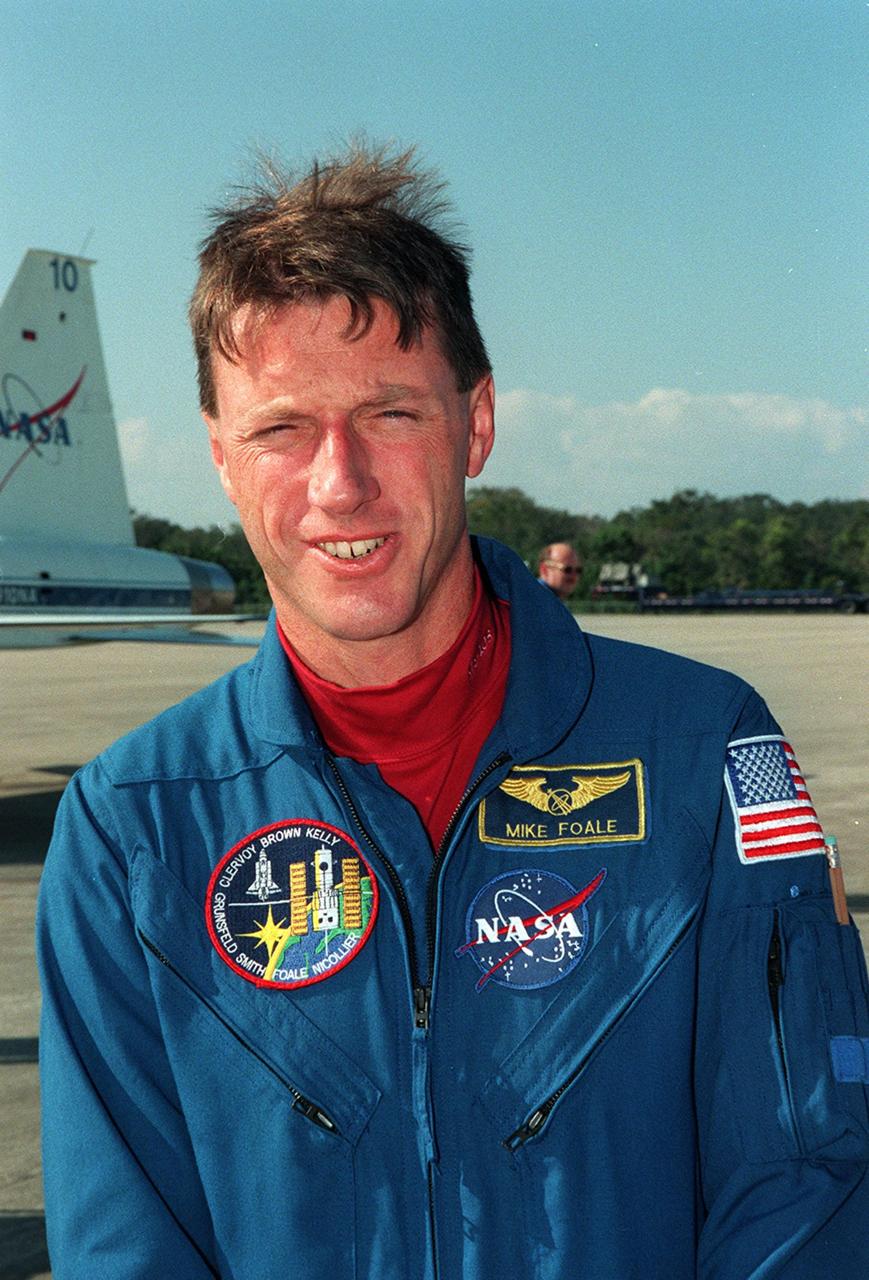
STS-103 Mission Specialist C. Michael Foale (Ph.D.) arrives at Kennedy Space Center's Shuttle Landing Facility to begin Terminal Countdown Demonstration Test (TCDT) activities. The TCDT provides the crew with emergency egress training, opportunities to inspect their mission payloads in the orbiter's payload bay, and simulated countdown exercises. Also participating are Commander Curtis L. Brown Jr., Pilot Scott J. Kelly, and Mission Specialists Steven L. Smith, John M. Grunsfeld (Ph.D.), Claude Nicollier of Switzerland, with the European Space Agency, and Jean-François Clervoy of France, also with the European Space Agency. The mission, to service the Hubble Space Telescope, is targeted for launch Dec. 6 at 2:37 a.m. EST aboard Space Shuttle Discovery
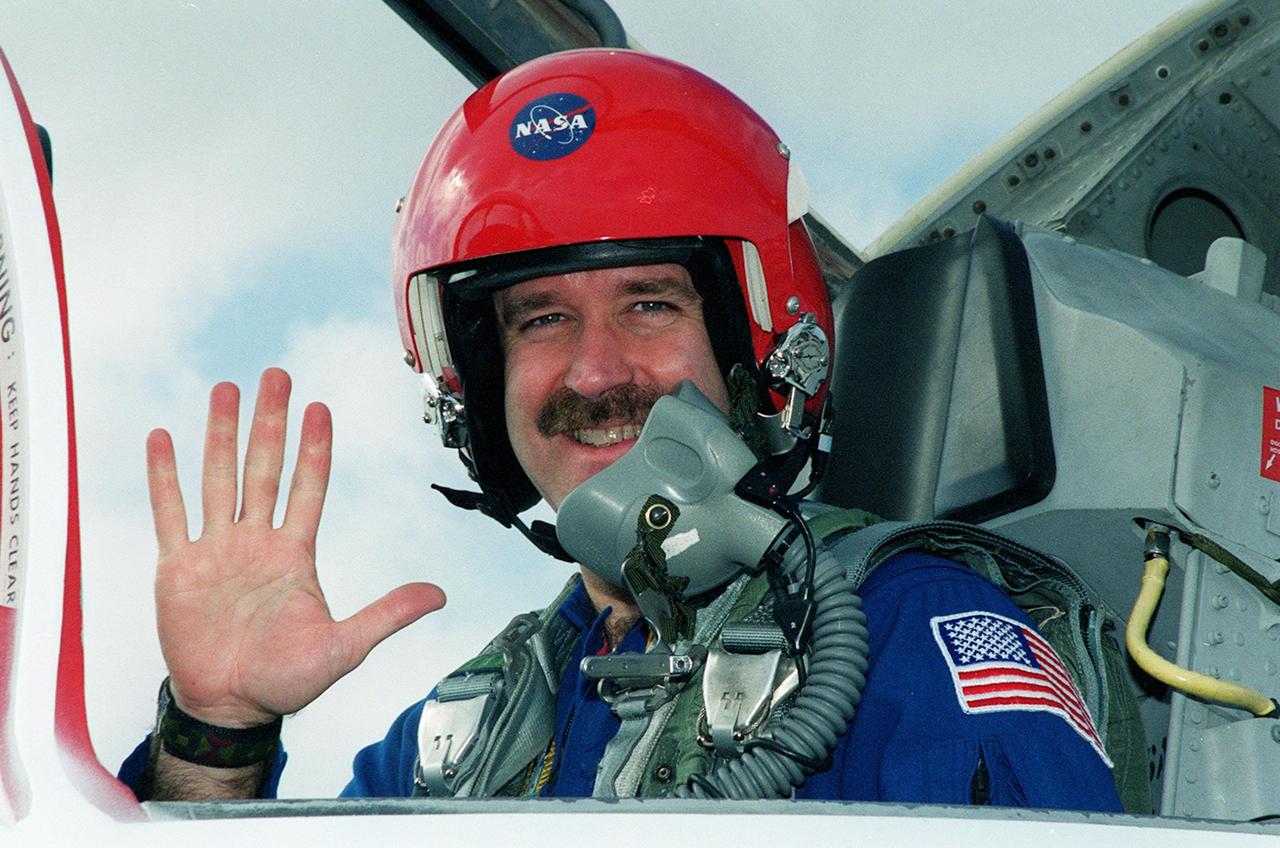
STS-103 Mission Specialist John M. Grunsfeld (Ph.D.) waves from the rear seat of a T-38 training jet before beginning practice flights. He joins other crew members Commander Curtis L. Brown Jr., Pilot Scott J. Kelly and Mission Specialists Steven L. Smith, C. Michael Foale (Ph.D.), Claude Nicollier of Switzerland and Jean-François Clervoy of France, for pre-launch preparations on mission STS-103 aboard Space Shuttle Discovery. Nicollier and Clervoy are with the European Space Agency. The mission, to service the Hubble Space Telescope, is scheduled for launch Dec. 16 at 9:18 p.m. EST from Launch Pad 39B. The mission is expected to last about 9 days and 21 hours. Discovery is expected to land at KSC Sunday, Dec. 26, at 6:56 p.m. EST
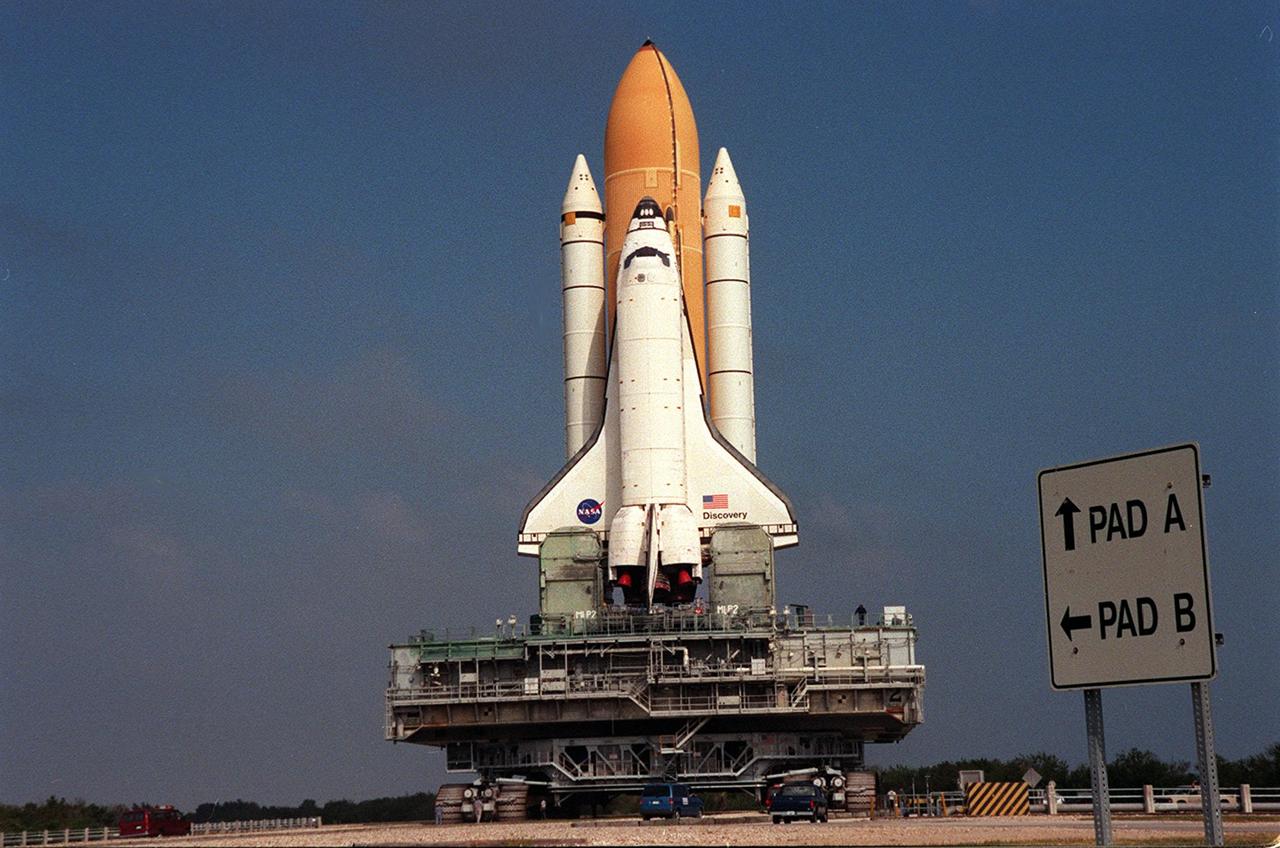
KENNEDY SPACE CENTER, Fla. -- Space Shuttle Discovery makes the turn toward Launch Pad 39B on its trek atop the mobile launcher platform and crawler transporter. Once at the pad, the orbiter, external tank and solid rocket boosters will undergo final preparations for the STS-103 launch targeted for Dec. 6, 1999, at 2:37 a.m. EST. The mission is a "call-up" due to the need to replace and repair portions of the Hubble Space Telescope. Although Hubble is operating normally and conducting its scientific observations, only three of its six gyroscopes are working properly. Four EVA's are planned to make the necessary repairs and replacements on the telescope. The STS-103 crew members are Commander Curtis L. Brown Jr., Pilot Scott J. Kelly, Steven L. Smith, C. Michael Foale (Ph.D.), John M. Grunsfeld (Ph.D.), and Claude Nicollier of Switzerland and Jean-François Clervoy of France, both with the European Space Agency.
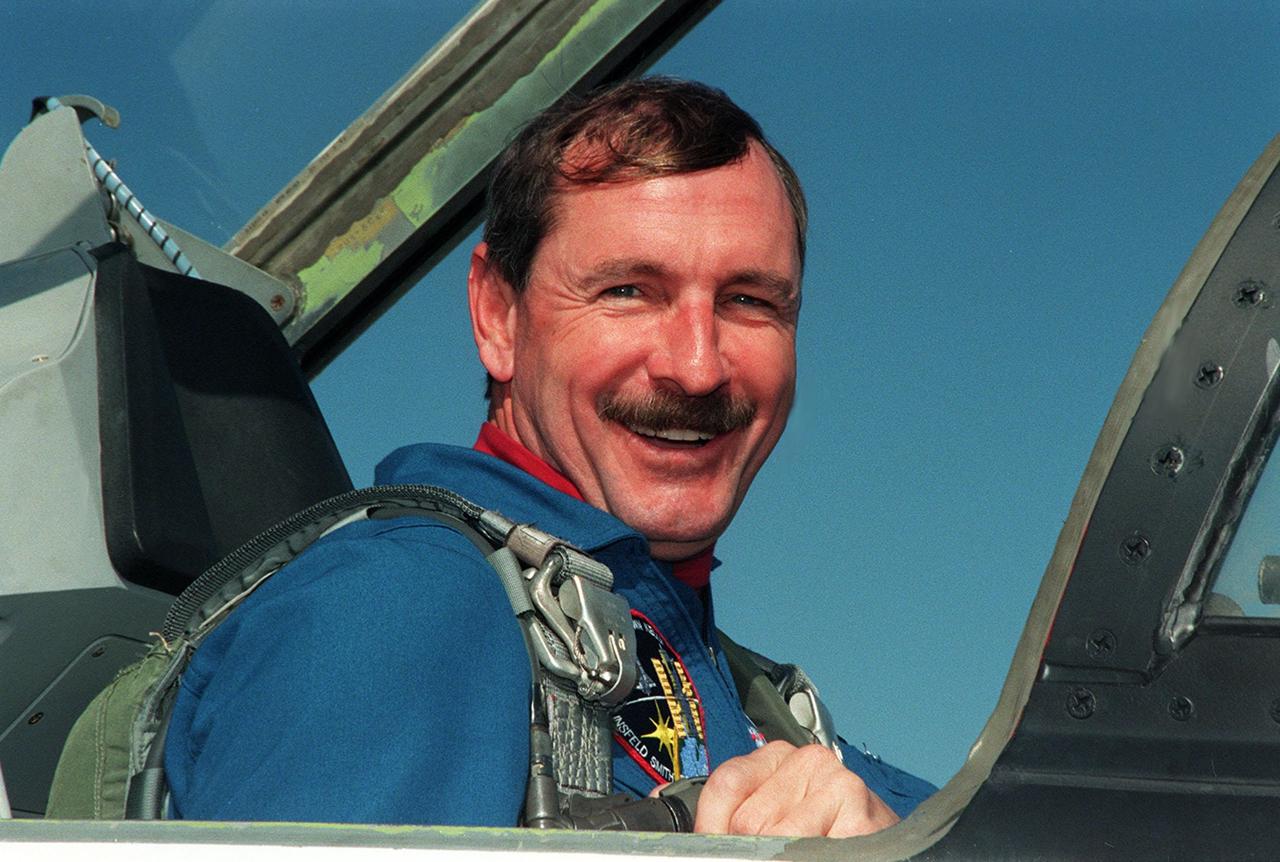
STS-103 Commander Curtis L. Brown Jr. is happy to arrive at Kennedy Space Center to begin Terminal Countdown Demonstration Test (TCDT) activities. The TCDT provides the crew with emergency egress training, opportunities to inspect their mission payloads in the orbiter's payload bay, and simulated countdown exercises. Also participating are Pilot Scott J. Kelly, and Mission Specialists Steven L. Smith, C. Michael Foale (Ph.D.), John M. Grunsfeld (Ph.D.), Claude Nicollier of Switzerland, with the European Space Agency, and Jean-François Clervoy of France, also with the European Space Agency. The mission, to service the Hubble Space Telescope, is targeted for launch Dec. 6 at 2:37 a.m. EST aboard Space Shuttle Discovery
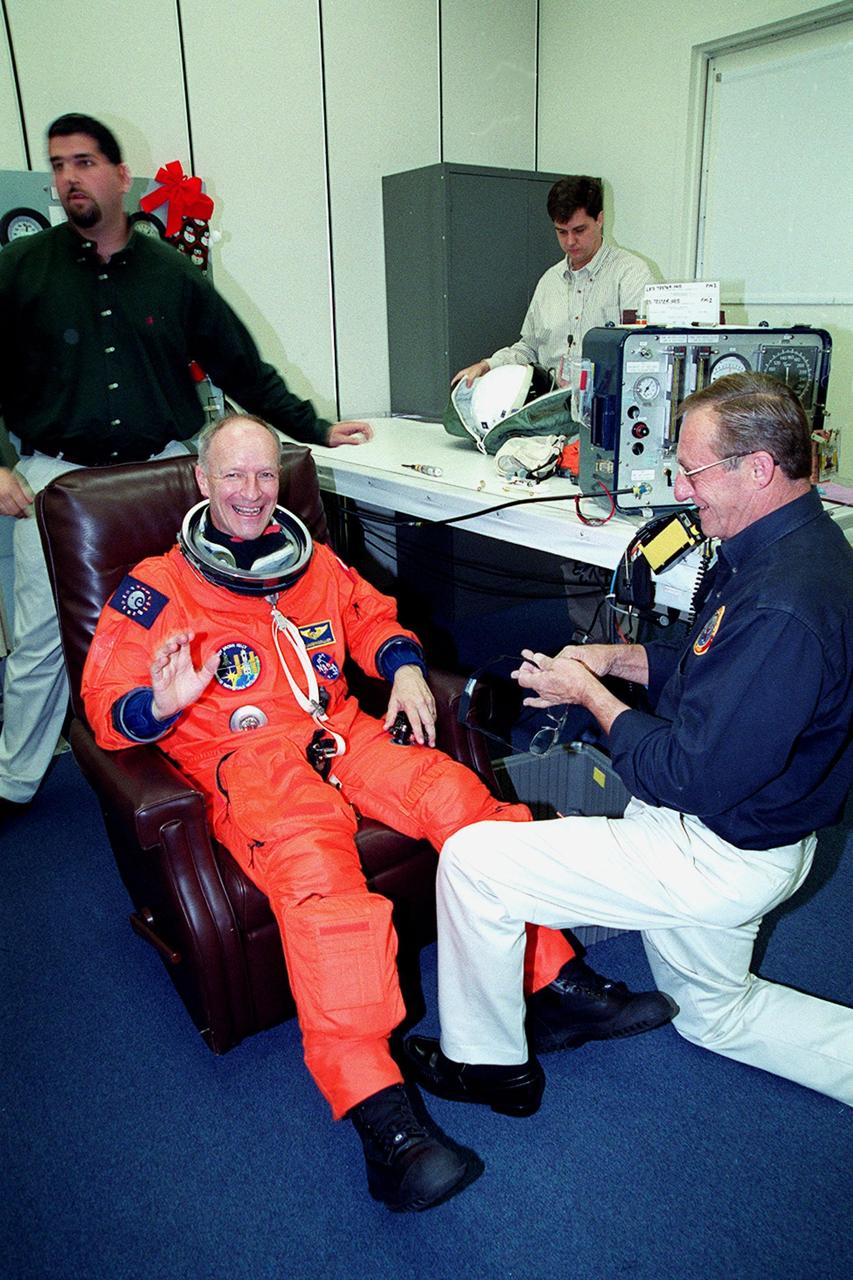
In the Operations and Checkout Building, STS-103 Mission Specialist Claude Nicollier of Switzerland waves while having his launch and entry suit checked by a suit techician during final launch preparations. Other crew members are Commander Curtis L. Brown Jr., Pilot Scott J. Kelly and Mission Specialists Steven L. Smith, C. Michael Foale (Ph.D.), John M. Grunsfeld (Ph.D.) and Jean-François Clervoy of France. Nicollier and Clervoy are with the European Space Agency. The STS-103 mission, to service the Hubble Space Telescope, is scheduled for launch Dec. 17 at 8:47 p.m. EST from Launch Pad 39B. Mission objectives include replacing gyroscopes and an old computer, installing another solid state recorder, and replacing damaged insulation in the telescope. After the 8-day, 21-hour mission, Discovery is expected to land at KSC Sunday, Dec. 26, at about 6:30 p.m. EST
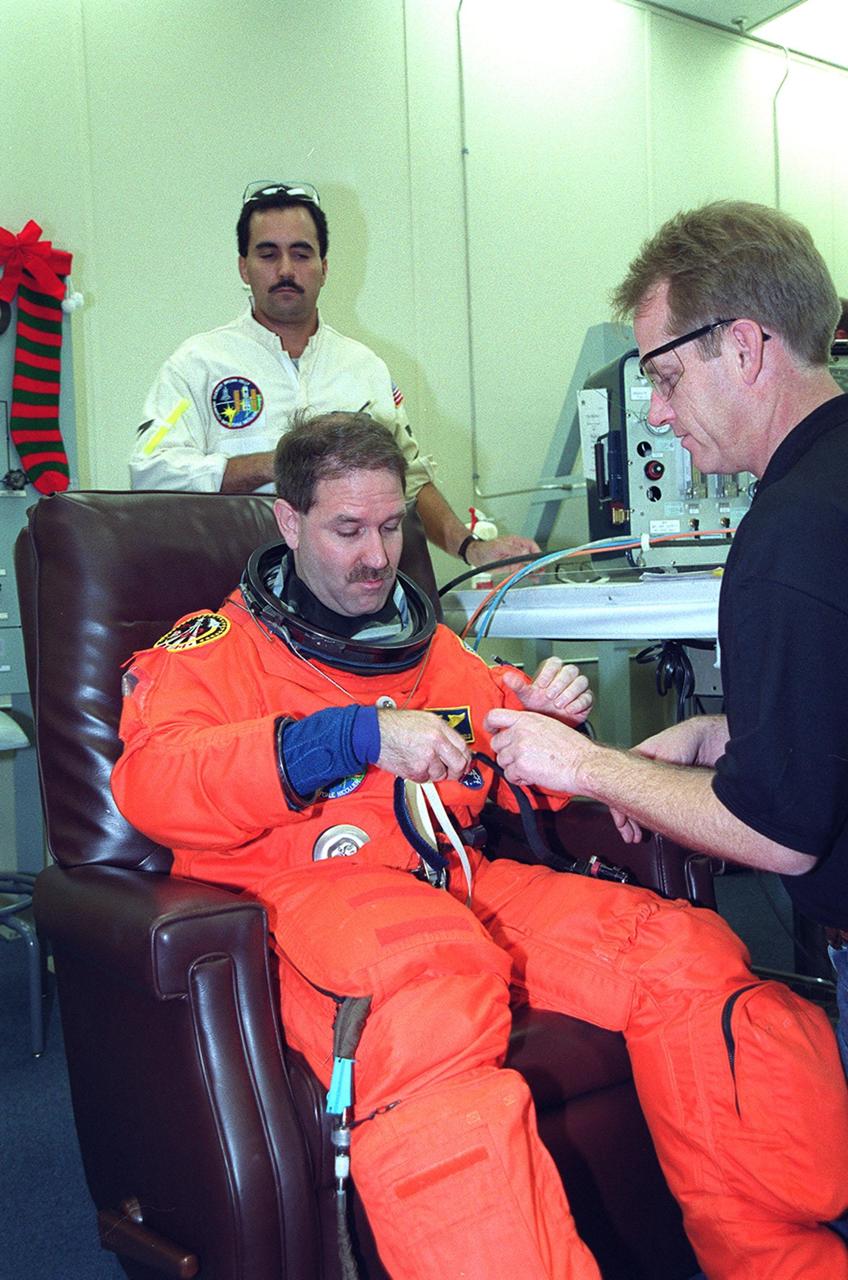
In the Operations and Checkout Building, STS-103 Mission Specialist John M. Grunsfeld (Ph.D.) is assisted by a suit technician in donning his launch and entry suit during final launch preparations. Other crew members are Commander Curtis L. Brown Jr., Pilot Scott J. Kelly and Mission Specialists Steven L. Smith, C. Michael Foale (Ph.D.), Claude Nicollier of Switzerland and Jean-François Clervoy of France. Nicollier and Clervoy are with the European Space Agency. The STS-103 mission, to service the Hubble Space Telescope, is scheduled for launch Dec. 17 at 8:47 p.m. EST from Launch Pad 39B. Mission objectives include replacing gyroscopes and an old computer, installing another solid state recorder, and replacing damaged insulation in the telescope. After the 8-day, 21-hour mission, Discovery is expected to land at KSC Sunday, Dec. 26, at about 6:30 p.m. EST
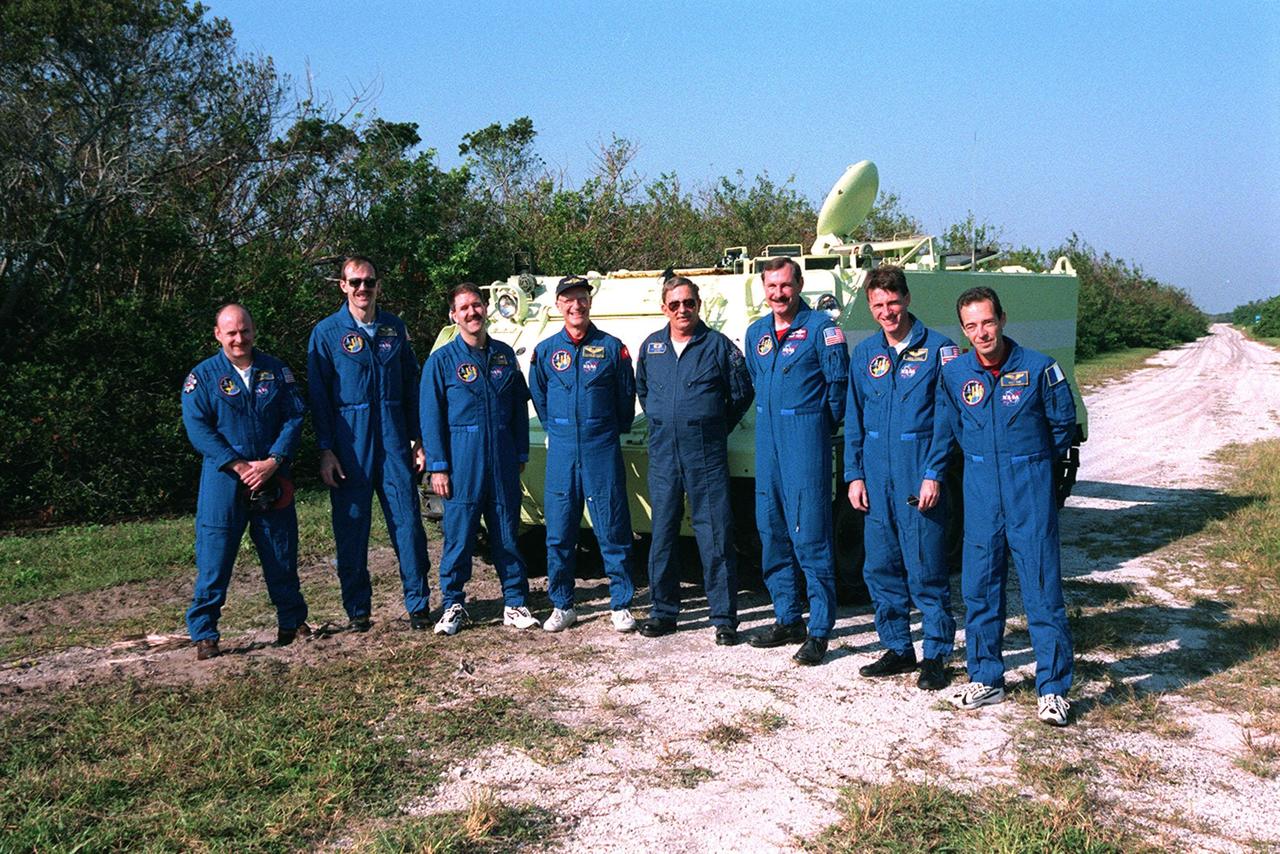
The STS-103 crew pose for photographers following Terminal Countdown Demonstration Test (TCDT) emergency egress training on the small armored personnel carrier behind them. Standing left to right are Pilot Scott J. Kelly, Mission Specialists Steven L. Smith, John M. Grunsfeld (Ph.D.), Claude Nicollier of Switzerland, their trainer on the carrier Capt. George Hoggard of the KSC/CCAS Fire Department, Commander Curtis L. Brown Jr., and Mission Specialists C. Michael Foale (Ph.D.) and Jean-Francois Clervoy of France. Nicollier and Clervoy are with the European Space Agency. The TCDT also provides simulated countdown exercises and opportunities to inspect the mission payloads in the orbiter's payload bay. STS-103 is a "call-up" mission due to the need to replace and repair portions of the Hubble Space Telescope. Four EVA's are planned to make the necessary repairs and replacements on the telescope. The mission is targeted for launch Dec. 6 at 2:37 a.m. EST
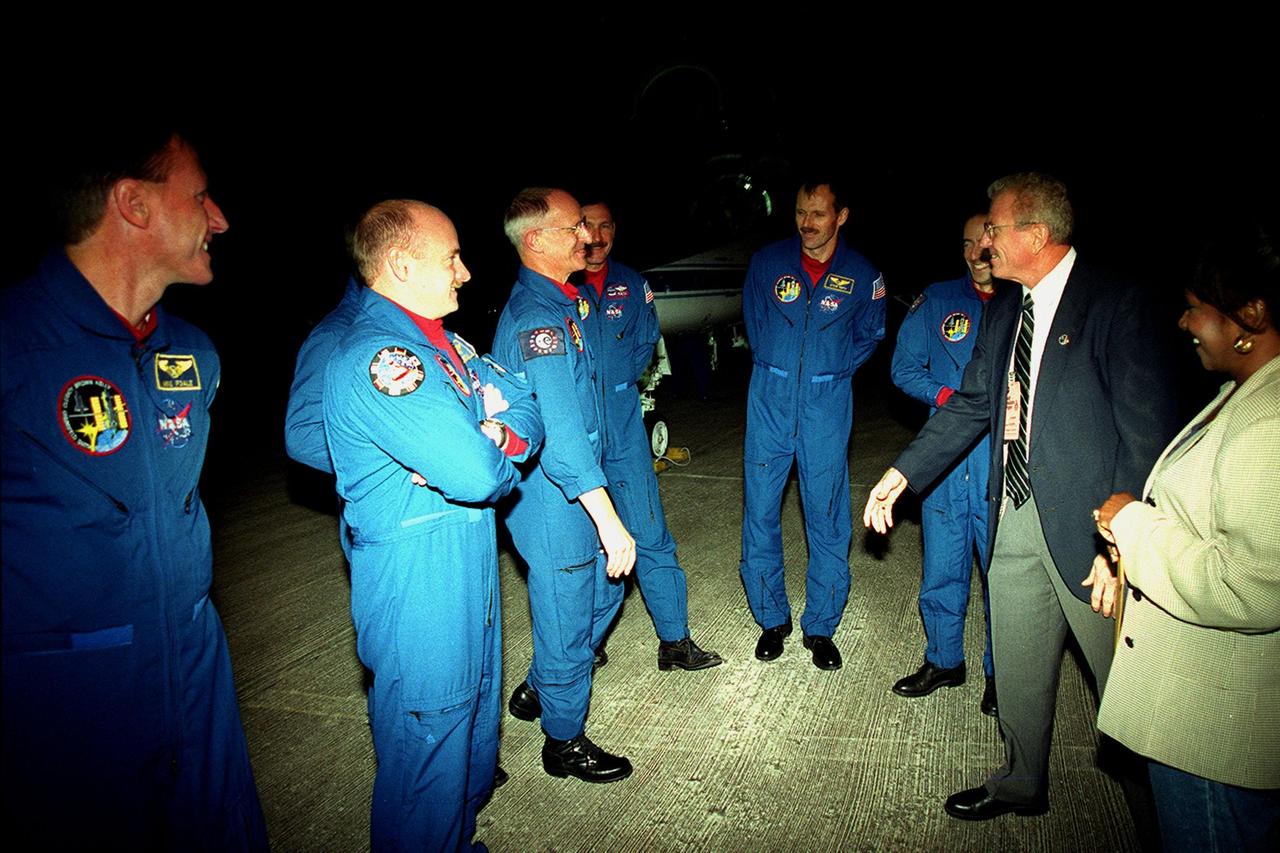
At the Shuttle Landing Facility, the STS-103 crew is greeted by Loren Shriver, Deputy Director for Launch and Payload Processing, upon their arrival aboard T-38 jets to make final preparations for launch. From left are Mission Specialist C. Michael Foale (Ph.D.), Pilot Scott J. Kelly, Mission Specialist John M. Grunsfeld (Ph.D.) (hidden behind Kelly), Mission Specialist Claude Nicollier of Switzerland, Commander Curtis L. Brown Jr., Mission Specialist Steven L. Smith, Mission Specialist Jean-François Clervoy of France, Loren Shriver, and Delores Green with KSC's Astronaut Office. Nicollier and Clervoy are with the European Space Agency. Shriver was the commander of the STS-31 crew which originally deployed the telescope in April of 1990. The STS-103 mission, to service the Hubble Space Telescope a third time, is scheduled for launch Dec. 11 at 12:13 a.m. EST from Launch Pad 39B

Stability and Control Branch Photo: Names, rows front to back, people left to right: Row 1: 1. ?? Graduate Student (USAF) 2. Robert Dunning 3. Rhonda Harvey Poppen 4. Katherine G. Johnson 5. ?? Graduate Student (USAF) 6. Vladislav Klein Row 2: 1. Mario Smith 2. Jeff Williams 3. N. Sundararajan 4. Tony Fontana 5. John Young Row 3: 1. Lawrence Taylor 2. Jim Batterson 3. Suresh Joshi 4. Daniel P. Giesy Row 4: 1. Bill Suit 2. Albert A. Schy 3. Al Hamer 4. Ernest Armstrong 5. Claude Keckler Row 5: 1. Chris Brown 2. Robert Bullock 3. Ray Montgomery 4. Jim Williams 5. Sahajendra Singh 6. Graduate Student (Egypt) Names given by Daniel P. Giesy.
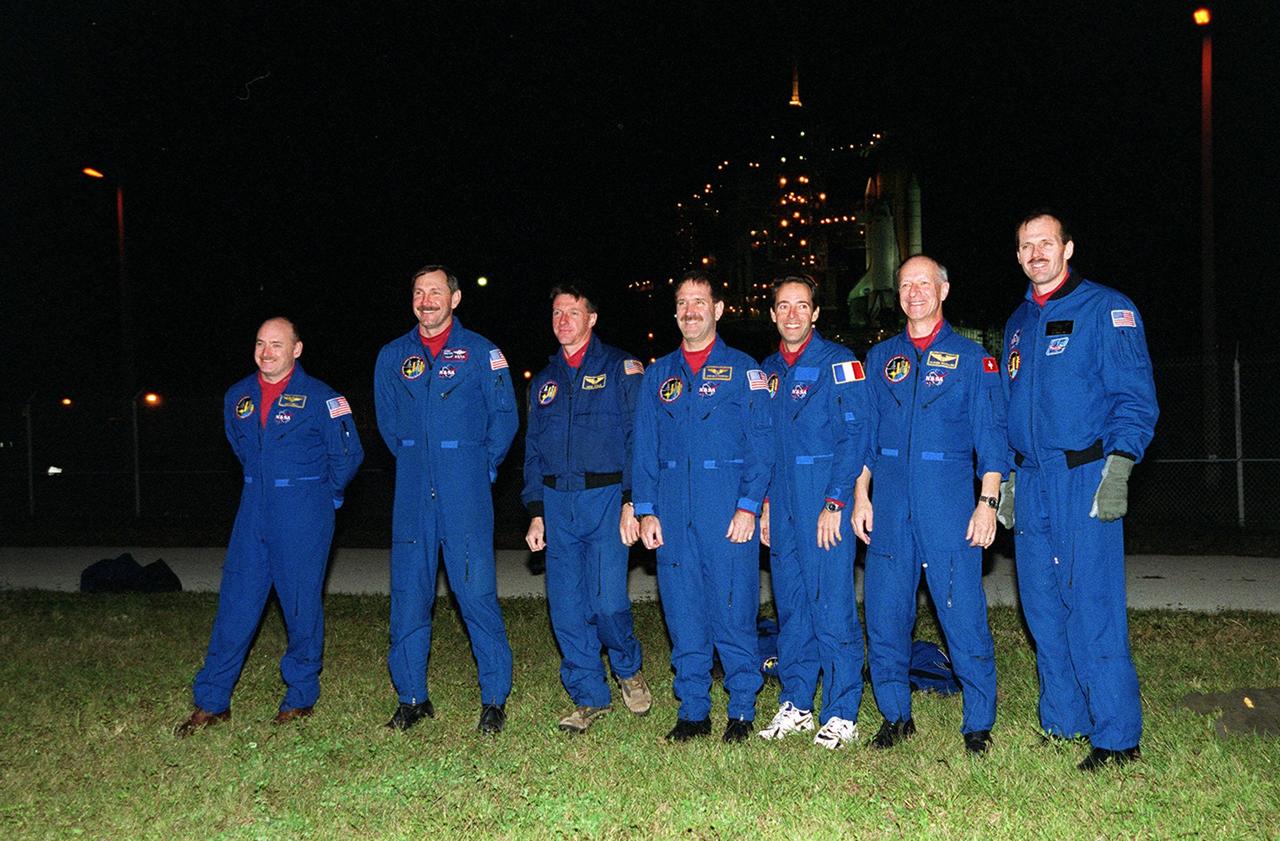
The STS-103 crew address family and friends at Launch Pad 39B. From left to right are Pilot Scott J. Kelly, Commander Curtis L. Brown Jr., and Mission Specialists C. Michael Foale (Ph.D.), John M. Grunsfeld (Ph.D.), Jean-François Clervoy of France , Claude Nicollier of Switzerland and Steven L. Smith. Nicollier and Clervoy are with the European Space Agency. In the background is Space Shuttle Discovery, alongside the lighted Fixed Service Structure. The STS-103 mission, to service the Hubble Space Telescope, is scheduled for launch Dec. 17 at 8:47 p.m. EST from Launch Pad 39B. Mission objectives include replacing gyroscopes and an old computer, installing another solid state recorder, and replacing damaged insulation in the telescope. The mission is expected to last about 8 days and 21 hours. Discovery is expected to land at KSC Sunday, Dec. 26, at about 6:25 p.m. EST
![KENNEDY SPACE CENTER, FLA. -- Seventeen new astronaut candidates visited the Vehicle Assembly Building as part of an orientation tour of KSC facilities. Here they are grouped around one of the external fuel tanks in the transfer aisle of the VAB. This latest group of candidates is the tenth chosen since the original seven Mercury astronauts. [From left, Michael J. McCulley, Curtis L. Brown Jr., Frank L. Culbertson Jr., Kathryn C. Thornton, Mark N. Brown, Mark C. Lee, Kenneth D. Cameron, John H. Casper, L. Blaine Hammond Jr., Charles Lacy Veach (deceased), James C. Adamson, William M. Shepherd, Sidney M. Gutierrez, Marsha S. Ivins, David G. Low, Michael J. Smith (deceased), Ellen S. Baker, Sonny Carter (deceased).]](https://images-assets.nasa.gov/image/108-KSC-84P-339/108-KSC-84P-339~medium.jpg)
KENNEDY SPACE CENTER, FLA. -- Seventeen new astronaut candidates visited the Vehicle Assembly Building as part of an orientation tour of KSC facilities. Here they are grouped around one of the external fuel tanks in the transfer aisle of the VAB. This latest group of candidates is the tenth chosen since the original seven Mercury astronauts. [From left, Michael J. McCulley, Curtis L. Brown Jr., Frank L. Culbertson Jr., Kathryn C. Thornton, Mark N. Brown, Mark C. Lee, Kenneth D. Cameron, John H. Casper, L. Blaine Hammond Jr., Charles Lacy Veach (deceased), James C. Adamson, William M. Shepherd, Sidney M. Gutierrez, Marsha S. Ivins, David G. Low, Michael J. Smith (deceased), Ellen S. Baker, Sonny Carter (deceased).]
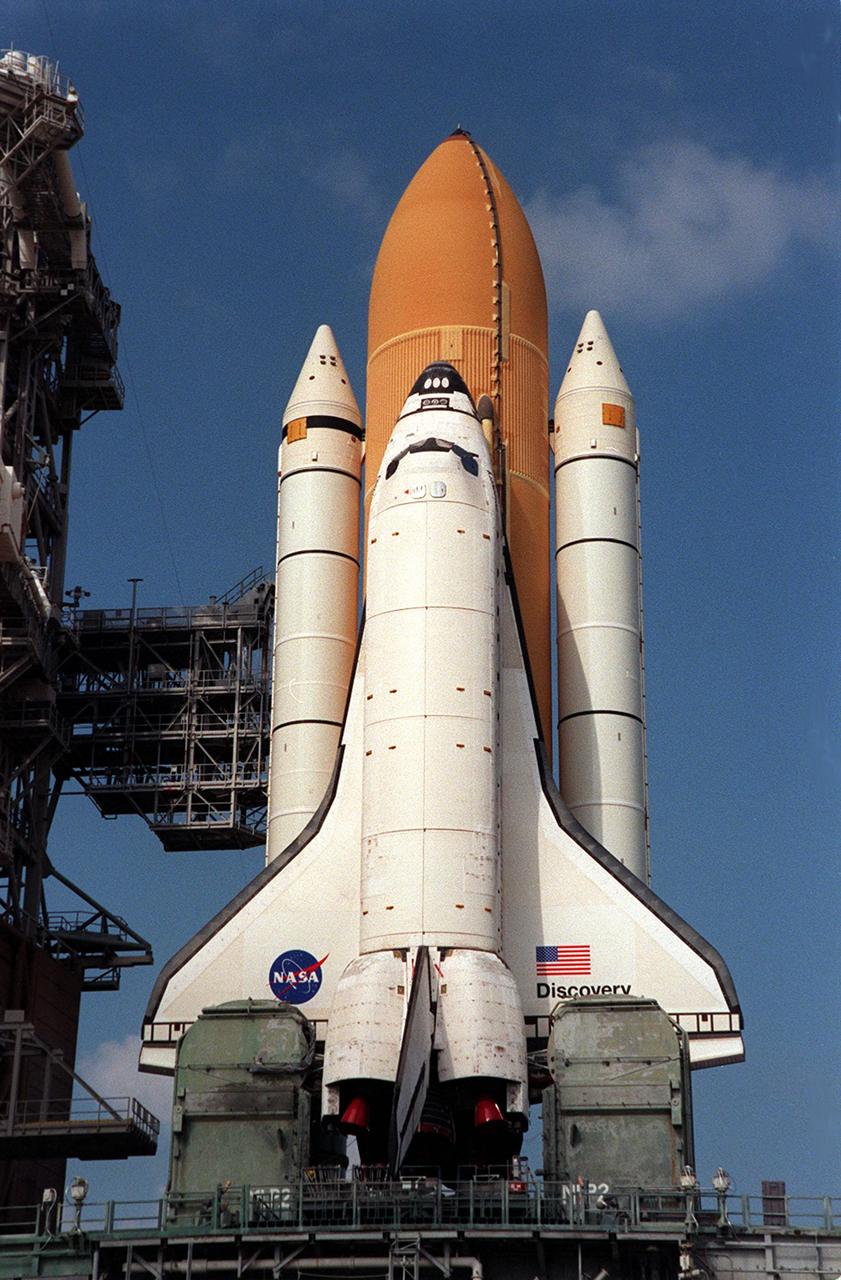
KENNEDY SPACE CENTER, Fla. -- Space Shuttle Discovery arrives at Launch Pad 39B where the orbiter, external tank and solid rocket boosters will undergo final preparations for the STS-103 launch. The mission is a "call-up" due to the need to replace and repair portions of the Hubble Space Telescope. Although Hubble is operating normally and conducting its scientific observations, only three of its six gyroscopes are working properly. Four EVA's are planned to make the necessary repairs and replacements on the telescope. The STS-103 crew members are Commander Curtis L. Brown Jr., Pilot Scott J. Kelly, Steven L. Smith, C. Michael Foale (Ph.D.), John M. Grunsfeld (Ph.D.), and Claude Nicollier of Switzerland and Jean-François Clervoy of France, both with the European Space Agency. The mission is targeted for launch Dec. 6 at 2:37 a.m. EST aboard Space Shuttle Discovery.
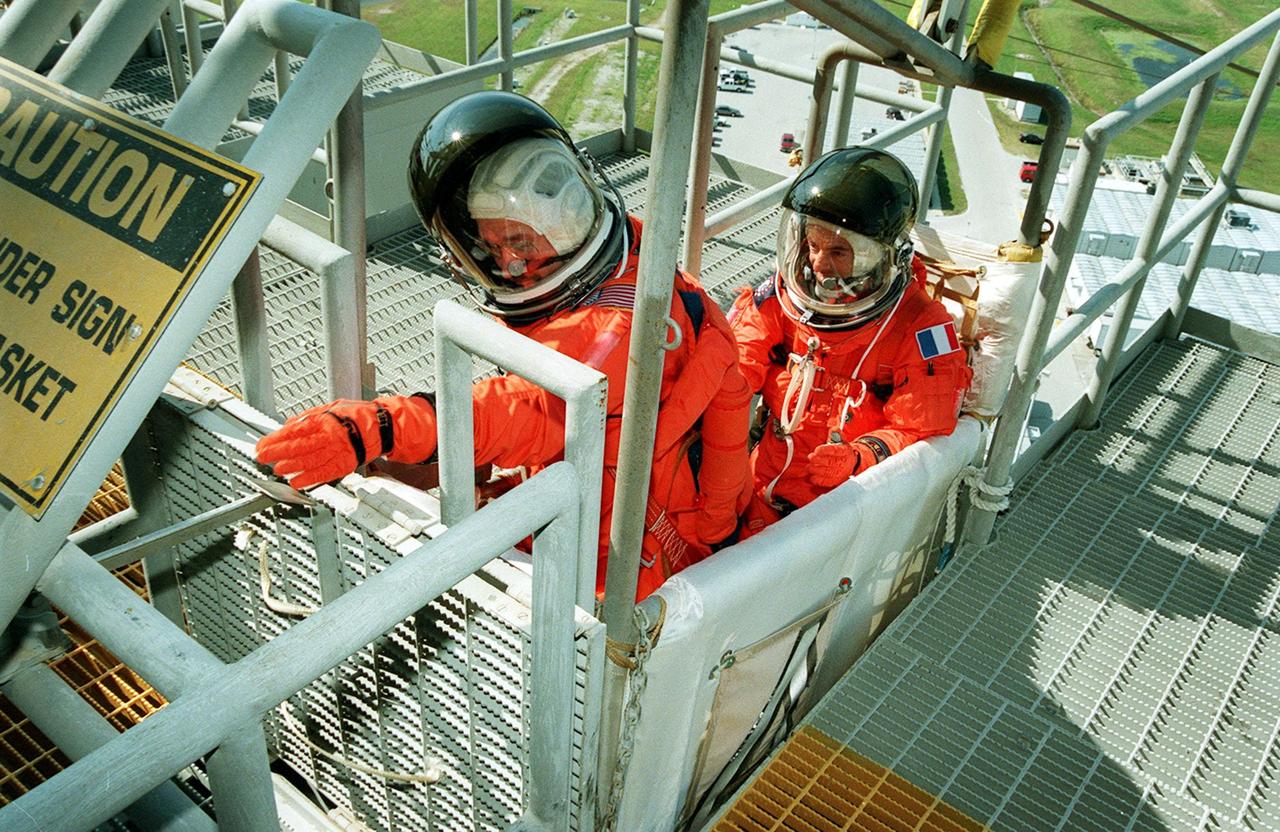
In the slidewire basket on Launch Pad 39B, STS-103 Mission Specialist Steven L. Smith reaches for the lever that will release the basket. With Smith is fellow crew member Mission Specialist Jean-François Clervoy of France. The baskets are part of the emergency egress system for persons in the Shuttle vehicle or on the Rotating Service Structure. Seven slidewires extend from the orbiter access arm, with a netted, flatbottom basket suspended from each wire. The STS-103 crew are taking part in Terminal Countdown Demonstration Test (TCDT) activities in preparation for launch. The other crew members are Commander Curtis L. Brown Jr., Pilot Scott J. Kelly, and Mission Specialists C. Michael Foale (Ph.D.), John M. Grunsfeld (Ph.D.), and Claude Nicollier of Switzerland. Clervoy and Nicollier are with the European Space Agency. The TCDT provides the crew with the emergency egress training, opportunities to inspect their mission payloads in the orbiter's payload bay, and simulated countdown exercises. STS-103 is a "call-up" mission due to the need to replace and repair portions of the Hubble Space Telescope, including the gyroscopes that allow the telescope to point at stars, galaxies and planets. The STS-103 crew will be replacing a Fine Guidance Sensor, an older computer with a new enhanced model, an older data tape recorder with a solid-state digital recorder, a failed spare transmitter with a new one, and degraded insulation on the telescope with new thermal insulation. The crew will also install a Battery Voltage/Temperature Improvement Kit to protect the spacecraft batteries from overcharging and overheating when the telescope goes into a safe mode. Four EVA's are planned to make the necessary repairs and replacements on the telescope. The mission is targeted for launch Dec. 6 at 2:37 a.m. EST
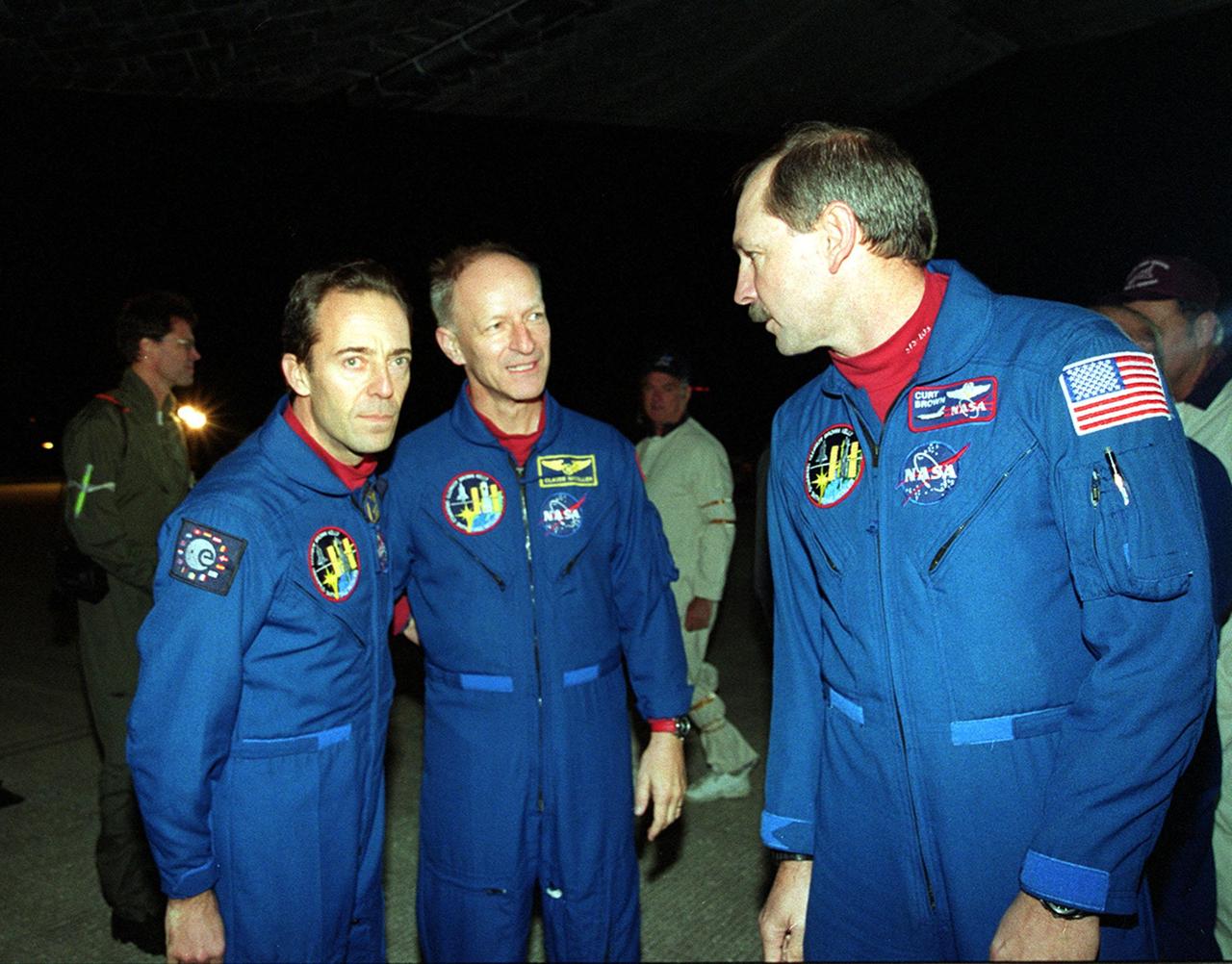
After landing at the Shuttle Landing Facility, STS-103 Mission Specialists Jean-Francois Clervoy of France and Claude Nicollier of Switzerland, who are with the European Space Agency, listen to a comment by Commander Curtis L. Brown Jr. while looking over the orbiter Discovery. Other members of the crew are Pilot Scott J. Kelly and Mission Specialists Steven L. Smith, C. Michael Foale (Ph.D.), and John M. Grunsfeld (Ph.D.). The crew of seven completed a successful eight-day mission to service the Hubble Space Telescope, spending the Christmas holiday in space in order to accomplish their mission before the end of 1999. During the mission, Discovery's four space-walking astronauts, Smith, Foale, Grunsfeld and Nicollier, spent 24 hours and 33 minutes upgrading and refurbishing Hubble, making it more capable than ever to renew its observations of the universe. Mission objectives included replacing gyroscopes and an old computer, installing another solid state recorder, and replacing damaged insulation in the telescope. Hubble was released from the end of Discovery's robot arm on Christmas Day. Main gear touchdown was at 7:00:47 p.m. EST. Nose gear touchdown occurred at 7:00:58 p.m. EST and wheel stop at 7:01:34 p.m. EST. This was the 96th flight in the Space Shuttle program and the 27th for the orbiter Discovery. The landing was the 20th consecutive Shuttle landing in Florida and the 13th night landing in Shuttle program history
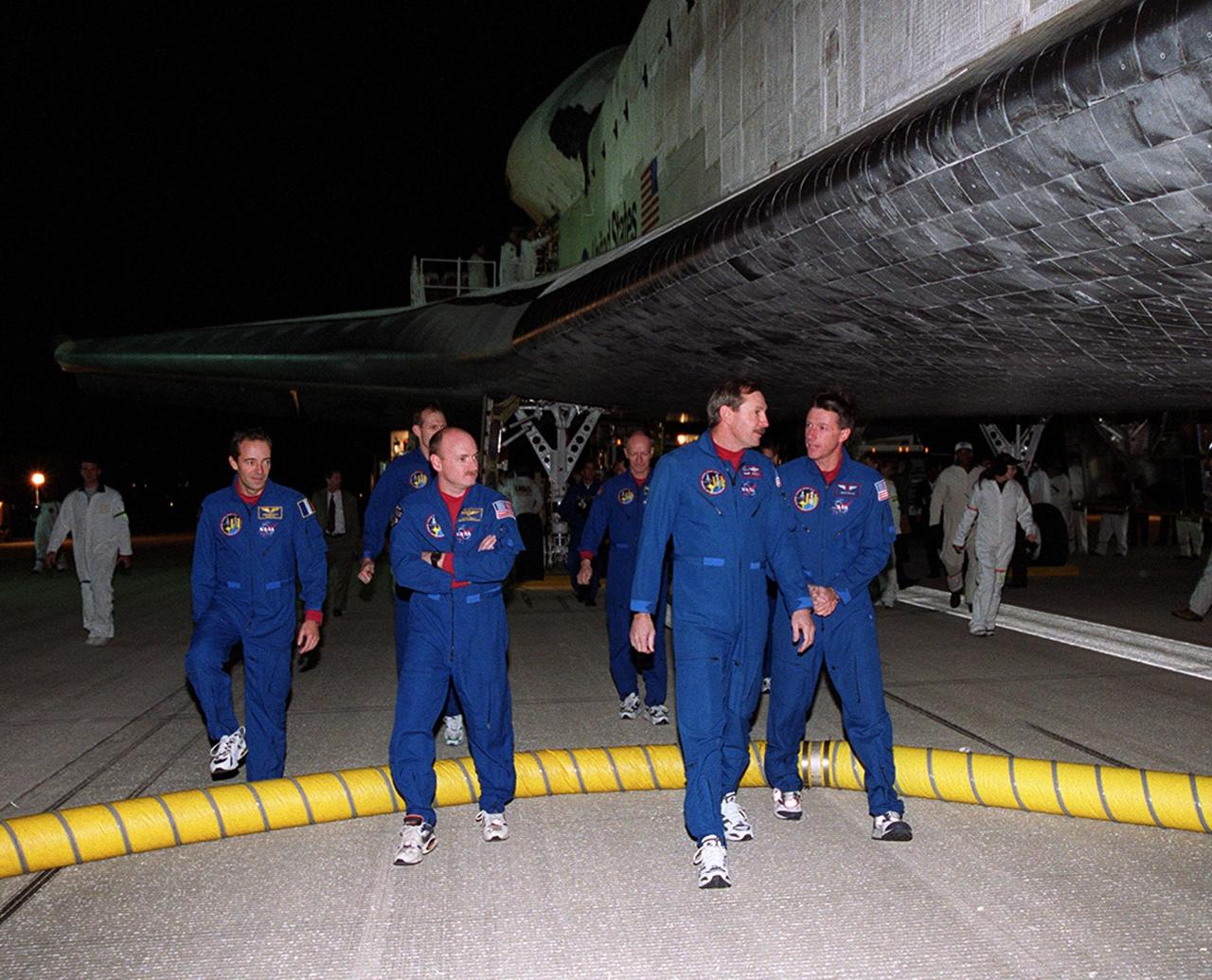
After landing at the Shuttle Landing Facility, the STS-103 crew looks over the orbiter Discovery. In the foreground, from left, are Mission Specialist Jean-Francois Clervoy of France, Pilot Scott J. Kelly, Commander Curtis L. Brown Jr. and Mission Specialist C. Michael Foale (Ph.D.); behind them, from left, are Mission Specialists Steven L. Smith and Claude Nicollier of Switzerland. The remaining crew member (not shown) is Mission Specialist John M. Grunsfeld (Ph.D.). The crew of seven completed a successful eight-day mission to service the Hubble Space Telescope, spending the Christmas holiday in space in order to accomplish their mission before the end of 1999. During the mission, Discovery's four space-walking astronauts, Smith, Foale, Grunsfeld and Nicollier, spent 24 hours and 33 minutes upgrading and refurbishing Hubble, making it more capable than ever to renew its observations of the universe. Mission objectives included replacing gyroscopes and an old computer, installing another solid state recorder, and replacing damaged insulation in the telescope. Hubble was released from the end of Discovery's robot arm on Christmas Day. Main gear touchdown was at 7:00:47 p.m. EST. Nose gear touchdown occurred at 7:00:58 p.m. EST and wheel stop at 7:01:34 p.m. EST. This was the 96th flight in the Space Shuttle program and the 27th for the orbiter Discovery. The landing was the 20th consecutive Shuttle landing in Florida and the 13th night landing in Shuttle program history
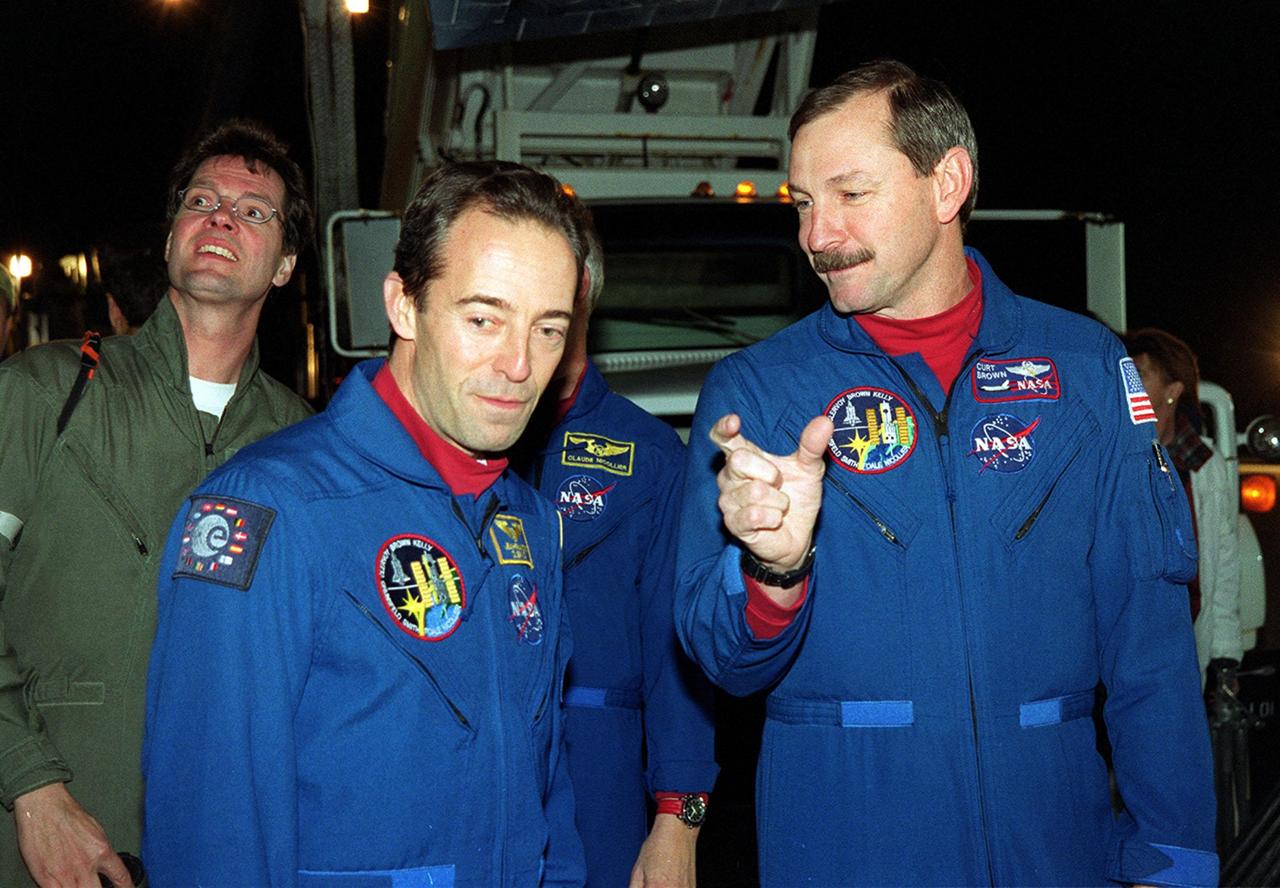
After landing at the Shuttle Landing Facility, STS-103 Mission Specialist Jean-François Clervoy of France (left), with the European Space Agency (ESA), and Commander Curtis L. Brown Jr. (right) look over the orbiter Discovery. They and other crew members Pilot Scott J. Kelly and Mission Specialists Steven L. Smith, C. Michael Foale (Ph.D.), John M. Grunsfeld (Ph.D.) and Claude Nicollier of Switzerland (also with ESA), completed a successful eight-day mission to service the Hubble Space Telescope, spending the Christmas holiday in space in order to accomplish their mission before the end of 1999. During the mission, Discovery's four space-walking astronauts, Smith, Foale, Grunsfeld and Nicollier, spent 24 hours and 33 minutes upgrading and refurbishing Hubble, making it more capable than ever to renew its observations of the universe. Mission objectives included replacing gyroscopes and an old computer, installing another solid state recorder, and replacing damaged insulation in the telescope. Hubble was released from the end of Discovery's robot arm on Christmas Day. Main gear touchdown was at 7:00:47 p.m. EST. Nose gear touchdown occurred at 7:00:58 p.m. EST and wheel stop at 7:01:34 p.m. EST. This was the 96th flight in the Space Shuttle program and the 27th for the orbiter Discovery. The landing was the 20th consecutive Shuttle landing in Florida and the 13th night landing in Shuttle program history
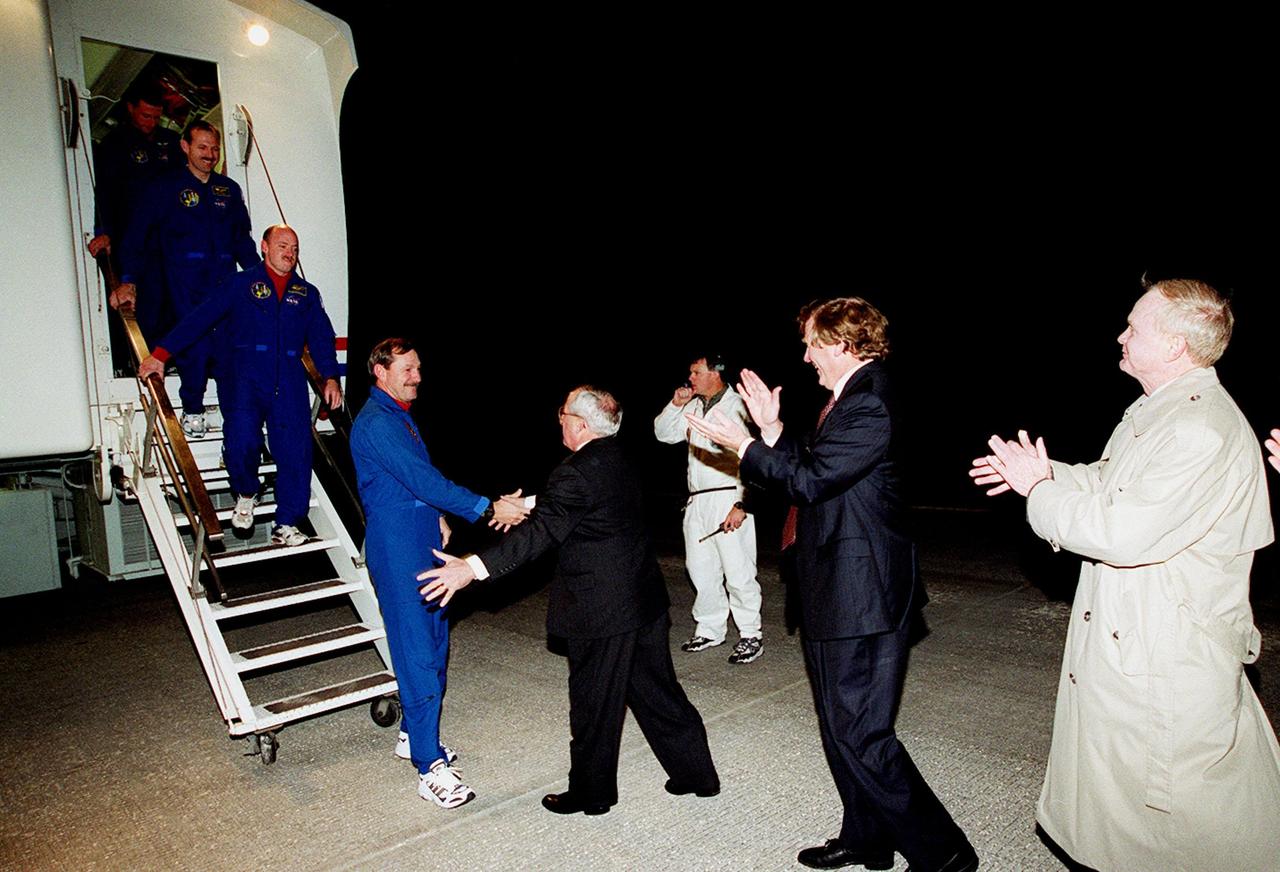
As he exits the Crew Hatch Access Vehicle, STS-103 Commander Curtis L. Brown Jr. is greeted with a handshake by Joseph Rothenberg, associate administrator, Office of Space Flight. Descending the stairs behind Brown are (left to right) Mission Specialists C. Michael Foale (Ph.D.) and John M. Grunsfeld (Ph.D.) and Pilot Scott J. Kelly. At right, applauding the astronauts return are Earle Huckins, deputy associate administrator, Office of Space Science, and Roy Bridges, director, Kennedy Space Center. Others in the crew (not shown) are Mission Specialists Steven L. Smith, and Jean-Francois Clervoy of France and Claude Nicollier of Switzerland, who are with the European Space Agency. The crew of seven completed a successful eight-day mission to service the Hubble Space Telescope, spending the Christmas holiday in space in order to accomplish their mission before the end of 1999. During the mission, Discovery's four space-walking astronauts, Smith, Foale, Grunsfeld and Nicollier, spent 24 hours and 33 minutes upgrading and refurbishing Hubble, making it more capable than ever to renew its observations of the universe. Mission objectives included replacing gyroscopes and an old computer, installing another solid state recorder, and replacing damaged insulation in the telescope. Hubble was released from the end of Discovery's robot arm on Christmas Day. Main gear touchdown was at 7:00:47 p.m. EST. Nose gear touchdown occurred at 7:00:58 p.m. EST and wheel stop at 7:01:34 p.m. EST. This was the 96th flight in the Space Shuttle program and the 27th for the orbiter Discovery. The landing was the 20th consecutive Shuttle landing in Florida and the 13th night landing in Shuttle program history
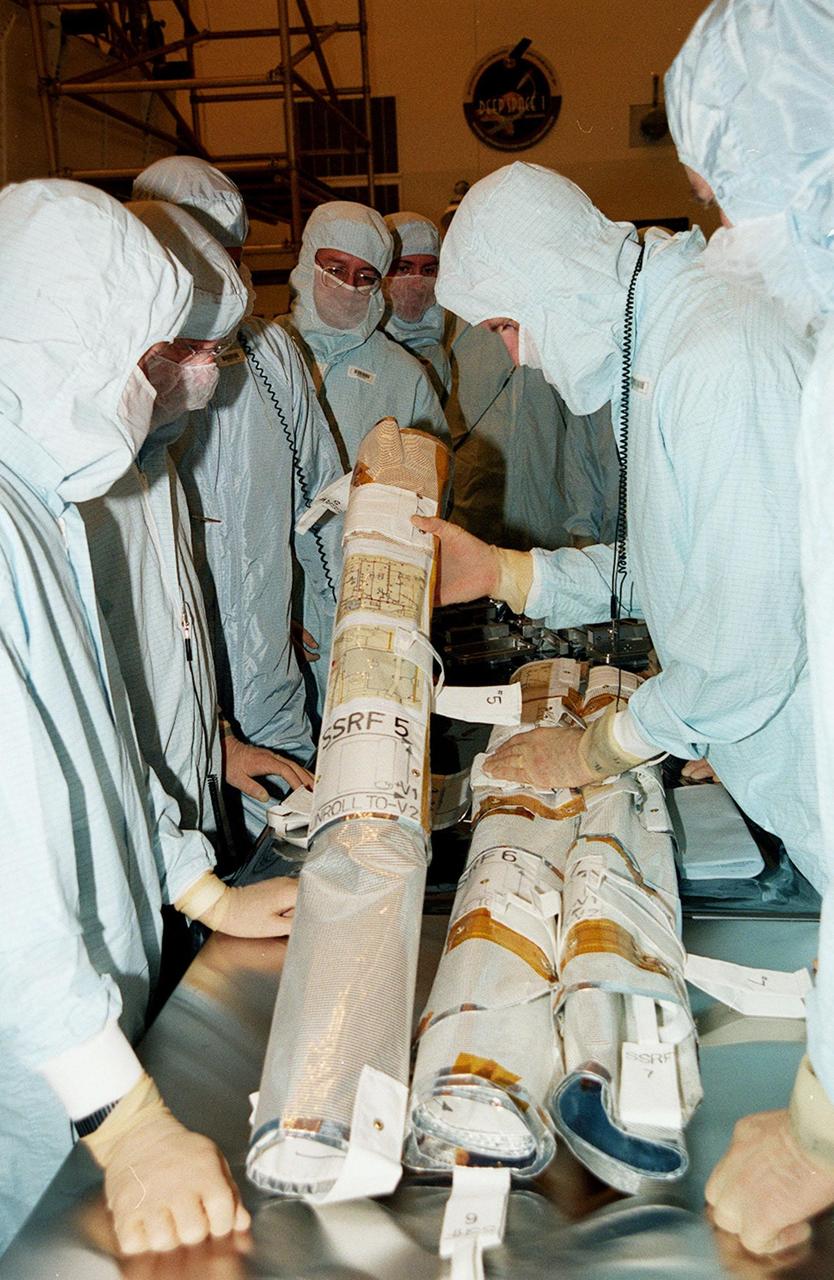
In the Payload Hazardous Servicing Facility, STS-103 Mission Specialist Steven L. Smith (right) and other members of the crew look over new Multi-Layer Insulation (MLI) intended for the Hubble Space Telescope. The seven-member crew, taking part in a Crew Equipment Interface Test, are Commander Curtis L. Brown Jr., Pilot Scott J. Kelly, and Mission Specialists Smith, C. Michael Foale (Ph.D.), John M. Grunsfeld (Ph.D.), Claude Nicollier of Switzerland, and Jean-François Clervoy of France. Nicollier and Clervoy are with the European Space Agency. Mission STS-103 is a "call-up" due to the need to replace portions of the pointing system, the gyros, which have begun to fail on the Hubble Space Telescope. Although Hubble is operating normally and conducting its scientific observations, only three of its six gyroscopes are working properly. The gyroscopes allow the telescope to point at stars, galaxies and planets. The STS-103 crew will not only replace gyroscopes, it will also replace a Fine Guidance Sensor and an older computer with a new enhanced model, an older data tape recorder with a solid state digital recorder, a failed spare transmitter with a new one, and degraded insulation on the telescope with the MLI. The crew will also install a Battery Voltage/Temperature Improvement Kit to protect the spacecraft batteries from overcharging and overheating when the telescope goes into a safe mode. The scheduled launch date in October is under review
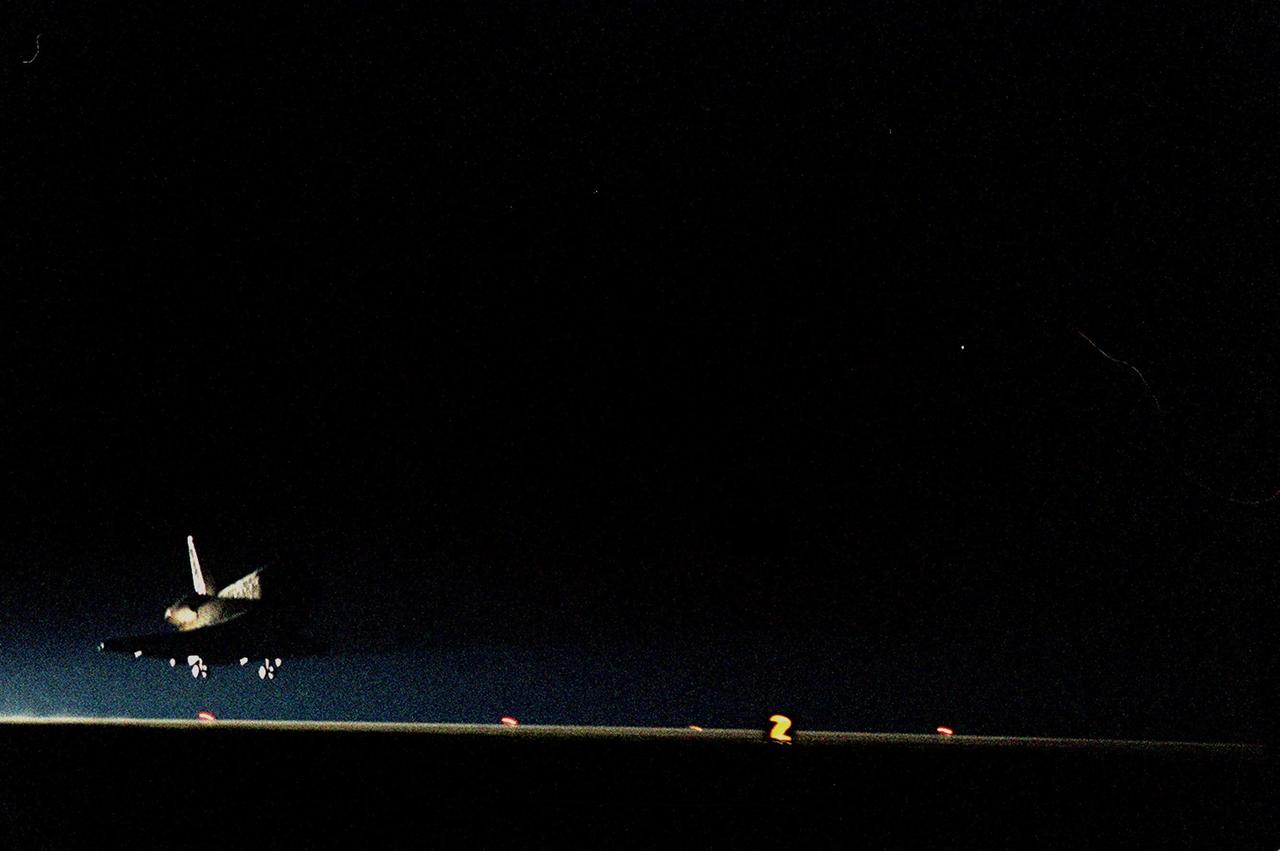
KENNEDY SPACE CENTER, Fla. -- The Space Shuttle Discovery drops out of the darkness onto runway 33 at the Shuttle Landing Facility after traveling more than 3,267,000 miles on a successful eight-day mission to service the Hubble Space Telescope. Astronauts Curtis L. Brown Jr., Commander; Scott J. Kelly, Pilot; and Steven L. Smith, C. Michael Foale (Ph.D.), John M. Grunsfeld (Ph.D.), Claude Nicollier of Switzerland and Jean-François Clervoy of France, all Mission Specialists, spent the Christmas holiday in space in order to accomplish their mission before the end of 1999. During the mission, Discovery's four space-walking astronauts, Smith, Foale, Grunsfeld and Nicollier, spent 24 hours and 33 minutes upgrading and refurbishing Hubble, making it more capable than ever to renew its observations of the universe. Mission objectives included replacing gyroscopes and an old computer, installing another solid state recorder, and replacing damaged insulation in the telescope. Hubble was released from the end of Discovery's robot arm on Christmas Day. Main gear touchdown was at 7:00:47 p.m. EST. Nose gear touchdown occurred at 7:00:58 p.m. EST and wheel stop at 7:01:34 p.m. EST. This was the 96th flight in the Space Shuttle program and the 27th for the orbiter Discovery. The landing was the 20th consecutive Shuttle landing in Florida and the 13th night landing in Shuttle program history
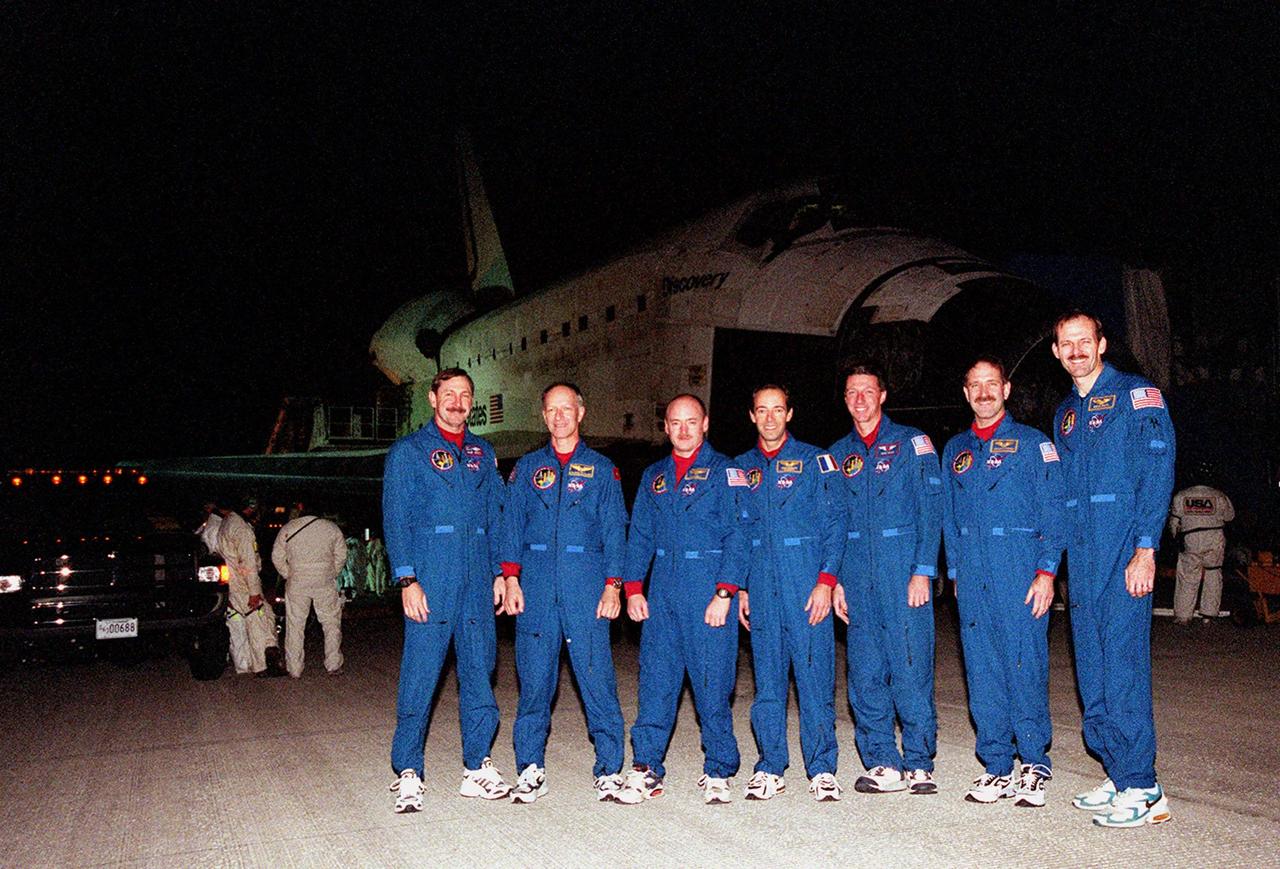
After landing at the Shuttle Landing Facility, the STS-103 crew poses in front of the orbiter Discovery. Standing left to right are Commander Curtis L. Brown Jr., Mission Specialist Claude Nicollier of Switzerland, Pilot Scott J. Kelly, and Mission Specialists Jean-Francois Clervoy of France, C. Michael Foale (Ph.D.), John M. Grunsfeld (Ph.D.) and Steven L. Smith. The crew of seven completed a successful eight-day mission to service the Hubble Space Telescope, spending the Christmas holiday in space in order to accomplish their mission before the end of 1999. During the mission, Discovery's four space-walking astronauts, Smith, Foale, Grunsfeld and Nicollier, spent 24 hours and 33 minutes upgrading and refurbishing Hubble, making it more capable than ever to renew its observations of the universe. Mission objectives included replacing gyroscopes and an old computer, installing another solid state recorder, and replacing damaged insulation in the telescope. Hubble was released from the end of Discovery's robot arm on Christmas Day. Main gear touchdown was at 7:00:47 p.m. EST. Nose gear touchdown occurred at 7:00:58 p.m. EST and wheel stop at 7:01:34 p.m. EST. This was the 96th flight in the Space Shuttle program and the 27th for the orbiter Discovery. The landing was the 20th consecutive Shuttle landing in Florida and the 13th night landing in Shuttle program history
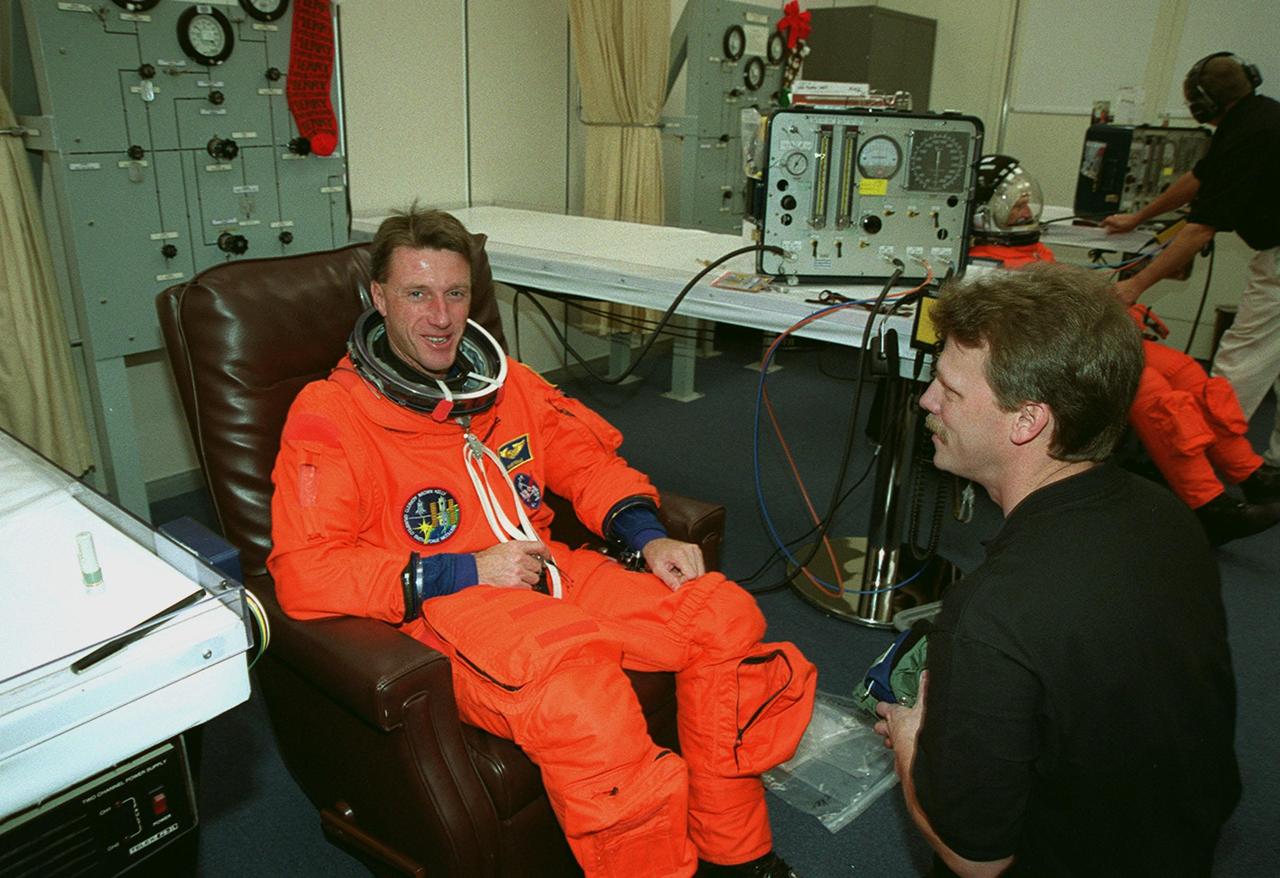
STS-103 Mission Specialist C. Michael Foale (Ph.D.) dons his launch and entry suit for the second time in two days before heading out to Launch Pad 39B and liftoff of Space Shuttle Discovery. The previous launch attempt on Dec. 17 was scrubbed about 8:52 p.m. due to numerous violations of weather launch commit criteria at KSC. Foale and other crew members Commander Curtis L. Brown Jr., Pilot Scott J. Kelly and Mission Specialists Steven L. Smith, John M. Grunsfeld (Ph.D.), Claude Nicollier of Switzerland and Jean-Francois Clervoy of France are scheduled to lift off at 7:50 p.m. EST Dec. 19 on mission STS-103, servicing the Hubble Space Telescope. Objectives for the nearly eight-day mission include replacing gyroscopes and an old computer, installing another solid state recorder, and replacing damaged insulation in the telescope. Discovery is expected to land at KSC Monday, Dec. 27, at about 5:24 p.m. EST
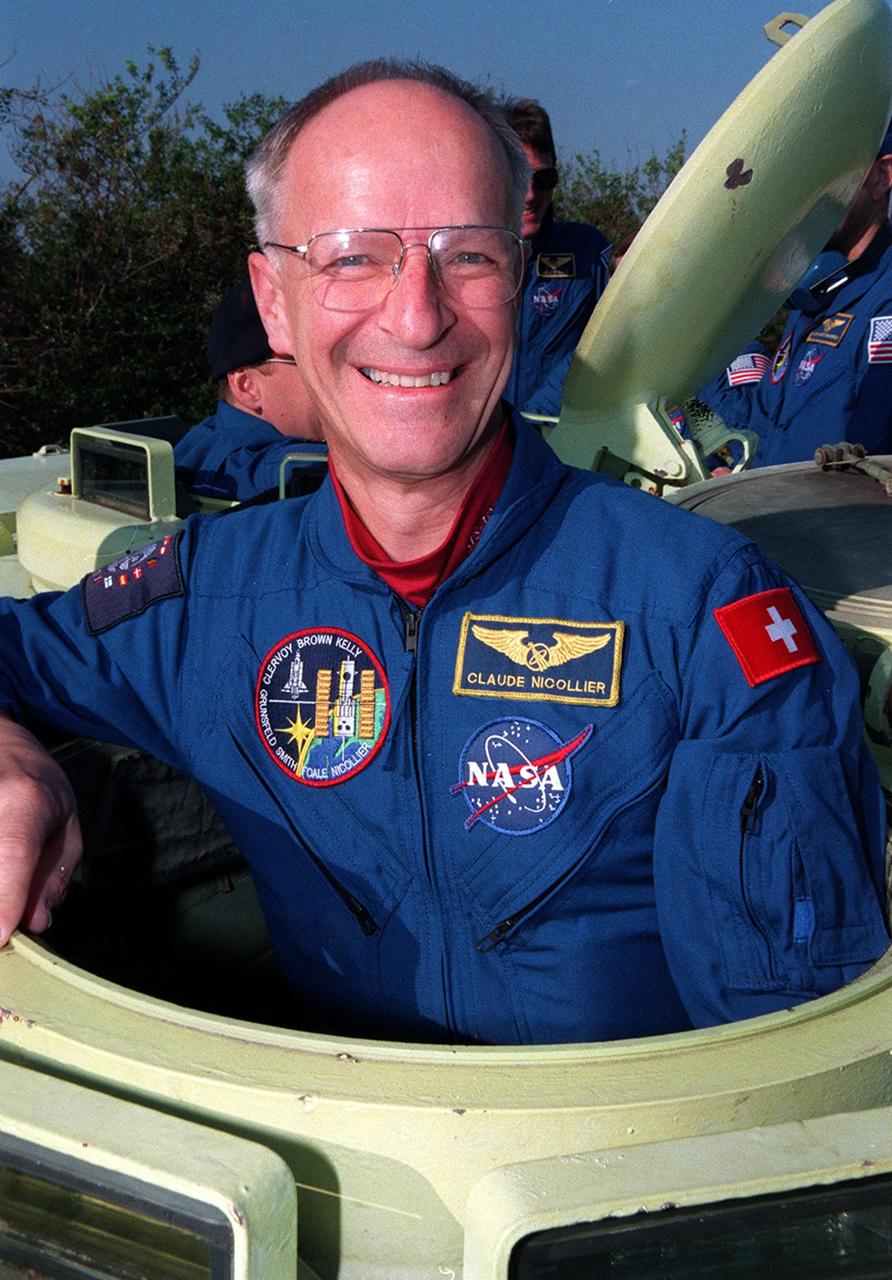
STS-103 Mission Specialist Claude Nicollier of Switzerland, who is with the European Space Agency, takes his turn at the helm of a small armored personnel carrier that is part of emergency egress training during Terminal Countdown Demonstration Test (TCDT) activities. The tracked vehicle could be used by the crew in the event of an emergency at the pad during which the crew must make a quick exit from the area. The TCDT also provides simulated countdown exercises and opportunities to inspect the mission payloads in the orbiter's payload bay. STS-103 is a "call-up" mission due to the need to replace and repair portions of the Hubble Space Telescope. Four EVA's are planned to make the necessary repairs and replacements on the telescope. The other STS-103 crew members are Commander Curtis L. Brown Jr., Pilot Scott J. Kelly, and Mission Specialists Steven L. Smith, C. Michael Foale (Ph.D.), John M. Grunsfeld (Ph.D.), and Jean-François Clervoy of France, also with the European Space Agency. The mission is targeted for launch Dec. 6 at 2:37 a.m. EST
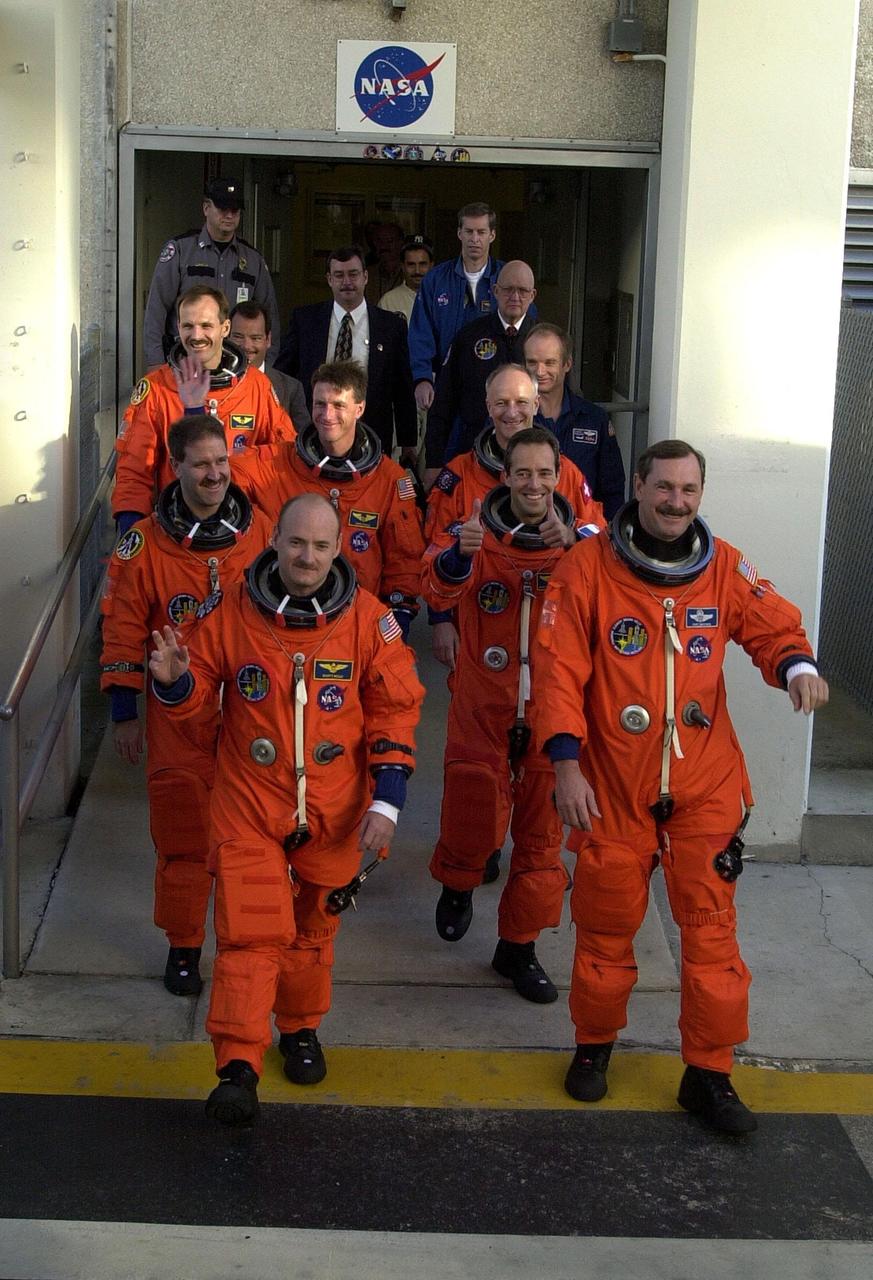
For the second time in two days, the STS-103 crew in their launch and entry suits eagerly head out of the Operations and Checkout Building on their way to Launch Pad 39B and liftoff of Space Shuttle Discovery. From front to back by two's are Pilot Scott J. Kelly and Commander Curtis L. Brown Jr., Mission Specialists John M. Grunsfeld (Ph.D.) and Jean-Francois Clervoy of France, C. Michael Foale (Ph.D.) and Claude Nicollier of Switzerland, and Steven L. Smith taking up the rear. The previous launch attempt on Dec. 17 was scrubbed about 8:52 p.m. due to numerous violations of weather launch commit criteria at KSC. The mission, to service the Hubble Space Telescope, is now scheduled for launch Dec. 19 at 7:50 p.m. EST from Launch Pad 39B. Mission objectives include replacing gyroscopes and an old computer, installing another solid state recorder, and replacing damaged insulation in the telescope. After the 7-day, 21-hour mission, Discovery is expected to land at KSC Monday, Dec. 27, at about 5:24 p.m. EST

In the bunker at Launch Pad 39B, STS-103 Mission Specialist Jean-François Clervoy of France, who is with the European Space Agency (ESA), tries on an oxygen mask during Terminal Countdown Demonstration Test (TCDT) activities. The TCDT provides the crew with emergency egress training, opportunities to inspect their mission payloads in the orbiter's payload bay, and simulated countdown exercises. Other crew members taking part are Commander Curtis L. Brown Jr. and Mission Specialists Steven L. Smith, C. Michael Foale (Ph.D.), John M. Grunsfeld (Ph.D.), plus Claude Nicollier of Switzerland, who is also with ESA. STS-103 is a "call-up" mission due to the need to replace and repair portions of the Hubble Space Telescope, including the gyroscopes that allow the telescope to point at stars, galaxies and planets. The STS-103 crew will be replacing a Fine Guidance Sensor, an older computer with a new enhanced model, an older data tape recorder with a solid-state digital recorder, a failed spare transmitter with a new one, and degraded insulation on the telescope with new thermal insulation. The crew will also install a Battery Voltage/Temperature Improvement Kit to protect the spacecraft batteries from overcharging and overheating when the telescope goes into a safe mode. Four EVA's are planned to make the necessary repairs and replacements on the telescope. The mission is targeted for launch Dec. 6 at 2:37 a.m. EST
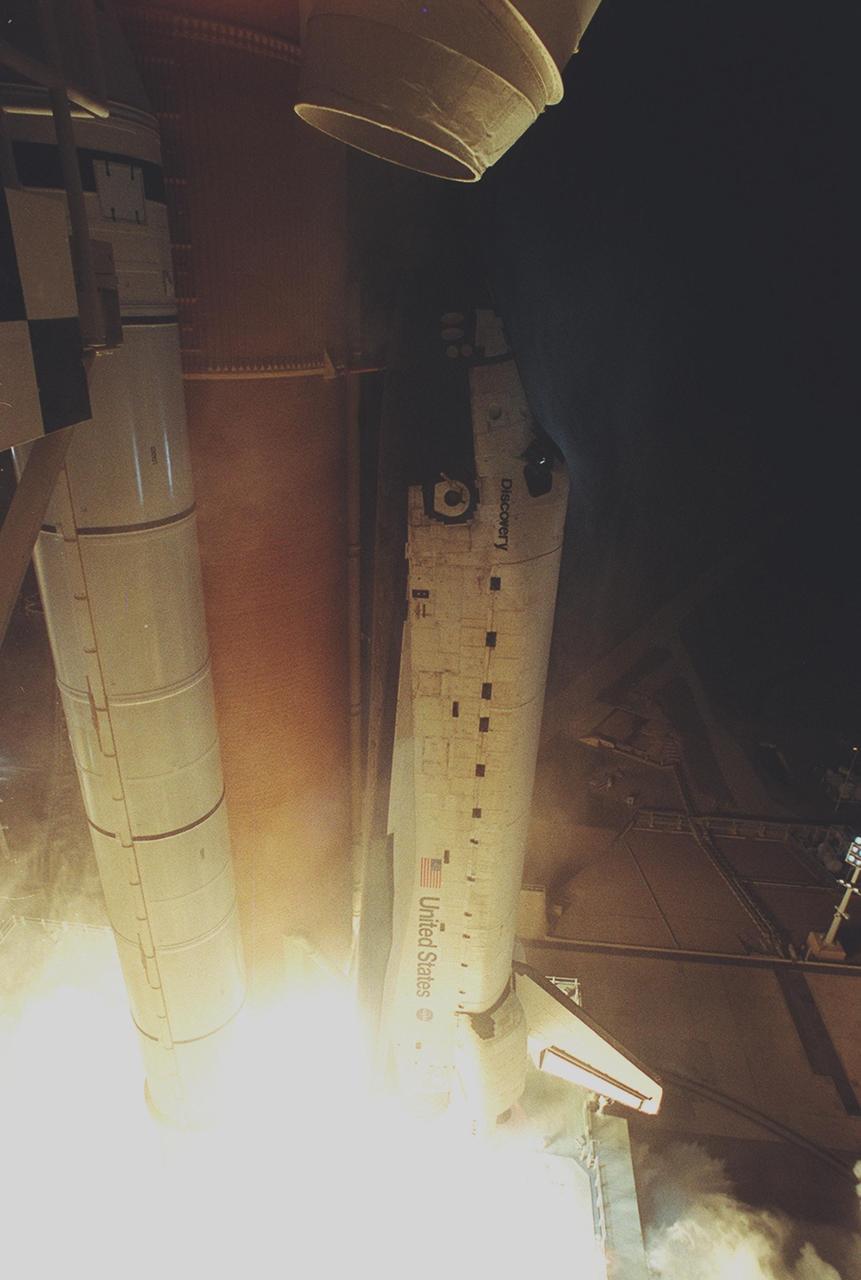
Liftoff of Space Shuttle Discovery leaves Launch Pad 39B (seen at right) and Earth behind, lighted by the brilliant exhaust of the solid rocket boosters and external tank. Liftoff occurred at 7:50 p.m. EST from Launch Pad 39B. On board are Commander Curtis L. Brown Jr., Pilot Scott J. Kelly and Mission Specialists Steven L. Smith, C. Michael Foale (Ph.D.), John M. Grunsfeld (Ph.D.), Claude Nicollier of Switzerland and Jean-François Clervoy of France. Nicollier and Clervoy are with the European Space Agency. STS-103 is a Hubble Servicing Mission, with three planned space walks designed to install new equipment and replace old. The primary objective is to replace the gyroscopes that make up the three Rate Sensor Units. Extravehicular activities include installing a new computer, changing out one of the Fine Guidance Sensors, replacing a tape recorder with a new solid state recorder, and installing a voltage/temperature improvement kit, and begin repairing the insulation on the telescope's outer surface. After the 7-day, 21-hour mission, Discovery is expected to land at KSC Monday, Dec. 27, at about 5:24 p.m. EST. This is the 27th flight of Discovery and the 96th mission in the Space Shuttle Program. It is the third launch at Kennedy Space Center in 1999
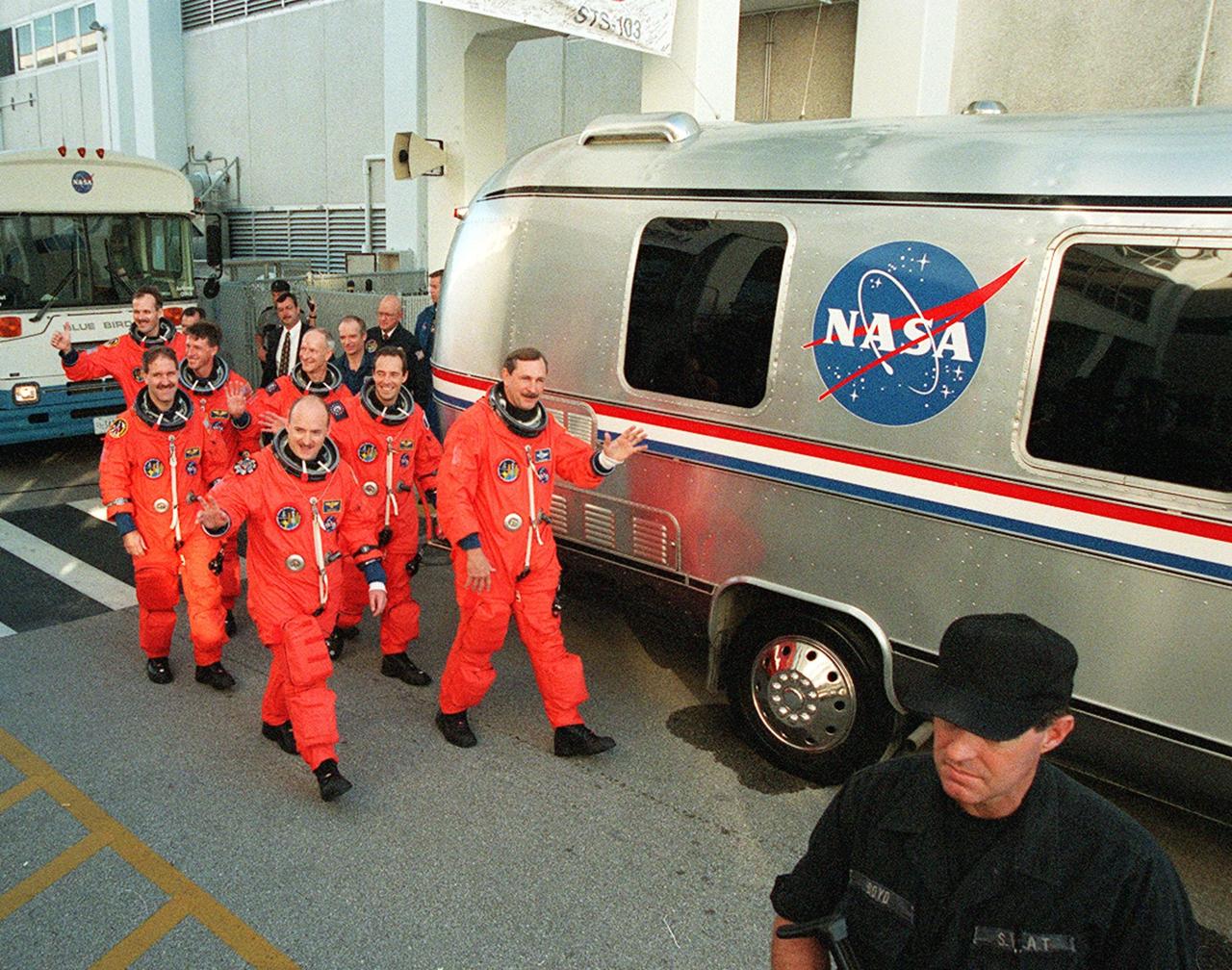
An eager STS-103 crew emerge from behind the "Astrovan" at the Operations and Checkout Building to board the vehicle for transfer to Launch Pad 39B. Walking in pairs (from front to back) are Pilot Scott J. Kelly and Commander Curtis L. Brown Jr., Mission Specialists John M. Grunsfeld (Ph.D.) and Jean-Francois Clervoy of France, C. Michael Foale (Ph.D.) and Claude Nicollier of Switzerland, and Steven L. Smith taking up the rear. A previous launch attempt on Dec. 17 was scrubbed about 8:52 p.m. due to numerous violations of weather launch commit criteria at KSC. The mission, to service the Hubble Space Telescope, is now scheduled for launch Dec. 19 at 7:50 p.m. EST from Launch Pad 39B. Mission objectives include replacing gyroscopes and an old computer, installing another solid state recorder, and replacing damaged insulation in the telescope. After the 7-day, 21-hour mission, Discovery is expected to land at KSC Monday, Dec. 27, at about 5:24 p.m. EST
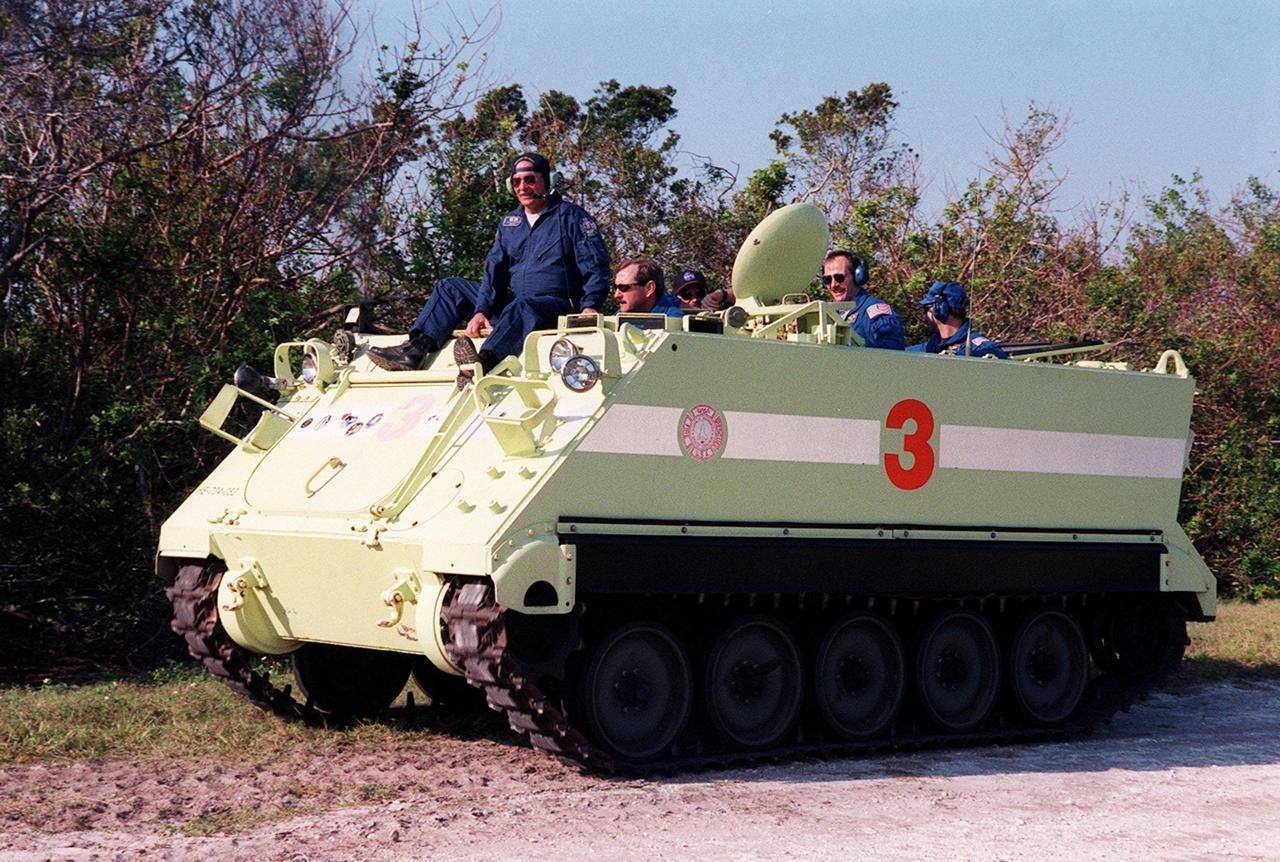
During Terminal Countdown Demonstration Test (TCDT) emergency egress training, STS-103 Commander Curtis L. Brown Jr. practices driving a small armored personnel carrier. Riding on the front is Capt. George Hoggard, a trainer with the KSC/CCAS Fire Department. In the carrier behind Brown is (left to right) Pilot Scott J. Kelly and Mission Specialists Steven L. Smith and John M. Grunsfeld (Ph.D.). The tracked vehicle could be used by the crew in the event of an emergency at the pad during which the crew must make a quick exit from the area. The TCDT also provides simulated countdown exercises and opportunities to inspect the mission payloads in the orbiter's payload bay. STS-103 is a "call-up" mission due to the need to replace and repair portions of the Hubble Space Telescope. Four EVA's are planned to make the necessary repairs and replacements on the telescope. The other STS-103 crew members are Mission Specialists C. Michael Foale (Ph.D.), plus Claude Nicollier of Switzerland and Jean-François Clervoy of France, who are with the European Space Agency. The mission is targeted for launch Dec. 6 at 2:37 a.m. EST

In the Operations and Checkout Building, STS-103 Mission Specialist C. Michel Foale (Ph.D.) smiles as a suit technician helps him don his launch and entry suit during final launch preparations. Other crew members are Commander Curtis L. Brown Jr., Pilot Scott J. Kelly and Mission Specialists Steven L. Smith, John M. Grunsfeld (Ph.D.), Claude Nicollier of Switzerland and Jean-François Clervoy of France. Nicollier and Clervoy are with the European Space Agency. The STS-103 mission, to service the Hubble Space Telescope, is scheduled for launch Dec. 17 at 8:47 p.m. EST from Launch Pad 39B. Mission objectives include replacing gyroscopes and an old computer, installing another solid state recorder, and replacing damaged insulation in the telescope. After the 8-day, 21-hour mission, Discovery is expected to land at KSC Sunday, Dec. 26, at about 6:30 p.m. EST.is expected to land at KSC Sunday, Dec. 26, at about 6:30 p.m. EST

(Nikon camera D1 test)With smoke and steam billowing around it, Space Shuttle Discovery hurtles into the clear night sky in a blaze of light. The successful liftoff occurred on time at 7:50:00.069 EST from Launch Pad 39B on mission STS-103. On board are Commander Curtis L. Brown Jr., Pilot Scott J. Kelly and Mission Specialists Steven L. Smith, C. Michael Foale (Ph.D.), John M. Grunsfeld (Ph.D.), Claude Nicollier of Switzerland and Jean-François Clervoy of France. Nicollier and Clervoy are with the European Space Agency. STS-103 is a Hubble Servicing Mission, with three planned space walks designed to install new equipment and replace old. The primary objective is to replace the gyroscopes that make up the three Rate Sensor Units. Extravehicular activities include installing a new computer, changing out one of the Fine Guidance Sensors, replacing a tape recorder with a new solid state recorder, and installing a voltage/temperature improvement kit, and begin repairing the insulation on the telescope's outer surface. After the 7-day, 21-hour mission, Discovery is expected to land at KSC Monday, Dec. 27, at about 5:24 p.m. EST. This is the 27th flight of Discovery and the 96th mission in the Space Shuttle Program. It is the third launch at Kennedy Space Center in 1999
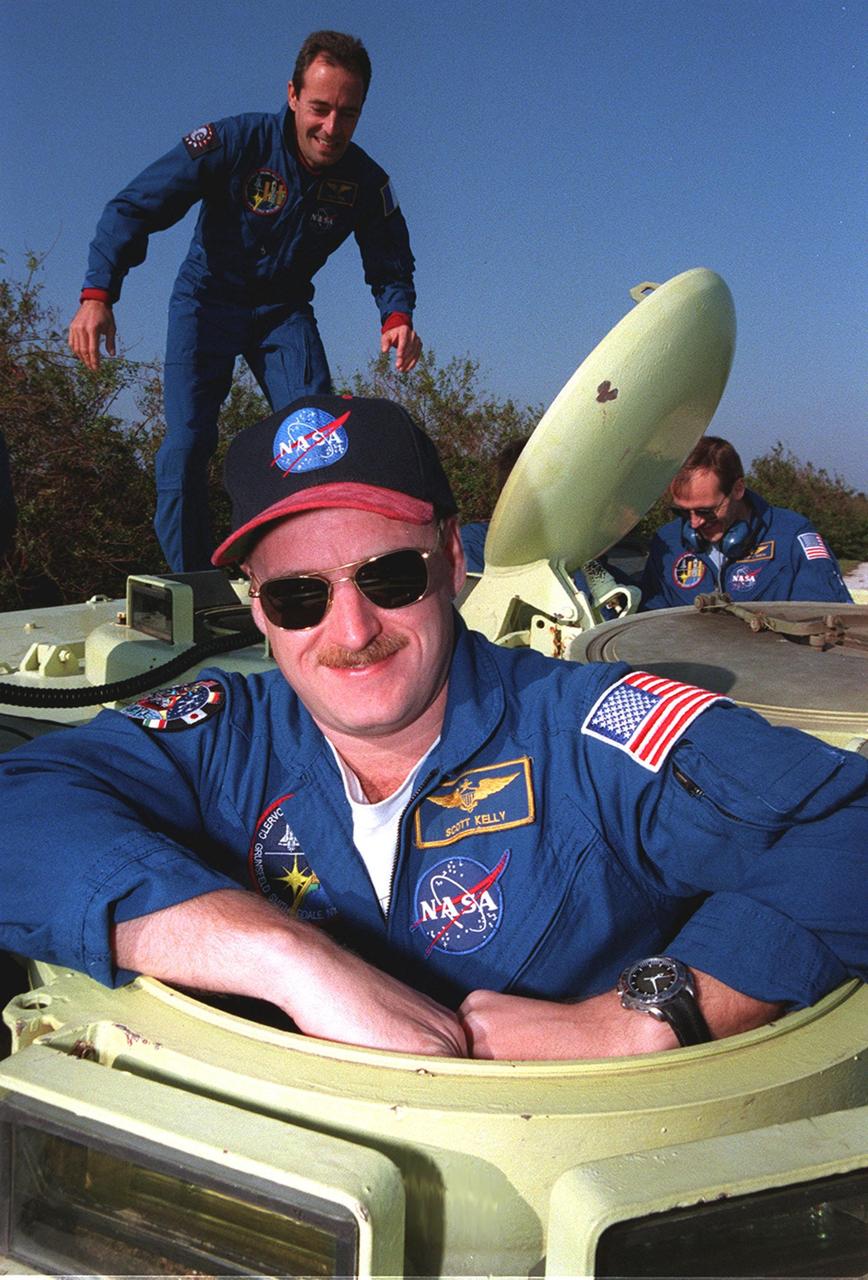
STS-103 Pilot Scott J. Kelly is ready to take his turn at driving a small armored personnel carrier that is part of emergency egress training during Terminal Countdown Demonstration Test (TCDT) activities. Behind him (left) is Mission Specialist Jean-François Clervoy of France, who is with the European Space Agency. At right is Mission Specialist Steven L. Smith. The tracked vehicle could be used by the crew in the event of an emergency at the pad during which the crew must make a quick exit from the area. The TCDT also provides simulated countdown exercises and opportunities to inspect the mission payloads in the orbiter's payload bay. STS-103 is a "call-up" mission due to the need to replace and repair portions of the Hubble Space Telescope. Four EVA's are planned to make the necessary repairs and replacements on the telescope. The other STS-103 crew members are Commander Curtis L. Brown Jr. and Mission Specialists C. Michael Foale (Ph.D.), John M. Grunsfeld (Ph.D.), plus Claude Nicollier of Switzerland, who also is with the European Space Agency. The mission is targeted for launch Dec. 6 at 2:37 a.m. EST
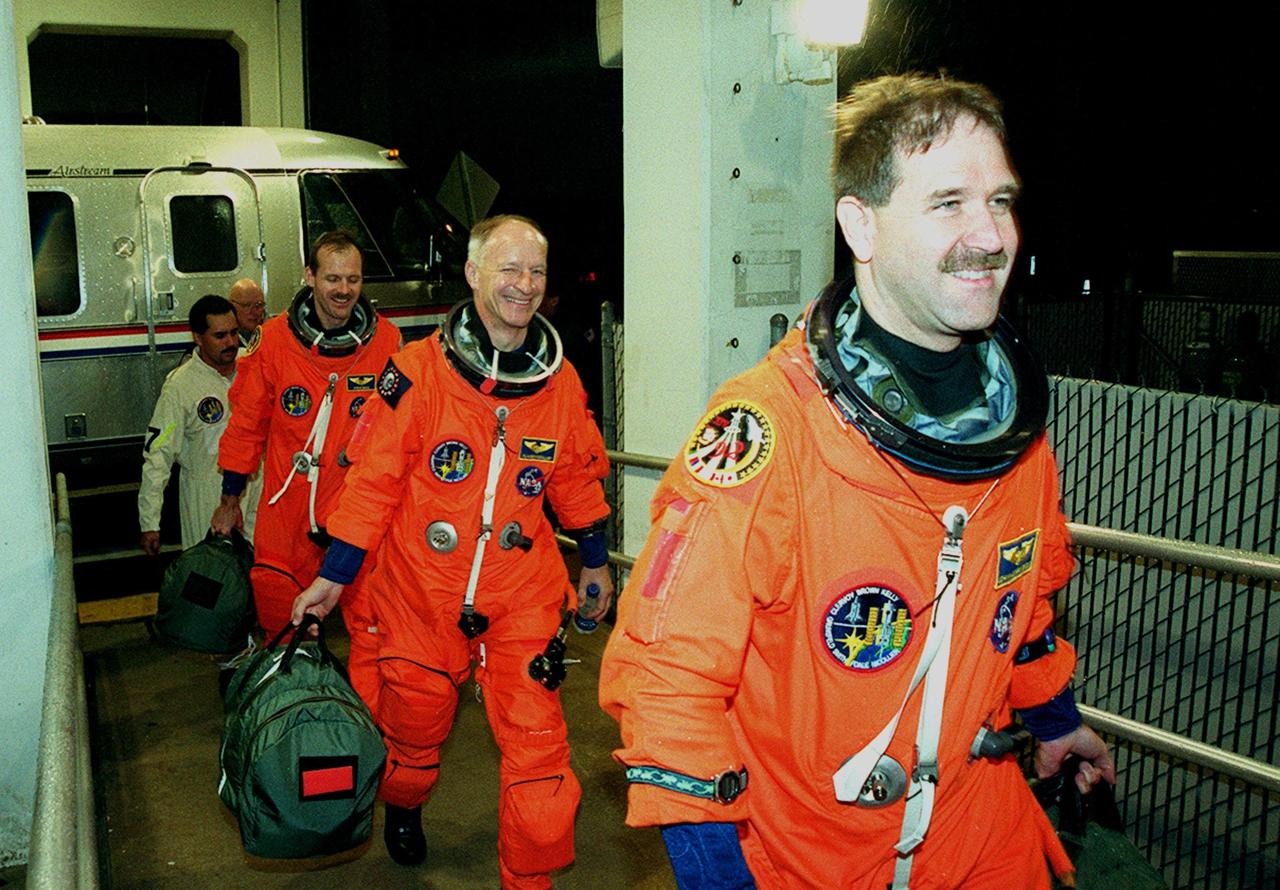
STS-103 crew members head back to the Operations and Checkout Building after the launch of Space Shuttle Discovery was scrubbed due to unfavorable weather conditions. In the lead (right) is Mission Specialist John M. Grunsfeld (Ph.D.), followed by Mission Specialists Claude Nicollier of Switzerland and Steven L. Smith. . Other crew members are Commander Curtis L. Brown Jr., Pilot Scott J. Kelly, and Mission Specialists C. Michael Foale (Ph.D.) and Jean-Francois Clervoy of France. Nicollier and Clervoy are with the European Space Agency. The STS-103 mission, to service the Hubble Space Telescope, is rescheduled for launch Dec. 18 at 8:21 p.m. EST from Launch Pad 39B. Mission objectives include replacing gyroscopes and an old computer, installing another solid state recorder, and replacing damaged insulation in the telescope. After the 7-day, 21-hour mission, Discovery is expected to land at KSC Sunday, Dec. 26, at about 6:00 p.m. EST
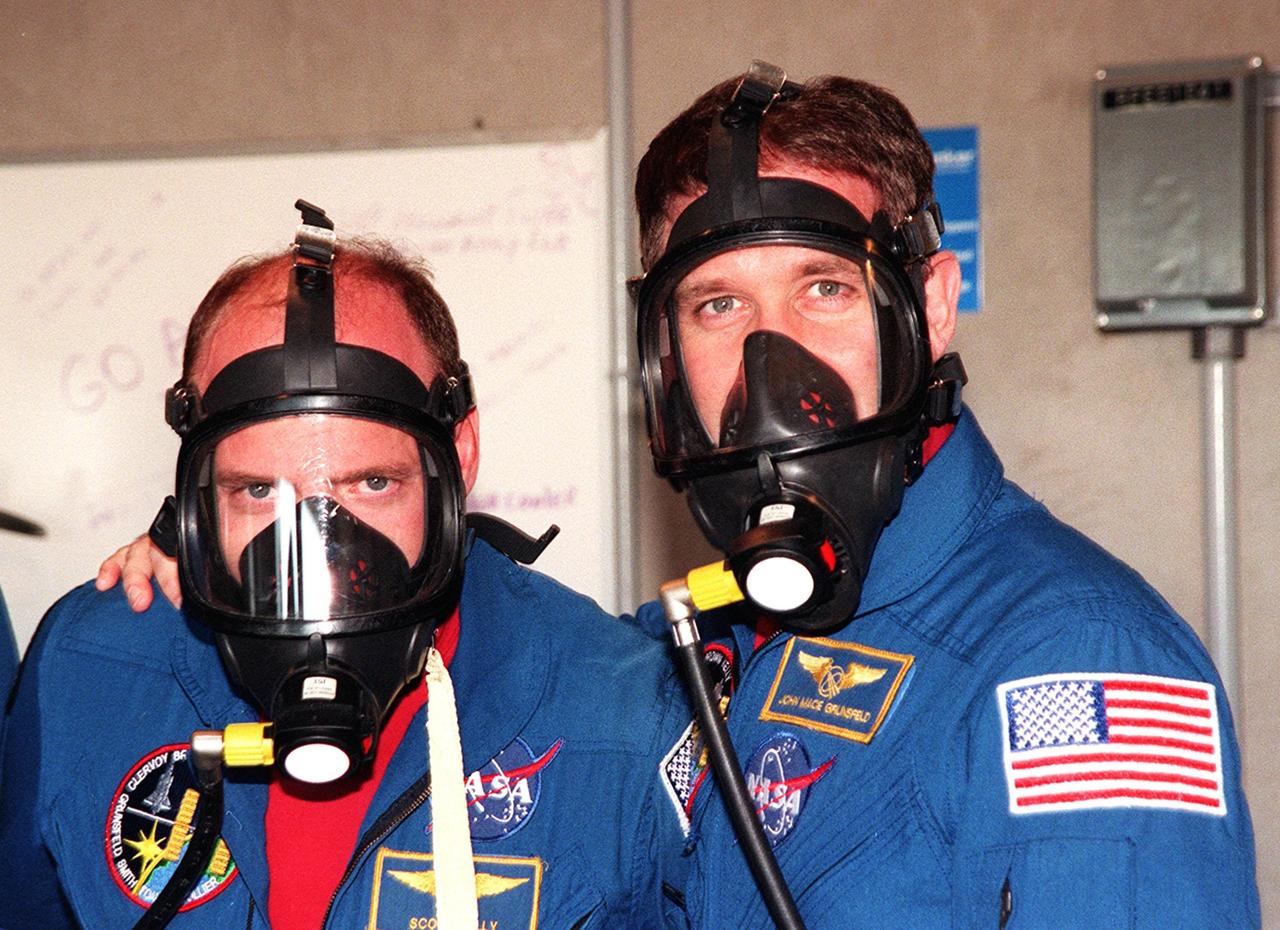
In the bunker at Launch Pad 39B, STS-103 Pilot Scott J. Kelly (left) and Mission Specialist John M. Grunsfeld (Ph.D.) (right) try on oxygen masks during Terminal Countdown Demonstration Test (TCDT) activities. The TCDT provides the crew with emergency egress training, opportunities to inspect their mission payloads in the orbiter's payload bay, and simulated countdown exercises. Other crew members taking part are Commander Curtis L. Brown Jr. and Mission Specialists Steven L. Smith, C. Michael Foale (Ph.D.), and Jean-François Clervoy of France and Claude Nicollier of Switzerland, who are with the European Space Agency. STS-103 is a "call-up" mission due to the need to replace and repair portions of the Hubble Space Telescope, including the gyroscopes that allow the telescope to point at stars, galaxies and planets. The STS-103 crew will be replacing a Fine Guidance Sensor, an older computer with a new enhanced model, an older data tape recorder with a solid-state digital recorder, a failed spare transmitter with a new one, and degraded insulation on the telescope with new thermal insulation. The crew will also install a Battery Voltage/Temperature Improvement Kit to protect the spacecraft batteries from overcharging and overheating when the telescope goes into a safe mode. Four EVA's are planned to make the necessary repairs and replacements on the telescope. The mission is targeted for launch Dec. 6 at 2:37 a.m. EST
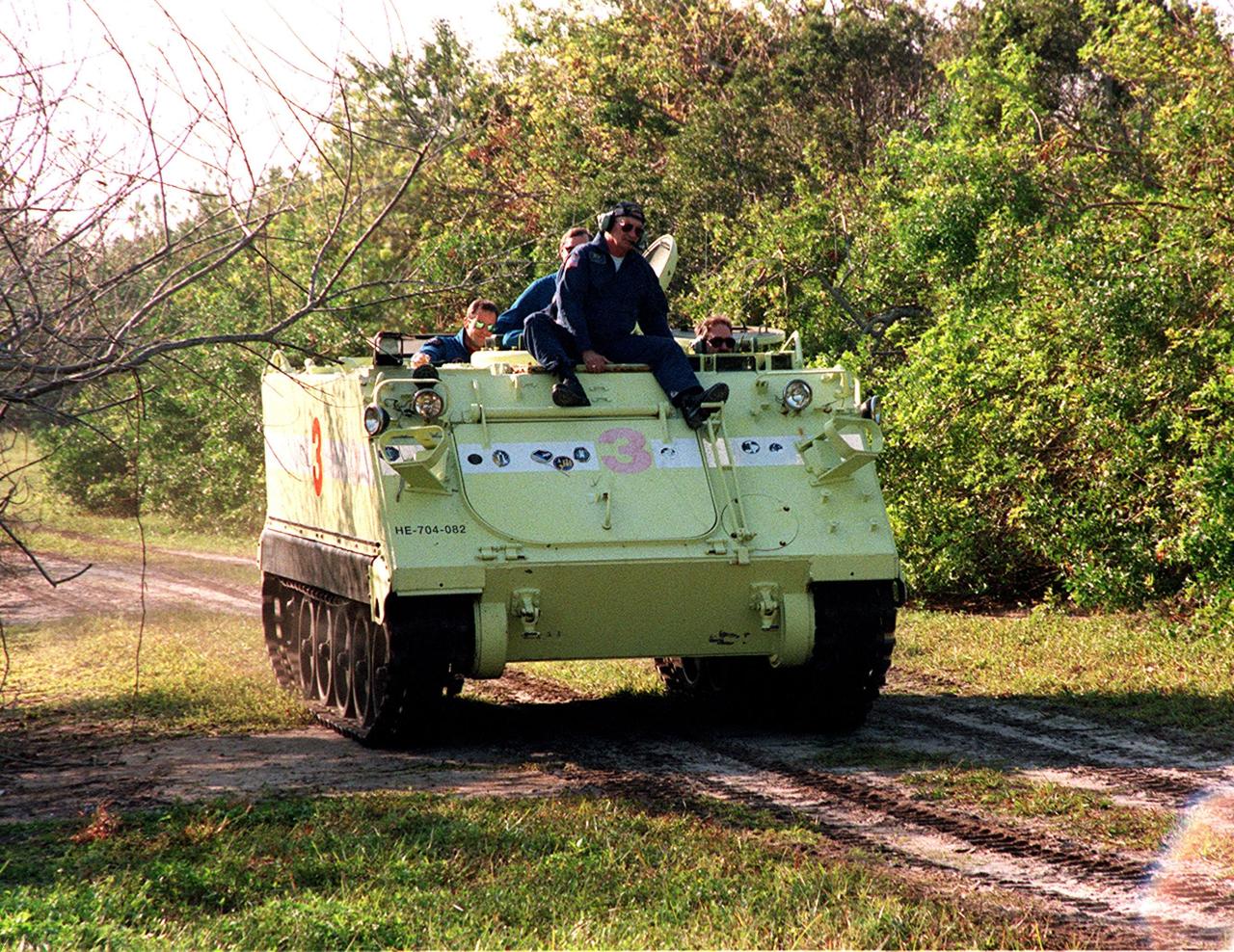
STS-103 Mission Specialist John M. Grunsfeld (Ph.D.) (far right) practices driving a small armored personnel carrier that is part of emergency egress training during Terminal Countdown Demonstration Test (TCDT) activities. In front is Capt. George Hoggard, trainer with the KSC Fire Department. At far left is Mission Specialist Jean-François Clervoy of France, who is with the European Space Agency. The tracked vehicle could be used by the crew in the event of an emergency at the pad during which the crew must make a quick exit from the area. The TCDT also provides simulated countdown exercises and opportunities to inspect the mission payloads in the orbiter's payload bay. STS-103 is a "call-up" mission due to the need to replace and repair portions of the Hubble Space Telescope. Four EVA's are planned to make the necessary repairs and replacements on the telescope. The other STS-103 crew members are Commander Curtis L. Brown Jr., Pilot Scott J. Kelly, and Mission Specialists Steven L. Smith, C. Michael Foale (Ph.D.), (Ph.D.), plus Claude Nicollier of Switzerland and Jean-François Clervoy of France, who are with the European Space Agency. The mission is targeted for launch Dec. 6 at 2:37 a.m. EST
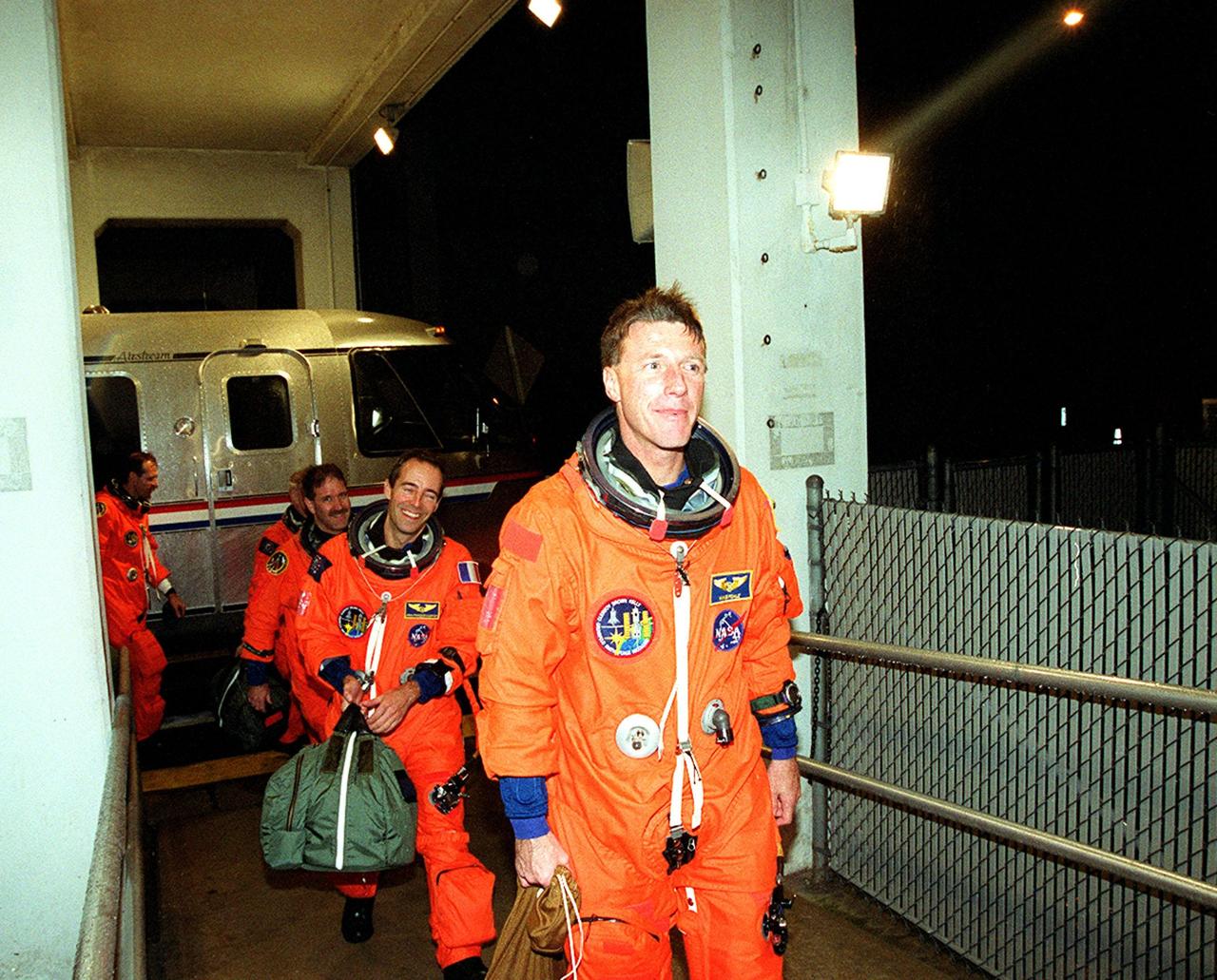
STS-103 crew members head back to the Operations and Checkout Building after the launch of Space Shuttle Discovery was scrubbed due to unfavorable weather conditions. In the lead (right) is Mission Specialist C. Michael Foale (Ph.D.), followed by Mission Specialists Jean-Francois Clervoy of France, John M. Grunsfeld (Ph.D.), Claude Nicollier of Switzerland and Steven L. Smith. Other crew members are Commander Curtis L. Brown Jr. and Pilot Scott J. Kelly. Nicollier and Clervoy are with the European Space Agency. The STS-103 mission, to service the Hubble Space Telescope, is rescheduled for launch Dec. 18 at 8:21 p.m. EST from Launch Pad 39B. Mission objectives include replacing gyroscopes and an old computer, installing another solid state recorder, and replacing damaged insulation in the telescope. After the 7-day, 21-hour mission, Discovery is expected to land at KSC Sunday, Dec. 26, at about 6:00 p.m. EST

During a Crew Equipment Interface Test (CEIT), members of the STS-103 crew check out a portable foot restraint on the Flight Support System that will be used on the mission, repairing the Hubble Space Telescope. The seven-member crew comprises Commander Curtis L. Brown Jr., Pilot Scott J. Kelly, and Mission Specialists Steven L. Smith, C. Michael Foale (Ph.D.), John M. Grunsfeld (Ph.D), Claude Nicollier of Switzerland, and Jean-François Clervoy of France. Nicollier and Clervoy are with the European Space Agency. Mission STS-103 is a "call-up" due to the need to replace portions of the pointing system, the gyros, which have begun to fail on the Hubble Space Telescope. Although Hubble is operating normally and conducting its scientific observations, only three of its six gyroscopes are working properly. The gyroscopes allow the telescope to point at stars, galaxies and planets. The STS-103 crew will not only replace gyroscopes, it will also replace a Fine Guidance Sensor and an older computer with a new enhanced model, an older data tape recorder with a solid-state digital recorder, a failed spare transmitter with a new one, and degraded insulation on the telescope with new thermal insulation. The crew will also install a Battery Voltage/Temperature Improvement Kit to protect the spacecraft batteries from overcharging and overheating when the telescope goes into a safe mode. The scheduled launch date in October is under review
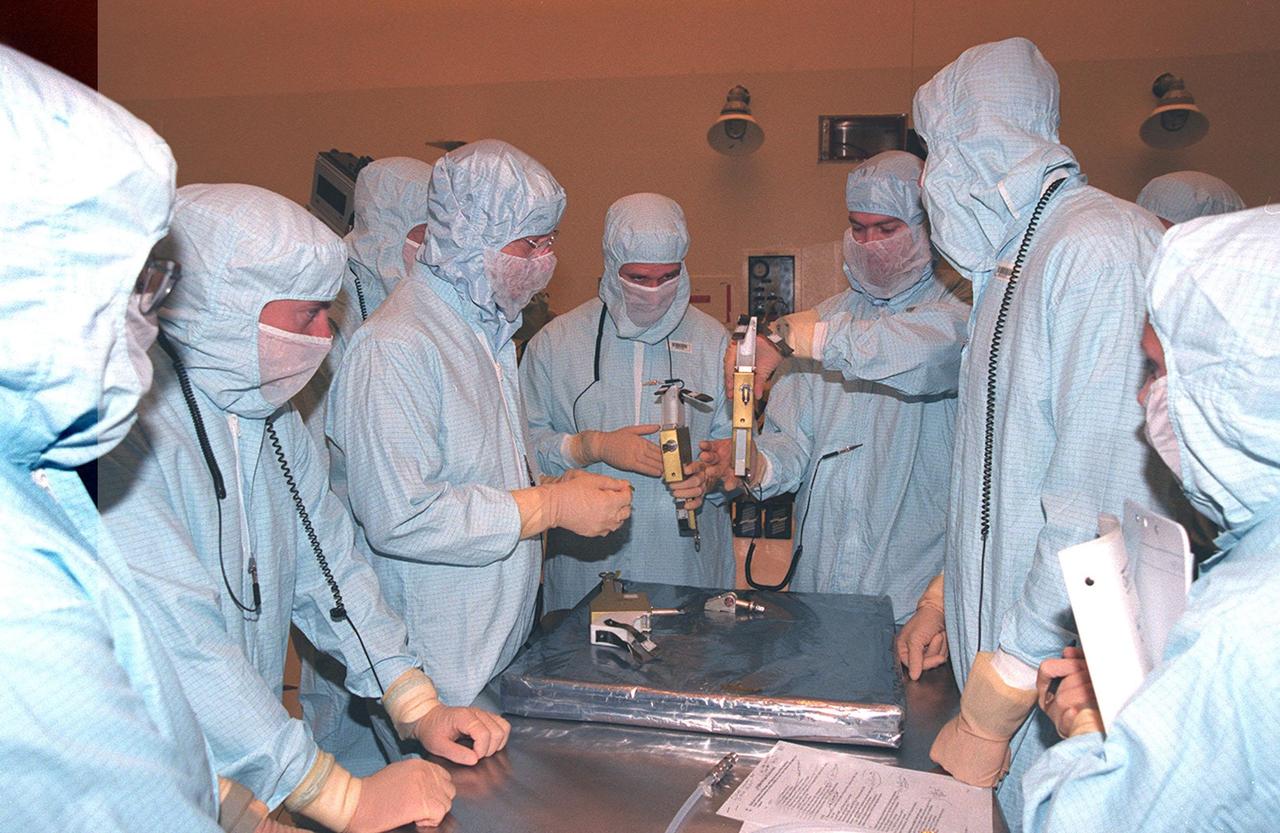
In the Payload Hazardous Servicing Facility, the STS-103 crew look over equipment to be used during their mission. The seven-member crew, taking part in a Crew Equipment Interface Test, are Commander Curtis L. Brown Jr., Pilot Scott J. Kelly, and Mission Specialists Steven L. Smith, C. Michael Foale (Ph.D.), John M. Grunsfeld (Ph.D.), Claude Nicollier of Switzerland, and Jean-François Clervoy of France. Nicollier and Clervoy are with the European Space Agency. Mission STS-103 is a "call-up" due to the need to replace portions of the pointing system, the gyros, which have begun to fail on the Hubble Space Telescope. Although Hubble is operating normally and conducting its scientific observations, only three of its six gyroscopes are working properly. The gyroscopes allow the telescope to point at stars, galaxies and planets. The STS-103 crew will not only replace gyroscopes, it will also replace a Fine Guidance Sensor and an older computer with a new enhanced model, an older data tape recorder with a solid state digital recorder, a failed spare transmitter with a new one, and degraded insulation on the telescope with new thermal insulation. The crew will also install a Battery Voltage/Temperature Improvement Kit to protect the spacecraft batteries from overcharging and overheating when the telescope goes into a safe mode. The scheduled launch date in October is under review

In the Payload Hazardous Servicing Facility, some of the STS-103 crew look over lubrication devices to be used during their mission. The seven-member crew are Commander Curtis L. Brown Jr., Pilot Scott J. Kelly, and Mission Specialists Steven L. Smith, C. Michael Foale (Ph.D.), John M. Grunsfeld (Ph.D.), Claude Nicollier of Switzerland, and Jean-François Clervoy of France. Nicollier and Clervoy are with the European Space Agency. Mission STS-103 is a "call-up" due to the need to replace portions of the pointing system, the gyros, which have begun to fail on the Hubble Space Telescope. Although Hubble is operating normally and conducting its scientific observations, only three of its six gyroscopes are working properly. The gyroscopes allow the telescope to point at stars, galaxies and planets. The STS-103 crew will not only replace gyroscopes, it will also replace a Fine Guidance Sensor and an older computer with a new enhanced model, an older data tape recorder with a solid state digital recorder, a failed spare transmitter with a new one, and degraded insulation on the telescope with new thermal insulation. The crew will also install a Battery Voltage/Temperature Improvement Kit to protect the spacecraft batteries from overcharging and overheating when the telescope goes into a safe mode. The scheduled launch date in October is under review
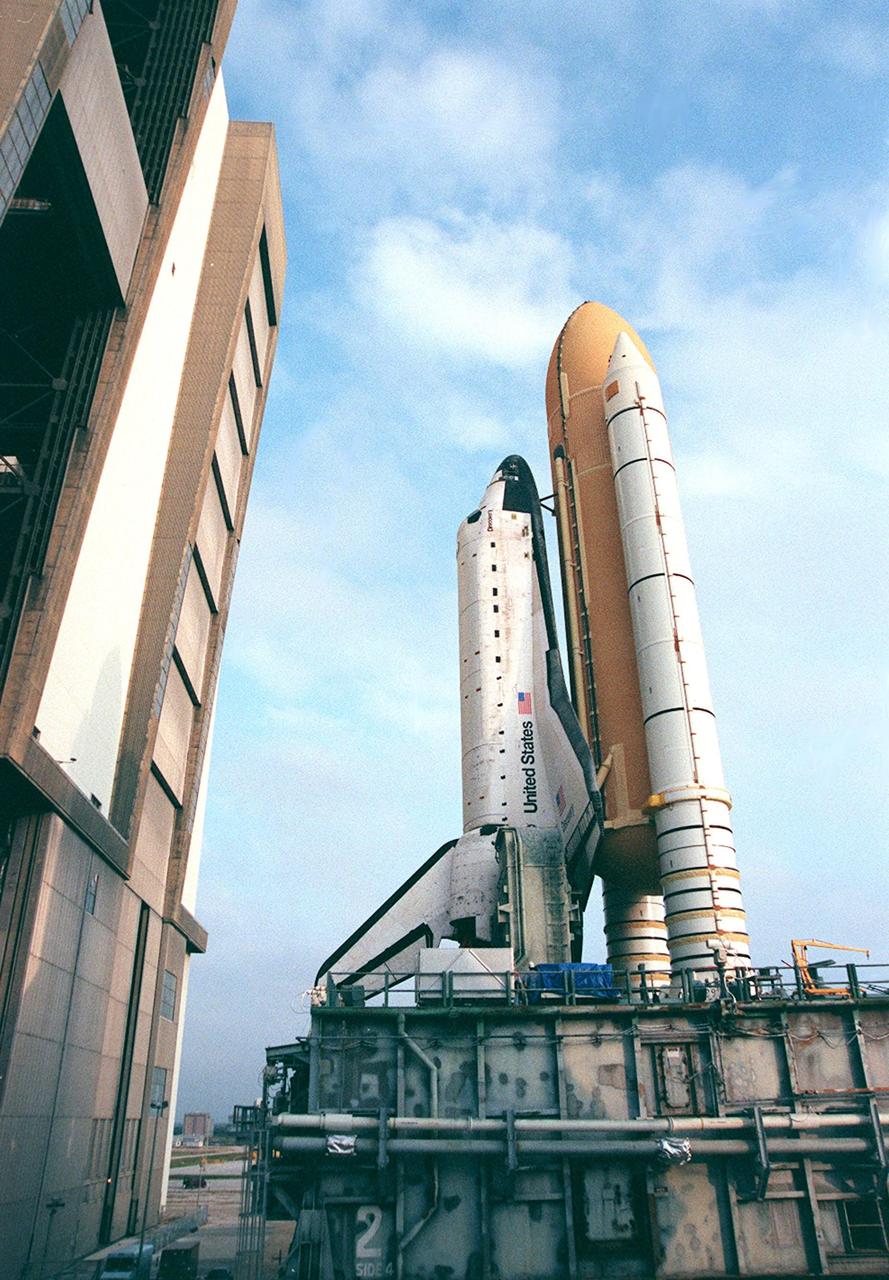
KENNEDY SPACE CENTER, Fla. -- Space Shuttle Discovery clears the Vehicle Assembly Building (left) on its crawl to Launch Pad 39B atop the mobile launcher platform and crawler transporter. Once at the pad, the orbiter, external tank and solid rocket boosters will undergo final preparations for the STS-103 launch targeted for Dec. 6, 1999, at 2:37 a.m. EST. The mission is a "call-up" due to the need to replace and repair portions of the Hubble Space Telescope. Although Hubble is operating normally and conducting its scientific observations, only three of its six gyroscopes are working properly. Four EVA's are planned to make the necessary repairs and replacements on the telescope. The STS-103 crew members are Commander Curtis L. Brown Jr., Pilot Scott J. Kelly, Steven L. Smith, C. Michael Foale (Ph.D.), John M. Grunsfeld (Ph.D.), and Claude Nicollier of Switzerland and Jean-François Clervoy of France, both with the European Space Agency
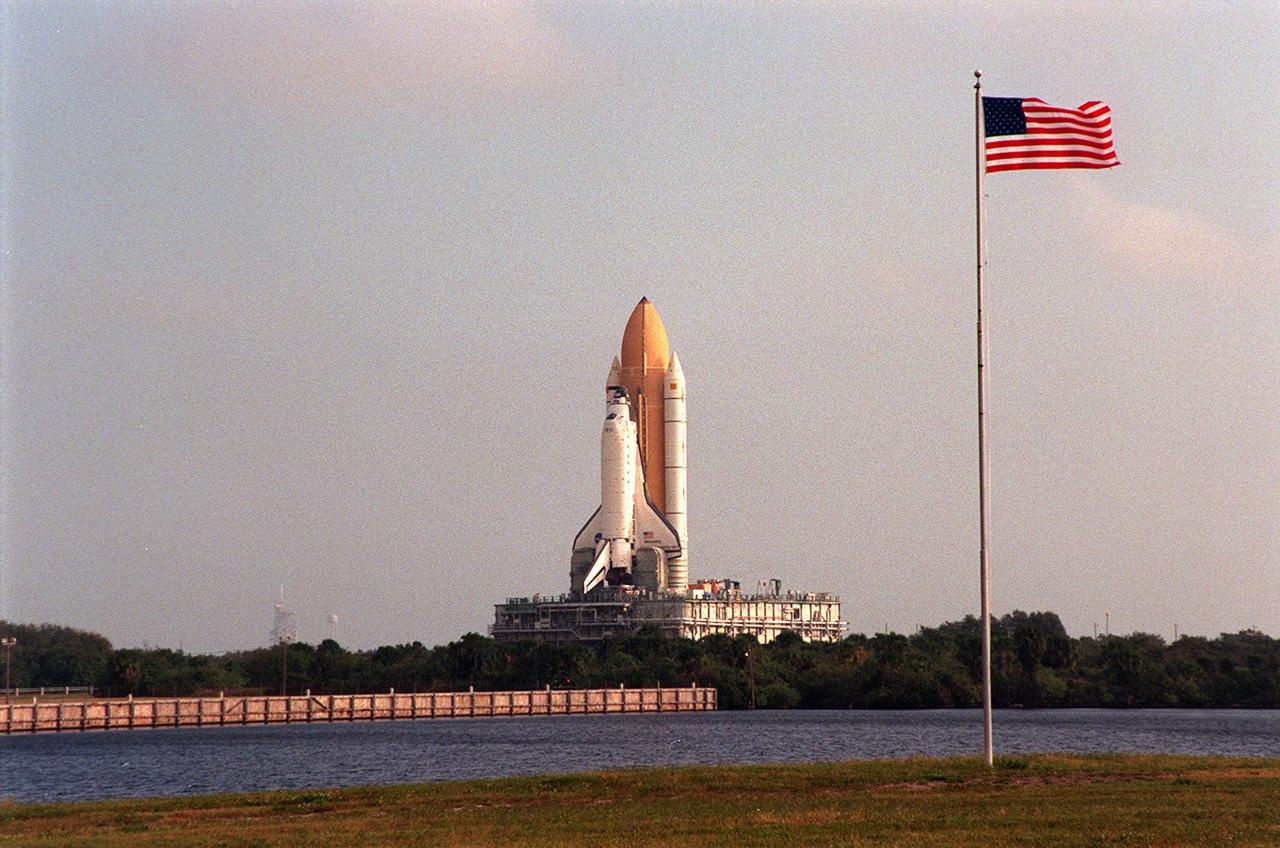
KENNEDY SPACE CENTER, Fla. -- With the American flag flapping in the morning breeze, Space Shuttle Discovery, across the turn basin, makes its crawl to Launch Pad 39B (background, left) atop the mobile launcher platform and crawler transporter. Once at the pad, the orbiter, external tank and solid rocket boosters will undergo final preparations for the STS-103 launch targeted for Dec. 6, 1999, at 2:37 a.m. EST. The mission is a "call-up" due to the need to replace and repair portions of the Hubble Space Telescope. Although Hubble is operating normally and conducting its scientific observations, only three of its six gyroscopes are working properly. Four EVA's are planned to make the necessary repairs and replacements on the telescope. The STS-103 crew members are Commander Curtis L. Brown Jr., Pilot Scott J. Kelly, Steven L. Smith, C. Michael Foale (Ph.D.), John M. Grunsfeld (Ph.D.), and Claude Nicollier of Switzerland and Jean-François Clervoy of France, both with the European Space Agency.
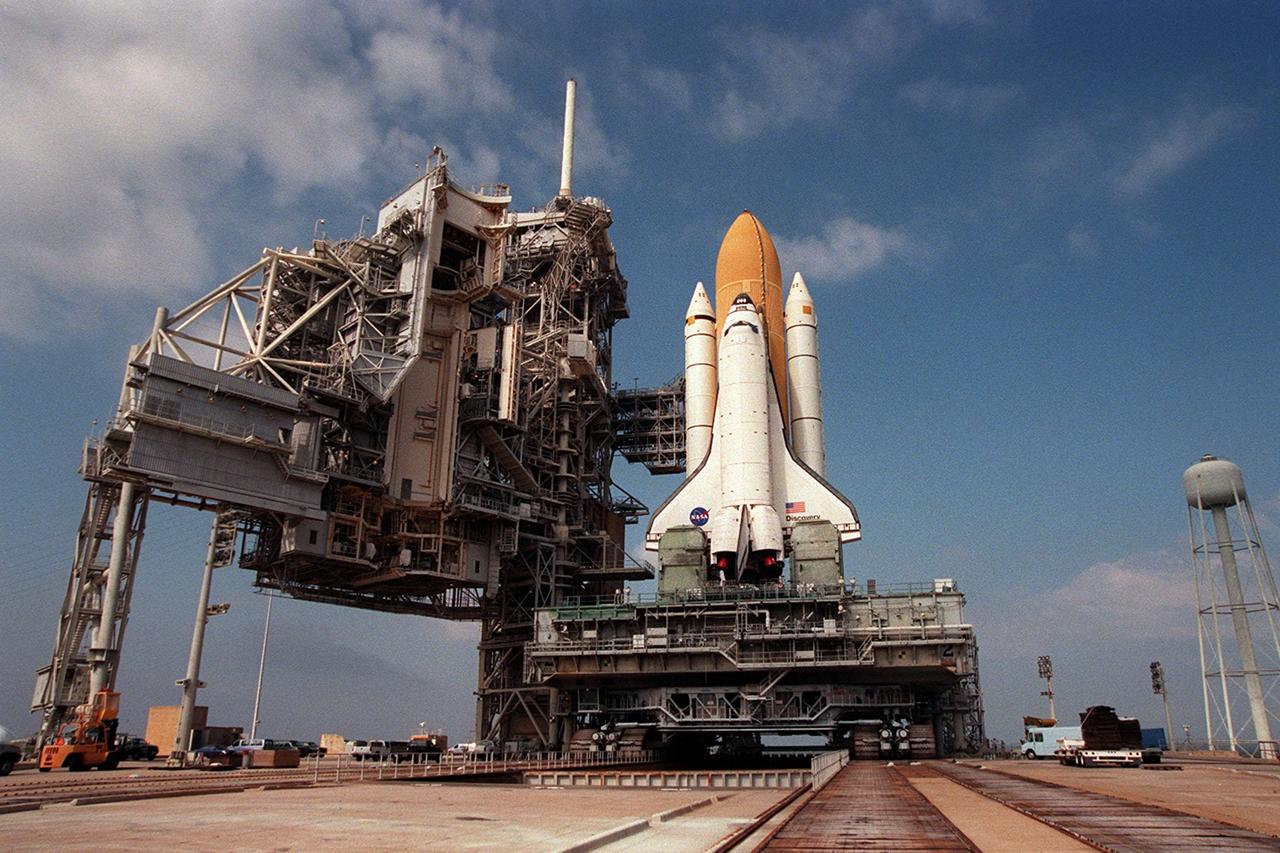
KENNEDY SPACE CENTER, Fla. -- Space Shuttle Discovery, atop the mobile launcher platform and crawler transporter, nears the top of Launch Pad 39B after the trekfrom the Vehicle Assembly Building. At left are the Rotating Service Structure and the Fixed Service Structure, which will enable final preparations of the orbiter, external tank and solid rocket boosters for the STS-103 launch targeted for Dec. 6, 1999, at 2:37 a.m. EST. The mission is a "call-up" due to the need to replace and repair portions of the Hubble Space Telescope. Although Hubble is operating normally and conducting its scientific observations, only three of its six gyroscopes are working properly. Four EVA's are planned to make the necessary repairs and replacements on the telescope. The STS-103 crew members are Commander Curtis L. Brown Jr., Pilot Scott J. Kelly, Steven L. Smith, C. Michael Foale (Ph.D.), John M. Grunsfeld (Ph.D.), and Claude Nicollier of Switzerland and Jean-François Clervoy of France, both with the European Space Agency
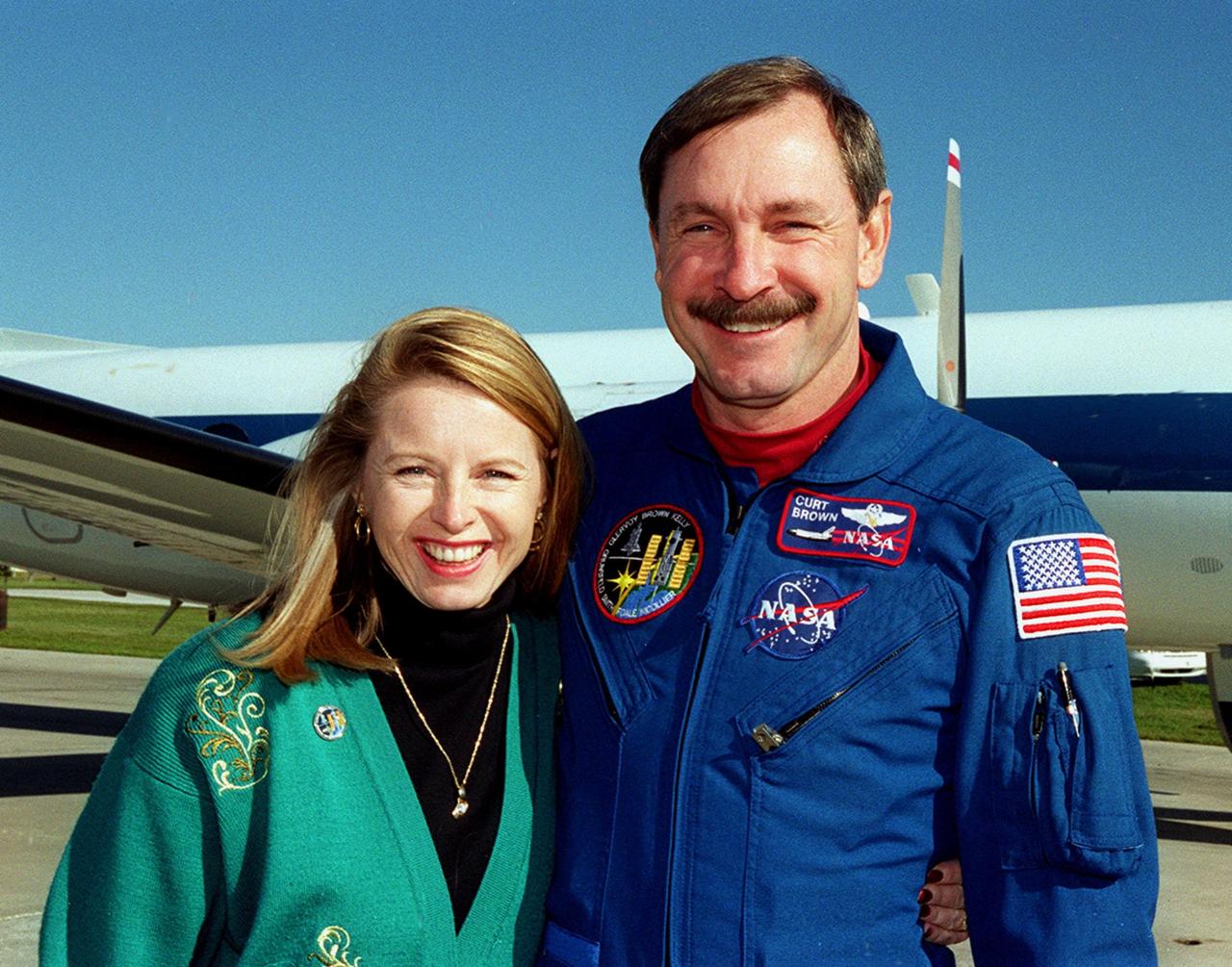
STS-103 Commander Curtis L. Brown Jr. and his fiancee, Ann Brickert, smile for the camera on the runway at Patrick Air Force Base. The STS-103 crew and their families are preparing to board an airplane that will return them to their home base at the Johnson Space Center in Houston following the successful completion of their mission. Discovery landed in darkness the previous evening, Dec. 27, on runway 33 at KSC's Shuttle Landing Facility at 7:00:47 p.m. EST. This was the first time that a Shuttle crew spent the Christmas holiday in space. The other STS-103 crew members are Pilot Scott J. Kelly and Mission Specialists Steven L. Smith, C. Michael Foale (Ph.D.), John M. Grunsfeld (Ph.D.), Claude Nicollier of Switzerland and Jean-François Clervoy of France. The STS-103 mission supplied the Hubble Space Telescope with six new gyroscopes, six new voltage/temperature improvement kits, a new onboard computer, a new solid state recorder and new data transmitter, and a new fine guidance sensor along with new insulation on parts of the orbiting telescope. This was the 96th flight in the Space Shuttle program and the 27th for the orbiter Discovery