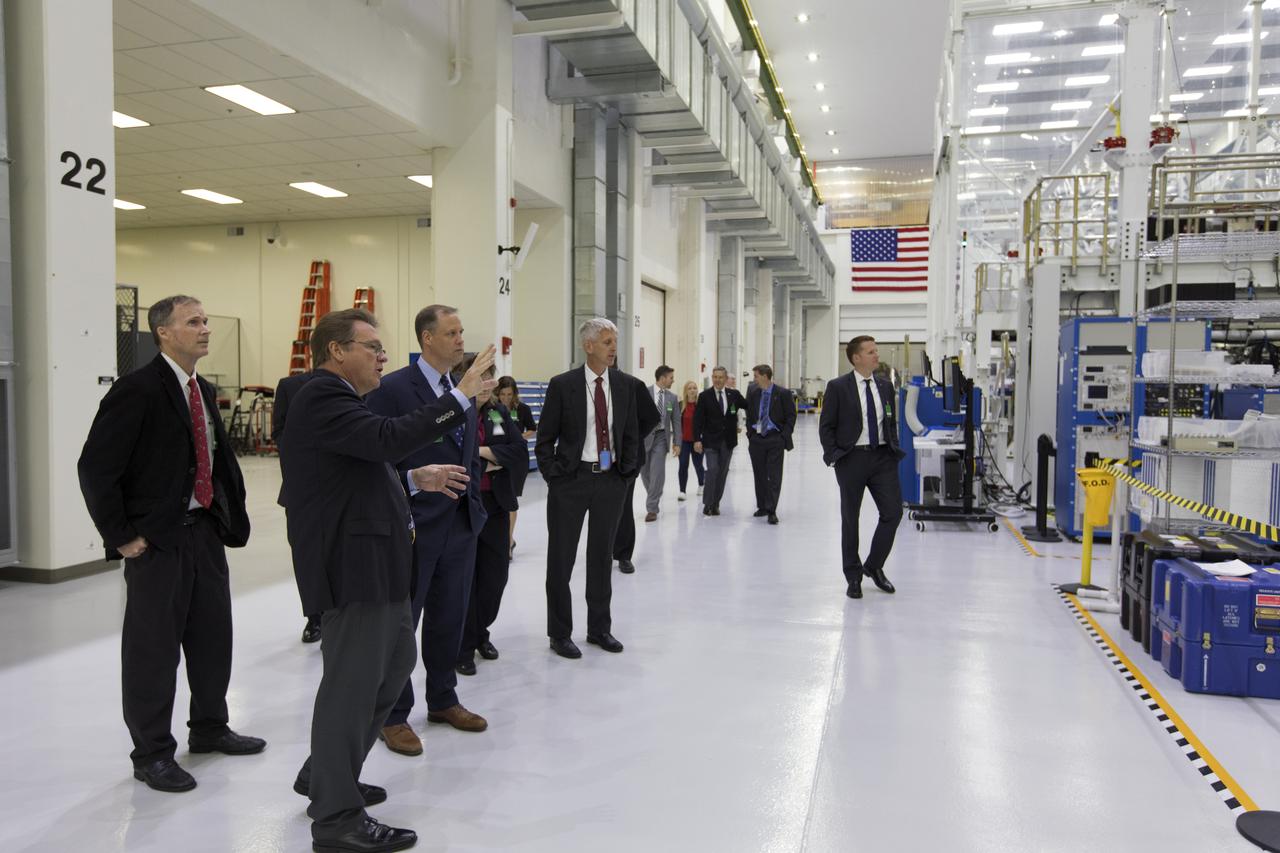
NASA Administrator Jim Bridenstine, third from left, is briefed by Jules Schneider, left, director of Orion operations for Lockheed Martin, during a tour of Kennedy Space Center’s Neil Armstrong Operations and Checkout Building on Tuesday, Aug. 7, 2018. It was Bridenstine’s first official visit to the Florida spaceport.
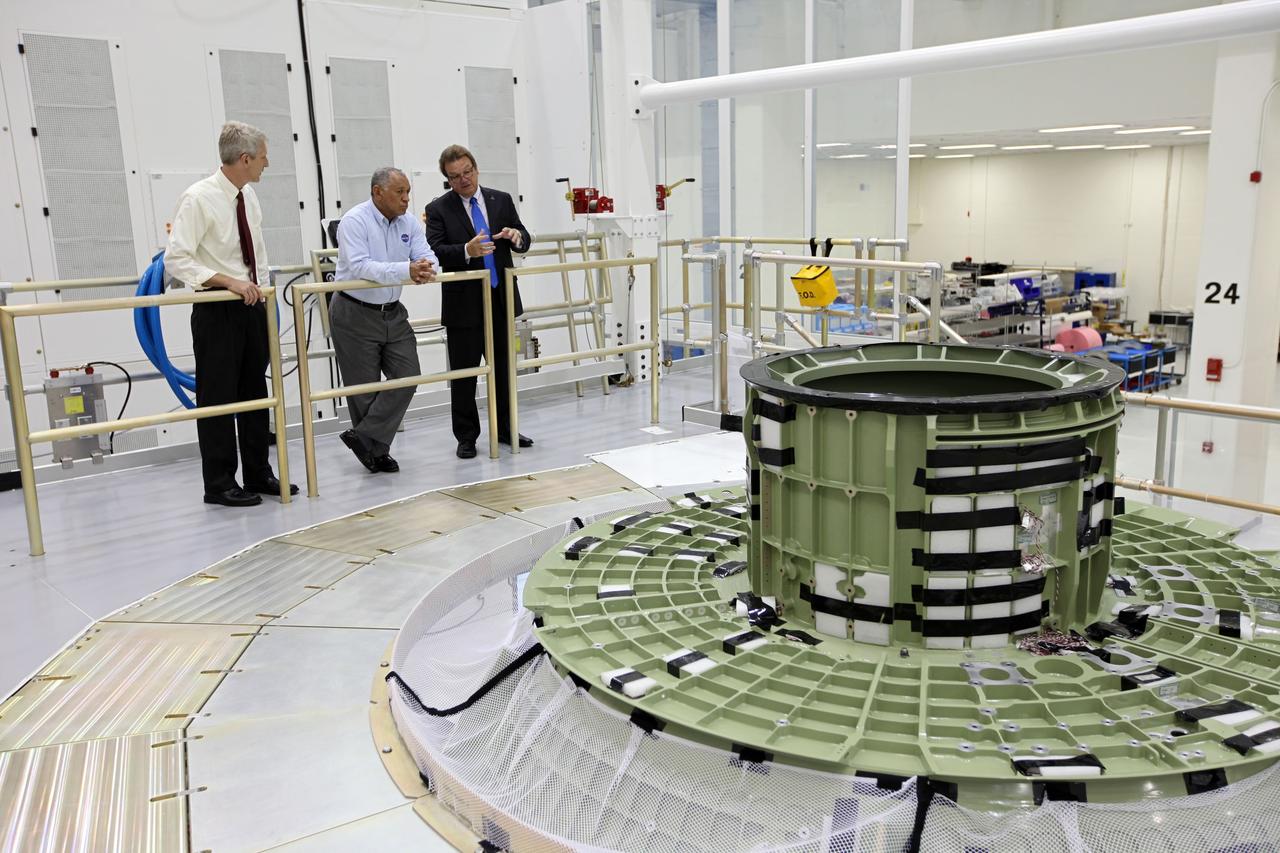
CAPE CANAVERAL, Fla. – Lockheed Martin's Jules Schneider, right, shows the upper portion of the Orion capsule to Charles Bolden, NASA administrator, center, as NASA's Scott Wilson looks on. The Orion capsule will make an uncrewed flight test in 2014. The spacecraft is in the high bay at the Operations and Checkout Building at NASA's Kennedy Space Center in Florida. Photo credit: NASA/Kim Shifflett
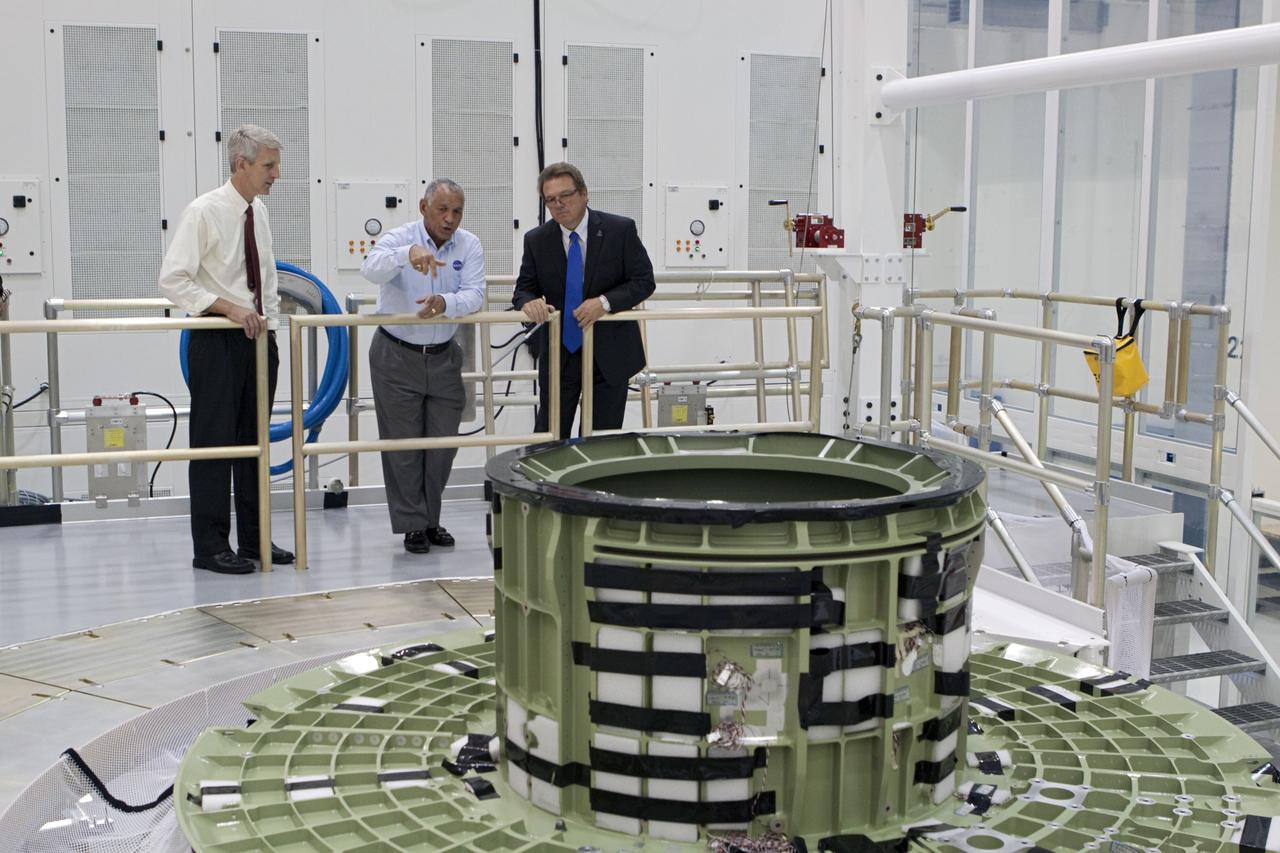
CAPE CANAVERAL, Fla. – Lockheed Martin's Jules Schneider, right, shows the upper portion of the Orion capsule to Charles Bolden, NASA administrator, center, as NASA's Scott Wilson looks on. The Orion capsule will make an uncrewed flight test in 2014. The spacecraft is in the high bay at the Operations and Checkout Building at NASA's Kennedy Space Center in Florida. Photo credit: NASA/Kim Shifflett
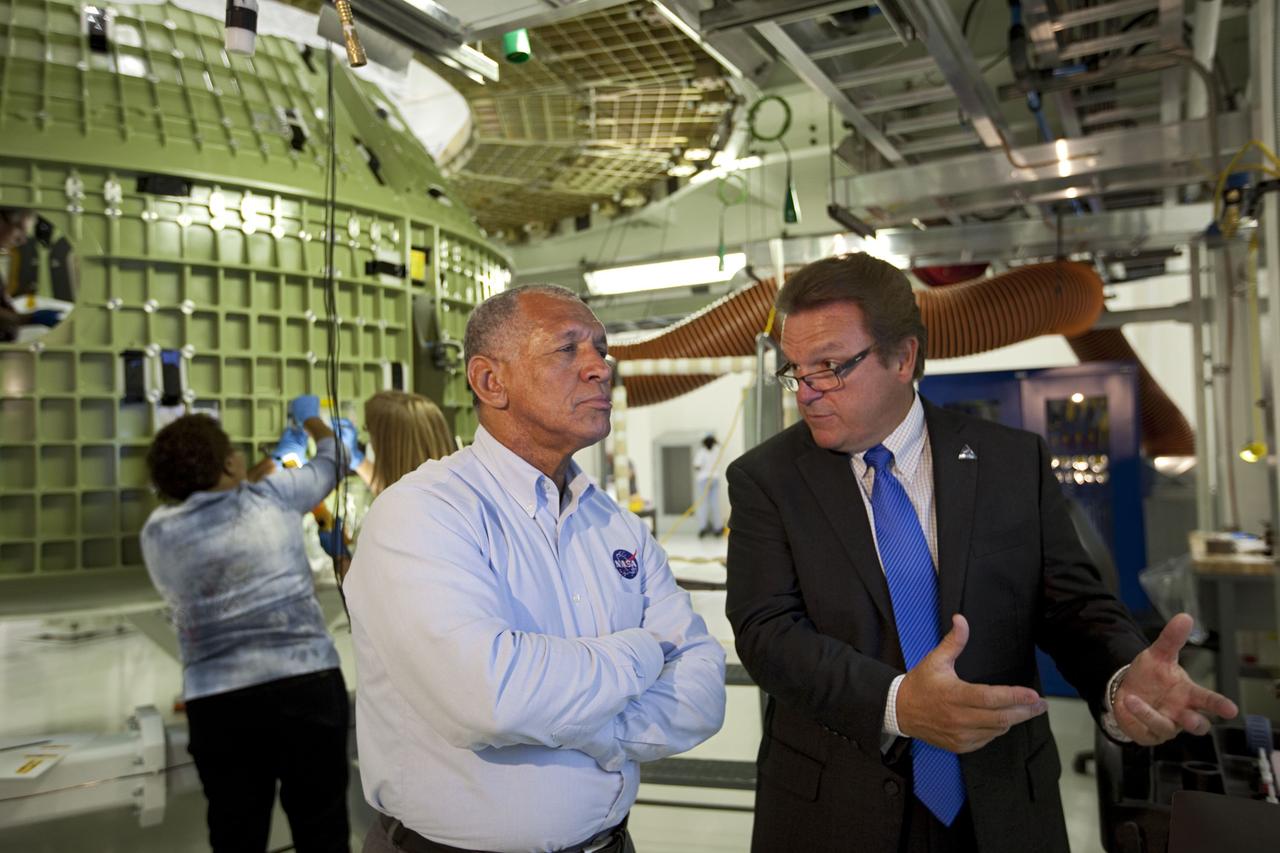
CAPE CANAVERAL, Fla. – Lockheed Martin's Jules Schneider, right, shows details of the preparation hardware used for the Orion capsule to Charles Bolden, NASA administrator, center. The Orion capsule will make an uncrewed flight test in 2014. The spacecraft is in the high bay at the Operations and Checkout Building at NASA's Kennedy Space Center in Florida. Photo credit: NASA/Kim Shifflett
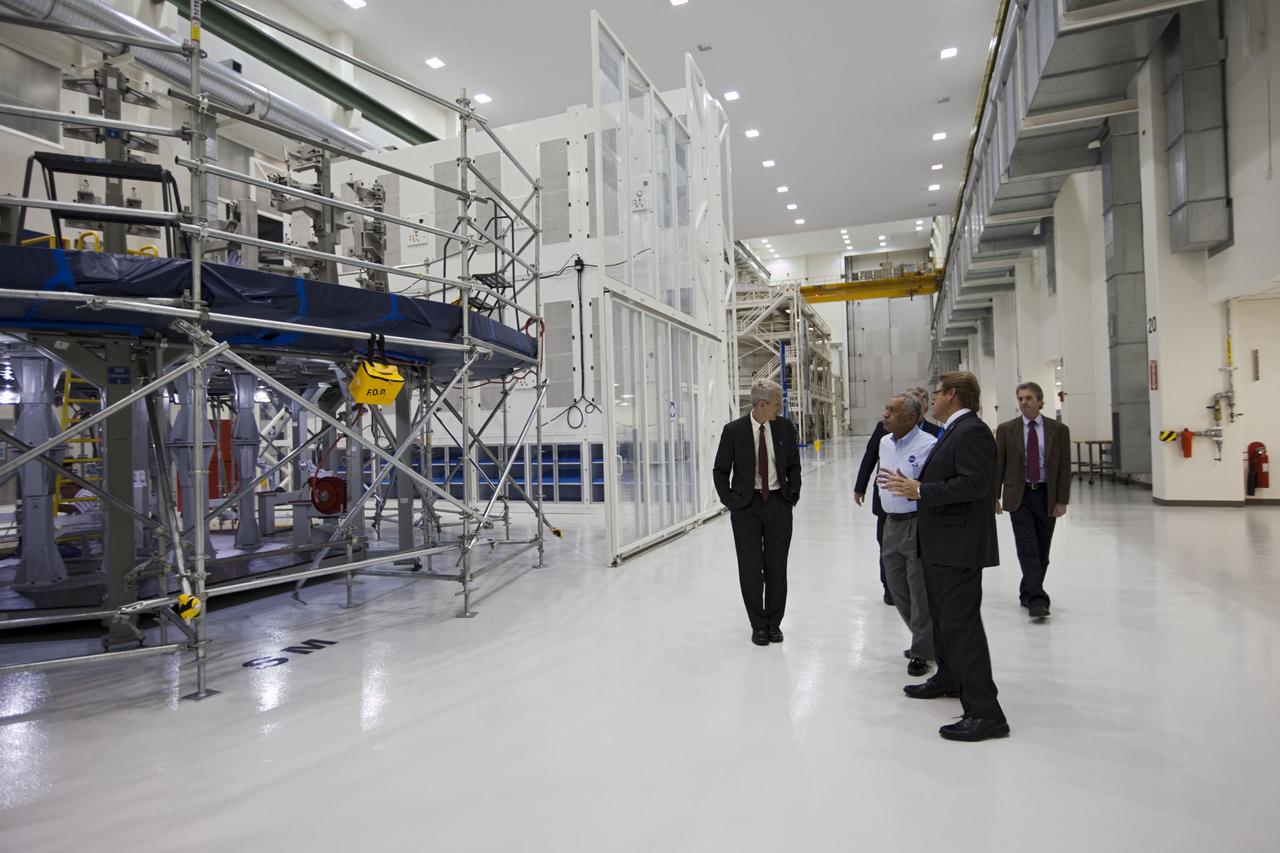
CAPE CANAVERAL, Fla. – Charles Bolden, NASA administrator, center, is shown the high bay at the Operations and Checkout Building at NASA's Kennedy Space Center in Florida by NASA's Scott Wilson, left, and Lockheed Martin's Jules Schneider, foreground. Lockheed Martin is processing an Orion spacecraft that will make an uncrewed flight test in 2014. Photo credit: NASA/Kim Shifflett

CAPE CANAVERAL, Fla. – Charles Bolden, NASA administrator, center, is shown the high bay at the Operations and Checkout Building at NASA's Kennedy Space Center in Florida by NASA's Scott Wilson, left, and Lockheed Martin's Jules Schneider, right. Lockheed Martin is processing an Orion spacecraft that will make an uncrewed flight test in 2014. Photo credit: NASA/Kim Shifflett
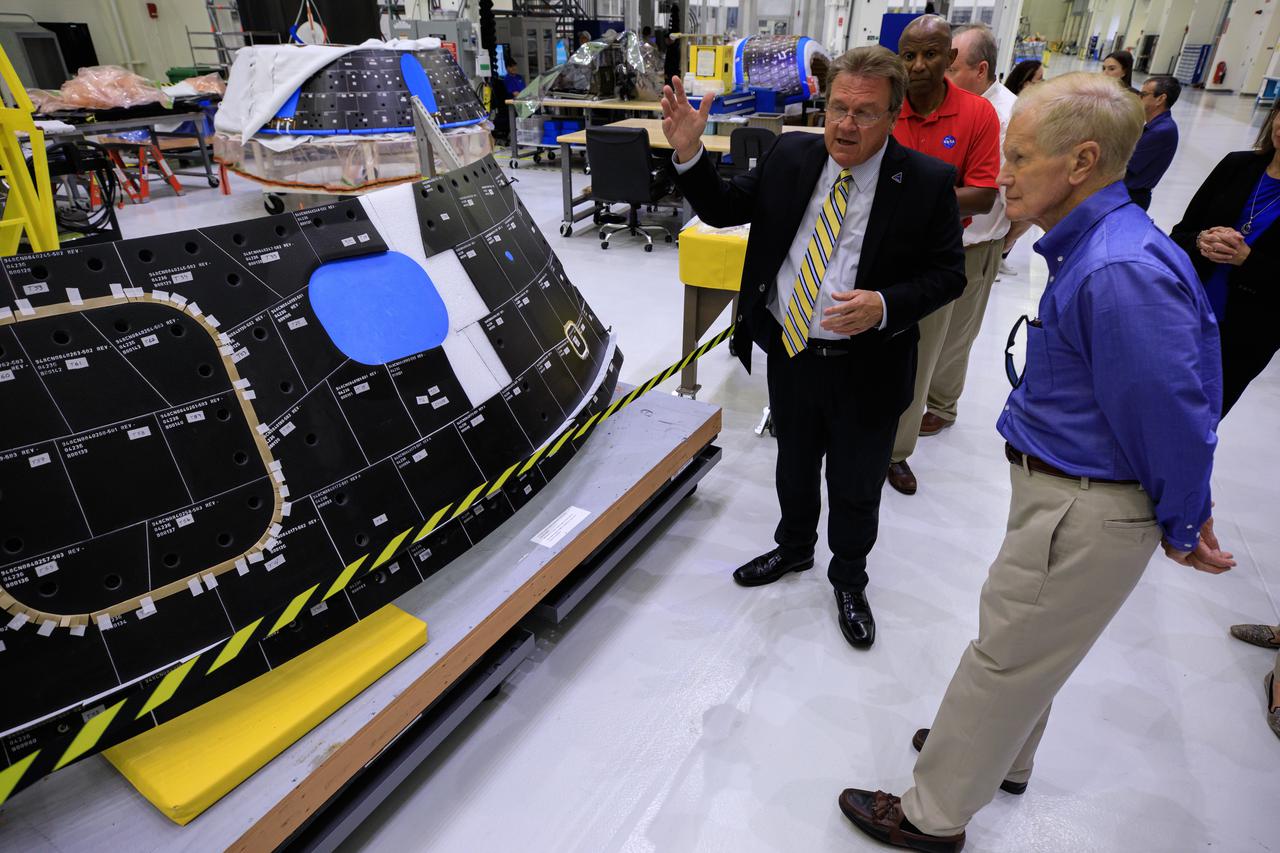
NASA Administrator Bill Nelson, right, tours the Neil Armstrong Operations and Checkout Building during a visit to the agency’s Kennedy Space Center in Florida on July 27, 2021. In this photo, Jules Schneider, Lockheed Martin director of Orion Assembly, Test, and Launch Operations at Kennedy, is showing Nelson the thermal protection tiles on the forward bay cover for the Artemis II crew module. Behind Schneider is Kennedy Deputy Director Kelvin Manning. Artemis II is the first crewed mission in a series of missions to the Moon and Mars. The mission will test the Space Launch System rocket and Orion spacecraft as an integrated system with astronauts on board. Through Artemis, NASA will land the first woman and first person of color on the lunar surface, as well as establish a sustainable presence on and around the Moon.
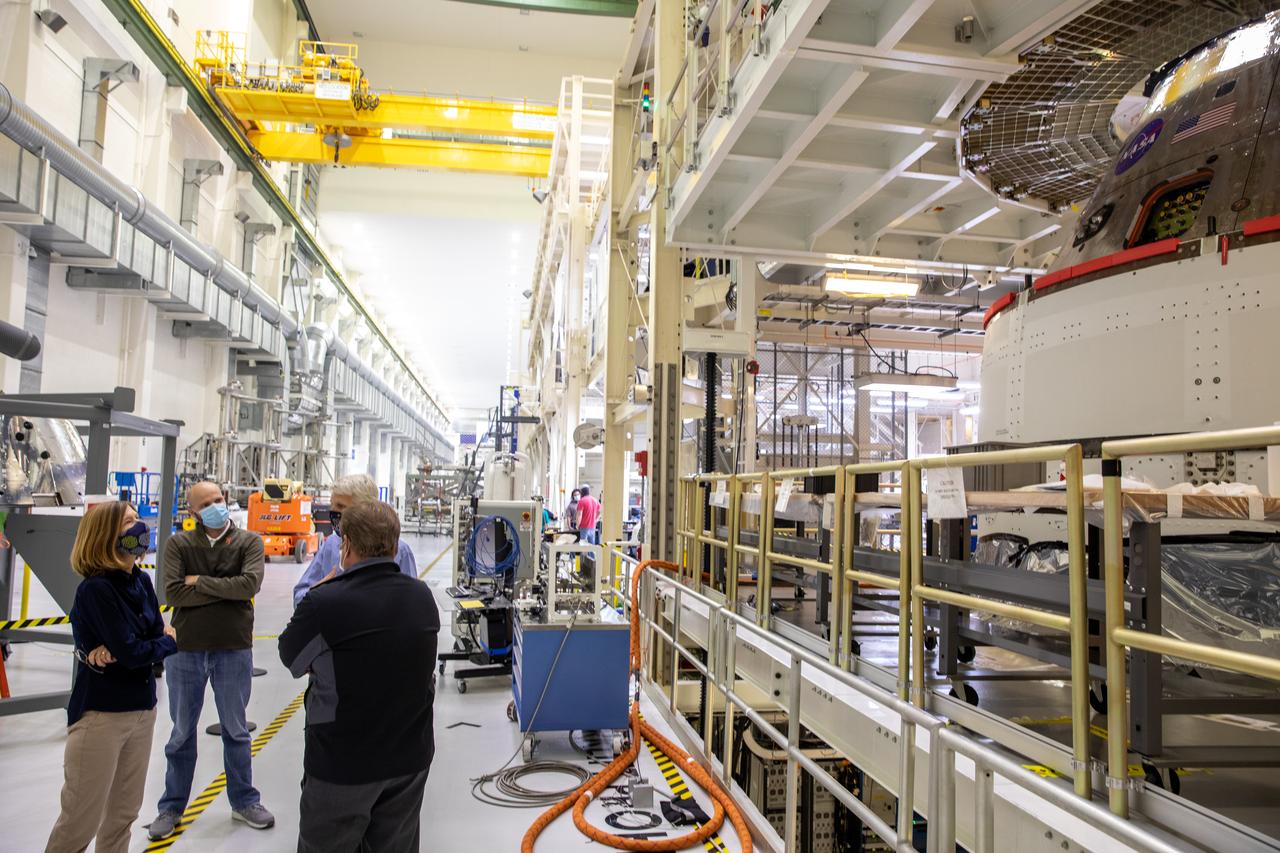
Kathy Lueders, far left, associate administrator of NASA’s Human Exploration and Operations Mission Directorate, views the Artemis I spacecraft during a visit to the Neil Armstrong Operations and Checkout Building high bay at the agency’s Kennedy Space Center in Florida on Nov. 5, 2020. To her right is Jules Schneider, director of Assembly, Test, and Launch Operations for Lockheed Martin; and to her left is Jim Skaggs, senior manager of Kennedy Operations for Lockheed Martin. In between Schneider and Skaggs is Scott Wilson, manager of the Orion Production Office at Kennedy. The first in a series of increasingly complex missions, Artemis I will test the Space Launch System rocket and Orion spacecraft as an integrated system prior to crewed flights to the Moon. Under the Artemis program, NASA is planning to land the first woman and the next man on the lunar surface by 2024.
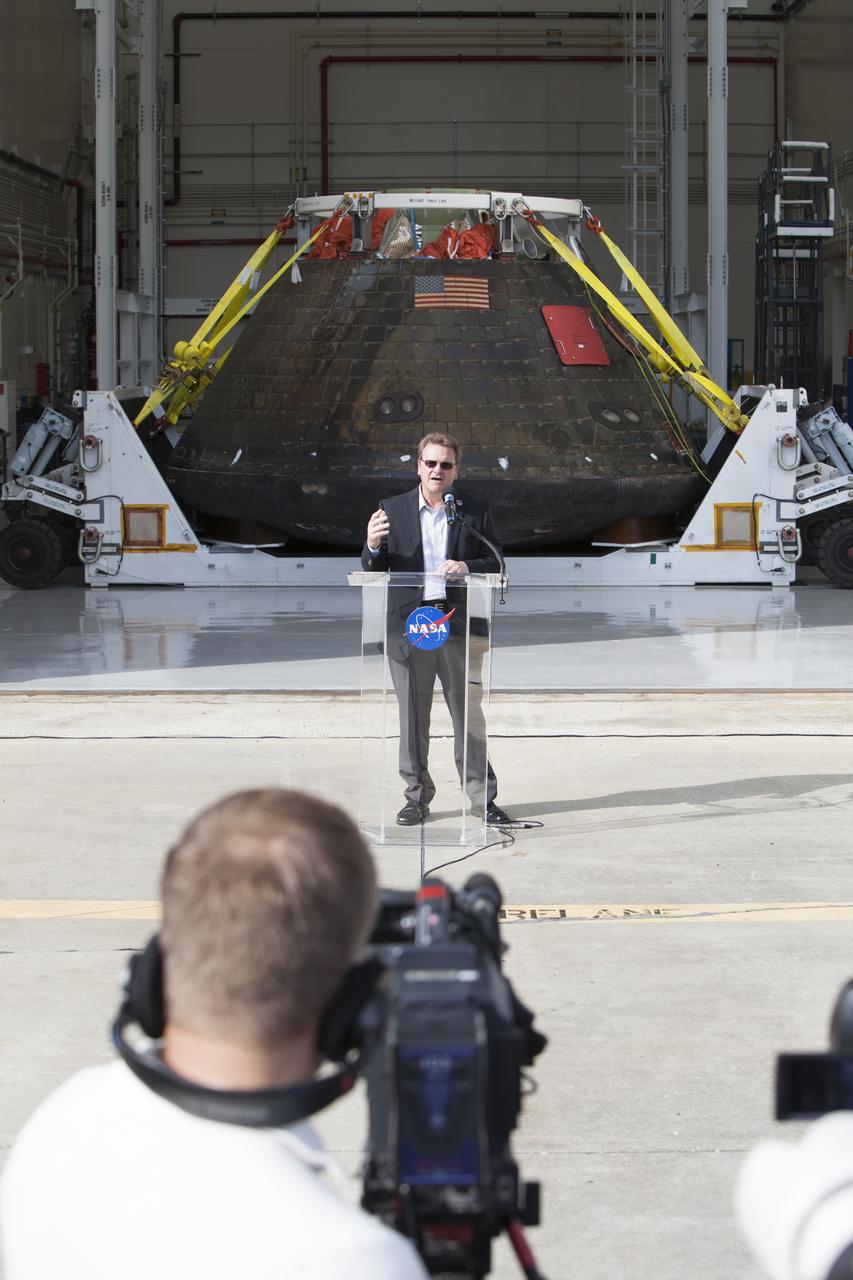
Lockheed Martin Manager Jules Schneider speaks to members of the media during a viewing of NASA's Orion spacecraft at the Launch Abort System Facility at NASA's Kennedy Space Center in Florida. The spacecraft's cross-country return, a 2,700 mile road trip from Naval Base San Diego to Kennedy, sets the stage for in-depth analysis of data obtained during Orion's trip to space. It will provide engineers with detailed information on how the spacecraft fared during its two-orbit, 4.5-hour flight test, completed on Dec. 5. The Ground Systems Development and Operations Program led the recovery, offload and transportation efforts.
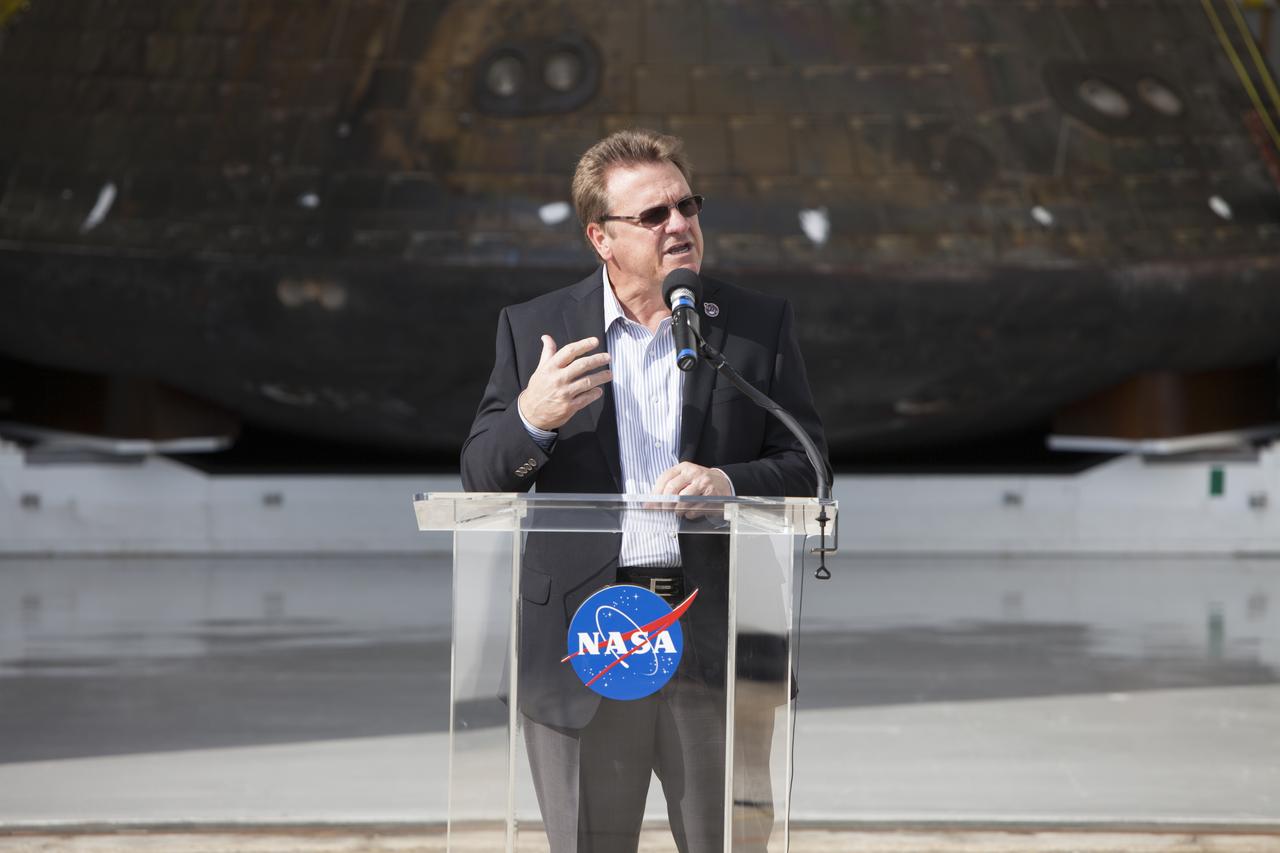
Lockheed Martin Manager Jules Schneider speaks to members of the media during a viewing of NASA's Orion spacecraft at the Launch Abort System Facility at NASA's Kennedy Space Center in Florida. The spacecraft's cross-country return, a 2,700 mile road trip from Naval Base San Diego to Kennedy, sets the stage for in-depth analysis of data obtained during Orion's trip to space. It will provide engineers with detailed information on how the spacecraft fared during its two-orbit, 4.5-hour flight test, completed on Dec. 5. The Ground Systems Development and Operations Program led the recovery, offload and transportation efforts.
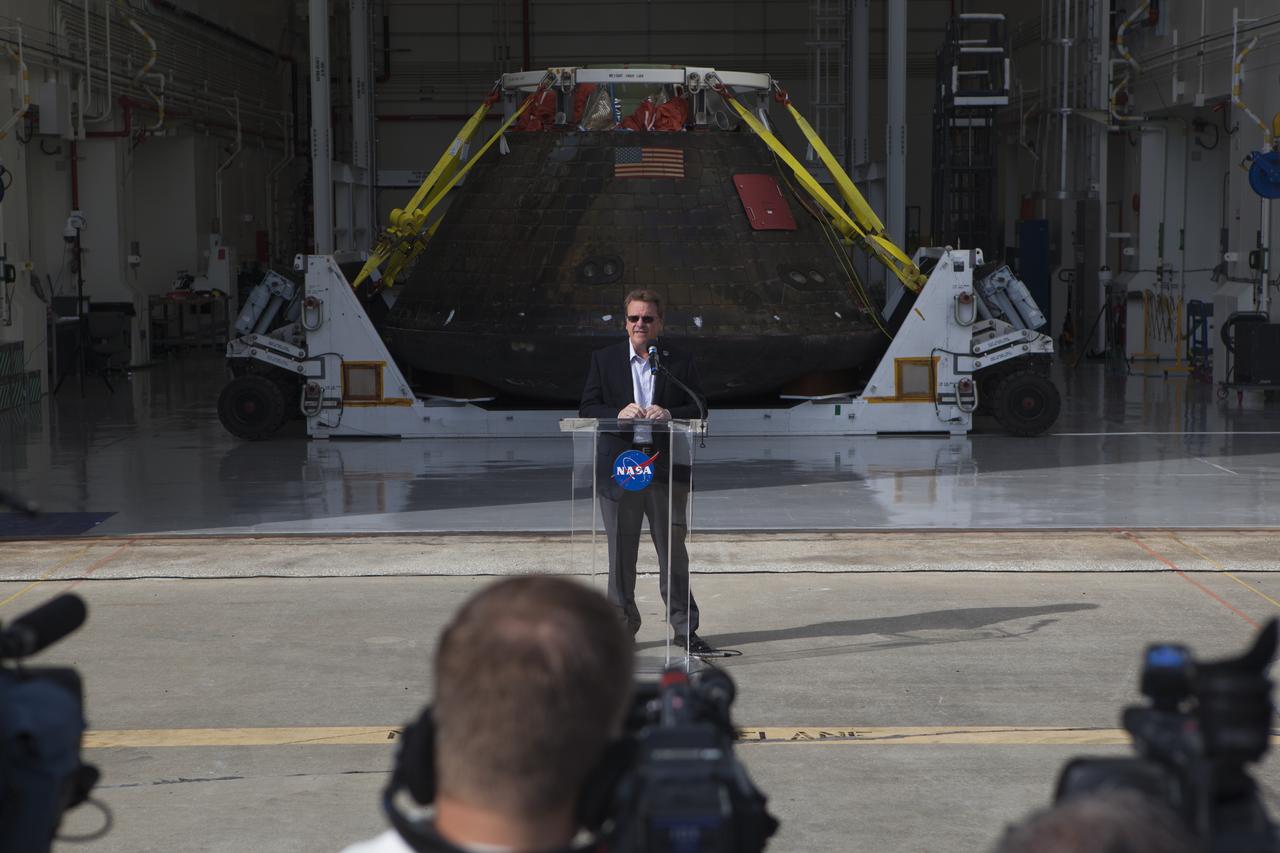
Lockheed Martin Manager Jules Schneider speaks to members of the media during a viewing of NASA's Orion spacecraft at the Launch Abort System Facility at NASA's Kennedy Space Center in Florida. The spacecraft's cross-country return, a 2,700 mile road trip from Naval Base San Diego to Kennedy, sets the stage for in-depth analysis of data obtained during Orion's trip to space. It will provide engineers detailed information on how the spacecraft fared during its two-orbit, 4.5-hour flight test, completed on Dec. 5. The Ground Systems Development and Operations Program led the recovery, offload and transportation efforts.
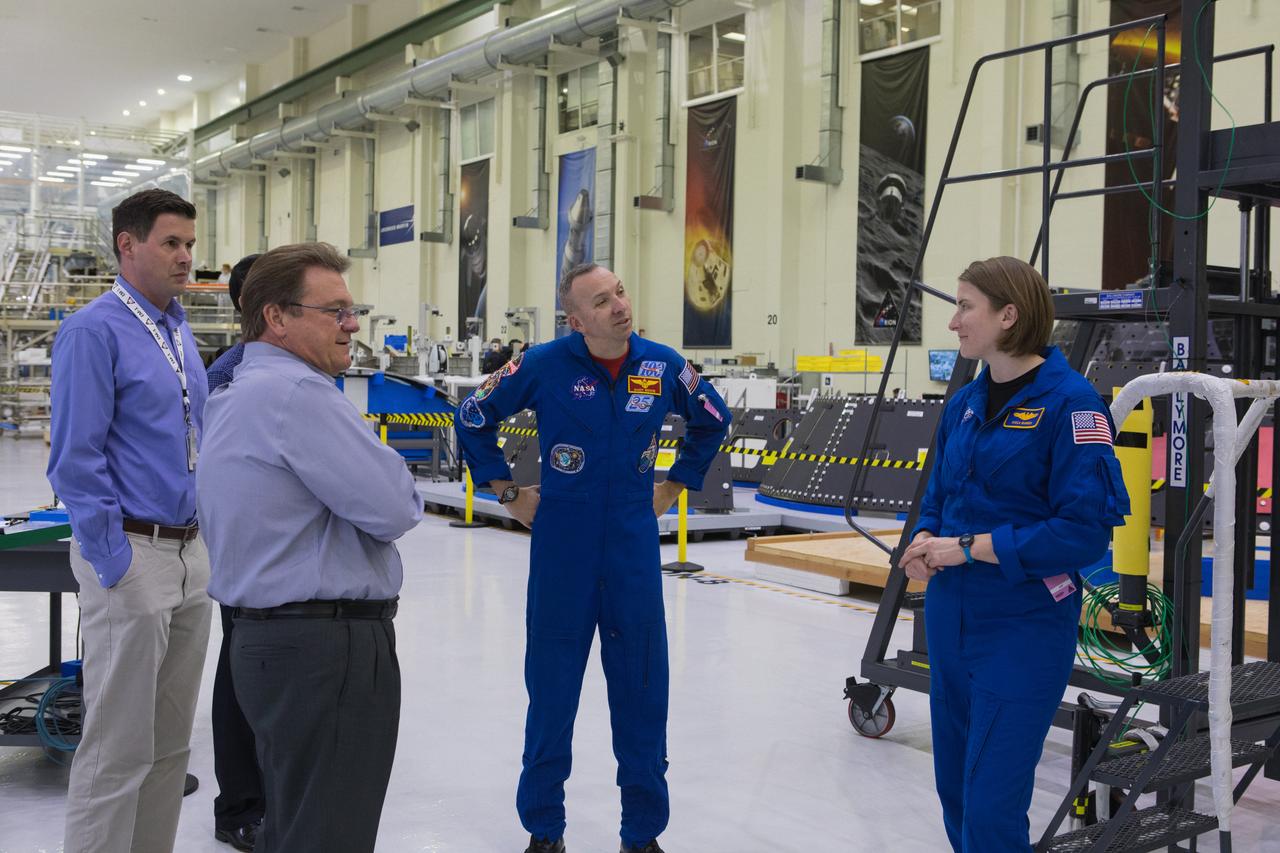
NASA astronaut Randy Bresnik, center, and astronaut candidate Kayla Barron, far right, tour the Operations and Checkout Building high bay at the agency’s Kennedy Space Center in Florida on Feb. 12, 2019. They viewed all of the hardware in the high bay that is being processed for Exploration Mission-1 and Exploration Mission-2. Accompanying them are Jules Schneider, director, Assembly, Test and Launch Operations (ATLO) with Lockheed Martin; Nathan Varn, senior manager, ATLO with Lockheed Martin; and Glenn Chin, deputy manager, NASA Orion Production Operations.

From left, Jules Schneider, Lockheed Martin Assembly, Test and Launch Operations, Kennedy Space Center Director Bob Cabana, and NASA Administrator Jim Bridenstine view a signed banner during a tour inside the Neil Armstrong Operations and Checkout Building high bay at the Kennedy Space Center in Florida on Aug. 28, 2020, with representatives from the White House Office of Management and Budget (OMB). Inside the high bay, Orion spacecraft are being prepared for Artemis I and Artemis II. OMB is working with the U.S. Congress to line up the necessary resources to land the first woman and the next man on the Moon in 2024.
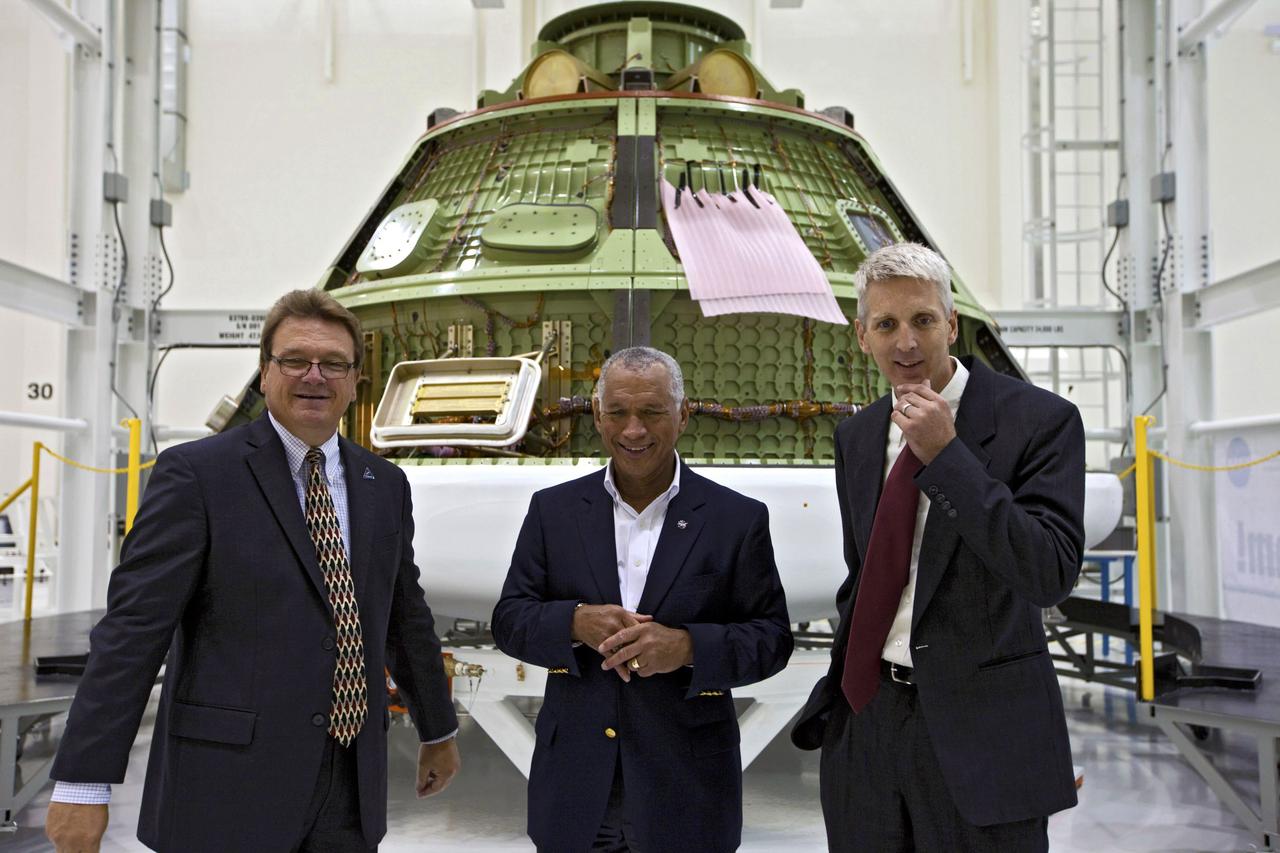
CAPE CANAVERAL, Fla. - In the Operations and Checkout Building at the Kennedy Space Center in Florida, NASA Administrator Charles Bolden, center, addresses news media in front of the Orion EFT-1 spacecraft. Also participating are Jules Schneider, senior manager of Project Engineering for the Lockheed Martin Orion Program at Kennedy, left, and Scott Wilson, NASA's manager of Production Operations for the Orion Program. Bolden took a few dozen members of the news media on a tour of the space agency's Kennedy Space Center and adjacent Cape Canaveral Air Force Station on Aug. 23, 2012 to show the progress being made for future government and commercial space endeavors that will begin from Florida's Space Coast. For more information, visit: http://www.nasa.gov/centers/kennedy/news/kennedy-bolden-tour.html Photo credit: NASA/Kim Shiflett
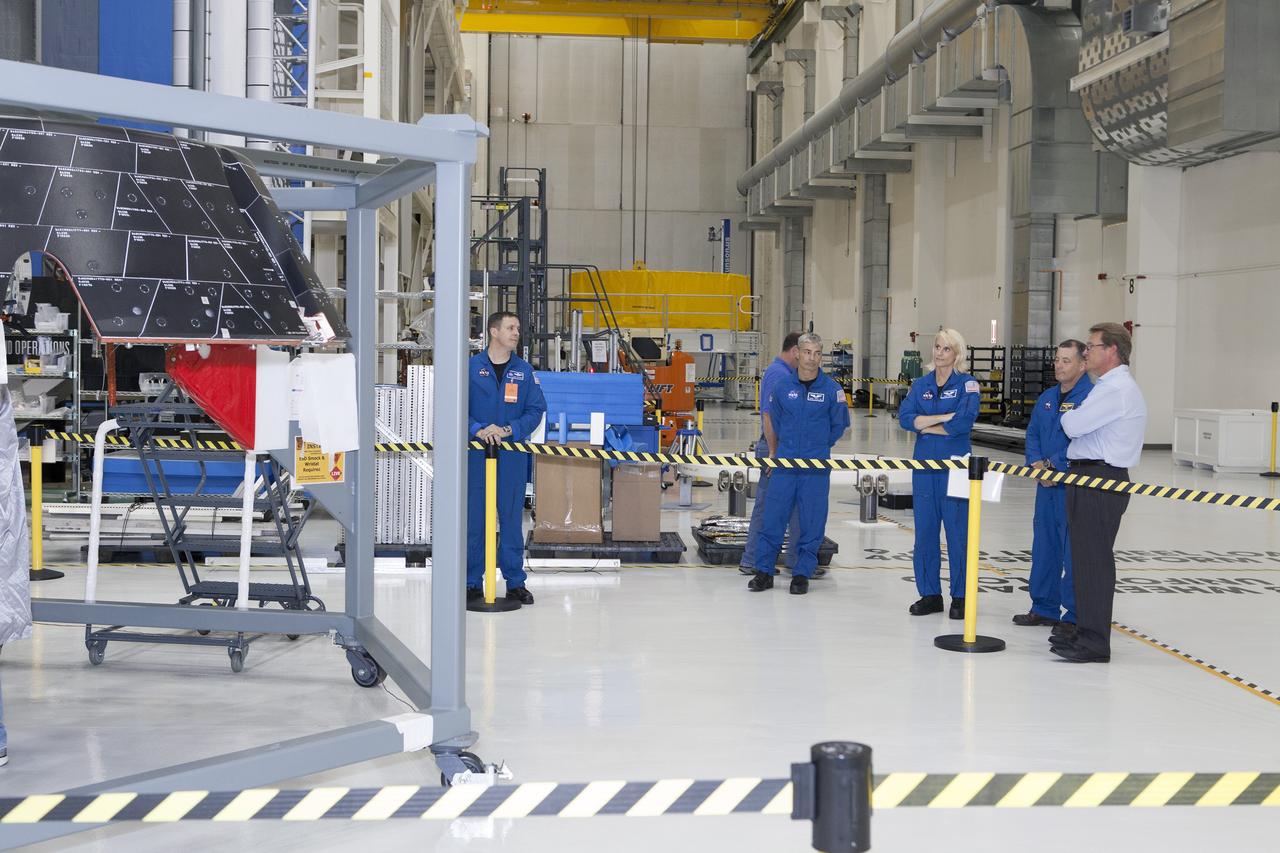
CAPE CANAVERAL, Fla. – NASA astronauts tour the Neil Armstrong Operations and Checkout Building high bay at NASA's Kennedy Space Center in Florida, and view the Orion forward bay cover for Exploration Flight Test-1. From left, are Jack Fischer, Mark Vande Hei, Katie Rubins and Scott Tingle. At far right is Jules Schneider, Lockheed Martin senior manager. Orion is the exploration spacecraft designed to carry astronauts to destinations not yet explored by humans, including an asteroid and Mars. It will have emergency abort capability, sustain the crew during space travel and provide safe re-entry from deep space return velocities. The first unpiloted test flight of Orion is scheduled to launch in 2014 atop a United Launch Alliance Delta IV rocket and in 2018 on NASA’s Space Launch System rocket. For more information, visit www.nasa.gov/orion. Photo credit: Dimitri Gerondidakis
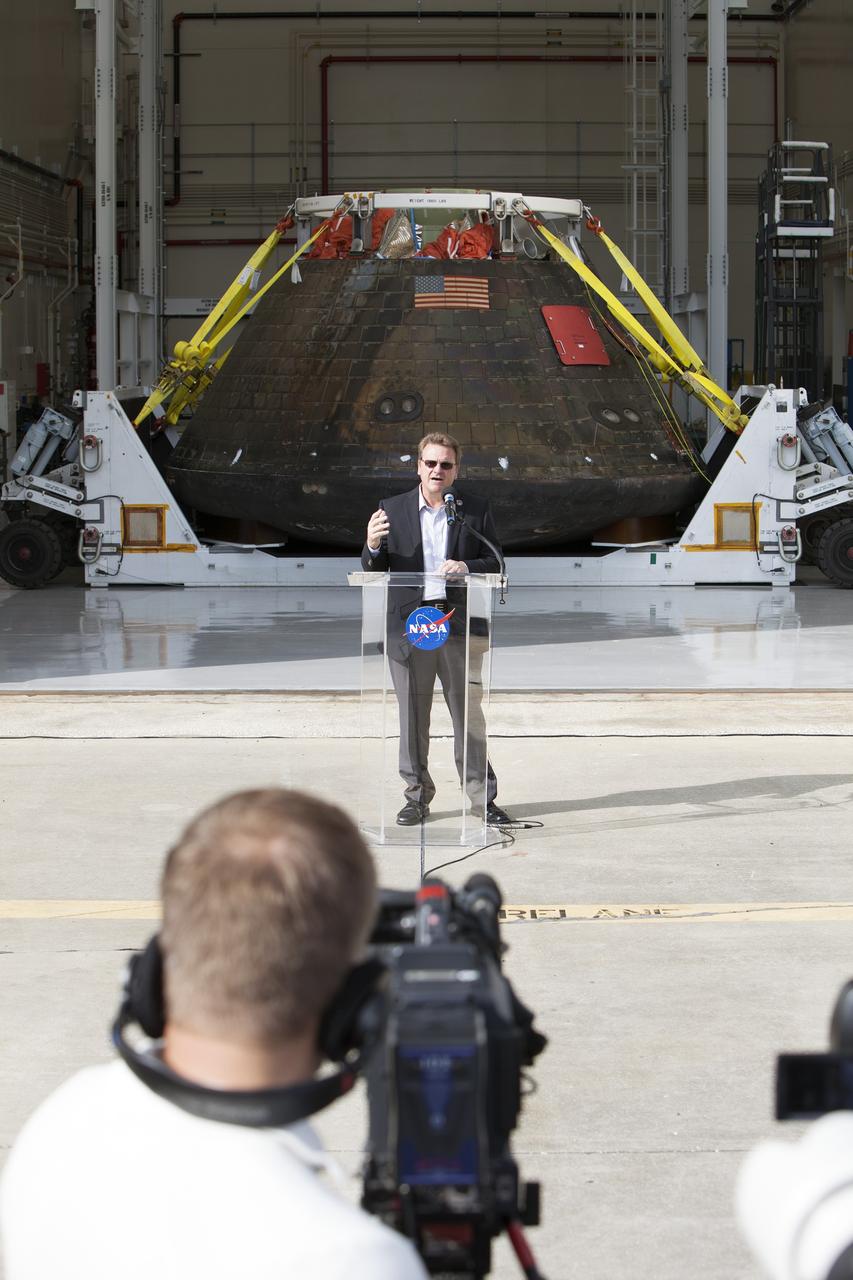
CAPE CANAVERAL, Fla. -- Lockheed Martin Manager Jules Schneider speaks to members of the media during a viewing of NASA's Orion spacecraft at the Launch Abort System Facility at NASA's Kennedy Space Center in Florida. The spacecraft's cross-country return, a 2,700 mile road trip from Naval Base San Diego to Kennedy, sets the stage for in-depth analysis of data obtained during Orion's trip to space. It will provide engineers with detailed information on how the spacecraft fared during its two-orbit, 4.5-hour flight test, completed on Dec. 5. The Ground Systems Development and Operations Program led the recovery, offload and transportation efforts. For more information, visit www.nasa.gov/orion. Photo credit: NASA/Dimitri Gerondidakis
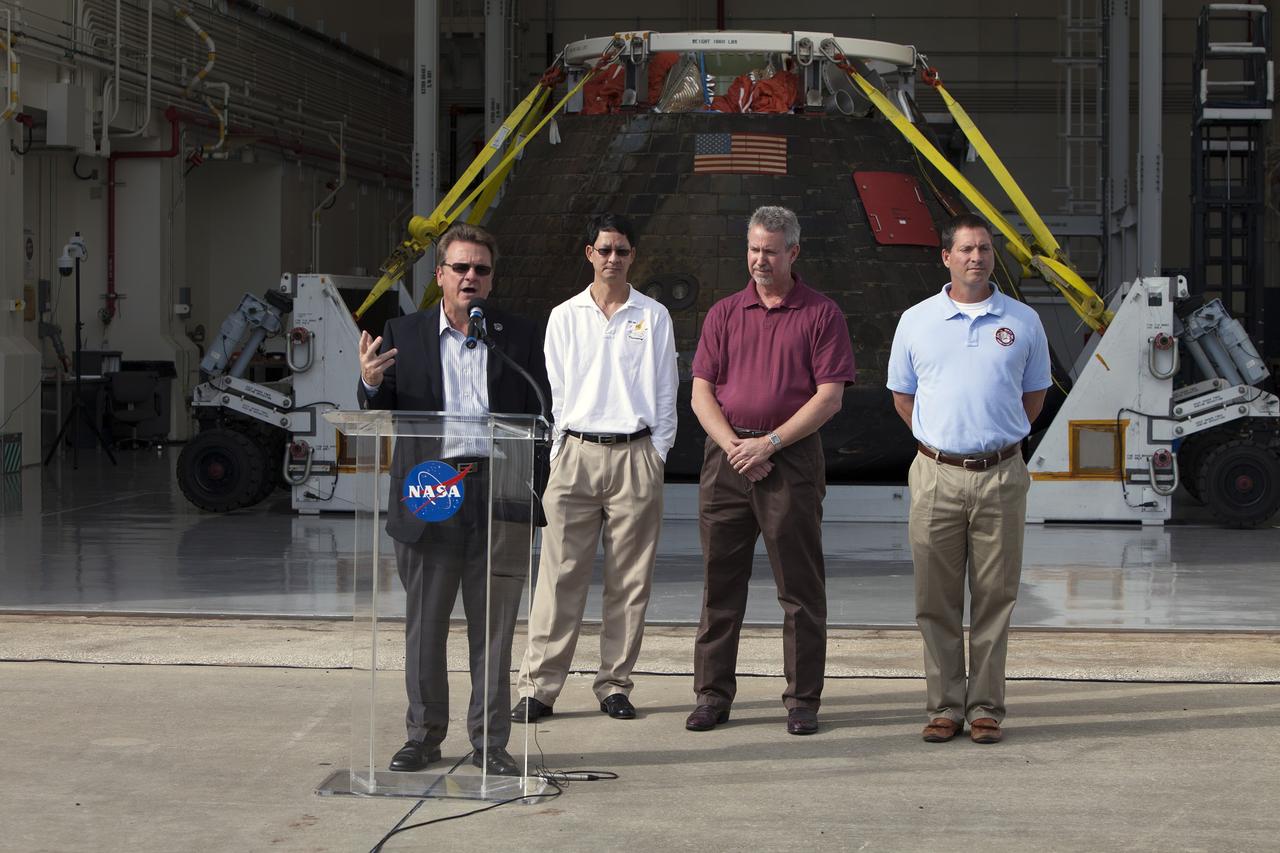
CAPE CANAVERAL, Fla. -- NASA's Orion spacecraft is viewed by members of the media at the Launch Abort System Facility at NASA's Kennedy Space Center in Florida. Speaking to the media during the viewing opportunity is Jules Schneider, Lockheed Martin Manager. Behind him, from left, are Glenn Chin, Orion Production Operations manager and Phil Weber and Lou Garcia, with the Ground Systems Development and Operations Program, or GSDO. Orion made the 8-day, 2,700 mile overland trip back to Kennedy from Naval Base San Diego in California. Analysis of date obtained during its two-orbit, four-and-a-half hour mission Dec. 5 will provide engineers with detailed information on how the spacecraft fared. GSDO led the recovery, offload and transportation efforts. For more information, visit www.nasa.gov/orion. Photo credit: NASA/Dimitri Gerondidakis
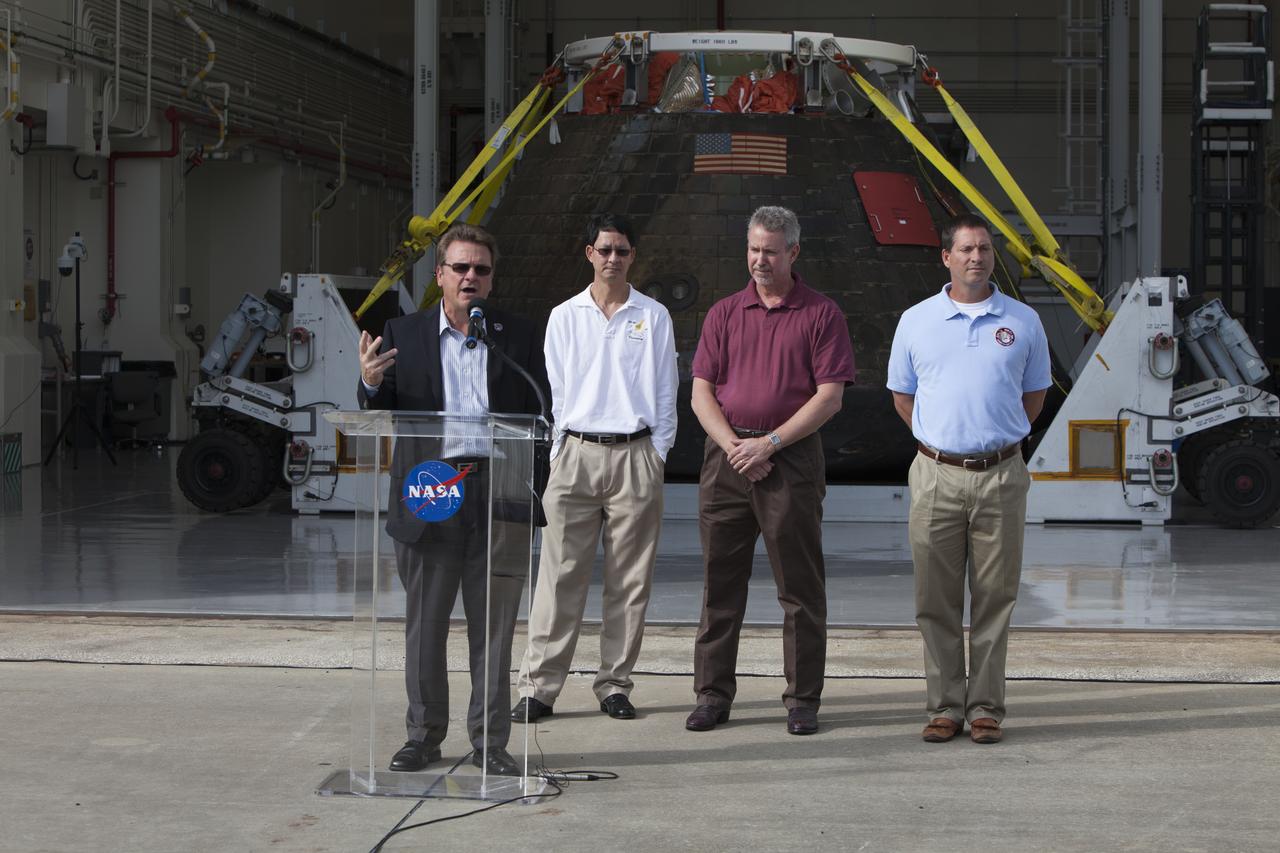
NASA's Orion spacecraft is viewed by members of the media at the Launch Abort System Facility at NASA's Kennedy Space Center in Florida. Speaking to the media during the viewing opportunity is Jules Schneider, Lockheed Martin Manager. Behind him, from left, are Glenn Chin, Orion Production Operations manager and Phil Weber and Lou Garcia, with the Ground Systems Development and Operations Program, or GSDO. Orion made the 8-day, 2,700 mile overland trip back to Kennedy from Naval Base San Diego in California. Analysis of date obtained during its two-orbit, four-and-a-half hour mission Dec. 5 will provide engineers with detailed information on how the spacecraft fared. GSDO led the recovery, offload and transportation efforts.
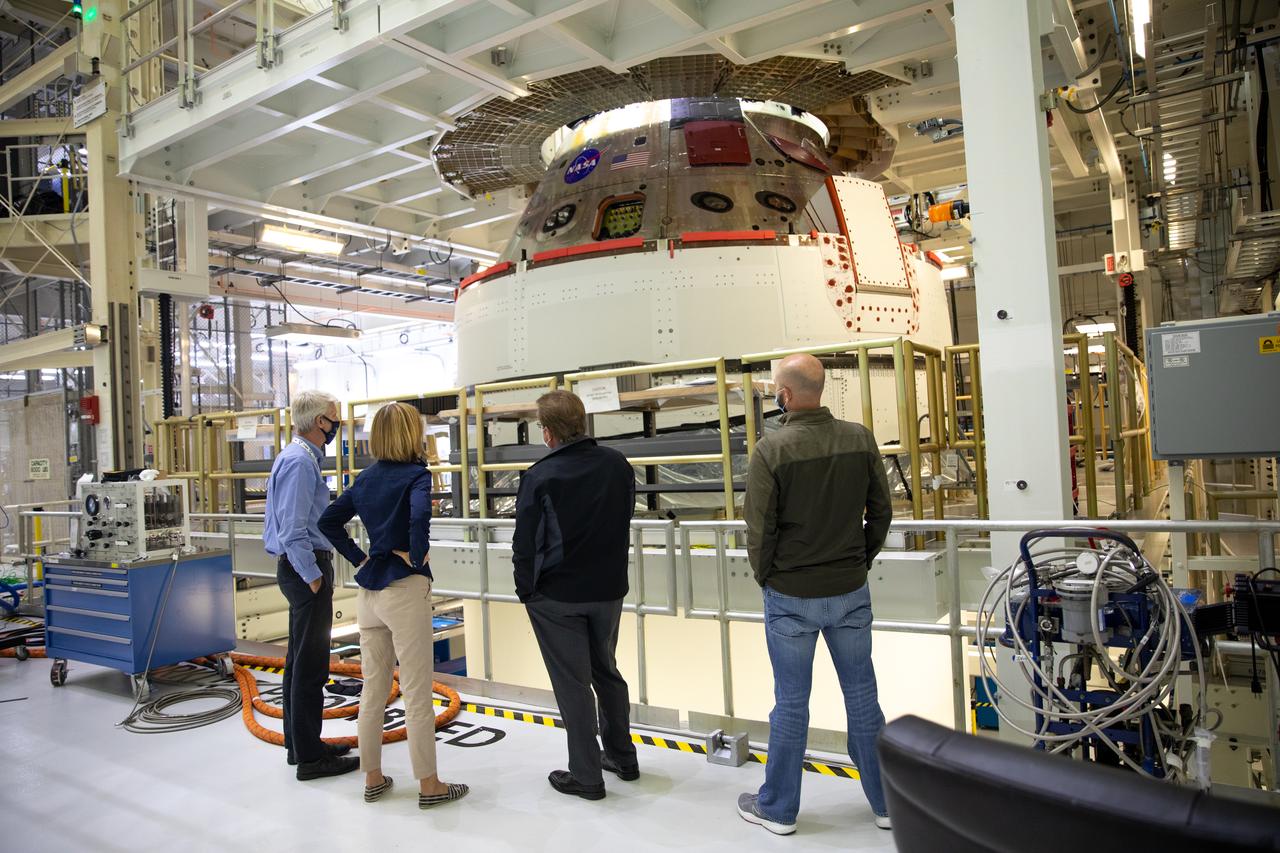
Senior managers from Orion, NASA, and Lockheed Martin view the Artemis I spacecraft during a visit to the Neil Armstrong Operations and Checkout Building high bay at NASA’s Kennedy Space Center in Florida on Nov. 5, 2020. From left are Scott Wilson, manager, Orion Production Office; Kathy Lueders, associate administrator of NASA’s Human Exploration and Operations Mission Directorate; Jules Schneider, director of Assembly, Test, and Launch Operations for Lockheed Martin; and Jim Skaggs, senior manager of Kennedy Operations for Lockheed Martin. The first in a series of increasingly complex missions, Artemis I will test the Space Launch System rocket and Orion spacecraft as an integrated system prior to crewed flights to the Moon. Under the Artemis program, NASA is planning to land the first woman and the next man on the lunar surface by 2024.

From left, Jules Schneider, Lockheed Martin Assembly, Test and Launch Operations; Kennedy Space Center Director Bob Cabana; NASA Administrator Jim Bridenstine; Russell Vought, director of the White House Office of Management and Budget; and Larry Price, Lockheed Martin Orion Program Manager, tour the Neil Armstrong Operations and Checkout Building high bay at NASA’s Kennedy Space Center in Florida on Aug. 28, 2020. In the center, behind them from left, are Brian McCormack, associate director of the White House Office of Management and Budget, and Glenn Chin, Deputy Manager of Orion Production Operations. Inside the high bay, Orion spacecraft are being prepared for Artemis I and Artemis II, with the Crew Module Adapter for Artemis II shown in the background. The Office of Management and Budget is working with the U.S. Congress to line up the necessary resources to land the first woman and the next man on the Moon in 2024.
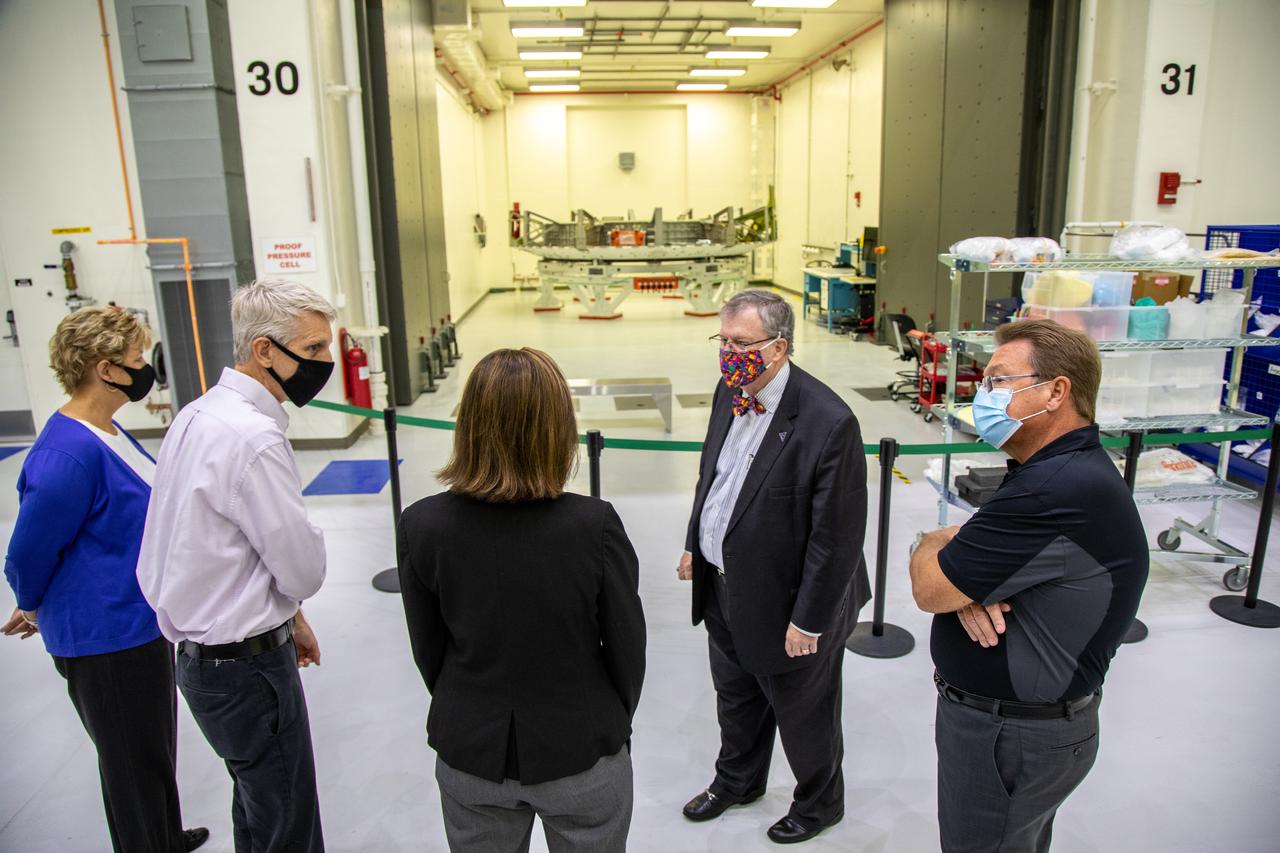
Catherine Koerner, in the center, NASA Orion Program manager, along with senior managers from Orion and Lockheed Martin, tours the Neil Armstrong Operations and Checkout Building at NASA’s Kennedy Space Center in Florida on Oct. 6, 2020. Accompanying her, from left are Annette Hasbrook, Orion Program assistant manager; Scott Wilson, NASA Kennedy Orion Production Operations manager, Mike Hawes, Lockheed Martin vice president and Orion Program manager; and Jules Schneider, Lockheed Martin Assembly, Test and Launch Operations director with Lockheed Martin. Koerner viewed the Orion spacecraft for the Artemis I and II missions. They are shown with the crew module adapter for the Orion Artemis II mission. The first in a series of increasingly complex missions, Artemis I will test the Orion spacecraft and Space Launch System as an integrated system ahead of crewed flights to the Moon. Under the Artemis program, NASA will land the first woman and the next man on the Moon in 2024.
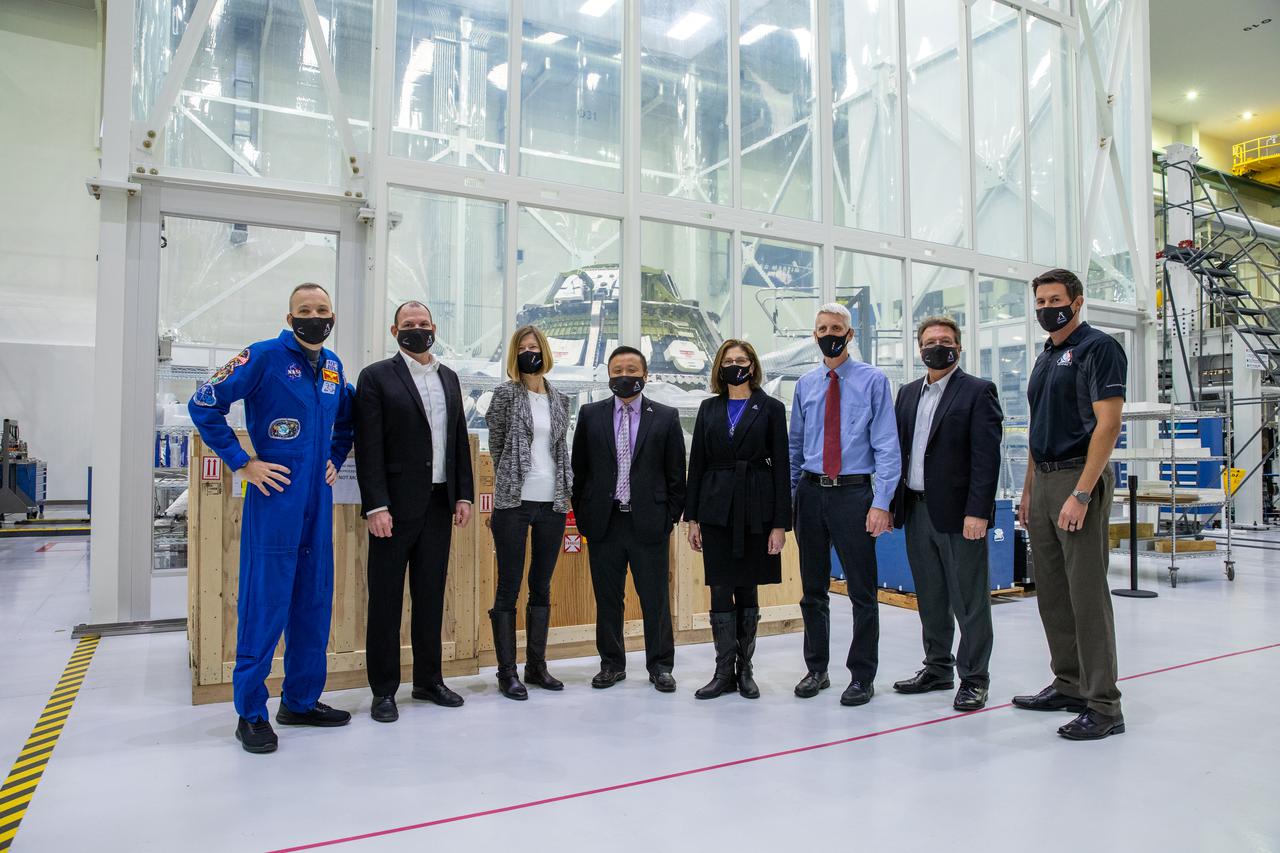
Kathy Lueders, third from left, associate administrator of the Human Exploration and Operations Mission Directorate, tours the Neil Armstrong Operations and Checkout Building high bay at NASA’s Kennedy Space Center in Florida on Jan. 14, 2021. In the background is the Orion crew module for the Artemis II mission. From left are NASA astronaut Randy Bresnik; Tony Antonelli, Lockheed Martin Orion Program director and Artemis II Mission director; Howard Hu, Orion deputy program manager; Cathy Koerner, Orion Program manager; Scott Wilson, Orion Production Operations manager; Jules Schneider, Lockheed Martin director of Orion Assembly, Test and Launch Operations at Kennedy; and Nathan Varn, Lockheed Martin Production Control director. The group also viewed the Orion spacecraft for Artemis I as it was lowered onto a transporter for the move to the Multi-Payload Processing Facility to begin ground processing by the Exploration Ground Systems and Jacobs teams.
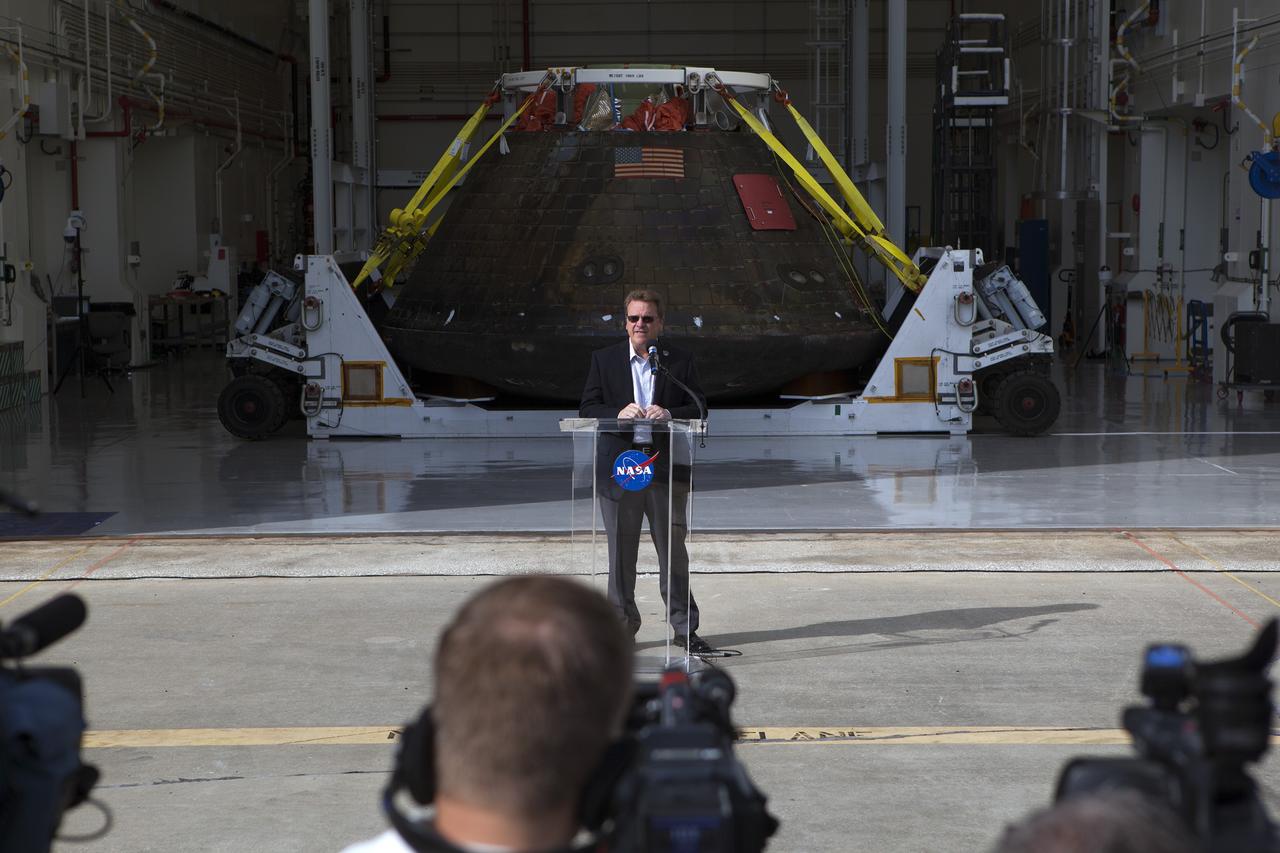
CAPE CANAVERAL, Fla. -- Lockheed Martin Manager Jules Schneider speaks to members of the media during a viewing of NASA's Orion spacecraft at the Launch Abort System Facility at NASA's Kennedy Space Center in Florida. The spacecraft's cross-country return, a 2,700 mile road trip from Naval Base San Diego to Kennedy, sets the stage for in-depth analysis of data obtained during Orion's trip to space. It will provide engineers with detailed information on how the spacecraft fared during its two-orbit, 4.5-hour flight test, completed on Dec. 5. The Ground Systems Development and Operations Program led the recovery, offload and transportation efforts. For more information, visit www.nasa.gov/orion. Photo credit: NASA/Dimitri Gerondidakis
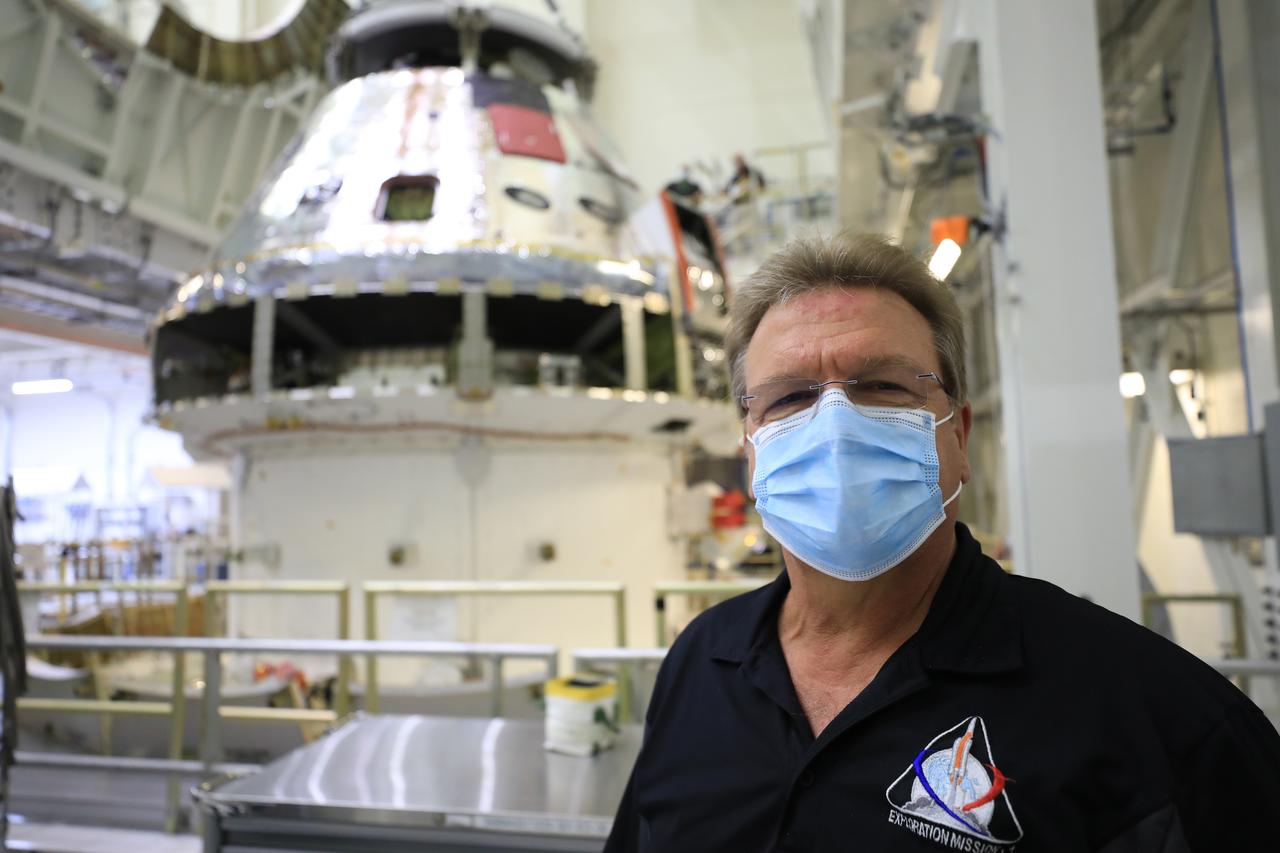
Jules Schneider, Lockheed Martin Assembly, Test and Launch Operations director, is shown inside the Neil Armstrong Operations and Checkout Building high bay in front of the FAST cell as the Artemis I Orion spacecraft is lowered by crane after installation of the spacecraft adapter (SA) cone was completed on Aug. 20, 2020. This is one of the final major hardware operations the spacecraft will undergo during closeout processing prior to being integrated with the Space Launch System (SLS) rocket in preparation for the first Artemis mission. The spacecraft adapter cone connects the bottom portion of Orion’s service module to the top part of the rocket known as the interim cryogenic propulsion stage (ICPS). Orion will fly on the agency’s Artemis I mission – the first in a series of increasingly complex missions to the Moon that will ultimately lead to the exploration of Mars.

Shown in front of the Artemis I spacecraft, NASA Administrator Jim Bridenstine, far left, tours the Neil Armstrong Operations and Checkout Building high by at NASA’s Kennedy Space Center in Florida on Aug. 28, 2020. Next to him, from left are Jules Schneider, Lockheed Martin Assembly, Test and Launch Operations; Kennedy Space Center Director Bob Cabana; Brian McCormack, associate director of the White House Office of Management and Budget; and Glenn Chin, Deputy Manager of Orion Production Operations. Inside the high bay, Orion spacecraft are being prepared for Artemis I and Artemis II. The Office of Management and Budget is working with the U.S. Congress to line up the necessary resources to land the first woman and the next man on the Moon in 2024.
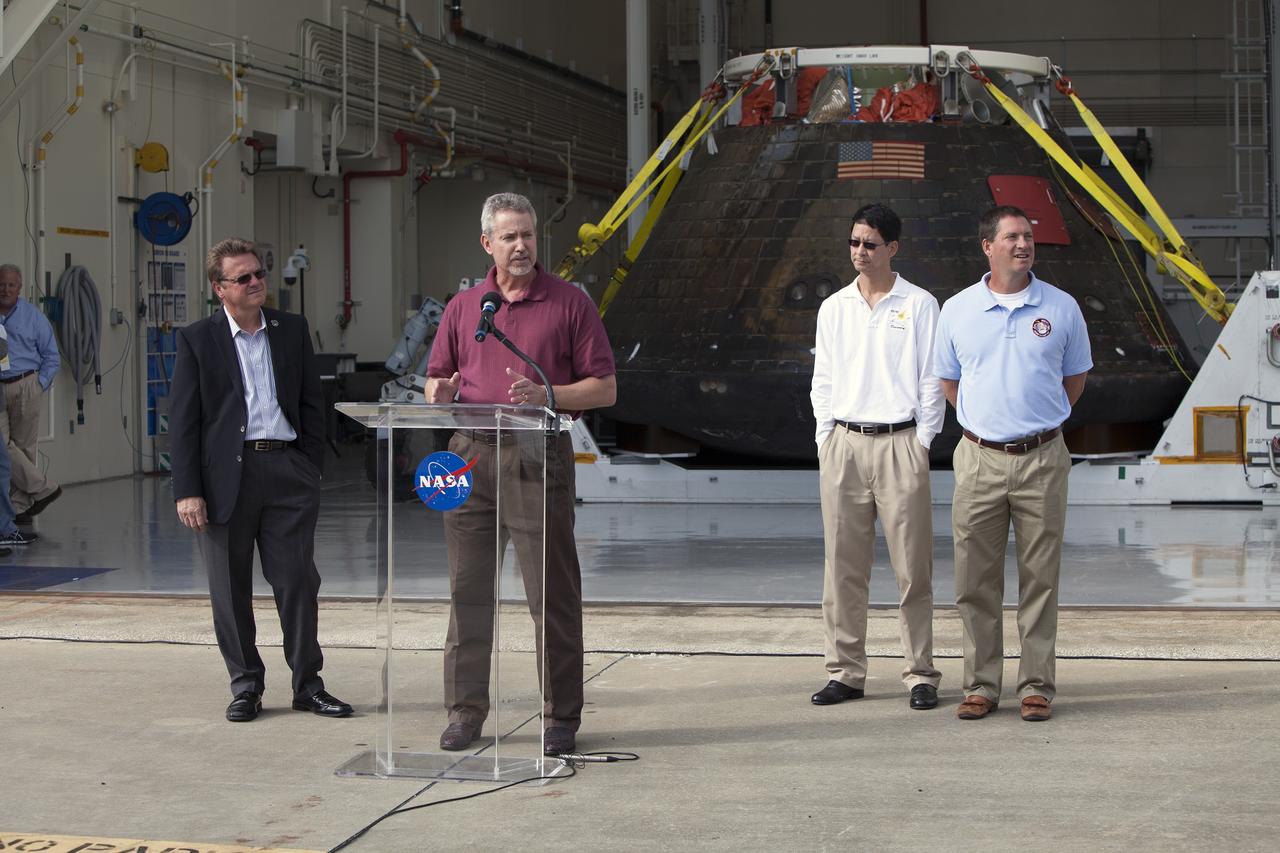
CAPE CANAVERAL, Fla. -- NASA's Orion spacecraft is viewed by members of the media at the Launch Abort System Facility at NASA's Kennedy Space Center in Florida. Speaking to the media during the viewing opportunity is Phil Weber, with the Ground Systems Development and Operations Program, or GSDO. At left is Jules Schneider, Lockheed Martin manager. At right is Glenn Chin, Orion Production Operations, and Lou Garcia, with GSDO. Orion made the 8-day, 2,700 mile overland trip back to Kennedy from Naval Base San Diego in California. Analysis of date obtained during its two-orbit, four-and-a-half hour mission Dec. 5 will provide engineers detailed information on how the spacecraft fared. GSDO led the recovery, offload and transportation efforts. For more information, visit www.nasa.gov/orion. Photo credit: NASA/Dimitri Gerondidakis
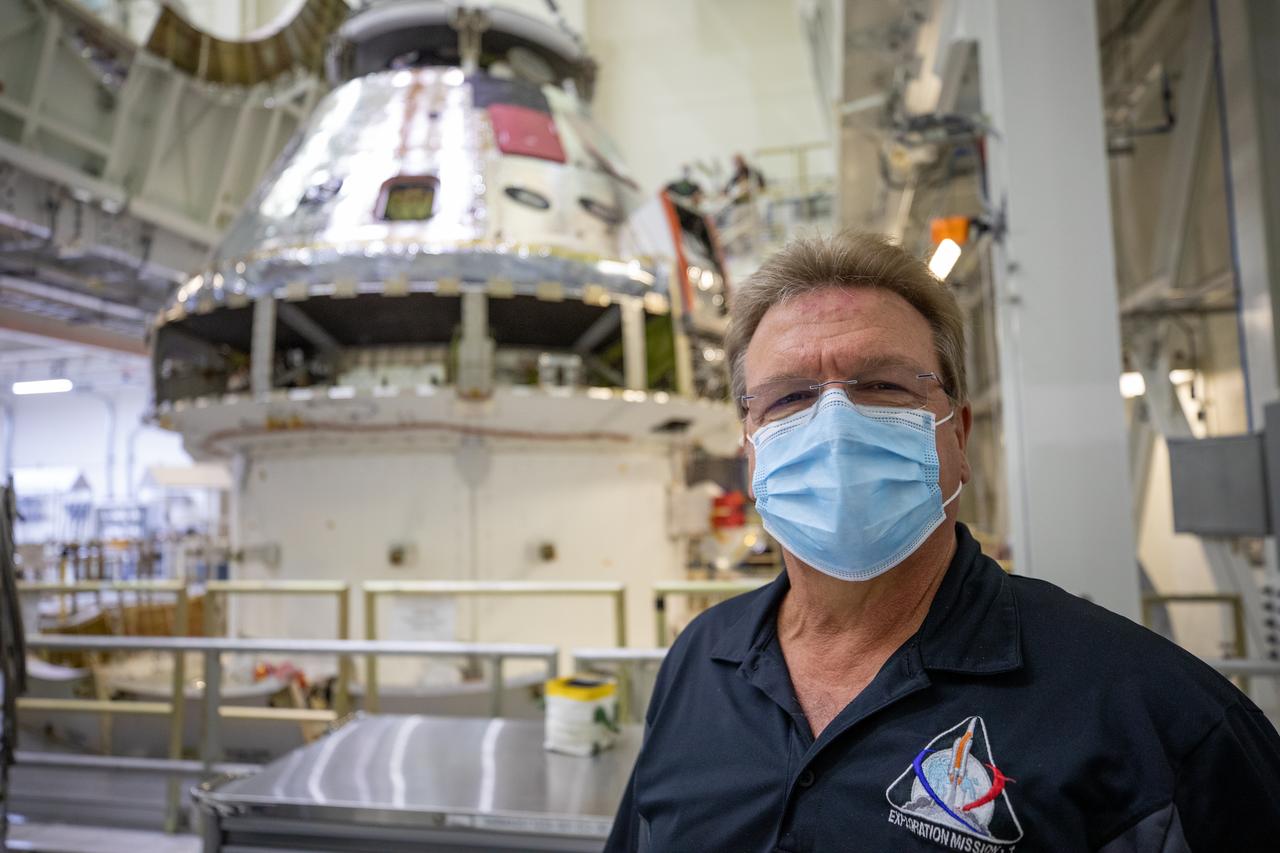
Jules Schneider, Lockheed Martin Assembly, Test and Launch Operations director, is shown inside the Neil Armstrong Operations and Checkout Building high bay in front of the FAST cell as the Artemis I Orion spacecraft is lowered by crane after installation of the spacecraft adapter (SA) cone was completed on Aug. 20, 2020. This is one of the final major hardware operations the spacecraft will undergo during closeout processing prior to being integrated with the Space Launch System (SLS) rocket in preparation for the first Artemis mission. The spacecraft adapter cone connects the bottom portion of Orion’s service module to the top part of the rocket known as the interim cryogenic propulsion stage (ICPS). Orion will fly on the agency’s Artemis I mission – the first in a series of increasingly complex missions to the Moon that will ultimately lead to the exploration of Mars.
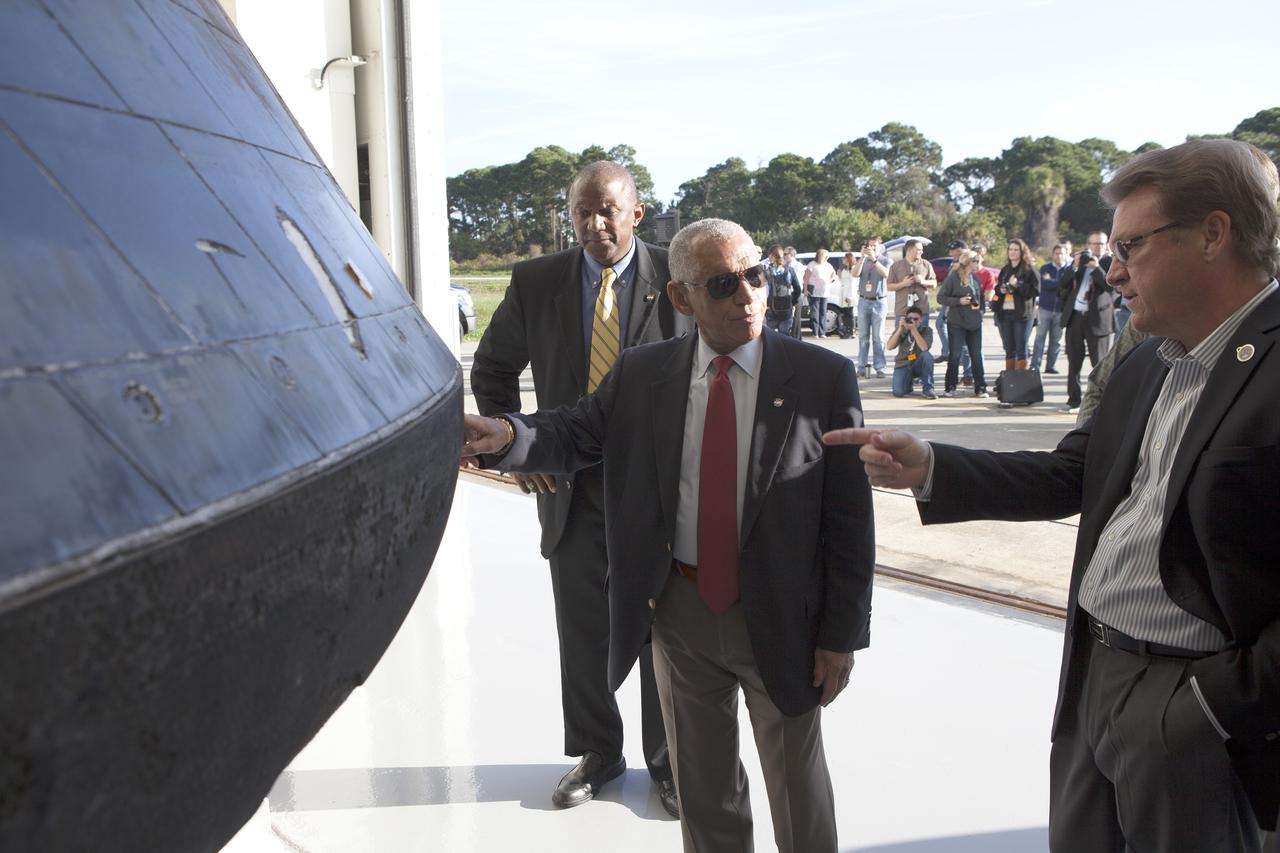
CAPE CANAVERAL, Fla. -- NASA Administrator Charlie Bolden looked over the agency's Orion spacecraft this morning for the first time since it returned to Kennedy Space Center following the successful Orion flight test on Dec. 5. At right is Jules Schneider, Lockheed Martin manager. At left is Kennedy Space Center Associate Director Kelvin Manning. Bearing the marks of a spacecraft that has returned to Earth through a searing plunge into the atmosphere, Orion is perched on a pedestal inside the Launch Abort System Facility at Kennedy where it is going through post-mission processing. Although the spacecraft Bolden looked over did not fly with a crew aboard during the flight test, Orion is designed to carry astronauts into deep space in the future setting NASA and the nation firmly on the journey to Mars. Photo credit: NASA/Cory Huston
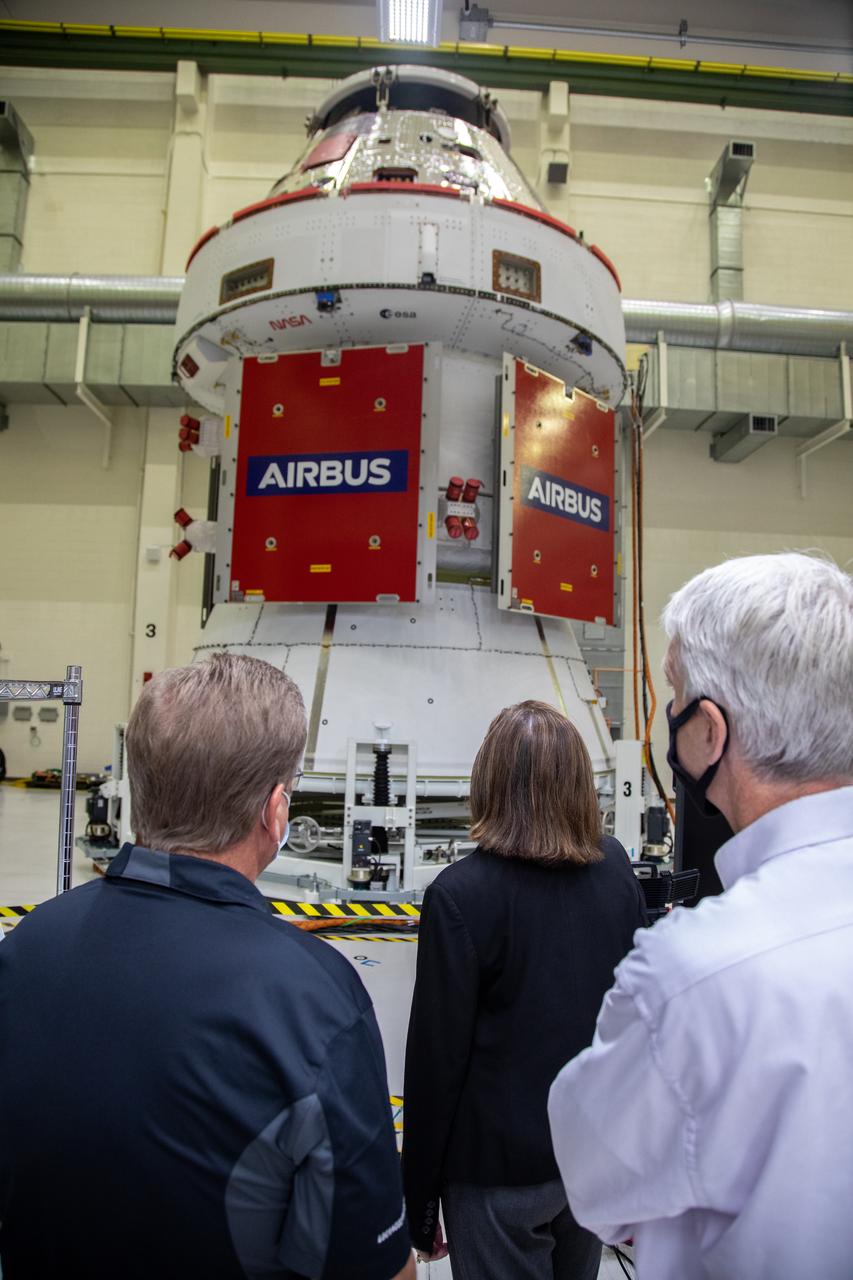
Catherine Koerner, in the center, NASA Orion Program manager, along with senior managers from Orion and Lockheed Martin, tour the Neil Armstrong Operations and Checkout Building at NASA’s Kennedy Space Center in Florida on Oct. 6, 2020. Accompanying her, at right is Scott Wilson, NASA Kennedy Orion Production Operations manager. At left is Jules Schneider, Lockheed Martin Assembly, Test and Launch Operations director with Lockheed Martin. Koerner viewed Orion spacecraft for the Artemis I and II missions. In view is the Orion spacecraft for Artemis I with its solar arrays installed and protective covers secured over them. The first in a series of increasingly complex missions, Artemis I will test the Orion spacecraft and Space Launch System as an integrated system ahead of crewed flights to the Moon. Under the Artemis program, NASA will land the first woman and the next man on the Moon in 2024.
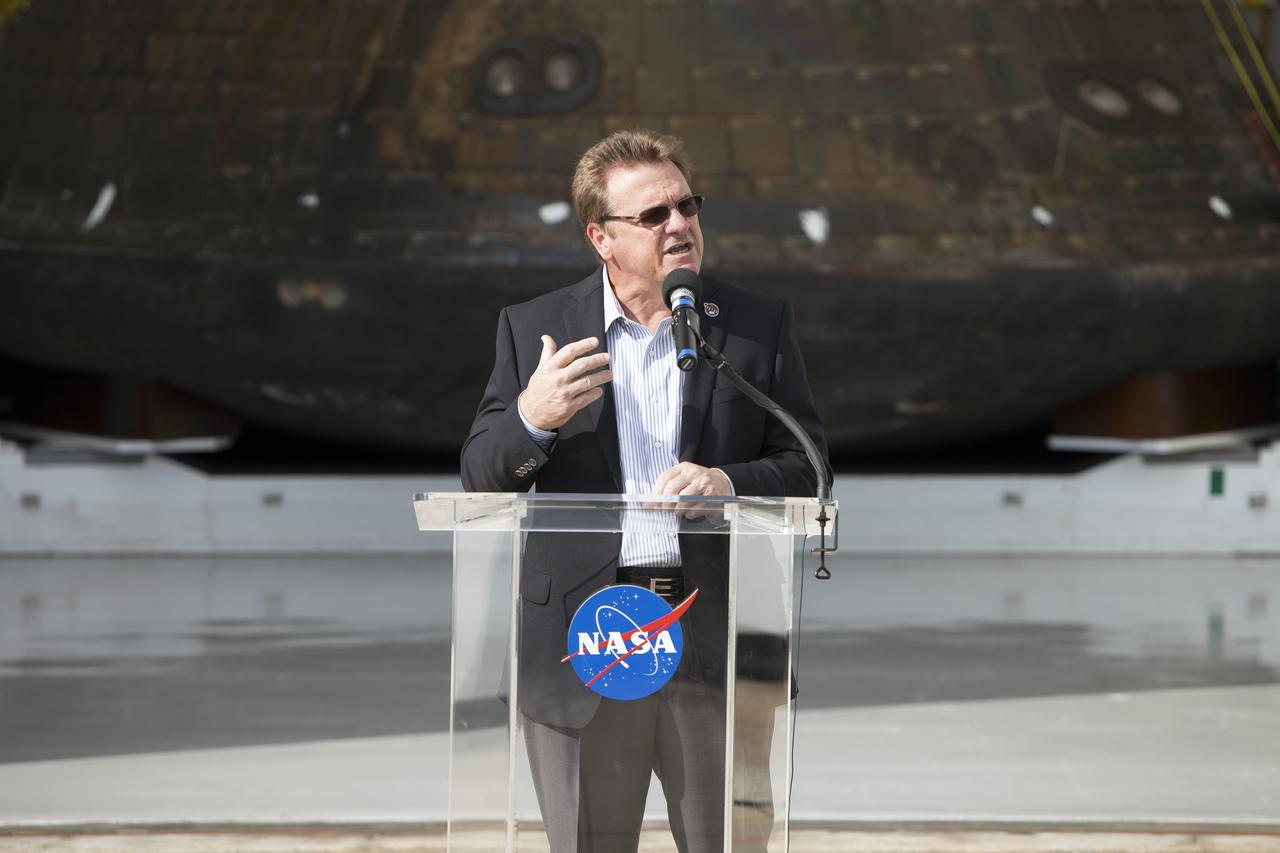
CAPE CANAVERAL, Fla. -- Lockheed Martin Manager Jules Schneider speaks to members of the media during a viewing of NASA's Orion spacecraft at the Launch Abort System Facility at NASA's Kennedy Space Center in Florida. The spacecraft's cross-country return, a 2,700 mile road trip from Naval Base San Diego to Kennedy, sets the stage for in-depth analysis of data obtained during Orion's trip to space. It will provide engineers with detailed information on how the spacecraft fared during its two-orbit, 4.5-hour flight test, completed on Dec. 5. The Ground Systems Development and Operations Program led the recovery, offload and transportation efforts. For more information, visit www.nasa.gov/orion. Photo credit: NASA/Dimitri Gerondidakis
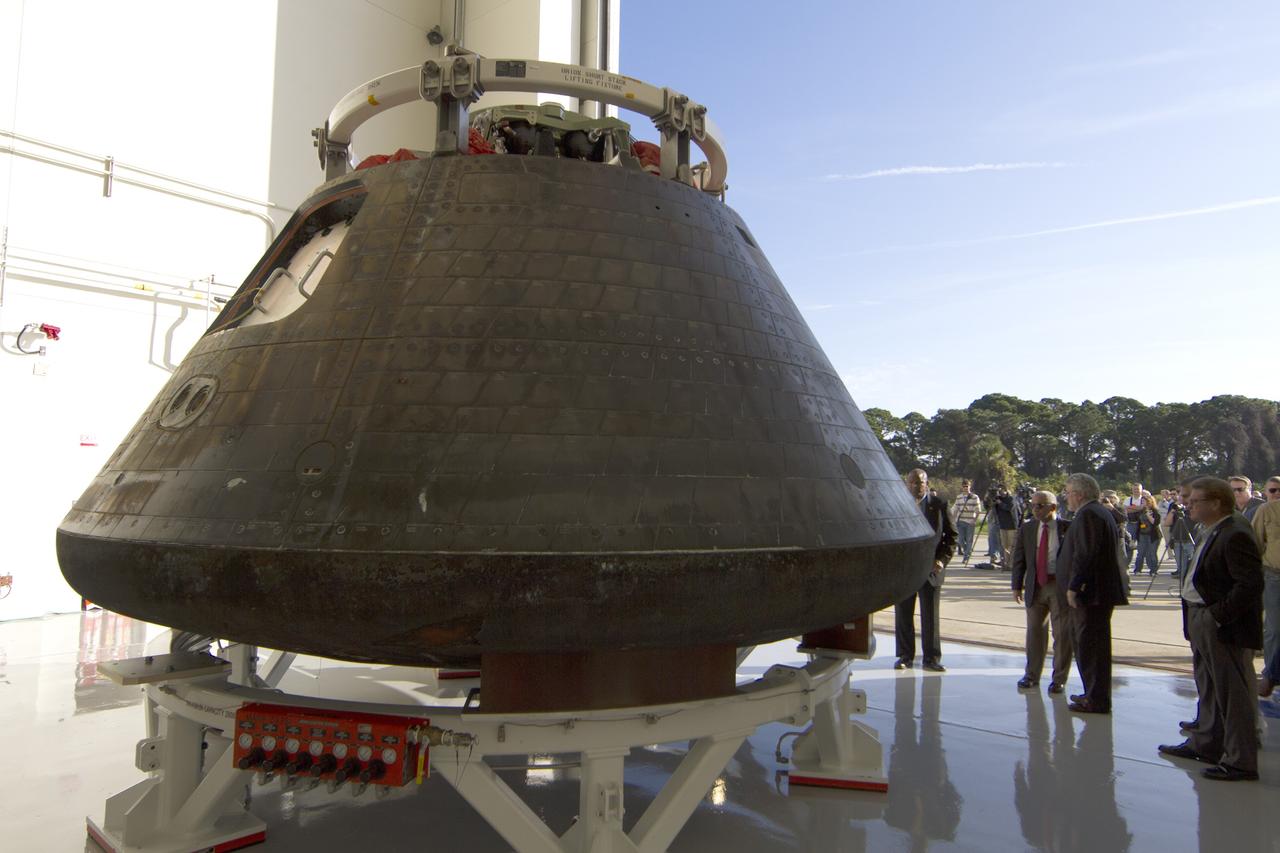
CAPE CANAVERAL, Fla. -- NASA Administrator Charlie Bolden, third from right, looked over the agency's Orion spacecraft this morning for the first time since it returned to Kennedy Space Center following the successful Orion flight test on Dec. 5. At far right is Jules Schneider, Lockheed Martin manager. Standing near Bolden is Paul Cooper, a Lockheed Martin manager. At far left is Kennedy Space Center Associate Director Kelvin Manning. Bearing the marks of a spacecraft that has returned to Earth through a searing plunge into the atmosphere, Orion is perched on a pedestal inside the Launch Abort System Facility at Kennedy where it is going through post-mission processing. Although the spacecraft Bolden looked over did not fly with a crew aboard during the flight test, Orion is designed to carry astronauts into deep space in the future setting NASA and the nation firmly on the journey to Mars. Photo credit: NASA/Cory Huston
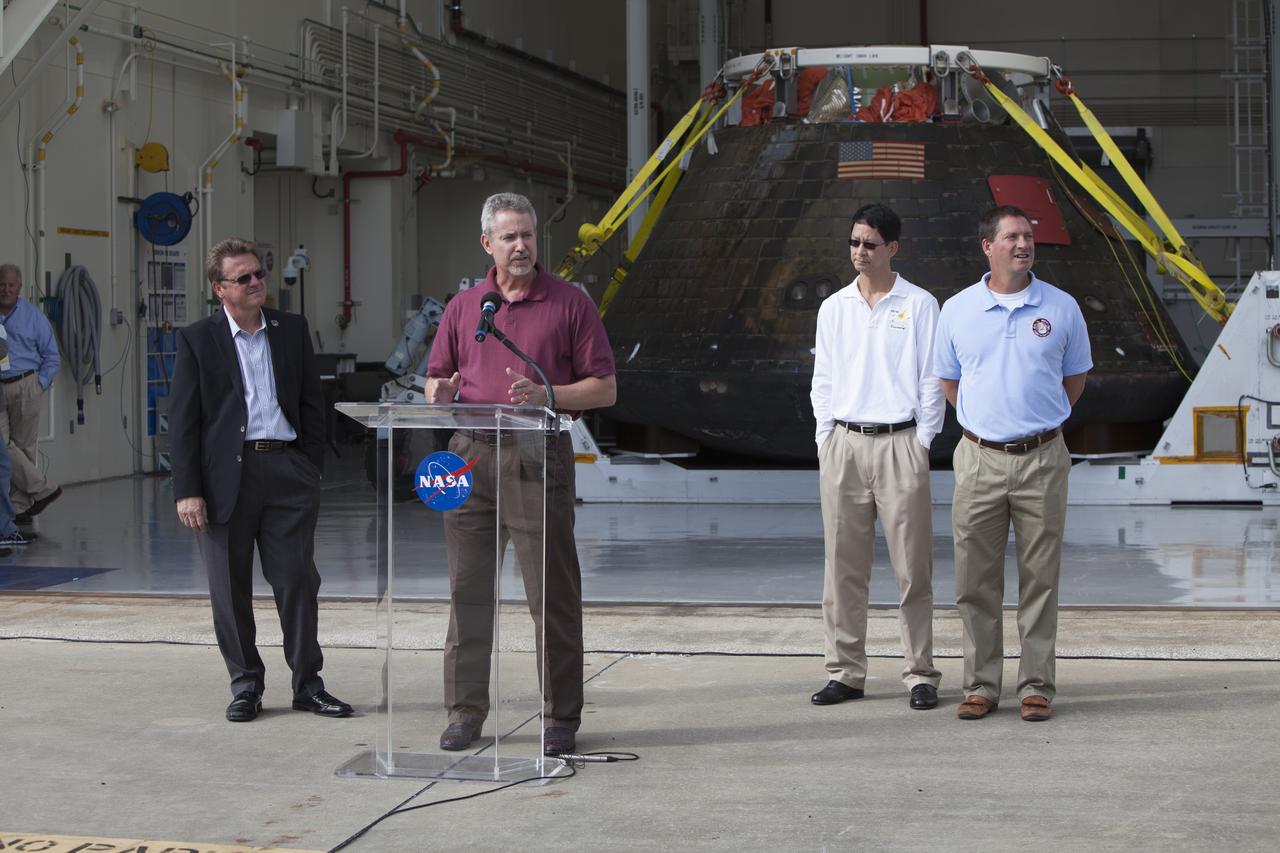
NASA's Orion spacecraft is viewed by members of the media at the Launch Abort System Facility at NASA's Kennedy Space Center in Florida. Speaking to the media during the viewing opportunity is Phil Weber, with the Ground Systems Development and Operations Program, or GSDO. At left is Jules Schneider, Lockheed Martin manager. At right is Glenn Chin, Orion Production Operations, and Lou Garcia, with GSDO. Orion made the 8-day, 2,700 mile overland trip back to Kennedy from Naval Base San Diego in California. Analysis of date obtained during its two-orbit, four-and-a-half hour mission Dec. 5 will provide engineers detailed information on how the spacecraft fared. GSDO led the recovery, offload and transportation efforts.
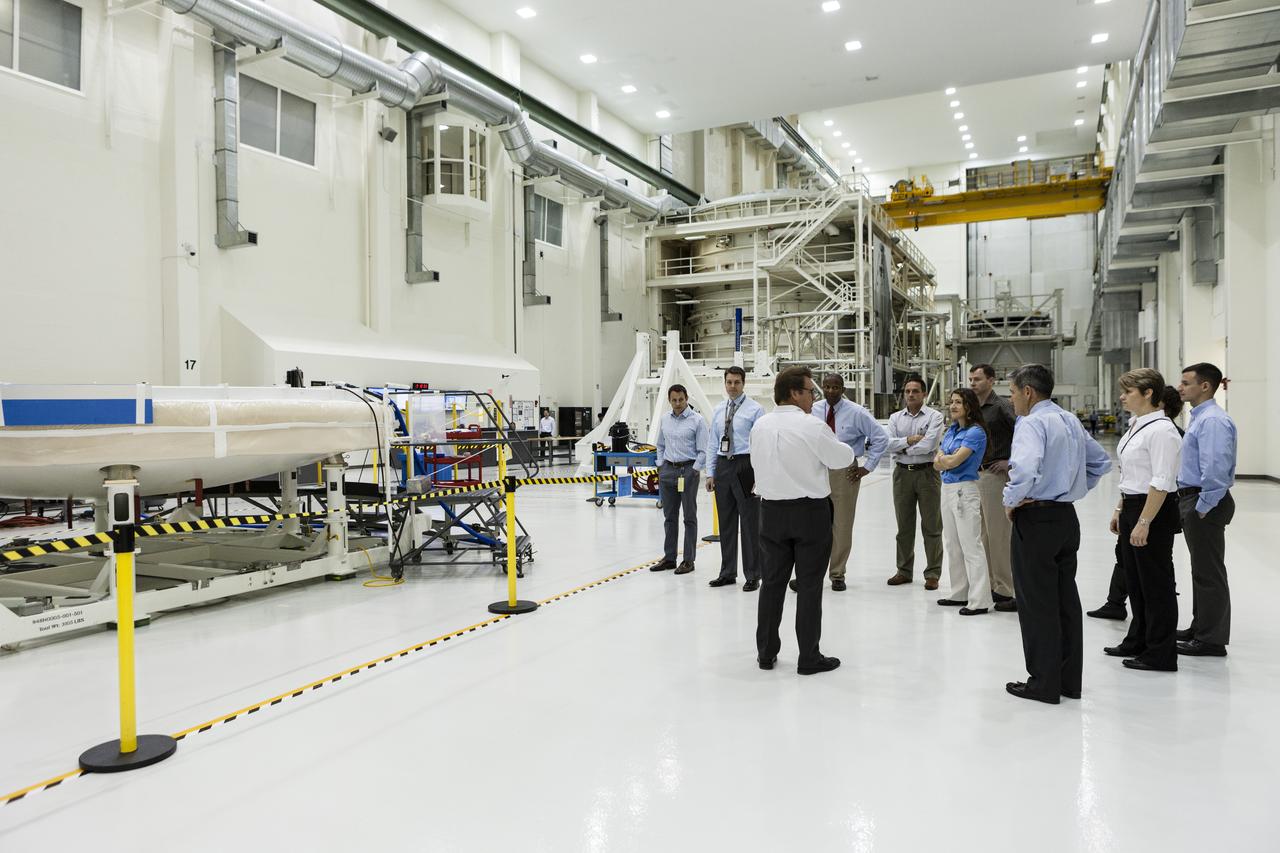
CAPE CANAVERAL, Fla. -- In the Operations and Checkout Building of NASA's Kennedy Space Center in Florida, agency astronaut candidates are briefed on preparations for the launch the Orion spacecraft on Exploration Flight Test EFT-1. Plans call for the Lockheed Martin-built Orion to launch atop a United Launch Alliance Delta IV Heavy rocket from Cape Canaveral Air Force Station. The astronaut class of 2013 was selected by NASA after an extensive year-and-a-half search. The new group will help the agency push the boundaries of exploration and travel to new destinations in the solar system. To learn more about the astronaut class of 2013, visit: http://www.nasa.gov/astronauts/2013astroclass.html Photo credit: NASA/Kim Shiflett
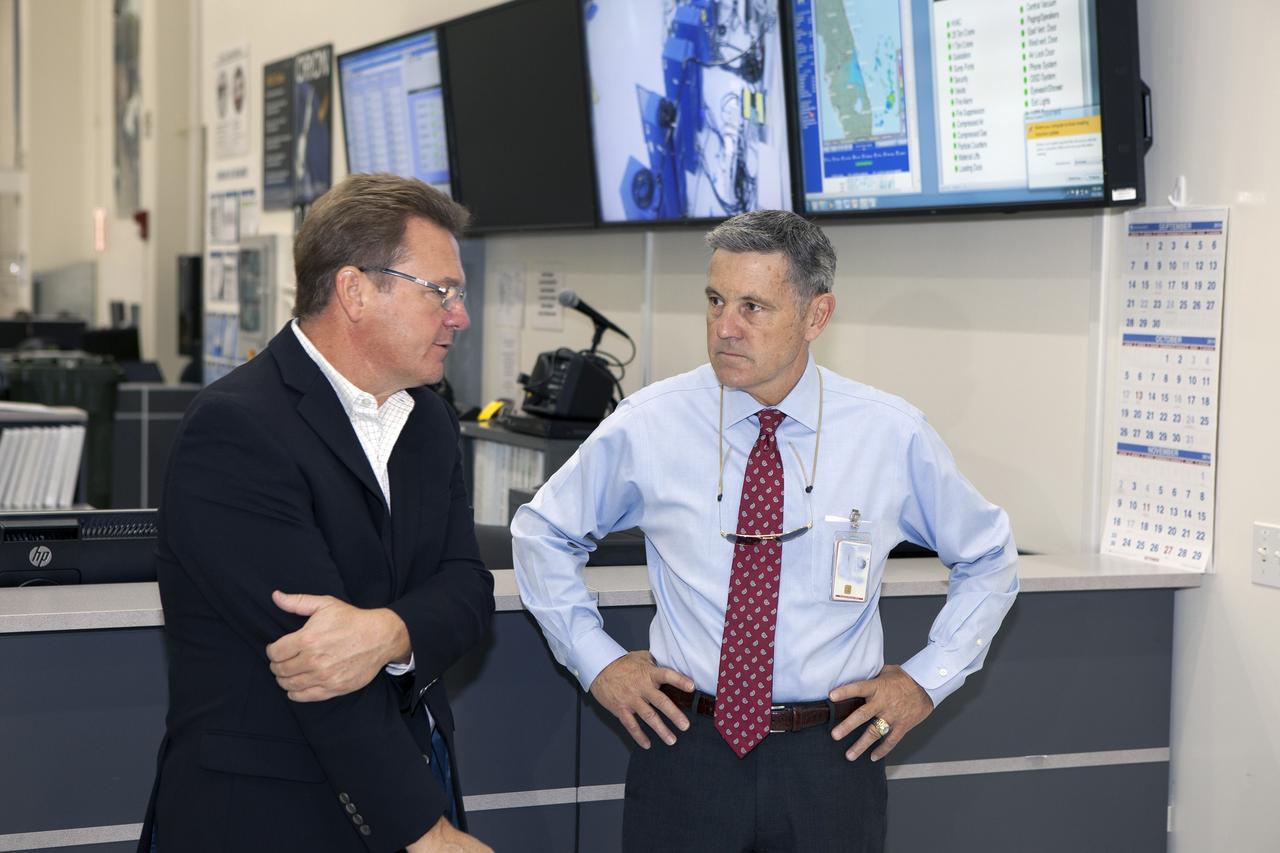
CAPE CANAVERAL, Fla. – Preparations are underway at the Neil Armstrong Operations and Checkout Building at NASA's Kennedy Space Center in Florida for the move of the Orion spacecraft for Exploration Flight Test-1 out of the high bay doors. Inside the high bay from left, are Jules Schneider, Lockheed Martin senior manager, and Kennedy Center Director Bob Cabana. The spacecraft will be transported to the Payload Hazardous Servicing Facility where it will be fueled ahead of its December flight test. Orion is the exploration spacecraft designed to carry astronauts to destinations not yet explored by humans, including an asteroid and Mars. It will have emergency abort capability, sustain the crew during space travel and provide safe re-entry from deep space return velocities. The first unpiloted test flight of the Orion is scheduled to launch atop a United Launch Alliance Delta IV Heavy rocket from Cape Canaveral Air Force Station in Florida to an altitude of 3,600 miles above the Earth's surface. The two-orbit, four-hour flight test will help engineers evaluate the systems critical to crew safety including the heat shield, parachute system and launch abort system. For more information, visit http://www.nasa.gov/orion. Photo credit: NASA/Daniel Casper
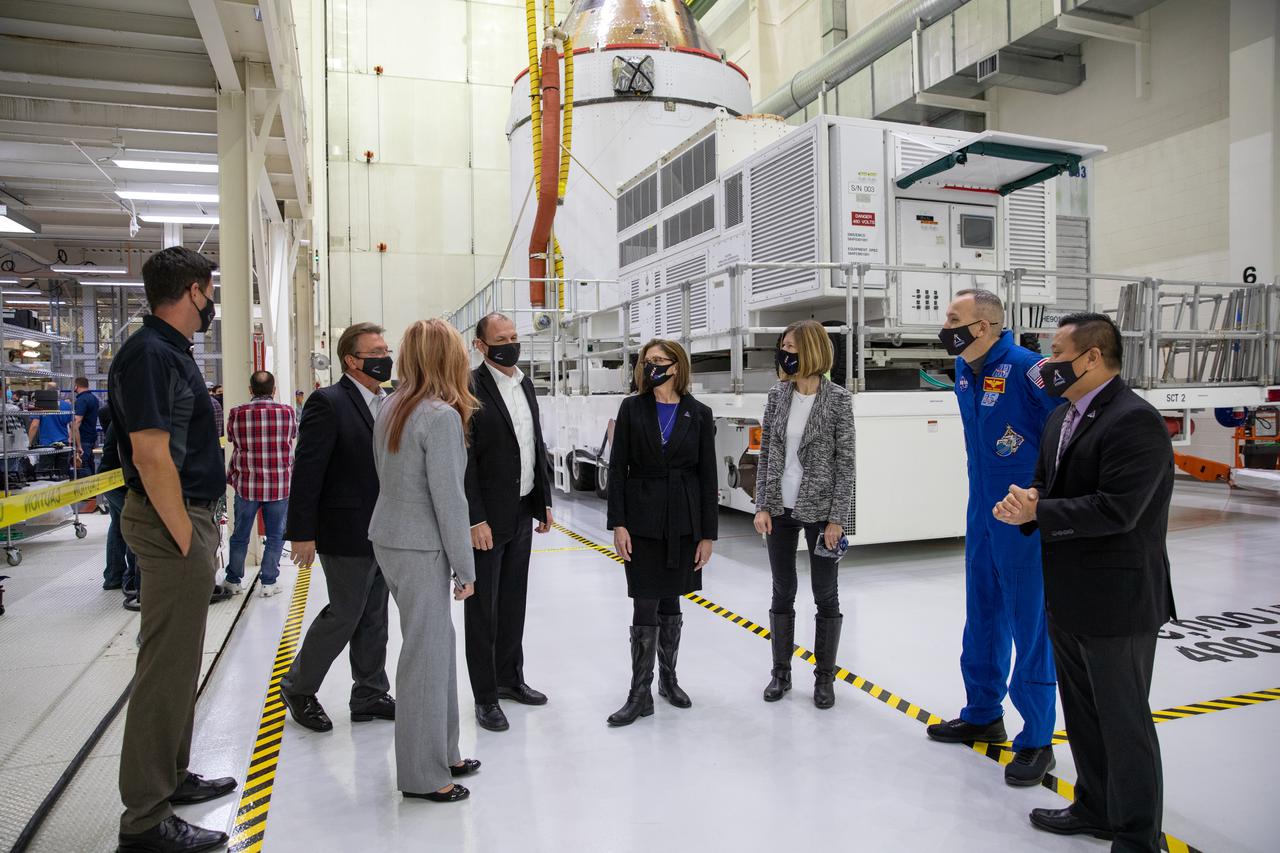
Orion is revealed for one of the final times on Jan. 14, as it is readied atop its transport pallet from the Neil Armstrong Operations and Checkout Building at NASA’s Kennedy Space Center in Florida, along its path to the pad ahead of the Artemis I launch. Inside the high bay, from left, are Nathan Varn, Lockheed Martin Production Control director; Jules Schneider, Lockheed Martin director of Orion Assembly, Test and Launch Operations at Kennedy; Kelly DeFazio, Lockheed Martin Orion Program director for production operations; Tony Antonelli, Lockheed Martin Orion Program director and Artemis II Mission director; Cathy Koerner, Orion Program manager; Kathy Lueders, associate administrator of the Human Exploration and Operations Mission Directorate; astronaut Randy Bresnik; and Howard Hu, Orion deputy program manager. Teams across the globe have worked tirelessly to assemble the spacecraft, which will receive a protective covering prior to departing for the Multi-Payload Processing Facility to begin ground processing by the Exploration Ground Systems and Jacobs teams.
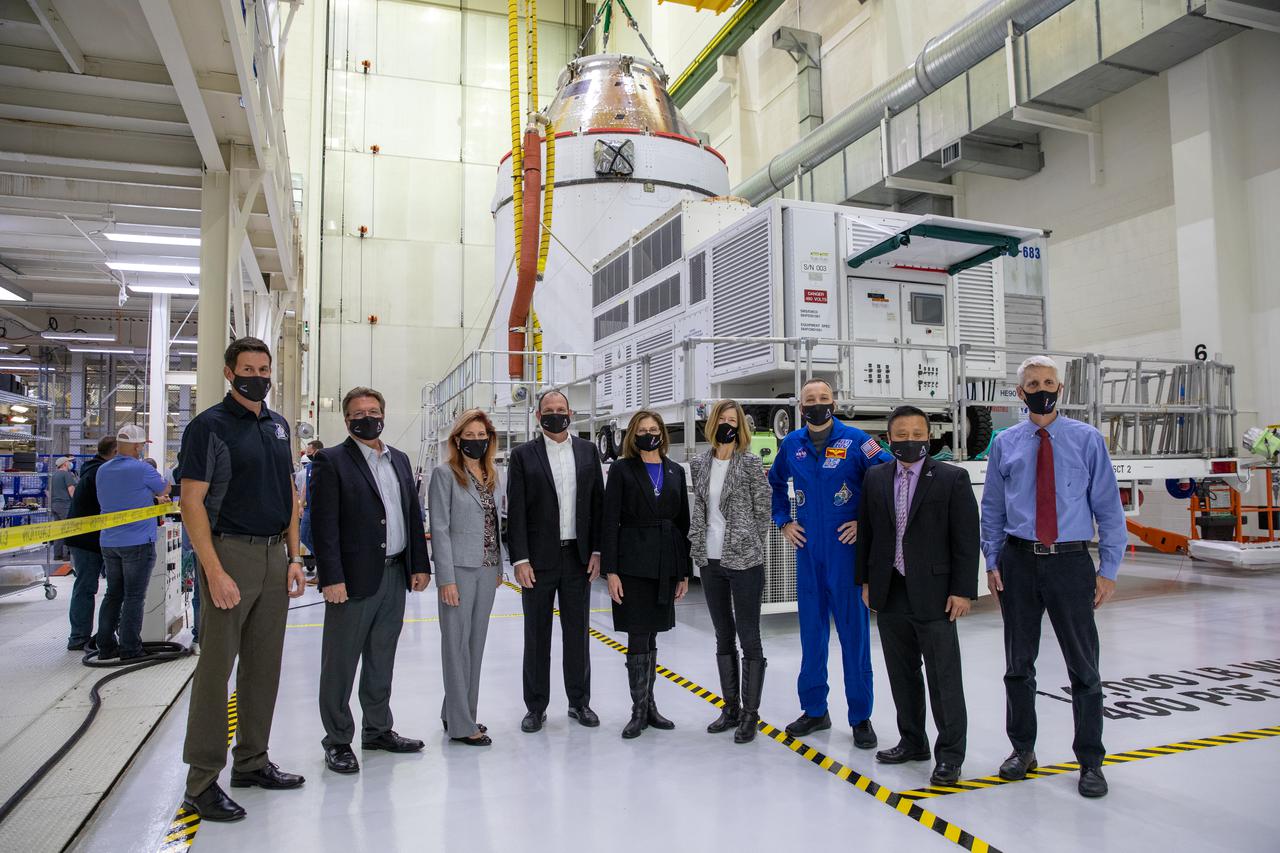
Orion is revealed for one of the final times on Jan. 14, as it is moved by crane to its transport pallet inside the Neil Armstrong Operations and Checkout Building at NASA’s Kennedy Space Center in Florida, along its path to the pad ahead of the Artemis I launch. Standing near Orion, from left, are Nathan Varn, Lockheed Martin Production Control director; Jules Schneider, Lockheed Martin Director of Orion Assembly, Test and Launch at Kennedy; Kelly DeFazio, Lockheed Martin Orion Program director for production operations; Tony Antonelli, Lockheed Martin Orion Program director and Artemis II mission director; Cathy Koerner, Orion Program manager; Kathy Lueders, associate administrator of the Human Exploration and Operations Mission Directorate; NASA astronaut Randy Bresnik; Howard Hu Orion Program deputy manager; and Scott Wilson, Orion Production Office manager. Teams across the globe have worked tirelessly to assemble the spacecraft, which will receive a protective covering prior to departing for the Multi-Payload Processing Facility to begin ground processing by the Exploration Ground Systems and Jacobs teams.
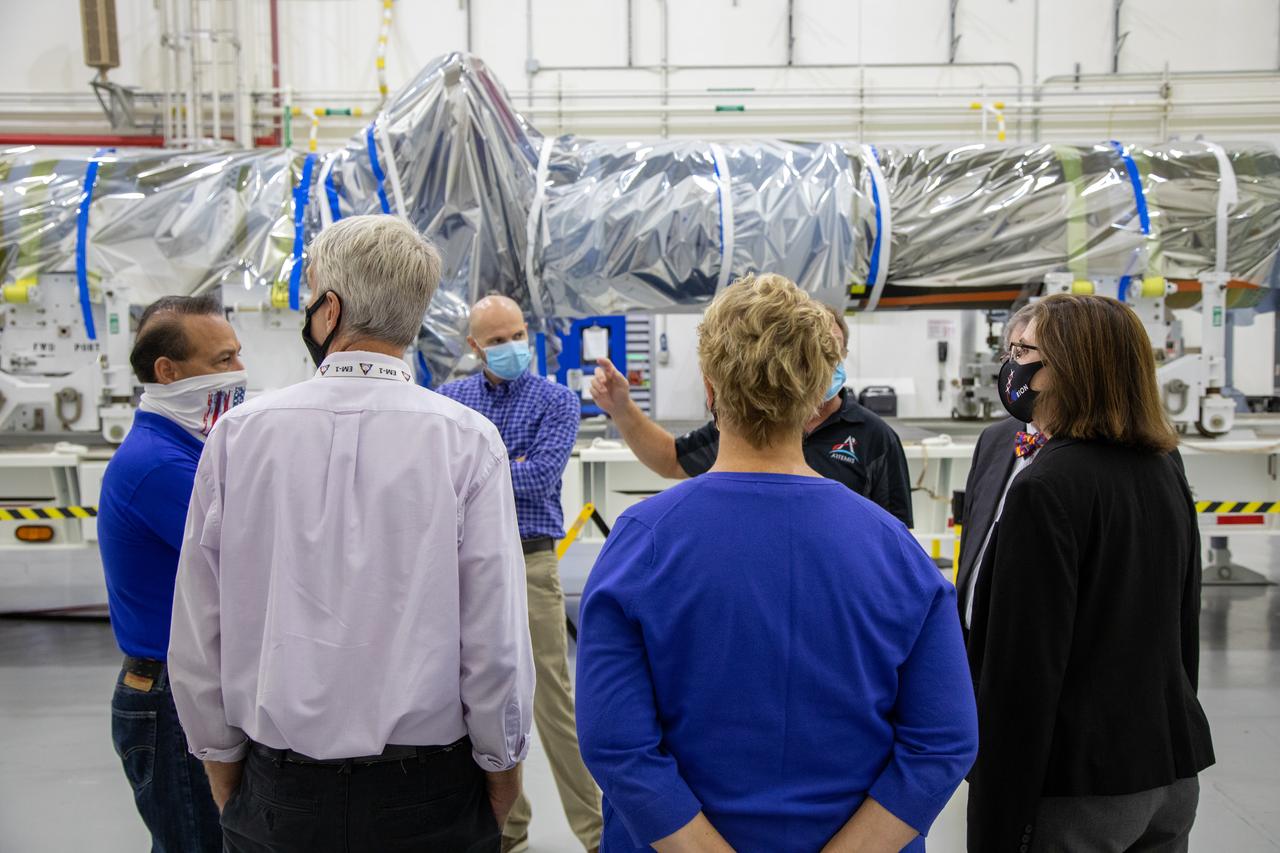
Catherine Koerner, far right, NASA Orion Program manager, along with senior managers from Orion and Lockheed Martin, tour the Launch Abort System Facility at NASA’s Kennedy Space Center in Florida on Oct. 6, 2020. Accompanying her from left, are Carlos Garcia, NASA Kennedy Launch Abort System Assembly, Integration and Test lead and Resident office manager; Scott Wilson, NASA Kennedy Orion Production Operations manager; Jim Skaggs, Kennedy Operations senior manager with Lockheed Martin; Jules Schneider, Kennedy Assembly, Test and Launch Operations director with Lockheed Martin; Mike Hawes, Lockheed Martin vice president and Orion Program manager; and Annette Hasbrook, Orion Program assistant manager. They are viewing the launch abort system for the Artemis II mission. Koerner also viewed the Orion spacecraft for the Artemis I and II missions in the Neil Armstrong Operations and Checkout Building. The first in a series of increasingly complex missions, Artemis I will test the Orion spacecraft and Space Launch System as an integrated system ahead of crewed flights to the Moon. Under the Artemis program, NASA will land the first woman and the next man on the Moon in 2024.
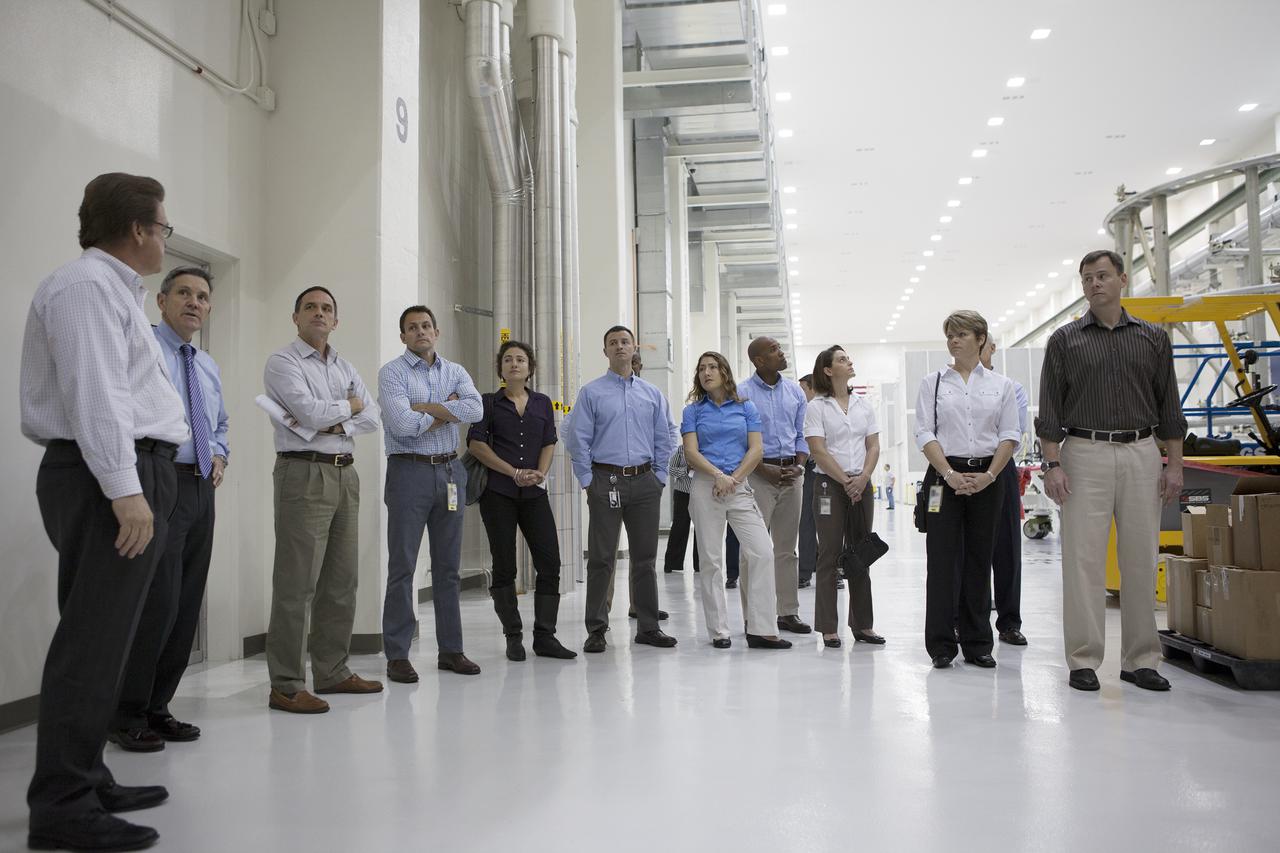
CAPE CANAVERAL, Fla. -- In the Operations and Checkout Building of NASA's Kennedy Space Center in Florida, agency astronauts are briefed on preparations for the launch the Orion spacecraft on Exploration Flight Test EFT-1. Plans call for the Lockheed Martin-built Orion to launch atop a United Launch Alliance Delta IV Heavy rocket from Cape Canaveral Air Force Station. Participating in the briefing, from the left, are Jules Schneider senior manager of Project Engineering for Lockheed Martin, center director Bob Cabana, Stu Mcclung, of NASA at the Johnson Space Center, Josh Cassada, Jessica Meir, Andrew Morgan, Christina Hammock, Victor Glover, Nicole Mann, Anne McClain and Tyler Nick Hague. The astronaut class of 2013 was selected by NASA after an extensive year-and-a-half search. The new group will help the agency push the boundaries of exploration and travel to new destinations in the solar system. To learn more about the astronaut class of 2013, visit: http:__www.nasa.gov_astronauts_2013astroclass.html Photo credit: NASA_Kim Shiflett
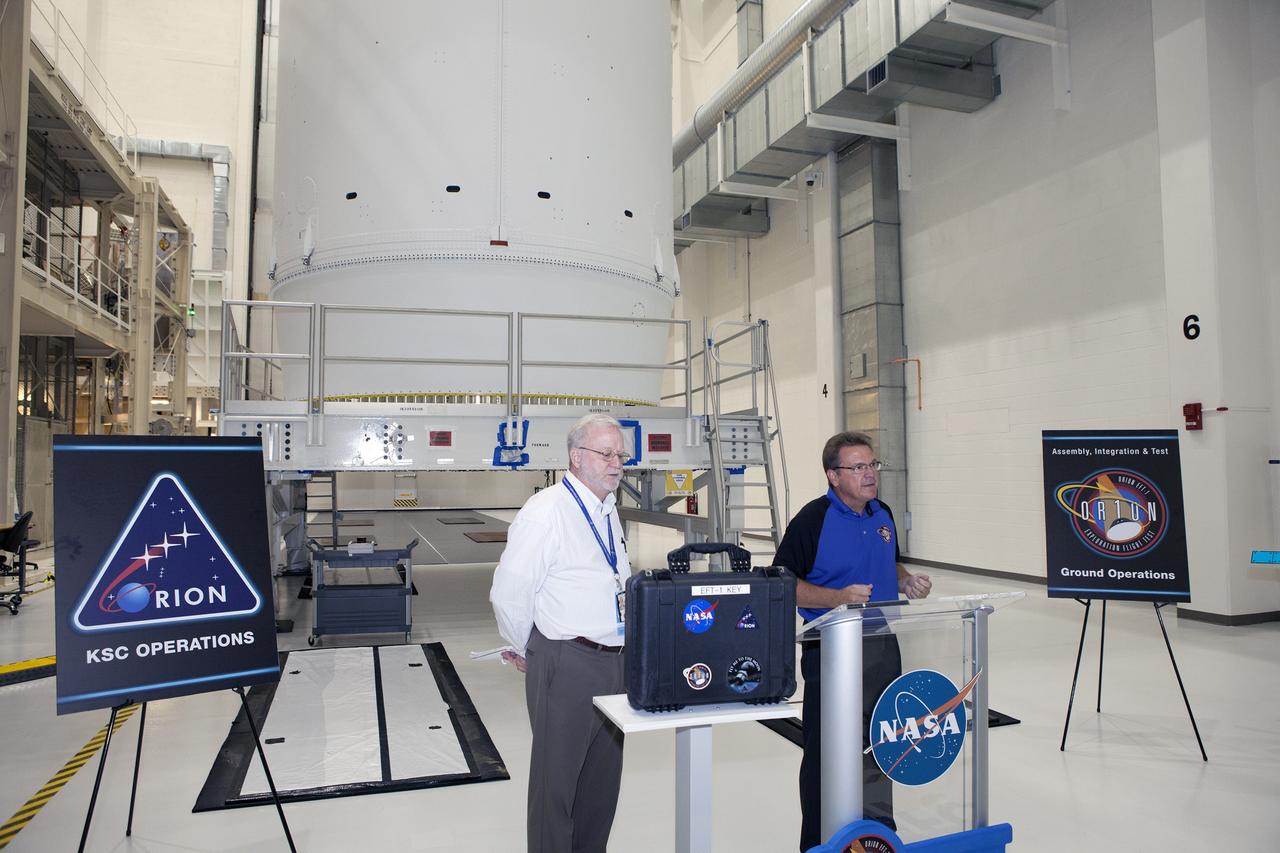
CAPE CANAVERAL, Fla. – Inside the Neil Armstrong Operations and Checkout Building high bay at NASA's Kennedy Space Center in Florida, Jules Schneider, at right, Lockheed Martin Orion Production Operations manager, speaks to NASA and Lockheed Martin workers during a ceremony to turn over the Orion spacecraft for Exploration Flight Test-1 to Ground Operations. At left is Blake Hale, Lockheed Martin Ground Operations manager. Orion is the exploration spacecraft designed to carry astronauts to destinations not yet explored by humans, including an asteroid and Mars. It will have emergency abort capability, sustain the crew during space travel and provide safe re-entry from deep space return velocities. The first unpiloted test flight of the Orion is scheduled to launch atop a United Launch Alliance Delta IV Heavy rocket from Cape Canaveral Air Force Station in Florida in December to an altitude of 3,600 miles above the Earth's surface. The two-orbit, four-hour flight test will help engineers evaluate the systems critical to crew safety including the heat shield, parachute system and launch abort system. For more information, visit http://www.nasa.gov/orion. Photo credit: NASA/Daniel Casper
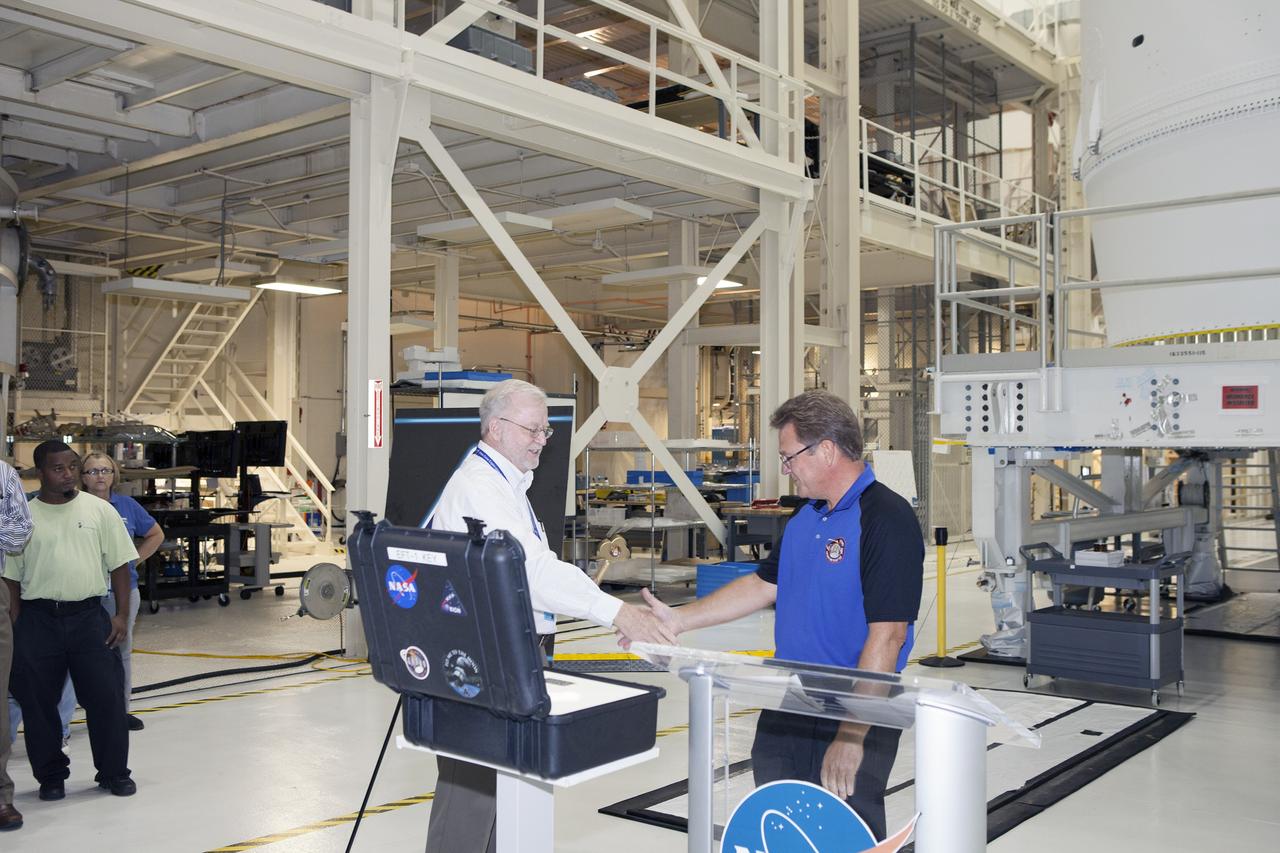
CAPE CANAVERAL, Fla. – Inside the Neil Armstrong Operations and Checkout Building high bay at NASA's Kennedy Space Center in Florida, Jules Schneider, at right, Lockheed Martin Orion Production Operations manager, shakes hands with Blake Hale, Lockheed Martin Ground Operations manager, during a ceremony to officially turn over the Orion spacecraft for Exploration Flight Test-1 to Lockheed Martin Ground Operations. Orion is the exploration spacecraft designed to carry astronauts to destinations not yet explored by humans, including an asteroid and Mars. It will have emergency abort capability, sustain the crew during space travel and provide safe re-entry from deep space return velocities. The first unpiloted test flight of the Orion is scheduled to launch atop a United Launch Alliance Delta IV Heavy rocket from Cape Canaveral Air Force Station in Florida in December to an altitude of 3,600 miles above the Earth's surface. The two-orbit, four-hour flight test will help engineers evaluate the systems critical to crew safety including the heat shield, parachute system and launch abort system. For more information, visit http://www.nasa.gov/orion. Photo credit: NASA/Daniel Casper
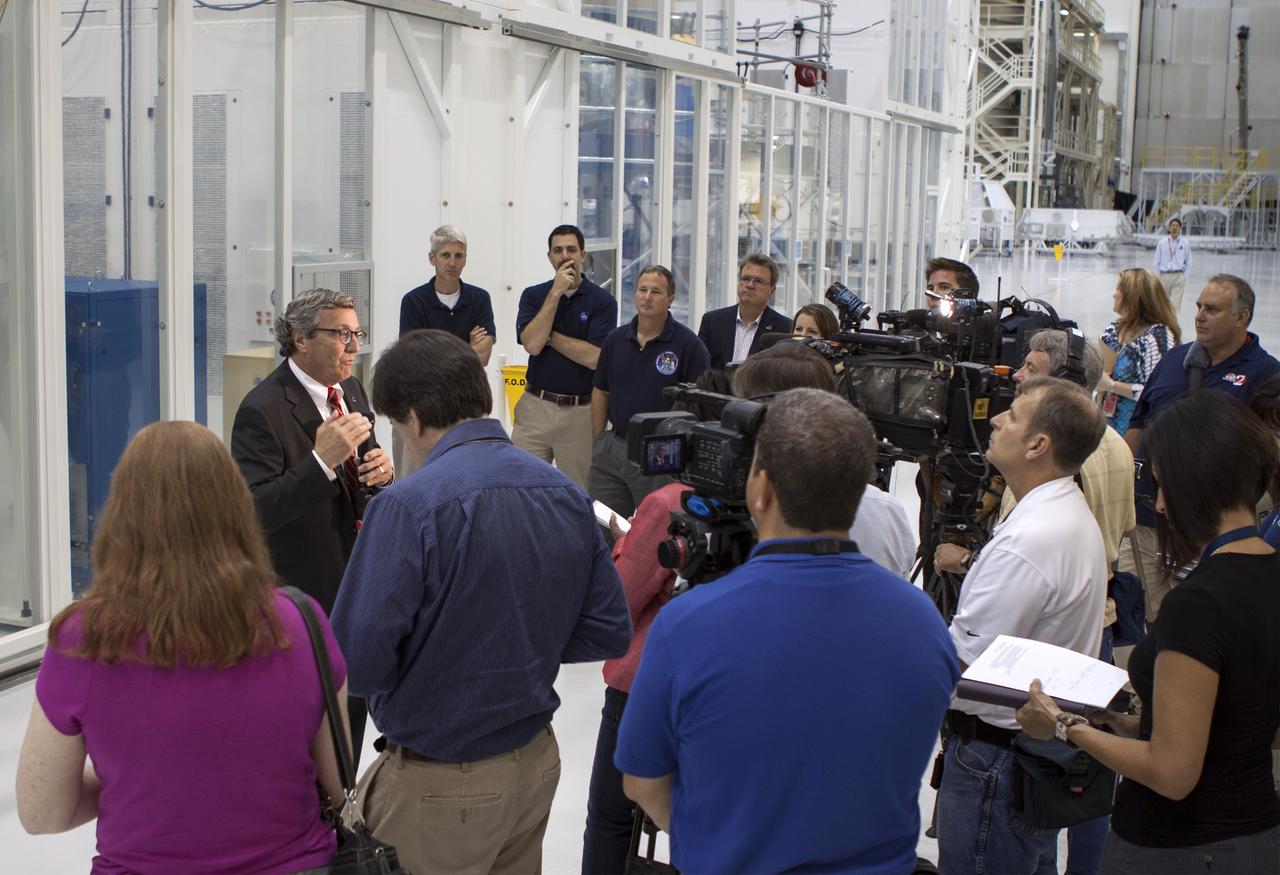
CAPE CANAVERAL, Fla. – Inside the Operations and Checkout Building high bay at NASA’s Kennedy Space Center in Florida, members of the media receive an on activities in NASA’s Ground Systems Development and Operations, or GSDO, Program, Space Launch System and Orion crew module for Exploration Test Flight 1. Speaking to the media is Larry Price, Lockheed Martin deputy program manager for Orion. In the background, from left are Scott Wilson, manager of Orion Production Operations at Kennedy Jeremy Parsons, chief of the GSDO Operations Integration Office at Kennedy Tom Erdman, from Marshall Space Flight Center’s Kennedy resident office and Jules Schneider, Lockheed Martin manager of Orion Production Operations. Orion is the exploration spacecraft designed to carry crews to space beyond low Earth orbit. It will provide emergency abort capability, sustain the crew during the space travel and provide safe re-entry from deep space return velocities. Orion’s first unpiloted test flight is scheduled to launch in 2014 atop a Delta IV rocket. A second uncrewed flight test is scheduled for 2017 on NASA’s Space Launch System rocket. For more information, visit http://www.nasa.gov/orion. Photo credit: NASA/Jim Grossmann
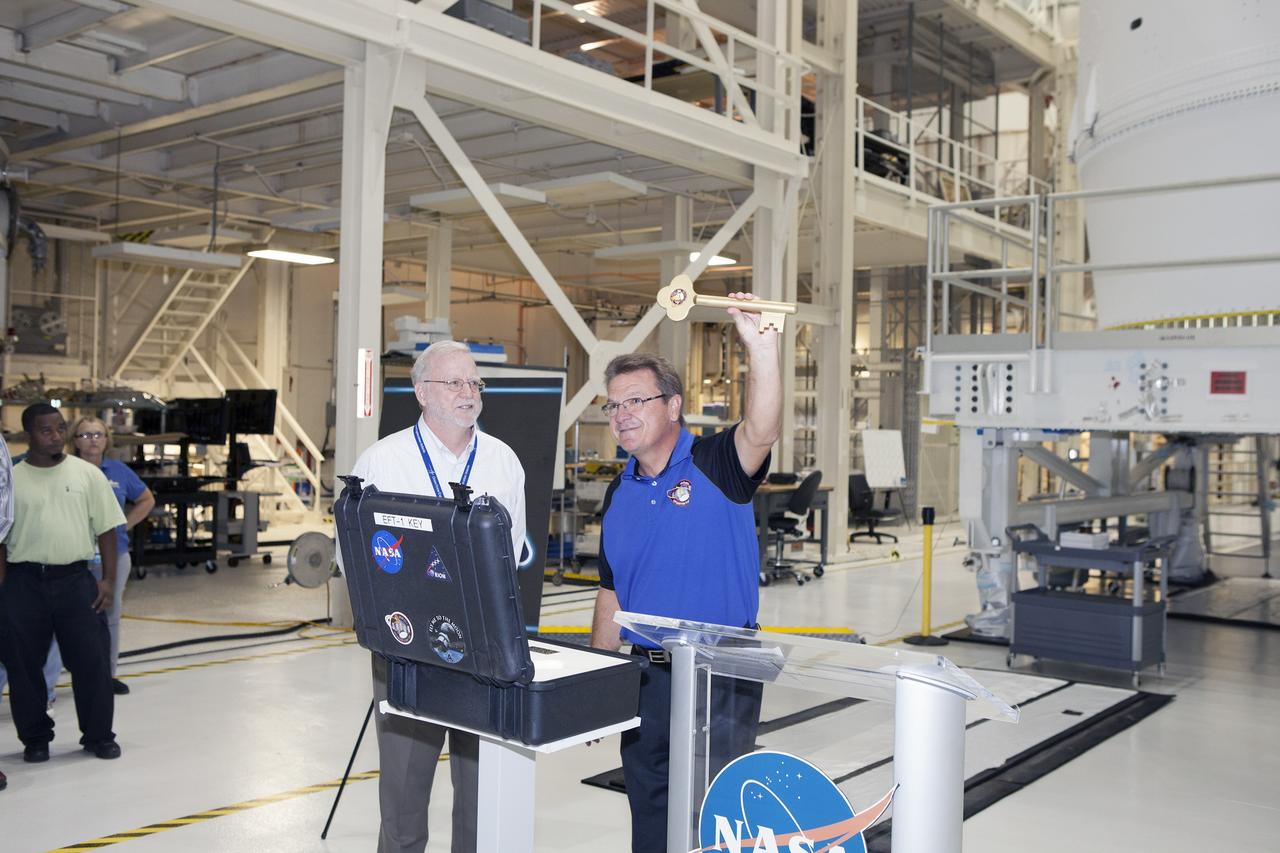
CAPE CANAVERAL, Fla. – During a ceremony inside the Neil Armstrong Operations and Checkout Building high bay at NASA's Kennedy Space Center in Florida, Jules Schneider, Lockheed Martin Orion Production Operations manager, holds the key to symbolically turn over the Orion spacecraft for Exploration Flight Test-1 to Ground Operations. Waiting to accept the key is Blake Hale, Lockheed Martin Ground Operations manager. Orion is the exploration spacecraft designed to carry astronauts to destinations not yet explored by humans, including an asteroid and Mars. It will have emergency abort capability, sustain the crew during space travel and provide safe re-entry from deep space return velocities. The first unpiloted test flight of the Orion is scheduled to launch atop a United Launch Alliance Delta IV Heavy rocket from Cape Canaveral Air Force Station in Florida in December to an altitude of 3,600 miles above the Earth's surface. The two-orbit, four-hour flight test will help engineers evaluate the systems critical to crew safety including the heat shield, parachute system and launch abort system. For more information, visit http://www.nasa.gov/orion. Photo credit: NASA/Daniel Casper
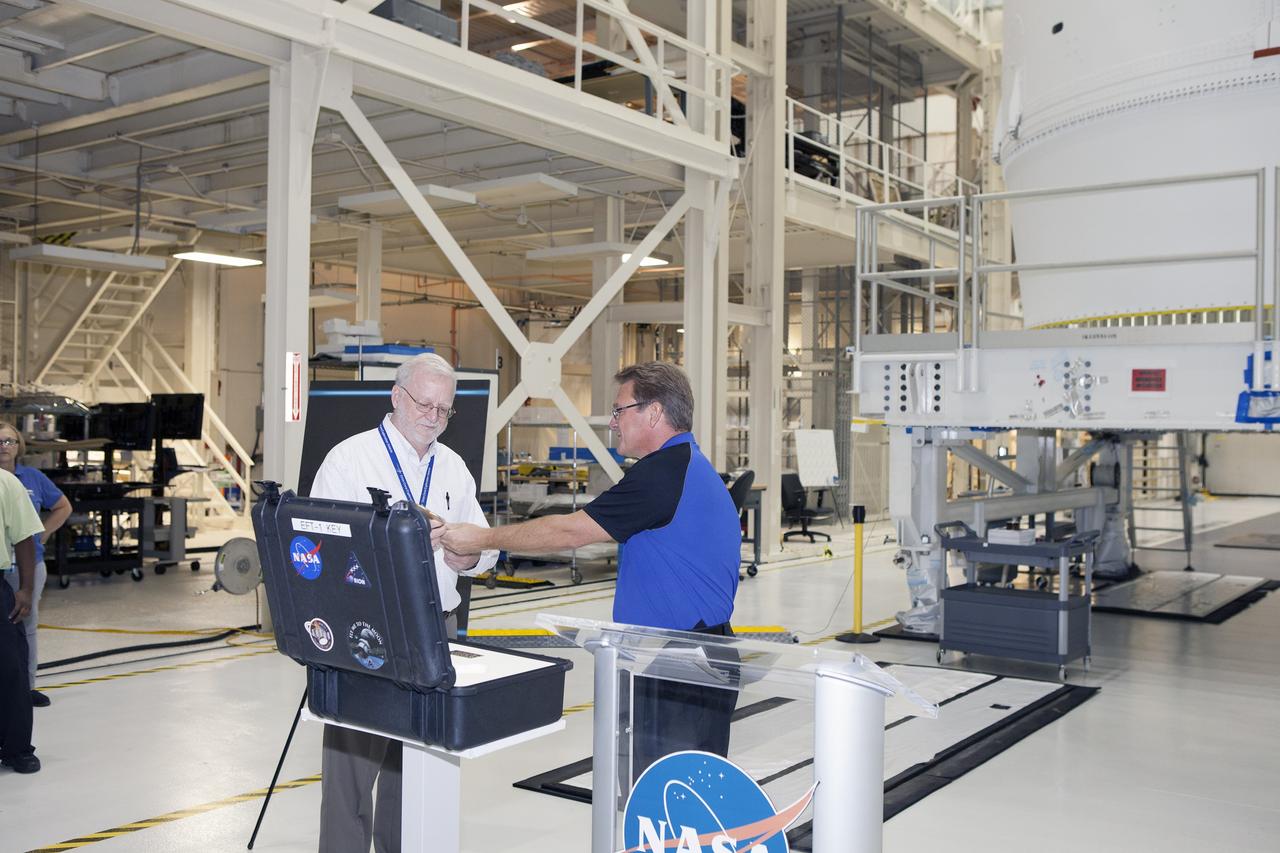
CAPE CANAVERAL, Fla. – During a ceremony inside the Neil Armstrong Operations and Checkout Building high bay at NASA's Kennedy Space Center in Florida, Jules Schneider, at right, Lockheed Martin Orion Production Operations manager, presents the key to symbolically turn over the Orion spacecraft for Exploration Flight Test-1 to Ground Operations. Accepting the key is Blake Hale, Lockheed Martin Ground Operations manager. Orion is the exploration spacecraft designed to carry astronauts to destinations not yet explored by humans, including an asteroid and Mars. It will have emergency abort capability, sustain the crew during space travel and provide safe re-entry from deep space return velocities. The first unpiloted test flight of the Orion is scheduled to launch atop a United Launch Alliance Delta IV Heavy rocket from Cape Canaveral Air Force Station in Florida in December to an altitude of 3,600 miles above the Earth's surface. The two-orbit, four-hour flight test will help engineers evaluate the systems critical to crew safety including the heat shield, parachute system and launch abort system. For more information, visit http://www.nasa.gov/orion. Photo credit: NASA/Daniel Casper

Larry Price, closest to the Artemis I spacecraft, Lockheed Martin Orion Program manager, accompanies Russell Vought, director of the White House Office of Management and Budget, during a tour of the Neil Armstrong Operations and Checkout Building high bay at NASA’s Kennedy Space Center in Florida on Aug. 28, 2020. Behind them, from left, are Brian McCormack, White House associate director of the Office of Management and Budget, and Kennedy Space Director Bob Cabana. At far right, from the front, are Jules Schneider, Lockheed Martin Assembly, Test and Launch Operations, NASA Administrator Jim Bridenstine, and Glenn Chin, Deputy Manager of Orion Production Operations. In the foreground, from left are Dr. Eric Thoemmes, vice president, Lockheed Martin Space, Missile Defense and Strategic, and NASA Deputy Administrator Jim Morhard. Inside the high bay, Orion spacecraft are being prepared for Artemis I and Artemis II. The Office of Management and Budget is working with the U.S. Congress to line up the necessary resources to land the first woman and the next man on the Moon in 2024.
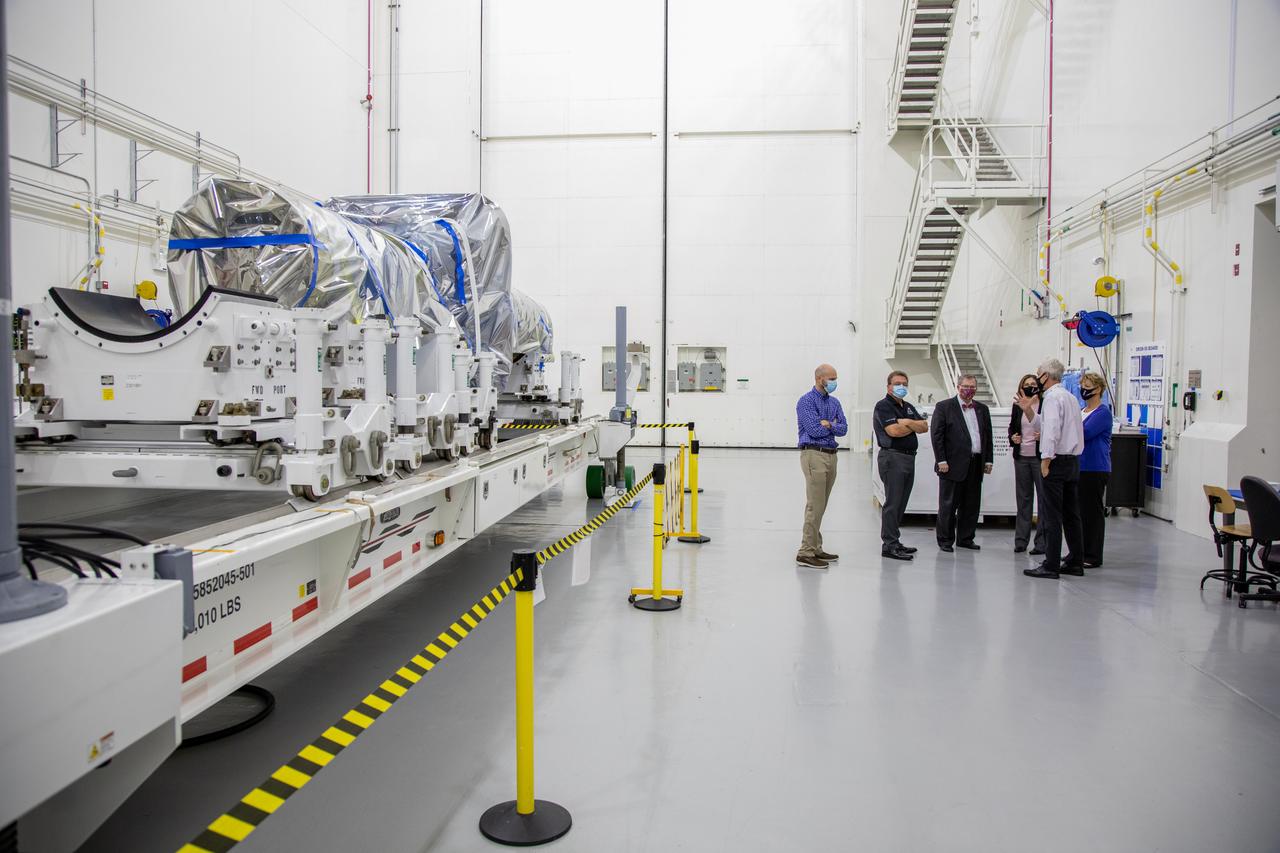
Catherine Koerner, third from right, NASA Orion Program manager, along with senior managers from Orion and Lockheed Martin, tour the Launch Abort System Facility at NASA’s Kennedy Space Center in Florida on Oct. 6, 2020. Accompanying her from left, are Jim Skaggs, Kennedy Operations senior manager with Lockheed Martin; Jules Schneider, Kennedy Assembly, Test and Launch Operations director with Lockheed Martin; Mike Hawes, Lockheed Martin vice president and Orion Program manager; Scott Wilson, NASA Kennedy Orion Production Operations manager; and Annette Hasbrook, Orion Program assistant manager. They are viewing the launch abort system for the Artemis II mission. Koerner also viewed the Orion spacecraft for the Artemis I and II missions in the Neil Armstrong Operations and Checkout Building. The first in a series of increasingly complex missions, Artemis I will test the Orion spacecraft and Space Launch System as an integrated system ahead of crewed flights to the Moon. Under the Artemis program, NASA will land the first woman and the next man on the Moon in 2024.
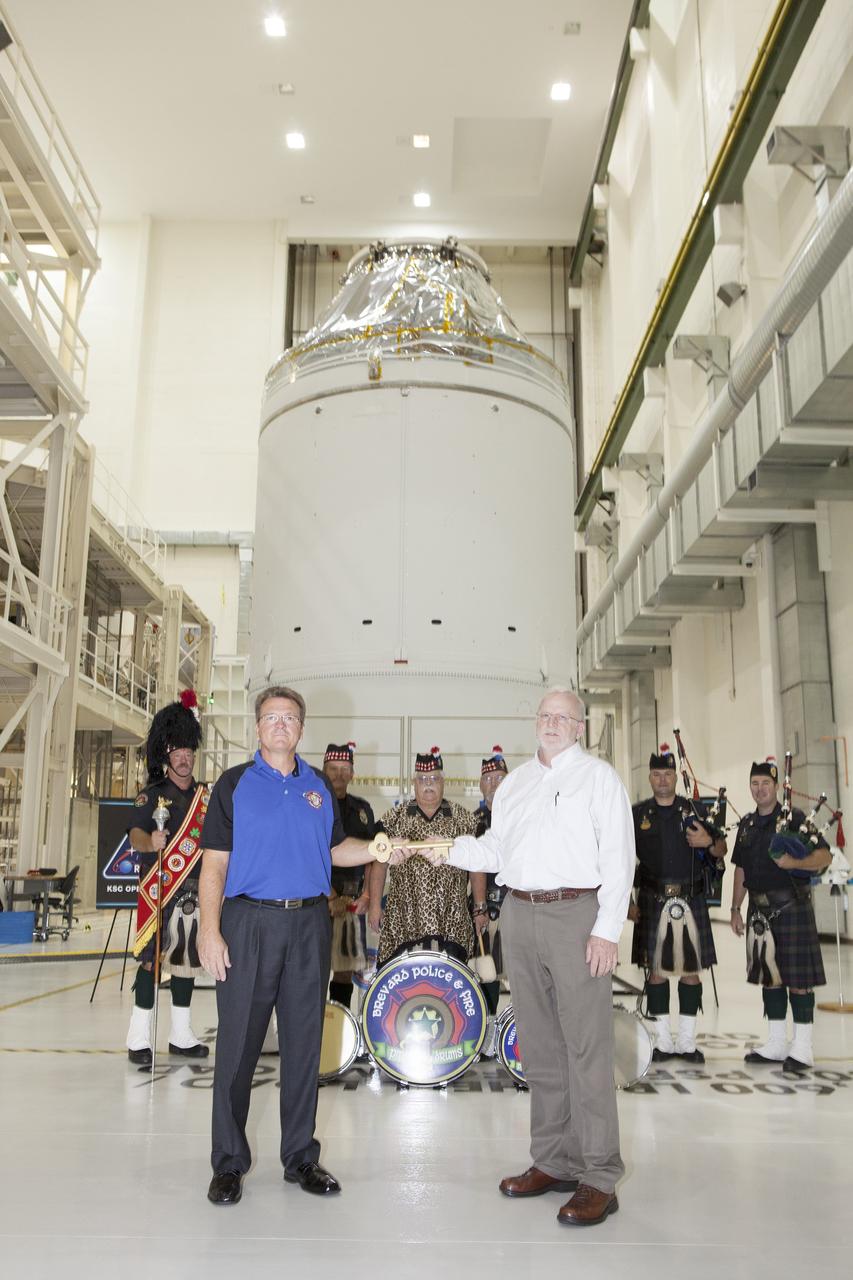
CAPE CANAVERAL, Fla. – During a ceremony inside the Neil Armstrong Operations and Checkout Building high bay at NASA's Kennedy Space Center in Florida, the Orion spacecraft for Exploration Flight Test-1 was officially turned over to Lockheed Martin Ground Operations from Orion Assembly, Integration and Production. Holding the key during the turn over, are Jules Schneider, at left, Lockheed Martin Orion Production Operations manager, and Blake Hale, Lockheed Martin Ground Operations manager. Behind them are members of the Brevard Police and Fire Pipes and Drums. Orion is the exploration spacecraft designed to carry astronauts to destinations not yet explored by humans, including an asteroid and Mars. It will have emergency abort capability, sustain the crew during space travel and provide safe re-entry from deep space return velocities. The first unpiloted test flight of the Orion is scheduled to launch atop a United Launch Alliance Delta IV Heavy rocket from Cape Canaveral Air Force Station in Florida in December to an altitude of 3,600 miles above the Earth's surface. The two-orbit, four-hour flight test will help engineers evaluate the systems critical to crew safety including the heat shield, parachute system and launch abort system. For more information, visit http://www.nasa.gov/orion. Photo credit: NASA/Daniel Casper
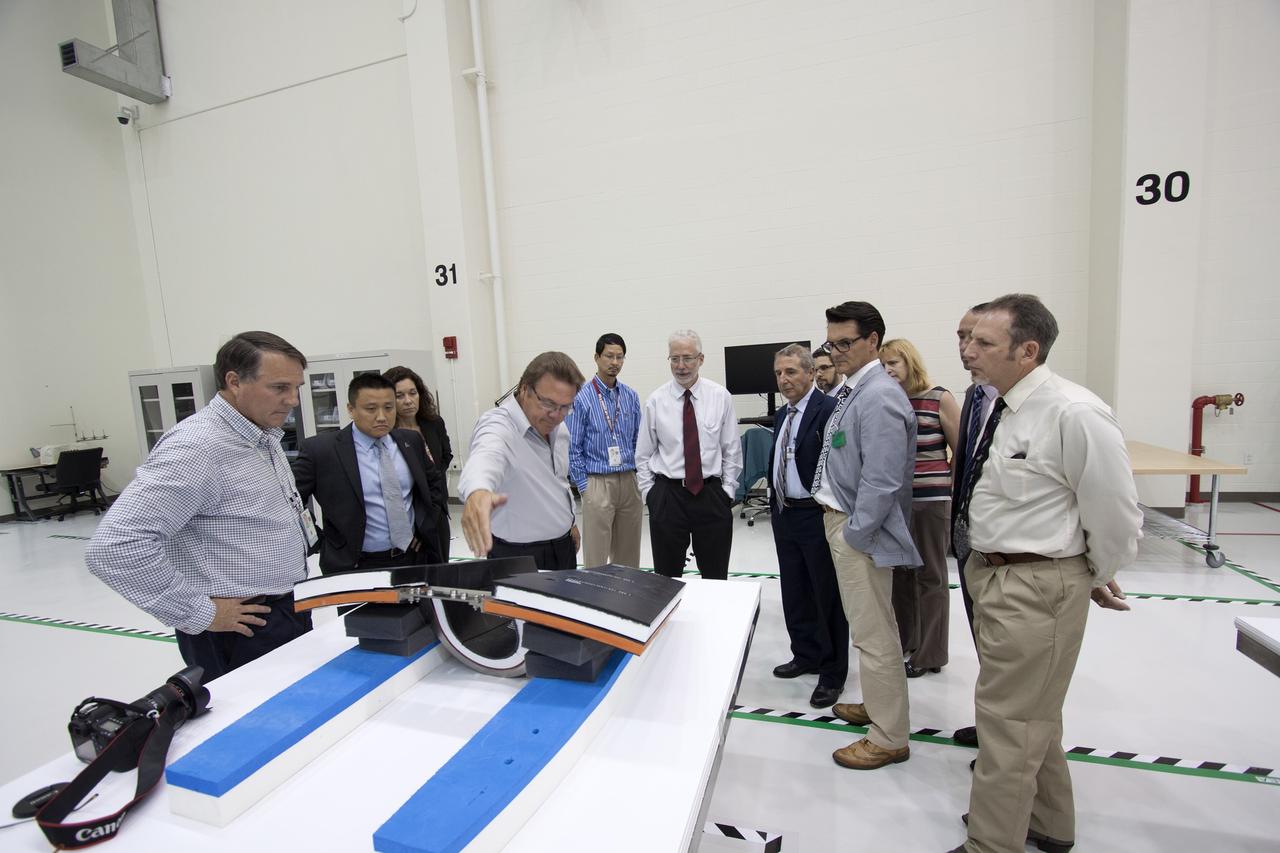
CAPE CANAVERAL, Fla. – Representatives from the European Space Agency, or ESA, toured the Operations and Checkout Building high bay at NASA’s Kennedy Space Center in Florida. Pointing at thermal protection system tiles is Jules Schneider, Lockheed Martin senior manager. At right, in the blue suit, is Bernardo Patti, ESA manager of International Space Station Operations. Standing next to Patti is Nico Dettman, ESA Space Transportation Department director. Orion is the exploration spacecraft designed to carry crews to space beyond low Earth orbit. It will provide emergency abort capability, sustain the crew during the space travel and provide safe re-entry from deep space return velocities. Orion’s first unpiloted test flight is scheduled to launch in 2014 atop a Delta IV rocket. A second uncrewed flight test is scheduled for 2017 on NASA’s Space Launch System rocket. For more information, visit http://www.nasa.gov/orion. Photo credit: NASA/Jim Grossmann
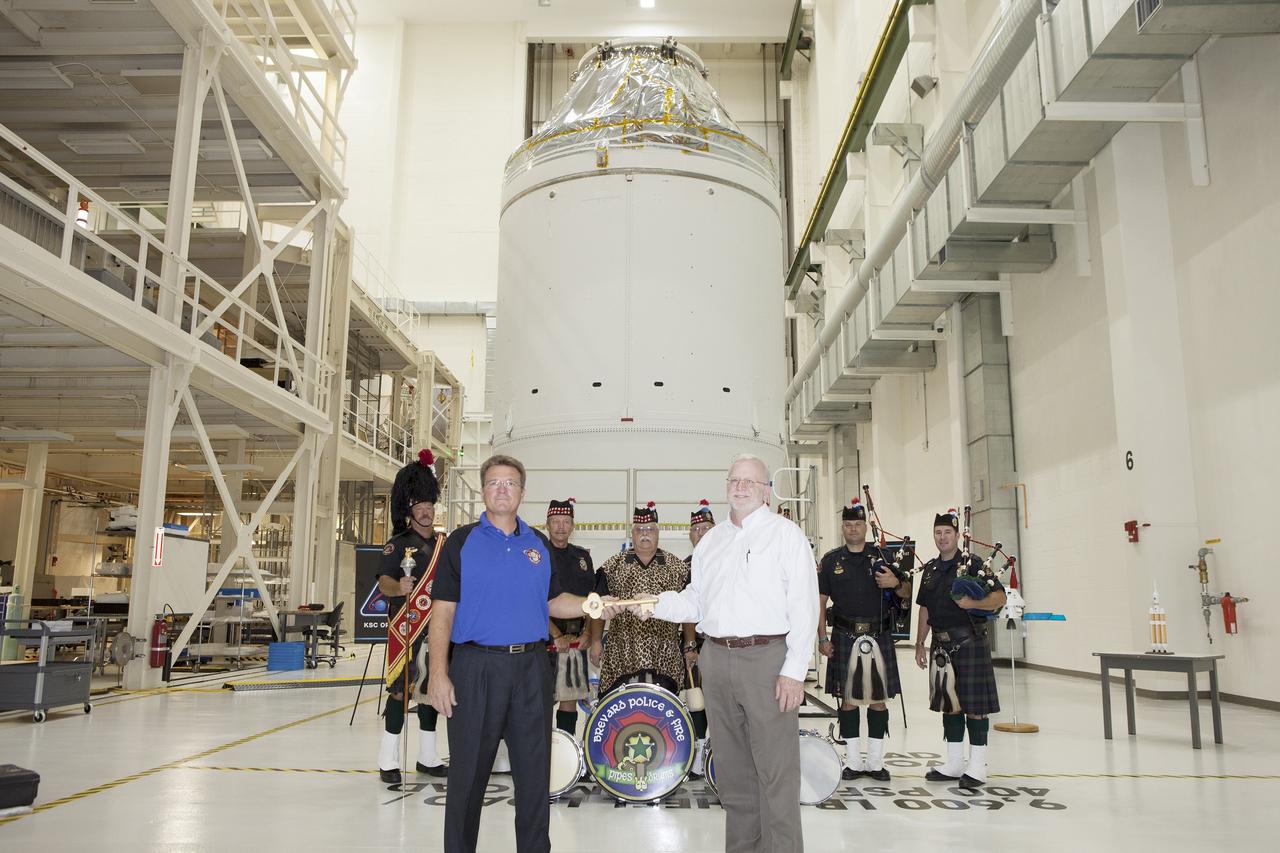
CAPE CANAVERAL, Fla. – During a ceremony inside the Neil Armstrong Operations and Checkout Building high bay at NASA's Kennedy Space Center in Florida, the Orion spacecraft for Exploration Flight Test-1 was officially turned over to Lockheed Martin Ground Operations from Orion Assembly, Integration and Production. Shaking hands during the turn over, are Jules Schneider, at left, Lockheed Martin Orion Production Operations manager, and Blake Hale, Lockheed Martin Ground Operations manager. Behind them are members of the Brevard Police and Fire Pipes and Drums. Orion is the exploration spacecraft designed to carry astronauts to destinations not yet explored by humans, including an asteroid and Mars. It will have emergency abort capability, sustain the crew during space travel and provide safe re-entry from deep space return velocities. The first unpiloted test flight of the Orion is scheduled to launch atop a United Launch Alliance Delta IV Heavy rocket from Cape Canaveral Air Force Station in Florida in December to an altitude of 3,600 miles above the Earth's surface. The two-orbit, four-hour flight test will help engineers evaluate the systems critical to crew safety including the heat shield, parachute system and launch abort system. For more information, visit http://www.nasa.gov/orion. Photo credit: NASA/Daniel Casper
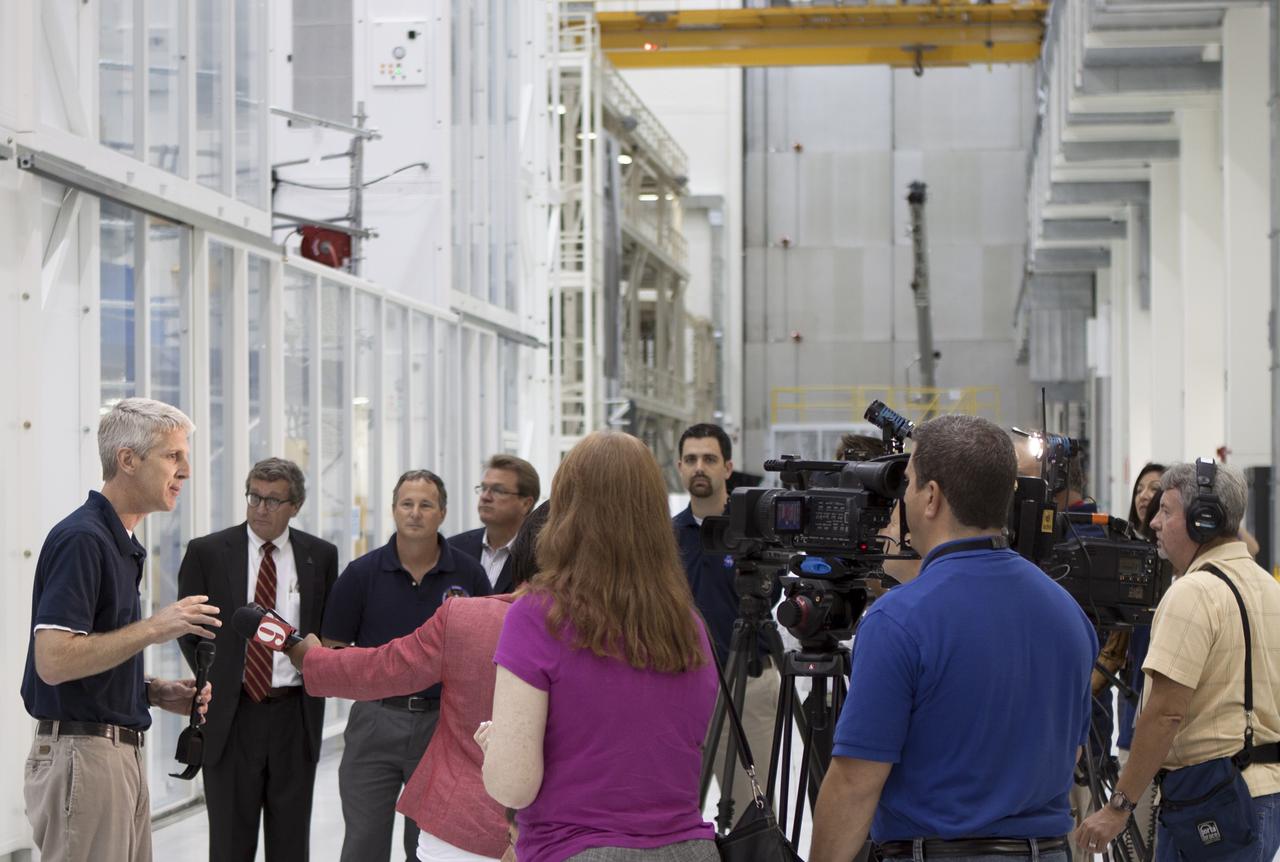
CAPE CANAVERAL, Fla. – Inside the Operations and Checkout Building high bay at NASA’s Kennedy Space Center in Florida, members of the media receive an on activities in NASA’s Ground Systems Development and Operations, or GSDO, Program, Space Launch System and Orion crew module for Exploration Test Flight 1. Speaking to the media, from left are Scott Wilson, manager of Orion Production Operations at Kennedy Larry Price, Lockheed Martin deputy program manager for Orion Tom Erdman, from Marshall Space Flight Center’s Kennedy resident office Jules Schneider, Lockheed Martin manager of Orion Production Operations and Jeremy Parsons, chief of the GSDO Operations Integration Office at Kennedy. Orion is the exploration spacecraft designed to carry crews to space beyond low Earth orbit. It will provide emergency abort capability, sustain the crew during the space travel and provide safe re-entry from deep space return velocities. Orion’s first unpiloted test flight is scheduled to launch in 2014 atop a Delta IV rocket. A second uncrewed flight test is scheduled for 2017 on NASA’s Space Launch System rocket. For more information, visit http://www.nasa.gov/orion. Photo credit: NASA/Jim Grossmann

Representatives from NASA, Lockheed Martin and the White House Office of Management and Budget pause for a group photograph in front of the Artemis I spacecraft during a tour of the Neil Armstrong Operations and Checkout Building high bay at NASA’s Kennedy Space Center in Florida on Aug. 28, 2020. From left, are Kennedy Deputy Director Janet Petro; Jules Schneider, Lockheed Martin Assembly, Test and Launch Operations; Brian McCormack, associate director of the White House Office of Management and Budget; NASA Deputy Administrator Jim Morhard; Larry Price, Lockheed Martin Orion program manager; Dr. Eric H. Thoemmes, vice president of Space, Missile Defense and Strategic with Lockheed Martin; NASA Administrator Jim Bridenstine; Russell Vought, director of the White House Office of Management and Budget; Kennedy Space Center Director Bob Cabana; Glenn Chin, Deputy Manager of Orion Production Operations; and Joe Mayer, director of Government Relations with Lockheed Martin. Orion spacecraft are being prepared for Artemis I and Artemis II. In the background is the Orion spacecraft for Artemis I. The Office of Management and Budget is working with the U.S. Congress to line up the necessary resources to land the first woman and the next man on the Moon in 2024.
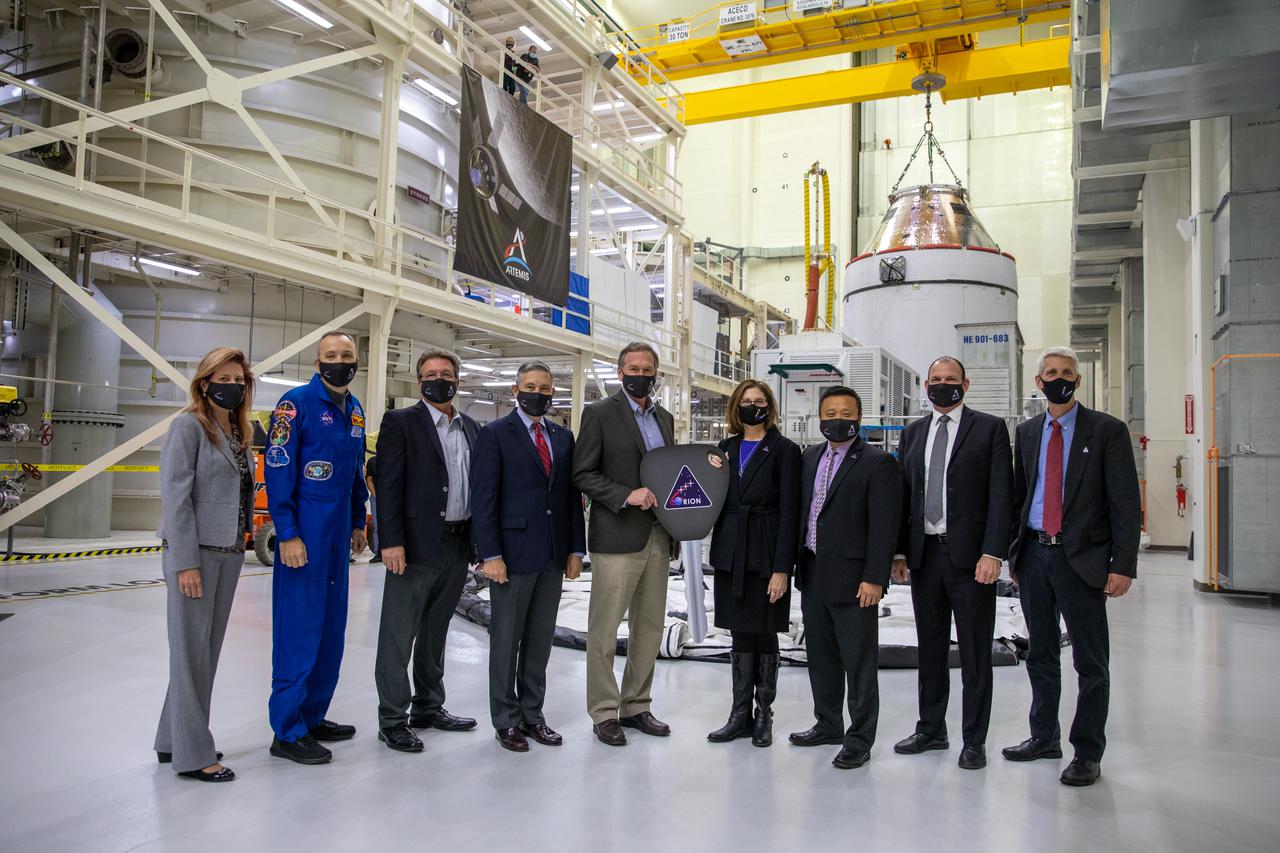
Orion is revealed for one of the final times on Jan. 14, as it is readied atop its transport pallet from the Neil Armstrong Operations and Checkout Building at NASA’s Kennedy Space Center in Florida, along its path to the pad ahead of the Artemis I launch. Standing in front of Orion, from left, are Kelly DeFazio, Lockheed Martin Orion Program director for production; NASA astronaut Randy Bresnik; Jules Schneider, Lockheed Martin director of Orion Assembly, Test & Launch at Kennedy; Kennedy Space Center Director Bob Cabana; Mike Bolger, Exploration Ground Systems (EGS) manager; Cathy Koerner, Orion Program manager; Howard Hu, Orion Program deputy manager; Tony Antonelli, Lockheed Martin Orion Program director and Artemis II mission director; and Scott Wilson, Orion Production Office manager. Teams across the globe have worked tirelessly to assemble the spacecraft, which will receive a protective covering prior to departing for the Multi-Payload Processing Facility to begin ground processing by the EGS and Jacobs teams.

CAPE CANAVERAL, Fla. – During a visit to NASA's Kennedy Space Center in Florida, NASA Associate Administrator Robert Lightfoot tours the Operations and Checkout Building high bay where the first Orion capsule, NASA's multi-purpose crew vehicle, is being prepared for flight on Exploration Flight Test 1, or EFT-1, in 2014. From left are Lockheed Martin's Orion Assembly, Integration and Production Senior Manager Jules Schneider, Kennedy's manager of Orion Production Operations Scott Wilson, Lightfoot, and Kennedy Director Bob Cabana. Orion is NASA's next-generation transport for astronauts to destinations beyond Earth orbit. NASA's FY2014 budget proposal includes a plan to robotically capture a small near-Earth asteroid and redirect it safely to a stable orbit in the Earth-moon system where astronauts can visit and explore it. Performing these elements for the proposed asteroid initiative integrates the best of NASA's science, technology and human exploration capabilities and draws on the innovation of America's brightest scientists and engineers. It uses current and developing capabilities to find both large asteroids that pose a hazard to Earth and small asteroids that could be candidates for the initiative, accelerates our technology development activities in high-powered solar electric propulsion and takes advantage of our hard work on the Space Launch System rocket and Orion spacecraft, helping to keep NASA on target to reach the President's goal of sending humans to Mars in the 2030s. Photo credit: NASA_Jim Grossmann