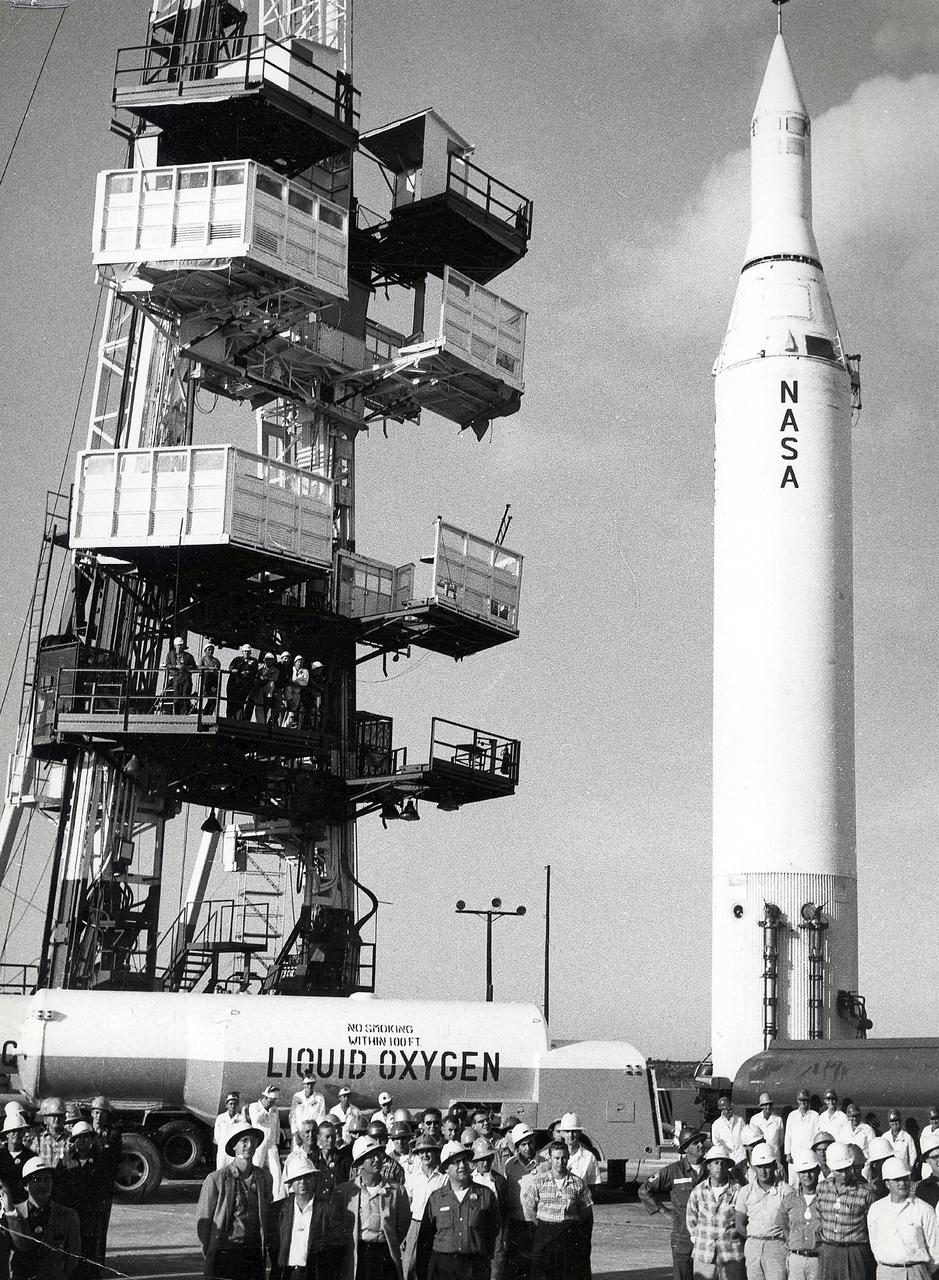
The modified Jupiter C (sometimes called Juno I), used to launch Explorer I, had minimum payload lifting capabilities. Explorer I weighed slightly less than 31 pounds. Juno II was part of America's effort to increase payload lifting capabilities. Among other achievements, the vehicle successfully launched a Pioneer IV satellite on March 3, 1959, and an Explorer VII satellite on October 13, 1959. Responsibility for Juno II passed from the Army to the Marshall Space Flight Center when the Center was activated on July 1, 1960. On November 3, 1960, a Juno II sent Explorer VIII into a 1,000-mile deep orbit within the ionosphere.
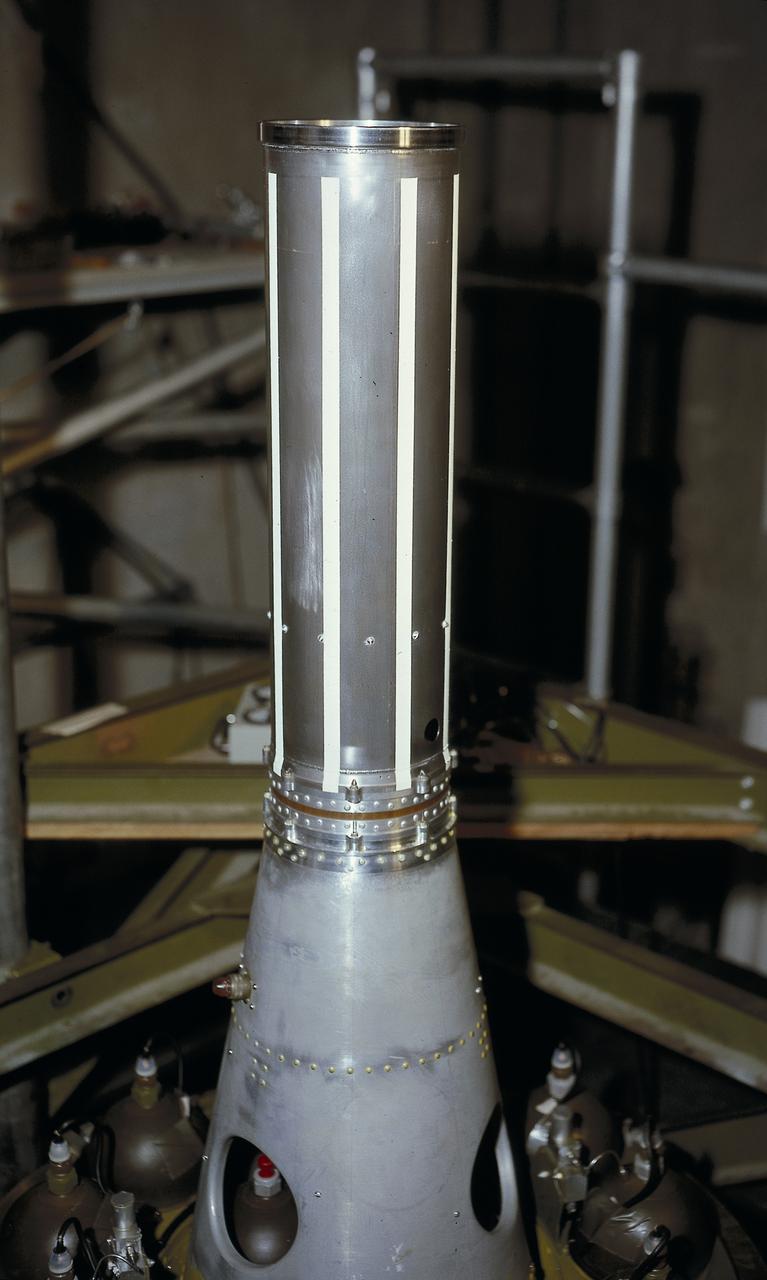
Juno II (AM-19B), the booster for Payload (Beacon), August 6 1959.
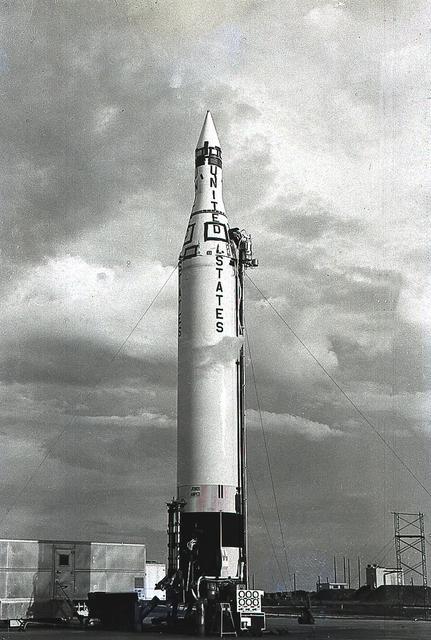
The Juno II launch vehicle, shown here, was a modified Jupiter Intermediate-Range Ballistic missionile, developed by Dr. Wernher von Braun and the rocket team at Redstone Arsenal in Huntsville, Alabama. Between December 1958 and April 1961, the Juno II launched space probes Pioneer III and IV, as well as Explorer satellites VII, VIII and XI.
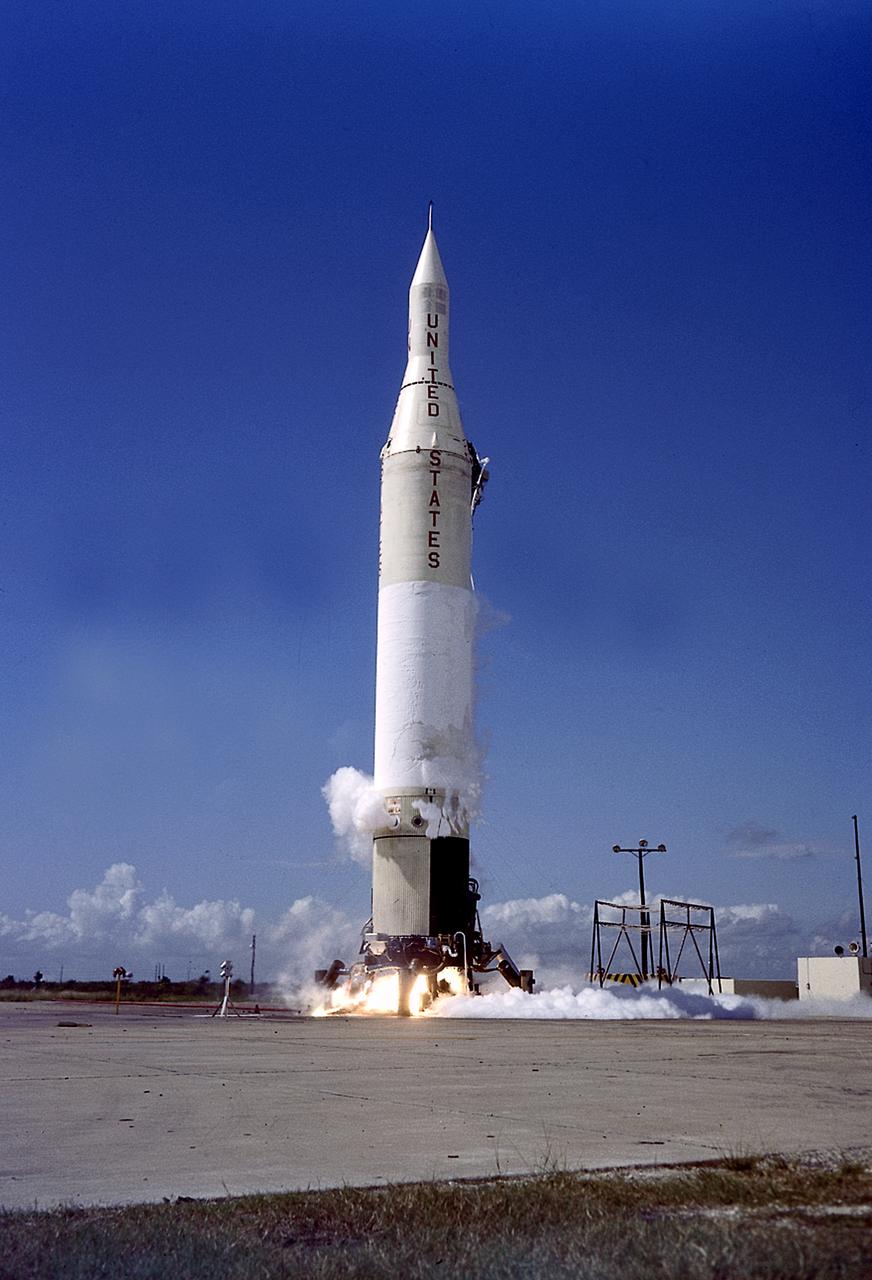
The ignition of Juno II (AM-19A). Juno II (AM-19) successfully placed a physics and astronomy satellite, Explorer VII, in orbit on October 13, 1959.
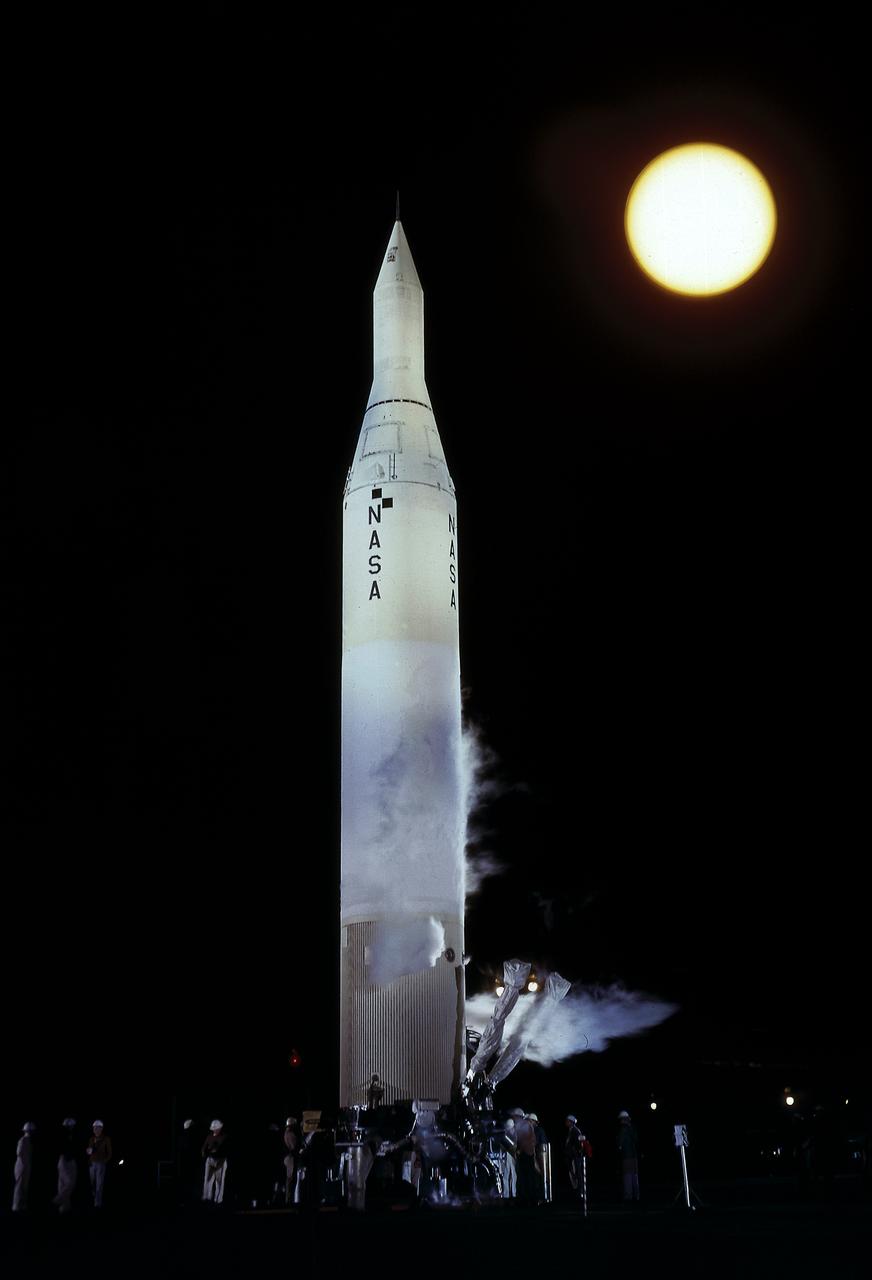
Juno II (AM-14) on the launch pad just prior to launch, March 3, 1959. The payload of AM-14 was Pioneer IV, America's first successful lunar mission. The Juno II was a modification of Jupiter ballistic missile
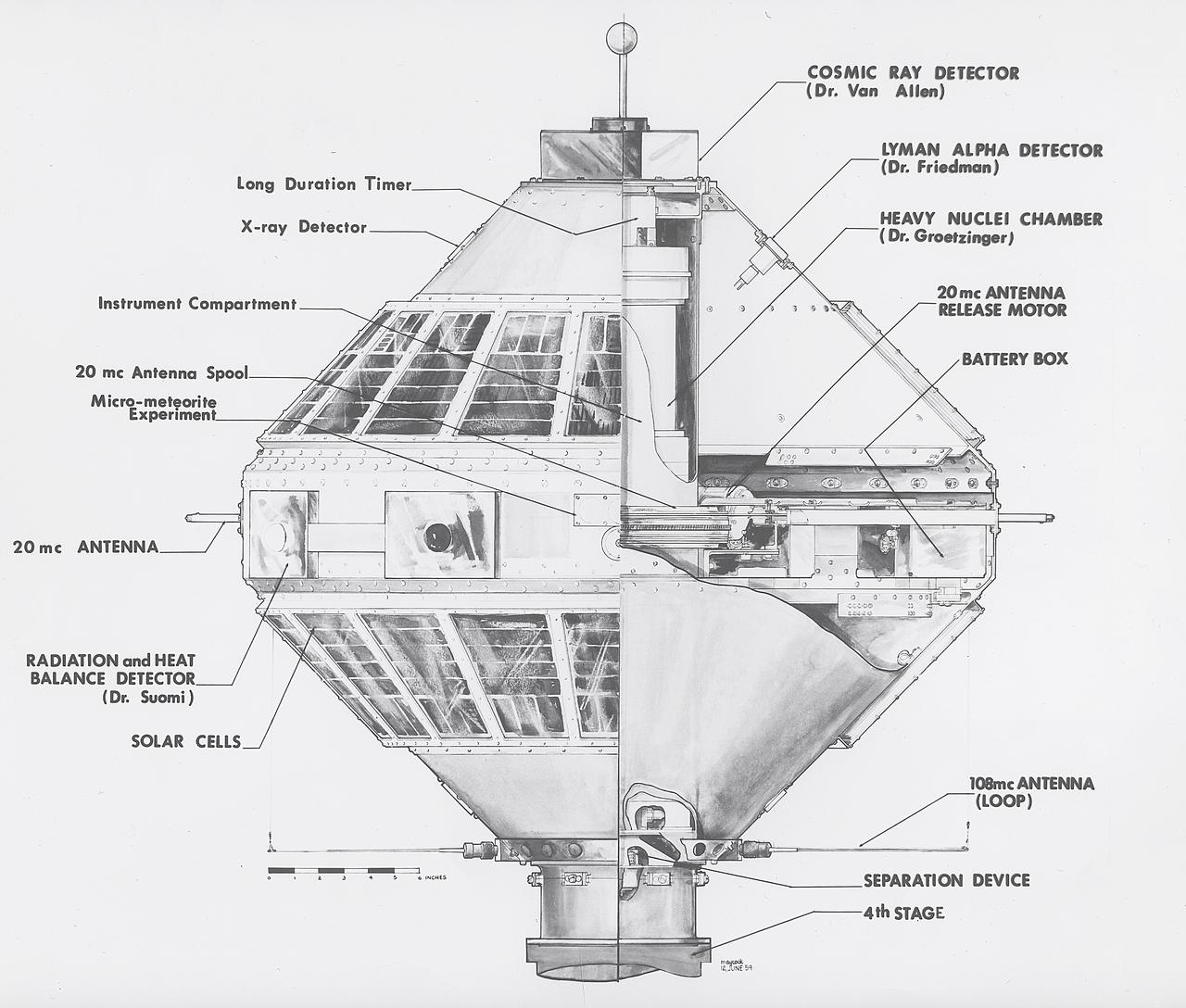
A Juno II launched an Explorer VII satellite on October 13, 1959. Explorer VII, with a total weight of 91.5 pounds, carried a scientific package for detecting micrometeors, measuring the Earth's radiation balance, and conducting other experiments.
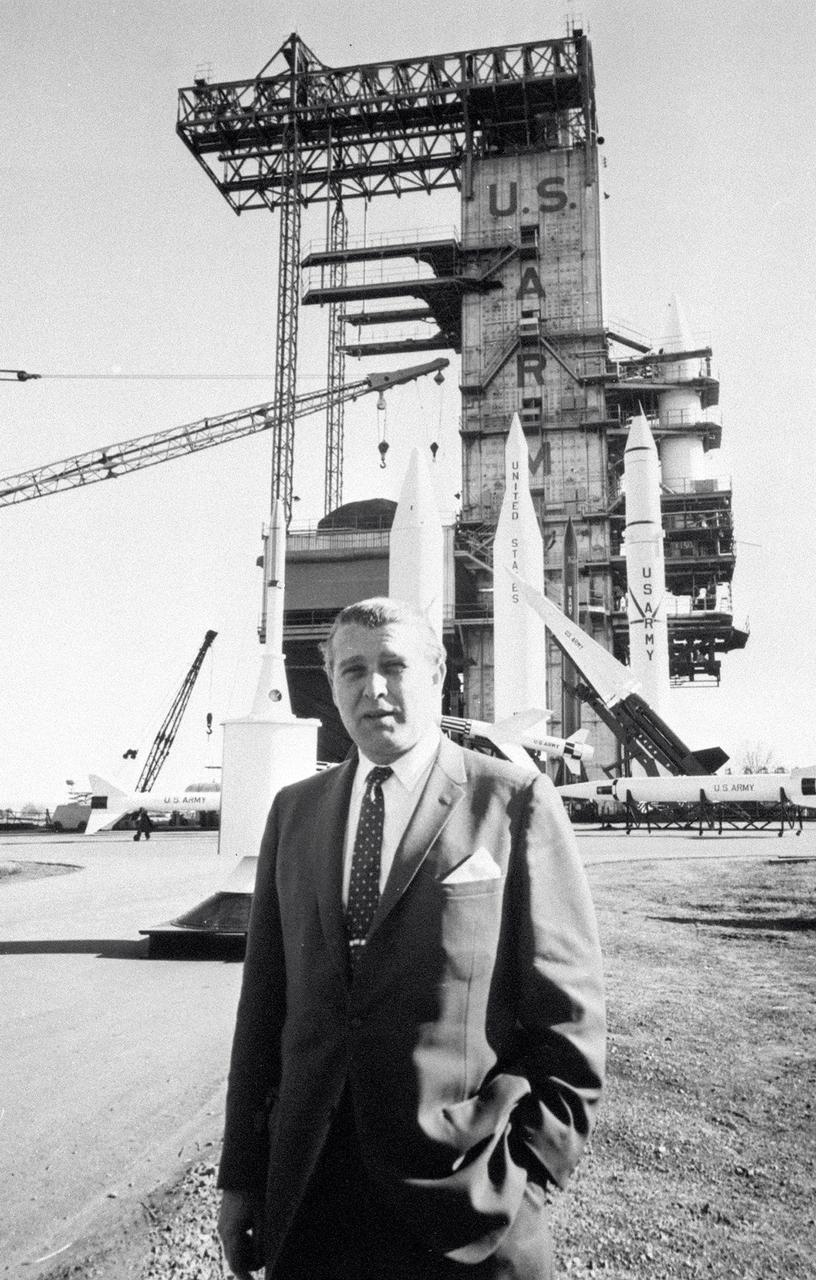
In this photo, Director of the US Army Ballistic Missile Agency (ABMA) Development Operations Division, Dr. Wernher von Braun, is standing before a display of Army missiles celebrating ABMA's Fourth Open House. The missiles in the background include (left to right) a satellite on a Juno II shroud with a Nike Ajax pointing left in front of a Jupiter missile. The Lacrosse is in front of the Juno II. The Nike Hercules points skyward in front of the Juno II and the Redstone.
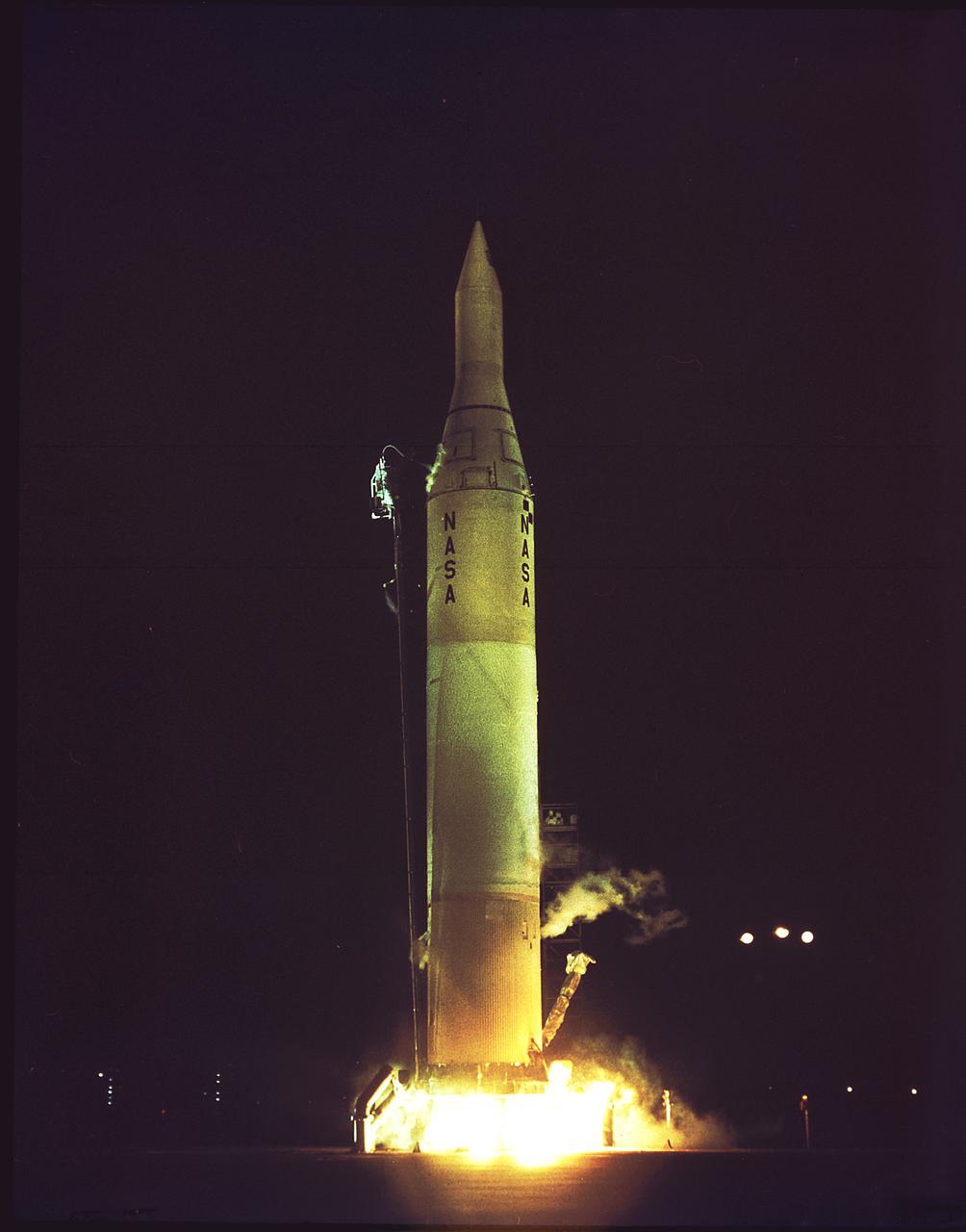
Wernher von Braun and his team were responsible for the Jupiter-C hardware. The family of launch vehicles developed by the team also came to include the Juno II, which was used to launch the Pioneer IV satellite on March 3, 1959. Pioneer IV passed within 37,000 miles of the Moon before going into solar orbit.
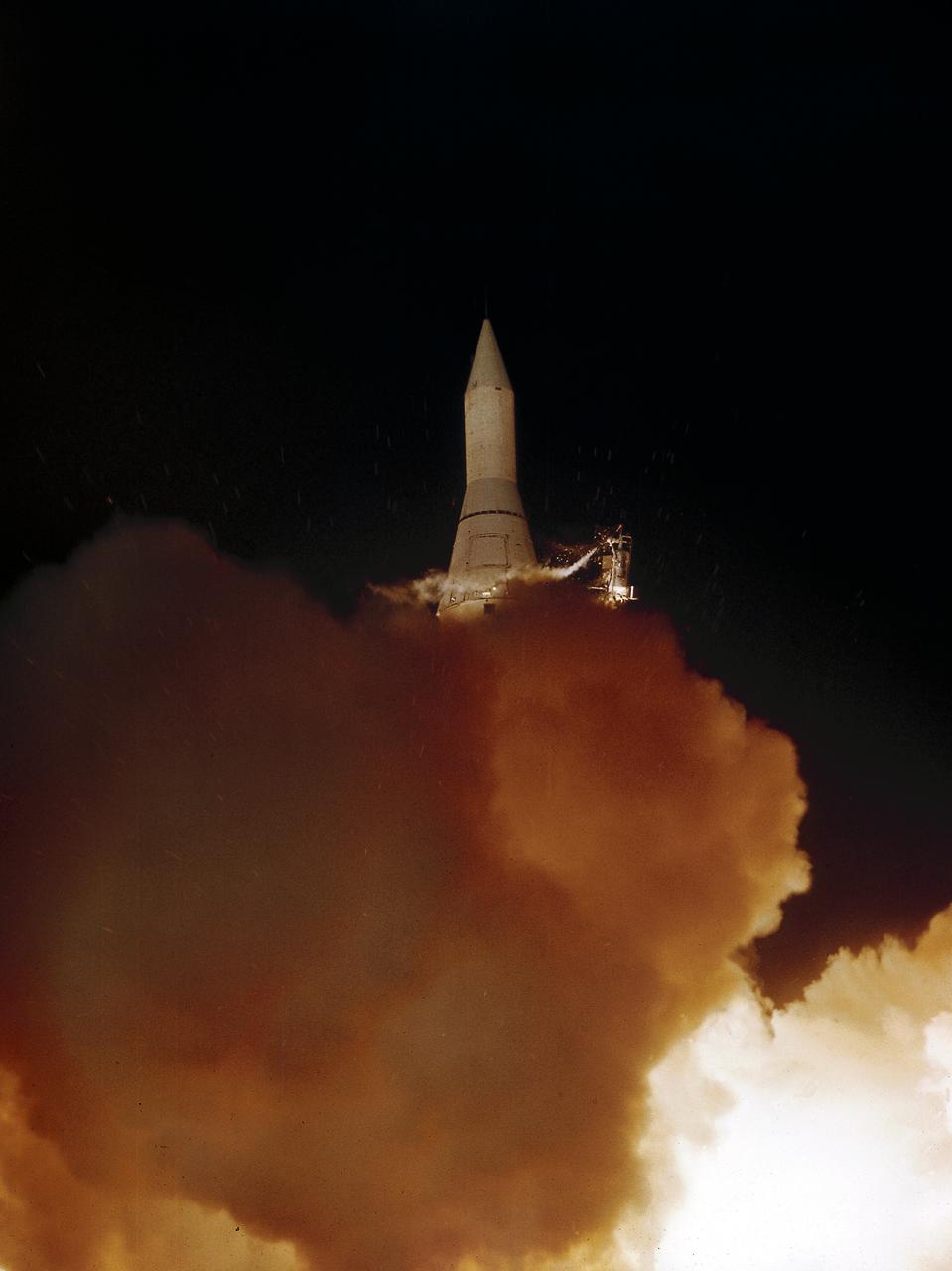
The launch of Juno II (AM-14), carrying the lunar and planetary exploration satellite in orbit, Pioneer IV, on March 3, 1959. the Pioneer IV probe was the first U.S. satellite to orbit the Sun.

In this photograph, the lunar and planetary exploration satellite, Pioneer III, is being prepared for installation to Juno II (AM-11) launch vehicle. AM-11 was launched on December 5, 1959, but the mission was unsuccessful.
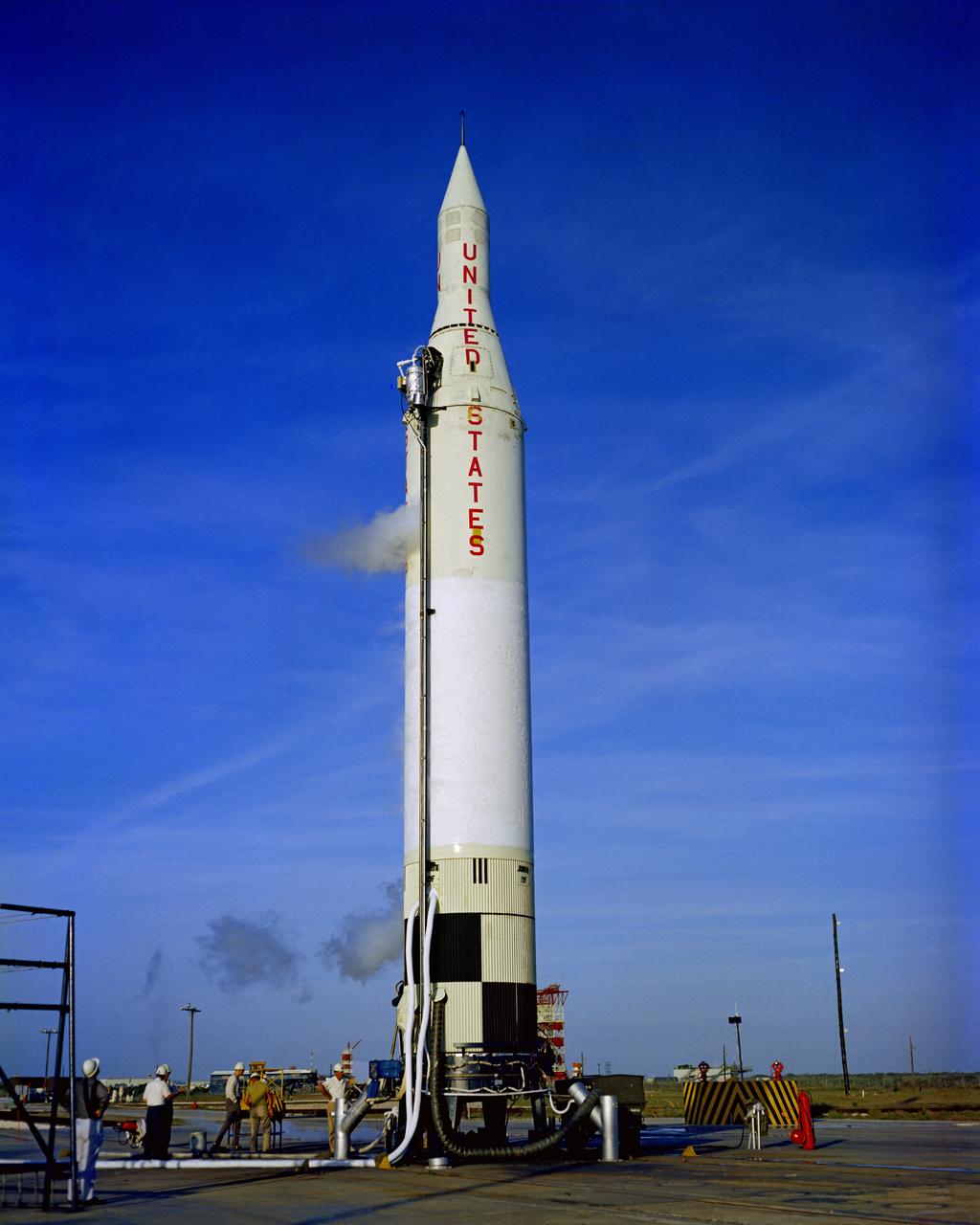
2/14/1961 JUNO II 19F STANDING ALONE ON LAUNCH TABLE AFTER GANTRY PULLED BACK. PAD 26B
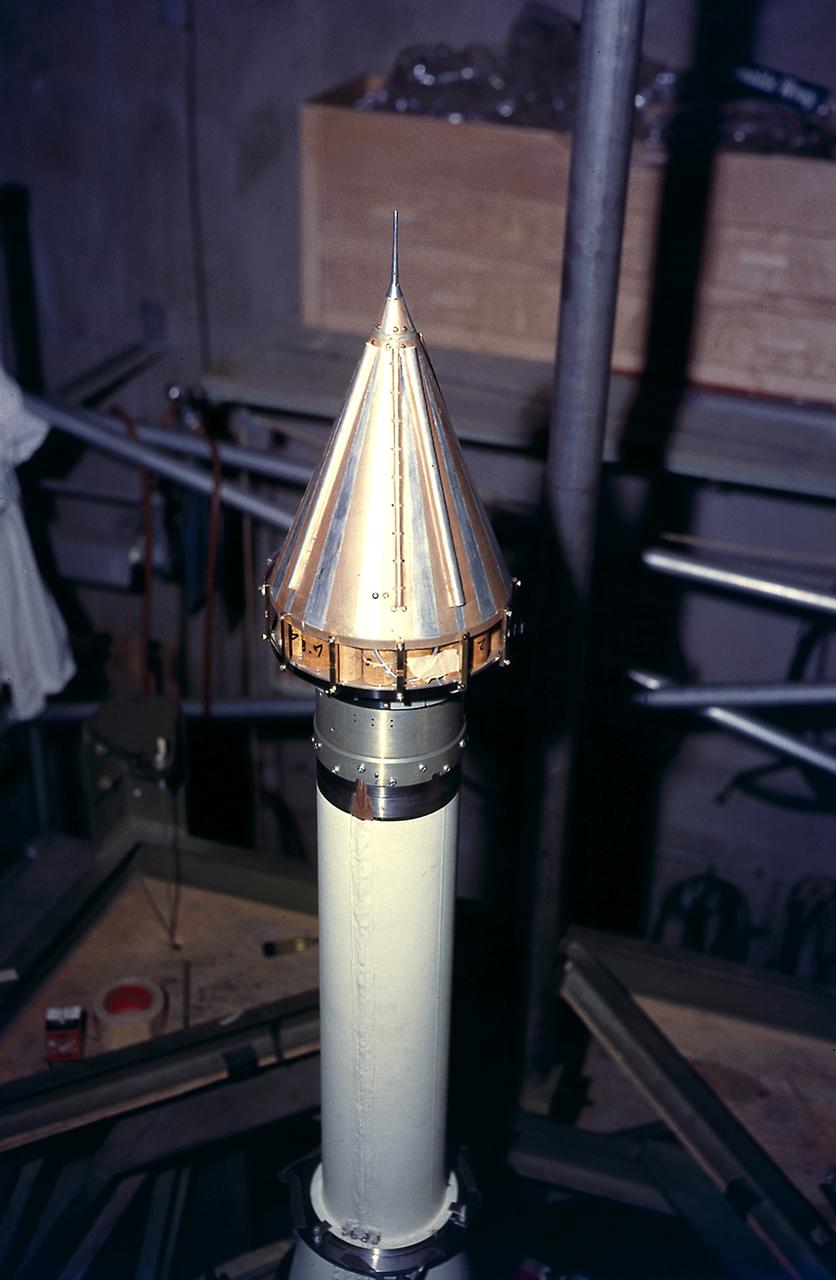
Installing Pioneer IV, payload for AM-14 (Juno II) onto the fourth stage on the cluster before a spin test, February 16, 1959. The Pioneer IV, lunar and planetary exploration satellite, was the first U.S. satellite to orbit the Sun.
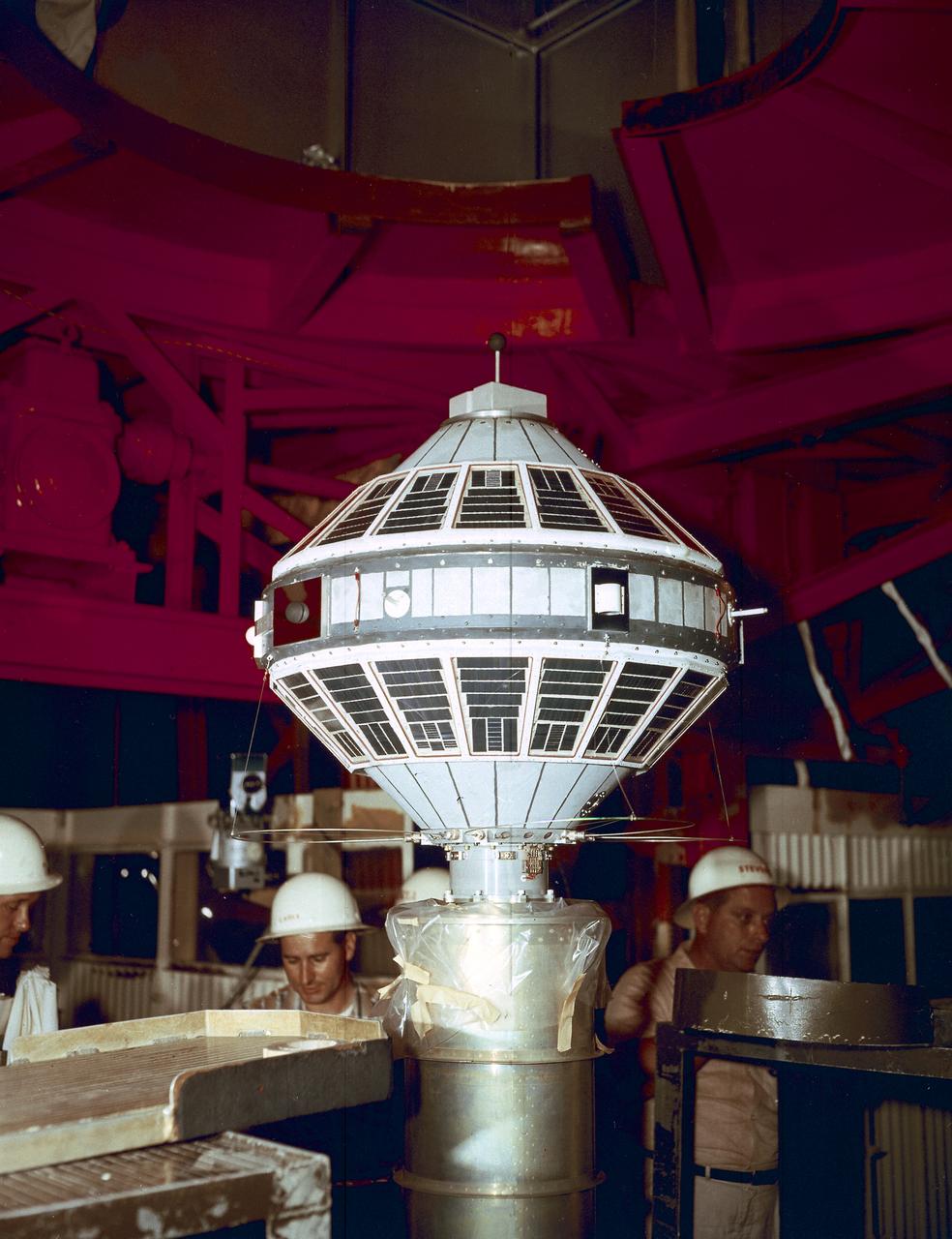
Juno II was a part of America's effort to increase its capability to lift heavier satellites into orbit. One payload was Explorer VII. This photograph depicts workers installing the Explorer VII satellite on Juno II (AM-19A) booster. The Explorer VII investigated energetic particles and obtained data on radiation and magnetic storms. The successful launch of Juno II took place on October 13, 1959.
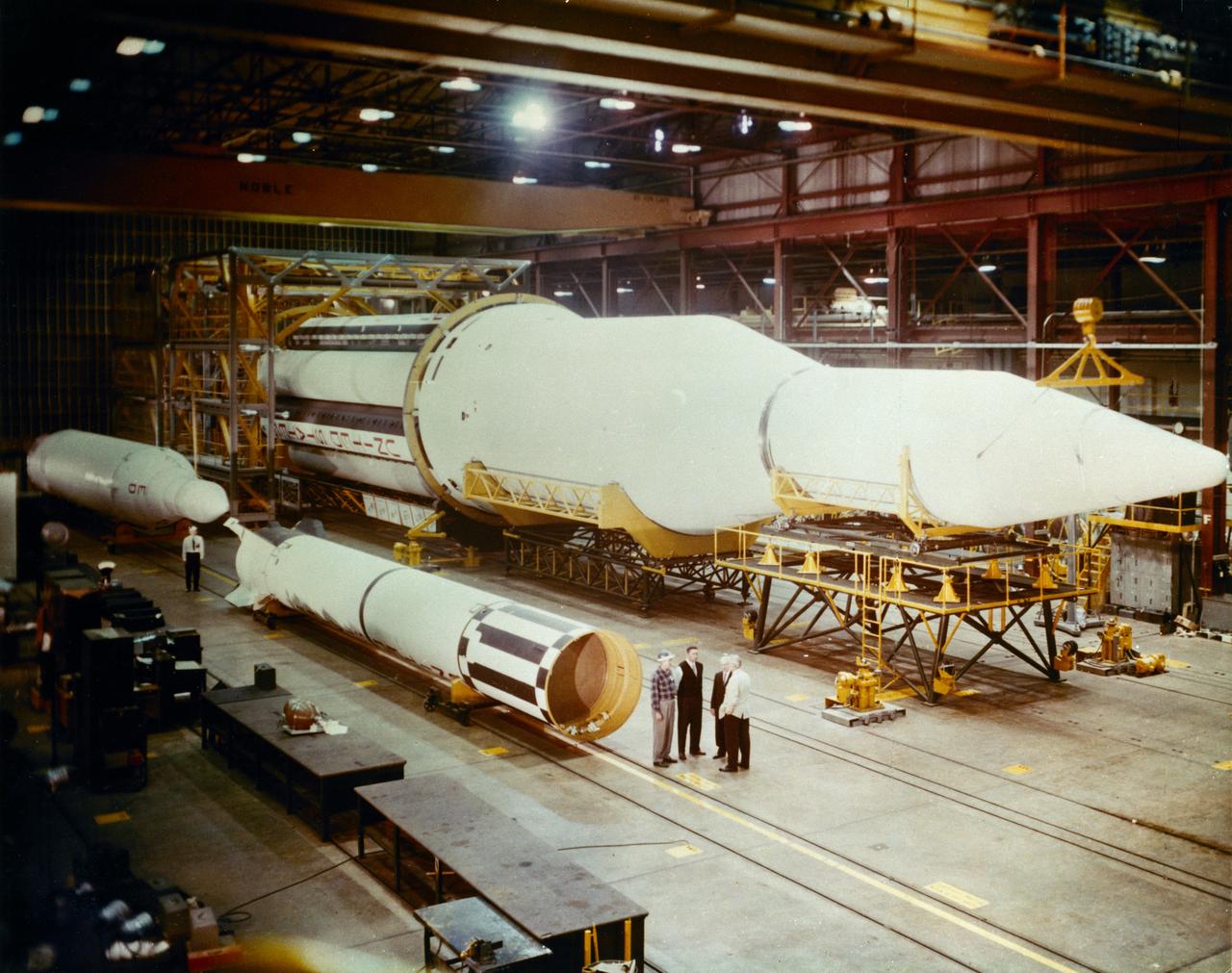
Progress in the Saturn program, depicted below, was described by Dr. Wernher von Braun, Marshall Space Flight Center (MSFC) Director, in an appearance before the Senate Committee of Aeronautical and Space Sciences. "The flight configuration of the giant three-stage Saturn C-1 rocket (later called Saturn I Block I) is seen in the Fabrication and Assembly Engineering Division at MSFC. Dwarfed by the 180-foot C-1 are a Juno II rocket (left rear) and a Mercury-Redstone rocket (front foreground). The C-1 (first version of the Saturn rocket) is composed of an S-1 first stage or booster (rear), powered by eight H-1 engines having a thrust of 1,500,000 pounds, followed by a dummy S-IV second stage and a dummy S-V third stage. The "live" S-IV for later flights, under development by Douglas Aircraft Co., will be powered by four Pratt Whitney LR-119 engines having 17,500,000 pounds thrust each. The live S-V, under development by Convair Division of General Dynamics Corp., will use two LR-119 engines. With all three stages live, the C-1 will be capable of placing 19,000 pounds into a 300-mile Earth orbit, sending 5,000 pounds to escape velocity, or lofting 2,500 pounds to Mars or Venus. The second version Saturn C-2 (later called Saturn 1 Block II) would double these capabilities. Early C-1 flights will employ a live S-1 with dummy upper stages. The first such flight is scheduled late this year."

This image from March 2, 1959 shows engineers from NASA's Jet Propulsion Laboratory checking NASA's Pioneer 4 spacecraft, the gold-and-black-colored cone sitting atop the white fourth-stage motor of the Juno II launch vehicle in Florida. Launched on March 3, 1959, NASA's Pioneer 4 was the first American mission to escape Earth orbit and the second of two early attempts by the United States to send a spacecraft to the Moon. The spacecraft achieved its primary objective — to put itself on a trajectory from Earth to the Moon. While it flew farther away from the Moon than expected and didn't take the images of the Moon as intended, Pioneer 4 did provide extensive and valuable data on Earth's radiation belt and the tracking of space objects. After 82 hours of transmissions from Pioneer 4's tiny radio and 655,000 miles (1.05 million kilometers) of travel — the farthest tracking distance for a human-made object at the time — contact is lost on March 6, 1959. Pioneer 4 is still in orbit around the Sun. The mission was carried out while JPL was transitioning from being part of the Army Ballistic Missile Agency to NASA. It marked the end of the U.S. Army's pioneering space program and the beginning of NASA's lunar program. JPL, in Pasadena, California, was responsible for mission design and management for both agencies. More information about Pioneer 4 can be found at: https://solarsystem.nasa.gov/missions/pioneer-4/in-depth/ https://photojournal.jpl.nasa.gov/catalog/PIA23497