
This artist concept shows K2-138, the first multi-planet system discovered by citizen scientists. The central star is slightly smaller and cooler than our Sun. The five known planets are all between the size of Earth and Neptune. Planet b may potentially be rocky, but planets c, d, e, and f likely contain large amounts of ice and gas. All five planets have orbital periods shorter than 13 days and are all incredibly hot, ranging from 800 to 1,800 degrees Fahrenheit. https://photojournal.jpl.nasa.gov/catalog/PIA22088

The Kepler space telescope examined twenty-one patches of the sky during it’s nine and a half years of operation. Within these regions, Kepler gathered high precision brightness measurements of over half a million stars facilitating the discovery of thousands of exoplanets and yielding insight into a multitude of other astrophysical phenomena. Illustration by Wendy Stenzel. Science content: Jeff Coughlin, Kenneth Mighell, Doug Caldwell, all of NASA Ames. Key words: Kepler, K2, Missions, nasa, Ames research center, spacecraft, FFI, Full Frame Image, fields of view, science.
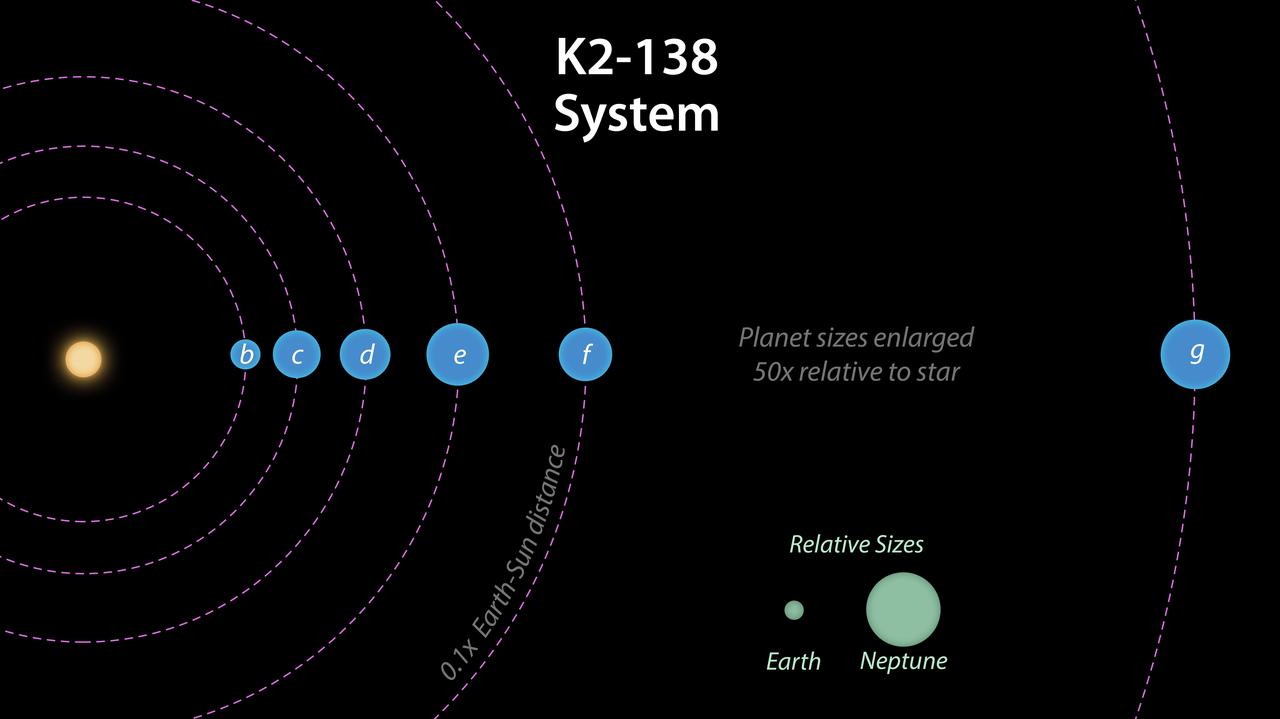
This image shows the estimated radii of the six planets in the planetary system K2-128, as well as their distance from the parent star. The radii of the Earth and Neptune are shown for scale. https://photojournal.jpl.nasa.gov/catalog/PIA23003

The newfound planet K2-288Bb, illustrated here, is slightly smaller than Neptune. Located about 226 light-years away, it orbits the fainter member of a pair of cool M-type stars every 31.3 days. https://photojournal.jpl.nasa.gov/catalog/PIA23004

This artist concept shows NASA planet-hunting Kepler spacecraft operating in a new mission profile called K2. Using publicly available data, astronomers have confirmed K2 first exoplanet discovery proving Kepler can still find planets.

This artist's illustration shows the planetary system K2-138, which was discovered by citizen scientists in 2017 using data from NASA's Kepler space telescope. Five planets were initially detected in the system. In 2018, scientists using NASA's Spitzer Space Telescope found evidence of a sixth planet in the system. https://photojournal.jpl.nasa.gov/catalog/PIA23002

This artist's concept shows NASA's Kepler Space Telescope on its K2 mission. In July 2016, an international team of astronomers announced they had discovered more than 100 new planets using this telescope. The batch includes four planets in the size range of Earth that are orbiting a single dwarf star, depicted in this illustration. Two of these planets are too hot to support life as we know it, but two are in the star's "habitable" zone, where liquid water could exist on the surface. These small, rocky worlds are far closer to their star than Mercury is to our sun. But because the star is smaller and cooler than ours, its habitable zone is much closer. One of the two planets in the habitable zone, K2-72c, has a "year" about 15 Earth-days long -- the time it takes to complete one orbit. This closer planet is likely about 10 percent warmer than Earth. The slightly more distant planet in the habitable zone, K2-72e, has a year lasting 24 Earth days, and would be about 6 percent colder than Earth. http://photojournal.jpl.nasa.gov/catalog/PIA20698
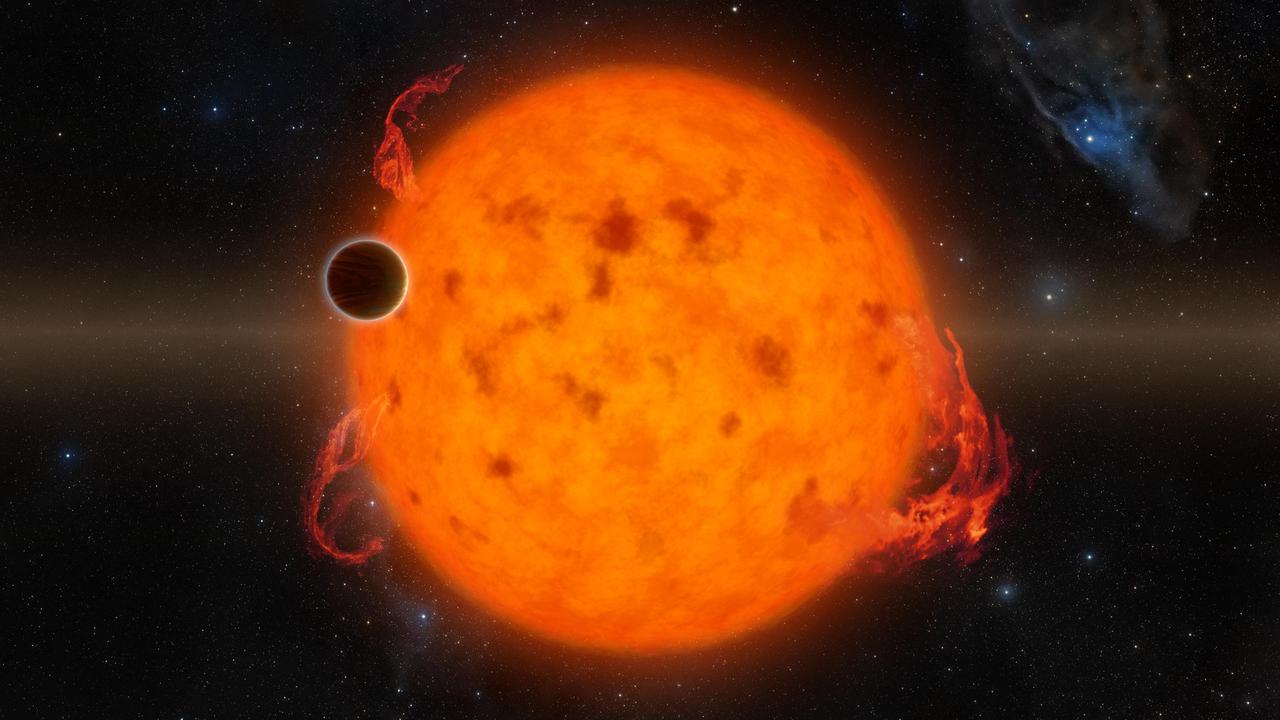
K2-33b, shown in this illustration, is one of the youngest exoplanets detected to date using NASA Kepler Space Telescope. It makes a complete orbit around its star in about five days. These two characteristics combined provide exciting new directions for planet-formation theories. K2-33b could have formed on a farther out orbit and quickly migrated inward. Alternatively, it could have formed in situ, or in place. http://photojournal.jpl.nasa.gov/catalog/PIA20690
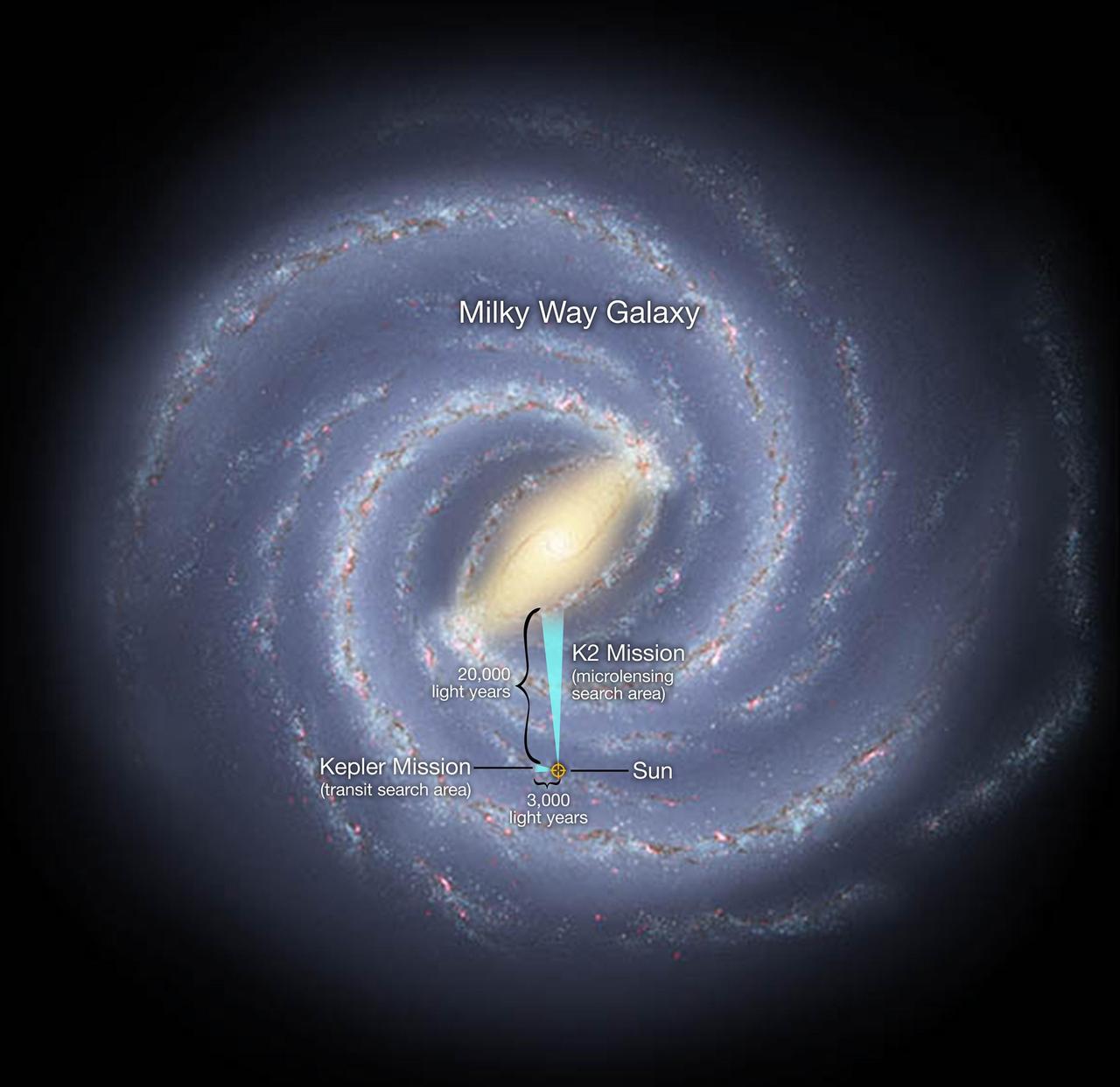
In a global experiment in exoplanet observation, the K2 mission and Earth-based observatories on six continents will survey millions of stars toward the center of our Milky Way galaxy.

The Kepler space telescope examined twenty-one patches of the sky during it’s nine and a half years of operation. Within these regions, Kepler gathered high precision brightness measurements of over half a million stars facilitating the discovery of thousands of exoplanets and yielding insight into a multitude of other astrophysical phenomena. Illustration by Wendy Stenzel, Ames Science content: Jeff Coughlin, Kenneth Mighell, Doug Caldwell, all of NASA Ames.

Christopher Hull Kepler/K2 Team, Official NASA Photo
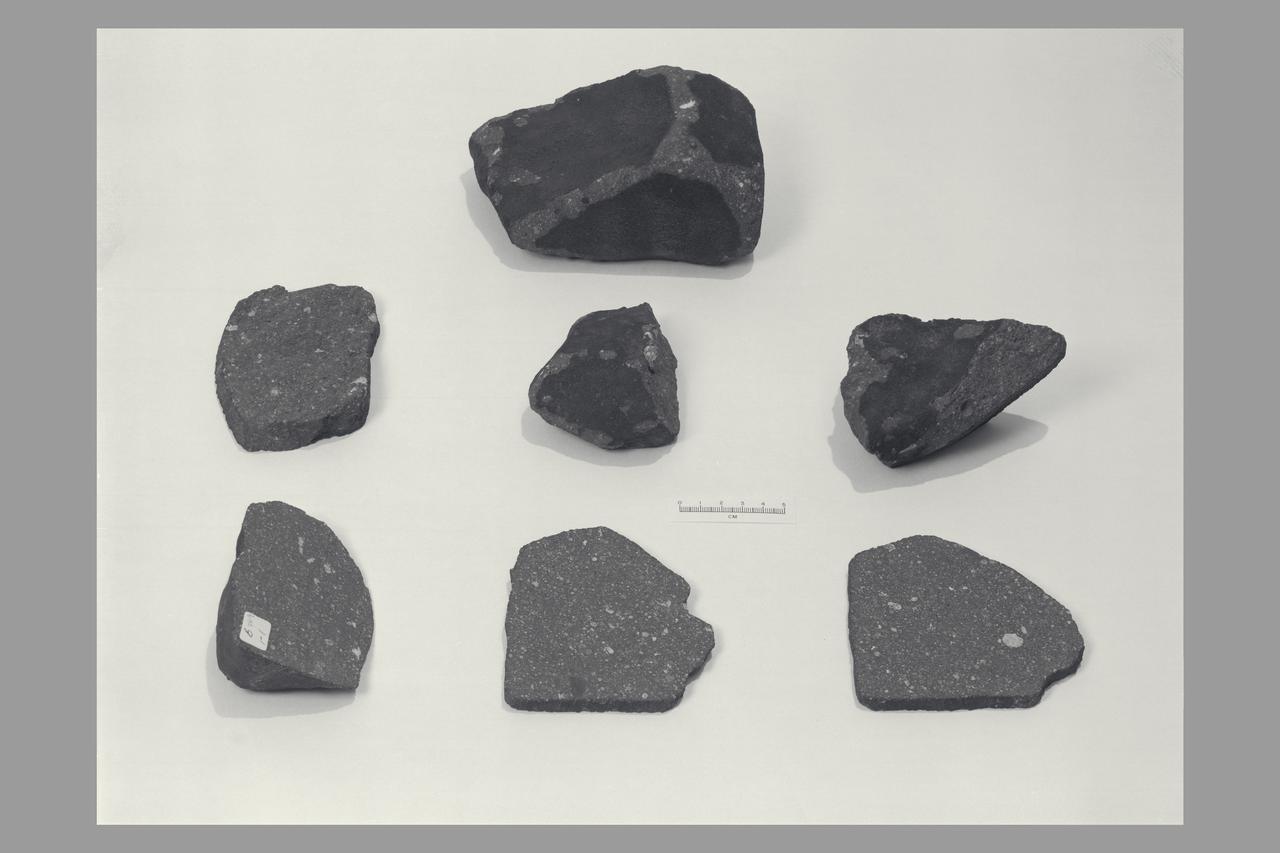
Cosmosgenic Nuclides in Allende Meteorite - Group of seven specimens; No.s' K1, K2, 3512, 3515, 81-1, 81-6 and 81-3
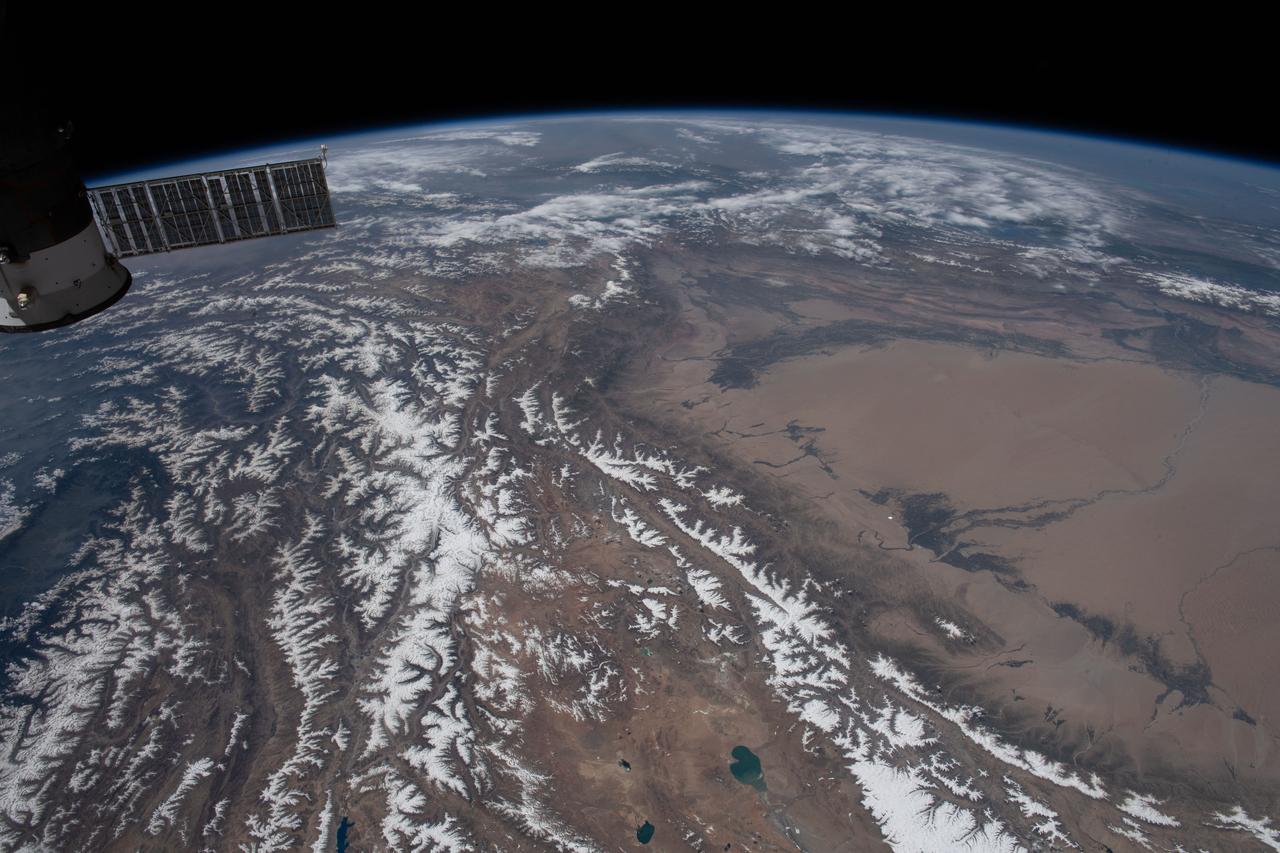
iss063e032032 (June 22, 2020) --- The International Space Station orbits above Tajikistan near the western border of China with the K2 mountain, the world's second-highest peak, below in the Karakoram range.

When a planet such as K2-33b passes in front of its host star, it blocks some of the star's light. Observing this periodic dimming, called a transit, from continual monitoring of a star's brightness, allows astronomers to detect planets outside our solar system with a high degree of certainty. This Neptune-sized planet orbits a star that is between 5 and 10 million years old. In addition to the planet, the star hosts a disk of planetary debris, seen as a bright ring encircling the star. An animation is available at: http://photojournal.jpl.nasa.gov/catalog/PIA20692
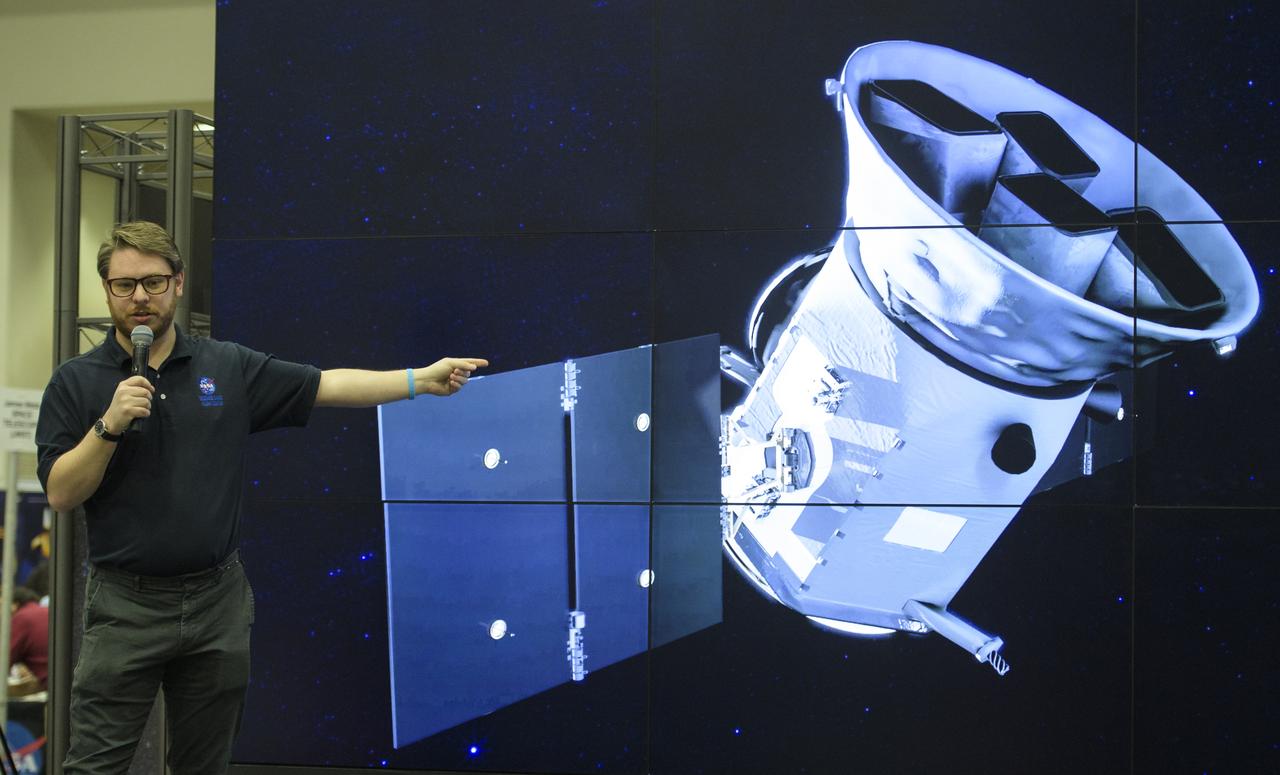
Tom Barclay, Director of the Kepler/K2 Guest Observer Office at NASA's Ames Research Center, speaks about exoplanets and NASA's next exoplanet mission, the Transiting Exoplanet Survey Satellite, during Sneak Peek Friday at the USA Science and Engineering Festival, Friday, April 6, 2018 at the Walter E. Washington Convention Center in Washington, DC. The festival is open to the public April 7-8. Photo Credit: (NASA/Joel Kowsky)
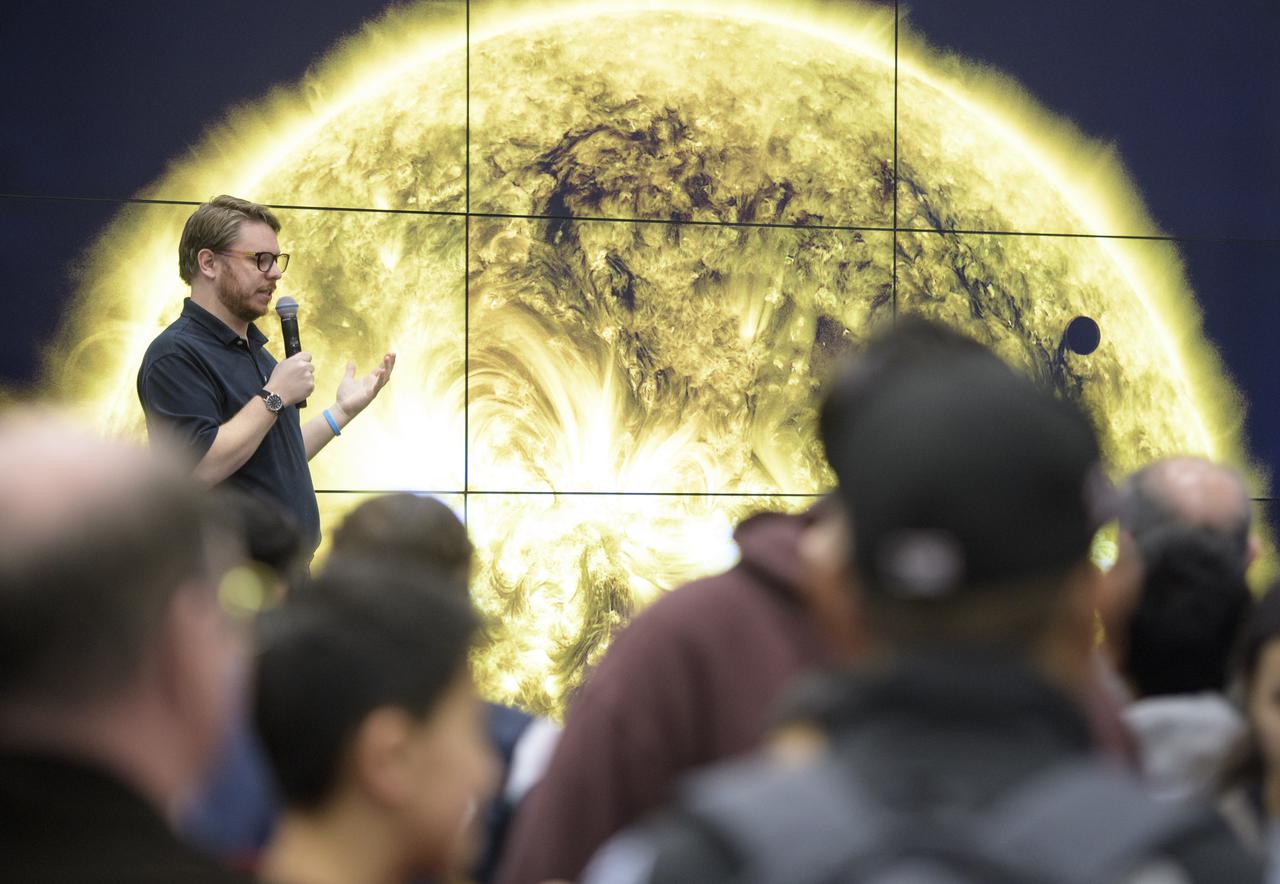
Tom Barclay, Director of the Kepler/K2 Guest Observer Office at NASA's Ames Research Center, speaks about exoplanets and NASA's next exoplanet mission during Sneak Peek Friday at the USA Science and Engineering Festival, Friday, April 6, 2018 at the Walter E. Washington Convention Center in Washington, DC. The festival is open to the public April 7-8. Photo Credit: (NASA/Joel Kowsky)
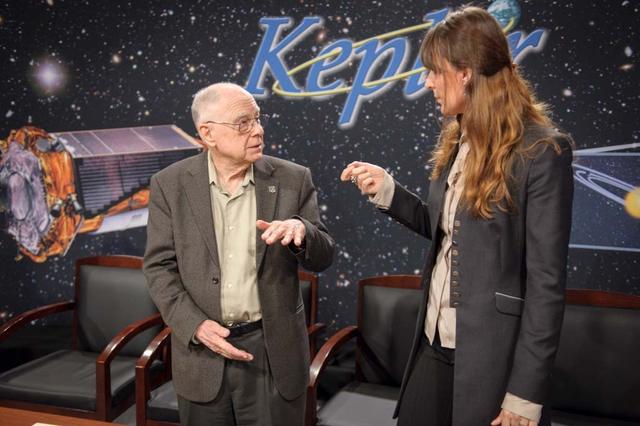
Kepler News Briefing, held in the Syvertson auditorium at the NASA Ames Research Center. The briefing presented discoveries from the continuing Kepler mission (K2). The team discovered some of the smallest planets found in the habitable zone of two newly discovered planetary systems. Bill Borucki (left), Kepler Scientist, Principal Investigator, NASA Ames Lisa Kaltengger (right), Research Group Leader, Max Planck Institute for Astronomy, Heidelberg Germany and Research Associate, Harvard-Smithsonian Center for Astrophysics, Cambridge Massachusetts.
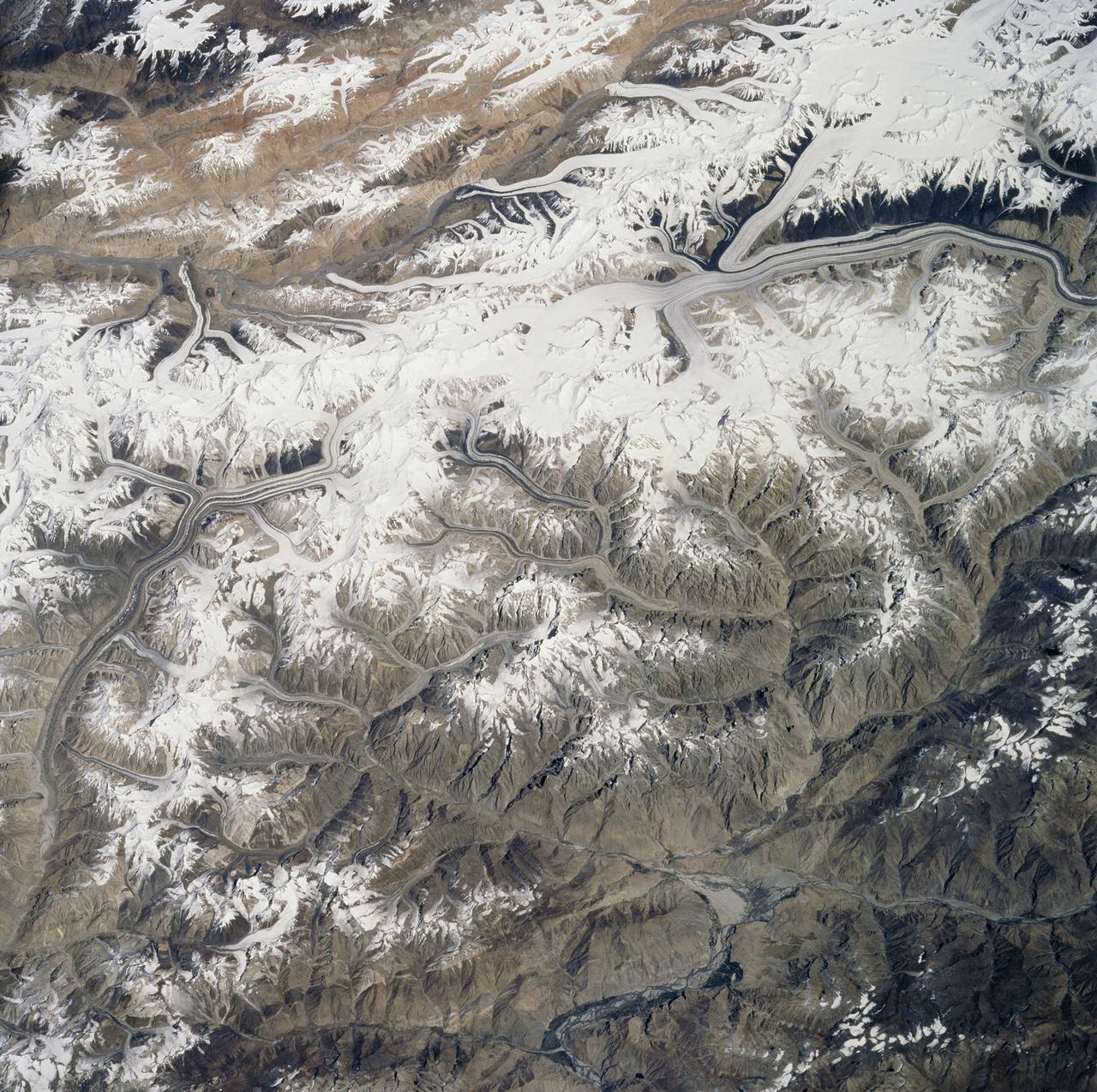
STS106-705-009 (8-20 September 2000) --- One of the STS-106 crew members on board the Space Shuttle Atlantis used a handheld 70mm camera to photograph this image of Qogir Feng (8,611 meters), which appears at the far upper left in this view of the northwestern Karakoram Range. Also called K2 or Mt. Godwin Austen, the mountain is the second highest peak in the world. The Tarim sedimentary basin borders the range on the north and the Lesser Himalayas on the south. Melt waters from vast glaciers, such as those south and east of K2, feed agriculture in the valleys (dark green) and contribute significantly to the regional fresh-water supply. The Karakoram Range lies along the southern edge of the Eurasian tectonic plate and is made up of ancient sedimentary rocks (more than 390 million years old, according to geologists studying the shuttle imagery). Those strata were folded and thrust-faulted, and granite masses were intruded, say the geologists, when the Indo-Pakistan plate collided with Eurasia, beginning more than 100 million years ago.
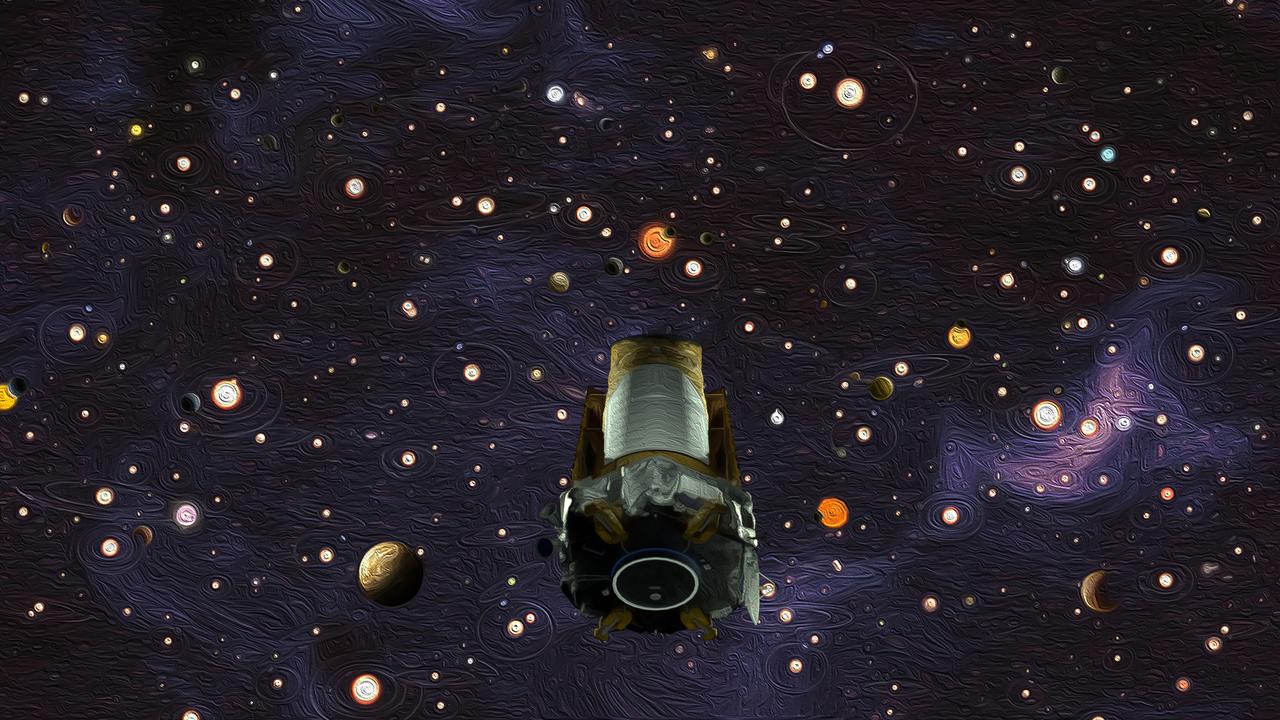
After nine years in deep space collecting data that revealed our night sky to be filled with billions of hidden planets, more planets even than stars, NASA’s Kepler space telescope has run out of fuel needed for further science operations. Illustration depicting the Kepler spacecraft in a sky filled with exoplanets and planetary systems.
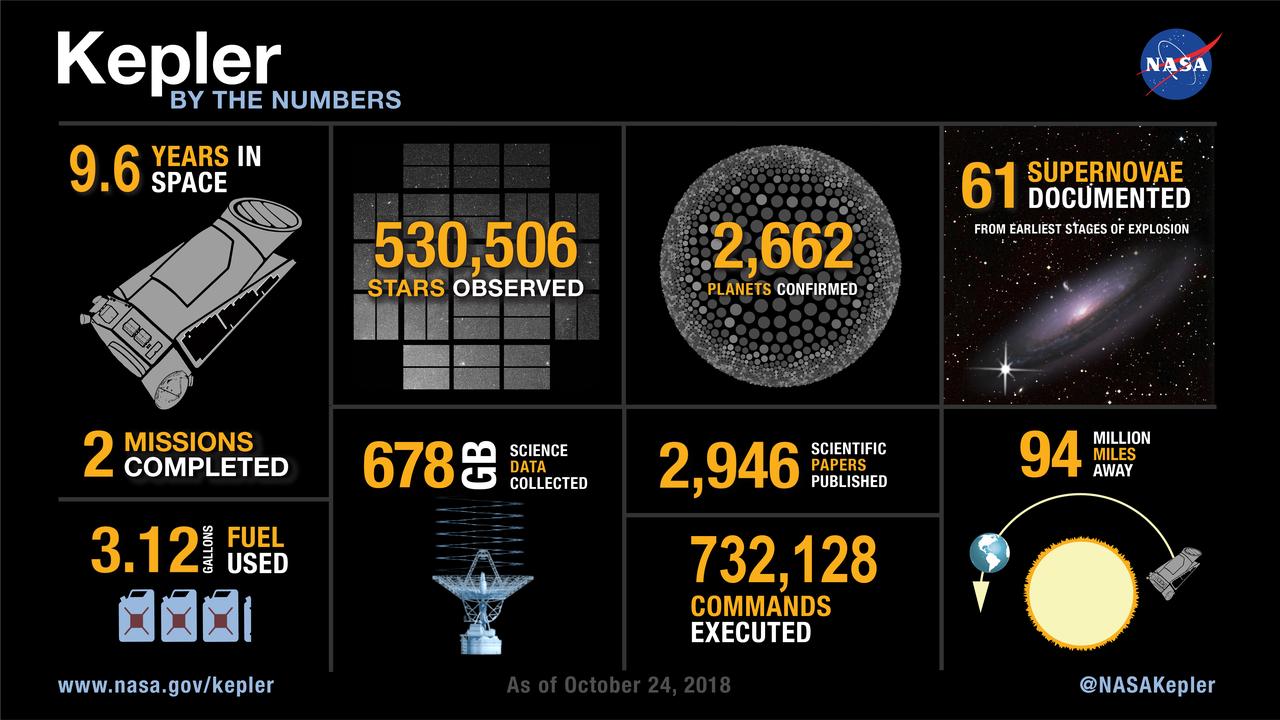
The Kepler space telescope is done with its work collecting astounding science data showing there are more planets than stars in our galaxy. Here’s a round-up of what Kepler has achieved.
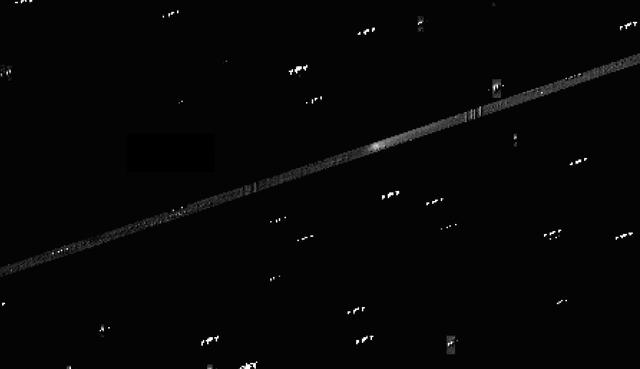
The European Space Agency's Rosetta mission concluded its study of comet 67P/Churyumov-Gerasimenko on Sept. 30, 2016. NASA's planet-hunting Kepler spacecraft observed the comet during the final month of the Rosetta mission, while the comet was not visible from Earth. This animation is composed of images from Kepler of the comet. From Sept. 7 through Sept. 20, the Kepler spacecraft, operating in its K2 mission, fixed its gaze on comet 67P. From the distant vantage point of Kepler, the comet's nucleus and tail could be observed. The long-range view from Kepler complements the closeup view of the Rosetta spacecraft, providing context for the high-resolution investigation Rosetta performed as it descended closer and closer to the comet. During the two-week period of study, Kepler took a picture of the comet every 30 minutes. The animation shows a period of 29.5 hours of observation from Sept. 17 thru Sept. 18. The comet is seen passing through Kepler's field of view from top right to bottom left, as outlined by the diagonal strip. The white dots represent stars and other regions in space studied during K2's tenth observing campaign. As a comet travels through space it sheds a tail of gas and dust. The more material that is shed, the more surface area there is to reflect sunlight. A comet's activity level can be obtained by measuring the reflected sunlight. Analyzing the Kepler data, scientists will be able to determine the amount of mass lost each day as comet 67P travels through the solar system. An animation is available at http://photojournal.jpl.nasa.gov/catalog/PIA21072