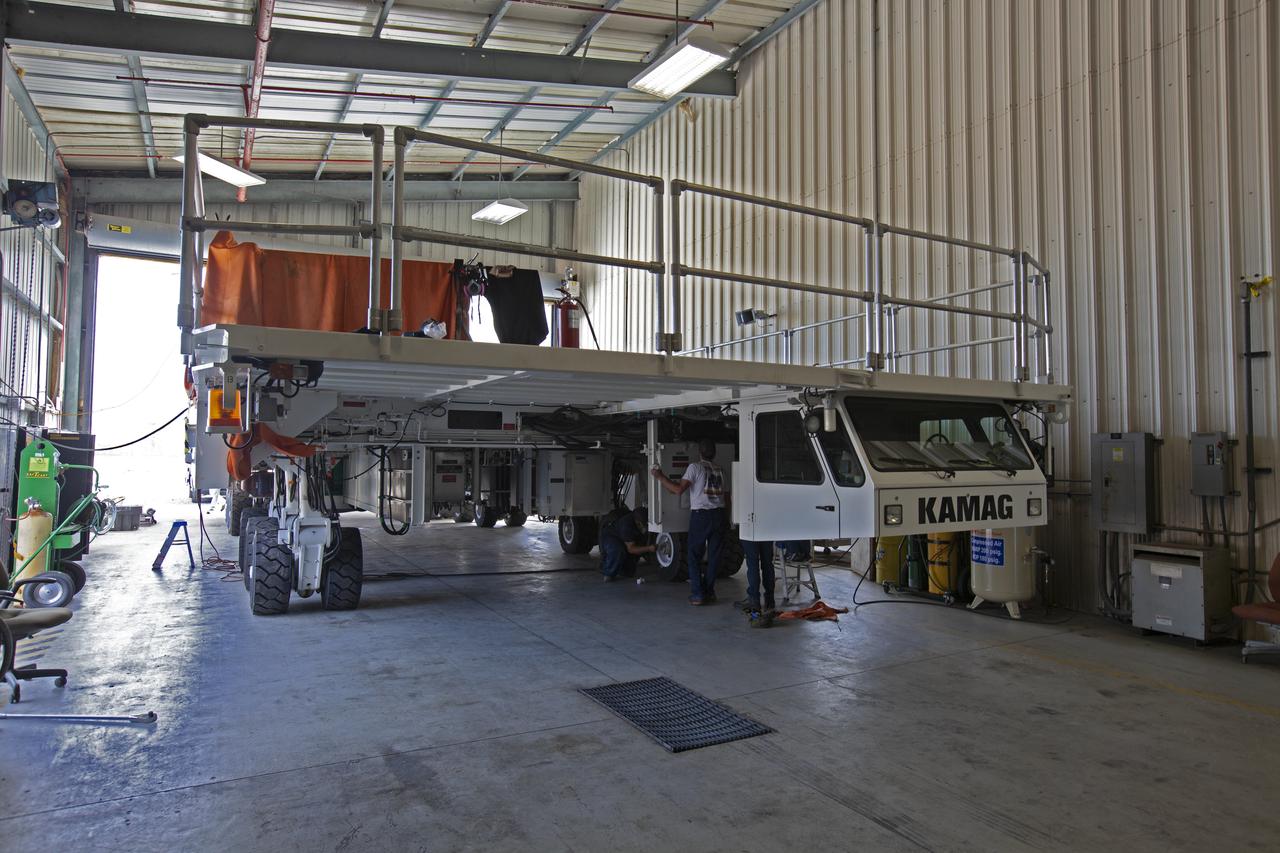
The KAMAG spacecraft transporter is inside a facility at the crawler yard at NASA's Kennedy Space Center in Florida, on Oct. 26, 2018. Jacobs technicians from the Launch Equipment Shop are welding the attach points that will hold the Orion transportation pallet in place. Testing of the pallet will be performed to support validation and verification of the attach fittings in the Multi-Payload Processing Facility. The transporter is designed to carry heavy loads, including the pallet that will contain the Orion crew module.
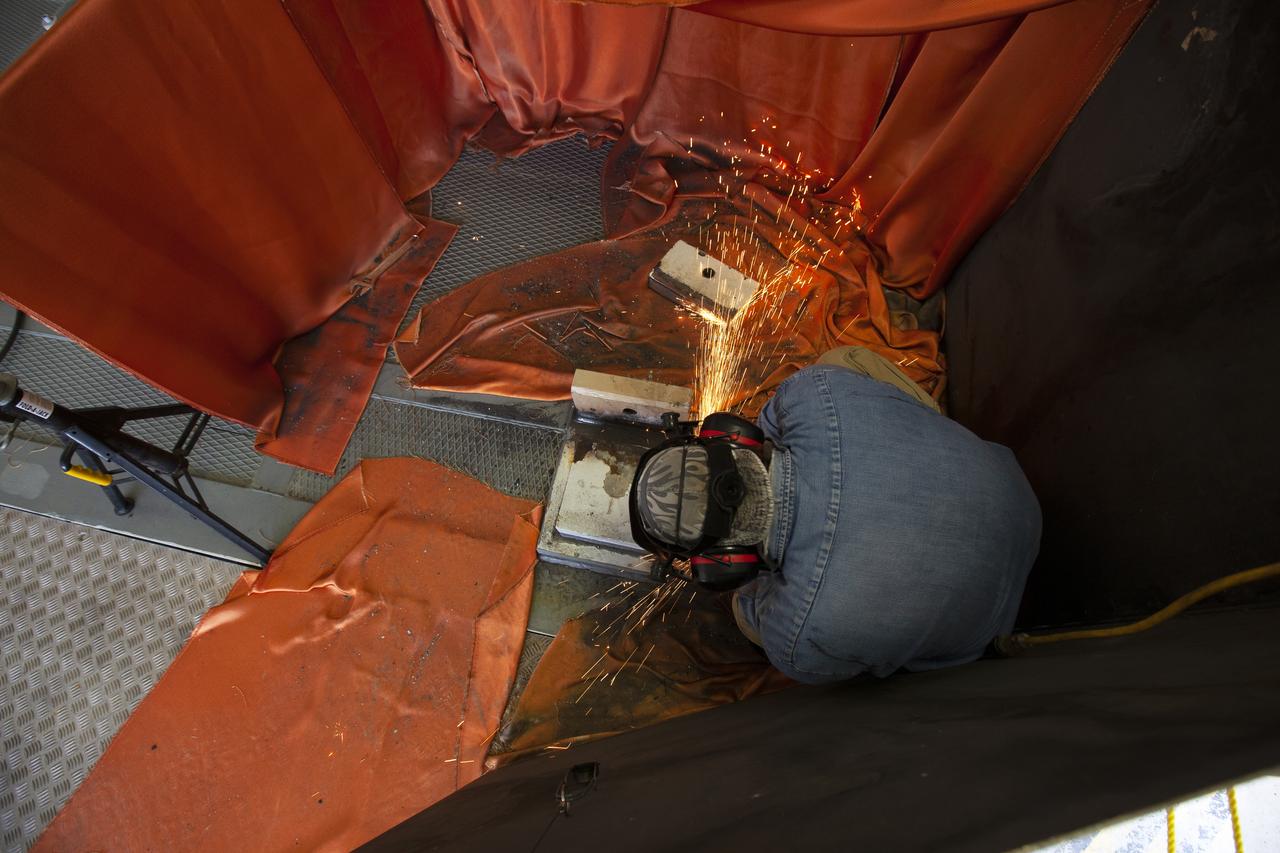
A Jacobs technician from the Launch Equipment Shop performs welding on the KAMAG spacecraft transporter on Oct. 26, 2018, inside a facility at the crawler yard at NASA’s Kennedy Space Center in Florida. The transporter is designed to carry heavy loads. Welding is being performed on the attach points that will hold the Orion transportation pallet in place. Testing of the pallet will be performed to support validation and verification of the attach fittings in the Multi-Payload Processing Facility.
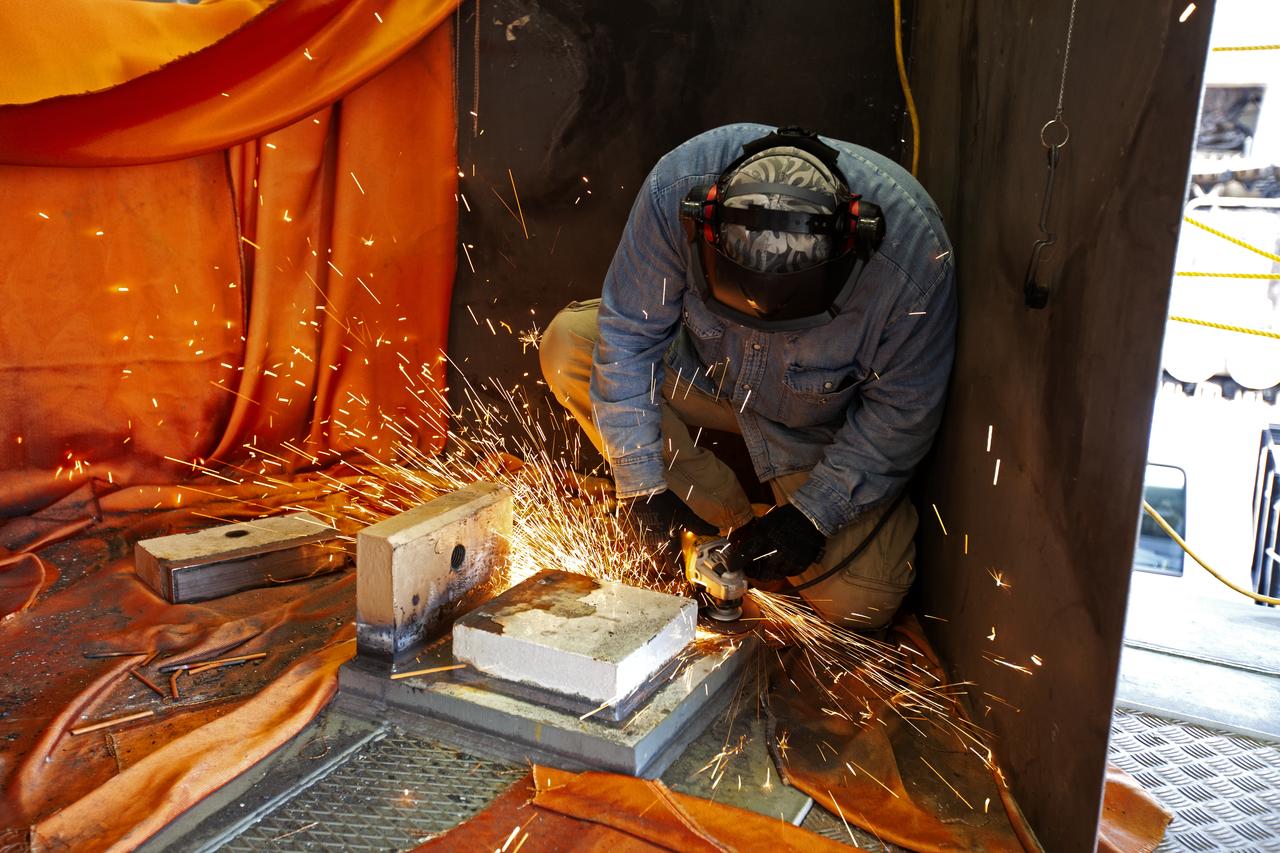
A Jacobs technician from the Launch Equipment Shop performs welding on the KAMAG spacecraft transporter on Oct. 26, 2018, inside a facility at the crawler yard at NASA’s Kennedy Space Center in Florida. The transporter is designed to carry heavy loads. Welding is being performed on the attach points that will hold the Orion transportation pallet in place. Testing of the pallet will be performed to support validation and verification of the attach fittings in the Multi-Payload Processing Facility.
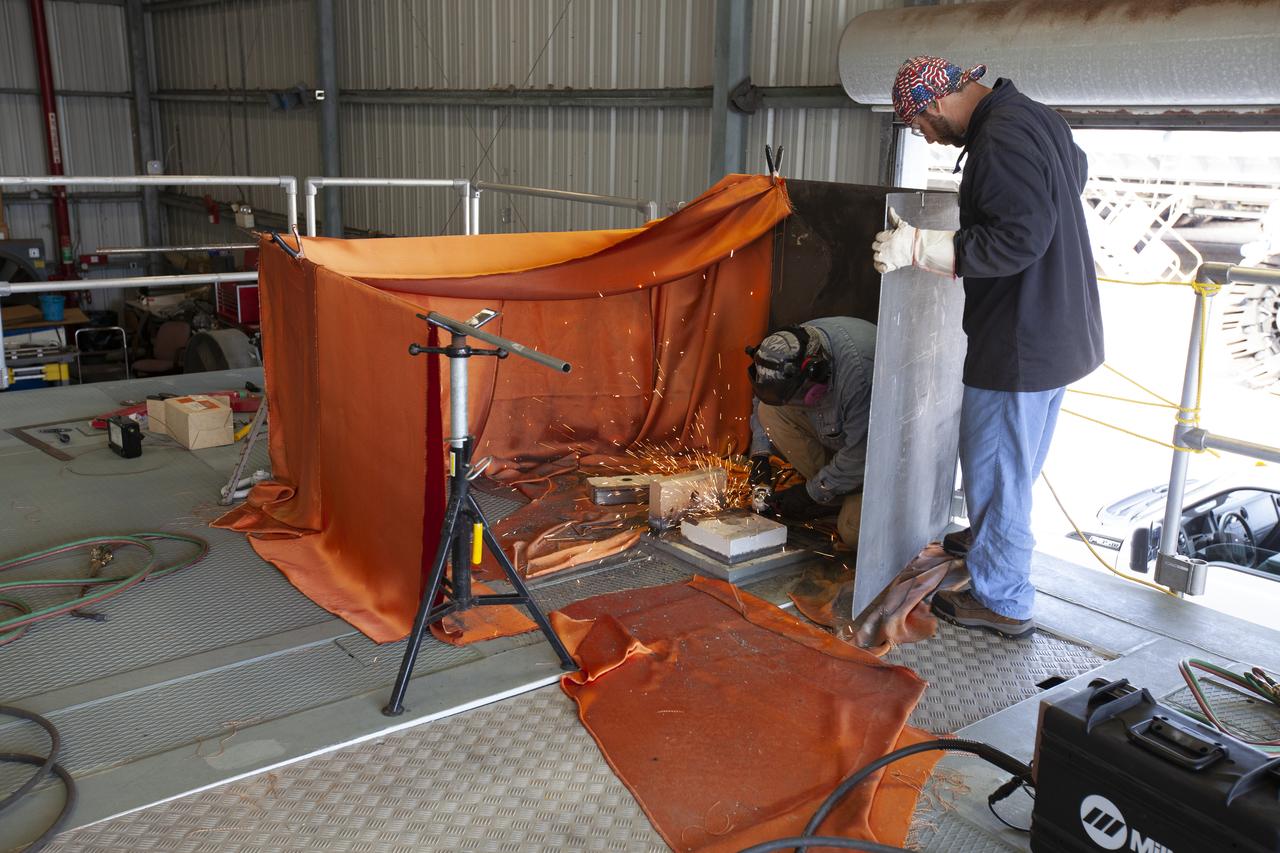
Jacobs technicians from the Launch Equipment Shop perform welding on the KAMAG spacecraft transporter on Oct. 26, 2018, inside a facility at the crawler yard at NASA’s Kennedy Space Center in Florida. The transporter is designed to carry heavy loads. Welding is being performed on the attach points that will hold the Orion transportation pallet in place. Testing of the pallet will be performed to support validation and verification of the attach fittings in the Multi-Payload Processing Facility.
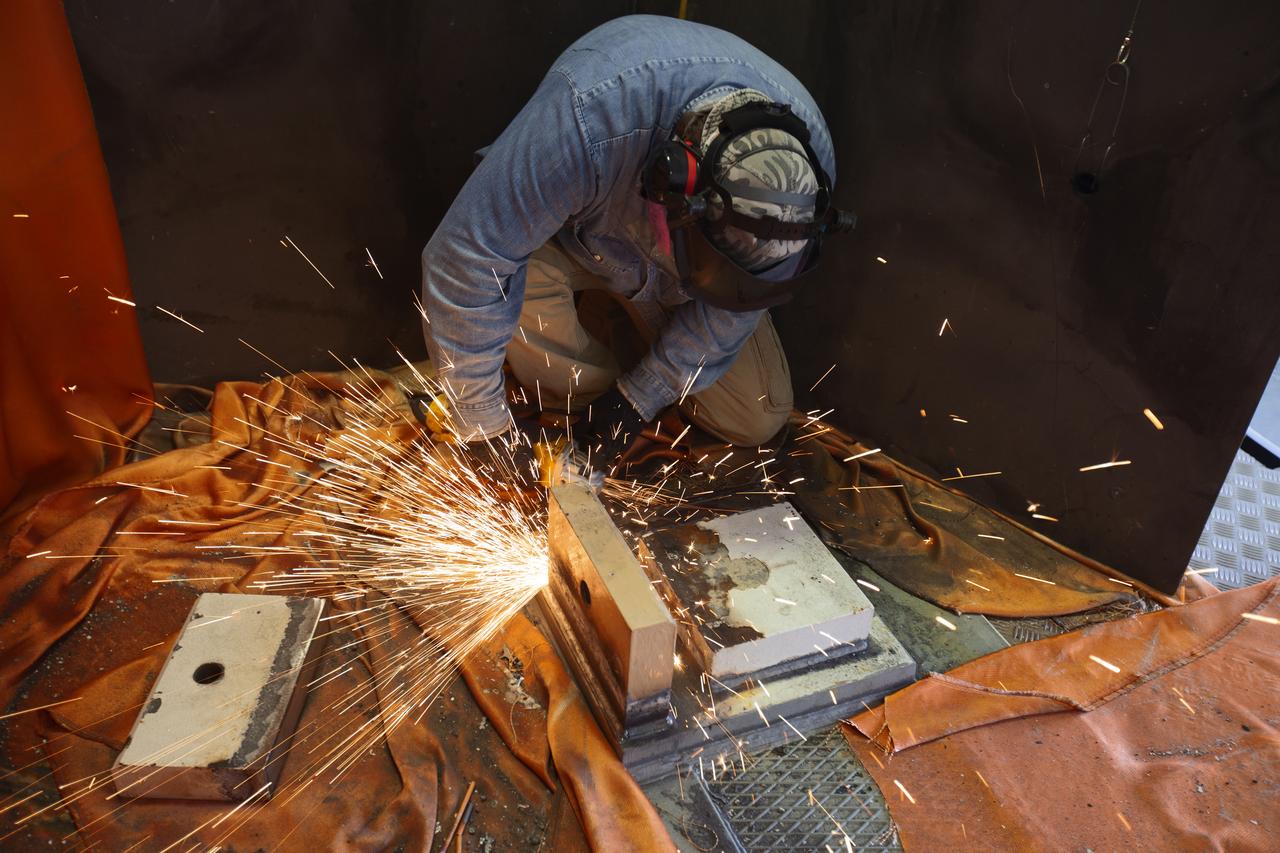
A Jacobs technician from the Launch Equipment Shop performs welding on the KAMAG spacecraft transporter on Oct. 26, 2018, inside a facility at the crawler yard at NASA’s Kennedy Space Center in Florida. The transporter is designed to carry heavy loads. Welding is being performed on the attach points that will hold the Orion transportation pallet in place. Testing of the pallet will be performed to support validation and verification of the attach fittings in the Multi-Payload Processing Facility.
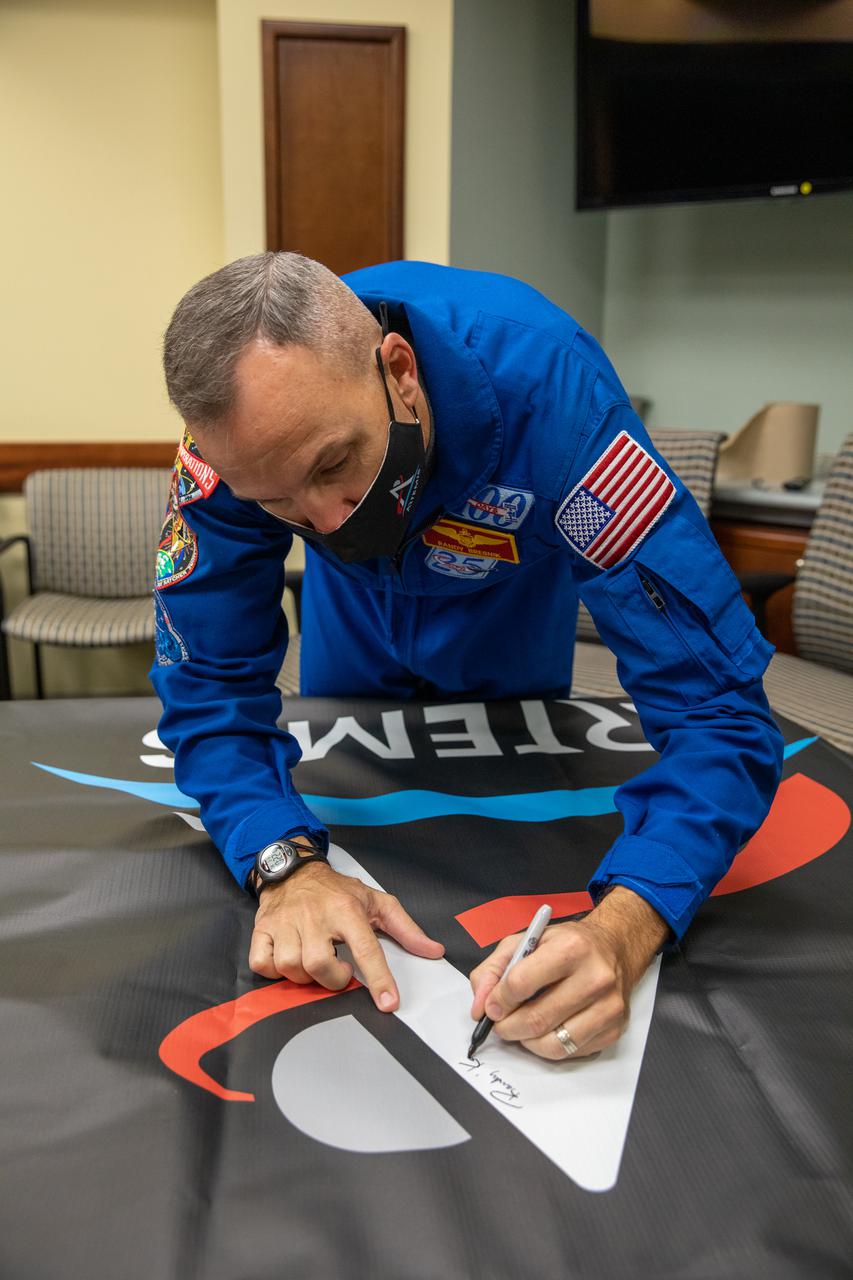
NASA astronaut Randy Bresnik signs an Artemis banner inside the Neil Armstrong Operations and Checkout Building at NASA’s Kennedy Space Center in Florida on Jan. 14, 2021. The banner will be hung on the KAMAG transporter ahead of the spacecraft’s journey to the Multi-Payload Processing Facility to begin ground processing by the Exploration Ground Systems and Jacobs teams.
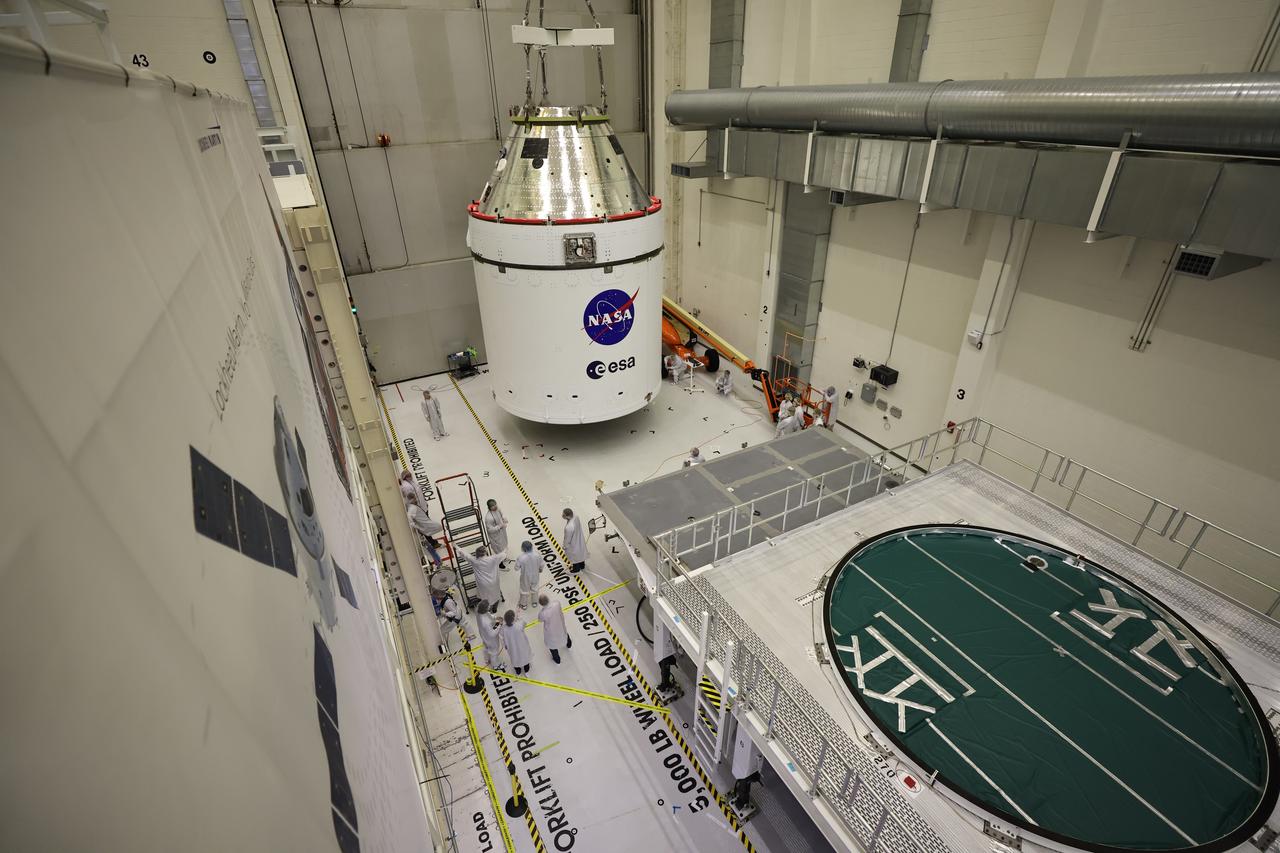
Crews use a massive crane to lift NASA’s Artemis II Orion spacecraft onto the agency’s KAMAG transporter inside the Neil A. Armstrong Operations and Checkout Building at Kennedy Space Center in Florida on Thursday, May 1, 2025. The spacecraft will be transported to the Multi-Payload Processing Facility to undergo fueling and processing for prelaunch operations. The Artemis II test flight is the first crewed flight under NASA’s Artemis campaign and is another step toward missions on the lunar surface and helping the agency prepare for future human missions to Mars.
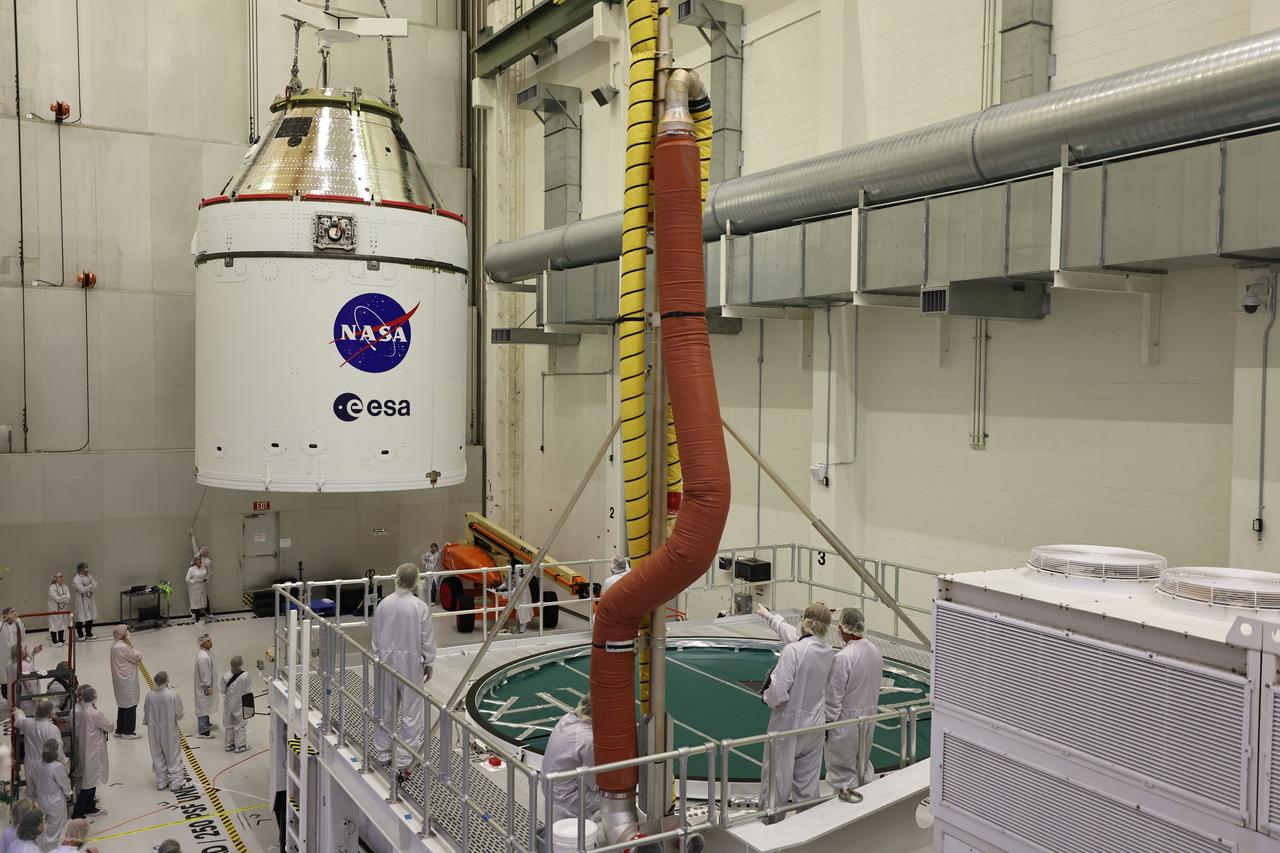
Crews use a massive crane to lift NASA’s Artemis II Orion spacecraft onto the agency’s KAMAG transporter inside the Neil A. Armstrong Operations and Checkout Building at Kennedy Space Center in Florida on Thursday, May 1, 2025. The spacecraft will be transported to the Multi-Payload Processing Facility to undergo fueling and processing for prelaunch operations. The Artemis II test flight is the first crewed flight under NASA’s Artemis campaign and is another step toward missions on the lunar surface and helping the agency prepare for future human missions to Mars.
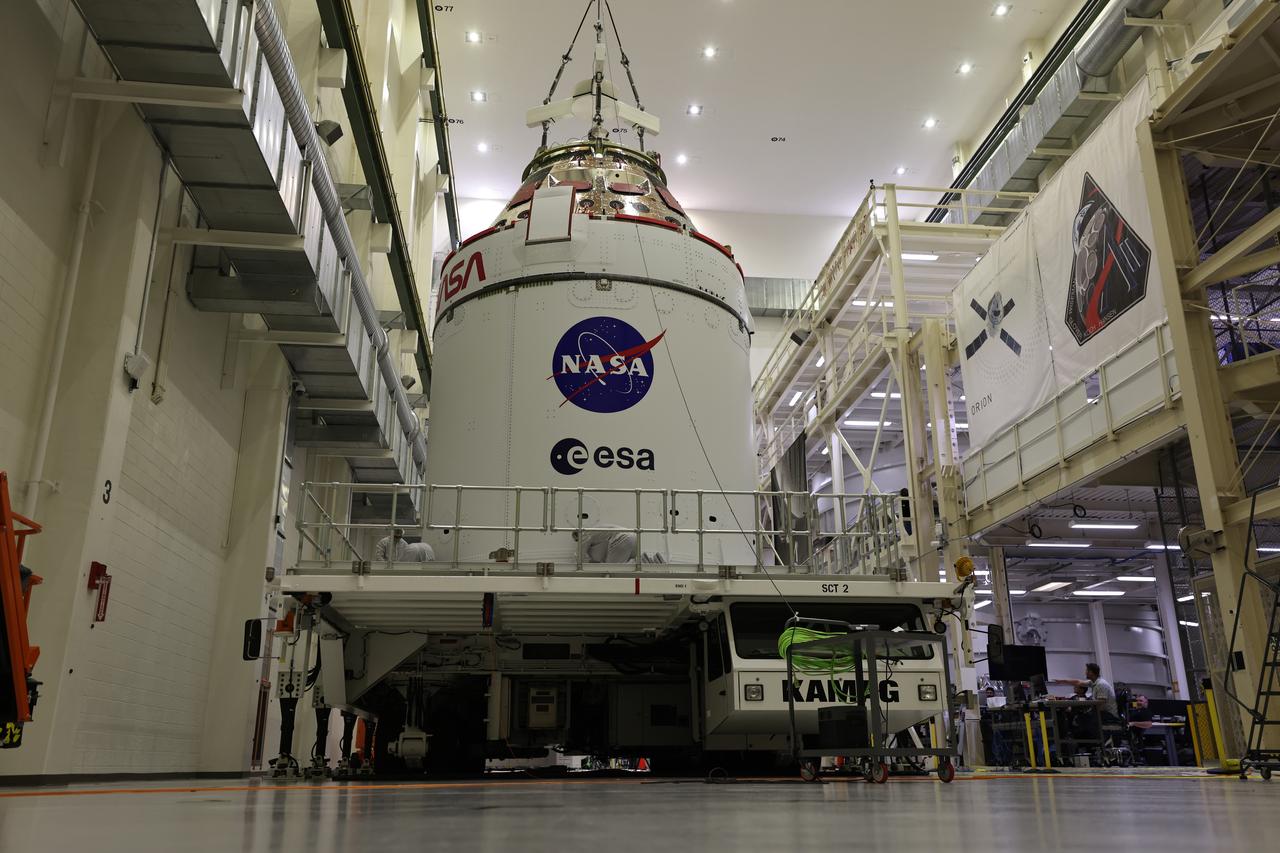
Crews use a massive crane to lift NASA’s Artemis II Orion spacecraft onto the agency’s KAMAG transporter inside the Neil A. Armstrong Operations and Checkout Building at Kennedy Space Center in Florida on Thursday, May 1, 2025. The spacecraft will be transported to the Multi-Payload Processing Facility to undergo fueling and processing for prelaunch operations. The Artemis II test flight is the first crewed flight under NASA’s Artemis campaign and is another step toward missions on the lunar surface and helping the agency prepare for future human missions to Mars.

Amy Marasia, Orion Production Operations Spacecraft Assembly Branch manager, signs an Artemis banner inside the Neil Armstrong Operations and Checkout Building at NASA’s Kennedy Space Center in Florida on Jan. 14, 2021. The banner will be hung on the KAMAG transporter ahead of the spacecraft’s journey to the Multi-Payload Processing Facility to begin ground processing by the Exploration Ground Systems and Jacobs teams.
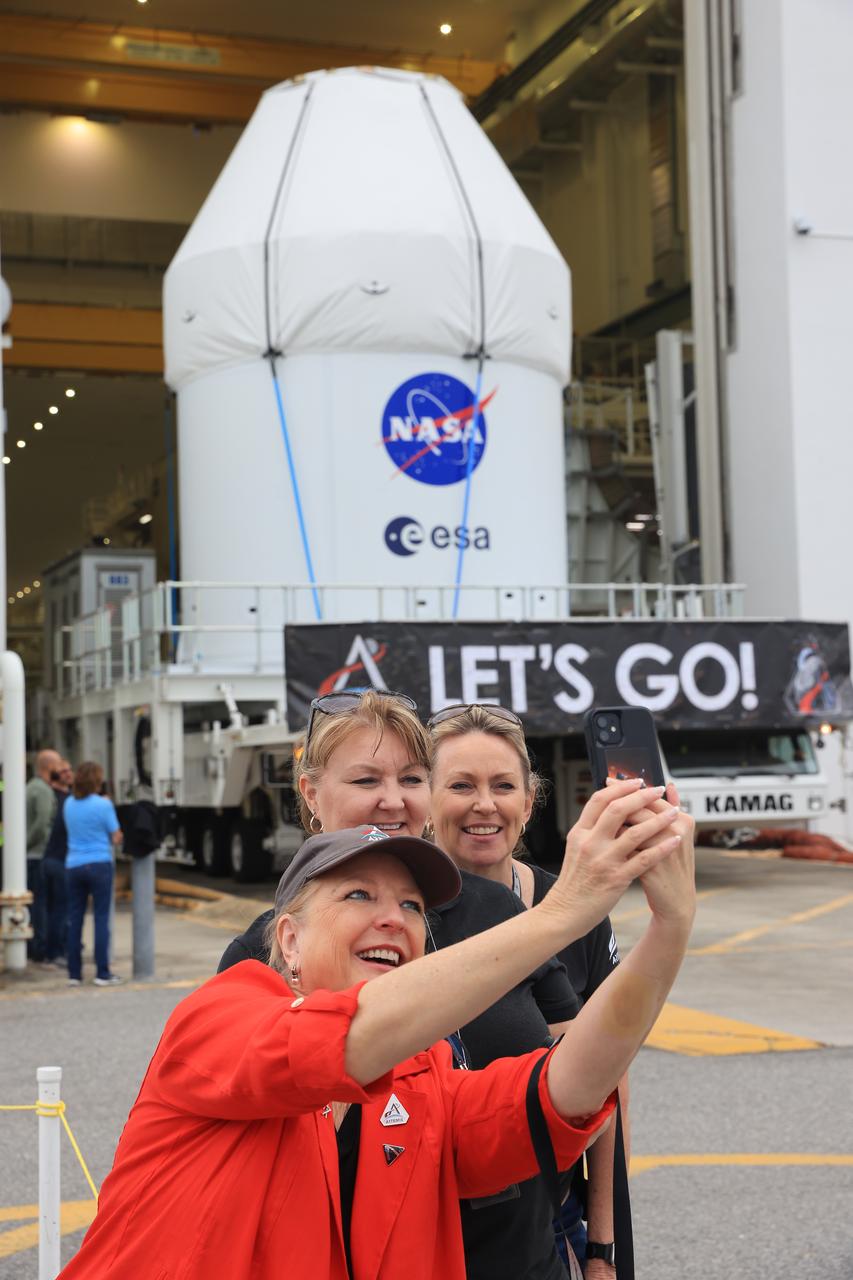
NASA’s KAMAG transporter carries the agency’s Artemis II Orion spacecraft from the Neil A. Armstrong Operations and Checkout Building to the Multi-Payload Processing Facility at Kennedy Space Center in Florida on Saturday, May 3, 2025. The Orion spacecraft will undergo fueling and processing operations at the Multi-Function Facility. The Artemis II test flight is the first crewed flight under NASA’s Artemis campaign and is another step toward missions on the lunar surface and helping the agency prepare for future human missions to Mars.
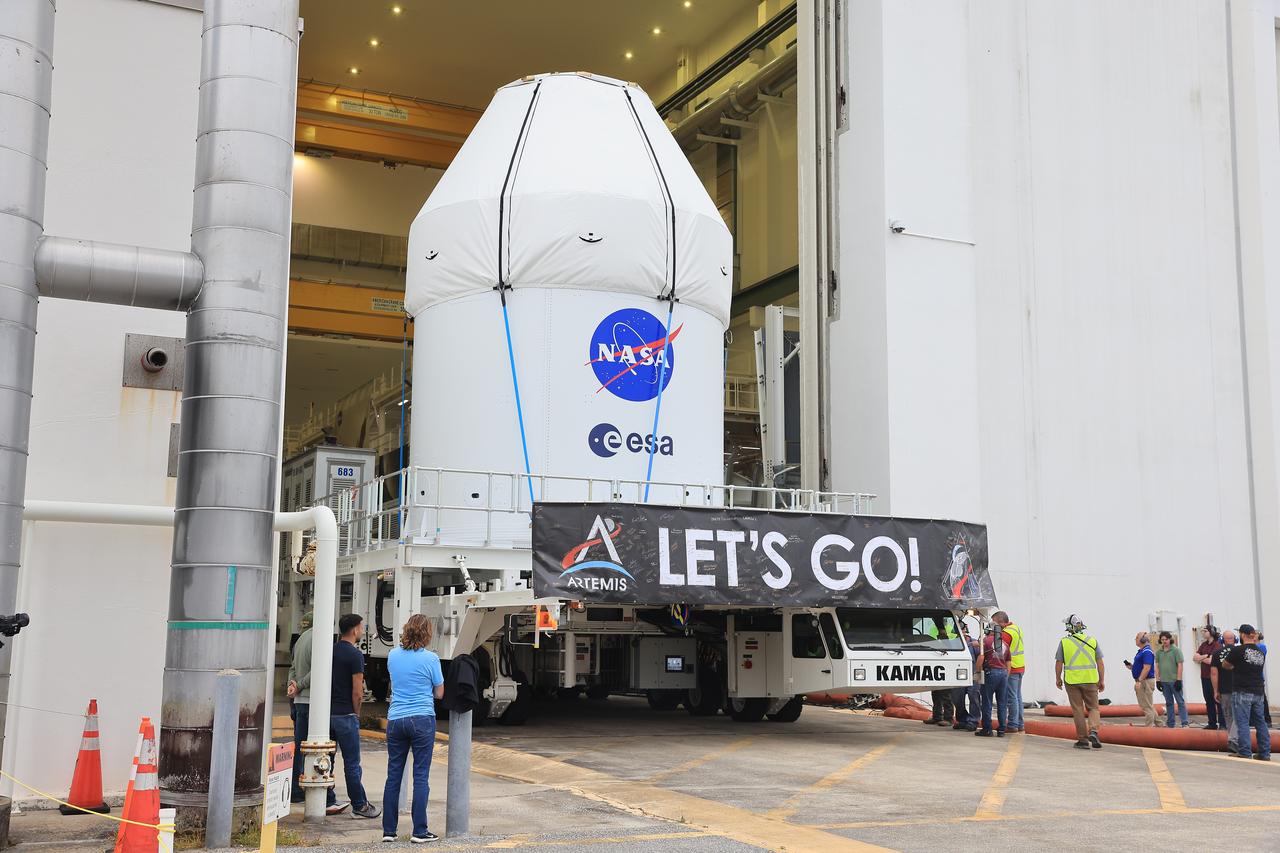
NASA’s KAMAG transporter carries the agency’s Artemis II Orion spacecraft from the Neil A. Armstrong Operations and Checkout Building to the Multi-Payload Processing Facility at Kennedy Space Center in Florida on Saturday, May 3, 2025. The Orion spacecraft will undergo fueling and processing operations at the Multi-Function Facility. The Artemis II test flight is the first crewed flight under NASA’s Artemis campaign and is another step toward missions on the lunar surface and helping the agency prepare for future human missions to Mars.
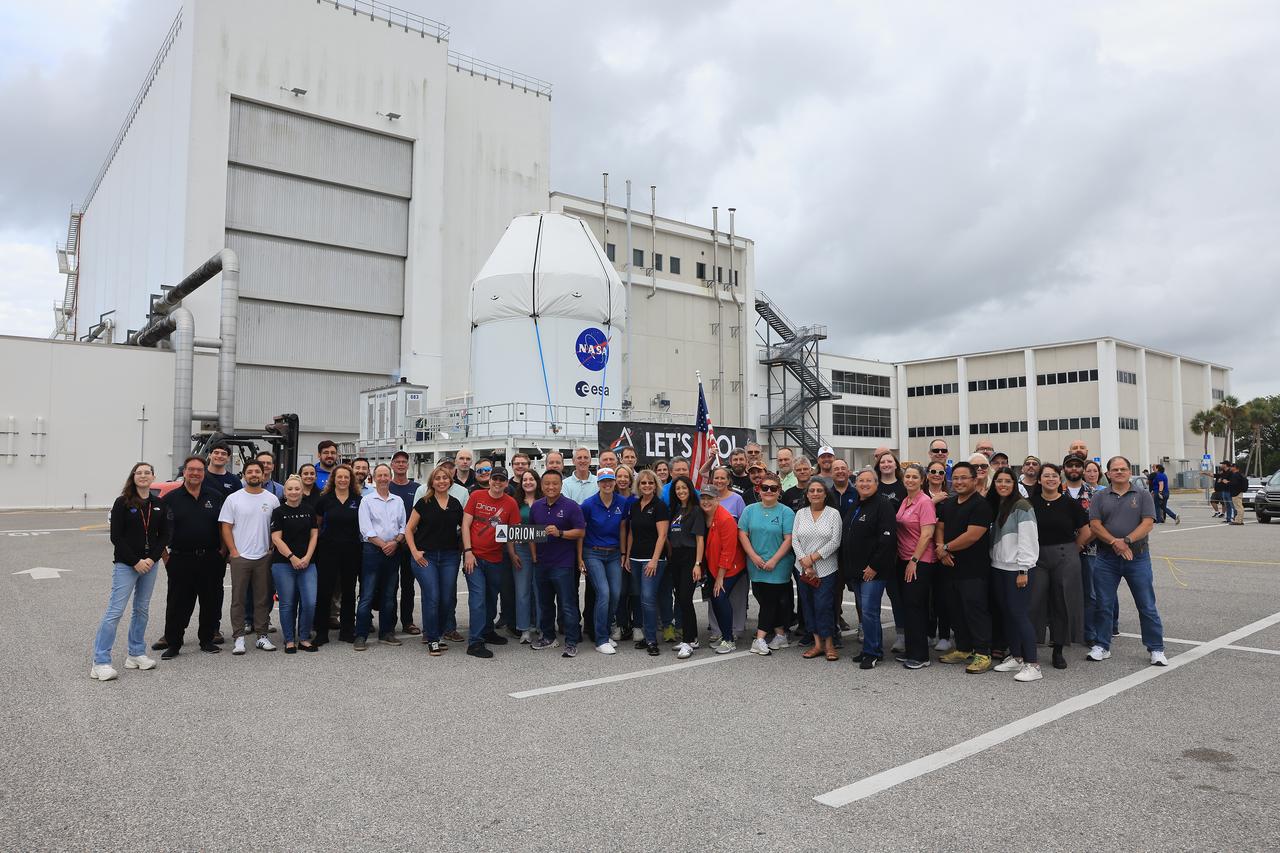
NASA’s KAMAG transporter carries the agency’s Artemis II Orion spacecraft from the Neil A. Armstrong Operations and Checkout Building to the Multi-Payload Processing Facility at Kennedy Space Center in Florida on Saturday, May 3, 2025. The Orion spacecraft will undergo fueling and processing operations at the Multi-Function Facility. The Artemis II test flight is the first crewed flight under NASA’s Artemis campaign and is another step toward missions on the lunar surface and helping the agency prepare for future human missions to Mars.

NASA’s KAMAG transporter carries the agency’s Artemis II Orion spacecraft from the Neil A. Armstrong Operations and Checkout Building to the Multi-Payload Processing Facility at Kennedy Space Center in Florida on Saturday, May 3, 2025. The Orion spacecraft will undergo fueling and processing operations at the Multi-Function Facility. The Artemis II test flight is the first crewed flight under NASA’s Artemis campaign and is another step toward missions on the lunar surface and helping the agency prepare for future human missions to Mars.
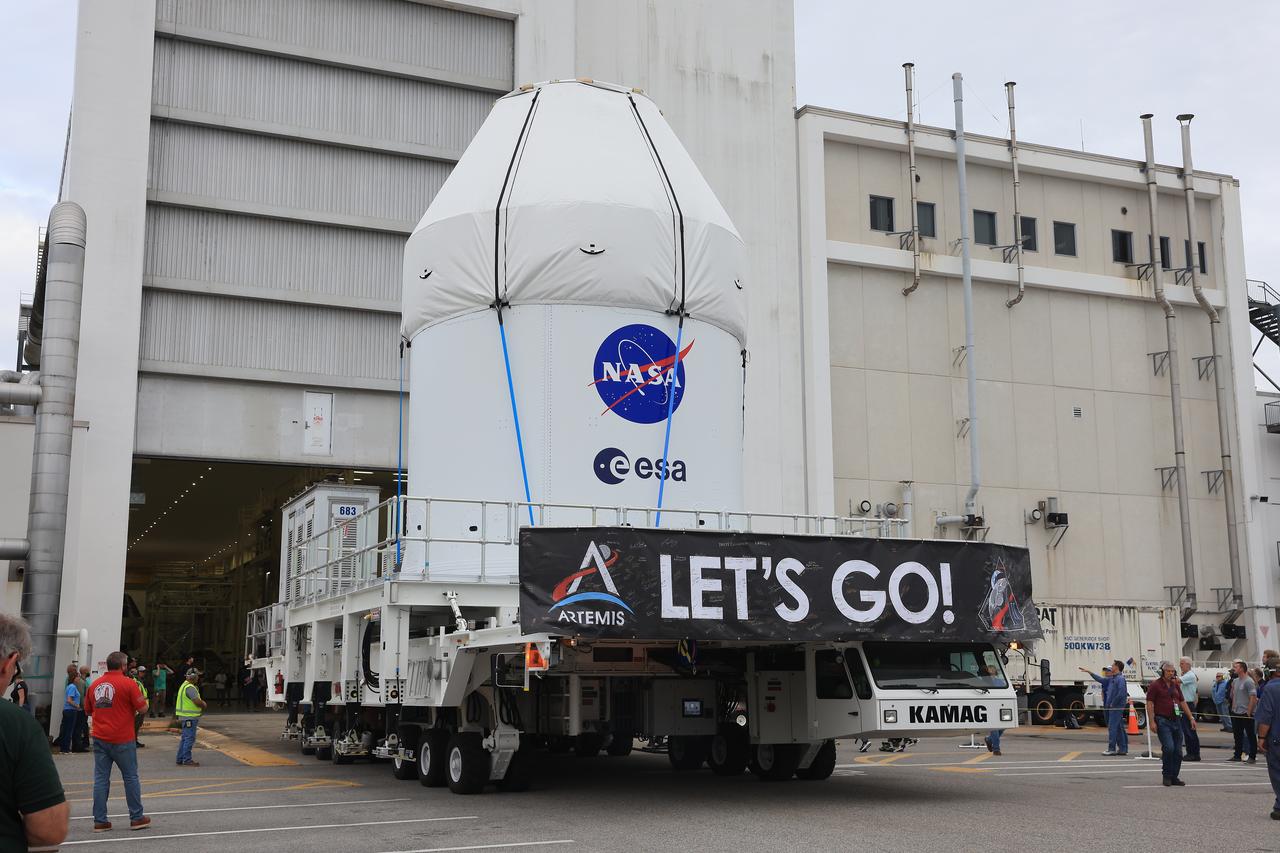
NASA’s KAMAG transporter carries the agency’s Artemis II Orion spacecraft from the Neil A. Armstrong Operations and Checkout Building to the Multi-Payload Processing Facility at Kennedy Space Center in Florida on Saturday, May 3, 2025. The Orion spacecraft will undergo fueling and processing operations at the Multi-Function Facility. The Artemis II test flight is the first crewed flight under NASA’s Artemis campaign and is another step toward missions on the lunar surface and helping the agency prepare for future human missions to Mars.
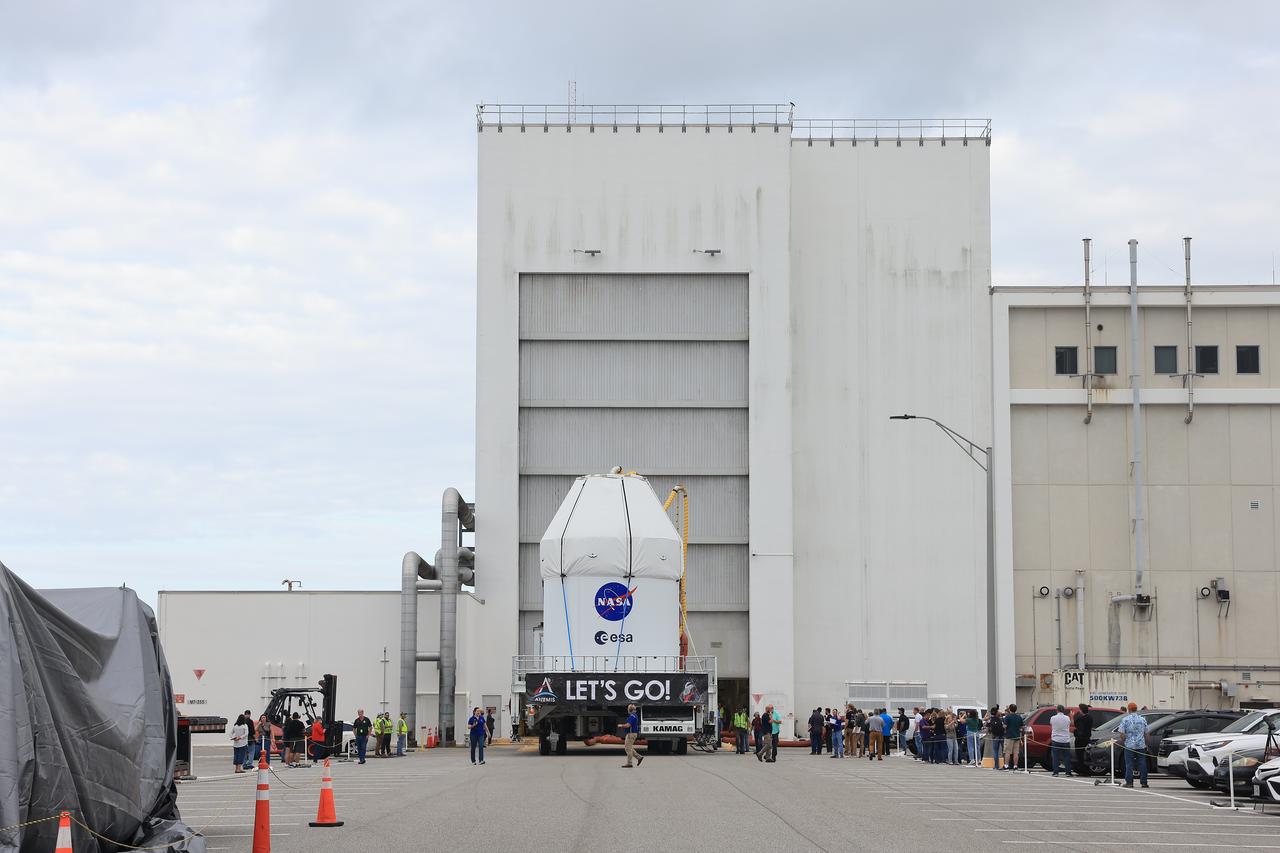
NASA’s KAMAG transporter carries the agency’s Artemis II Orion spacecraft from the Neil A. Armstrong Operations and Checkout Building to the Multi-Payload Processing Facility at Kennedy Space Center in Florida on Saturday, May 3, 2025. The Orion spacecraft will undergo fueling and processing operations at the Multi-Function Facility. The Artemis II test flight is the first crewed flight under NASA’s Artemis campaign and is another step toward missions on the lunar surface and helping the agency prepare for future human missions to Mars.
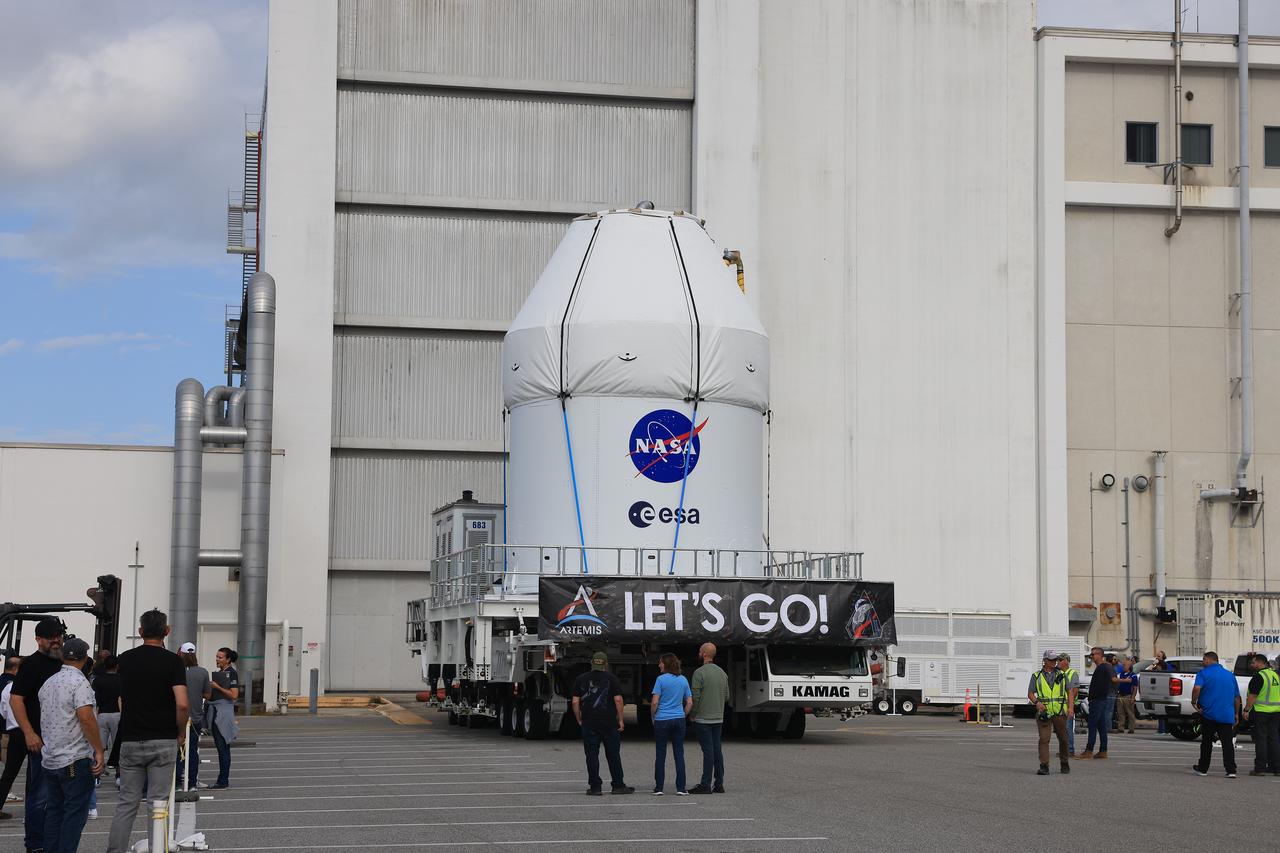
NASA’s KAMAG transporter carries the agency’s Artemis II Orion spacecraft from the Neil A. Armstrong Operations and Checkout Building to the Multi-Payload Processing Facility at Kennedy Space Center in Florida on Saturday, May 3, 2025. The Orion spacecraft will undergo fueling and processing operations at the Multi-Function Facility. The Artemis II test flight is the first crewed flight under NASA’s Artemis campaign and is another step toward missions on the lunar surface and helping the agency prepare for future human missions to Mars.
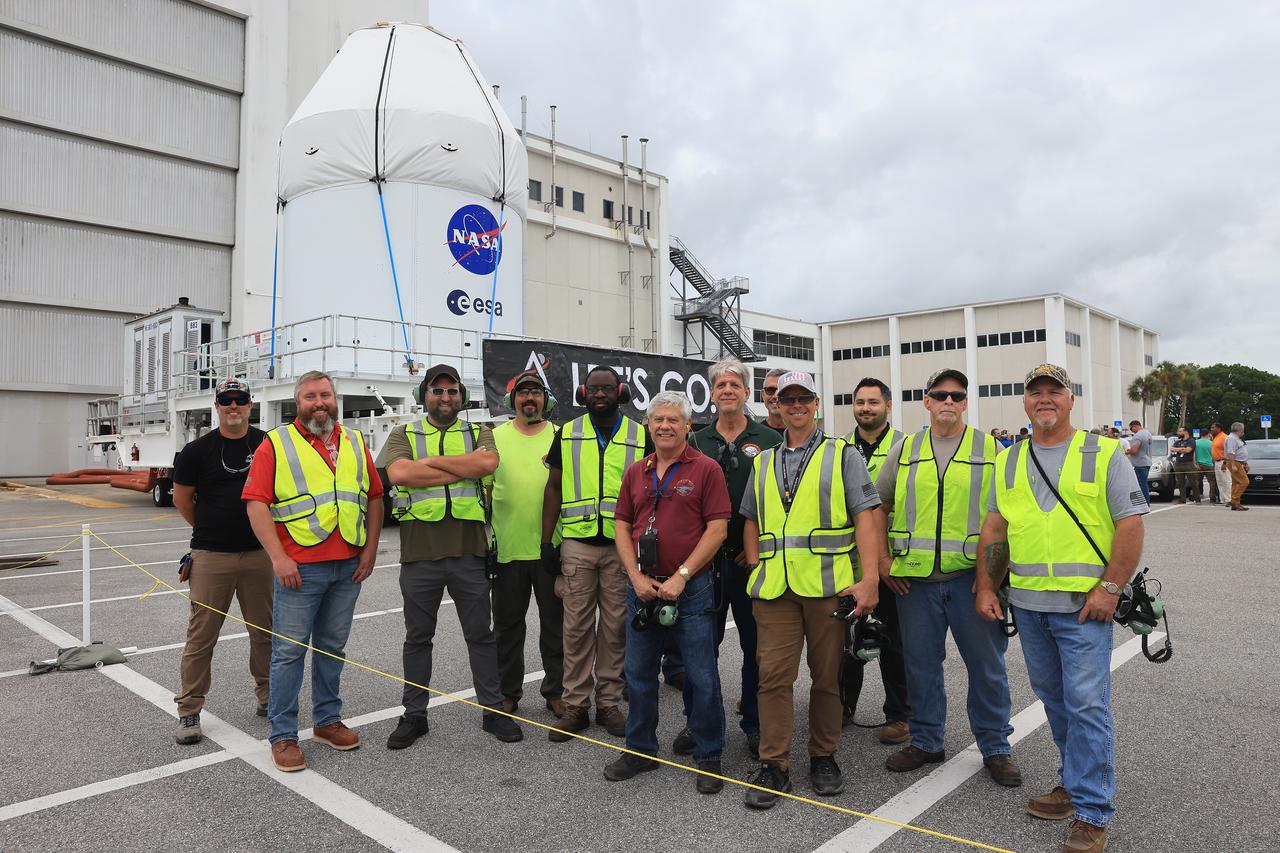
NASA’s KAMAG transporter carries the agency’s Artemis II Orion spacecraft from the Neil A. Armstrong Operations and Checkout Building to the Multi-Payload Processing Facility at Kennedy Space Center in Florida on Saturday, May 3, 2025. The Orion spacecraft will undergo fueling and processing operations at the Multi-Function Facility. The Artemis II test flight is the first crewed flight under NASA’s Artemis campaign and is another step toward missions on the lunar surface and helping the agency prepare for future human missions to Mars.
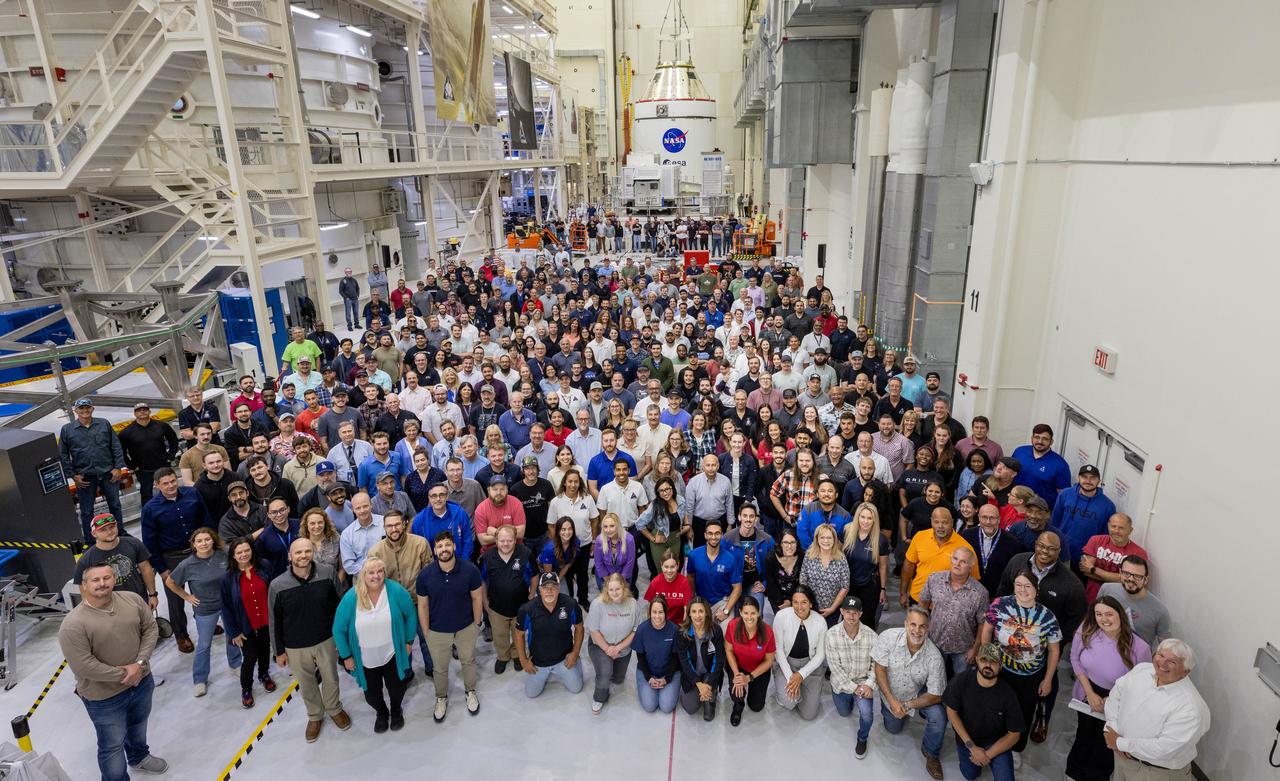
Teams from NASA and Lockheed Martin pose for a photo in front of NASA’s Artemis II Orion spacecraft, connected to a massive crane ahead atop the agency’s KAMAG transporter inside the Neil A. Operations and Checkout Building at NASA’s Kennedy Space Center in Florida on Friday, May 2, 2025. The spacecraft will be transported to the spaceport’s Multi-Payload Processing Facility to undergo fueling and processing for prelaunch operations. The Artemis II test flight is the first crewed flight under NASA’s Artemis campaign and is another step toward missions on the lunar surface and helping the agency prepare for future human missions to Mars.
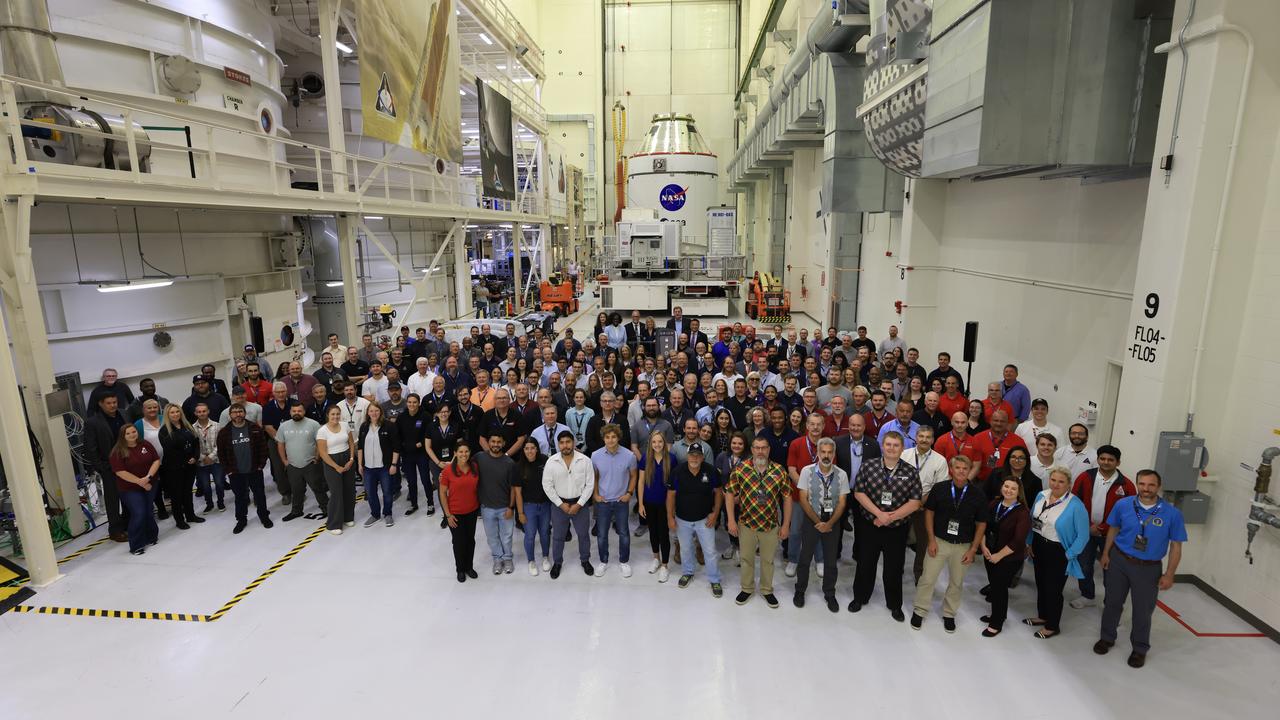
Teams from NASA and Lockheed Martin pose for a photo in front of NASA’s Artemis II Orion spacecraft, connected to a massive crane ahead atop the agency’s KAMAG transporter inside the Neil A. Operations and Checkout Building at NASA’s Kennedy Space Center in Florida on Friday, May 2, 2025. The spacecraft will be transported to the spaceport’s Multi-Payload Processing Facility to undergo fueling and processing for prelaunch operations. The Artemis II test flight is the first crewed flight under NASA’s Artemis campaign and is another step toward missions on the lunar surface and helping the agency prepare for future human missions to Mars.
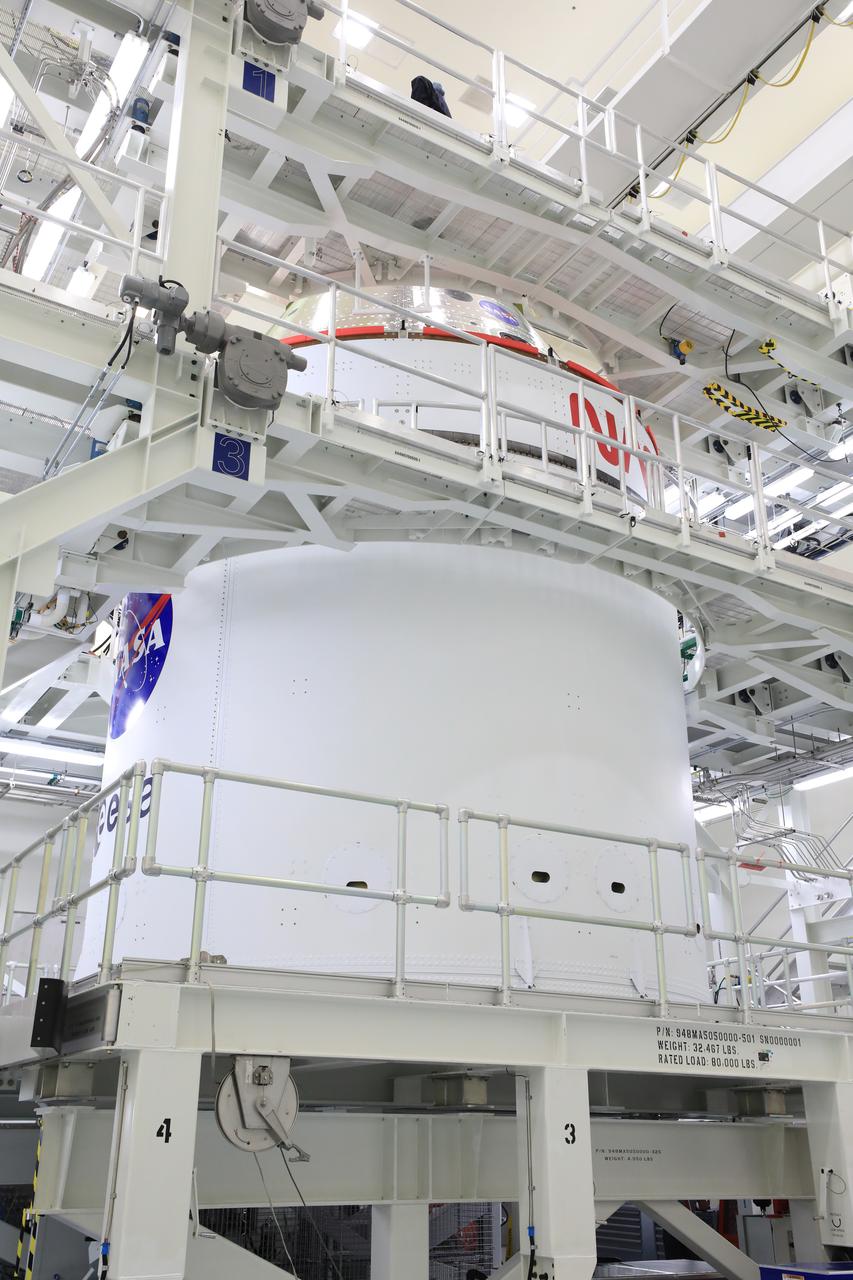
Technicians with NASA’s Exploration Ground Systems Program offload the agency’s Orion spacecraft from the KAMAG transporter to the servicing stand inside the Multi-Payload Processing Facility at Kennedy Space Center in Florida on Sunday, May 4, 2025, to undergo fueling and processing operations for prelaunch operations. The Artemis II test flight is the first crewed flight under NASA’s Artemis campaign and is another step toward missions on the lunar surface and helping the agency prepare for future human missions to Mars.

Technicians with NASA’s Exploration Ground Systems Program offload the agency’s Orion spacecraft from the KAMAG transporter to the servicing stand inside the Multi-Payload Processing Facility at Kennedy Space Center in Florida on Sunday, May 4, 2025, to undergo fueling and processing operations for prelaunch operations. The Artemis II test flight is the first crewed flight under NASA’s Artemis campaign and is another step toward missions on the lunar surface and helping the agency prepare for future human missions to Mars.
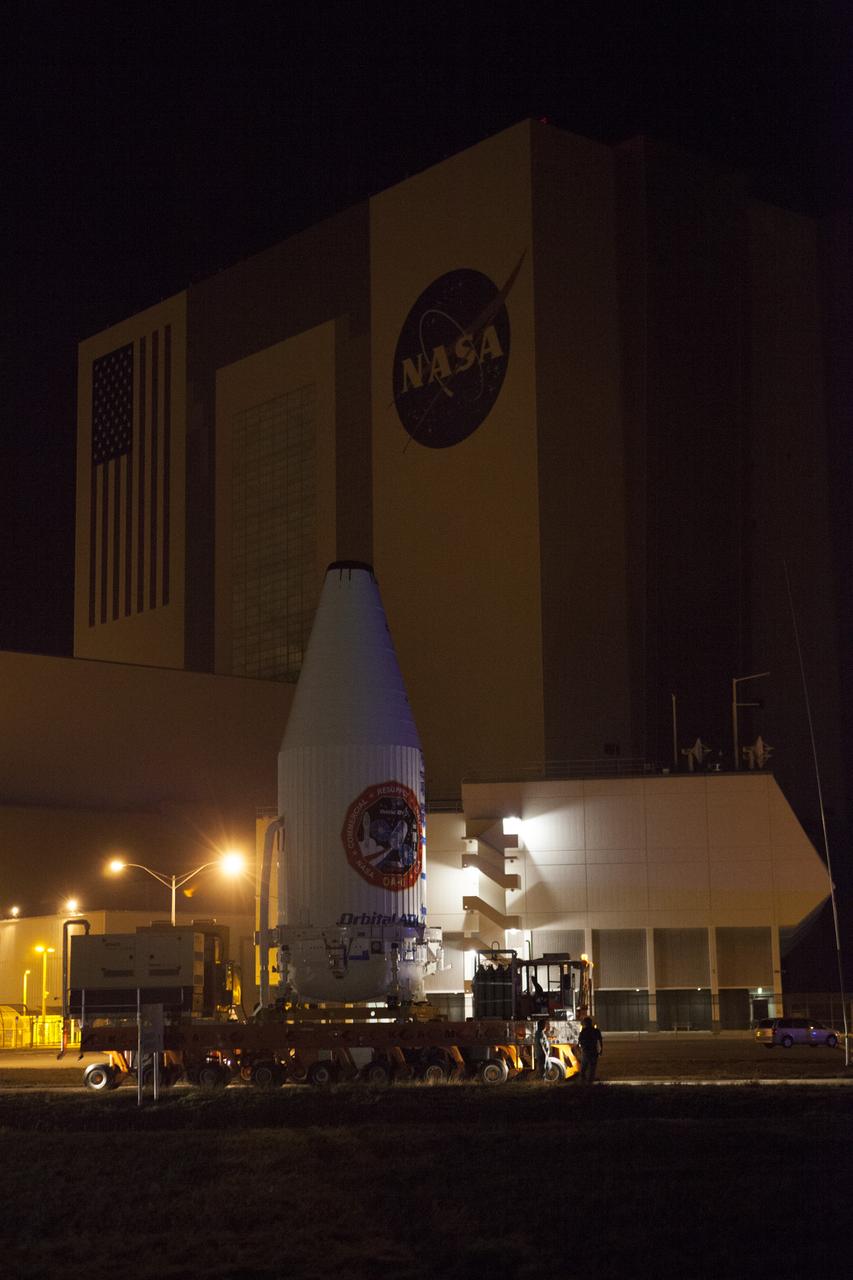
Encapsulated inside its payload fairing, the Cygnus spacecraft for the upcoming Orbital ATK Commercial Resupply Services-6 mission moves past the Vehicle Assembly Building at NASA's Kennedy Space Center in Florida. Mounted atop a KAMAG transporter, Cygnus is being moved to Space Launch Complex-41 at Cape Canaveral Air Force Station where it will be mounted atop a United Launch Alliance Atlas V rocket. The Cygnus is scheduled to lift off atop a United Launch Alliance Atlas V rocket on March 22 to deliver hardware and supplies to the International Space Station.
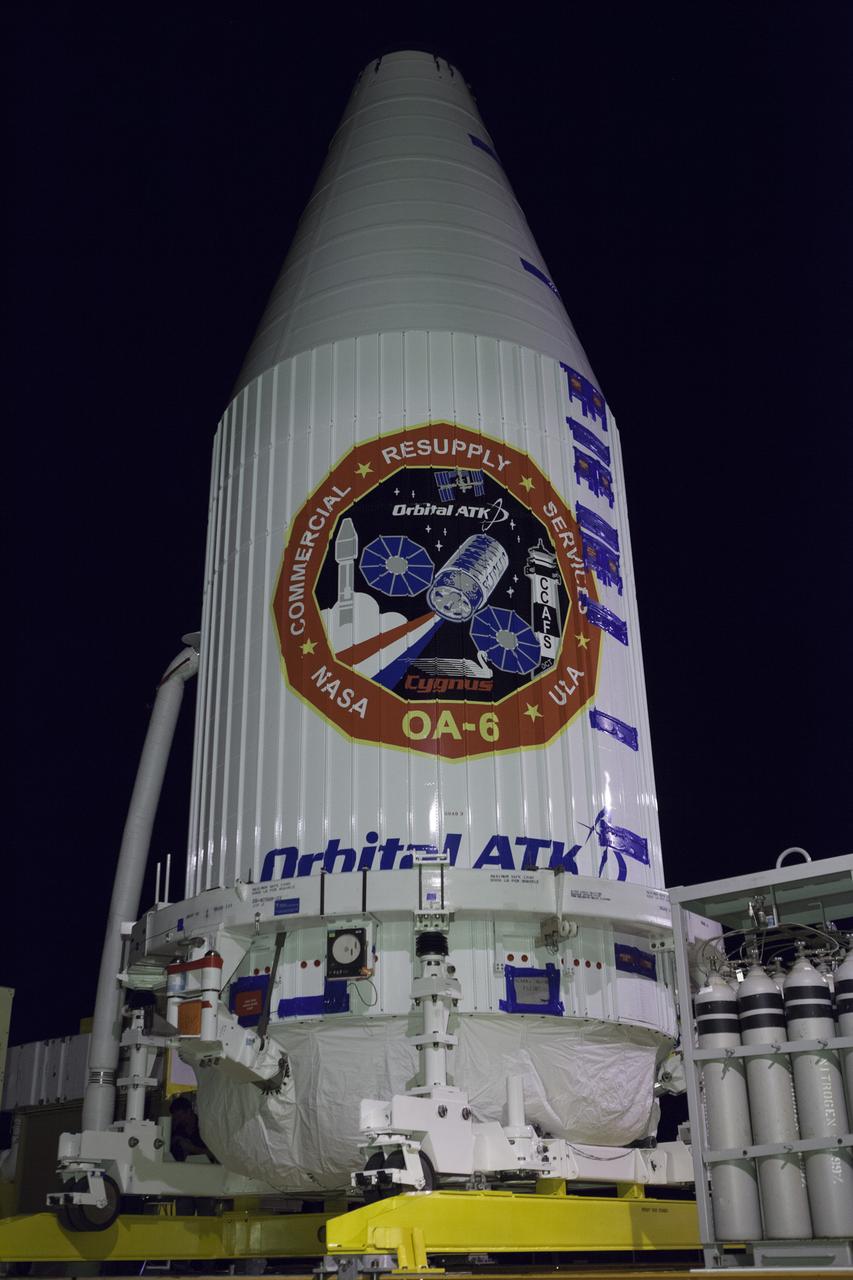
Encapsulated inside its payload fairing, the Cygnus spacecraft for the upcoming Orbital ATK Commercial Resupply Services-6 mission departs the Payload Hazardous Servicing Facility at NASA's Kennedy Space Center in Florida. Mounted atop a KAMAG transporter, Cygnus is being moved to Space Launch Complex-41 at Cape Canaveral Air Force Station where it will be mounted atop a United Launch Alliance Atlas V rocket. The Cygnus is scheduled to lift off atop a United Launch Alliance Atlas V rocket on March 22 to deliver hardware and supplies to the International Space Station.
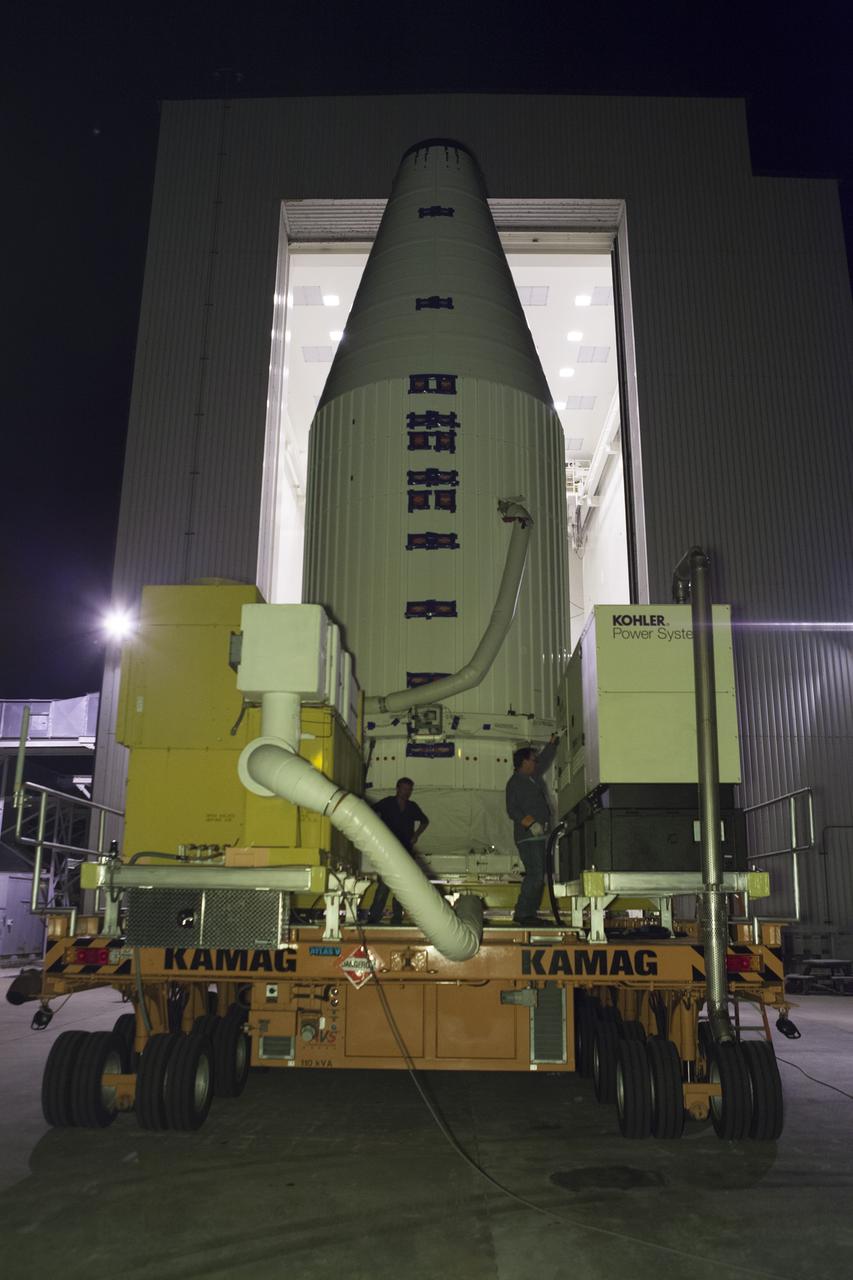
Encapsulated inside its payload fairing, the Cygnus spacecraft for the upcoming Orbital ATK Commercial Resupply Services-6 mission departs the Payload Hazardous Servicing Facility at NASA's Kennedy Space Center in Florida. Mounted atop a KAMAG transporter, Cygnus is being moved to Space Launch Complex-41 at Cape Canaveral Air Force Station where it will be mounted atop a United Launch Alliance Atlas V rocket. The Cygnus is scheduled to lift off atop a United Launch Alliance Atlas V rocket on March 22 to deliver hardware and supplies to the International Space Station.
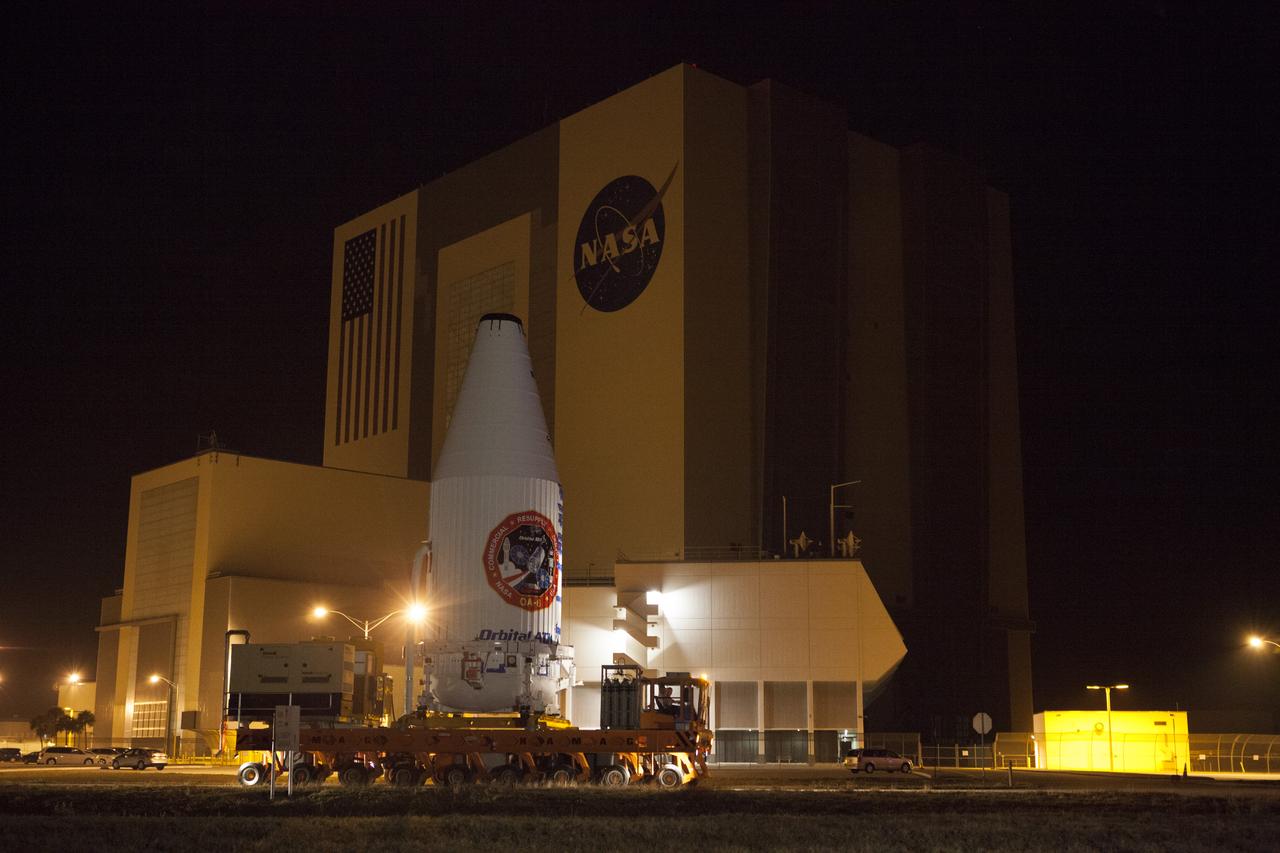
Encapsulated inside its payload fairing, the Cygnus spacecraft for the upcoming Orbital ATK Commercial Resupply Services-6 mission moves past the Vehicle Assembly Building at NASA's Kennedy Space Center in Florida. Mounted atop a KAMAG transporter, Cygnus is being moved to Space Launch Complex-41 at Cape Canaveral Air Force Station where it will be mounted atop a United Launch Alliance Atlas V rocket. The Cygnus is scheduled to lift off atop a United Launch Alliance Atlas V rocket on March 22 to deliver hardware and supplies to the International Space Station.
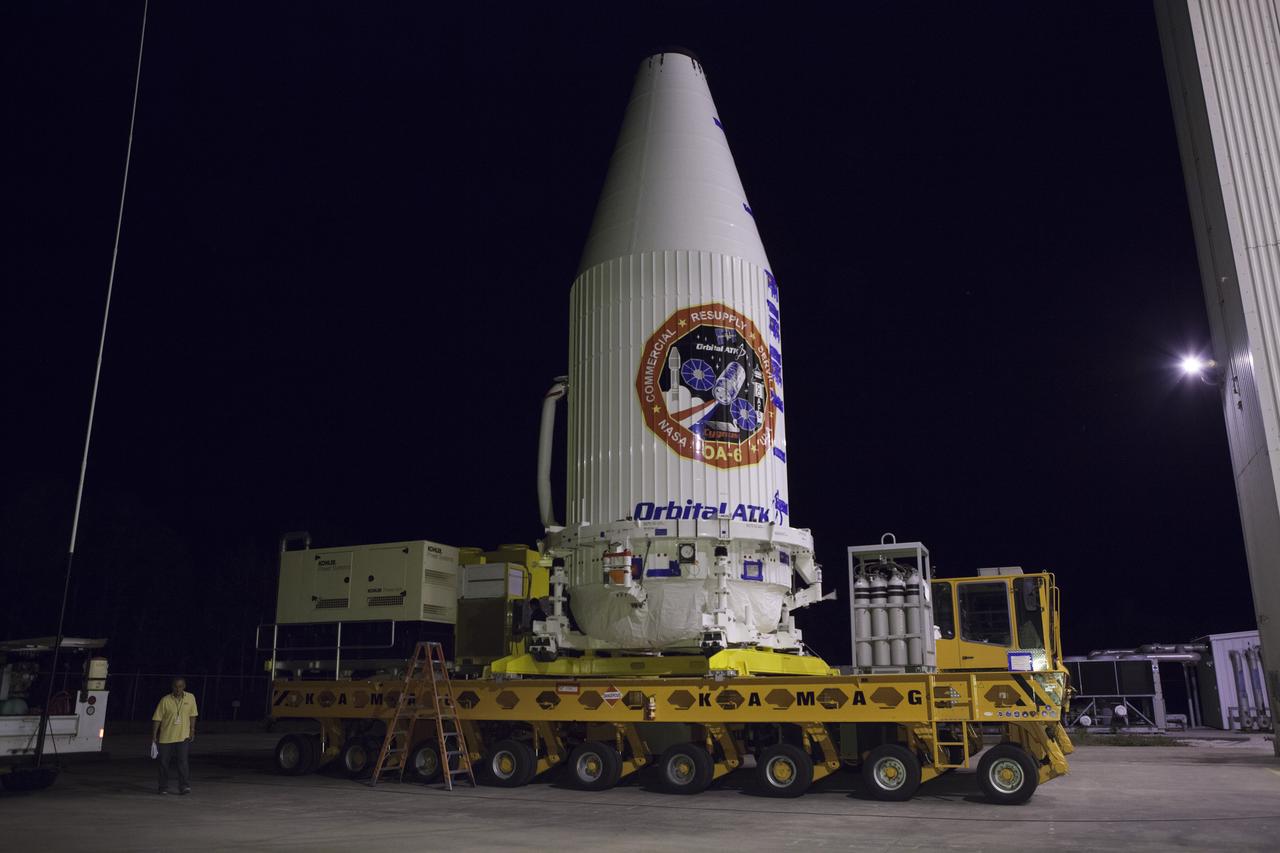
Encapsulated inside its payload fairing, the Cygnus spacecraft for the upcoming Orbital ATK Commercial Resupply Services-6 mission departs the Payload Hazardous Servicing Facility at NASA's Kennedy Space Center in Florida. Mounted atop a KAMAG transporter, Cygnus is being moved to Space Launch Complex-41 at Cape Canaveral Air Force Station where it will be mounted atop a United Launch Alliance Atlas V rocket. The Cygnus is scheduled to lift off atop a United Launch Alliance Atlas V rocket on March 22 to deliver hardware and supplies to the International Space Station.
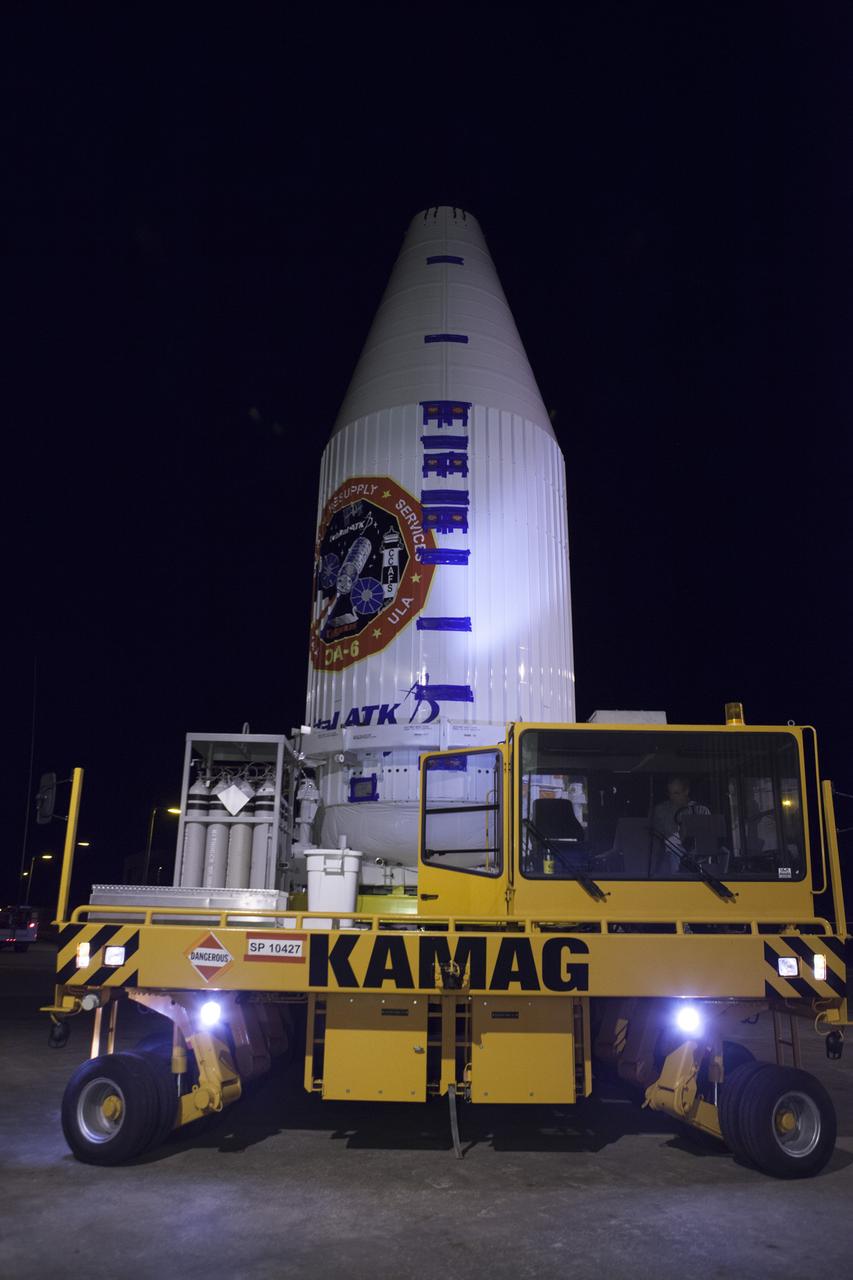
Encapsulated inside its payload fairing, the Cygnus spacecraft for the upcoming Orbital ATK Commercial Resupply Services-6 mission departs the Payload Hazardous Servicing Facility at NASA's Kennedy Space Center in Florida. Mounted atop a KAMAG transporter, Cygnus is being moved to Space Launch Complex-41 at Cape Canaveral Air Force Station where it will be mounted atop a United Launch Alliance Atlas V rocket. The Cygnus is scheduled to lift off atop a United Launch Alliance Atlas V rocket on March 22 to deliver hardware and supplies to the International Space Station.
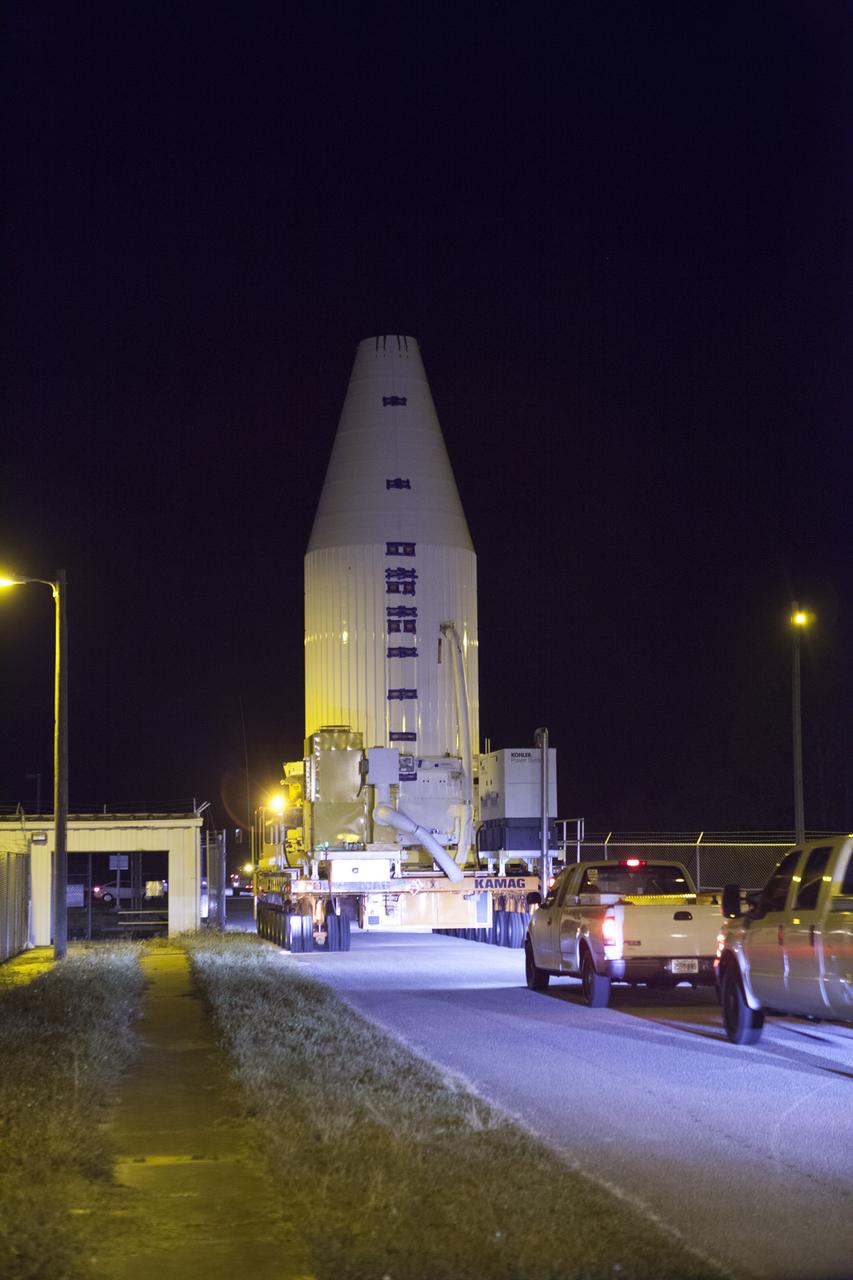
Encapsulated inside its payload fairing, the Cygnus spacecraft for the upcoming Orbital ATK Commercial Resupply Services-6 mission departs the Payload Hazardous Servicing Facility at NASA's Kennedy Space Center in Florida. Mounted atop a KAMAG transporter, Cygnus is being moved to Space Launch Complex-41 at Cape Canaveral Air Force Station where it will be mounted atop a United Launch Alliance Atlas V rocket. The Cygnus is scheduled to lift off atop a United Launch Alliance Atlas V rocket on March 22 to deliver hardware and supplies to the International Space Station.
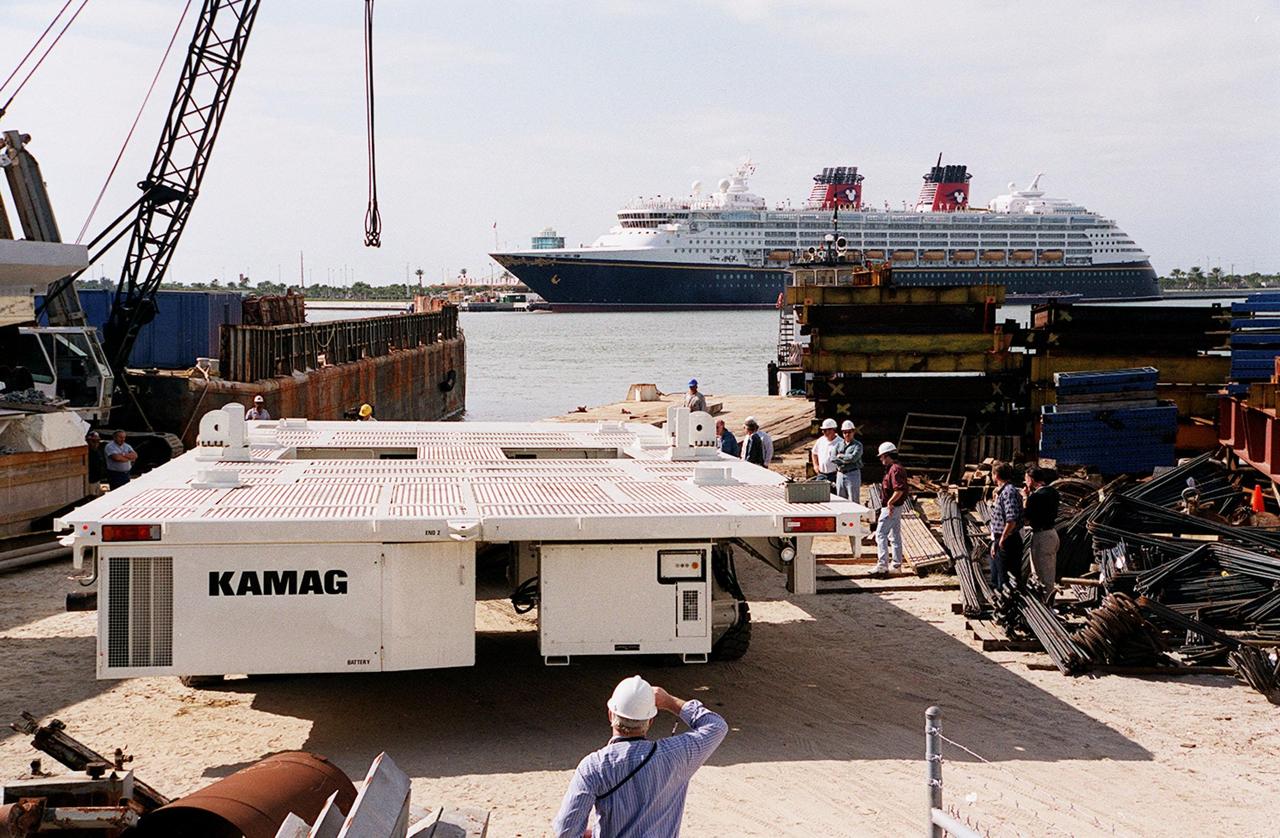
One of two new payload transporters for Kennedy Space Center arrives at Port Canaveral. In the background is a cruise ship docked at the Port. The transporters were shipped by barge from their manufacturer, the KAMAG Company of Ulm, Germany. They are used to carry spacecraft and International Space Station elements from payload facilities to and from the launch pads and orbiter hangars. Each transporter is 65 feet long and 22 feet wide and has 24 tires divided between its two axles. The transporter travels 10 miles per hour unloaded, 5 miles per hour when loaded; it weighs up to 172,000 pounds when the canister with payloads rides atop. The transporters will be outfitted with four subsystems for monitoring the environment inside the canister during the payload moves: the Electrical Power System, Environmental Control System, Instrumentation and Communications System, and the Fluids and Gases System. Engineers and technicians are being trained on the transporter's operation and maintenance. The new transporters are replacing the 20-year-old existing Payload Canister Transporter system

One of two new payload transporters for Kennedy Space Center arrives at Port Canaveral. They were shipped by barge from their manufacturer, the KAMAG Company of Ulm, Germany. The transporters are used to carry spacecraft and International Space Station elements from payload facilities to and from the launch pads and orbiter hangars. Each transporter is 65 feet long and 22 feet wide and has 24 tires divided between its two axles. The transporter travels 10 miles per hour unloaded, 5 miles per hour when loaded; it weighs up to 172,000 pounds when the canister with payloads rides atop. The transporters will be outfitted with four subsystems for monitoring the environment inside the canister during the payload moves: the Electrical Power System, Environmental Control System, Instrumentation and Communications System, and the Fluids and Gases System. Engineers and technicians are being trained on the transporter's operation and maintenance. The new transporters are replacing the 20-year-old existing Payload Canister Transporter system
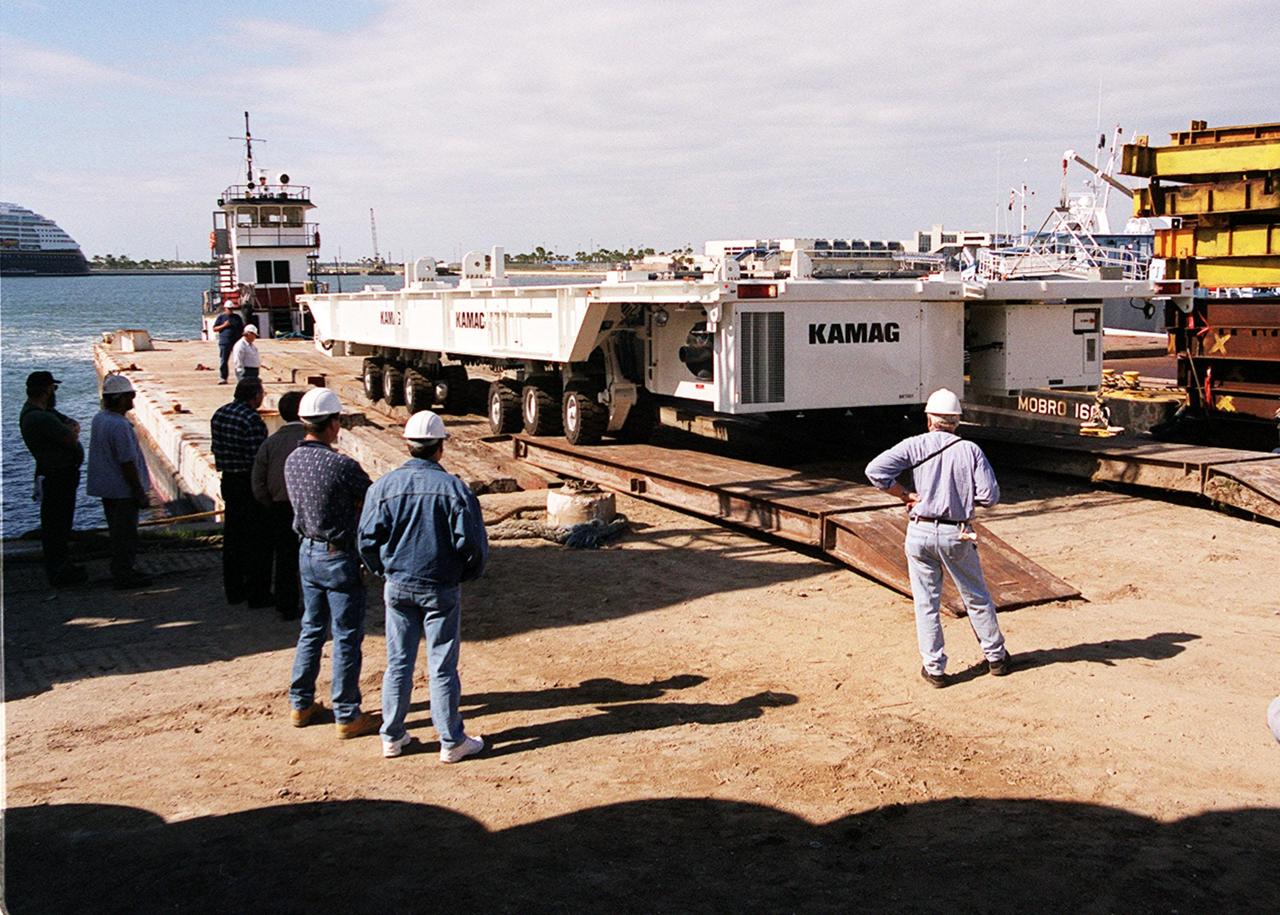
The first of two new payload transporters for Kennedy Space Center arrives at Port Canaveral. They were shipped by barge from their manufacturer, the KAMAG Company of Ulm, Germany. The transporters are used to carry spacecraft and International Space Station elements from payload facilities to and from the launch pads and orbiter hangars. Each transporter is 65 feet long and 22 feet wide and has 24 tires divided between its two axles. The transporter travels 10 miles per hour unloaded, 5 miles per hour when loaded; it weighs up to 172,000 pounds when the canister with payloads rides atop. The transporters will be outfitted with four subsystems for monitoring the environment inside the canister during the payload moves: the Electrical Power System, Environmental Control System, Instrumentation and Communications System, and the Fluids and Gases System. Engineers and technicians are being trained on the transporter's operation and maintenance. The new transporters are replacing the 20-year-old existing Payload Canister Transporter system
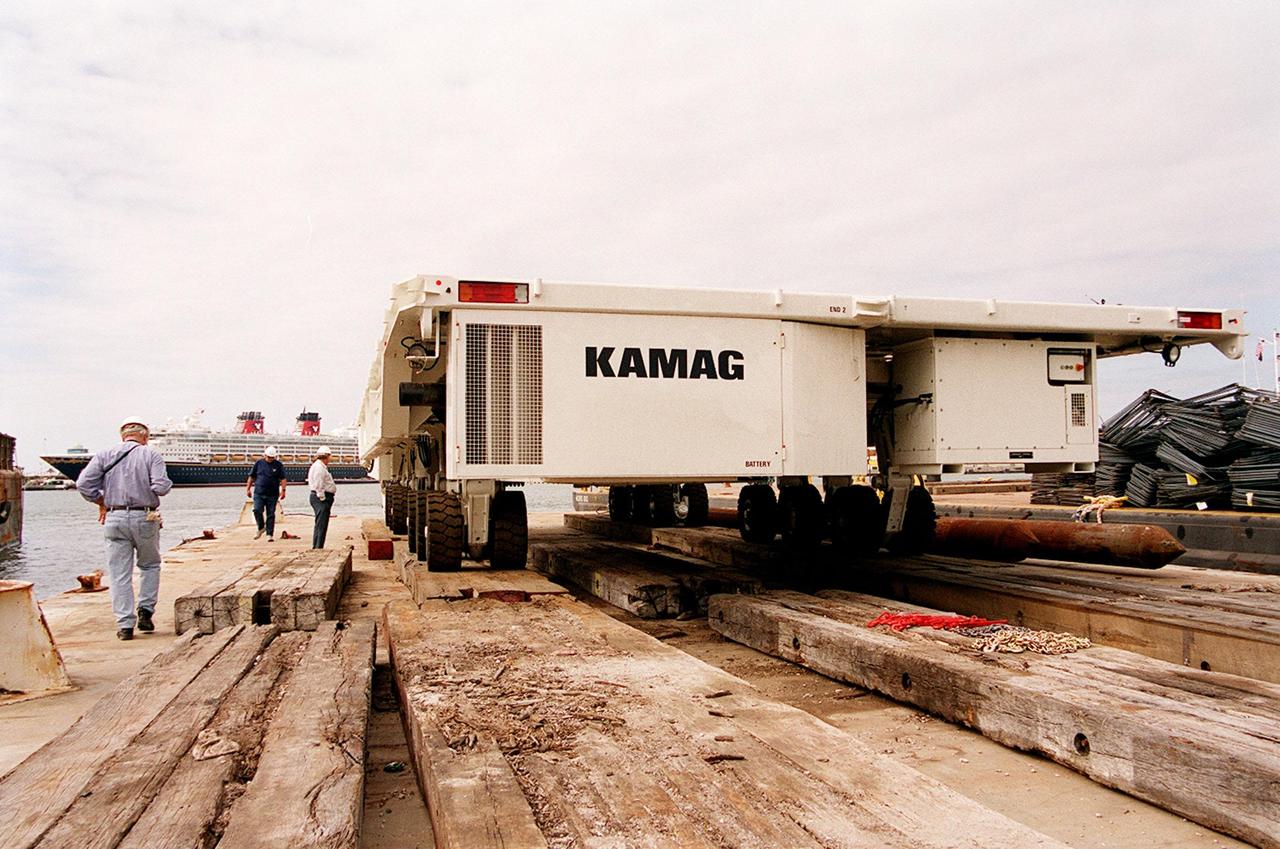
One of two new payload transporters for Kennedy Space Center sits on the dock at Port Canaveral. In the background is a cruise ship docked at the Port. The transporters were shipped by barge from their manufacturer, the KAMAG Company of Ulm, Germany. They are used to carry spacecraft and International Space Station elements from payload facilities to and from the launch pads and orbiter hangars. Each transporter is 65 feet long and 22 feet wide and has 24 tires divided between its two axles. The transporter travels 10 miles per hour unloaded, 5 miles per hour when loaded; it weighs up to 172,000 pounds when the canister with payloads rides atop. The transporters will be outfitted with four subsystems for monitoring the environment inside the canister during the payload moves: the Electrical Power System, Environmental Control System, Instrumentation and Communications System, and the Fluids and Gases System. Engineers and technicians are being trained on the transporter's operation and maintenance. The new transporters are replacing the 20-year-old existing Payload Canister Transporter system
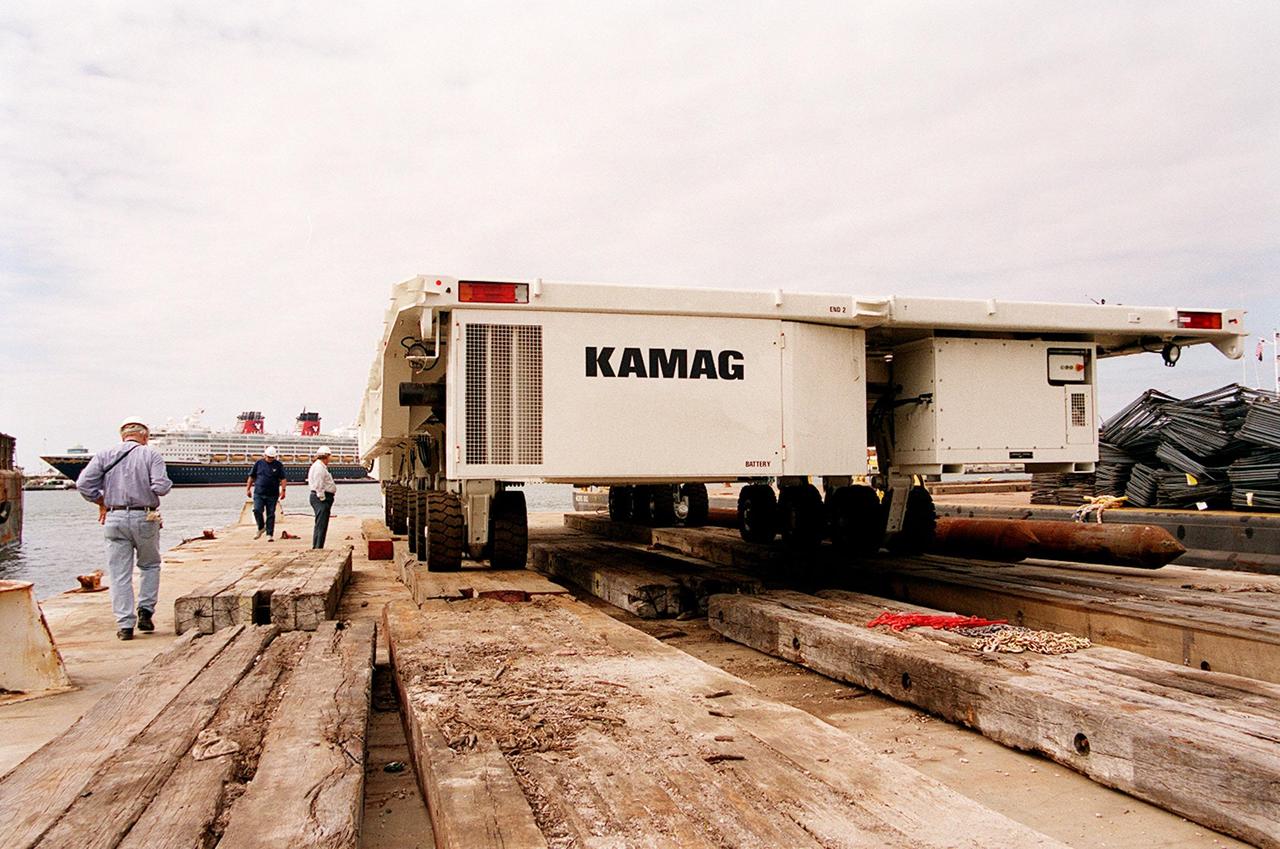
One of two new payload transporters for Kennedy Space Center sits on the dock at Port Canaveral. In the background is a cruise ship docked at the Port. The transporters were shipped by barge from their manufacturer, the KAMAG Company of Ulm, Germany. They are used to carry spacecraft and International Space Station elements from payload facilities to and from the launch pads and orbiter hangars. Each transporter is 65 feet long and 22 feet wide and has 24 tires divided between its two axles. The transporter travels 10 miles per hour unloaded, 5 miles per hour when loaded; it weighs up to 172,000 pounds when the canister with payloads rides atop. The transporters will be outfitted with four subsystems for monitoring the environment inside the canister during the payload moves: the Electrical Power System, Environmental Control System, Instrumentation and Communications System, and the Fluids and Gases System. Engineers and technicians are being trained on the transporter's operation and maintenance. The new transporters are replacing the 20-year-old existing Payload Canister Transporter system
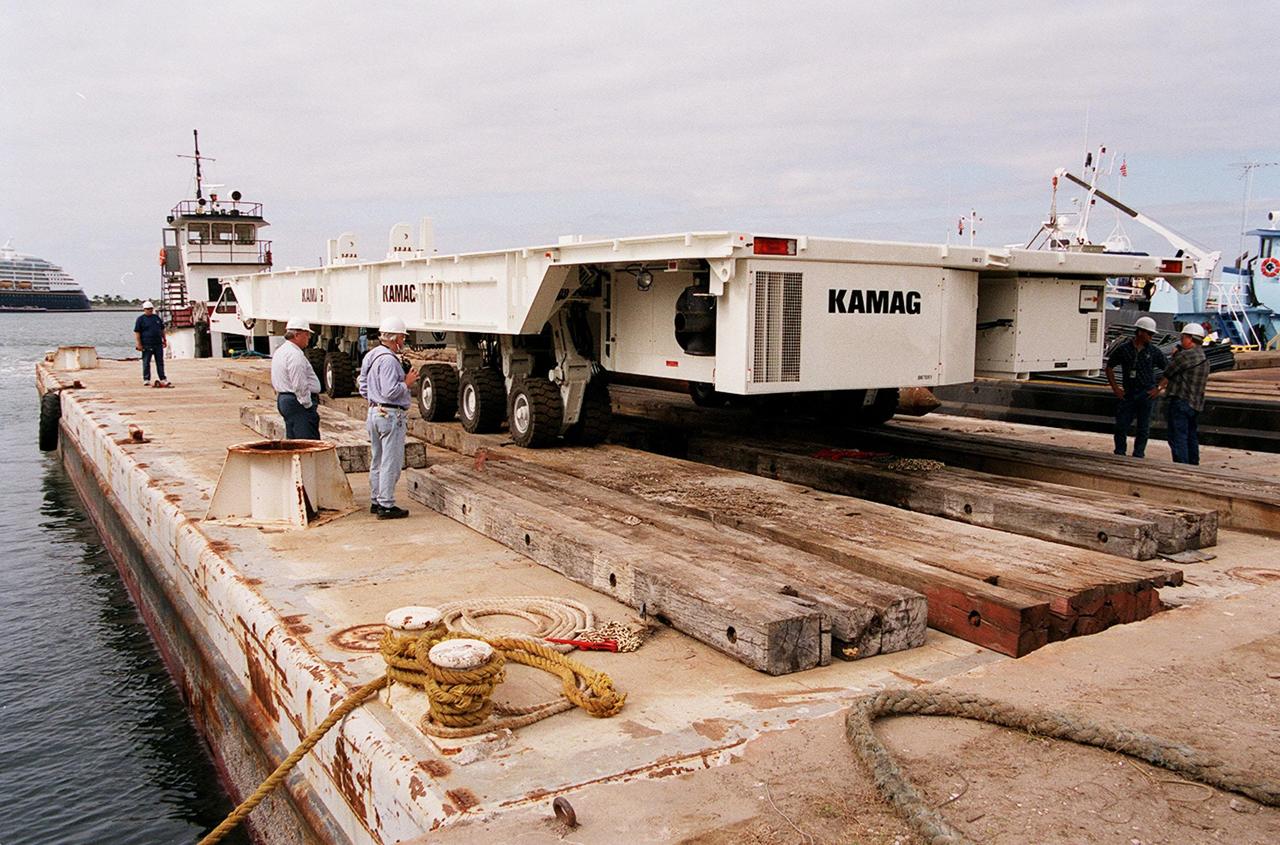
One of two new payload transporters for Kennedy Space Center sits on the dock at Port Canaveral. In the background is a cruise ship docked at the Port. The transporters were shipped by barge from their manufacturer, the KAMAG Company of Ulm, Germany. They are used to carry spacecraft and International Space Station elements from payload facilities to and from the launch pads and orbiter hangars. Each transporter is 65 feet long and 22 feet wide and has 24 tires divided between its two axles. The transporter travels 10 miles per hour unloaded, 5 miles per hour when loaded; it weighs up to 172,000 pounds when the canister with payloads rides atop. The transporters will be outfitted with four subsystems for monitoring the environment inside the canister during the payload moves: the Electrical Power System, Environmental Control System, Instrumentation and Communications System, and the Fluids and Gases System. Engineers and technicians are being trained on the transporter's operation and maintenance. The new transporters are replacing the 20-year-old existing Payload Canister Transporter system
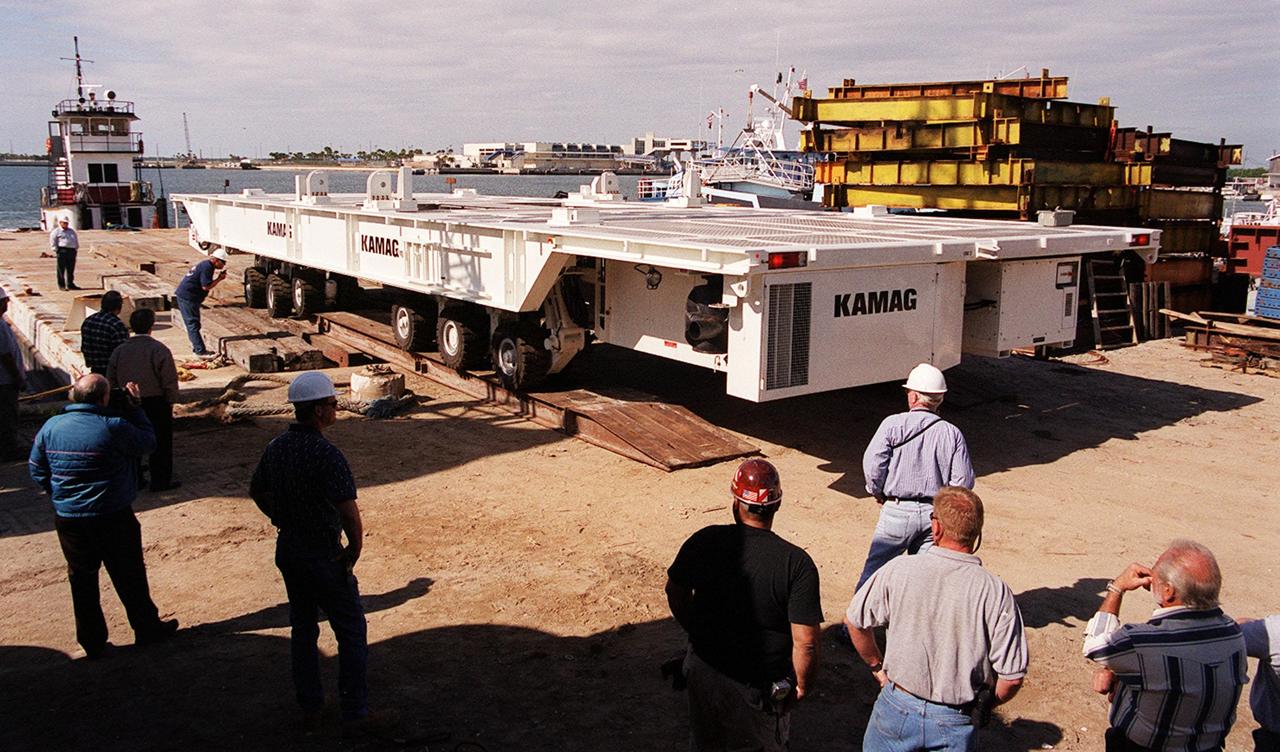
One of two new payload transporters for Kennedy Space Center arrives at Port Canaveral. They were shipped by barge from their manufacturer, the KAMAG Company of Ulm, Germany. The transporters are used to carry spacecraft and International Space Station elements from payload facilities to and from the launch pads and orbiter hangars. Each transporter is 65 feet long and 22 feet wide and has 24 tires divided between its two axles. The transporter travels 10 miles per hour unloaded, 5 miles per hour when loaded; it weighs up to 172,000 pounds when the canister with payloads rides atop. The transporters will be outfitted with four subsystems for monitoring the environment inside the canister during the payload moves: the Electrical Power System, Environmental Control System, Instrumentation and Communications System, and the Fluids and Gases System. Engineers and technicians are being trained on the transporter's operation and maintenance. The new transporters are replacing the 20-year-old existing Payload Canister Transporter system
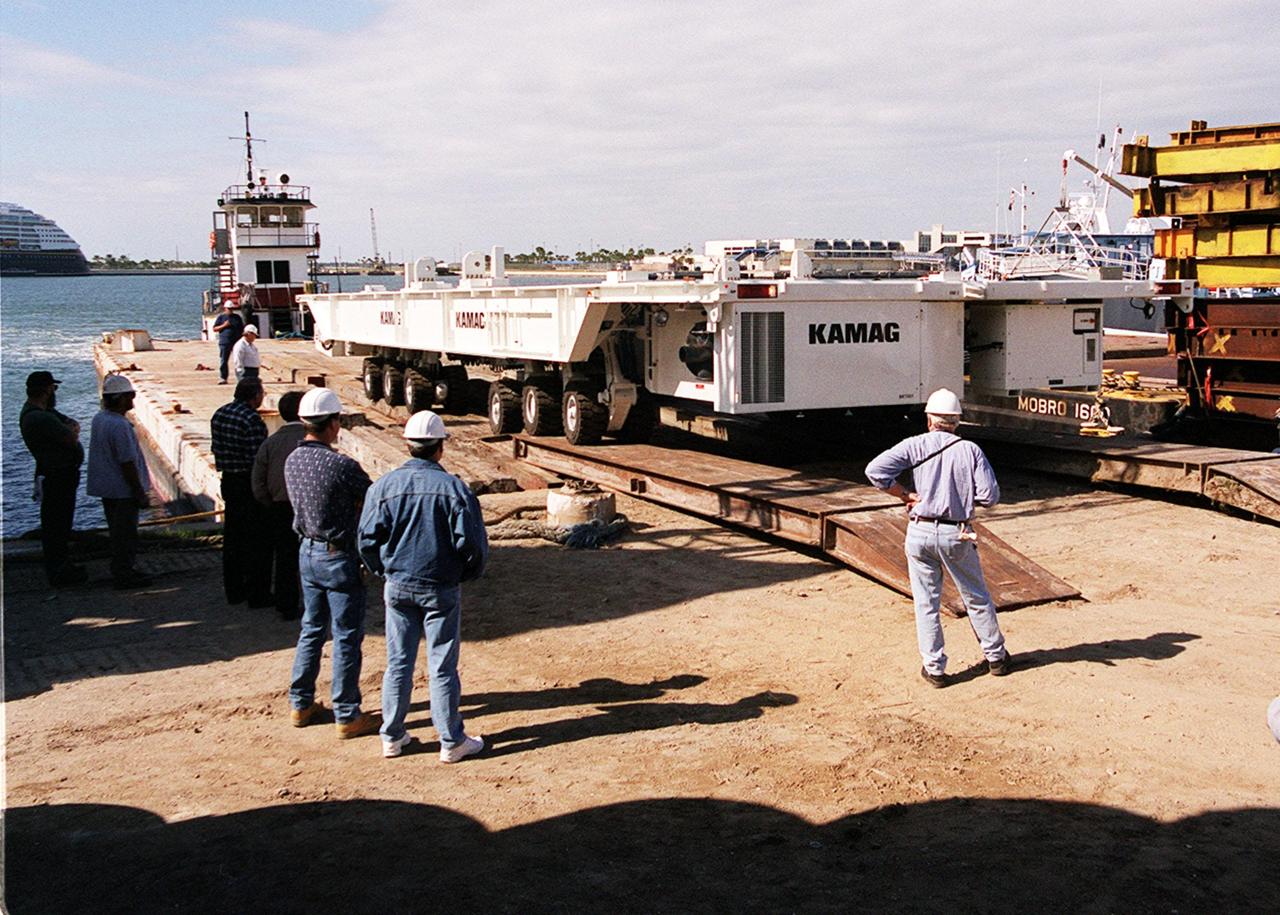
The first of two new payload transporters for Kennedy Space Center arrives at Port Canaveral. They were shipped by barge from their manufacturer, the KAMAG Company of Ulm, Germany. The transporters are used to carry spacecraft and International Space Station elements from payload facilities to and from the launch pads and orbiter hangars. Each transporter is 65 feet long and 22 feet wide and has 24 tires divided between its two axles. The transporter travels 10 miles per hour unloaded, 5 miles per hour when loaded; it weighs up to 172,000 pounds when the canister with payloads rides atop. The transporters will be outfitted with four subsystems for monitoring the environment inside the canister during the payload moves: the Electrical Power System, Environmental Control System, Instrumentation and Communications System, and the Fluids and Gases System. Engineers and technicians are being trained on the transporter's operation and maintenance. The new transporters are replacing the 20-year-old existing Payload Canister Transporter system

One of two new payload transporters for Kennedy Space Center arrives at Port Canaveral. In the background is a cruise ship docked at the Port. The transporters were shipped by barge from their manufacturer, the KAMAG Company of Ulm, Germany. They are used to carry spacecraft and International Space Station elements from payload facilities to and from the launch pads and orbiter hangars. Each transporter is 65 feet long and 22 feet wide and has 24 tires divided between its two axles. The transporter travels 10 miles per hour unloaded, 5 miles per hour when loaded; it weighs up to 172,000 pounds when the canister with payloads rides atop. The transporters will be outfitted with four subsystems for monitoring the environment inside the canister during the payload moves: the Electrical Power System, Environmental Control System, Instrumentation and Communications System, and the Fluids and Gases System. Engineers and technicians are being trained on the transporter's operation and maintenance. The new transporters are replacing the 20-year-old existing Payload Canister Transporter system
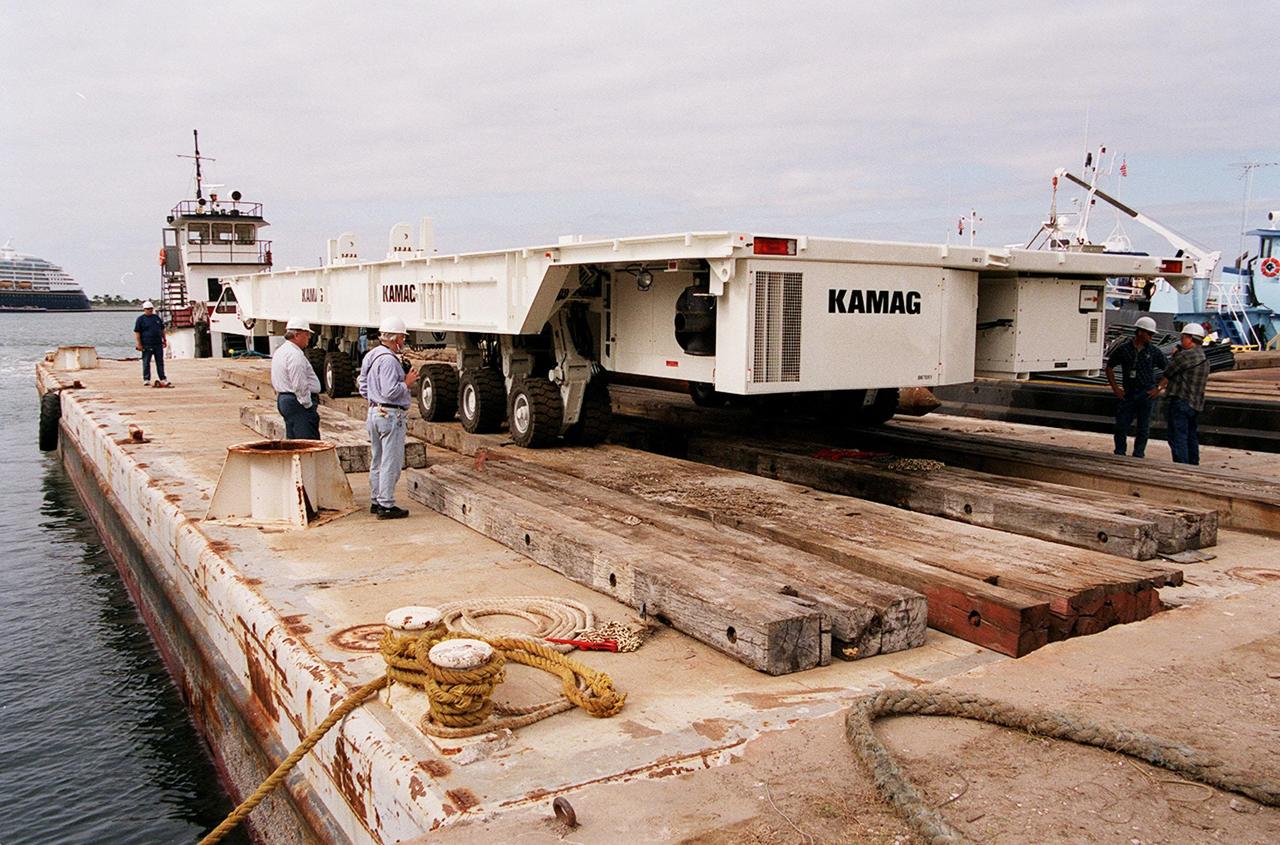
One of two new payload transporters for Kennedy Space Center sits on the dock at Port Canaveral. In the background is a cruise ship docked at the Port. The transporters were shipped by barge from their manufacturer, the KAMAG Company of Ulm, Germany. They are used to carry spacecraft and International Space Station elements from payload facilities to and from the launch pads and orbiter hangars. Each transporter is 65 feet long and 22 feet wide and has 24 tires divided between its two axles. The transporter travels 10 miles per hour unloaded, 5 miles per hour when loaded; it weighs up to 172,000 pounds when the canister with payloads rides atop. The transporters will be outfitted with four subsystems for monitoring the environment inside the canister during the payload moves: the Electrical Power System, Environmental Control System, Instrumentation and Communications System, and the Fluids and Gases System. Engineers and technicians are being trained on the transporter's operation and maintenance. The new transporters are replacing the 20-year-old existing Payload Canister Transporter system
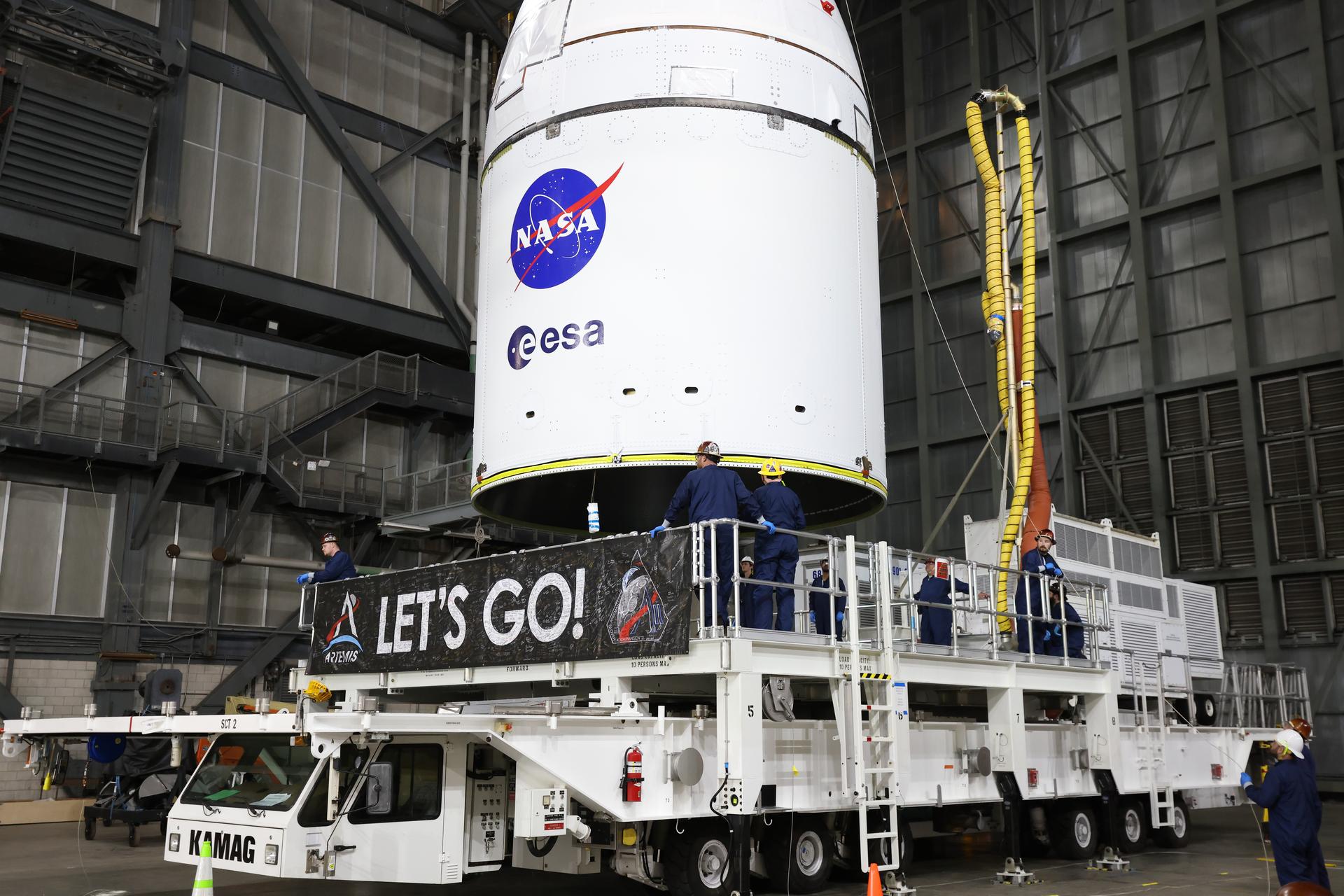
Technicians with NASA’s Exploration Ground Systems team use a crane to lift NASA’s Orion spacecraft off a KAMAG transporter to prepare for integration on top of the SLS (Space Launch System) rocket in High Bay 3 of the Vehicle Assembly Building at NASA’s Kennedy Space Center in Florida on Friday, Oct. 17, 2025, for the agency’s Artemis II mission. Set to launch in 2026, the spacecraft will carry NASA astronauts Reid Wiseman, Victor Glover, Christina Koch, and CSA (Canadian Space Agency) astronaut Jeremy Hansen on a 10-day mission around the Moon and back. Once stacked, teams will begin conducting a series of verification tests ahead of rolling out to Launch Complex 39B for the wet dress rehearsal at NASA Kennedy.
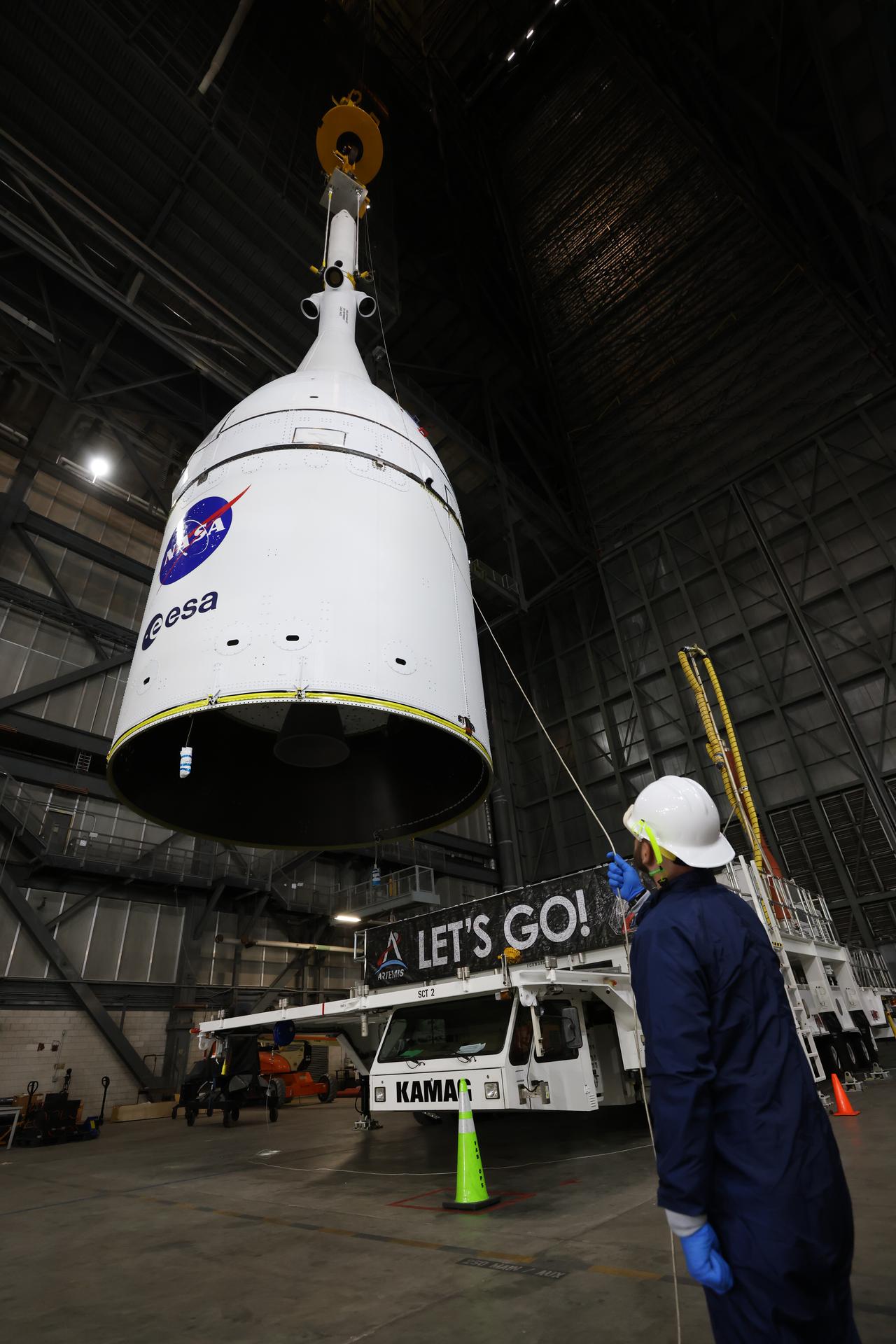
Technicians with NASA’s Exploration Ground Systems team use a crane to lift NASA’s Orion spacecraft off a KAMAG transporter to prepare for integration on top of the SLS (Space Launch System) rocket in High Bay 3 of the Vehicle Assembly Building at NASA’s Kennedy Space Center in Florida on Friday, Oct. 17, 2025, for the agency’s Artemis II mission. Set to launch in 2026, the spacecraft will carry NASA astronauts Reid Wiseman, Victor Glover, Christina Koch, and CSA (Canadian Space Agency) astronaut Jeremy Hansen on a 10-day mission around the Moon and back. Once stacked, teams will begin conducting a series of verification tests ahead of rolling out to Launch Complex 39B for the wet dress rehearsal at NASA Kennedy.
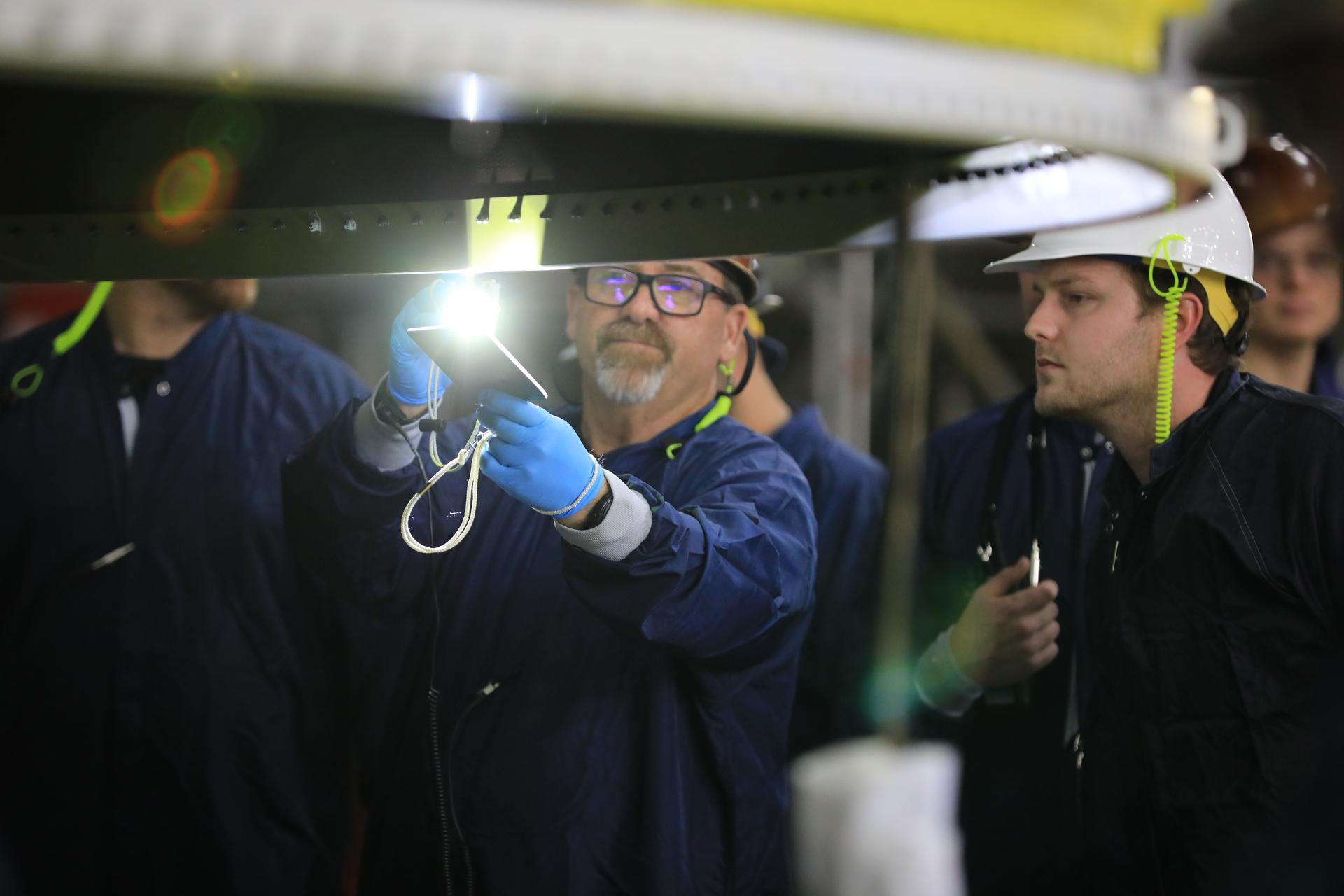
Technicians with NASA’s Exploration Ground Systems team use a crane to lift NASA’s Orion spacecraft off a KAMAG transporter to prepare for integration on top of the SLS (Space Launch System) rocket in High Bay 3 of the Vehicle Assembly Building at NASA’s Kennedy Space Center in Florida on Friday, Oct. 17, 2025, for the agency’s Artemis II mission. Set to launch in 2026, the spacecraft will carry NASA astronauts Reid Wiseman, Victor Glover, Christina Koch, and CSA (Canadian Space Agency) astronaut Jeremy Hansen on a 10-day mission around the Moon and back. Once stacked, teams will begin conducting a series of verification tests ahead of rolling out to Launch Complex 39B for the wet dress rehearsal at NASA Kennedy.