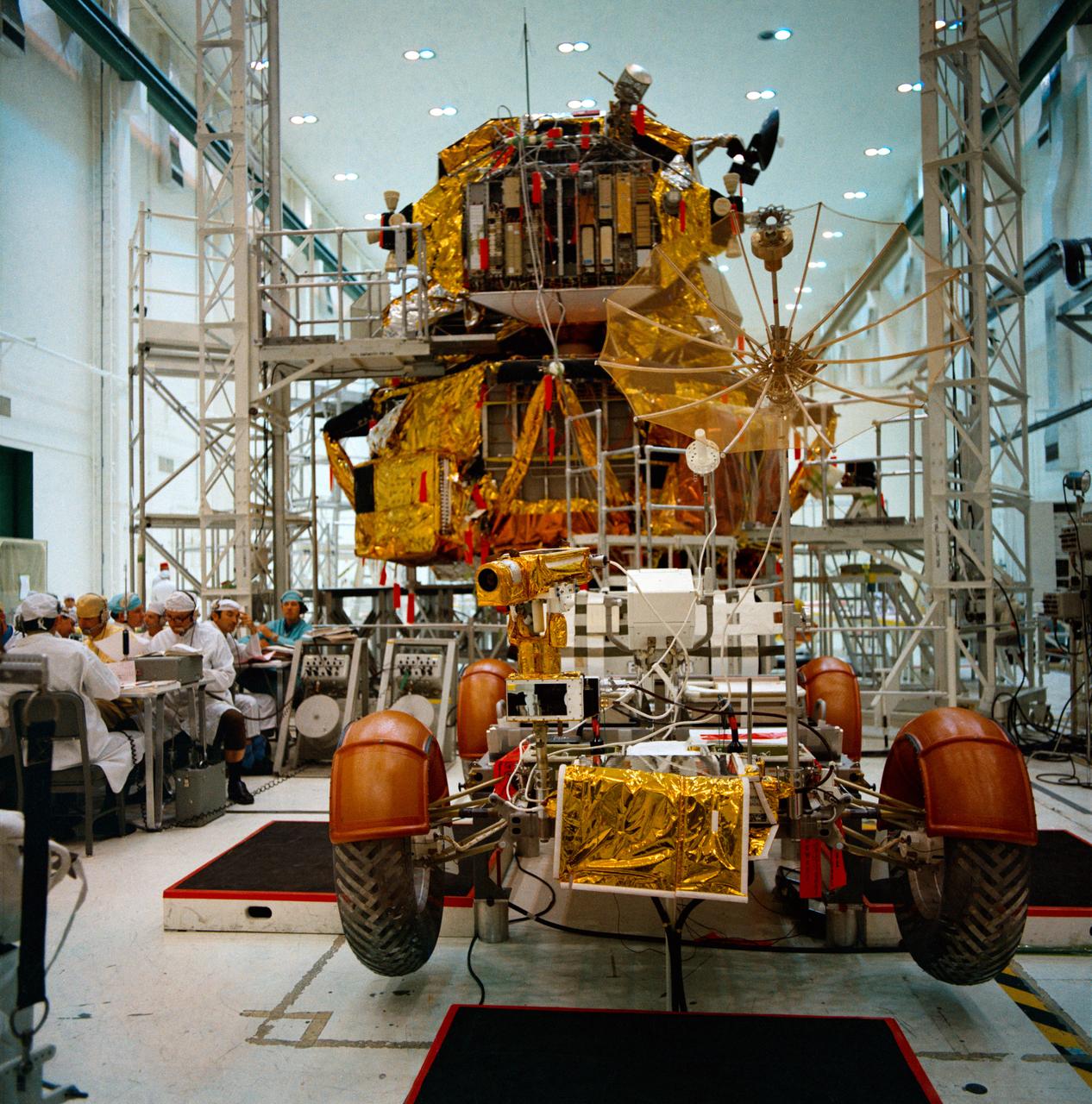
S71-30542 (21 April 1971) --- An overall view of the Apollo 15 Lunar Roving Vehicle (LRV) and the Lunar Module (LM) during simulations at the Kennedy Space Center (KSC). Astronauts David R. Scott, commander, and James B. Irwin, lunar module pilot, will man the LRV on the lunar surface during their August 1971 traverses. Rover 1 will permit the astronauts to cover a larger area of the moon for exploration and sample collecting than on previous missions.

S71-39867 (June 1971) --- Astronauts David R. Scott (right), commander, and James B. Irwin, lunar module pilot, are shown on the Lunar Roving Vehicle (LRV) at the Kennedy Space Center (KSC), Florida, during Apollo 15 lunar surface extravehicular activity (EVA) simulations. While astronauts Scott and Irwin descend in the Lunar Module (LM) "Falcon" to explore the moon, astronaut Alfred M. Worden, command module pilot, will remain with the Command and Service Modules (CSM) in lunar orbit.
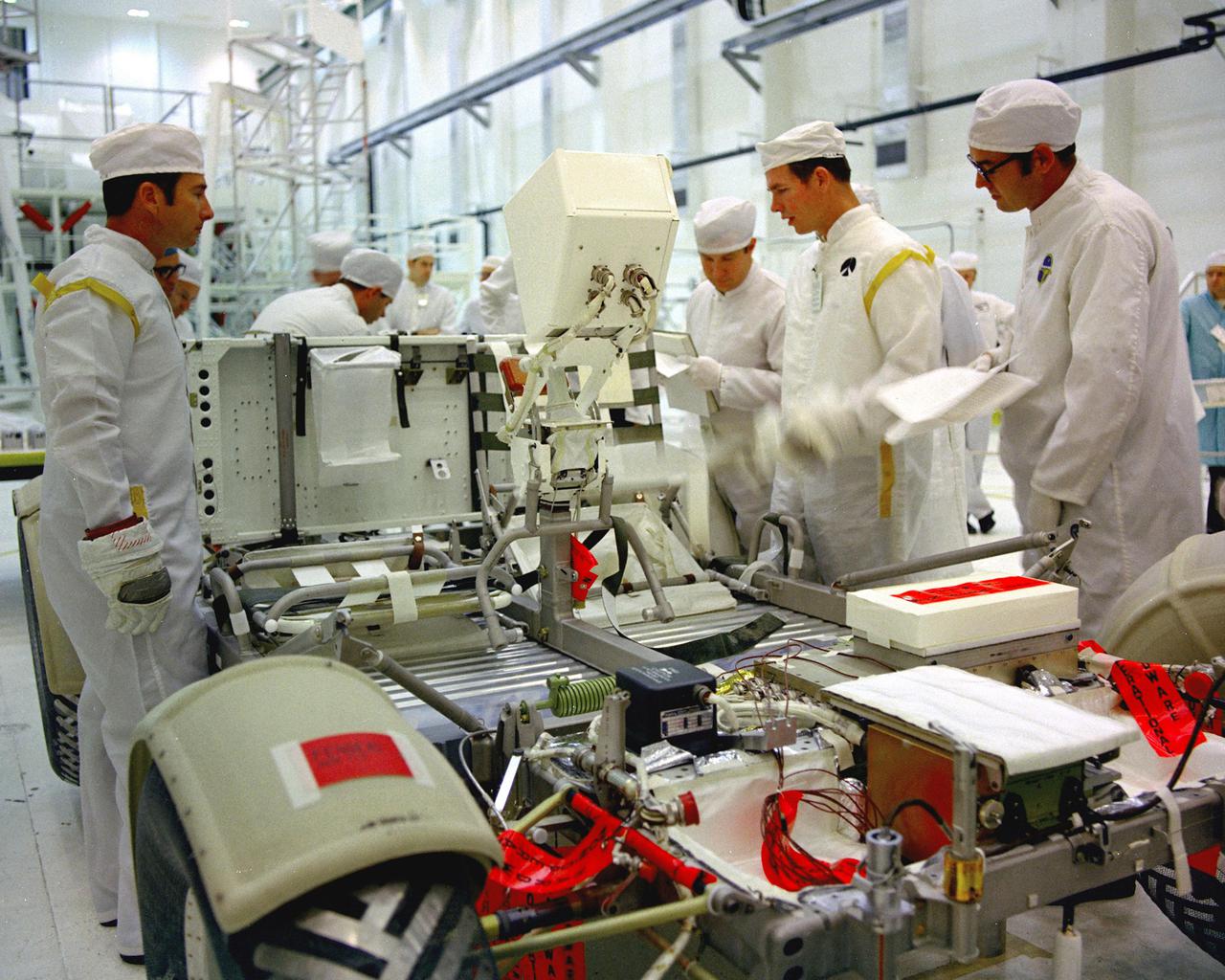
KENNEDY SPACE CENTER, FLA. - The Apollo 15 astronauts that will be involved in the first time use of the Lunar Roving Vehicle, participate in a Crew Fit and Functional Test in the Manned Spacecraft Operations Building. Commander James B. Irwin and Command Module Pilot Alfred M. Worden, Jr., will drive the Lunar Roving Vehicle for the first time on the Moon's surface. The landing site for the Lunar Module is the Hadley-Apennine area of the Moon.
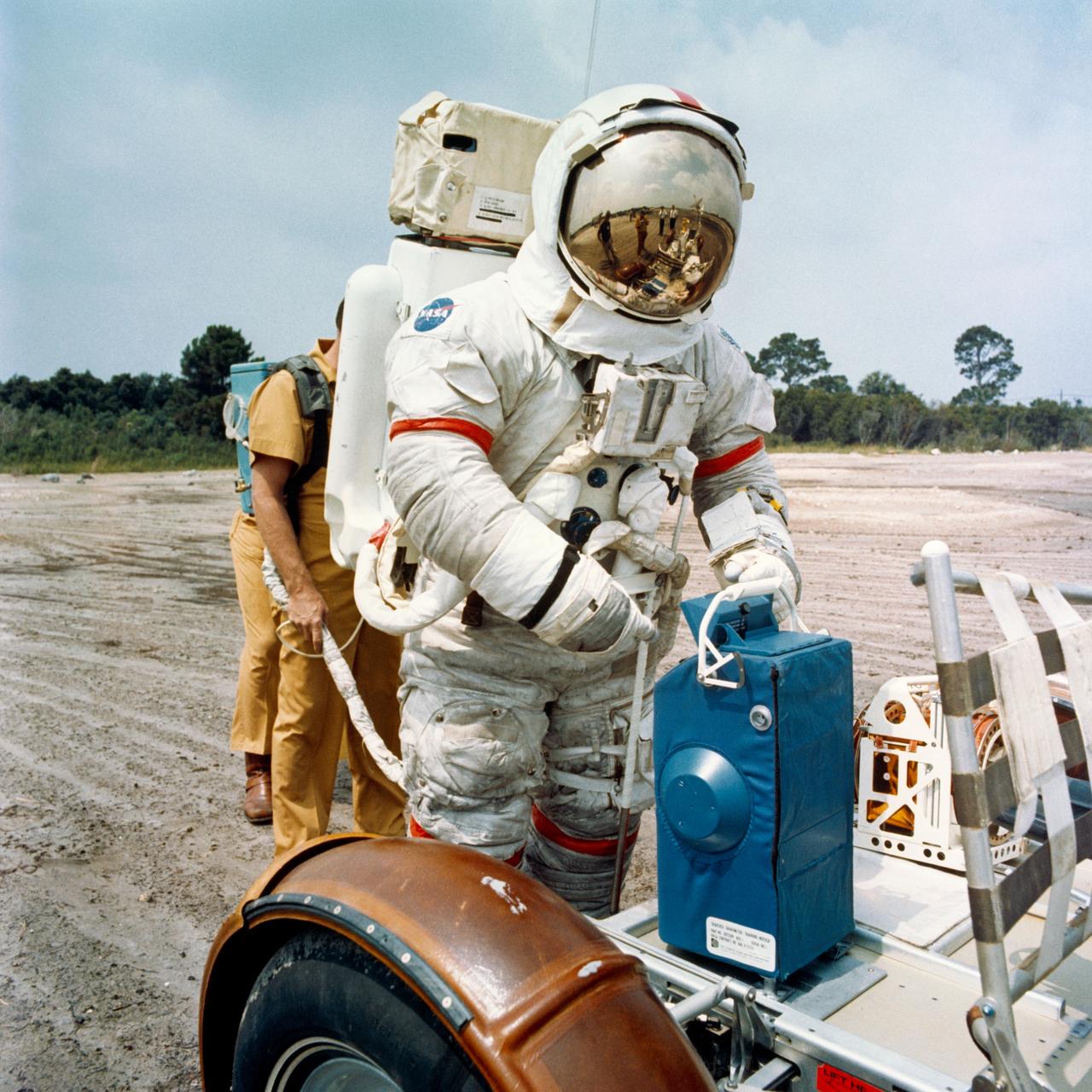
S72-44420 (8 June 1972) --- Astronaut Eugene A. Cernan, commander of the Apollo 17 lunar landing mission, prepares to remove a traverse gravimeter training mock-up from a Lunar Roving Vehicle for deployment during lunar surface extravehicular activity simulations at the Kennedy Space Center (KSC), Florida.
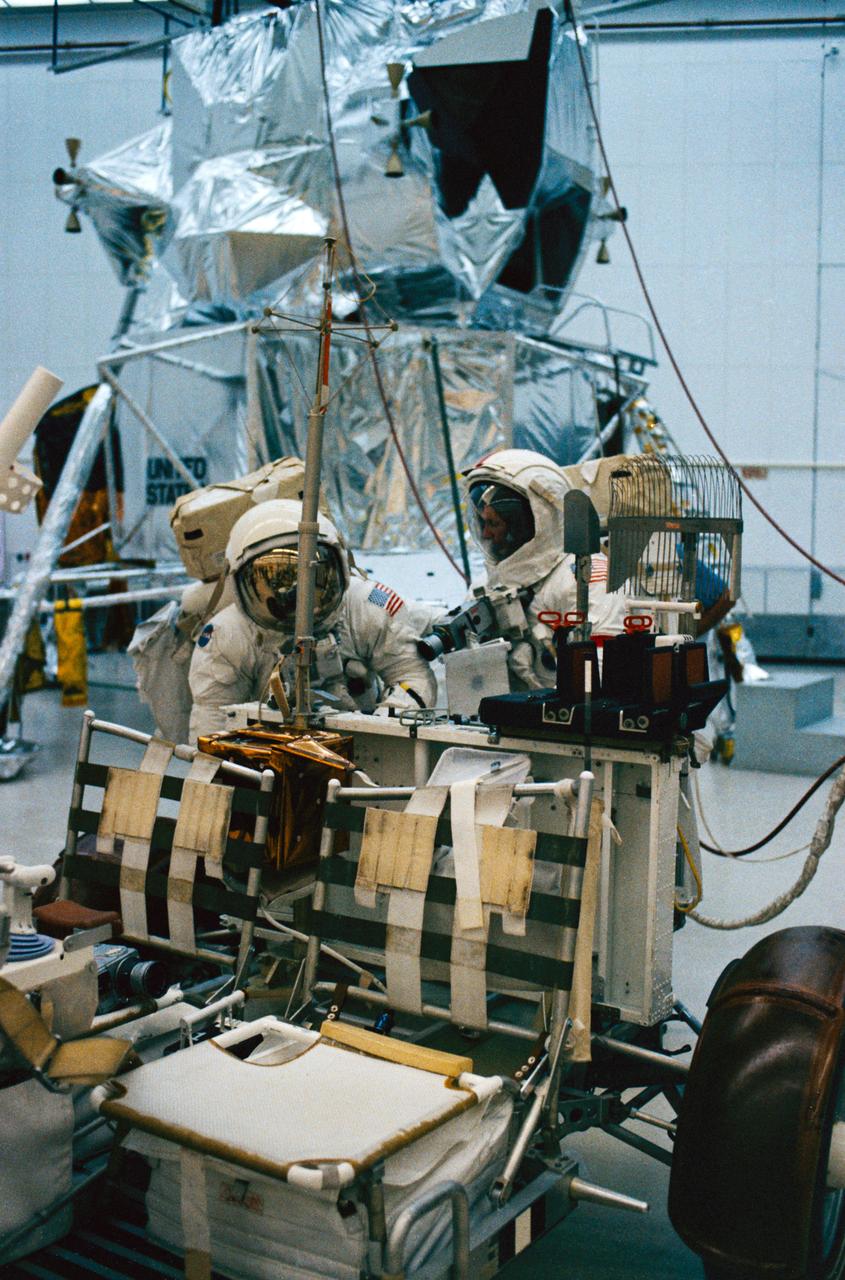
S72-48887 (September 1972) --- Astronaut Eugene A. Cernan (right), commander, and scientist-astronaut Harrison H. Schmitt, lunar module pilot, work at the aft end of a Lunar Roving Vehicle trainer during lunar surface extravehicular activity simulation training at the Kennedy Space Center (KSC), Florida. Astronauts Cernan, Schmitt, and Ronald E. Evans, command module pilot, are the prime crewmen of the Apollo 17 lunar landing mission. A Lunar Module mock-up can be seen in the background.

This photograph shows the Lunar Roving Vehicle (LRV) being prepared for installation in the Lunar Module at the Kennedy Space Center. The LRV was built to give Apollo astronauts a greater range of mobility during the last three lunar exploration missions; Apollo 15, Apollo 16, and Apollo 17. It was designed and developed by the Marshall Space Flight Center and built by the Boeing Company.
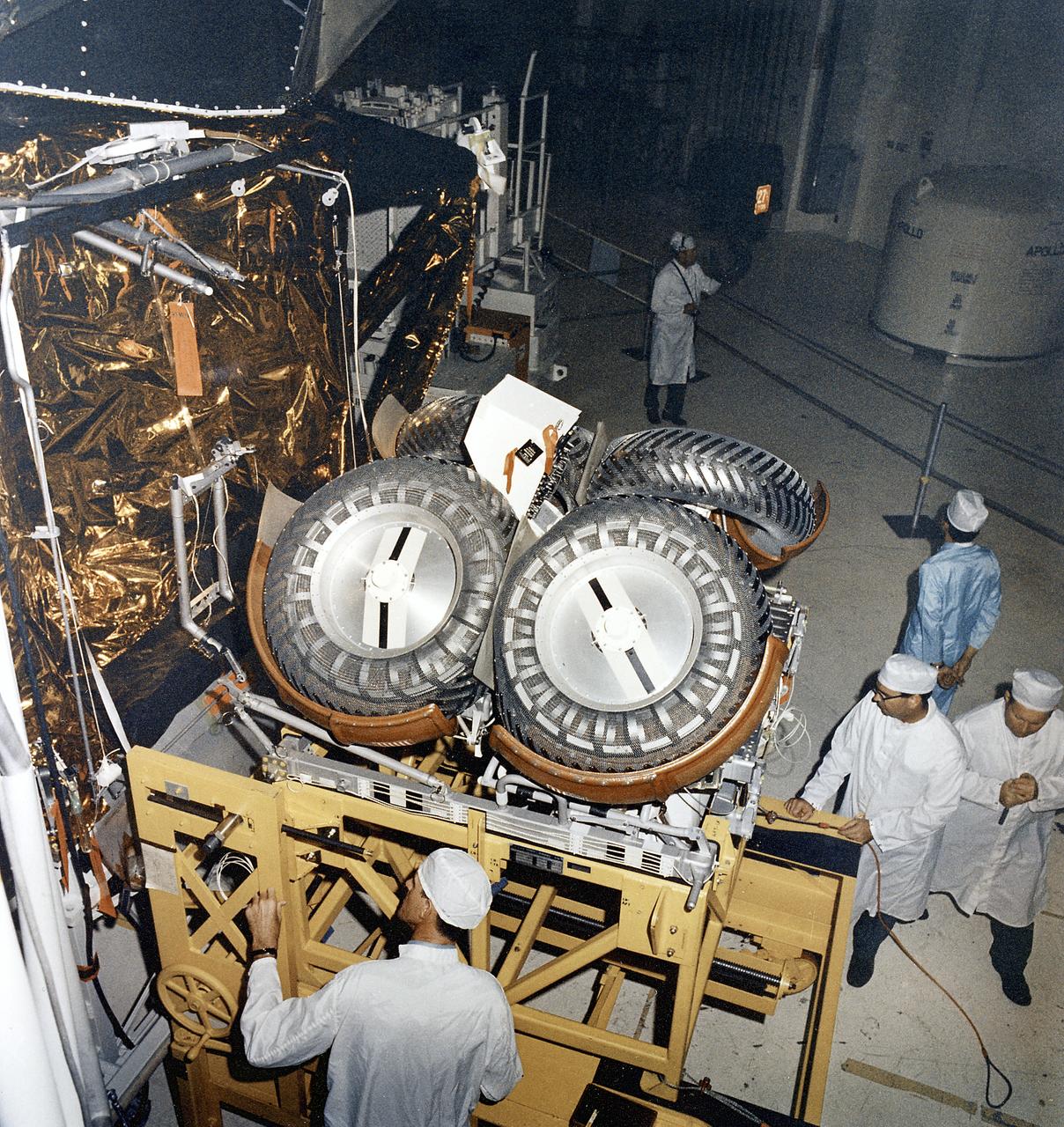
This photograph was taken during the installation of the Lunar Roving Vehicle (LRV) in the Lunar Module at the Kennedy Space Center. The LRV was built to give Apollo astronauts a greater range of mobility during the last three lunar exploration missions; Apollo 15, Apollo 16, and Apollo 17. It was designed and developed by the Marshall Space Flight Center and built by the Boeing Company.
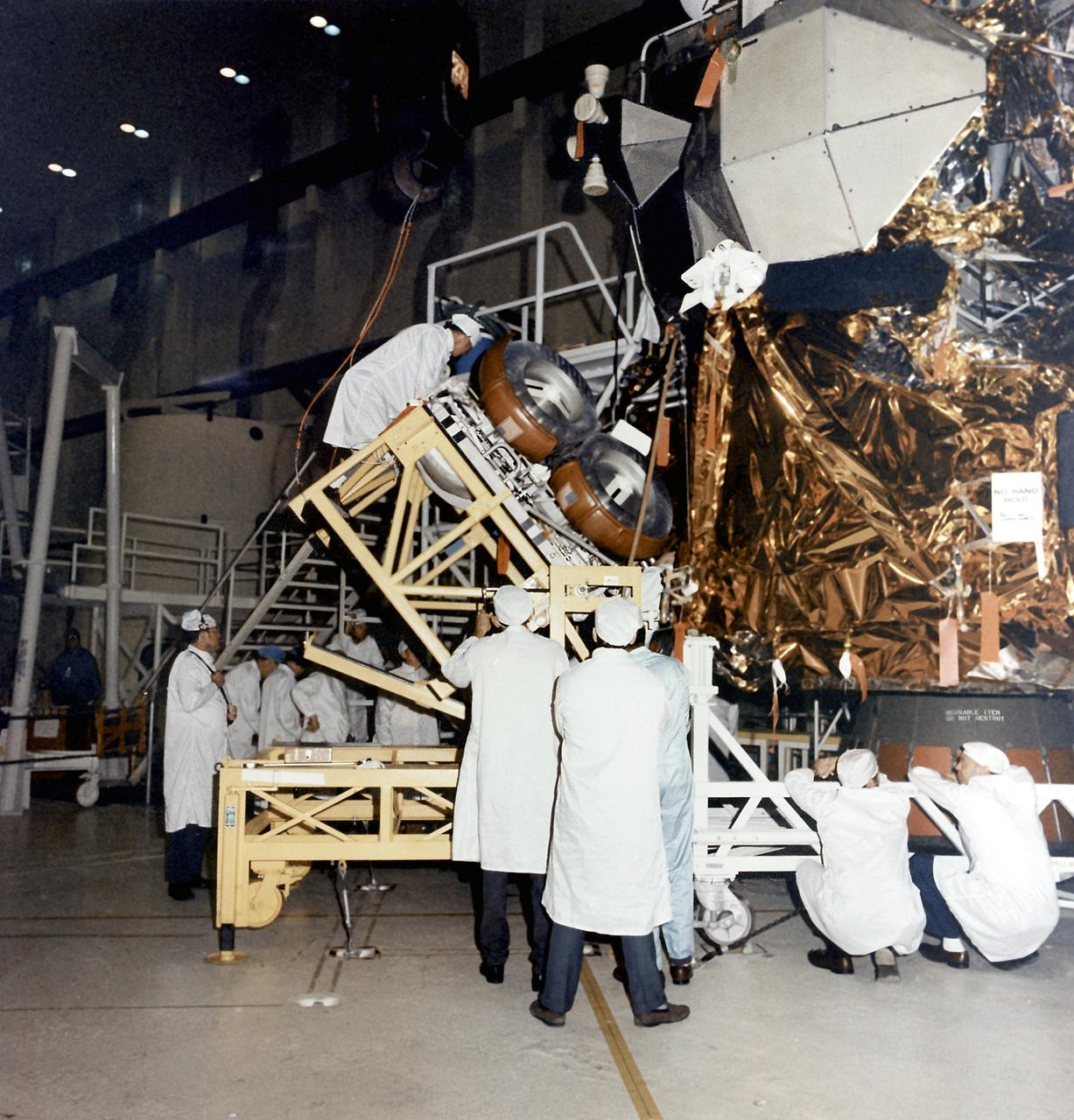
This photograph was taken during the installation of the Lunar Roving Vehicle (LRV) in the Lunar Module at the Kennedy Space Center. The LRV was built to give Apollo astronauts a greater range of mobility during the last three lunar exploration missions; Apollo 15, Apollo 16, and Apollo 17. It was designed and developed by the Marshall Space Flight Center and built by the Boeing Company.
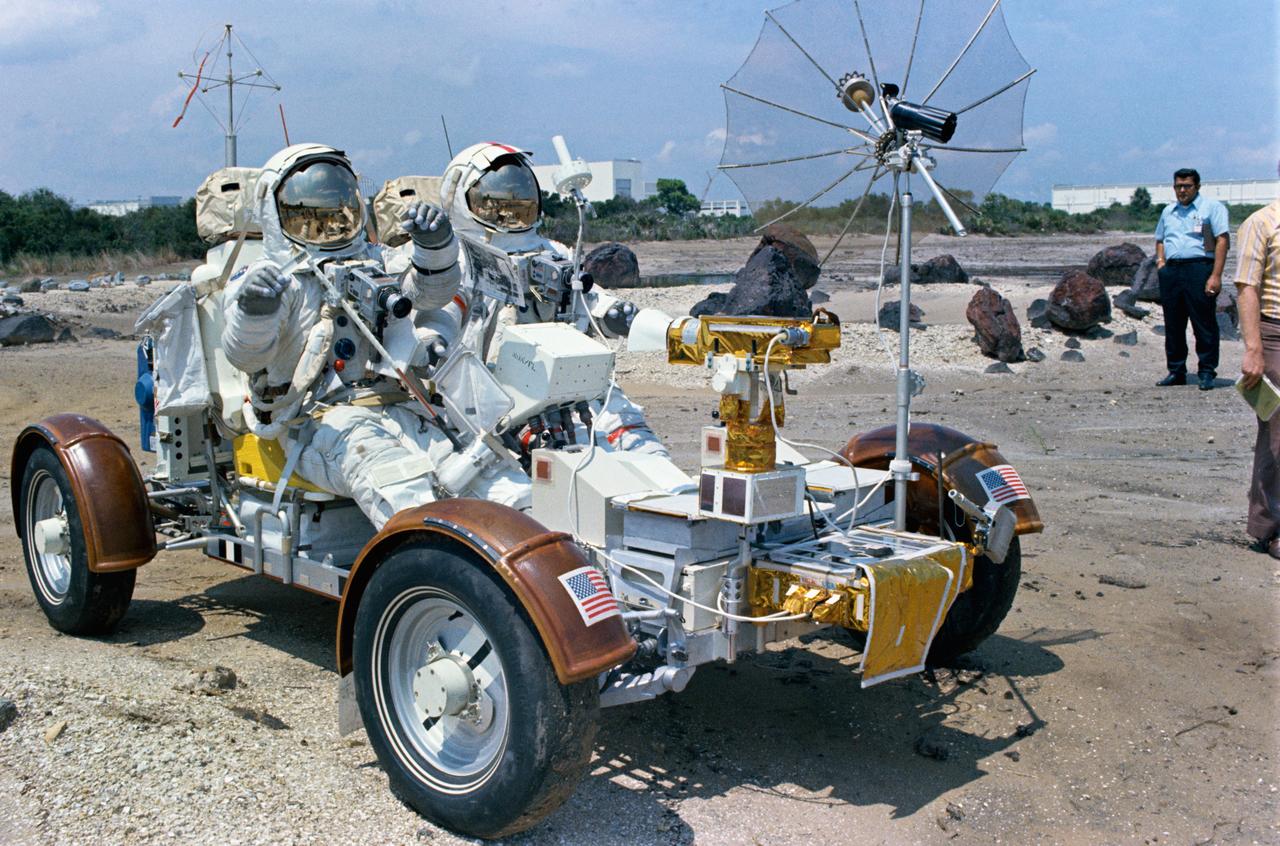
S72-48892 (September 1972) --- Two members of the prime crew of the Apollo 17 lunar landing mission ride in a Lunar Roving Vehicle trainer during lunar surface extravehicular activity simulation training at the Kennedy Space Center (KSC), Florida. Astronaut Eugene A. Cernan, commander, is seated in the left-hand seat. Scientist-astronaut Harrison H. Schmitt, lunar module pilot, is on Cernan's right.
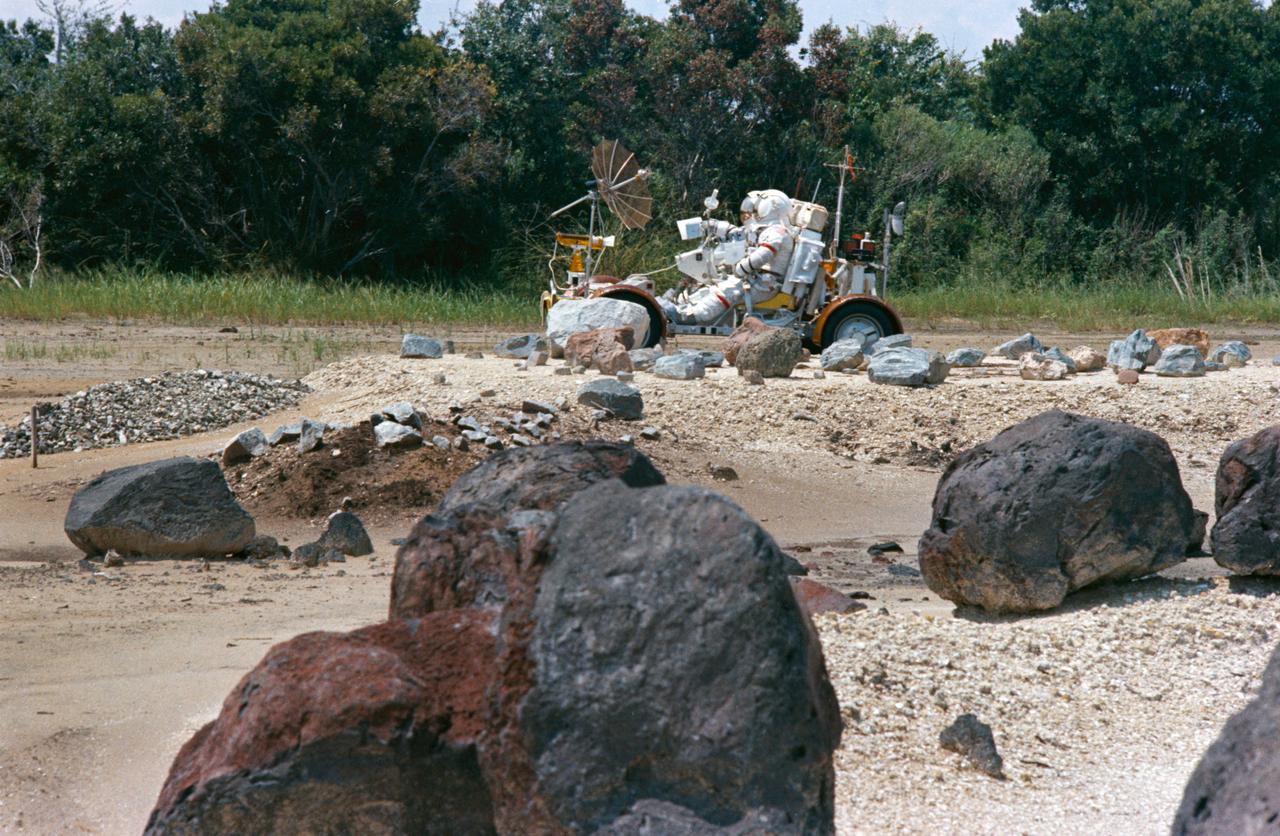
S72-48889 (September 1972) --- Two members of the prime crew of the Apollo 17 lunar landing mission ride in a lunar roving vehicle trainer during lunar surface extravehicular activity simulation training at the Kennedy Space Center, Florida. Astronaut Eugene A. Cernan, commander, is seated in the left-hand seat. Scientist-astronaut Harrison H. Schmitt, lunar module pilot, is on Cernan's right.
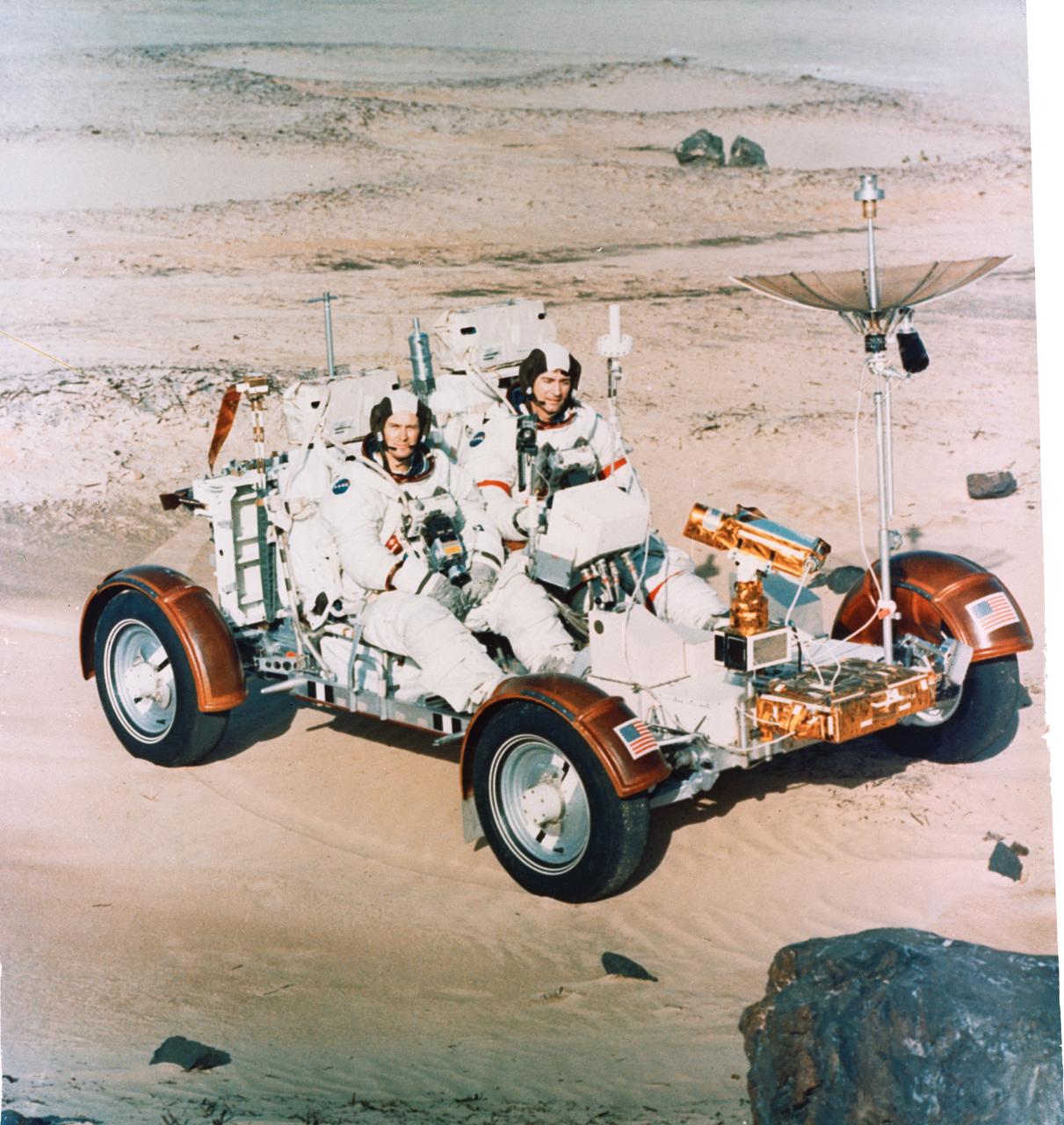
S72-30695 (22 Dec. 1971) --- Astronauts John W. Young, right, Apollo 16 commander, and Charles M. Duke Jr., lunar module pilot, maneuver a training version of the Lunar Roving Vehicle (LRV) about a field at Kennedy Space Center (KSC) simulated to represent the lunar surface. The LRV is planned to transport the two crew men around the Descartes area on the lunar surface while astronaut Thomas K. Mattingly II, command module pilot, orbits the moon in the Command and Service Modules (CSM).
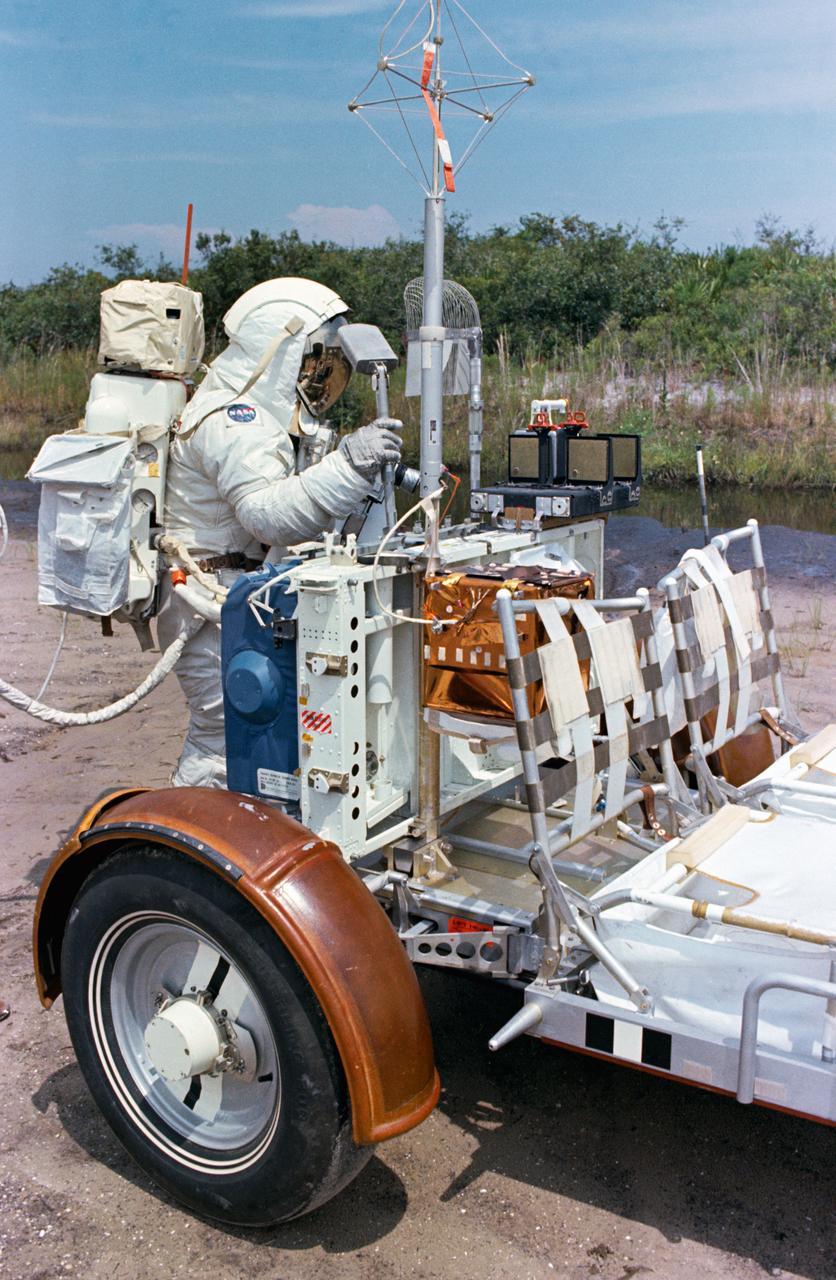
S72-48890 (September 1972) --- Scientist-astronaut Harrison H. Schmitt, lunar module pilot of the Apollo 17 lunar landing mission, procures a geological hand tool from the tool carrier at the aft end of the Lunar Roving Vehicle during lunar surface extravehicular activity simulation training at the Kennedy Space Center (KSC), Florida. Schmitt grasps a scoop with extension handle in his right hand.
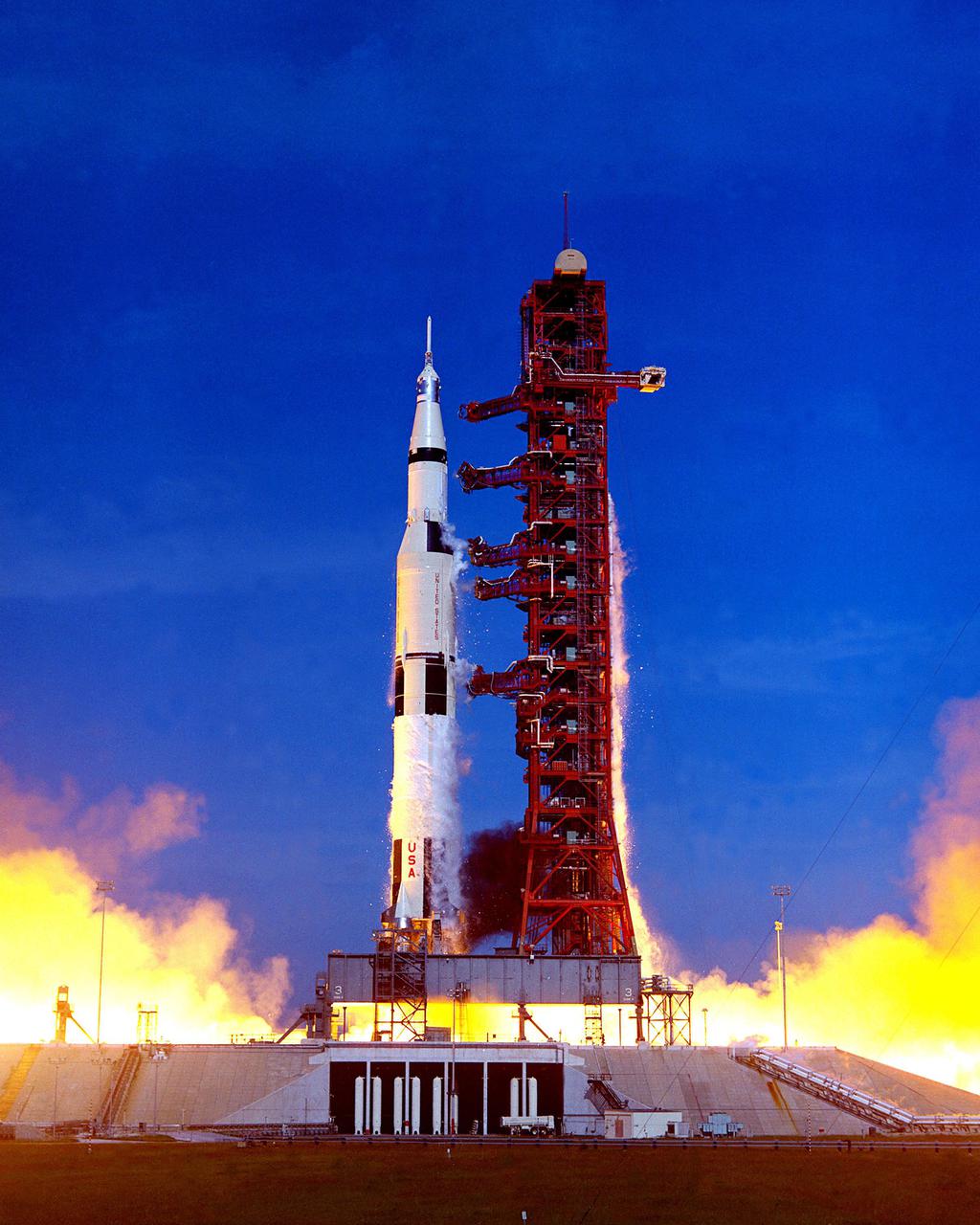
KENNEDY SPACE CENTER, FLA. -- The Apollo 15 Saturn V Space Vehicle soars into the skies after liftoff at Launch Pad 39A marking the beginning of NASA's fourth Manned Lunar Landing Mission. The astronauts aboard are David R. Scott, commander; James B. Irwin, Lunar Module pilot; and Alfred M. Worden Jr., Command Module pilot. The landing site for the Lunar Module is the Hadley-Apennine area of the Moon, about 465 miles north of the Lunar Equator. The Lunar Roving Vehicle (LRV) will be used for the first time.
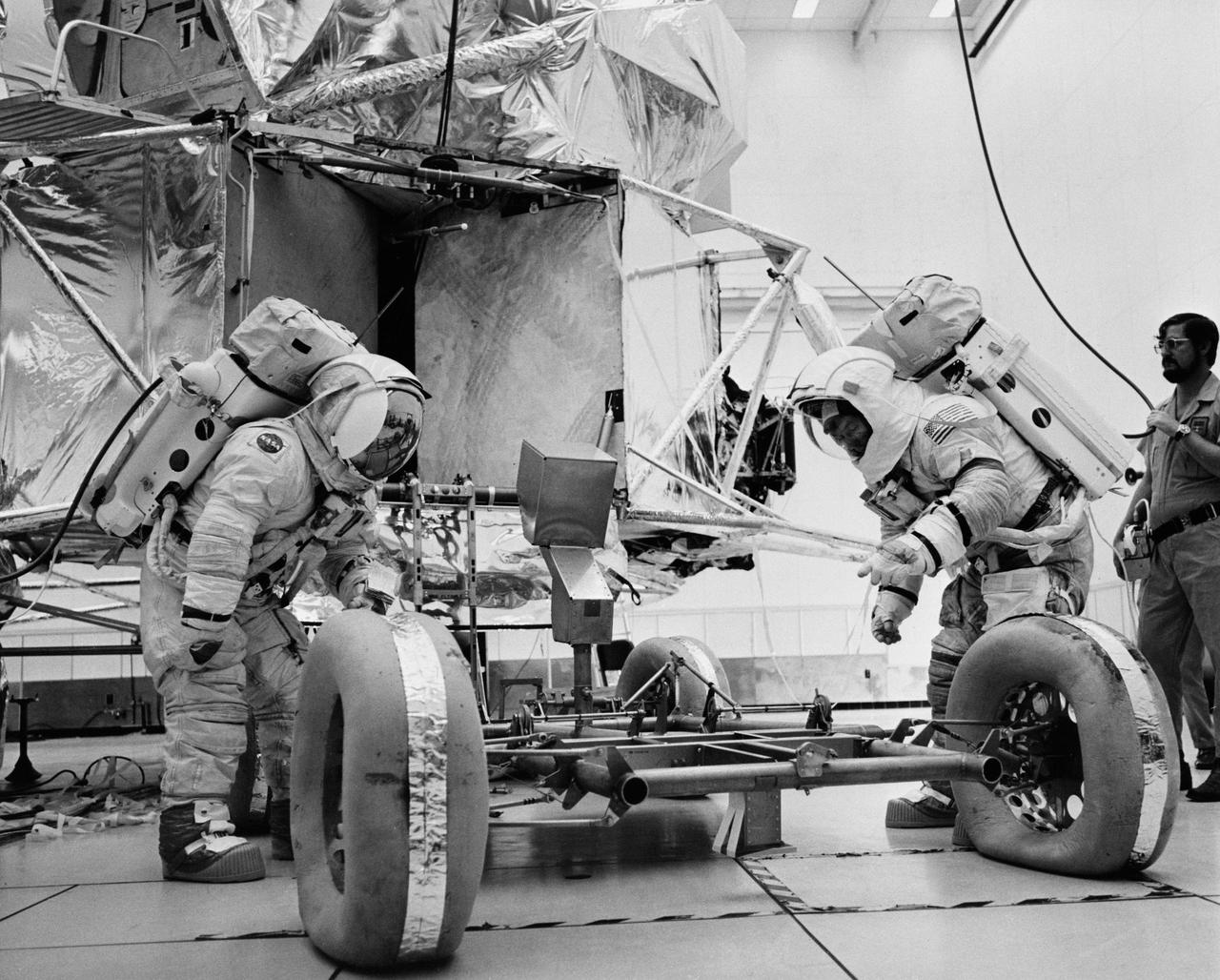
S72-44423 (8 Sept. 1972) --- Two Apollo 17 crewmen ready a Lunar Roving Vehicle trainer following its deployment from a Lunar Module trainer in the Flight Crew Training Building at the Kennedy Space Center, Florida. Taking part in the Apollo 17 training exercise were astronauts Eugene A. Cernan (right), commander; and Harrison H. "Jack" Schmitt, lunar module pilot.

This is the Apollo 16 lunar landing mission crew portrait. Pictured from left to right are: Thomas K. Mattingly II, Command Module pilot; John W. Young, Mission Commander; and Charles M. Duke Jr., Lunar Module pilot. Launched from the Kennedy Space Center on April 16, 1972, Apollo 16 spent three days on Earth's Moon. The first study of the highlands area, the landing site for Apollo 16 was the Descartes Highlands. The fifth lunar landing mission out of six, Apollo 16 was famous for deploying and using an ultraviolet telescope as the first lunar observatory. The telescope photographed ultraviolet light emitted by Earth and other celestial objects. The Lunar Roving Vehicle, developed by the Marshall Space Flight Center, was also used for collecting rocks and data on the mysterious lunar highlands. In this photo, astronaut John W. Young photographs Charles M. Duke, Jr. collecting rock samples at the Descartes landing site. Duke stands by Plum Crater while the Lunar Roving Vehicle waits parked in the background. High above, Thomas K. Mattingly orbits in the Command Module. The mission ended April 27, 1972 as the crew splashed down into the Pacific Ocean.
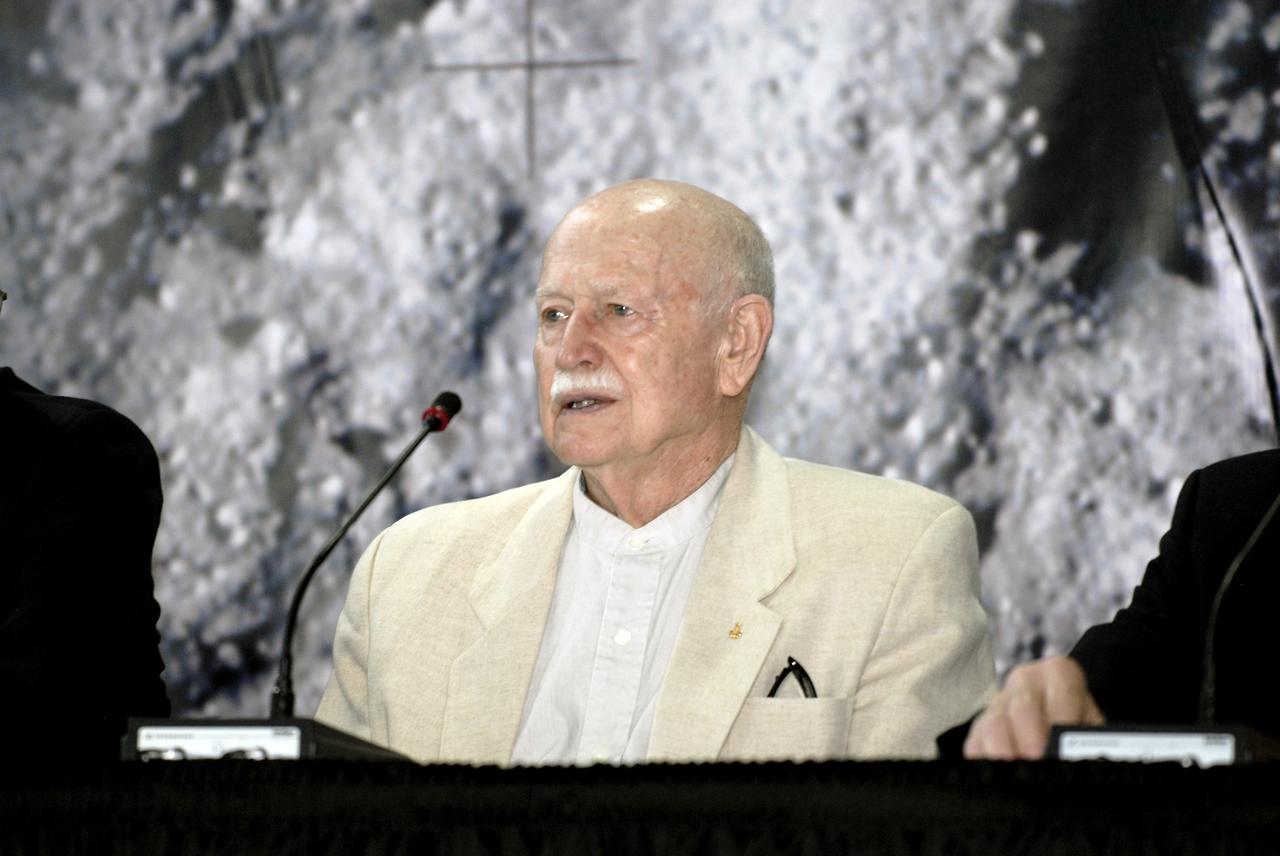
CAPE CANAVERAL, Fla. – At the Apollo/Saturn V Center at NASA's Kennedy Space Center in Florida, Apollo astronaut Gerald Carr shares his experiences with spectators crowd gathered for NASA's 40th Anniversary of Apollo Celebration of the July 1969 launch and landing on the moon. Carr served as CAPCOM for the Apollo 8 and 12 flights, and was involved in the development and testing of the lunar roving vehicle which was used on the lunar surface by Apollo flight crews. He also was commander of Skylab 4 launched in 1973 on the third and final manned visit to the Skylab Orbital Workshop. Photo credit: NASA/Kim Shiflett

During the Apollo 15 launch activities in the launch control center's firing room 1 at Kennedy Space Center, Dr. Wernher von Braun, NASA's Deputy Associate Administrator for planning, takes a closer look at the launch pad through binoculars. The fifth manned lunar landing mission, Apollo 15 (SA-510), carrying a crew of three astronauts: Mission commander David R. Scott, Lunar Module pilot James B. Irwin, and Command Module pilot Alfred M. Worden Jr., lifted off on July 26, 1971. Astronauts Scott and Irwin were the first to use a wheeled surface vehicle, the Lunar Roving Vehicle, or the Rover, which was designed and developed by the Marshall Space Flight Center, and built by the Boeing Company. Astronauts spent 13 days, nearly 67 hours, on the Moon's surface to inspect a wide variety of its geological features.
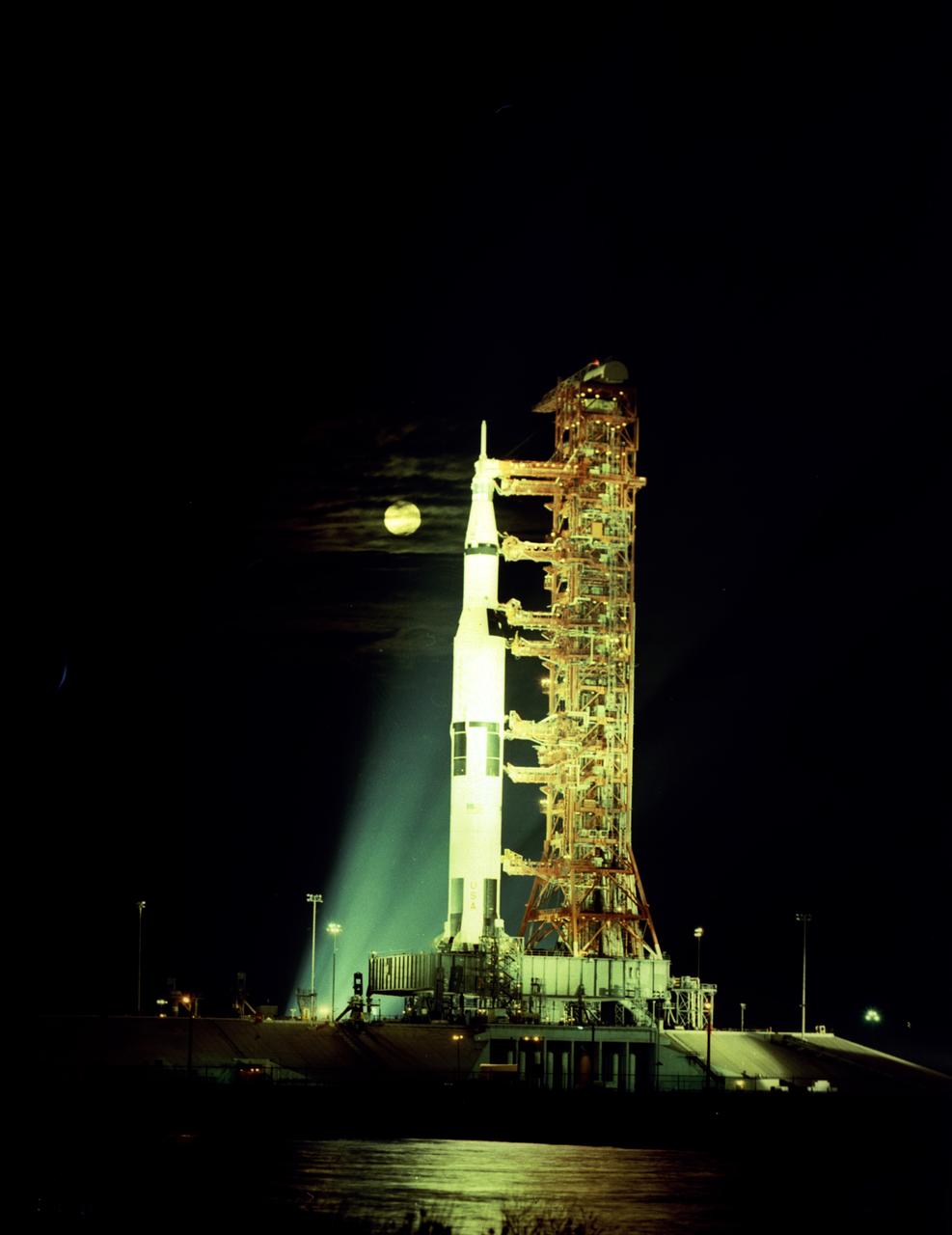
This is a breathtaking moonlit view of Apollo 17 on the Launch Pad at Kennedy Space Flight Center (KSC). The seventh and last manned lunar landing and return to Earth mission, the Apollo 17, carrying a crew of three astronauts: Mission Commander Eugene A. Cernan, Lunar Module pilot Harrison H. Schmitt, and Command Module pilot Ronald E. Evans, lifted off on December 7, 1972. The basic objective of the Apollo 17 mission was to sample basin-rim highland material and adjacent mare material, and investigate the geological evolutionary relationship between these two major units. The mission marked the longest Apollo mission, 504 hours, and the longest lunar surface stay time, 75 hours, which allowed the astronauts to conduct an extensive geological investigation. They collected 257 pounds (117 kilograms) of lunar samples with the use of the Marshall Space Flight Center designed Lunar Roving Vehicle (LRV). The mission ended on December 19, 1972
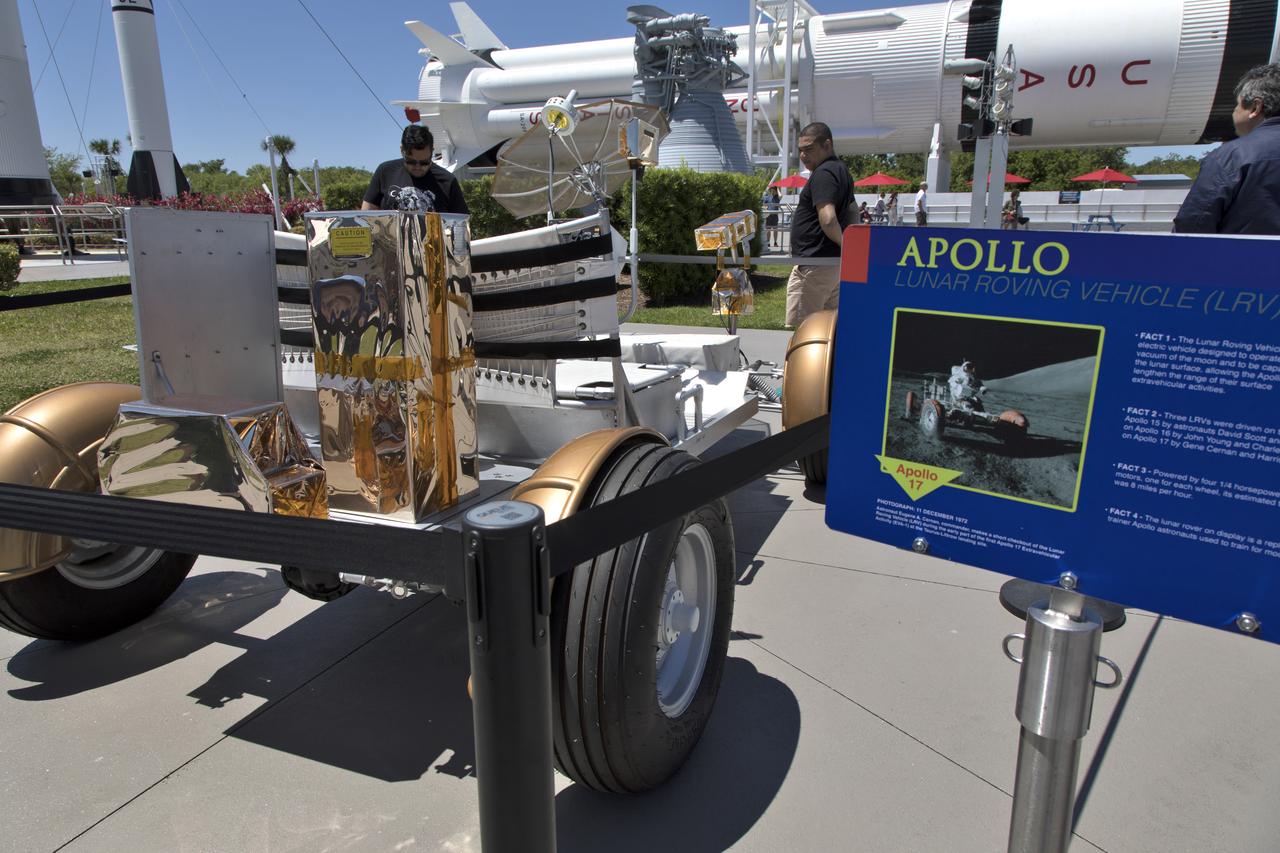
During the annual Earth Day celebration at the Kennedy Space Center Visitor Complex, guests have an opportunity to get an up-close look at experimental electric vehicles and see and Apollo era Lunar Roving Vehicle used in astronaut training. The battery-operated car was used on Apollos 15, 16 and 17 in 1971 and 1972. The two-day event featured approximately 50 exhibitors offering information on a variety of topics, including electric vehicles, sustainable lighting, renewable energy, Florida-friendly landscaping tips, Florida’s biking trails and more.
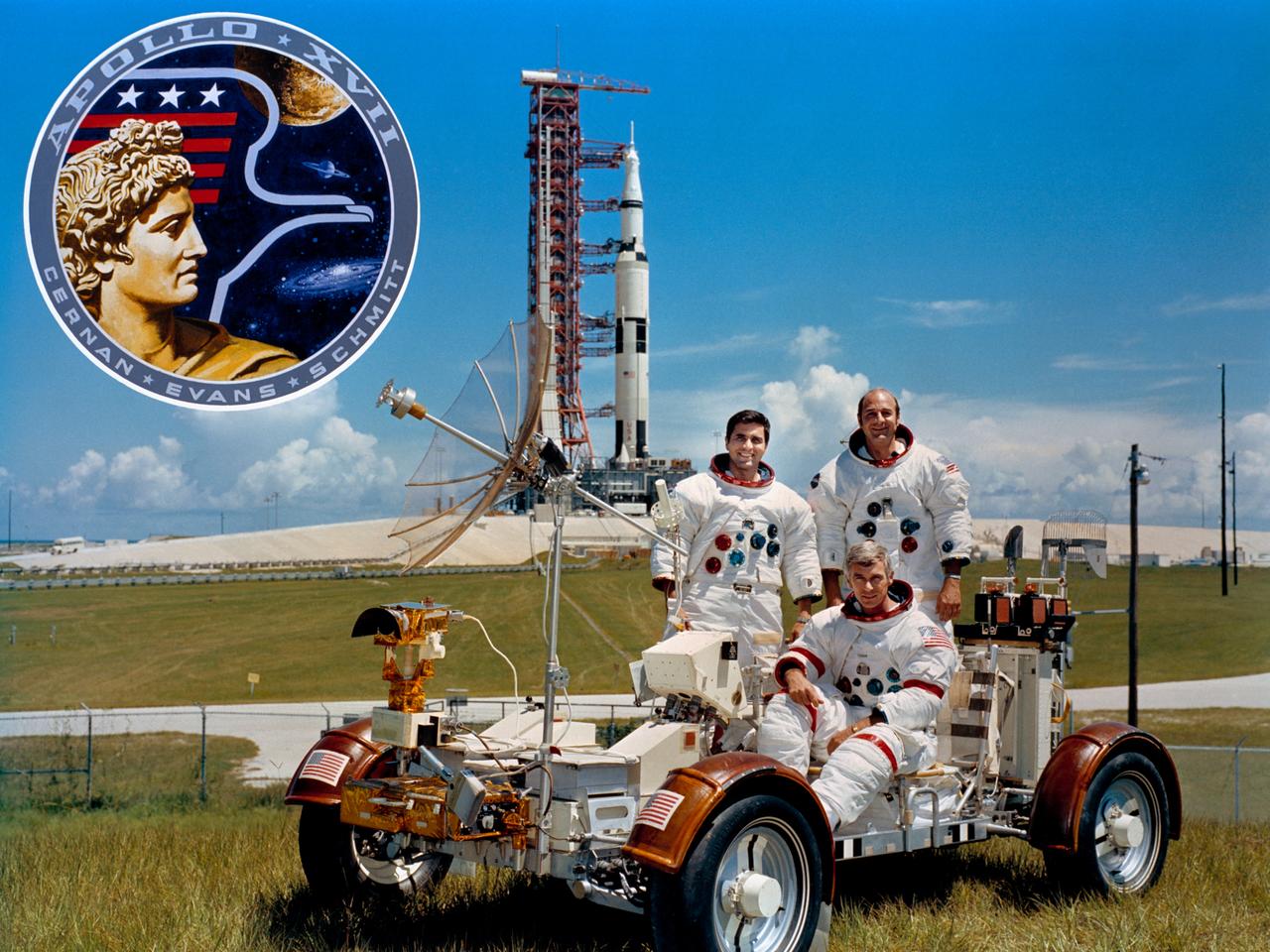
S72-50438 (September 1972) --- These three astronauts are the prime crew members of the Apollo 17 lunar landing mission. They are Eugene A. Cernan (seated), commander; Ronald E. Evans (standing on right), command module pilot; and Harrison H. Schmitt, lunar module pilot. They are photographed with a Lunar Roving Vehicle (LRV) trainer. Cernan and Schmitt will use an LRV during their exploration of the Taurus-Littrow landing site. The Apollo 17 Saturn V space vehicle is in the background. This picture was taken at Pad A, Launch Complex 39, Kennedy Space Center (KSC), Florida. The Apollo 17 insignia is in the photo insert at upper left. The insignia, designed by artist Robert T. McCall in collaboration with the crewmen, is dominated by the image of Apollo, the Greek sun god.
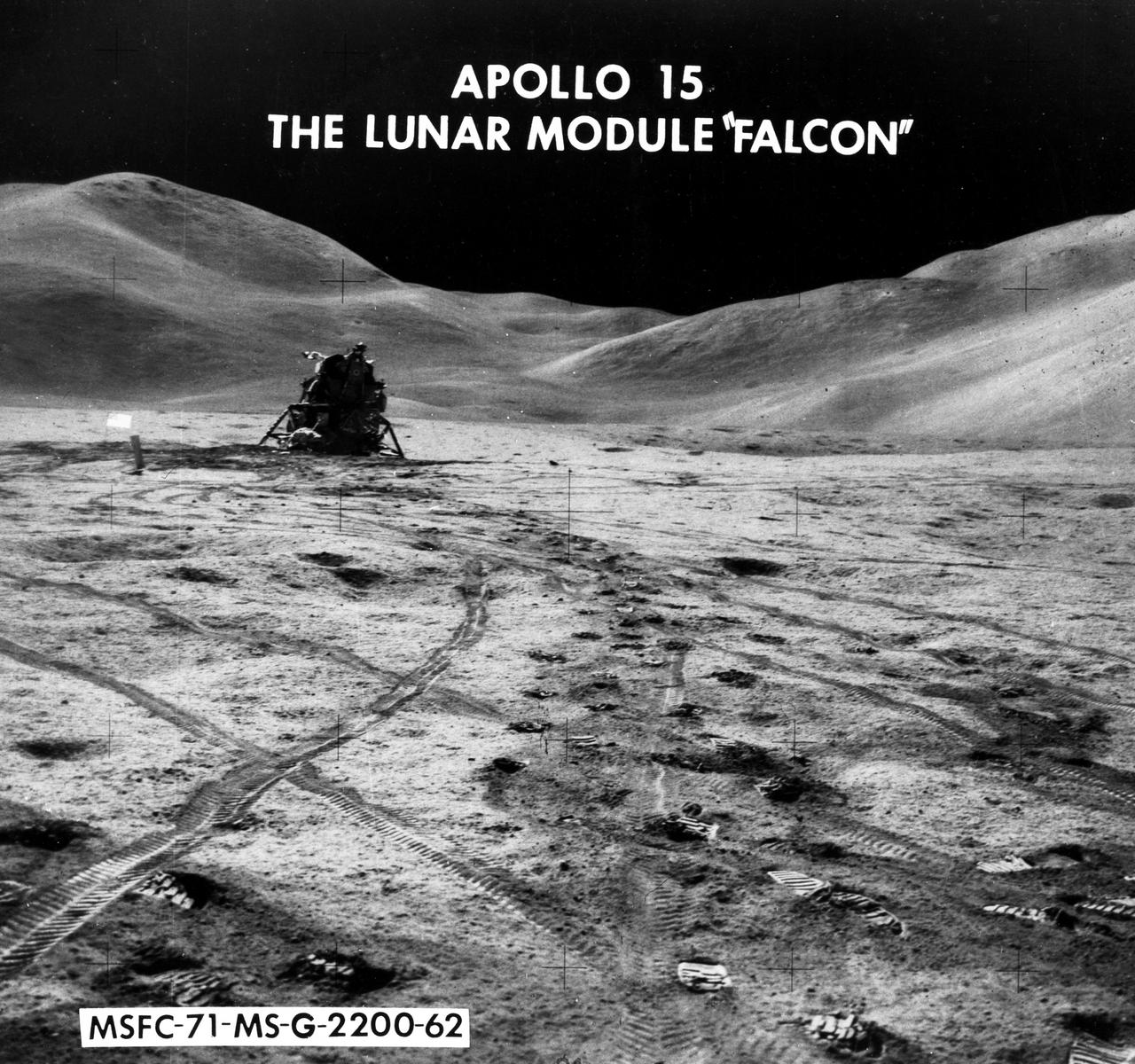
This is a photo of the Apollo 15 Lunar Module, Falcon, on the lunar surface. Apollo 15 launched from Kennedy Space Center (KSC) on July 26, 1971 via a Saturn V launch vehicle. Aboard was a crew of three astronauts including David R. Scott, Mission Commander; James B. Irwin, Lunar Module Pilot; and Alfred M. Worden, Command Module Pilot. The first mission designed to explore the Moon over longer periods, greater ranges and with more instruments for the collection of scientific data than on previous missions, the mission included the introduction of a $40,000,000 lunar roving vehicle (LRV) that reached a top speed of 16 kph (10 mph) across the Moon's surface. The successful Apollo 15 lunar landing mission was the first in a series of three advanced missions planned for the Apollo program. The primary scientific objectives were to observe the lunar surface, survey and sample material and surface features in a preselected area of the Hadley-Apennine region, setup and activation of surface experiments and conduct in-flight experiments and photographic tasks from lunar orbit. Apollo 15 televised the first lunar liftoff and recorded a walk in deep space by Alfred Worden. Both the Saturn V rocket and the LRV were developed at the Marshall Space Flight Center.
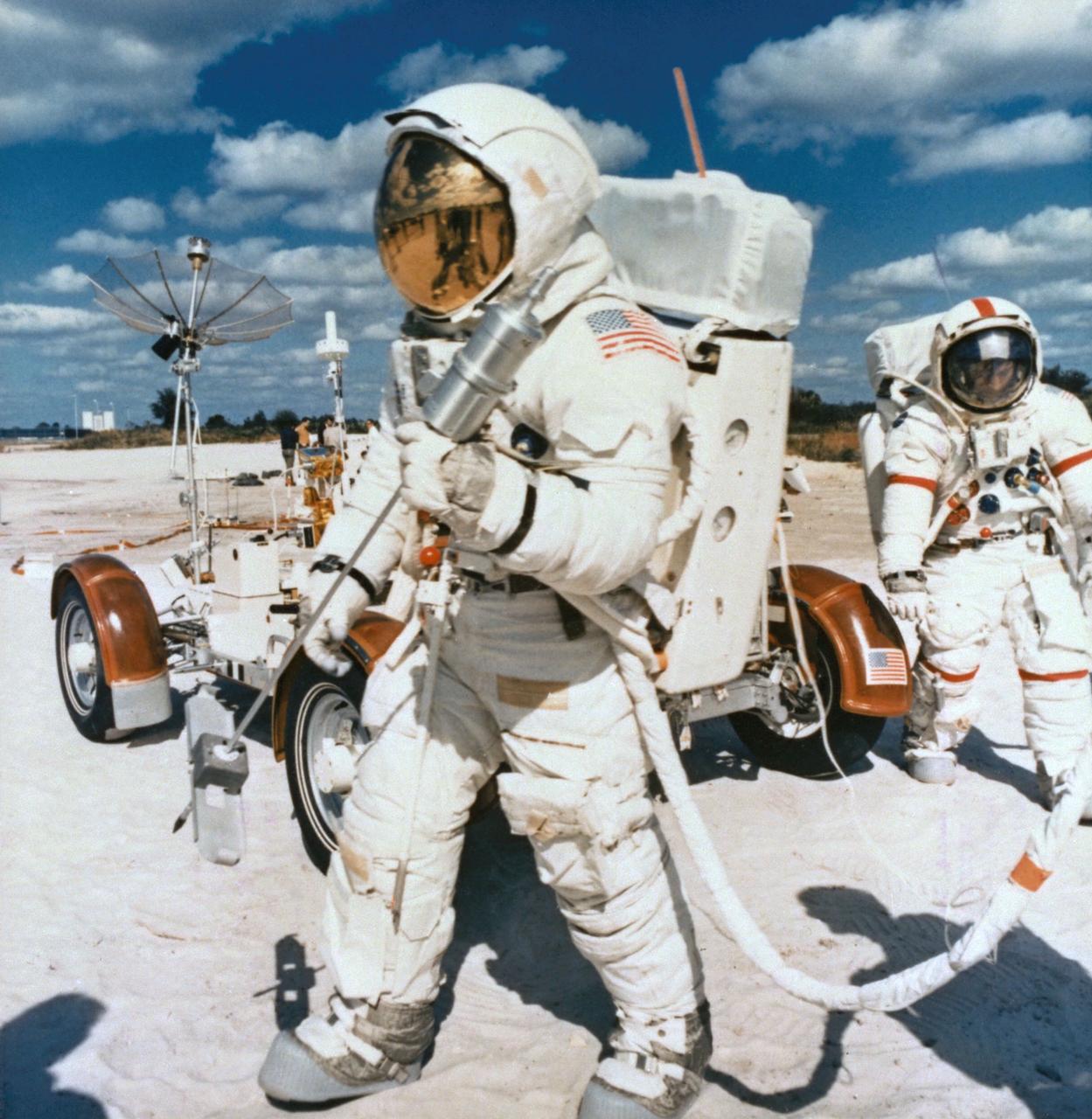
S72-30694 (28 Jan. 1972) --- Astronauts John W. Young, left, Apollo 16 commander, and Charles M. Duke Jr., lunar module pilot, prepare to begin a simulated traverse in a training area at the Kennedy Space Center (KSC). The fifth National Aeronautics and Space Administration (NASA) Apollo lunar landing mission is scheduled to land in the mountainous highlands region near the crater Descartes to explore the area for a three-day period. Among the experiments to fly on Apollo 16 is the soil mechanics (S-200) experiment or self-recording penetrometer, a model of which is held here by Duke. A training model of the Lunar Roving Vehicle (LRV) is parked between the two crew men. Astronaut Thomas K. (Ken) Mattingly II is prime crew command module pilot for the mission.
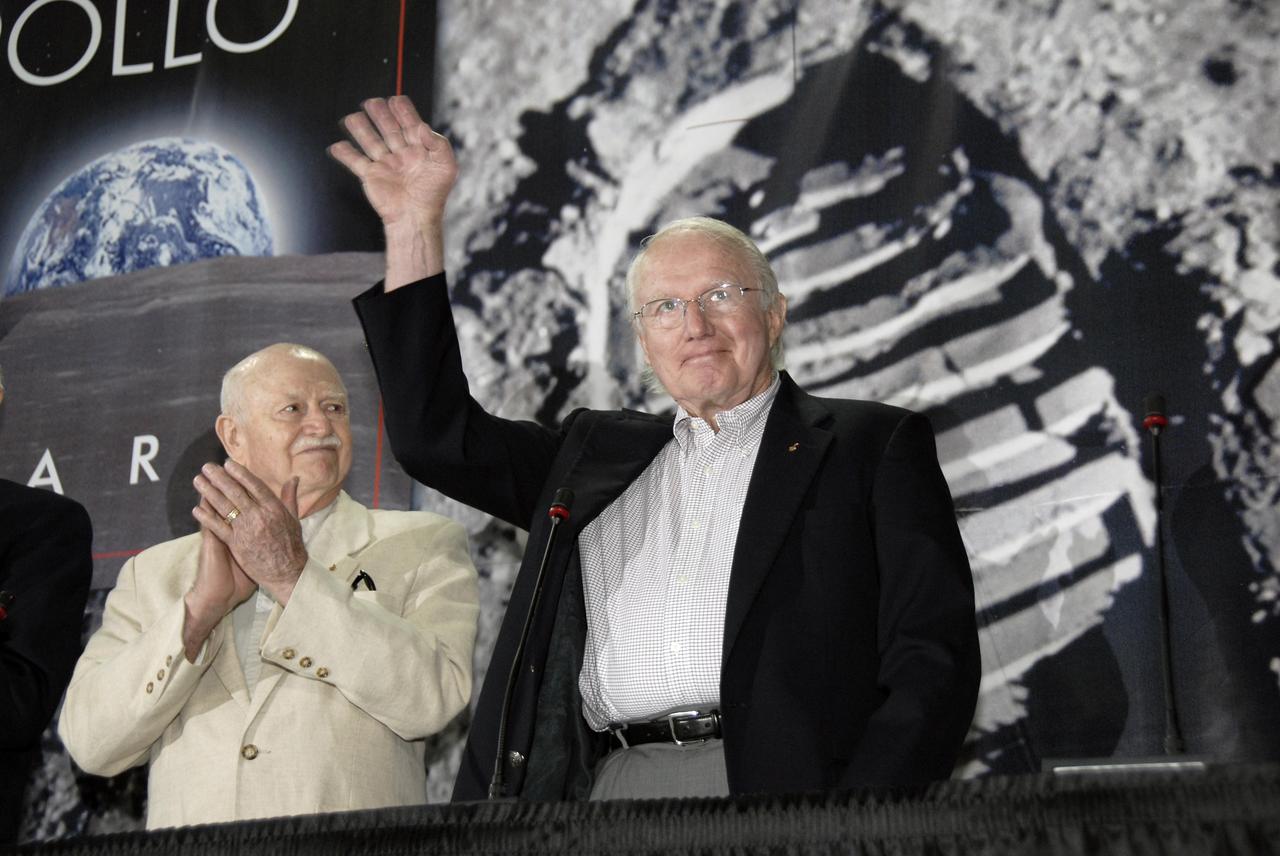
CAPE CANAVERAL, Fla. – At the Apollo/Saturn V Center at NASA's Kennedy Space Center in Florida, Apollo astronaut Gerald Carr (right) joins Vance Brand (left) and six other Apollo astronauts for NASA's 40th Anniversary of Apollo Celebration of the July 1969 launch and landing on the moon. Carr served as CAPCOM for the Apollo 8 and 12 flights, and was involved in the development and testing of the lunar roving vehicle which was used on the lunar surface by Apollo flight crews. He also was commander of Skylab 4 launched in 1973 on the third and final manned visit to the Skylab Orbital Workshop. It was the longest manned flight (84 days, 1 hour, 15minutes) in history at that date. Photo credit: NASA/Kim Shiflett
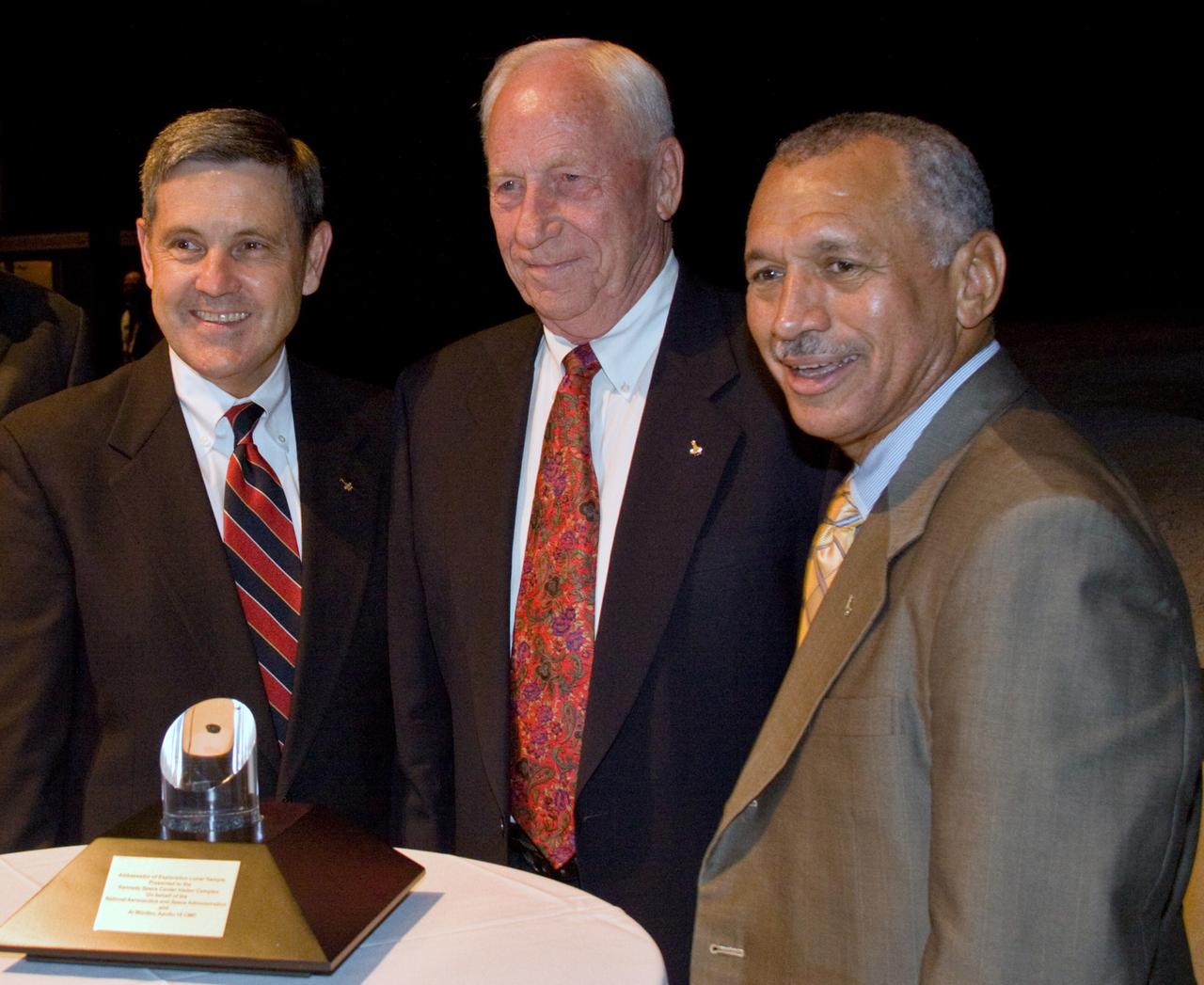
CAPE CANAVERAL, Fla. – At NASA Kennedy Space Center's Visitor Complex in Florida, Apollo astronaut Al Worden (center) is flanked by Center Director Bob Cabana (left) and NASA Administrator Charles Bolden. Worden was presented with the Ambassador of Exploration Award to honor his contributions to the U.S. space program. A moon rock encased in Lucite, the award is seen in the foreground and will be displayed at Kennedy. Worden served as command module pilot for the Apollo 15 mission, which set several moon records for NASA, including the longest lunar surface stay time, the longest lunar extravehicular activity and the first use of a lunar roving vehicle. Worden spent 38 minutes in a spacewalk outside the command module and logged a total of 295 hours, 11 minutes in space during the mission. NASA is giving the Ambassador of Exploration Award to the first generation of explorers in the Mercury, Gemini and Apollo space programs for realizing America's goal of going to the moon. The rock is part of the 842 pounds of lunar samples collected during six Apollo expeditions from 1969 to 1972. Those astronauts who receive the award will then present the award to a museum of their choice. Photo credit: NASA/Jack Pfaller
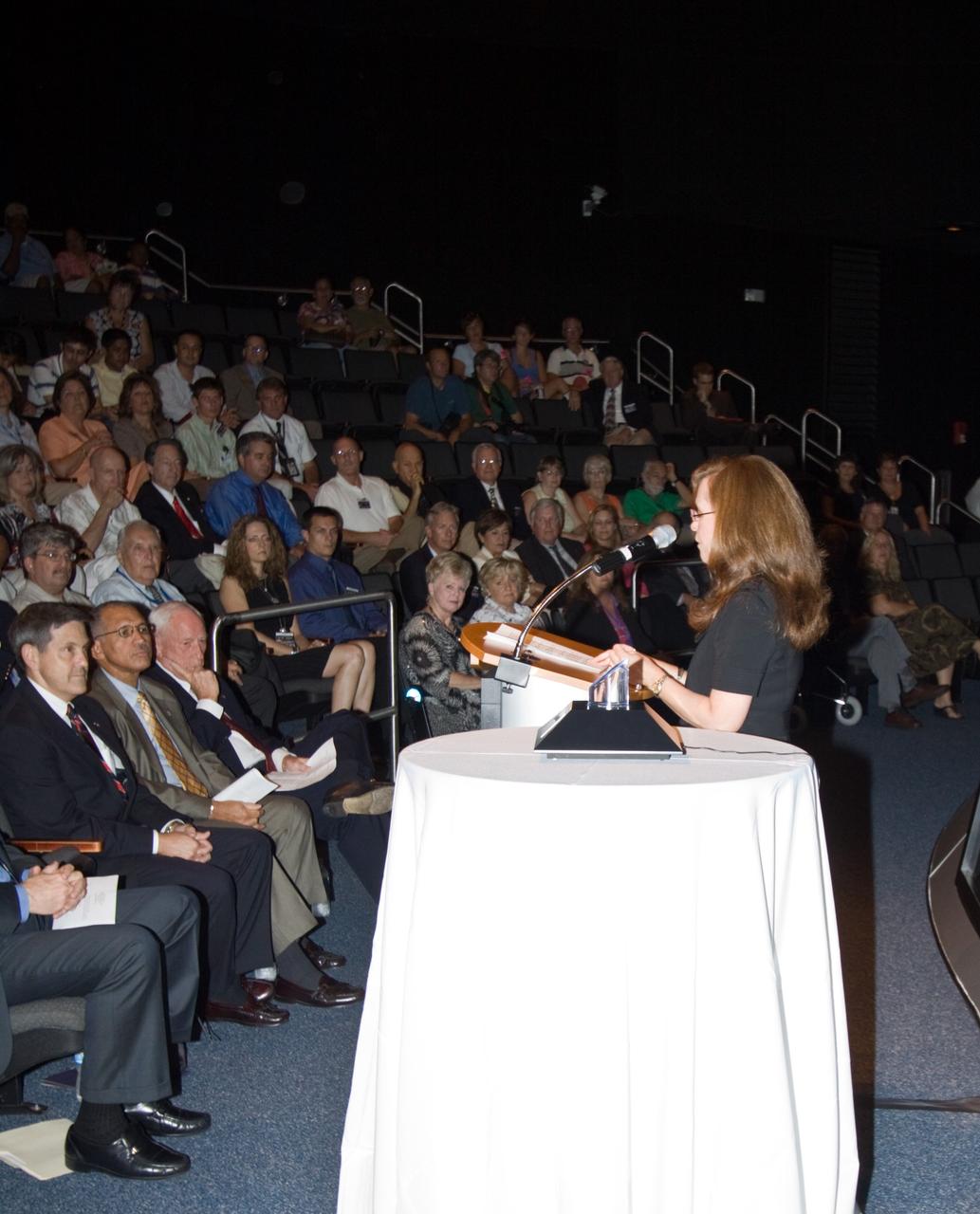
CAPE CANAVERAL, Fla. – At NASA's Kennedy Space Center in Florida, External Relations Director Lisa Malone speaks to an audience in Kennedy's Visitor Complex about the Ambassador of Exploration Award being given to Al Worden, an Apollo astronaut. Worden is being honored for his contributions to the U.S. space program. The award, to be displayed at Kennedy, is a moon rock encased in Lucite, mounted for public display. Worden served as command module pilot for the Apollo 15 mission, which set several moon records for NASA, including the longest lunar surface stay time, the longest lunar extravehicular activity and the first use of a lunar roving vehicle. Worden spent 38 minutes in a spacewalk outside the command module and logged a total of 295 hours, 11 minutes in space during the mission. NASA is giving the Ambassador of Exploration Award to the first generation of explorers in the Mercury, Gemini and Apollo space programs for realizing America's goal of going to the moon. The rock is part of the 842 pounds of lunar samples collected during six Apollo expeditions from 1969 to 1972. Those astronauts who receive the award will then present the award to a museum of their choice. Photo credit: NASA/Jack Pfaller
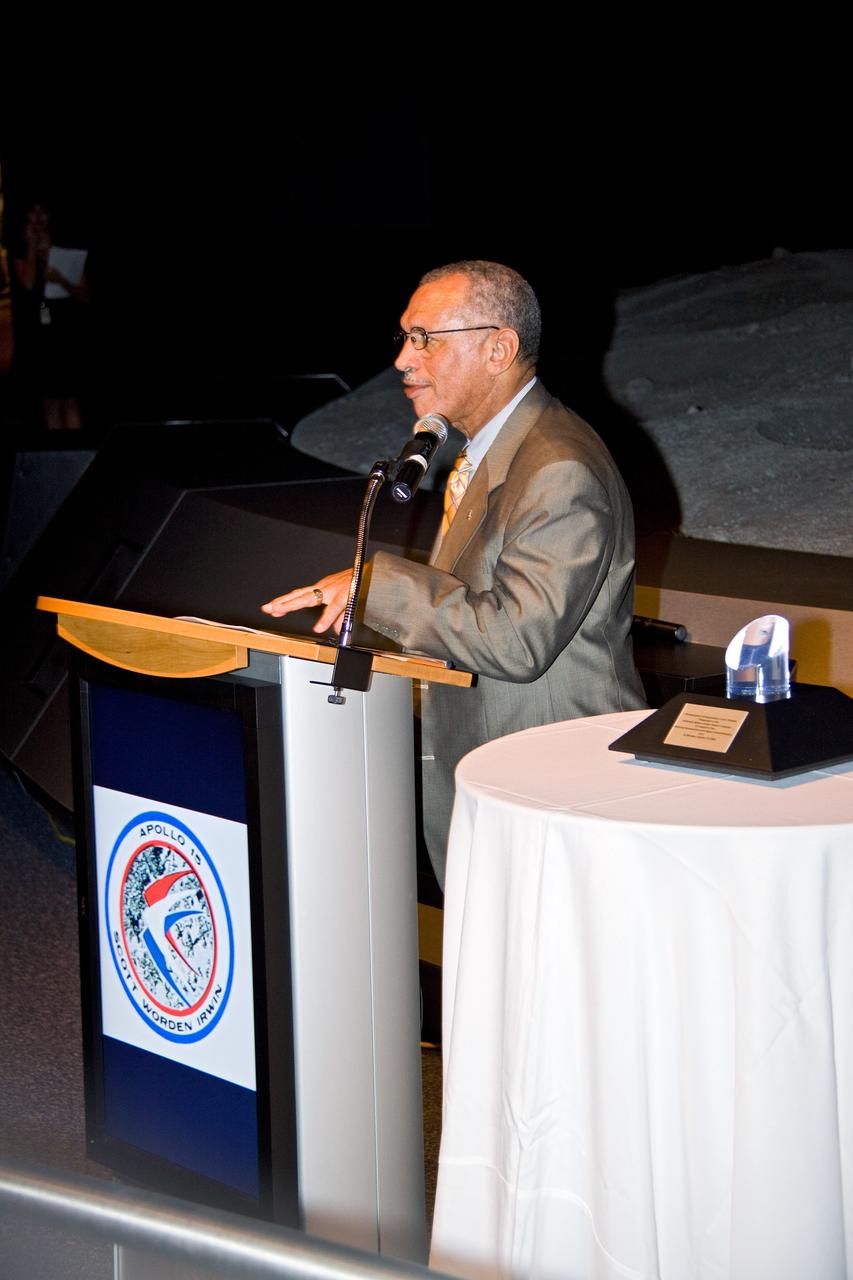
CAPE CANAVERAL, Fla. – At NASA's Kennedy Space Center in Florida, NASA Administrator Charles Bolden addresses guests who have gathered in Kennedy's Visitor Complex to celebrate Apollo astronaut Al Worden's receiving the Ambassador of Exploration Award. Worden is being honored for his contributions to the U.S. space program. The award, to be displayed at Kennedy, is a moon rock encased in Lucite, mounted for public display. Worden served as command module pilot for the Apollo 15 mission, which set several moon records for NASA, including the longest lunar surface stay time, the longest lunar extravehicular activity and the first use of a lunar roving vehicle. Worden spent 38 minutes in a spacewalk outside the command module and logged a total of 295 hours, 11 minutes in space during the mission. NASA is giving the Ambassador of Exploration Award to the first generation of explorers in the Mercury, Gemini and Apollo space programs for realizing America's goal of going to the moon. The rock is part of the 842 pounds of lunar samples collected during six Apollo expeditions from 1969 to 1972. Those astronauts who receive the award will then present the award to a museum of their choice. Photo credit: NASA/Jack Pfaller
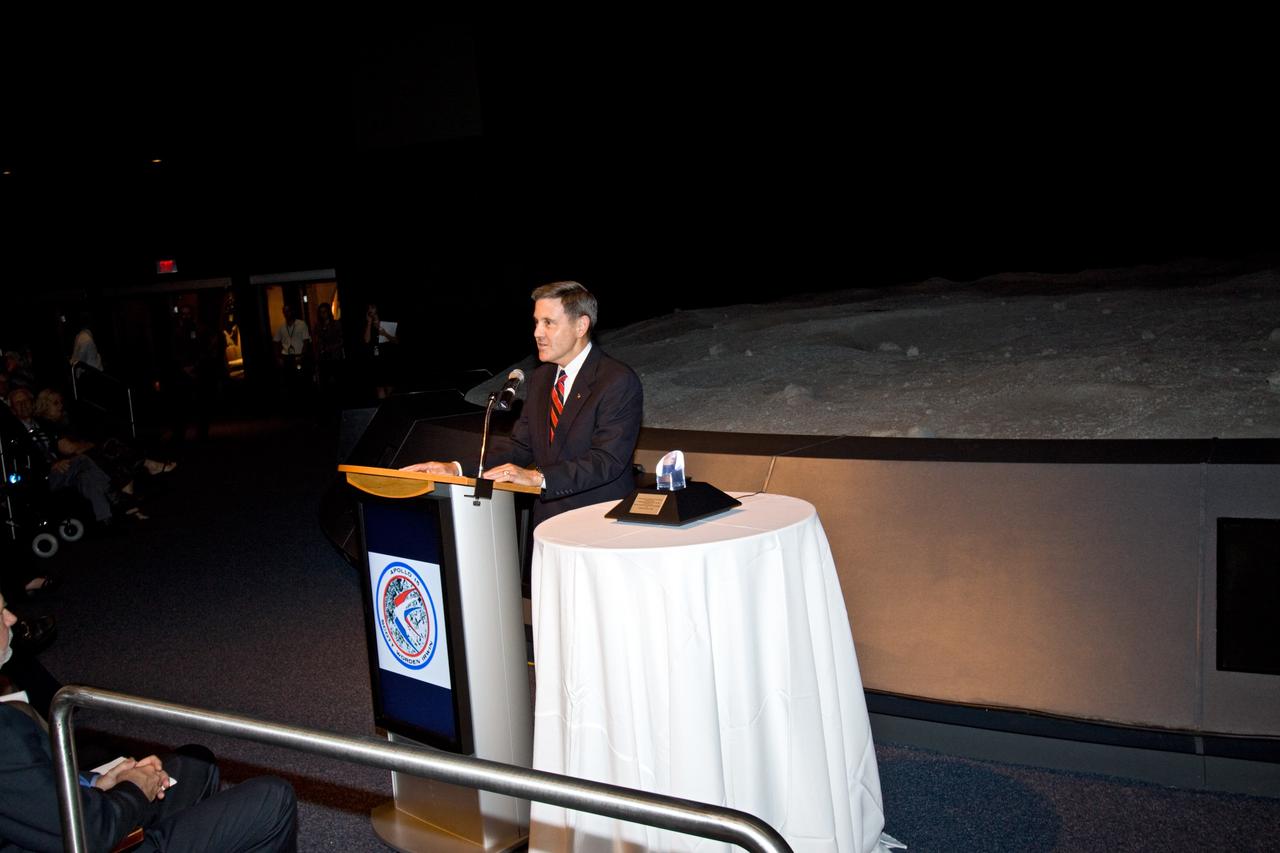
CAPE CANAVERAL, Fla. –At NASA's Kennedy Space Center in Florida, Director Bob Cabana speaks to an audience in Kennedy's Visitor Complex about Apollo astronaut Al Worden, who is receiving the Ambassador of Exploration Award. Worden is being honored for his contributions to the U.S. space program. The award, to be displayed at Kennedy, is a moon rock encased in Lucite, mounted for public display. Worden served as command module pilot for the Apollo 15 mission, which set several moon records for NASA, including the longest lunar surface stay time, the longest lunar extravehicular activity and the first use of a lunar roving vehicle. Worden spent 38 minutes in a spacewalk outside the command module and logged a total of 295 hours, 11 minutes in space during the mission. NASA is giving the Ambassador of Exploration Award to the first generation of explorers in the Mercury, Gemini and Apollo space programs for realizing America's goal of going to the moon. The rock is part of the 842 pounds of lunar samples collected during six Apollo expeditions from 1969 to 1972. Those astronauts who receive the award will then present the award to a museum of their choice. Photo credit: NASA/Jack Pfaller
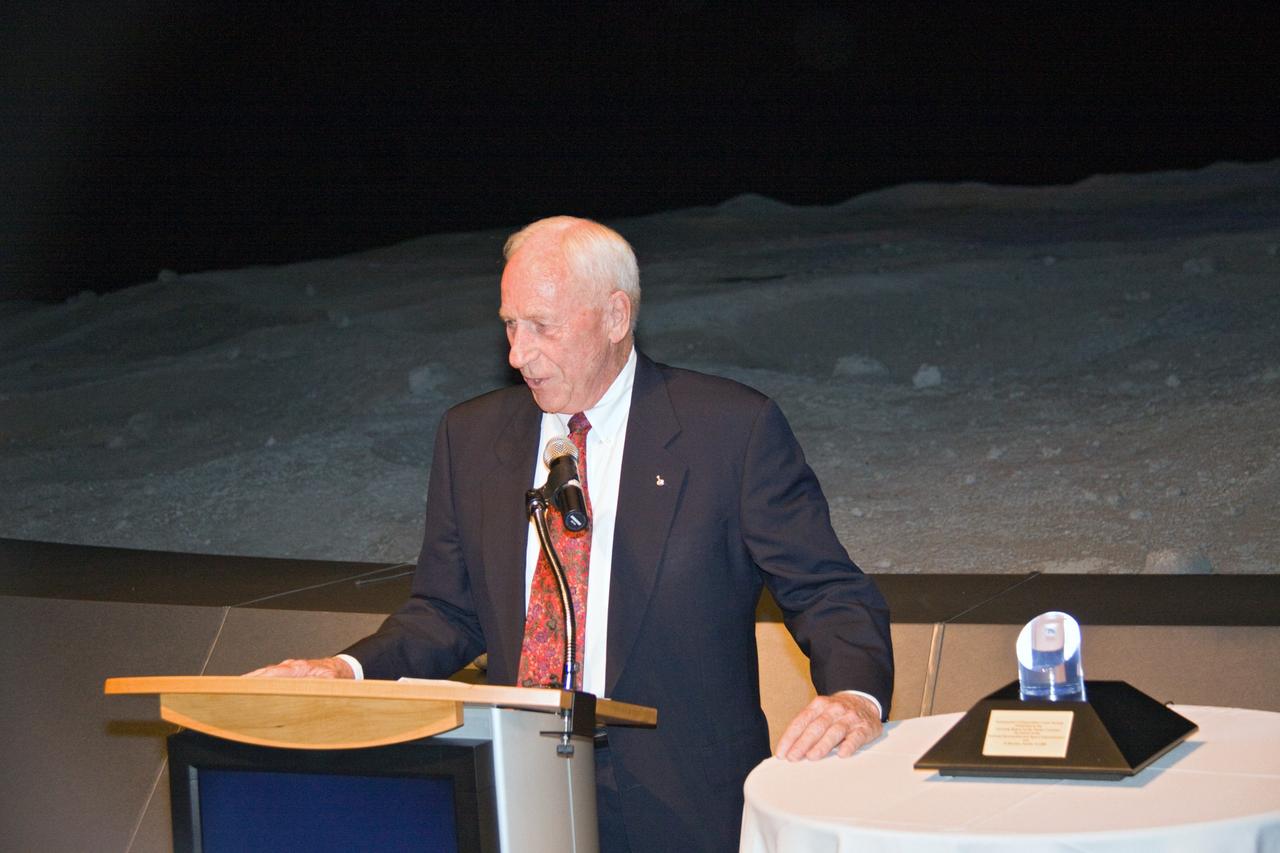
CAPE CANAVERAL, Fla. – At NASA Kennedy Space Center's Visitor Complex in Florida, Apollo astronaut Al Worden shares his thoughts about the Space Program after receiving the Ambassador of Exploration Award. Worden is being honored for his contributions to the U.S. space program. A moon rock encased in Lucite, the award is seen at right and will be displayed at Kennedy. Worden served as command module pilot for the Apollo 15 mission, which set several moon records for NASA, including the longest lunar surface stay time, the longest lunar extravehicular activity and the first use of a lunar roving vehicle. Worden spent 38 minutes in a spacewalk outside the command module and logged a total of 295 hours, 11 minutes in space during the mission. NASA is giving the Ambassador of Exploration Award to the first generation of explorers in the Mercury, Gemini and Apollo space programs for realizing America's goal of going to the moon. The rock is part of the 842 pounds of lunar samples collected during six Apollo expeditions from 1969 to 1972. Those astronauts who receive the award will then present the award to a museum of their choice. Photo credit: NASA/Jack Pfaller
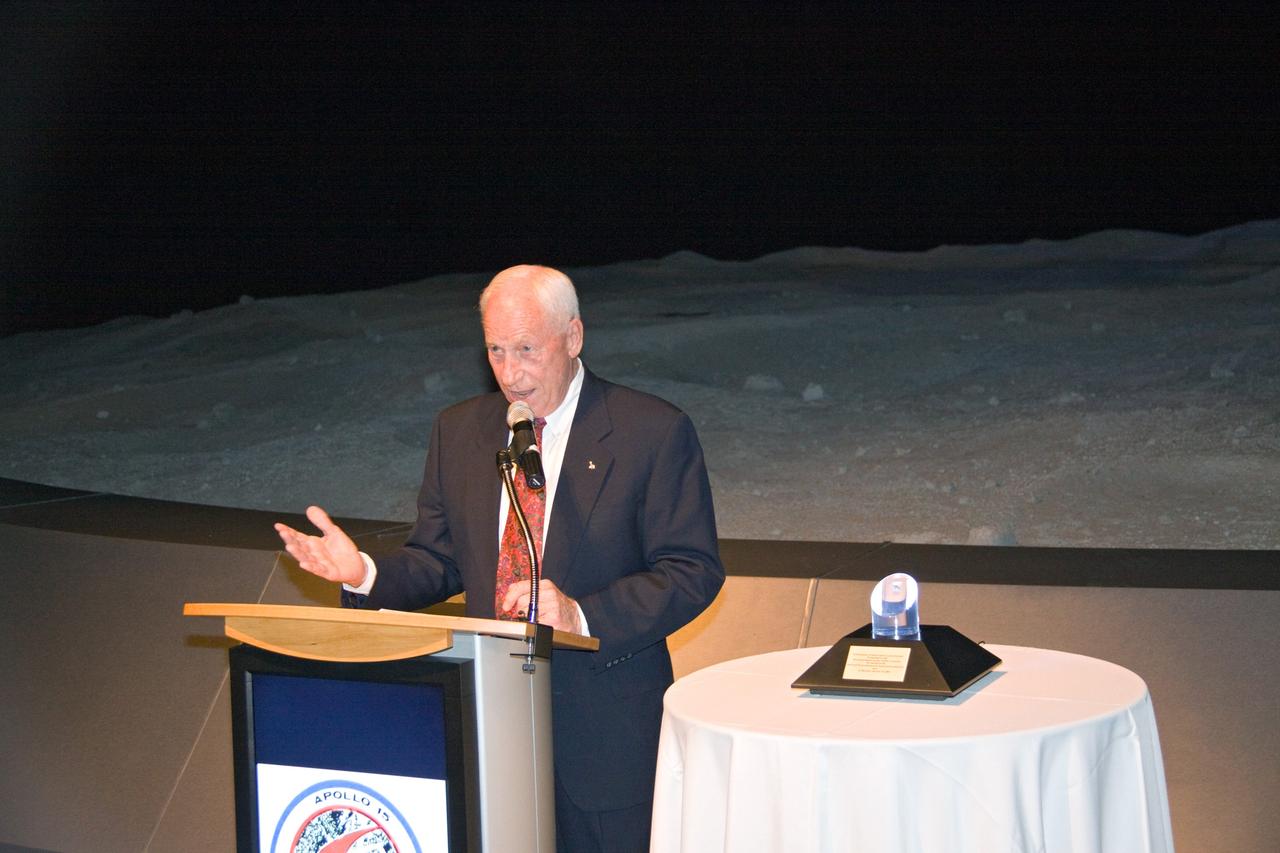
CAPE CANAVERAL, Fla. – At NASA Kennedy Space Center's Visitor Complex in Florida, Apollo astronaut Al Worden shares his thoughts about the Space Program after receiving the Ambassador of Exploration Award. Worden is being honored for his contributions to the U.S. space program. A moon rock encased in Lucite, the award is seen at right and will be displayed at Kennedy. Worden served as command module pilot for the Apollo 15 mission, which set several moon records for NASA, including the longest lunar surface stay time, the longest lunar extravehicular activity and the first use of a lunar roving vehicle. Worden spent 38 minutes in a spacewalk outside the command module and logged a total of 295 hours, 11 minutes in space during the mission. NASA is giving the Ambassador of Exploration Award to the first generation of explorers in the Mercury, Gemini and Apollo space programs for realizing America's goal of going to the moon. The rock is part of the 842 pounds of lunar samples collected during six Apollo expeditions from 1969 to 1972. Those astronauts who receive the award will then present the award to a museum of their choice. Photo credit: NASA/Jack Pfaller
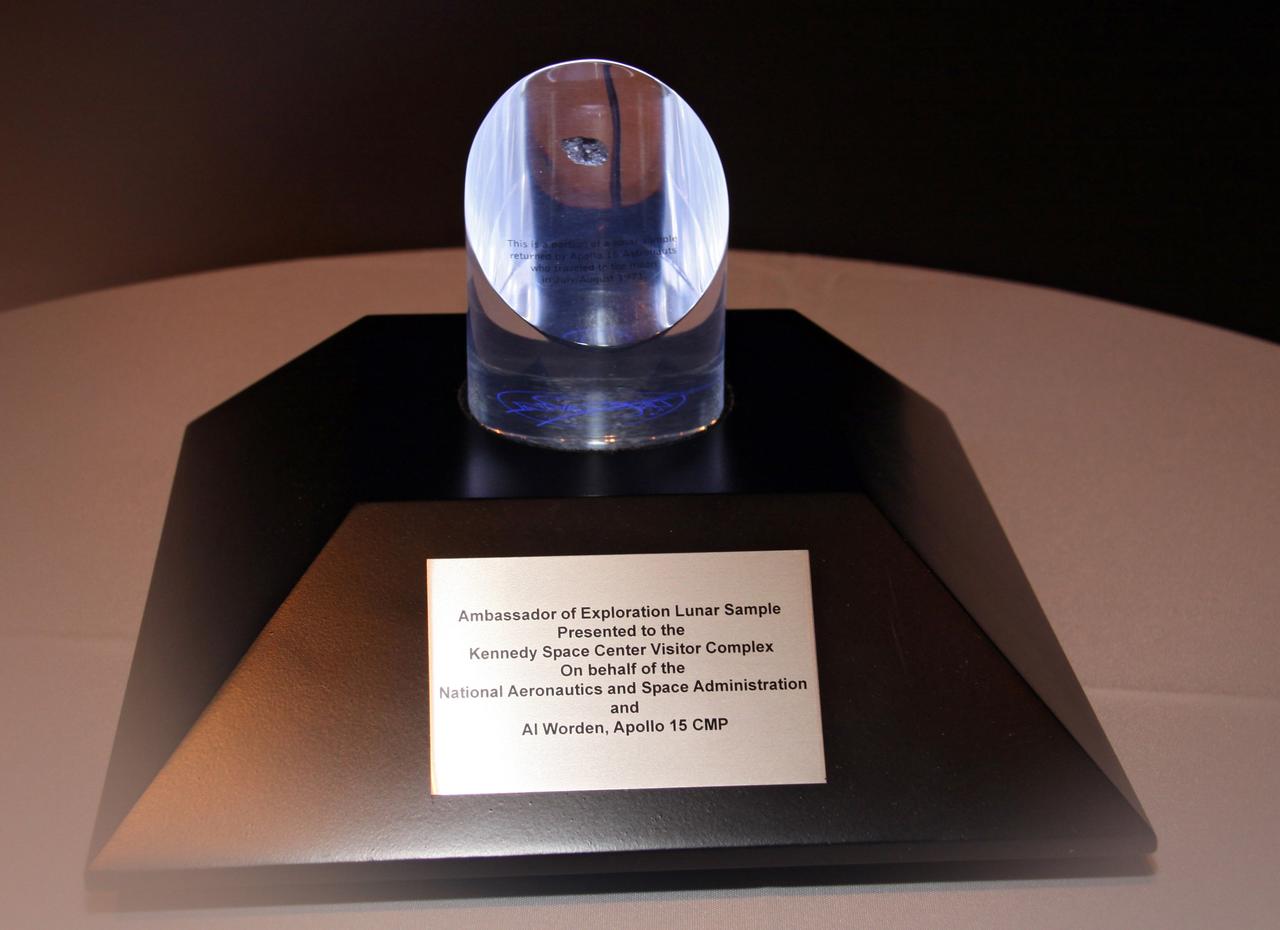
CAPE CANAVERAL, Fla. – NASA will honor Apollo astronaut Al Worden with the presentation of this Ambassador of Exploration Award, a moon rock encased in Lucite, mounted for public display. He is being honored for his contributions to the U.S. space program. Worden received the award during a ceremony July 30 at the Apollo Saturn V Center at NASA's Kennedy Space Center Visitor Complex in Florida, where the moon rock will be displayed. Worden served as command module pilot for the Apollo 15 mission, which set several moon records for NASA, including the longest lunar surface stay time, the longest lunar extravehicular activity and the first use of a lunar roving vehicle. Worden spent 38 minutes in a spacewalk outside the command module and logged a total of 295 hours, 11 minutes in space during the mission. NASA is giving the Ambassador of Exploration Award to the first generation of explorers in the Mercury, Gemini and Apollo space programs for realizing America's goal of going to the moon. The rock is part of the 842 pounds of lunar samples collected during six Apollo expeditions from 1969 to 1972. Those astronauts who receive the award will then present the award to a museum of their choice. Photo credit: NASA/Jack Pfaller
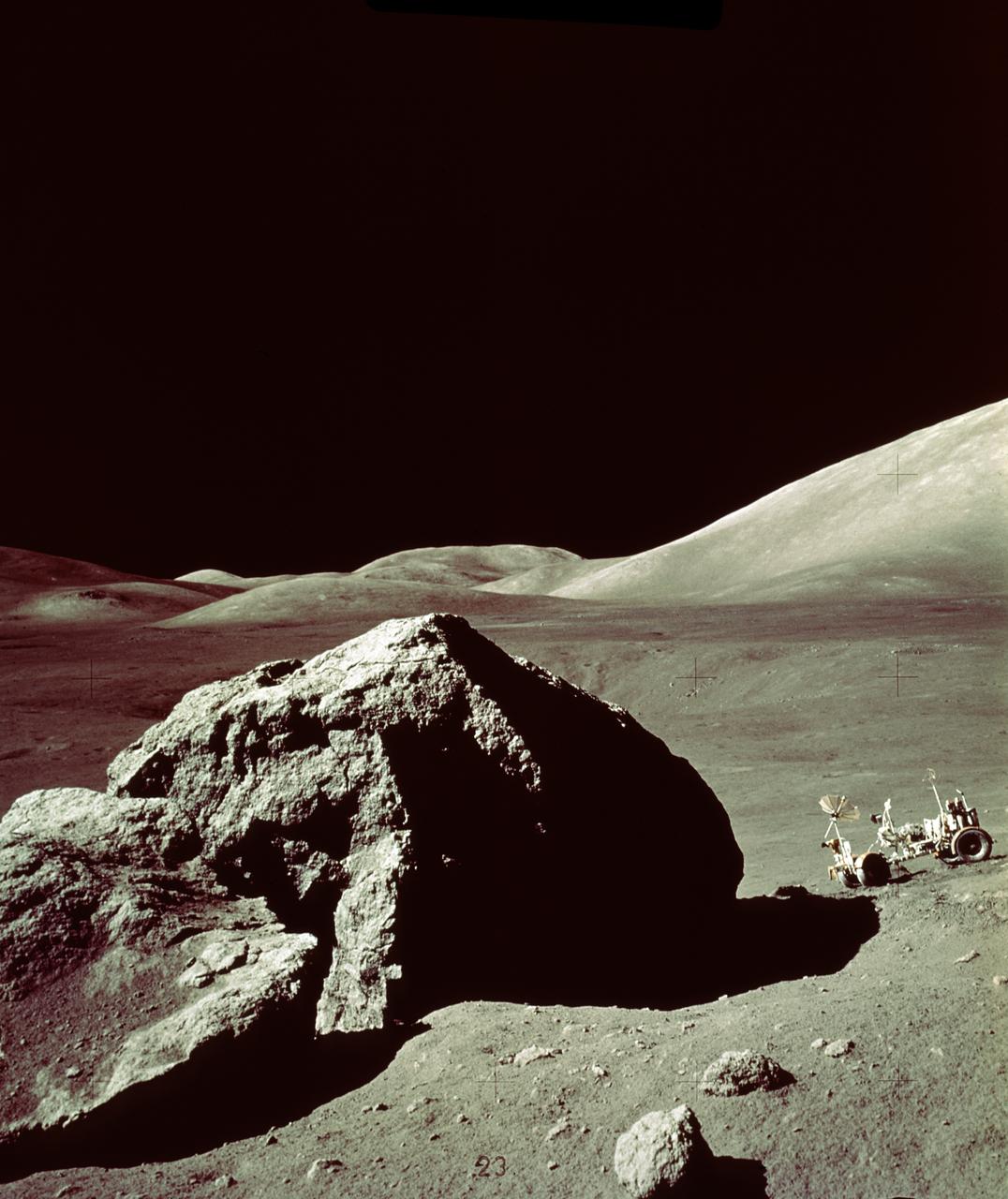
In this Apollo 17 onboard photo, a Lunar Roving Vehicle (LRV) is parked beside a huge boulder near the Valley of Tourus-Litttrow on the lunar surface. The seventh and last manned lunar landing and return to Earth mission, the Apollo 17, carrying a crew of three astronauts: Mission Commander Eugene A. Cernan; Lunar Module pilot Harrison H. Schmitt; and Command Module pilot Ronald E. Evans, lifted off on December 7, 1972 from the Kennedy Space Flight Center (KSC). Scientific objectives of the Apollo 17 mission included geological surveying and sampling of materials and surface features in a preselected area of the Taurus-Littrow region, deploying and activating surface experiments, and conducting in-flight experiments and photographic tasks during lunar orbit and transearth coast (TEC). These objectives included: Deployed experiments such as the Apollo lunar surface experiment package (ALSEP) with a Heat Flow experiment, Lunar seismic profiling (LSP), Lunar surface gravimeter (LSG), Lunar atmospheric composition experiment (LACE) and Lunar ejecta and meteorites (LEAM). The mission also included Lunar Sampling and Lunar orbital experiments. Biomedical experiments included the Biostack II Experiment and the BIOCORE experiment. The mission marked the longest Apollo mission, 504 hours, and the longest lunar surface stay time, 75 hours, which allowed the astronauts to conduct an extensive geological investigation. They collected 257 pounds (117 kilograms) of lunar samples with the use of the Marshall Space Flight Center developed LRV. The mission ended on December 19, 1972
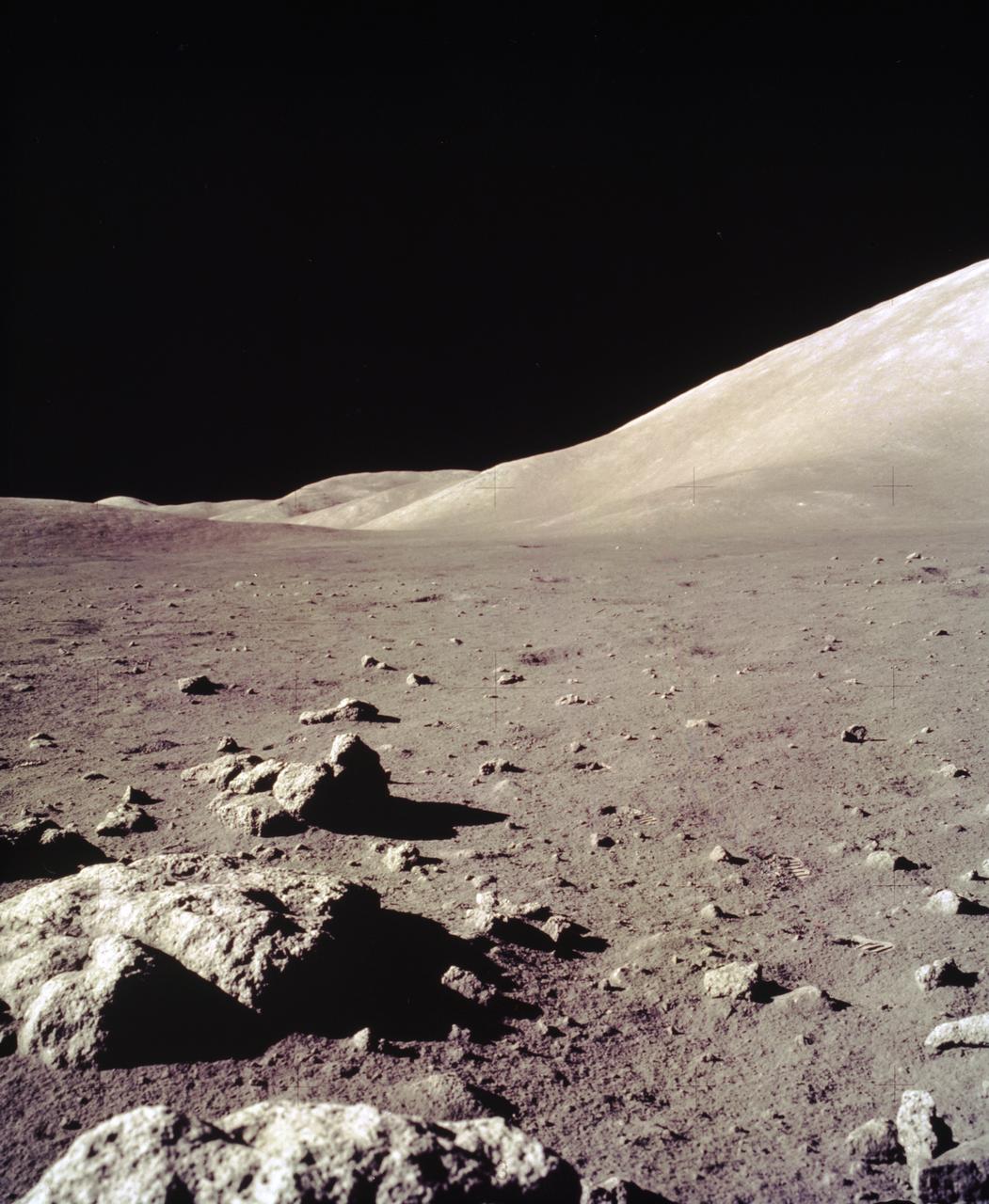
This view of the Lunar surface was taken during the Apollo 17 mission. The seventh and last manned lunar landing and return to Earth mission, the Apollo 17, carrying a crew of three astronauts: Mission Commander Eugene A. Cernan; Lunar Module pilot Harrison H. Schmitt; and Command Module pilot Ronald E. Evans, lifted off on December 7, 1972 from the Kennedy Space Flight Center (KSC). Scientific objectives of the Apollo 17 mission included geological surveying and sampling of materials and surface features in a preselected area of the Taurus-Littrow region, deploying and activating surface experiments, and conducting in-flight experiments and photographic tasks during lunar orbit and transearth coast (TEC). These objectives included: Deployed experiments such as the Apollo lunar surface experiment package (ALSEP) with a Heat Flow experiment, Lunar seismic profiling (LSP), Lunar surface gravimeter (LSG), Lunar atmospheric composition experiment (LACE) and Lunar ejecta and meteorites (LEAM). The mission also included Lunar Sampling and Lunar orbital experiments. Biomedical experiments included the Biostack II Experiment and the BIOCORE experiment. The mission marked the longest Apollo mission, 504 hours, and the longest lunar surface stay time, 75 hours, which allowed the astronauts to conduct an extensive geological investigation. They collected 257 pounds (117 kilograms) of lunar samples with the use of the Marshall Space Flight Center designed Lunar Roving Vehicle (LRV). The mission ended on December 19, 1972.
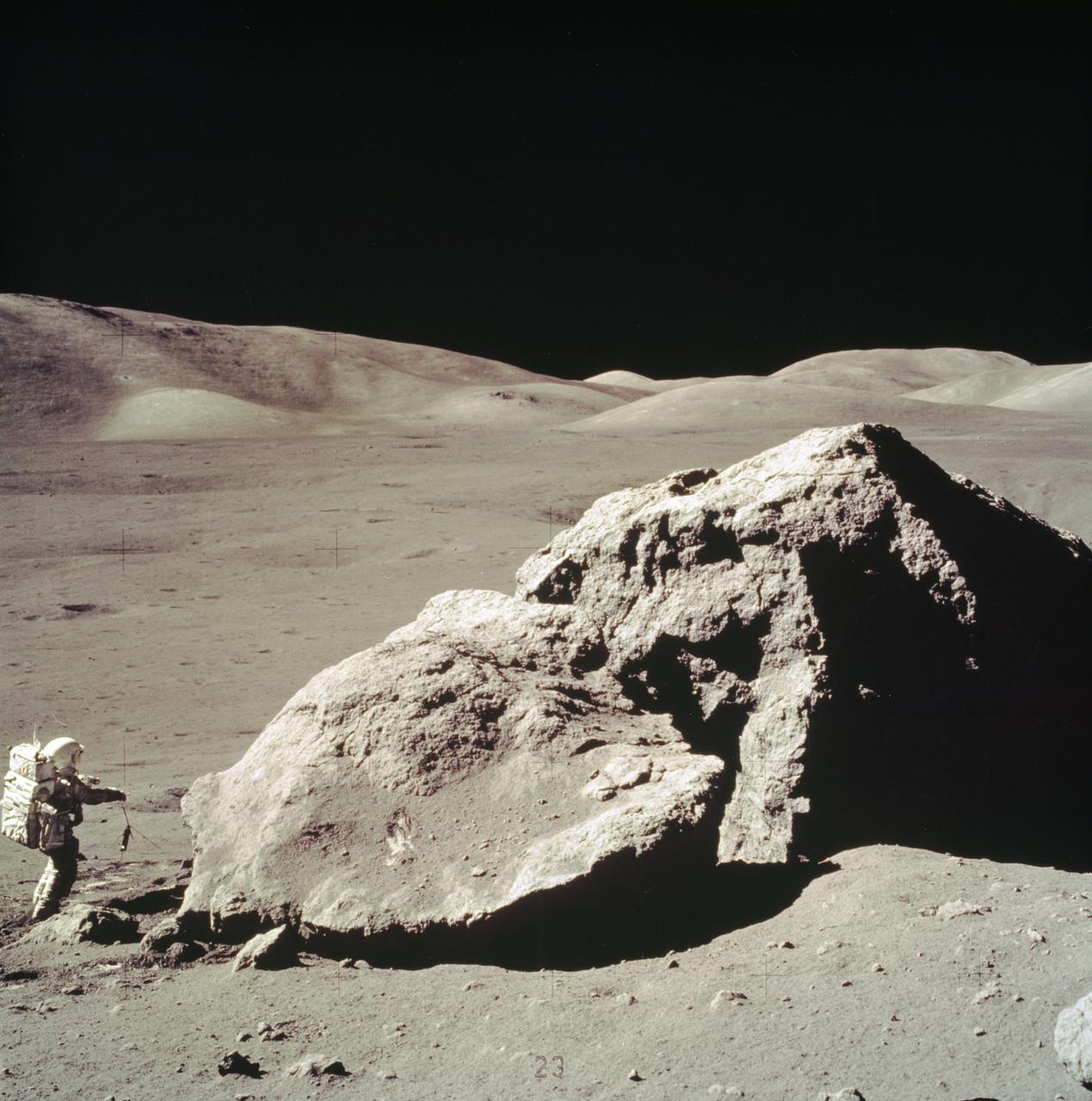
In this Apollo 17 onboard photo, Lunar Module pilot Harrison H. Schmitt collects rock samples from a huge boulder near the Valley of Tourus-Littrow on the lunar surface. The seventh and last manned lunar landing and return to Earth mission, the Apollo 17, carrying a crew of three astronauts: Schmitt; Mission Commander Eugene A. Cernan; and Command Module pilot Ronald E. Evans, lifted off on December 7, 1972 from the Kennedy Space Flight Center (KSC). Scientific objectives of the Apollo 17 mission included geological surveying and sampling of materials and surface features in a preselected area of the Taurus-Littrow region, deploying and activating surface experiments, and conducting in-flight experiments and photographic tasks during lunar orbit and transearth coast (TEC). These objectives included: Deployed experiments such as the Apollo lunar surface experiment package (ALSEP) with a Heat Flow experiment, Lunar seismic profiling (LSP), Lunar surface gravimeter (LSG), Lunar atmospheric composition experiment (LACE) and Lunar ejecta and meteorites (LEAM). The mission also included Lunar Sampling and Lunar orbital experiments. Biomedical experiments included the Biostack II Experiment and the BIOCORE experiment. The mission marked the longest Apollo mission, 504 hours, and the longest lunar surface stay time, 75 hours, which allowed the astronauts to conduct an extensive geological investigation. They collected 257 pounds (117 kilograms) of lunar samples with the use of the Marshall Space Flight Center designed Lunar Roving Vehicle (LRV). The mission ended on December 19, 1972
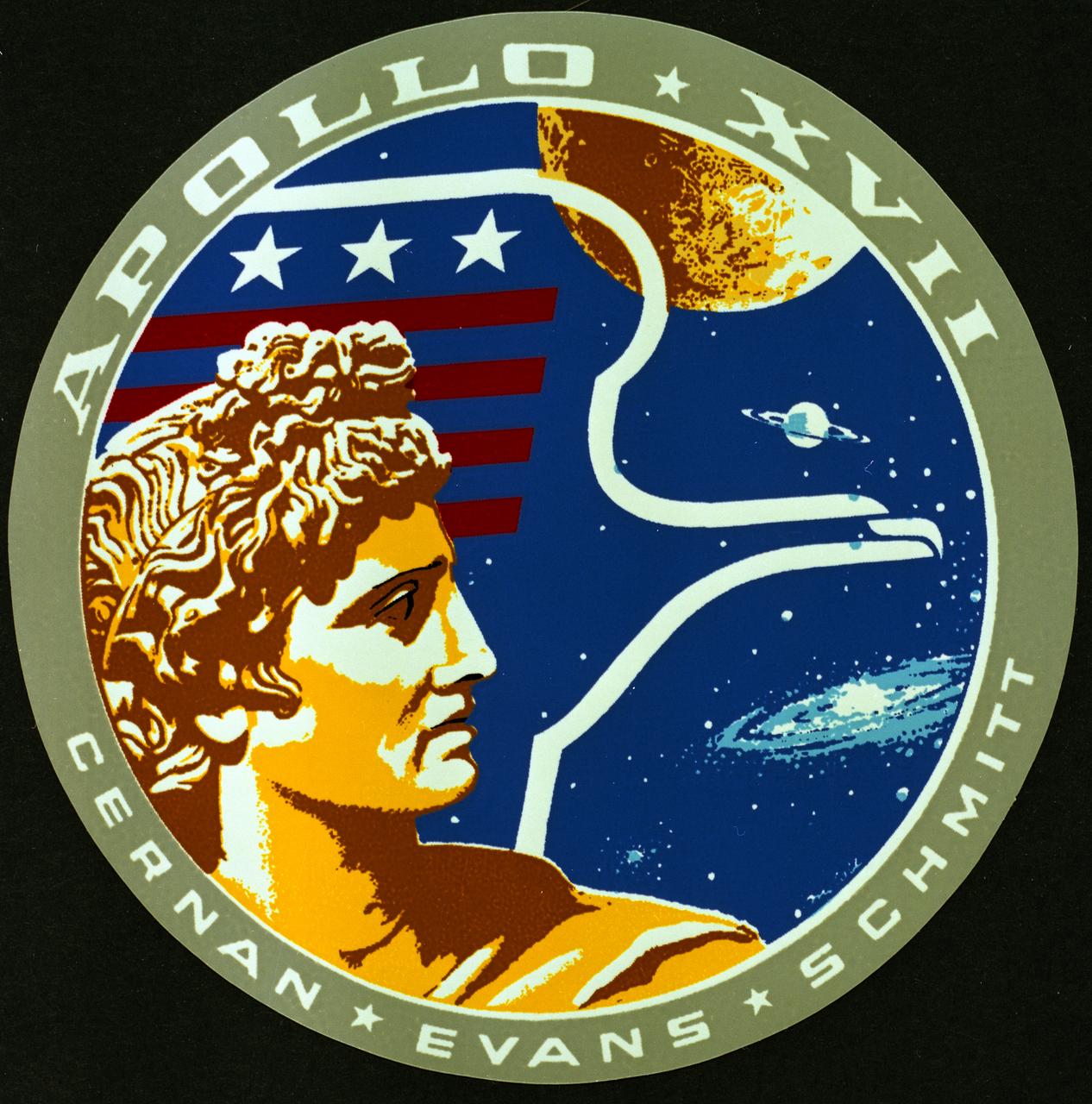
This is the Apollo 17 insignia or logo. The seventh and last manned lunar landing and return to Earth mission, the Apollo 17, carried a crew of three astronauts: Harrison H. Schmitt, Lunar Module pilot; Eugene A. Cernan, mission commander; and Ronald E. Evans, Command Module pilot. Apollo 17 lifted off on December 7, 1972 from the Kennedy Space Flight Center (KSC). Scientific objectives of the mission included geological surveying and sampling of materials and surface features in a preselected area of the Taurus-Littrow region, deploying and activating surface experiments, and conducting in-flight experiments and photographic tasks during lunar orbit and transearth coast (TEC). The objectives included deployed experiments such as the Apollo lunar surface experiment package (ALSEP) with a Heat Flow experiment, Lunar seismic profiling (LSP), Lunar surface gravimeter (LSG), Lunar atmospheric composition experiment (LACE) and Lunar ejecta and meteorites (LEAM). The mission also included Lunar Sampling and Lunar Orbital experiments. Biomedical experiments included the Biostack II and the BIOCORE experiments. The mission marked the longest Apollo mission, 504 hours, and the longest lunar surface stay time, 75 hours, which allowed the astronauts to conduct an extensive geological investigation. They collected 257 pounds (117 kilograms) of lunar samples with the use of the Marshall Space Flight Center (MSFC) designed Lunar Roving Vehicle (LRV). The mission ended on December 19, 1972.