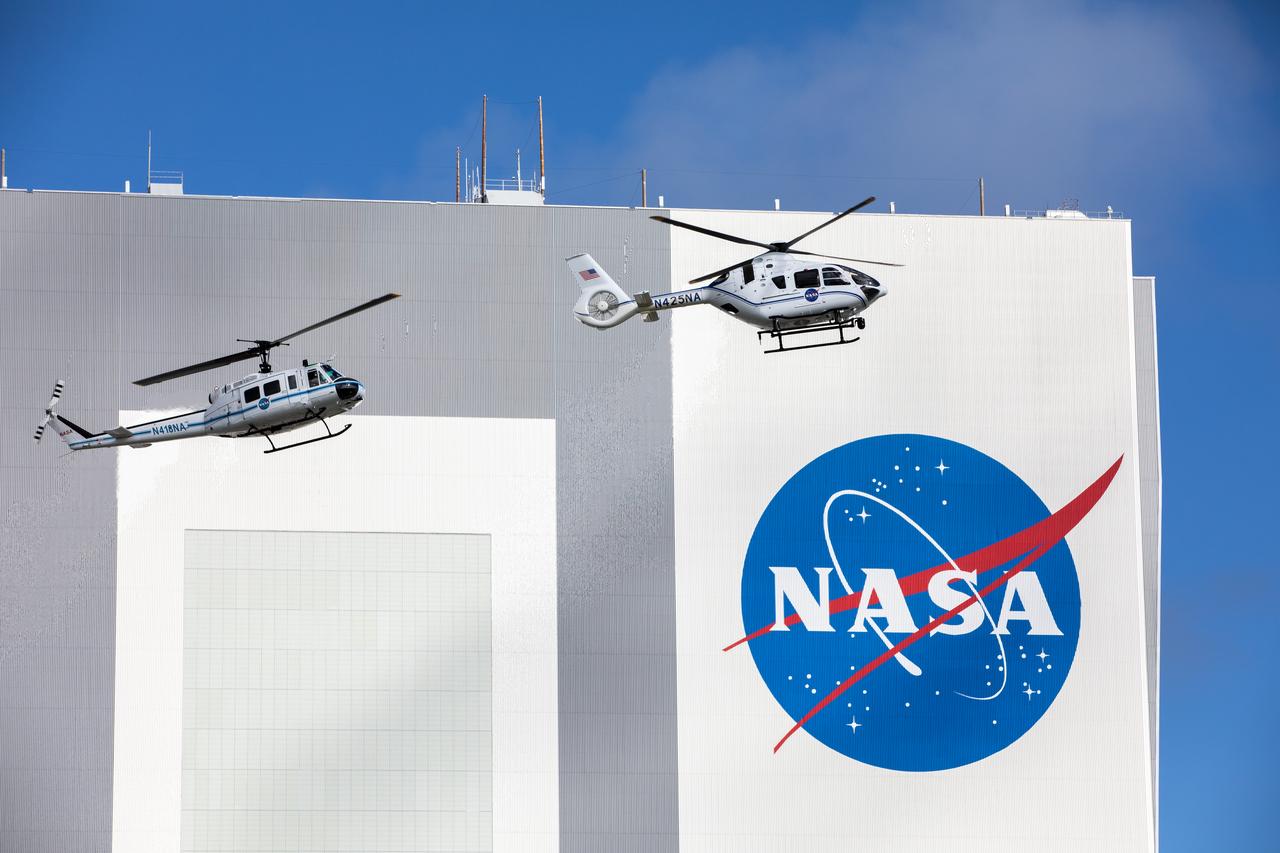
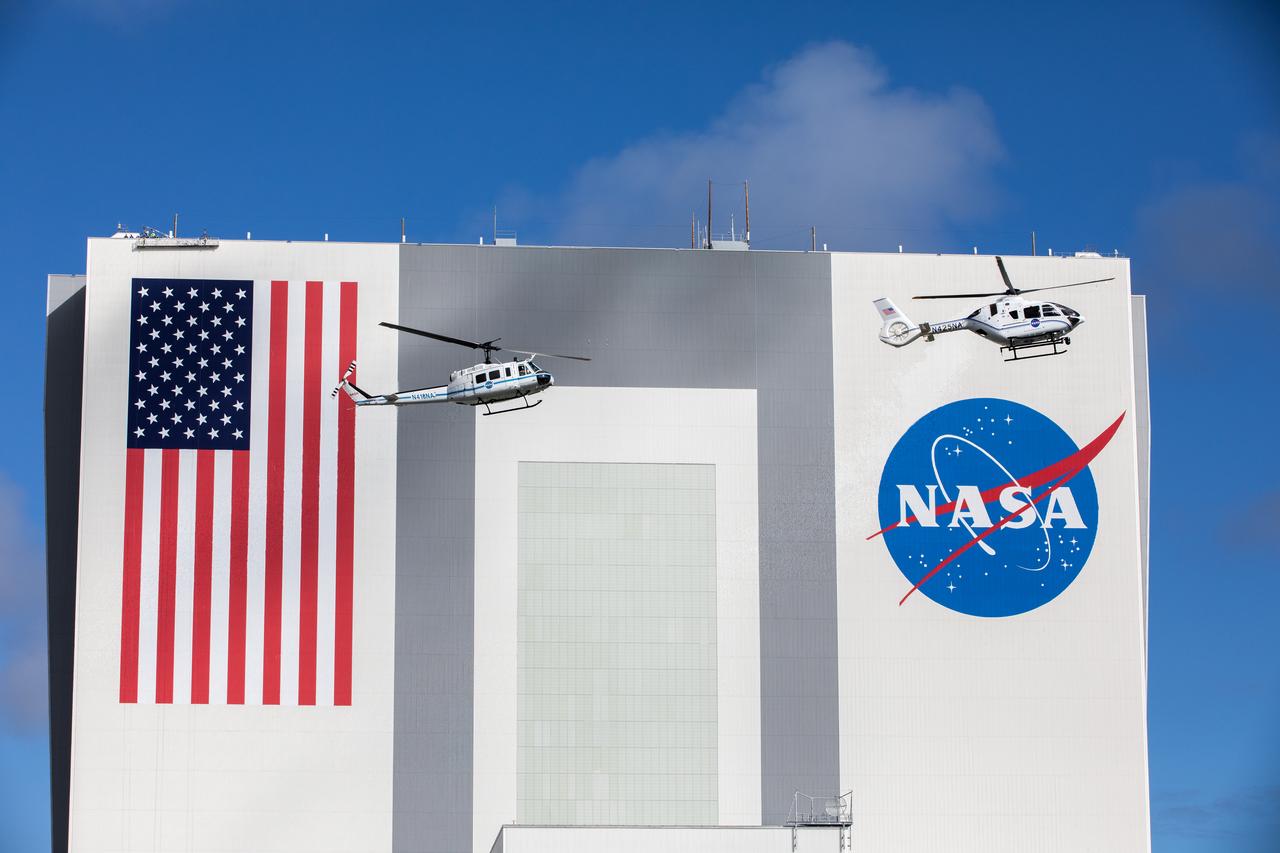
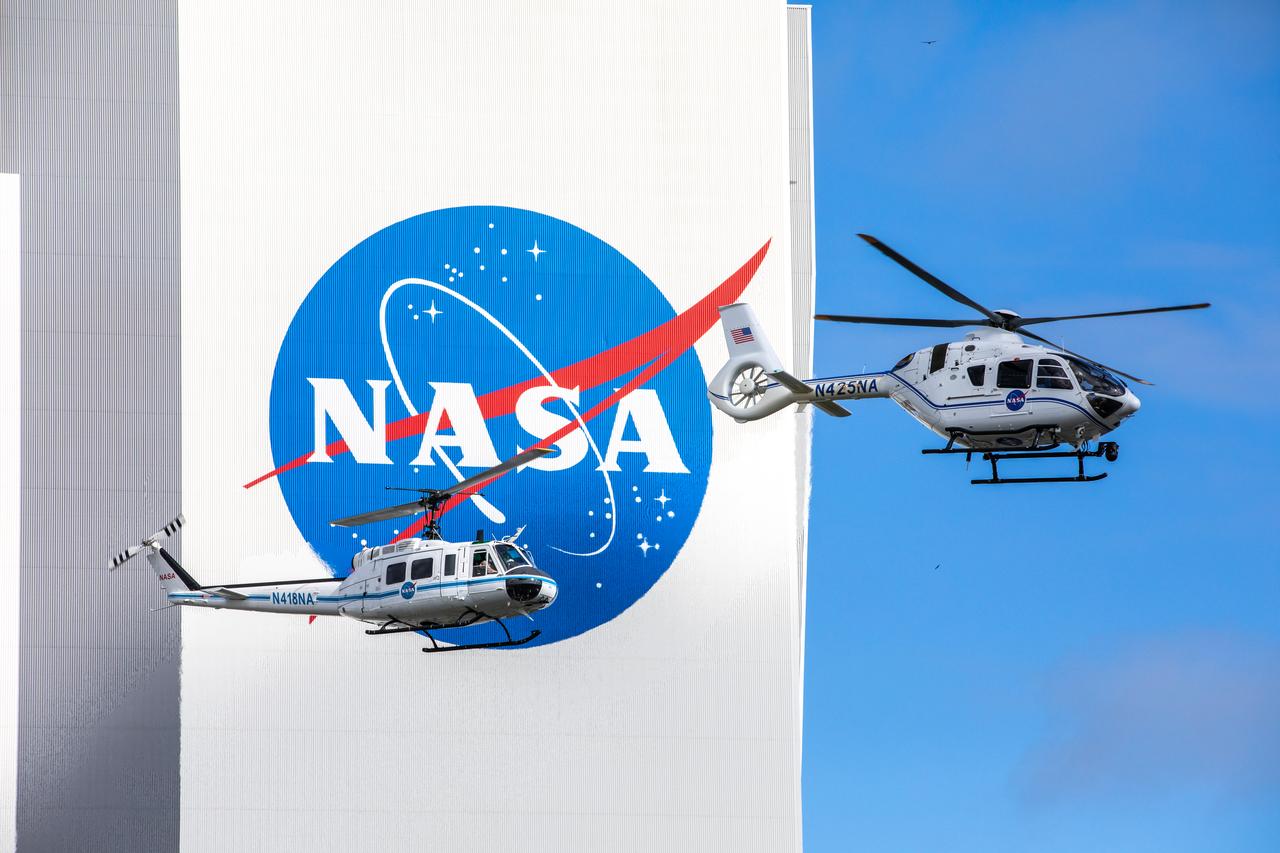
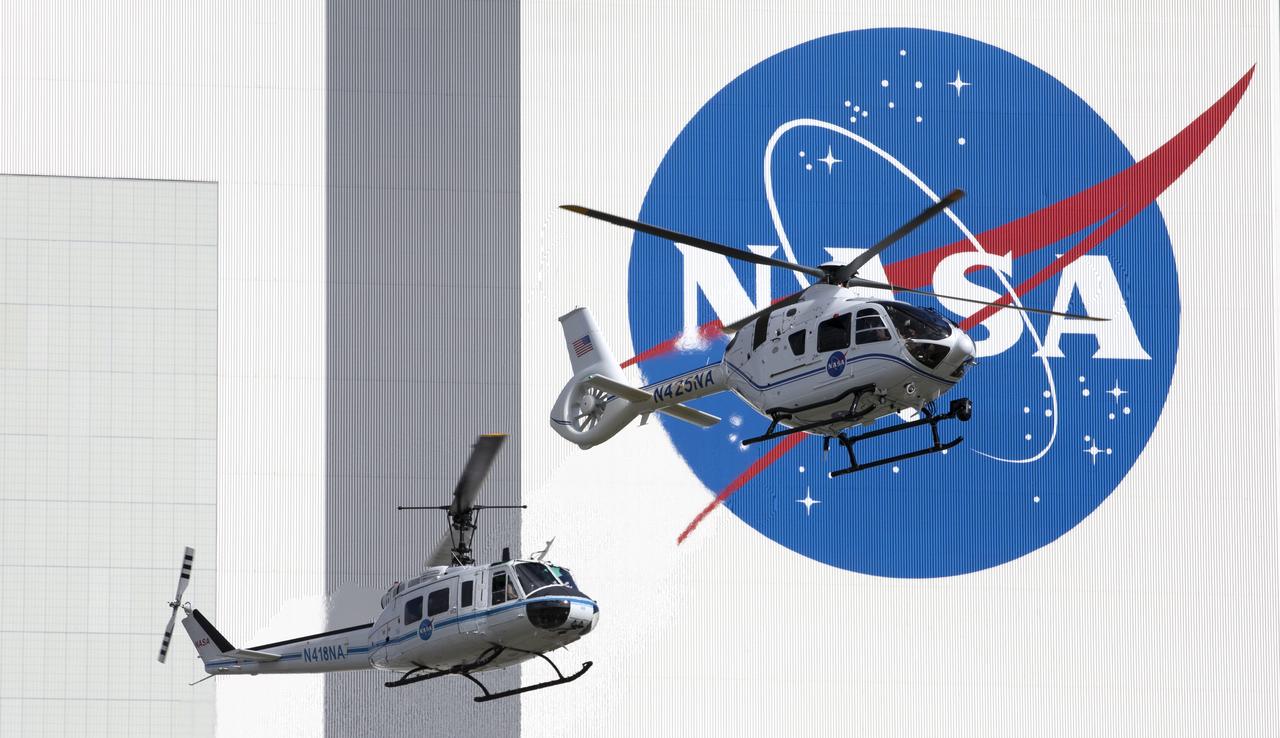
On Oct. 27, 2020, in front of the iconic Vehicle Assembly Building at NASA’s Kennedy Space Center, the Bell Huey 2 (left) and Airbus H135 helicopters used for security operations at the Florida spaceport perform one flight together before the Hueys are retired from their service. The Airbus H135s are replacing the three Bell Huey 2 aircraft maintained by Kennedy’s Flight Operations team. Kennedy received two of the H135 aircraft on Sept. 30, and the third is expected to arrive in spring 2021. These new helicopters provide a number of technological and safety advantages over the Hueys, such as more lifting power, greater stability in the air, and expanded medical capabilities.
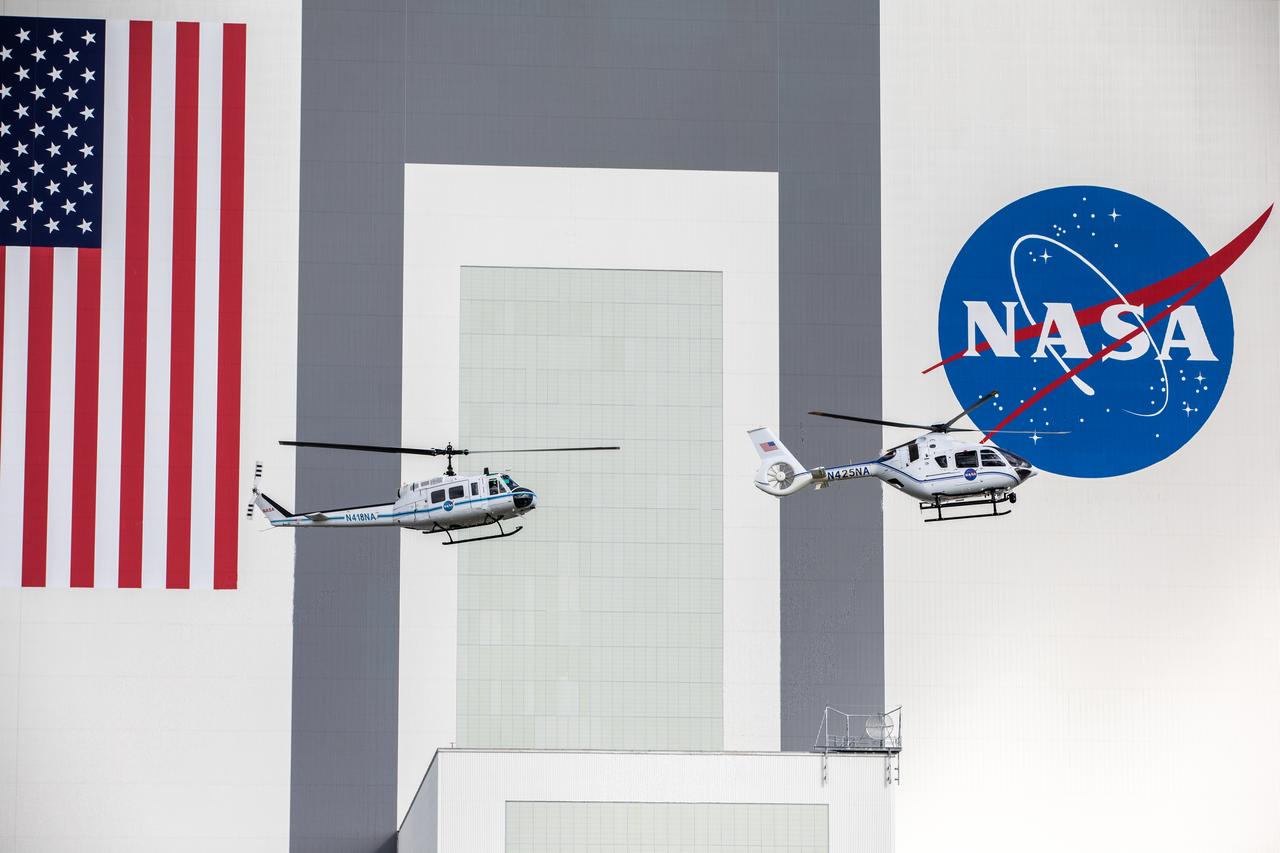
On Oct. 27, 2020, in front of the iconic Vehicle Assembly Building at NASA’s Kennedy Space Center, the Bell Huey 2 (left) and Airbus H135 helicopters used for security operations at the Florida spaceport perform one flight together before the Hueys are retired from their service. The Airbus H135s are replacing the three Bell Huey 2 aircraft maintained by Kennedy’s Flight Operations team. Kennedy received two of the H135 aircraft on Sept. 30, and the third is expected to arrive in spring 2021. These new helicopters provide a number of technological and safety advantages over the Hueys, such as more lifting power, greater stability in the air, and expanded medical capabilities.
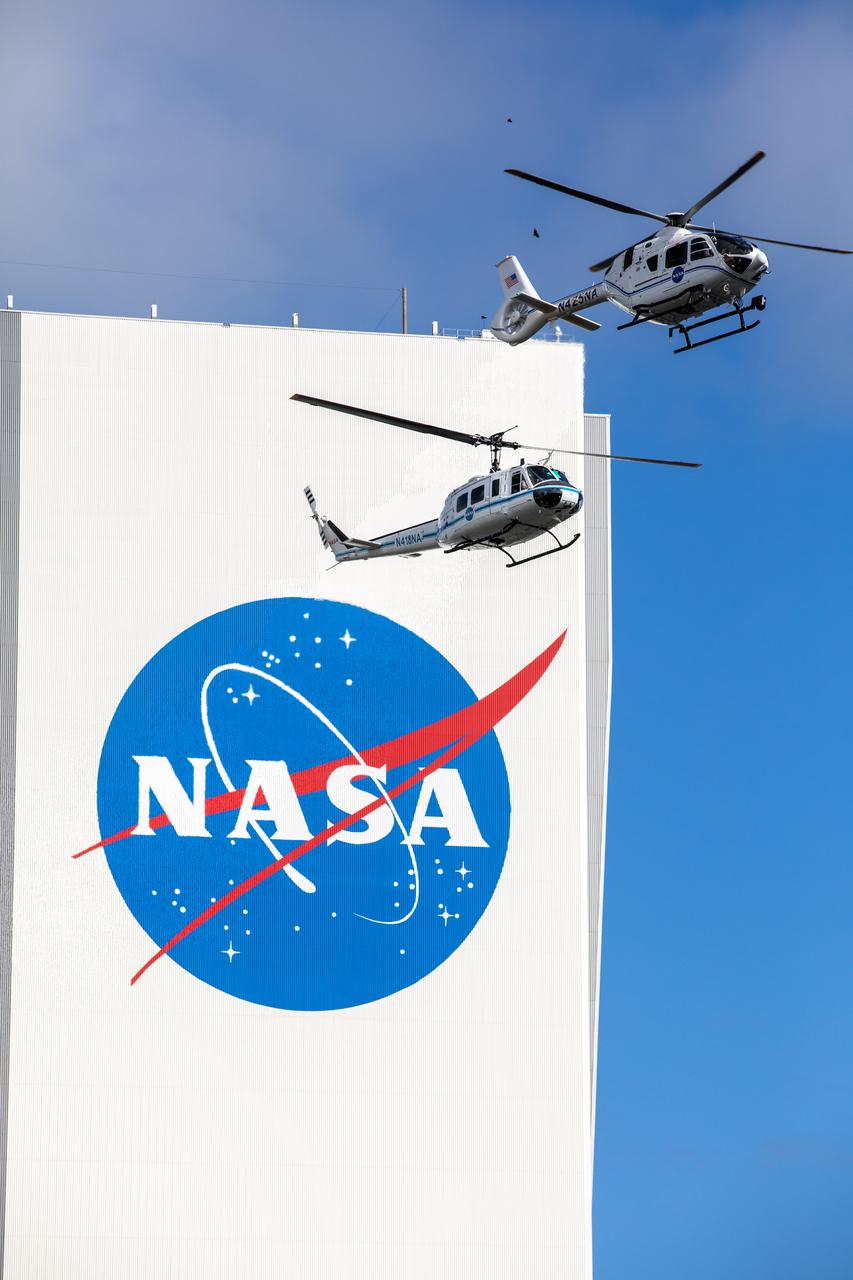
On Oct. 27, 2020, in front of the iconic Vehicle Assembly Building at NASA’s Kennedy Space Center, the Bell Huey 2 (left) and Airbus H135 helicopters used for security operations at the Florida spaceport perform one flight together before the Hueys are retired from their service. The Airbus H135s are replacing the three Bell Huey 2 aircraft maintained by Kennedy’s Flight Operations team. Kennedy received two of the H135 aircraft on Sept. 30, and the third is expected to arrive in spring 2021. These new helicopters provide a number of technological and safety advantages over the Hueys, such as more lifting power, greater stability in the air, and expanded medical capabilities.
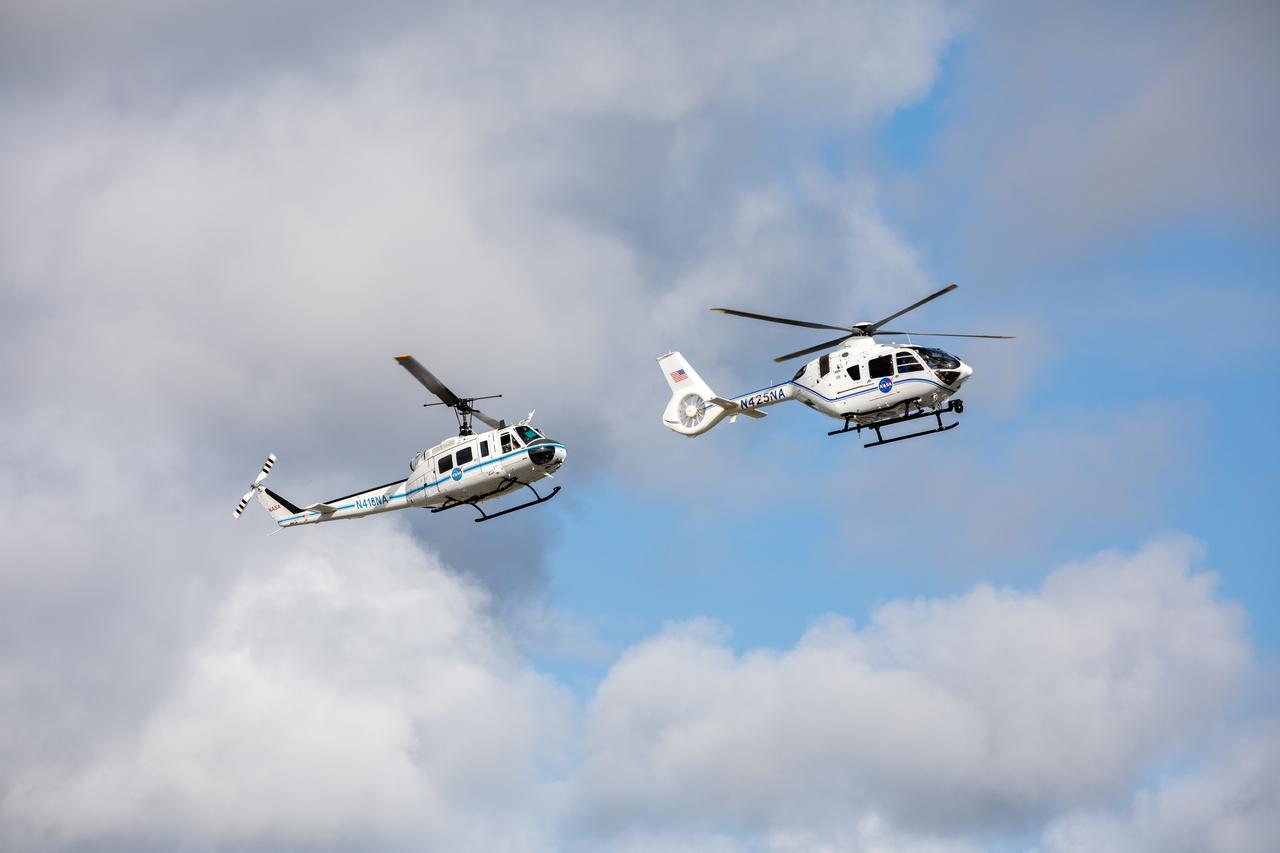
The Bell Huey 2 (left) and Airbus H135 helicopters used for security operations at NASA’s Kennedy Space Center in Florida perform one flight together on Oct. 27, 2020, before the Hueys are retired from their service. The Airbus H135s are replacing the three Bell Huey 2 aircraft maintained by Kennedy’s Flight Operations team. Kennedy received two of the H135 aircraft on Sept. 30, and the third is expected to arrive in spring 2021. These new helicopters provide a number of technological and safety advantages over the Hueys, such as more lifting power, greater stability in the air, and expanded medical capabilities.
On Oct. 27, 2020, in front of the iconic Vehicle Assembly Building at NASA’s Kennedy Space Center, the Bell Huey 2 (left) and Airbus H135 helicopters used for security operations at the Florida spaceport perform one flight together before the Hueys are retired from their service. The Airbus H135s are replacing the three Bell Huey 2 aircraft maintained by Kennedy’s Flight Operations team. Kennedy received two of the H135 aircraft on Sept. 30, and the third is expected to arrive in spring 2021. These new helicopters provide a number of technological and safety advantages over the Hueys, such as more lifting power, greater stability in the air, and expanded medical capabilities.
On Oct. 27, 2020, in front of the iconic Vehicle Assembly Building at NASA’s Kennedy Space Center, the Bell Huey 2 (left) and Airbus H135 helicopters used for security operations at the Florida spaceport perform one flight together before the Hueys are retired from their service. The Airbus H135s are replacing the three Bell Huey 2 aircraft maintained by Kennedy’s Flight Operations team. Kennedy received two of the H135 aircraft on Sept. 30, and the third is expected to arrive in spring 2021. These new helicopters provide a number of technological and safety advantages over the Hueys, such as more lifting power, greater stability in the air, and expanded medical capabilities.
On Oct. 27, 2020, in front of the iconic Vehicle Assembly Building at NASA’s Kennedy Space Center, the Bell Huey 2 (left) and Airbus H135 helicopters used for security operations at the Florida spaceport perform one flight together before the Hueys are retired from their service. The Airbus H135s are replacing the three Bell Huey 2 aircraft maintained by Kennedy’s Flight Operations team. Kennedy received two of the H135 aircraft on Sept. 30, and the third is expected to arrive in spring 2021. These new helicopters provide a number of technological and safety advantages over the Hueys, such as more lifting power, greater stability in the air, and expanded medical capabilities.

S90-27594 (November 1989) --- Manley L. "Sonny" Carter Jr., STS-33 mission specialist, wearing a Launch and Entry Suit (LES), poses in front of the space shuttle Discovery, Orbiter Vehicle (OV) 103 at the Kennedy Space Center (KSC) Launch Complex Pad 39B, at the 195 feet level elevator entrance at Pad 39B. Visible in the background is the catwalk to OV-103's side hatch and the Atlantic Ocean. Note: Carter died April 5, 1991 at age 43, in a civil aviation accident.
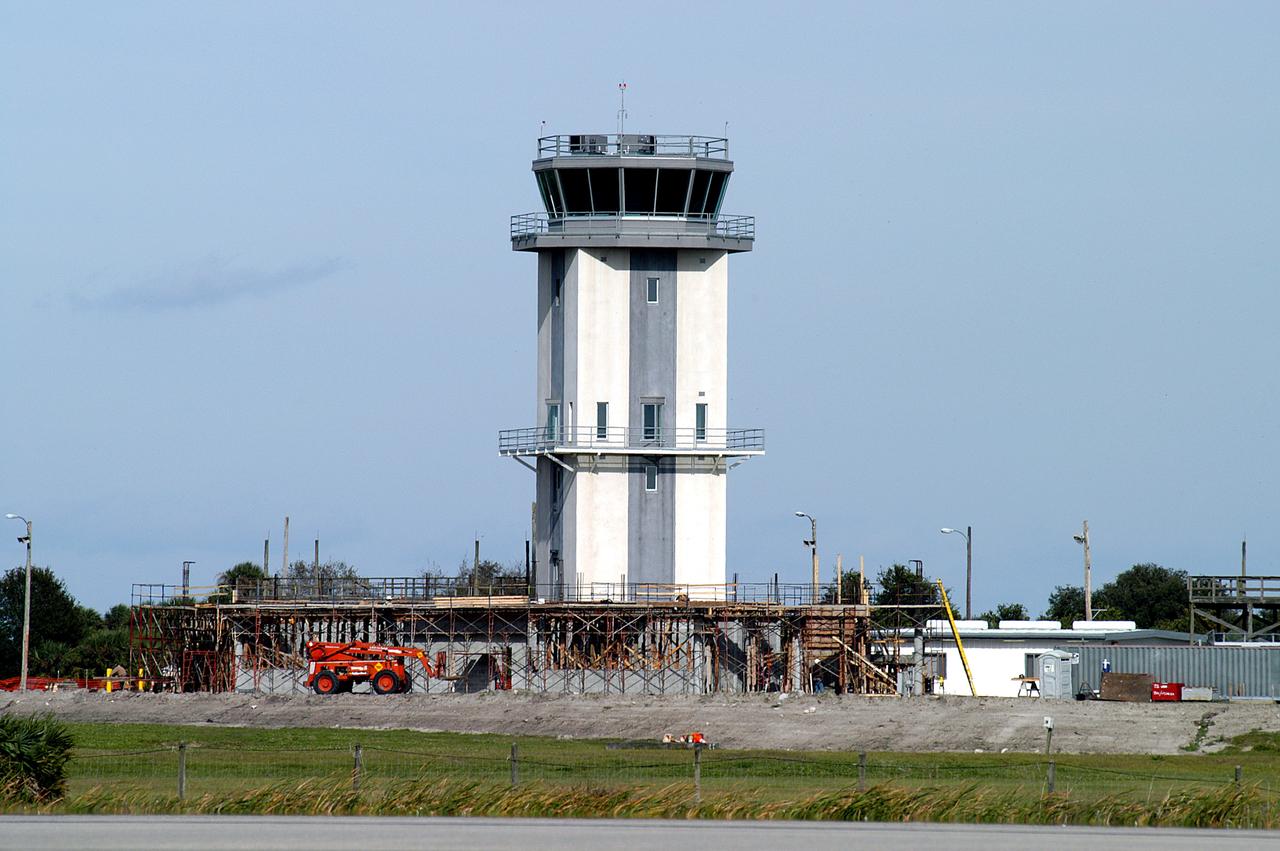
KENNEDY SPACE CENTER, FLA. -- A new control tower is nearing completion at the KSC Shuttle Landing Facility. It will replace the old tower in use since 1987. The old tower stands only 20 feet above the runway surface, too low to see the launch pads to the east. During nighttime landing operations, those inside the tower have been hindered by the eight-billion candlepower xenon lights that illuminate the runway. The new control tower is built atop an existing mound, rising nearly 100 feet over the midpoint of the runway. The height gives controllers a spectacular 360-degree view of NASA-KSC and northern Brevard County. The new facility will also replace the SLF Operations Building. The operations building is home to the Military Radar Unit that monitors NASA-KSC airspace 24 hours a day, as well as runway light controls, navigational aids, weather and wind speed instrumentation, and gate controls. In the new tower, the computer displays will be fully modernized to Federal Aviation Administration standards with touch-screen technology. Construction on the new facility began in February 2003 and is nearly ready for occupancy. Only some final inspections and approvals remain. A support building and Public Affairs viewing deck, to be used for observing future landing operations, will be added and are already in work.
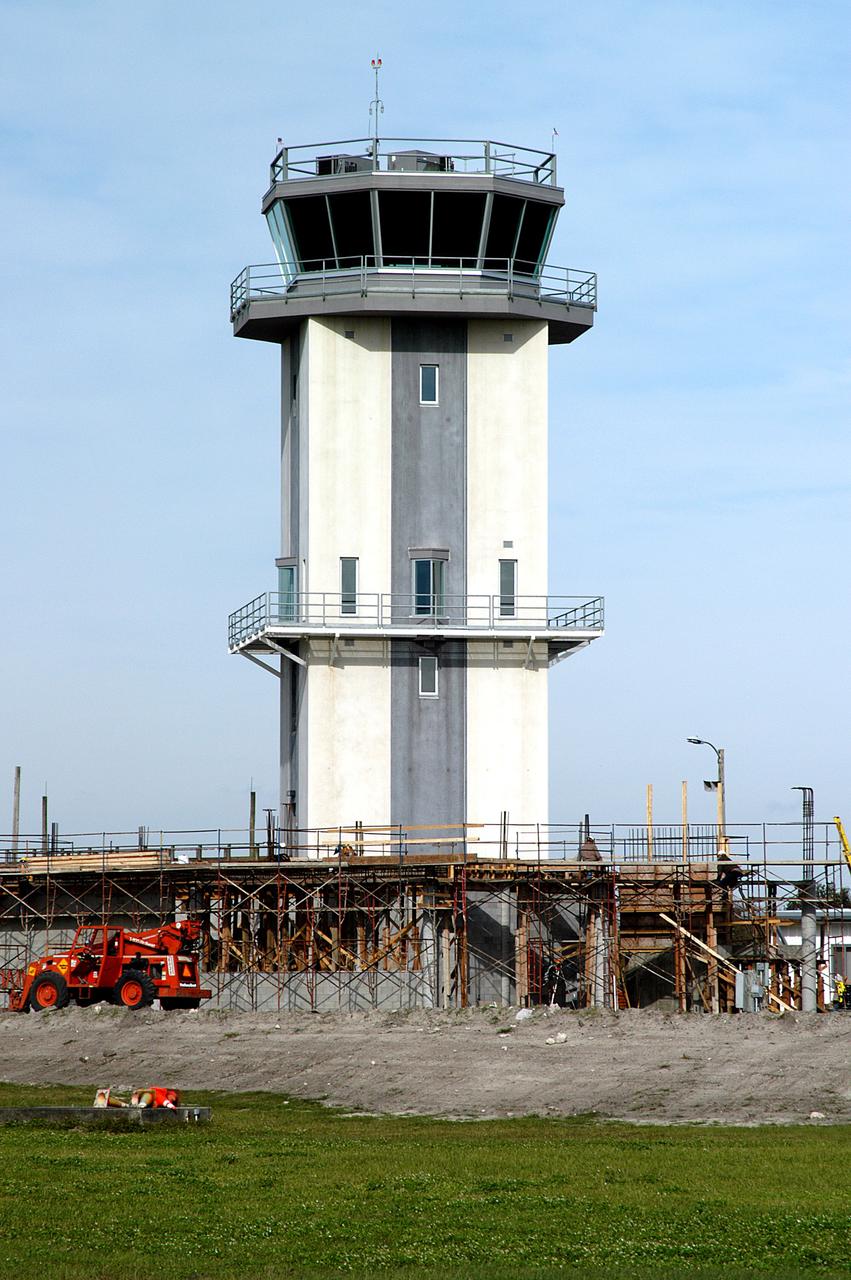
KENNEDY SPACE CENTER, FLA. -- A new control tower is nearing completion at the KSC Shuttle Landing Facility. It will replace the old tower in use since 1987. The old tower stands only 20 feet above the runway surface, too low to see the launch pads to the east. During nighttime landing operations, those inside the tower have been hindered by the eight-billion candlepower xenon lights that illuminate the runway. The new control tower is built atop an existing mound, rising nearly 100 feet over the midpoint of the runway. The height gives controllers a spectacular 360-degree view of NASA-KSC and northern Brevard County. The new facility will also replace the SLF Operations Building. The operations building is home to the Military Radar Unit that monitors NASA-KSC airspace 24 hours a day, as well as runway light controls, navigational aids, weather and wind speed instrumentation, and gate controls. In the new tower, the computer displays will be fully modernized to Federal Aviation Administration standards with touch-screen technology. Construction on the new facility began in February 2003 and is nearly ready for occupancy. Only some final inspections and approvals remain. A support building and Public Affairs viewing deck, to be used for observing future landing operations, will be added and are already in work.
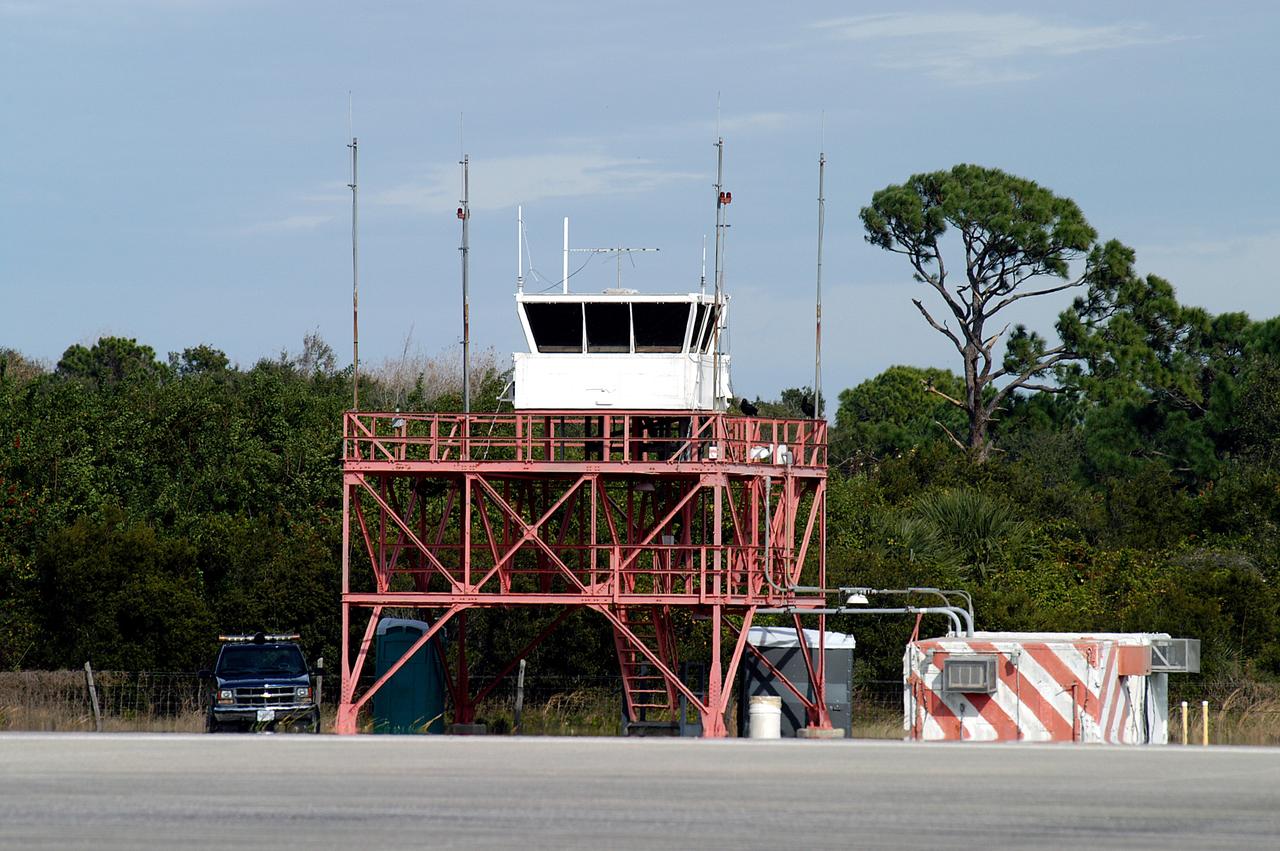
KENNEDY SPACE CENTER, FLA. -- The existing control tower seen here at the edge of the KSC Shuttle Landing Facility is being replaced. In use since 1987, the old tower stands only 20 feet above the runway surface, too low to see the launch pads to the east. During nighttime landing operations, those inside the tower have been hindered by the eight-billion candlepower xenon lights that illuminate the runway. The new control tower is built atop an existing mound, rising nearly 100 feet over the midpoint of the runway. The height gives controllers a spectacular 360-degree view of NASA-KSC and northern Brevard County. The new facility will also replace the SLF Operations Building. The operations building is home to the Military Radar Unit that monitors NASA-KSC airspace 24 hours a day, as well as runway light controls, navigational aids, weather and wind speed instrumentation, and gate controls. In the new tower, the computer displays will be fully modernized to Federal Aviation Administration standards with touch-screen technology. Construction on the new facility began in February 2003 and is nearly ready for occupancy. Only some final inspections and approvals remain. A support building and Public Affairs viewing deck, to be used for observing future landing operations, will be added and are already in work.
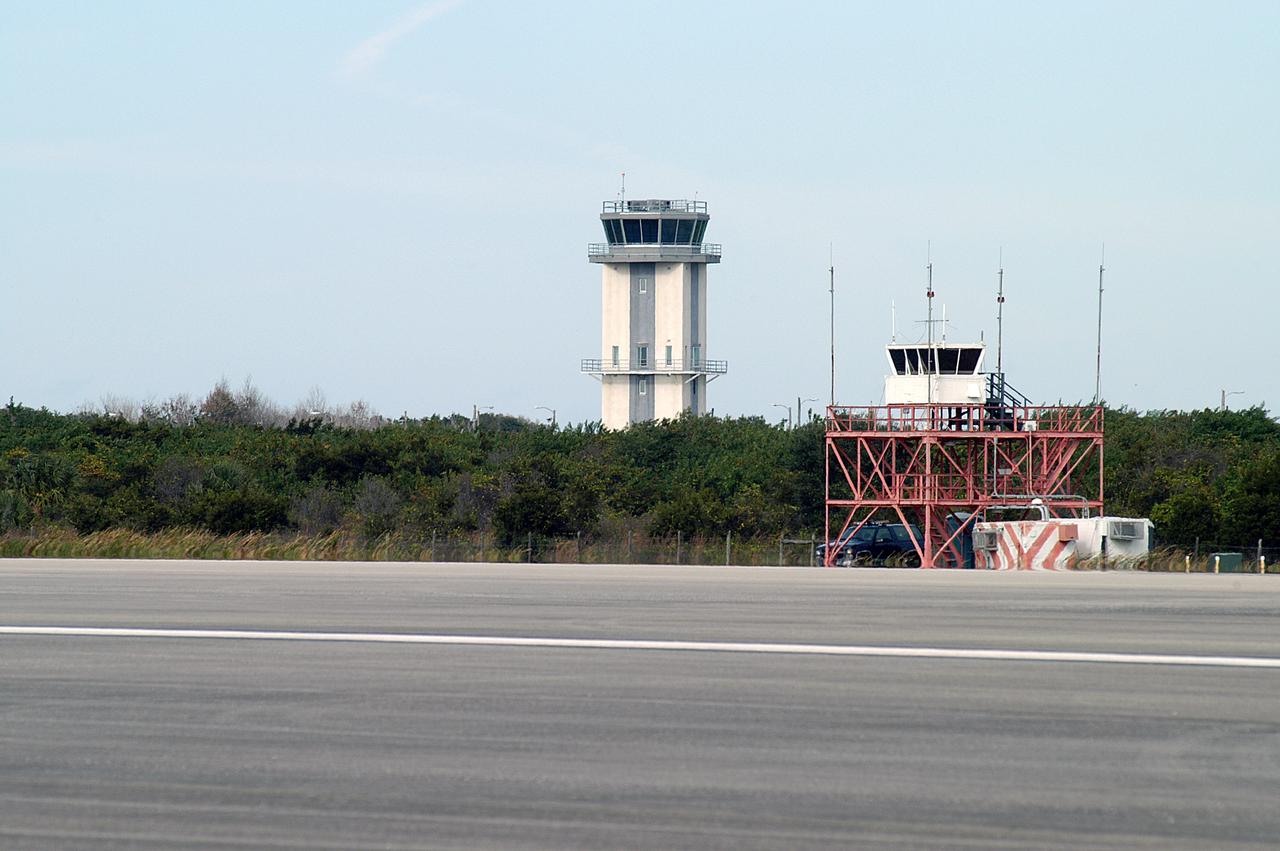
KENNEDY SPACE CENTER, FLA. -- Two control towers are seen at the edge of the KSC Shuttle Landing Facility, the old one in front and the nearly completed new tower in back. The old tower stands only 20 feet above the runway surface, too low to see the launch pads to the east. During nighttime landing operations, those inside the tower have been hindered by the eight-billion candlepower xenon lights that illuminate the runway. The new control tower is built atop an existing mound, rising nearly 100 feet over the midpoint of the runway. The height gives controllers a spectacular 360-degree view of NASA-KSC and northern Brevard County. The new facility will also replace the SLF Operations Building. The operations building is home to the Military Radar Unit that monitors NASA-KSC airspace 24 hours a day, as well as runway light controls, navigational aids, weather and wind speed instrumentation, and gate controls. In the new tower, the computer displays will be fully modernized to Federal Aviation Administration standards with touch-screen technology. Construction on the new facility began in February 2003 and is nearly ready for occupancy. Only some final inspections and approvals remain. A support building and Public Affairs viewing deck, to be used for observing future landing operations, will be added and are already in work.
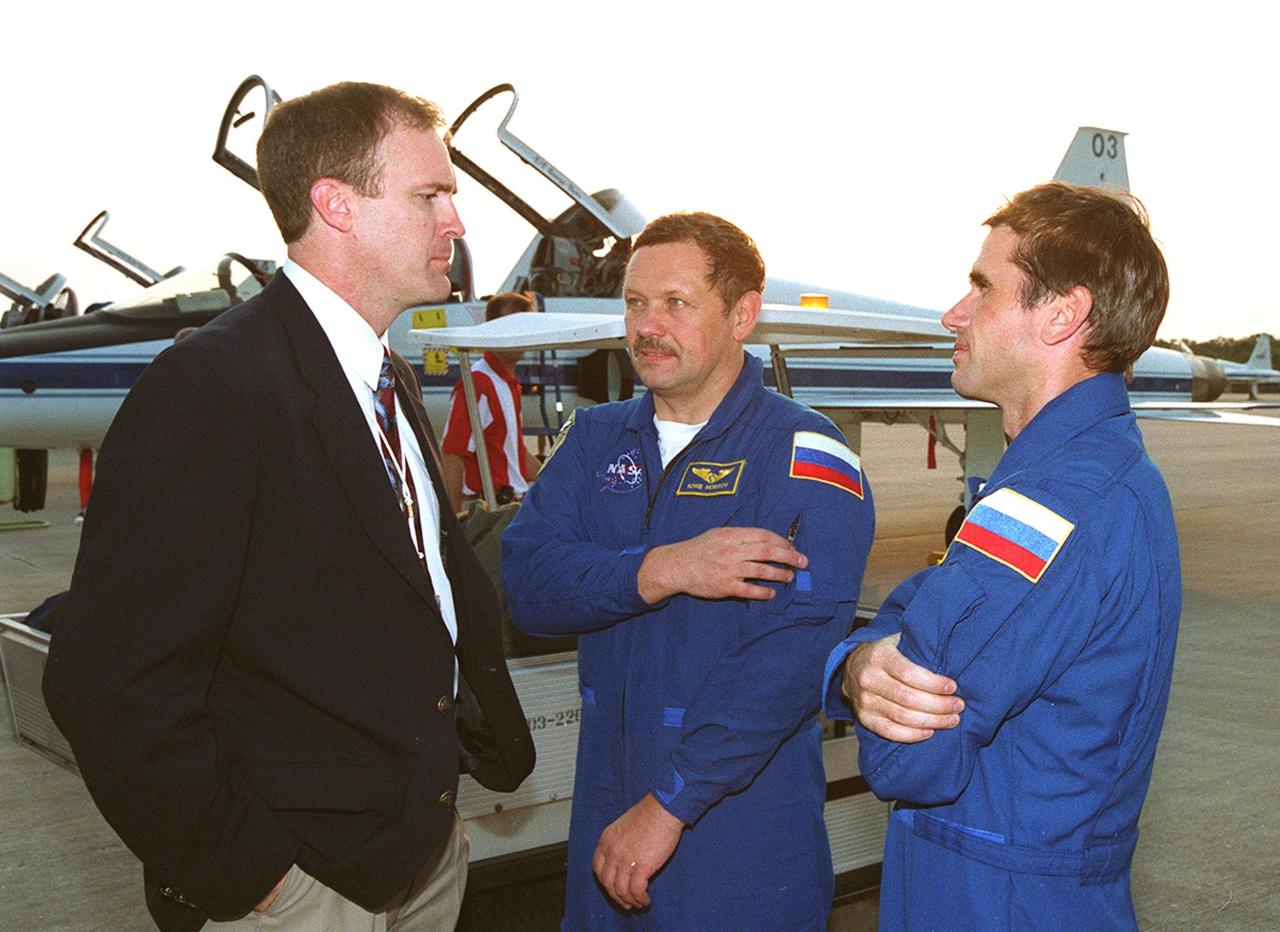
Jim Halsell Jr. (left), former mission commander and now the manager, Shuttle Program Integration Office, chats with STS-106 Mission Specialists Boris V. Morukov (center) and Yuri I. Malenchenko (right) after their arrival at KSC. Morukov and Malenchenko, who are with the Russian Aviation and Space Agency, are at KSC with the rest of the crew to take part in Terminal Countdown Demonstration Test activities, which include emergency egress training and a simulated launch countdown. STS-106 is scheduled to launch Sept. 8, 2000, at 8:31 a.m. EDT from Launch Pad 39B. On the 11-day mission, the seven-member crew will perform support tasks on orbit, transfer supplies and prepare the living quarters in the newly arrived Zvezda Service Module. The first long-duration crew, dubbed “Expedition One,” is due to arrive at the Station in late fall
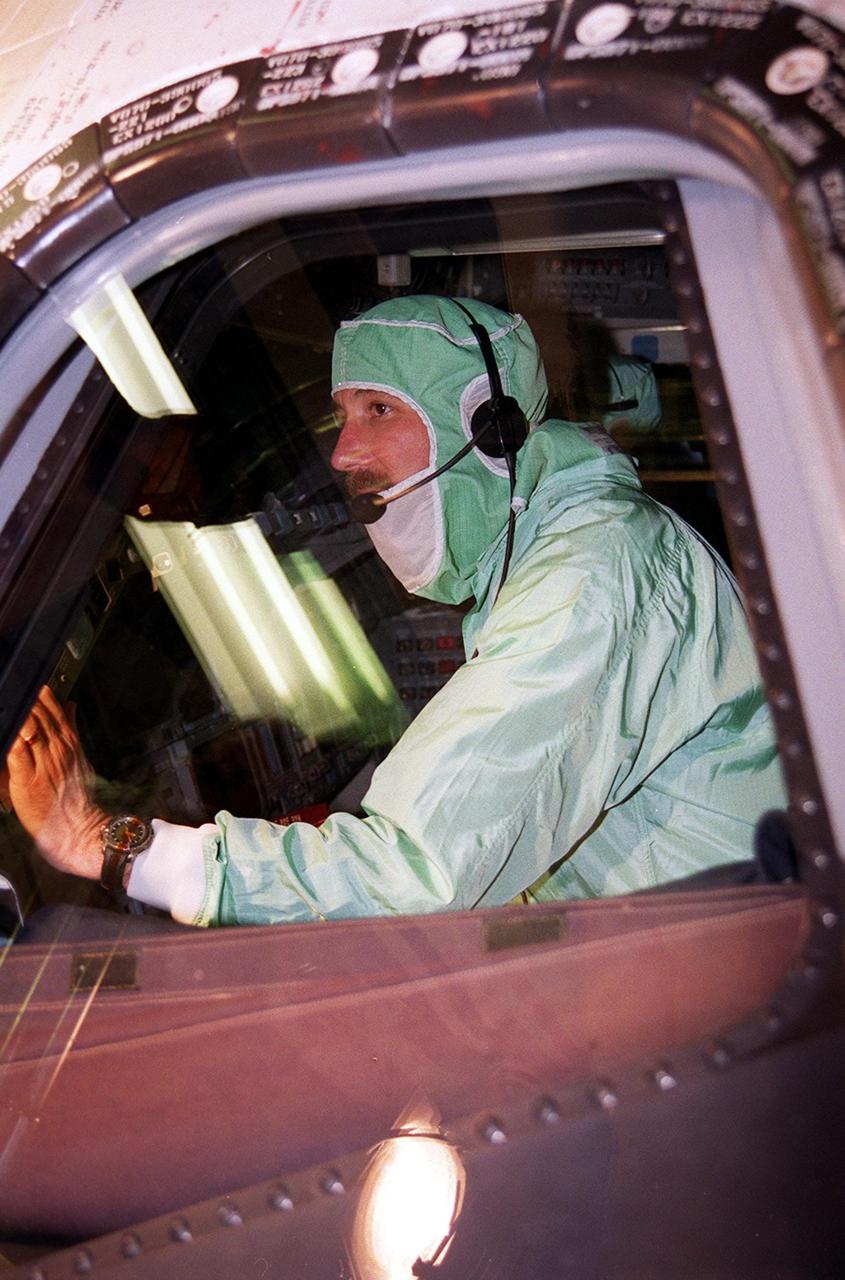
During a Crew Equipment Interface Test (CEIT) at KSC, STS-100 Commander Kent V. Rominger checks out the windshield in orbiter Endeavour. Other crew members at KSC for the CEIT are Pilot Jeffrey S. Ashby and Mission Specialists Chris Hadfield, who is with the Canadian Space Agency, Scott Parazynski, John L. Phillips, Umberto Guidoni, who is with the European Space Agency, and Yuri Lonchakov, who is with the Russian Aviation and Space Agency. The orbiter is carrying the Multi-Purpose Logistics Module Raffaello and the Canadian robotic arm, SSRMS, to the International Space Station. Raffaello carries six system racks and two storage racks for the U.S. Lab. Launch of mission STS-100 is scheduled for April 19 at 2:41 p.m. EDT from Launch Pad 39A
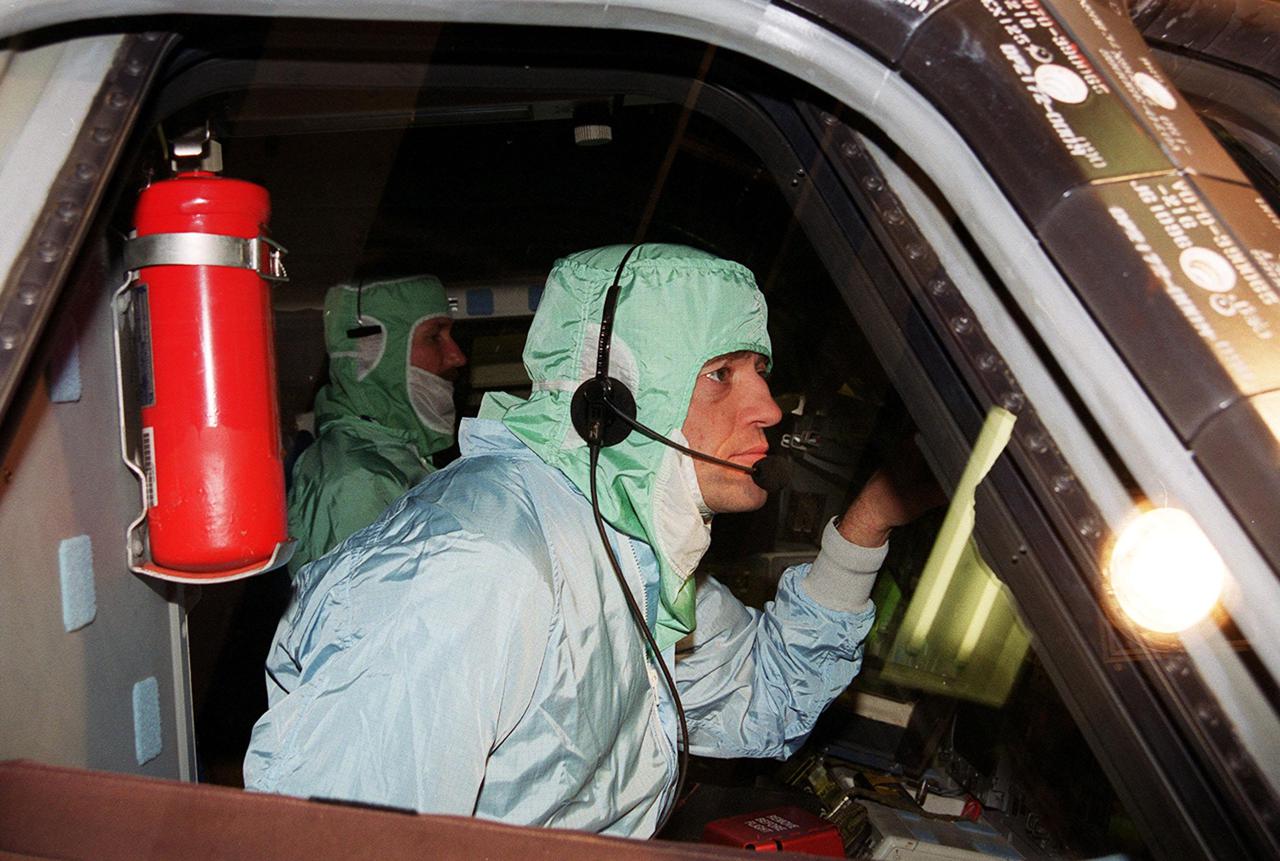
During a Crew Equipment Interface Test (CEIT) at KSC, STS-100 Pilot Jeffrey S. Ashby checks out the windshield in orbiter Endeavour. Other crew members at KSC for the CEIT are Commander Kent V. Rominger and Mission Specialists Chris Hadfield, who is with the Canadian Space Agency, Scott Parazynski, John L. Phillips, Umberto Guidoni, who is with the European Space Agency, and Yuri Lonchakov, who is with the Russian Aviation and Space Agency. The orbiter is carrying the Multi-Purpose Logistics Module Raffaello and the Canadian robotic arm, SSRMS, to the International Space Station. Raffaello carries six system racks and two storage racks for the U.S. Lab. Launch of mission STS-100 is scheduled for April 19 at 2:41 p.m. EDT from Launch Pad 39A
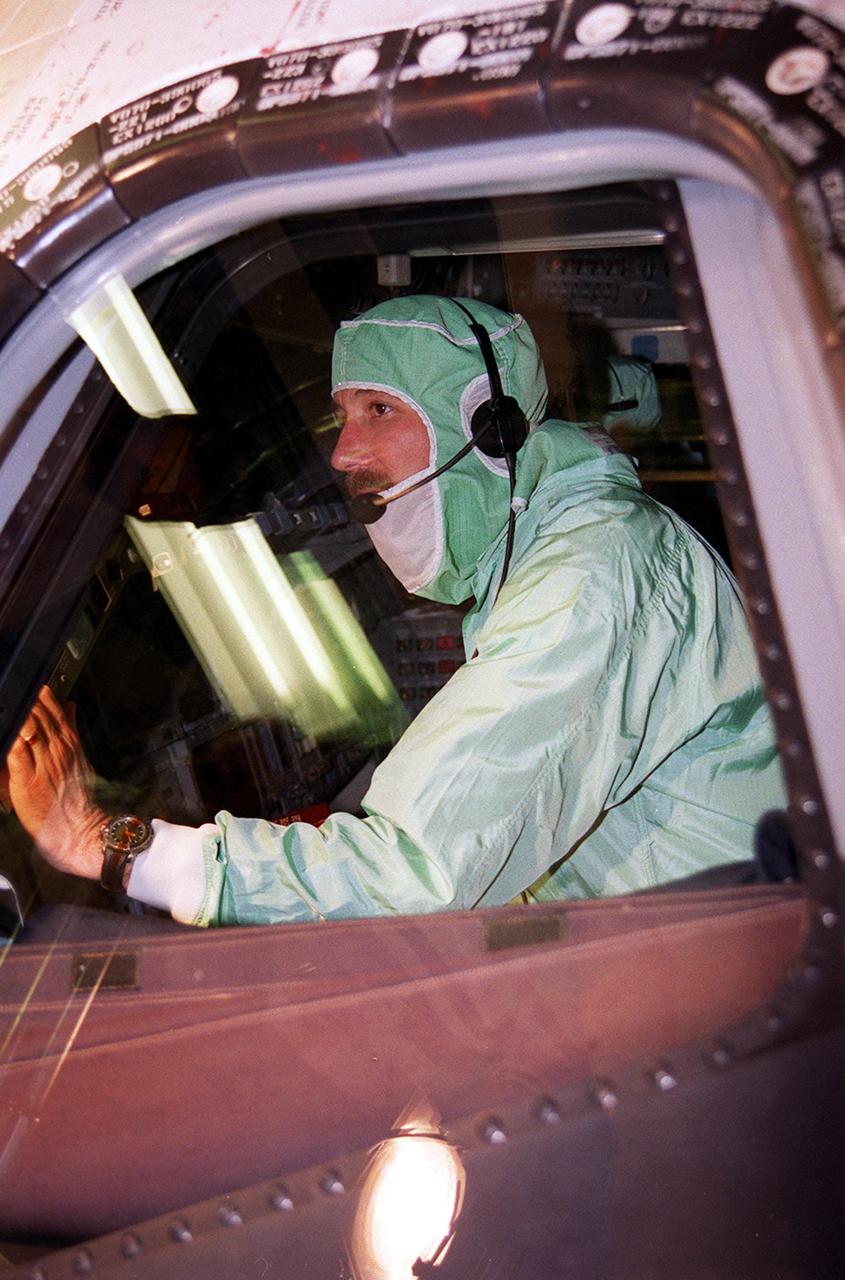
During a Crew Equipment Interface Test (CEIT) at KSC, STS-100 Commander Kent V. Rominger checks out the windshield in orbiter Endeavour. Other crew members at KSC for the CEIT are Pilot Jeffrey S. Ashby and Mission Specialists Chris Hadfield, who is with the Canadian Space Agency, Scott Parazynski, John L. Phillips, Umberto Guidoni, who is with the European Space Agency, and Yuri Lonchakov, who is with the Russian Aviation and Space Agency. The orbiter is carrying the Multi-Purpose Logistics Module Raffaello and the Canadian robotic arm, SSRMS, to the International Space Station. Raffaello carries six system racks and two storage racks for the U.S. Lab. Launch of mission STS-100 is scheduled for April 19 at 2:41 p.m. EDT from Launch Pad 39A
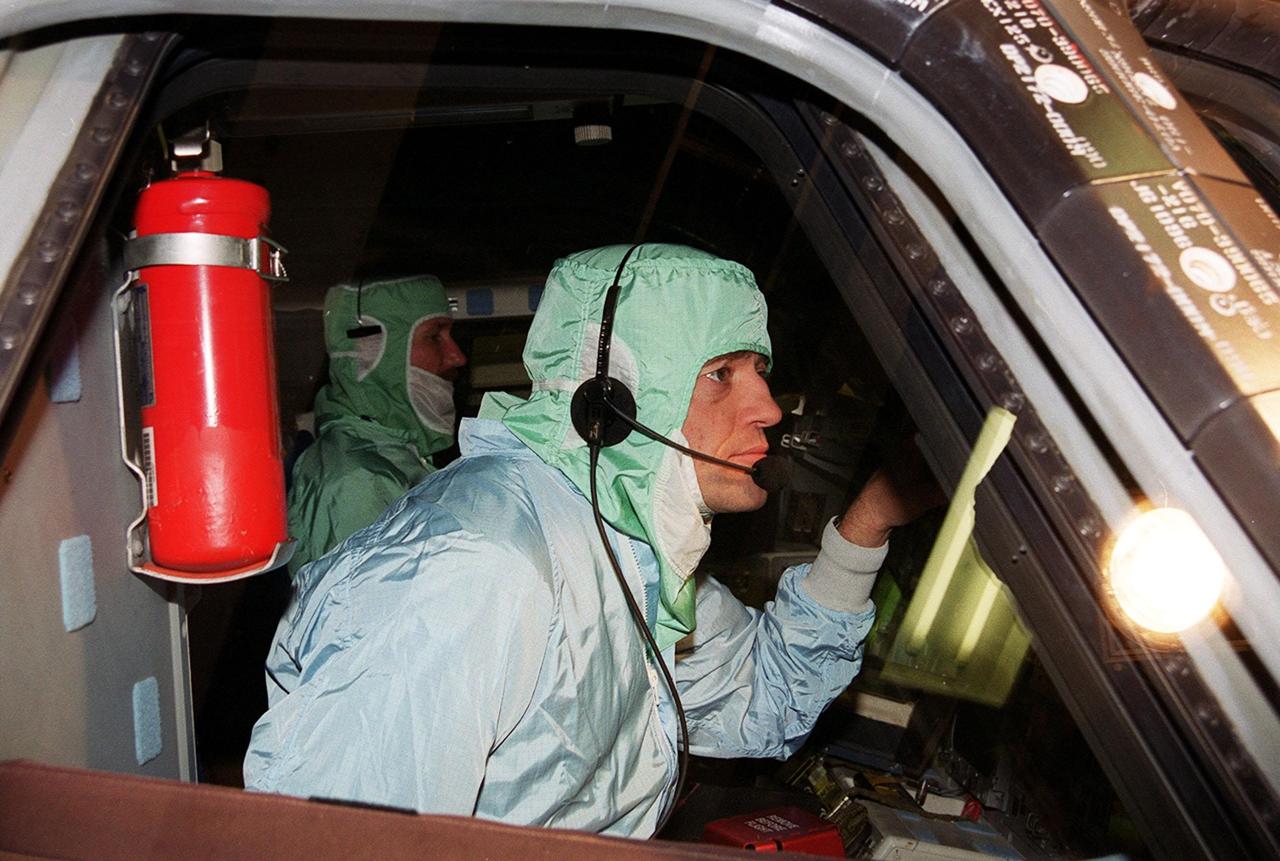
During a Crew Equipment Interface Test (CEIT) at KSC, STS-100 Pilot Jeffrey S. Ashby checks out the windshield in orbiter Endeavour. Other crew members at KSC for the CEIT are Commander Kent V. Rominger and Mission Specialists Chris Hadfield, who is with the Canadian Space Agency, Scott Parazynski, John L. Phillips, Umberto Guidoni, who is with the European Space Agency, and Yuri Lonchakov, who is with the Russian Aviation and Space Agency. The orbiter is carrying the Multi-Purpose Logistics Module Raffaello and the Canadian robotic arm, SSRMS, to the International Space Station. Raffaello carries six system racks and two storage racks for the U.S. Lab. Launch of mission STS-100 is scheduled for April 19 at 2:41 p.m. EDT from Launch Pad 39A
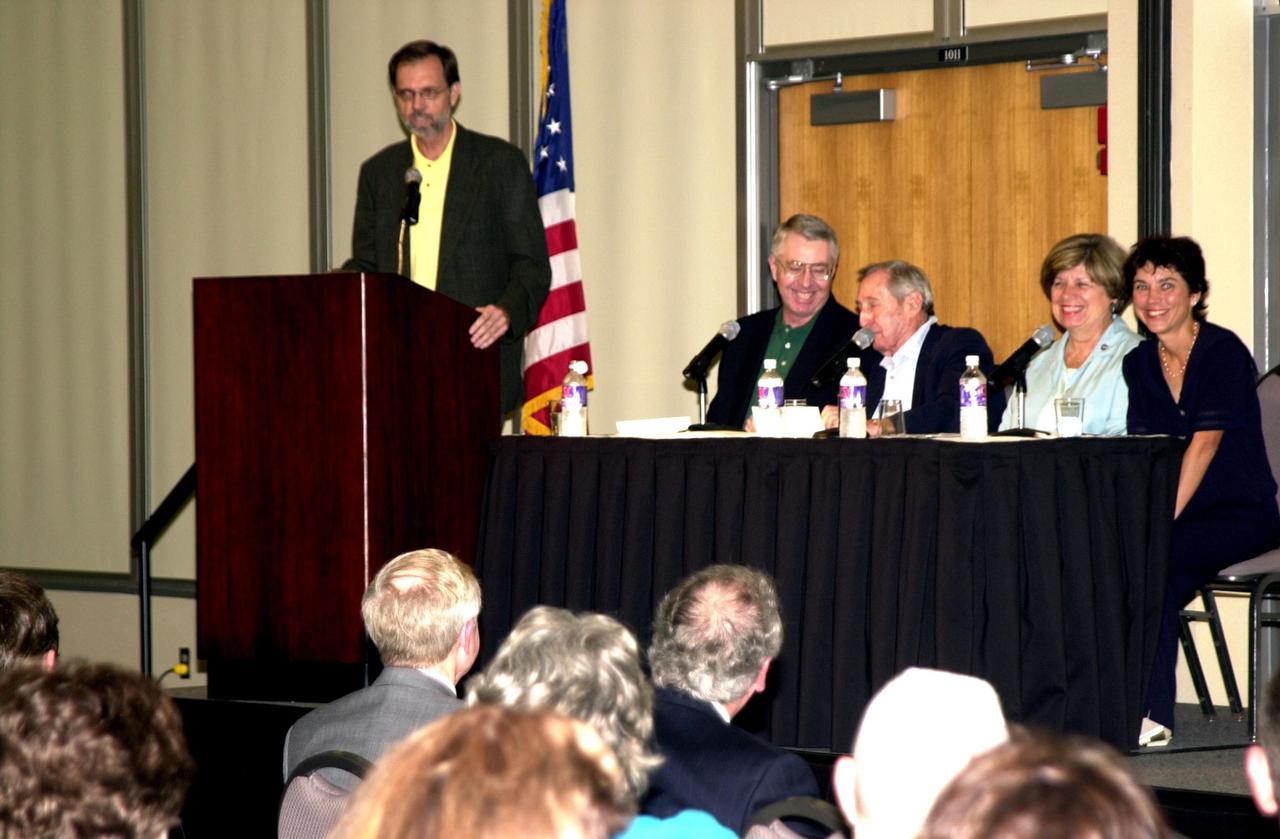
KENNEDY SPACE CENTER, FLA. -- The 2002 Florida Press Association and Florida Society of Newspaper Editors Convention offers a panel on space. At the podium is Bob Stover, managing editor, Florida Today. Seated on the panel are (left to right) Craig Covault, senior editor, Aviation Week; Howard Benedict, retired AP reporter; JoAnn Morgan, director, External Relations and Business Development, Kennedy Space Center; Marcia Dunn, AP reporter. The convention was held at the Debus Center, KSC Visitors Complex. Also speaking at the convention were Center Director Roy Bridges and NASA Associate Deputy Administrator Dr. Daniel Mulville
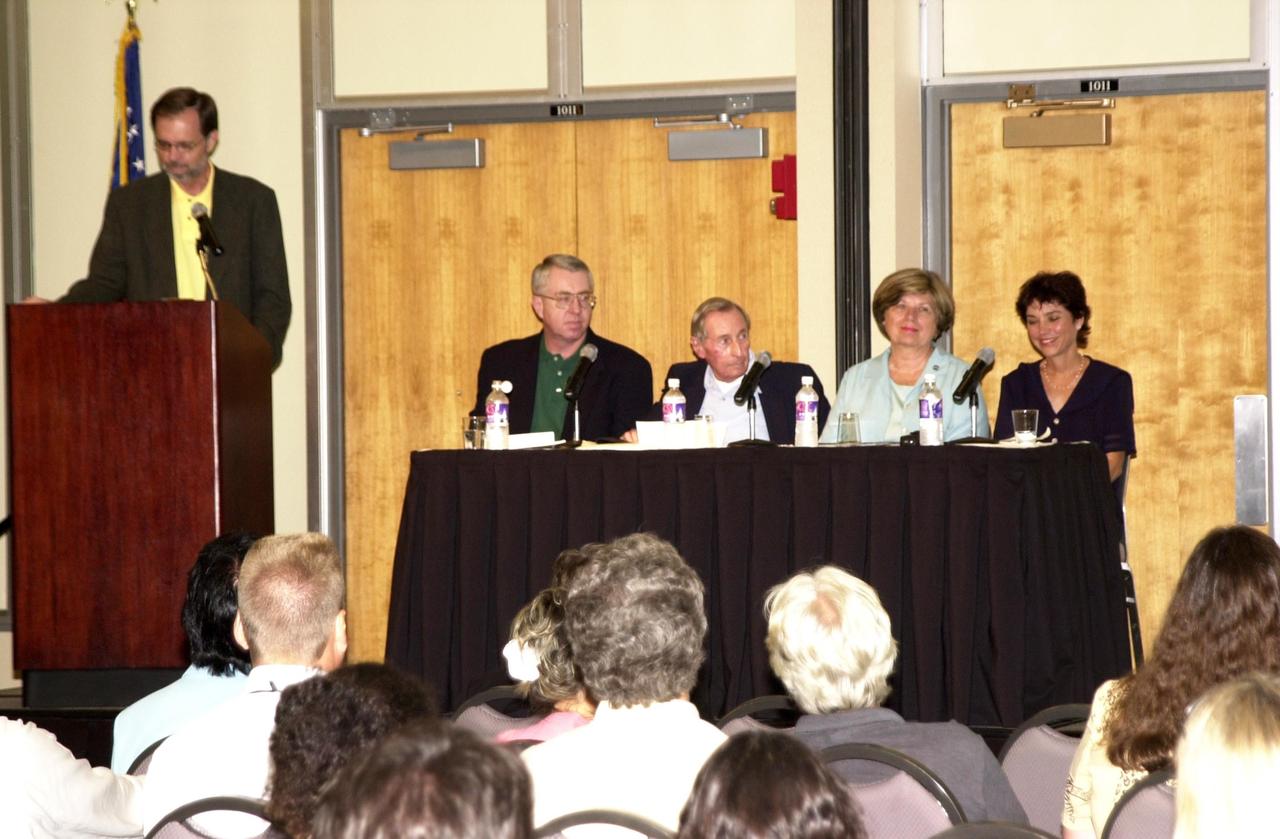
KENNEDY SPACE CENTER, FLA. -- The 2002 Florida Press Association and Florida Society of Newspaper Editors Convention offers a panel on space. At the podium is Bob Stover, managing editor, Florida Today. Panel participants enjoying a laugh are (left to right) Craig Covault, senior editor, Aviation Week; Howard Benedict, retired AP reporter; JoAnn Morgan, director, External Relations and Business Development, Kennedy Space Center; Marcia Dunn, AP reporter. The convention was held at the Debus Center, KSC Visitors Complex. Also speaking at the convention were Center Director Roy Bridges and NASA Associate Deputy Administrator Dr. Daniel Mulville
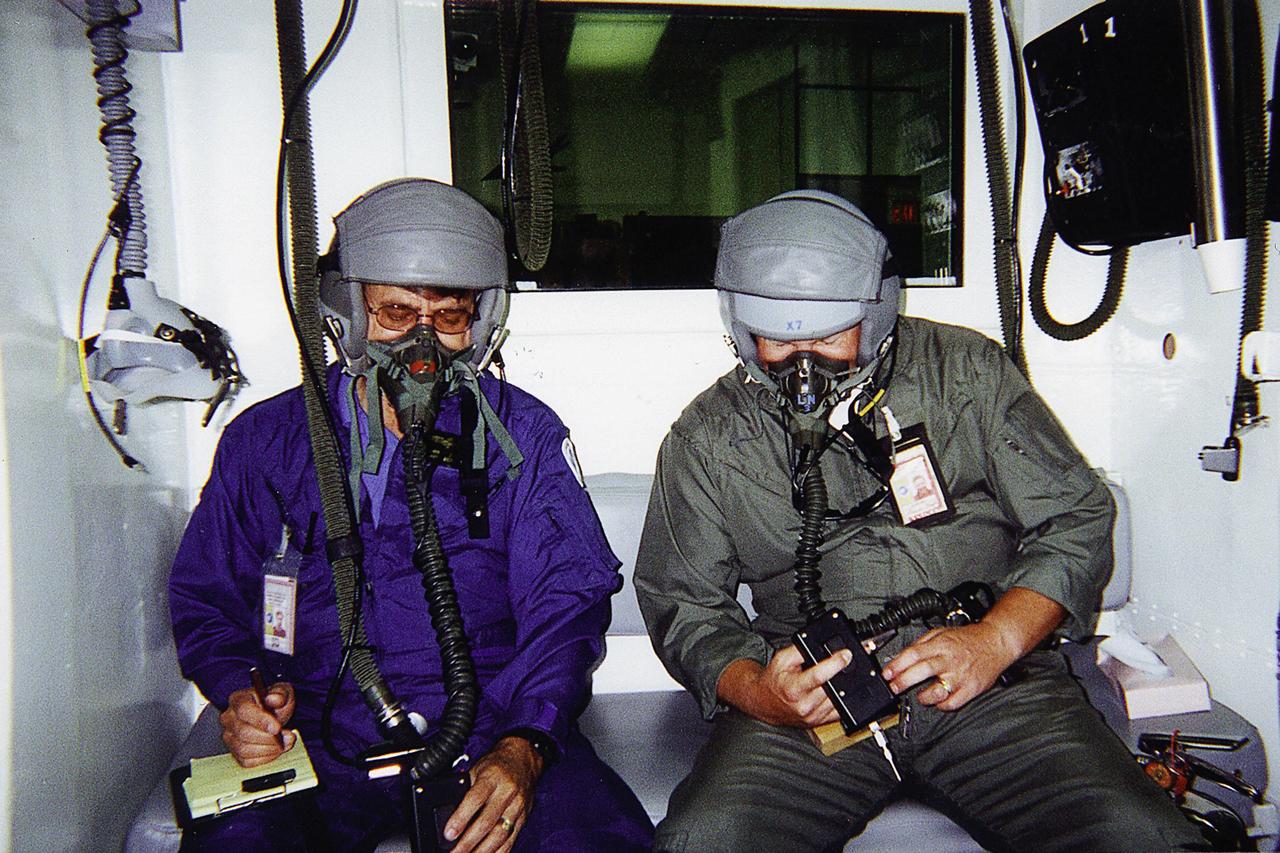
Jan Zysko (left) and Rich Mizell (right) test a Personal Cabin Pressure Altitude Monitor in an altitude chamber at Tyndall Air Force Base in Florida. Zysko invented the pager-sized monitor that alerts wearers of a potentially dangerous or deteriorating cabin pressure altitude condition, which can lead to life-threatening hypoxia. Zysko is chief of the KSC Spaceport Engineering and Technology directorate's data and electronic systems branch. Mizell is a Shuttle processing engineer. The monitor, which has drawn the interest of such organizations as the Federal Aviation Administration for use in commercial airliners and private aircraft, was originally designed to offer Space Shuttle and Space Station crew members added independent notification about any depressurization
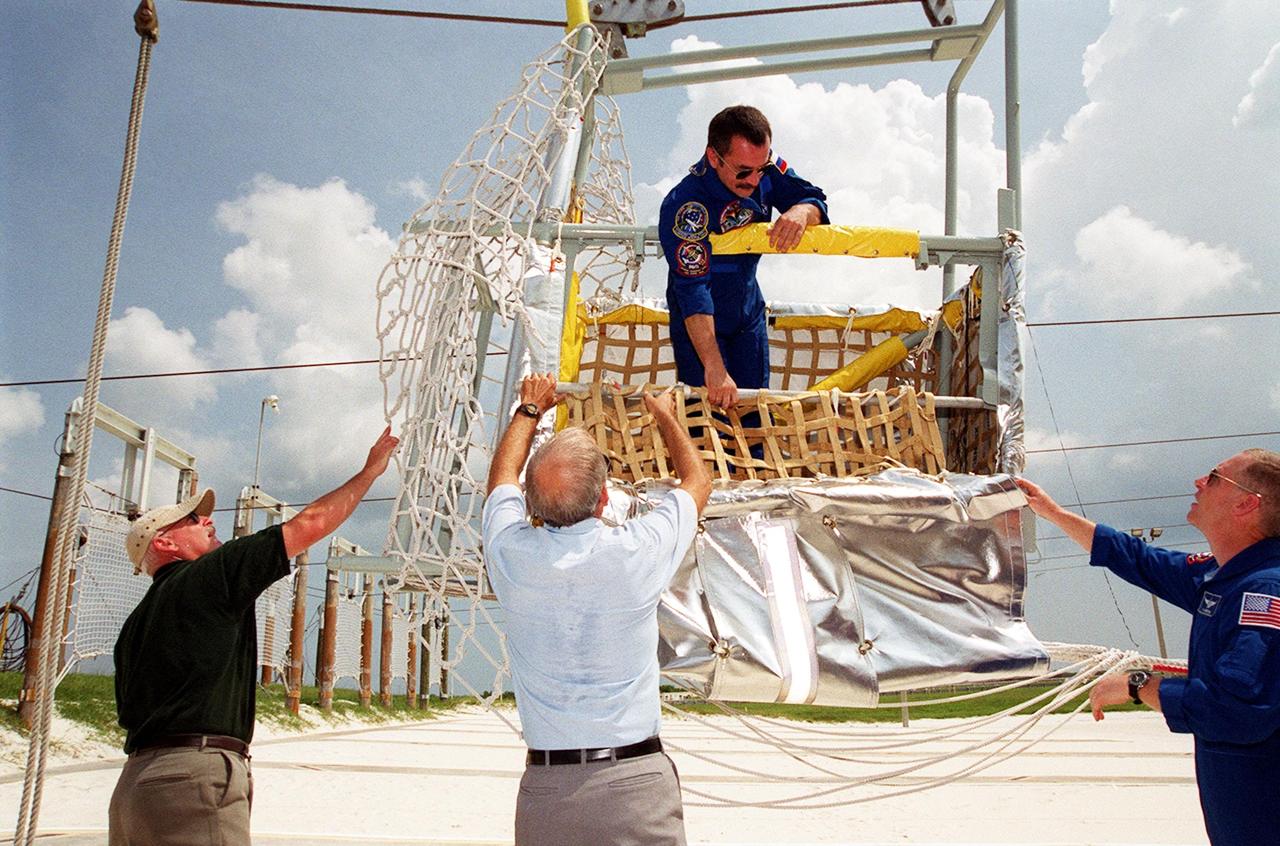
KENNEDY SPACE CENTER, Fla. -- Expedition Three crew member Mikhail Tyurin, a cosmonaut with the Russian Aviation and Space Agency, checks out the slidewire basket at Launch Pad 39A. At right is STS-105 Pilot Rick Sturckow. Both crews are at KSC to take part in Terminal Countdown Demonstration Test activities, which include emergency egress, a simulated launch countdown and familiarization with the payload. Mission STS-105 will be transporting the Expedition Three crew, several payloads and scientific experiments to the International Space Station aboard Discovery. The current Expedition Two crew members on the Station will return to Earth on Discovery. Launch of Discovery is scheduled no earlier than Aug. 9, 2001
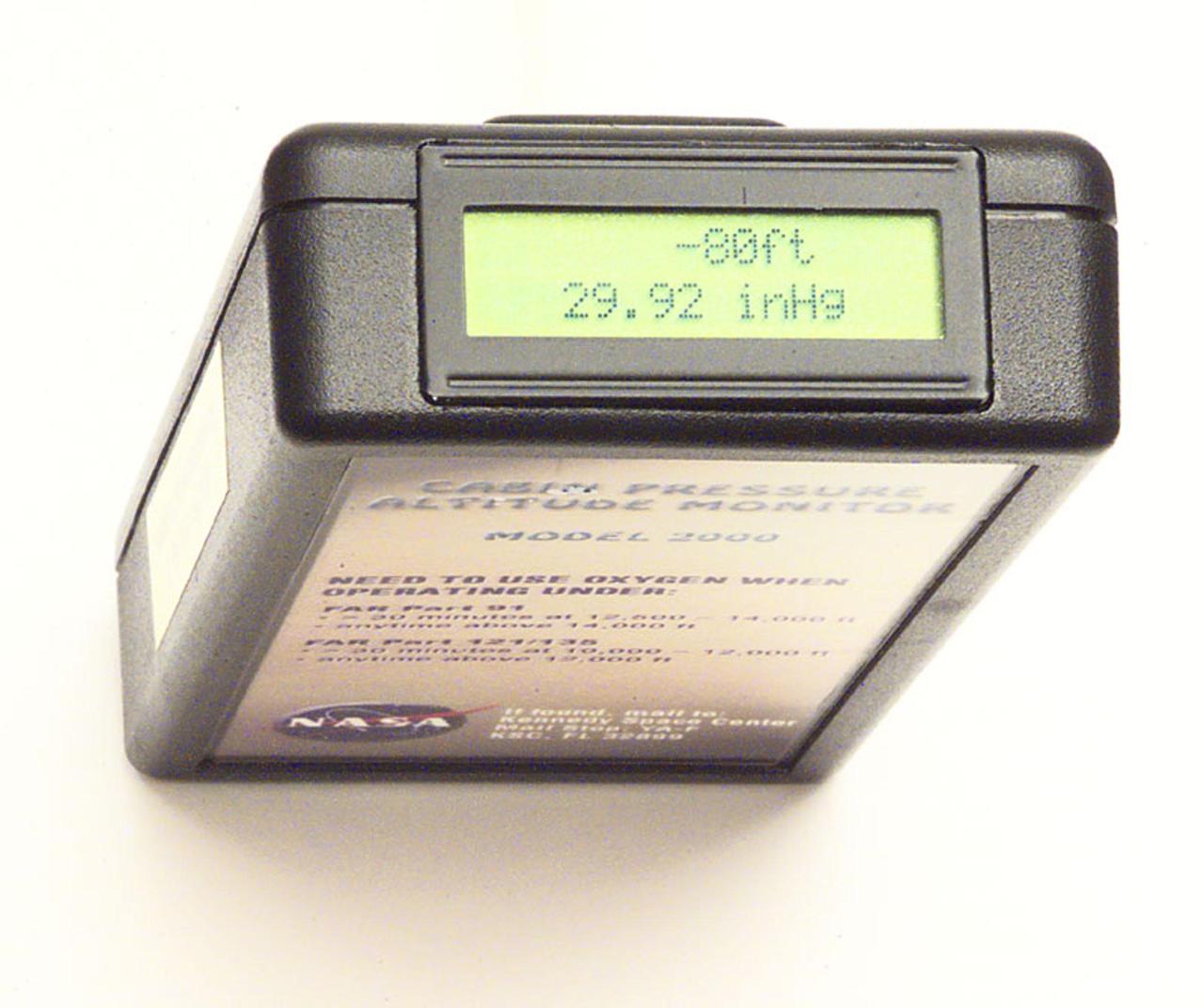
This close-up shows the pager-sized Personal Cabin Pressure Altitude Monitor developed by Jan Zysko, chief of the KSC Spaceport Engineering and Technology directorate's data and electronic systems branch. The monitor alerts wearers of a potentially dangerous or deteriorating cabin pressure altitude condition, which can lead to life-threatening hypoxia. Zysko originally designed the monitor to offer Space Shuttle and Space Station crew members added independent notification about any depressurization. However, it has drawn the interest of such organizations as the Federal Aviation Administration for use in commercial airliners and private aircraft as well
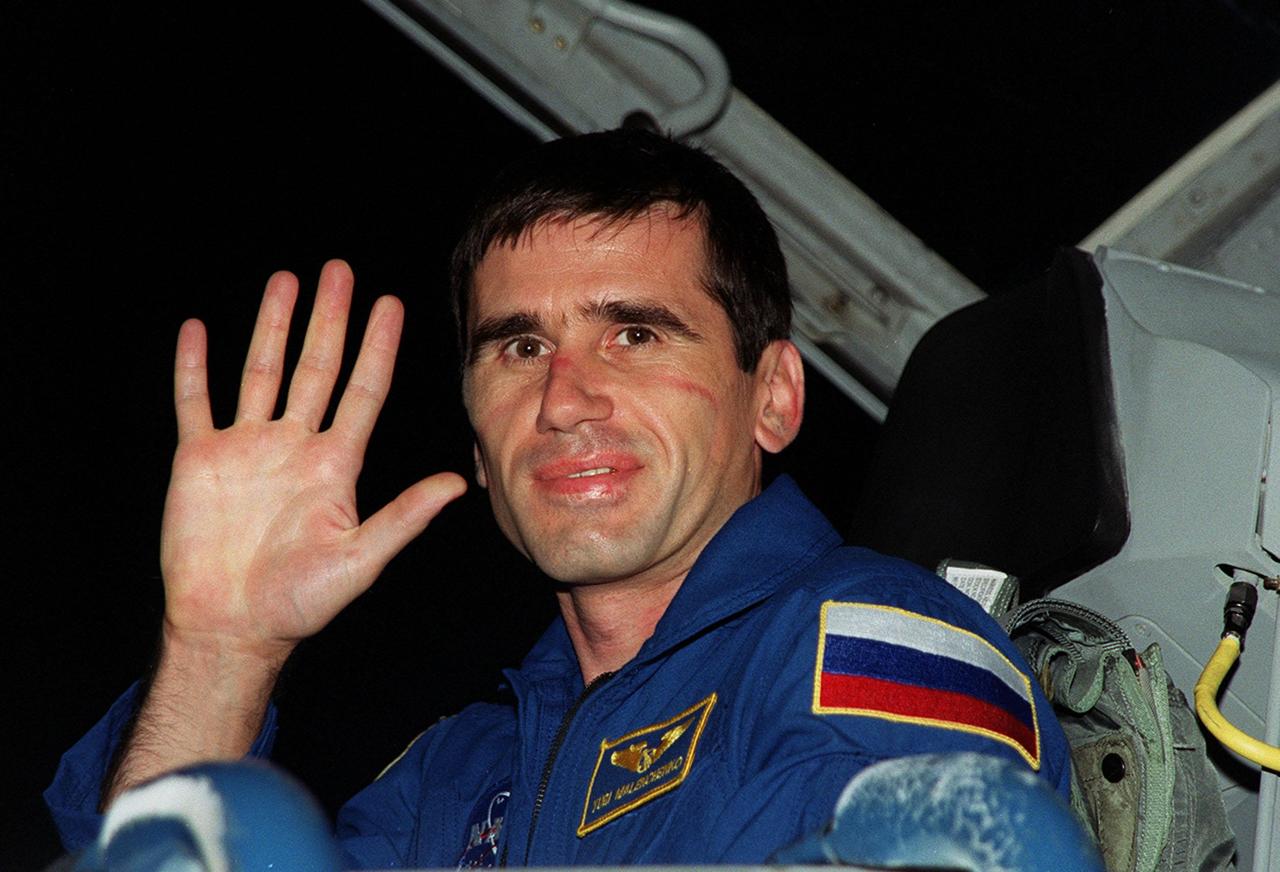
STS-106 Mission Specialist Yuri I. Malenchenko waves for the camera as he arrives at the KSC Shuttle Landing Facility. Malenchenko is with the Russian Aviation and Space Agency. He and the rest of the crew will be making pre-launch preparations for the fourth flight to the International Space Station. STS-106 is scheduled to launch Sept. 8, 2000, at 8:45 a.m. EDT from Launch Pad 39B. On the 11-day mission, the seven-member crew will perform support tasks on orbit, transfer supplies and prepare the living quarters in the newly arrived Zvezda Service Module. The first long-duration crew, dubbed "Expedition One," is due to arrive at the Station in late fall
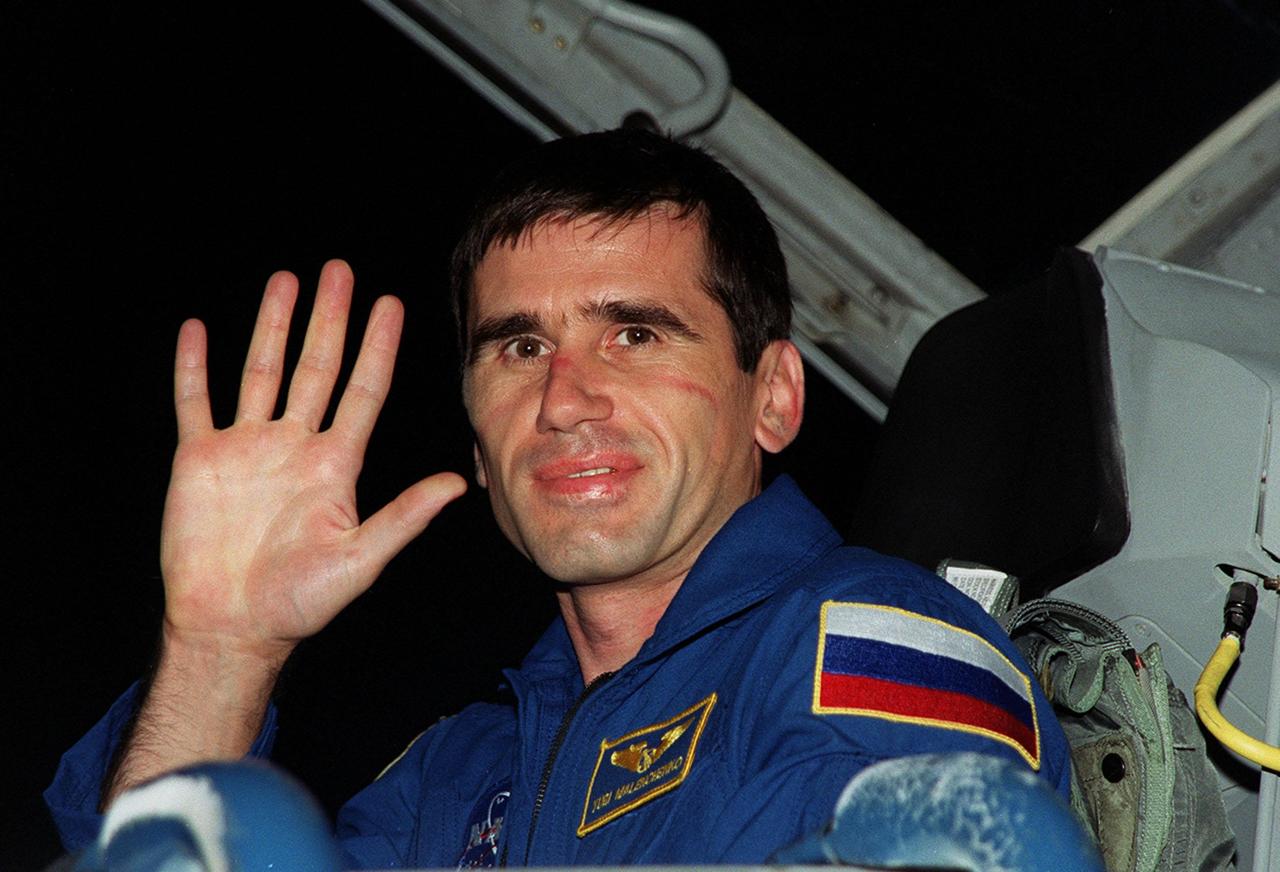
STS-106 Mission Specialist Yuri I. Malenchenko waves for the camera as he arrives at the KSC Shuttle Landing Facility. Malenchenko is with the Russian Aviation and Space Agency. He and the rest of the crew will be making pre-launch preparations for the fourth flight to the International Space Station. STS-106 is scheduled to launch Sept. 8, 2000, at 8:45 a.m. EDT from Launch Pad 39B. On the 11-day mission, the seven-member crew will perform support tasks on orbit, transfer supplies and prepare the living quarters in the newly arrived Zvezda Service Module. The first long-duration crew, dubbed "Expedition One," is due to arrive at the Station in late fall

KENNEDY SPACE CENTER, FLA. -- The 2002 Florida Press Association and Florida Society of Newspaper Editors Convention offers a panel on space. At the podium is Bob Stover, managing editor, Florida Today. Seated on the panel are (left to right) Craig Covault, senior editor, Aviation Week; Howard Benedict, retired AP reporter; JoAnn Morgan, director, External Relations and Business Development, Kennedy Space Center; Marcia Dunn, AP reporter. The convention was held at the Debus Center, KSC Visitors Complex. Also speaking at the convention were Center Director Roy Bridges and NASA Associate Deputy Administrator Dr. Daniel Mulville
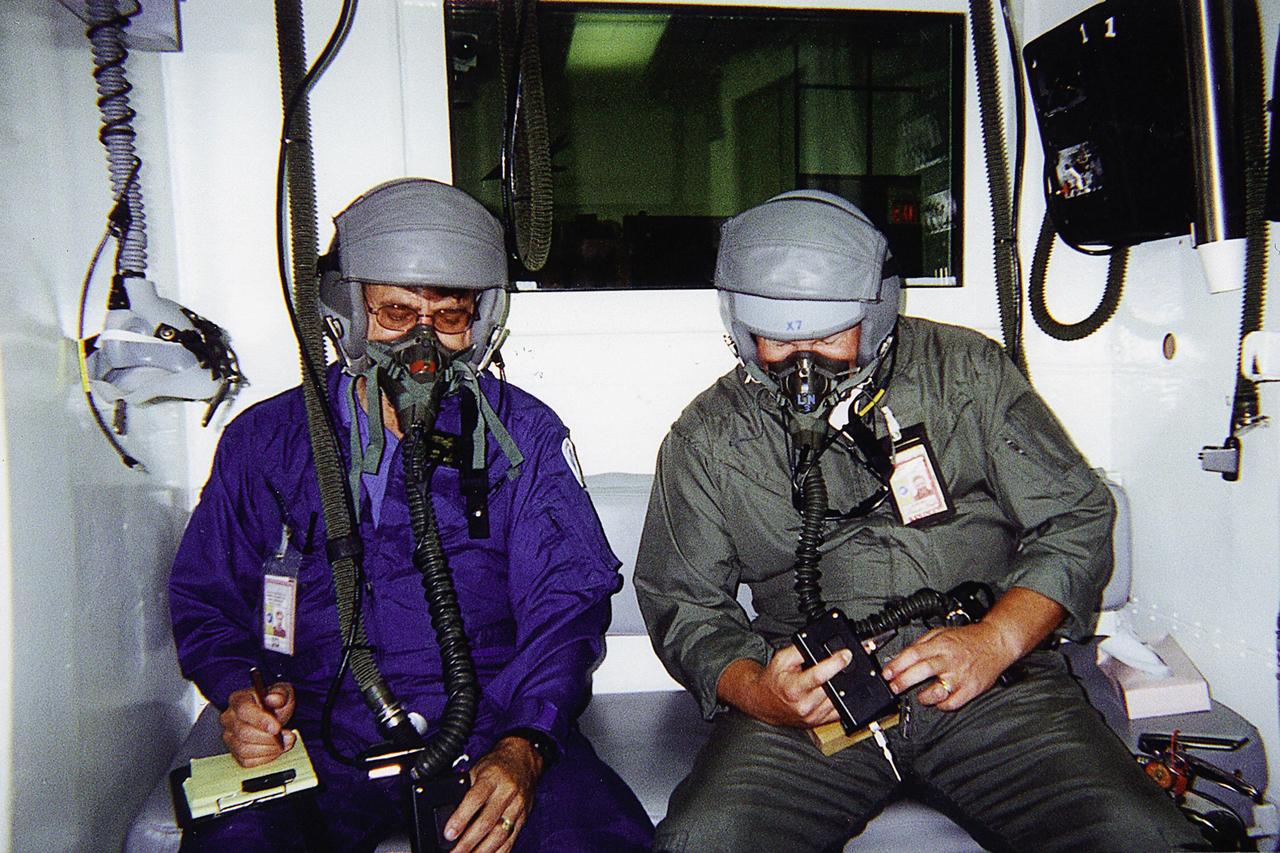
Jan Zysko (left) and Rich Mizell (right) test a Personal Cabin Pressure Altitude Monitor in an altitude chamber at Tyndall Air Force Base in Florida. Zysko invented the pager-sized monitor that alerts wearers of a potentially dangerous or deteriorating cabin pressure altitude condition, which can lead to life-threatening hypoxia. Zysko is chief of the KSC Spaceport Engineering and Technology directorate's data and electronic systems branch. Mizell is a Shuttle processing engineer. The monitor, which has drawn the interest of such organizations as the Federal Aviation Administration for use in commercial airliners and private aircraft, was originally designed to offer Space Shuttle and Space Station crew members added independent notification about any depressurization
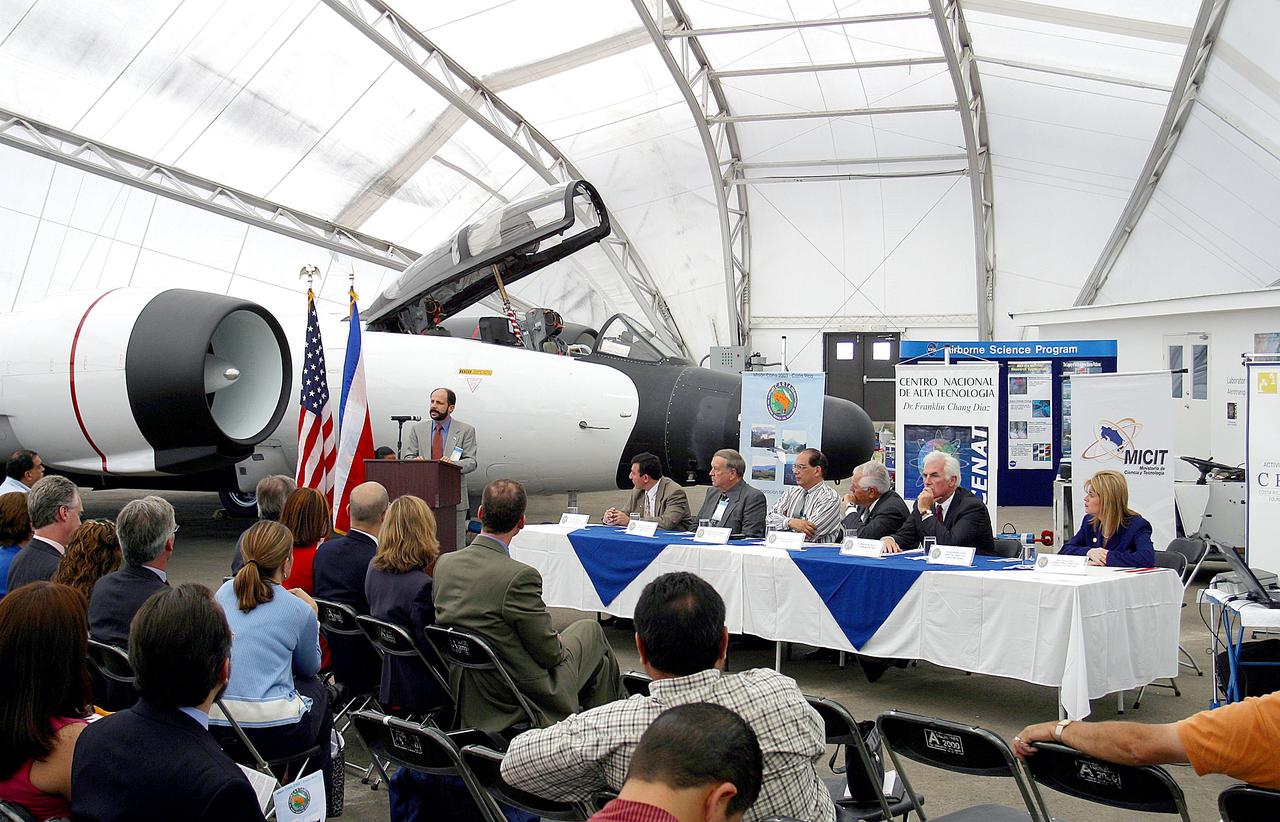
KENNEDY SPACE CENTER, FLA. - At the airport in San Jose, Costa Rica, the NASA hangar is dedicated. The speaker is Hermann Faith, executive director, Costa Rica-USA (CRUSA) Foundation. At the table are (from left) Dr. Jorge Andres Diaz, head scientiest CARTA mission; Gary Shelton, NASA deployment manager; Dr. Pedro Leon, general director, National Center for Advanced Technology (CENAT); Dr. Rogelio Pardo, minister of science and tchnology; John Danilovioch, U.S. ambassador to Costa Rica; and Lic. Vilma Lopez, subdirector, Civil Aviation (DGAC). NASA KSC has been testing its Aircraft-based Volcanic Emission Mass Spectrometer (AVEMS) in flights over the Turrialba volcano and in the crater, sampling and analyzing fresh volcanic gases in their natural chemical state. The AVEMS system has been developed for use in the Space Shuttle program, to detect toxic gas leaks and emissions in the Shuttle’s aft compartment and the crew compartment.
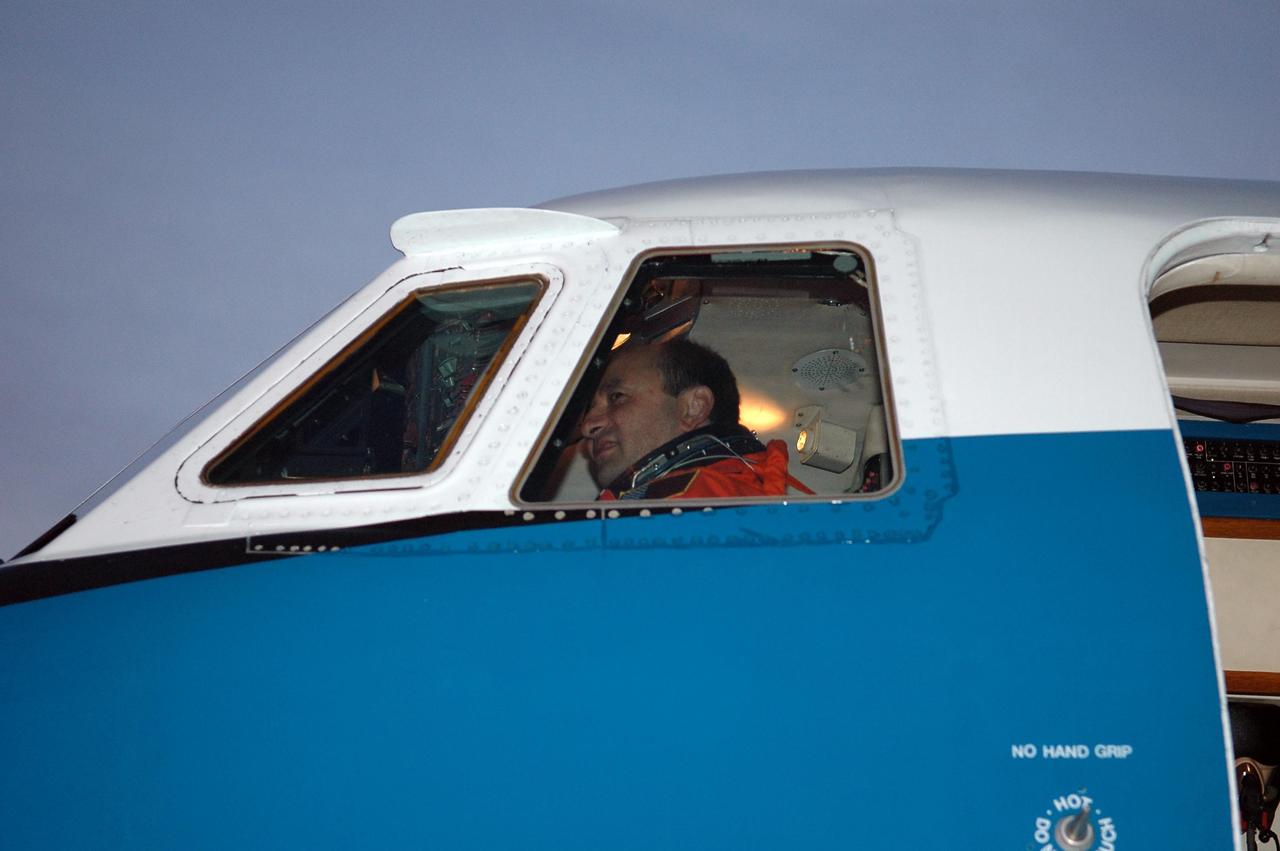
KENNEDY SPACE CENTER, FLA. -- At the Shuttle Landing Facility, STS-116 Commander Mark Polansky is in the pilot's seat of the shuttle training aircraft (STA), getting ready to practice landing the orbiter. The mission crew is at KSC for the terminal countdown demonstration test, which are prelaunch preparations that include a simulated launch countdown. STA practice is part of the TCDT. The STA is a Grumman American Aviation-built Gulf Stream II jet that was modified to simulate an orbiter's cockpit, motion and visual cues, and handling qualities. In flight, the STA duplicates the orbiter's atmospheric descent trajectory from approximately 35,000 feet altitude to landing on a runway. Because the orbiter is unpowered during re-entry and landing, its high-speed glide must be perfectly executed the first time. Photo credit: NASA/Kim Shiflett
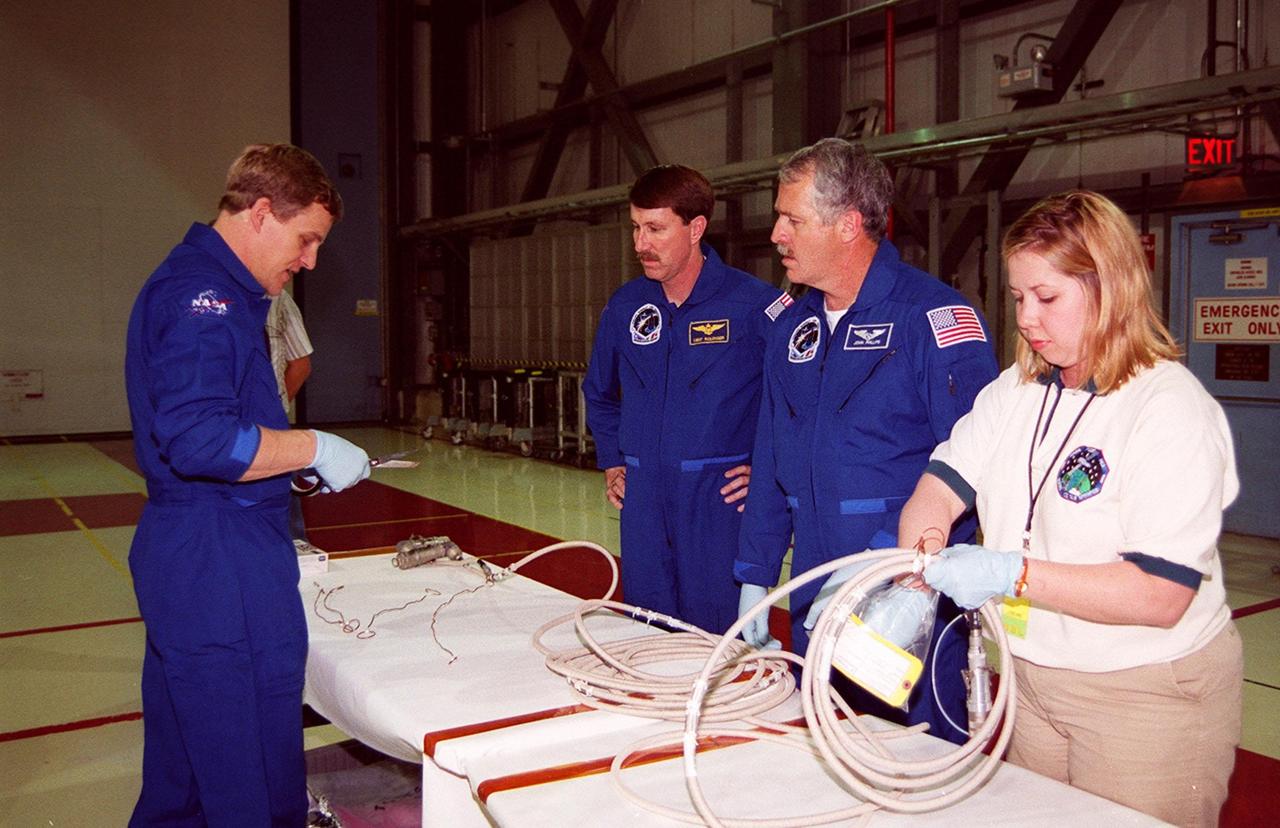
STS-100 Mission Specialists Scott Parazynski (left), Chris Hadfield (center), who is with the Canadian Space Agency, and John L. Phillips look over equipment that will be used during their mission. They are taking part in a Crew Equipment Interface Test (CEIT) at KSC, along with other crew members Commander Kent V. Rominger, Pilot Jeffrey S. Ashby and Mission Specialists Umberto Guidoni, who is with the European Space Agency, and Yuri Lonchakov, who is with the Russian Aviation and Space Agency. The orbiter is also carrying the Multi-Purpose Logistics Module Raffaello to the International Space Station. Raffaello carries six system racks and two storage racks for the U.S. Lab. Launch of mission STS-100 is scheduled for April 19 at 2:41 p.m. EDT from Launch Pad 39A
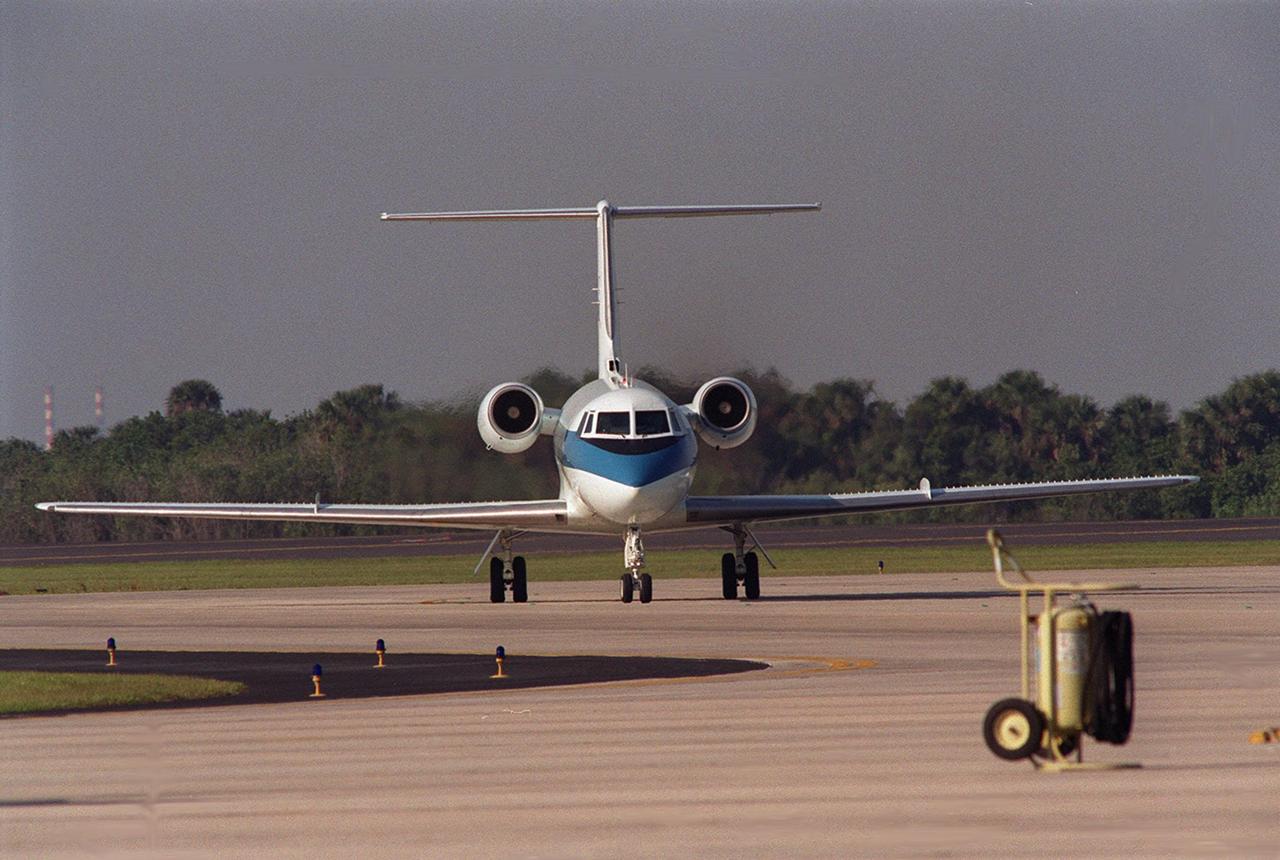
A Shuttle Training Aircraft (STA) taxis into the parking area of KSC's Shuttle Landing Facility. The STA is a modified Grumman American Aviation-built Gulfstream II executive jet that was modified to simulate an orbiter's cockpit, motion and visual cues, and handling qualities. It is used by Shuttle flight crews to practice landing the orbiter. In flight, the STA duplicates the orbiter's atmospheric descent trajectory from approximately 35,000 feet altitude to landing on a runway. The orbiter differs in at least one major aspect from conventional aircraft; it is unpowered during re-entry and landing so its high-speed glide must be perfectly executed the first time there is no go-around capability. The orbiter touchdown speed is 213 to 226 miles (343 to 364 kilometers) per hour. There are two STAs, based in Houston
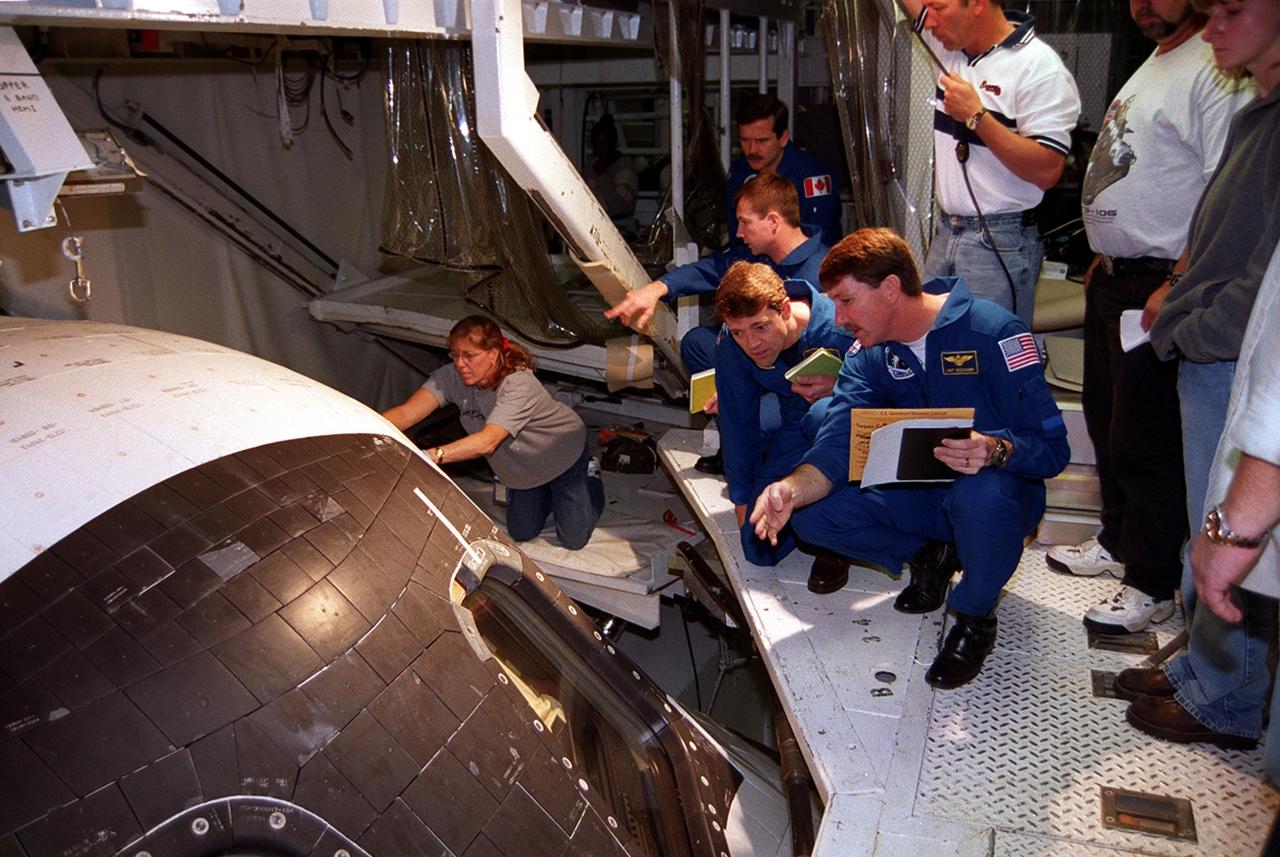
Members of the STS-100 crew check out Endeavour inside the Orbiter Processing Facility bay 2. In their blue uniforms, they are (front to back) Commander Kent V. Rominger, Pilot Jeff rey S. Ashby, and Mission Specialists Yuri Lonchakov, who is with the Russian Aviation and Space Agency, and Chris Hadfield, who is with the Canadian Space Agency. Other crew members at KSC for the CEIT are Mission Specialists Scott Parazynski and Umberto Guidoni, who is with the European Space Agency. Endeavour is carrying the Multi-Purpose Logistics Module Raffaello and the Canadian robotic arm, SSRMS, to the International Space Station. Raffaello carries six system racks and two storage racks for the U.S. Lab. Launch of mission STS-100 is scheduled for April 19 at 2:41 p.m. EDT from Launch Pad 39A
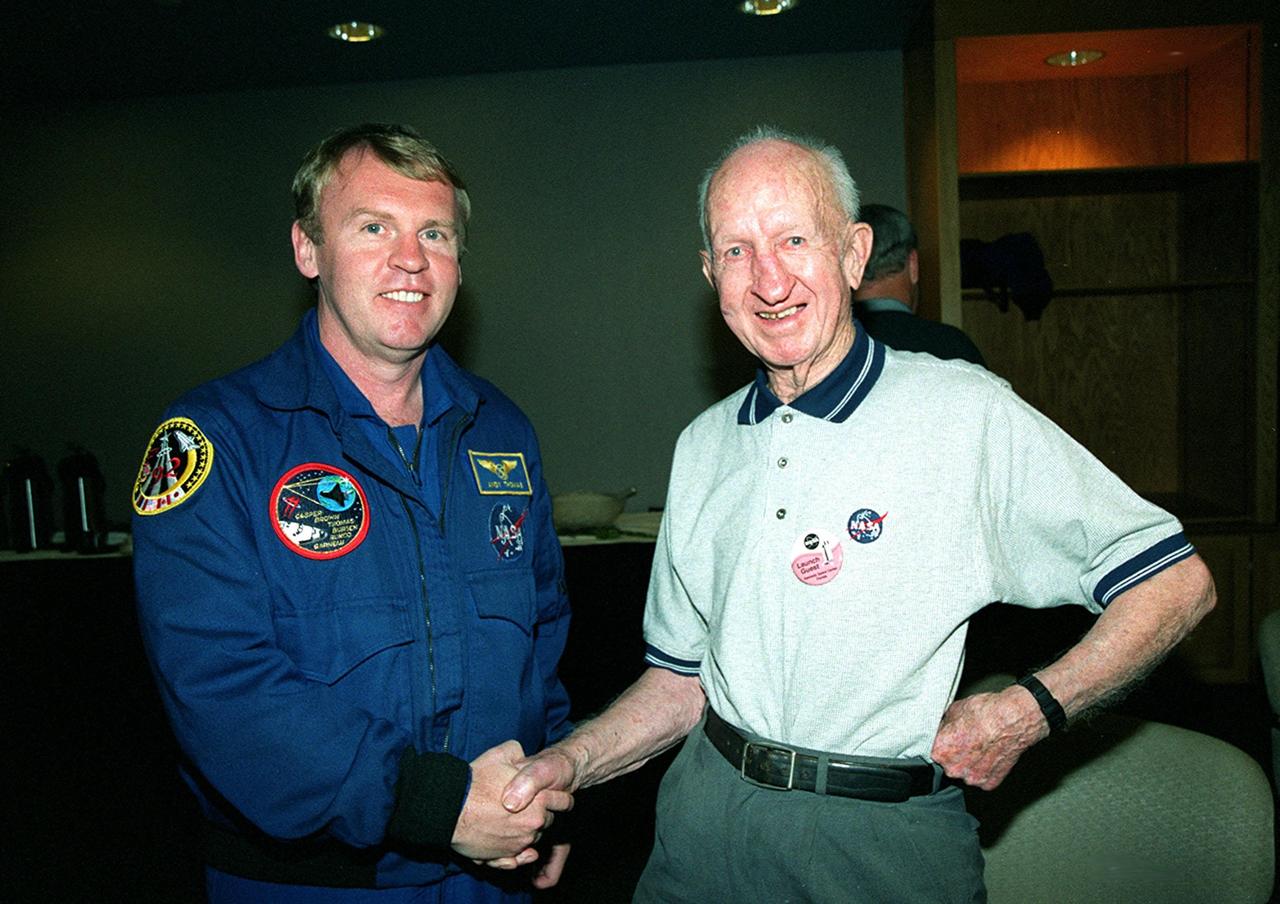
Astronaut Andy Thomas (left) greets 100-year-old Captain Ralph Charles, one of the VIPs attending the launch of STS-99. Charles also met NASA Administrator Dan Goldin. An aviator who has the distinction of being the oldest licensed pilot in the United States, Charles is still flying. He has experienced nearly a century of flight history, from the Wright Brothers to the Space Program. He took flying lessons from one of the first fliers trained by Orville Wright, first repaired then built airplanes, went barnstorming, operated a charter service in the Caribbean, and worked as a test pilot for the Curtiss Wright Airplane Co. Charles watches all the Shuttle launches from his home in Ohio and his greatest wish is to be able to watch one in person from KSC
KENNEDY SPACE CENTER, Fla. -- At the slidewire landing site, Launch Pad 39A, STS-105 Mission Specialist Daniel Barry responds to a question during a media interview. With him are (left to right) Mission Specialist Patrick Forrester, Pilot Rick Sturckow and Commander Scott Horowitz; with the Expedition Three crew Commander Frank Culbertson and cosmonauts Vladimir Nikolaevich Dezhurov and Mikhail Tyurin, who are with the Russian Aviation and Space Agency. Both crews are at KSC to take part in Terminal Countdown Demonstration Test activities, which include emergency egress, a simulated launch countdown and familiarization with the payload. Mission STS-105 will be transporting the Expedition Three crew, several payloads and scientific experiments to the International Space Station aboard Discovery. The current Expedition Two crew members on the Station will return to Earth on Discovery. Launch of Discovery is scheduled no earlier than Aug. 9, 2001
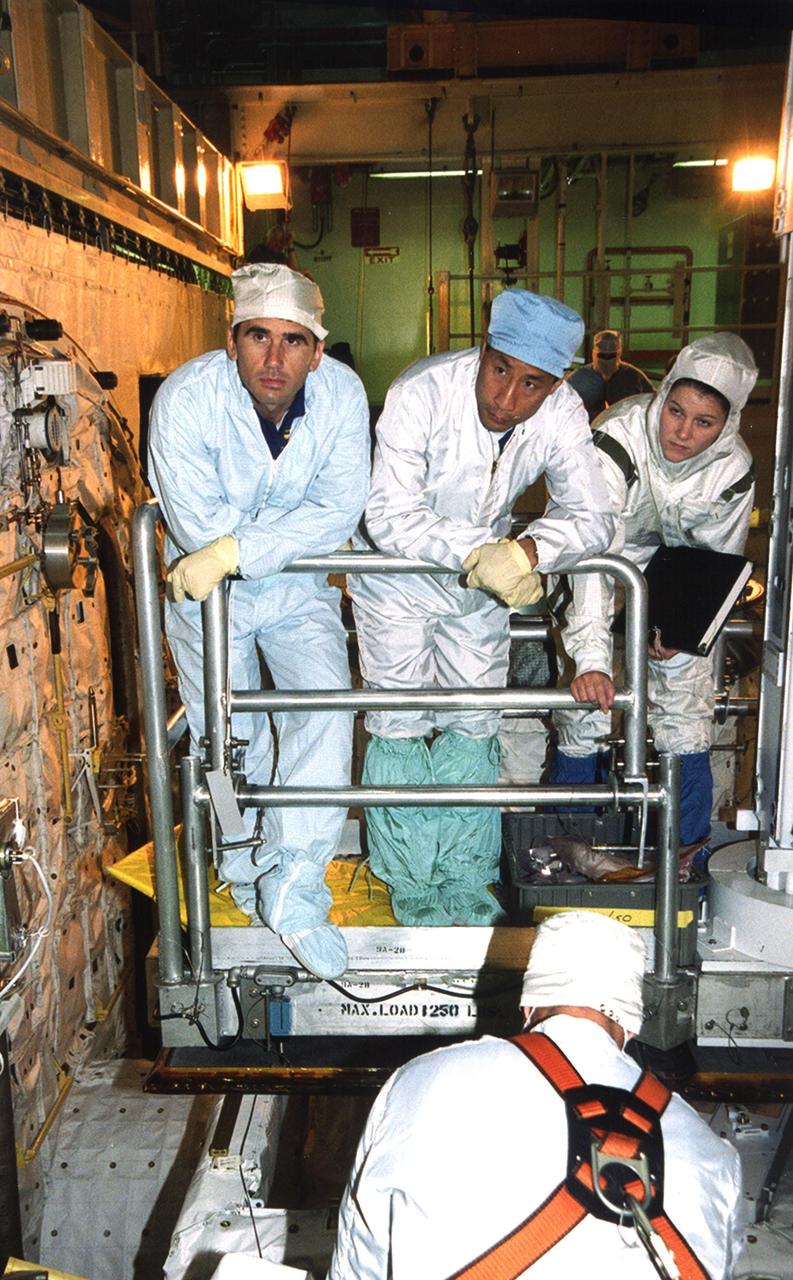
In Orbiter Processing Facility bay 3, STS-106 Mission Specialists Yuri I. Malenchenko (left) and Edward T. Lu (center) familiarize themselves with equipment in the payload bay of Space Shuttle orbiter Atlantis with the help of KSC employees as part of Crew Equipment Interface Test (CEIT) activities for their mission. The other crew members are Commander Terrence W. Wilcutt, Pilot Scott D. Altman, and Mission Specialists Daniel C. Burbank, Boris V. Morukov and Richard A. Mastracchio. Malenchenko and Morukov represent the Russian Aviation and Space Agency. On the 11-day mission, the seven-member crew will perform support tasks on orbit, transfer supplies and prepare the living quarters in the newly arrived Zvezda Service Module for the first long-duration crew, dubbed "Expedition One," which is due to arrive at the Station in late fall. STS-106 is scheduled to launch Sept. 8, 2000, at 8:31 a.m. EDT from Launch Pad 39B
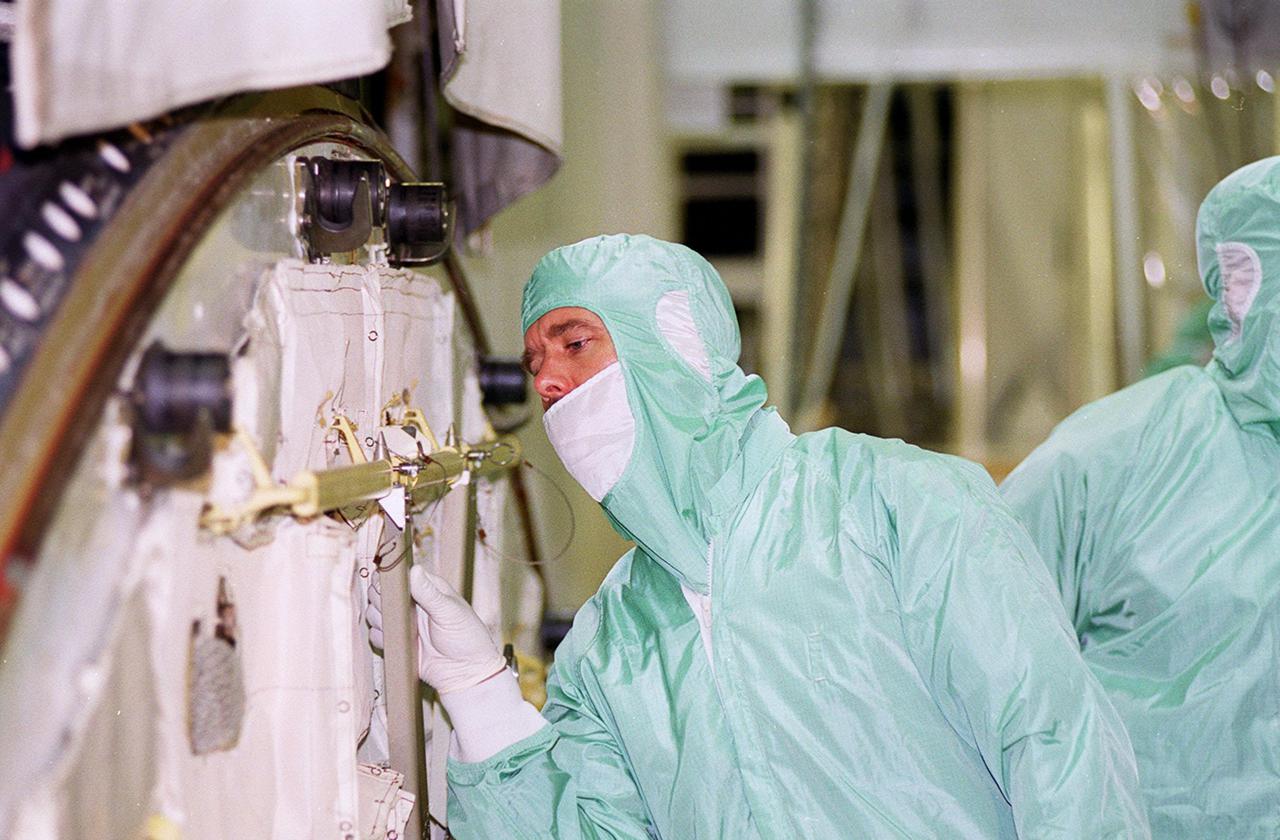
Dressed in protective clothing, STS-100 Mission Specialist Chris Hadfield looks at equipment in the payload bay of orbiter Endeavour during a Crew Equipment Interface Test (CEIT). Other crew members at KSC for the CEIT are Commander Kent V. Rominger, Pilot Jeffrey S. Ashby and Mission Specialists Scott Parazynski, John L. Phillips, Umberto Guidoni, who is with the European Space Agency, and Yuri Lonchakov, who is with the Russian Aviation and Space Agency. Hadfield is with the Canadian Space Agency. Endeavour is also carrying the Multi-Purpose Logistics Module Raffaello to the International Space Station. Raffaello carries six system racks and two storage racks for the U.S. Lab. Launch of mission STS-100 is scheduled for April 19 at 2:41 p.m. EDT from Launch Pad 39A
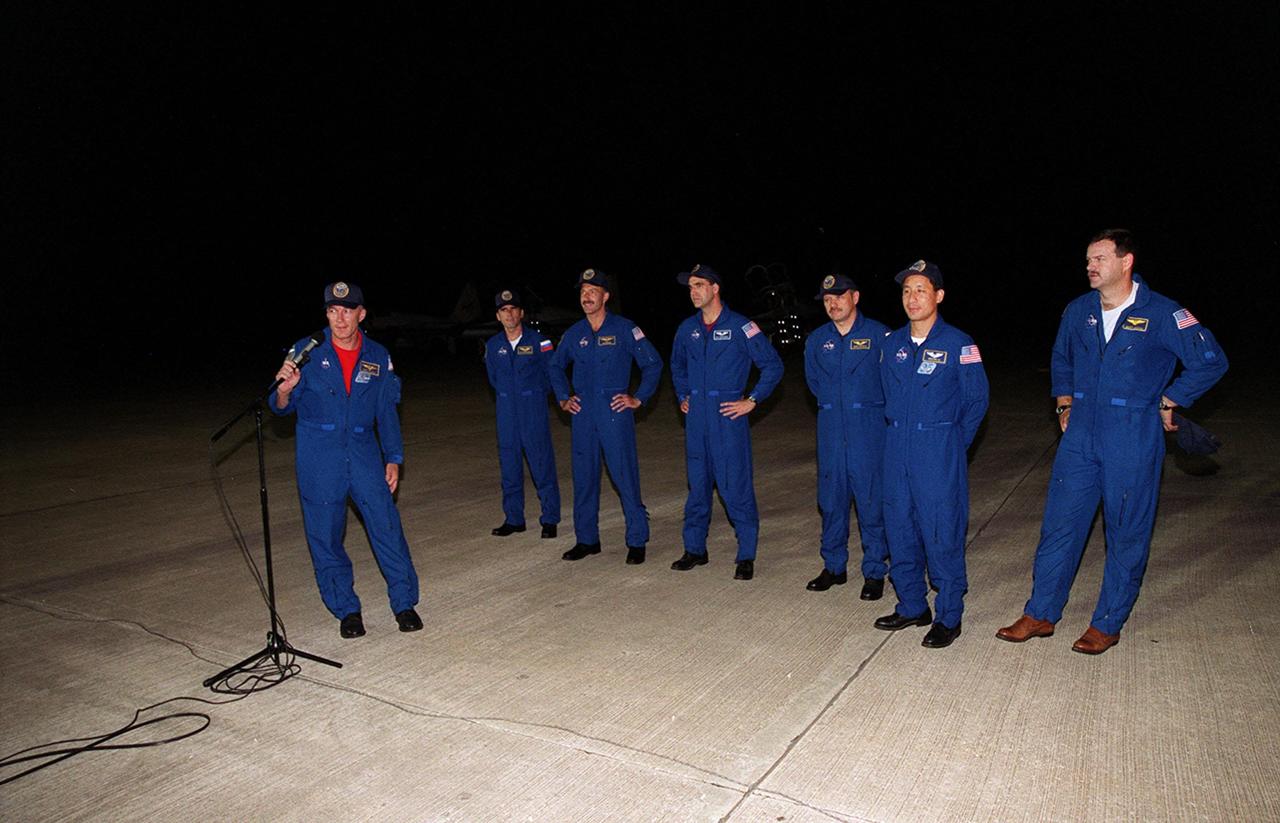
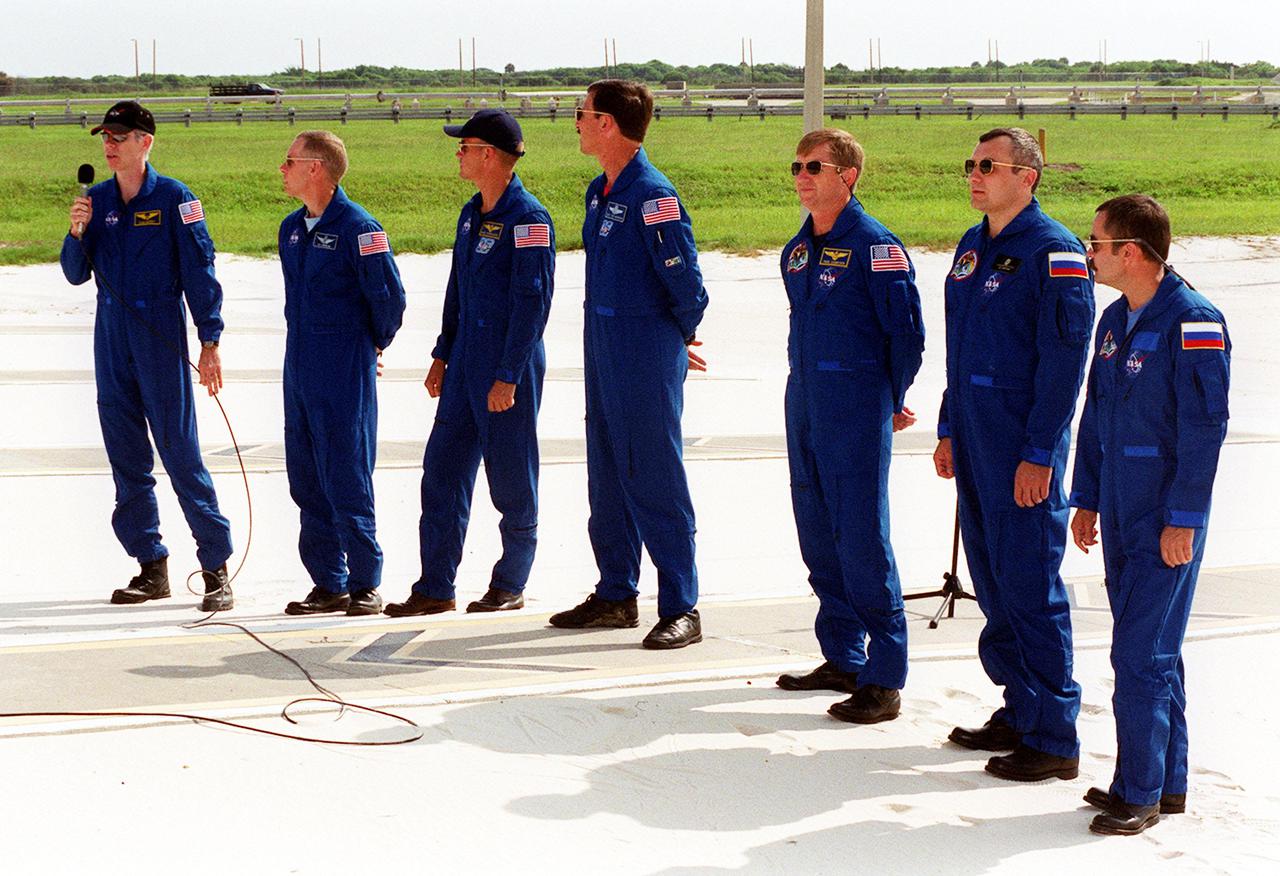
After their arrival at the KSC Shuttle Landing Facility, the STS-106 crew meet the media. Commander Terrence W. Wilcutt, at the microphone, says a few words; the rest of the crew waits behind him. From left, they are Mission Specialists Yuri I. Malenchenko, Daniel C. Burbank, Richard A. Mastracchio, Boris V. Morukov and Edward T. Lu; and Pilot Scott D. Altman. Malenchenko and Morukov are with the Russian Aviation and Space Agency. The crew will be making pre-launch preparations for the fourth flight to the International Space Station. STS-106 is scheduled to launch Sept. 8, 2000, at 8:45 a.m. EDT from Launch Pad 39B. On the 11-day mission, the seven-member crew will perform support tasks on orbit, transfer supplies and prepare the living quarters in the newly arrived Zvezda Service Module. The first long-duration crew, dubbed “Expedition One,” is due to arrive at the Station in late fall
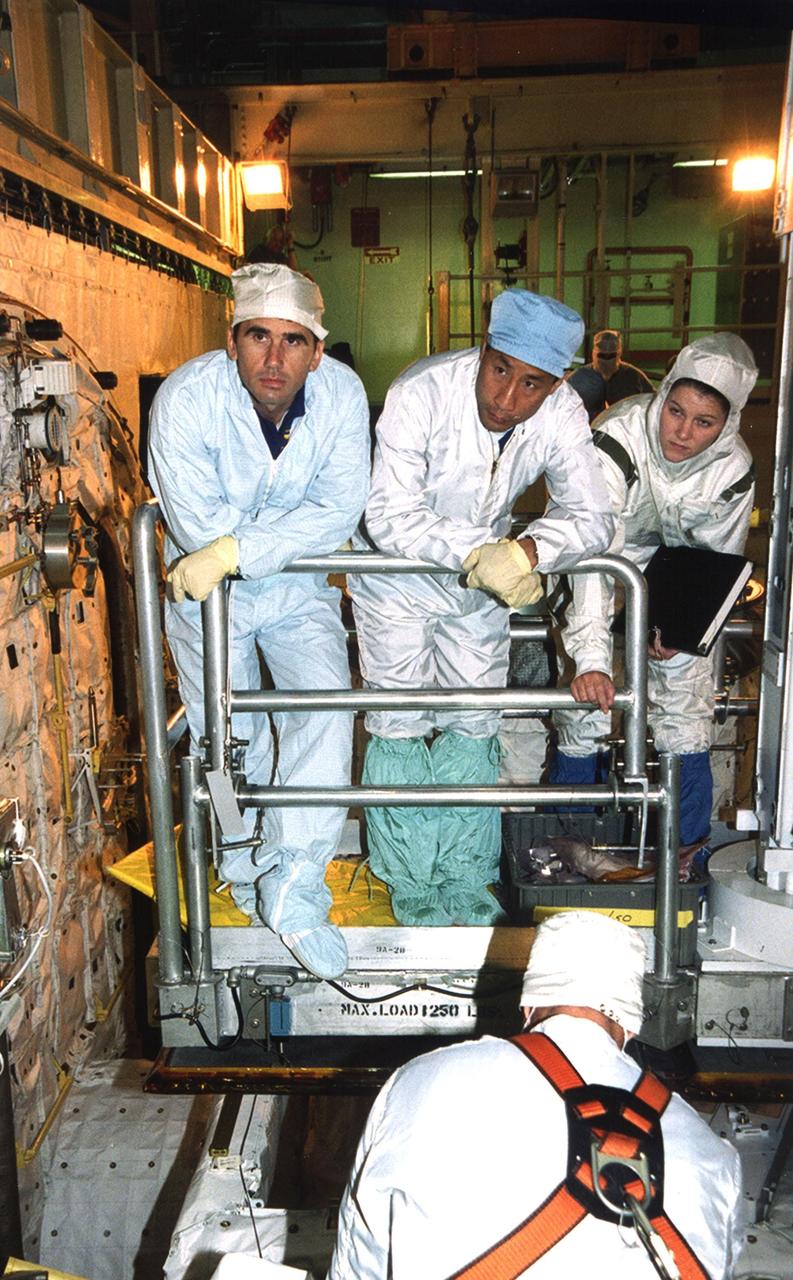
In Orbiter Processing Facility bay 3, STS-106 Mission Specialists Yuri I. Malenchenko (left) and Edward T. Lu (center) familiarize themselves with equipment in the payload bay of Space Shuttle orbiter Atlantis with the help of KSC employees as part of Crew Equipment Interface Test (CEIT) activities for their mission. The other crew members are Commander Terrence W. Wilcutt, Pilot Scott D. Altman, and Mission Specialists Daniel C. Burbank, Boris V. Morukov and Richard A. Mastracchio. Malenchenko and Morukov represent the Russian Aviation and Space Agency. On the 11-day mission, the seven-member crew will perform support tasks on orbit, transfer supplies and prepare the living quarters in the newly arrived Zvezda Service Module for the first long-duration crew, dubbed "Expedition One," which is due to arrive at the Station in late fall. STS-106 is scheduled to launch Sept. 8, 2000, at 8:31 a.m. EDT from Launch Pad 39B
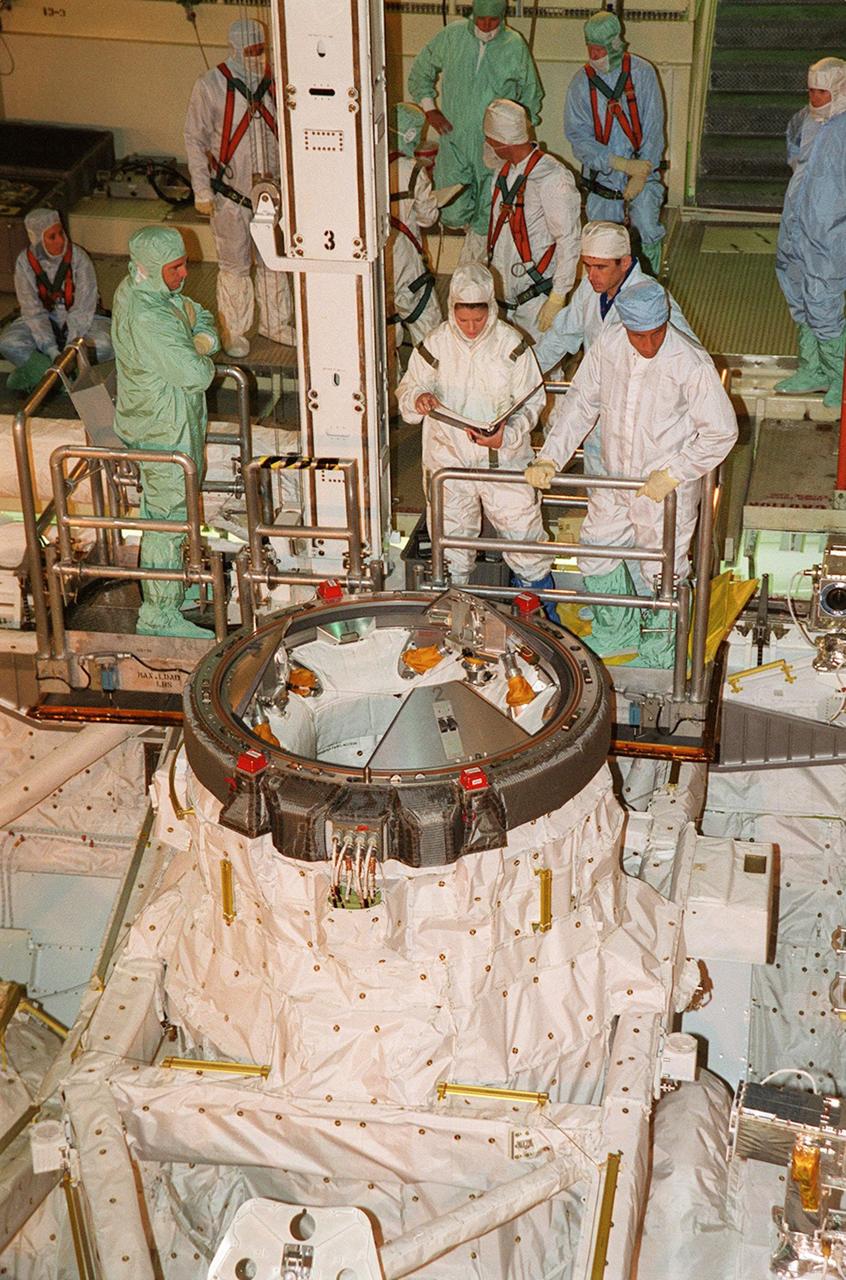
In Orbiter Processing Facility bay 3, the STS-106 crew familiarizes themselves with equipment in the payload bay of Space Shuttle orbiter Atlantis with the help of KSC employees as part of Crew Equipment Interface Test (CEIT) activities for their mission. The STS-106 crew members are Commander Terrence W. Wilcutt, Pilot Scott D. Altman, and Mission Specialists Edward T. Lu, Daniel C. Burbank, Yuri I. Malenchenko, Boris V. Morukov and Richard A. Mastracchio. Malenchenko and Morukov represent the Russian Aviation and Space Agency. On the 11-day mission, the seven-member crew will perform support tasks on orbit, transfer supplies and prepare the living quarters in the newly arrived Zvezda Service Module for the first long-duration crew, dubbed "Expedition One," which is due to arrive at the Station in late fall. STS-106 is scheduled to launch Sept. 8, 2000, at 8:31 a.m. EDT from Launch Pad 39B
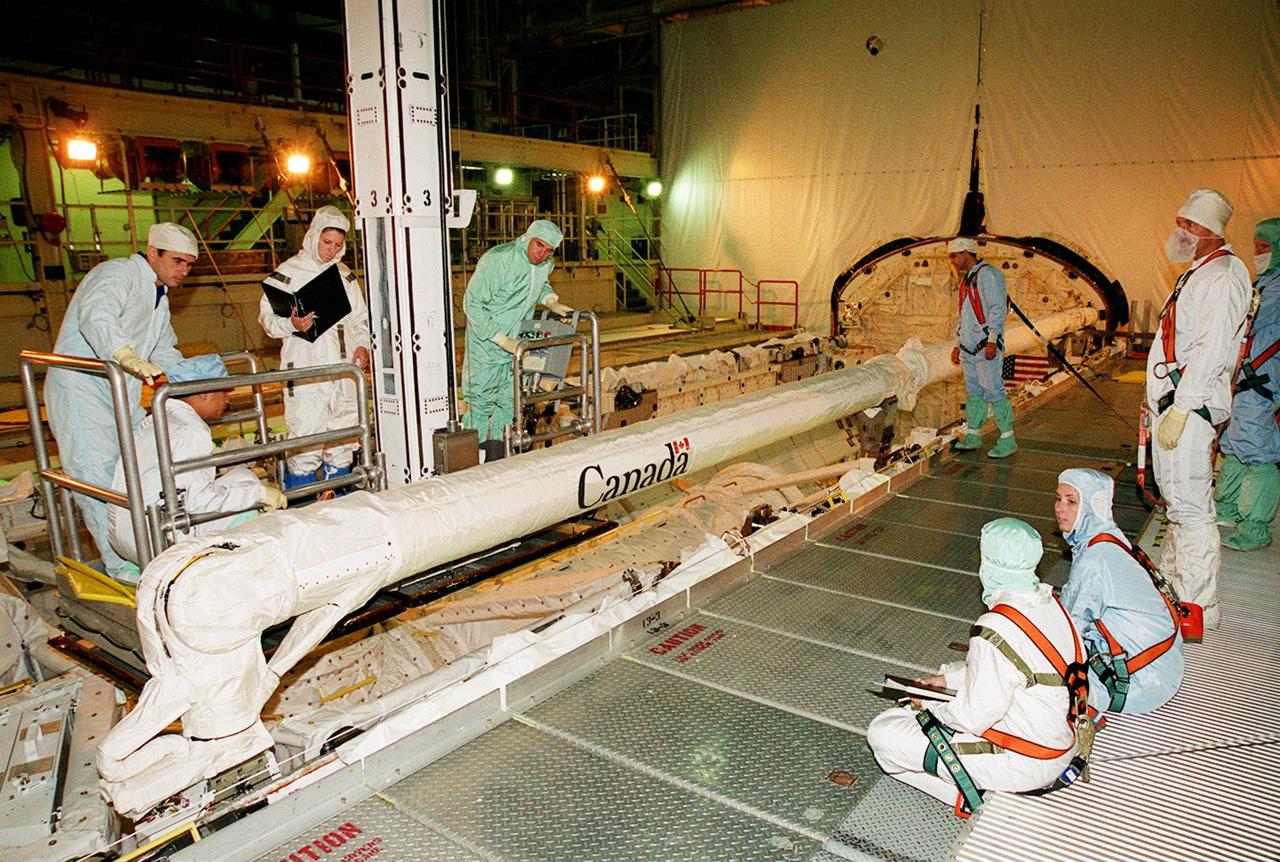
In Orbiter Processing Facility bay 3, the STS-106 crew familiarizes themselves with the payload bay of Space Shuttle orbiter Atlantis with the help of KSC employees as part of Crew Equipment Interface Test (CEIT) activities for their mission. The STS-106 crew members are Commander Terrence W. Wilcutt, Pilot Scott D. Altman, and Mission Specialists Edward T. Lu, Daniel C. Burbank, Yuri I. Malenchenko, Boris V. Morukov and Richard A. Mastracchio. Malenchenko and Morukov represent the Russian Aviation and Space Agency. On the 11-day mission, the seven-member crew will perform support tasks on orbit, transfer supplies and prepare the living quarters in the newly arrived Zvezda Service Module for the first long-duration crew, dubbed "Expedition One," which is due to arrive at the Station in late fall. STS-106 is scheduled to launch Sept. 8, 2000, at 8:31 a.m. EDT from Launch Pad 39B
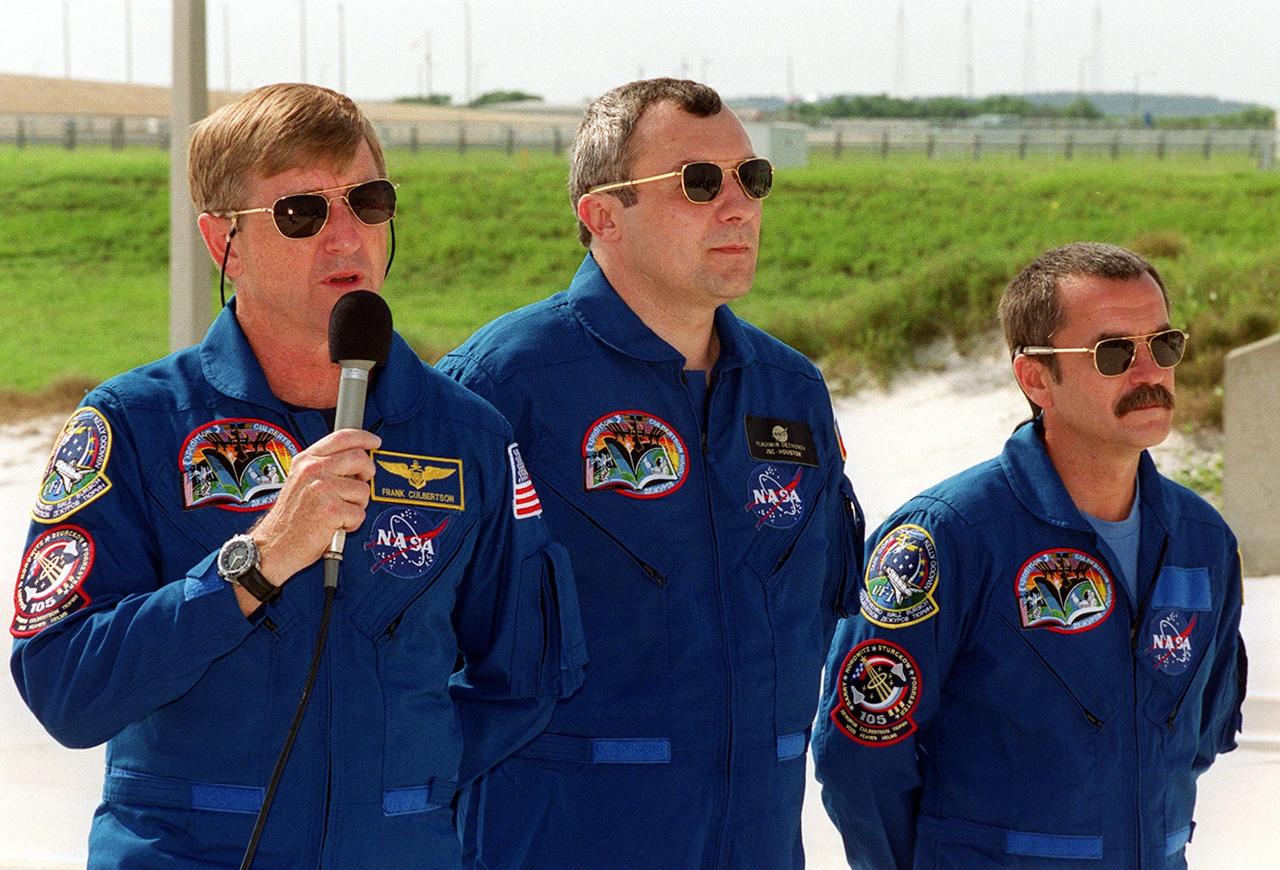
KENNEDY SPACE CENTER, Fla. -- At the slidewire landing site, Launch Pad 39A, Expedition Three Commander Frank Culbertson responds to a question during a media interview. With him are cosmonauts Vladimir Nikolaevich Dezhurov (center) and Mikhail Tyurin (right), who are with the Russian Aviation and Space Agency. They and the STS-105 crew are at KSC to take part in Terminal Countdown Demonstration Test activities, which include emergency egress, a simulated launch countdown and familiarization with the payload. Mission STS-105 will be transporting the Expedition Three crew, several payloads and scientific experiments to the International Space Station aboard Discovery. The current Expedition Two crew members on the Station will return to Earth on Discovery. Launch of Discovery is scheduled no earlier than Aug. 9, 2001
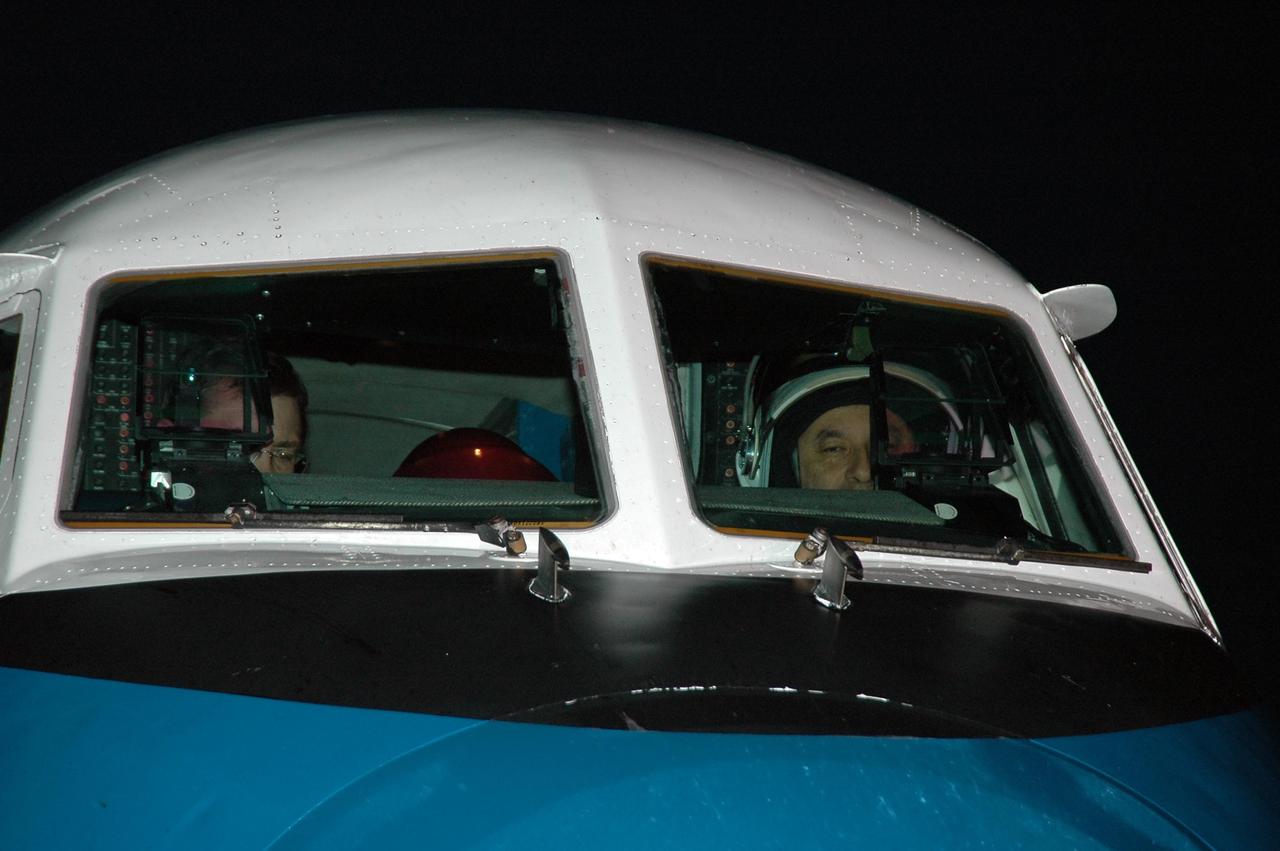
KENNEDY SPACE CENTER, FLA. -- Inside the shuttle training aircraft at the Shuttle Landing Facility, STS-116 Pilot William Oefelein (left) and Commander Mark Polansky are seated in the cockpit, getting ready to practice landing the orbiter. The mission crew is at KSC for the terminal countdown demonstration test, which are prelaunch preparations that include a simulated launch countdown. STA practice is part of the TCDT. The STA is a Grumman American Aviation-built Gulf Stream II jet that was modified to simulate an orbiter's cockpit, motion and visual cues, and handling qualities. In flight, the STA duplicates the orbiter's atmospheric descent trajectory from approximately 35,000 feet altitude to landing on a runway. Because the orbiter is unpowered during re-entry and landing, its high-speed glide must be perfectly executed the first time. Photo credit: NASA/Kim Shiflett
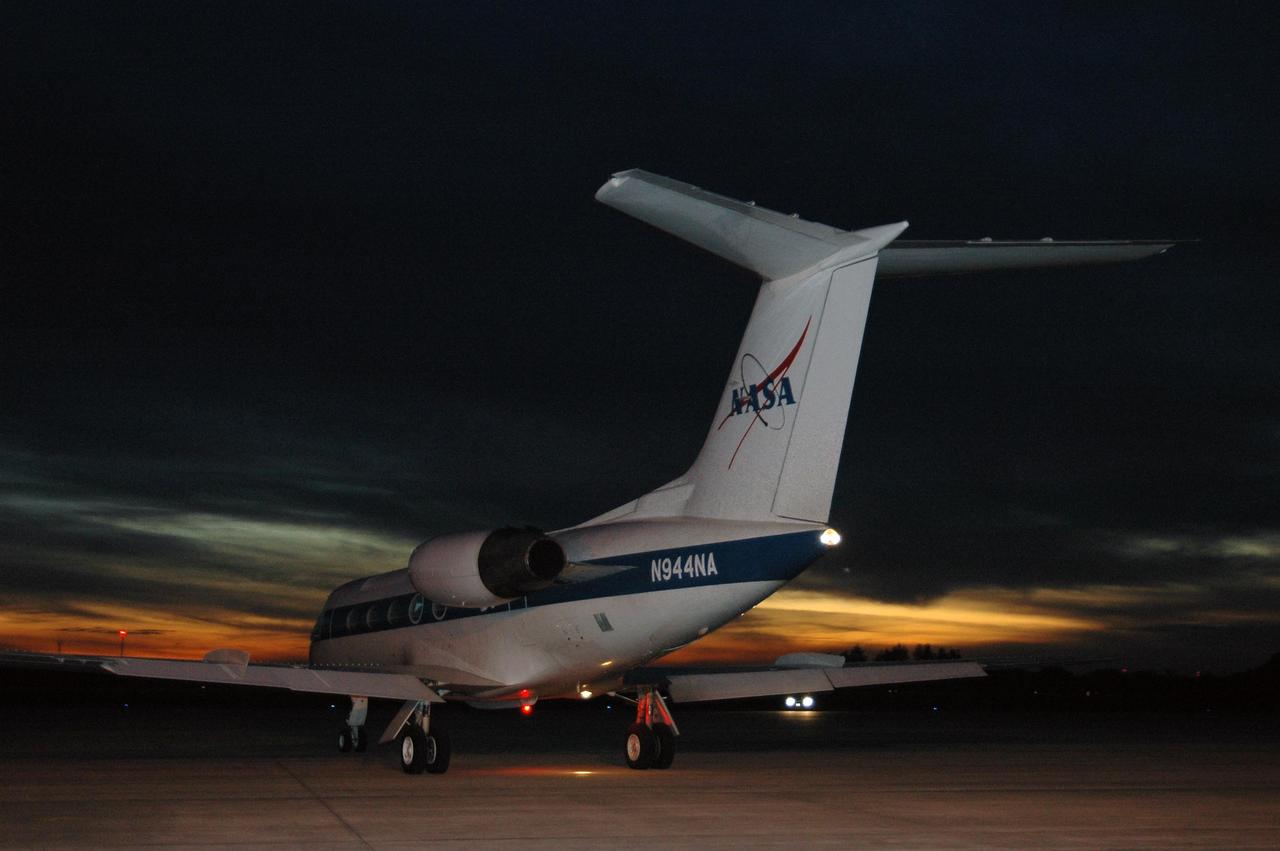
KENNEDY SPACE CENTER, FLA. -- At the Shuttle Landing Facility, the shuttle training aircraft taxis onto the runway. Inside are STS-116 Pilot William Oefelein and Commander Mark Polansky, who are flying the aircraft to practice landing the orbiter. The mission crew is at KSC for the terminal countdown demonstration test, which are prelaunch preparations that include a simulated launch countdown. STA practice is part of the TCDT. The STA is a Grumman American Aviation-built Gulf Stream II jet that was modified to simulate an orbiter's cockpit, motion and visual cues, and handling qualities. In flight, the STA duplicates the orbiter's atmospheric descent trajectory from approximately 35,000 feet altitude to landing on a runway. Because the orbiter is unpowered during re-entry and landing, its high-speed glide must be perfectly executed the first time. Photo credit: NASA/Kim Shiflett

A Shuttle Training Aircraft (STA) taxis down the runway at KSC's Shuttle Landing Facility. The STA is a modified Grumman American Aviation-built Gulfstream II executive jet that was modified to simulate an orbiter's cockpit, motion and visual cues, and handling qualities. It is used by Shuttle flight crews to practice landing the orbiter. In flight, the STA duplicates the orbiter's atmospheric descent trajectory from approximately 35,000 feet altitude to landing on a runway. The orbiter differs in at least one major aspect from conventional aircraft; it is unpowered during re-entry and landing so its high-speed glide must be perfectly executed the first time there is no go-around capability. The orbiter touchdown speed is 213 to 226 miles (343 to 364 kilometers) per hour. There are two STAs, based in Houston
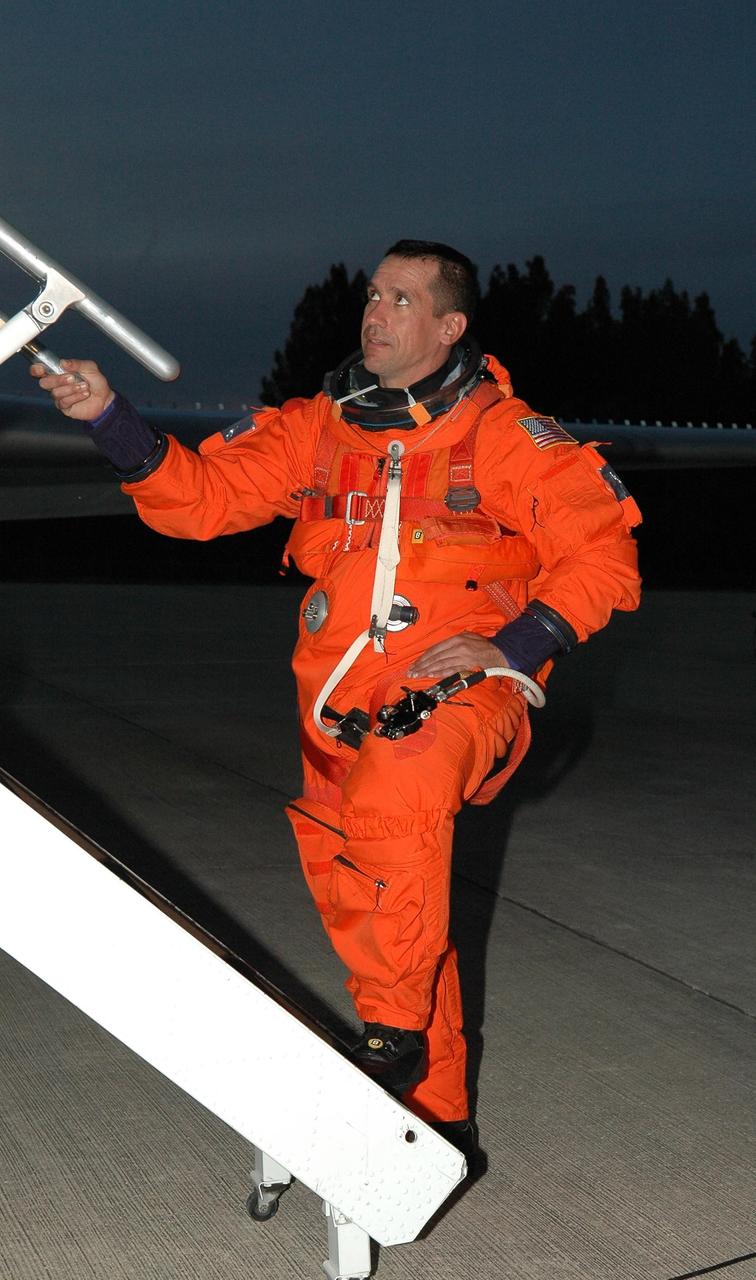
KENNEDY SPACE CENTER, FLA. -- At the Shuttle Landing Facility, STS-116 Pilot William Oelefein steps on the stairs to the shuttle training aircraft (STA) to practice landing the orbiter. The mission crew is at KSC for the terminal countdown demonstration test, which are prelaunch preparations that include a simulated launch countdown. STA practice is part of the TCDT. The STA is a Grumman American Aviation-built Gulf Stream II jet that was modified to simulate an orbiter's cockpit, motion and visual cues, and handling qualities. In flight, the STA duplicates the orbiter's atmospheric descent trajectory from approximately 35,000 feet altitude to landing on a runway. Because the orbiter is unpowered during re-entry and landing, its high-speed glide must be perfectly executed the first time. Photo credit: NASA/Kim Shiflett
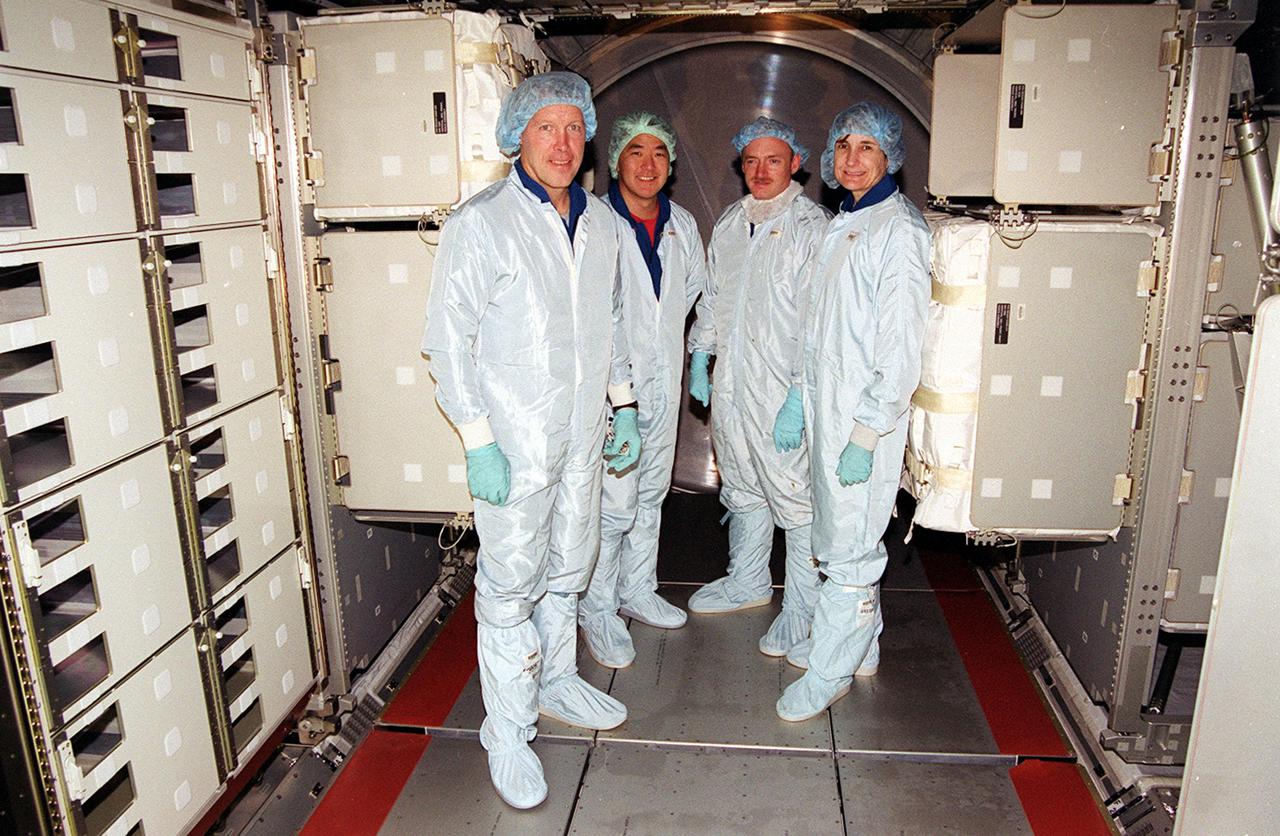
KENNEDY SPACE CENTER, Fla. -- The STS-108 crew pause during their checkout of the Multi-Purpose Logistics Module Raffaello. From left are Commander Dominic L. Gorie, Mission Specialist Daniel M. Tani, Pilot Mark E. Kelly and Mission Specialist Linda A. Godwin. The four astronauts are taking part in Crew Equipment Interface Test (CEIT) activities at KSC. The CEIT provides familiarization with the launch vehicle and payload. Mission STS-108 is a Utilization Flight (UF-1), carrying the Expedition Four crew plus Multi-Purpose Logistics Module Raffaello to the International Space Station. The Expedition Four crew comprises Yuri Onufriyenko, commander, Russian Aviation and Space Agency, and astronauts Daniel W. Bursch and Carl E. Walz. Endeavour is scheduled to launch Nov. 29 on mission STS-108

KENNEDY SPACE CENTER, FLA. -- At SPACEHAB members of the STS-106 crew check out equipment they will be using during their mission to the International Space Station. Starting second from left, they are Mission Specialists Daniel C. Burbank, Edward T. Lu, and Yuri I. Malenchenkov; Pilot Scott D. Altman, and Mission Specialists Richard A. Mastracchio and Boris V. Morukov. Not seen is Commander Terrence W. Wilcutt. Malenchenko and Morukov represent the Russian Aviation and Space Agency. The crew is taking part in Crew Equipment Interface Test activities at KSC. On the 11-day mission, the seven-member crew will perform support tasks on orbit, transfer supplies and prepare the living quarters in the newly arrived Zvezda Service Module for the first long-duration crew, dubbed “Expedition One,” which is due to arrive at the Station in late fall. STS-106 is scheduled to launch Sept. 8, 2000, at 8:31 a.m. EDT from Launch Pad 39B
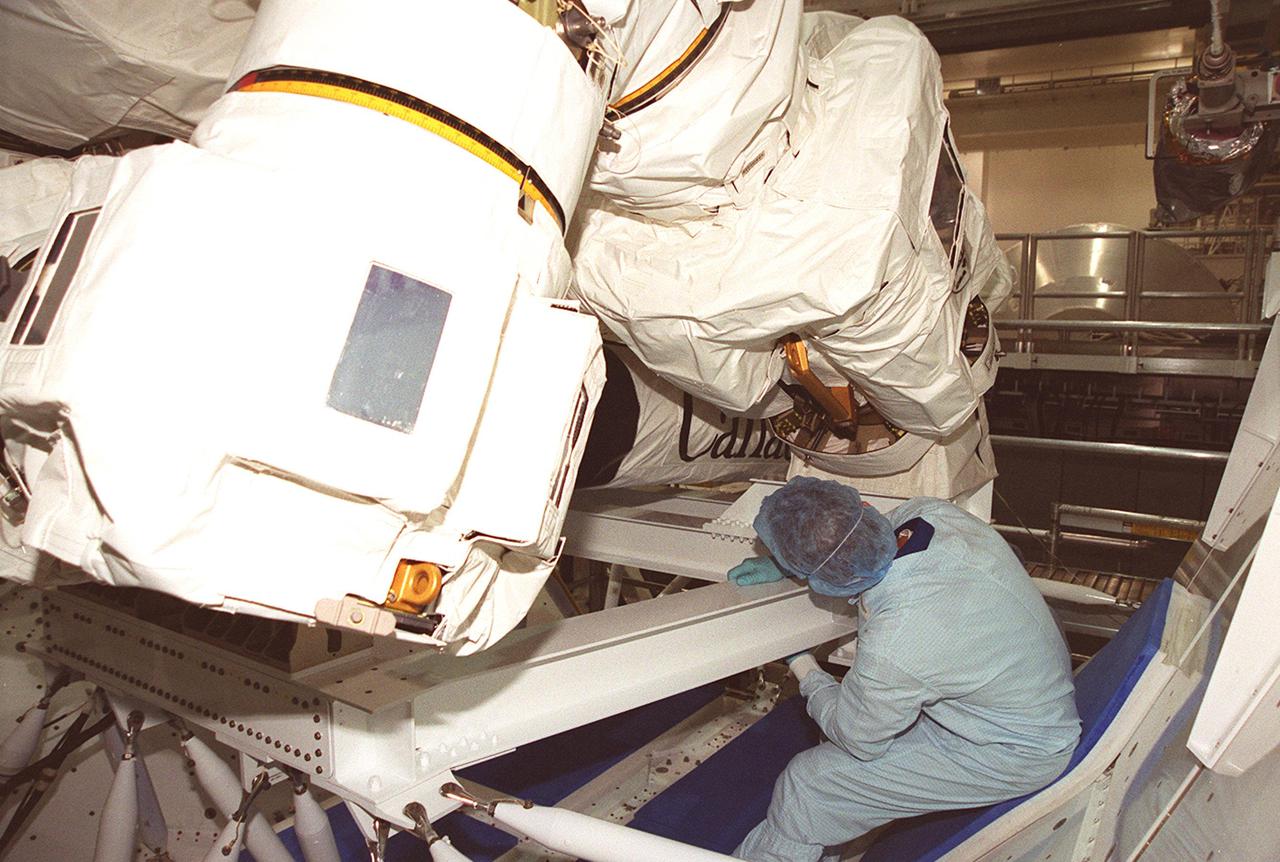
One of the STS-100 crew members looks at part of the Canadian robotic arm, SSRMS, which is on a workstand in the Space Station Processing Facility. The arm is 57.7 feet (17.6 meters) long when fully extended and has seven motorized joints. It is capable of handling large payloads and assisting with docking the Space Shuttle. The SSRMS is self-relocatable with a Latching End Effector, so it can be attached to complementary ports spread throughout the Station’s exterior surfaces. Mission STS-100 is scheduled to launch on Space Shuttle Endeavour April 19 at 2:41 p.m. EDT from Launch Pad 39A, KSC, with a crew of seven. The crew comprises Commander Kent V. Rominger, Pilot Jeffrey S. Ashby and Mission Specialists Chris A. Hadfield, Scott E. Parazynski, John L. Phillips, Umberto Guidoni and Yuri V. Lonchakov. Hadfield is with the Canadian Space Agency, Guidoni the European Space Agency and Lonchakov the Russian Space and Aviation Agency
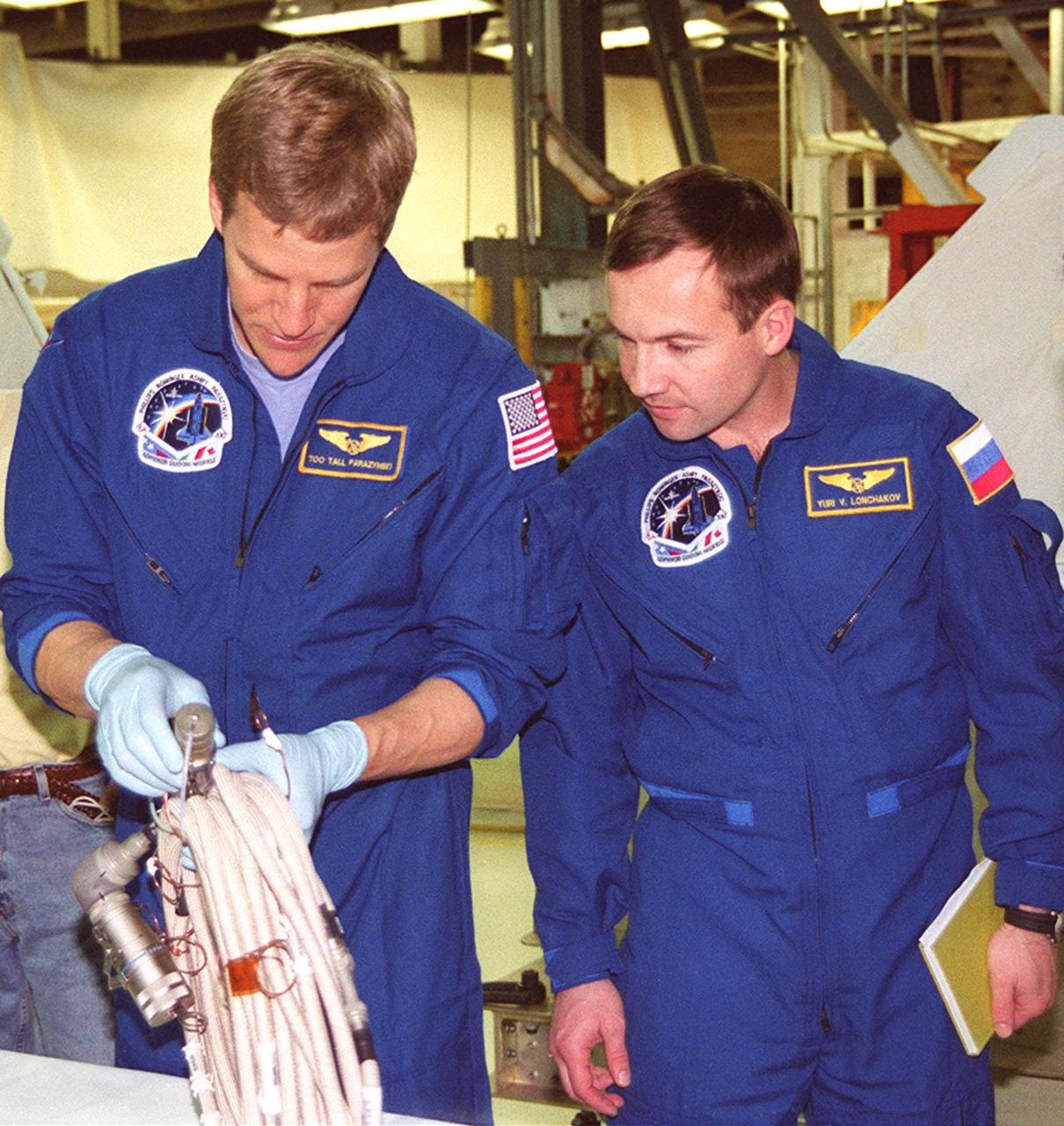
STS-100 Mission Specialists Scott Parazynski (left) and Yuri Lonchakov, who is with the Russian Aviation and Space Agency, look over equipment that will be used during their mission. They are taking part in a Crew Equipment Interface Test (CEIT) at KSC, along with other crew members Commander Kent V. Rominger, Pilot Jeffrey S. Ashby and Mission Specialists Chris Hadfield, who is with the Canadian Space Agency, John L. Phillips and Umberto Guidoni, who is with the European Space Agency. The orbiter is also carrying the Multi-Purpose Logistics Module Raffaello to the International Space Station. Raffaello carries six system racks and two storage racks for the U.S. Lab. Launch of mission STS-100 is scheduled for April 19 at 2:41 p.m. EDT from Launch Pad 39A
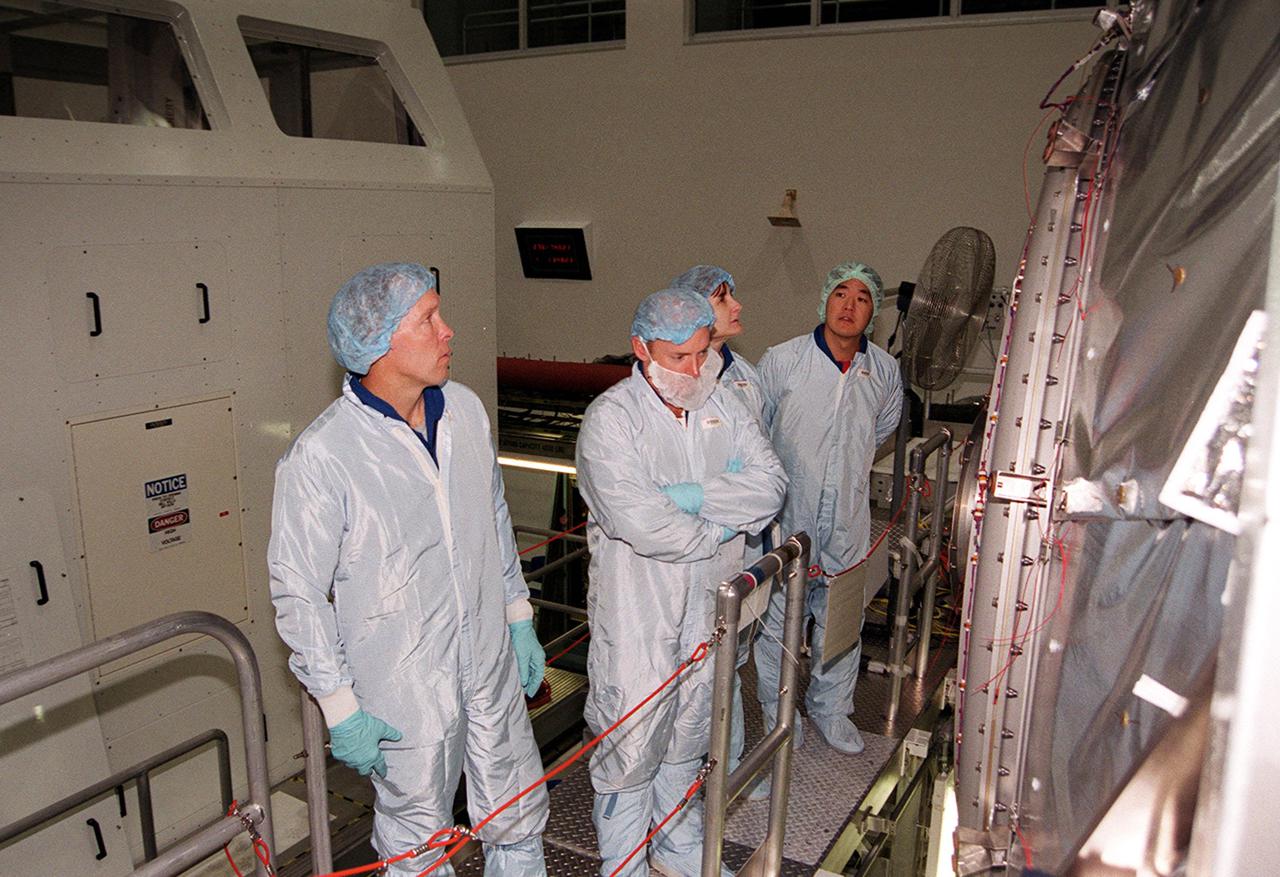
KENNEDY SPACE CENTER, Fla. -- The STS-108 crew look into the hatch of the Multi-Purpose Logistics Module Raffaello. From left are Commander Dominic L. Gorie, Pilot Mark E. Kelly, and Mission Specialists Linda A. Godwin and Daniel M. Tani. The four astronauts are taking part in Crew Equipment Interface Test (CEIT) activities at KSC. The CEIT provides familiarization with the launch vehicle and payload. Mission STS-108 is a Utilization Flight (UF-1), carrying the Expedition Four crew plus Multi-Purpose Logistics Module Raffaello to the International Space Station. The Expedition Four crew comprises Yuri Onufriyenko, commander, Russian Aviation and Space Agency, and astronauts Daniel W. Bursch and Carl E. Walz. Endeavour is scheduled to launch Nov. 29 on mission STS-108
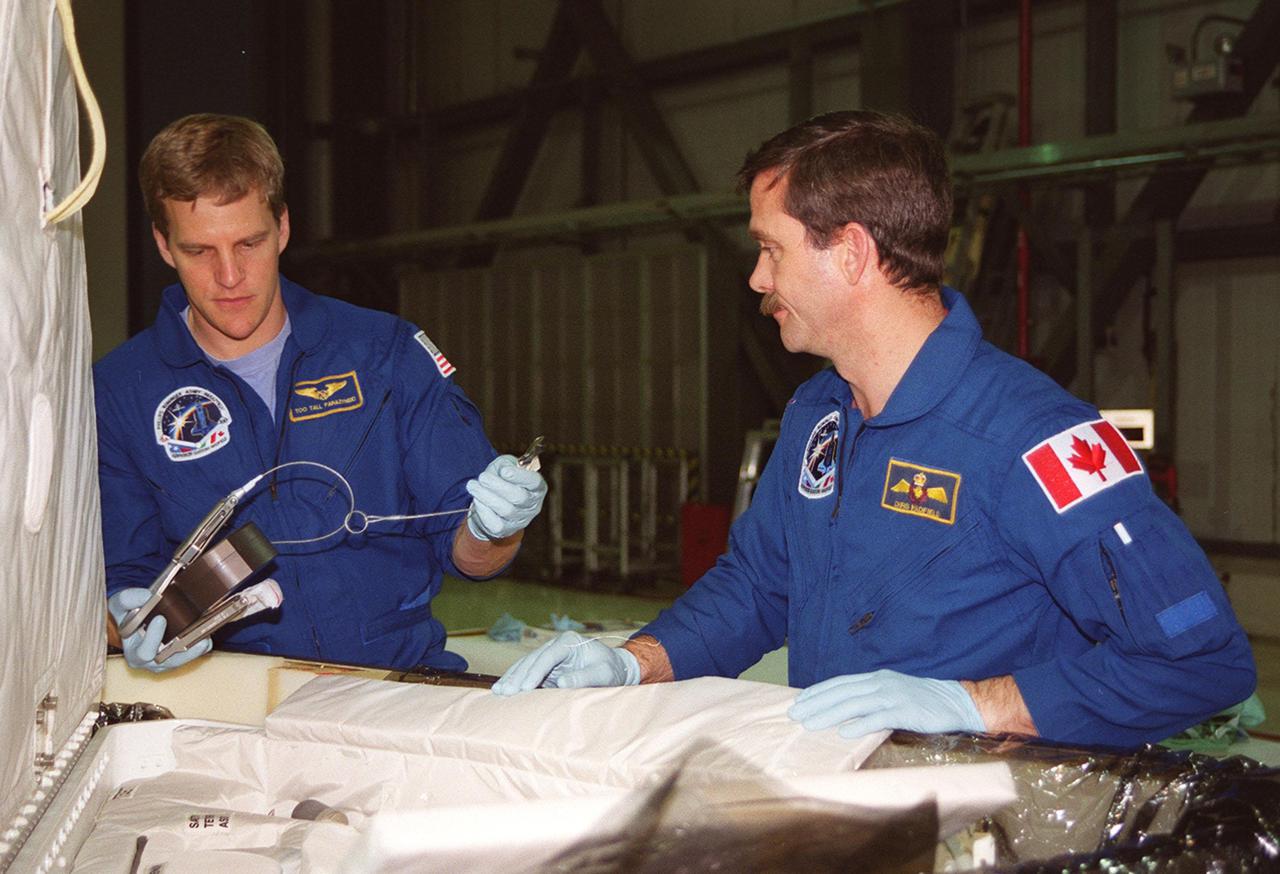
STS-100 Mission Specialists Scott Parazynski (left) and Chris Hadfield (right), who is with the Canadian Space Agency, look over equipment that will be used during their mission. They are taking part in a Crew Equipment Interface Test (CEIT) at KSC, along with other crew members Commander Kent V. Rominger, Pilot Jeffrey S. Ashby and Mission Specialists John L. Phillips, Umberto Guidoni, who is with the European Space Agency, and Yuri Lonchakov, who is with the Russian Aviation and Space Agency. The orbiter is also carrying the Multi-Purpose Logistics Module Raffaello to the International Space Station. Raffaello carries six system racks and two storage racks for the U.S. Lab. Launch of mission STS-100 is scheduled for April 19 at 2:41 p.m. EDT from Launch Pad 39A
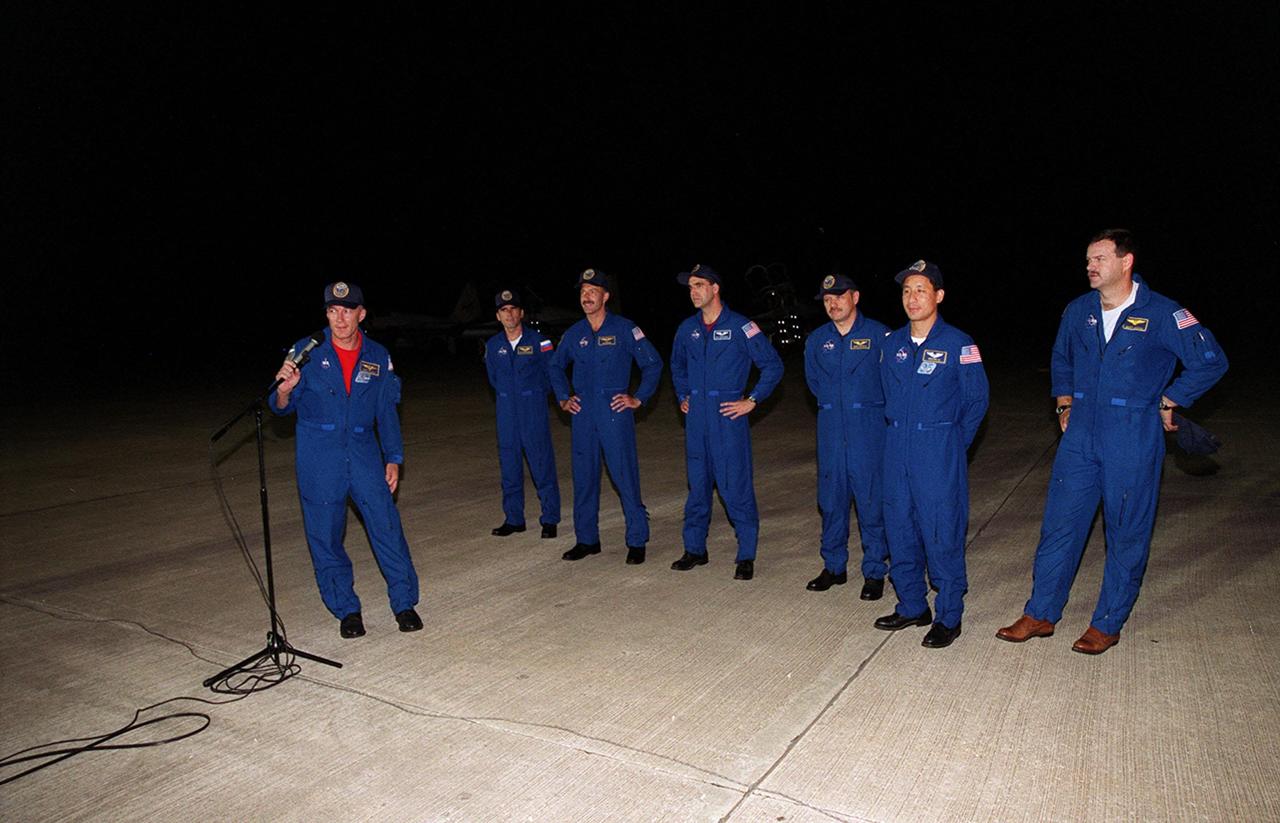
After their arrival at the KSC Shuttle Landing Facility, the STS-106 crew meet the media. Commander Terrence W. Wilcutt, at the microphone, says a few words; the rest of the crew waits behind him. From left, they are Mission Specialists Yuri I. Malenchenko, Daniel C. Burbank, Richard A. Mastracchio, Boris V. Morukov and Edward T. Lu; and Pilot Scott D. Altman. Malenchenko and Morukov are with the Russian Aviation and Space Agency. The crew will be making pre-launch preparations for the fourth flight to the International Space Station. STS-106 is scheduled to launch Sept. 8, 2000, at 8:45 a.m. EDT from Launch Pad 39B. On the 11-day mission, the seven-member crew will perform support tasks on orbit, transfer supplies and prepare the living quarters in the newly arrived Zvezda Service Module. The first long-duration crew, dubbed “Expedition One,” is due to arrive at the Station in late fall
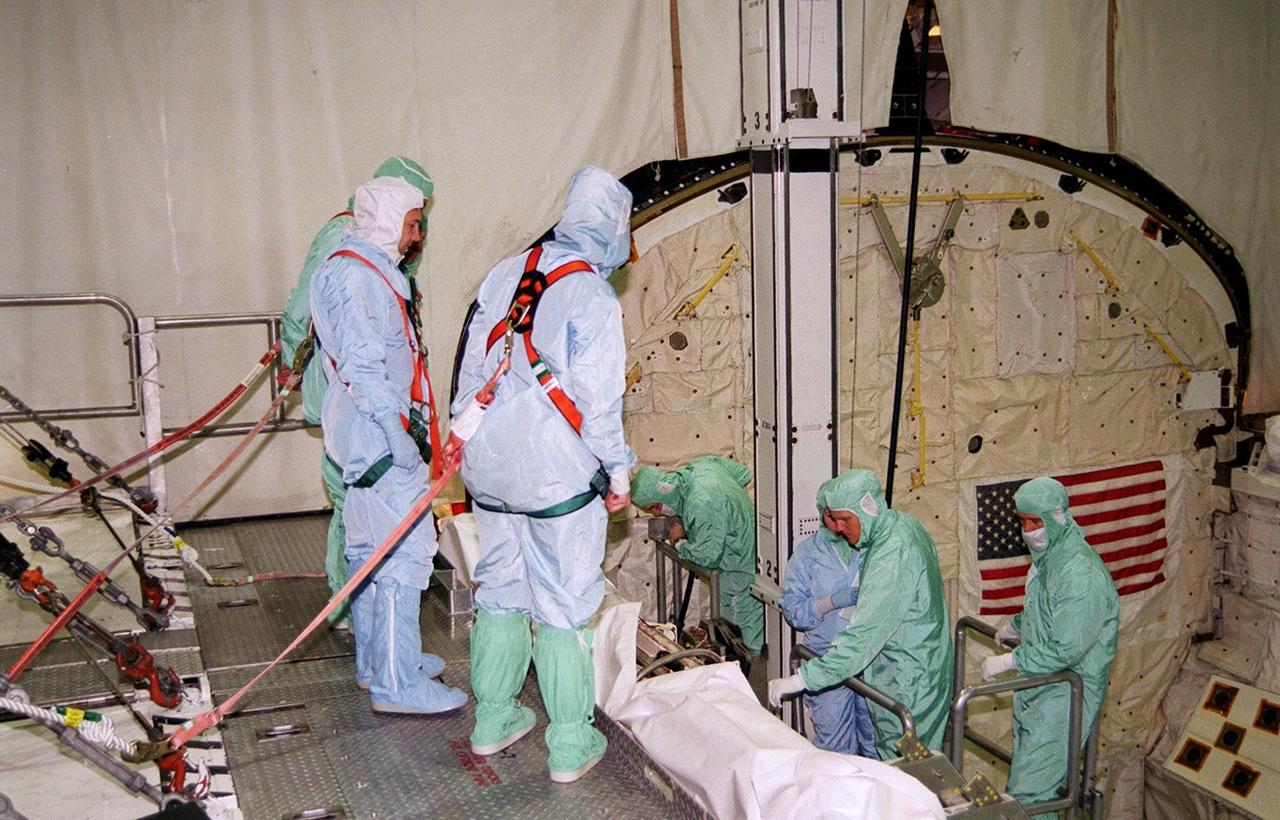
In the Orbiter Processing Facility bay 2, members of the STS-100 crew look over the payload in Endeavour during a Crew Equipment Interface Test (CEIT) at KSC. Lowered into the payload bay, they are looking at the Canadian robotic arm, SSRMS. The crew comprises Commander Kent V. Rominger, Pilot Jeffrey S. Ashby and Mission Specialists Chris Hadfield, who is with the Canadian Space Agency, Scott Parazynski, John L. Phillips, Umberto Guidoni, who is with the European Space Agency, and Yuri Lonchakov, who is with the Russian Aviation and Space Agency. The orbiter is also carrying the Multi-Purpose Logistics Module Raffaello to the International Space Station. Raffaello carries six system racks and two storage racks for the U.S. Lab. The SSRMS will be attached to the Space Station to aid in assembling future components. Launch of mission STS-100 is scheduled for April 19 at 2:41 p.m. EDT from Launch Pad 39A
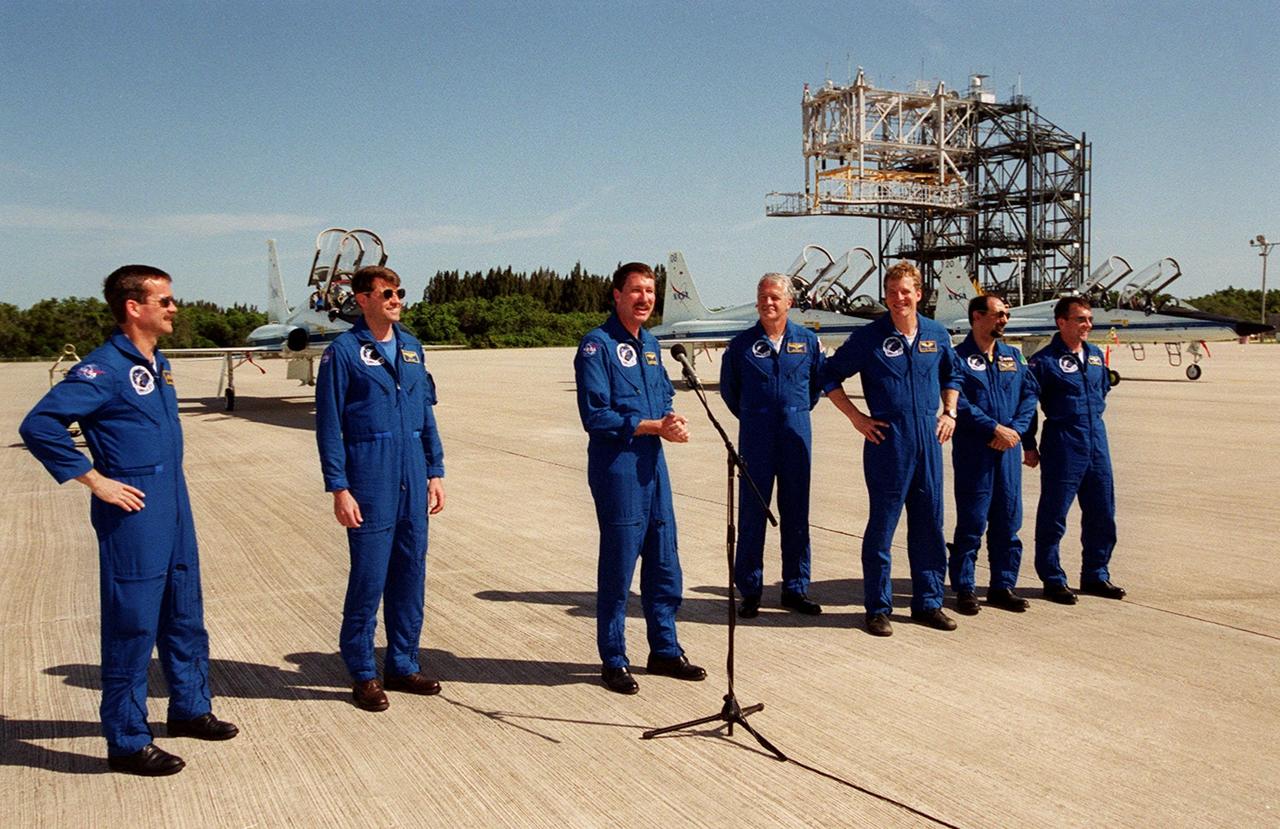
The STS-100 crew speak to the media after their arrival at the KSC Shuttle Landing Facility. Standing, from left, are Mission Specialist Chris A. Hadfield, Pilot Jeffrey S. Ashby, Commander Kent V. Rominger at the microphone, and Mission Specialists John L. Phillips, Scott E. Parazynski, Umberto Guidoni and Yuri V. Lonchakov. The international crew represents, along with America, the Canadian Space Agency (Hadfield) , the European Space Agency (Guidoni), and the Russian Aviation and Space Agency (Lonchakov). The 11-day mission to the International Space Station will deliver and integrate the Spacelab Logistics Pallet/Launch Deployment Assembly, which includes the Space Station Remote Manipulator system and the UHF Antenna, and the Multi-Purpose Logistics Module Raffaello. Liftoff on mission STS-100 is scheduled at 2:41 p.m. EDT April 19

STS-100 Mission Specialists Scott Parazynski (left) and Chris Hadfield (right), who is with the Canadian Space Agency, look over equipment that will be used during their mission. They are taking part in a Crew Equipment Interface Test (CEIT) at KSC, along with other crew members Commander Kent V. Rominger, Pilot Jeffrey S. Ashby and Mission Specialists John L. Phillips, Umberto Guidoni, who is with the European Space Agency, and Yuri Lonchakov, who is with the Russian Aviation and Space Agency. The orbiter is also carrying the Multi-Purpose Logistics Module Raffaello to the International Space Station. Raffaello carries six system racks and two storage racks for the U.S. Lab. Launch of mission STS-100 is scheduled for April 19 at 2:41 p.m. EDT from Launch Pad 39A
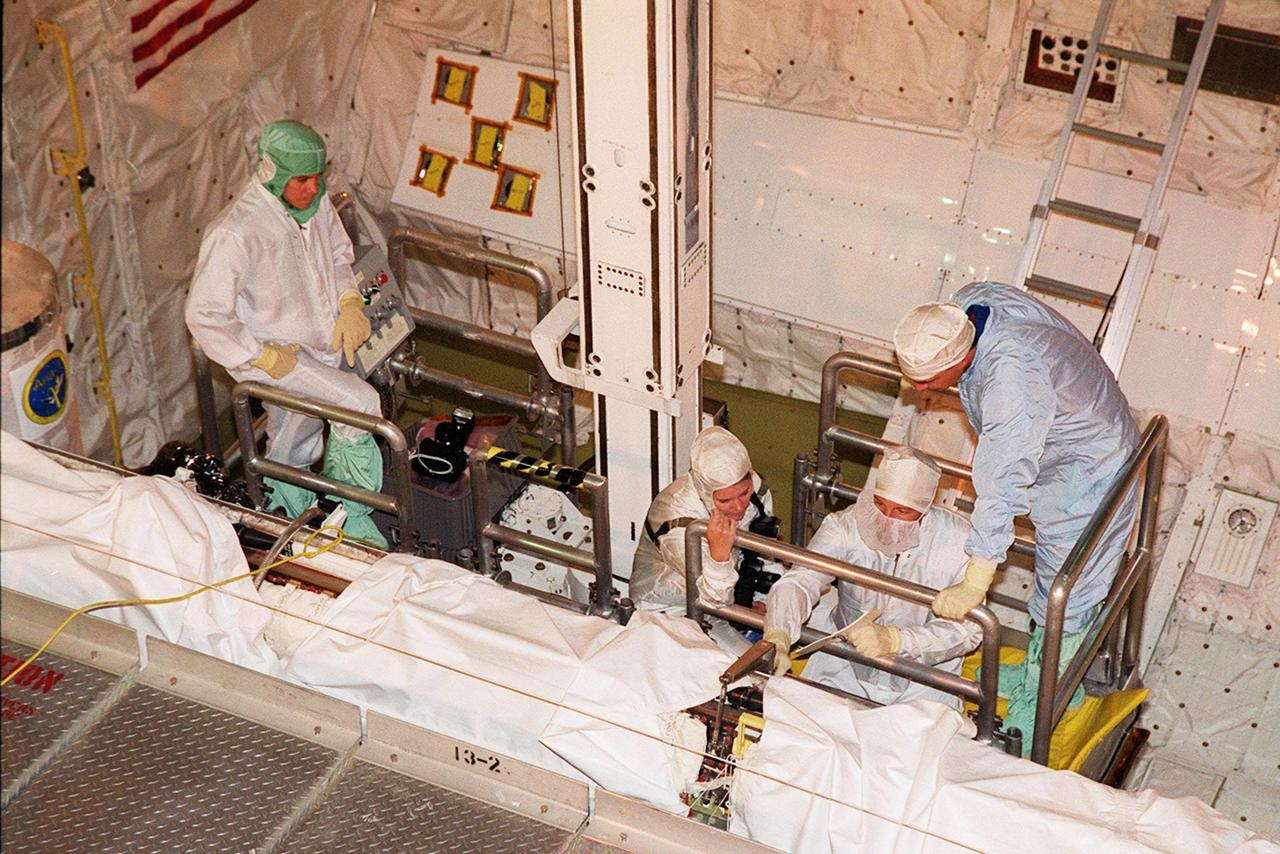
In Orbiter Processing Facility bay 3, members of the STS-106 crew familiarize themselves with equipment in the payload bay of Space Shuttle orbiter Atlantis with the help of KSC employees as part of Crew Equipment Interface Test (CEIT) activities for their mission. The STS-106 crew members are Commander Terrence W. Wilcutt, Pilot Scott D. Altman, and Mission Specialists Edward T. Lu, Daniel C. Burbank, Yuri I. Malenchenko, Boris V. Morukov and Richard A. Mastracchio. Malenchenko and Morukov represent the Russian Aviation and Space Agency. On the 11-day mission, the seven-member crew will perform support tasks on orbit, transfer supplies and prepare the living quarters in the newly arrived Zvezda Service Module for the first long-duration crew, dubbed "Expedition One," which is due to arrive at the Station in late fall. STS-106 is scheduled to launch Sept. 8, 2000, at 8:31 a.m. EDT from Launch Pad 39B
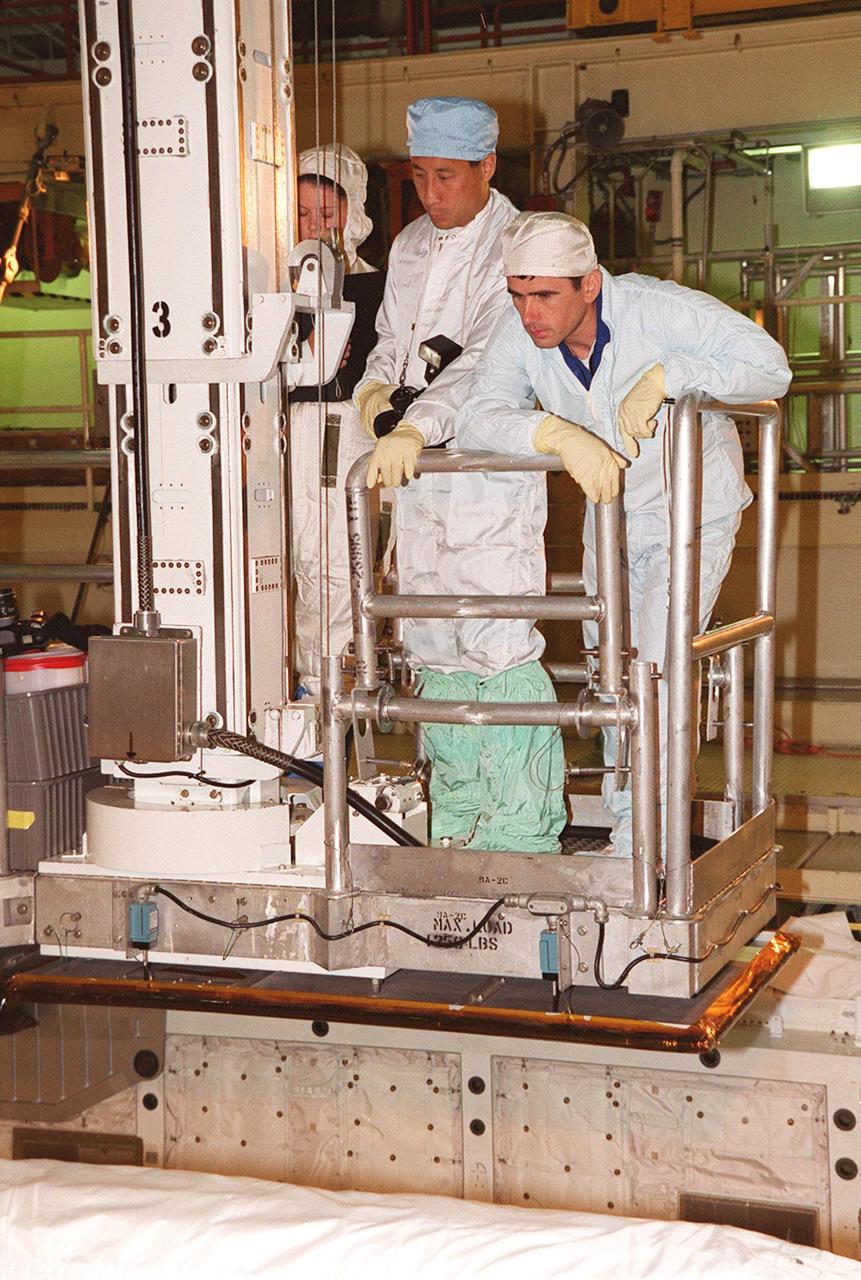
In Orbiter Processing Facility bay 3, STS-106 Mission Specialists Edward T. Lu (center) and Yuri I. Malenchenko (right) familiarize themselves with equipment in the payload bay of Space Shuttle orbiter Atlantis with the help of KSC employees as part of Crew Equipment Interface Test (CEIT) activities for their mission. The other crew members are Commander Terrence W. Wilcutt, Pilot Scott D. Altman, and Mission Specialists Daniel C. Burbank, Boris V. Morukov and Richard A. Mastracchio. Malenchenko and Morukov represent the Russian Aviation and Space Agency. On the 11-day mission, the seven-member crew will perform support tasks on orbit, transfer supplies and prepare the living quarters in the newly arrived Zvezda Service Module for the first long-duration crew, dubbed "Expedition One," which is due to arrive at the Station in late fall. STS-106 is scheduled to launch Sept. 8, 2000, at 8:31 a.m. EDT from Launch Pad 39B
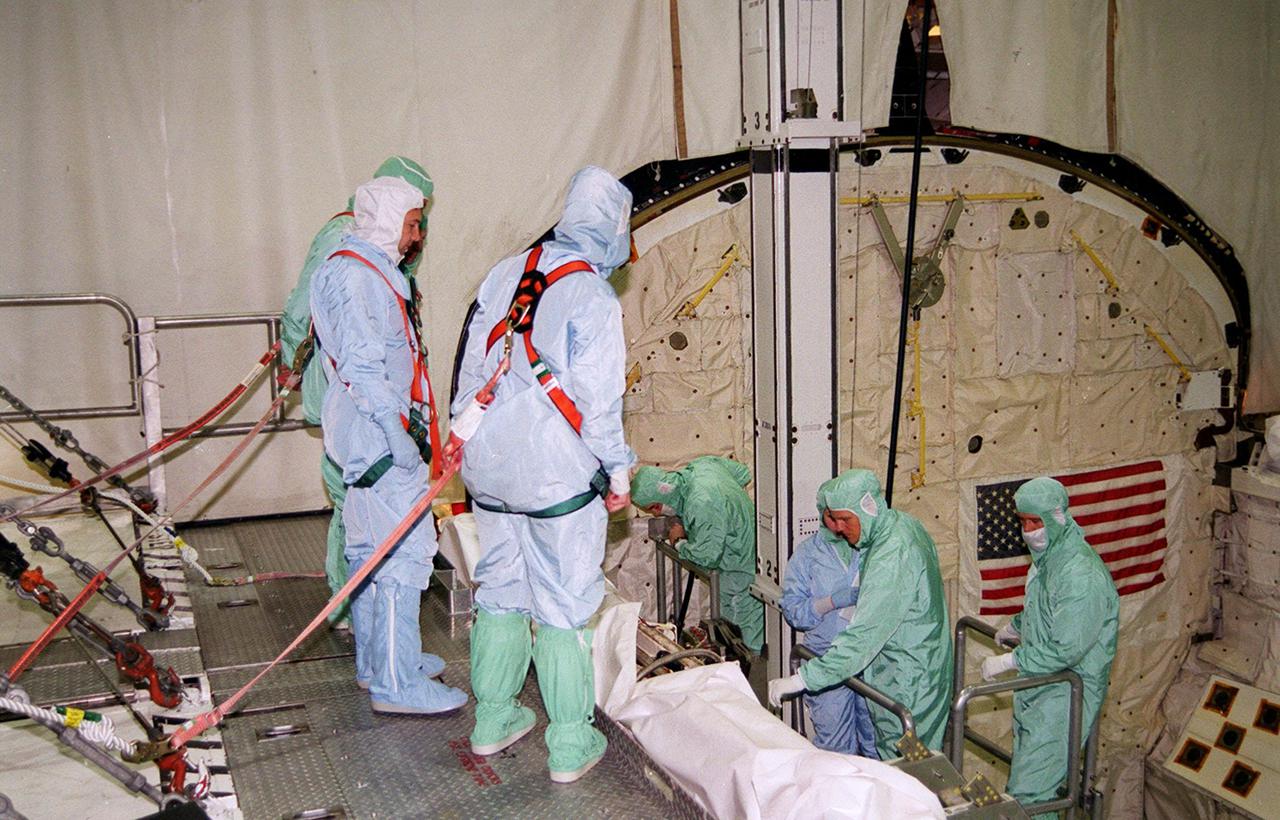
In the Orbiter Processing Facility bay 2, members of the STS-100 crew look over the payload in Endeavour during a Crew Equipment Interface Test (CEIT) at KSC. Lowered into the payload bay, they are looking at the Canadian robotic arm, SSRMS. The crew comprises Commander Kent V. Rominger, Pilot Jeffrey S. Ashby and Mission Specialists Chris Hadfield, who is with the Canadian Space Agency, Scott Parazynski, John L. Phillips, Umberto Guidoni, who is with the European Space Agency, and Yuri Lonchakov, who is with the Russian Aviation and Space Agency. The orbiter is also carrying the Multi-Purpose Logistics Module Raffaello to the International Space Station. Raffaello carries six system racks and two storage racks for the U.S. Lab. The SSRMS will be attached to the Space Station to aid in assembling future components. Launch of mission STS-100 is scheduled for April 19 at 2:41 p.m. EDT from Launch Pad 39A
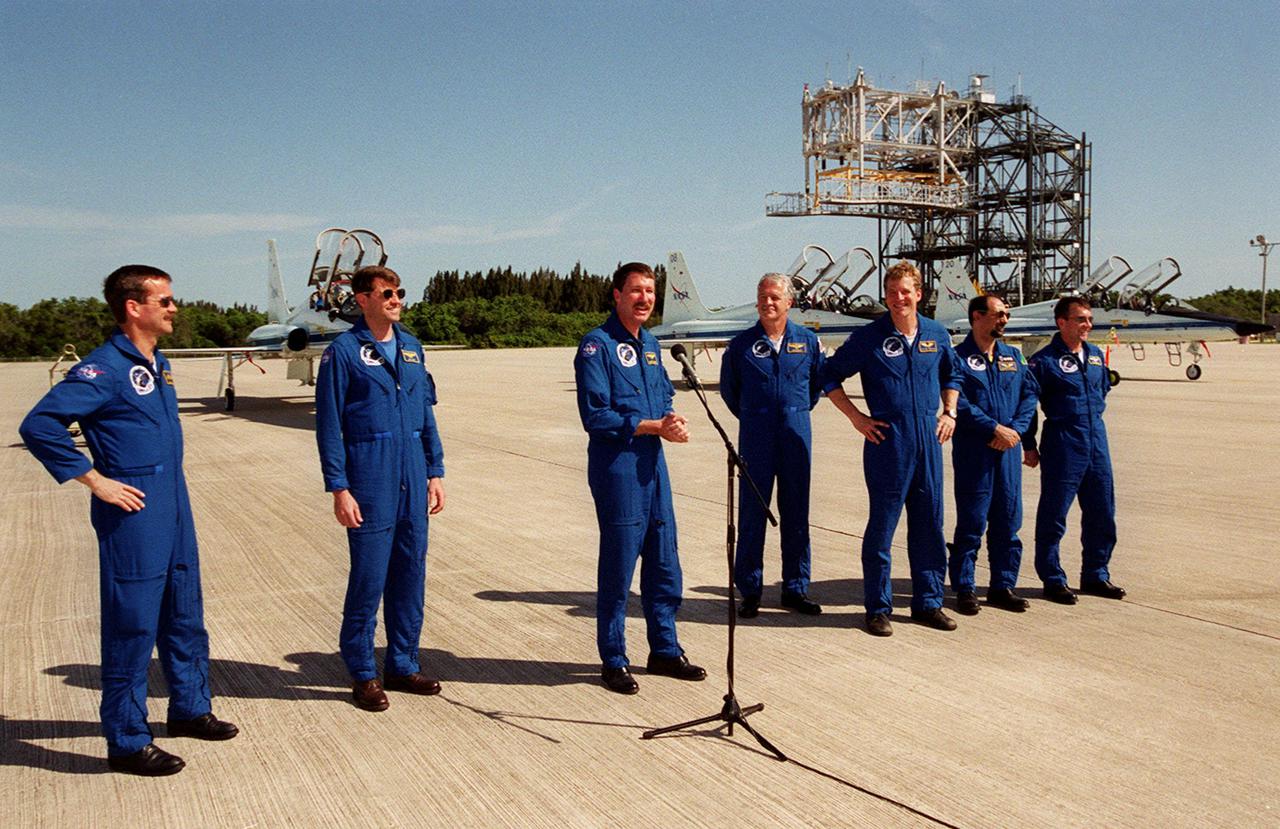
The STS-100 crew speak to the media after their arrival at the KSC Shuttle Landing Facility. Standing, from left, are Mission Specialist Chris A. Hadfield, Pilot Jeffrey S. Ashby, Commander Kent V. Rominger at the microphone, and Mission Specialists John L. Phillips, Scott E. Parazynski, Umberto Guidoni and Yuri V. Lonchakov. The international crew represents, along with America, the Canadian Space Agency (Hadfield) , the European Space Agency (Guidoni), and the Russian Aviation and Space Agency (Lonchakov). The 11-day mission to the International Space Station will deliver and integrate the Spacelab Logistics Pallet_Launch Deployment Assembly, which includes the Space Station Remote Manipulator system and the UHF Antenna, and the Multi-Purpose Logistics Module Raffaello. Liftoff on mission STS-100 is scheduled at 2:41 p.m. EDT April 19
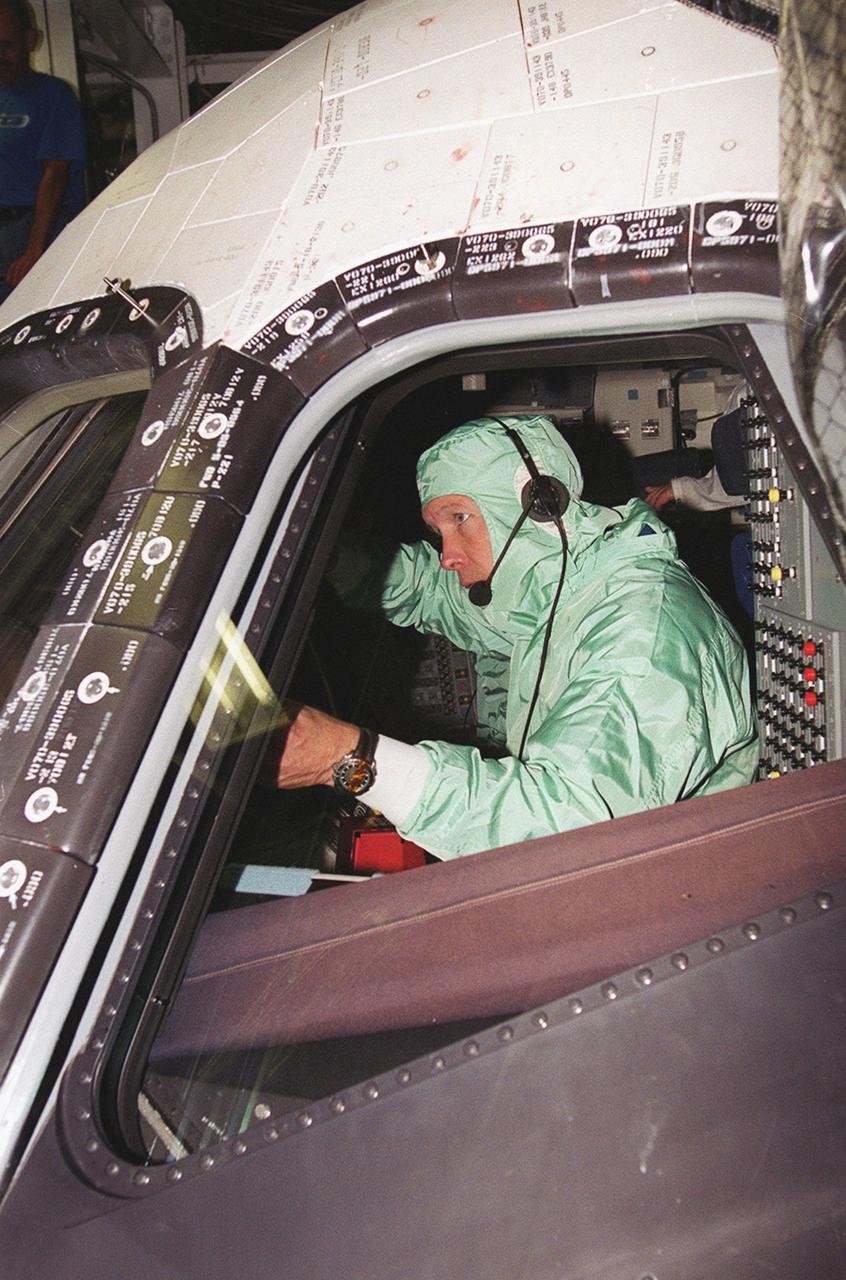
KENNEDY SPACE CENTER, Fla. -- During Crew Equipment Interface Test (CEIT) activities at KSC, STS-108 Commander Dominic L. Gorie checks the windshield inside orbiter Endeavour. The CEIT provides familiarization with the launch vehicle and payload. Mission STS-108 is a Utilization Flight (UF-1), carrying the Expedition Four crew plus Multi-Purpose Logistics Module Raffaello to the International Space Station. The mission crew comprises Gorie, Pilot Mark E. Kelly and Mission Specialists Linda A. Godwin and Daniel M. Tani. The Expedition Four crew comprises Yuri Onufriyenko, commander, Russian Aviation and Space Agency, and astronauts Daniel W. Bursch and Carl E. Walz. Endeavour is scheduled to launch Nov. 29 on mission STS-108
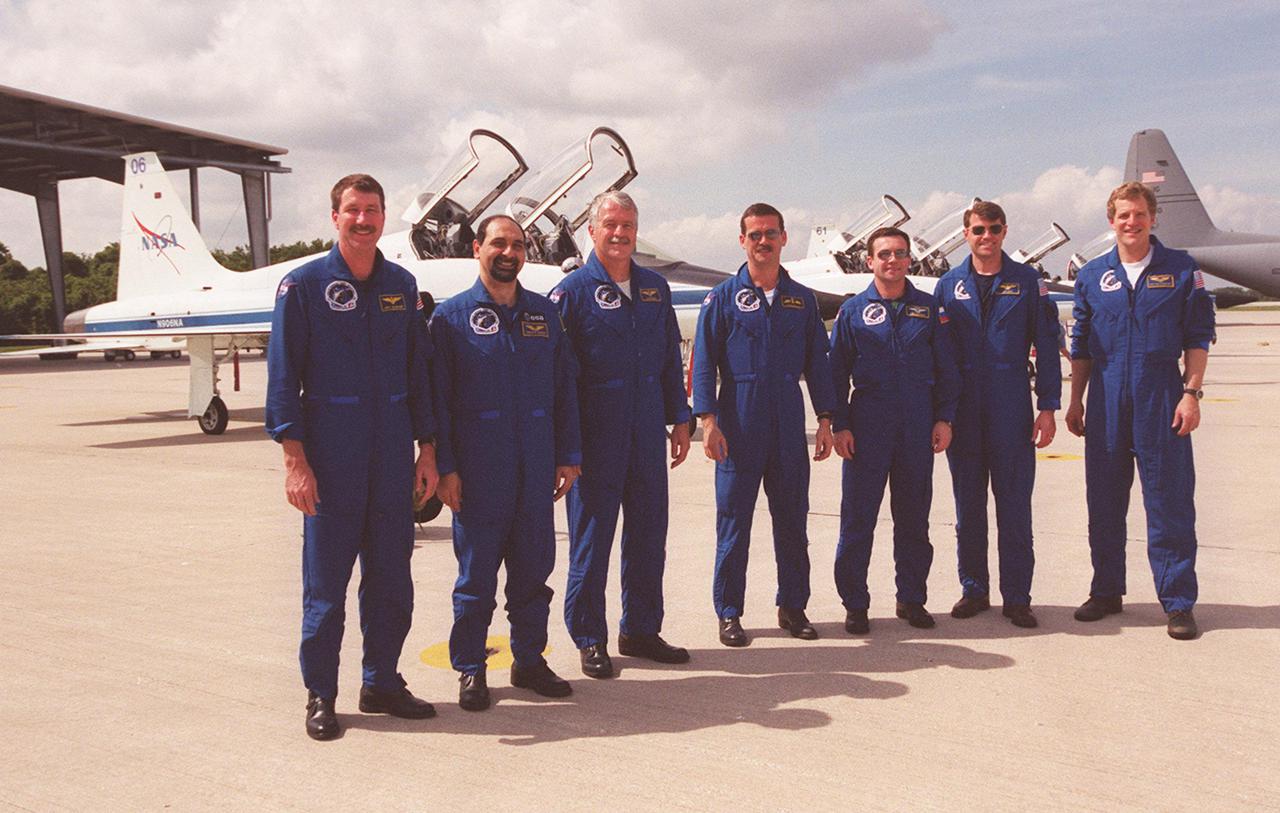
The STS-100 crew poses for a photo after their arrival at KSC to complete Terminal Countdown Demonstration Test activities that were postponed earlier. Standing, from left, are Commander Kent V. Rominger; Mission Specialists Umberto Guidoni, John L. Phillips, Chris A. Hadfield and Yuri V. Lonchakov; Pilot Jeffrey S. Ashby; and Mission Specialist Scott E. Parazynski. An international crew, Guidoni is with the European Space Agency, Hadfield the Canadian Space Agency, and Lonchakov the Russian Space and Aviation Agency. The TCDT includes emergency escape training, payload bay walkdown, and a simulated launch countdown. The primary payload comprises the Canadian robotic arm, SSRMS, and Multi-Purpose Logistics Module, Raffaello. Launch of Space Shuttle Endeavour on mission STS-100 is targeted for April 19 at 2:41 p.m. EDT from Launch Pad 39A
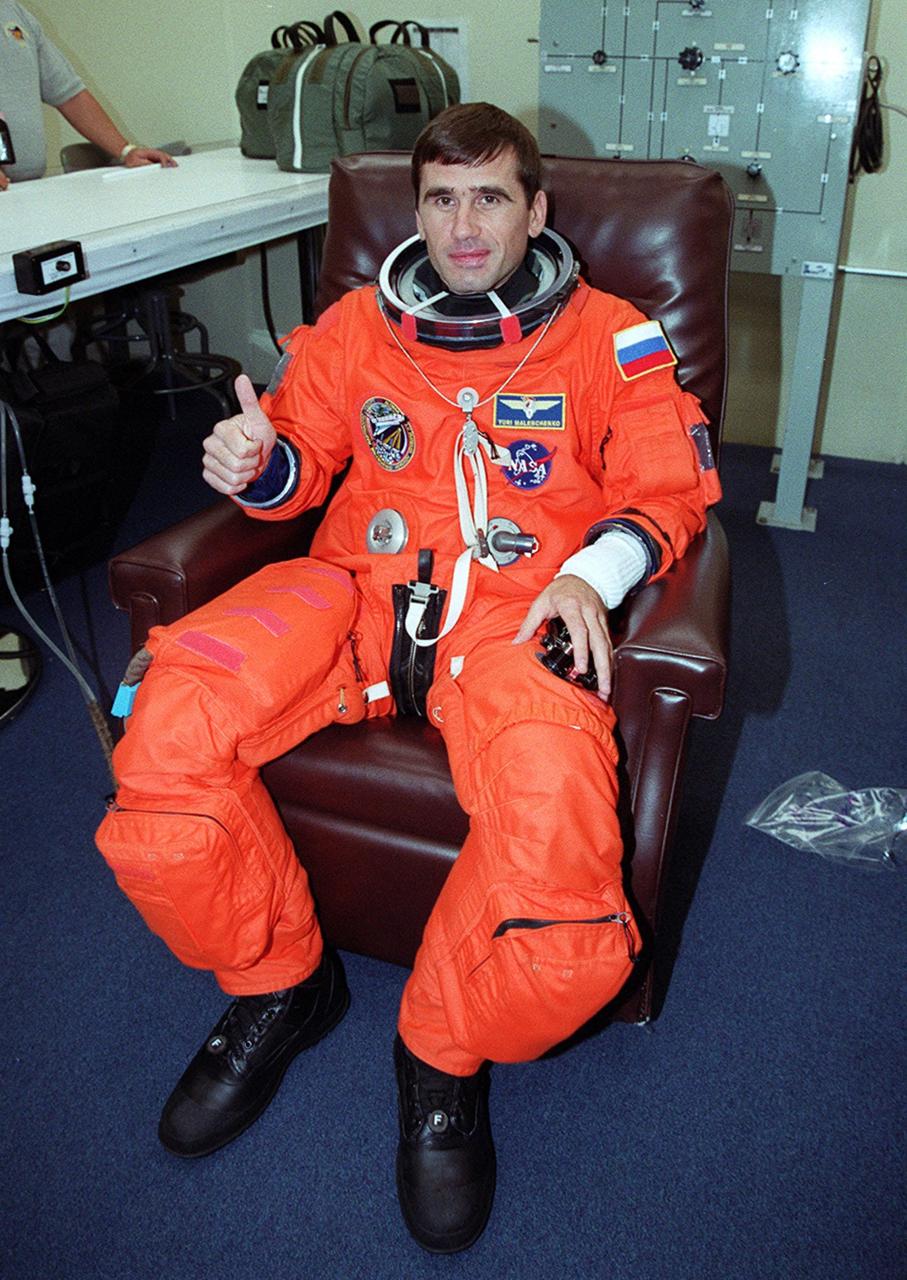
STS-106 Mission Specialist Yuri I. Malenchenko signals thumbs up for launch during suitup in the Operations and Checkout Building. This is Malenchenko’s first Shuttle flight. Space Shuttle Atlantis is set to lift off 8:45 a.m. EDT on the fourth flight to the International Space Station. During the 11-day mission, the seven-member crew will perform support tasks on orbit, transfer supplies and prepare the living quarters in the newly arrived Zvezda Service Module. The first long-duration crew, dubbed “Expedition One,” is due to arrive at the Station in late fall. Malenchenko, who is with the Russian Aviation and Space Agency, will perform a space walk along with Mission Specialist Edward T. Lu to connect electrical lines and data cables from Zvezda to the rest of the Station. Atlantis is scheduled to land at KSC Sept. 19 at 4:59 a.m. EDT
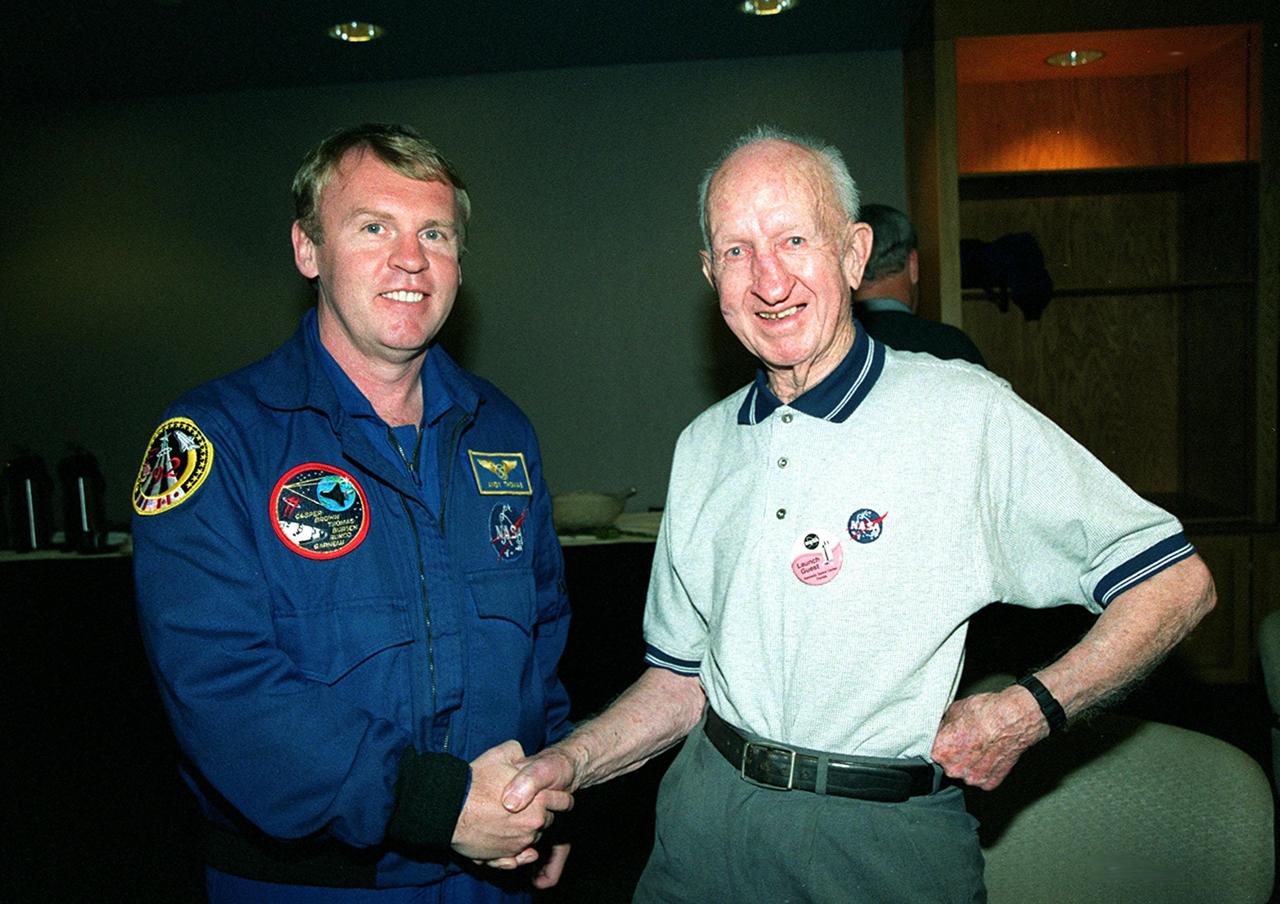
Astronaut Andy Thomas (left) greets 100-year-old Captain Ralph Charles, one of the VIPs attending the launch of STS-99. Charles also met NASA Administrator Dan Goldin. An aviator who has the distinction of being the oldest licensed pilot in the United States, Charles is still flying. He has experienced nearly a century of flight history, from the Wright Brothers to the Space Program. He took flying lessons from one of the first fliers trained by Orville Wright, first repaired then built airplanes, went barnstorming, operated a charter service in the Caribbean, and worked as a test pilot for the Curtiss Wright Airplane Co. Charles watches all the Shuttle launches from his home in Ohio and his greatest wish is to be able to watch one in person from KSC
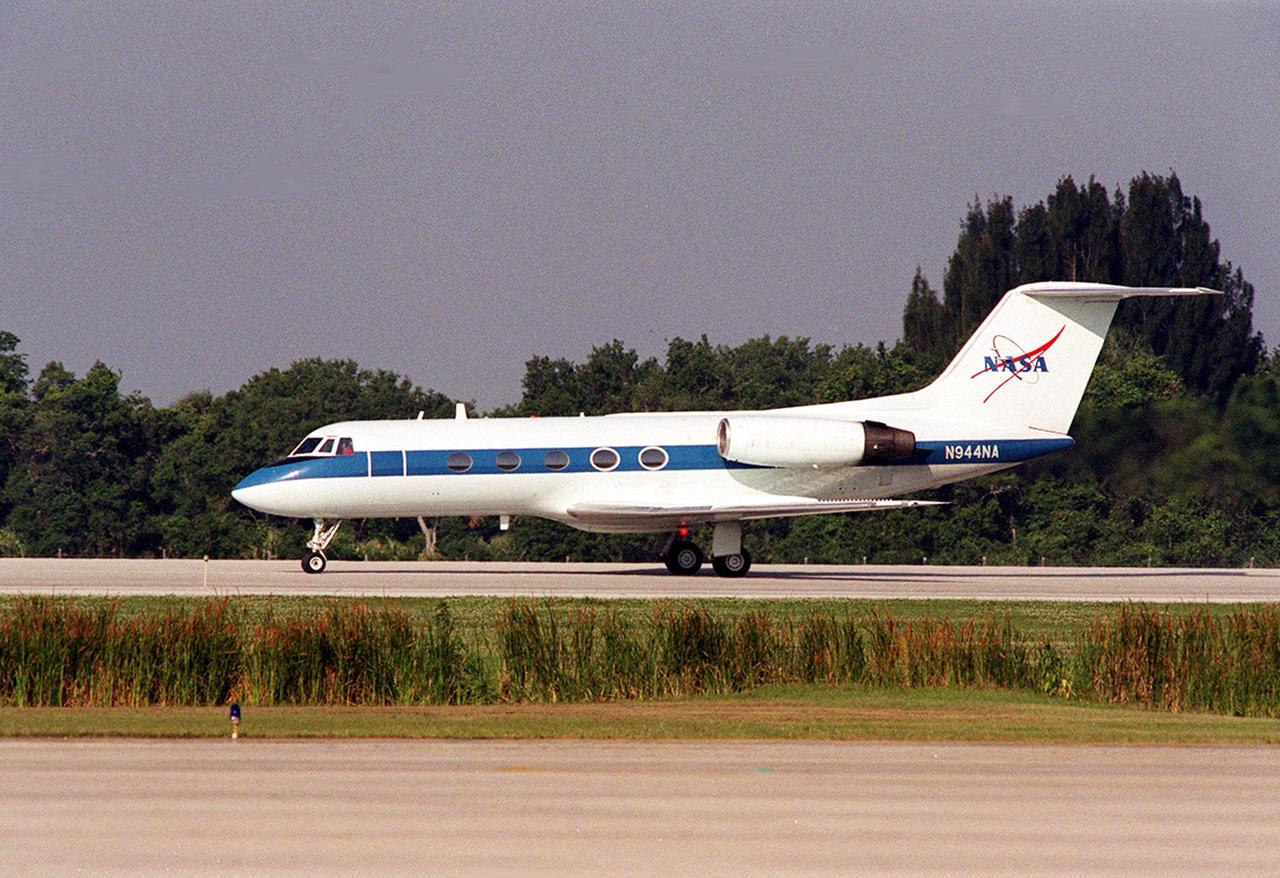
A Shuttle Training Aircraft (STA) taxis down the runway at KSC's Shuttle Landing Facility. The STA is a modified Grumman American Aviation-built Gulfstream II executive jet that was modified to simulate an orbiter's cockpit, motion and visual cues, and handling qualities. It is used by Shuttle flight crews to practice landing the orbiter. In flight, the STA duplicates the orbiter's atmospheric descent trajectory from approximately 35,000 feet altitude to landing on a runway. The orbiter differs in at least one major aspect from conventional aircraft; it is unpowered during re-entry and landing so its high-speed glide must be perfectly executed the first time there is no go-around capability. The orbiter touchdown speed is 213 to 226 miles (343 to 364 kilometers) per hour. There are two STAs, based in Houston
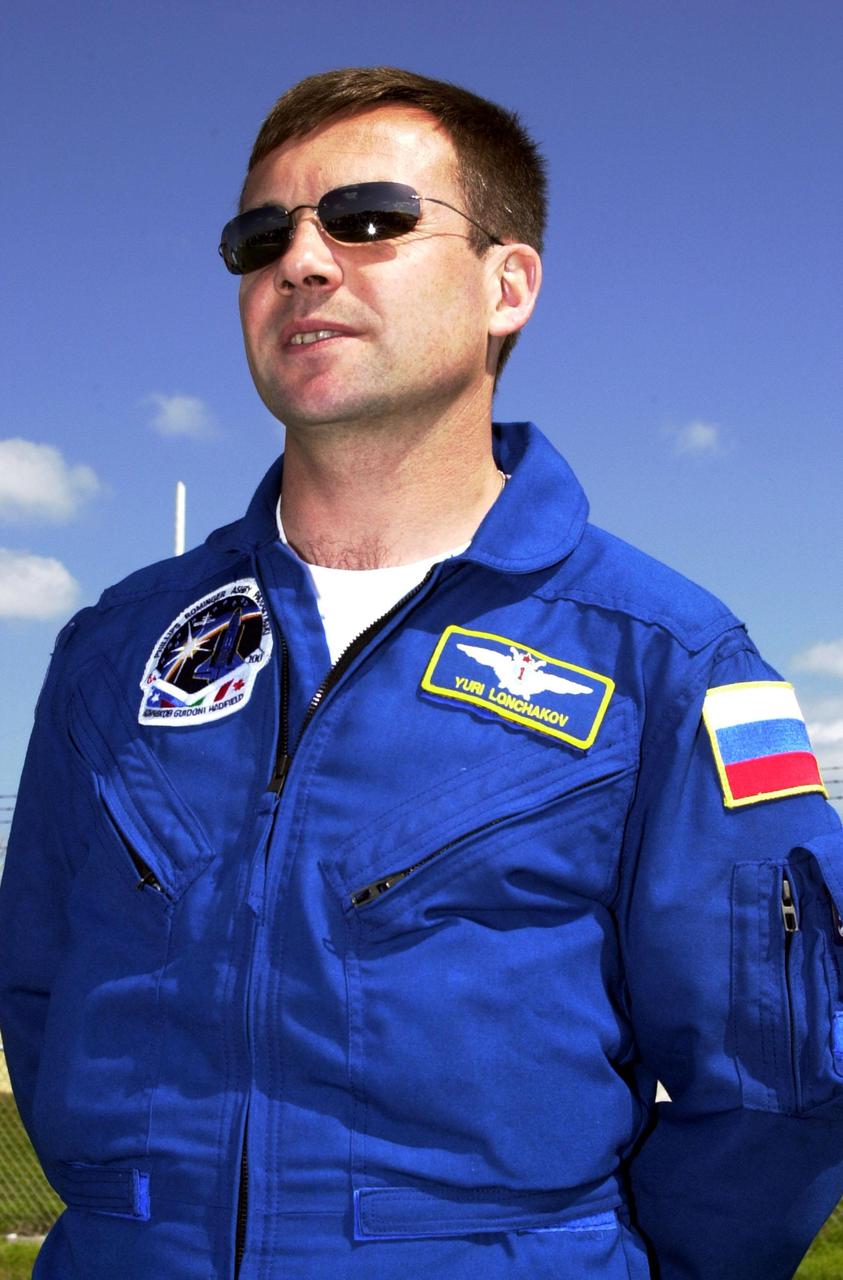
KENNEDY SPACE CENTER, FLA. -- STS-100 Mission Specialist Yuri V. Lonchakov stands near Launch Pad 39A to greet family and friends. Lonchakov is with the Russian Aviation and Space Agency. The crew is at KSC to complete final flight plan reviews in anticipation of launch. The 11-day mission to the International Space Station will deliver and integrate the Spacelab Logistics Pallet_Launch Deployment Assembly, which includes the Space Station Remote Manipulator system and the UHF Antenna, and the Multi-Purpose Logistics Module Raffaello. The mission includes two planned spacewalks for installation of the SSRMS. The mission is also the inaugural flight of the MPLM Raffaello, carrying resupply stowage racks and resupply_return stowage platforms. Liftoff on mission STS-100 is scheduled at 2:41 p.m. EDT April 19
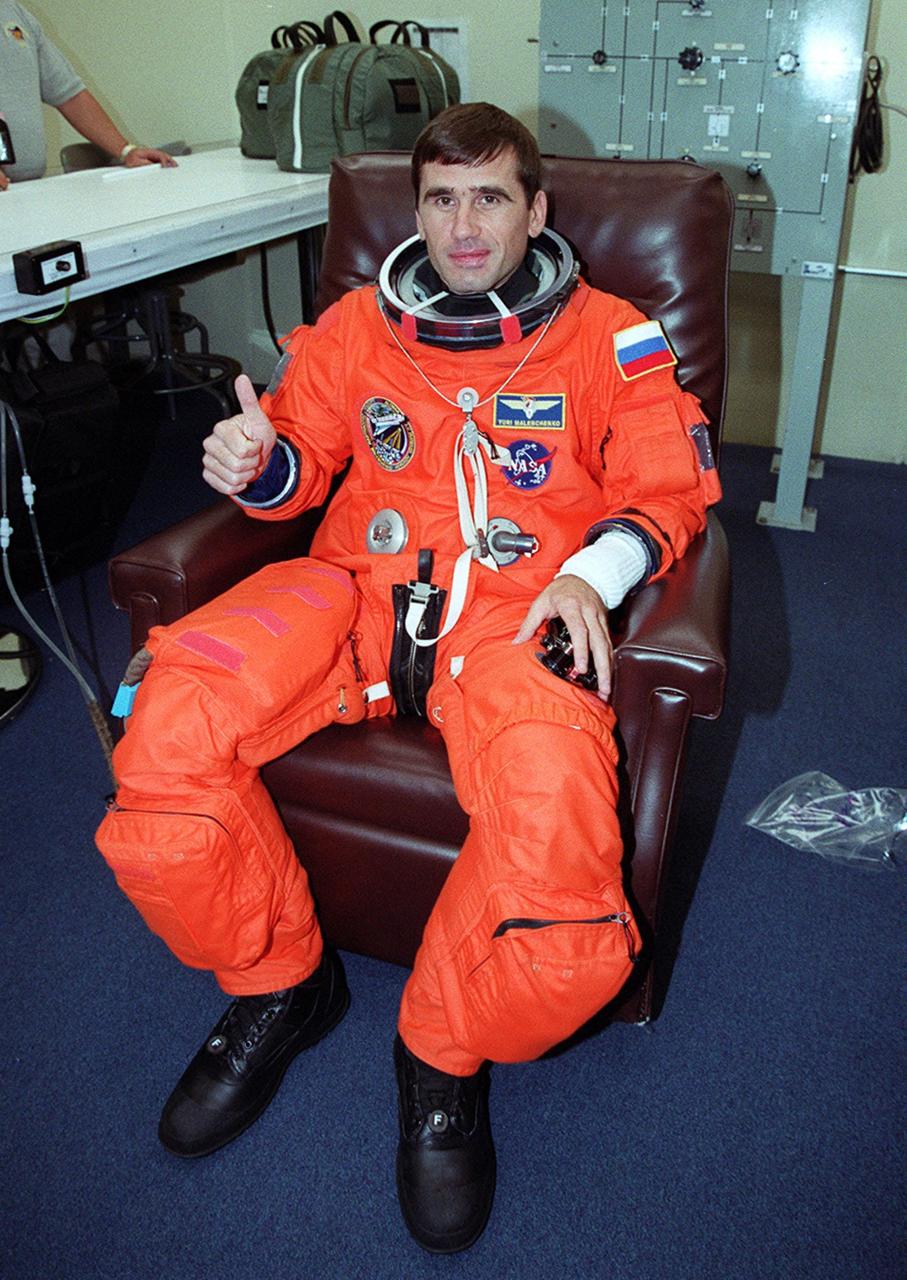
STS-106 Mission Specialist Yuri I. Malenchenko signals thumbs up for launch during suitup in the Operations and Checkout Building. This is Malenchenko’s first Shuttle flight. Space Shuttle Atlantis is set to lift off 8:45 a.m. EDT on the fourth flight to the International Space Station. During the 11-day mission, the seven-member crew will perform support tasks on orbit, transfer supplies and prepare the living quarters in the newly arrived Zvezda Service Module. The first long-duration crew, dubbed “Expedition One,” is due to arrive at the Station in late fall. Malenchenko, who is with the Russian Aviation and Space Agency, will perform a space walk along with Mission Specialist Edward T. Lu to connect electrical lines and data cables from Zvezda to the rest of the Station. Atlantis is scheduled to land at KSC Sept. 19 at 4:59 a.m. EDT
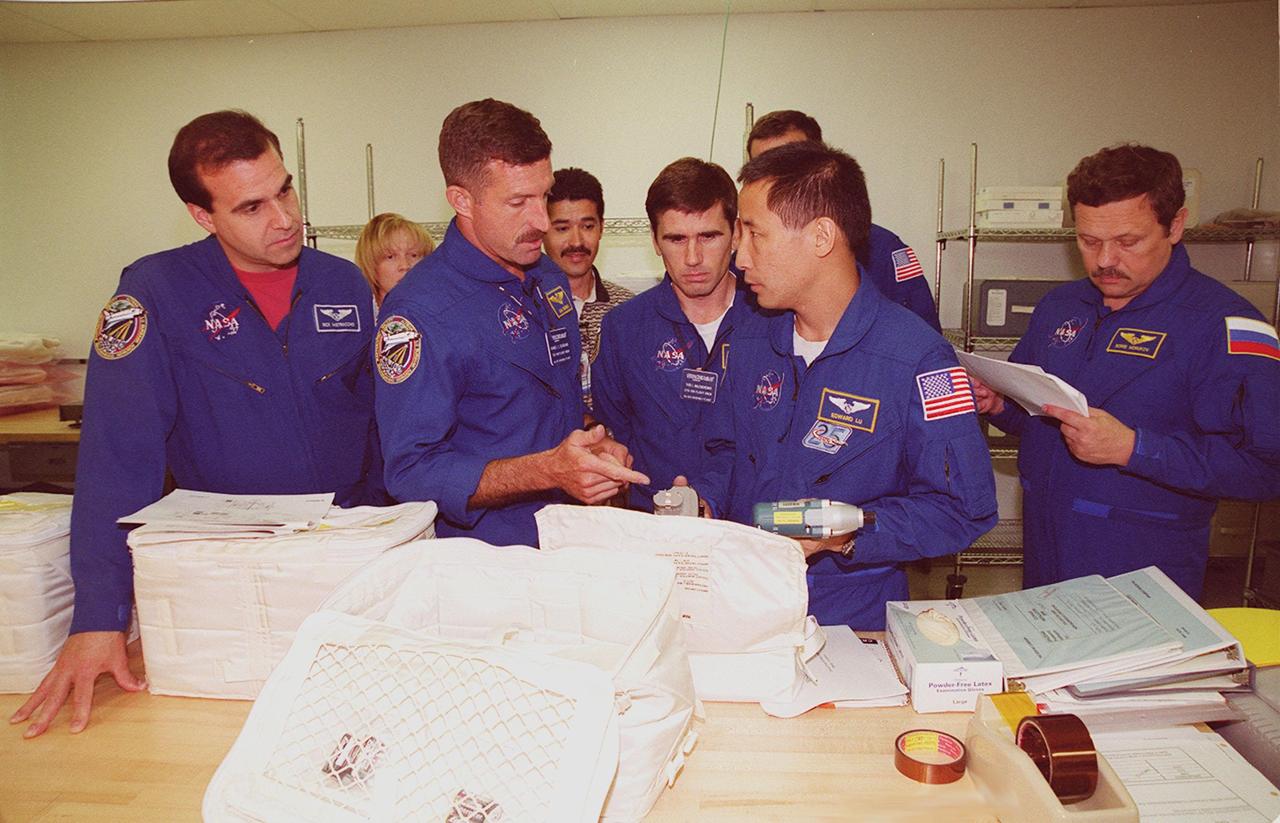
KENNEDY SPACE CENTER, FLA. -- At SPACEHAB members of the STS-106 crew check out equipment they will be using during their mission to the International Space Station. From left are Mission Specialists Richard A. Mastracchio, Daniel C. Burbank, Yuri I. Malenchenko, Edward T. Lu and Boris V. Morukov. Behind Lu is Pilot Scott D. Altman. Not seen is Commander Terrence W. Wilcutt. Malenchenko and Morukov represent the Russian Aviation and Space Agency. The astronauts are taking part in Crew Equipment Interface Test activities at KSC. On the 11-day mission, the seven-member crew will perform support tasks on orbit, transfer supplies and prepare the living quarters in the newly arrived Zvezda Service Module for the first long-duration crew, dubbed "Expedition One," which is due to arrive at the Station in late fall. STS-106 is scheduled to launch Sept. 8, 2000, at 8:31 a.m. EDT from Launch Pad 39B
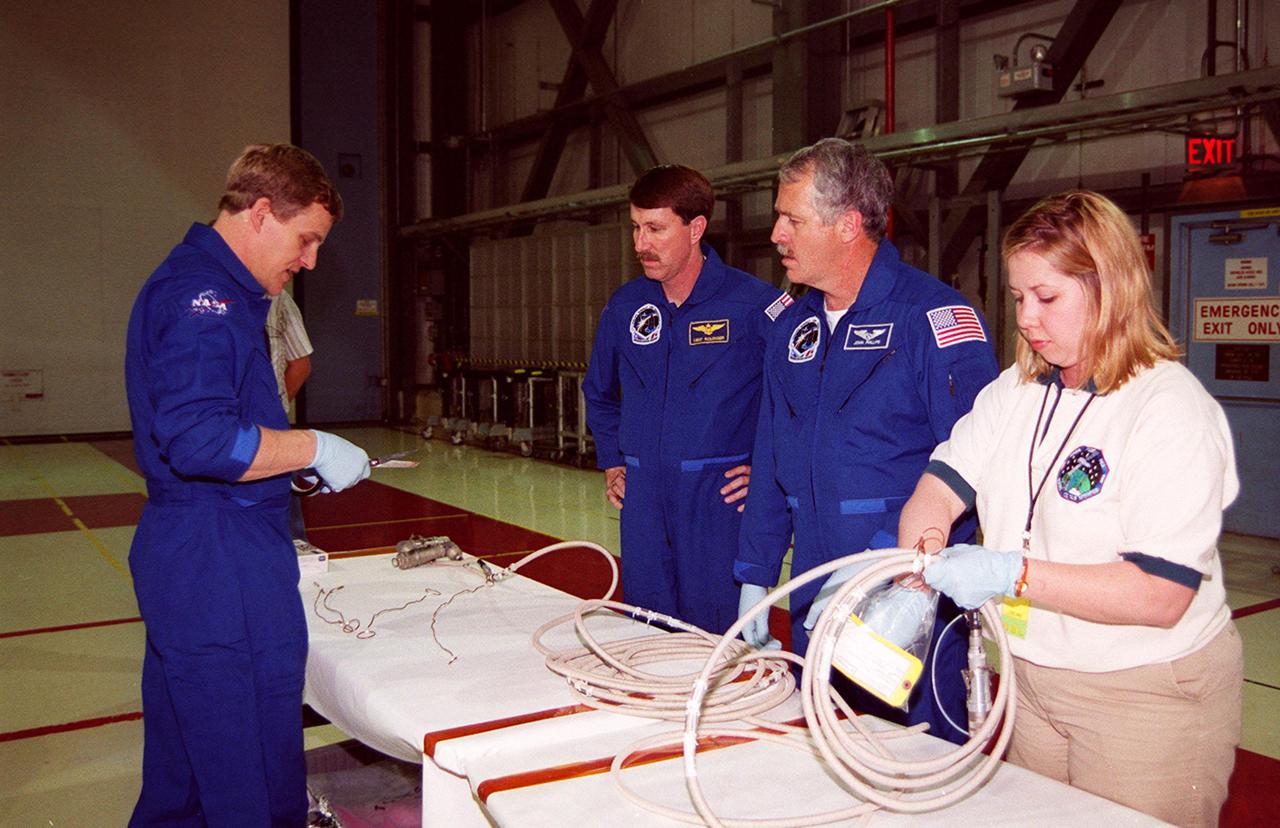
STS-100 Mission Specialists Scott Parazynski (left), Chris Hadfield (center), who is with the Canadian Space Agency, and John L. Phillips look over equipment that will be used during their mission. They are taking part in a Crew Equipment Interface Test (CEIT) at KSC, along with other crew members Commander Kent V. Rominger, Pilot Jeffrey S. Ashby and Mission Specialists Umberto Guidoni, who is with the European Space Agency, and Yuri Lonchakov, who is with the Russian Aviation and Space Agency. The orbiter is also carrying the Multi-Purpose Logistics Module Raffaello to the International Space Station. Raffaello carries six system racks and two storage racks for the U.S. Lab. Launch of mission STS-100 is scheduled for April 19 at 2:41 p.m. EDT from Launch Pad 39A
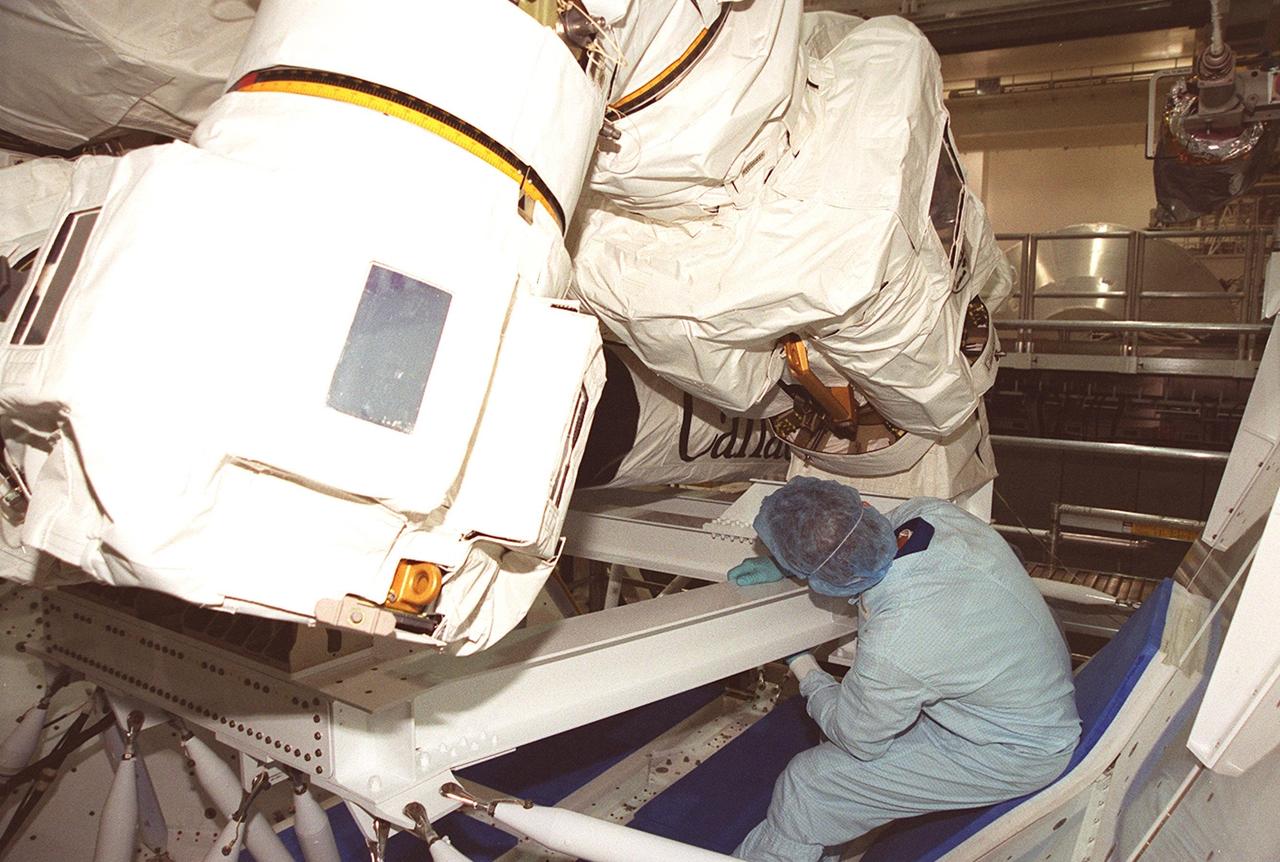
One of the STS-100 crew members looks at part of the Canadian robotic arm, SSRMS, which is on a workstand in the Space Station Processing Facility. The arm is 57.7 feet (17.6 meters) long when fully extended and has seven motorized joints. It is capable of handling large payloads and assisting with docking the Space Shuttle. The SSRMS is self-relocatable with a Latching End Effector, so it can be attached to complementary ports spread throughout the Station’s exterior surfaces. Mission STS-100 is scheduled to launch on Space Shuttle Endeavour April 19 at 2:41 p.m. EDT from Launch Pad 39A, KSC, with a crew of seven. The crew comprises Commander Kent V. Rominger, Pilot Jeffrey S. Ashby and Mission Specialists Chris A. Hadfield, Scott E. Parazynski, John L. Phillips, Umberto Guidoni and Yuri V. Lonchakov. Hadfield is with the Canadian Space Agency, Guidoni the European Space Agency and Lonchakov the Russian Space and Aviation Agency
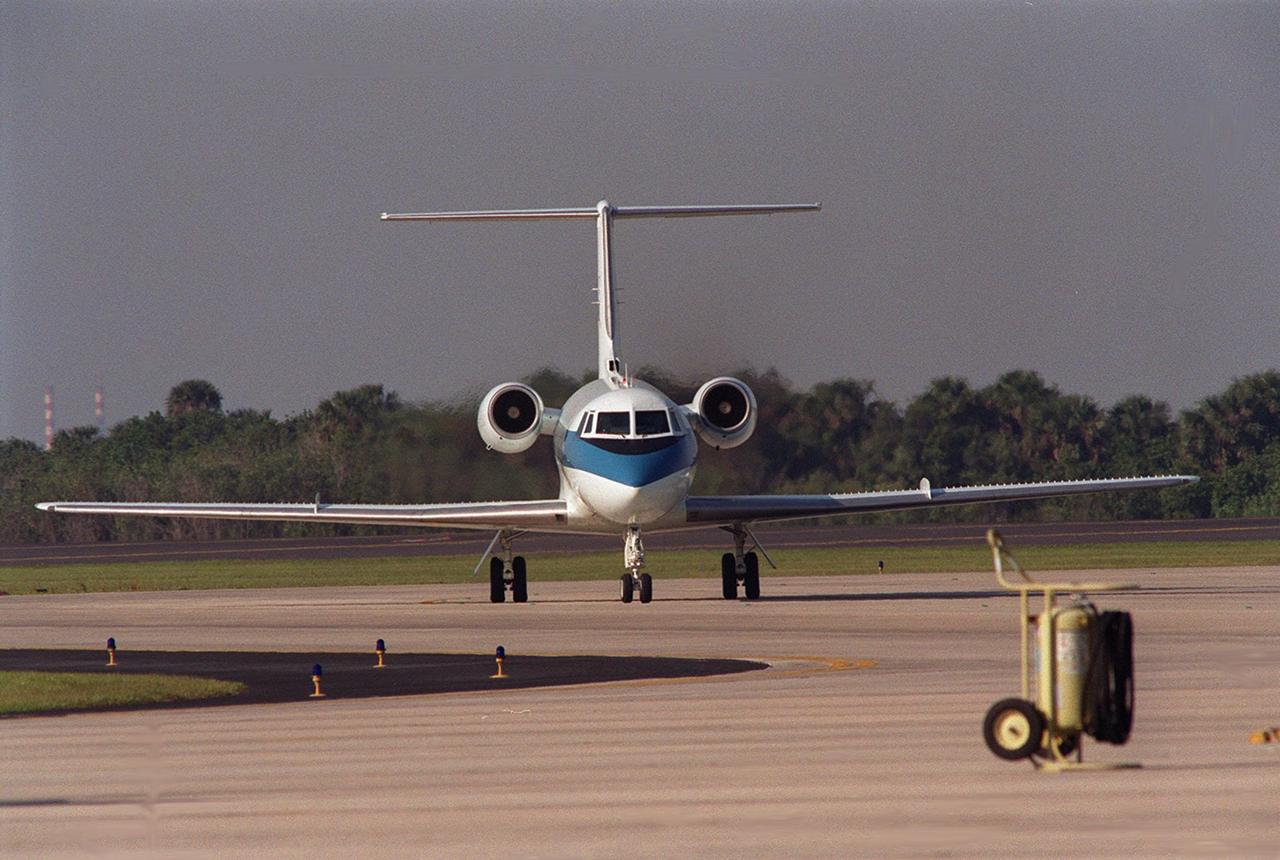
A Shuttle Training Aircraft (STA) taxis into the parking area of KSC's Shuttle Landing Facility. The STA is a modified Grumman American Aviation-built Gulfstream II executive jet that was modified to simulate an orbiter's cockpit, motion and visual cues, and handling qualities. It is used by Shuttle flight crews to practice landing the orbiter. In flight, the STA duplicates the orbiter's atmospheric descent trajectory from approximately 35,000 feet altitude to landing on a runway. The orbiter differs in at least one major aspect from conventional aircraft; it is unpowered during re-entry and landing so its high-speed glide must be perfectly executed the first time there is no go-around capability. The orbiter touchdown speed is 213 to 226 miles (343 to 364 kilometers) per hour. There are two STAs, based in Houston

A Shuttle Training Aircraft (STA) taxis into the parking area of KSC's Shuttle Landing Facility. The STA is a modified Grumman American Aviation-built Gulfstream II executive jet that was modified to simulate an orbiter's cockpit, motion and visual cues, and handling qualities. It is used by Shuttle flight crews to practice landing the orbiter. In flight, the STA duplicates the orbiter's atmospheric descent trajectory from approximately 35,000 feet altitude to landing on a runway. The orbiter differs in at least one major aspect from conventional aircraft; it is unpowered during re-entry and landing so its high-speed glide must be perfectly executed the first time there is no go-around capability. The orbiter touchdown speed is 213 to 226 miles (343 to 364 kilometers) per hour. There are two STAs, based in Houston
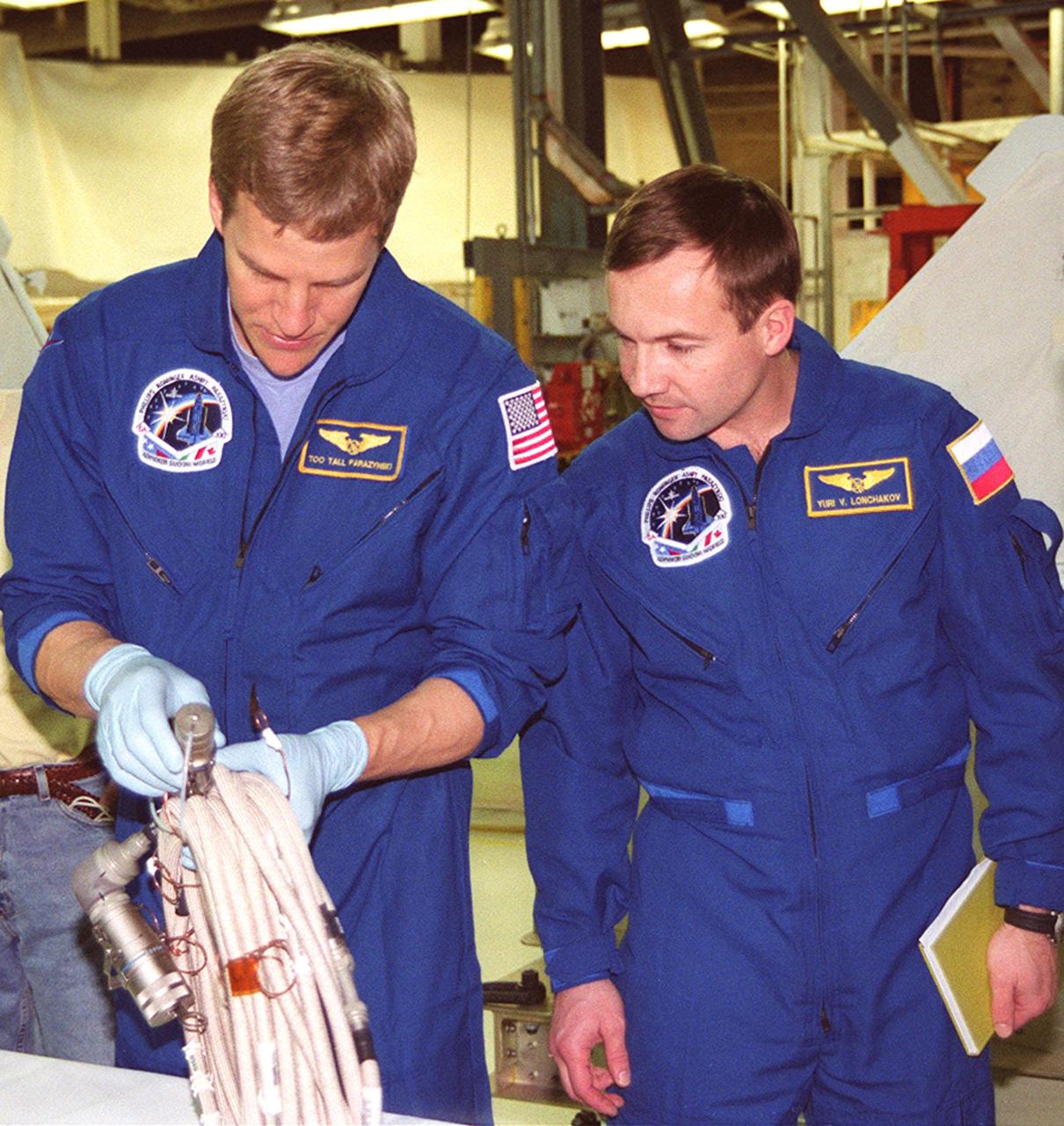
STS-100 Mission Specialists Scott Parazynski (left) and Yuri Lonchakov, who is with the Russian Aviation and Space Agency, look over equipment that will be used during their mission. They are taking part in a Crew Equipment Interface Test (CEIT) at KSC, along with other crew members Commander Kent V. Rominger, Pilot Jeffrey S. Ashby and Mission Specialists Chris Hadfield, who is with the Canadian Space Agency, John L. Phillips and Umberto Guidoni, who is with the European Space Agency. The orbiter is also carrying the Multi-Purpose Logistics Module Raffaello to the International Space Station. Raffaello carries six system racks and two storage racks for the U.S. Lab. Launch of mission STS-100 is scheduled for April 19 at 2:41 p.m. EDT from Launch Pad 39A
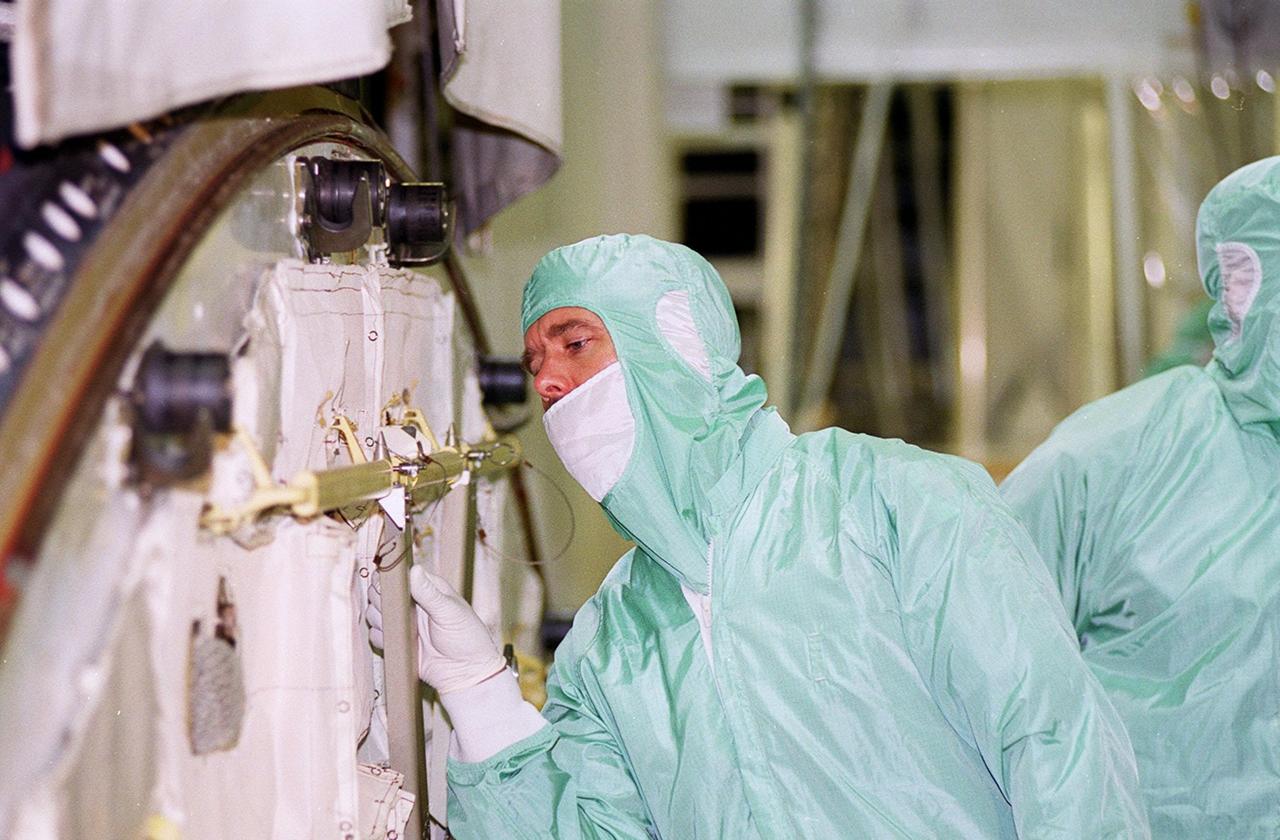
Dressed in protective clothing, STS-100 Mission Specialist Chris Hadfield looks at equipment in the payload bay of orbiter Endeavour during a Crew Equipment Interface Test (CEIT). Other crew members at KSC for the CEIT are Commander Kent V. Rominger, Pilot Jeffrey S. Ashby and Mission Specialists Scott Parazynski, John L. Phillips, Umberto Guidoni, who is with the European Space Agency, and Yuri Lonchakov, who is with the Russian Aviation and Space Agency. Hadfield is with the Canadian Space Agency. Endeavour is also carrying the Multi-Purpose Logistics Module Raffaello to the International Space Station. Raffaello carries six system racks and two storage racks for the U.S. Lab. Launch of mission STS-100 is scheduled for April 19 at 2:41 p.m. EDT from Launch Pad 39A
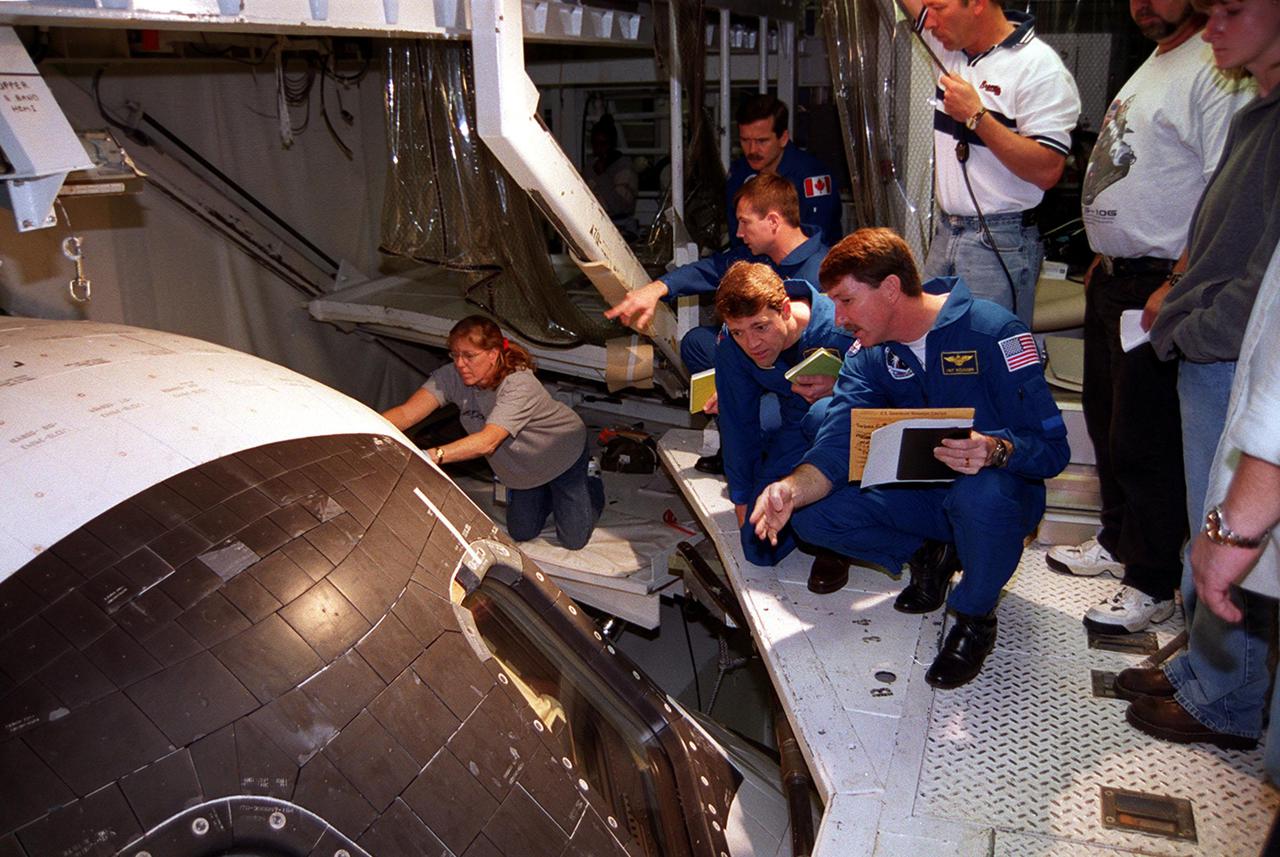
Members of the STS-100 crew check out Endeavour inside the Orbiter Processing Facility bay 2. In their blue uniforms, they are (front to back) Commander Kent V. Rominger, Pilot Jeff rey S. Ashby, and Mission Specialists Yuri Lonchakov, who is with the Russian Aviation and Space Agency, and Chris Hadfield, who is with the Canadian Space Agency. Other crew members at KSC for the CEIT are Mission Specialists Scott Parazynski and Umberto Guidoni, who is with the European Space Agency. Endeavour is carrying the Multi-Purpose Logistics Module Raffaello and the Canadian robotic arm, SSRMS, to the International Space Station. Raffaello carries six system racks and two storage racks for the U.S. Lab. Launch of mission STS-100 is scheduled for April 19 at 2:41 p.m. EDT from Launch Pad 39A
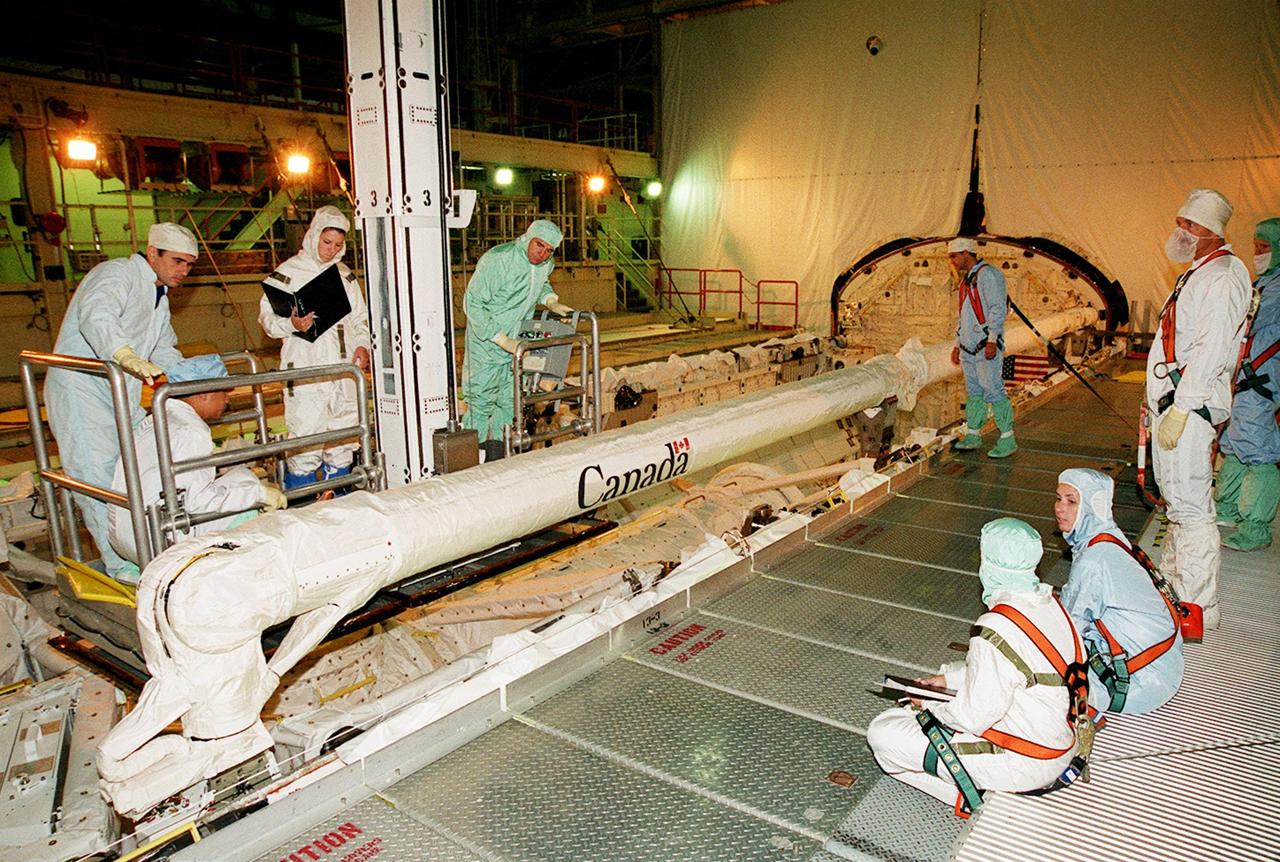
In Orbiter Processing Facility bay 3, the STS-106 crew familiarizes themselves with the payload bay of Space Shuttle orbiter Atlantis with the help of KSC employees as part of Crew Equipment Interface Test (CEIT) activities for their mission. The STS-106 crew members are Commander Terrence W. Wilcutt, Pilot Scott D. Altman, and Mission Specialists Edward T. Lu, Daniel C. Burbank, Yuri I. Malenchenko, Boris V. Morukov and Richard A. Mastracchio. Malenchenko and Morukov represent the Russian Aviation and Space Agency. On the 11-day mission, the seven-member crew will perform support tasks on orbit, transfer supplies and prepare the living quarters in the newly arrived Zvezda Service Module for the first long-duration crew, dubbed "Expedition One," which is due to arrive at the Station in late fall. STS-106 is scheduled to launch Sept. 8, 2000, at 8:31 a.m. EDT from Launch Pad 39B
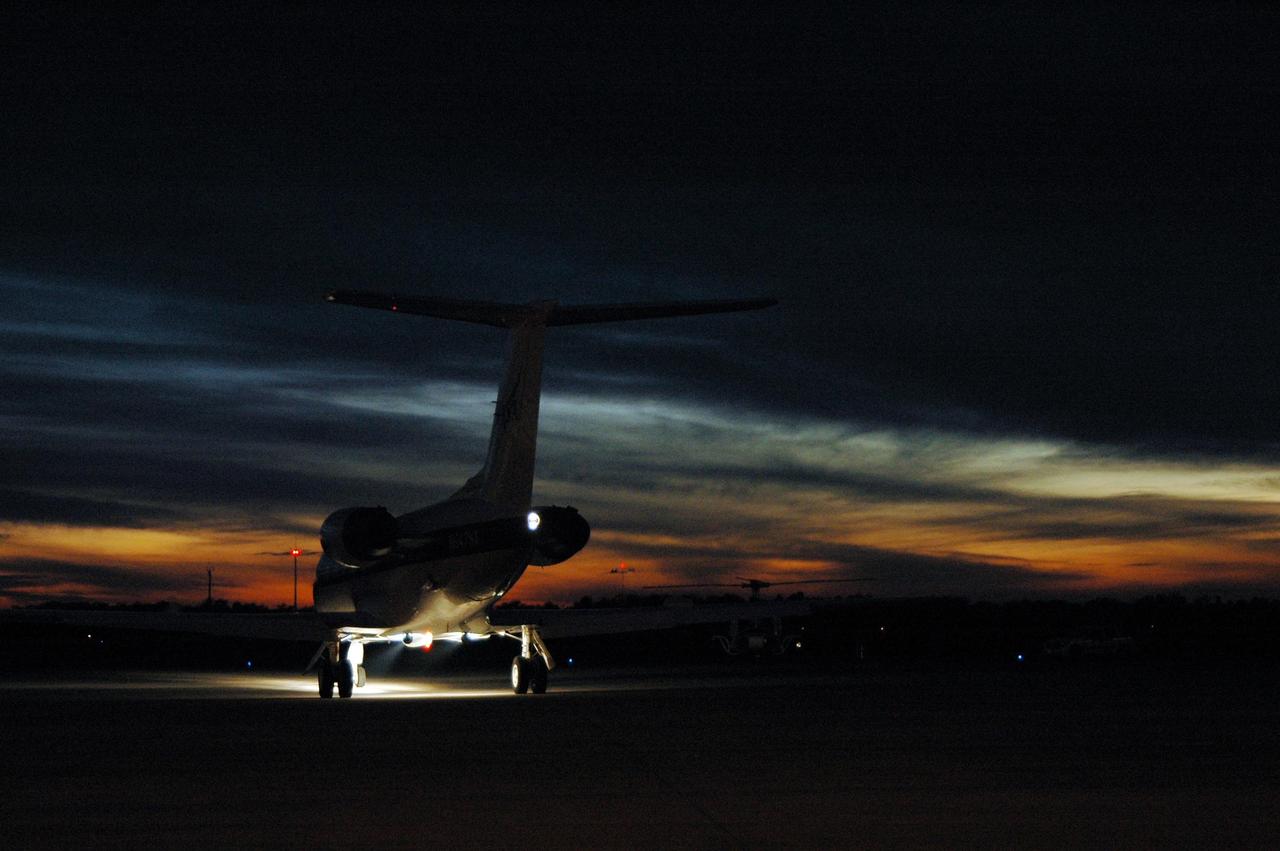
KENNEDY SPACE CENTER, FLA. -- At the Shuttle Landing Facility, the shuttle training aircraft taxis onto the runway. Inside are STS-116 Pilot William Oefelein and Commander Mark Polansky, who are flying the aircraft to practice landing the orbiter. The mission crew is at KSC for the terminal countdown demonstration test, which are prelaunch preparations that include a simulated launch countdown. STA practice is part of the TCDT. The STA is a Grumman American Aviation-built Gulf Stream II jet that was modified to simulate an orbiter's cockpit, motion and visual cues, and handling qualities. In flight, the STA duplicates the orbiter's atmospheric descent trajectory from approximately 35,000 feet altitude to landing on a runway. Because the orbiter is unpowered during re-entry and landing, its high-speed glide must be perfectly executed the first time. Photo credit: NASA/Kim Shiflett

KENNEDY SPACE CENTER, FLA. -- At SPACEHAB members of the STS-106 crew check out equipment they will be using during their mission to the International Space Station. From left are Mission Specialists Richard A. Mastracchio, Daniel C. Burbank, Yuri I. Malenchenko, Edward T. Lu and Boris V. Morukov. Behind Lu is Pilot Scott D. Altman. Not seen is Commander Terrence W. Wilcutt. Malenchenko and Morukov represent the Russian Aviation and Space Agency. The astronauts are taking part in Crew Equipment Interface Test activities at KSC. On the 11-day mission, the seven-member crew will perform support tasks on orbit, transfer supplies and prepare the living quarters in the newly arrived Zvezda Service Module for the first long-duration crew, dubbed "Expedition One," which is due to arrive at the Station in late fall. STS-106 is scheduled to launch Sept. 8, 2000, at 8:31 a.m. EDT from Launch Pad 39B
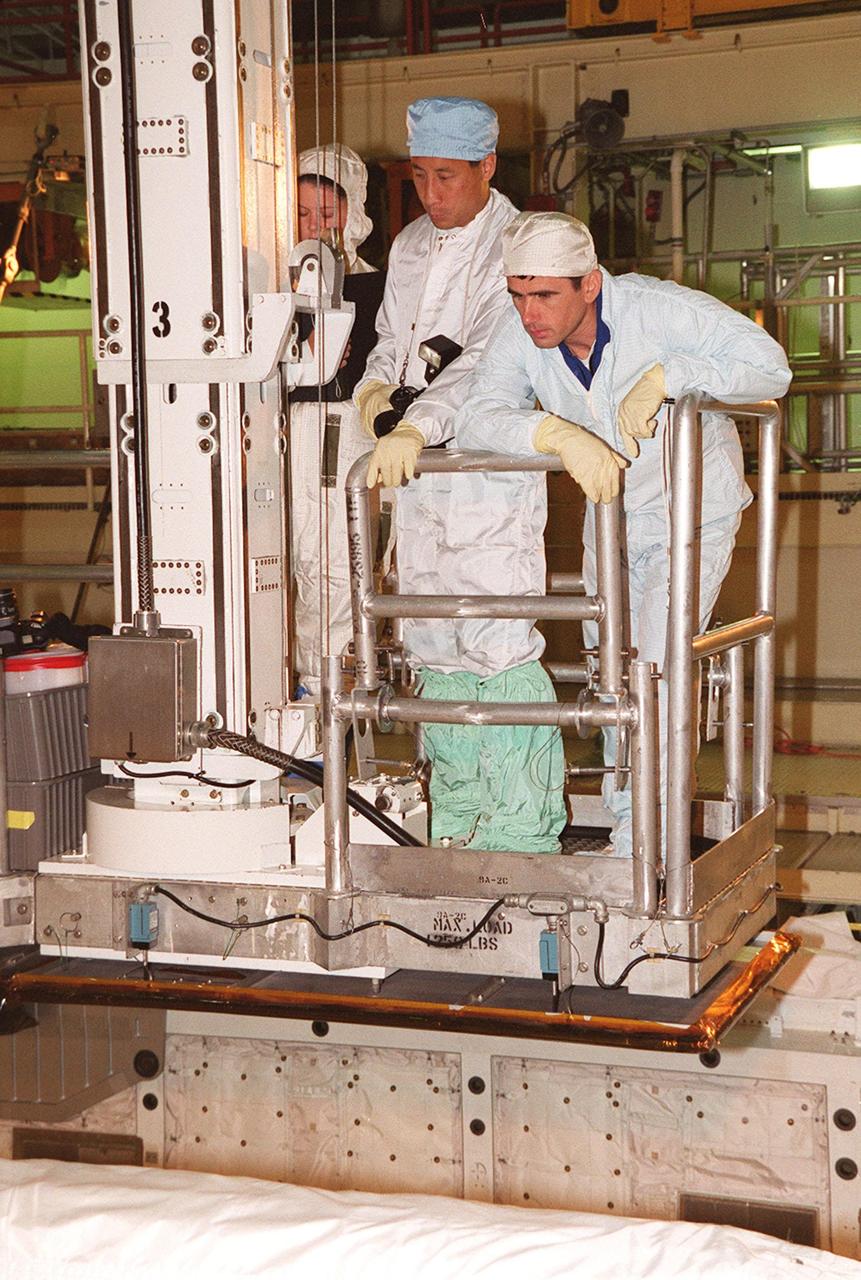
In Orbiter Processing Facility bay 3, STS-106 Mission Specialists Edward T. Lu (center) and Yuri I. Malenchenko (right) familiarize themselves with equipment in the payload bay of Space Shuttle orbiter Atlantis with the help of KSC employees as part of Crew Equipment Interface Test (CEIT) activities for their mission. The other crew members are Commander Terrence W. Wilcutt, Pilot Scott D. Altman, and Mission Specialists Daniel C. Burbank, Boris V. Morukov and Richard A. Mastracchio. Malenchenko and Morukov represent the Russian Aviation and Space Agency. On the 11-day mission, the seven-member crew will perform support tasks on orbit, transfer supplies and prepare the living quarters in the newly arrived Zvezda Service Module for the first long-duration crew, dubbed "Expedition One," which is due to arrive at the Station in late fall. STS-106 is scheduled to launch Sept. 8, 2000, at 8:31 a.m. EDT from Launch Pad 39B
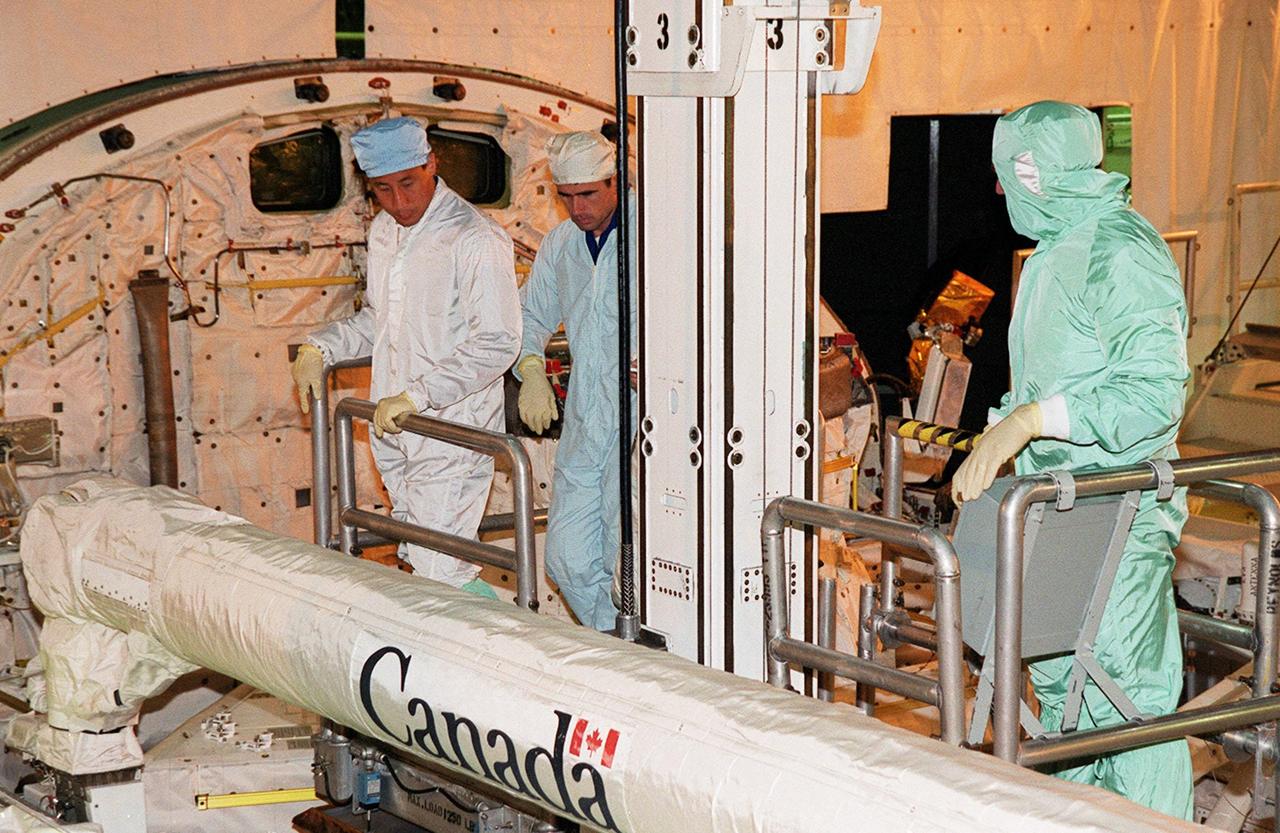
In Orbiter Processing Facility bay 3, STS-106 Mission Specialists Edward T. Lu (left) and Yuri I. Malenchenko (center) familiarize themselves with equipment in the payload bay of Space Shuttle orbiter Atlantis with the help of KSC employees as part of Crew Equipment Interface Test (CEIT) activities for their mission. The other crew members are Commander Terrence W. Wilcutt, Pilot Scott D. Altman, and Mission Specialists Daniel C. Burbank, Boris V. Morukov and Richard A. Mastracchio. Malenchenko and Morukov represent the Russian Aviation and Space Agency. On the 11-day mission, the seven-member crew will perform support tasks on orbit, transfer supplies and prepare the living quarters in the newly arrived Zvezda Service Module for the first long-duration crew, dubbed "Expedition One," which is due to arrive at the Station in late fall. STS-106 is scheduled to launch Sept. 8, 2000, at 8:31 a.m. EDT from Launch Pad 39B
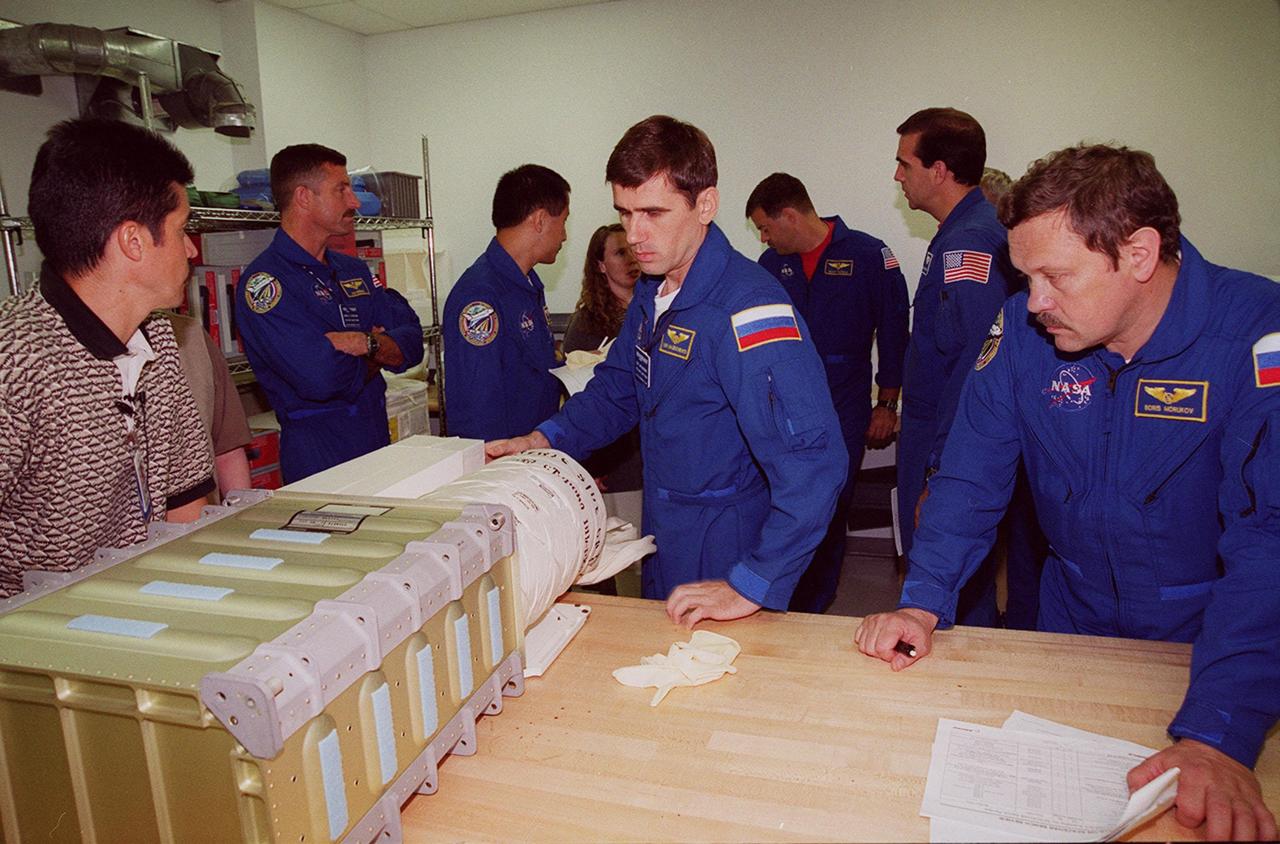
KENNEDY SPACE CENTER, FLA. -- At SPACEHAB members of the STS-106 crew check out equipment they will be using during their mission to the International Space Station. Starting second from left, they are Mission Specialists Daniel C. Burbank, Edward T. Lu, and Yuri I. Malenchenkov; Pilot Scott D. Altman, and Mission Specialists Richard A. Mastracchio and Boris V. Morukov. Not seen is Commander Terrence W. Wilcutt. Malenchenko and Morukov represent the Russian Aviation and Space Agency. The crew is taking part in Crew Equipment Interface Test activities at KSC. On the 11-day mission, the seven-member crew will perform support tasks on orbit, transfer supplies and prepare the living quarters in the newly arrived Zvezda Service Module for the first long-duration crew, dubbed “Expedition One,” which is due to arrive at the Station in late fall. STS-106 is scheduled to launch Sept. 8, 2000, at 8:31 a.m. EDT from Launch Pad 39B
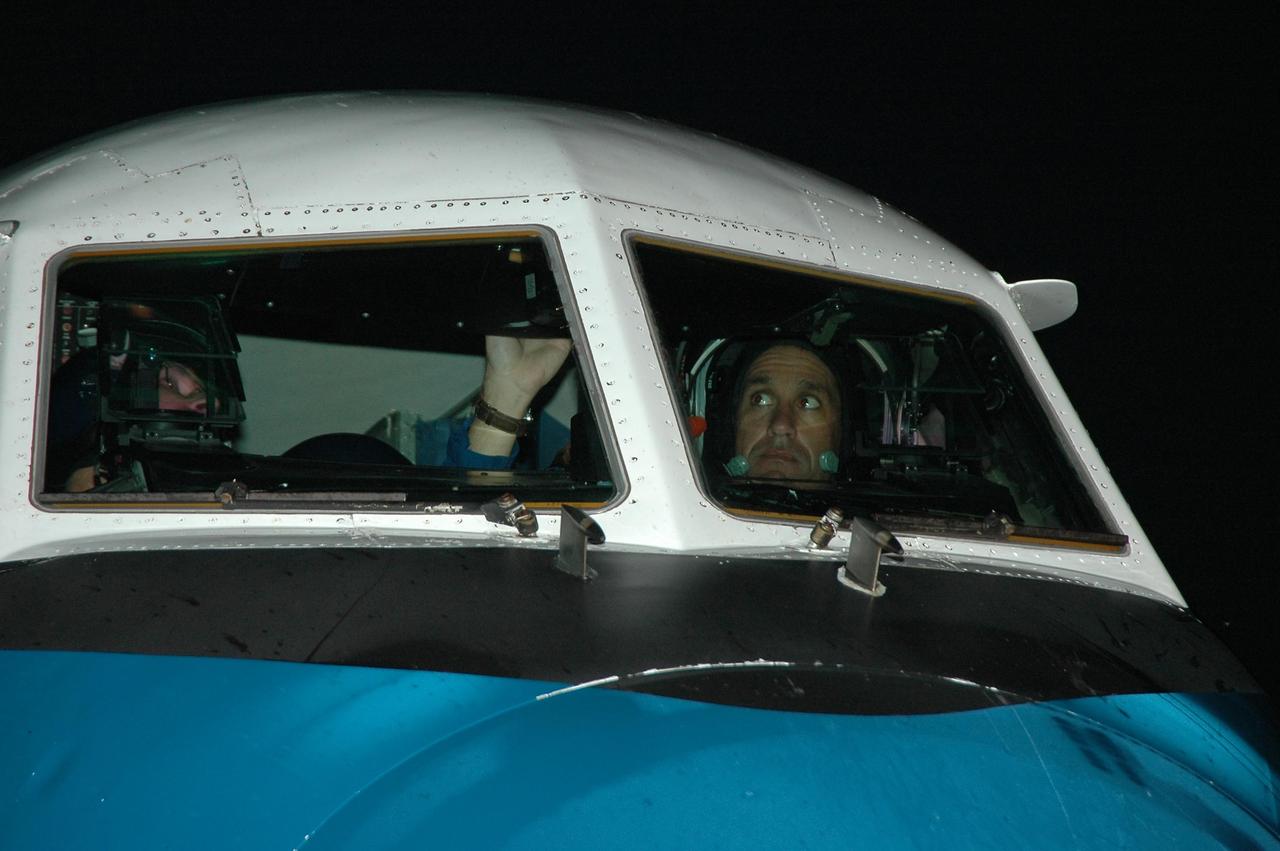
KENNEDY SPACE CENTER, FLA. -- Seated in the cockpit of the shuttle training aircraft at the Shuttle Landing Facility, STS-116 Pilot William Oefelein (left) and Commander Mark Polansky are getting ready to practice landing the orbiter. The mission crew is at KSC for the terminal countdown demonstration test, which are prelaunch preparations that include a simulated launch countdown. STA practice is part of the TCDT. The STA is a Grumman American Aviation-built Gulf Stream II jet that was modified to simulate an orbiter's cockpit, motion and visual cues, and handling qualities. In flight, the STA duplicates the orbiter's atmospheric descent trajectory from approximately 35,000 feet altitude to landing on a runway. Because the orbiter is unpowered during re-entry and landing, its high-speed glide must be perfectly executed the first time. Photo credit: NASA/Kim Shiflett
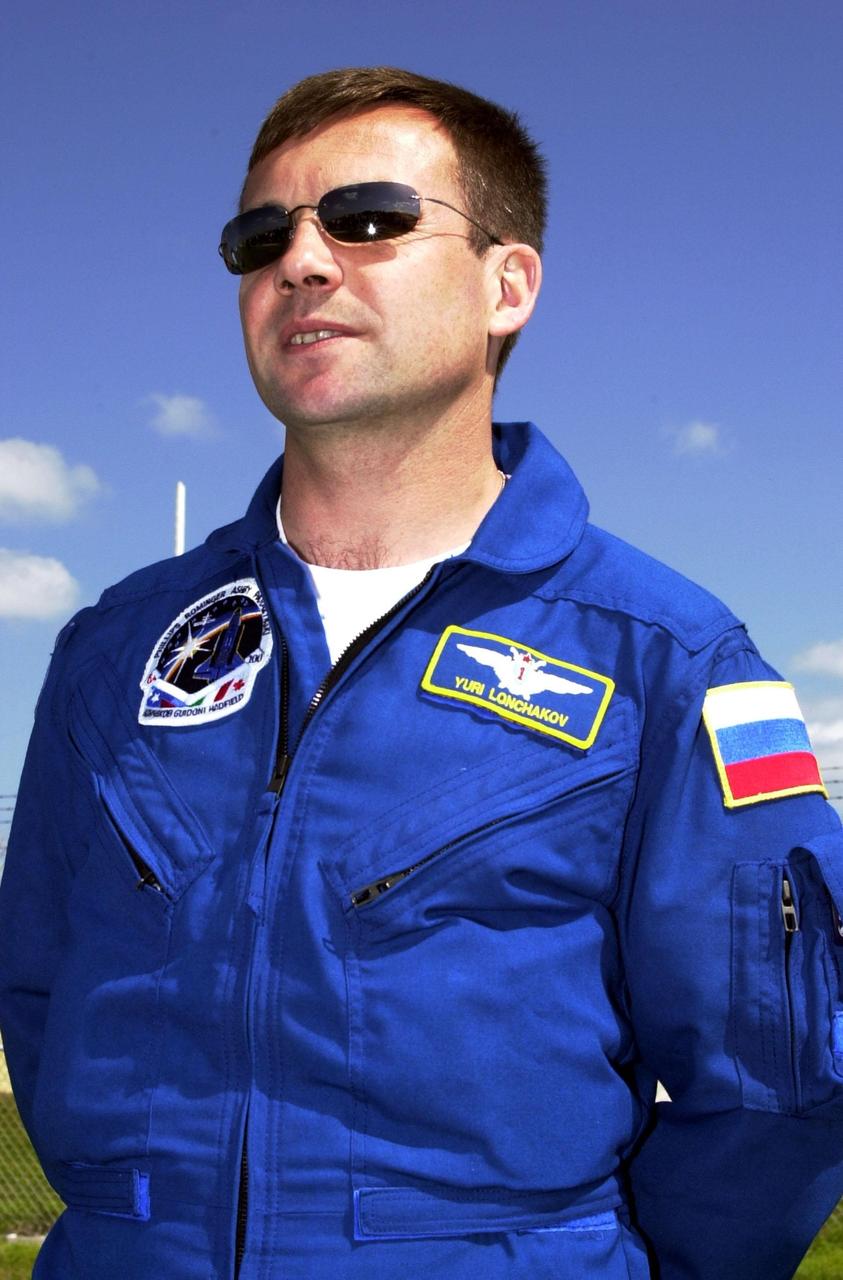
KENNEDY SPACE CENTER, FLA. -- STS-100 Mission Specialist Yuri V. Lonchakov stands near Launch Pad 39A to greet family and friends. Lonchakov is with the Russian Aviation and Space Agency. The crew is at KSC to complete final flight plan reviews in anticipation of launch. The 11-day mission to the International Space Station will deliver and integrate the Spacelab Logistics Pallet/Launch Deployment Assembly, which includes the Space Station Remote Manipulator system and the UHF Antenna, and the Multi-Purpose Logistics Module Raffaello. The mission includes two planned spacewalks for installation of the SSRMS. The mission is also the inaugural flight of the MPLM Raffaello, carrying resupply stowage racks and resupply/return stowage platforms. Liftoff on mission STS-100 is scheduled at 2:41 p.m. EDT April 19
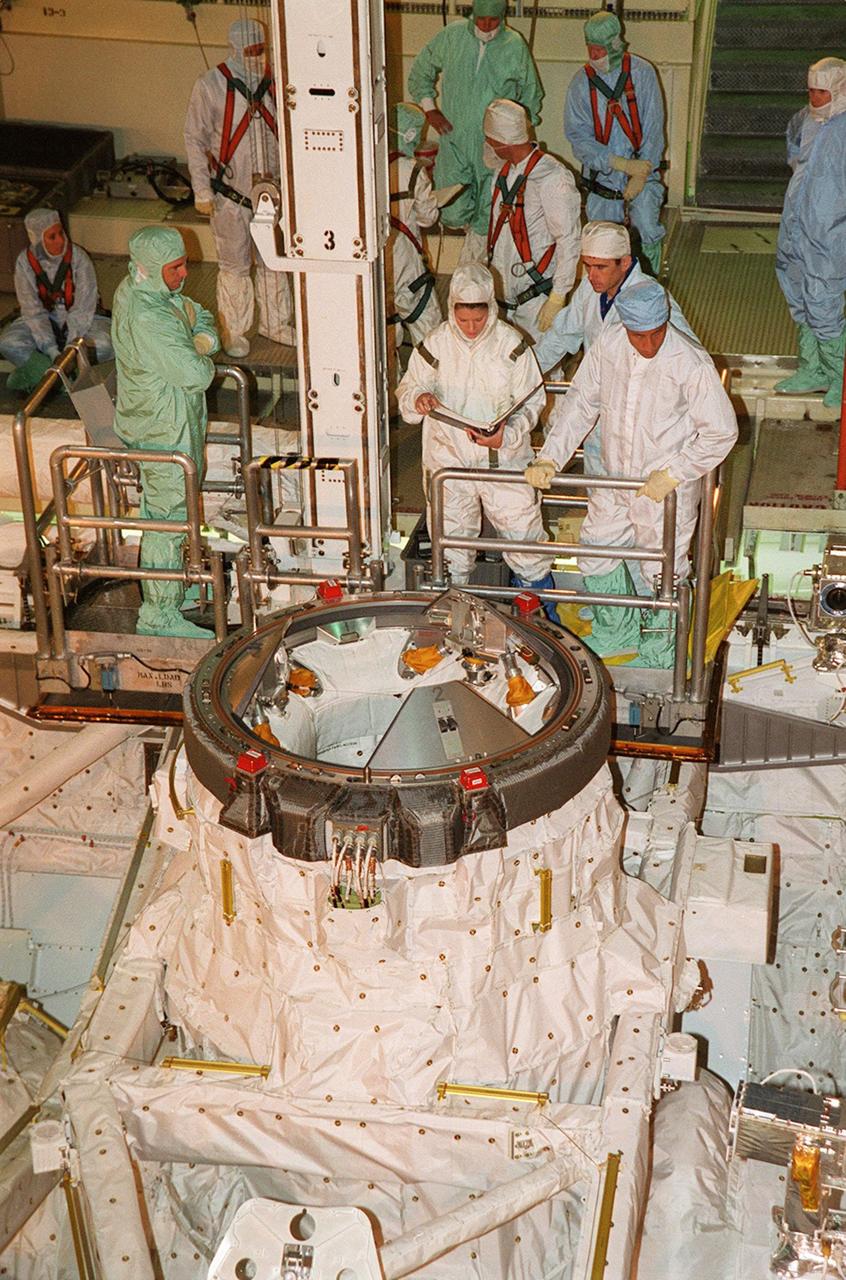
In Orbiter Processing Facility bay 3, the STS-106 crew familiarizes themselves with equipment in the payload bay of Space Shuttle orbiter Atlantis with the help of KSC employees as part of Crew Equipment Interface Test (CEIT) activities for their mission. The STS-106 crew members are Commander Terrence W. Wilcutt, Pilot Scott D. Altman, and Mission Specialists Edward T. Lu, Daniel C. Burbank, Yuri I. Malenchenko, Boris V. Morukov and Richard A. Mastracchio. Malenchenko and Morukov represent the Russian Aviation and Space Agency. On the 11-day mission, the seven-member crew will perform support tasks on orbit, transfer supplies and prepare the living quarters in the newly arrived Zvezda Service Module for the first long-duration crew, dubbed "Expedition One," which is due to arrive at the Station in late fall. STS-106 is scheduled to launch Sept. 8, 2000, at 8:31 a.m. EDT from Launch Pad 39B
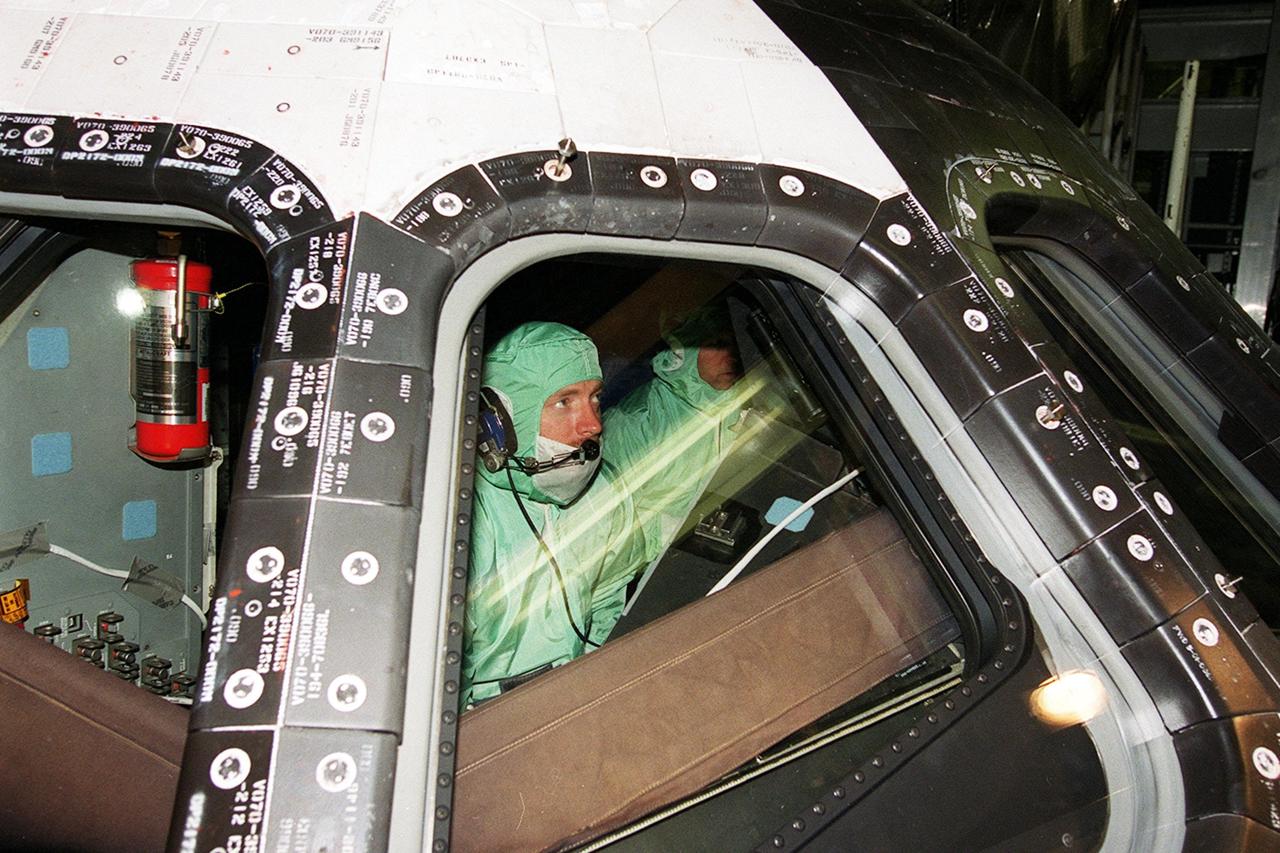
KENNEDY SPACE CENTER, Fla. -- During Crew Equipment Interface Test (CEIT) activities at KSC, STS-108 Pilot Mark E. Kelly checks the windshield inside orbiter Endeavour. The CEIT provides familiarization with the launch vehicle and payload. Mission STS-108 is a Utilization Flight (UF-1), carrying the Expedition Four crew plus Multi-Purpose Logistics Module Raffaello to the International Space Station. The mission crew comprises Commander Dominic L. Gorie, Kelly and Mission Specialists Linda A. Godwin and Daniel M. Tani. The Expedition Four crew comprises Yuri Onufriyenko, commander, Russian Aviation and Space Agency, and astronauts Daniel W. Bursch and Carl E. Walz. Endeavour is scheduled to launch Nov. 29 on mission STS-108
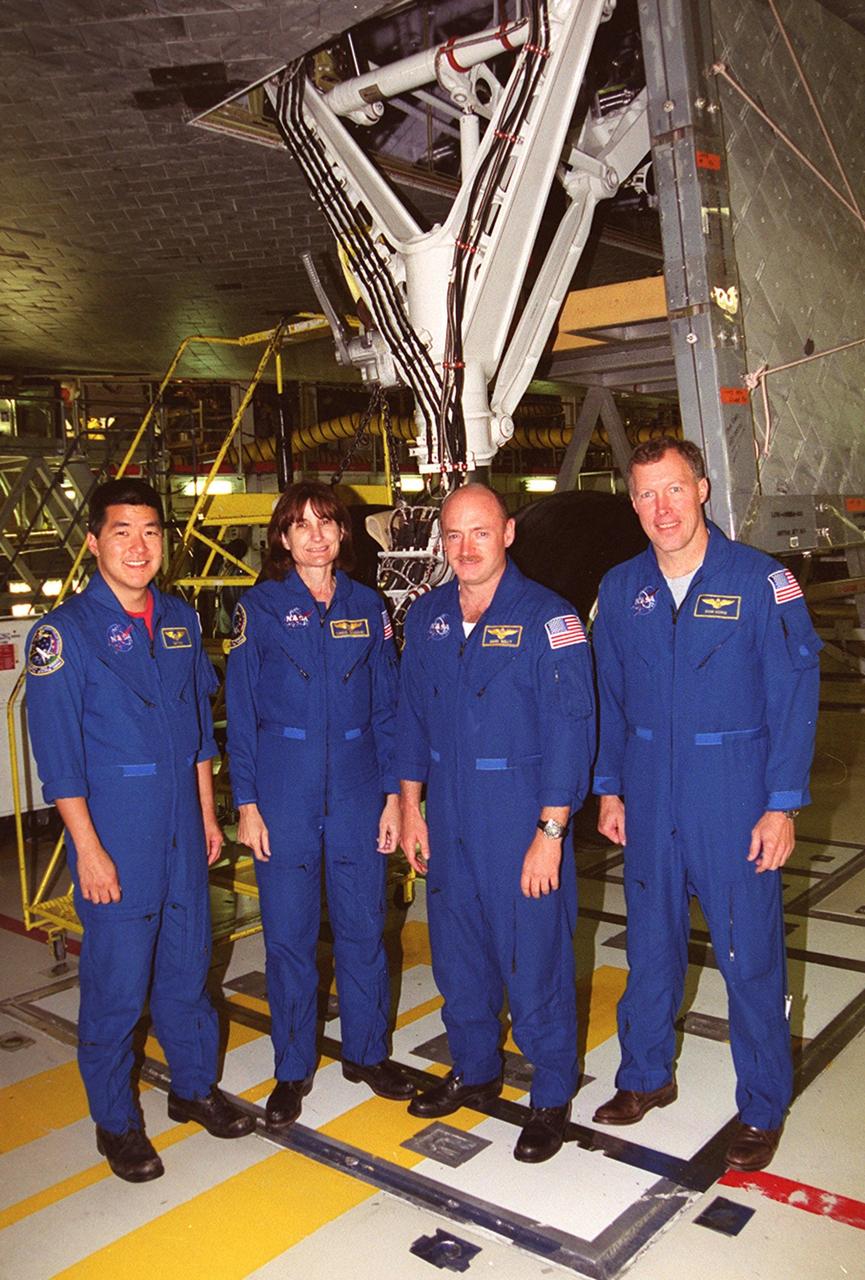
KENNEDY SPACE CENTER, Fla. -- The STS-108 crew pauses for a photo during Crew Equipment Interface Test activities at KSC. From left are Mission Specialists Daniel M. Tani and Linda A. Godwin; Pilot Mark E. Kelly; and Commander Dominic L. Gorie. The CEIT provides familiarization with the launch vehicle and payload. Mission STS-108 is a Utilization Flight (UF-1), carrying the Expedition Four crew plus Multi-Purpose Logistics Module Raffaello to the International Space Station. The Expedition Four crew comprises Yuri Onufriyenko, commander, Russian Aviation and Space Agency, and astronauts Daniel W. Bursch and Carl E. Walz. Endeavour is scheduled to launch Nov. 29 on mission STS-108

In Orbiter Processing Facility bay 3, members of the STS-106 crew familiarize themselves with equipment in the payload bay of Space Shuttle orbiter Atlantis with the help of KSC employees as part of Crew Equipment Interface Test (CEIT) activities for their mission. The STS-106 crew members are Commander Terrence W. Wilcutt, Pilot Scott D. Altman, and Mission Specialists Edward T. Lu, Daniel C. Burbank, Yuri I. Malenchenko, Boris V. Morukov and Richard A. Mastracchio. Malenchenko and Morukov represent the Russian Aviation and Space Agency. On the 11-day mission, the seven-member crew will perform support tasks on orbit, transfer supplies and prepare the living quarters in the newly arrived Zvezda Service Module for the first long-duration crew, dubbed "Expedition One," which is due to arrive at the Station in late fall. STS-106 is scheduled to launch Sept. 8, 2000, at 8:31 a.m. EDT from Launch Pad 39B
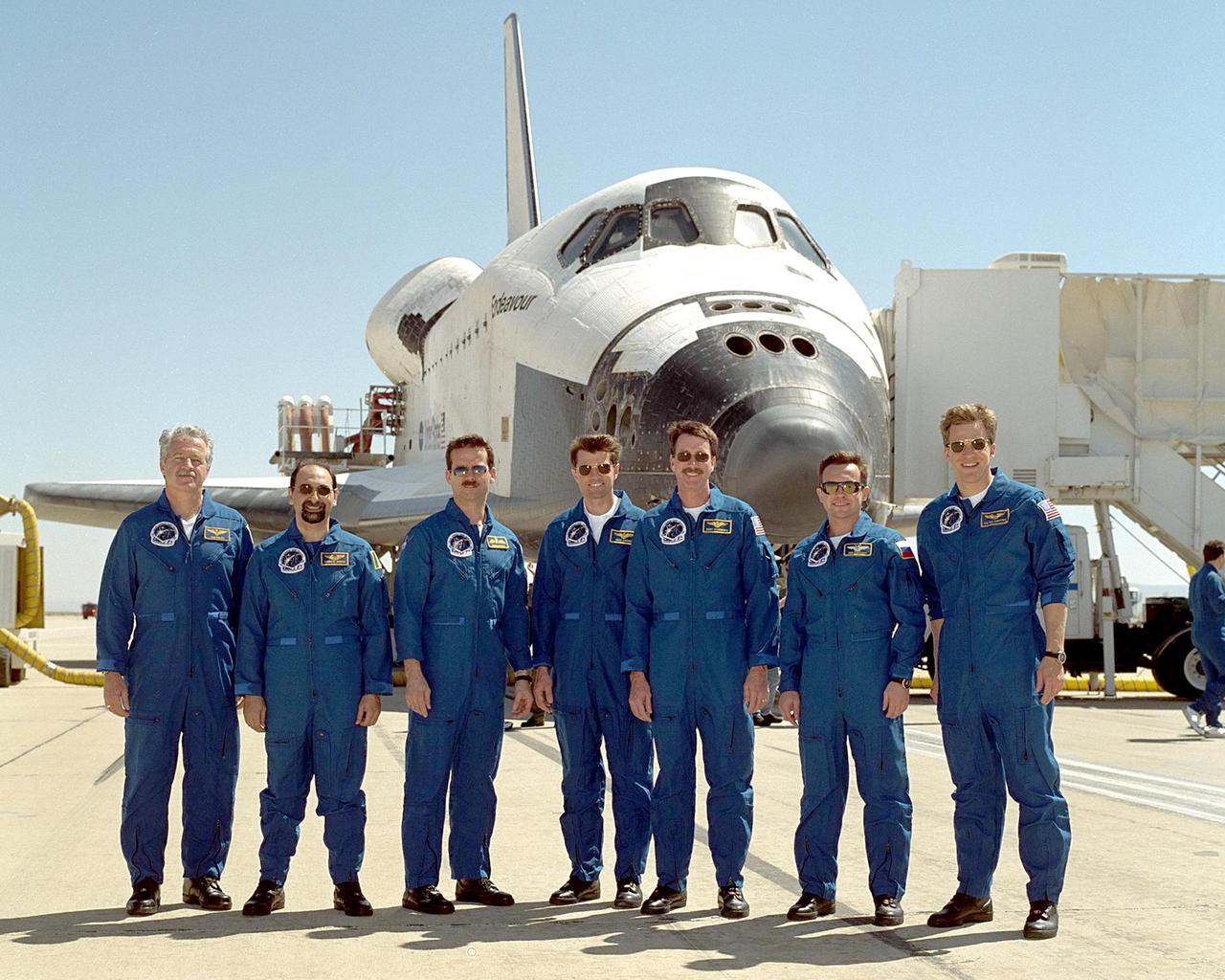
NASA_EDWARDS AFB, CALIF. -- After landing at Edwards Air Force Base, Calif., the STS-100 crew poses for a photograph in front of orbiter Endeavour, which successfully launched them to the International Space Station and returned them to Earth. They are (left to right) Mission Specialists John Phillips, Umberto Guidoni and Chris Hadfield; Pilot Jeffrey Ashby; Commander Kent Rominger; and Mission Specialists Yuri Lonchakov and Scott Parazynski. Guidoni is with the European Space Agency, Hadfield with the Canadian Space Agency and Lonchakov with the Russian Aviation and Space Agency. The orbiter and crew logged about 4.9 million statute miles in 186 orbits. Due to unfavorable weather conditions, landing at KSC was waved off. The landing marked the third consecutive landing at EAFB.
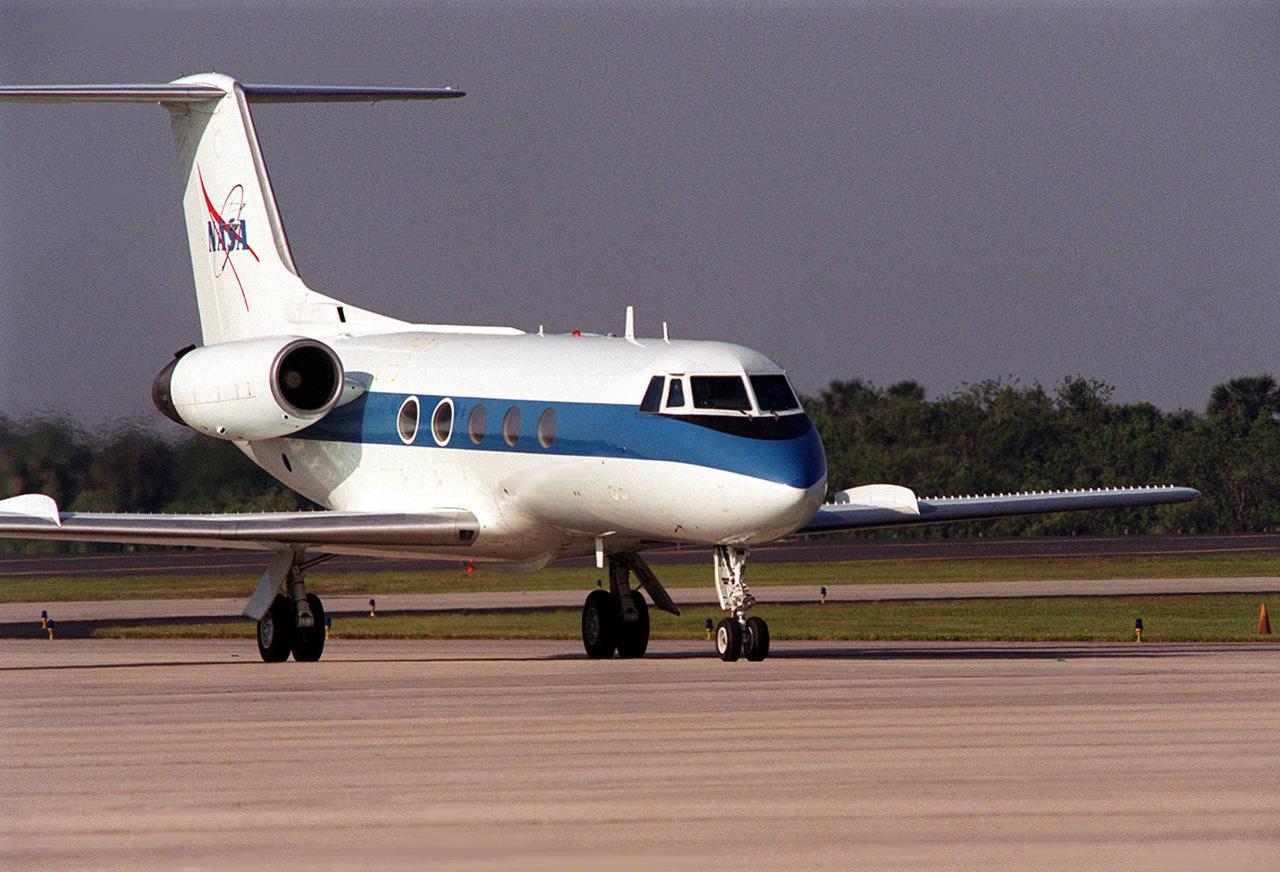
A Shuttle Training Aircraft (STA) taxis into the parking area of KSC's Shuttle Landing Facility. The STA is a modified Grumman American Aviation-built Gulfstream II executive jet that was modified to simulate an orbiter's cockpit, motion and visual cues, and handling qualities. It is used by Shuttle flight crews to practice landing the orbiter. In flight, the STA duplicates the orbiter's atmospheric descent trajectory from approximately 35,000 feet altitude to landing on a runway. The orbiter differs in at least one major aspect from conventional aircraft; it is unpowered during re-entry and landing so its high-speed glide must be perfectly executed the first time there is no go-around capability. The orbiter touchdown speed is 213 to 226 miles (343 to 364 kilometers) per hour. There are two STAs, based in Houston
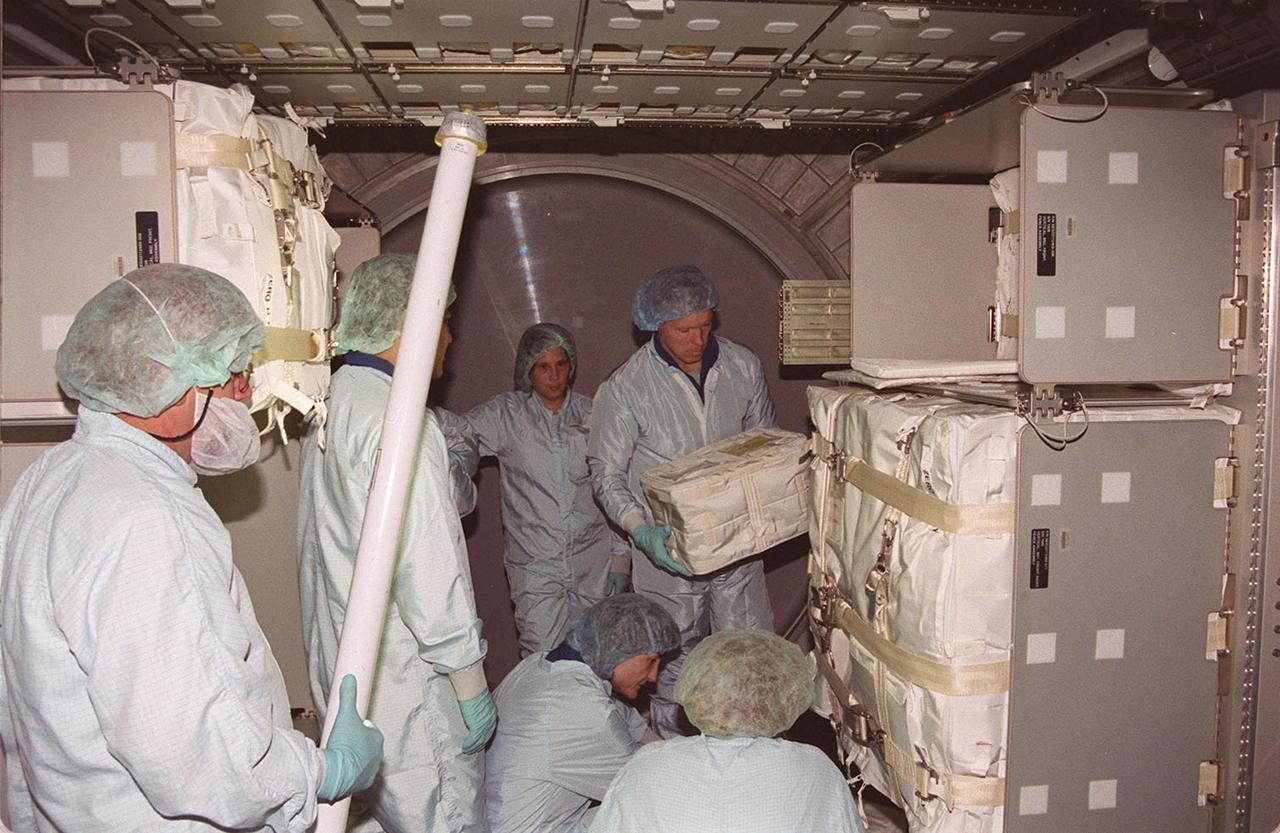
KENNEDY SPACE CENTER, Fla. -- The STS-108 crew practices moving packages in storage inside the the Multi-Purpose Logistics Module Raffaello. Holding a package is Commander Dominic L. Gorie. Kneeling below him (center) is Mission Specialist Linda A. Godwin. The crew is taking part in Crew Equipment Interface Test (CEIT) activities at KSC. Not seen are Pilot Mark E. Kelly and Mission Specialist Daniel M. Tani. The CEIT provides familiarization with the launch vehicle and payload. Mission STS-108 is a Utilization Flight (UF-1), carrying the Expedition Four crew plus Multi-Purpose Logistics Module Raffaello to the International Space Station. The Expedition Four crew comprises Yuri Onufriyenko, commander, Russian Aviation and Space Agency, and astronauts Daniel W. Bursch and Carl E. Walz. Endeavour is scheduled to launch Nov. 29 on mission STS-108
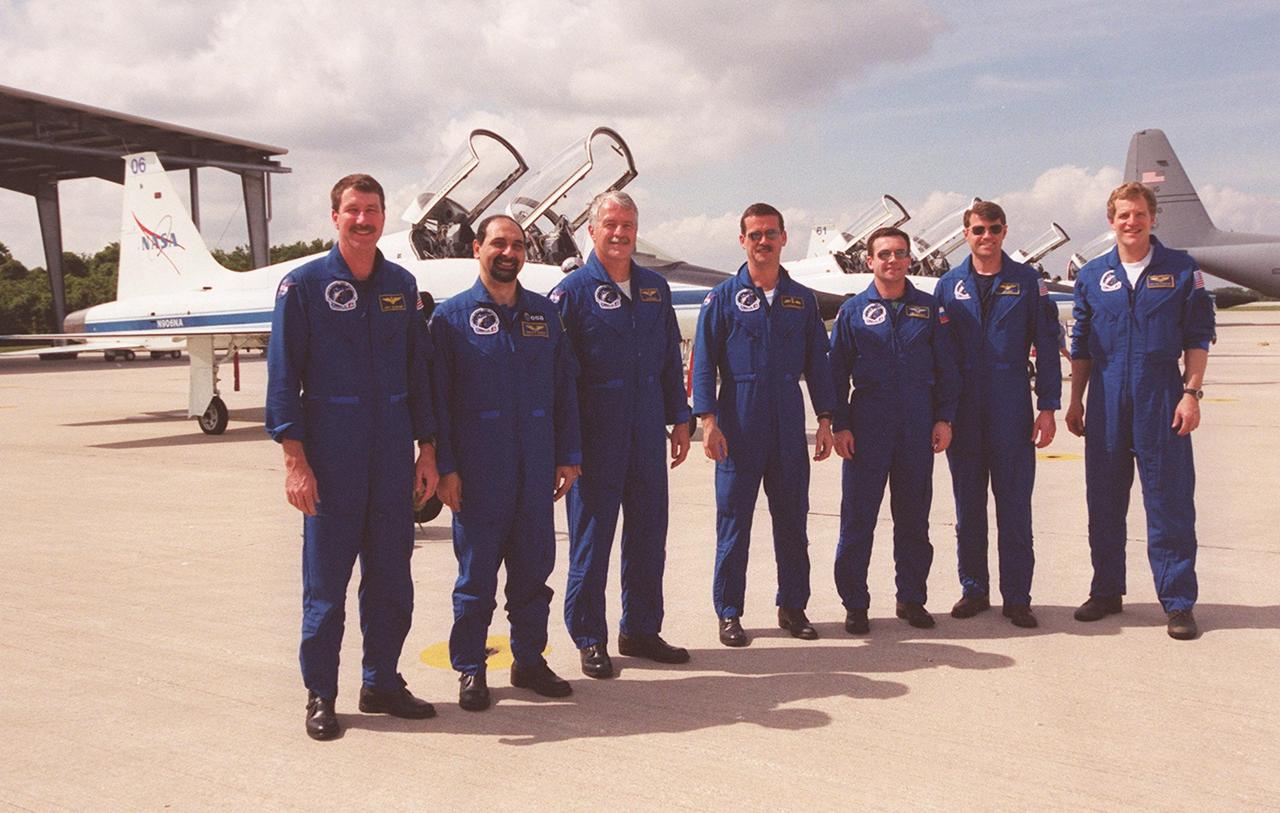
The STS-100 crew poses for a photo after their arrival at KSC to complete Terminal Countdown Demonstration Test activities that were postponed earlier. Standing, from left, are Commander Kent V. Rominger; Mission Specialists Umberto Guidoni, John L. Phillips, Chris A. Hadfield and Yuri V. Lonchakov; Pilot Jeffrey S. Ashby; and Mission Specialist Scott E. Parazynski. An international crew, Guidoni is with the European Space Agency, Hadfield the Canadian Space Agency, and Lonchakov the Russian Space and Aviation Agency. The TCDT includes emergency escape training, payload bay walkdown, and a simulated launch countdown. The primary payload comprises the Canadian robotic arm, SSRMS, and Multi-Purpose Logistics Module, Raffaello. Launch of Space Shuttle Endeavour on mission STS-100 is targeted for April 19 at 2:41 p.m. EDT from Launch Pad 39A
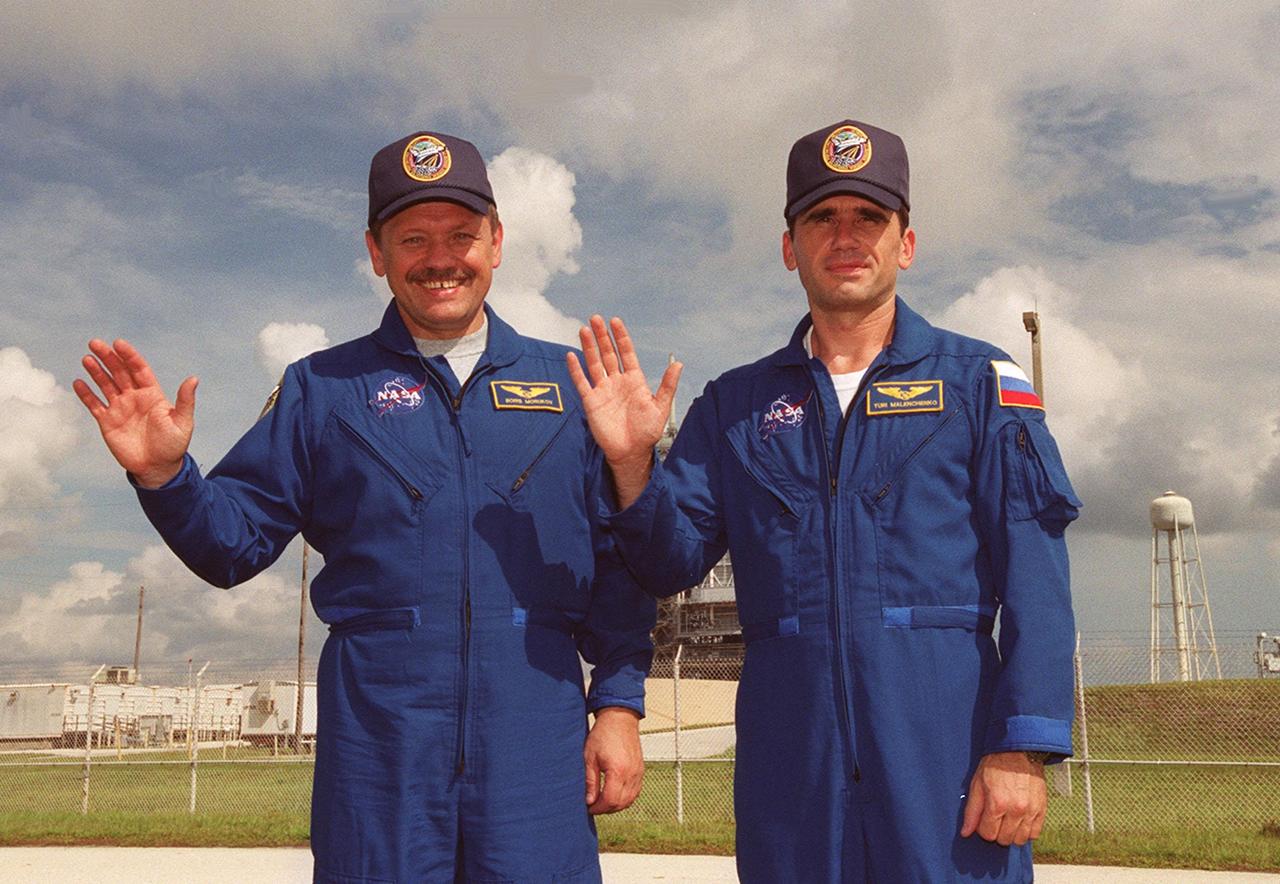
Russian cosmonauts Boris V. Morukov and Yuri I. Malenchenko wave for the photo while standing in front of Launch Pad 39B where Space Shuttle Atlantis awaits launch. The cosmonauts are with the Russian Aviation and Space Agency. STS-106 is scheduled to launch Sept. 8, 2000, at 8:45 a.m. EDT from Launch Pad 39B. On the 11-day mission, the seven-member crew will perform support tasks on orbit, transfer supplies and prepare the living quarters in the newly arrived Zvezda Service Module. Malenchenko will perform a six-and-a-half-hour space walk, along with Mission Specialist Edward T. Lu, during the mission. Landing is targeted for Sept. 19 at 4:59 a.m. EDT at the KSC Shuttle Landing Facility

KENNEDY SPACE CENTER, Fla. -- The STS-105 and Expedition Three crews pose in the White Room on Launch Pad 39A. Standing are (left to right) Pilot Rick Sturckow, Mission Specialist Patrick Forrester, Commander Scott Horowitz and Mission Specialist Daniel Barry. Kneeling are cosmonaut Mikhail Tyurin, Commander Frank Culbertson and cosmonaut Vladimir Nikolaevich Dezhurov. Tyurin and Dezhurov are with the Russian Aviation and Space Agency. Both crews are at KSC to take part in Terminal Countdown Demonstration Test activities, which include emergency egress, a simulated launch countdown and familiarization with the payload. Mission STS-105 will be transporting the Expedition Three crew, several payloads and scientific experiments to the International Space Station aboard Discovery. The current Expedition Two crew members on the Station will return to Earth on Discovery. Launch of Discovery is scheduled no earlier than Aug. 9, 2001

In Orbiter Processing Facility bay 3, STS-106 Mission Specialists Edward T. Lu (left) and Yuri I. Malenchenko (center) familiarize themselves with equipment in the payload bay of Space Shuttle orbiter Atlantis with the help of KSC employees as part of Crew Equipment Interface Test (CEIT) activities for their mission. The other crew members are Commander Terrence W. Wilcutt, Pilot Scott D. Altman, and Mission Specialists Daniel C. Burbank, Boris V. Morukov and Richard A. Mastracchio. Malenchenko and Morukov represent the Russian Aviation and Space Agency. On the 11-day mission, the seven-member crew will perform support tasks on orbit, transfer supplies and prepare the living quarters in the newly arrived Zvezda Service Module for the first long-duration crew, dubbed "Expedition One," which is due to arrive at the Station in late fall. STS-106 is scheduled to launch Sept. 8, 2000, at 8:31 a.m. EDT from Launch Pad 39B

KENNEDY SPACE CENTER, FLA. -- At the Shuttle Landing Facility, STS-116 Commander Mark Polansky climbs the steps to the shuttle training aircraft (STA) to practice landing the orbiter. The mission crew is at KSC for the terminal countdown demonstration test, which are prelaunch preparations that include a simulated launch countdown. STA practice is part of the TCDT. The STA is a Grumman American Aviation-built Gulf Stream II jet that was modified to simulate an orbiter's cockpit, motion and visual cues, and handling qualities. In flight, the STA duplicates the orbiter's atmospheric descent trajectory from approximately 35,000 feet altitude to landing on a runway. Because the orbiter is unpowered during re-entry and landing, its high-speed glide must be perfectly executed the first time. Photo credit: NASA/Kim Shiflett
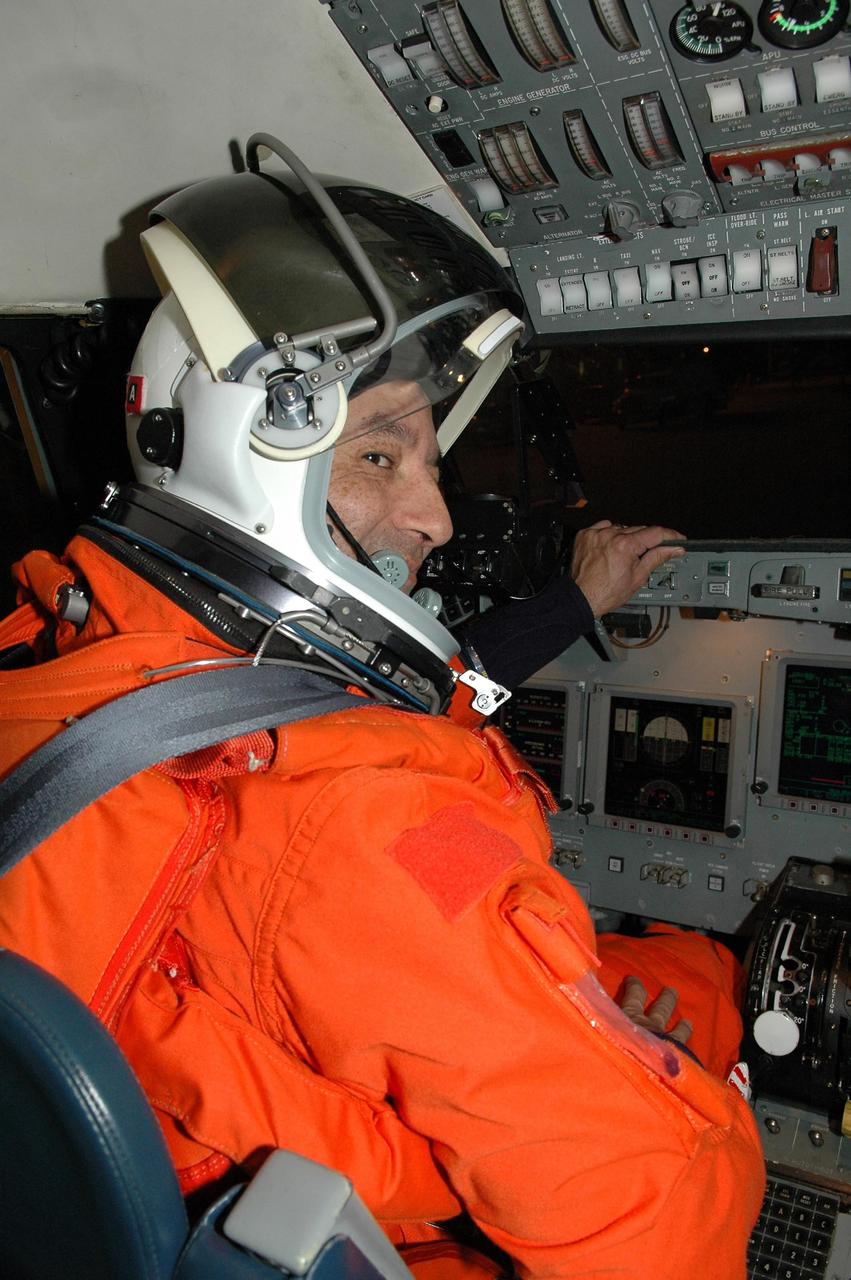
KENNEDY SPACE CENTER, FLA. -- At the Shuttle Landing Facility, STS-116 Commander Mark Polansky is in the pilot's seat of the shuttle training aircraft (STA), getting ready to practice landing the orbiter. The mission crew is at KSC for the terminal countdown demonstration test, which are prelaunch preparations that include a simulated launch countdown. STA practice is part of the TCDT. The STA is a Grumman American Aviation-built Gulf Stream II jet that was modified to simulate an orbiter's cockpit, motion and visual cues, and handling qualities. In flight, the STA duplicates the orbiter's atmospheric descent trajectory from approximately 35,000 feet altitude to landing on a runway. Because the orbiter is unpowered during re-entry and landing, its high-speed glide must be perfectly executed the first time. Photo credit: NASA/Kim Shiflett
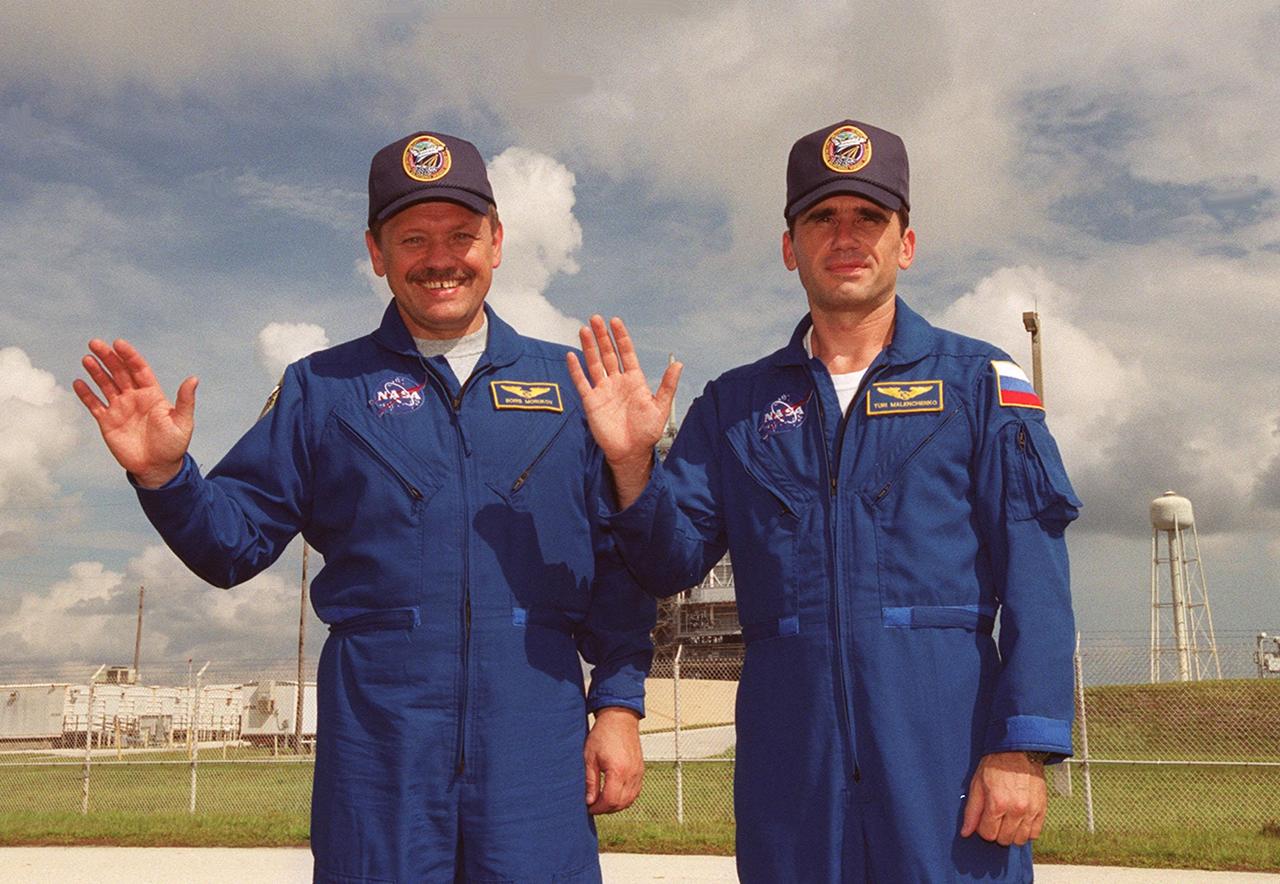
Russian cosmonauts Boris V. Morukov and Yuri I. Malenchenko wave for the photo while standing in front of Launch Pad 39B where Space Shuttle Atlantis awaits launch. The cosmonauts are with the Russian Aviation and Space Agency. STS-106 is scheduled to launch Sept. 8, 2000, at 8:45 a.m. EDT from Launch Pad 39B. On the 11-day mission, the seven-member crew will perform support tasks on orbit, transfer supplies and prepare the living quarters in the newly arrived Zvezda Service Module. Malenchenko will perform a six-and-a-half-hour space walk, along with Mission Specialist Edward T. Lu, during the mission. Landing is targeted for Sept. 19 at 4:59 a.m. EDT at the KSC Shuttle Landing Facility
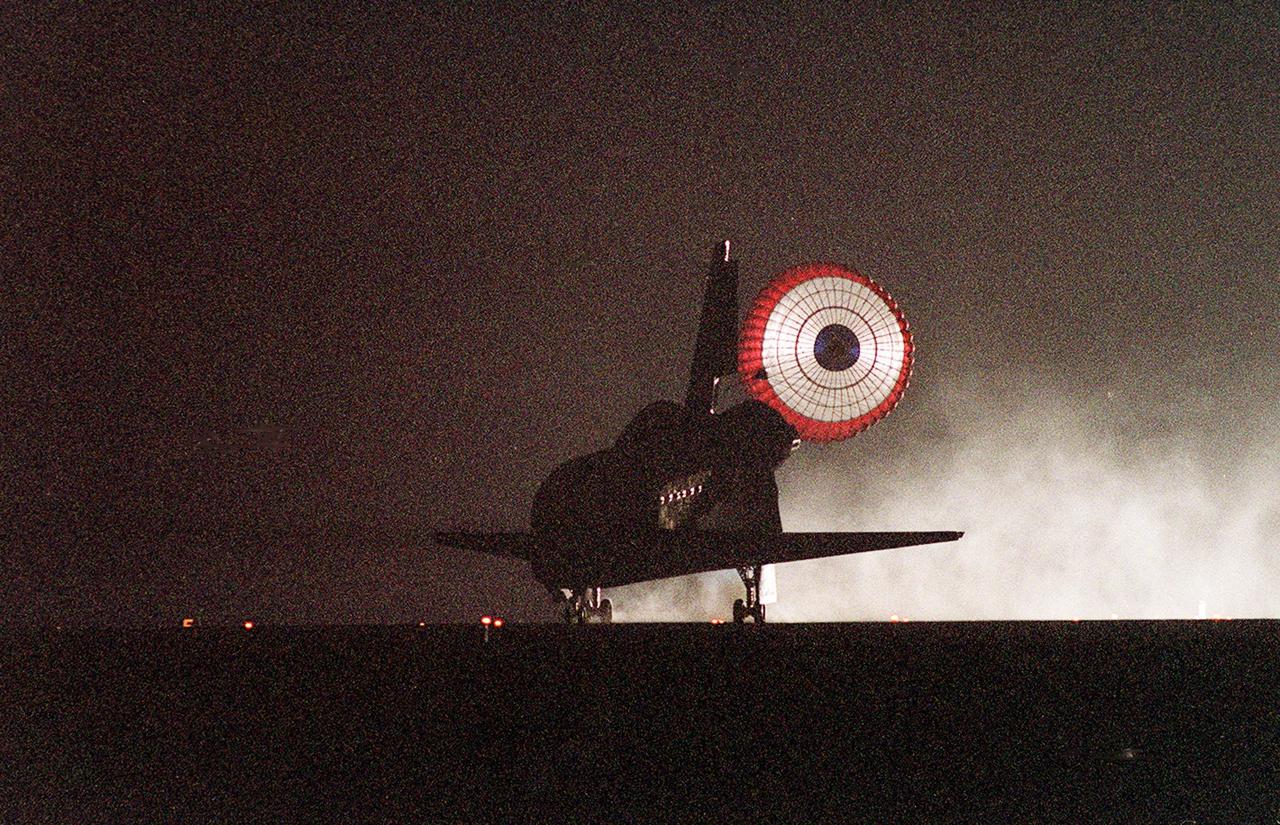
KENNEDY SPACE CENTER, Fla. -- Upon touchdown on Runway 15 of KSC’s Shuttle Landing Facility, Atlantis’s drag chute opens to help slow the vehicle. At the controls are Commander Terrence W. Wilcutt and Pilot Scott D. Altman. Also on board the orbiter are Mission Specialists Edward T. Lu, Yuri I. Malenchenko, Boris V. Morukov, Richard A. Mastracchio and Daniel C. Burbank. Malenchenko and Morukov are with the Russian Aviation and Space Agency. Atlantis and crew traveled 4.9 million miles on the 11-day, 19-hour, 11-minute STS-106 mission. Main gear touchdown was at 3:56:48 a.m. EDT, landing on orbit 185 of the mission. Nose gear touchdown was at 3:56:57 a.m. EDT and wheel stop at 3:58:01 a.m. EDT. The crew has returned from the International Space Station where they transferred nearly 5,000 pounds of equipment and supplies for use by the first resident crew expected to arrive in November. This was the 99th flight in the Shuttle program and the 22nd for Atlantis. STS-106 also marked the 15th nighttime landing in Shuttle history and the 23rd consecutive landing at KSC
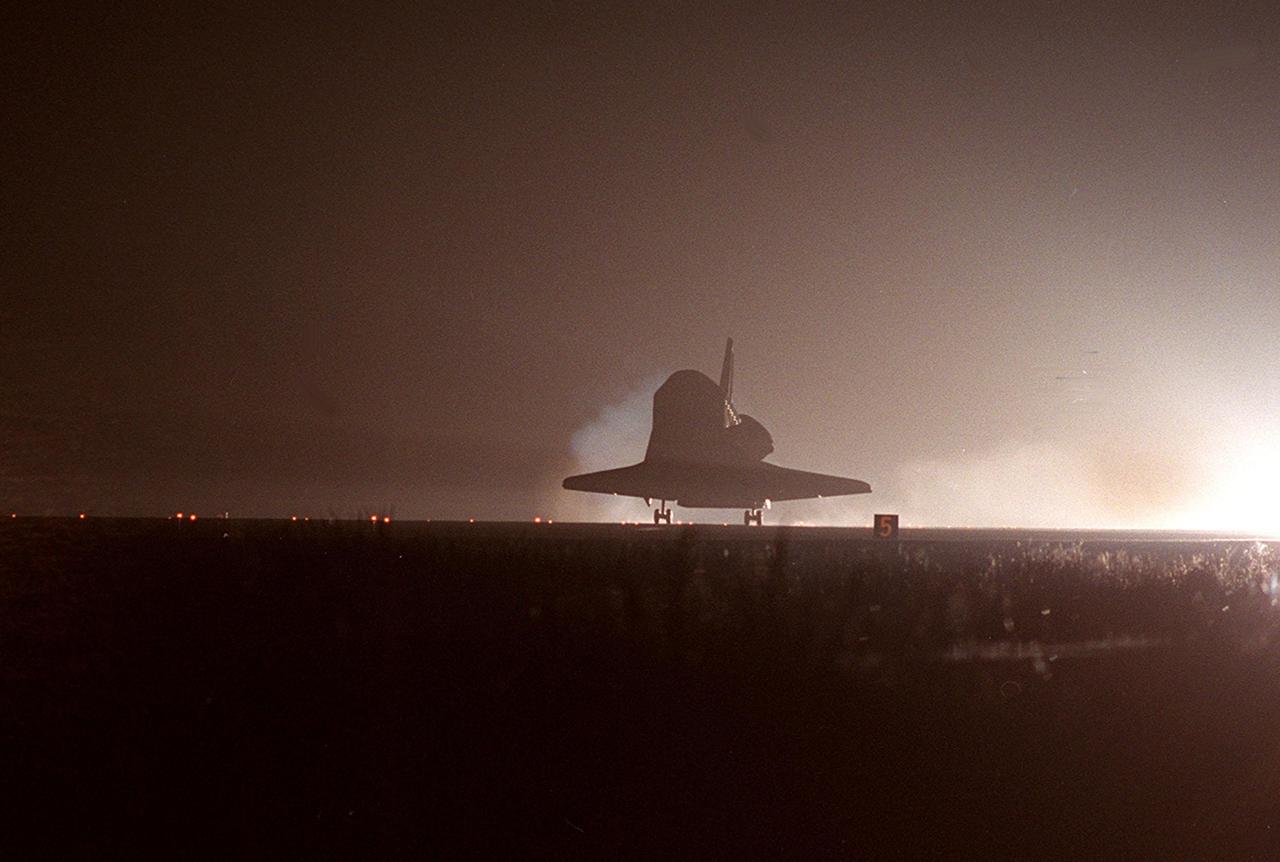
KENNEDY SPACE CENTER, Fla. -- Space Shuttle Atlantis appears ghostlike in the runway lights as it touches down on the KSC Shuttle Landing Facility Runway 15. At the controls are Commander Terrence W. Wilcutt and Pilot Scott D. Altman. Also on board the orbiter are Mission Specialists Edward T. Lu, Yuri I. Malenchenko, Boris V. Morukov, Richard A. Mastracchio and Daniel C. Burbank. Malenchenko and Morukov are with the Russian Aviation and Space Agency. Atlantis and crew traveled 4.9 million miles on the 11-day, 19-hour, 11-minute STS-106 mission. Main gear touchdown was at 3:56:48 a.m. EDT, landing on orbit 185 of the mission. Nose gear touchdown was at 3:56:57 a.m. EDT and wheel stop at 3:58:01 a.m. EDT. The crew has returned from the International Space Station where they transferred nearly 5,000 pounds of equipment and supplies for use by the first resident crew expected to arrive in November. This was the 99th flight in the Shuttle program and the 22nd for Atlantis. STS-106 also marked the 15th nighttime landing in Shuttle history and the 23rd consecutive landing at KSC
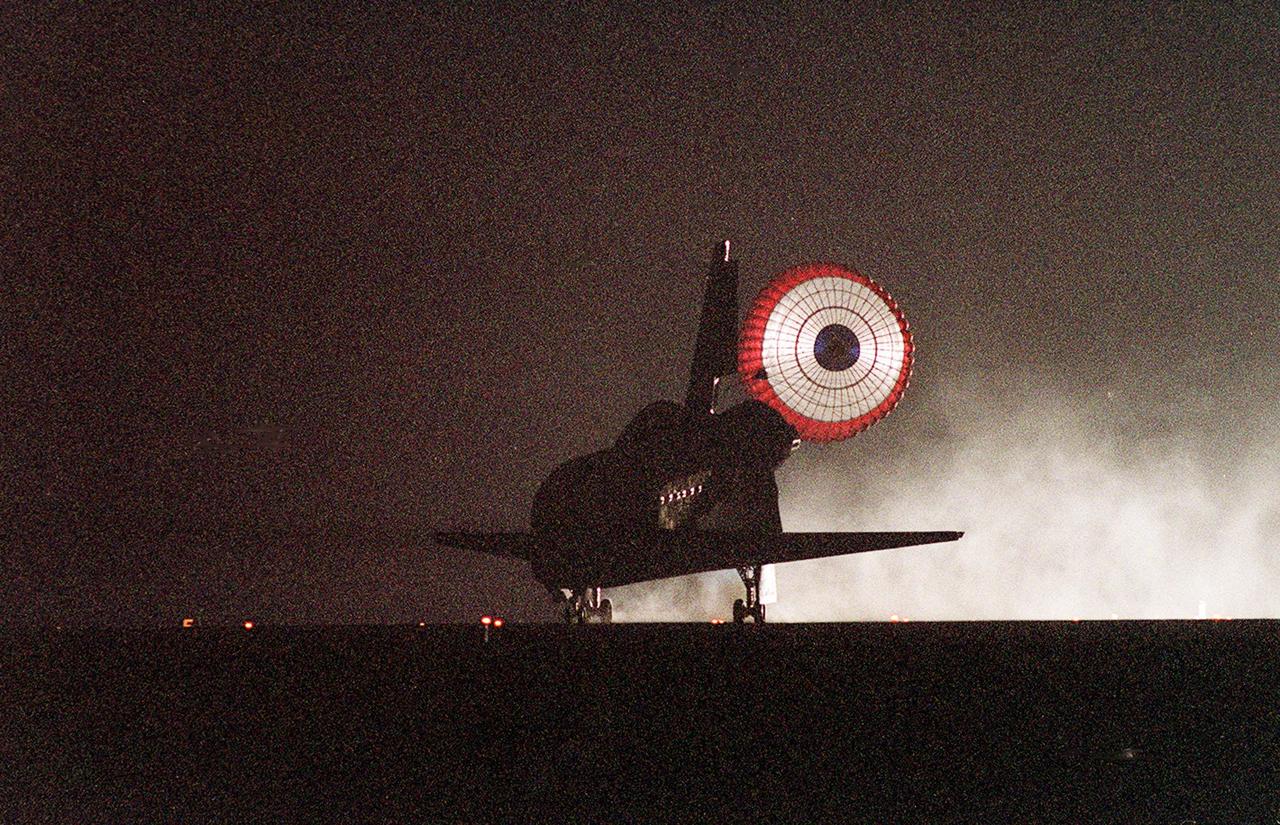
KENNEDY SPACE CENTER, Fla. -- Upon touchdown on Runway 15 of KSC’s Shuttle Landing Facility, Atlantis’s drag chute opens to help slow the vehicle. At the controls are Commander Terrence W. Wilcutt and Pilot Scott D. Altman. Also on board the orbiter are Mission Specialists Edward T. Lu, Yuri I. Malenchenko, Boris V. Morukov, Richard A. Mastracchio and Daniel C. Burbank. Malenchenko and Morukov are with the Russian Aviation and Space Agency. Atlantis and crew traveled 4.9 million miles on the 11-day, 19-hour, 11-minute STS-106 mission. Main gear touchdown was at 3:56:48 a.m. EDT, landing on orbit 185 of the mission. Nose gear touchdown was at 3:56:57 a.m. EDT and wheel stop at 3:58:01 a.m. EDT. The crew has returned from the International Space Station where they transferred nearly 5,000 pounds of equipment and supplies for use by the first resident crew expected to arrive in November. This was the 99th flight in the Shuttle program and the 22nd for Atlantis. STS-106 also marked the 15th nighttime landing in Shuttle history and the 23rd consecutive landing at KSC
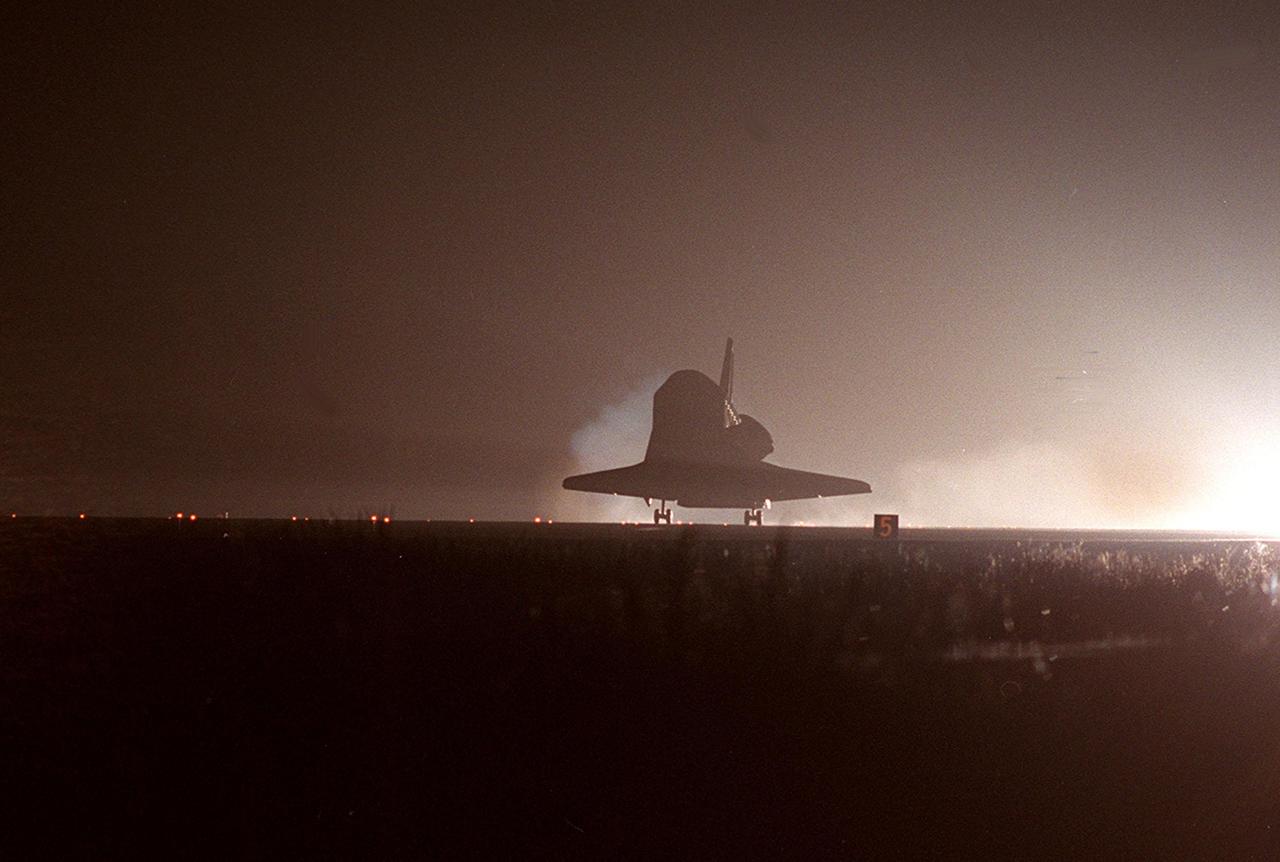
KENNEDY SPACE CENTER, Fla. -- Space Shuttle Atlantis appears ghostlike in the runway lights as it touches down on the KSC Shuttle Landing Facility Runway 15. At the controls are Commander Terrence W. Wilcutt and Pilot Scott D. Altman. Also on board the orbiter are Mission Specialists Edward T. Lu, Yuri I. Malenchenko, Boris V. Morukov, Richard A. Mastracchio and Daniel C. Burbank. Malenchenko and Morukov are with the Russian Aviation and Space Agency. Atlantis and crew traveled 4.9 million miles on the 11-day, 19-hour, 11-minute STS-106 mission. Main gear touchdown was at 3:56:48 a.m. EDT, landing on orbit 185 of the mission. Nose gear touchdown was at 3:56:57 a.m. EDT and wheel stop at 3:58:01 a.m. EDT. The crew has returned from the International Space Station where they transferred nearly 5,000 pounds of equipment and supplies for use by the first resident crew expected to arrive in November. This was the 99th flight in the Shuttle program and the 22nd for Atlantis. STS-106 also marked the 15th nighttime landing in Shuttle history and the 23rd consecutive landing at KSC
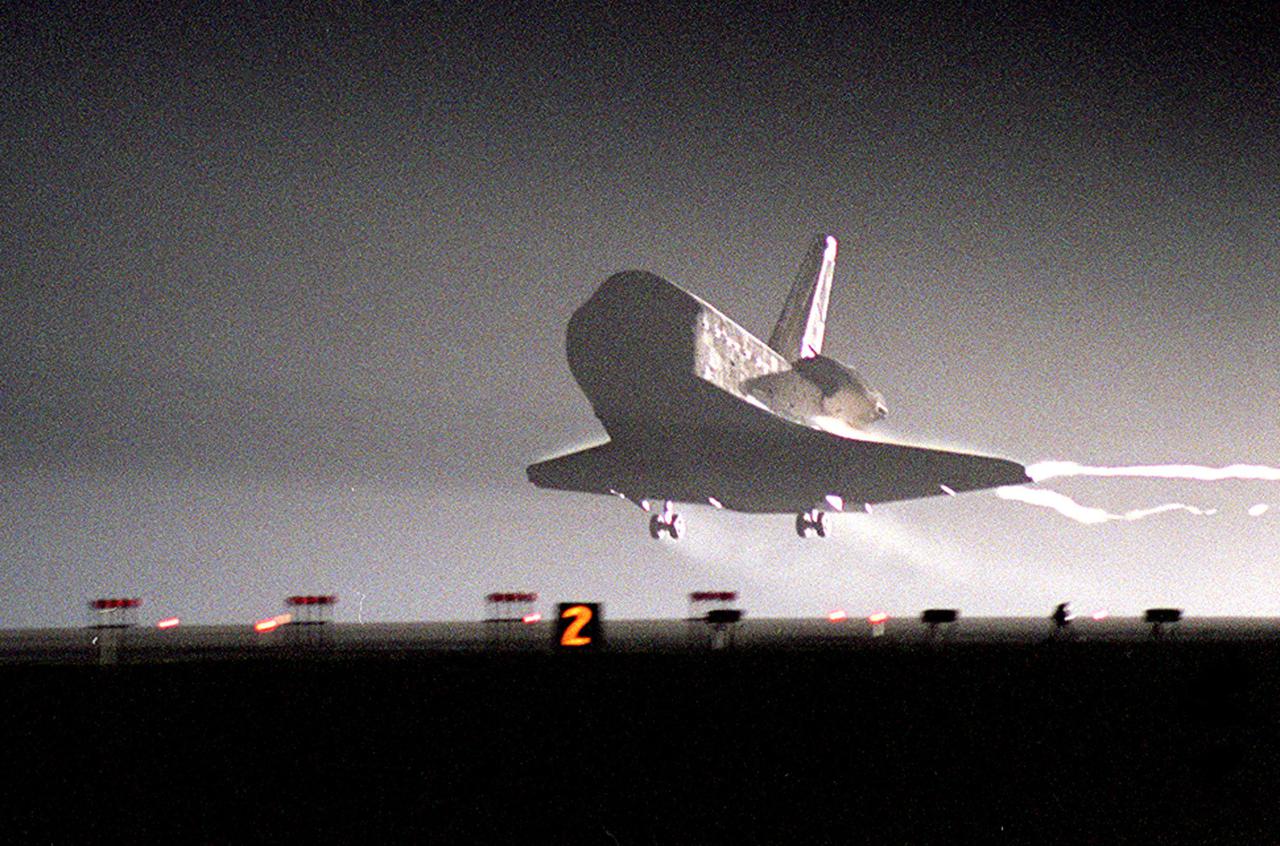
KENNEDY SPACE CENTER, Fla. -- Space Shuttle Atlantis presents a ghostlike image in the runway lights as it approaches touchdown on the KSC Shuttle Landing Facility Runway 15. At the controls are Commander Terrence W. Wilcutt and Pilot Scott D. Altman. Also on board the orbiter are Mission Specialists Edward T. Lu, Yuri I. Malenchenko, Boris V. Morukov, Richard A. Mastracchio and Daniel C. Burbank. Malenchenko and Morukov are with the Russian Aviation and Space Agency. Atlantis and crew traveled 4.9 million miles on the 11-day, 19-hour, 11-minute STS-106 mission. Main gear touchdown was at 3:56:48 a.m. EDT, landing on orbit 185 of the mission. Nose gear touchdown was at 3:56:57 a.m. EDT and wheel stop at 3:58:01 a.m. EDT. The crew has returned from the International Space Station where they transferred nearly 5,000 pounds of equipment and supplies for use by the first resident crew expected to arrive in November. This was the 99th flight in the Shuttle program and the 22nd for Atlantis. STS-106 also marked the 15th nighttime landing in Shuttle history and the 23rd consecutive landing at KSC