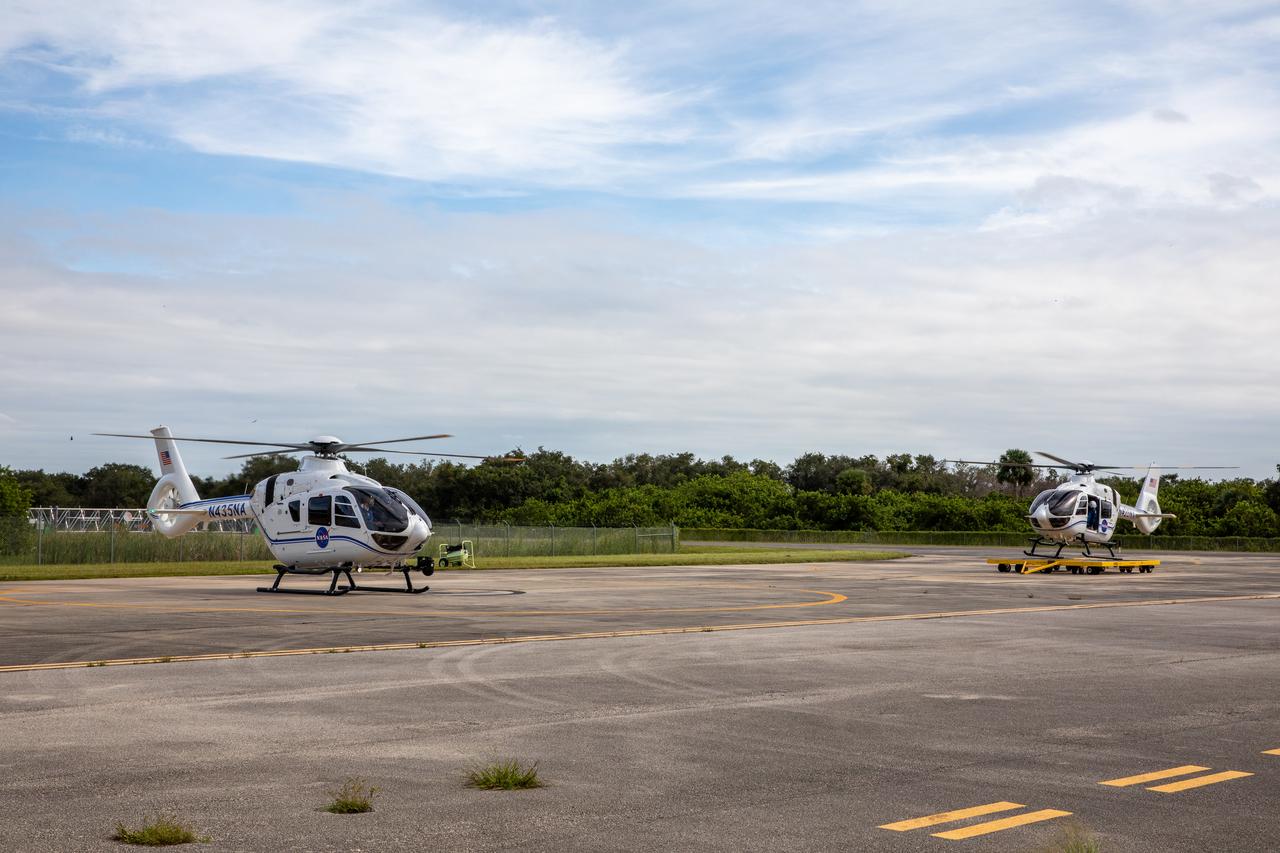
Two new Airbus H135 (T3) helicopters arrive at the Launch and Landing Facility runway at NASA’s Kennedy Space Center in Florida on Sept. 30, 2020. The H135 helicopters will replace the Bell Huey 2 security aircraft in service now, maintained by Kennedy’s Flight Operations team. These new helicopters provide a number of technological and safety advantages over the Hueys, such as more lifting power, greater stability in the air, and expanded medical capabilities. The team expects to fully transition to flying the two H135s later this year. A third is expected to arrive in early 2021, and with its arrival, will complete the fleet’s upgrade.
Two new Airbus H135 (T3) helicopters arrive at the Launch and Landing Facility runway at NASA’s Kennedy Space Center in Florida on Sept. 30, 2020. The H135 helicopters will replace the Bell Huey 2 security aircraft in service now, maintained by Kennedy’s Flight Operations team. These new helicopters provide a number of technological and safety advantages over the Hueys, such as more lifting power, greater stability in the air, and expanded medical capabilities. The team expects to fully transition to flying the two H135s later this year. A third is expected to arrive in early 2021, and with its arrival, will complete the fleet’s upgrade.
Two new Airbus H135 (T3) helicopters arrive at the Launch and Landing Facility runway at NASA’s Kennedy Space Center in Florida on Sept. 30, 2020. The H135 helicopters will replace the Bell Huey 2 security aircraft in service now, maintained by Kennedy’s Flight Operations team. These new helicopters provide a number of technological and safety advantages over the Hueys, such as more lifting power, greater stability in the air, and expanded medical capabilities. The team expects to fully transition to flying the two H135s later this year. A third is expected to arrive in early 2021, and with its arrival, will complete the fleet’s upgrade.
A new Airbus H135 (T3) helicopter arrives at the Launch and Landing Facility runway at NASA’s Kennedy Space Center in Florida on Sept. 30, 2020. A second H135 helicopter also was delivered on Sept. 30, and a third is expected to arrive in early 2021. The three H135 helicopters will replace the Bell Huey 2 security aircraft in service now, maintained by Kennedy’s Flight Operations team. These new helicopters provide a number of technological and safety advantages over the Hueys, such as more lifting power, greater stability in the air, and expanded medical capabilities. The team expects to fully transition to flying the two H135s later this year, and once the third arrives, the fleet’s upgrade will be complete.
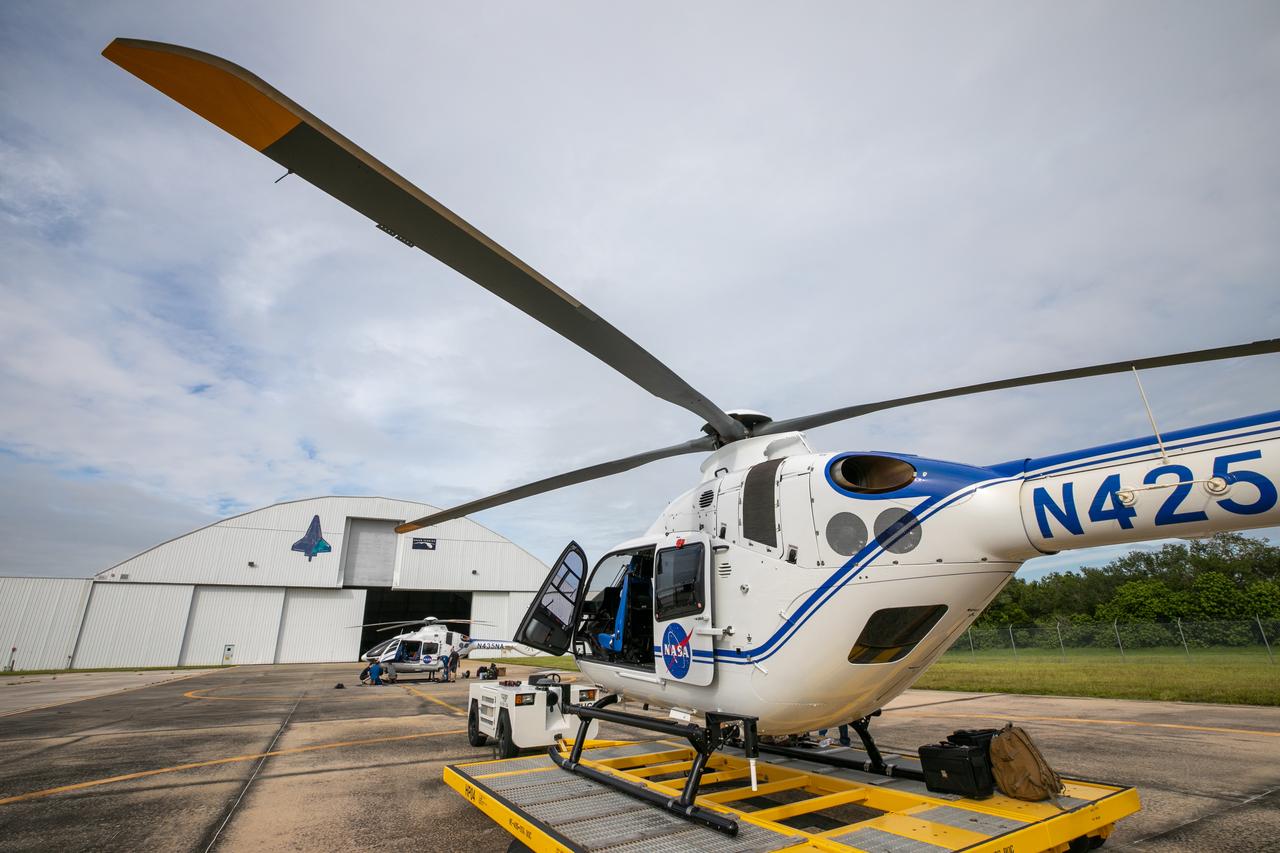
Two new Airbus H135 (T3) helicopters arrive at the Launch and Landing Facility runway at NASA’s Kennedy Space Center in Florida on Sept. 30, 2020. The H135 helicopters will replace the Bell Huey 2 security aircraft in service now, maintained by Kennedy’s Flight Operations team. These new helicopters provide a number of technological and safety advantages over the Hueys, such as more lifting power, greater stability in the air, and expanded medical capabilities. The team expects to fully transition to flying the two H135s later this year. A third is expected to arrive in early 2021, and with its arrival, will complete the fleet’s upgrade.
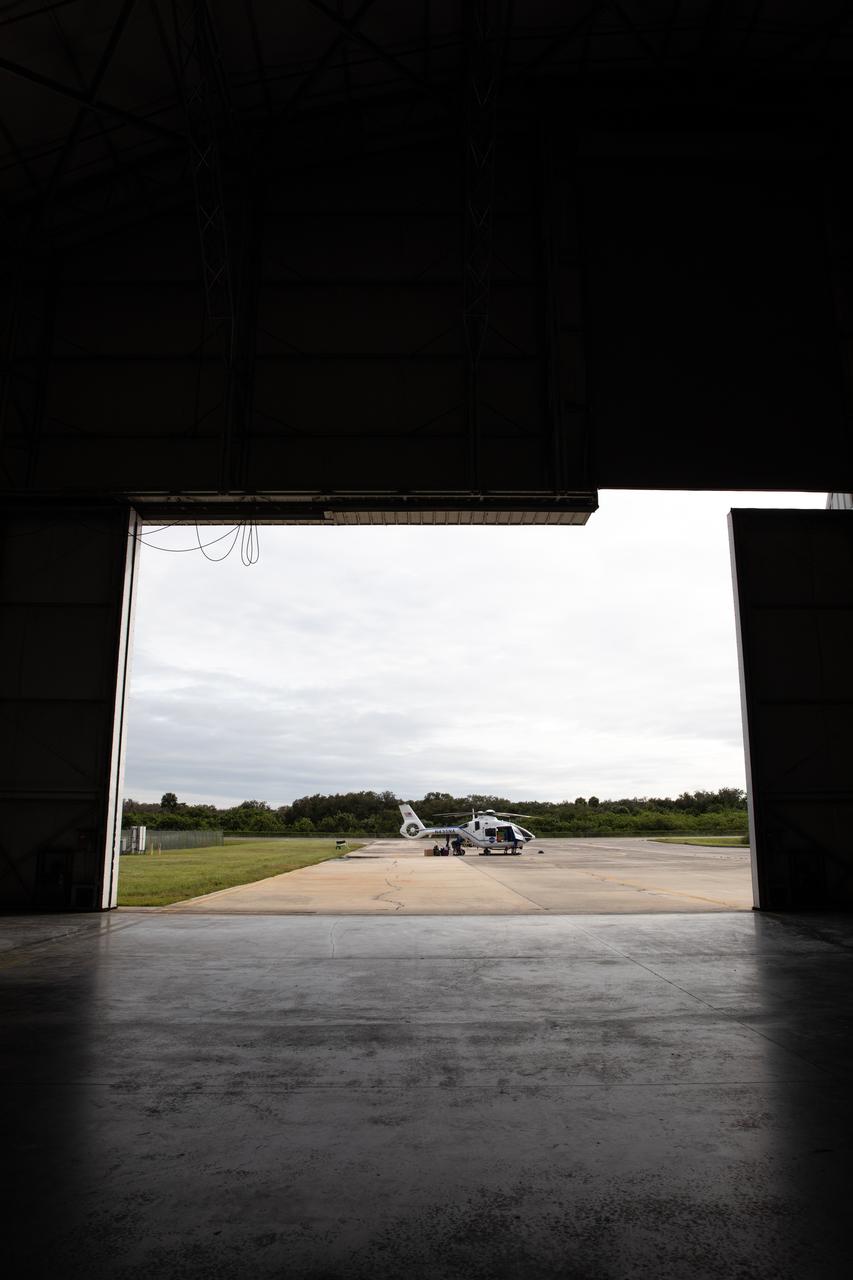
A new Airbus H135 (T3) helicopter arrives at the Launch and Landing Facility runway at NASA’s Kennedy Space Center in Florida on Sept. 30, 2020. A second H135 helicopter also was delivered on Sept. 30, and a third is expected to arrive in early 2021. The three H135 helicopters will replace the Bell Huey 2 security aircraft in service now, maintained by Kennedy’s Flight Operations team. These new helicopters provide a number of technological and safety advantages over the Hueys, such as more lifting power, greater stability in the air, and expanded medical capabilities. The team expects to fully transition to flying the two H135s later this year, and once the third arrives, the fleet’s upgrade will be complete.
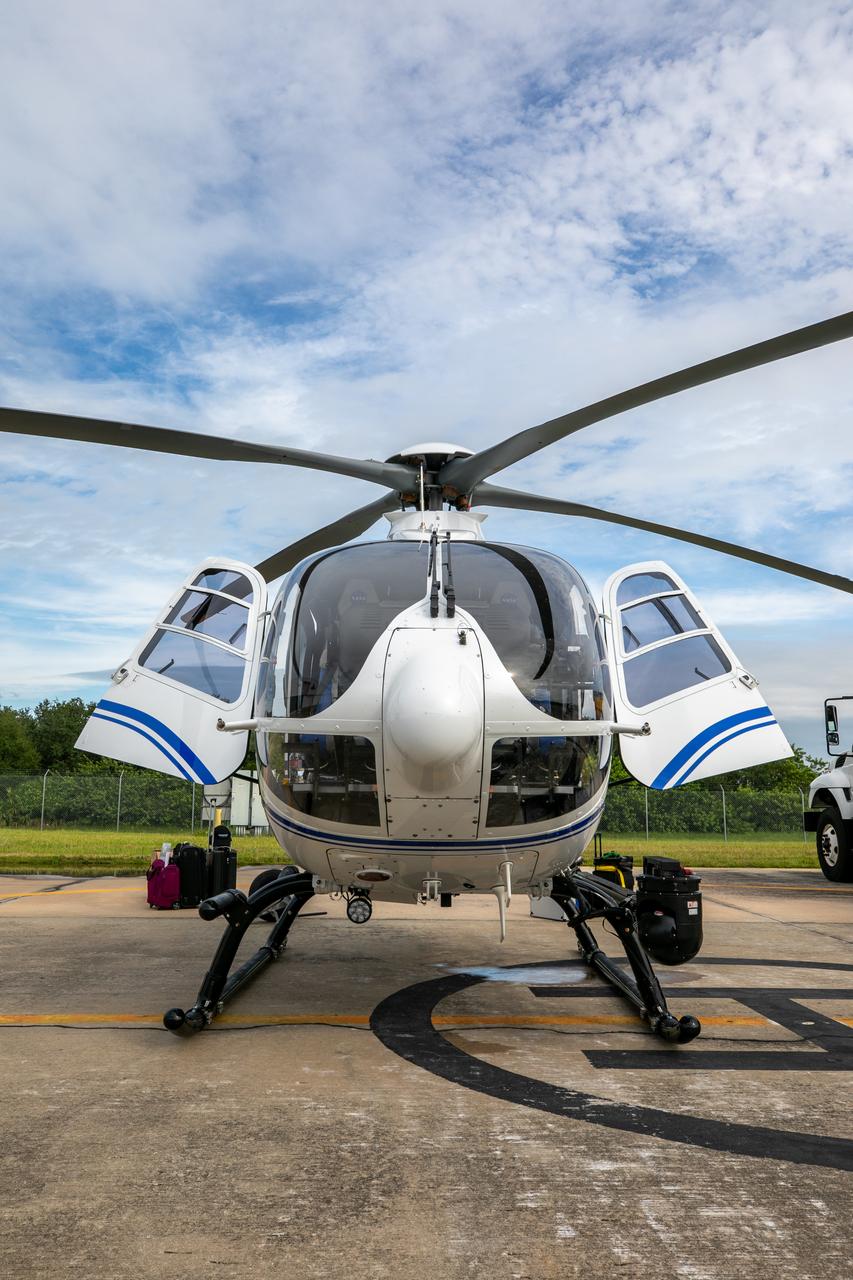
A new Airbus H135 (T3) helicopter arrives at the Launch and Landing Facility runway at NASA’s Kennedy Space Center in Florida on Sept. 30, 2020. A second H135 helicopter also was delivered on Sept. 30, and a third is expected to arrive in early 2021. The three H135 helicopters will replace the Bell Huey 2 security aircraft in service now, maintained by Kennedy’s Flight Operations team. These new helicopters provide a number of technological and safety advantages over the Hueys, such as more lifting power, greater stability in the air, and expanded medical capabilities. The team expects to fully transition to flying the two H135s later this year, and once the third arrives, the fleet’s upgrade will be complete.
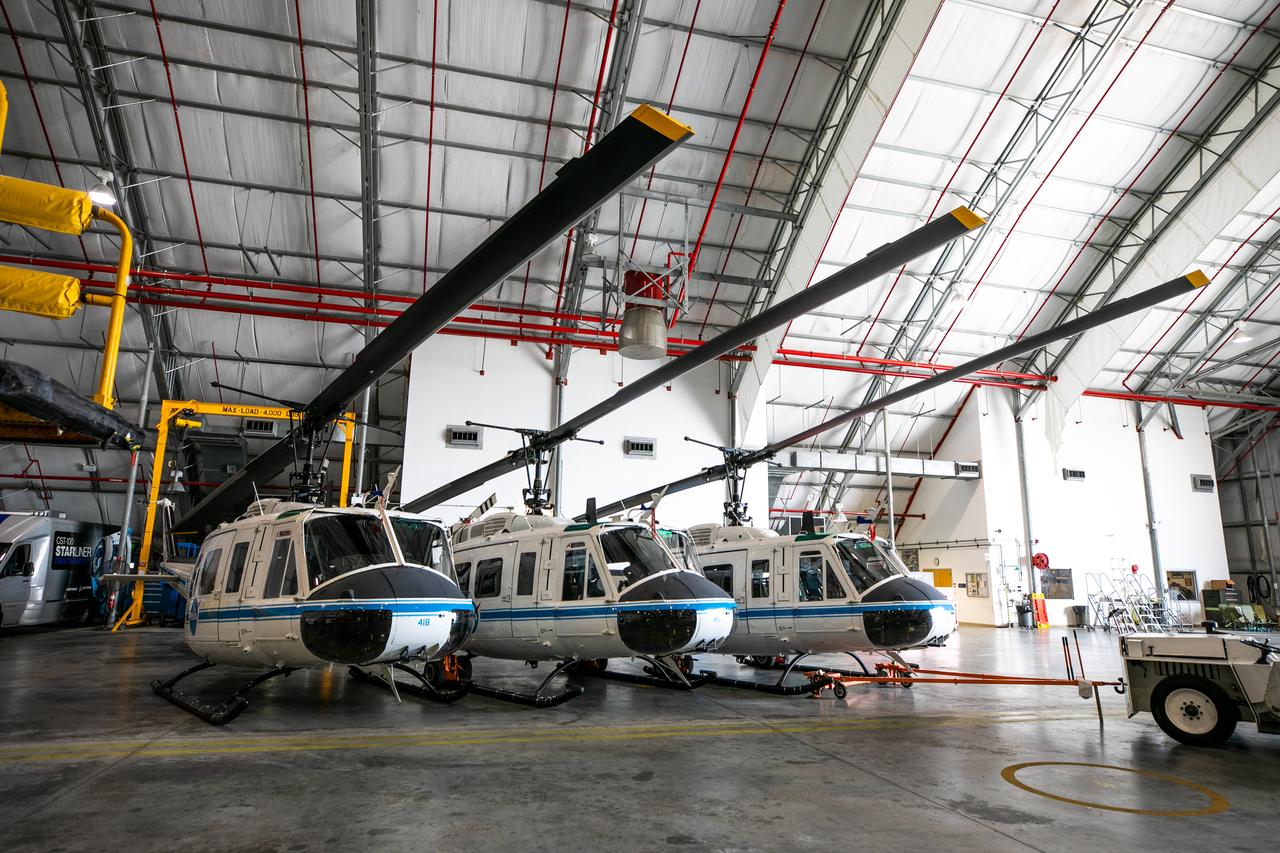
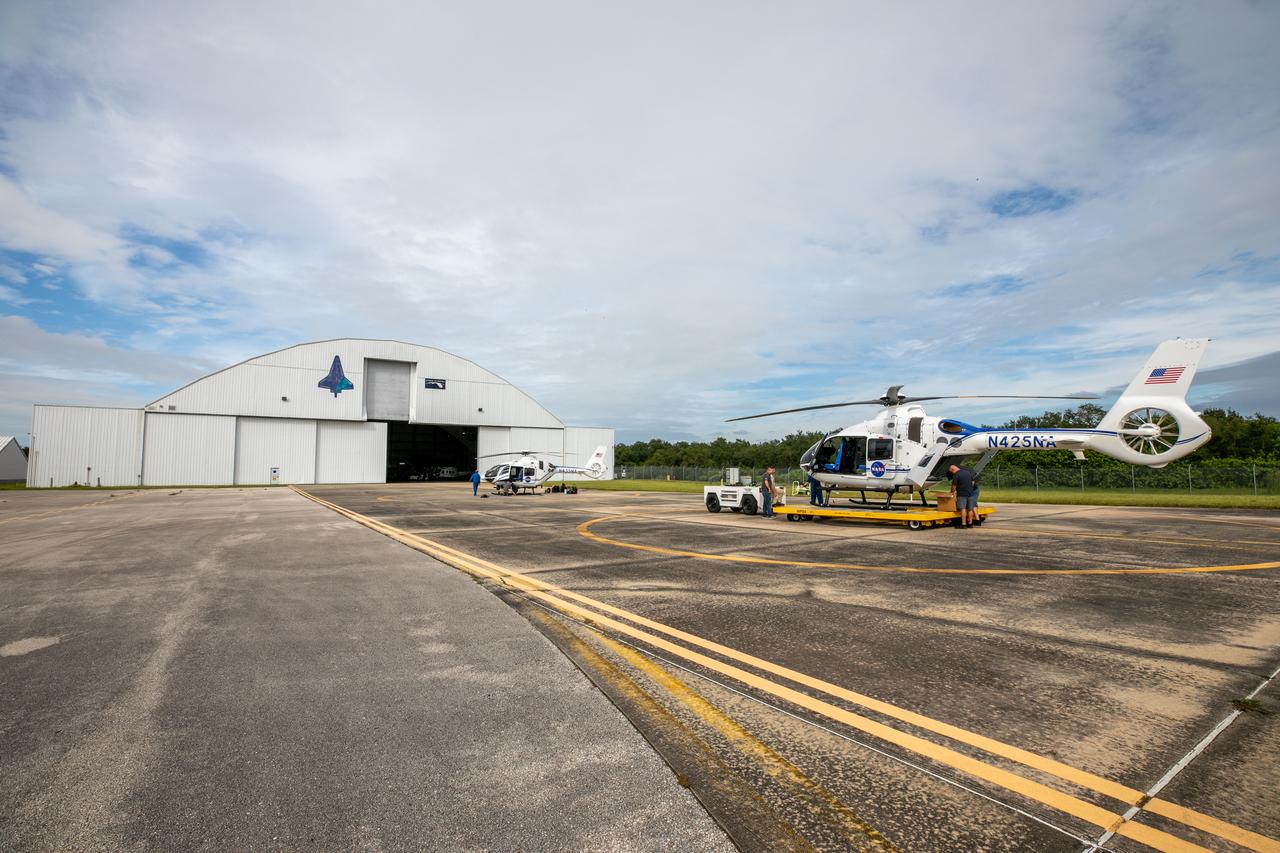
The three Bell Huey 2 helicopters utilized by Kennedy Space Center’s Flight Operations team for security purposes are photographed inside the Launch and Landing Facility hangar on Sept. 30, 2020. Two new Airbus H135 (T3) helicopters arrived at the Florida spaceport on Sept. 30 to replace the Bell Huey 2 aircraft in service now. The new helicopters provide a number of technological and safety advantages over the Hueys, such as more lifting power, greater stability in the air, and expanded medical capabilities. The team expects to fully transition to flying the two H135 aircraft later this year. A third is expected to arrive in early 2021, and with its arrival, will complete the fleet’s upgrade.
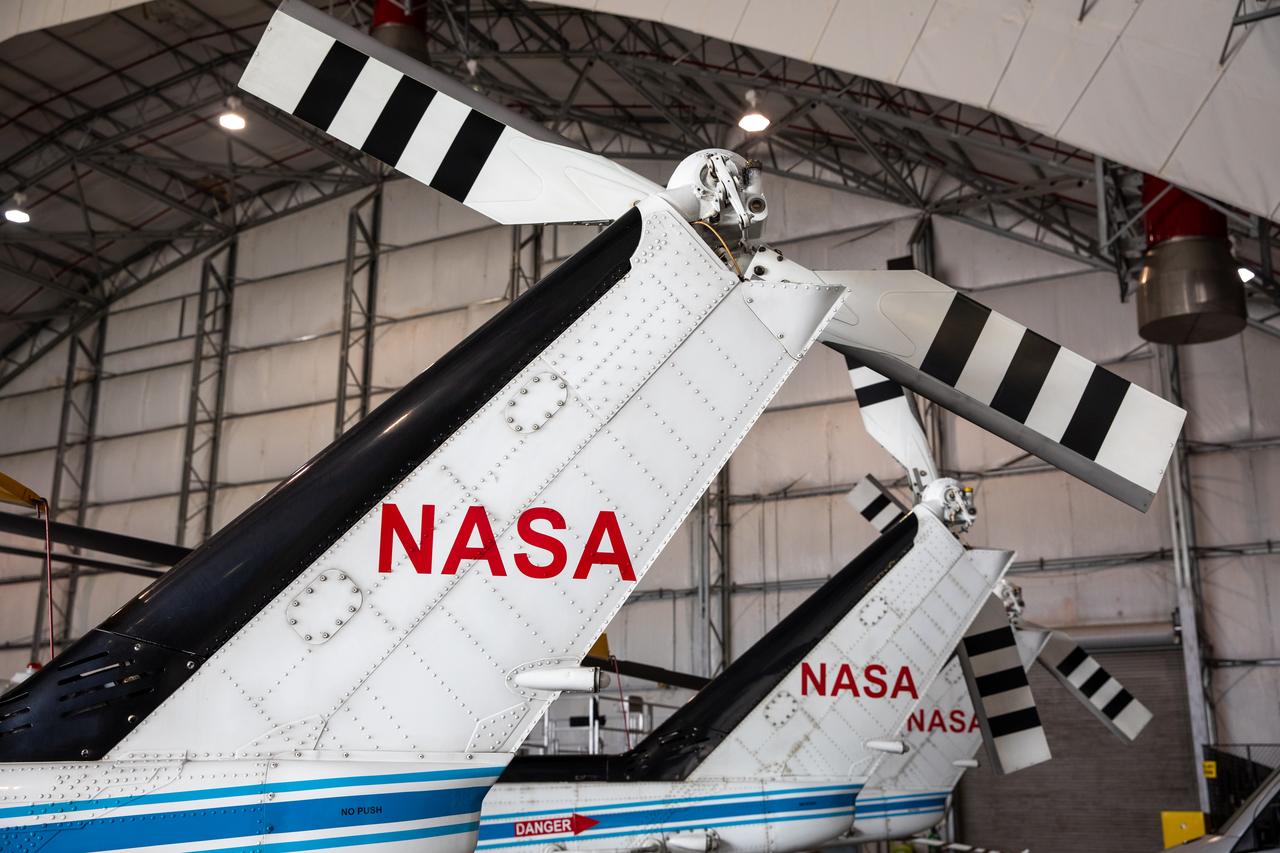
The three Bell Huey 2 helicopters utilized by Kennedy Space Center’s Flight Operations team for security purposes are photographed inside the Launch and Landing Facility hangar on Sept. 30, 2020. Two new Airbus H135 (T3) helicopters arrived at the Florida spaceport on Sept. 30 to replace the Bell Huey 2 aircraft in service now. The new helicopters provide a number of technological and safety advantages over the Hueys, such as more lifting power, greater stability in the air, and expanded medical capabilities. The team expects to fully transition to flying the two H135 aircraft later this year. A third is expected to arrive in early 2021, and with its arrival, will complete the fleet’s upgrade.
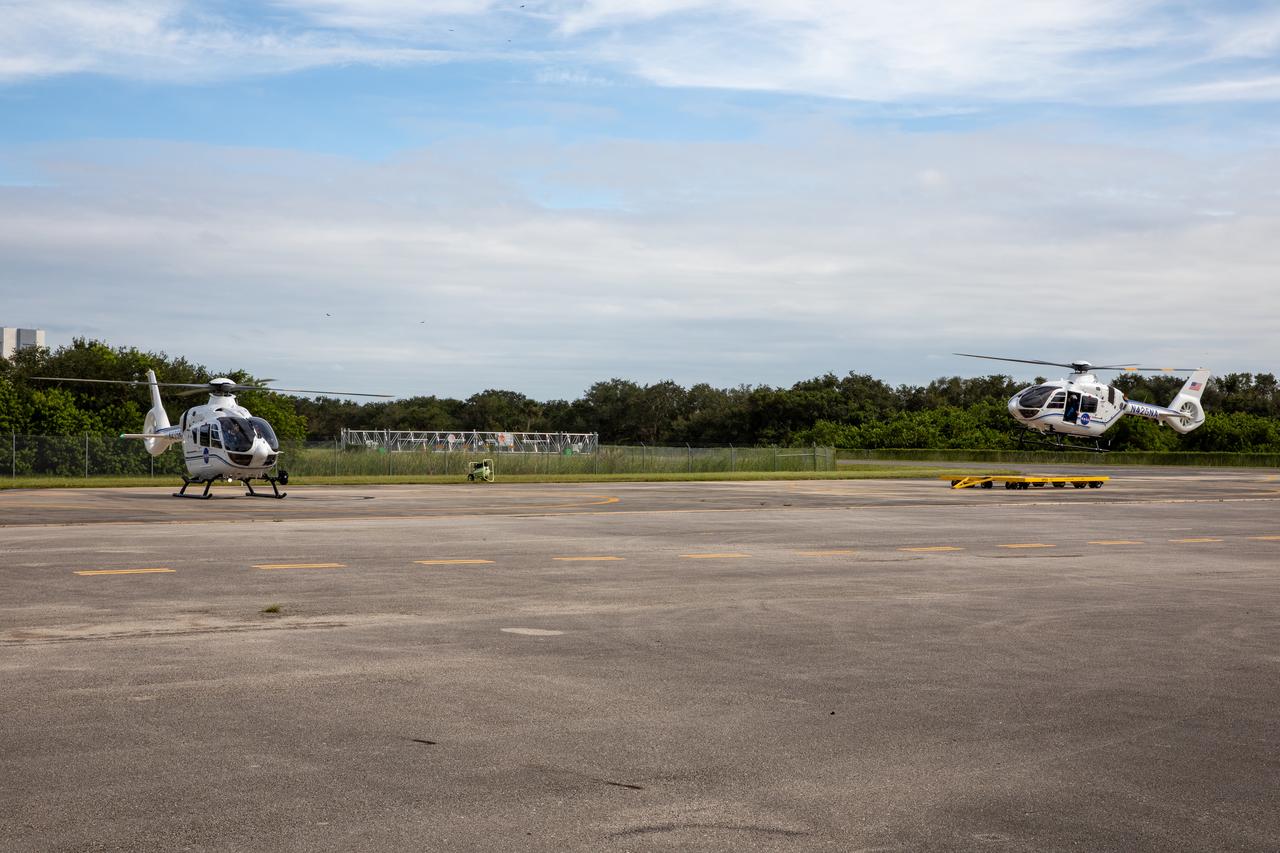
Two new Airbus H135 (T3) helicopters arrive at the Launch and Landing Facility runway at NASA’s Kennedy Space Center in Florida on Sept. 30, 2020. The H135 helicopters will replace the Bell Huey 2 security aircraft in service now, maintained by Kennedy’s Flight Operations team. These new helicopters provide a number of technological and safety advantages over the Hueys, such as more lifting power, greater stability in the air, and expanded medical capabilities. The team expects to fully transition to flying the two H135s later this year. A third is expected to arrive in early 2021, and with its arrival, will complete the fleet’s upgrade.
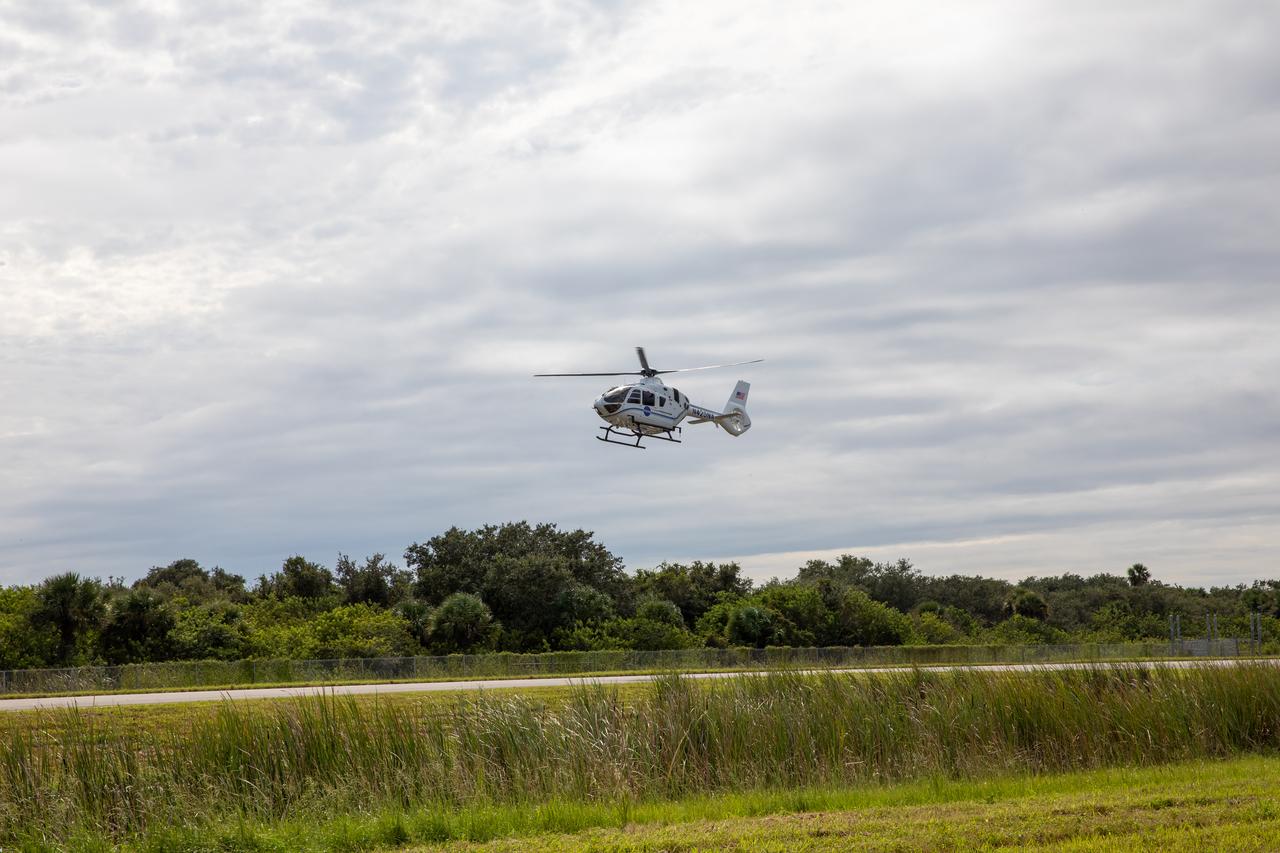
A new Airbus H135 (T3) helicopter arrives at the Launch and Landing Facility runway at NASA’s Kennedy Space Center in Florida on Sept. 30, 2020. A second H135 helicopter also was delivered on Sept. 30, and a third is expected to arrive in early 2021. The three H135 helicopters will replace the Bell Huey 2 security aircraft in service now, maintained by Kennedy’s Flight Operations team. These new helicopters provide a number of technological and safety advantages over the Hueys, such as more lifting power, greater stability in the air, and expanded medical capabilities. The team expects to fully transition to flying the two H135s later this year, and once the third arrives, the fleet’s upgrade will be complete.
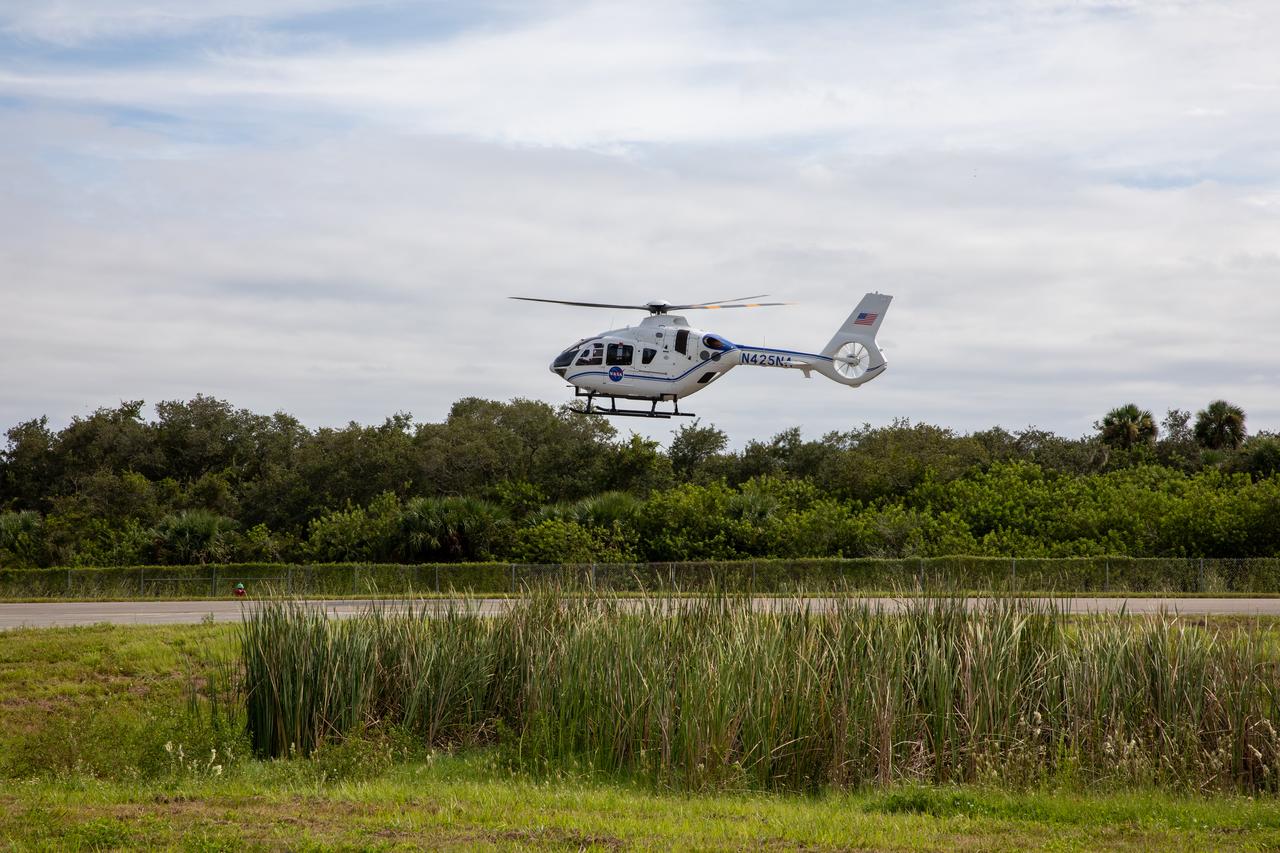
A new Airbus H135 (T3) helicopter arrives at the Launch and Landing Facility runway at NASA’s Kennedy Space Center in Florida on Sept. 30, 2020. A second H135 helicopter also was delivered on Sept. 30, and a third is expected to arrive in early 2021. The three H135 helicopters will replace the Bell Huey 2 security aircraft in service now, maintained by Kennedy’s Flight Operations team. These new helicopters provide a number of technological and safety advantages over the Hueys, such as more lifting power, greater stability in the air, and expanded medical capabilities. The team expects to fully transition to flying the two H135s later this year, and once the third arrives, the fleet’s upgrade will be complete.
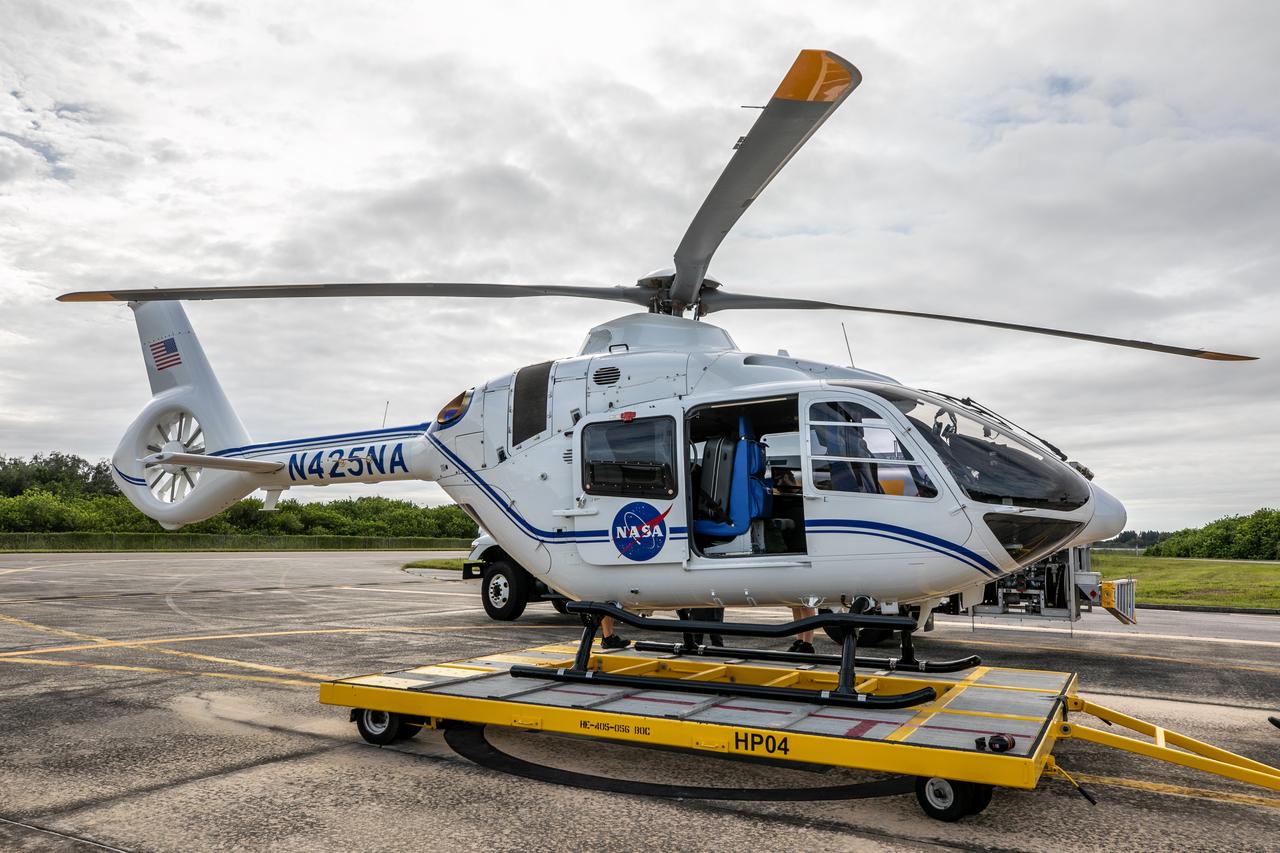
A new Airbus H135 (T3) helicopter arrives at the Launch and Landing Facility runway at NASA’s Kennedy Space Center in Florida on Sept. 30, 2020. A second H135 helicopter also was delivered on Sept. 30, and a third is expected to arrive in early 2021. The three H135 helicopters will replace the Bell Huey 2 security aircraft in service now, maintained by Kennedy’s Flight Operations team. These new helicopters provide a number of technological and safety advantages over the Hueys, such as more lifting power, greater stability in the air, and expanded medical capabilities. The team expects to fully transition to flying the two H135s later this year, and once the third arrives, the fleet’s upgrade will be complete.
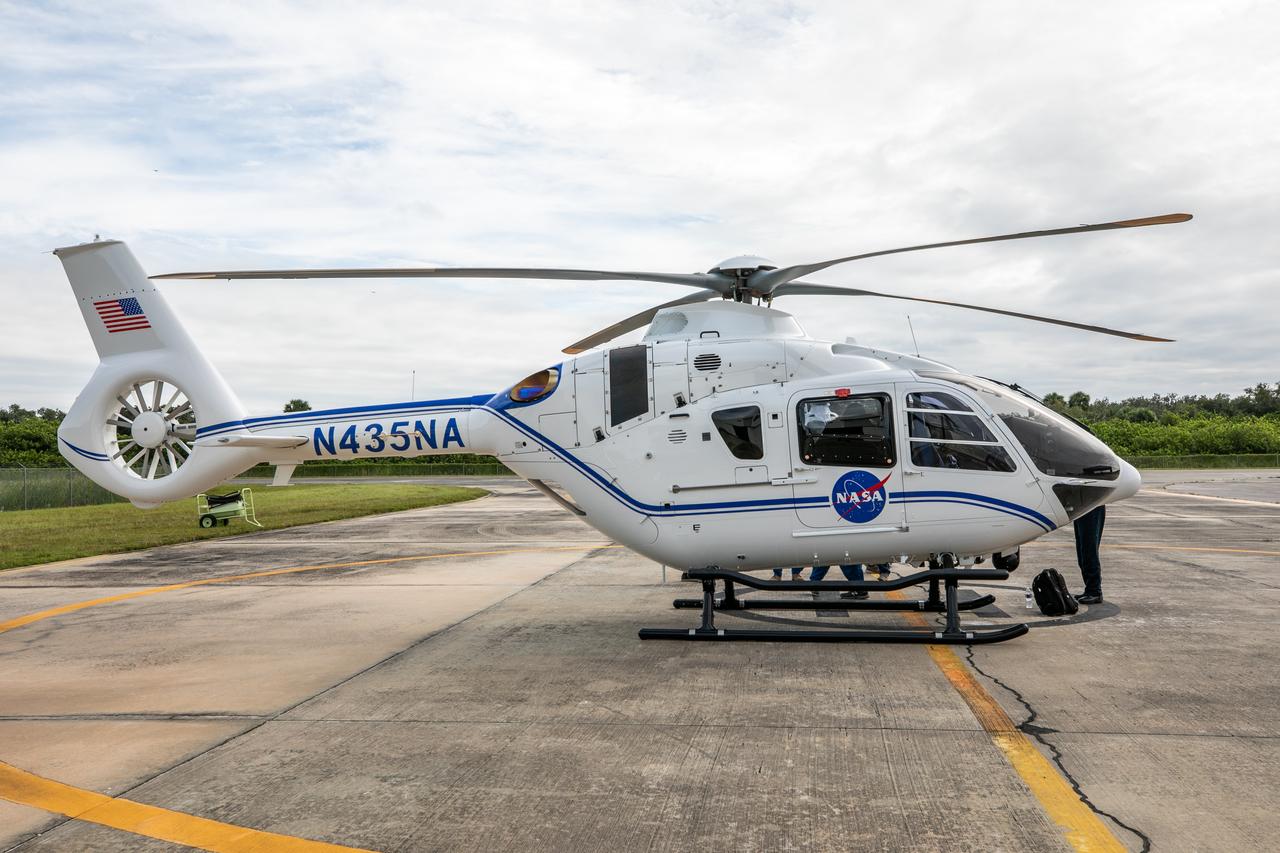
A new Airbus H135 (T3) helicopter arrives at the Launch and Landing Facility runway at NASA’s Kennedy Space Center in Florida on Sept. 30, 2020. A second H135 helicopter also was delivered on Sept. 30, and a third is expected to arrive in early 2021. The three H135 helicopters will replace the Bell Huey 2 security aircraft in service now, maintained by Kennedy’s Flight Operations team. These new helicopters provide a number of technological and safety advantages over the Hueys, such as more lifting power, greater stability in the air, and expanded medical capabilities. The team expects to fully transition to flying the two H135s later this year, and once the third arrives, the fleet’s upgrade will be complete.
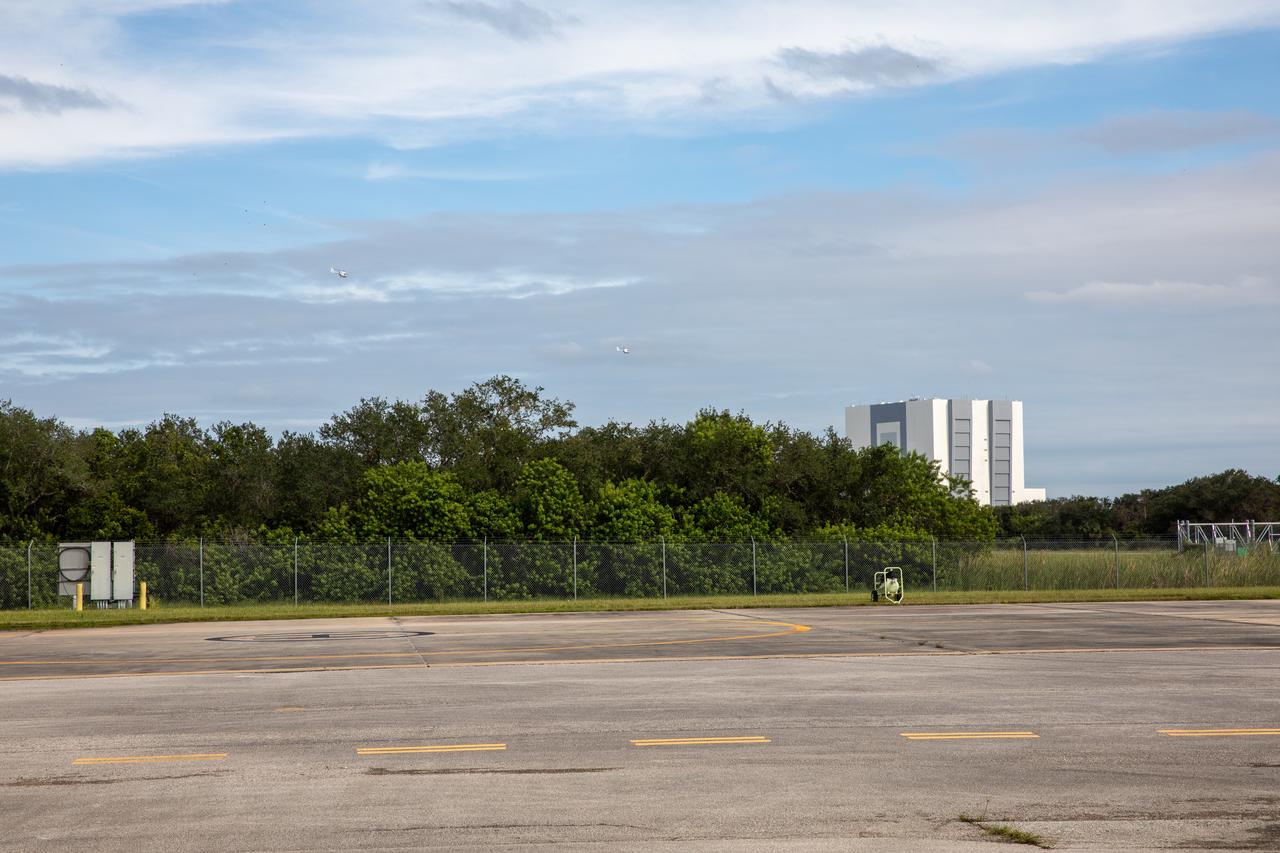
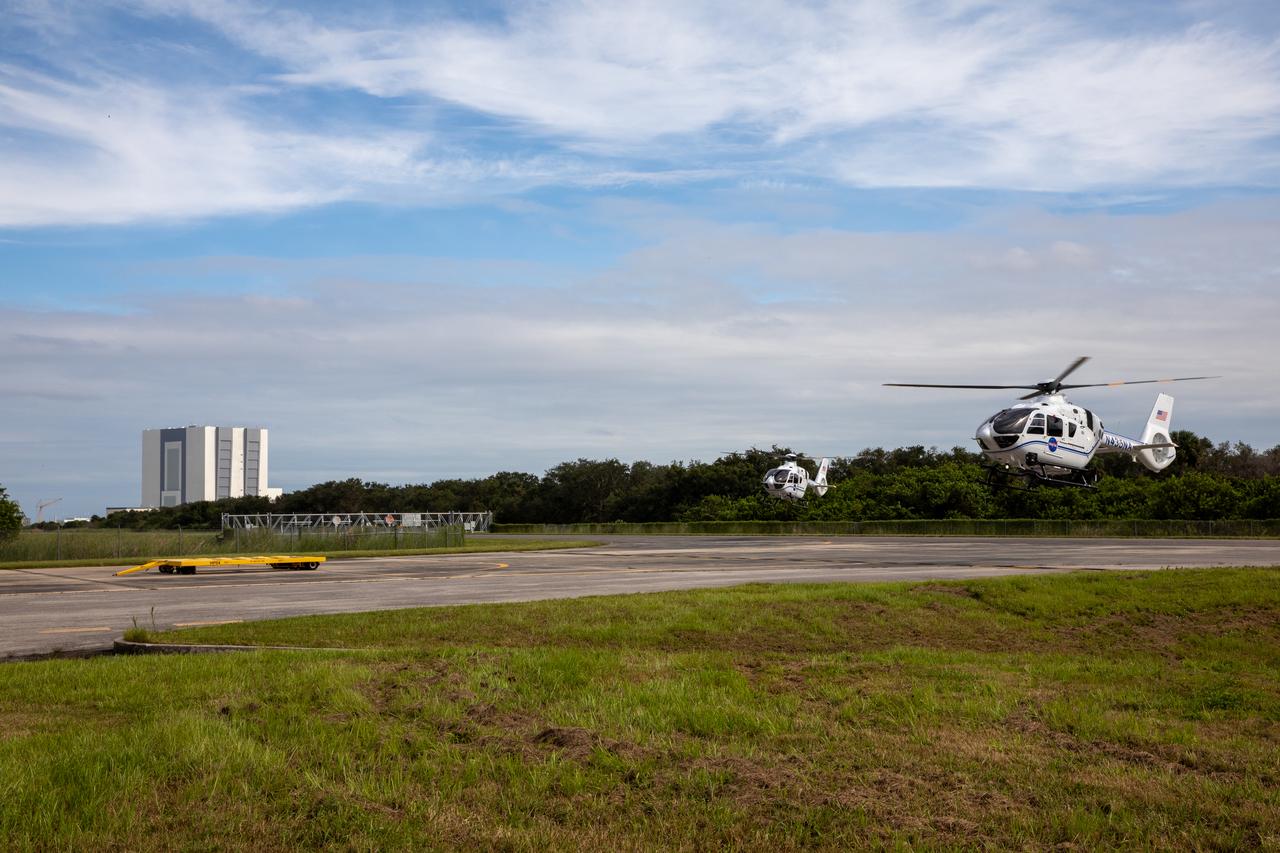
Two new Airbus H135 (T3) helicopters can be seen in the distance, arriving at the Launch and Landing Facility runway at NASA’s Kennedy Space Center in Florida on Sept. 30, 2020. The H135 helicopters will replace the Bell Huey 2 security aircraft in service now, maintained by Kennedy’s Flight Operations team. These new helicopters provide a number of technological and safety advantages over the Hueys, such as more lifting power, greater stability in the air, and expanded medical capabilities. The team expects to fully transition to flying the two H135s later this year. A third is expected to arrive in early 2021, and with its arrival, will complete the fleet’s upgrade.
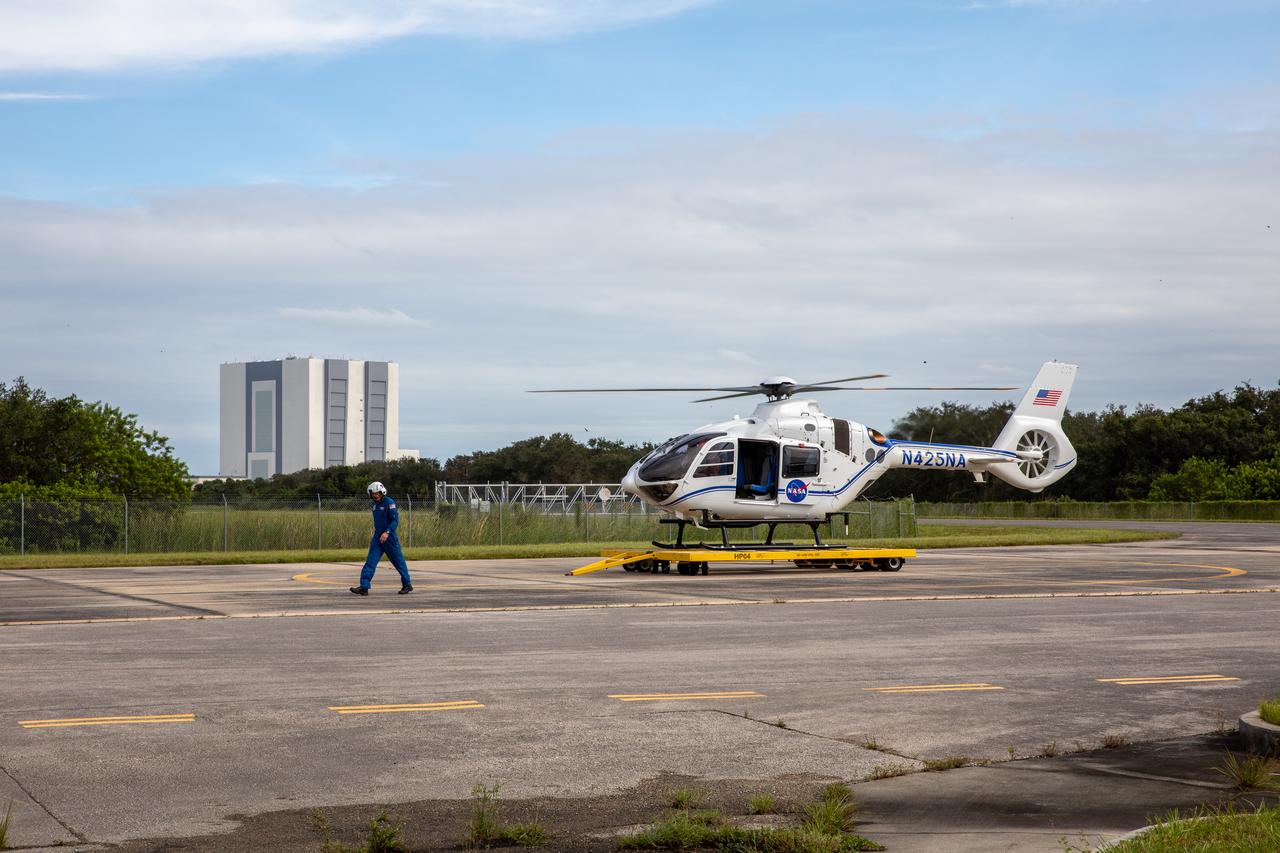
A new Airbus H135 (T3) helicopter arrives at the Launch and Landing Facility runway at NASA’s Kennedy Space Center in Florida on Sept. 30, 2020. A second H135 helicopter also was delivered on Sept. 30, and a third is expected to arrive in early 2021. The three H135 helicopters will replace the Bell Huey 2 security aircraft in service now, maintained by Kennedy’s Flight Operations team. These new helicopters provide a number of technological and safety advantages over the Hueys, such as more lifting power, greater stability in the air, and expanded medical capabilities. The team expects to fully transition to flying the two H135s later this year, and once the third arrives, the fleet’s upgrade will be complete.
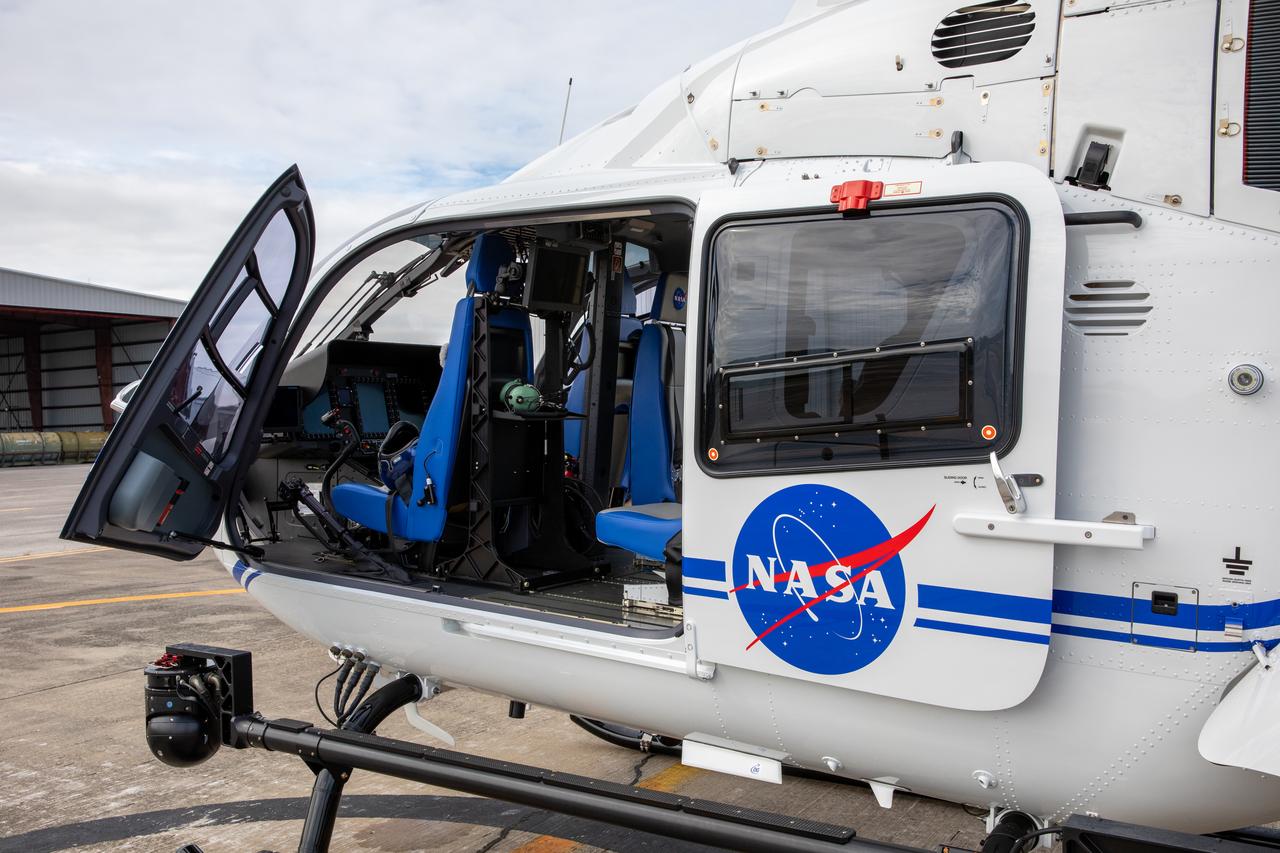
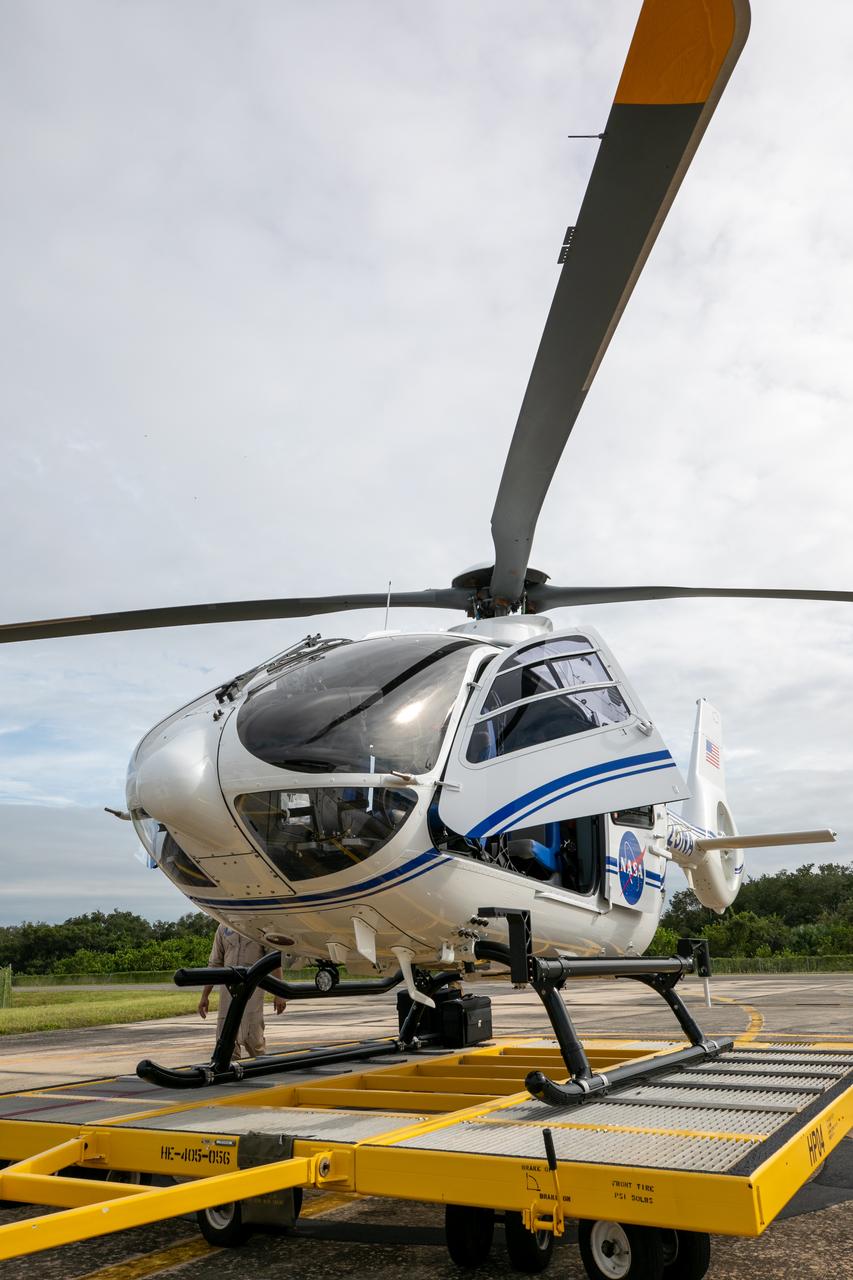
The interior of a new Airbus H135 (T3) helicopter is displayed after arriving at the Launch and Landing Facility runway at NASA’s Kennedy Space Center in Florida on Sept. 30, 2020. A second H135 helicopter also was delivered on Sept. 30, and a third is expected to arrive in early 2021. The three H135 helicopters will replace the Bell Huey 2 security aircraft in service now, maintained by Kennedy’s Flight Operations team. These new helicopters provide a number of technological and safety advantages over the Hueys, such as more lifting power, greater stability in the air, and expanded medical capabilities. The team expects to fully transition to flying the two H135s later this year, and once the third arrives, the fleet’s upgrade will be complete.
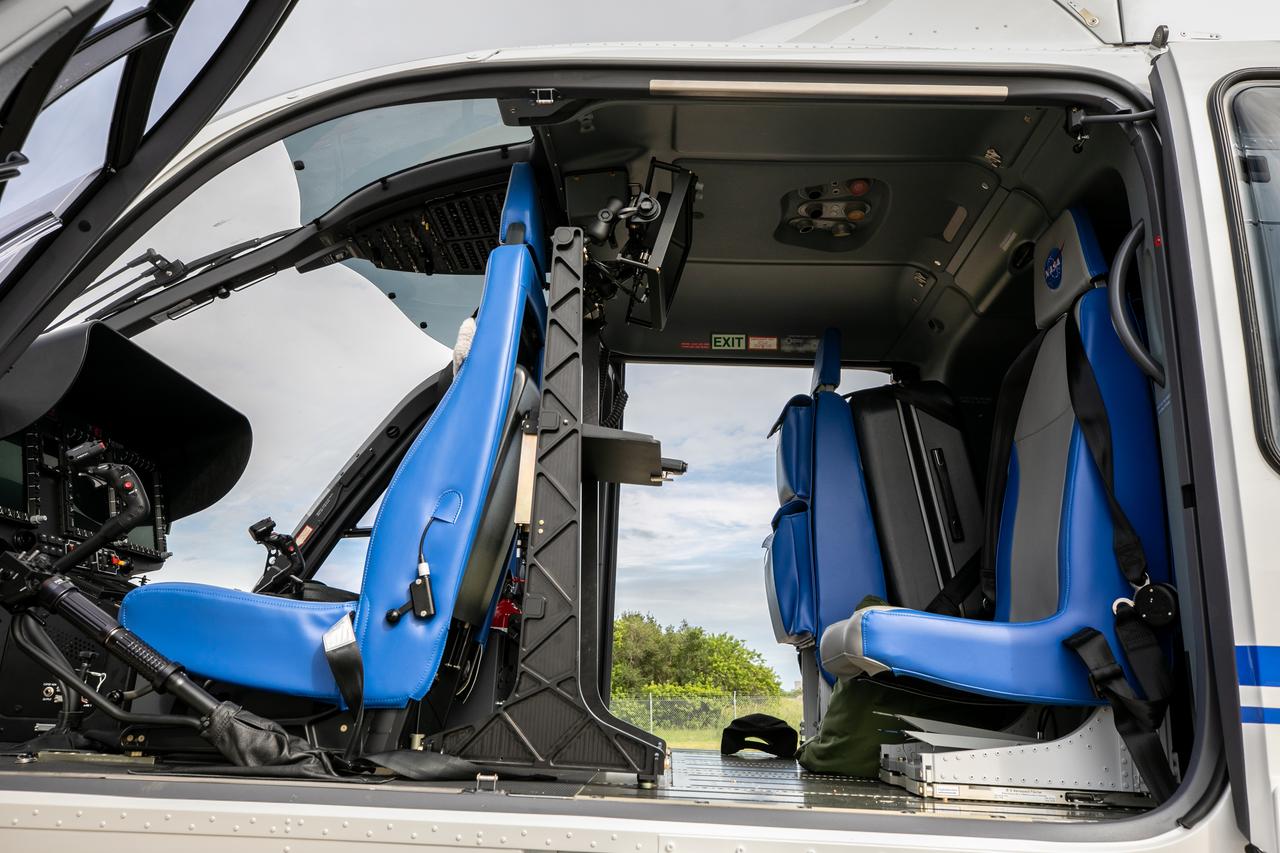
The interior of a new Airbus H135 (T3) helicopter is displayed after arriving at the Launch and Landing Facility runway at NASA’s Kennedy Space Center in Florida on Sept. 30, 2020. A second H135 helicopter also was delivered on Sept. 30, and a third is expected to arrive in early 2021. The three H135 helicopters will replace the Bell Huey 2 security aircraft in service now, maintained by Kennedy’s Flight Operations team. These new helicopters provide a number of technological and safety advantages over the Hueys, such as more lifting power, greater stability in the air, and expanded medical capabilities. The team expects to fully transition to flying the two H135s later this year, and once the third arrives, the fleet’s upgrade will be complete.
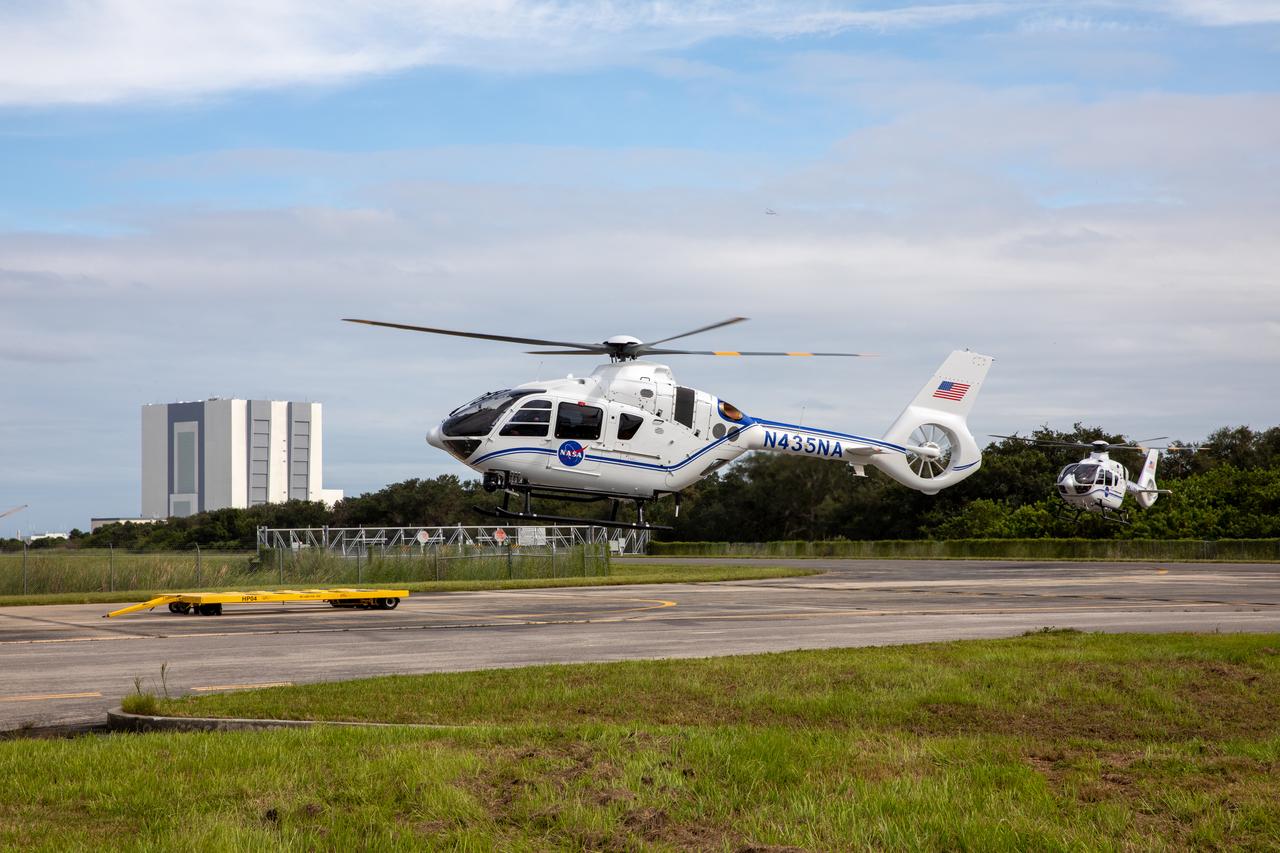
Two new Airbus H135 (T3) helicopters arrive at the Launch and Landing Facility runway at NASA’s Kennedy Space Center in Florida on Sept. 30, 2020. The H135 helicopters will replace the Bell Huey 2 security aircraft in service now, maintained by Kennedy’s Flight Operations team. These new helicopters provide a number of technological and safety advantages over the Hueys, such as more lifting power, greater stability in the air, and expanded medical capabilities. The team expects to fully transition to flying the two H135s later this year. A third is expected to arrive in early 2021, and with its arrival, will complete the fleet’s upgrade.
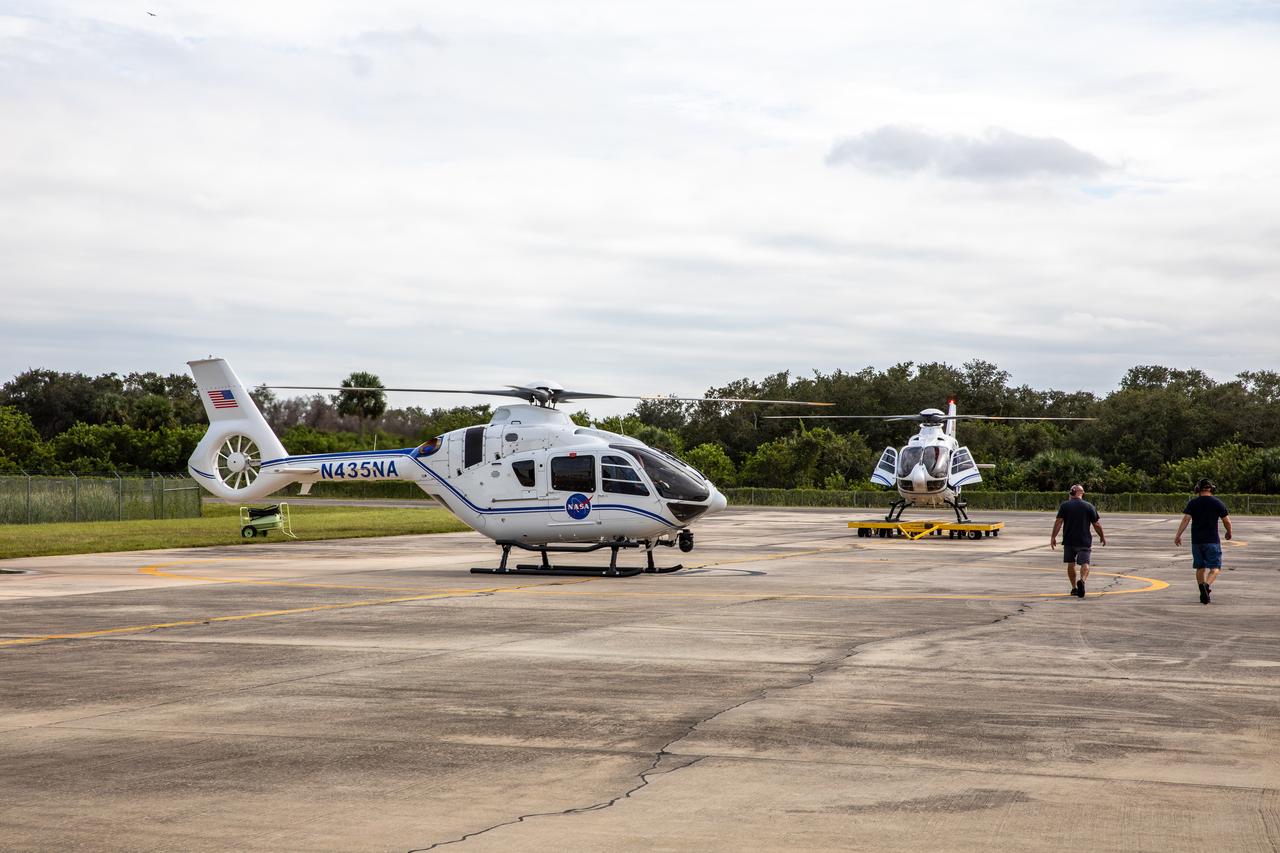
Two new Airbus H135 (T3) helicopters arrive at the Launch and Landing Facility runway at NASA’s Kennedy Space Center in Florida on Sept. 30, 2020. The H135 helicopters will replace the Bell Huey 2 security aircraft in service now, maintained by Kennedy’s Flight Operations team. These new helicopters provide a number of technological and safety advantages over the Hueys, such as more lifting power, greater stability in the air, and expanded medical capabilities. The team expects to fully transition to flying the two H135s later this year. A third is expected to arrive in early 2021, and with its arrival, will complete the fleet’s upgrade.
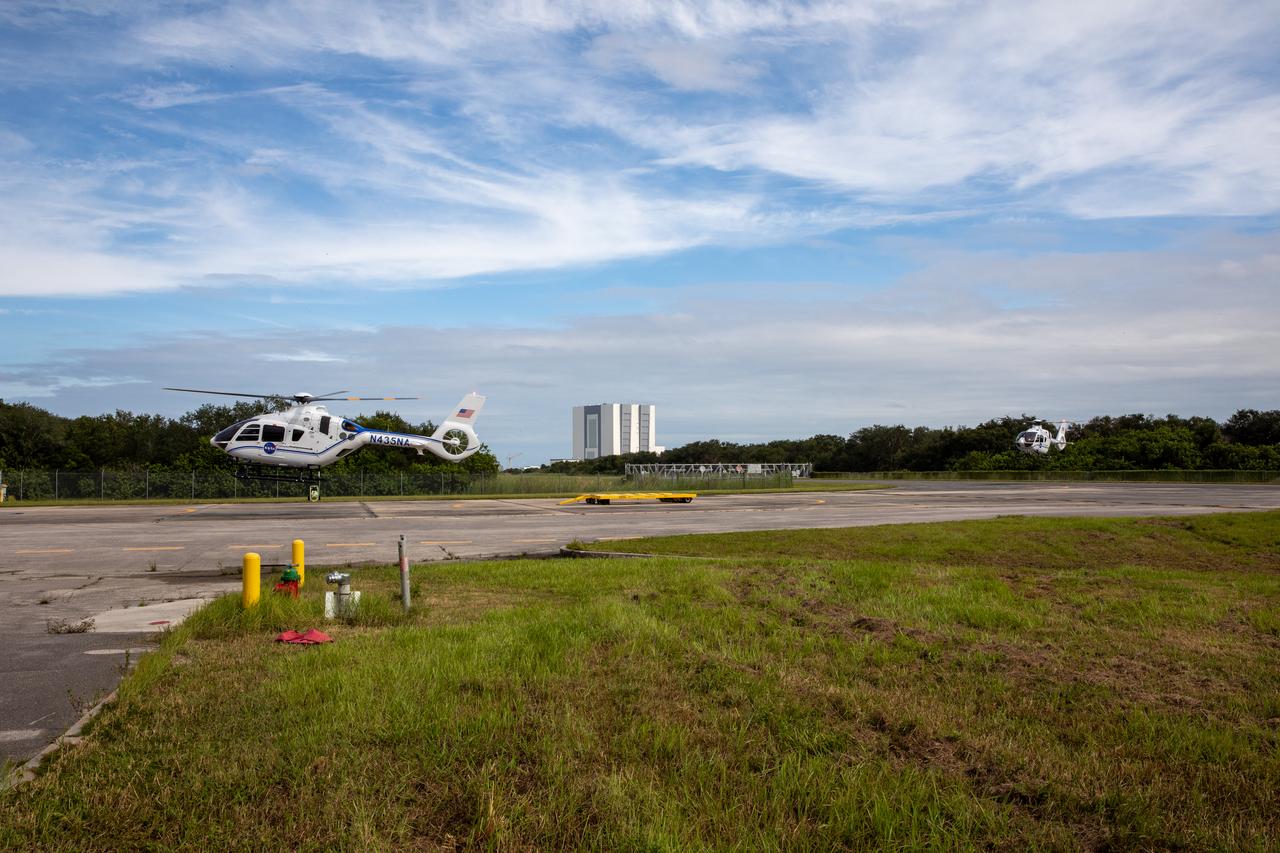
A new Airbus H135 (T3) helicopter arrives at the Launch and Landing Facility runway at NASA’s Kennedy Space Center in Florida on Sept. 30, 2020. A second H135 helicopter also was delivered on Sept. 30, and a third is expected to arrive in early 2021. The three H135 helicopters will replace the Bell Huey 2 security aircraft in service now, maintained by Kennedy’s Flight Operations team. These new helicopters provide a number of technological and safety advantages over the Hueys, such as more lifting power, greater stability in the air, and expanded medical capabilities. The team expects to fully transition to flying the two H135s later this year, and once the third arrives, the fleet’s upgrade will be complete.
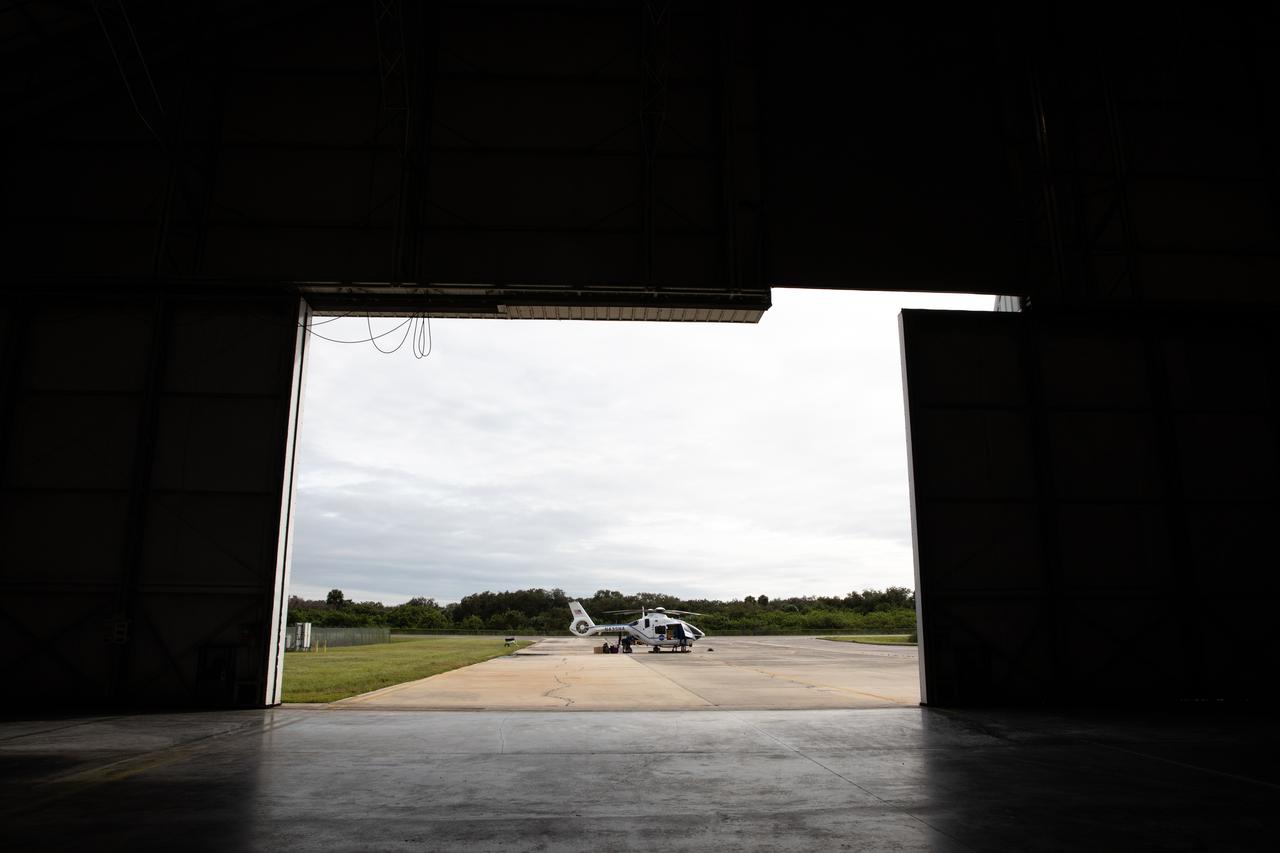
Two new Airbus H135 (T3) helicopters arrive at the Launch and Landing Facility runway at NASA’s Kennedy Space Center in Florida on Sept. 30, 2020. The H135 helicopters will replace the Bell Huey 2 security aircraft in service now, maintained by Kennedy’s Flight Operations team. These new helicopters provide a number of technological and safety advantages over the Hueys, such as more lifting power, greater stability in the air, and expanded medical capabilities. The team expects to fully transition to flying the two H135s later this year. A third is expected to arrive in early 2021, and with its arrival, will complete the fleet’s upgrade.
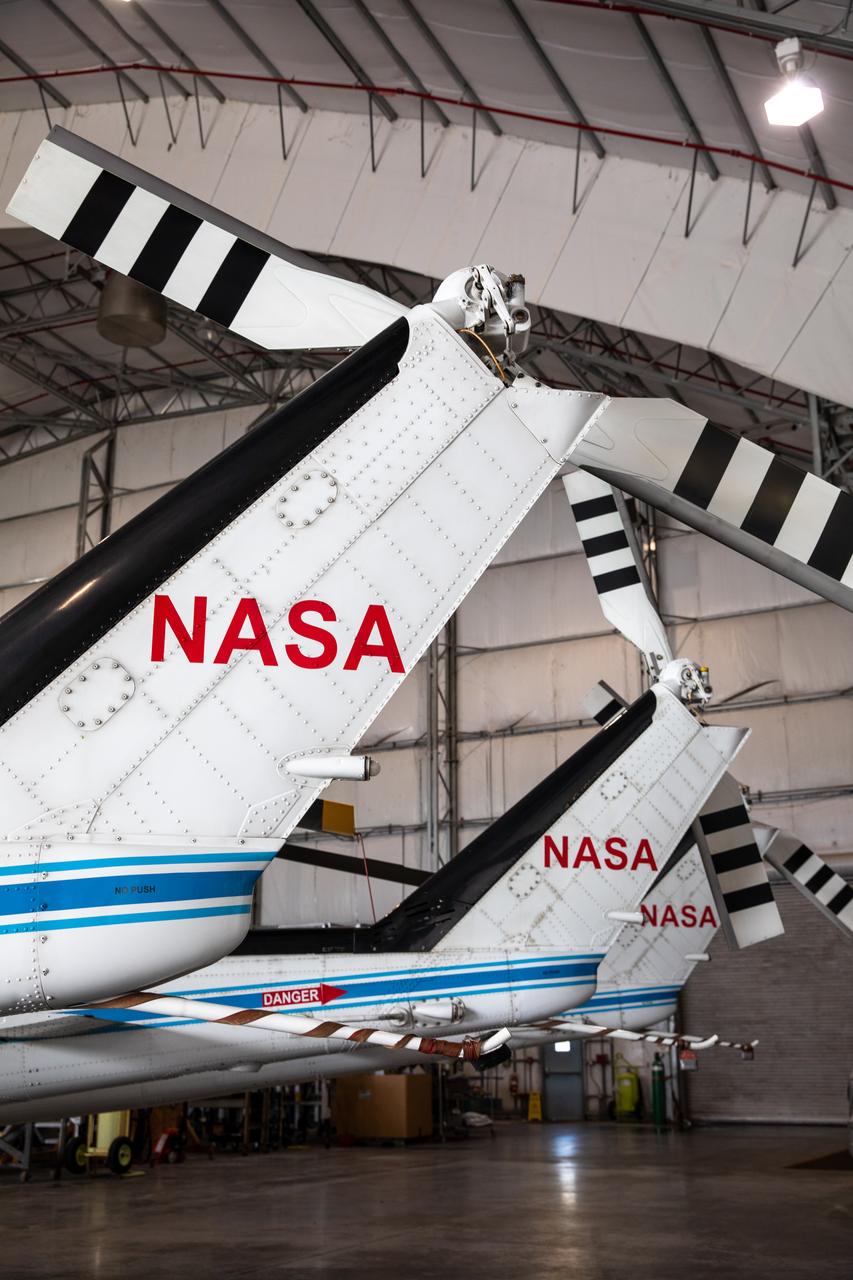
The three Bell Huey 2 helicopters utilized by Kennedy Space Center’s Flight Operations team for security purposes are photographed inside the Launch and Landing Facility hangar on Sept. 30, 2020. Two new Airbus H135 (T3) helicopters arrived at the Florida spaceport on Sept. 30 to replace the Bell Huey 2 aircraft in service now. The new helicopters provide a number of technological and safety advantages over the Hueys, such as more lifting power, greater stability in the air, and expanded medical capabilities. The team expects to fully transition to flying the two H135 aircraft later this year. A third is expected to arrive in early 2021, and with its arrival, will complete the fleet’s upgrade.
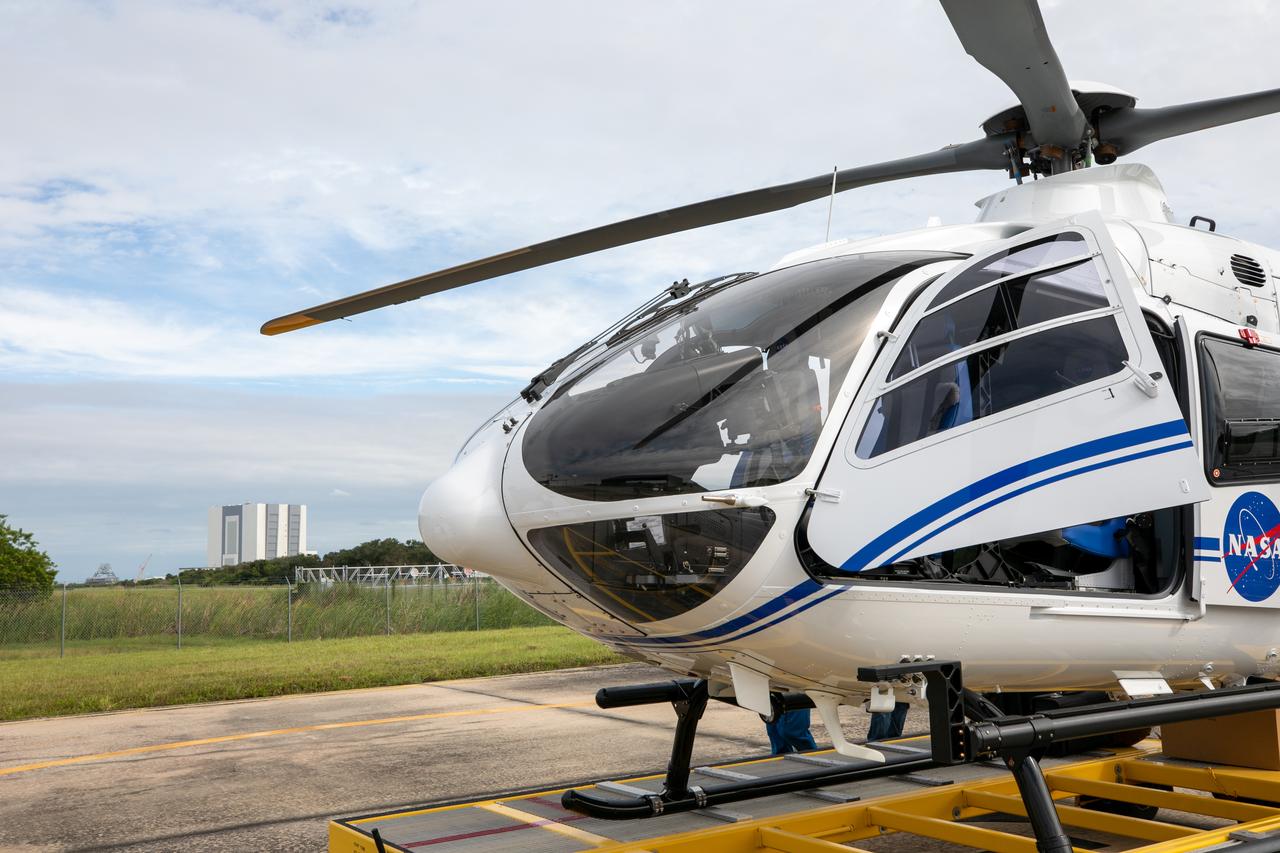
A new Airbus H135 (T3) helicopter arrives at the Launch and Landing Facility runway at NASA’s Kennedy Space Center in Florida on Sept. 30, 2020. A second H135 helicopter also was delivered on Sept. 30, and a third is expected to arrive in early 2021. The three H135 helicopters will replace the Bell Huey 2 security aircraft in service now, maintained by Kennedy’s Flight Operations team. These new helicopters provide a number of technological and safety advantages over the Hueys, such as more lifting power, greater stability in the air, and expanded medical capabilities. The team expects to fully transition to flying the two H135s later this year, and once the third arrives, the fleet’s upgrade will be complete.
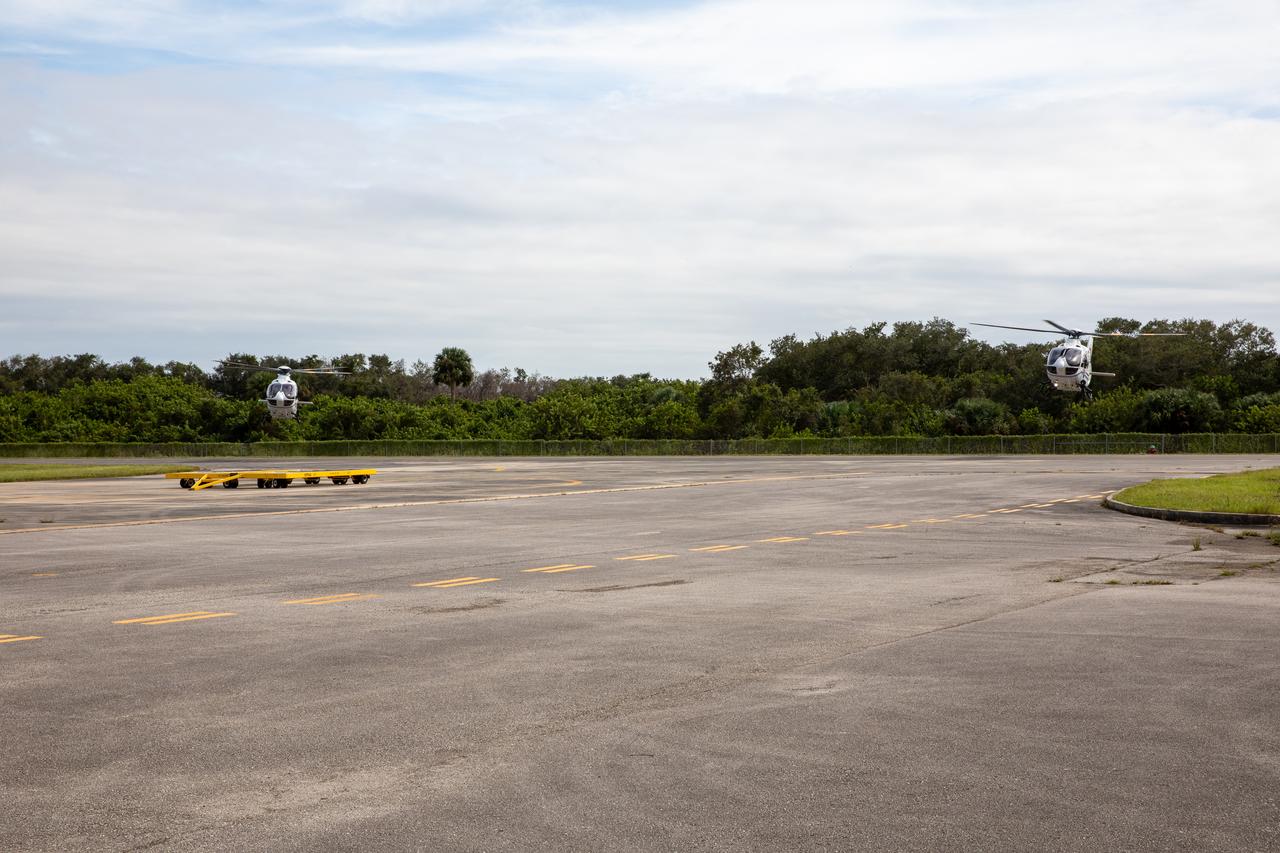
Two new Airbus H135 (T3) helicopters arrive at the Launch and Landing Facility runway at NASA’s Kennedy Space Center in Florida on Sept. 30, 2020. The H135 helicopters will replace the Bell Huey 2 security aircraft in service now, maintained by Kennedy’s Flight Operations team. These new helicopters provide a number of technological and safety advantages over the Hueys, such as more lifting power, greater stability in the air, and expanded medical capabilities. The team expects to fully transition to flying the two H135s later this year. A third is expected to arrive in early 2021, and with its arrival, will complete the fleet’s upgrade.
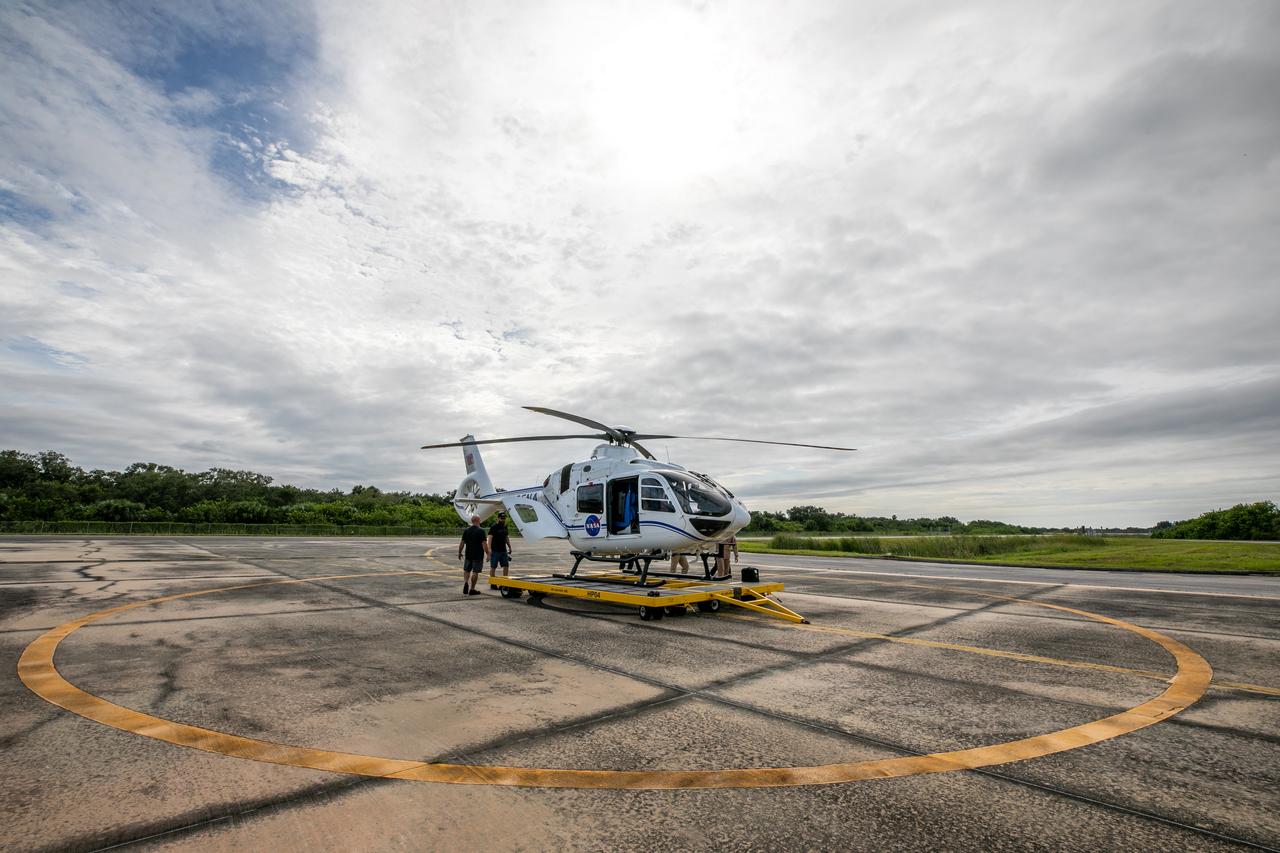
A new Airbus H135 (T3) helicopter arrives at the Launch and Landing Facility runway at NASA’s Kennedy Space Center in Florida on Sept. 30, 2020. A second H135 helicopter also was delivered on Sept. 30, and a third is expected to arrive in early 2021. The three H135 helicopters will replace the Bell Huey 2 security aircraft in service now, maintained by Kennedy’s Flight Operations team. These new helicopters provide a number of technological and safety advantages over the Hueys, such as more lifting power, greater stability in the air, and expanded medical capabilities. The team expects to fully transition to flying the two H135s later this year, and once the third arrives, the fleet’s upgrade will be complete.
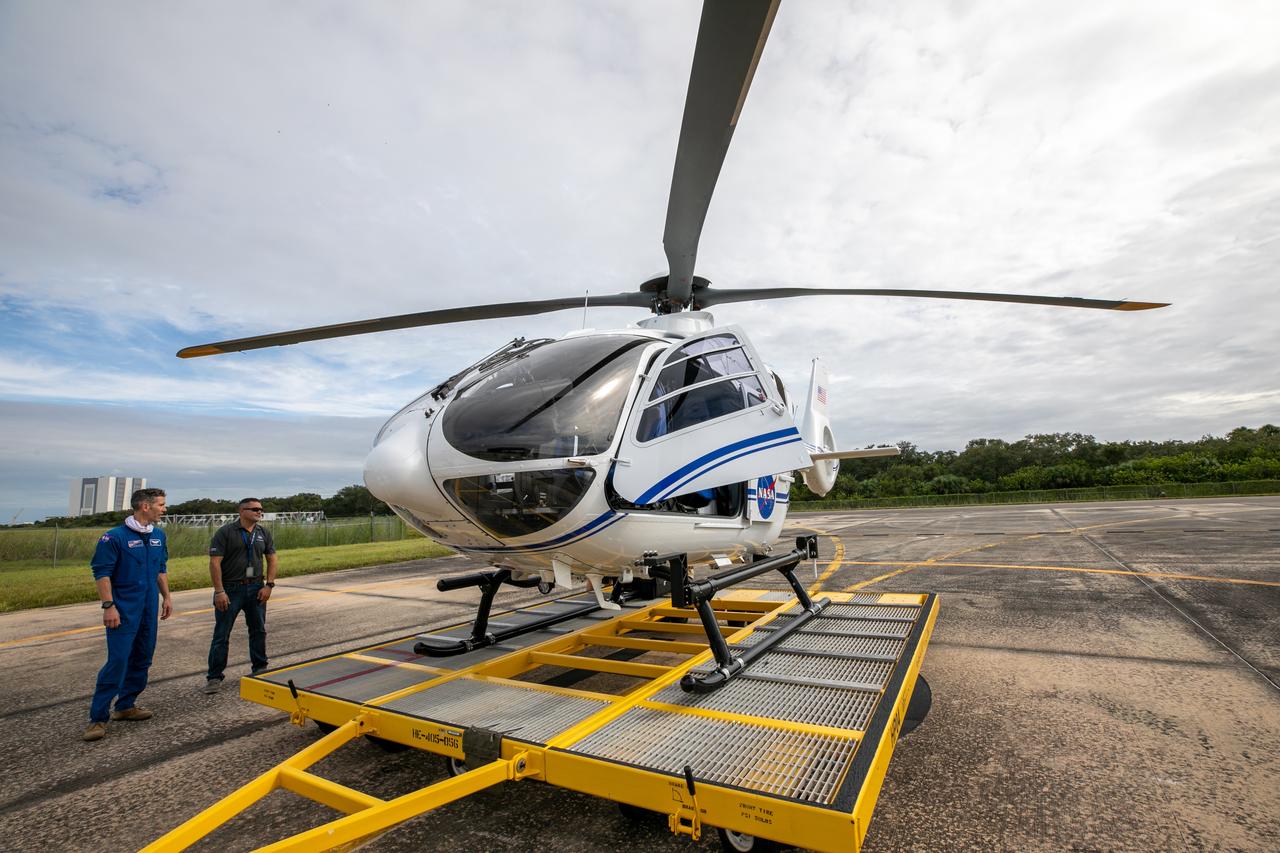
A new Airbus H135 (T3) helicopter arrives at the Launch and Landing Facility runway at NASA’s Kennedy Space Center in Florida on Sept. 30, 2020. A second H135 helicopter also was delivered on Sept. 30, and a third is expected to arrive in early 2021. The three H135 helicopters will replace the Bell Huey 2 security aircraft in service now, maintained by Kennedy’s Flight Operations team. These new helicopters provide a number of technological and safety advantages over the Hueys, such as more lifting power, greater stability in the air, and expanded medical capabilities. The team expects to fully transition to flying the two H135s later this year, and once the third arrives, the fleet’s upgrade will be complete.
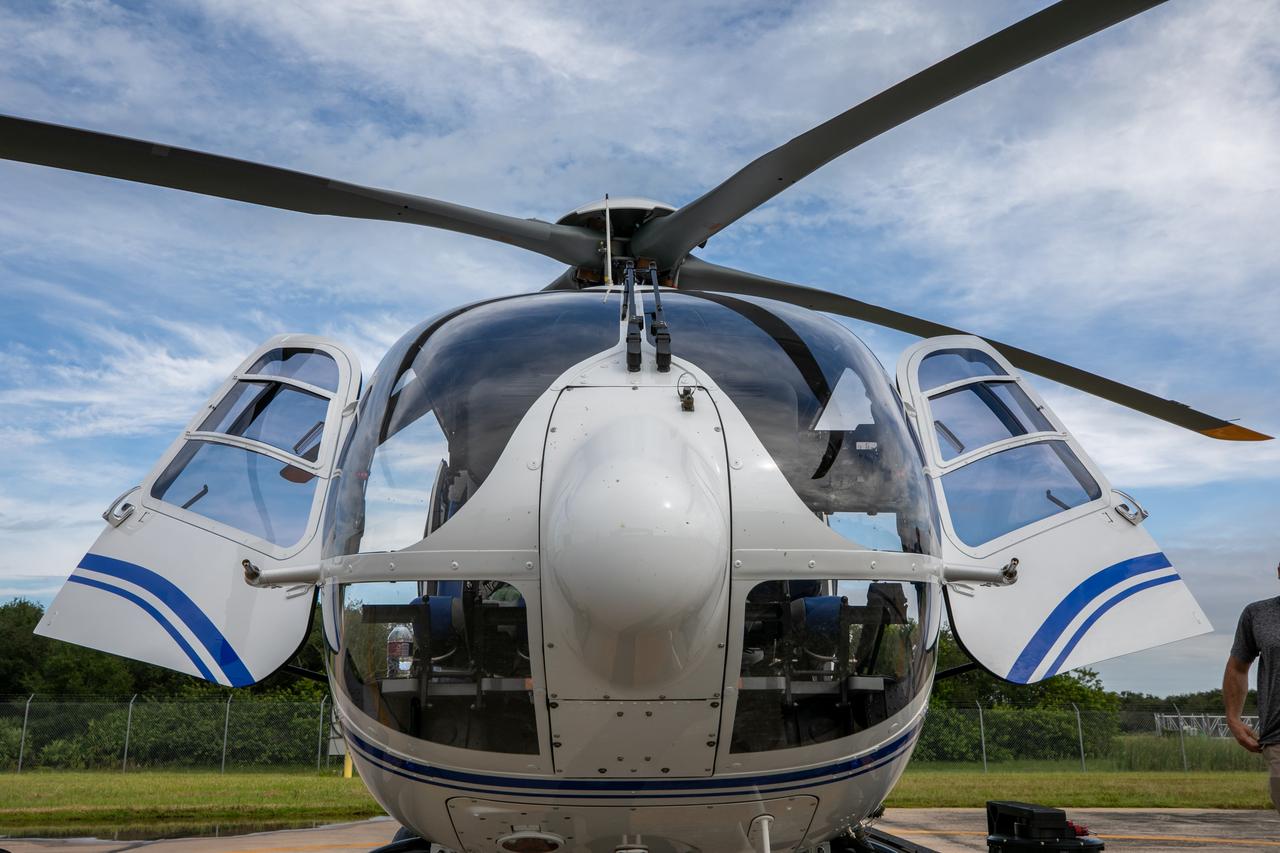
A new Airbus H135 (T3) helicopter arrives at the Launch and Landing Facility runway at NASA’s Kennedy Space Center in Florida on Sept. 30, 2020. A second H135 helicopter also was delivered on Sept. 30, and a third is expected to arrive in early 2021. The three H135 helicopters will replace the Bell Huey 2 security aircraft in service now, maintained by Kennedy’s Flight Operations team. These new helicopters provide a number of technological and safety advantages over the Hueys, such as more lifting power, greater stability in the air, and expanded medical capabilities. The team expects to fully transition to flying the two H135s later this year, and once the third arrives, the fleet’s upgrade will be complete.
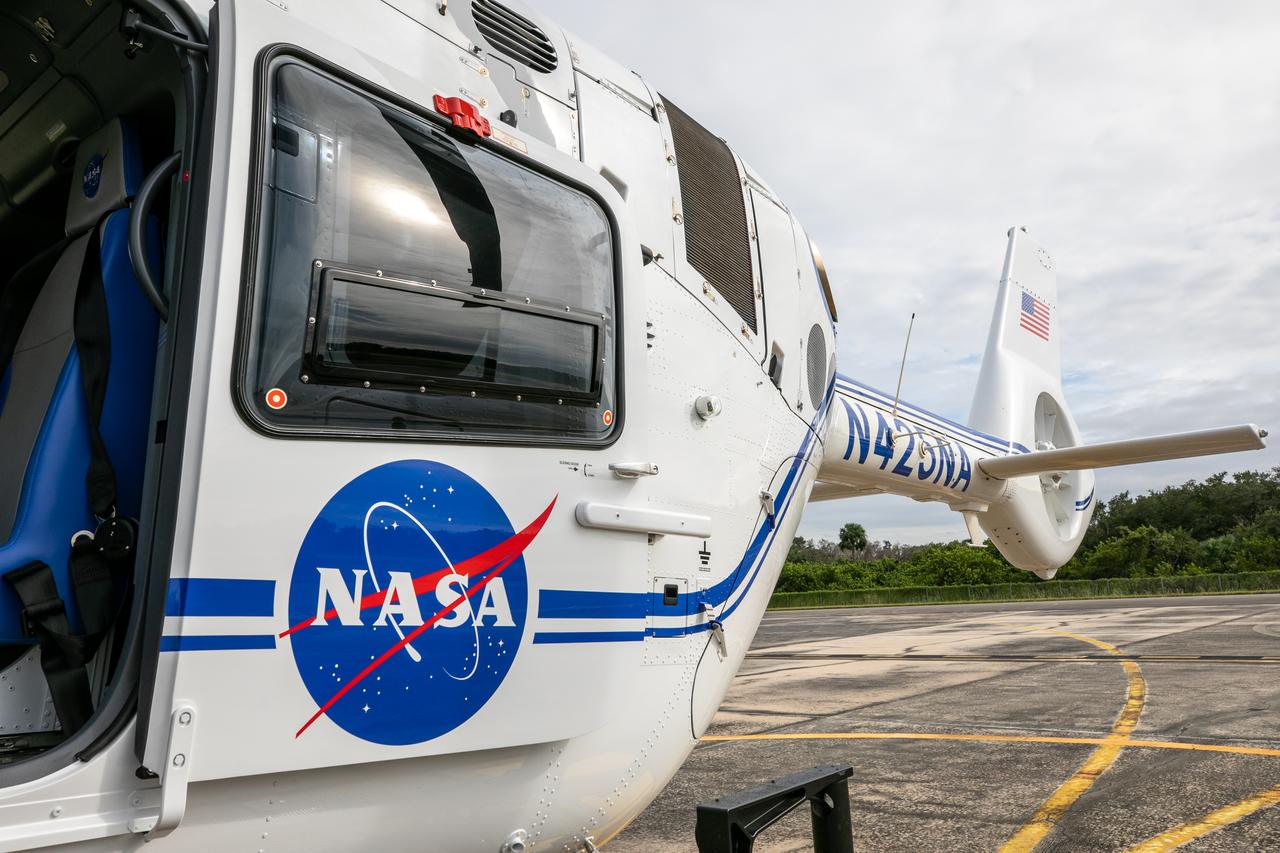
A new Airbus H135 (T3) helicopter arrives at the Launch and Landing Facility runway at NASA’s Kennedy Space Center in Florida on Sept. 30, 2020. A second H135 helicopter also was delivered on Sept. 30, and a third is expected to arrive in early 2021. The three H135 helicopters will replace the Bell Huey 2 security aircraft in service now, maintained by Kennedy’s Flight Operations team. These new helicopters provide a number of technological and safety advantages over the Hueys, such as more lifting power, greater stability in the air, and expanded medical capabilities. The team expects to fully transition to flying the two H135s later this year, and once the third arrives, the fleet’s upgrade will be complete.
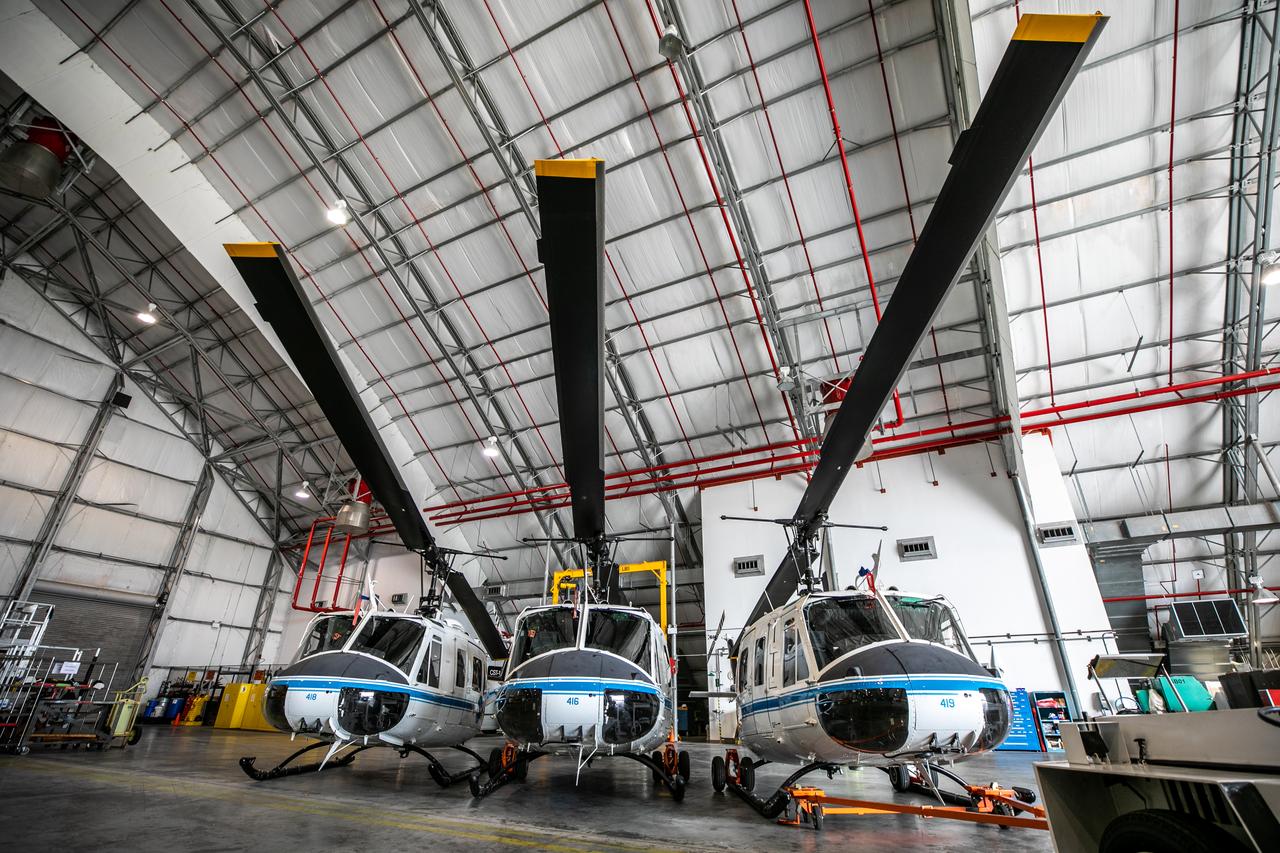
The three Bell Huey 2 helicopters utilized by Kennedy Space Center’s Flight Operations team for security purposes are photographed inside the Launch and Landing Facility hangar on Sept. 30, 2020. Two new Airbus H135 (T3) helicopters arrived at the Florida spaceport on Sept. 30 to replace the Bell Huey 2 aircraft in service now. The new helicopters provide a number of technological and safety advantages over the Hueys, such as more lifting power, greater stability in the air, and expanded medical capabilities. The team expects to fully transition to flying the two H135 aircraft later this year. A third is expected to arrive in early 2021, and with its arrival, will complete the fleet’s upgrade.
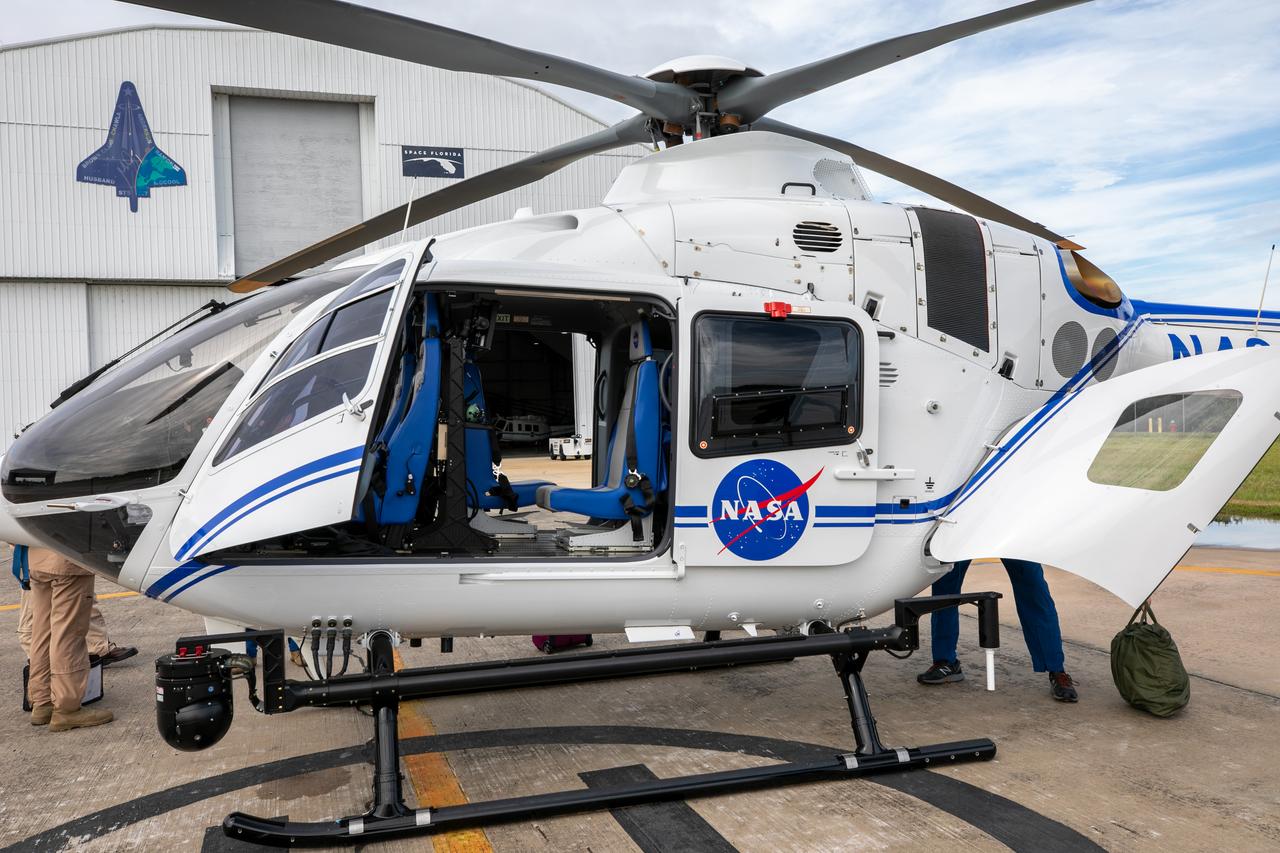
A new Airbus H135 (T3) helicopter arrives at the Launch and Landing Facility runway at NASA’s Kennedy Space Center in Florida on Sept. 30, 2020. A second H135 helicopter also was delivered on Sept. 30, and a third is expected to arrive in early 2021. The three H135 helicopters will replace the Bell Huey 2 security aircraft in service now, maintained by Kennedy’s Flight Operations team. These new helicopters provide a number of technological and safety advantages over the Hueys, such as more lifting power, greater stability in the air, and expanded medical capabilities. The team expects to fully transition to flying the two H135s later this year, and once the third arrives, the fleet’s upgrade will be complete.
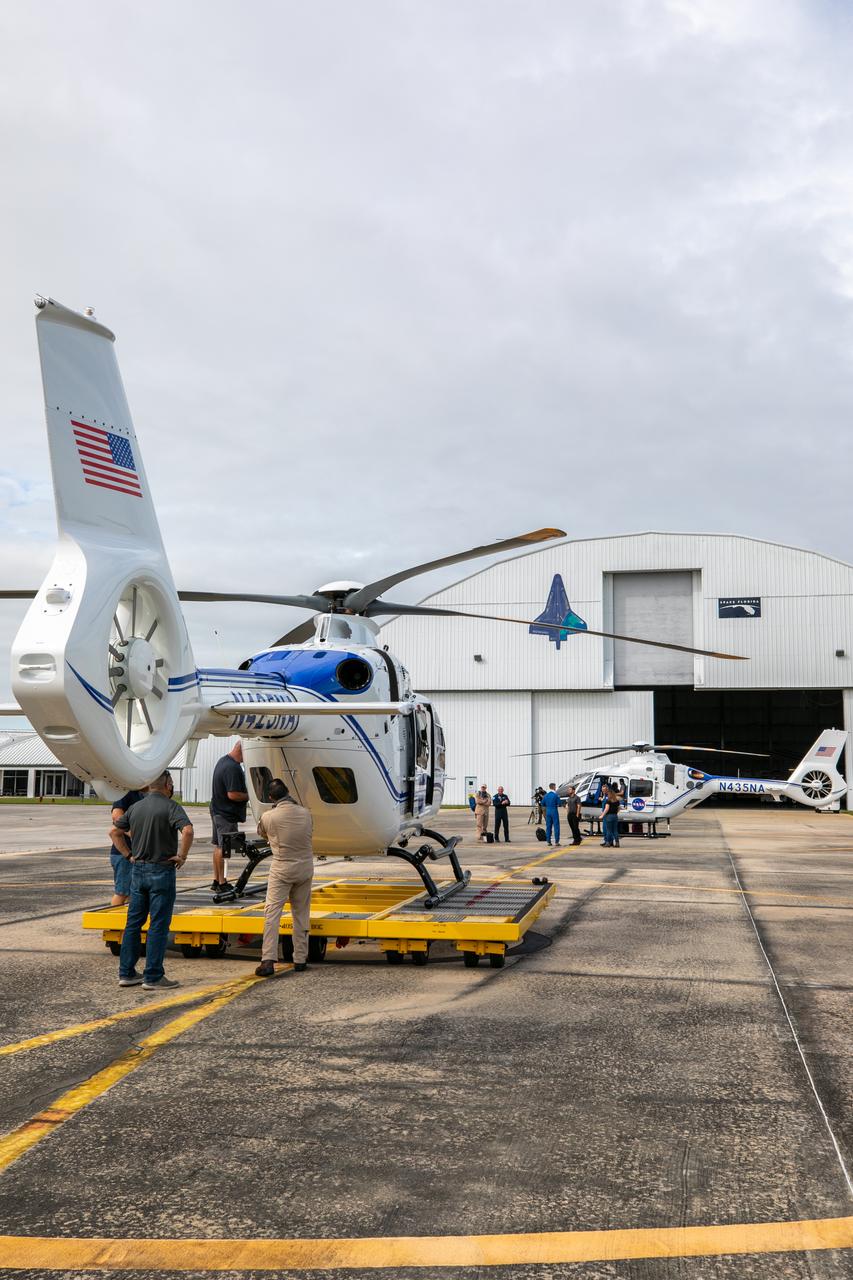
Two new Airbus H135 (T3) helicopters arrive at the Launch and Landing Facility runway at NASA’s Kennedy Space Center in Florida on Sept. 30, 2020. The H135 helicopters will replace the Bell Huey 2 security aircraft in service now, maintained by Kennedy’s Flight Operations team. These new helicopters provide a number of technological and safety advantages over the Hueys, such as more lifting power, greater stability in the air, and expanded medical capabilities. The team expects to fully transition to flying the two H135s later this year. A third is expected to arrive in early 2021, and with its arrival, will complete the fleet’s upgrade.
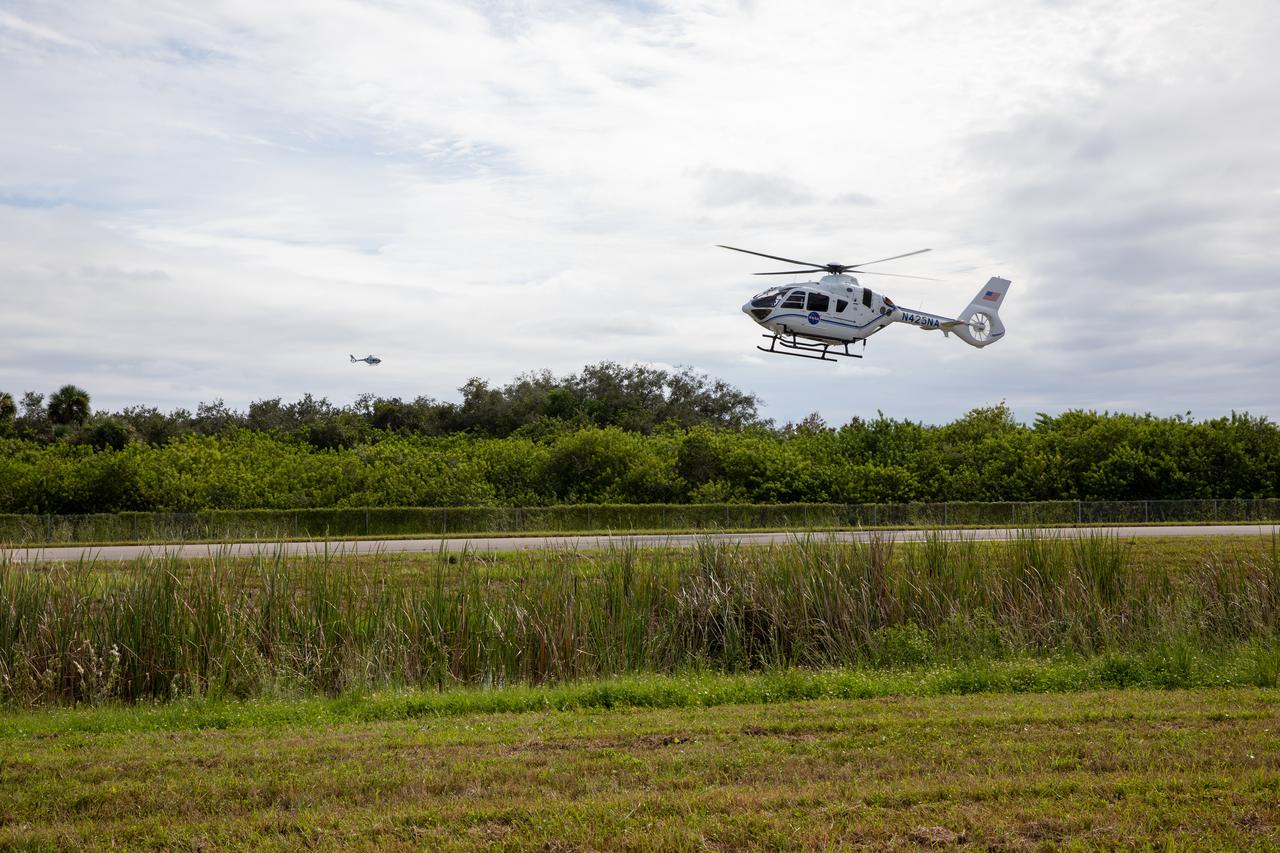
A new Airbus H135 (T3) helicopter arrives at the Launch and Landing Facility runway at NASA’s Kennedy Space Center in Florida on Sept. 30, 2020. In the distance, a second one can be seen arriving. The two H135 helicopters will replace the Bell Huey 2 security aircraft in service now, maintained by Kennedy’s Flight Operations team. These new helicopters provide a number of technological and safety advantages over the Hueys, such as more lifting power, greater stability in the air, and expanded medical capabilities. The team expects to fully transition to flying the two H135s later this year. A third is expected to arrive in early 2021, and with its arrival, will complete the fleet’s upgrade.
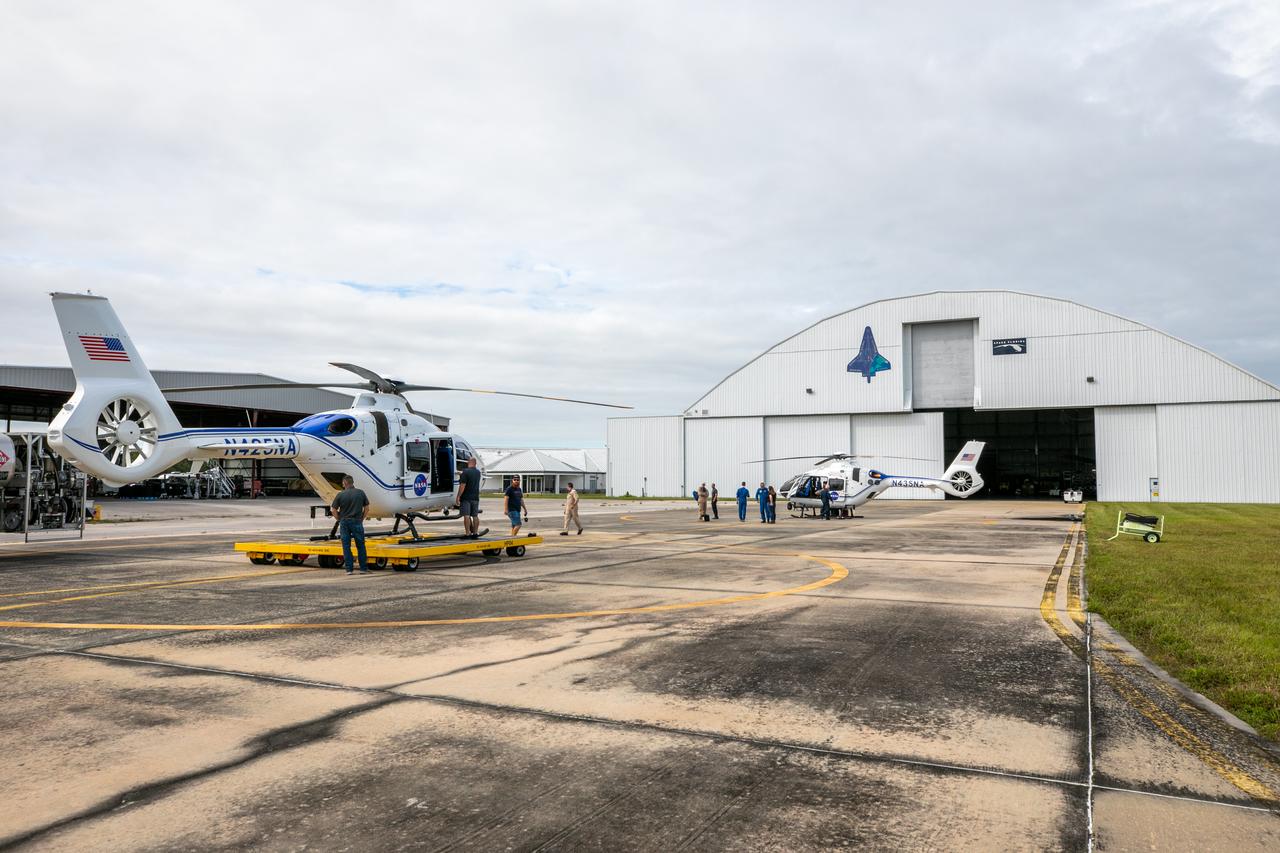
Two new Airbus H135 (T3) helicopters arrive at the Launch and Landing Facility runway at NASA’s Kennedy Space Center in Florida on Sept. 30, 2020. The H135 helicopters will replace the Bell Huey 2 security aircraft in service now, maintained by Kennedy’s Flight Operations team. These new helicopters provide a number of technological and safety advantages over the Hueys, such as more lifting power, greater stability in the air, and expanded medical capabilities. The team expects to fully transition to flying the two H135s later this year. A third is expected to arrive in early 2021, and with its arrival, will complete the fleet’s upgrade.
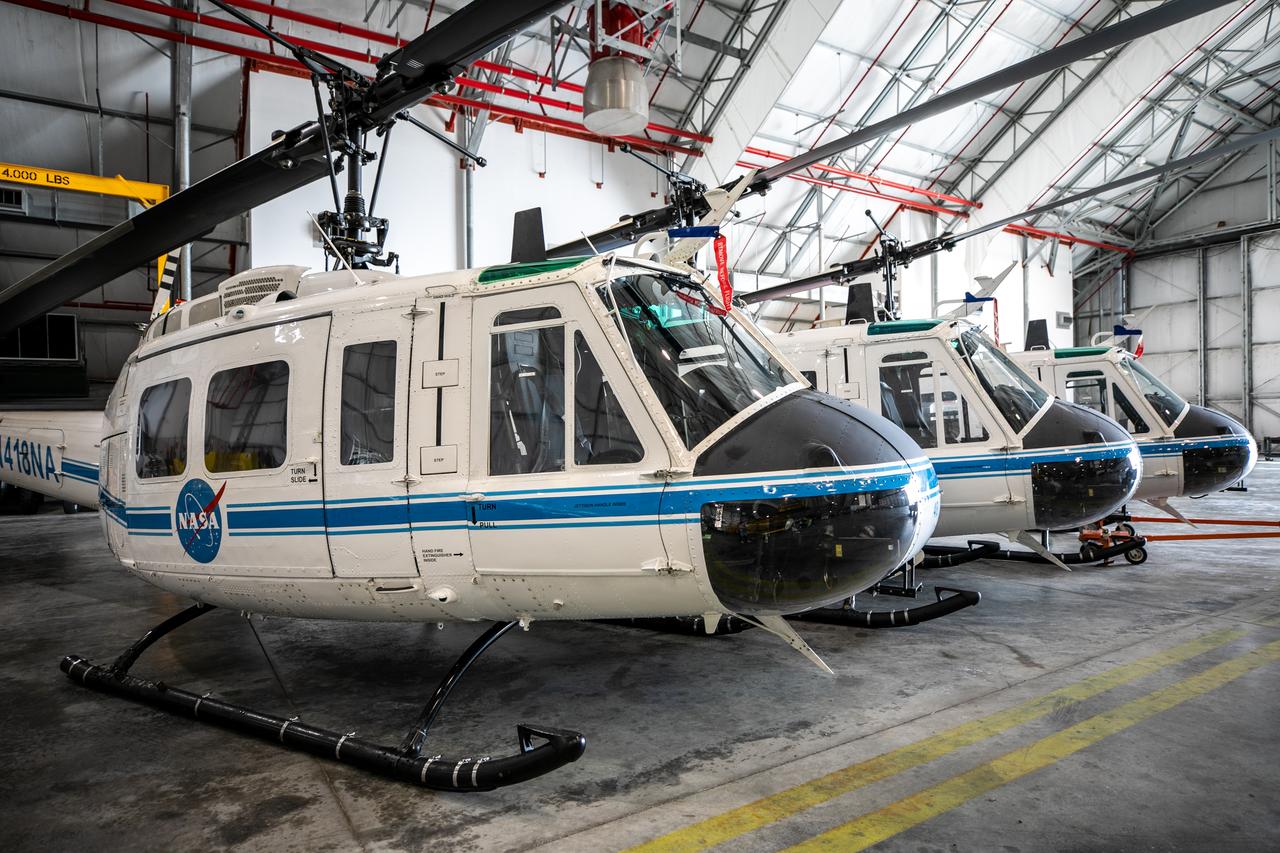
The three Bell Huey 2 helicopters utilized by Kennedy Space Center’s Flight Operations team for security purposes are photographed inside the Launch and Landing Facility hangar on Sept. 30, 2020. Two new Airbus H135 (T3) helicopters arrived at the Florida spaceport on Sept. 30 to replace the Bell Huey 2 aircraft in service now. The new helicopters provide a number of technological and safety advantages over the Hueys, such as more lifting power, greater stability in the air, and expanded medical capabilities. The team expects to fully transition to flying the two H135 aircraft later this year. A third is expected to arrive in early 2021, and with its arrival, will complete the fleet’s upgrade.
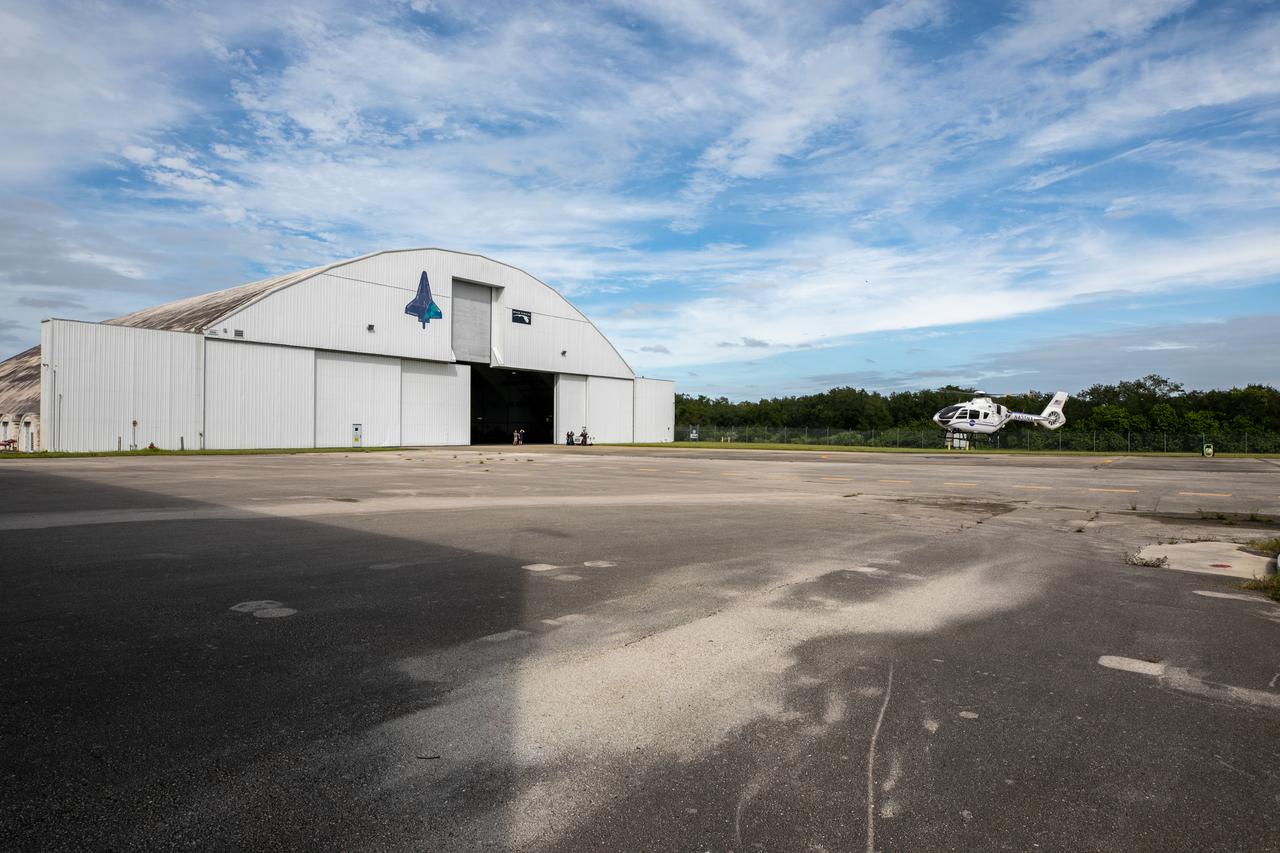
A new Airbus H135 (T3) helicopter arrives at the Launch and Landing Facility runway at NASA’s Kennedy Space Center in Florida on Sept. 30, 2020. A second H135 helicopter also was delivered on Sept. 30, and a third is expected to arrive in early 2021. The three H135 helicopters will replace the Bell Huey 2 security aircraft in service now, maintained by Kennedy’s Flight Operations team. These new helicopters provide a number of technological and safety advantages over the Hueys, such as more lifting power, greater stability in the air, and expanded medical capabilities. The team expects to fully transition to flying the two H135s later this year, and once the third arrives, the fleet’s upgrade will be complete.
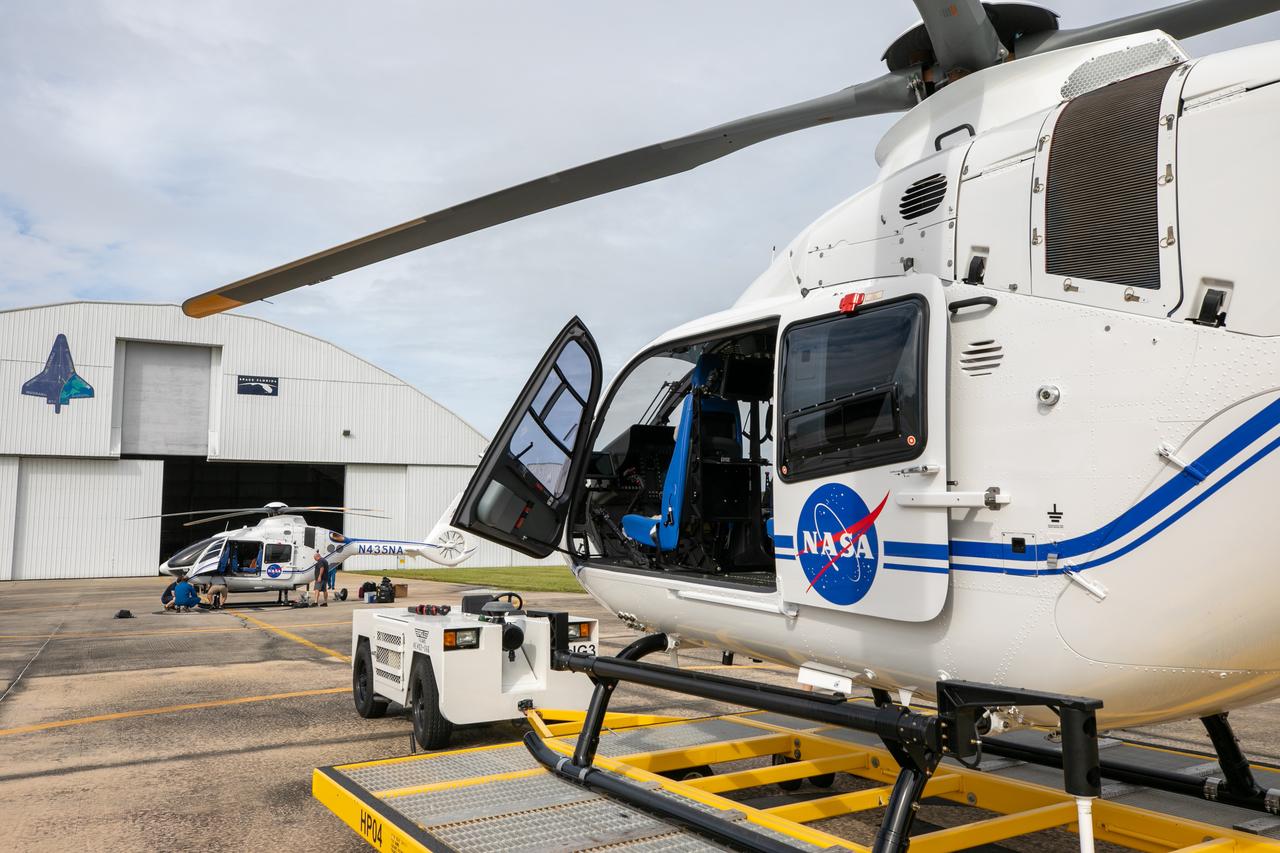
Two new Airbus H135 (T3) helicopters arrive at the Launch and Landing Facility runway at NASA’s Kennedy Space Center in Florida on Sept. 30, 2020. The H135 helicopters will replace the Bell Huey 2 security aircraft in service now, maintained by Kennedy’s Flight Operations team. These new helicopters provide a number of technological and safety advantages over the Hueys, such as more lifting power, greater stability in the air, and expanded medical capabilities. The team expects to fully transition to flying the two H135s later this year. A third is expected to arrive in early 2021, and with its arrival, will complete the fleet’s upgrade.
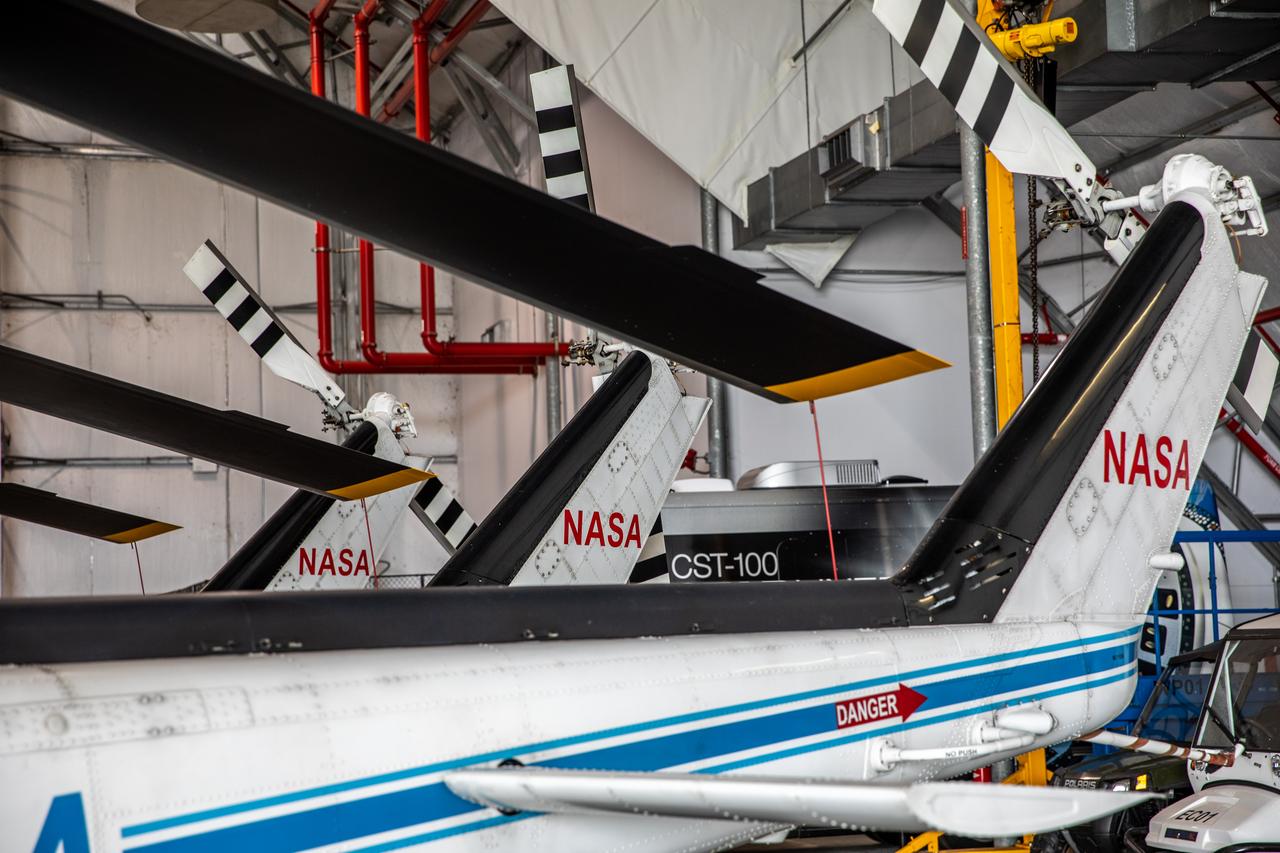
The three Bell Huey 2 helicopters utilized by Kennedy Space Center’s Flight Operations team for security purposes are photographed inside the Launch and Landing Facility hangar on Sept. 30, 2020. Two new Airbus H135 (T3) helicopters arrived at the Florida spaceport on Sept. 30 to replace the Bell Huey 2 aircraft in service now. The new helicopters provide a number of technological and safety advantages over the Hueys, such as more lifting power, greater stability in the air, and expanded medical capabilities. The team expects to fully transition to flying the two H135 aircraft later this year. A third is expected to arrive in early 2021, and with its arrival, will complete the fleet’s upgrade.
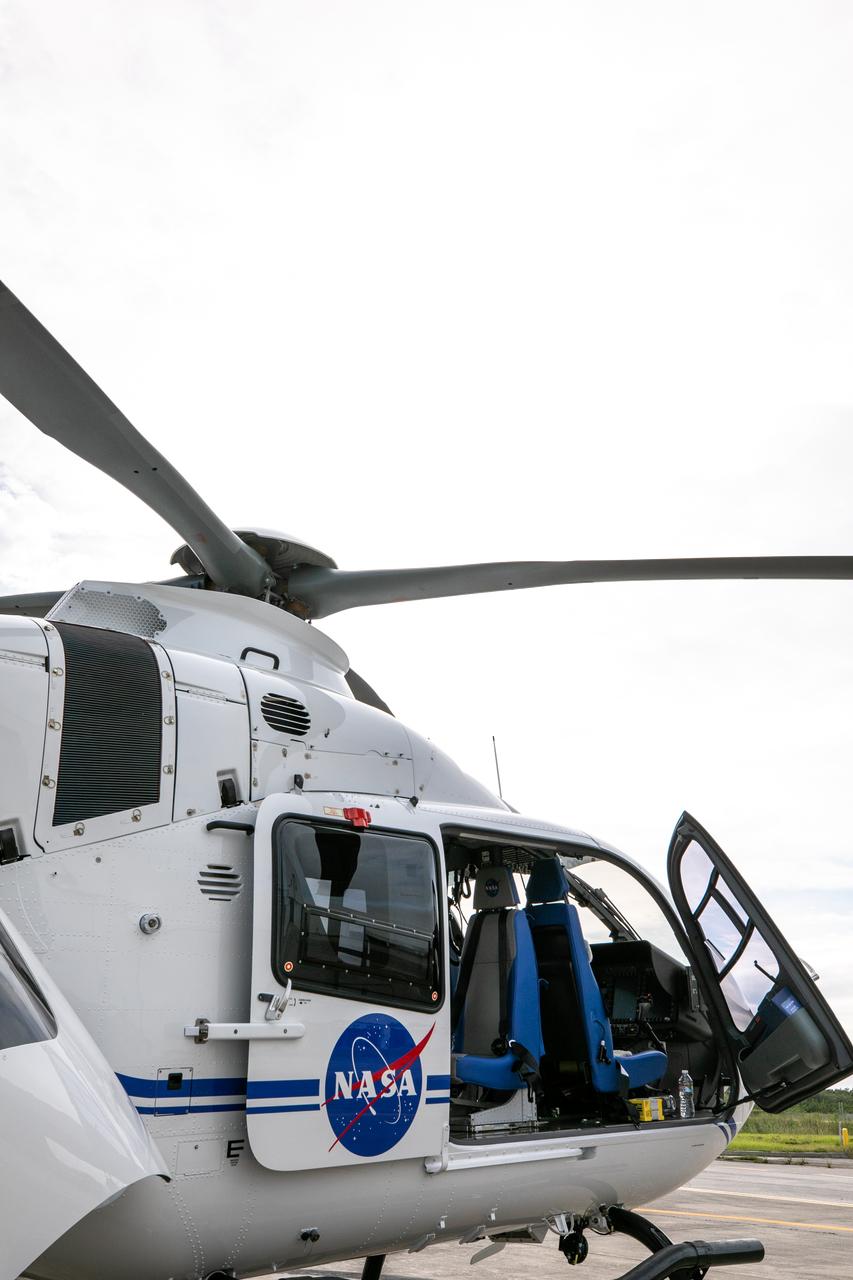
A new Airbus H135 (T3) helicopter arrives at the Launch and Landing Facility runway at NASA’s Kennedy Space Center in Florida on Sept. 30, 2020. A second H135 helicopter also was delivered on Sept. 30, and a third is expected to arrive in early 2021. The three H135 helicopters will replace the Bell Huey 2 security aircraft in service now, maintained by Kennedy’s Flight Operations team. These new helicopters provide a number of technological and safety advantages over the Hueys, such as more lifting power, greater stability in the air, and expanded medical capabilities. The team expects to fully transition to flying the two H135s later this year, and once the third arrives, the fleet’s upgrade will be complete.
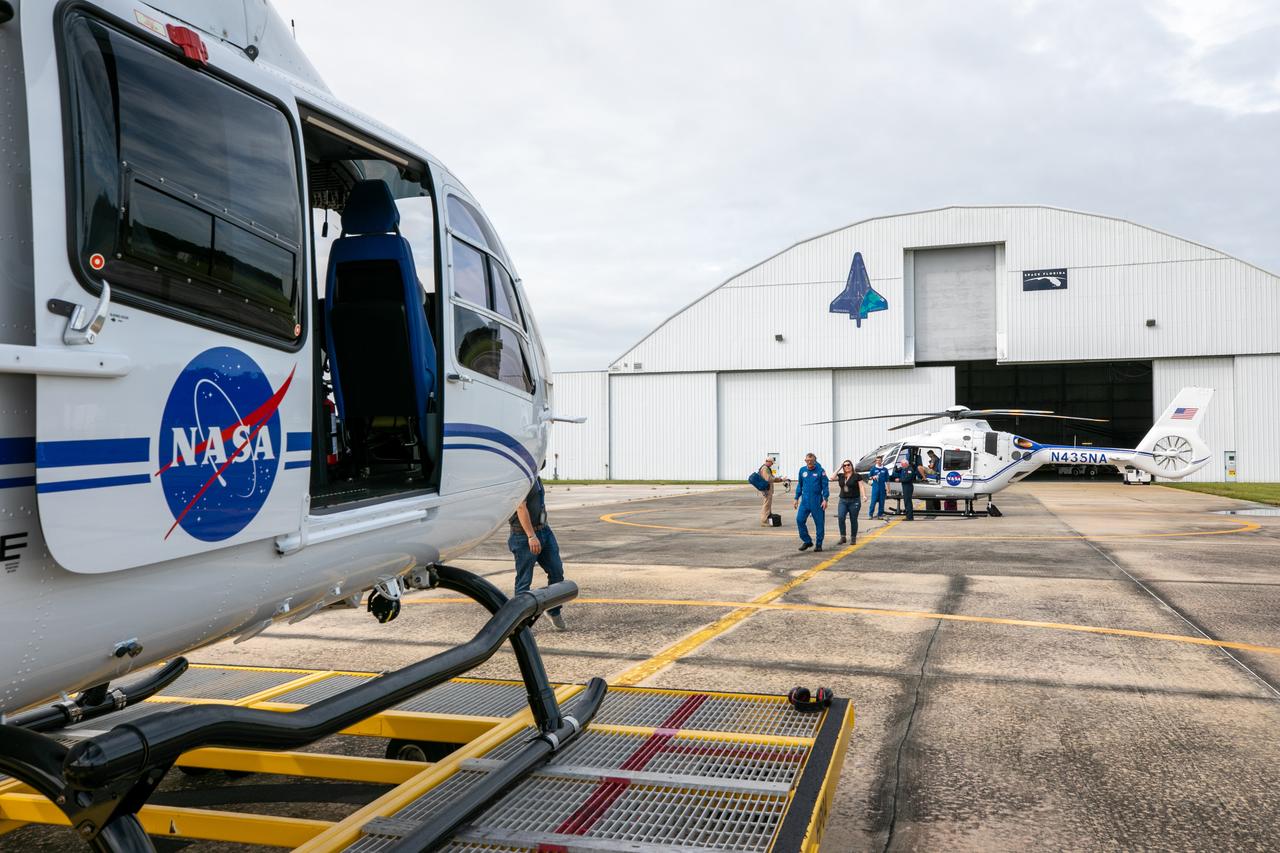
Two new Airbus H135 (T3) helicopters arrive at the Launch and Landing Facility runway at NASA’s Kennedy Space Center in Florida on Sept. 30, 2020. The H135 helicopters will replace the Bell Huey 2 security aircraft in service now, maintained by Kennedy’s Flight Operations team. These new helicopters provide a number of technological and safety advantages over the Hueys, such as more lifting power, greater stability in the air, and expanded medical capabilities. The team expects to fully transition to flying the two H135s later this year. A third is expected to arrive in early 2021, and with its arrival, will complete the fleet’s upgrade.
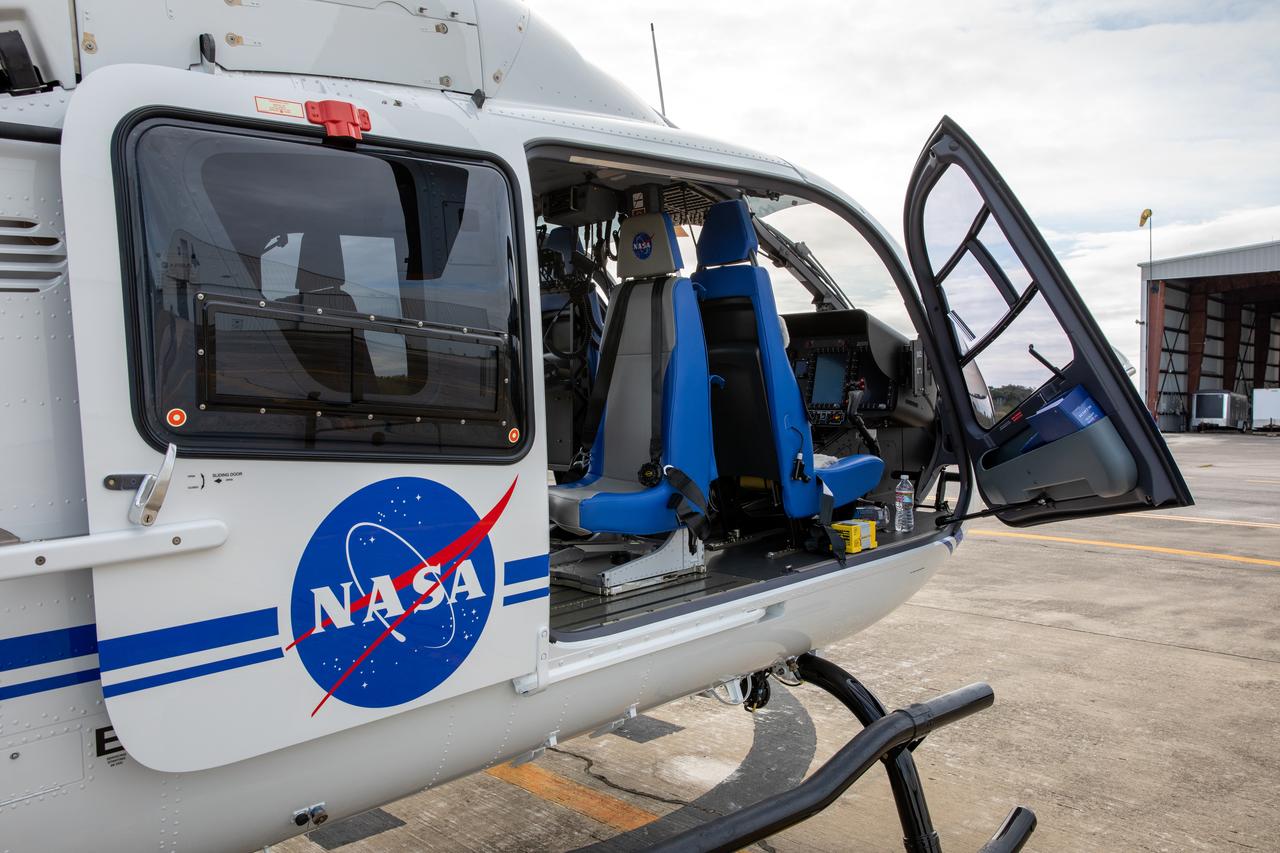
The interior of a new Airbus H135 (T3) helicopter is displayed after arriving at the Launch and Landing Facility runway at NASA’s Kennedy Space Center in Florida on Sept. 30, 2020. A second H135 helicopter also was delivered on Sept. 30, and a third is expected to arrive in early 2021. The three H135 helicopters will replace the Bell Huey 2 security aircraft in service now, maintained by Kennedy’s Flight Operations team. These new helicopters provide a number of technological and safety advantages over the Hueys, such as more lifting power, greater stability in the air, and expanded medical capabilities. The team expects to fully transition to flying the two H135s later this year, and once the third arrives, the fleet’s upgrade will be complete.
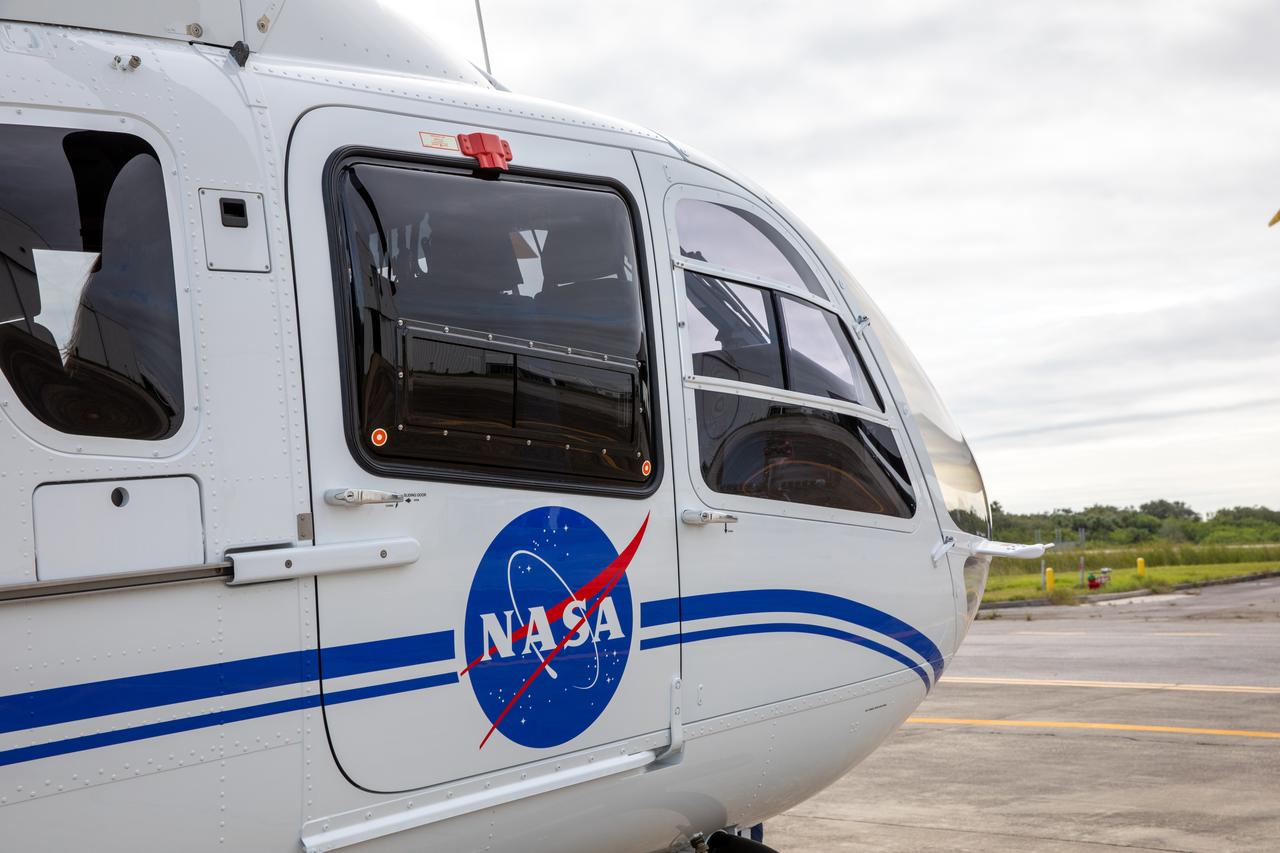
A new Airbus H135 (T3) helicopter arrives at the Launch and Landing Facility runway at NASA’s Kennedy Space Center in Florida on Sept. 30, 2020. A second H135 helicopter also was delivered on Sept. 30, and a third is expected to arrive in early 2021. The three H135 helicopters will replace the Bell Huey 2 security aircraft in service now, maintained by Kennedy’s Flight Operations team. These new helicopters provide a number of technological and safety advantages over the Hueys, such as more lifting power, greater stability in the air, and expanded medical capabilities. The team expects to fully transition to flying the two H135s later this year, and once the third arrives, the fleet’s upgrade will be complete.
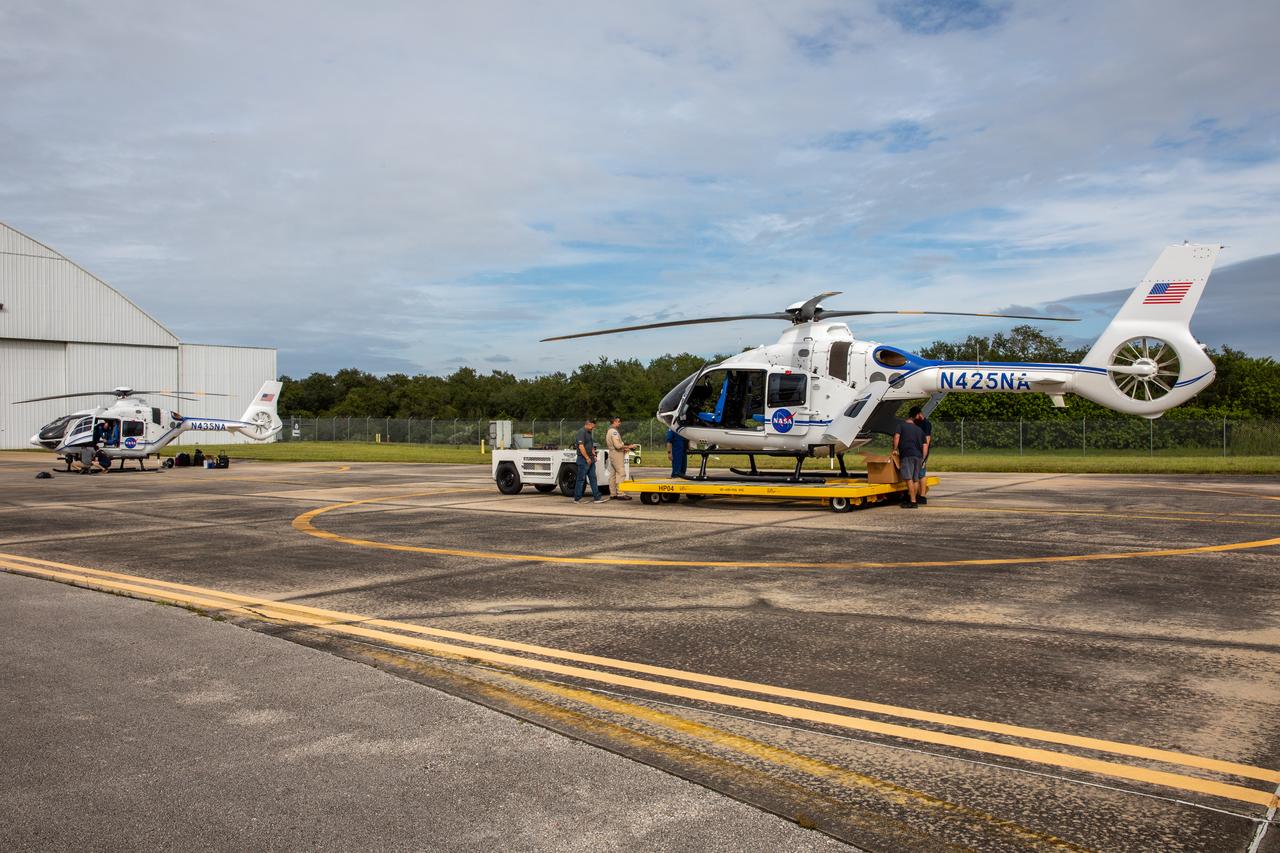
Two new Airbus H135 (T3) helicopters arrive at the Launch and Landing Facility runway at NASA’s Kennedy Space Center in Florida on Sept. 30, 2020. The H135 helicopters will replace the Bell Huey 2 security aircraft in service now, maintained by Kennedy’s Flight Operations team. These new helicopters provide a number of technological and safety advantages over the Hueys, such as more lifting power, greater stability in the air, and expanded medical capabilities. The team expects to fully transition to flying the two H135s later this year. A third is expected to arrive in early 2021, and with its arrival, will complete the fleet’s upgrade.
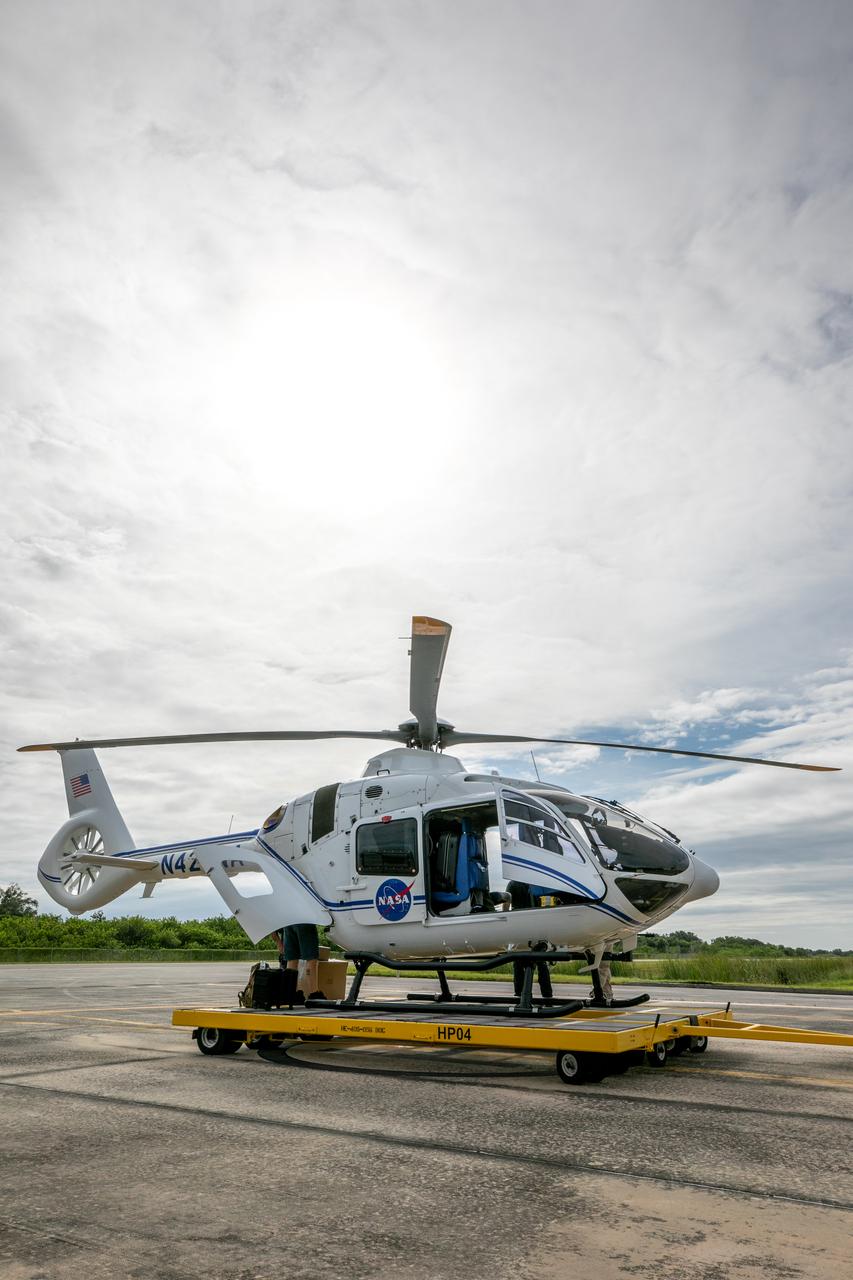
A new Airbus H135 (T3) helicopter arrives at the Launch and Landing Facility runway at NASA’s Kennedy Space Center in Florida on Sept. 30, 2020. A second H135 helicopter also was delivered on Sept. 30, and a third is expected to arrive in early 2021. The three H135 helicopters will replace the Bell Huey 2 security aircraft in service now, maintained by Kennedy’s Flight Operations team. These new helicopters provide a number of technological and safety advantages over the Hueys, such as more lifting power, greater stability in the air, and expanded medical capabilities. The team expects to fully transition to flying the two H135s later this year, and once the third arrives, the fleet’s upgrade will be complete.
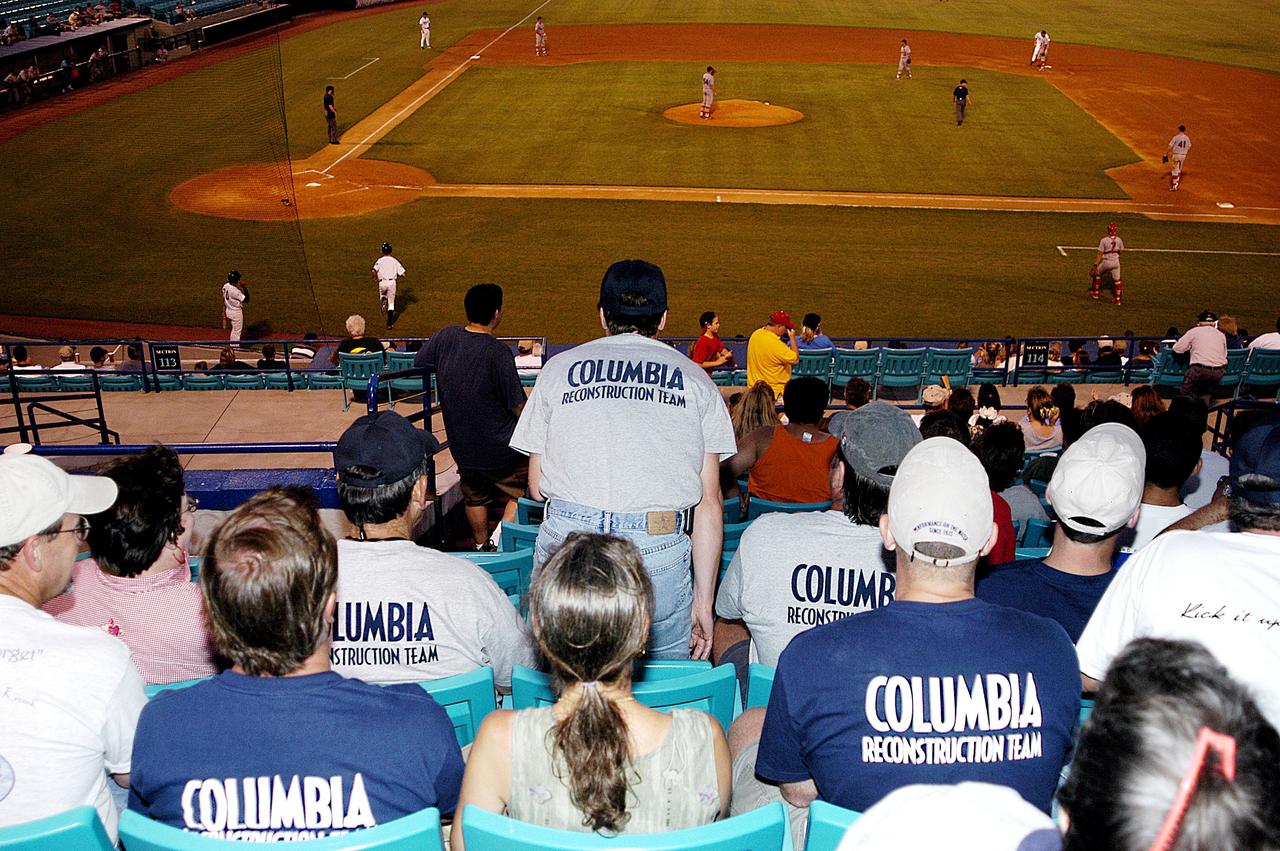
KENNEDY SPACE CENTER, FLA. - KSC employees enjoy a baseball game at Manatees Stadium, home of the Brevard Manatees, a minor league baseball team in Central Florida. The team hosted KSC employees for the game, which included a moment of silence to honor the STS-107 crew and two recovery workers who died in a helicopter crash.

KENNEDY SPACE CENTER, FLA. - The Brevard Manatees, a minor league baseball team in Central Florida, hosts KSC employees at a ballgame at Manatees Stadium. Before the game, attendees offered a moment of silence to honor the STS-107 crew and two recovery workers who died in a helicopter crash.

KENNEDY SPACE CENTER, FLA. - There is action on the baseball diamond during a game at Manatees Stadium, home of the Brevard Manatees, a minor league baseball team in Central Florida. The team hosted KSC employees for the game, which included a moment of silence to honor the STS-107 crew and two recovery workers who died in a helicopter crash.
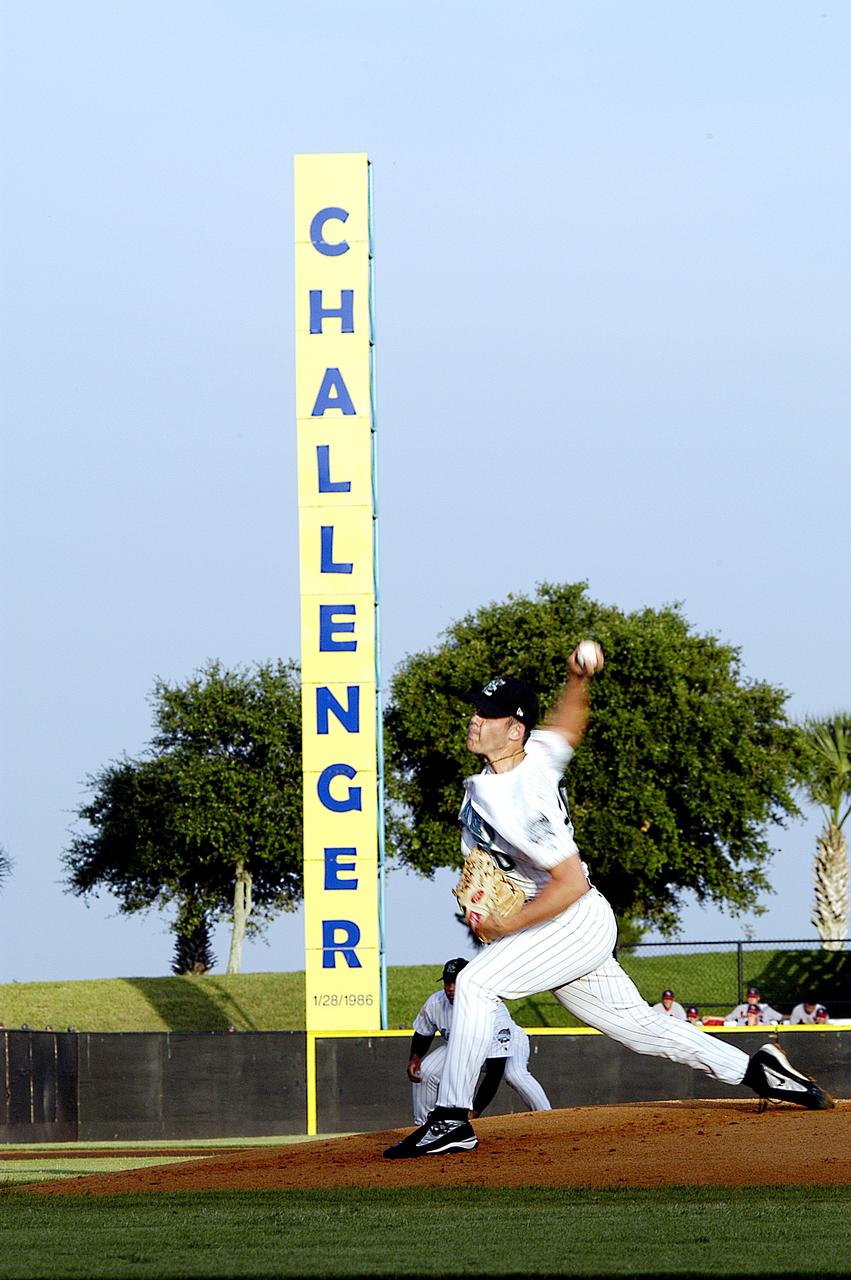
KENNEDY SPACE CENTER, FLA. - The pitcher with the Brevard Manatees, a minor league baseball team in Central Florida, starts the game on a night that hosted KSC employees. Before the game, attendees offered a moment of silence to honor the STS-107 crew and two recovery workers who died in a helicopter crash.
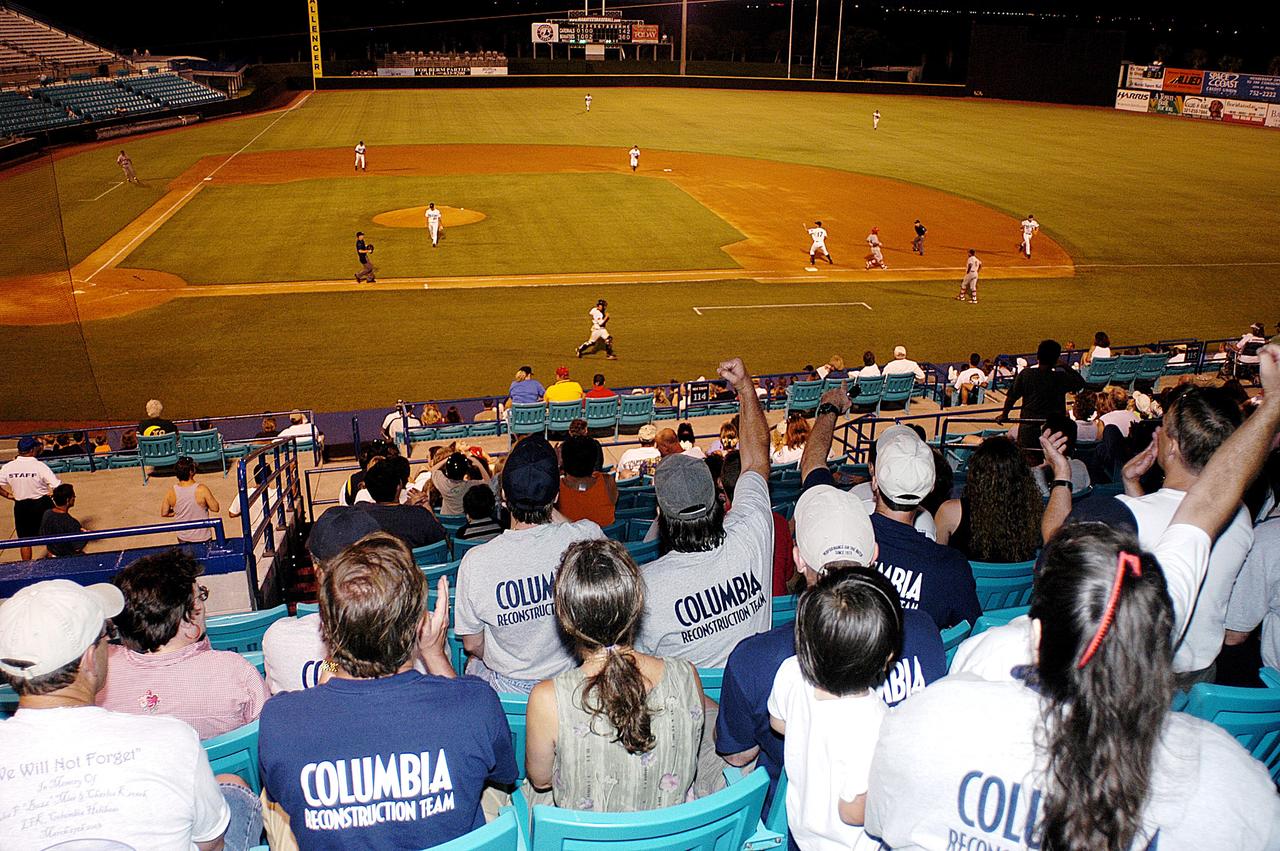
KENNEDY SPACE CENTER, FLA. - KSC employees enjoy a baseball game at Manatees Stadium, home of the Brevard Manatees, a minor league baseball team in Central Florida. The team hosted the employees for the game, which included a moment of silence to honor the STS-107 crew and two recovery workers who died in a helicopter crash.
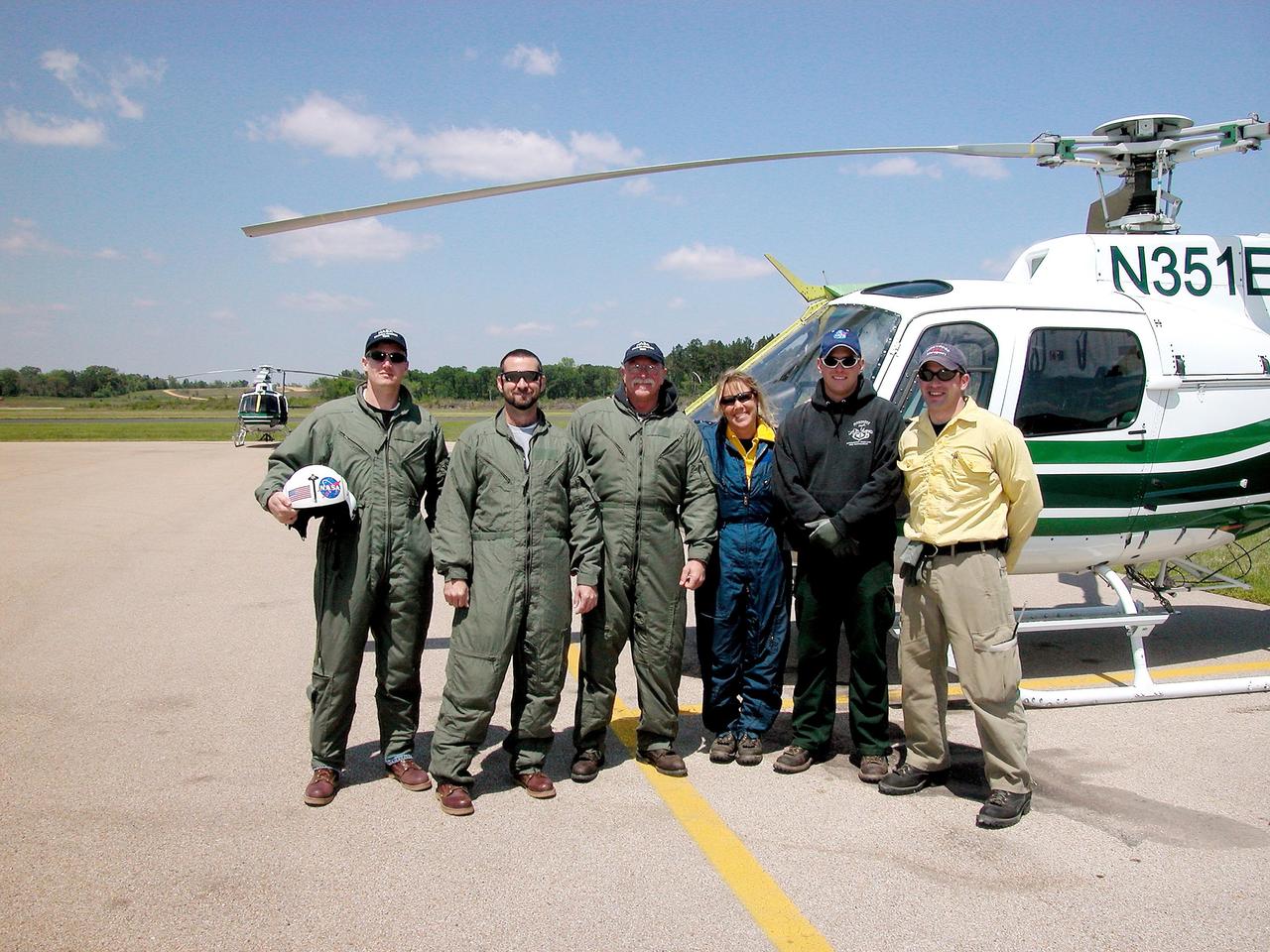
KENNEDY SPACE CENTER, FLA. -- Kennedy Space Center and Forest Service workers pose in front of a helicopter landed at the Nacogdoches field site. The helicopter is one of those being used to survey for parts of Columbia. KSC workers are participating in the Columbia Recovery efforts at the Lufkin (Texas) Command Center, four field sites in East Texas, and the Barksdale, La., hangar site. KSC is working with representatives from other NASA Centers and with those from a number of federal, state and local agencies in the recovery effort. KSC provides vehicle technical expertise in the field to identify, collect and return Shuttle hardware to KSC.
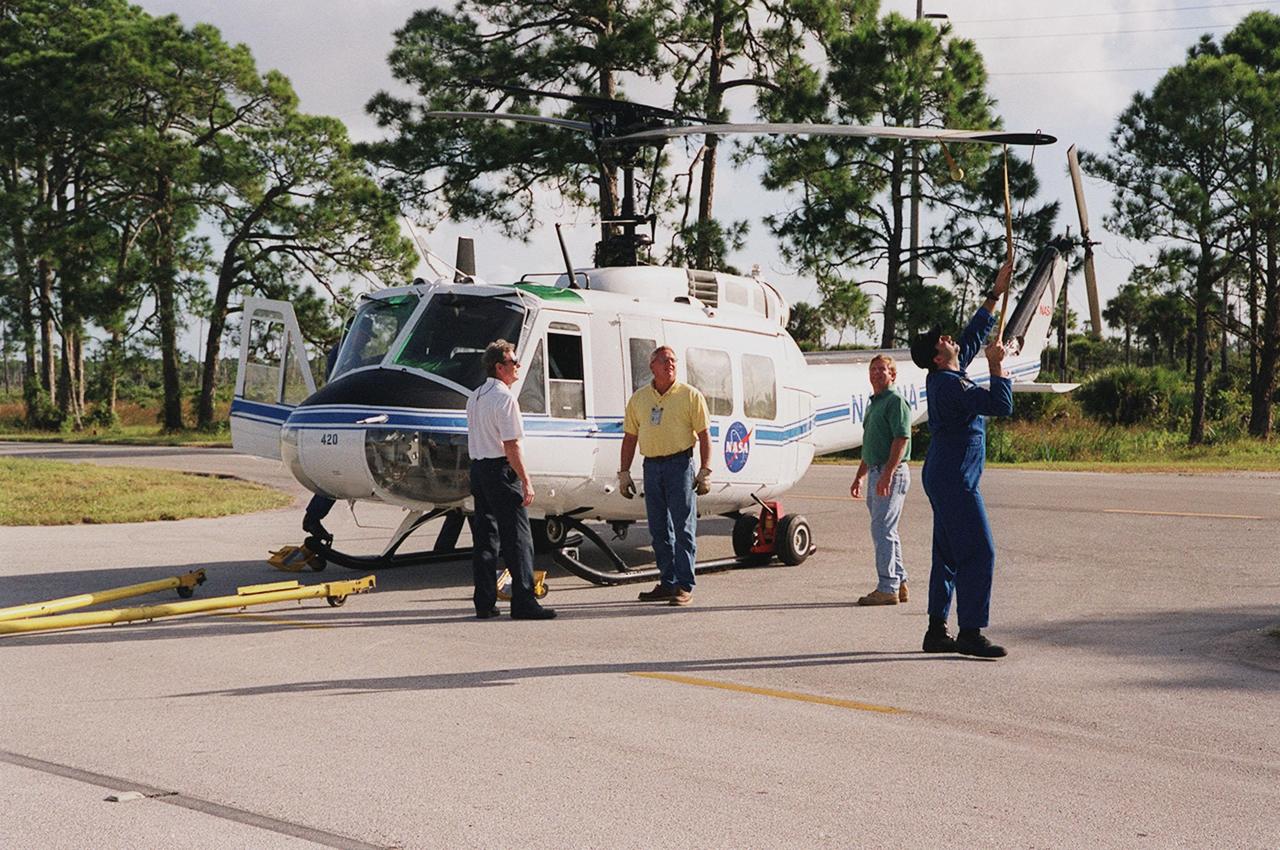
KENNEDY SPACE CENTER, FLA. -- The pilot of the NASA helicopter secures the rotary blade before the helicopter’s transfer to Ransom Road at KSC. It is one of four UH-1H helicopters that will have its blades painted, changing the black to a pattern of white and yellow stripes. The pattern provides better visibility in smoke and fire conditions. When the rotors are turning, the stripes create a yellow and white circle that is more easily seen by a second helicopter from above. The helicopters, primarily used for security and medical evacuation for NASA, will be used to deliver water via buckets during brush fires. The change was made to comply with U.S. Fish and Wildlife and Department of Forestry regulations for helicopter-assisted fire control
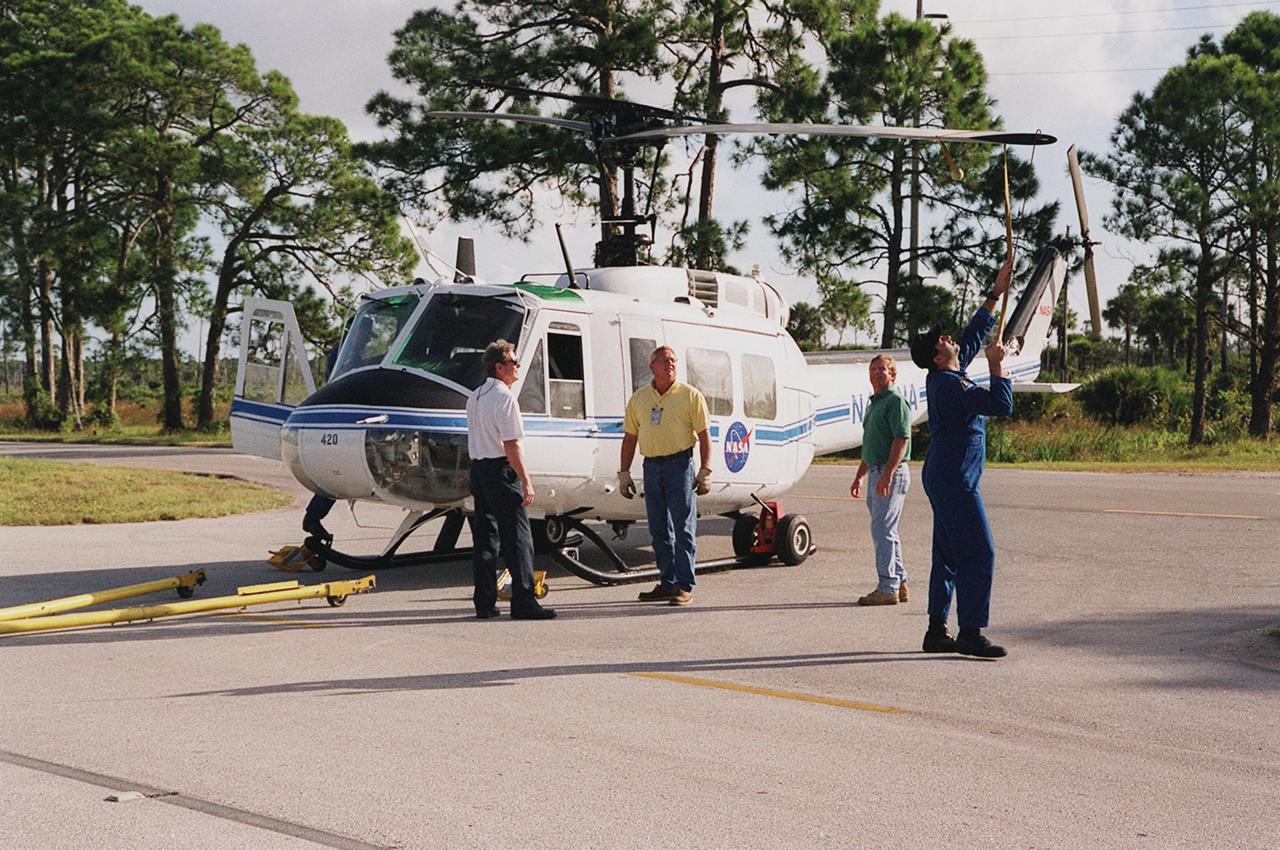
KENNEDY SPACE CENTER, FLA. -- The pilot of the NASA helicopter secures the rotary blade before the helicopter’s transfer to Ransom Road at KSC. It is one of four UH-1H helicopters that will have its blades painted, changing the black to a pattern of white and yellow stripes. The pattern provides better visibility in smoke and fire conditions. When the rotors are turning, the stripes create a yellow and white circle that is more easily seen by a second helicopter from above. The helicopters, primarily used for security and medical evacuation for NASA, will be used to deliver water via buckets during brush fires. The change was made to comply with U.S. Fish and Wildlife and Department of Forestry regulations for helicopter-assisted fire control
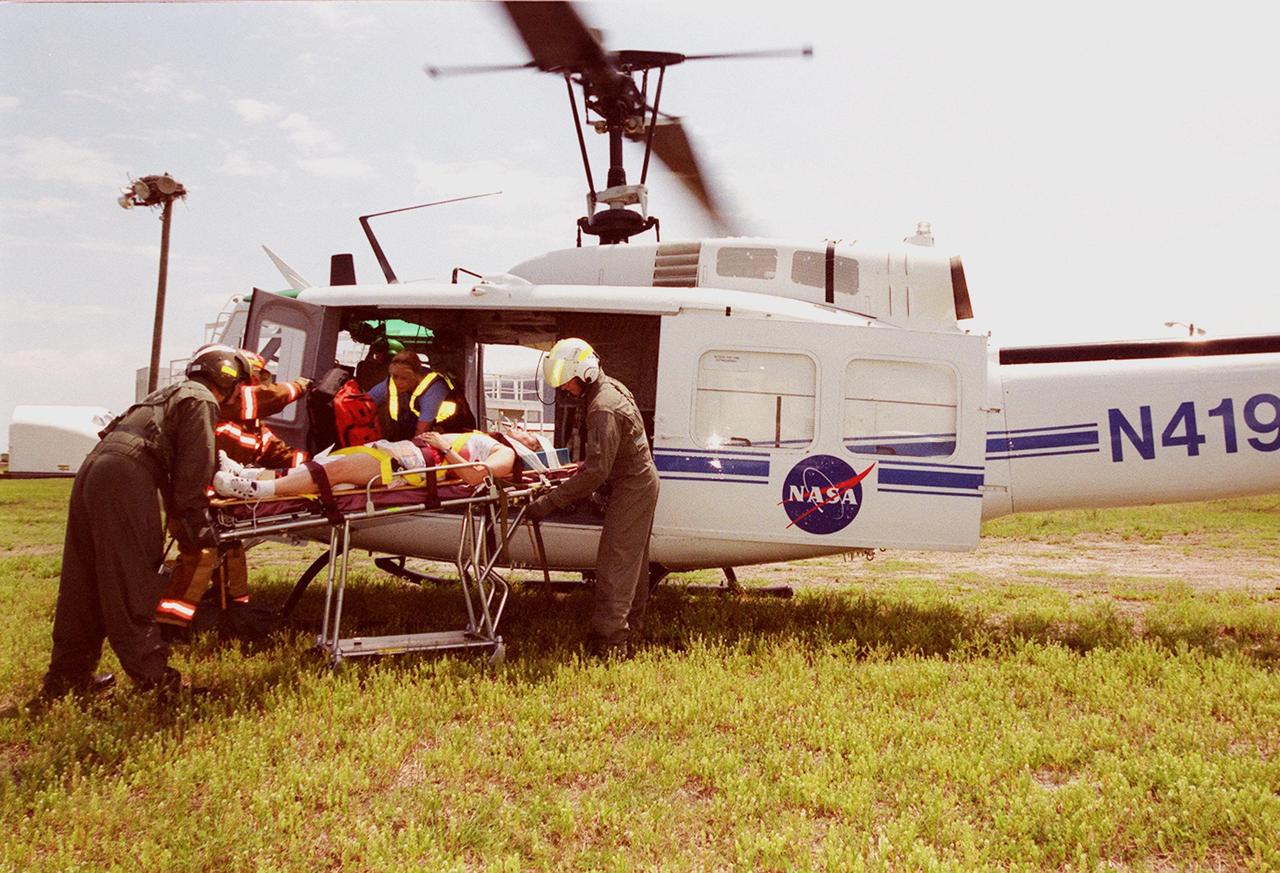
KENNEDY SPACE CENTER, FLA. -- A medevac helicopter assists with transporting “victims” during a staged mass casualty exercise in the Launch Complex 39 area. Employees are playing roles in the fictitious sniper attack that is being staged to validate capabilities of KSC’s fire, medical, helicopter transport and security personnel to respond to such an event.
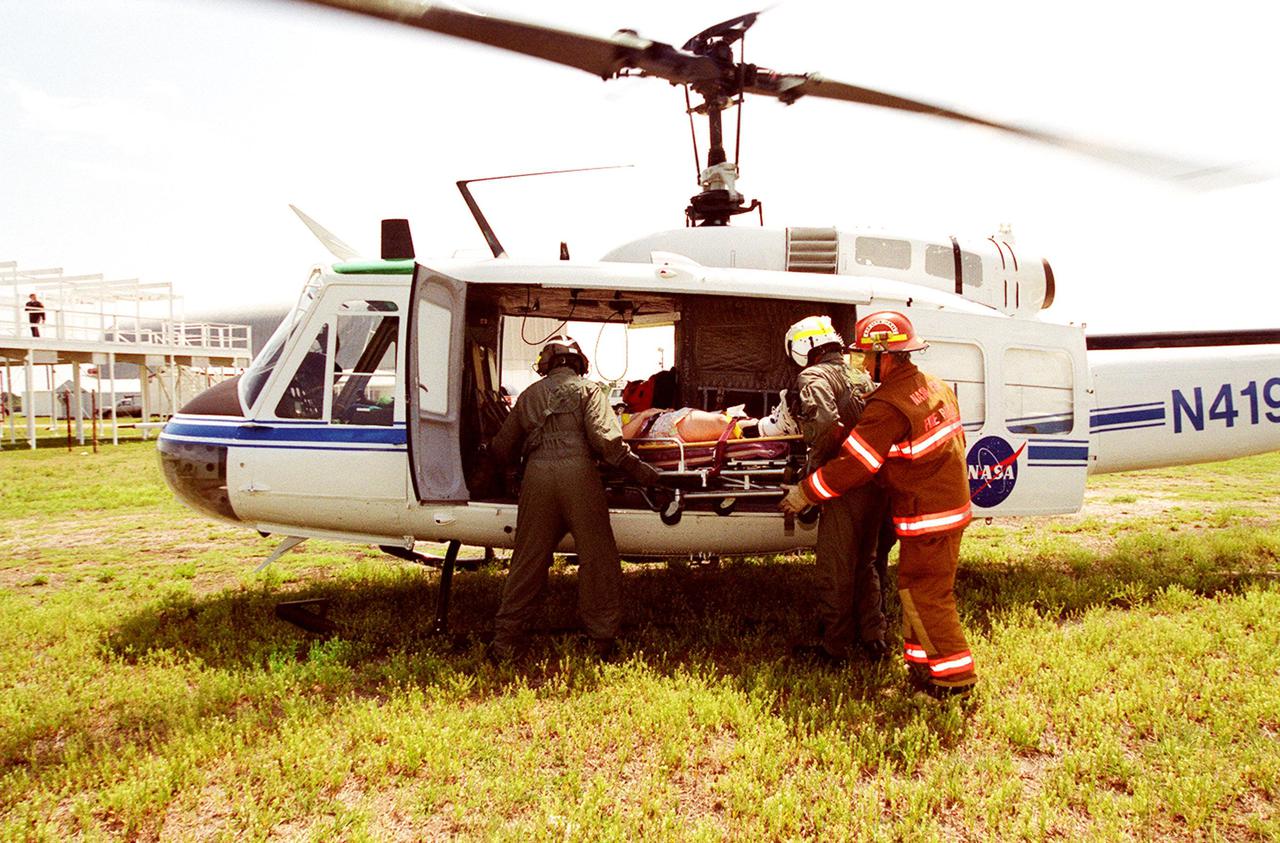
KENNEDY SPACE CENTER, FLA. -- Rescue personnel place a “victim” in a medevac helicopter during a staged mass casualty exercise in the Launch Complex 39 area. Employees are playing roles in the fictitious sniper attack that is being staged to validate capabilities of KSC’s fire, medical, helicopter transport and security personnel to respond to such an event
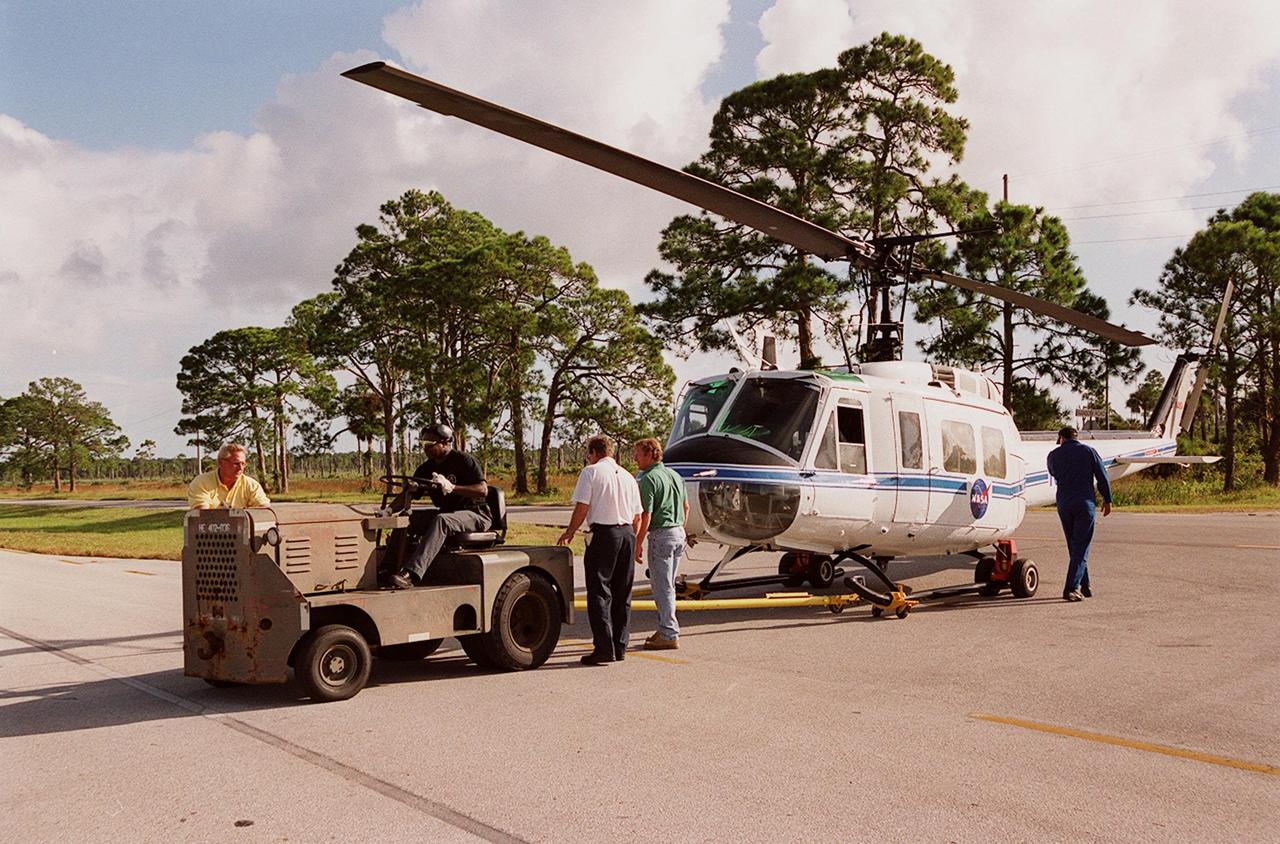
KENNEDY SPACE CENTER, FLA. -- A NASA helicopter is secured for transfer to Ransom Road at KSC. It is one of four UH-1H helicopters that will have its blades painted, changing the black to a pattern of white and yellow stripes. The pattern provides better visibility in smoke and fire conditions. When the rotors are turning, the stripes create a yellow and white circle that is more easily seen by a second helicopter from above. The helicopters, primarily used for security and medical evacuation for NASA, will be used to deliver water via buckets during brush fires. The change was made to comply with U.S. Fish and Wildlife and Department of Forestry regulations for helicopter-assisted fire control
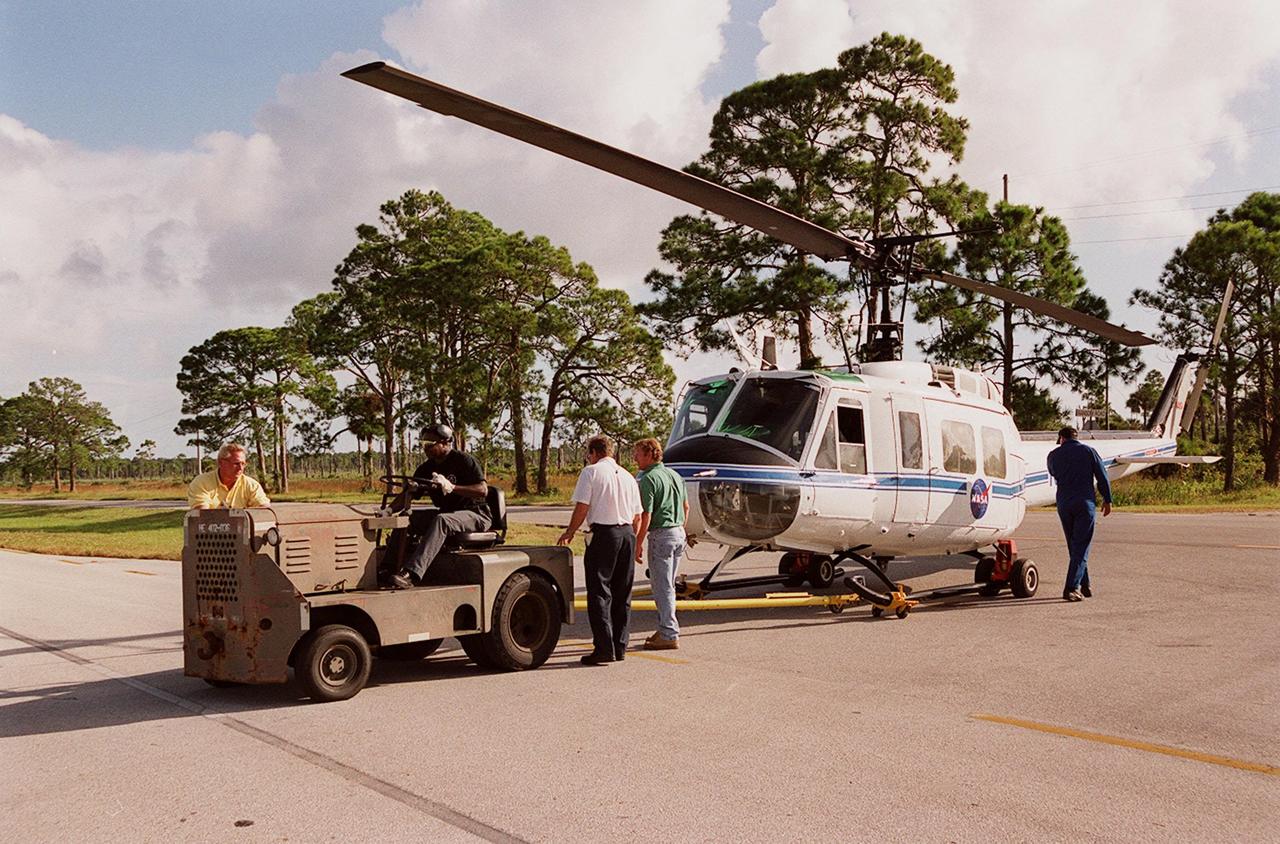
KENNEDY SPACE CENTER, FLA. -- A NASA helicopter is secured for transfer to Ransom Road at KSC. It is one of four UH-1H helicopters that will have its blades painted, changing the black to a pattern of white and yellow stripes. The pattern provides better visibility in smoke and fire conditions. When the rotors are turning, the stripes create a yellow and white circle that is more easily seen by a second helicopter from above. The helicopters, primarily used for security and medical evacuation for NASA, will be used to deliver water via buckets during brush fires. The change was made to comply with U.S. Fish and Wildlife and Department of Forestry regulations for helicopter-assisted fire control
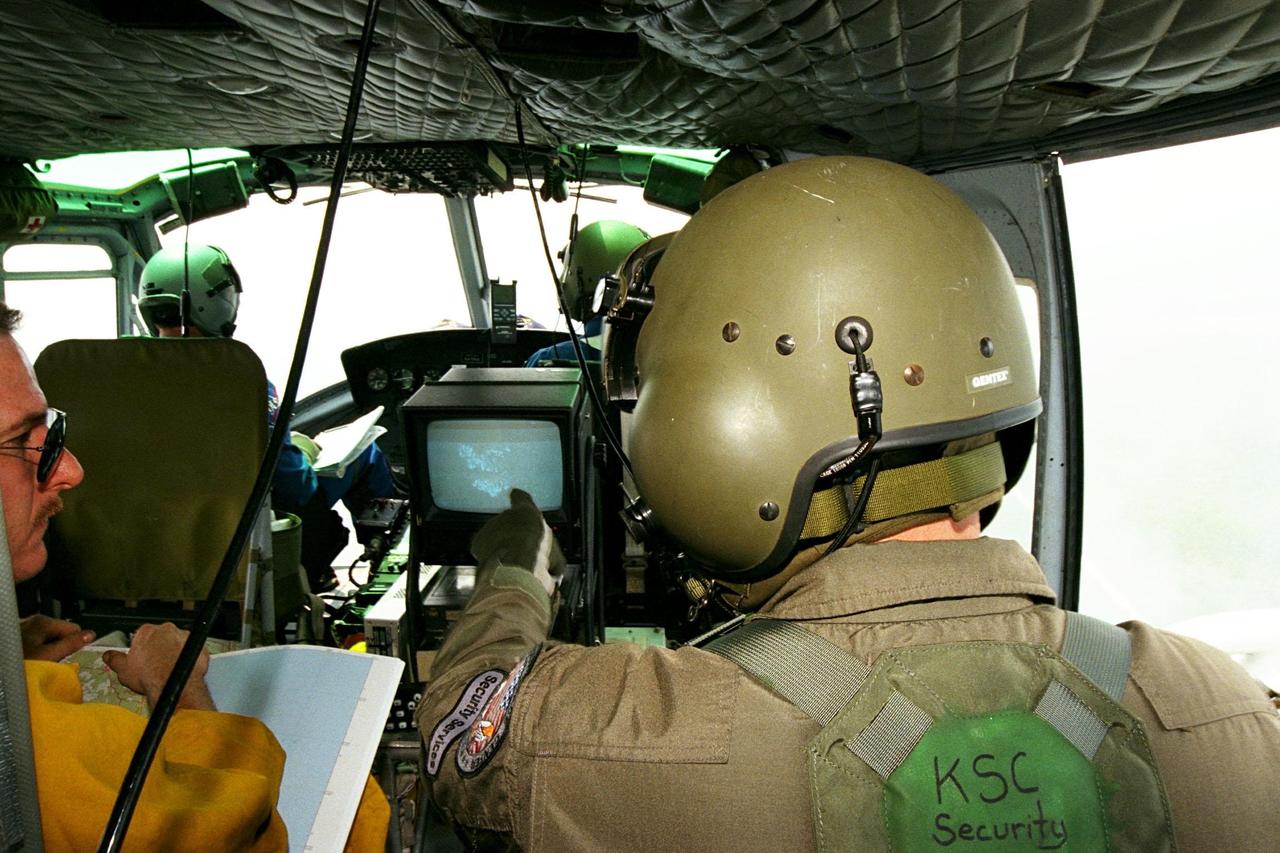
KENNEDY SPACE CENTER, FLA. -- Sgt. Mark Hines, of Kennedy Space Center (KSC) Security, points out a view of a fire on the Forward Looking Infrared Radar (FLIR) video screen to Greg Dunn, of Florida's Division of Forestry, as KSC pilots fly NASA's Huey UH-1 helicopter over fires burning in Volusia County, Florida. The FLIR includes a beach-ball sized infrared camera that is mounted on the helicopter's right siderail and a real-time TV monitor and recorder installed inside. The helicopter has also been outfitted with a portable global positioning satellite (GPS) system to support the Division of Forestry as they fight the brush fires which have been plaguing the state as a result of extremely dry conditions and lightning storms. While the FLIR collects temperature data and images, the GPS system provides the exact coordinates of the fires being observed and transmits the data to the firefighters on the ground. KSC's security team routinely uses the FLIR equipment prior to Shuttle launch and landing activities to ensure that the area surrounding the launch pad and runway are clear of unauthorized personnel. KSC's Base Operations Contractor, EG&G Florida, operates the NASA-owned helicopter.
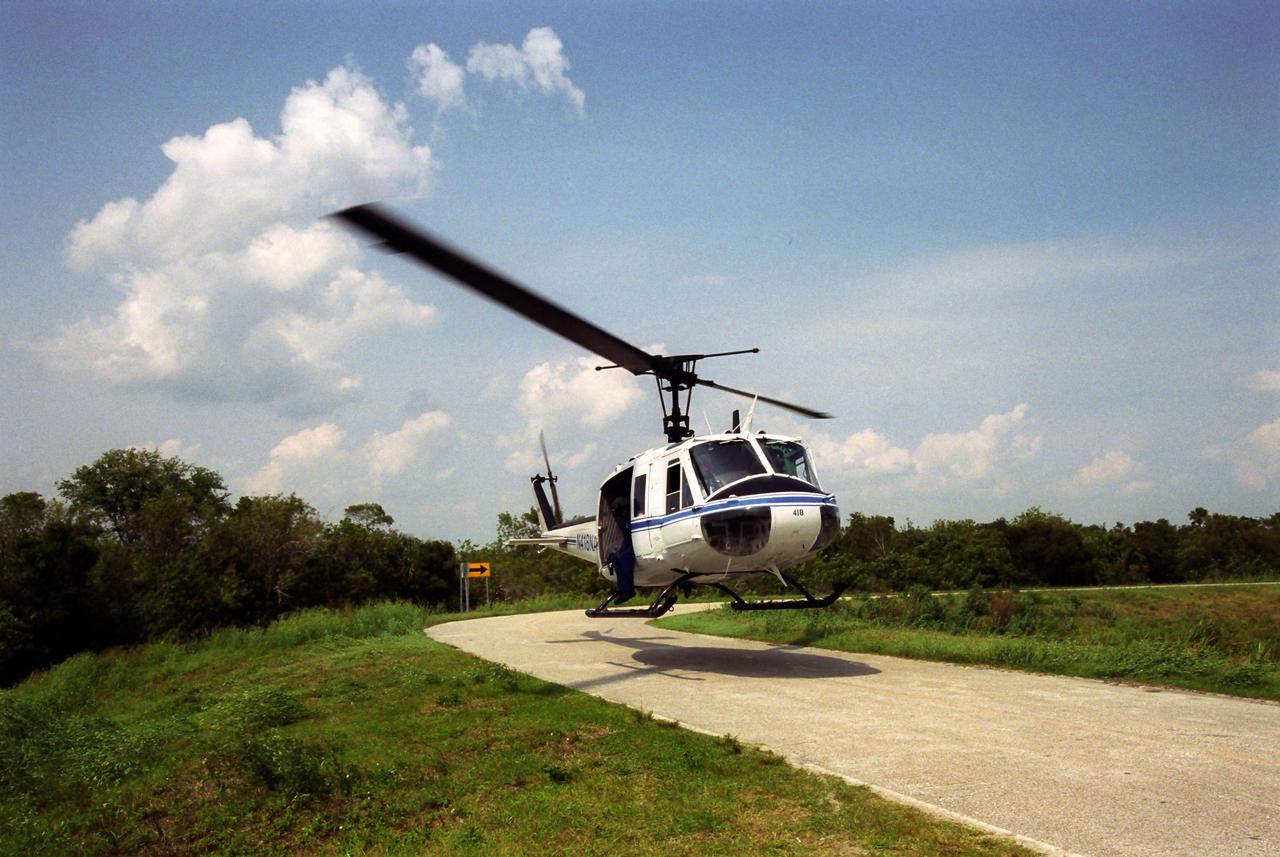
KENNEDY SPACE CENTER, FLA. - A NASA helicopter lifts off from KSC after returning photographers from an excursion to take pictures of various buildings and structures on the Center.
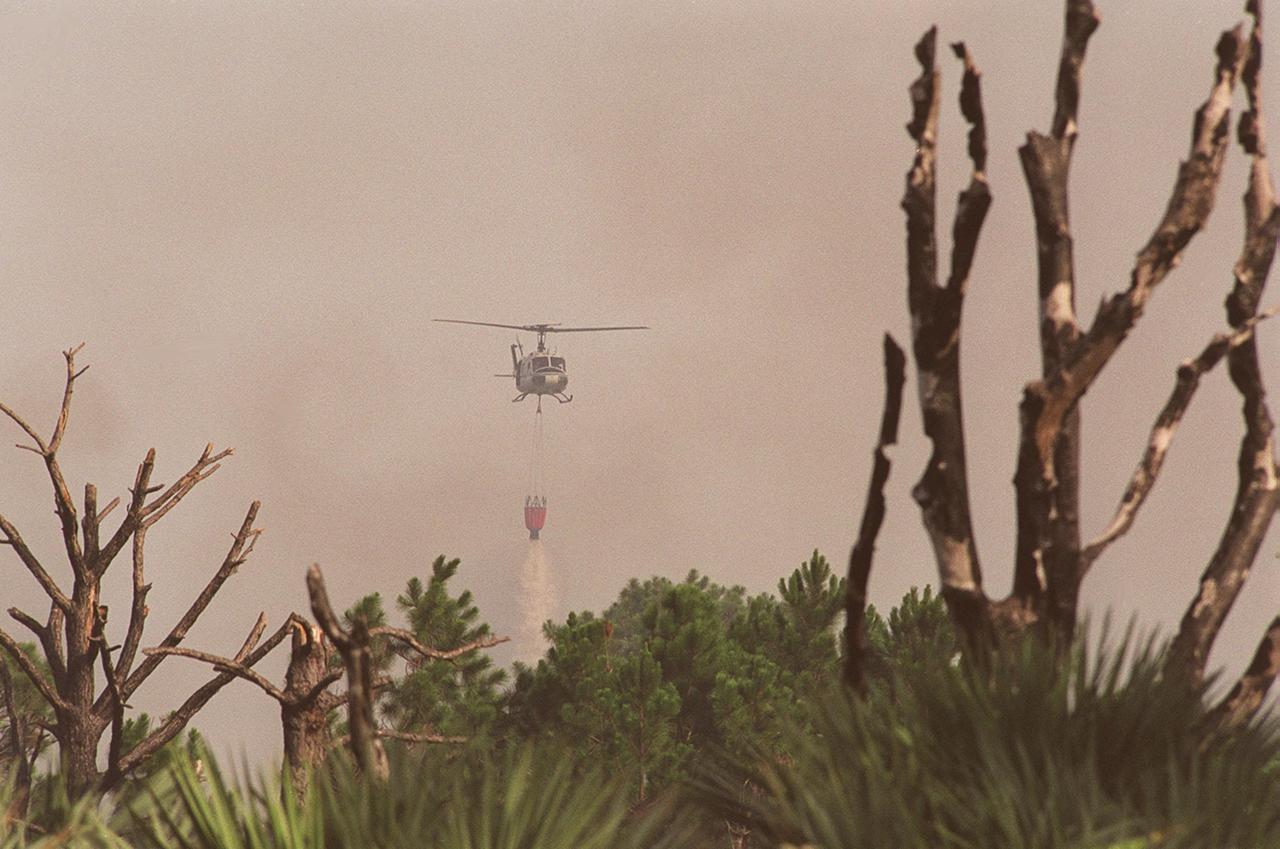
A NASA helicopter drops its cargo of water onto a wildfire at KSC. Before being extinguished, the fire burned about 20 acres at a site near gate 2C on Kennedy Parkway North (route 3)
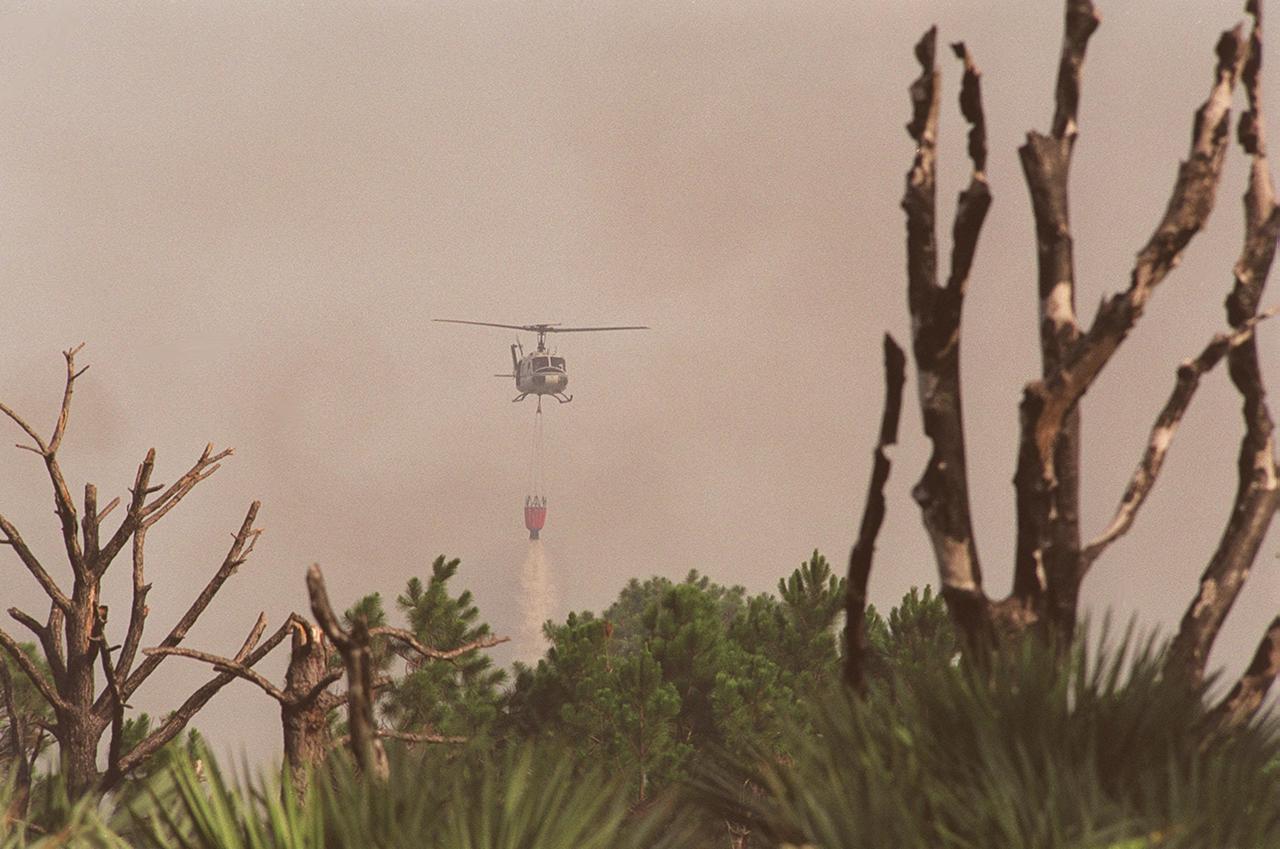
A NASA helicopter drops its cargo of water onto a wildfire at KSC. Before being extinguished, the fire burned about 20 acres at a site near gate 2C on Kennedy Parkway North (route 3)
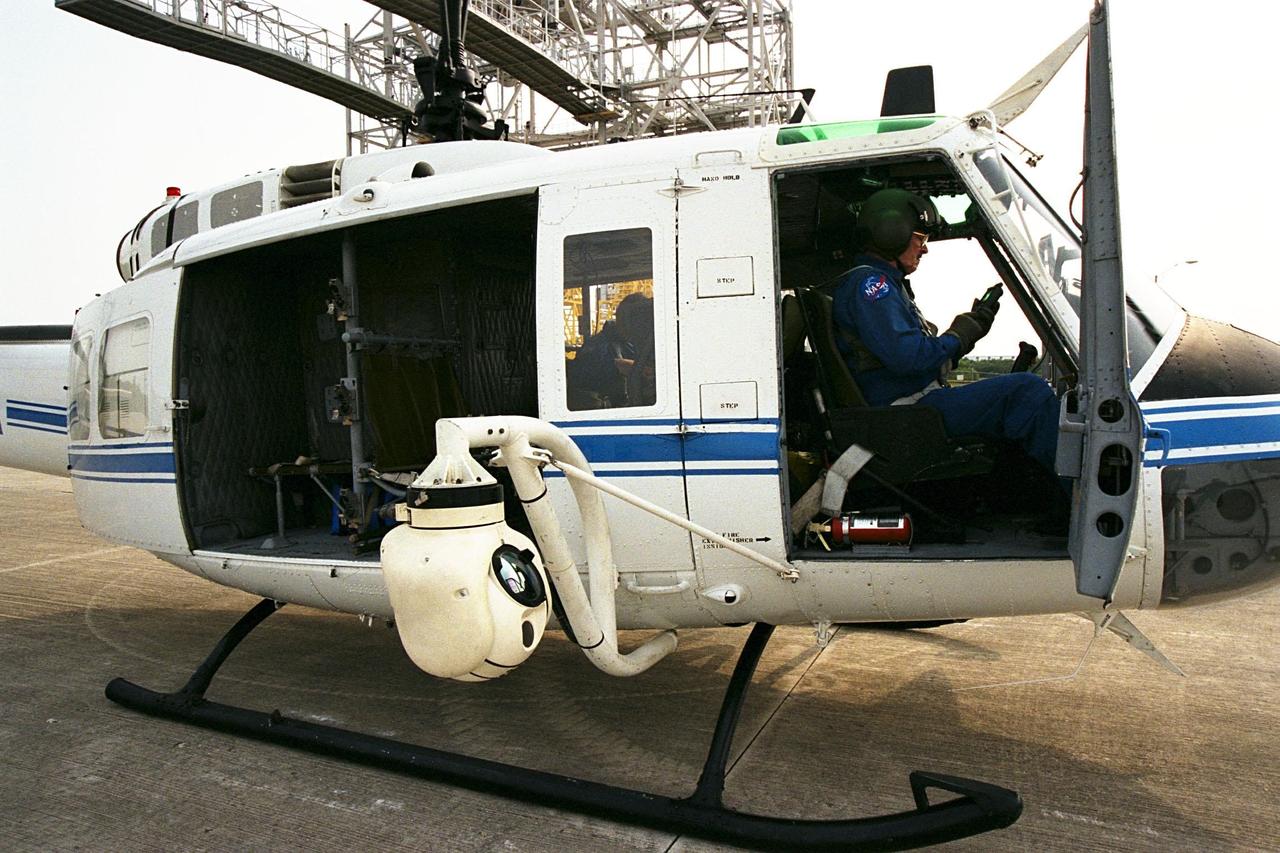
KENNEDY SPACE CENTER, FLA. -- A beach ball-sized infrared camera, part of the Forward Looking Infrared Radar (FLIR), has been mounted on the right siderail of NASA's Huey UH-1 helicopter. A KSC pilot prepares to fly the helicopter, which has also been outfitted with a portable global positioning satellite (GPS) system, to support Florida's Division of Forestry as they fight the brush fires which have been plaguing the state as a result of extremely dry conditions and lightning storms. The FLIR also includes a real-time television monitor and recorder installed inside the helicopter. While the FLIR collects temperature data and images, the GPS system provides the exact coordinates of the fires being observed and transmits the data to the firefighters on the ground. The Kennedy Space Center (KSC) security team routinely uses the FLIR equipment prior to Shuttle launch and landing activities to ensure that the area surrounding the launch pad and runway are clear of unauthorized personnel. KSC's Base Operations Contractor, EG&G Florida, operates the NASA-owned helicopter
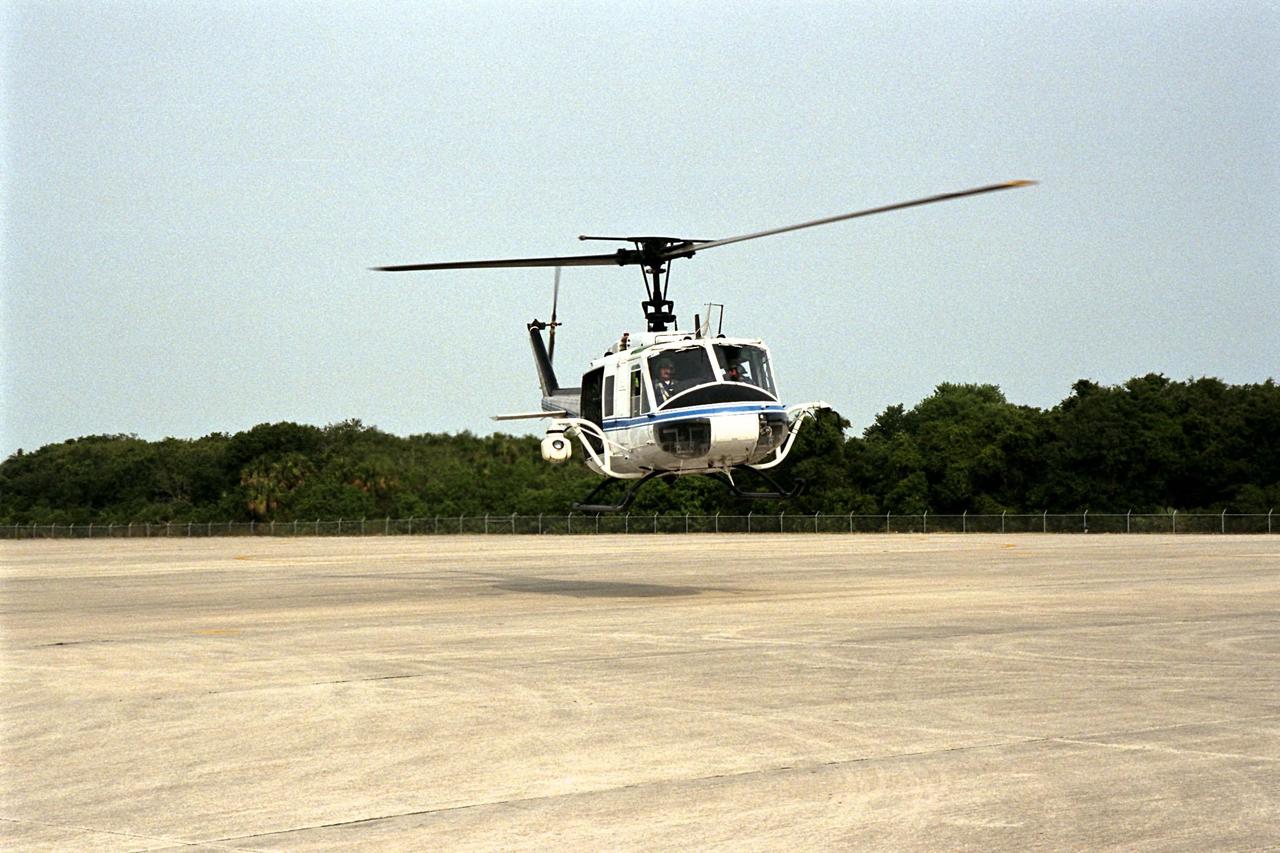
KENNEDY SPACE CENTER, FLA. -- NASA's Huey UH-1 helicopter lands at the Shuttle Landing Facility to pick up Kennedy Space Center (KSC) Security personnel who operate the Forward Looking Infrared Radar (FLIR) installed on board. The helicopter has also been outfitted with a portable global positioning satellite (GPS) system to support Florida's Division of Forestry as they fight the brush fires which have been plaguing the state as a result of extremely dry conditions and lightning storms. The FLIR includes a beach ball-sized infrared camera that is mounted on the helicopter's right siderail and a real-time television monitor and recorder installed inside. While the FLIR collects temperature data and images, the GPS system provides the exact coordinates of the fires being observed and transmits the data to the firefighters on the ground. KSC's security team routinely uses the FLIR equipment prior to Shuttle launch and landing activities to ensure that the area surrounding the launch pad and runway are clear of unauthorized personnel. KSC's Base Operations Contractor, EG&G Florida, operates the NASA-owned helicopter
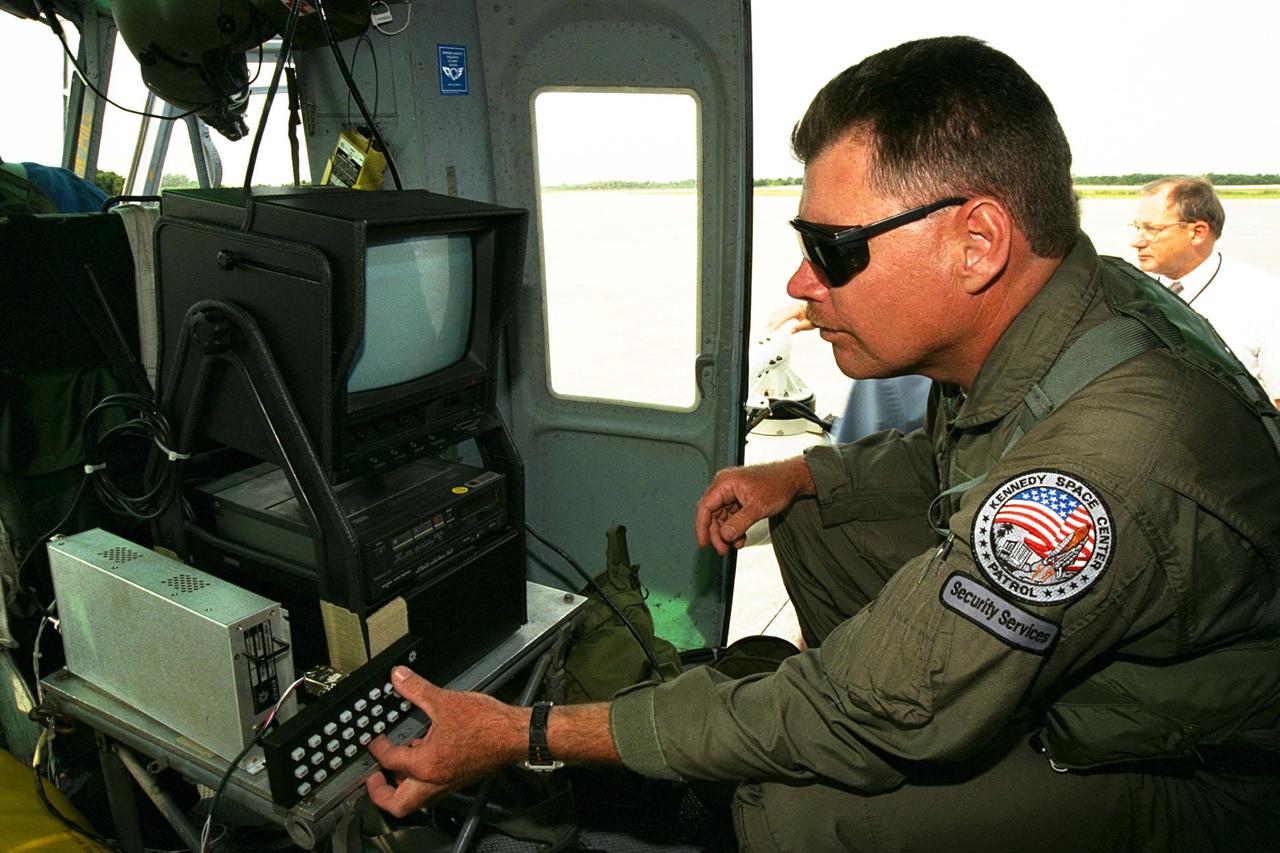
KENNEDY SPACE CENTER, FLA. -- Sgt. Mark Hines, of Kennedy Space Center (KSC) Security, checks out equipment used to operate the Forward Looking Infrared Radar (FLIR) installed on NASA's Huey UH-1 helicopter. The helicopter has also been outfitted with a portable global positioning satellite (GPS) system to support Florida's Division of Forestry as they fight the brush fires which have been plaguing the state as a result of extremely dry conditions and lightning storms. The FLIR includes a beach ball-sized infrared camera that is mounted on the helicopter's right siderail and a real-time television monitor and recorder installed inside. While the FLIR collects temperature data and images, the GPS system provides the exact coordinates of the fires being observed and transmits the data to the firefighters on the ground. KSC's security team routinely uses the FLIR equipment prior to Shuttle launch and landing activities to ensure that the area surrounding the launch pad and runway are clear of unauthorized personnel. KSC's Base Operations Contractor, EG&G Florida, operates the NASA-owned helicopter
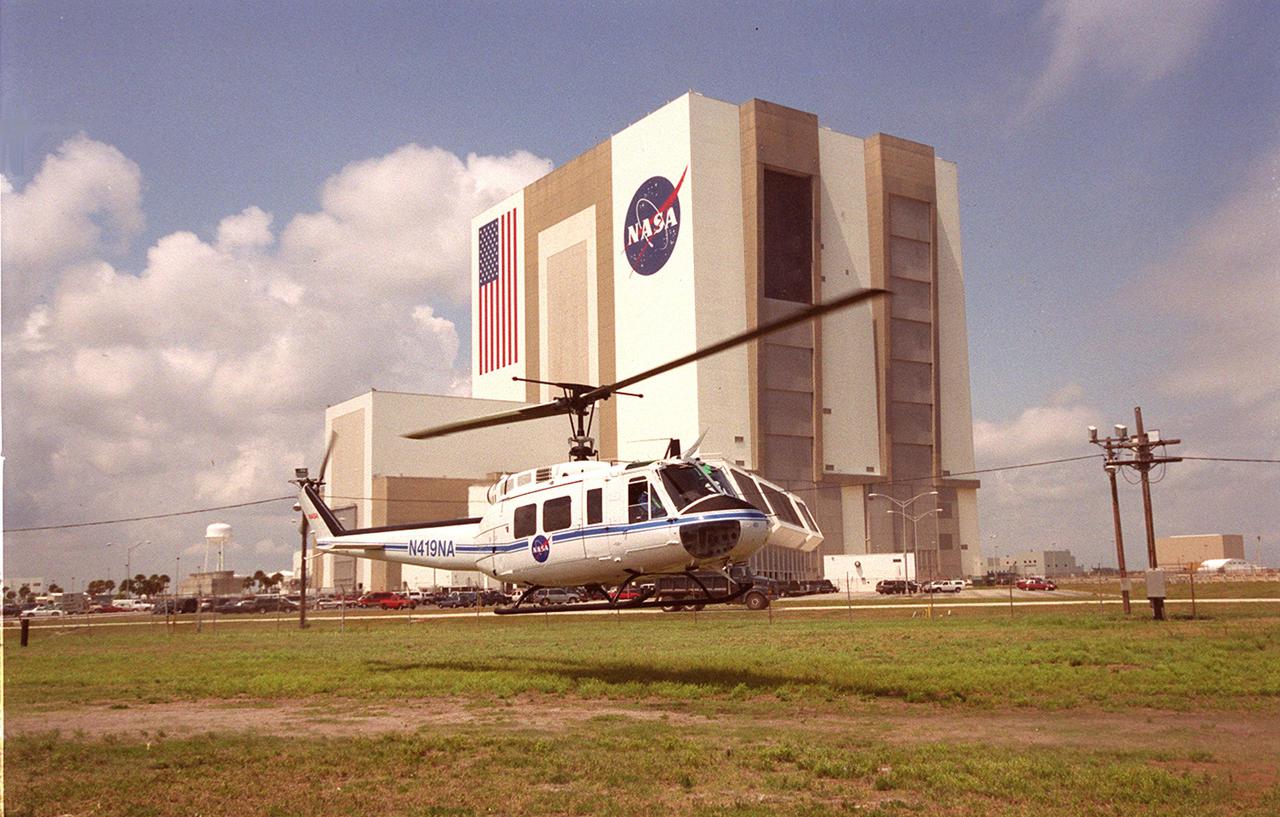
KENNEDY SPACE CENTER, FLA. -- A medevac helicopter lifts off form the site of a staged mass casualty exercise in the Launch Complex 39 area. The Vehicle Assembly Building is seen in the background. Employees are playing roles in the fictitious sniper attack that is being staged to validate capabilities of KSC’s fire, medical, helicopter transport and security personnel to respond to such an event
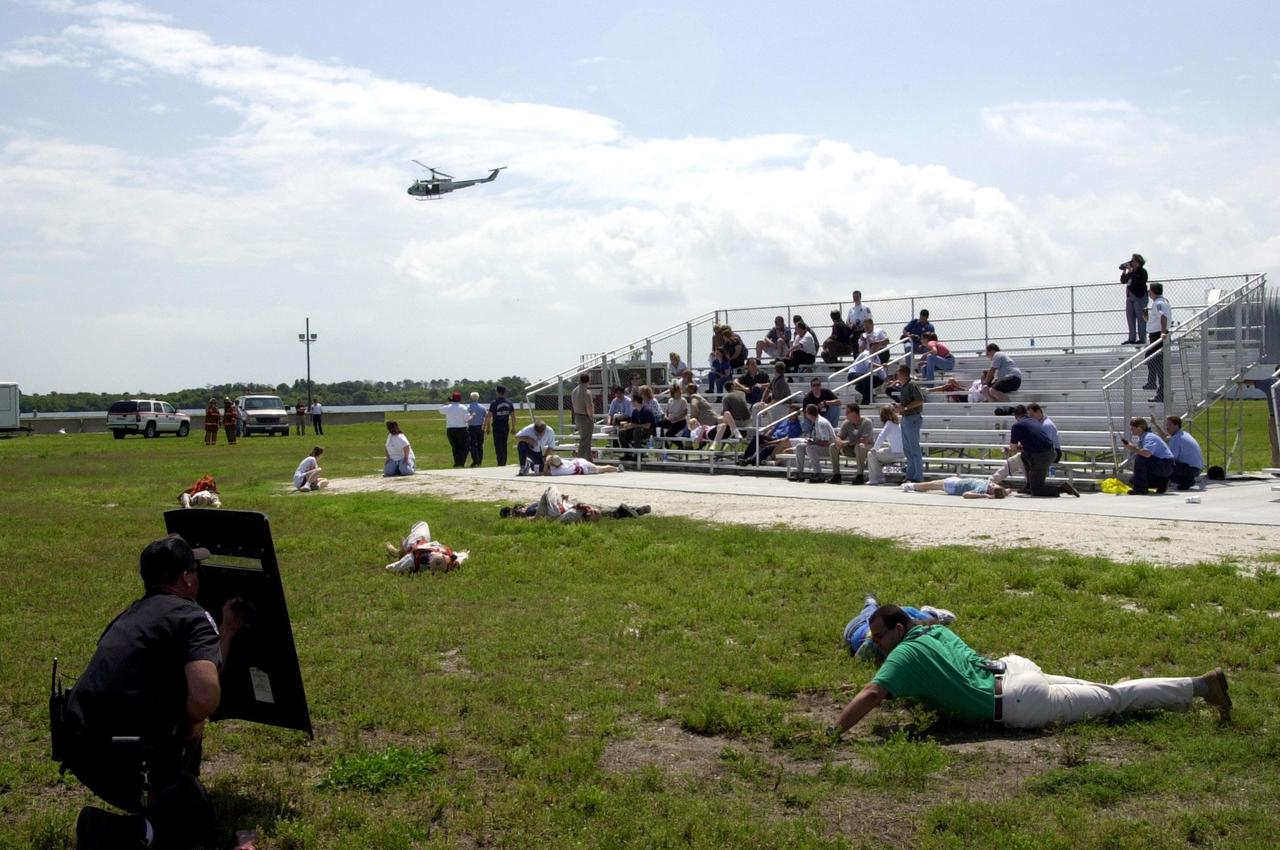
KENNEDY SPACE CENTER, FLA. -- During a staged mass casualty exercise in the Launch Complex 39 area, a security officer crouches behind a shield as if under fire by a sniper. Employees play roles of the victims (seen on the ground and in the bleachers). In the background, a helicopter arrives on the scene.The exercise was staged to validate capabilities of KSC’s fire, medical helicopter transport and security personnel to respond to such an event
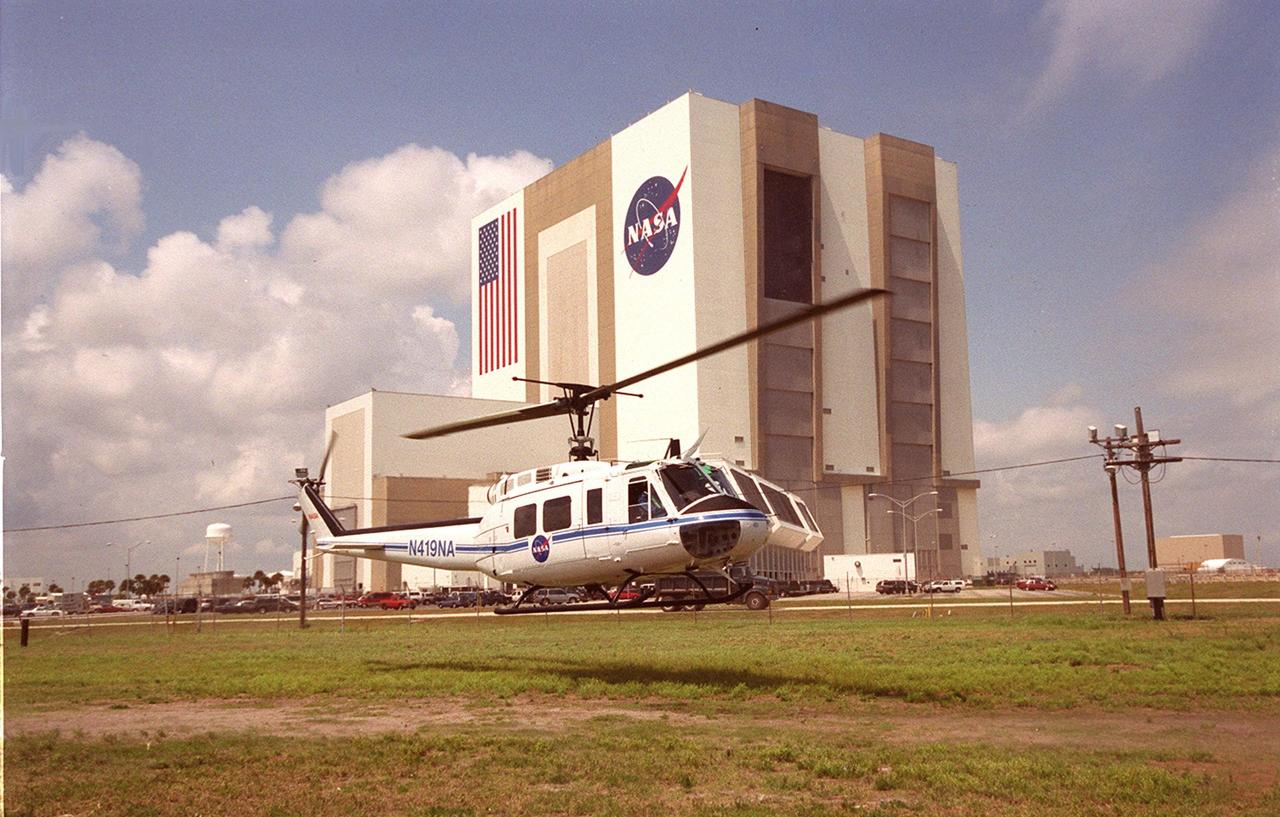
KENNEDY SPACE CENTER, FLA. -- A medevac helicopter lifts off form the site of a staged mass casualty exercise in the Launch Complex 39 area. The Vehicle Assembly Building is seen in the background. Employees are playing roles in the fictitious sniper attack that is being staged to validate capabilities of KSC’s fire, medical, helicopter transport and security personnel to respond to such an event
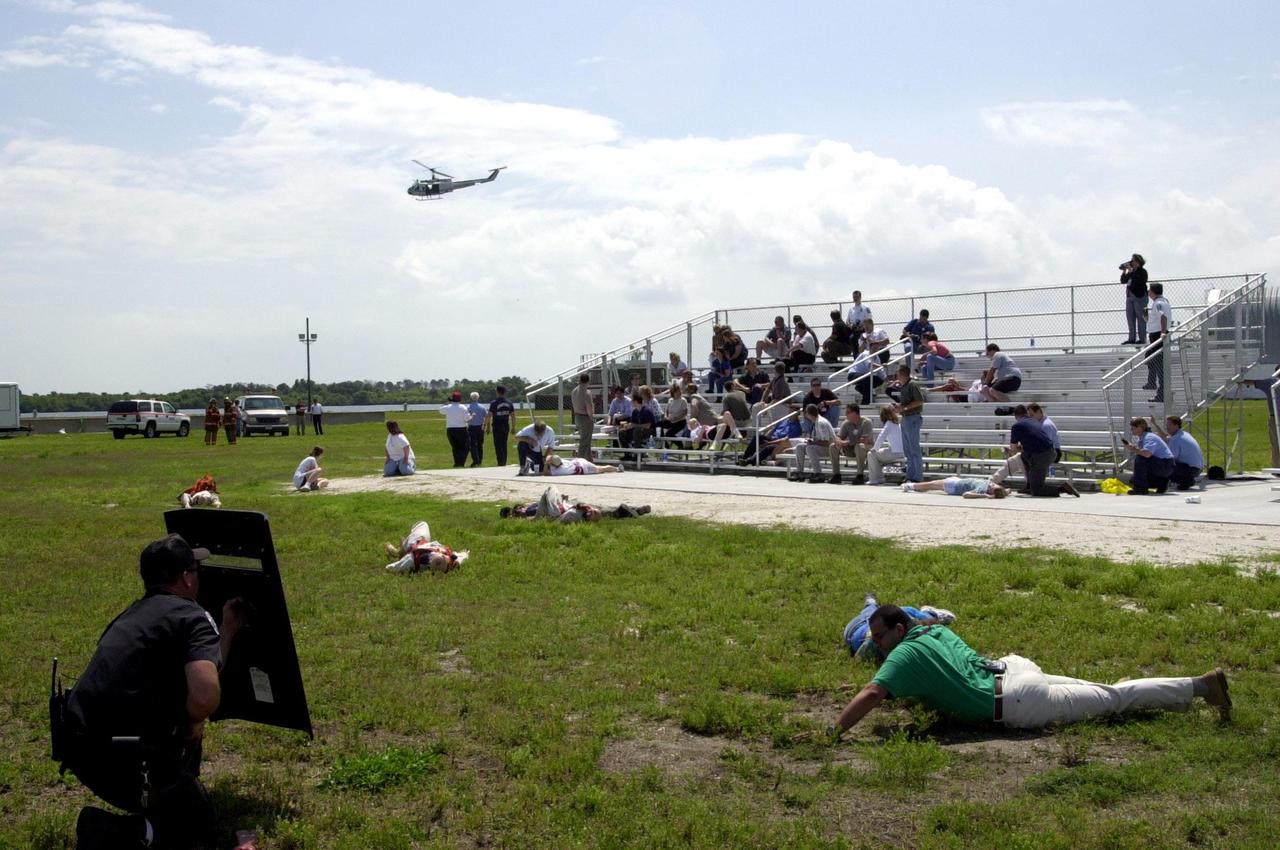
KENNEDY SPACE CENTER, FLA. -- During a staged mass casualty exercise in the Launch Complex 39 area, a security officer crouches behind a shield as if under fire by a sniper. Employees play roles of the victims (seen on the ground and in the bleachers). In the background, a helicopter arrives on the scene.The exercise was staged to validate capabilities of KSC’s fire, medical helicopter transport and security personnel to respond to such an event
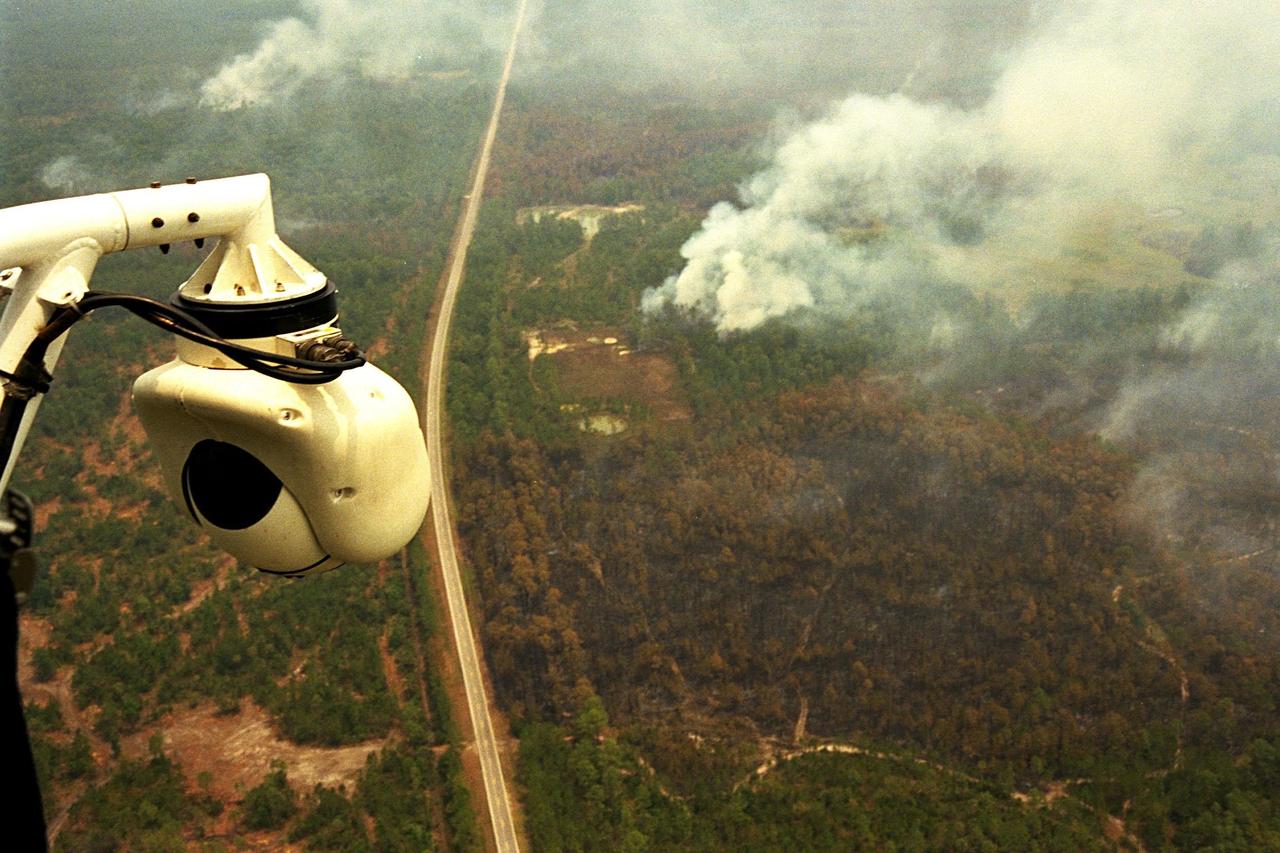
KENNEDY SPACE CENTER, FLA. -- A beach ball-sized infrared camera, part of the Forward Looking Infrared Radar (FLIR), has been mounted on the right siderail of NASA's Huey UH-1 helicopter and is being used to search for fires in Volusia County, Florida. The helicopter has also been outfitted with a portable global positioning satellite (GPS) system to support Florida's Division of Forestry as they fight the brush fires which have been plaguing the state as a result of extremely dry conditions and lightning storms. The FLIR also includes a real-time television monitor and recorder installed inside the helicopter. While the FLIR collects temperature data and images, the GPS system provides the exact coordinates of the fires being observed and transmits the data to the firefighters on the ground. The Kennedy Space Center (KSC) security team routinely uses the FLIR equipment prior to Shuttle launch and landing activities to ensure that the area surrounding the launch pad and runway are clear of unauthorized personnel. KSC's Base Operations Contractor, EG&G Florida, operates the NASA-owned helicopter
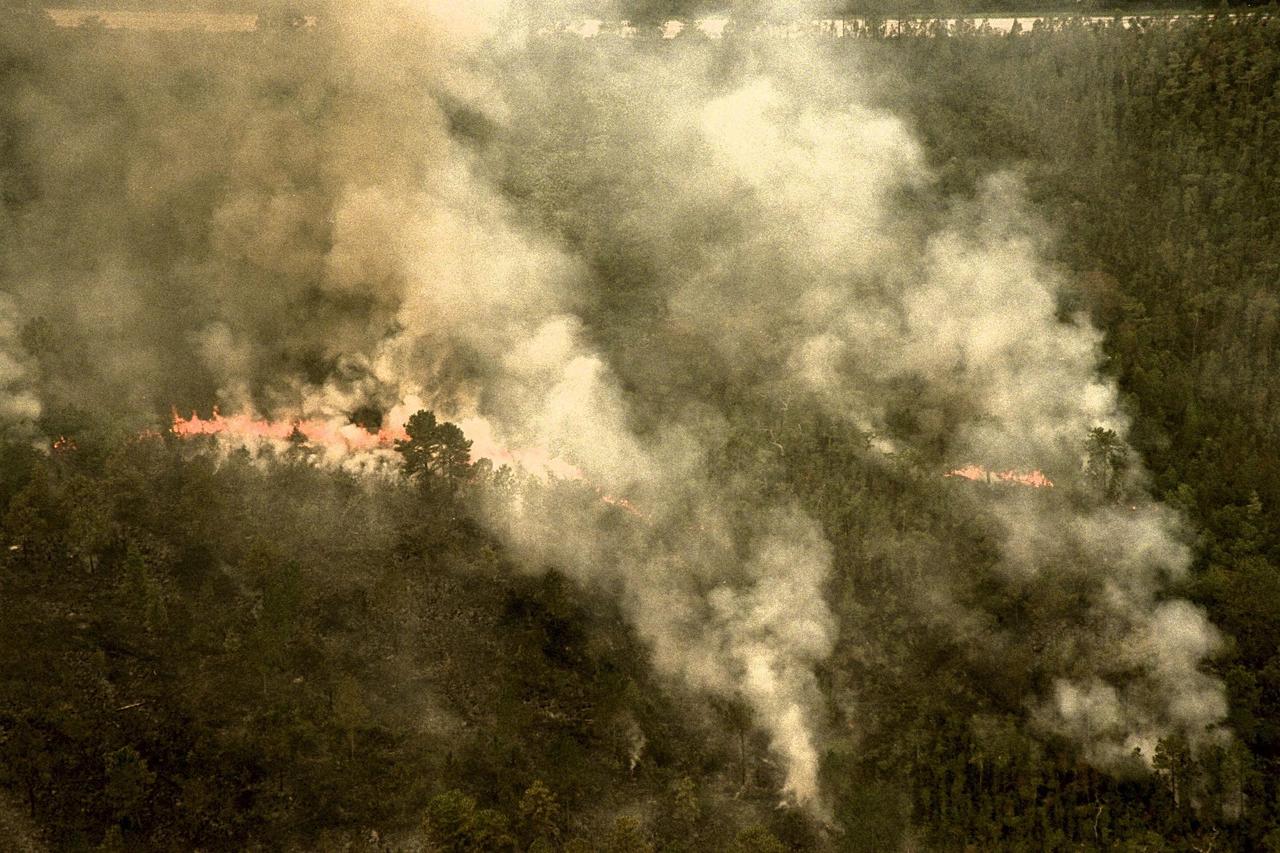
KENNEDY SPACE CENTER, FLA. -- A forest fire burning in Volusia County, Florida, is clearly visible from NASA's Huey UH-1 helicopter. The helicopter has been outfitted with a Forward Looking Infrared Radar (FLIR) and a portable global positioning satellite (GPS) system to support Florida's Division of Forestry as they fight the brush fires which have been plaguing the state as a result of extremely dry conditions and lightning storms. The FLIR includes a beach ball-sized infrared camera that is mounted on the helicopter's right siderail and a real-time television monitor and recorder installed inside. While the FLIR collects temperature data and images, the GPS system provides the exact coordinates of the fires being observed and transmits the data to the firefighters on the ground. The Kennedy Space Center (KSC) security team routinely uses the FLIR equipment prior to Shuttle launch and landing activities to ensure that the area surrounding the launch pad and runway are clear of unauthorized personnel. KSC's Base Operations Contractor, EG&G Florida, operates the NASA-owned helicopter
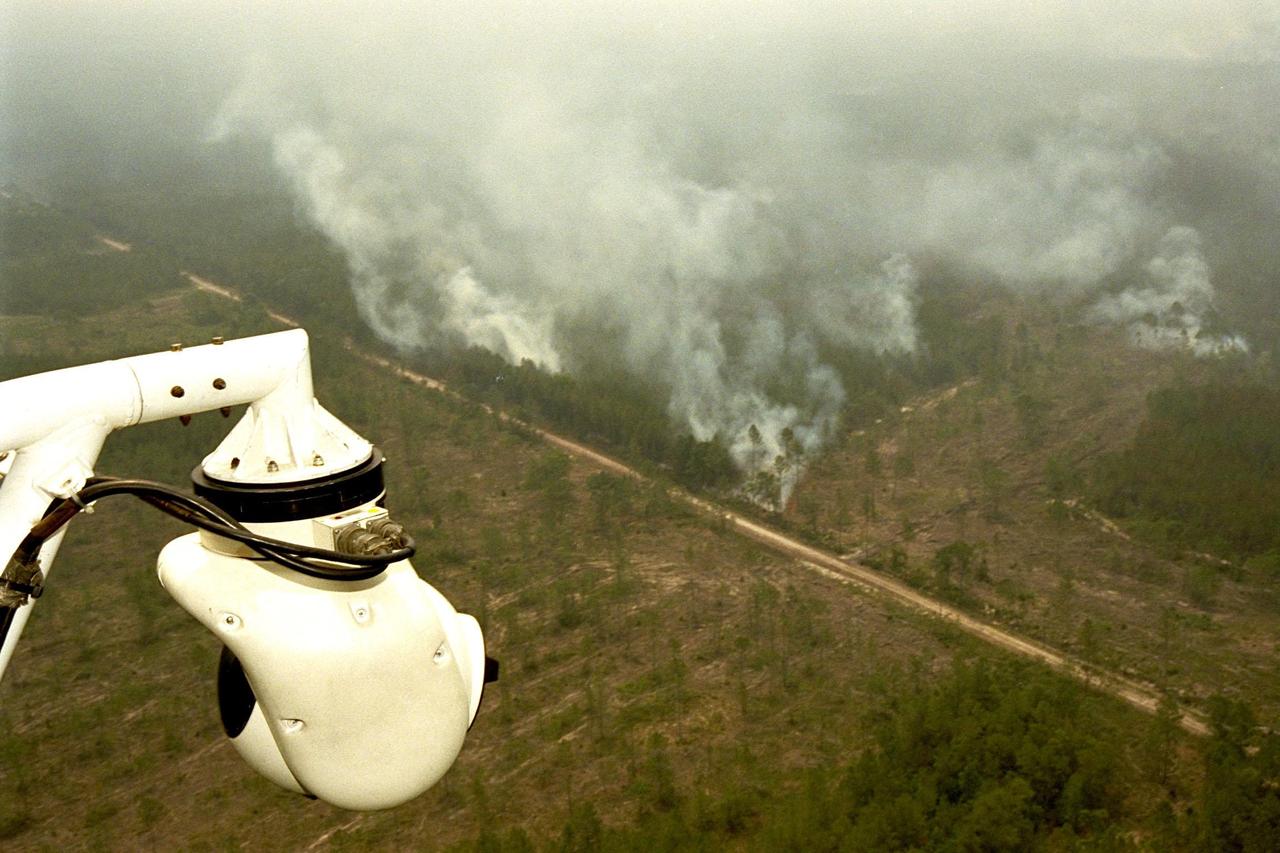
KENNEDY SPACE CENTER, FLA. -- A beach ball-sized infrared camera, part of the Forward Looking Infrared Radar (FLIR), has been mounted on the right siderail of NASA's Huey UH-1 helicopter and is being used to scan a large area of Volusia County, Florida, where a fire burns. The helicopter has also been outfitted with a portable global positioning satellite (GPS) system to support Florida's Division of Forestry as they fight the brush fires which have been plaguing the state as a result of extremely dry conditions and lightning storms. The FLIR also includes a real-time television monitor and recorder installed inside the helicopter. While the FLIR collects temperature data and images, the GPS system provides the exact coordinates of the fires being observed and transmits the data to the firefighters on the ground. The Kennedy Space Center (KSC) security team routinely uses the FLIR equipment prior to Shuttle launch and landing activities to ensure that the area surrounding the launch pad and runway are clear of unauthorized personnel. KSC's Base Operations Contractor, EG&G Florida, operates the NASA-owned helicopter
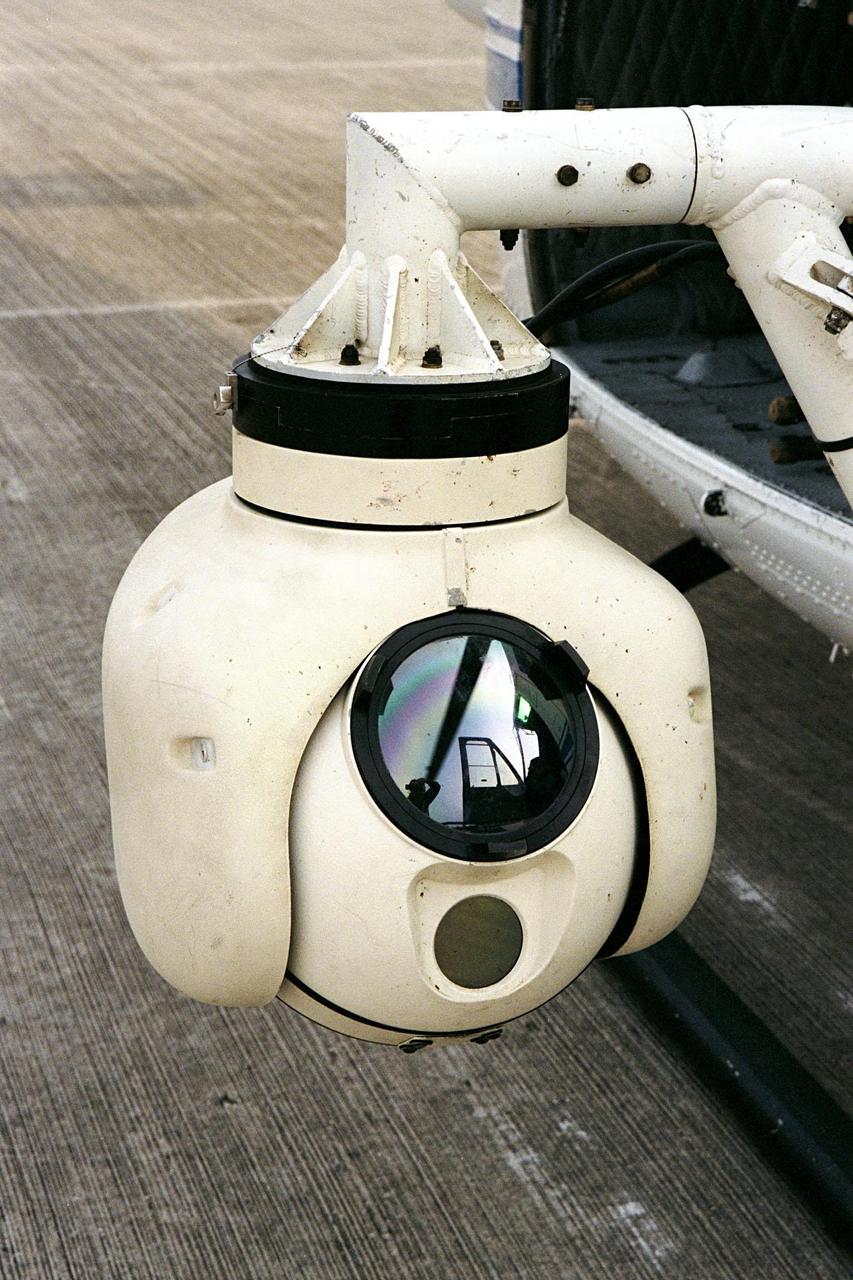
KENNEDY SPACE CENTER, FLA. -- A beach ball-sized infrared camera, part of the Forward Looking Infrared Radar (FLIR), has been mounted on the right siderail of NASA's Huey UH-1 helicopter. The helicopter has also been outfitted with a portable global positioning satellite (GPS) system to support Florida's Division of Forestry as they fight the brush fires which have been plaguing the state as a result of extremely dry conditions and lightning storms. The FLIR also includes a real-time television monitor and recorder installed inside the helicopter. While the FLIR collects temperature data and images, the GPS system provides the exact coordinates of the fires being observed and transmits the data to the firefighters on the ground. The Kennedy Space Center (KSC) security team routinely uses the FLIR equipment prior to Shuttle launch and landing activities to ensure that the area surrounding the launch pad and runway are clear of unauthorized personnel. KSC's Base Operations Contractor, EG&G Florida, operates the NASA-owned helicopter
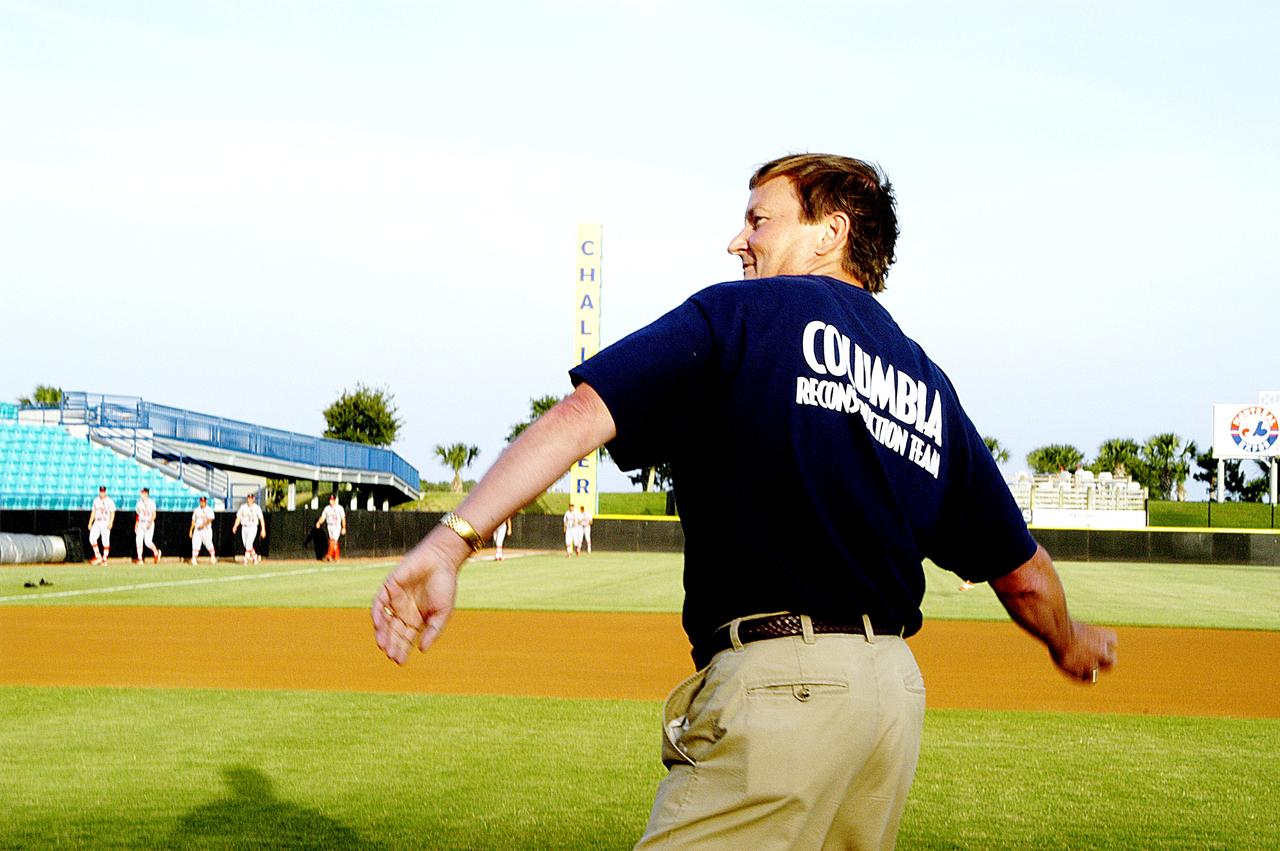
KENNEDY SPACE CENTER, FLA. - Shuttle Launch Director Mike Leinbach throws out the first pitch at a local baseball game at Manatees Stadium. KSC employees were hosted by the Brevard Manatees, a minor league baseball team in Central Florida. Before the game, attendees offered a moment of silence to honor the STS-107 crew and two recovery workers who died in a helicopter crash.
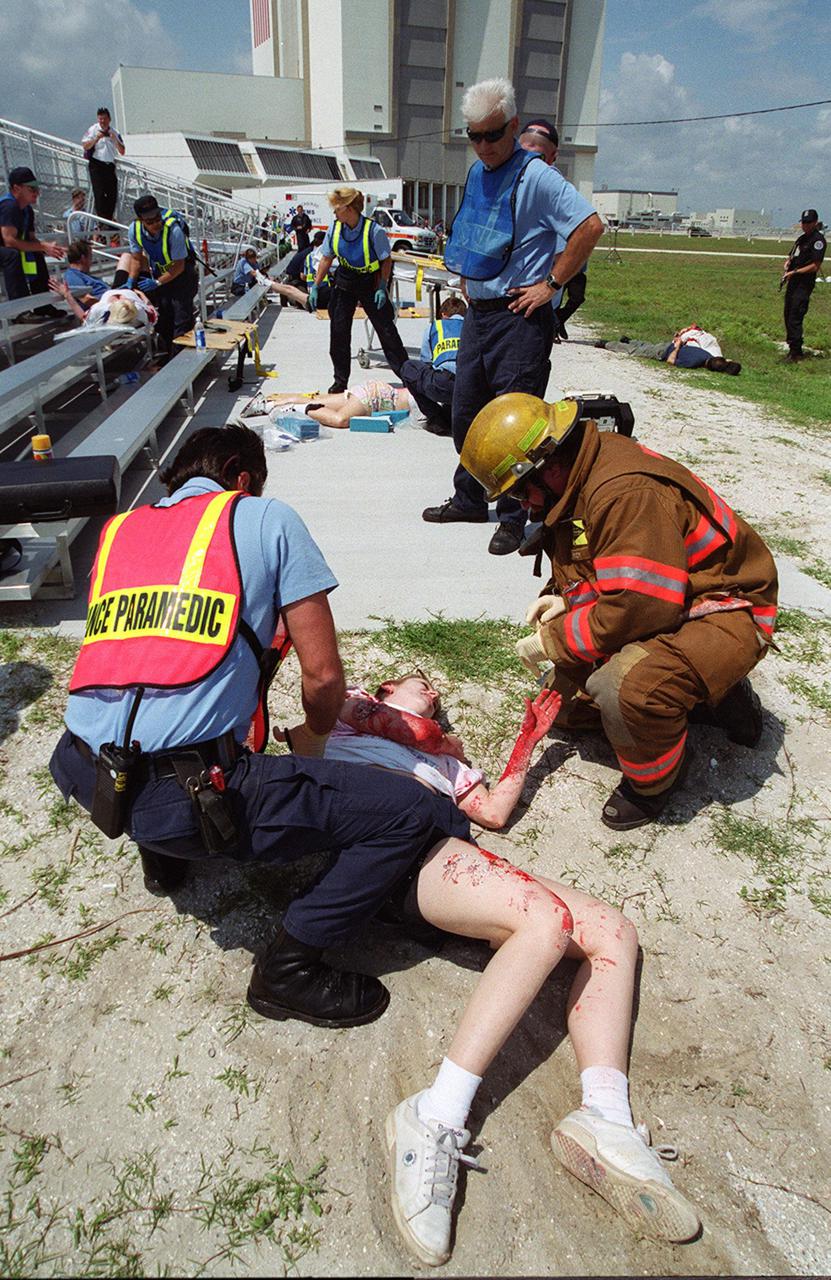
KENNEDY SPACE CENTER, FLA. -- During a staged mass casualty exercise in the Launch Complex 39 area, a paramedic checks an injured woman on the ground. Employees are playing the role of victims during a sniper scenario. The exercise is being staged to validate capabilities of KSC’ fire, medical, helicopter transport and security personnel to respond to such an event.
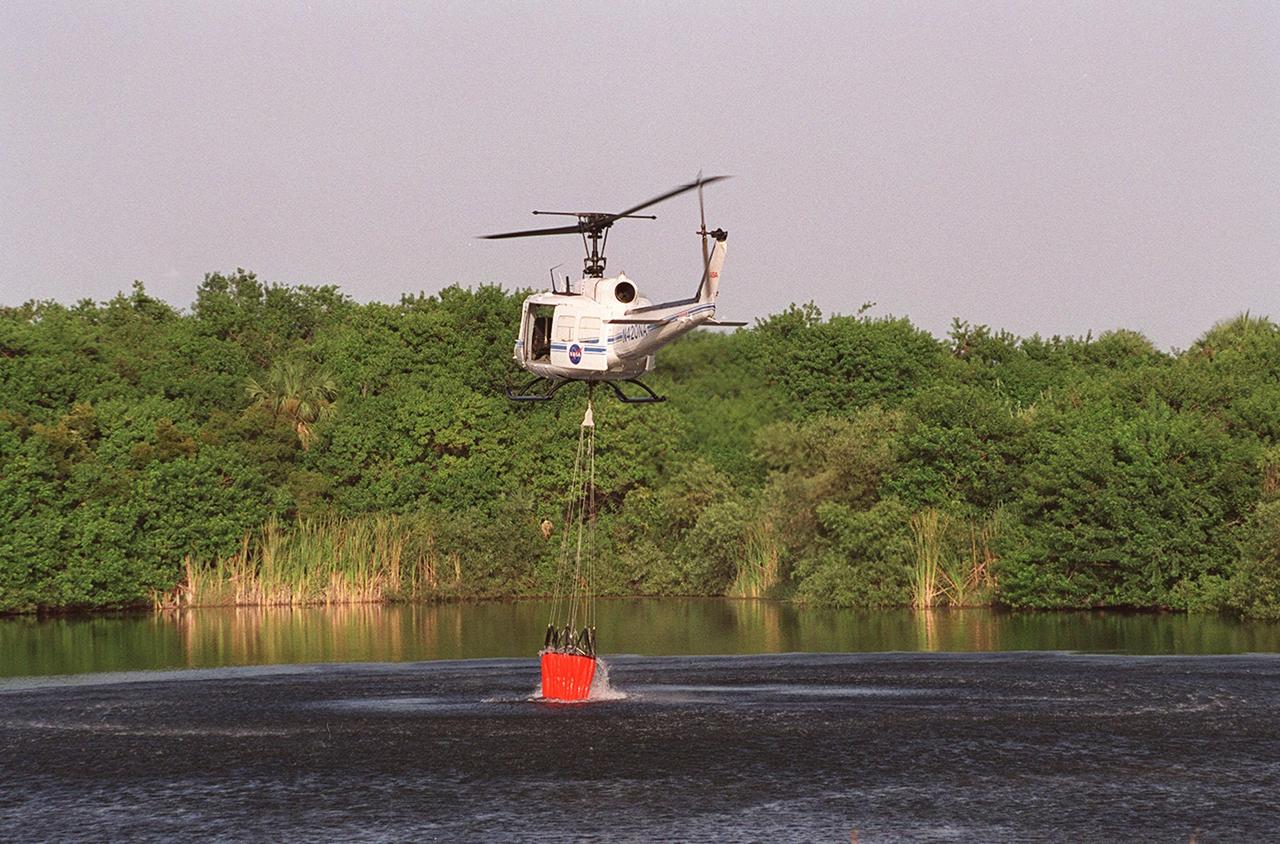
A NASA helicopter dips its fire-fighting bucket into the river to pick up and deliver a cargo of water to a wildfire at KSC. Before being extinguished, the fire burned about 20 acres at a site near gate 2C on Kennedy Parkway North (route 3)
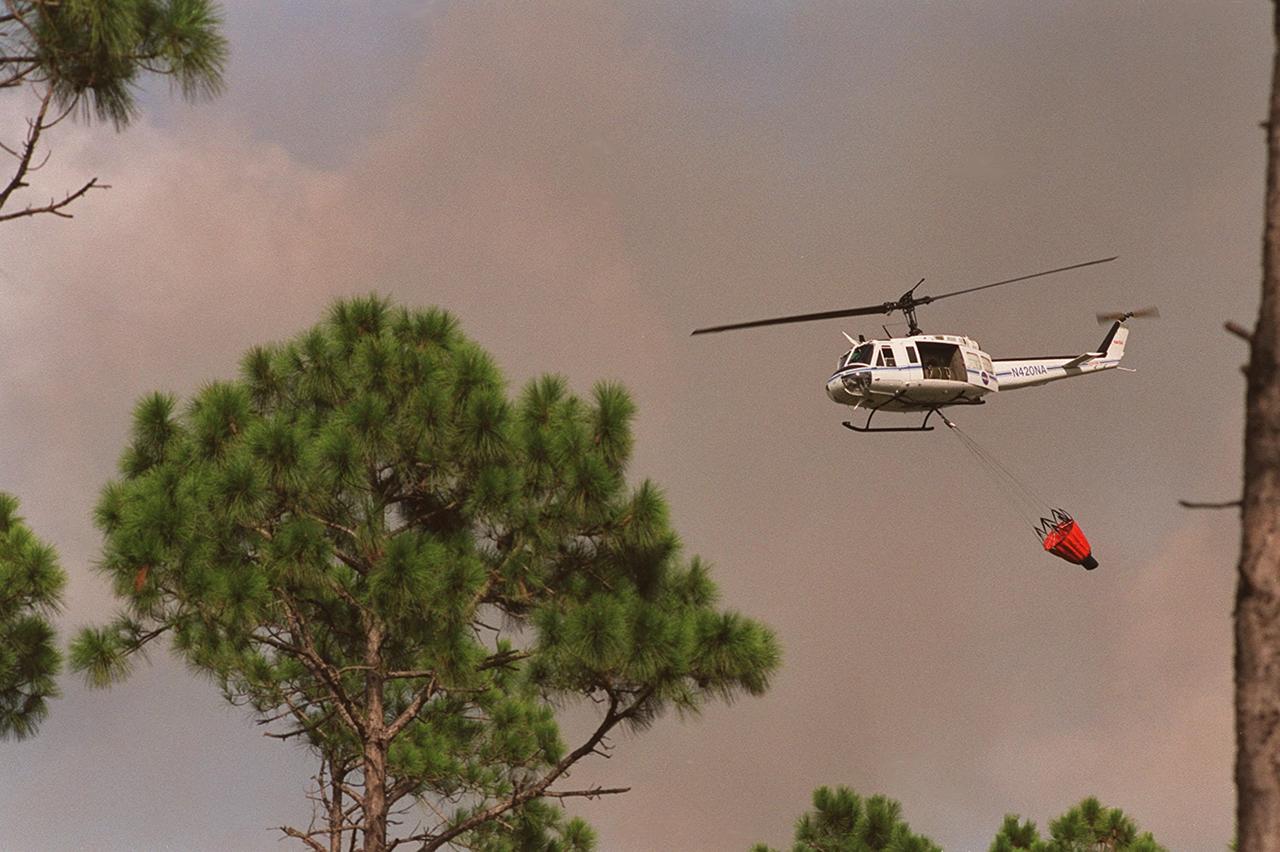
A NASA helicopter flies toward the source of the smoke to drop its load of water on a wildfire at KSC. Before being extinguished, the fire burned about 20 acres at a site near gate 2C on Kennedy Parkway North (route 3)
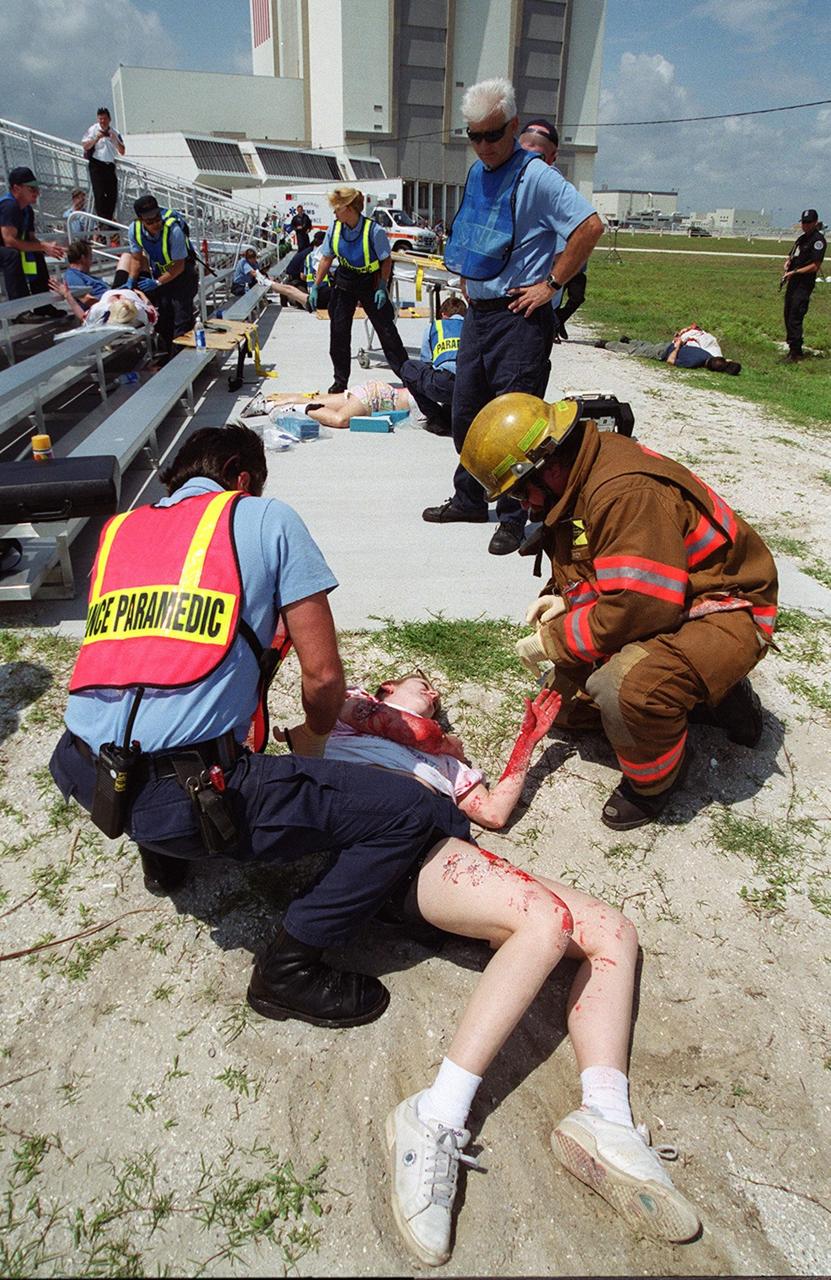
KENNEDY SPACE CENTER, FLA. -- During a staged mass casualty exercise in the Launch Complex 39 area, a paramedic checks an injured woman on the ground. Employees are playing the role of victims during a sniper scenario. The exercise is being staged to validate capabilities of KSC’ fire, medical, helicopter transport and security personnel to respond to such an event.
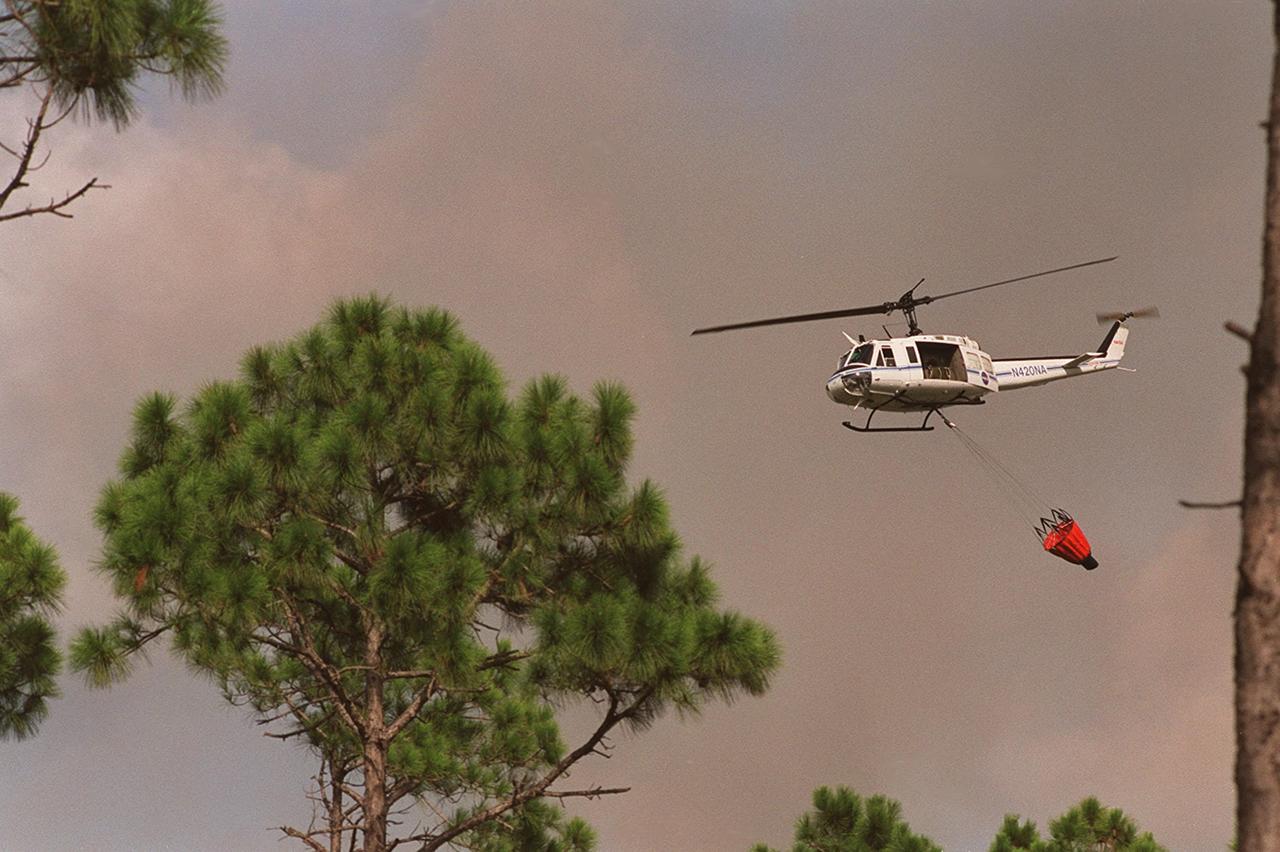
A NASA helicopter flies toward the source of the smoke to drop its load of water on a wildfire at KSC. Before being extinguished, the fire burned about 20 acres at a site near gate 2C on Kennedy Parkway North (route 3)
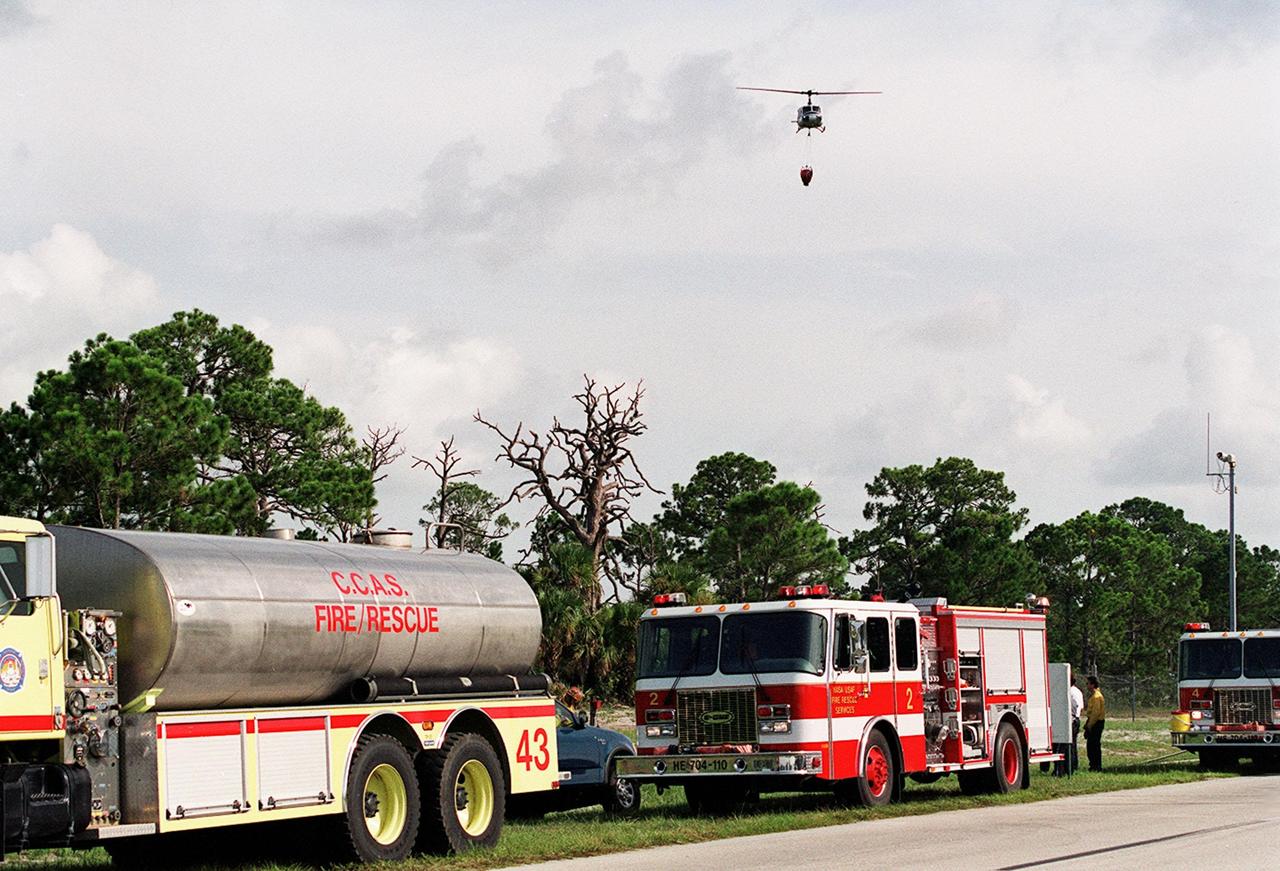
A NASA helicopter flies over fire-fighting equipment and personnel in order to drop its load of water on a wildfire at KSC. Before being extinguished, the fire burned about 20 acres at a site near gate 2C on Kennedy Parkway North (route 3)
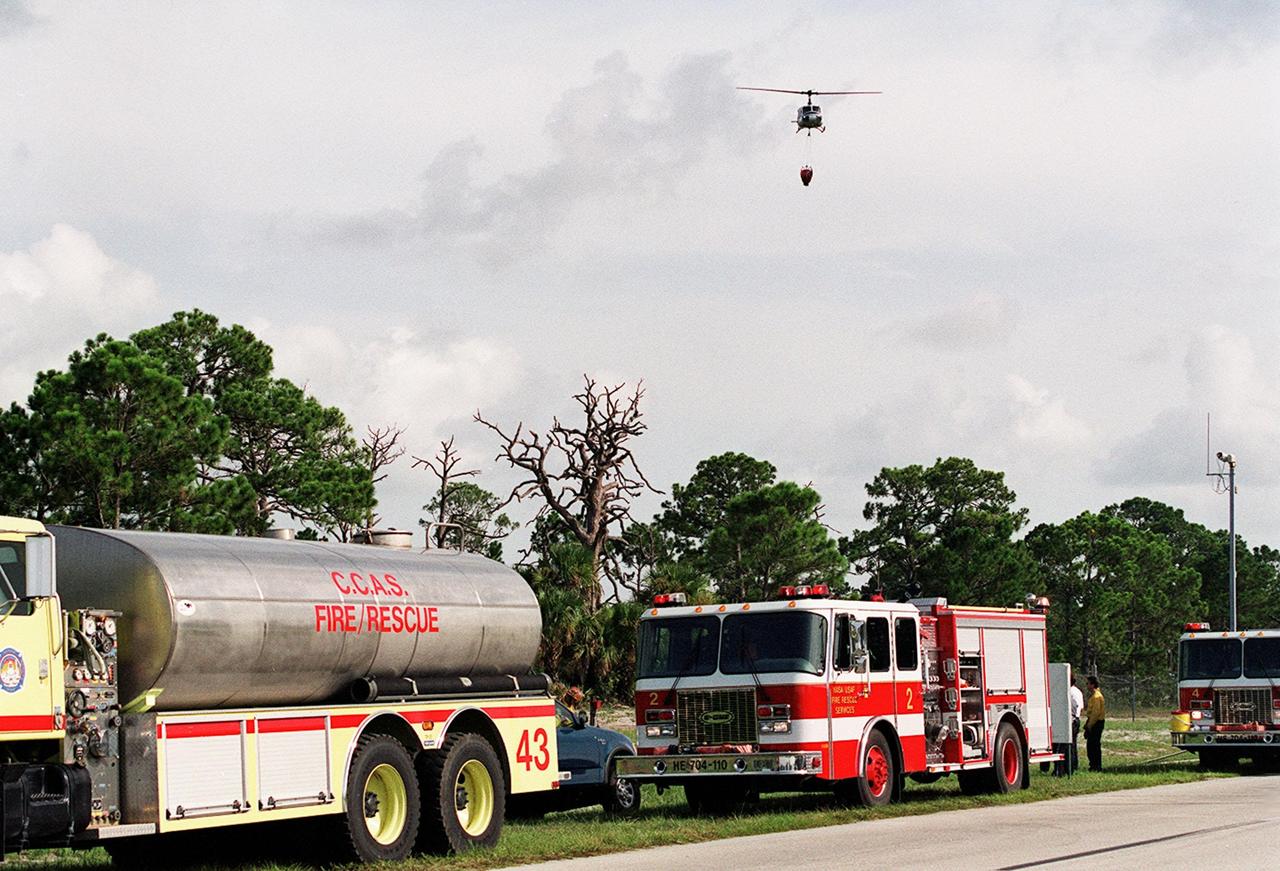
A NASA helicopter flies over fire-fighting equipment and personnel in order to drop its load of water on a wildfire at KSC. Before being extinguished, the fire burned about 20 acres at a site near gate 2C on Kennedy Parkway North (route 3)
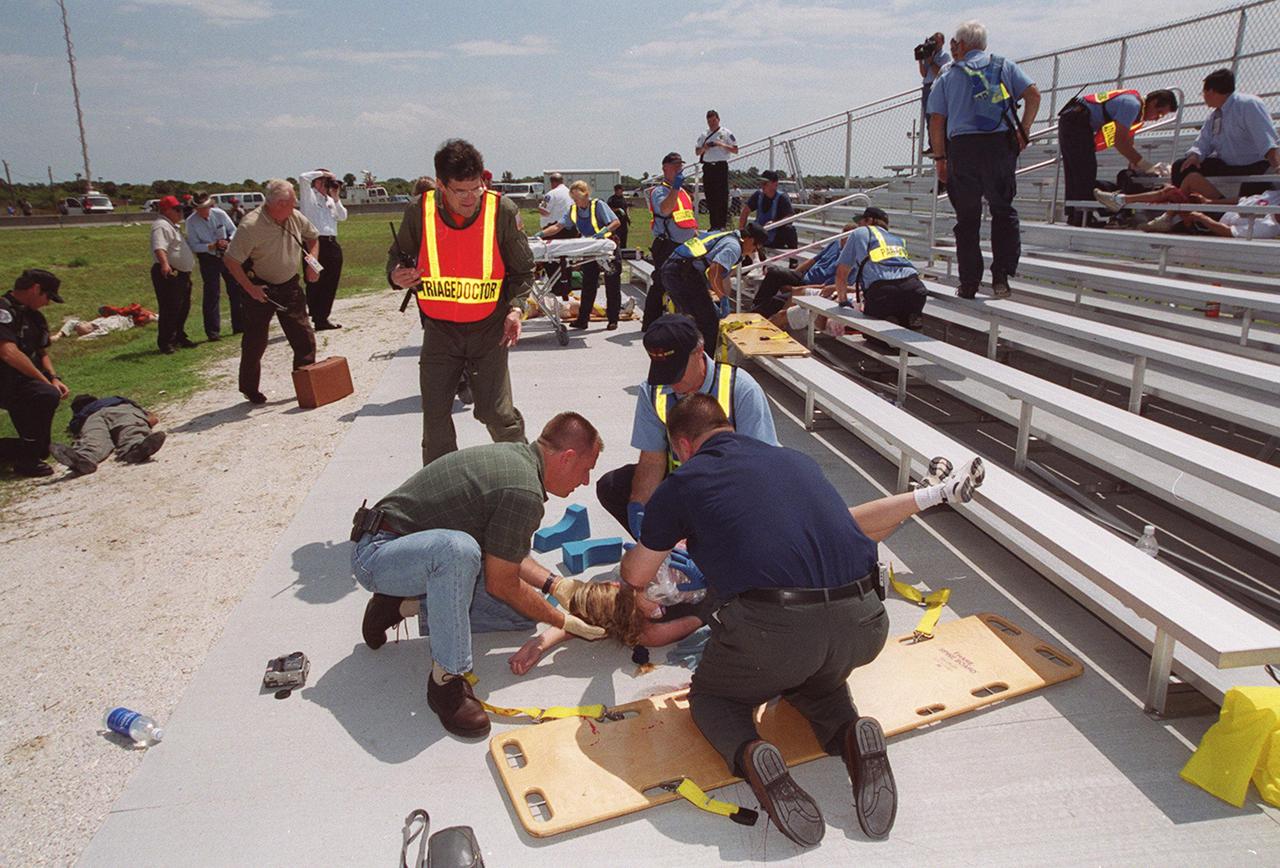
KENNEDY SPACE CENTER, FLA. -- During a staged mass casualty exercise in the Launch Complex 39 area, security and medical personnel take care of a “victim” on the ground by the bleachers. Employees are playing roles in the fictitious sniper attack that is being staged to validate capabilities of KSC’s fire, medical, helicopter transport and security personnel to respond to such an event
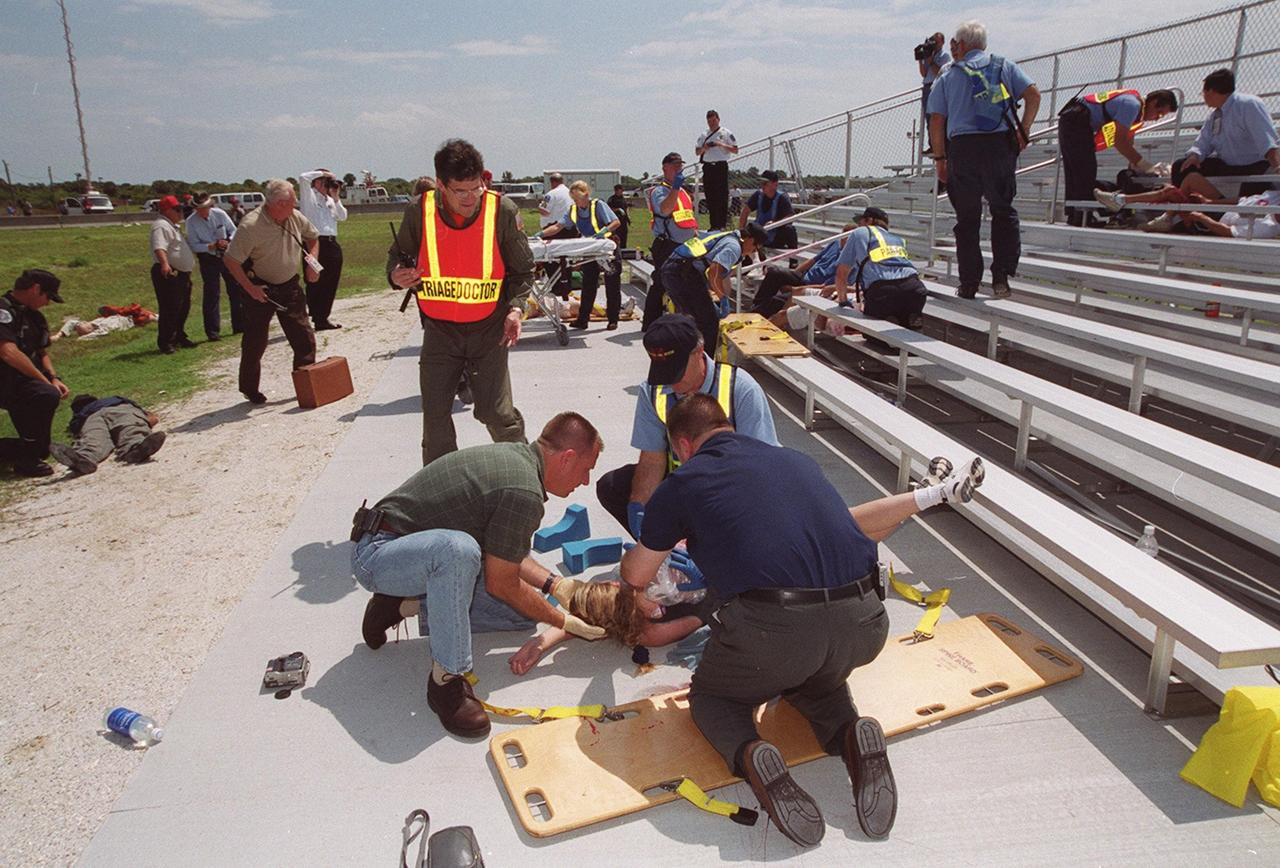
KENNEDY SPACE CENTER, FLA. -- During a staged mass casualty exercise in the Launch Complex 39 area, security and medical personnel take care of a “victim” on the ground by the bleachers. Employees are playing roles in the fictitious sniper attack that is being staged to validate capabilities of KSC’s fire, medical, helicopter transport and security personnel to respond to such an event
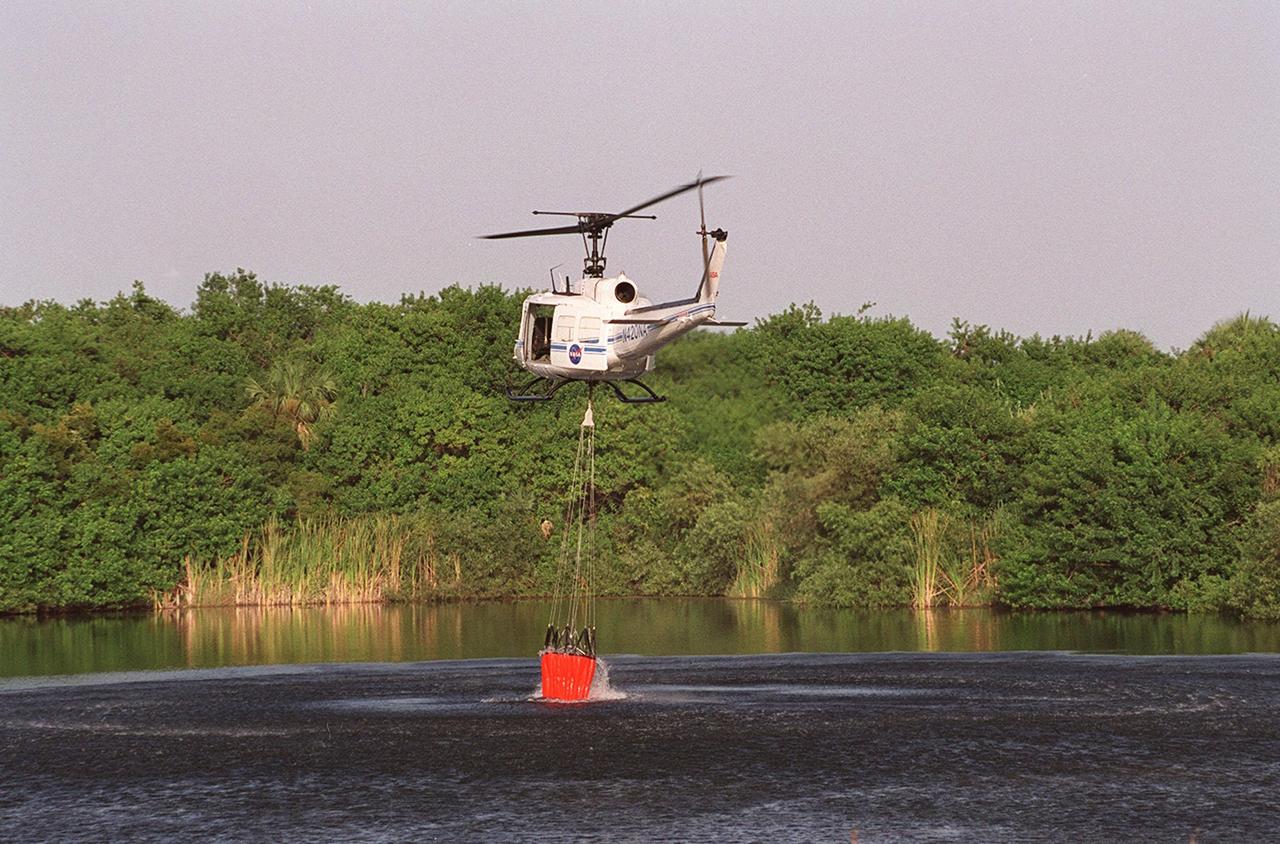
A NASA helicopter dips its fire-fighting bucket into the river to pick up and deliver a cargo of water to a wildfire at KSC. Before being extinguished, the fire burned about 20 acres at a site near gate 2C on Kennedy Parkway North (route 3)
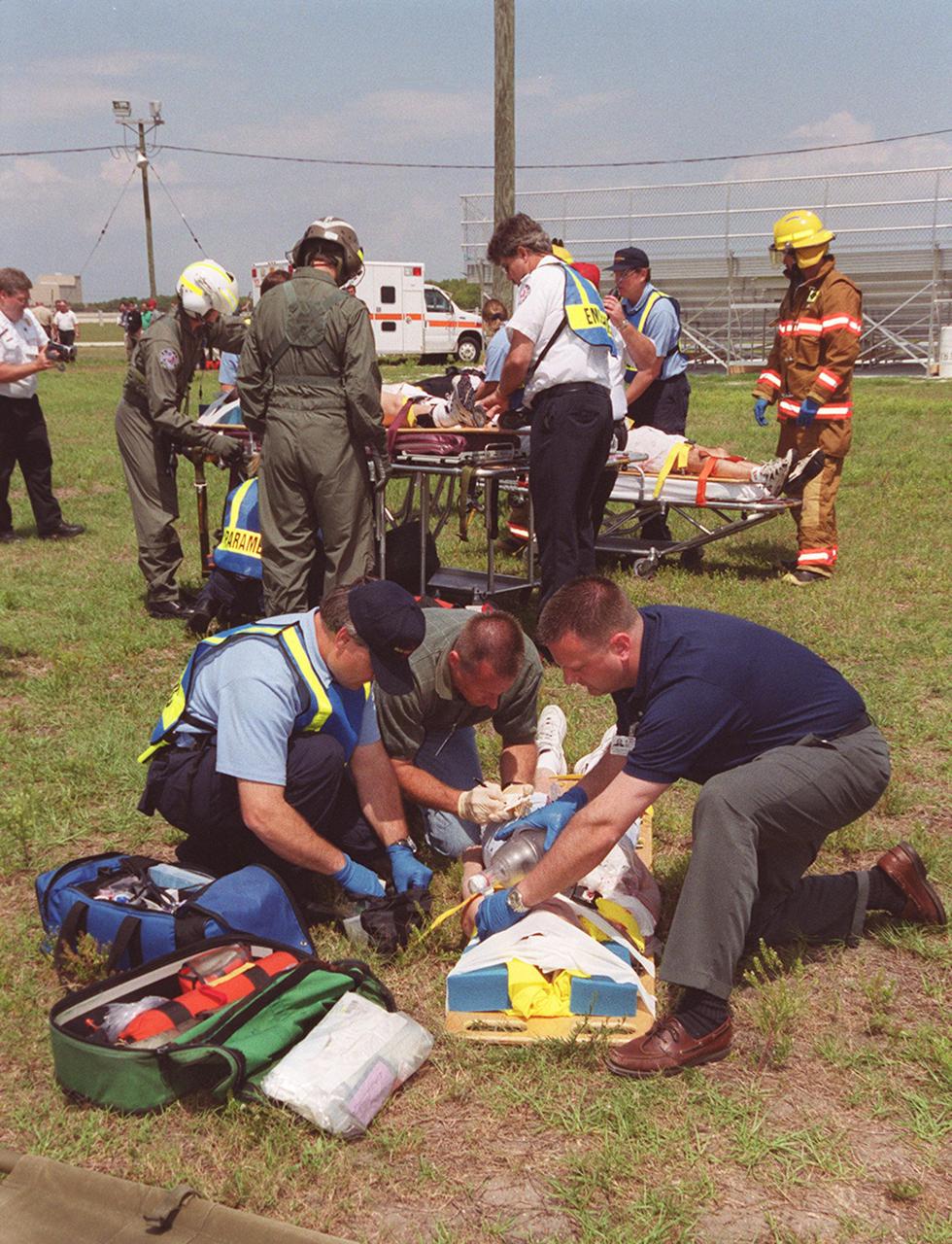
KENNEDY SPACE CENTER, FLA. -- Medical, paramedic and other personnel attend to role-playing “victims” on the grass in the Launch Complex 39 area. It is the site of a staged mass casualty exercise designed to validate capabilities of KSC’s fire, medical, helicopter transport and security personnel to respond to an event such as this fictitious sniper attack

KENNEDY SPACE CENTER, FLA. - This view taken from a helicopter shows damage to the roof of the Vehicle Assembly Building at KSC following the category 3 Hurricane Jeanne. The storm barreled through Central Florida Sept. 25-26 from the southeast. It was the fourth hurricane in 6 weeks to batter the state.
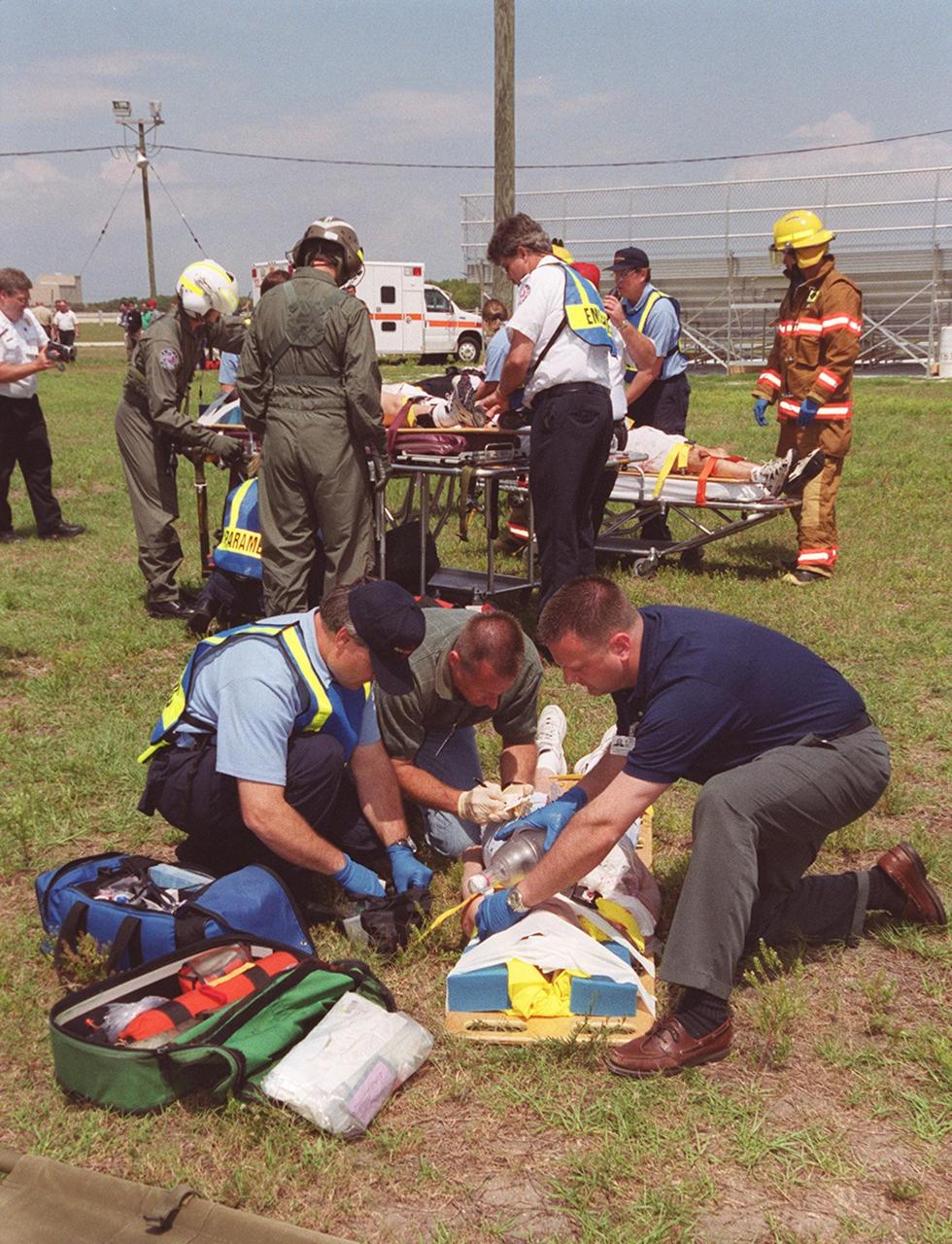
KENNEDY SPACE CENTER, FLA. -- Medical, paramedic and other personnel attend to role-playing “victims” on the grass in the Launch Complex 39 area. It is the site of a staged mass casualty exercise designed to validate capabilities of KSC’s fire, medical, helicopter transport and security personnel to respond to an event such as this fictitious sniper attack

KENNEDY SPACE CENTER, FLA. -- Near the turn basin in the Launch Complex 39 area, employees take part in a staged mass casualty exercise at the KSC employee viewing site. The exercise, simulating a sniper attack (man in black at right), was staged to validate capabilities of KSC’s fire, medical helicopter transport and security personnel to respond to such an event
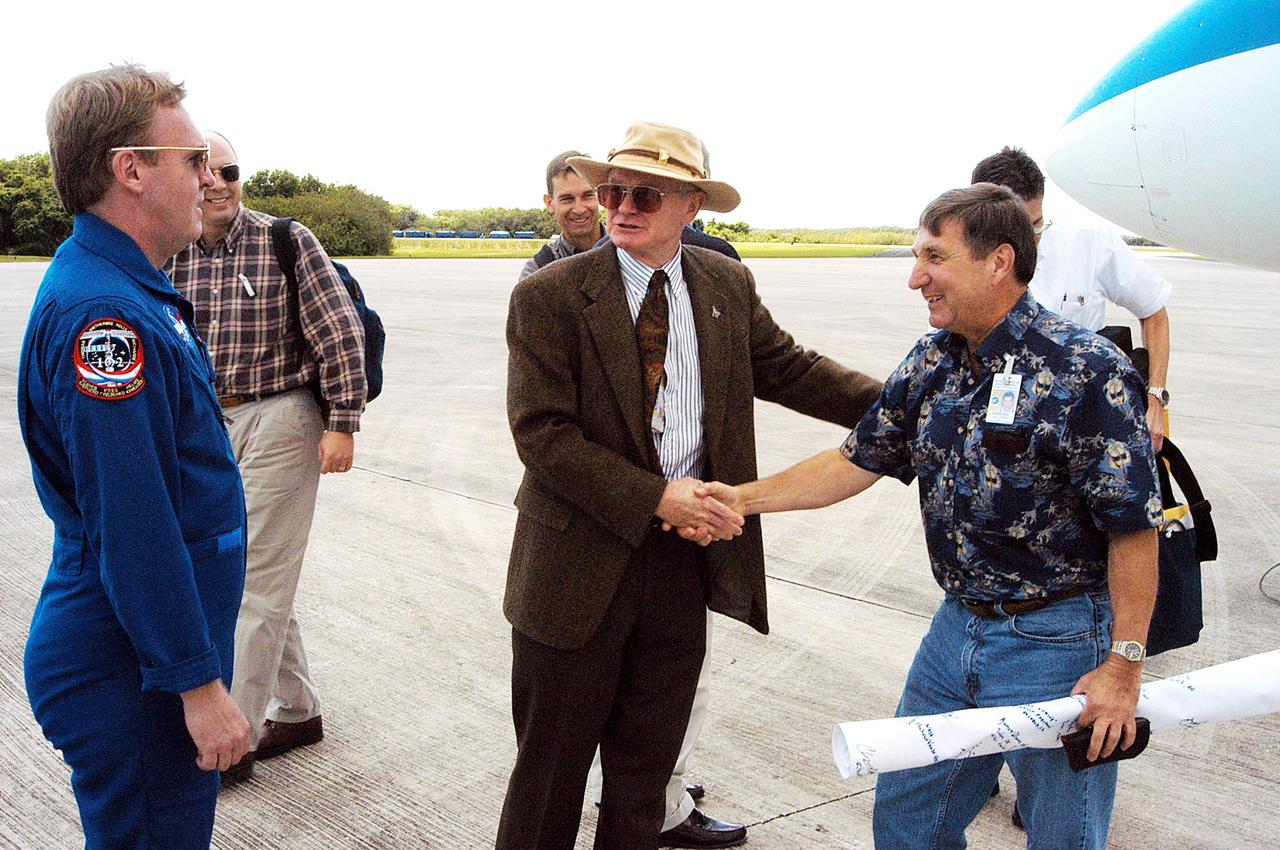
KENNEDY SPACE CENTER, FLA. - Ronnie Dale (right) is welcomed back to KSC by Center Director Roy Bridges Jr. (center). At left is Andrew S.W. Thomas, deputy chief, Astronaut Office. Dale, with the NASA Safety and Process Assurance Branch at KSC, was aboard a helicopter that crashed while searching for debris from the Space Shuttle Columbia in east Texas in March. He was treated for nonlife-threatening injuries and recently released.
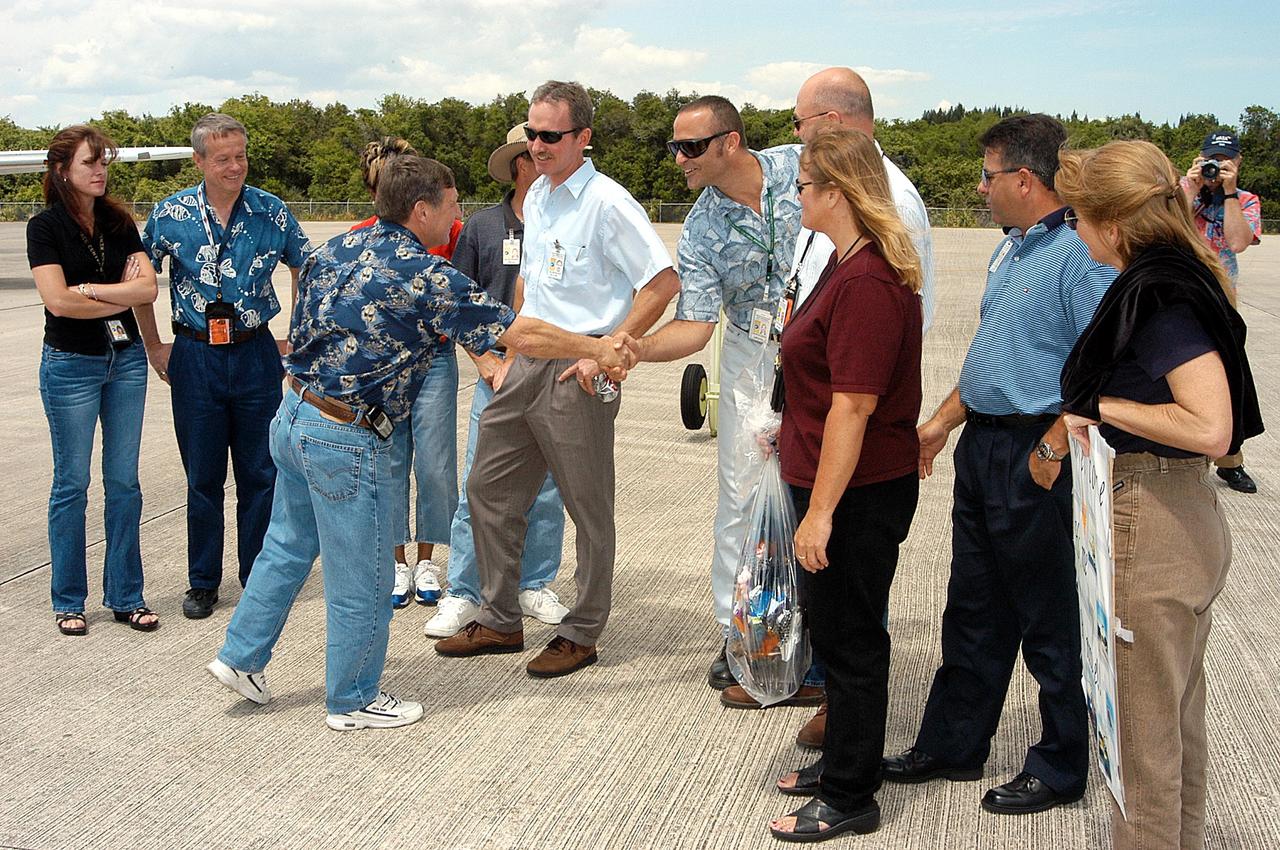
KENNEDY SPACE CENTER, FLA. - Ron Dale (left, foreground) is greeted by friends and co-workers on his return to KSC. Dale, with the NASA Safety and Process Assurance Branch at KSC, was aboard a helicopter that crashed while searching for debris from the Space Shuttle Columbia in east Texas in March. He was treated for nonlife-threatening injuries and recently released.
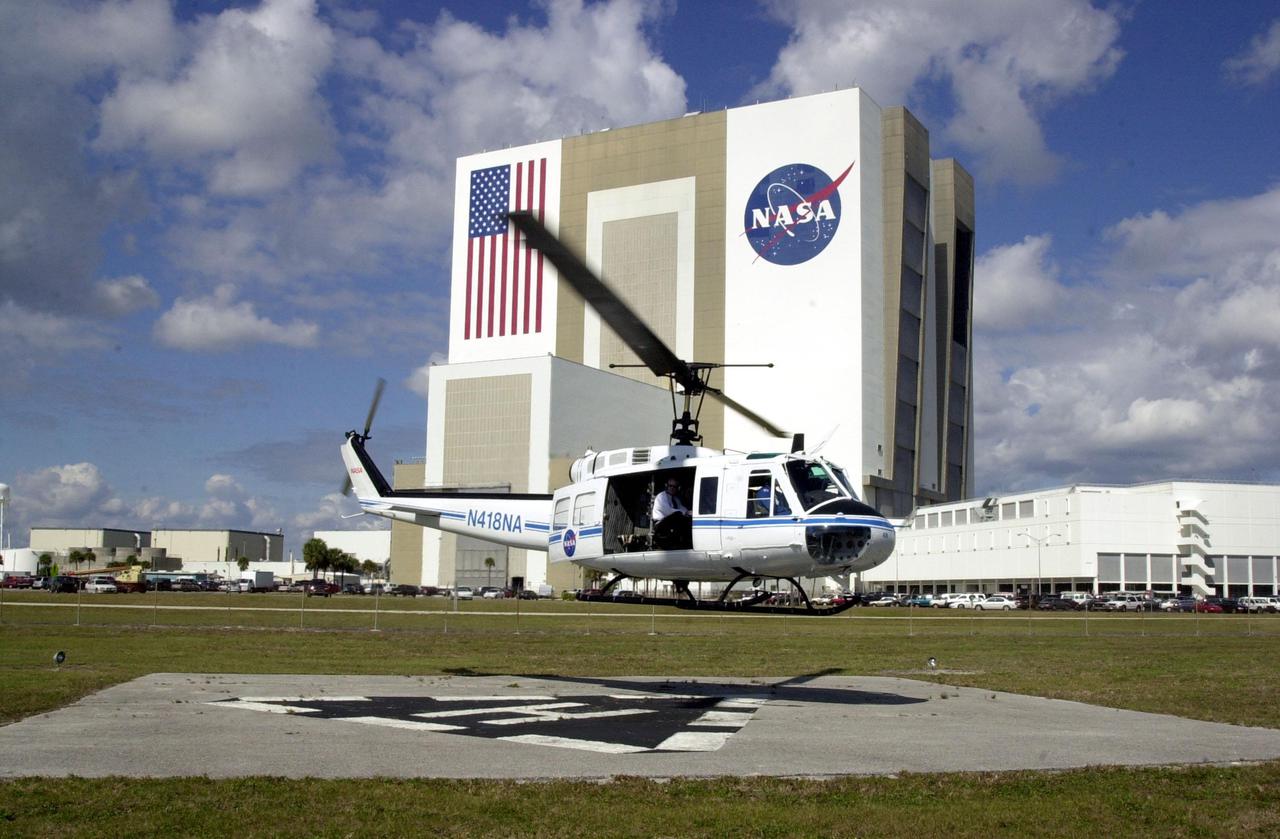
KENNEDY SPACE CENTER, Fla. - A NASA helicopter lifts off, near the Vehicle Assembly Building, carrying the new NASA Administrator Sean O'Keefe and others for an aerial tour of KSC. The administrator was at KSC on an agencywide familiarization tour of NASA field centers. He was nominated for the position as administrator in November 2001 by President George W. Bush. He was sworn in Dec. 21 as the agency's 10th chief
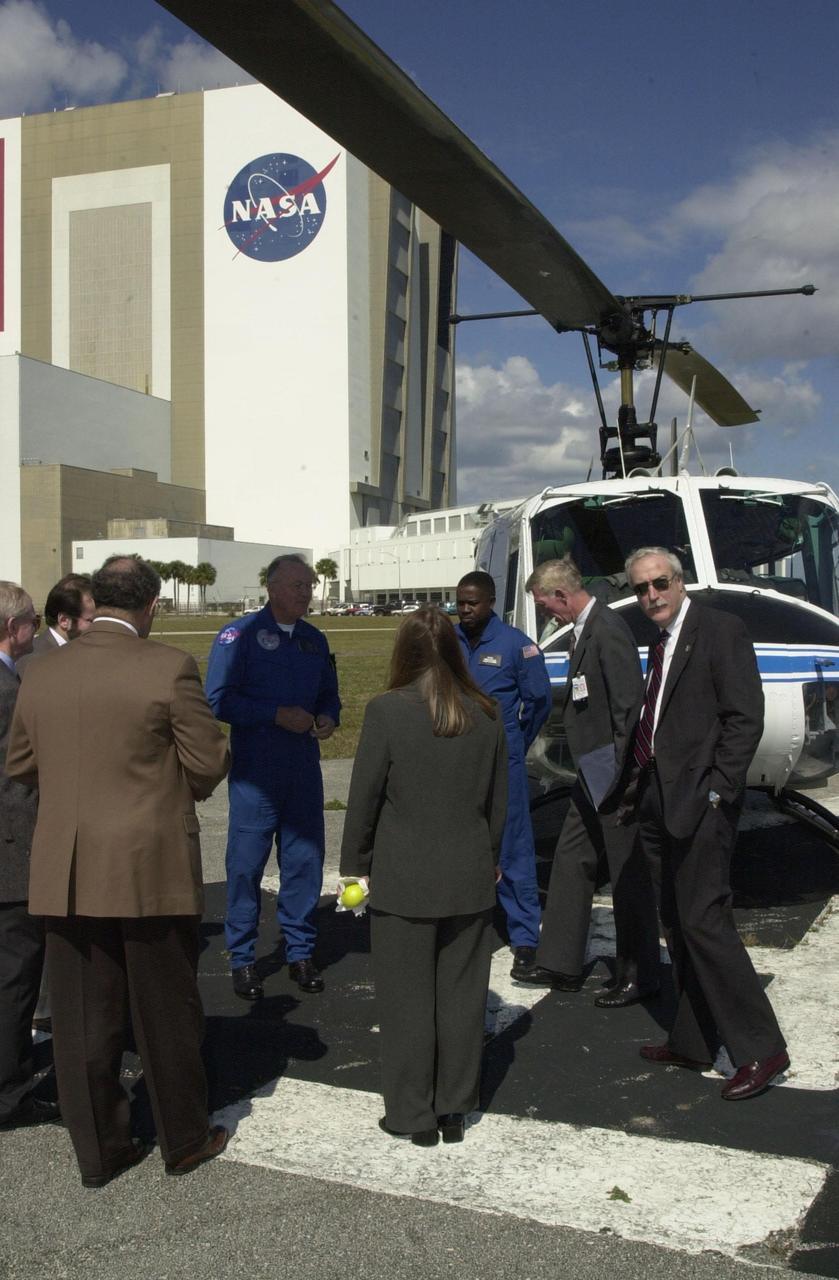
KENNEDY SPACE CENTER, Fla. - The new NASA Administrator Sean O'Keefe prepares to board a helicopter, near the Vehicle Assembly Building (background), for an aerial tour of KSC. The administrator was at KSC on an agencywide familiarization tour of NASA field centers. He was nominated for the position as administrator in November 2001 by President George W. Bush. He was sworn in Dec. 21 as the agency's 10th chief
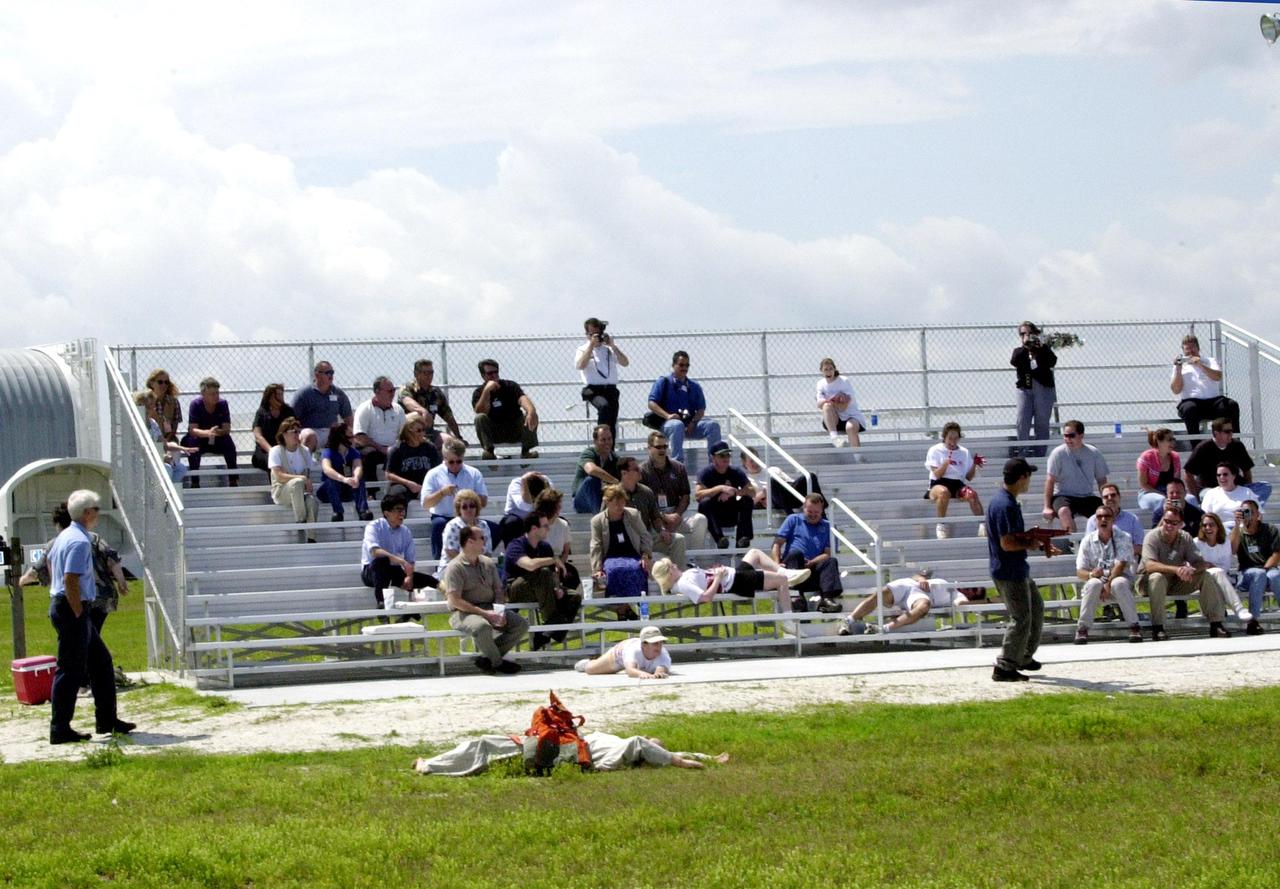
KENNEDY SPACE CENTER, FLA. -- Near the turn basin in the Launch Complex 39 area, employees take part in a staged mass casualty exercise at the KSC employee viewing site. The exercise, simulating a sniper attack (man in black at right), was staged to validate capabilities of KSC’s fire, medical helicopter transport and security personnel to respond to such an event
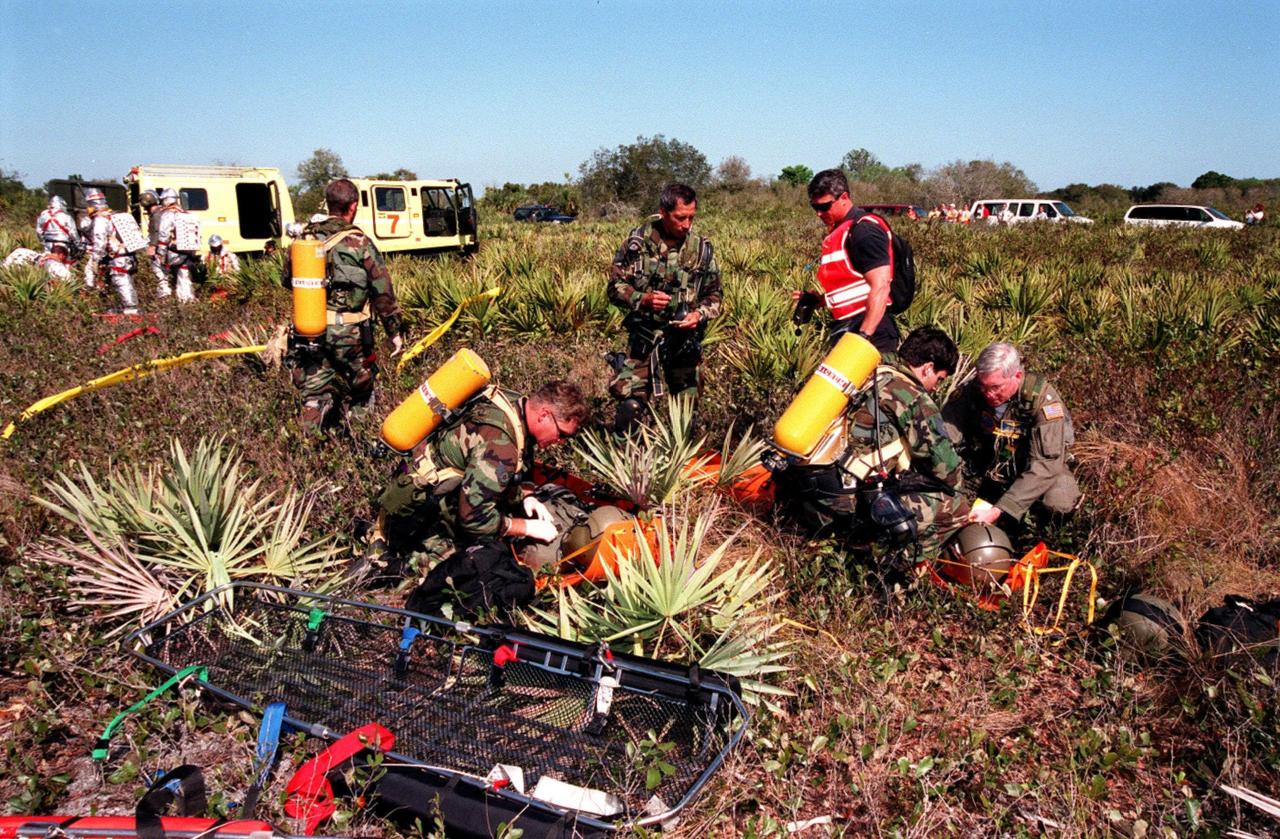
KENNEDY SPACE CENTER, FLA. -- In the simulated rescue mission, the KSC response team takes part in the unlikely scenario of a Shuttle mishap at the Shuttle Landing Facility. The Mode 7 simulation of an astronaut rescue exercised all aspects of command and control, search and rescue, and medical procedures required for a successful rescue. The remote location of the mock-up prevents a totally land-based crew rescue, and calls on a NASA UH-1 helicopter to locate the site and four Air Force HH-60 helicopters to drop emergency equipment and fire/rescue workers to prepare the "crew" for preliminary triage. The helicopters later are used to remove the crew five astronaut candidates, one representative from the Vehicle Integration Test office, and one fire/rescue worker. The exercise concluded with airlifted "patients" arriving safely in the emergency rooms of participating area hospitals.
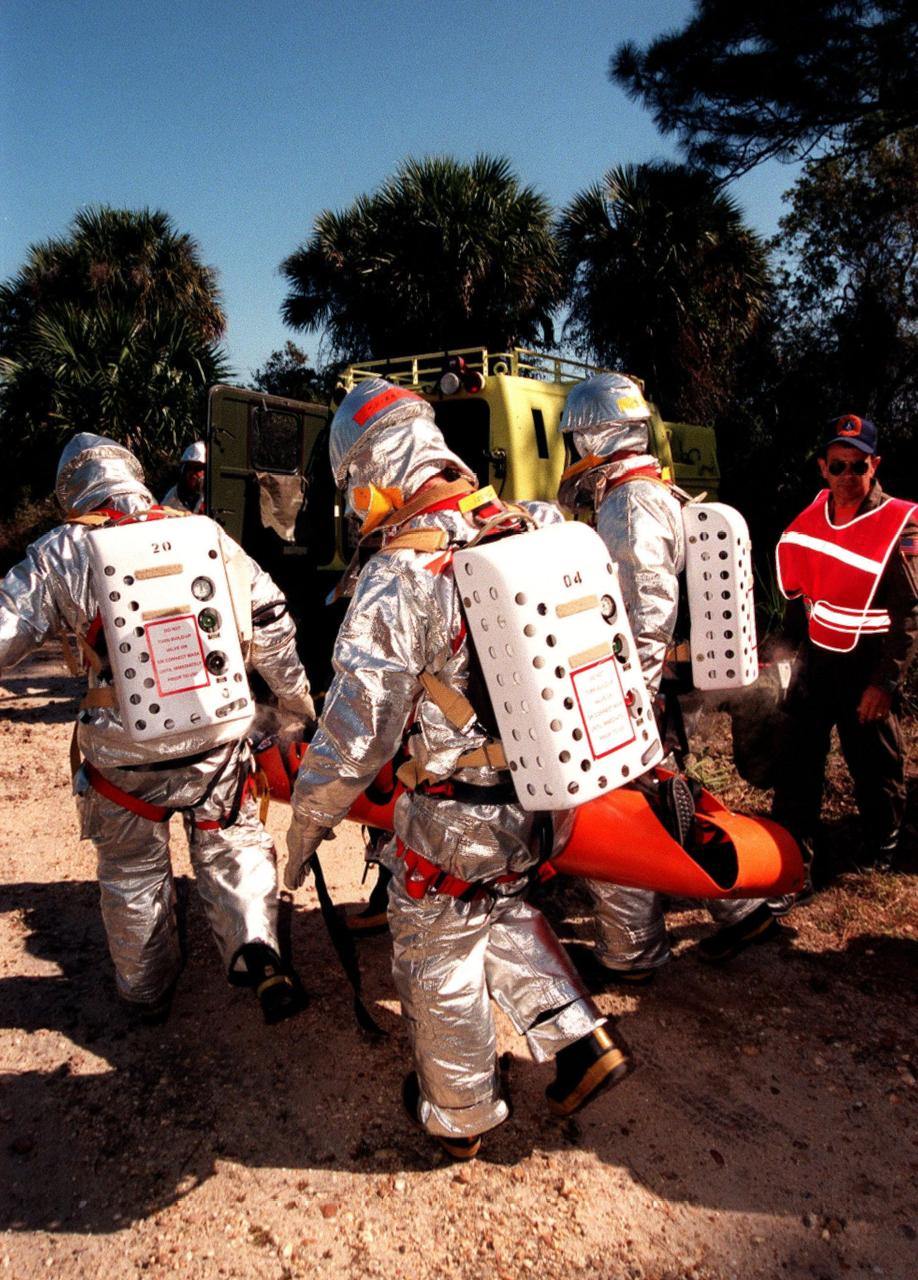
KENNEDY SPACE CENTER, FLA. -- In the woods next to the Shuttle Landing Facility (SLF), the KSC response team takes part in training for the unlikely scenario of a Shuttle mishap at the SLF. The Mode 7 simulation of an astronaut rescue exercises all aspects of command and control, search and rescue, and medical procedures required for a successful rescue. The remote location of the mock-up prevents a totally land-based crew rescue, and calls on a NASA UH-1 helicopter to locate the site and four Air Force HH-60 helicopters to drop emergency equipment and fire/rescue workers to prepare the "crew" for preliminary triage. The helicopters later are used to remove the crew five astronaut candidates, one representative from the Vehicle Integration Test office, and one fire/rescue worker. The exercise concluded with airlifted "patients" arriving safely in the emergency rooms of participating area hospitals
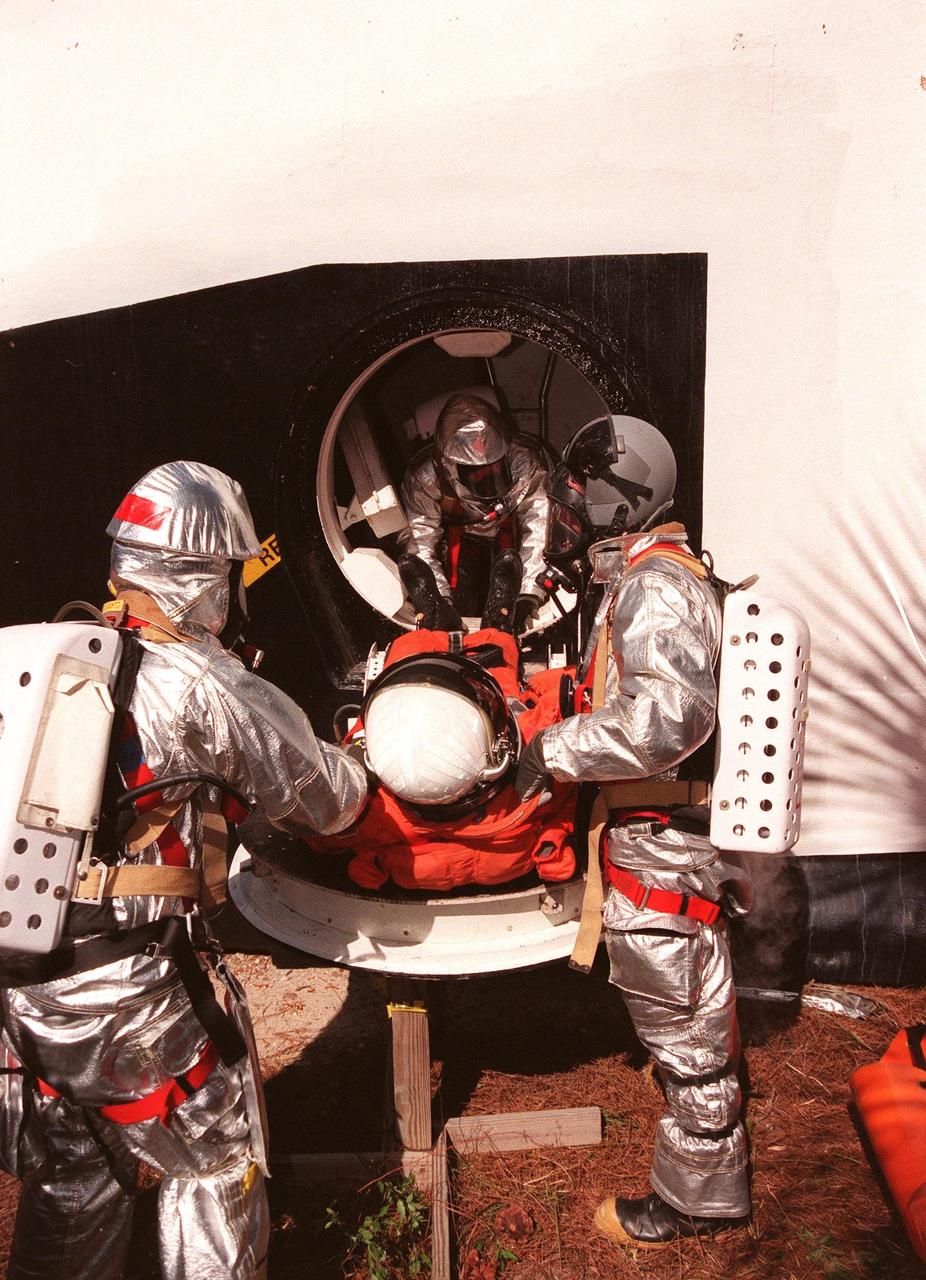
KENNEDY SPACE CENTER, FLA. -- During a simulated rescue mission in the woods near the Shuttle Landing Facility, the KSC response team removes a Shuttle "crew" member from the mock orbiter. The response team is training for the unlikely scenario of a Shuttle mishap at the SLF. The Mode 7 simulation of an astronaut rescue exercises all aspects of command and control, search and rescue, and medical procedures required for a successful rescue. The remote location of the mock-up prevents a totally land-based crew rescue, and calls on a NASA UH-1 helicopter to locate the site and four Air Force HH-60 helicopters to drop emergency equipment and fire/rescue workers to prepare the "crew" for preliminary triage. The helicopters later are used to remove the crew five astronaut candidates, one representative from the Vehicle Integration Test office, and one fire/rescue worker. The exercise concluded with airlifted "patients" arriving safely in the emergency rooms of participating area hospitals
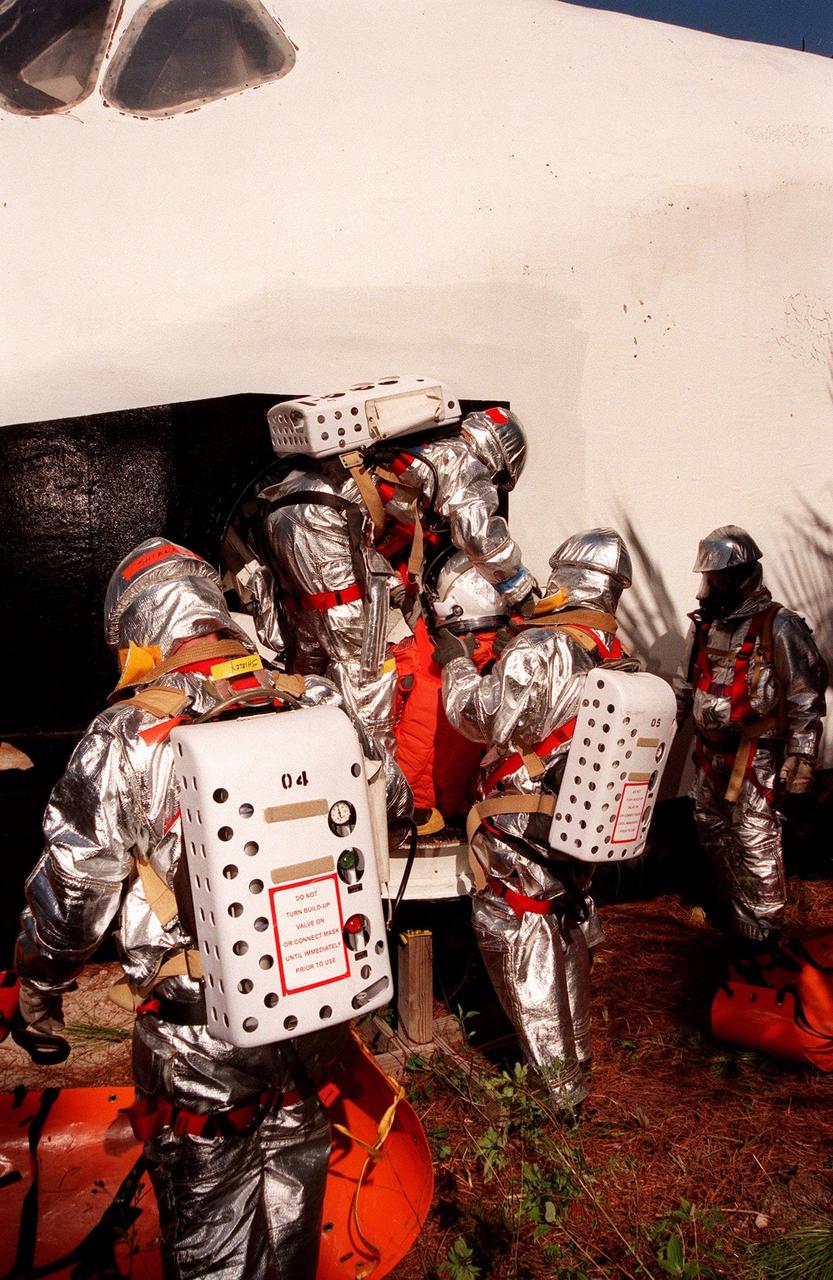
During a simulated rescue mission in the woods near the Shuttle Landing Facility (SLF), the KSC response team removes a crew member from a mock Shuttle. The response team is training for the unlikely scenario of a Shuttle mishap at the SLF. The Mode 7 simulation of an astronaut rescue exercises all aspects of command and control, search and rescue, and medical procedures required for a successful rescue. The remote location of the mock-up prevents a totally land-based crew rescue, and calls on a NASA UH-1 helicopter to locate the site and four Air Force HH-60 helicopters to drop emergency equipment and fire/rescue workers to prepare the "crew" for preliminary triage. The helicopters later are used to remove the crew five astronaut candidates, one representative from the Vehicle Integration Test office, and one fire/rescue worker. The exercise concluded with airlifted "patients" arriving safely in the emergency rooms of participating area hospitals
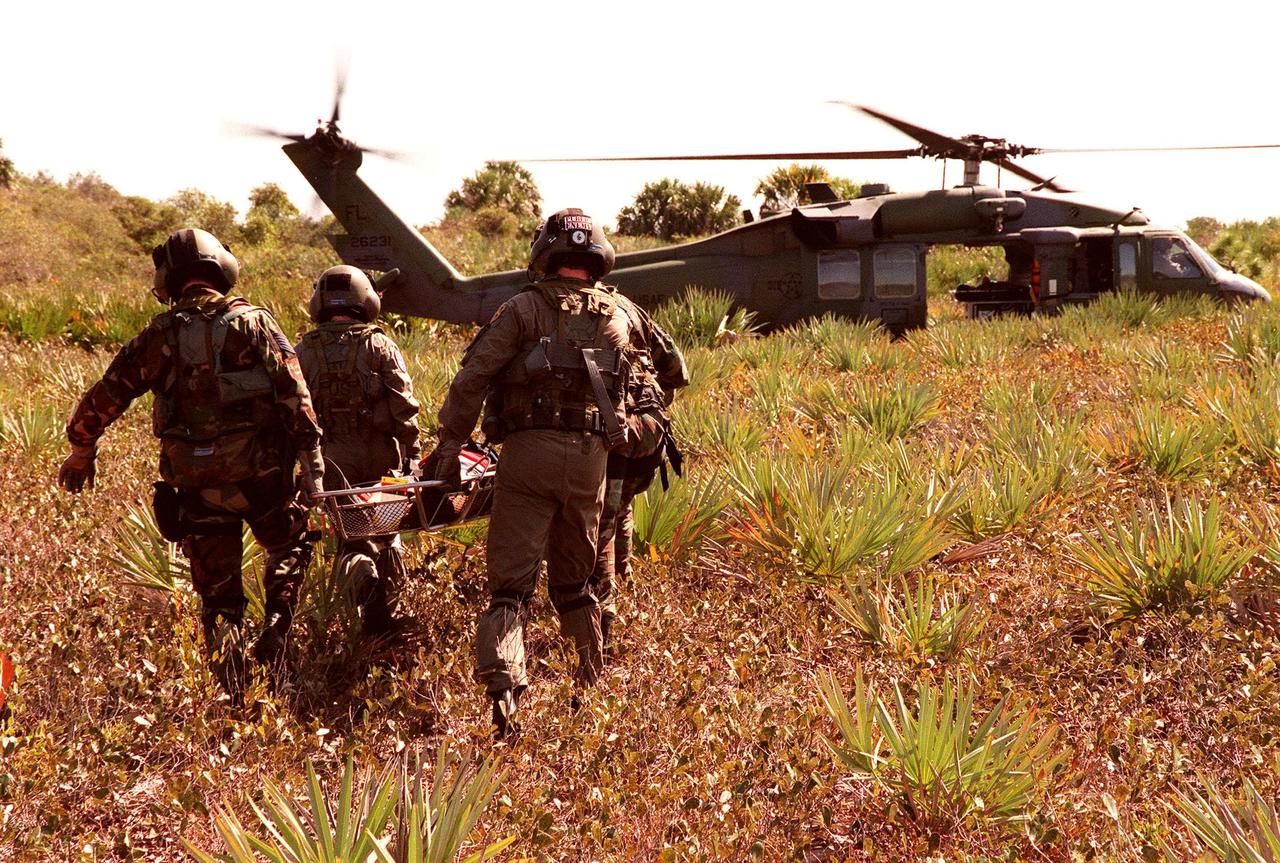
KENNEDY SPACE CENTER, FLA. -- During a simulated rescue mission in the woods near the Shuttle Landing Facility (SLF), the KSC response team practices carrying an injured crew member to an Air Force HH-60 helicopter for transport to a local hospital. The response team is training for the unlikely scenario of a Shuttle mishap at the SLF. The Mode 7 simulation of an astronaut rescue exercises all aspects of command and control, search and rescue, and medical procedures required for a successful rescue. The remote location of the mock-up prevents a totally land-based crew rescue, and calls on a NASA UH-1 helicopter to locate the site and four Air Force HH-60 helicopters to reach the site, drop emergency equipment and later remove the "crew" five astronaut candidates, one representative from the Vehicle Integration Test office, and one fire/rescue worker. The exercise will conclude with airlifted "patients" arriving safely in the emergency rooms of participating area hospitals
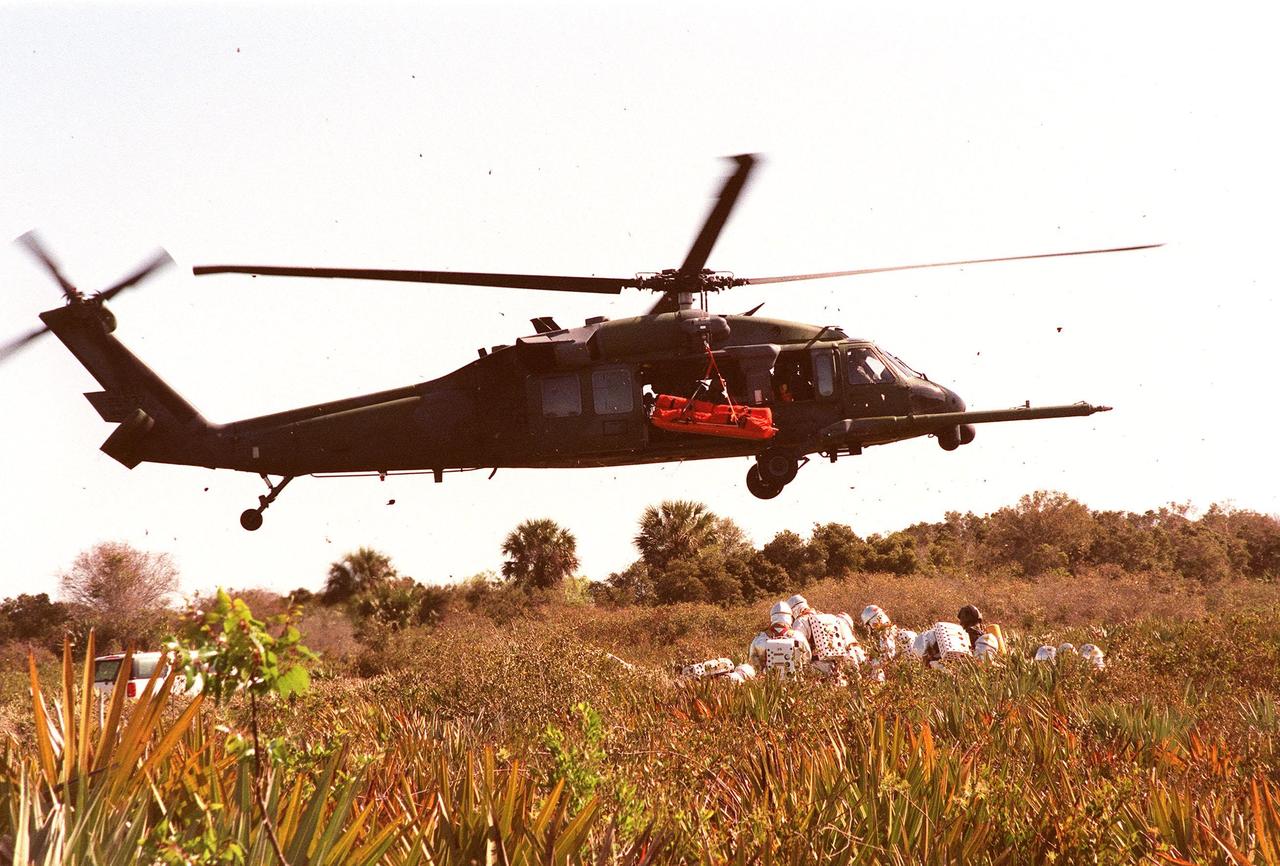
KENNEDY SPACE CENTER, FLA. -- During a simulated rescue mission in the woods near the Shuttle Landing Facility (SLF), the KSC response team practices lifting an injured crew member to an Air Force HH-60 helicopter for transport to a local hospital. The response team is training for the unlikely scenario of a Shuttle mishap at the SLF. The Mode 7 simulation of an astronaut rescue exercises all aspects of command and control, search and rescue, and medical procedures required for a successful rescue. The remote location of the mock-up prevents a totally land-based crew rescue, and calls on a NASA UH-1 helicopter to locate the site and four Air Force HH-60 helicopters to reach and prepare the "crew" five astronaut candidates, one representative from the Vehicle Integration Test office, and one fire/rescue worker for preliminary triage. The exercise will conclude with airlifted "patients" arriving safely in the emergency rooms of participating area hospitals
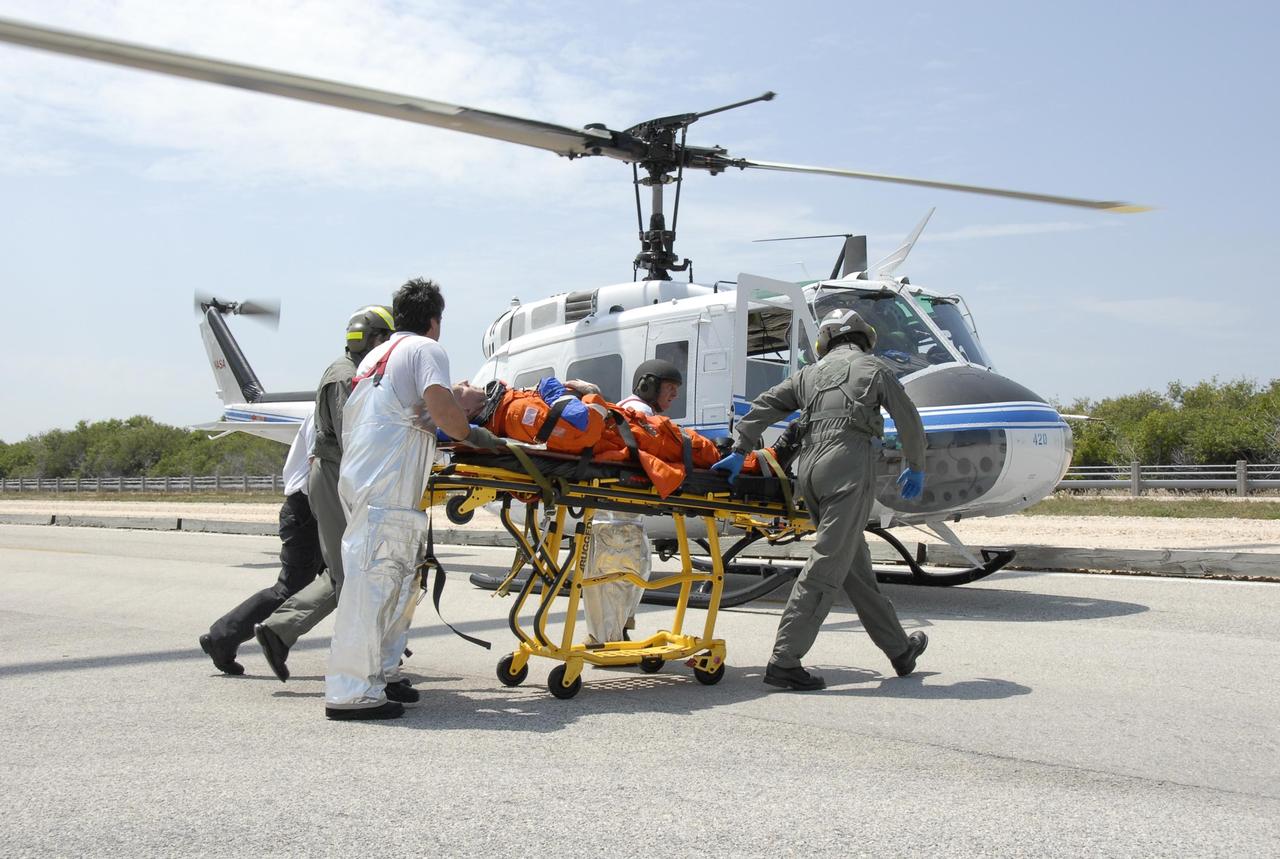
KENNEDY SPACE CENTER, FLA. -- During the second stage of a simulated emergency, known as Mode 4, the KSC rescue team moves an "injured" astronaut toward a NASA helicopter, one of five participating in the exercise. The triage area was set up at Helipad 8, located near the fire station between Launch Pads 39A and 39B. The emergency exercise began on Launch Pad 39A. The participants were helped off the pad and taken to the triage site. The KSC rescue teams are practicing emergency procedures in the unlikely scenario of a mishap on the pad during a launch sequence. The exercises are standard training procedures to assess and prepare emergency personnel, procedures and hardware. Photo credit: NASA/Kim Shiflett
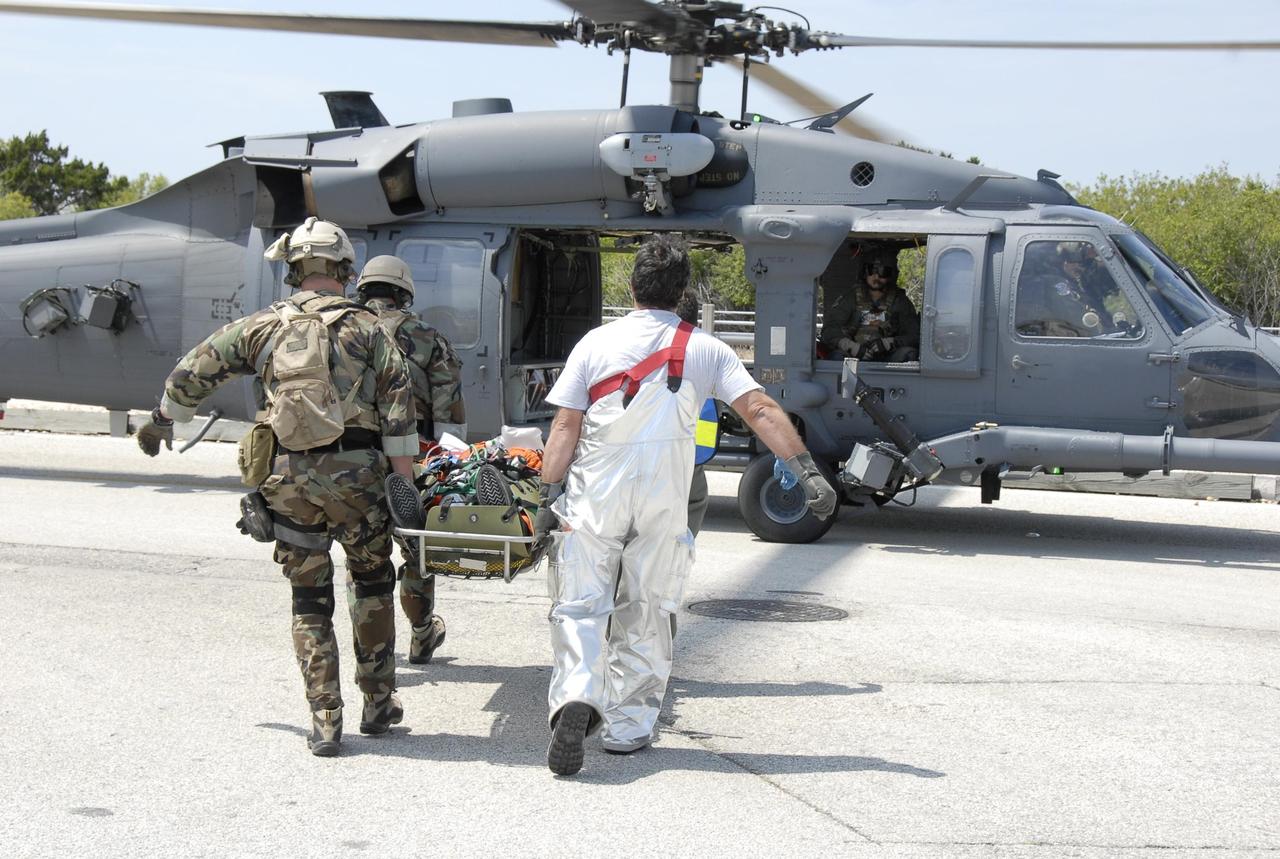
KENNEDY SPACE CENTER, FLA. -- During the second stage of a simulated emergency, known as Mode 4, the KSC rescue team carries an "injured" astronaut toward one of five helicopters participating in the exercise. The triage area was set up at Helipad 8, located near the fire station between Launch Pads 39A and 39B. The emergency exercise began on Launch Pad 39A. The participants were helped off the pad and taken to the triage site. The KSC rescue teams are practicing emergency procedures in the unlikely scenario of a mishap on the pad during a launch sequence. The exercises are standard training procedures to assess and prepare emergency personnel, procedures and hardware. Photo credit: NASA/Kim Shiflett
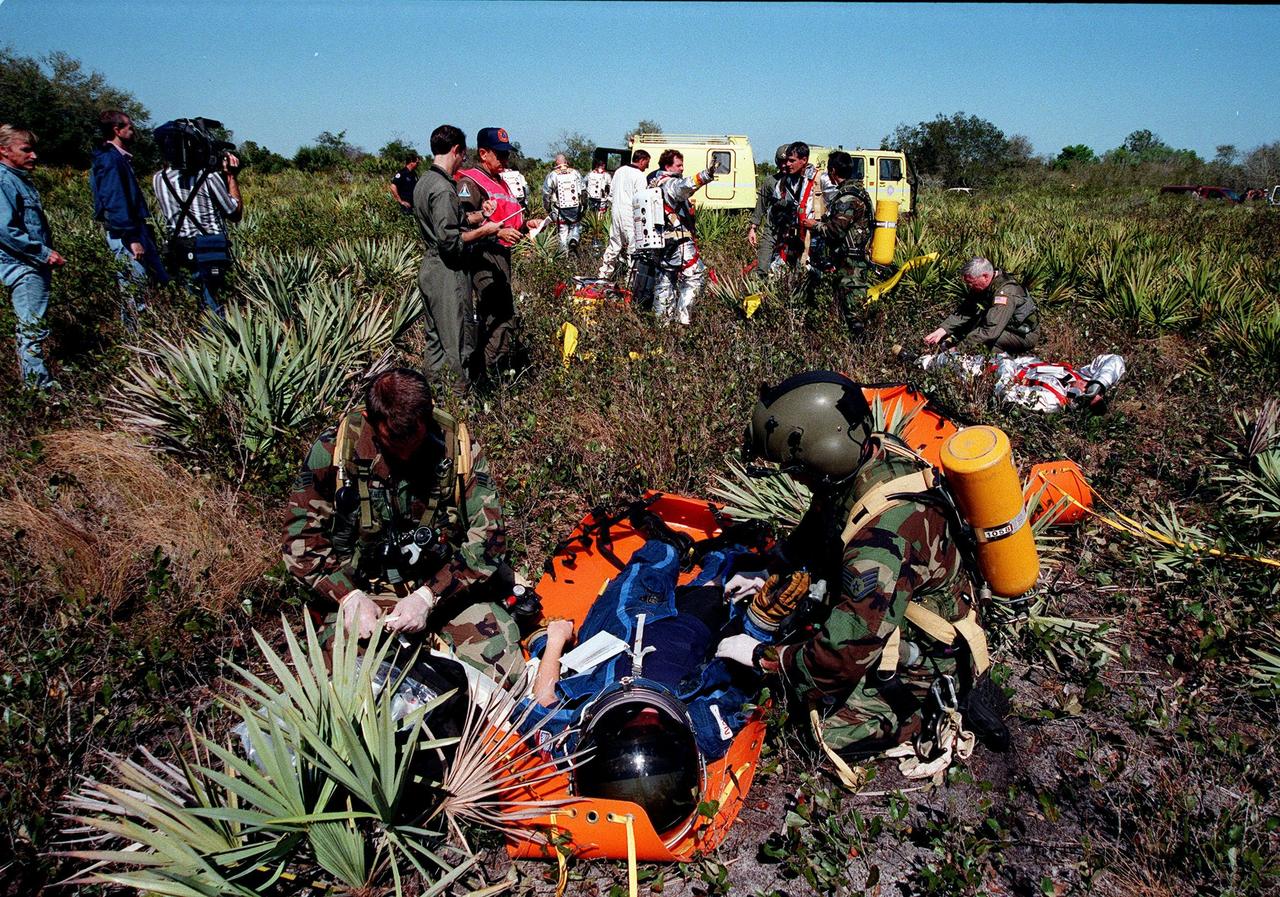
KENNEDY SPACE CENTER, FLA. -- During a simulated rescue mission in the woods near the Shuttle Landing Facility (SLF), the KSC response team practices stabilizing an injured crew member before transport to a local hospital by helicopter. The response team is training for the unlikely scenario of a Shuttle mishap at the SLF. The Mode 7 simulation of an astronaut rescue exercises all aspects of command and control, search and rescue, and medical procedures required for a successful rescue. The remote location of the mock-up prevents a totally land-based crew rescue, and calls on a NASA UH-1 helicopter to locate the site and four Air Force HH-60 helicopters to drop emergency equipment and fire/rescue workers who will prepare the "crew" for preliminary triage. The helicopters later will help remove the crew five astronaut candidates, one representative from the Vehicle Integration Test office, and one fire/rescue worker. The exercise will conclude with airlifted "patients" arriving safely in the emergency rooms of participating area hospitals