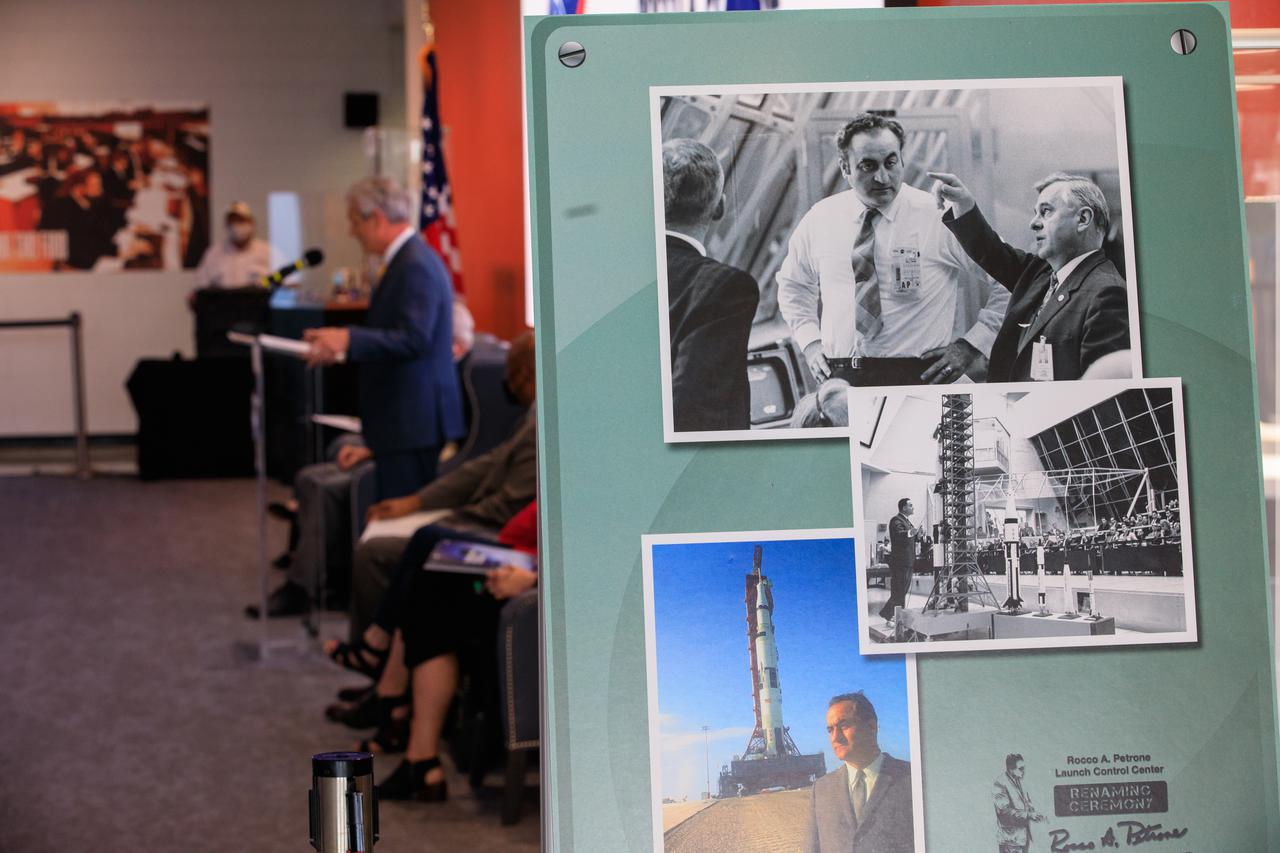
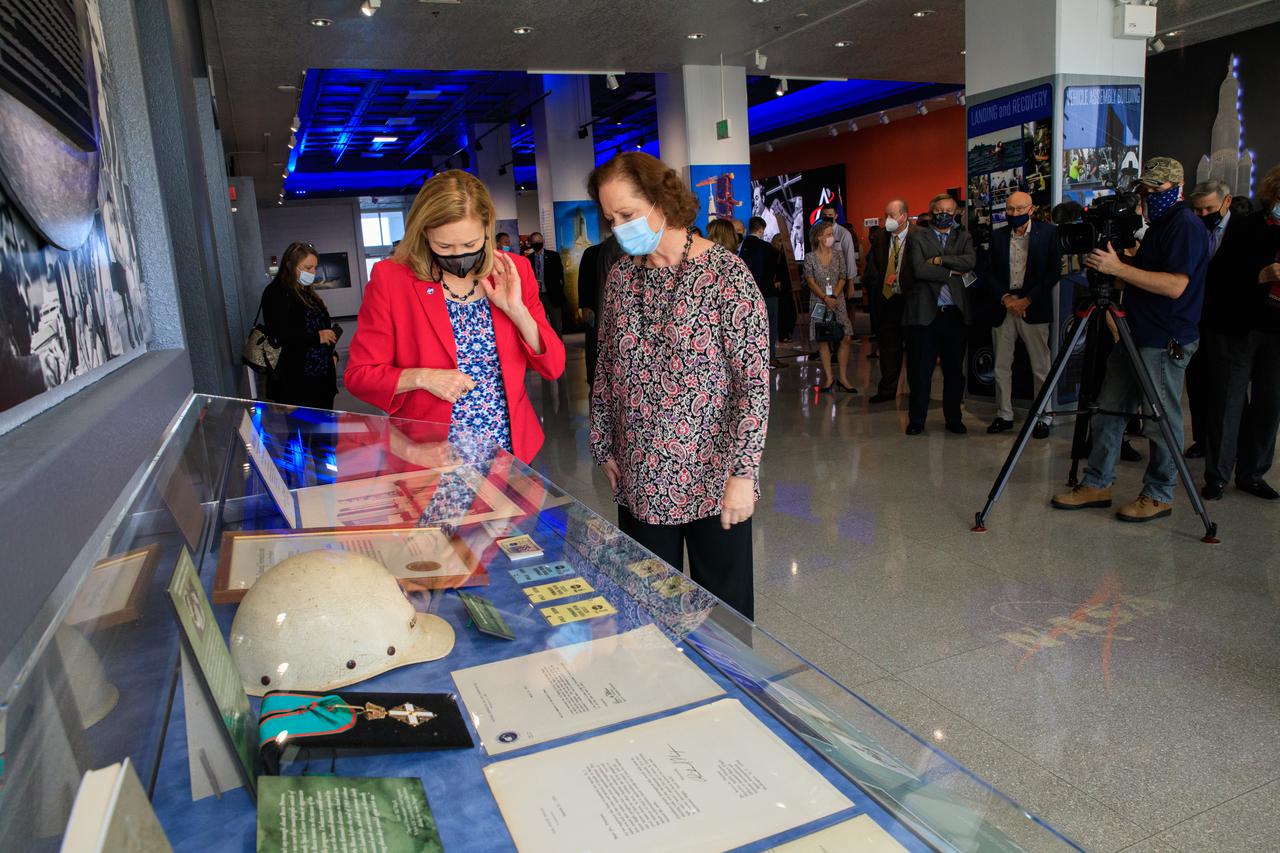
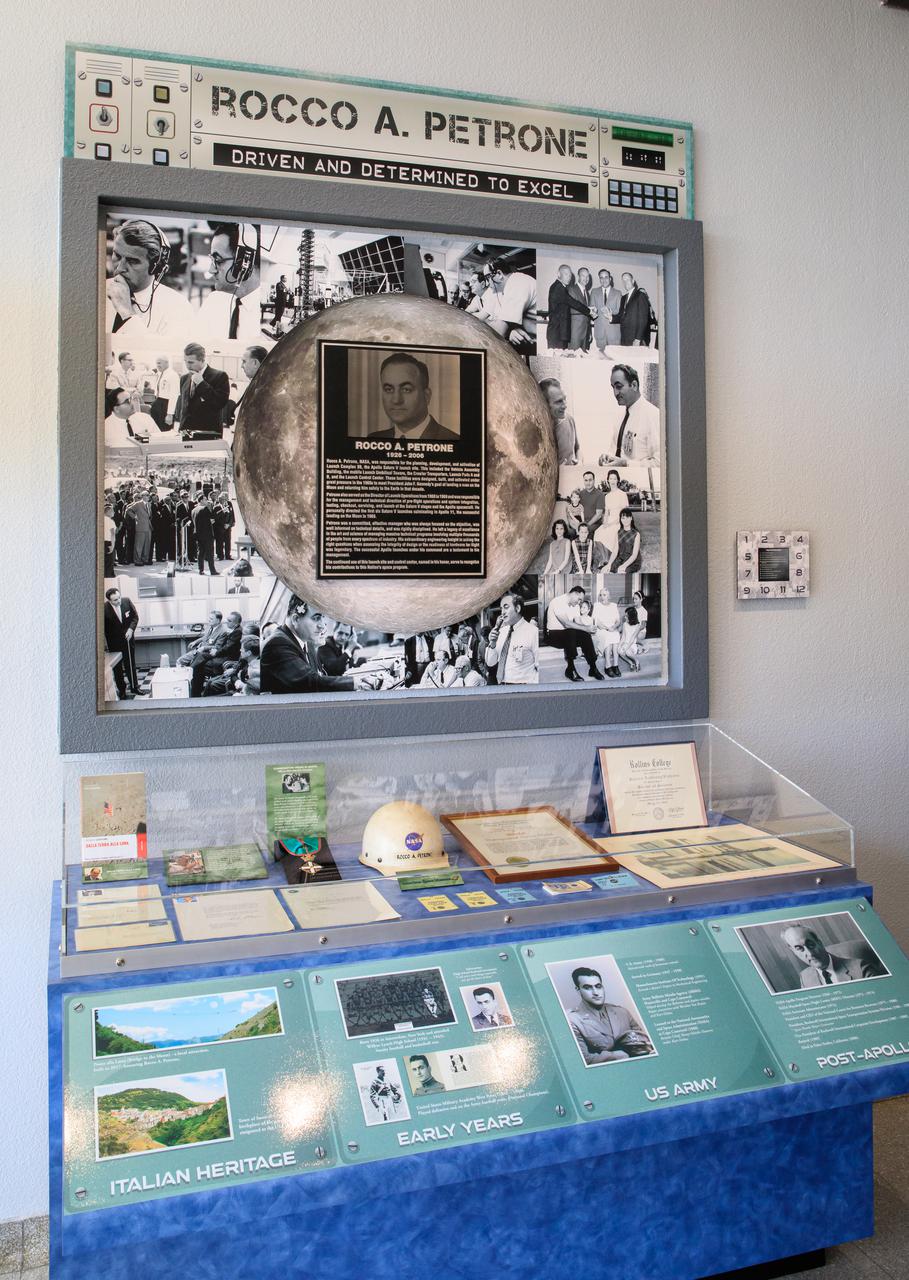
Shown is a display honoring former Kennedy Space Center launch director Rocco Petrone at the Florida spaceport on Feb. 22, 2022. During a ceremony held at Kennedy, the launch control center was officially renamed to the Rocco A. Petrone Launch Control Center. Petrone was instrumental in America’s first voyages to the Moon and headed the Apollo program. He died in 2006 at the age of 80.
KSC Launch Control Center Renaming
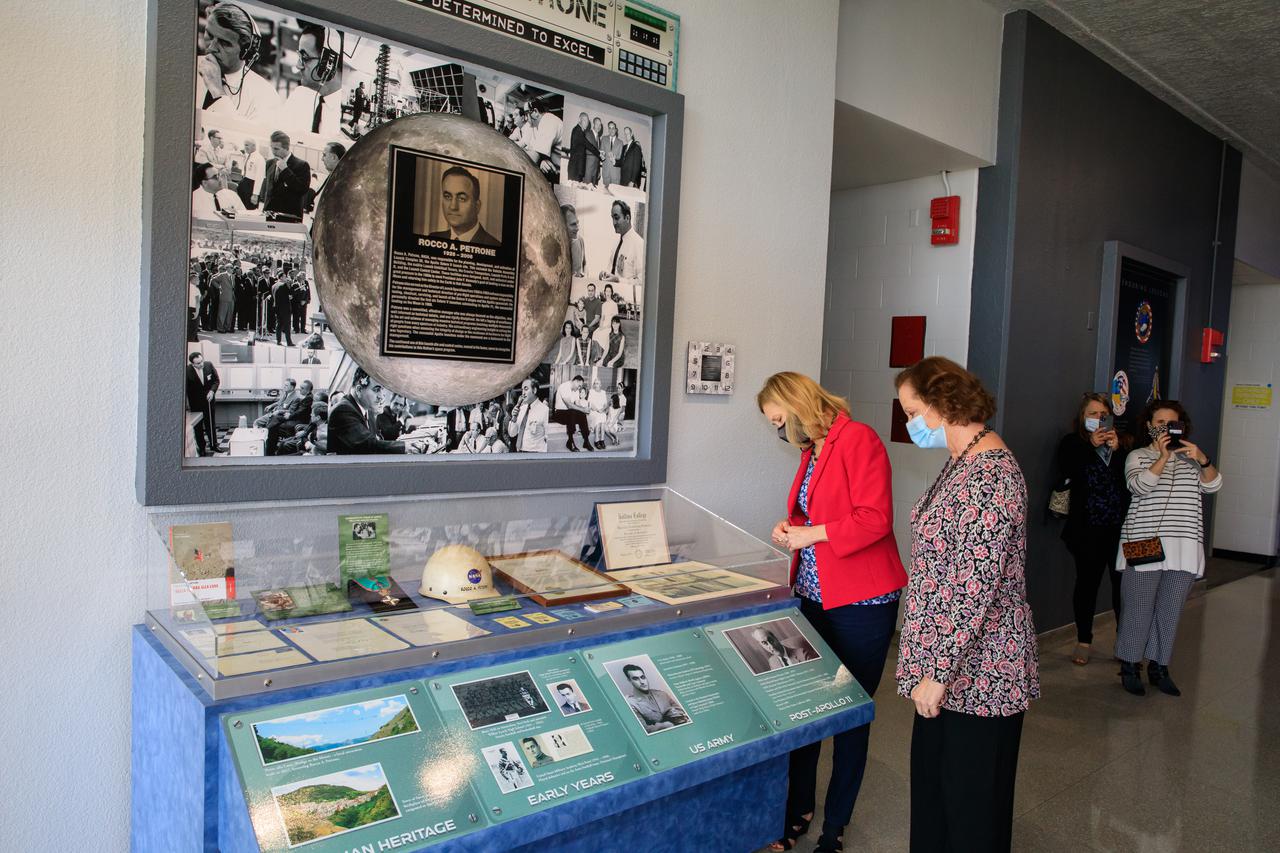
A display dedicated to former Kennedy Space Center launch director Rocco Petrone is viewed at Kennedy Space Center on Feb. 22, 2022. During a ceremony held at the Florida spaceport, Kennedy’s launch control center was officially renamed to the Rocco A. Petrone Launch Control Center. Petrone was instrumental in America’s first voyages to the Moon and headed the Apollo program. He died in 2006 at the age of 80.
KSC Launch Control Center Renaming
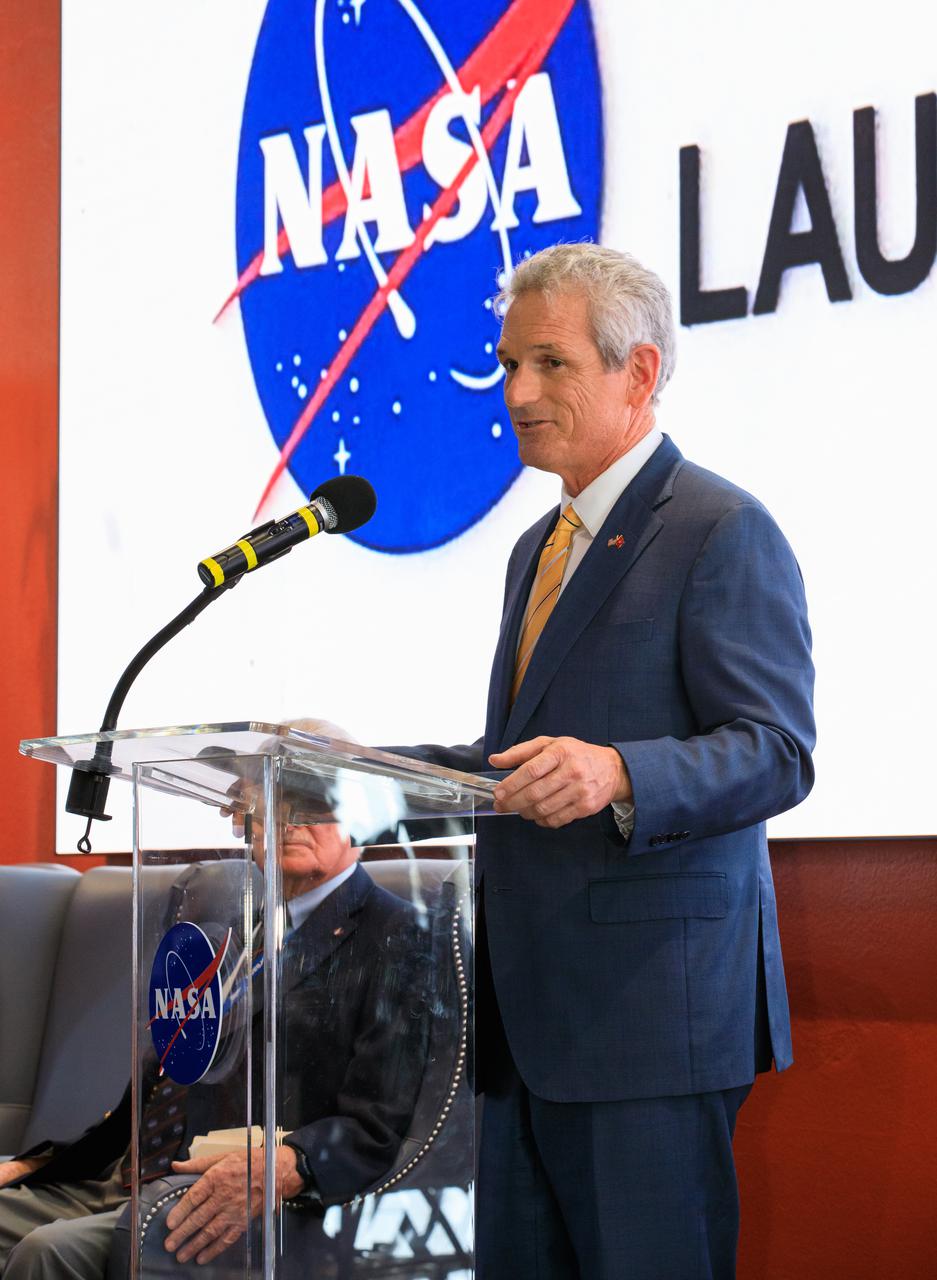
Kennedy Space Center Launch Director Charlie Blackwell-Thompson speaks during a ceremony renaming the Florida spaceport’s launch control center to the Rocco A. Petrone Launch Control Center on Feb. 22, 2022. Petrone was instrumental in America’s first voyages to the Moon and headed the Apollo program. He died in 2006 at the age of 80.
KSC Launch Control Center Renaming
Kennedy Space Center Deputy Director Kelvin Manning speaks during a ceremony renaming the Florida spaceport’s launch control center to the Rocco A. Petrone Launch Control Center on Feb. 22, 2022. Petrone was instrumental in America’s first voyages to the Moon and headed the Apollo program. He died in 2006 at the age of 80.
KSC Launch Control Center Renaming
John Tribe, retired Apollo engineer, North American Rockwell, speaks during a ceremony renaming Kennedy Space Center’s launch control center to the Rocco A. Petrone Launch Control Center on Feb. 22, 2022. Petrone was instrumental in America’s first voyages to the Moon and headed the Apollo program. He died in 2006 at the age of 80.
KSC Launch Control Center Renaming
Scott Rigell, speaking on behalf of Ike Rigell, retired Apollo chief engineer and deputy director of launch vehicle operations at NASA, addresses attendees during a ceremony renaming Kennedy Space Center’s launch control center to the Rocco A. Petrone Launch Control Center on Feb. 22, 2022. Petrone was instrumental in America’s first voyages to the Moon and headed the Apollo program. He died in 2006 at the age of 80.
KSC Launch Control Center Renaming
A display dedicated to former Kennedy Space Center launch director Rocco Petrone is viewed at Kennedy Space Center on Feb. 22, 2022. During a ceremony held at the Florida spaceport, Kennedy’s launch control center was officially renamed to the Rocco A. Petrone Launch Control Center. Petrone was instrumental in America’s first voyages to the Moon and headed the Apollo program. He died in 2006 at the age of 80.
KSC Launch Control Center Renaming
Kennedy Space Center Director Janet Petro speaks during a ceremony renaming the Florida spaceport’s launch control center to the Rocco A. Petrone Launch Control Center on Feb. 22, 2022. Petrone was instrumental in America’s first voyages to the Moon and headed the Apollo program. He died in 2006 at the age of 80.
KSC Launch Control Center Renaming
A display dedicated to former Kennedy Space Center director Rocco Petrone is viewed at Kennedy Space Center on Feb. 22, 2022. During a ceremony held at the Florida spaceport, Kennedy’s launch control center was officially renamed to the Rocco A. Petrone Launch Control Center. Petrone was instrumental in America’s first voyages to the Moon and headed the Apollo program. He died in 2006 at the age of 80.
KSC Launch Control Center Renaming
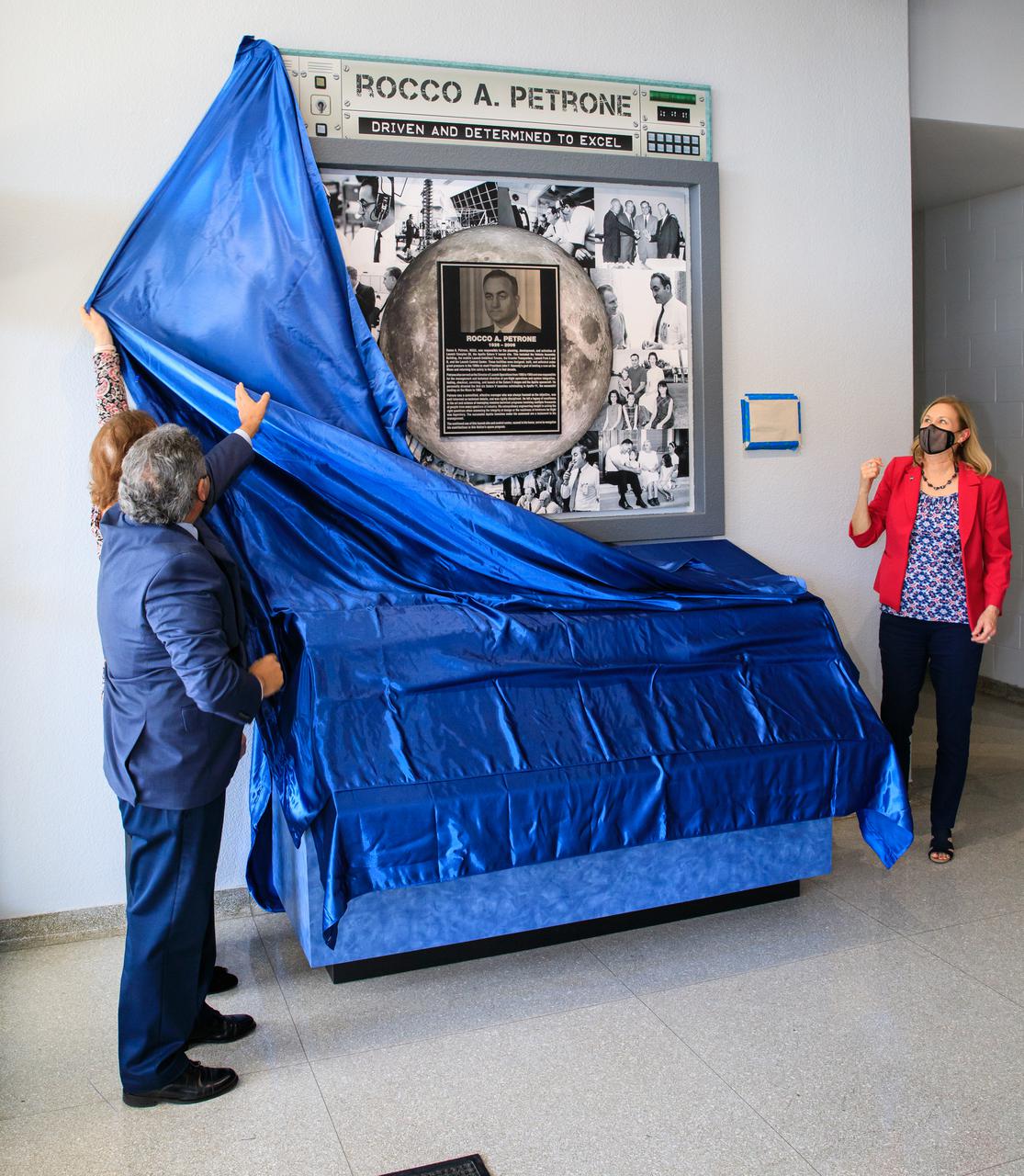
A display dedicated to former Kennedy Space Center launch director Rocco Petrone is unveiled at Kennedy Space Center on Feb. 22, 2022. During a ceremony held at the Florida spaceport, Kennedy’s launch control center was officially renamed to the Rocco A. Petrone Launch Control Center. Petrone was instrumental in America’s first voyages to the Moon and headed the Apollo program. He died in 2006 at the age of 80.
KSC Launch Control Center Renaming
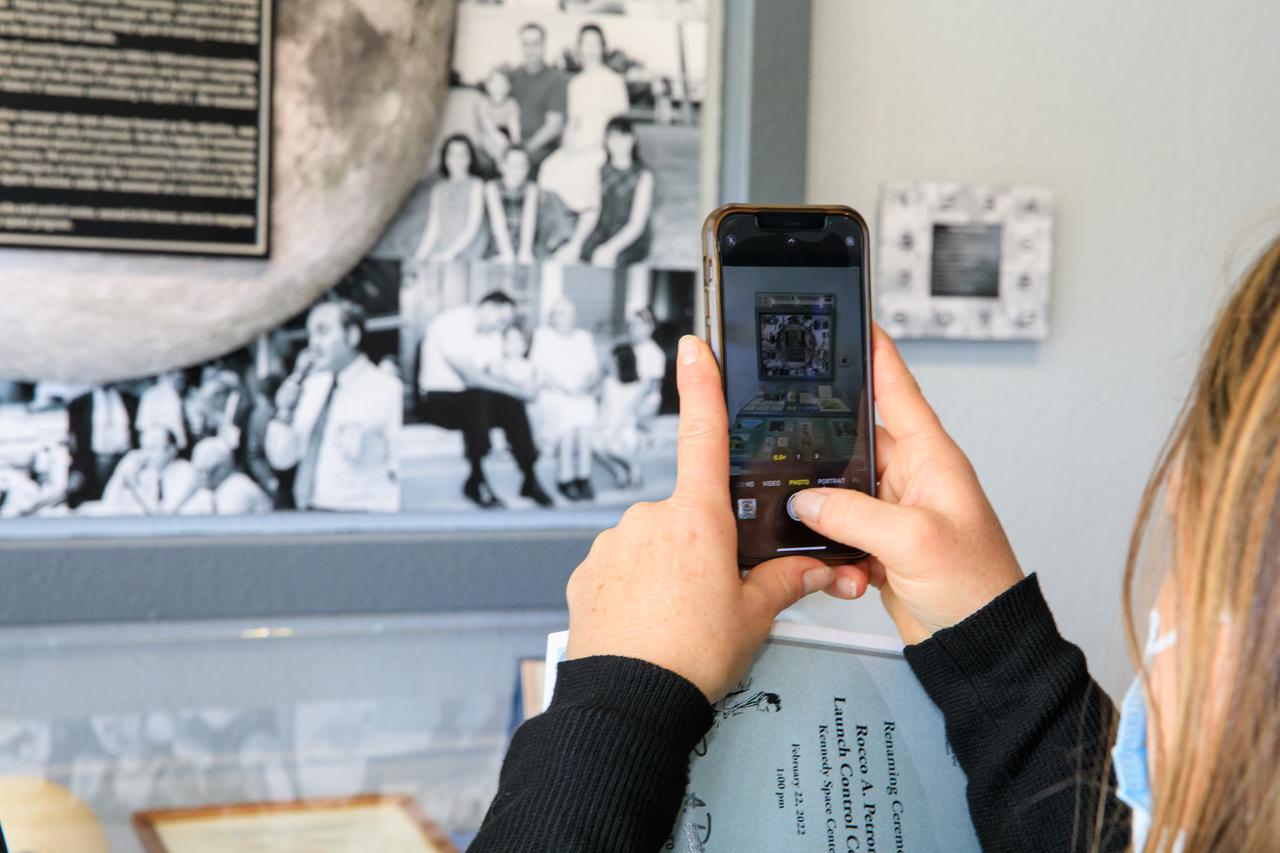
A spectator takes a photo of a display dedicated to former Kennedy Space Center director Rocco Petrone on Feb. 22, 2022. During a ceremony held at the Florida spaceport, Kennedy’s launch control center was officially renamed to the Rocco A. Petrone Launch Control Center. Petrone was instrumental in America’s first voyages to the Moon and headed the Apollo program. He died in 2006 at the age of 80.
KSC Launch Control Center Renaming
Scott Rigell, speaking on behalf of Ike Rigell, retired Apollo chief engineer and deputy director of launch vehicle operations at NASA, addresses attendees during a ceremony renaming Kennedy Space Center’s launch control center to the Rocco A. Petrone Launch Control Center on Feb. 22, 2022. Petrone was instrumental in America’s first voyages to the Moon and headed the Apollo program. He died in 2006 at the age of 80.
KSC Launch Control Center Renaming
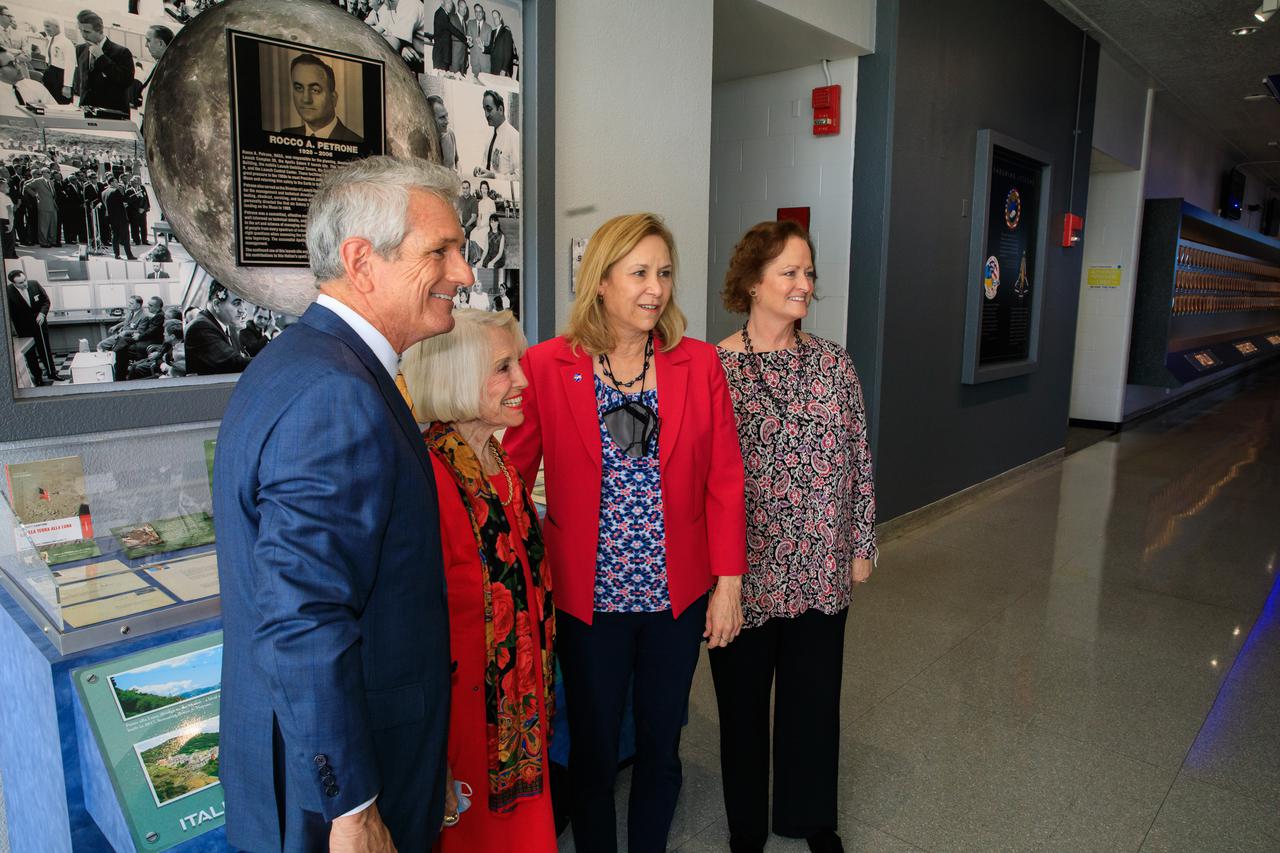
Kennedy Space Center Director Janet Petro, second from right, poses in front of a display dedicated to former Kennedy Space Center launch director Rocco Petrone at the Florida spaceport on Feb. 22, 2022. Also pictured is Scott Rigell, far left, and Kathy Posey, daughter of Petrone, far right. During a ceremony held at Kennedy, the launch control center was officially renamed to the Rocco A. Petrone Launch Control Center. Petrone was instrumental in America’s first voyages to the Moon and headed the Apollo program. He died in 2006 at the age of 80.
KSC Launch Control Center Renaming
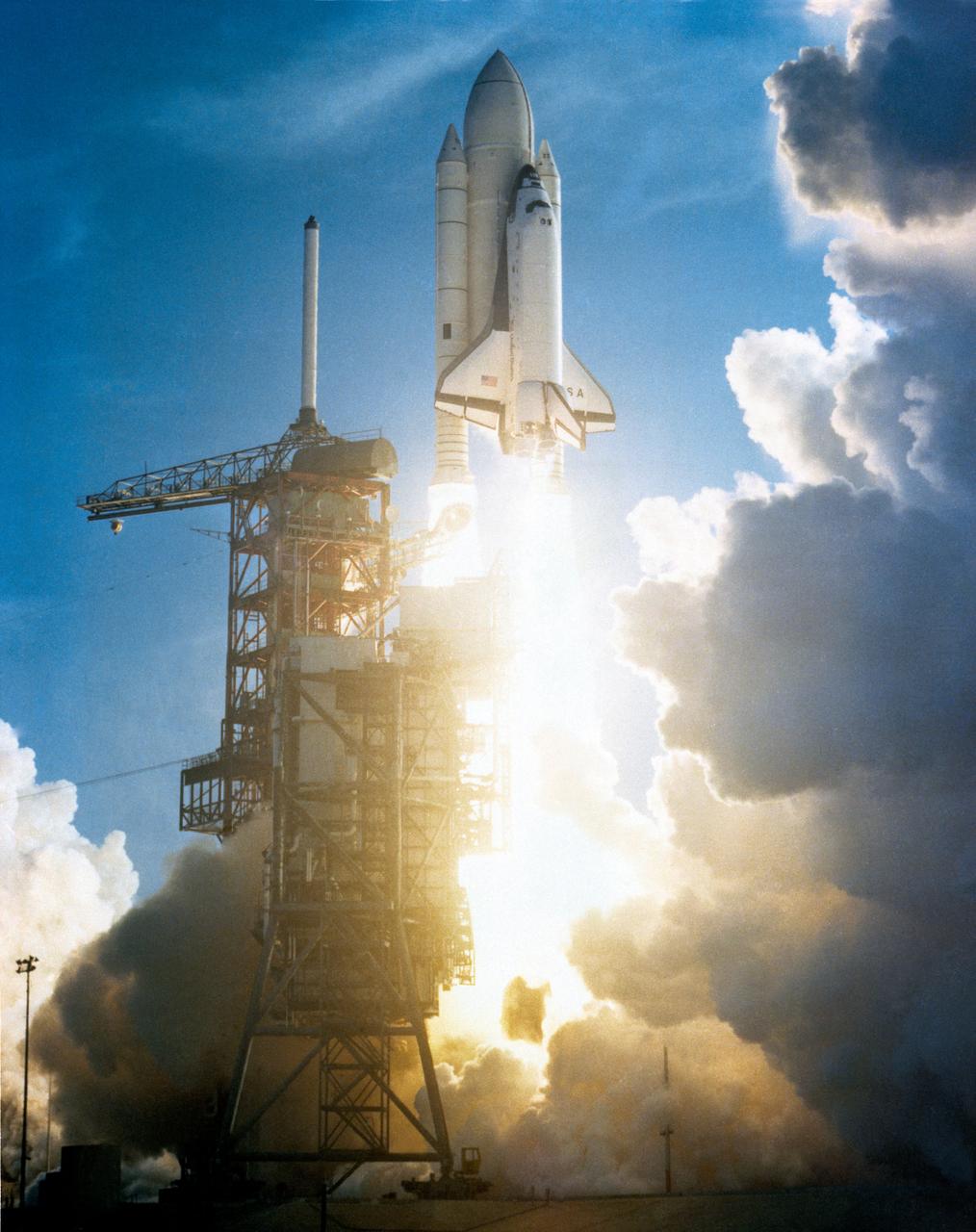
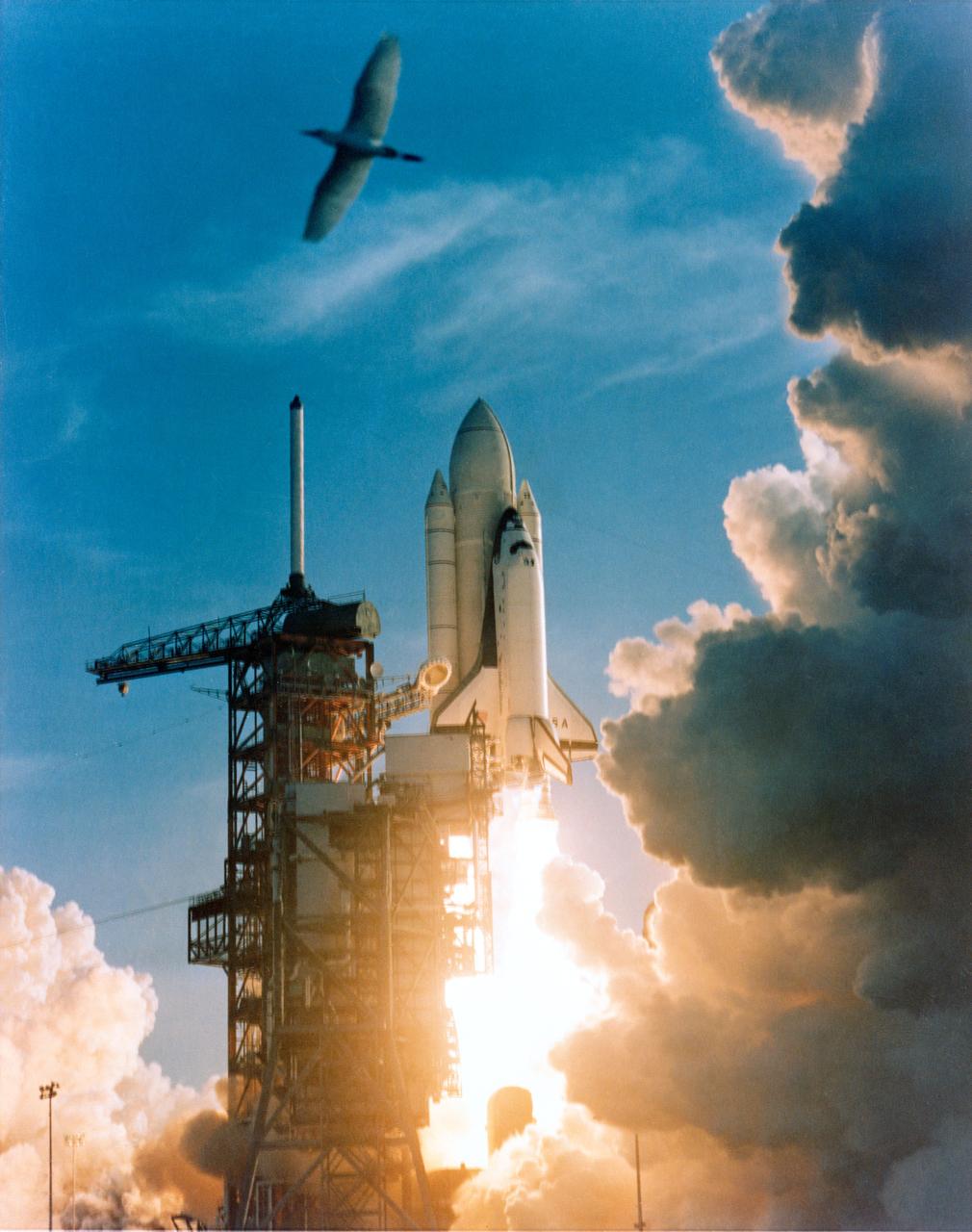
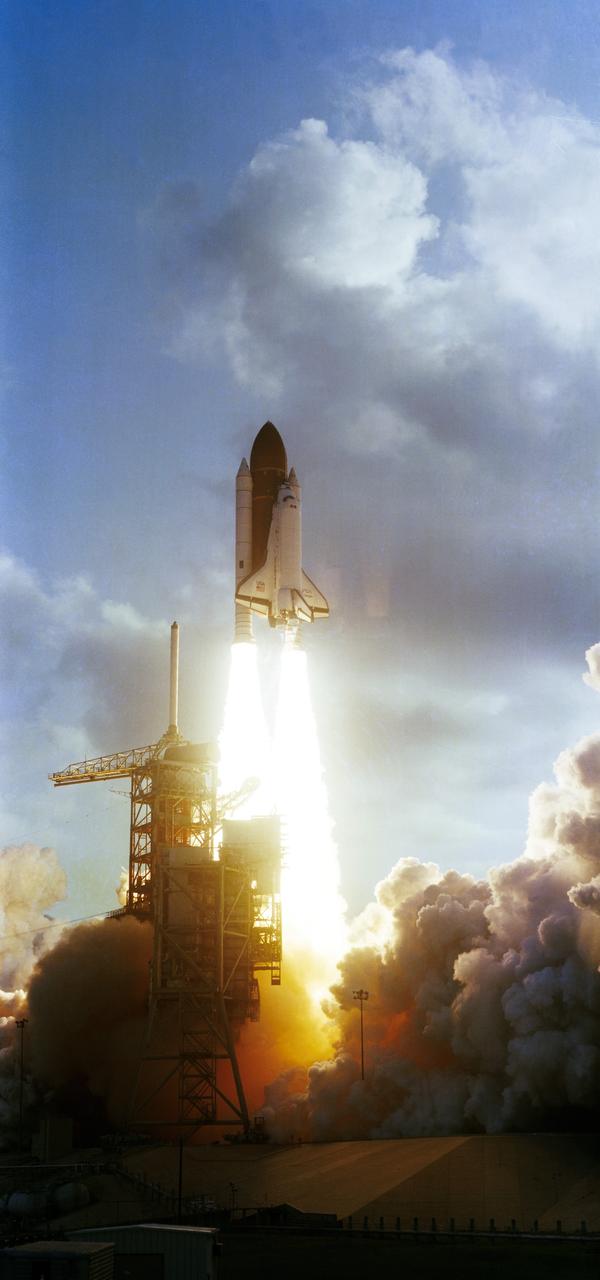
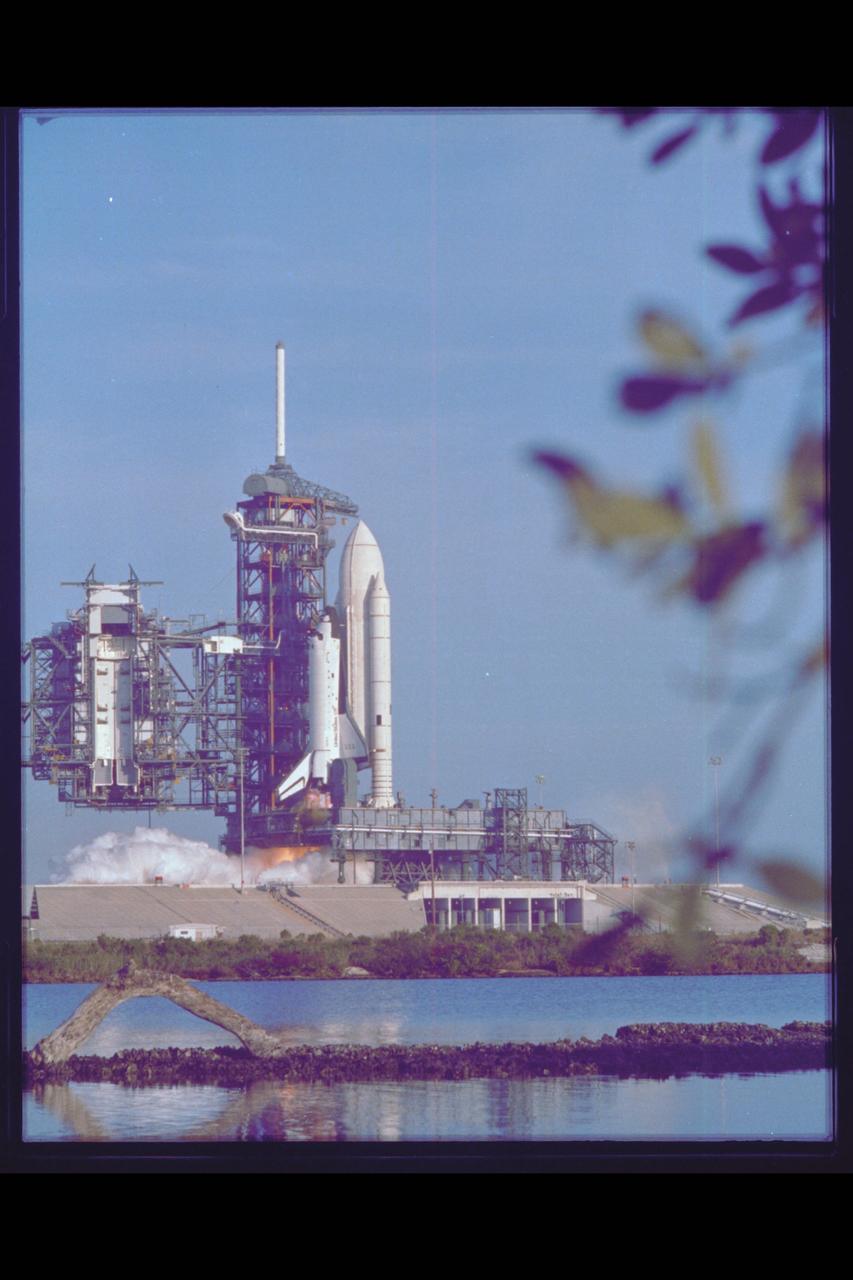
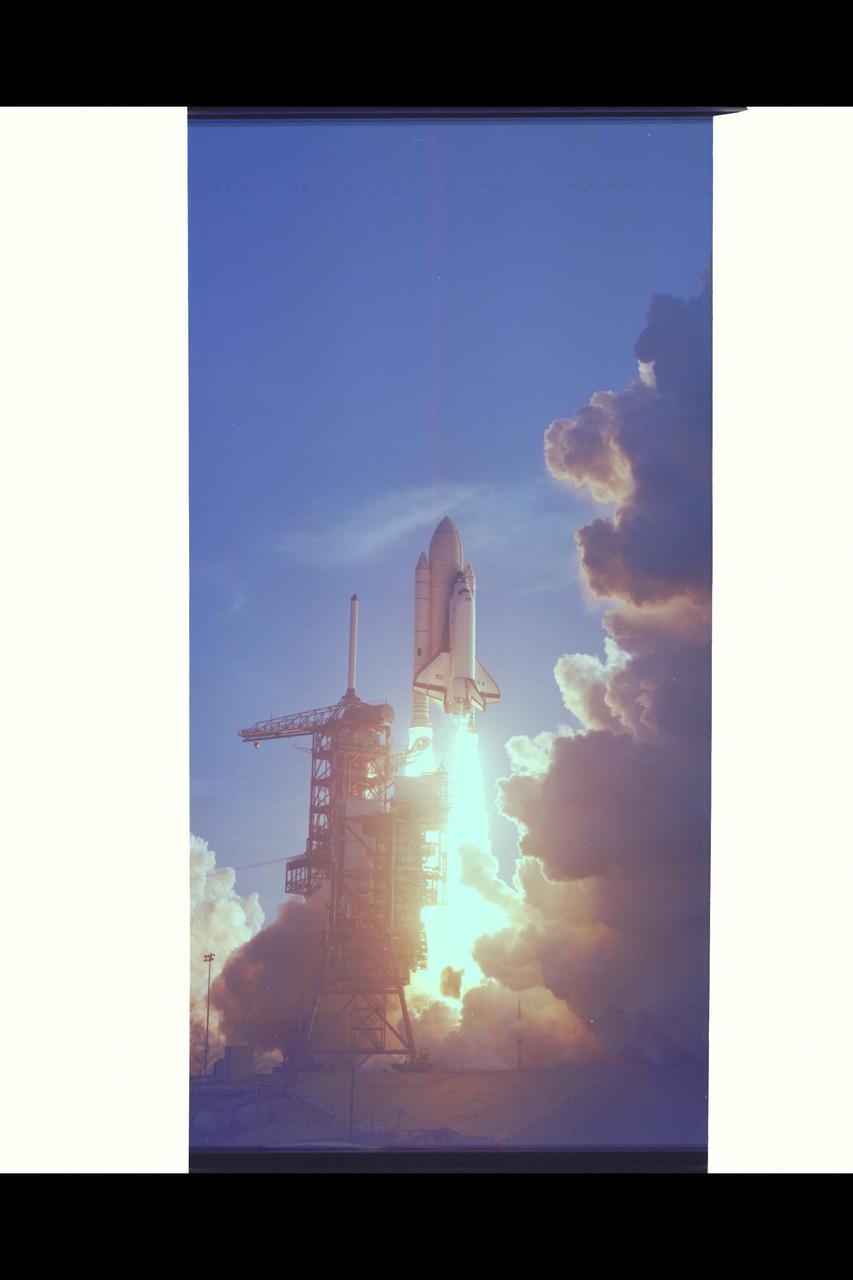
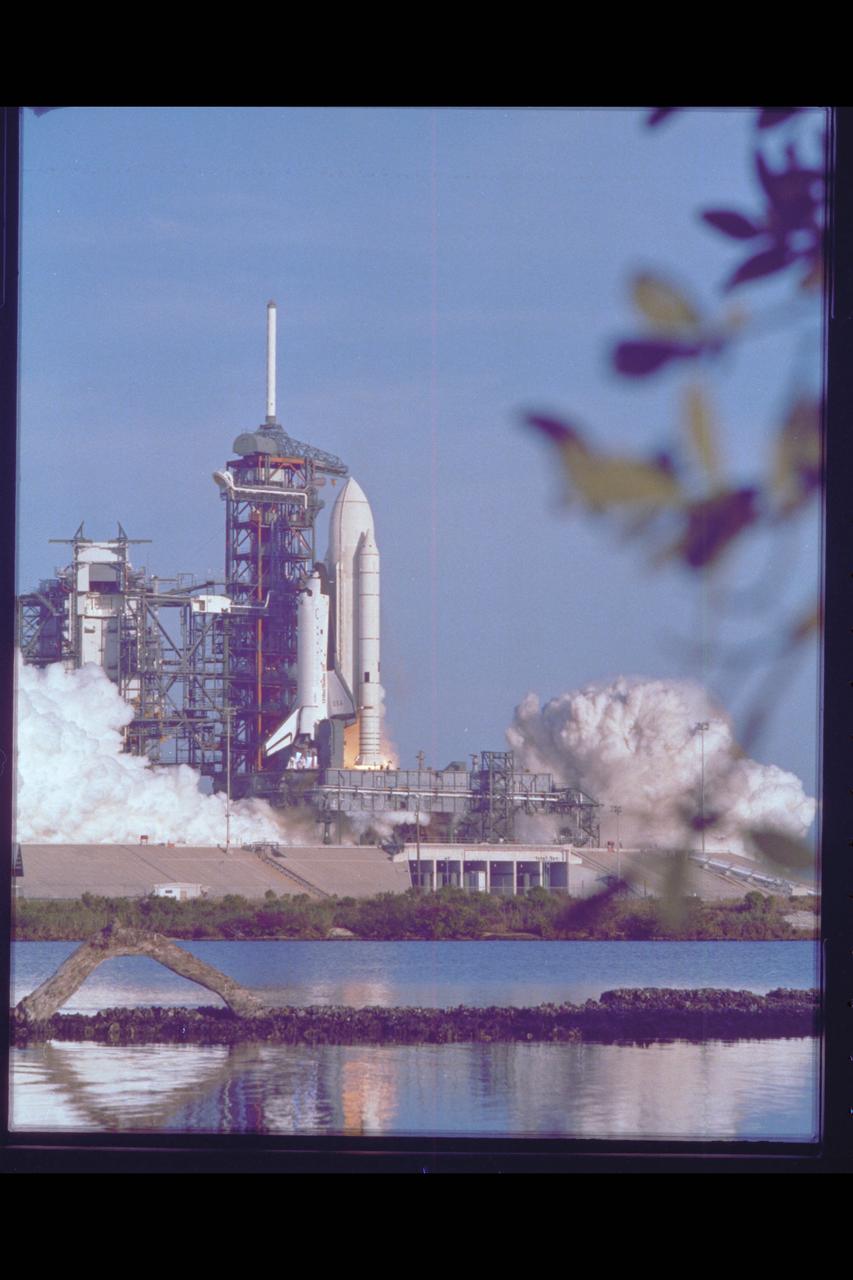
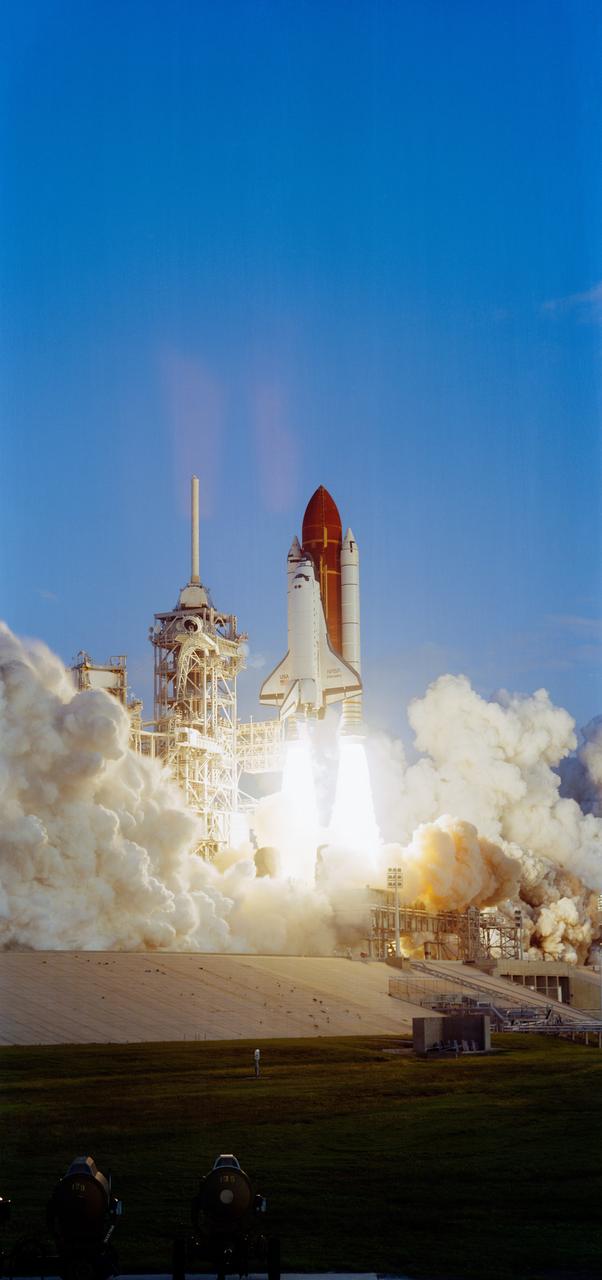
The Space Shuttle Columbia begins a new era of space transportation when it lifts off from NASA Kennedy Space Center (KSC).  The reusable Orbiter, its two (2) fuel tanks and two (2) Solid Rocket Boosters (SRB) has just cleared the launch tower.  Aboard the spacecraft are Astronauts John W. Young, Commander, and Robert L. Crippen, Pilot .         1.  STS-I - LAUNCH    KSC, FL           KSC, FL        Also available in 4x5 BW
STS-1 - LAUNCH - KSC
The Space Shuttle Columbia begins a new era of space transportation when it lifts off from NASA Kennedy Space Center (KSC).  The reusable Orbiter, its two (2) fuel tanks and two (2) Solid Rocket Boosters (SRB) has just cleared the launch tower.  Aboard the spacecraft are Astronauts John W. Young, Commander, and Robert L. Crippen, Pilot .         1.  STS-I - LAUNCH    KSC, FL           KSC, FL        Also available in 4x5 BW
STS-1 - LAUNCH - KSC
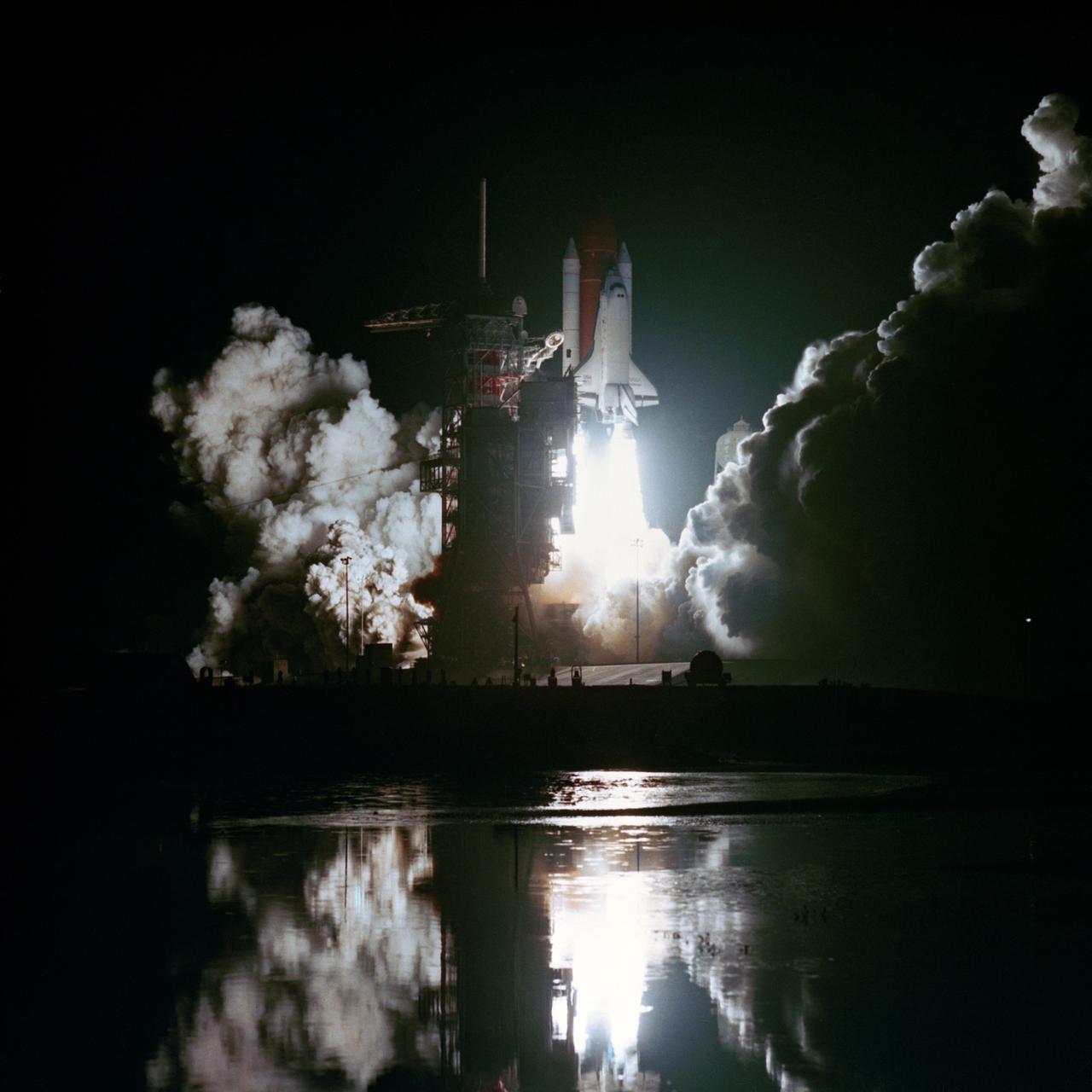
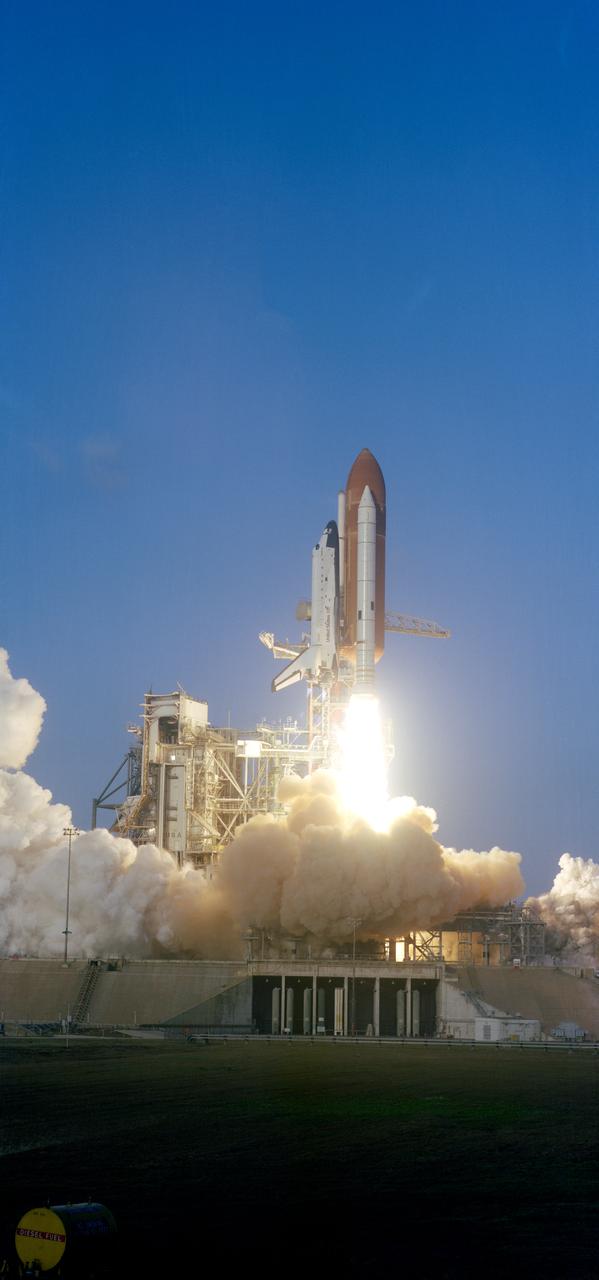
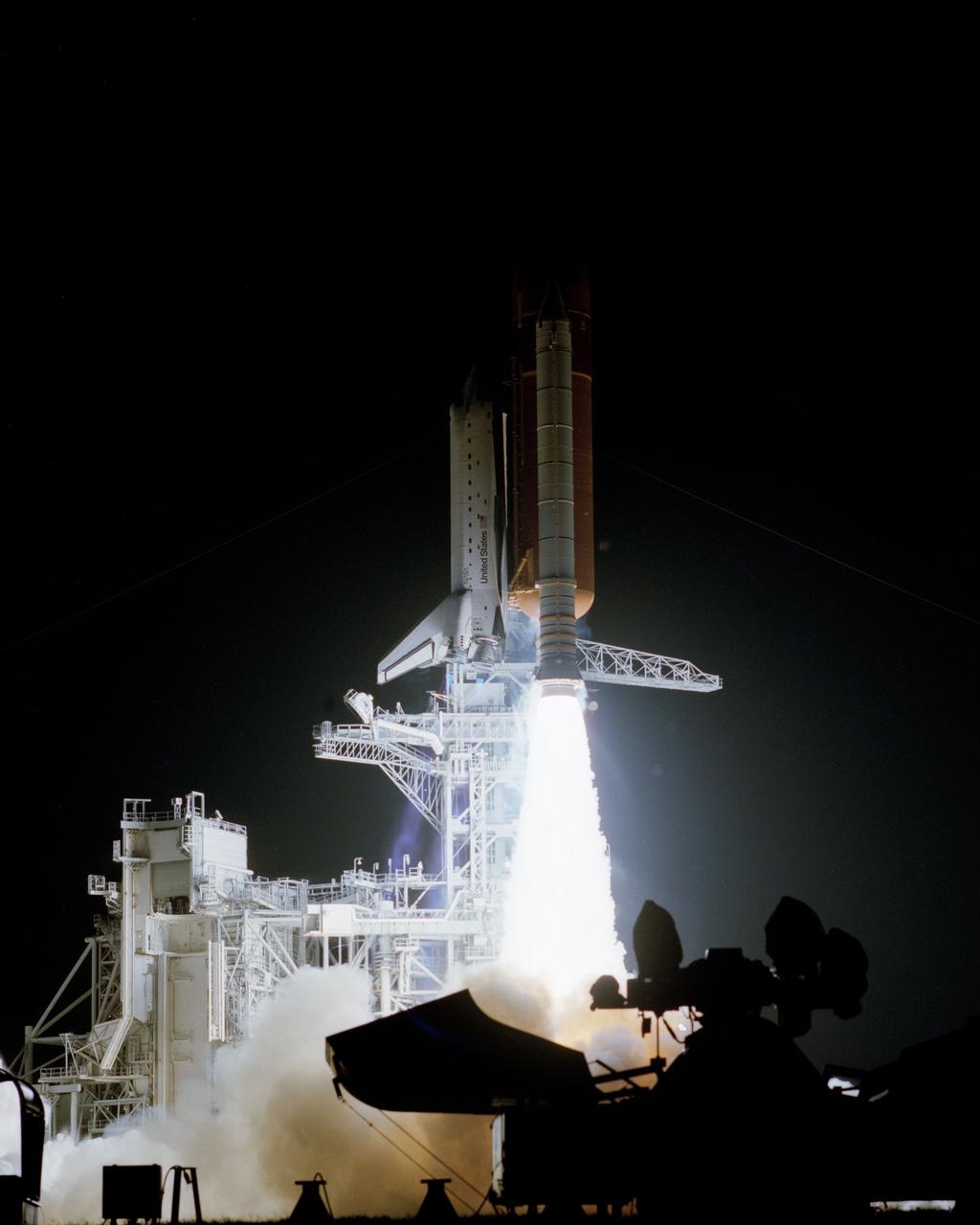
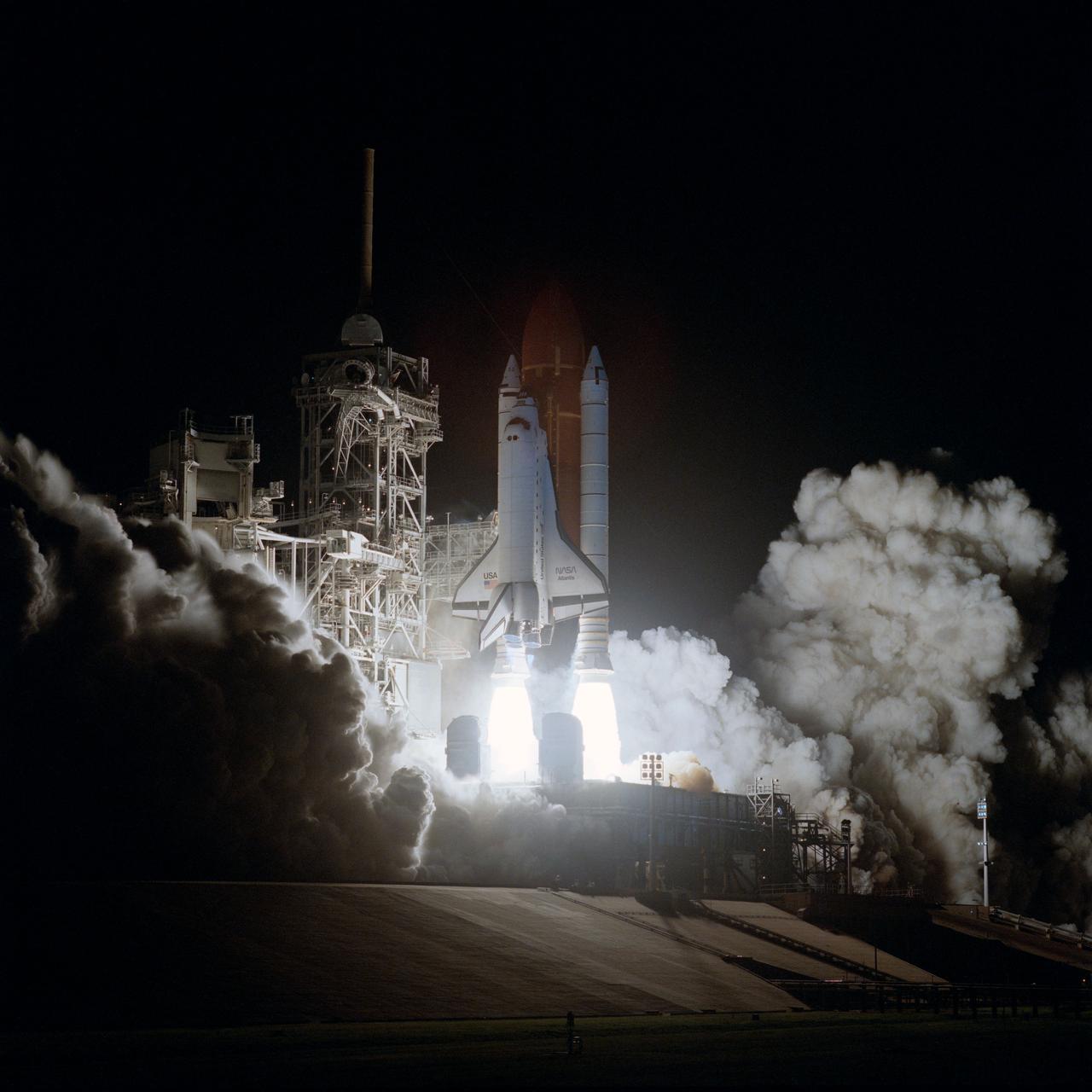
Night launch view of STS-8.  Very nice shot.    KSC, FL
LAUNCH - STS-8 - KSC
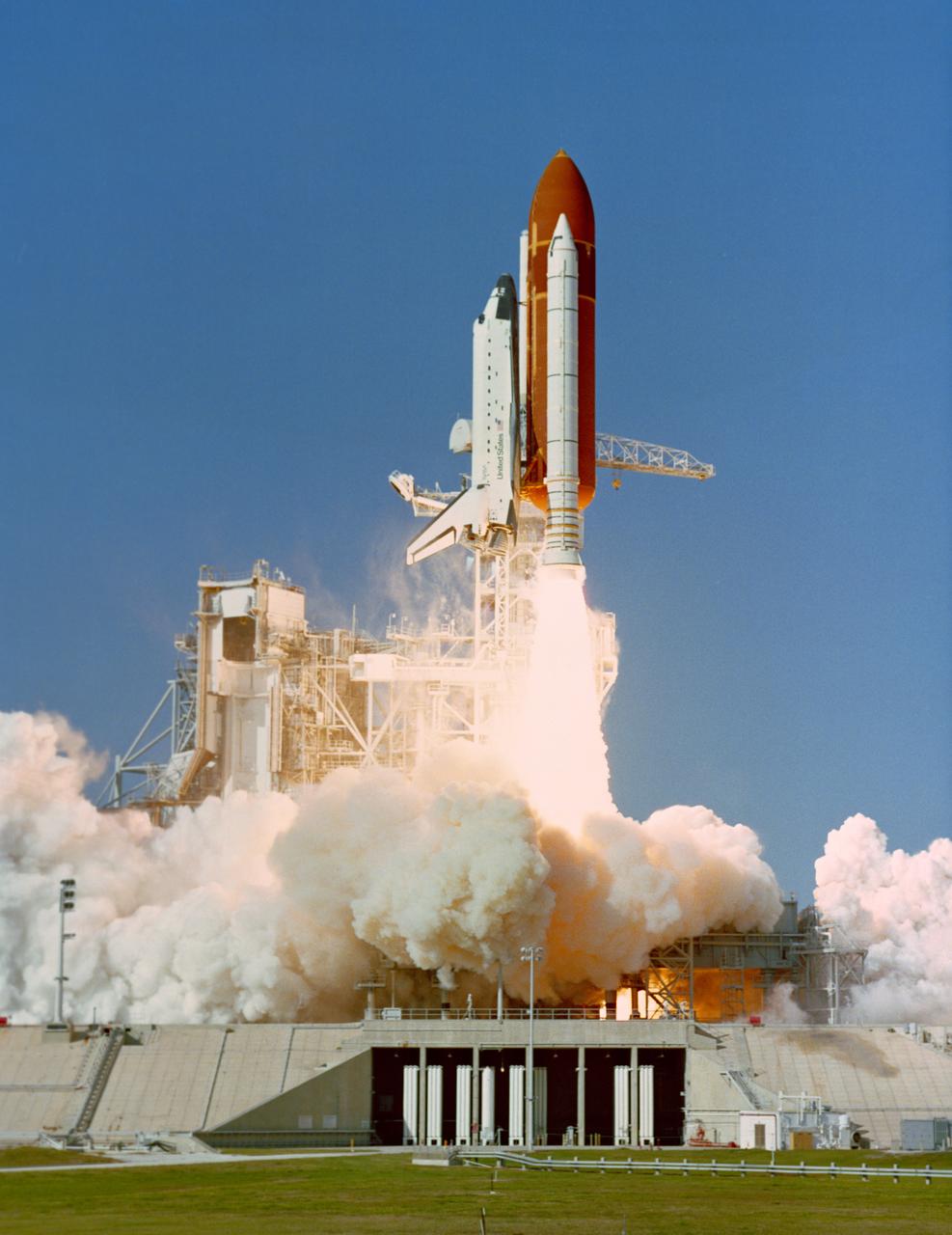
Launch views of the Columbia from Pad 39A starting the STS-4 Mission, 06/27/1982.       KSC, FL
LAUNCH - STS-4 - KSC
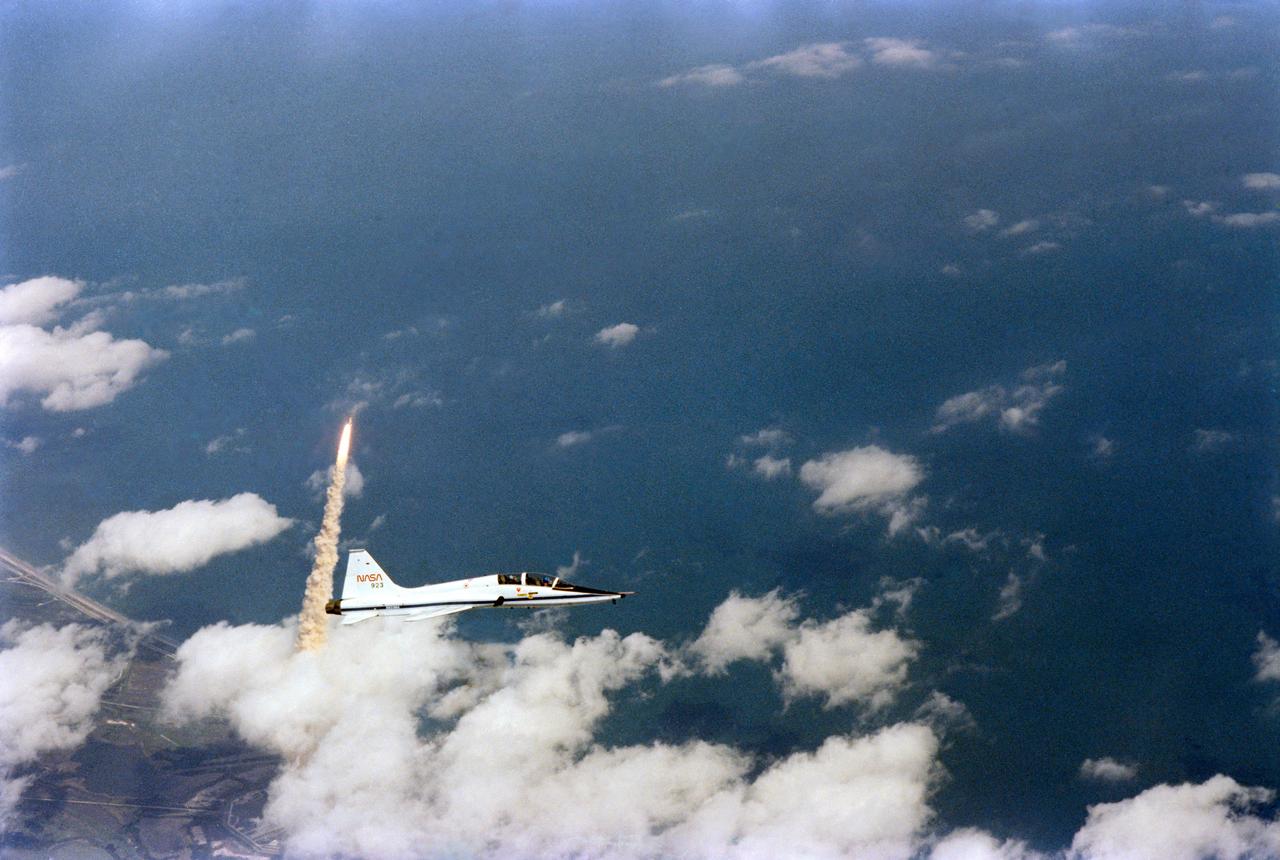
Air-to-air views of STS-3 Launch from T-38 Chase Aircraft.        KSC, FL
LAUNCH (AERIALS) - STS-3 - KSC
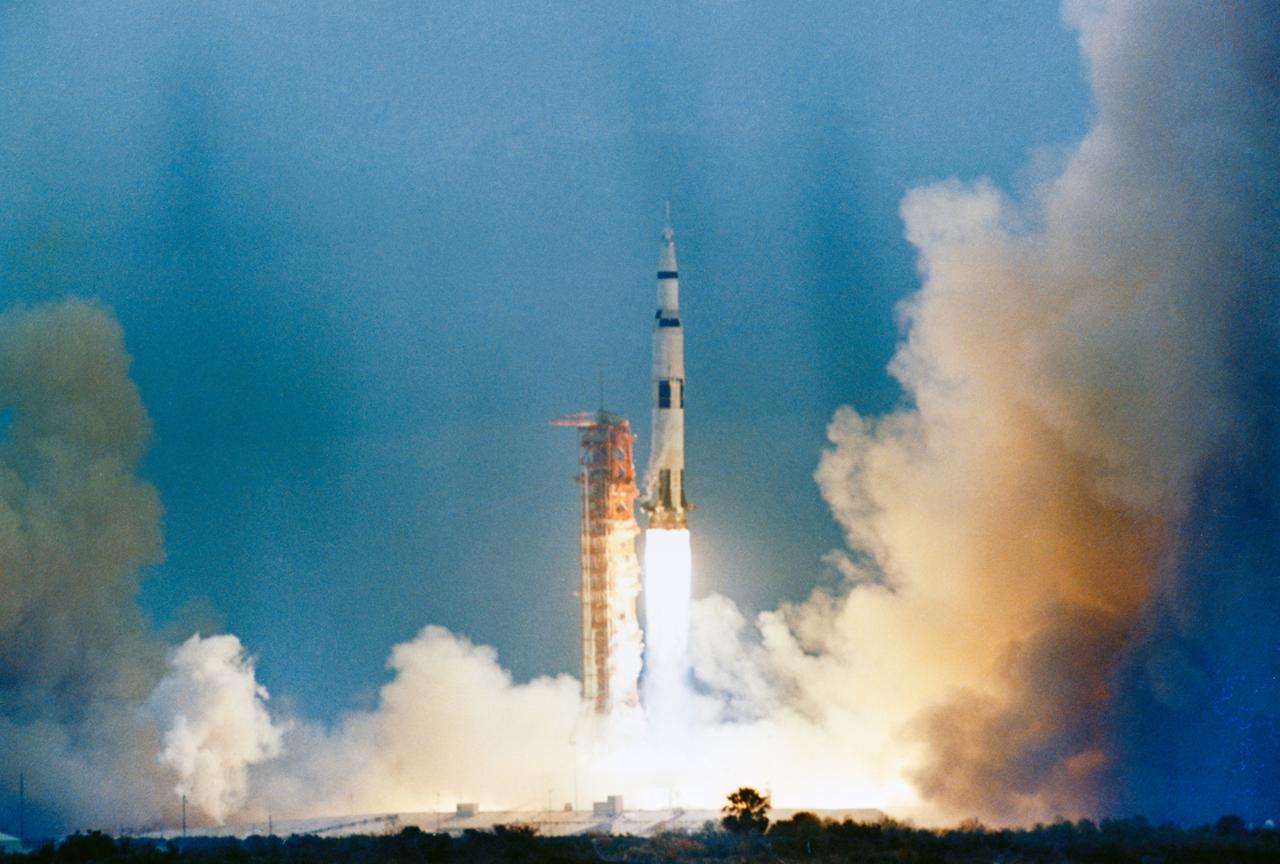
S69-25861 (3 March 1969) --- The Apollo 9 (Spacecraft 104/Lunar Module 3/ Saturn 504) space vehicle is launched from Pad A, Launch Complex 39, Kennedy Space Center (KSC) at 11 a.m. (EST), March 3, 1969. Aboard the spacecraft are astronauts James A. McDivitt, commander; David R. Scott, command module pilot; and Russell L. Schweickart, lunar module pilot. The Apollo 9 mission will evaluate spacecraft lunar module systems performance during manned Earth-orbital flight. Apollo 9 is the second manned Saturn V mission.
LAUNCH - APOLLO 9 - CAPE
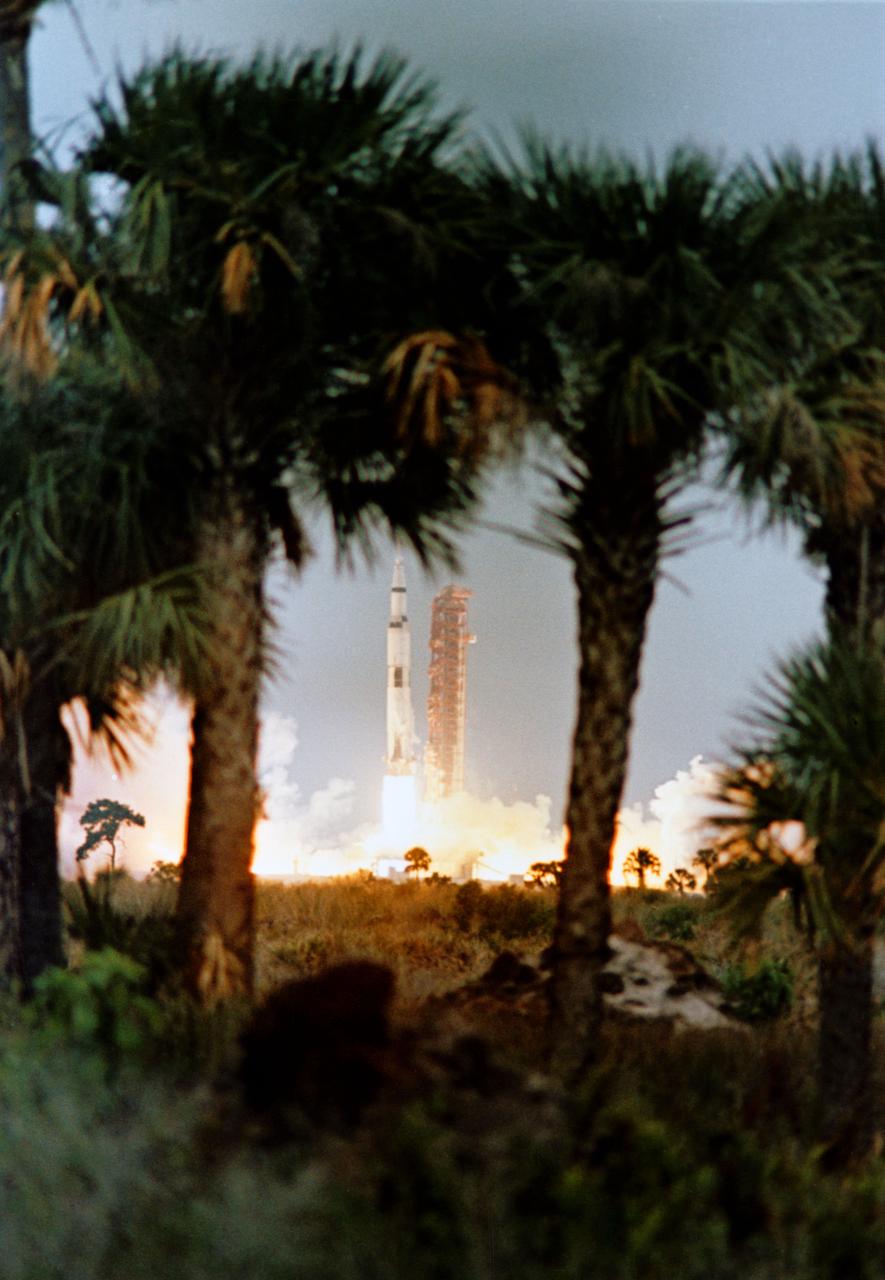
S69-25862 (3 March 1969) --- Framed by palm trees in the foreground, the Apollo 9 (Spacecraft 104/Lunar Module 3/ Saturn 504) space vehicle is launched from Pad A, Launch Complex 39, Kennedy Space Center (KSC) at 11 a.m. (EST), March 3, 1969. Aboard the spacecraft are astronauts James A. McDivitt, commander; David R. Scott, command module pilot; and Russell L. Schweickart, lunar module pilot. The Apollo 9 mission will evaluate spacecraft lunar module systems performance during manned Earth-orbital flight. Apollo 9 is the second manned Saturn V mission.
LAUNCH - APOLLO 9 - CAPE
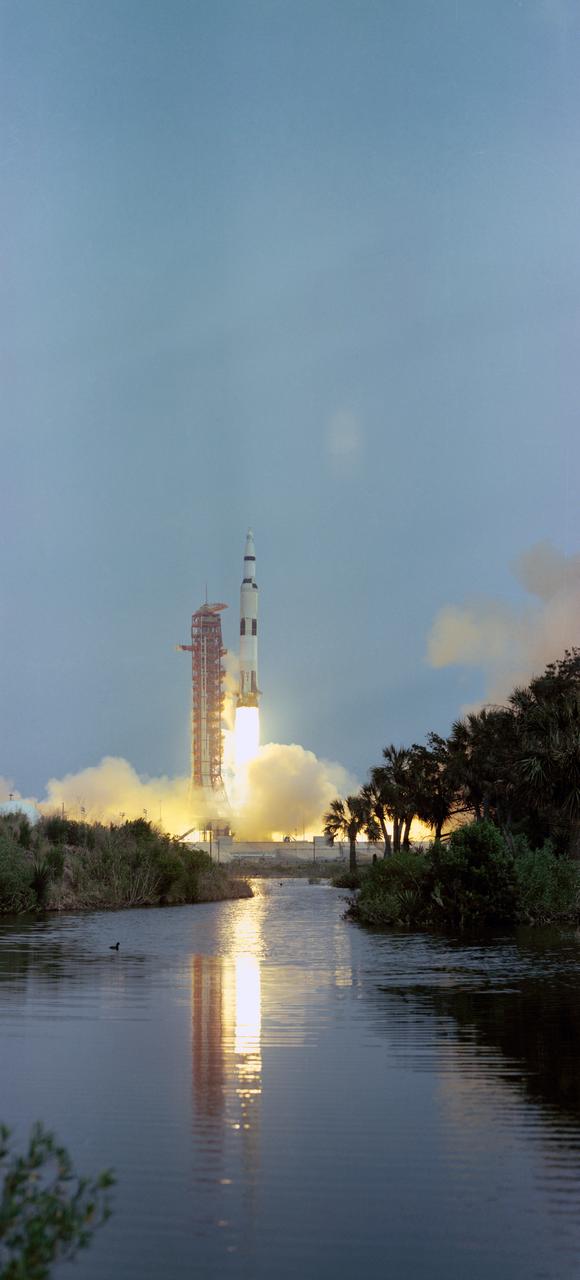
S69-34143 (18 May 1969) --- The Apollo 10 (Spacecraft 106/Lunar Module 4/Saturn 505) space vehicle is launched from Pad B, Launch Complex 39, Kennedy Space Center at 12:49 p.m. (EDT), May 18, 1969. Aboard the spacecraft are astronauts Thomas P. Stafford, commander; John W. Young, command module pilot; and Eugene A. Cernan, lunar module pilot. The eight-day, lunar orbit mission will mark the first time the complete Apollo spacecraft has operated around the moon and the second manned flight for the Lunar Module. Two Apollo 10 astronauts, Stafford and Cernan, are scheduled to descend within eight nautical miles of the moon's surface in the LM.
APOLLO X - LAUNCH - PAD 39B - KSC
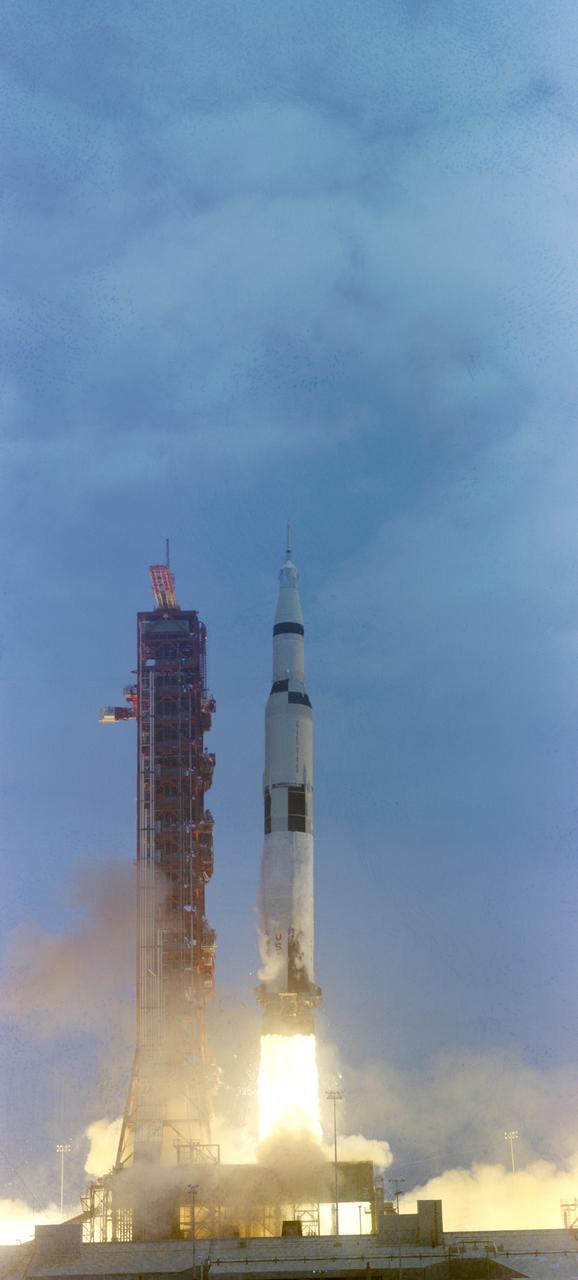
S70-38747 (11 April 1970) --The Apollo 13 (Spacecraft 109/Lunar Module 7/Saturn 508) space vehicle is launched from Pad A, Launch Complex 39, Kennedy Space Center (KSC), at 2:13 p.m. (EST), April 11, 1970. The crew of the National Aeronautics and Space Administration's (NASA) third lunar landing mission is astronauts James A. Lovell Jr., commander; John L. Swigert Jr., command module pilot; and Fred W. Haise Jr., lunar module pilot.
APOLLO 13 - LAUNCH - KSC
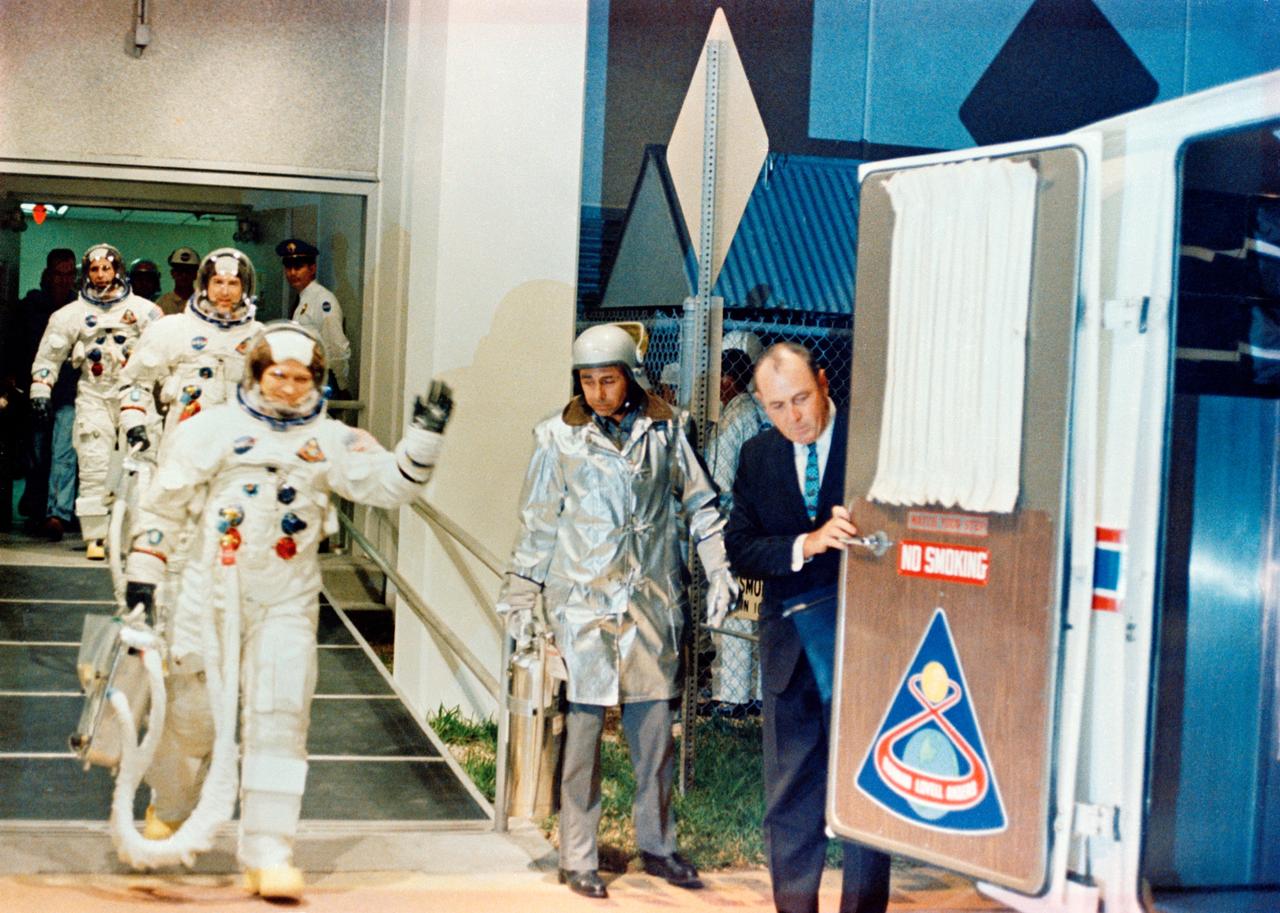
S68-55999 (21 Dec. 1968) --- The Apollo 8 crew leaves the Kennedy Space Center's (KSC) Manned Spacecraft Operations Building (MSOB) during the Apollo 8 prelaunch countdown. Astronaut Frank Borman (waving to well-wishers), commander, leads followed by astronauts James A. Lovell Jr., command module pilot; and William A. Anders, lunar module pilot. The crew is about to enter a special transfer van which transported them to Pad A, Launch Complex 39, where their Apollo 8 (Spacecraft 103/Saturn 503) space vehicle awaited them. Liftoff for the lunar orbit mission was at 7:51 a.m. (EST). Holding the door to the transfer van is Charles Buckley, KSC security chief.
APOLLO VIII - LAUNCH - KSC
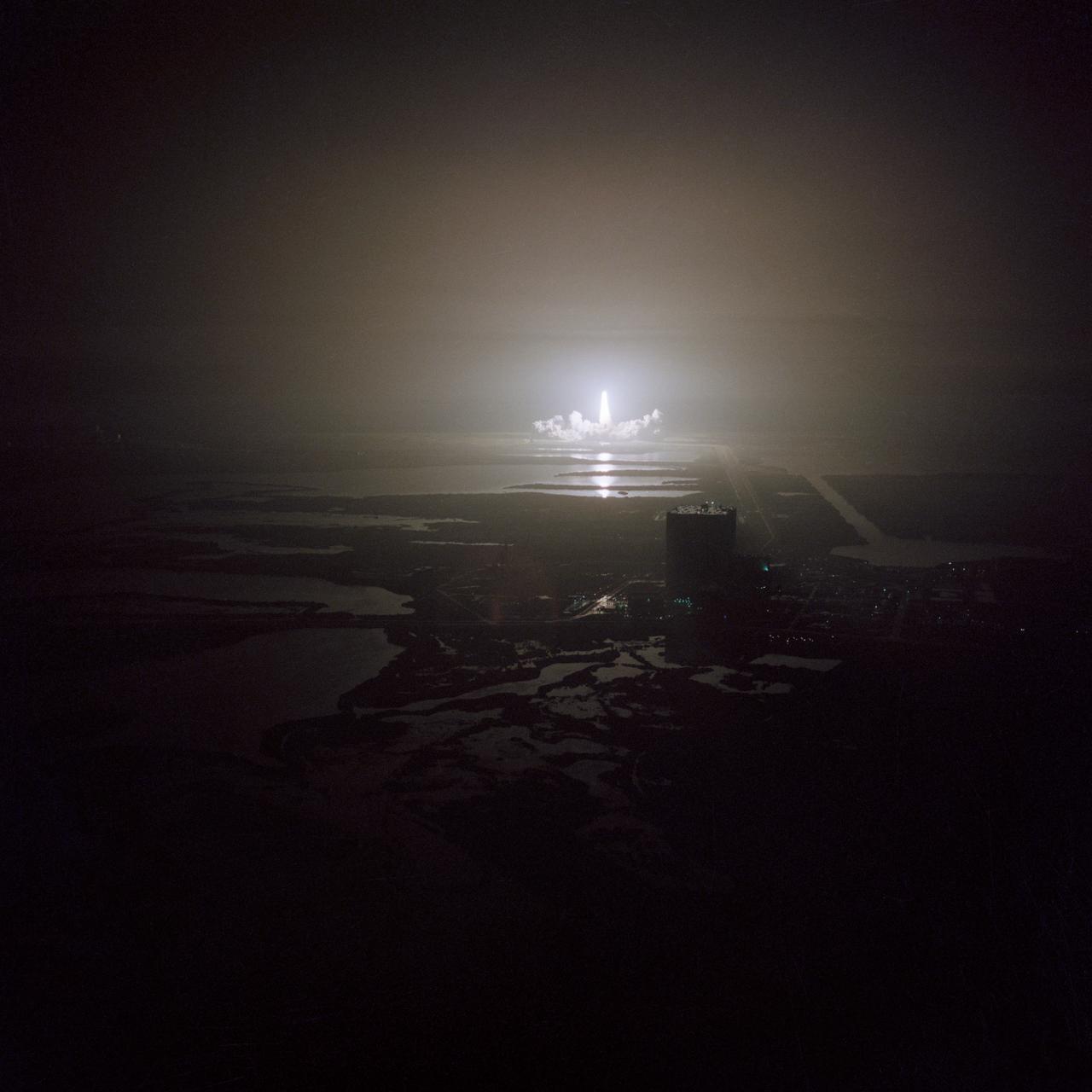
S83-39567 (30 Aug. 1983) --- The nighttime liftoff of the space shuttle Challenger casts a brilliant glow across the marshy Kennedy Space Center (KSC) landscape. This aerial view from west of the vehicle assembly building (VAB) shows the Challenger climbing toward space just after its 2:32 a.m. (EDT) launch to begin the STS-8 mission. Photo credit: NASA
LAUNCH - STS-8 - KSC
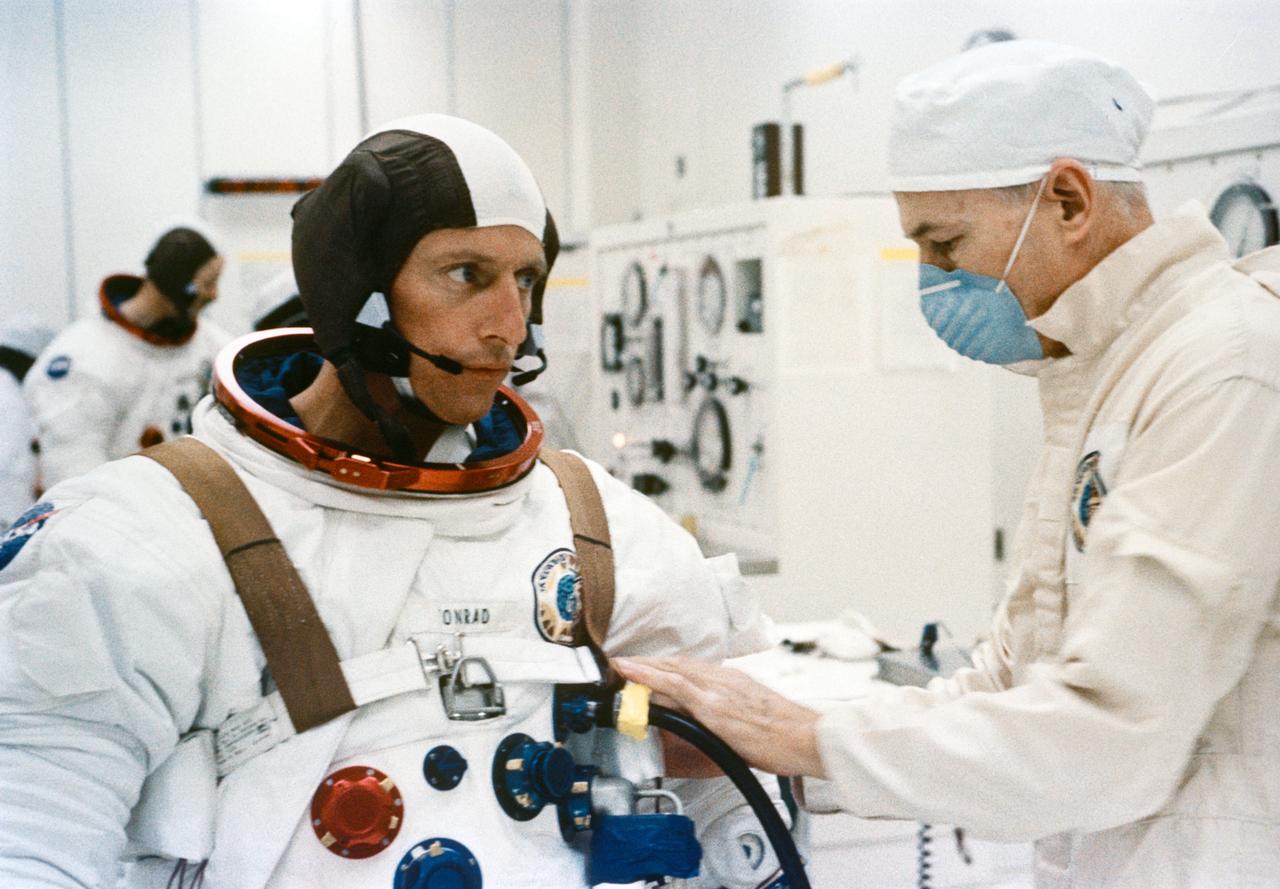
S73-25901 (25 May 1973) --- Astronaut Charles Conrad Jr., commander of the Skylab 2 mission, is suited up in the Manned Spacecraft Operations Building at the Kennedy Space Center during Skylab 2 prelaunch preparations. Skylab 2, with astronauts Conrad, Joseph P. Kerwin and Paul J. Weitz aboard, was launched from KSC's Pad B, Launch Complex 39, at 9:00 a.m. (EDT), May 25, 1973. Photo credit: NASA
LAUNCH PAD 39 - PRELAUNCH - KSC
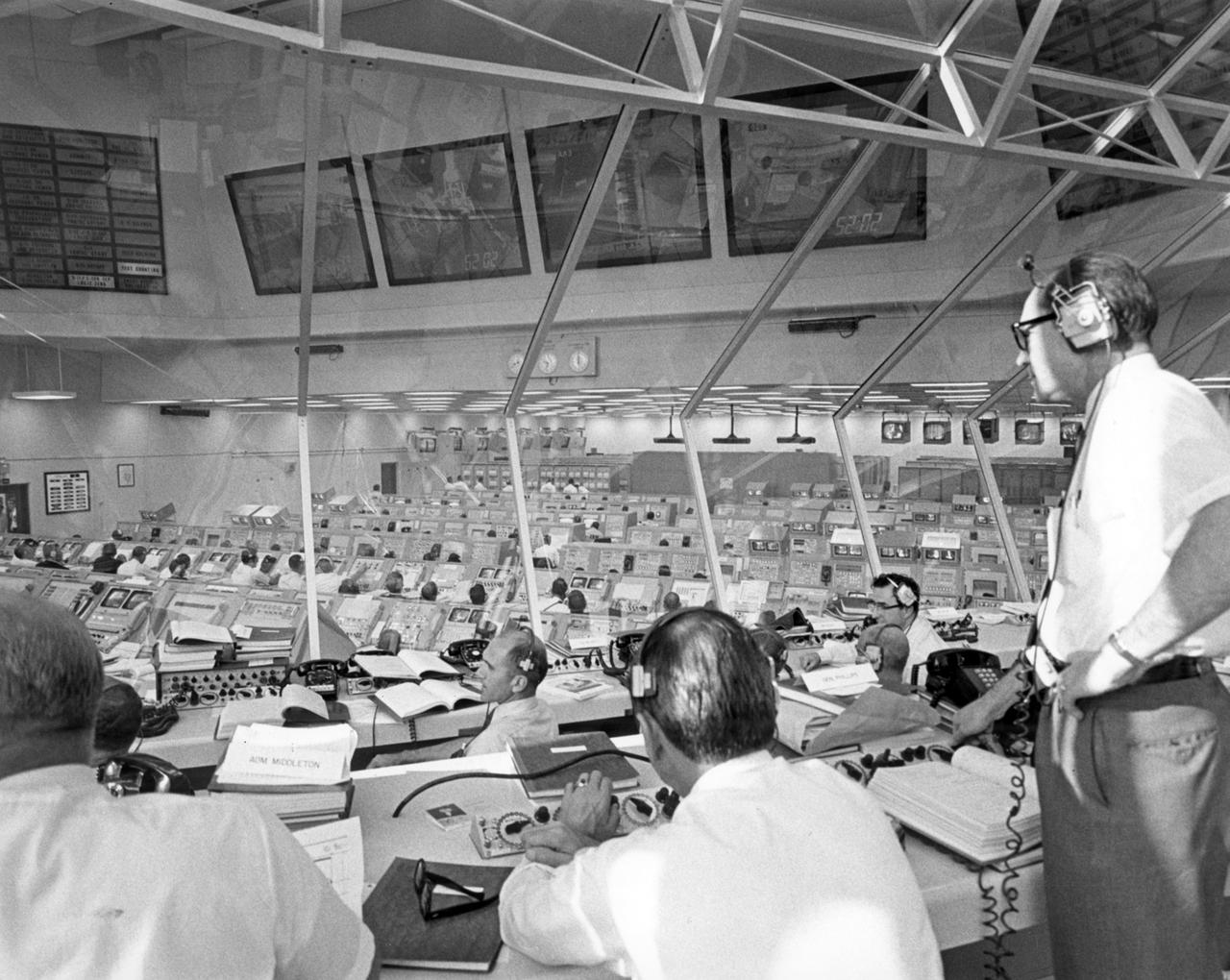
From the Kennedy Space Flight Center (KSC) control room, Apollo Program Director Lieutenant General Samuel C. Phillips monitors pre-launch activities for Apollo 11. The Apollo 11 mission, the first lunar landing mission, launched from the KSC in Florida via the Marshall Space Flight Center (MSFC) developed Saturn V launch vehicle on July 16, 1969 and safely returned to Earth on July 24, 1969. Aboard the space craft were astronauts Neil A. Armstrong, commander; Michael Collins, Command Module (CM) pilot; and Edwin E. (Buzz) Aldrin Jr., Lunar Module (LM) pilot. The CM, “Columbia”, piloted by Collins, remained in a parking orbit around the Moon while the LM, “Eagle’’, carrying astronauts Armstrong and Aldrin, landed on the Moon. On July 20, 1969, Armstrong was the first human to ever stand on the lunar surface, followed by Aldrin. During 2½ hours of surface exploration, the crew collected 47 pounds of lunar surface material for analysis back on Earth. With the success of Apollo 11, the national objective to land men on the Moon and return them safely to Earth had been accomplished.
Saturn Apollo Program
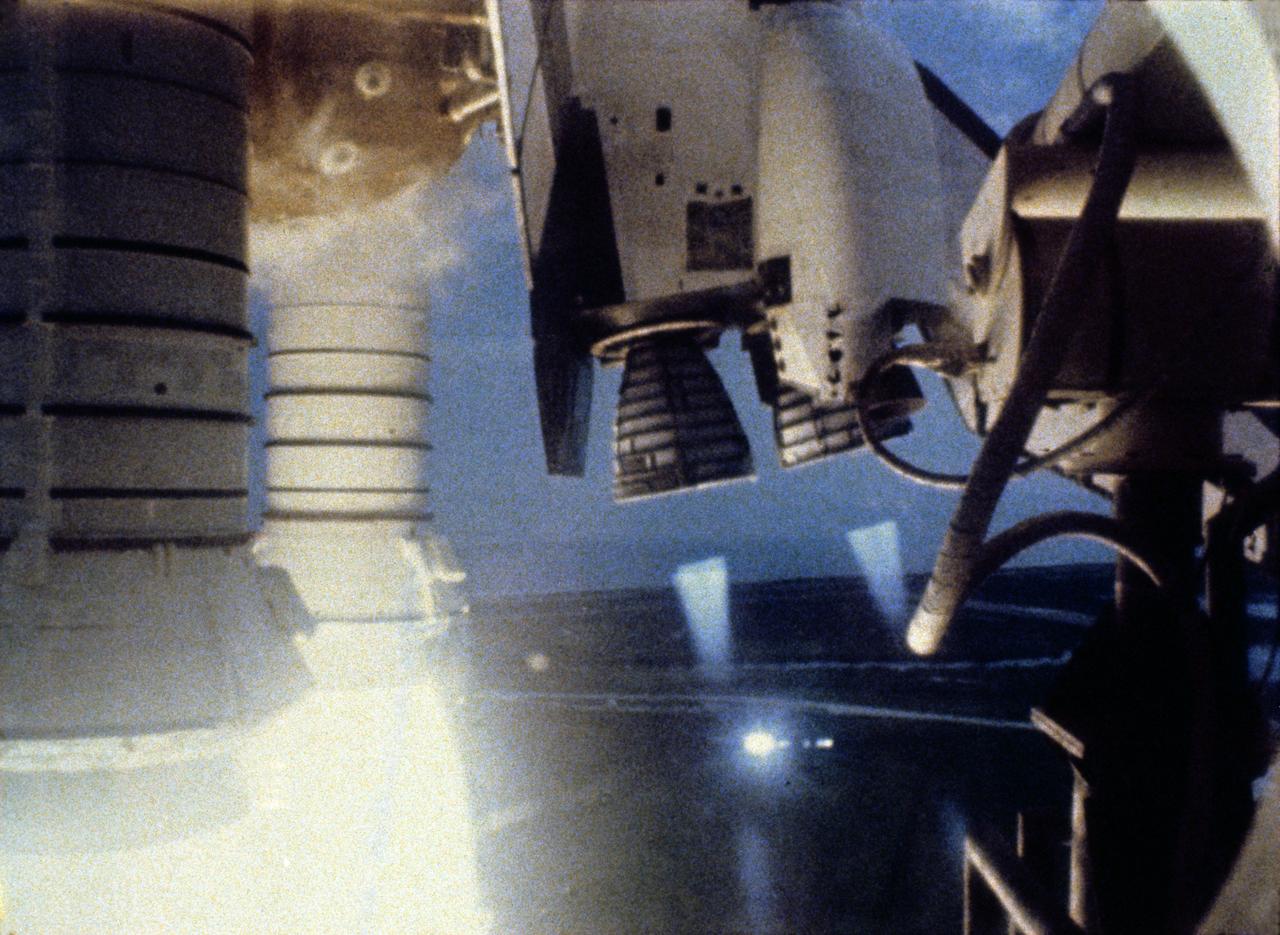
S82-28757 (22 March 1982) --- This close-up view featuring the space shuttle Columbia?s main engines and solid rocket boosters (SRB) was captured on video during the launch sequence for the STS-3 mission from NASA's Kennedy Space Center (KSC). Onboard were astronauts Jack R. Lousma, commander; and C. Gordon Fullerton, pilot. Photo credit: NASA
LAUNCH - STS-3 (ENGINES) - KSC
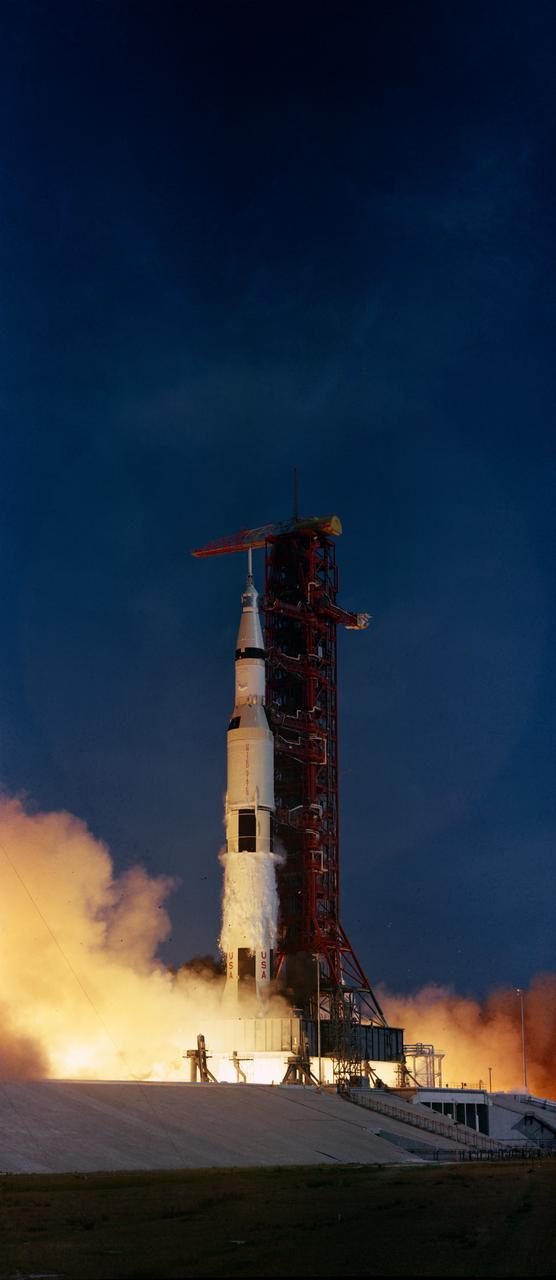
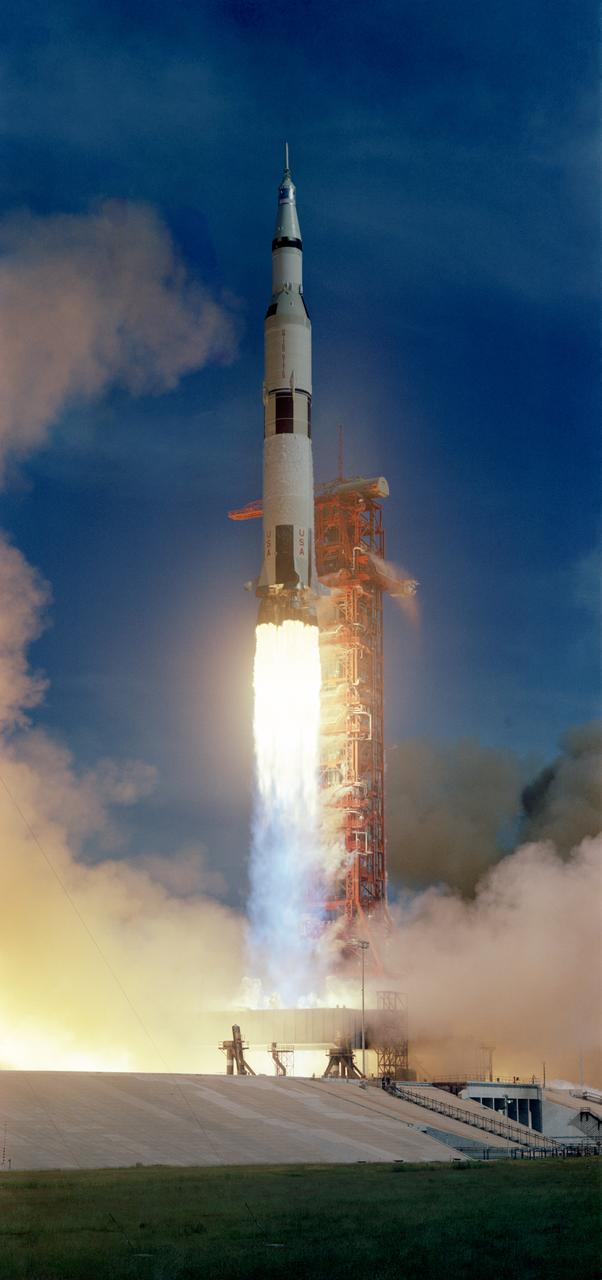
S69-39525 (16 July 1969) --- The huge, 363-feet tall Apollo 11 (Spacecraft 107/Lunar Module 5/Saturn 506) space vehicle is launched from Pad A, Launch Complex 39, Kennedy Space Center (KSC), at 9:32 a.m. (EDT), July 16, 1969. Onboard the Apollo 11 spacecraft were astronauts Neil A. Armstrong, commander; Michael Collins, command module pilot; and Edwin E. Aldrin Jr., lunar module pilot.  Apollo 11 is the United States first lunar landing mission. While astronauts Armstrong and Aldrin descend in the Lunar Module (LM) "Eagle" to explore the Sea of Tranquility region of the moon, astronaut Collins will remain with the Command and Service Modules (CSM) "Columbia" in lunar orbit.
APOLLO XI - LAUNCH - KSC
S69-39526 (16 July 1969) --- The huge, 363-feet tall Apollo 11 (Spacecraft 107/Lunar Module 5/Saturn 506) space vehicle is launched from Pad A, Launch Complex 39 Kennedy Space Center (KSC), at 9:32 a.m. (EDT), July 16, 1969. Onboard the Apollo 11 spacecraft were astronauts Neil A. Armstrong, commander; Michael Collins, command module pilot; and Edwin E. Aldrin Jr., lunar module pilot.  Apollo 11 is the United States first lunar landing mission. Astronauts Armstrong and Aldrin will descend in the Lunar Module (LM) "Eagle" to explore the Sea of Tranquility region of the moon, while astronaut Collins remains with the Command and Service Modules (CSM) "Columbia" in lunar orbit.
APOLLO XI - LAUNCH - KSC
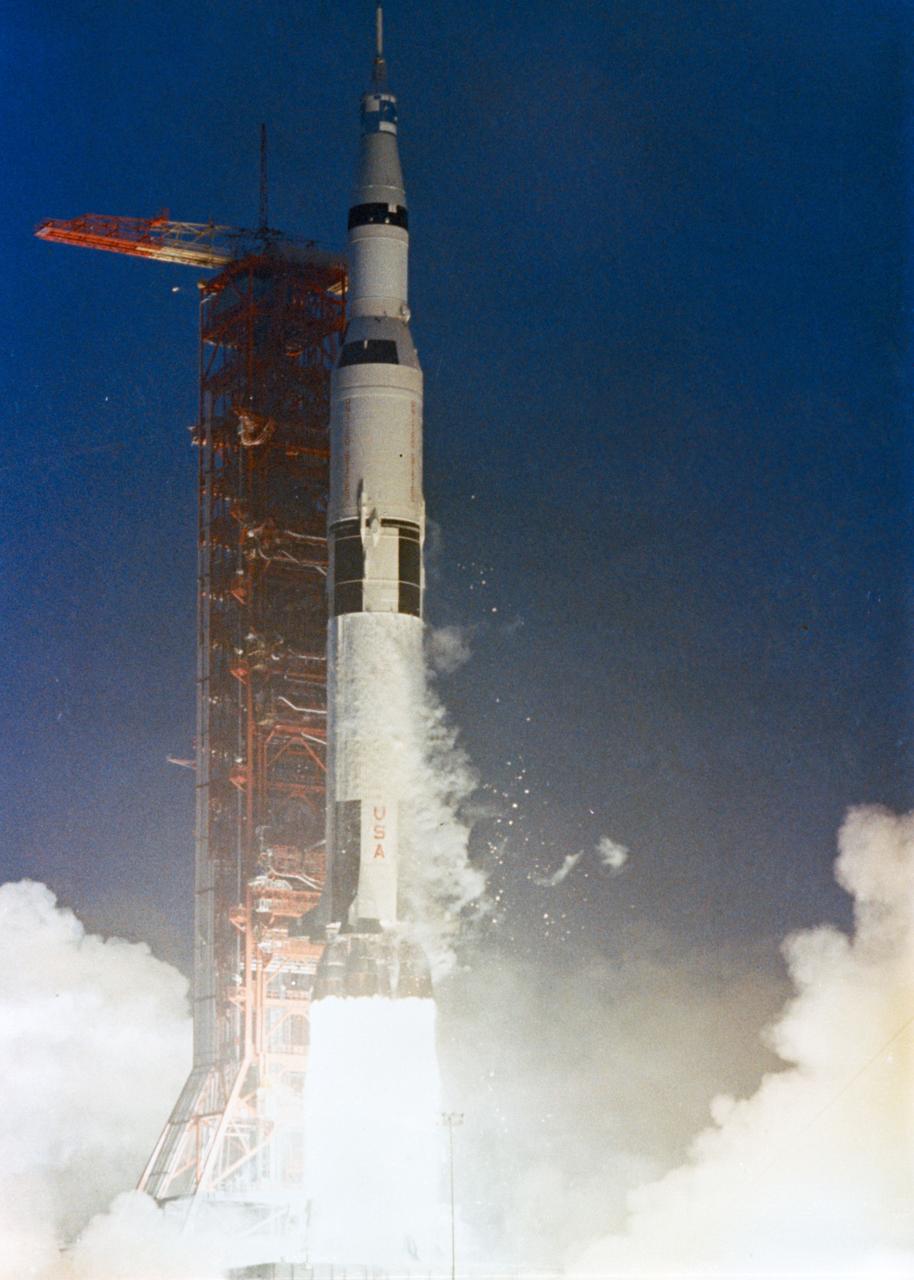
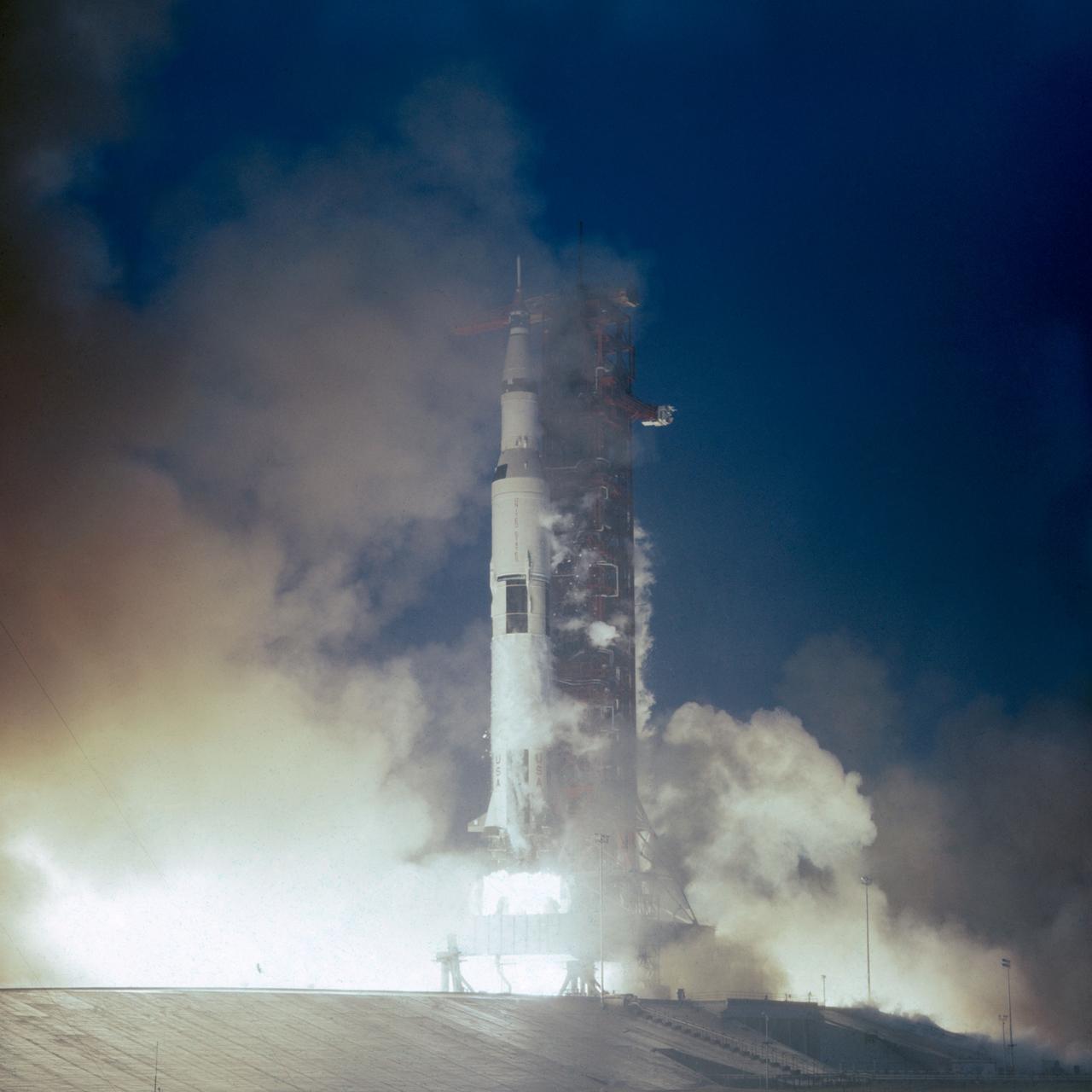
S69-58879 (14 Nov. 1969) --- The huge, 363-feet tall Apollo 12 (Spacecraft 108/Lunar Module 6/Saturn 507) space vehicle is launched from Pad A, Launch Complex 39, Kennedy Space Center (KSC), at 11:22 a.m. (EST), Nov. 14, 1969. Aboard the Apollo 12 spacecraft were astronauts Charles Conrad Jr., commander; Richard F. Gordon Jr., command module pilot, and Alan L. Bean, lunar module pilot. Apollo 12 is the United States' second lunar landing mission.
APOLLO XII - LAUNCH DAY ACTIVITIES - LAUNCH COMPLEX 39A - KSC
S69-58884 (14 Nov. 1969) --- The huge, 363-feet tall Apollo 12 (Spacecraft 108/Lunar Module 6/Saturn 507) space vehicle is launched from Pad A, Launch Complex 39, Kennedy Space Center (KSC), at 11:22 a.m. (EST), Nov. 14, 1969. Aboard the Apollo 12 spacecraft were astronauts Charles Conrad Jr., commander; Richard F. Gordon Jr., command module pilot; and Alan L. Bean, lunar module pilot. Apollo 12 is the United States' second lunar landing mission.
APOLLO XII - LAUNCH DAY ACTIVITIES - LAUNCH COMPLEX 39A - KSC
S69-58883 (14 Nov. 1969) --- The huge, 363-feet tall Apollo 12 (Spacecraft 108/Lunar Module 6/Saturn 507) space vehicle is launched from Pad A, Launch Complex 39, Kennedy Space Center (KSC), at 11:22 a.m. (EST), Nov. 14, 1969. Aboard the Apollo 12 spacecraft were astronauts Charles Conrad Jr., commander; Richard F. Gordon Jr., command module pilot; and Alan L. Bean, lunar module pilot. Apollo 12 is the United States' second lunar landing mission.
APOLLO XII - LAUNCH DAY ACTIVITIES - LAUNCH COMPLEX 39A - KSC
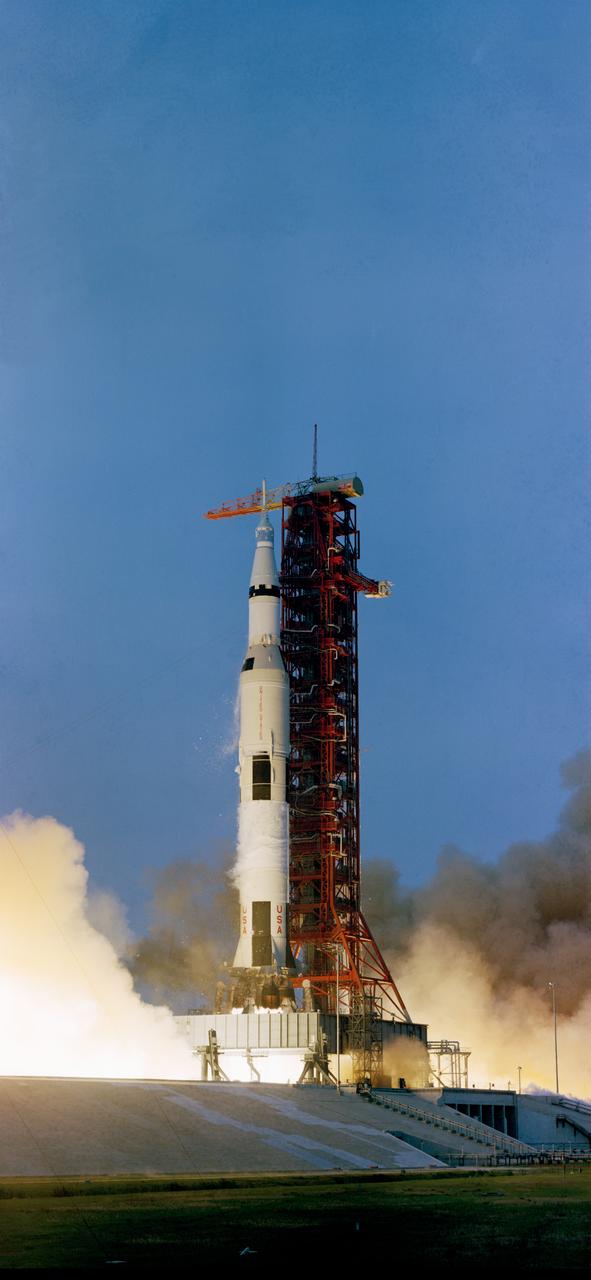
S70-34852 (11 April 1970) --- The Apollo 13 (Spacecraft 109/Lunar Module 7/Saturn 508) space vehicle is launched from Pad A Launch Complex 39, Kennedy Space Center (KSC), at 2:13 p.m. (EST), April 11, 1970.  The crew of the National Aeronautics and Space Administration's (NASA) third lunar landing mission are astronauts James A. Lovell Jr., commander; John L. Swigert Jr., command module pilot; and Fred W. Haise Jr., lunar module pilot.
LAUNCH - APOLLO 13 - LUNAR LANDING MISSION - KSC
S70-34855 (11 April 1970) --- The Apollo 13 (Spacecraft 109/Lunar Module 7/Saturn 508) space vehicle is launched from Pad A, Launch Complex 39, Kennedy Space Center (KSC), at 2:13 p.m. (EST), April 11, 1970.  The crew of the National Aeronautics and Space Administration's (NASA) third lunar landing mission are astronauts James A., Lovell Jr., commander; John L. Swigert Jr., command module pilot; and Fred W. Haise Jr., lunar module pilot.
LAUNCH - APOLLO XIII - LUNAR LANDING MISSION - KSC
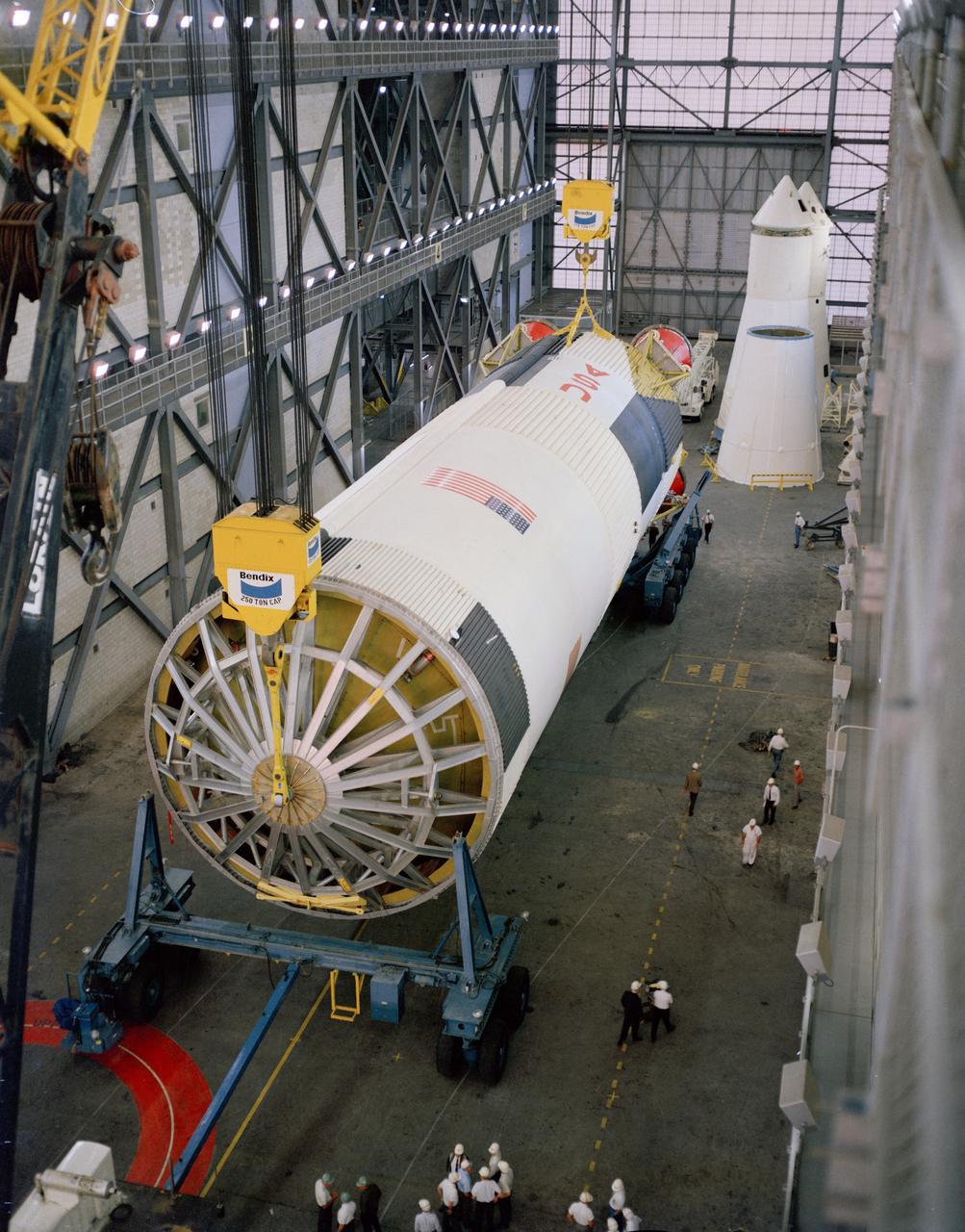
S68-55034 (3 Dec. 1968) --- The first (S-1C) stage of the Saturn 505 launch vehicle being prepared for erection in the high bay area of the Kennedy Space Center's (KSC) Vehicle Assembly Building (VAB). Saturn 505 is the launch vehicle for the Apollo 10 mission.
First stage of Saturn launch vehicle in KSC Vehicle Assembly Building
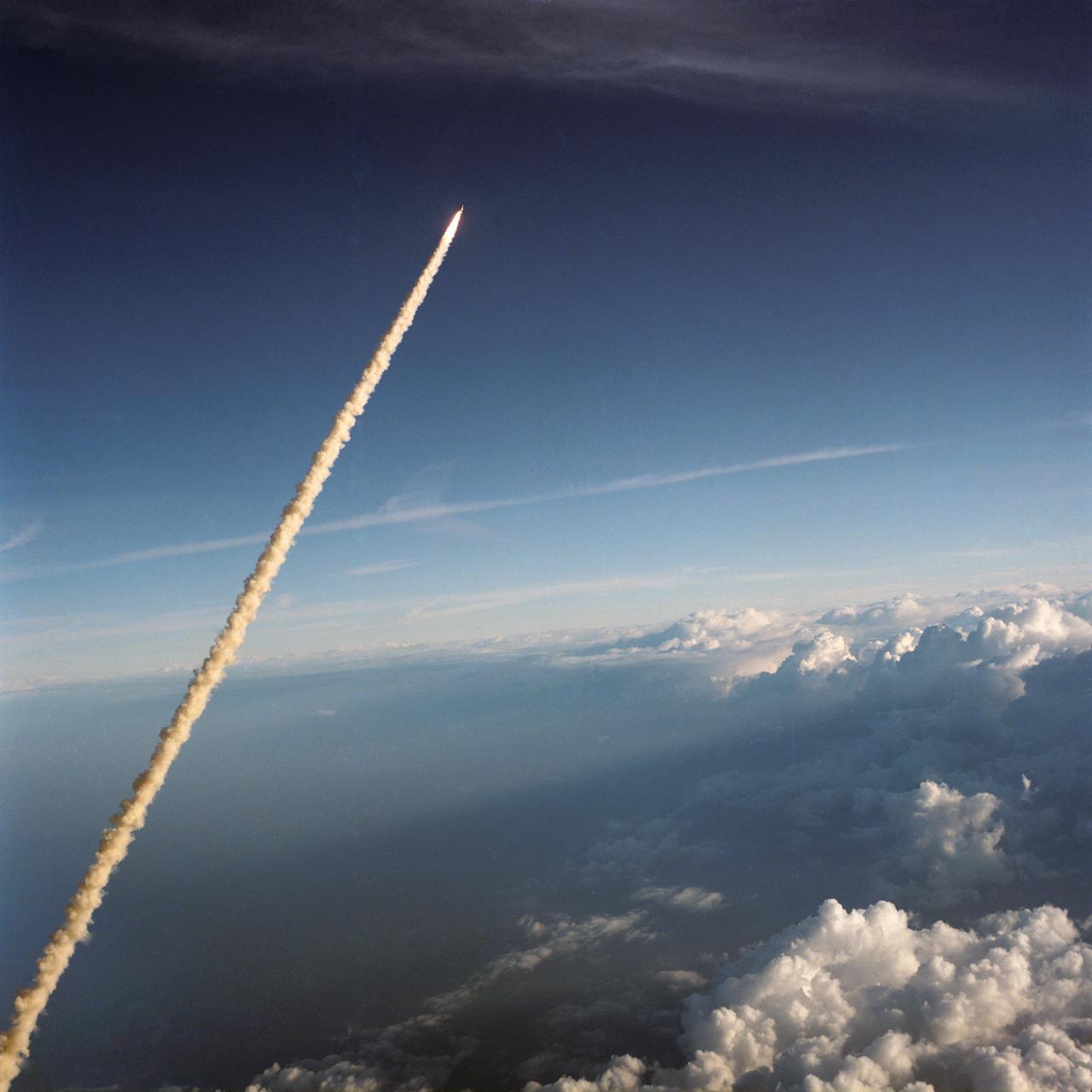
S84-26294 (3 Feb 1984) --- This scenic panorama of billowy clouds over the Atlantic and Florida and the contrasting addition of mankind's technology into the picture was provided by astronaut John W. Young and a handheld camera in the cockpit of NASA's Shuttle Training Aircraft (STA) moments after the 226 tons of spacecraft hardware were lifted off Kennedy Space Center's (KSC) Launch Pad 39A.  Inside the Space Shuttle Challenger (STS 41-B), attached here to its two Solid Rocket Boosters (SRB) and External Fuel Tank (ET), were astronauts Vance D. Brand, Robert L. Gibson, Ronald E. McNair, Bruce McCandless II and Robert L. Stewart.
LAUNCH - STS-11/41B - KSC
S81-39549 (12 Nov. 1981) --- Framed here by Florida vegetation, the 37-meter-tall (122 feet) NASA space shuttle Columbia lifts off from Launch Pad 39A at NASA-Kennedy Space Center (KSC). Astronauts Joe H. Engle and Richard H. Truly begin the second space shuttle (STS-2) flight with at least two new items of cargo aboard. One is a collection of experiments developed by the Office of Space and Terrestrial Applications (OSTA) and another is a robot arm with in-space/in-cabin controls known as the remote manipulator system (RMS). Liftoff took place just a few seconds past 10:10 a.m. EST on Nov. 12, 1981. Photo credit: NASA
STS-2 LAUNCH - KSC
S69-58885 (14 Nov. 1969) --- Interior view of the White Room atop Pad A, Launch Complex 39, Kennedy Space Center (KSC), during the insertion of the Apollo 12 crew. In the center background preparing to ingress the spacecraft is astronaut Charles Conrad Jr., commander. Astronaut Alan L. Bean, lunar module pilot, stands in the right foreground. Awaiting his turn to ingress, but out of view, is astronaut Richard F. Gordon Jr., command module pilot. The Apollo 12 is the United States' second lunar landing mission.
APOLLO XII - LAUNCH DAY ACTIVITIES - LAUNCH COMPLEX 39A - KSC
S69-58881 (14 Nov. 1969) --- The three Apollo 12 crew men leave the Kennedy Space Center's (KSC) Manned Spacecraft Operations Building (MSOB) during the Apollo 12 prelaunch countdown. Leading is astronaut Charles Conrad Jr., commander; followed by astronauts Richard F. Gordon Jr., command module pilot; and Alan L. Bean, lunar module pilot. They rode a special transport van over the Pad A, Launch Complex 39, where their spacecraft awaited. The Apollo 12 liftoff occurred at 11:22 a.m. (EST), Nov. 14, 1969. Apollo 12 is the United States' second lunar landing mission.
APOLLO XII - LAUNCH DAY ACTIVITIES - LAUNCH COMPLEX 39A - KSC
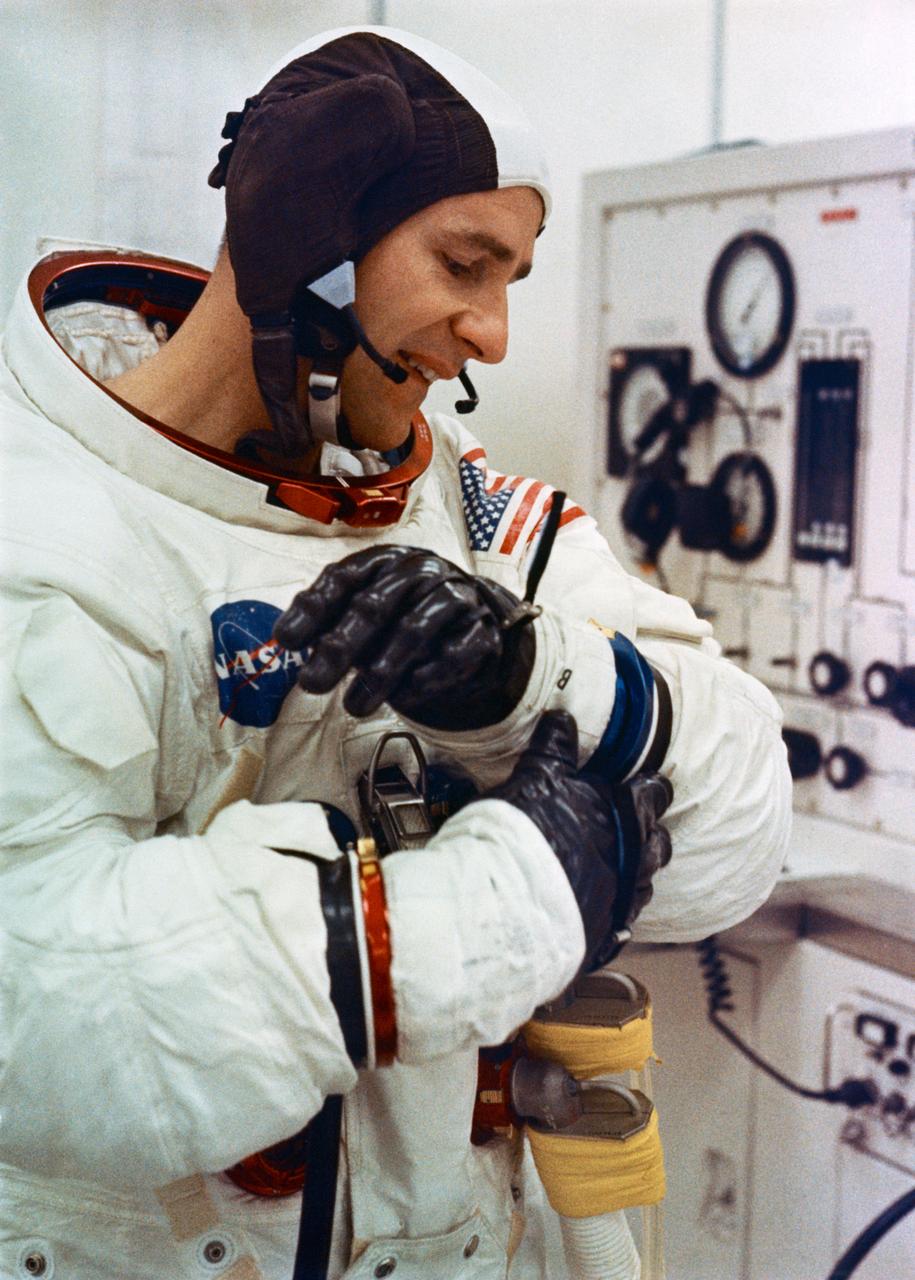
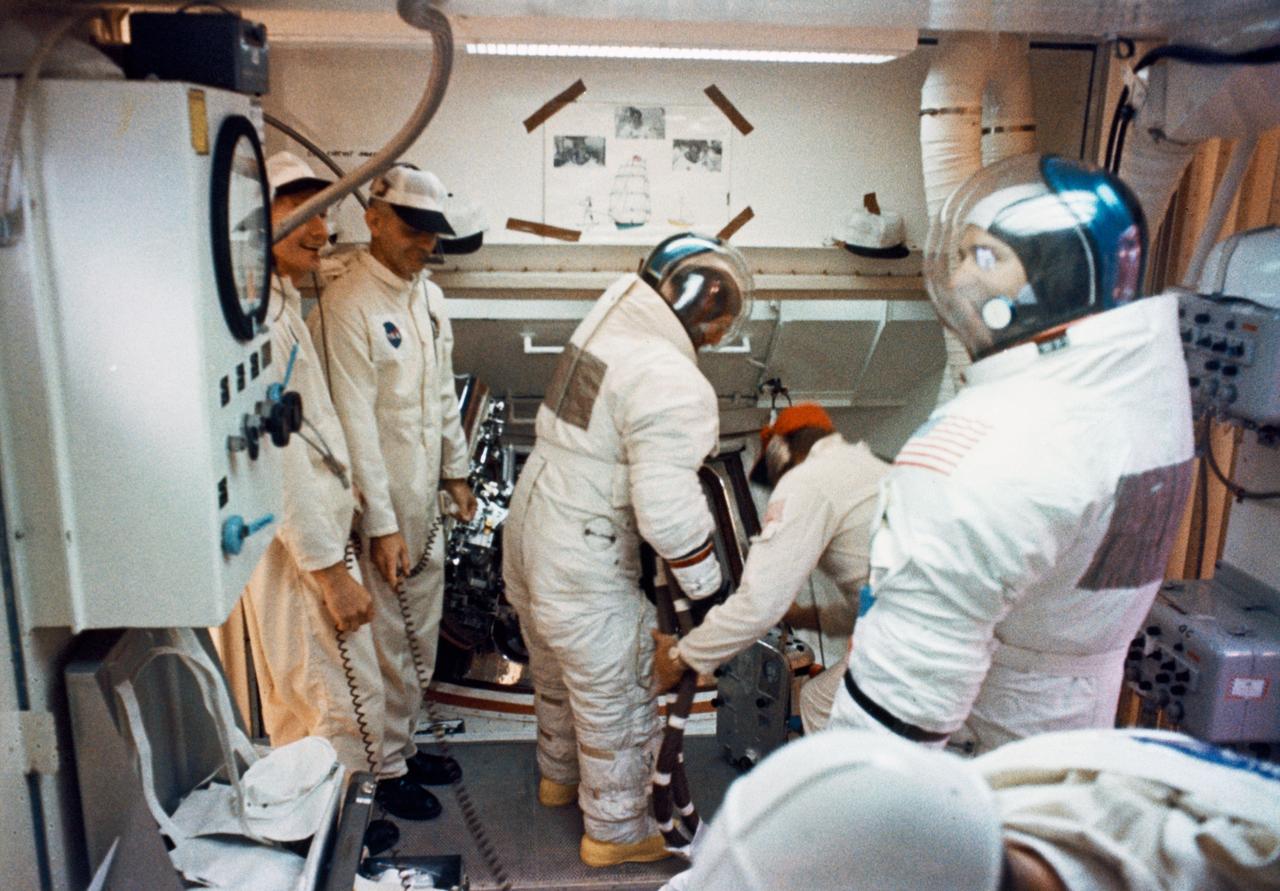
S69-58880 (14 Nov. 1969) --- Astronaut Alan L. Bean, Apollo 12 lunar module pilot, suits up in the Kennedy Space Center's (KSC) Manned Spacecraft Operations Building during the Apollo 12 prelaunch countdown. Minutes later astronauts Bean; Charles Conrad Jr., commander; and Richard F. Gordon Jr., command module pilot, rode a special transport van over to Pad A, Launch Complex 39, where their spacecraft awaited. The Apollo 12 liftoff occurred at 11:22 a.m. (EST), Nov. 14, 1969. Apollo 12 is the United States' second lunar landing mission.
APOLLO XII - LAUNCH DAY ACTIVITIES - LAUNCH COMPLEX 39A - KSC
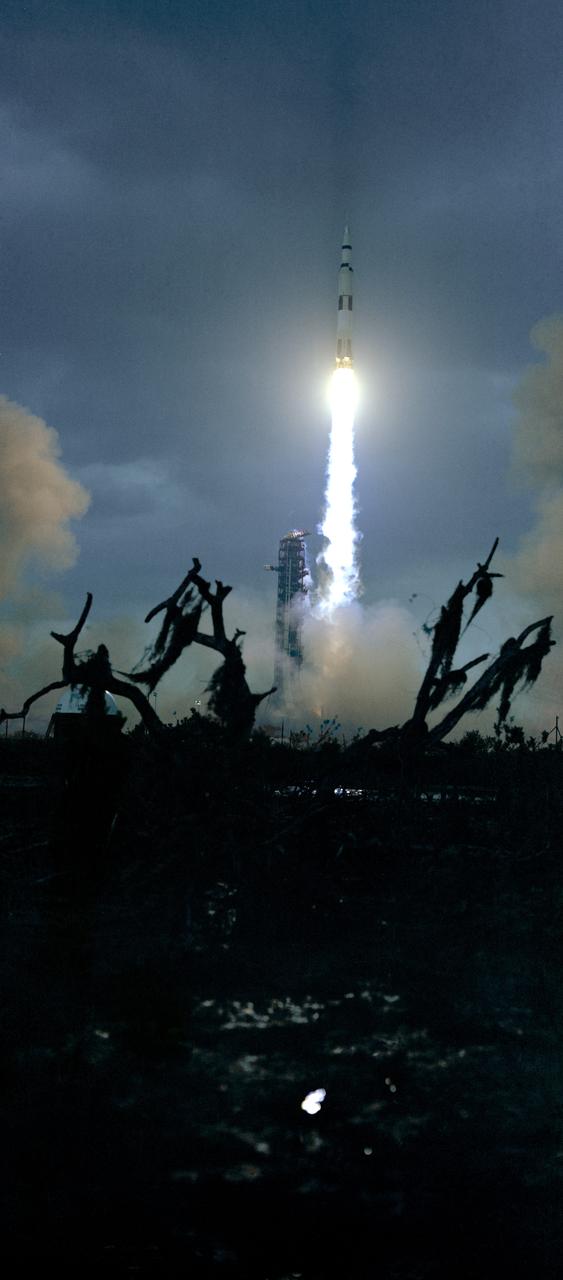
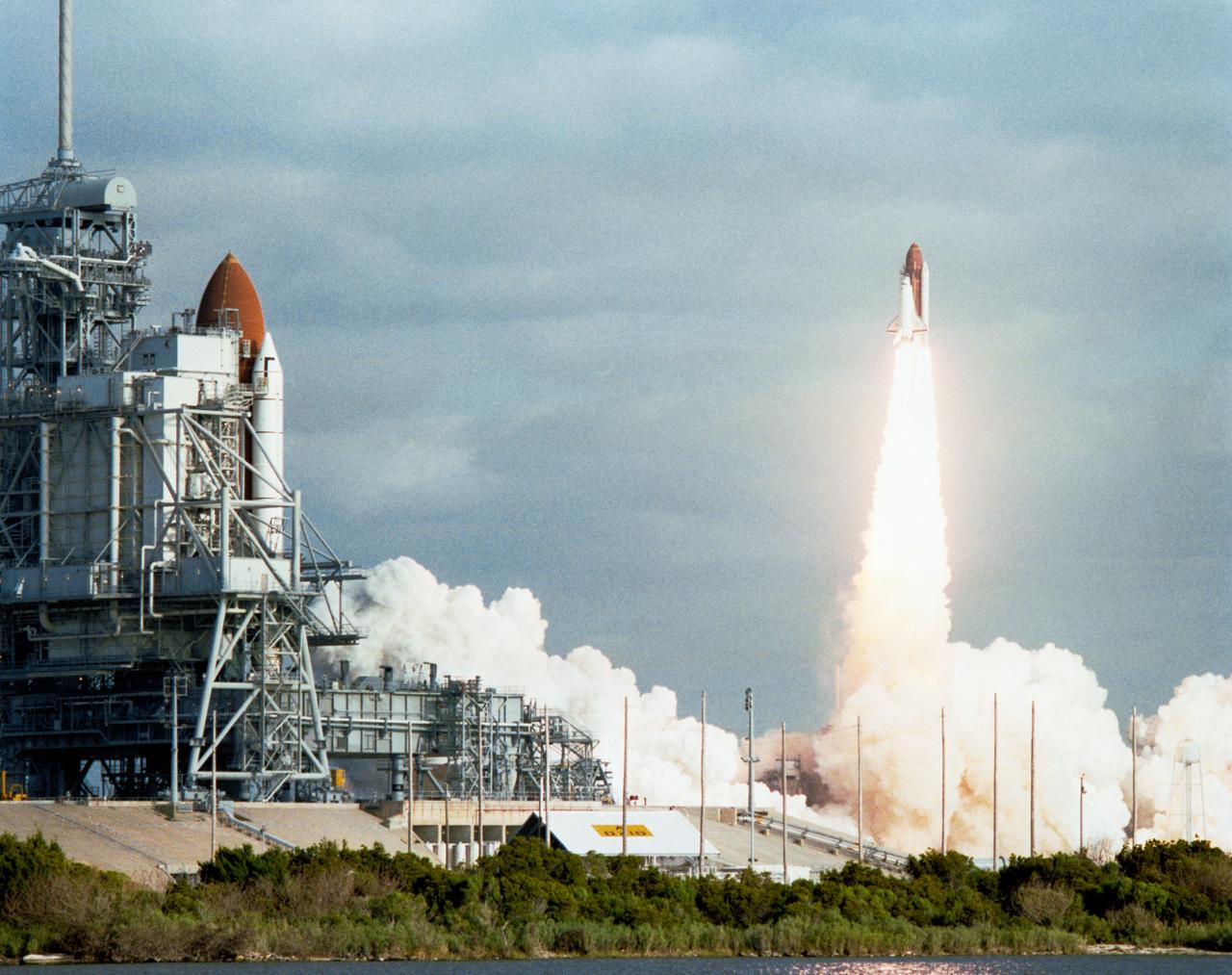
S71-18398 (31 Jan. 1971) --- The huge, 363-feet tall Apollo 14 (Spacecraft 110/Lunar Module 8/Saturn 509) space vehicle is launched from Pad A, Launch Complex 39, Kennedy Space Center (KSC), Florida at 4:03:02 p.m. (EST), Jan. 31, 1971, on a lunar landing mission. This view is framed by moss-covered dead trees in the dark foreground. Aboard the Apollo 14 spacecraft were astronauts Alan B. Shepard Jr., commander; Stuart A. Roosa, command module pilot; and Edgar D. Mitchell, lunar module pilot.
Launch - Apollo XIV - Lunar Landing Mission - KSC
S83-35702 (18 June 1983) --- The seventh launch of the NASA Space Transportation System and the second lift-off of the space shuttle Challenger occurred at 7:33 a.m. (EDT) today from the Pad 39A launch site, at the Kennedy Space Center (KSC). The six-day mission will be highlighted by the first direct landing from space by an orbiter to the Shuttle Landing Facility (SLF). The crew consists of astronauts Robert Crippen, commander, the first two-time space shuttle astronaut; Frederick H. Hauck, pilot; and three mission specialists --  Sally K. Ride, John M. Fabian and  Norman E. Thagard. During the mission the crew will deploy the Indonesian PALAPA-B and the Canadian ANIK-C communications satellites. They will also use the Remote Manipulator System (RMS) arm to deploy and retrieve a platform for space experiments called the Shuttle Pallet Satellite (SPAS), and serve as a spaceborne laboratory for OSTA-2, a scientific payload. Getaway Special canisters and materials processing experiments will fill out the complement of payloads on the mission. Photo credit: NASA
LAUNCH - STS-7 - KSC
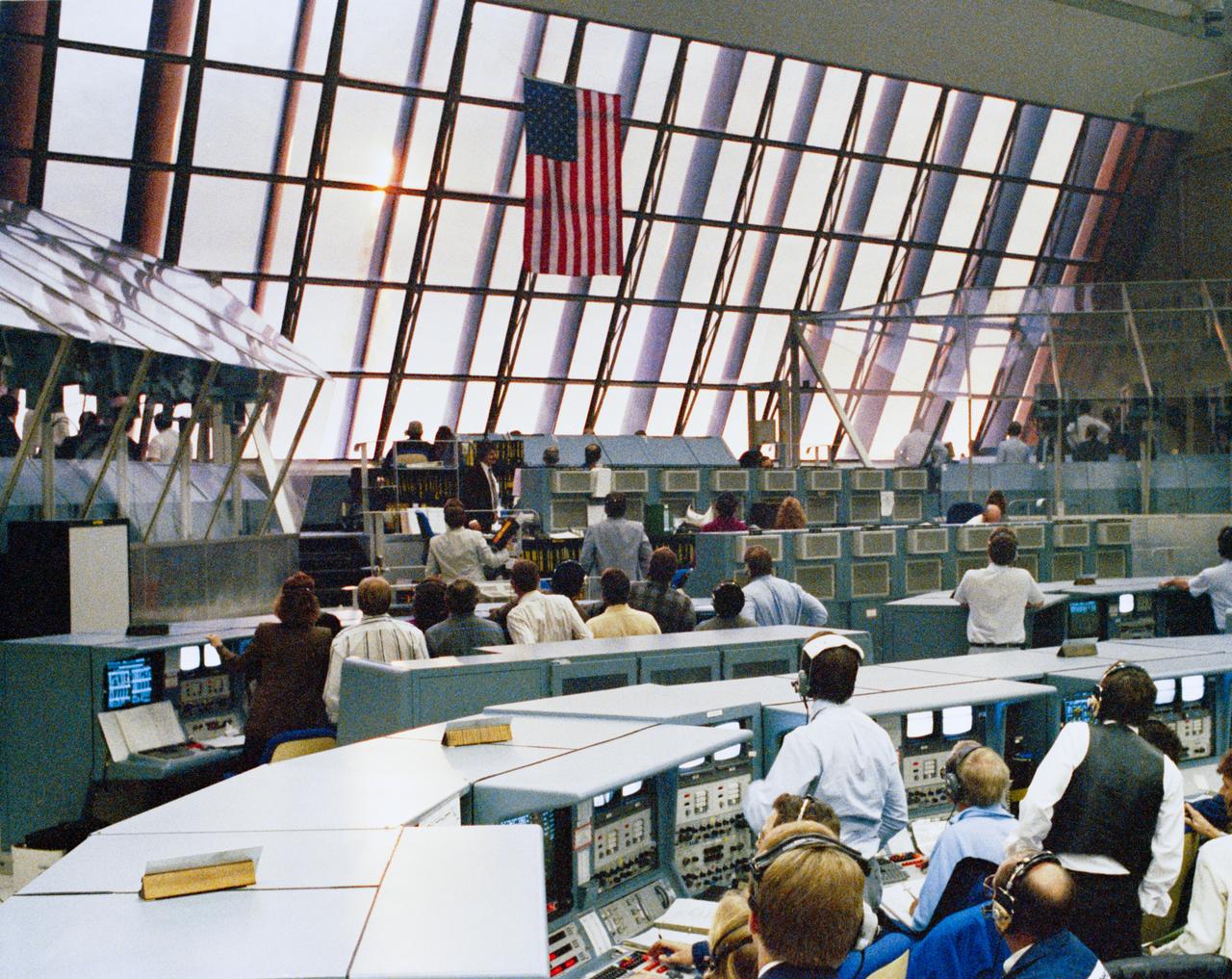
S90-29047 99Jan 1990) --- At the conclusion of another successful countdown, members of the KSC launch team in Firing Room 1 rivet their eyes on the skies to the east of the Launch Control Center. Their reward was a glimpse of Columbia burning its way upward up from Complex 39's Pad A. The brilliant flame of the boosters hurled shadows and patches of light into the firing room's interior.  Launch of the STS-32 mission at 7:35 a.m. EST today marked the beginning of a busy year which could see the launch of as many as 10 missions.
KSC Launch Control Center (LCC) Firing Room 1 during STS-32 launch
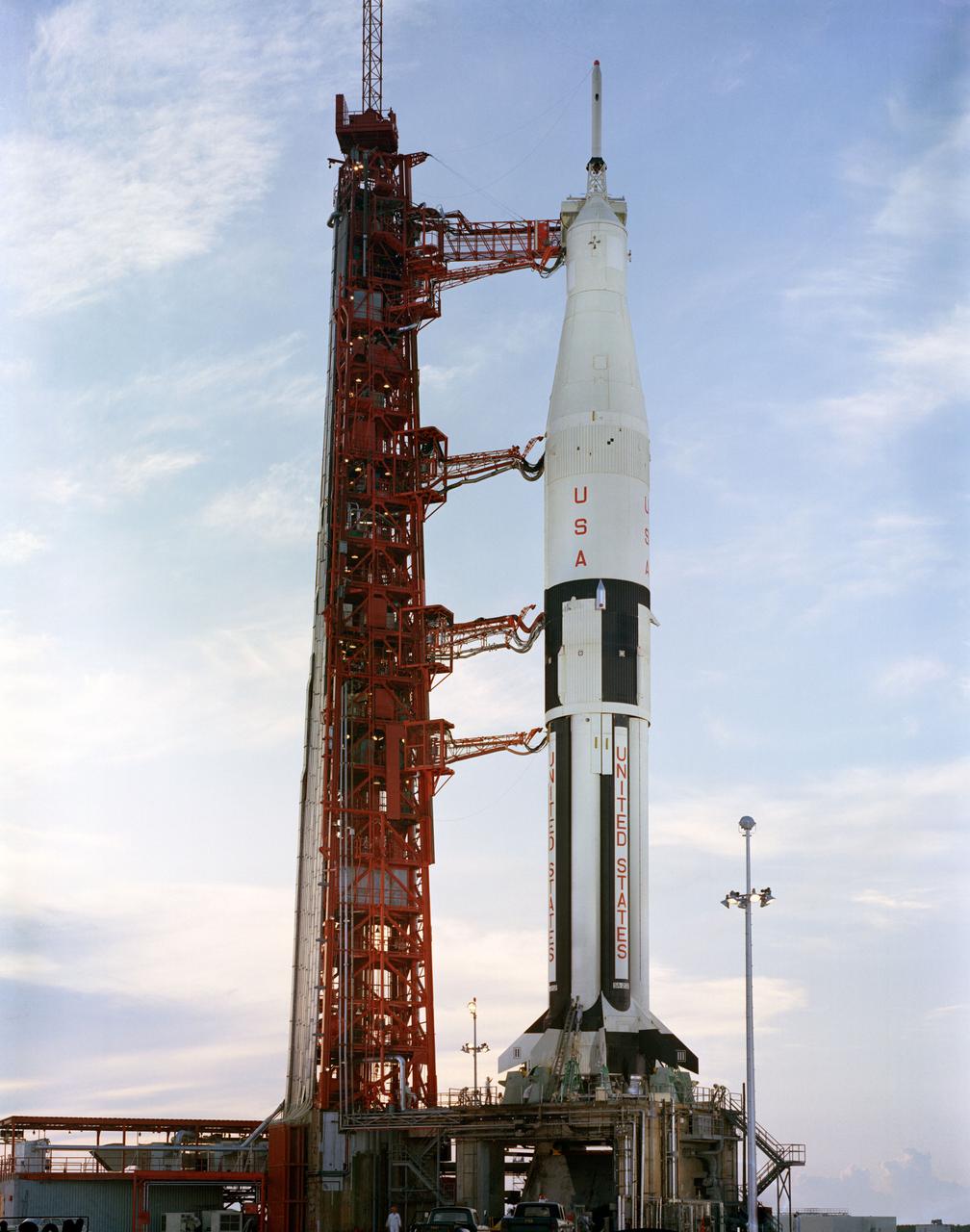
Scene at the LC-34 during an A/S 202 Prelaunch Alert. The mission was a step toward qualifying the Apollo Command and Service Modules (CSM) and the uprated Saturn I Launch Vehicle for manned flight.         KSC, FL
LAUNCH COMPLEX (LC)-34 - APOLLO-SATURN (A/S) MISSION 202 - PRELAUNCH ALERT - KSC
S84-26325 (3 Feb. 1984) --- Beginning a busy year, NASA's space shuttle Challenger, attached to two solid rocket boosters and an external fuel tank which it will later jettison, blasts off from Pad A at Kennedy Space Center's Launch Complex 39 at 8:00 a.m.  (EST), Feb. 3, 1984. Inside the spacecraft are astronauts Vance D. Brand, Robert L. Gibson, Bruce McCandless II, Ronald E. McNair and Robert L. Stewart. Brand is making his first trip in the Challenger but his second STS flight and third spaceflight overall. The rest of the crew members are experiencing space travel for the first time. Marking a space first, this flight will be landing at KSC. Photo credit: NASA
LAUNCH - STS-11/41B - KSC
S84-26327 (3 Feb. 1984) --- Beginning a busy year, NASA's space shuttle Challenger, attached to two solid rocket boosters and an external fuel tank which it will later jettison, blasts off from Pad A at Kennedy Space Center's Launch Complex 39 at 8:00 a.m. (EST), Feb. 3, 1984. Inside the STS 41-B spacecraft are astronauts Vance D. Brand, Robert L. Gibson, Bruce McCandless II, Ronald E. McNair and Robert L. Stewart. Brand is making his first trip in the Challenger but his second STS flight and third spaceflight overall. The rest of the crew members are experiencing space travel for the first time. Marking a space first, this flight will be landing at KSC. Photo credit: NASA
LAUNCH - STS-11/41B - KSC
STS071-S-005 (27 June 1995) --- At the Kennedy Space Center's (KSC) Launch Pad 39A, the 100th United States human space launch gets underway at 3:32:19 p.m. (EDT) on June 27, 1995.  Onboard Atlantis are five NASA astronauts and two Russian cosmonauts.  In two days, the crew will join up with astronaut Norman E. Thagard and two Russian cosmonauts who have been onboard Russia's Mir Space Station since March of this year.  That pair - Vladimir N. Dezhurov and Gennadiy M. Strekalov - will return to Earth aboard the Space Shuttle Atlantis with Thagard and the short-term visitors, while Anatoly Y. Solovyev and Nikolai M. Budarin - the two cosmonauts launched today aboard the Space Shuttle Atlantis - will remain aboard Mir for a longer tour of duty.
Launch of the STS-71 orbiter Atlantis from KSC
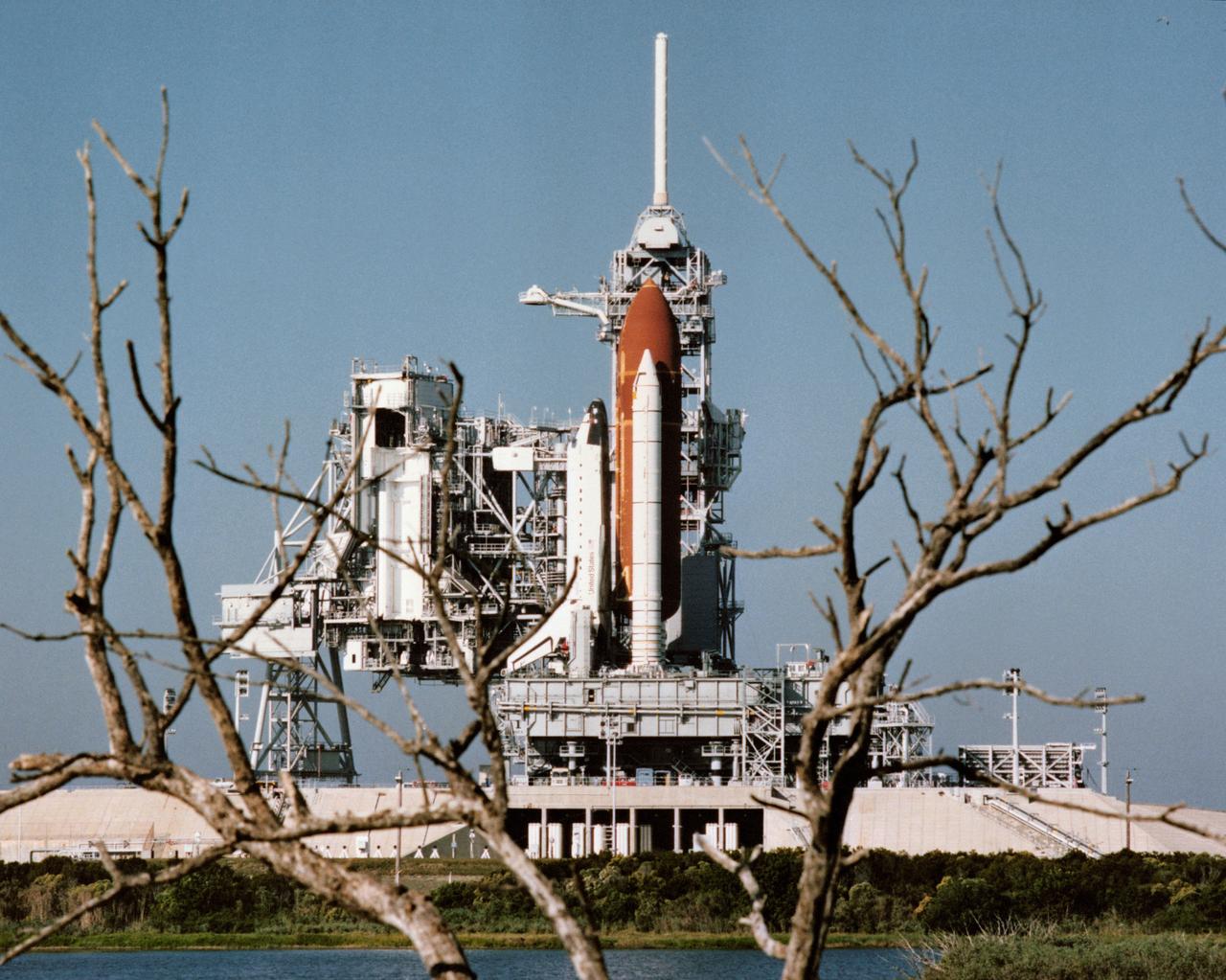
S88-52659 (2 Nov 1988)  --- The Space Shuttle Atlantis on Launch Pad 39B at KSC following the roll-out process from the vehicle assembly building.  It will undergo final checkouts and evaluations prior to its launch for the STS 27 mission late this month.
STS-27 Atlantis, Orbiter Vehicle (OV) 104, at KSC Launch Complex (LC) pad 39B
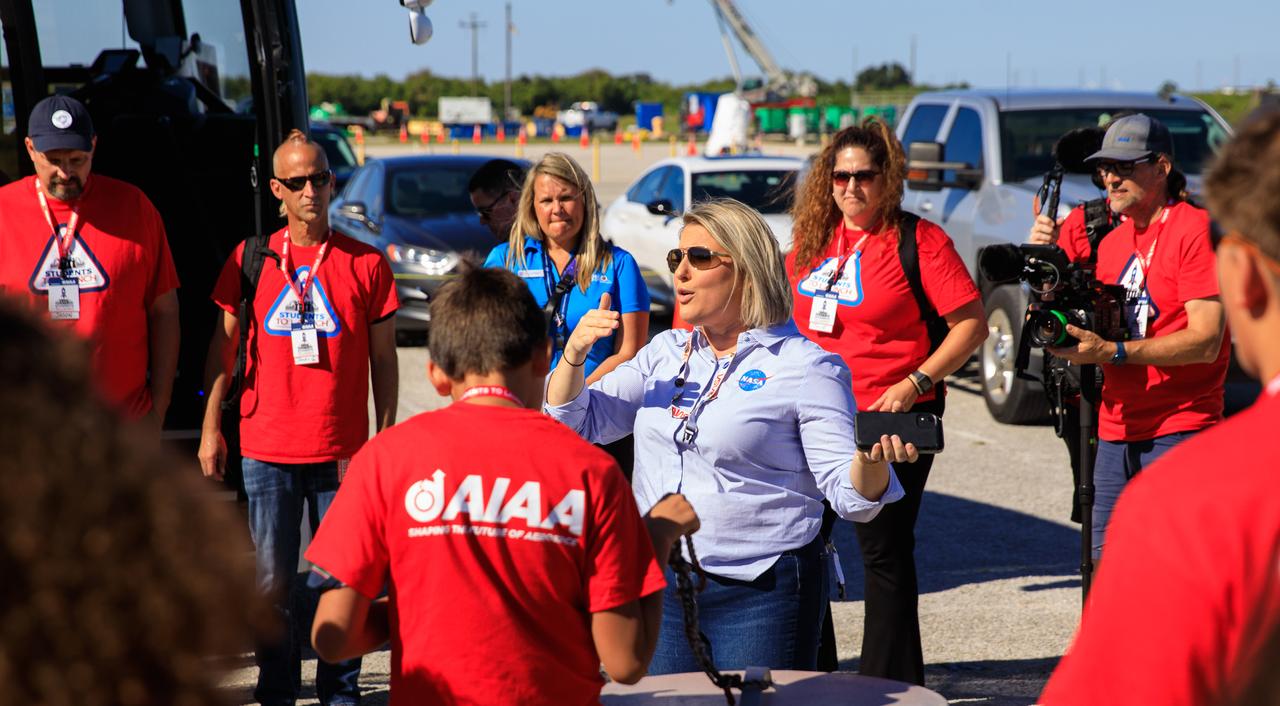
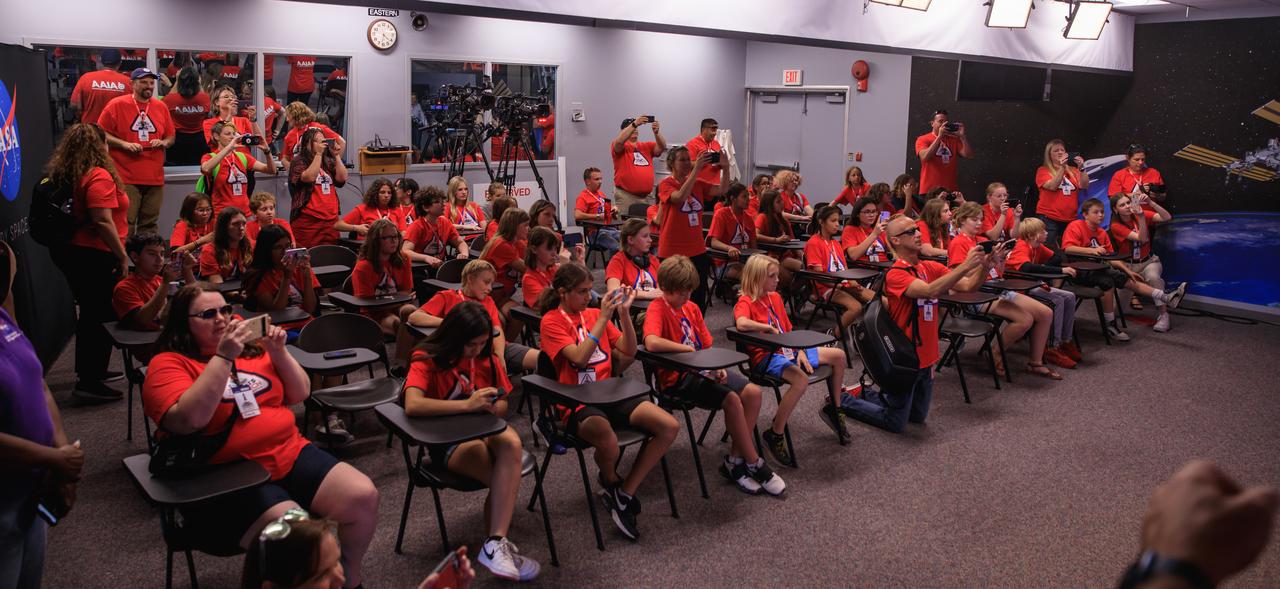
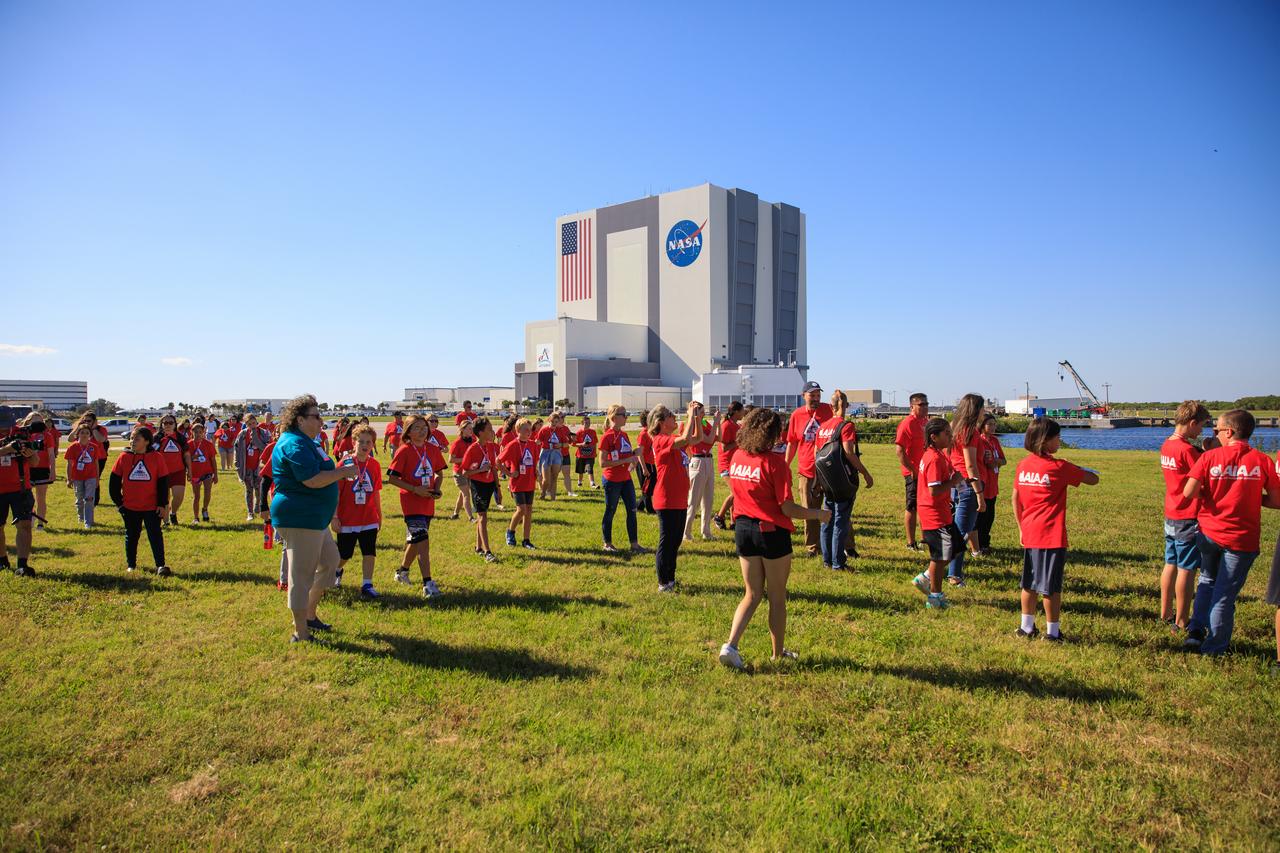
A group of students and their chaperones tour NASA’s Kennedy Space Center in Florida on Oct. 6, 2022. The middle-school students, from the Boys and Girls Clubs of the Flathead Indian Reservation in Montana, are visiting the space center under a Space Act Agreement with the Students to Launch program. Students to Launch engages students in STEM (science, technology, engineering and mathematics) and creates awareness of careers in the space program.
Students to Launch KSC Visit
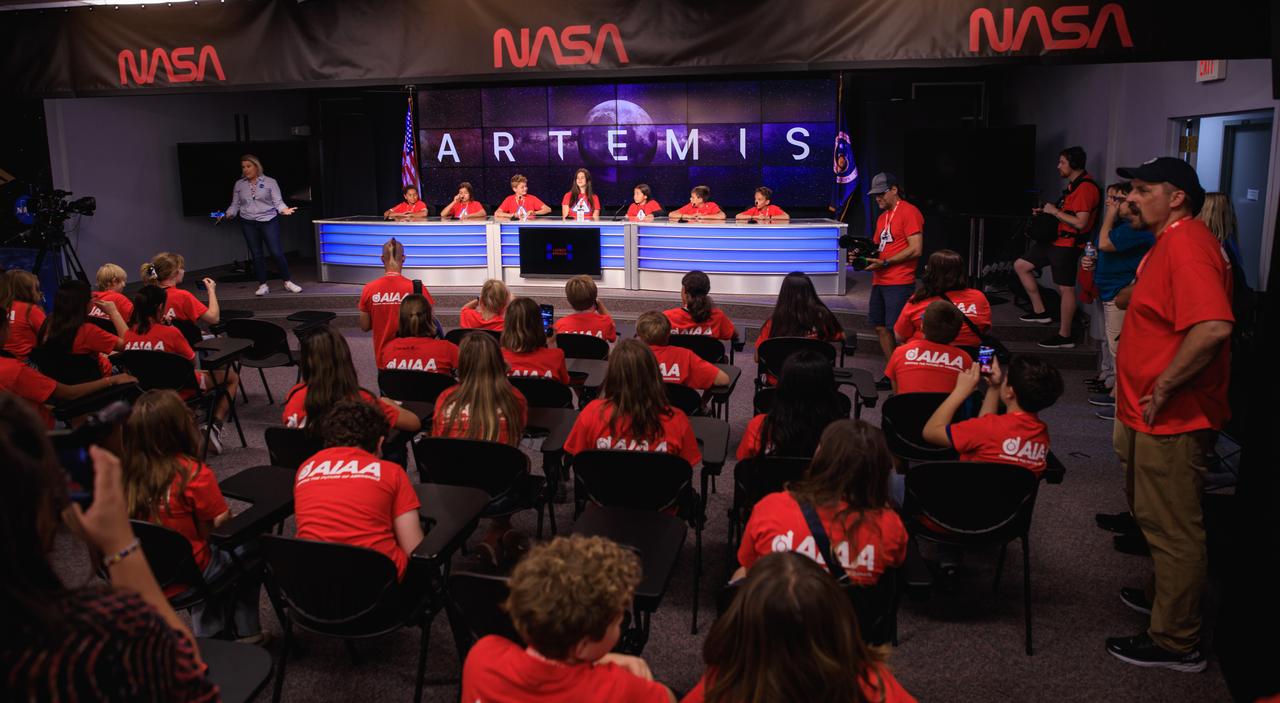
A group of students and their chaperones gather in the John Holliman Auditorium of the News Center for a mock news briefing during a tour of NASA’s Kennedy Space Center in Florida on Oct. 6, 2022. The middle-school students, from the Boys and Girls Clubs of the Flathead Indian Reservation in Montana, are visiting the space center with the Students to Launch program. Students to Launch engages students in STEM (science, technology, engineering and mathematics) and creates awareness of careers in the space program.
Students to Launch KSC Visit
A group of students and their chaperones gather for a photo at the launch countdown clock near the News Center at NASA’s Kennedy Space Center in Florida on Oct. 6, 2022. The middle-school students, from the Boys and Girls Clubs of the Flathead Indian Reservation in Montana, are visiting the space center with the Students to Launch program. Students to Launch is engages students in STEM (science, technology, engineering and mathematics) and creates awareness of careers in the space program.
Students to Launch KSC Visit
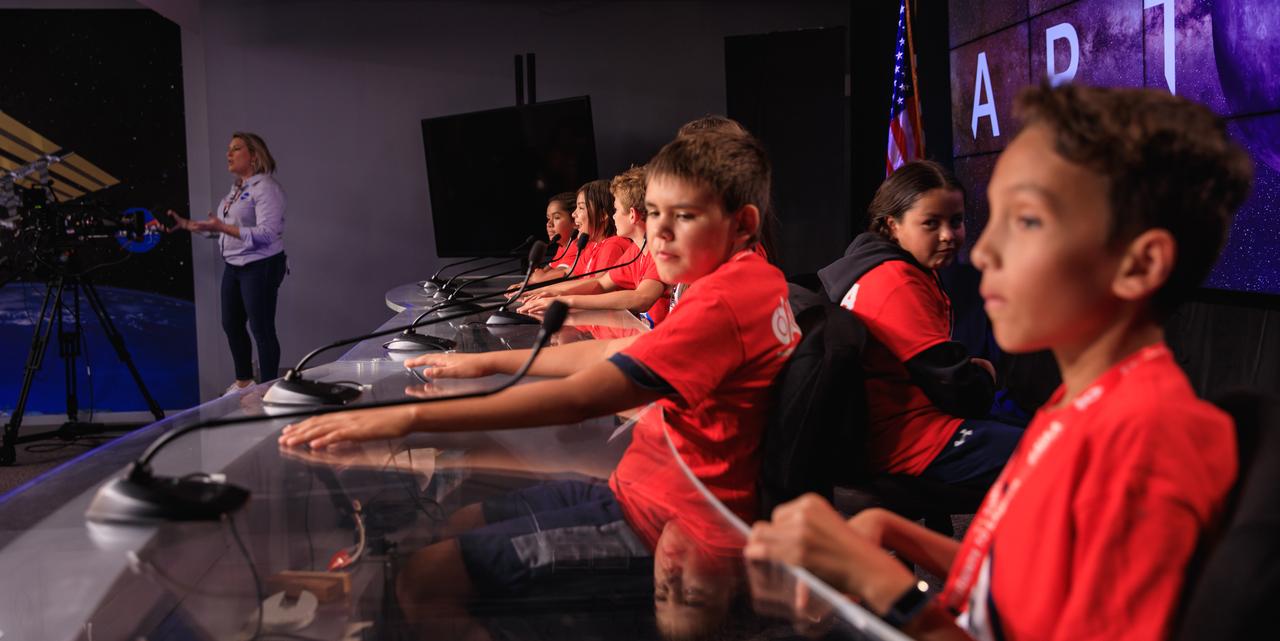
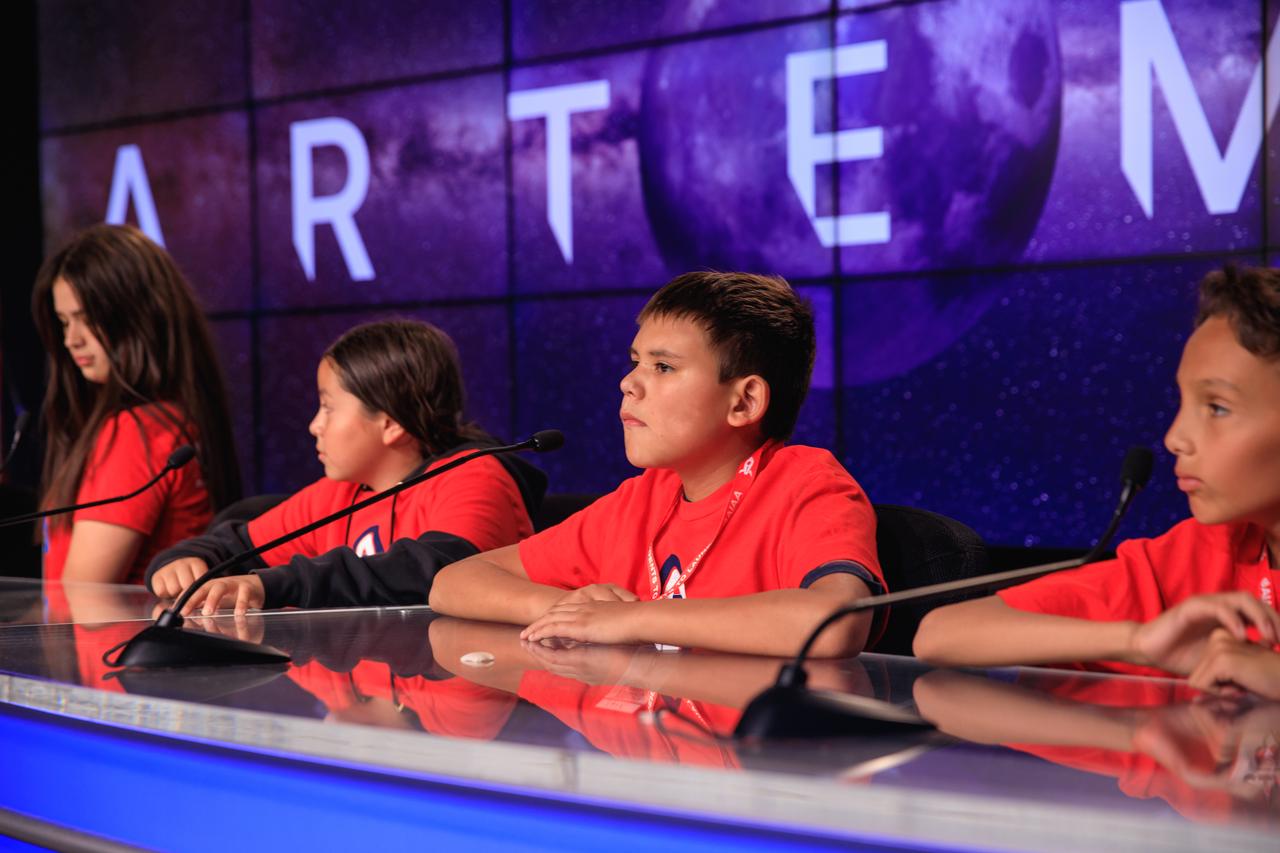
A group of students and their chaperones gather in the John Holliman Auditorium of the News Center during a tour of NASA’s Kennedy Space Center in Florida on Oct. 6, 2022. Some of them are seated at the dais at the front of the auditorium. The middle-school students, from the Boys and Girls Clubs of the Flathead Indian Reservation in Montana, are visiting the space center with the Students to Launch program. Students to Launch engages students in STEM (science, technology, engineering and mathematics) and creates awareness of careers in the space program.
Students to Launch KSC Visit
A group of students and their chaperones view a mural on a wall at the News Center during a tour of NASA’s Kennedy Space Center in Florida on Oct. 6, 2022. The middle-school students, from the Boys and Girls Clubs of the Flathead Indian Reservation in Montana, are visiting the space center with the Students to Launch program. Students to Launch engages students in STEM (science, technology, engineering and mathematics) and creates awareness of careers in the space program.
Students to Launch KSC Visit
Leah Martin, in the center, NASA Communications, speaks to students and their chaperones during a tour of NASA’s Kennedy Space Center in Florida on Oct. 6, 2022. The middle-school students, from the Boys and Girls Clubs of the Flathead Indian Reservation and lake in Montana, are visiting the space center with the Students to Launch program. Students to Launch engages students in STEM (science, technology, engineering and mathematics) and creates awareness of careers in the space program.
Students to Launch KSC Visit
A group of students and their chaperones gather in the John Holliman Auditorium of the News Center to simulate a news conference during a tour of NASA’s Kennedy Space Center in Florida on Oct. 6, 2022. Some of them are seated at the dais at the front of the auditorium. The middle-school students, from the Boys and Girls Clubs of the Flathead Indian Reservation in Montana, are visiting the space center with the Students to Launch program. Students to Launch engages students in STEM (science, technology, engineering and mathematics) and creates awareness of careers in the space program.
Students to Launch KSC Visit
A group of students and their chaperones gather in the John Holliman Auditorium of the News Center to simulate a news conference during a tour of NASA’s Kennedy Space Center in Florida on Oct. 6, 2022. Some of them are seated at the dais at the front of the auditorium. At far left is Leah Martin, NASA Communications. The middle-school students, from the Boys and Girls Clubs of the Flathead Indian Reservation in Montana, are visiting the space center with the Students to Launch program. Students to Launch engages students in STEM (science, technology, engineering and mathematics) and creates awareness of careers in the space program.
Students to Launch KSC Visit
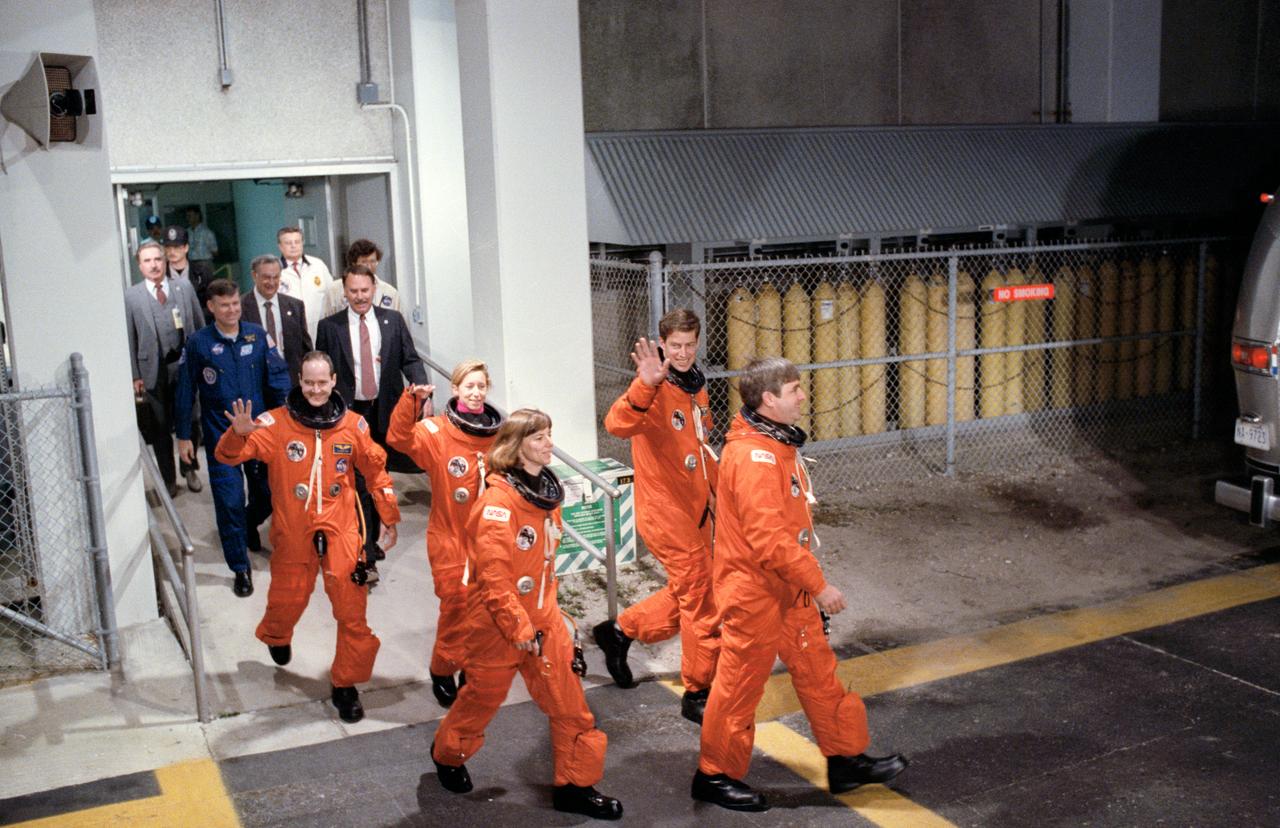
STS032-S-056 (20 Jan 1990) --- STS-32 Columbia, Orbiter Vehicle (OV) 102, crewmembers depart the Kennedy Space Center (KSC) Operations and Checkout (O and C) Building enroute to KSC Launch Complex (LC) Pad 39A. Dubious weather at the return-to-launch site (RTLS) caused postponement of yesterday's planned launch. From left to right are Mission Specialist (MS) G. David Low, MS Marsha S. Ivins, MS Bonnie J. Dunbar, Pilot James D. Wetherbee, and Commander Daniel C. Brandenstein. All crewmembers are wearing launch and entry suits (LESs) and Low, Ivins, and Wetherbee wave to spectators as they head to the transportation van. Following the crew are astronaut Michael L. Coats (left) and NASA/JSC manager Donald R. Puddy.
STS-32 crewmembers wave as they leave KSC O&C Bldg for launch pad
S71-41356 (26 July 1971) --- The huge, 363-feet tall Apollo 15 (Spacecraft 112/Lunar Module 10/Saturn 510) space vehicle is launched from Pad A, Launch Complex 39, Kennedy Space Center (KSC), Florida, at 9:34:00:79 a.m. (EDT), July 26, 1971, on a lunar landing mission. Aboard the Apollo 15 spacecraft were astronauts David R. Scott, commander; Alfred M. Worden, command module pilot; and James B. Irwin, lunar module pilot. Apollo 15 is the National Aeronautics and Space Administration's (NASA) fourth manned lunar landing mission. While astronauts Scott and Irwin will descend in the Lunar Module (LM) to explore the moon, astronaut Worden will remain with the Command and Service Modules (CSM) in lunar orbit.
Launch - Apollo XV Space Vehicle - KSC
S69-39529 (16 July 1969) --- The huge, 363-feet tall Apollo 11 (Spacecraft 107/Lunar Module 5/Saturn 506) space vehicle is launched from Pad A, Launch Complex 39, Kennedy Space Center (KSC), at 9:32 a.m. (EDT), July 16, 1969. Onboard the Apollo 11 spacecraft were astronauts Neil A. Armstrong, commander; Michael Collins, command module pilot; and Edwin E. Aldrin Jr., lunar module pilot.  Apollo 11 is the United States first lunar landing mission. While astronauts Armstrong and Aldrin descend in the Lunar Module (LM) "Eagle" to explore the Sea of Tranquility region of the moon, astronaut Collins will remain with the Command and Service Modules (CSM) "Columbia" in lunar orbit.
APOLLO XI - LAUNCH - PAD 39A - KSC
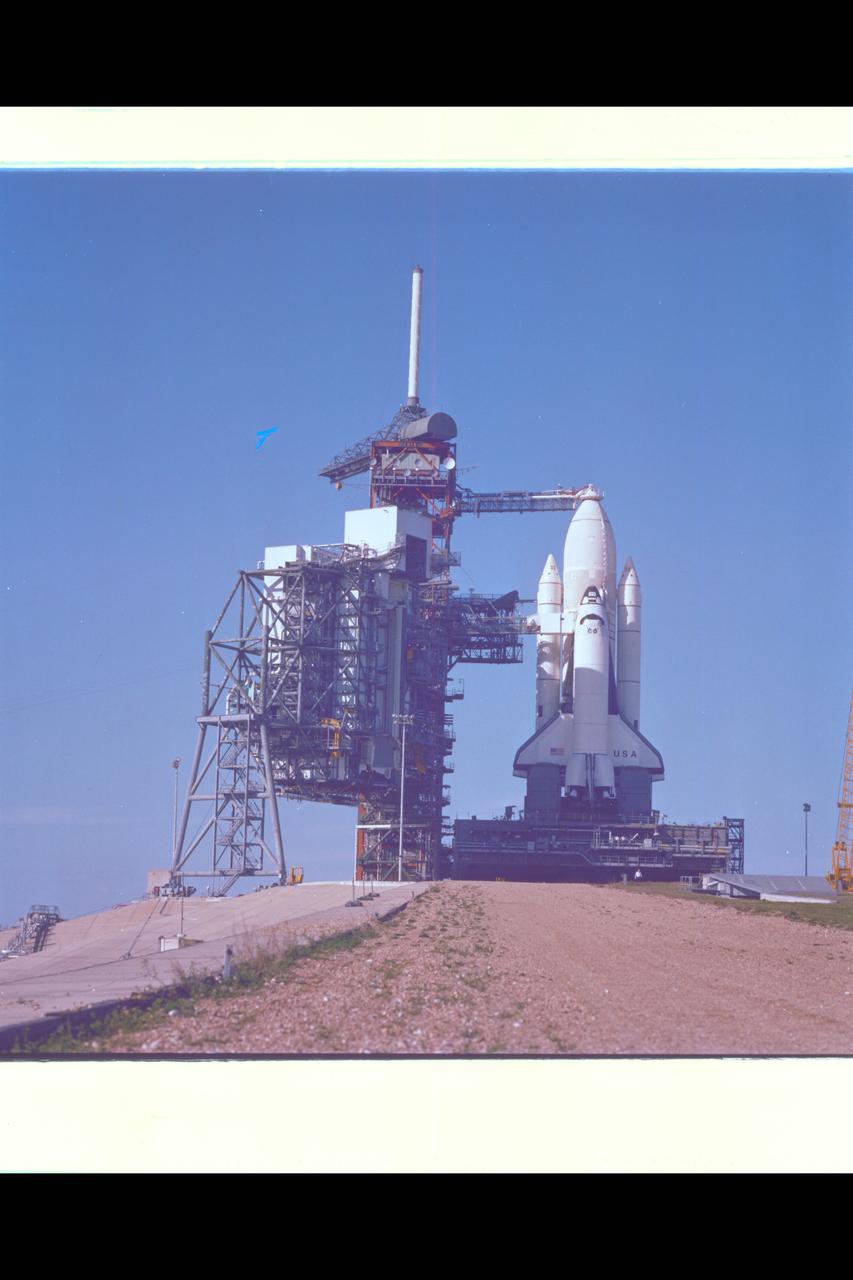
Space Shuttle Columbia Launch at NASA KSC (Kennedy Space Center) Ref: 108-KSC-81PC-382
ARC-1981-AC81-0365-1
Space Shuttle Columbia Launch Preparation at NASA KSC (Kennedy Space Center) Ref: 108-KSC-81PC-455
ARC-1981-AC81-0365-5
Space Shuttle Columbia Launch Preparation at NASA KSC (Kennedy Space Center) Ref: 108-KSC-81PC-98
ARC-1981-AC81-0365-2
Space Shuttle Columbia Launch Preparation at NASA KSC (Kennedy Space Center) Ref: 108-KSC-81PC-454
ARC-1981-AC81-0365-3
Space Shuttle Columbia Launch at NASA KSC (Kennedy Space Center) Ref: 108-KSC-81PC-368
ARC-1981-AC81-0365-4
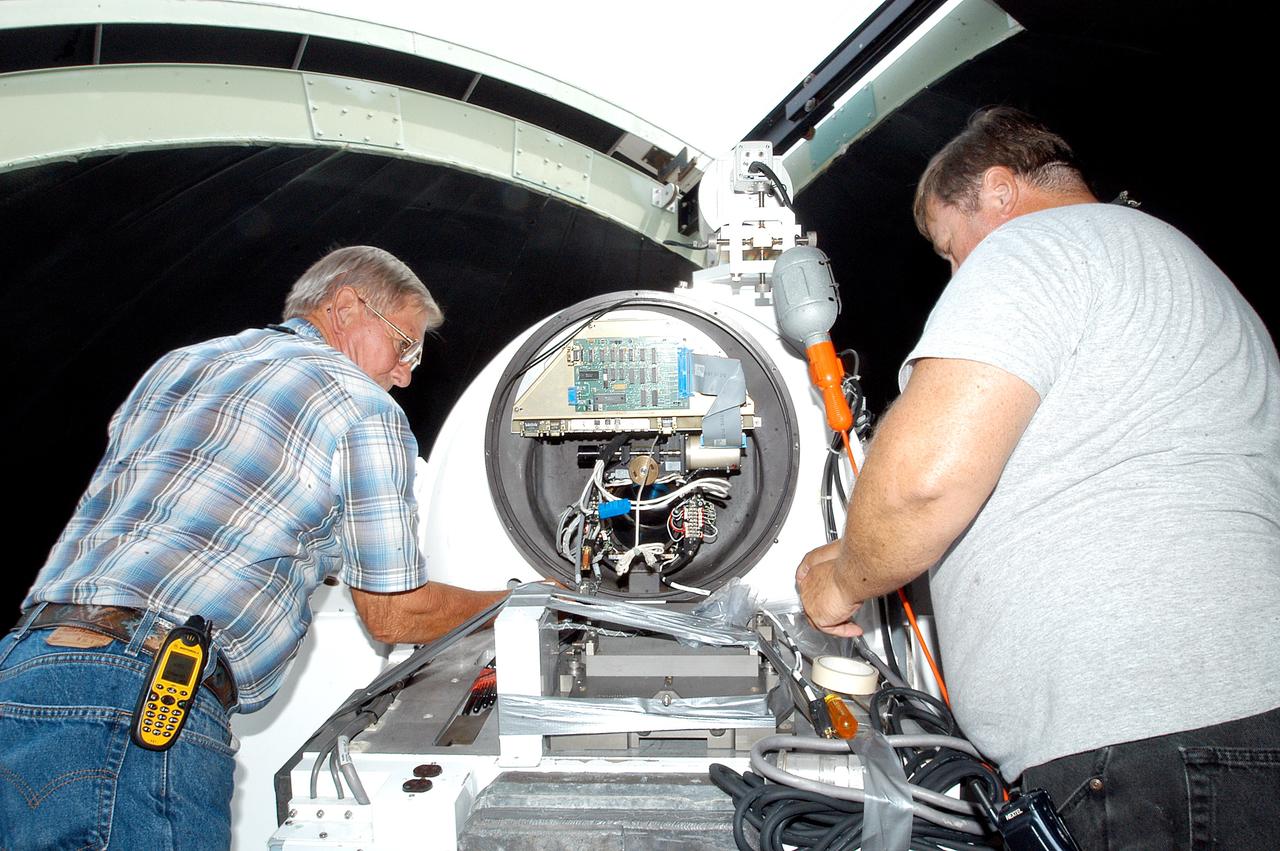
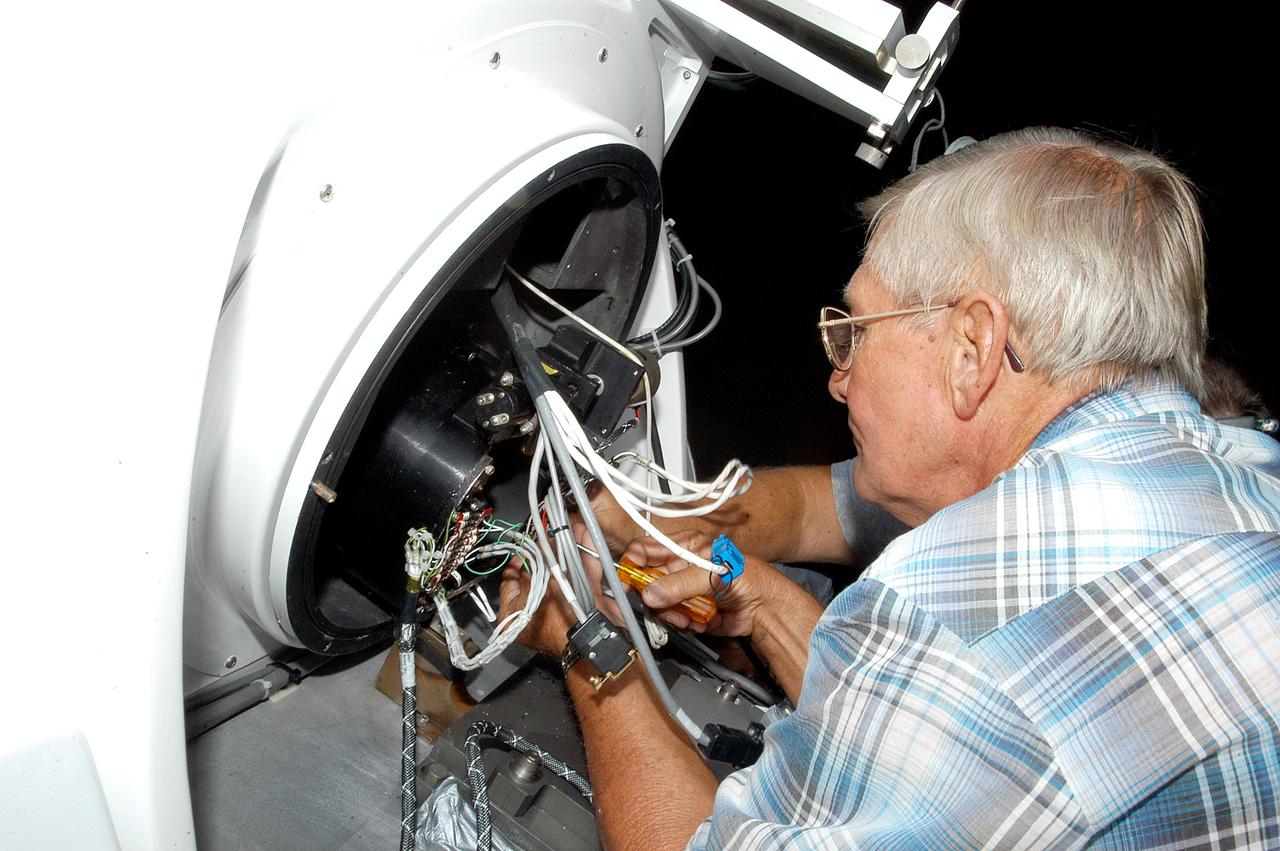
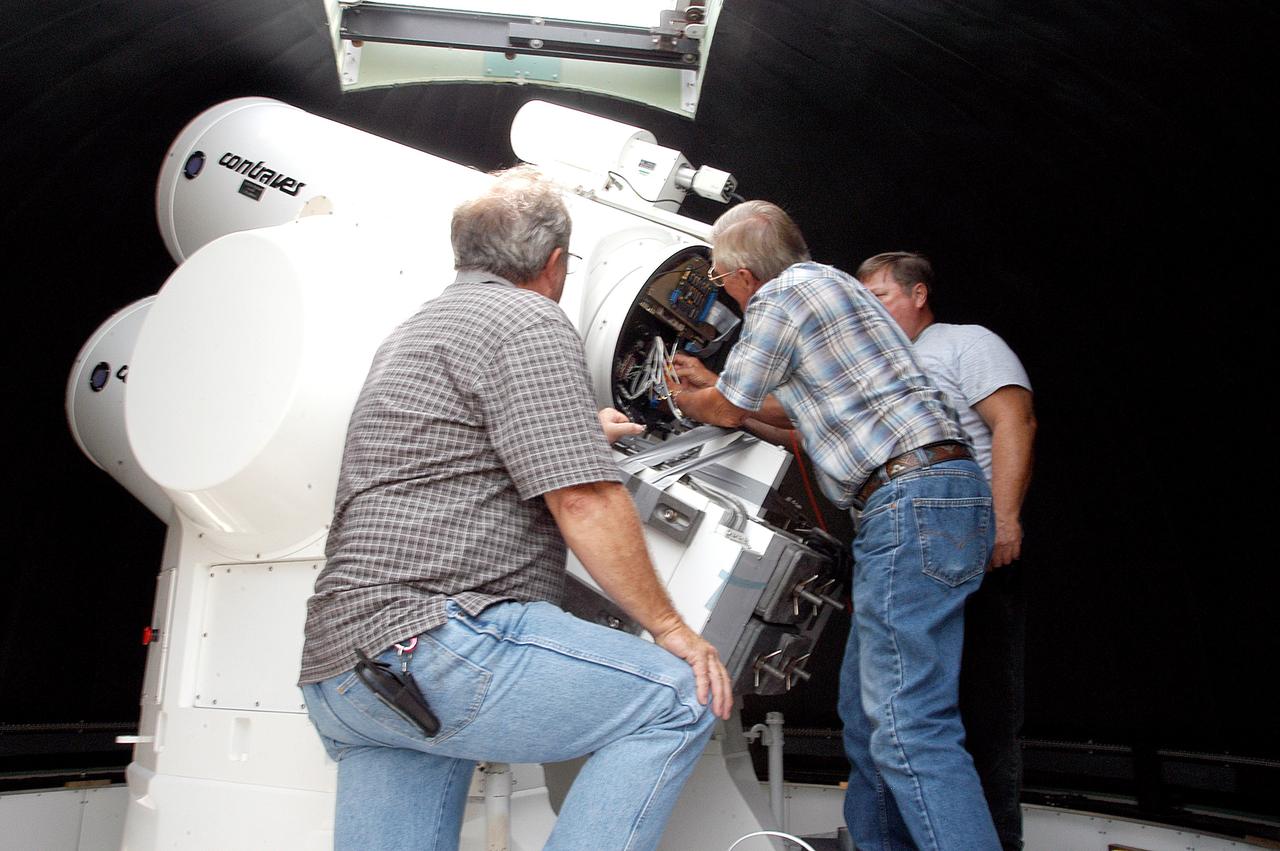
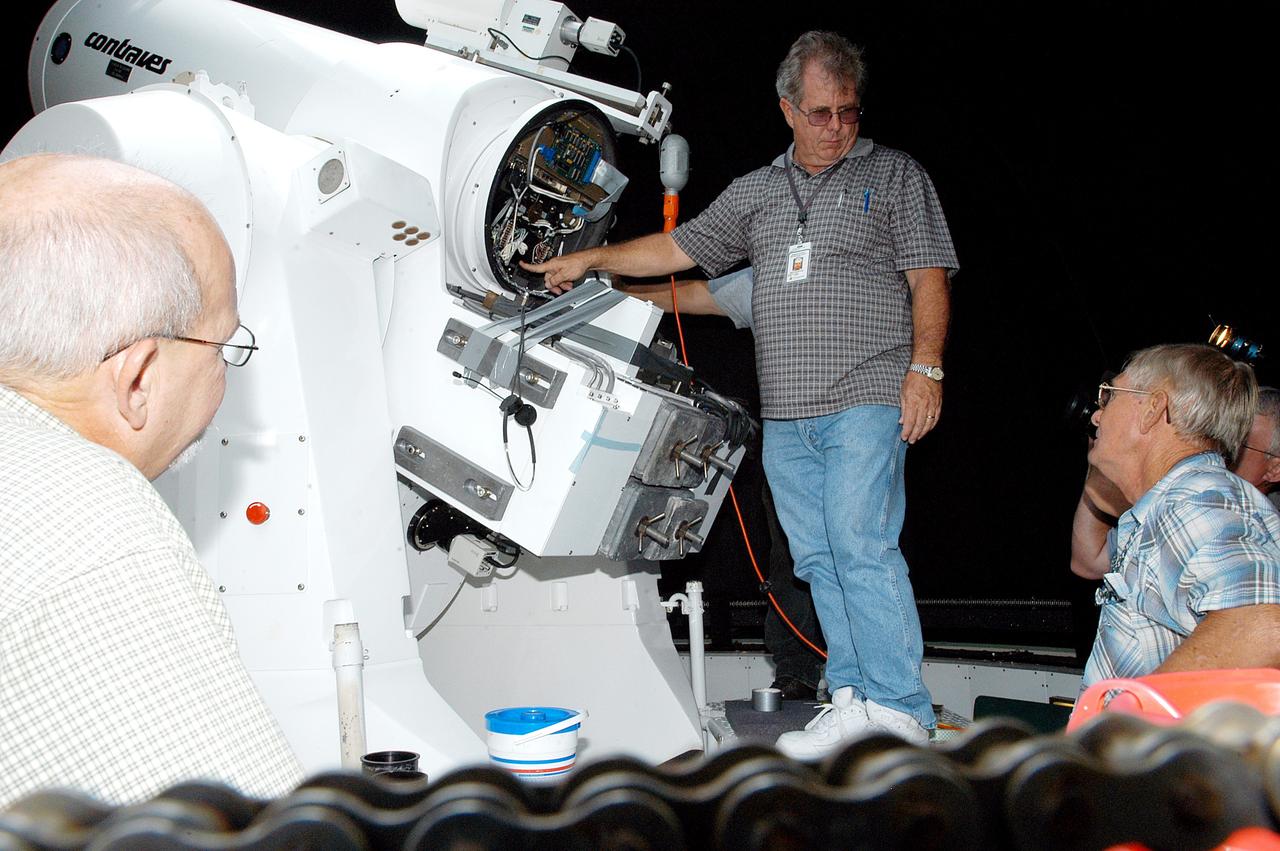
KENNEDY SPACE CENTER, FLA. -   Workers calibrate a tracking telescope, part of the Distant Object Attitude Measurement System (DOAMS),  located in Cocoa Beach, Fla.  The telescope provides optical support for launches from KSC and Cape Canaveral.
KENNEDY SPACE CENTER, FLA. - Workers calibrate a tracking telescope, part of the Distant Object Attitude Measurement System (DOAMS), located in Cocoa Beach, Fla. The telescope provides optical support for launches from KSC and Cape Canaveral.
KENNEDY SPACE CENTER, FLA. -  Workers calibrate a tracking telescope, part of the Distant Object Attitude Measurement System (DOAMS),  located in Cocoa Beach, Fla.  The telescope provides optical support for launches from KSC and Cape Canaveral.
KENNEDY SPACE CENTER, FLA. - Workers calibrate a tracking telescope, part of the Distant Object Attitude Measurement System (DOAMS), located in Cocoa Beach, Fla. The telescope provides optical support for launches from KSC and Cape Canaveral.
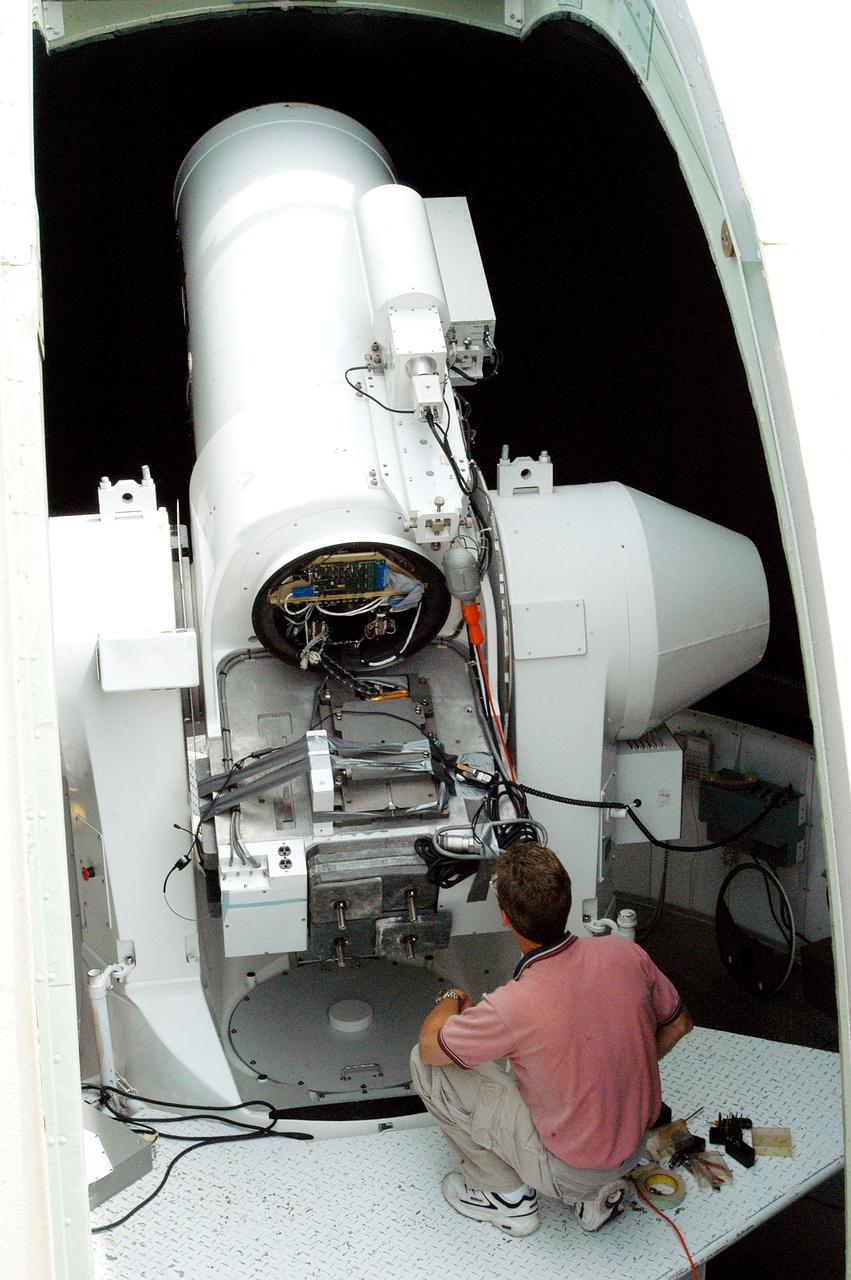
KENNEDY SPACE CENTER, FLA. - A worker calibrates a tracking telescope, part of the Distant Object Attitude Measurement System (DOAMS),  located in Cocoa Beach, Fla.  The telescope provides optical support for launches from KSC and Cape Canaveral.
KENNEDY SPACE CENTER, FLA. - A worker calibrates a tracking telescope, part of the Distant Object Attitude Measurement System (DOAMS), located in Cocoa Beach, Fla. The telescope provides optical support for launches from KSC and Cape Canaveral.
KENNEDY SPACE CENTER, FLA. - A worker calibrates a tracking telescope, part of the Distant Object Attitude Measurement System (DOAMS),  located in Cocoa Beach, Fla.  The telescope provides optical support for launches from KSC and Cape Canaveral.
KENNEDY SPACE CENTER, FLA. - A worker calibrates a tracking telescope, part of the Distant Object Attitude Measurement System (DOAMS), located in Cocoa Beach, Fla. The telescope provides optical support for launches from KSC and Cape Canaveral.
KENNEDY SPACE CENTER, FLA. -   Workers calibrate a tracking telescope, part of the Distant Object Attitude Measurement System (DOAMS),  located in Cocoa Beach, Fla.  The telescope provides optical support for launches from KSC and Cape Canaveral.
KENNEDY SPACE CENTER, FLA. - Workers calibrate a tracking telescope, part of the Distant Object Attitude Measurement System (DOAMS), located in Cocoa Beach, Fla. The telescope provides optical support for launches from KSC and Cape Canaveral.
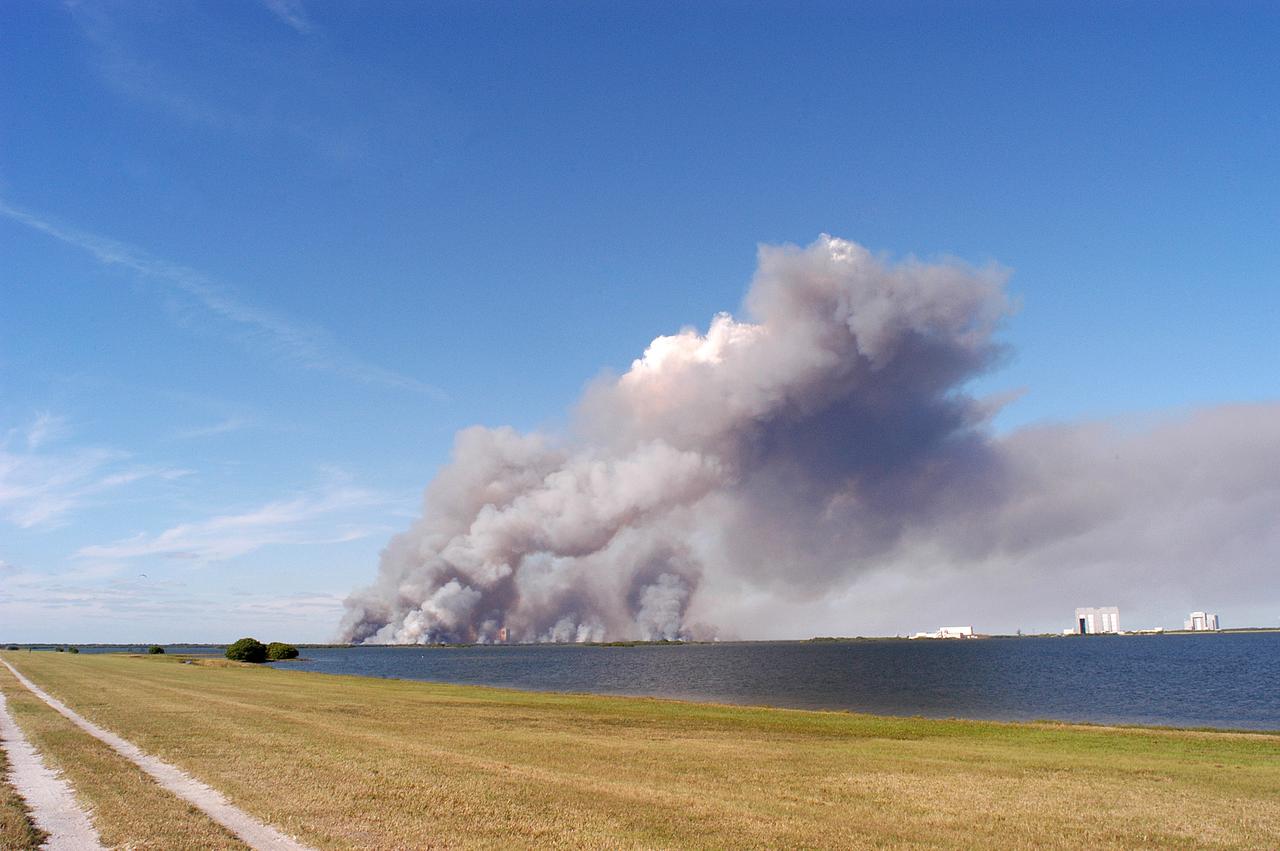
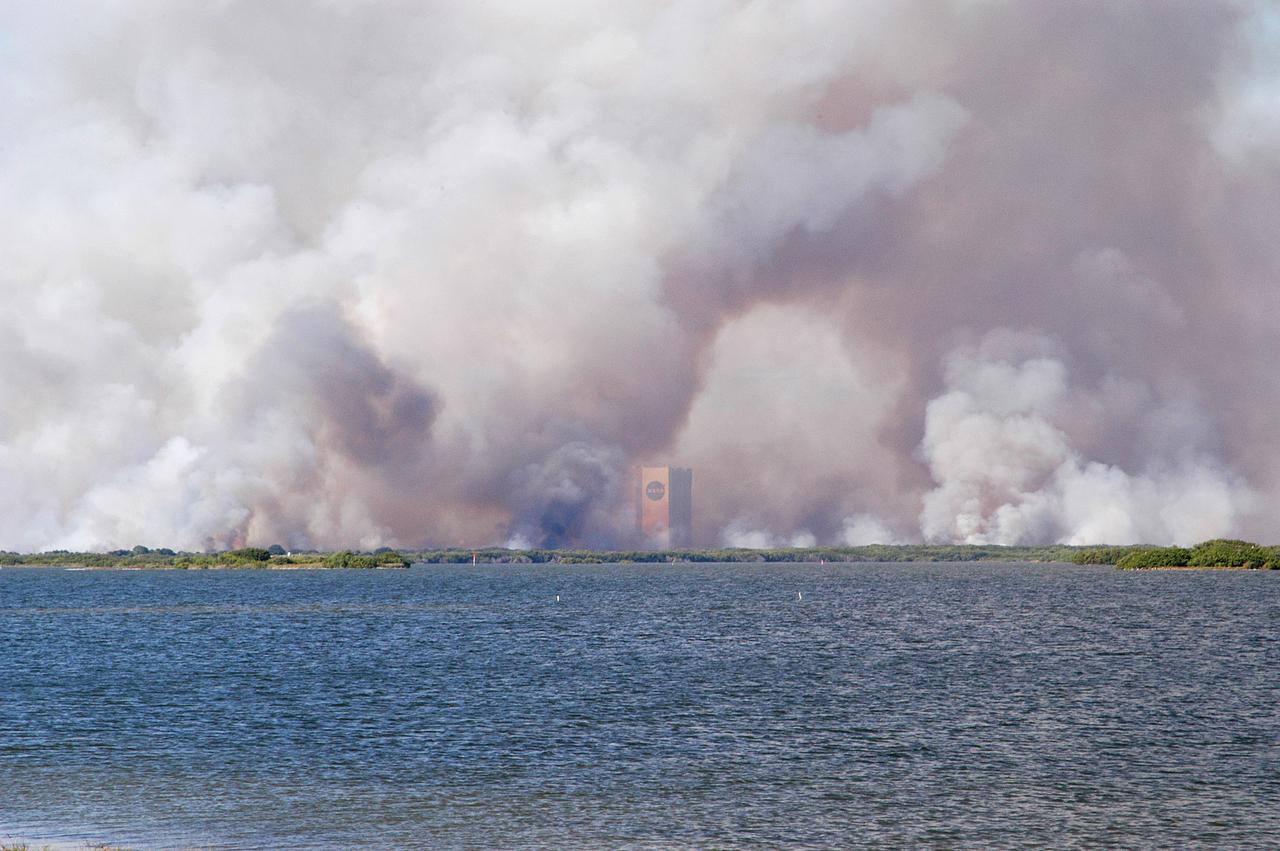
KENNEDY SPACE CENTER, FLA. - Smoke from a successful controlled burn near KSC’s Launch Complex 39 surrounds the Vehicle Assembly Building and spreads across the horizon.  The water in the foreground is the Banana River.
KENNEDY SPACE CENTER, FLA. - Smoke from a successful controlled burn near KSC’s Launch Complex 39 surrounds the Vehicle Assembly Building and spreads across the horizon. The water in the foreground is the Banana River.
KENNEDY SPACE CENTER, FLA. - A successful controlled burn near KSC’s Launch Complex 39 area creates clouds of smoke in a clear blue sky.  The water seen is the Banana River.
KENNEDY SPACE CENTER, FLA. - A successful controlled burn near KSC’s Launch Complex 39 area creates clouds of smoke in a clear blue sky. The water seen is the Banana River.
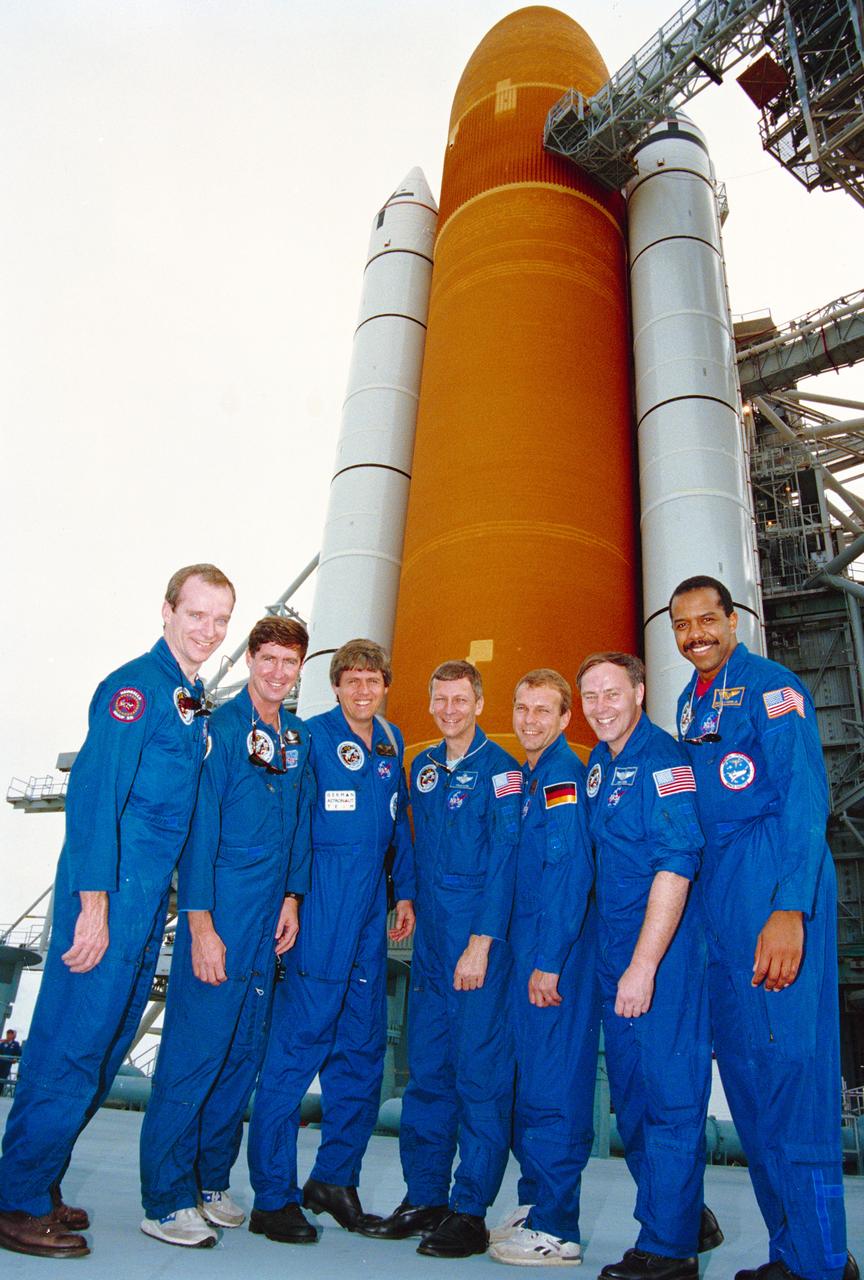
S93-29860 (11 Feb 1993) --- The STS-55 crew poses for a group portrait next to the Space Shuttle Columbia at Launch Pad 39A.  From left are mission specialist Charles J. Precourt; pilot Terence T. Henricks; payload specialist Ulrich Walter, mission commander Steven R. Nagel; payload specialist Hans Schlegel; payload commander Jerry L. Ross; and mission specialist Bernard A. Harris Jr..  The crew is at KSC for the Terminal Countdown Demonstration Test (TCDT), a dress rehearsal for launch.
STS-55 SL-D2 crew poses in front of ET/SRB at KSC Launch Complex (LC) Pad 39A
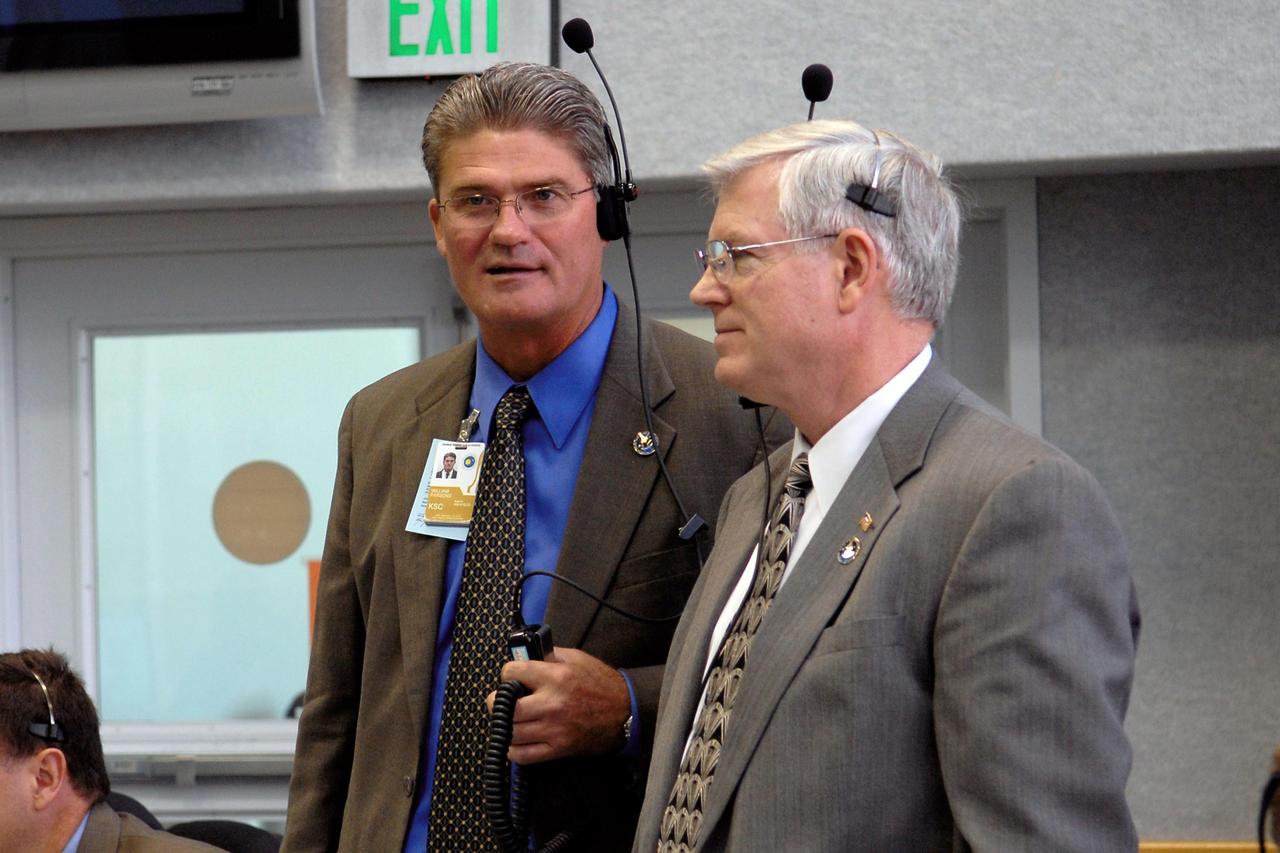
STS120-S-012 (23 Oct. 2007) --- In the firing room of the Launch Control Center at NASA's Kennedy Space Center, KSC Director Bill Parsons (left) and Johnson Space Center Director Michael Coats wait for the final countdown of Space Shuttle Discovery on mission STS-120. Liftoff was on time at 11:38:19 a.m. (EDT). Discovery carries the Italian-built U.S. Node 2, called Harmony. During the 14-day STS-120 mission, the crew will install Harmony and move the P6 solar arrays to their permanent position and deploy them.
KSC Director Parsons and JSC Director Coats during STS-120 launch
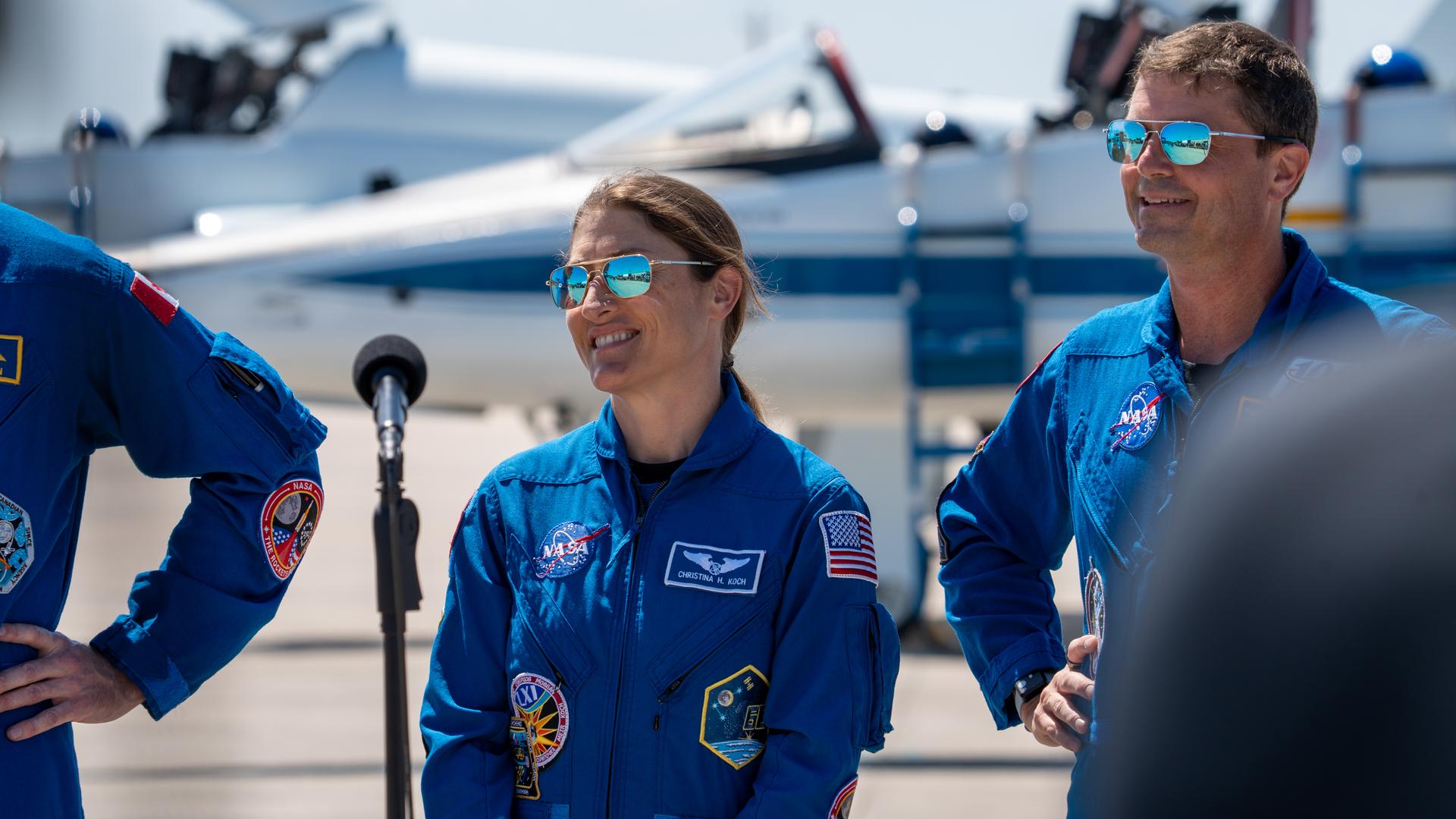
KENNEDY SPACE CENTER, FLA. -  STS-79 Commander William F. Readdy arrives at KSC's Shuttle Landing Facility with five fellow astronauts, ready to participate in the Terminal Countdown Demonstration Test (TCDT).  The TCDT is a dress rehearsal for launch for the flight crew and launch team.  Over the next several days, the astronauts will take part in training exercises at the launch pad that will culminate in a simulated launch countdown.  The Space Shuttle Atlantis is being prepared for liftoff on STS-79 around Sept. 12.
KENNEDY SPACE CENTER, FLA. - STS-79 Commander William F. Readdy arrives at KSC's Shuttle Landing Facility with five fellow astronauts, ready to participate in the Terminal Countdown Demonstration Test (TCDT). The TCDT is a dress rehearsal for launch for the flight crew and launch team. Over the next several days, the astronauts will take part in training exercises at the launch pad that will culminate in a simulated launch countdown. The Space Shuttle Atlantis is being prepared for liftoff on STS-79 around Sept. 12.
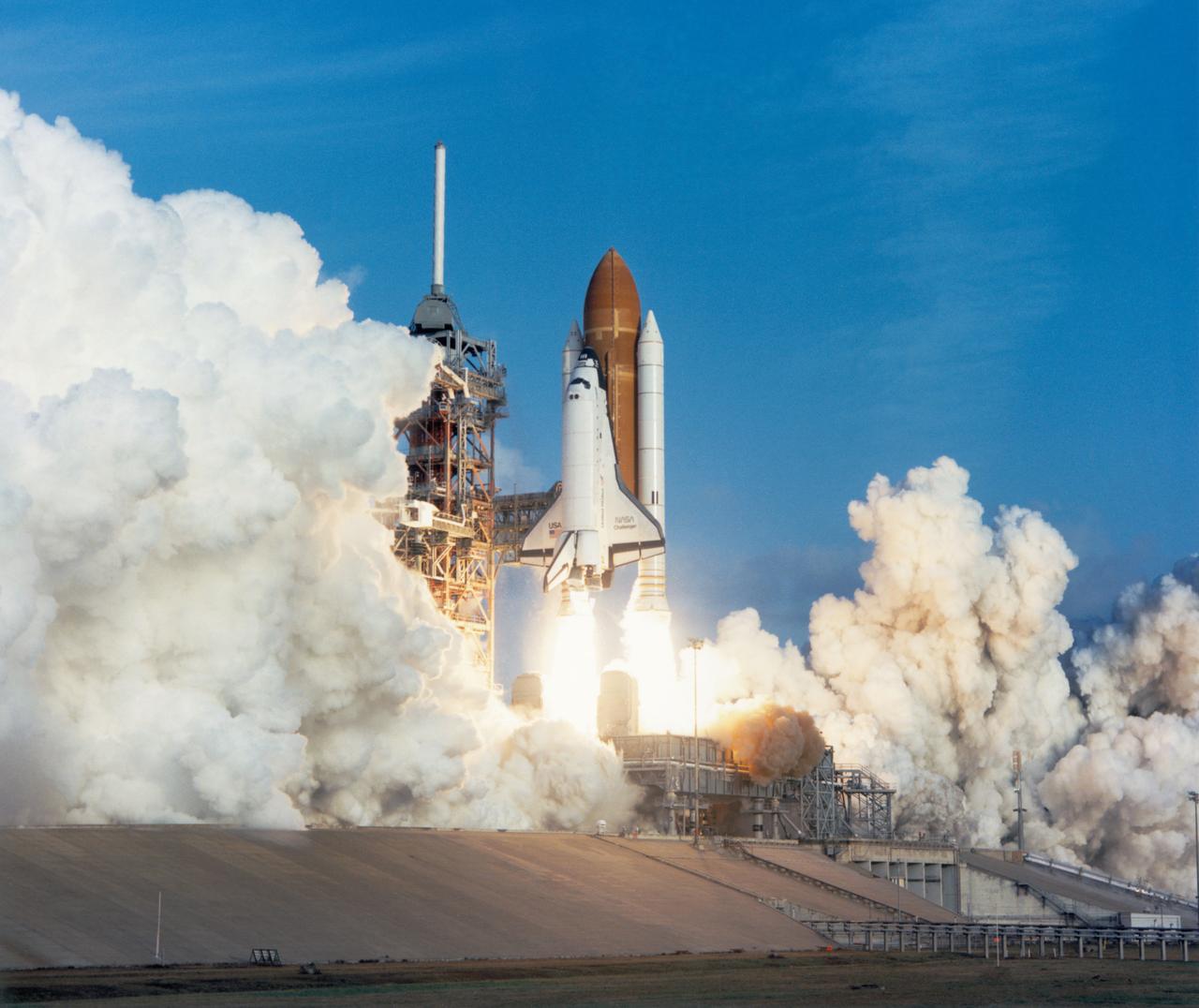
STS-38 Atlantis, Orbiter Vehicle (OV) 104, lifts off from Kennedy Space Center (KSC) Launch Complex (LC) Pad at 6:48:15:0639 pm (Eastern Standard Time (EST)) for Department of Defense (DOD)-devoted mission. OV-104, atop the external tank (ET) and flanked by solid rocket boosters (SRBs), is almost clear of the launch tower which is lit up by the SRB and space shuttle main engine (SSME) firings. Spotlight equipment is silhouetted against the SRB/SSME glow in the foreground. The retracted rotating service structure (RSS) is highlighted against the evening darkness by the launch fireworks.
STS-38 Atlantis, OV-104, lifts off from KSC LC Pad during night launch
STS027-S-005 (Dec 2, 1988) --- Space Shuttle Atlantis is launched from Kennedy Space Center's (KSC) Pad 39-B at 9:30 a.m. EST, on a Department of Defense (DOD) dedicated mission.  This is the third mission for the orbiter Atlantis.  Crew members are:  Commander Robert L. "Hoot" Gibson; Pilot Guy S. Gardner; and Mission Specialists Jerry L. Ross, William M. Shepherd and Richard M. (Mike) Mullane.
STS-27 Atlantis, OV-104, lifts off from KSC Launch Complex (LC) Pad 39B
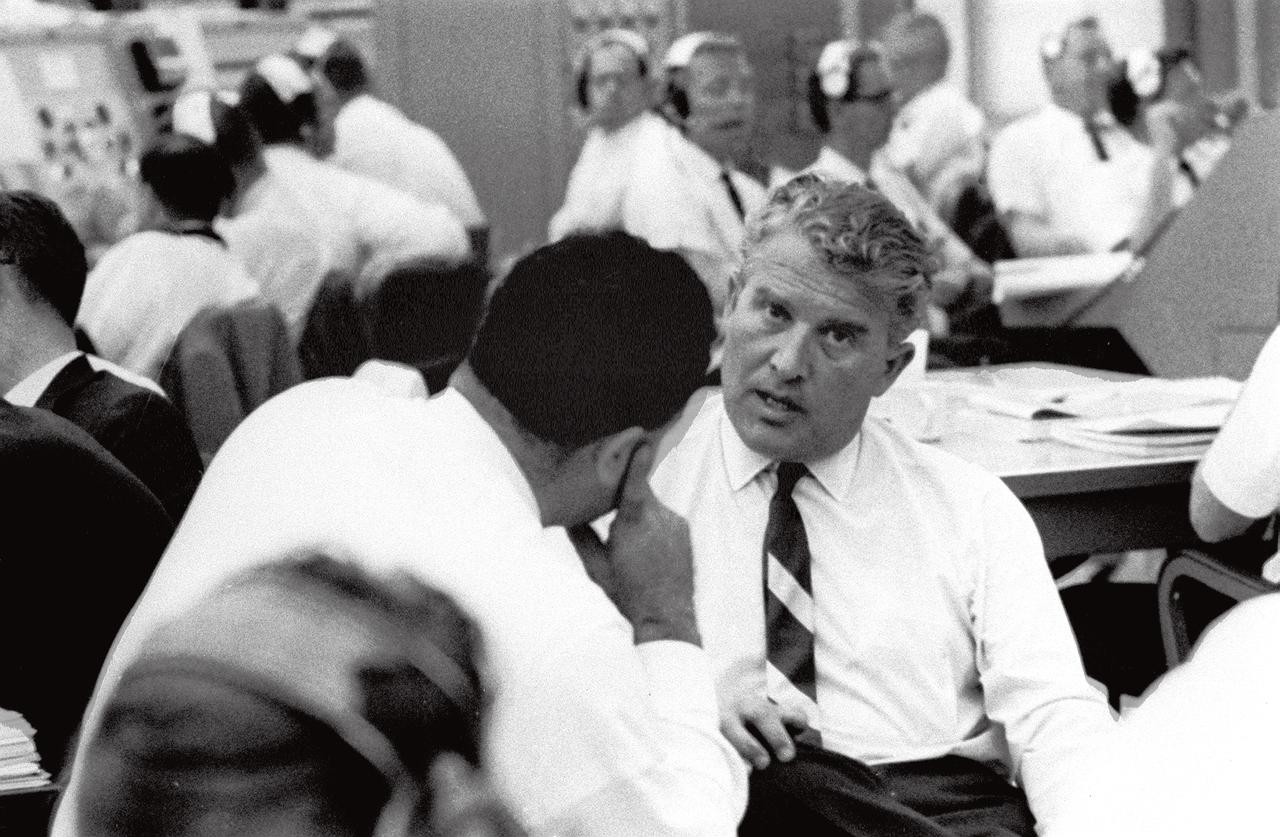
In this photograph at Kennedy Space Center (KSC) Complex 37 Control Center, Marshall Space Flight Center (MSFC) Director Wernher von Braun (right) talks with KSC's Rocco Petrone while awaiting the launch of SA-8 (Saturn I) on May 25, 1965. Petrone played key roles at KSC in the development of Saturn launch facilities before becoming the director of launch operations in 1966.
Wernher von Braun
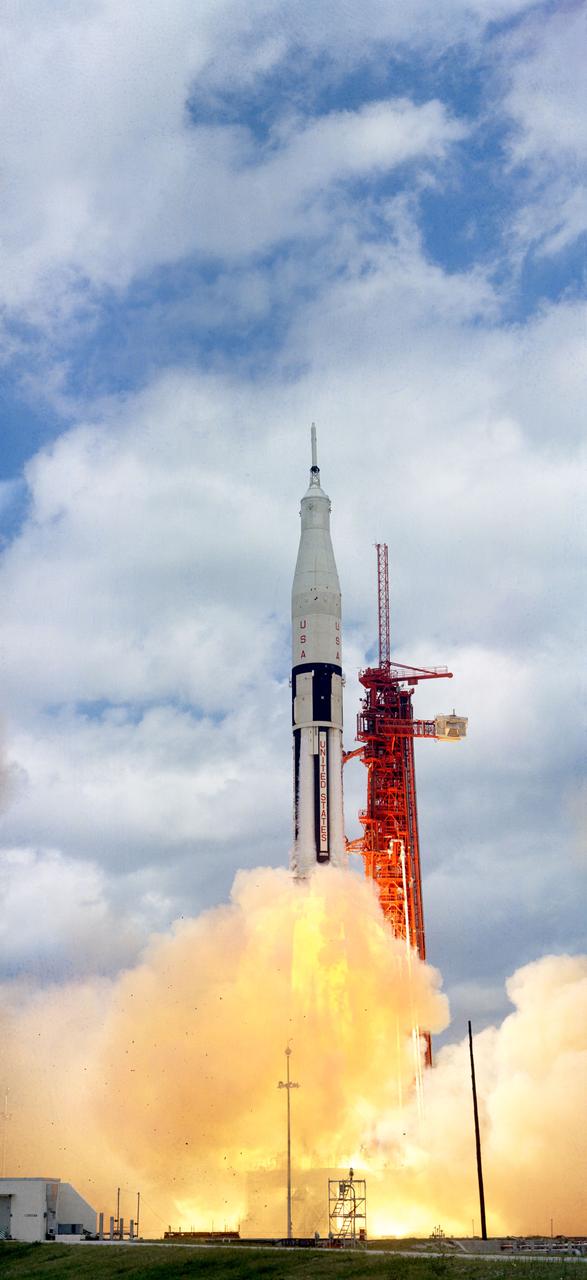
A/S Mission 202 was launched from the KSC Launch Complex (LC)-34 at 12:15 p.m., 08/25/1966. The mission was a step toward qualifying the Apollo Command and Service Modules (CSM)'s and the uprated Saturn I launch vehicle for manned flight.     KSC, FL
LIFTOFF - APOLLO/SATURN (A/S)-202 MISSION - KSC
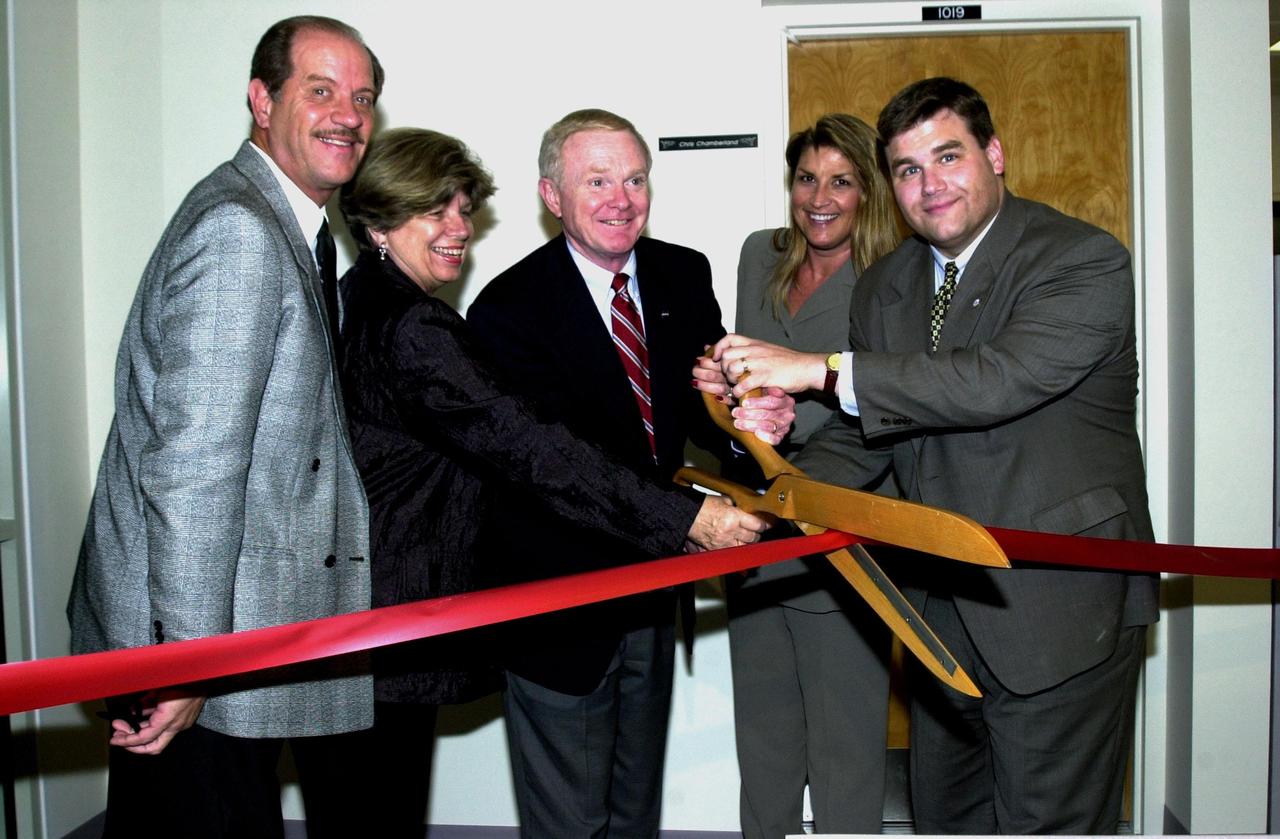
KENNEDY SPACE CENTER, FLA. --   Center Director Roy Bridges Jr. (center) cuts the ribbon for the opening of KSC Direct, the new Web-Broadcast Studio at KSC.  Joining him are (left to right) Dennis Armstrong, Web Multimedia manager; JoAnn H. Morgan, director of External Relations and Business Development; Bridges; Vanessa Stromer, Information Technology Division, Spaceport Services; and Brian Chase, district director for Congressman Dave Weldon, who was unable to attend the ceremony.   Located in the News Center on the Press Mound at KSC, the Web Broadcast Studio provides video clips of launches, landings and other KSC events in a real-time environment, called KSC Direct, through KSC's Web pages
KSC-02pd0119
STS-45 Atlantis, Orbiter Vehicle (OV) 104, lifts off from a Kennedy Space Center (KSC) Launch Complex (LC) Pad at 8:13:40:048 am (Eastern Standard Time (EST)). Exhaust billows out the solid rocket boosters (SRBs) as OV-104 atop its external tank (ET) soars above the mobile launcher platform and is nearly clear of the fixed service structure (FSS) tower. The diamond shock effect produced by the space shuttle main engines (SSMEs) is visible. The glow of the SRB/SSME firings is reflected in a nearby waterway. An exhaust cloud covers the launch pad area.
STS-45 Atlantis, OV-104, lifts off from KSC Launch Complex (LC) Pad
STS-38 Atlantis, Orbiter Vehicle (OV) 104, lifts off from Kennedy Space Center (KSC) Launch Complex Pad at 6:46:15:0639 pm (Eastern Standard Time (EST)). As OV-104, atop the external tank (ET) and flanked by two solid rocket boosters (SRBs), rises above the mobile launcher platform, exhaust smoke fills the area surrounding the launch pad. SRB and space shuttle main engine (SSME) firings glow against the night darkness and light up the fixed service structure (FSS) and retracted rotating service structure (RSS). STS-38 is a Department of Defense (DOD) devoted mission.
STS-38 Atlantis, OV-104, lifting off from KSC LC Pad during night launch
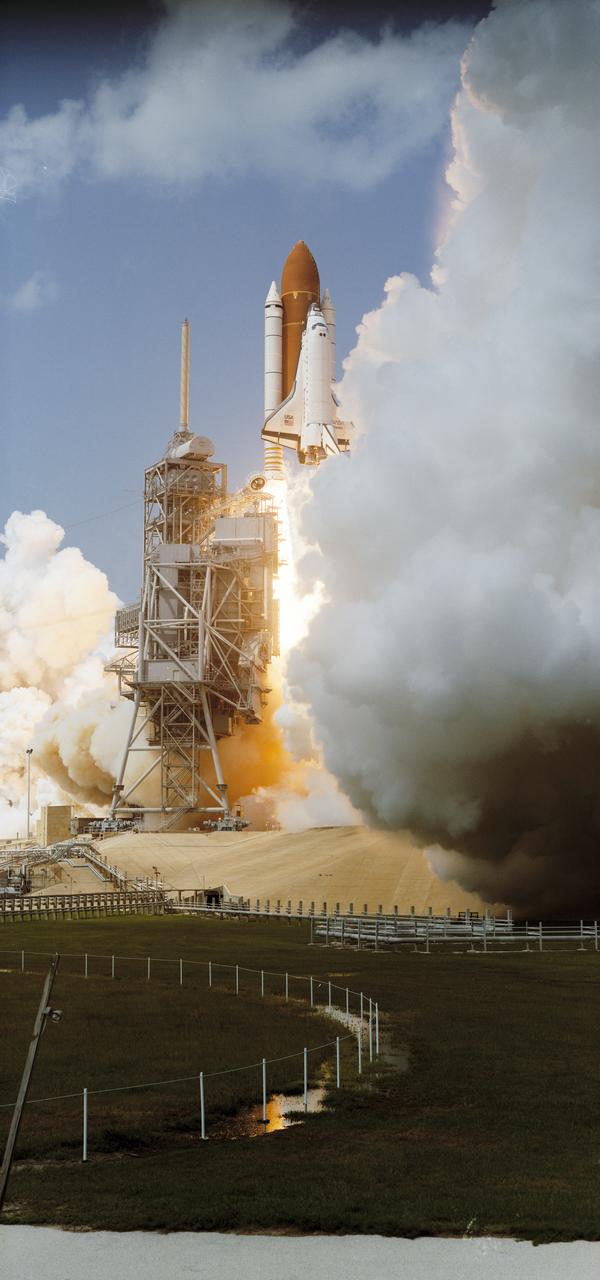
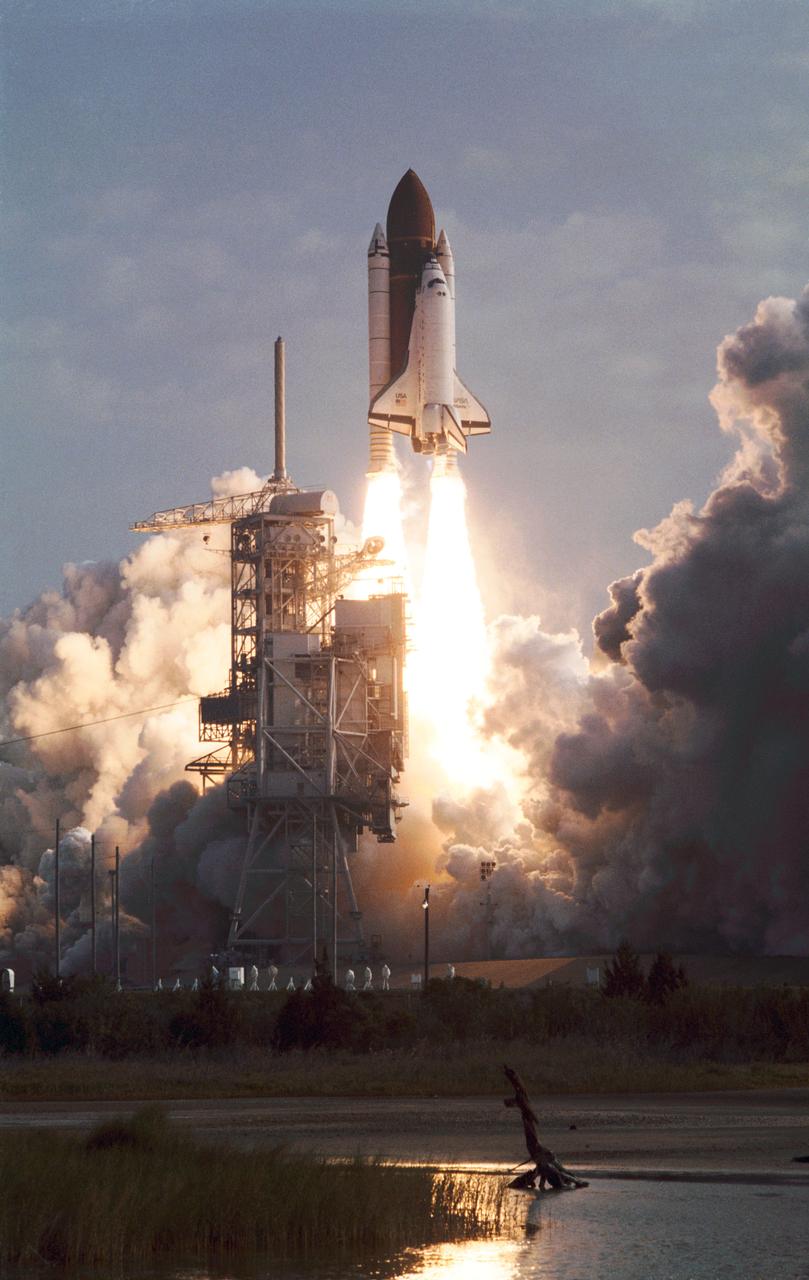
STS-41 Discovery, Orbiter Vehicle (OV) 103, lifts off from the Kennedy Space Center (KSC) Launch Complex (LC) Pad 39 mobile launcher platform at 7:47 am (Eastern Daylight Time (EDT)). OV-103 riding atop the external tank (ET) and flanked by two solid rocket boosters (SRBs), is captured just moments after liftoff. Not yet clear of the fixed service structure (FSS) tower, OV-103 is highlighted against the cloudless morning sky. Exhaust smoke billows from the SRBs and the space shuttle main engines (SSMEs) creating a cloud over the launch pad area.
STS-41 Discovery, OV-103, lifts off from KSC Launch Complex (LC) Pad 39
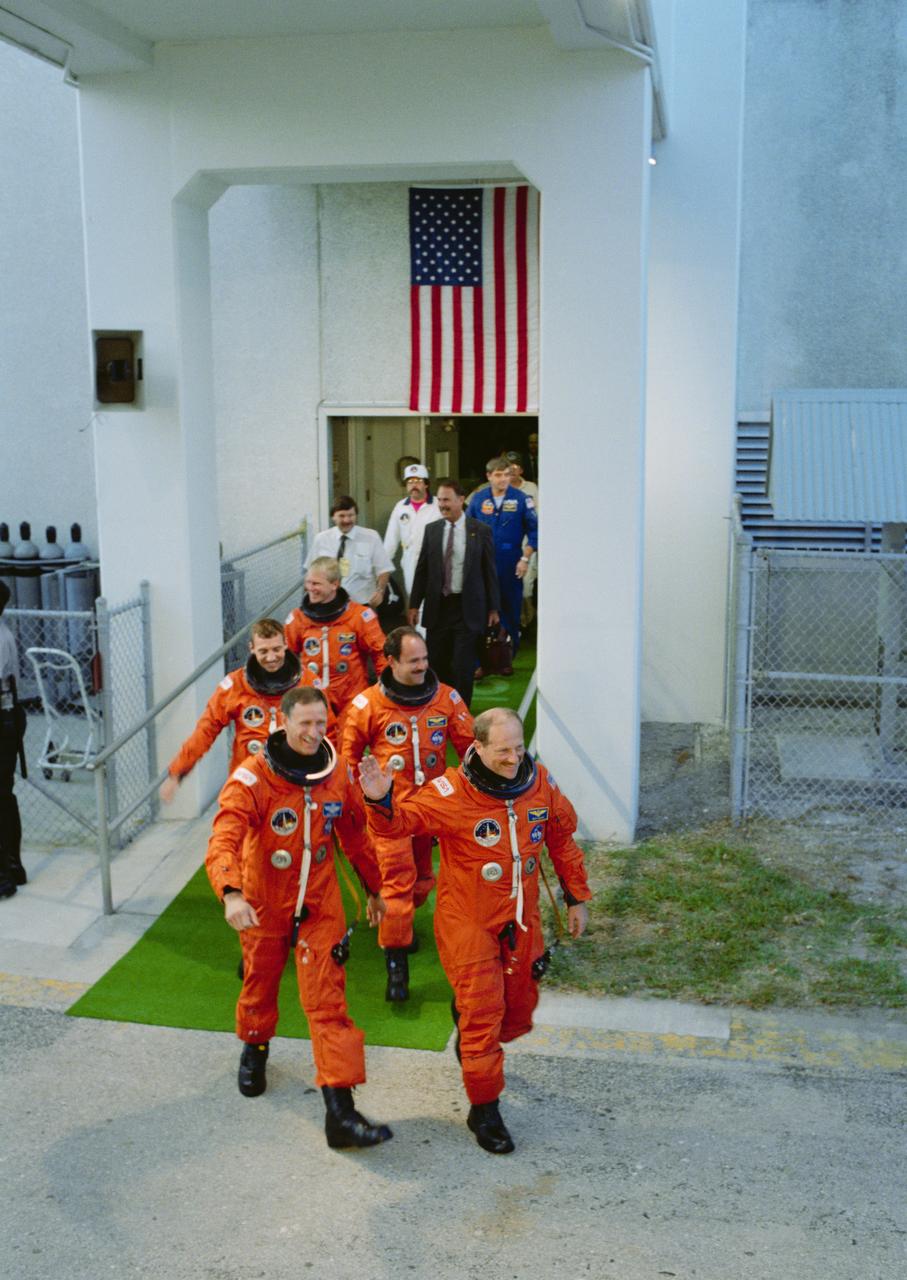
STS-26 crewmembers, suited in launch and entry suits (LESs), leave the Kennedy Space Center (KSC) Operations and Checkout (O&C) Building on their way to the launch complex (LC) pad 39B where they will board Discovery, Orbiter Vehicle (OV) 103. Commander Frederick H. Hauck, waving to spectators, is followed by Pilot Richard O. Covey, Mission Specialist (MS) John M. Lounge, MS David C. Hilmers, and MS George D. Nelson. Others accompanying the crew are JSC Flight Crew Operations Directorate (FCOD) Director Donald R. Puddy, Astronaut Office Chief Daniel C. Brandenstein, and a Crew Training Officer Richard W. Nygren.
STS-26 crewmembers leave KSC O&C Bldg on their way to the launch pad
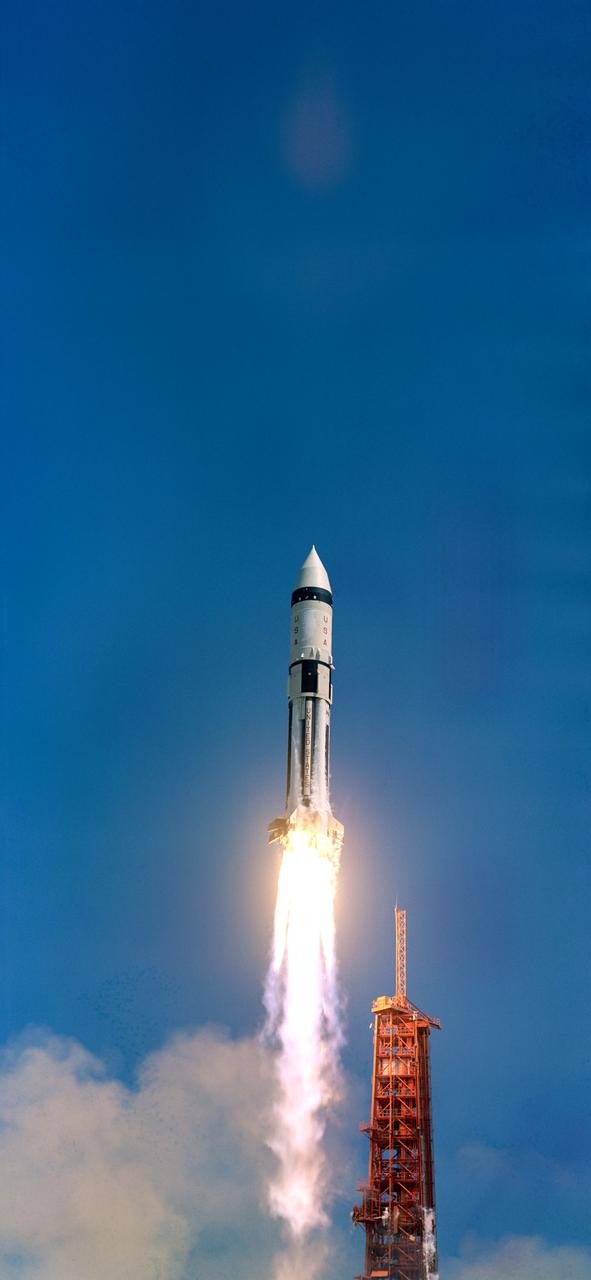
Liftoff of Saturn Mission 203, the second in the uprated Saturn 1 Development Mission Series, was accomplished from the Kennedy Space Center (KSC) Launch Complex 37 at 10:53 a.m., 07/05/1966.       KSC, FL
Liftoff - Saturn Mission 203 - KSC
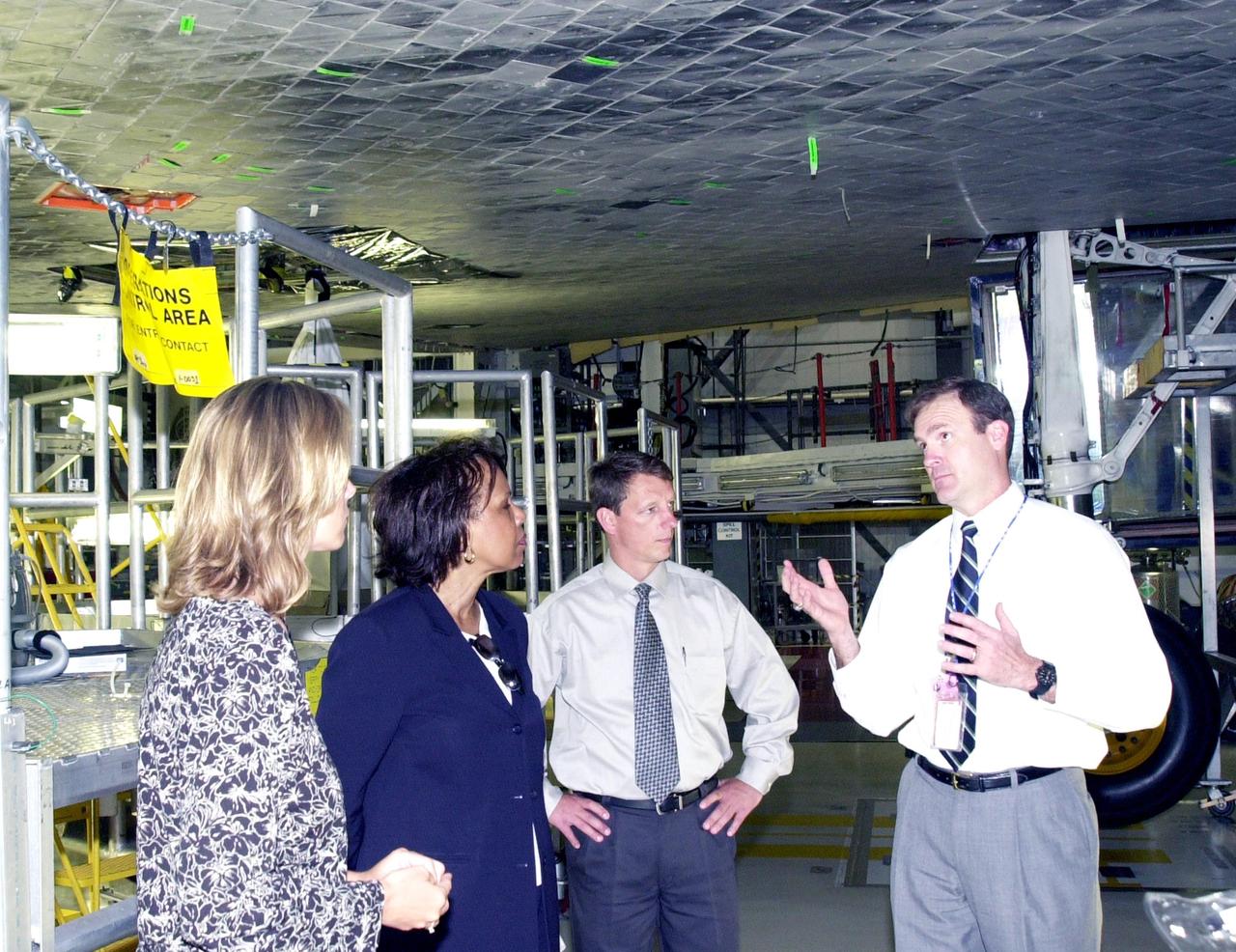
KENNEDY SPACE CENTER, FLA. - In the Orbiter Processing Facility, FAA Administrator Patti Smith (second from left) listens to Jim Halsell (right), manager of  KSC's Space Shuttle Program Launch Integration,  during a tour of KSC.
KSC-02pd0695
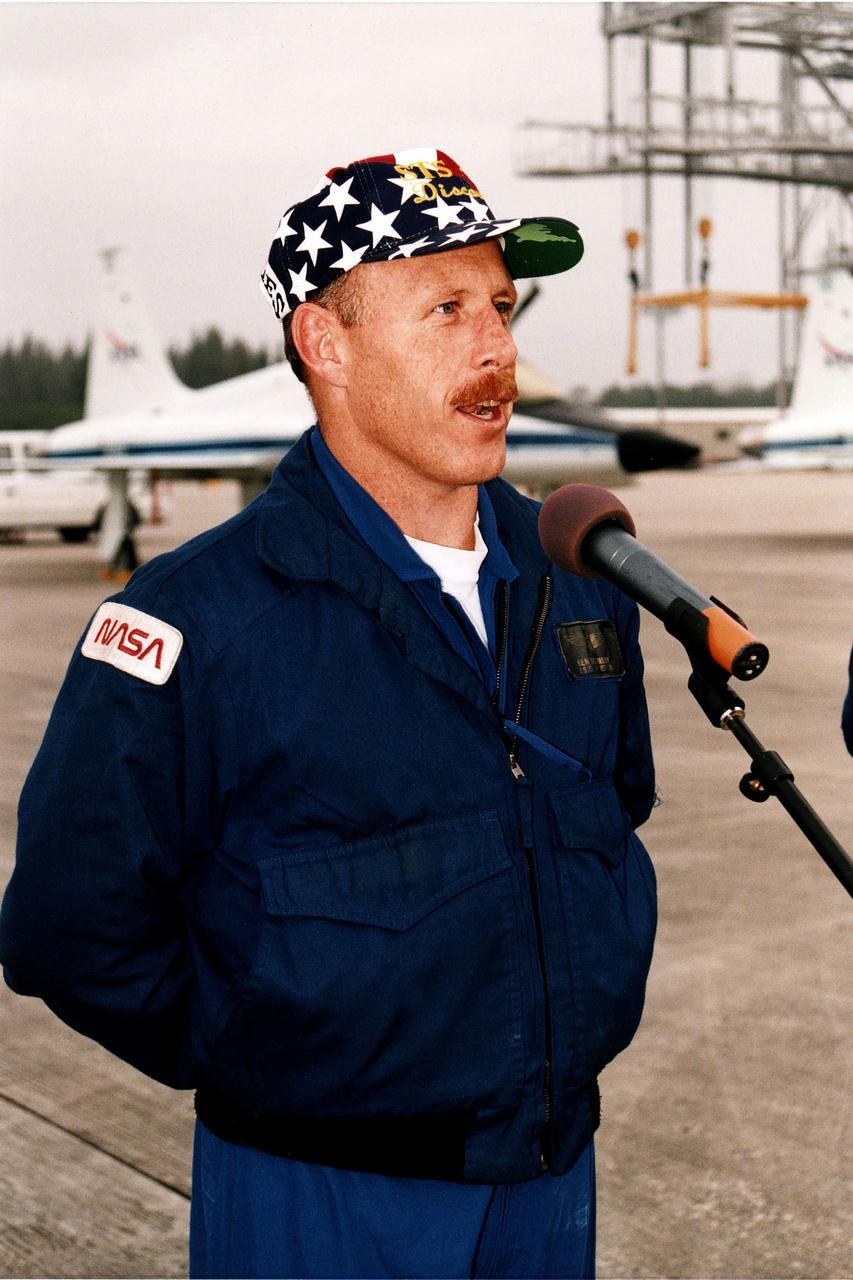
KENNEDY SPACE CENTER, FLA. -   STS-82 Mission Commander Kenneth D. Bowersox greets media representatives after arrival at KSC's Shuttle Landing Facility.  Bowersox and the other six members of the STS-82 crew came from their home base at Johnson Space Center in Houston, Texas, to spend the last few days before launch at KSC.  STS-82 is scheduled for liftoff on Feb. 11 during a 65-minute launch window that opens at 3:56 a.m. EST.  The 10-day flight aboard the Space Shuttle Discovery will be the second Hubble Space Telescope (HST) servicing mission.
KENNEDY SPACE CENTER, FLA. - STS-82 Mission Commander Kenneth D. Bowersox greets media representatives after arrival at KSC's Shuttle Landing Facility. Bowersox and the other six members of the STS-82 crew came from their home base at Johnson Space Center in Houston, Texas, to spend the last few days before launch at KSC. STS-82 is scheduled for liftoff on Feb. 11 during a 65-minute launch window that opens at 3:56 a.m. EST. The 10-day flight aboard the Space Shuttle Discovery will be the second Hubble Space Telescope (HST) servicing mission.
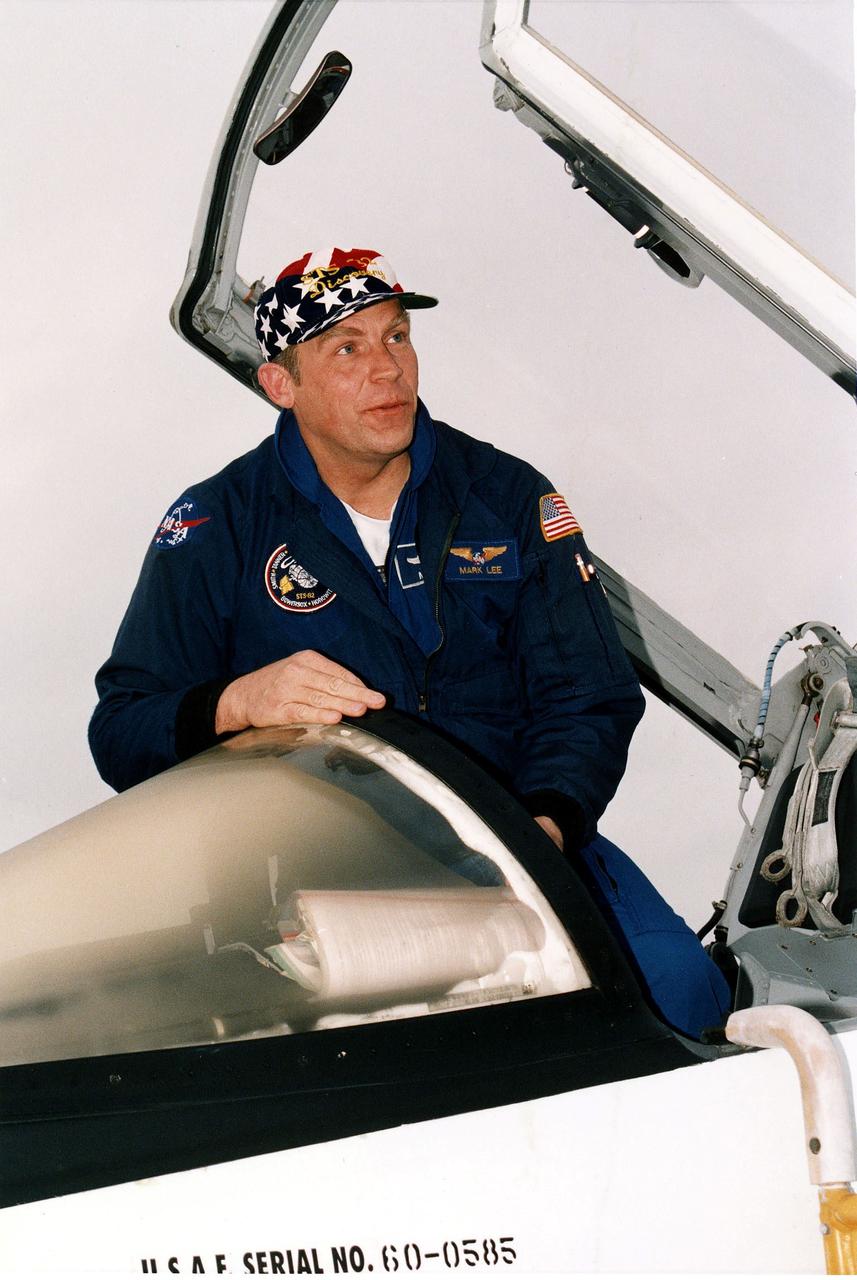
KENNEDY SPACE CENTER, FLA. -  STS-82 Payload Commander Mark C. Lee prepares to step down from the T-38 jet he flew from an air field serving the astronauts' home base at Johnson Space Center, Houston, Texas, to KSC's Shuttle Landing Facility.  Lee and the other six members of the STS-82 crew will spend the last few days before launch at KSC.  STS-82 is scheduled for liftoff on Feb. 11 during a 65-minute launch window that opens at 3:56 a.m. EST.  The 10-day flight aboard the Space Shuttle Discovery will be the second Hubble Space Telescope (HST) servicing mission.
KENNEDY SPACE CENTER, FLA. - STS-82 Payload Commander Mark C. Lee prepares to step down from the T-38 jet he flew from an air field serving the astronauts' home base at Johnson Space Center, Houston, Texas, to KSC's Shuttle Landing Facility. Lee and the other six members of the STS-82 crew will spend the last few days before launch at KSC. STS-82 is scheduled for liftoff on Feb. 11 during a 65-minute launch window that opens at 3:56 a.m. EST. The 10-day flight aboard the Space Shuttle Discovery will be the second Hubble Space Telescope (HST) servicing mission.
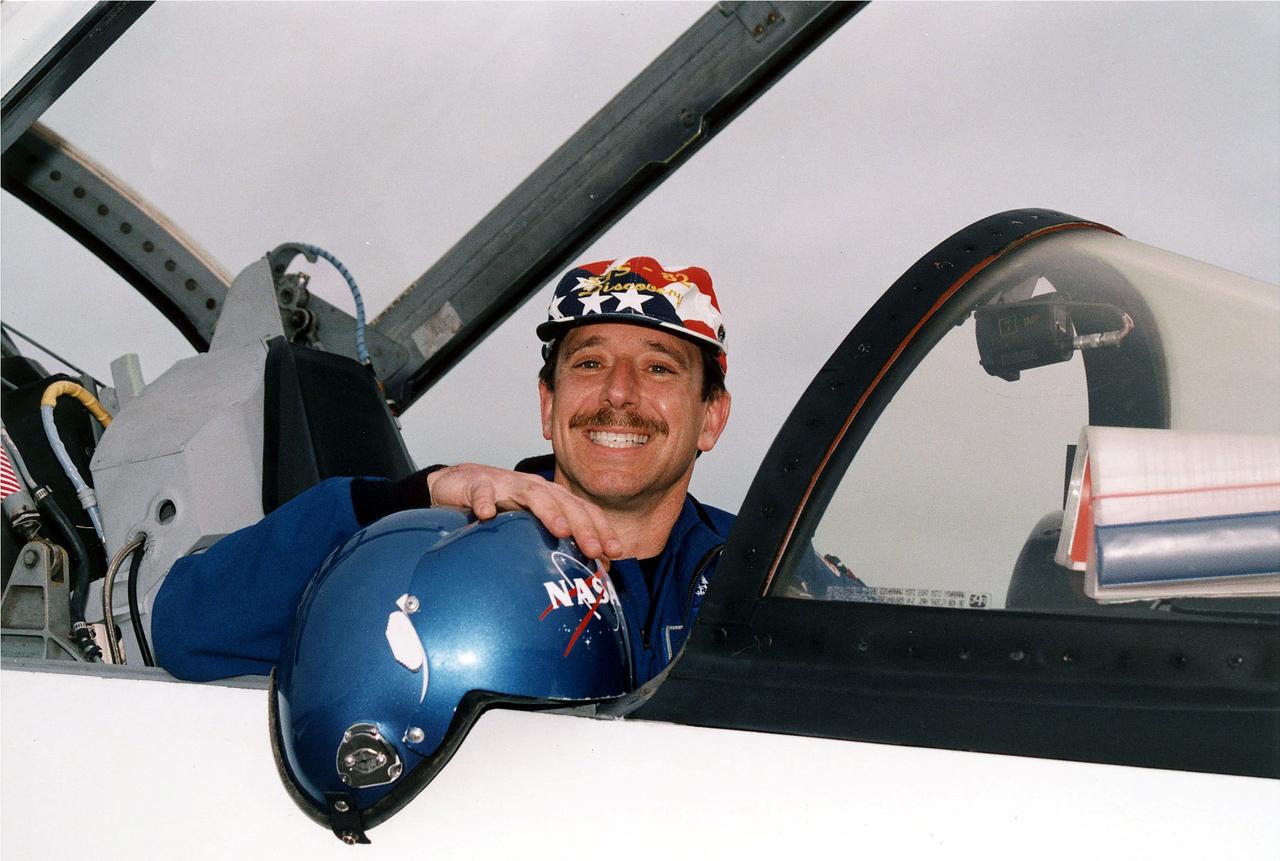
KENNEDY SPACE CENTER, FLA. -  STS-82 Pilot Scott J. "Doc" Horowitz flashes a wide grin for photographers after landing his T-38 jet at KSC's Shuttle Landing Facility.  Horowitz and the other six members of the STS-82 crew came from their home base at Johnson Space Center in Houston, Texas, to spend the last few days before launch at KSC.   STS-82 is scheduled for liftoff on Feb. 11 during a 65-minute launch window that opens at 3:56 a.m. EST.  The 10-day flight aboard the Space Shuttle Discovery will be the second Hubble Space Telescope (HST) servicing mission.
KENNEDY SPACE CENTER, FLA. - STS-82 Pilot Scott J. "Doc" Horowitz flashes a wide grin for photographers after landing his T-38 jet at KSC's Shuttle Landing Facility. Horowitz and the other six members of the STS-82 crew came from their home base at Johnson Space Center in Houston, Texas, to spend the last few days before launch at KSC. STS-82 is scheduled for liftoff on Feb. 11 during a 65-minute launch window that opens at 3:56 a.m. EST. The 10-day flight aboard the Space Shuttle Discovery will be the second Hubble Space Telescope (HST) servicing mission.
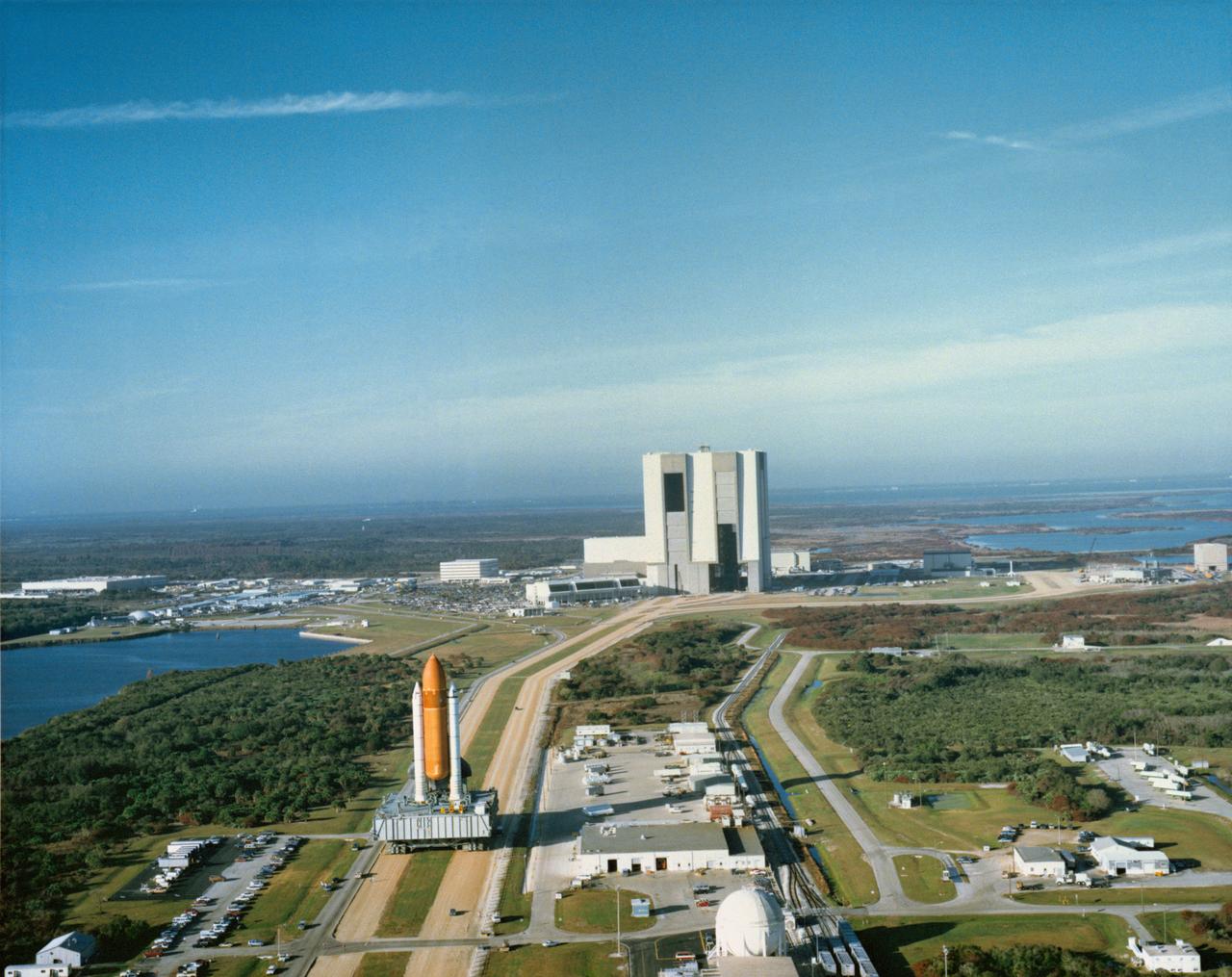
Atlantis, Orbiter Vehicle (OV) 104, is blocked by its large orange external tank (ET) as it leaves Vehicle Assembly Building (VAB) during its rollout to Kennedy Space Center (KSC) Launch Complex (LC) Pad 39A. The crawler transporter heads along the specially designed roadway with OV-104, the ET, and two solid rocket boosters mounted on top of a mobile launcher platform. KSC facilities including the VAB and Launch Control Center (LCC) are visible in the background. OV-104 heads to LC Pad 39A after the shortest stay in the VAB since return-to-flight. OV-104 is being prepared for launch on STS-36, a Department of Defense (DOD) dedicated mission. View provided by KSC with alternate KSC number KSC-90PC-134.
STS-36 Atlantis, OV-104, leaves VAB during its rollout to KSC LC Pad 39A
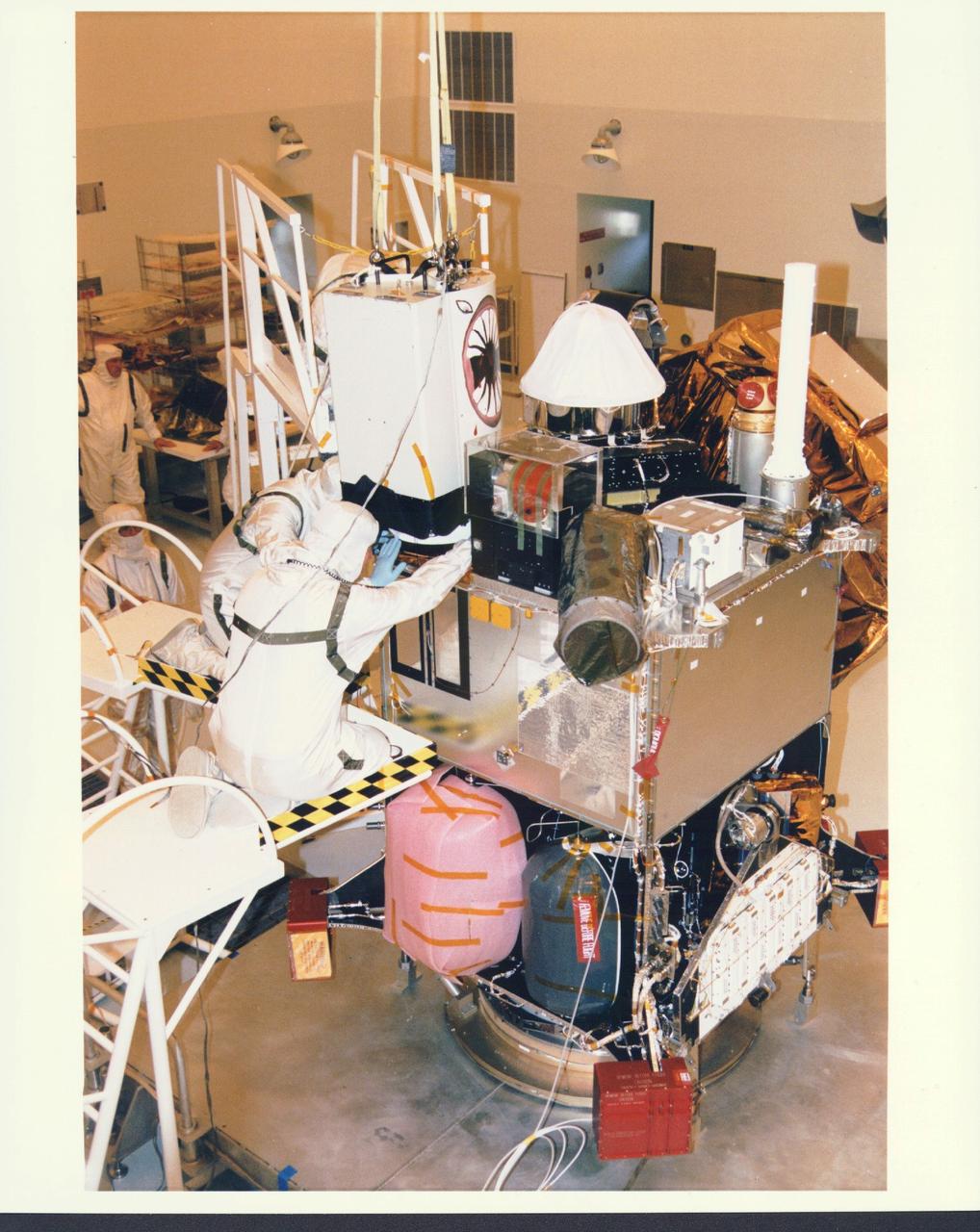
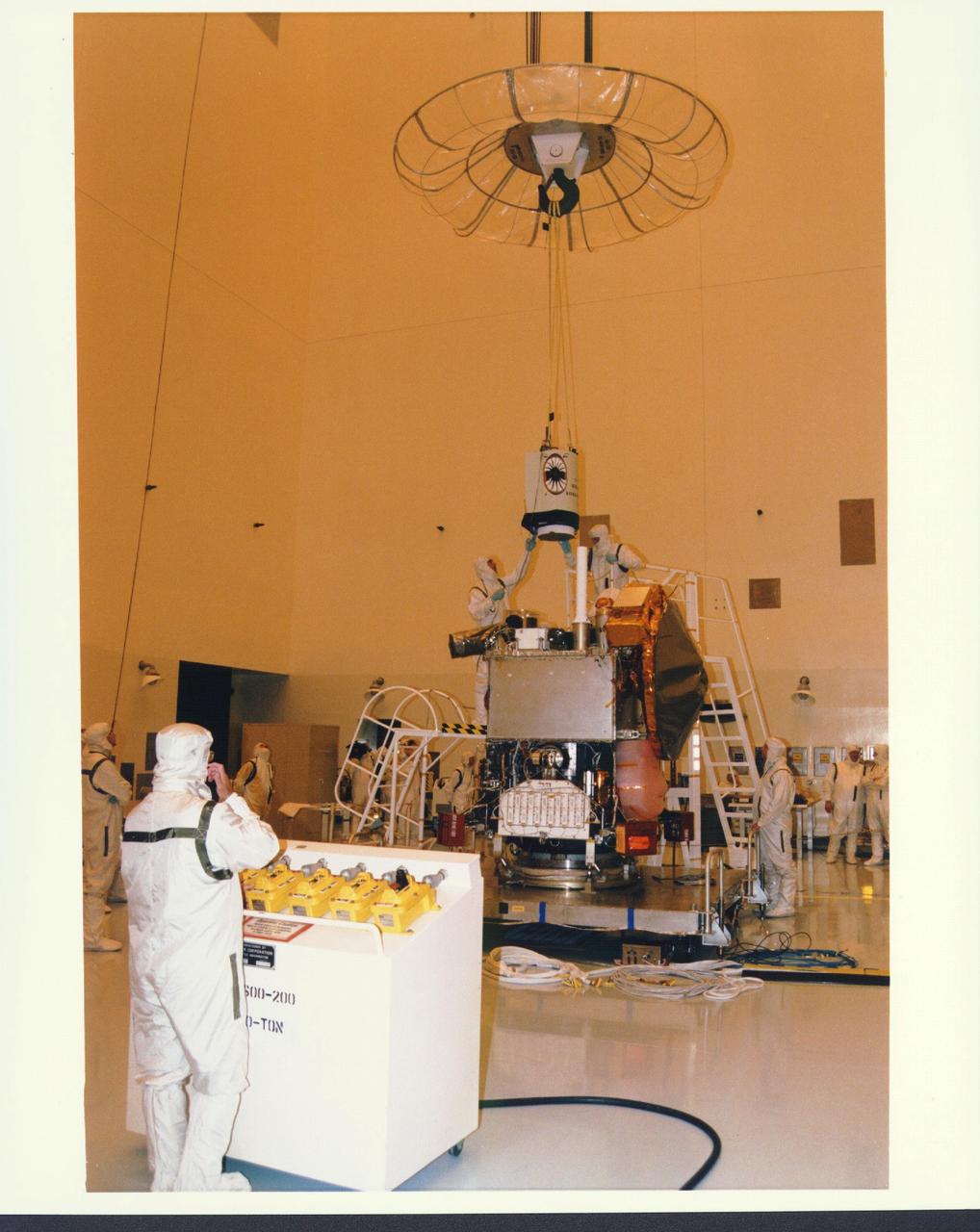
KENNEDY SPACE CENTER, FLA. -  In the Payload Hazardous Servicing Facility at KSC, installation is under way of the Mars Orbiter Camera (MOC) on the Mars Global Surveyor spacecraft.  The MOC is one of a suite of six scientific instruments that will gather data about Martian topography, mineral distribution and weather during a two-year period.  The Mars Global Surveyor is slated for launch aboard a Delta II expendable launch vehicle on Nov. 6, the beginning of a 20-day launch period.
KENNEDY SPACE CENTER, FLA. - In the Payload Hazardous Servicing Facility at KSC, installation is under way of the Mars Orbiter Camera (MOC) on the Mars Global Surveyor spacecraft. The MOC is one of a suite of six scientific instruments that will gather data about Martian topography, mineral distribution and weather during a two-year period. The Mars Global Surveyor is slated for launch aboard a Delta II expendable launch vehicle on Nov. 6, the beginning of a 20-day launch period.
KENNEDY SPACE CENTER, FLA. -  In the Payload Hazardous Servicing Facility at KSC, installation is under way of the Mars Orbiter Camera (MOC) on the Mars Global Surveyor spacecraft.  The MOC is one of a suite of six scientific instruments that will gather data about Martian topography, mineral distribution and weather during a two-year period.  The Mars Global Surveyor is slated for launch aboard a Delta II expendable launch vehicle on Nov. 6, the beginning of a 20-day launch period.
KENNEDY SPACE CENTER, FLA. - In the Payload Hazardous Servicing Facility at KSC, installation is under way of the Mars Orbiter Camera (MOC) on the Mars Global Surveyor spacecraft. The MOC is one of a suite of six scientific instruments that will gather data about Martian topography, mineral distribution and weather during a two-year period. The Mars Global Surveyor is slated for launch aboard a Delta II expendable launch vehicle on Nov. 6, the beginning of a 20-day launch period.
KENNEDY SPACE CENTER, FLA. -  In the Payload Hazardous Servicing Facility at KSC, installation is under way of the Mars Orbiter Camera (MOC) on the Mars Global Surveyor spacecraft.  The MOC is one of a suite of six scientific instruments that will gather data about Martian topography, mineral distribution and weather during a two-year period.  The Mars Global Surveyor is slated for launch aboard a Delta II expendable launch vehicle on Nov. 6, the beginning of a 20-day launch period.
KENNEDY SPACE CENTER, FLA. - In the Payload Hazardous Servicing Facility at KSC, installation is under way of the Mars Orbiter Camera (MOC) on the Mars Global Surveyor spacecraft. The MOC is one of a suite of six scientific instruments that will gather data about Martian topography, mineral distribution and weather during a two-year period. The Mars Global Surveyor is slated for launch aboard a Delta II expendable launch vehicle on Nov. 6, the beginning of a 20-day launch period.
KENNEDY SPACE CENTER, FLA. -  In the Payload Hazardous Servicing Facility at KSC, installation is under way of the Mars Orbiter Camera (MOC) on the Mars Global Surveyor spacecraft.  The MOC is one of a suite of six scientific instruments that will gather data about Martian topography, mineral distribution and weather during a two-year period.  The Mars Global Surveyor is slated for launch aboard a Delta II expendable launch vehicle on Nov. 6, the beginning of a 20-day launch period.
KENNEDY SPACE CENTER, FLA. - In the Payload Hazardous Servicing Facility at KSC, installation is under way of the Mars Orbiter Camera (MOC) on the Mars Global Surveyor spacecraft. The MOC is one of a suite of six scientific instruments that will gather data about Martian topography, mineral distribution and weather during a two-year period. The Mars Global Surveyor is slated for launch aboard a Delta II expendable launch vehicle on Nov. 6, the beginning of a 20-day launch period.
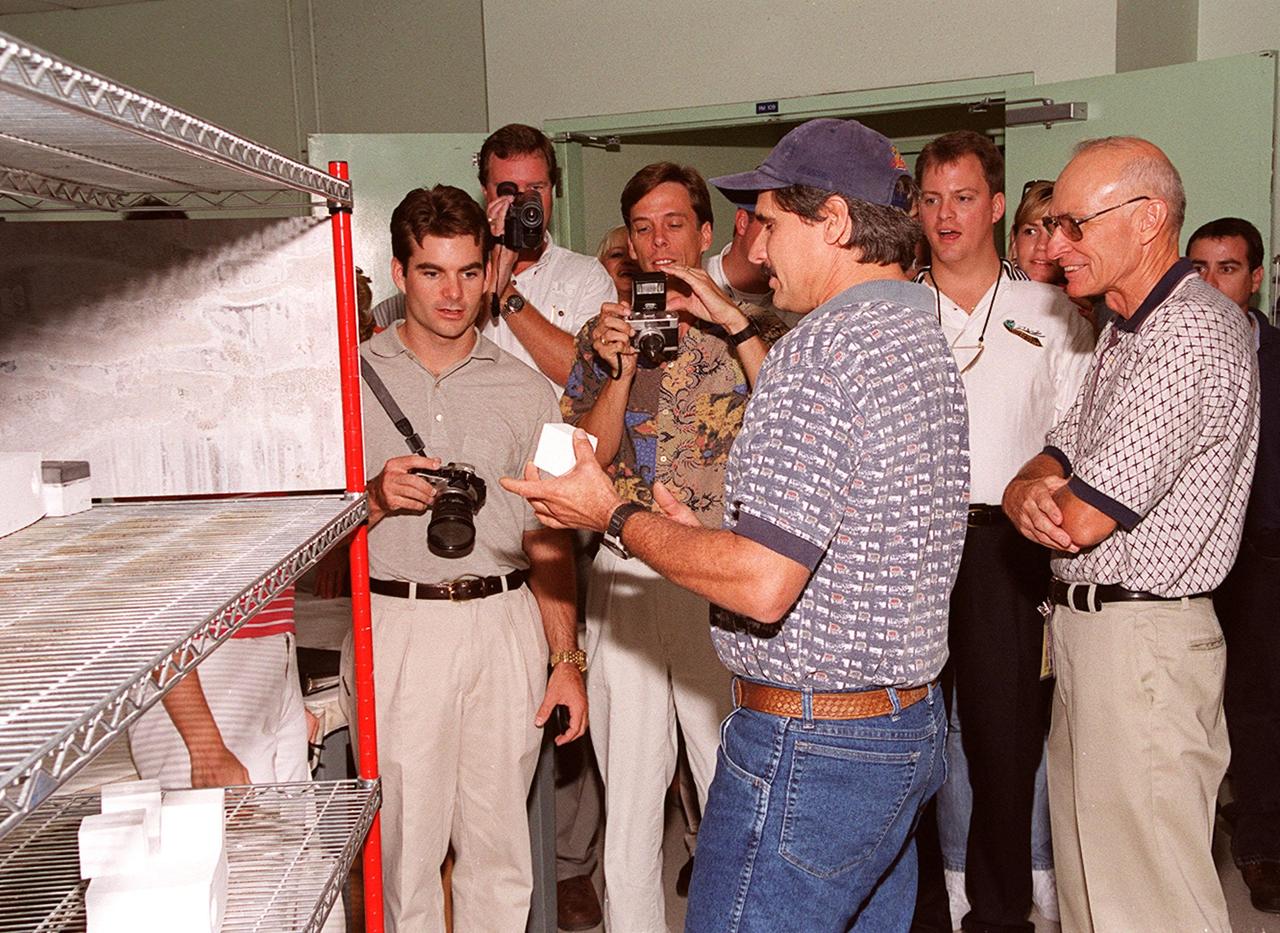
KENNEDY SPACE CENTER, FLA. -- During a visit to KSC, NASCAR race driver Jeff Gordon (left) looks at a tile in the Tile Shop in the Launch Complex 39 area. Former KSC launch director Bob Sieck (far right) looks on
KSC-00pp1068
KENNEDY SPACE CENTER, FLA. -- During a visit to KSC, NASCAR race driver Jeff Gordon (left) looks at a tile in the Tile Shop in the Launch Complex 39 area. Former KSC launch director Bob Sieck (far right) looks on
KSC00pp1068
Roy D. Bridges Jr., KSC's next center director, at right, poses in the firing room of the Launch Control Center with two top contractor officials at Kennedy Space Center during the STS-82 launch of Discovery on the second Hubble Space Telescope servicing mission. From left, are Michael J. McCulley, vice president and associate program manager for ground operations for United Space Alliance at KSC; and Bruce Melnick, vice president of McDonnell Douglas Space and Defense Systems-KSC. Bridges is slated to become KSC's seventh center director on March 2, succeeding Jay F. Honeycutt
KSC-97pc302
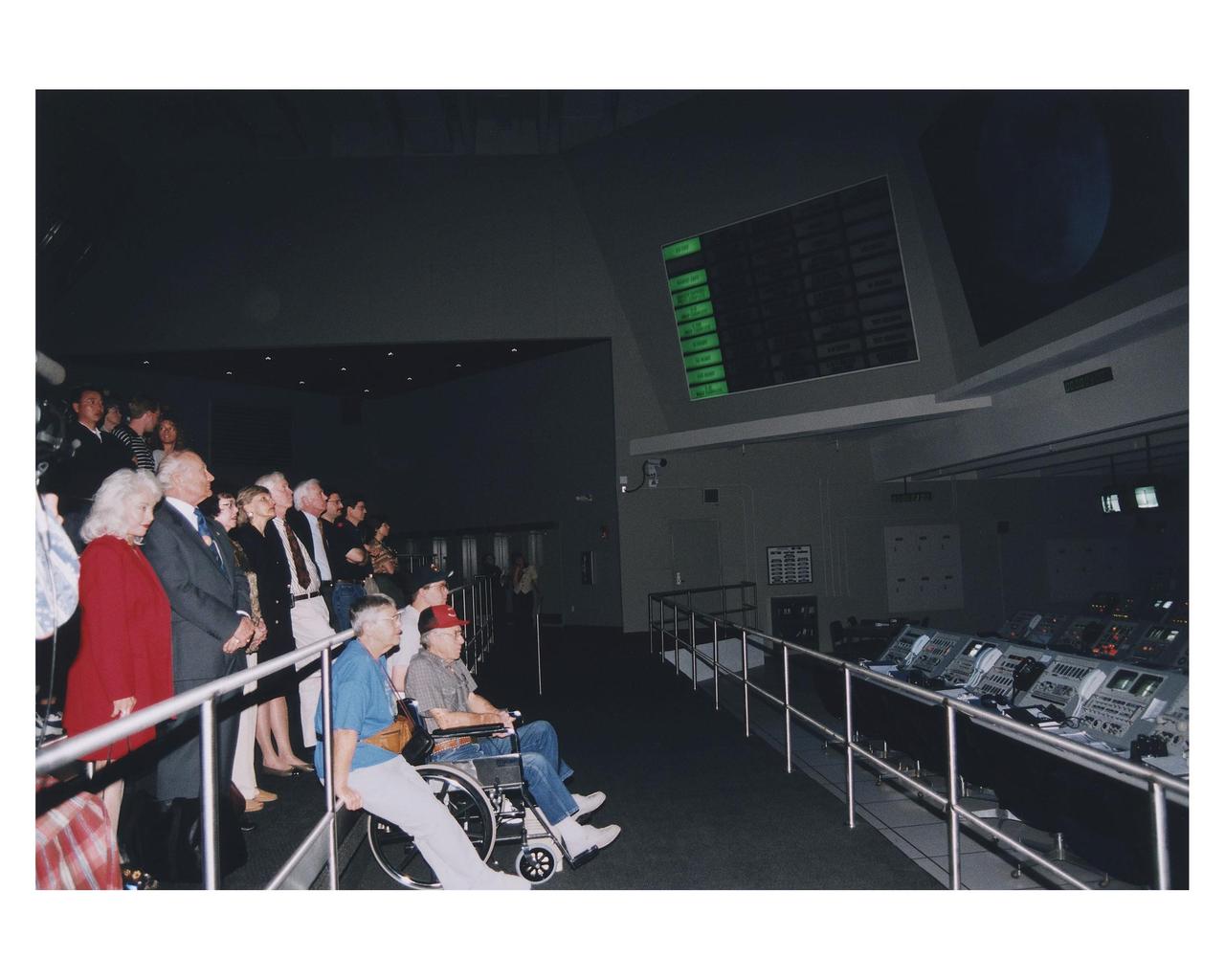
KENNEDY SPACE CENTER, FLA. -- Several Apollo program astronauts, along with their family members and friends, watch a simulation of an Apollo/Saturn V launch in a replica of a Launch Control Center firing room in the new Apollo/Saturn V Center (ASVC) at KSC prior to the gala grand opening ceremony for the facility that was held Jan. 8, 1997. The astronauts were invited to participate in the event, which also featured NASA Administrator Dan Goldin and KSC Director Jay Honeycutt. The ASVC also features several other Apollo program spacecraft component displays and multimedia presentations. The facility will be a part of the KSC bus tour that embarks from the KSC Visitor Center
KSC-97pc113
KENNEDY SPACE CENTER, FLA. -- Several Apollo program astronauts, along with their family members and friends, watch a simulation of an Apollo/Saturn V launch in a replica of a Launch Control Center firing room in the new Apollo/Saturn V Center (ASVC) at KSC prior to the gala grand opening ceremony for the facility that was held Jan. 8, 1997. The astronauts were invited to participate in the event, which also featured NASA Administrator Dan Goldin and KSC Director Jay Honeycutt. The ASVC also features several other Apollo program spacecraft component displays and multimedia presentations. The facility will be a part of the KSC bus tour that embarks from the KSC Visitor Center
KSC-97pc114
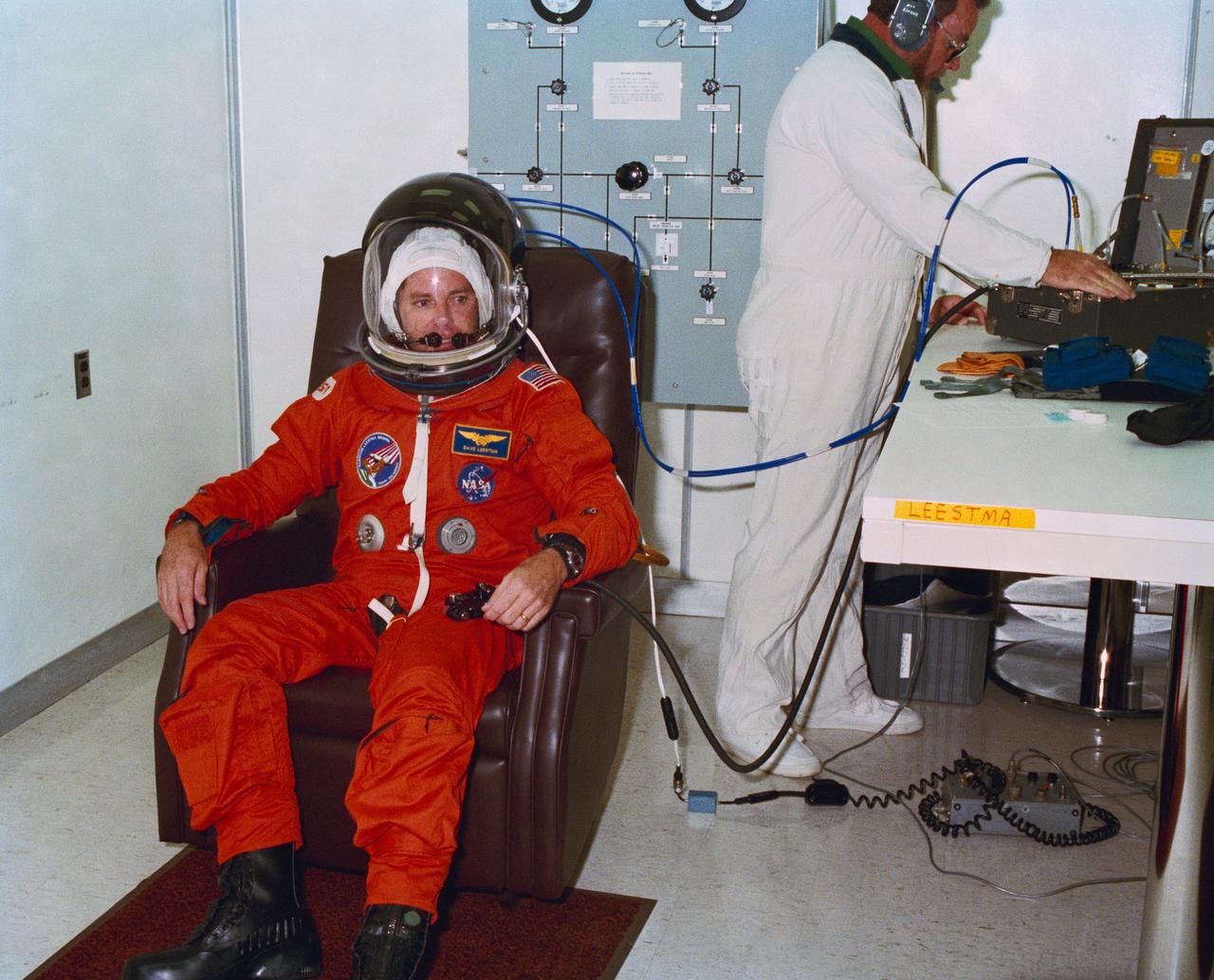
S89-41093 (9 Aug 1989) --- STS-28 Columbia, Orbiter Vehicle (OV) 102, mission specialist David C. Leestma relaxes in chair after donning launch and entry suit (LES) and launch and entry helmet (LEH). Technician in the background monitors LES systems. Leestma, along with fellow crewmembers, is participating in the terminal countdown demonstration test (TCDT) at the Kennedy Space Center (KSC) Operations and Checkout (O&C) Building. View provided by KSC with alternate number KSC-89PC-673.
STS-28 Columbia, OV-102, terminal countdown demonstration test (TCDT) at KSC
KENNEDY SPACE CENTER, FLA.  -- During the second stage of a simulated emergency, known as Mode 4,  KSC rescue team members help "injured" astronauts, portrayed by KSC personnel, out of the slidewire baskets.  The emergency exercise began at the 195-foot level of Launch Pad 39A. The KSC rescue teams are practicing emergency procedures in the unlikely scenario of a mishap on the pad during a launch sequence.  The exercises are standard training procedures to assess and prepare emergency personnel, procedures and hardware.  Photo credit: NASA/Jim Grossmann
KSC-07pd0827