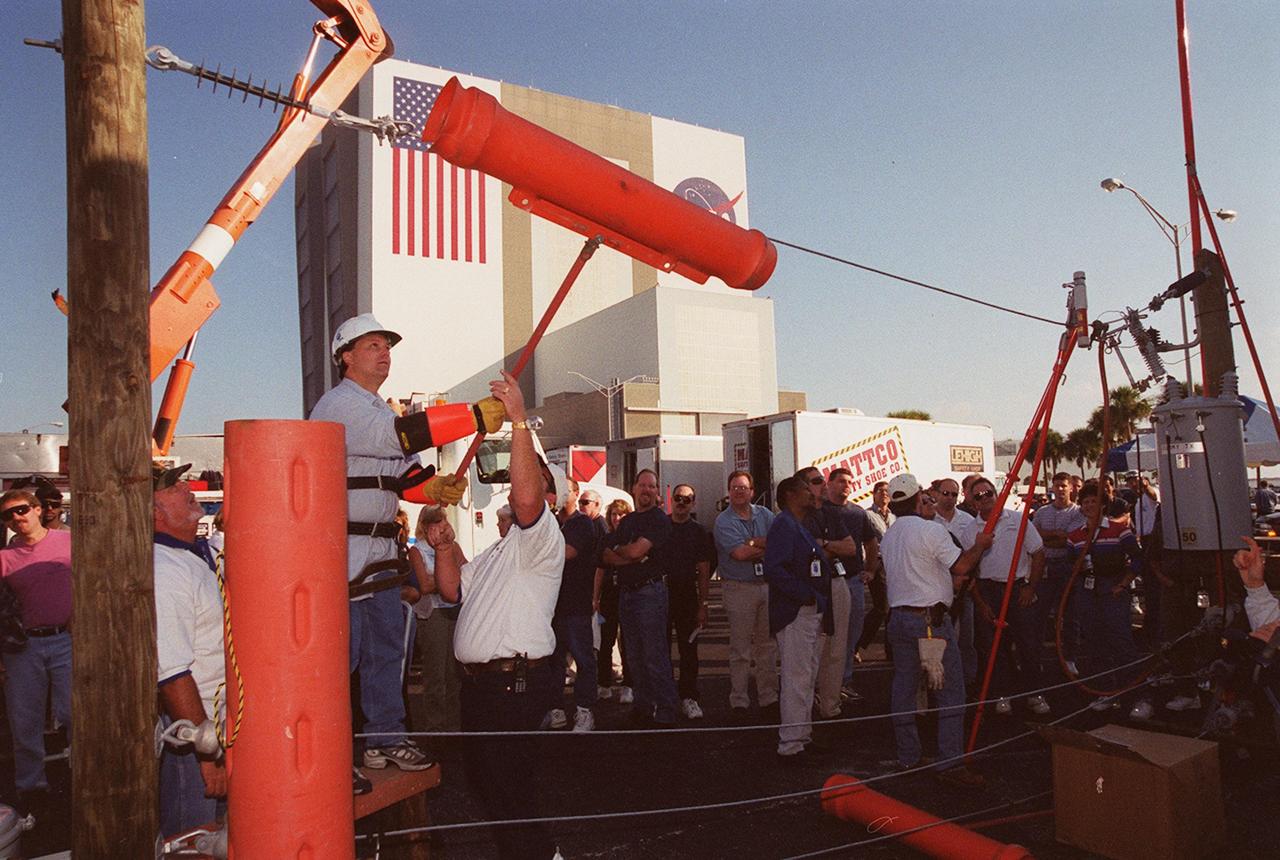
During Super Safety and Health Day at KSC, workers from Florida Power and Light (at left) demonstrate to an interested group of KSC employees how they safely handle high power lines. Safety Day is a full day of NASA-sponsored, KSC and 45th Space Wing events involving a number of health and safety related activities: Displays, vendors, technical paper sessions, panel discussions, a keynote speaker, etc. The entire Center and Wing stand down to participate in the planned events. Safety Day is held annually to proactively increase awareness in safety and health among the government and contractor workforce population. The first guiding principle at KSC is “Safety and Health First.” KSC’s number one goal is to “Assure sound, safe and efficient practices and processes are in place for privatized/commercialized launch site processing.
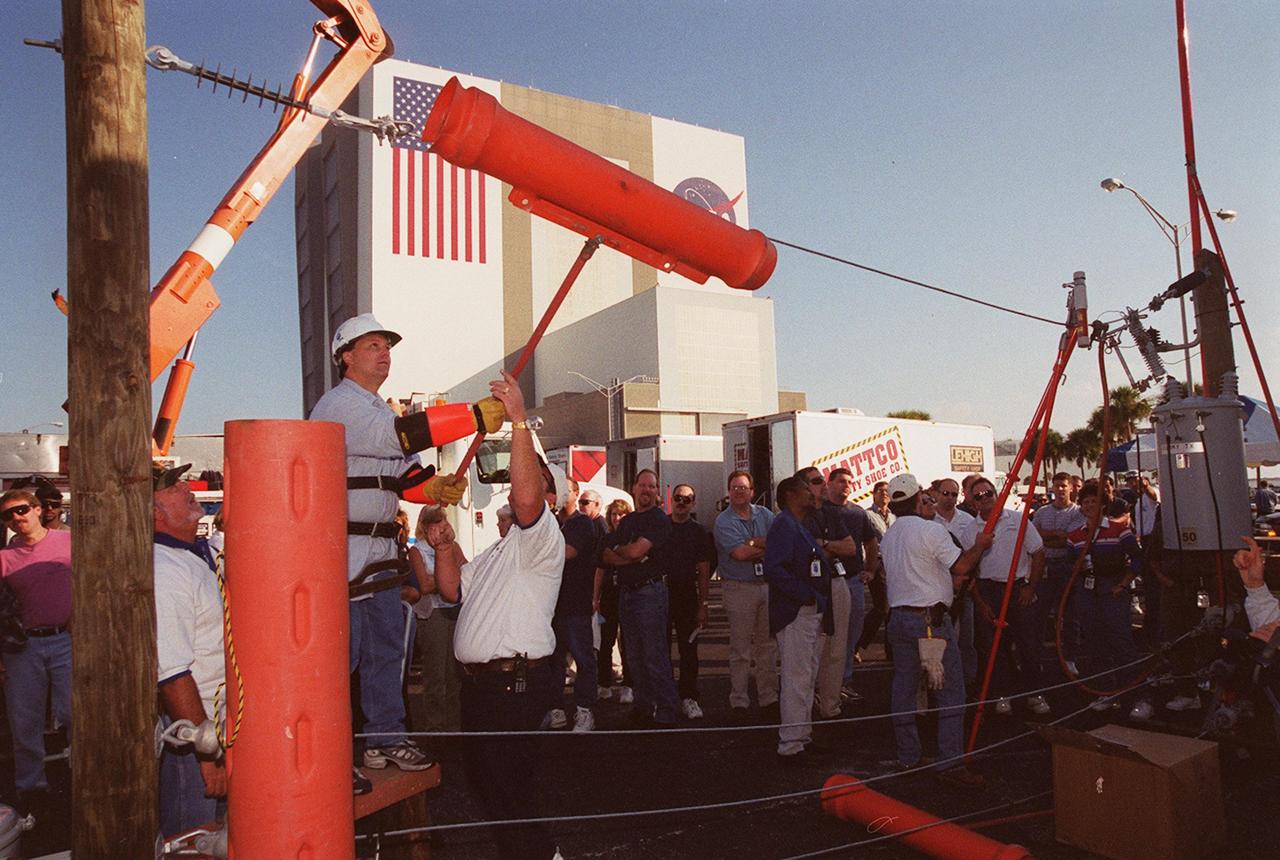
During Super Safety and Health Day at KSC, workers from Florida Power and Light (at left) demonstrate to an interested group of KSC employees how they safely handle high power lines. Safety Day is a full day of NASA-sponsored, KSC and 45th Space Wing events involving a number of health and safety related activities: Displays, vendors, technical paper sessions, panel discussions, a keynote speaker, etc. The entire Center and Wing stand down to participate in the planned events. Safety Day is held annually to proactively increase awareness in safety and health among the government and contractor workforce population. The first guiding principle at KSC is “Safety and Health First.” KSC’s number one goal is to “Assure sound, safe and efficient practices and processes are in place for privatized/commercialized launch site processing.
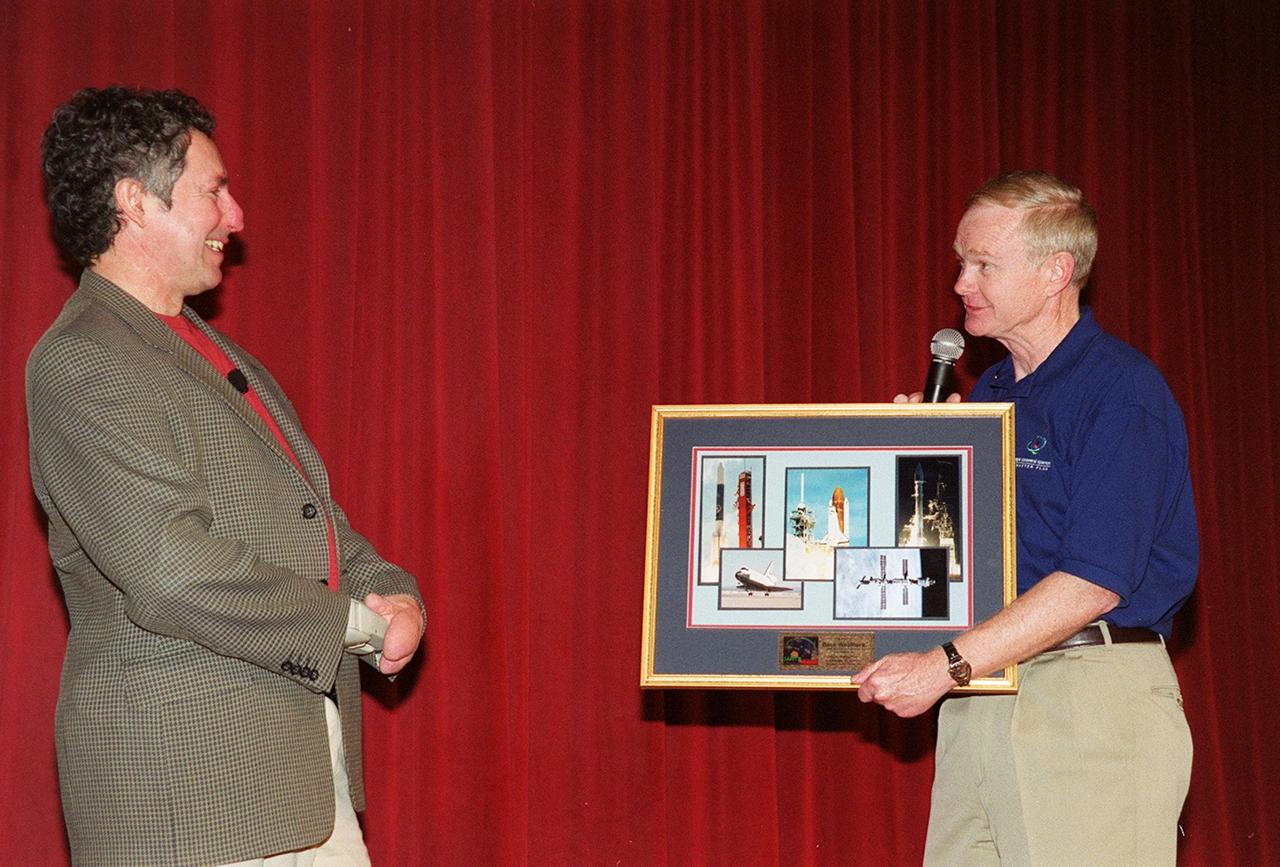
During Super Safety and Health Day at KSC, keynote speaker Dr. Beck Weathers is given a memento of his visit by Center Director Roy Bridges. Weathers spoke about his ordeal of surviving the 1996 Mt. Everest disaster and the lessons learned from the experience. Safety Day is a full day of NASA-sponsored, KSC and 45th Space Wing events involving a number of health and safety related activities: Displays, vendors, technical paper sessions, panel discussions, a keynote speaker, etc. The entire Center and Wing stand down to participate in the planned events. Safety Day is held annually to proactively increase awareness in safety and health among the government and contractor workforce population. The first guiding principle at KSC is “Safety and Health First.” KSC’s number one goal is to “Assure sound, safe and efficient practices and processes are in place for privatized/commercialized launch site processing.
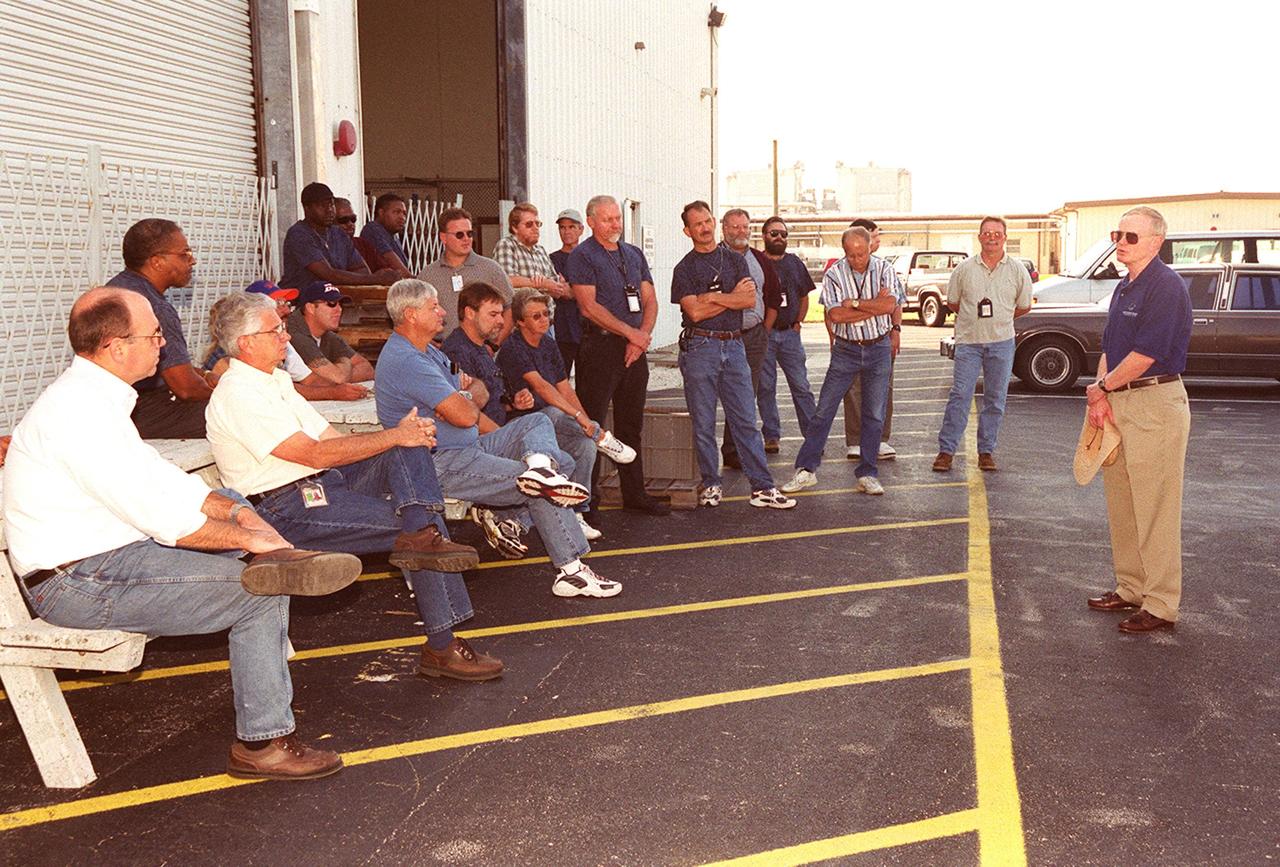
Center Director Roy Bridges talks to workers outside the Hazardous Maintenance Facility during Super Safety and Health Day at KSC. Safety Day is a full day of NASA-sponsored, KSC and 45th Space Wing events involving a number of health and safety related activities: Displays, vendors, technical paper sessions, panel discussions, a keynote speaker, etc. The entire Center and Wing stand down to participate in the planned events. Safety Day is held annually to proactively increase awareness in safety and health among the government and contractor workforce population. The first guiding principle at KSC is “Safety and Health First.” KSC’s number one goal is to “Assure sound, safe and efficient practices and processes are in place for privatized/commercialized launch site processing.
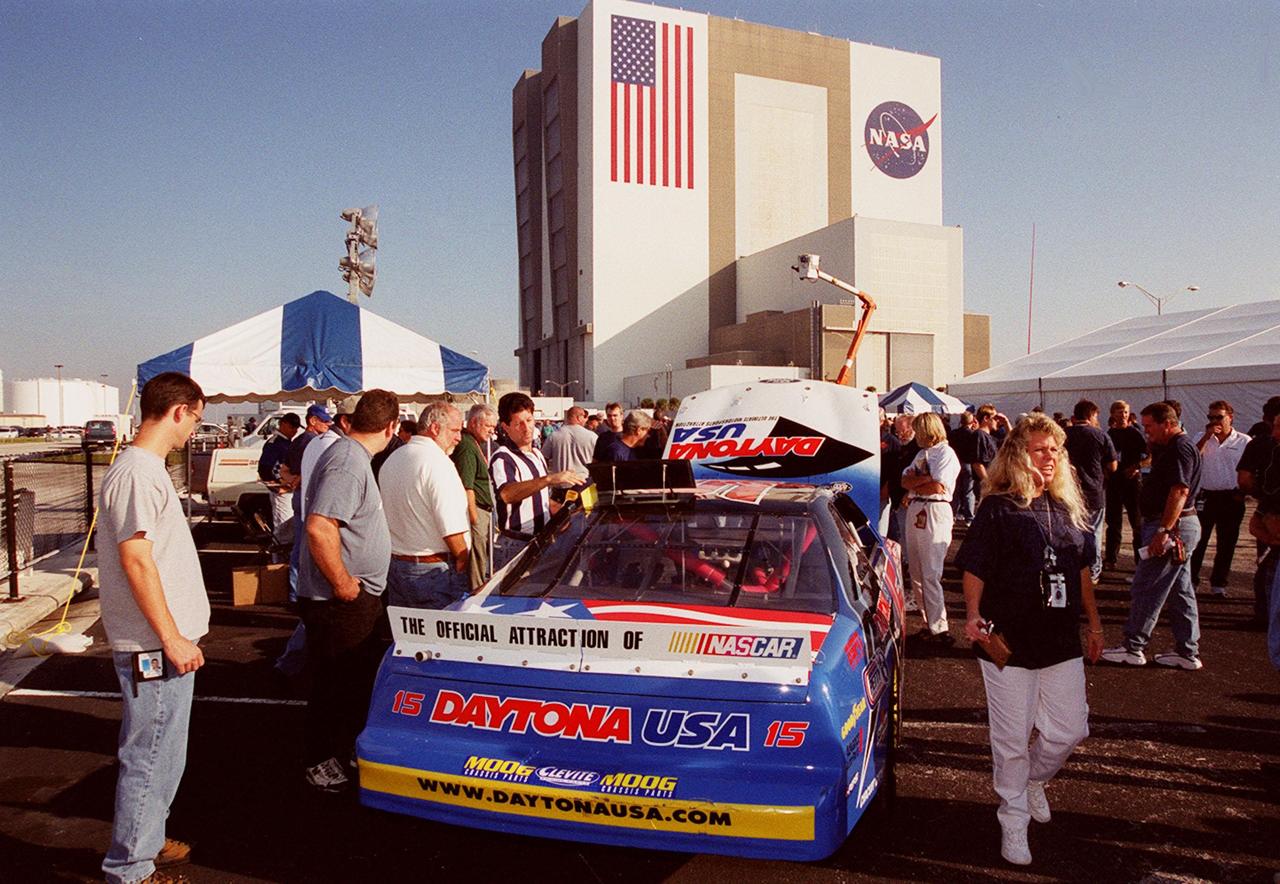
Employees take a look at this NASCAR auto being displayed during Super Safety and Health Day at KSC. Safety Day is a full day of NASA-sponsored, KSC and 45th Space Wing events involving a number of health and safety related activities: Displays, vendors, technical paper sessions, panel discussions, a keynote speaker, etc. The entire Center and Wing stand down to participate in the planned events. Safety Day is held annually to proactively increase awareness in safety and health among the government and contractor workforce population. The first guiding principle at KSC is “Safety and Health First.” KSC’s number one goal is to “Assure sound, safe and efficient practices and processes are in place for privatized/commercialized launch site processing.
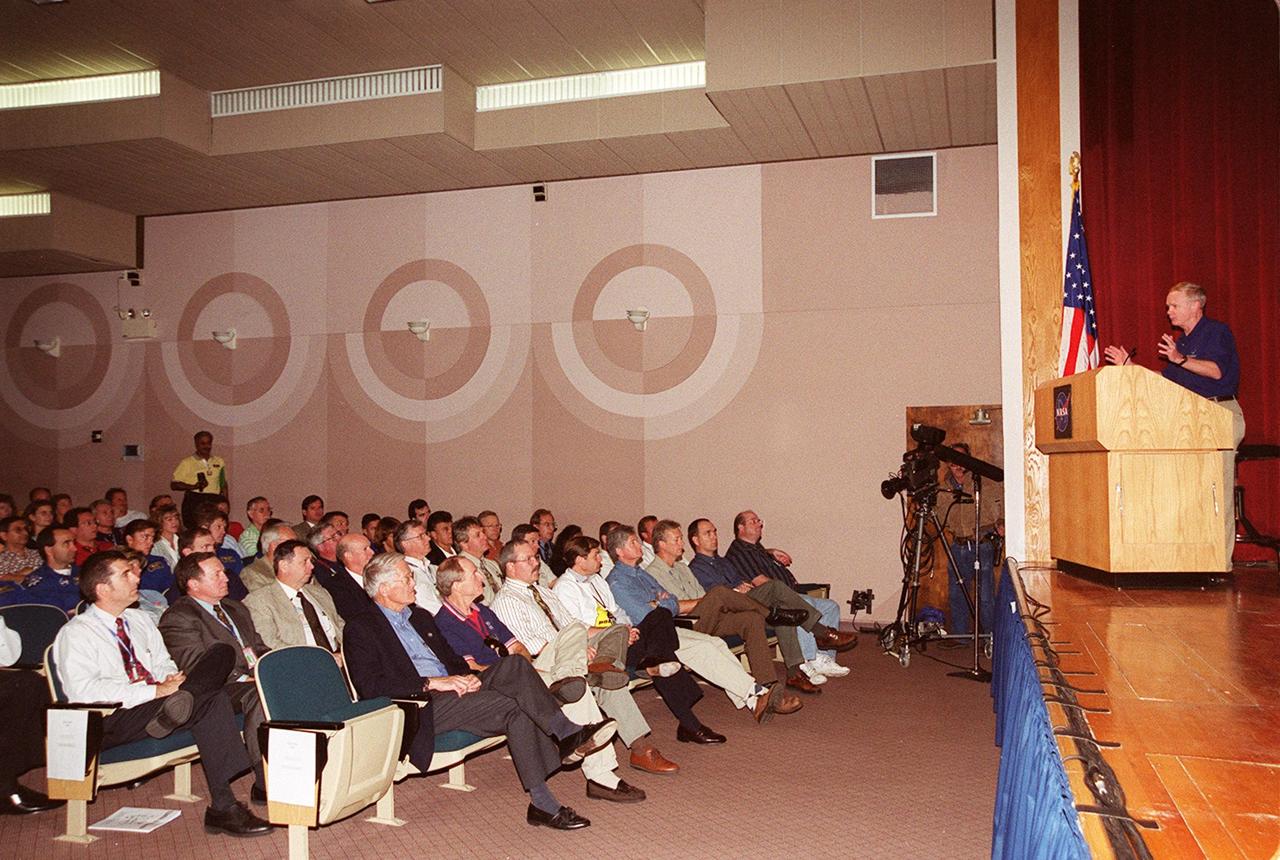
In the Training Auditorium at KSC, Center Director Roy Bridges addresses attendees at a presentation for Super Safety and Health Day. Safety Day is a full day of NASA-sponsored, KSC and 45th Space Wing events involving a number of health and safety related activities: Displays, vendors, technical paper sessions, panel discussions, a keynote speaker, etc. The entire Center and Wing stand down to participate in the planned events. Safety Day is held annually to proactively increase awareness in safety and health among the government and contractor workforce population. The first guiding principle at KSC is “Safety and Health First.” KSC’s number one goal is to “Assure sound, safe and efficient practices and processes are in place for privatized/commercialized launch site processing.
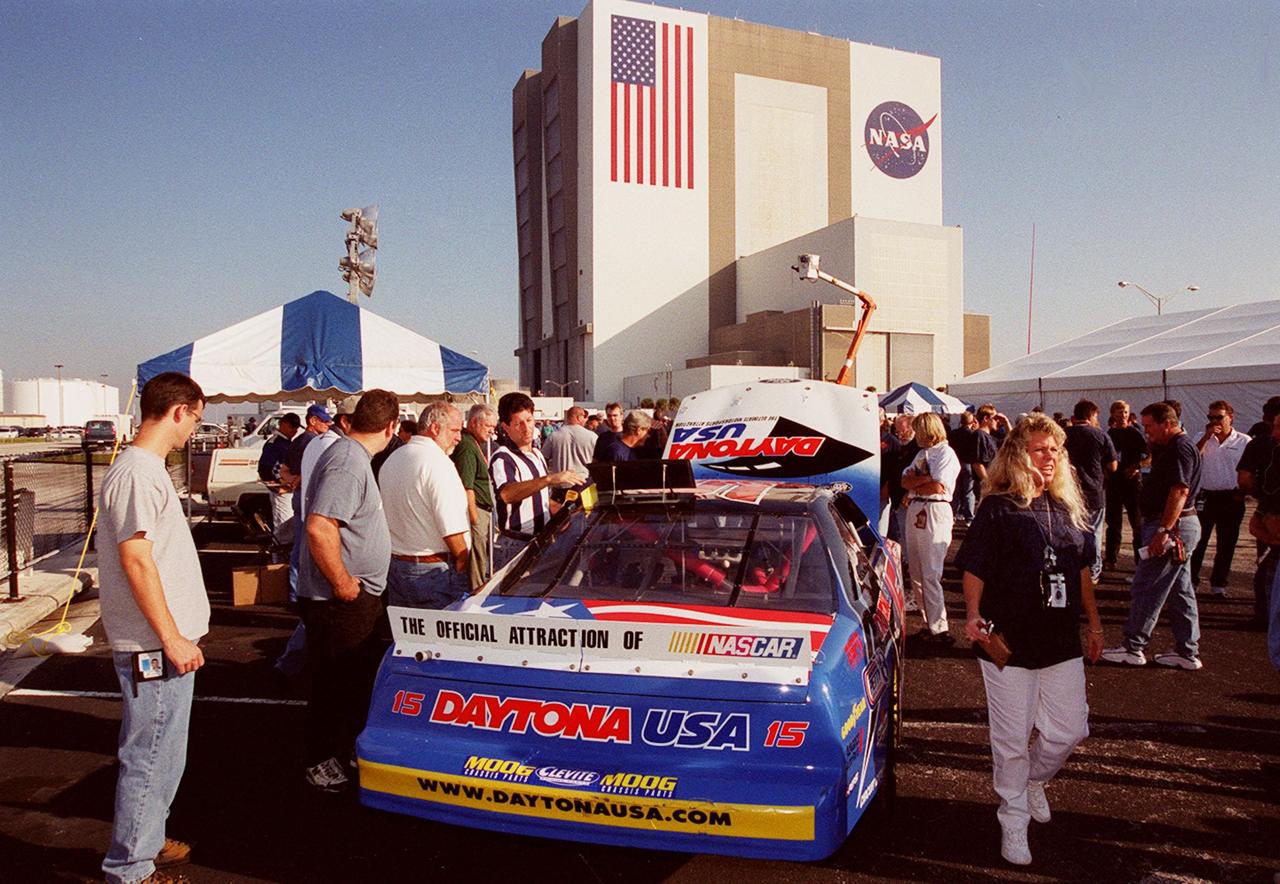
Employees take a look at this NASCAR auto being displayed during Super Safety and Health Day at KSC. Safety Day is a full day of NASA-sponsored, KSC and 45th Space Wing events involving a number of health and safety related activities: Displays, vendors, technical paper sessions, panel discussions, a keynote speaker, etc. The entire Center and Wing stand down to participate in the planned events. Safety Day is held annually to proactively increase awareness in safety and health among the government and contractor workforce population. The first guiding principle at KSC is “Safety and Health First.” KSC’s number one goal is to “Assure sound, safe and efficient practices and processes are in place for privatized/commercialized launch site processing.
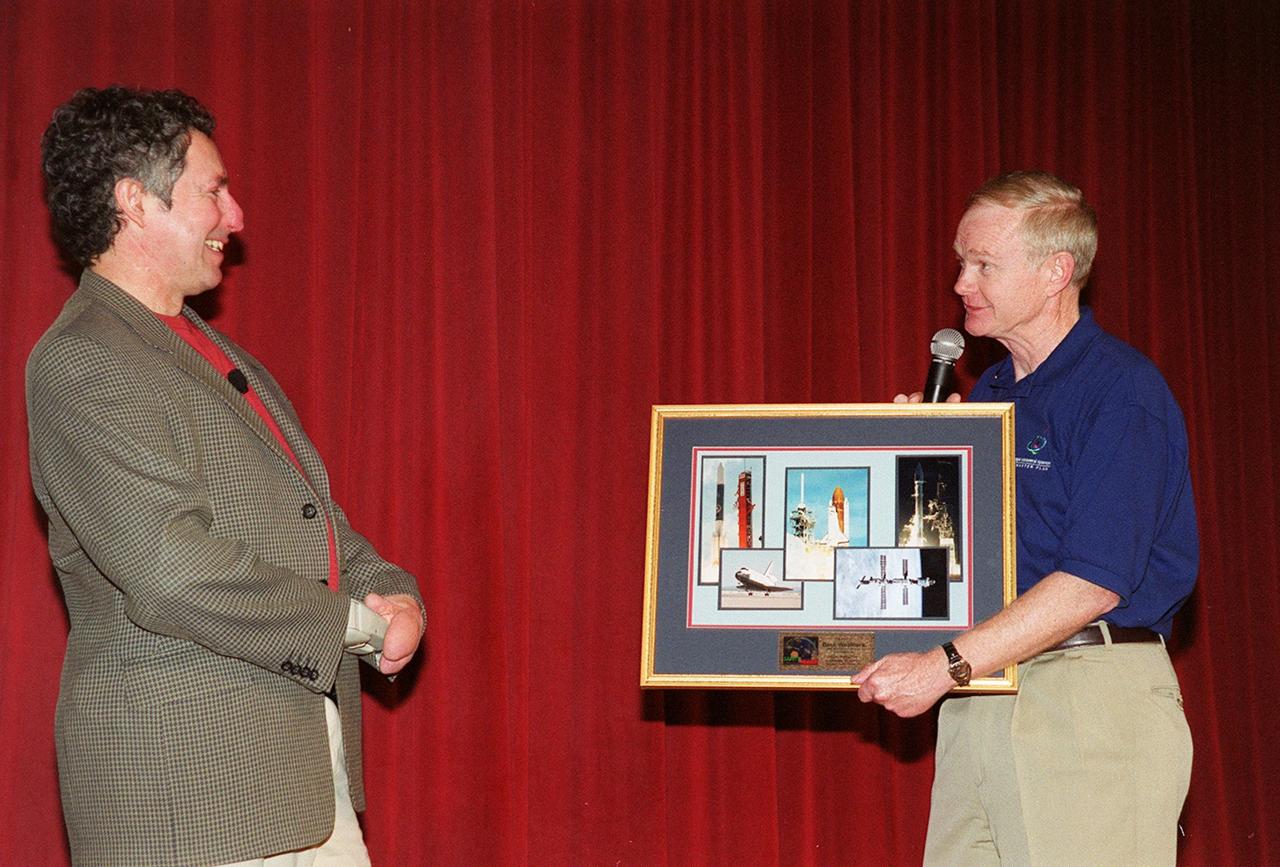
During Super Safety and Health Day at KSC, keynote speaker Dr. Beck Weathers is given a memento of his visit by Center Director Roy Bridges. Weathers spoke about his ordeal of surviving the 1996 Mt. Everest disaster and the lessons learned from the experience. Safety Day is a full day of NASA-sponsored, KSC and 45th Space Wing events involving a number of health and safety related activities: Displays, vendors, technical paper sessions, panel discussions, a keynote speaker, etc. The entire Center and Wing stand down to participate in the planned events. Safety Day is held annually to proactively increase awareness in safety and health among the government and contractor workforce population. The first guiding principle at KSC is “Safety and Health First.” KSC’s number one goal is to “Assure sound, safe and efficient practices and processes are in place for privatized/commercialized launch site processing.
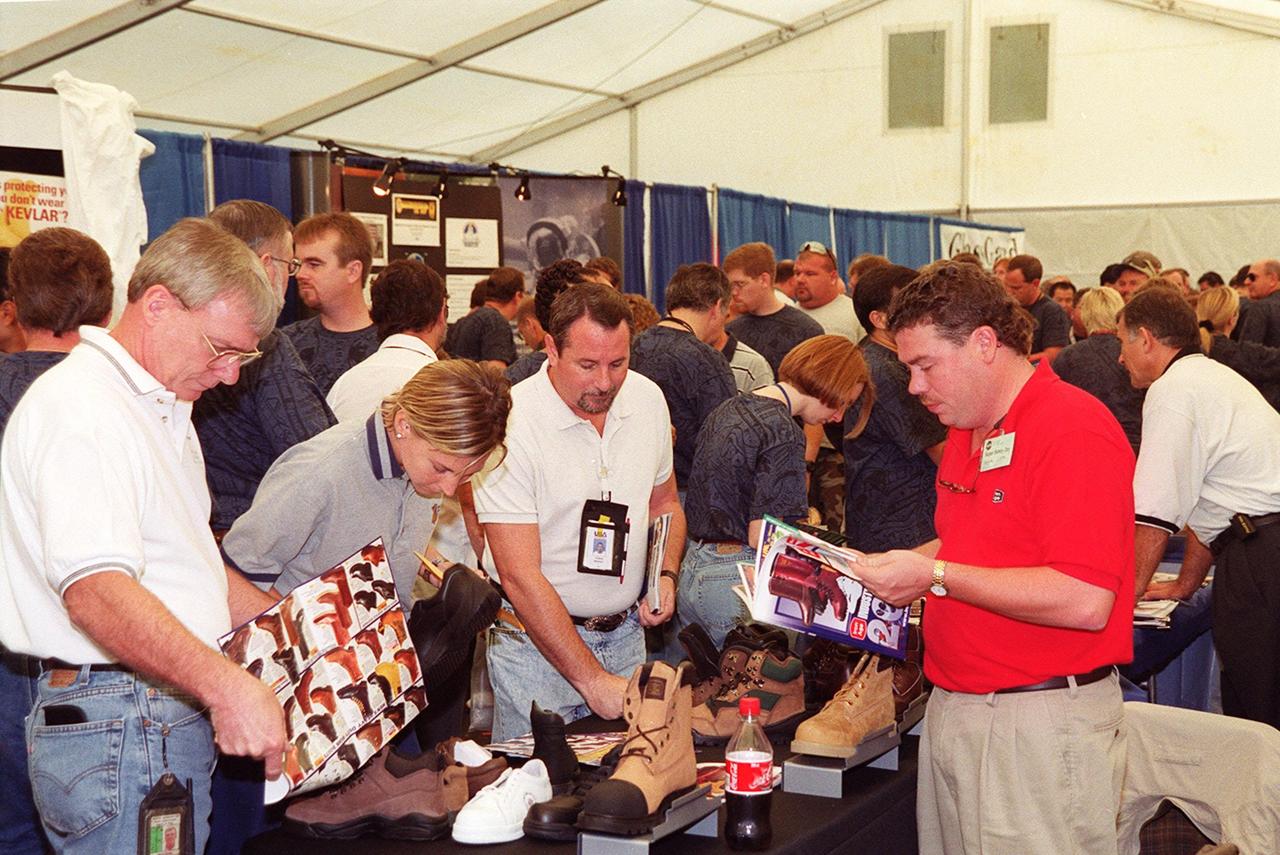
Employees at KSC look over a display of work-related shoes in an exhibit tent during Super Safety and Health Day. Safety Day is a full day of NASA-sponsored, KSC and 45th Space Wing events involving a number of health and safety related activities: Displays, vendors, technical paper sessions, panel discussions, a keynote speaker, etc. The entire Center and Wing stand down to participate in the planned events. Safety Day is held annually to proactively increase awareness in safety and health among the government and contractor workforce population. The first guiding principle at KSC is “Safety and Health First.” KSC’s number one goal is to “Assure sound, safe and efficient practices and processes are in place for privatized/commercialized launch site processing.
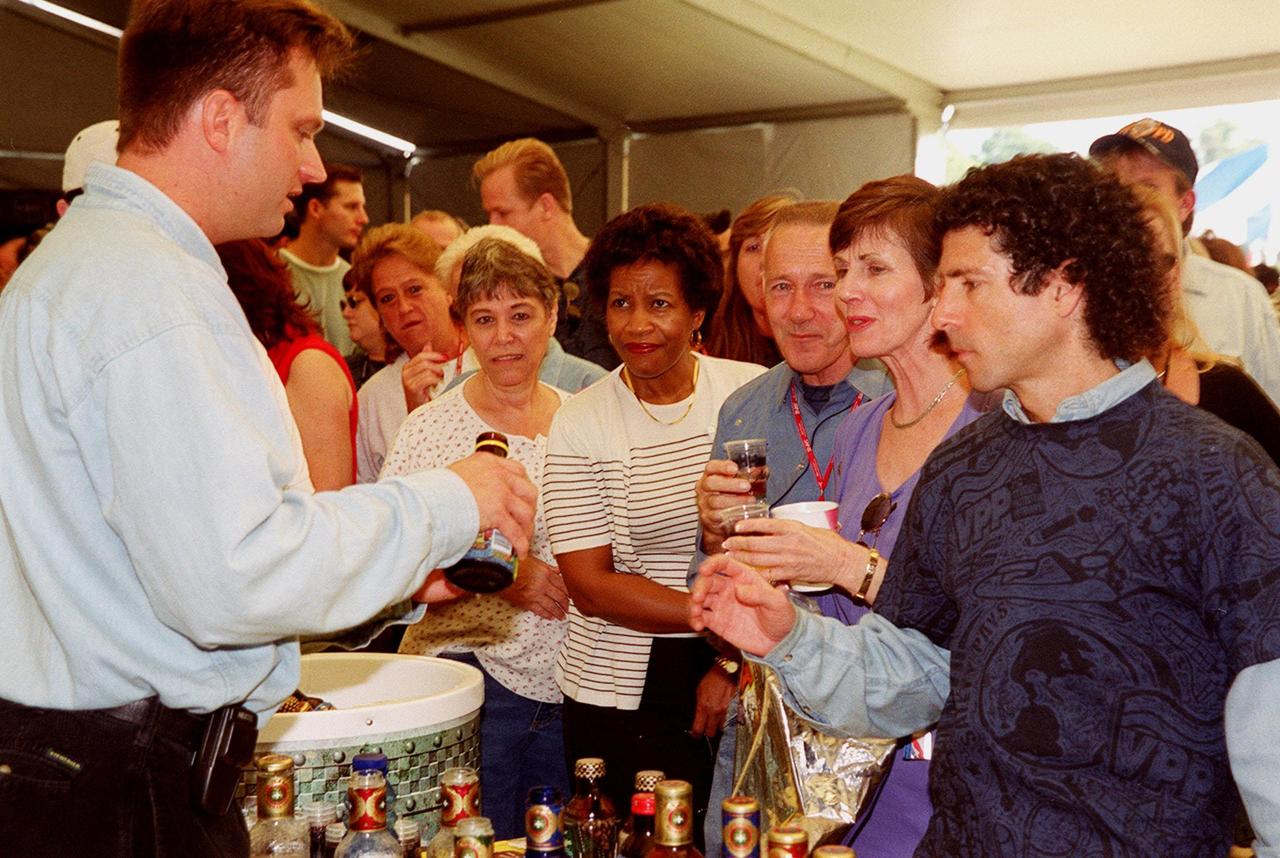
In an exhibit tent during Super Safety and Health Day at KSC, employees sample iced tea from a vendor. Safety Day is a full day of NASA-sponsored, KSC and 45th Space Wing events involving a number of healthand safety-related activities: Displays, vendors, technical paper sessions, panel discussions, a keynote speaker, etc. The entire Center and Wing stand down to participate in the planned events. Safety Day is held annually to proactively increase awareness in safety and health among the government and contractor workforce population. The first guiding principle at KSC is “Safety and Health First.” KSC’s number one goal is to “Assure sound, safe and efficient practices and processes are in place for privatized/commercialized launch site processing.
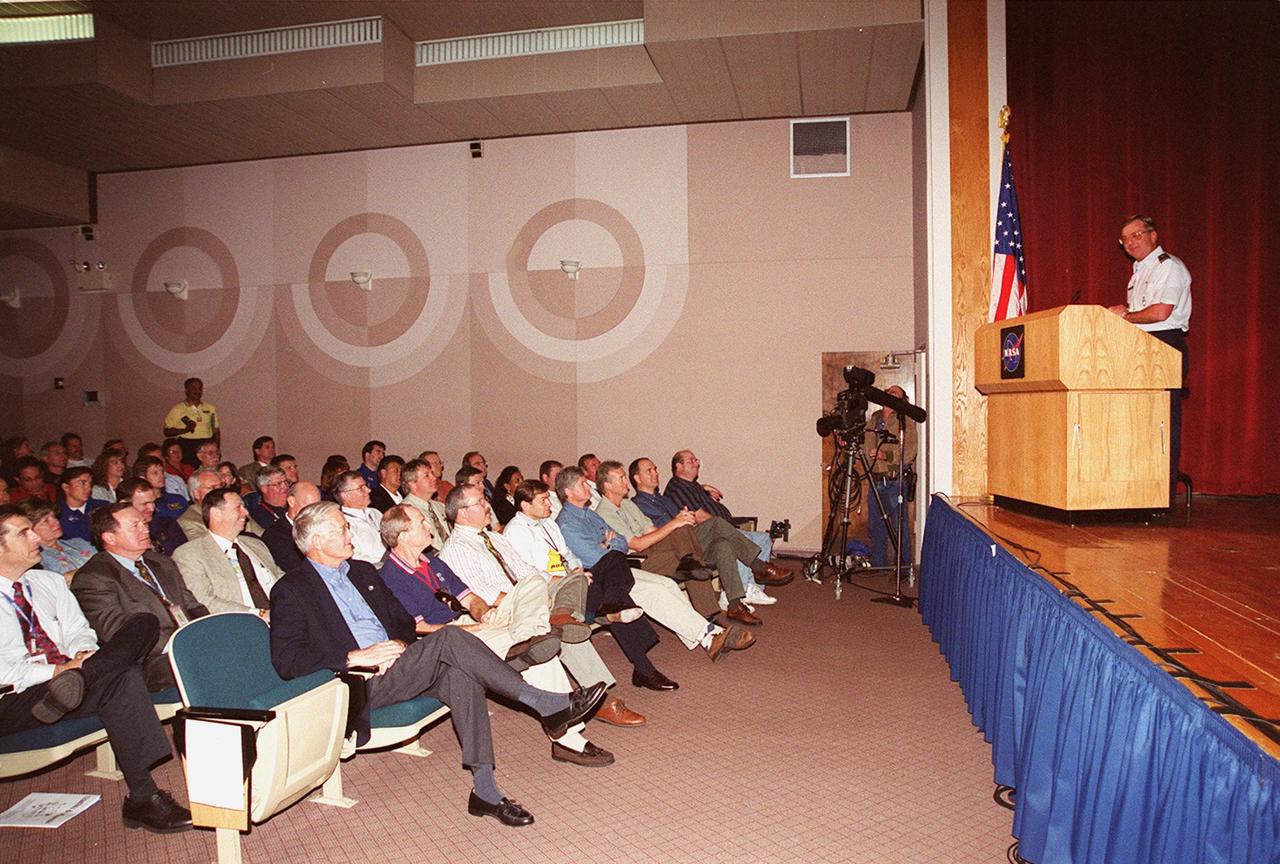
In the Training Auditorium at KSC, Brig. General Donald P. Pettit, commander of the 45th Space Wing, speaks to attendees at a presentation for Super Safety and Health Day. Safety Day is a full day of NASA-sponsored, KSC and 45th Space Wing events involving a number of health and safety related activities: Displays, vendors, technical paper sessions, panel discussions, a keynote speaker, etc. The entire Center and Wing stand down to participate in the planned events. Safety Day is held annually to proactively increase awareness in safety and health among the government and contractor workforce population. The first guiding principle at KSC is “Safety and Health First.” KSC’s number one goal is to “Assure sound, safe and efficient practices and processes are in place for privatized/commercialized launch site processing.
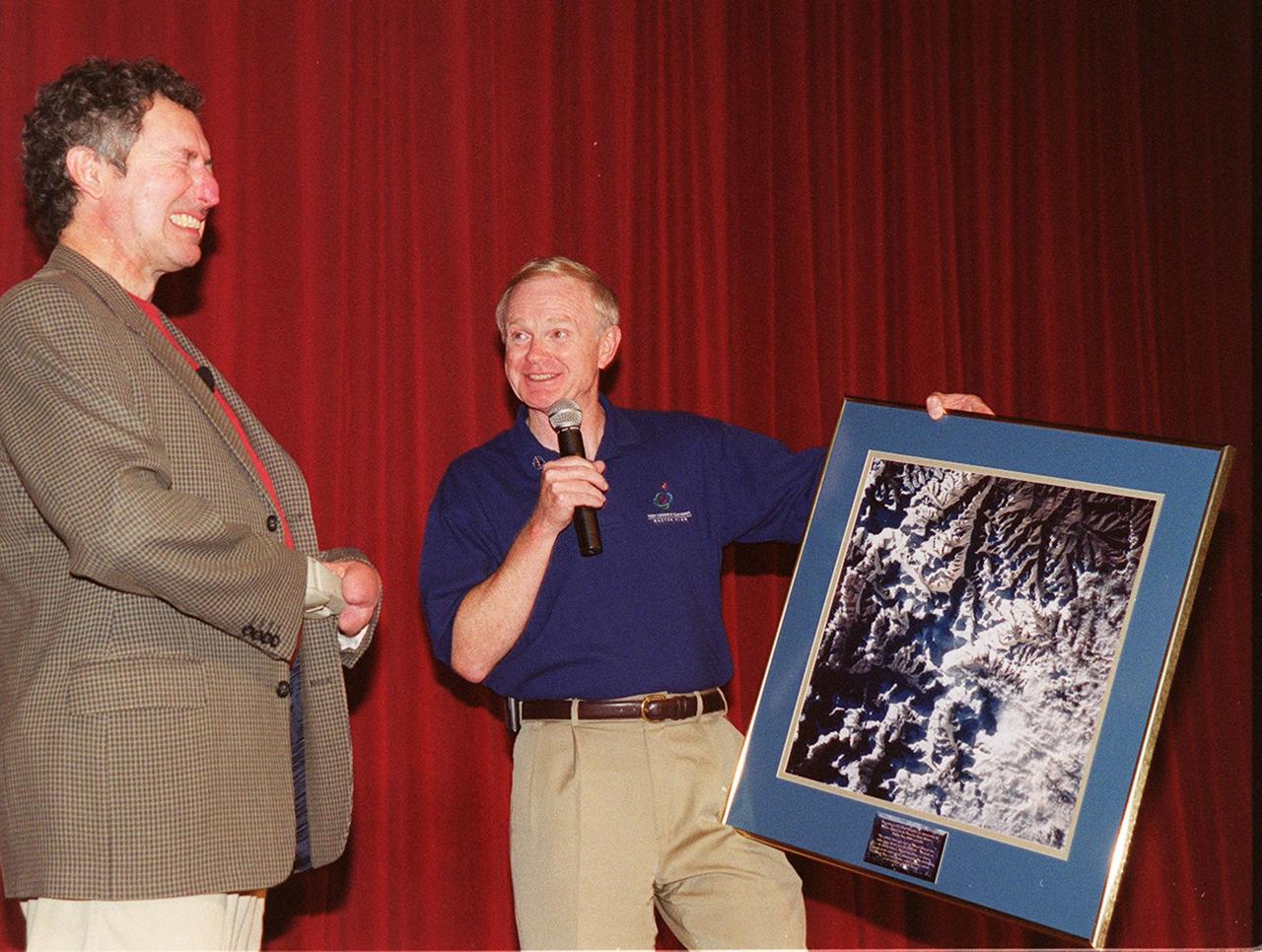
During Super Safety and Health Day at KSC, keynote speaker Dr. Beck Weathers grimaces over the satellite photo of Mt. Everest being presented by Center Director Roy Bridges. Weathers spoke about his ordeal of surviving the 1996 Mt. Everest disaster and the lessons learned from the experience. Safety Day is a full day of NASA-sponsored, KSC and 45th Space Wing events involving a number of health and safety related activities: Displays, vendors, technical paper sessions, panel discussions, a keynote speaker, etc. The entire Center and Wing stand down to participate in the planned events. Safety Day is held annually to proactively increase awareness in safety and health among the government and contractor workforce population. The first guiding principle at KSC is “Safety and Health First.” KSC’s number one goal is to “Assure sound, safe and efficient practices and processes are in place for privatized/commercialized launch site processing.
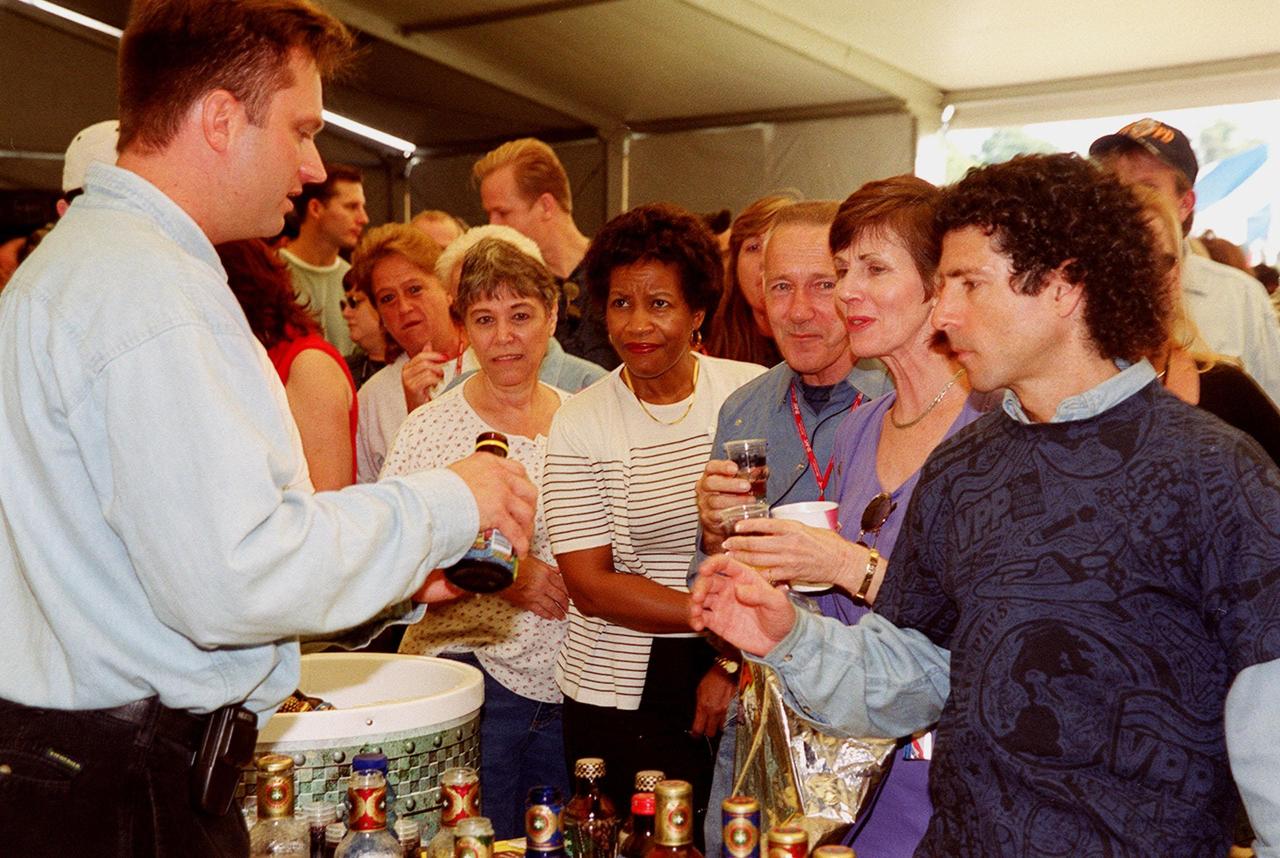
In an exhibit tent during Super Safety and Health Day at KSC, employees sample iced tea from a vendor. Safety Day is a full day of NASA-sponsored, KSC and 45th Space Wing events involving a number of healthand safety-related activities: Displays, vendors, technical paper sessions, panel discussions, a keynote speaker, etc. The entire Center and Wing stand down to participate in the planned events. Safety Day is held annually to proactively increase awareness in safety and health among the government and contractor workforce population. The first guiding principle at KSC is “Safety and Health First.” KSC’s number one goal is to “Assure sound, safe and efficient practices and processes are in place for privatized/commercialized launch site processing.
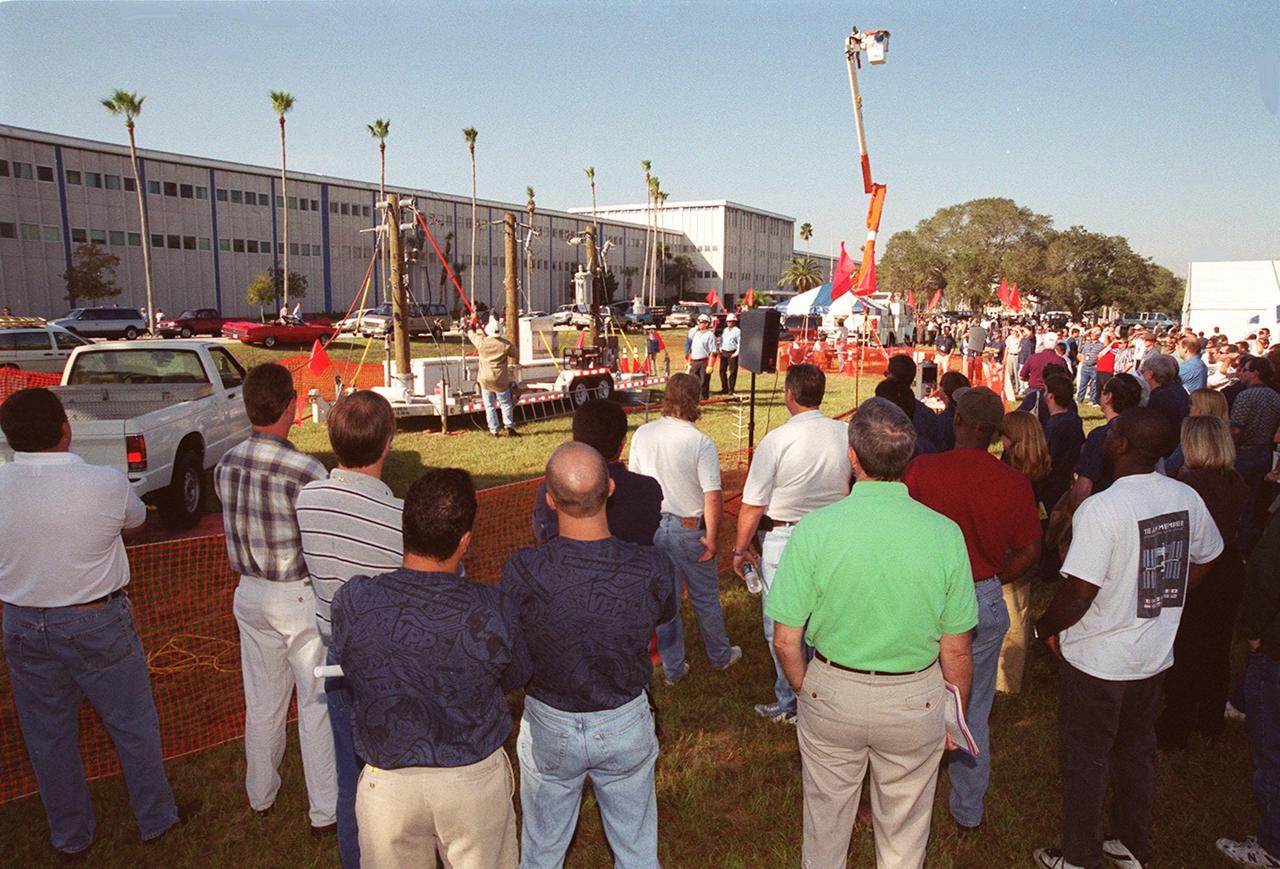
Employees gather around a demonstration by Florida Power and Light during Super Safety and Health Day at KSC. Safety Day is a full day of NASA-sponsored, KSC and 45th Space Wing events involving a number of healthand safety-related activities: Displays, vendors, technical paper sessions, panel discussions, a keynote speaker, etc. The entire Center and Wing stand down to participate in the planned events. Safety Day is held annually to proactively increase awareness in safety and health among the government and contractor workforce population. The first guiding principle at KSC is “Safety and Health First.” KSC’s number one goal is to “Assure sound, safe and efficient practices and processes are in place for privatized/commercialized launch site processing.
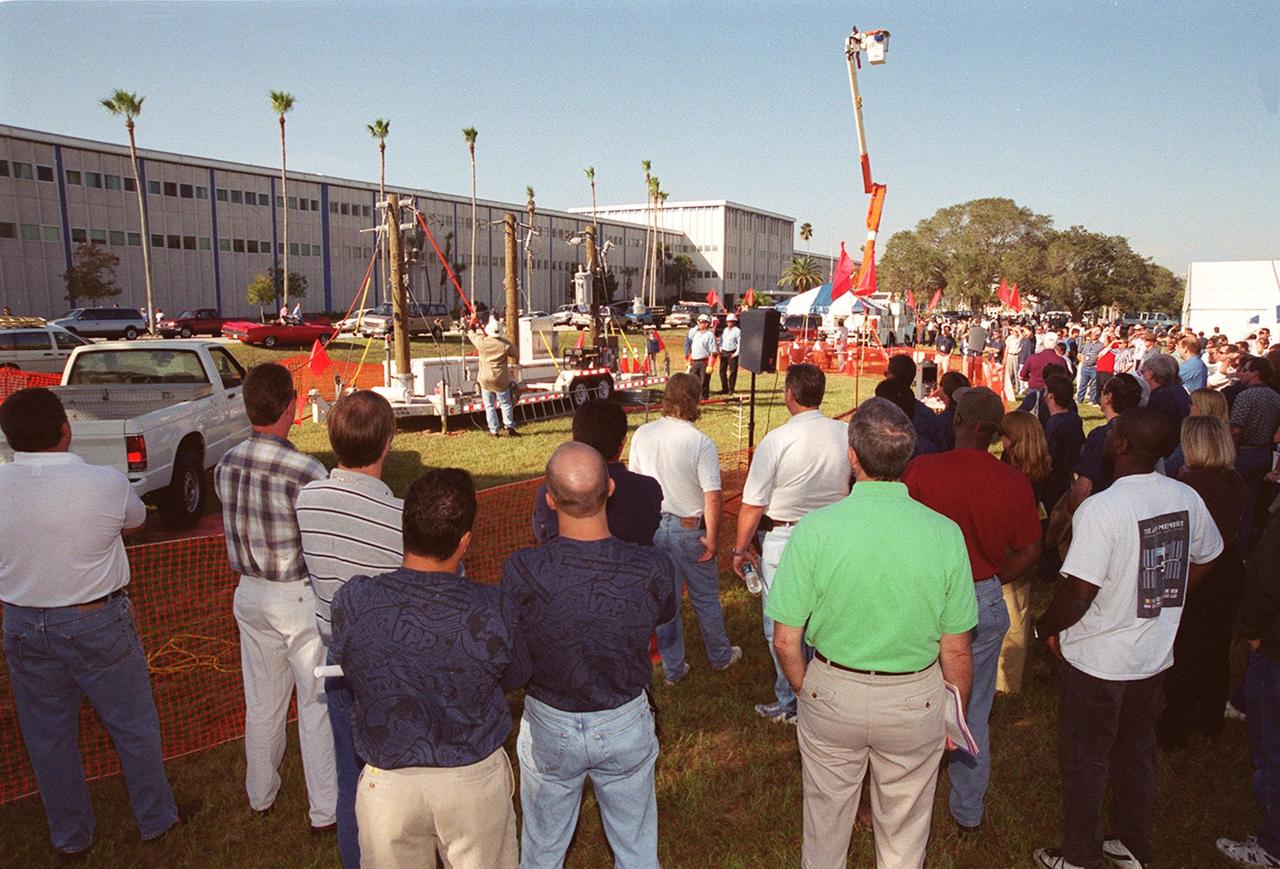
Employees gather around a demonstration by Florida Power and Light during Super Safety and Health Day at KSC. Safety Day is a full day of NASA-sponsored, KSC and 45th Space Wing events involving a number of healthand safety-related activities: Displays, vendors, technical paper sessions, panel discussions, a keynote speaker, etc. The entire Center and Wing stand down to participate in the planned events. Safety Day is held annually to proactively increase awareness in safety and health among the government and contractor workforce population. The first guiding principle at KSC is “Safety and Health First.” KSC’s number one goal is to “Assure sound, safe and efficient practices and processes are in place for privatized/commercialized launch site processing.
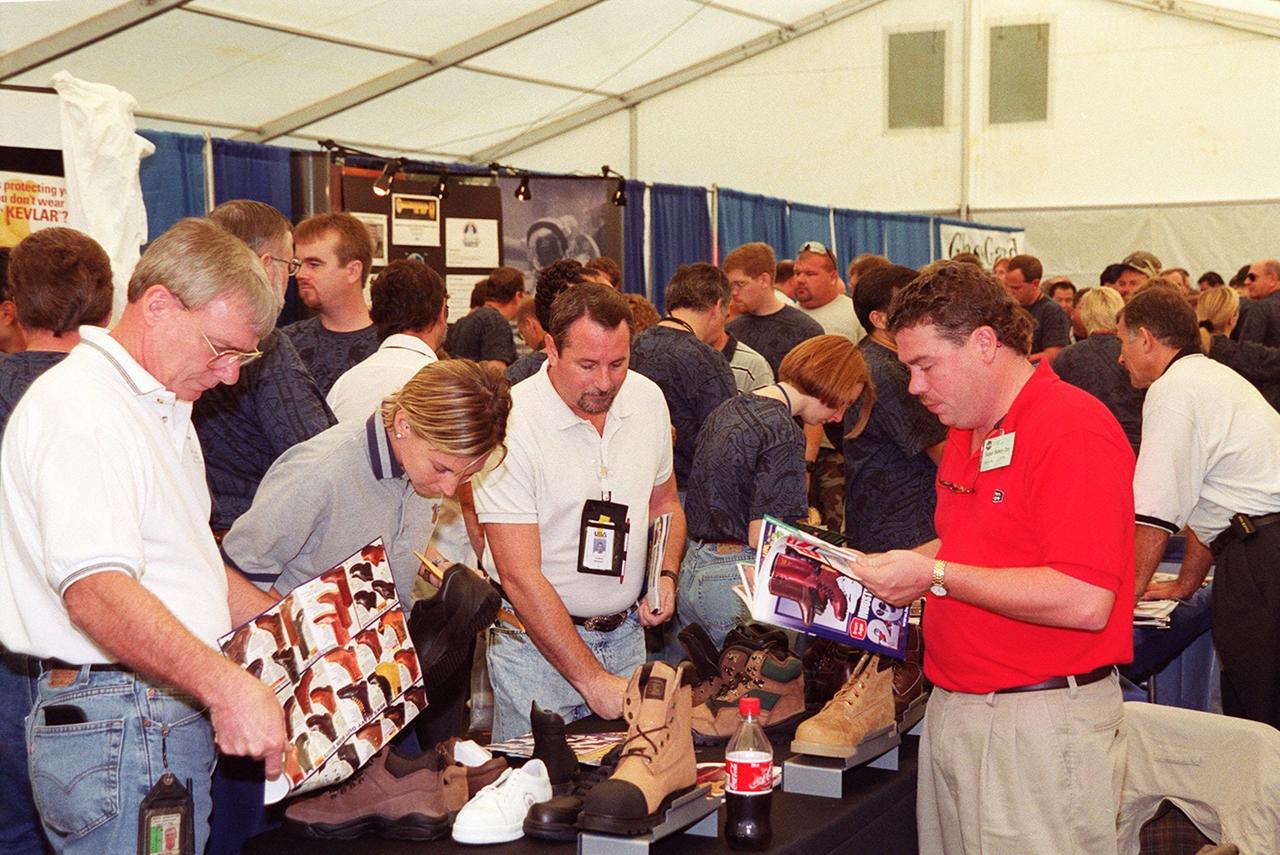
Employees at KSC look over a display of work-related shoes in an exhibit tent during Super Safety and Health Day. Safety Day is a full day of NASA-sponsored, KSC and 45th Space Wing events involving a number of health and safety related activities: Displays, vendors, technical paper sessions, panel discussions, a keynote speaker, etc. The entire Center and Wing stand down to participate in the planned events. Safety Day is held annually to proactively increase awareness in safety and health among the government and contractor workforce population. The first guiding principle at KSC is “Safety and Health First.” KSC’s number one goal is to “Assure sound, safe and efficient practices and processes are in place for privatized/commercialized launch site processing.
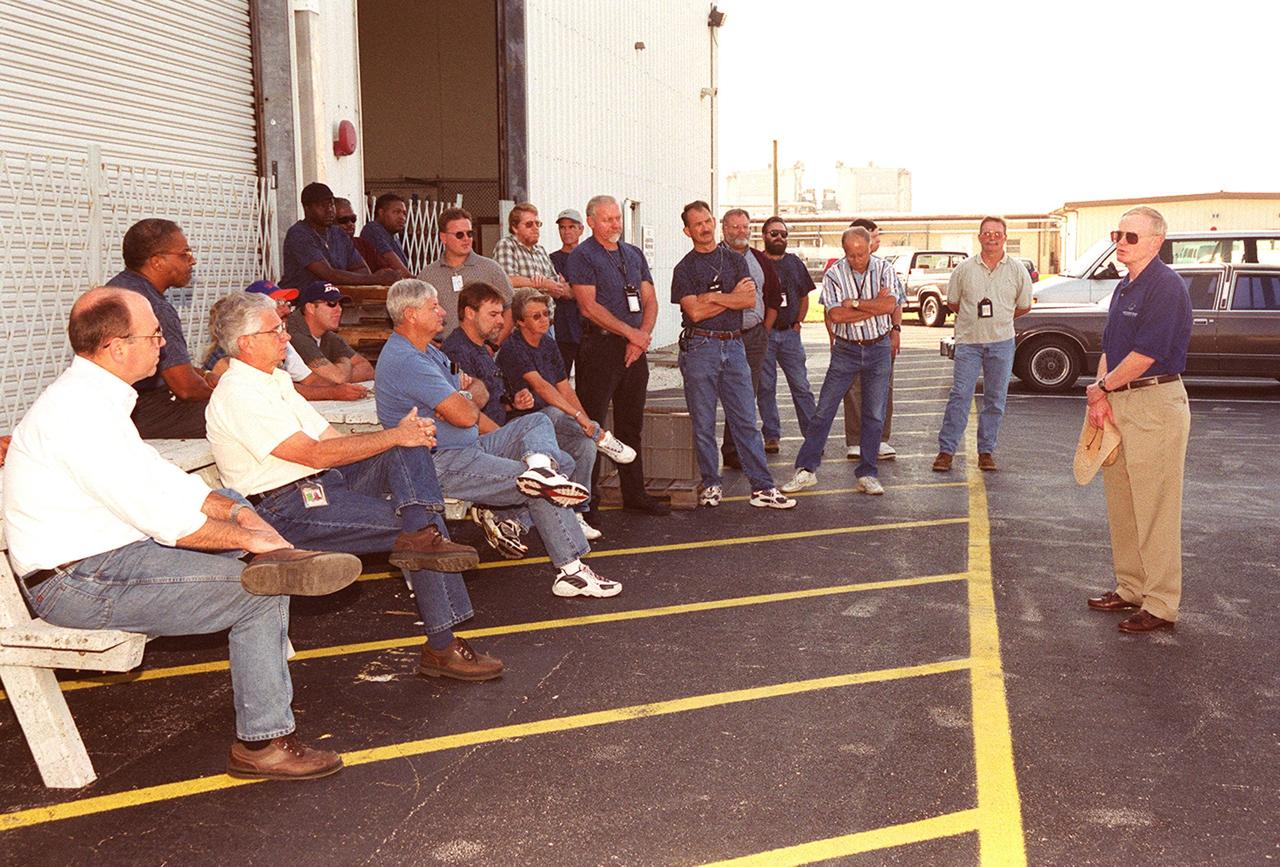
Center Director Roy Bridges talks to workers outside the Hazardous Maintenance Facility during Super Safety and Health Day at KSC. Safety Day is a full day of NASA-sponsored, KSC and 45th Space Wing events involving a number of health and safety related activities: Displays, vendors, technical paper sessions, panel discussions, a keynote speaker, etc. The entire Center and Wing stand down to participate in the planned events. Safety Day is held annually to proactively increase awareness in safety and health among the government and contractor workforce population. The first guiding principle at KSC is “Safety and Health First.” KSC’s number one goal is to “Assure sound, safe and efficient practices and processes are in place for privatized/commercialized launch site processing.
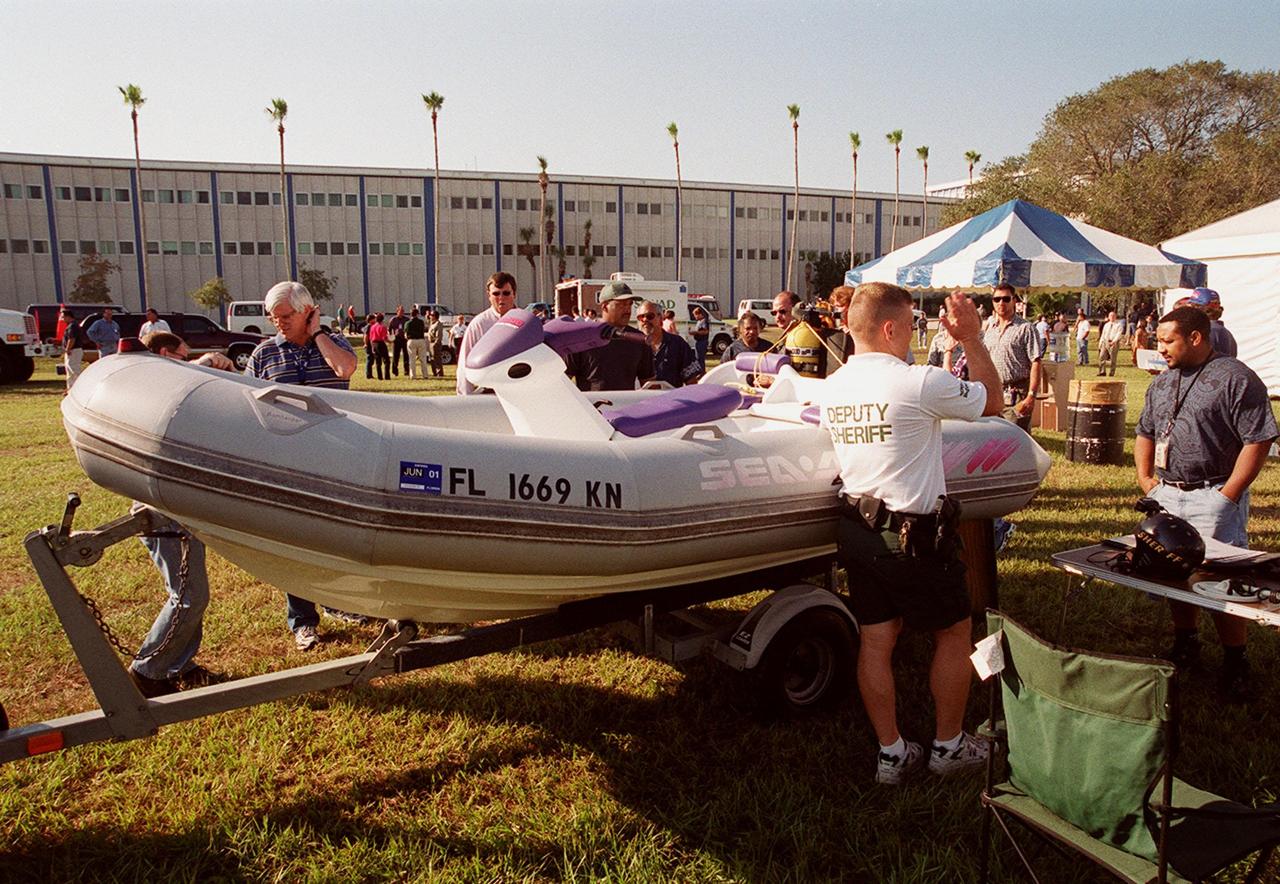
Vendor tents and displays filled the grounds in the Industrial Area as well as LC 39 Area during Super Safety and Health Day at KSC. Safety Day is a full day of NASA-sponsored, KSC and 45th Space Wing events involving a number of health and safety related activities: Displays, vendors, technical paper sessions, panel discussions, a keynote speaker, etc. The entire Center and Wing stand down to participate in the planned events. Safety Day is held annually to proactively increase awareness in safety and health among the government and contractor workforce population. The first guiding principle at KSC is “Safety and Health First.” KSC’s number one goal is to “Assure sound, safe and efficient practices and processes are in place for privatized/commercialized launch site processing.
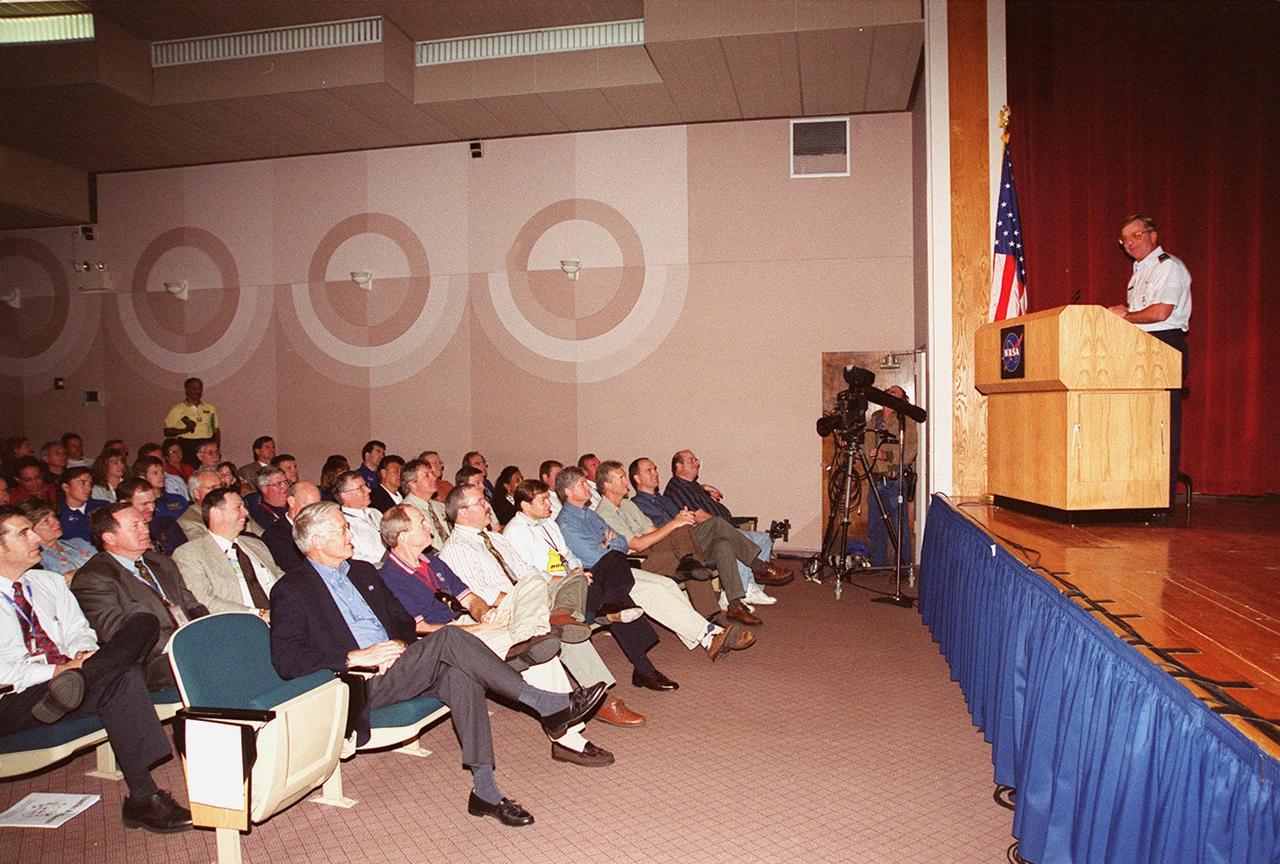
In the Training Auditorium at KSC, Brig. General Donald P. Pettit, commander of the 45th Space Wing, speaks to attendees at a presentation for Super Safety and Health Day. Safety Day is a full day of NASA-sponsored, KSC and 45th Space Wing events involving a number of health and safety related activities: Displays, vendors, technical paper sessions, panel discussions, a keynote speaker, etc. The entire Center and Wing stand down to participate in the planned events. Safety Day is held annually to proactively increase awareness in safety and health among the government and contractor workforce population. The first guiding principle at KSC is “Safety and Health First.” KSC’s number one goal is to “Assure sound, safe and efficient practices and processes are in place for privatized/commercialized launch site processing.
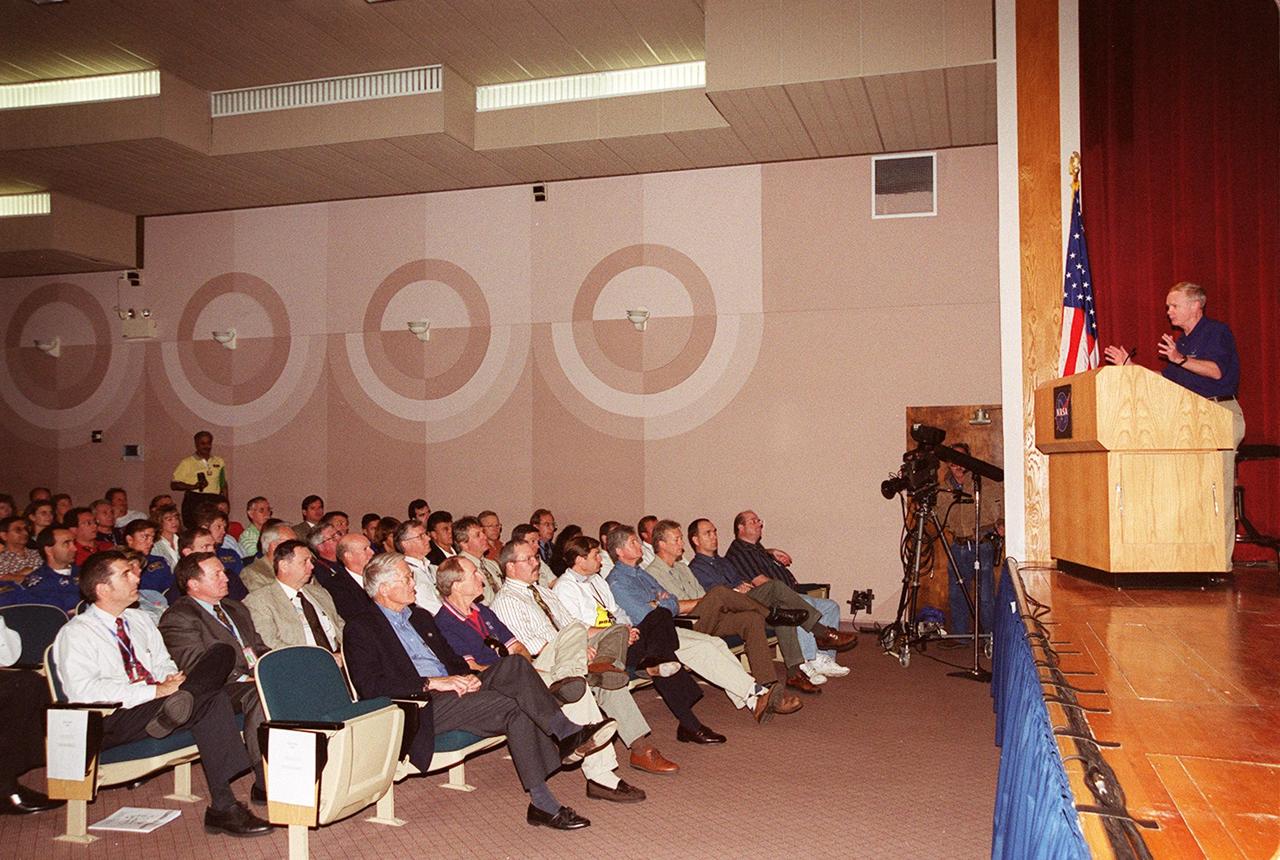
In the Training Auditorium at KSC, Center Director Roy Bridges addresses attendees at a presentation for Super Safety and Health Day. Safety Day is a full day of NASA-sponsored, KSC and 45th Space Wing events involving a number of health and safety related activities: Displays, vendors, technical paper sessions, panel discussions, a keynote speaker, etc. The entire Center and Wing stand down to participate in the planned events. Safety Day is held annually to proactively increase awareness in safety and health among the government and contractor workforce population. The first guiding principle at KSC is “Safety and Health First.” KSC’s number one goal is to “Assure sound, safe and efficient practices and processes are in place for privatized/commercialized launch site processing.
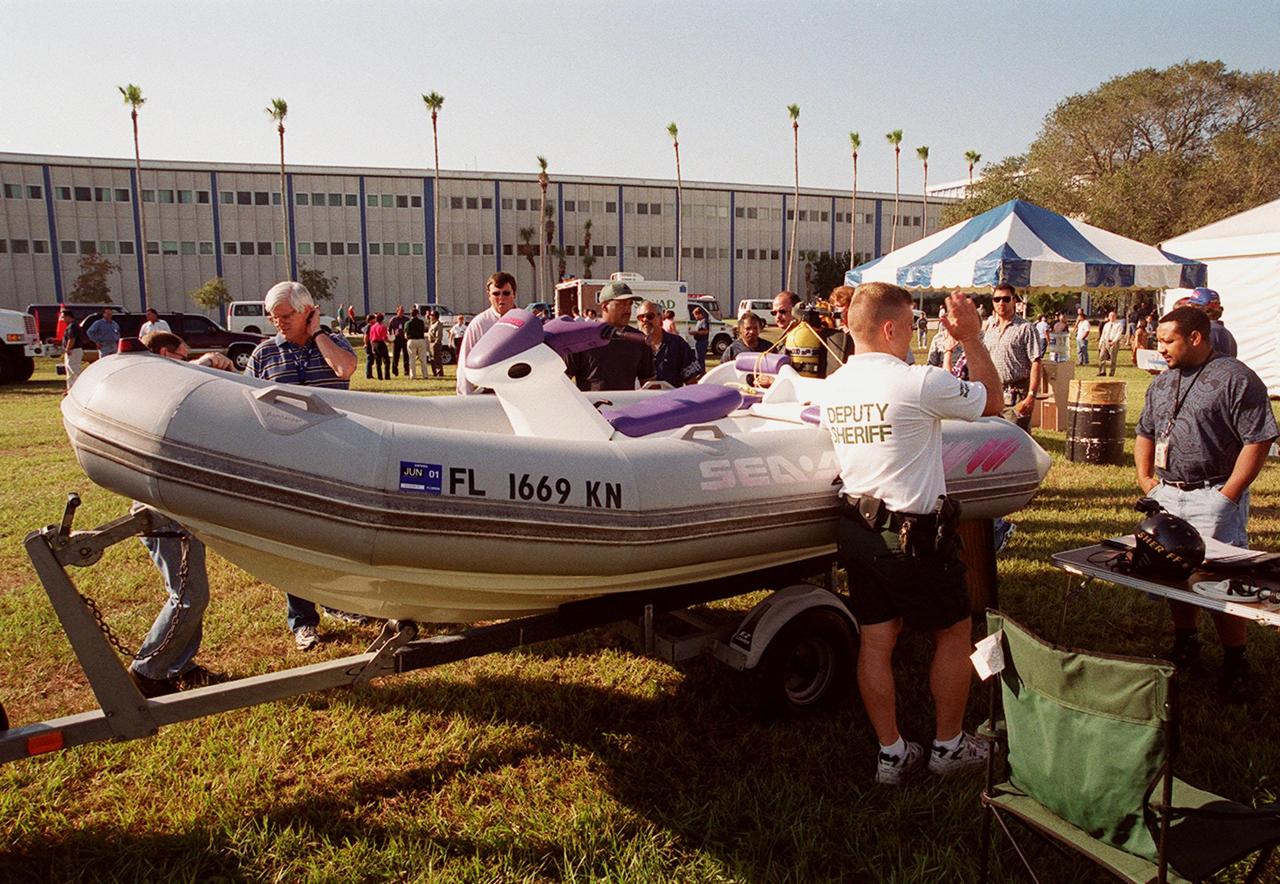
Vendor tents and displays filled the grounds in the Industrial Area as well as LC 39 Area during Super Safety and Health Day at KSC. Safety Day is a full day of NASA-sponsored, KSC and 45th Space Wing events involving a number of health and safety related activities: Displays, vendors, technical paper sessions, panel discussions, a keynote speaker, etc. The entire Center and Wing stand down to participate in the planned events. Safety Day is held annually to proactively increase awareness in safety and health among the government and contractor workforce population. The first guiding principle at KSC is “Safety and Health First.” KSC’s number one goal is to “Assure sound, safe and efficient practices and processes are in place for privatized/commercialized launch site processing.
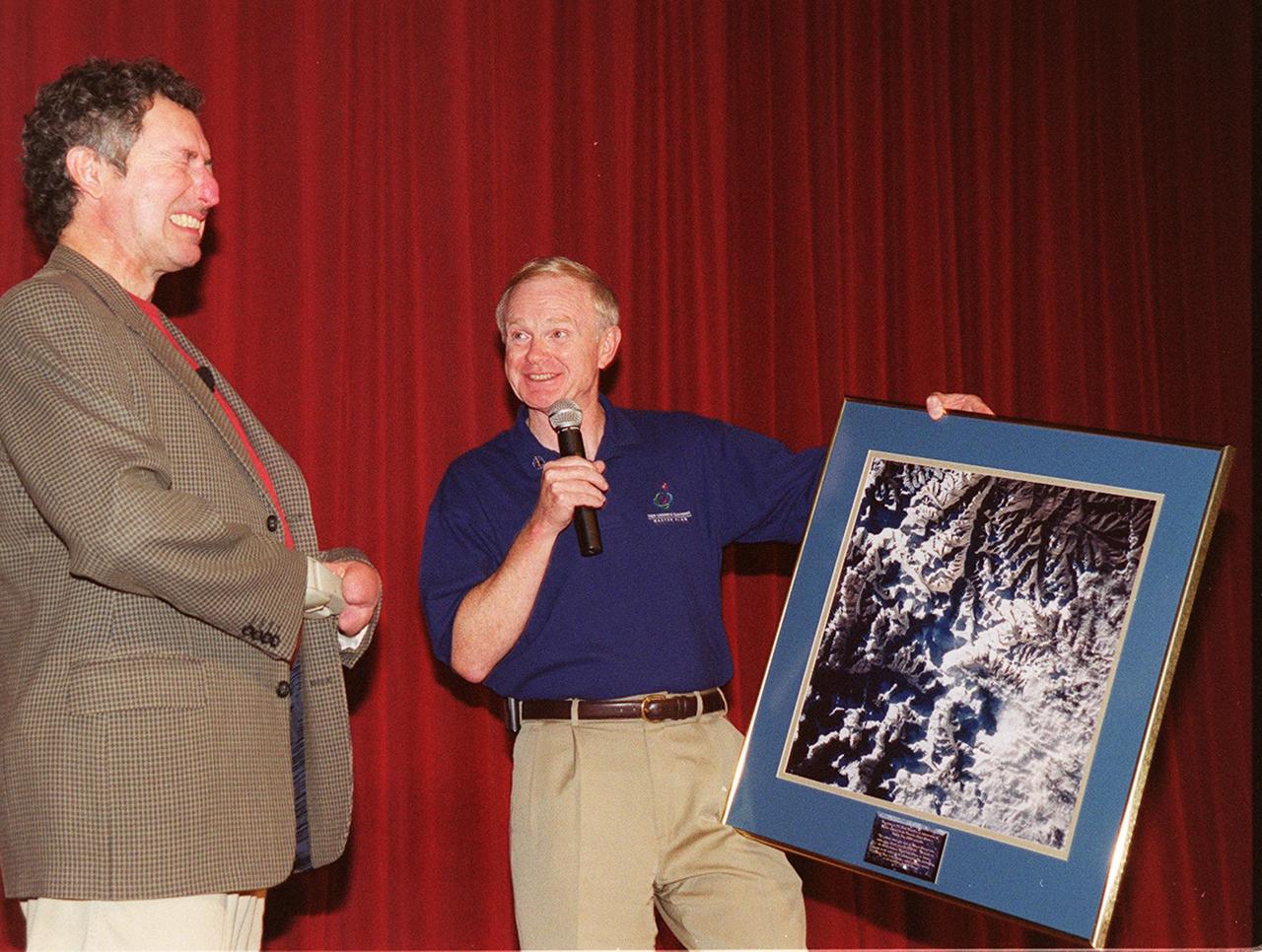
During Super Safety and Health Day at KSC, keynote speaker Dr. Beck Weathers grimaces over the satellite photo of Mt. Everest being presented by Center Director Roy Bridges. Weathers spoke about his ordeal of surviving the 1996 Mt. Everest disaster and the lessons learned from the experience. Safety Day is a full day of NASA-sponsored, KSC and 45th Space Wing events involving a number of health and safety related activities: Displays, vendors, technical paper sessions, panel discussions, a keynote speaker, etc. The entire Center and Wing stand down to participate in the planned events. Safety Day is held annually to proactively increase awareness in safety and health among the government and contractor workforce population. The first guiding principle at KSC is “Safety and Health First.” KSC’s number one goal is to “Assure sound, safe and efficient practices and processes are in place for privatized/commercialized launch site processing.
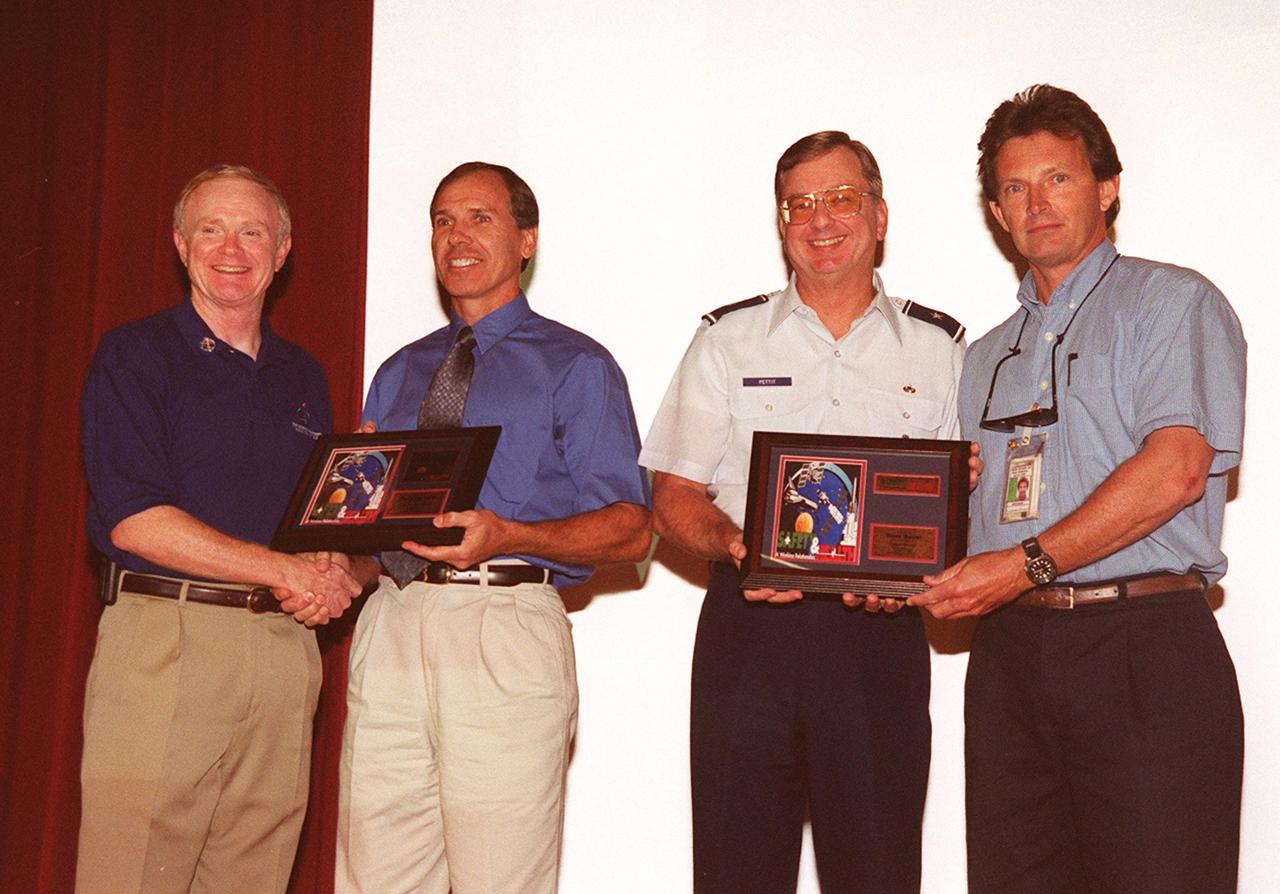
During Super Safety and Health Day at KSC, two employees were recognized for submitting winning entries in the theme and logo/poster contests. At left, Center Director Roy Bridges congratulates Dave Earhart with United Space Alliance (USA) for his winning logo; at right, Brig. Gen. Ronald D. Pettit congratulates David Koval with Space Gateway Support (SGS) for his winning theme, “Safety and Health: A Working Relationship.” Safety Day is a full day of NASA-sponsored, KSC and 45th Space Wing events involving a number of health and safety related activities: Displays, vendors, technical paper sessions, panel discussions, a keynote speaker, etc. The entire Center and Wing stand down to participate in the planned events. Safety Day is held annually to proactively increase awareness in safety and health among the government and contractor workforce population. The first guiding principle at KSC is “Safety and Health First.” KSC’s number one goal is to “Assure sound, safe and efficient practices and processes are in place for privatized/commercialized launch site processing.
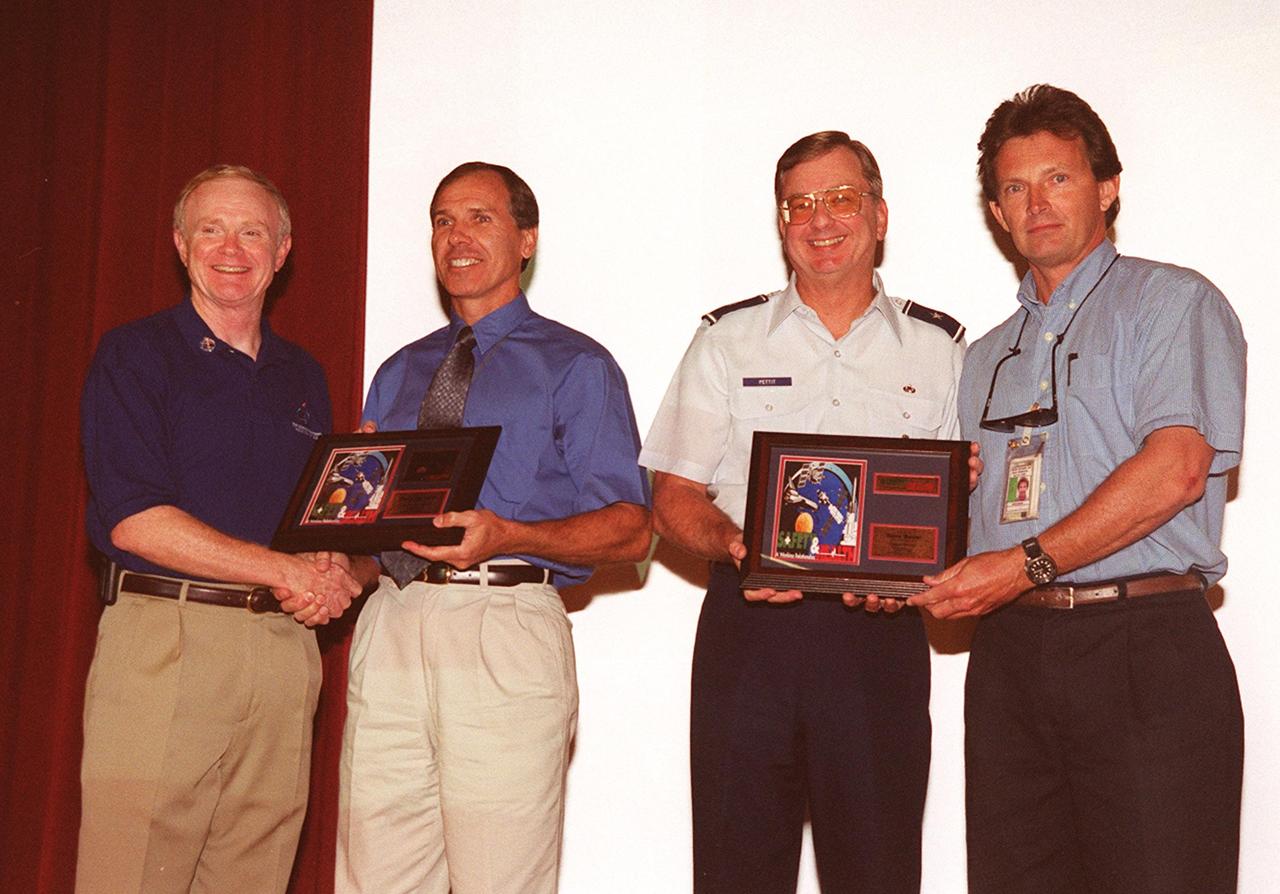
During Super Safety and Health Day at KSC, two employees were recognized for submitting winning entries in the theme and logo/poster contests. At left, Center Director Roy Bridges congratulates Dave Earhart with United Space Alliance (USA) for his winning logo; at right, Brig. Gen. Ronald D. Pettit congratulates David Koval with Space Gateway Support (SGS) for his winning theme, “Safety and Health: A Working Relationship.” Safety Day is a full day of NASA-sponsored, KSC and 45th Space Wing events involving a number of health and safety related activities: Displays, vendors, technical paper sessions, panel discussions, a keynote speaker, etc. The entire Center and Wing stand down to participate in the planned events. Safety Day is held annually to proactively increase awareness in safety and health among the government and contractor workforce population. The first guiding principle at KSC is “Safety and Health First.” KSC’s number one goal is to “Assure sound, safe and efficient practices and processes are in place for privatized/commercialized launch site processing.
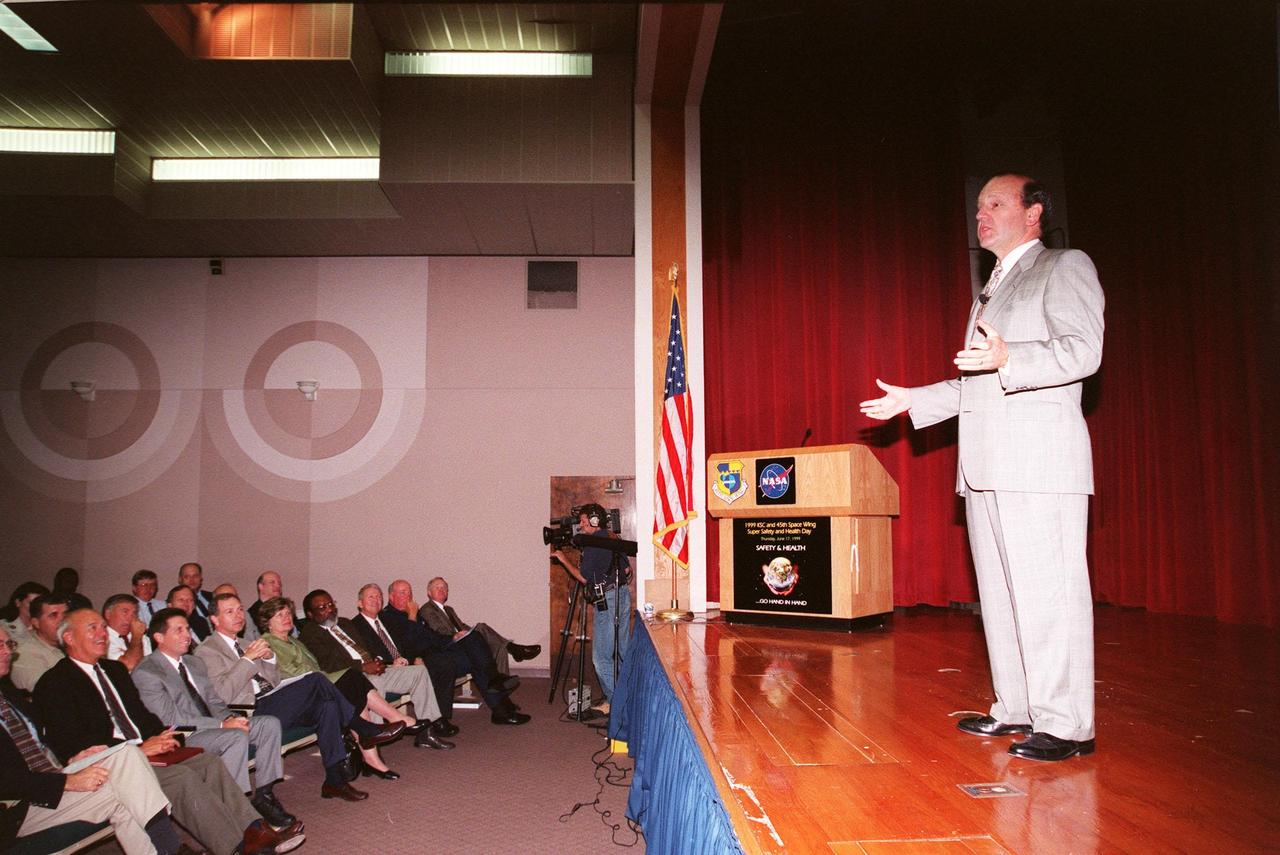
Capt. Dennis E. Fitch, a consultant and former pilot instructor with United Airlines, addresses an audience of KSC employees to kick off Super Safety and Health Day at KSC. Fitch related his tale of the catastrophic engine failure in UAL flight 232, which crash landed in Iowa in 1989, and the teamwork that contributed to his survival and the lives of 183 other passengers. For the second time Kennedy Space Center dedicated an entire day to safety and health. Most normal work activities were suspended to allow personnel to attend Super Safety and Health Day activities. The theme, "Safety and Health Go Hand in Hand," emphasized KSC's commitment to place the safety and health of the public, astronauts, employees and space-related resources first and foremost. Events also included a panel session about related issues, vendor exhibits, and safety training in work groups. The keynote address and panel session were also broadcast internally over NASA television
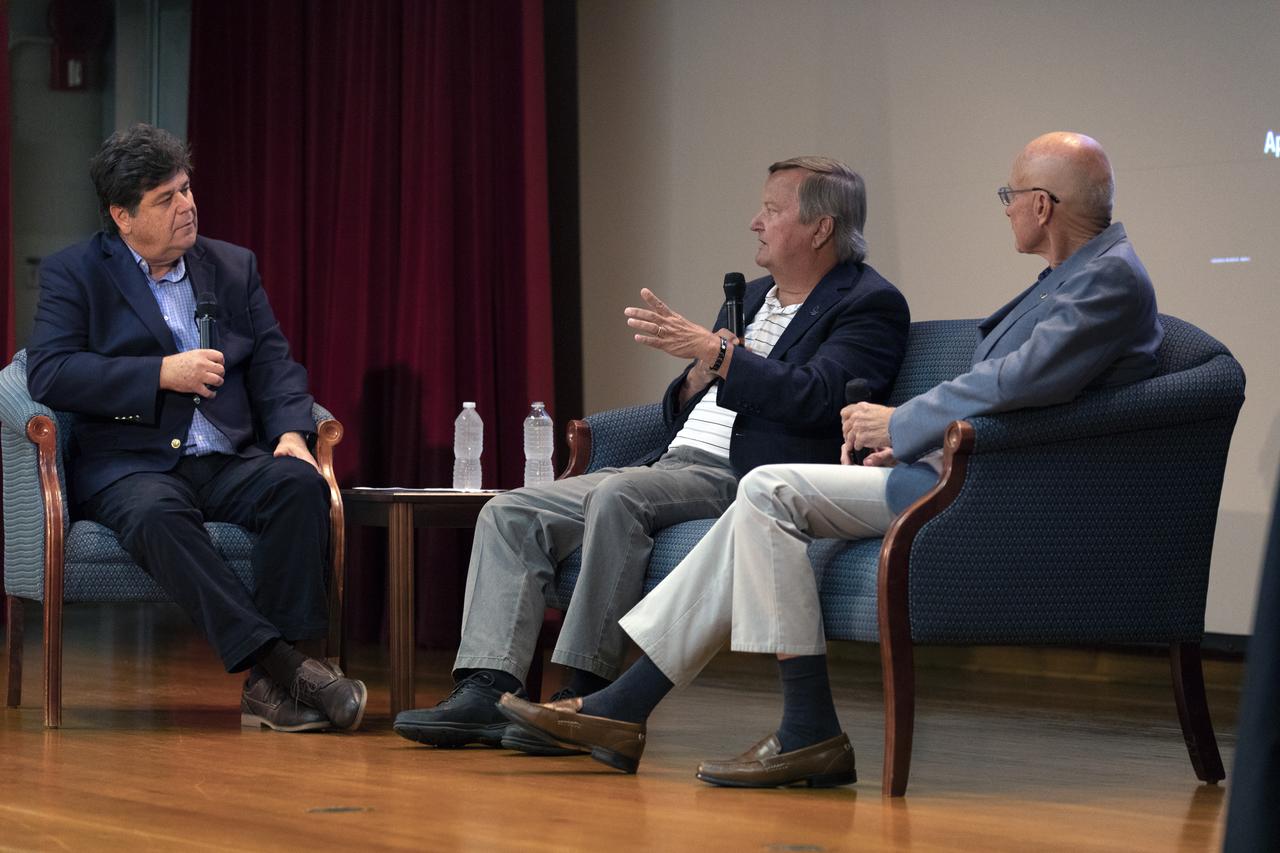
Veteran space reporter John Zarrella, left, moderates a “Lessons of Columbia” discussion with former space shuttle launch directors Mike Leinbach, center, and Bob Sieck in Kennedy Space Center’s Training Auditorium on April 12, 2019. The discussion took place during “Columbia: The Mission Continues,” an event organized by the Apollo Challenger Columbia Lessons Learned Program (ACCLLP). The event is part of the Space Shuttle Columbia national tour and took place on the 38th anniversary of STS-1, the first orbital spaceflight of NASA’s Space Shuttle Program. The tour launched at Kennedy and will make its way to each of the 10 NASA centers.
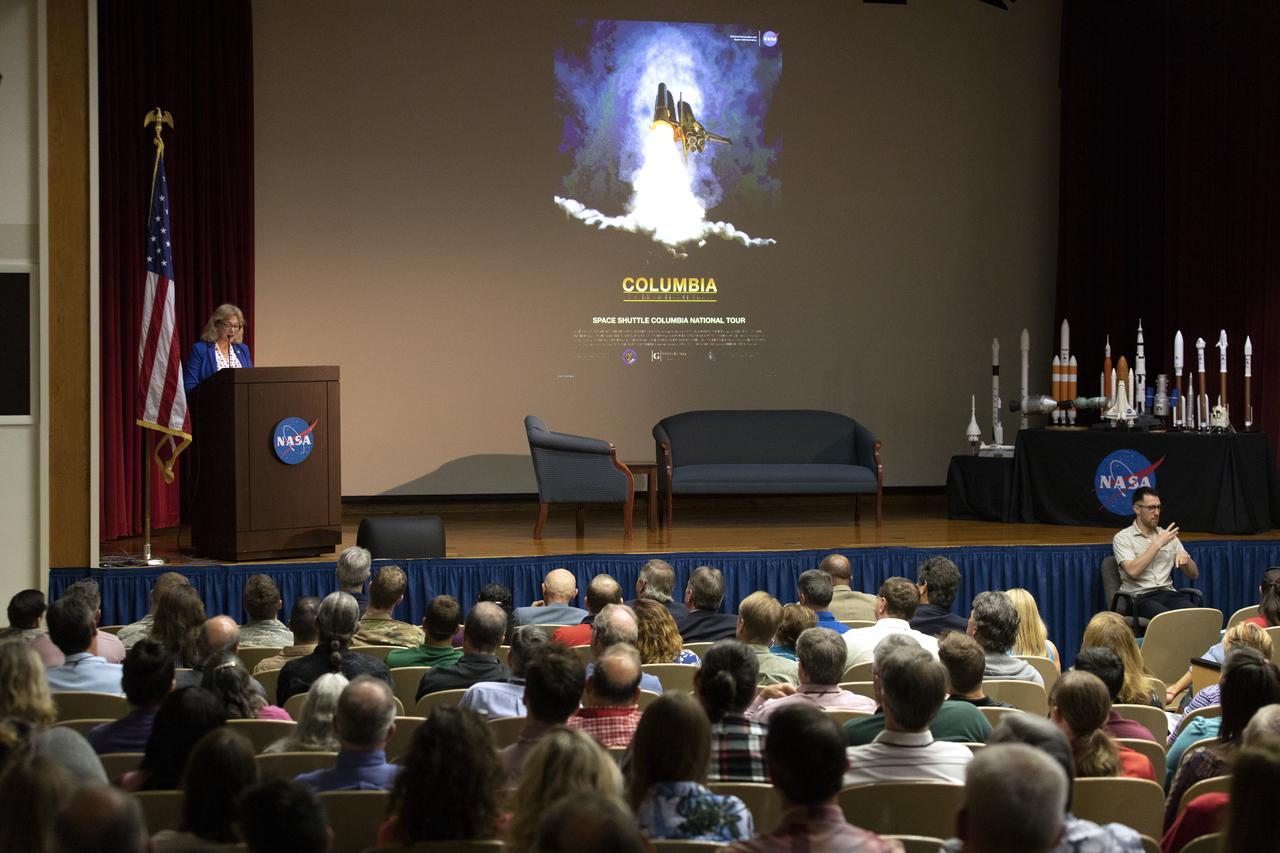
Evelyn Husband Thompson, widow of STS-107 Commander Rick Husband, speaks to NASA civil service and contractor employees and guests in Kennedy Space Center’s Training Auditorium on April 12, 2019. Husband Thompson was one of the presenters for “Columbia: The Mission Continues,” an event organized by the Apollo Challenger Columbia Lessons Learned Program (ACCLLP). The event is part of the Space Shuttle Columbia national tour and took place on the 38th anniversary of STS-1, the first orbital spaceflight of NASA’s Space Shuttle Program. The tour launched at Kennedy and will make its way to each of the 10 NASA centers.
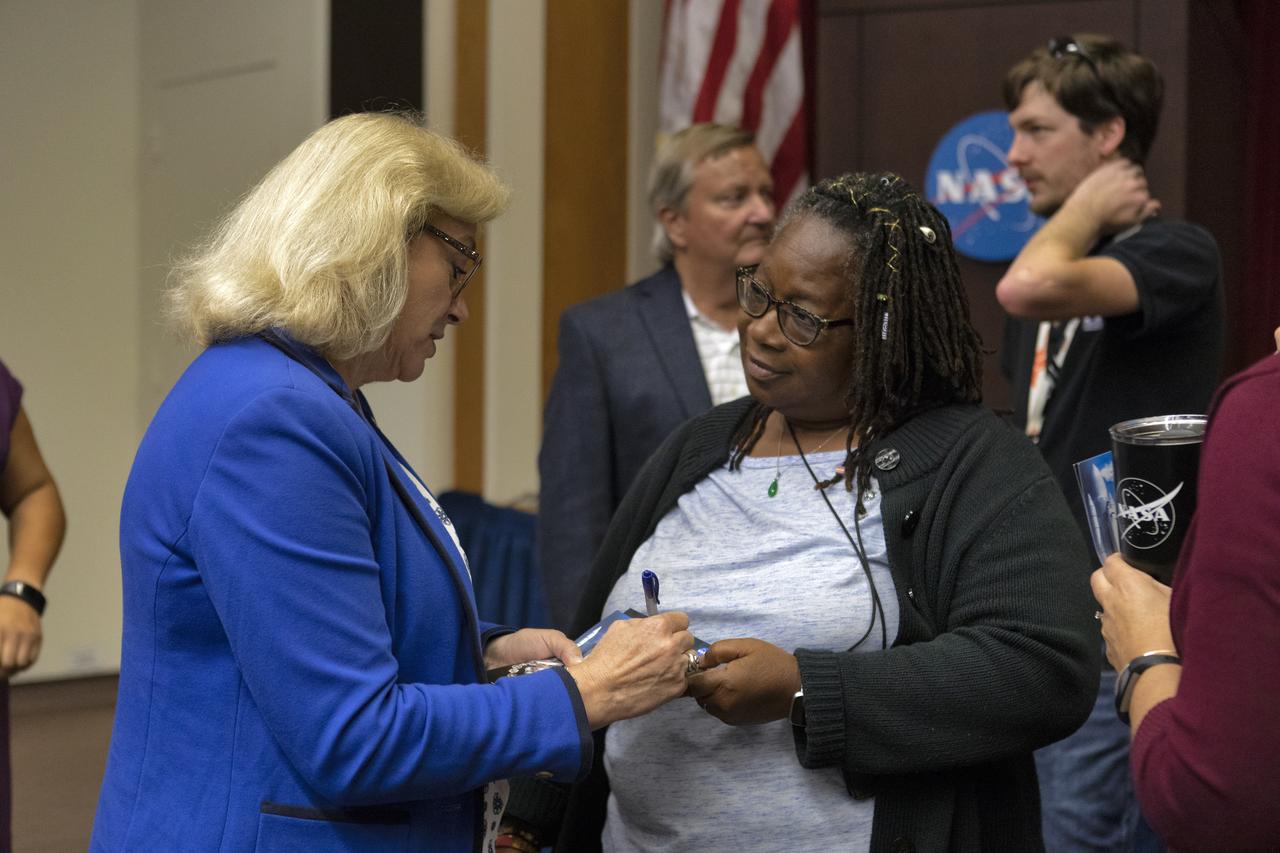
Evelyn Husband Thompson, widow of STS-107 Commander Rick Husband, talks with an attendee of “Columbia: The Mission Continues,” in Kennedy Space Center’s Training Auditorium on April 12, 2019. Organized by the Apollo Challenger Columbia Lessons Learned Program (ACCLLP), the event is part of the Space Shuttle Columbia national tour and took place on the 38th anniversary of STS-1, the first orbital spaceflight of NASA’s Space Shuttle Program. The tour launched at Kennedy and will make its way to each of the 10 NASA centers.
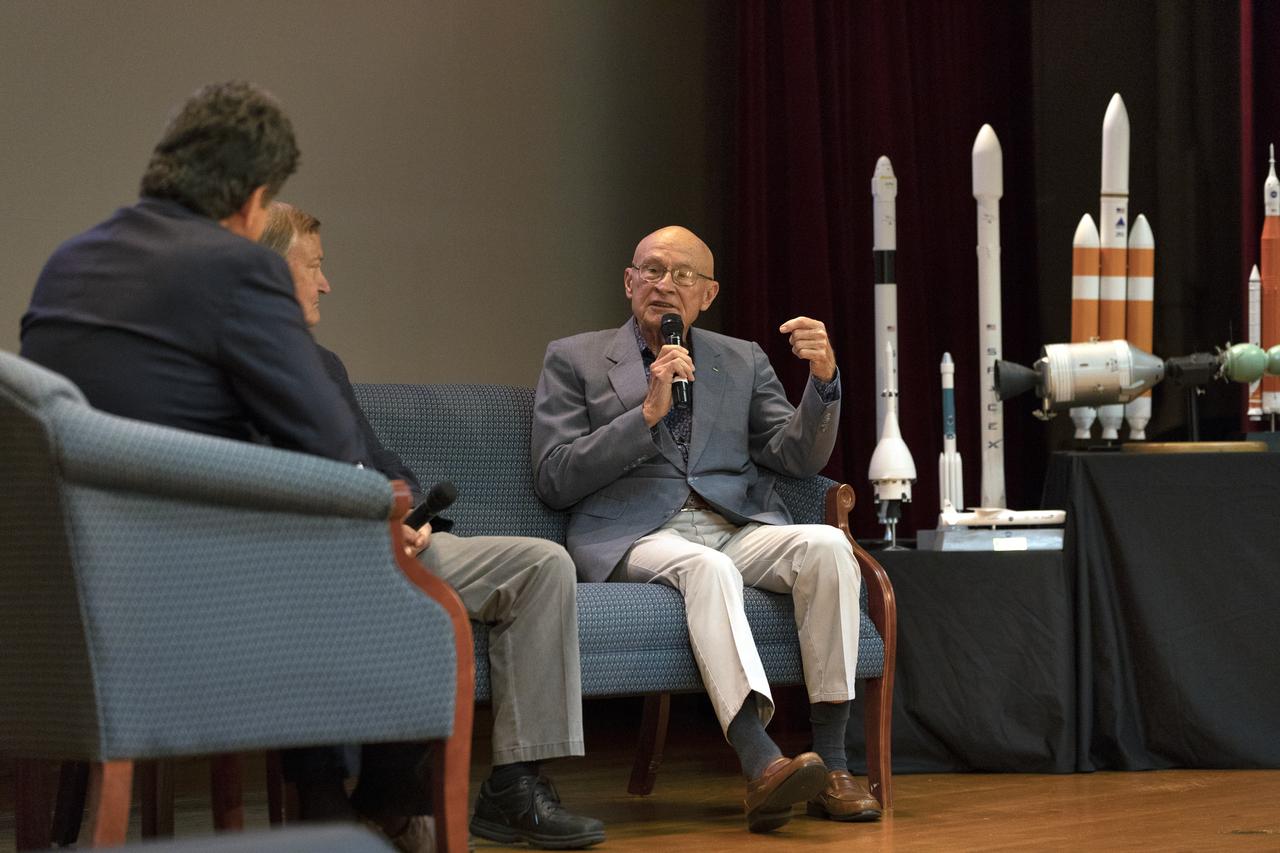
Veteran space reporter John Zarrella, left, moderates a “Lessons of Columbia” discussion with former space shuttle launch directors Mike Leinbach, center, and Bob Sieck in Kennedy Space Center’s Training Auditorium on April 12, 2019. The discussion took place during “Columbia: The Mission Continues,” an event organized by the Apollo Challenger Columbia Lessons Learned Program (ACCLLP). The event is part of the Space Shuttle Columbia national tour and took place on the 38th anniversary of STS-1, the first orbital spaceflight of NASA’s Space Shuttle Program. The tour launched at Kennedy and will make its way to each of the 10 NASA centers.
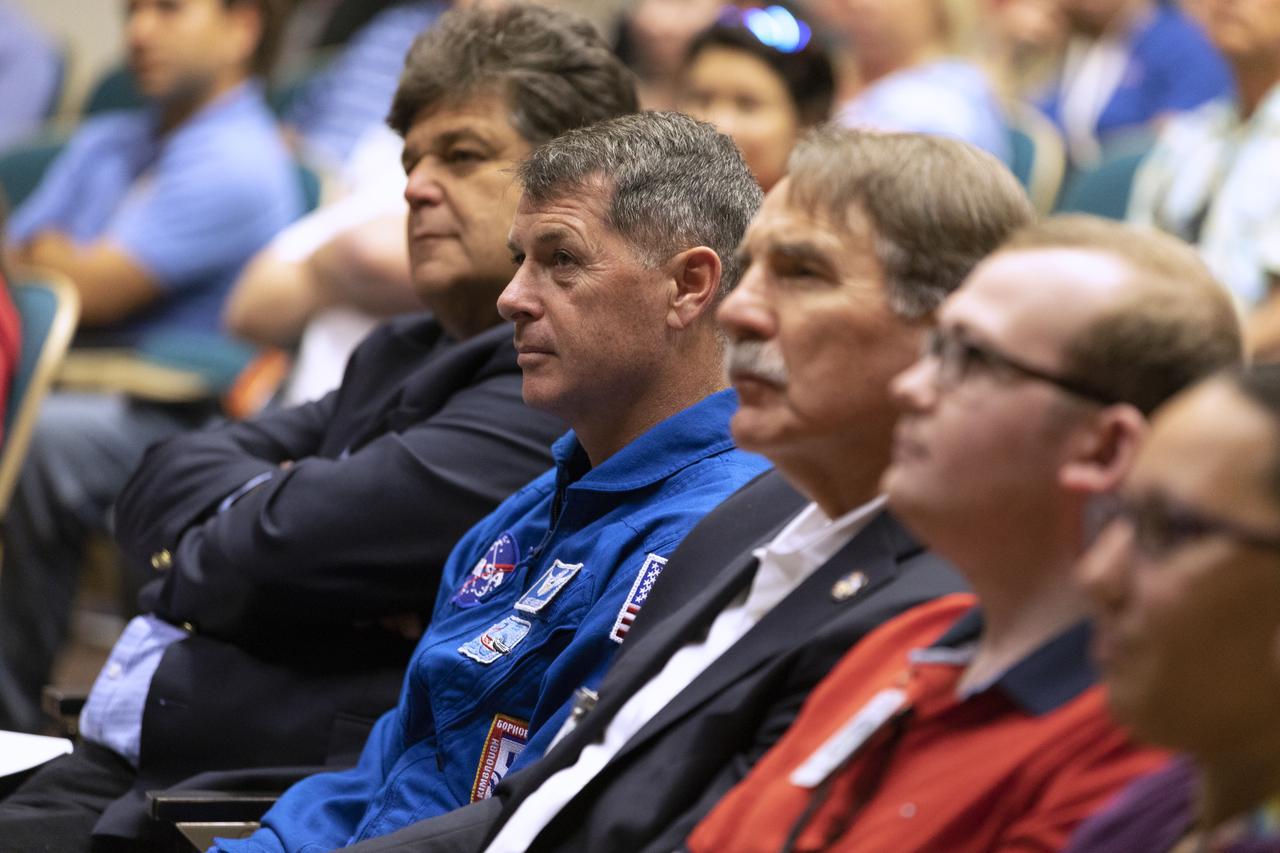
NASA astronaut Shane Kimbrough, blue flight suit, listens to a presentation in Kennedy Space Center’s Training Auditorium on April 12, 2019, during “Columbia: The Mission Continues,” an event organized by the Apollo Challenger Columbia Lessons Learned Program (ACCLLP). Kimbrough also was a speaker at the event, which is part of the Space Shuttle Columbia national tour and took place on the 38th anniversary of STS-1, the first orbital spaceflight of NASA’s Space Shuttle Program. The tour launched at Kennedy and will make its way to each of the 10 NASA centers.
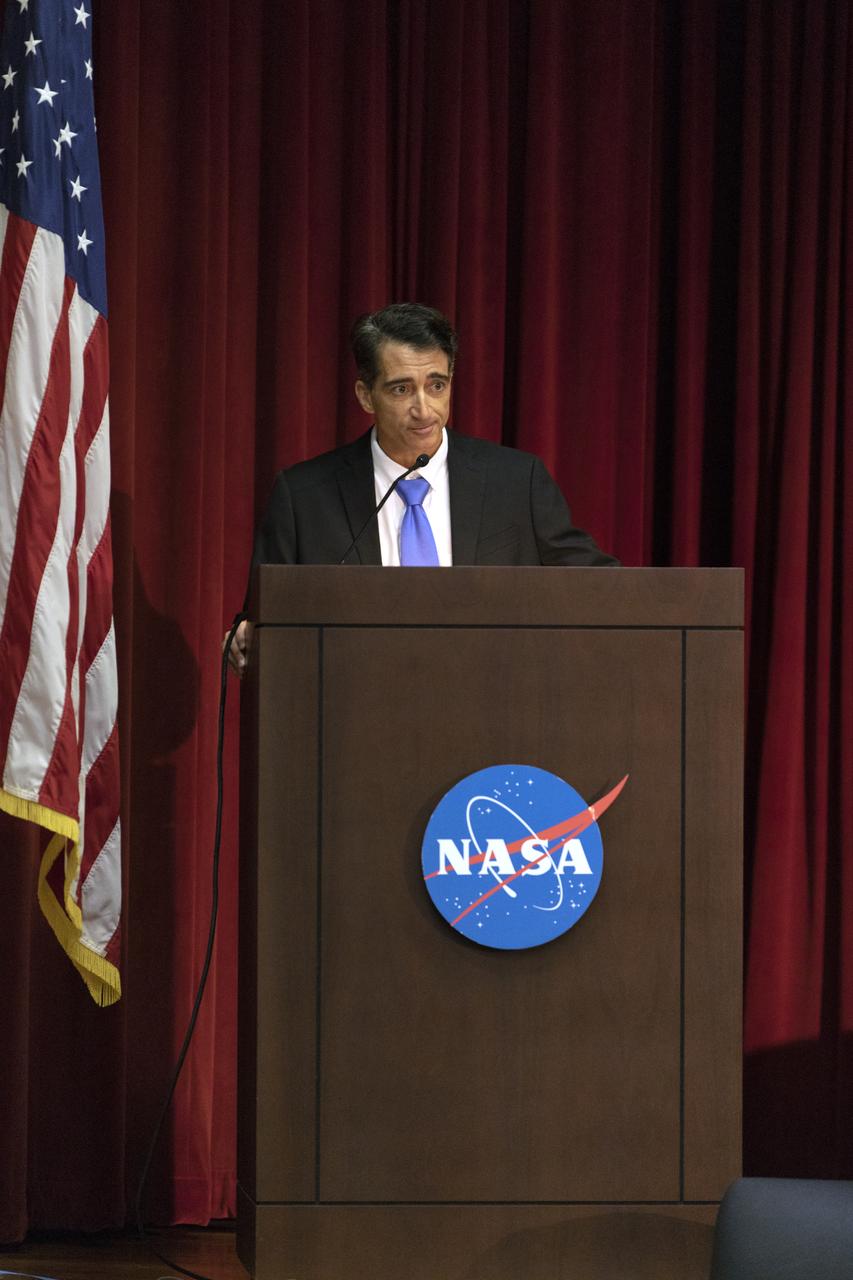
Apollo Challenger Columbia Lessons Learned Program (ACCLLP) Manager Mike Ciannilli speaks to NASA civil service and contractor employees and guests in Kennedy Space Center’s Training Auditorium on April 12, 2019. Ciannilli was the master of ceremonies for “Columbia: The Mission Continues,” an event organized by the ACCLLP. The event is part of the Space Shuttle Columbia national tour and took place on the 38th anniversary of STS-1, the first orbital spaceflight of NASA’s Space Shuttle Program. The tour launched at Kennedy and will make its way to each of the 10 NASA centers.

Evelyn Husband Thompson, widow of STS-107 Commander Rick Husband, speaks to NASA civil service and contractor employees and guests in Kennedy Space Center’s Training Auditorium on April 12, 2019. Husband Thompson was one of the presenters for “Columbia: The Mission Continues,” an event organized by the Apollo Challenger Columbia Lessons Learned Program (ACCLLP). The event is part of the Space Shuttle Columbia national tour and took place on the 38th anniversary of STS-1, the first orbital spaceflight of NASA’s Space Shuttle Program. The tour launched at Kennedy and will make its way to each of the 10 NASA centers.
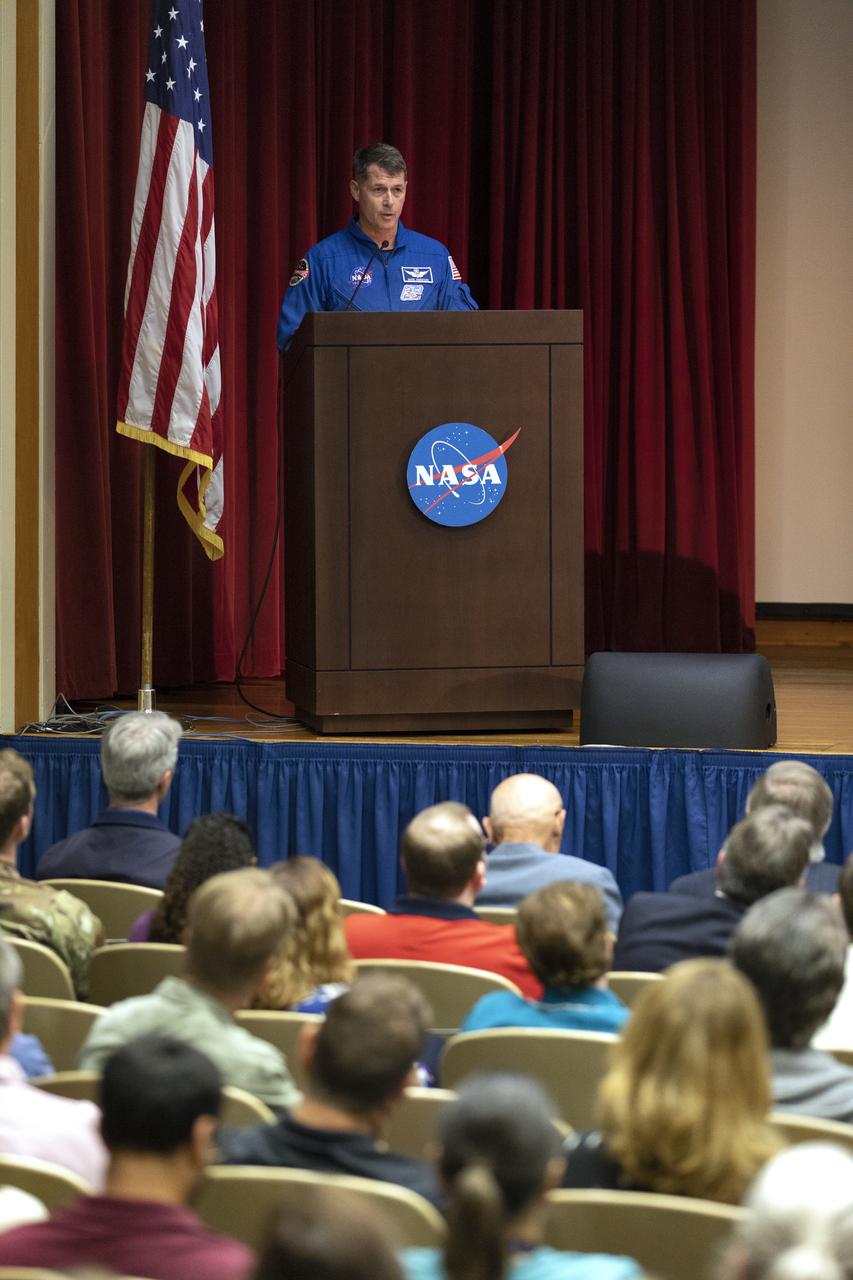
Astronaut Shane Kimbrough speaks to NASA civil service and contractor employees and guests in Kennedy Space Center’s Training Auditorium on April 12, 2019. Kimbrough was the final speaker for “Columbia: The Mission Continues,” an event organized by the Apollo Challenger Columbia Lessons Learned Program (ACCLLP). The event is part of the Space Shuttle Columbia national tour and took place on the 38th anniversary of STS-1, the first orbital spaceflight of NASA’s Space Shuttle Program. The tour launched at Kennedy and will make its way to each of the 10 NASA centers.
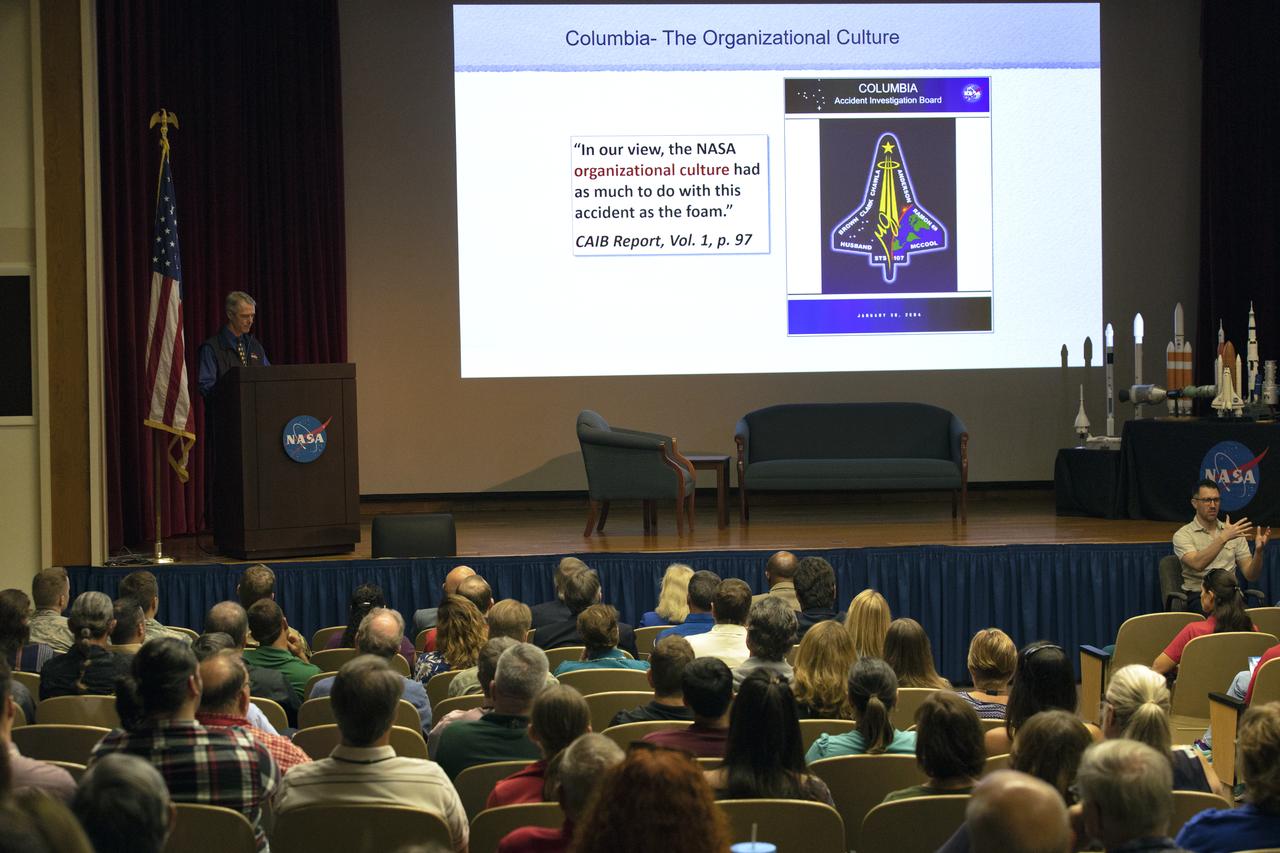
Goddard Space Flight Center Chief Knowledge Officer Ed Rogers speaks to NASA civil service and contractor employees and guests in Kennedy Space Center’s Training Auditorium on April 12, 2019. Rogers talked about lessons in decision-making during “Columbia: The Mission Continues,” an event organized by the Apollo Challenger Columbia Lessons Learned Program (ACCLLP). The event is part of the Space Shuttle Columbia national tour and took place on the 38th anniversary of STS-1, the first orbital spaceflight of NASA’s Space Shuttle Program. The tour launched at Kennedy and will make its way to each of the 10 NASA centers.
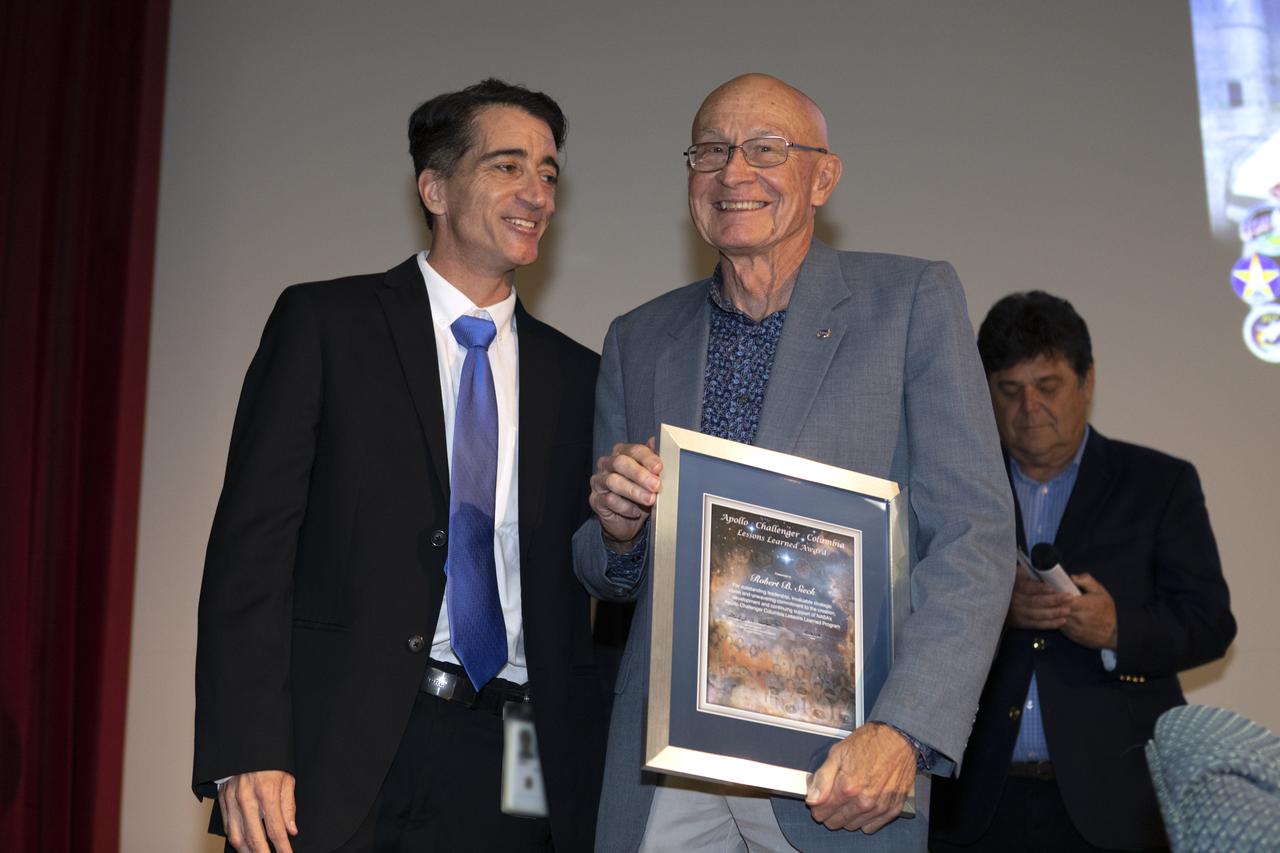
Apollo Challenger Columbia Lessons Learned Program (ACCLLP) Manager Mike Ciannilli, left, presents former space shuttle launch director Bob Sieck with a Lessons Learned Award in Kennedy Space Center’s Training Auditorium on April 12, 2019. The two men were a part of “Columbia: The Mission Continues,” an event organized by the ACCLLP. The event is part of the Space Shuttle Columbia national tour and took place on the 38th anniversary of STS-1, the first orbital spaceflight of NASA’s Space Shuttle Program. The tour launched at Kennedy and will make its way to each of the 10 NASA centers.
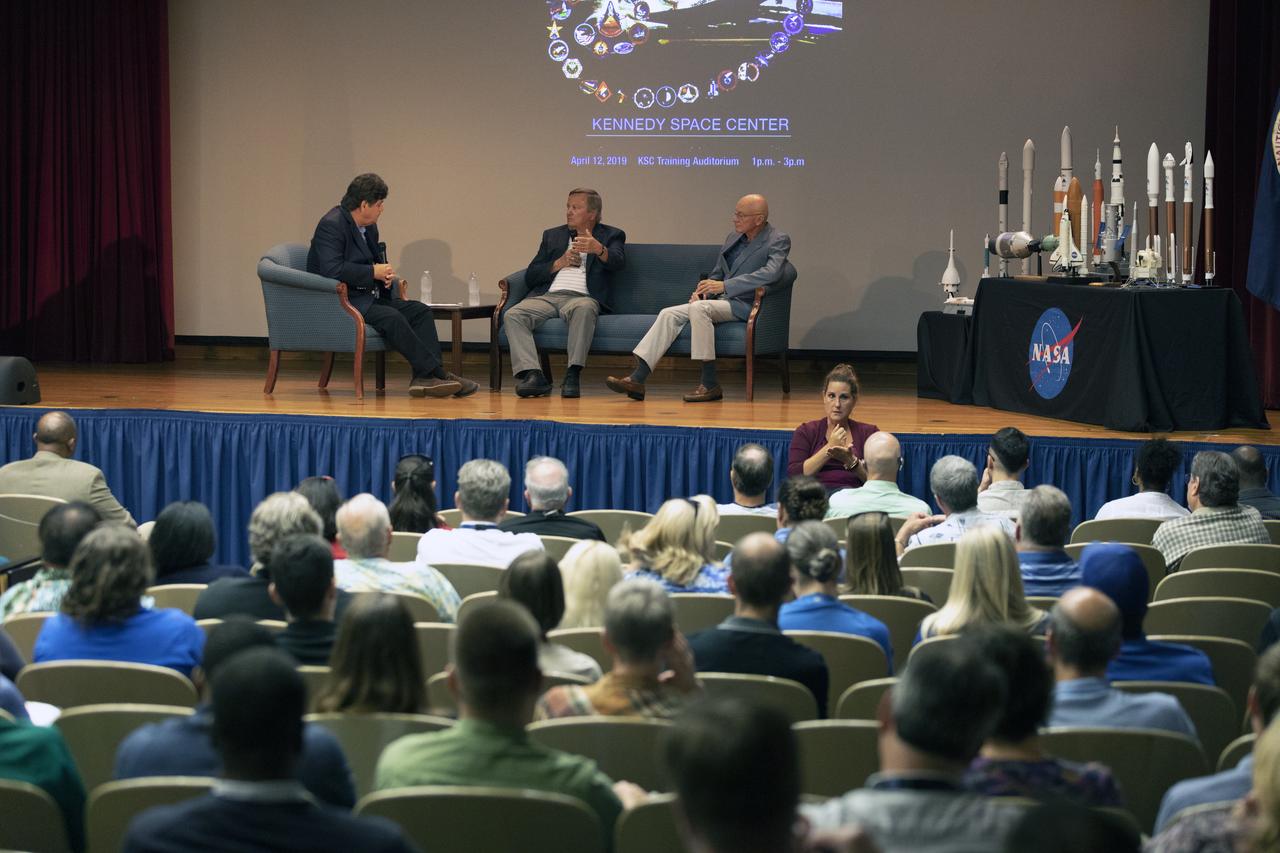
Veteran space reporter John Zarrella, left, moderates a “Lessons of Columbia” discussion with former space shuttle launch directors Mike Leinbach, center, and Bob Sieck in Kennedy Space Center’s Training Auditorium on April 12, 2019. The discussion took place during “Columbia: The Mission Continues,” an event organized by the Apollo Challenger Columbia Lessons Learned Program (ACCLLP). The event is part of the Space Shuttle Columbia national tour and took place on the 38th anniversary of STS-1, the first orbital spaceflight of NASA’s Space Shuttle Program. The tour launched at Kennedy and will make its way to each of the 10 NASA centers.
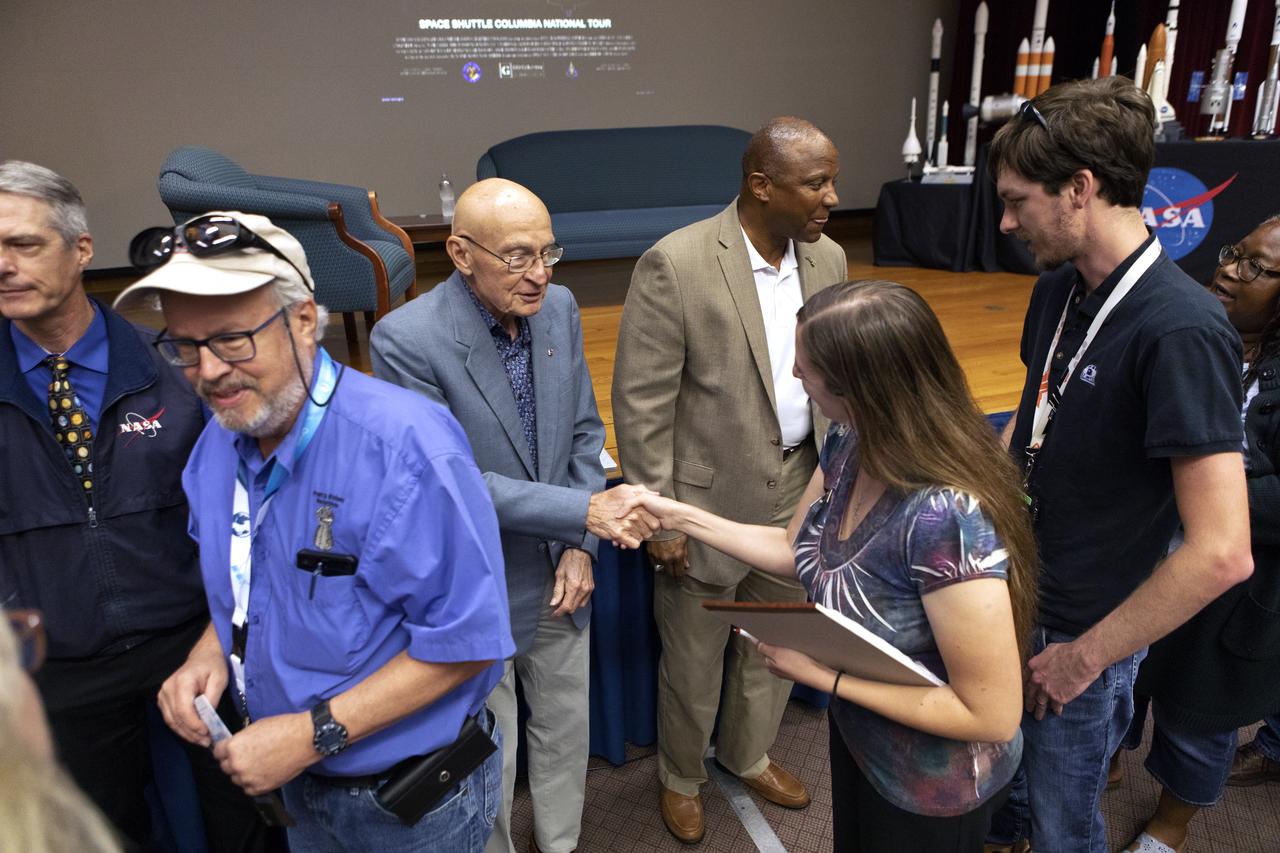
Former space shuttle launch director Bob Sieck shakes hands with an attendee of “Columbia: The Mission Continues,” in Kennedy Space Center’s Training Auditorium on April 12, 2019. Organized by the Apollo Challenger Columbia Lessons Learned Program (ACCLLP), the event is part of the Space Shuttle Columbia national tour and took place on the 38th anniversary of STS-1, the first orbital spaceflight of NASA’s Space Shuttle Program. The tour launched at Kennedy and will make its way to each of the 10 NASA centers.
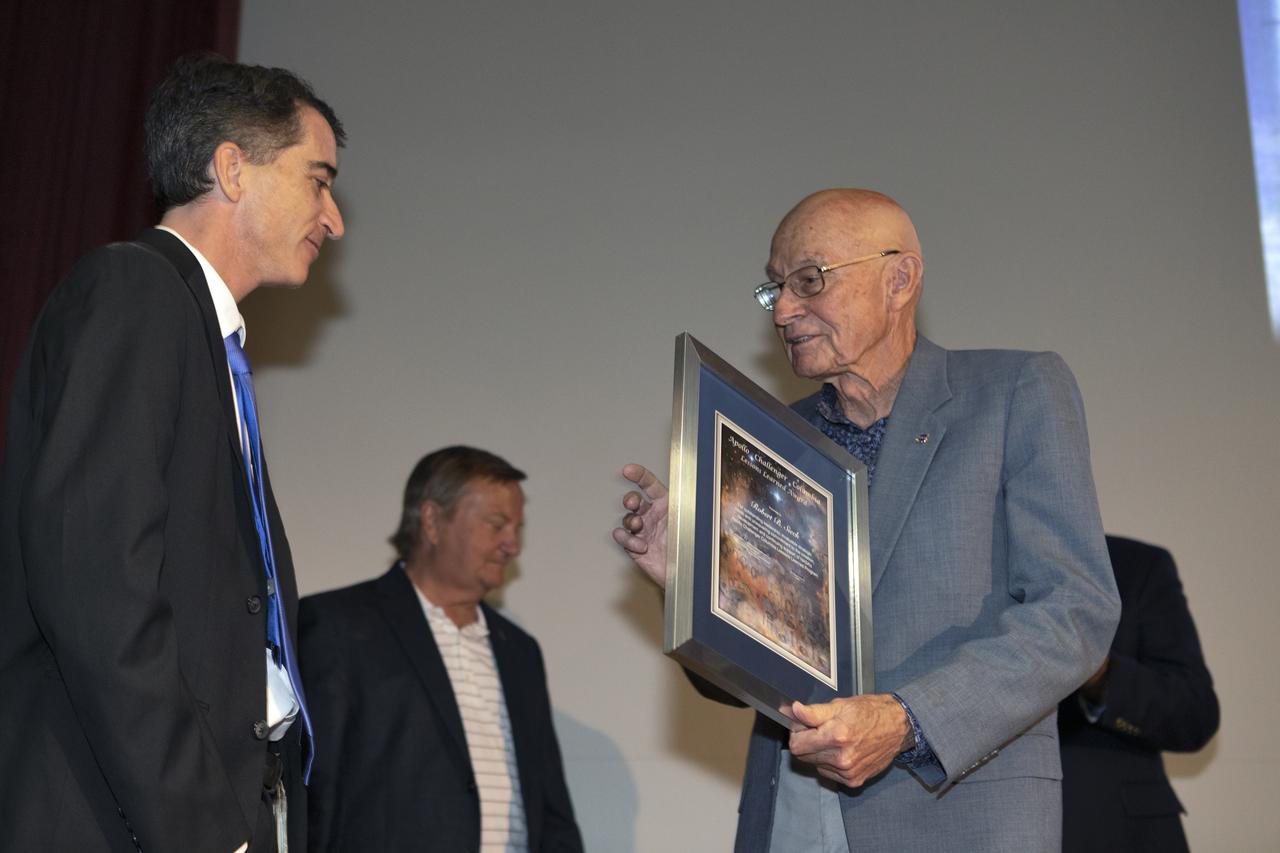
Former space shuttle launch director Bob Sieck, right, receives a Lessons Learned Award from Apollo Challenger Columbia Lessons Learned Program (ACCLLP) Manager Mike Ciannilli in Kennedy Space Center’s Training Auditorium on April 12, 2019. Sieck participated in a discussion during “Columbia: The Mission Continues,” an event organized by the ACCLLP. The event is part of the Space Shuttle Columbia national tour and took place on the 38th anniversary of STS-1, the first orbital spaceflight of NASA’s Space Shuttle Program. The tour launched at Kennedy and will make its way to each of the 10 NASA centers.
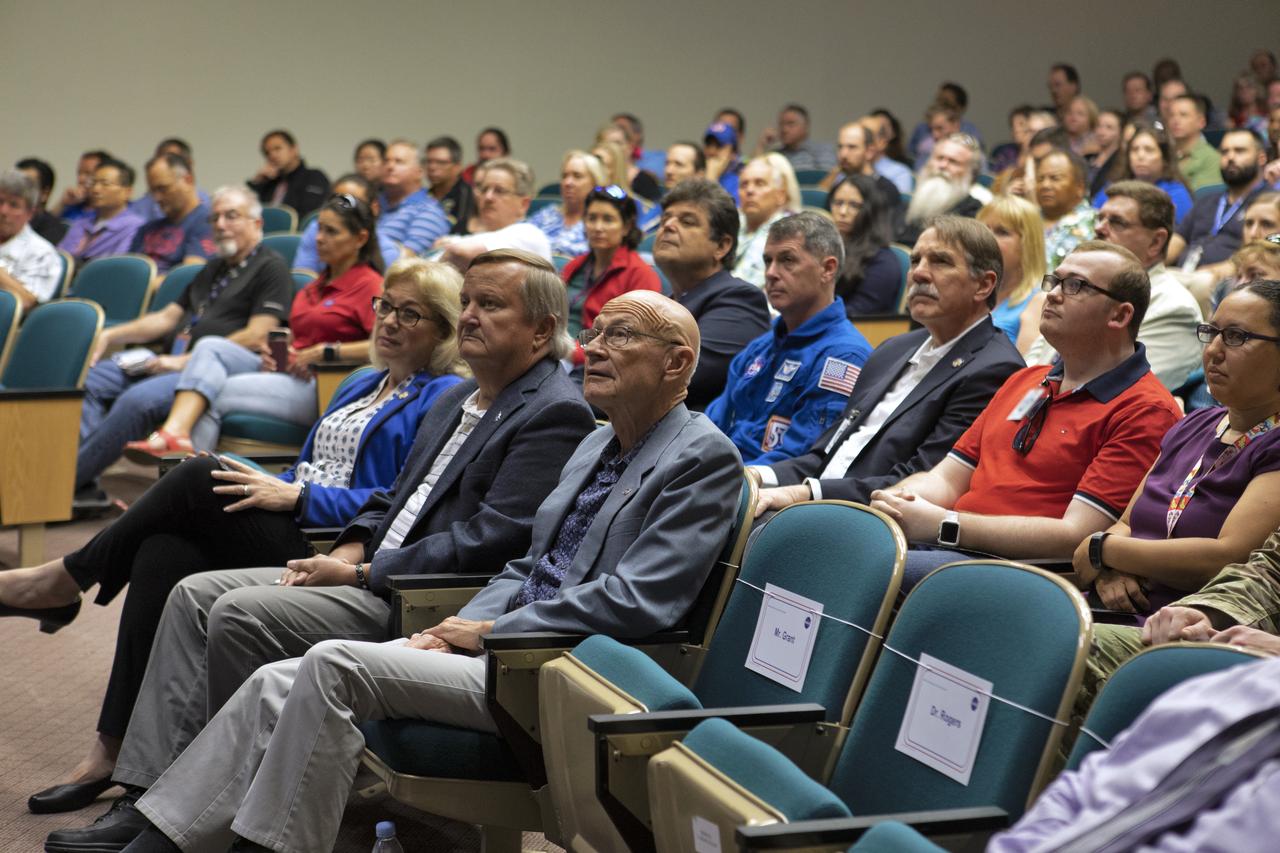
NASA civil service and contractor employees and guests gather in Kennedy Space Center’s Training Auditorium on April 12, 2019, for “Columbia: The Mission Continues,” an event organized by the Apollo Challenger Columbia Lessons Learned Program (ACCLLP). The event is part of the Space Shuttle Columbia national tour and took place on the 38th anniversary of STS-1, the first orbital spaceflight of NASA’s Space Shuttle Program. The tour launched at Kennedy and will make its way to each of the 10 NASA centers.
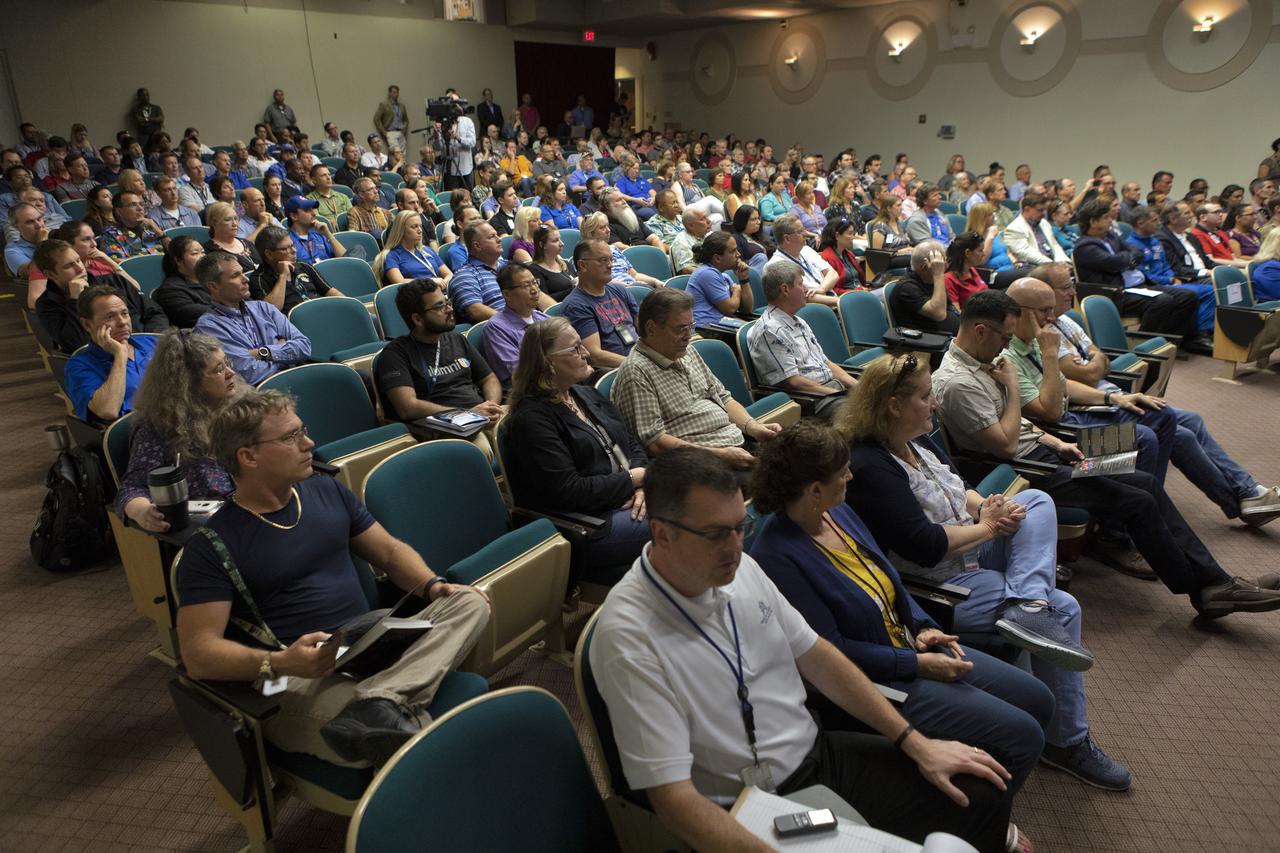
NASA civil service and contractor employees and guests gather in Kennedy Space Center’s Training Auditorium on April 12, 2019, for “Columbia: The Mission Continues,” an event organized by the Apollo Challenger Columbia Lessons Learned Program (ACCLLP). The event is part of the Space Shuttle Columbia national tour and took place on the 38th anniversary of STS-1, the first orbital spaceflight of NASA’s Space Shuttle Program. The tour launched at Kennedy and will make its way to each of the 10 NASA centers.
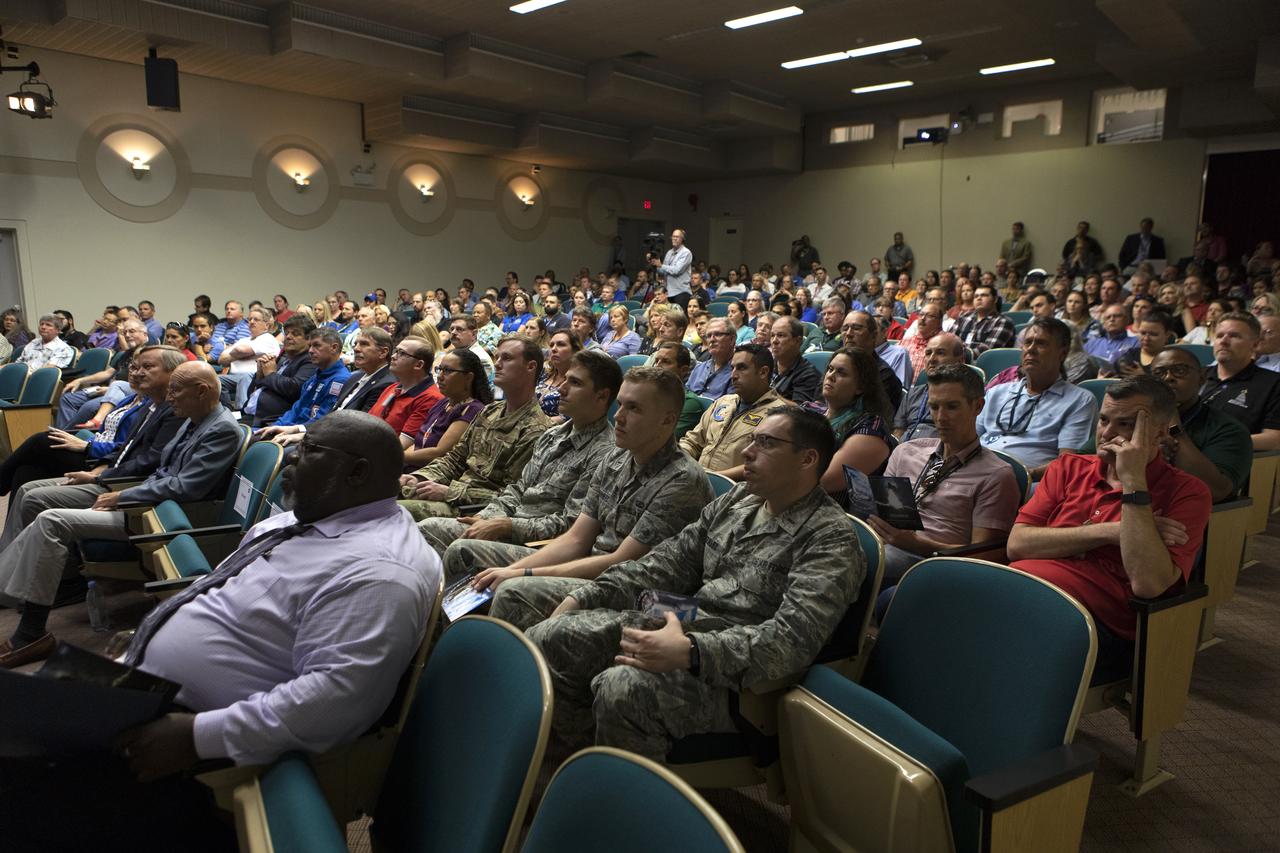
NASA civil service and contractor employees and guests gather in Kennedy Space Center’s Training Auditorium on April 12, 2019, for “Columbia: The Mission Continues,” an event organized by the Apollo Challenger Columbia Lessons Learned Program (ACCLLP). The event is part of the Space Shuttle Columbia national tour and took place on the 38th anniversary of STS-1, the first orbital spaceflight of NASA’s Space Shuttle Program. The tour launched at Kennedy and will make its way to each of the 10 NASA centers.
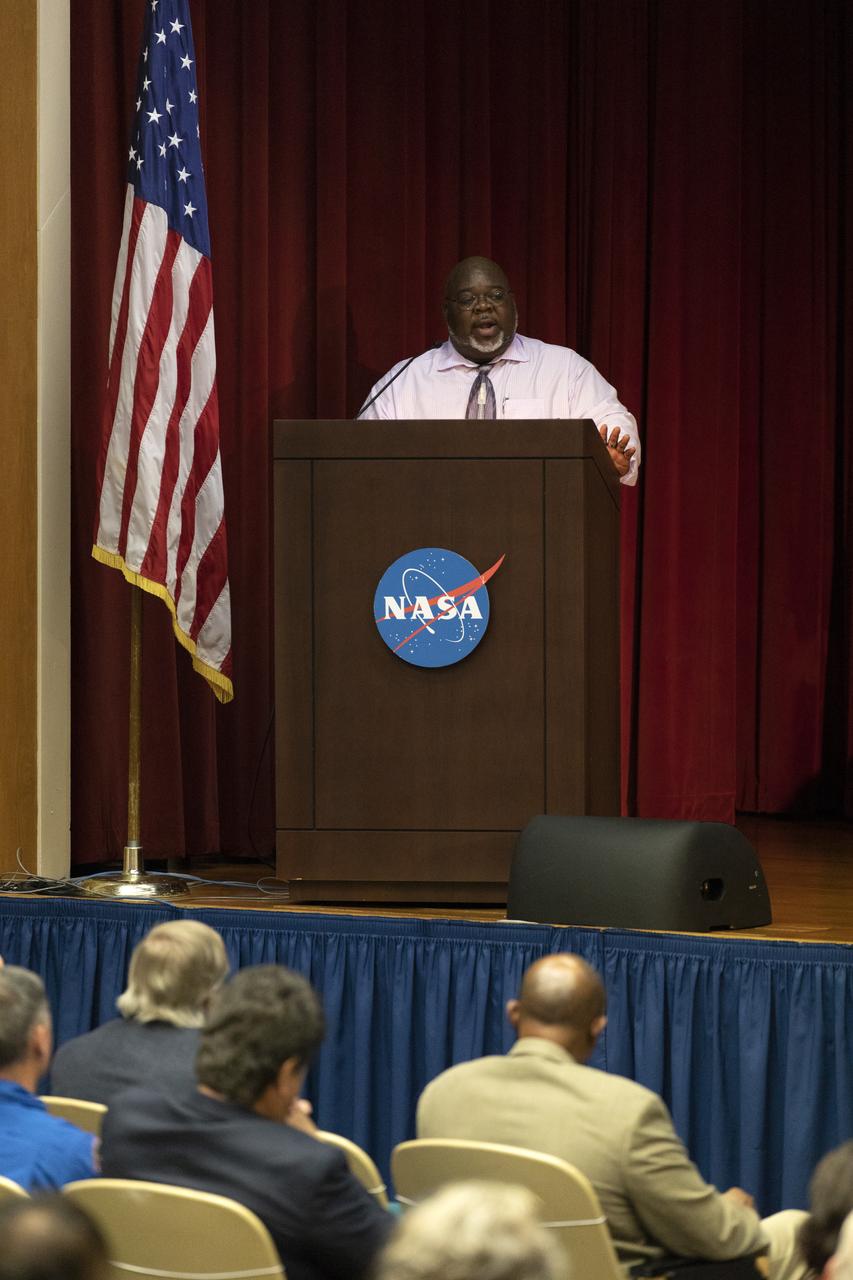
Kennedy Space Center Office of Diversity and Equal Opportunity Manager Rob Grant speaks to NASA civil service and contractor employees and guests in Kennedy Space Center’s Training Auditorium on April 12, 2019. Rogers talked about the power of diversity during “Columbia: The Mission Continues,” an event organized by the Apollo Challenger Columbia Lessons Learned Program (ACCLLP). The event is part of the Space Shuttle Columbia national tour and took place on the 38th anniversary of STS-1, the first orbital spaceflight of NASA’s Space Shuttle Program. The tour launched at Kennedy and will make its way to each of the 10 NASA centers.
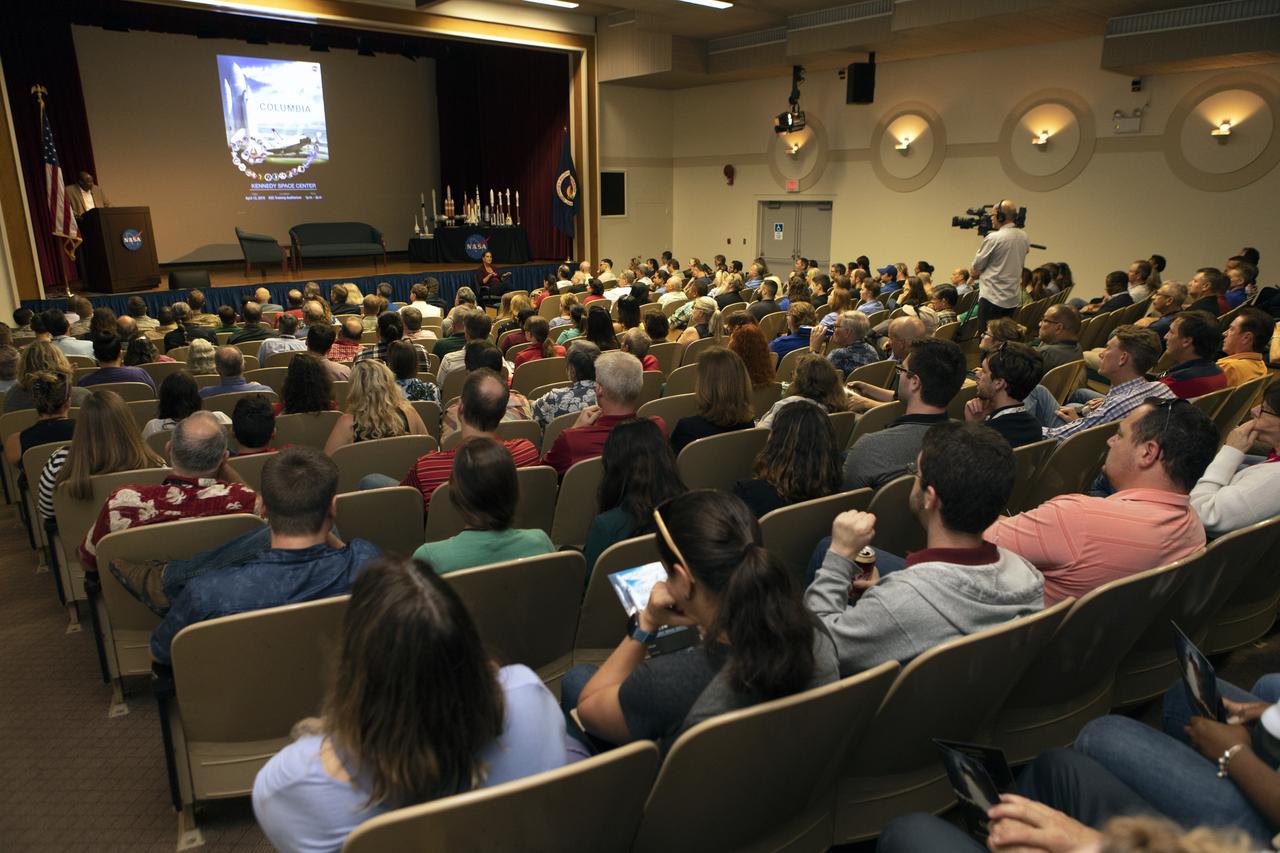
NASA civil service and contractor employees and guests gather in Kennedy Space Center’s Training Auditorium on April 12, 2019, for “Columbia: The Mission Continues,” an event organized by the Apollo Challenger Columbia Lessons Learned Program (ACCLLP). The event is part of the Space Shuttle Columbia national tour and took place on the 38th anniversary of STS-1, the first orbital spaceflight of NASA’s Space Shuttle Program. The tour launched at Kennedy and will make its way to each of the 10 NASA centers.

Former space shuttle launch director Mike Leinbach, left, talks with attendees of “Columbia: The Mission Continues,” in Kennedy Space Center’s Training Auditorium on April 12, 2019. Organized by the Apollo Challenger Columbia Lessons Learned Program (ACCLLP), the event is part of the Space Shuttle Columbia national tour and took place on the 38th anniversary of STS-1, the first orbital spaceflight of NASA’s Space Shuttle Program. The tour launched at Kennedy and will make its way to each of the 10 NASA centers.
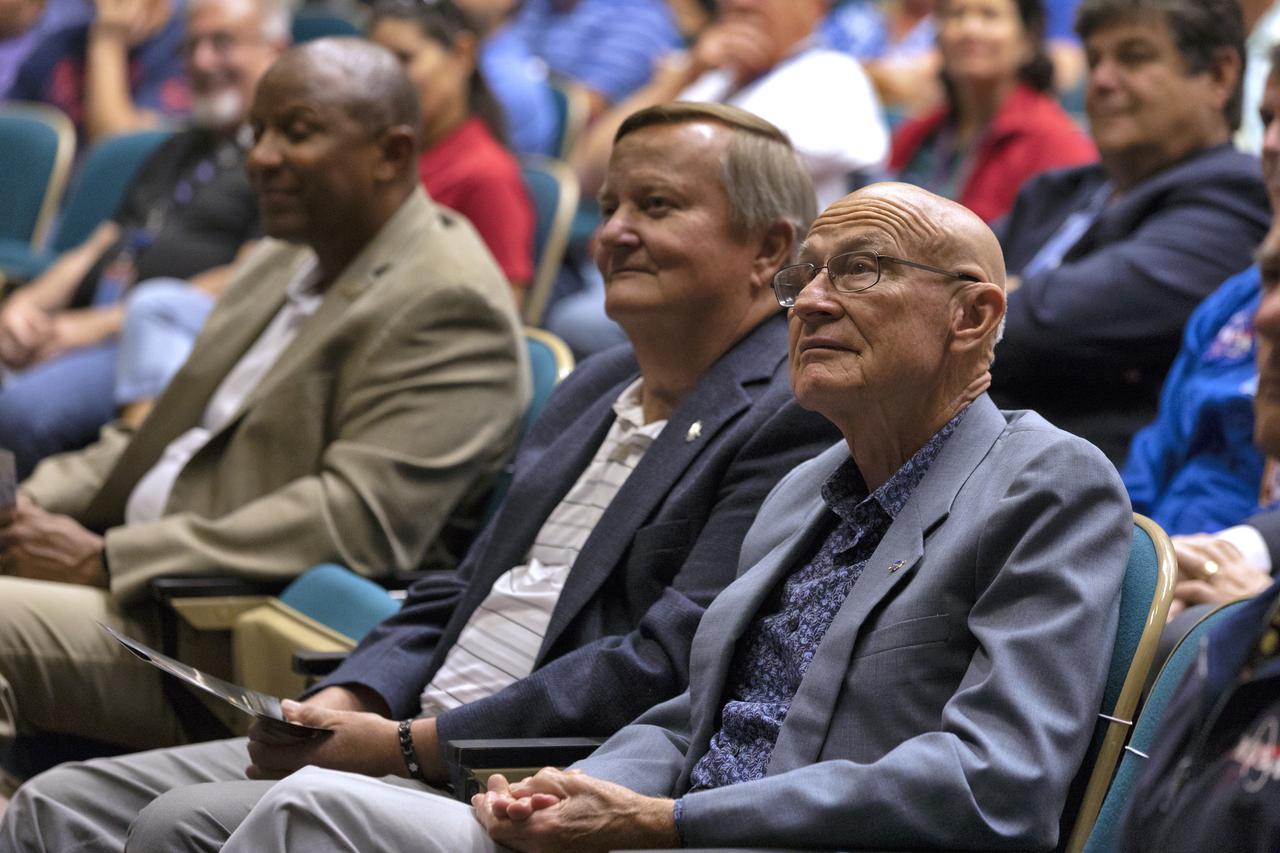
Former space shuttle launch directors Mike Leinbach, left, and Bob Sieck listen to a presentation in Kennedy Space Center’s Training Auditorium on April 12, 2019, during “Columbia: The Mission Continues,” an event organized by the Apollo Challenger Columbia Lessons Learned Program (ACCLLP). The event is part of the Space Shuttle Columbia national tour and took place on the 38th anniversary of STS-1, the first orbital spaceflight of NASA’s Space Shuttle Program. The tour launched at Kennedy and will make its way to each of the 10 NASA centers.
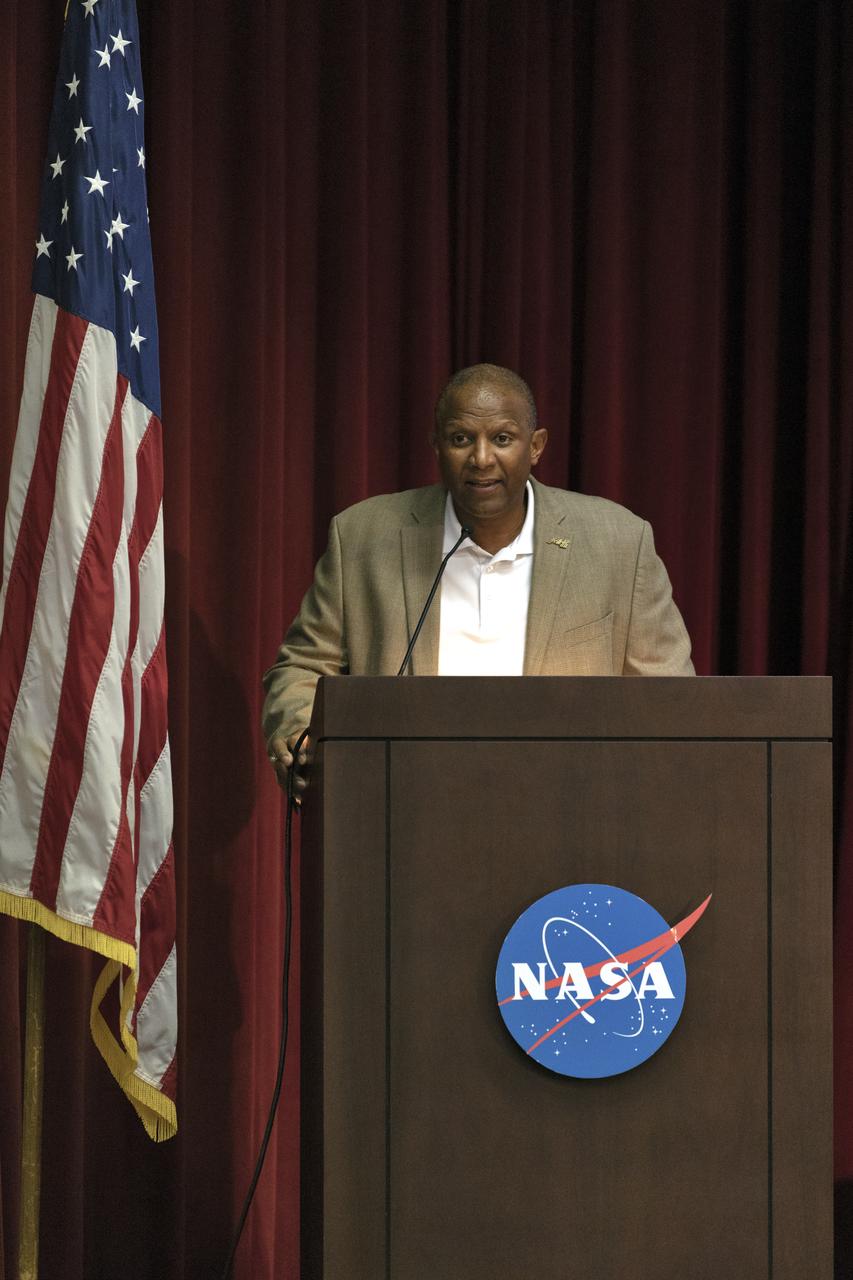
Kelvin Manning, Kennedy Space Center associate director, technical, speaks to NASA civil service and contractor employees and guests in the Florida spaceport’s Training Auditorium on April 12, 2019. Manning delivered opening remarks for “Columbia: The Mission Continues,” an event organized by the Apollo Challenger Columbia Lessons Learned Program (ACCLLP). The event is part of the Space Shuttle Columbia national tour and took place on the 38th anniversary of STS-1, the first orbital spaceflight of NASA’s Space Shuttle Program. The tour launched at Kennedy and will make its way to each of the 10 NASA centers.
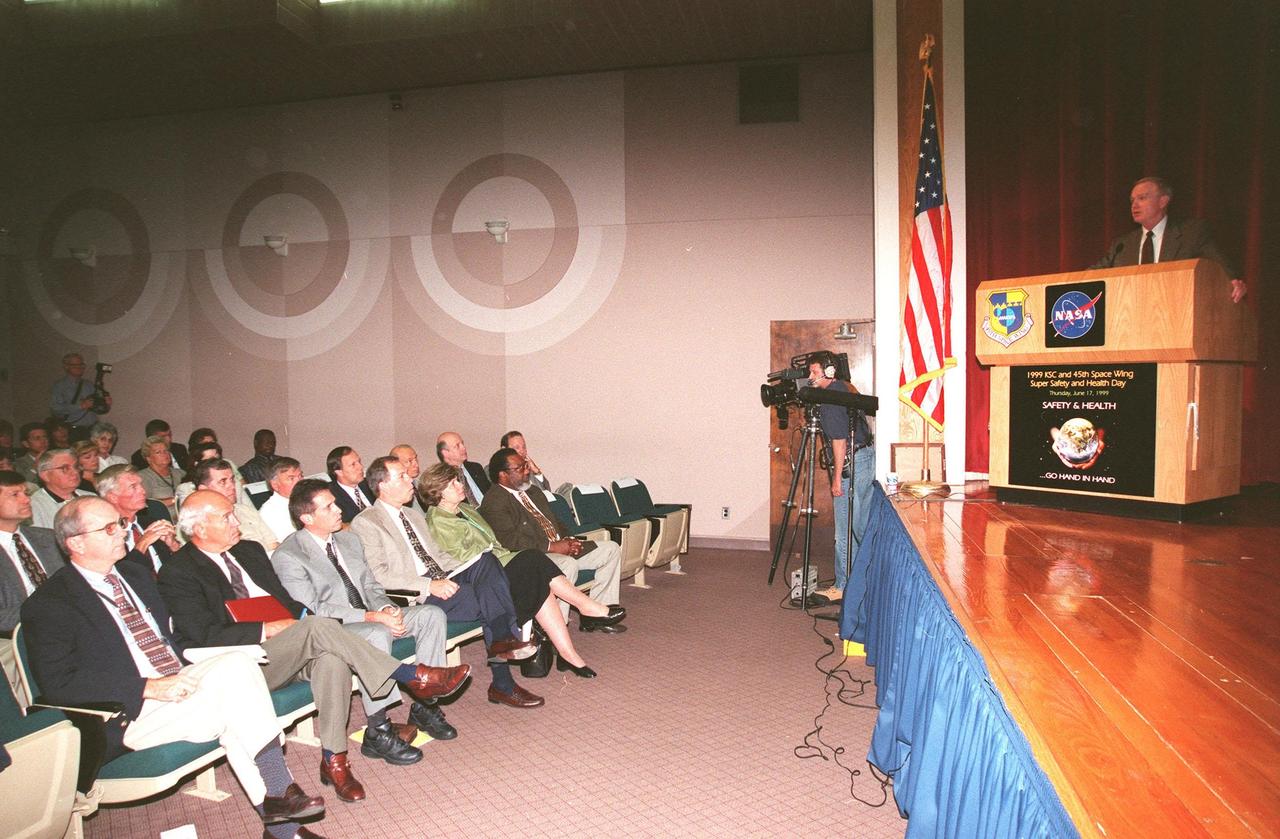
Center Director Roy Bridges opens the second Super Safety and Health Day at Kennedy Space Center, an entire day when most normal work activities are suspended to allow personnel to attend safetyand health-related activities. The theme, "Safety and Health Go Hand in Hand," emphasized KSC's commitment to place the safety and health of the public, astronauts, employees and space-related resources first and foremost. Events included a keynote address, a panel session about related issues, vendor exhibits, and safety training in work groups. The keynote address and panel session were also broadcast internally over NASA television
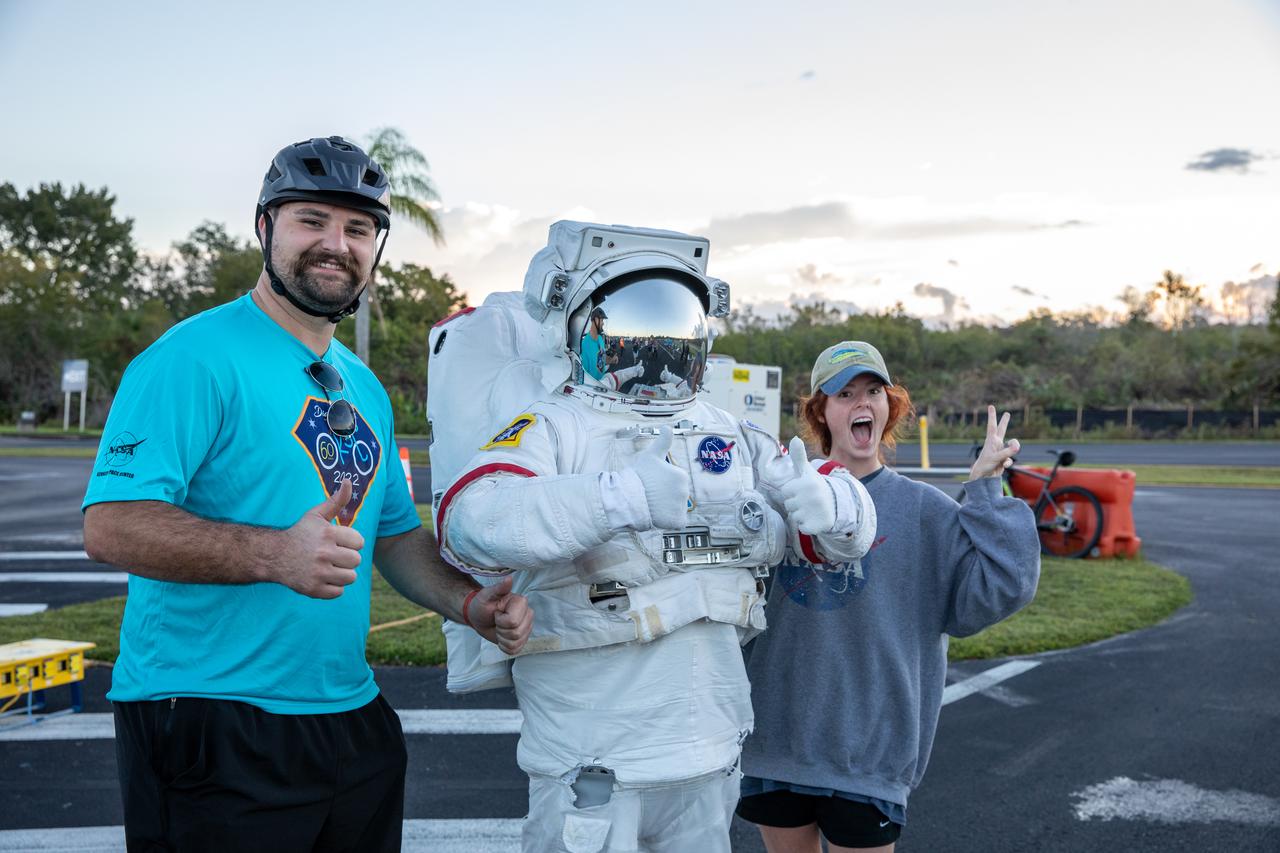
Participants in the Diamond Tour de KSC pause for a photo with the Spaceperson at NASA’s Kennedy Space Center Visitor Complex before beginning their bicycle routes at Kennedy Space Center in Florida on Oct. 22, 2022. This unique event, held for the first time since 2019, was part of the Safety organization’s Fall Into Safety and Health event, and named “diamond” to honor the center’s 60th anniversary. Cyclists covered three different routes and rode by historic landmarks, completing a total of about 37 miles.
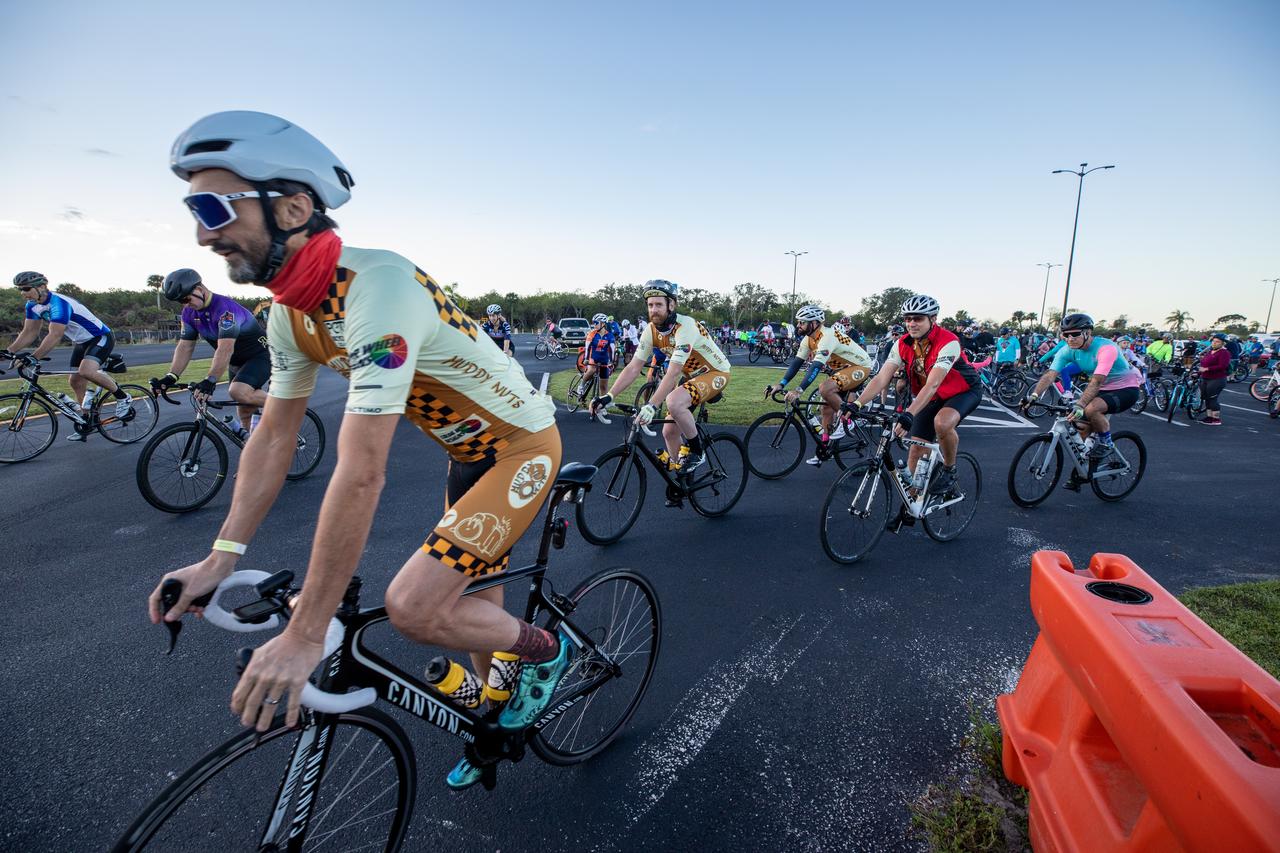
Kennedy Space Center employees and their guests participate in the Diamond Tour de KSC at NASA’s Kennedy Space Center in Florida on Oct. 22, 2022. This unique event, held for the first time since 2019, was part of the Safety organization’s Fall Into Safety and Health event, and named “diamond” to honor the center’s 60th anniversary. Cyclists covered three different routes and rode by historic landmarks, completing a total of about 37 miles.
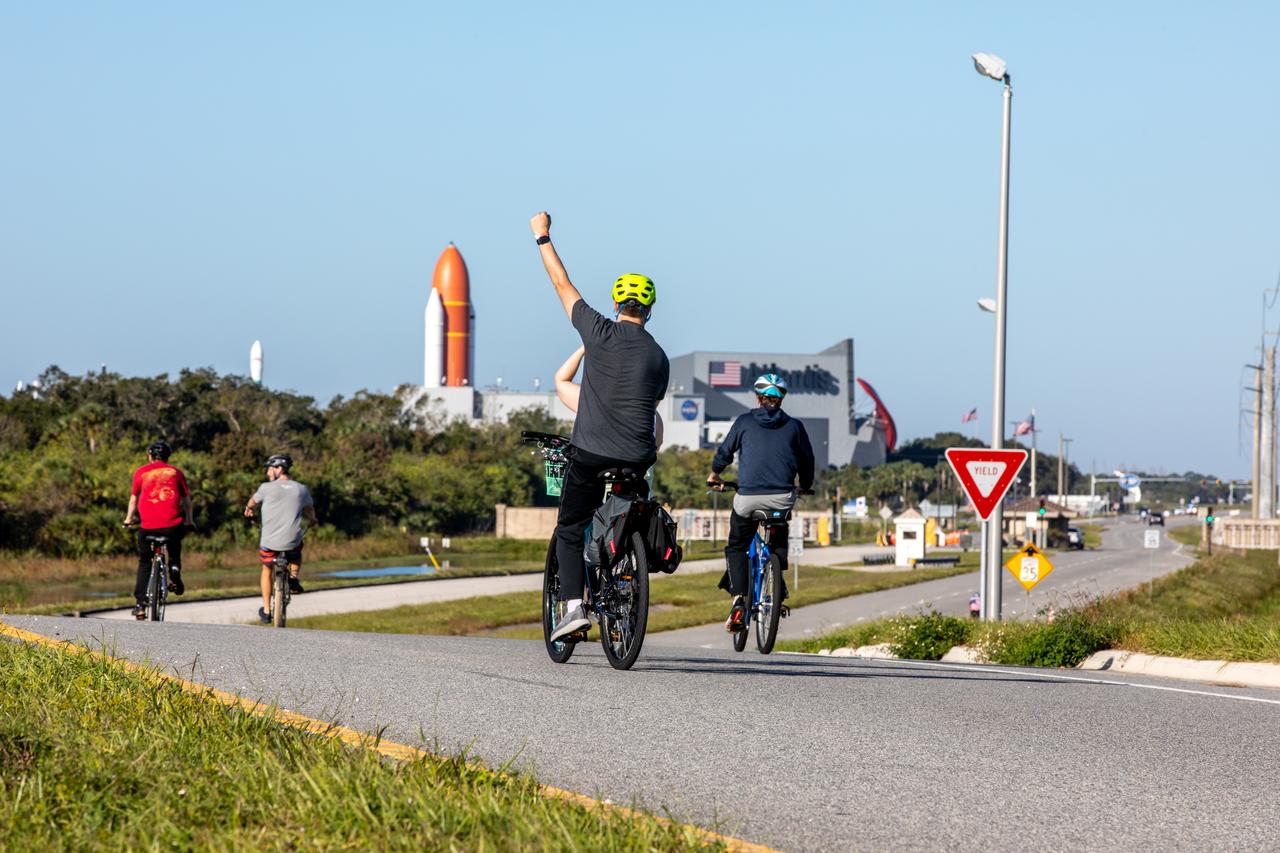
Kennedy Space Center employees and their guests return to the Kennedy Space Center Visitor Complex after completing the Diamond Tour de KSC at the NASA spaceport in Florida on Oct. 22, 2022. This unique event, held for the first time since 2019, was part of the Safety organization’s Fall Into Safety and Health event, and named “diamond” to honor the center’s 60th anniversary. Cyclists covered three different routes and rode by historic landmarks, completing a total of about 37 miles.

Participants in the Diamond Tour de KSC pause for a selfie at NASA’s Kennedy Space Center Visitor Complex before beginning their bicycle routes at Kennedy Space Center in Florida on Oct. 22, 2022. This unique event, held for the first time since 2019, was part of the Safety organization’s Fall Into Safety and Health event, and named “diamond” to honor the center’s 60th anniversary. Cyclists covered three different routes and rode by historic landmarks, completing a total of about 37 miles.
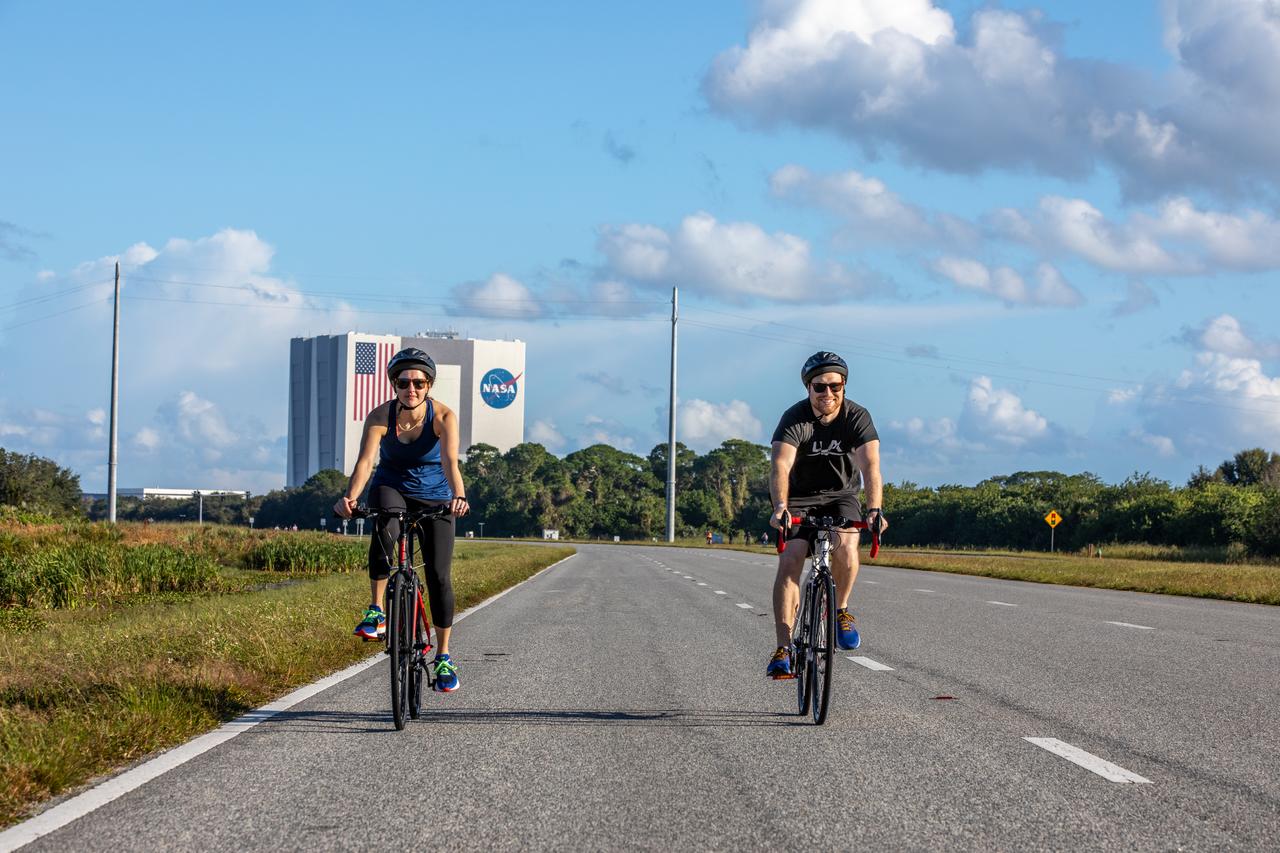
Two cyclists participate in the Diamond Tour de KSC at NASA’s Kennedy Space Center in Florida on Oct. 22, 2022. In the background is the iconic Vehicle Assembly Building. This unique event, held for the first time since 2019, was part of the Safety organization’s Fall Into Safety and Health event, and named “diamond” to honor the center’s 60th anniversary. Cyclists covered three different routes and rode by historic landmarks, completing a total of about 37 miles.
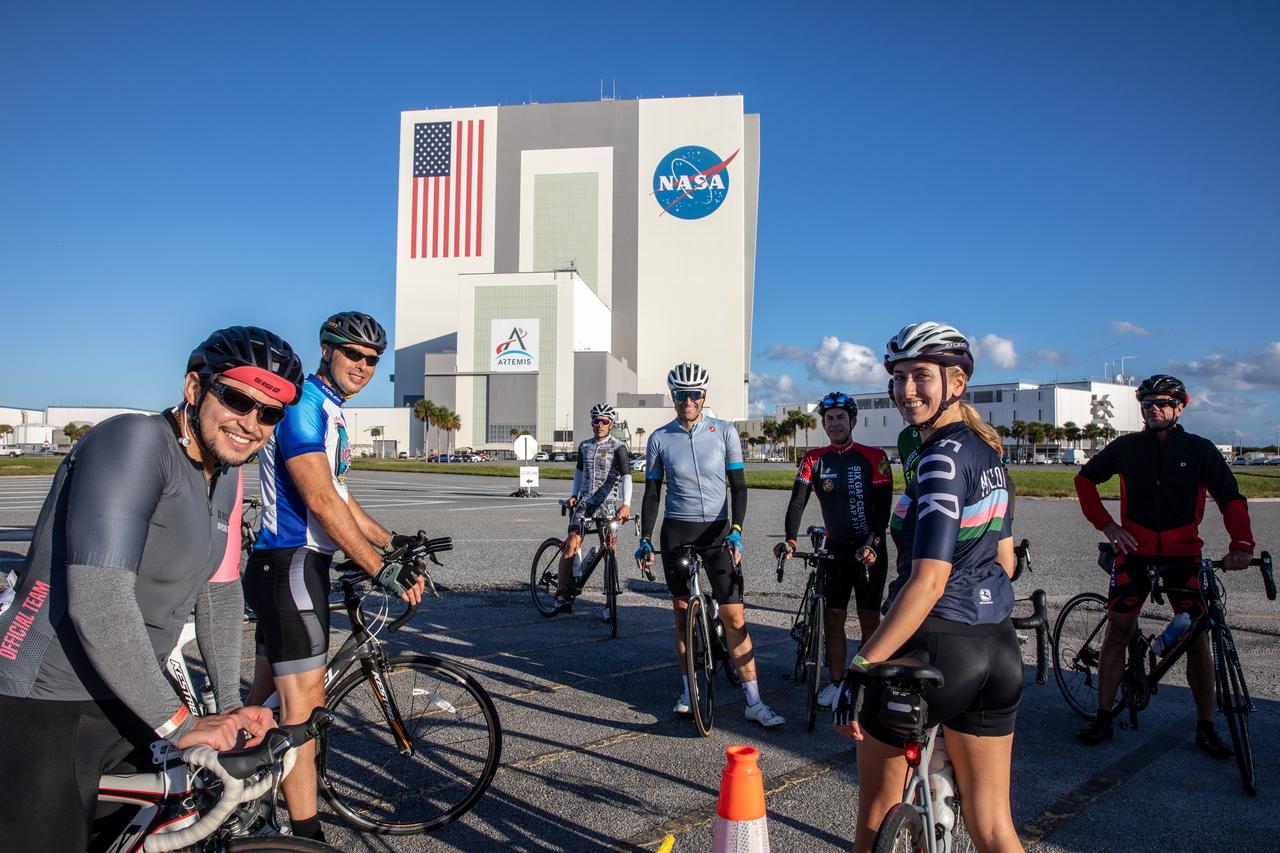
Kennedy Space Center employees and their guests participate in the Diamond Tour de KSC at NASA’s Kennedy Space Center in Florida on Oct. 22, 2022. This unique event, held for the first time since 2019, was part of the Safety organization’s Fall Into Safety and Health event, and named “diamond” to honor the center’s 60th anniversary. Cyclists covered three different routes and rode by historic landmarks, completing a total of about 37 miles.
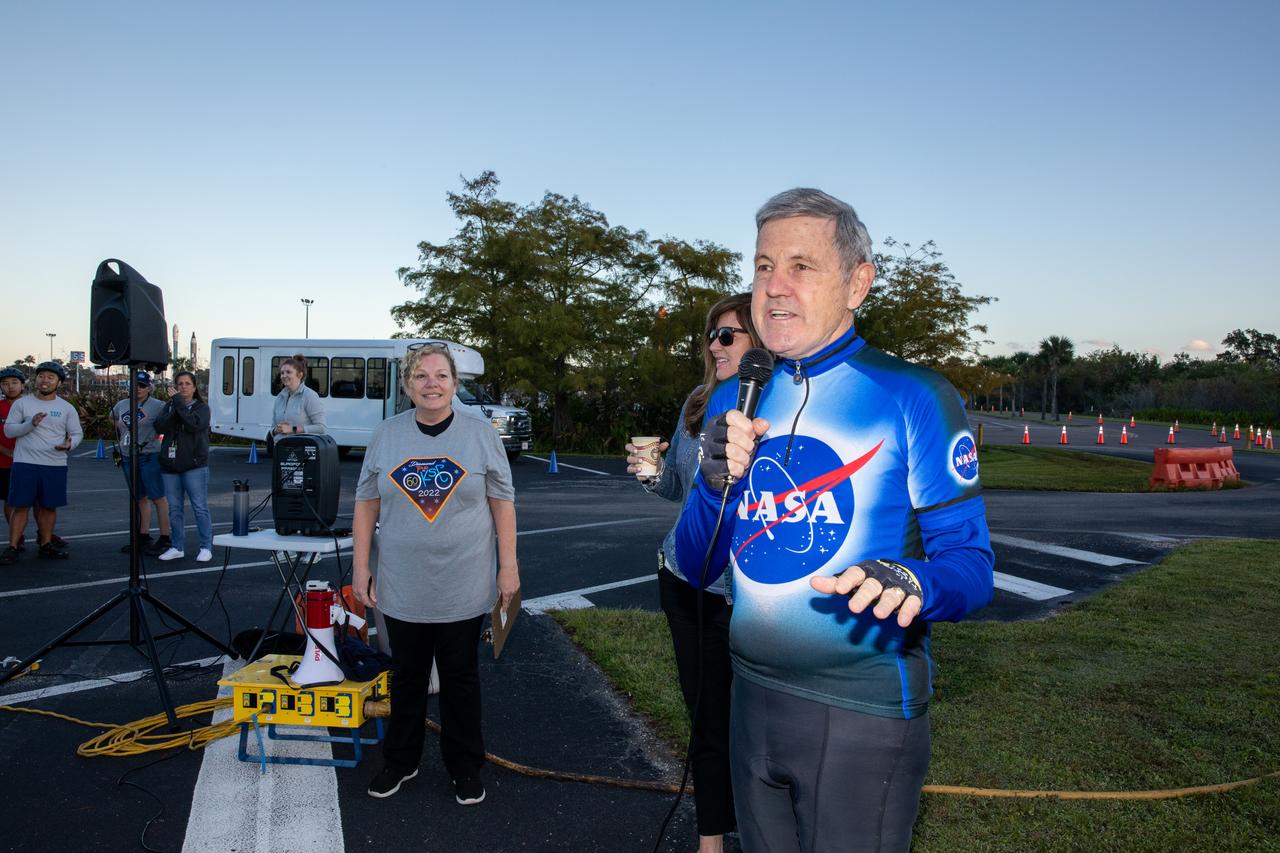
NASA Associate Administrator and retired astronaut Bob Cabana speaks to participants in the Diamond Tour de KSC at Kennedy Space Center Visitor Complex before beginning their bicycle routes at Kennedy Space Center in Florida on Oct. 22, 2022. This unique event, held for the first time since 2019, was part of the Safety organization’s Fall Into Safety and Health event, and named “diamond” to honor the center’s 60th anniversary. Cyclists covered three different routes and rode by historic landmarks, completing a total of about 37 miles.
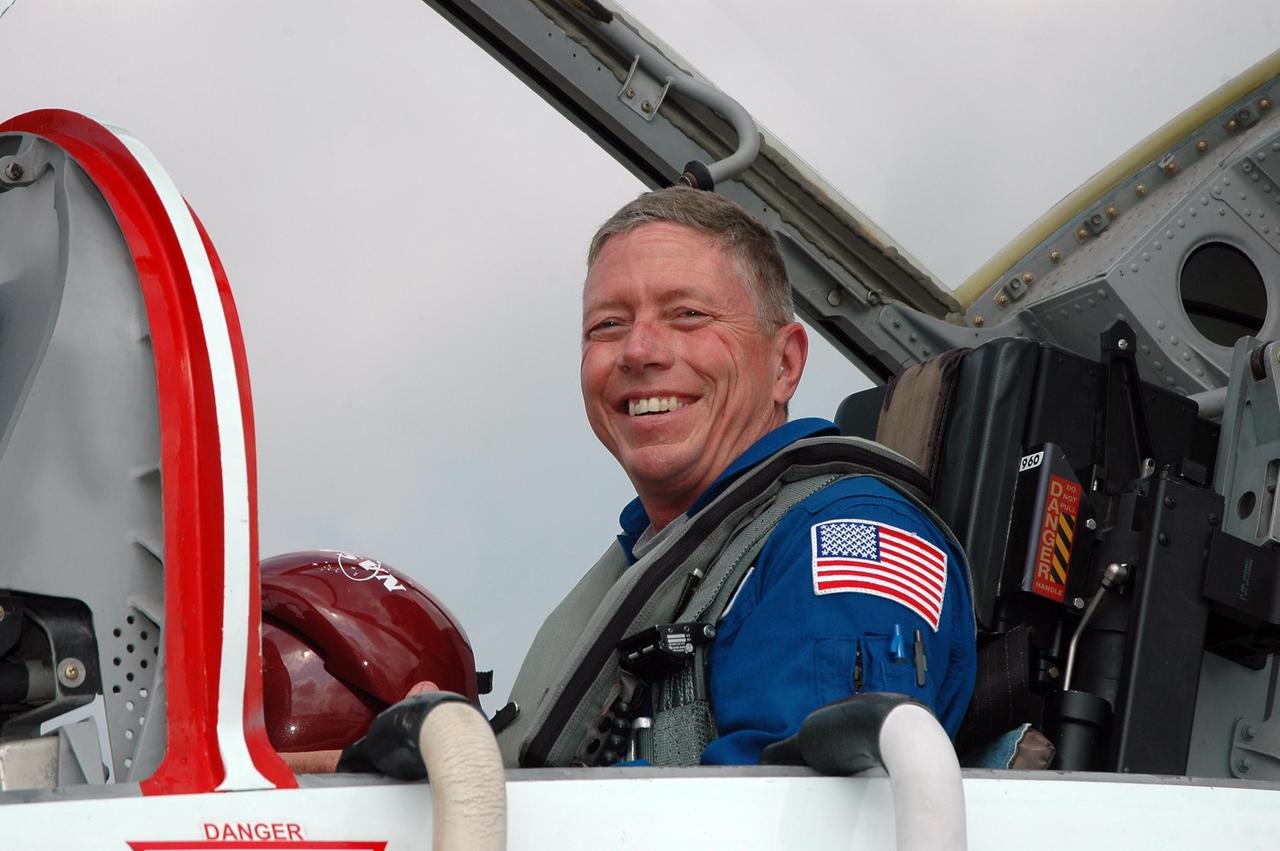
KENNEDY SPACE CENTER, FLA. - STS-121 Mission Specialist Michael Fossum arrives at KSC aboard a T-38 jet aircraft to get ready for launch on July 1. The launch will be his first space flight. During the 12-day mission, the STS-121 crew will test new equipment and procedures to improve shuttle safety, as well as deliver supplies and make repairs to the International Space Station. This mission is the 115th shuttle flight and the 18th U.S. flight to the International Space Station. Photo credit: NASA/Kim Shiflett
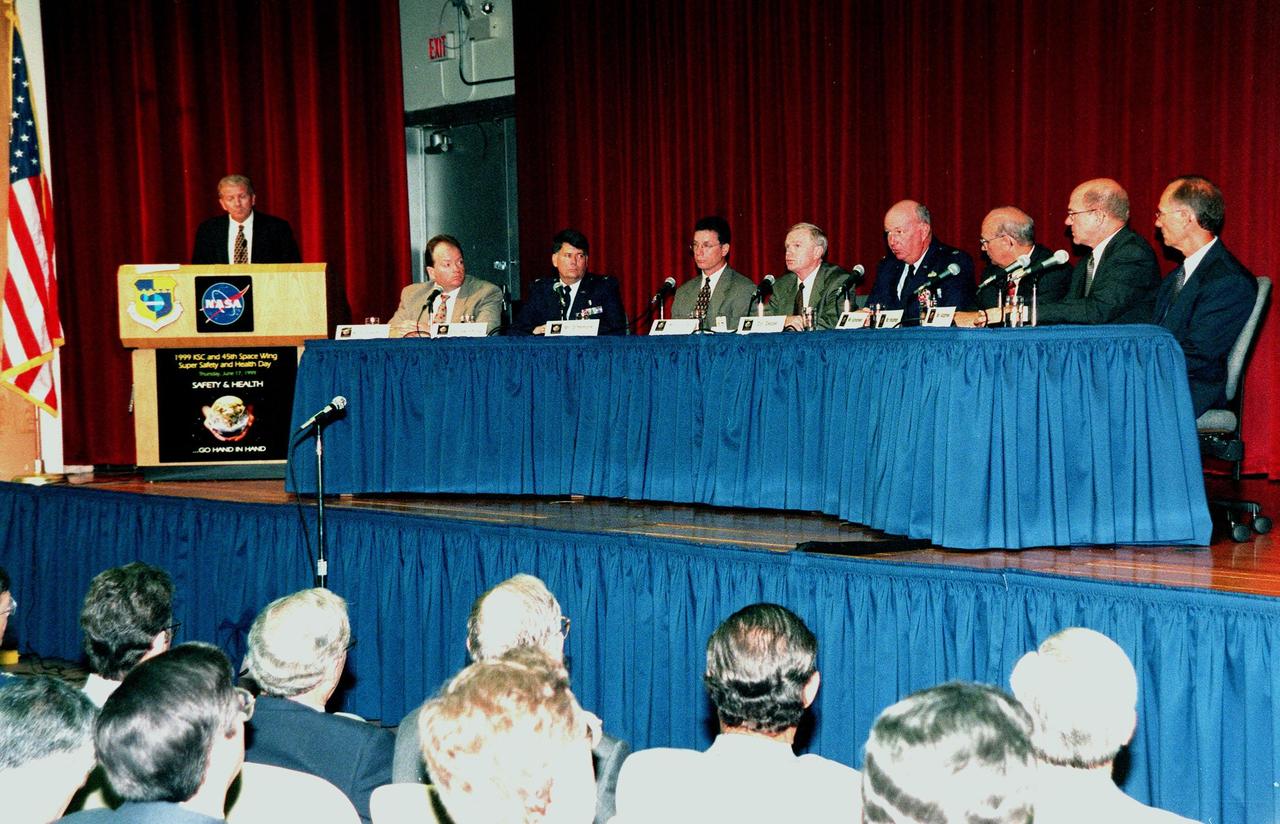
A panel of NASA and contractor senior staff, plus officers from the 45th Space Wing, discuss safetyand health-related concerns in front of an audience of KSC employees, as part of Super Safety and Health Day. Moderating at the podium is Loren Shriver, deputy director for Launch & Payload Processing. Seated left to right are Burt Summerfield, associate director of the Biomedical Office; Colonel William S. Swindling, commander, 45th Medical Group, Patrick Air Force Base, Fla.; Ron Dittemore, manager, Space Shuttle Programs, Johnson Space Center; Roy Bridges, Center Director; Col. Tom Deppe, vice commander, 45th Space Wing, Patrick Air Force Base; Jim Schoefield, program manager, Payload Ground Operations, Boeing; Bill Hickman, program manager, Space Gateway Support; and Ed Adamek, vice president and associate program manager for Ground Operations, United Space Alliance. The panel was one of the presentations during KSC's second annual day-long dedication to safety. Most normal work activities were suspended to allow personnel to attend related activities. The theme, "Safety and Health Go Hand in Hand," emphasized KSC's commitment to place the safety and health of the public, astronauts, employees and space-related resources first and foremost. Events also included a keynote address, vendor exhibits, and safety training in work groups. The keynote address and panel session were also broadcast internally over NASA television
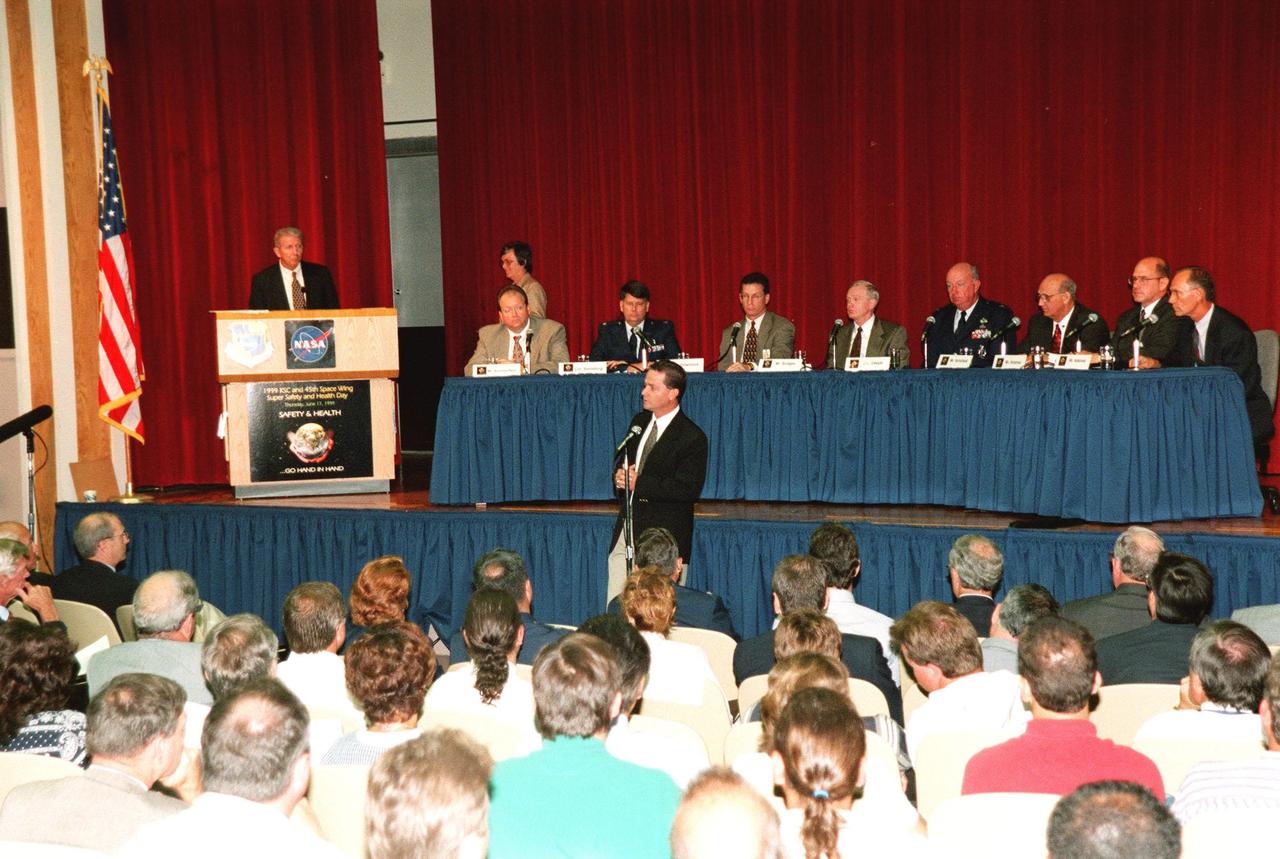
A panel of NASA and contractor senior staff, plus officers from the 45th Space Wing, discuss safetyand health-related concerns in front of an audience of KSC employees as part of Super Safety and Health Day. Moderating at the podium is Loren Shriver, deputy director for Launch & Payload Processing. Seated left to right are Burt Summerfield, associate director of the Biomedical Office; Colonel William S. Swindling, commander, 45th Medical Group, Patrick Air Force Base, Fla.; Ron Dittemore, manager, Space Shuttle Programs, Johnson Space Center; Roy Bridges, Center Director; Col. Tom Deppe, vice commander, 45th Space Wing, Patrick Air Force Base; Jim Schoefield, program manager, Payload Ground Operations, Boeing; Bill Hickman, program manager, Space Gateway Support; and Ed Adamek, vice president and associate program manager for Ground Operations, United Space Alliance. Answering a question at the microphone on the floor is Dave King, director, Shuttle Processing. The panel was one of the presentations during KSC's second annual day-long dedication to safety. Most normal work activities were suspended to allow personnel to attend related activities. The theme, "Safety and Health Go Hand in Hand," emphasized KSC's commitment to place the safety and health of the public, astronauts, employees and space-related resources first and foremost. Events also included a keynote address, vendor exhibits, and safety training in work groups. The keynote address and panel session were also broadcast internally over NASA television
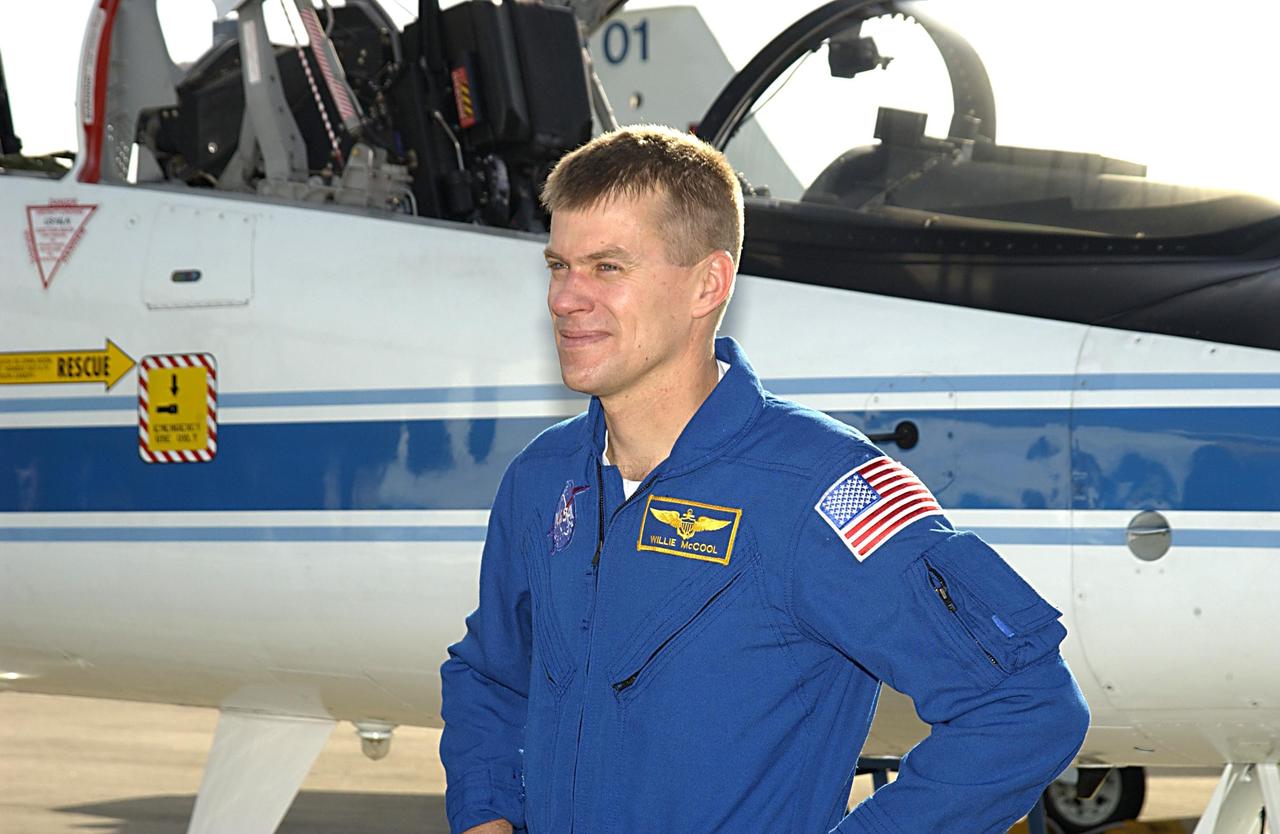
KENNEDY SPACE CENTER, FLA. - STS-107 Pilot William "Willie" McCool pauses next to the T-38 jet aircraft in which he flew to KSC. He and the crew are at KSC to take part in Terminal Countdown Demonstration Test activities, which include a simulated launch countdown. Other crew members are Commander Rick Husband, Payload Commander Michael Anderson, Mission Specialists Kalpana Chawla, David Brown and Laurel Clark, and Payload Specialist Ilan Ramon, the first Israeli astronaut. STS-107 is a mission devoted to research and will include more than 80 experiments that will study Earth and space science, advanced technology development, and astronaut health and safety. Launch is scheduled for Jan. 16, 2003.
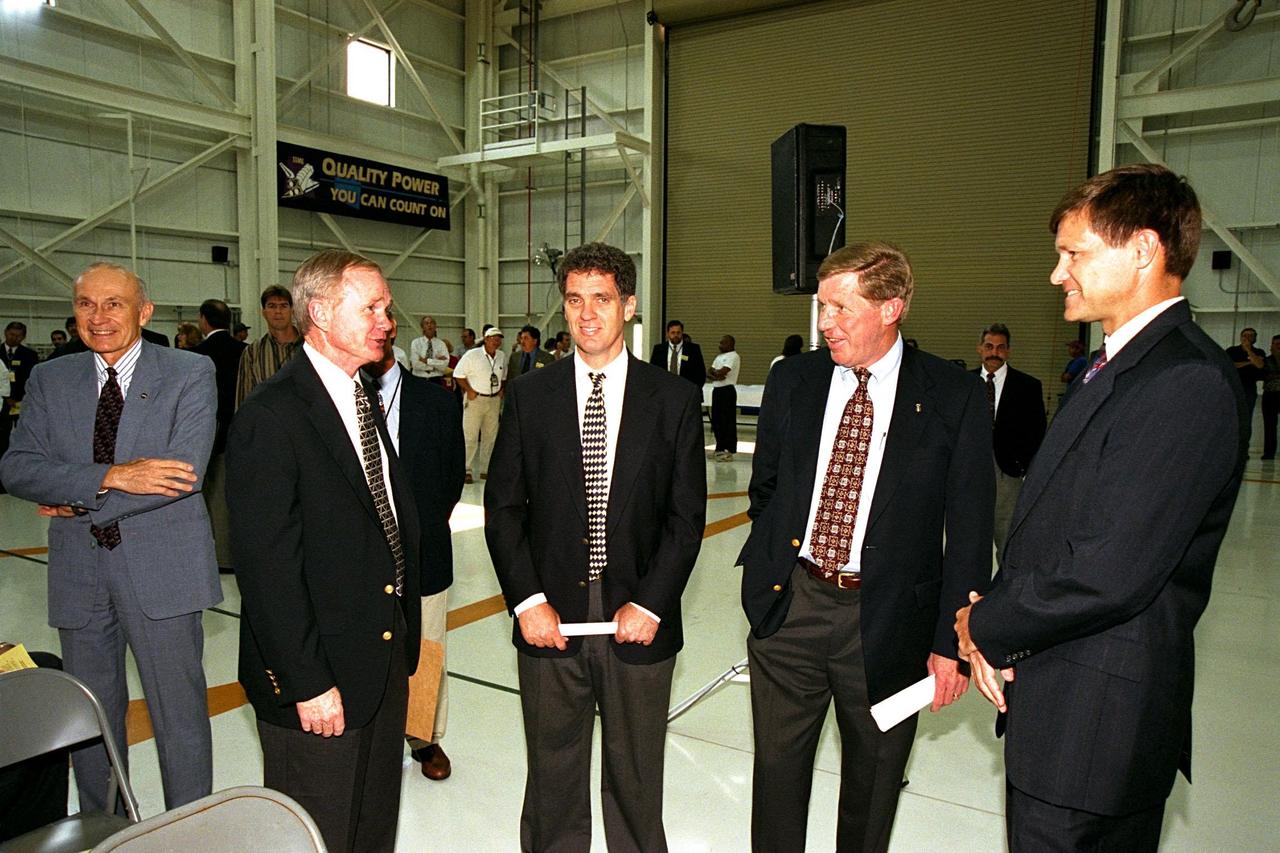
Participants in the ribbon cutting for KSC's new 34,600-square-foot Space Shuttle Main Engine Processing Facility (SSMEPF) gather to talk inside the facility following the ceremony. From left, they are Robert B. Sieck, director of Shuttle Processing; KSC Center Director Roy D. Bridges Jr.; U.S. Congressman Dave Weldon; John Plowden, vice president of Rocketdyne; and Donald R. McMonagle, manager of Launch Integration. A major addition to the existing Orbiter Processing Facility Bay 3, the SSMEPF replaces the Shuttle Main Engine Shop located in the Vehicle Assembly Building (VAB). The decision to move the shop out of the VAB was prompted by safety considerations and recent engine processing improvements. The first three main engines to be processed in the new facility will fly on Shuttle Endeavour's STS-88 mission in December 1998
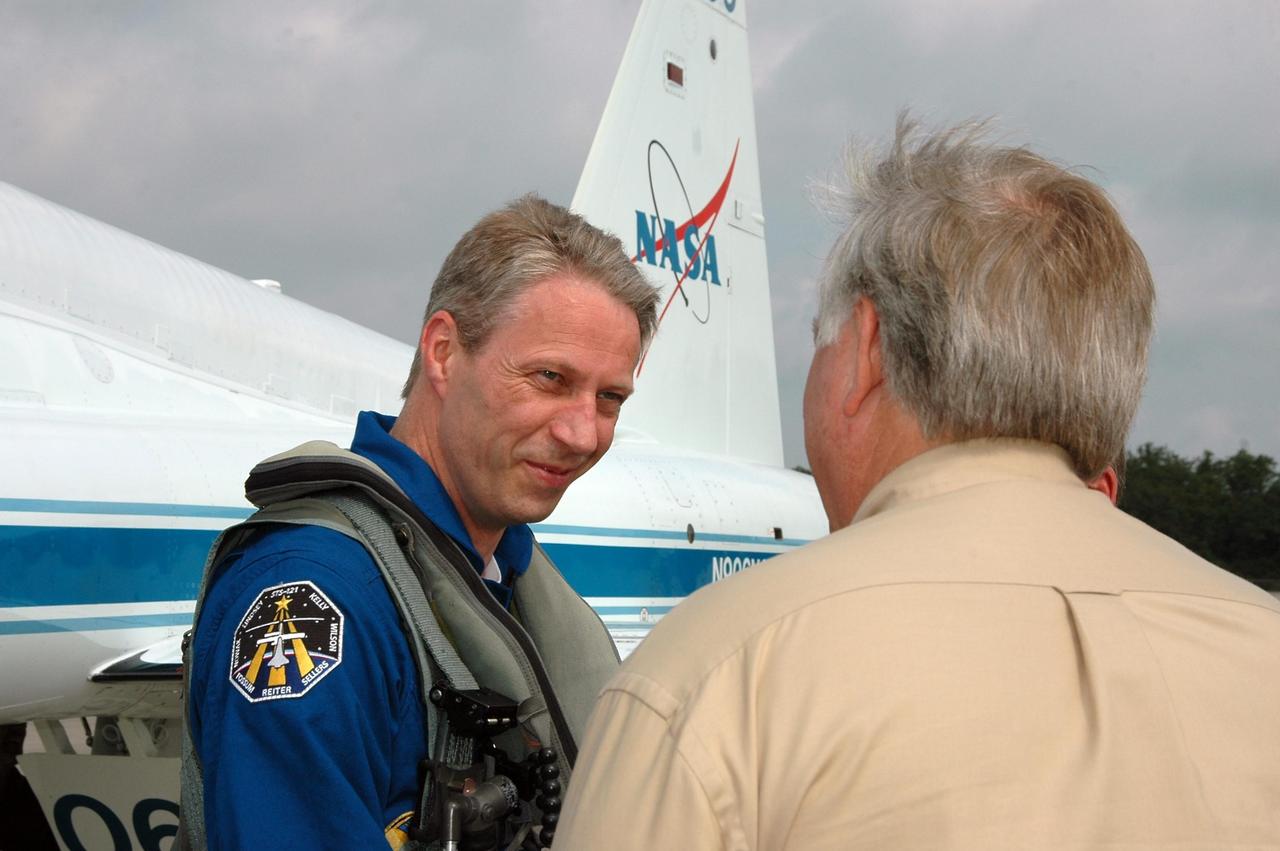
KENNEDY SPACE CENTER, FLA. - STS-121 Mission Specialist Thomas Reiter is greeted by Center Director Jim Kennedy after arriving at KSC to get ready for launch on July 1. The launch will be his first space flight. During the 12-day mission, the STS-121 crew will test new equipment and procedures to improve shuttle safety, as well as deliver supplies and make repairs to the International Space Station. This mission is the 115th shuttle flight and the 18th U.S. flight to the International Space Station. Photo credit: NASA/Kim Shiflett
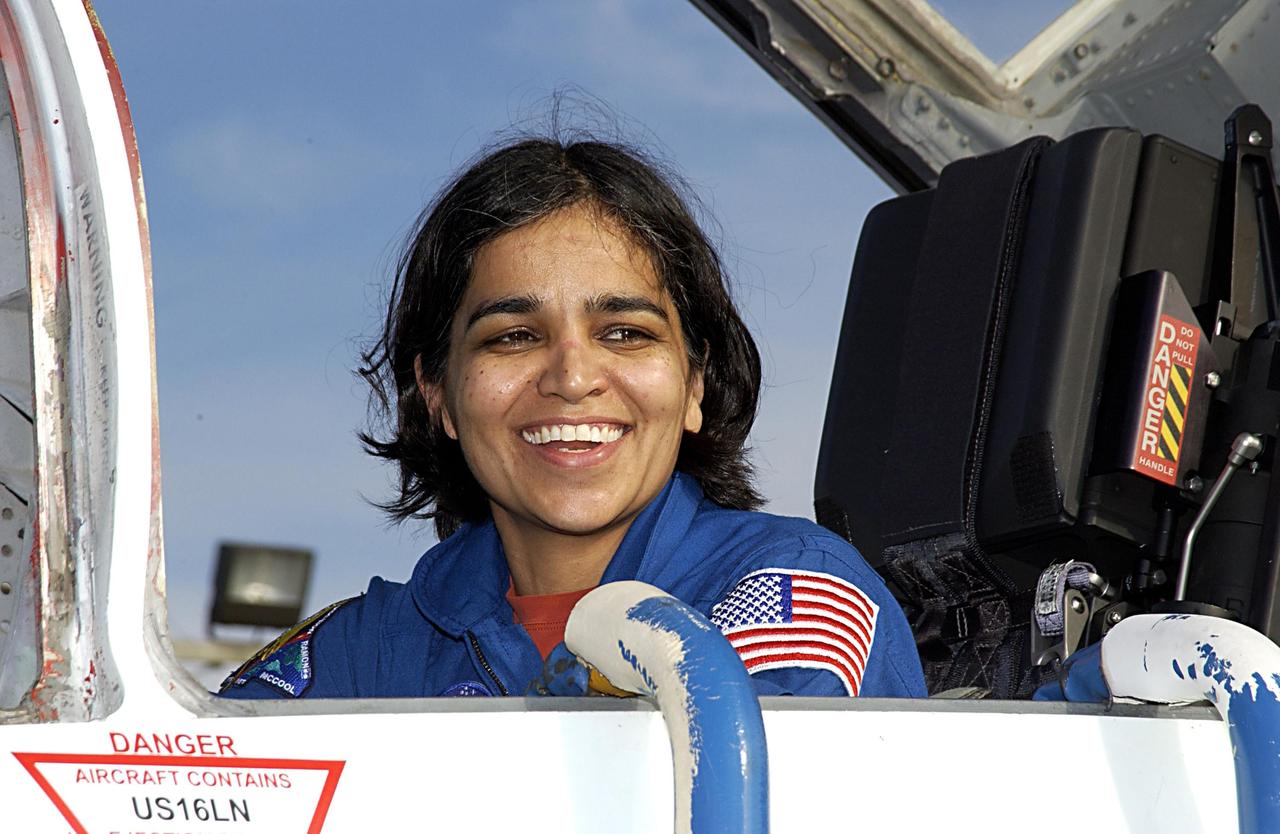
KENNEDY SPACE CENTER, FLA. - STS-107 Mission Specialist Kalpana Chawla arrives at KSC to take part in Terminal Countdown Demonstration Test activities, which include a simulated launch countdown. Other crew members are Commander Rick Husband, Pilot William "Willie" McCool, Payload Commander Michael Anderson, Mission Specialists David Brown and Laurel Clark and Payload Specialist Ilan Ramon (the first Israeli astronaut). STS-107 is a mission devoted to research and will include more than 80 experiments that will study Earth and space science, advanced technology development, and astronaut health and safety. Launch is scheduled for Jan. 16, 2003.
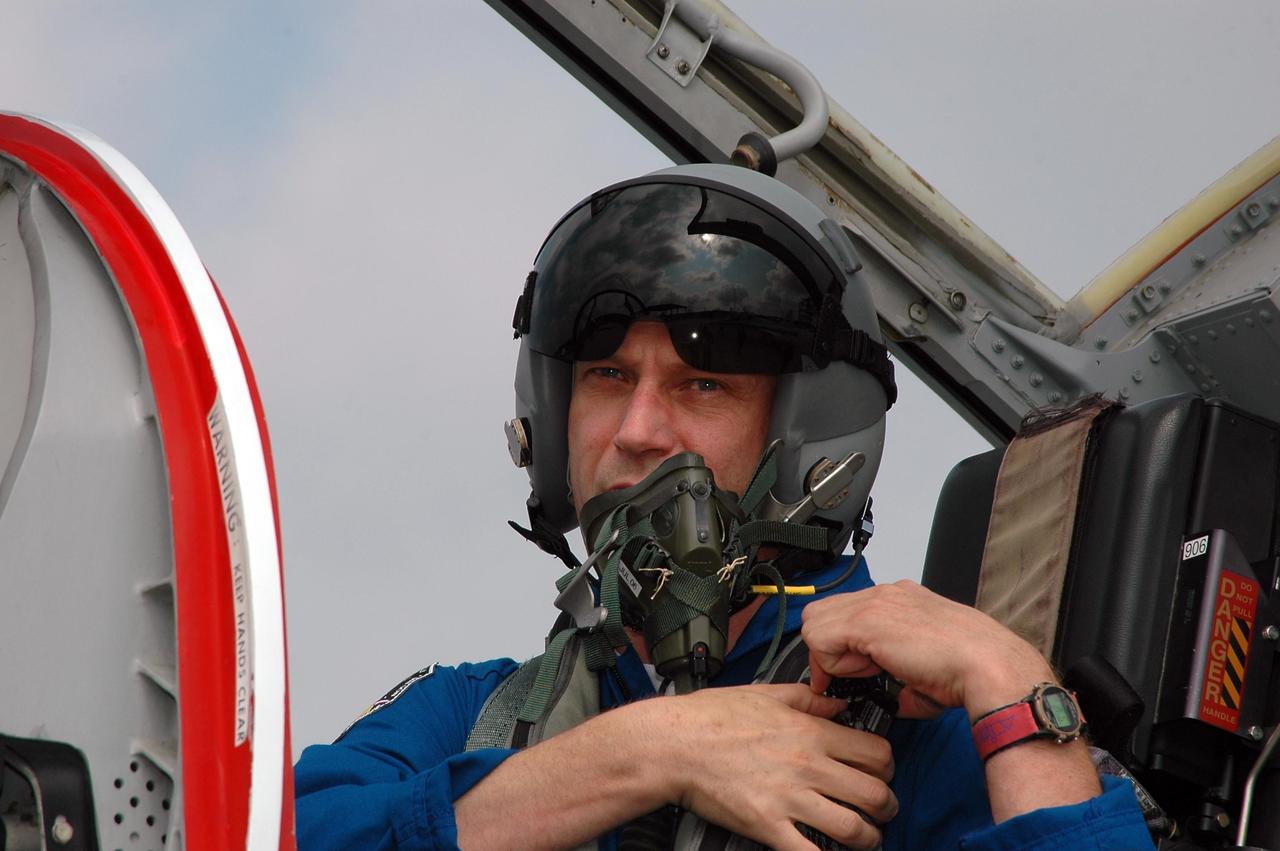
KENNEDY SPACE CENTER, FLA. - STS-121 Mission Specialist Thomas Reiter arrives at KSC aboard a T-38 jet aircraft piloted by Commander Steven Lindsey. The July 1 launch will be his first space flight. During the 12-day mission, the STS-121 crew will test new equipment and procedures to improve shuttle safety, as well as deliver supplies and make repairs to the International Space Station. This mission is the 115th shuttle flight and the 18th U.S. flight to the International Space Station. Photo credit: NASA/Kim Shiflett
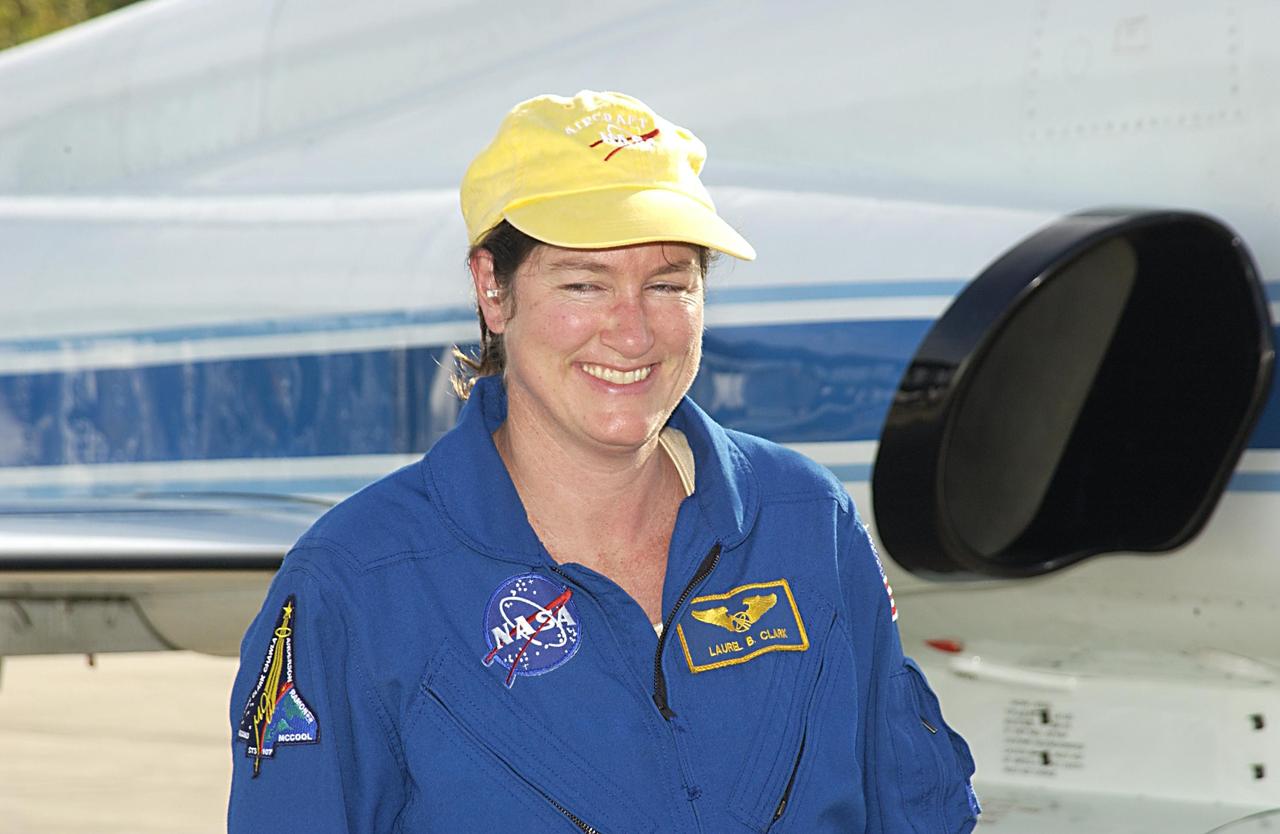
KENNEDY SPACE CENTER, FLA. -- STS-107 Mission Specialist Laurel Clark arrives at KSC to take part in Terminal Countdown Demonstration Test activities, which include a simulated launch countdown. Other crew members are Commander Rick Husband, Pilot William "Willie" McCool, Payload Commander Michael Anderson, Mission Specialists Kalpana Chawla and David Brown, and Payload Specialist Ilan Ramon, the first Israeli astronaut. STS-107 is a mission devoted to research and will include more than 80 experiments that will study Earth and space science, advanced technology development, and astronaut health and safety. Launch is scheduled for Jan. 16, 2003.
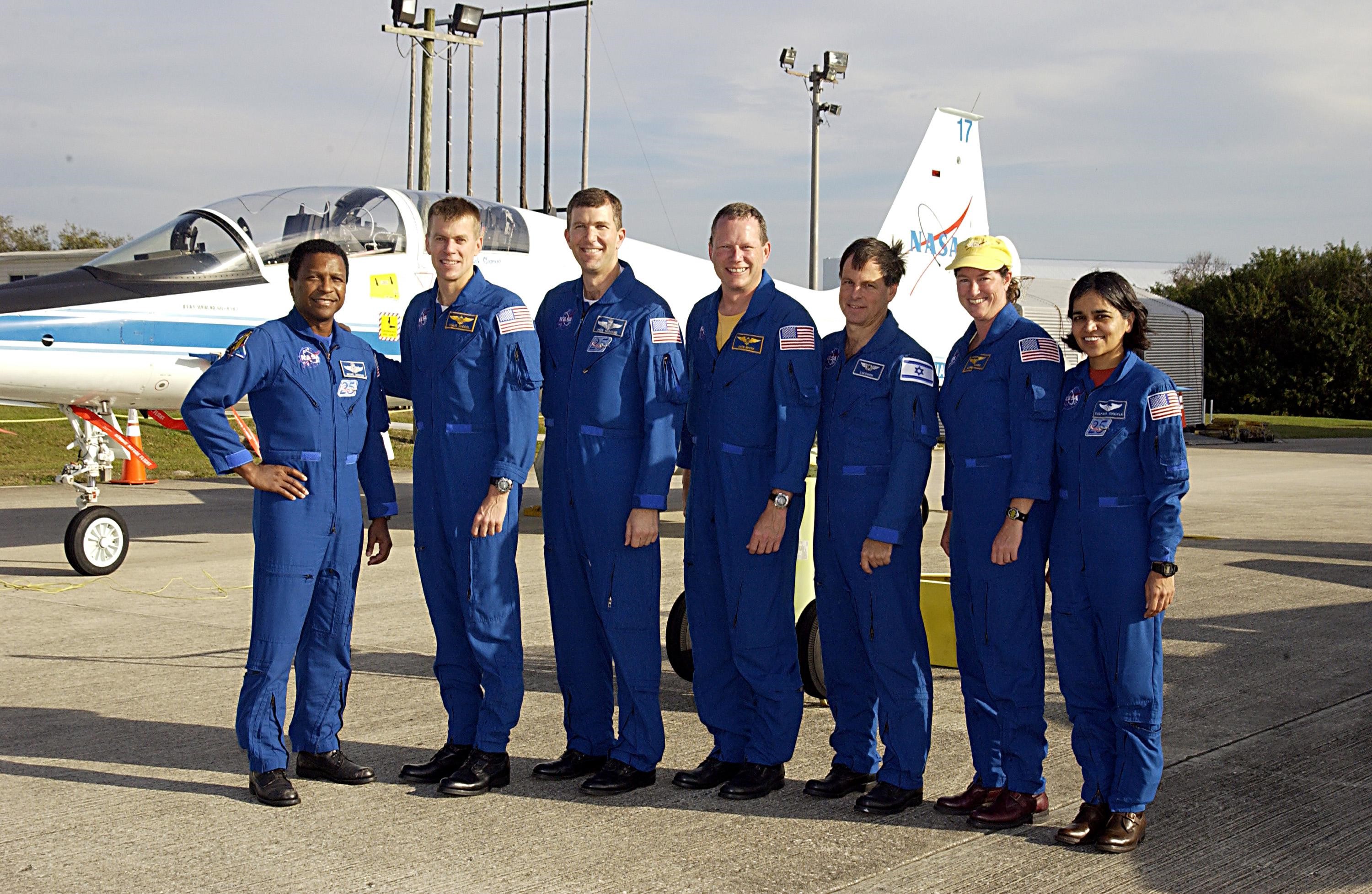
KENNEDY SPACE CENTER, FLA. -- The STS-107 crew arrives at KSC to take part in Terminal Countdown Demonstration Test activities. Standing, left to right, are Payload Commander Michael Anderson, Pilot William "Willie" McCool, Commander Rick Husband, Mission Specialist David Brown, Payload Specialist Ilan Ramon (the first Israeli astronaut), and Mission Specialists Laurel Clark and Kalpana Chawla. STS-107 is a mission devoted to research and will include more than 80 experiments that will study Earth and space science, advanced technology development, and astronaut health and safety.
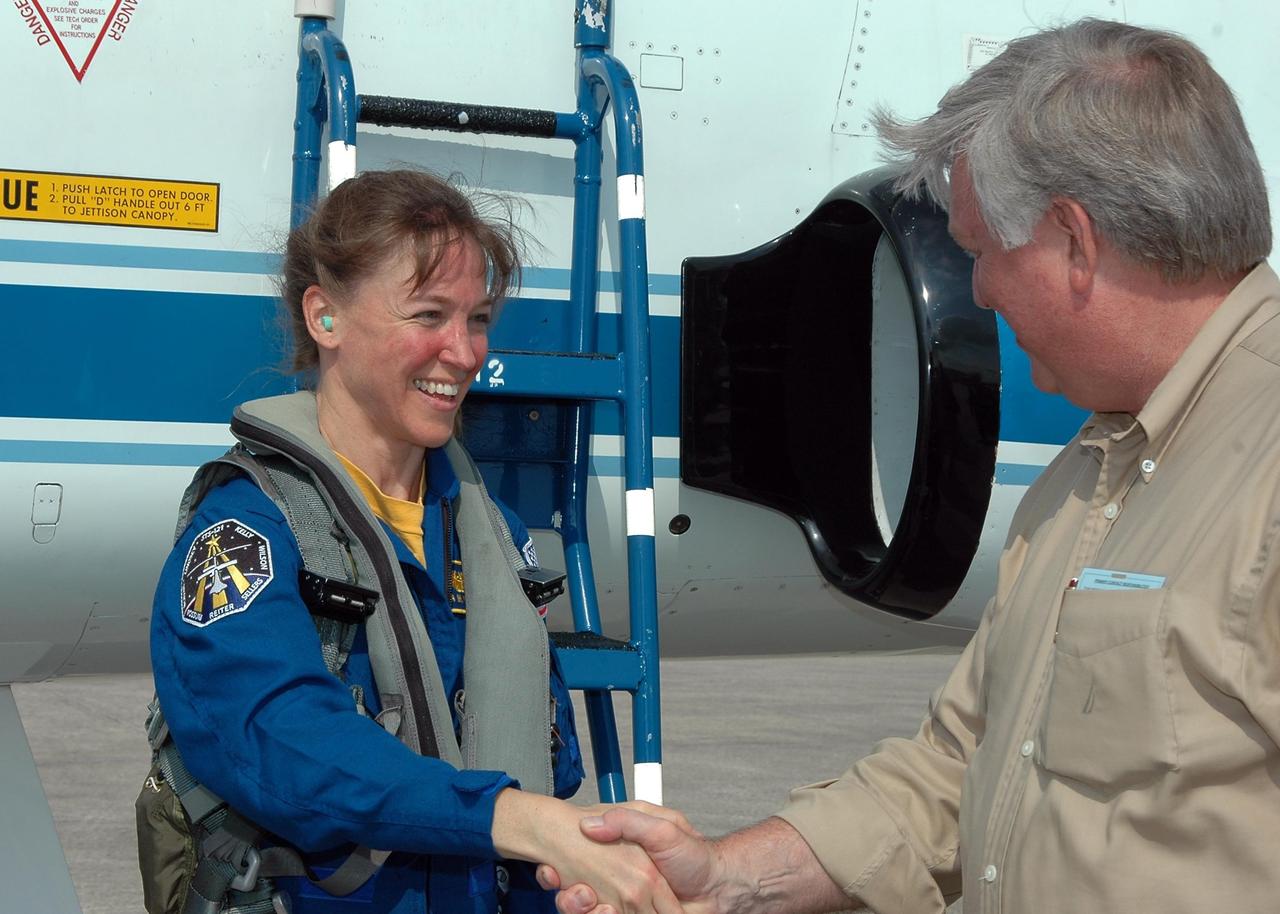
KENNEDY SPACE CENTER, FLA. - STS-121 Mission Specialist Lisa Nowak is greeted by Center Director Jim Kennedy as she arrives at the Shuttle Landing Facility at KSC to get ready for launch on July 1. The launch will be the first space flight for Nowak. During the 12-day mission, the STS-121 crew will test new equipment and procedures to improve shuttle safety, as well as deliver supplies and make repairs to the International Space Station. This mission is the 115th shuttle flight and the 18th U.S. flight to the International Space Station. Photo credit: NASA/Kim Shiflett
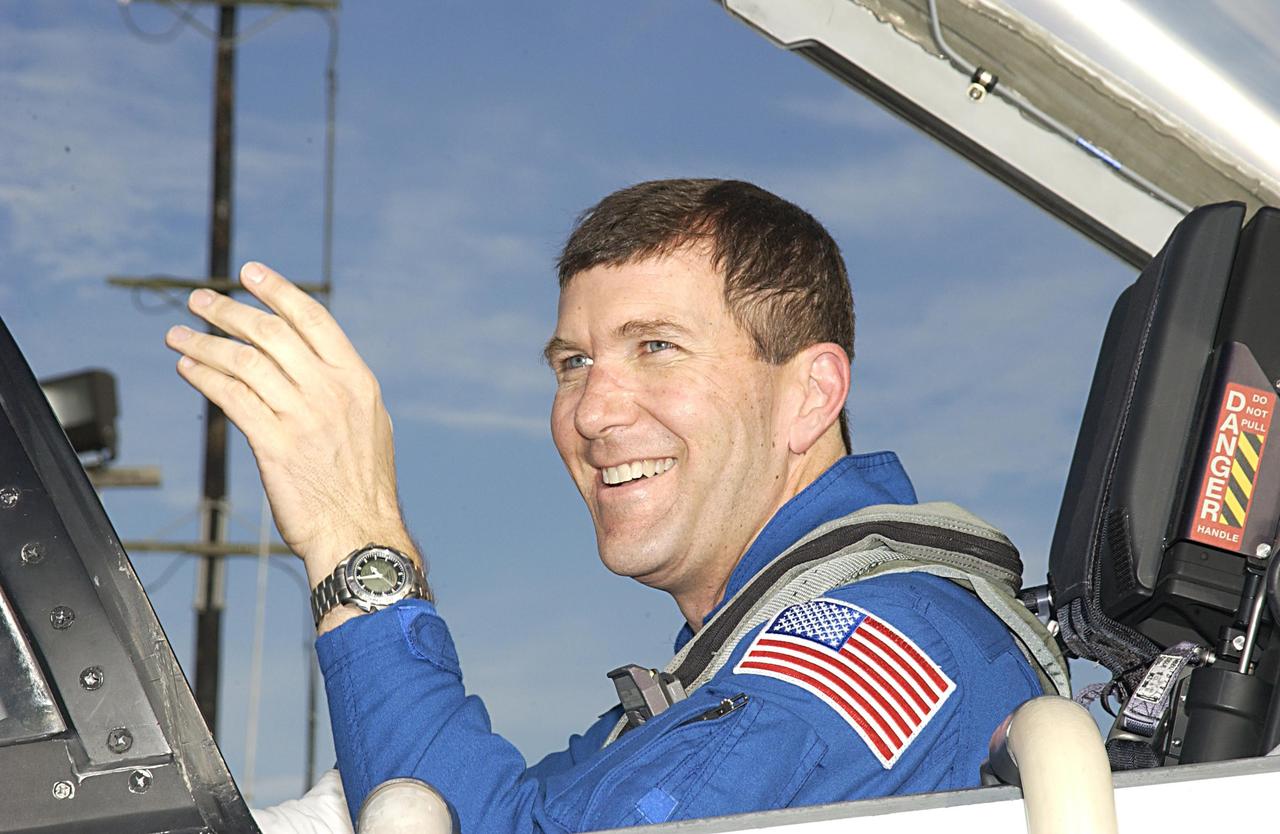
KENNEDY SPACE CENTER, FLA. -- STS-107 Commander Rick Husband arrives at KSC to take part in Terminal Countdown Demonstration Test activities, which include a simulated launch countdown. Other crew members are Pilot William "Willie" McCool Payload Commander Michael Anderson, Mission Specialists Kalpana Chawla, David Brown, Laurel Clark and Payload Specialist Ilan Ramon (the first Israeli astronaut). STS-107 is a mission devoted to research and will include more than 80 experiments that will study Earth and space science, advanced technology development, and astronaut health and safety. Launch is scheduled for Jan. 16, 2003.
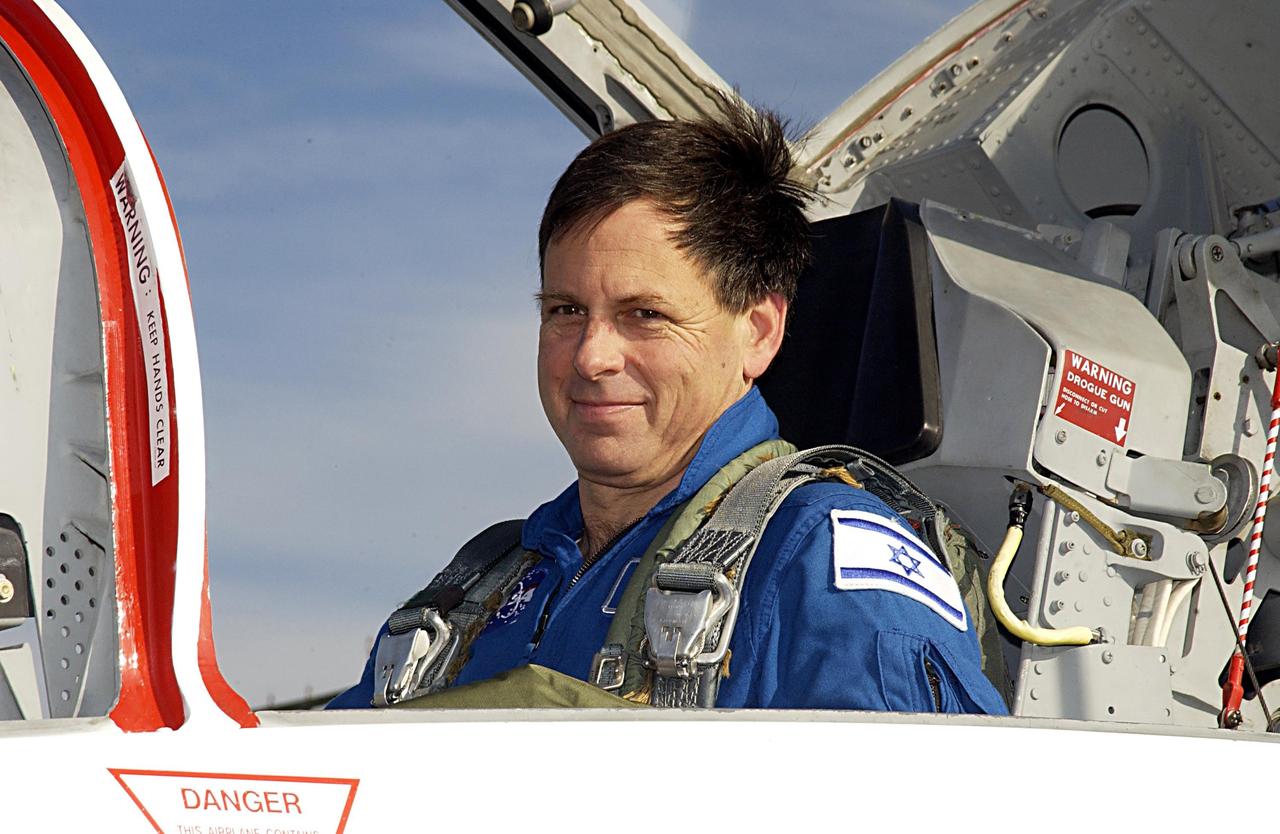
KENNEDY SPACE CENTER, FLA. - STS-107 Payload Specialist Ilan Ramon (the first Israeli astronaut) arrives at KSC to take part in Terminal Countdown Demonstration Test activities, which include a simulated launch countdown. Other crew members are Commander Rick Husband, Pilot William "Willie" McCool, Payload Commander Michael Anderson, Mission Specialists Kalpana Chawla, David Brown and Laurel Clark. STS-107 is a mission devoted to research and will include more than 80 experiments that will study Earth and space science, advanced technology development, and astronaut health and safety. Launch is scheduled for Jan. 16, 2003.
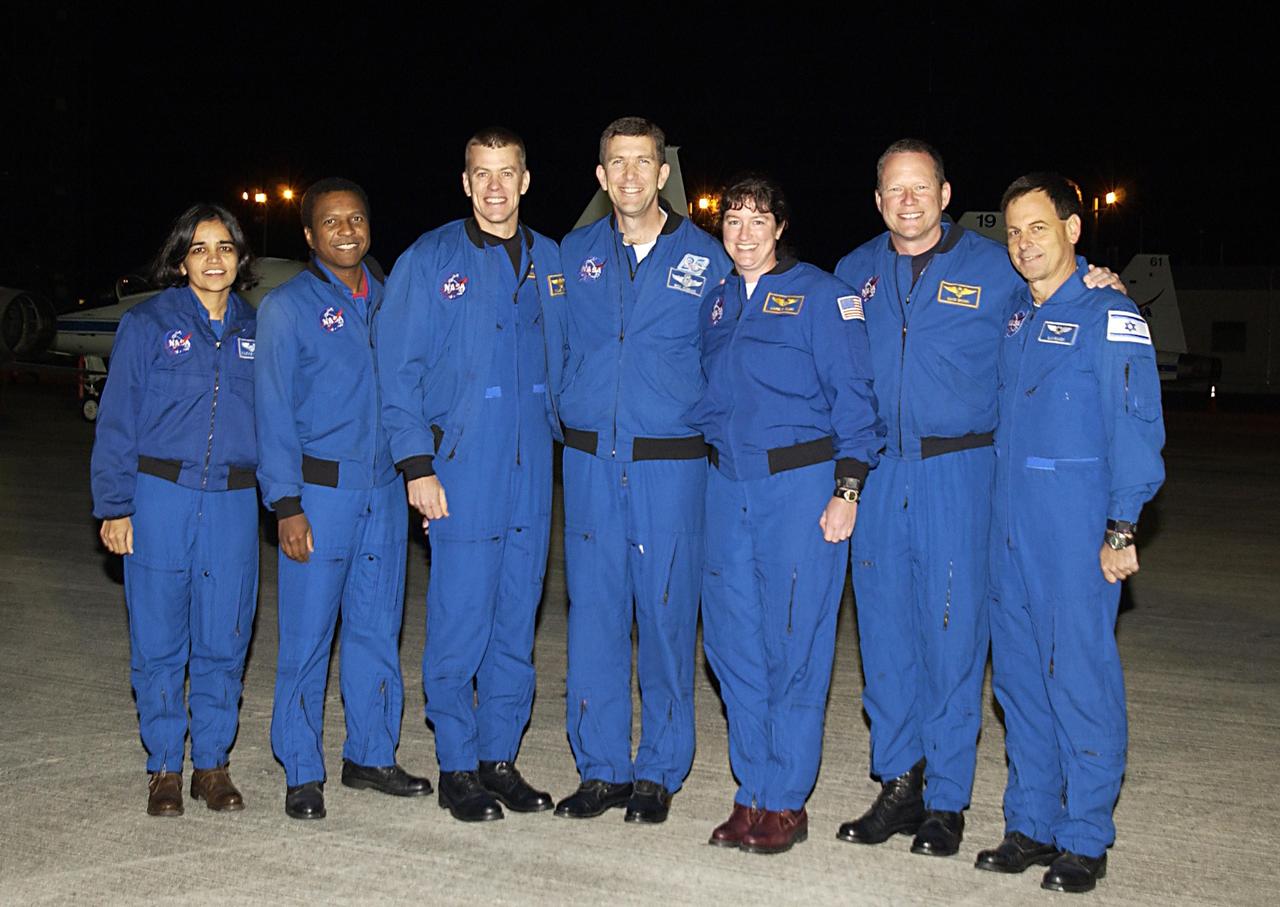
KENNEDY SPACE CENTER, FLA. - The STS-107 crew pose for a photo after their arrival at KSC for pre-launch preparations. Standing from left to right are Mission Specialist Kalpana Chawla, Payload Commander Michael Anderson, Pilot William "Willie" McCool, Commander Rick Husband, Mission Specialists Laurel Clark and David Brown, and Payload Specialist Ilan Ramon, who is the first Israeli astronaut to fly on a Shuttle mission. STS-107 is a mission devoted to research and will include more than 80 experiments that will study Earth and space science, advanced technology development, and astronaut health and safety. The payload on Space Shuttle Columbia includes FREESTAR (Fast Reaction Experiments Enabling Science, Technology, Applications and Research) and the SHI Research Double Module (SHI/RDM), known as SPACEHAB. Experiments on the module range from material sciences to life sciences. Launch of Columbia is targeted for Jan. 16 between 10 a.m. and 2 p.m.
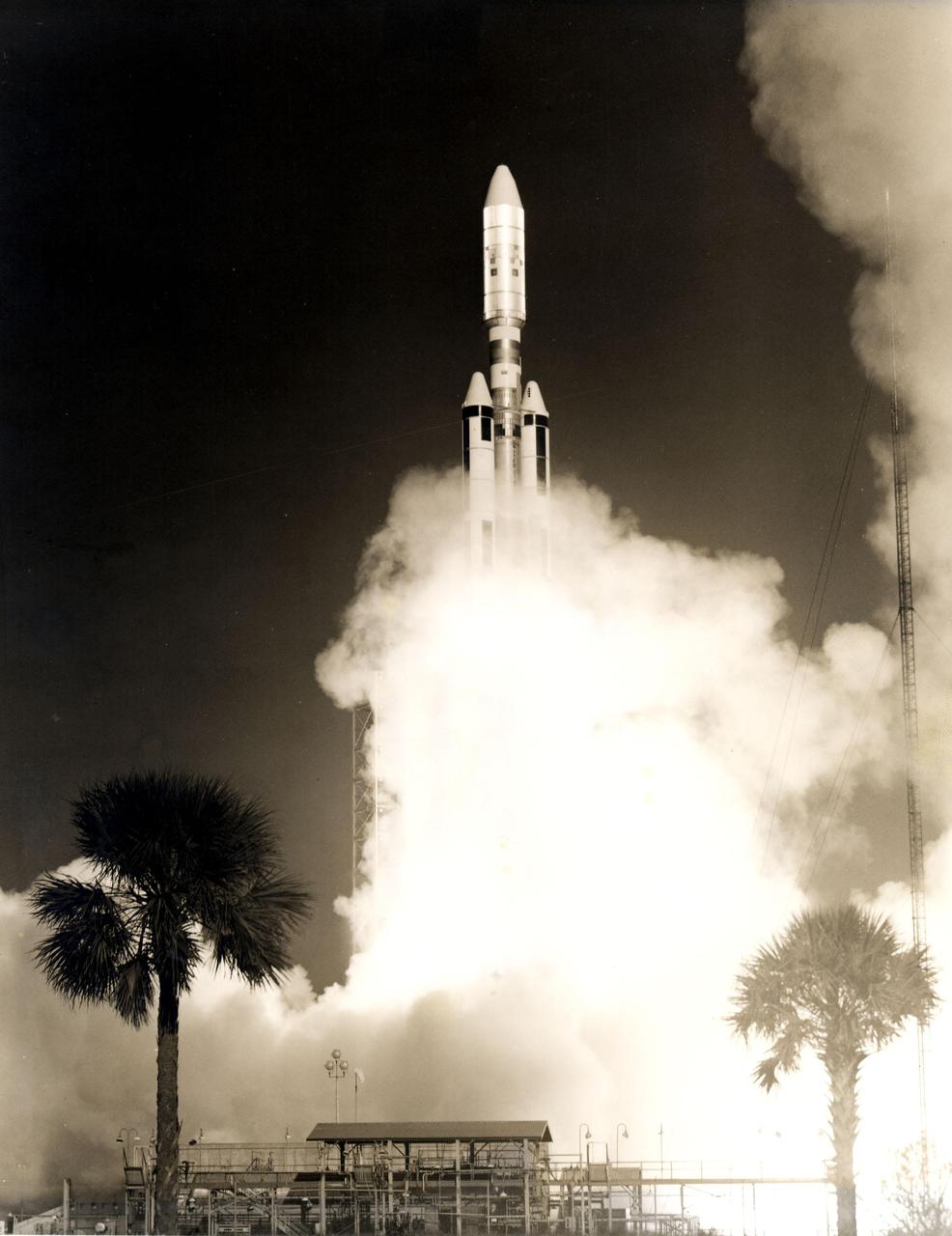
The first Titan_Centaur lifted off from Complex 41 at Cape Kennedy Air Force Station at 9:48 a.m. EDT today. The Titan stages burned as programmed, but when the Centaur stage failed to ignite, it was destroyed by the Range Safety Officer. The new NASA rocket was launched on a proof flight designed to prepare it for twin Viking launches to Mars in 1975 and other missions involving heavy unmanned payloads. The 160-foot-tall rocket combines the Air Force Titan III with the NASA high-energy Centaur final stage. The twin solid rocket boosters have a combined liftoff thrust of 2.4 million pounds. Aboard Titan_Centaur on its proof flight were a dynamic simulator of the Viking spacecraft and a small scientific satellite (SPHYNX) designed to determine how high voltage solar cells, insulators and conductors are affected by the charged particles in space. Launch was conducted by KSC's Unmanned Launch Operations Directorate.
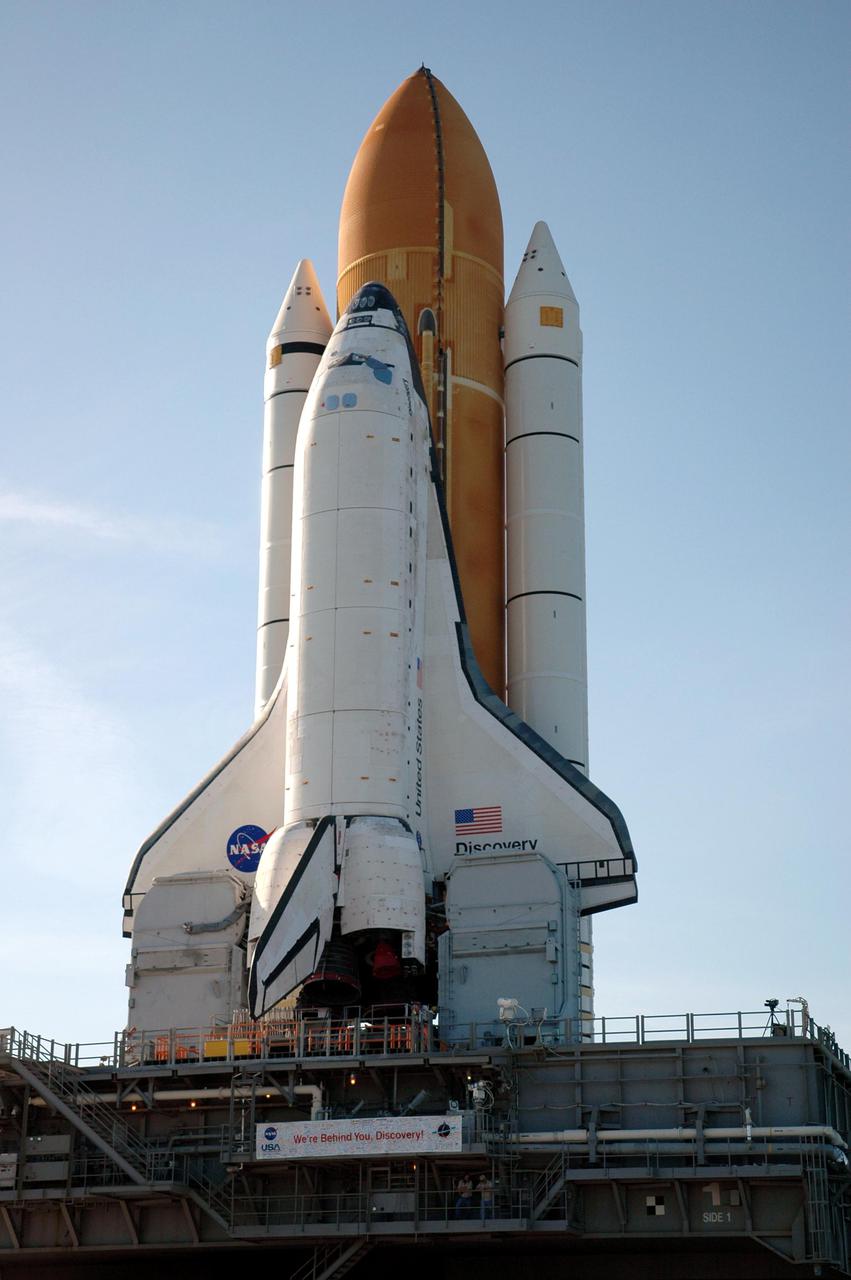
KENNEDY SPACE CENTER, FLA. - Space Shuttle Discovery, atop a Mobile Launcher Platform (MLP), crawls toward Launch Complex 39B. First motion out of the Vehicle Assembly Building occurred at 2:04 p.m. EDT. The rollout marks a major milestone in the Space Shuttle Program’s Return to Flight. The MLP is moved by a Crawler-Transporter underneath. A banner signed by KSC employees who helped process the orbiter for launch, proclaiming 'We're Behind You, Discovery_,' is affixed to the MLP. Launch of Discovery on its Return to Flight mission, STS-114, is targeted for May 15 with a launch window that extends to June 3. During its 12-day mission, Discovery’s seven-person crew will test new hardware and techniques to improve Shuttle safety, as well as deliver supplies to the International Space Station.
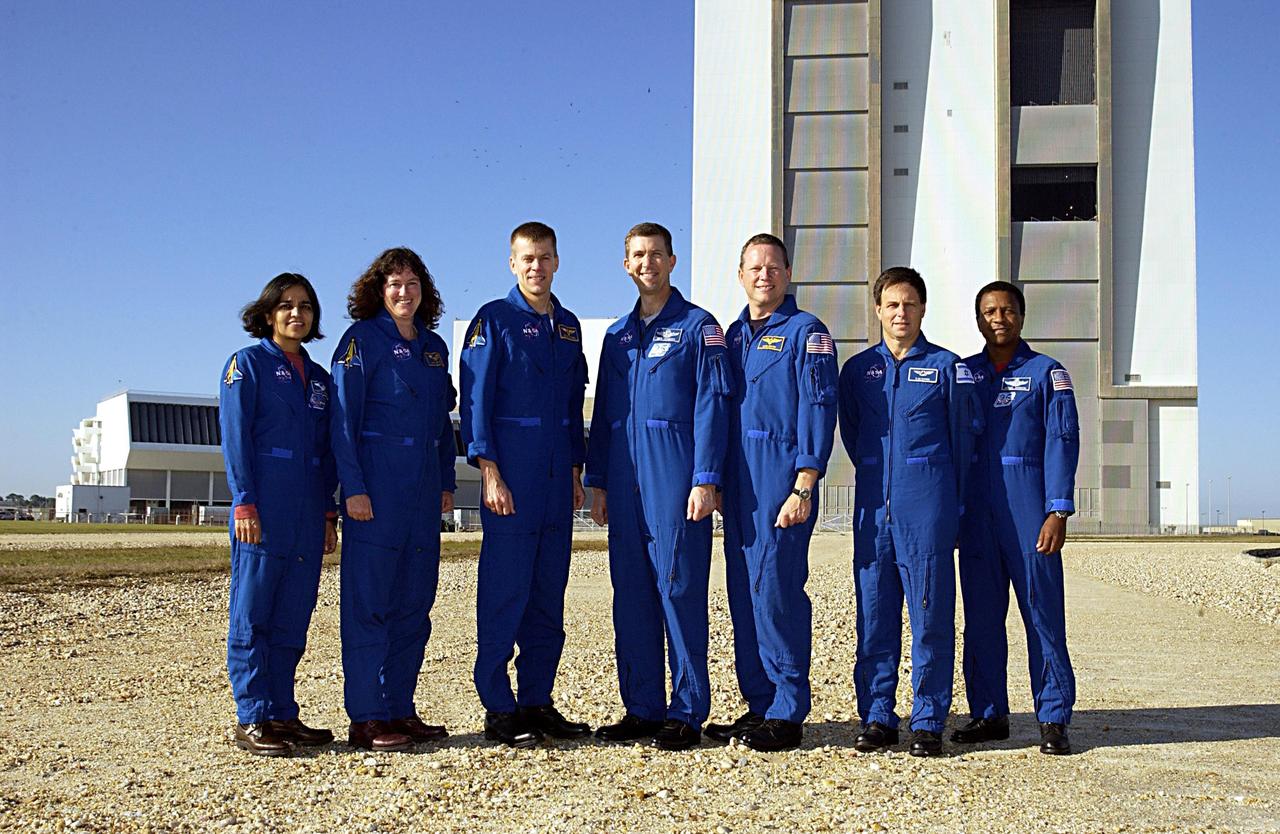
KENNEDY SPACE CENTER, FLA. -- The STS-107 crew poses for a group portrait with the Vehicle Assembly Building in the background. They are at KSC to take part in Terminal Countdown Demonstration Test activities, a standard part of launch preparations. From left to right are Mission Specialists Kalpana Chawla and Laurel Clark, Pilot William "Willie" McCool, Commander Rick Husband, Mission Specialist David Brown, Payload Specialist Ilan Ramon (the first Israeli astronaut), and Payload Commander Michael Anderson. STS-107 is a mission devoted to research and will include more than 80 experiments that will study Earth and space science, advanced technology development, and astronaut health and safety. Launch is targeted for Jan. 16, 2003, between 10 a.m. and 2 p.m. EST.
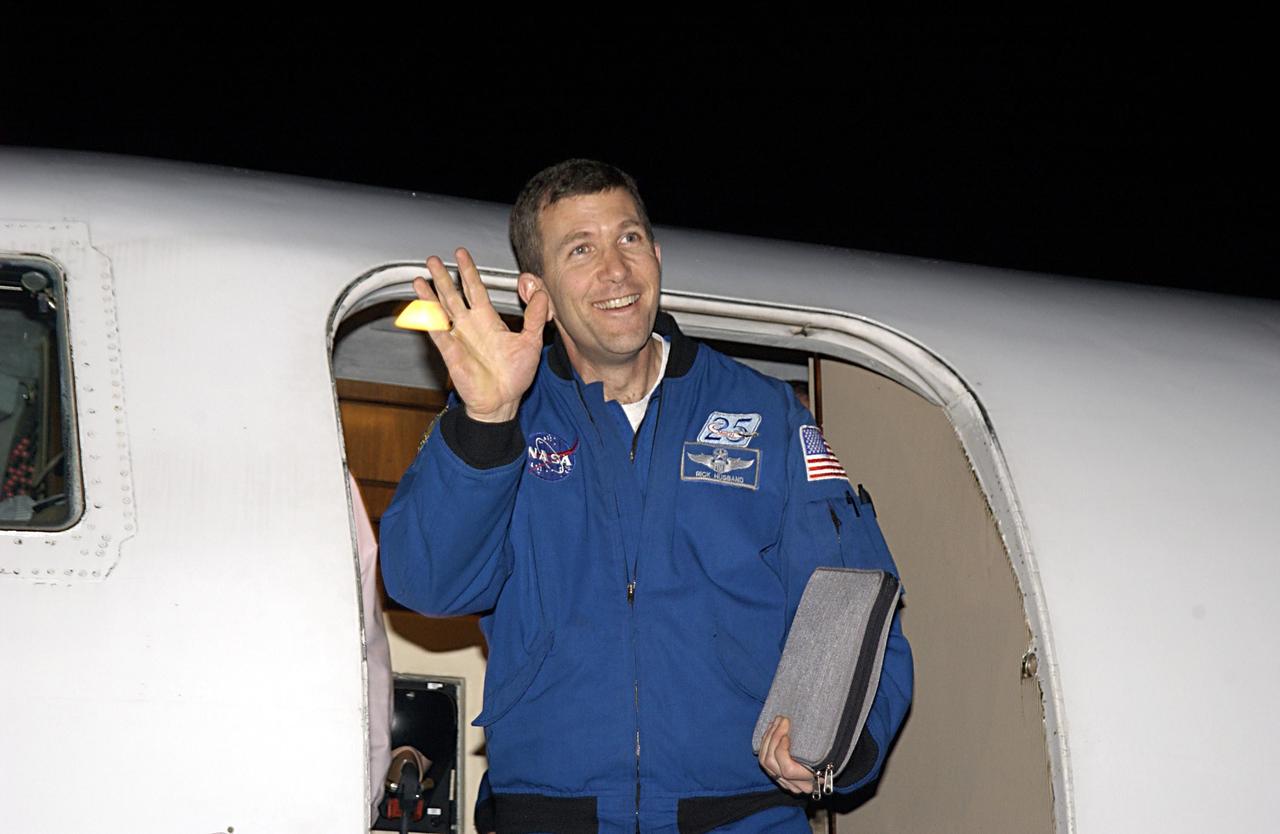
KENNEDY SPACE CENTER, FLA. - STS-107 Commander Rick Husband waves to spectators as he arrives at KSC for pre-launch preparations. STS-107 is a mission devoted to research and will include more than 80 experiments that will study Earth and space science, advanced technology development, and astronaut health and safety. The payload on Space Shuttle Columbia includes FREESTAR (Fast Reaction Experiments Enabling Science, Technology, Applications and Research) and the SHI Research Double Module (SHI/RDM), known as SPACEHAB. Experiments on the module range from material sciences to life sciences. The crew includes Payload Specialist Ilan Ramon, the first Israeli astronaut. Other crew members are Pilot William "Willie" McCool, Payload Commander Michael Anderson and Mission Specialists Kalpana Chawla, David Brown and Laurel Clark. Launch of Columbia is targeted for Jan. 16 between 10 a.m. and 2 p.m.
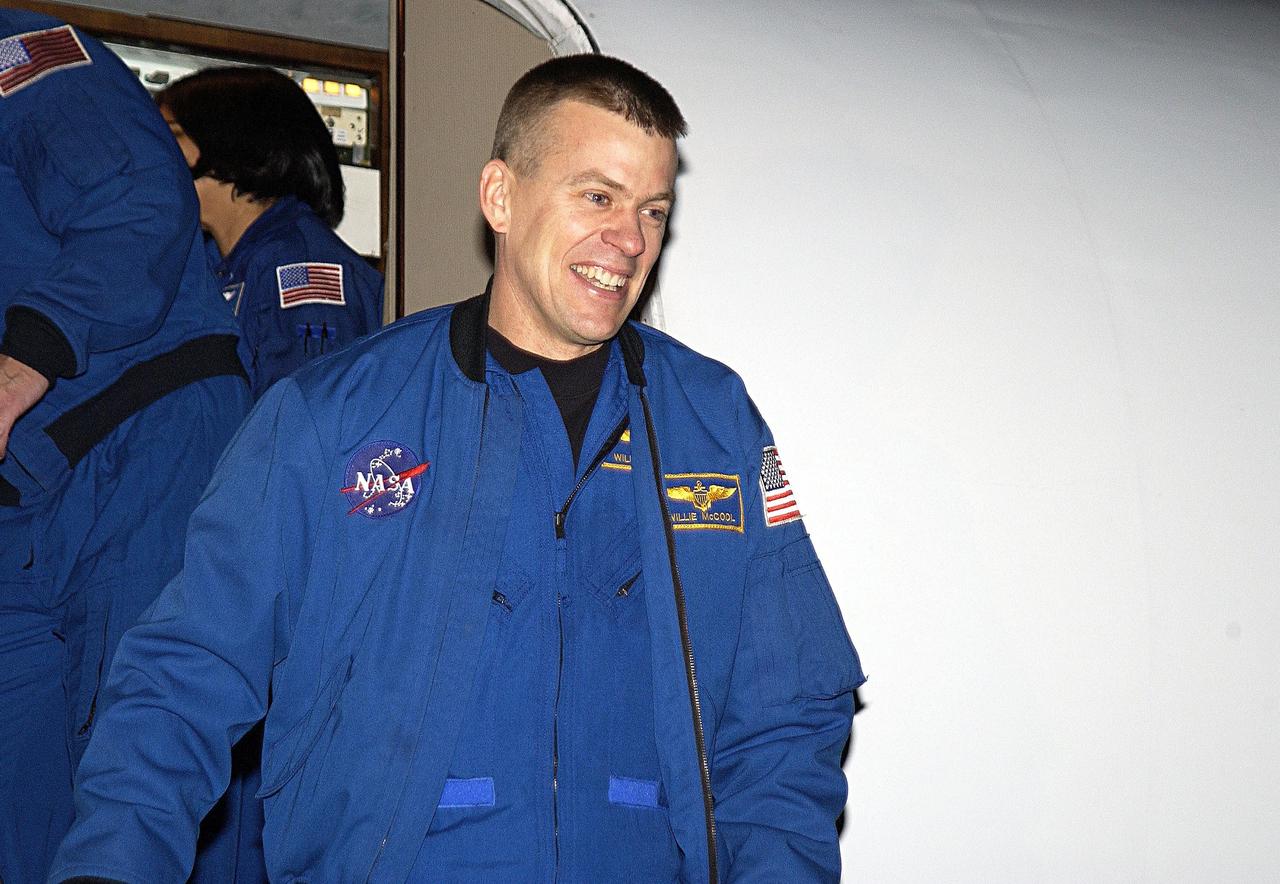
KENNEDY SPACE CENTER, FLA. - STS-107 Pilot William "Willie" McCool smiles at spectators as he arrives at KSC for pre-launch preparations. STS-107 is a mission devoted to research and will include more than 80 experiments that will study Earth and space science, advanced technology development, and astronaut health and safety. The payload on Space Shuttle Columbia includes FREESTAR (Fast Reaction Experiments Enabling Science, Technology, Applications and Research) and the SHI Research Double Module (SHI/RDM), known as SPACEHAB. Experiments on the module range from material sciences to life sciences. The crew includes Payload Specialist Ilan Ramon, the first Israeli astronaut. Other crew members are Commander Rick Husband, Payload Commander Michael Anderson and Mission Specialists Kalpana Chawla, David Brown and Laurel Clark. Launch of Columbia is targeted for Jan. 16 between 10 a.m. and 2 p.m.
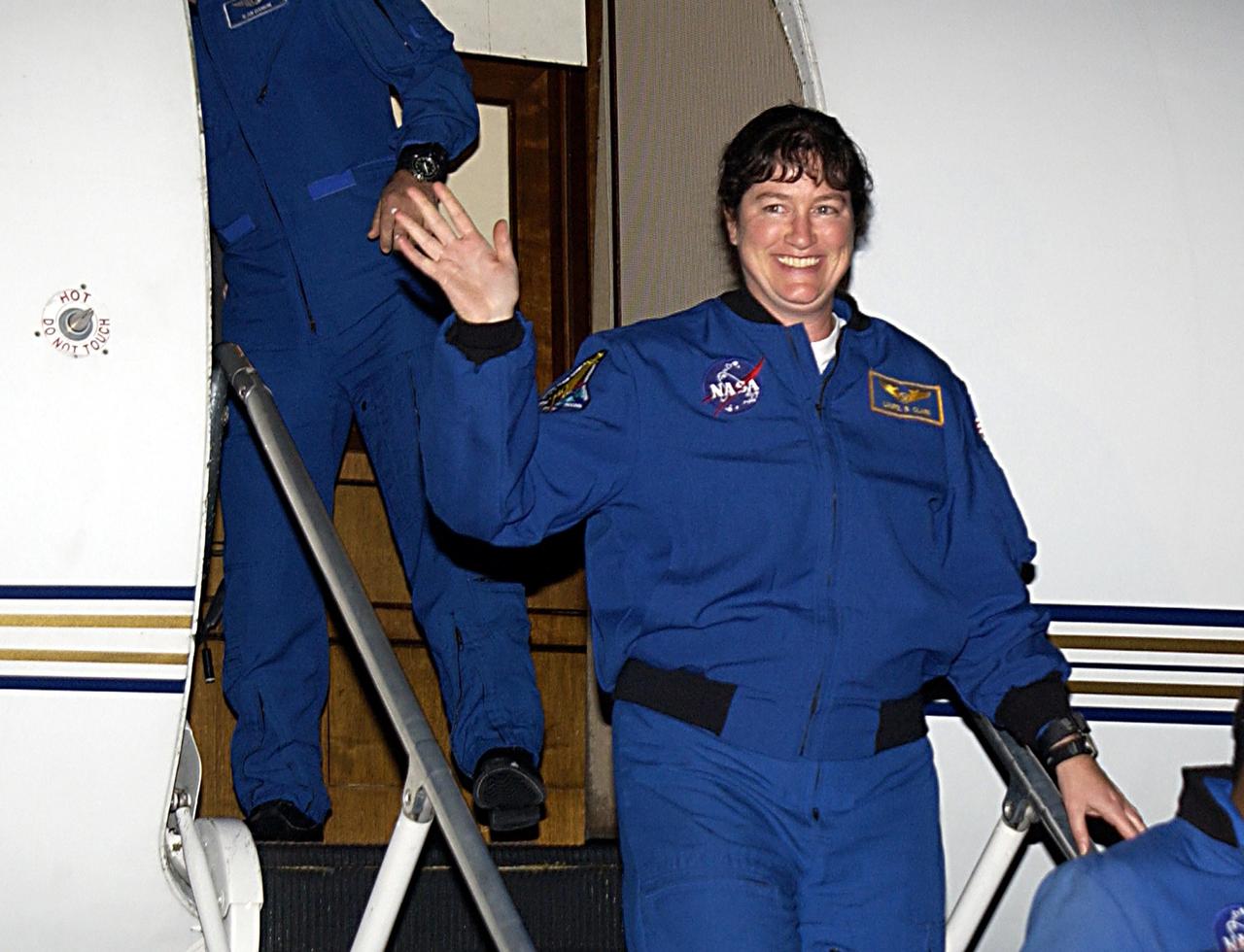
KENNEDY SPACE CENTER, FLA. - STS-107 Mission Specialist Laurel Clark waves to onlookers as she arrives at KSC for pre-launch preparations. STS-107 is a mission devoted to research and will include more than 80 experiments that will study Earth and space science, advanced technology development, and astronaut health and safety. The payload on Space Shuttle Columbia includes FREESTAR (Fast Reaction Experiments Enabling Science, Technology, Applications and Research) and the SHI Research Double Module (SHI/RDM), known as SPACEHAB. Experiments on the module range from material sciences to life sciences. The crew includes Payload Specialist Ilan Ramon, the first Israeli astronaut. Other crew members are Commander Rick Husband, Pilot William "Willie" McCool, Payload Commander Michael Anderson and Mission Specialists Kalpana Chawla and David Brown. Launch of Columbia is targeted for Jan. 16 between 10 a.m. and 2 p.m.
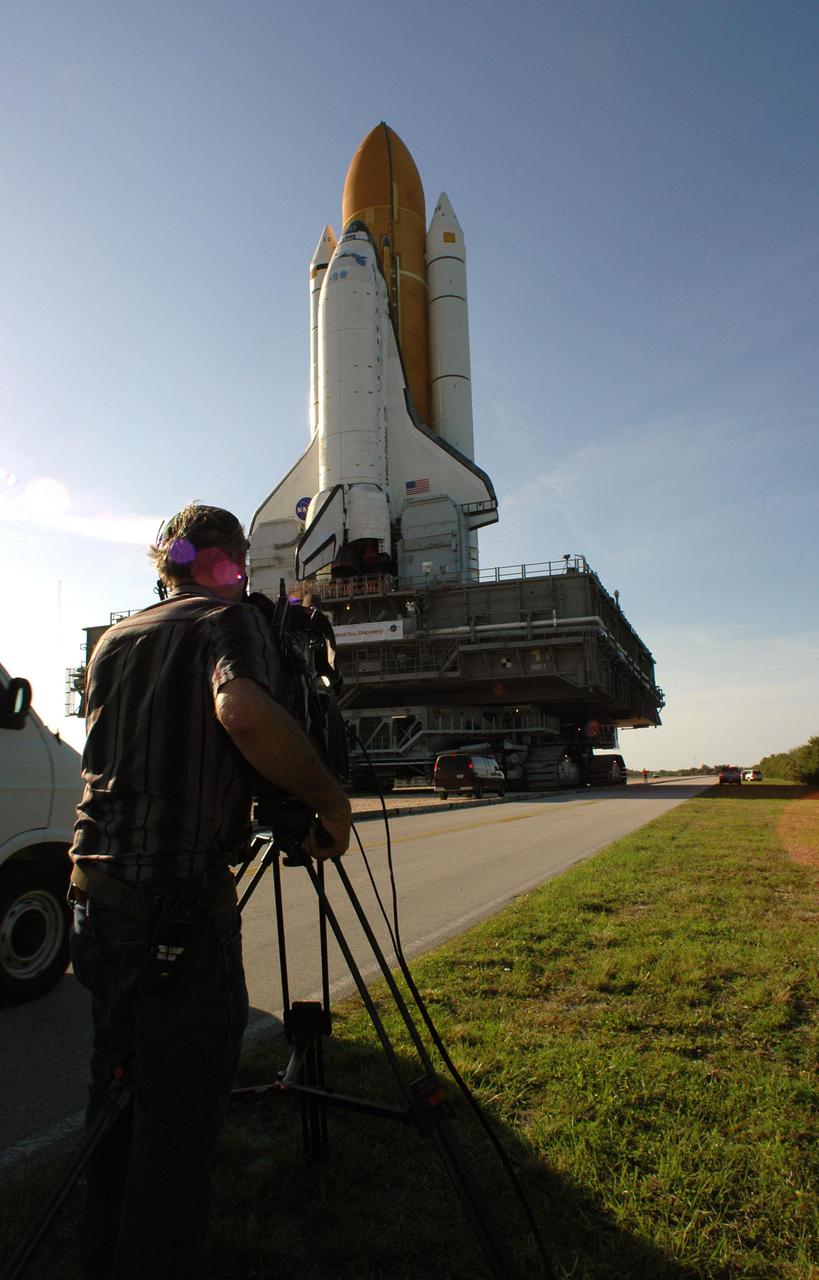
KENNEDY SPACE CENTER, FLA. - KSC-TV videographer Jack Pfaller of InDyne, Inc., captures Space Shuttle Discovery as it rolls along the crawlerway from the Vehicle Assembly Building to Launch Pad 39B. First motion began at 2:04 p.m. EDT April 6, and the Shuttle was hard down on the pad at 1:16 a.m. EDT April 7. The Shuttle sits atop the Mobile Launcher Platform and is transported by the Crawler-Transporter underneath. Launch of Discovery on its Return to Flight mission, STS-114, is targeted for May 15 with a launch window that extends to June 3. During its 12-day mission, Discovery’s seven-member crew will test new hardware and techniques to improve Shuttle safety, as well as deliver supplies to the International Space Station.
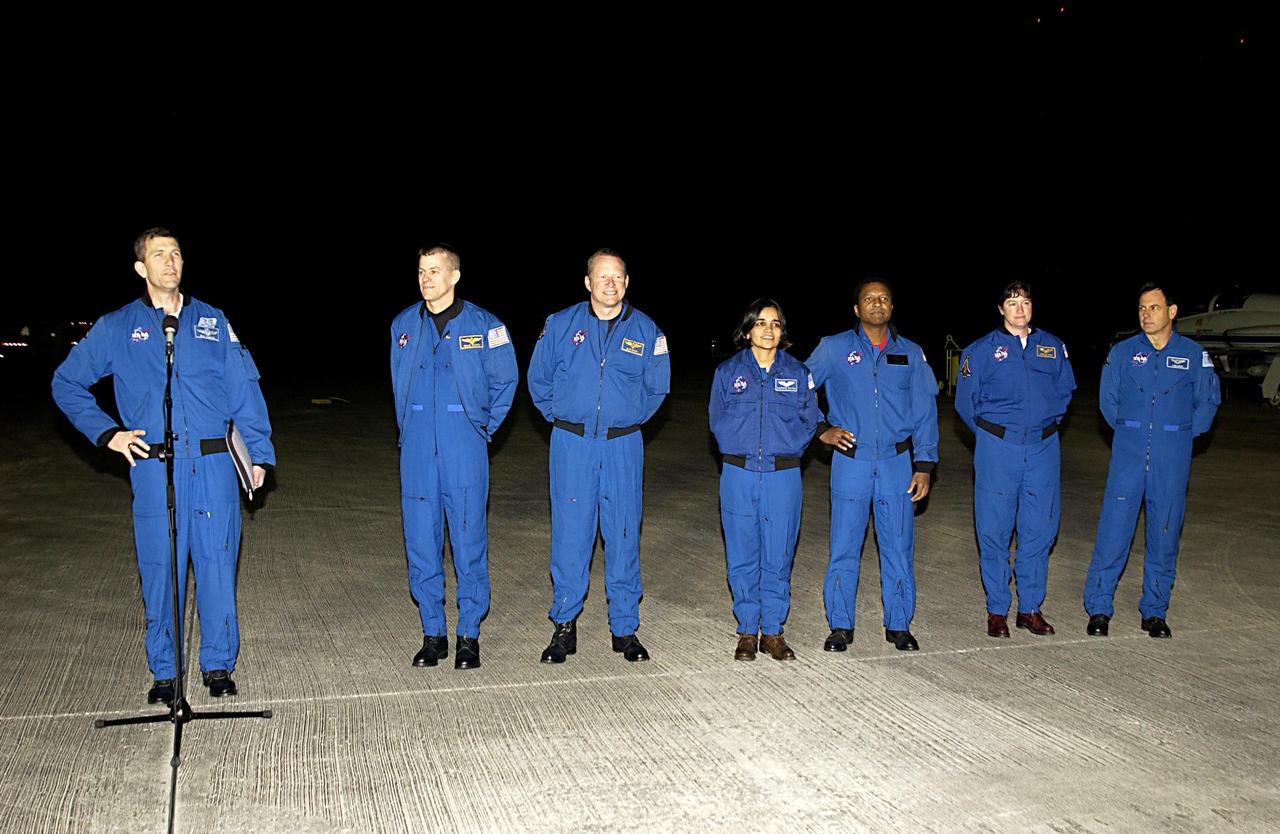
KENNEDY SPACE CENTER, FLA. -STS-107 Commander Rick Husband (at the microphone) makes a few comments after the crew's arrival at KSC for pre-launch preparations. Standing left to right are Husband, Pilot William "Willie" McCool, Mission Specialists David Brown and Kalpana Chawla, Payload Commander Michael Anderson, Mission Specialist Laurel Clark and Payload Specialist Ilan Ramon, who is the first Israeli astronaut to fly on a Shuttle mission. STS-107 is a mission devoted to research and will include more than 80 experiments that will study Earth and space science, advanced technology development, and astronaut health and safety. The payload on Space Shuttle Columbia includes FREESTAR (Fast Reaction Experiments Enabling Science, Technology, Applications and Research) and the SHI Research Double Module (SHI/RDM), known as SPACEHAB. Experiments on the module range from material sciences to life sciences. Launch of Columbia is targeted for Jan. 16 between 10 a.m. and 2 p.m.
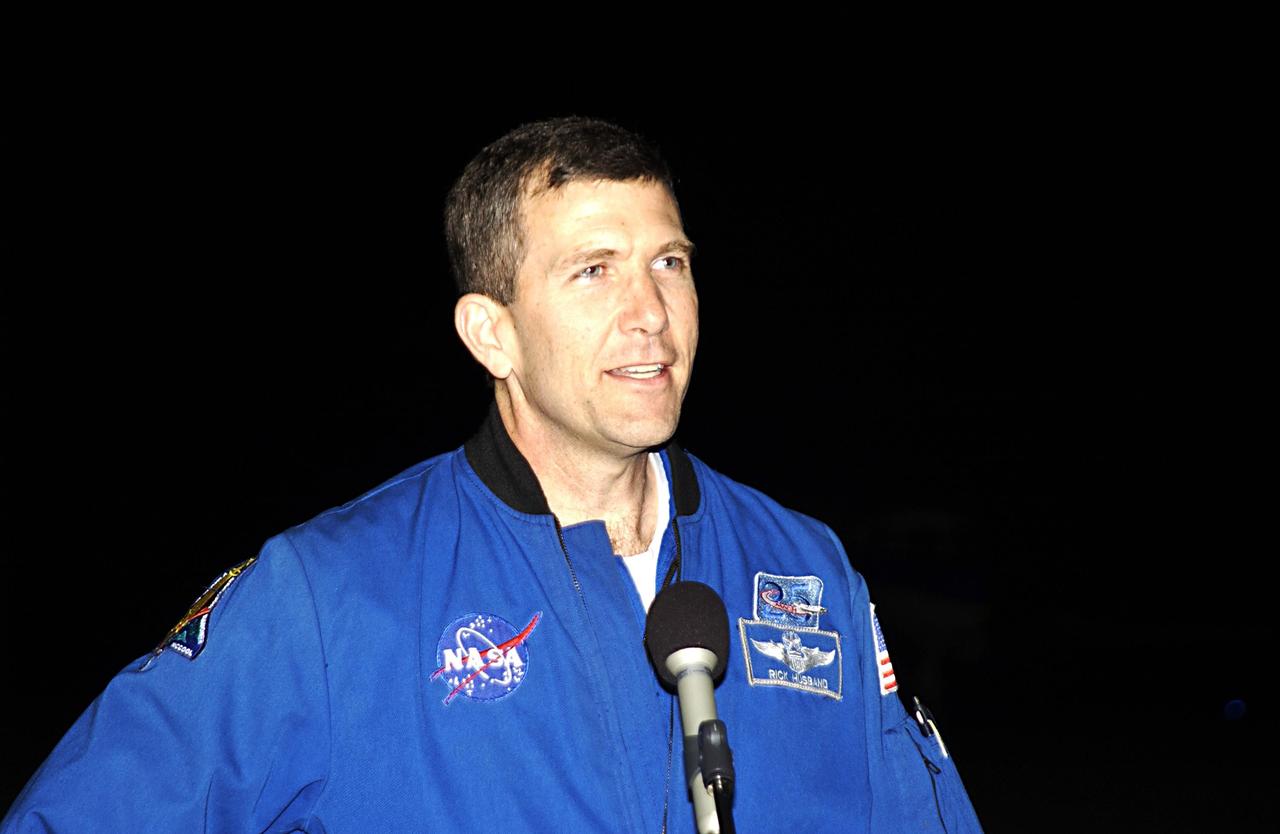
KENNEDY SPACE CENTER, FLA. -- STS-107 Commander Rick Husband makes a few comments after the crew's arrival at KSC for pre-launch preparations. Other crew members are Pilot William "Willie" McCool, Payload Commander Michael Anderson, Payload Specialist Ilan Ramon, and Mission Specialists Kalpana Chawla, David Brown and Laurel Clark. Ramon is the first Israeli astronaut to fly on a Shuttle mission. STS-107 is a mission devoted to research and will include more than 80 experiments that will study Earth and space science, advanced technology development, and astronaut health and safety. The payload on Space Shuttle Columbia includes FREESTAR (Fast Reaction Experiments Enabling Science, Technology, Applications and Research) and the SHI Research Double Module (SHI/RDM), known as SPACEHAB. Experiments on the module range from material sciences to life sciences. Launch of Columbia is targeted for Jan. 16 between 10 a.m. and 2 p.m.
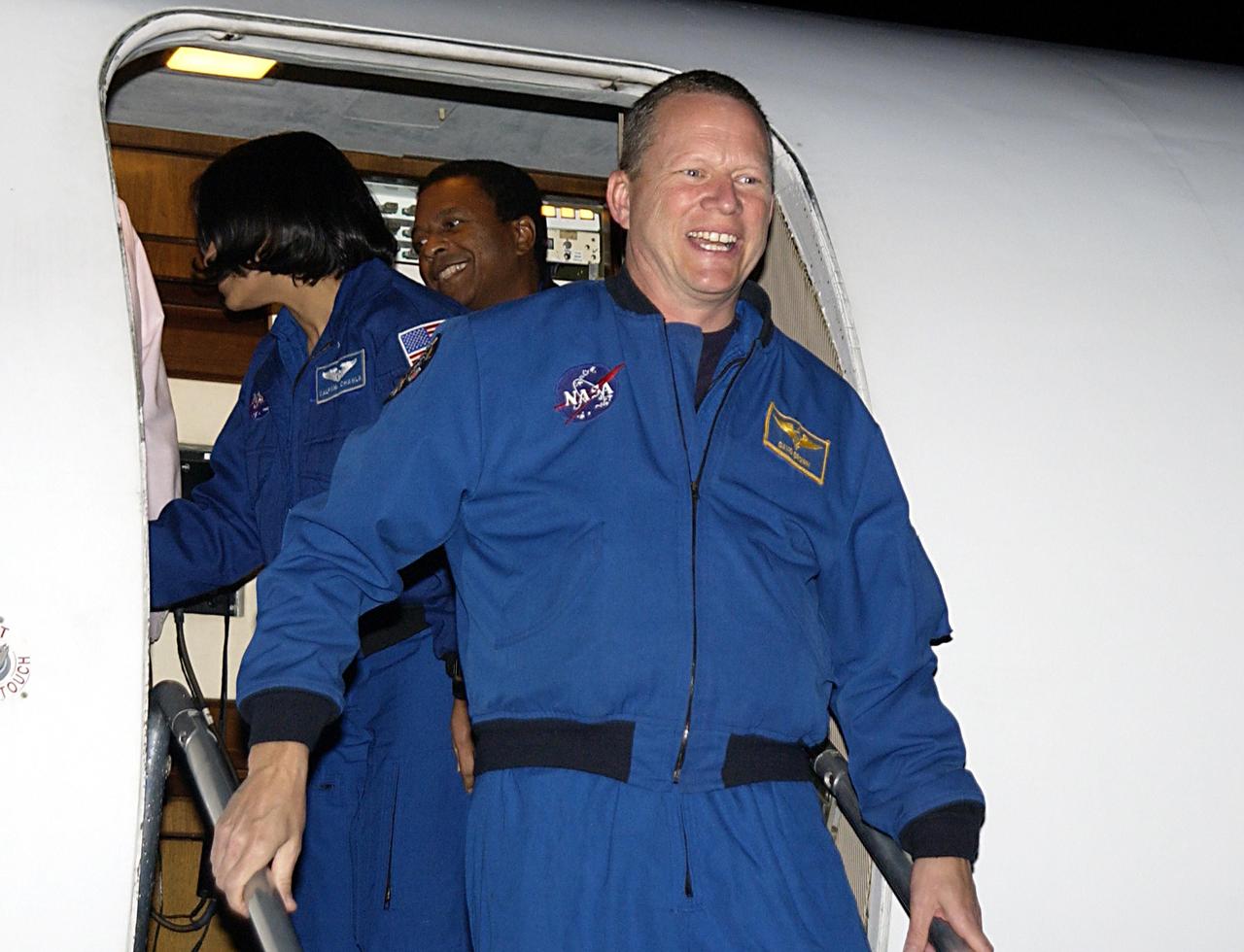
KENNEDY SPACE CENTER, FLA. - STS-107 Mission Specialist David Brown shows his pleasure at arriving at KSC for pre-launch preparations. STS-107 is a mission devoted to research and will include more than 80 experiments that will study Earth and space science, advanced technology development, and astronaut health and safety. The payload on Space Shuttle Columbia includes FREESTAR (Fast Reaction Experiments Enabling Science, Technology, Applications and Research) and the SHI Research Double Module (SHI/RDM), known as SPACEHAB. Experiments on the module range from material sciences to life sciences. The crew includes Payload Specialist Ilan Ramon, the first Israeli astronaut. Other crew members are Commander Rick Husband, Pilot William "Willie" McCool, Payload Commander Michael Anderson and Mission Specialists Kalpana Chawla and Laurel Clark. Launch of Columbia is targeted for Jan. 16 between 10 a.m. and 2 p.m.

KENNEDY SPACE CENTER, FLA. - STS-107 Payload Specialist Ilan Ramon comments on the mission after the crew's arrival at KSC for pre-launch preparations. Ramon is the first Israeli astronaut to fly on a Shuttle mission. Standing behind him are (left to right) Commander Rick Husband, Pilot William "Willie" McCool, Mission Specialists David Brown and Kalpana Chawla, Payload Commander Michael Anderson and Mission Specialist Laurel Clark. STS-107 is a mission devoted to research and will include more than 80 experiments that will study Earth and space science, advanced technology development, and astronaut health and safety. The payload on Space Shuttle Columbia includes FREESTAR (Fast Reaction Experiments Enabling Science, Technology, Applications and Research) and the SHI Research Double Module (SHI/RDM), known as SPACEHAB. Experiments on the module range from material sciences to life sciences. Launch of Columbia is targeted for Jan. 16 between 10 a.m. and 2 p.m.
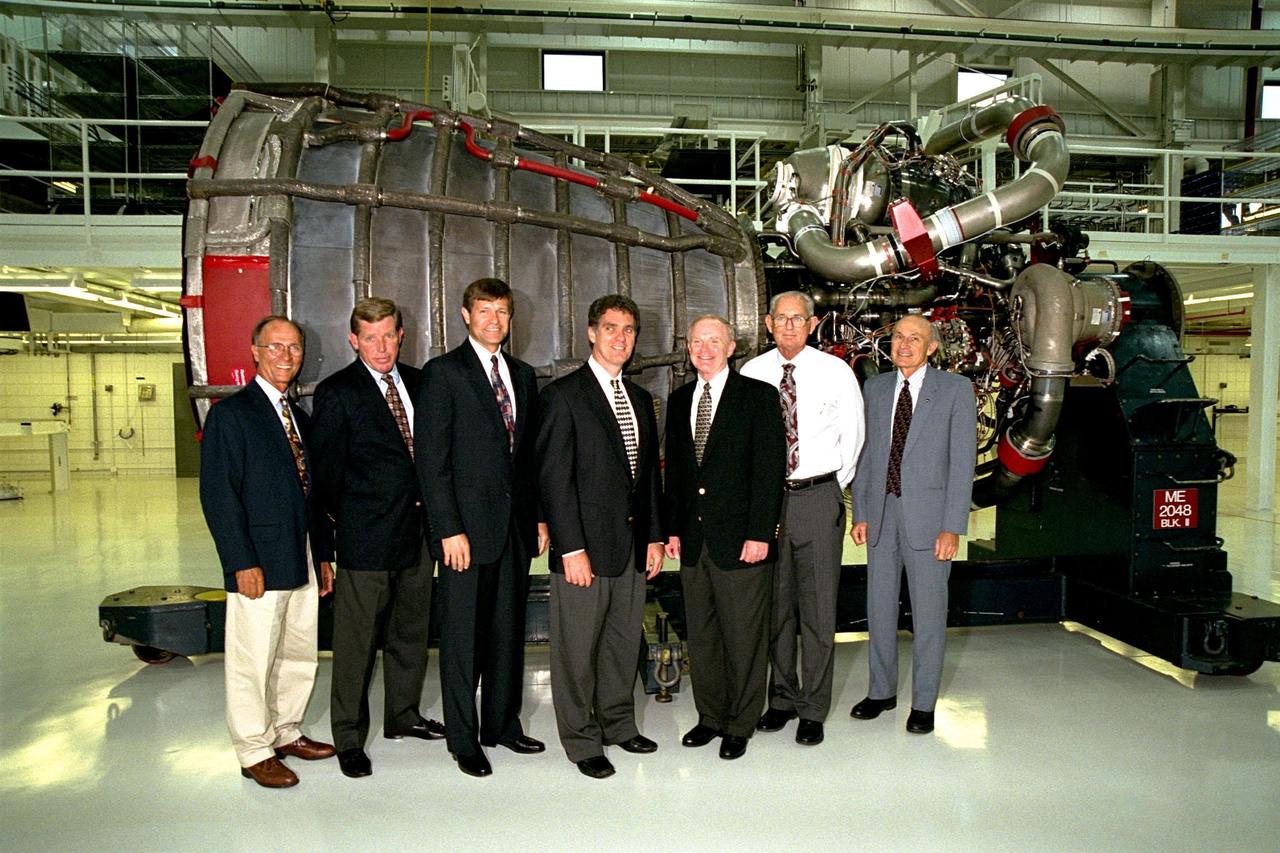
Participants in the ribbon cutting for KSC's new 34,600-square-foot Space Shuttle Main Engine Processing Facility (SSMEPF) pose in front of a Space Shuttle Main Engine on display for the ceremony. From left, they are Ed Adamek, vice president and associate program manager for Ground Operations of United Space Alliance; John Plowden, vice president of Rocketdyne; Donald R. McMonagle, manager of Launch Integration; U.S. Congressman Dave Weldon; KSC Center Director Roy D. Bridges Jr.; Wade Ivey of Ivey Construction, Inc.; and Robert B. Sieck, director of Shuttle Processing. A major addition to the existing Orbiter Processing Facility Bay 3, the SSMEPF replaces the Shuttle Main Engine Shop located in the Vehicle Assembly Building (VAB). The decision to move the shop out of the VAB was prompted by safety considerations and recent engine processing improvements. The first three main engines to be processed in the new facility will fly on Shuttle Endeavour's STS-88 mission in December 1998
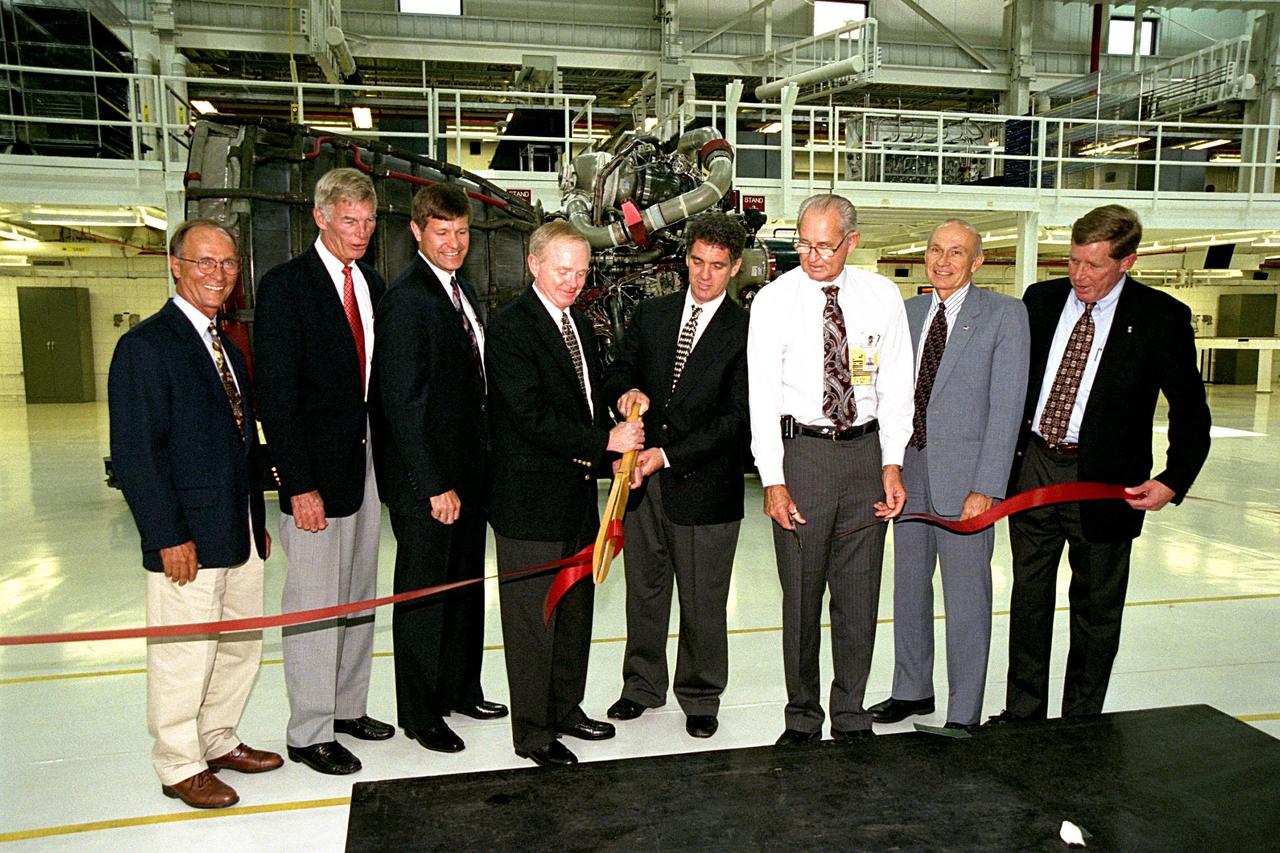
KSC Center Director Roy D. Bridges Jr. and U.S. Congressman Dave Weldon (holding scissors) cut the ribbon at a ceremony on July 6 to open KSC's new 34,600-square-foot Space Shuttle Main Engine Processing Facility (SSMEPF). Joining in the ribbon cutting are (left) Ed Adamek, vice president and associate program manager for Ground Operations of United Space Alliance; Marvin L. Jones, director of Installation Operations; Donald R. McMonagle, manager of Launch Integration; (right) Wade Ivey of Ivey Construction, Inc.; Robert B. Sieck, director of Shuttle Processing; and John Plowden, vice president of Rocketdyne. A major addition to the existing Orbiter Processing Facility Bay 3, the SSMEPF replaces the Shuttle Main Engine Shop located in the Vehicle Assembly Building (VAB). The decision to move the shop out of the VAB was prompted by safety considerations and recent engine processing improvements. The first three main engines to be processed in the new facility will fly on Shuttle Endeavour's STS-88 mission in December 1998
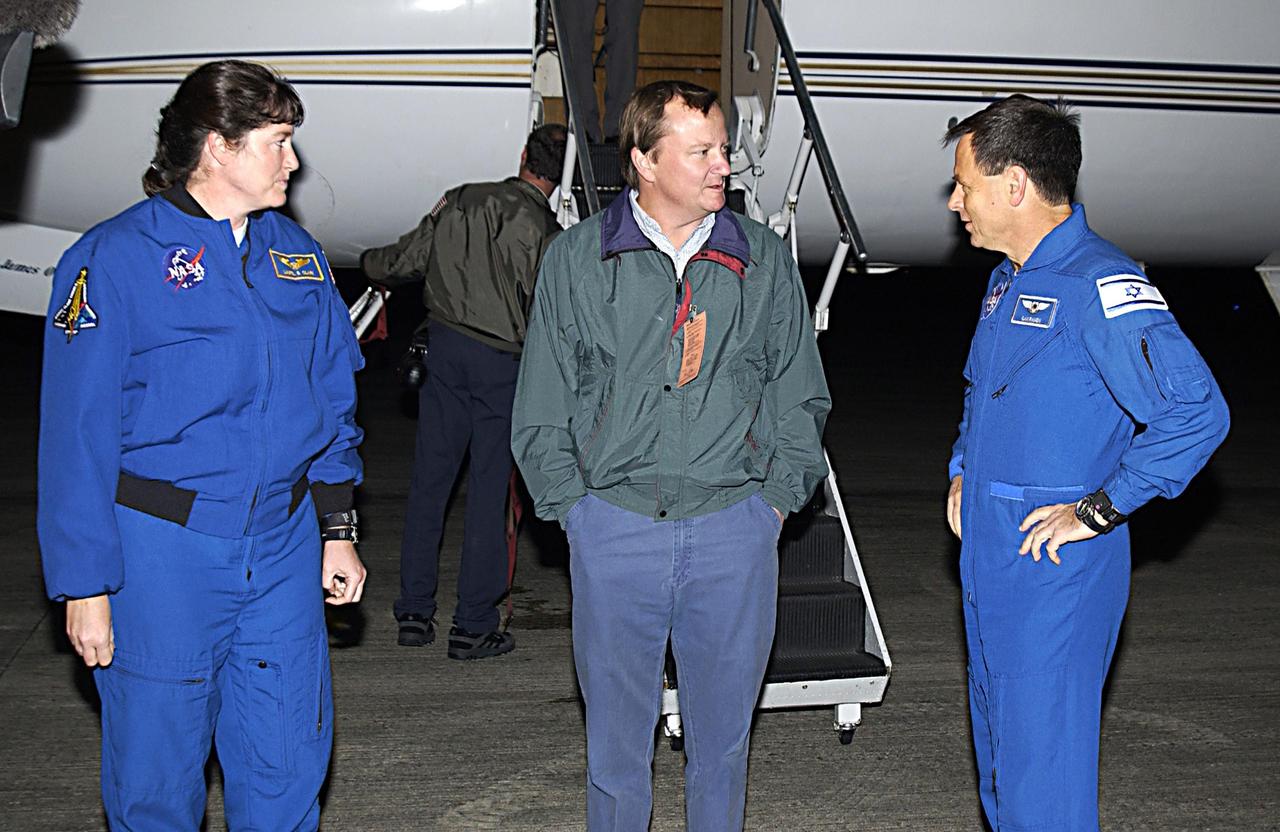
KENNEDY SPACE CENTER, FLA. -- Two members of the STS-107 crew, Mission Specialist Laurel Clark (left) and Payload Specialist Ilan Ramon (right), talk after their arrival at KSC to Launch Director Mike Leinbach. Ramon is the first Israeli astronaut to fly on a Shuttle mission. STS-107 is a mission devoted to research and will include more than 80 experiments that will study Earth and space science, advanced technology development, and astronaut health and safety. The payload on Space Shuttle Columbia includes FREESTAR (Fast Reaction Experiments Enabling Science, Technology, Applications and Research) and the SHI Research Double Module (SHI/RDM), known as SPACEHAB. Experiments on the module range from material sciences to life sciences. Other crew members are Commander Rick Husband, Pilot William "Willie" McCool, Payload Commander Michael Anderson and Mission Specialists Kalpana Chawla and David Brown. Launch of Columbia is targeted for Jan. 16 between 10 a.m. and 2 p.m.
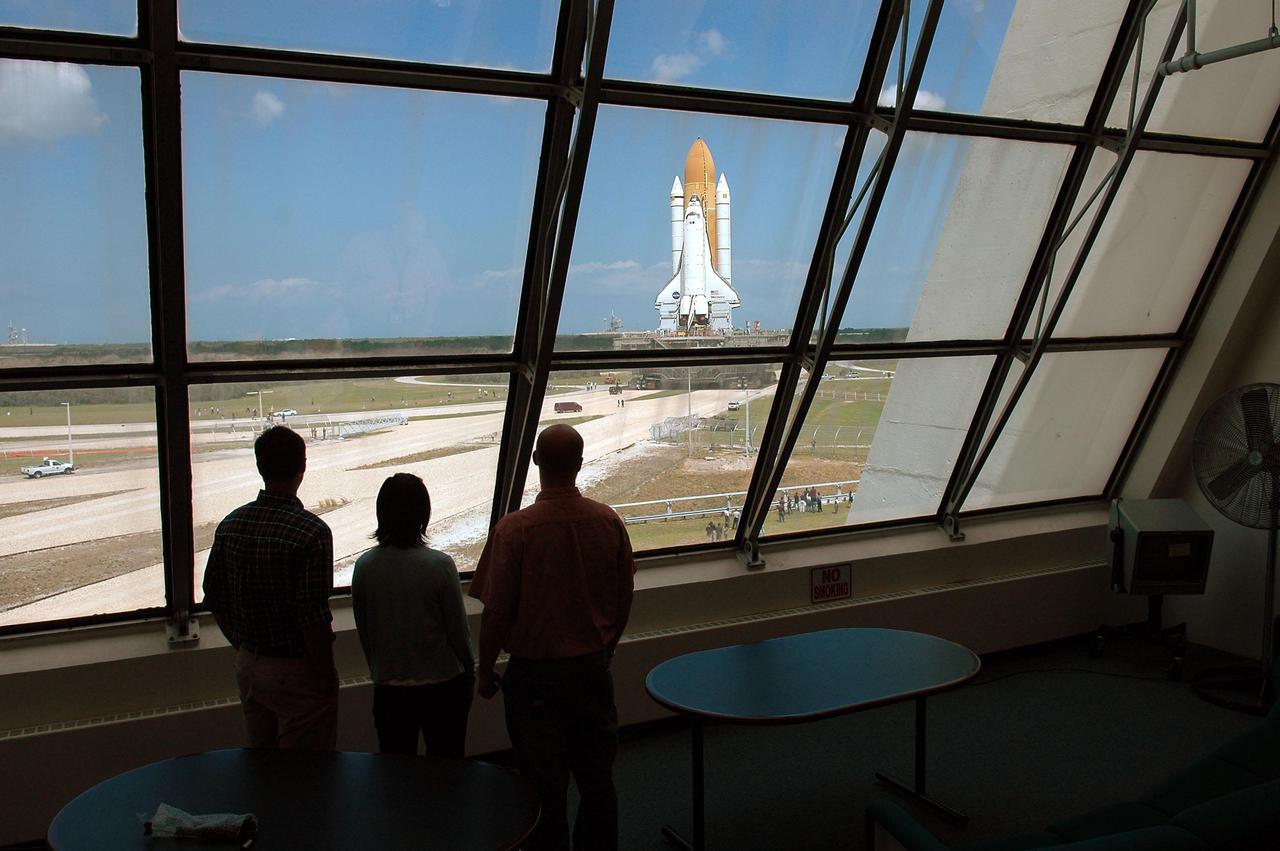
KENNEDY SPACE CENTER, FLA. - From inside the viewing room of the Launch Control Center, KSC employees watch Space Shuttle Discovery as it creeps along the crawlerway toward the horizon, and Launch Pad 39B at NASA’s Kennedy Space Center. First motion of the Shuttle out of the Vehicle Assembly Building (VAB) was at 2:04 p.m. EDT. The Mobile Launcher Platform is moved by the Crawler-Transporter underneath. The Crawler is 20 feet high, 131 feet long and 114 feet wide. It moves on eight tracks, each containing 57 shoes, or cleats, weighing one ton each. Loaded with the Space Shuttle, the Crawler can move at a maximum speed of approximately 1 mile an hour. A leveling system in the Crawler keeps the Shuttle vertical while negotiating the 5 percent grade leading to the top of the launch pad. Launch of Discovery on its Return to Flight mission, STS-114, is targeted for May 15 with a launch window that extends to June 3. During its 12-day mission, Discovery’s seven-person crew will test new hardware and techniques to improve Shuttle safety, as well as deliver supplies to the International Space Station. Discovery was moved on March 29 from the Orbiter Processing Facility to the VAB and attached to its propulsion elements, a redesigned ET and twin SRBs.
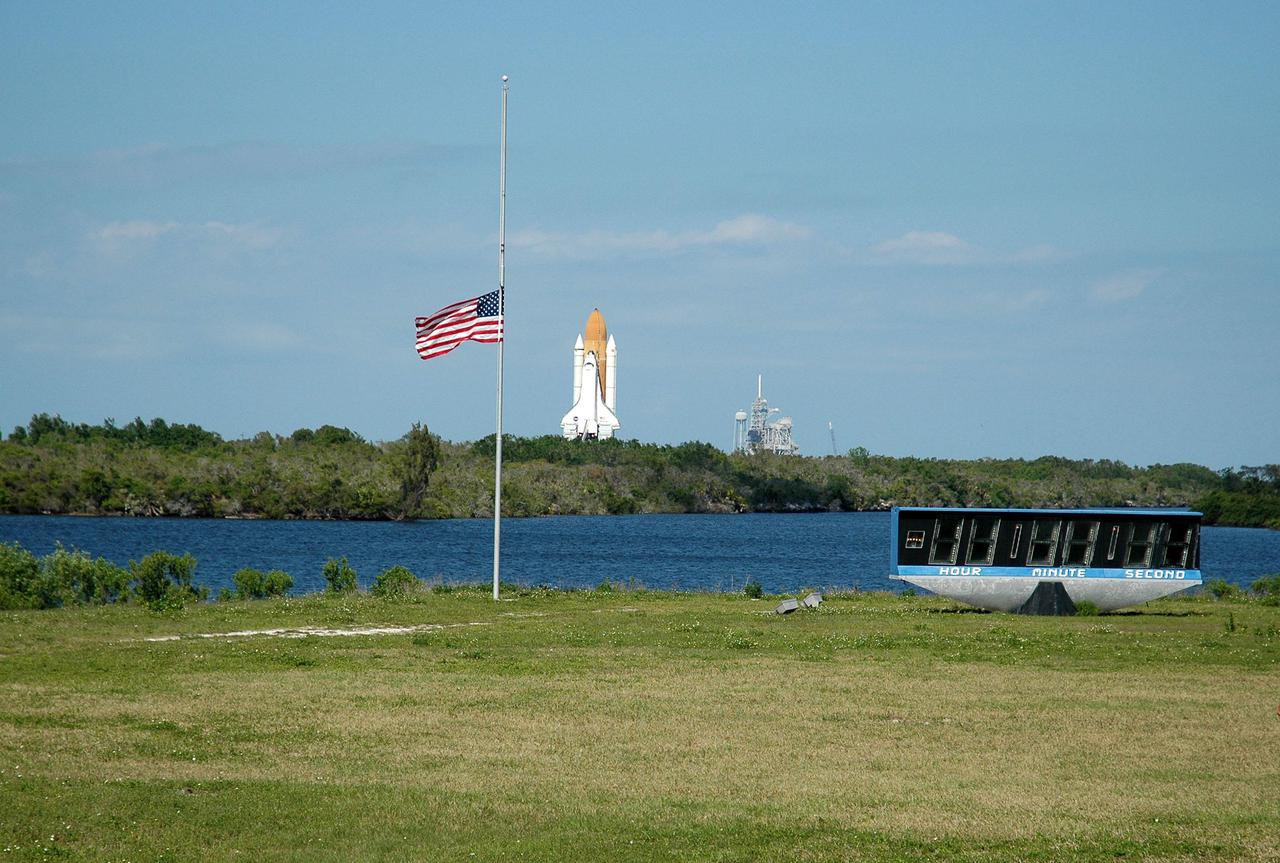
KENNEDY SPACE CENTER, FLA. - A KSC employee stands at the Press Site watching Space Shuttle Discovery mark a major milestone for Return to Flight, rolling out to Launch Pad 39B. First motion out of the Vehicle Assembly Building was at 2:04 p.m. EDT. The Shuttle sits atop the Mobile Launcher Platform, which is moved by the Crawler-Transporter underneath. The Crawler is 20 feet high, 131 feet long and 114 feet wide. It moves on eight tracks, each containing 57 shoes, or cleats, weighing one ton each. Loaded with the Space Shuttle, the Crawler can move at a maximum speed of approximately 1 mile an hour. A leveling system in the Crawler keeps the Shuttle vertical while negotiating the 5 percent grade leading to the top of the launch pad. Launch of Discovery on its Return to Flight mission, STS-114, is targeted for May 15 with a launch window that extends to June 3. During its 12-day mission, Discovery’s seven-person crew will test new hardware and techniques to improve Shuttle safety, as well as deliver supplies to the International Space Station. Discovery was moved on March 29 from the Orbiter Processing Facility to the VAB and attached to its propulsion elements, a redesigned ET and twin SRBs.
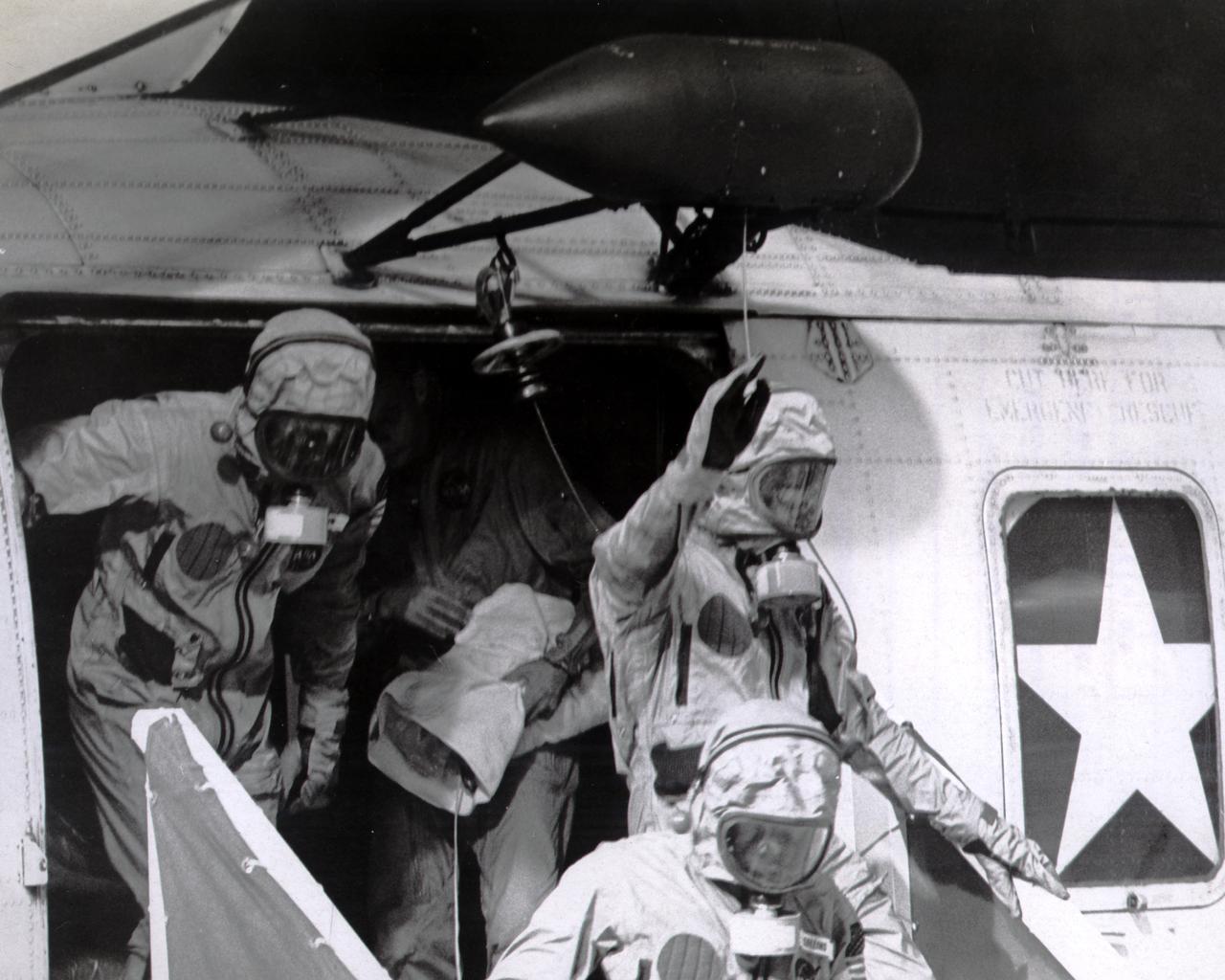
Donned in biological isolation garments, the Apollo 11 crew members, (L-R) Edwin Aldrin, Neil Armstrong (waving), and Michael Collins exit the recovery pick up helicopter to board the U.S.S. Hornet aircraft carrier after splashdown. The recovery operation took place in the Pacific Ocean where Navy para-rescue men recovered the capsule housing the 3-man Apollo 11 crew. The crew was airlifted to safety aboard the U.S.S. Hornet, where they were quartered in a Mobile Quarantine Facility (MQF). This portable facility served as their home until they reached the NASA Manned Spacecraft Center (MSC) Lunar Receiving Laboratory in Houston, Texas. The Apollo 11 mission, the first manned lunar mission, launched from the Kennedy Space Center (KSC), Florida via the Saturn V launch vehicle on July 16, 1969 and safely returned to Earth on July 24, 1969. Aboard were Neil A. Armstrong, commander; Michael Collins, Command Module (CM) pilot; and Edwin E. Aldrin Jr., Lunar Module (LM) pilot. The CM, piloted by Michael Collins remained in a parking orbit around the Moon while the LM, named “Eagle’’, carrying astronauts Neil Armstrong and Edwin Aldrin, landed on the Moon. Armstrong was the first human to ever stand on the lunar surface, followed by Aldrin. During 2½ hours of surface exploration, the crew collected 47 pounds of lunar surface material for analysis back on Earth. With the success of Apollo 11, the national objective to land men on the Moon and return them safely to Earth had been accomplished. The Saturn V vehicle was developed by the Marshall Space Flight Center (MSFC) under the direction of Dr. Werher von Braun.