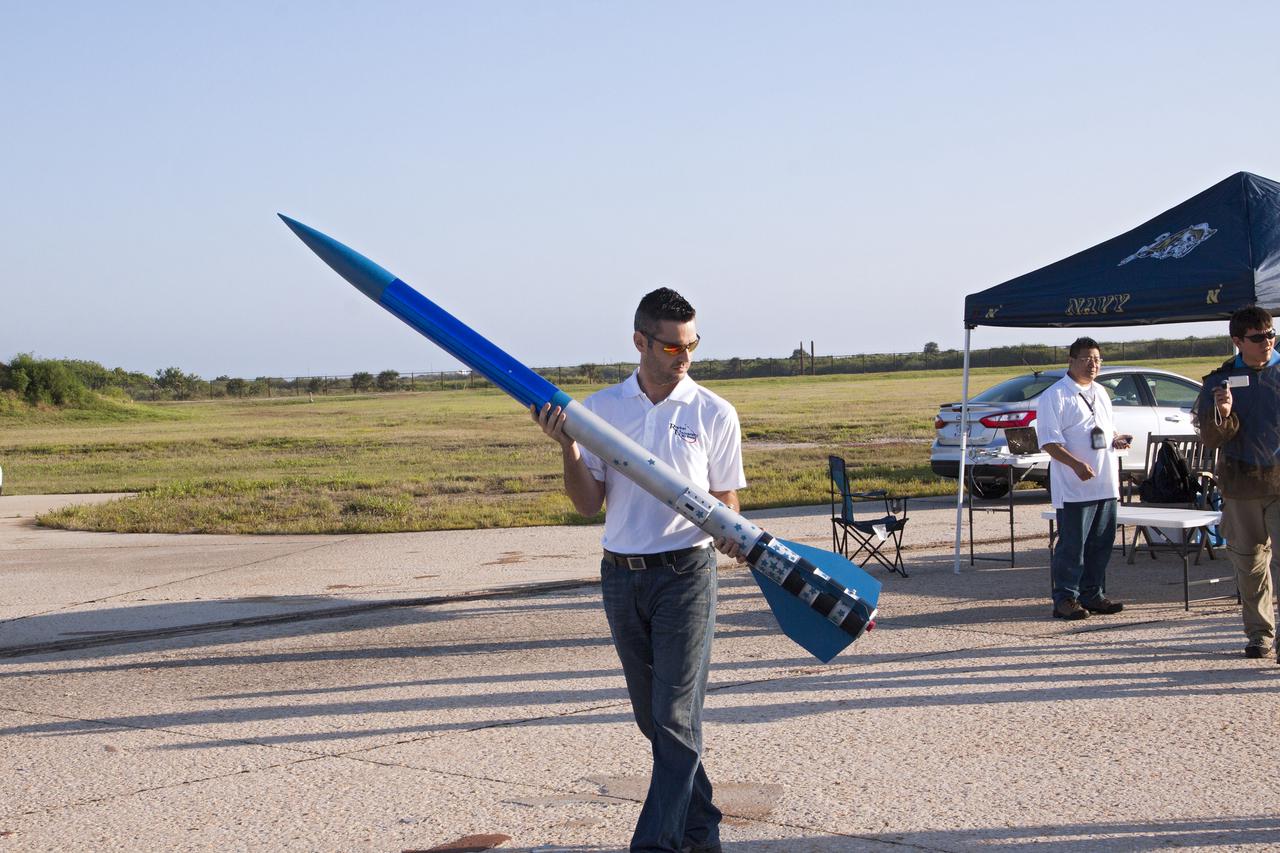
CAPE CANAVERAL, Fla. -- At NASA's Kennedy Space Center in Florida, Leandro James of Systems Hardware Engineering carries a small test rocket to the launch stand. The activity was part of Rocket University with the goal to test its systems and to verify that it performed as designed. As part of Rocket University, the engineers are given an opportunity to work a fast-track project to develop skills in developing spacecraft systems of the future. As NASA plans for future spaceflight programs to low-Earth orbit and beyond, teams of engineers at Kennedy are gaining experience in designing and flying launch vehicle systems on a small scale. Four teams of five to eight members from Kennedy are designing rockets complete with avionics and recovery systems. Launch operations require coordination with federal agencies, just as they would with rockets launched in support of a NASA mission. Photo credit: NASA_Jim Grossmann
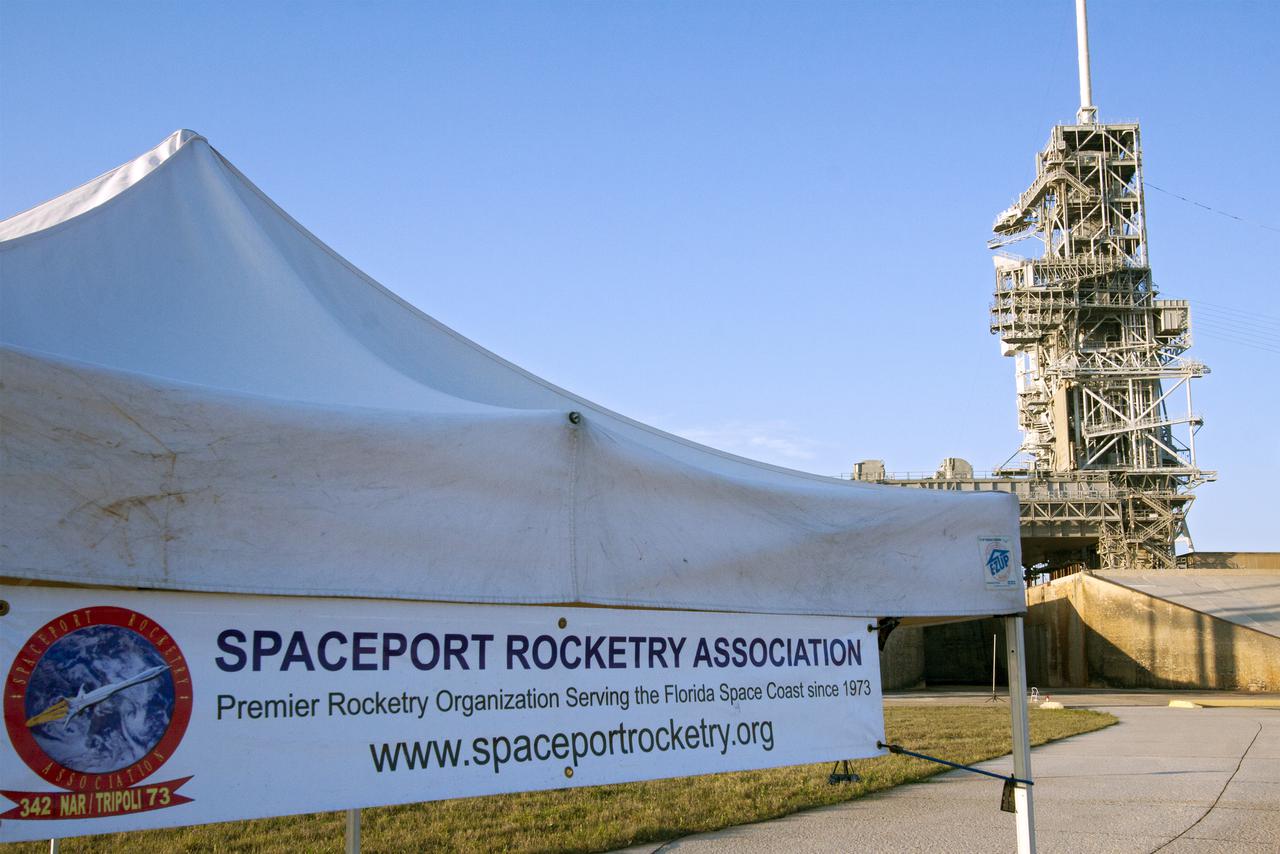
CAPE CANAVERAL, Fla. -- At NASA's Kennedy Space Center in Florida, engineers launched a small rocket as part of Rocket University. The goal was to test its systems and to verify that it performed as designed. The event was supported by the Spaceport Rocketry Association, a 40-year-old organization that provides launch demonstrations and educational programs. As part of Rocket University, the engineers are given an opportunity to work a fast-track project to develop skills in developing spacecraft systems of the future. As NASA plans for future spaceflight programs to low-Earth orbit and beyond, teams of engineers at Kennedy are gaining experience in designing and flying launch vehicle systems on a small scale. Four teams of five to eight members from Kennedy are designing rockets complete with avionics and recovery systems. Launch operations require coordination with federal agencies, just as they would with rockets launched in support of a NASA mission. Photo credit: NASA_Jim Grossmann
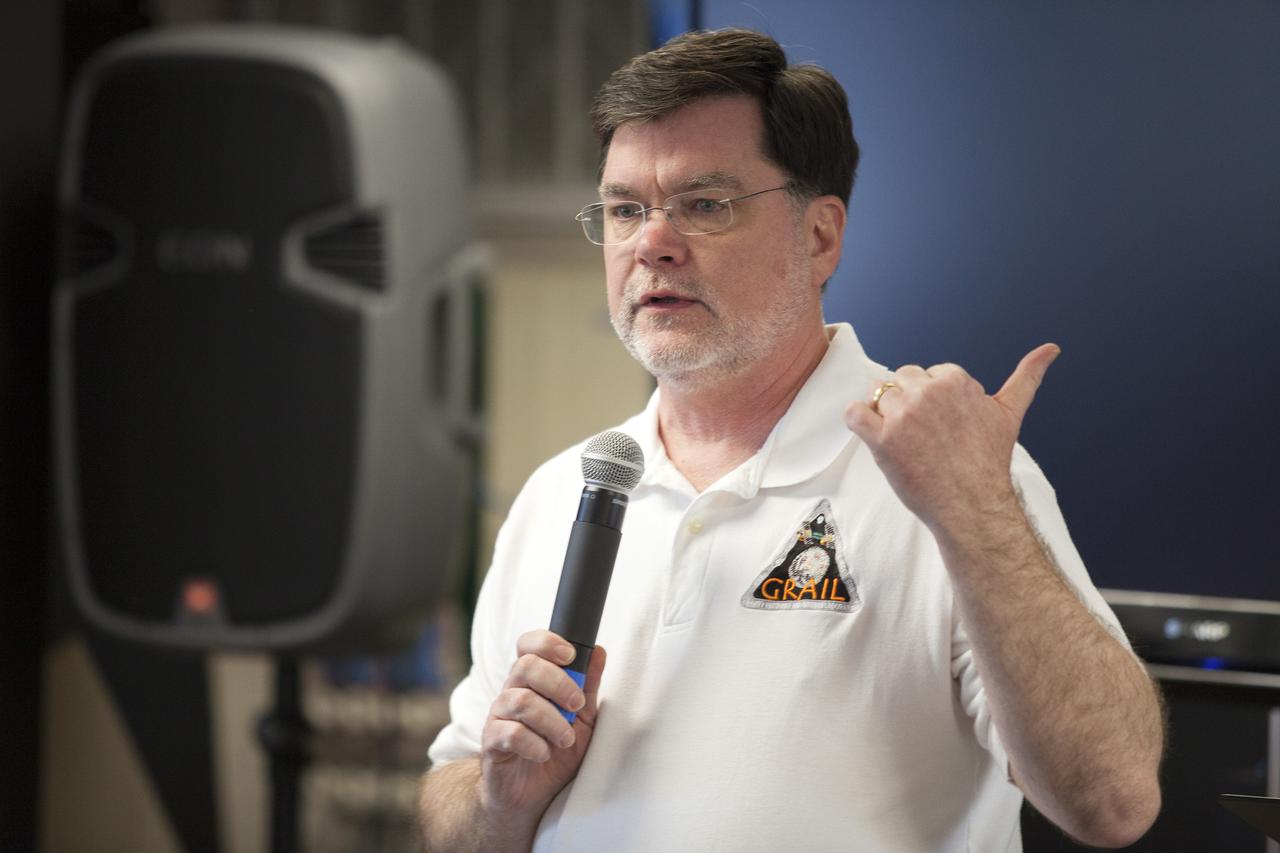
CAPE CANAVERAL, Fla. -- NASA Deputy Chief Technologist James Adams speaks to some of the agency's social media followers during two days of presentations on the launch of SpaceX-2. The social media participants gathered at the Florida spaceport on Feb. 28 and March 1, to hear from key leaders who updated the space agency's current efforts. Photo credit: NASA_Frankie Martin
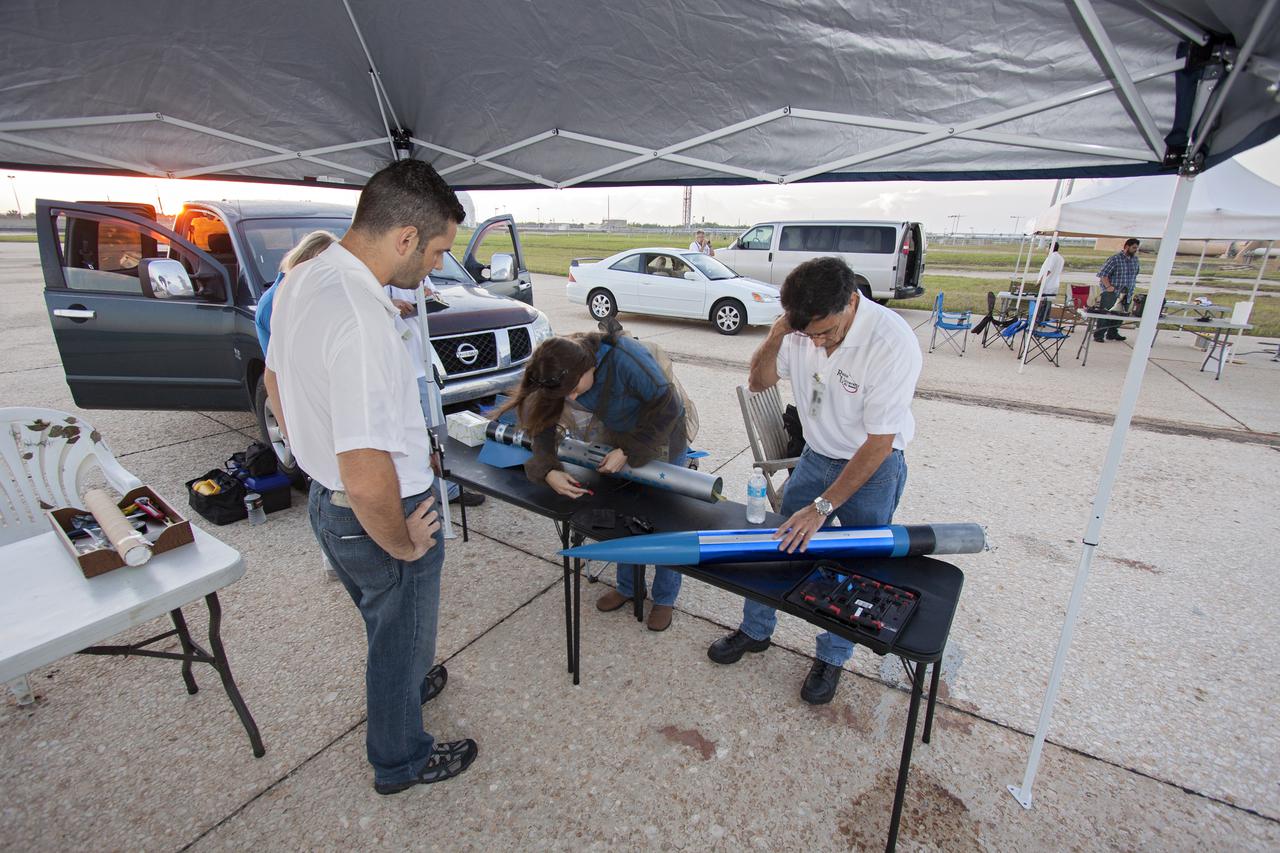
CAPE CANAVERAL, Fla. -- At NASA's Kennedy Space Center in Florida, engineers make final adjustments to a small rocket prior to launch as part of Rocket University. The goal was to test its systems and to verify that it performed as designed. As part of Rocket University, the engineers are given an opportunity to work a fast-track project to develop skills in developing spacecraft systems of the future. As NASA plans for future spaceflight programs to low-Earth orbit and beyond, teams of engineers at Kennedy are gaining experience in designing and flying launch vehicle systems on a small scale. Four teams of five to eight members from Kennedy are designing rockets complete with avionics and recovery systems. Launch operations require coordination with federal agencies, just as they would with rockets launched in support of a NASA mission. Photo credit: NASA_Jim Grossmann
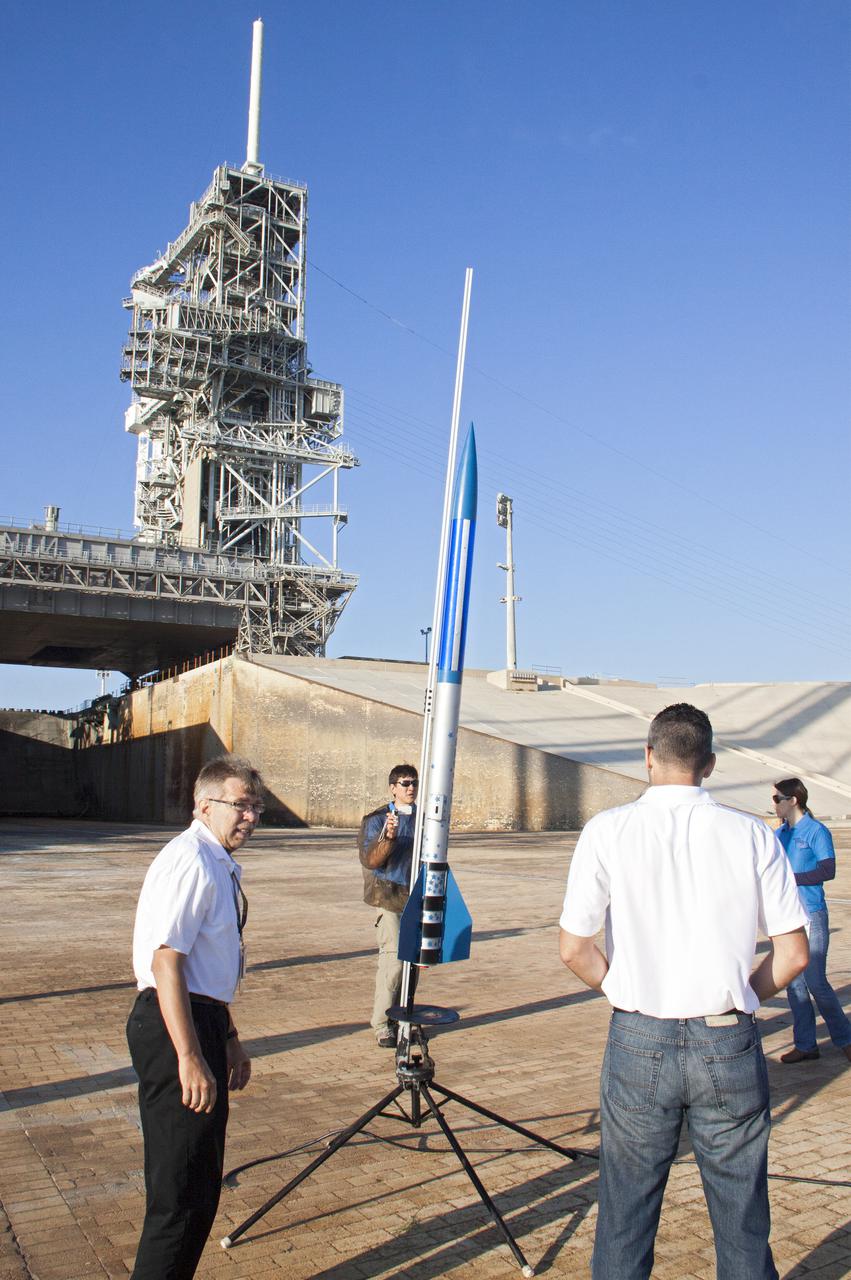
CAPE CANAVERAL, Fla. -- At NASA's Kennedy Space Center in Florida, engineers complete final checkouts of a small rocket on its launch stand as part of Rocket University. The goal was to test its systems and to verify that it performed as designed. As part of Rocket University, the engineers are given an opportunity to work a fast-track project to develop skills in developing spacecraft systems of the future. As NASA plans for future spaceflight programs to low-Earth orbit and beyond, teams of engineers at Kennedy are gaining experience in designing and flying launch vehicle systems on a small scale. Four teams of five to eight members from Kennedy are designing rockets complete with avionics and recovery systems. Launch operations require coordination with federal agencies, just as they would with rockets launched in support of a NASA mission. Photo credit: NASA_Jim Grossmann
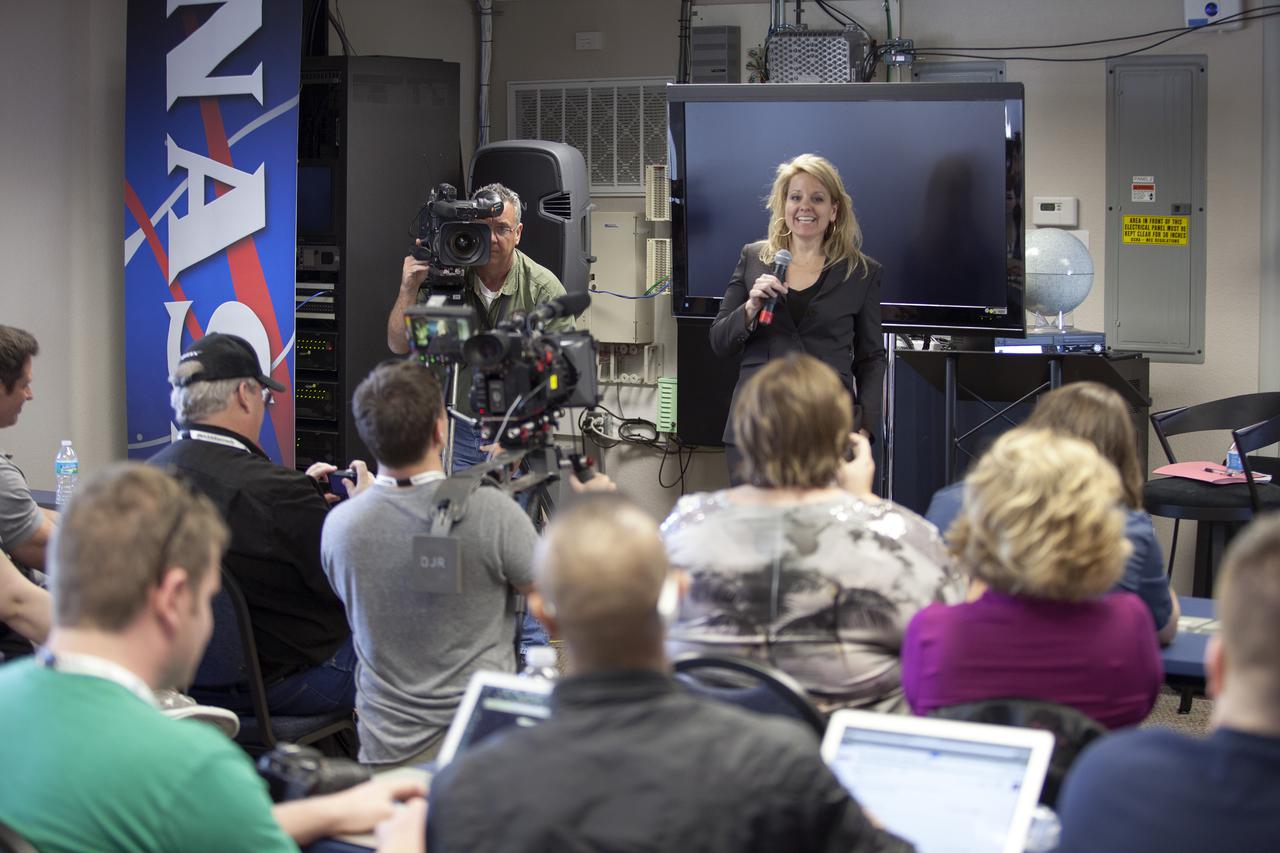
CAPE CANAVERAL, Fla. -- SpaceX President Gwynne Shotwell speaks to NASA’s social media followers during two days of presentations on the launch of SpaceX-2. The social media participants gathered at the Florida spaceport on Feb. 28 and March 1, to hear from key leaders who updated the space agency's current efforts. Photo credit: NASA_Frankie Martin
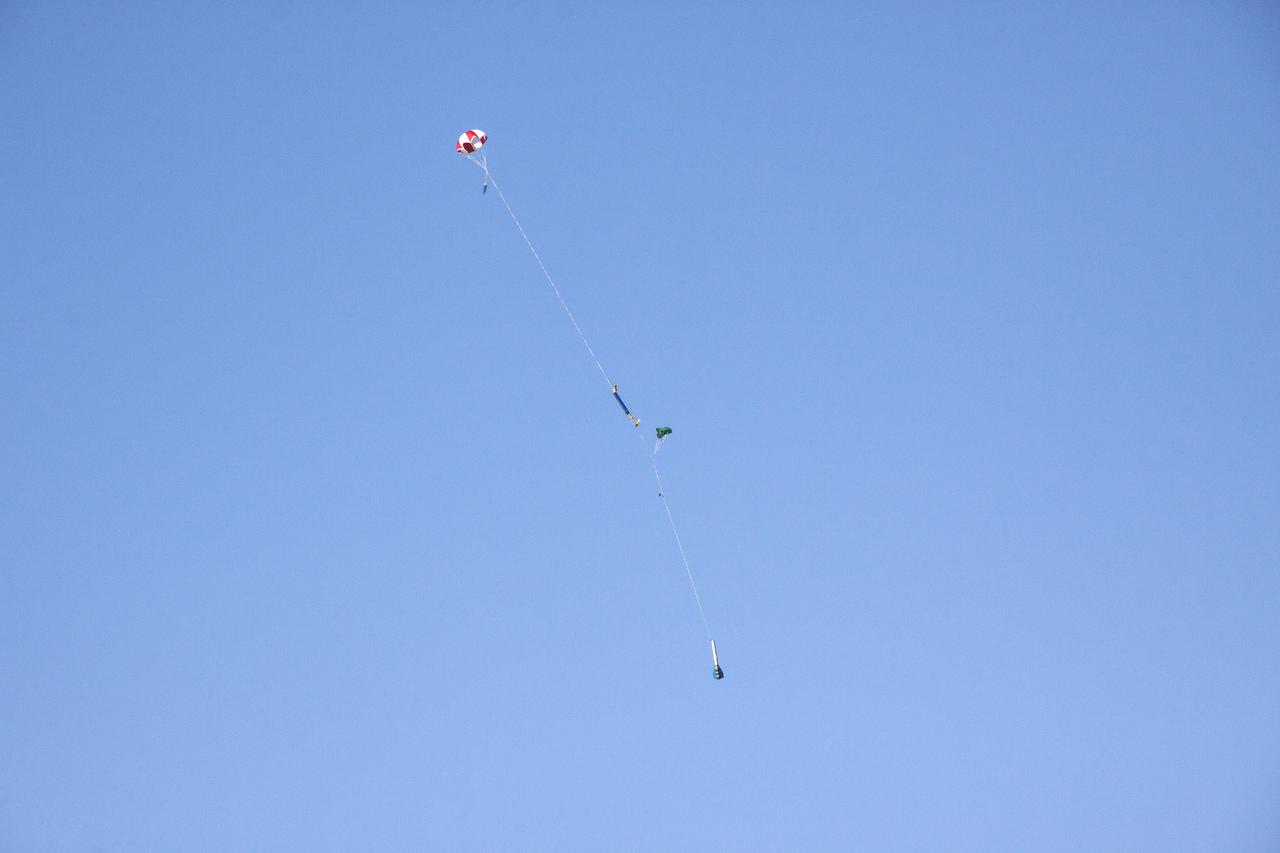
CAPE CANAVERAL, Fla. -- At NASA's Kennedy Space Center in Florida, a small rocket descends under a parachute after liftoff from Launch Pad 39A as part of Rocket University. The goal was to test its systems and to verify that it performed as designed. As part of Rocket University, the engineers are given an opportunity to work a fast-track project to develop skills in developing spacecraft systems of the future. As NASA plans for future spaceflight programs to low-Earth orbit and beyond, teams of engineers at Kennedy are gaining experience in designing and flying launch vehicle systems on a small scale. Four teams of five to eight members from Kennedy are designing rockets complete with avionics and recovery systems. Launch operations require coordination with federal agencies, just as they would with rockets launched in support of a NASA mission. Photo credit: NASA_Jim Grossmann
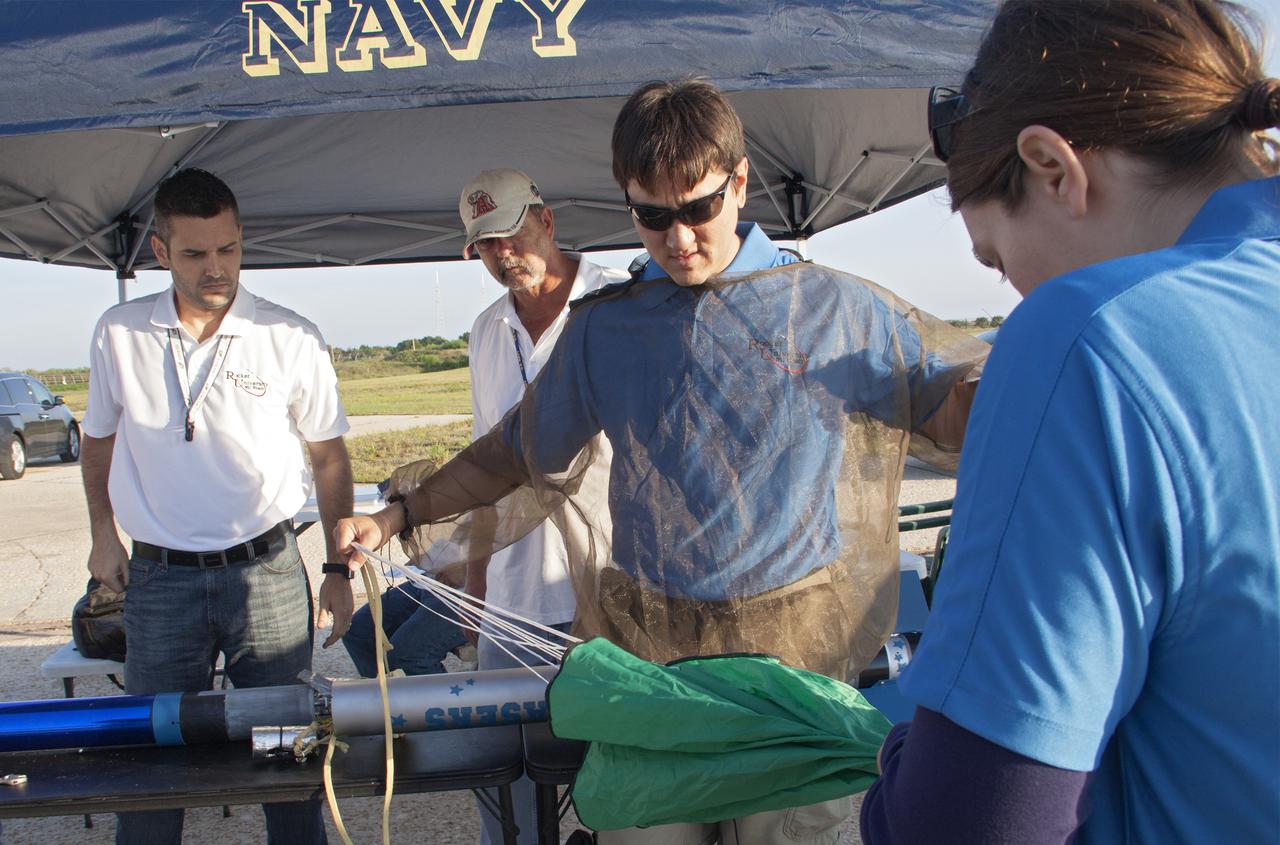
CAPE CANAVERAL, Fla. -- At NASA's Kennedy Space Center in Florida, from the left, Leandro James of Systems Hardware Engineering, George Mizell of Quality Assurance, Morgan Simpson of Flight Hardware Processing and Kim Simpson of Fluids, Mechanical and Structural Systems prepare a parachute for a small rocket prior to launch as part of Rocket University. The goal was to test its systems and to verify that it performed as designed. As part of Rocket University, the engineers are given an opportunity to work a fast-track project to develop skills in developing spacecraft systems of the future. As NASA plans for future spaceflight programs to low-Earth orbit and beyond, teams of engineers at Kennedy are gaining experience in designing and flying launch vehicle systems on a small scale. Four teams of five to eight members from Kennedy are designing rockets complete with avionics and recovery systems. Launch operations require coordination with federal agencies, just as they would with rockets launched in support of a NASA mission. Photo credit: NASA_Jim Grossmann
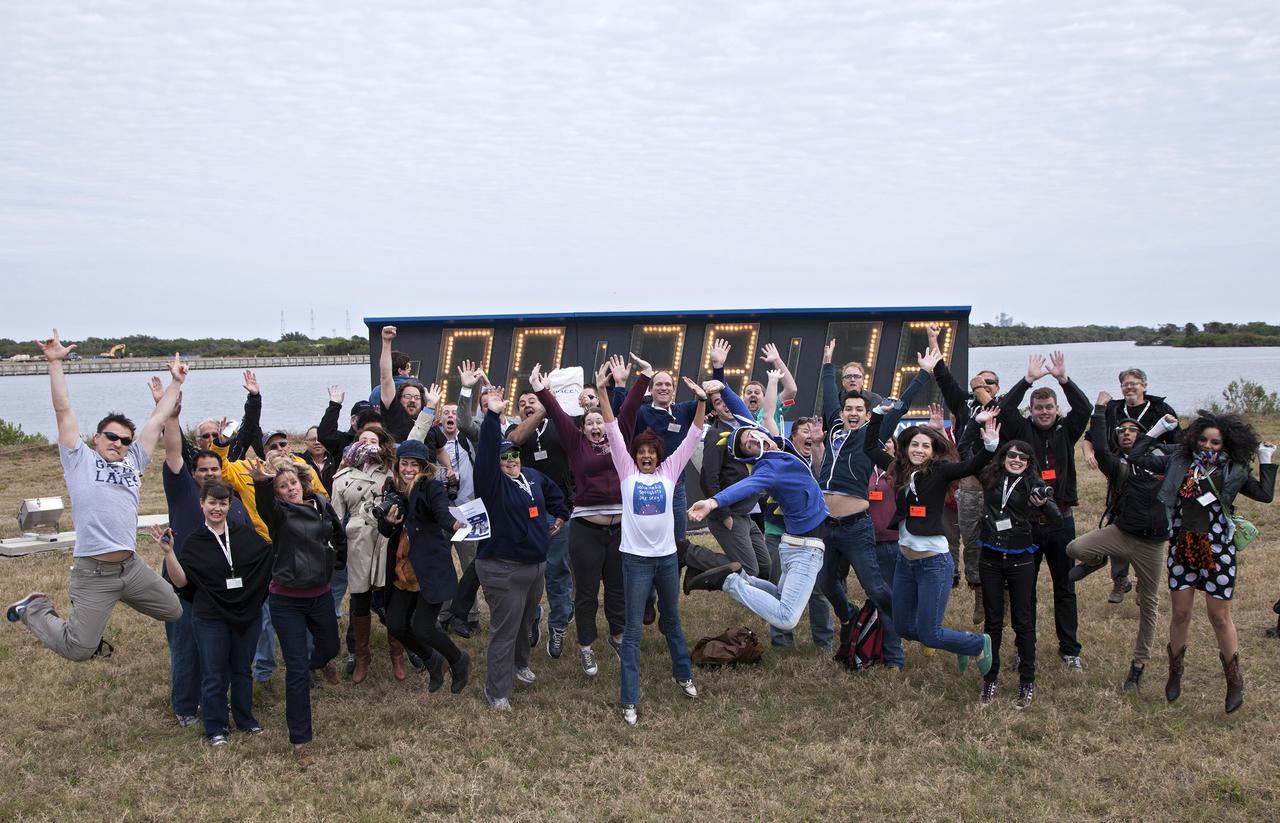
CAPE CANAVERAL, Fla. -- NASA social media followers pose for a group photo during two days of presentations on the launch of SpaceX-2. The social media participants gathered at the Florida spaceport on Feb. 28 and March 1, to hear from key leaders who updated the space agency's current efforts. Photo credit: NASA_Kim Shiflett
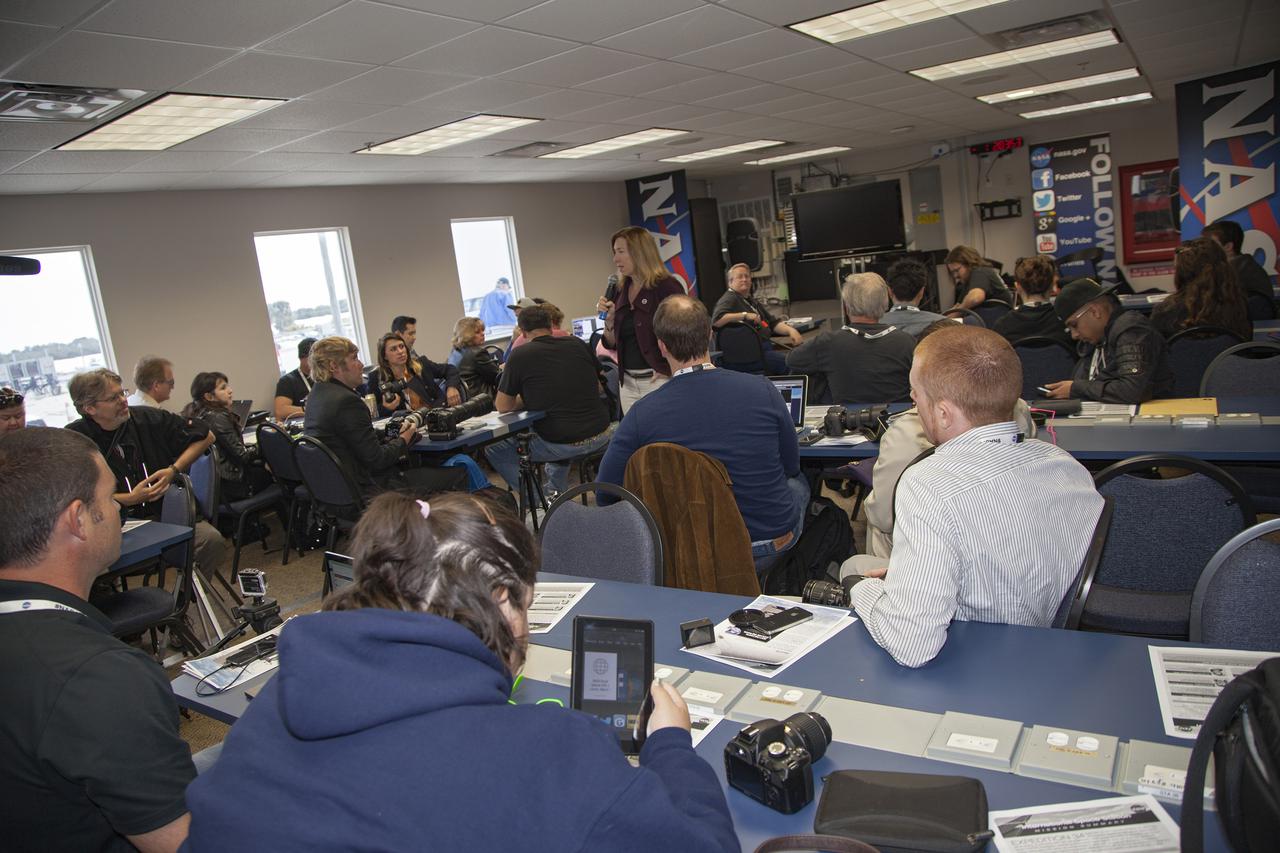
CAPE CANAVERAL, Fla. -- NASA Deputy Administrator Lori Garver speaks to some of the agency's social media followers during two days of presentations on the launch of SpaceX 2. The social media participants gathered at the Florida spaceport on Feb. 28 and March 1, to hear from key leaders who updated the space agency's current efforts. Photo credit: NASA_Lorne Mathre
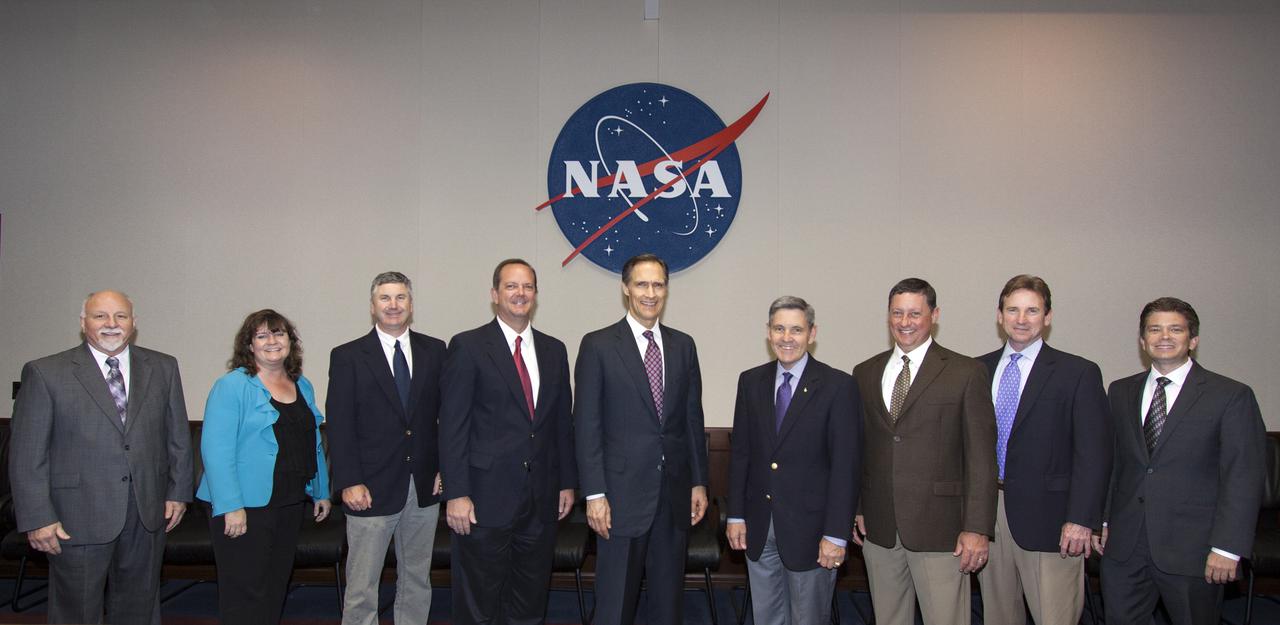
CAPE CANAVERAL, Fla. -- Kennedy Space Center Director Bob Cabana, met with representatives of PaR Systems Inc. NASA recently established a partnership agreement with PaR to operate of the Hangar N facility and its nondestructive testing equipment. Participating were, from the left, Cliff Hausmann, Technical Integration manager in NASA's Program Control and Integration Office, Amy Houts-Gilfriche, Partnership Development manager in NASA's Center Planning and Development Directorate, Scott Colloredo of NASA's Systems Engineering and Integration Division, Tom Engler, deputy director of Center Planning and Development, Brian Behm, president of the Robotics Division of PaR Systems, Tony Corak, manager, of Non-destructive Testing Services for PaR Systems, Dale Ketcham of Space Florida, and Robert Salonen, director of Business Development for the Economic Development Commission of Florida's Space Coast. As the spaceport transitions from a historically government-only launch facility to a multiuser spaceport for both federal and commercial customers, partnerships with other organizations will be a key element in that effort. Hangar N is located at Cape Canaveral Air Force Station adjacent to Kennedy. The facility's unique inventory of nondestructive test and evaluation NDE equipment and the capability for current and future mission spaceflight support was an asset NASA wanted to retain. Photo credit: NASA_Jim Grossmann
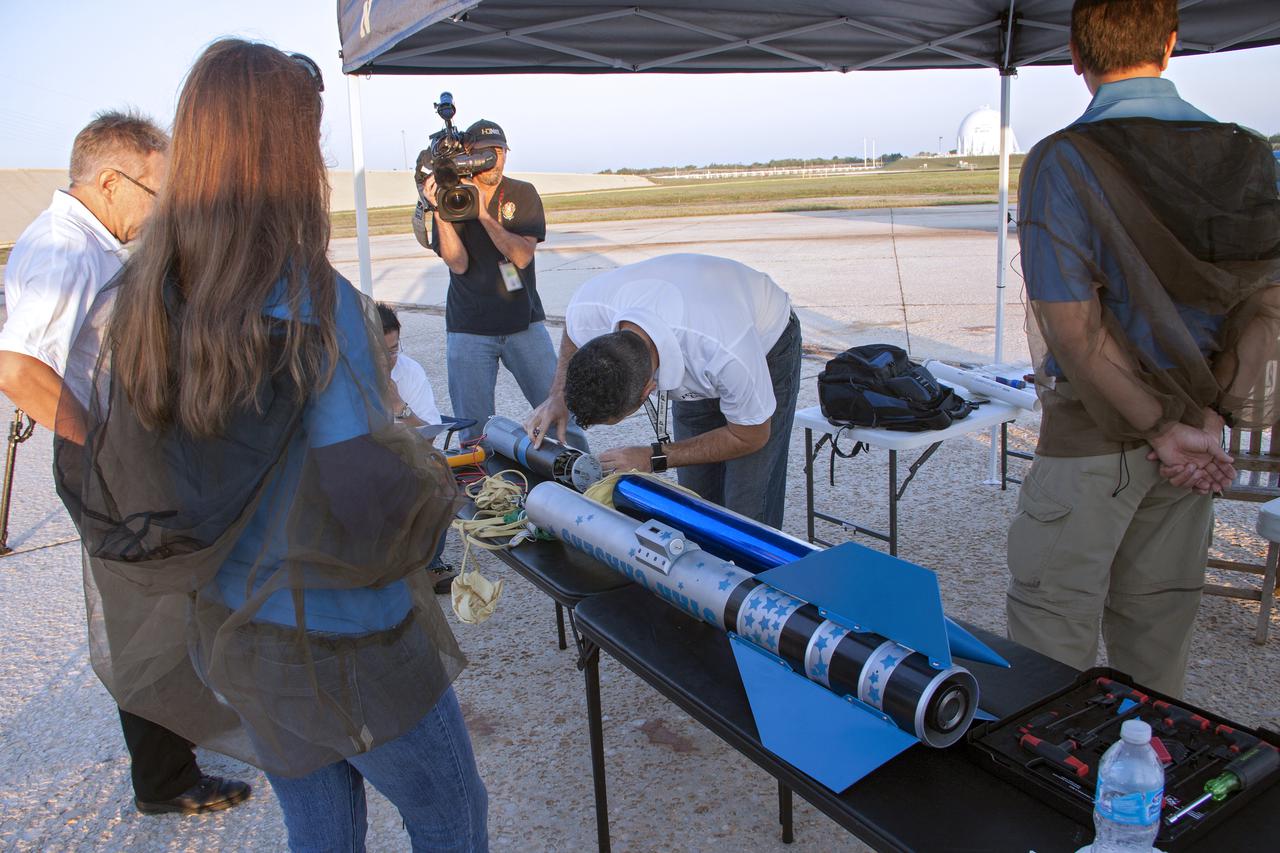
CAPE CANAVERAL, Fla. -- At NASA's Kennedy Space Center in Florida, engineers make final adjustments to a small rocket prior to launch as part of Rocket University. The goal was to test its systems and to verify that it performed as designed. As part of Rocket University, the engineers are given an opportunity to work a fast-track project to develop skills in developing spacecraft systems of the future. As NASA plans for future spaceflight programs to low-Earth orbit and beyond, teams of engineers at Kennedy are gaining experience in designing and flying launch vehicle systems on a small scale. Four teams of five to eight members from Kennedy are designing rockets complete with avionics and recovery systems. Launch operations require coordination with federal agencies, just as they would with rockets launched in support of a NASA mission. Photo credit: NASA_Jim Grossmann
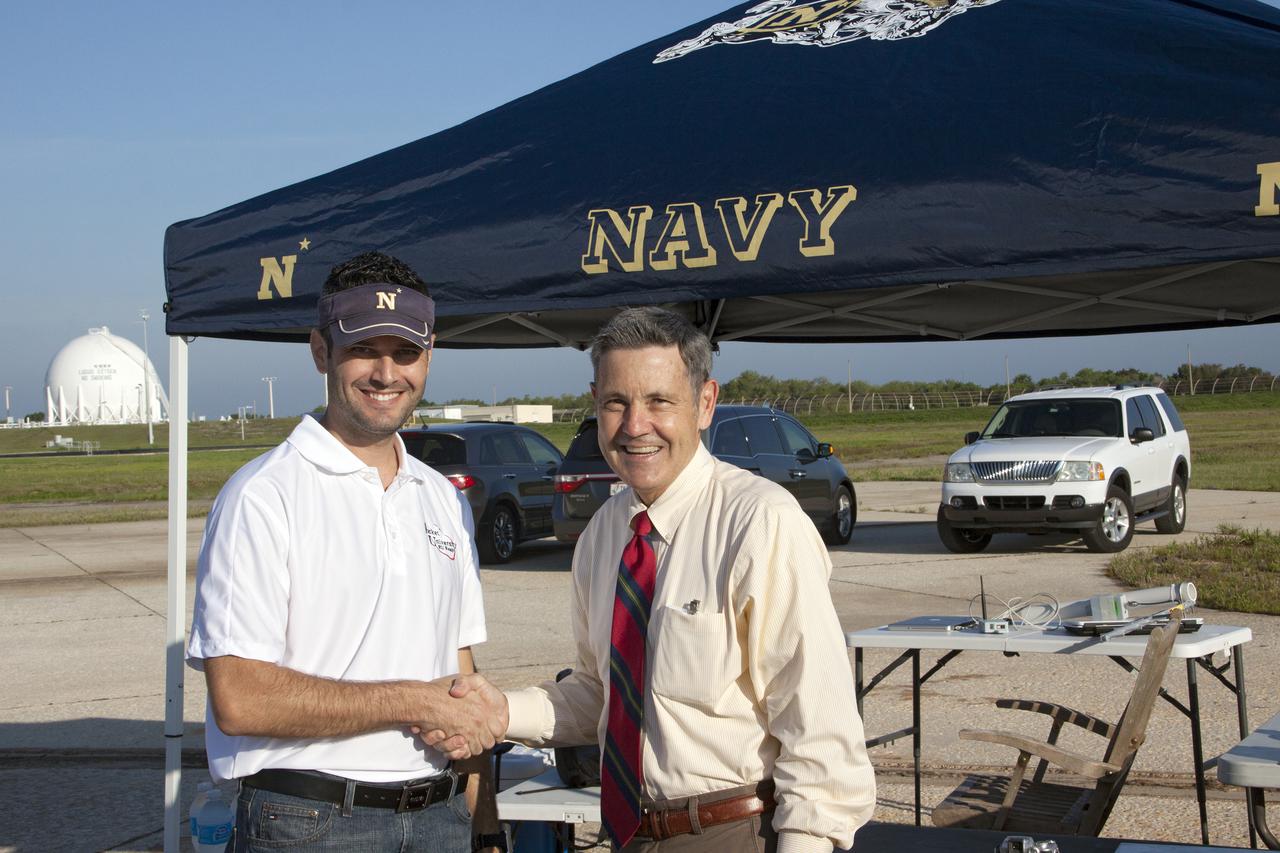
CAPE CANAVERAL, Fla. -- At NASA's Kennedy Space Center in Florida, center director Bob Cabana congratulates Leandro James of Systems Hardware Engineering after the successful launch of a small rocket at Launch Pad 39A as part of Rocket University. The goal was to test its systems and to verify that it performed as designed. As part of Rocket University, the engineers are given an opportunity to work a fast-track project to develop skills in developing spacecraft systems of the future. As NASA plans for future spaceflight programs to low-Earth orbit and beyond, teams of engineers at Kennedy are gaining experience in designing and flying launch vehicle systems on a small scale. Four teams of five to eight members from Kennedy are designing rockets complete with avionics and recovery systems. Launch operations require coordination with federal agencies, just as they would with rockets launched in support of a NASA mission. Photo credit: NASA_Jim Grossmann
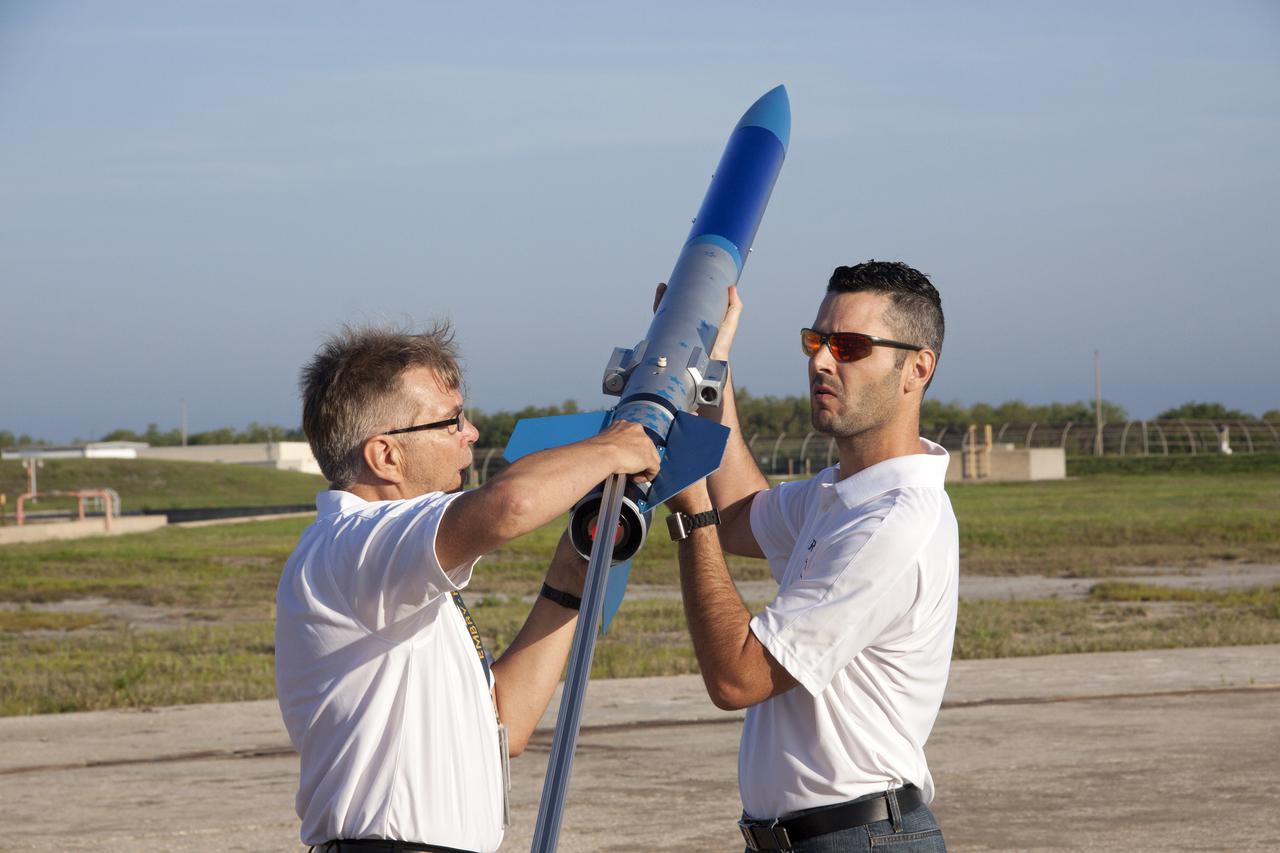
CAPE CANAVERAL, Fla. -- At NASA's Kennedy Space Center in Florida, Gary Dahlke of Engineering and Technology, left, and Leandro James of Systems Hardware Engineering attach a small rocket prior to its launch stand as part of Rocket University. The goal was to test its systems and to verify that it performed as designed. As part of Rocket University, the engineers are given an opportunity to work a fast-track project to develop skills in developing spacecraft systems of the future. As NASA plans for future spaceflight programs to low-Earth orbit and beyond, teams of engineers at Kennedy are gaining experience in designing and flying launch vehicle systems on a small scale. Four teams of five to eight members from Kennedy are designing rockets complete with avionics and recovery systems. Launch operations require coordination with federal agencies, just as they would with rockets launched in support of a NASA mission. Photo credit: NASA_Jim Grossmann
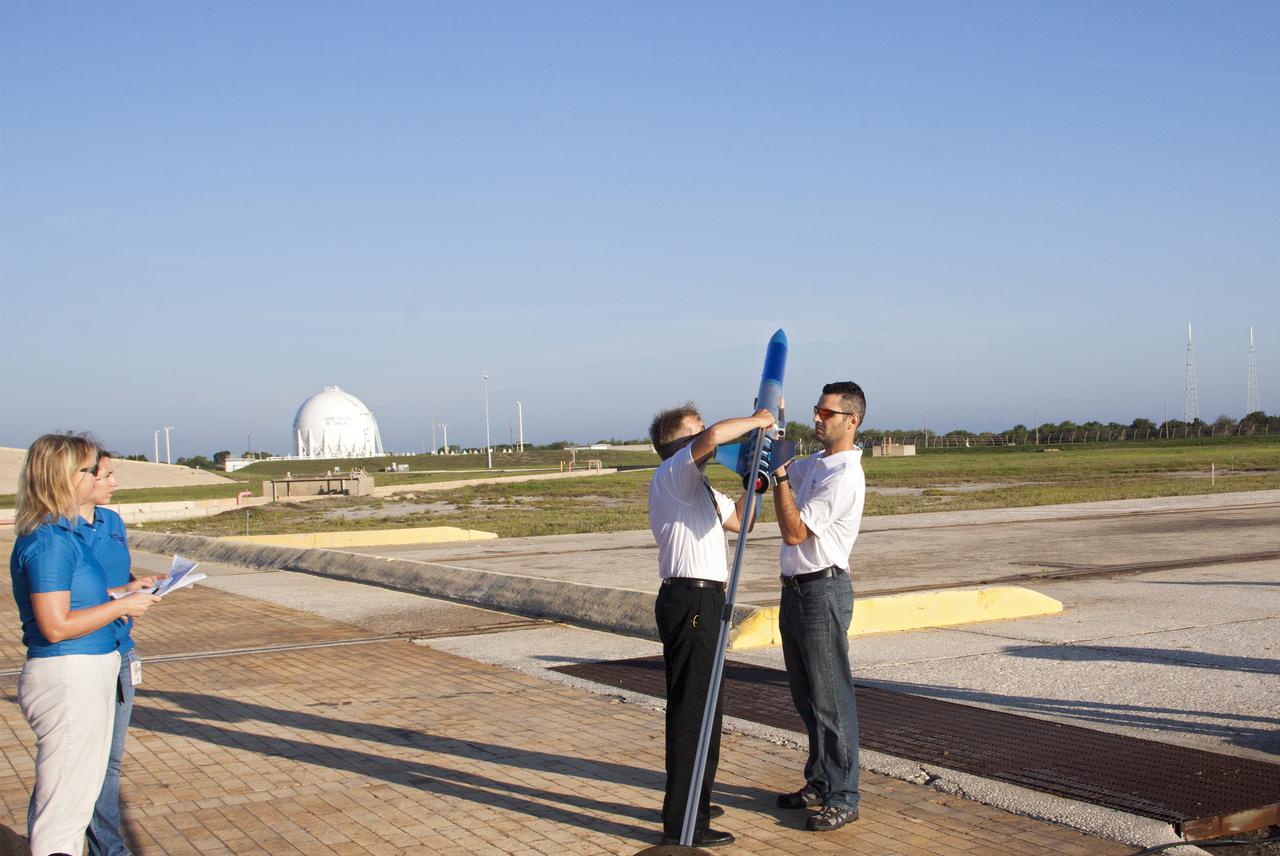
CAPE CANAVERAL, Fla. -- At NASA's Kennedy Space Center in Florida, as Susan Danley of Flight Structures and Kim Simpson of Fluids, Mechanical and Structural Systems look on, Gary Dahlke of Engineering and Technology, left, and Leandro James of Systems Hardware Engineering attach a small rocket prior to its launch stand as part of Rocket University. The goal was to test its systems and to verify that it performed as designed. As part of Rocket University, the engineers are given an opportunity to work a fast-track project to develop skills in developing spacecraft systems of the future. As NASA plans for future spaceflight programs to low-Earth orbit and beyond, teams of engineers at Kennedy are gaining experience in designing and flying launch vehicle systems on a small scale. Four teams of five to eight members from Kennedy are designing rockets complete with avionics and recovery systems. Launch operations require coordination with federal agencies, just as they would with rockets launched in support of a NASA mission. Photo credit: NASA_Jim Grossmann
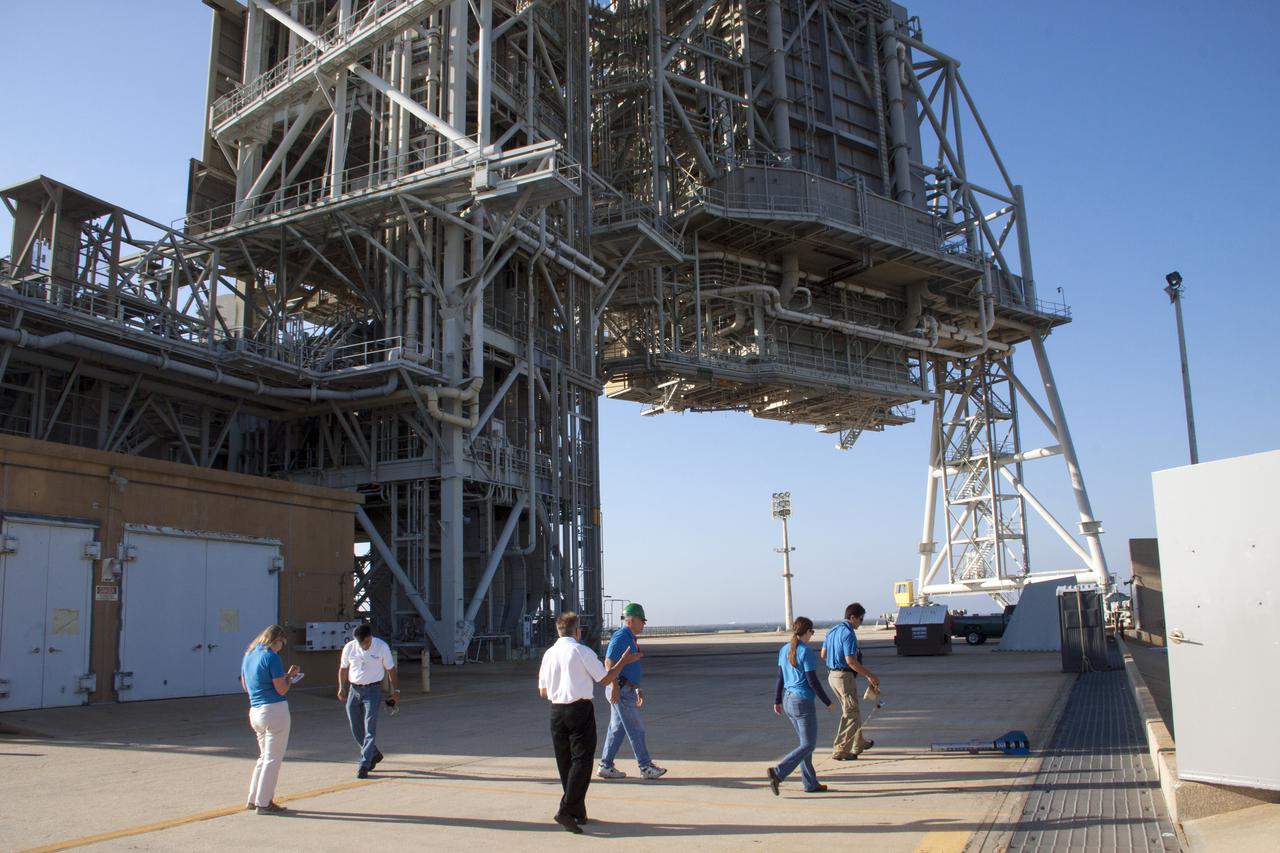
CAPE CANAVERAL, Fla. -- At NASA's Kennedy Space Center in Florida, engineers recover a small rocket following its launch as part of Rocket University. The goal was to test its systems and to verify that it performed as designed. As part of Rocket University, the engineers are given an opportunity to work a fast-track project to develop skills in developing spacecraft systems of the future. As NASA plans for future spaceflight programs to low-Earth orbit and beyond, teams of engineers at Kennedy are gaining experience in designing and flying launch vehicle systems on a small scale. Four teams of five to eight members from Kennedy are designing rockets complete with avionics and recovery systems. Launch operations require coordination with federal agencies, just as they would with rockets launched in support of a NASA mission. Photo credit: NASA_Jim Grossmann
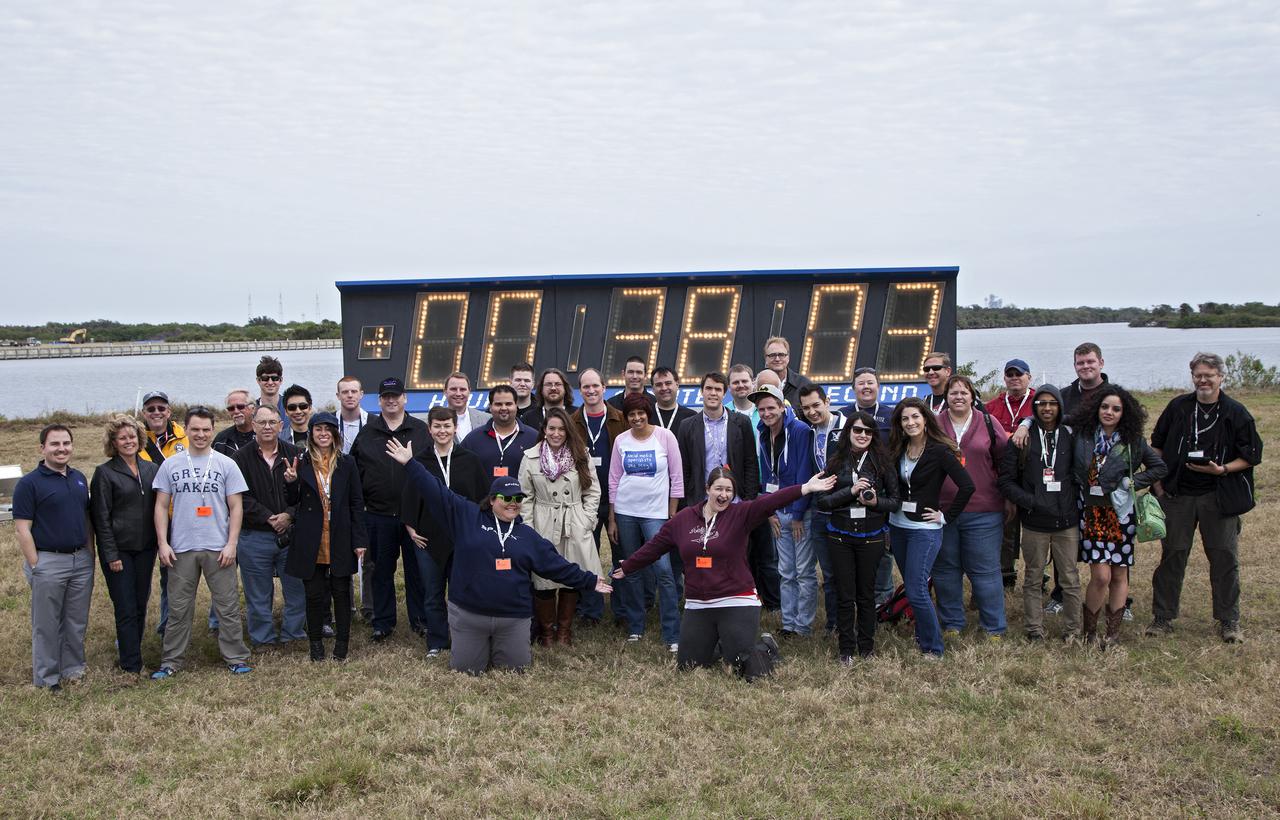
CAPE CANAVERAL, Fla. -- NASA social media followers pose for a group photo during two days of presentations on the launch of SpaceX-2. The social media participants gathered at the Florida spaceport on Feb. 28 and March 1, to hear from key leaders who updated the space agency's current efforts. Photo credit: NASA_Kim Shiflett
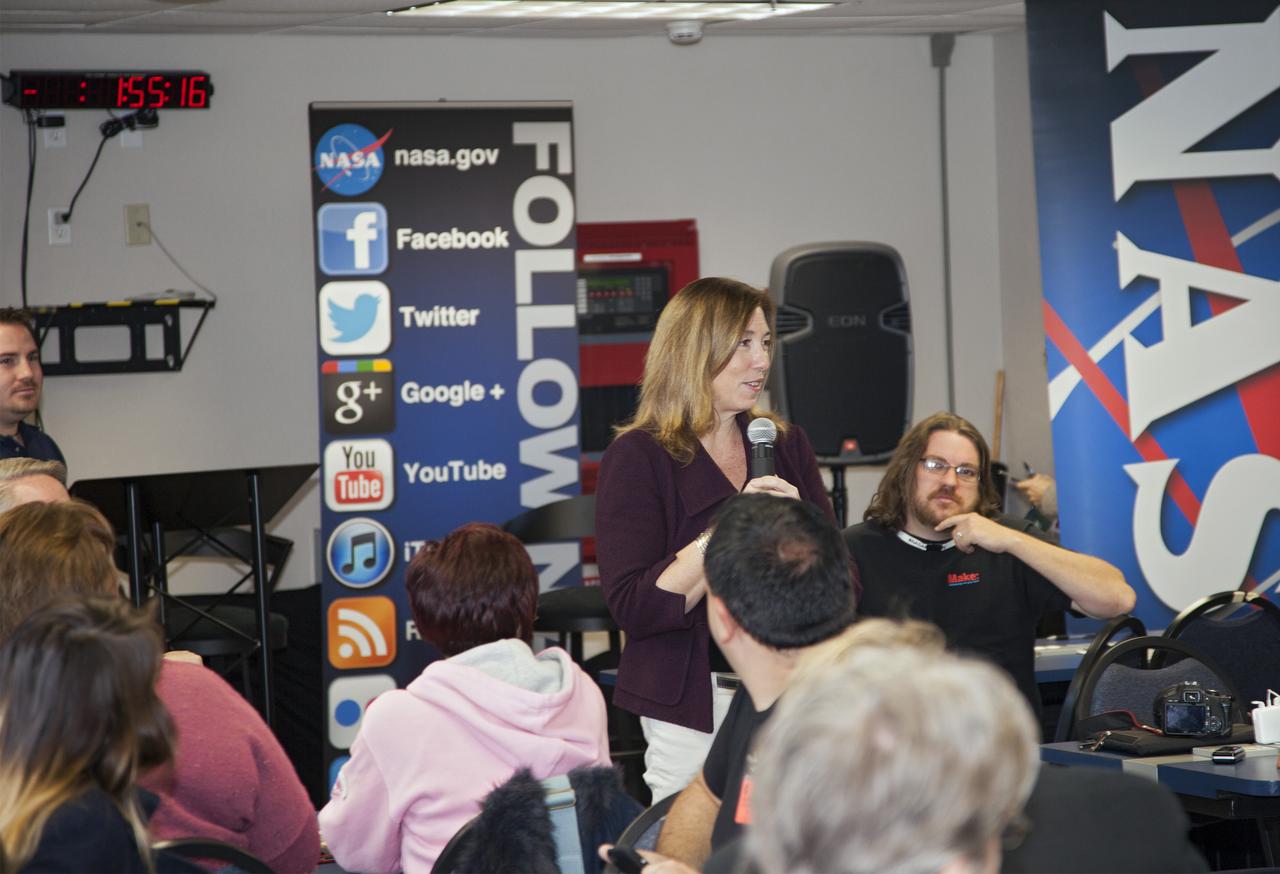
CAPE CANAVERAL, Fla. -- NASA Deputy Administrator Lori Garver speaks to some of the agency's social media followers during two days of presentations on the launch of SpaceX 2. The social media participants gathered at the Florida spaceport on Feb. 28 and March 1, to hear from key leaders who updated the space agency's current efforts. Photo credit: NASA_Lorne Mathre
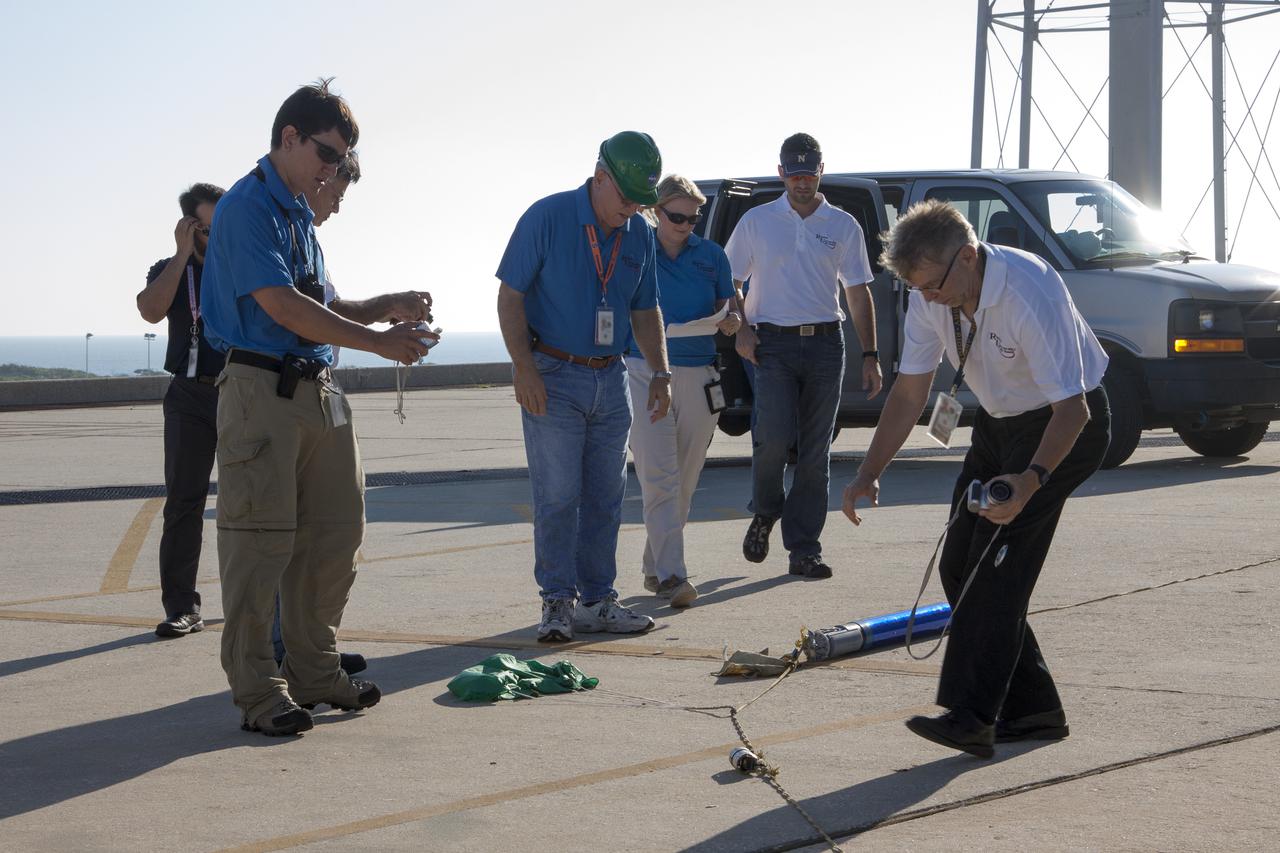
CAPE CANAVERAL, Fla. -- At NASA's Kennedy Space Center in Florida, engineers recover a small rocket following its launch as part of Rocket University. The goal was to test its systems and to verify that it performed as designed. As part of Rocket University, the engineers are given an opportunity to work a fast-track project to develop skills in developing spacecraft systems of the future. As NASA plans for future spaceflight programs to low-Earth orbit and beyond, teams of engineers at Kennedy are gaining experience in designing and flying launch vehicle systems on a small scale. Four teams of five to eight members from Kennedy are designing rockets complete with avionics and recovery systems. Launch operations require coordination with federal agencies, just as they would with rockets launched in support of a NASA mission. Photo credit: NASA_Jim Grossmann
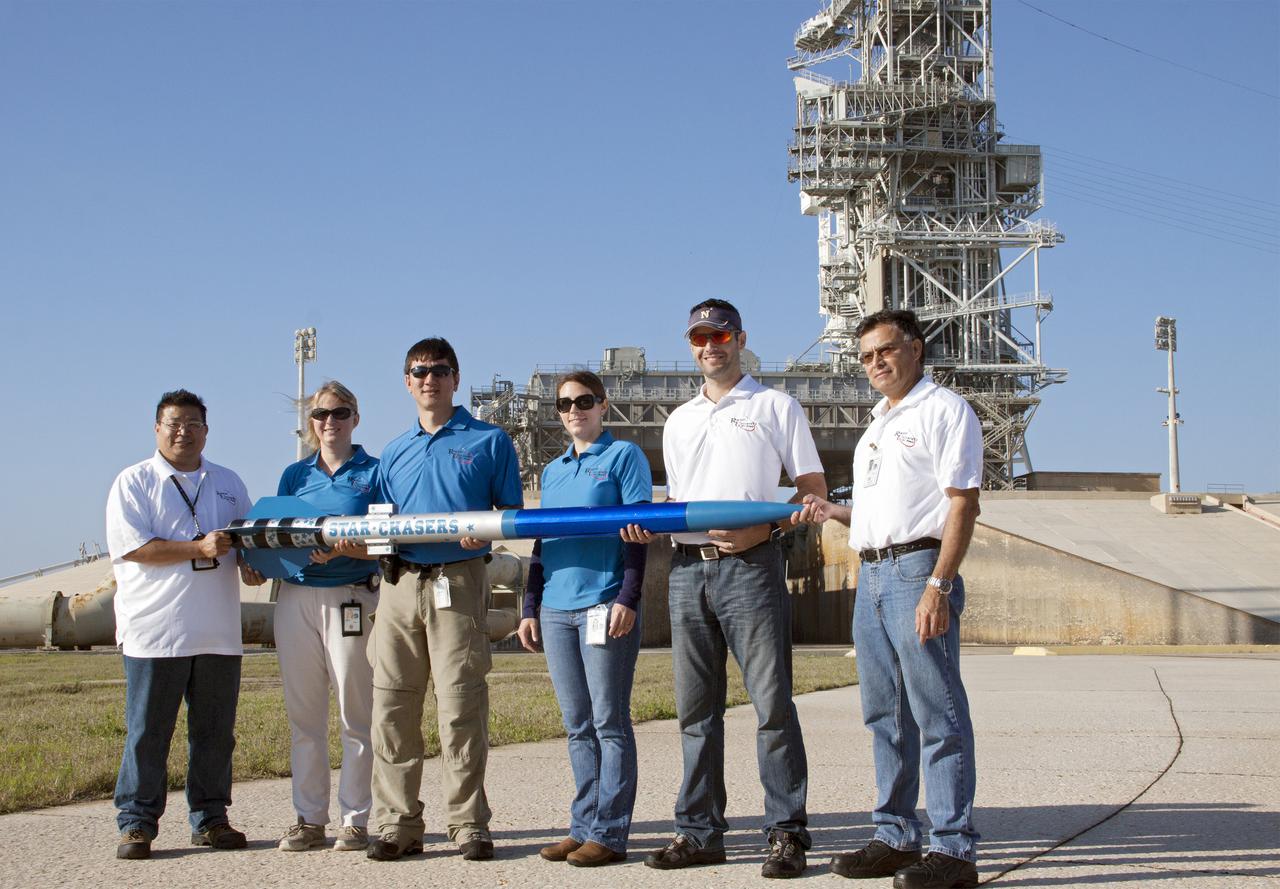
CAPE CANAVERAL, Fla. -- At NASA's Kennedy Space Center in Florida, engineers display a small rocket following its launch as part of Rocket University. From the left are Myphi Tran of Flight Instrumentation, Susan Danley of Flight Structures, Morgan Simpson of Flight Hardware Processing, Kim Simpson of Fluids, Mechanical and Structural Systems, Leandro James of Systems Hardware Engineering and Julio Najarro of Mechanical Assembly, Lifting and Handling. The goal was to test its systems and to verify that it performed as designed. As part of Rocket University, the engineers are given an opportunity to work a fast-track project to develop skills in developing spacecraft systems of the future. As NASA plans for future spaceflight programs to low-Earth orbit and beyond, teams of engineers at Kennedy are gaining experience in designing and flying launch vehicle systems on a small scale. Four teams of five to eight members from Kennedy are designing rockets complete with avionics and recovery systems. Launch operations require coordination with federal agencies, just as they would with rockets launched in support of a NASA mission. Photo credit: NASA_Jim Grossmann
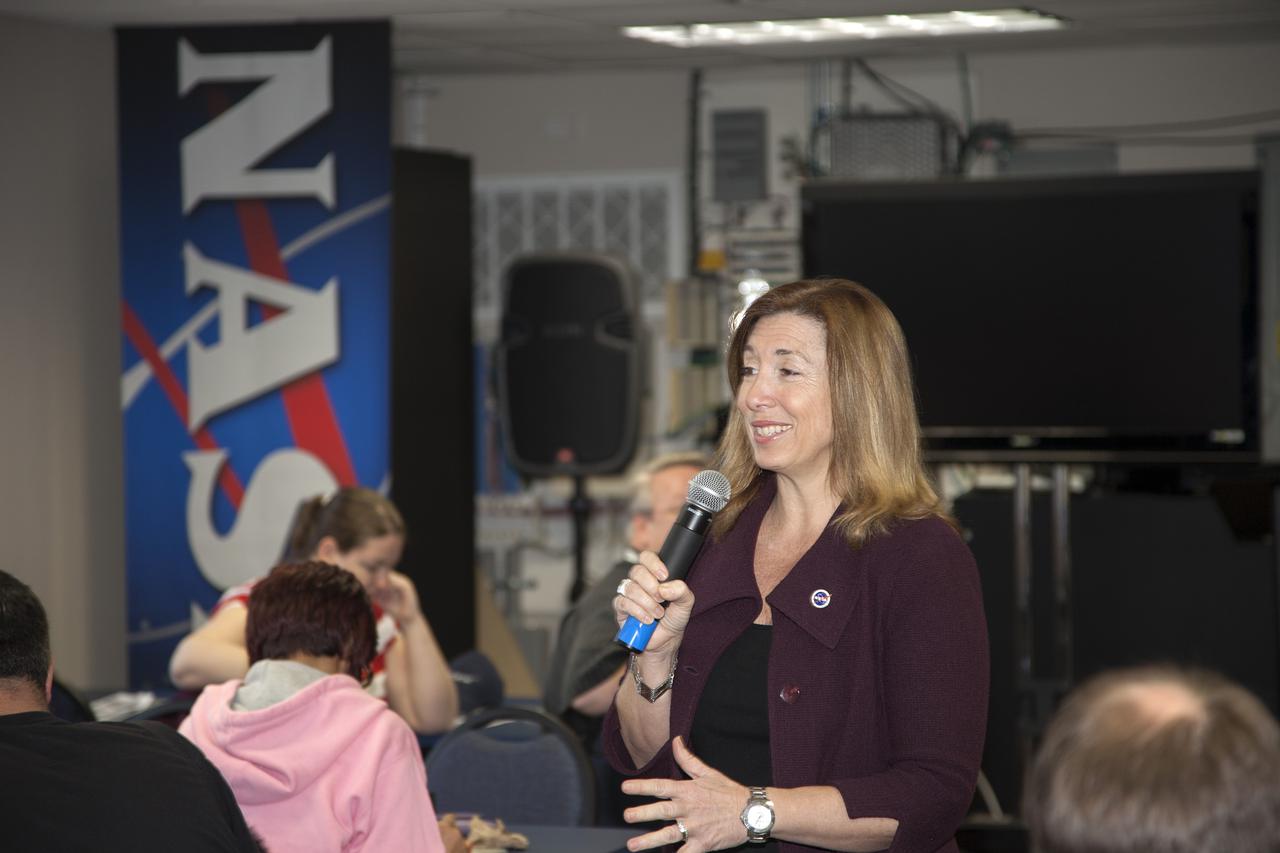
CAPE CANAVERAL, Fla. -- NASA Deputy Administrator Lori Garver speaks to some of the agency's social media followers during two days of presentations on the launch of SpaceX 2. The social media participants gathered at the Florida spaceport on Feb. 28 and March 1, to hear from key leaders who updated the space agency's current efforts. Photo credit: NASA_Lorne Mathre
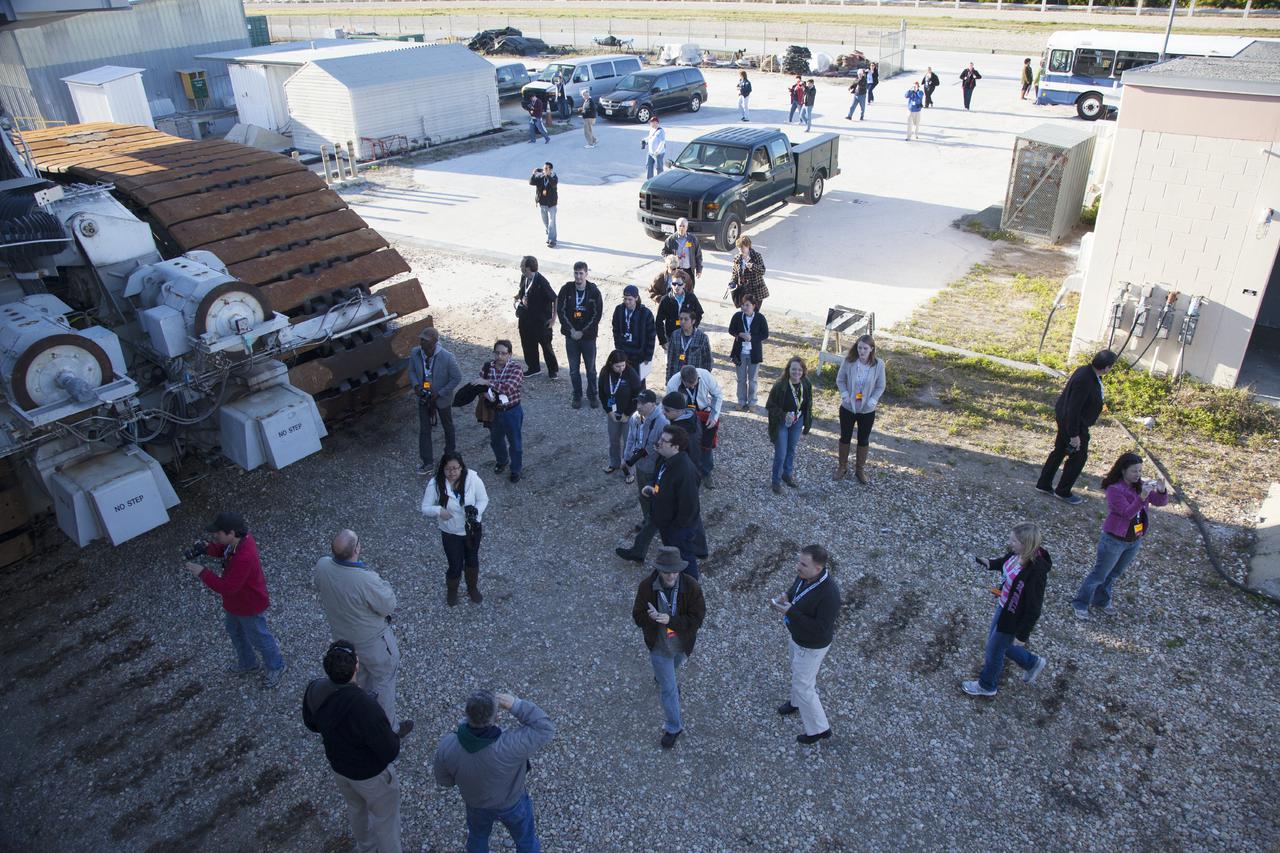
CAPE CANAVERAL, Fla. -- At NASA's Kennedy Space Center in Florida, social media participants were given an up-close look at one of the spaceport's mammoth crawler-transporters. Recent work has included preparations to install upgraded components that will enable the crawler to carry the greater loads anticipated with the agency's new rocket designed to take astronauts beyond low-Earth orbit for the first time since the early 1970s. The social media participants gathered at the Florida spaceport for the launch of the Tracking and Data Relay Satellite, or TDRS-L spacecraft. Their visit included tours of key facilities and participating in presentations by key NASA leaders who updated the space agency's current efforts. Photo credit: NASA_Dan Casper
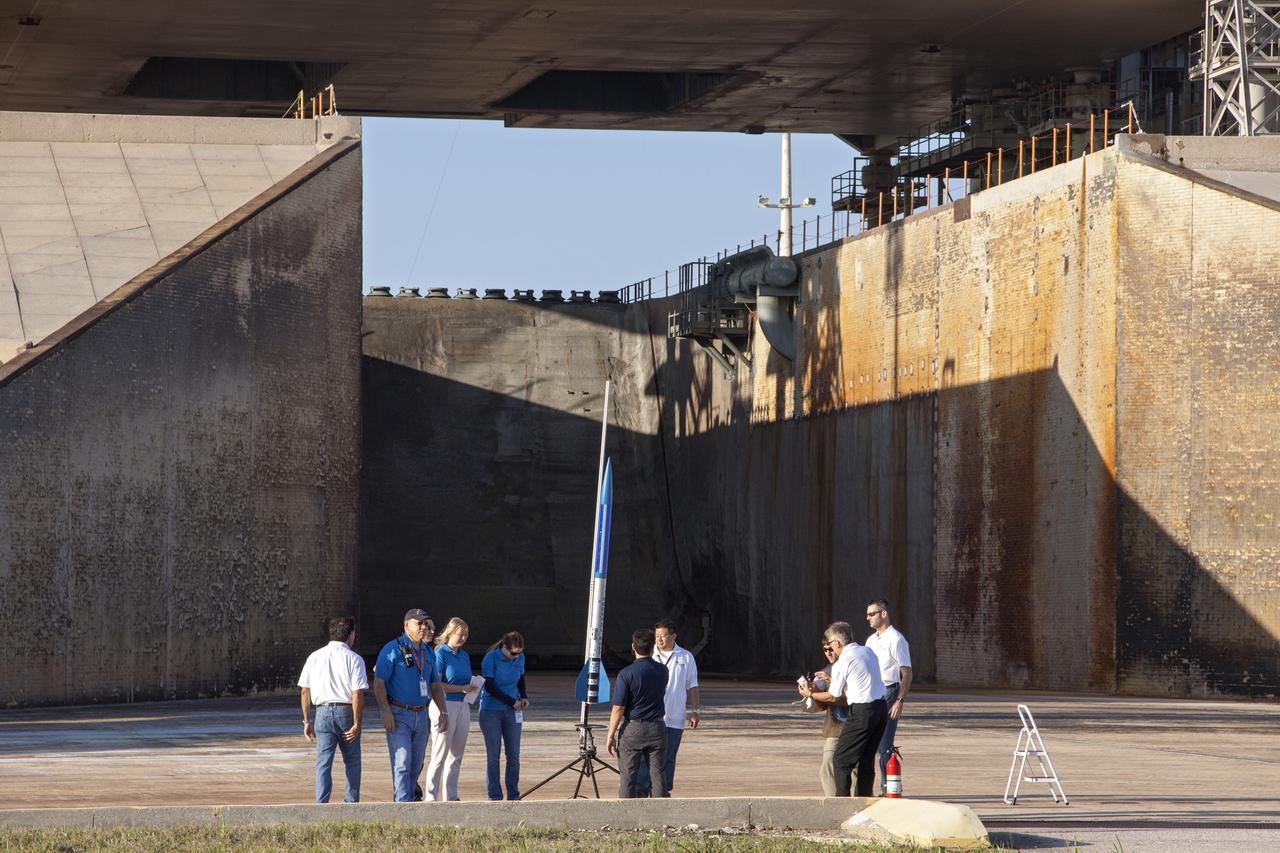
CAPE CANAVERAL, Fla. -- At NASA's Kennedy Space Center in Florida, engineers complete final checkouts of a small rocket on its launch stand as part of Rocket University. The goal was to test its systems and to verify that it performed as designed. As part of Rocket University, the engineers are given an opportunity to work a fast-track project to develop skills in developing spacecraft systems of the future. As NASA plans for future spaceflight programs to low-Earth orbit and beyond, teams of engineers at Kennedy are gaining experience in designing and flying launch vehicle systems on a small scale. Four teams of five to eight members from Kennedy are designing rockets complete with avionics and recovery systems. Launch operations require coordination with federal agencies, just as they would with rockets launched in support of a NASA mission. Photo credit: NASA_Jim Grossmann
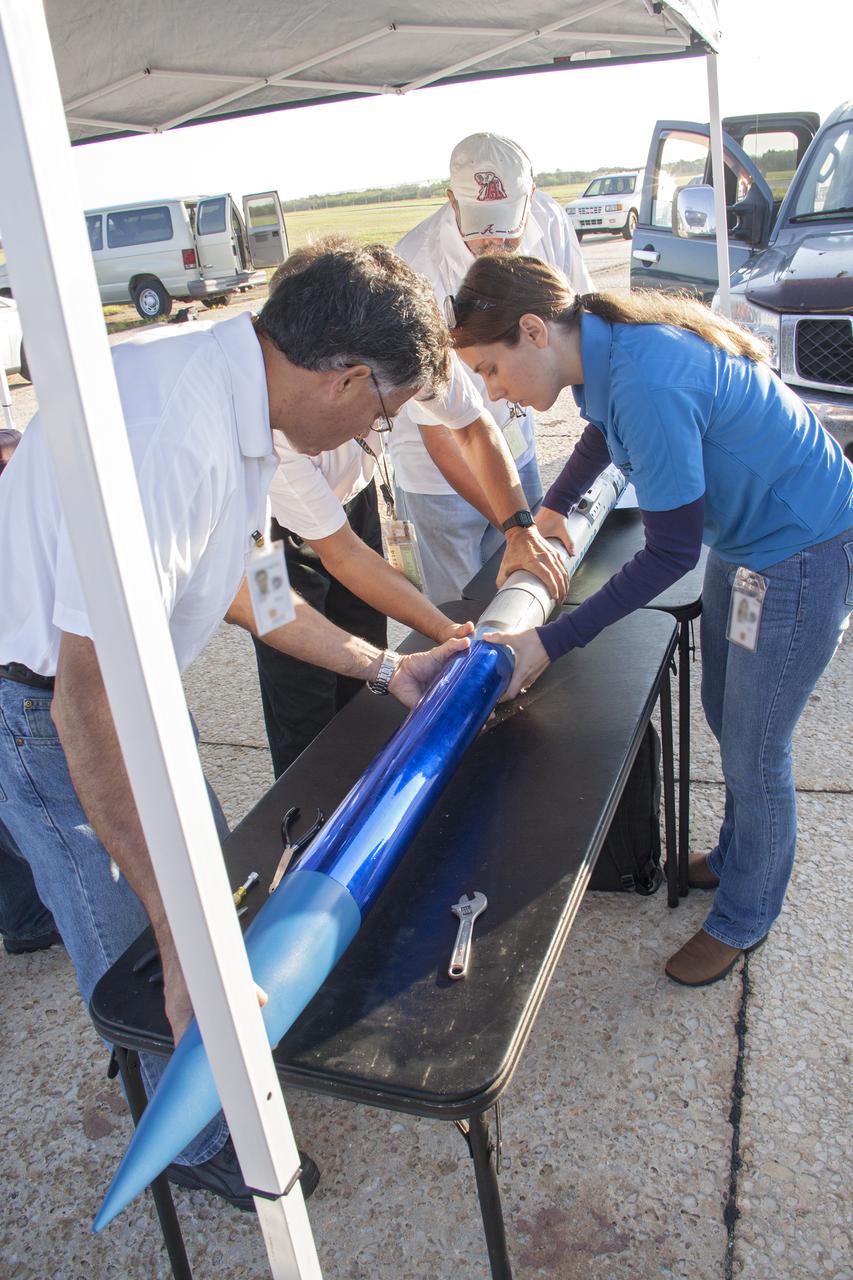
CAPE CANAVERAL, Fla. -- At NASA's Kennedy Space Center in Florida, engineers make final adjustments to a small rocket prior to launch as part of Rocket University. The goal was to test its systems and to verify that it performed as designed. As part of Rocket University, the engineers are given an opportunity to work a fast-track project to develop skills in developing spacecraft systems of the future. As NASA plans for future spaceflight programs to low-Earth orbit and beyond, teams of engineers at Kennedy are gaining experience in designing and flying launch vehicle systems on a small scale. Four teams of five to eight members from Kennedy are designing rockets complete with avionics and recovery systems. Launch operations require coordination with federal agencies, just as they would with rockets launched in support of a NASA mission. Photo credit: NASA_Jim Grossmann
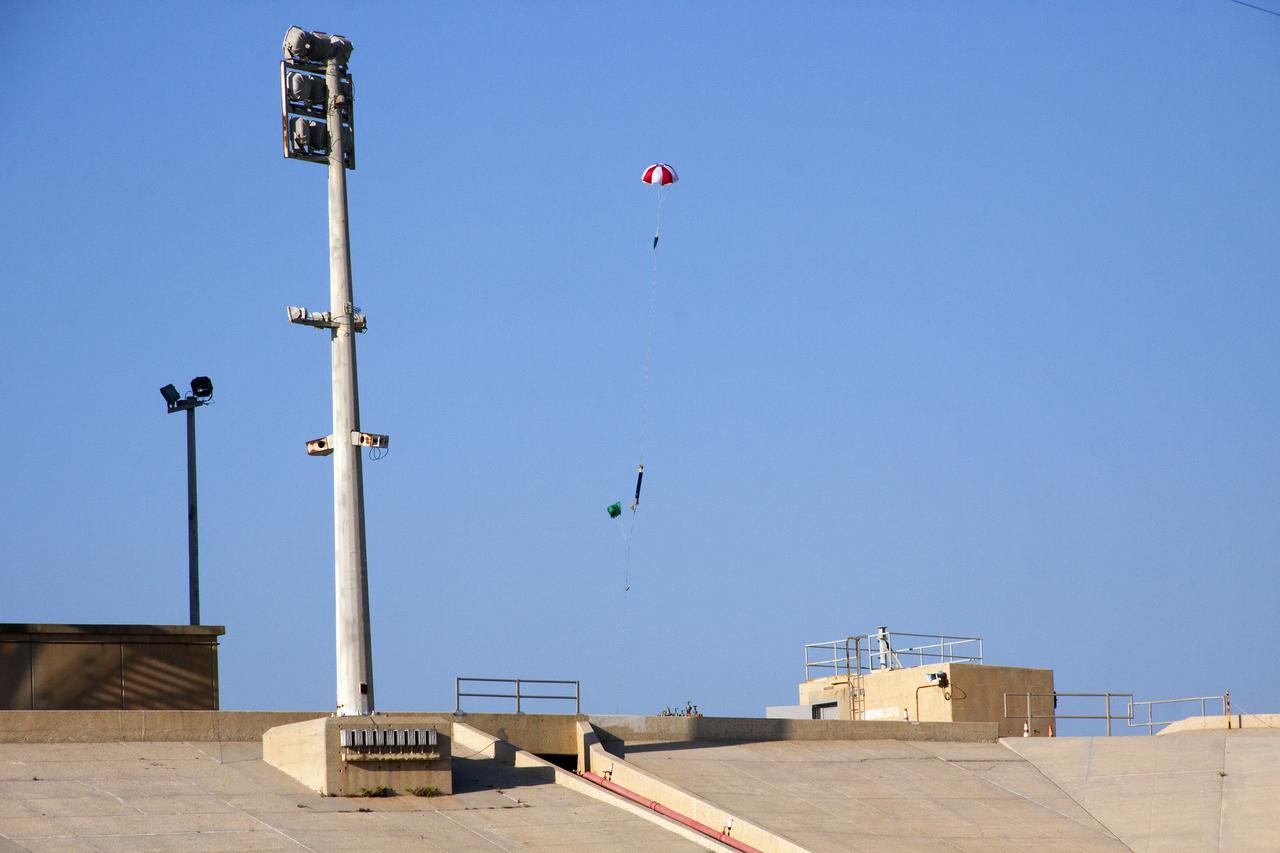
CAPE CANAVERAL, Fla. -- At NASA's Kennedy Space Center in Florida, a small rocket descends under a parachute after liftoff from Launch Pad 39A as part of Rocket University. The goal was to test its systems and to verify that it performed as designed. As part of Rocket University, the engineers are given an opportunity to work a fast-track project to develop skills in developing spacecraft systems of the future. As NASA plans for future spaceflight programs to low-Earth orbit and beyond, teams of engineers at Kennedy are gaining experience in designing and flying launch vehicle systems on a small scale. Four teams of five to eight members from Kennedy are designing rockets complete with avionics and recovery systems. Launch operations require coordination with federal agencies, just as they would with rockets launched in support of a NASA mission. Photo credit: NASA_Jim Grossmann

CAPE CANAVERAL, Fla. -- At NASA's Kennedy Space Center in Florida, engineers make final adjustments to a small rocket prior to launch as part of Rocket University. The goal was to test its systems and to verify that it performed as designed. As part of Rocket University, the engineers are given an opportunity to work a fast-track project to develop skills in developing spacecraft systems of the future. As NASA plans for future spaceflight programs to low-Earth orbit and beyond, teams of engineers at Kennedy are gaining experience in designing and flying launch vehicle systems on a small scale. Four teams of five to eight members from Kennedy are designing rockets complete with avionics and recovery systems. Launch operations require coordination with federal agencies, just as they would with rockets launched in support of a NASA mission. Photo credit: NASA_Jim Grossmann
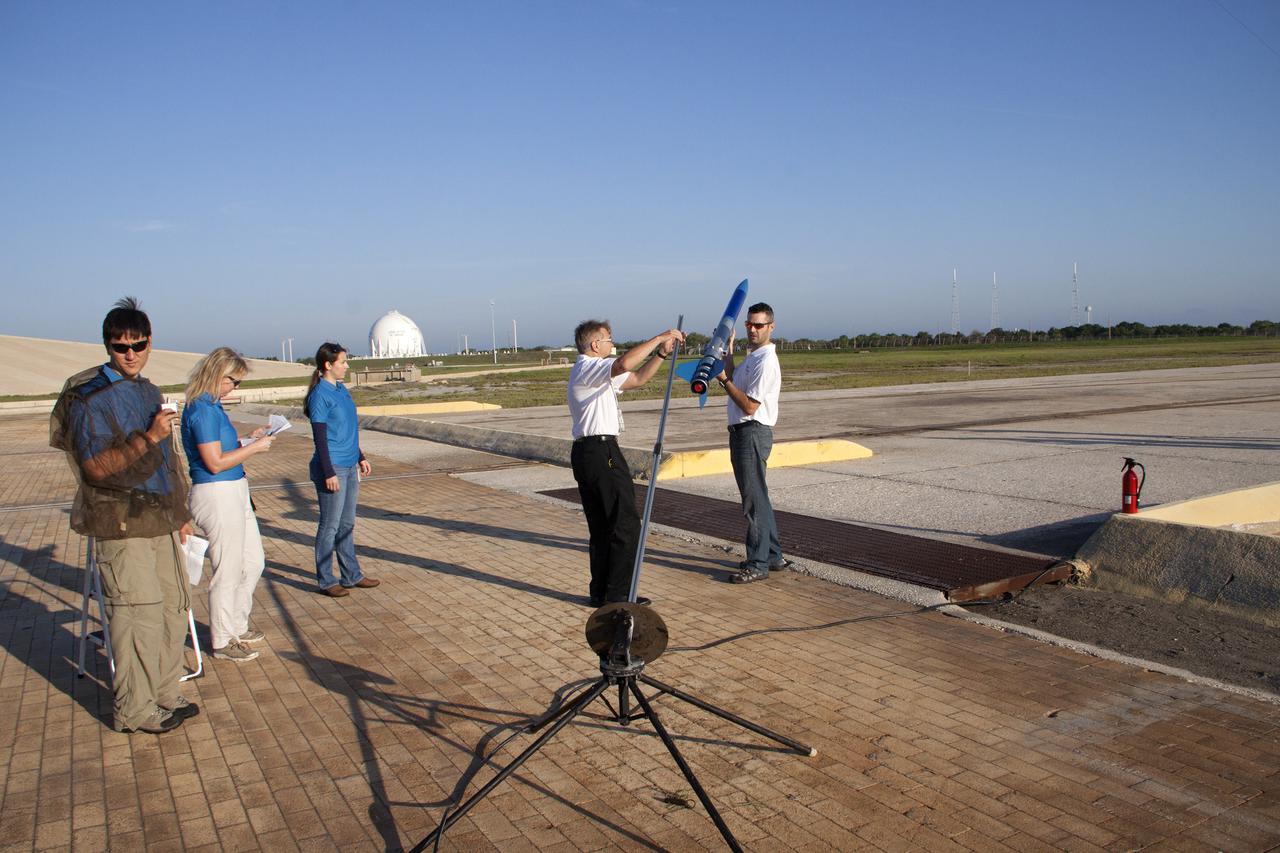
CAPE CANAVERAL, Fla. -- At NASA's Kennedy Space Center in Florida, as Morgan Simpson of Flight Hardware Processing, Susan Danley of Flight Structures and Kim Simpson of Fluids, Mechanical and Structural Systems look on, Gary Dahlke of Engineering and Technology, left, and Leandro James of Systems Hardware Engineering attach a small rocket prior to its launch stand as part of Rocket University. The goal was to test its systems and to verify that it performed as designed. As part of Rocket University, the engineers are given an opportunity to work a fast-track project to develop skills in developing spacecraft systems of the future. As NASA plans for future spaceflight programs to low-Earth orbit and beyond, teams of engineers at Kennedy are gaining experience in designing and flying launch vehicle systems on a small scale. Four teams of five to eight members from Kennedy are designing rockets complete with avionics and recovery systems. Launch operations require coordination with federal agencies, just as they would with rockets launched in support of a NASA mission. Photo credit: NASA_Jim Grossmann
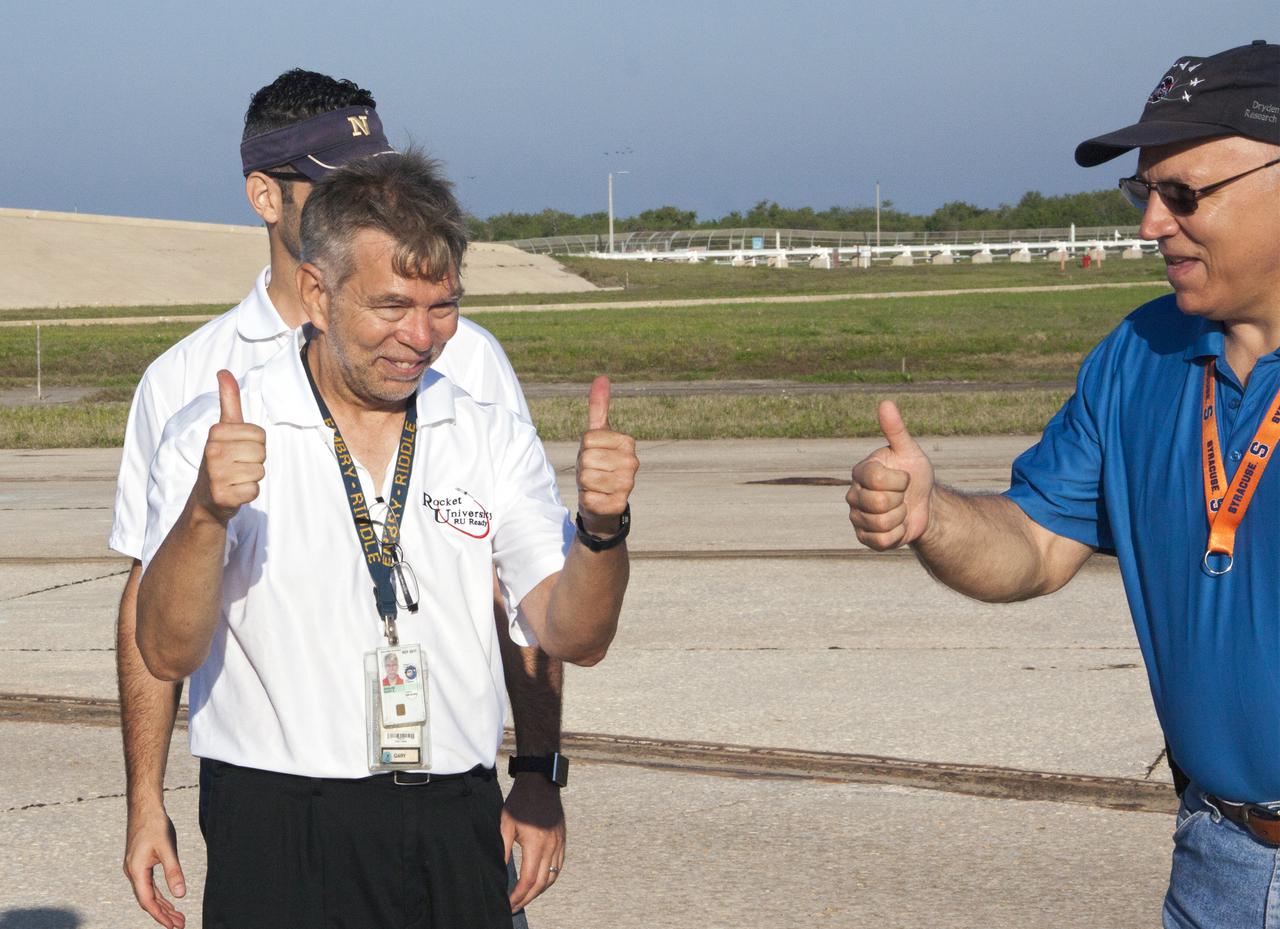
CAPE CANAVERAL, Fla. -- At NASA's Kennedy Space Center in Florida, Gary Dahlke of Engineering and Technology, left and Peter Checklick of Safety and Mission Assurance give 'thumbs up' after the successful launch of a small rocket at Launch Pad 39A as part of Rocket University. Leandro James of Systems Hardware Engineering is partially obscured by Dahlke. The goal was to test its systems and to verify that it performed as designed. As part of Rocket University, the engineers are given an opportunity to work a fast-track project to develop skills in developing spacecraft systems of the future. As NASA plans for future spaceflight programs to low-Earth orbit and beyond, teams of engineers at Kennedy are gaining experience in designing and flying launch vehicle systems on a small scale. Four teams of five to eight members from Kennedy are designing rockets complete with avionics and recovery systems. Launch operations require coordination with federal agencies, just as they would with rockets launched in support of a NASA mission. Photo credit: NASA_Jim Grossmann
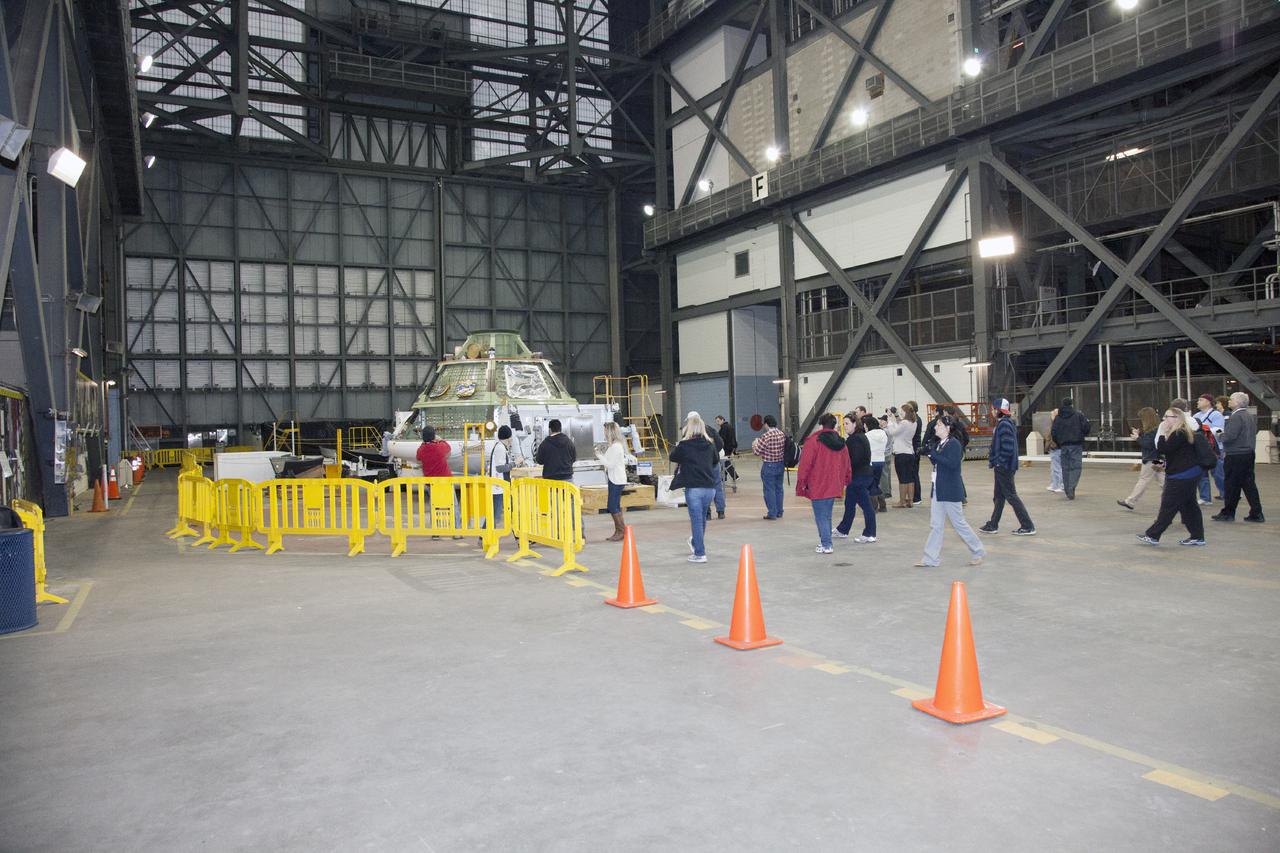
CAPE CANAVERAL, Fla. -- At NASA's Kennedy Space Center in Florida, social media participants were given an opportunity to go inside the spaceport's Vehicle Assembly Building. They were given an opportunity to see the Orion spacecraft currently being prepared for its first flight test, Exploration Flight Test EFT-1. The social media participants gathered at the Florida spaceport for the launch of the Tracking and Data Relay Satellite, or TDRS-L spacecraft. Their visit included tours of key facilities and participating in presentations by key NASA leaders who updated the space agency's current efforts. Photo credit: NASA_Dan Casper
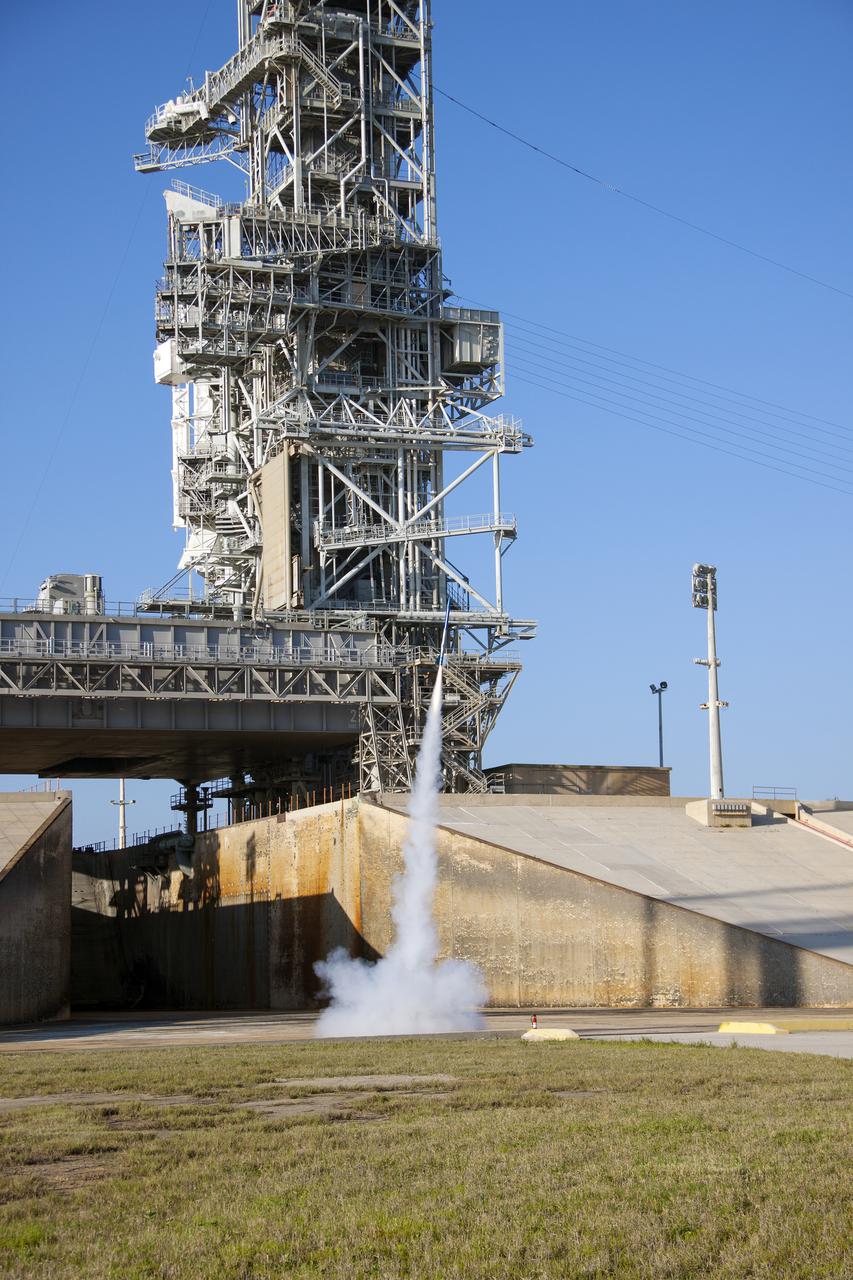
CAPE CANAVERAL, Fla. -- At NASA's Kennedy Space Center in Florida, a small rocket lifts off as part of Rocket University. The goal was to test its systems and to verify that it performed as designed. As part of Rocket University, the engineers are given an opportunity to work a fast-track project to develop skills in developing spacecraft systems of the future. As NASA plans for future spaceflight programs to low-Earth orbit and beyond, teams of engineers at Kennedy are gaining experience in designing and flying launch vehicle systems on a small scale. Four teams of five to eight members from Kennedy are designing rockets complete with avionics and recovery systems. Launch operations require coordination with federal agencies, just as they would with rockets launched in support of a NASA mission. Photo credit: NASA_Jim Grossmann
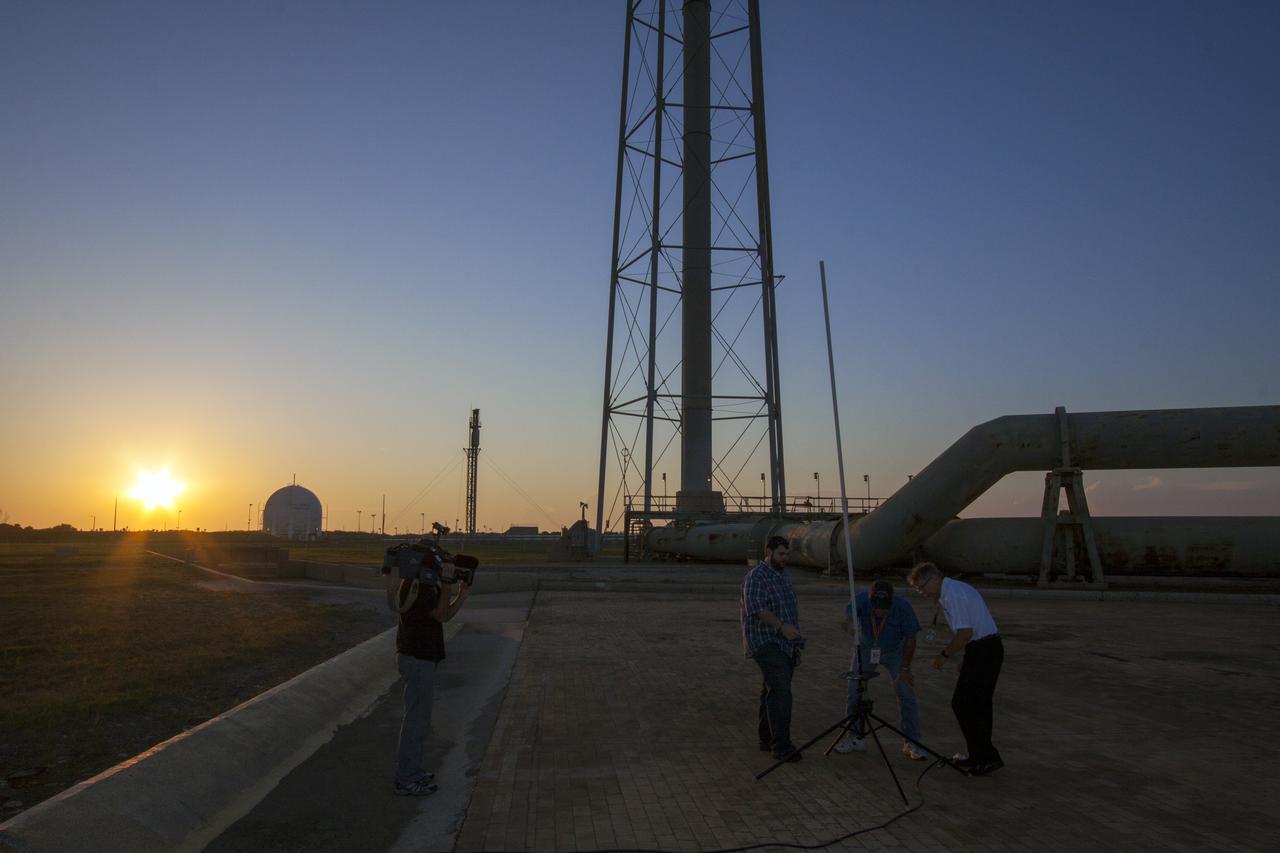
CAPE CANAVERAL, Fla. -- As the sun rises at NASA's Kennedy Space Center's Launch Pad 39A in Florida, a team of NASA engineers prepare to launch a single stage rocket as part of Rocket University. The goal was to test its systems and to verify that it performed as designed. As part of Rocket University, the engineers are given an opportunity to work a fast-track project to develop skills in developing spacecraft systems of the future. As NASA plans for future spaceflight programs to low-Earth orbit and beyond, teams of engineers at Kennedy are gaining experience in designing and flying launch vehicle systems on a small scale. Four teams of five to eight members from Kennedy are designing rockets complete with avionics and recovery systems. Launch operations require coordination with federal agencies, just as they would with rockets launched in support of a NASA mission. Photo credit: NASA_Jim Grossmann
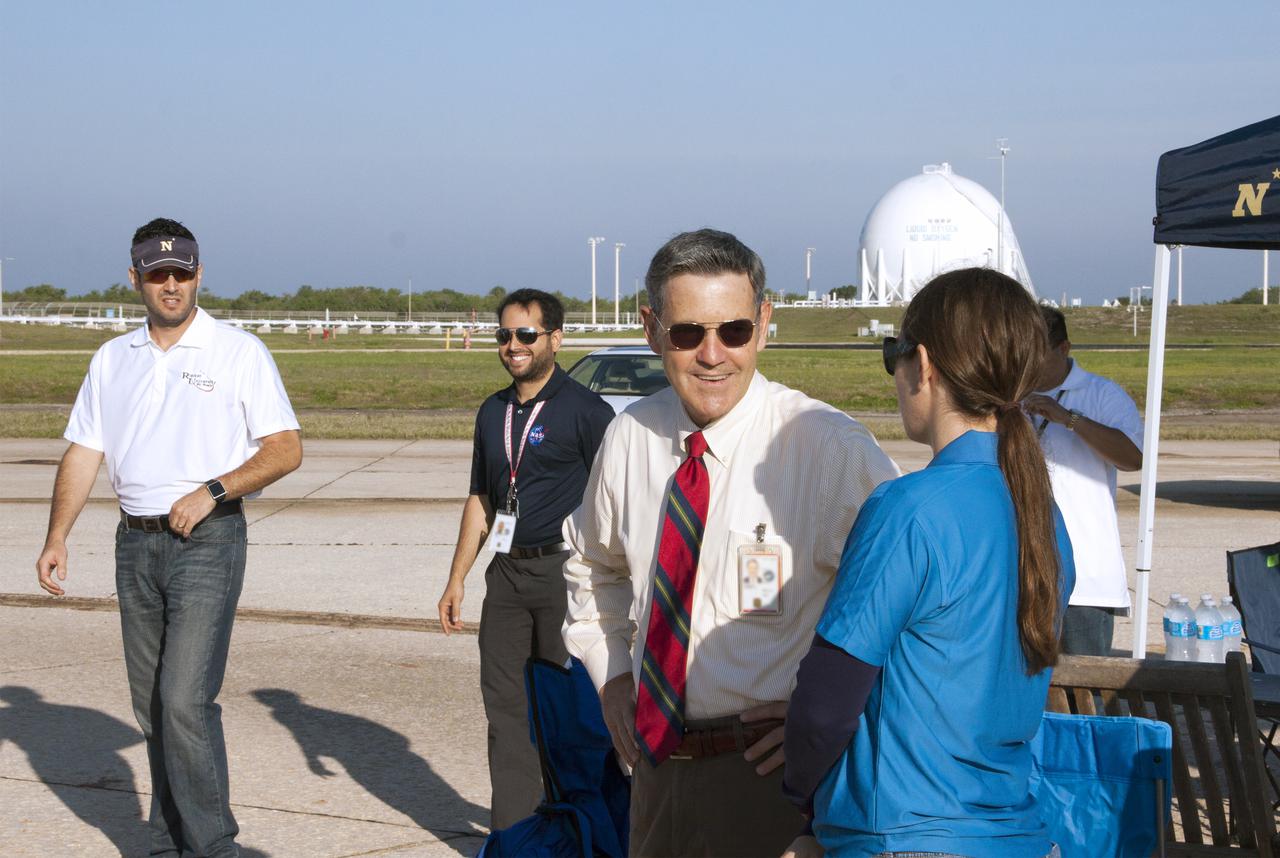
CAPE CANAVERAL, Fla. -- At NASA's Kennedy Space Center in Florida, center director Bob Cabana congratulates engineers on the successful launch of a small rocket at Launch Pad 39A as part of Rocket University. From the left are Leandro James of Systems Hardware Engineering, Kelvin Ruiz of Systems Hardware Engineering, Cabana and Kim Simpson of Fluids, Mechanical and Structural Systems. The goal was to test its systems and to verify that it performed as designed. As part of Rocket University, the engineers are given an opportunity to work a fast-track project to develop skills in developing spacecraft systems of the future. As NASA plans for future spaceflight programs to low-Earth orbit and beyond, teams of engineers at Kennedy are gaining experience in designing and flying launch vehicle systems on a small scale. Four teams of five to eight members from Kennedy are designing rockets complete with avionics and recovery systems. Launch operations require coordination with federal agencies, just as they would with rockets launched in support of a NASA mission. Photo credit: NASA_Jim Grossmann
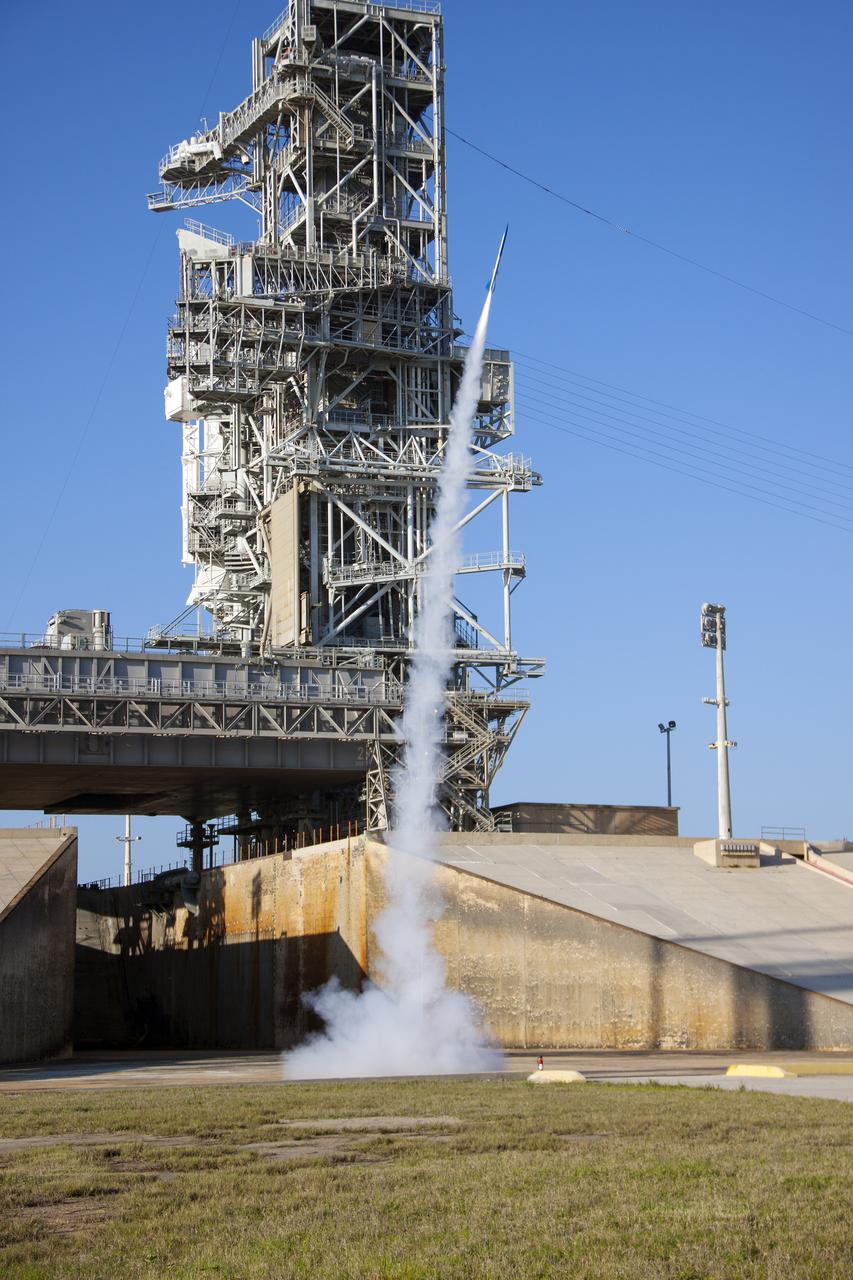
CAPE CANAVERAL, Fla. -- At NASA's Kennedy Space Center in Florida, a small rocket lifts off as part of Rocket University. The goal was to test its systems and to verify that it performed as designed. As part of Rocket University, the engineers are given an opportunity to work a fast-track project to develop skills in developing spacecraft systems of the future. As NASA plans for future spaceflight programs to low-Earth orbit and beyond, teams of engineers at Kennedy are gaining experience in designing and flying launch vehicle systems on a small scale. Four teams of five to eight members from Kennedy are designing rockets complete with avionics and recovery systems. Launch operations require coordination with federal agencies, just as they would with rockets launched in support of a NASA mission. Photo credit: NASA_Jim Grossmann
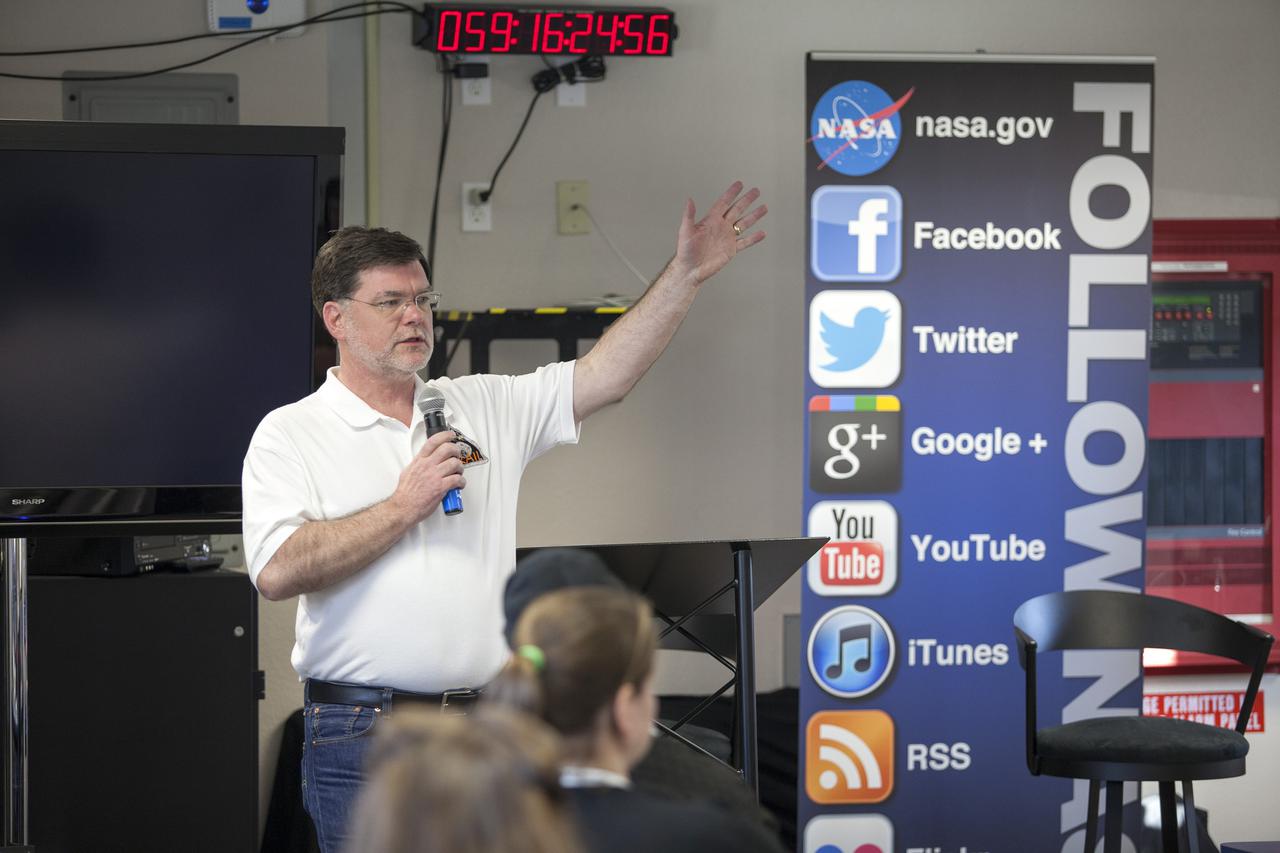
CAPE CANAVERAL, Fla. -- NASA Deputy Chief Technologist James Adams speaks to some of the agency's social media followers during two days of presentations on the launch of SpaceX-2. The social media participants gathered at the Florida spaceport on Feb. 28 and March 1, to hear from key leaders who updated the space agency's current efforts. Photo credit: NASA_Frankie Martin
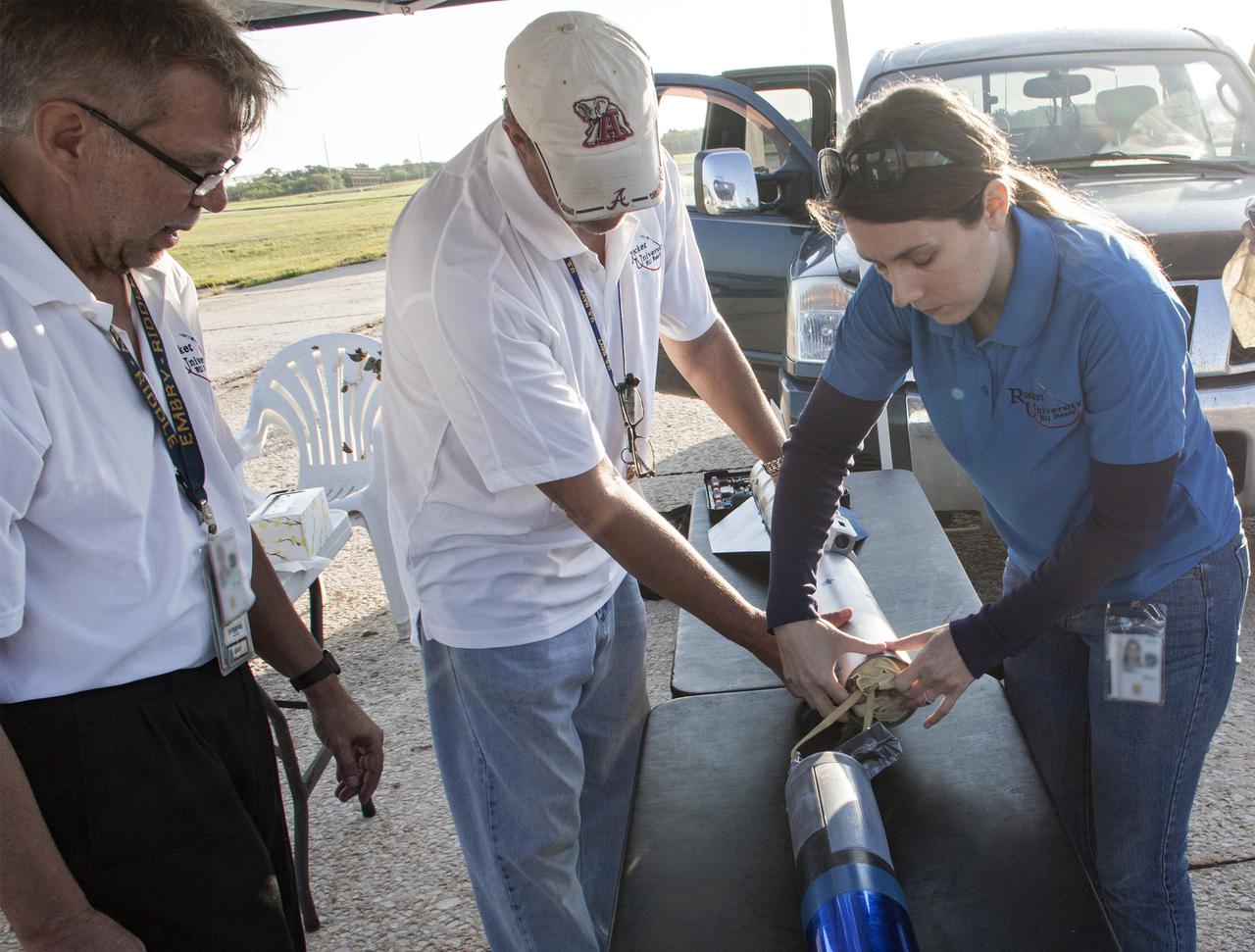
CAPE CANAVERAL, Fla. -- At NASA's Kennedy Space Center in Florida, from the left, Gary Dahlke of Engineering and Technology, George Mizell of Quality Assurance and Kim Simpson of Fluids, Mechanical and Structural Systems make final adjustments to a small rocket prior to launch as part of Rocket University. The goal was to test its systems and to verify that it performed as designed. As part of Rocket University, the engineers are given an opportunity to work a fast-track project to develop skills in developing spacecraft systems of the future. As NASA plans for future spaceflight programs to low-Earth orbit and beyond, teams of engineers at Kennedy are gaining experience in designing and flying launch vehicle systems on a small scale. Four teams of five to eight members from Kennedy are designing rockets complete with avionics and recovery systems. Launch operations require coordination with federal agencies, just as they would with rockets launched in support of a NASA mission. Photo credit: NASA_Jim Grossmann
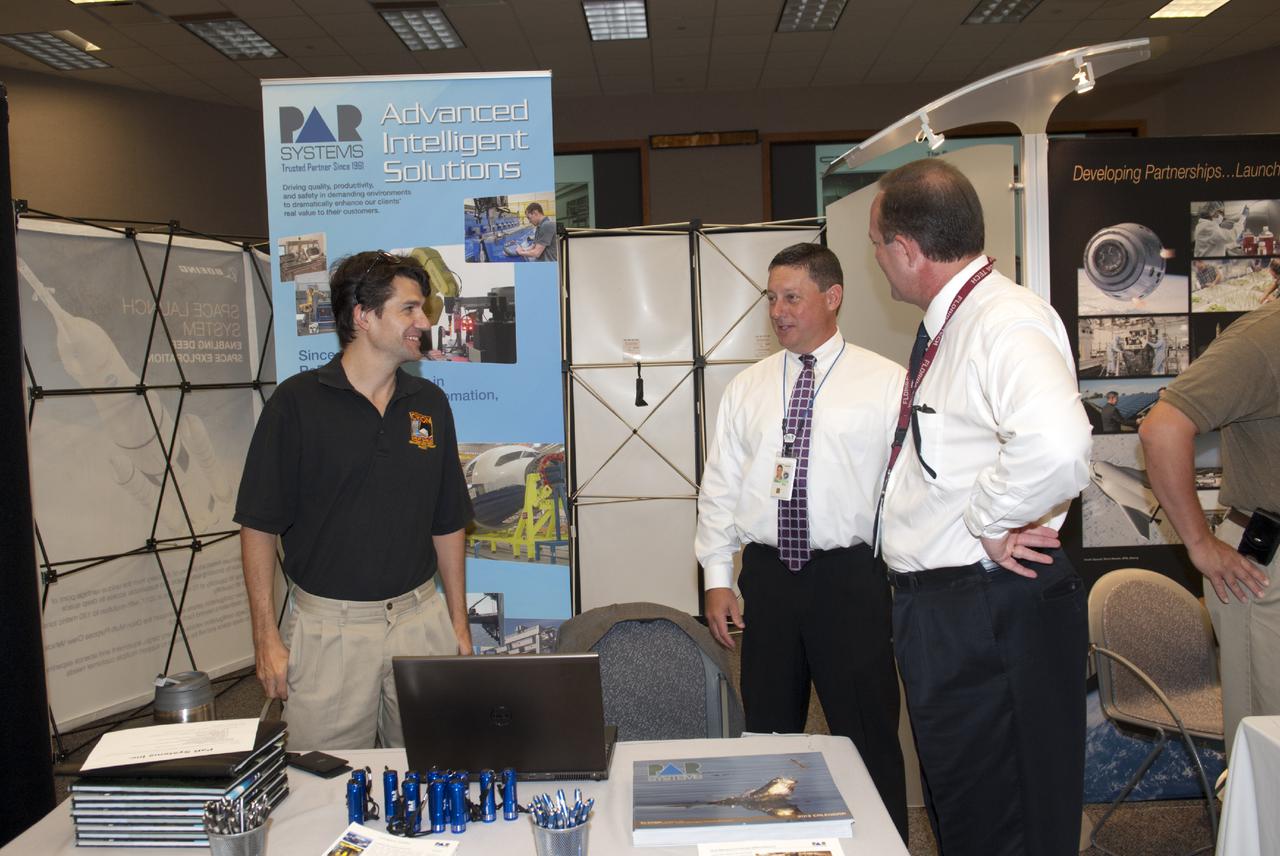
CAPE CANAVERAL, Fla. -- At the Kennedy Space Center in Florida, representatives of PaR Systems talk with guests at the Innovation Expo KSC Showcase. The event gave Kennedy employees an opportunity to meet 12 NASA partners and see how the Center Planning and Development Directorate is transforming Kennedy into a multi-user spaceport through partnerships and resource planning. The 17-booth exhibit consists of 12 partner booths along with Spaceport Planning, Partnership Development and Research and Technology offices. Photo credit: NASA_Charisse Nahser
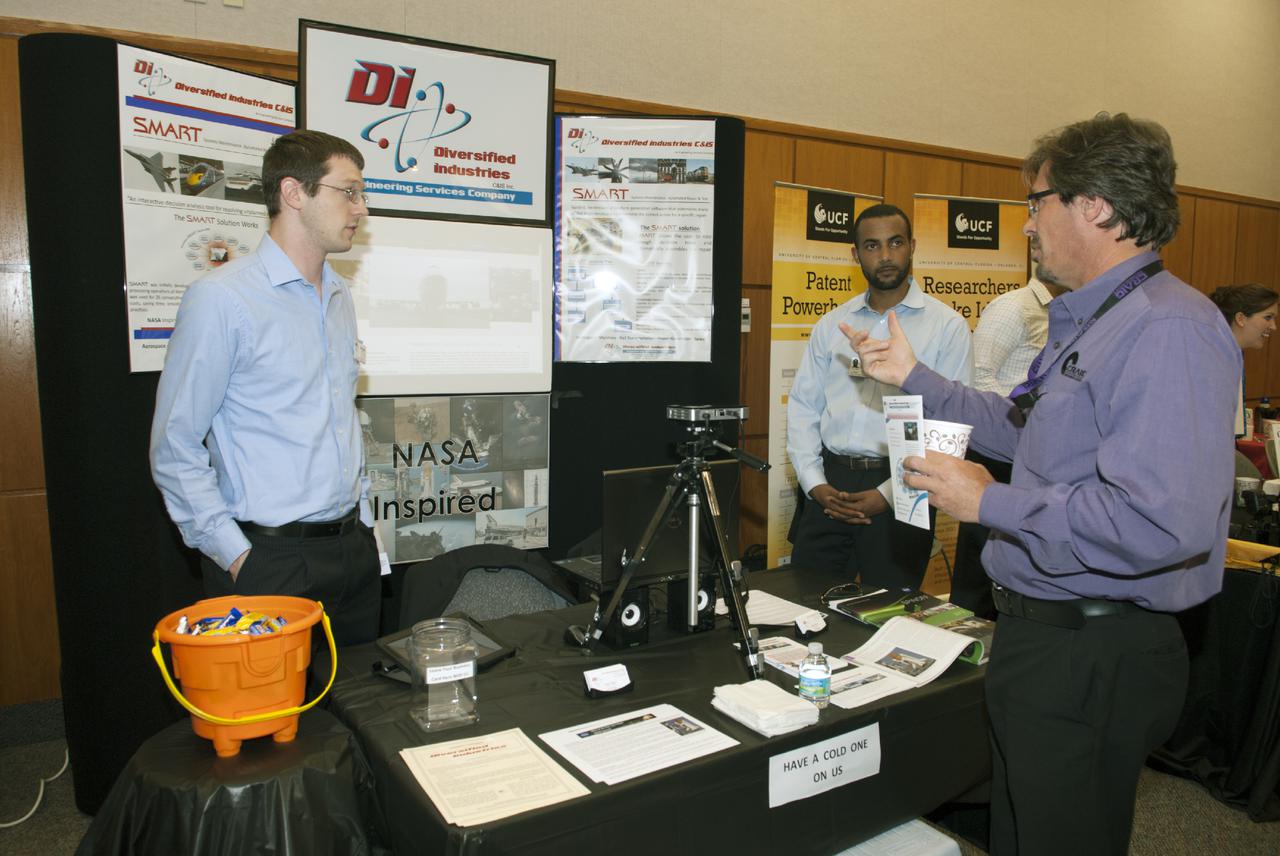
CAPE CANAVERAL, Fla. -- At the Kennedy Space Center in Florida, representatives of Diversified Industries talk with guests at the Innovation Expo KSC Showcase. The event gave Kennedy employees an opportunity to meet 12 NASA partners and see how the Center Planning and Development Directorate is transforming Kennedy into a multi-user spaceport through partnerships and resource planning. The 17-booth exhibit consists of 12 partner booths along with Spaceport Planning, Partnership Development and Research and Technology offices. Photo credit: NASA_Charisse Nahser
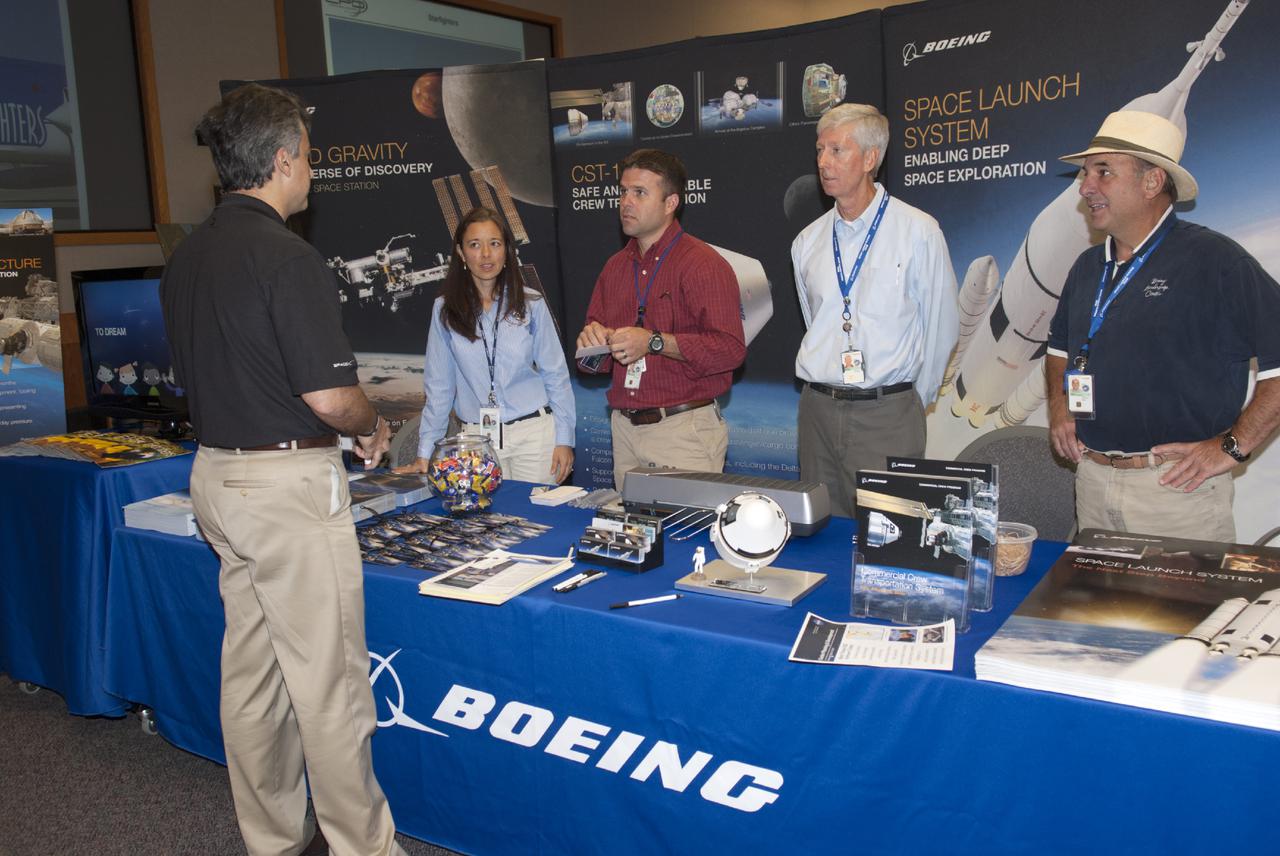
CAPE CANAVERAL, Fla. -- At the Kennedy Space Center in Florida, representatives of Boeing talk with guests at the Innovation Expo KSC Showcase. The event gave Kennedy employees an opportunity to meet 12 NASA partners and see how the Center Planning and Development Directorate is transforming Kennedy into a multi-user spaceport through partnerships and resource planning. The 17-booth exhibit consists of 12 partner booths along with Spaceport Planning, Partnership Development and Research and Technology offices. Photo credit: NASA_Charisse Nahser
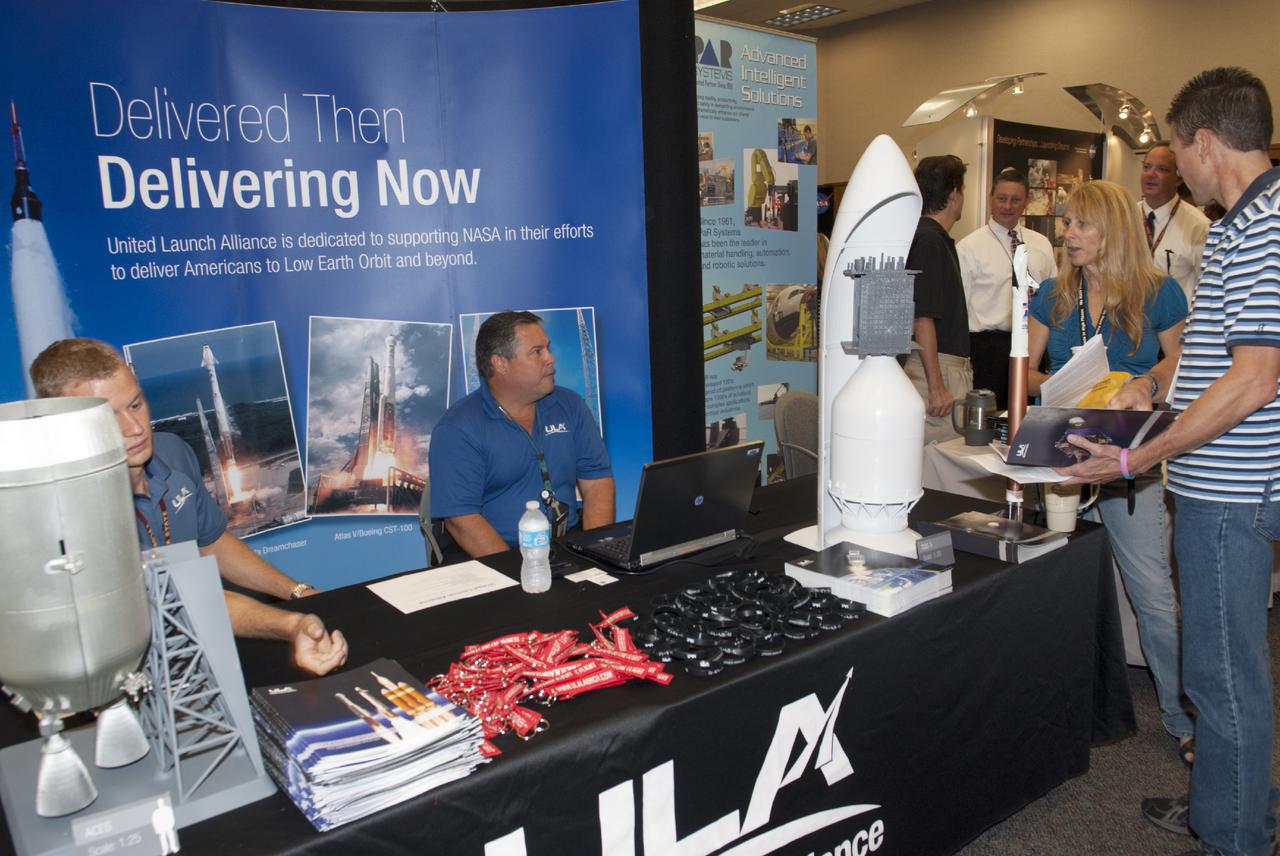
CAPE CANAVERAL, Fla. -- At the Kennedy Space Center in Florida, representatives of United Launch Alliance talk with guests at the Innovation Expo KSC Showcase. The event gave Kennedy employees an opportunity to meet 12 NASA partners and see how the Center Planning and Development Directorate is transforming Kennedy into a multi-user spaceport through partnerships and resource planning. The 17-booth exhibit consists of 12 partner booths along with Spaceport Planning, Partnership Development and Research and Technology offices. Photo credit: NASA_Charisse Nahser
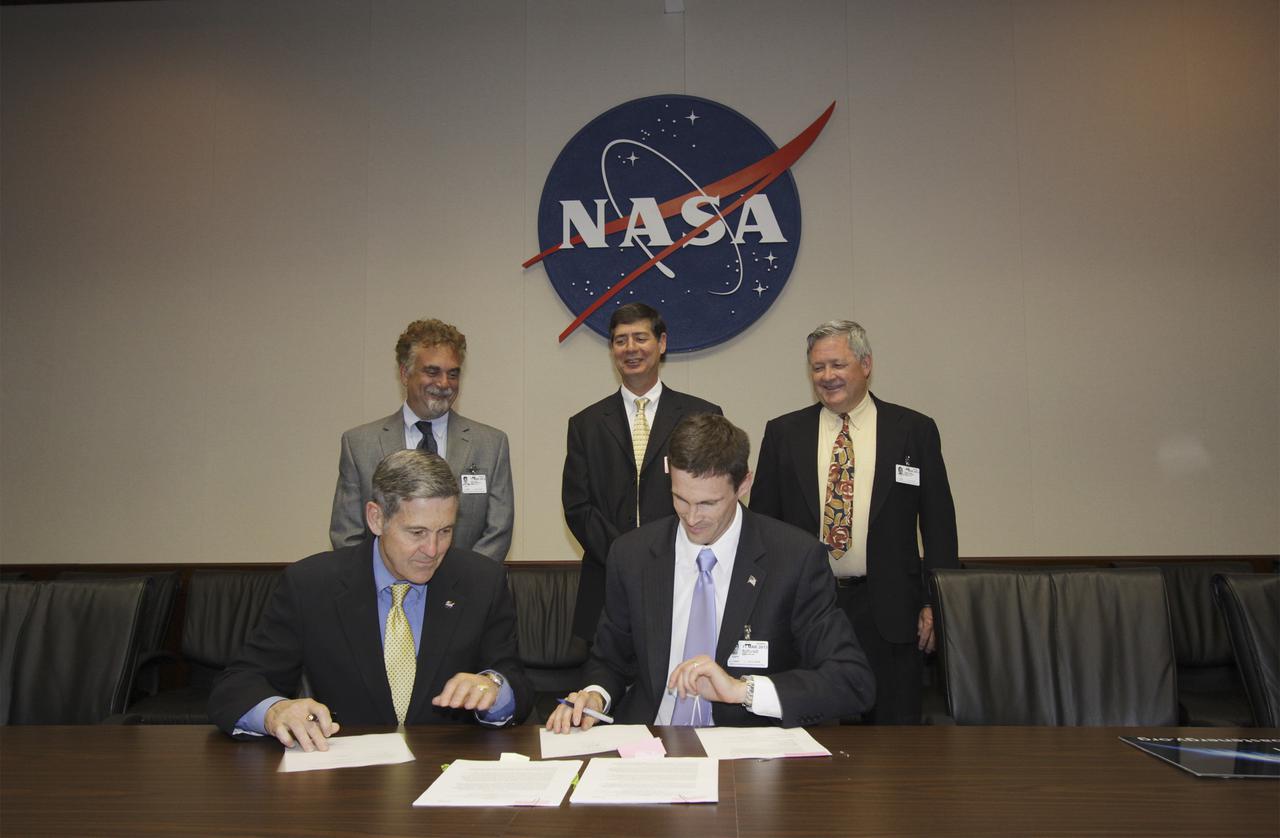
CAPE CANAVERAL, Fla. -- Kennedy Space Center Director Bob Cabana, left, joins Mike Aller, executive director of the Space Coast Energy Consortium, in signing a Space Act Agreement to help transition the Kennedy Space Center from a historically government-only launch facility to a multiuser spaceport. The partnership defines how the space agency will serve both government and commercial renewable energy initiatives. Looking on, from the left, are Scott Lewit, chairman of the SCEC’s board of directors, Bennett Boucher, SCEC board member, and Rodger Rees, SCEC chief financial officer. The Cape Canaveral-based energy consortium is an industry-led nonprofit association created to identify and create innovative energy opportunities for the Space Coast and Florida. The organization was formed by community and industry leaders to assist with the post-space shuttle transition by building networks among local businesses with resources across the country. Photo credit: NASA_Jim Grossmann
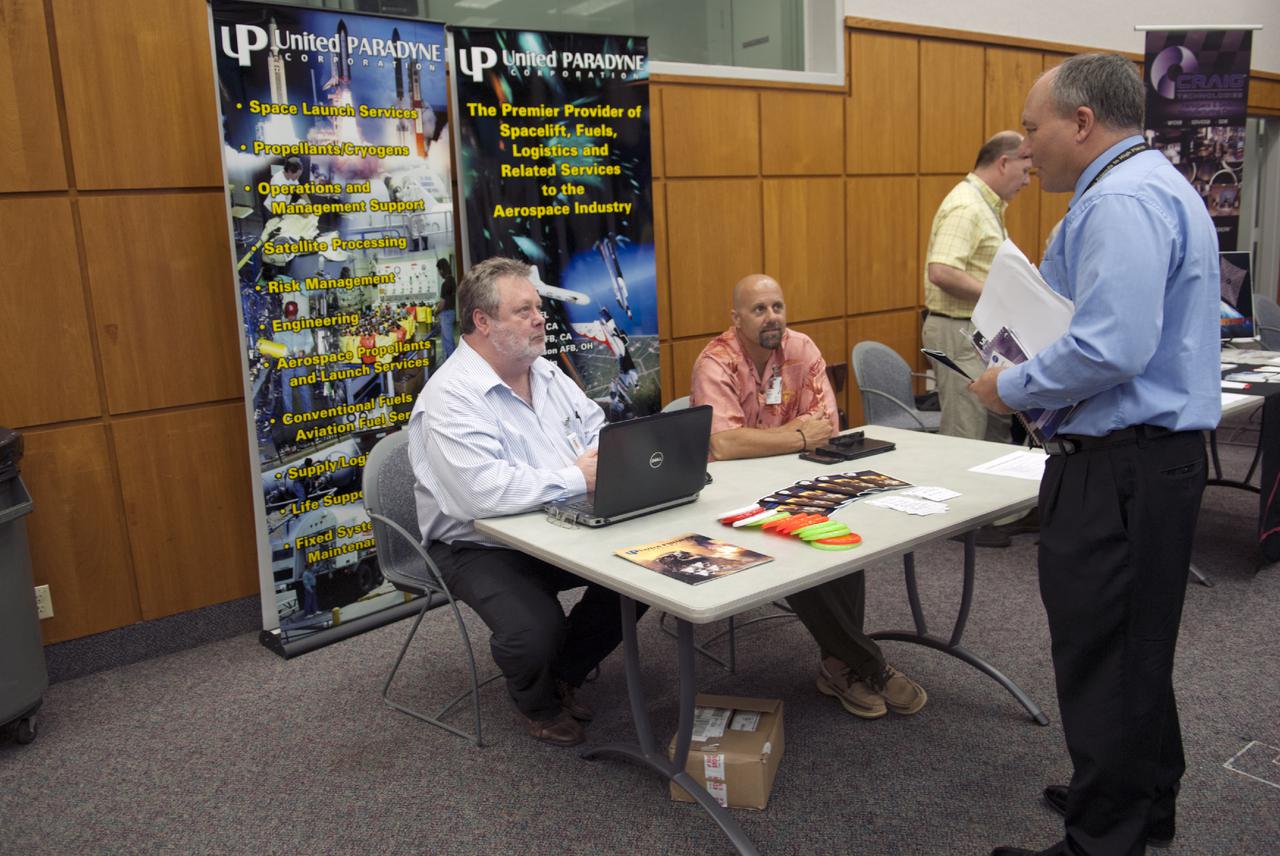
CAPE CANAVERAL, Fla. -- At the Kennedy Space Center in Florida, representatives of United Paradyne talk with guests at the Innovation Expo KSC Showcase. The event gave Kennedy employees an opportunity to meet 12 NASA partners and see how the Center Planning and Development Directorate is transforming Kennedy into a multi-user spaceport through partnerships and resource planning. The 17-booth exhibit consists of 12 partner booths along with Spaceport Planning, Partnership Development and Research and Technology offices. Photo credit: NASA_Charisse Nahser
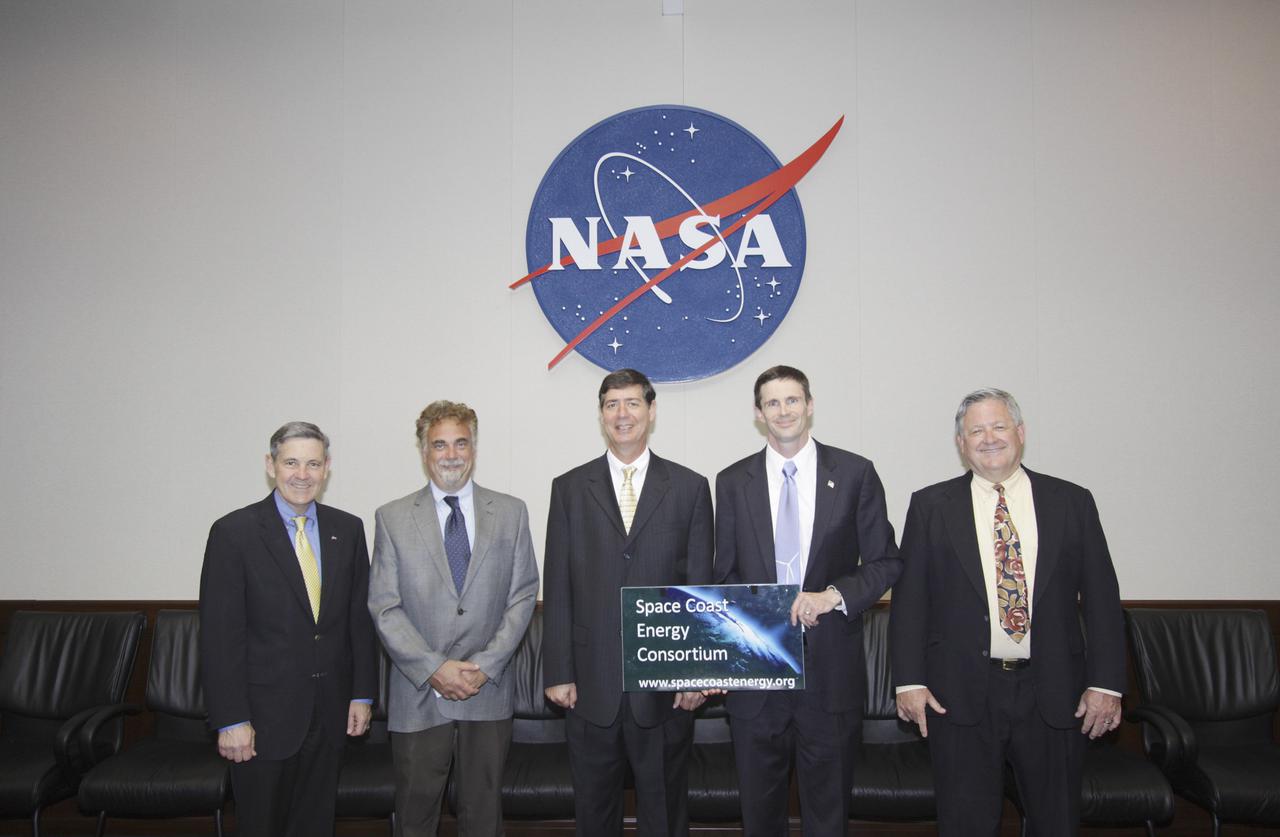
CAPE CANAVERAL, Fla. -- Kennedy Space Center Director Bob Cabana joins representatives of the Space Coast Energy Consortium after signing a Space Act Agreement between the two organizations. From the left are, Cabana, Scott Lewit, chairman of the SCEC’s board of directors, Bennett Boucher, SCEC board member, Mike Aller, SCEC executive director, and Rodger Rees, SCEC chief financial officer. The Cape Canaveral-based energy consortium is an industry-led nonprofit association created to identify and create innovative energy opportunities for the Space Coast and Florida. The organization was formed by community and industry leaders to assist with the post-space shuttle transition by building networks among local businesses with resources across the country. Photo credit: NASA_Jim Grossmann
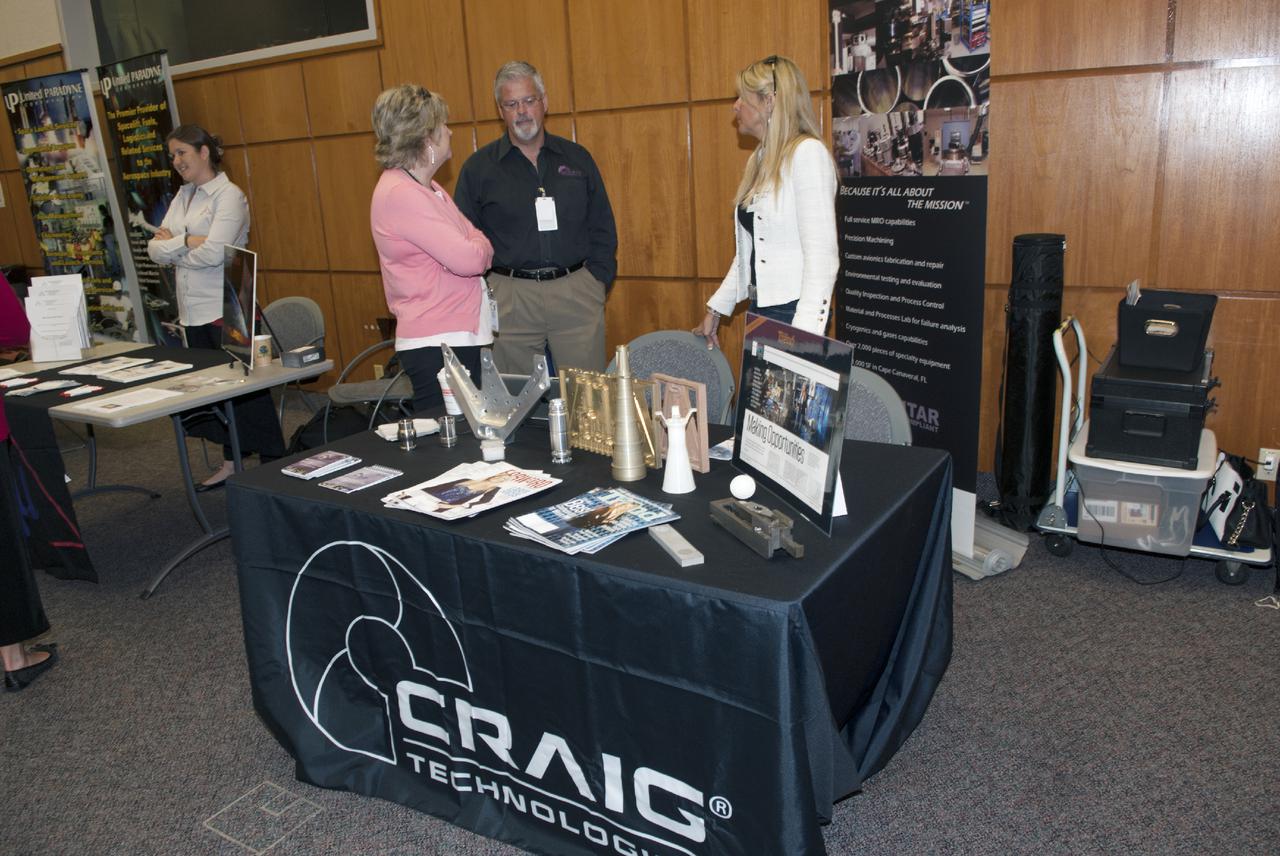
CAPE CANAVERAL, Fla. -- At the Kennedy Space Center in Florida, representatives of Craig Technologies talk with guests at the Innovation Expo KSC Showcase. The event gave Kennedy employees an opportunity to meet 12 NASA partners and see how the Center Planning and Development Directorate is transforming Kennedy into a multi-user spaceport through partnerships and resource planning. The 17-booth exhibit consists of 12 partner booths along with Spaceport Planning, Partnership Development and Research and Technology offices. Photo credit: NASA_Charisse Nahser
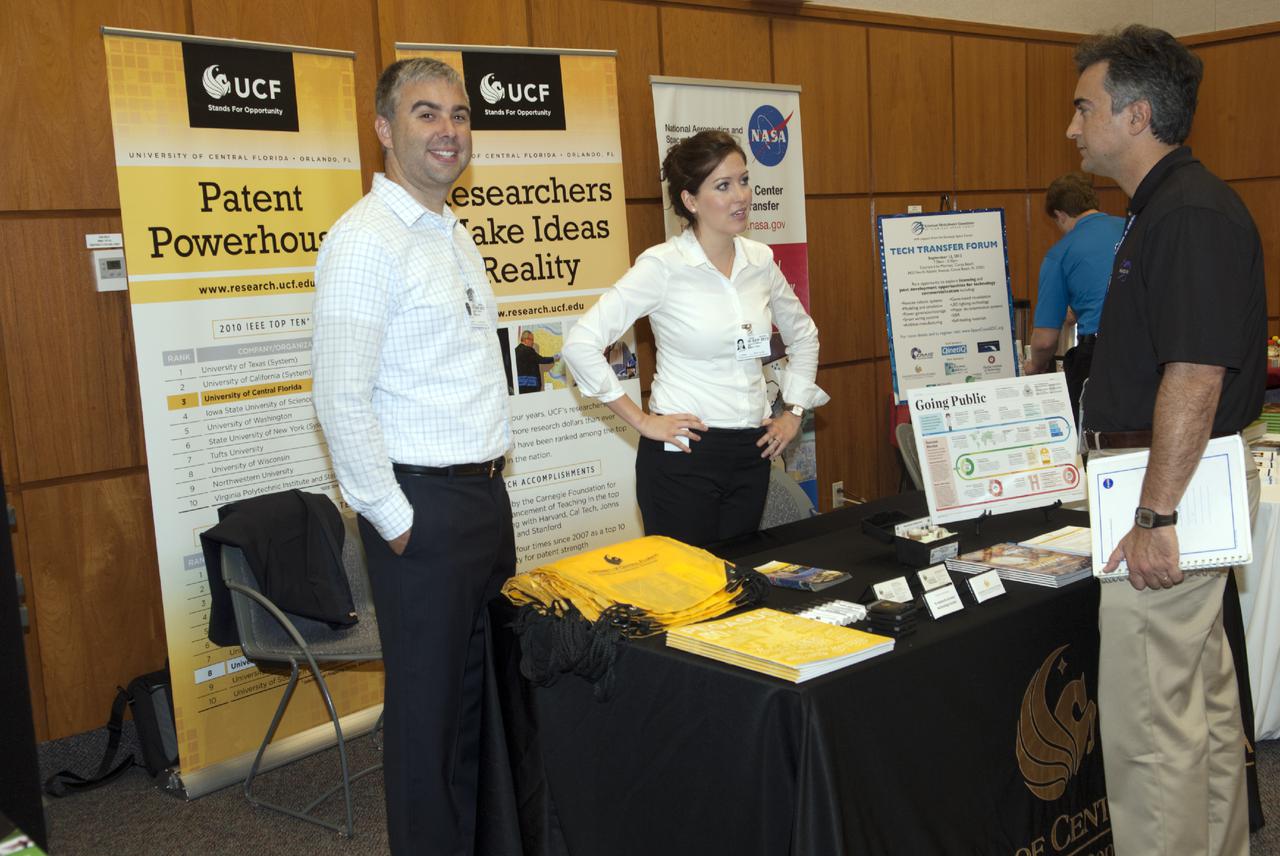
CAPE CANAVERAL, Fla. -- At the Kennedy Space Center in Florida, representatives of the University of Central Florida talk with guests at the Innovation Expo KSC Showcase. The event gave Kennedy employees an opportunity to meet 12 NASA partners and see how the Center Planning and Development Directorate is transforming Kennedy into a multi-user spaceport through partnerships and resource planning. The 17-booth exhibit consists of 12 partner booths along with Spaceport Planning, Partnership Development and Research and Technology offices. Photo credit: NASA_Charisse Nahser
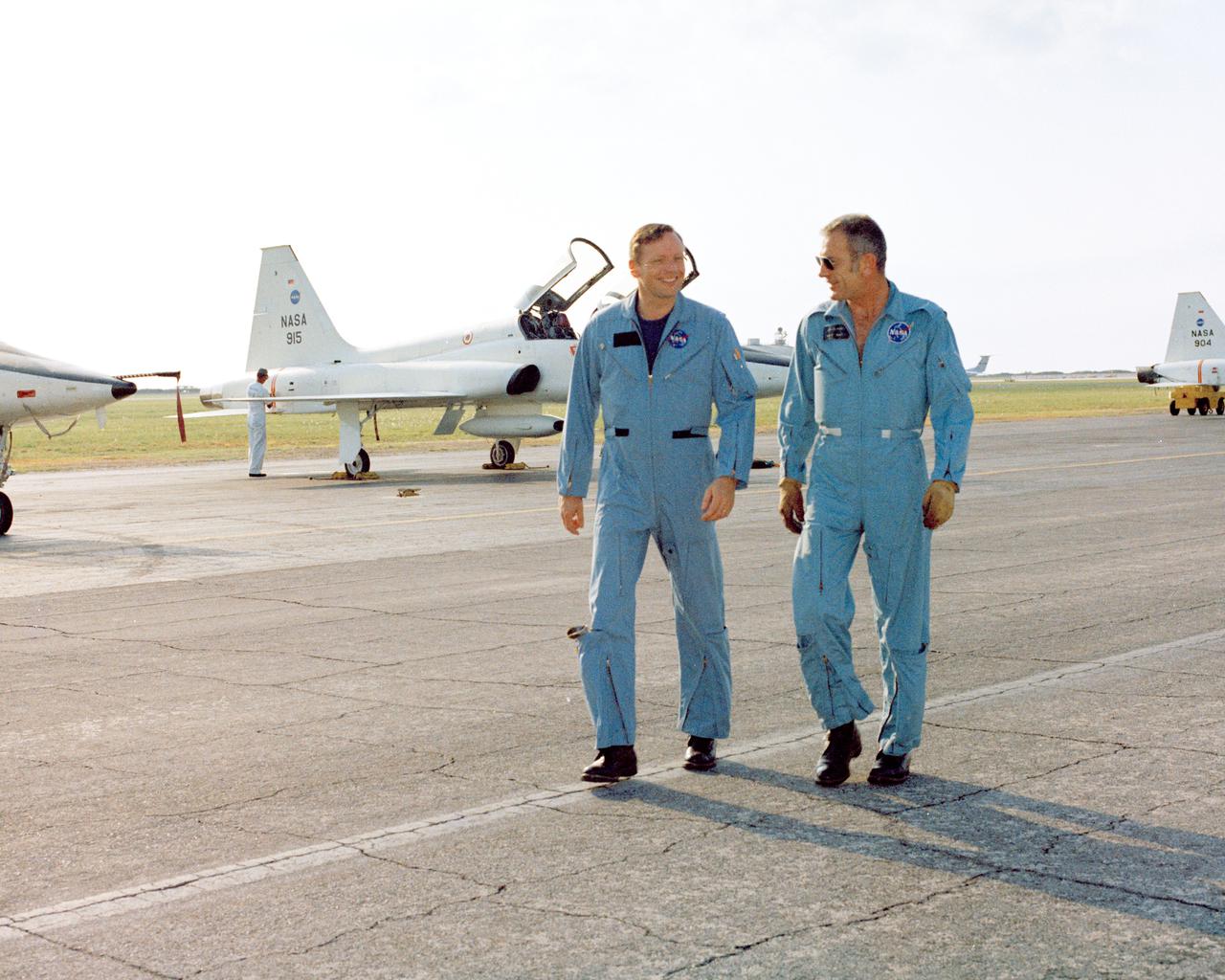
PATRICK AFB, Fla. – Apollo 11 commander Neil A. Armstrong, left, and Donald K. Slayton, chief astronaut and director of flight crew operations, just arrived at Patrick Air Force Base in a T-38 jet in preparation of the nation’s first lunar landing mission. Lift off atop a Saturn V launch vehicle is scheduled for July 16, 1969. During Apollo 11 the command module, Columbia, will remain in orbit around the moon while the lunar module, Eagle, carrying Armstrong and Aldrin, lands on the lunar surface. During 2½ hours of surface exploration, the crew plans to collect lunar surface material for analysis back on Earth. For more: http:__www-pao.ksc.nasa.gov_history_apollo_apollo-11_apollo-11.htm Photo credit: NASA
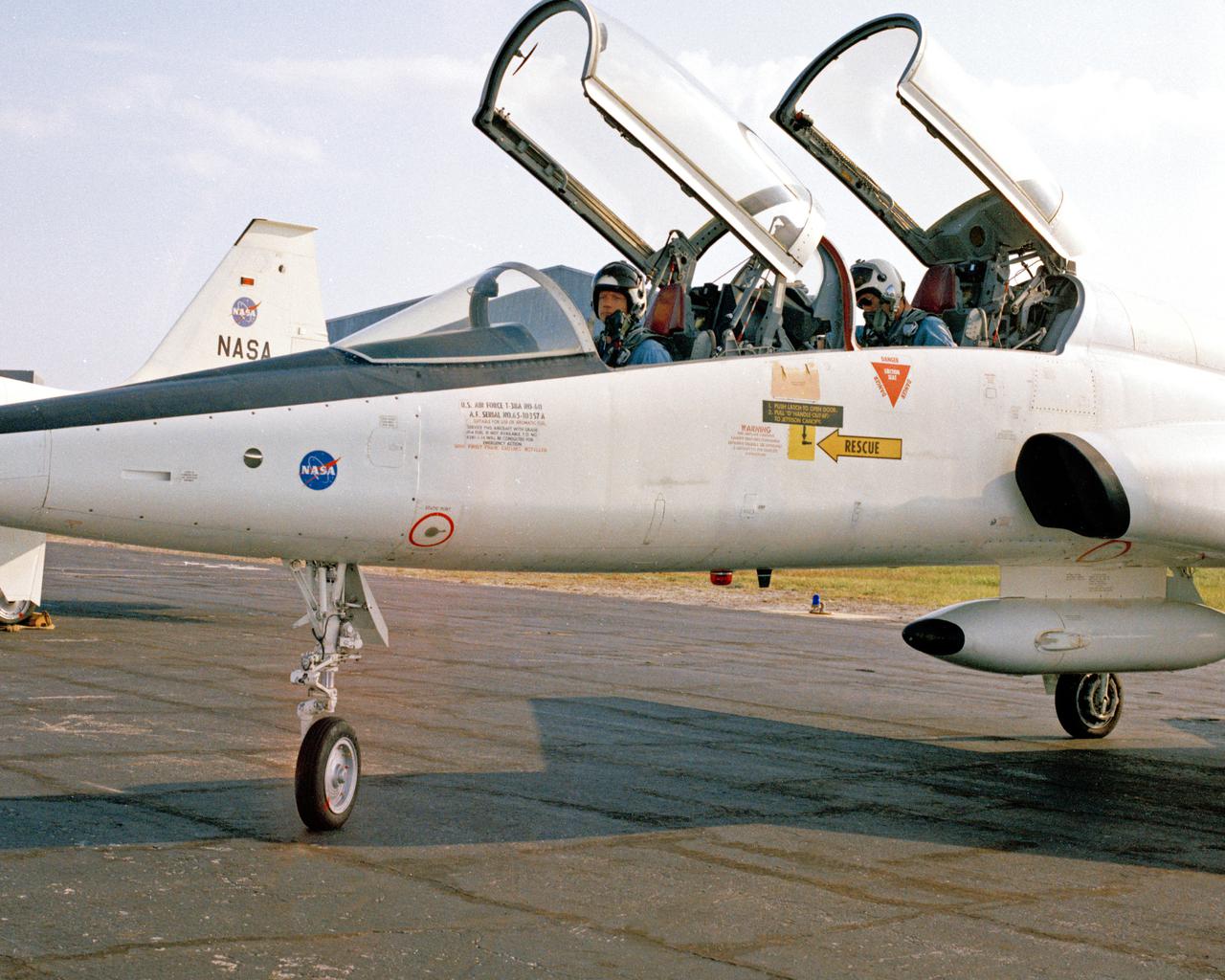
PATRICK AFB, Fla. – In preparation of the nation’s first lunar landing mission, Apollo 11 crew members arrive at Patrick Air Force Base, Florida. Mission commander Neil A. Armstrong is in the front seat of the T-38 jet, with chief astronaut and director of flight crew operations, Donald K. Slayton, in the back. Lift off atop a Saturn V launch vehicle is scheduled for July 16, 1969. During Apollo 11 the command module, Columbia, will remain in orbit around the moon while the lunar module, Eagle, carrying Armstrong and Aldrin, lands on the lunar surface. During 2½ hours of surface exploration, the crew plans to collect lunar surface material for analysis back on Earth. For more: http:__www-pao.ksc.nasa.gov_history_apollo_apollo-11_apollo-11.htm Photo credit: NASA
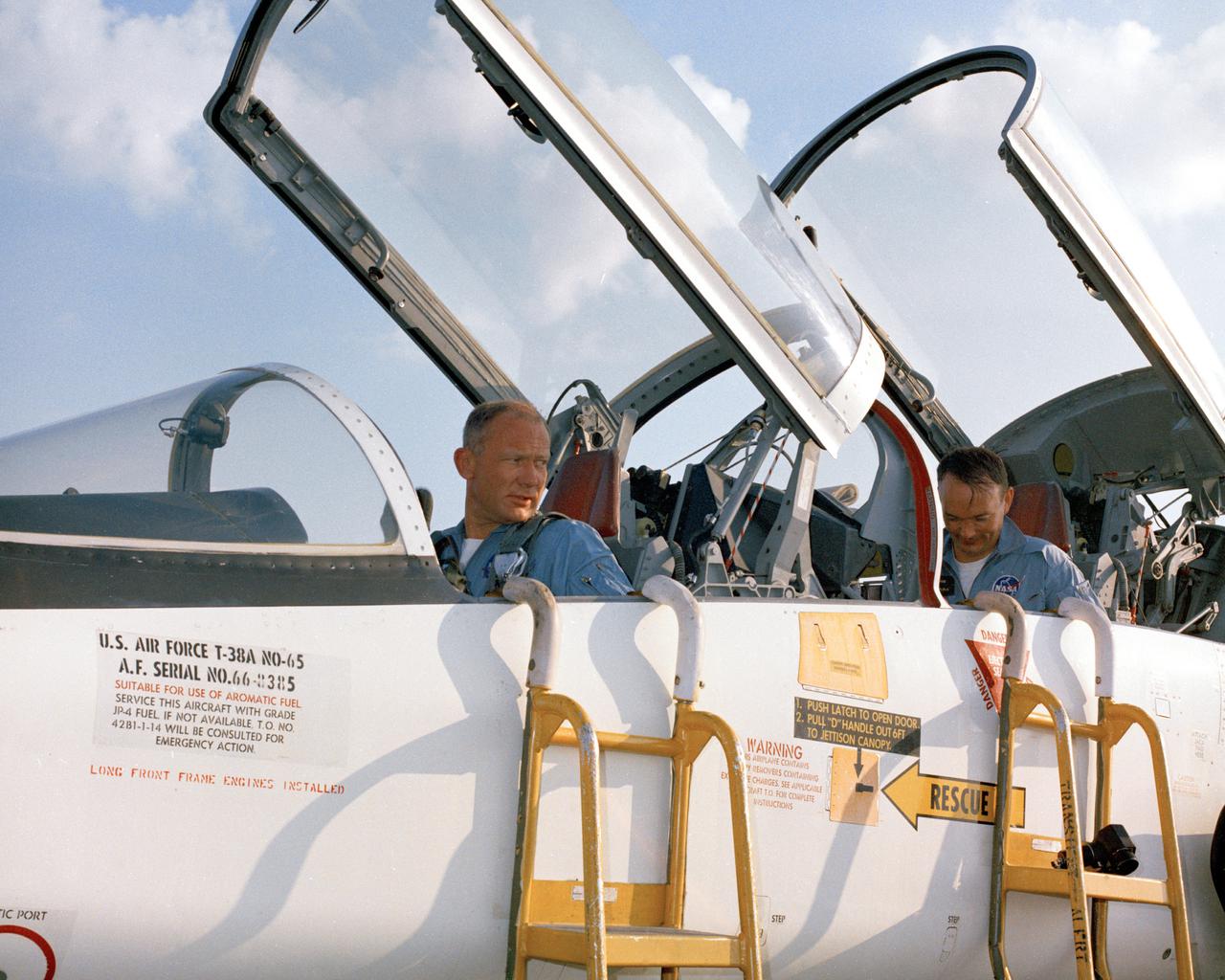
PATRICK AFB, Fla. – In preparation of the nation’s first lunar landing mission, Apollo 11 crew members arrive at Patrick Air Force Base, Florida. Lunar module pilot Edwin E. Buzz Aldrin Jr. is in the front seat of the T-38 jet, with command module pilot Michael Collins, in the back. Lift off atop a Saturn V launch vehicle is scheduled for July 16, 1969. During Apollo 11 the command module, Columbia, will remain in orbit around the moon while the lunar module, Eagle, carrying Armstrong and Aldrin, lands on the lunar surface. During 2½ hours of surface exploration, the crew plans to collect lunar surface material for analysis back on Earth. For more: http:__www-pao.ksc.nasa.gov_history_apollo_apollo-11_apollo-11.htm Photo credit: NASA
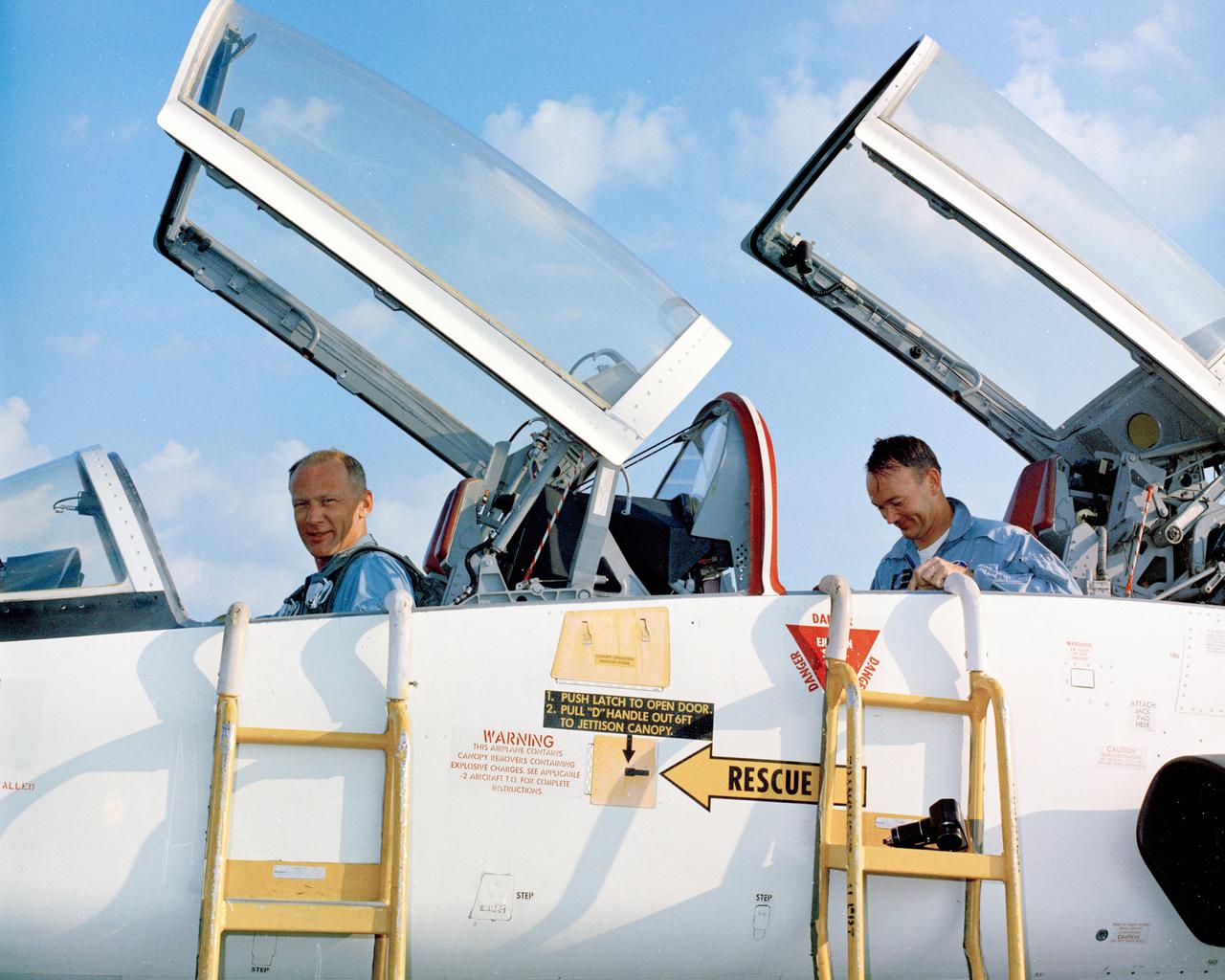
PATRICK AFB, Fla. – In preparation of the nation’s first lunar landing mission, Apollo 11 crew members arrive at Patrick Air Force Base, Florida. Lunar module pilot Edwin E. Buzz Aldrin Jr. is in the front seat of the T-38 jet, with command module pilot Michael Collins, in the back. Lift off atop a Saturn V launch vehicle is scheduled for July 16, 1969. During Apollo 11 the command module, Columbia, will remain in orbit around the moon while the lunar module, Eagle, carrying Armstrong and Aldrin, lands on the lunar surface. During 2½ hours of surface exploration, the crew plans to collect lunar surface material for analysis back on Earth. For more: http:__www-pao.ksc.nasa.gov_history_apollo_apollo-11_apollo-11.htm Photo credit: NASA
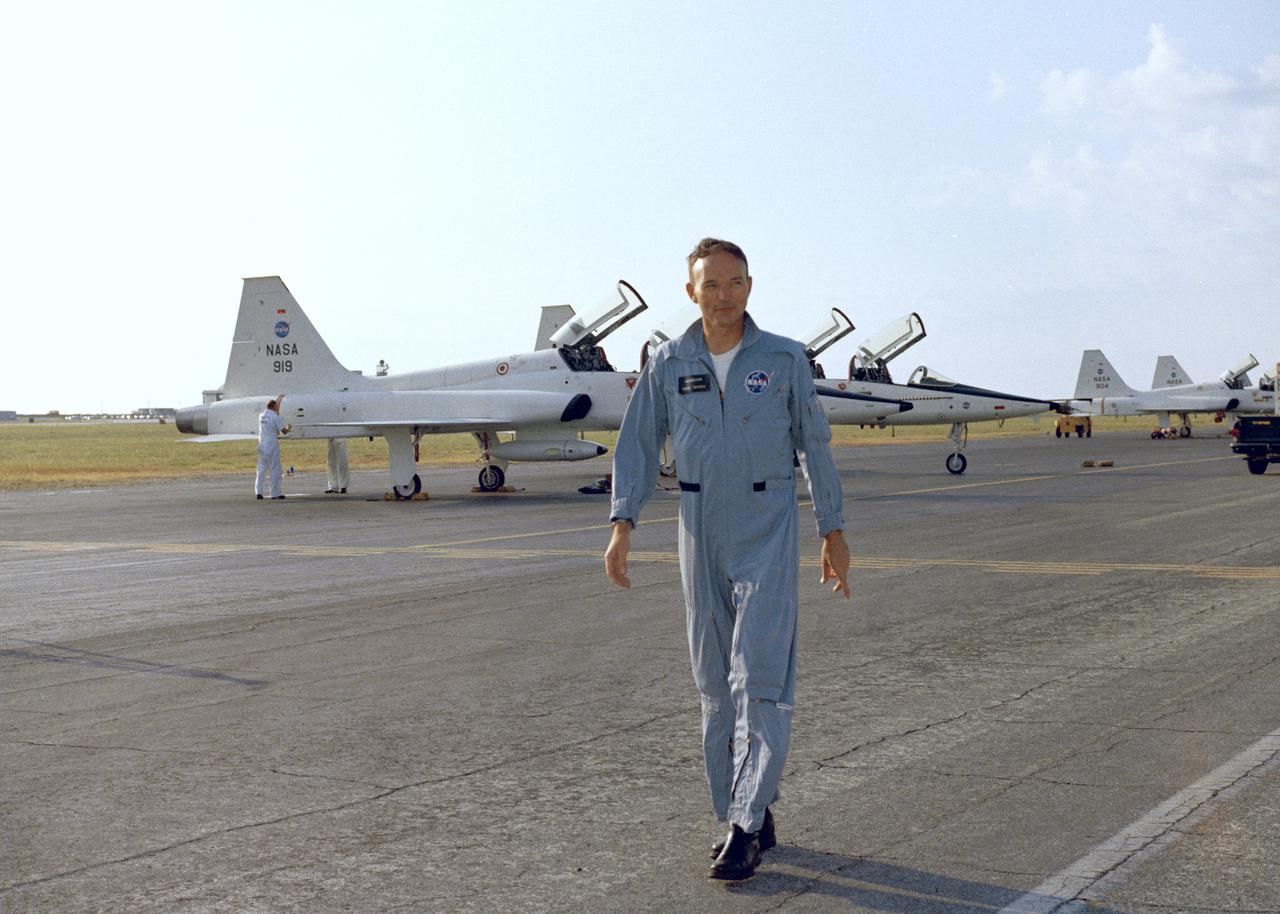
PATRICK AFB, Fla. – Apollo 11 command module pilot Michael Collins, just arrived at Patrick Air Force Base in a T-38 jet in preparation of the nation’s first lunar landing mission. Lift off atop a Saturn V launch vehicle is scheduled for July 16, 1969. During Apollo 11, the command module, Columbia, will remain in orbit around the moon while the lunar module, Eagle, carrying Armstrong and Aldrin, lands on the lunar surface. During 2½ hours of surface exploration, the crew plans to collect lunar surface material for analysis back on Earth. For more: http:__www-pao.ksc.nasa.gov_history_apollo_apollo-11_apollo-11.htm Photo credit: NASA
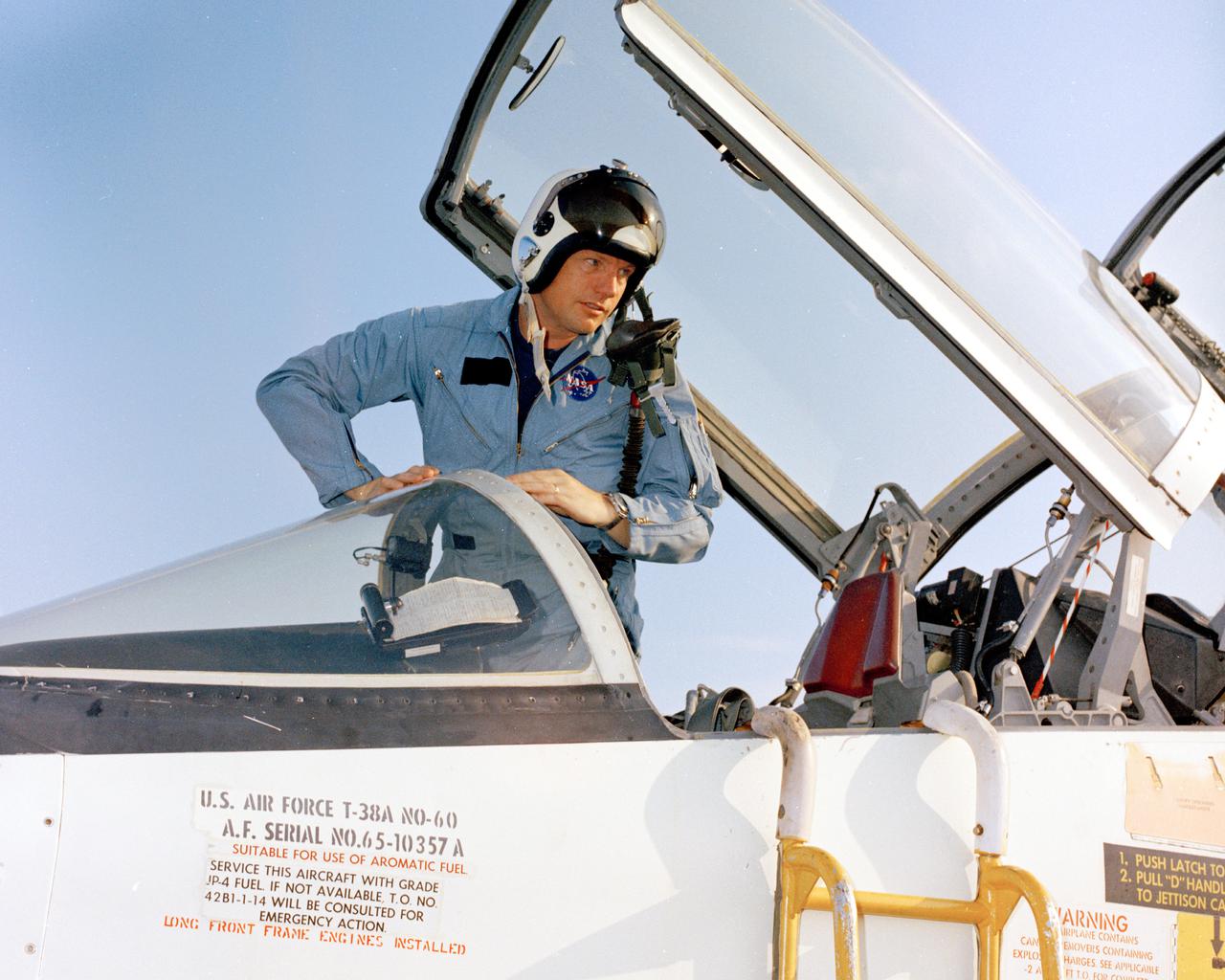
PATRICK AFB, Fla. – In preparation of the nation’s first lunar landing mission, Apollo 11 crew members arrive at Patrick Air Force Base, Florida. Mission commander Neil Armstrong climbs out of a T-38 jet. Lift off atop a Saturn V launch vehicle is scheduled for July 16, 1969. During Apollo 11 the command module, Columbia, will remain in orbit around the moon while the lunar module, Eagle, carrying Armstrong and Aldrin, lands on the lunar surface. During 2½ hours of surface exploration, the crew plans to collect lunar surface material for analysis back on Earth. For more: http:__www-pao.ksc.nasa.gov_history_apollo_apollo-11_apollo-11.htm Photo credit: NASA
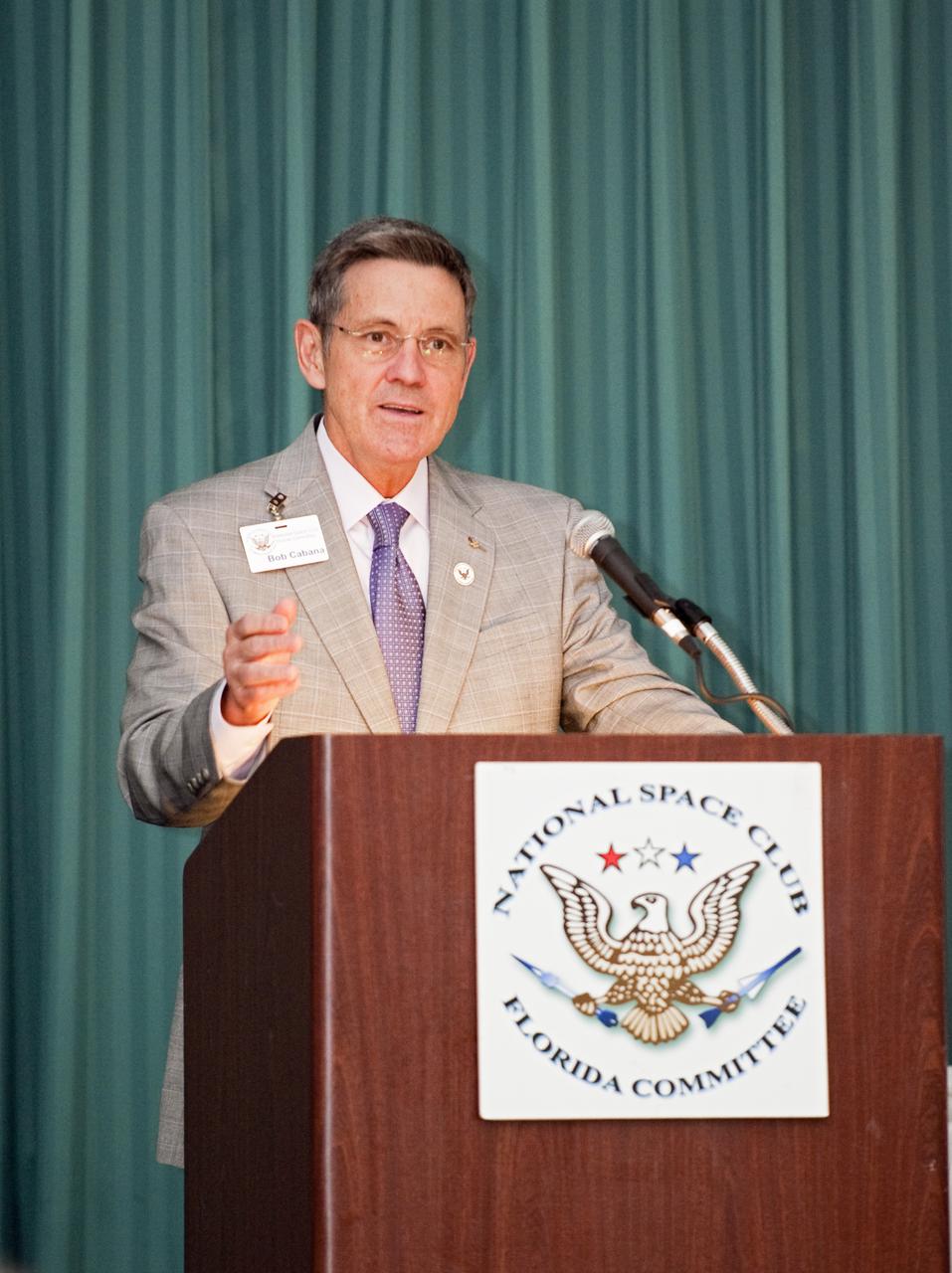
CAPE CANAVERAL, Fla. -- NASA Kennedy Space Center Director Bob Cabana addresses the National Space Club Florida Committee during its monthly meeting at the Radisson at the Port in Cape Canaveral, Fla. His speech, titled “KSC -- Today and Tomorrow,” addressed the future of NASA and possible changes to the space shuttle launch schedule later this month. The committee, headquartered on Florida's Space Coast, is a non-profit corporation composed of private individuals representing industry, government, regional educational institutions and the media. NASA_Kim Shiflett
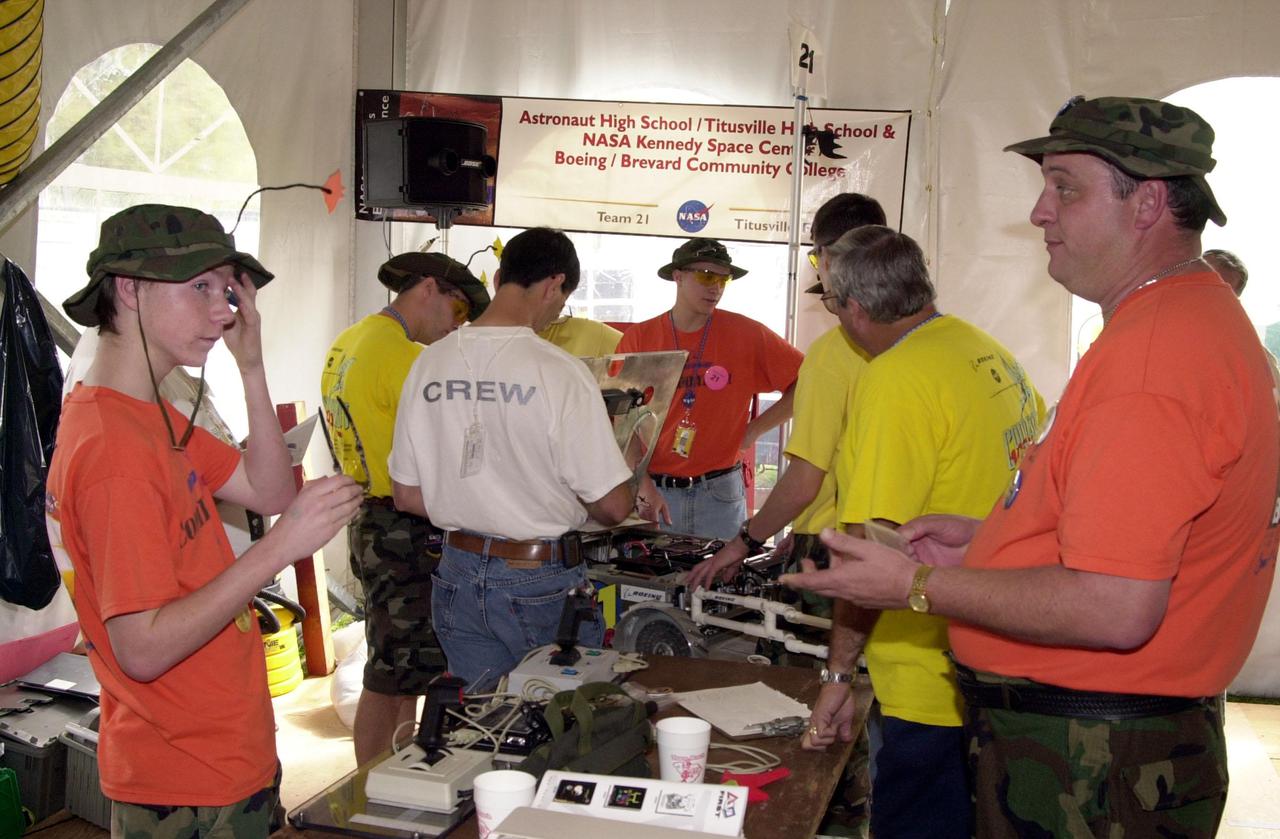
Getting ready for preliminary heats, students from Astronaut and Titusville High Schools work on their robot to compete in the NASA_KSC FIRST Southeastern Regional event. FIRST (For Inspiration and Recognition of Science and Technology) events are held nationwide, pitting the student-built robots against each other and the clock on a playing field. Many teams are sponsored by corporations and academic institutions. There are 27 teams throughout the State of Florida who are competing. KSC, which sponsors nine teams, has held the regional event for two years.
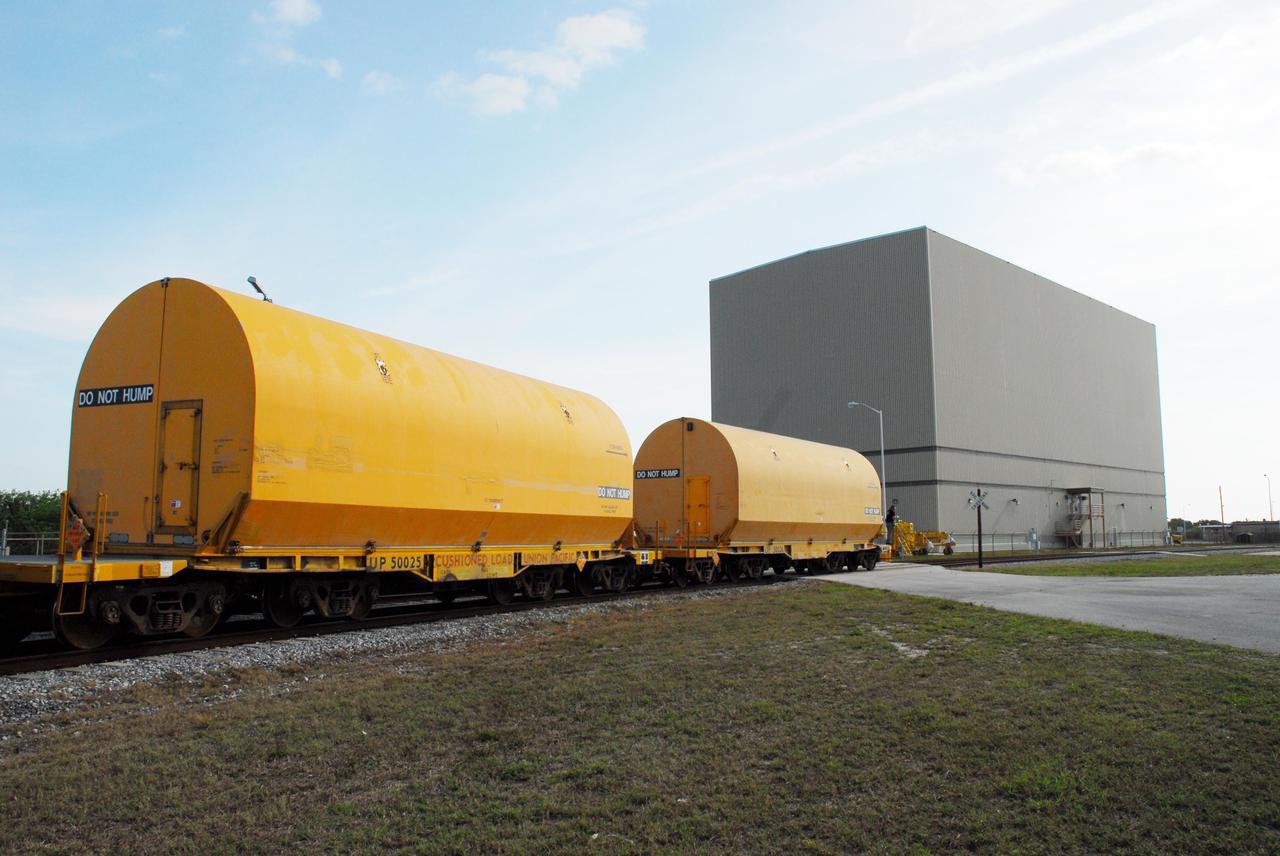
KENNEDY SPACE CENTER, FLA. -- The locomotive and rail cars carrying solid rocket booster motor segments and two aft exit cone segments roll toward the Rotation, Processing and Surge Facility (RPSF) in Kennedy Space Center's Launch Complex 39 Area. The RPSF is used for solid rocket motor receiving, rotation and inspection, and supports aft booster buildup. When live solid rocket motor segments arrive at the processing facility, they are positioned under one of the cranes. Handling slings are then attached to and remove the railcar cover. The segment is inspected while it remains horizontal. The two overhead cranes hoist the segment, rotate it to a vertical position and place it on a fixed stand. The aft handling ring is then removed. The segment is hoisted again and lowered onto a transportation and storage pallet, and the forward handling ring is removed to allow inspections. It is then transported to one of the surge buildings and temporarily stored until it is needed for booster stacking in the VAB. While enroute, solid rocket motor segments were involved in a derailment in Alabama. The rail cars carrying these segments remained upright and were undamaged. An inspection determined these segment cars could continue on to Florida. The segments themselves will undergo further evaluation at Kennedy before they are cleared for flight. Other segments involved in the derailment will be returned to a plant in Utah for further evaluation. Photo credit: NASA_George Shelton
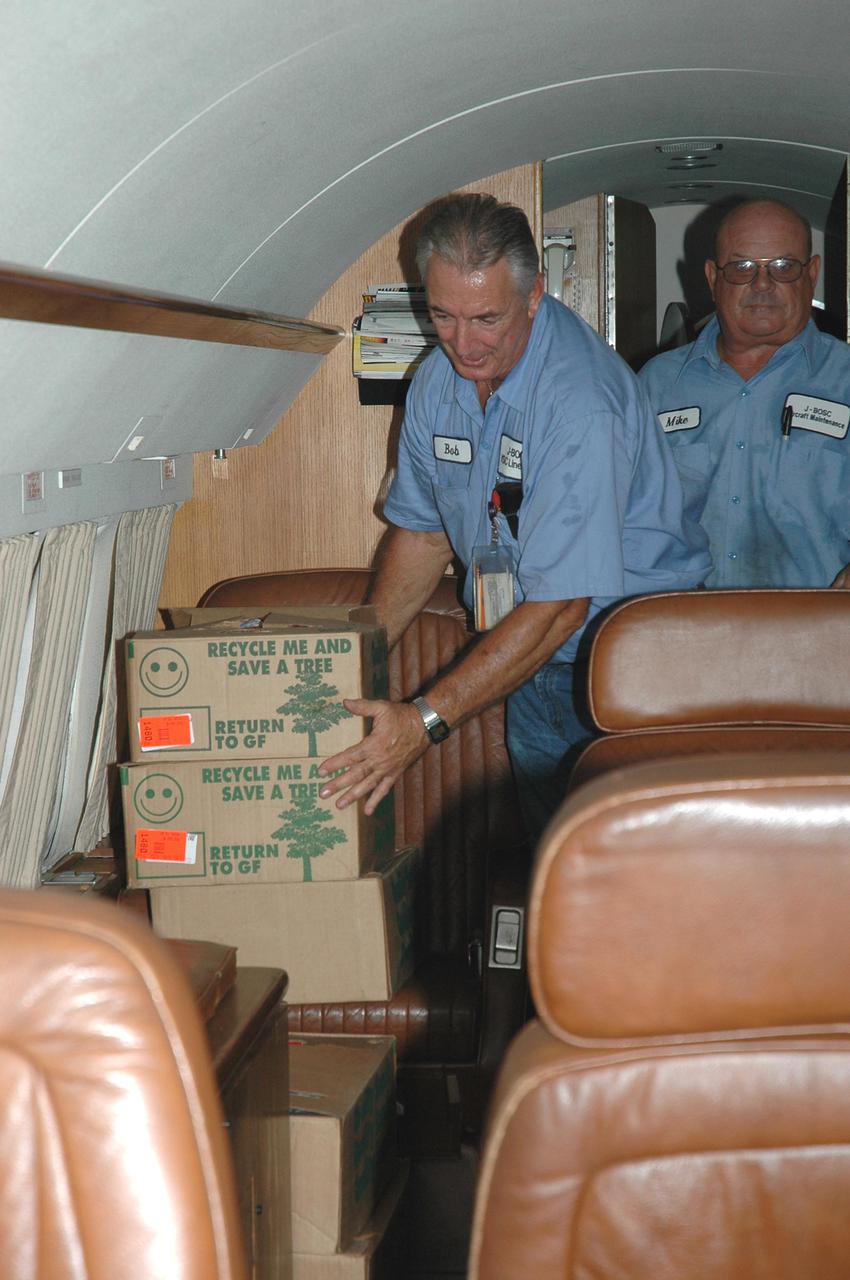
KENNEDY SPACE CENTER, FLA. -Workers at Kennedy Space Center place boxes of supplies in the airplane heading to Stennis Space Center in Mississippi for NASA workers there. Both Michoud Assembly Facility near New Orleans and Stennis were effected by Hurricane Katrina. KSC is sending a helicopter with medical supplies and an Emergency Medical Technician to Stennis. A NASA plane is carrying medical supplies, food and chain saws, as well as a physician and two high voltage technicians to Michoud to ensure the facility can safely receive power when the main electricity grid comes online. KSC has sent a truck with 1,000 gallons of diesel fuel and three large generators: a 1-megawatt generator, and 125- and 225-kilowatt generators. A 14-person security team is also going to Michoud to relieve the security professionals at that location.
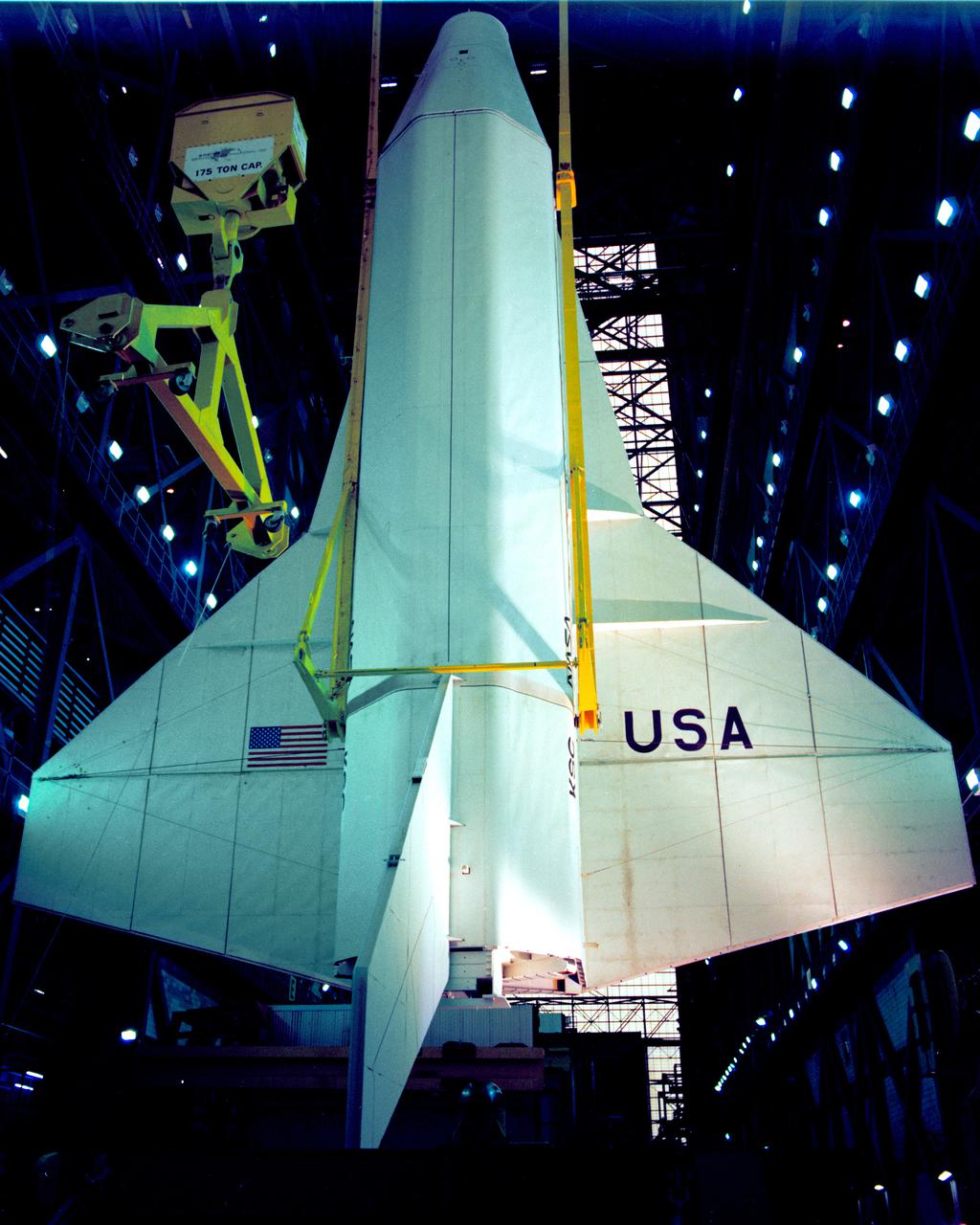
CAPE CANAVERAL, Fla. – At NASA's Kennedy Space Center in Florida, the space shuttle mock-up, dubbed Pathfinder, undergoes a lift test in the Vehicle Assembly Building on May 31, 1978. The mock-up, constructed at NASA's Marshall Space Flight Center in Huntsville, Ala., possessed the general dimensions, weight and balance of a real space shuttle. It was shipped to Kennedy by barge and then used to fit-check the work platforms of the Mate-Demate Device, orbiter processing facilities and Vehicle Assembly Building, as well as support ground crew training. It also was used to rehearse post-landing procedures at Kennedy's Shuttle Landing Facility. After being on display at the 'Great Space Shuttle Exposition' in Tokyo from June 1983 to August 1984, the mock-up returned to Marshall and now is on permanent display at the U.S. Space and Rocket Center near Huntsville. Photo credit: NASA
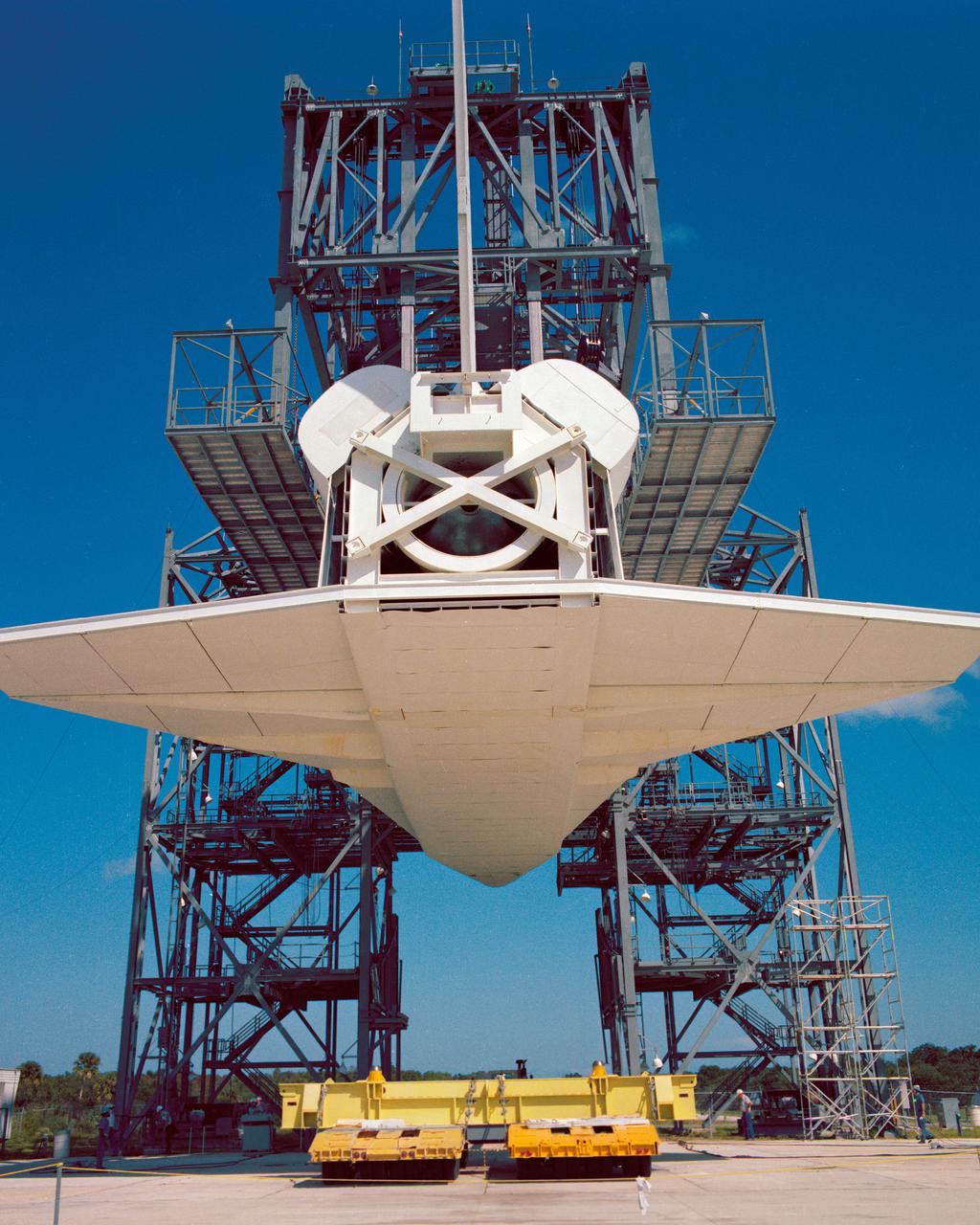
CAPE CANAVERAL, Fla. – At NASA's Kennedy Space Center in Florida, the space shuttle mock-up, dubbed Pathfinder, is attached to the Mate-Demate Device for at fit-check Oct. 19, 1978. The mock-up, constructed at NASA's Marshall Space Flight Center in Huntsville, Ala., possessed the general dimensions, weight and balance of a real space shuttle. It was shipped to Kennedy by barge and then used to fit-check the work platforms of the Mate-Demate Device, orbiter processing facilities and Vehicle Assembly Building, as well as support ground crew training. It also was used to rehearse post-landing procedures at Kennedy's Shuttle Landing Facility. After being on display at the 'Great Space Shuttle Exposition' in Tokyo from June 1983 to August 1984, the mock-up returned to Marshall and now is on permanent display at the U.S. Space and Rocket Center near Huntsville. Photo credit: NASA
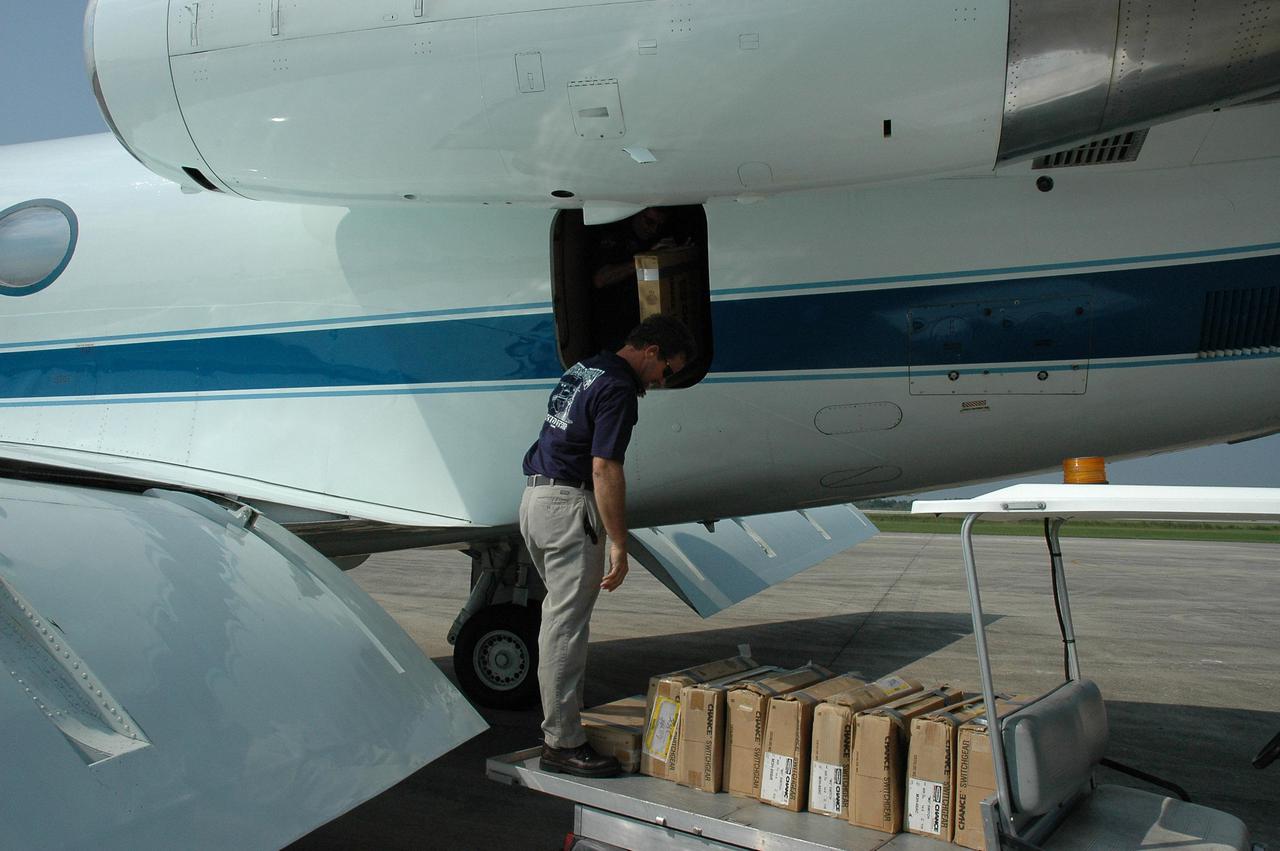
KENNEDY SPACE CENTER, FLA. - At the NASA Kennedy Space Center Shuttle Landing Facility, hurricane relief supplies are being loaded onto a NASA aircraft bound for Stennis Space Center in Mississippi, which suffered damage from Hurricane Katrina. The supplies included 10 boxes of load bus disconnects going to Michoud Assesmbly Facility near New Orleans and 17 boxes of personal hygiene items, along with boxes of clothing and water. Many Stennis and Michoud employees were rendered homeless by the hurricane. NASA centers have been generous with relief supplies and personnel. Stennis is in limited operations mode. Daily convoys have been moving between Stennis and Michould, transporting personnel and supplies as Michoud prepares to resume limited operations.
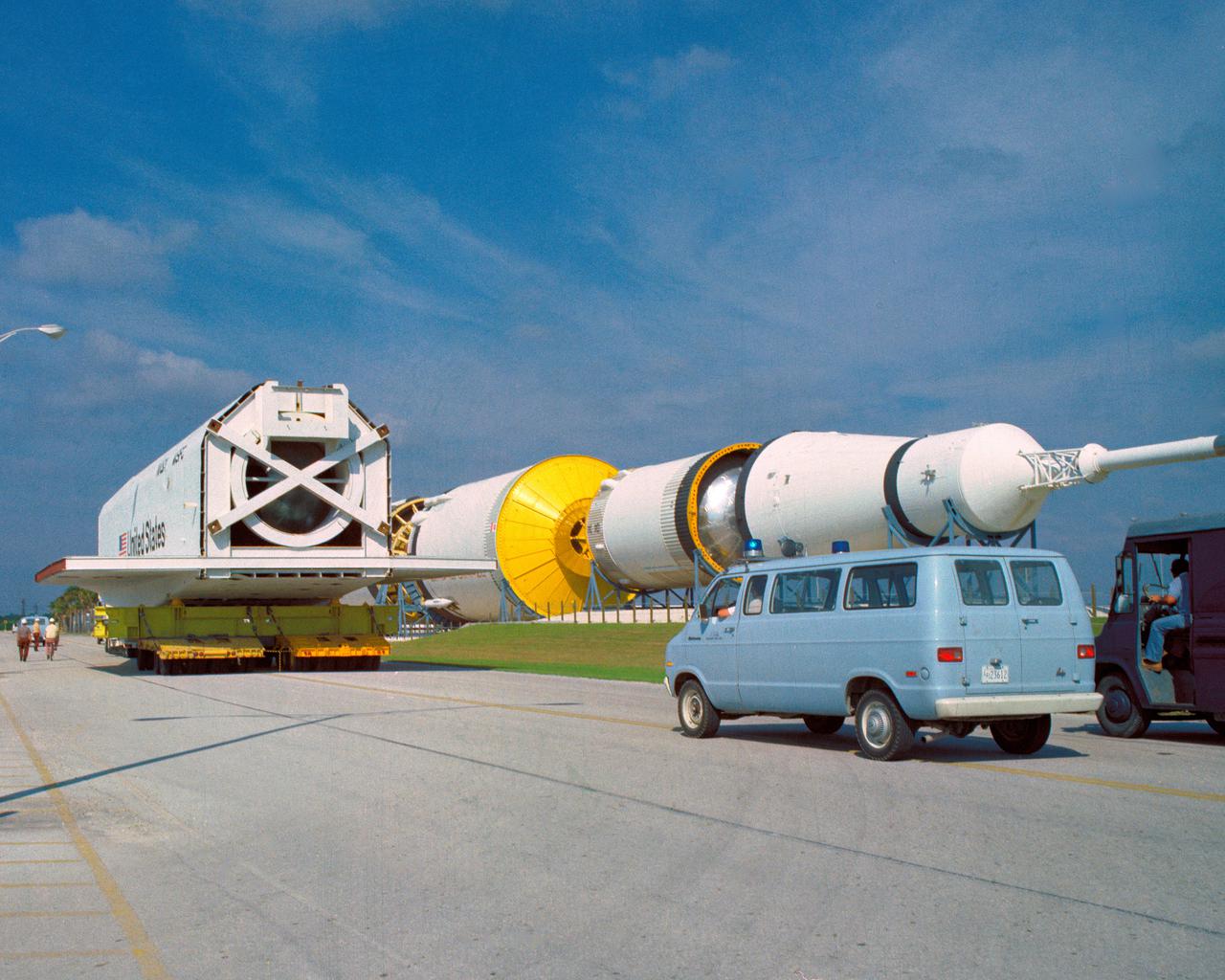
CAPE CANAVERAL, Fla. – At NASA's Kennedy Space Center in Florida, the space shuttle mock-up, dubbed Pathfinder, makes its trek from the turn basin to the Vehicle Assembly Building on April 5, 1978. The mock-up, constructed at NASA's Marshall Space Flight Center in Huntsville, Ala., possessed the general dimensions, weight and balance of a real space shuttle. It was shipped to Kennedy by barge and then used to fit-check the work platforms of the Mate-Demate Device, orbiter processing facilities and Vehicle Assembly Building, as well as support ground crew training. It also was used to rehearse post-landing procedures at Kennedy's Shuttle Landing Facility. After being on display at the 'Great Space Shuttle Exposition' in Tokyo from June 1983 to August 1984, the mock-up returned to Marshall and now is on permanent display at the U.S. Space and Rocket Center near Huntsville. Photo credit: NASA
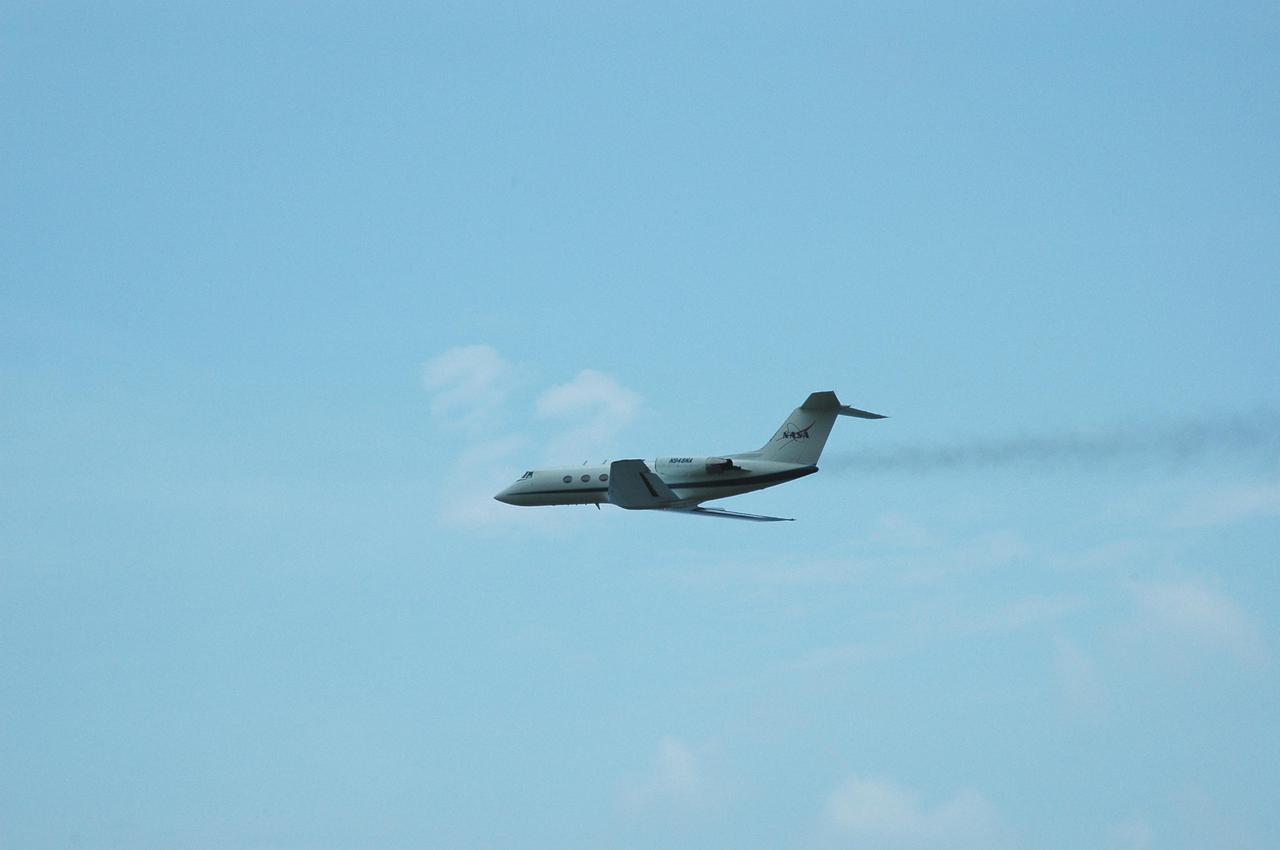
KENNEDY SPACE CENTER, FLA. - A NASA plane is airborne after leaving Patrick Air Force Base in Florida on a hurricane relief flight to Michoud Assembly Facility near New Orleans. Both Michoud and Stennis Space Center in Mississippi were effected by Hurricane Katrina. KSC is sending a helicopter with medical supplies and an Emergency Medical Technician to Stennis. A NASA plane is carrying medical supplies, food and chain saws, as well as a physician and two high voltage technicians to Michoud to ensure the facility can safely receive power when the main electricity grid comes online. KSC has sent a truck with 1,000 gallons of diesel fuel and three large generators: a 1-megawatt generator, and 125- and 225-kilowatt generators. A 14-person security team is also going to Michoud to relieve the security professionals at that location.
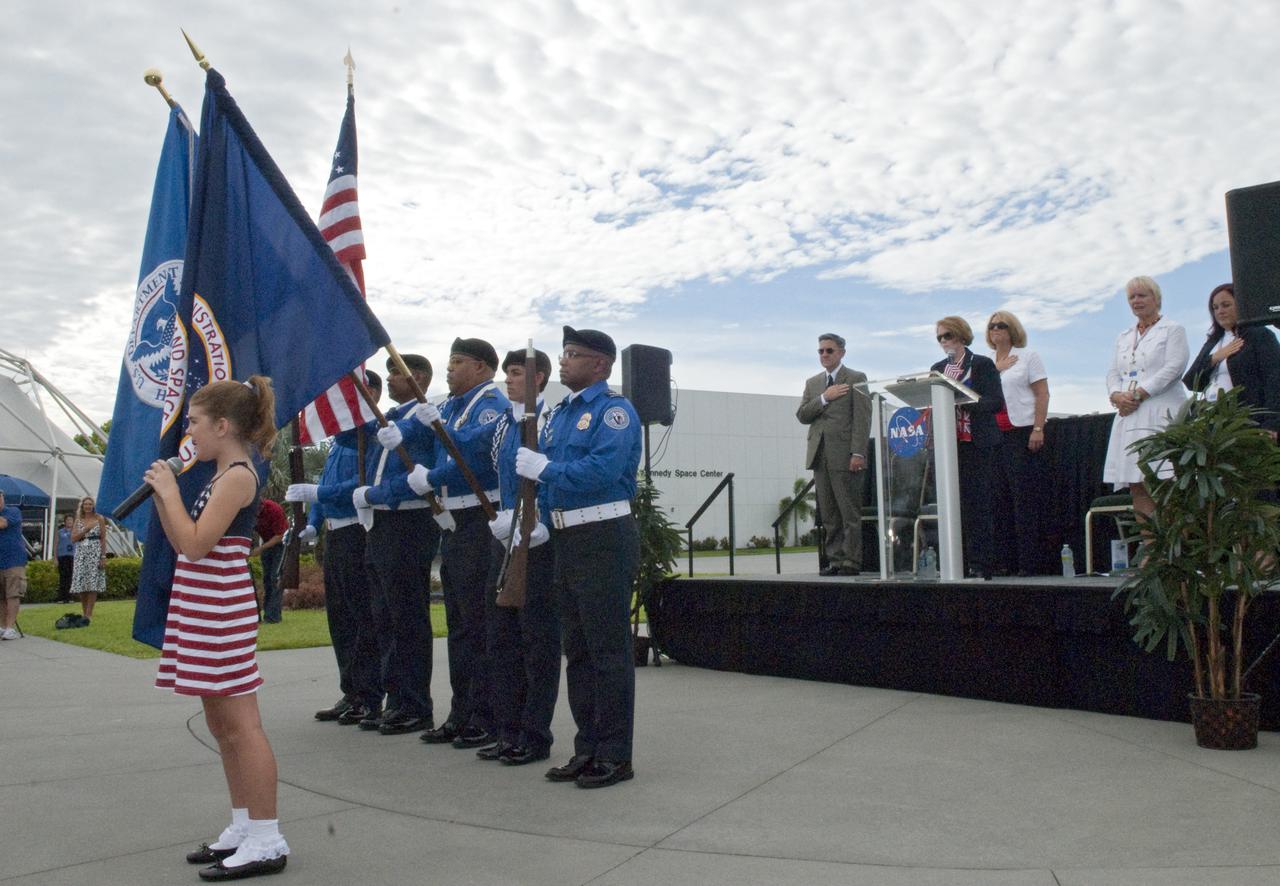
CAPE CANAVERAL, Fla. – At the Kennedy Space Center Visitor Complex in Florida, Searra Weeks, a fifth-grade student at Robert Louis Stevenson Elementary School in Merritt Island, sings the national anthem during a naturalization ceremony. The Transportation and Security Administration Honor Guard posted the American, Homeland Security and NASA flags at the ceremony. U.S. Citizenship and Immigration Services administered the Oath of Allegiance to 110 people, representing 36 countries, in honor of the upcoming Independence Day holiday. This was the first naturalization ceremony hosted by a NASA facility. An estimated 3,800 candidates will become citizens at 55 special ceremonies, including the one at Kennedy, held across the country and around the world July 1-6. Photo Credit: NASA_Jim Grossmann
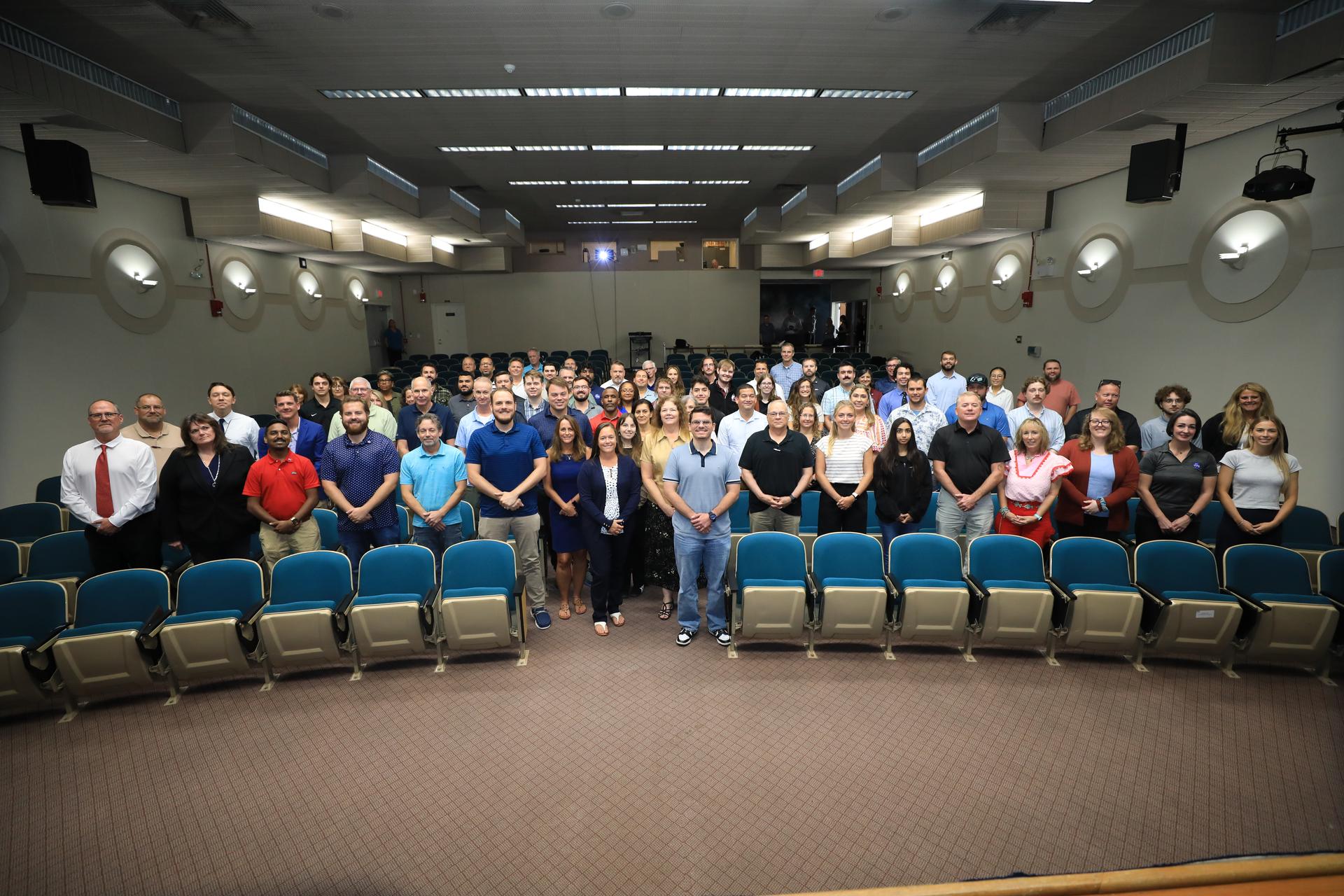
NASA’s Kennedy Space Center Director Brian Hughes swore in the first phase of employees formerly from the Consolidated Operations, Management, Engineering, and Test (COMET) contract as new NASA civil servants on Monday, July 13, 2026, at NASA Kennedy in Florida. The latest round of civil servants is part of the administrator’s workforce directive to restore technical core competencies within the civil servants ranks.
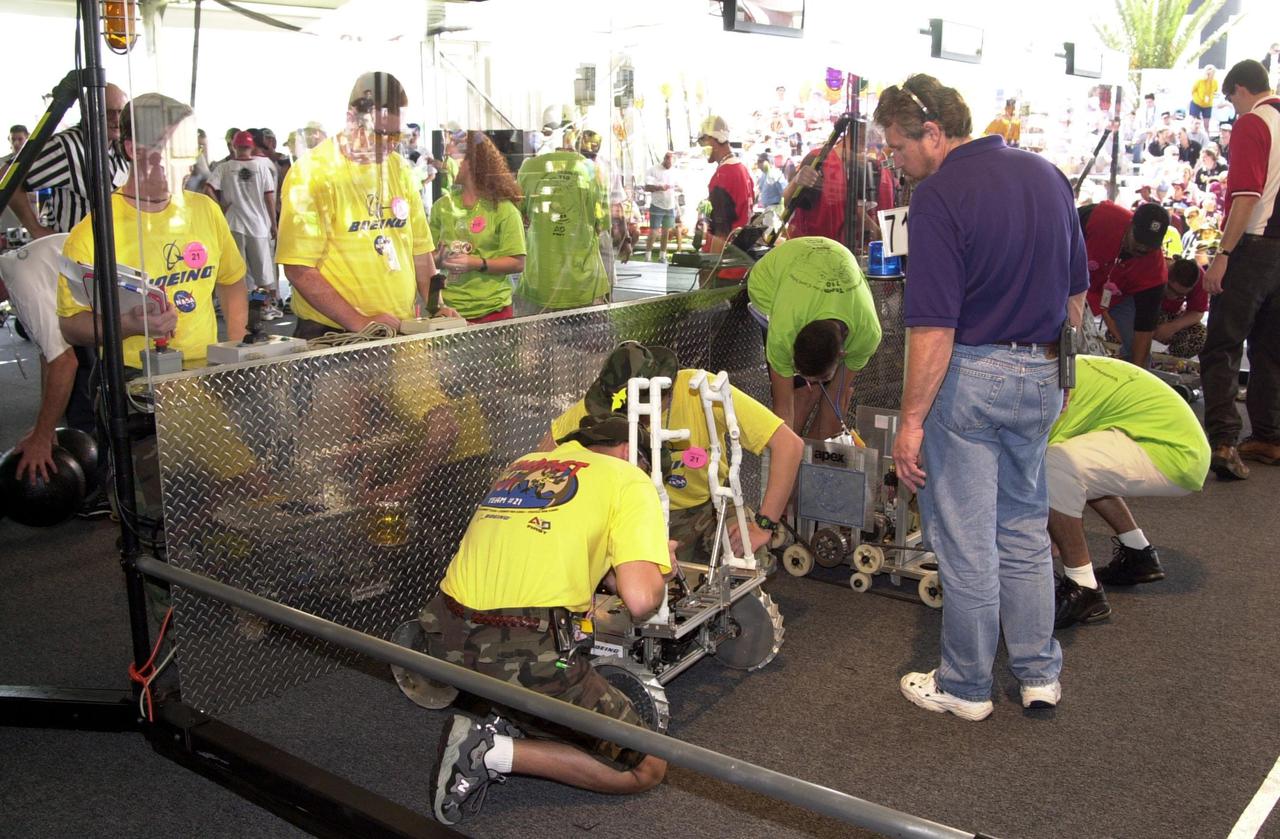
Student teams adjust their robots before competing on the playing field field during the NASA_KSC FIRST Southeastern Regional event held March 1-3, 2001. At left is the ComBBAT 2001 team from Astronaut and Titusville High Schools, Florida. It is a KSC joint-sponsored team. At right is the PC Panthers, no. 710, from Pine Crest School, Fort Lauderdale, Fla. FIRST (For Inspiration and Recognition of Science and Technology) events are held nationwide, pitting robots against each other and the clock on a playing field. Many teams are sponsored by corporations and academic institutions. There are 27 teams throughout the State of Florida who are competing. KSC, which sponsors nine teams, has held the regional event for two years
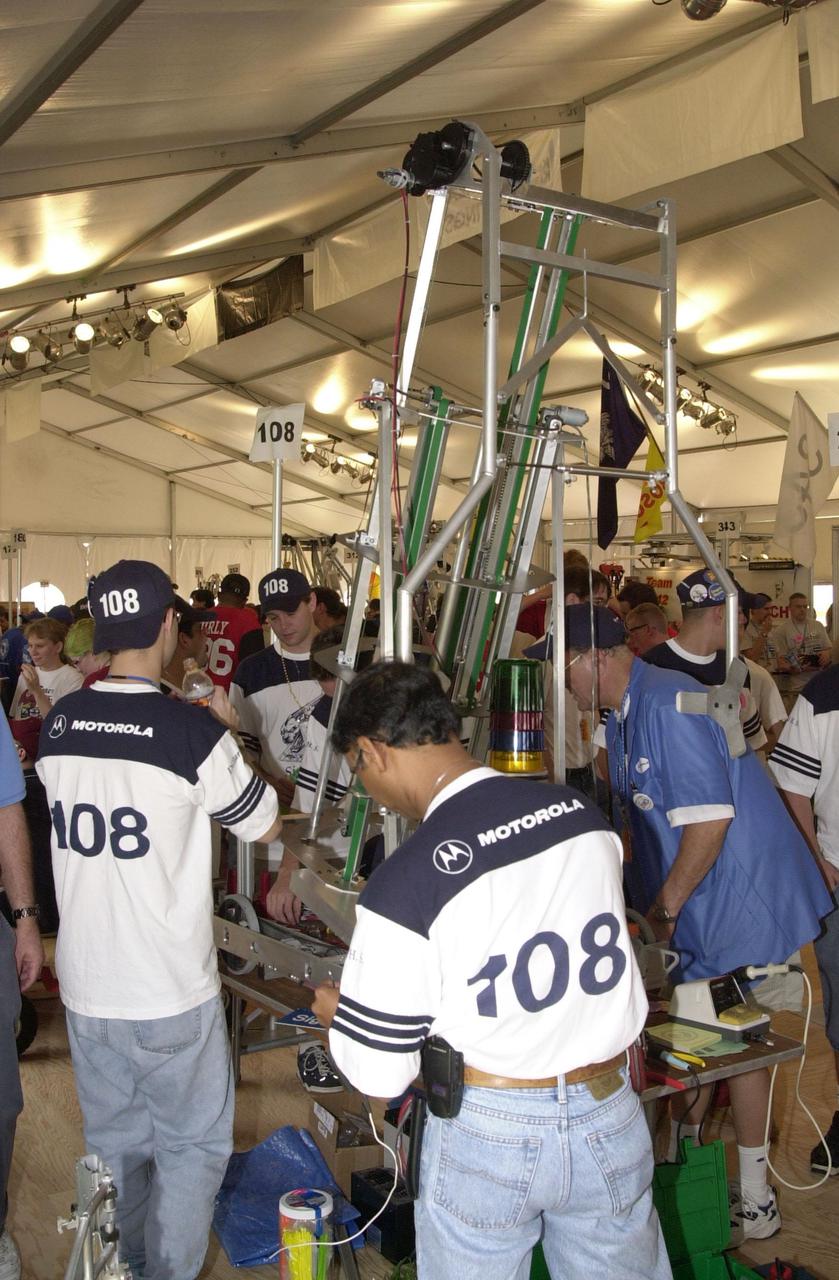
Students from Plantation, Fla., and their mentors prepare their team robot to compete in the NASA_KSC FIRST Southeastern Regional event. FIRST (For Inspiration and Recognition of Science and Technology) events are held nationwide, pitting the student-built robots against each other and the clock on a playing field. Many teams are sponsored by corporations, such as Motorola seen on these students’ shirts, and academic institutions. There are 27 teams throughout the State of Florida who are competing. KSC, which sponsors nine teams, has held the regional event for two years.
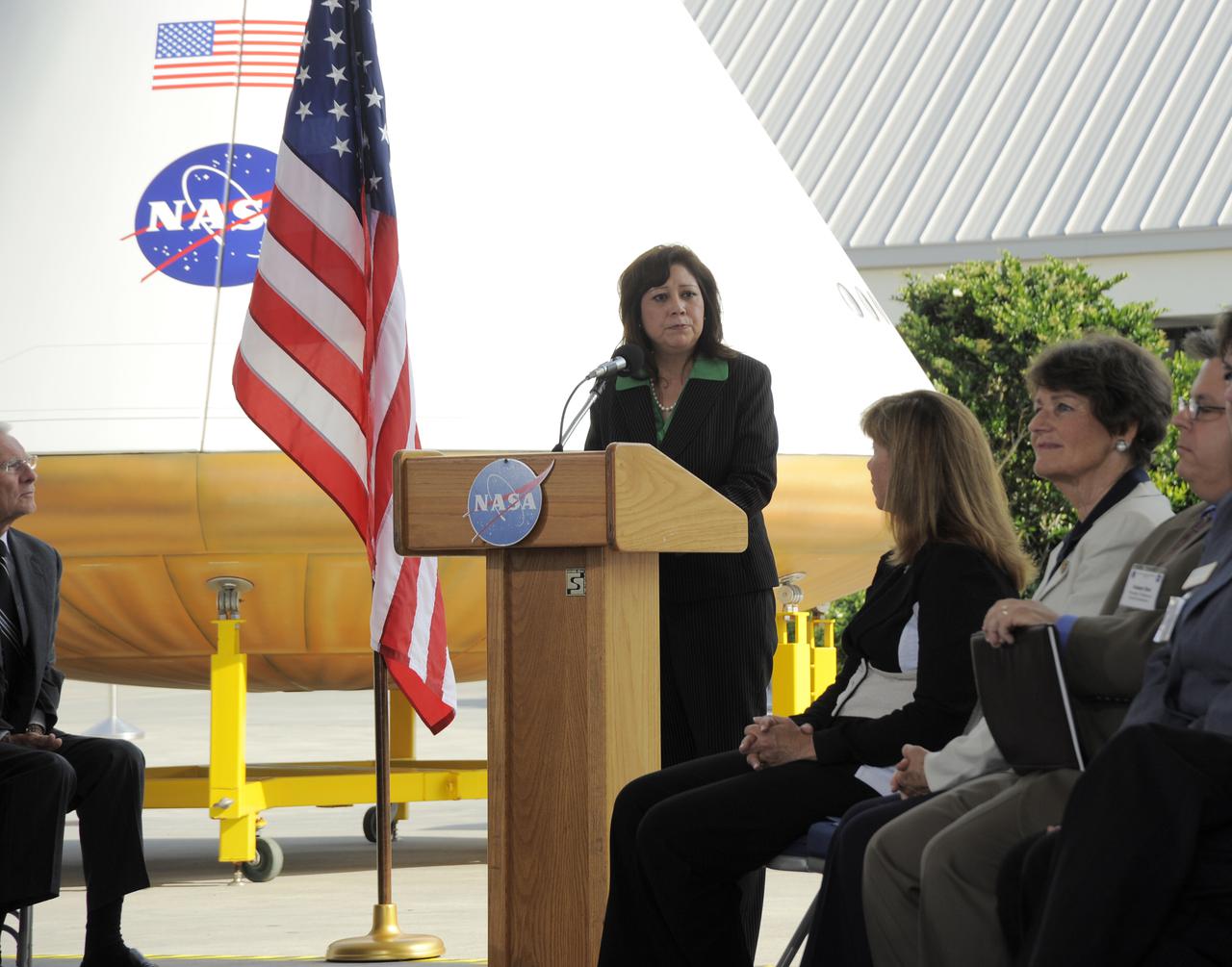
CAPE CANAVERAL, Fla. – At NASA's Kennedy Space Center Visitor Complex, Secretary of Labor Hilda Solis talks to the media and community leaders about the $15 million Florida will receive from the Labor Department’s National Emergency Grant Program to assist workers after the retirement of NASA's Space Shuttle Program. The grant money, which was awarded to the Brevard Workforce Development Board, will be used for job recruiting, screening, education and training, as well as incentives for new growth in science, technology and research. Photo credit: NASA_Kim Shiflett
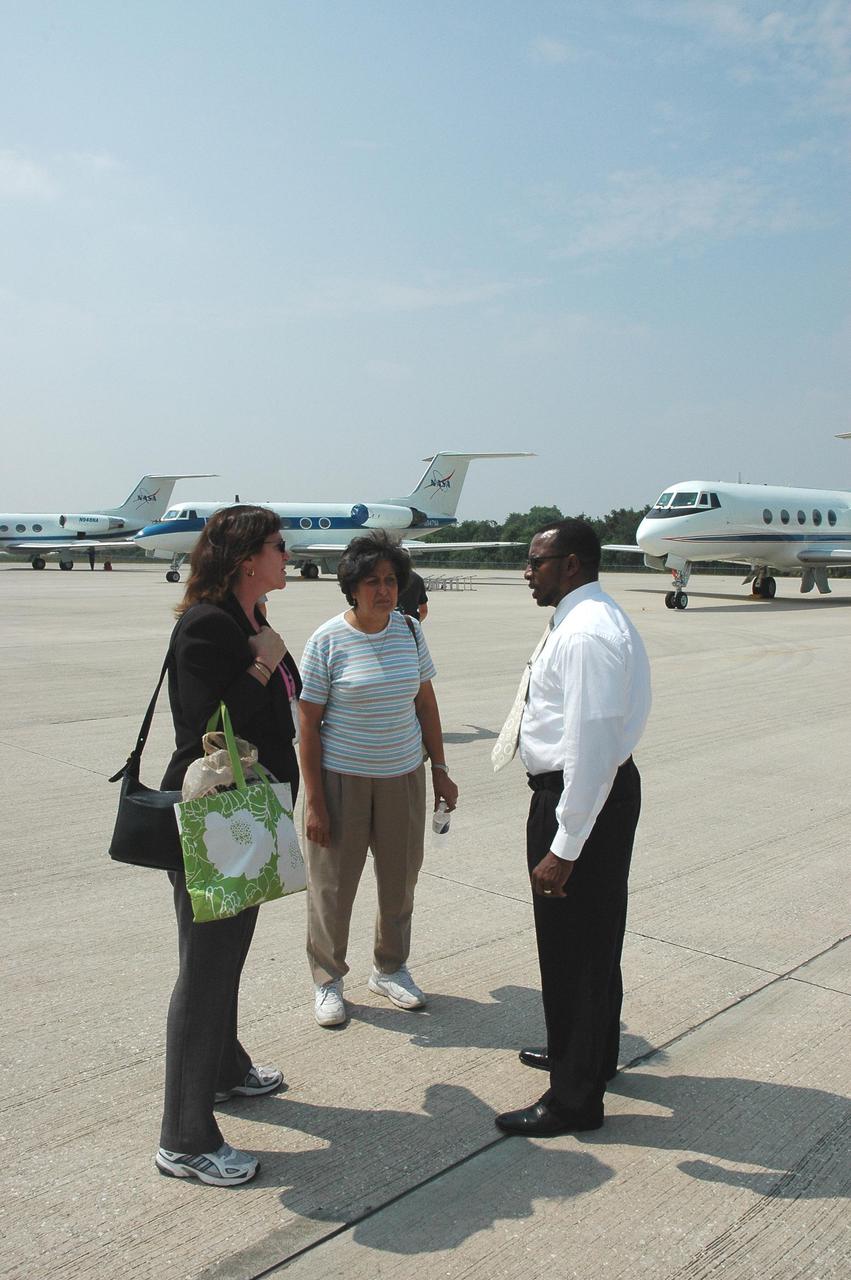
KENNEDY SPACE CENTER, FLA. - Patti Bell (left) and Dr. Violette Wahba Salib (center) are greeted by KSC Deputy Director Dr. Woodrow Whitlow Jr. after their return from Stennis Space Center in Mississippi. Bell and Salib are with Environmental and Occupational Health at KSC. They were part of a volunteer team helping rescue and recovery efforts at Stennis, which was damaged during Hurricane Katrina. Many employees of Stennis and Michoud Assembly Facility, near New Orleans, were rendered homeless by the hurricane. NASA centers have been generous with relief supplies and personnel. Stennis is now in limited operations mode. Daily convoys have been moving between Stennis and Michoud, transporting personnel and supplies as Michoud prepares to resume limited operations.
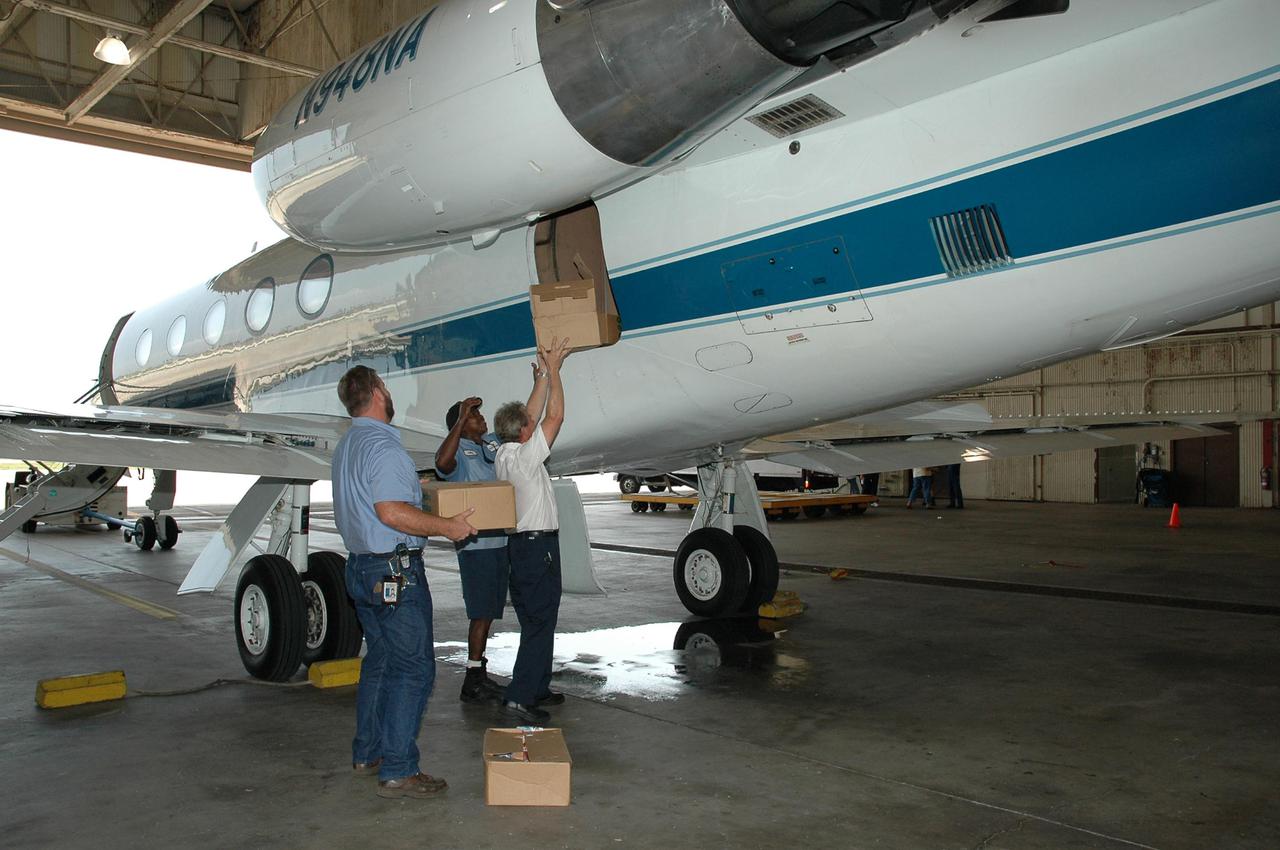
KENNEDY SPACE CENTER, FLA. - Workers at Kennedy Space Center load an airplane with supplies heading to Stennis Space Center in Mississippi for NASA workers there. Both Michoud Assembly Facility near New Orleans and Stennis were effected by Hurricane Katrina. KSC is sending a helicopter with medical supplies and an Emergency Medical Technician to Stennis. A NASA plane is carrying medical supplies, food and chain saws, as well as a physician and two high voltage technicians to Michoud to ensure the facility can safely receive power when the main electricity grid comes online. KSC has sent a truck with 1,000 gallons of diesel fuel and three large generators: a 1-megawatt generator, and 125- and 225-kilowatt generators. A 14-person security team is also going to Michoud to relieve the security professionals at that location.
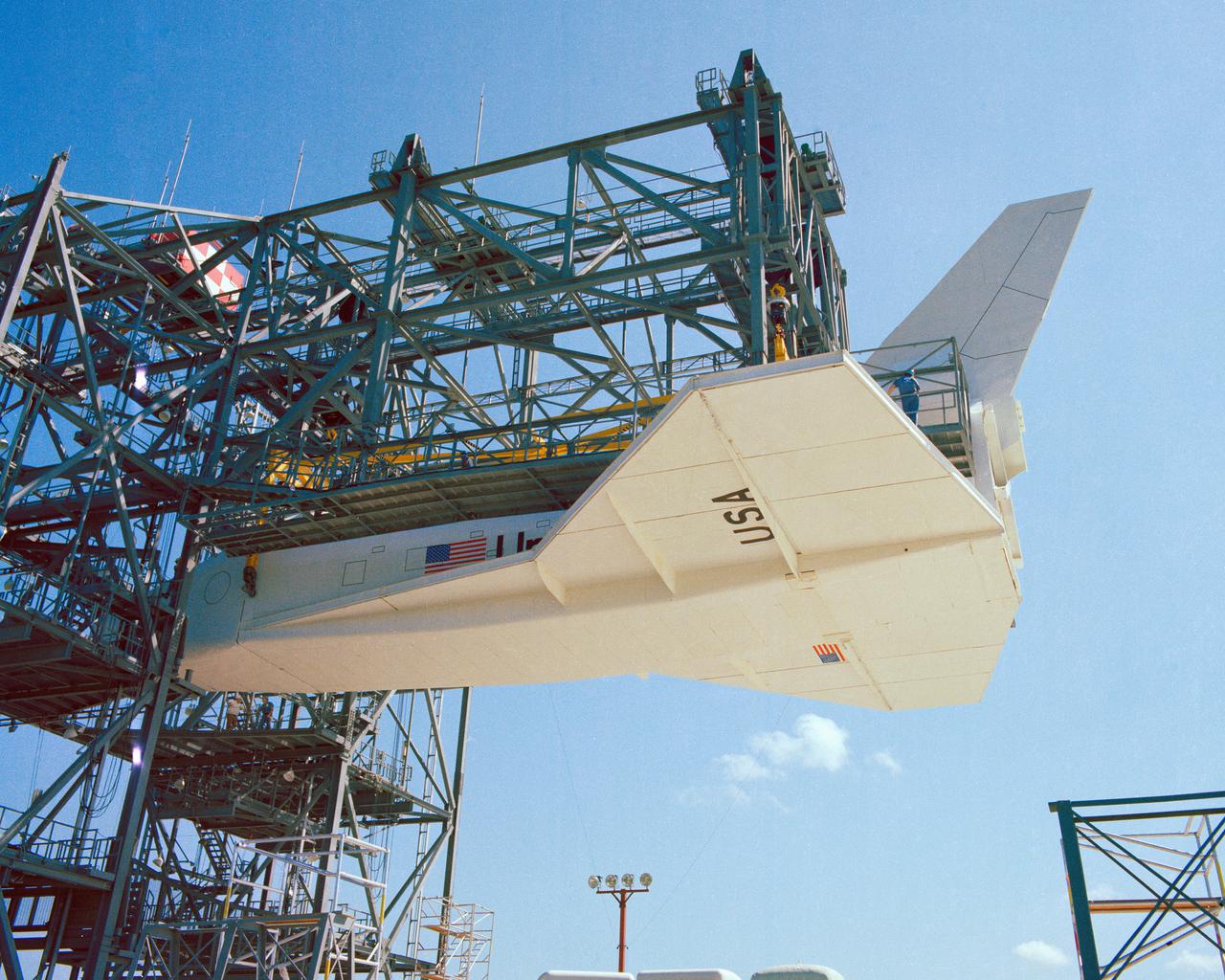
CAPE CANAVERAL, Fla. – At NASA's Kennedy Space Center in Florida, the space shuttle mock-up, dubbed Pathfinder, is attached to the Mate-Demate Device for at fit-check Oct. 19, 1978. The mock-up, constructed at NASA's Marshall Space Flight Center in Huntsville, Ala., possessed the general dimensions, weight and balance of a real space shuttle. It was shipped to Kennedy by barge and then used to fit-check the work platforms of the Mate-Demate Device, orbiter processing facilities and Vehicle Assembly Building, as well as support ground crew training. It also was used to rehearse post-landing procedures at Kennedy's Shuttle Landing Facility. After being on display at the 'Great Space Shuttle Exposition' in Tokyo from June 1983 to August 1984, the mock-up returned to Marshall and now is on permanent display at the U.S. Space and Rocket Center near Huntsville. Photo credit: NASA
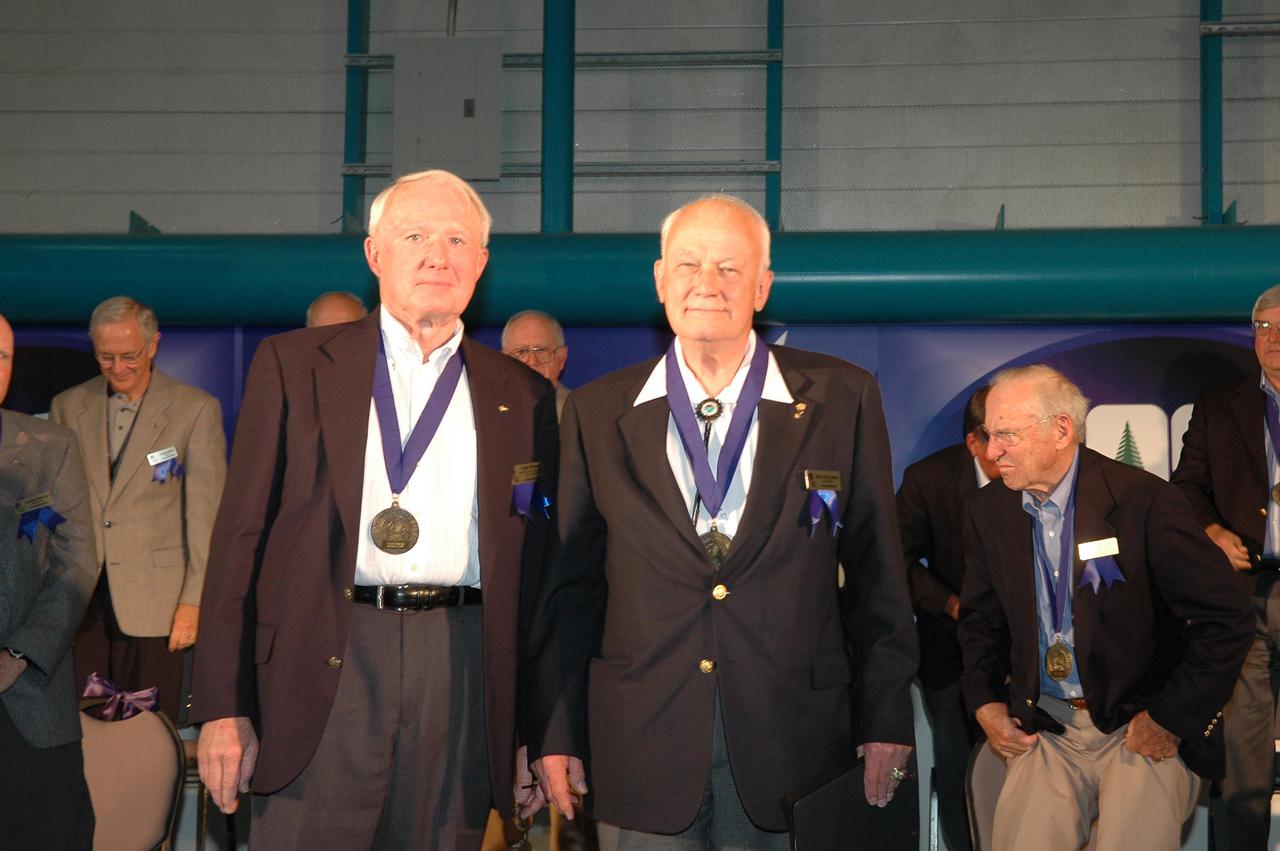
KENNEDY SPACE CENTER, FLA. - At the Astronaut Hall of Fame Induction Ceremony, new inductees Joe Allen (left) and Bruce McCandless stand before the guests at the Kennedy Space Center Visitor Complex’s Apollo_Saturn V Center. Other inductee Gordon Fullerton is not pictured. Recognized for their individual flight accomplishments and contributions to the success and future success of the U.S. space program, this elite group of inductees is among only 60 astronauts to be honored in the Hall of Fame and the fourth group of Space Shuttle astronauts named.
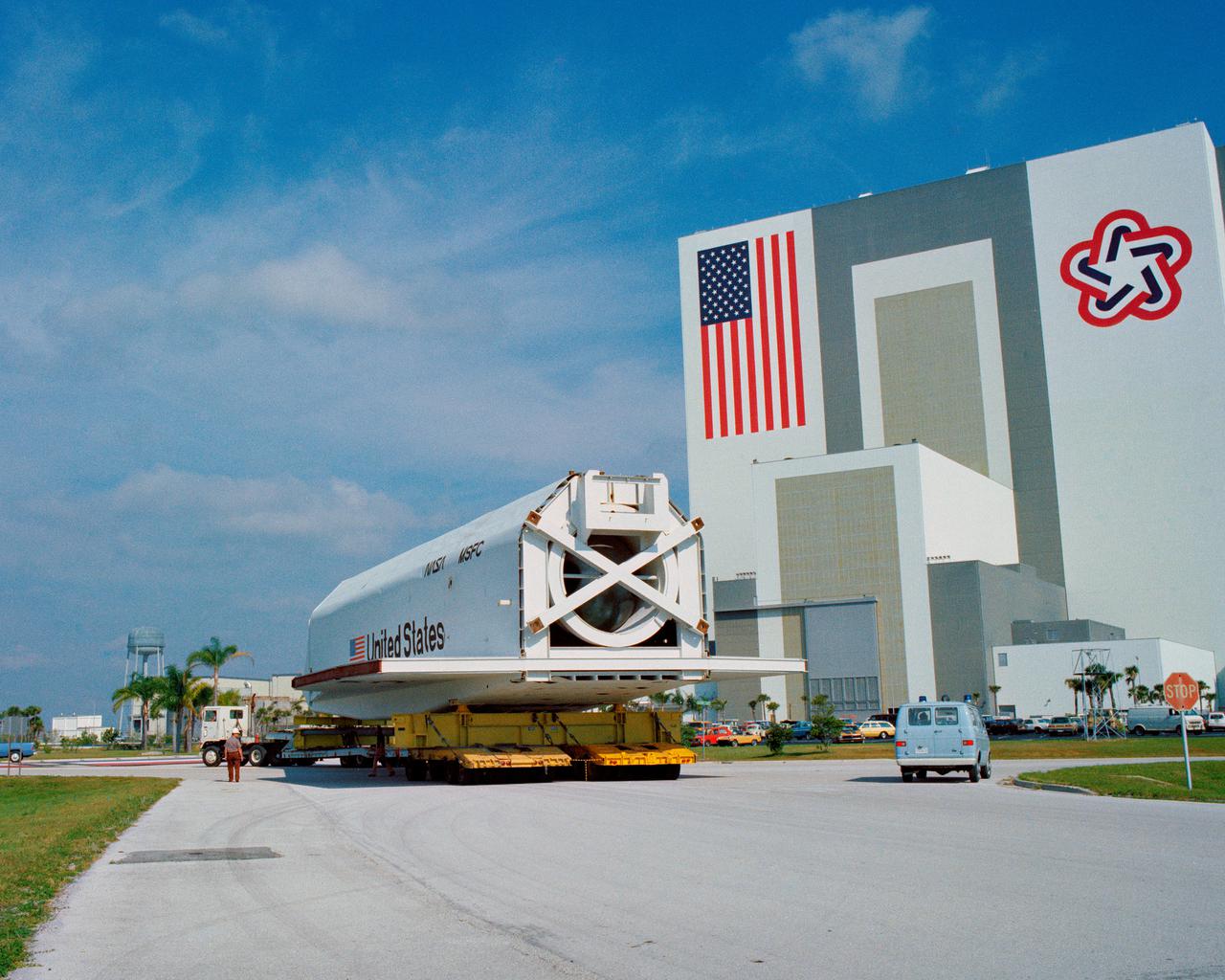
CAPE CANAVERAL, Fla. – At NASA's Kennedy Space Center in Florida, the space shuttle mock-up, dubbed Pathfinder, makes its trek from the turn basin to the Vehicle Assembly Building on April 5, 1978. The mock-up, constructed at NASA's Marshall Space Flight Center in Huntsville, Ala., possessed the general dimensions, weight and balance of a real space shuttle. It was shipped to Kennedy by barge and then used to fit-check the work platforms of the Mate-Demate Device, orbiter processing facilities and Vehicle Assembly Building, as well as support ground crew training. It also was used to rehearse post-landing procedures at Kennedy's Shuttle Landing Facility. After being on display at the 'Great Space Shuttle Exposition' in Tokyo from June 1983 to August 1984, the mock-up returned to Marshall and now is on permanent display at the U.S. Space and Rocket Center near Huntsville. Photo credit: NASA
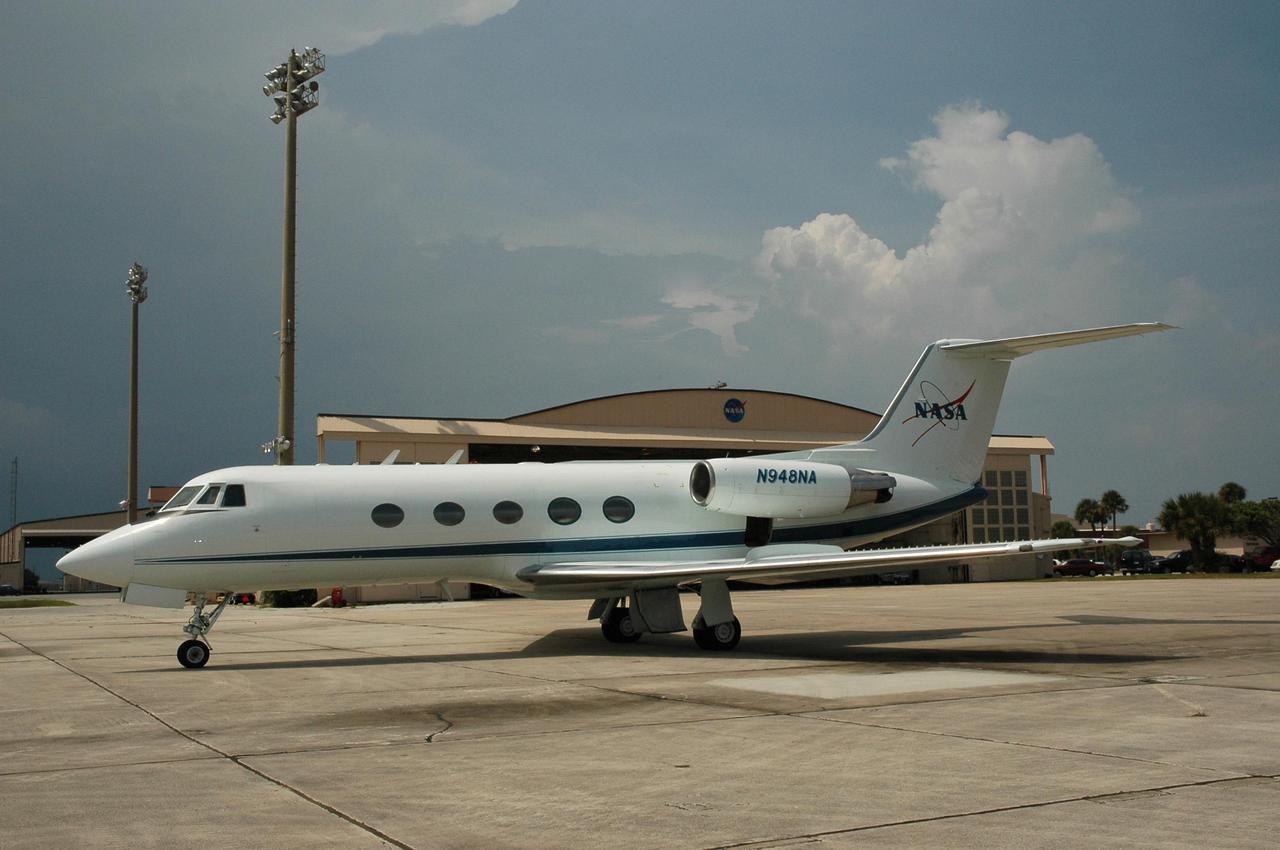
KENNEDY SPACE CENTER, FLA. - At Patrick Air Force Base in Florida, a NASA plane is ready to take off on a hurricane relief flight to Michoud Assembly Facility near New Orleans. Both Michoud and Stennis Space Center in Mississippi were effected by Hurricane Katrina. KSC is sending a helicopter with medical supplies and an Emergency Medical Technician to Stennis. A NASA plane is carrying medical supplies, food and chain saws, as well as a physician and two high voltage technicians to Michoud to ensure the facility can safely receive power when the main electricity grid comes online. KSC has sent a truck with 1,000 gallons of diesel fuel and three large generators: a 1-megawatt generator, and 125- and 225-kilowatt generators. A 14-person security team is also going to Michoud to relieve the security professionals at that location.
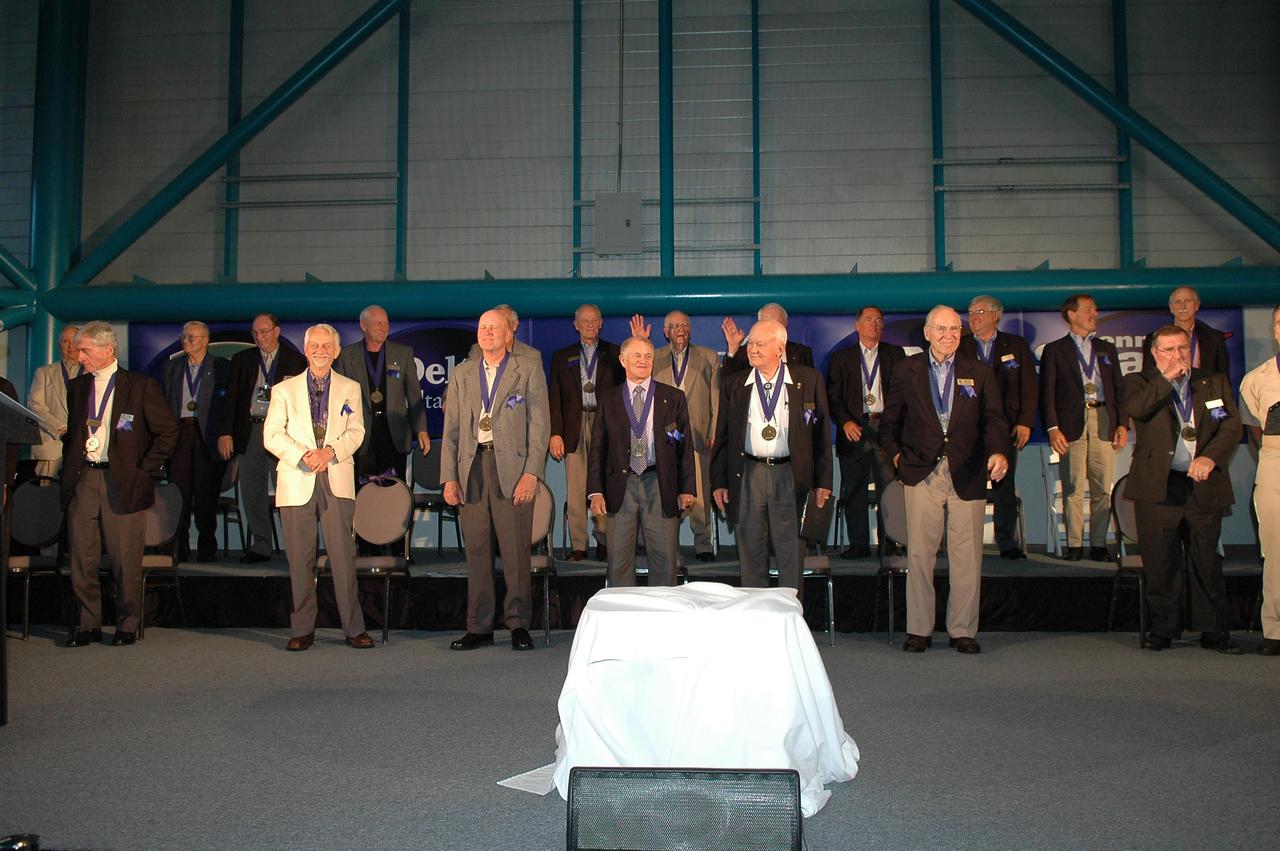
KENNEDY SPACE CENTER, FLA. - Members of the Astronaut Hall of Fame are applauded by the guests at the Astronaut Hall of Fame Induction Ceremony held at the Kennedy Space Center Visitor Complex’s Apollo_Saturn V Center. From left are Al Gordon, John Young, Walt Cunningham, Bill Anders, Owen Garriott, Ed Mitchell, Gordon Fullerton, Al Worden, Charlie Duke, Joe Allen, Jack Lousma, Bruce McCandless, Bill Pogue, Robert Crippen, Jim Lovell, Dan Brandenstein, Robert “Hoot” Gibson, Fred Haise, and Stephen Covey. Not pictured are Scott Carpenter and Vance Brand. McCandless, Allen and Fullerton are the 2005 inductees. Recognized for their individual flight accomplishments and contributions to the success and future success of the U.S. space program, this elite group of inductees is among only 60 astronauts to be honored in the Hall of Fame and the fourth group of Space Shuttle astronauts named.
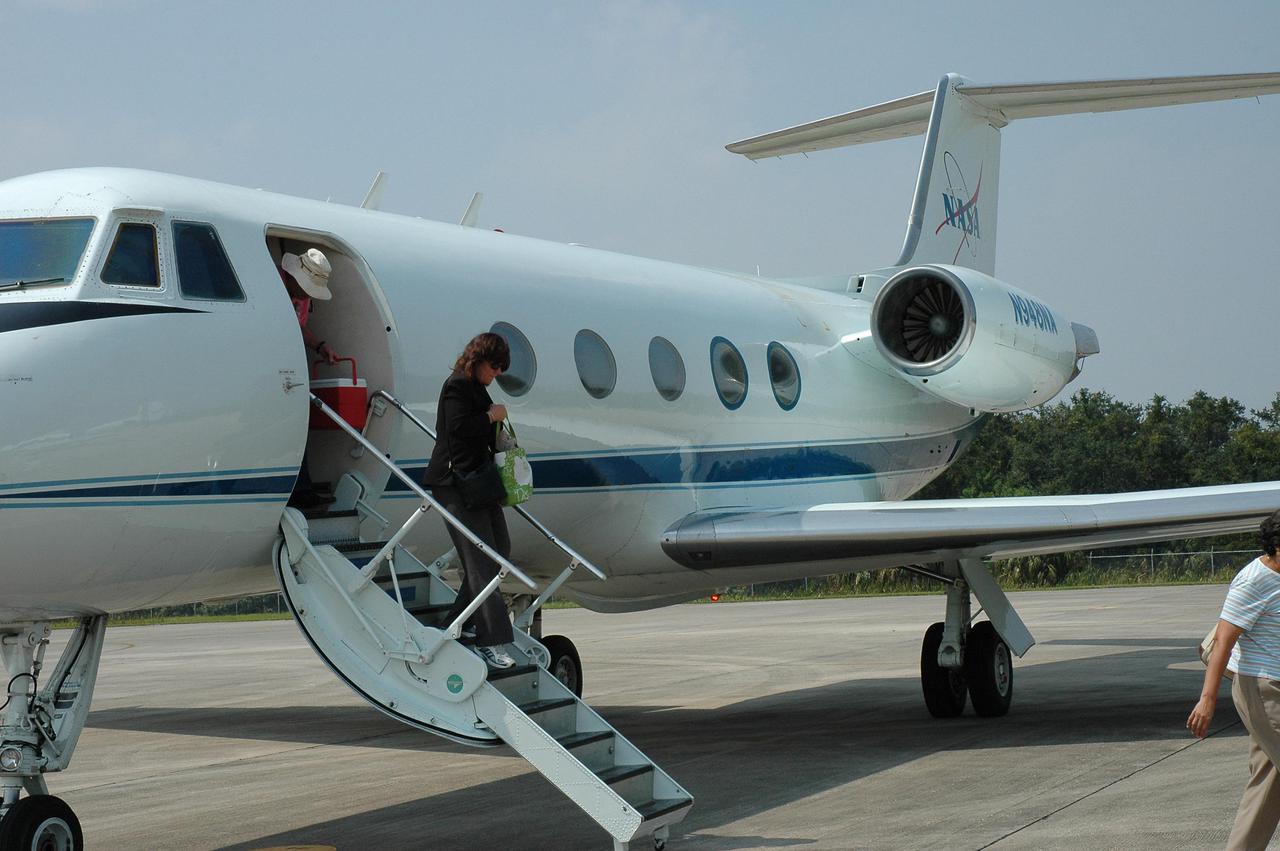
KENNEDY SPACE CENTER, FLA. - Patti Bell steps down the steps of the NASA aircraft on her return from Stennis Space Center in Mississippi. Bell is with Environmental and Occupational Health at KSC. She was part of a volunteer team helping rescue and recovery efforts at Stennis, which was damaged during Hurricane Katrina. Many employees of Stennis and Michoud Assembly Facility, near New Orleans, were rendered homeless by the hurricane. NASA centers have been generous with relief supplies and personnel. Stennis is now in limited operations mode. Daily convoys have been moving between Stennis and Michoud, transporting personnel and supplies as Michoud prepares to resume limited operations.

KENNEDY SPACE CENTER, FLA. - Owen Garriott, chairman of the Astronaut Hall of Fame, speaks to guests at the Induction Ceremony of three new additions to the Hall of Fame: Gordon Fullerton, Bruce McCandless and Joe Allen. Seated on stage are current Hall of Famers, from left in the back row, Dick Gordon, Walt Cunningham, Bill Anders, Ed Mitchell, Al Worden, Charles Duke, Jack Lousma, Bill Pogue, Robert Crippen, Dan Brandenstein, Robert “Hoot” Gibson and Stephen Covey. In front, from left, are Master of Ceremonies LeVar Burton, who starred in the television series “Star Trek: The Next Generation,” and Hall of Famers Scott Carpenter and John Young, and at right, Jim Lovell and Fred Haise. The ceremony is being held in the Kennedy Space Center Visitor Complex’s Apollo_Saturn V Center. Recognized for their individual flight accomplishments and contributions to the success and future success of the U.S. space program, this elite group of inductees is among only 60 astronauts to be honored in the Hall of Fame and the fourth group of Space Shuttle astronauts named.
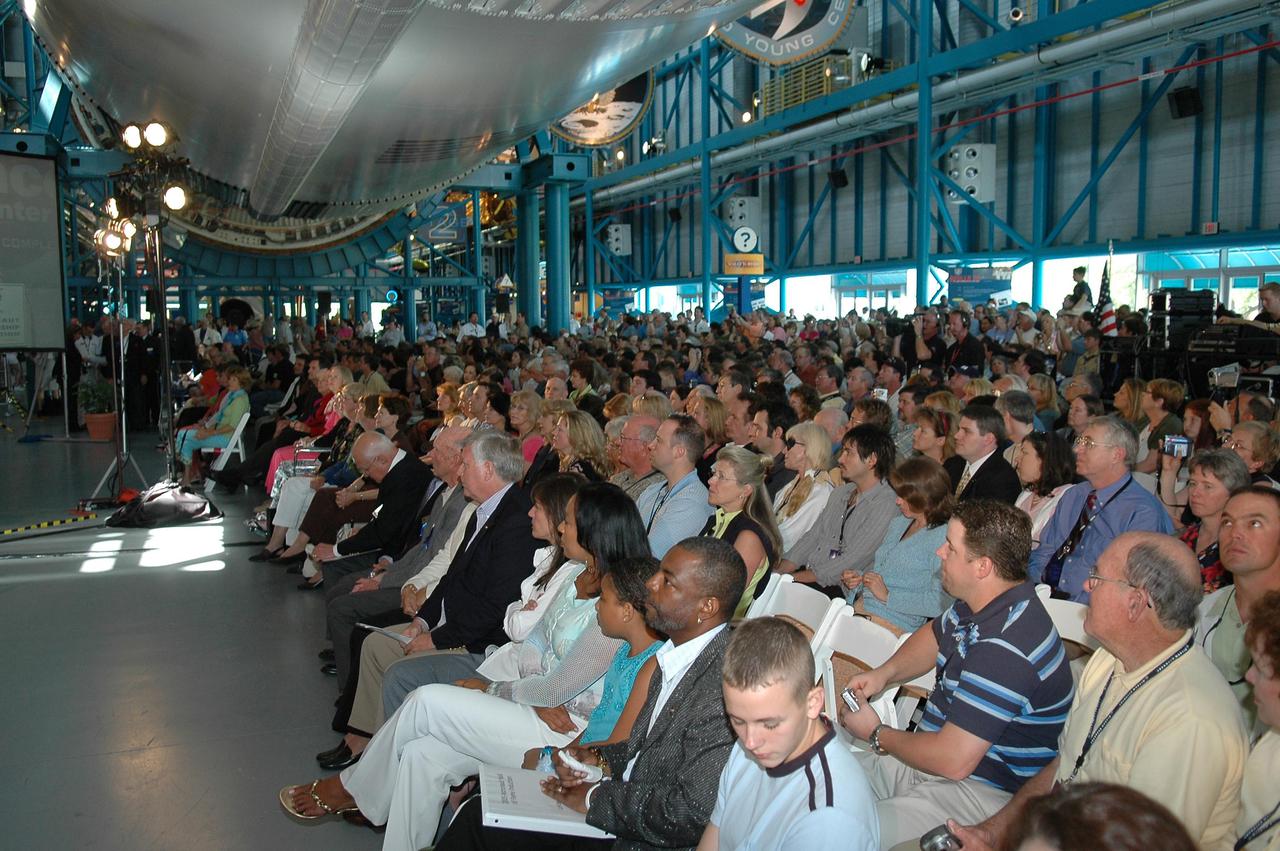
KENNEDY SPACE CENTER, FLA. - A crowd of 1,000 gather in Kennedy Space Center Visitor Complex’s Apollo_Saturn V Center for the Astronaut Hall of Fame Induction Ceremony. The event was attended by KSC Director Jim Kennedy and his wife, Bernadette, many previous inductees and invited guests, as well as the media, to honor the newest inductees Bruce McCandless, Joe Allen and Gordon Fullerton. Master of Ceremonies was LeVar Burton, who starred in the television series “Star Trek: The Next Generation.” Recognized for their individual flight accomplishments and contributions to the success and future success of the U.S. space program, this elite group of inductees is among only 60 astronauts to be honored in the Hall of Fame and the fourth group of Space Shuttle astronauts named.
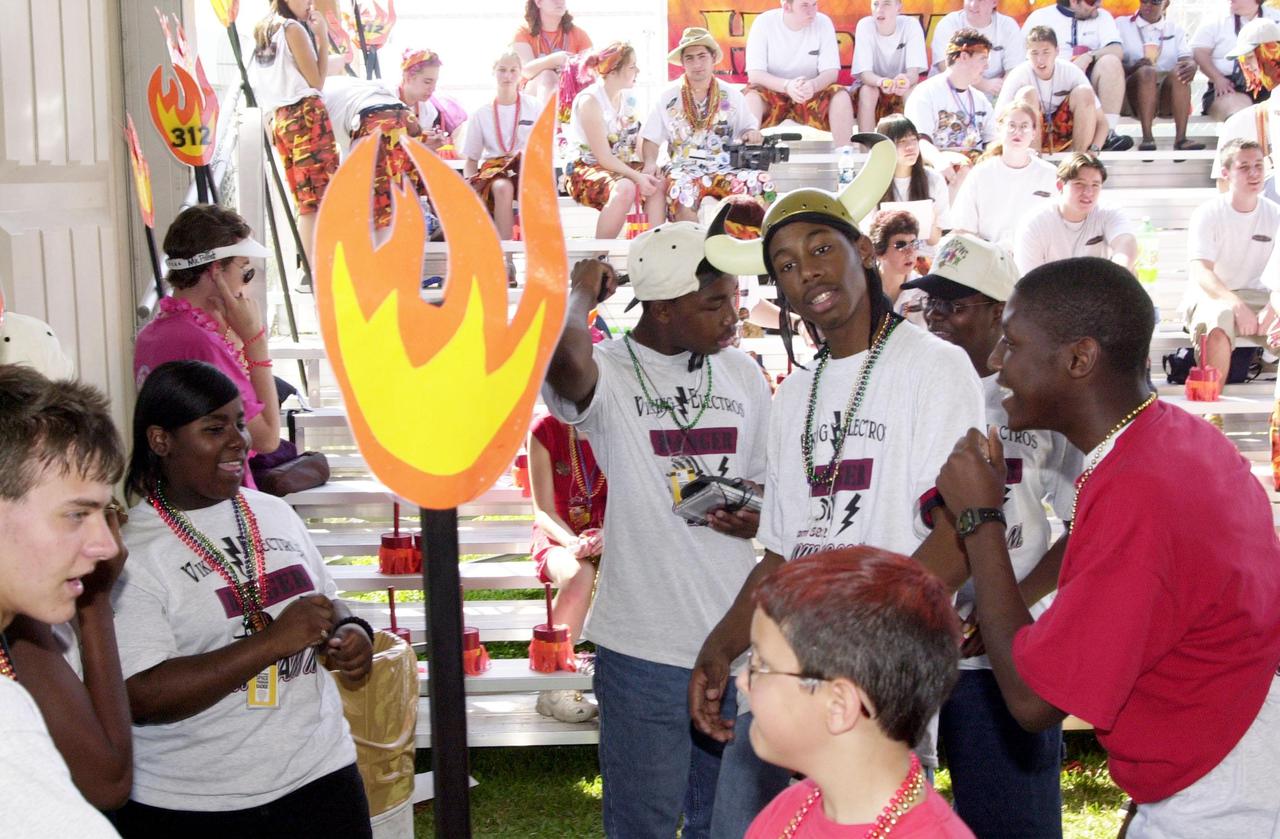
The student team Viking Electros, from W.M. Raines High School, Jacksonville, Fla., relaxes between heats at the NASA_KSC FIRST Southeastern Regional event held March 1-3, 2001. FIRST (For Inspiration and Recognition of Science and Technology) events are held nationwide, pitting robots against each other and the clock on a playing field. Many teams are sponsored by corporations and academic institutions. There are 27 teams throughout the State of Florida who are competing. KSC, which sponsors nine teams, has held the regional event for two years

Students and their mentors prepare their team robot to compete in the NASA_KSC FIRST Southeastern Regional event. FIRST (For Inspiration and Recognition of Science and Technology) events are held nationwide, pitting the student-built robots against each other and the clock on a playing field. Many teams are sponsored by corporations and academic institutions. There are 27 teams throughout the State of Florida who are competing. KSC, which sponsors nine teams, has held the regional event for two years.
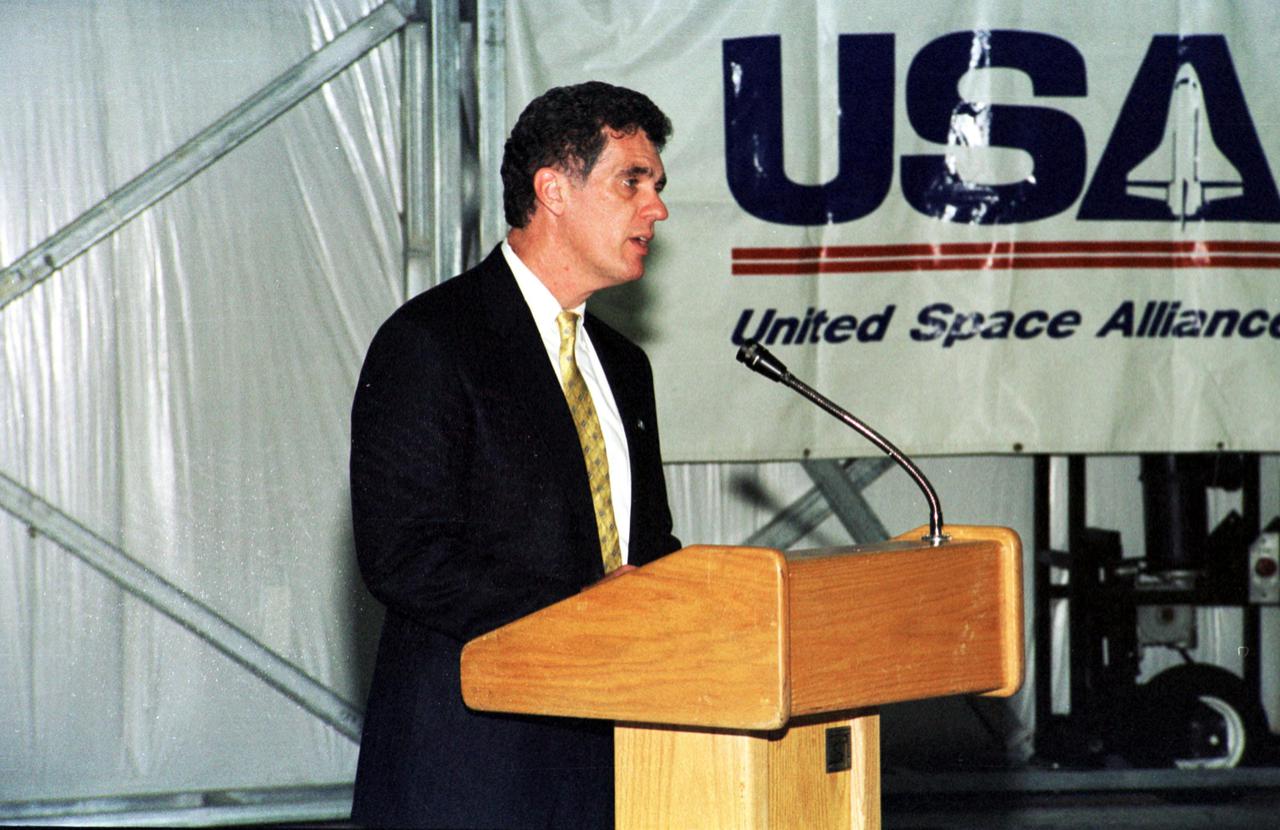
KENNEDY SPACE CENTER, Fla. -- Congressman Dave Weldon (R-Palm Bay) speaks to attendees at the signing of a lease agreement between Spaceport Florida Authority and United Space Alliance (USA) for the use of a hangar. The hangar was originally developed by the state as part of a joint NASA_ Spaceport Florida Authority (SFA) Reusable Launch Vehicle Support Complex at Kennedy Space Center. USA plans to use the state-developed 50,000-square-foot facility to store and maintain Space Shuttle ground equipment
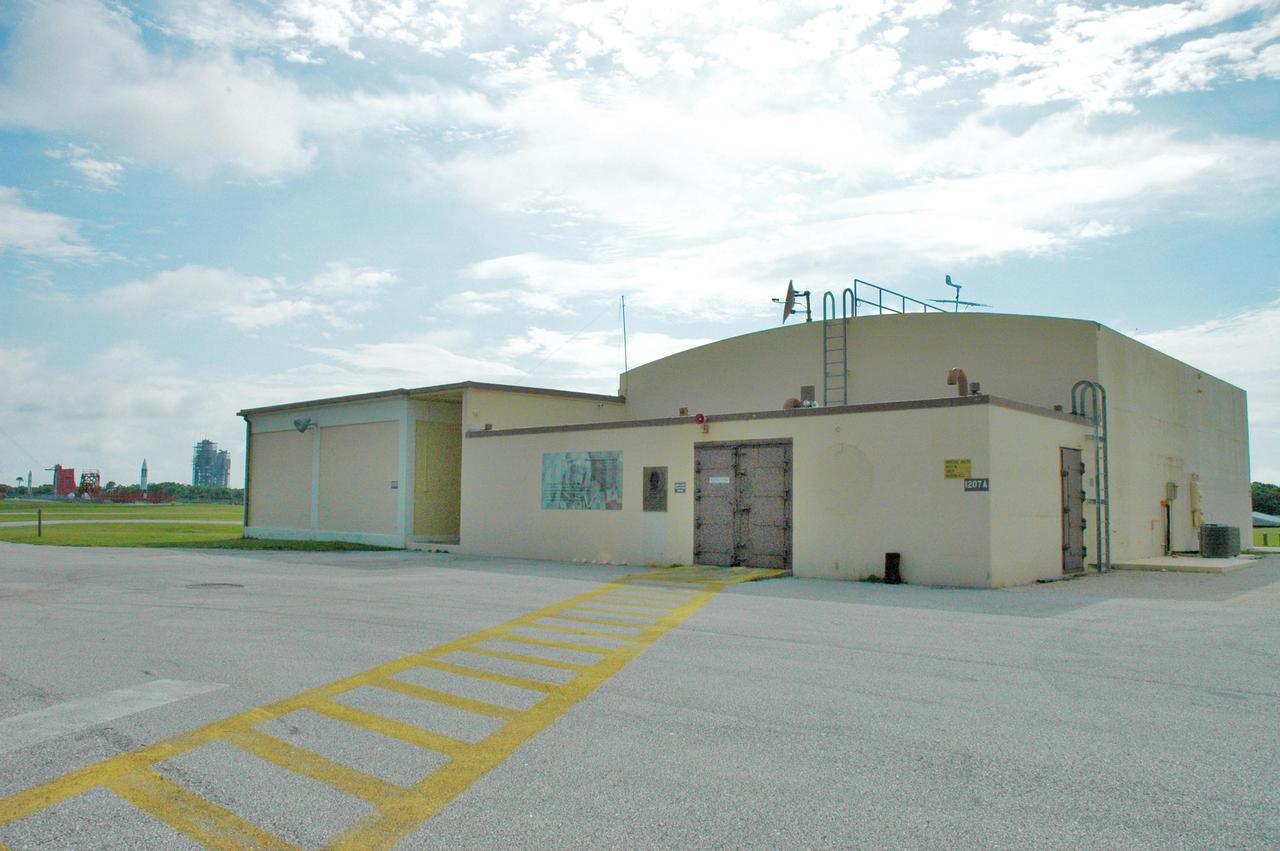
KENNEDY SPACE CENTER, FLA. - This is Launch Complex 5_6 blockhouse, now a museum at the Cape Canaveral Air Force Station (CCAFS) in Florida, where long-lost spacesuits were found. A recent venture into a long-locked room at CCAFS uncovered interesting artifacts of a bygone era: retired space suits from Americans who trained in the 1960s to be astronauts aboard an Air Force orbiting reconnaissance laboratory. Two security officers were doing a check of a facility at Launch Complex 5_6 blockhouse. NASA Special Agent Dan E. Oakland and Security Manager Henry Butler, with Delaware North Parks and Resorts, which oversees the museum, discovered a locked room. Space suits from the Air Force’s planned Manned Orbiting Laboratory (MOL) program were found in the room Begun in 1964, the MOL program was an Air Force initiative that would have sent Air Force astronauts to a space station in a Gemini capsule. After spending a few weeks in orbit, the crew would undock and return to Earth. A test launch from Complex 40 on Nov. 30, 1966, of a MOL was conducted with an unmanned Gemini capsule. The MOL was constructed from tankage of a Titan II rocket. The operational MOL was planned to be launched into a polar orbit from Vandenberg Air Force Base in California. The Air Force abandoned the program in 1969, but the program produced a great deal of technological development, and three groups of military officers trained to be MOL astronauts. When the program was cancelled, seven of the younger astronauts were transferred to the agency’s human space flight program and went on to have standout careers. Among them were Robert Crippen, pilot of the first Space Shuttle mission, and Richard H. 'Dick' Truly, who later became NASA Administrator.
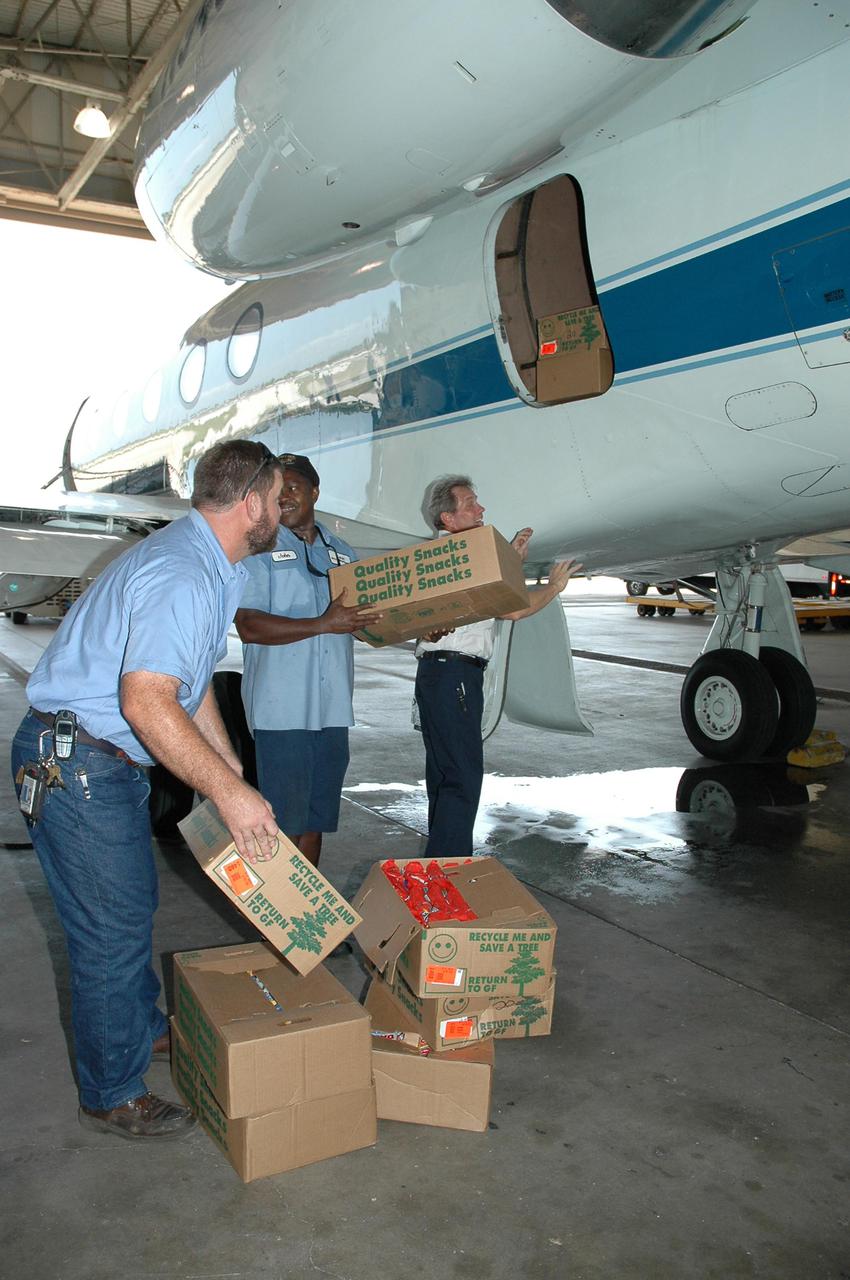
KENNEDY SPACE CENTER, FLA. - Workers at Kennedy Space Center load an airplane with supplies heading to Stennis Space Center in Mississippi for NASA workers there. Both Michoud Assembly Facility near New Orleans and Stennis were effected by Hurricane Katrina. KSC is sending a helicopter with medical supplies and an Emergency Medical Technician to Stennis. A NASA plane is carrying medical supplies, food and chain saws, as well as a physician and two high voltage technicians to Michoud to ensure the facility can safely receive power when the main electricity grid comes online. KSC has sent a truck with 1,000 gallons of diesel fuel and three large generators: a 1-megawatt generator, and 125- and 225-kilowatt generators. A 14-person security team is also going to Michoud to relieve the security professionals at that location.
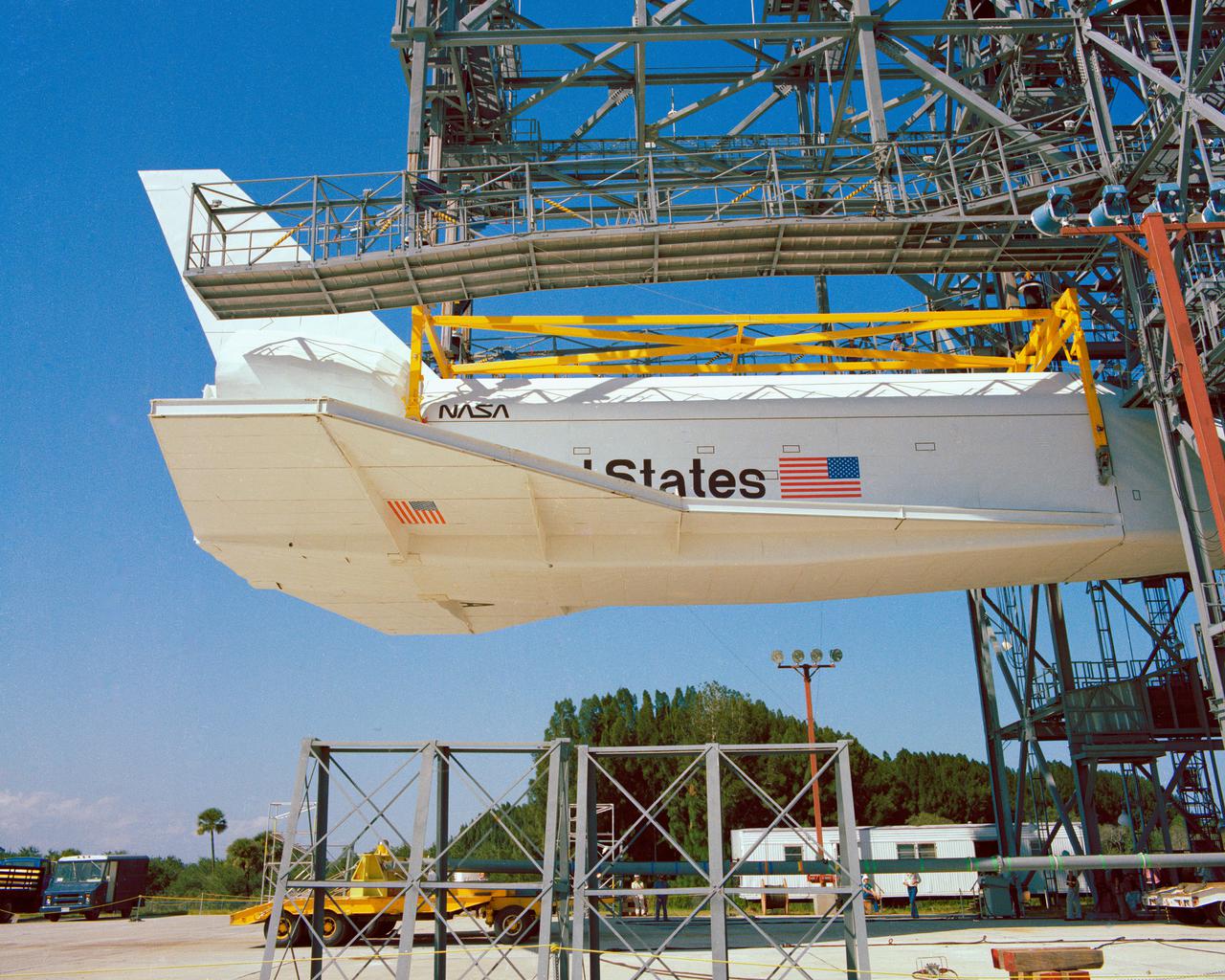
CAPE CANAVERAL, Fla. – At NASA's Kennedy Space Center in Florida, the space shuttle mock-up, dubbed Pathfinder, is attached to the Mate-Demate Device for at fit-check Oct. 19, 1978. The mock-up, constructed at NASA's Marshall Space Flight Center in Huntsville, Ala., possessed the general dimensions, weight and balance of a real space shuttle. It was shipped to Kennedy by barge and then used to fit-check the work platforms of the Mate-Demate Device, orbiter processing facilities and Vehicle Assembly Building, as well as support ground crew training. It also was used to rehearse post-landing procedures at Kennedy's Shuttle Landing Facility. After being on display at the 'Great Space Shuttle Exposition' in Tokyo from June 1983 to August 1984, the mock-up returned to Marshall and now is on permanent display at the U.S. Space and Rocket Center near Huntsville. Photo credit: NASA
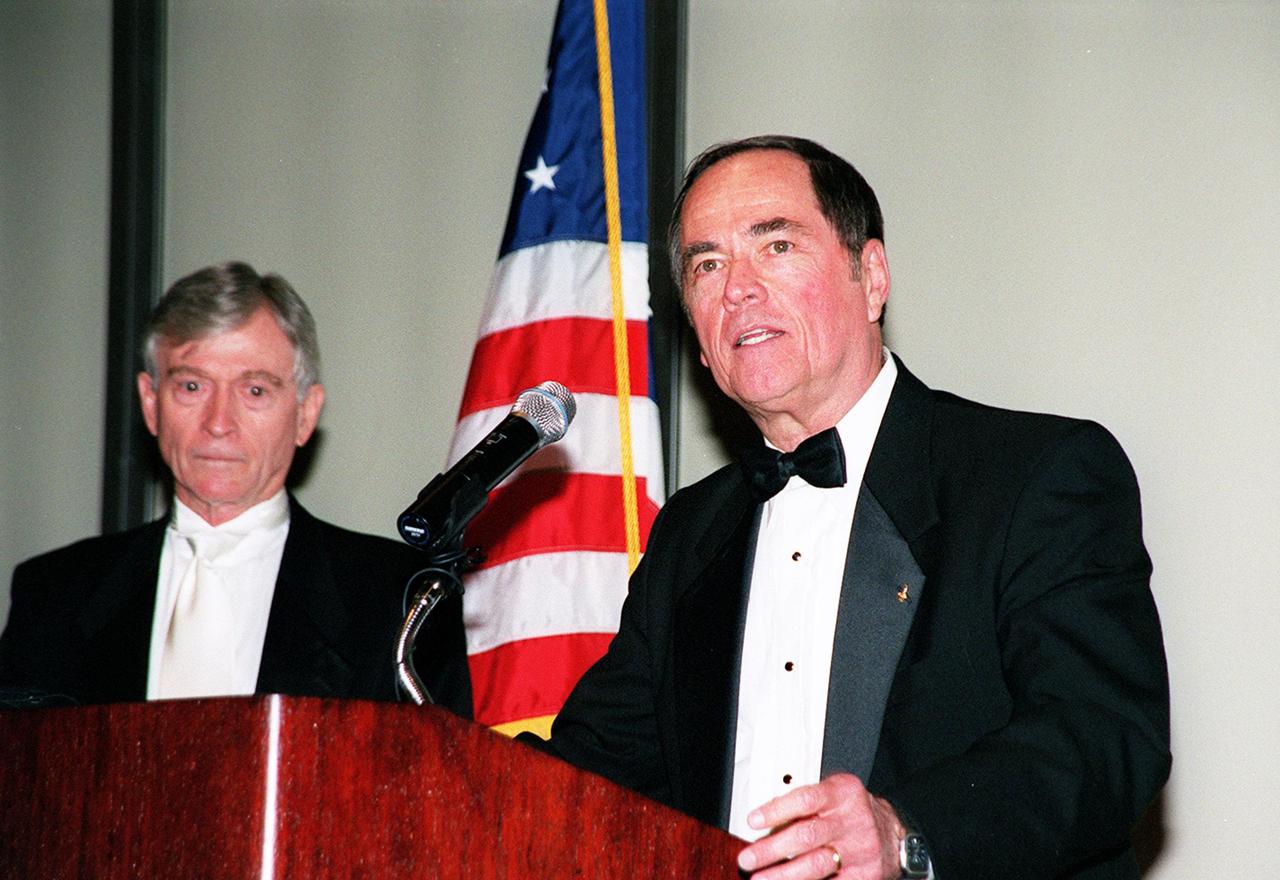
The 12th annual Dr. Kurt H. Debus Award Dinner included as speakers the first Shuttle crew from STS-1, John Young (left) and Robert Crippen (right). At the dinner, Center Director Roy Bridges received the 2001 Dr. Kurt H. Debus Award honoring his progressive, visionary leadership and contributions to space technology and exploration. The Florida Committee of the National Space Club presented the award. The Debus Award was first given in 1980. Created to recognize significant achievements and contributions made in Florida to the American aerospace effort, the award is named for the KSC’s first Director, Dr. Kurt H. Debus
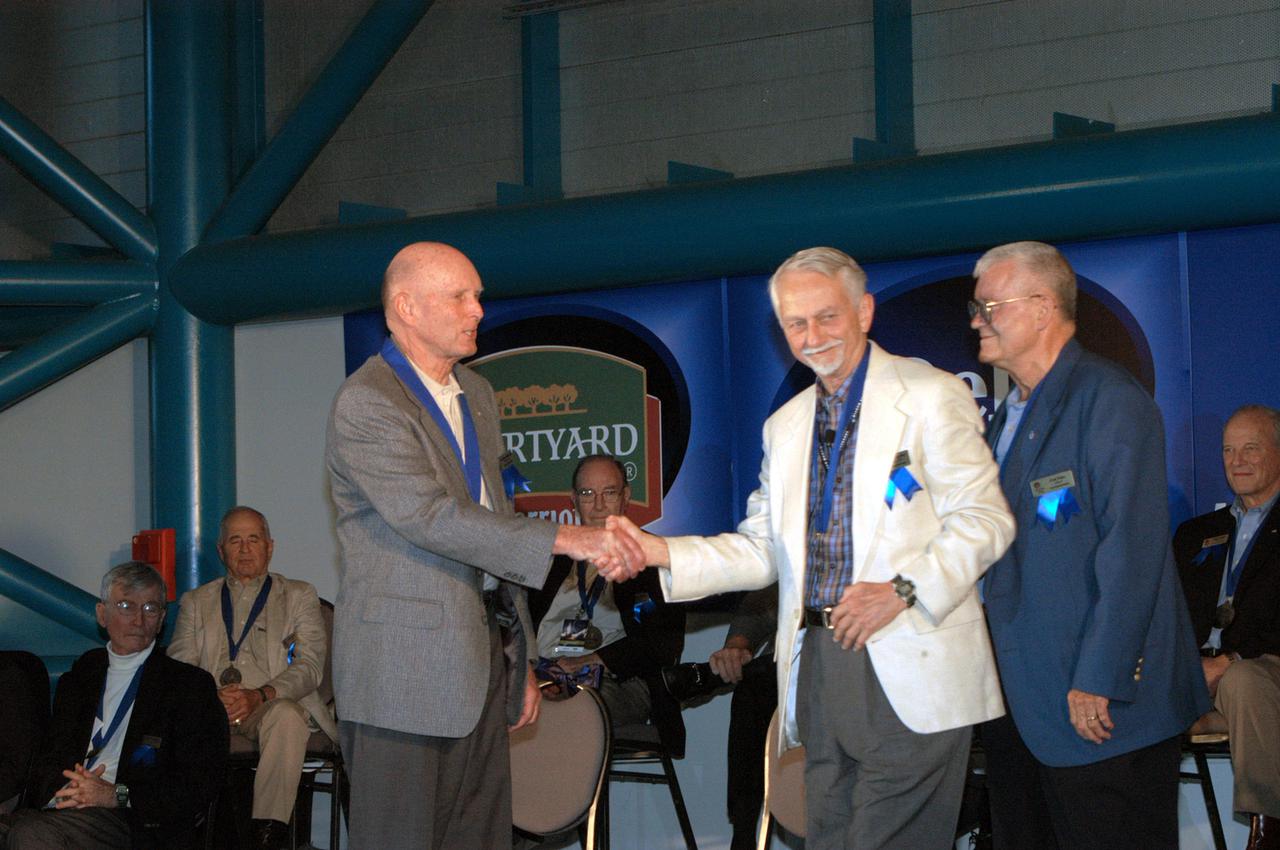
KENNEDY SPACE CENTER, FLA. - At the Astronaut Hall of Fame Induction Ceremony, new inductee Gordon Fullerton (left) is congratulated by Chairman Owen Garriott. At right is Hall of Famer Fred Haise. Other Hall of Famers are gathered on stage for the ceremony, which is being held in the Kennedy Space Center Visitor Complex’s Apollo_Saturn V Center. Recognized for their individual flight accomplishments and contributions to the success and future success of the U.S. space program, this elite group of inductees is among only 60 astronauts to be honored in the Hall of Fame and the fourth group of Space Shuttle astronauts named.

KENNEDY SPACE CENTER, FLA. - At the NASA Kennedy Space Center Shuttle Landing Facility, the NASA aircraft filled with hurricane relief supplies is ready for takeoff. The plane is bound for Stennis Space Center in Mississippi, which suffered damage from Hurricane Katrina. The supplies included 10 boxes of load bus disconnects going to Michoud Assesmbly Facility near New Orleans and 17 boxes of personal hygiene items, along with boxes of clothing and water. Many Stennis and Michoud employees were rendered homeless by the hurricane. NASA centers have been generous with relief supplies and personnel. Stennis is in limited operations mode. Daily convoys have been moving between Stennis and Michould, transporting personnel and supplies as Michoud prepares to resume limited operations.
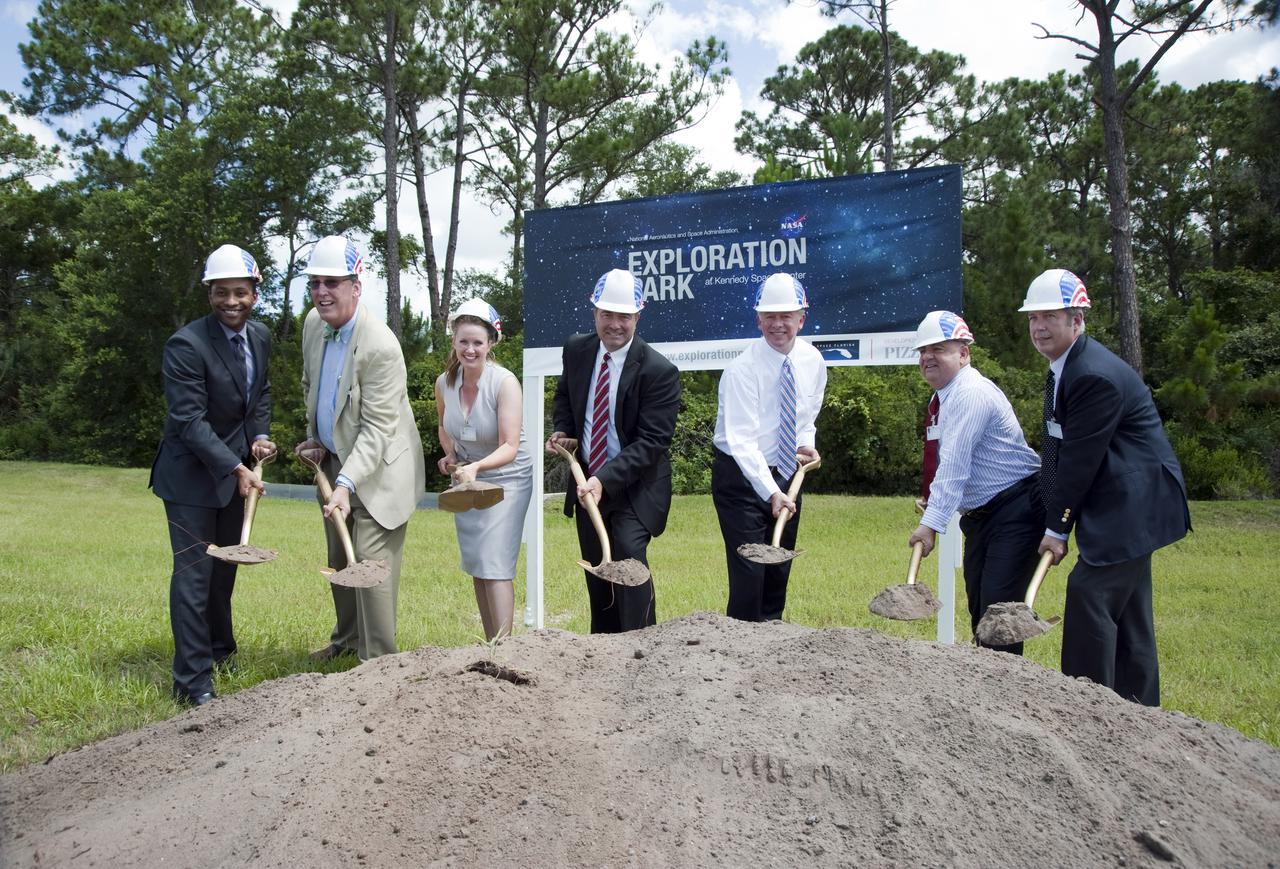
CAPE CANAVERAL, Fla. – At NASA's Kennedy Space Center in Florida, The Pizzuti Companies Naeem Coleman, left, Mike Bird, Stephanie Moreton and Tom Harmer, Florida Lt. Gov. Jeff Kottkamp, and The Pizzuti Companies Ron Pizzuti and Jim Russell break ground on Exploration Park outside of the Space Life Sciences Laboratory, or SLSL. Exploration Park is designed to be a strategically located complex, adjacent to the SLSL, for servicing diverse tenants and uses that will engage in activities to support space-related activities of NASA, other government agencies and the U.S. commercial space industry, as well as bring new aerospace work to the Space Coast. The SLSL will be the anchor facility for the park, which is expected to open its first new facility in early 2012. Photo Credit: NASA_Kim Shiflett
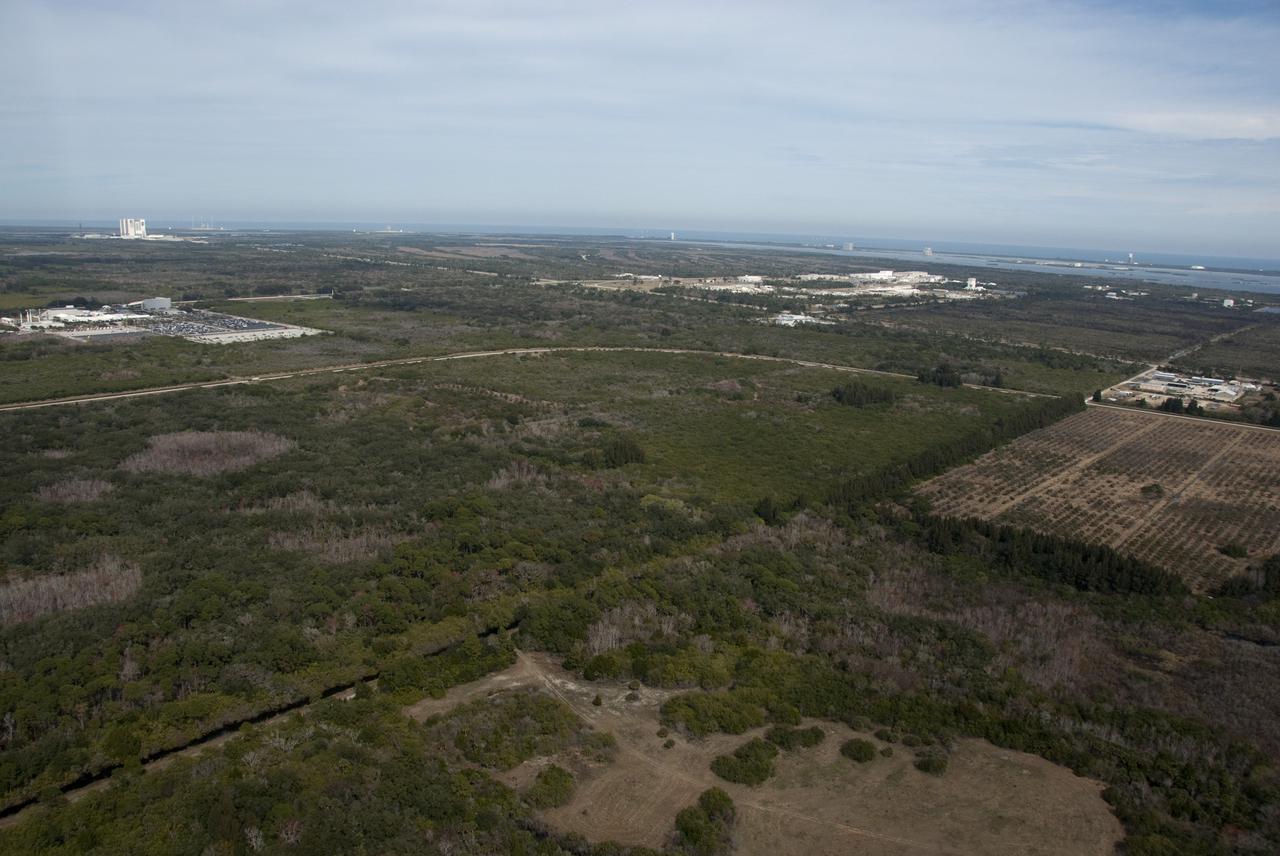
CAPE CANAVERAL, Fla. - Land located south of NASA's Kennedy Space Center Visitor Complex in Florida and adjacent to the Space Life Sciences Laboratory is the proposed site for Exploration Park. Kennedy and Space Florida, an independent special district of the State of Florida, have partnered to enable the development of a mixed-use technology and commerce park. Exploration Park will become home to diverse private sector technology and innovation enterprises offering opportunities to grow and deploy commercial space capabilities and will respond to national priorities in science and technology. The park is expected to attract tenants engaged in space technology, space commerce and space education. In addition, NASA and Space Florida plan to incorporate the existing 100,000 square foot Space Life Sciences Laboratory into the park, broadening the lab's accessibility and use beyond NASA. For more information, visit www.explorationpark.com. Photo credit: NASA_Kim Shiflett
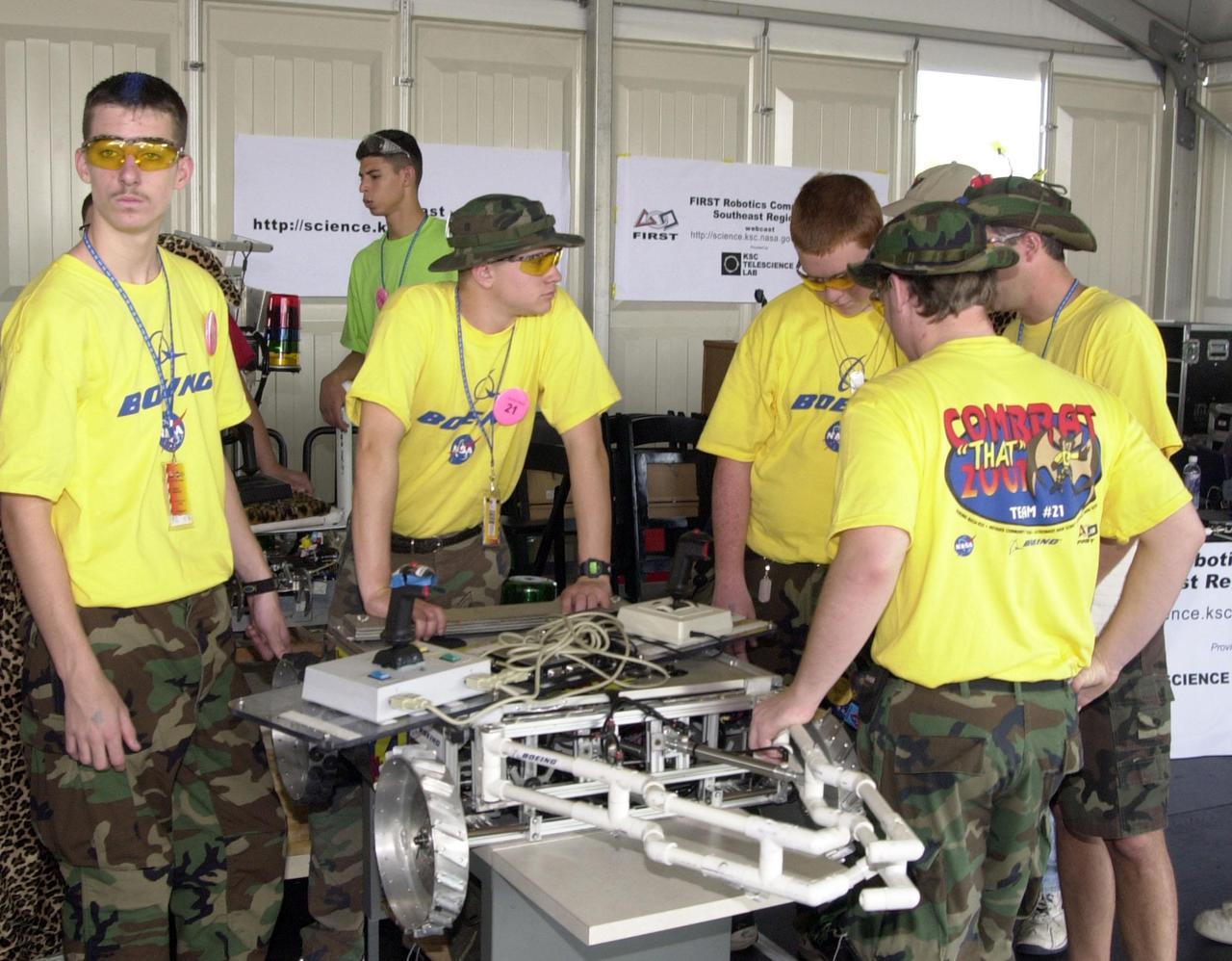
During the NASA_KSC FIRST Southeastern Regional competition held March 1-3, 2001, the ComBBAT 2001 team gives a final check to their robot. ComBBAT is a KSC joint-sponsored team of students from Astronaut and Titusville High Schools, Florida. FIRST (For Inspiration and Recognition of Science and Technology) events are held nationwide, pitting robots against each other and the clock on a playing field. Many teams are sponsored by corporations and academic institutions. There are 27 teams throughout the State of Florida who are competing. KSC, which sponsors nine teams, has held the regional event for two years
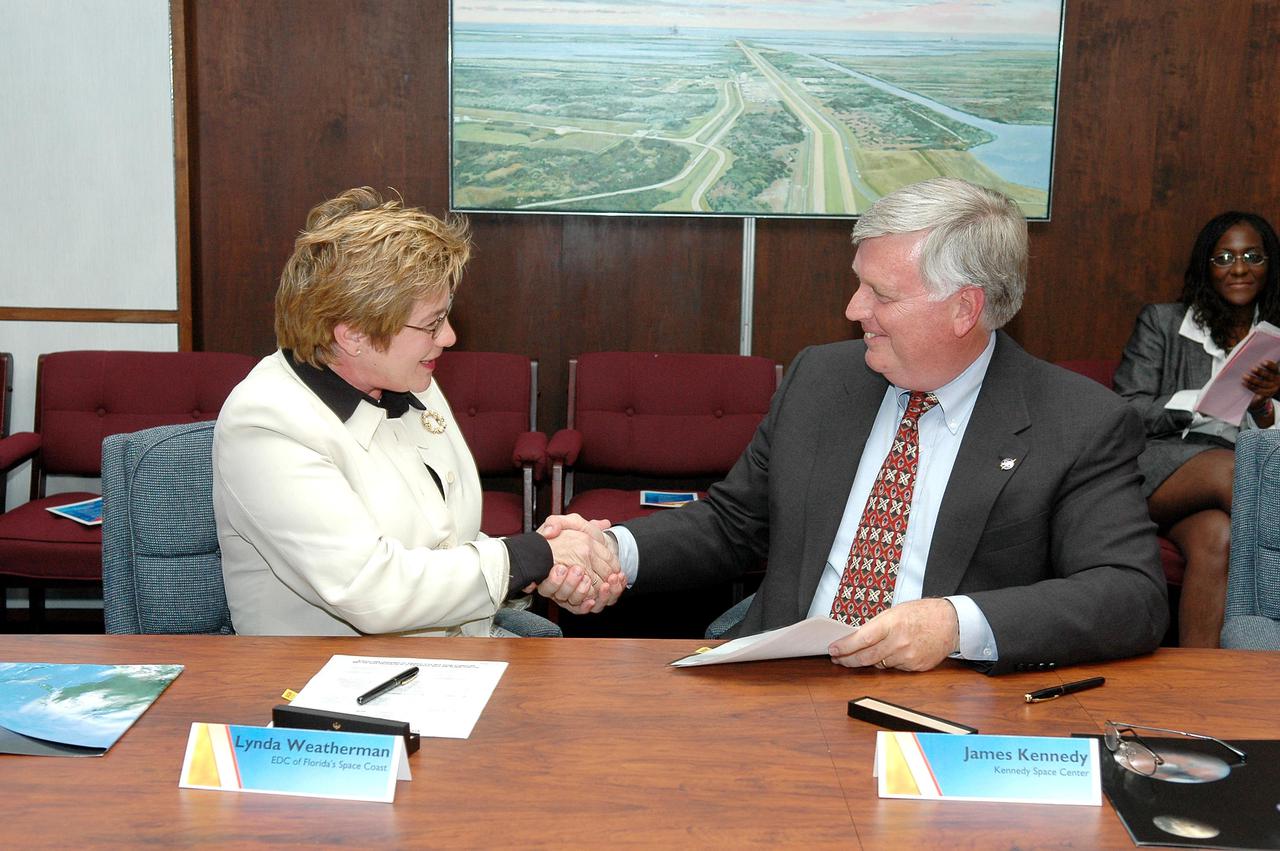
KENNEDY SPACE CENTER, FLA. - Lynda Weatherman, president and CEO of the Economic Development Commission of Florida’s Space Coast, and Jim Kennedy, director of Kennedy Space Center, congratulate each other after signing a three-year Space Act Agreement for economic development cooperation in support of existing and future missions of NASA at KSC. The agreement underscores business development strategies to ensure KSC and Brevard County continue to be competitive and develop space-related initiatives.
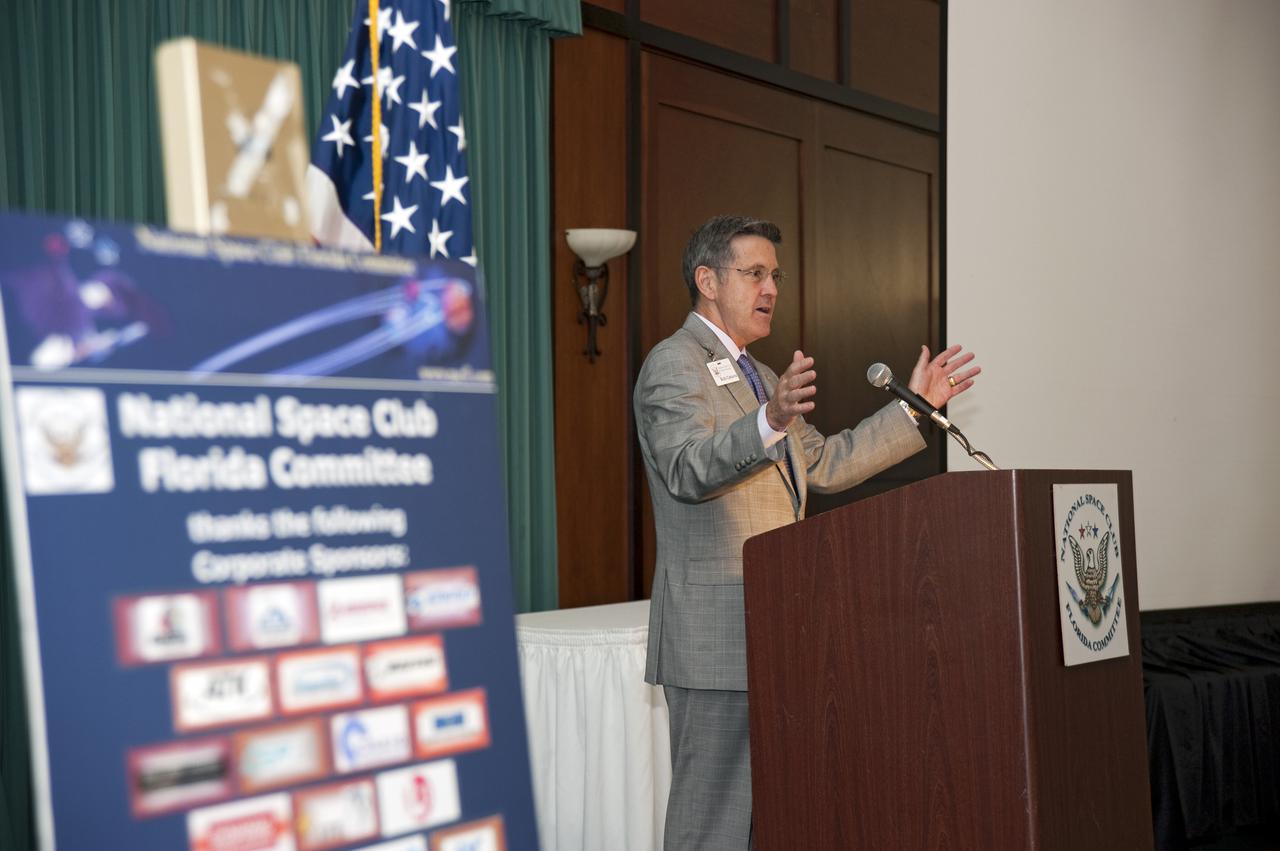
CAPE CANAVERAL, Fla. -- NASA Kennedy Space Center Director Bob Cabana addresses the National Space Club Florida Committee during its monthly meeting at the Radisson at the Port in Cape Canaveral, Fla. His speech, titled “KSC -- Today and Tomorrow,” addressed the future of NASA and possible changes to the space shuttle launch schedule later this month. The committee, headquartered on Florida's Space Coast, is a non-profit corporation composed of private individuals representing industry, government, regional educational institutions and the media. NASA_Kim Shiflett
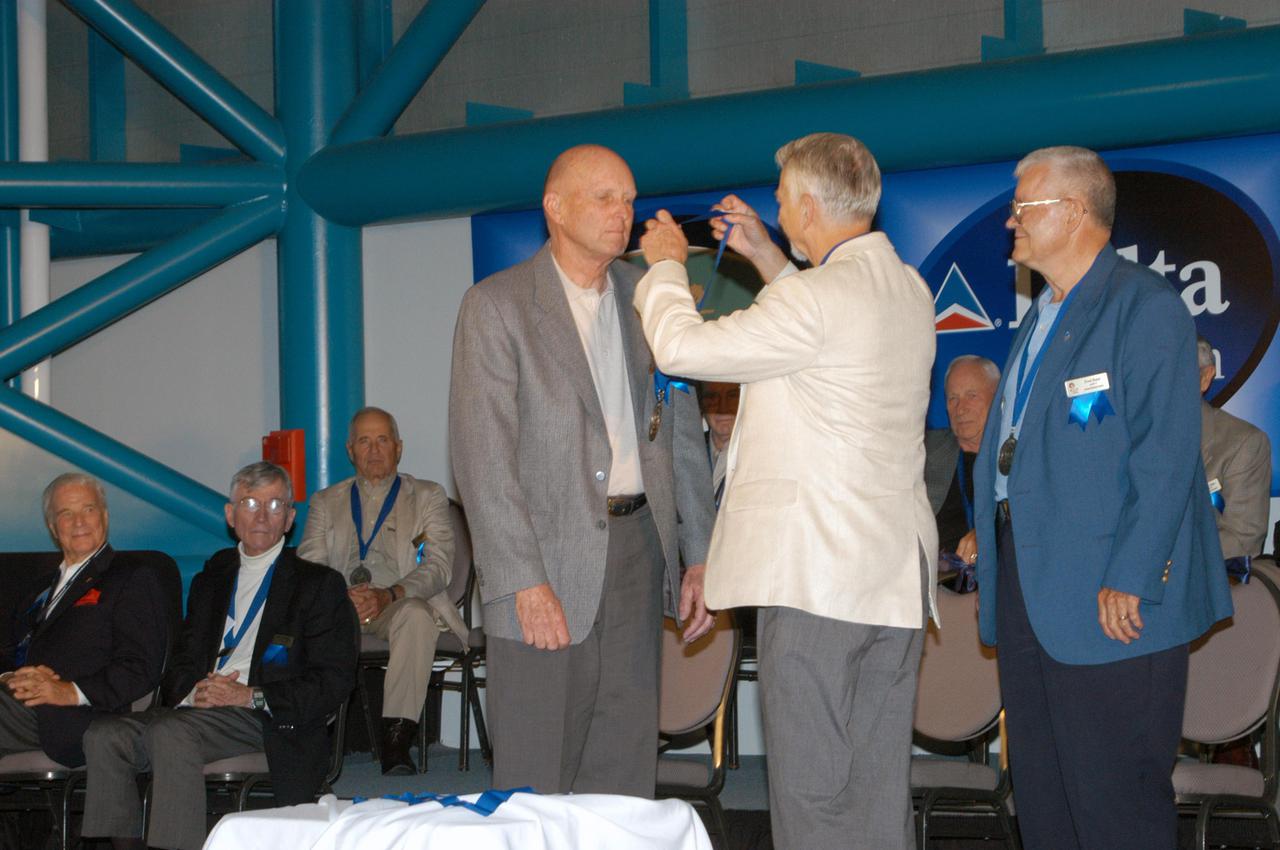
KENNEDY SPACE CENTER, FLA. - At the Astronaut Hall of Fame Induction Ceremony, Chairman Owen Garriott (center) places a medal around the neck of new inductee Gordon Fullerton. At right is Hall of Famer Fred Haise. Other Hall of Famers are gathered on stage for the ceremony, which is being held in the Kennedy Space Center Visitor Complex’s Apollo_Saturn V Center. Recognized for their individual flight accomplishments and contributions to the success and future success of the U.S. space program, this elite group of inductees is among only 60 astronauts to be honored in the Hall of Fame and the fourth group of Space Shuttle astronauts named.
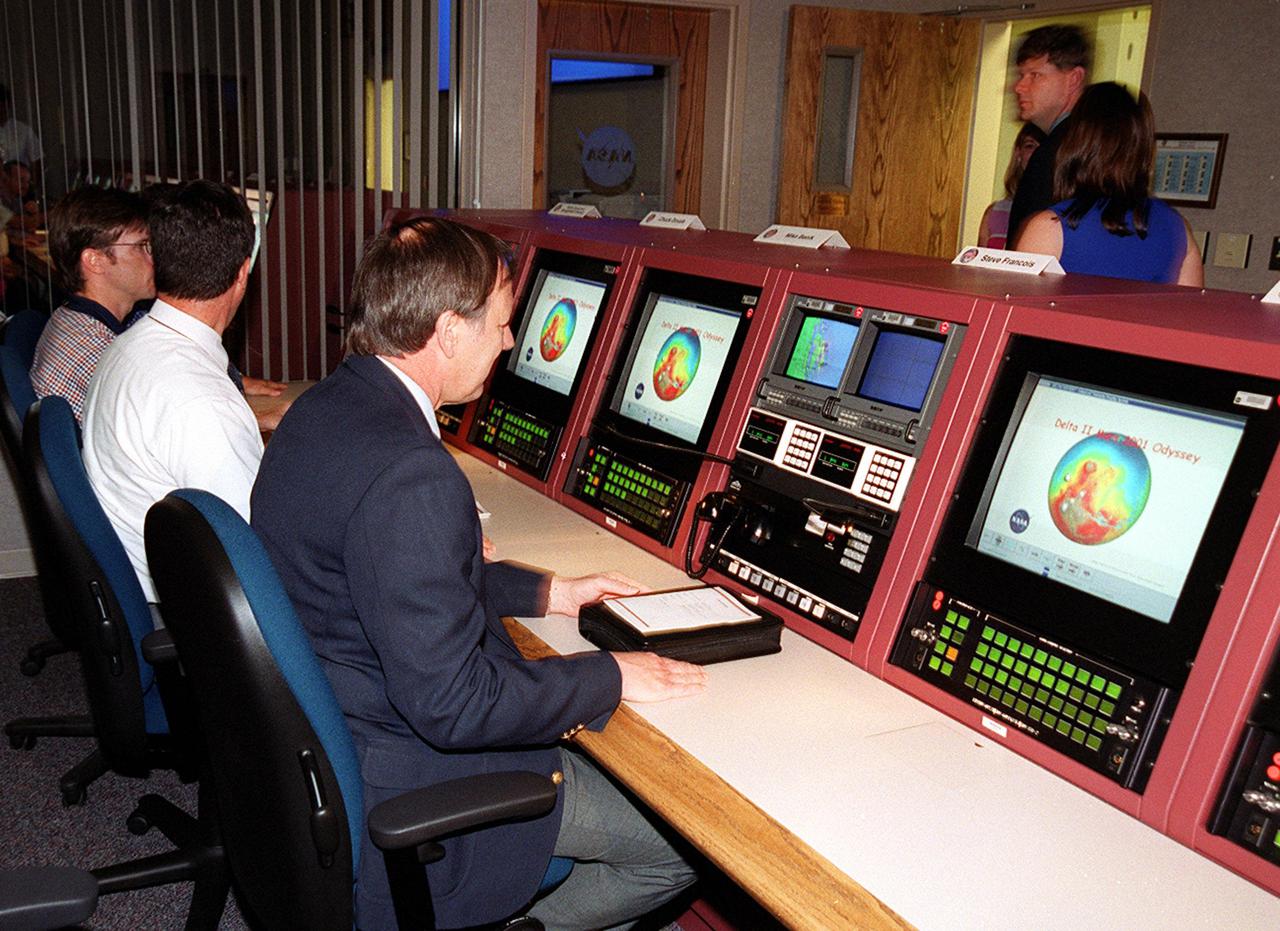
At the dedication of the upgraded Launch Vehicle Data Center in Hangar AE, Cape Canaveral Air Force Station, Fla., attendees got a close look at the new consoles. Seated on the right is Steve Francois, program manager, Expendable Vehicles and Payload Carriers. The new facility’s three individual control rooms replace a single LVDC control room in use since the mid-1970s. Developed by NASA-KSC to support multiple test operations in parallel or a single large launch operation, the new LVDC allows up to 100 launch vehicle engineers to monitor the voice, data and video systems that support the checkout and launch of an expendable vehicle
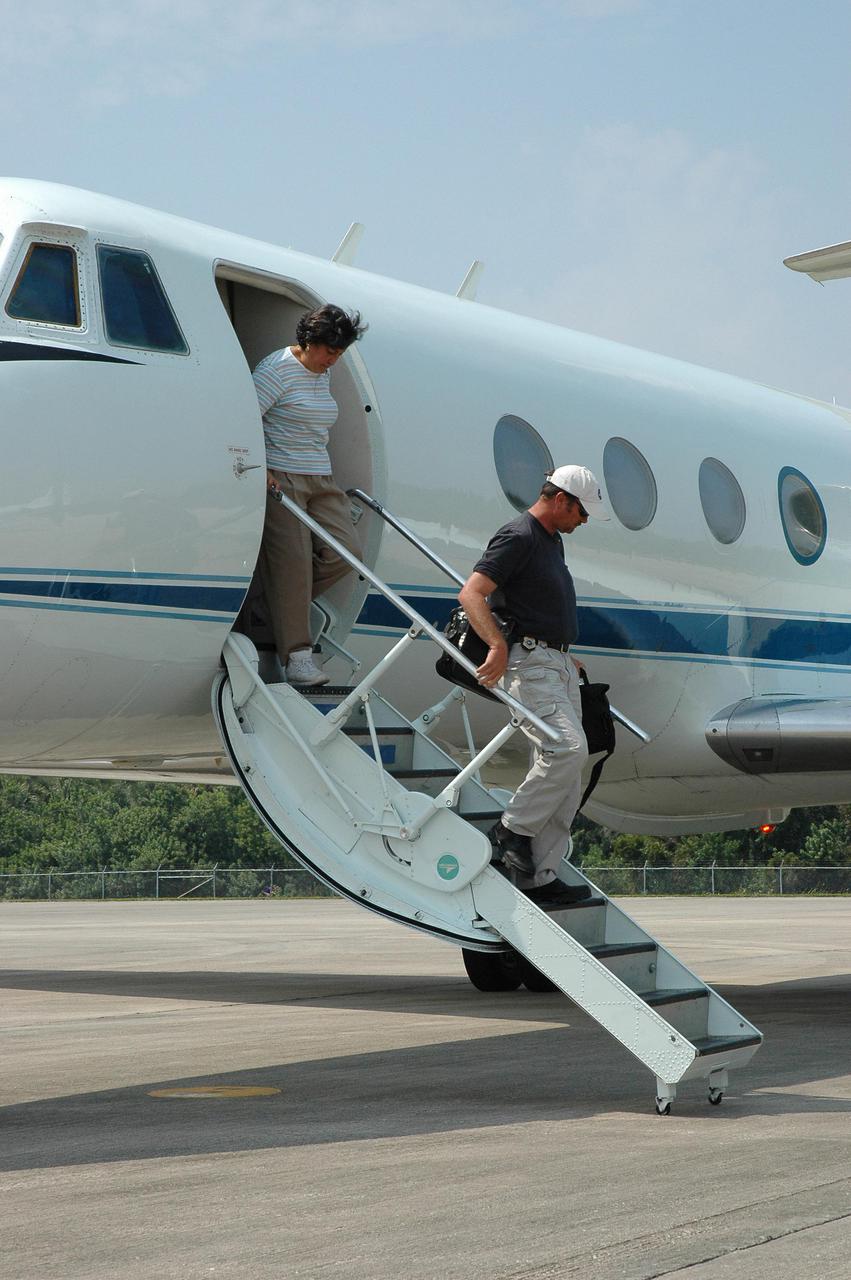
KENNEDY SPACE CENTER, FLA. - Dr. Violette Wahba Salib (left) and Ron Storey, a NASA Security agent, exit a NASA aircraft after its return from Stennis Space Center in Mississippi. Salib is with Occupational Medicine at KSC. The two were part of a volunteer team helping rescue and recovery efforts at Stennis, which was damaged during Hurricane Katrina. Many employees of Stennis and Michoud Assembly Facility, near New Orleans, were rendered homeless by the hurricane. NASA centers have been generous with relief supplies and personnel. Stennis is now in limited operations mode. Daily convoys have been moving between Stennis and Michoud, transporting personnel and supplies as Michoud prepares to resume limited operations.
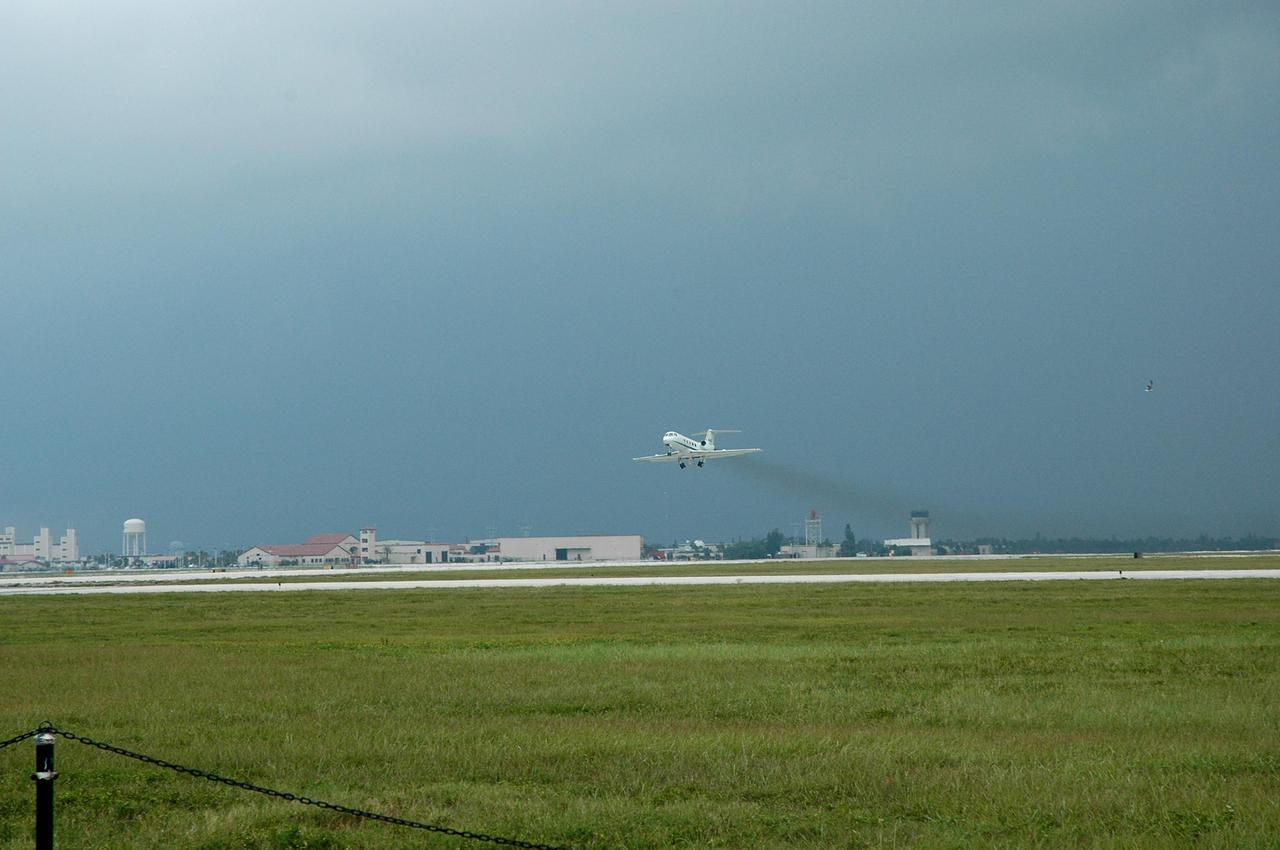
KENNEDY SPACE CENTER, FLA. - A NASA plane takes off from Patrick Air Force Base in Florida on a hurricane relief flight to Michoud Assembly Facility near New Orleans. Both Michoud and Stennis Space Center in Mississippi were effected by Hurricane Katrina. KSC is sending a helicopter with medical supplies and an Emergency Medical Technician to Stennis. A NASA plane is carrying medical supplies, food and chain saws, as well as a physician and two high voltage technicians to Michoud to ensure the facility can safely receive power when the main electricity grid comes online. KSC has sent a truck with 1,000 gallons of diesel fuel and three large generators: a 1-megawatt generator, and 125- and 225-kilowatt generators. A 14-person security team is also going to Michoud to relieve the security professionals at that location.
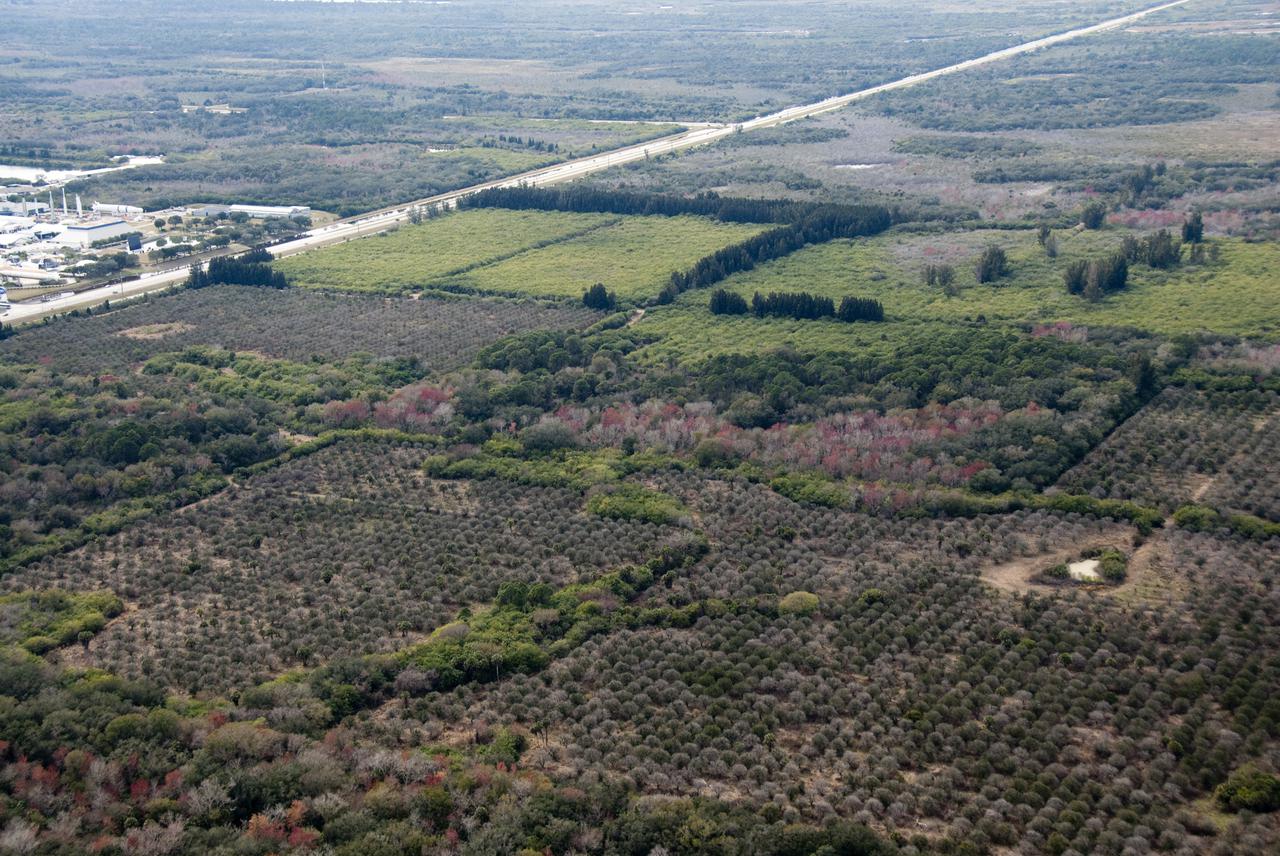
CAPE CANAVERAL, Fla. - This aerial view combines NASA's Kennedy Space Center Visitor Complex (left) and the proposed 500-acre site for one of the largest solar power plants of its kind. The planned 100-megawatt photovoltaic solar plant would use similar panels to those already built at Kennedy by the SunPower Corp. The energy produced by the proposed facility would be used to provide power to Florida Power and Light customers. Kennedy Center Director Bob Cabana, FPL Vice President and Chief Development Officer Eric Silagy and a SunPower Corp. representative made a joint announcement regarding the new construction during a ceremony held in November 2009 to commission a 1-megawatt solar plant. Included in the announcement were plans to establish a permanent renewable energy research and development center at Exploration Park, Kennedy's new business complex. The dedicated RandD facility proposed for Exploration Park could result in at least 50 high-salary science and engineering positions permanently established at Kennedy by SunPower and FPL's other partners, a potential for solar panel manufacturing located nearby and as many as 1,000 new construction jobs. FPL and Kennedy have initiated environmental studies and a plan to support the next project, which could be initiated before the end of 2010. Photo credit: NASA_Kim Shiflett
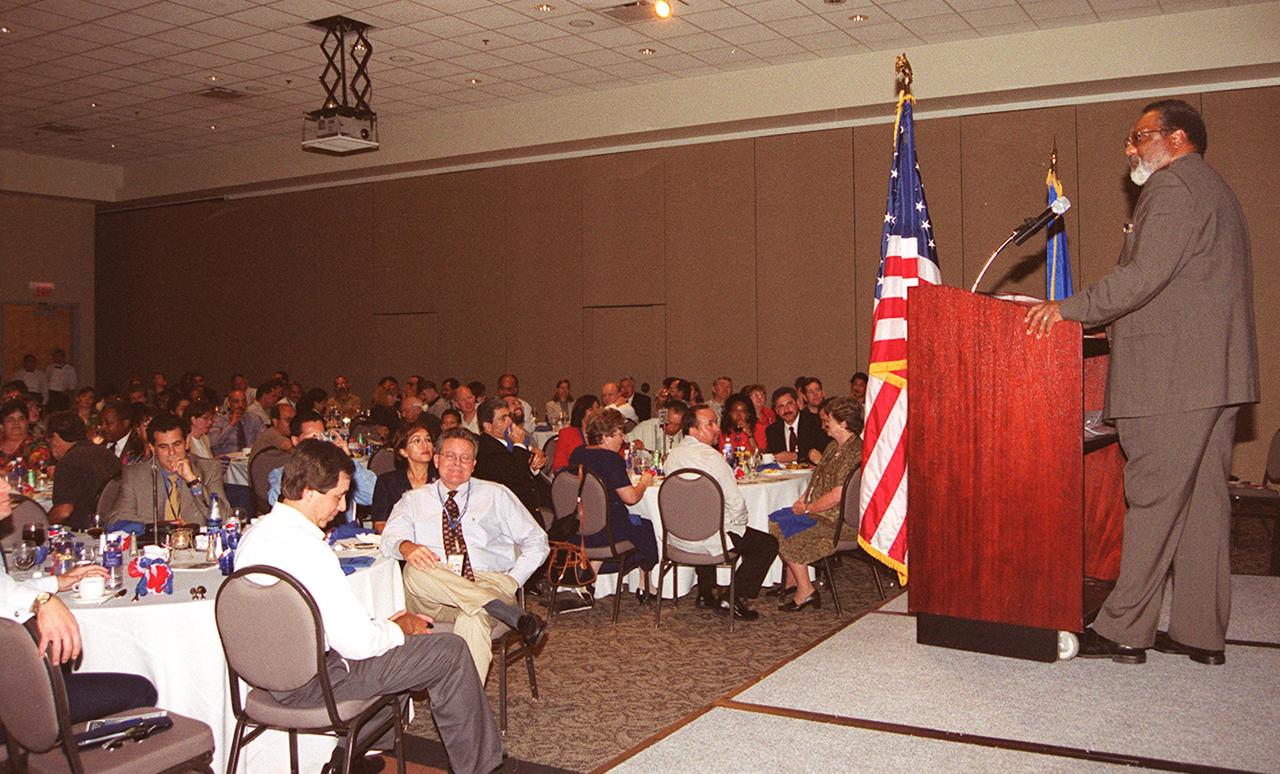
KENNEDY SPACE CENTER, Fla. -- Deputy Center Director Jim Jennings speaks to guests at the annual Hispanic Heritage Month Celebration, held at the Kurt Debus Conference Facility at KSC. Chaired by Rey N. Diaz and Maria Lopez-Tellado, who received plaques of appreciation for their efforts, the event also featured a luncheon and comments by Miguel Rodriquez, chief, Integration Office, of the Joint Performance Management Office. The pledge of allegiance and invocation was led by Joseph Tellado, International Space Station_Payload Processing. The Merrit Island High School ROTC provided the color guard. The event was sponsored by the Hispanic Employment Program Working Group at KSC
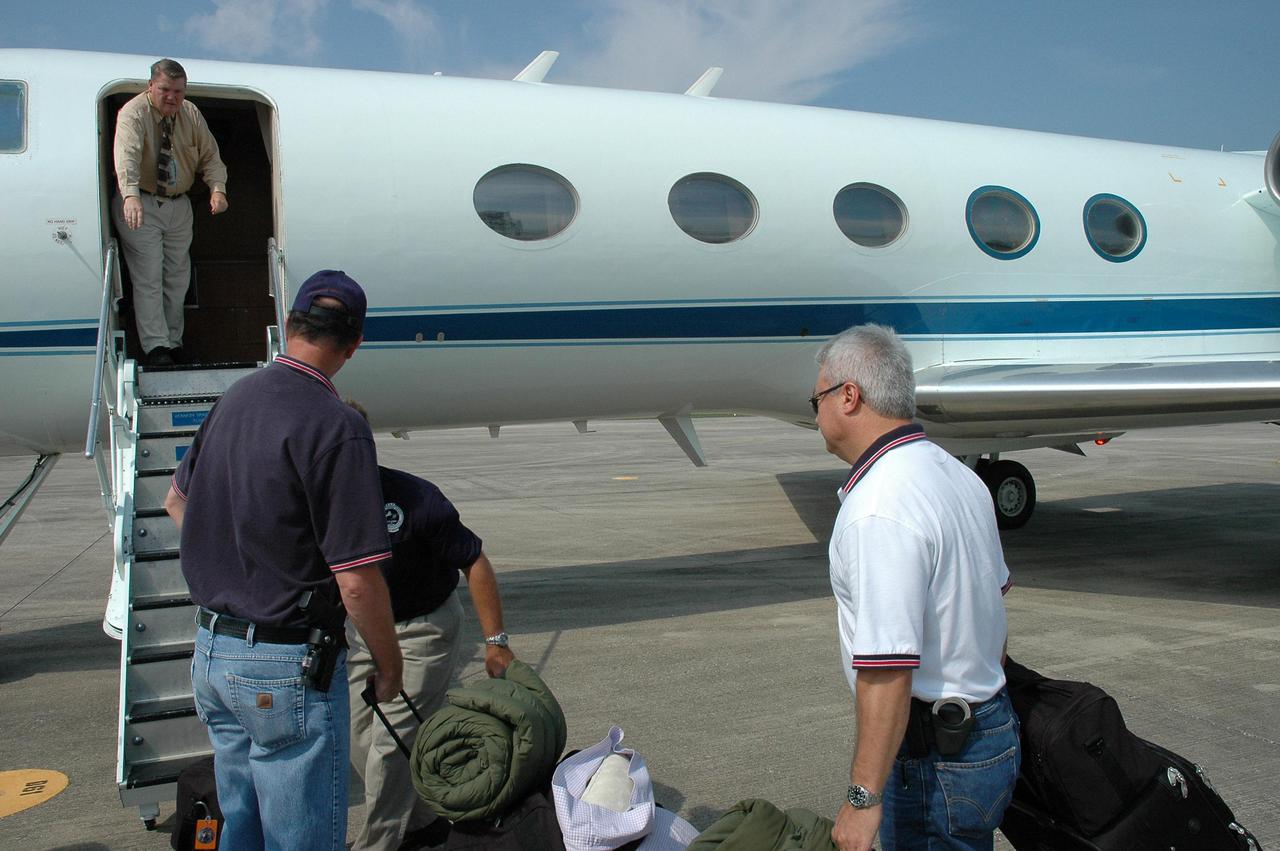
KENNEDY SPACE CENTER, FLA. - At the NASA Kennedy Space Center Shuttle Landing Facility, employees load hurricane relief supplies onto a NASA aircraft bound for Stennis Space Center in Mississippi, which suffered damage from Hurricane Katrina. The two men with backs to the camera are Security personnel going to Stennis to relieve others who have been helping at the center. The supplies included 10 boxes of load bus disconnects going to Michoud Assesmbly Facility near New Orleans and 17 boxes of personal hygiene items, along with boxes of clothing and water. Many Stennis and Michoud employees were rendered homeless by the hurricane. NASA centers have been generous with relief supplies and personnel. Stennis is in limited operations mode. Daily convoys have been moving between Stennis and Michould, transporting personnel and supplies as Michoud prepares to resume limited operations.
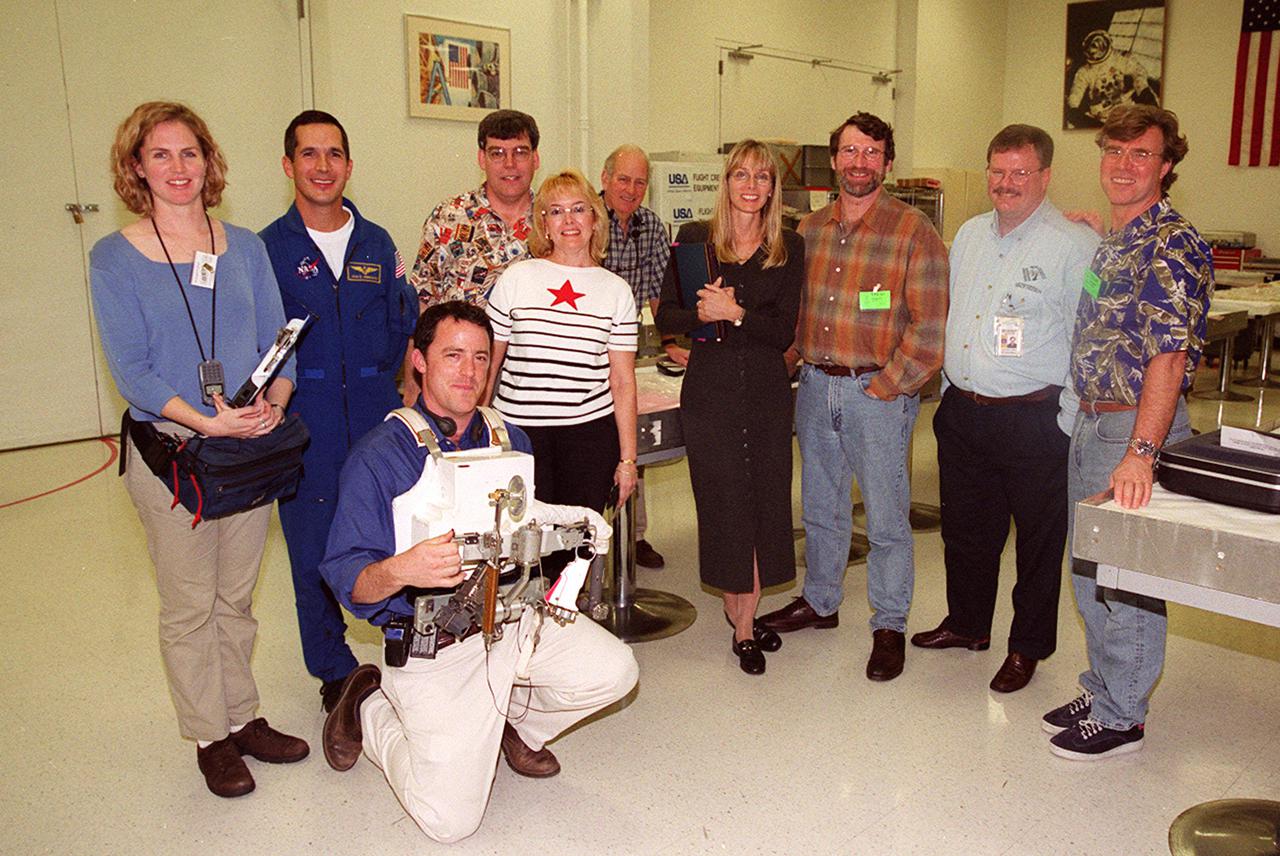
The crew of the television series This Old House pauses for a photo during a tour of KSC. At the far right is Steve Thomas, host of the series. Second from the right is Norm Abram, master carpenter on the show. Accompanying the film crew is astronaut John Herrington (second from left). The cast and crew of This Old House are filming at KSC for an episode of the show
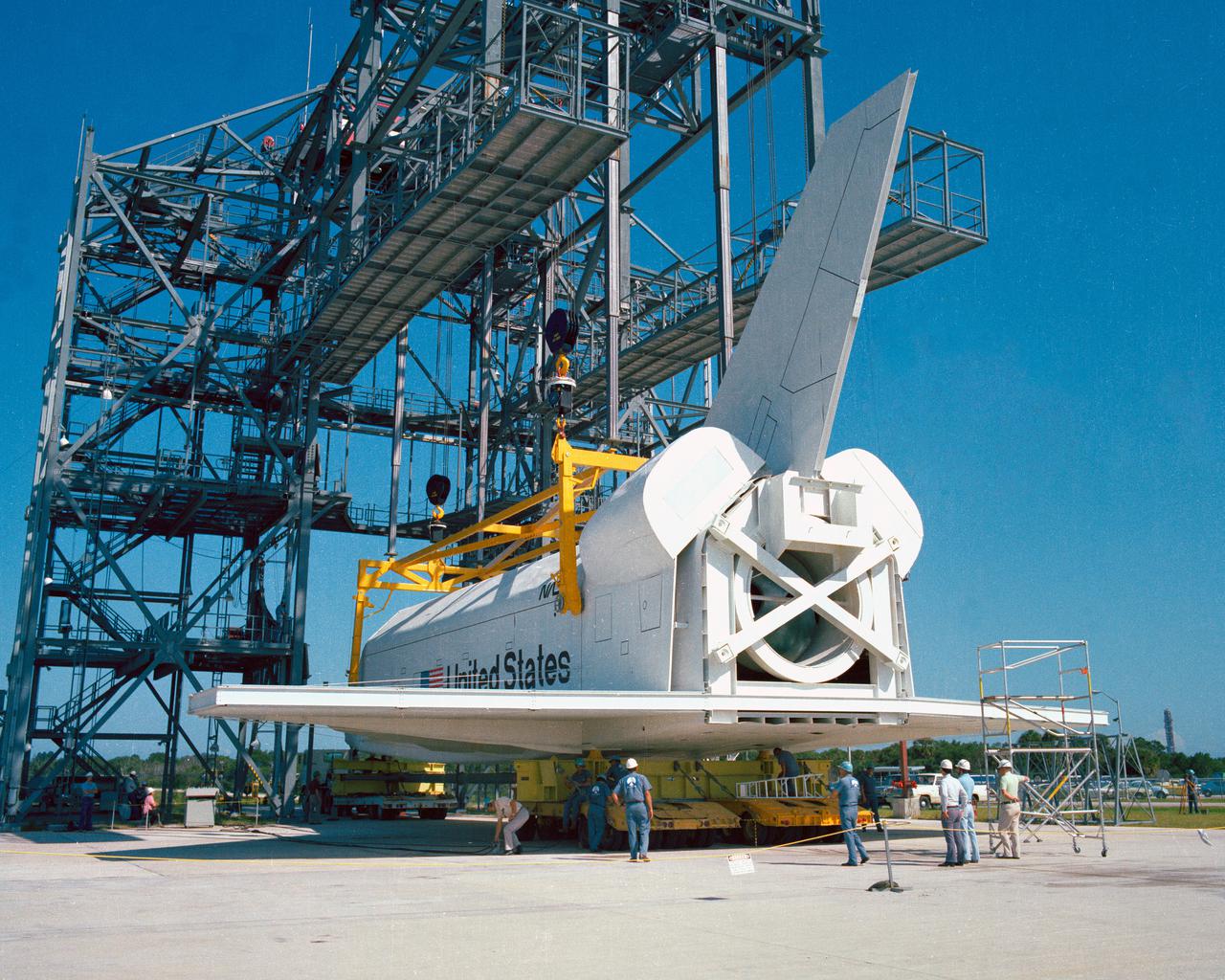
CAPE CANAVERAL, Fla. – At NASA's Kennedy Space Center in Florida, the space shuttle mock-up, dubbed Pathfinder, is attached to the Mate-Demate Device for at fit-check Oct. 19, 1978. The mock-up, constructed at NASA's Marshall Space Flight Center in Huntsville, Ala., possessed the general dimensions, weight and balance of a real space shuttle. It was shipped to Kennedy by barge and then used to fit-check the work platforms of the Mate-Demate Device, orbiter processing facilities and Vehicle Assembly Building, as well as support ground crew training. It also was used to rehearse post-landing procedures at Kennedy's Shuttle Landing Facility. After being on display at the 'Great Space Shuttle Exposition' in Tokyo from June 1983 to August 1984, the mock-up returned to Marshall and now is on permanent display at the U.S. Space and Rocket Center near Huntsville. Photo credit: NASA
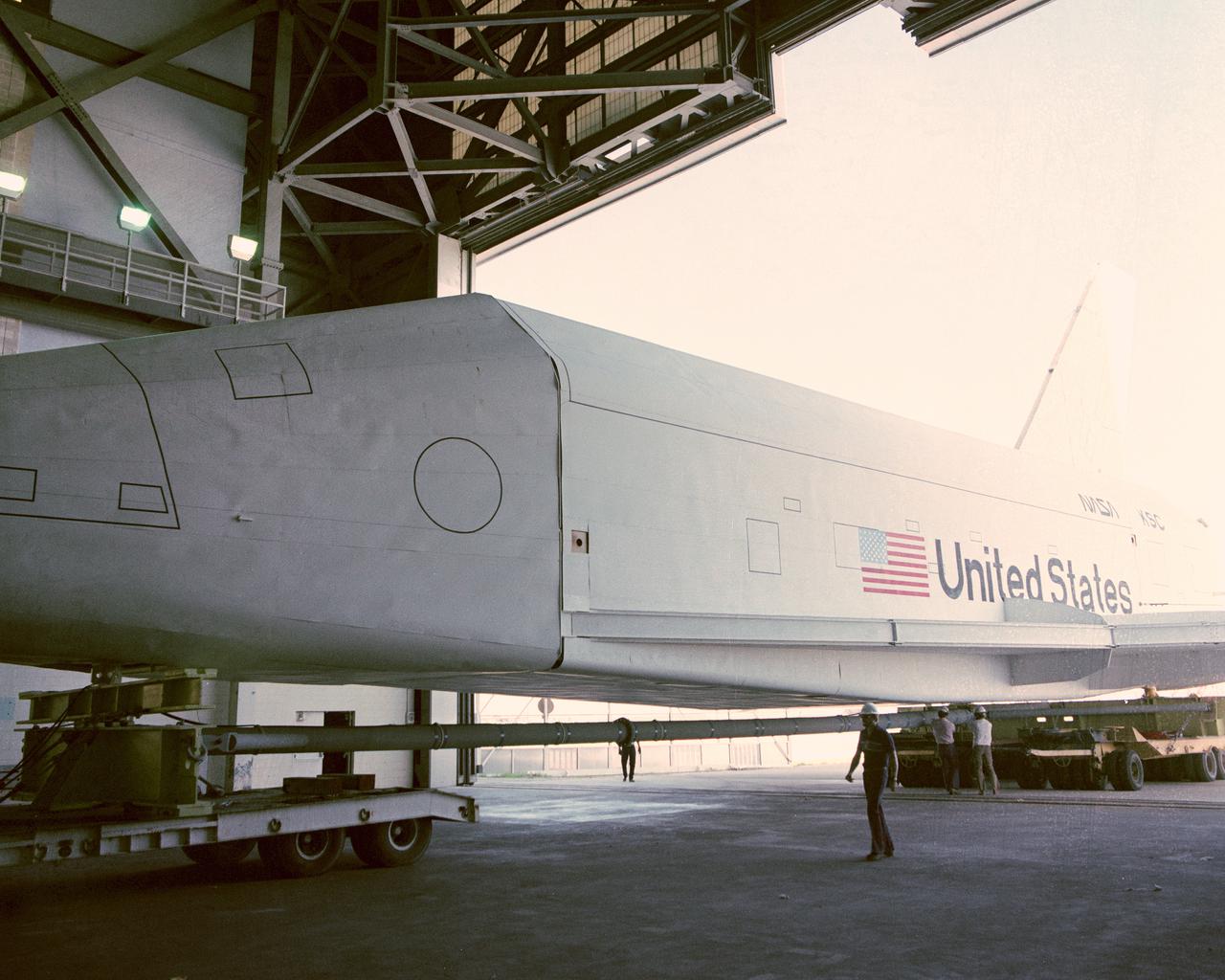
CAPE CANAVERAL, Fla. – At NASA's Kennedy Space Center in Florida, the space shuttle mock-up, dubbed Pathfinder, enters the Vehicle Assembly Building for a fit-check May 15, 1978. The mock-up, constructed at NASA's Marshall Space Flight Center in Huntsville, Ala., possessed the general dimensions, weight and balance of a real space shuttle. It was shipped to Kennedy by barge and then used to fit-check the work platforms of the Mate-Demate Device, orbiter processing facilities and Vehicle Assembly Building, as well as support ground crew training. It also was used to rehearse post-landing procedures at Kennedy's Shuttle Landing Facility. After being on display at the 'Great Space Shuttle Exposition' in Tokyo from June 1983 to August 1984, the mock-up returned to Marshall and now is on permanent display at the U.S. Space and Rocket Center near Huntsville. Photo credit: NASA
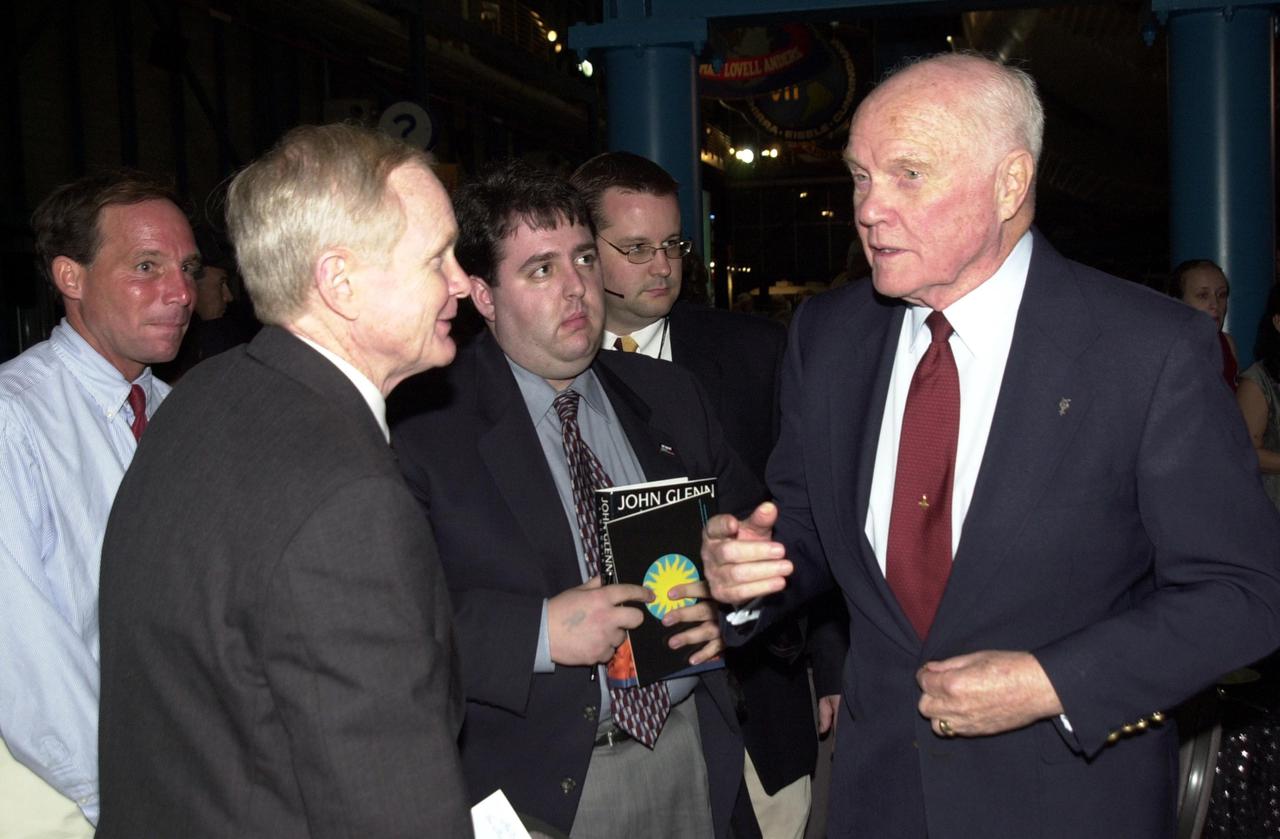
KENNEDY SPACE CENTER, FLA. -- Space pioneer John Glenn Jr. (right) talks with Center Director Roy Bridges Jr. (left) during the celebration of the 40th anniversary of American spaceflight. The dinner event was held at KSC's Apollo_Saturn V Center
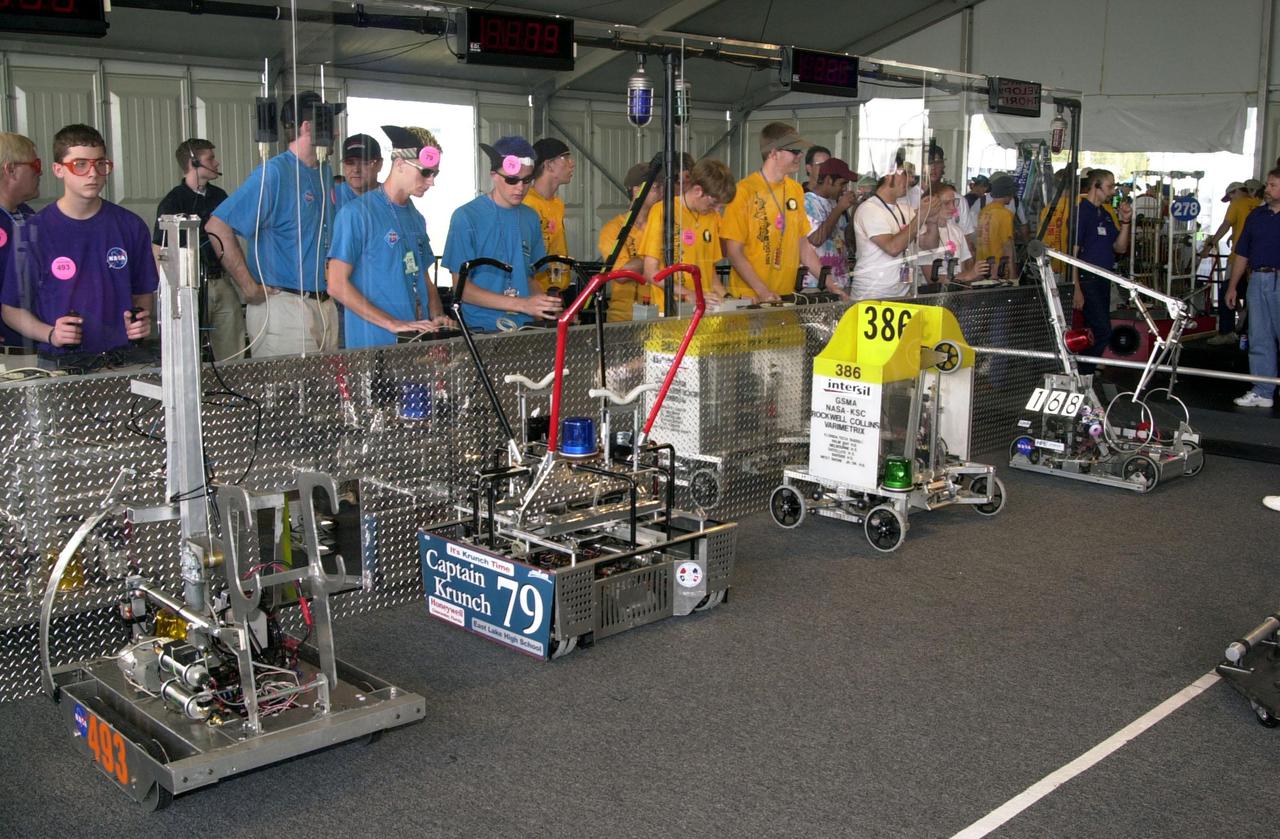
Student teams get ready to move their robots on the playing field during the NASA_KSC FIRST Southeastern Regional event held March 1-3, 2001. Starting from left, robot number 493, “Dukes,” is controlled by students from Marlington High School, Alliance, Ohio. It is a KSC joint-sponsored team. Team 79, the “Navigators,” are from East Lake High School, Clearwater, Fla. Team 386, “Voltage: South Brevard FIRST Team,” represents six schools in Brevard County, Fla. Team 168, Flashbacks, represent North Miami Beach Senior High School and Michael Kropp High School, North Miami, Fla. Voltage and Flashbacks are KSC joint-sponsored teams. FIRST (For Inspiration and Recognition of Science and Technology) events are held nationwide, pitting robots against each other and the clock on a playing field. Many teams are sponsored by corporations and academic institutions. There are 27 teams throughout the State of Florida who are competing. KSC, which sponsors nine teams, has held the regional event for two years