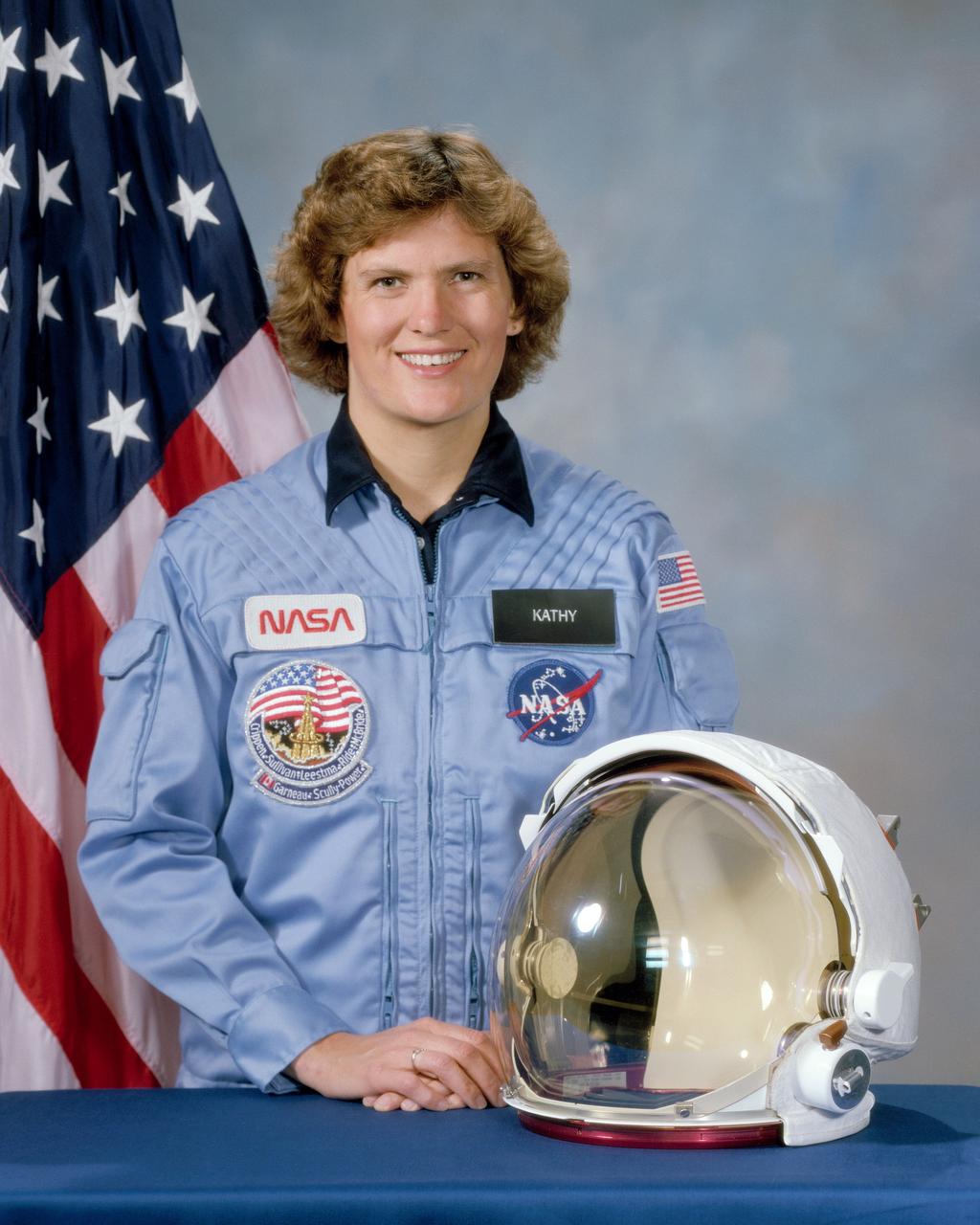
S84-44219 (20 July 1984) --- Astronaut Kathryn D. Sullivan.
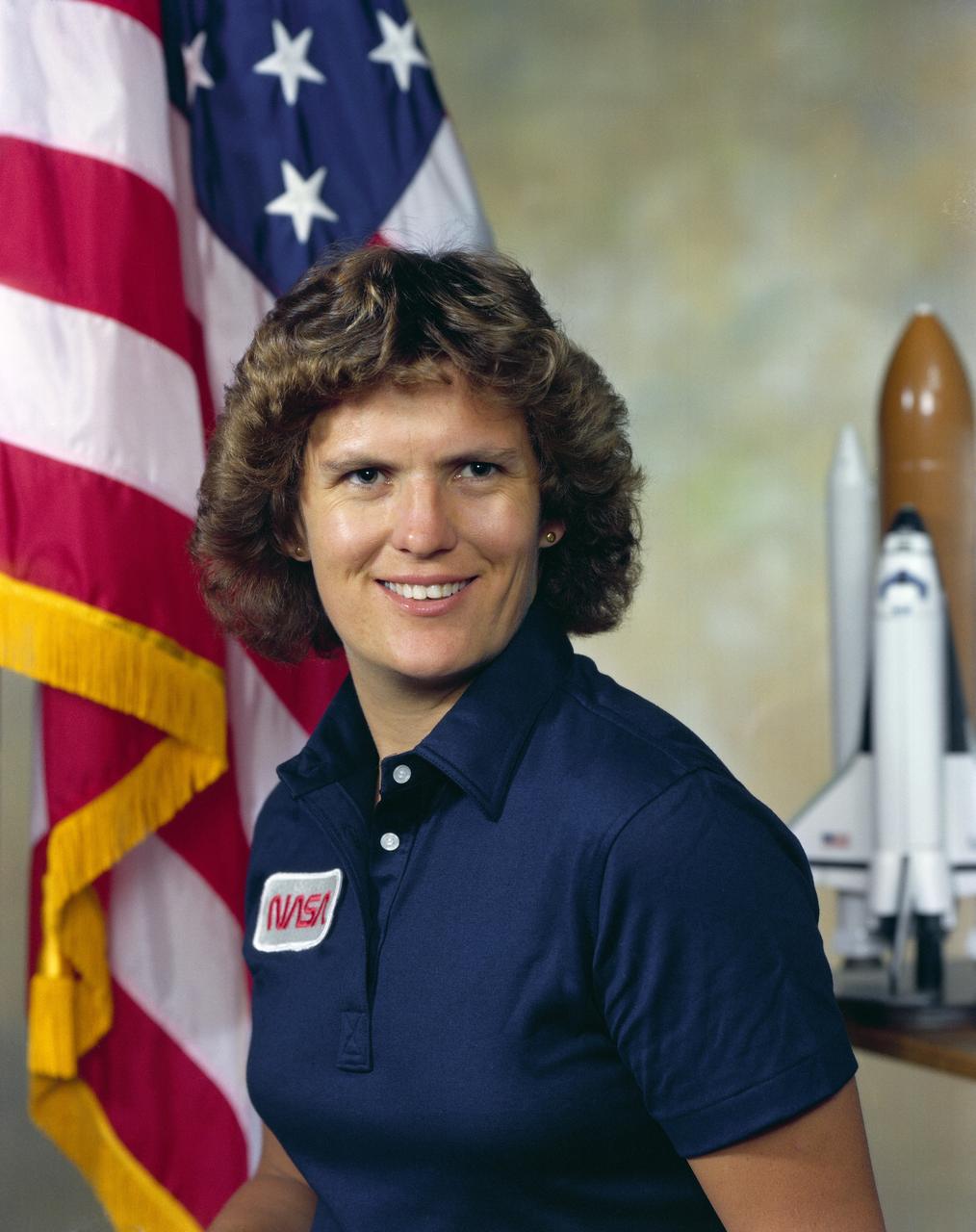
S84-37982 (20 July 1984) --- Astronaut Kathryn D. Sullivan, 41-G mission specialist
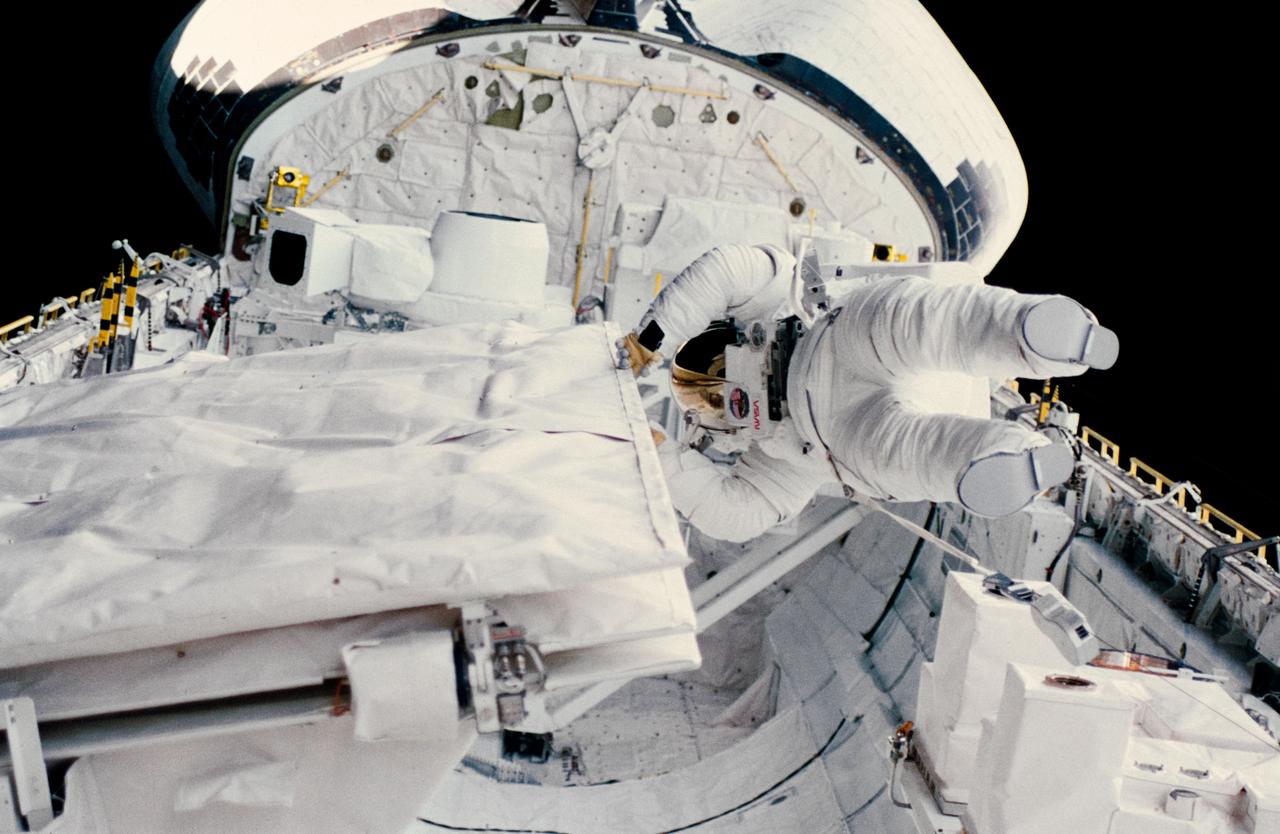
41G-13-032 (11 Oct. 1984) --- Astronaut Kathryn D. Sullivan checks the latch of the SIR-B antenna in the space shuttle Challenger's open cargo bay during her historic extravehicular activity (EVA) on Oct. 11, 1984. Earlier, America's first woman to perform an EVA and astronaut David C. Leestma, participated in an in-space simulation of refueling a spacecraft in orbit. The Orbital Refueling System (ORS) is just beyond the astronaut mission specialist's helmet. To the left is the Large Format Camera (LFC). The LFC and ORS are stationed on a device called the Mission Peculiar Support Structure (MPESS). Crew members consisted of astronauts Robert L. Crippen, commander; Jon A. McBride, pilot; along with Kathryn D. Sullivan, Sally K. Ride, and David D. Leestma, all mission specialists; and Canadian astronaut Marc Garneau and Paul D. Scully-Power, both payload specialist. EDITOR'S NOTE: The STS-41G mission had the first American female EVA (Sullivan); first seven-person crew; first orbital fuel transfer; and the first Canadian (Garneau).
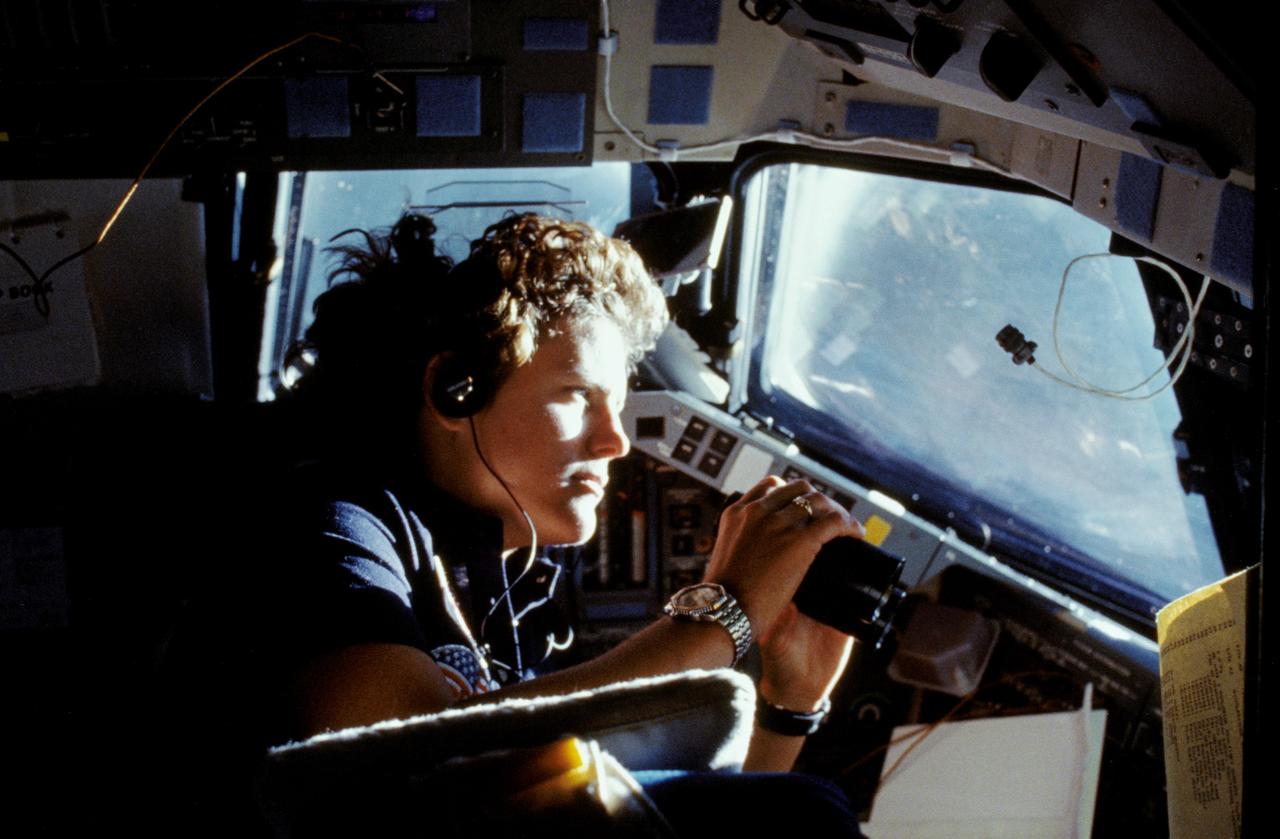
41G-11-027 (14 Oct. 1984) --- Kathryn D. Sullivan, 41-G mission specialist, uses a pair of binoculars to do some magnified viewing through the forward cabin windows of the Earth-orbiting space shuttle Challenger. The 35mm frame was part of the first photographic release from the eight-day 41-G mission on Oct. 14, 1984. Photo credit: NASA
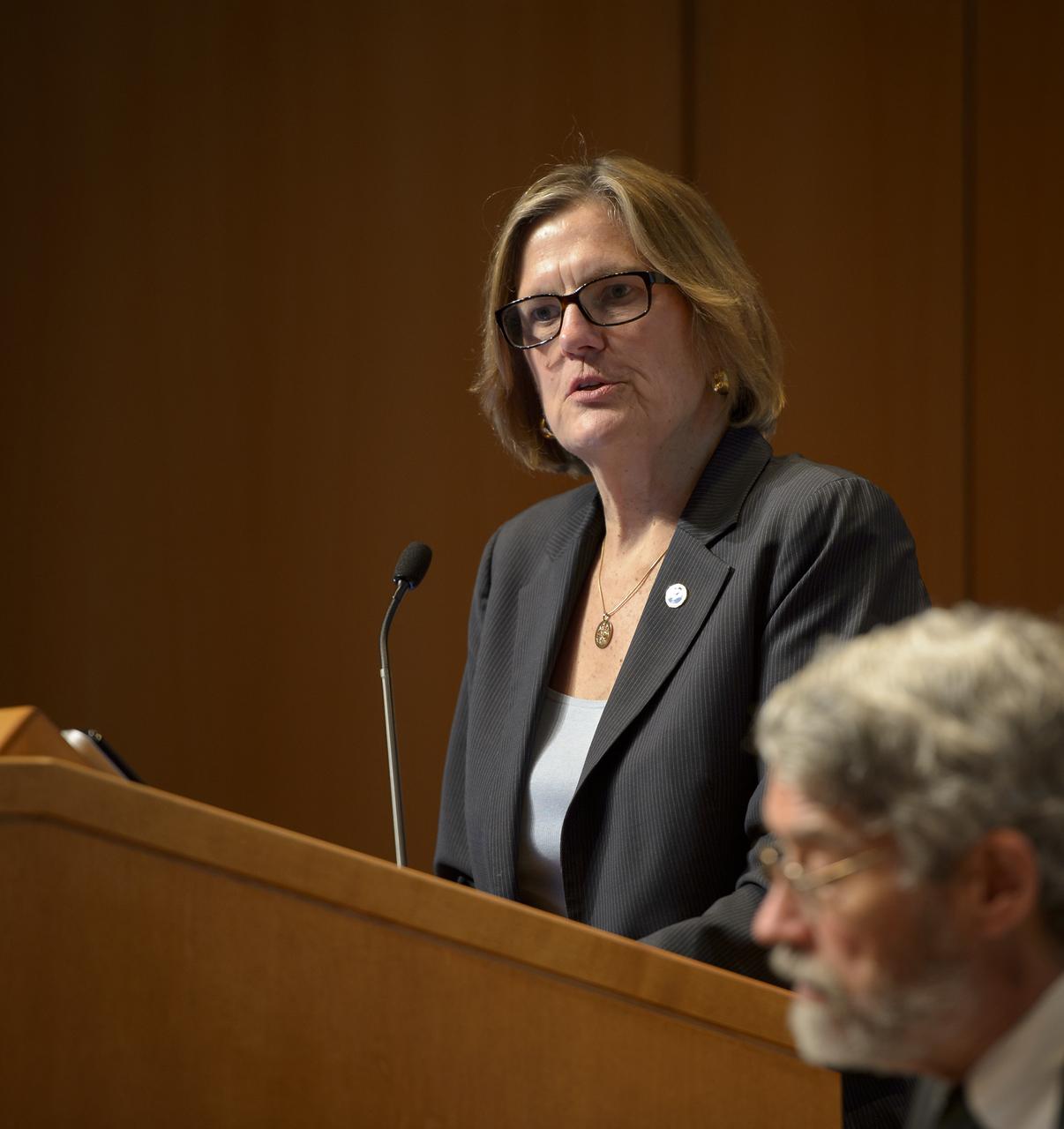
Dr. Kathryn D. Sullivan, Acting Under Secretary of Commerce for Oceans and Atmosphere and Acting NOAA Administrator, delivers remarks during a White House Office of Science and Technology Policy (OSTP) Fiscal Year 2014 budget briefing held with with Dr. John P. Holdren, Director of OSTP, Patricia Falcone of OSTP, Charlie Bolden from NASA, Francis Collins from NIH, and Cora Marrett from NSF, at the American Association for the Advancement of Science (AAAS) on Wednesday, April 10, 2013 in Washington. Photo Credit: (NASA/Bill Ingalls)
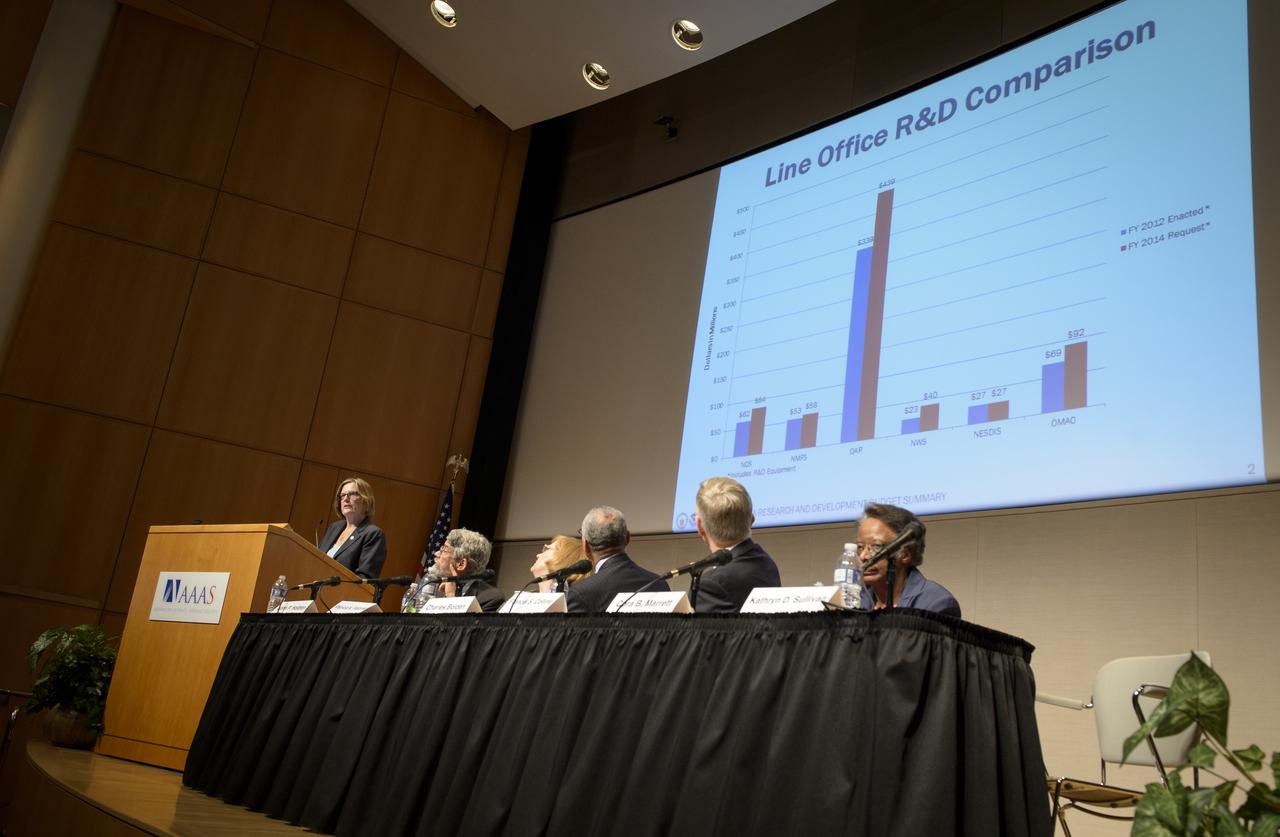
Dr. Kathryn D. Sullivan, Acting Under Secretary of Commerce for Oceans and Atmosphere and Acting NOAA Administrator, delivers remarks during a White House Office of Science and Technology Policy (OSTP) Fiscal Year 2014 budget briefing held with with Dr. John P. Holdren, Director of OSTP, Patricia Falcone of OSTP, Charlie Bolden from NASA, Francis Collins from NIH, and Cora Marrett from NSF, at the American Association for the Advancement of Science (AAAS) on Wednesday, April 10, 2013 in Washington. Photo Credit: (NASA/Bill Ingalls)
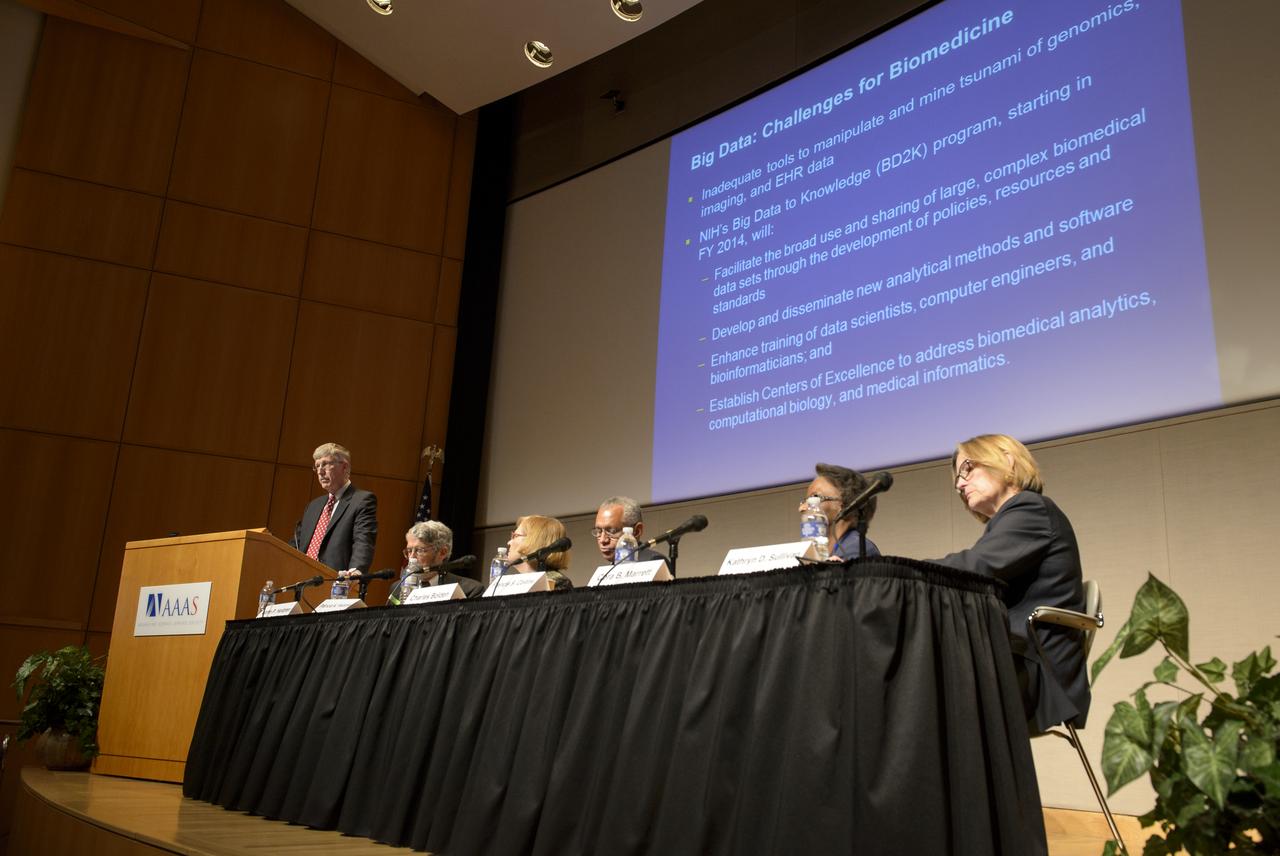
Director of the National Institutes of Health (NIH) Francis S. Collins, M.D., Ph.D., delivers remarks during a White House Office of Science and Technology Policy (OSTP) Fiscal Year 2014 budget briefing held with with Dr. John P. Holdren, Director of OSTP, Patricia Falcone of OSTP, Charlie Bolden from NASA, Cora Marrett from NSF, and Kathryn Sullivan from NOAA, at the American Association for the Advancement of Science (AAAS) on Wednesday, April 10, 2013 in Washington. Photo Credit: (NASA/Bill Ingalls)
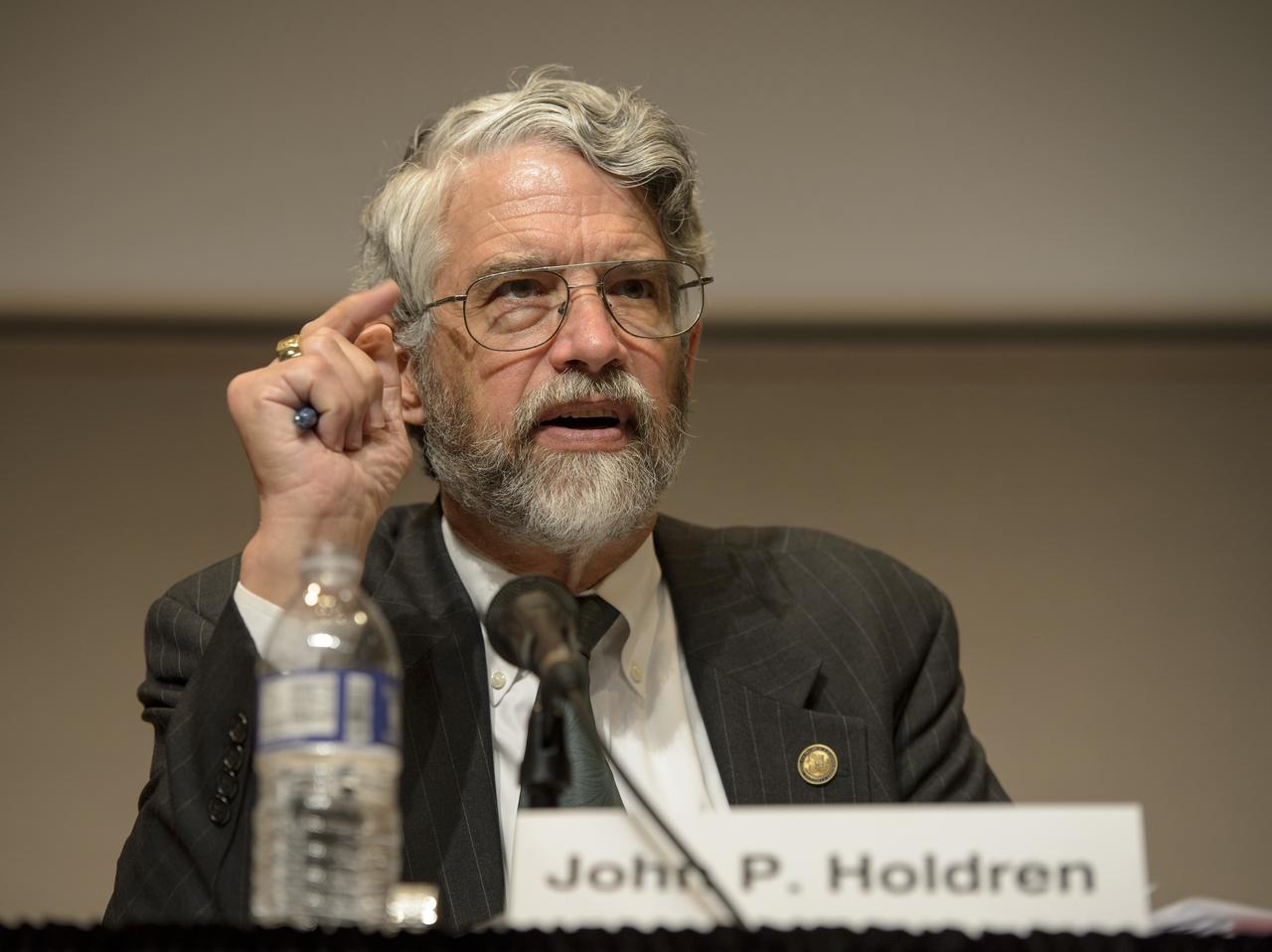
Dr. John P. Holdren, Assistant to the President for Science and Technology, Director of the White House Office of Science and Technology Policy, speaks during a Fiscal Year 2014 budget briefing held with Patricia Falcone of OSTP, Charlie Bolden from NASA, Francis Collins from NIH, Cora Marrett from NSF, and Kathryn Sullivan from NOAA, at the American Association for the Advancement of Science (AAAS) on Wednesday, April 10, 2013 in Washington. Photo Credit: (NASA/Bill Ingalls)
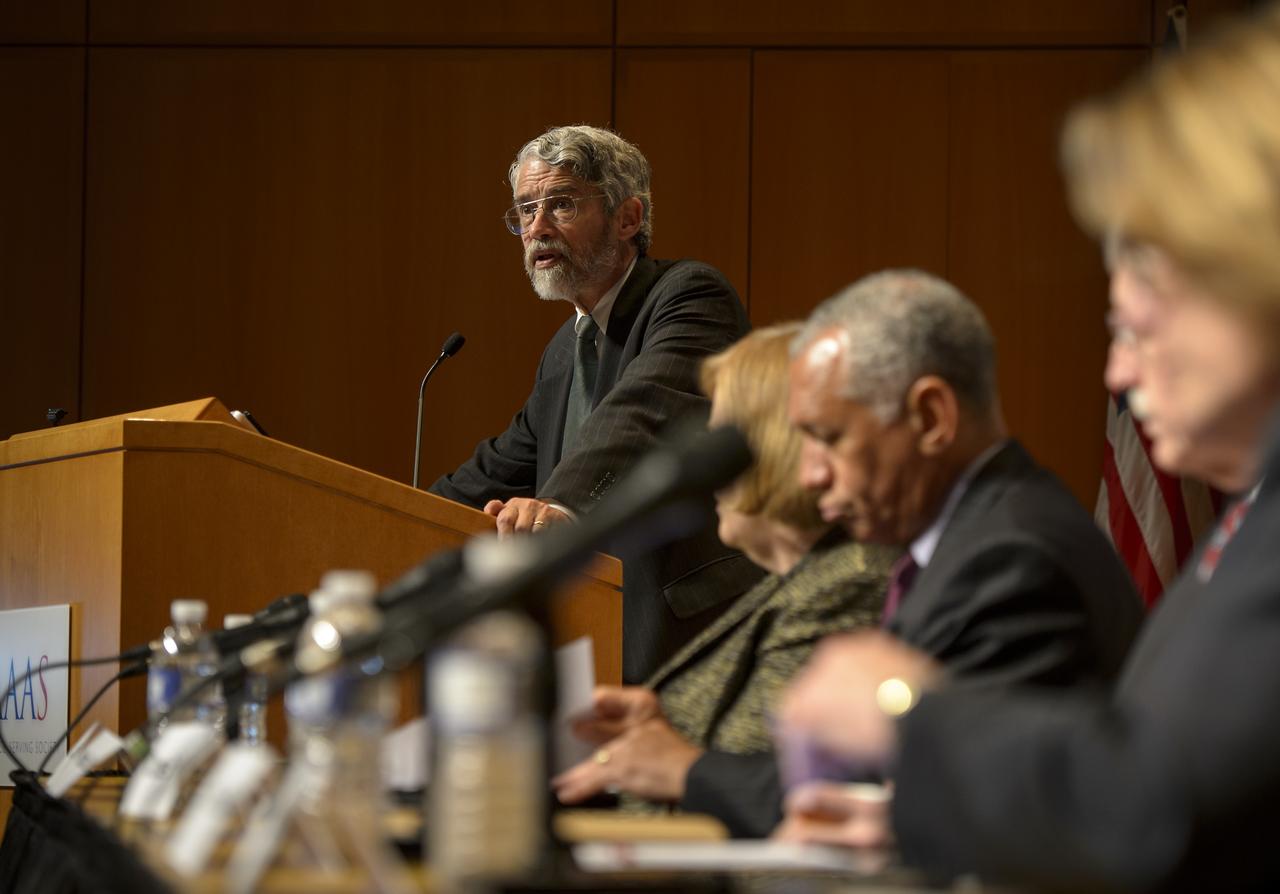
Dr. John P. Holdren, Assistant to the President for Science and Technology, Director of the White House Office of Science and Technology Policy, speaks during a Fiscal Year 2014 budget briefing held with Patricia Falcone of OSTP, Charlie Bolden from NASA, Francis Collins from NIH, Cora Marrett from NSF, and Kathryn Sullivan from NOAA, at the American Association for the Advancement of Science (AAAS) on Wednesday, April 10, 2013 in Washington. Photo Credit: (NASA/Bill Ingalls)
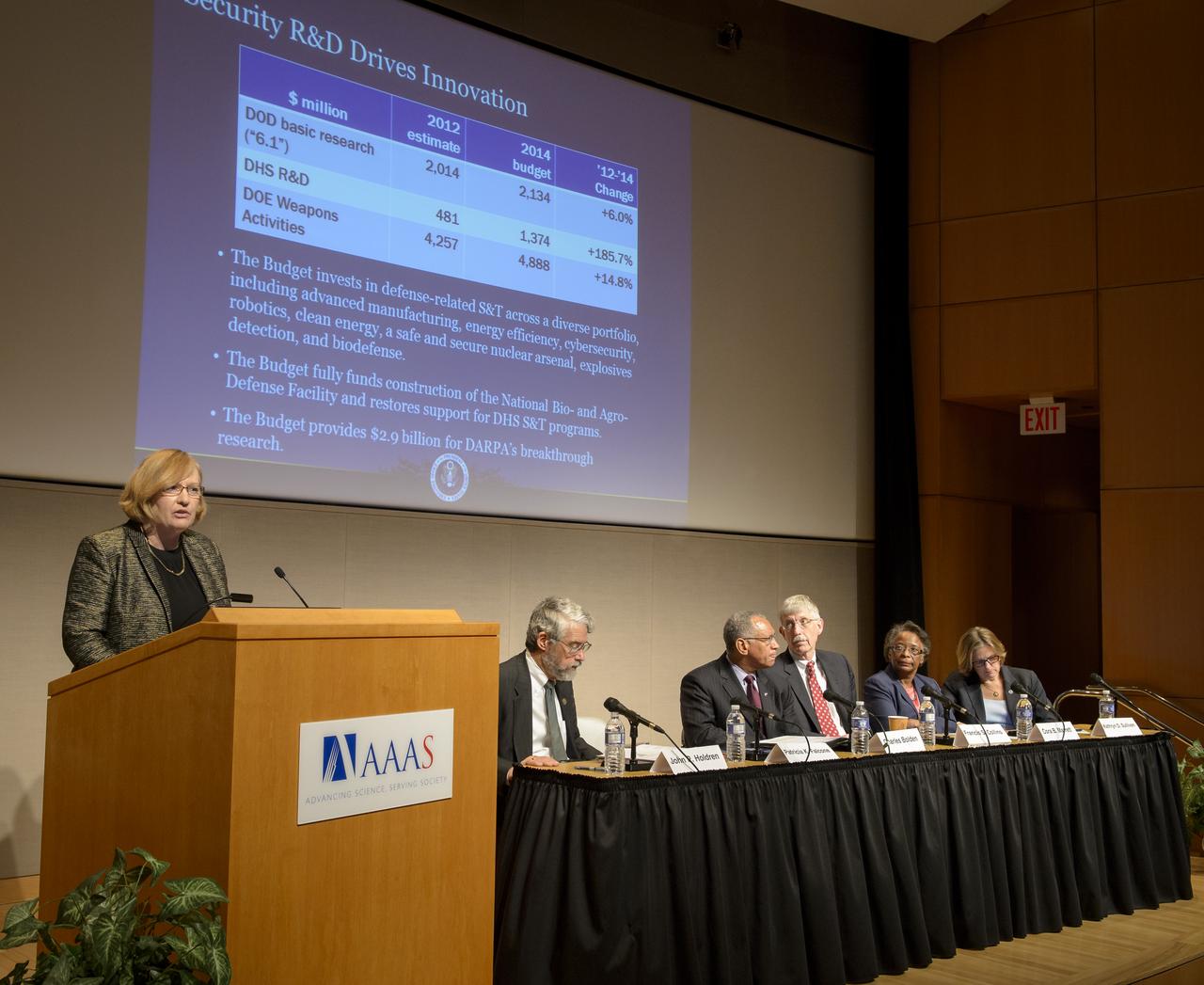
Patricia Falcone, Associate Director, National Security and International Affairs Division, White House Office of Science and Technology Policy, delivers remarks during a Fiscal Year 2014 budget briefing with Dr. John P. Holdren, Director of OSTP, Charlie Bolden from NASA, Francis Collins from NIH, Cora Marrett from NSF, and Kathryn Sullivan from NOAA, at the American Association for the Advancement of Science (AAAS) on Wednesday, April 10, 2013 in Washington. Photo Credit: (NASA/Bill Ingalls)
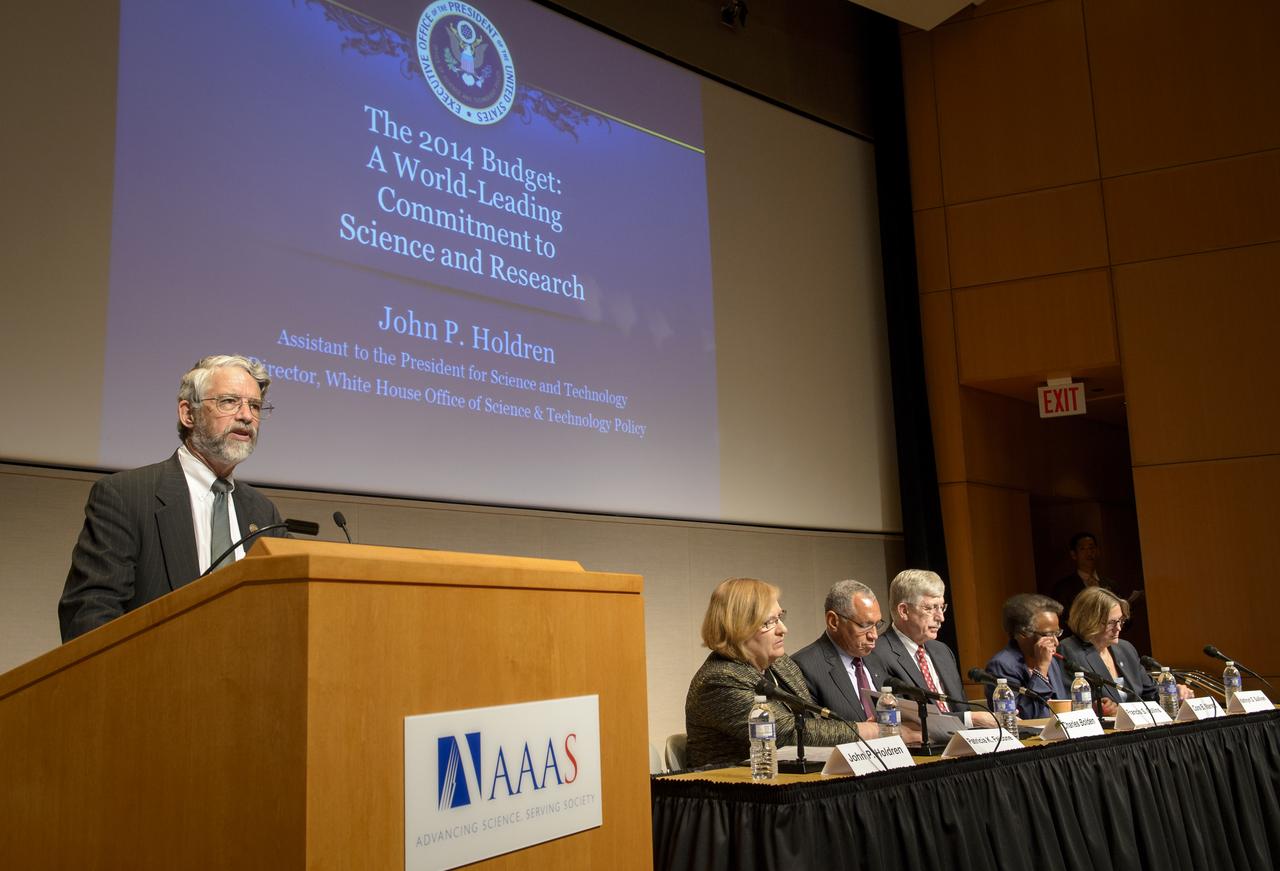
Dr. John P. Holdren, Assistant to the President for Science and Technology, Director of the White House Office of Science and Technology Policy, speaks during a Fiscal Year 2014 budget briefing held with Patricia Falcone of OSTP, Charlie Bolden from NASA, Francis Collins from NIH, Cora Marrett from NSF, and Kathryn Sullivan from NOAA, at the American Association for the Advancement of Science (AAAS) on Wednesday, April 10, 2013 in Washington. Photo Credit: (NASA/Bill Ingalls)
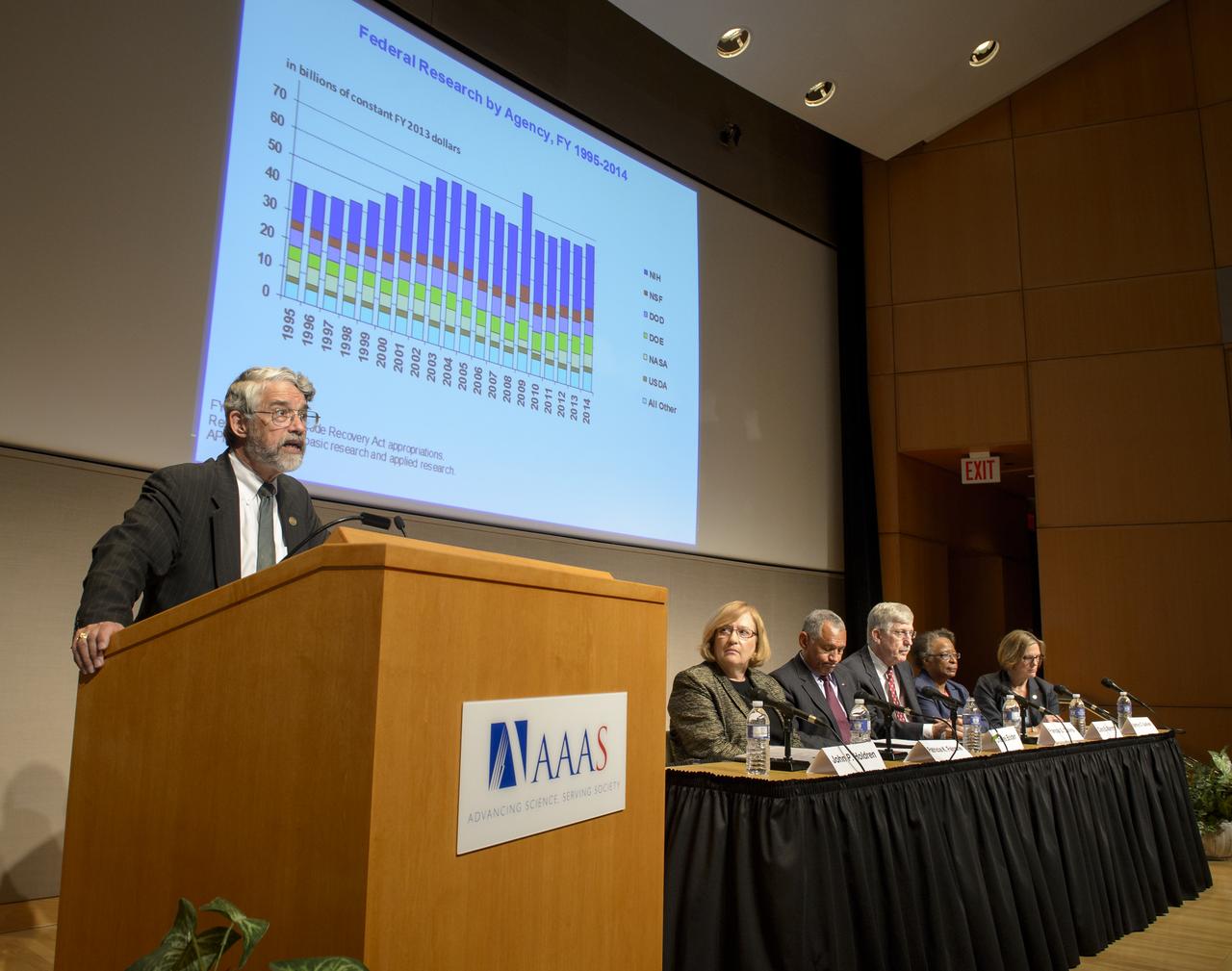
Dr. John P. Holdren, Assistant to the President for Science and Technology, Director of the White House Office of Science and Technology Policy, speaks during a Fiscal Year 2014 budget briefing held with Patricia Falcone of OSTP, Charlie Bolden from NASA, Francis Collins from NIH, Cora Marrett from NSF, and Kathryn Sullivan from NOAA, at the American Association for the Advancement of Science (AAAS) on Wednesday, April 10, 2013 in Washington. Photo Credit: (NASA/Bill Ingalls)
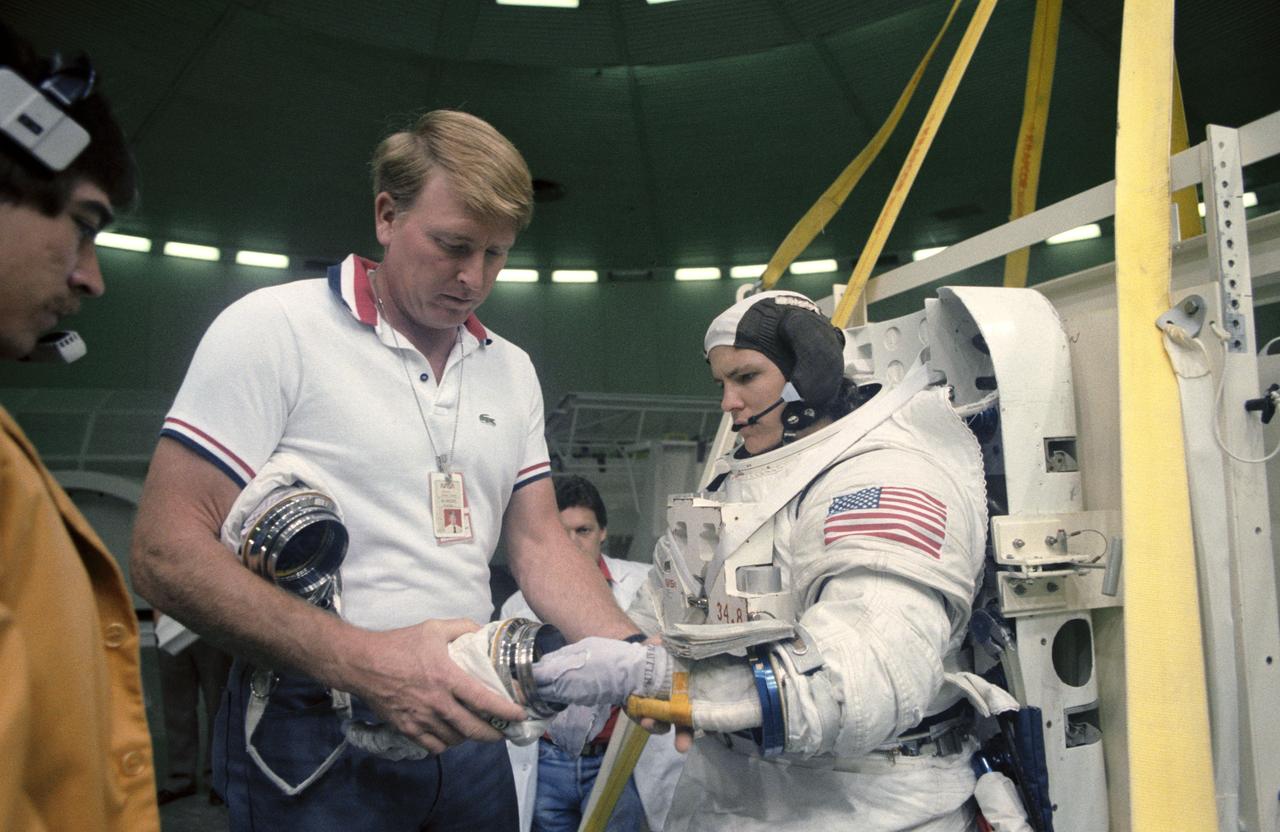
S84-33898 (21 May 1984) --- Astronaut Jon A. McBride, 41-G pilot, assists his crewmate, Astronaut Kathryn D. Sullivan with the glove portion of her extravehicular mobility unit (EMU) prior to Dr. Sullivan's underwater session in the Johnson Space Center's weightless environment training facility (WET-F). Mission specialists Sullivan and David C. Leestma are scheduled for extravehicular activity (EVA) on the Columbia for NASA's 17th scheduled flight.
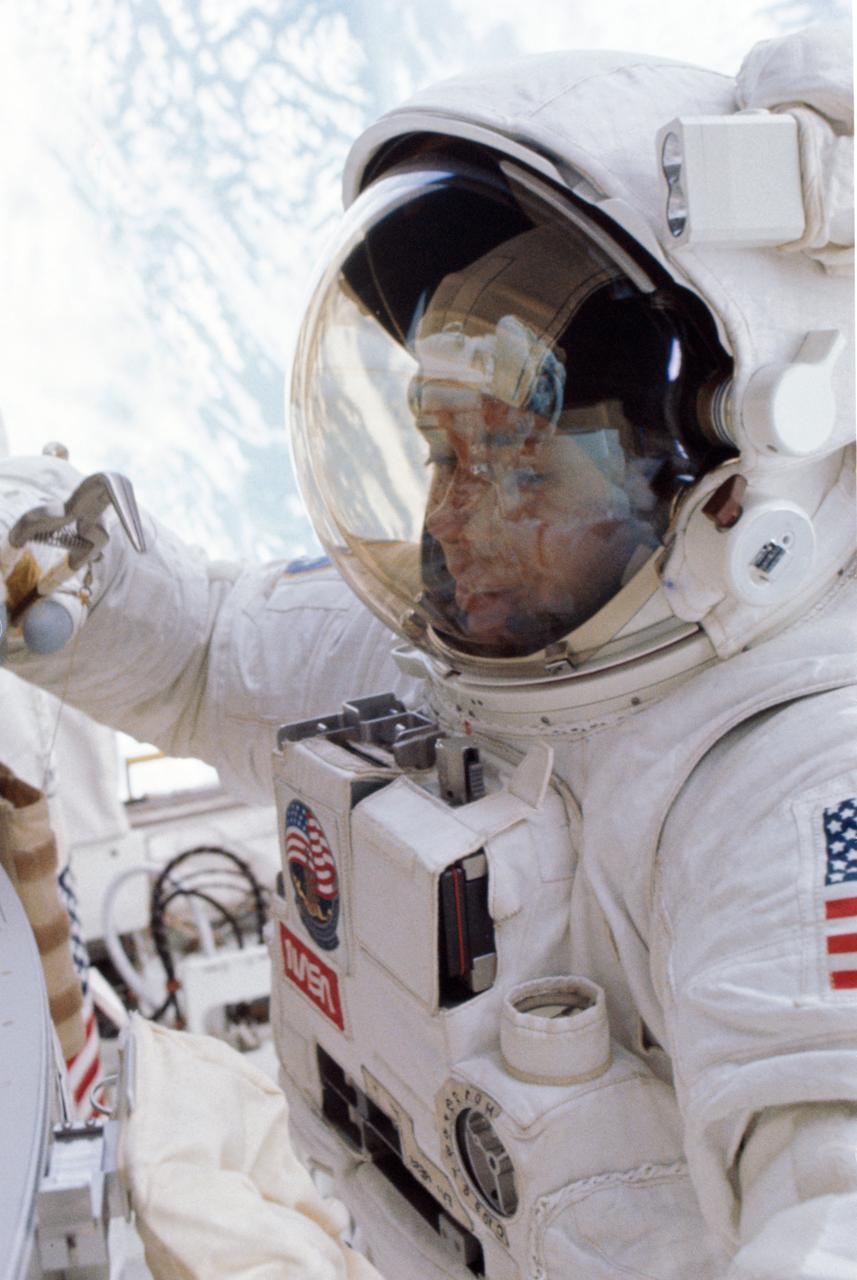
41G-101-013 (14 Oct 1984) --- Astronaut David C. Leestma works at the Orbital Refueling System (ORS) on the Mission Peculiar Support Structure (MPESS) in the aft end of the cargo bay of the Space Shuttle Challenger. Astronaut Kathryn D. Sullivan, America's first woman to perform an extravehicular activity (EVA) with the logging of this busy day, exposed this frame witha 35mm camera. The crew consisted of astronauts Robert L. Crippen, commander; Jon A. McBride, pilot; mission specialist's Kathryn D. Sullivan, Sally K. Ride, and David D. Leestma; Canadian astronaut Marc Garneau; and Paul D. Scully-Power, payload specialist. EDITOR'S NOTE: The STS-41G mission had the first American female EVA (Sullivan); first seven-person crew; first orbital fuel transfer; and the first Canadian (Garneau).
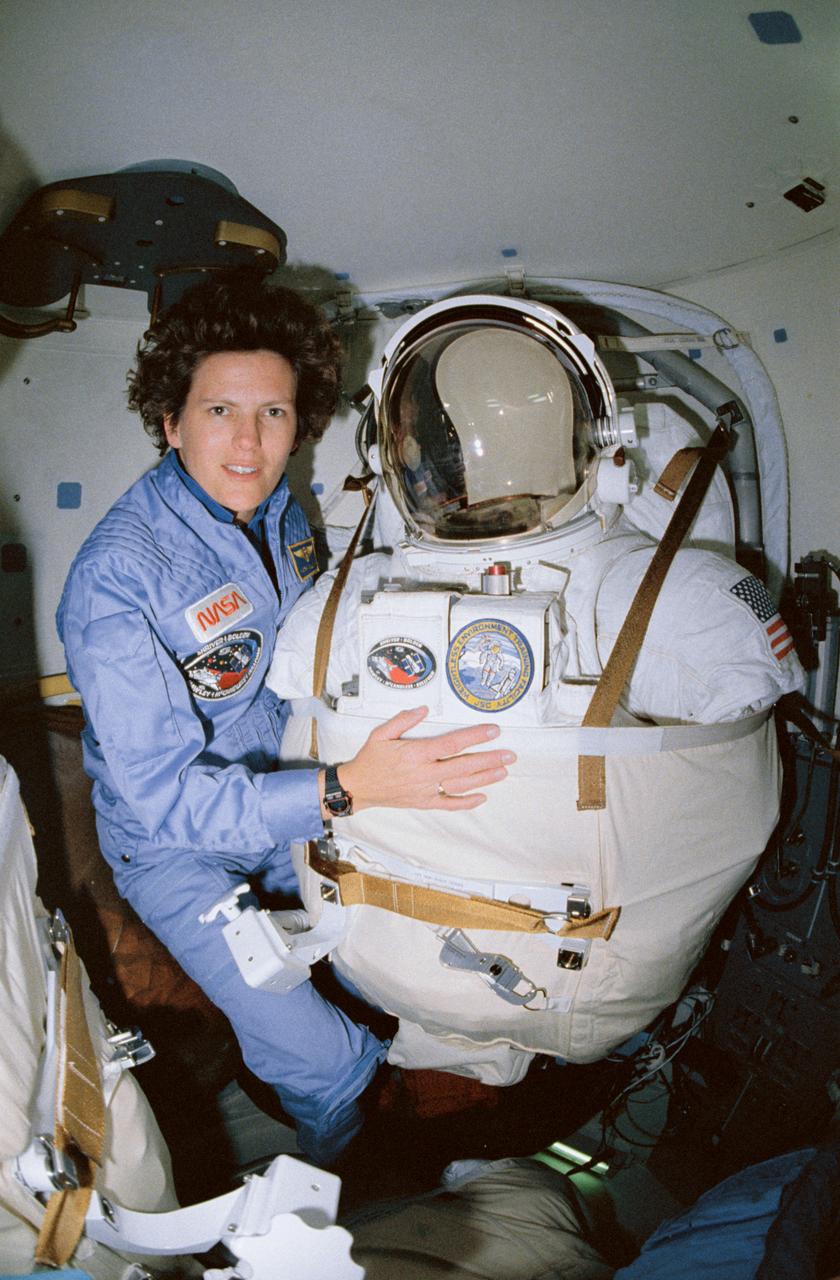
STS-31 Mission Specialist (MS) Kathryn D. Sullivan poses for a picture before beginning extravehicular mobility unit (EMU) donning procedures in the airlock of Discovery, Orbiter Vehicle (OV) 103. Sullivan will remove the lower torso restraint and don EMU which is supported on an airlock adapter plate (AAP). When suited, Sullivan will be ready for contingency extravehicular activity (EVA) in the event that problems arise with the Hubble Space Telescope (HST) deployment. Displayed on the front of the EMU are the STS-31 mission insignia and the JSC Weightless Environment Training Facility (WETF) insignia.
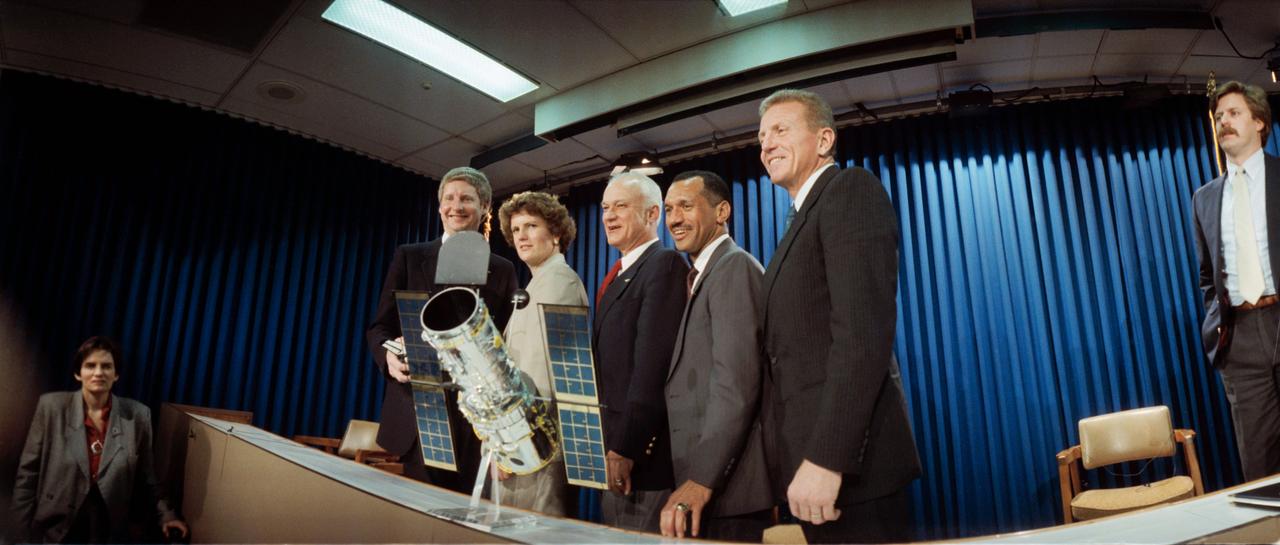
PHOTOS OF STS-31 (DISCOVERY) CREW WITH MODELS OF THE HUBBLE SPACE TELESCOPE (HST) AND SPACE SHUTTLE AT T-30 (THIRTY DAYS BEFORE LAUNCH) BRIEFING 03/22/90 IN THE AUDITORIUM AND PUBLIC AFFAIRS FACILITY BLDG 2. GROUP PHOTOS OF LOREN J. SHRIVER, CHARLES F. BOLDEN, STEVEN A. HAWLEY, BRUCE MCCANDLESS, AND KATHRYN D. SULLIVAN (32748, 32750, 32758-60 (WIDE ANGLE)) AND INDIVIDUAL PHOTOS OF HAWLEY (32747), MCCANDLESS (32751), SULLIVAN (32753-4), BOLDEN (32755), AND SHRIVER (32757) INCLUDED. ALSO PHOTGRAPHED TOGETHER ARE SULLIVAN, HAWLEY, MCCANDLESS (32749) AND BOLDEN, SHRIVER (32752, 32756).
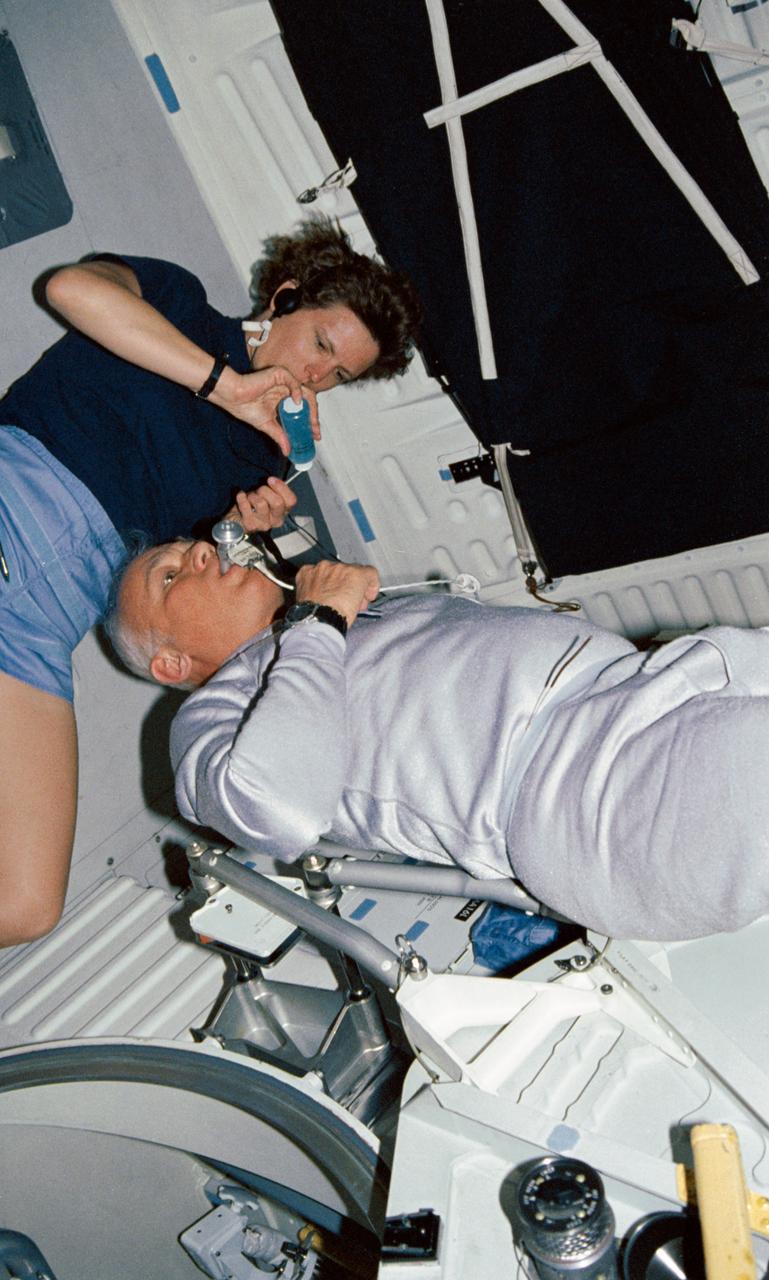
STS031-04-002 (24-29 April 1990) --- Astronauts Kathryn D. Sullivan and Bruce McCandless II, mission specialists, work together to perform one of the mission's medical experiments. The experiment is Detailed Supplementary Objective (DSO) 462, Non invasive Estimation of Central Venous Pressure During Spaceflight. Sullivan applies a gel substance to a transducer which will be placed on McCandless' jugular vein to collect the sought data. The cable links to a data recorder.

S84-43433 (11 Oct 1984) --- Photographed through aft flight deck windows, this 70mm frame shows Astronauts David C. Leestma, left, and Kathryn D. Sullivan at the orbital refueling system (ORS) in the aft cargo bay. A wrist camera on the remote manipulator system (RMS) is perched to record the historic extravehicular activity (EVA). Dr. Sullivan's part of the EVA represented the first such feat for an American woman.
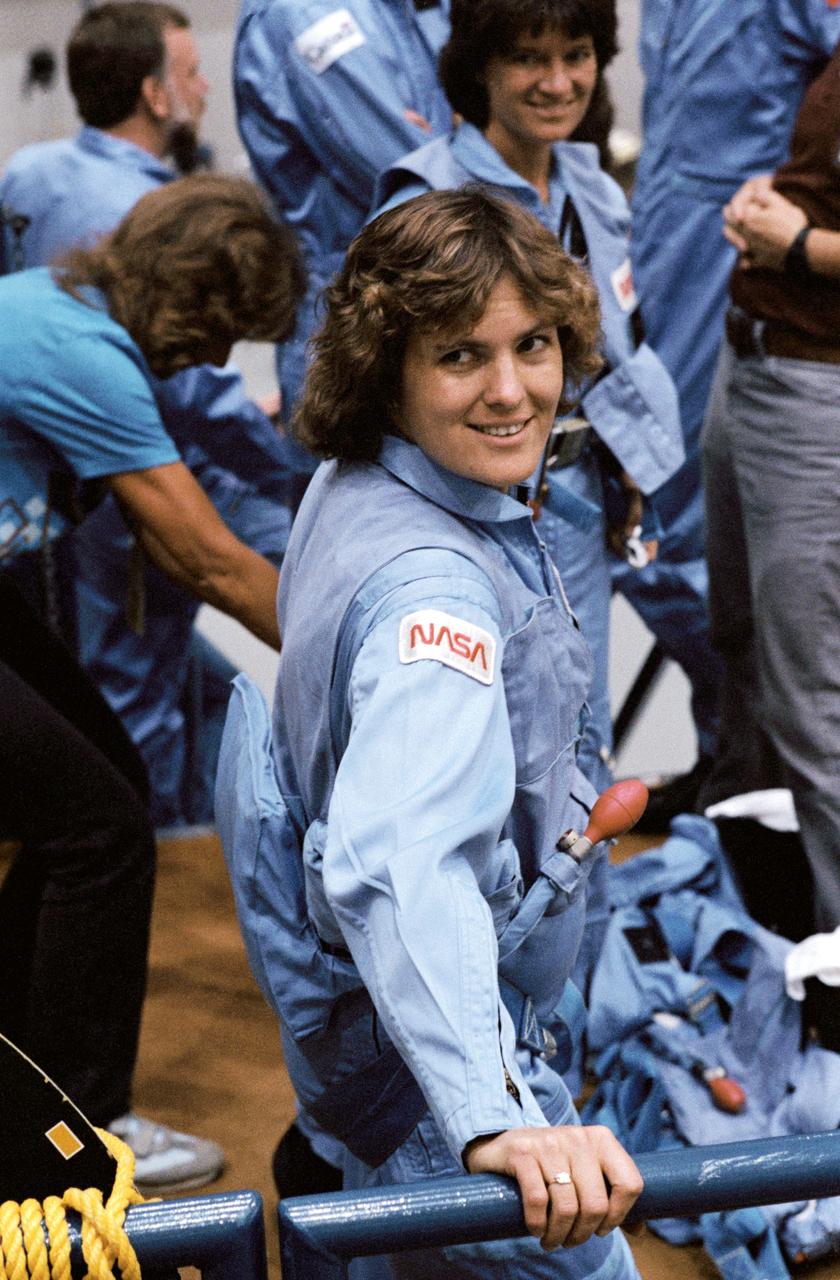
41D-3188 (2 September 1984) --- Astronaut Kathryn D. Sullivan, 41-G mission specialist, joins with other members of the seven-person crew prior to a training session in the Shuttle mockup and integration laboratory at the Johnson Space Center. Dr. Sullivan will be the first American woman to perform an extravehicular activity (EVA) in space when she joins Astronaut David C. Leestma for some outside-the-Challenger duty on October 9. The mission is scheduled for an October 5, 1984 launch.

41G-102-047 (13 Oct. 1984) --- An unusual picture, photographed by astronaut Kathryn D. Sullivan, shows the beginning and ending location of her eight-day mission in space with six other 41-G crew members aboard the space shuttle Challenger. The picture was made moments before touchdown at the KSC landing facility. Dr. Sullivan aimed a 35mm camera through the port hole in Challenger's hatch. The five ground features represented as circles or pentagonals are launch areas. Photo credit: NASA
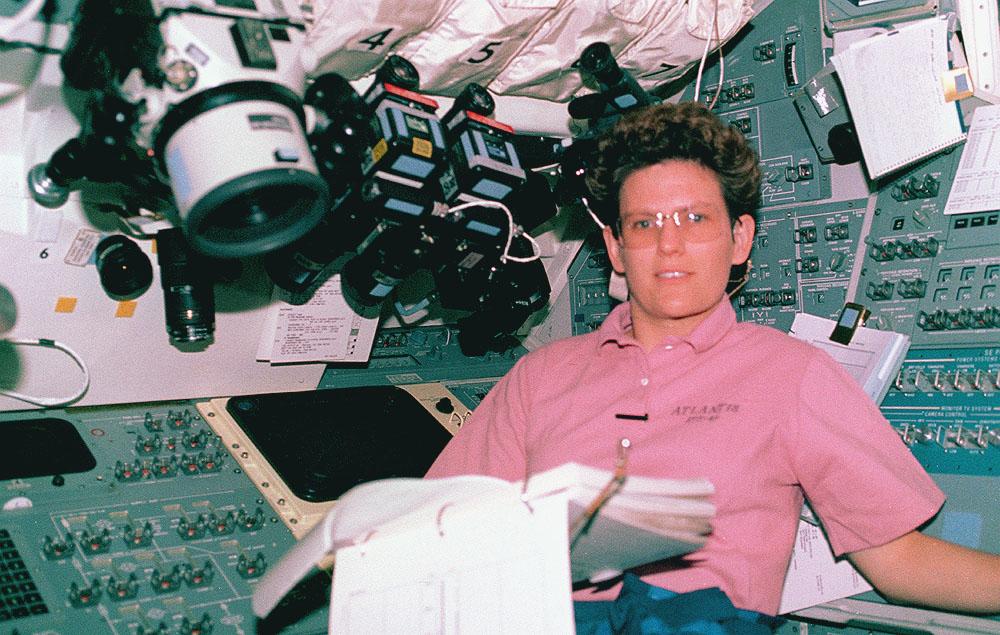
Space Shuttle Atlantis (STS-45) onboard photo of Mission Specialist Kathryn Sullivan working in the Atmospheric Laboratory for Applications and Science (Atlas-1) module. Atlas-1 flew in a series of Spacelab flights that measured long term variability in the total energy radiated by the Sun and determined the variability in the solar spectrum.
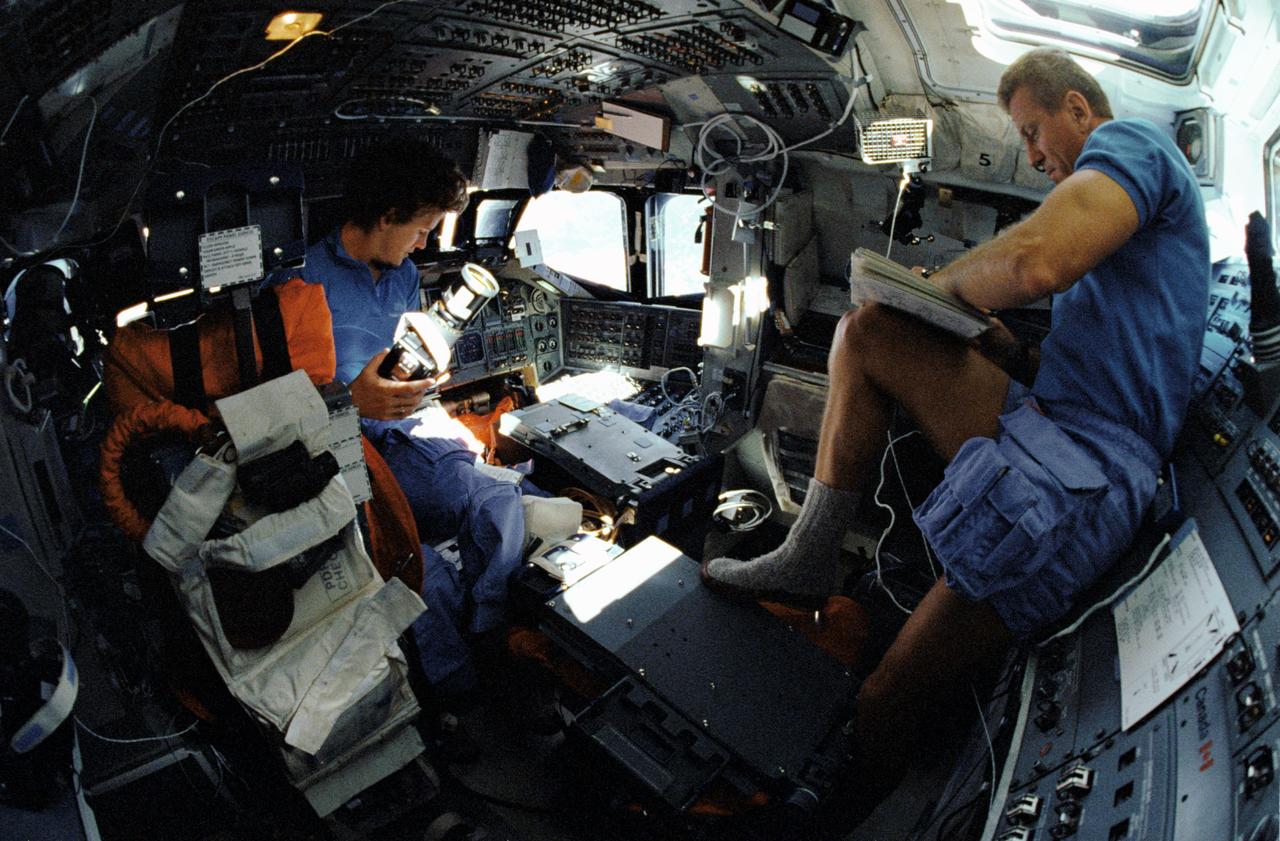
STS031-101-053 (24-29 April 199) --- A 35mm camera equipped with a "fish-eye" lens captured this view on Discovery's flight deck featuring astronaut Kathryn D. Sullivan with a Hasselblad camera on forward flight deck and astronaut Loren J. Shriver, pen in hand, amending flight data on aft flight deck.
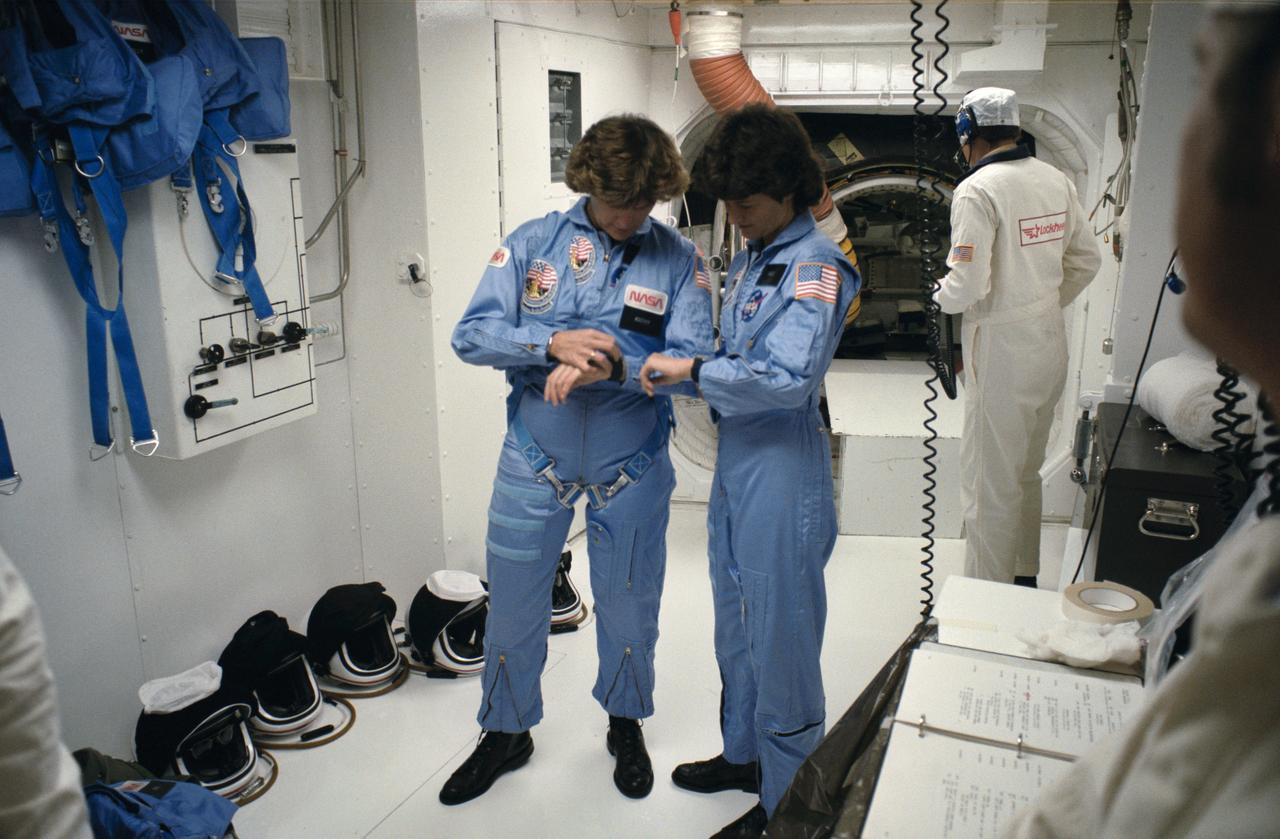
41G-90082 / S17-90082 (5 Oct 1984) --- Astronauts Sally K. Ride (right) and Kathryn D. Sullivan, two of three mission specialists, synchronize their watches prior to ingressing the Space Shuttle Challenger on the launch pad at Kennedy Space Center (KSC). They are in the White Room leading to the entry hatch of the vertically configured spacecraft.
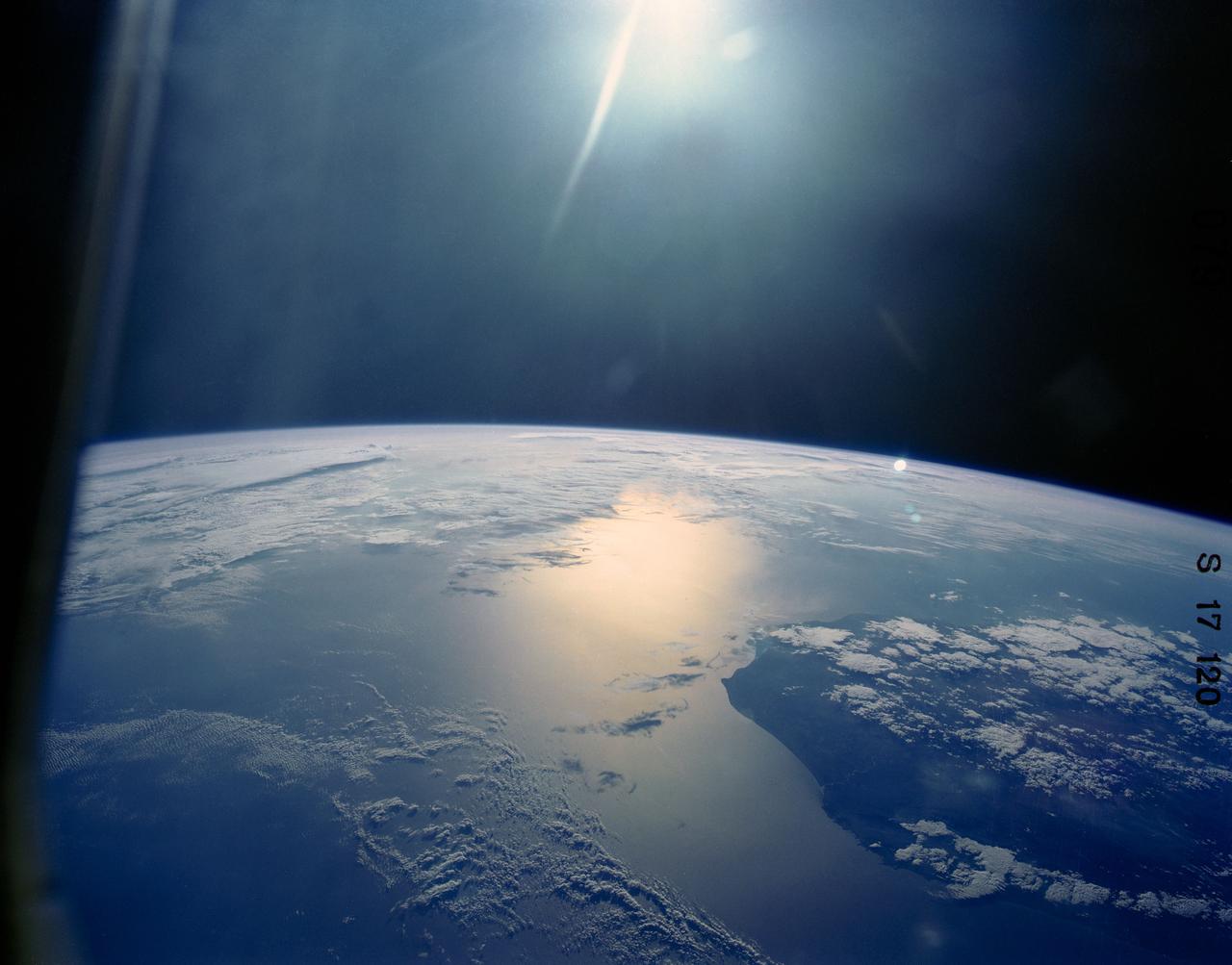
41G-120-079 (5-13 Oct 1984) --- This oblique view, photographed from the Space Shuttle Challenger, shows the south tip of the island of Madagascar. Sunglint reflects on the surface of the Mozambique Channel. The crew consisted of astronauts Robert L. Crippen, commander; Jon A. McBride, pilot; mission specialist's Kathryn D. Sullivan, Sally K. Ride, and David D. Leestma; Canadian astronaut Marc Garneau; and Paul D. Scully-Power, payload specialist. EDITOR'S NOTE: The STS-41G mission had the first American female EVA (Sullivan); first seven-person crew; first orbital fuel transfer; and the first Canadian (Garneau).
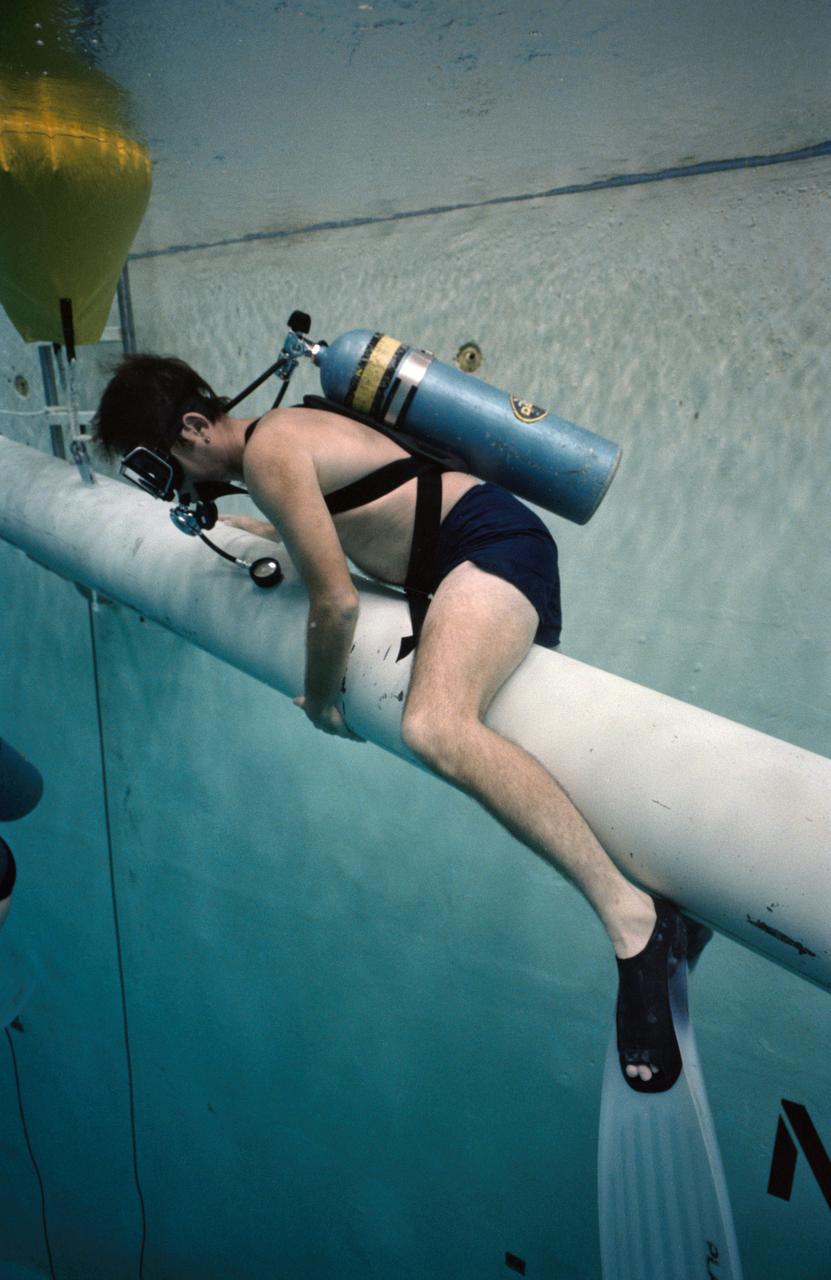
S84-36958 (29 June 1984) --- Astronaut Robert L. Crippen, 41-G crew commander, perches nearby an underwater simulation scene in the Johnson Space Center's weightless environment training facility (WET-F). Purpose of the rehearsal was to train two of the 41-G crew's mission specialists for a scheduled extravehicular activity (EVA). Out of frame are Astronauts Kathryn D. Sullivan, Jon A. McBride and David Leestma. Dr. Sullivan and Leestma donned extravehicular mobility units (EMU) for the simulation while Crippen and McBride monitored the activity. This photograph was taken by Otis Imboden.
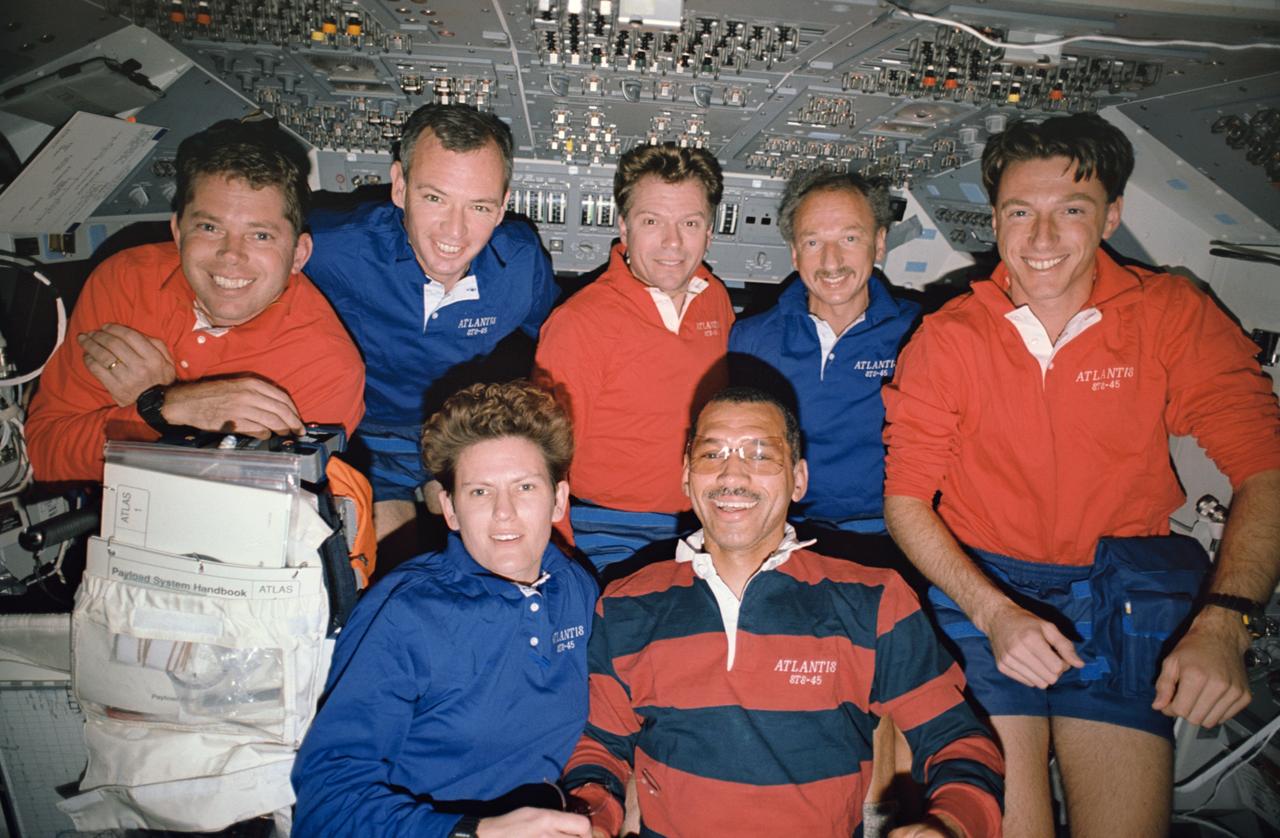
STS045-38-004 (24 March-2 April 1992) --- The traditional inflight crew portrait has Kathryn D. Sullivan, payload commander, and Charles F. Bolden, mission commander, on the front row, with ( left to right) David C. Leestma, mission specialist; Brian Duffy, pilot; Byron K. Lichtenberg and Dirk Frimout, both payload specialists; and C. Michael Foale, mission specialist, on the back row. (The "headpieces" worn by Sullivan and Bolden are actually shadows.) This frame was taken with a 35mm camera on the flight deck of the Earth-orbiting Space Shuttle Atlantis during the nine-day mission.
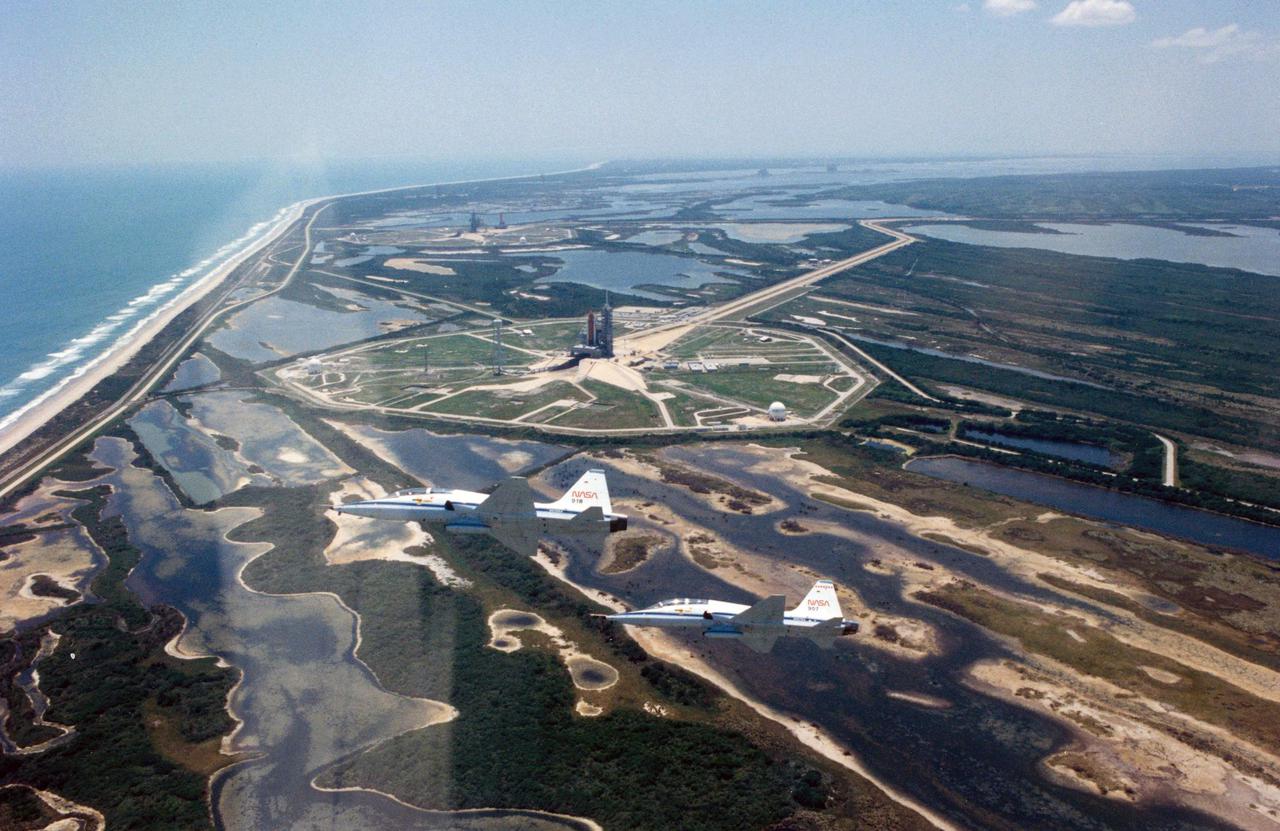
KENNEDY SPACE CENTER, FLA. -- Mission Specialist Kathryn D. Sullivan's camera skills show that the view of Launch Pads 39A and 39B from a T-30 trainer is unforgettable. Sullivan took the pictures as she and fellow Space Shuttle Mission STS-31 crew members flew into KSC on April 22. In the foreground, the Shuttle Discovery is poised on Pad B, and in the distance, Columbia rolls out to Pad A. While Sullivan flew with STS-31 Pilot Charles F. Bolden Jr., Mission Commander Loren J. Shriver and Mission Specialist Steven A. Hawley flew alongside in T-38 #918, and Mission Specialist Bruce McCandless II and NASA Pilot Mario Runco flew in T-38 #907. STS-31 is set to lift off from Pad B at 8:31 a.m. EDT, April 24.

S79-29592 (28 Feb 1979) --- Sporting their new Shuttle-type constant-wear garments, these six astronaut candidates pose for a picture in the crew systems laboratory at the Johnson Space Center (JSC) with the personnel rescue enclosure (PRE) or "rescue ball" and an unoccupied Apollo EMU. From left to right are Rhea Seddon, Kathryn D. Sullivan, Judith A. Resnik, Sally K. Ride, Anna L. Fisher and Shannon W. Lucid.
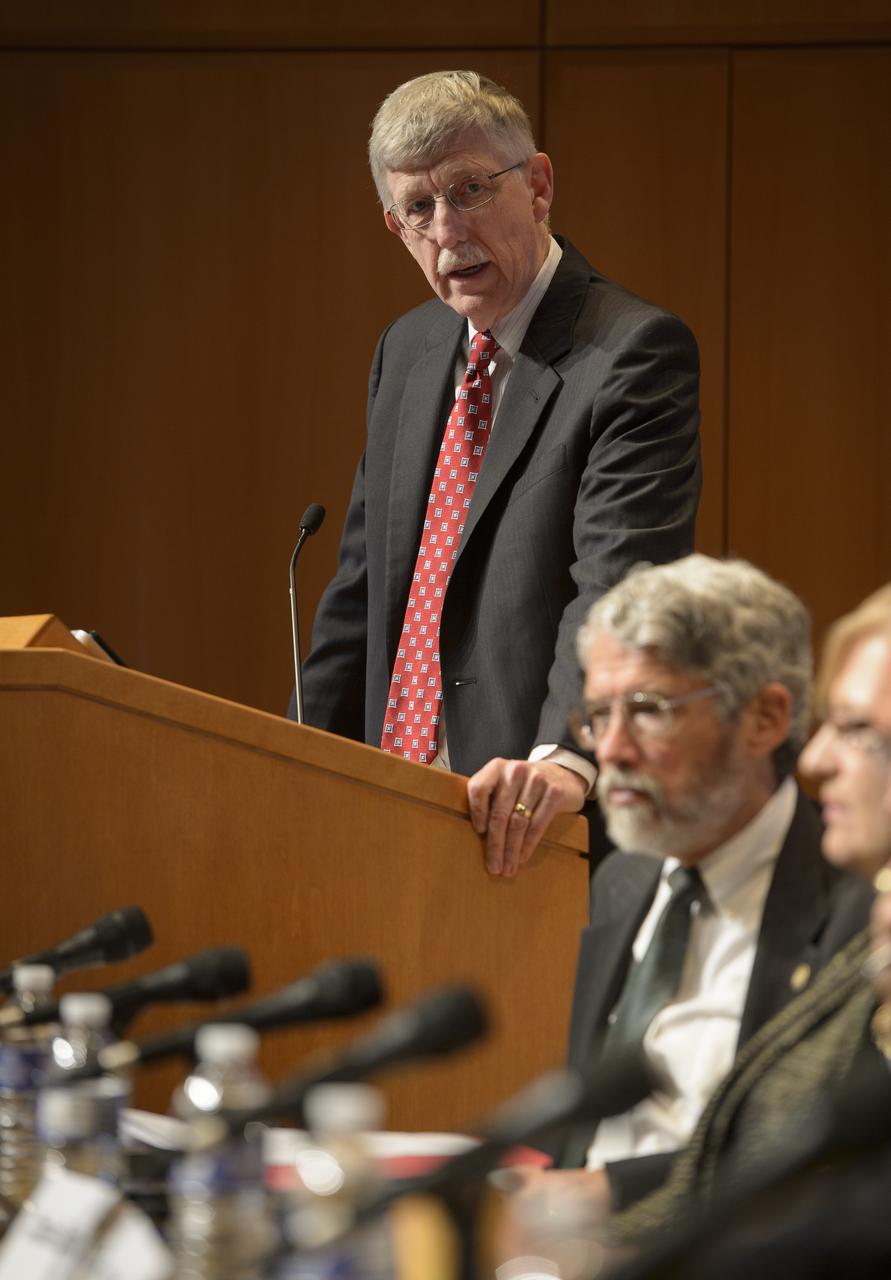
Director of the National Institutes of Health (NIH) Francis S. Collins, M.D., Ph.D., delivers remarks during a White House Office of Science and Technology Policy (OSTP) Fiscal Year 2014 budget briefing held with with Dr. John P. Holdren, Director of OSTP, Patricia Falcone of OSTP, Charlie Bolden from NASA, Cora Marrett from NSF, and Kathryn Sullivan from NOAA, at the American Association for the Advancement of Science (AAAS) on Wednesday, April 10, 2013 in Washington. Photo Credit: (NASA/Bill Ingalls)

S79-29594 (28 Feb 1979) --- Sporting their new Shuttle-type constant-wear garments, these six astronaut candidates pose for a picture in the crew systems laboratory at the Johnson Space Center (JSC). From left to right are Rhea Seddon, Sally K. Ride, Kathryn D. Sullivan, Shannon W. Lucid, Anna L. Fisher and Judith A. Resnik.
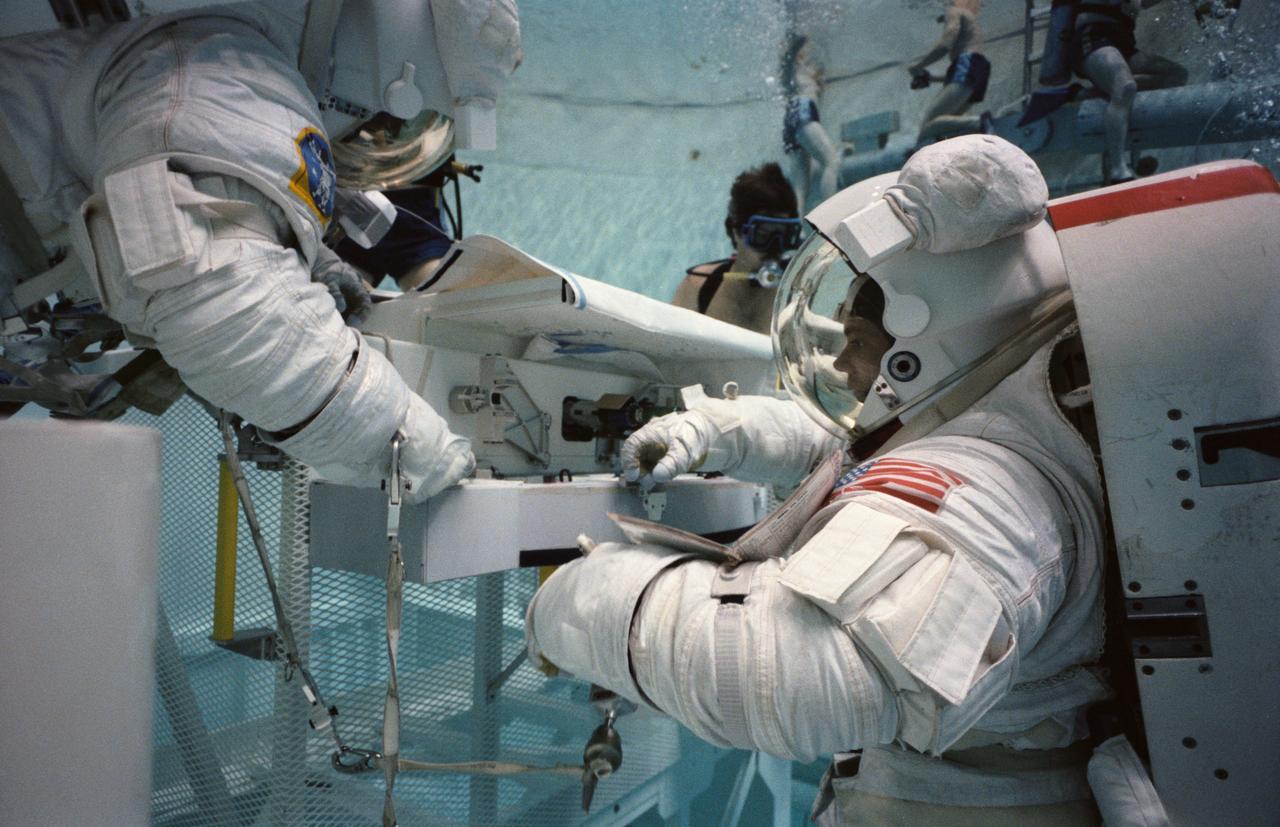
S84-36960 (5 July 1984) --- Astronauts Kathryn D. Sullivan, left, and David C. Leestma, Mission 41-G crewmembers, simulate the transfer of cryogenics in space during an Earth-bound underwater session in the Johnson Space Center's weightless environment training facility (WET-F). The two mission specialists will be joined by three NASA astronauts and two payload specialists for a flight aboard the Columbia later this year. The photograph was taken by Otis Imboden.
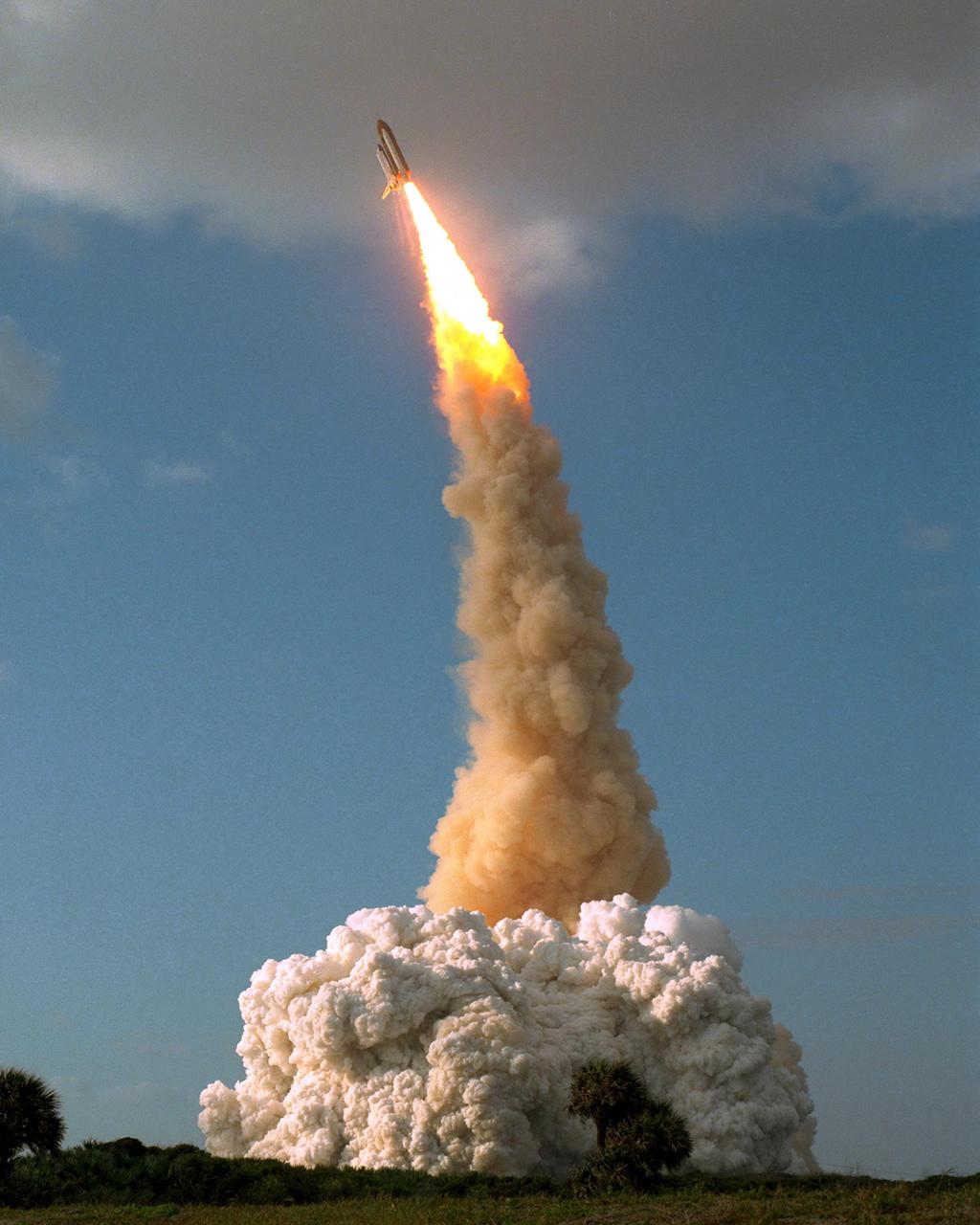
KENNEDY SPACE CENTER, FLA. -- The Space Shuttle Discovery lifts off from Pad 39-B at 8:33 a.m. EDT carrying a crew of five and the Hubble Space Telescope. STS-31 crew members are Commander Loren Shriver, Pilot Charles Bolden and Mission Specialists Steven Hawley, Bruce McCandless II and Kathryn Sullivan.

The space shuttle Discovery lifts off from Launch Pad 39-B at 8:33 a.m. EDT carrying a crew of five and the Hubble Space Telescope. STS-31 crew members are Commander Loren Shriver, Pilot Charles Bolden and Mission Specialists Steven Hawley, Bruce McCandless II and Kathryn Sullivan. Photo credit: NASA
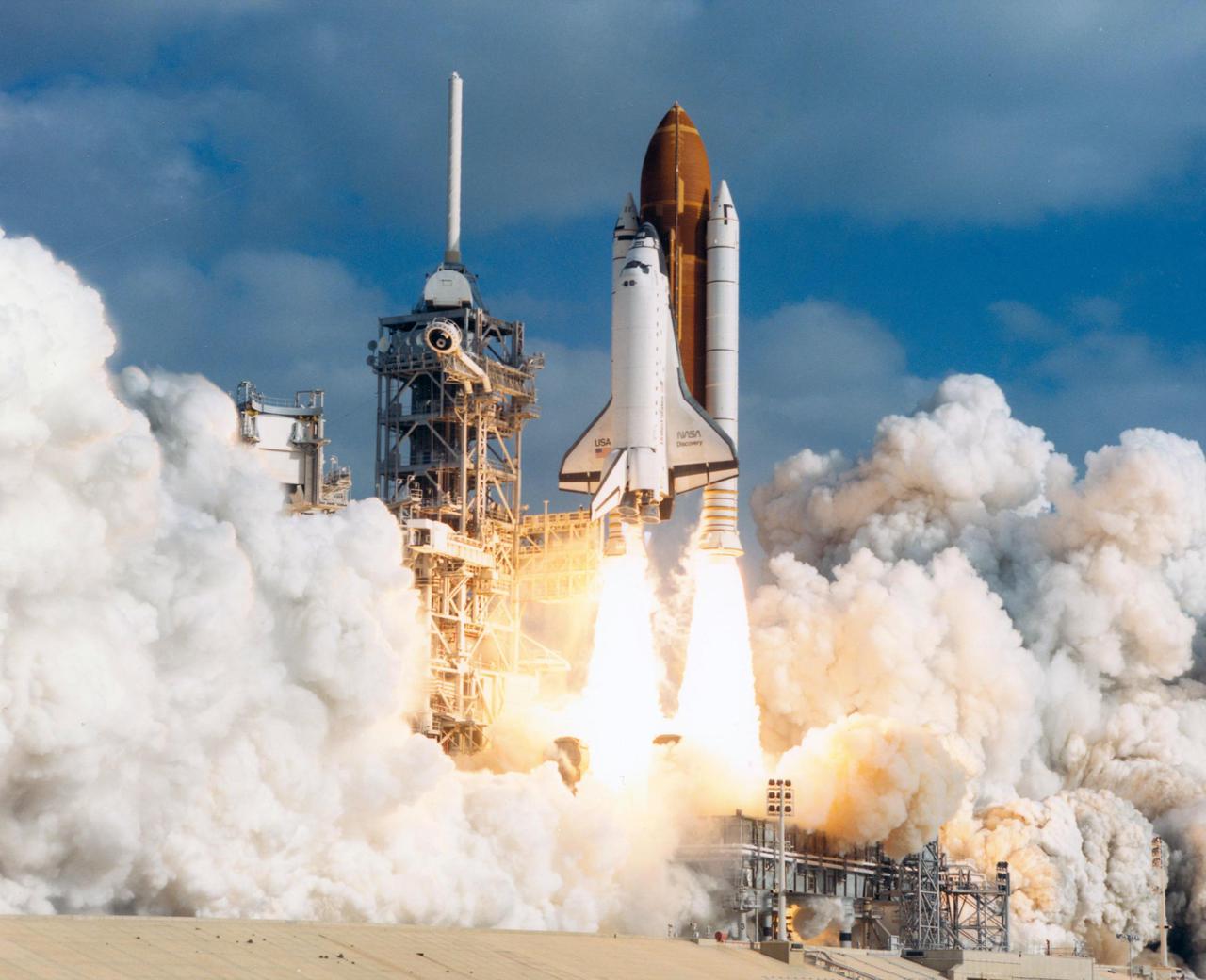
KENNEDY SPACE CENTER, FLA. -- The Space Shuttle Discovery soars into the morning skies above Florida, carying a crew of five and the Hubble Space Telescope. Launch of Space Shuttle Mission STS-31from Pad 39B occurred at 8:33:51 a.m. EDT, April 24. Crew members are Commander Loren J. Shriver; Pilot Charles F. Bolden Jr.; and Mission Specialists Kathryn D. Sullivan, Steven A. Hawley, and Bruce McCandless II.

S79-29596 (28 Feb 1979) --- Contrasting the old with the new, six astronaut candidates pose for photographers in their new constant wear garments, ideal for the zero-gravity tasks in the pressurized environs of Space Shuttle. The "old" is an Apollo type spacesuit used for extravehicular activity (EVA). From left to right are Shannon W. Lucid, Rhea Seddon, Kathryn D. Sullivan, Judith A. Resnik, Anna L. Fisher and Sally K. Ride.
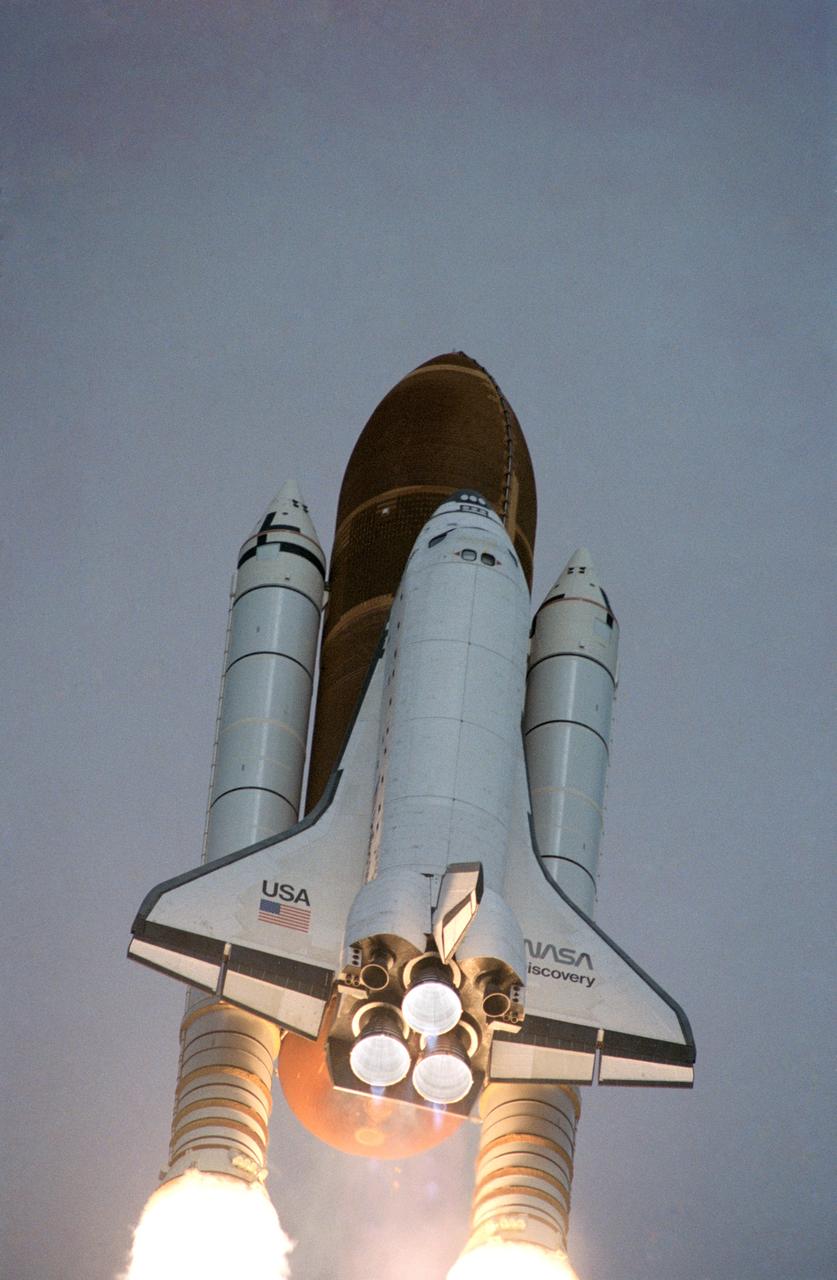
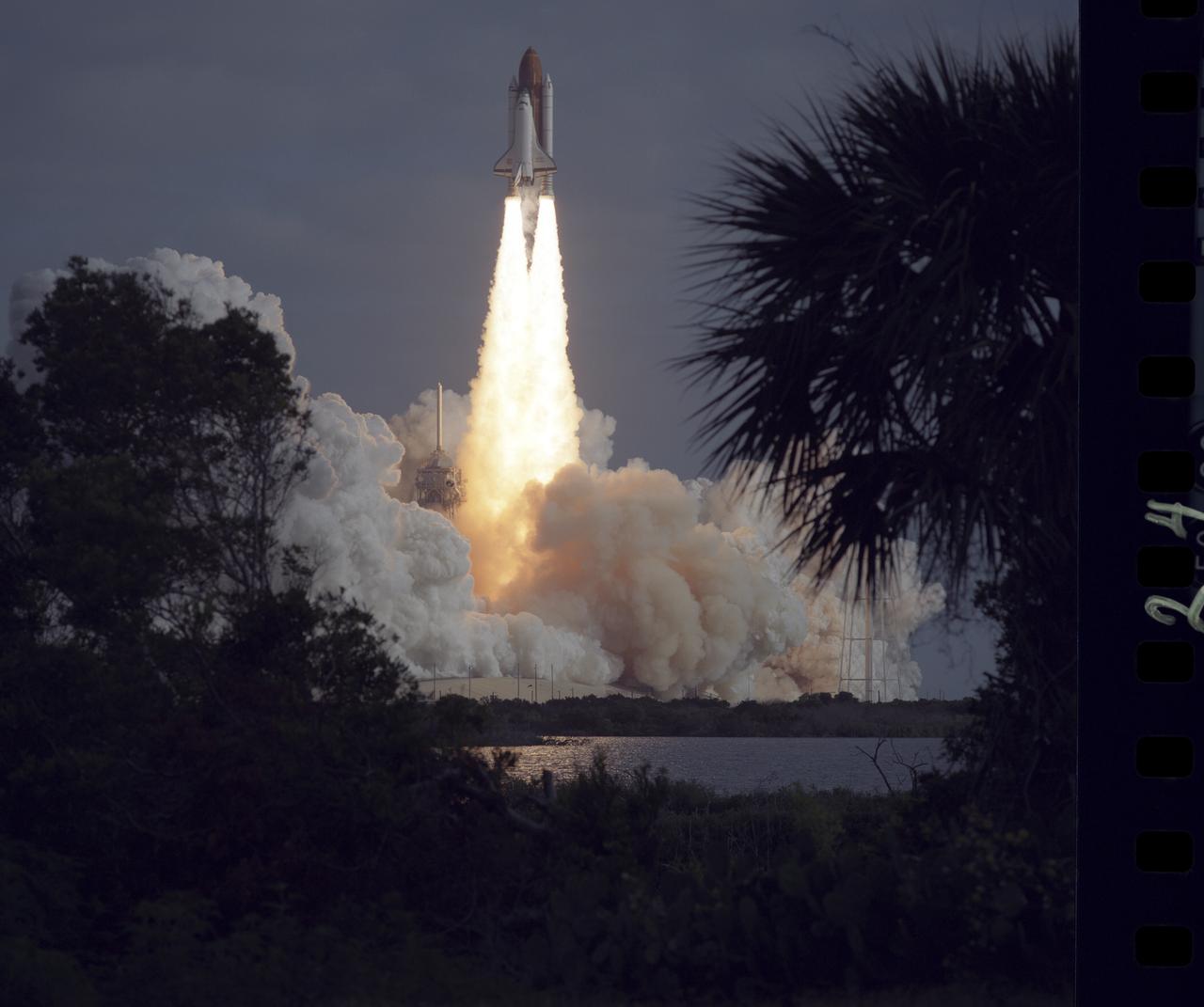
STS031-S-074 (24 April 1990) --- A low-angle view of the launch of the STS-31 mission. Onboard Discovery are a crew of five veteran astronauts and the Hubble Space Telescope (HST). Official launch time was 8:33:51.0492 a.m. (EDT). Headed for approximately five days in space are astronauts Loren J. Shriver, Charles F. Bolden Jr., Bruce McCandless II, Kathryn D. Sullivan and Steven S. Hawley.
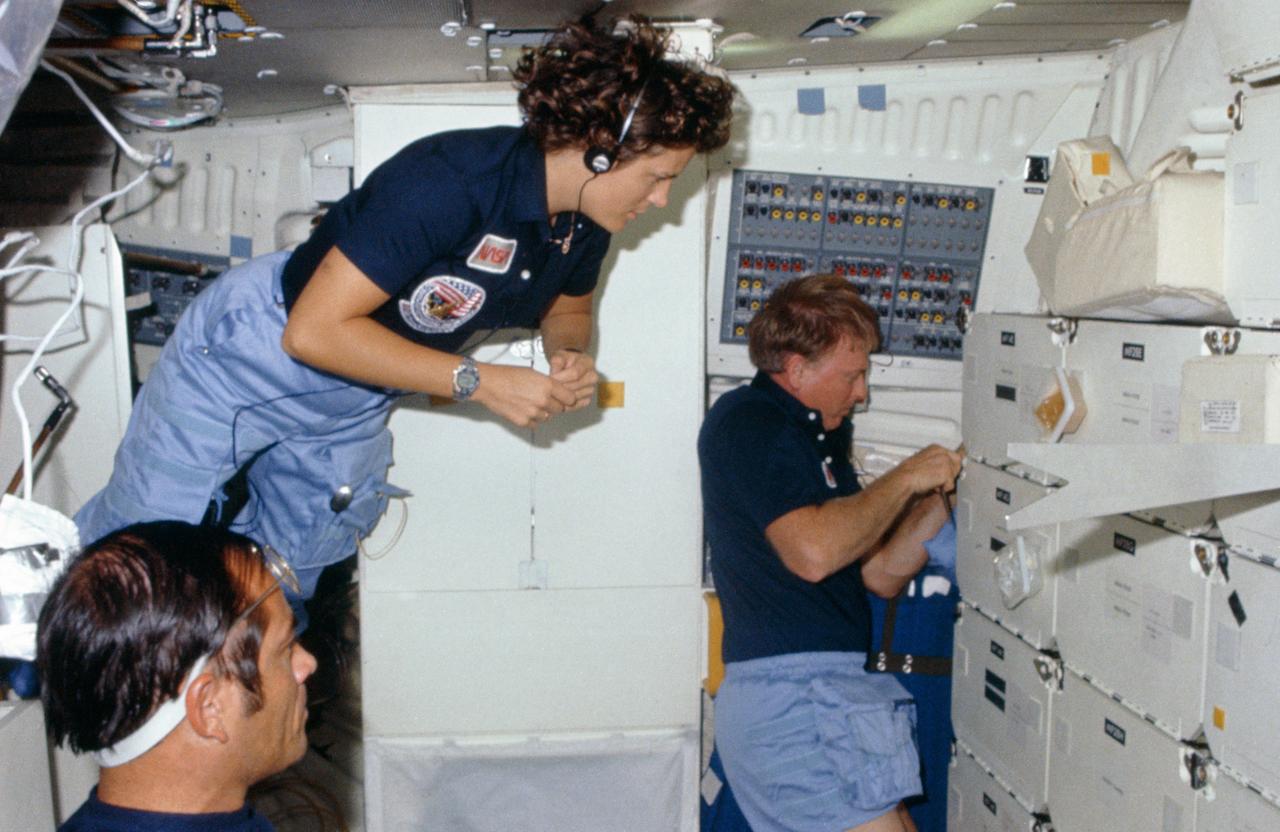
41G-102-003 (5-13 Oct 1984) ---- Astronaut Kathryn D. Sullivan, 41-G mission specialist, floats into a middeck scene to join a more stationary pair of crewmembers---Astronauts Robert L. Crippen, crew commander; and Jon A. McBride, pilot. The protruding article near the stowage lockers is a Krimsky rule, part of the near vision acuity experiment in which recent NASA space travelers have participated.
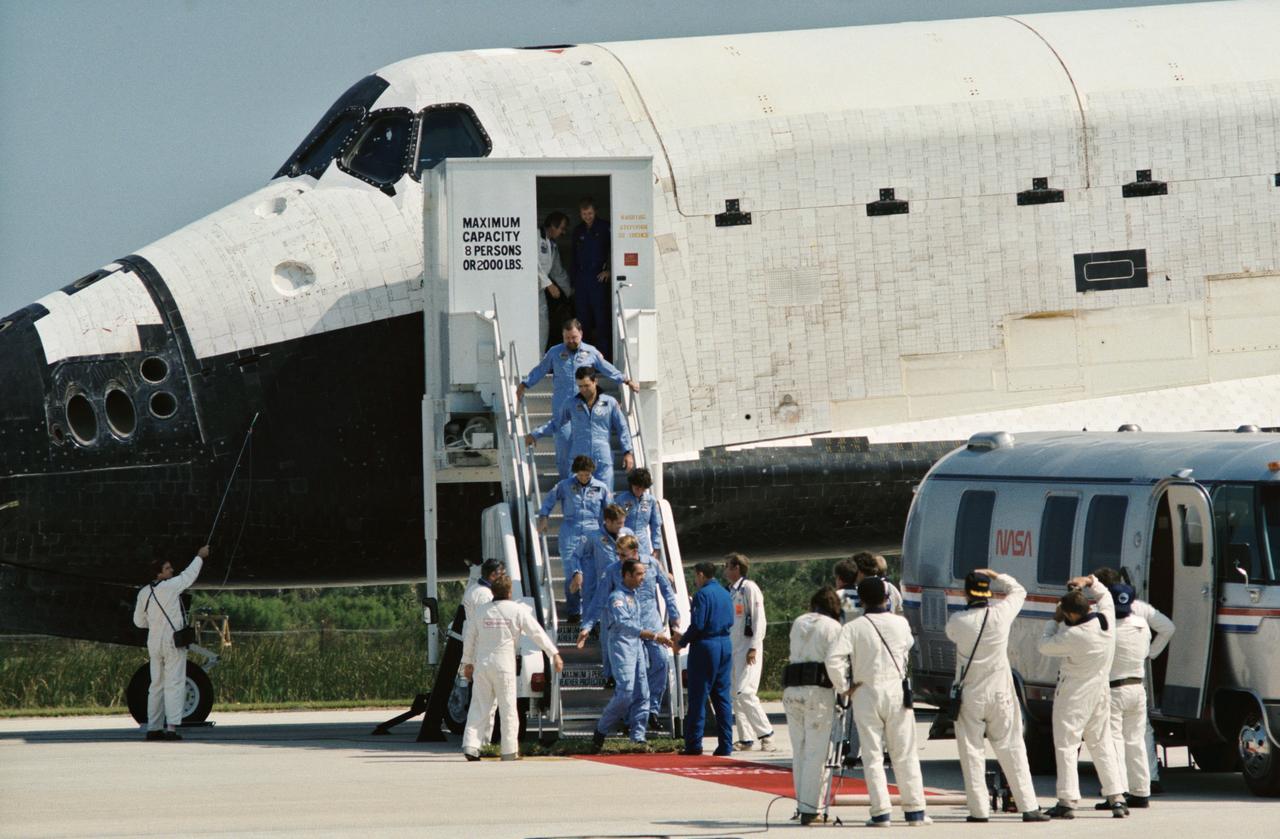
41G-90217 (13 Oct 1984) --- 41-G crew leaves the orbiter after landing at Kennedy Space Center at the end of their mission. Astronaut Robert Crippen shakes hands with George W.S. Abbey, Director of JSC's Flight Crew Operations, while the other crewmembers wait behind him. They are Jon McBride, David Leestma, Sally K. Ride, Kathryn Sullivan, Marc Garneau and Paul Scully-Power.
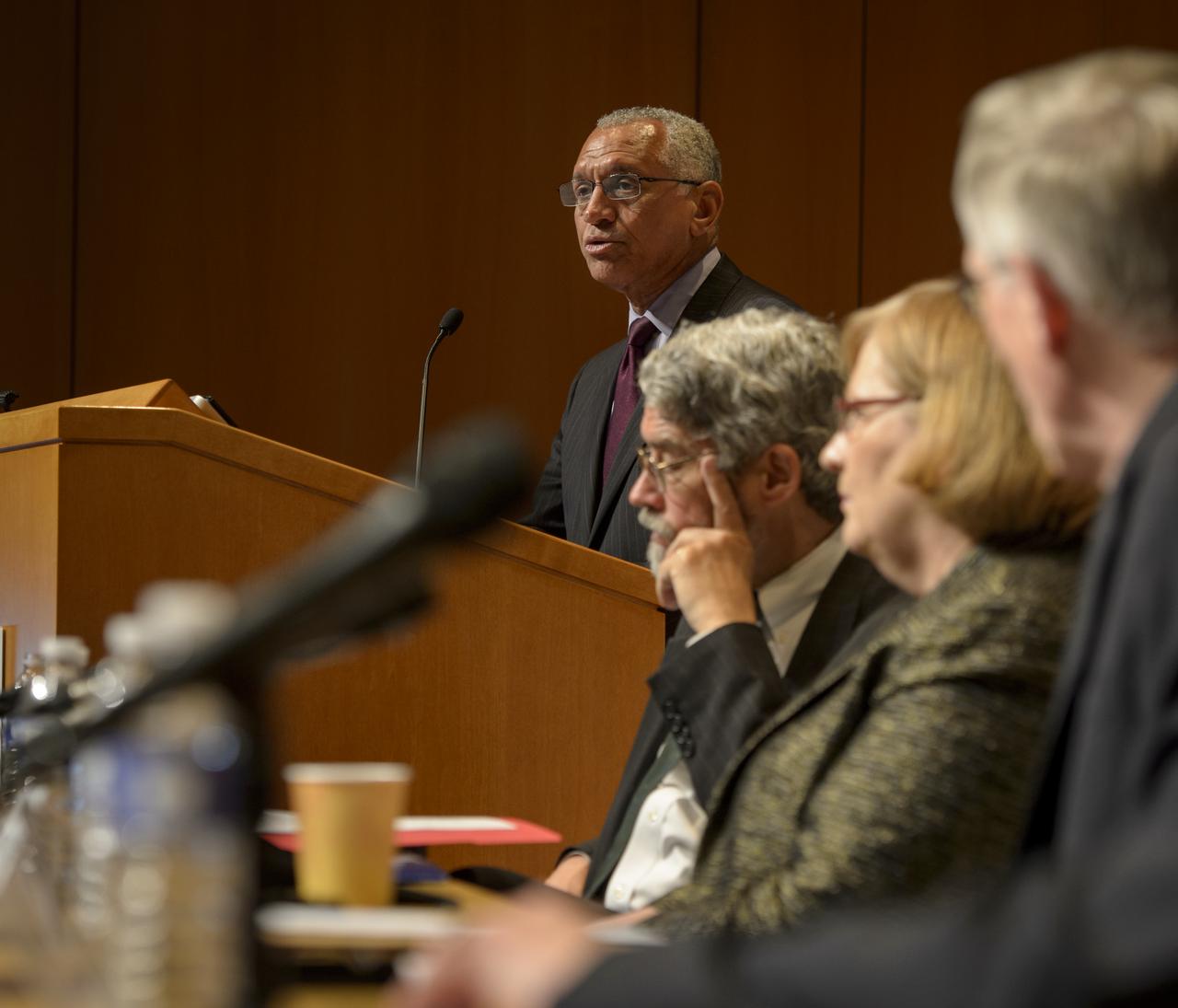
NASA Administrator Charlie Bolden, delivers remarks during a White House Office of Science and Technology Policy (OSTP) Fiscal Year 2014 budget briefing held with with Dr. John P. Holdren, Director of OSTP, Patricia Falcone of OSTP, Francis Collins from NIH, Cora Marrett from NSF, and Kathryn Sullivan from NOAA, at the American Association for the Advancement of Science (AAAS) on Wednesday, April 10, 2013 in Washington. Photo Credit: (NASA/Bill Ingalls)
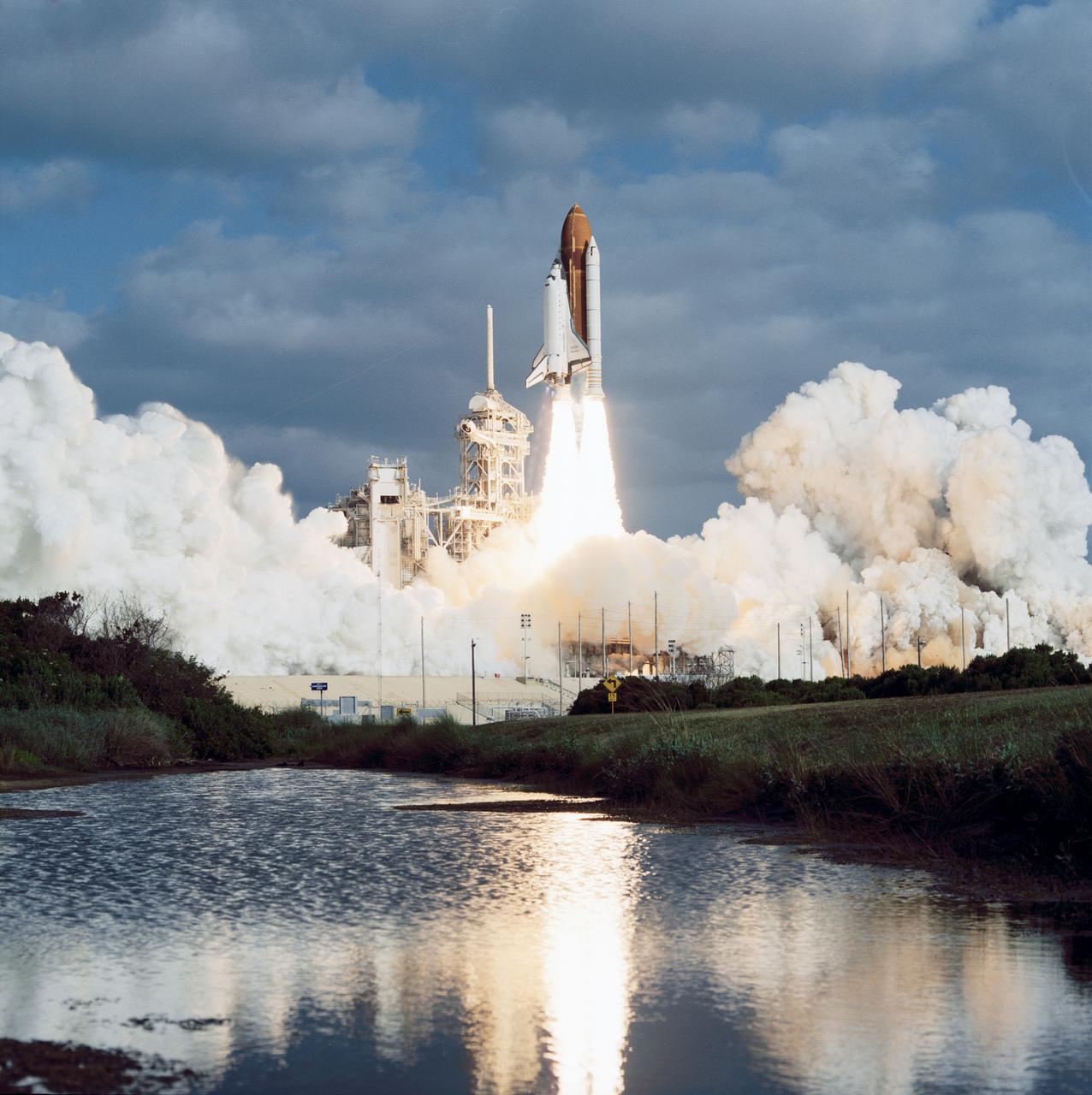
STS031-S-064 (24 April 1990) --- A horizontal view of the launch of the STS-31 mission. Onboard Space Shuttle Discovery are the crew of five veteran astronauts and the Hubble Space Telescope (HST). Official launch time was 8:33:51.0492 a.m. (EDT). Headed for approximately five days in space are astronauts Loren J. Shriver, Charles F. Bolden, Jr., Bruce McCandless, II, Kathryn D. Sullivan, and Steven A. Hawley.
The STS-31 crew launched aboard the Space Shuttle Discovery on April 24, 1990 at 8:33:51am (EDT). Included in the crew of five were Loren J. Shriver, commander; Charles F. Bolden, pilot; and Steven A. Hawley, Bruce McCandless, and Kathryn D. Sullivan, all mission specialists. The primary goal of the mission was the deployment of the Hubble Space Telescope (HST) which was a Marshall Space Flight Center (MSFC) managed program.
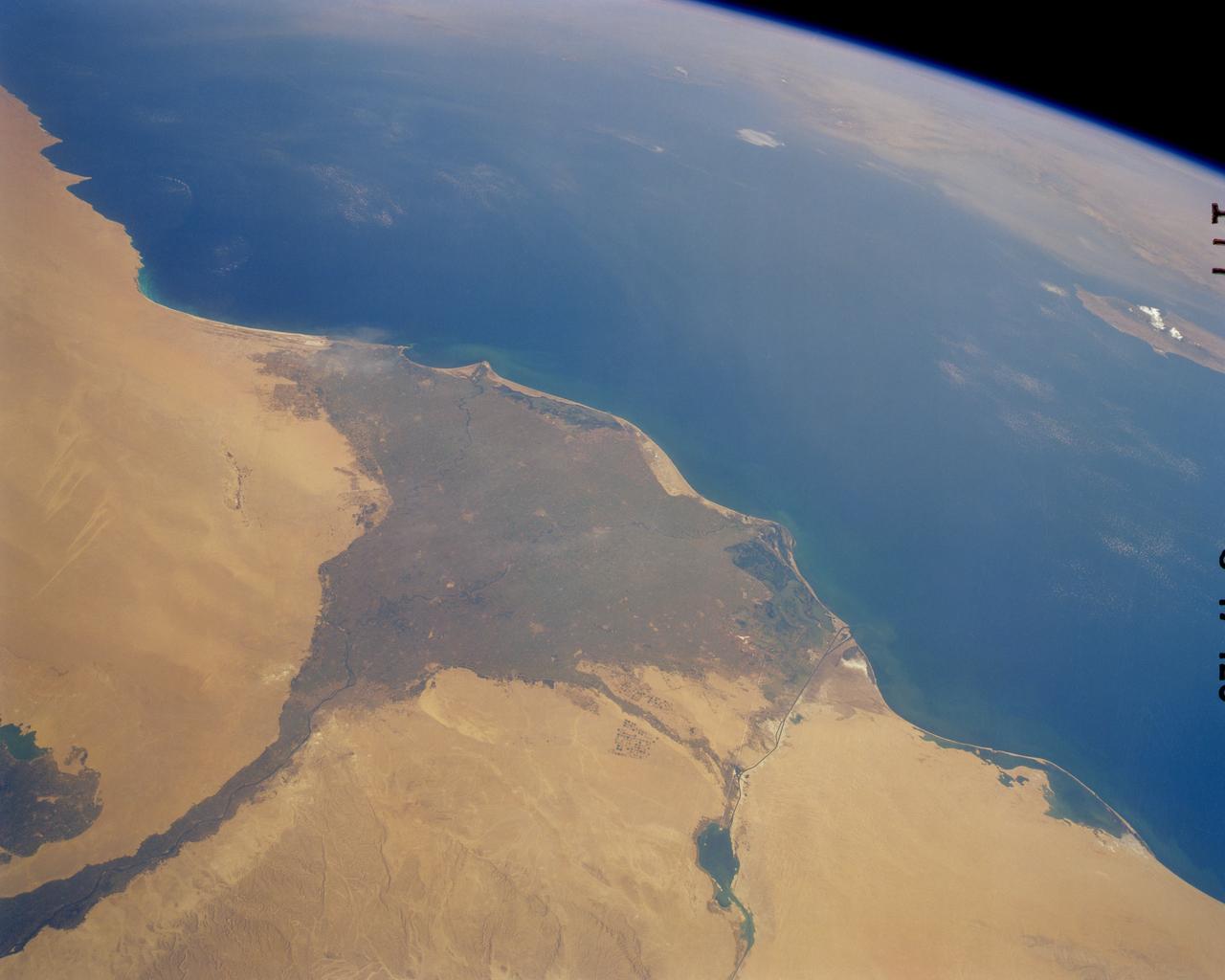
41G-120-177 (5-13 Oct 1984) --- Egypt and the Nile River Delta are easily recognizable in this 250mm frame. Cairo and the Egyptian pyramids are also visible in the lower left side of this photograph. The crew consisted of astronauts Robert L. Crippen, commander, Jon A. McBride, pilot; mission specialist’s Kathryn D. Sullivan, Sally K. Ride, and David D. Leestma; Canadian astronaut Marc Garneau; and Paul D. Scully-Power payload specialist.
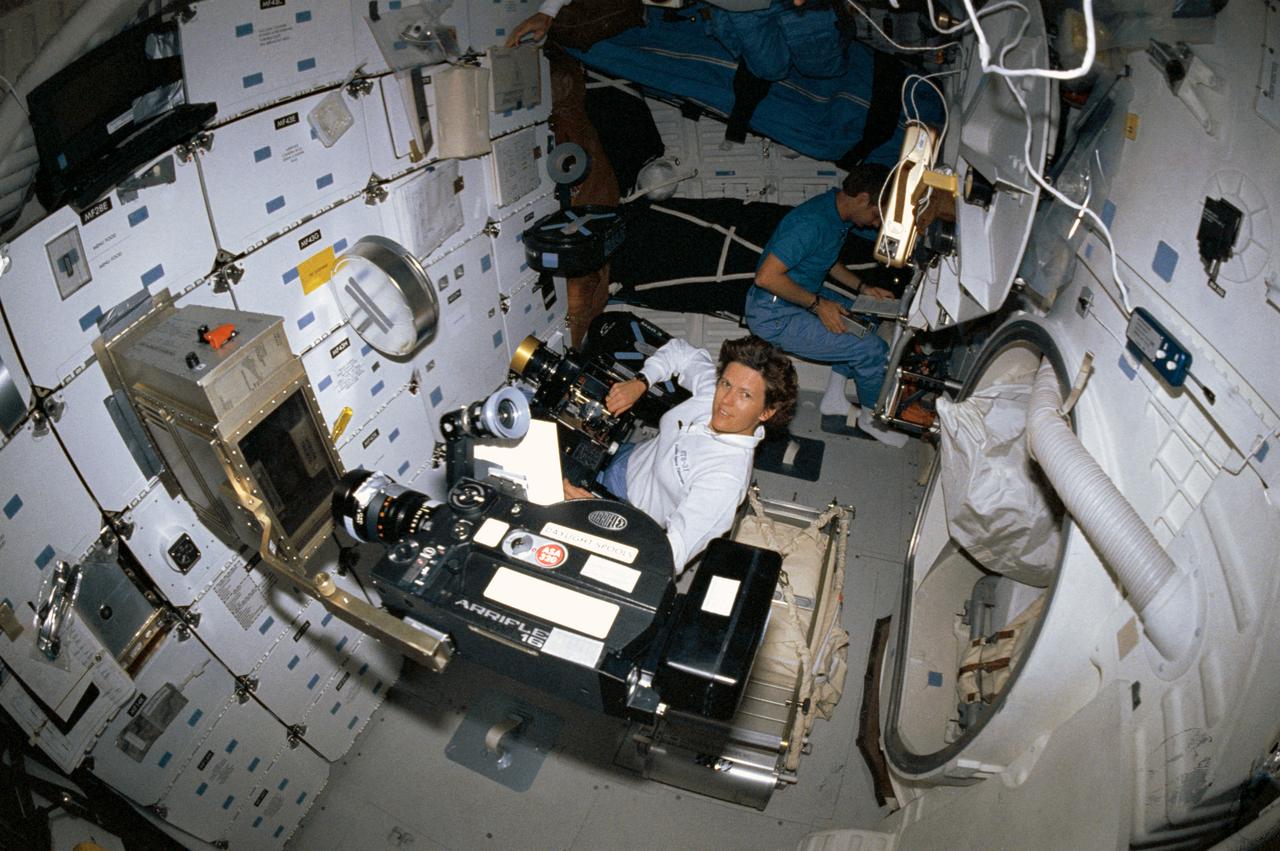
STS031-05-002 (24-29 April 1990) --- A 35mm camera with a "fish eye" lens captured this high angle image on Discovery's middeck. Astronaut Kathryn D. Sullivan works with the IMAX camera in foreground, while Astronaut Steven A. Hawley consults a checklist in corner. An Arriflex motion picture camera records student ion arc experiment in apparatus mounted on stowage locker. The experiment was the project of Gregory S. Peterson, currently a student at Utah State University.
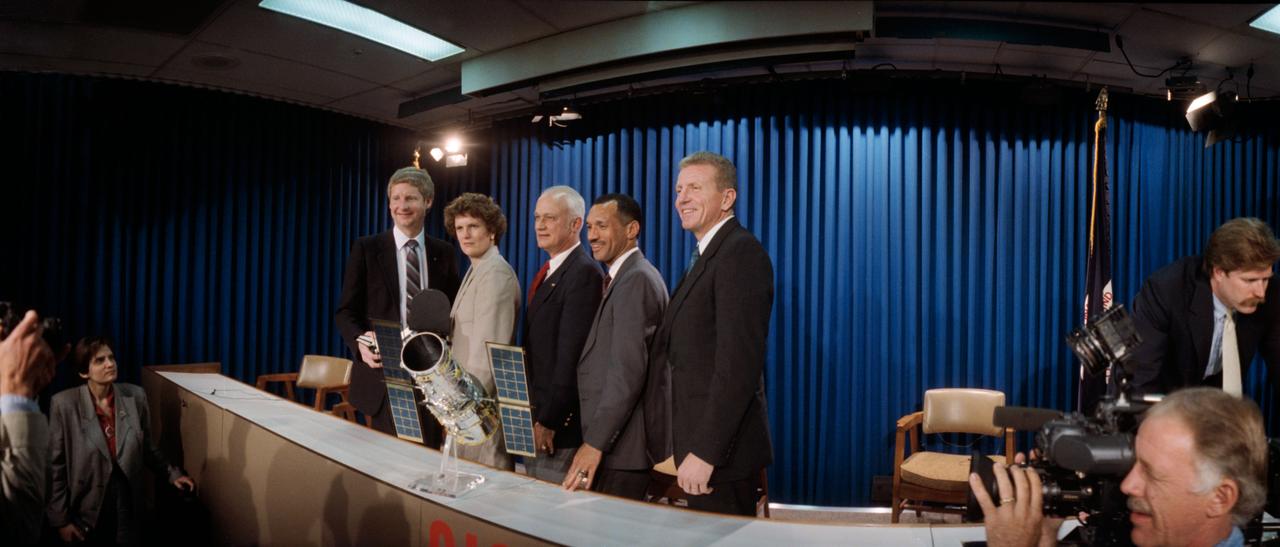
STS-31 Discovery, Orbiter Vehicle (OV) 103, crewmembers pose for an informal portrait after the T-30 (thirty days before launch) briefing at JSC's Auditorium and Public Affairs Facility Bldg 2. Standing behind the conference table are (left to right) Mission Specialist (MS) Steven A. Hawley, MS Kathryn D. Sullivan, MS Bruce McCandless II, Pilot Charles F. Bolden, and Commander Loren J. Shriver.
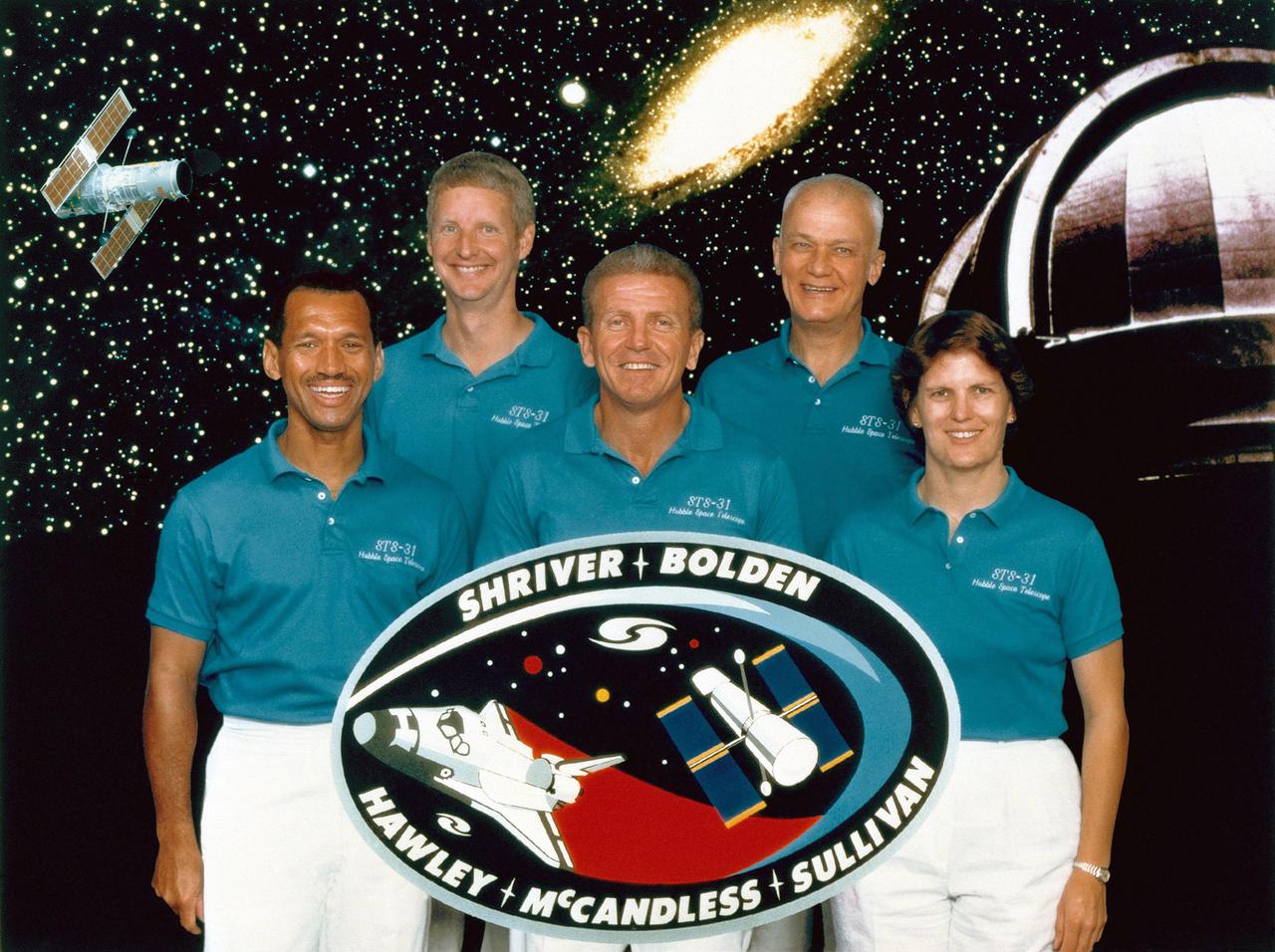
KENNEDY SPACE CENTER, FLA. -- STS-31 crew portrait: Mission Commander Loren J. Shriver, center front; other crew members are (L to R) Pilot Charles F. Bolden Jr. and Mission Specialists Steven A. Hawley, Bruce McCandless II and Kathryn D. Sullivan. Primary payload on the mission is the Hubble Space Telescope, to be deployed ina 380-statute-mile orbit.
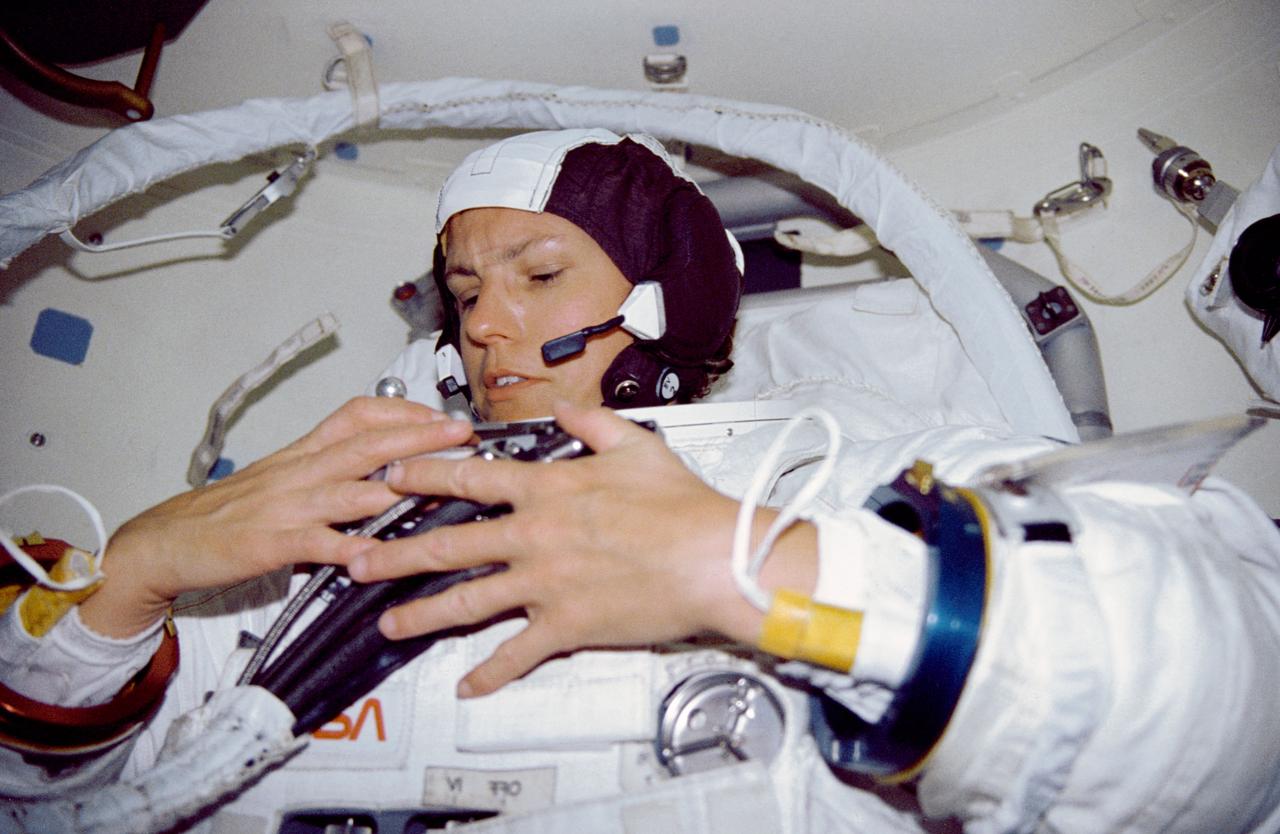
STS-31 Mission Specialist (MS) Kathryn D. Sullivan, wearing extravehicular mobility unit (EMU) & communications carrier assembly (CCA), attaches service and cooling umbilical (SCU) to the EMU connection on the display & control module (DCM) during contingency extravehicular activity (EVA) preparations in the airlock of Discovery, Orbiter Vehicle (OV) 103. The procedure was completed in case an EVA was required to support Hubble Space Telescope (HST) deployment.
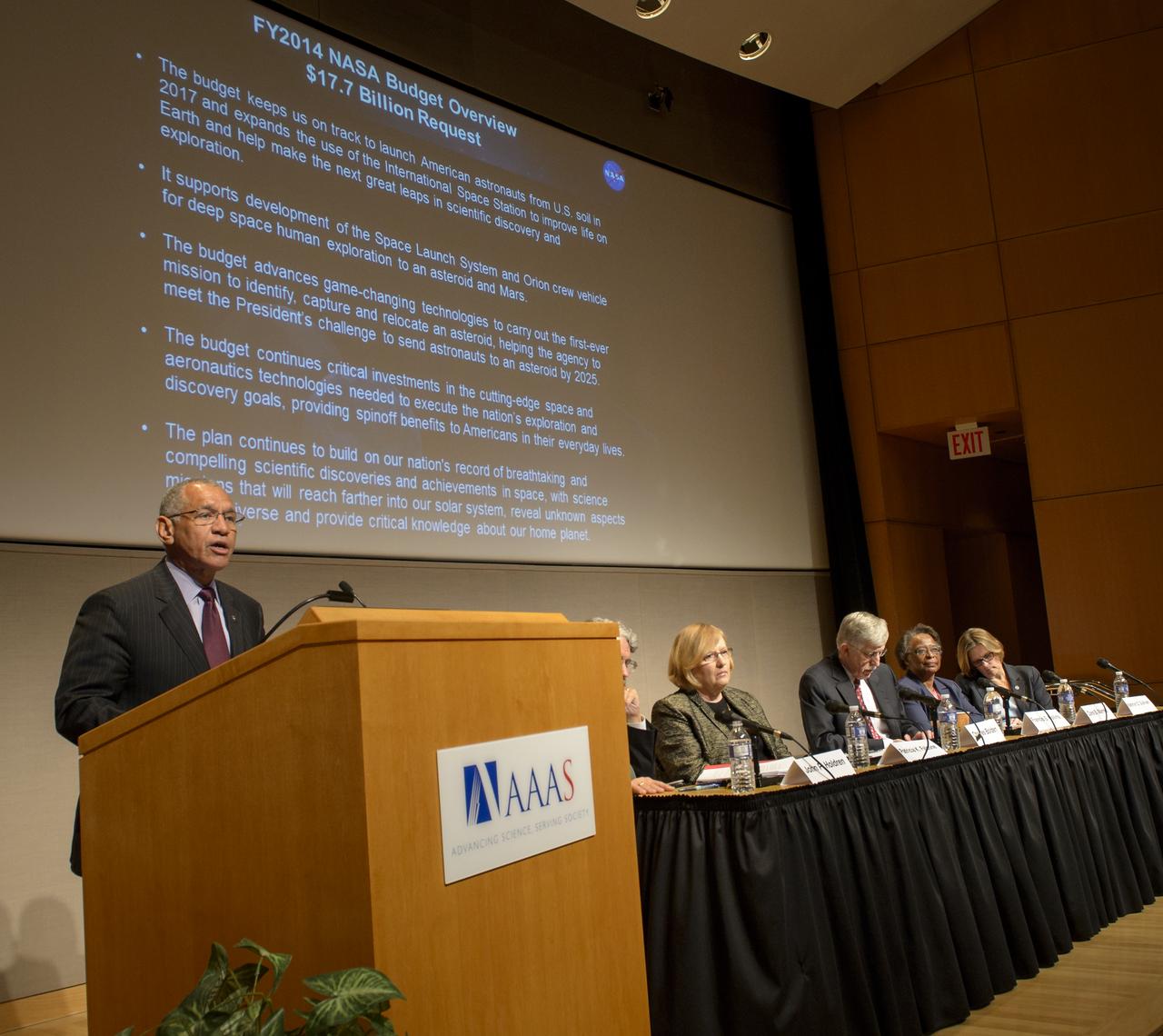
NASA Administrator Charlie Bolden, delivers remarks during a White House Office of Science and Technology Policy (OSTP) Fiscal Year 2014 budget briefing held with with Dr. John P. Holdren, Director of OSTP, Patricia Falcone of OSTP, Francis Collins from NIH, Cora Marrett from NSF, and Kathryn Sullivan from NOAA, at the American Association for the Advancement of Science (AAAS) on Wednesday, April 10, 2013 in Washington. Photo Credit: (NASA/Bill Ingalls)
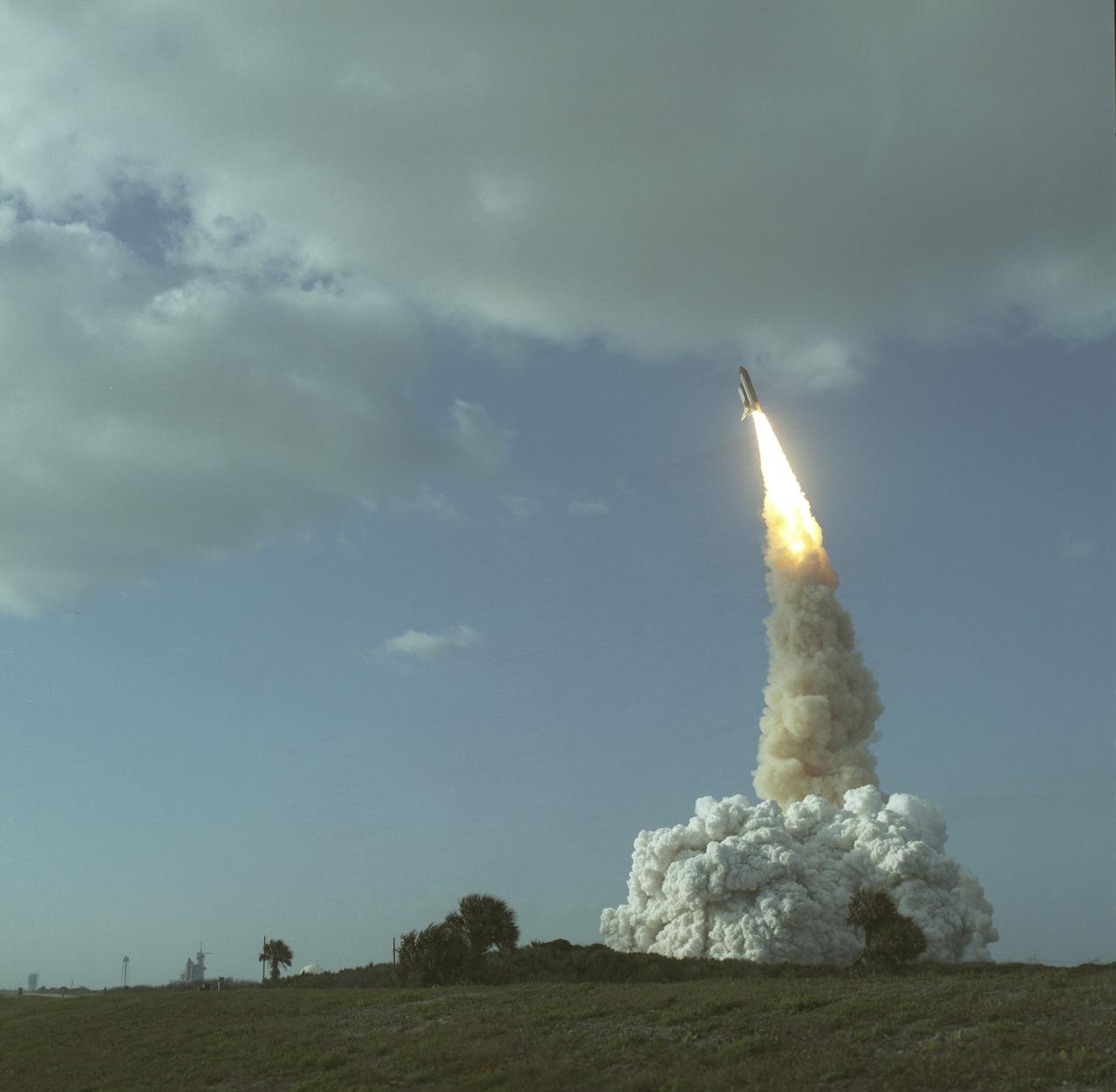
The STS-31 crew launched aboard the Space Shuttle Discovery on April 24, 1990 at 8:33:51am (EDT). Included in the crew of five were Loren J. Shriver, commander; Charles F. Bolden, pilot; and Steven A. Hawley, Bruce McCandless, and Kathryn D. Sullivan, all mission specialists. The primary goal of the mission was the deployment of the Hubble Space Telescope (HST) which was a Marshall Space Flight Center (MSFC) managed program.
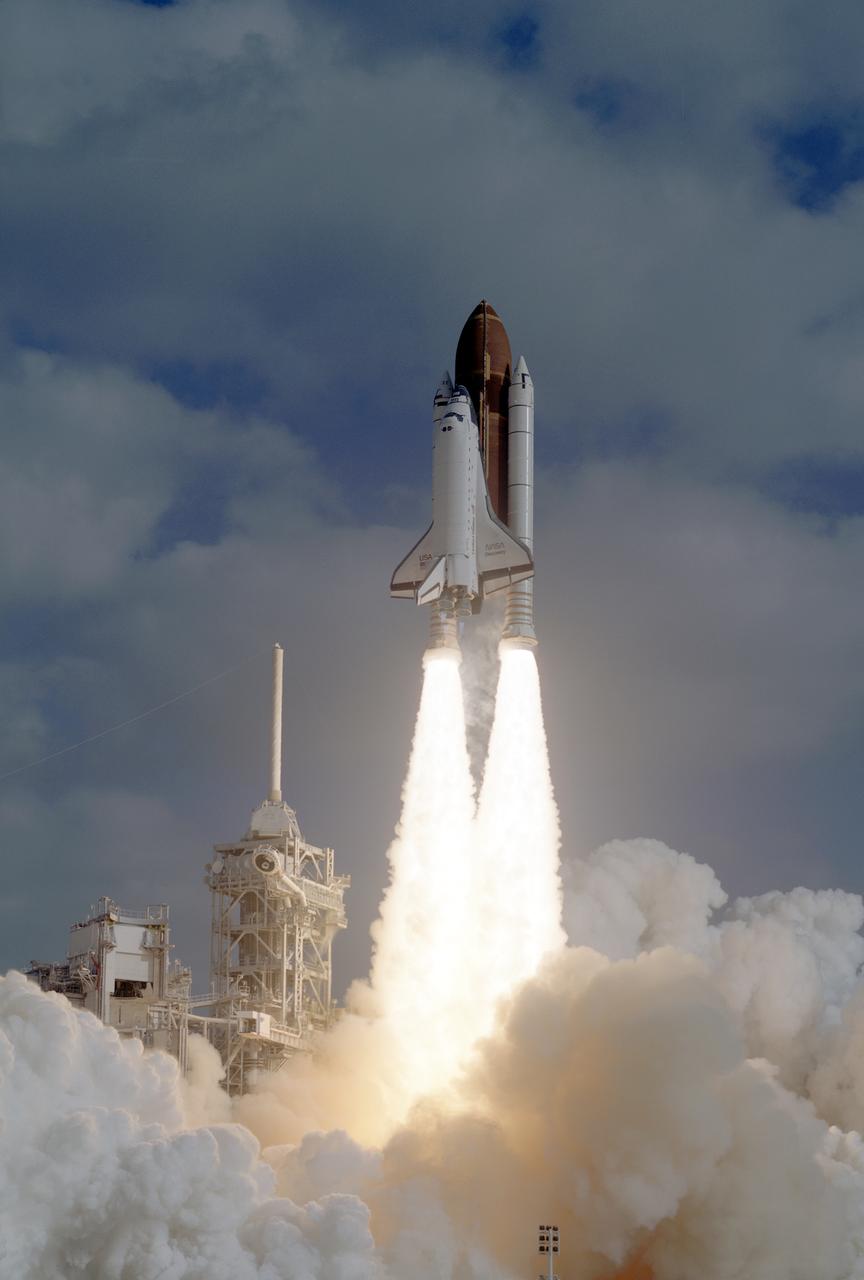
The STS-31 crew launched aboard the Space Shuttle Discovery on April 24, 1990 at 8:33:51am (EDT). Included in the crew of five were Loren J. Shriver, commander; Charles F. Bolden, pilot; and Steven A. Hawley, Bruce McCandless, and Kathryn D. Sullivan, all mission specialists. The primary goal of the mission was the deployment of the Hubble Space Telescope (HST) which was a Marshall Space Flight Center (MSFC) managed program.
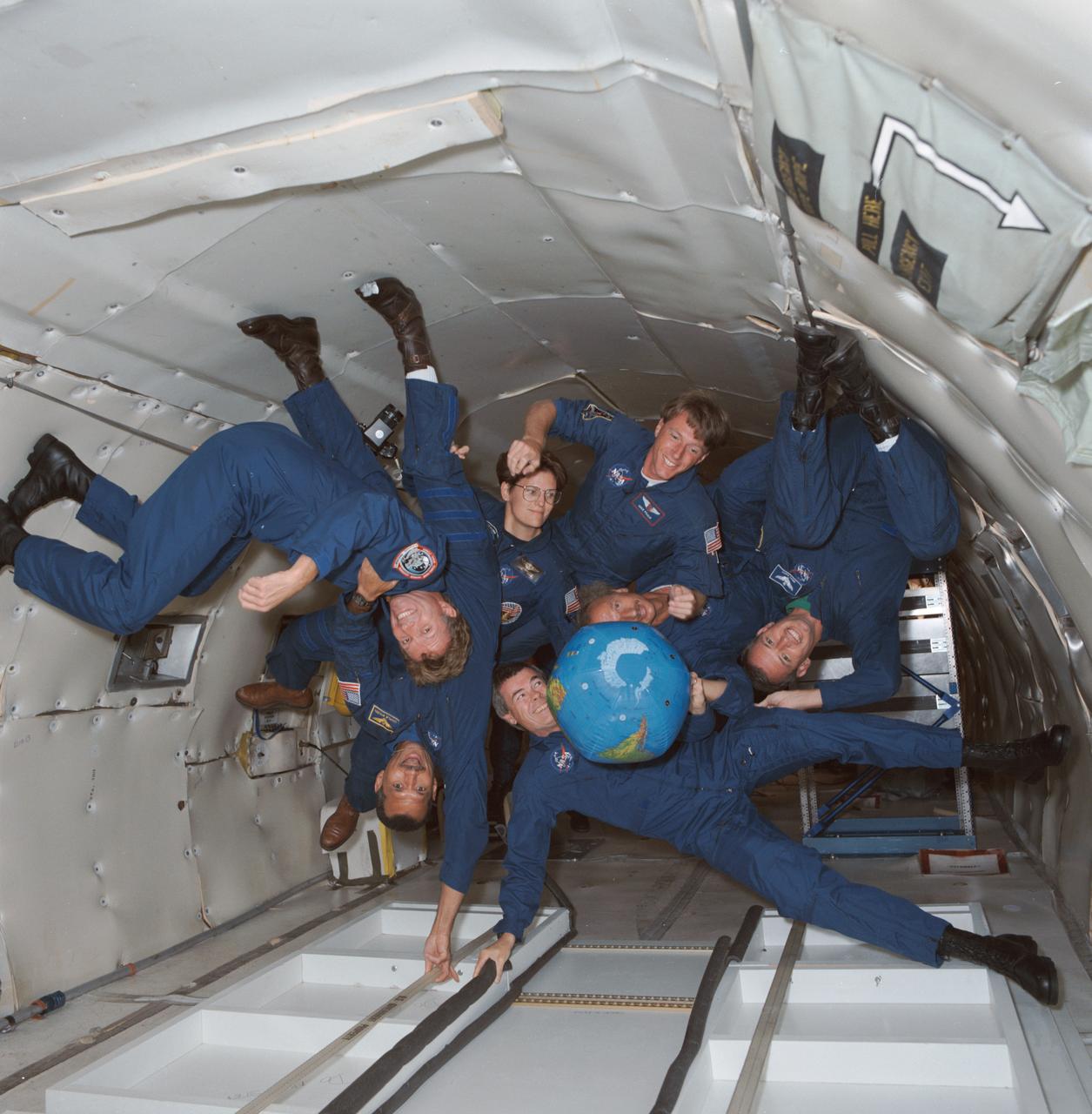
S91-44453 (21 Aug 1991) --- The crew of STS-45 is already training for its March 1992 mission, including stints on the KC-135 zero-gravity-simulating aircraft. Shown with an inflatable globe are, clockwise from the top, C. Michael Foale, mission specialist; Dirk Frimout, payload specialist; Brian Duffy, pilot; Charles R. (Rick) Chappell, backup payload specialist; Charles F. Bolden, mission commander; Byron K. Lichtenberg, payload specialist; and Kathryn D. Sullivan, payload commander.
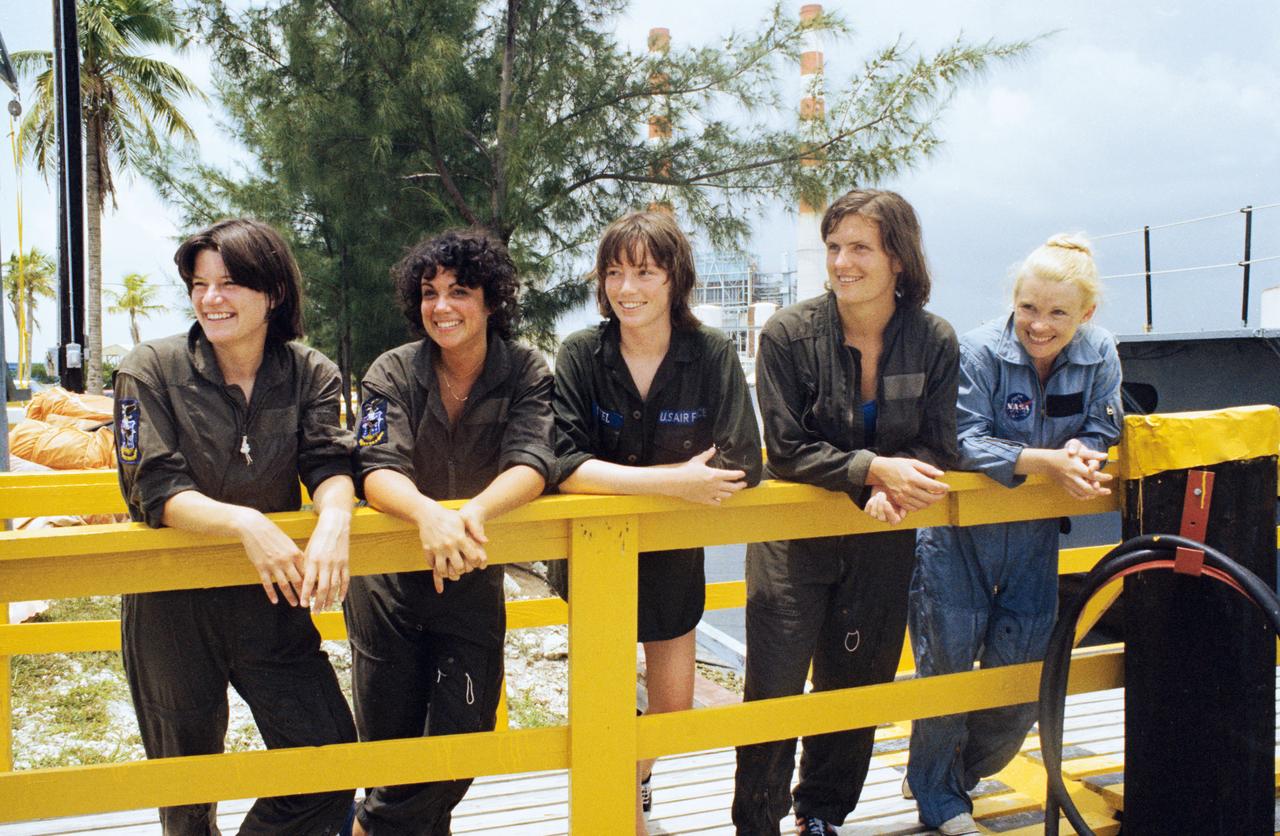
S78-33616 (31 July-2 Aug 1978) --- Taking a break from the various training exercises at a three-day water survival school held near Homestead Air Force Base, Florida are these five astronaut candidates left to right are Sally K. Ride, Judith A. Resnik, Anna L. Fisher; Kathryn D. Sullivan and Rhea Seddon. They were among fifteen mission specialist-astronaut candidates who joined one of the pilot astronaut candidates for the training.
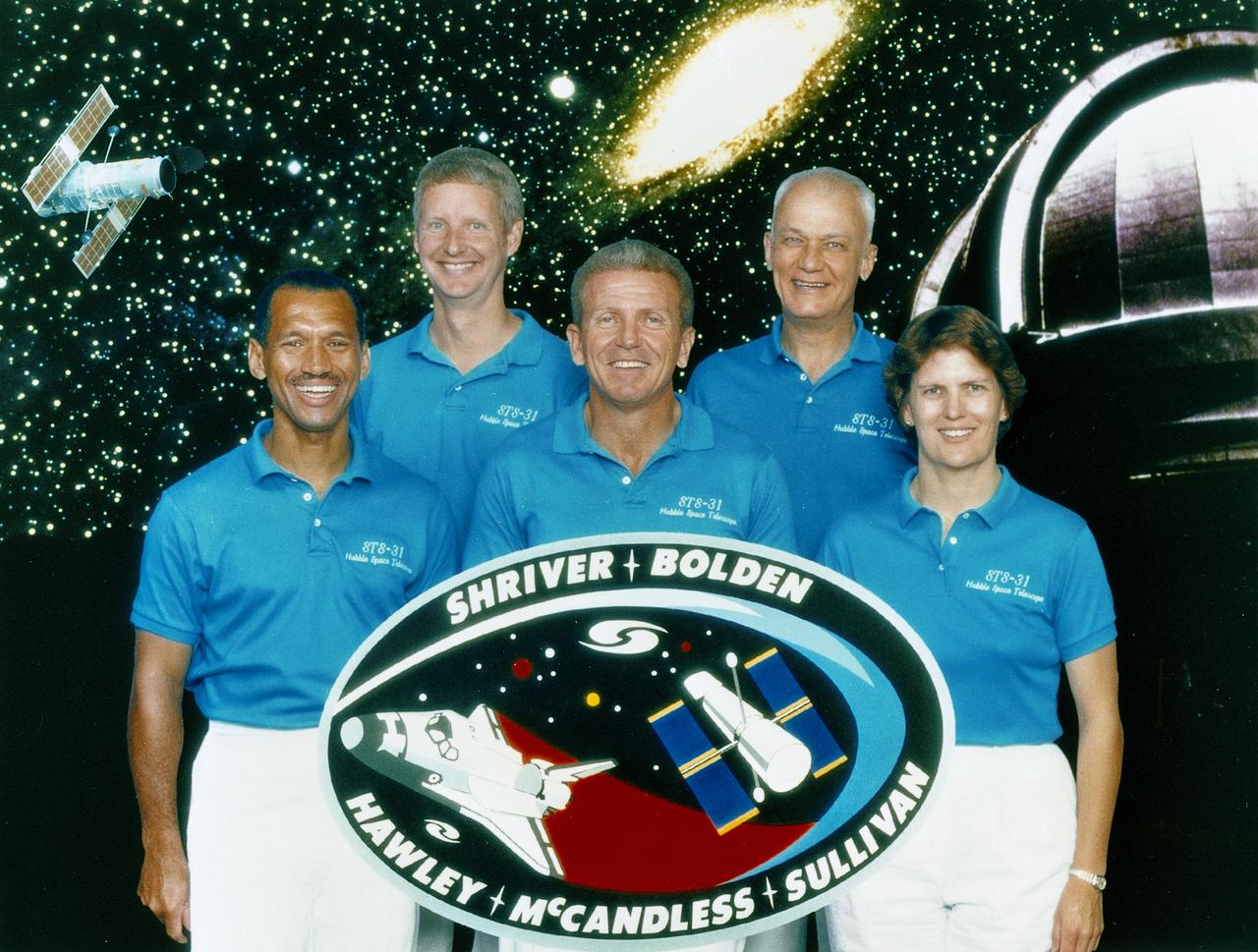
The STS-31 crew of five included (left to right) Charles F. Bolden, pilot; Steven A. Hawley, mission specialist; Loren J. Shriver, commander; Bruce McCandless, mission specialist; and Kathryn D. Sullivan, mission specialist. Launched aboard the Space Shuttle Discovery on April 24, 1990 at 8:33:51am (EDT), the primary payload was the Hubble Space Telescope. This was the first flight to use carbon brakes at landing.
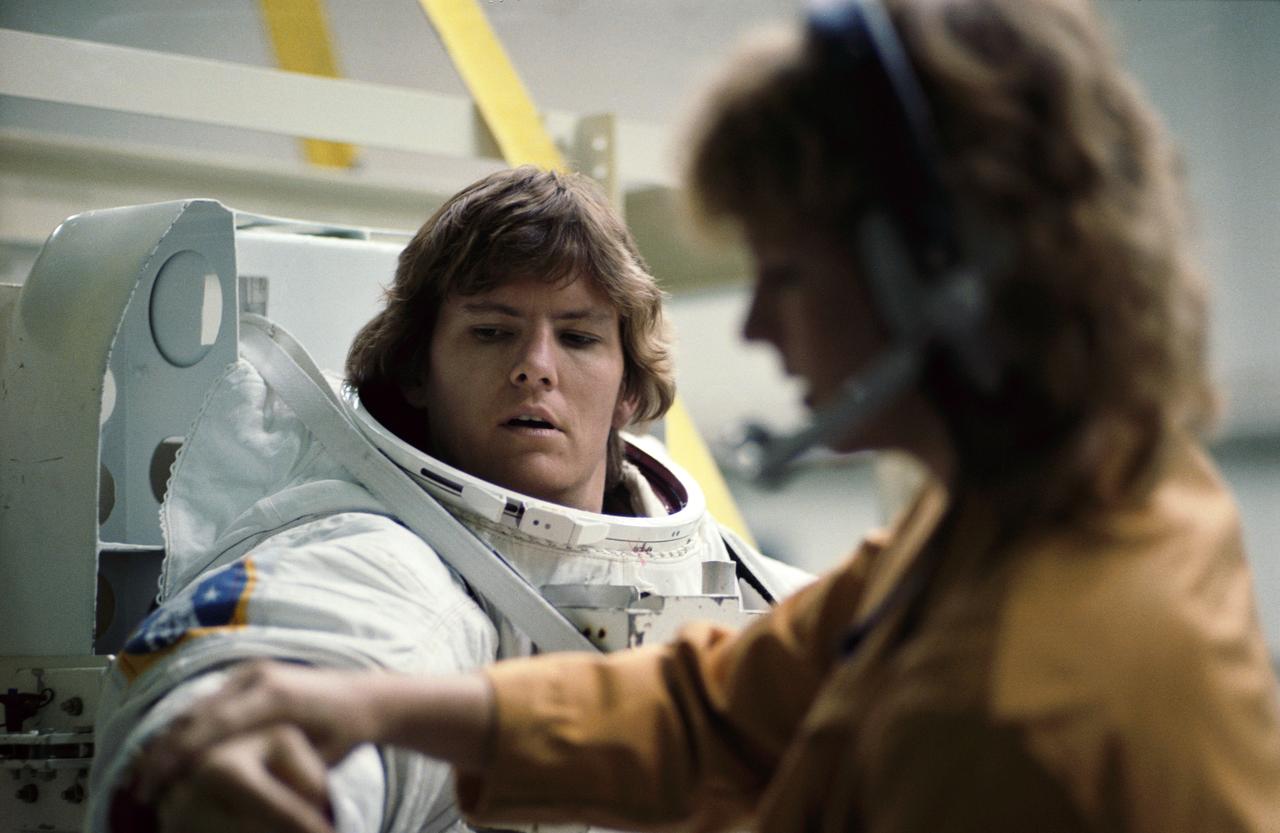
S84-36954 (5 July 1984) --- Astronaut Kathryn D.Sullivan, 41-G mission specialist, gets some help with her extravehicular mobility unit (EMU) prior to participating in an underwater simultion of an extrvehicular activity (EVA) scheduled for her flight aboard the Columbia later this year. Dr. Sullivan and David C. Leestma (out of frame) participated in the rehearsal in NASA's weightless environment training facility (WET-F) at the Johnson Space Center.
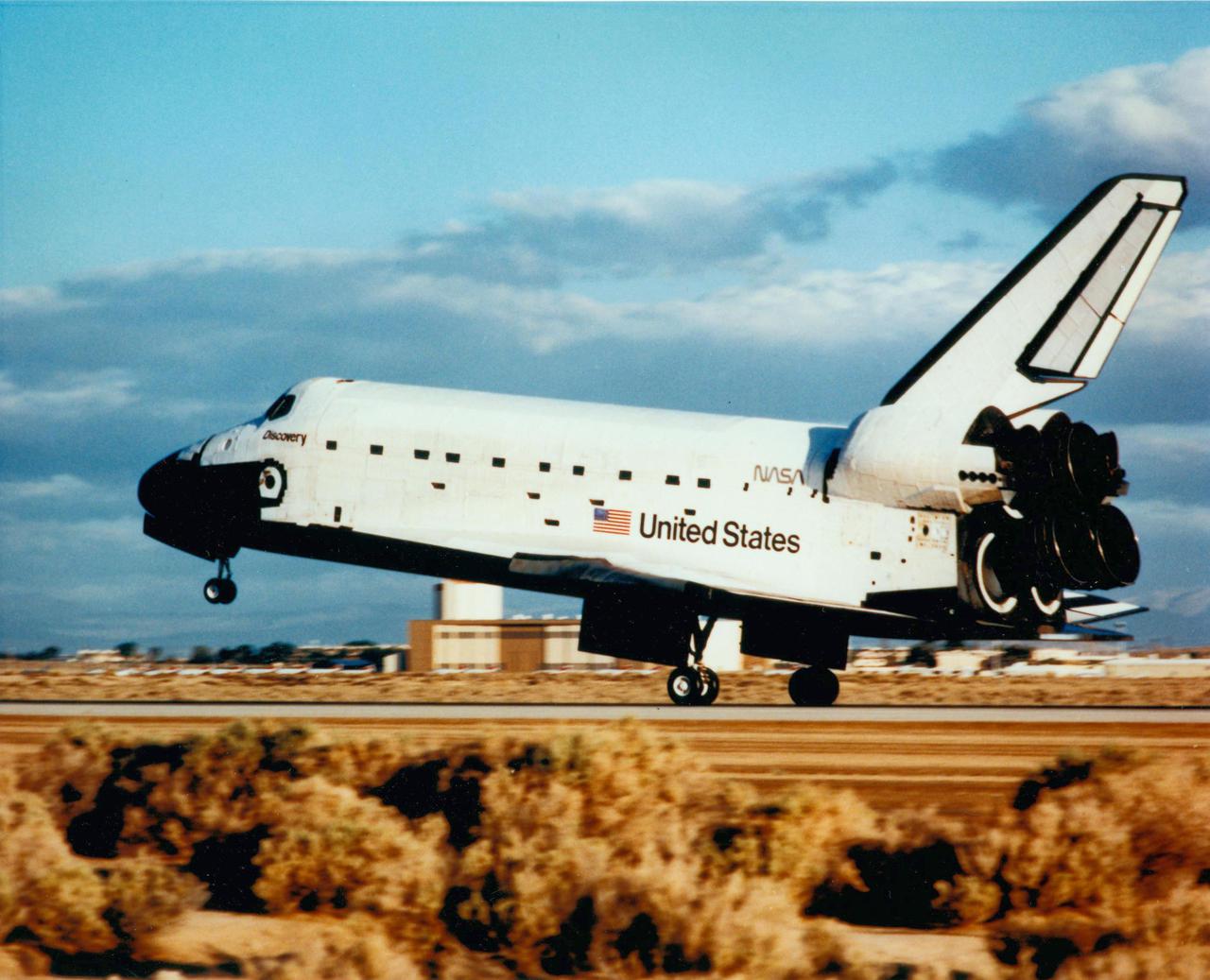
KENNEDY SPACE CENTER, FLA. -- The Space Shuttle Discovery makes a smooth landing on the runway at Edwards Air Force Base to complete a highly successful five-day mission. It was an Earth-orbital flight during which the Hubble Space Telescope was sent toward its 15-year mission. Landing was completed at 6:51 a.m. (PDT), April 29, 1990. Inside the spacecraft for STS-31 were Astronauts Loren J. Shriver, Charles F. Bolden, Bruce McCandless II, Kathryn D. Sullivan and Steven A. Hawley.
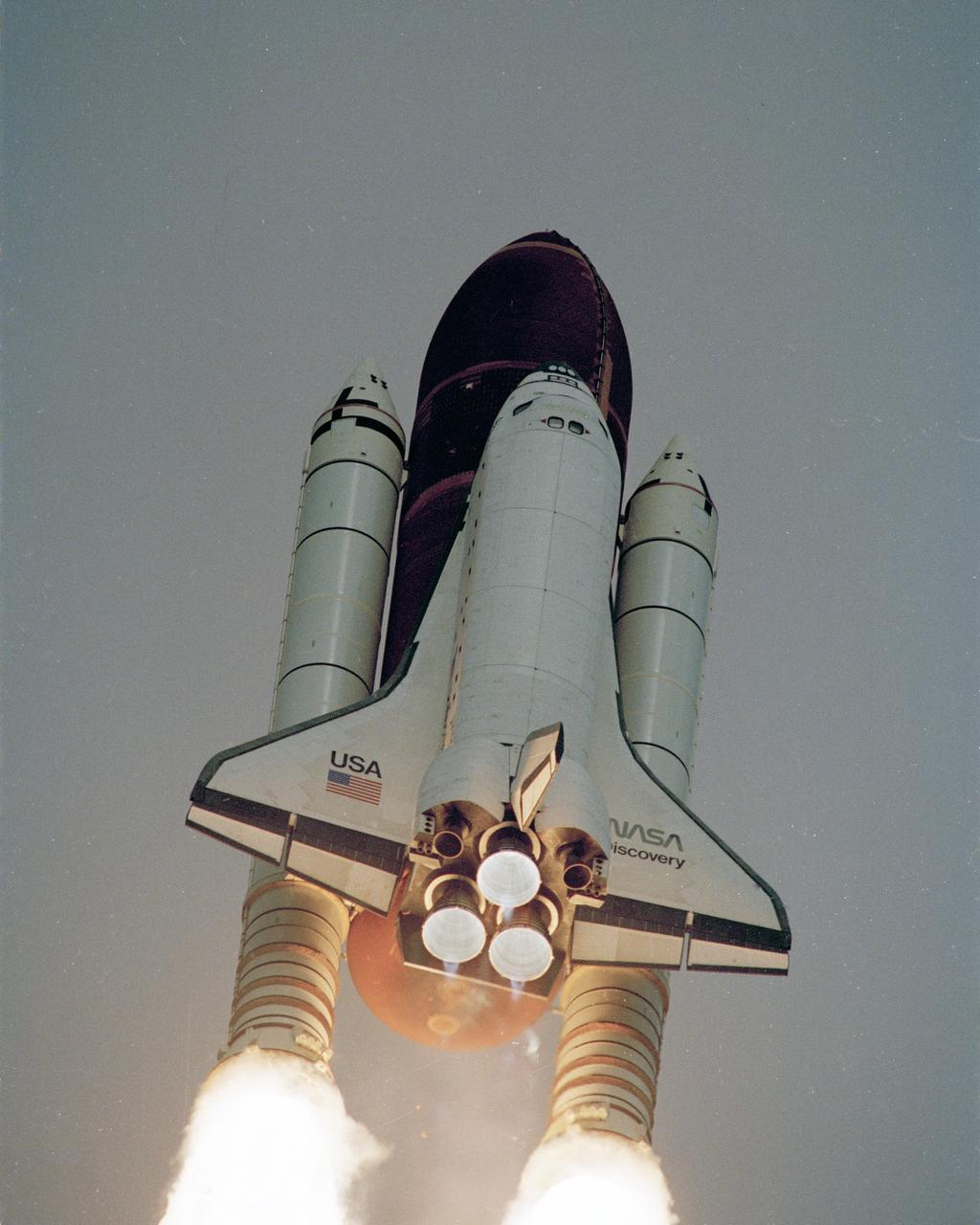
The space shuttle Discovery lifts off from Launch Pad 39-B at 8:33 a.m. EDT carrying a crew of five and the Hubble Space Telescope. STS-31 crew members are Commander Loren Shriver, Pilot Charles Bolden and Mission Specialists Steven Hawley, Bruce McCandless II and Kathryn Sullivan. Photo credit: NASA
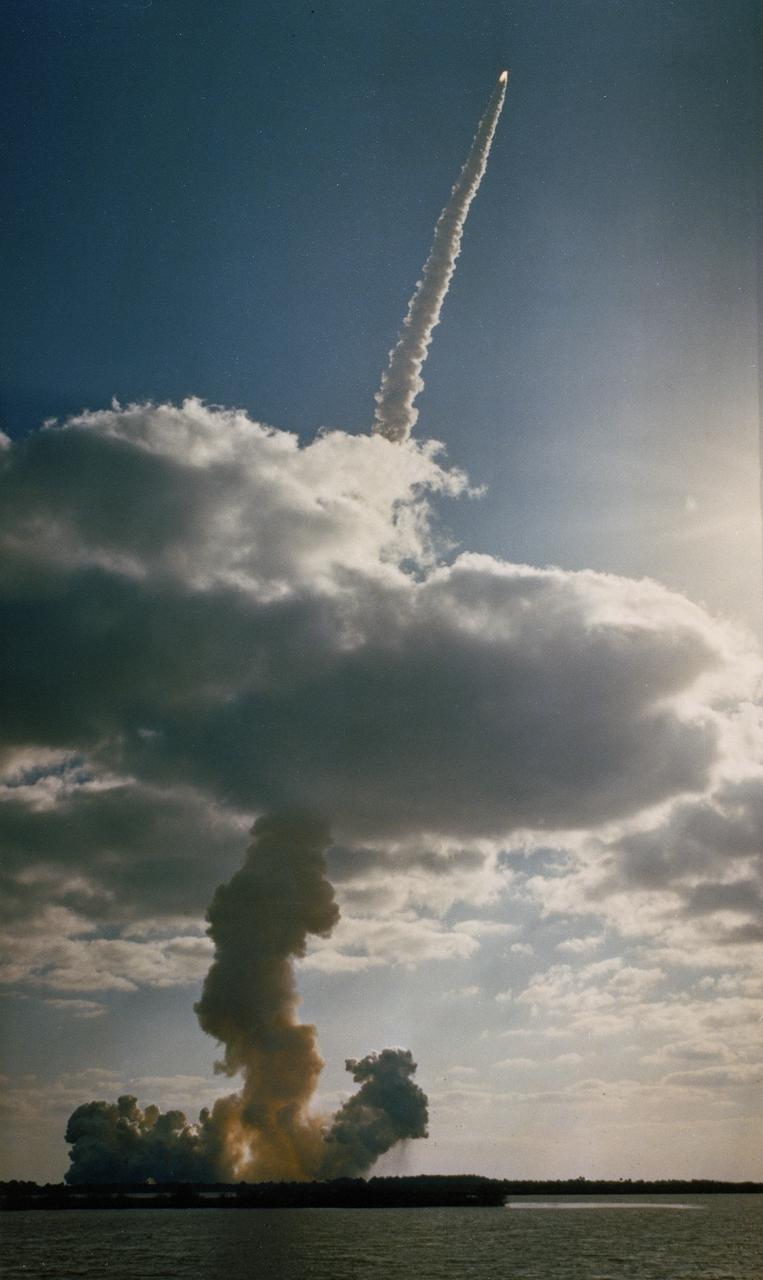
The STS-31 crew launched aboard the Space Shuttle Discovery on April 24, 1990 at 8:33:51am (EDT). Included in the crew of five were Loren J. Shriver, commander; Charles F. Bolden, pilot; and Steven A. Hawley, Bruce McCandless, and Kathryn D. Sullivan, all mission specialists. The primary goal of the mission was the deployment of the Hubble Space Telescope (HST) which was a Marshall Space Flight Center (MSFC) managed program.
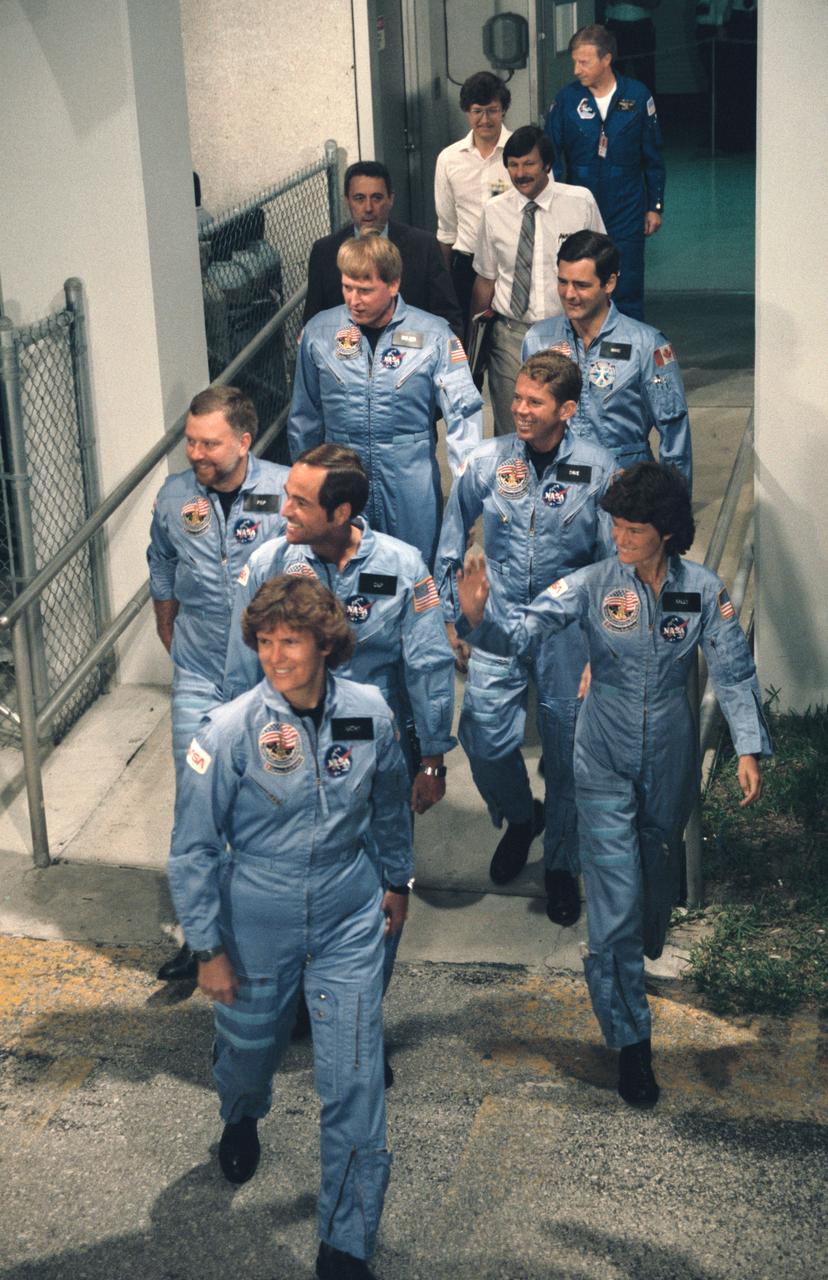
41G-90081 / S17-90081 (5 Oct 1984) --- The seven member crew leaves the Operations and Checkout Building (OCB) to take a van ride to the launch pad. Leading the way is Kathryn D. Sullivan followed in file by Robert L. Crippen, Paul D. Scully-Power and Jon A. McBride. On the right side are Sally K. Ride, David C. Leestma and Marc Garneau. Trailing the crew are George W. S. Abbey, Richard Nygren, Paul Bulver, and Paul J. Weitz.
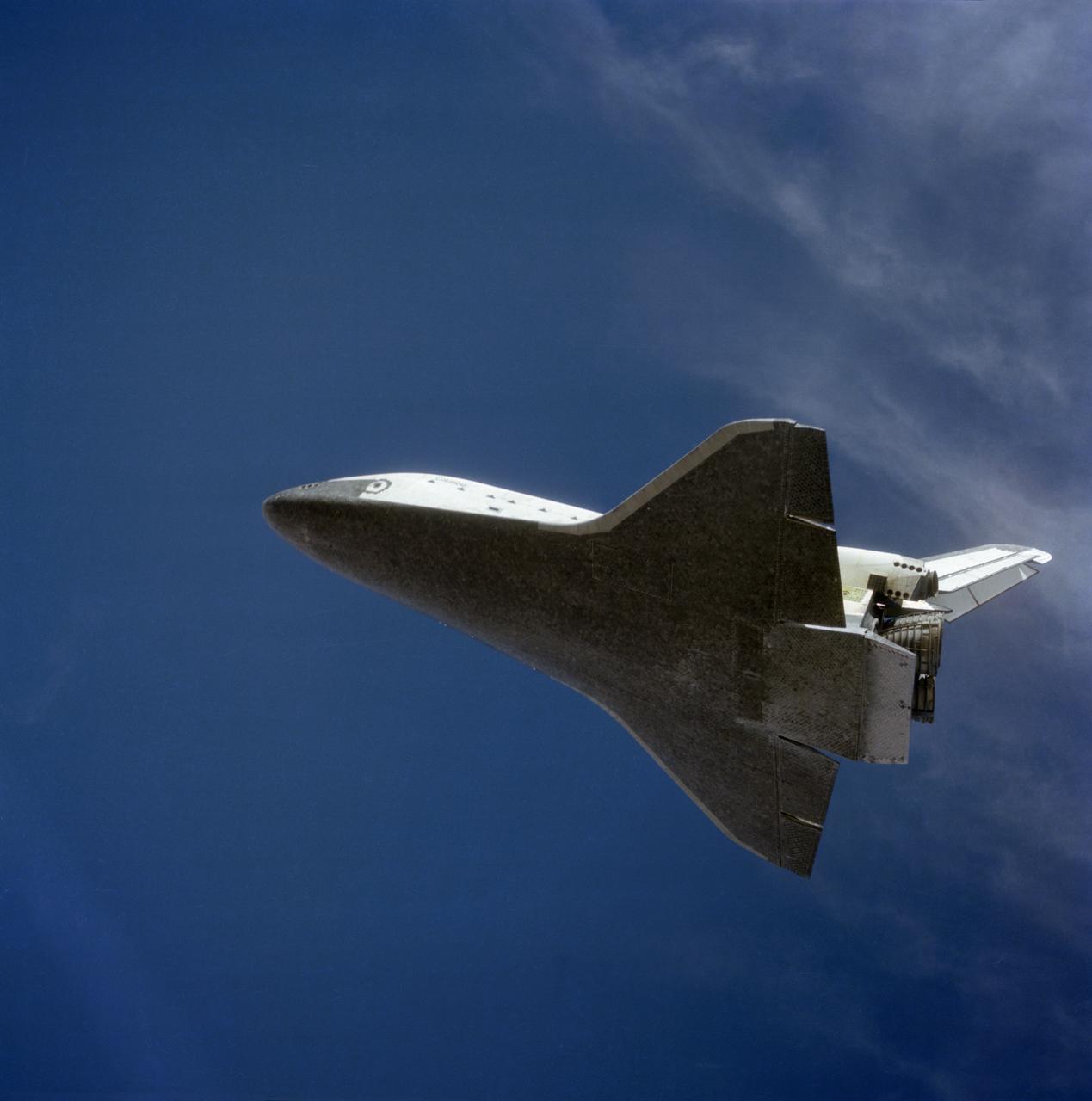
S81-39564 (14 Nov. 1981) --- This view of the space shuttle Columbia (STS-2) was made with a hand-held 70mm camera in the rear station of the T-38 chase plane. Mission specialist/astronaut Kathryn D. Sullivan exposed the frame as astronauts Joe N. Engle and Richard H. Truly aboard the Columbia guided the vehicle to an unpowered but smooth landing on the desert area of Edwards Air Force base in California. The picture provides a good view of the underside of the returning spacecraft. Photo credit: NASA
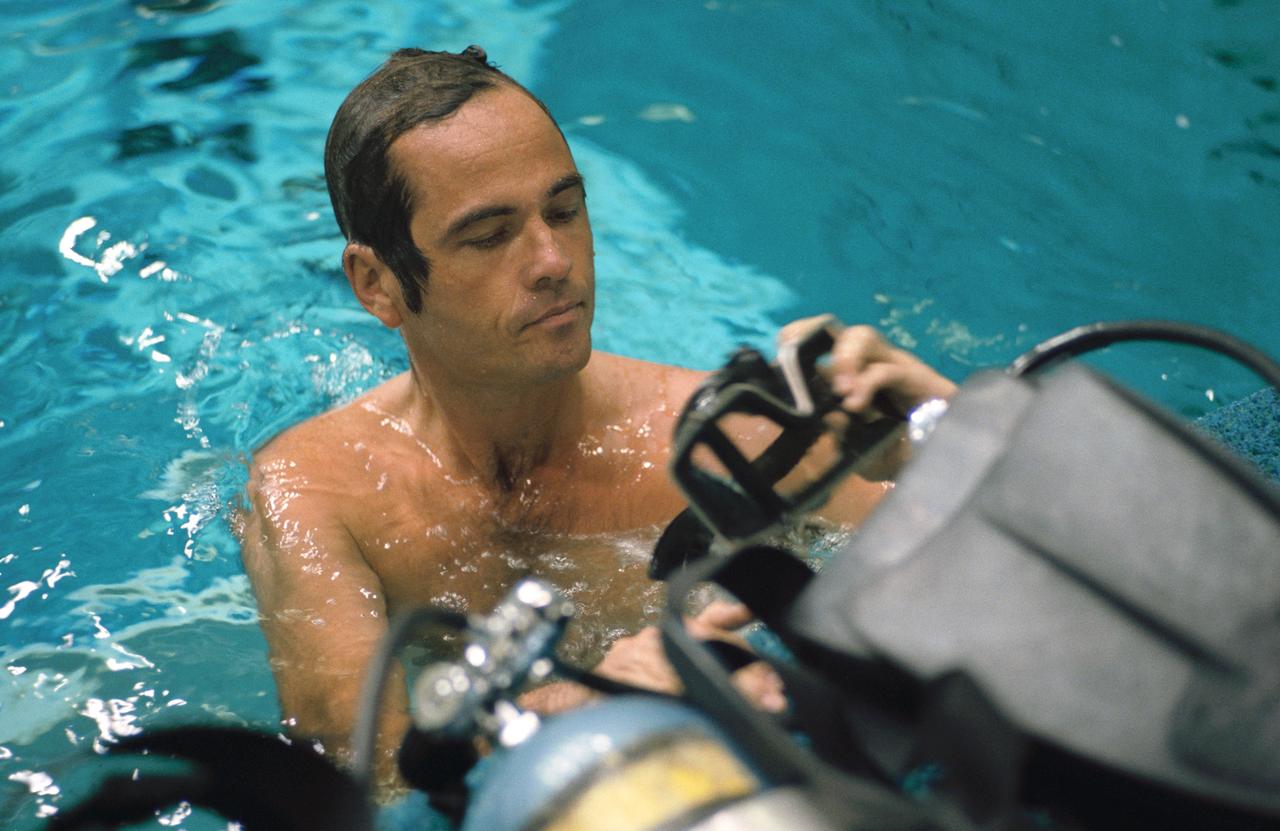
S84-36956 (1 July 1984) --- Astronaut Robert L. Crippen, 41-G crew commander, prepares his SCUBA mask prior to submerging into the weightless environment training facility's 25 ft. deep pool to observe a simulation exercise for two fellow 41-G crewmembers assigned to an extravehicular activity (EVA) in space. Not pictured are Astronauts Kathryn D. Sullivan and David C. Leestma, mission specialists who will perform the EVA during the eight-day mission scheduled for October of this year.
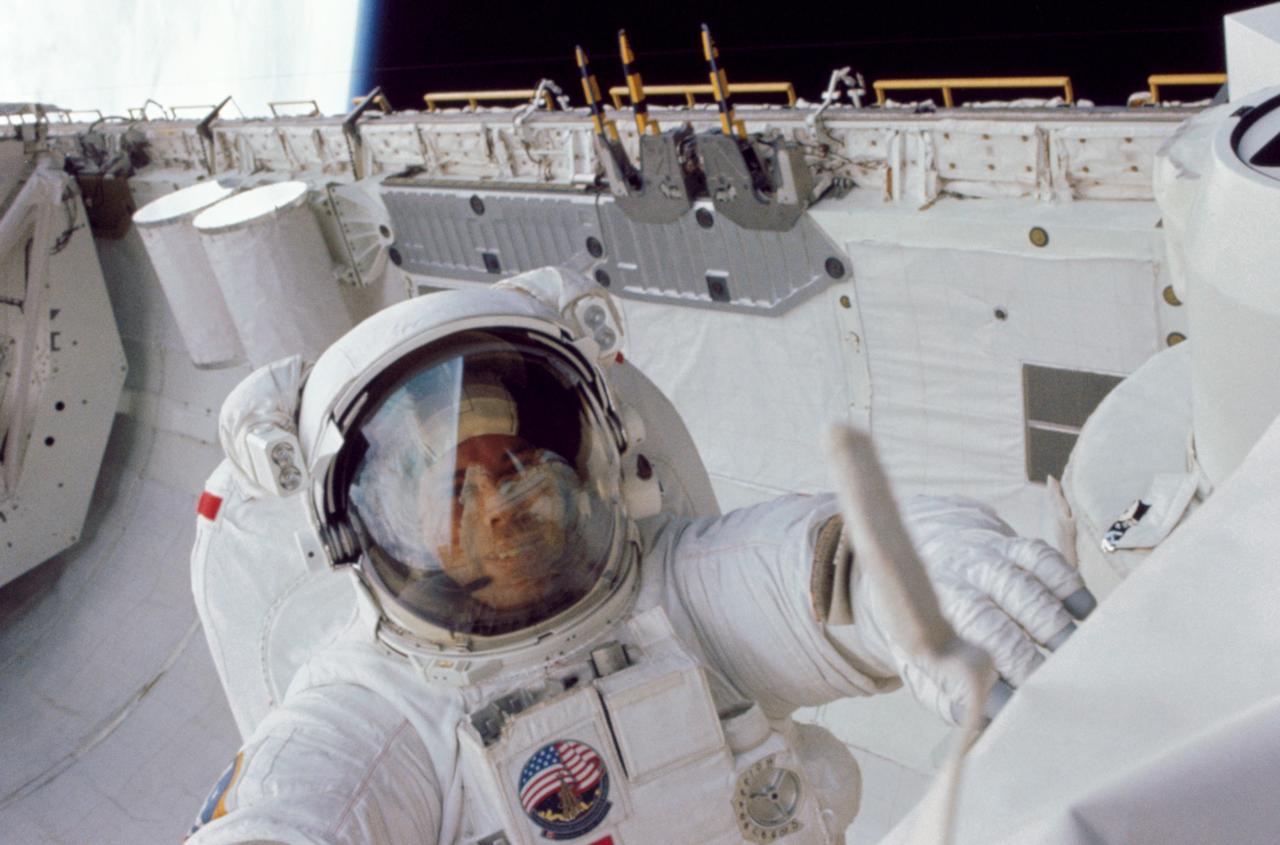
41G-101-014 (13 October 1984) --- Astronaut David C. Leestma, in a 35mm frame exposed by fellow mission specialist, Astronaut Kathryn D. Sullivan, participates in extravehicular activity of Oct. 11 in the Challenger's aft cargo bay. Leestma's right hand (out of frame) was inside a special work station called the orbital refueling system (ORS).
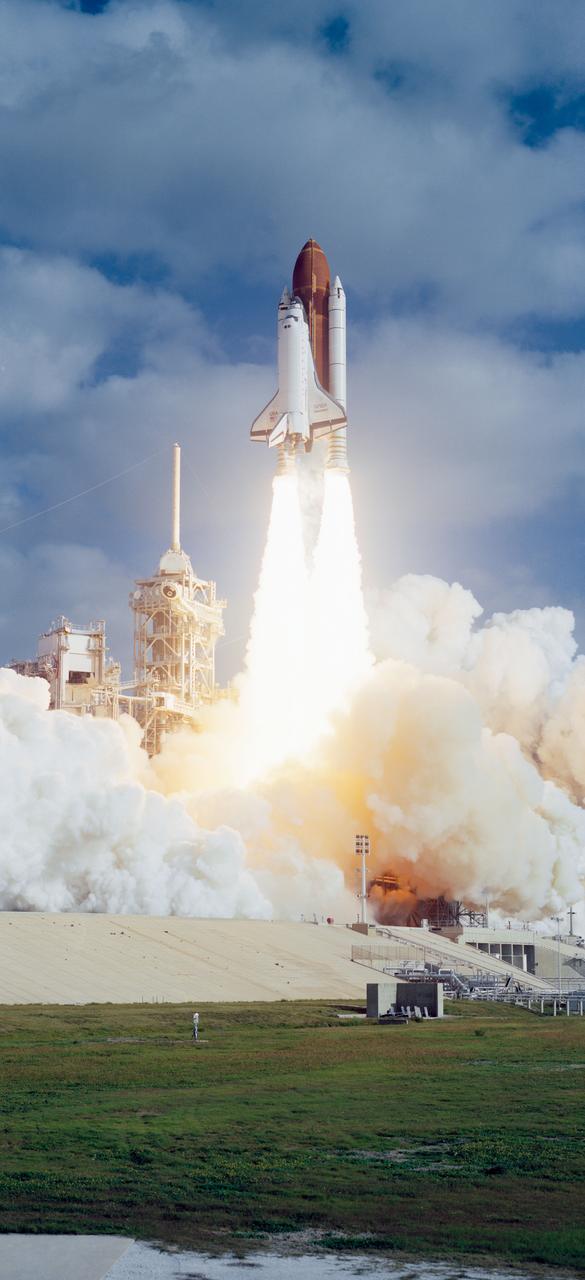
STS031-S-073 (24 April 1990) --? A vertical view of the launch of the STS-31 mission. Onboard Space Shuttle Discovery are the crew of five veteran astronauts and the Hubble Space Telescope (HST). Official launch time was 8:33:51.0492 a.m. (EDT). Headed for approximately five days in space are astronauts Loren J. Shriver, Charles F. Bolden, Jr., Bruce McCandless, II, Kathryn D. Sullivan, and Steven A. Hawley.
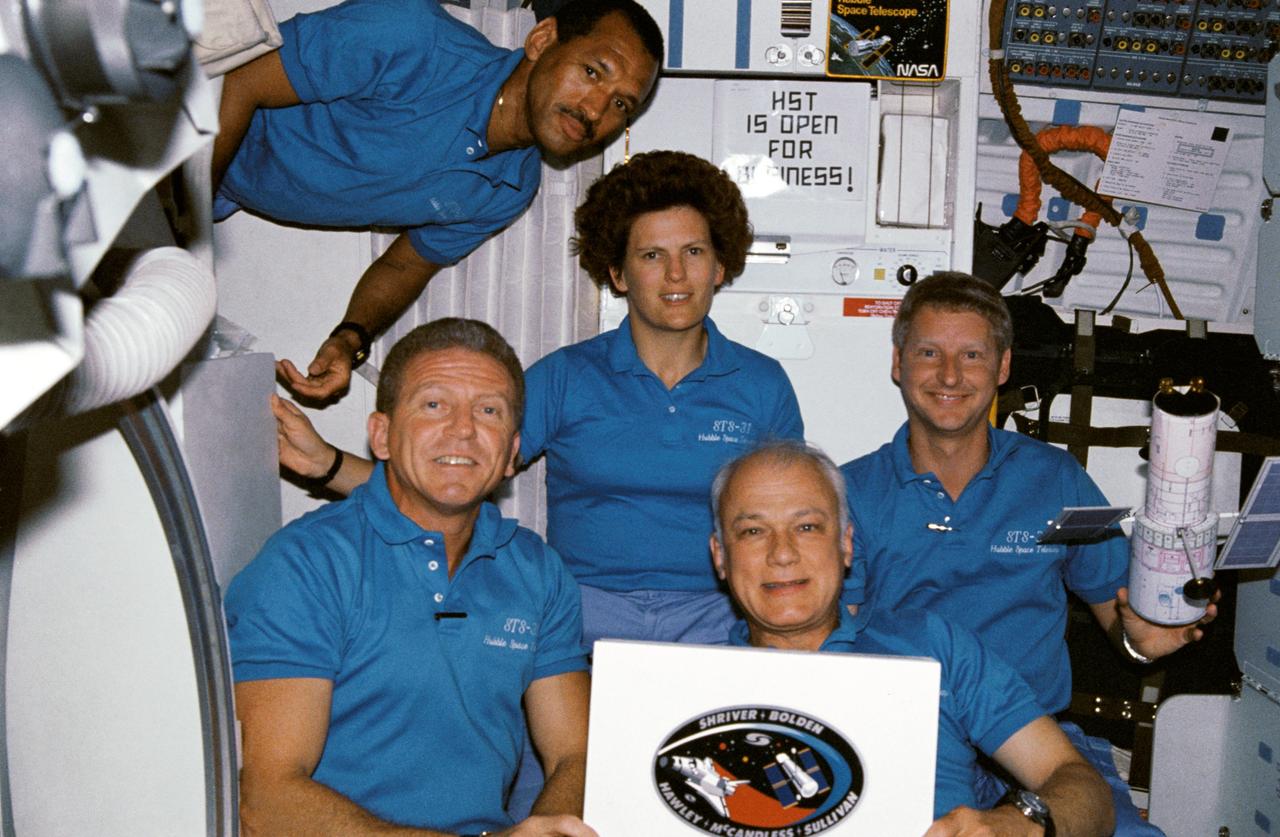
STS031-12-031 (24-29 April 1990) --- On Discovery's middeck, the STS-31 crew poses for a traditional in-flight portrait. Astronaut Loren J. Shriver, mission commander, is at lower left. Astronaut Charles F. Bolden, pilot, floats above. Others, left to right, are Kathryn D. Sullivan, Bruce McCandless II and Steven A. Hawley, all mission specialists. Photo credit: NASA
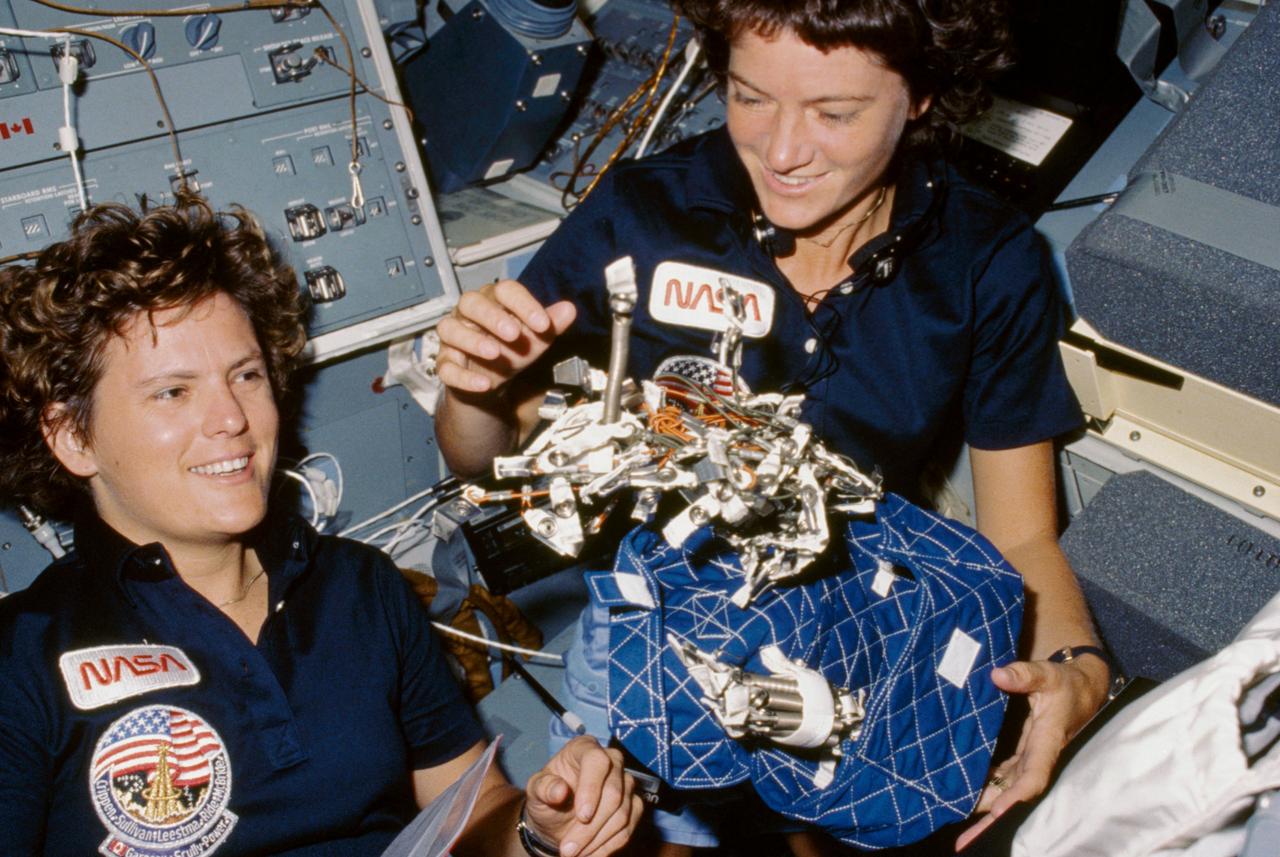
41G-07-021 (5-13 October 1984) --- Astronauts Kathryn D. Sullivan, left, and Sally K. Ride show off what appears to be a "bag of worms", a product of their creativity. The "bag" is a sleep restraint and the majority of the "worms" are springs and clips used with the sleep restraint in its normal application. Clamps, a bungee cord and Velcro strips are other recognizable items in the "creation".
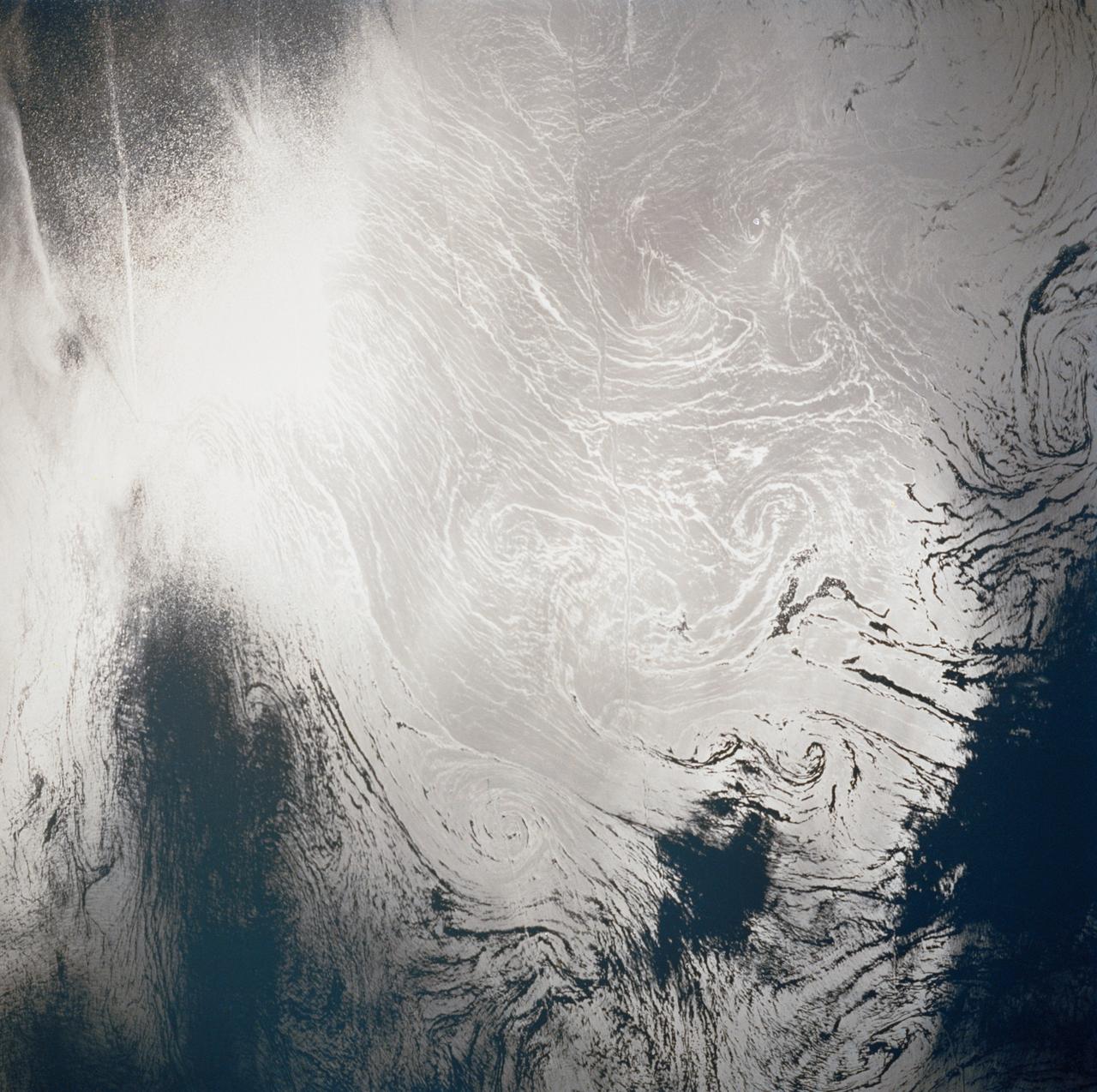
41G-38-060 (5-13 Oct 1984) --- A large ship wake in the central Mediterranean Sea is highlighted by sunglint in this handheld camera's view from STS-41G. According to NASA and U.S. Navy scientists studying the STS-41G film, the depicted reflectance is similar to oil slicks seen in the various oceans of the world. They note that it is apparent that a ship is pumping a mixture of bilge water and oil overboard. The crew consisted of astronauts Robert L. Crippen, commander; Jon A. McBride, pilot; mission specialist's Kathryn D. Sullivan, Sally K. Ride, and David D. Leestma; Canadian astronaut Marc Garneau; and Paul D. Scully-Power, payload specialist. EDITOR'S NOTE: The STS-41G mission had the first American female EVA (Sullivan); first seven-person crew; first orbital fuel transfer; and the first Canadian (Garneau).
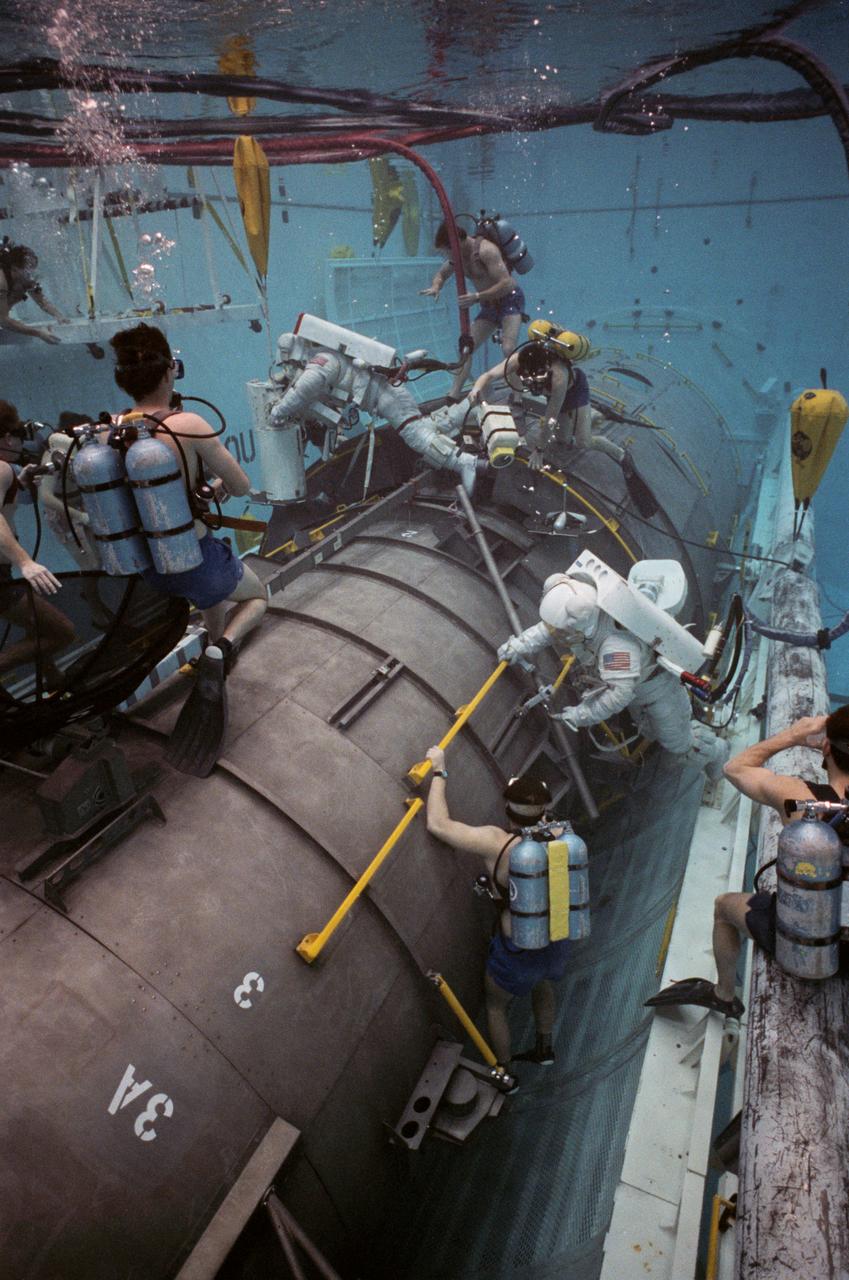
This overall view shows STS-31 Mission Specialist (MS) Bruce McCandless II (left) and MS Kathryn D. Sullivan making a practice space walk in JSC's Weightless Environment Training Facility (WETF) Bldg 29 pool. McCandless works with a mockup of the remote manipulator system (RMS) end effector which is attached to a grapple fixture on the Hubble Space Telescope (HST) mockup. Sullivan manipulates HST hardware on the Support System Module (SSM) forward shell. SCUBA-equipped divers monitor the extravehicular mobility unit (EMU) suited crewmembers during this simulated extravehicular activity (EVA). No EVA is planned for the Hubble Space Telescope (HST) deployment, but the duo has trained for contingencies which might arise during the STS-31 mission aboard Discovery, Orbiter Vehicle (OV) 103. Photo taken by NASA JSC photographer Sheri Dunnette.
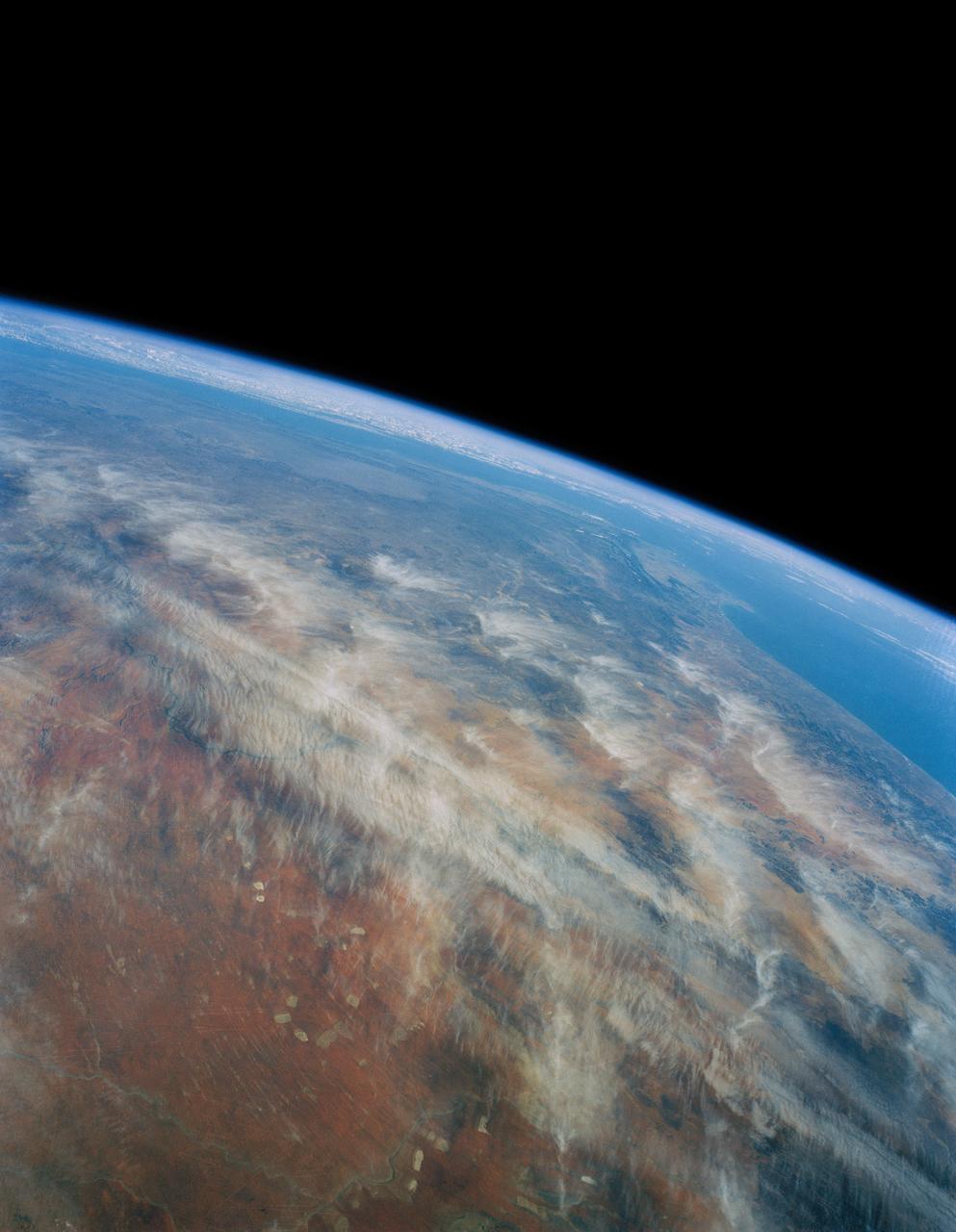
41G-121-189 (5-13 Oct 1984) --- The Kalihari Desert is visible in the foreground of this photograph covering three African nations. The desert is a classic red to orange-red, with small depressions and salt encrustation's which appear as lakes. Visible are Cape Town, the Cape of Good Hope and Cape Agulhas. The crew consisted of astronauts Robert L. Crippen, commander; Jon A. McBride, pilot; mission specialist's Kathryn D. Sullivan, Sally K. Ride, and David D. Leestma; Canadian astronaut Marc Garneau; and Paul D. Scully-Power, payload specialist. EDITOR'S NOTE: The STS-41G mission had the first American female EVA (Sullivan); first seven-person crew; first orbital fuel transfer; and the first Canadian (Garneau).
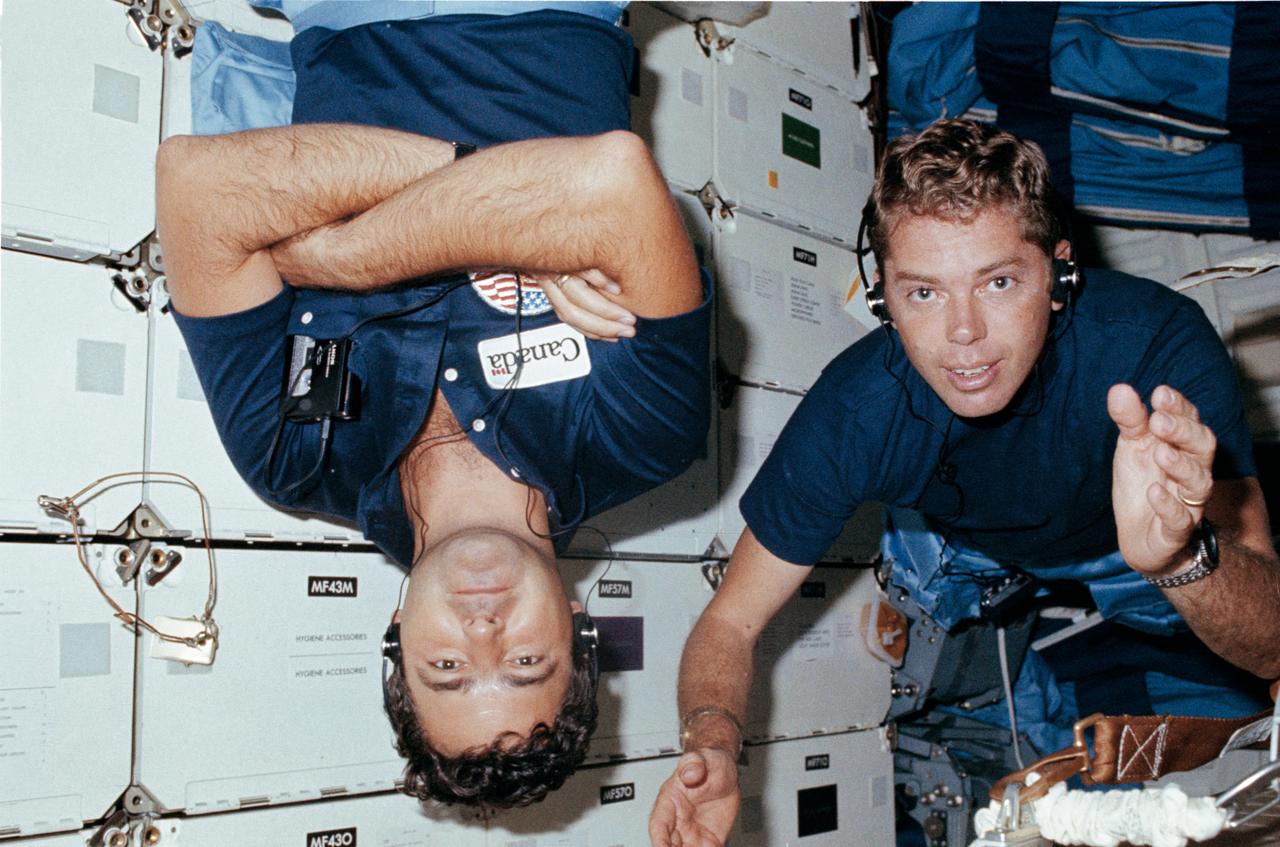
41G-101-039 (5-13 Oct 1984) --- Two members of a record seven-person crew are pictured during Intravehicular Activity (IVA) aboard the Earth-orbiting Space Shuttle Challenger. Hold picture with open hand at right center edge. Astronaut David C. Leestma, mission specialist, is at right observing a test by payload specialist Marc Garneau, representing the National Research Council (NRC) of Canada. Garneau spent much of his on-duty time conducting a series of experiments for the NRC. The crew consisted of astronauts Robert L. Crippen, commander; Jon A. McBride, pilot; mission specialist's Kathryn D. Sullivan, Sally K. Ride, and David D. Leestma; Canadian astronaut Marc Garneau, and Paul D. Scully-Power, payload specialist's. EDITOR'S NOTE: The STS-41G mission had the first American female EVA (Sullivan); first seven-person crew; first orbital fuel transfer; and the first Canadian (Garneau).
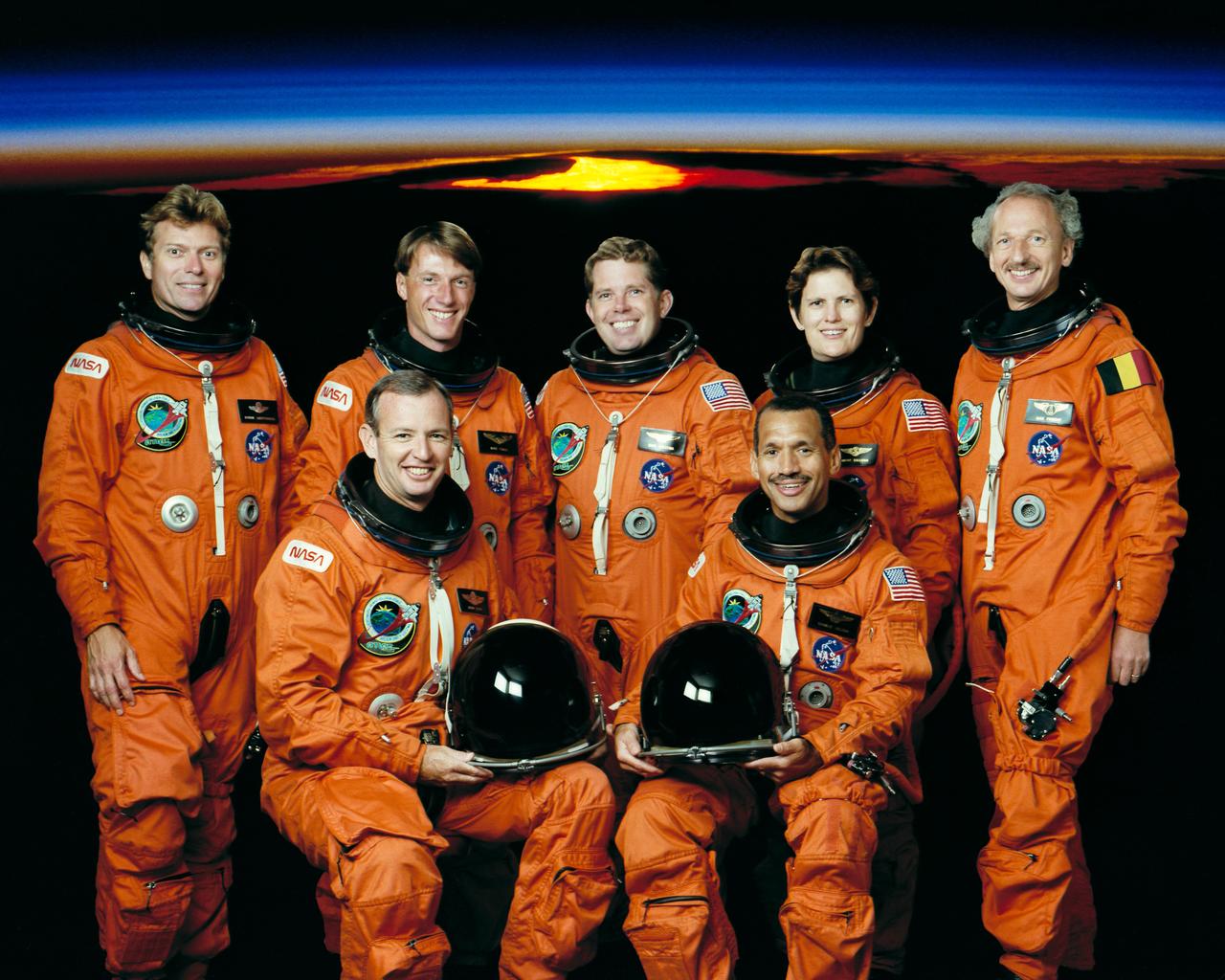
STS045-S-002 (January 1992) --- The seven crew members for NASA's STS-45 mission are pictured in their partial-pressure launch and entry suits. In front are astronauts Charles F. Bolden, Jr. (right), mission commander, and Brian Duffy, pilot. Back row, left to right, are payload specialist Byron K. Lichtenberg; astronauts C. Michael Foale and David C. Leestma, mission specialists; Kathryn D. Sullivan, payload commander; and payload specialist Dirk Frimout, of Belgium. The Atmospheric Laboratory for Applications and Science (ATLAS) is scheduled for a March 1992 launch aboard the Space Shuttle Atlantis.
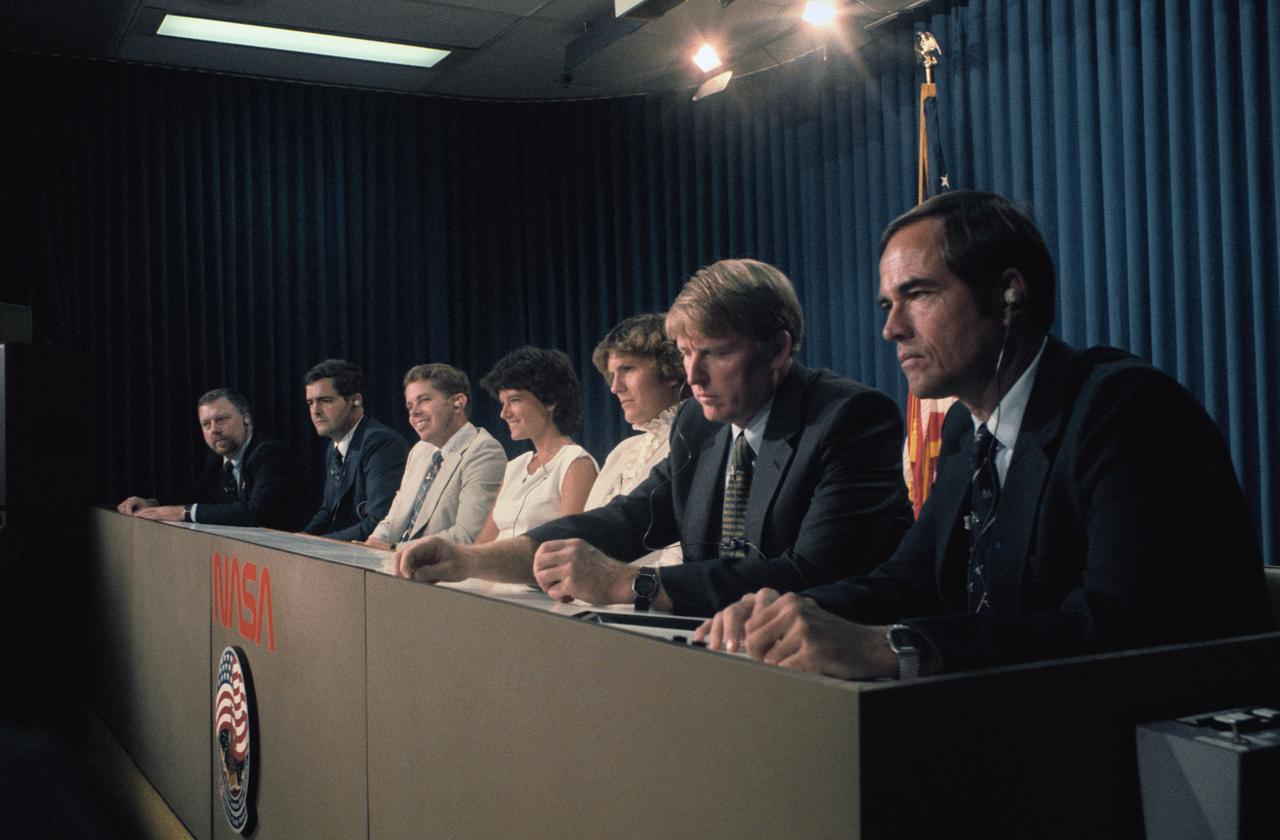
S84-41580 (3 Sept 1984) --- Assembled together publicly for the first time, the seven crewmembers for NASA's 41-G Space Shuttle mission field questions from the press corps at the Johnson Space Center. Pictured (foreground right to left) are Robert L. Crippen, crew commander ;Jon A. McBride, pilot; Kathryn D. Sullivan, Sally K. Ride and David C. Leestma--all mission specialists; Marc Garneau, representing the Canadian National Research Council, and Paul D. Scully-Power, U.S. Navy oceanographer, both payload specialists. Their flight is scheduled for early October.
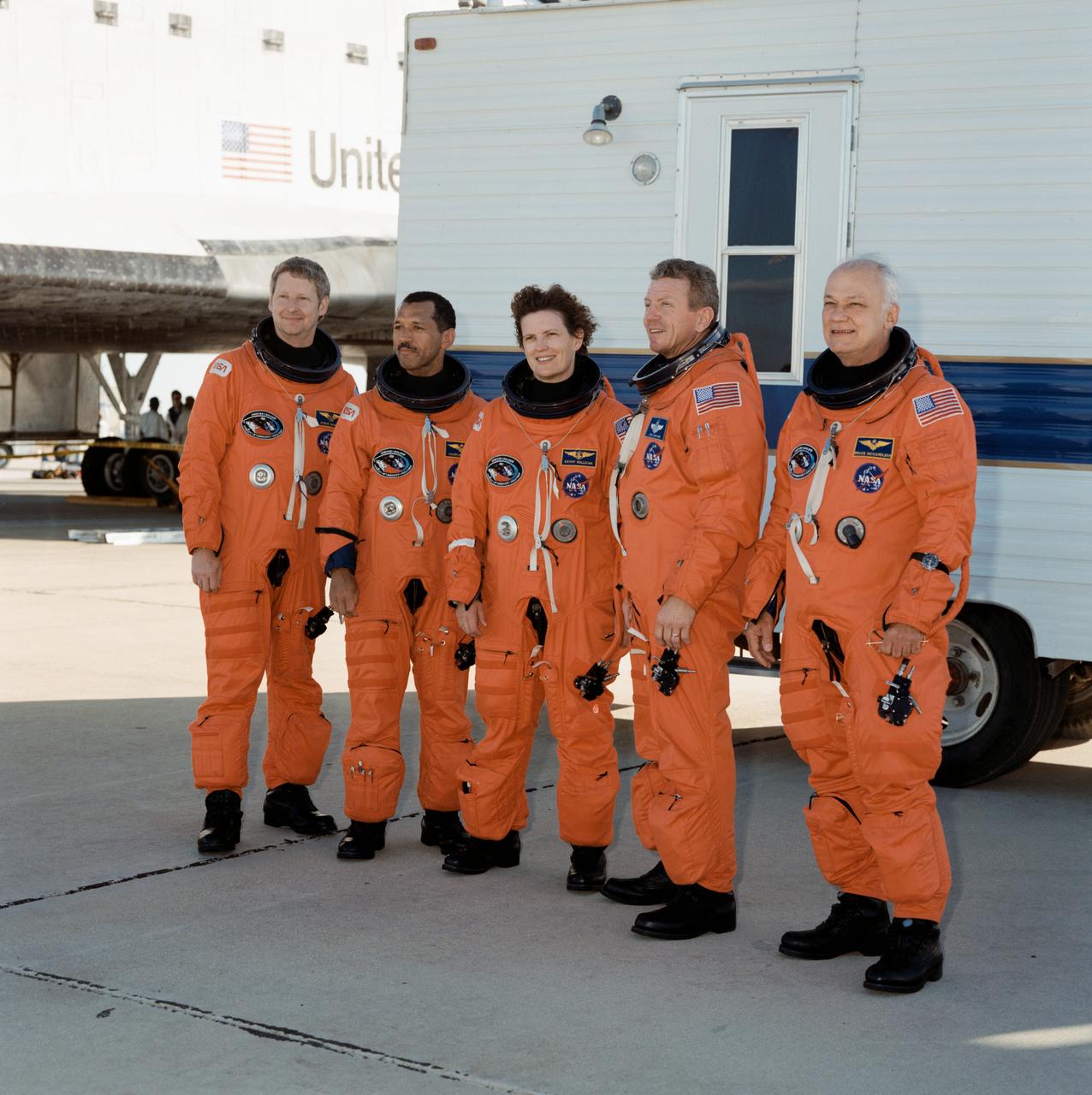
STS031-S-130 (29 April 1990) --- The astronauts of STS-31 pose for a quick photo near the Space Shuttle Discovery following a smooth landing on the runway at Edwards Air Force Base to complete a highly successful five-day mission. Pictured, left to right, are Astronauts Steven A. Hawley, Charles F. Bolden Jr., Kathryn D. Sullivan, Loren J. Shriver, and Bruce McCandless II. Theirs was an Earth orbital flight during which the Hubble Space Telescope (HST) was sent toward its 15-year mission.
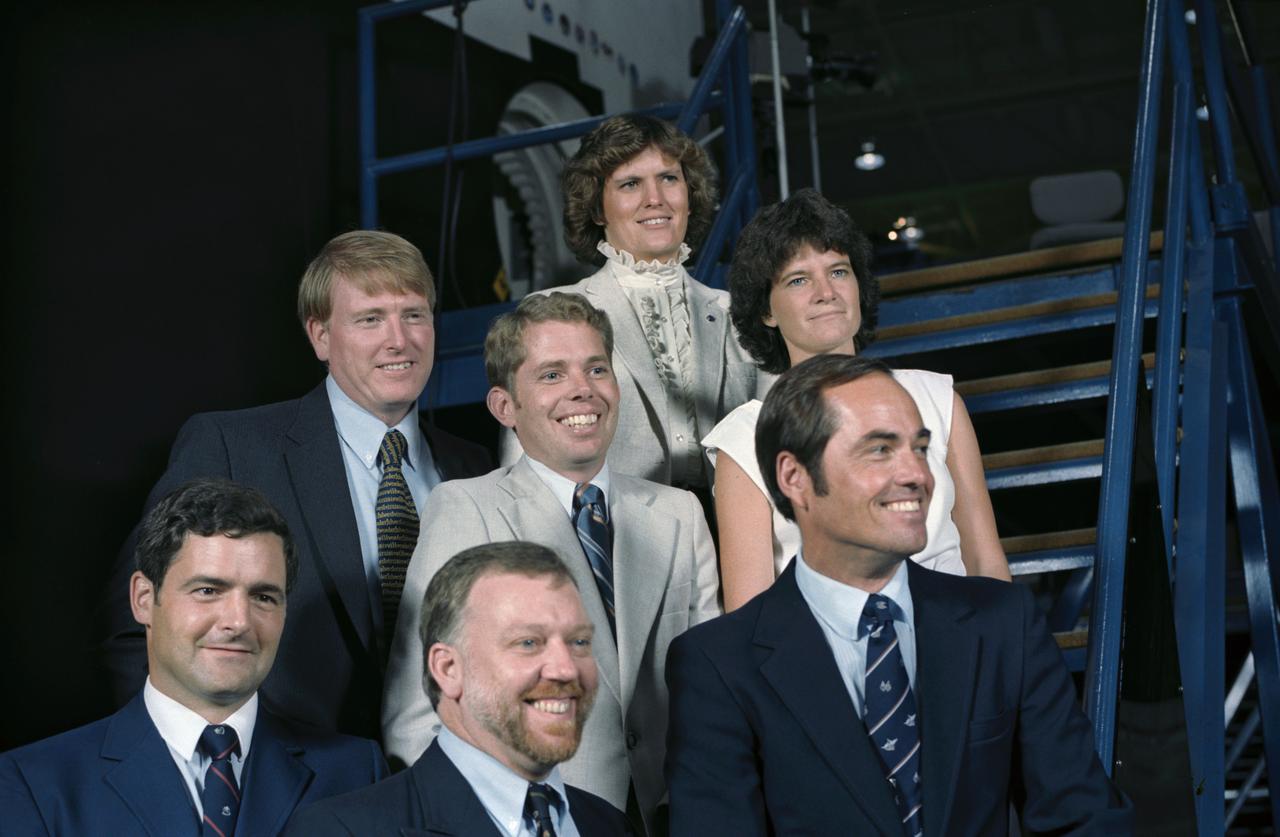
41D-3277 (S14-3277) (4 Sept 1984) --- Having met the press for the first time as a group, members of the STS 41-G crew pose for photographs in the Shuttle mockup and integration laboratory at the Johnson Space Center. They are (bottom row, left, to right) Marc Garneau and Paul D. Scully-Power, both payload specialists; and Robert L. Crippen, crew commander; (second row, l.-r.) Astronauts Jon A. McBride, pilot; David C. Leestma and Sally K. Ride, both mission specialists; and Kathryn D. Sullivan, mission specialist. They are scheduled for an October 5, 1984 launch aboard the Space Shuttle Challenger.
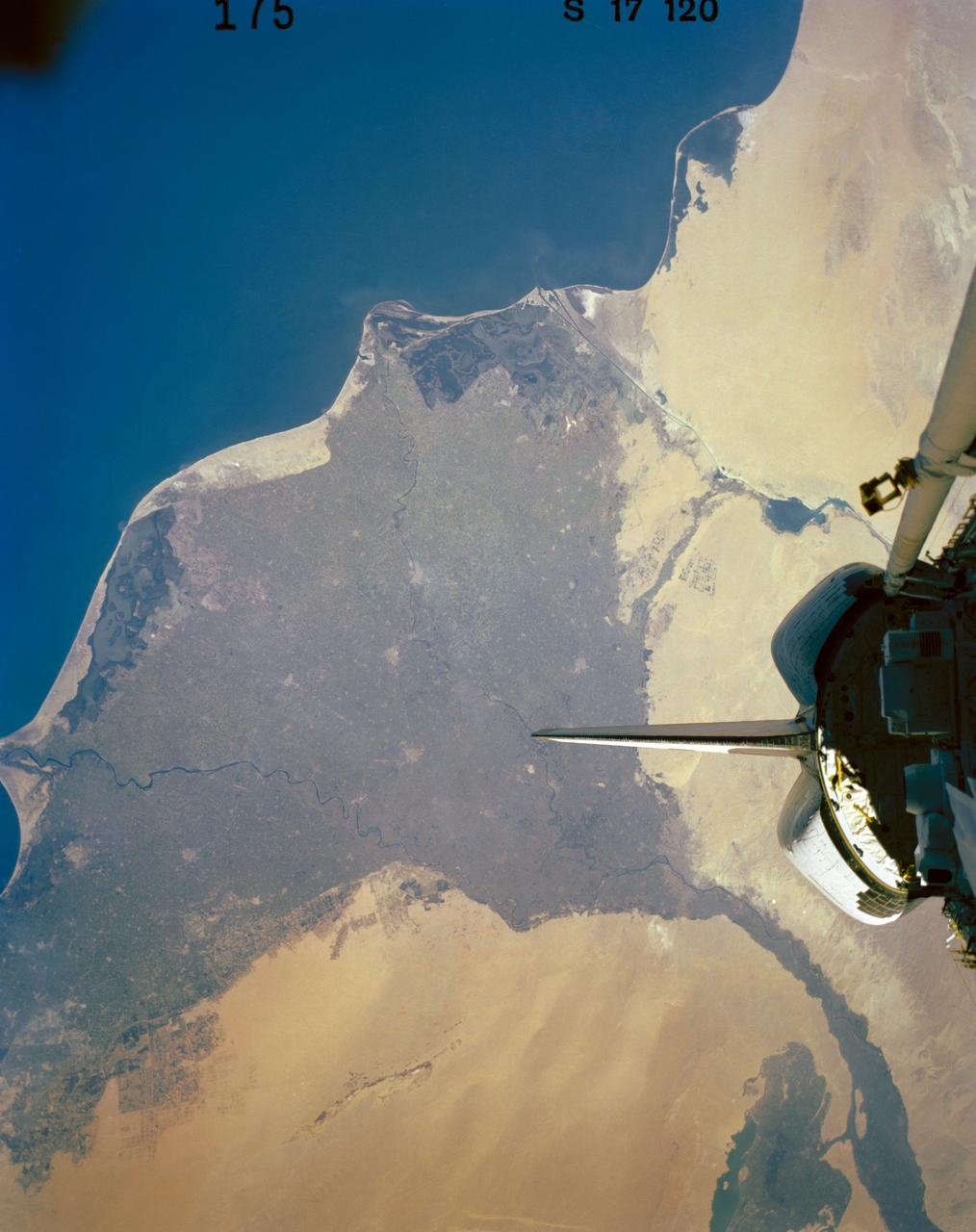
41G-120-175 (5-13 Oct. 1984) --- Egypt and the Nile River Delta are easily recognizable in this 250mm frame photographed by one of the seven 41-G crew members aboard the Earth-orbiting space shuttle Challenger. Cairo and the Egyptian pyramids are also visible in the lower left side of this photograph. The 41-G crew consisted of astronauts Robert L. Crippen, commander, Jon A. McBride, pilot; Mission Specialists Kathryn D. Sullivan, Sally K. Ride, and David D. Leestma; along with Canadian astronaut Marc Garneau; and Paul D. Scully-Power, both payload specialists. Photo credit: NASA
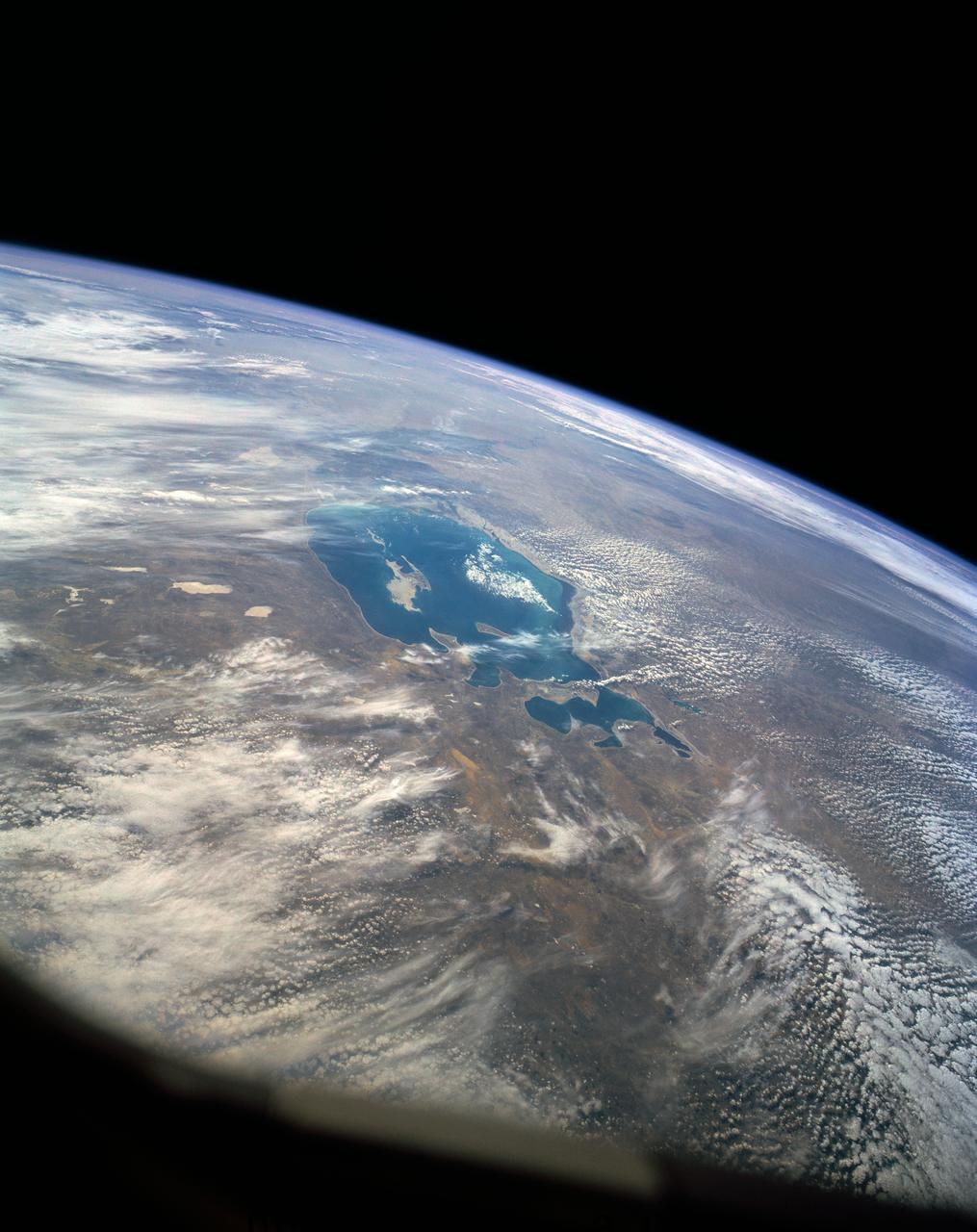
41G-120-005 (5-13 Oct 1984) --- The Kyzyl Kum Desert of the Kazakh and Uzbek Soviet Socialist Republics. The Aralskoe More, also known as the Aral Sea, is to the south-southeast. This saltwater lake is fed mainly from waters of the Amu Darya River, mostly with snow melt water from the distant Tyan-Shan Mountains near the Afghanistan and China border. The crew consisted of astronauts Robert L. Crippen, commander; Jon A. McBride, pilot; mission specialist's Kathryn D. Sullivan, Sally K. Ride, and David D. Leestma; Canadian astronaut Marc Garneau; and Paul D. Scully-Power, payload specialist.
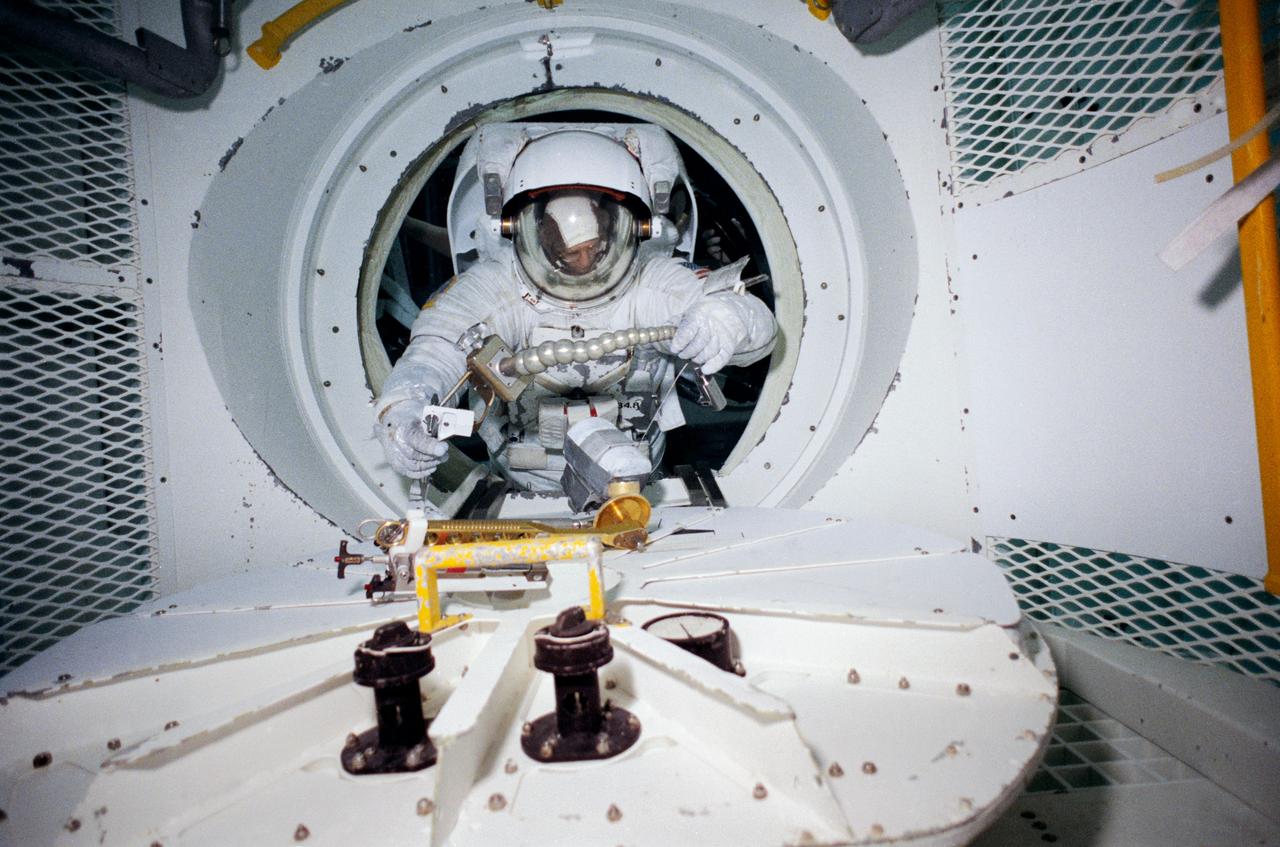
S90-30521 (20 Feb 1990) --- Though no extravehicular activity is planned for STS-31, two crewmembers train for contingencies that would necessitate leaving their shirt sleeve environment of Discovery's cabin and performing chores with their Hubble Space Telescope payload or related hardware. Astronaut Kathryn D. Sullivan, mission specialist, is seen egressing the hatchway of the airlock of a full scale mockup of a Shuttle cabin to interface with an HST mockup in JSC's 25.-ft. deep pool in the weightless environment training facility (WET-F). Two SCUBA-equipped divers who assisted in the training session are also seen. Astronaut Bruce McCandless II, mission specialist, is out of frame.
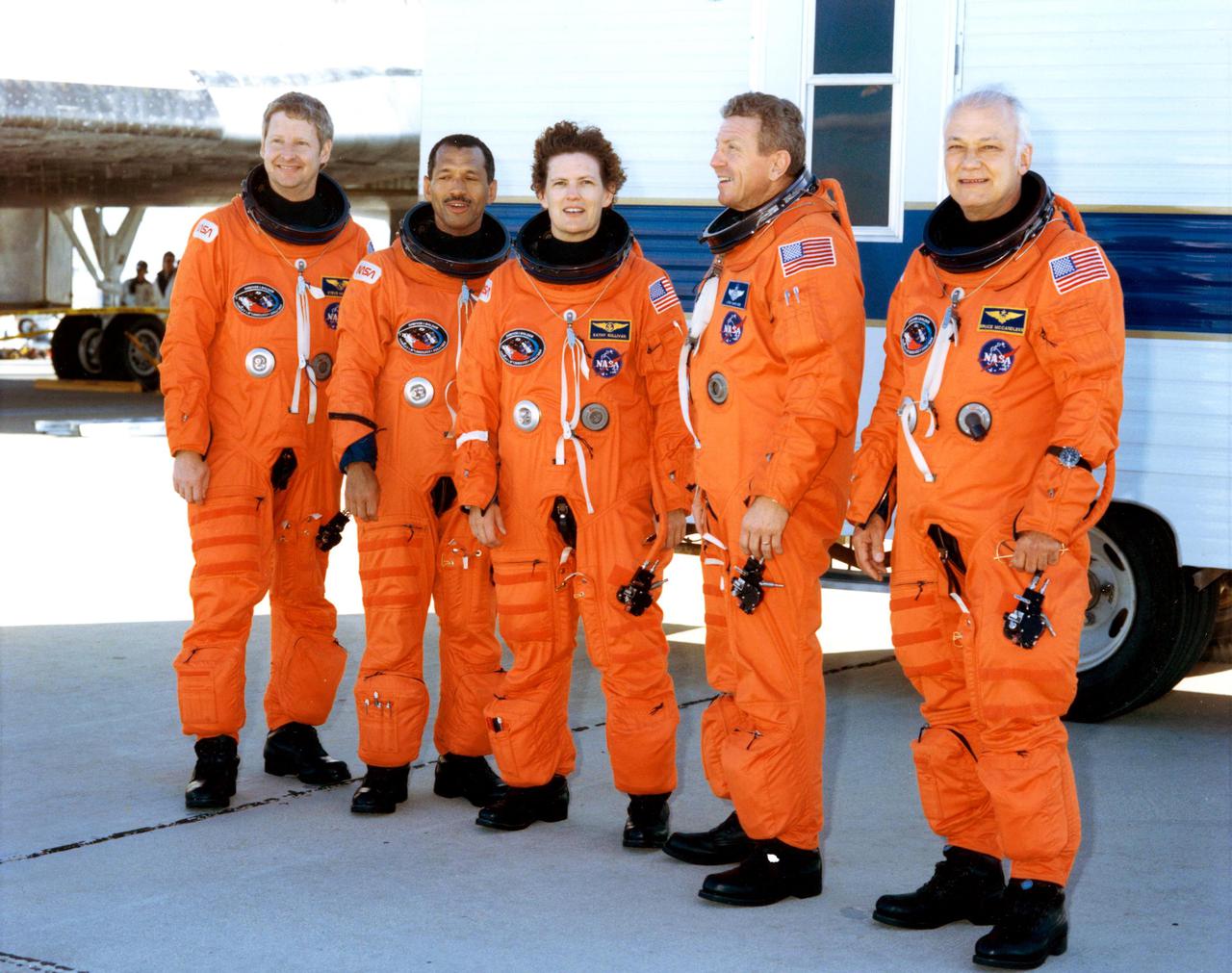
DRYDEN FLIGHT RESEARCH FACILITY, EDWARDS, CALIF. -- STS-31 POST-LANDING CREW PORTRAIT -- The astronauts of STS-31 pose for a quick photo near the Space Shuttle Discovery following a smooth landing on the runway at Edwards Air Force Base to complete a highly successful five day mission. Picture, left to right, are Astronauts Steven A. Hawley, Charles F. Bolden Jr., Kathryn D. Sullivan, Loren J. Shriver, and Bruce McCandless II. Theirs was an Earth-orbital flight during which the Hubble Space Telescope was sent toward its 15-year mission. Landing was completed at 6:51 a.m. (PDT), April 29, 1990.
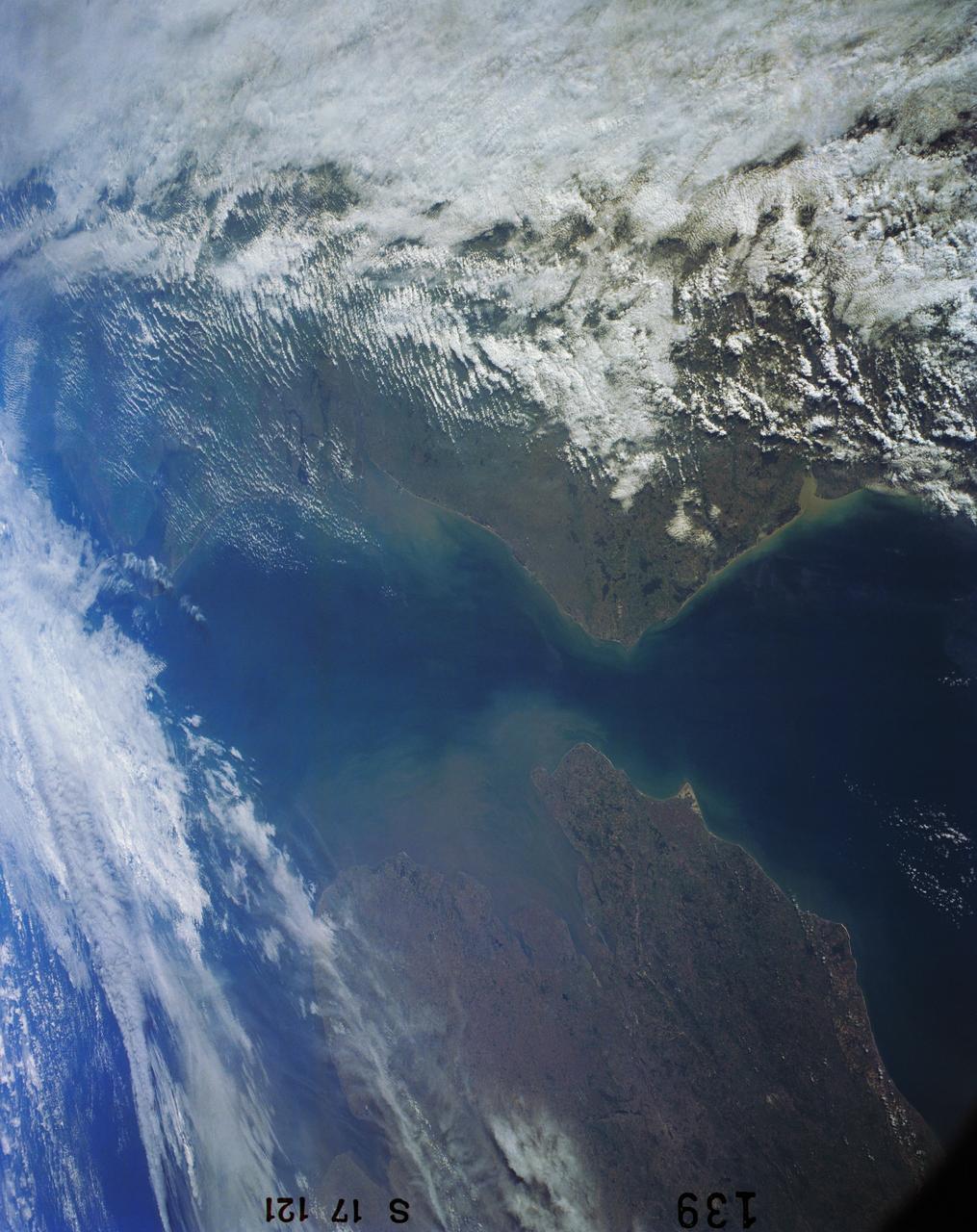
41G-121-139 (5-13 Oct. 1984) --- The Strait of Dover and London, seldom seen in space photography, can be delineated in this medium format camera's scene showing parts of England and France from onboard the Earth-orbiting space shuttle Challenger. Parts of the Thames River can also be traced in the frame. The 41-G crew consisted of astronauts Robert L. Crippen, commander; Jon A. McBride, pilot; and Mission Specialists Kathryn D. Sullivan, Sally K. Ride, and David D. Leestma; along with Canadian astronaut Marc Garneau; and Paul D. Scully-Power, both payload specialists. Photo credit: NASA
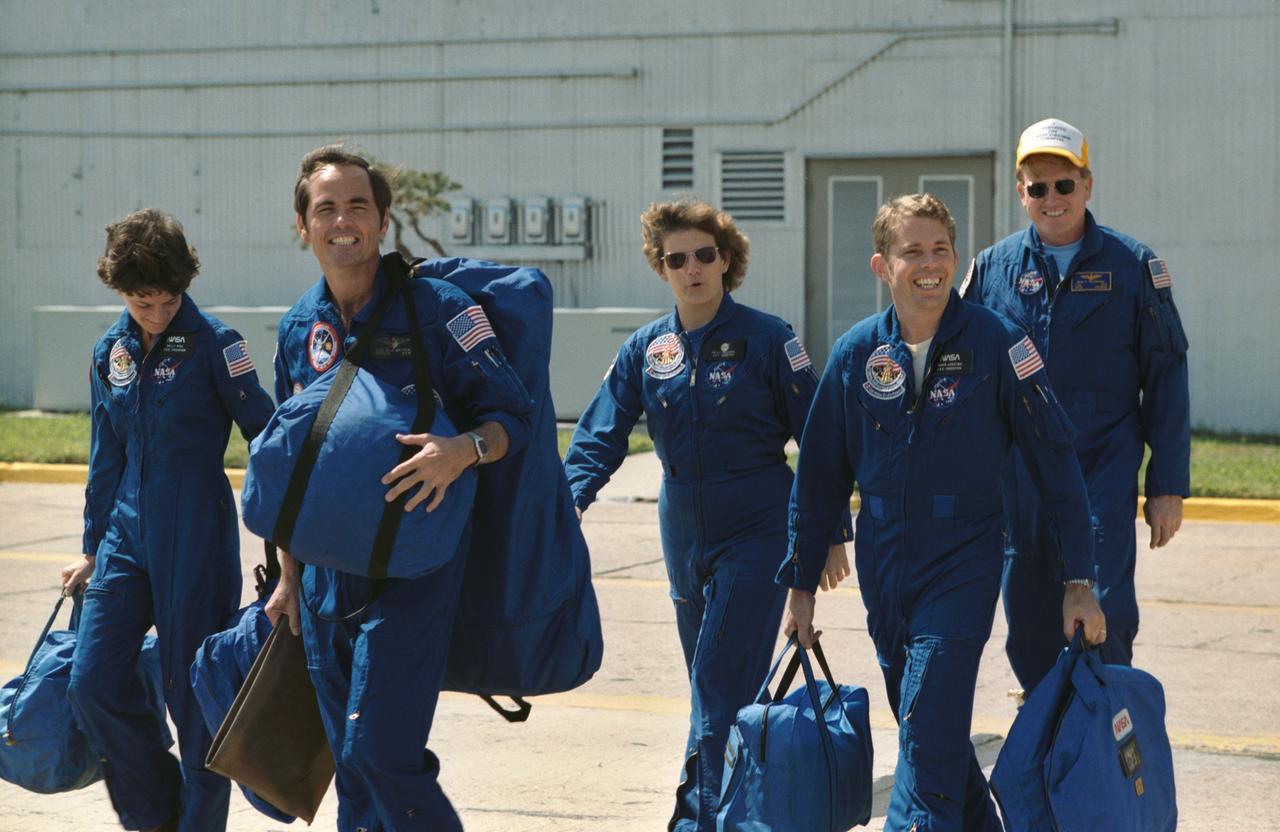
41G-90029 / S17-90029 (2 Oct 1984) --- These five astronauts prepare to board T-38 jet aircraft for a trip to Florida where they will begin preparations for a trip into space aboard the Challenger later this week. Astronaut Robert L. Crippen, left, leads the way. The crew commander is followed by (l.-r.) Sally K. Ride (extreme left edge), Kathryn D. Sullivan, David C. Leestma and Jon A. McBride, McBride is pilot and the others are mission specialists. Marc Garneau, representing the National Research Council of Canada and Paul D. Scully-Power, a civilian oceanographer with the U.S. Navy, are the payload specialists who will fly to Florida aboard a Gulfstream aircraft.
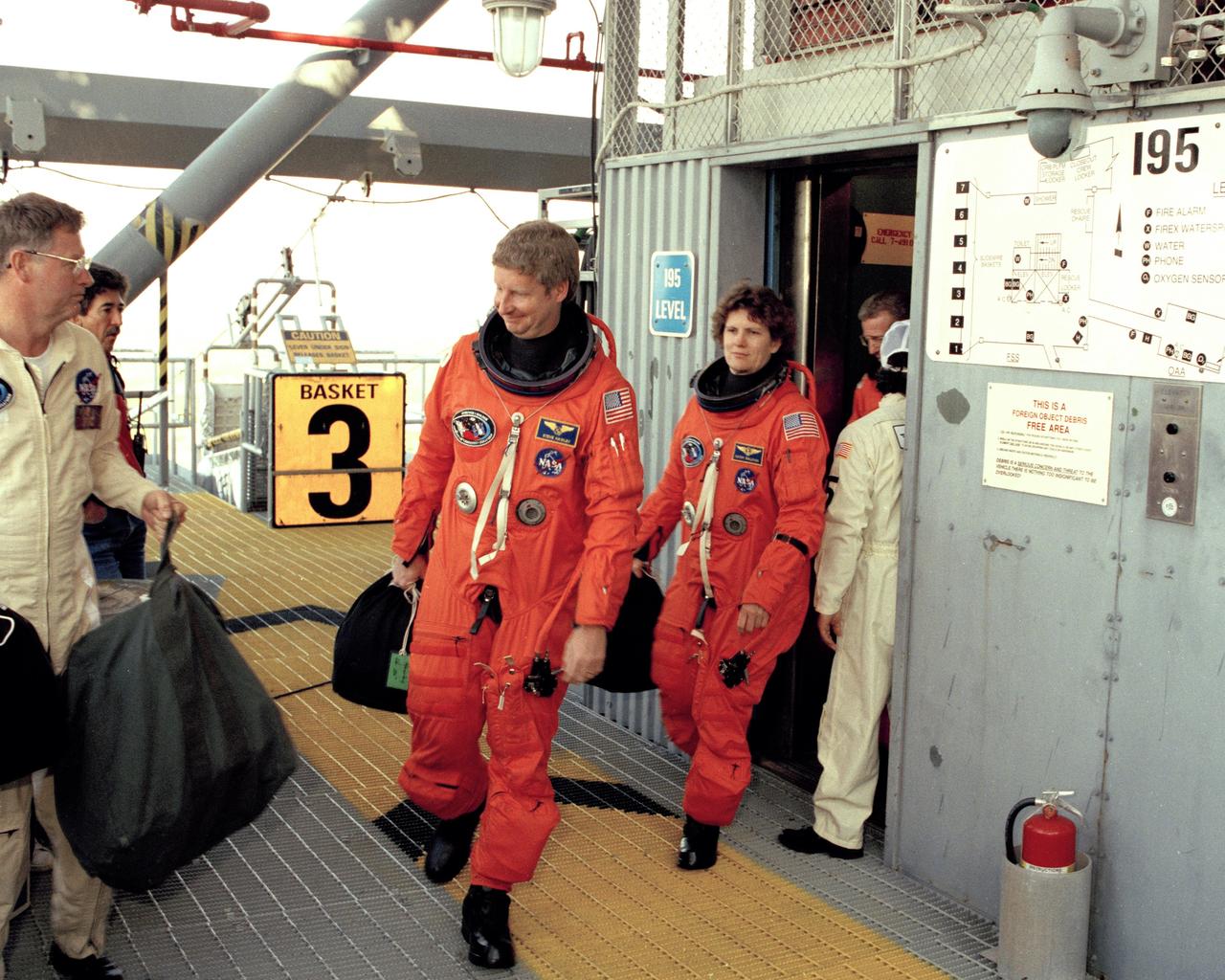
STS-31 Mission Specialists Steven A. Hawley (left) and Kathryn D. Sullivan, and Commander Loren J. Shriver prepare to enter the orbiter Discovery from the 195-foot level at Launch Pad 39B during the culmination of the two-day Terminal Countdown Demonstration Test (TCDT). The TCDT, conducted March 19-20, is a dress rehearsal for launch, simulating final countdown from the T-24 hour mark up to T-5 seconds. Space shuttle mission STS-31 is set to lift off on April 12, carrying a five-member crew and the Hubble Space Telescope. Photo credit: NASA
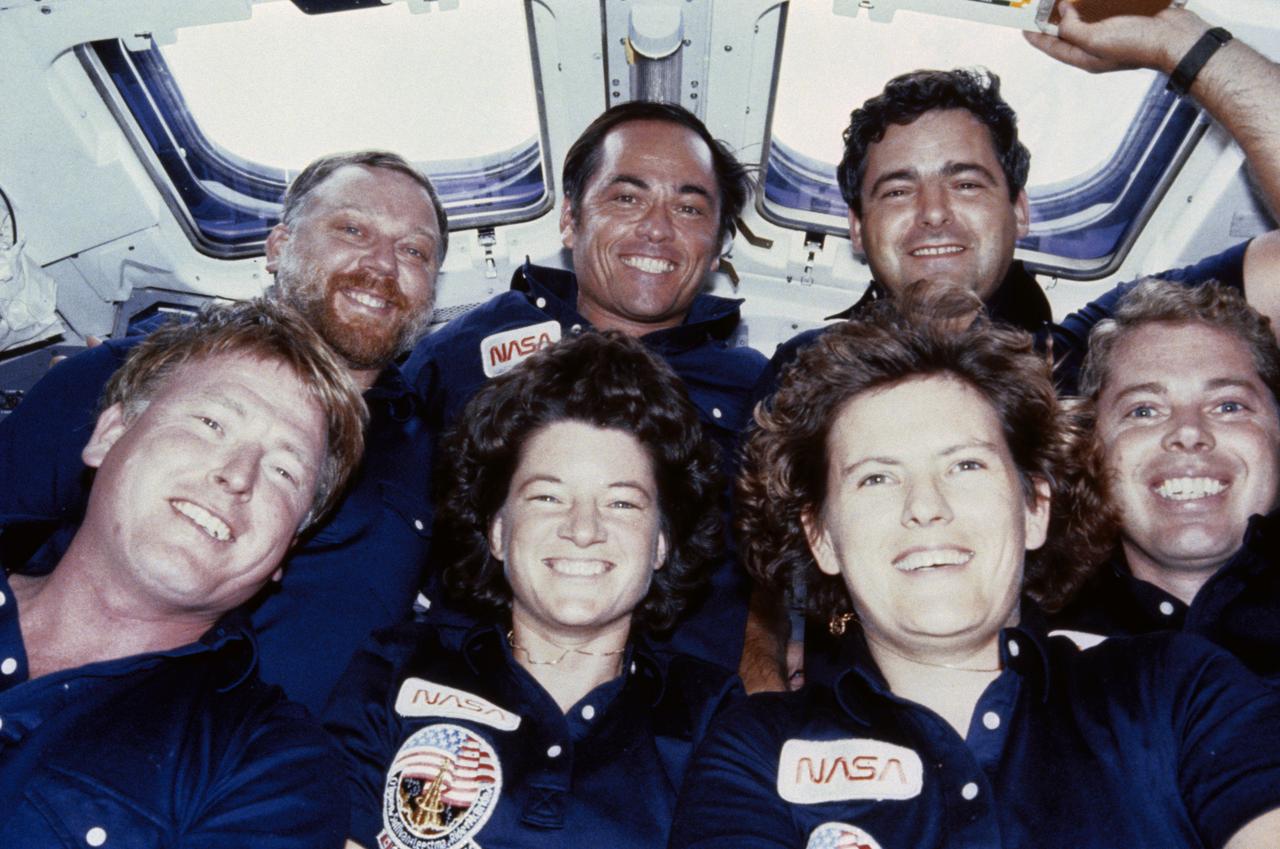
41G-19-006 (5-13 Oct. 1984) --- The seven-member 41-G crew assembles for a group shot on the flight deck of the Earth-orbiting space shuttle Challenger. Robert L. Crippen, commander, is in center of the back row. Others pictured are (front row, l.-r.) Jon A. McBride, pilot; Sally K. Ride, Kathryn D. Sullivan and David C. Leestma, all mission specialists; and Paul D. Scully-Power (left) and Marc Garneau, both payload specialists, on the back row. Garneau represents the National Research Council of Canada and Scully-Power is a civilian oceanographer with the U.S. Navy. Photo credit: NASA
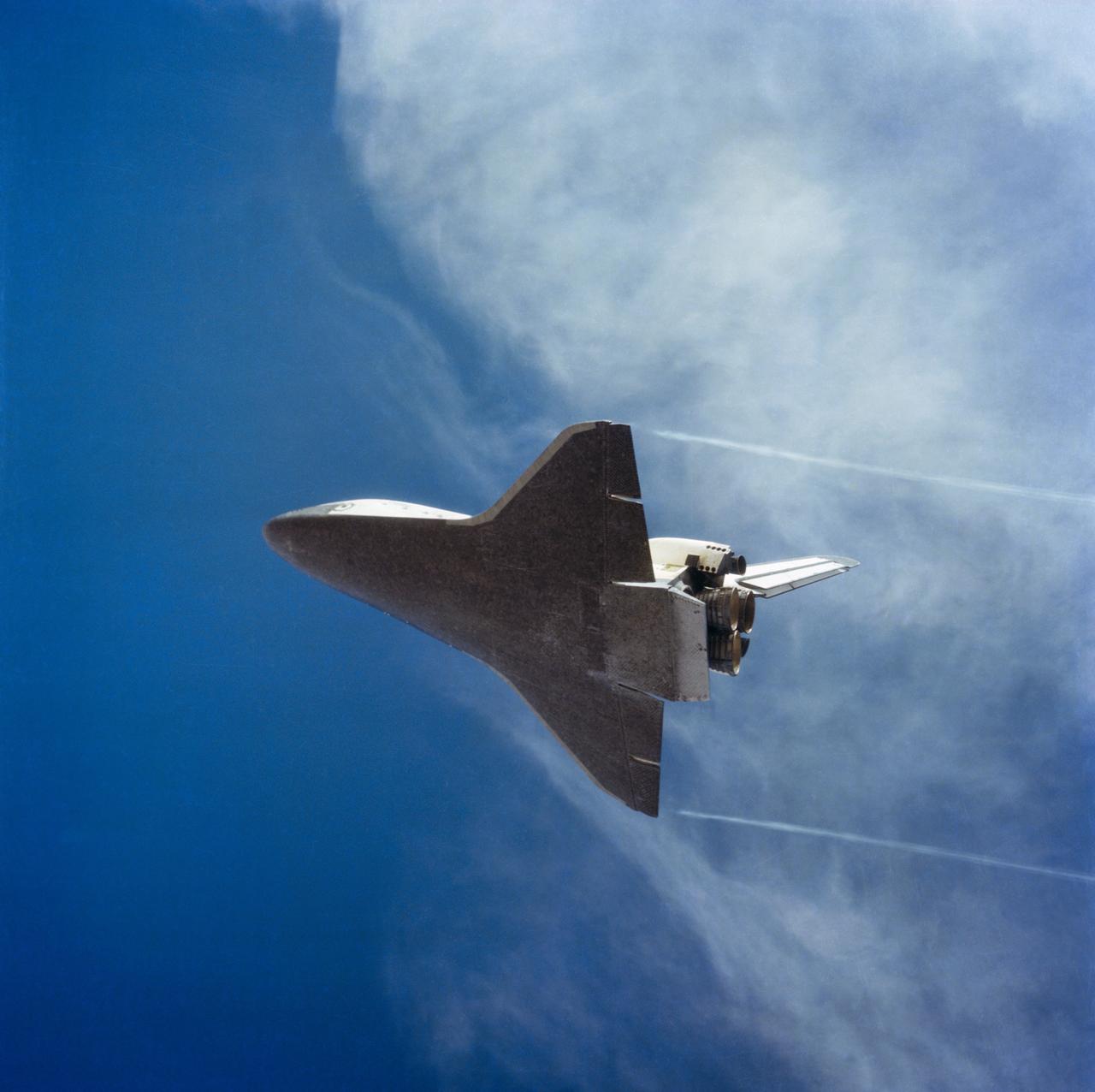
S81-39563 (14 Nov. 1981) --- This view of the space shuttle Columbia (STS-2) was made with a hand-held 70mm camera in the rear station of the T-38 chase plane. Mission specialist/astronaut Kathryn D. Sullivan exposed the frame as astronauts Joe N. Engle and Richard H. Truly aboard the Columbia guided the vehicle to an unpowered but smooth landing on the desert area of Edwards Air Force base in California. The view provides a good study of the high temperature protection material on the underside of the spacecraft which is exposed to the friction on the atmospheric entry on the return to Earth. Also note trails from the wing tips. Photo credit: NASA

S78-25633 (31 Jan. 1978) --- These six mission specialist astronaut candidates are the first women ASCANs to be named by NASA. They are, left to right, Rhea Seddon, Anna L. Fisher, Judith A. Resnik, Shannon W. Lucid, Sally K. Ride and Kathryn D. Sullivan. Along with these candidates, 14 other mission specialist candidates and 15 pilot astronaut candidates were presented during a press conference at the Johnson Space Center on Jan. 31, 1978. All 35 met the press in the larger Teague Auditorium and the women greeted photographers and other media representatives in the Public Affairs Office briefing room. Photo credit: NASA
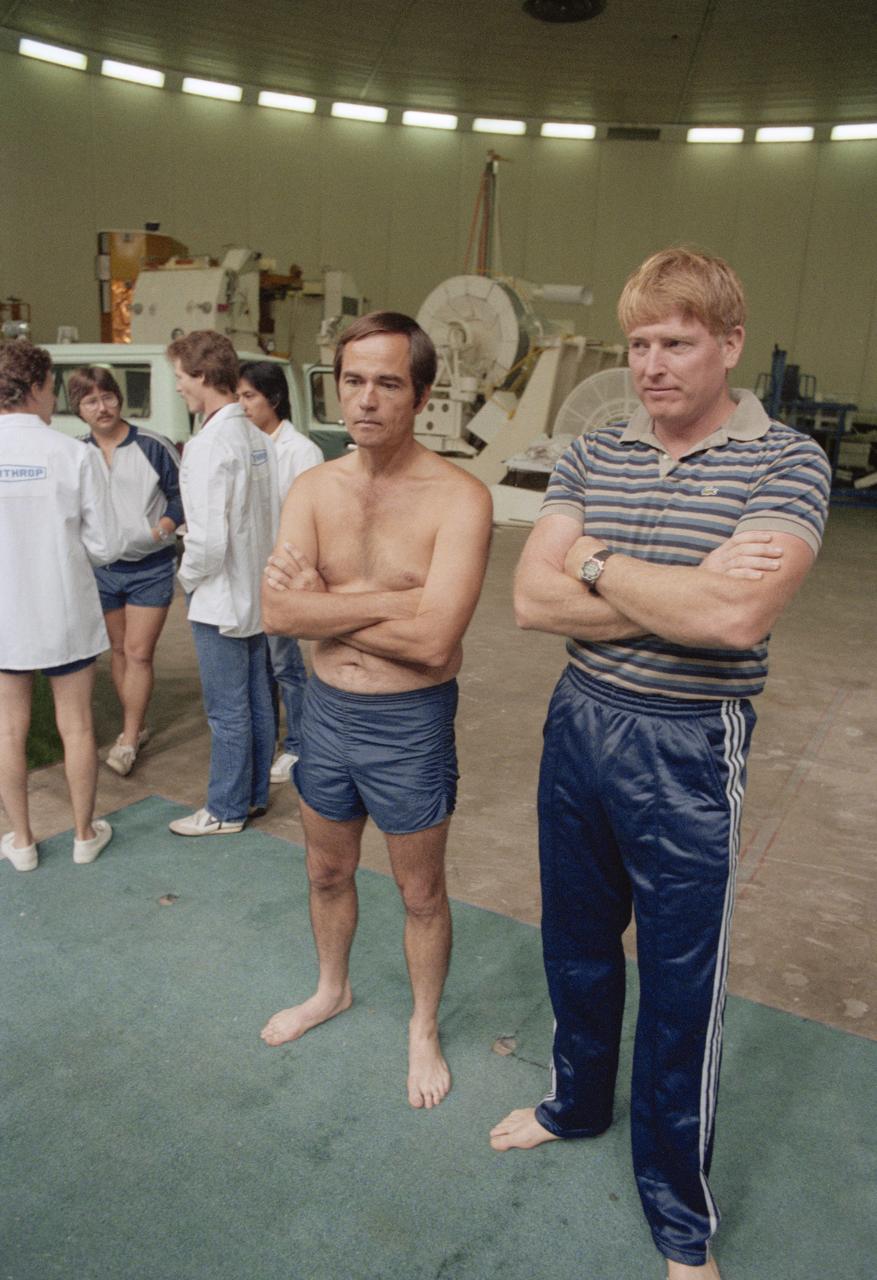
S84-36898 (29 June 1984) --- Astronauts Robert L. Crippen (left) and Jon A. McBride, crew commander and pilot, respectively for NASA's 41-G Space Shuttle mission, await the delivery of self contained underwater breathing apparatus (SCUBA) gear prior to their going underwater to observe a simulation of an extravehicular activity (EVA) scheduled for their mission. The EVA will be performed by Astronauts Kathryn D. Sullivan and David C. Leestma, two of three mission specialists named for the seven-member crew. The underwater training took place in the Johnson Space Center's weightless environment training facility (WET-F).
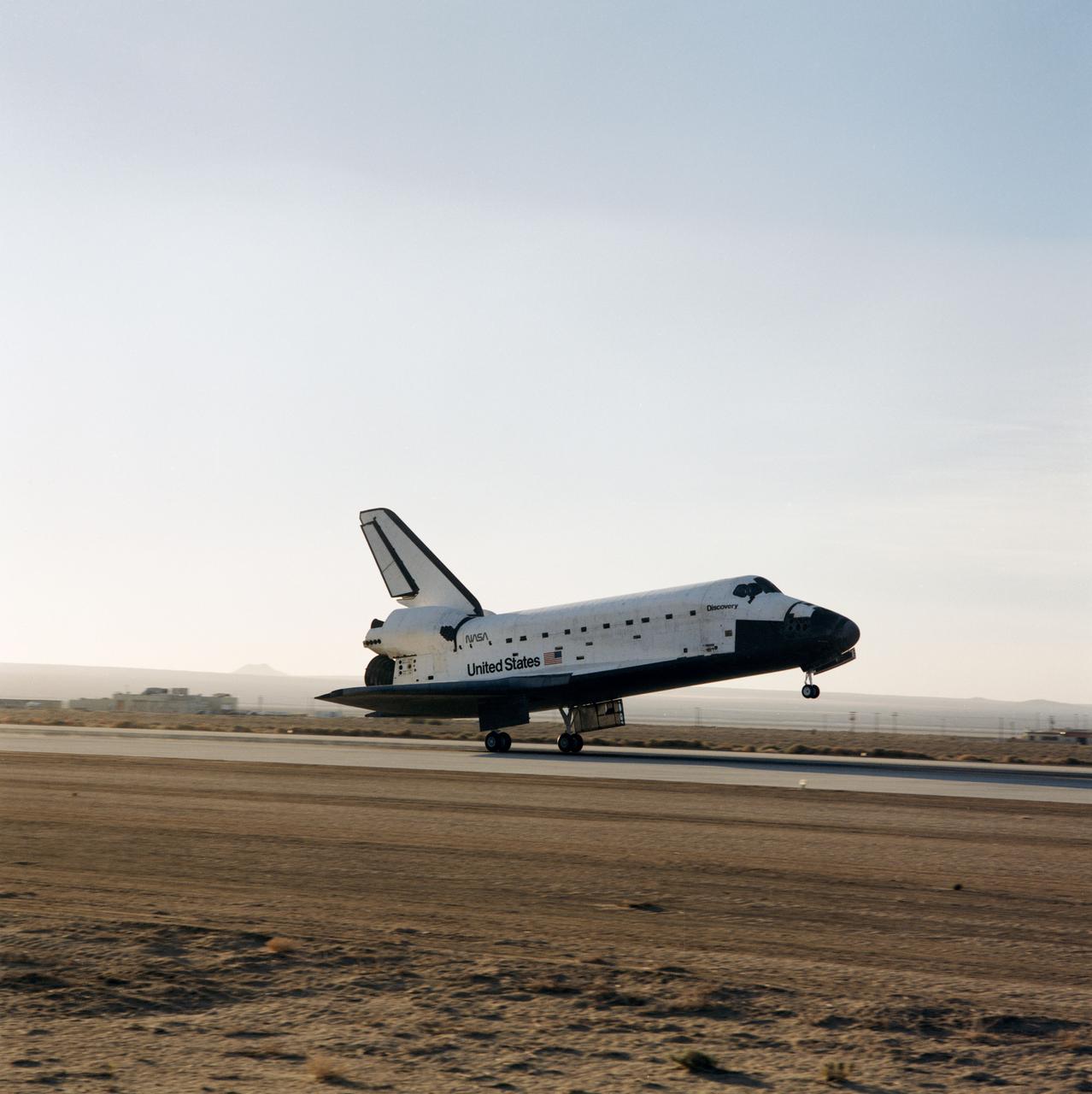
STS031-S-135 (29 April 1990) --- The Space Shuttle Discovery makes a smooth landing on the runway at Edwards Air Force Base to complete a highly successful five-day mission. It was an Earth orbital flight during which the Hubble Space Telescope (HST) was sent toward its 15-year mission. Landing was completed at 6:51 a.m. (PDT), April 29, 1990. Inside the spacecraft for STS-31 were Astronauts Loren J. Shriver, Charles F. Bolden, Bruce McCandless II, Kathryn D. Sullivan and Steven A. Hawley.
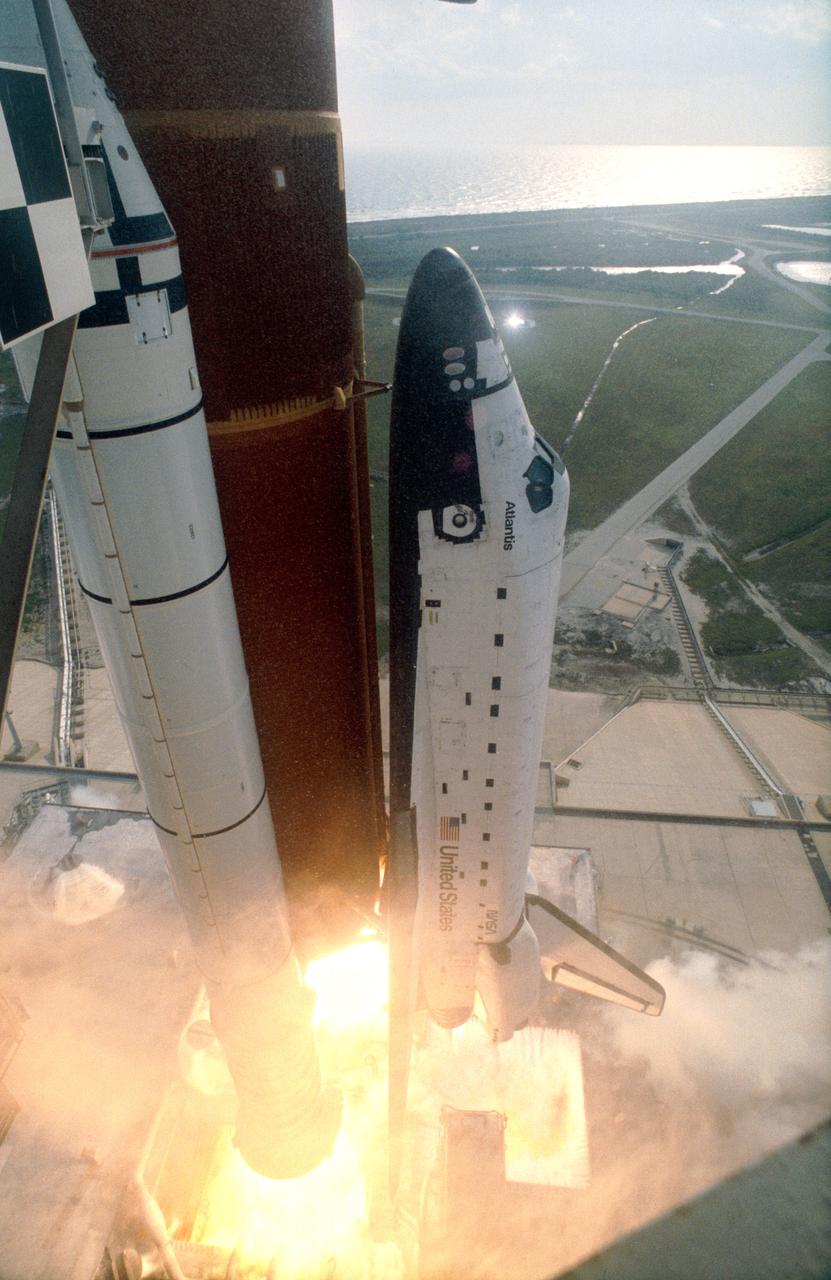
STS045-S-054 (24 March 1992) --- A profile view of the Space Shuttle Atlantis as it soars off the launch pad and heads toward Earth orbit with a crew of seven and the Atmospheric Laboratory for Applications and Science (ATLAS) aboard. Launch occurred at 8:13:40:048 a.m. (EST), March 24, 1992. Onboard were Charles F. Bolden, mission commander; Brian Duffy, pilot; Kathryn D. Sullivan, payload commander; David C. Leestma and C. Michael Foale, mission specialists; and Dirk Frimout of the European Space Agency and Byron K. Lichtenberg, payload specialists. The view was provided by an automatic camera on the launch service structure.
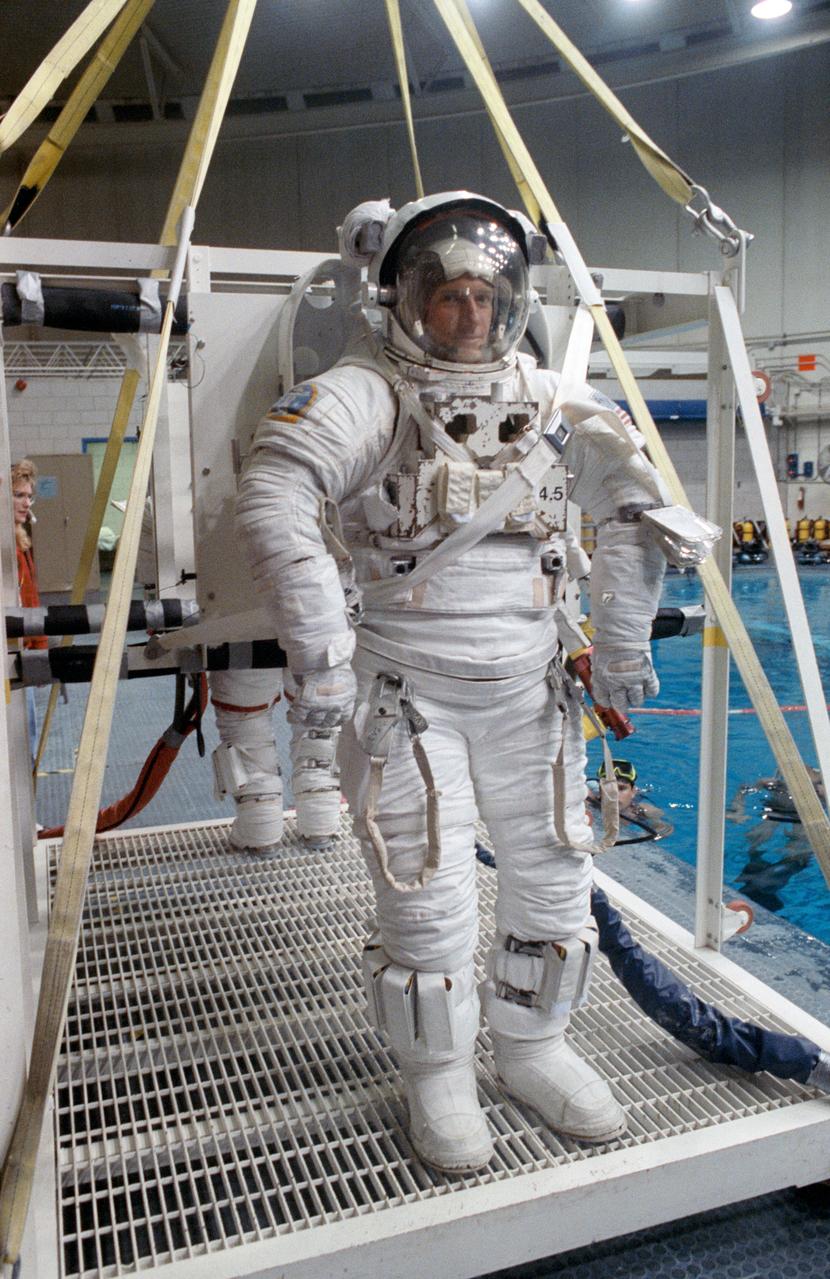
S91-30196 (1 March 1991) --- Astronaut C. Michael Foale, mission specialist, and Kathryn D. Sullivan, payload commander (barely visible in background), stand on a platform (out of frame) which is part of a system that will lower them into a 25-ft. deep pool. The payload commander and mission specialist used the pool in the weightless environment training facility (WET-F) to rehearse a contingency extravehicular activity (EVA). Astronauts wear pressurized spacesuits configured for achieving a neutrally buoyant condition in the water to simulate both planned and contingency EVAs. Two SCUBA-equipped swimmers assisting the training are seen in the background.
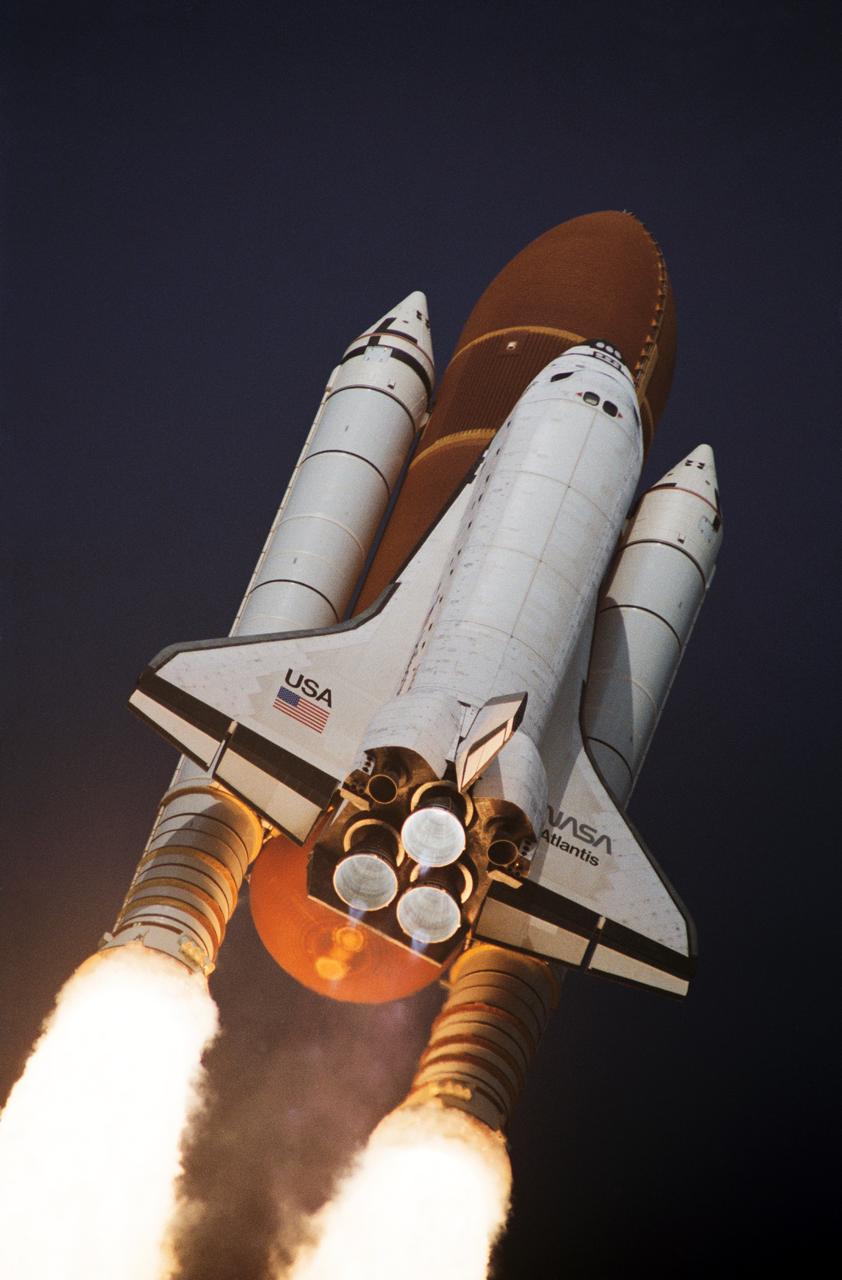
STS045-S-053 (24 March 1992) --- A low-angle view of the Space Shuttle Atlantis as it soars off the launch pad and heads toward Earth orbit with a crew of seven and the Atmospheric Laboratory for Applications and Science (ATLAS) aboard. Launch occurred at 8:13:40:048 a.m. (EST), March 24, 1992. Onboard were astronauts Charles F. Bolden, STS-45 commander; Brian Duffy, pilot; Kathryn D. Sullivan, payload commander; David C. Leestma and C. Michael Foale, mission specialists; and Dirk Frimout of the European Space Agency and Byron K. Lichtenberg, payload specialists.
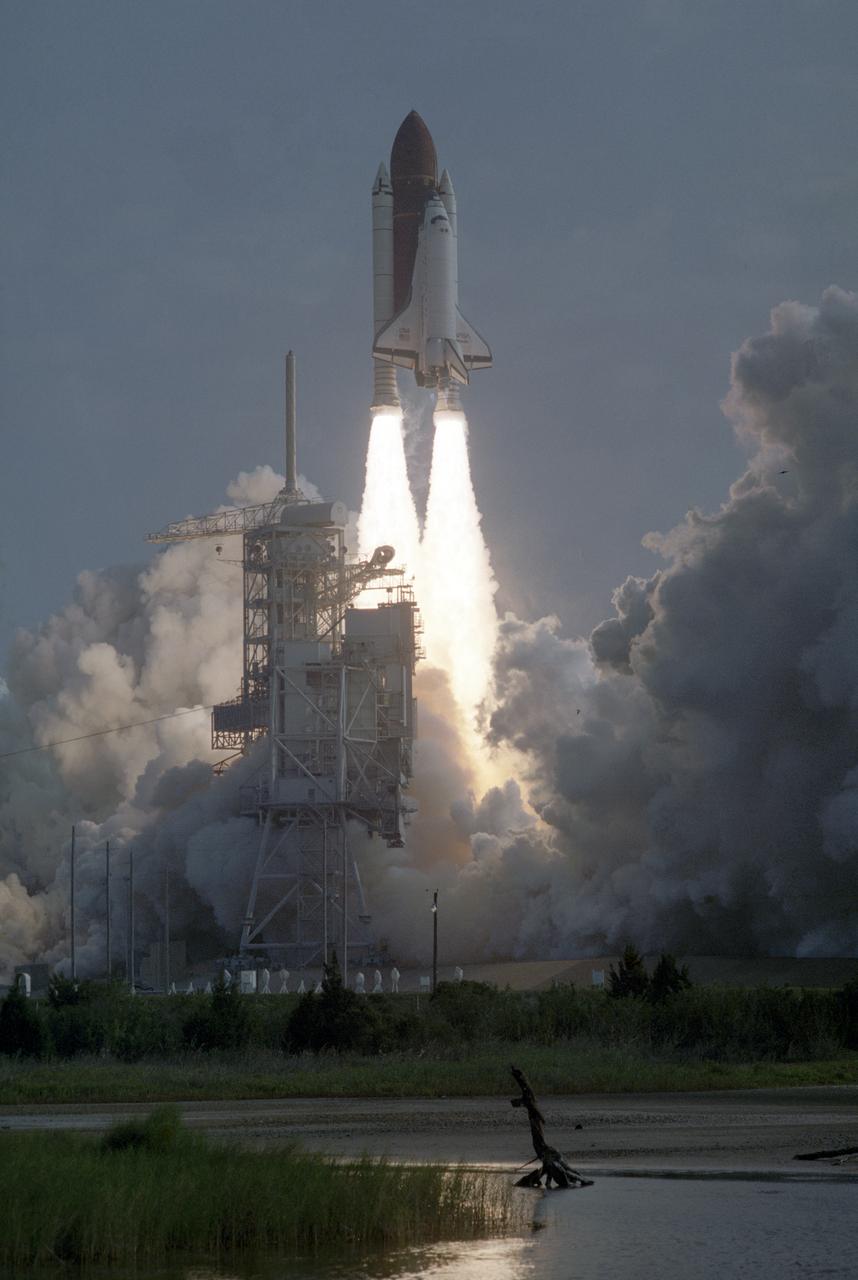
The STS-45 mission launched aboard the Space Shuttle Atlantis on March 24, 1992 at 8:13:40am (EST) carrying the Atmospheric Laboratory for Application and Science (ATLAS-1) as its primary payload. Crew members included: Charles F. Bolden, Jr., commander; Brian Duffy, pilot; Kathryn D. Sullivan, payload commander; Byron K. Lichtenberg, payload specialist 1; Dirk K. Frimout, payload specialist 2; David C. Leestma, mission specialist 2; and C. Michael Foale, mission specialist 3.
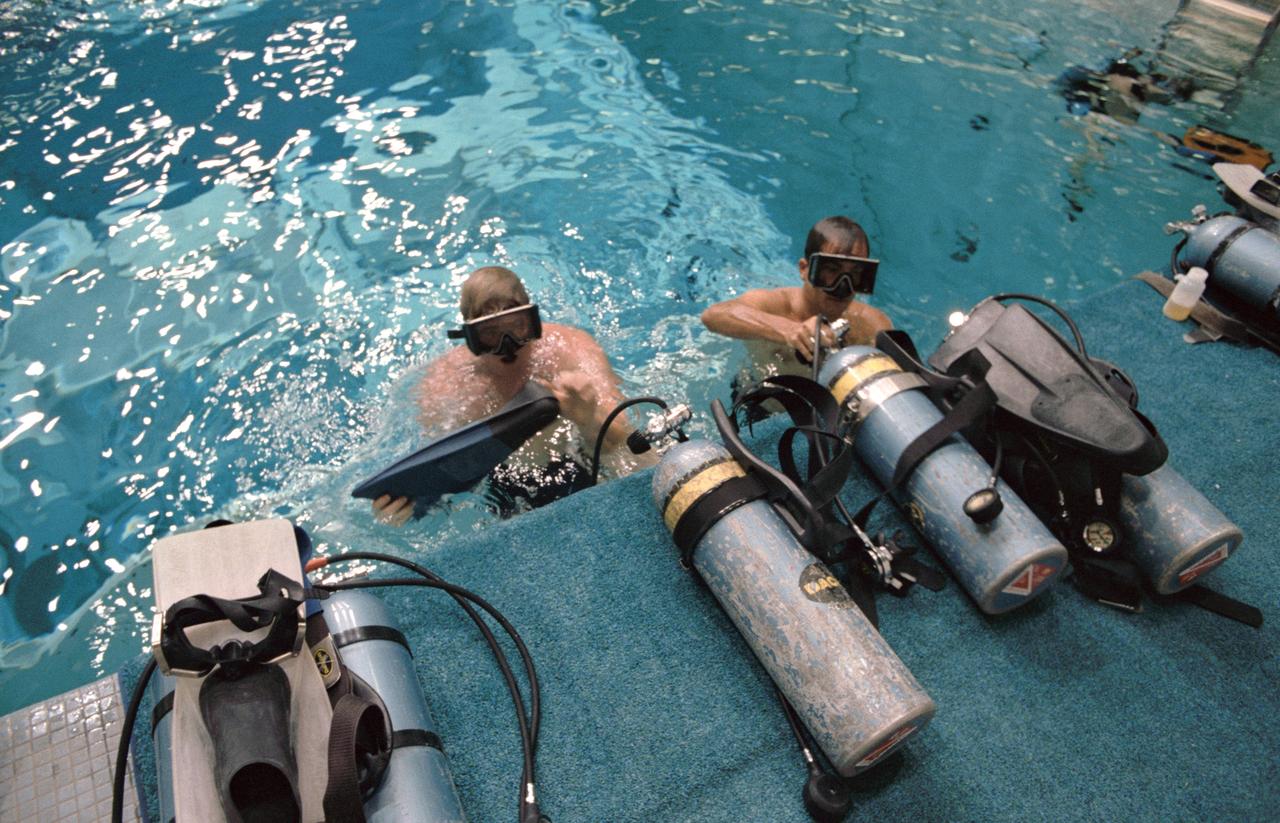
S84-36900 (29 June 1984) ---Astronauts Robert L. Crippen (right) and Jon A. McBride, crew commander and pilot, respectively, for NASA's 41-G Space Shuttle mission, don self contained underwater breathing apparatus (SCUBA) gear prior to their underwater to observe a simulation of an extravehicular activity (EVA) to be performed on their mission. Astronauts Kathryn D. Sullivan and David C. Leestma, two of three mission specialists on the seven-member crew, are scheduled for the EVA. The underwater training took place in the Johnson Space Center's weightless environment training facility (WET-F).
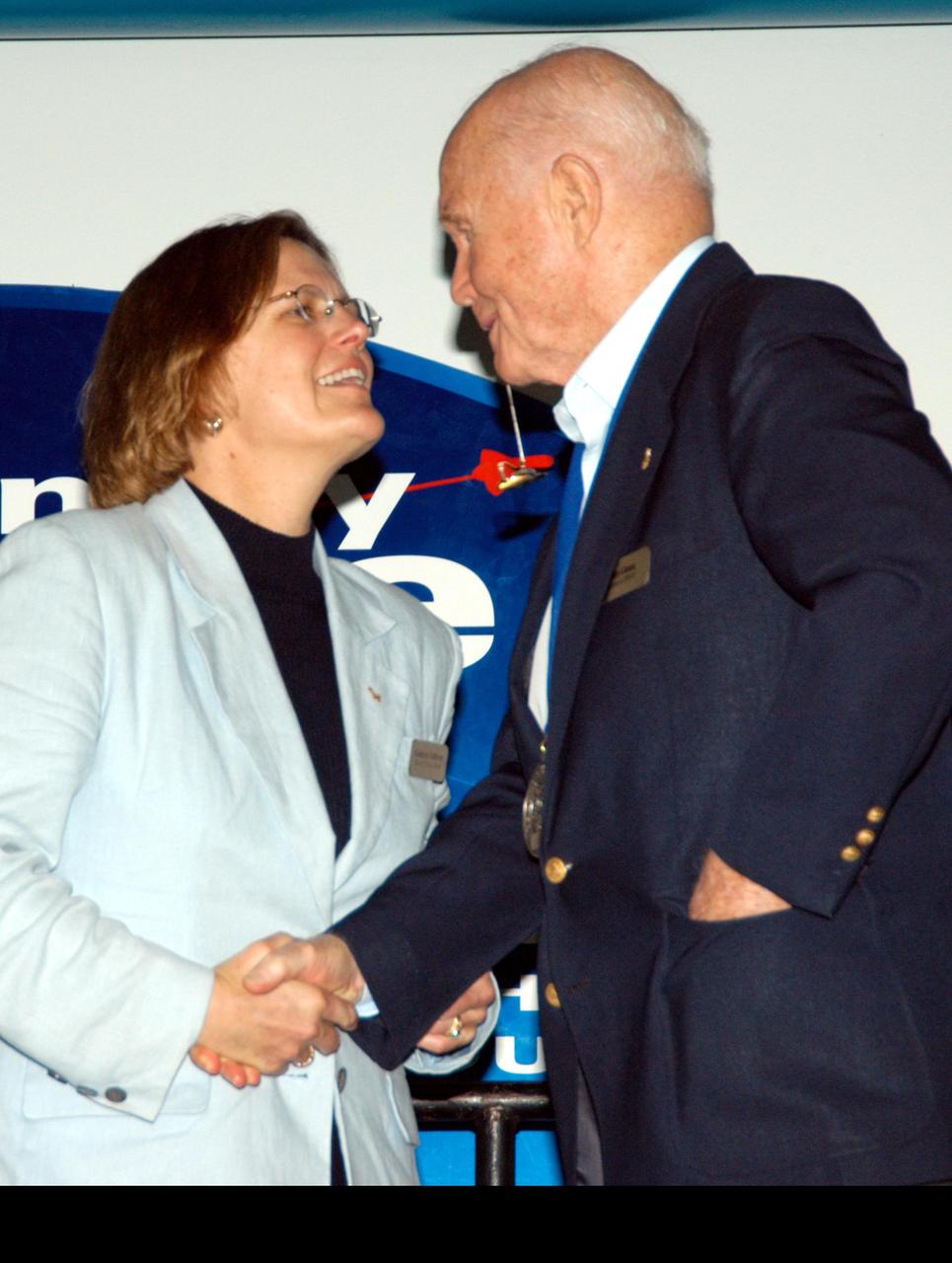
KENNEDY SPACE CENTER, FLA. -- At the Kennedy Space Center Visitor Complex, former NASA astronaut John H. Glenn Jr. (right) congratulates former NASA astronaut and fellow Ohioan Kathryn D. Sullivan on her induction into the U.S. Astronaut Hall of Fame. Sullivan was the first American woman to walk in space. Also chosen for this honor in 2004 are Richard O. Covey, commander of the Hubble Space Telescope repair mission; Frederick D. Gregory, the first African-American to command a space mission; Norman E. Thagard, the first American to occupy Russia's Mir space station; and the late Francis R. "Dick" Scobee, commander of the ill-fated 1986 Challenger mission. The U.S. Astronaut Hall of Fame opened in 1990 to provide a place where space travelers could be remembered for their participation and accomplishments in the U.S. space program. To be eligible for induction, an individual must have been a U.S. citizen, a NASA astronaut, and out of the active astronaut corps at least five years. The five inductees join 52 previously honored astronauts from the ranks of the Gemini, Apollo, Skylab, Apollo-Soyuz, and Space Shuttle programs.
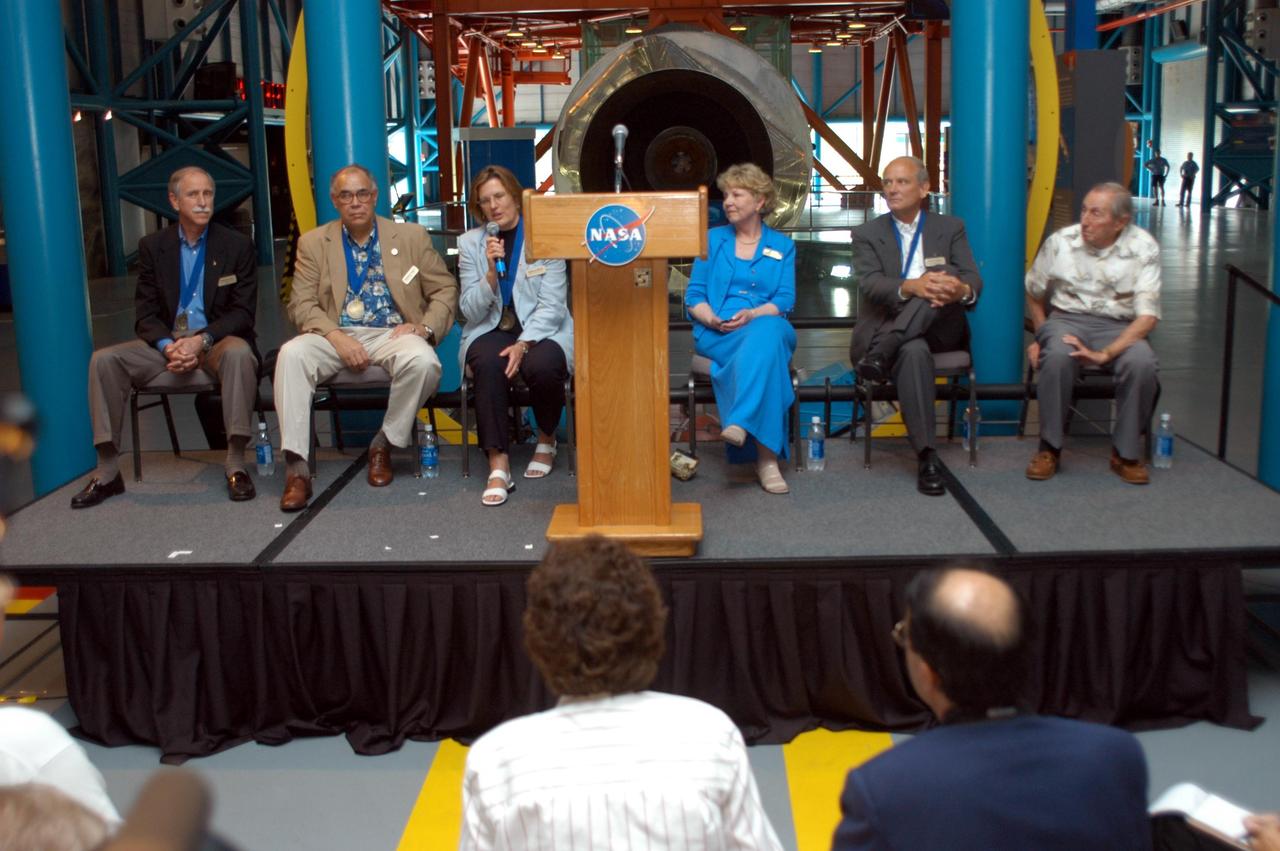
KENNEDY SPACE CENTER, FLA. -- Kathryn D. Sullivan, the first American woman to walk in space, responds to a reporter’s question at a press conference in the Apollo/Saturn V Center following the induction ceremony of five space program heroes into the Astronaut Hall of Fame. Seated (left to right) with her are Richard O. Covey, commander of the Hubble Space Telescope repair mission; Frederick D. Gregory (second from left), the first African-American to command a space mission and the current NASA deputy administrator; Sullivan; June Scobee, representing her late husband Francis R. "Dick" Scobee, commander of the ill-fated 1986 Challenger mission; and Norman E. Thagard, the first American to occupy Russia’s Mir space station. The U.S. Astronaut Hall of Fame opened in 1990 to provide a place where space travelers could be remembered for their participation and accomplishments in the U.S. space program. To be eligible for induction, an individual must have been a U.S. citizen, a NASA astronaut, and out of the active astronaut corps at least five years. The five inductees join 52 previously honored astronauts from the ranks of the Gemini, Apollo, Skylab, Apollo-Soyuz, and Space Shuttle programs.
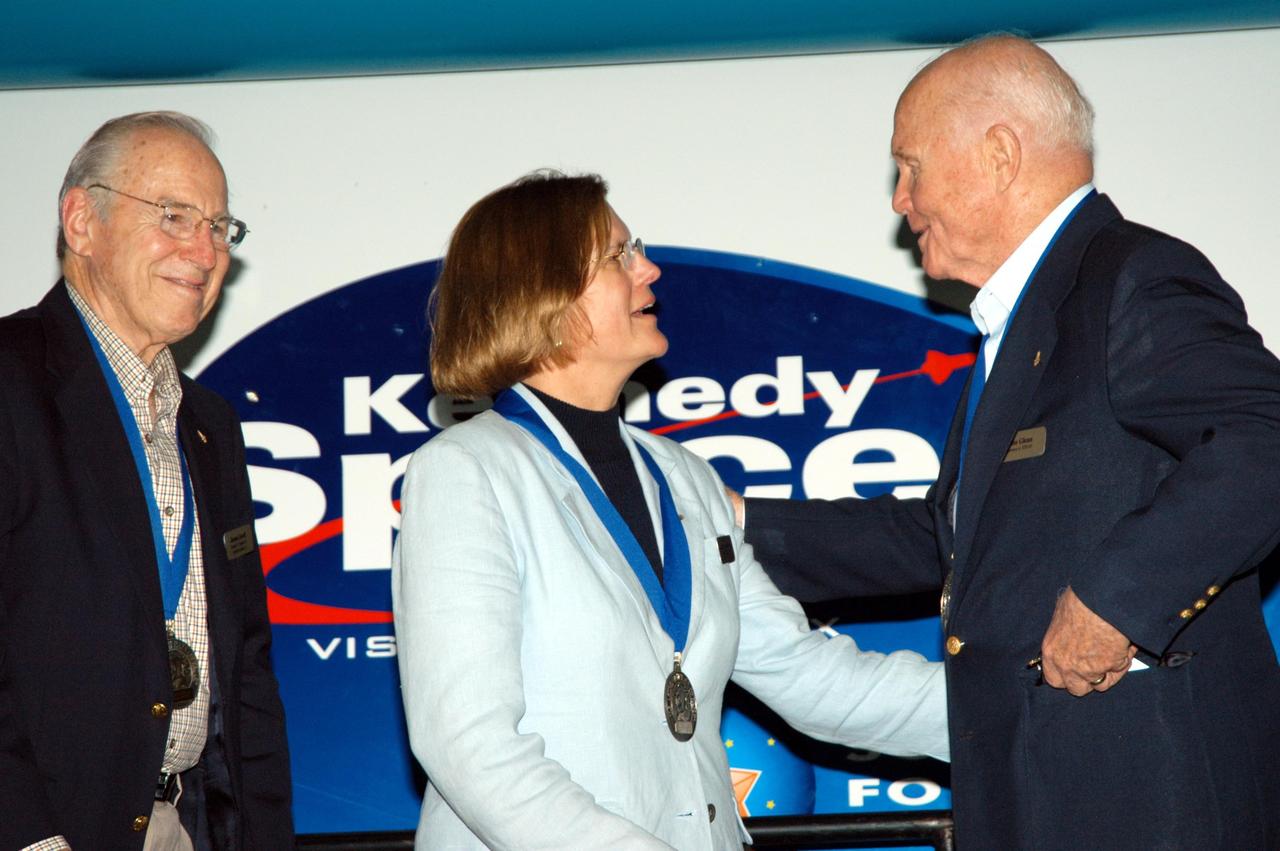
KENNEDY SPACE CENTER, FLA. -- At the Kennedy Space Center Visitor Complex, former NASA astronaut John H. Glenn Jr. (right) congratulates former NASA astronaut and fellow Ohioan Kathryn D. Sullivan on her induction into the U.S. Astronaut Hall of Fame. Former NASA astronaut James A. Lovell Jr. looks on (left). Sullivan was the first American woman to walk in space. Also chosen for this honor in 2004 are Richard O. Covey, commander of the Hubble Space Telescope repair mission; Frederick D. Gregory, the first African-American to command a space mission; Norman E. Thagard, the first American to occupy Russia's Mir space station; and the late Francis R. "Dick" Scobee, commander of the ill-fated 1986 Challenger mission. The U.S. Astronaut Hall of Fame opened in 1990 to provide a place where space travelers could be remembered for their participation and accomplishments in the U.S. space program. To be eligible for induction, an individual must have been a U.S. citizen, a NASA astronaut, and out of the active astronaut corps at least five years. The five inductees join 52 previously honored astronauts from the ranks of the Gemini, Apollo, Skylab, Apollo-Soyuz, and Space Shuttle programs.

KENNEDY SPACE CENTER, FLA. -- At the Kennedy Space Center Visitor Complex, former NASA astronaut John H. Glenn Jr. (right) congratulates former NASA astronaut and fellow Ohioan Kathryn D. Sullivan on her induction into the U.S. Astronaut Hall of Fame. Former NASA astronaut James A. Lovell Jr. looks on (left). Sullivan was the first American woman to walk in space. Also chosen for this honor in 2004 are Richard O. Covey, commander of the Hubble Space Telescope repair mission; Frederick D. Gregory, the first African-American to command a space mission; Norman E. Thagard, the first American to occupy Russia's Mir space station; and the late Francis R. "Dick" Scobee, commander of the ill-fated 1986 Challenger mission. The U.S. Astronaut Hall of Fame opened in 1990 to provide a place where space travelers could be remembered for their participation and accomplishments in the U.S. space program. To be eligible for induction, an individual must have been a U.S. citizen, a NASA astronaut, and out of the active astronaut corps at least five years. The five inductees join 52 previously honored astronauts from the ranks of the Gemini, Apollo, Skylab, Apollo-Soyuz, and Space Shuttle programs.
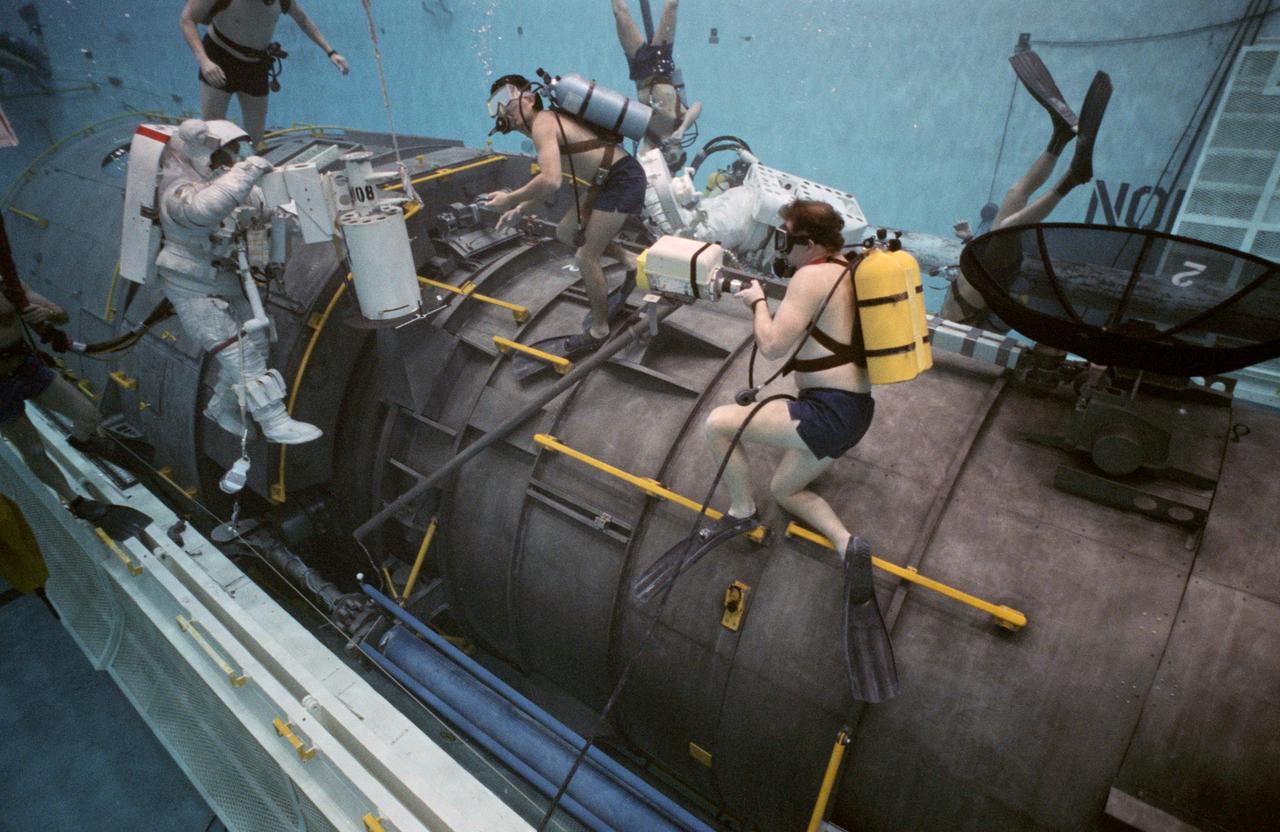
STS-31 Mission Specialist (MS) Bruce McCandless II (left), wearing an extravehicular mobility unit (EMU), maneuvers his way around a mockup of the remote manipulator system (RMS) end effector during an underwater simulation in JSC's Weightless Environment Training Facility (WETF) Bldg 29 pool. The end effector is attached to a grapple fixture on the Hubble Space Telescope (HST) mockup. As McCandless performs contingency extravehicular activity (EVA) procedures, fellow crewmember MS Kathryn D. Sullivan, in EMU, works on the opposite side of the HST mockup, and SCUBA-equipped divers monitor the activity. Though no EVA is planned for STS-31, the two crewmembers train for contingencies that would necessitate leaving the shirt sleeve environment of Discovery's, Orbiter Vehicle (OV) 103's, crew cabin and performing chores with the HST payload or related hardware in the payload bay (PLB).
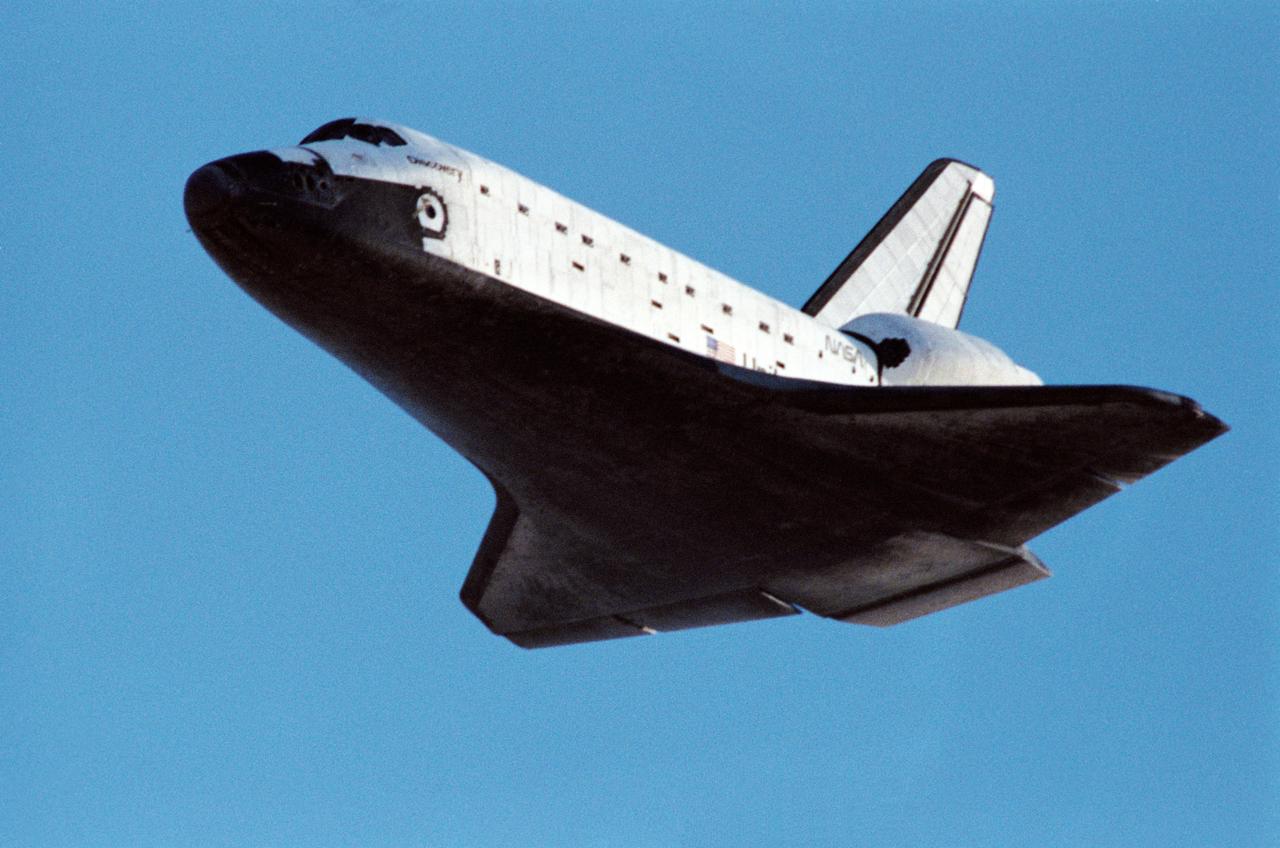
STS031-S-131 (29 April 1990) --- Low angle view of the Space Shuttle Discovery as it approaches for landing on a concrete runway at Edwards Air Force Base to complete a highly successful five-day mission. It was a long awaited Earth orbital flight during which the Hubble Space Telescope (HST) was sent toward its 15-year mission. Discovery's wheels came to a complete stop at 6:51:00 a.m. (PDT), April 29, 1990. The landing gear was deployed just moments after this frame was exposed. Inside the spacecraft for STS-31 were astronauts Loren J. Shriver, Charles F. Bolden, Bruce McCandless II, Kathryn D. Sullivan and Steven A. Hawley.
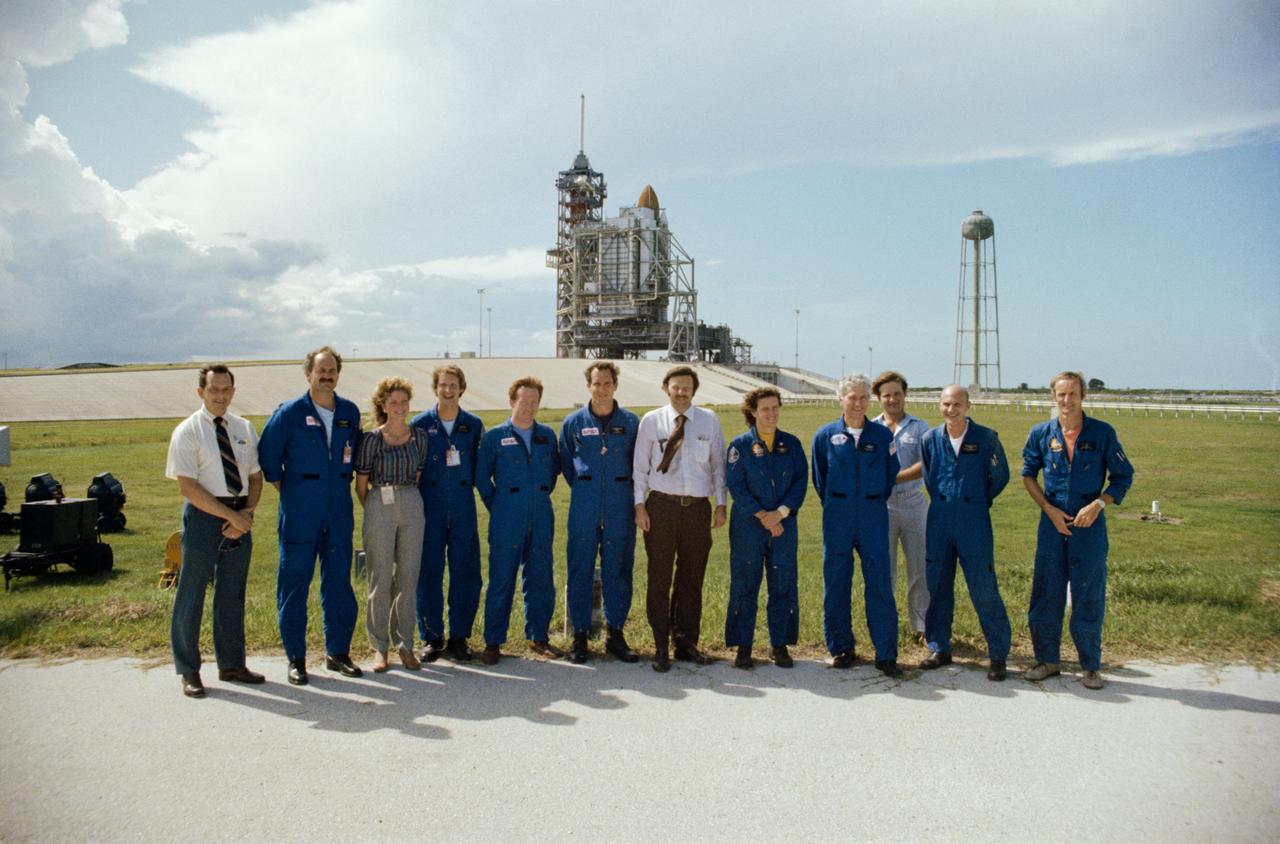
S82-32201 (29 May 1982) --- Members of the JSC astronaut corps, vehicle integration test team (VITT) and other personnel pose for a photograph at the completion of a countdown demonstration test (CDDT) at Launch Pad 39A, Kennedy Space Center (KSC). The participants are, from the left, Wilbur J. Etbauer, engineer with the VITT; mission specialist-astronaut James D. Van Hoften; Terri Stanford, engineer from JSC's flight operations directorate; mission specialist-astronaut Steven A. Hawley; astronaut Richard N. Richards; astronaut Michael J. Smith; Richard W. Nygren, head of the VITT; mission specialist-astronaut Kathryn D. Sullivan; astronaut Henry W. Hartsfield Jr., STS-4 pilot; Mark Haynes, a co-op student participating with the VITT; astronaut Thomas K. Mattingly II, STS-4 commander; and astronaut Donald E. Williams. Photo credit: NASA
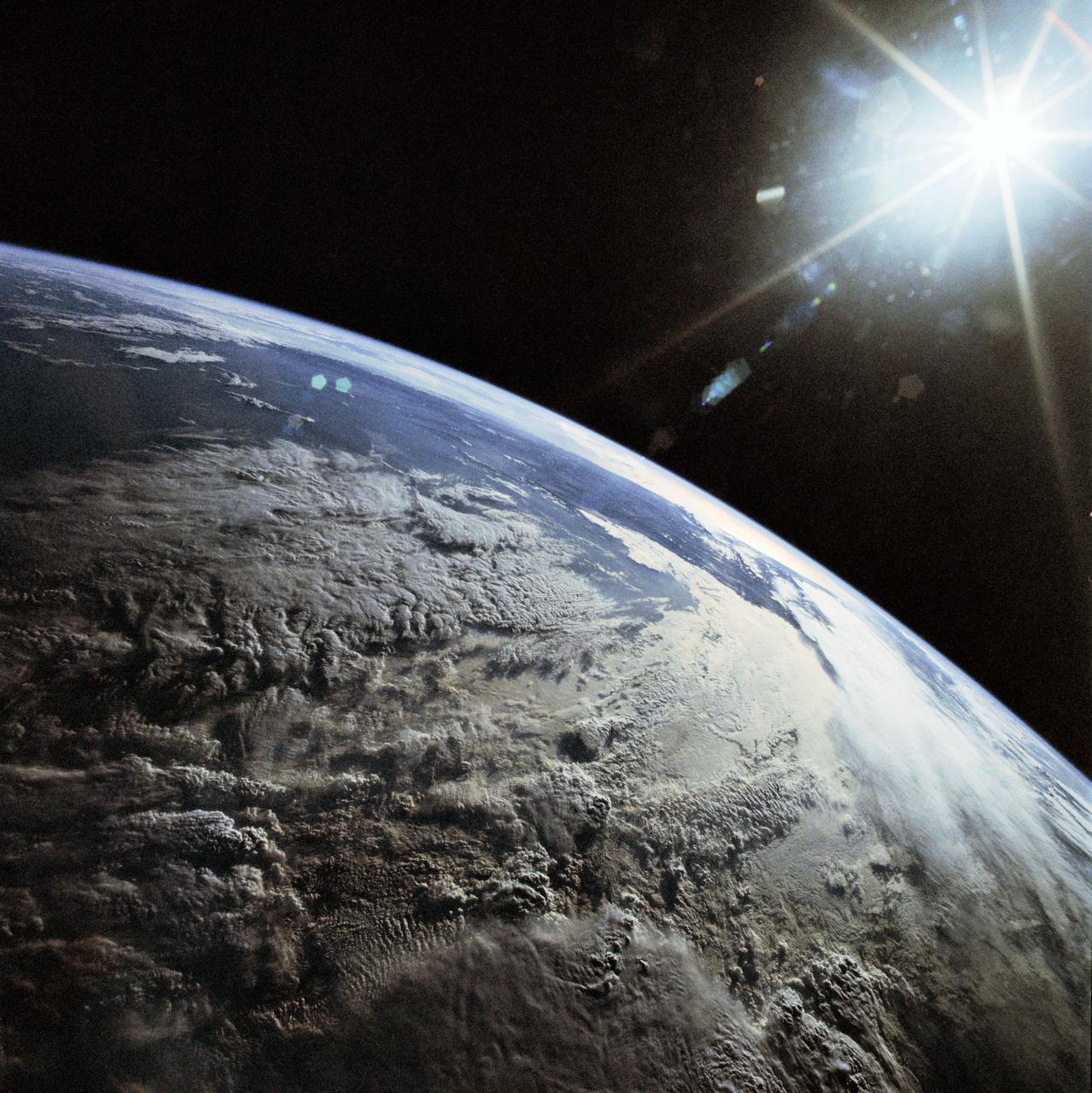
STS031-83-090 (24-29 April 1990) --- This late afternoon scene over the Andes Mountains features sun glare, heavy cloud illumination and sunglint against the Pacific Ocean. This photo was among those selected by the crew members for showing at their May 9, 1990, Post-Flight Press Conference (PFPC) at the Johnson Space Center (JSC) Public Affairs Office (PAO) Facility briefing room. Onboard the Space Shuttle Discovery for the flight, which lifted off on April 24, 1990, and landed on April 29, 1990, were astronauts Loren J. Shriver, Charles F. Bolden, Jr., Bruce McCandless II, Kathryn D. Sullivan and Steven A. Hawley. Some of the slides were not actually shown due to a shortage of time.
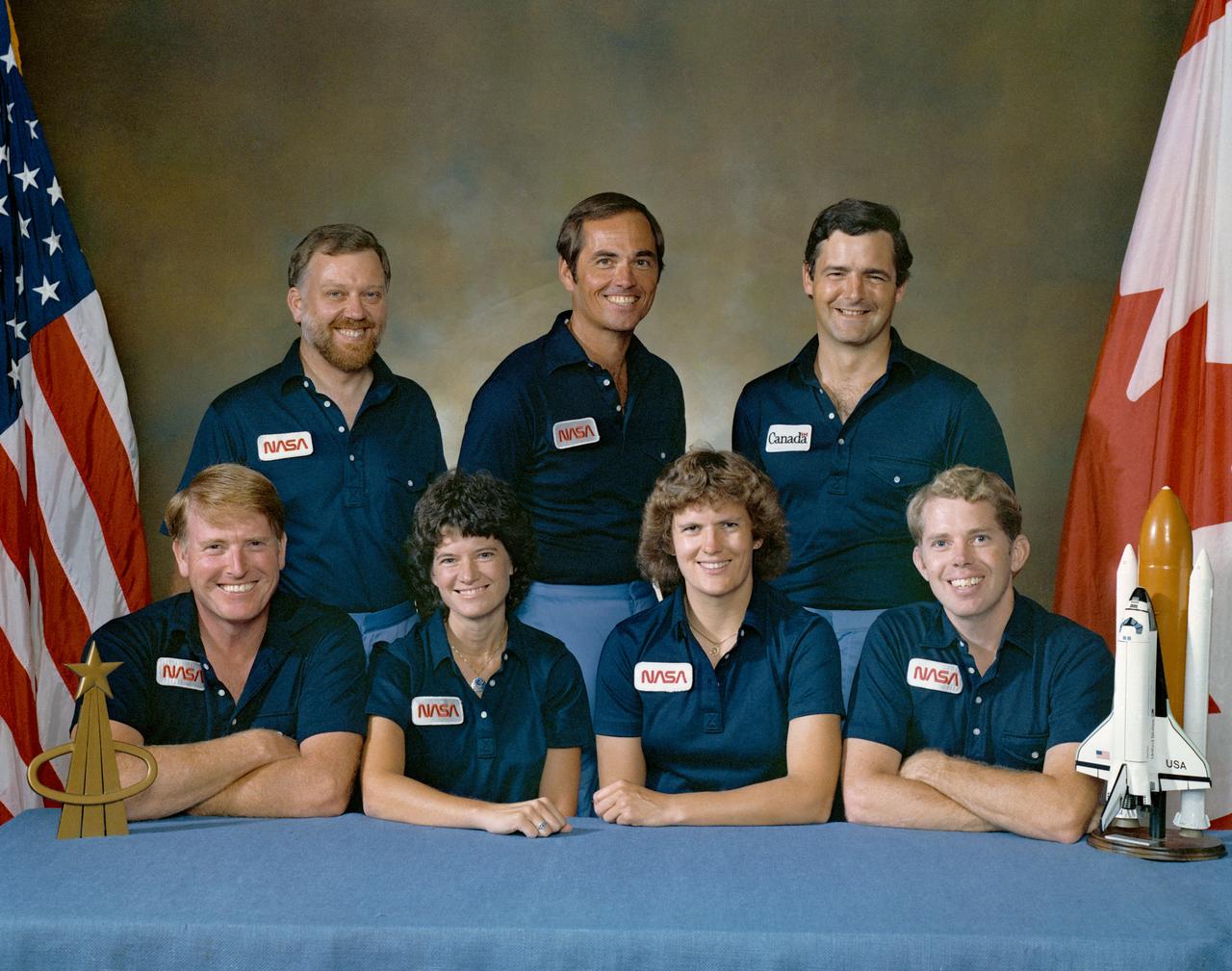
S84-37981 (20 July 1984) --- The space shuttle Challenger will carry these seven persons into space for NASA's STS-41G mission scheduled for October 1984. They are (bottom row, left to right) astronauts Jon A. McBride, pilot; and Sally K. Ride, Kathryn D. Sullivan and David C. Leestma -- all mission specialists. Astronaut Robert L. Crippen crew commander, is flanked by Paul D. Scully-Power and Marc Garneau, both payload specialists. Scully-Power is an oceanographer for the U.S. Navy and Garneau represents the National Research Council (Canada). The replica of a gold astronaut pin near McBride signifies unity. The group represents the largest space shuttle crew thus far. Photo credit: NASA
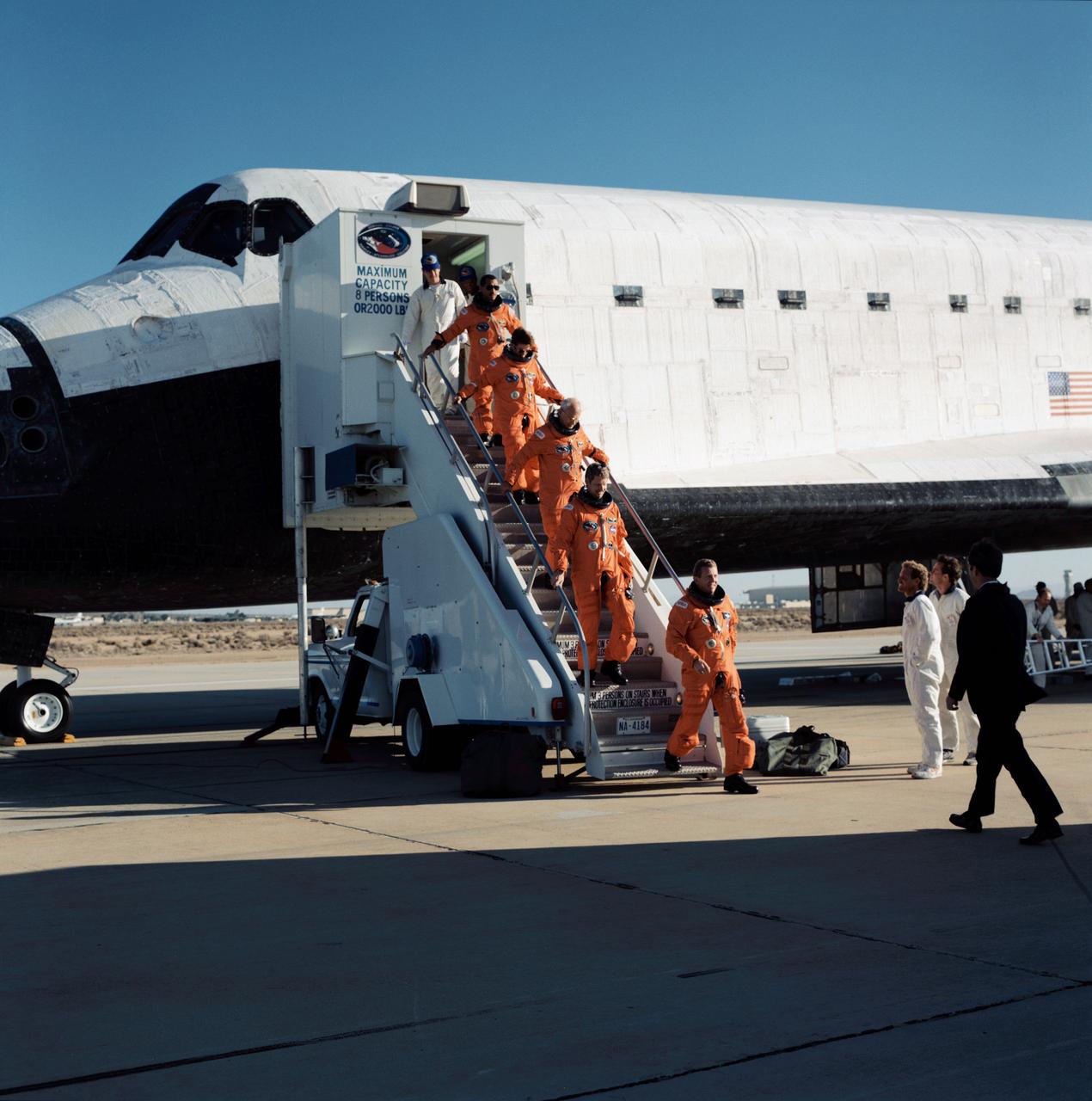
STS031-S-129 (29 April 1990) --- The astronauts of STS-31 egress the Space Shuttle Discovery following a smooth landing on the runway at Edwards Air Force Base to complete a highly successful five-day mission. Approaching from the far right to greet the crew is Dr. William B. Lenoir, NASA's Acting Associate Administrator for Space Flight. Leading the way down the steps is astronaut Loren J. Shriver, mission commander, followed by (in order from bottom of steps) astronauts Steven A. Hawley, Bruce McCandless II and Kathryn D. Sullivan, all mission specialists; and Charles F. Bolden Jr., pilot. Theirs was an Earth-orbital flight during which the Hubble Space Telescope (HST) was sent toward its 15-year mission.
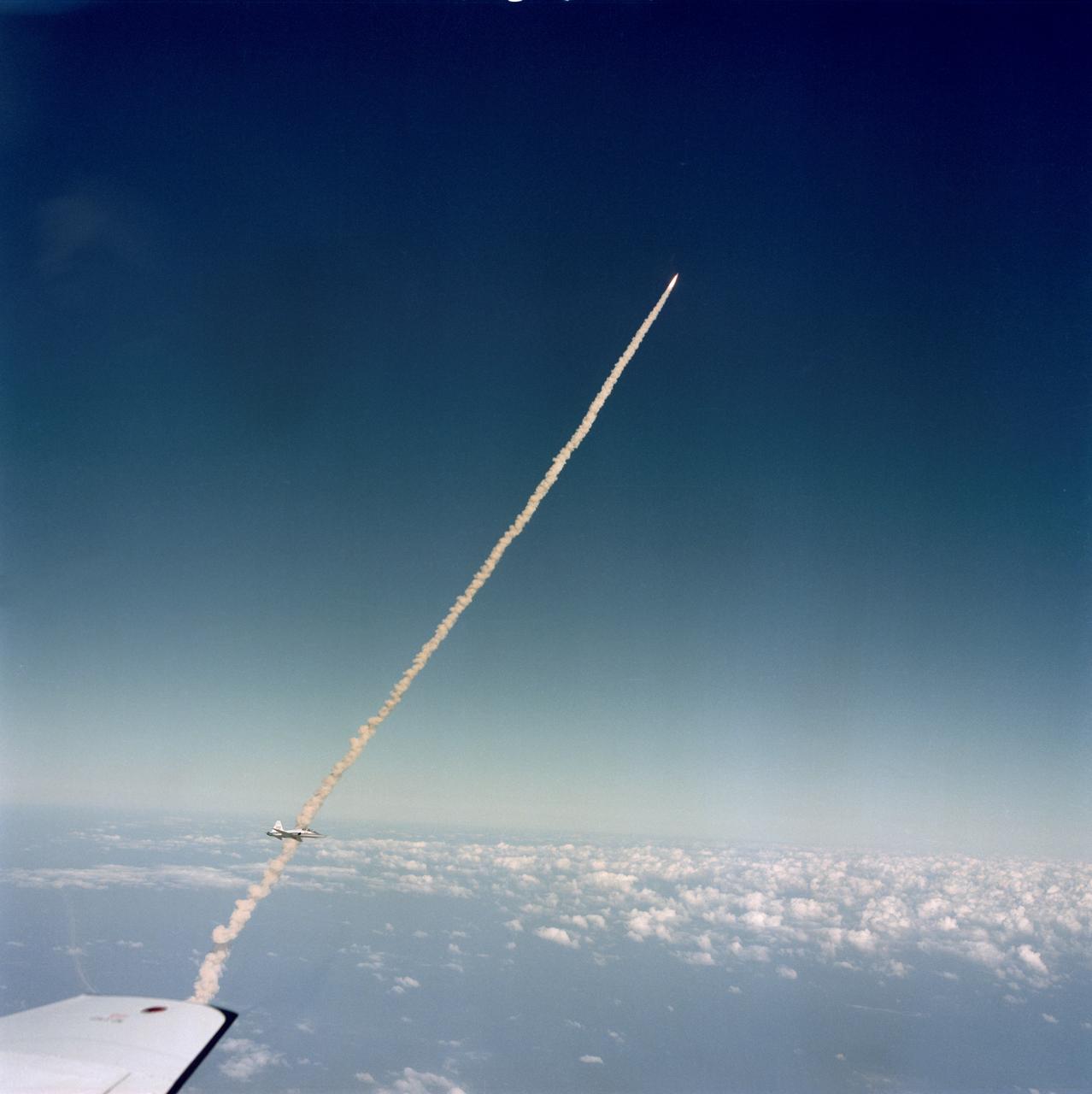
S81-39527 (12 Nov. 1981) --- This photograph of the STS-2 crew and the space shuttle Columbia soaring toward Earth orbit was captured with a hand-held 70mm camera (using an 80mm lens) operated from the rear station of a T-38 jet aircraft. Mission specialist-astronaut Kathryn D. Sullivan took the picture, and part of the wing tip of her aircraft can be seen in lower left corner. Astronaut John W. Young piloting NASA?s shuttle training aircraft (STA) was taking pictures from a higher angle. A close look can delineate his craft above the orbiter and supportive elements, almost perpendicular to them from this point of view. Another T-38 jet, with a TV camera operator as back-seat passenger, can be seen at lower left corner near the smoke trails from the shuttle. Photo credit: NASA
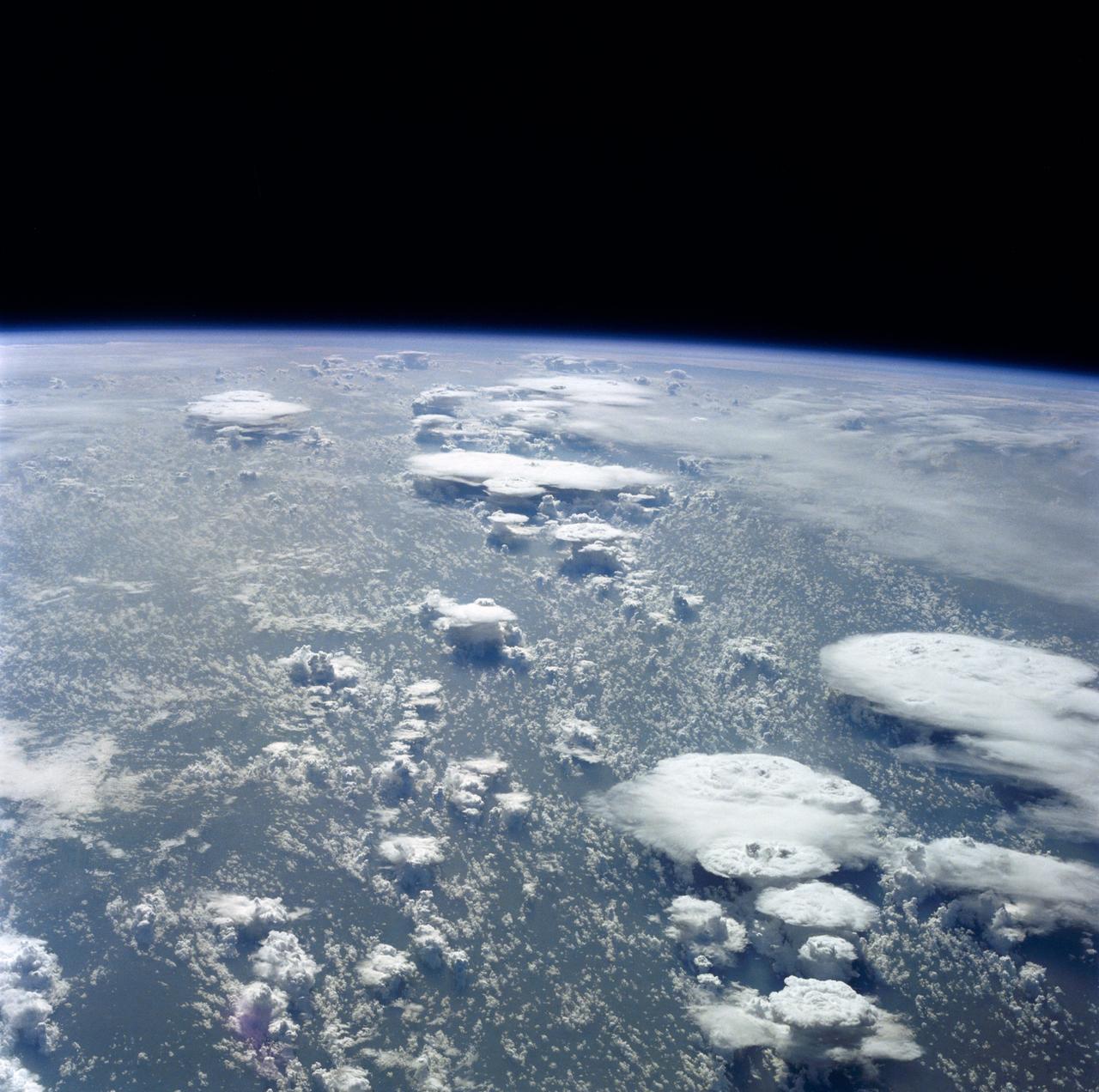
41G-39-044 (5-13 Oct 1984) --- "Flatirons", cumulonimbus clouds that have flattened out at a high altitude, the result of rapidly rising moist air. At a given altitude, depending on the temperature, wind, and humidity, the cloud mass can no longer rise and the wind aloft shears the cloud. Central Nigeria, an area in which tropical rain forest gives way to dryer savannah lands, lies beneath a layer a heavy haze and smoke. The crew consisted of astronauts Robert L. Crippen, commander; Jon A. McBride, pilot; mission specialist's Kathryn D. Sullivan, Sally K. Ride, and David D. Leestma; Canadian astronaut Marc Garneau, and Paul D. Scully-Power, payload specialist's.