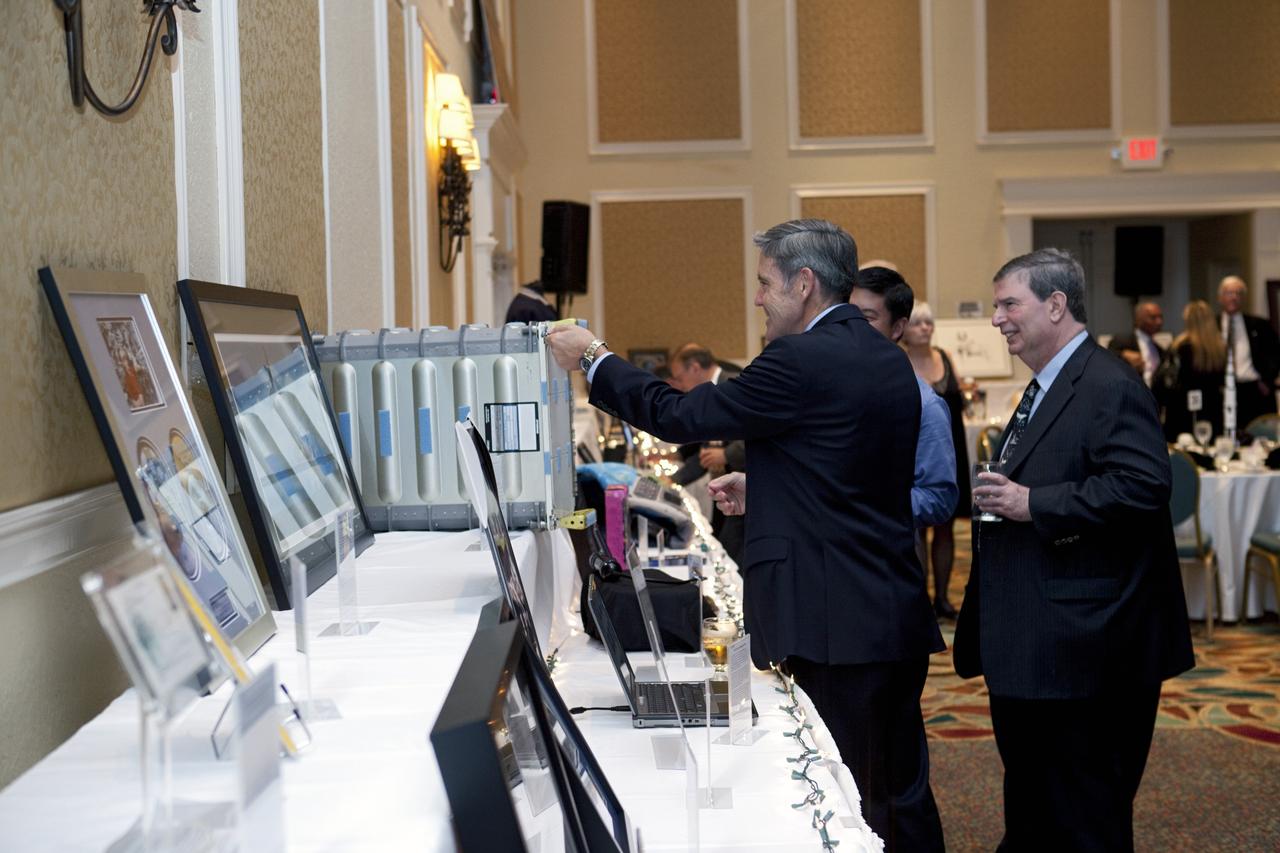
CAPE CANAVERAL, Fla. – Kennedy Space Center Director Bob Cabana checks out an item available for auction at the Astronaut Scholarship Foundation's dinner at the Radisson Resort at the Port in Cape Canaveral celebrating the 40th anniversary of Apollo 17. The auction of space-related memorabilia was held with proceeds supporting college scholarships for students who exhibit imagination and exceptional performance in science, technology, engineering and math. The gala commemorating the anniversary of Apollo 17 included mission commander Eugene Cernan and other astronauts who flew Apollo missions. Launched Dec. 7, 1972, Cernan and lunar module pilot Harrison Schmitt landed in the moon's Taurus-Littrow highlands while command module pilot Ronald Evans remained in lunar orbit operating a scientific instrument module. For more information, visit http://www-pao.ksc.nasa.gov/history/apollo/apollo-17/apollo-17.htm Photo credit: NASA/Kim Shiflett
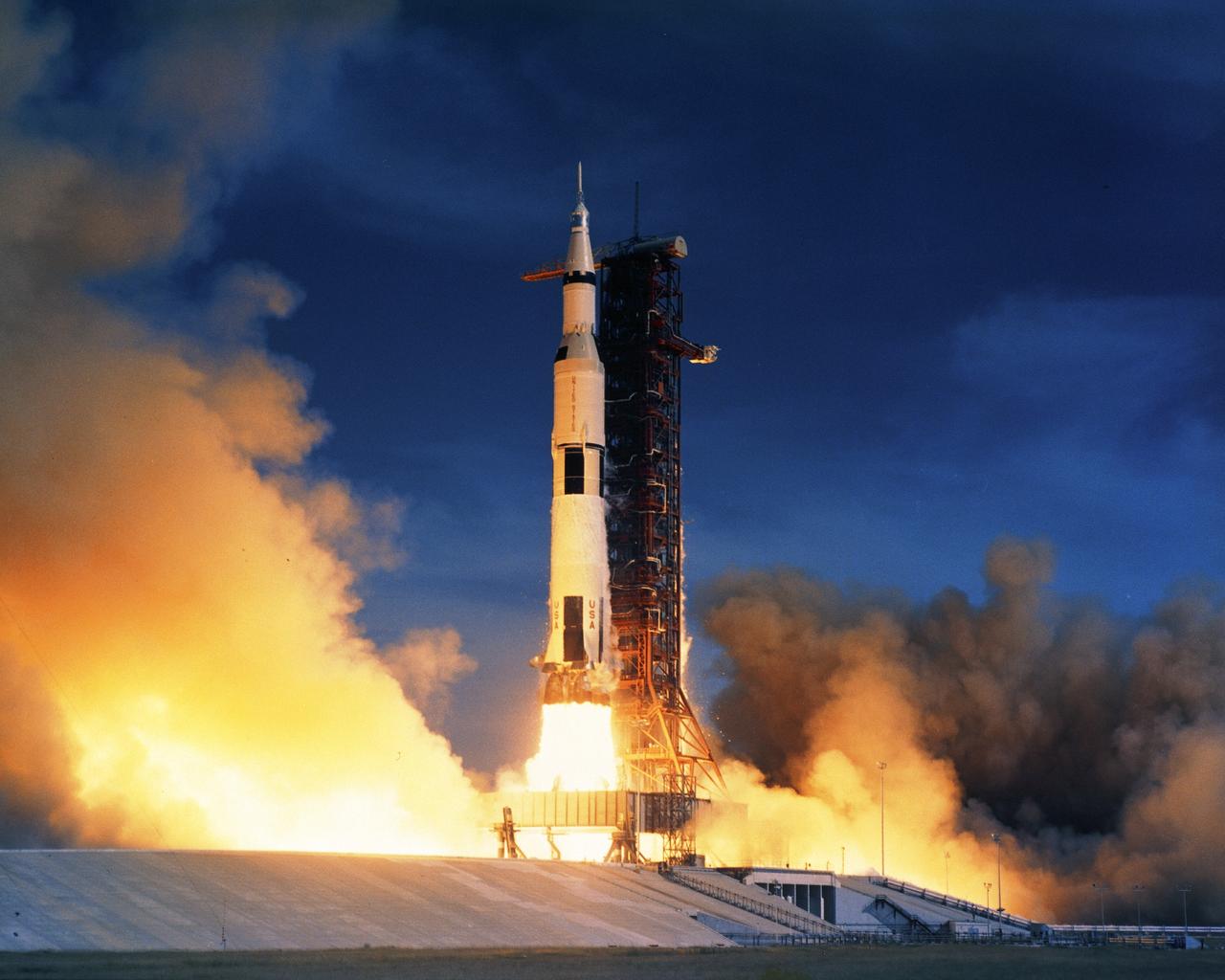
CAPE CANAVERAL, Fla. - At NASA's Kennedy Space Center in Florida, Apollo 15's Saturn V rocket lifts off from Launch Pad 39A at 9:34 a.m., EDT, July 26, 1971, on a lunar landing mission. Aboard the Apollo 15 spacecraft are astronauts David R. Scott, commander, Alfred M. Worden, command module pilot, and James B. Irwin, lunar module pilot. While Apollo 15 astronauts Scott and Irwin will descend in the lunar module to explore the moon's Hadley-Apennine region, astronaut Worden will remain in lunar orbit with the command module. For more information, visit http://www-pao.ksc.nasa.gov/history/apollo/apollo-15/apollo-15.htm Photo credit: NASA
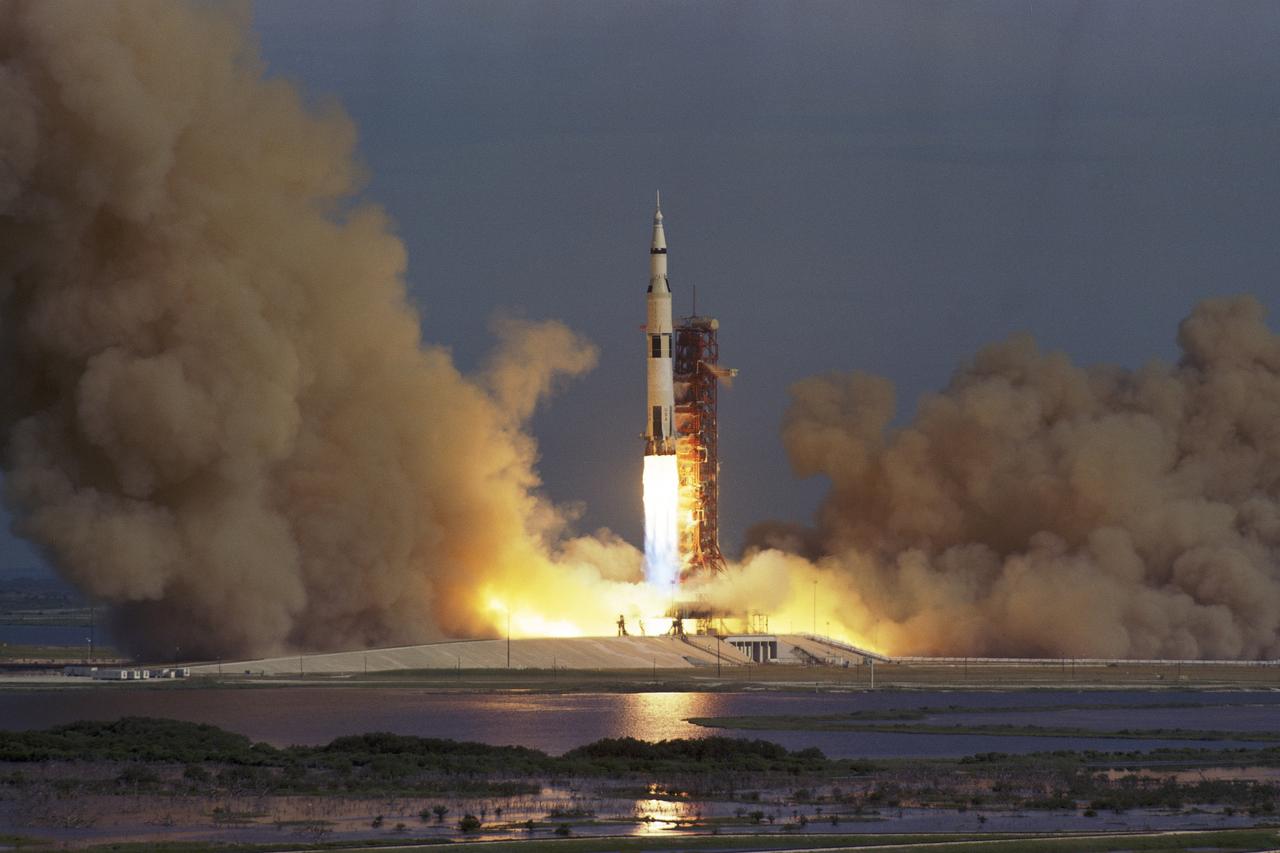
CAPE CANAVERAL, Fla. - At NASA's Kennedy Space Center in Florida, Apollo 15's Saturn V rocket lifts off from Launch Pad 39A at 9:34 a.m., EDT, July 26, 1971, on a lunar landing mission. Aboard the Apollo 15 spacecraft are astronauts David R. Scott, commander, Alfred M. Worden, command module pilot, and James B. Irwin, lunar module pilot. While Apollo 15 astronauts Scott and Irwin will descend in the lunar module to explore the moon's Hadley-Apennine region, astronaut Worden will remain in lunar orbit with the command module. For more information, visit http://www-pao.ksc.nasa.gov/history/apollo/apollo-15/apollo-15.htm Photo credit: NASA
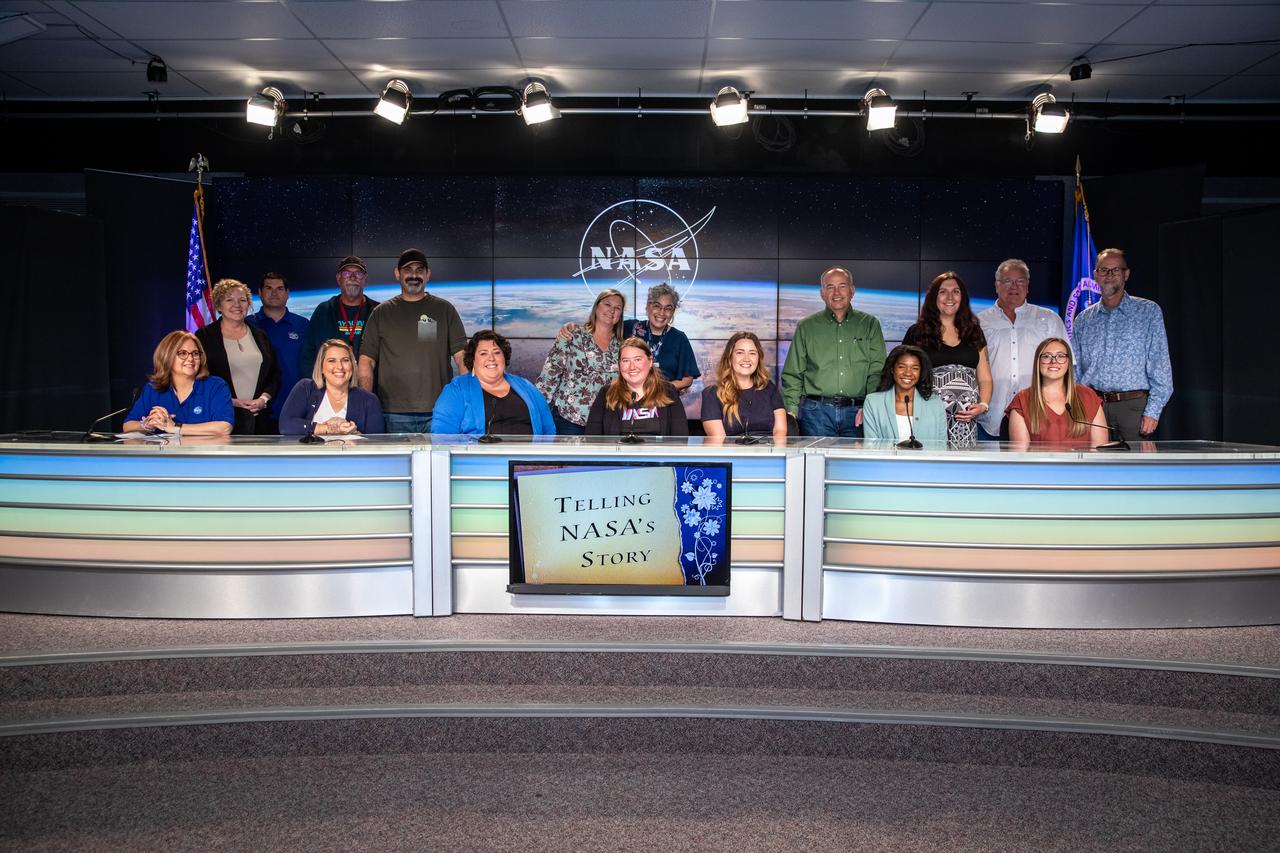
Employees who work at NASA’s Kennedy Space Center Press Site are photographed inside the News Auditorium at the Florida spaceport on March 23, 2023, following a panel discussion held to commemorate Women’s History Month. The event, titled “Celebrating the Women Who Tell Our Stories,” included women who typically work behind the scenes sharing what goes into conceiving, creating, and curating NASA stories. Panelists included Kennedy’s news chief, members of the broadcast team, public affairs specialists, a video producer, and a writer.
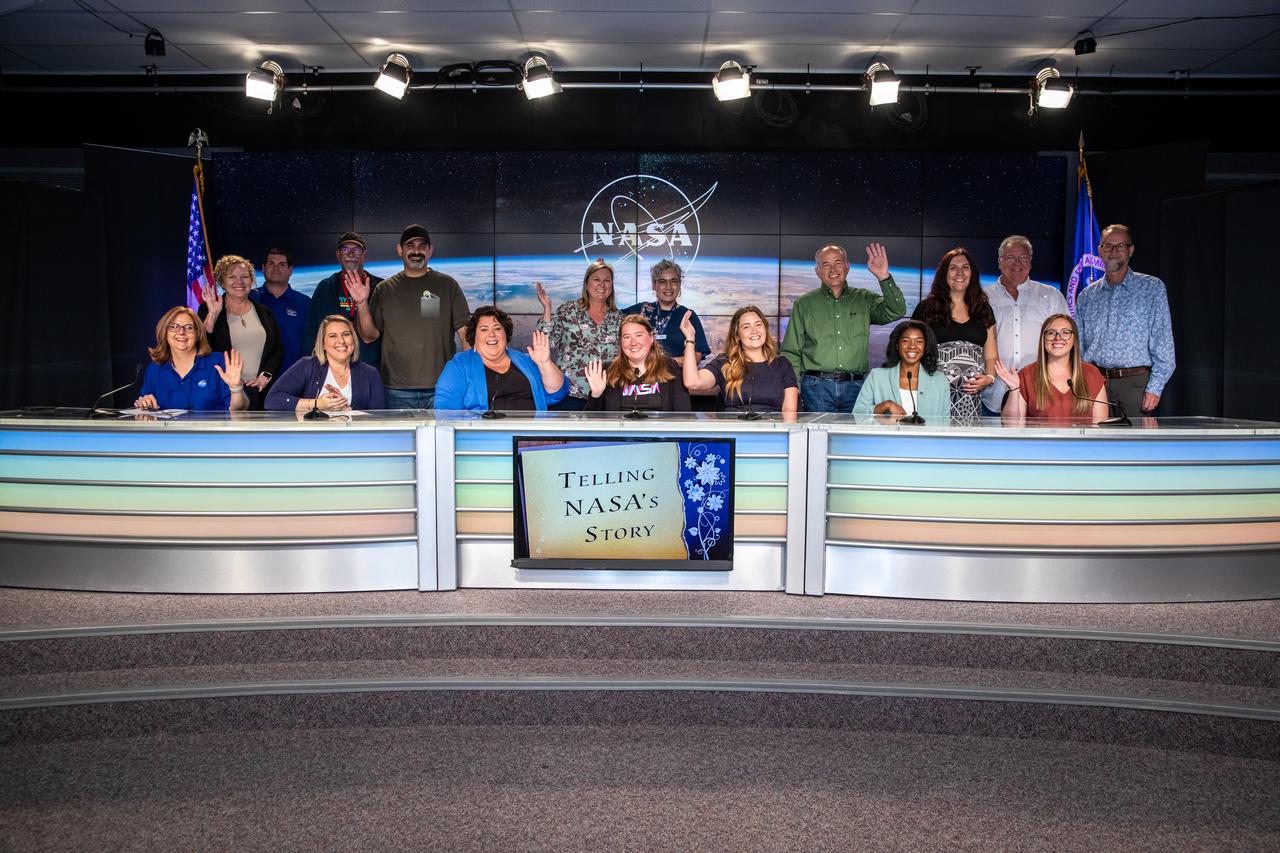
Employees who work at NASA’s Kennedy Space Center Press Site are photographed inside the News Auditorium at the Florida spaceport on March 23, 2023, following a panel discussion held to commemorate Women’s History Month. The event, titled “Celebrating the Women Who Tell Our Stories,” included women who typically work behind the scenes sharing what goes into conceiving, creating, and curating NASA stories. Panelists included Kennedy’s news chief, members of the broadcast team, public affairs specialists, a video producer, and a writer.
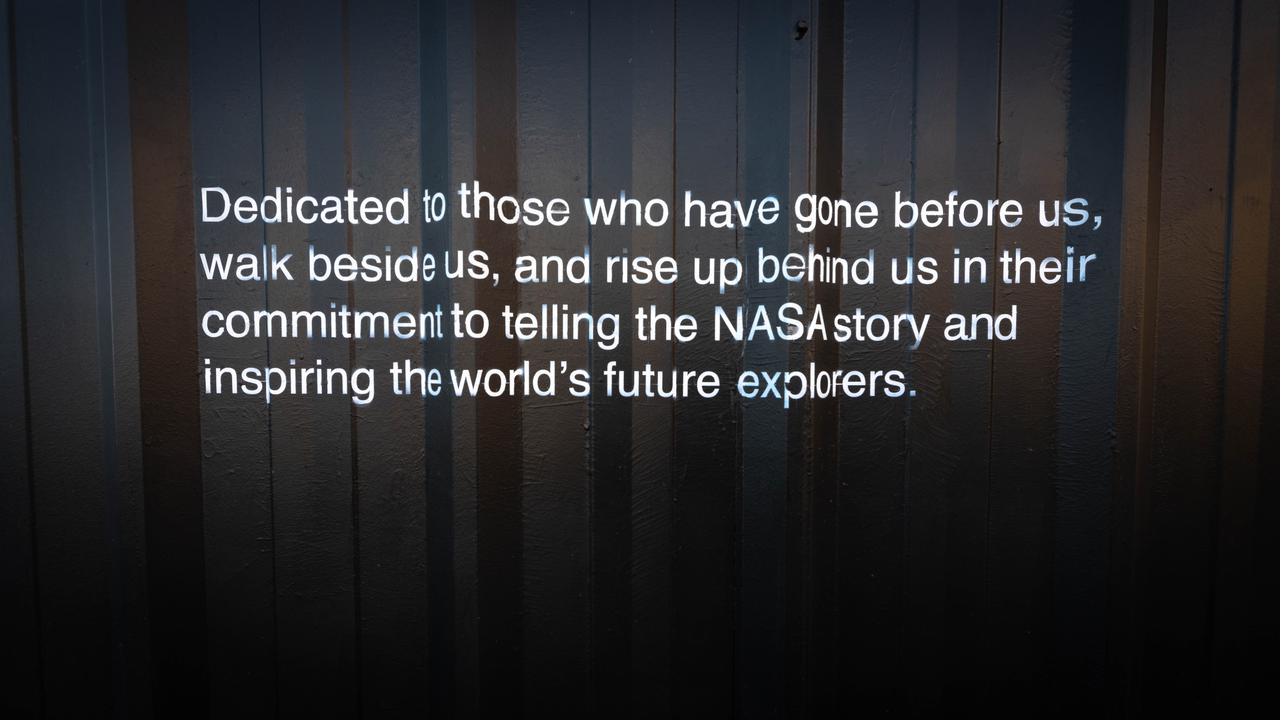
A dedication to those who tell the NASA story is part of a mural painted by Florida artist Christopher Maslow on the northwest exterior wall of the Press Site News Facility at NASA’s Kennedy Space Center in Florida, photographed on Jan. 10, 2022. Completed by the artist over the course of several months during 2021, the largescale artwork depicts notable landmarks, missions, and milestones from the history of NASA and its world-famous spaceport. The Press Site News Facility is the hub of launch broadcasts and home to the center’s TV auditorium. Along with the nearby NASA News Center, for decades Kennedy’s Press Site has been where reporters from television, radio, print, and online media outlets have monitored countless launches, landings, and other space events in order to deliver the news to the world.
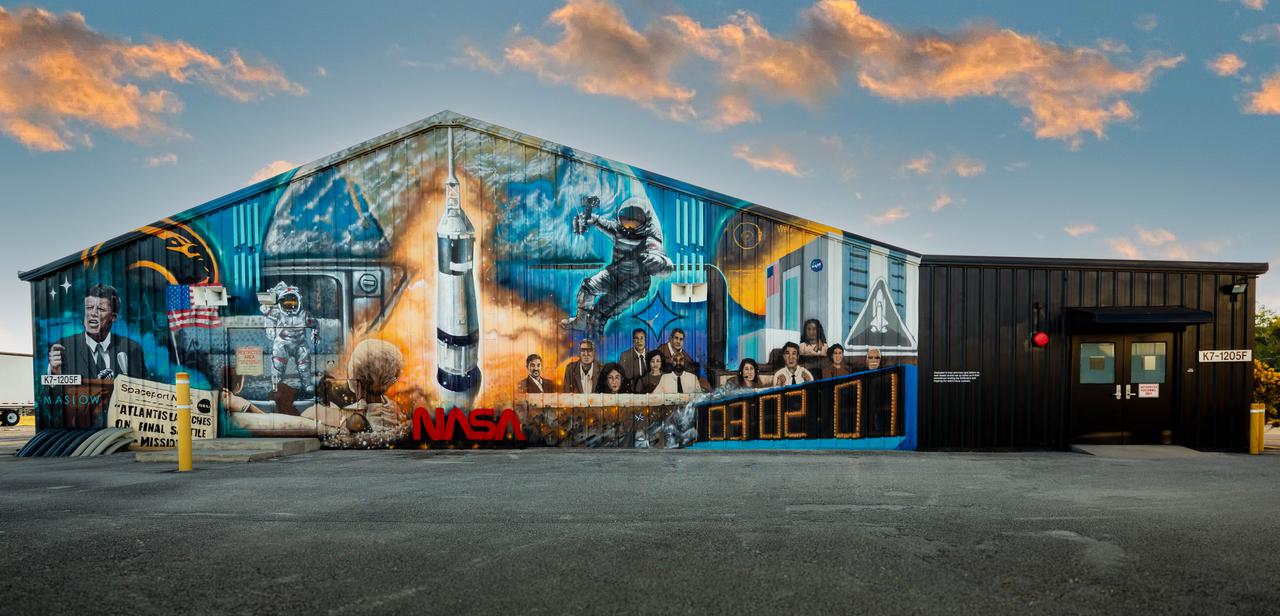
A mural painted by Florida artist Christopher Maslow adorns the northwest exterior wall of the Press Site News Facility at NASA’s Kennedy Space Center in Florida on Jan. 10, 2022. Completed by the artist over the course of several months during 2021, the largescale artwork depicts notable landmarks, missions, and milestones from the history of NASA and its world-famous spaceport. The Press Site News Facility is the hub of launch broadcasts and home to the center’s TV auditorium. Along with the nearby NASA News Center, for decades Kennedy’s Press Site has been where reporters from television, radio, print, and online media outlets have monitored countless launches, landings, and other space events in order to deliver the news to the world.
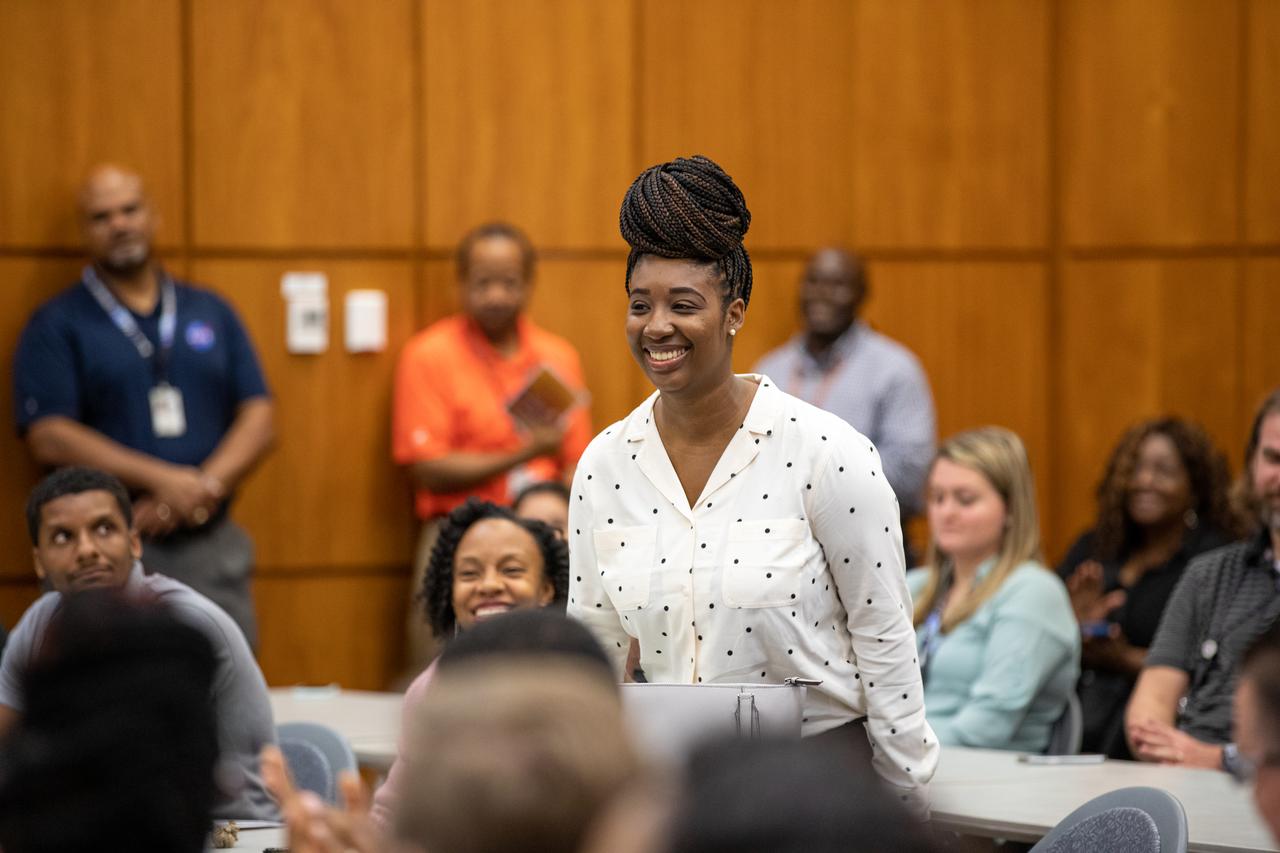
Jakebia Keith, program and contract analyst for the IT Resources Management Office and secretary for the Black Employee Strategy Team (BEST), one of the center’s employee resource groups, stands during recognition at the Black History Month celebration on Feb. 18, 2020, at NASA’s Kennedy Space Center in Florida. The program was organized by BEST. This year’s theme was “African Americans and the Vote.” James Jennings, former NASA associate administrator for Institutions and Management and former Kennedy Space Center deputy director, was keynote speaker at the event.
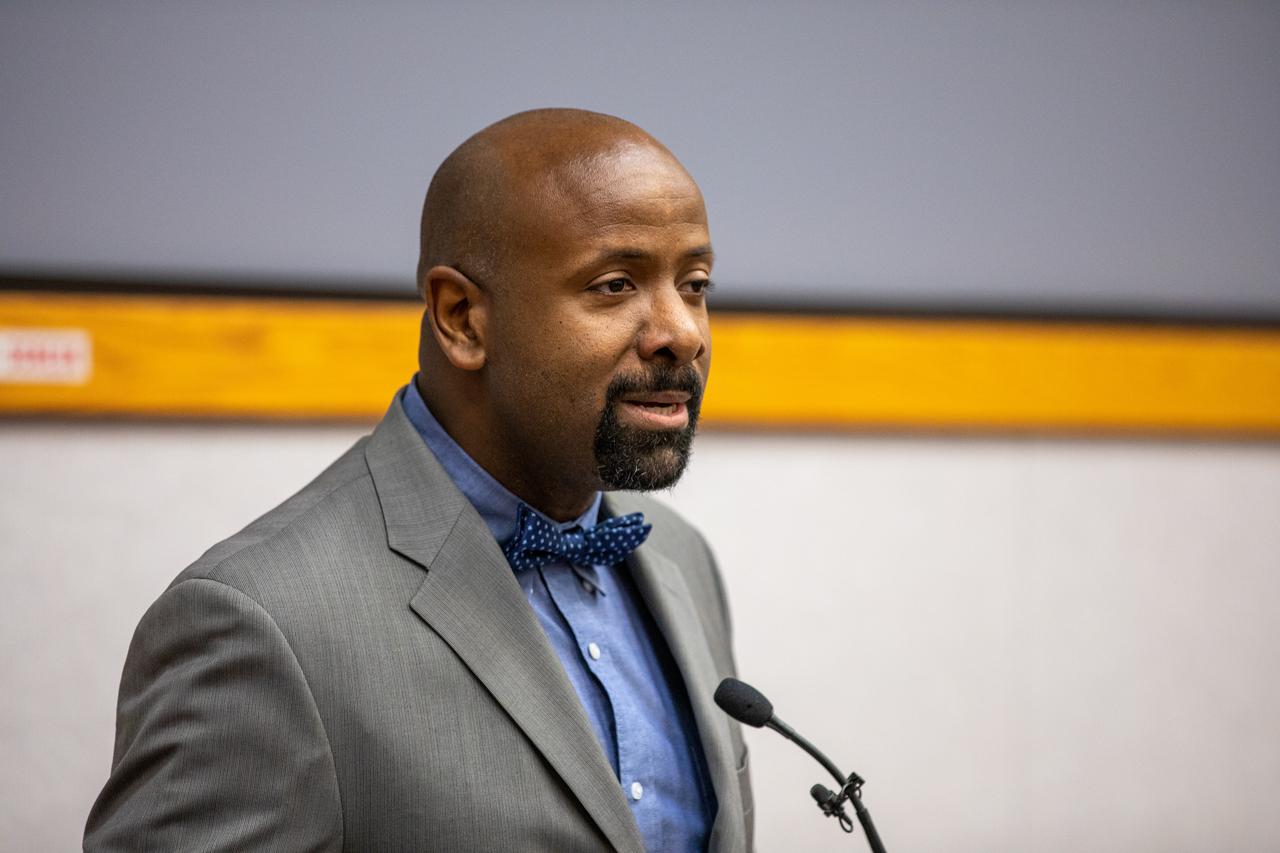
Martin Hayes, program analyst with Exploration Ground Systems and chairperson of the Black Employee Strategy Team (BEST), one of the center’s employee resource groups, speaks to attendees during a Black History Month celebration on Feb. 18, 2020, at NASA’s Kennedy Space Center in Florida. The program was organized by BEST. This year’s theme was “African Americans and the Vote.” James Jennings, former NASA associate administrator for Institutions and Management and former Kennedy Space Center deputy director, was keynote speaker at the event.
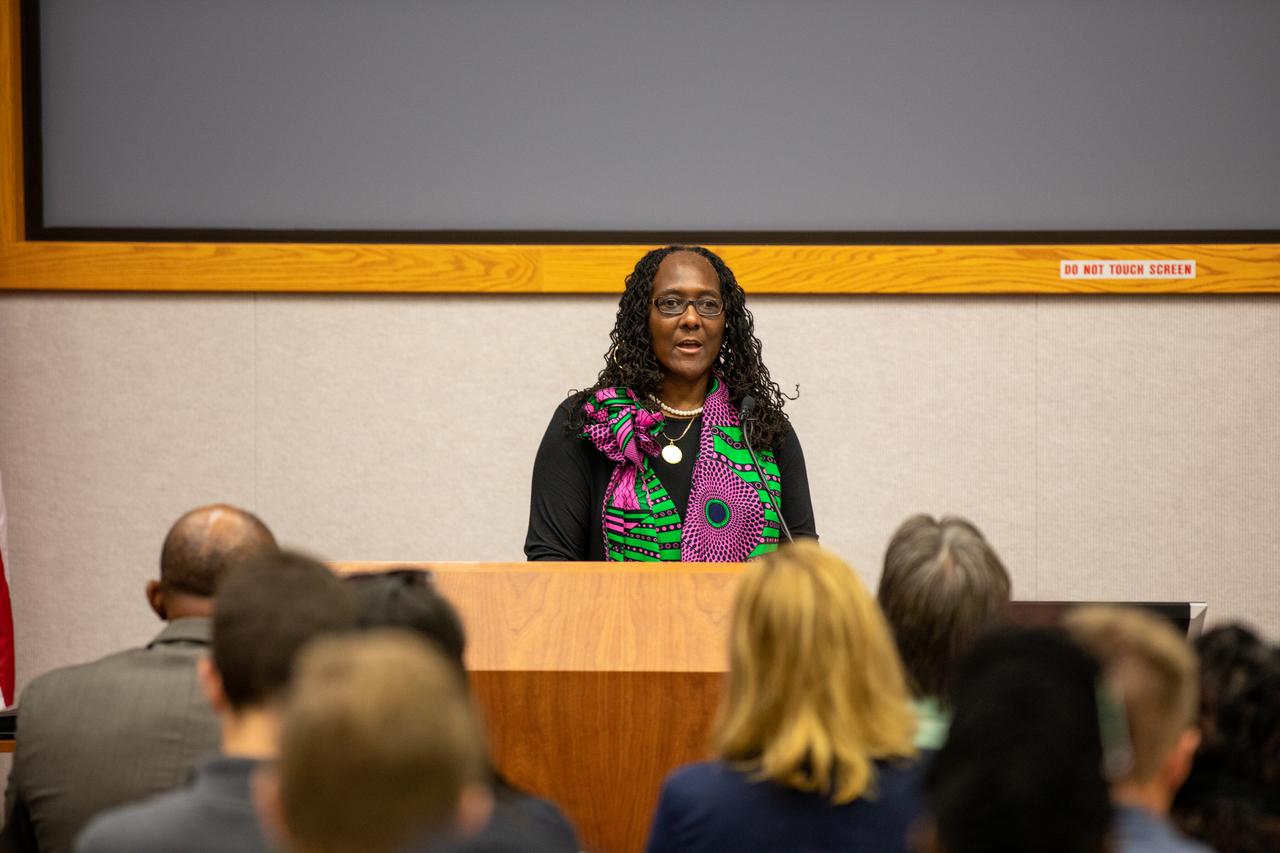
During a Black History Month celebration on Feb. 18, 2020 at NASA’s Kennedy Space Center in Florida, Hortense Diggs, director of Communication and Public Engagement, commemorates the contributions of former NASA employee and mentor Roslyn McKinney. The program was organized by the Black Employee Strategy Team (BEST), one of the center’s employee resource groups. This year’s theme was “African Americans and the Vote.” Keynote speaker was James Jennings, former NASA associate administrator for Institutions and Management and Kennedy’s former deputy director. Jennings shared advice with workers and managers.
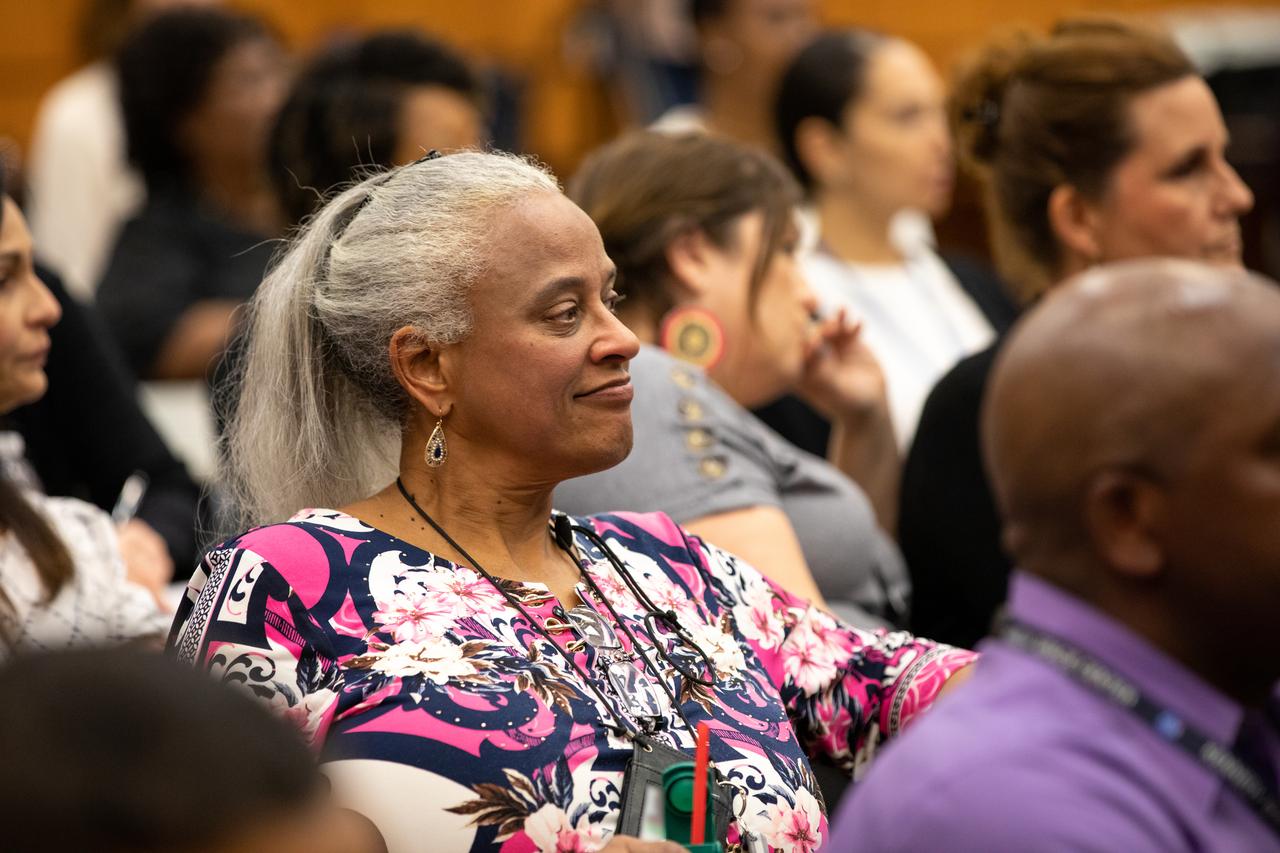
NASA and contractor workers attend a Black History Month celebration at Kennedy Space Center in Florida on Feb. 18, 2020. James Jennings, former NASA associate administrator for Institutions and Management and former Kennedy Space Center deputy director, was the keynote speaker. The program was organized by the Black Employee Strategy Team (BEST), one of the center’s employee resource groups. This year’s theme was “African Americans and the Vote.” Jennings shared advice with workers and managers.
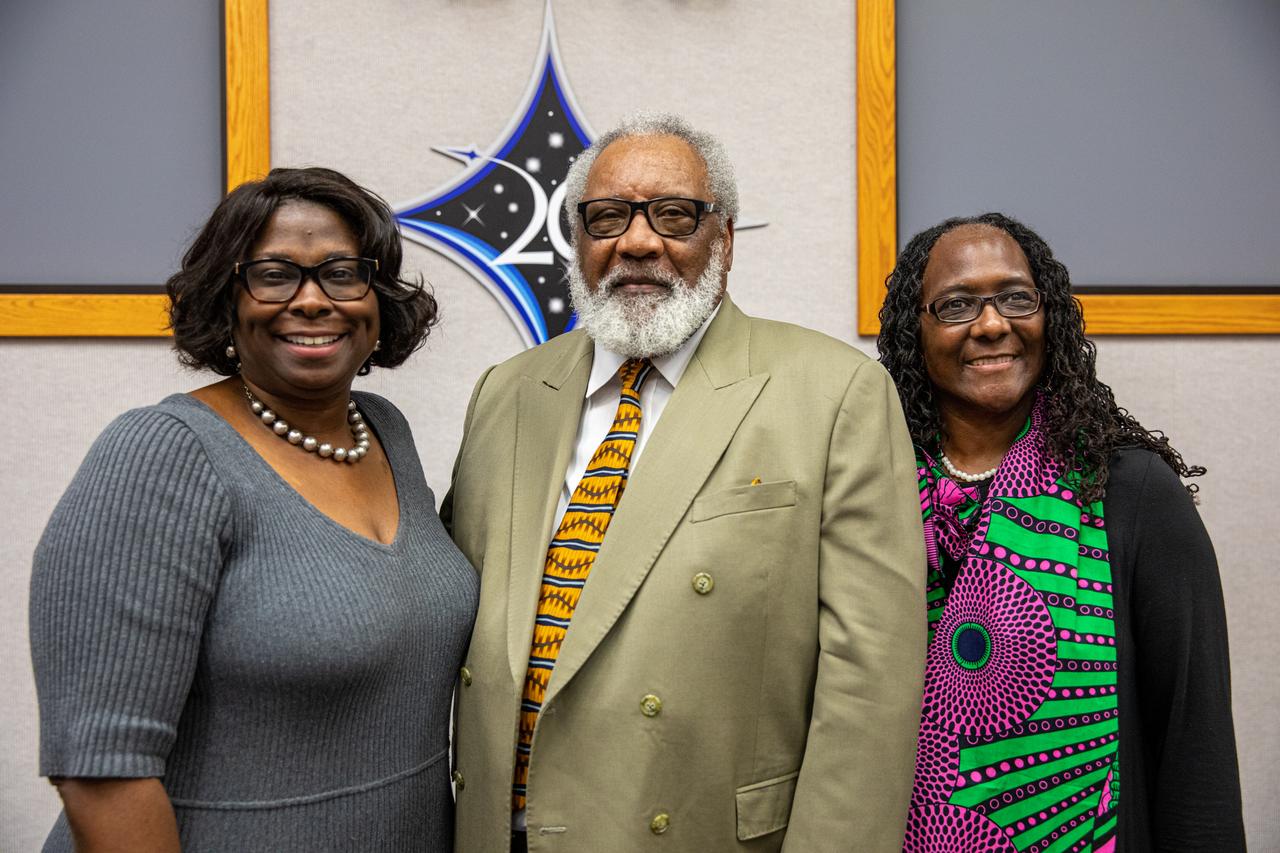
A Black History Month celebration was held on Feb. 18, 2020 at NASA’s Kennedy Space Center in Florida. The program was organized by the Black Employee Strategy Team (BEST), one of the center’s employee resource groups. This year’s theme was “African Americans and the Vote.” From left are Kim Carter, associate program manager, Exploration Ground Systems; James Jennings, keynote speaker, former NASA associate administrator for Institutions and Management and Kennedy’s former deputy director; and Hortense Diggs, director of Communication and Public Engagement.
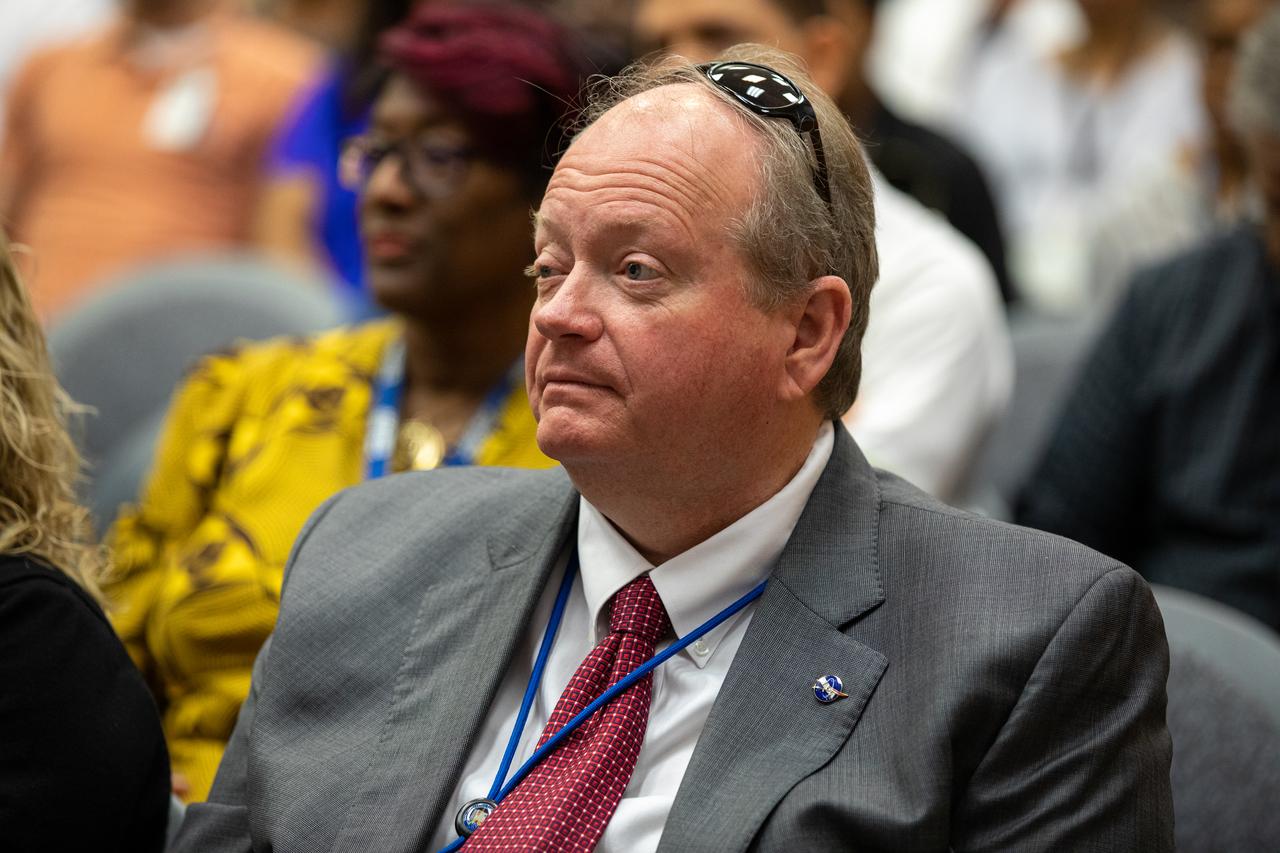
Burt Summerfield, associate director, management, attends the Black History Month celebration at Kennedy Space Center in Florida on Feb. 18, 2020. The program was organized by the Black Employee Strategy Team (BEST), one of the center’s employee resource groups. This year’s theme was “African Americans and the Vote.” Keynote speaker was James Jennings, former NASA associate administrator for Institutions and Management and Kennedy’s former deputy director. Jennings shared advice with workers and managers.
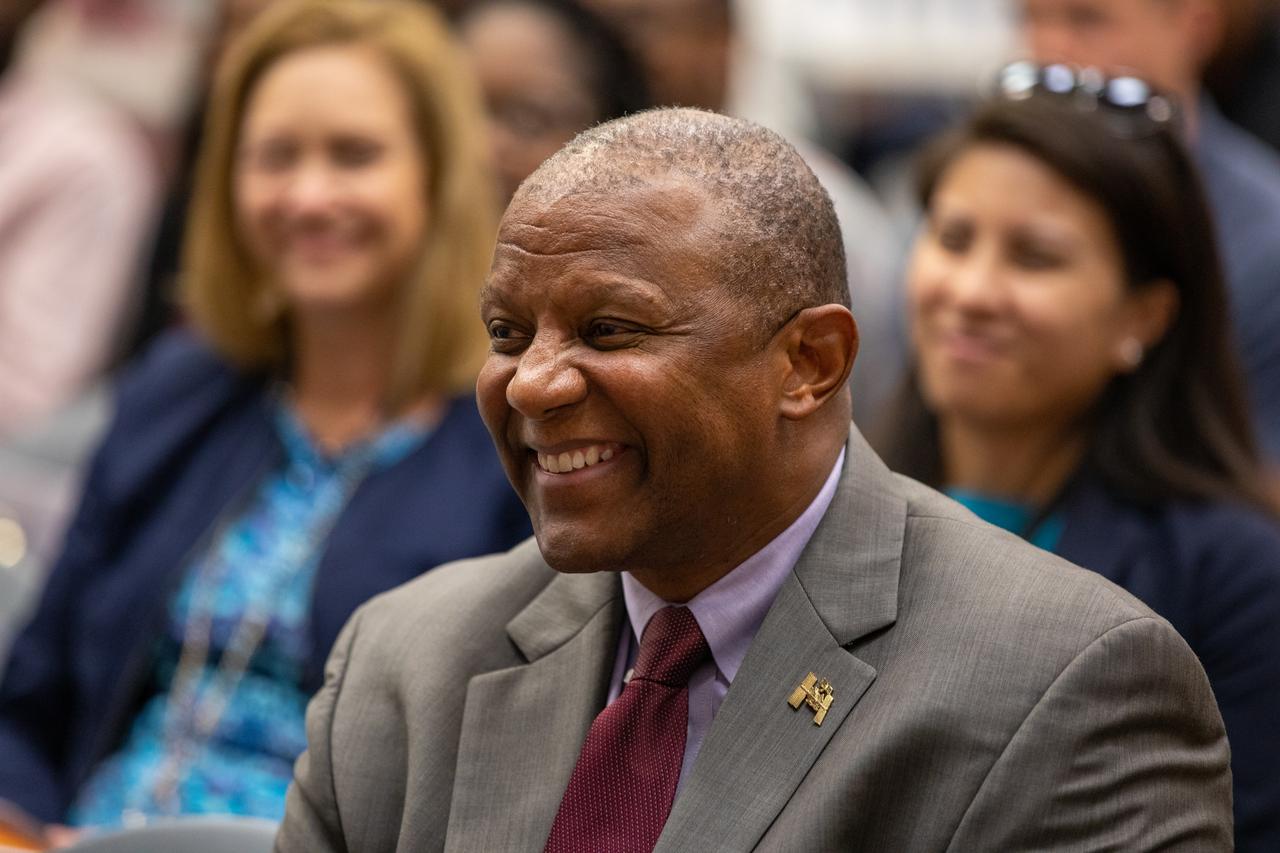
Kelvin Manning, associate director, technical, attends the Black History Month celebration at Kennedy Space Center in Florida on Feb. 18, 2020. The program was organized by the Black Employee Strategy Team (BEST), one of the center’s employee resource groups. This year’s theme was “African Americans and the Vote.” Keynote speaker was James Jennings, former NASA associate administrator for Institutions and Management and Kennedy’s former deputy director. Jennings shared advice with workers and managers.
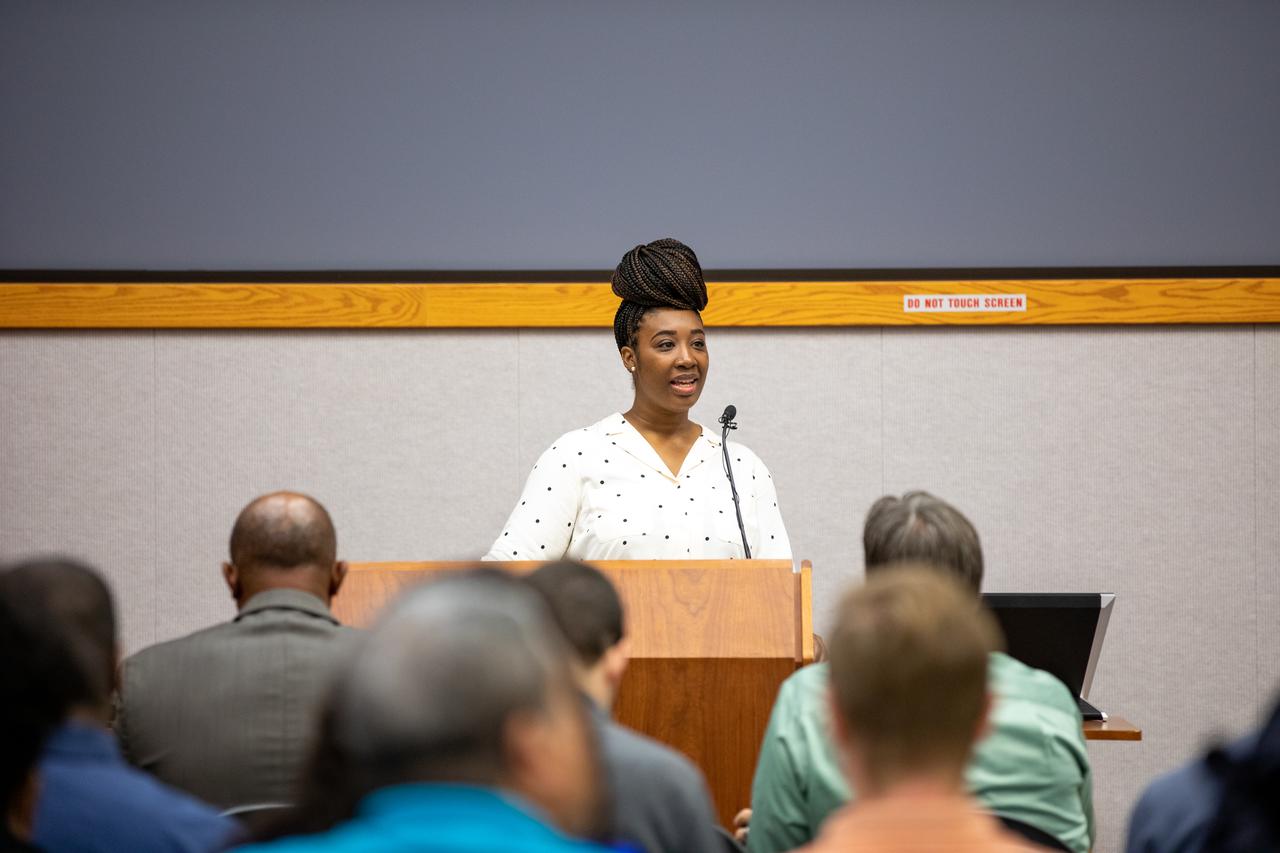
Jakebia Keith, program and contract analyst for the IT Resources Management Office, welcomes NASA and contractor workers to the Black History Month celebration at NASA’s Kennedy Space Center in Florida on Feb. 18, 2020. The program was organized by the Black Employee Strategy Team (BEST), one of the center’s employee resource groups. This year’s theme was “African Americans and the Vote.” Keynote speaker was James Jennings, former NASA associate administrator for Institutions and Management and Kennedy’s former deputy director. Jennings shared advice with workers and managers.
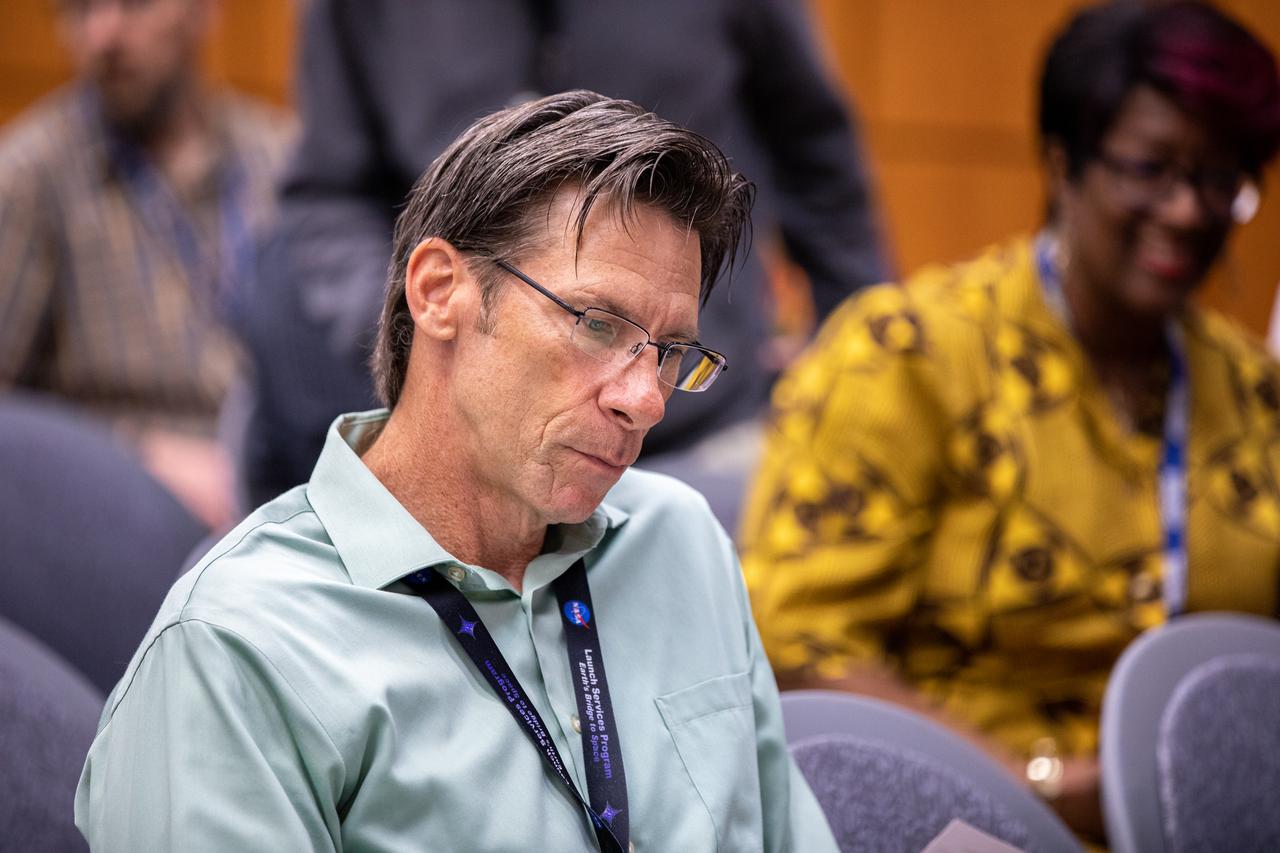
Chuck Dovale, deputy director of NASA’s Launch Services Program, attends the Black History Month celebration at Kennedy Space Center in Florida on Feb. 18, 2020. The program was organized by the Black Employee Strategy Team (BEST), one of the center’s employee resource groups. This year’s theme was “African Americans and the Vote.” Keynote speaker was James Jennings, former NASA associate administrator for Institutions and Management and Kennedy’s former deputy director. Jennings shared advice with workers and managers.
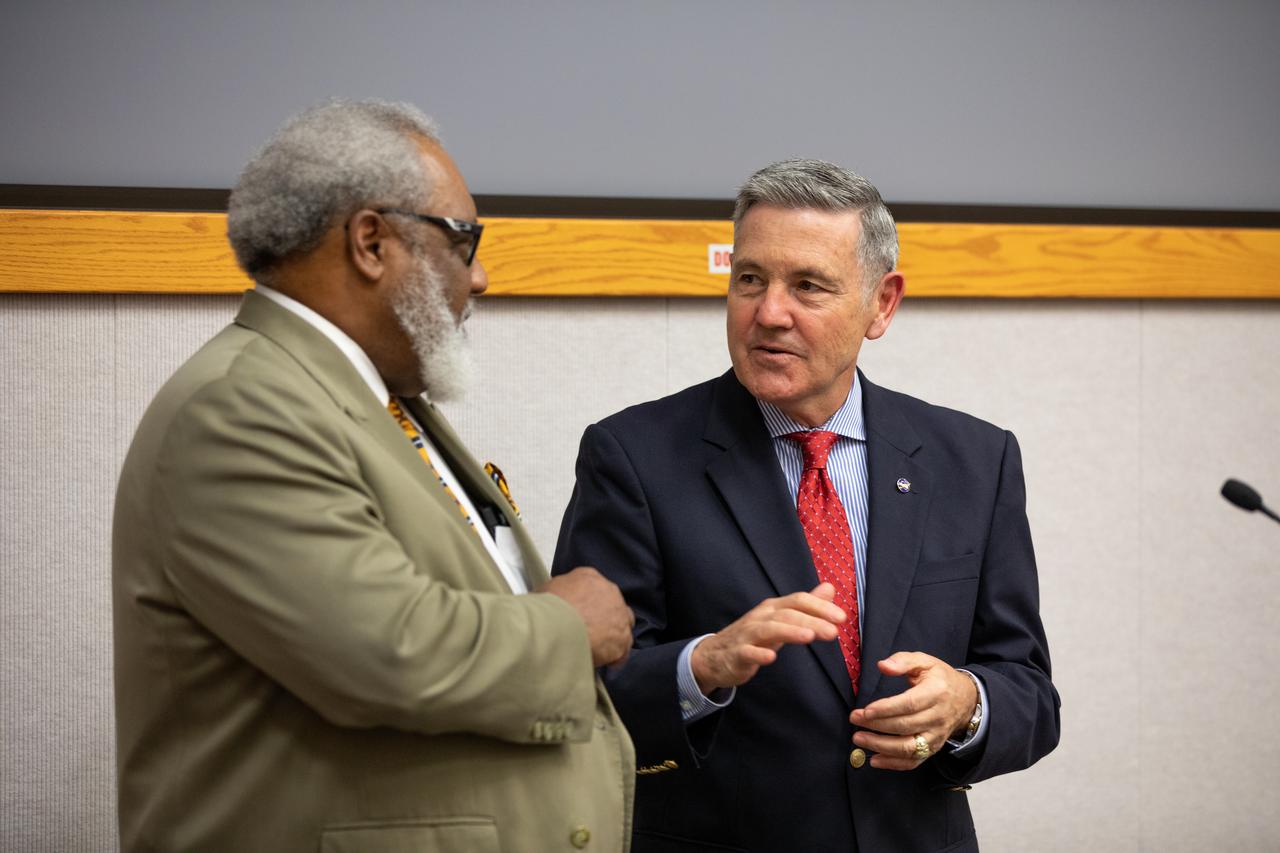
Kennedy Space Center Director Bob Cabana, at right, speaks with James Jennings, former NASA associate administrator for Institutions and Management and former Kennedy deputy director, during the center’s Black History Month celebration on Feb. 18, 2020. Jennings was the keynote speaker. The program was organized by the Black Employee Strategy Team (BEST), one of the center’s employee resource groups. This year’s theme was “African Americans and the Vote.” Jennings shared advice with workers and managers.
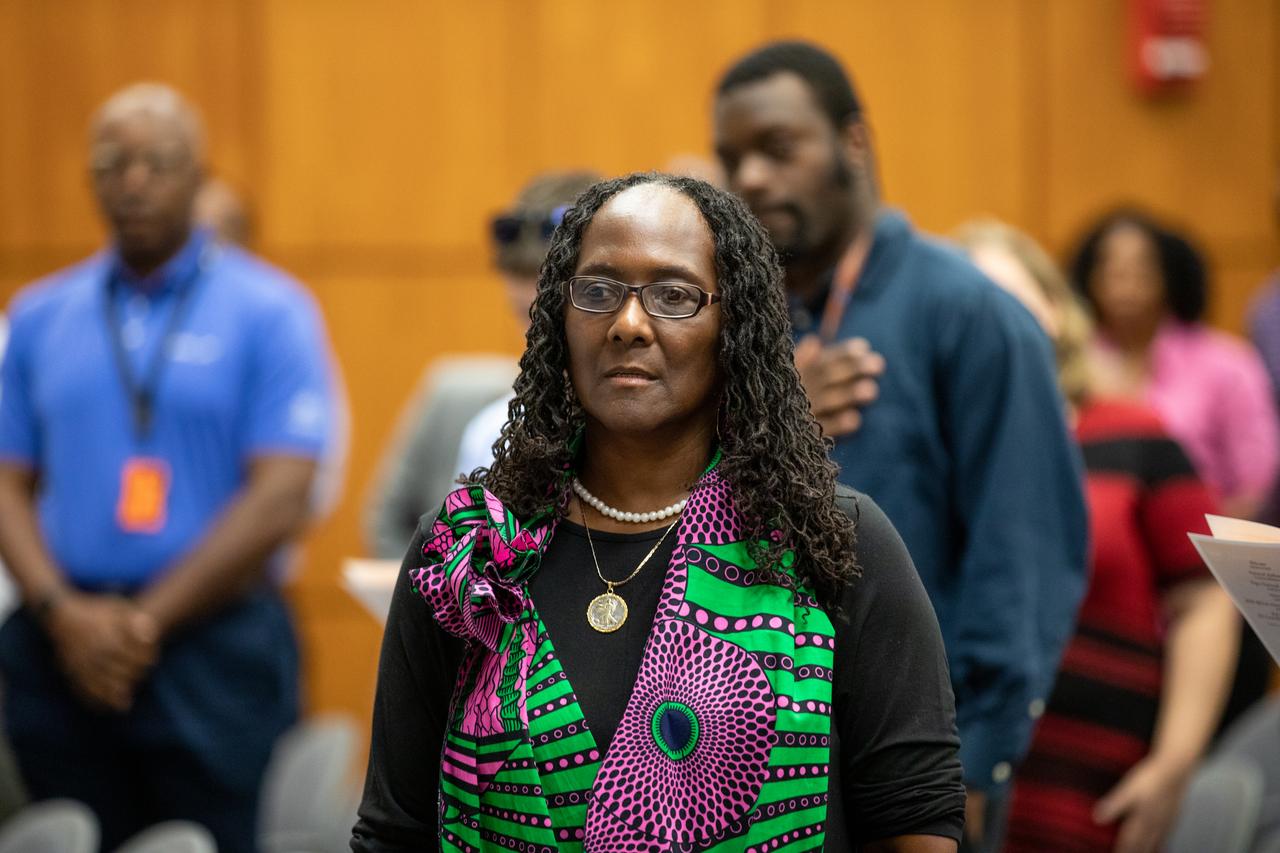
Hortense Diggs, director of Communication and Public Engagement, stands during the singing of the National Anthem at the Black History Month celebration at NASA’s Kennedy Space Center in Florida on Feb. 18, 2020. The program was organized by the Black Employee Strategy Team (BEST), one of the center’s employee resource groups. This year’s theme was “African Americans and the Vote.” Keynote speaker was James Jennings, former NASA associate administrator for Institutions and Management and Kennedy’s former deputy director. Jennings shared advice with workers and managers.

Kelvin Manning, Kennedy Space Center’s associate director, technical, addresses the audience during a Black History Month celebration at the center on Feb. 18, 2020. The program was organized by the Black Employee Strategy Team (BEST), one of the center’s employee resource groups. This year’s theme was “African Americans and the Vote.” Keynote speaker was James Jennings, former NASA associate administrator for Institutions and Management and Kennedy’s former deputy director. Jennings shared advice with workers and managers.
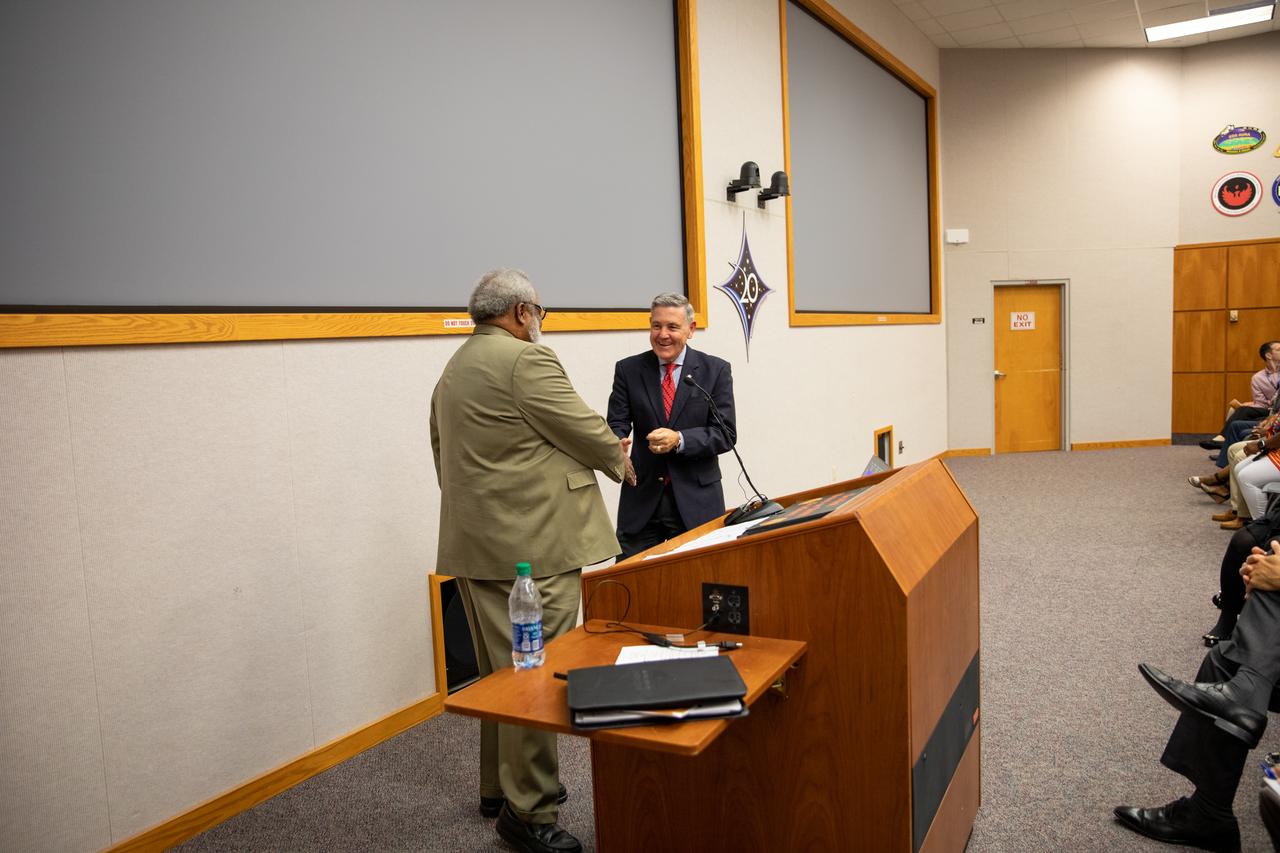
Kennedy Space Center Director Bob Cabana, at right, greets James Jennings, former NASA associate administrator for Institutions and Management and former Kennedy deputy director, during the center’s Black History Month celebration on Feb. 18, 2020. Jennings was the event’s keynote speaker. The program was organized by the Black Employee Strategy Team (BEST), one of the center’s employee resource groups. This year’s theme was “African Americans and the Vote.” Jennings shared advice with workers and managers.
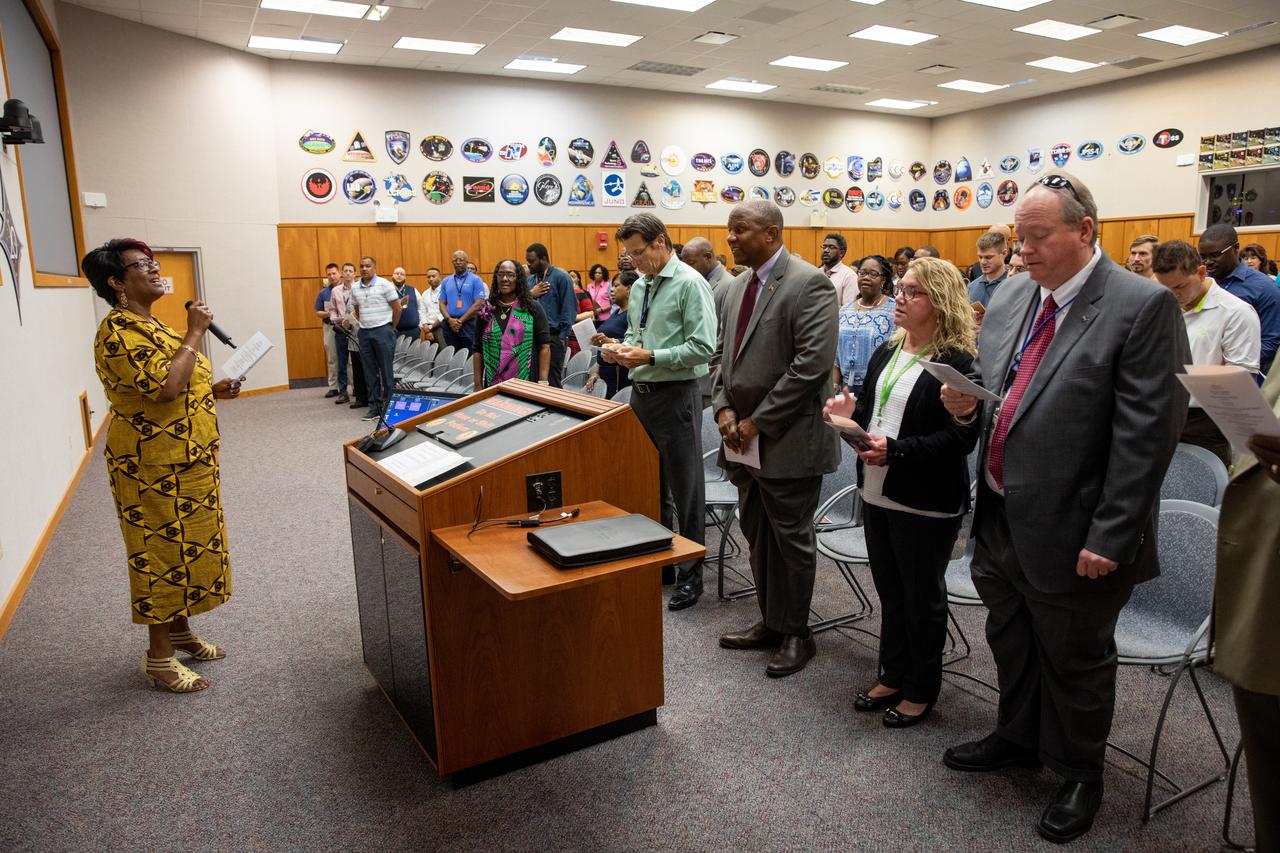
Yvonne Williams, in front, administrative assistant with Jacobs, sings the National Anthem at the start of the Black History Month celebration at NASA’s Kennedy Space Center in Florida on Feb. 18, 2020. The program was organized by the Black Employee Strategy Team (BEST), one of the center’s employee resource groups. This year’s theme was “African Americans and the Vote.” Keynote speaker was James Jennings, former NASA associate administrator for Institutions and Management and Kennedy’s former deputy director. Jennings shared advice with workers and managers.
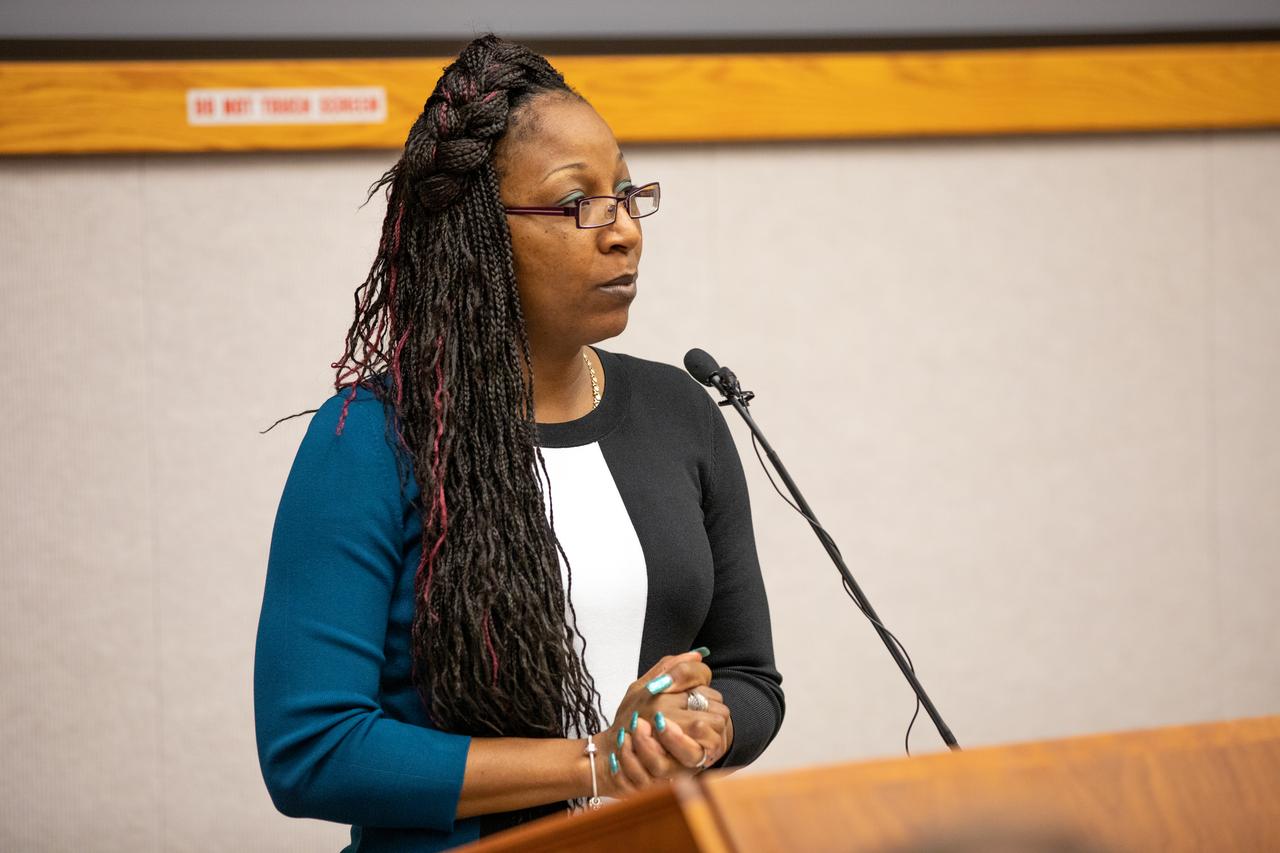
Henrietta Hanner, an administrative assistant in Safety and Mission Assurance, speaks about the theme of this year’s Black History Month celebration at NASA’s Kennedy Space Center in Florida on Feb. 18, 2020. The program was organized by the Black Employee Strategy Team (BEST), one of the center’s employee resource groups. This year’s theme was “African Americans and the Vote.” Keynote speaker was James Jennings, former NASA associate administrator for Institutions and Management and Kennedy’s former deputy director. Jennings shared advice with workers and managers.
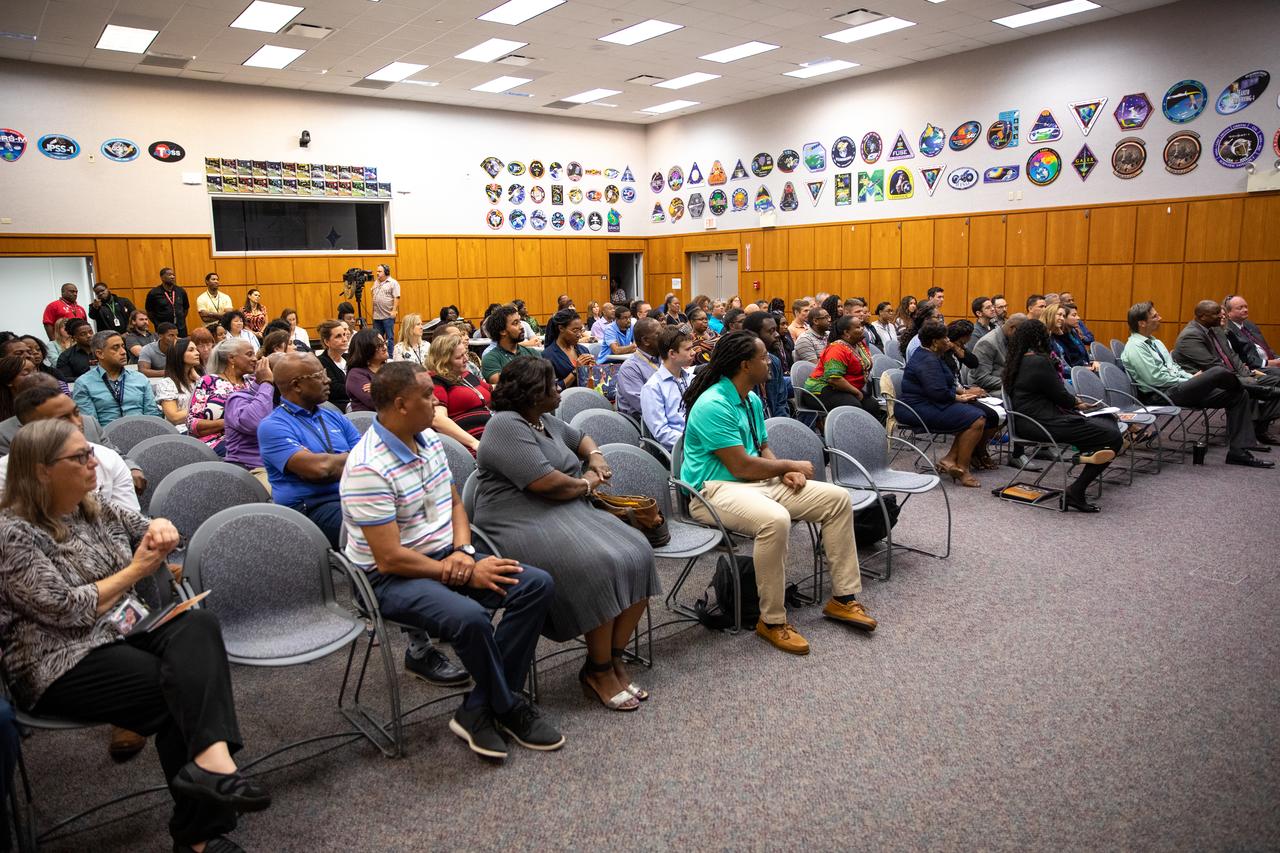
NASA and contractor workers attend a Black History Month celebration at Kennedy Space Center in Florida on Feb. 18, 2020. James Jennings, former NASA associate administrator for Institutions and Management and former Kennedy Space Center deputy director, was the keynote speaker. The program was organized by the Black Employee Strategy Team (BEST), one of the center’s employee resource groups. This year’s theme was “African Americans and the Vote.” Jennings shared advice with workers and managers.
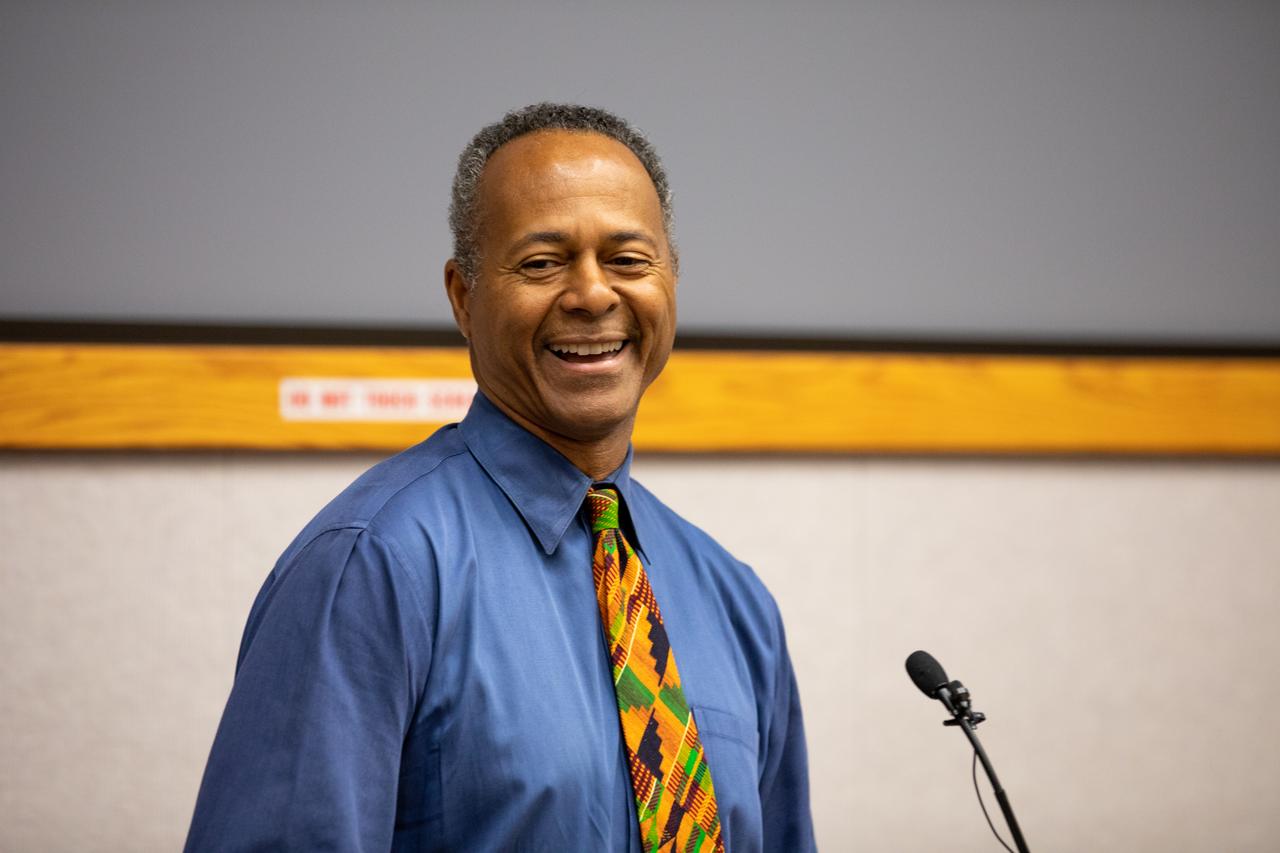
Michael Bell, chief, Knowledge Office, introduces keynote speaker James Jennings during the Black History Month celebration at NASA’s Kennedy Space Center in Florida on Feb. 18, 2020. Jennings is the former associate administrator for NASA Institutions and Management and former deputy director of Kennedy. The program was organized by the Black Employee Strategy Team (BEST), one of the center’s employee resource groups. This year’s theme was “African Americans and the Vote.” Jennings shared advice with workers and managers.
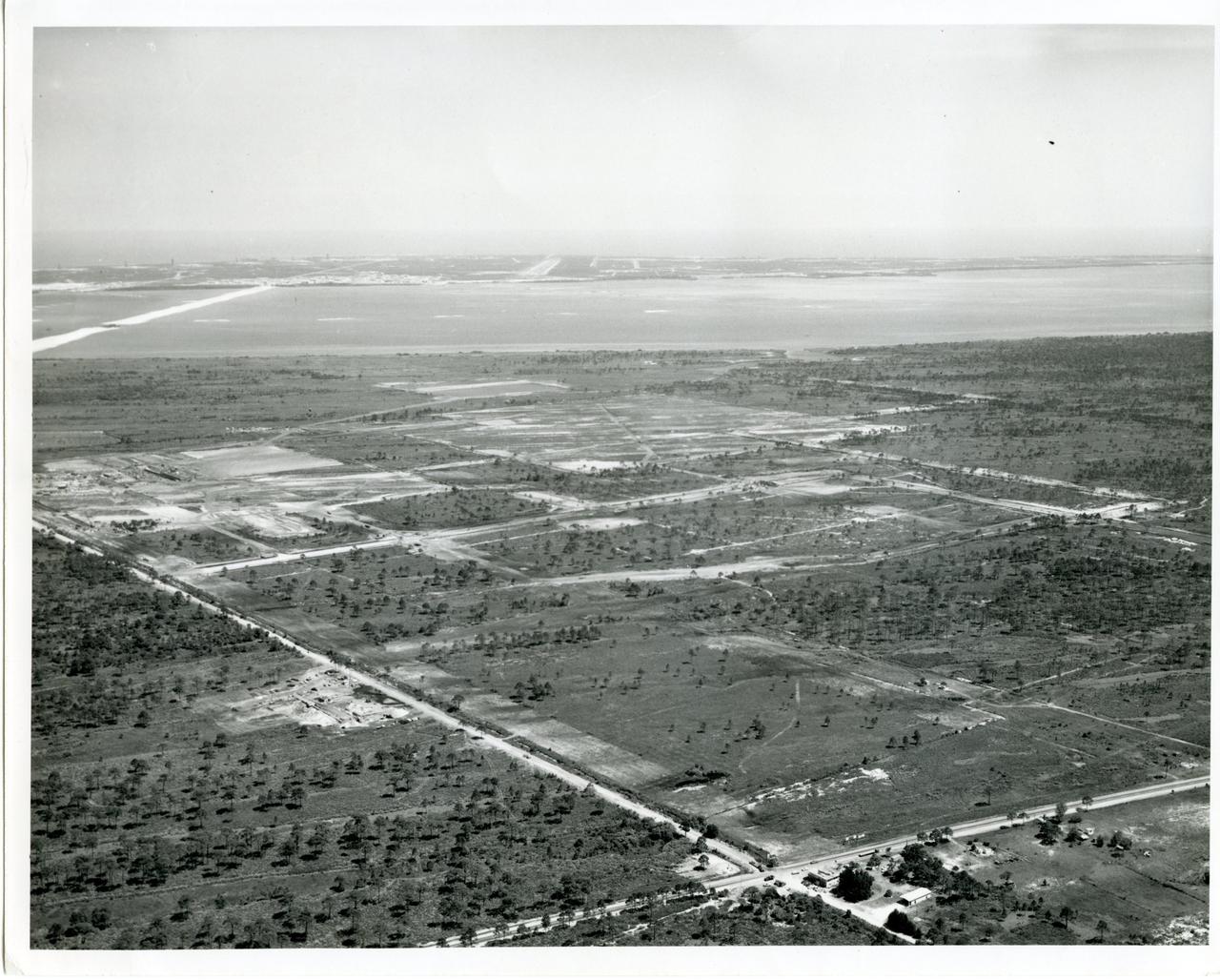
CAPE CANAVERAL, Fla. -- This aerial of view from 1963 shows the site of the Industrial Area for the Merritt Island Launch Annex, now the Kennedy Space Center in Florida. Located five miles south of Launch Complex 39, this is the site where facilities were built such as the Headquarters Building, Operations and Checkout Building as well as the Central Instrumentation Facility. Photo Credit: NASA.
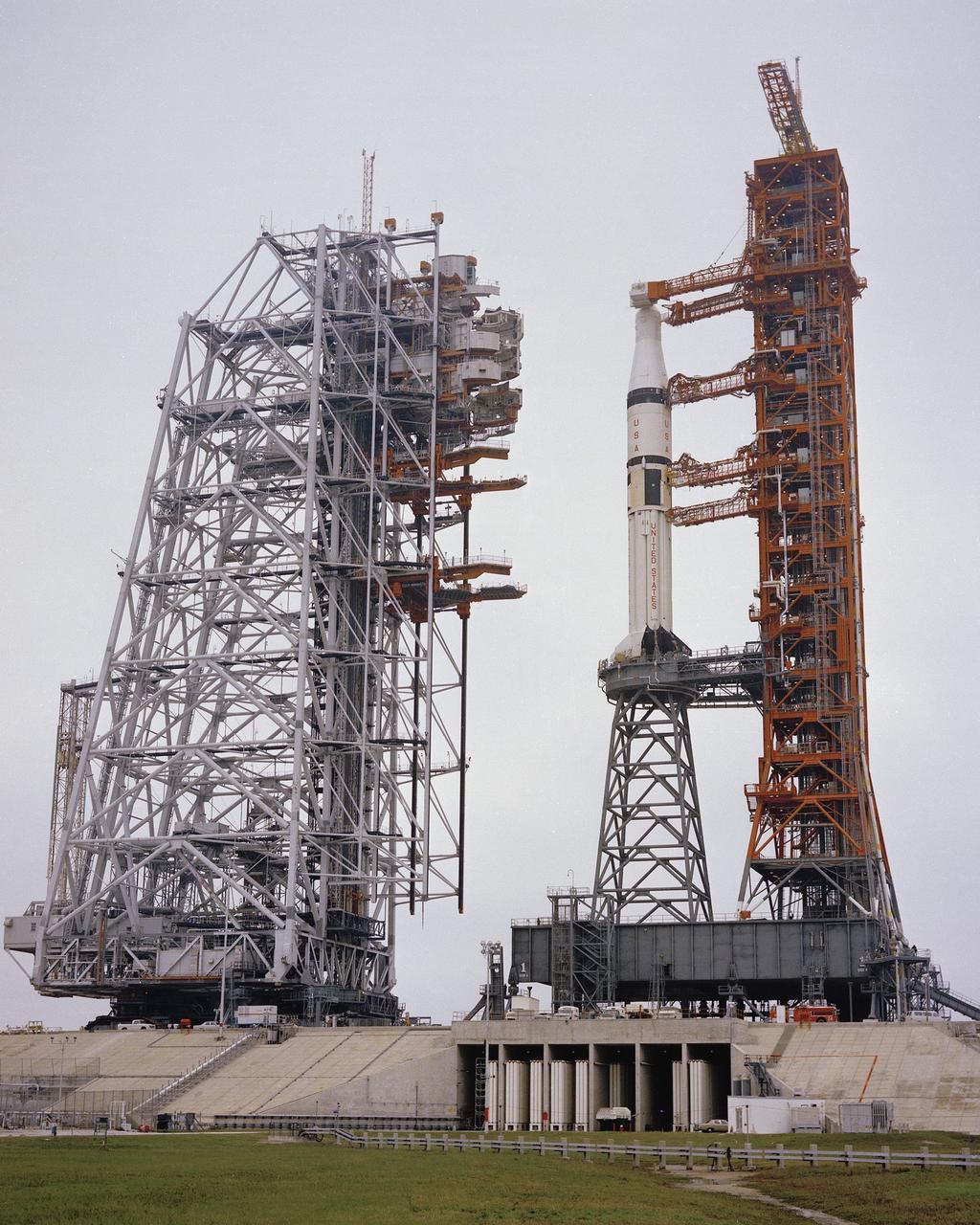
CAPE KENNEDY, Fla. -- At the Kennedy Space Center in Florida, the mobile service structure moves from its park site into position at Launch Complex 39B and surround the Skylab 2 rocket. Photo Credit: NASA

CAPE CANAVERAL Fla. -- Astronaut John H. Glenn Jr. gives a double thumbs-up as he and President John F. Kennedy arrive at the Cape Canaveral Missile Test Annex in Florida. Glenn's Mercury Atlas 6 mission lifted off from Launch Complex 14, in the background, on Feb. 20, 1962. Photo Credit: NASA
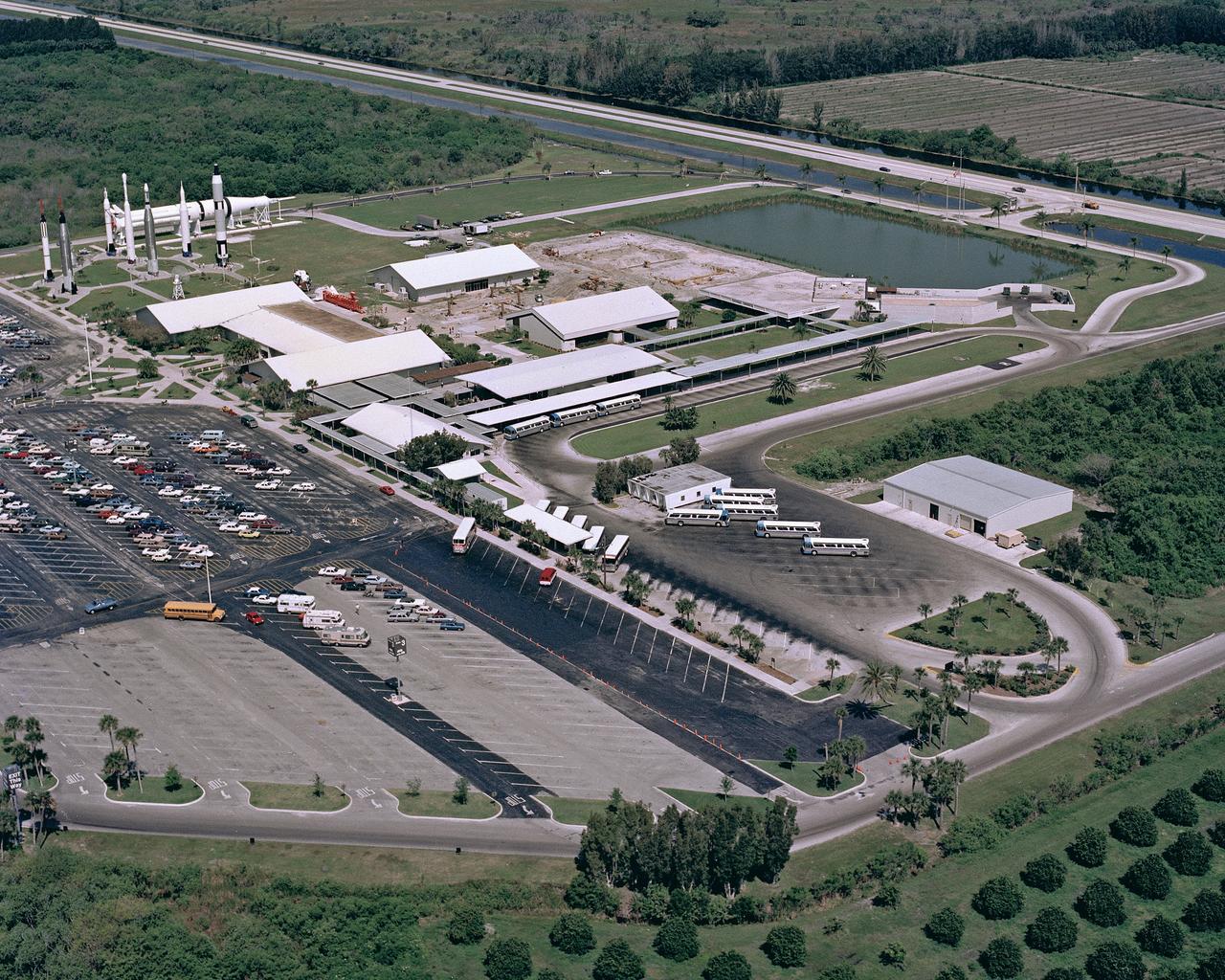
CAPE CANAVERAL, Fla. -- An aerial view of the Visitor Information Center at the Kennedy Space Center in Florida. Photo Credit: NASA
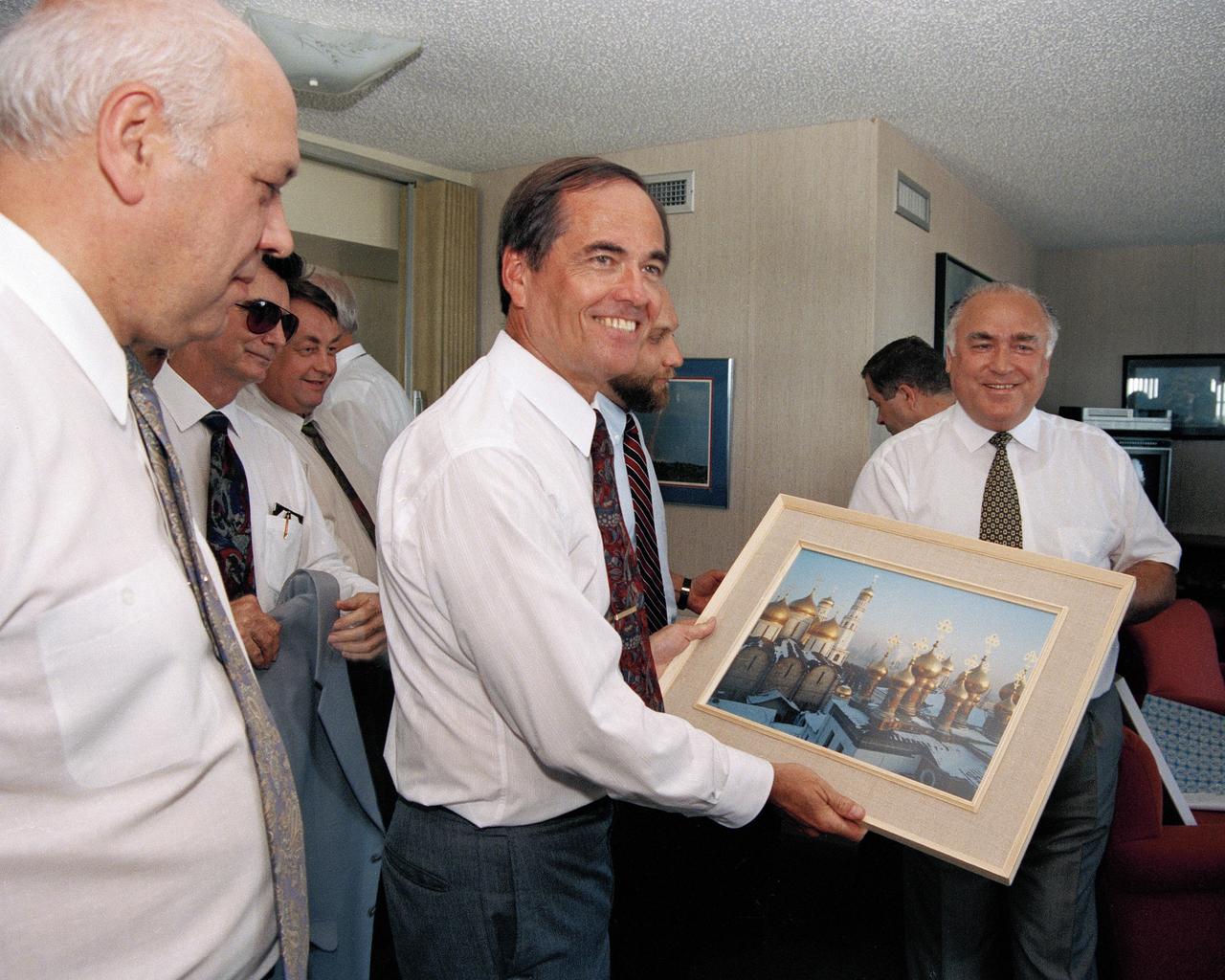
CAPE CANAVERAL, Fla. -- At the Kennedy Space Center in Florida, Russian Prime Minister Viktor Chernomyrdin, right, presents a framed photograph of the Kremlin to center director Robert Crippen during a visit to the space center. Space, energy and the environment are the three major focuses of the Russian's U.S. visit, which also included a stop at the agency's Johnson Space Center. Photo Credit: NASA
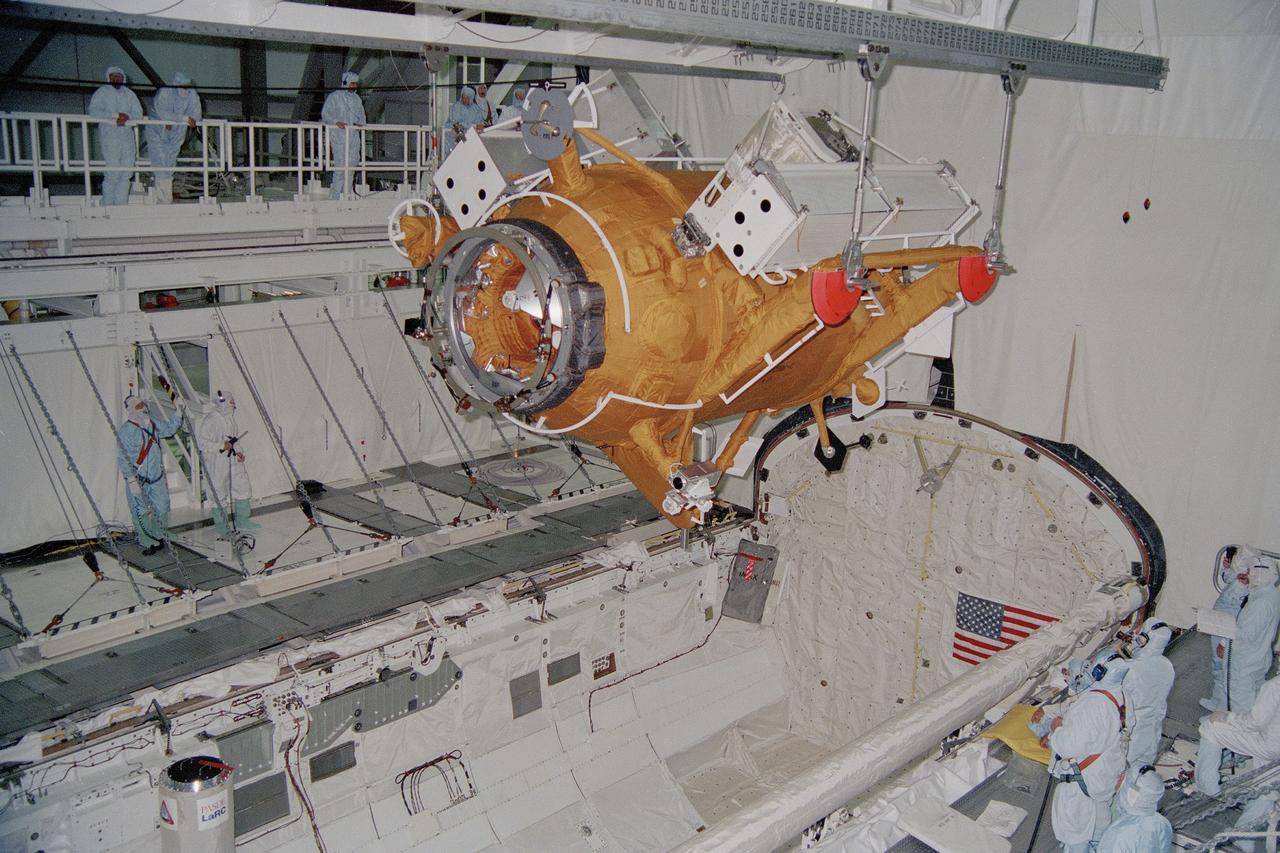
CAPE CANAVERAL, Fla. -- At NASA's Kennedy Space Center in Florida, the Russian-built Docking Module is lowered for installation into the payload bay of the space shuttle Atlantis while it is in bay 2 of the Orbiter Processing Facility. The module will fly as a primary payload on the second Space Shuttle/Mir space station docking mission, STS-74. During the mission, the module will first be attached with the orbiter's robot arm to the Orbiter Docking System in the payload bay of the orbiter Atlantis and then be docked with the Mir. When Atlantis undocks from the Mir, it will leave the new docking module permanently attached to the space station for use during future shuttle Mir docking missions. The new module will simplify future Shuttle linkups with Mir by improving orbiter clearances when it serves as a bridge between the two spacecraft. The white structures attached to the module's sides are solar panels that will be attached to the Mir after the conclusion of the STS-74 mission. Photo Credit: NASA
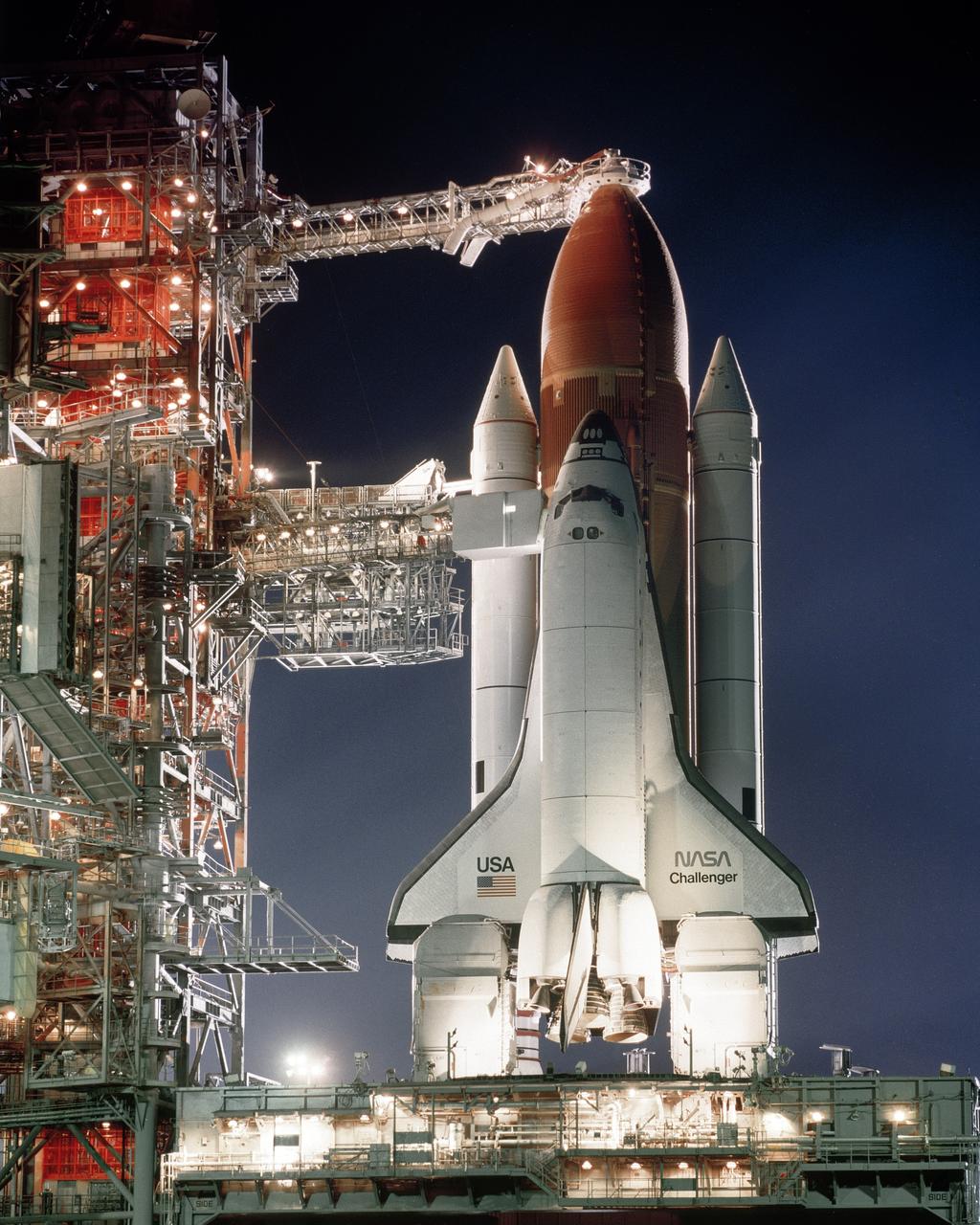
CAPE CANAVERAL, Fla. -- At the Kennedy Space Center in Florida, the rotating service structure has pulled back to the prelaunch position, the shuttle Challenger sits at Launch Pad 39-A bathed in billion candlepower searchlights ready to embark on it fourth space mission STS-41B, the 10th flight of the space shuttle. Photo Credit: NASA
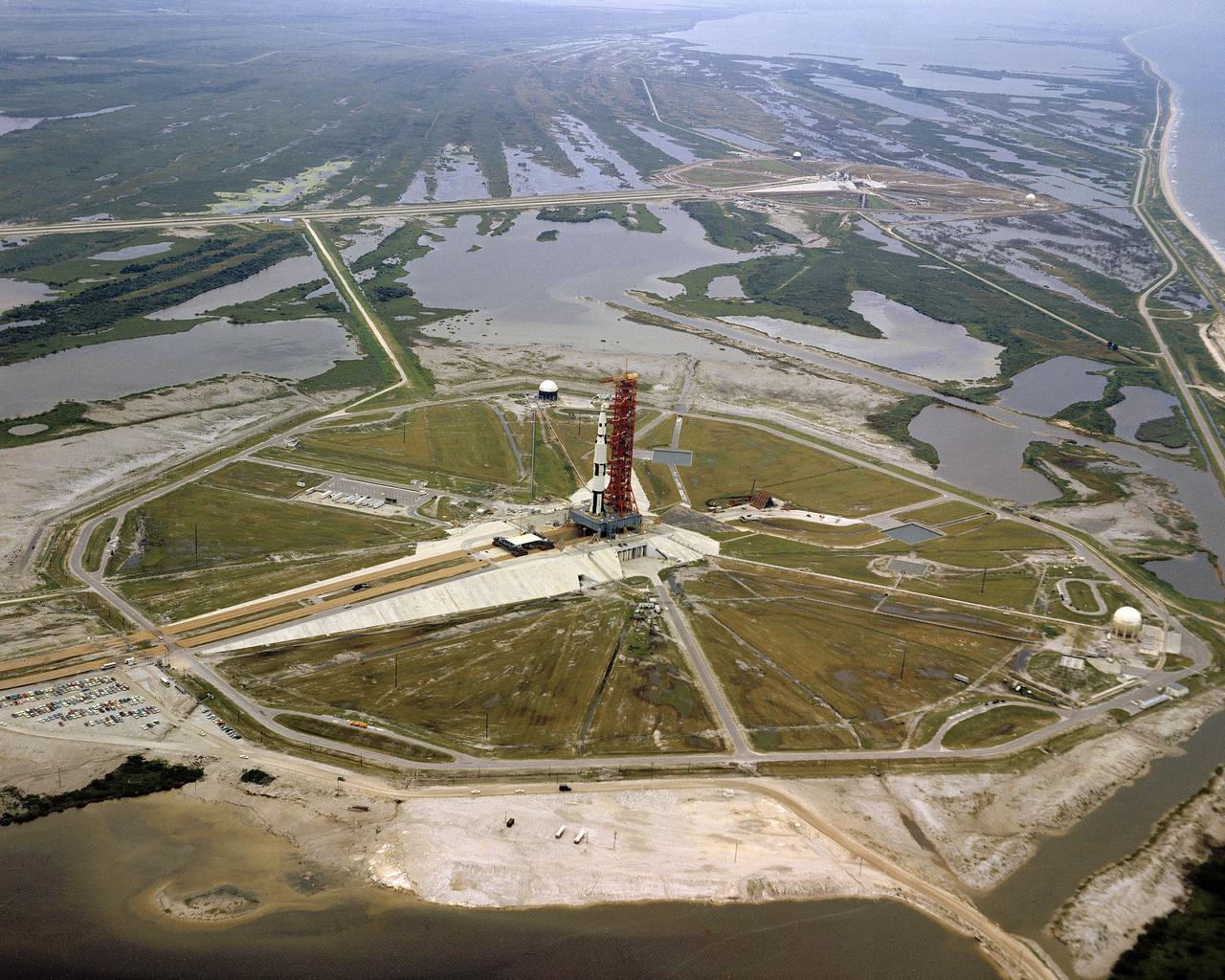
CAPE KENNEDY, Fla. -- An aerial view of Launch Complex 39A at the Kennedy Space Center in Florida, with the 500F facilities verification vehicle on the pad during testing of the site where NASA plans to launch astronauts to the moon as part of the Apollo Program. Photo Credit: NASA
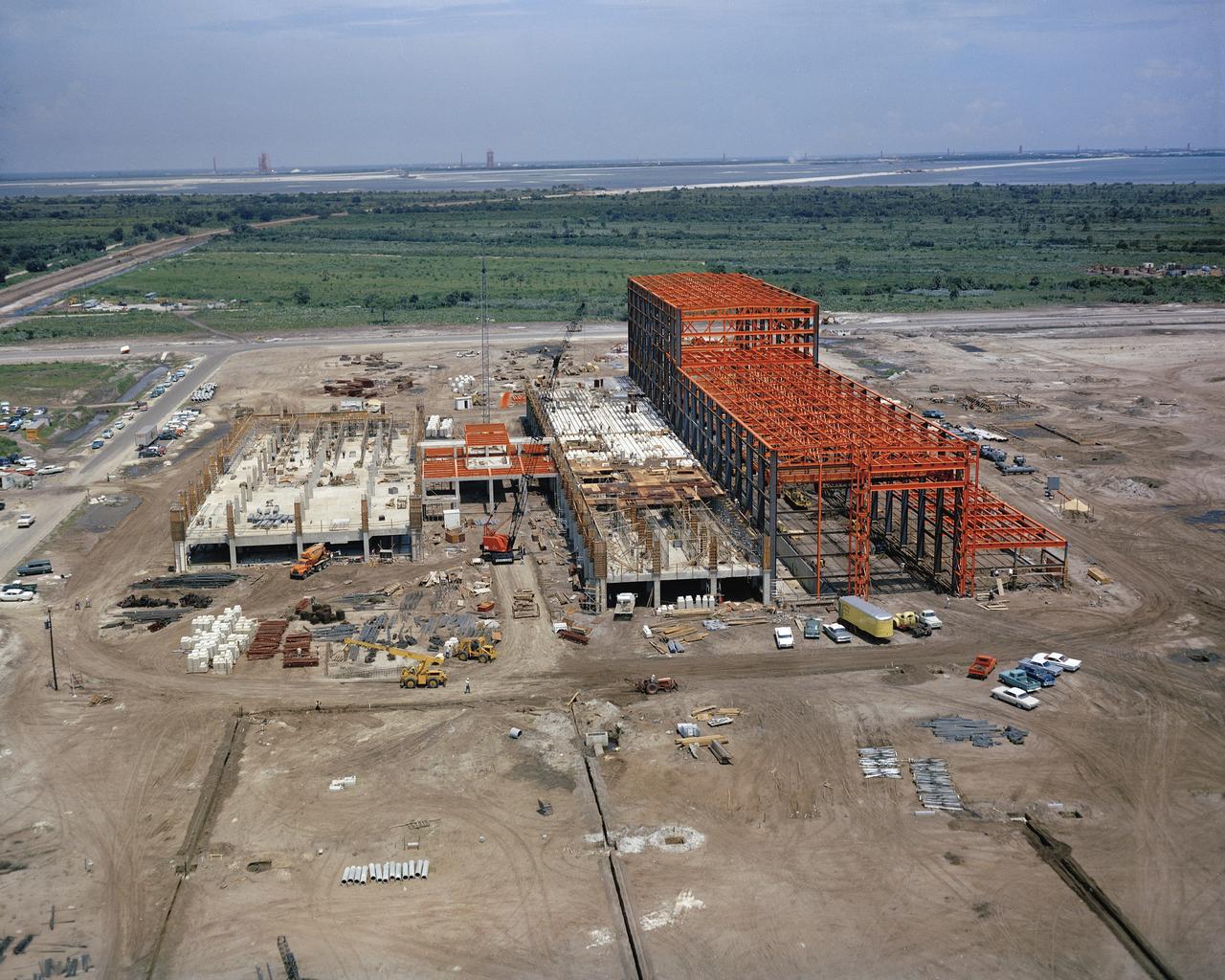
CAPE CANAVERAL Fla. -- This aerial view shows construction progress of the Manned Spacecraft Operations Building at NASA's Merritt Island Launch Annex. Photo Credit: NASA
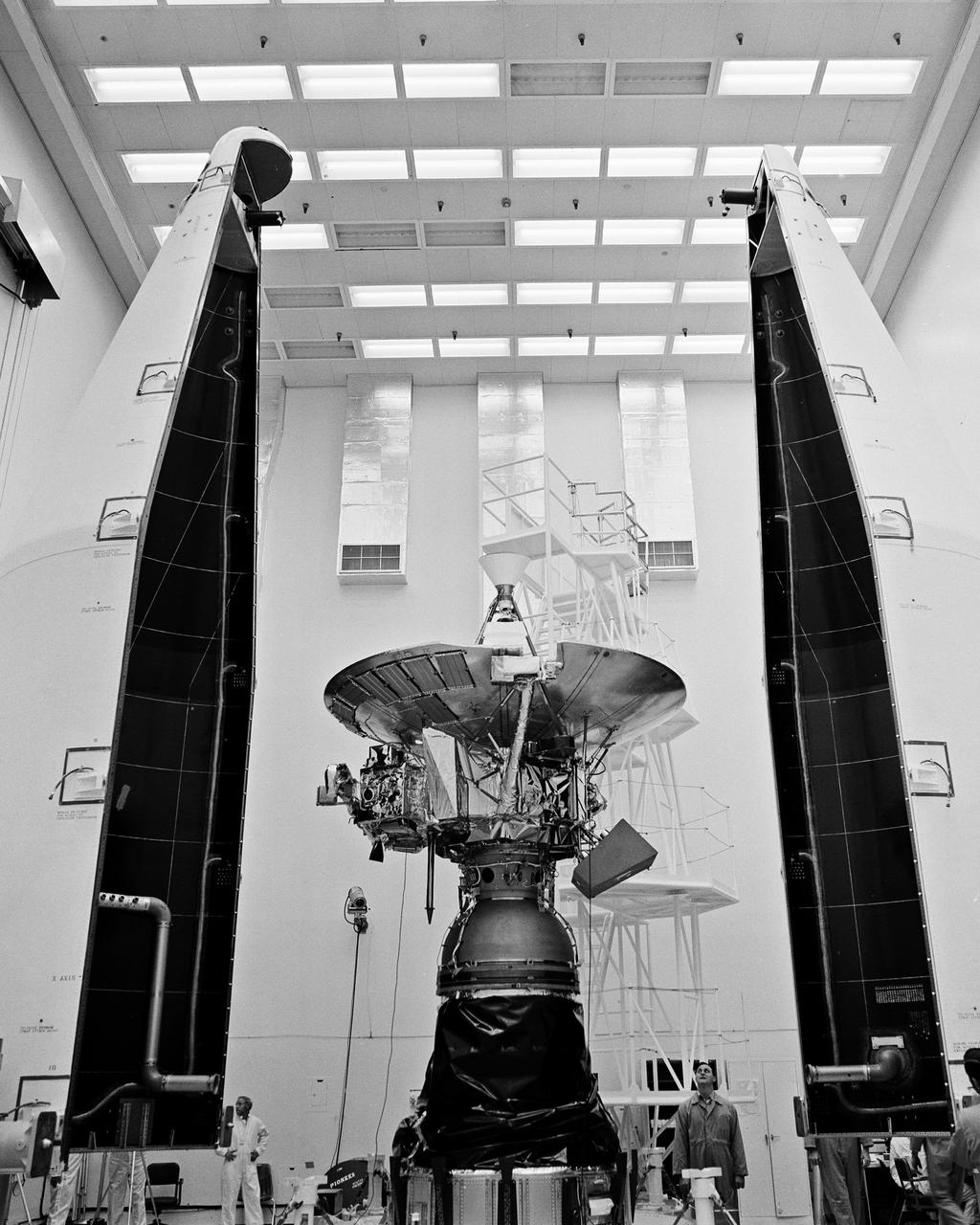
CAPE KENNEDY, Fla. -- In the AO Building at Cape Kennedy Air Force Station in Florida, the Pioneer G spacecraft awaits the installation of its protective payload fairing. The interplanetary space probe is scheduled for launch atop an Atlas Centaur rocket from Cape Kennedy April 5, 1973. Pioneer G's nearly two-year mission will take it on an investigation of the asteroid belt, then on to Jupiter, largest planet in our solar system. NASA's launch teams from the Kennedy Space Center will direct final testing and the launch itself. The mission is a project of the Ames Research Center. Photo Credit: NASA
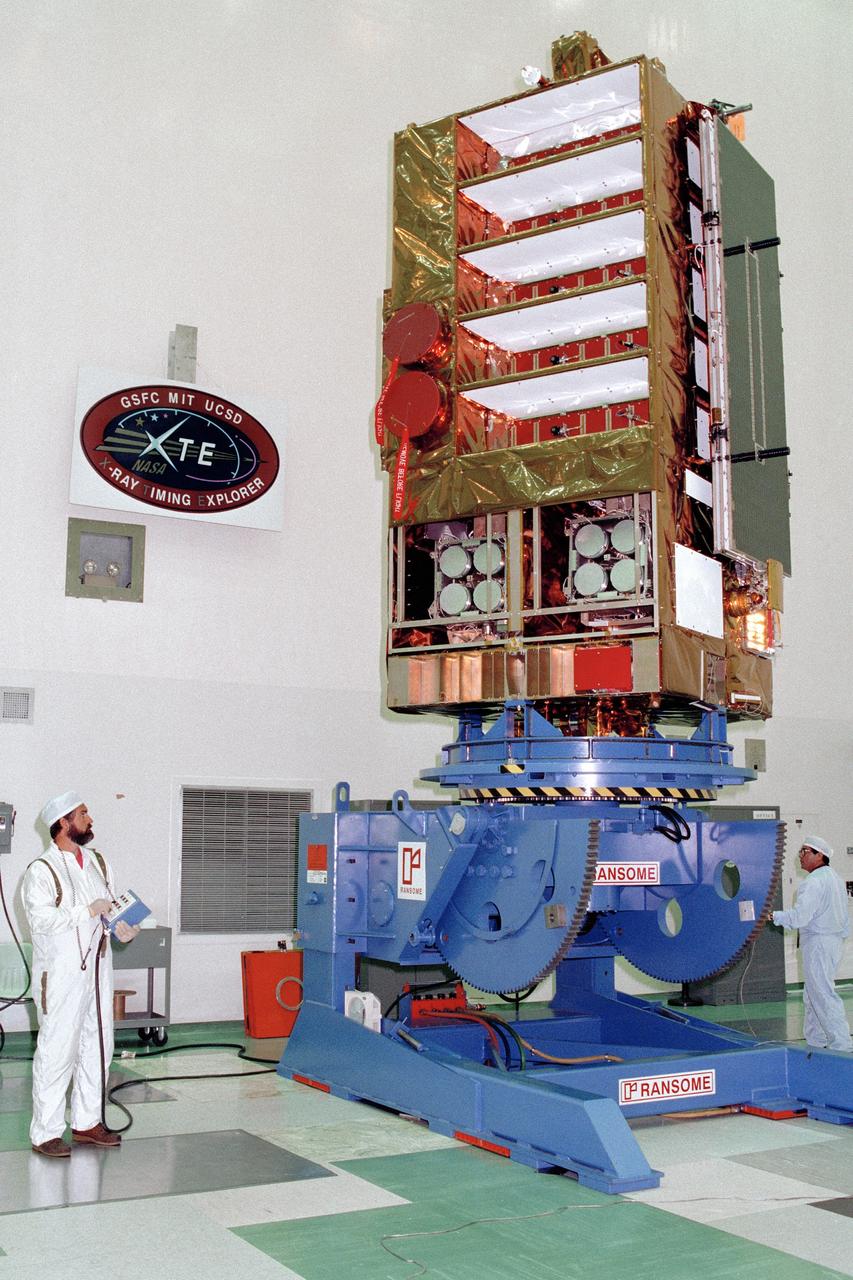
CAPE CANAVERAL, Fla. -- At Hangar AO at Cape Canaveral Air Force Station, payload processing technicians begin prelaunch checkout work of NASA’s X-Ray Timing Explorer XTE as it rests on a payload support structure after its arrival from the agency’s Goddard Space Flight Center in Maryland. The spacecraft is scheduled to lift off from Launch Complex 17 at the Cape on a Delta II rocket on Aug. 31, 1995. After launch, the XTE will gather data on X-ray sources in our galaxy and the universe. Photo Credit: NASA
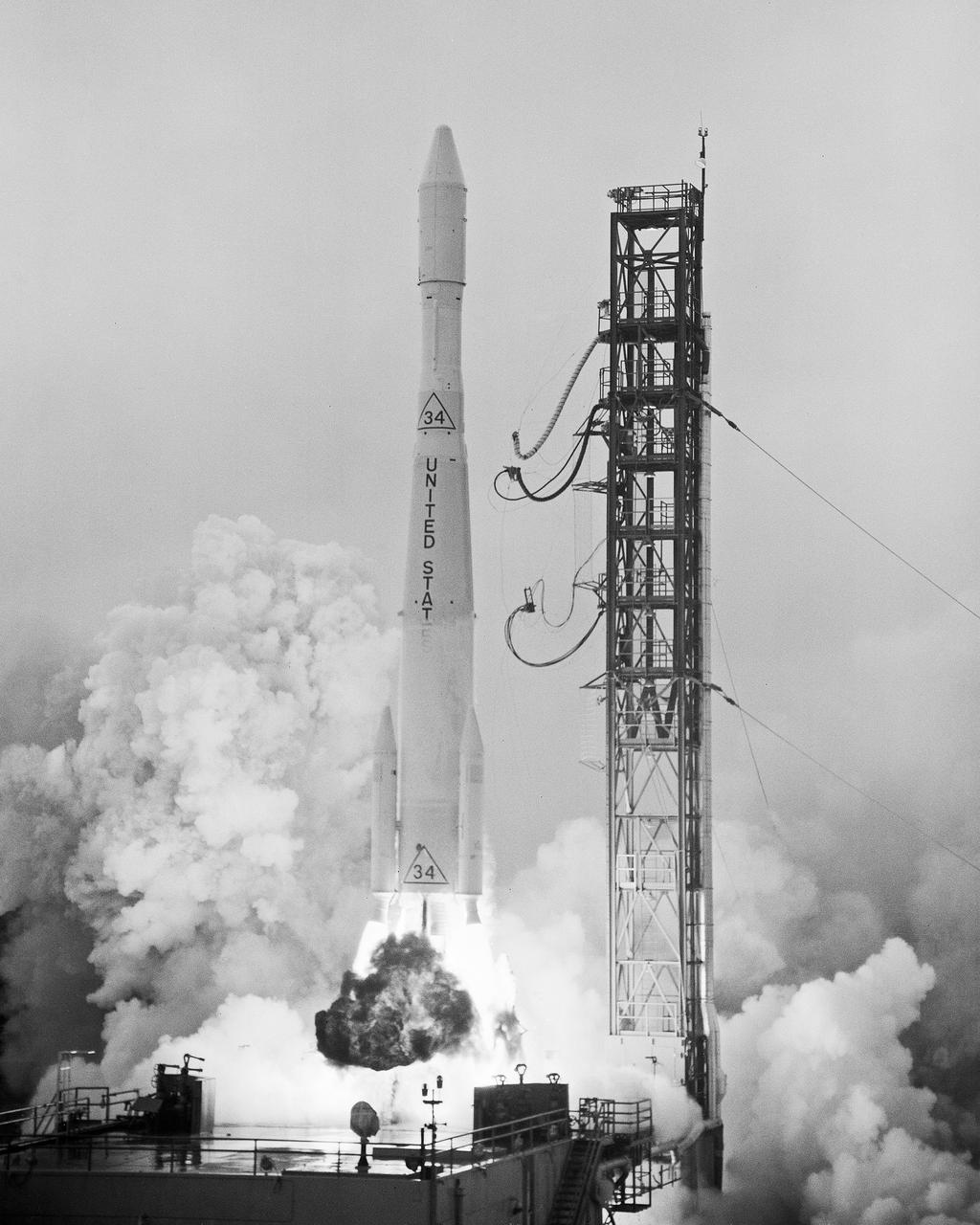
CAPE KENNEDY, Fla. -- At Cape Kennedy Air Force Station in Florida, a thrust augmented improved Delta lifts off with a three hundred eighty five pound geodetic Explorer spacecraft, designated GEOS-A. The spacecraft contains five geodetic instrumentation systems to provide simultaneous measurements that scientists require to establish a more precise model of the Earth's gravitational field, and to map a world coordinate system relating points on, or near the surface to the common center of mass. This will be the first launch for the improved Delta second stage. Photo Credit: NASA
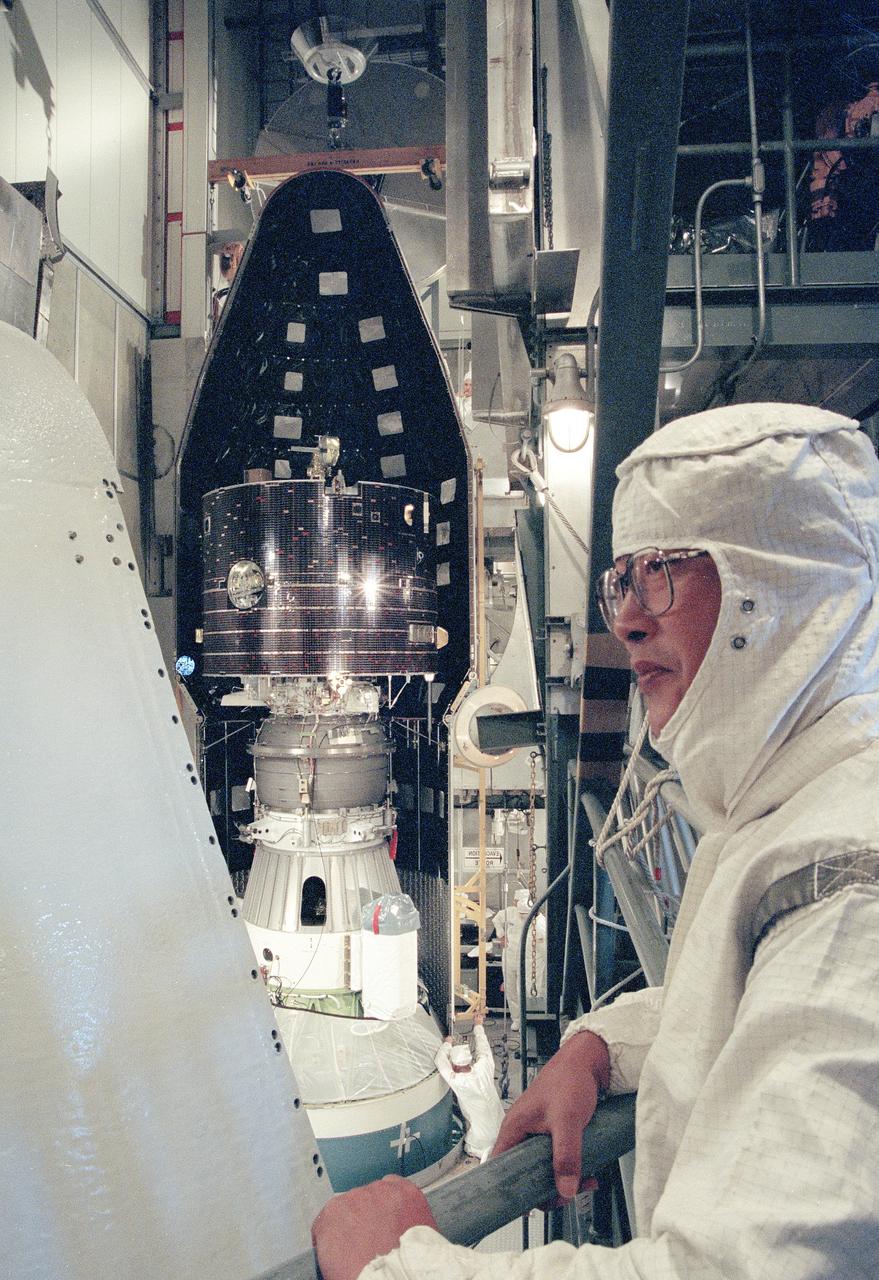
CAPE CANAVERAL, Fla. -- At Cape Canaveral Air Force Station's Launch Complex 17, Pad A, technicians encapsulate the Geotail spacecraft upper and attached Payload Assist Module-D upper stage lower in the protective payload fairing. Geotail and secondary payload Diffuse Ultraviolet Experiment DUVE are scheduled for launch about the Delta II rocket on July 24. The GEOTAIL mission is a collaborative project undertaken by the Institute of Space and Astronautical Science ISAS, Japan Aerospace Exploration Agency JAXA and NASA. Photo Credit: NASA
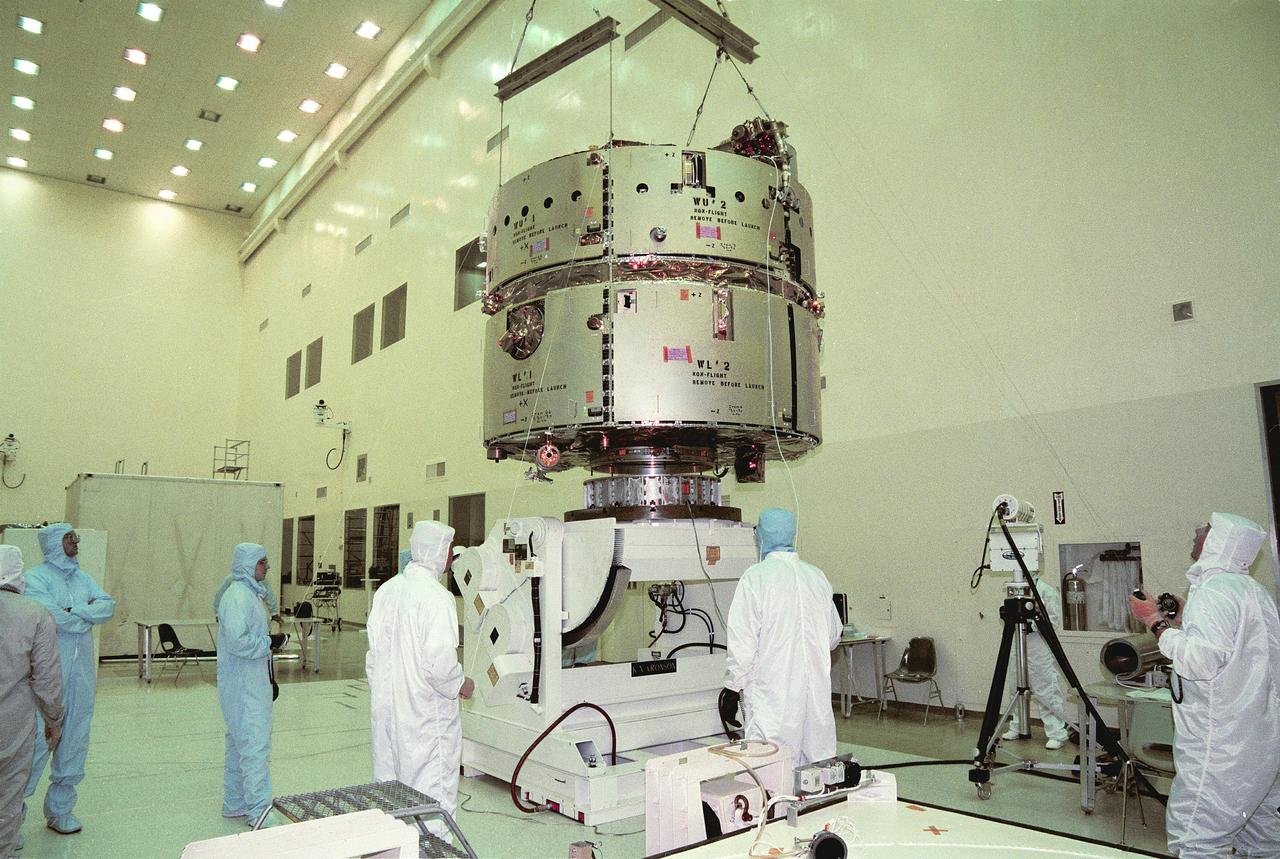
CAPE CANAVERAL, Fla. -- At Cape Canaveral Air Force Station in Florida, technicians in NASA’s AO Building on Cape Canaveral Air Station move the Wind spacecraft to a work stand. Wind is scheduled for launch on a Delta II expendable launch vehicle. Wind is the first of two missions of the Global Geospace Science Initiative, part of the worldwide collaboration for the International Solar-Terrestrial Physics ISTP program. It will carry six U.S. instruments, one French instrument and the first Russian instrument to ever fly on an American satellite, as part of an effort to measure properties of the solar wind before it reaches Earth. Photo Credit: NASA
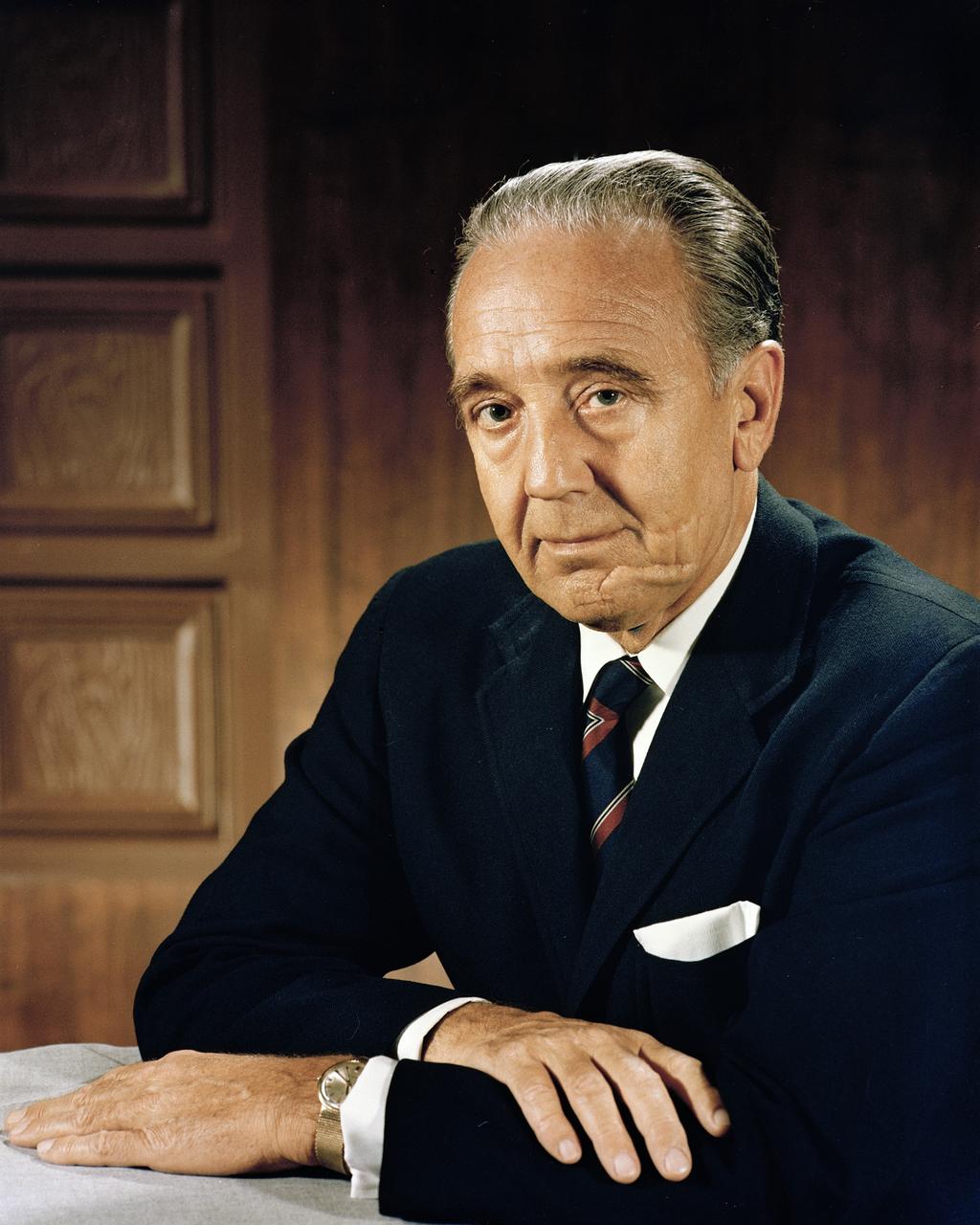
CAPE KENNEDY, Fla. -- Official portrait of Dr. Kurt H. Debus, director of the John F. Kennedy Space Center Photo Credit: NASA

CAPE CANAVERAL, Fla. -- In bay 1 of the Orbiter Processing Facility at NASA's Kennedy Space Center in Florida, STS-96 mission specialist Julie Payette of the Canadian Space Agency poses next to the Canadian arm in the payload bay of the space shuttle Discovery. The STS-96 crew is at Kennedy for a Crew Equipment Interface Test. Other crew members are Commander Kent Rominger, Pilot Rick Douglas Husband, and Mission Specialists Ellen Ochoa, Tamara Jernigan, Daniel Barry, and Valery Tokarev of the Russian Space Agency. The primary payload of STS-96 is the SPACEHAB Double Module. In addition, the space shuttle will carry unpressurized cargo such as the external Russian cargo crane known as STRELA the Spacehab Oceaneering Space System Box, which is a logistics items carrier and an ORU Transfer Device, a U.S.-built crane that will be stowed on the station for use during future ISS assembly missions. These cargo items will be stowed on the International Cargo Carrier, fitted inside the payload bay behind the SPACEHAB module. STS-96 is targeted for launch on May 24, from Launch Pad 39B. Photo Credit: NASA
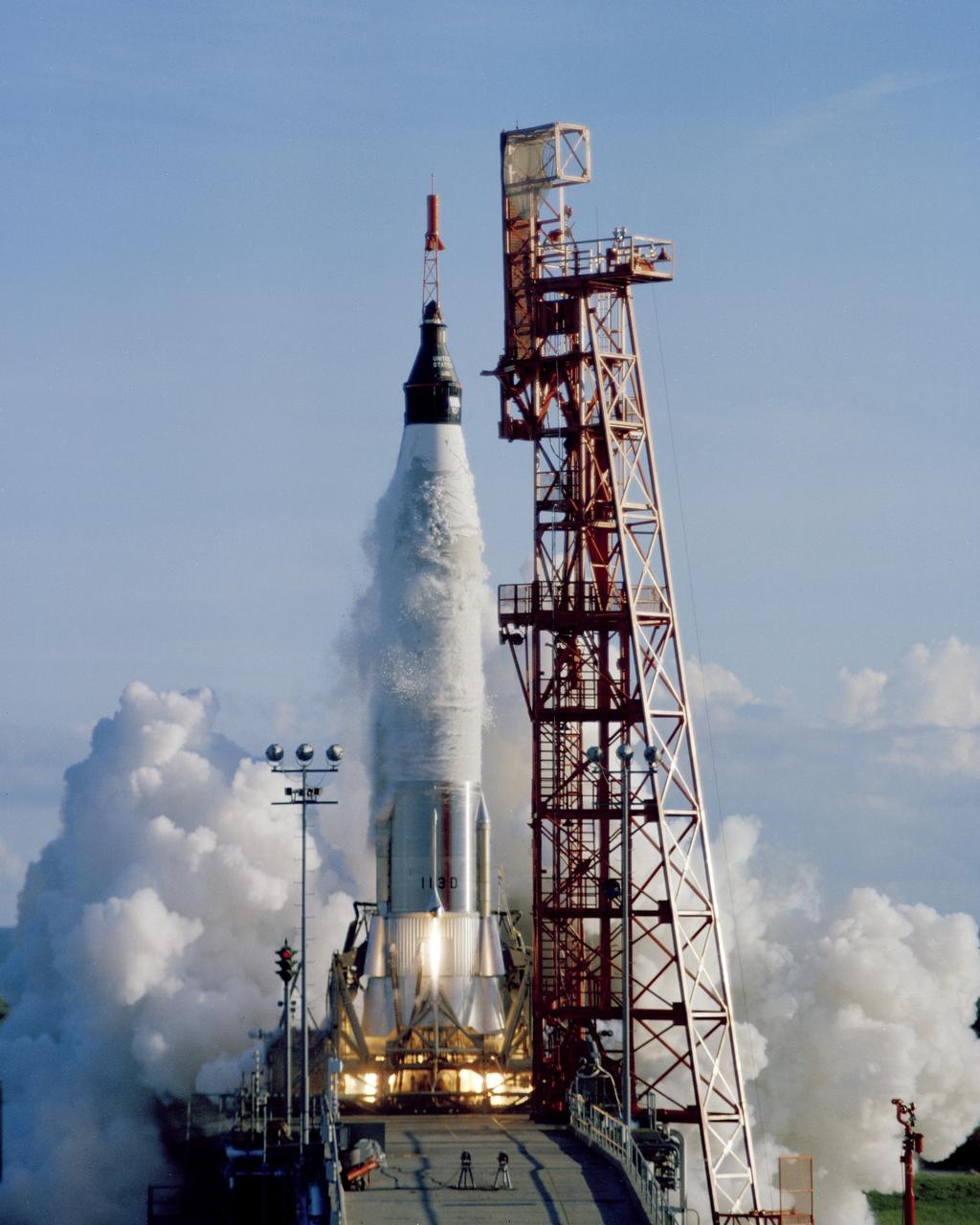
CAPE CANAVERAL, Fla. -- An Atlas launch vehicle lifts off with the Mercury spacecraft Sigma 7 atop with astronaut Walter M. Schirra Jr. aboard. The fifth American into space and the third to orbit the Earth plans to circle the globe six time prior to a planned splashdown in the Pacific Ocean. Photo Credit: NASA
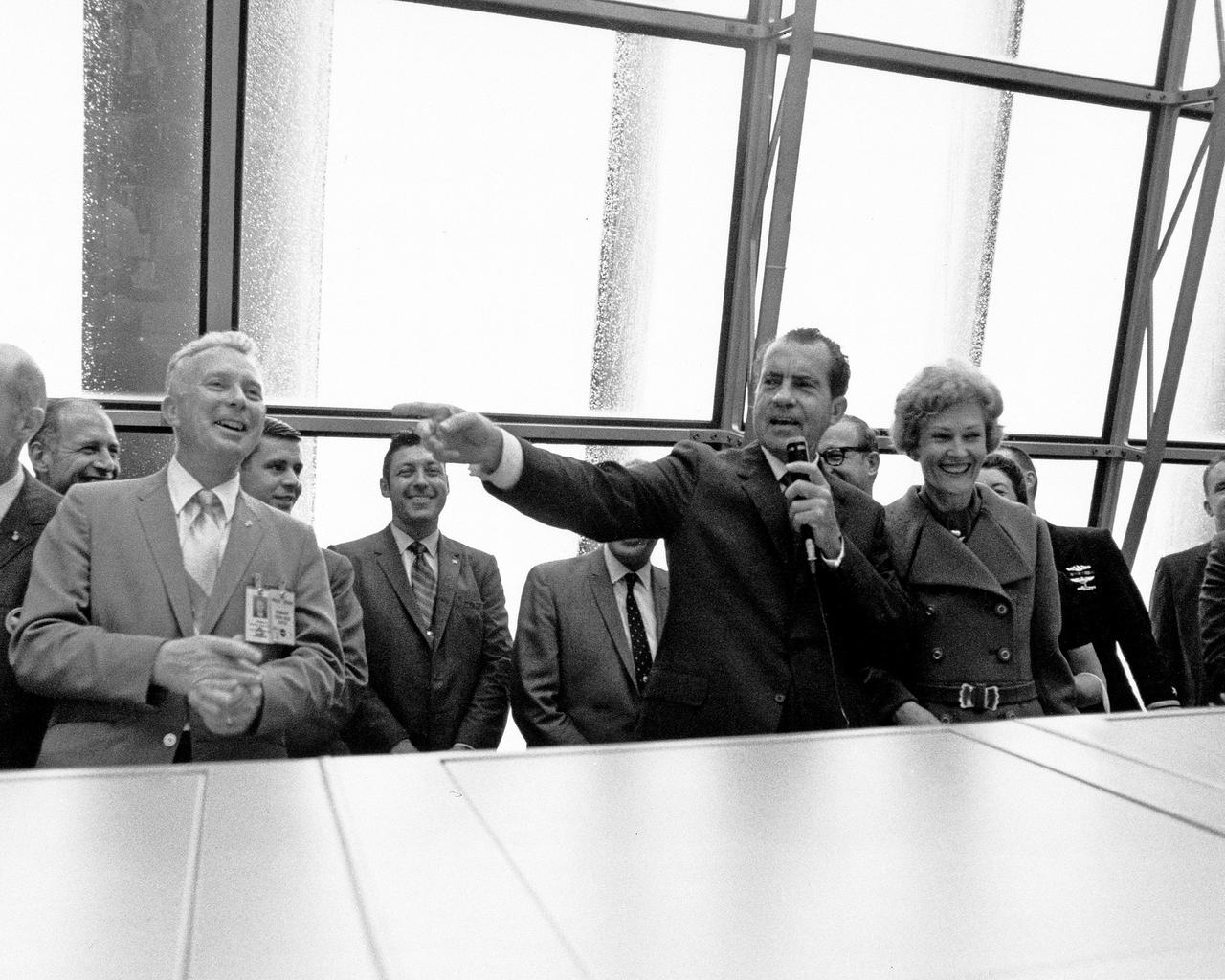
CAPE CANAVERAL, Fla. -- At the Kennedy Space Center in Florida, President Richard M. Nixon speaks in the Launch Control Center after the successful liftoff of the Apollo 12 space vehicle, which sent astronauts Charles Conrad, Jr., Richard F. Gordon and Alan Bean on the first leg of their lunar landing mission. With the President are Paul Donnelly, Launch Operations manager, on the left, and First Lady Pat Nixon, on the right. Photo Credit: NASA
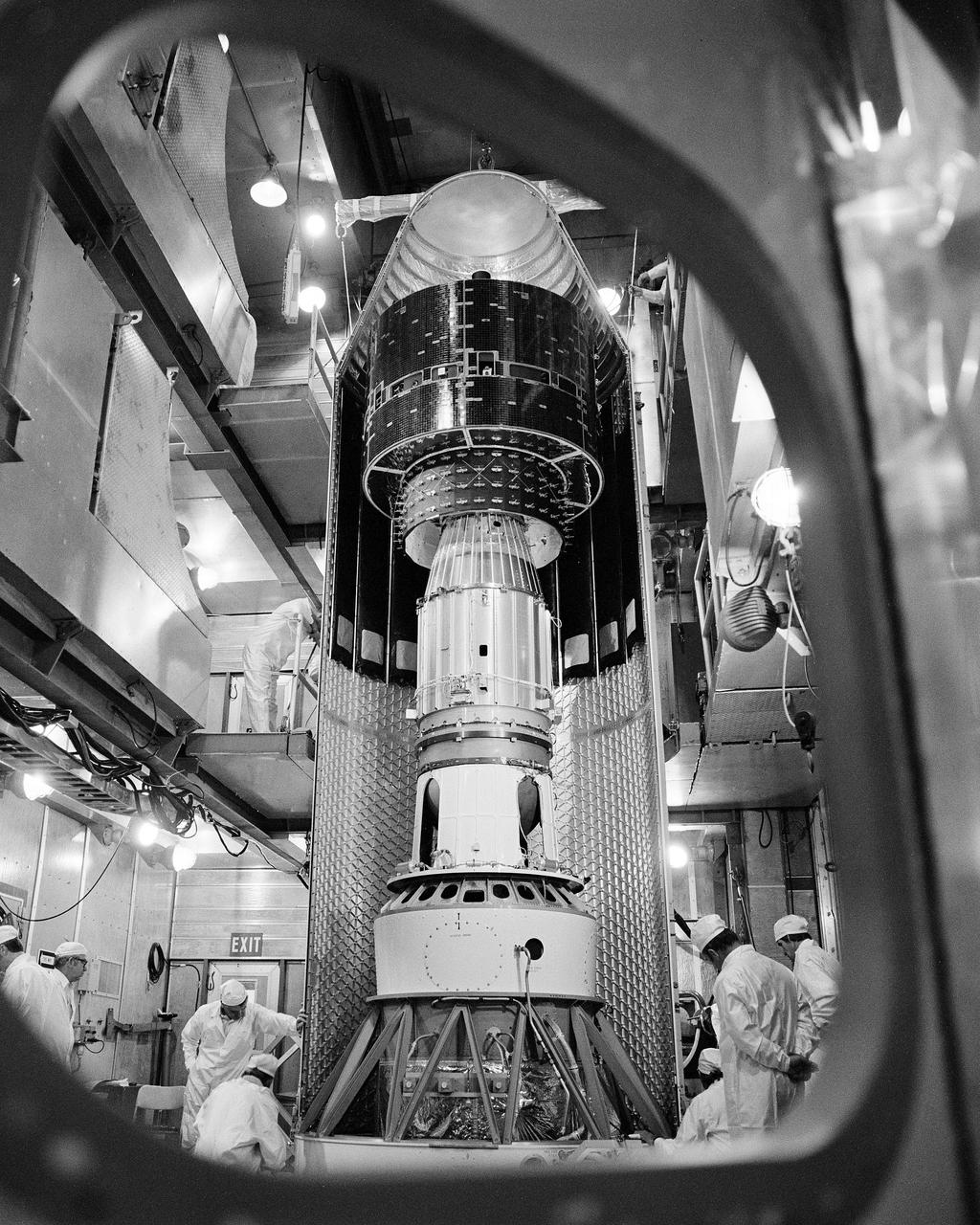
CAPE CANAVERAL, Fla. -- At Cape Canaveral Air Force Station in Florida, the Geostationary Operational Environmental Satellite A GOES-A was encapsulated inside its payload fairing aboard a Delta rocket at Complex 17. GOES-A is being launched by the Kennedy Space Center for the National Oceanic and Atmospheric Administration and will provide round-the-clock coverage of the powerful natural forces creating the weather in the Western Hemisphere. Photo Credit: NASA
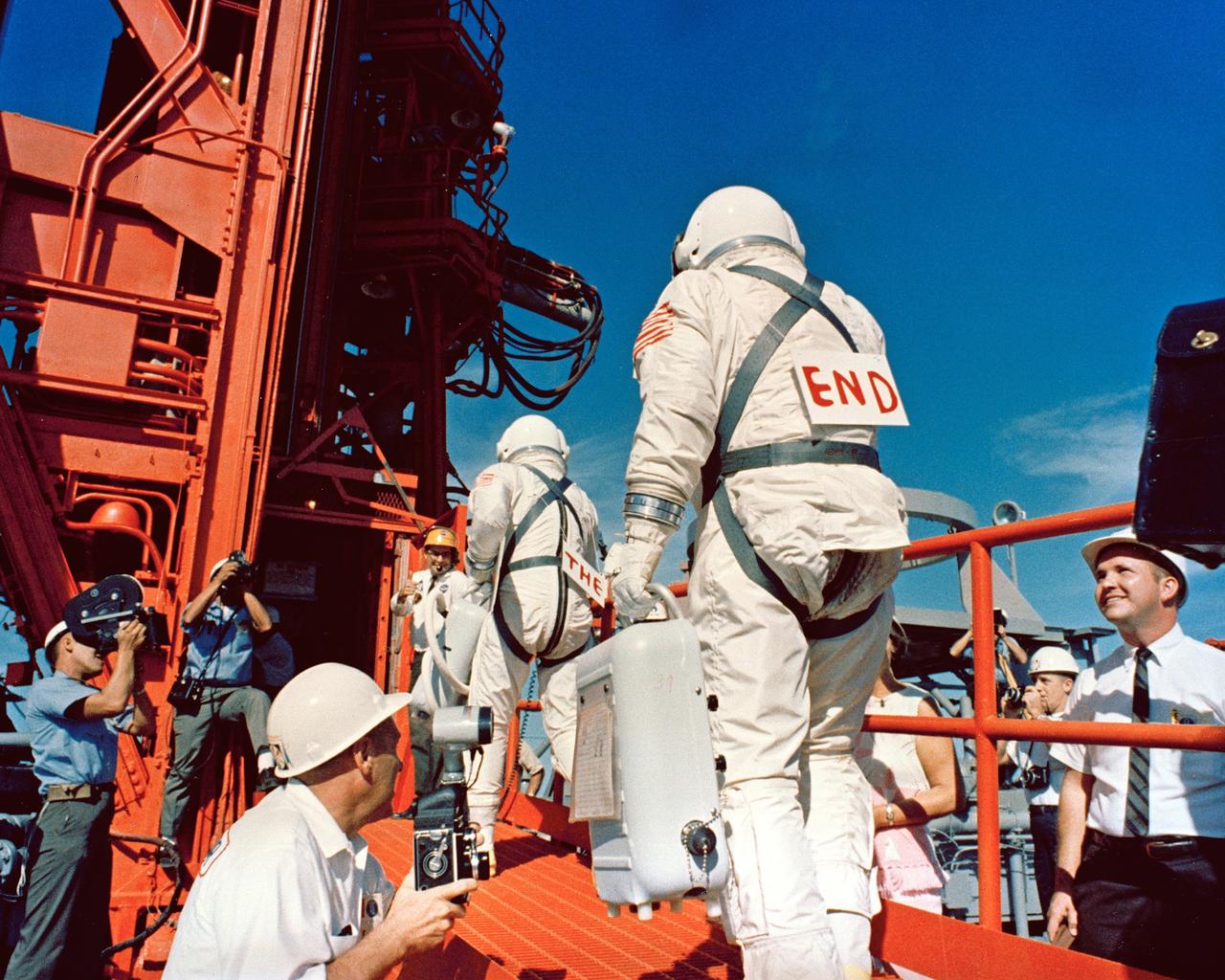
CAPE KENNEDY, Fla. -- At Cape Kennedy Air Force Station in Florida, the crew for Gemini 12 arrives at Launch Complex 19. Command pilot James A. Lovell is followed by pilot Edwin E. Buzz Aldrin Jr. The signs on their backs note that this mission is the final flight of the Gemini Program. Photo Credit: NASA
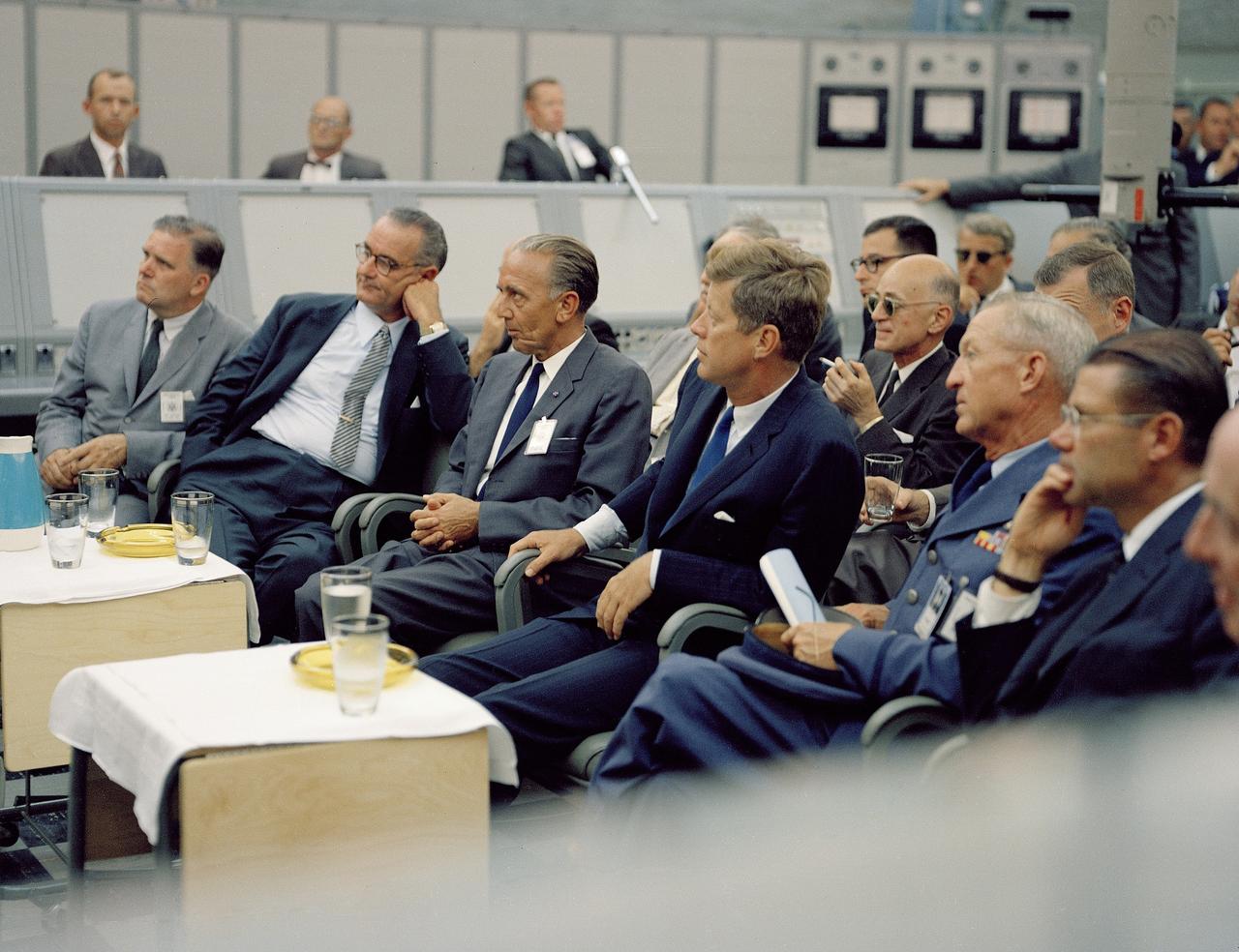
CAPE CANAVERAL, Fla. -- In the blockhouse of Launch Complex 34 at the Cape Canaveral Missile Test Annex in Florida, President John F. Kennedy is briefed on NASA's future plans. Seated, from the left, are NASA Administrator James E. Webb, Vice President Lyndon B. Johnson, Launch Operations Center Director Kurt H. Debus and Kennedy. Photo Credit: NASA
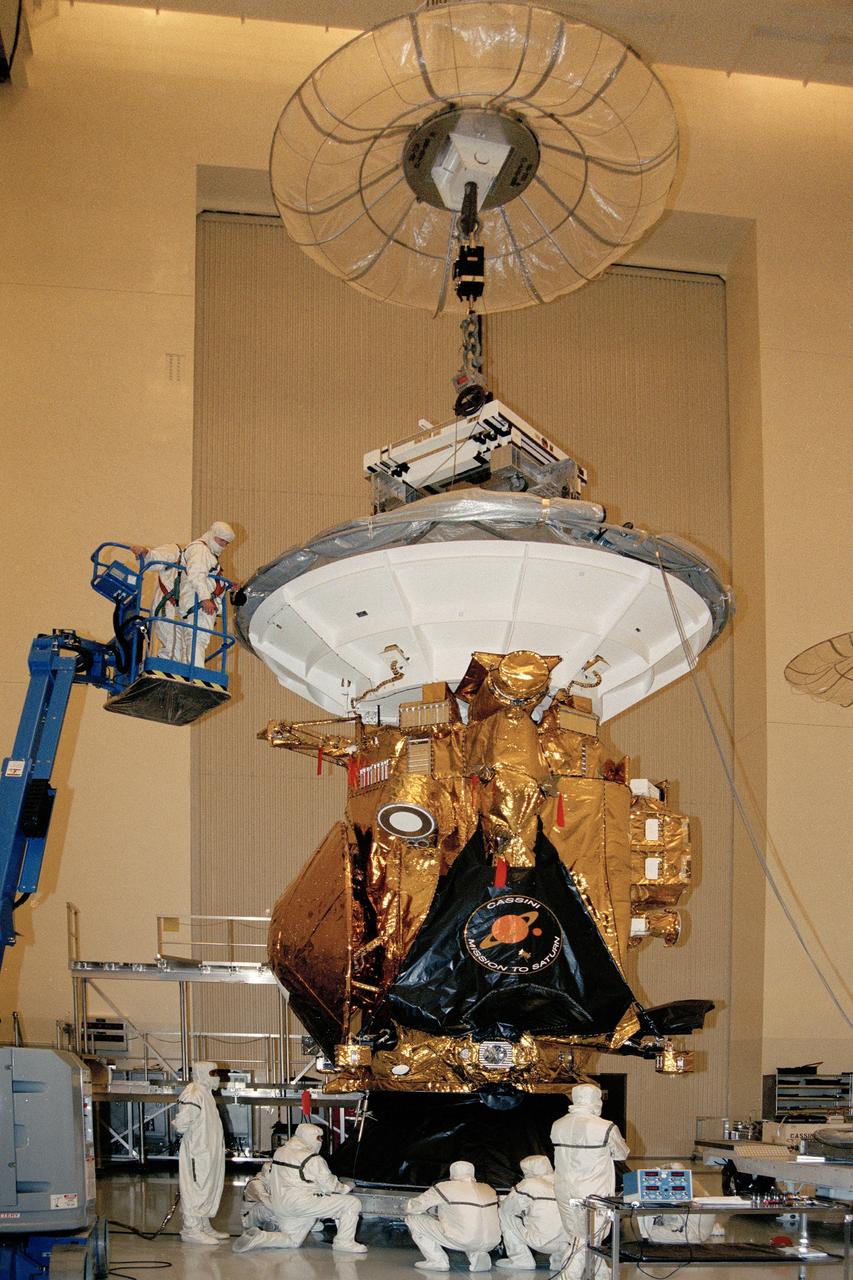
CAPE CANAVERAL, Fla. -- In the Payload Hazardous Servicing Facility PHSF at NASA's Kennedy Space Center in Florida, the Cassini spacecraft is being lifted for placement on a transporter which will move it to Launch Complex 40 at Cape Canaveral Air Force Station. Cassini is an international mission conducted by NASA, the European Space Agency and the Italian Space Agency. The two-story-tall spacecraft, scheduled for launch on Oct. 6, 1997, is destined to arrive at Saturn in July 2004, where it will study the planet, its rings, moons and magnetic environment in detail over a four-year period. The Cassini mission is managed for NASA's Office of Space Science by the Jet Propulsion Laboratory, a division of the California Institute of Technology. Photo Credit: NASA
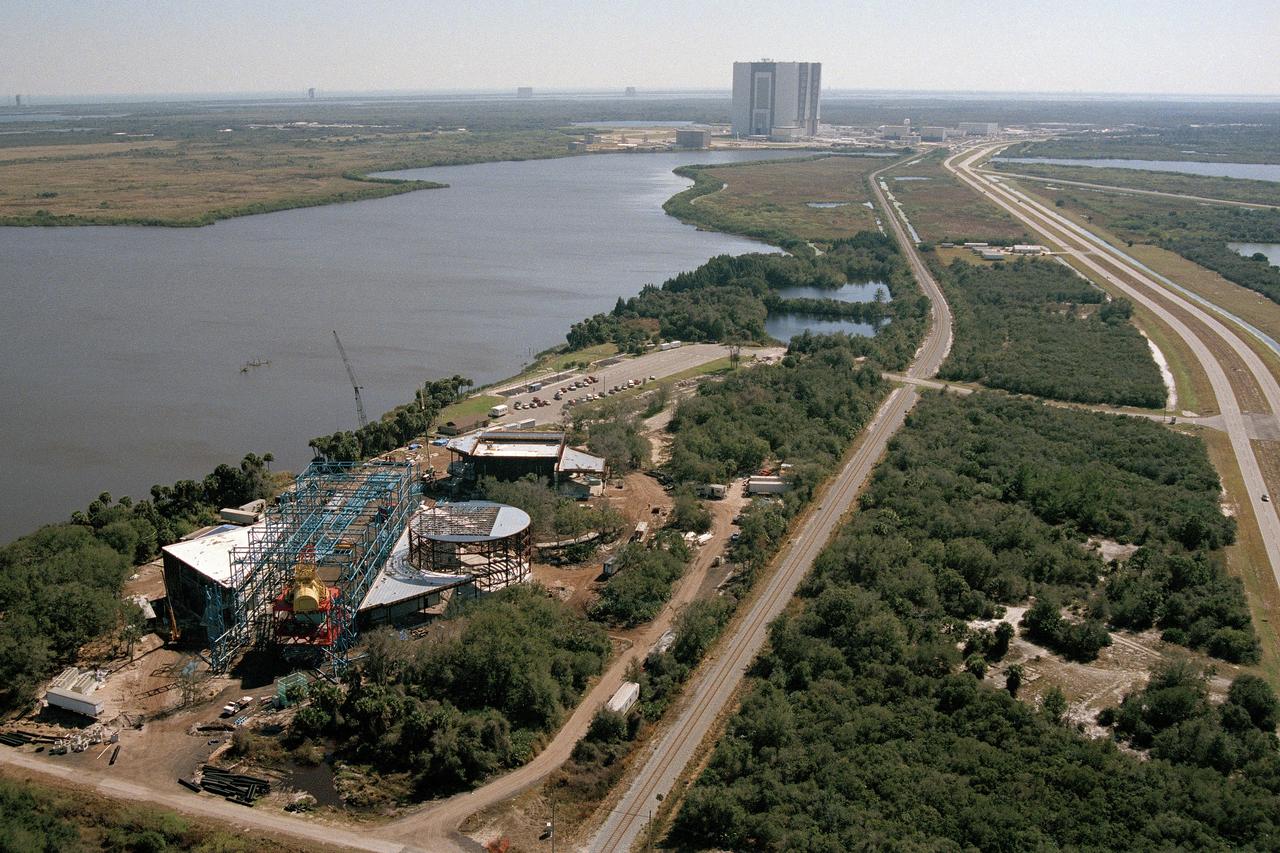
CAPE CANAVERAL, Fla. -- At NASA's Kennedy Space Center in Florida, construction continues on the facility that will house an Apollo era Saturn V rocket. Photo Credit: NASA
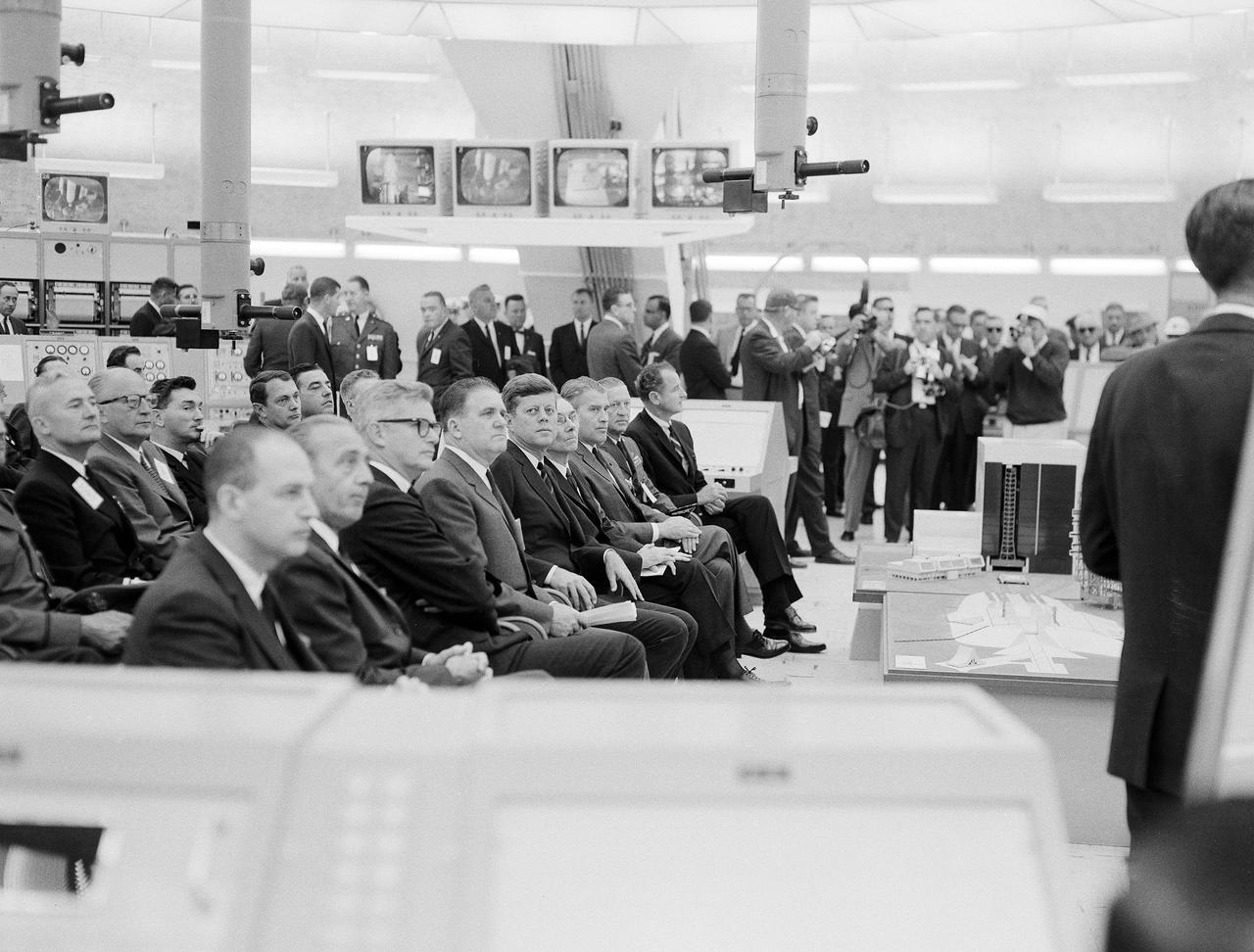
CAPE CANAVERAL, Fla. -- At Cape Canaveral Missile Test Annex in Florida, President John F. Kennedy and other officials are briefed on NASA's future plans in the blockhouse of Launch Complex 37. Photo Credit: NASA
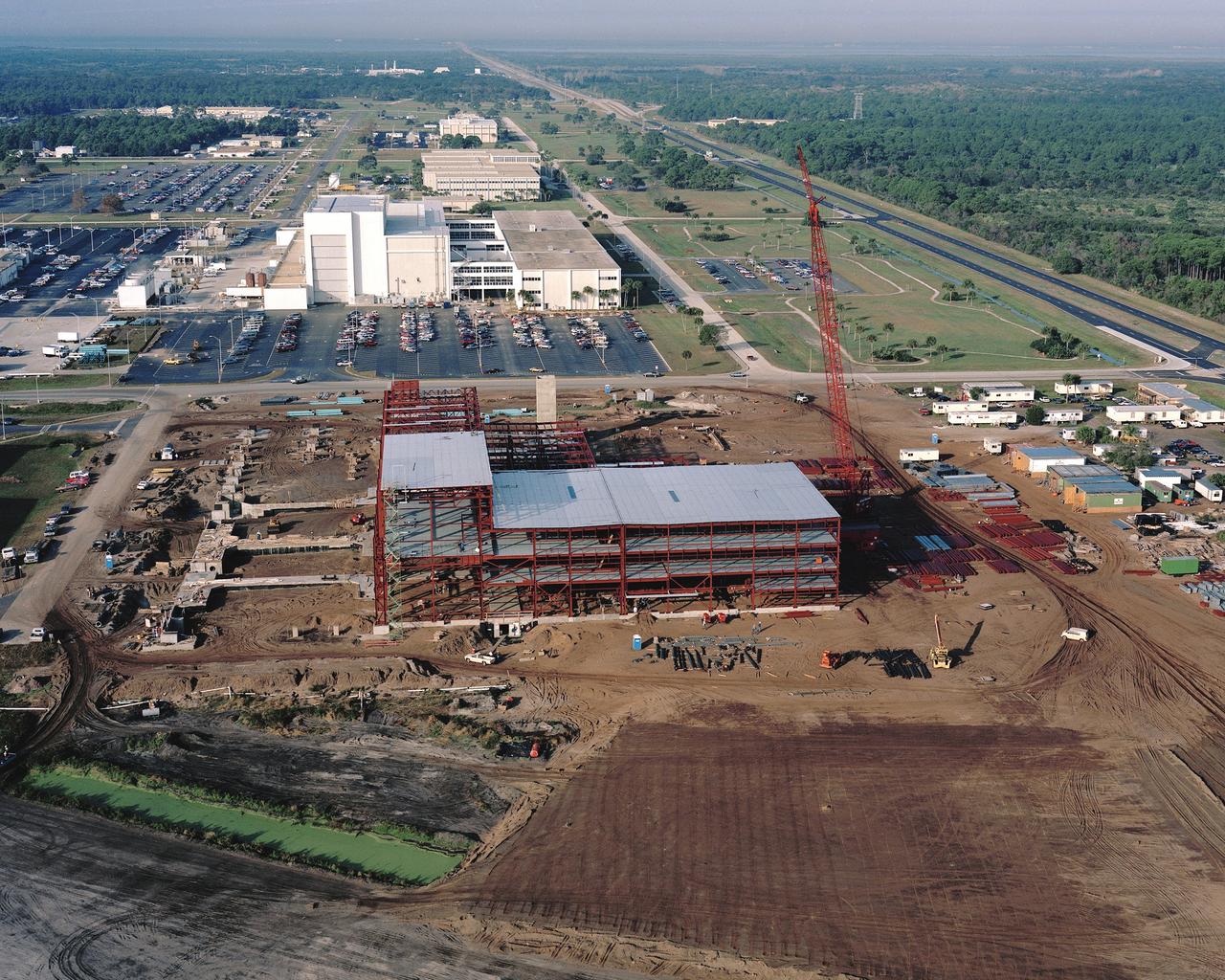
CAPE CANAVERAL Fla. -- This aerial view shows construction progress of the Space Station Processing Facility at the Kennedy Space Center in Florida. Photo Credit: NASA
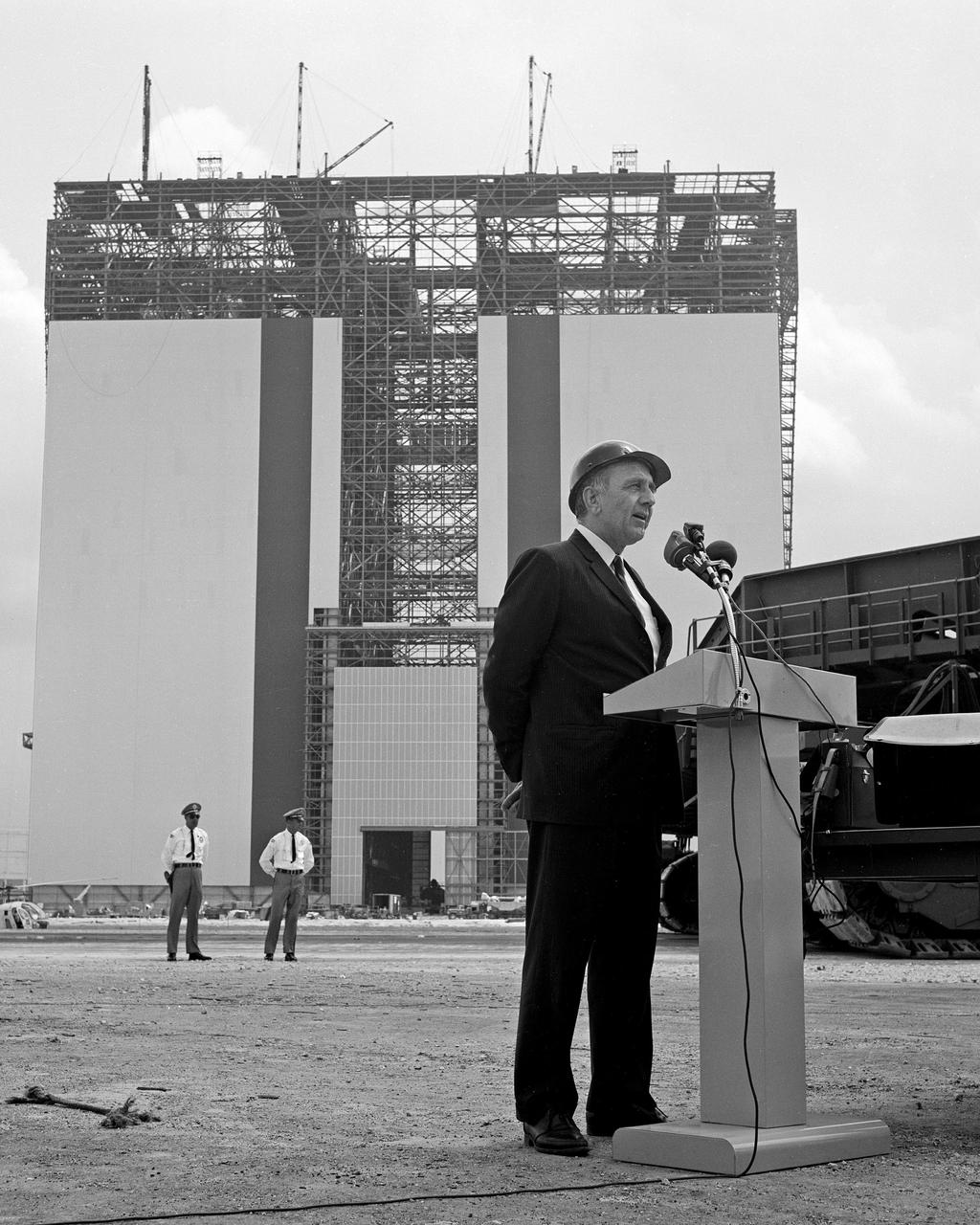
CAPE KENNEDY, Fla. -- At the Kennedy Space Center in Florida, Dr. Kurt H. Debus, center director, speaks at the "topping off" ceremonies for the Vehicle Assembly Building. A crawler-transporter is seen at the right. One of the largest buildings in the world, the 129 million cubic foot structure will be used to prepare the Apollo Saturn V launch vehicles for missions to land astronauts on the moon. Photo Credit: NASA
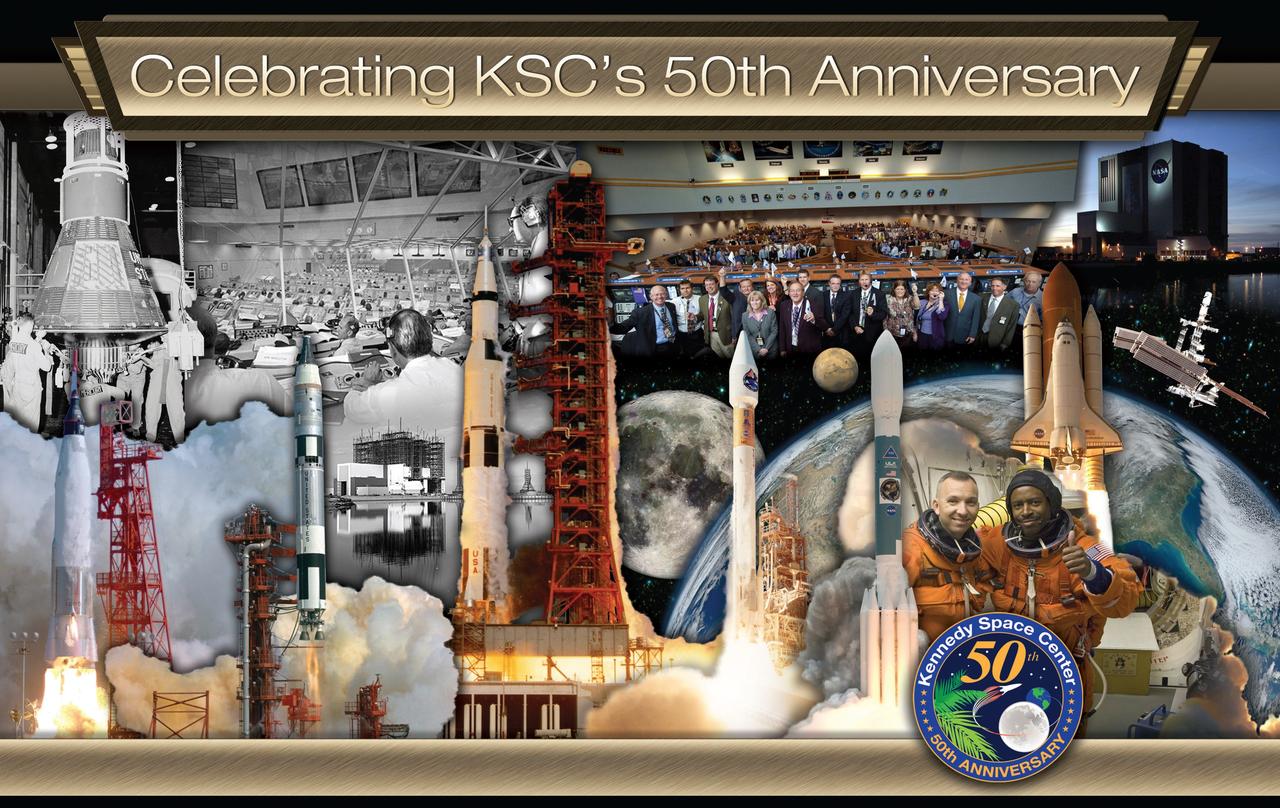
CAPE CANAVERAL, Fla. -- Throughout the past 50 years, NASA's Kennedy Space Center has carried on America's legacy of processing, testing and launching a wide array of rockets and spacecraft to distant planets and other destinations in space. Launch vehicles, from left, include the Mercury Atlas, Gemini Titan, Apollo Saturn V, Atlas, Delta and the space shuttle. Across the top, a Mercury spacecraft is checked out in Hangar S at Cape Canaveral Air Force Station, an Apollo countdown is monitored from a Launch Control Center Firing Room, and mission managers celebrate the launch of the final space shuttle mission -- STS-135. In the lower right, STS-129 mission specialists Randy Bresnik, left, and Leland Melvin indicate they are "go for launch" as they prepare to enter space shuttle Atlantis from the White Room. Also in the image are human destinations the center helped NASA reach, including Earth's orbit, the International Space Station and destination beyond. Image credit: NASA
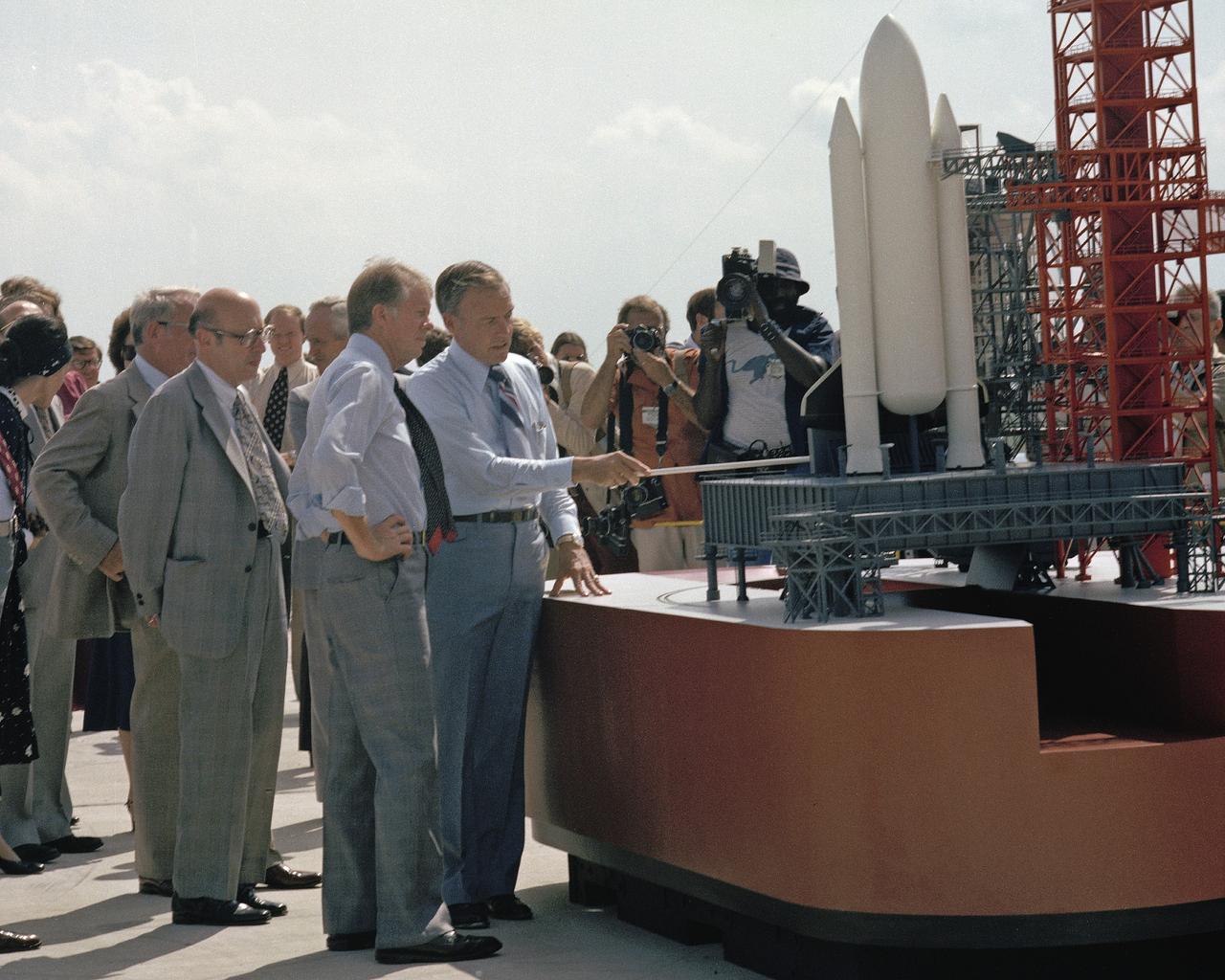
CAPE CANAVERAL, Fla. -- At the Kennedy Space Center in Florida, President Jimmy Carter, hand on waist, is briefed on preparations for the first space shuttle launch by center director Lee Scherer. To the left of Carter is NASA Administrator Robert Frosch. Photo Credit: NASA
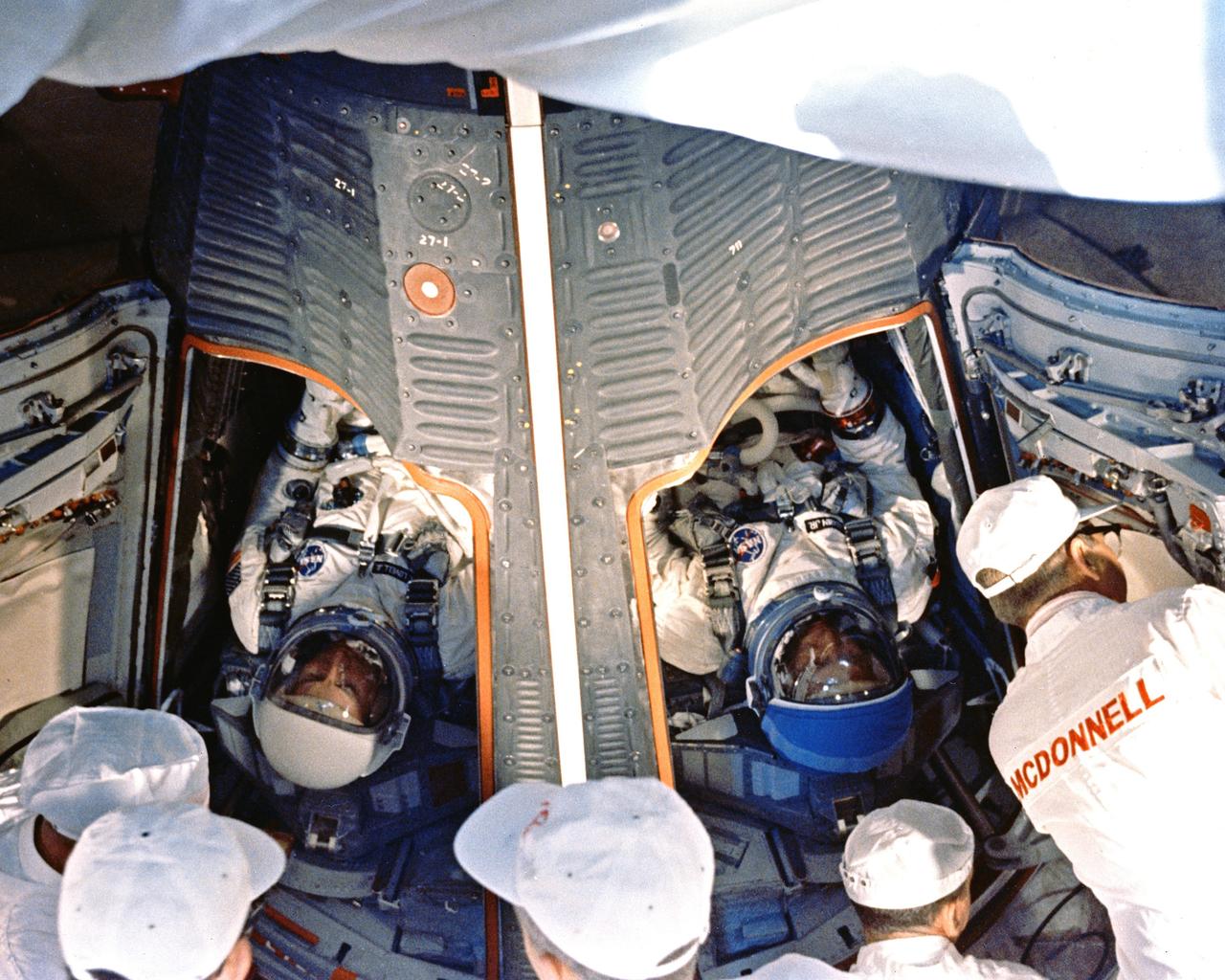
CAPE KENNEDY, Fla. -- At Cape Kennedy Air Force Station in Florida, Gemini 12 command pilot James A. Lovell, left, and Edwin E. Buzz Aldrin Jr. wait for launch as technicians complete preparations of the spacecraft. Photo Credit: NASA
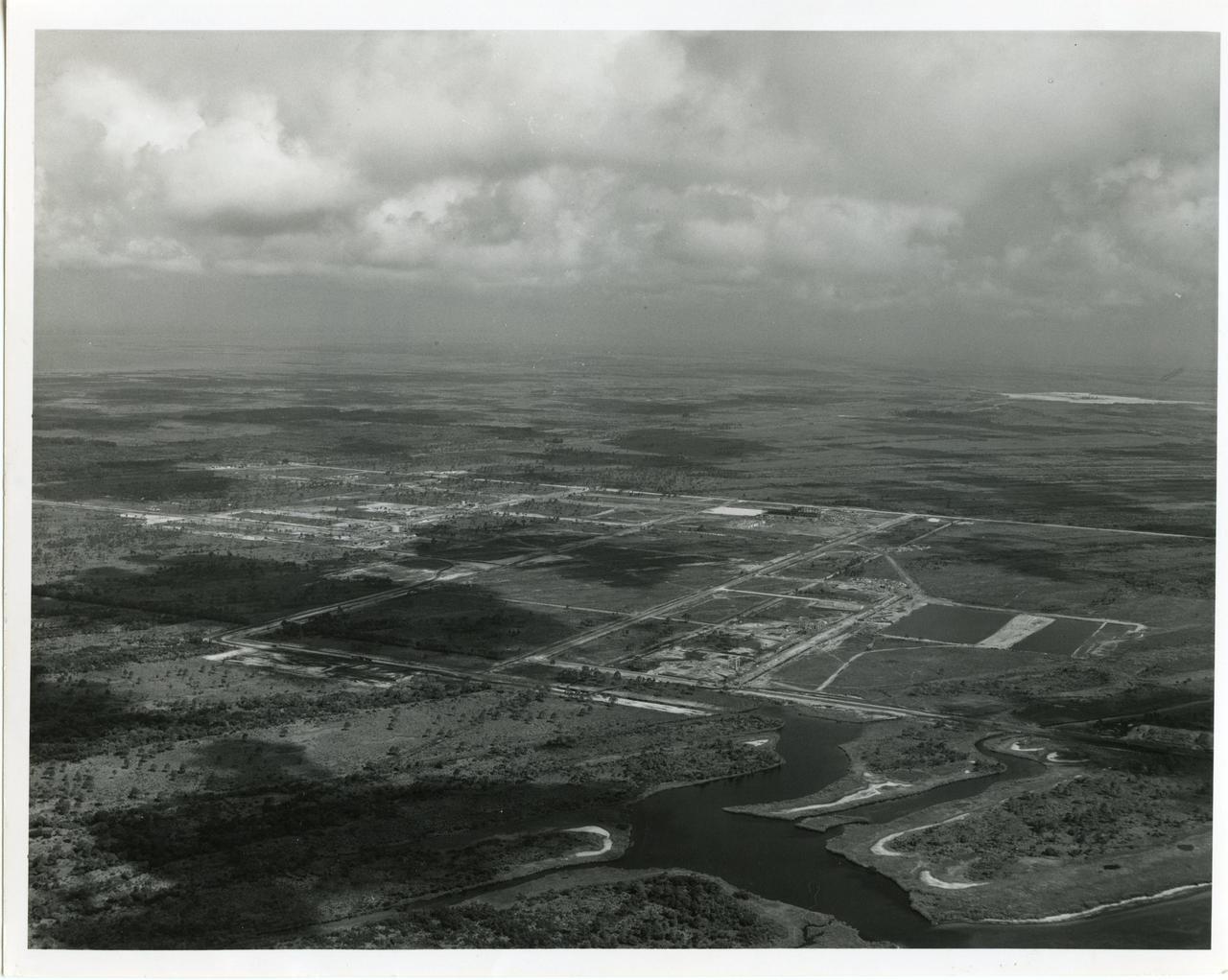
CAPE CANAVERAL, Fla. -- This aerial of view from 1963 shows the site of the Industrial Area for the Merritt Island Launch Annex, now the Kennedy Space Center in Florida. Located five miles south of Launch Complex 39, this is the site where facilities were built such as the Headquarters Building, Operations and Checkout Building as well as the Central Instrumentation Facility. Photo Credit: NASA
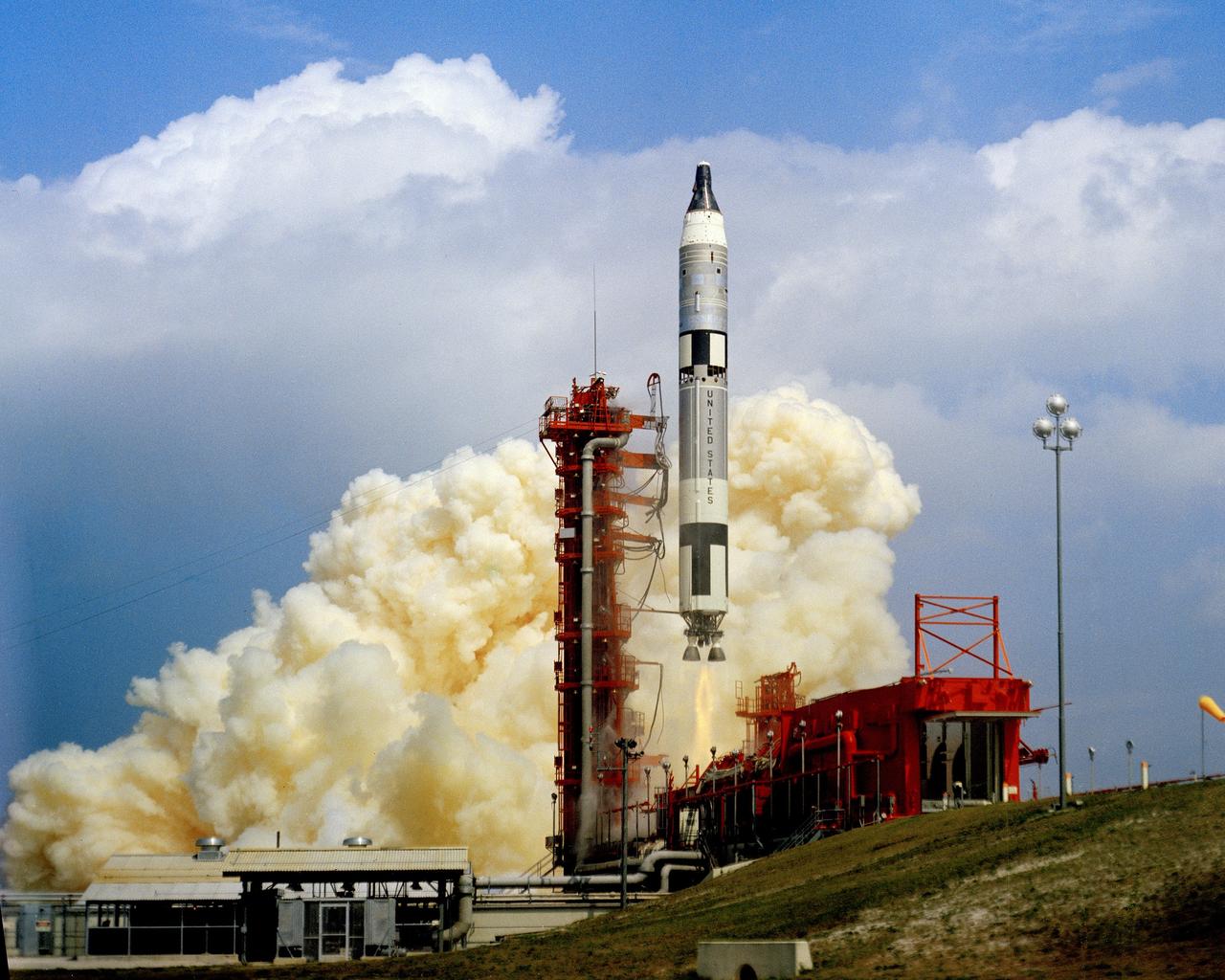
CAPE KENNEDY, Fla. -- At Cape Kennedy Air Force Station in Florida, Gemini 8 lifts off atop a Titan II rocket with command pilot Neil A. Armstrong and pilot David R. Scott aboard. They plan to rendezvous and dock with an Agena target satellite and Scott will perform a spacewalk. Photo Credit: NASA
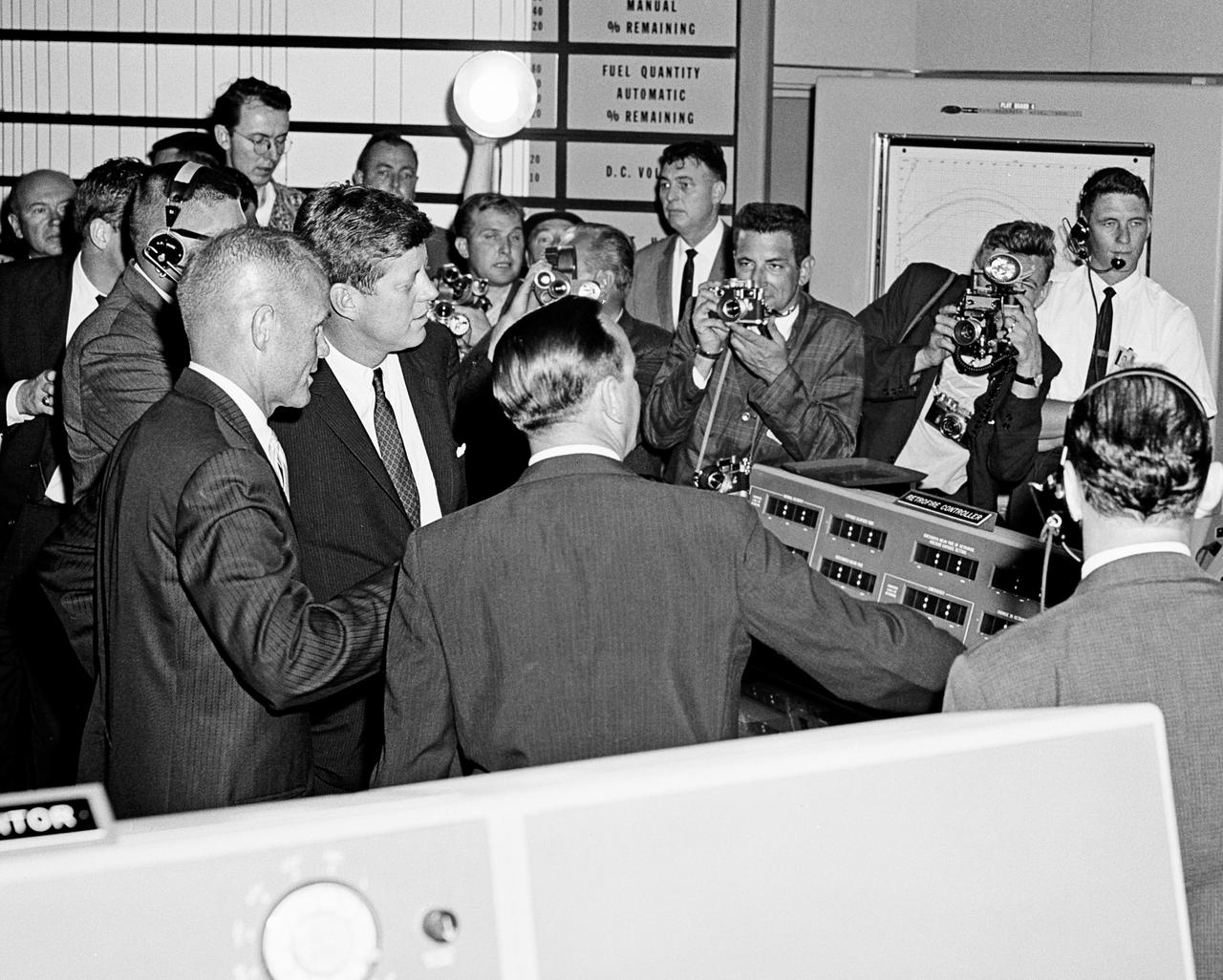
CAPE CANAVERAL Fla. -- Photojournalists crowd in as astronaut John H. Glenn Jr., left, talks to President John F. Kennedy about a console in the Mercury Control Center at the Cape Canaveral Missile Test Annex in Florida. Photo Credit: NASA
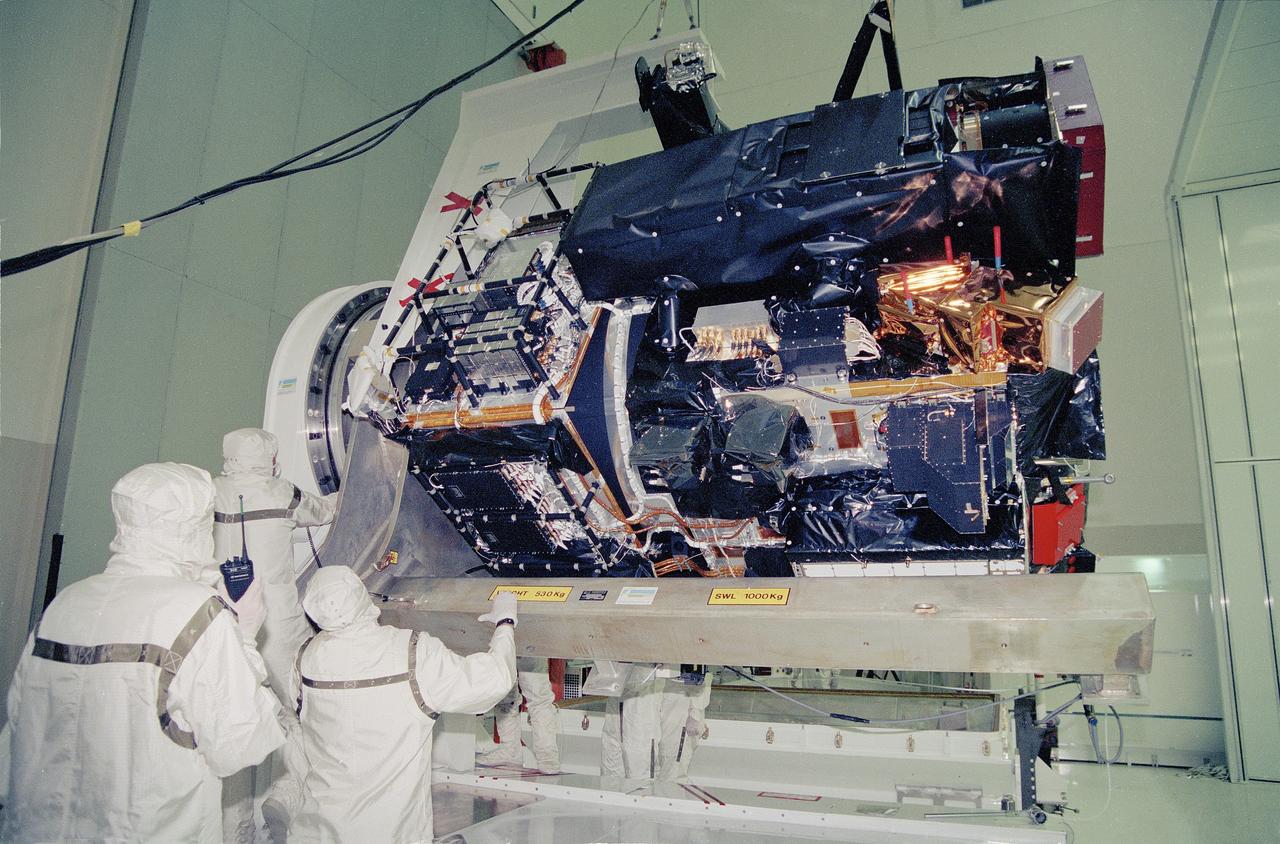
CAPE CANAVERAL, Fla. -- At NASA's Kennedy Space Center in Florida, technicians in the Spacecraft Assembly and Encapsulation Facility-2 SAEF-2) lift the Solar and Heliospheric Observatory SOHO after its removal from the crate it was shipped in from France. The SOHO spacecraft will carry a complement of 11 instruments from NASA and the European Space Agency ESA to study the origin of the energy within the sun which reaches the sun’s surface. SOHO was manufactured in France by Matra Marconi under a contract with ESA. The observatory will receive final testing and preparations for launch in SAEF-2. SOHO is targeted for launch on an Atlas IIAS from Launch Complex 36, Cape Canaveral Air Station, between Oct. 31 and Nov. 7, 1995. Photo Credit: NASA
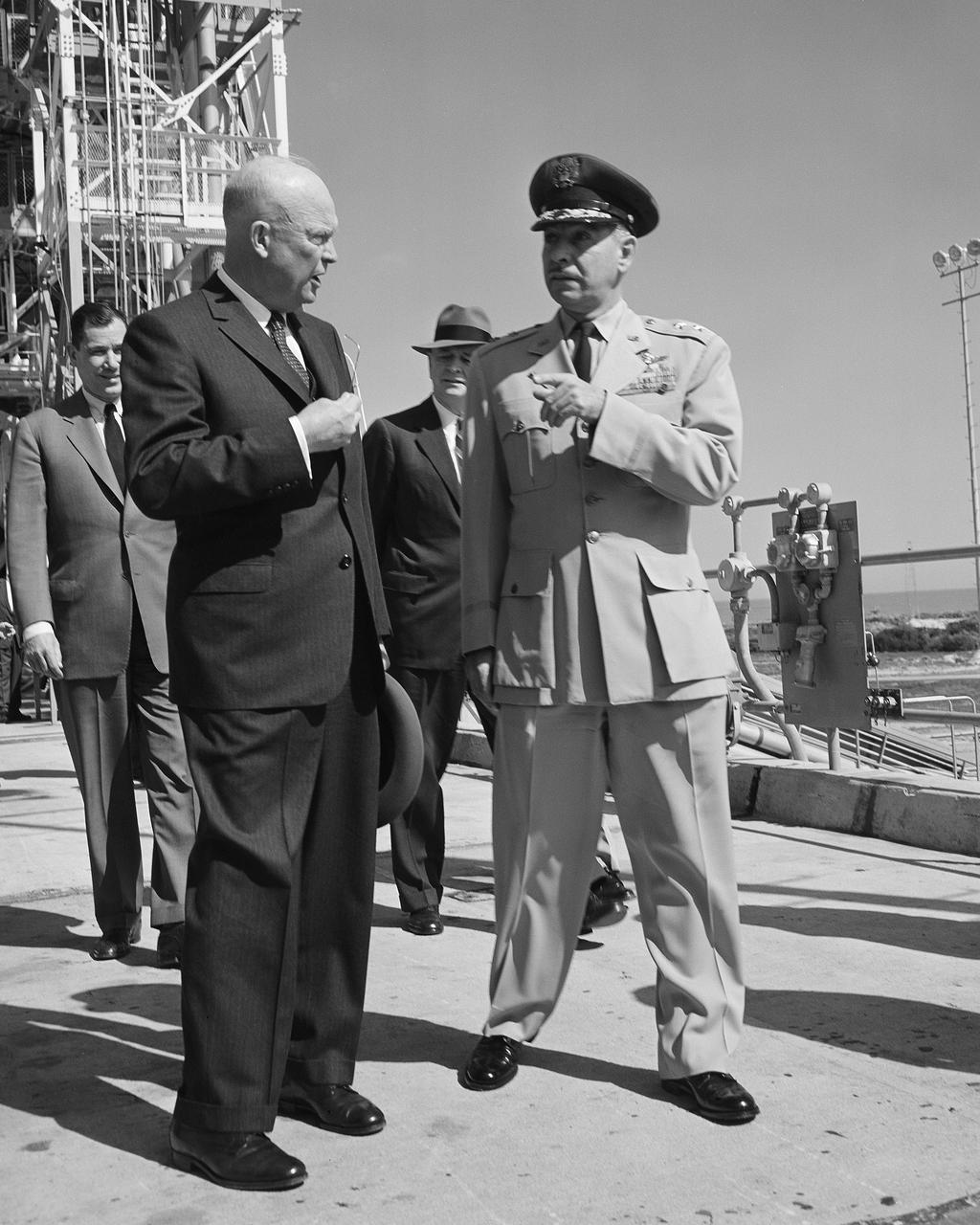
CAPE CANAVERAL, Fla. -- President Dwight D Eisenhower is briefed on operations at Cape Canaveral Air Force Station in Florida. Photo Credit: NASA
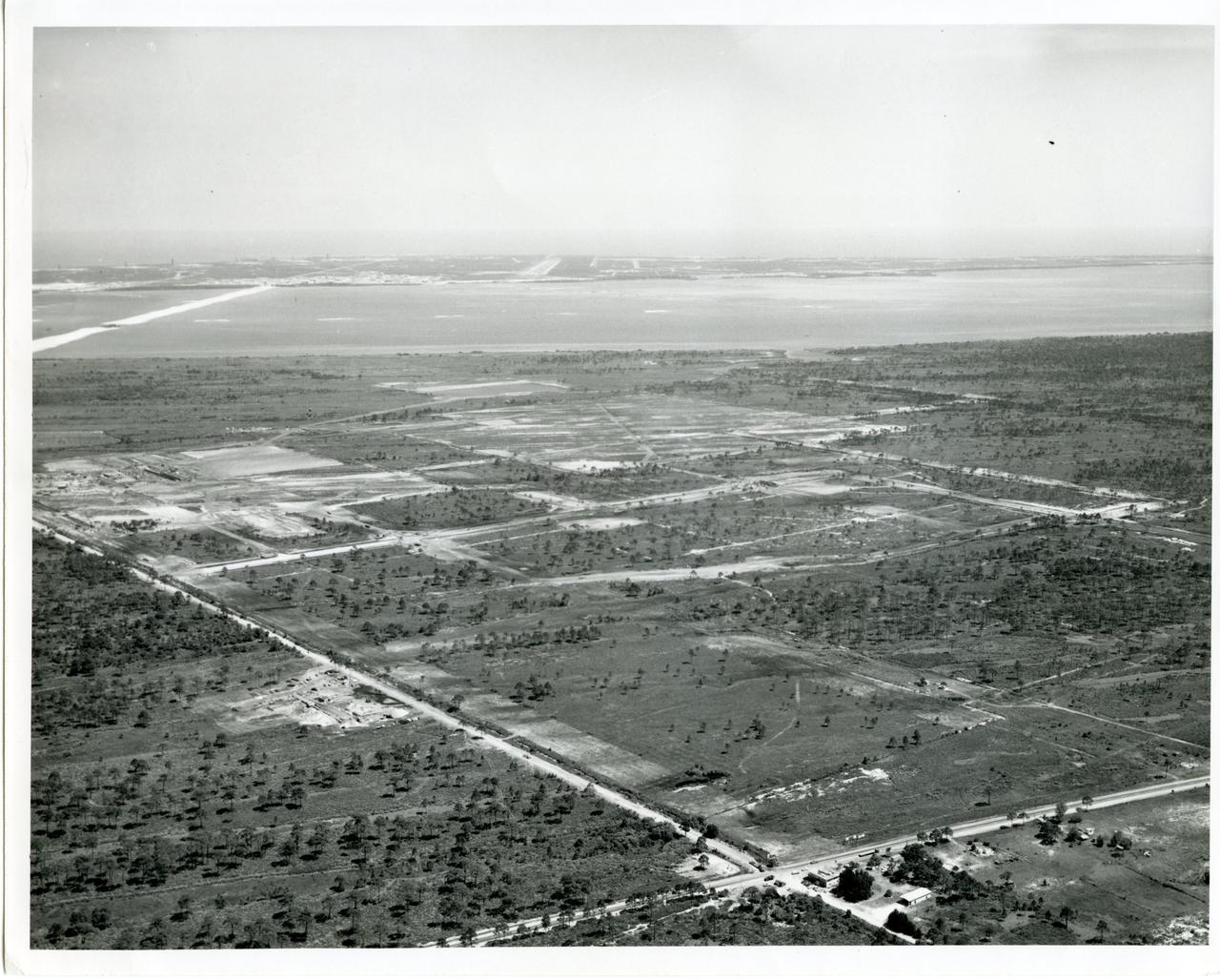
CAPE CANAVERAL, Fla. -- This aerial of view from 1963 shows the site of the Industrial Area for the Merritt Island Launch Annex, now the Kennedy Space Center in Florida. Located five miles south of Launch Complex 39, this is the site where facilities were built such as the Headquarters Building, Operations and Checkout Building as well as the Central Instrumentation Facility. Photo Credit: NASA.
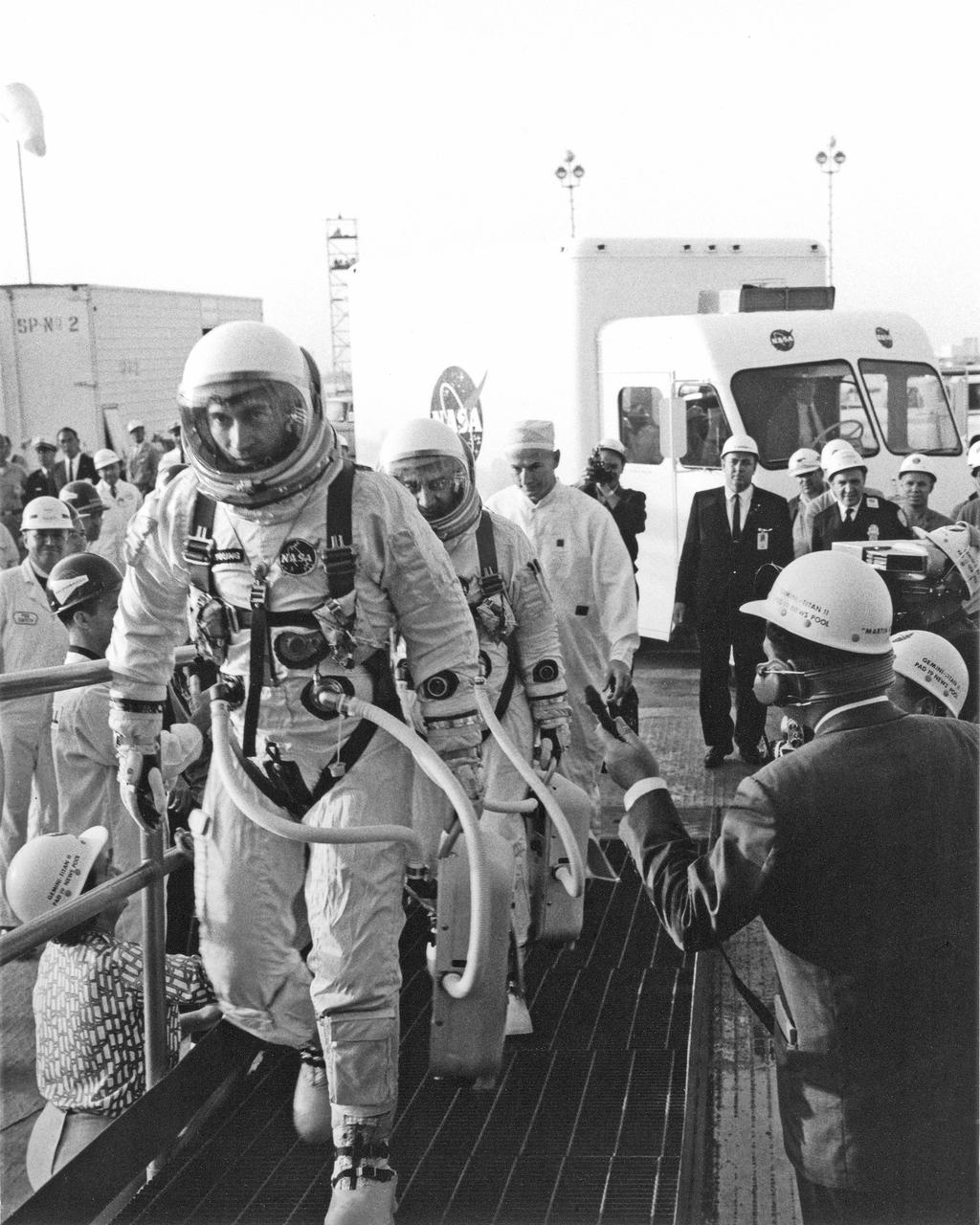
CAPE KENNEDY, Fla. -- At Cape Kennedy Air Force Station in Florida, Gemini 3 pilot John W. Young is followed by command pilot Virgil I. Grissom as they walk to elevator at Launch Complex 19 for their three orbit flight, the first mission of the Gemini spacecraft. Photo Credit: NASA
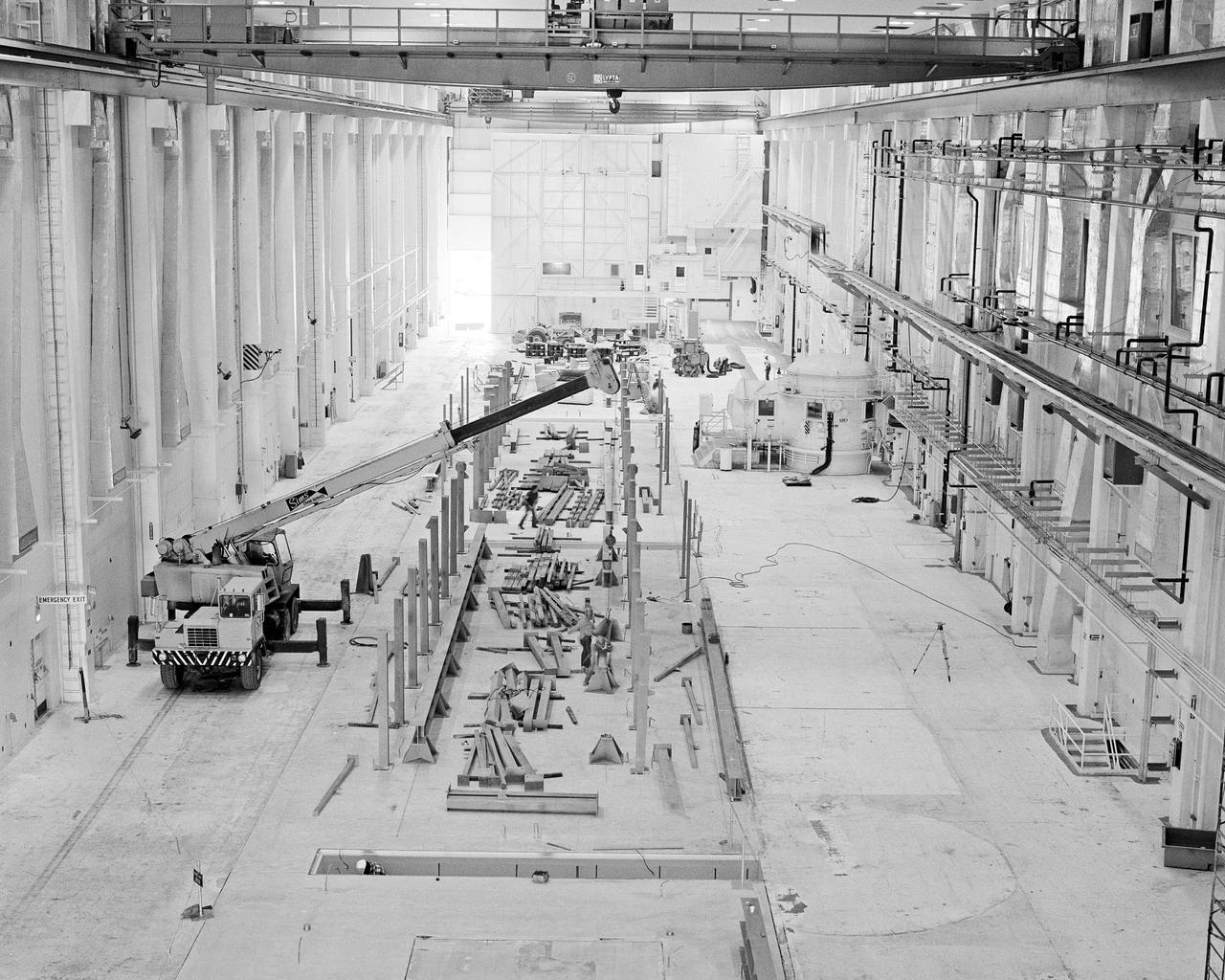
CAPE CANAVERAL, Fla. -- At the Kennedy Space Center in Florida, structural work is ongoing inside the high bay of the Operations and Checkout Building. The modifications are taking place to configure the facility flight hardware from the Apollo Program and prepare to support payload processing for future space shuttle missions. Photo Credit: NASA
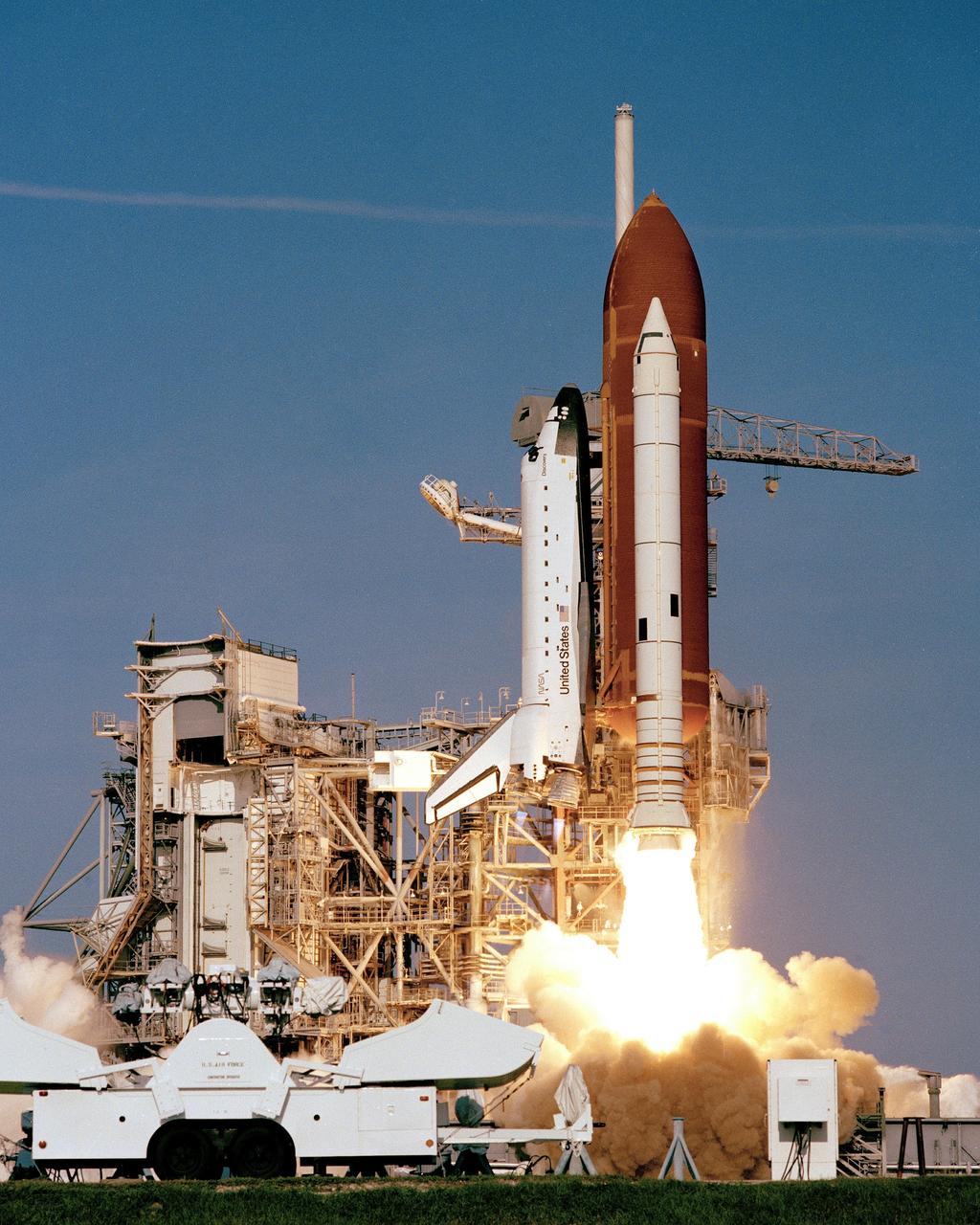
CAPE CANAVERAL, Fla. -- At the Kennedy Space Center in Florida, The space shuttle Discovery lifts off from Launch Pad 39A for its maiden flight at 8:42 a.m. EDT. The crew members for the 41-D flight are commander Henry w. Hartsfield, pilot Michael L. Coats, mission specialists Judith A. Resnik, Steven A. Hawley, Richard M. Mullane, and payload specialist Charles W. Walker. Photo Credit: NASA
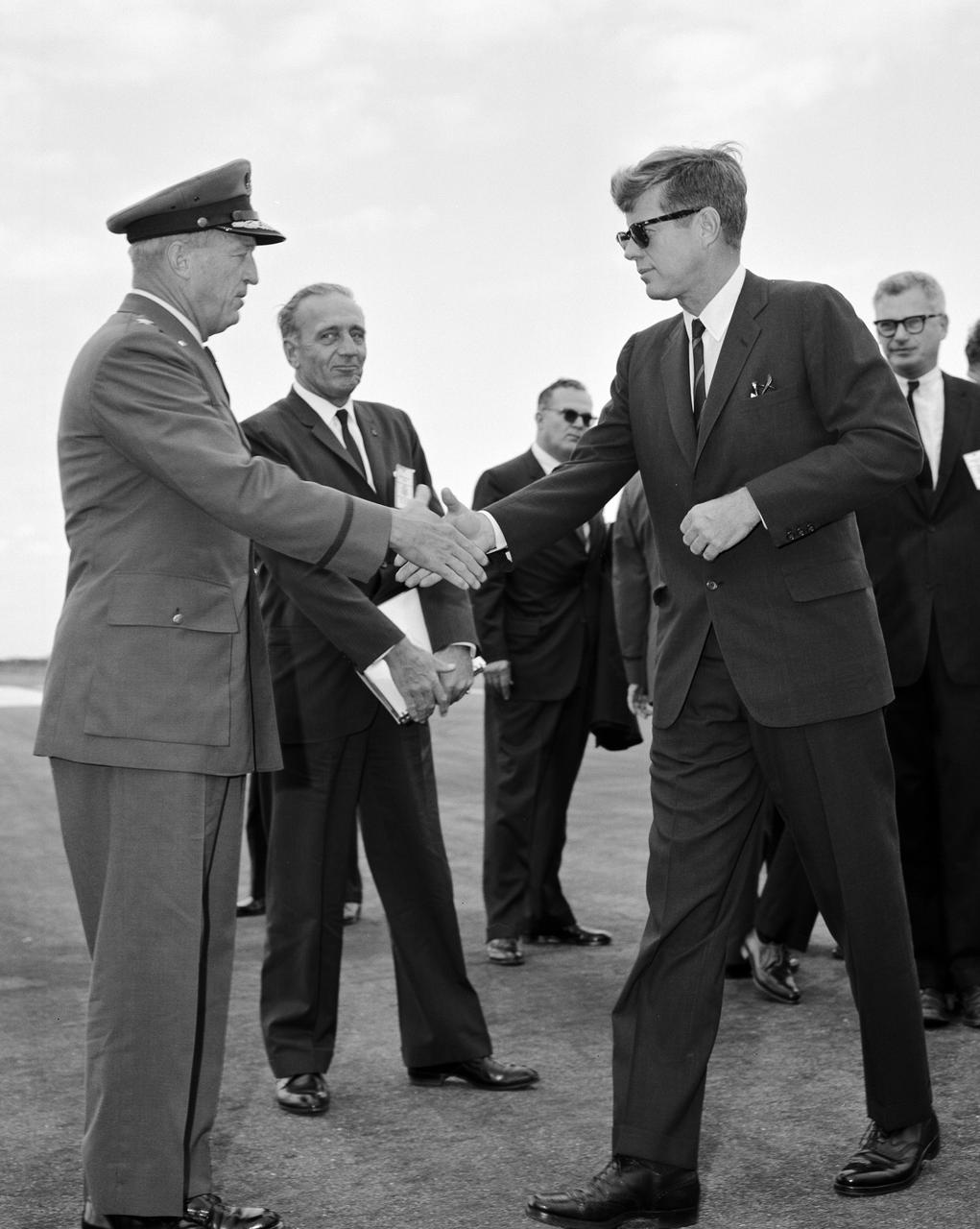
CAPE CANAVERAL Fla. -- Maj. Gen. L. I. Davis, commander of the U.S. Air Force Missile Test Center, welcomes President John F. Kennedy to the Cape Canaveral Missile Test Annex in Florida. Photo Credit: NASA
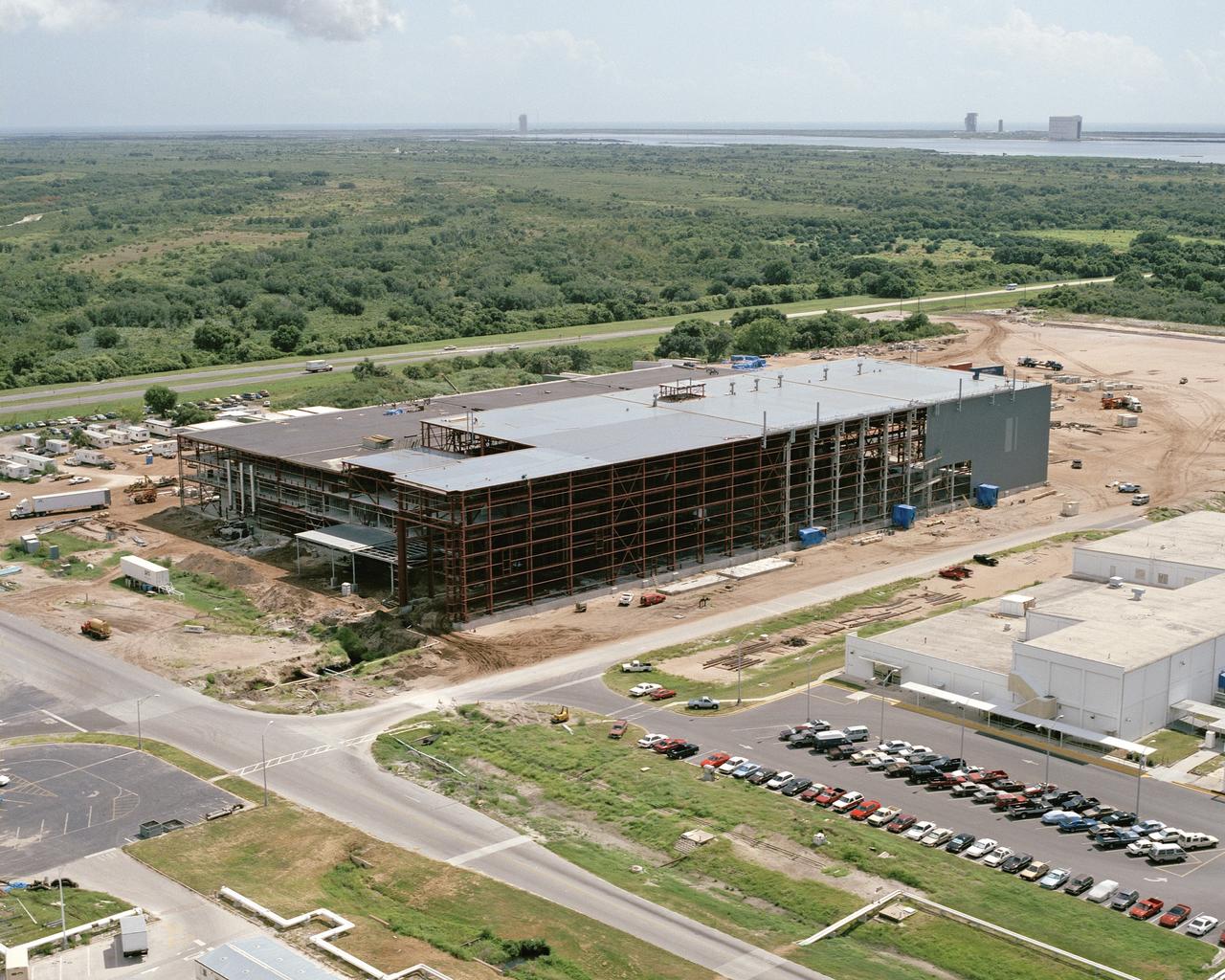
CAPE CANAVERAL Fla. -- This aerial view shows construction progress of the Space Station Processing Facility at the Kennedy Space Center in Florida. Photo Credit: NASA
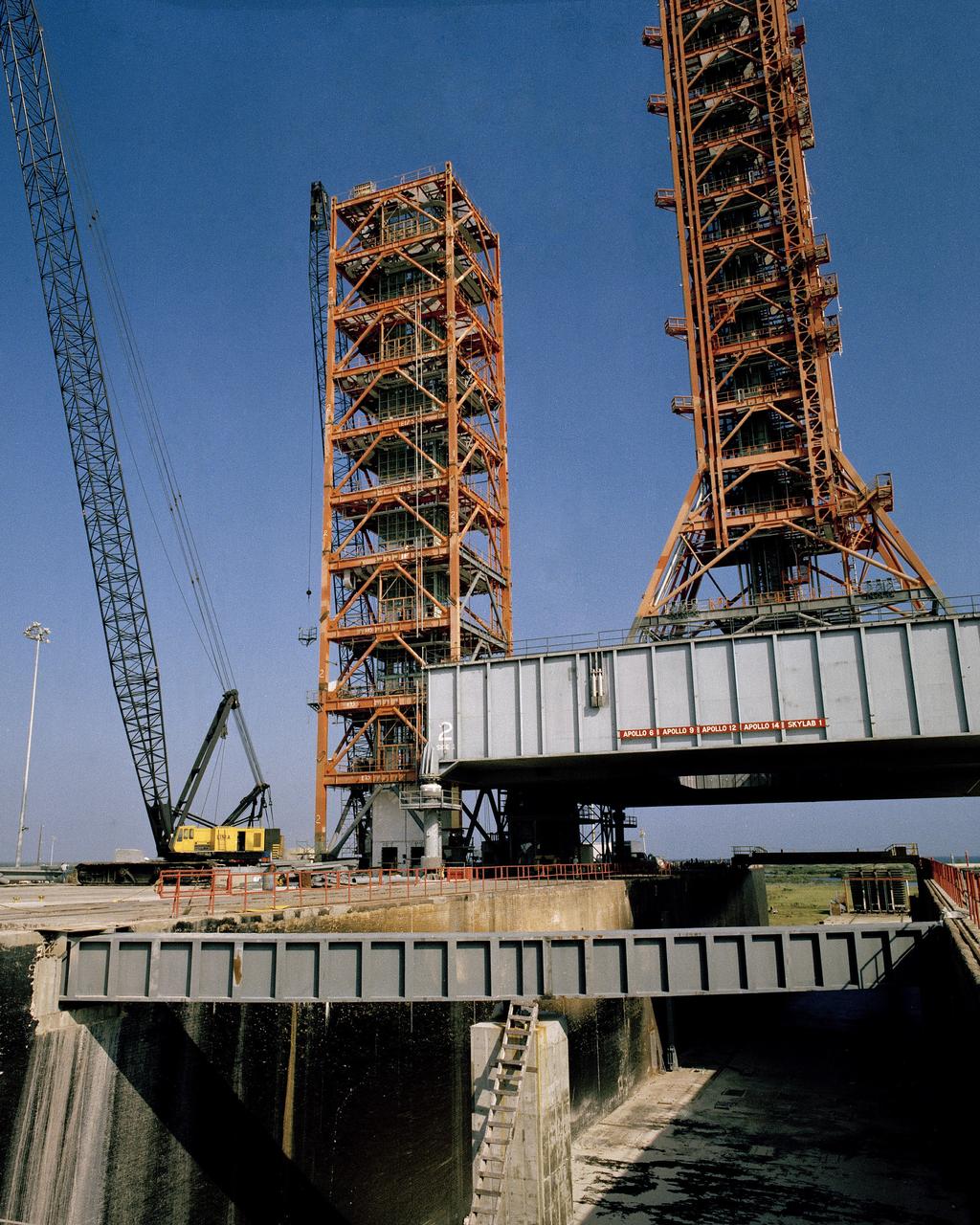
CAPE CANAVERAL, Fla. -- At the Kennedy Space Center in Florida, the shuttle service and access tower SSAT, left, is assembled at Launch Complex 39A from sections of launch umbilical tower 3. The lower 180 feet of the old ML-3 will be topped by the former uppermost section on which a hammerhead crane will be installed and the next lower section which houses the intact ML-3 elevator room and equipment. The SSAT will anchor and support a hinge column to the Payload Changeout Room PCR which will travel on a rail in a specified area to enclose the space shuttle's cargo bay on the pad for installation or removal of payloads. Mobile Launcher 2, center right, is on the pad to support the PCR during construction. Photo Credit: NASA
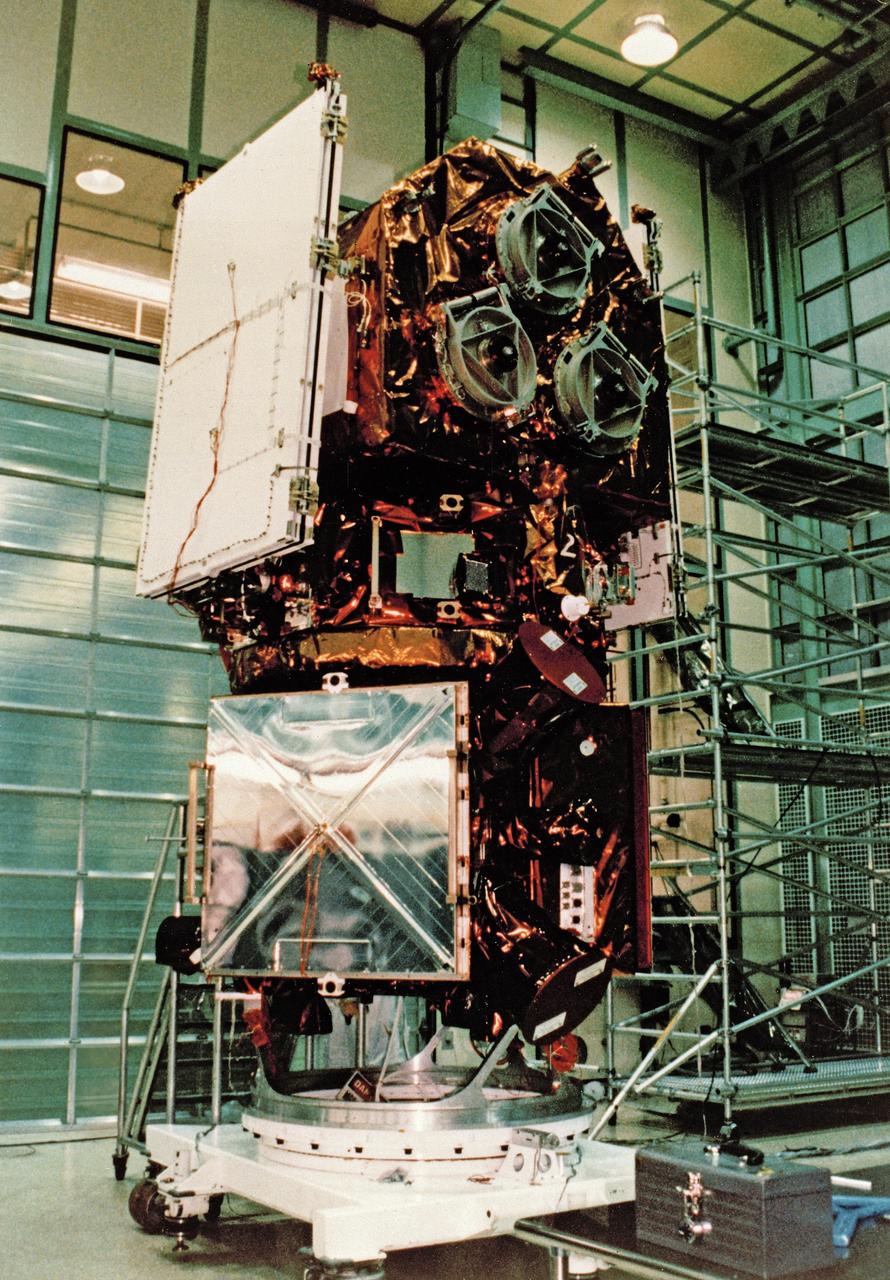
GREENBELT, Md. -- At NASA’s Goddard space Flight Center, Greenbelt, Md., a fully integrated Extreme Ultraviolet Explorer EUVE is seen in a clean room. EUVE will map the entire sky to determine the existence, direction, brightness and temperature of numerous objects that are sources of extreme ultraviolet radiation. Goddard is responsible for the design, construction, integration, checkout and operation of the spacecraft which is scheduled to launch May 28, 1992 from Cape Canaveral Air Force Station, Fla., aboard a Delta II rocket. Photo Credit: NASA
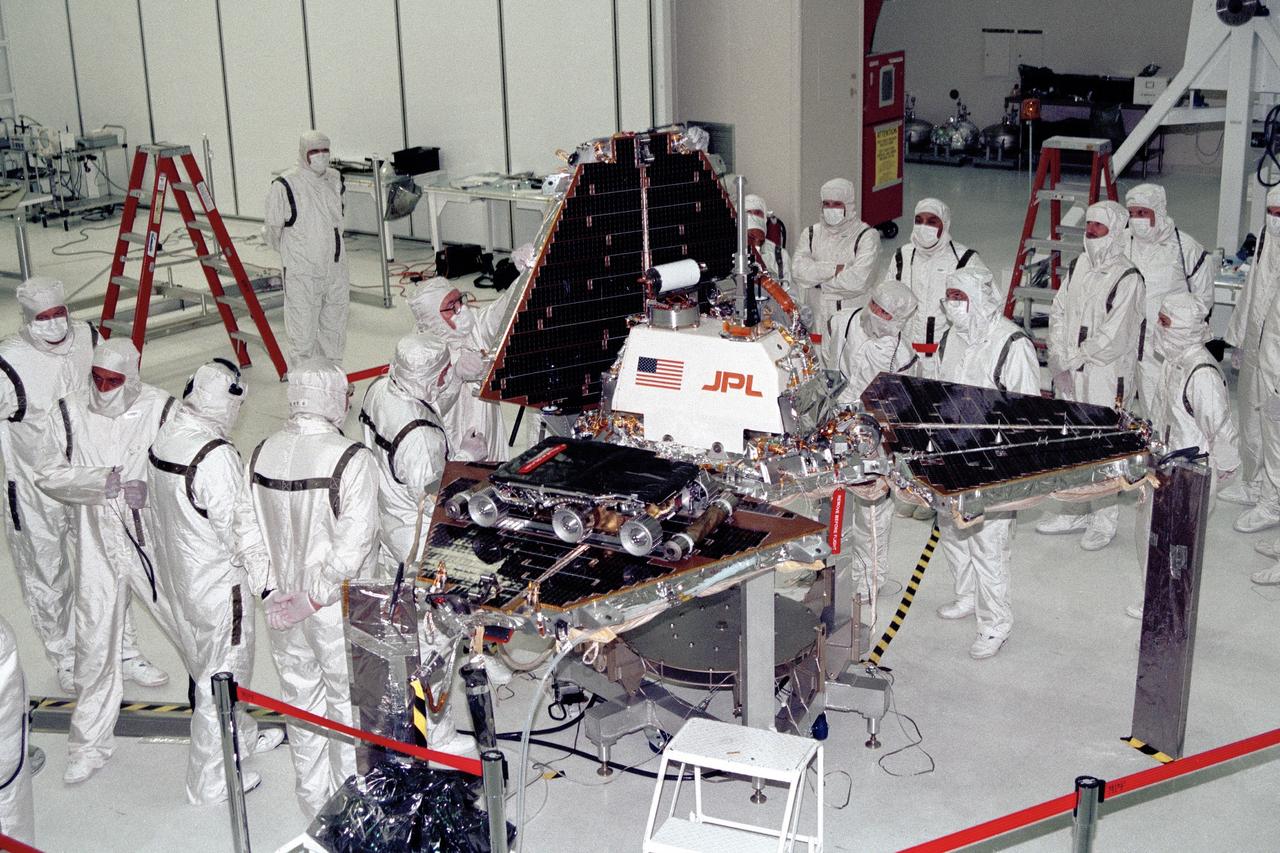
CAPE CANAVERAL, Fla. -- In the Spacecraft Assembly and Encapsulation Facility-2 at NASA's Kennedy Space Center in Florida, Jet Propulsion Laboratory technicians are closing up the metal "petals" of the Mars Pathfinder lander. The Sojourner rover is visible on one of the three petals. Photo Credit: NASA
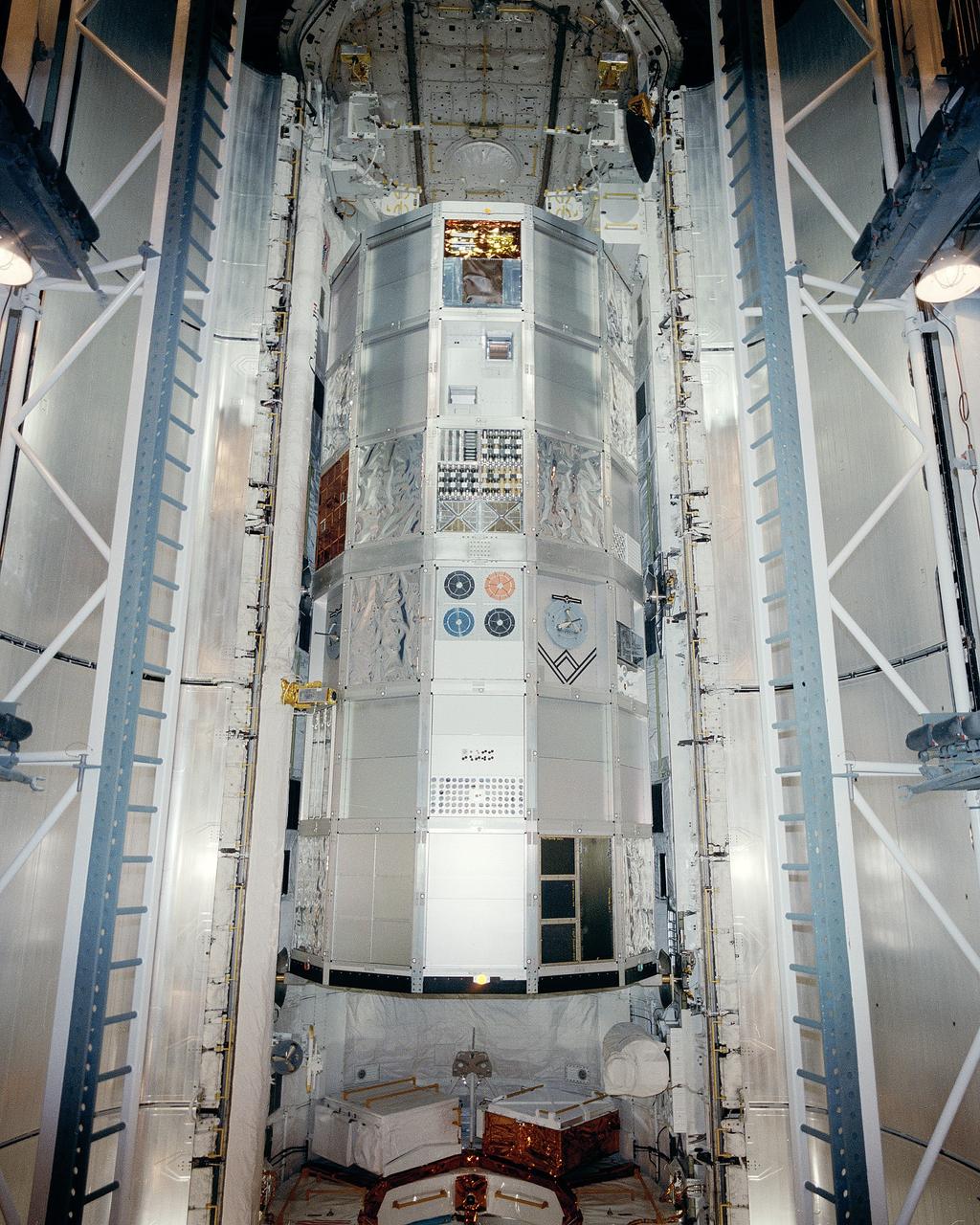
CAPE CANAVERAL, Fla. -- At NASA's Kennedy Space Center's Launch Pad 39-A, the school bus-sized Long Duration Exposure Facility LDEF containing 57 active and passive experiments from nine nations has been loaded into the payload bay of the space shuttle Challenger. The view from the Payload Change-out Room shows LDEF which will be deployed in orbit at an altitude of nearly 300 miles and retrieved after nearly a year so that the experimenters may analyze the effects of long term exposure to space on various substances and processes. The five-member STS-41C crew for this flight is headed by veteran astronaut Robert Crippen on his third space shuttle flight, and includes space rookies, pilot Dick Scobee and mission specialists Terry Hart, George Nelson and James van Hoften. Photo Credit: NASA
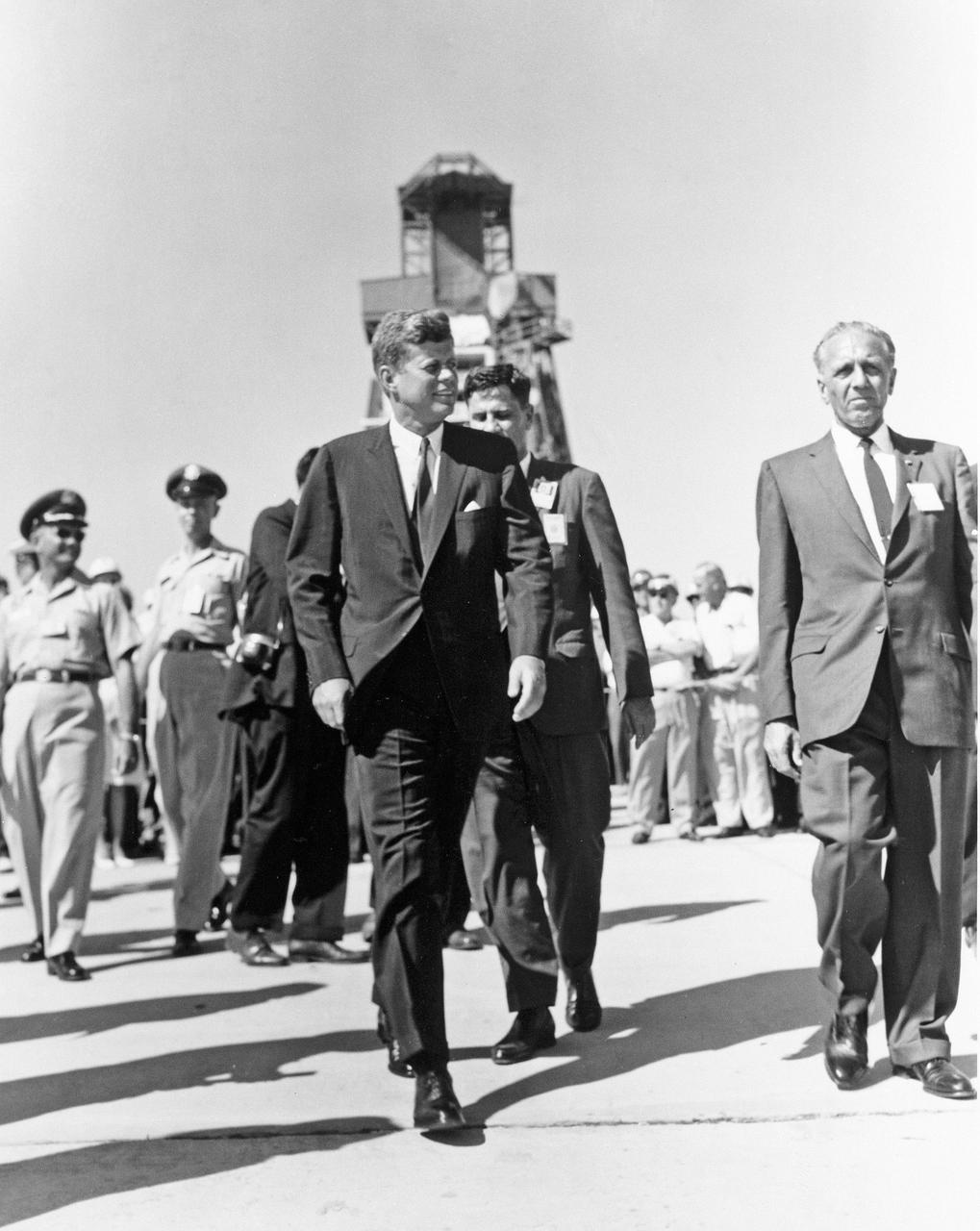
CAPE CANAVERAL Fla. -- President John F. Kennedy is escorted by Launch Operations Center Director Dr. Kurt H. Debus, on the right, on a tour of Launch Complex-14 at the Cape Canaveral Missile Test Annex in Florida. Photo Credit: NASA
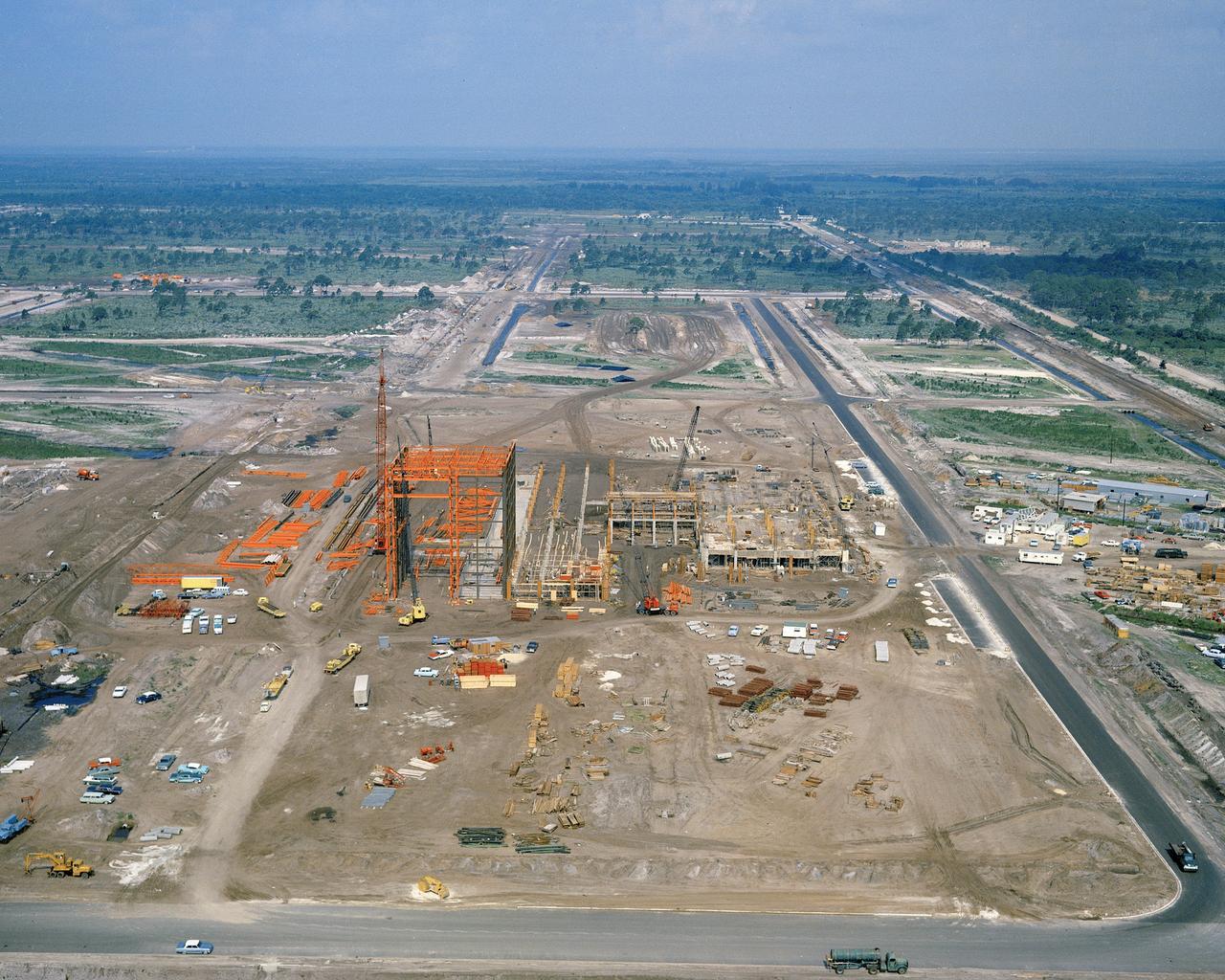
CAPE CANAVERAL Fla. -- This aerial view shows construction progress of the Manned Spacecraft Operations Building at NASA's Merritt Island Launch Annex. Photo Credit: NASA
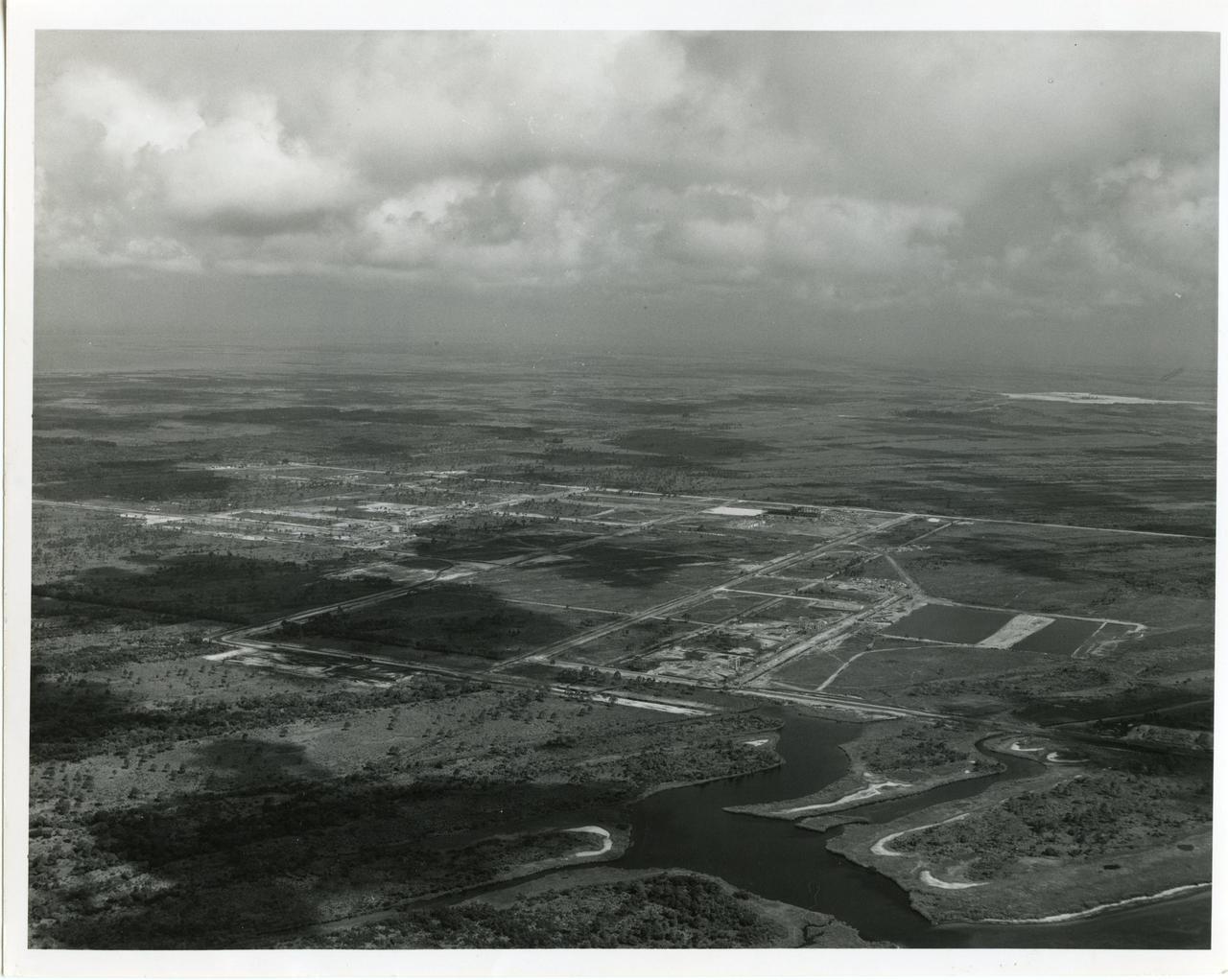
CAPE CANAVERAL, Fla. -- This aerial of view from 1963 shows the site of the Industrial Area for the Merritt Island Launch Annex, now the Kennedy Space Center in Florida. Located five miles south of Launch Complex 39, this is the site where facilities were built such as the Headquarters Building, Operations and Checkout Building as well as the Central Instrumentation Facility. Photo Credit: NASA
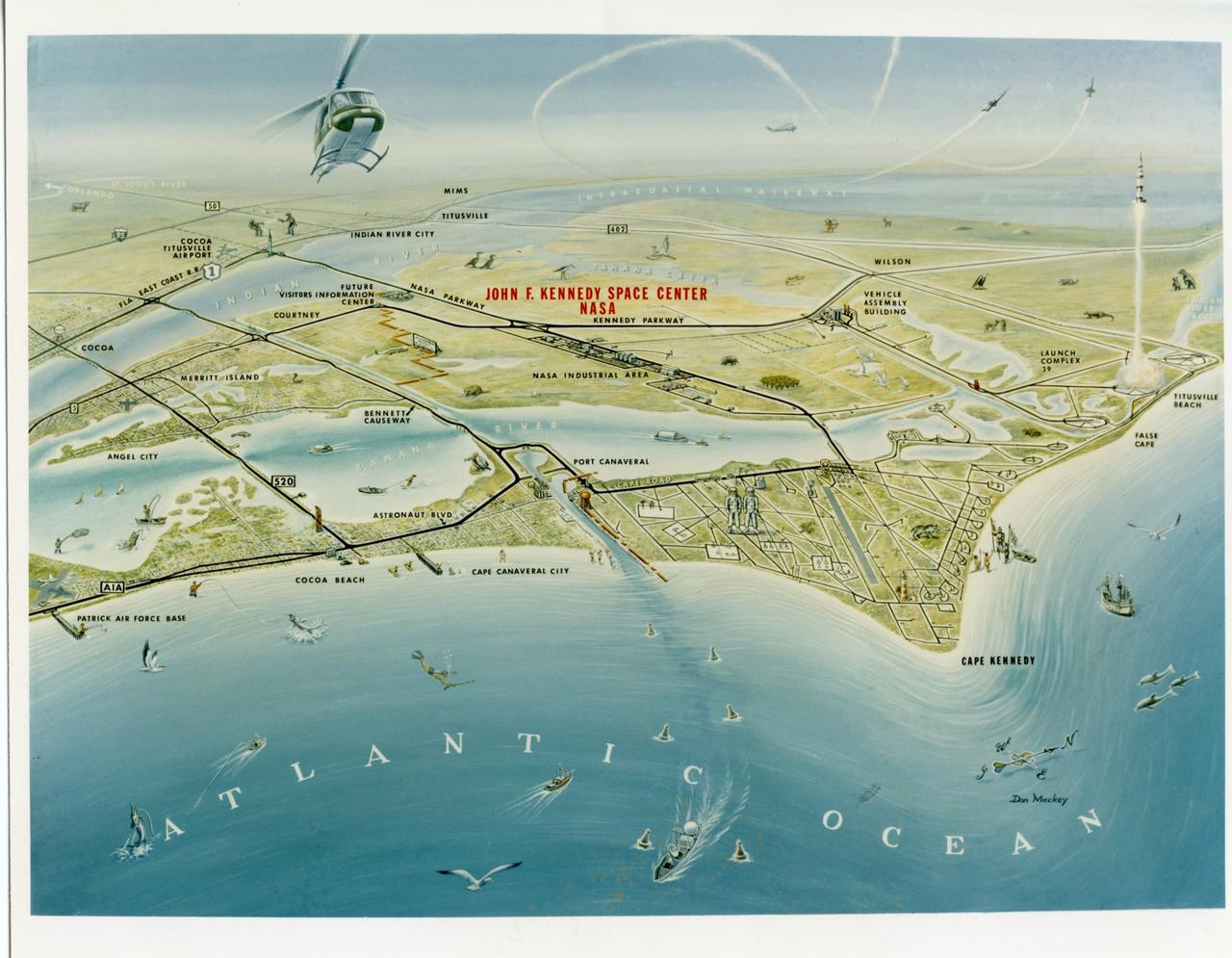
CAPE KENNEDY, Fla. -- This artist's rendering depicts Florida's Space Coast where NASA's two-man Gemini Program is paving the way for manned flight to the moon before the end of the decade. Adjacent to Cape Kennedy Air Force Station is Merritt Island where facilities are being built at the John F. Kennedy Space Center to launch the Saturn V rockets for the Apollo Program. Image Credit: NASA
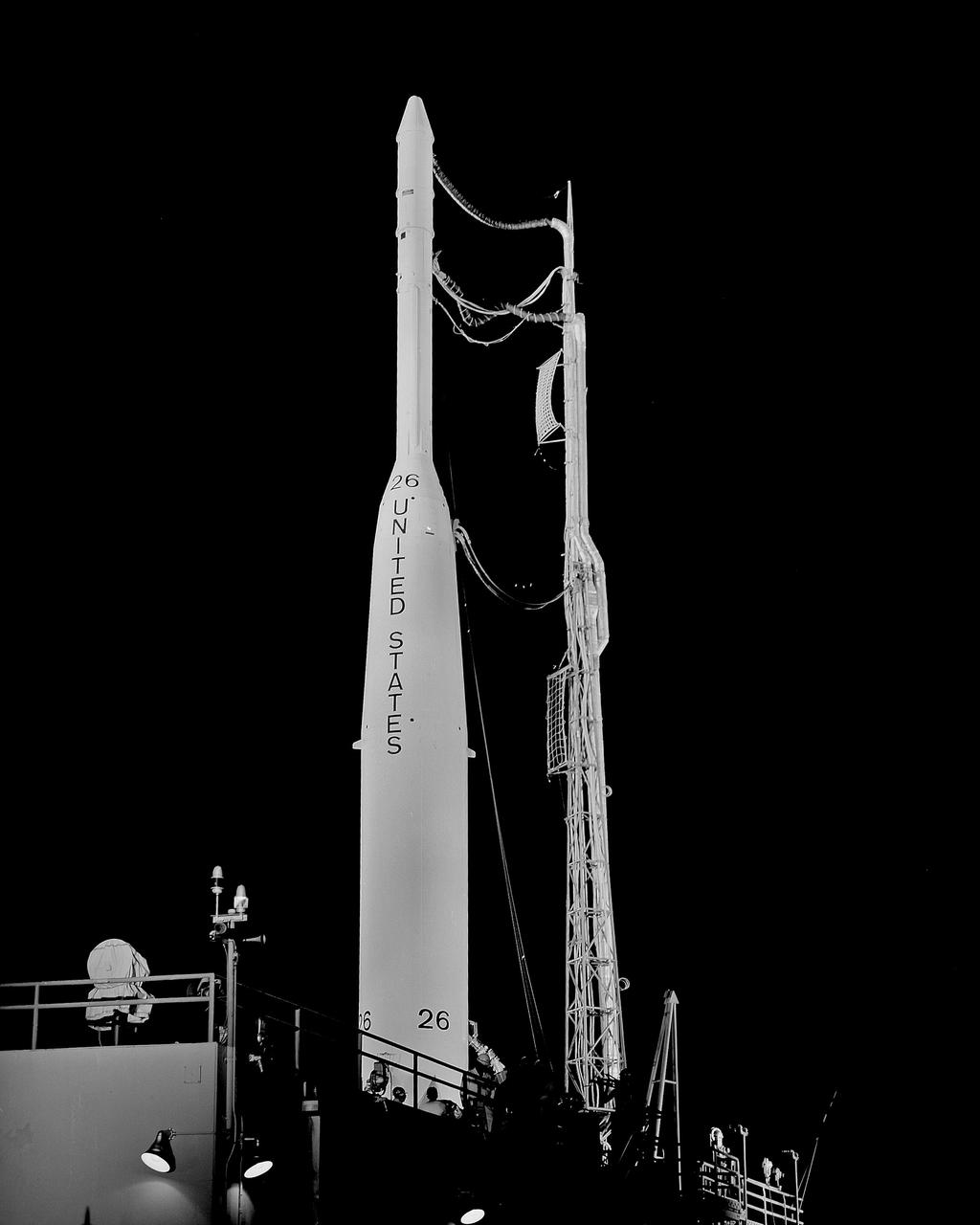
CAPE KENNEDY, Fla. -- At Cape Kennedy Air Force Station in Florida, a Delta C rocket stands poised for liftoff at Launch Complex 17A to boost the Explorer 21 satellite into orbit. Photo Credit: NASA
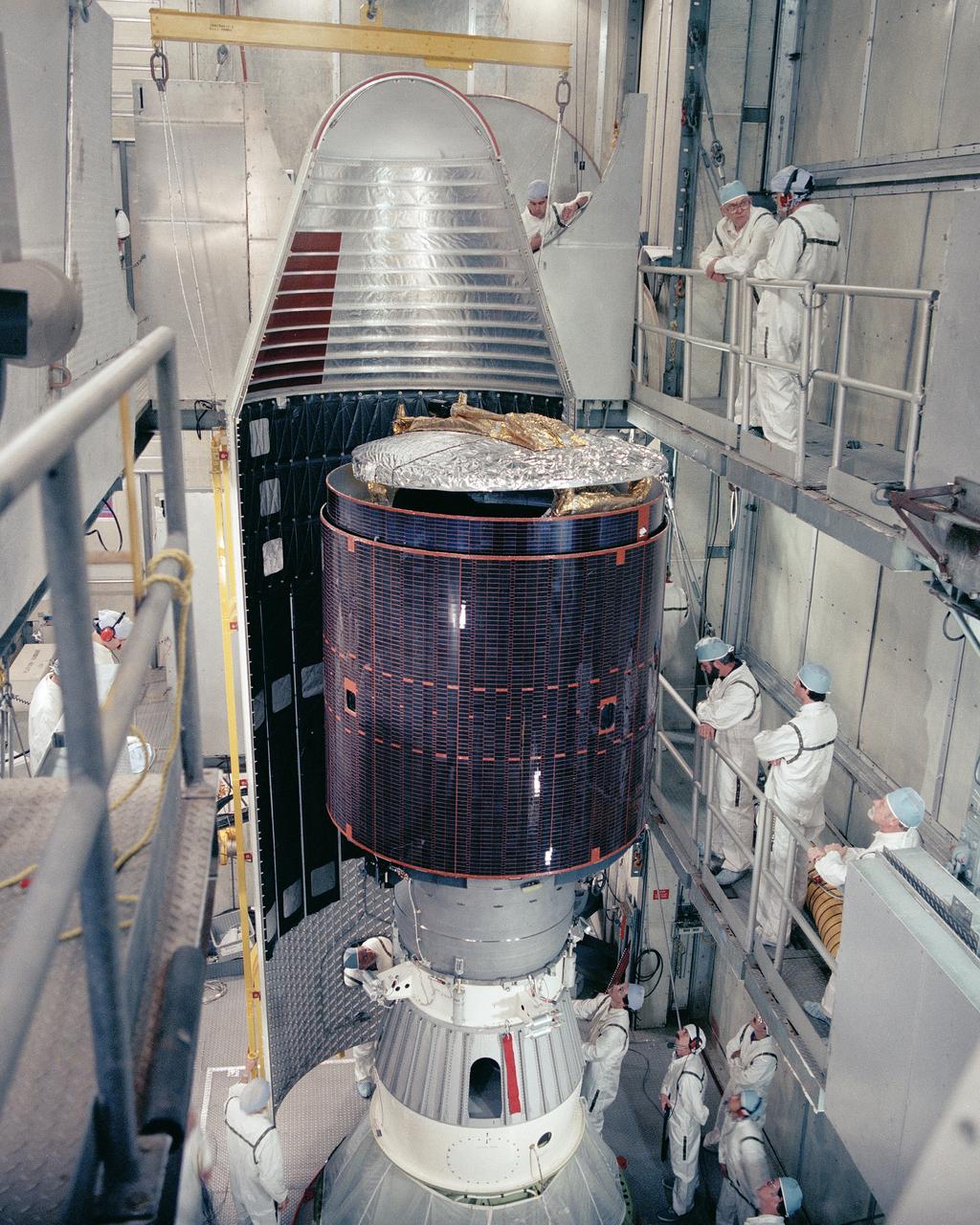
CAPE CANAVERAL, Fla. -- At Cape Canaveral Air Force Station in Florida, the paylaod fairing of the Delta 182 launch vehicle is carefully moved into place as encapsulation procedures continue on the Palapa B2-P communications satellite at Launch Complex 17, Pad B. Palapa is scheduled for launch from Cape Canaveral for the government of Indonesia. Liftoff of Delta 182 and Palapa is scheduled for March 20. Photo Credit: NASA
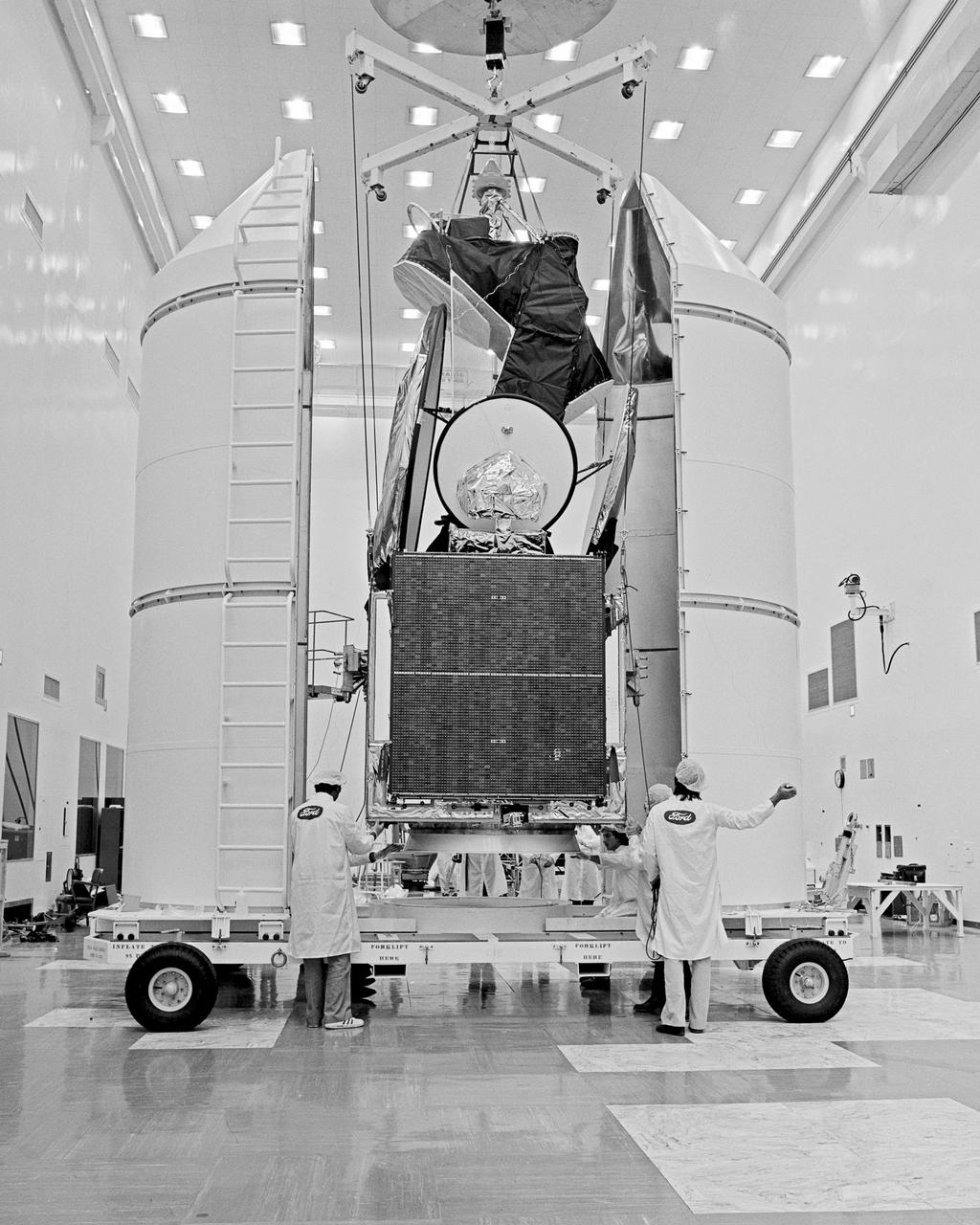
CAPE CANAVERAL, Fla. -- At Cape Canaveral Air Force Station in Florida, the INTELSAT V spacecraft is enclosed in a protective shroud for transport from Hangar AO to the Explosive Safe Facility for final servicing and encapsulation. This is the first of a new series of INTELSAT spacecraft. The INTELSAT V is the largest and highest-capacity commercial communications satellite built to date. The 4,300-pound spacecraft is scheduled for launch on an Atlas Centaur rocket from Complex 36 no earlier than December 4. It will operate in geosynchronous orbit over the Atlantic Ocean. Photo Credit: NASA
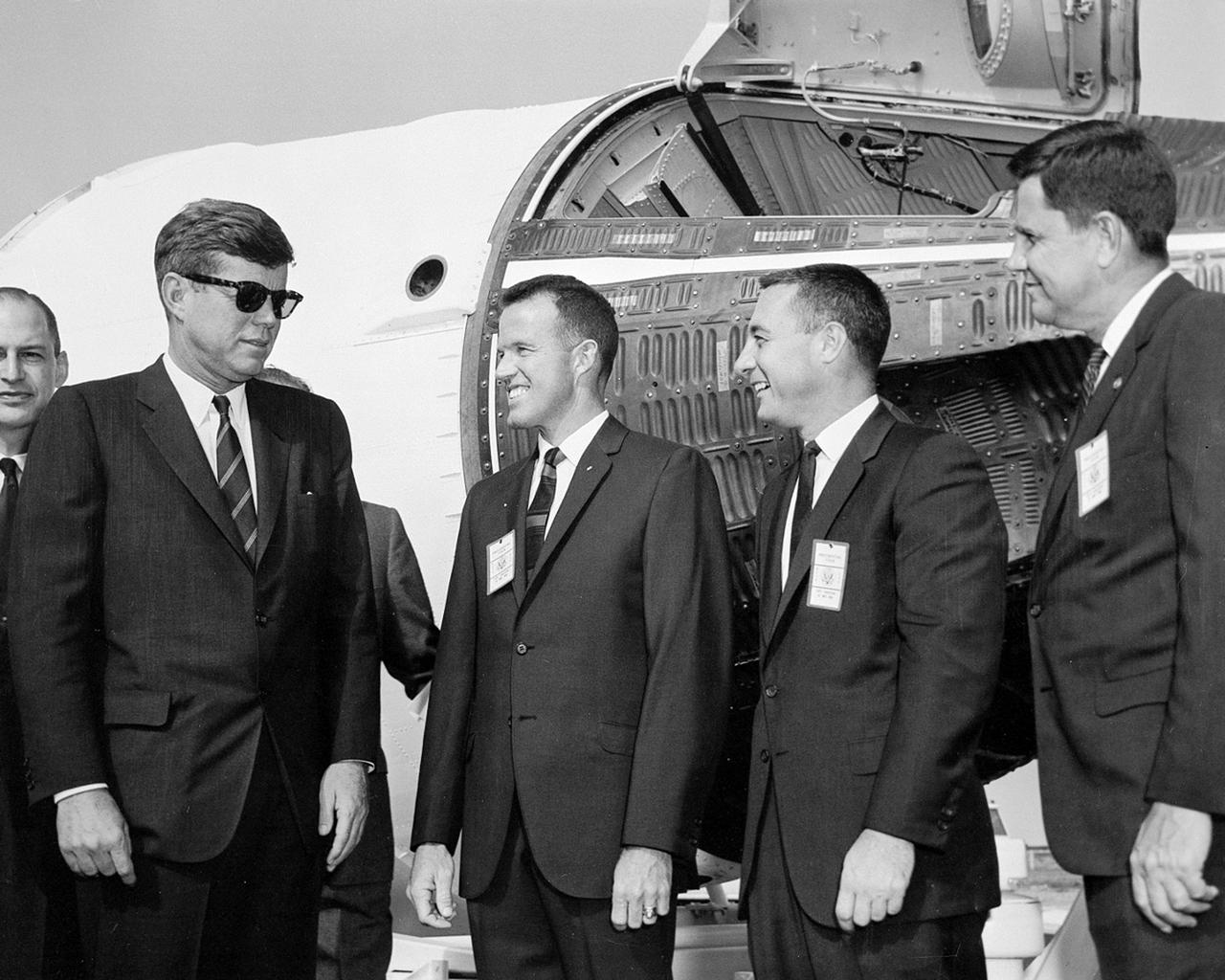
CAPE CANAVERAL Fla. -- President John F. Kennedy tours the Cape Canaveral Missile Test Annex in Florida. Standing in front of a Gemini spacecraft, from the left, are George M. Low, NASA chief of Manned Space Flight partially visible, Kennedy, astronaut L. Gordon Cooper, astronaut Virgil I. Grissom and G. Merritt Preston, NASA's manager of the Atlantic Missile Range. Photo Credit: NASA
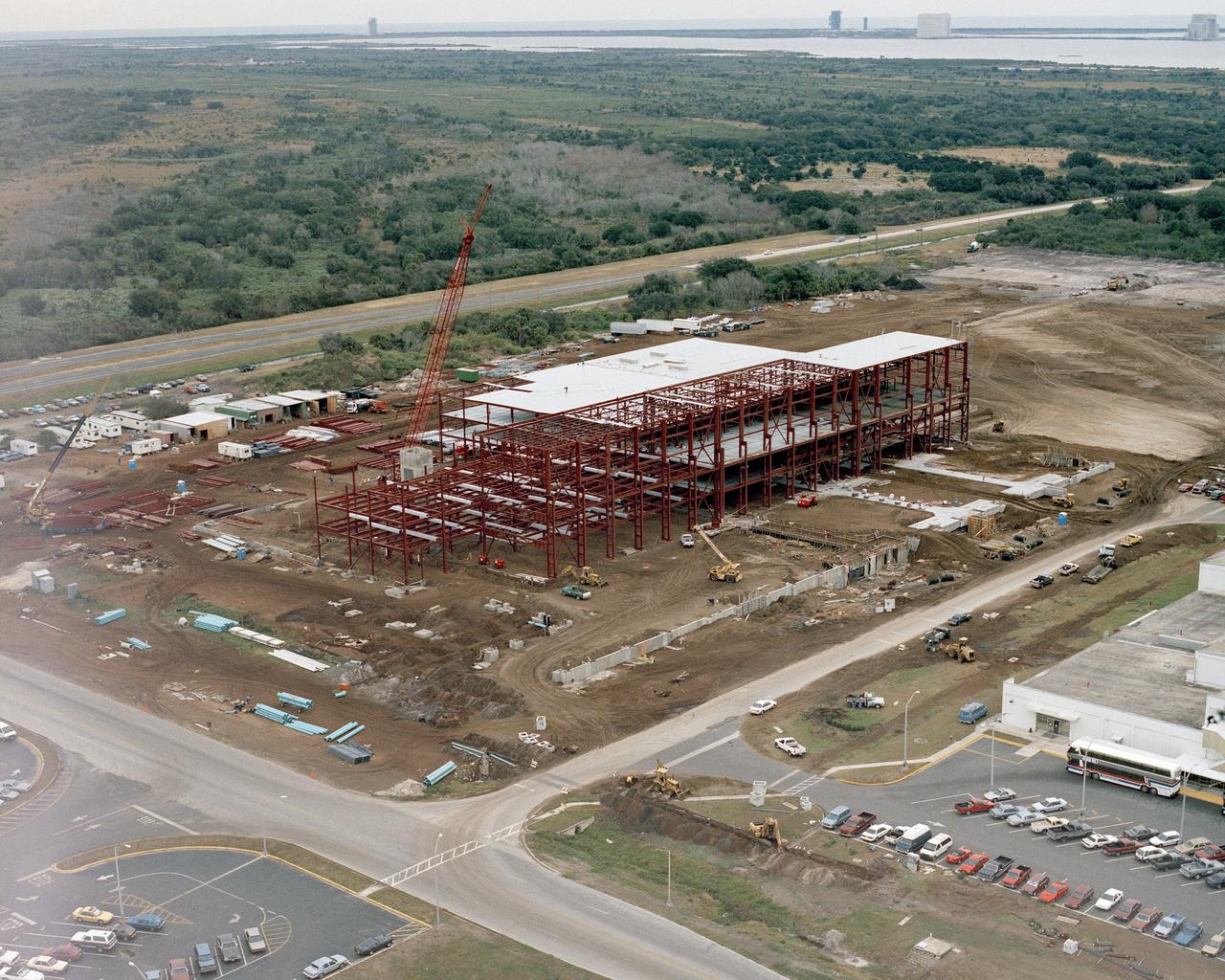
CAPE CANAVERAL Fla. -- This aerial view shows construction progress of the Space Station Processing Facility at the Kennedy Space Center in Florida. Photo Credit: NASA
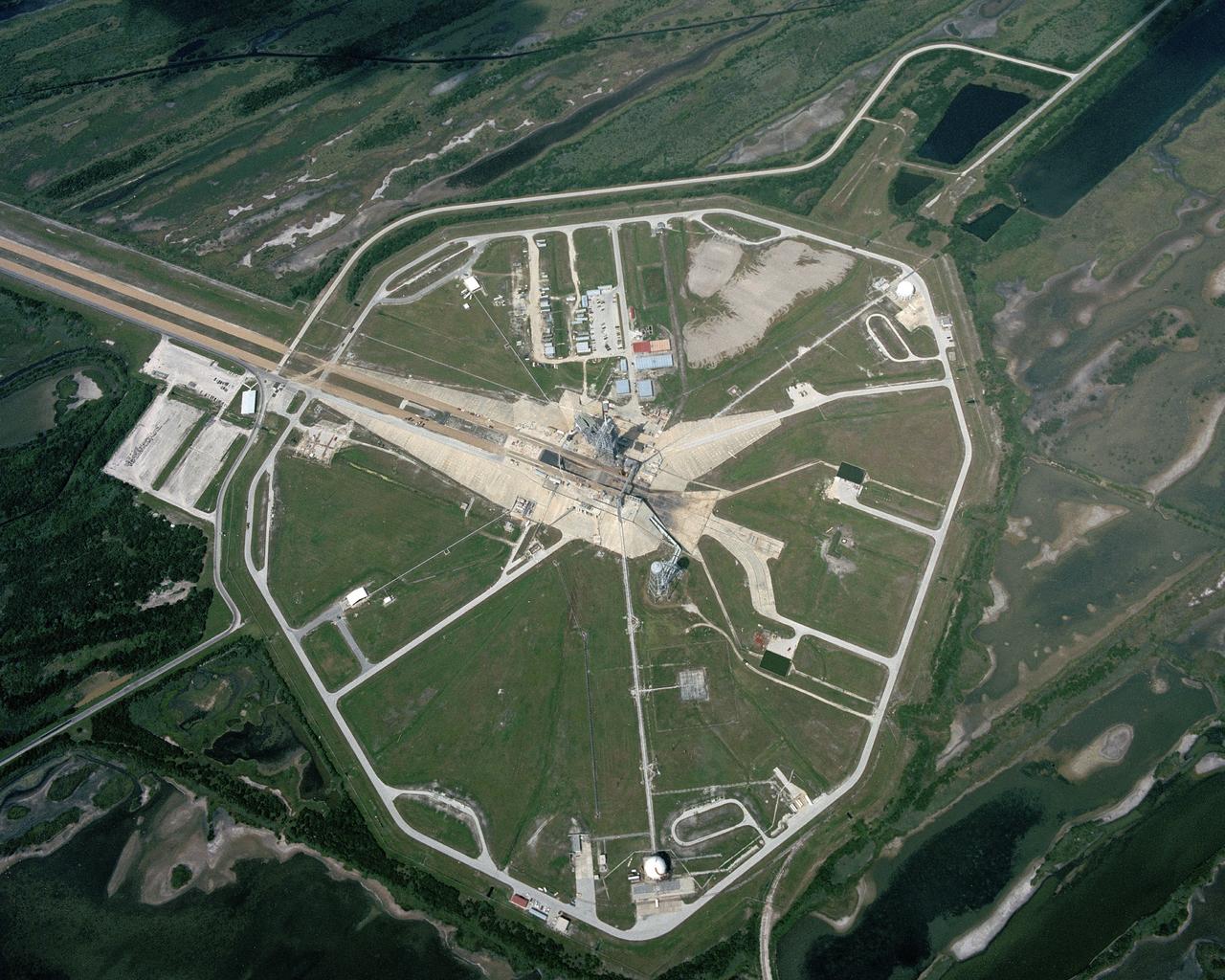
CAPE CANAVERAL, Fla. -- An aerial view of Launch Complex 39B at the Kennedy Space Center in Florida. Photo Credit: NASA
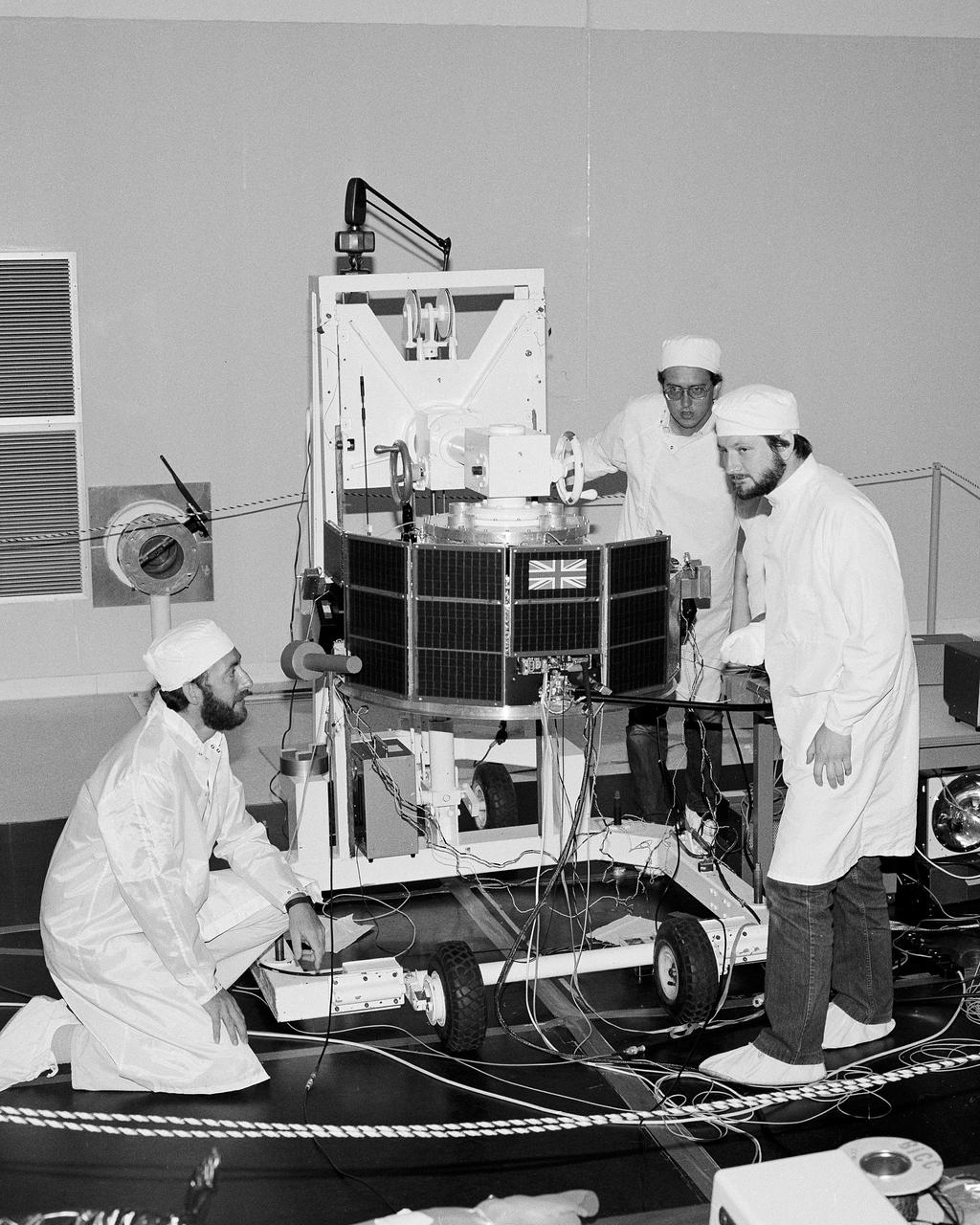
CAPE CANAVERAL, Fla. -- At Cape Canaveral Air Force Station in Florida, British engineers conduct tests on the United Kingdom Subsatellite, part of the three-spacecraft international Active Magnetospheric Particle Tracer Explorer AMPTE mission scheduled for launch on Aug. 9, 1984 aboard a Delta rocket. The 172-pound UKS contains a comprehensive set of plasma measuring instruments to record the effects of chemical clouds released by the West German built Ion Release Module. The other AMPTE spacecraft – the Charged Composition Explorer CCEUnited States) – will operate far below, from inside the Earth’s magnetosphere, where it will track the ionized clouds as it is swept along by the solar wind. With the CCE studying this activity from below, and the IRM and UKS studying it from above, scientists expect to acquire valuable new data on exactly how the solar wind interacts with the Earth’s magnetic fields. Photo Credit: NASA
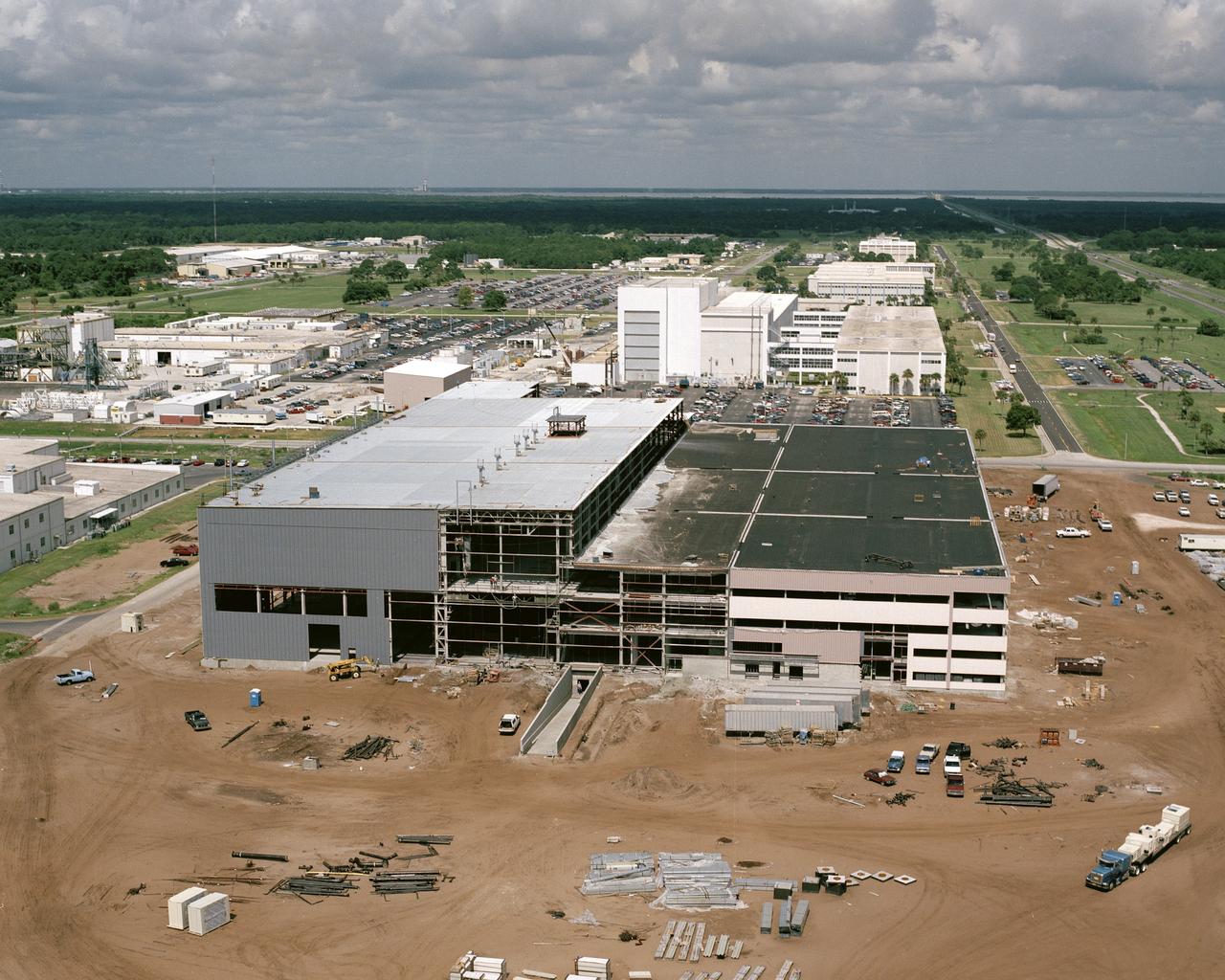
CAPE CANAVERAL Fla. -- This aerial view shows construction progress of the Space Station Processing Facility at the Kennedy Space Center in Florida. Photo Credit: NASA
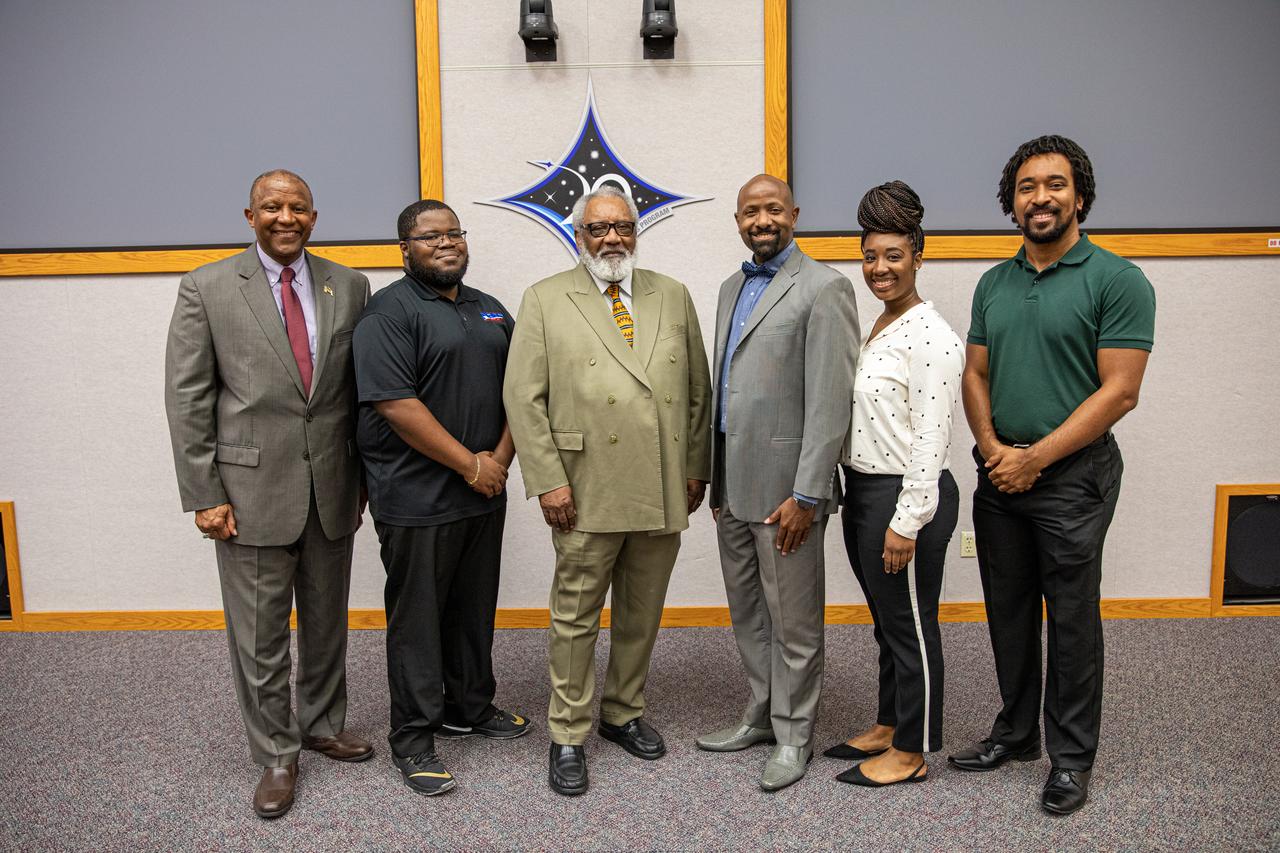
A Black History Month celebration was held on Feb. 18, 2020 at NASA’s Kennedy Space Center in Florida. The program was organized by the Black Employee Strategy Team (BEST), one of the center’s employee resource groups. This year’s theme was “African Americans and the Vote.” From left are Kelvin Manning, Kennedy’s associate director, technical; Daren Etienne, BEST marketing director; James Jennings, keynote speaker, former NASA associate administrator for Institutions and Management and Kennedy’s former deputy director; Martin Hayes, BEST chairperson; Jakebia Keith, program and contract analyst for the IT Resources Management Office and BEST secretary; and Phillip Hargrove, BEST co-chairperson.
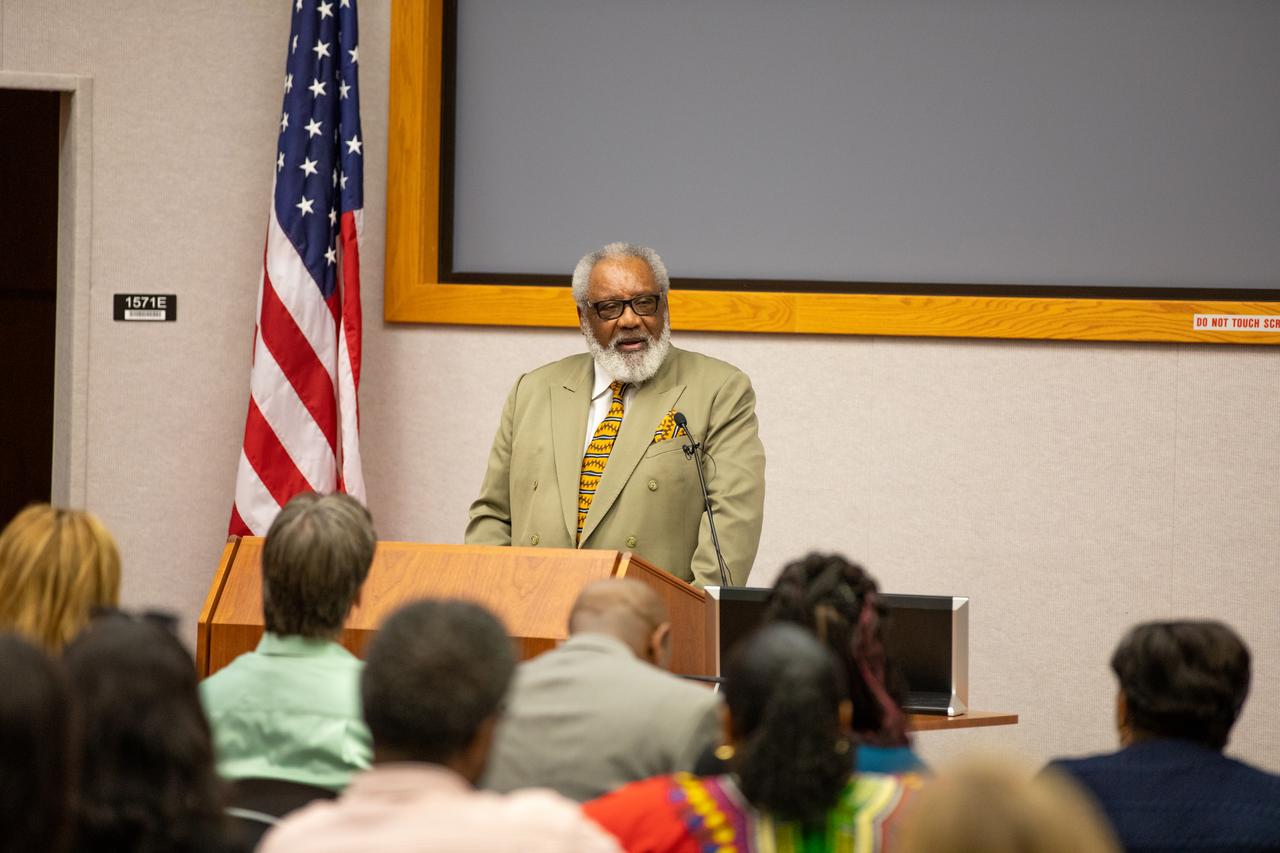
James Jennings, former NASA associate administrator for Institutions and Management and former Kennedy Space Center deputy director, was the keynote speaker at the center’s Black History Month celebration on Feb. 18, 2020. The program was organized by the Black Employee Strategy Team (BEST), one of the center’s employee resource groups. This year’s theme was “African Americans and the Vote.” Jennings shared advice with workers and managers.
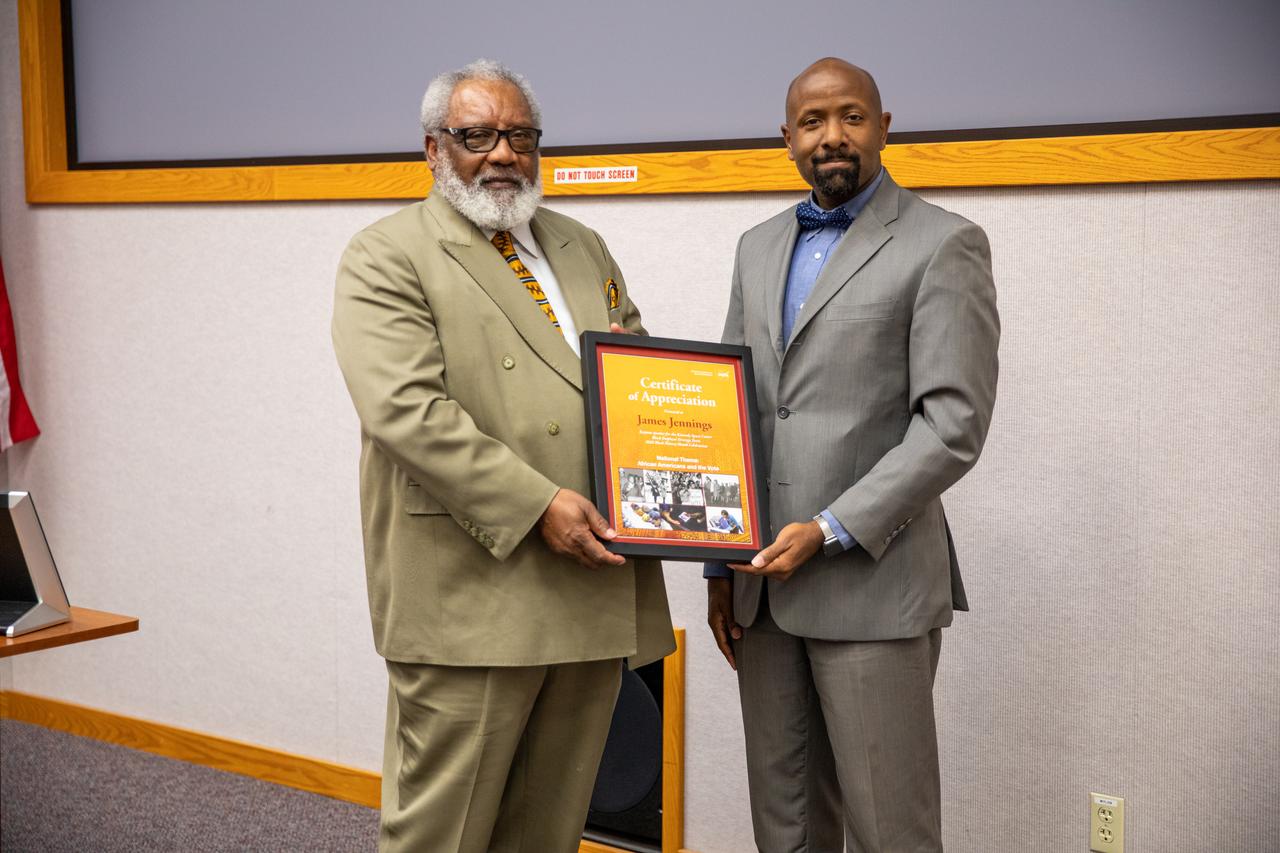
James Jennings, at left, former NASA associate administrator for Institutions and Management and former Kennedy Space Center deputy director, was the keynote speaker at the center’s Black History Month celebration on Feb. 18, 2020. He received a Certificate of Appreciation from the program’s organizer, the Black Employee Strategy Team (BEST), one of the center’s employee resource groups. At right is Martin Hayes, program analyst with Exploration Ground Systems and BEST chairperson. This year’s theme was “African Americans and the Vote.” Jennings shared advice with workers and managers.
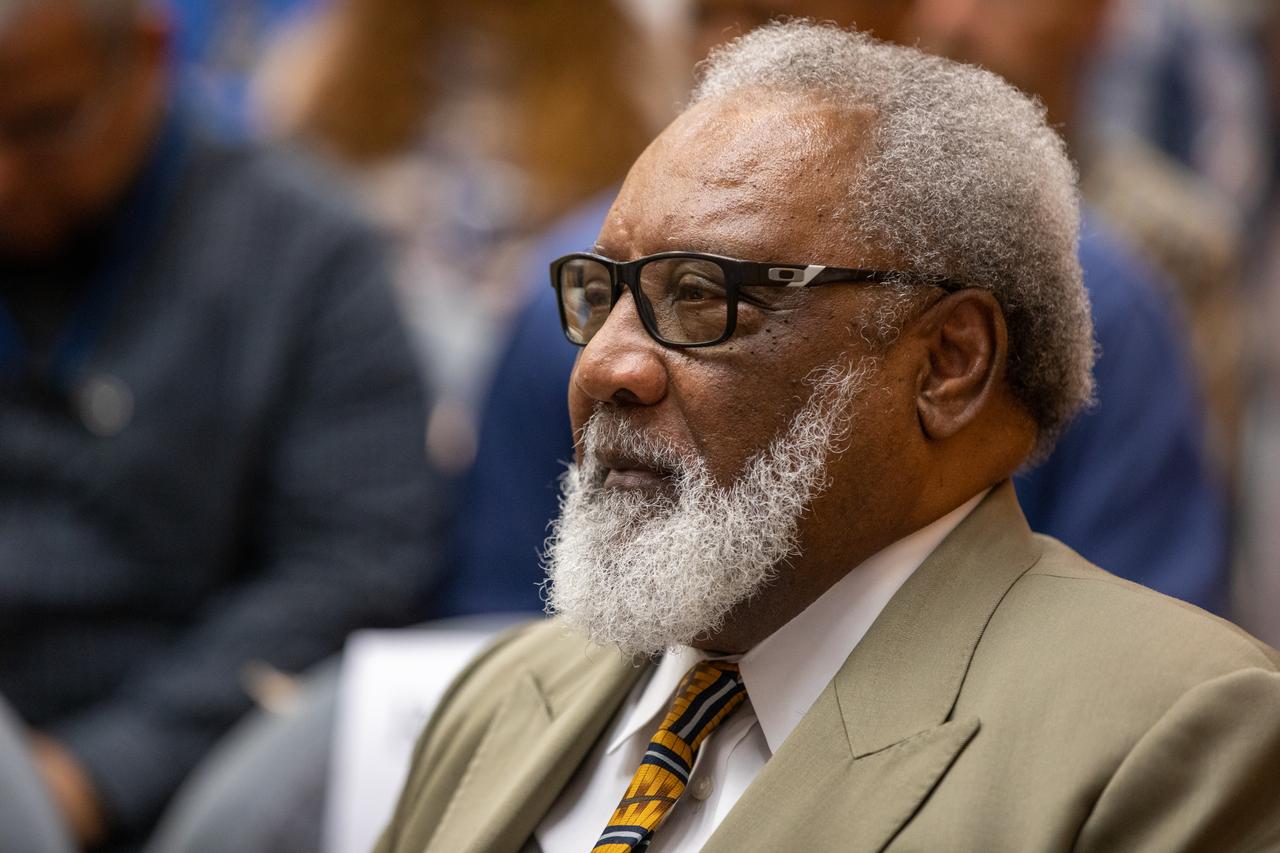
James Jennings, former NASA associate administrator for Institutions and Management and former Kennedy Space Center deputy director, was the keynote speaker at the center’s Black History Month celebration on Feb. 18, 2020. The program was organized by the Black Employee Strategy Team (BEST), one of the center’s employee resource groups. This year’s theme was “African Americans and the Vote.” Jennings shared advice with workers and managers.
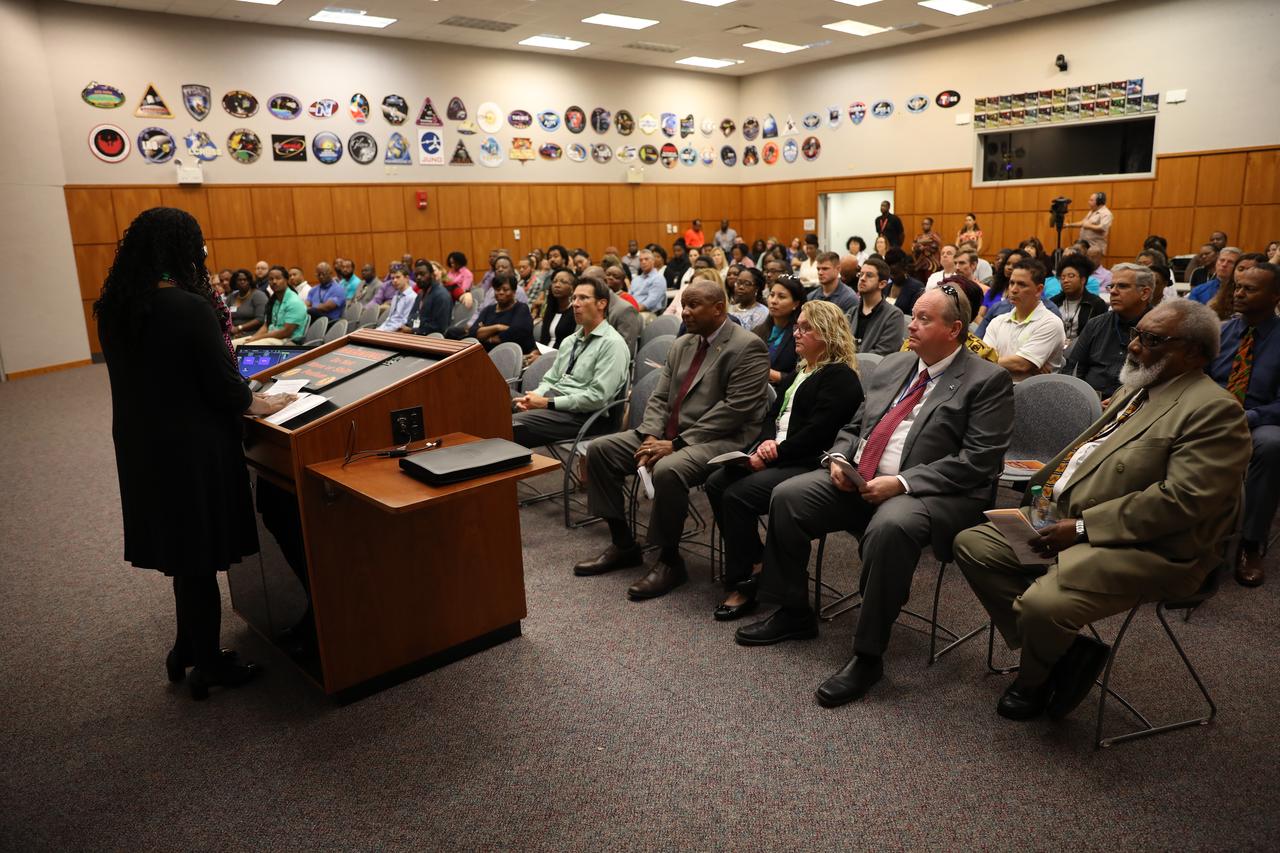
During a Black History Month celebration on Feb. 18, 2020 at NASA’s Kennedy Space Center in Florida, Hortense Diggs, at the podium, director of Communication and Public Engagement, commemorates the contributions of former NASA employee and mentor Roslyn McKinney. The program was organized by the Black Employee Strategy Team (BEST), one of the center’s employee resource groups. This year’s theme was “African Americans and the Vote.” Keynote speaker was James Jennings, seated, far right, former NASA associate administrator for Institutions and Management and Kennedy’s former deputy director. Jennings shared advice with workers and managers.
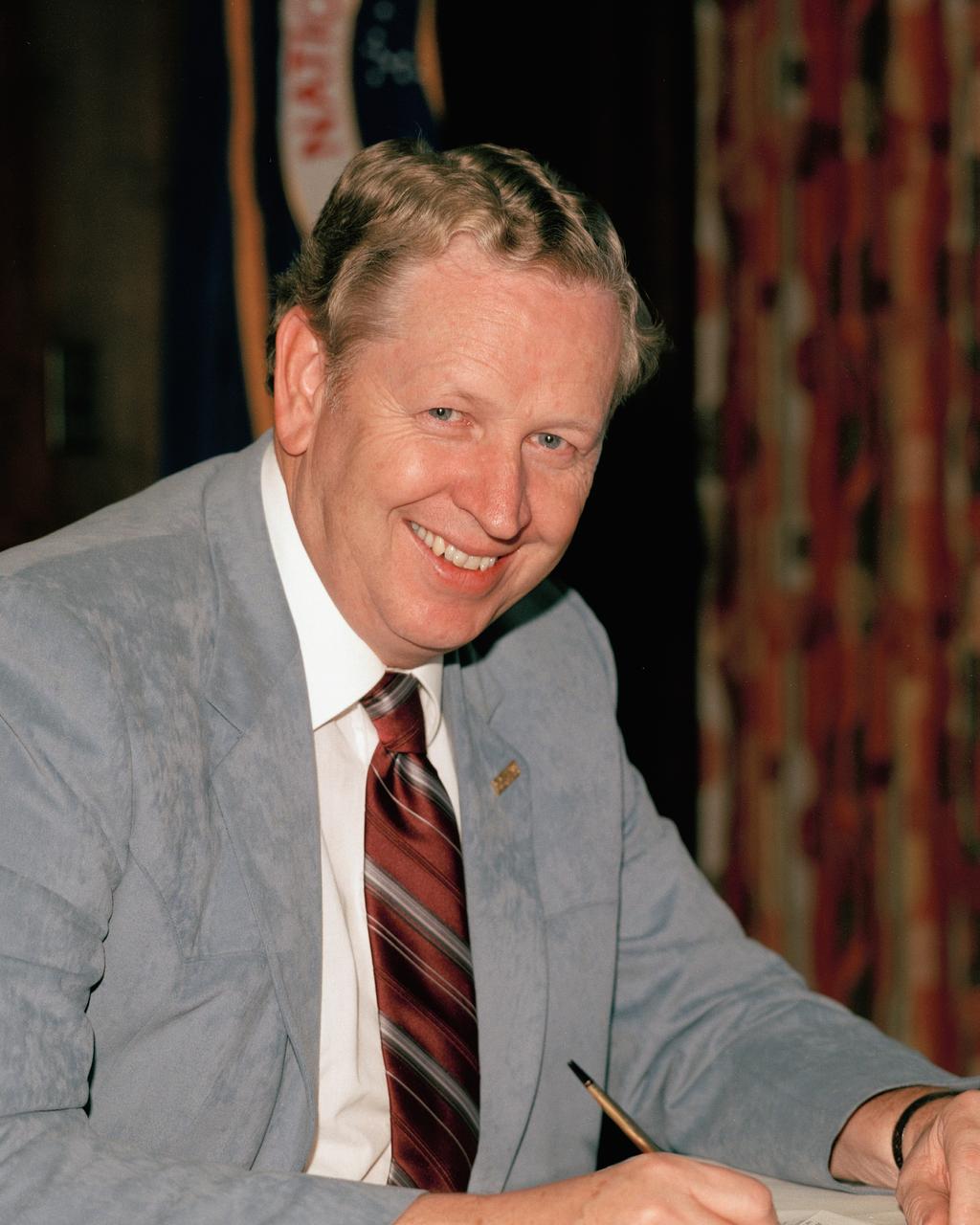
CAPE CANAVERAL, Fla. – Official portrait of Kennedy Space Center Director, Richard G. Smith Photo credit: NASA
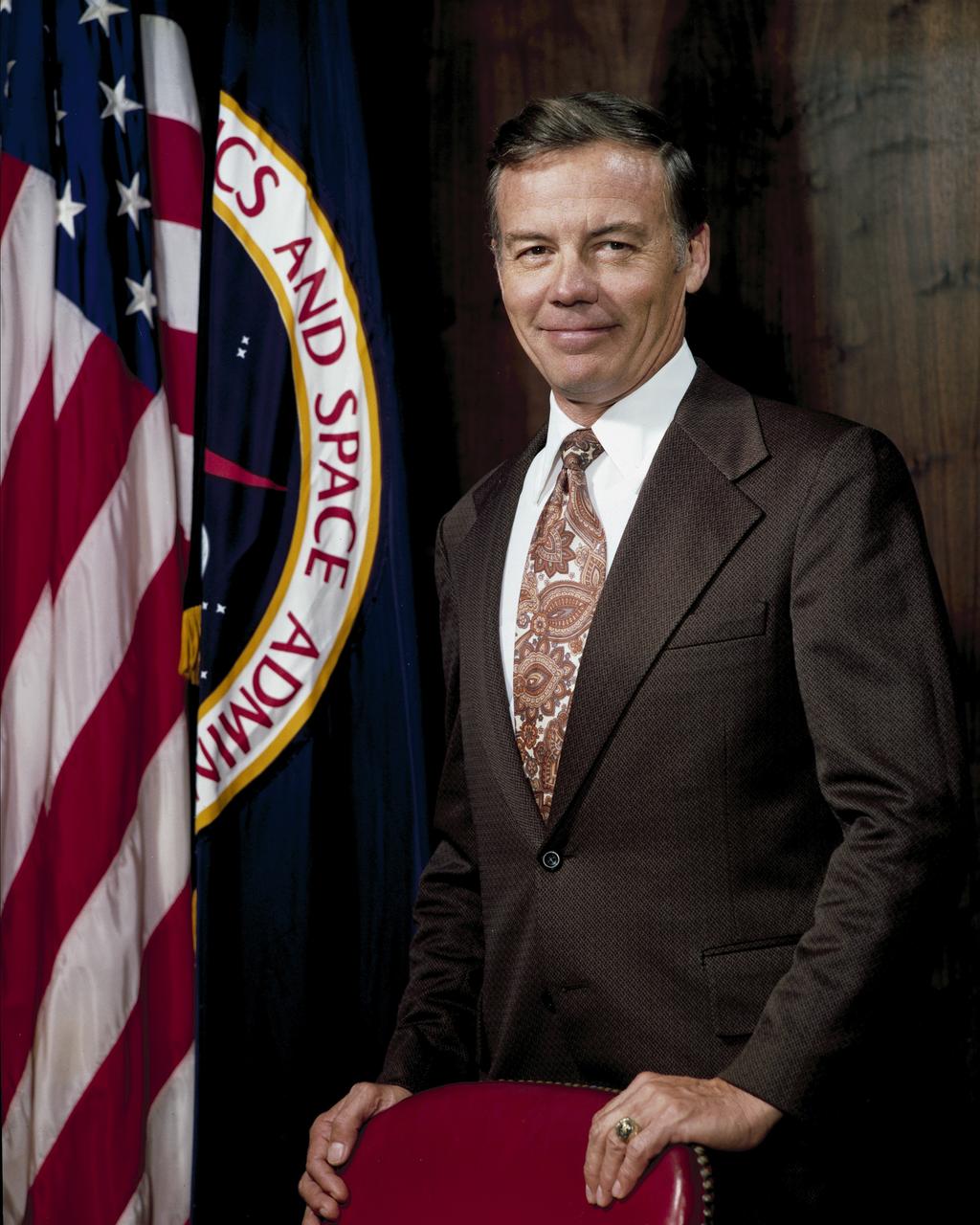
CAPE CANAVERAL, Fla. – Official portrait of Lee R. Scherer, Director, John F. Kennedy Space Center. Photo credit: NASA
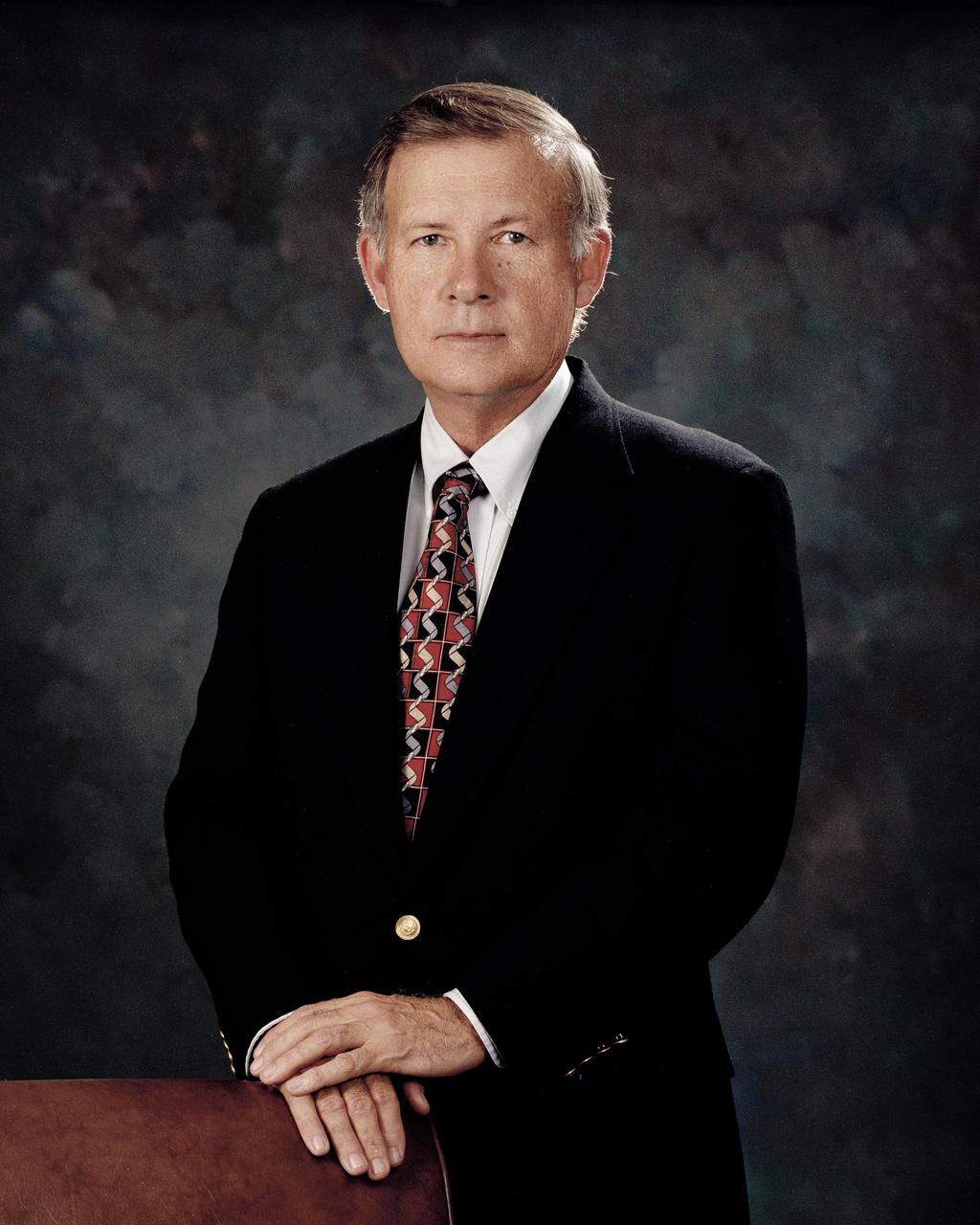
CAPE CANAVERAL, Fla. – Official retirement portrait of Jay F. Honeycutt, Director of NASA's Kennedy Space Center. Photo credit: NASA
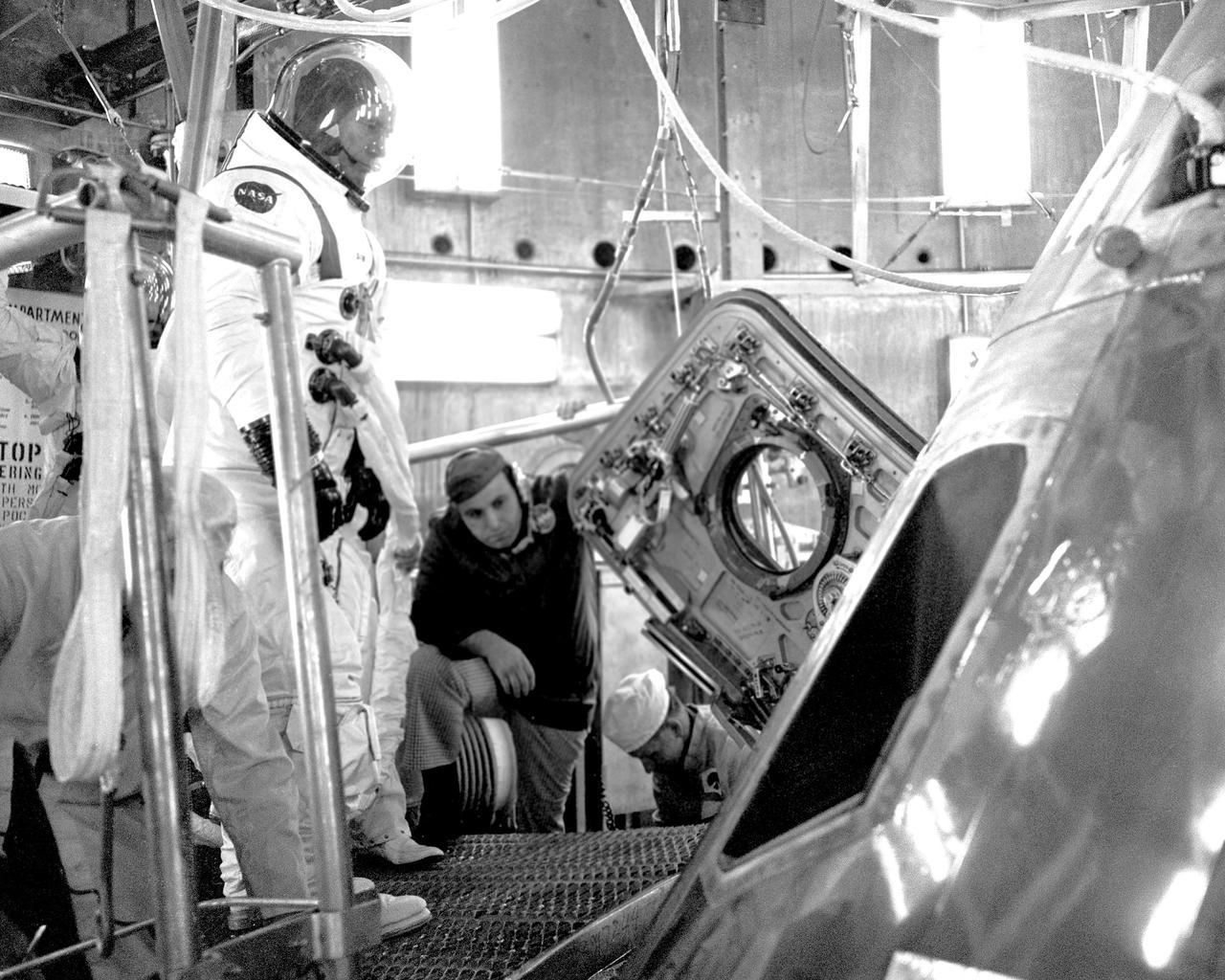
CAPE CANAVERAL, Fla. – The docking module and Apollo spacecraft for this summer's joint manned mission with the Soviet were mated in the Manned Spacecraft Operations Building today. The docking module will provide a mechanical and electrical link between the Apollo and Soyuz spacecraft while they are docked and also serve as an airlock. On hand to participate in the operation were two members of the Apollo prime crew, Astronauts Donald K. Slayton and Vance D. Brand. Launch of the Saturn 1B/Apollo from Complex 39 is scheduled for July 15. The first international crewed spaceflight was a joint U.S.-U.S.S.R. rendezvous and docking mission. The Apollo-Soyuz Test Project, or ASTP, took its name from the spacecraft employed: the American Apollo and the Soviet Soyuz. The three-man Apollo crew lifted off from Kennedy Space Center aboard a Saturn IB rocket on July 15, 1975, to link up with the Soyuz that had launched a few hours earlier. A cylindrical docking module served as an airlock between the two spacecraft for transfer of the crew members. Photo credit: NASA
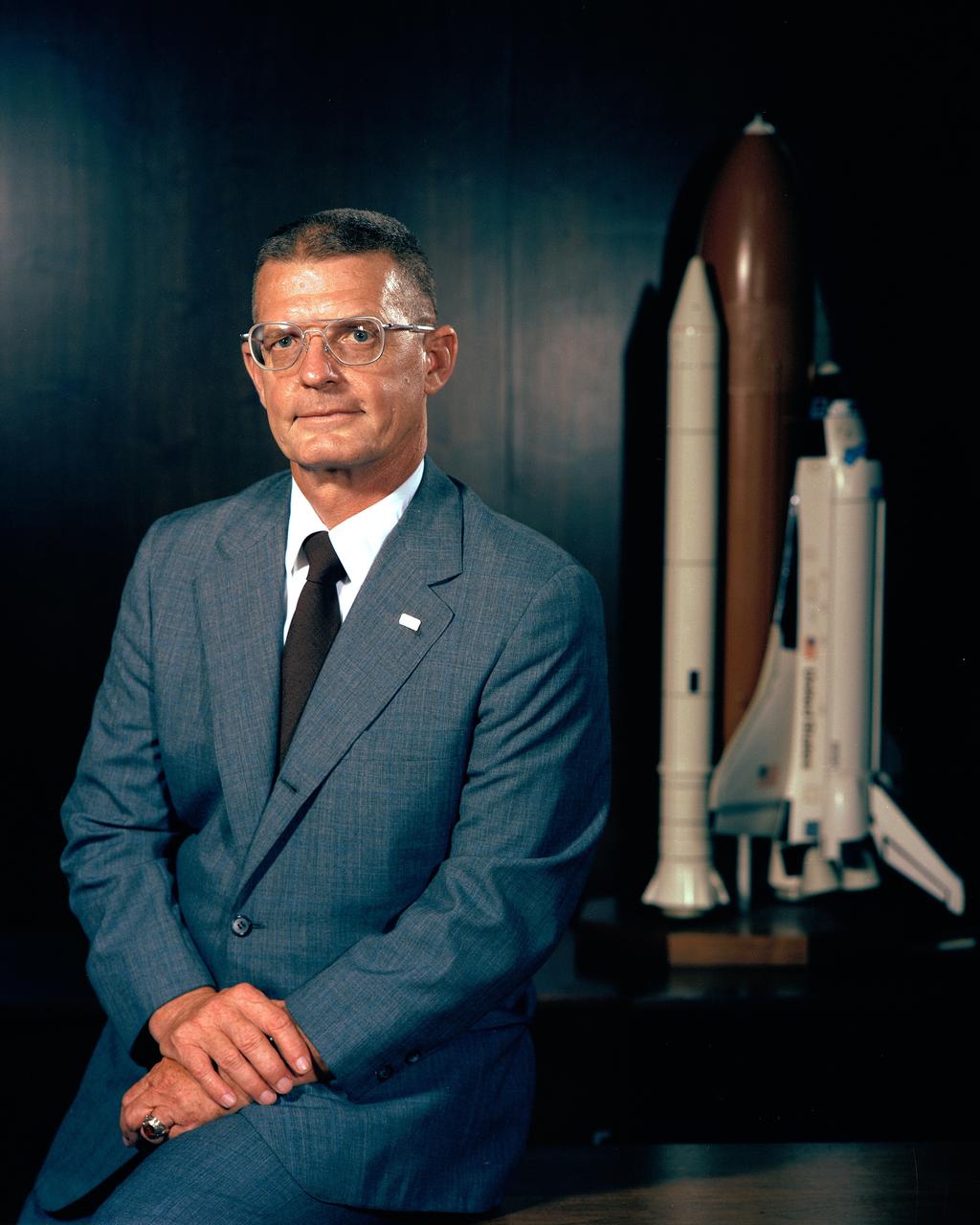
CAPE CANAVERAL, Fla. – Portrait of Lt. Gen. Forrest S. McCartney, KSC Center Director Photo credit: NASA
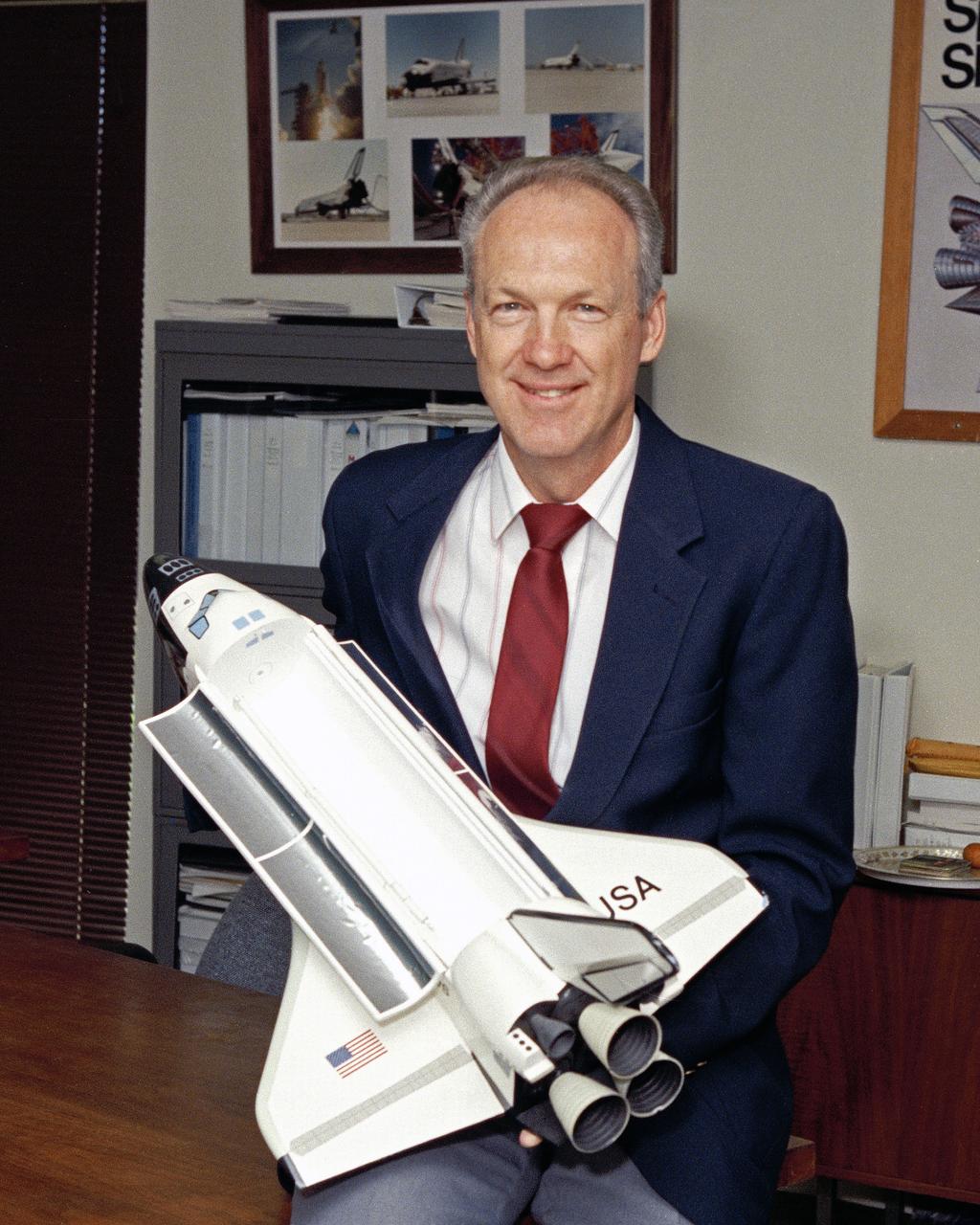
CAPE CANAVERAL, Fla. - Roy Tharpe, president of Space Gateway Support at the Kennedy Space Center in Florida. Photo credit: NASA
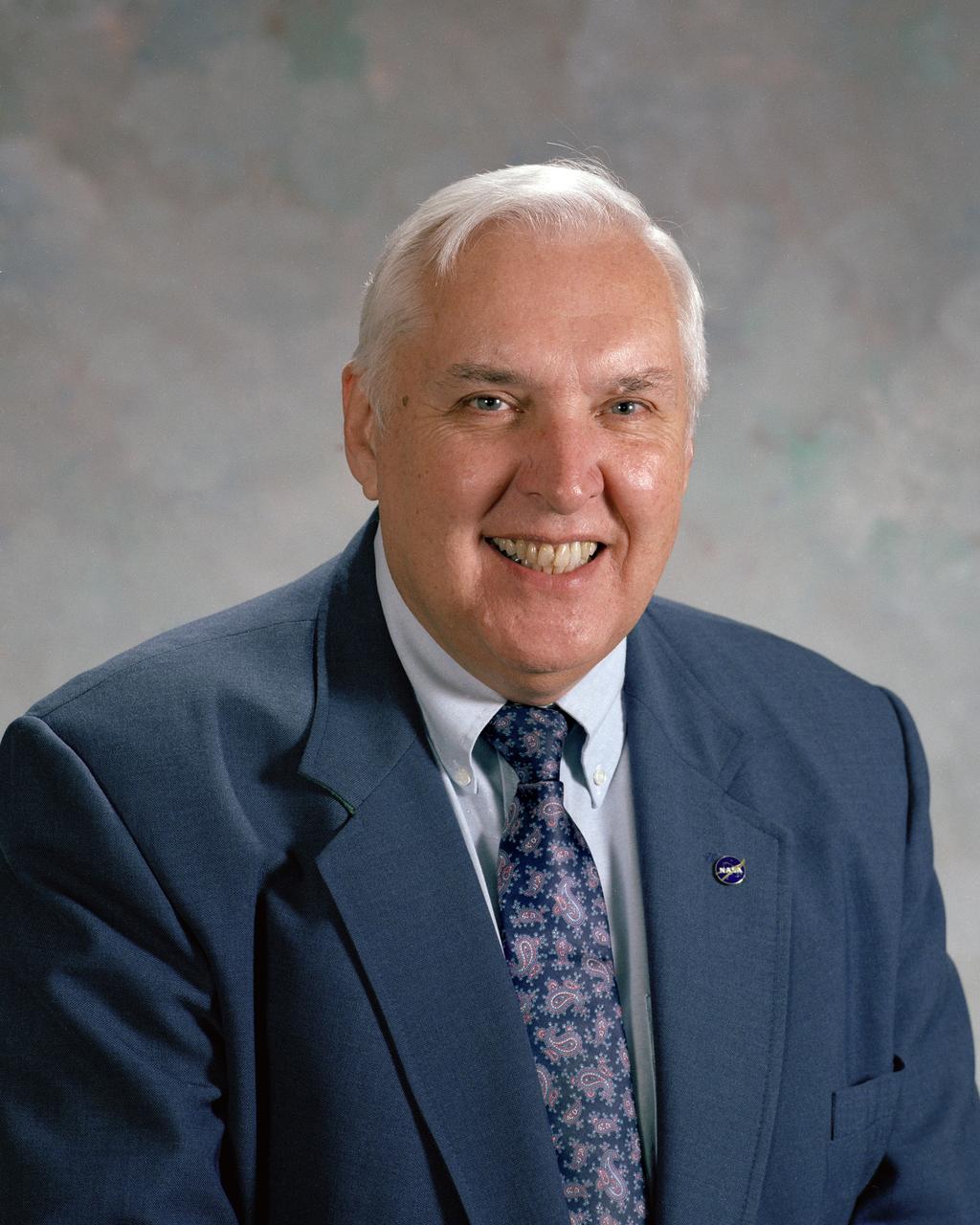
CAPE CANAVERAL, Fla. - Hugh Harris, retired NASA director of Public Affairs at the Kennedy Space Center in Florida. Photo credit: NASA
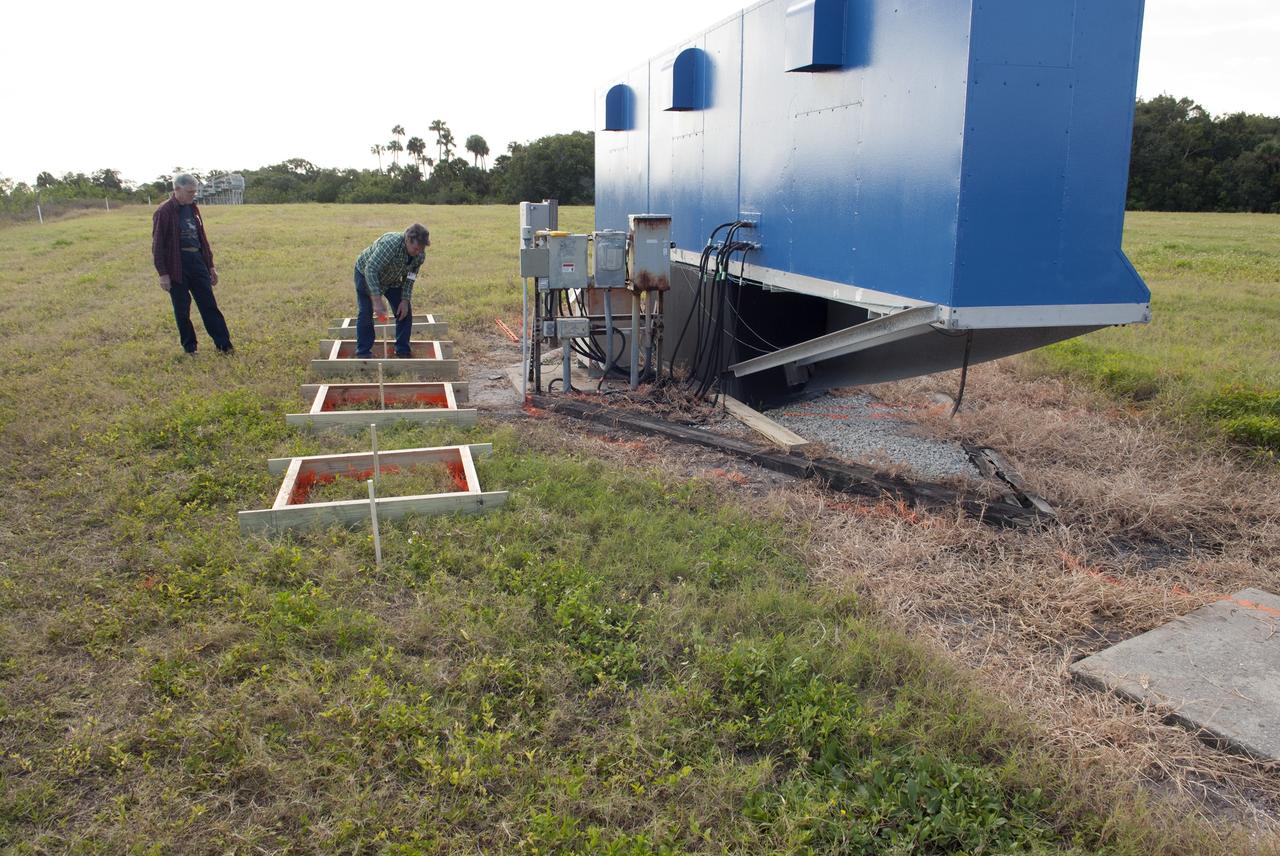
CAPE CANAVERAL, Fla. -- At NASA's Kennedy Space Center in Florida, Jeff Pratt and Frank Morse with Abacus Technology prep the area behind the current countdown clock for the groundbreaking ceremony for the new countdown clock. The old timepiece was designed by Kennedy engineers and built by Kennedy technicians in 1969. Not including the triangular concrete and aluminum base, the famous landmark is nearly 6 feet 70 inches high, 26 feet 315 inches wide and 3 feet deep. The new display will be similar in size, with the screen being nearly 26 feet wide by 7 feet high. For more information on the countdown clock, go to http://go.nasa.gov/10Zku10. Photo credit: NASA/Jim Grossmann
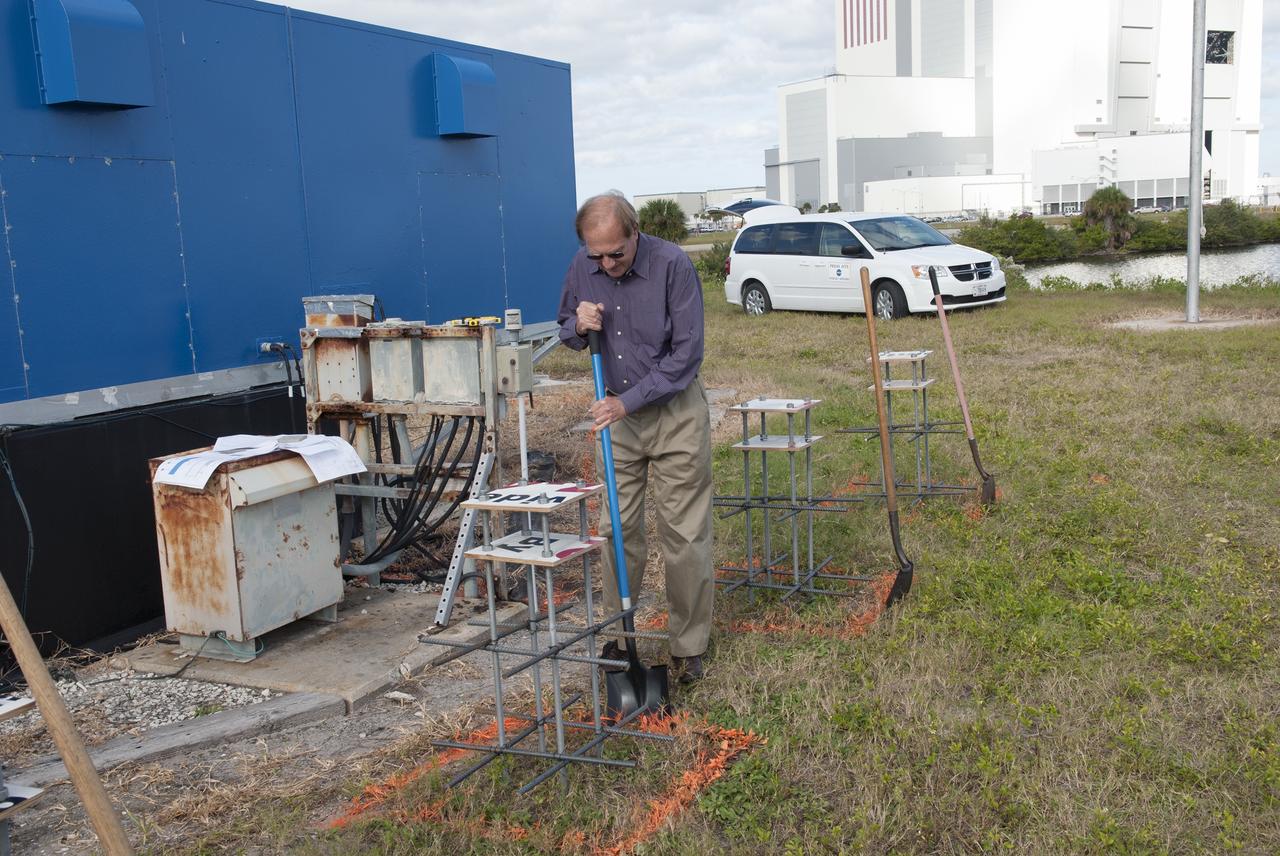
CAPE CANAVERAL, Fla. -- At NASA's Kennedy Space Center in Florida, Public Affairs Officer George Diller digs in behind the current countdown clock during the groundbreaking ceremony for the new countdown clock. The old timepiece was designed by Kennedy engineers and built by Kennedy technicians in 1969. Not including the triangular concrete and aluminum base, the famous landmark is nearly 6 feet 70 inches high, 26 feet 315 inches wide and 3 feet deep. The new display will be similar in size, with the screen being nearly 26 feet wide by 7 feet high. For more information on the countdown clock, go to http://go.nasa.gov/10Zku10. Photo credit: NASA/Jim Grossmann
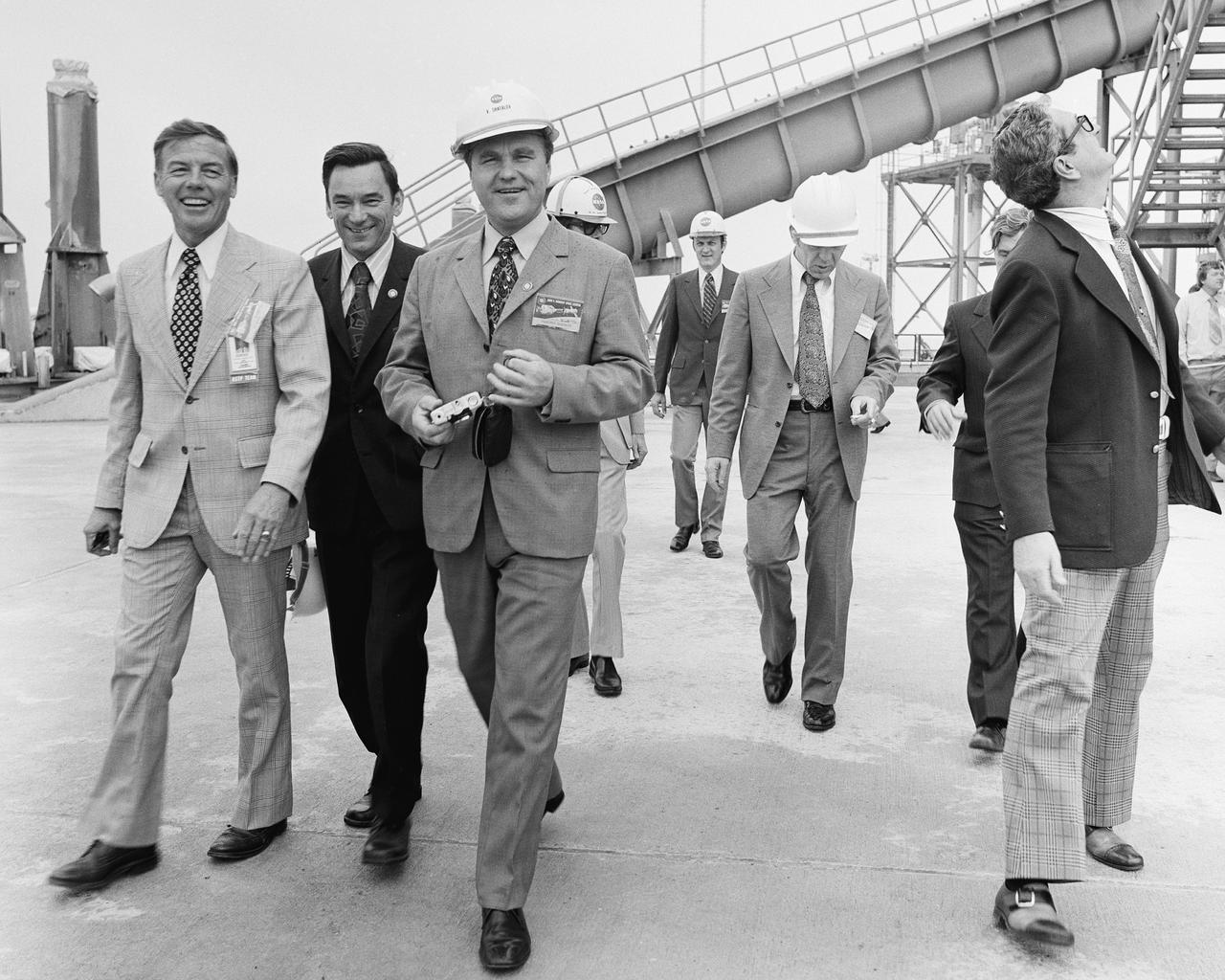
CAPE CANAVERAL, Fla. – KSC Director Lee Scherer, left, escorts a Soviet interpreter and Vladimir Shatalov, Soviet Cosmonaut Training Chief, on a tour of Pad 39B at the Spaceport. The Soviet and American personnel connected with July's Apollo Soyuz Test Project were at KSC February 8-10 to inspect equipment and tour facilities. The first international crewed spaceflight was a joint U.S.-U.S.S.R. rendezvous and docking mission. The Apollo-Soyuz Test Project, or ASTP, took its name from the spacecraft employed: the American Apollo and the Soviet Soyuz. The three-man Apollo crew lifted off from Kennedy Space Center aboard a Saturn IB rocket on July 15, 1975, to link up with the Soyuz that had launched a few hours earlier. A cylindrical docking module served as an airlock between the two spacecraft for transfer of the crew members. Photo credit: NASA
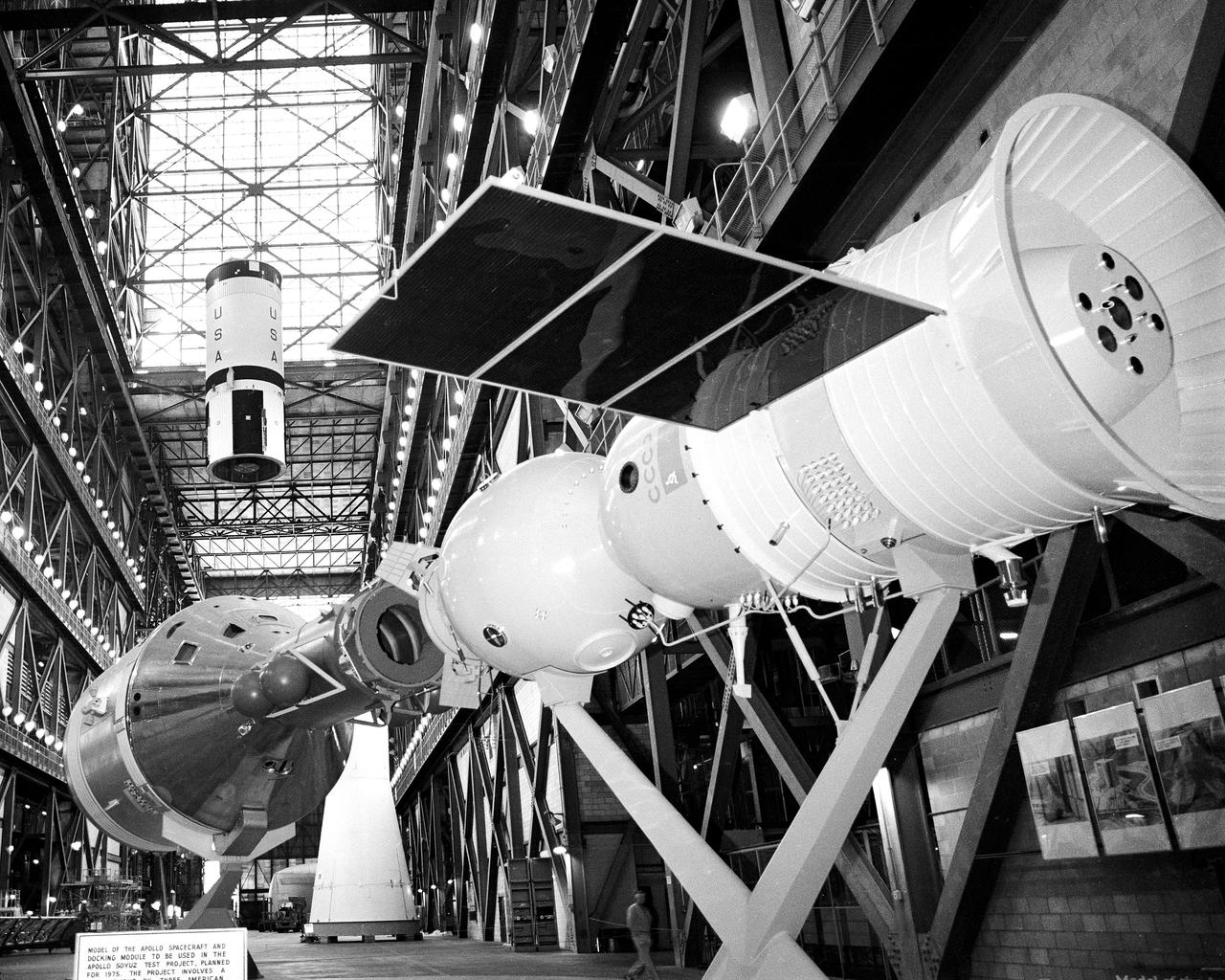
CAPE CANAVERAL, Fla. – Model of docked Apollo and Soyuz spacecraft in the foreground and skylight in the Vehicle Assembly Building high bay frame the second stage of the Saturn 1B booster that will launch the United States ASTP mission as a crane raises it prior to its mating with the Saturn 1B first stage. Mating of the Saturn 1B first and second stages was completed this morning. The U. S. ASTP launch with mission commander Thomas Stafford, command module pilot Vance Brand and docking module pilot Donald Slayton is scheduled at 3:50 p.m. EDT July 15. The first international crewed spaceflight was a joint U.S.-U.S.S.R. rendezvous and docking mission. The Apollo-Soyuz Test Project, or ASTP, took its name from the spacecraft employed: the American Apollo and the Soviet Soyuz. The three-man Apollo crew lifted off from Kennedy Space Center aboard a Saturn IB rocket on July 15, 1975, to link up with the Soyuz that had launched a few hours earlier. A cylindrical docking module served as an airlock between the two spacecraft for transfer of the crew members. Photo credit: NASA
![CAPE CANAVERAL, Fla. – ASTP prime crewmen Donald Slayton, Thomas Stafford and Vance Brand pose with their Saturn IB launch vehicle following the Countdown Demonstration Test [CDDT], a step-by-step dress rehearsal for their July 15 launch. During the “wet” portion of the test, conducted yesterday, the stages of the launch vehicle were fueled as they will be on launch day. The fuels were off loaded and the terminal portion of the count repeated today with the astronauts aboard the vehicle. The first international crewed spaceflight was a joint U.S.-U.S.S.R. rendezvous and docking mission. The Apollo-Soyuz Test Project, or ASTP, took its name from the spacecraft employed: the American Apollo and the Soviet Soyuz. The three-man Apollo crew lifted off from Kennedy Space Center aboard a Saturn IB rocket on July 15, 1975, to link up with the Soyuz that had launched a few hours earlier. A cylindrical docking module served as an airlock between the two spacecraft for transfer of the crew members. Photo credit: NASA](https://images-assets.nasa.gov/image/KSC-75PC-0330/KSC-75PC-0330~medium.jpg)
CAPE CANAVERAL, Fla. – ASTP prime crewmen Donald Slayton, Thomas Stafford and Vance Brand pose with their Saturn IB launch vehicle following the Countdown Demonstration Test [CDDT], a step-by-step dress rehearsal for their July 15 launch. During the “wet” portion of the test, conducted yesterday, the stages of the launch vehicle were fueled as they will be on launch day. The fuels were off loaded and the terminal portion of the count repeated today with the astronauts aboard the vehicle. The first international crewed spaceflight was a joint U.S.-U.S.S.R. rendezvous and docking mission. The Apollo-Soyuz Test Project, or ASTP, took its name from the spacecraft employed: the American Apollo and the Soviet Soyuz. The three-man Apollo crew lifted off from Kennedy Space Center aboard a Saturn IB rocket on July 15, 1975, to link up with the Soyuz that had launched a few hours earlier. A cylindrical docking module served as an airlock between the two spacecraft for transfer of the crew members. Photo credit: NASA
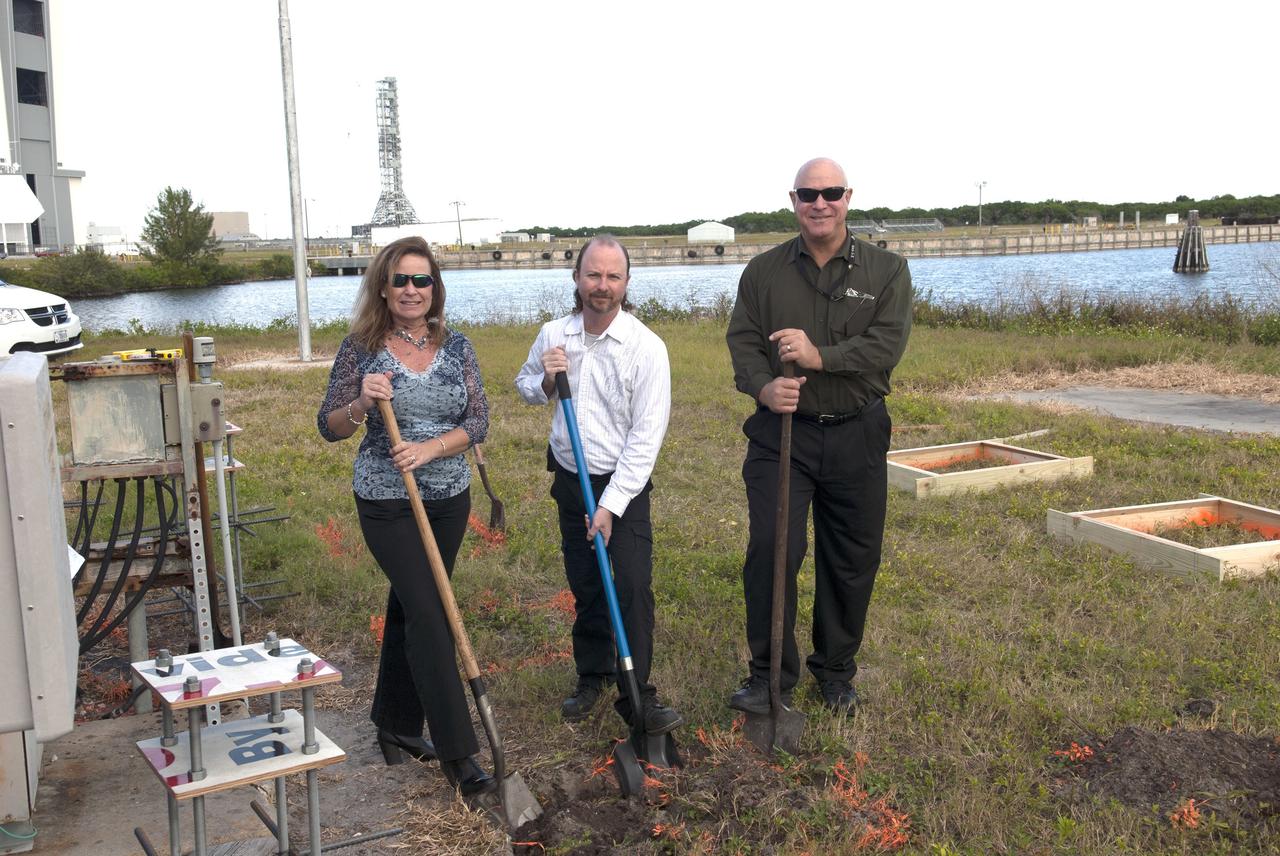
CAPE CANAVERAL, Fla. -- At NASA's Kennedy Space Center in Florida, Project Manager Sonja Hernandez, Kennedy TV senior systems engineer Ronald Gonser and Kennedy/IMCS senior manager Jeff Van Pelt dig in behind the current countdown clock during the groundbreaking ceremony for the new countdown clock. The old timepiece was designed by Kennedy engineers and built by Kennedy technicians in 1969. Not including the triangular concrete and aluminum base, the famous landmark is nearly 6 feet 70 inches high, 26 feet 315 inches wide and 3 feet deep. The new display will be similar in size, with the screen being nearly 26 feet wide by 7 feet high. For more information on the countdown clock, go to http://go.nasa.gov/10Zku10. Photo credit: NASA/Jim Grossmann
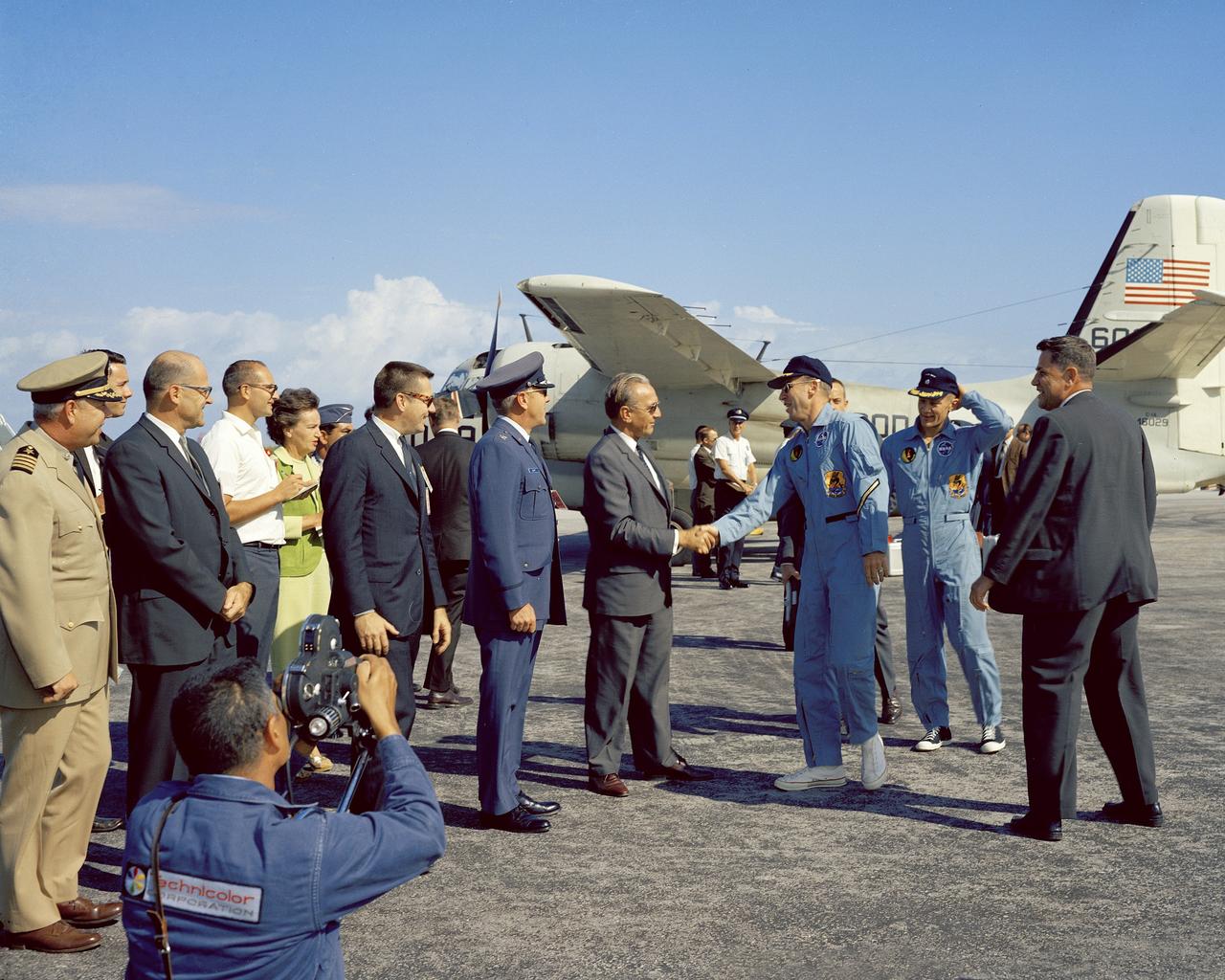
CAPE KENNEDY, Fla. -- At the Cape Kennedy Air Force Station skid strip, Dr. Kurt H. Debus, director of the Kennedy Space Center, greets returning Gemini 12 astronauts James A. Lovell and Edwin E. Buzz Aldrin Jr. following their four-day Earth orbital mission. Photo Credit: NASA
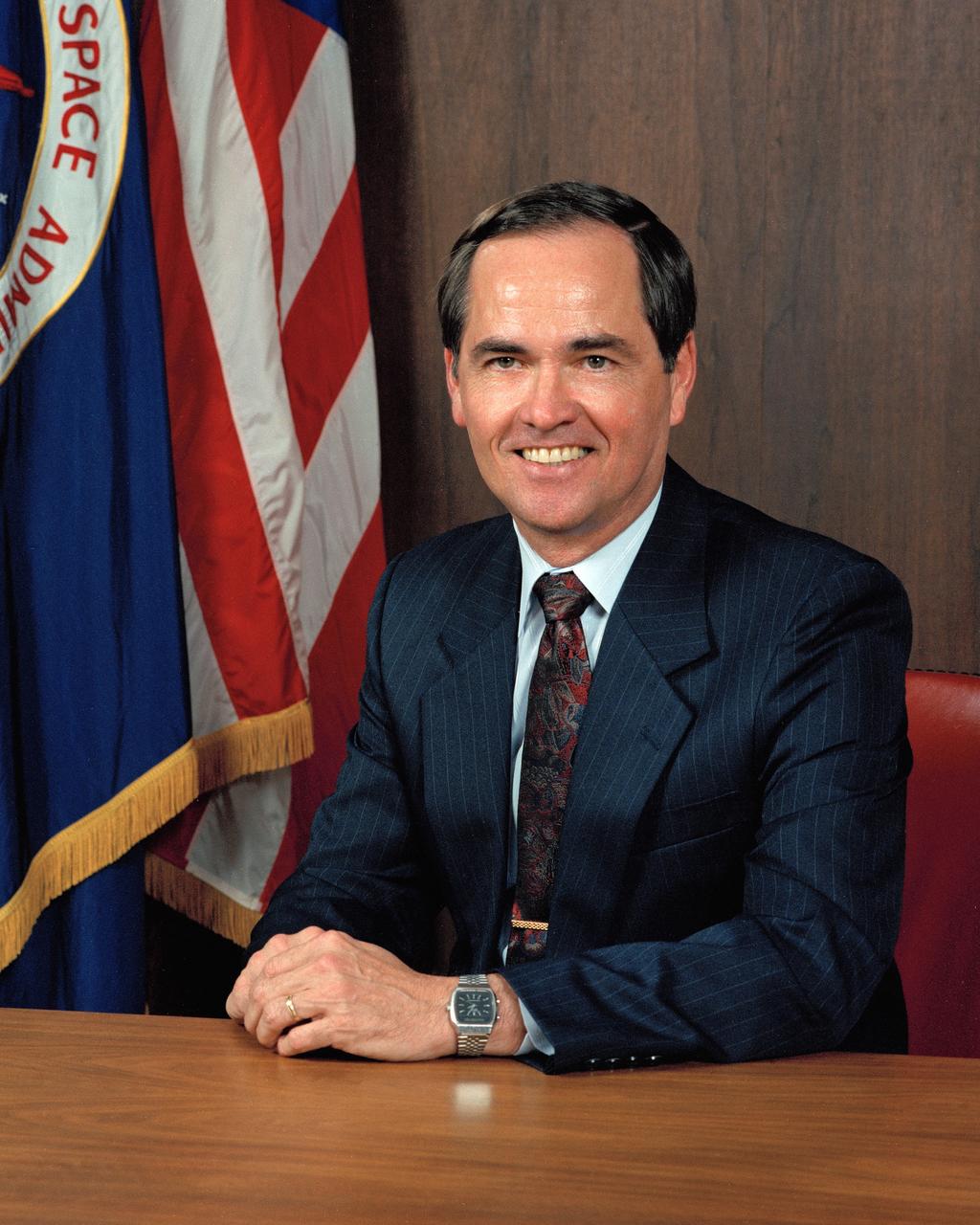
CAPE CANAVERAL, Fla. – Official portrait of Robert L. Crippen, KSC Center Director Photo credit: NASA