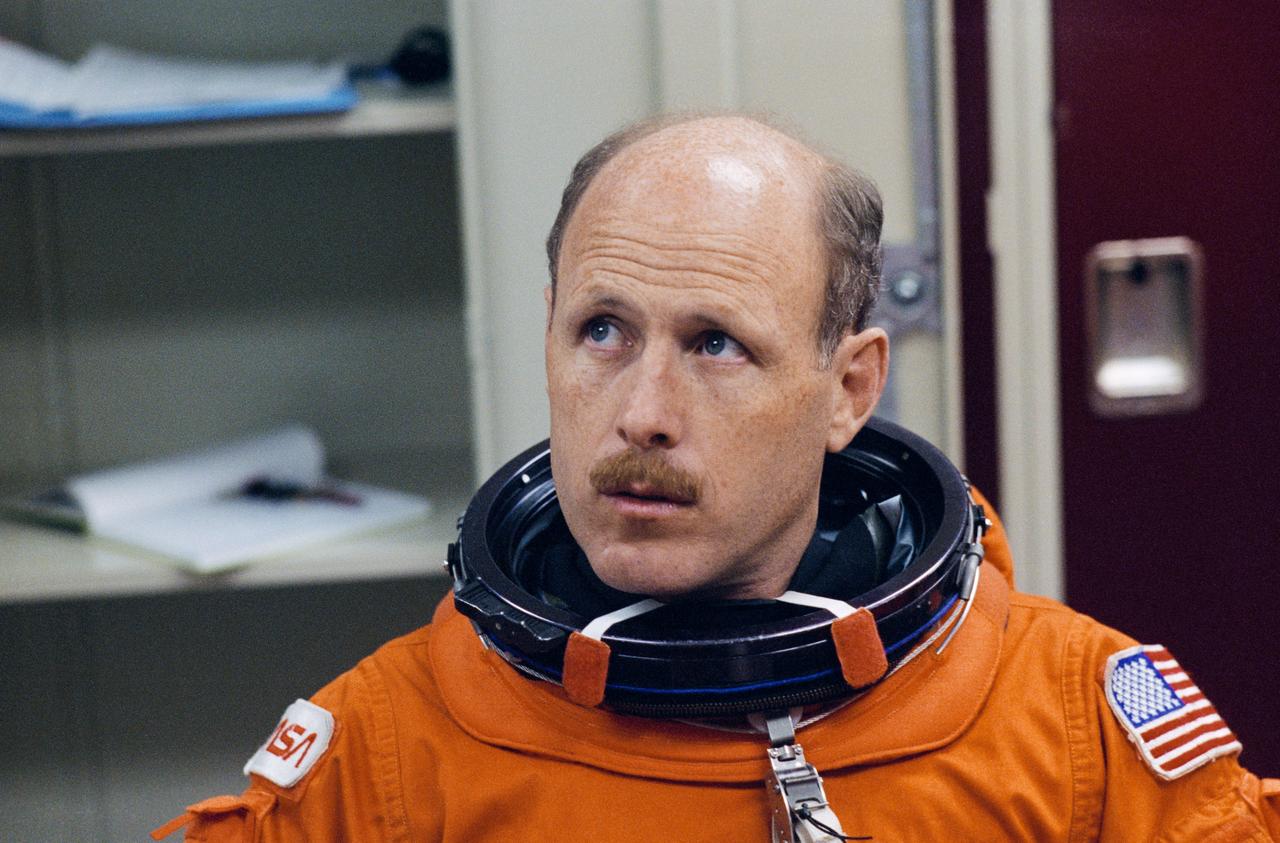
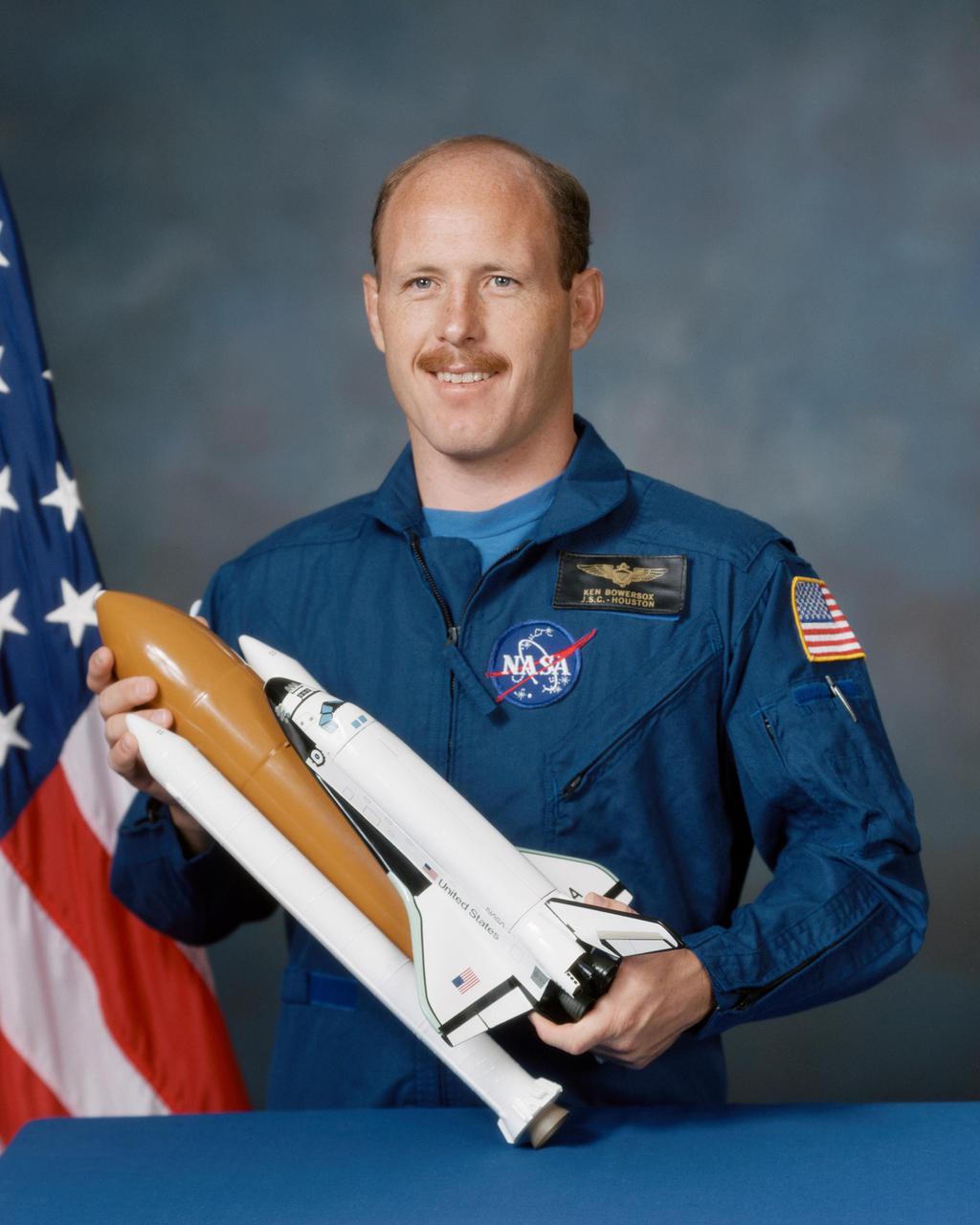
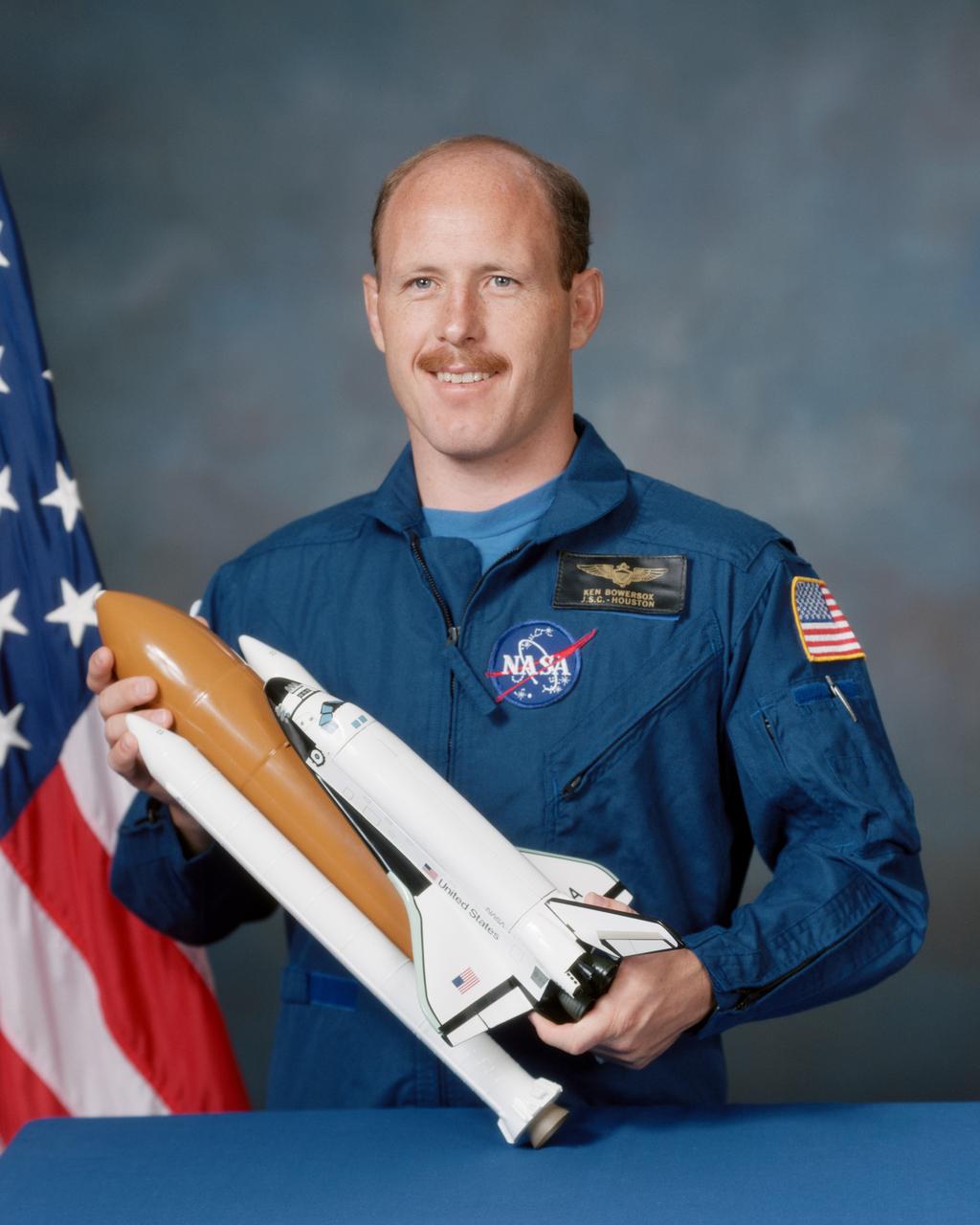
S87-45887 (October 1987) --- Astronaut Kenneth D. Bowersox, pilot.
Official portrait of 1987 astronaut candidate Kenneth D. Bowersox
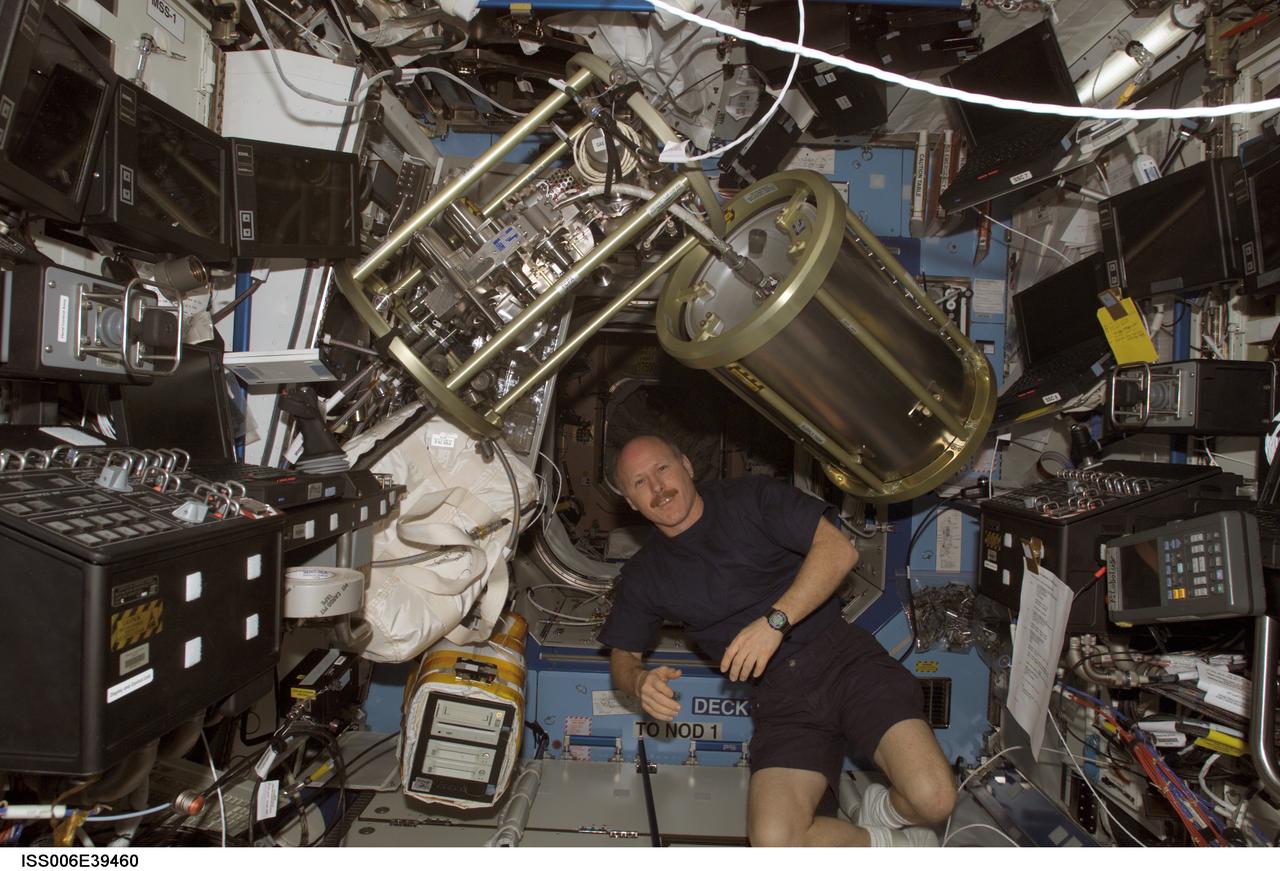
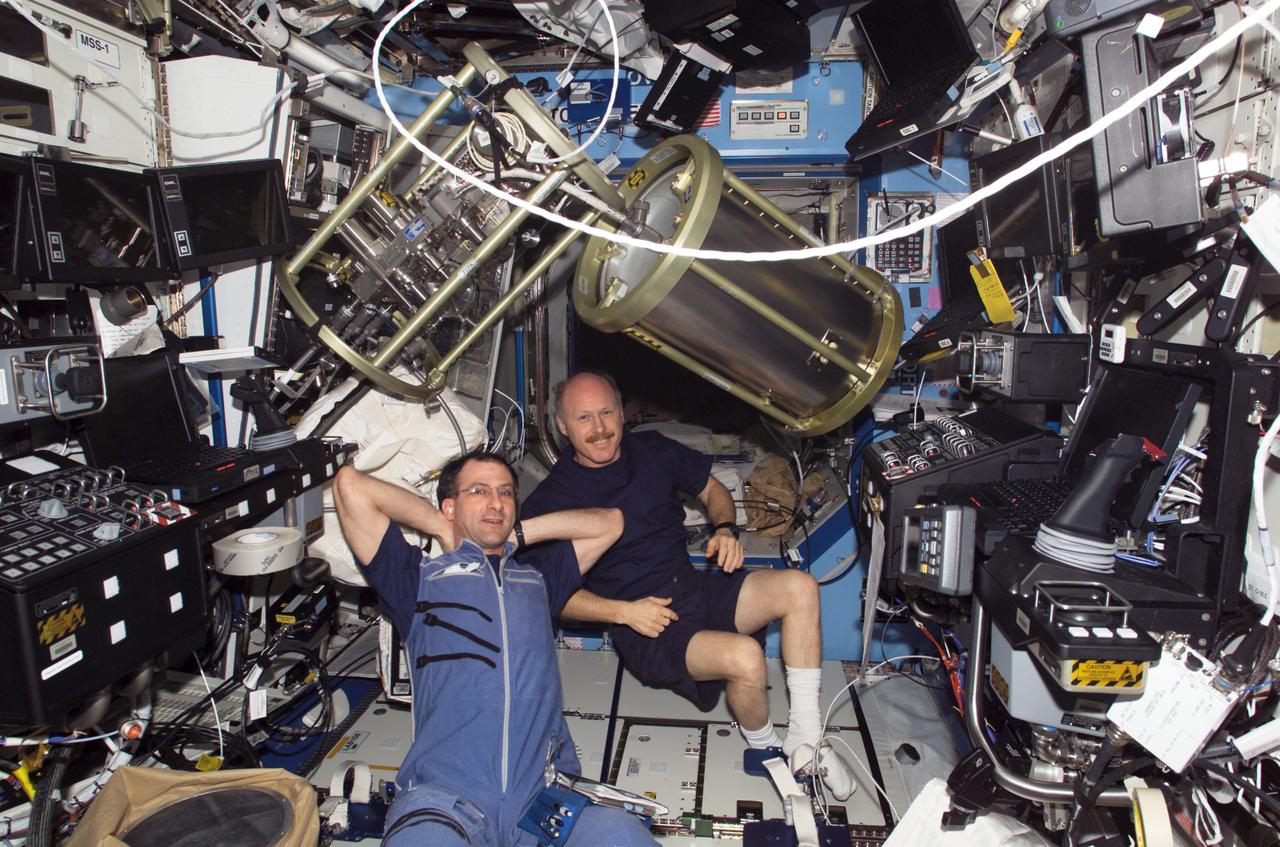
ISS006-E-39460 (18 March 2003) --- Astronaut Kenneth D. Bowersox, Expedition Six mission commander, is pictured in the Destiny laboratory on the International Space Station (ISS). The supply tank and Fluid Control Pump Assembly (FCPA), which are a part of the Internal Thermal Control System (ITCS), are visible floating freeing above Bowersox.
Commander Kenneth D. Bowersox posing with Supply Tank and FCPA as part of the ITCS
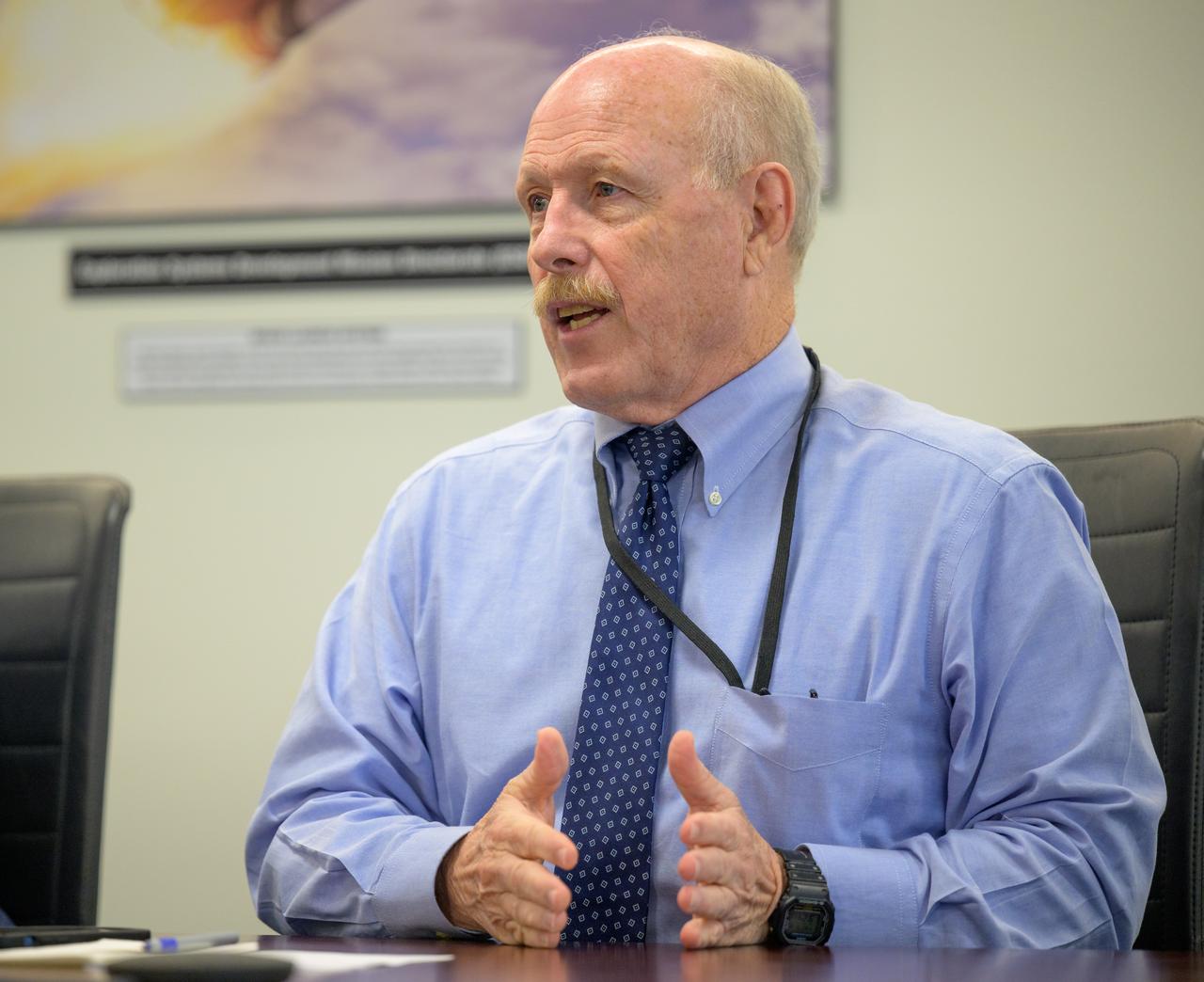
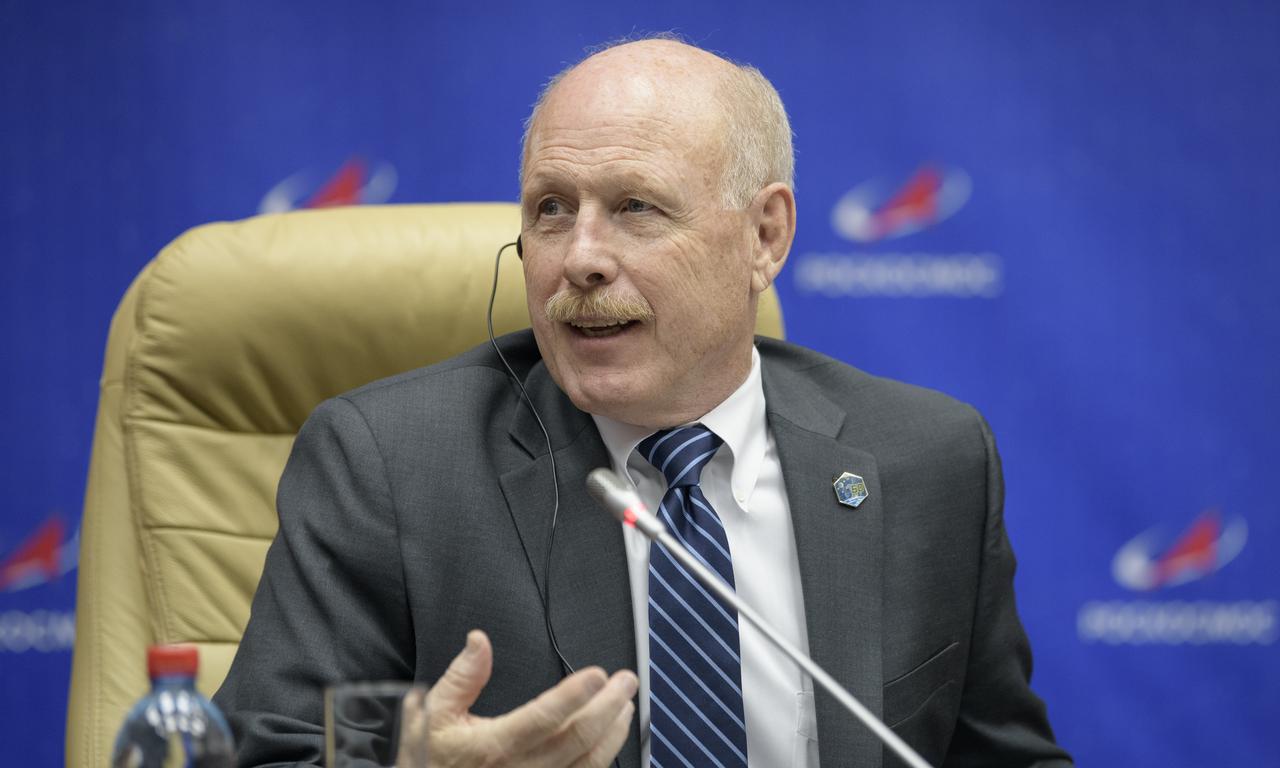
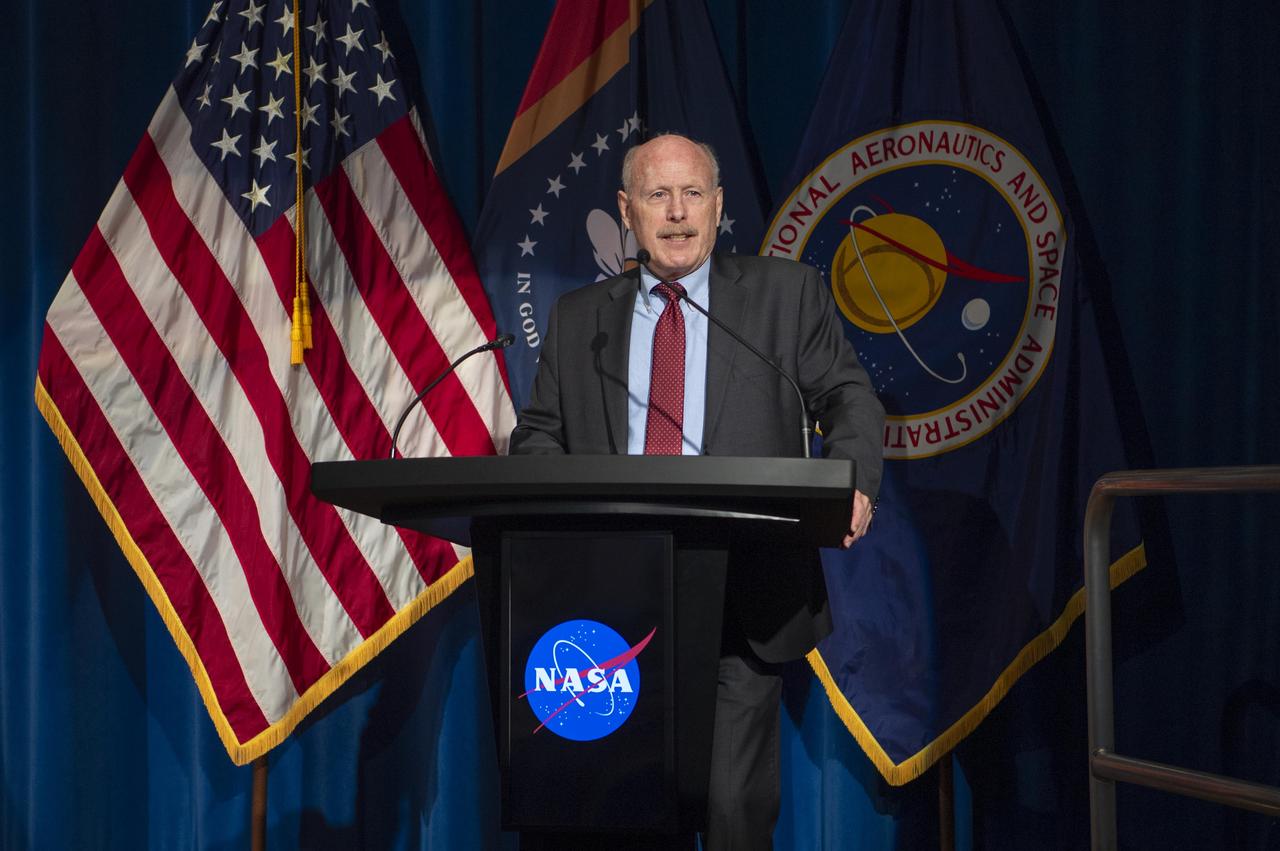
Associate Administrator for NASA's Space Operations Mission Directorate Kenneth Bowersox speaks with acting NASA Administrator Sean Duffy, Friday, July 18, 2025, at the Mary W. Jackson NASA Headquarters Building in Washington. Photo Credit: (NASA/Bill Ingalls)
Acting Administrator Sean Duffy Meets with Senior Leadership
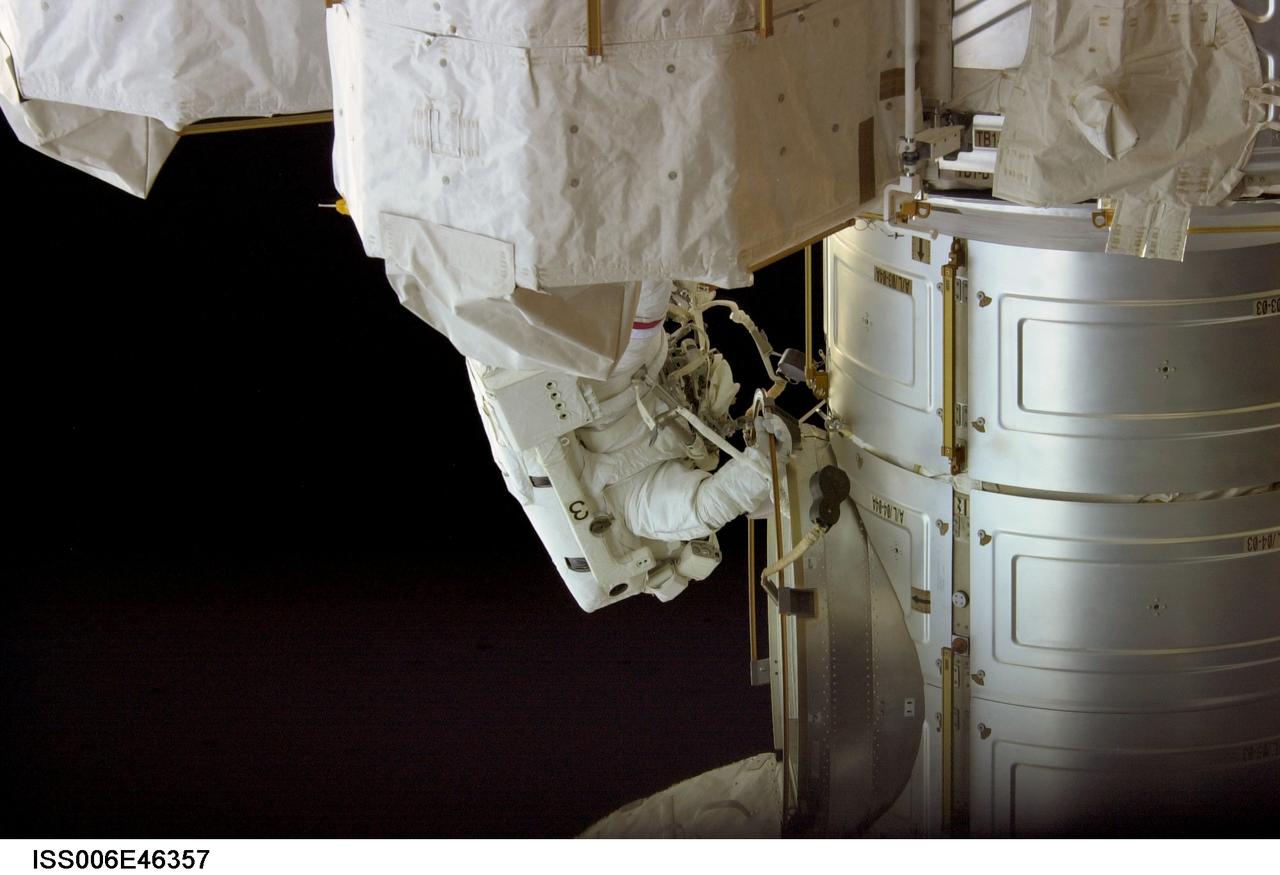
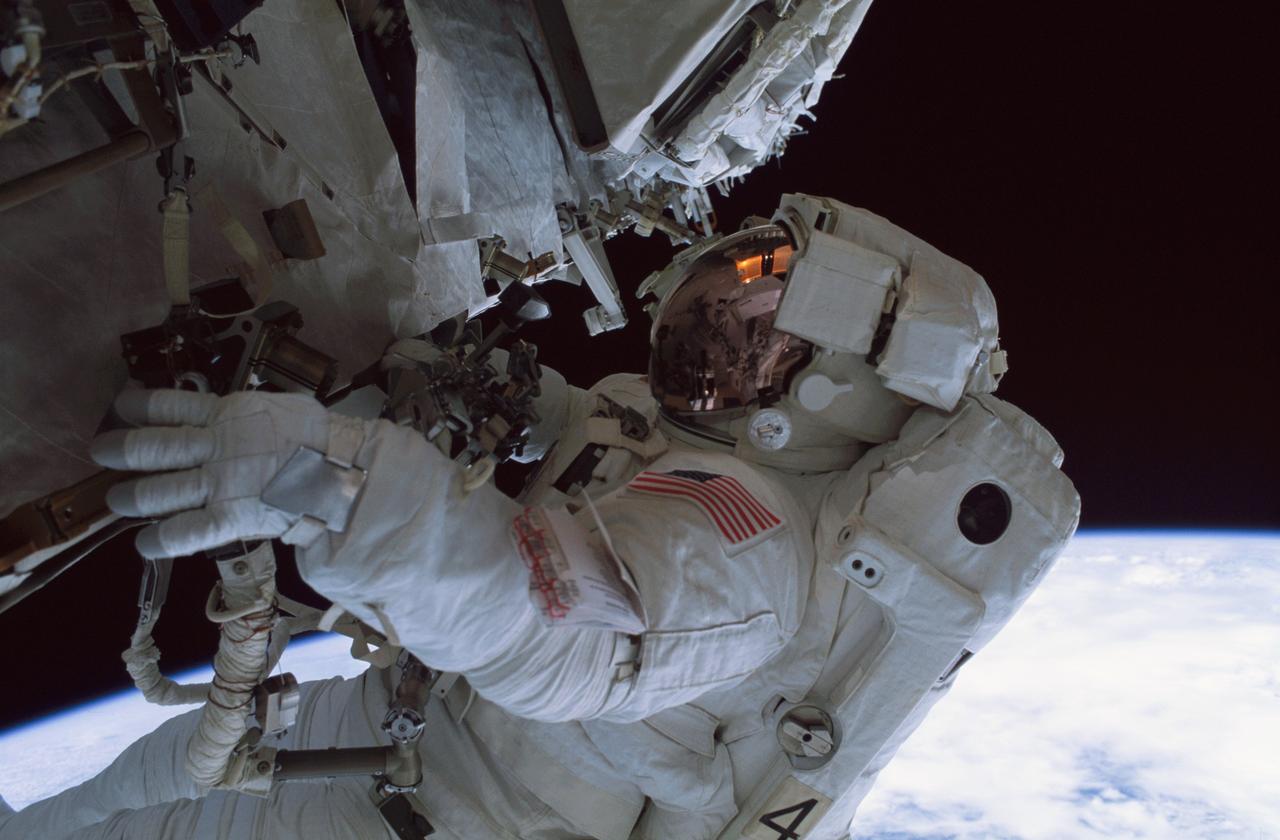
ISS006-E-46357 (8 April 2003) --- Astronaut Kenneth D. Bowersox, Expedition Six mission commander, emerges from the Quest airlock on the International Space Station (ISS) to begin a session of extravehicular activity (EVA) to perform a variety of maintenance tasks. Astronaut Donald R. Pettit (out of frame), NASA ISS science officer, joined Bowersox on the spacewalk.
View of Commander Kenneth D. Bowersox outside the Airlock performing a variety of tasks
STS061-53-010 (4 Dec 1993) --- Astronaut Kenneth D. Bowersox mans the pilot's station on the Space Shuttle Endeavour during the eleven-day mission to service the Hubble Space Telescope (HST).  Bowersox was one of three crew members who remained in the crew cabin while astronauts conducted a total of five space walks to perform various tasks on the HST.
Astronaut Kenneth Bowersox at pilot's station in Endeavour during STS-61
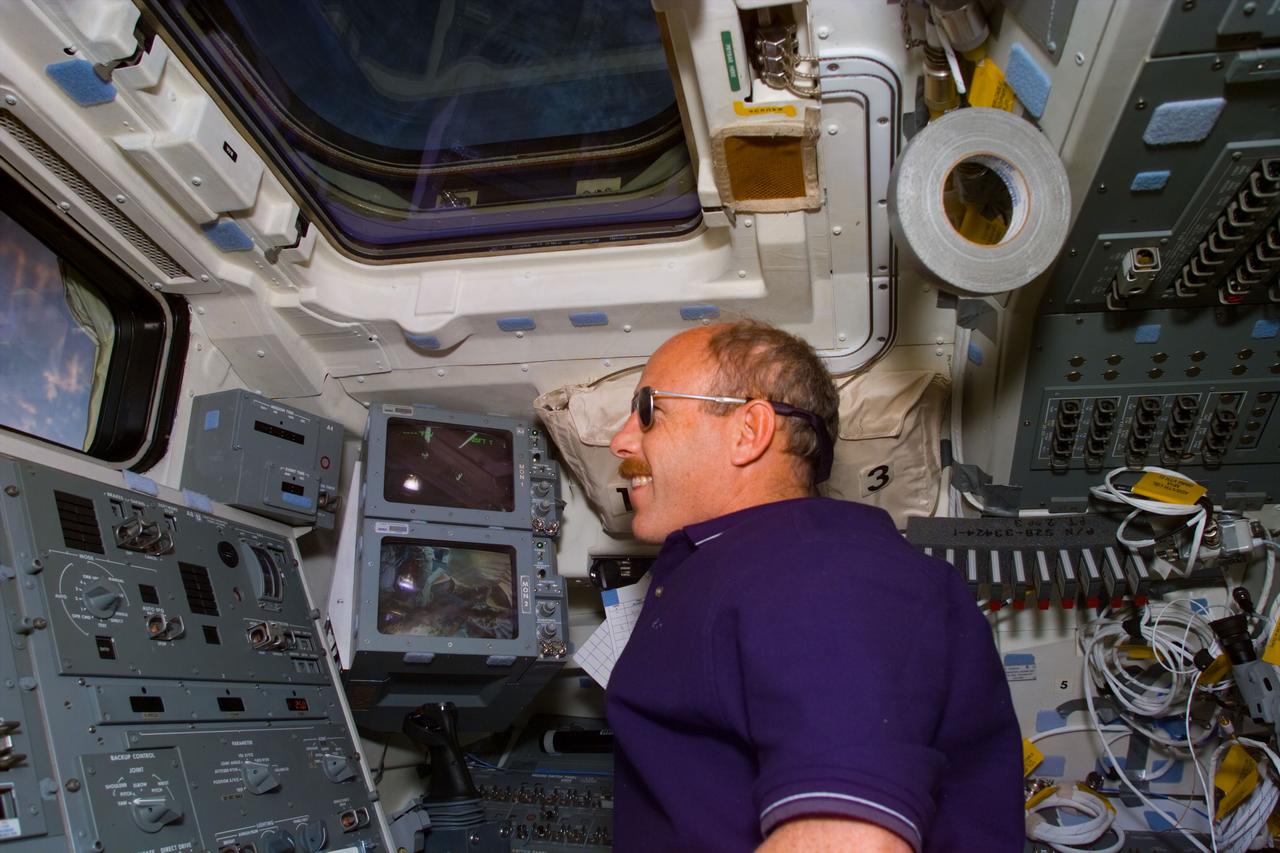
S82-E-5007 (12 Feb. 1997) --- Astronaut Kenneth D. Bowersox, who served as pilot for the 1993 servicing mission to the Hubble Space Telescope (HST) appears to be pondering scheduled duties when the Space Shuttle Discovery makes a rendezvous in space with HST later in the week.  Bowersox is mission commander and will remain in the Space Shuttle Discovery's cabin while four crew mates at various times perform Extravehicular Activities (EVA) to accomplish a series of servicing tasks on the giant telescope.  This view was taken with an Electronic Still Camera (ESC).
Commander Kenneth D. Bowersox looks out the aft flight deck window
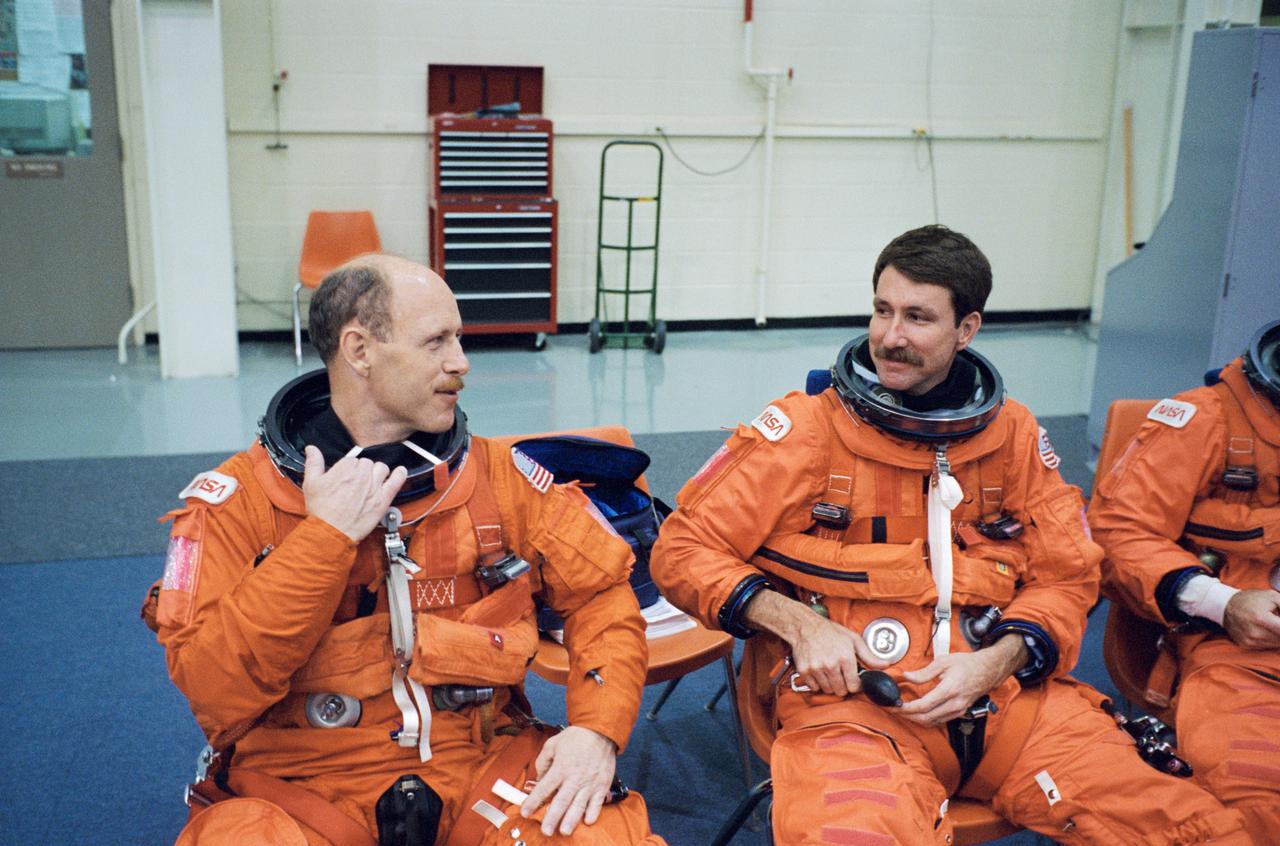
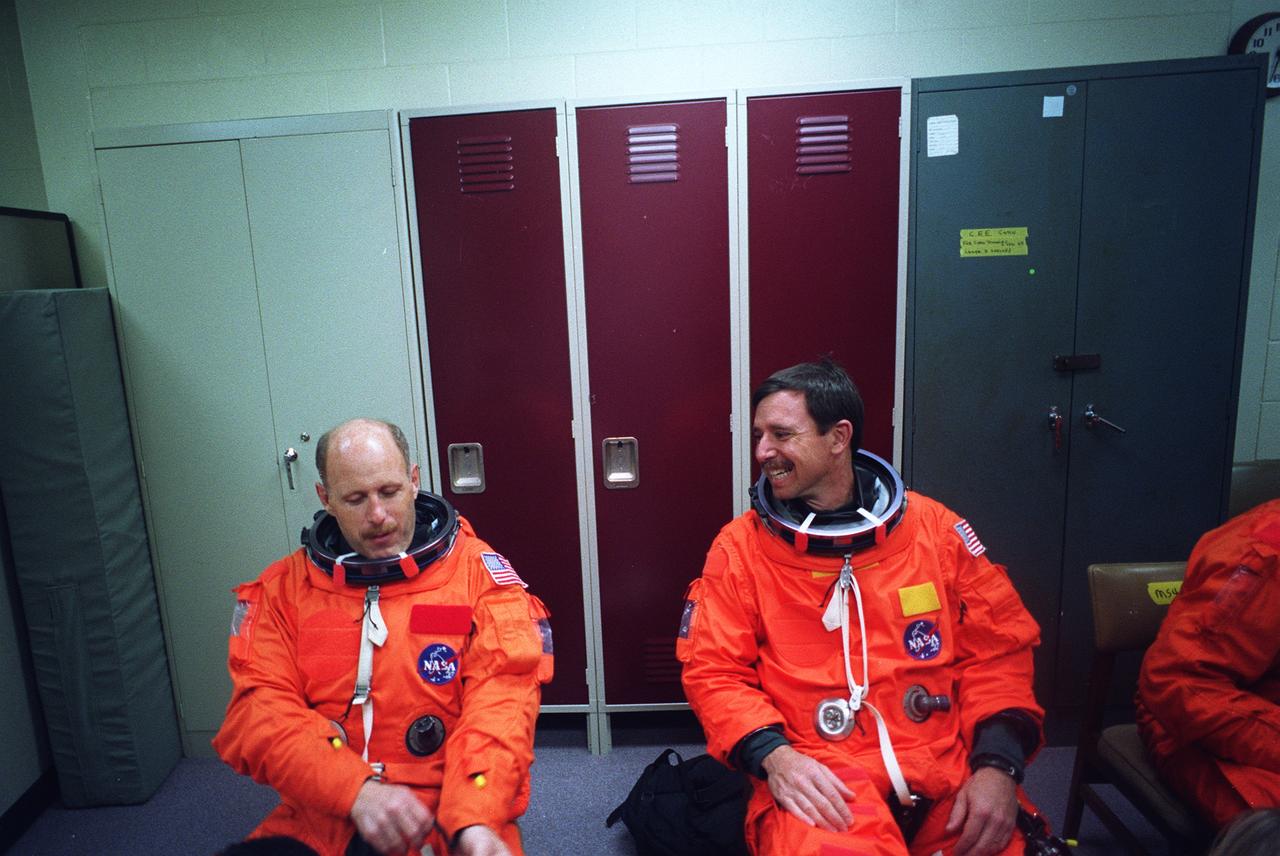
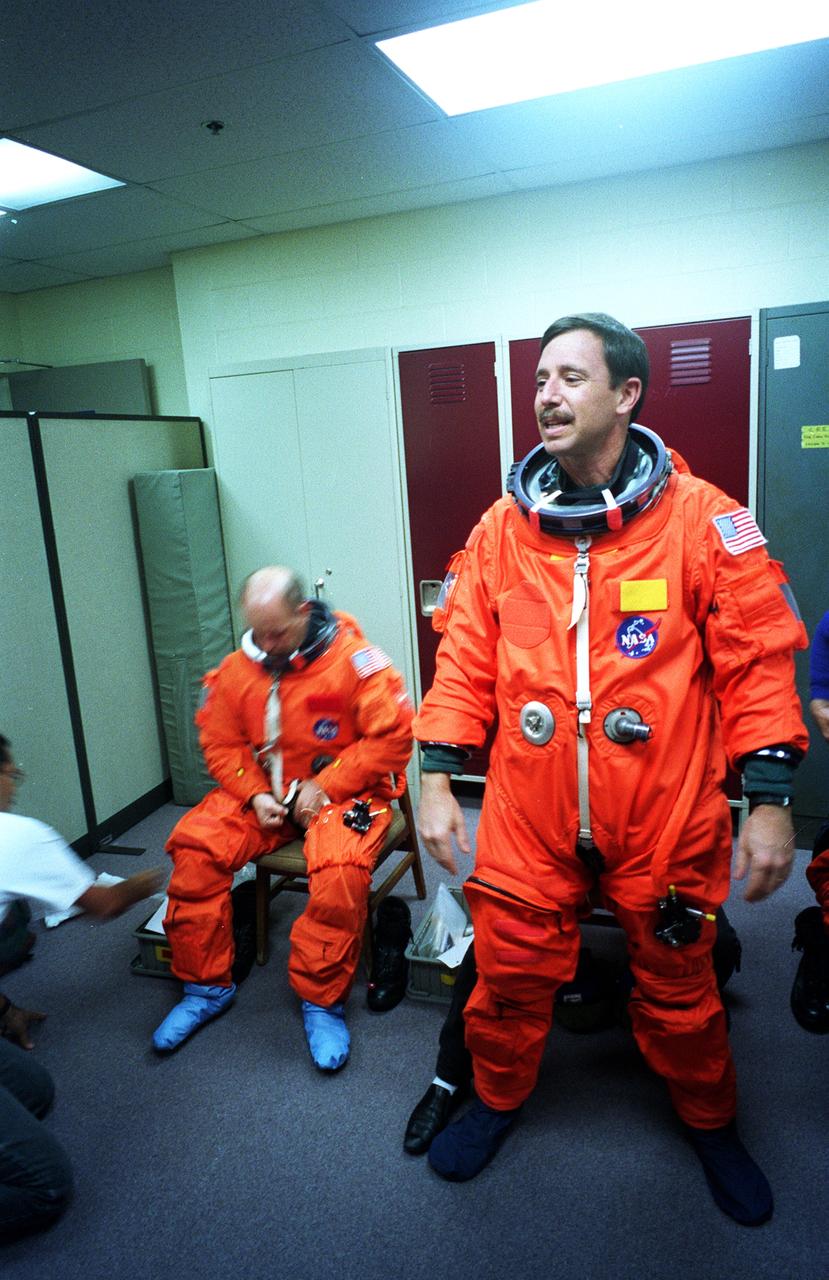
S95-09140 (27 Apr. 1995) --- Attired in training versions of the Space Shuttle partial pressure launch and entry garment, astronauts Kenneth D. Bowersox (left) and Kent V. Rominger prepare to rehearse an emergency situation with the Space Shuttle.  The two are commander and pilot, respectively, for the United States Microgravity Laboratory (USML-2) mission.  Bowersox was pilot for the USML-1 mission.  The emergency egress training exercises took place in the Systems Integration Facility at the Johnson Space Center (JSC).
Astronauts Kenneth D. Bowersox and Kent V. Rominger during bailout training
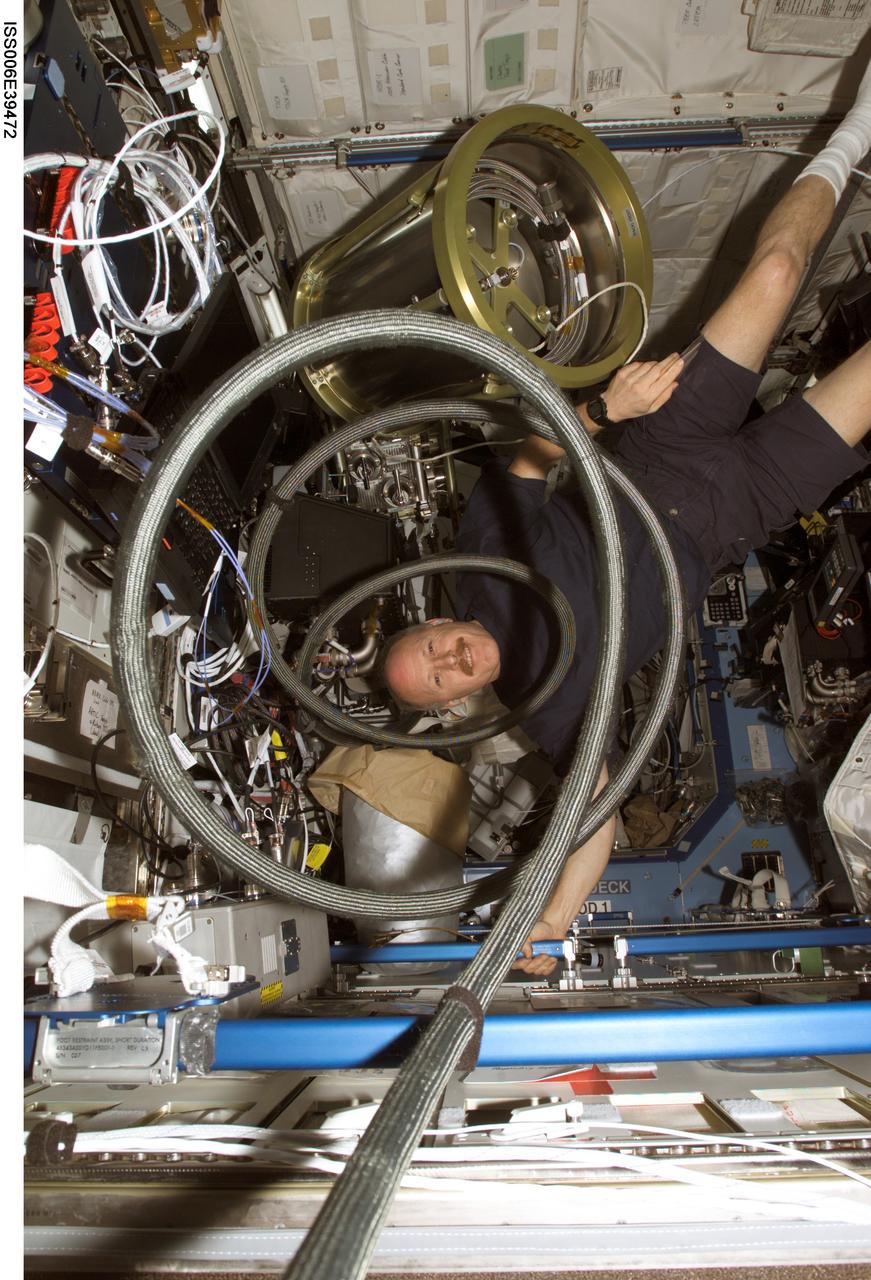
ISS006-E-39472 (18 March 2003) --- Astronaut Kenneth D. Bowersox, Expedition Six mission commander, floats with a supply tank, which is a part of the Internal Thermal Control System (ITCS) in the Destiny laboratory on the International Space Station (ISS).
Commander Kenneth D. Bowersox posing with Supply Tank as part of the ITCS
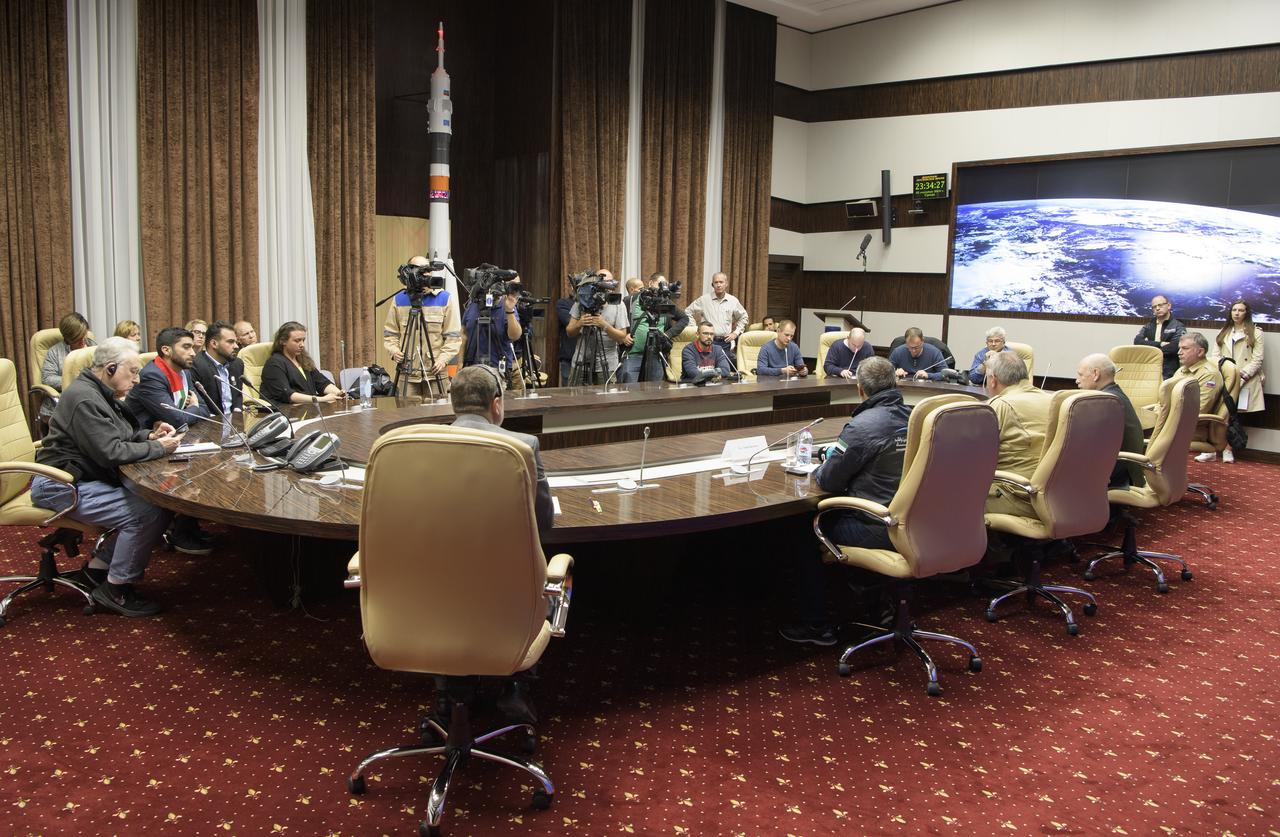
NASA acting Associate Administrator for Human Exploration and Operations Mission Directorate Kenneth Bowersox gives remarks during a post launch press conference, Thursday, Sept. 26, 2019 at the Baikonur Hotel Hotel in Baikonur, Kazakhstan. A few hours earlier the Soyuz MS-15 spacecraft successfully launched from the Baikonur Cosmodrome with Expedition 61 crewmembers Jessica Meir of NASA and Oleg Skripochka of Roscosmos, and spaceflight participant Hazzaa Ali Almansoori of the United Arab Emirates. Photo Credit: (NASA/Bill Ingalls)
Expedition 61 Launch
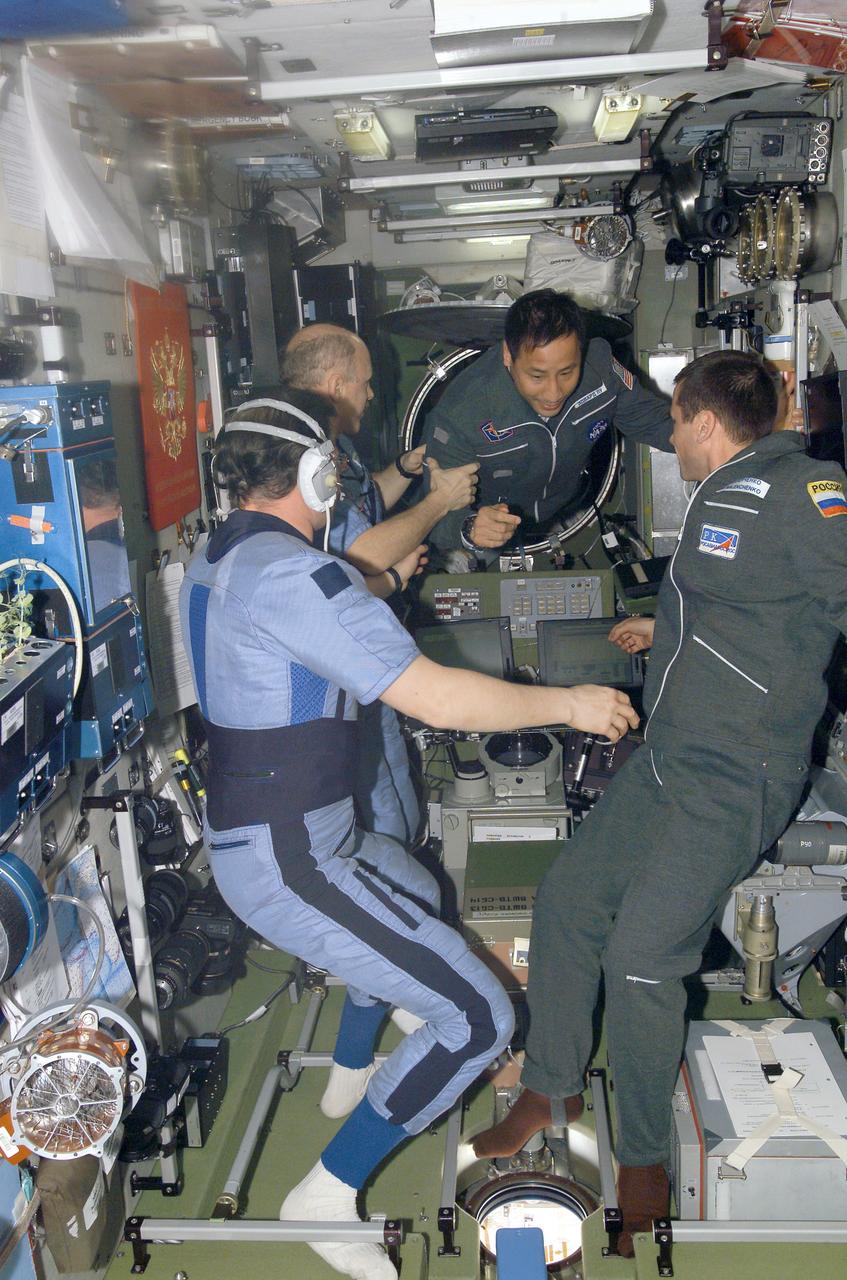
ISS006-E-50604 (28 April 2003) --- Astronaut Edward T. Lu, Expedition 7 NASA ISS science officer and flight engineer, floats into the Zvezda Service Module on the International Space Station (ISS), assisted by astronaut Kenneth D. Bowersox, Expedition 6 mission commander. Also pictured are cosmonauts Nikolai M. Budarin (left foreground), Expedition 6 flight engineer, and Yuri I. Malenchenko, Expedition 7 mission commander. Astronaut Donald R. Pettit (out of view), Expedition 6 NASA ISS science officer, photographed this image. Budarin and Malenchenko represent Rosaviakosmos.
Edward Lu floats in SM assisted by Kenneth Bowersox
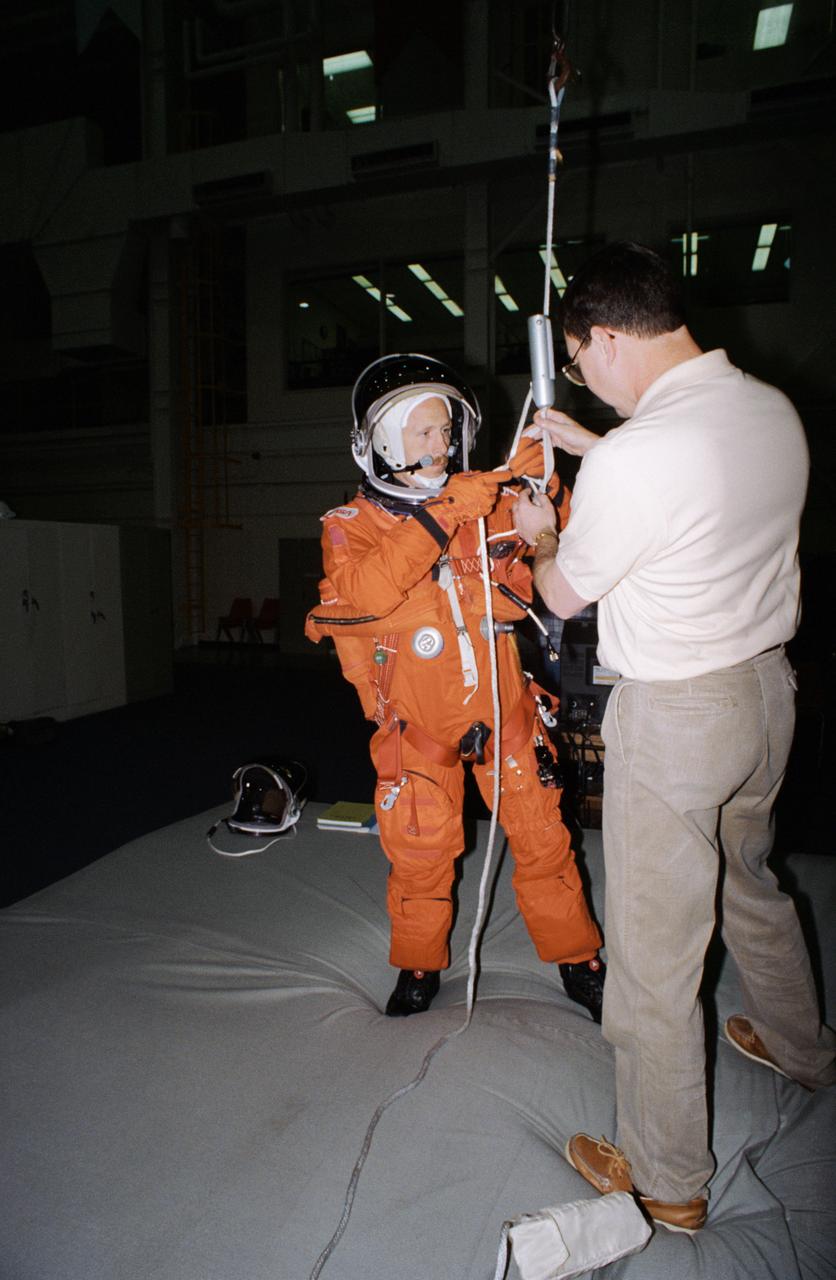
S95-09153 (27 Apr. 1995) --- Astronaut Kenneth D. Bowersox has just translated from the top of a Shuttle mockup-trainer using a Sky-genie device during emergency egress training with his six STS-73 crew mates.  He is assisted here by Scott Gill, a member of the STS-73 training staff.  The seven will fly aboard the Space Shuttle Columbia later this year to support the United States Microgravity Laboratory (USML-2) mission.
Astronaut Kenneth D. Bowersox during emergency egress training
S95-09132 (27 Apr. 1995) --- As he watches one his STS-73 crew mates rappel from the top of a ?troubled Shuttle,? astronaut Kenneth D. Bowersox, mission commander, prepares to participate in an emergency egress training session in the Johnson Space Center?s (JSC) Systems Integration Facility.  Five astronauts and two payload specialists from the private sector will fly aboard the Space Shuttle Columbia later this year to support the United States Microgravity Laboratory (USML-2) mission.
Astronaut Kenneth D. Bowersox during emergency egress training
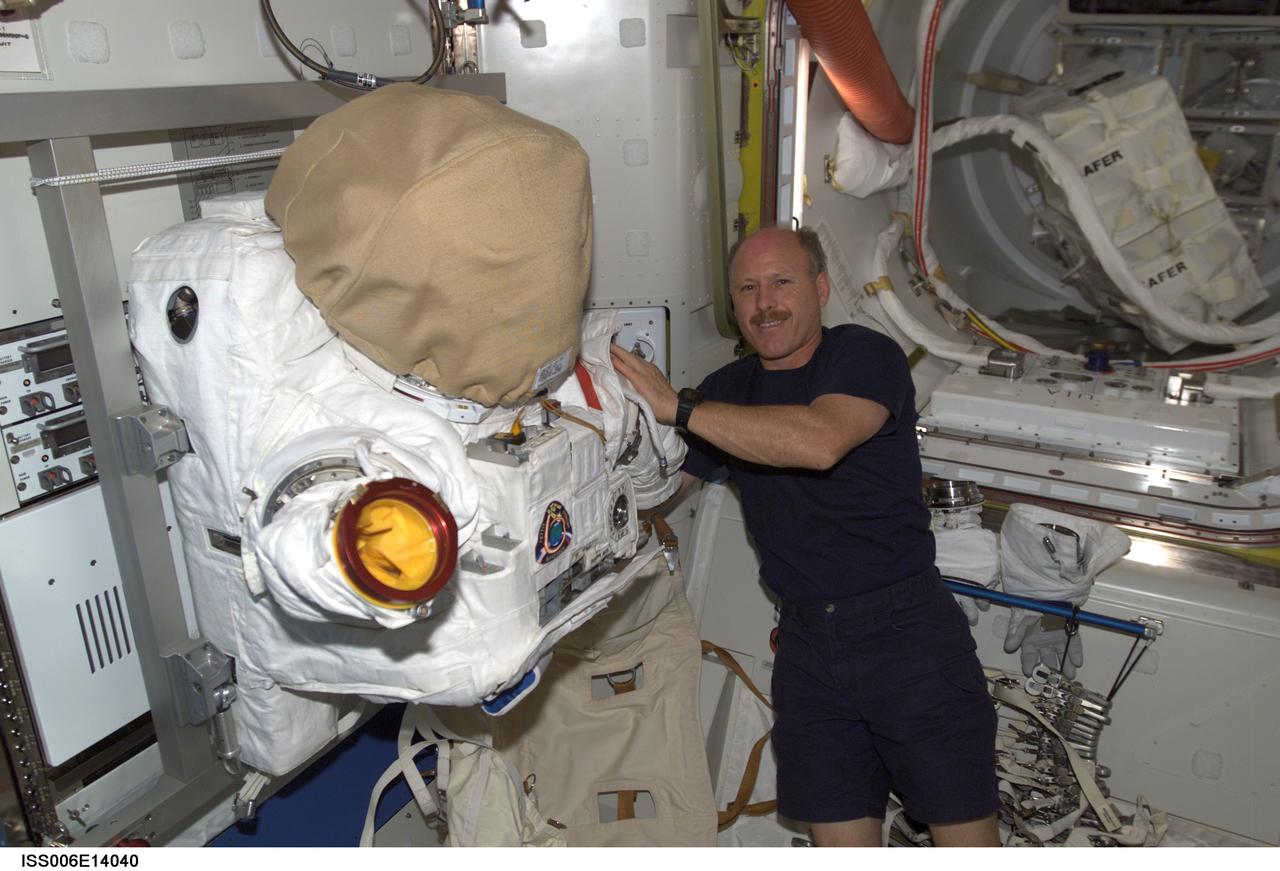
ISS006-E-14040 (4 January 2003) --- Astronaut Kenneth D. Bowersox, Expedition Six mission commander, is pictured near the torso portion of an Extravehicular Mobility Unit (EMU) spacesuit stored in the Quest Airlock on the International Space Station (ISS). Bowersox and Donald R. Pettit, NASA ISS science officer, are scheduled for the mission’s only spacewalk on January 15, 2003 where they will continue outfitting the station’s Port One (P1) truss.
Commander Kenneth D. Bowersox poses next to the torso portion of an EVA in the Quest Airlock
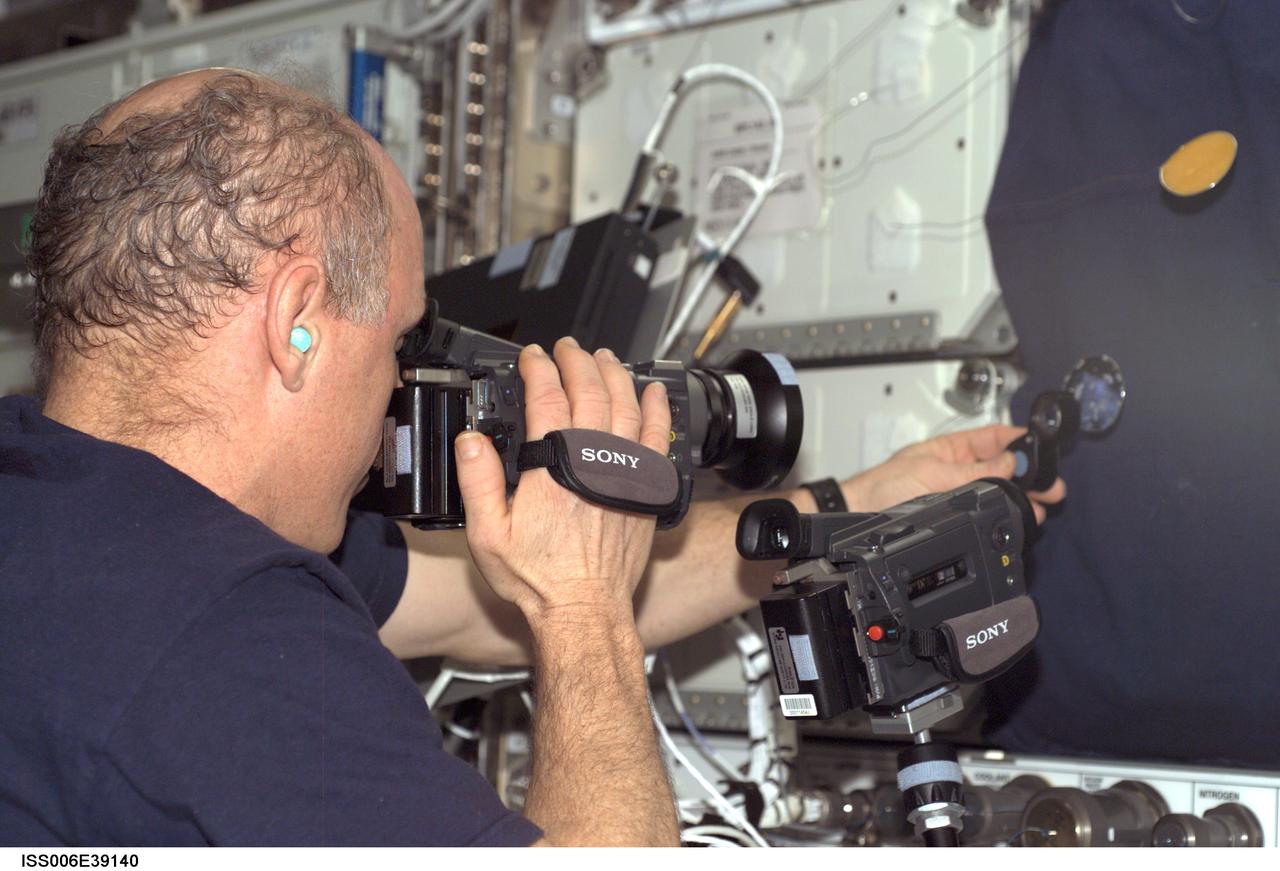
ISS006-E-39140 (12 March 2003) --- Astronaut Kenneth D. Bowersox, Expedition Six mission commander, photographs a water bubble within a 50-millimeter metal loop. The experiment took place in the Destiny laboratory on the International Space Station (ISS).
Commander Kenneth D. Bowersox photographs a water bubble within a 50-millimeter metal in U.S. Lab
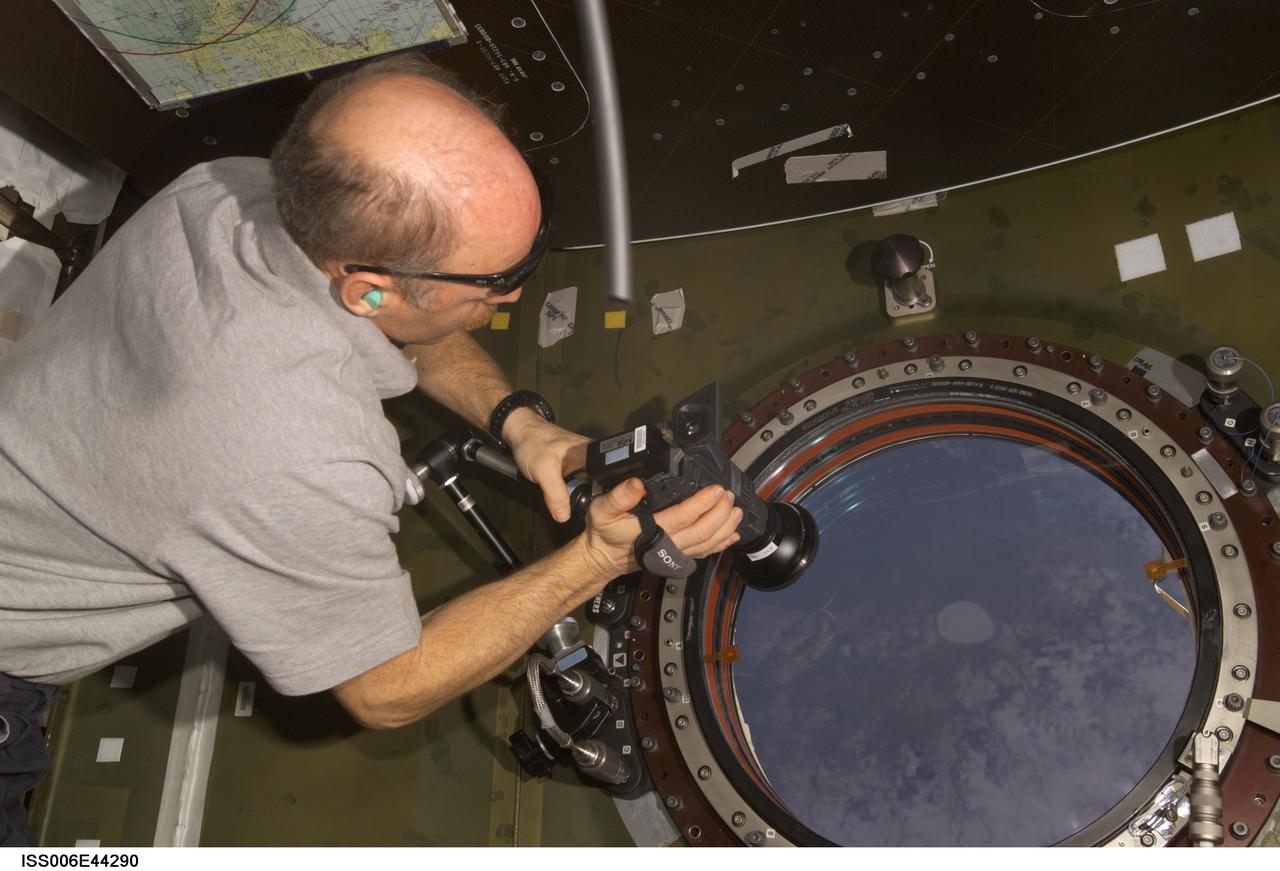
ISS006-E-44290 (5 April 2003) --- Astronaut Kenneth D. Bowersox, Expedition Six mission commander, uses a camera to photograph the topography of a point on Earth from the nadir window in the Destiny laboratory on the International Space Station (ISS).
Commander Kenneth D. Bowersox uses a camera to photography the earth from the nadir window
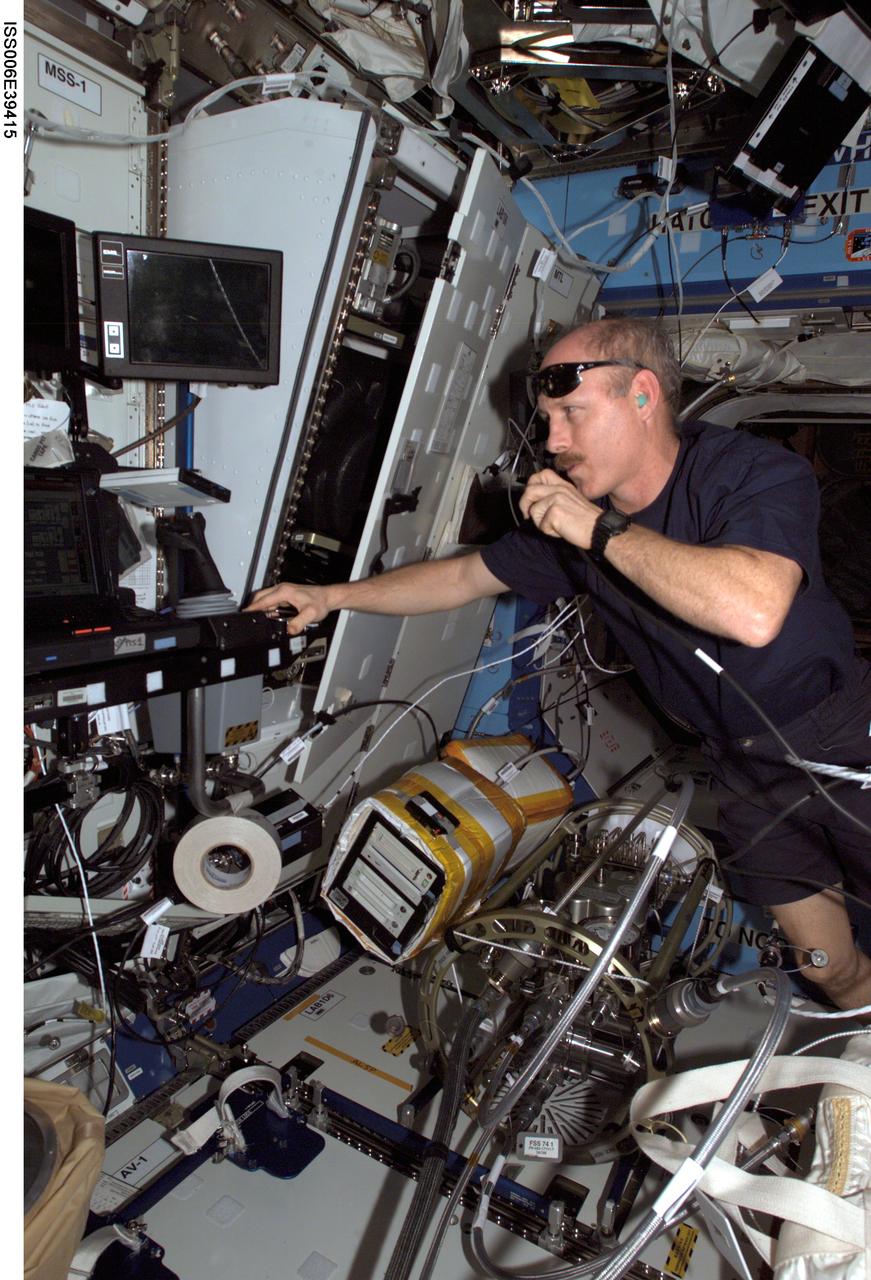
ISS006-E-39415 (17 March 2003) --- Astronaut Kenneth D. Bowersox, Expedition Six mission commander, works at the Space Station Remote Manipulator System (SSRMS) or Canadarm2 workstation as he talks into a communication system in the Destiny laboratory on the International Space Station (ISS).
Commander Kenneth D. Bowersox working at the AV-1 Rack in the U.S. Laboratory/Destiny
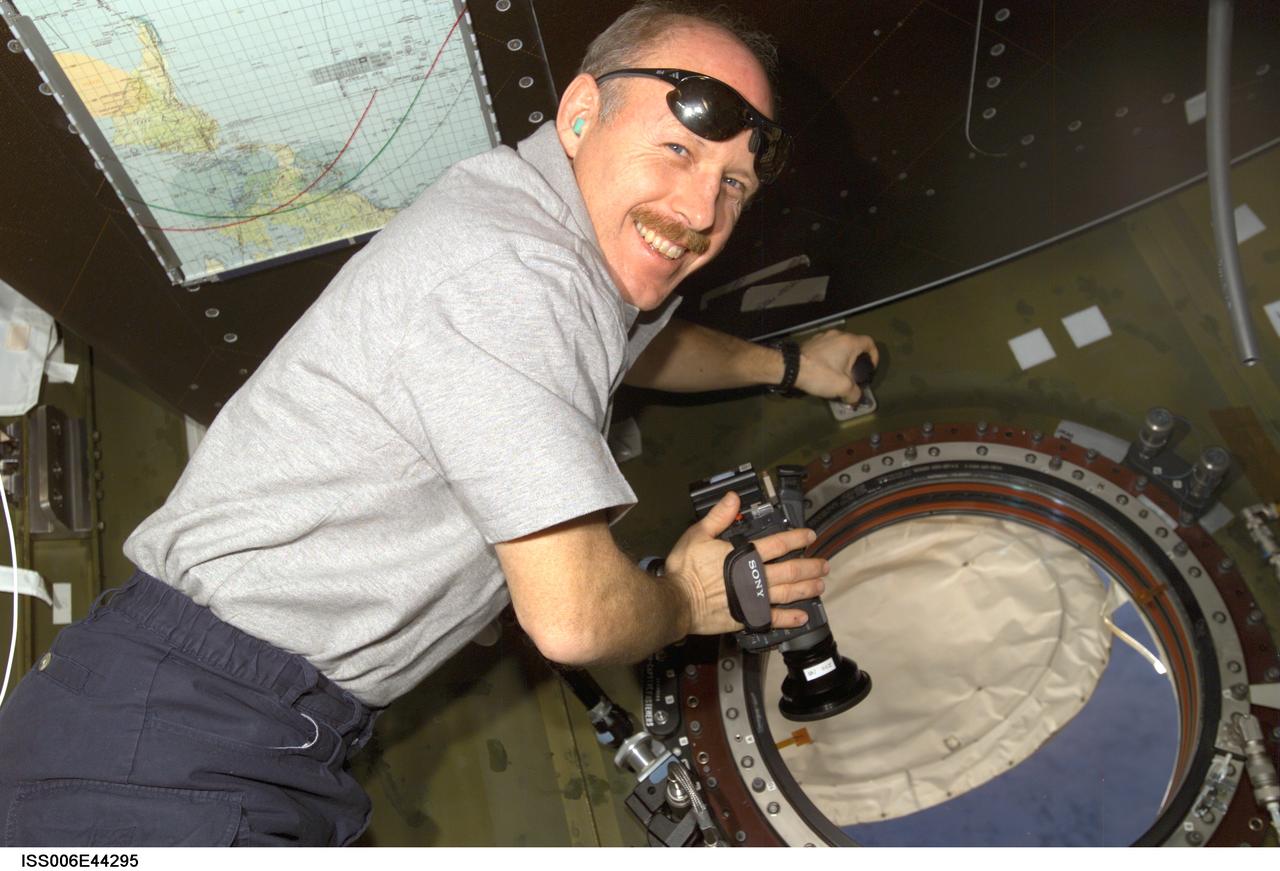
ISS006-E-44295 (5 April 2003) --- Astronaut Kenneth D. Bowersox, Expedition 6 mission commander, holds a camera  prior to  photographing  the topography of a point on Earth from the nadir window in the Destiny laboratory on the International Space Station (ISS).
Commander Kenneth D. Bowersox poses for image as he holds digital camera in the U.S. Laboratory
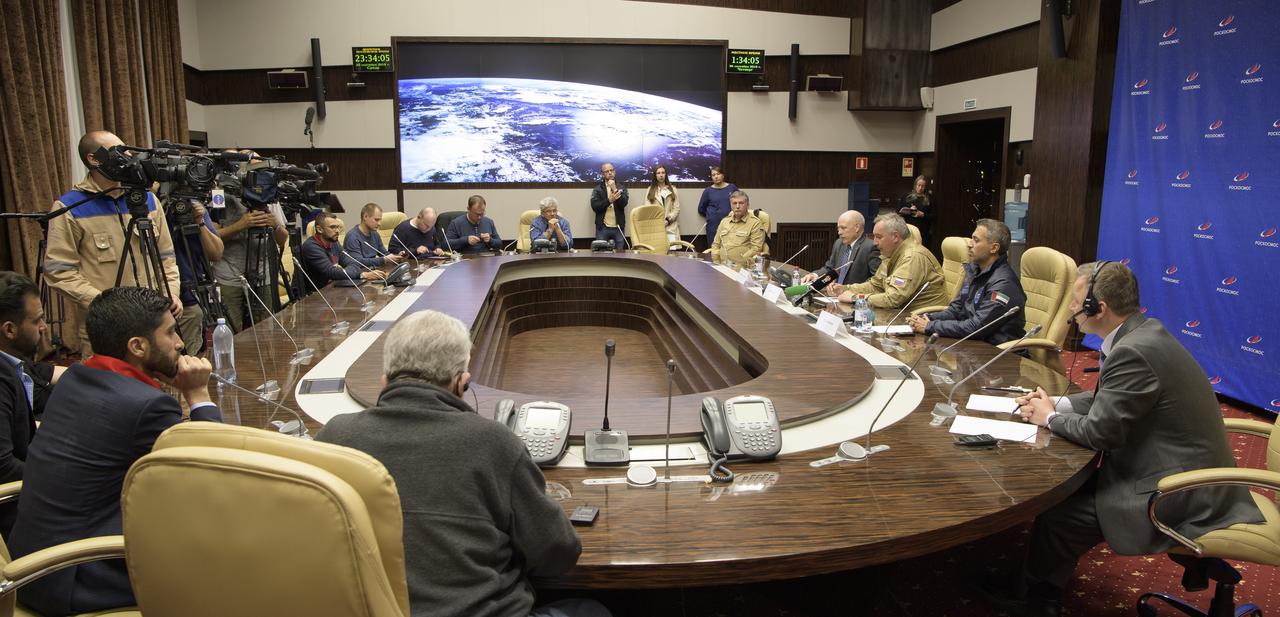
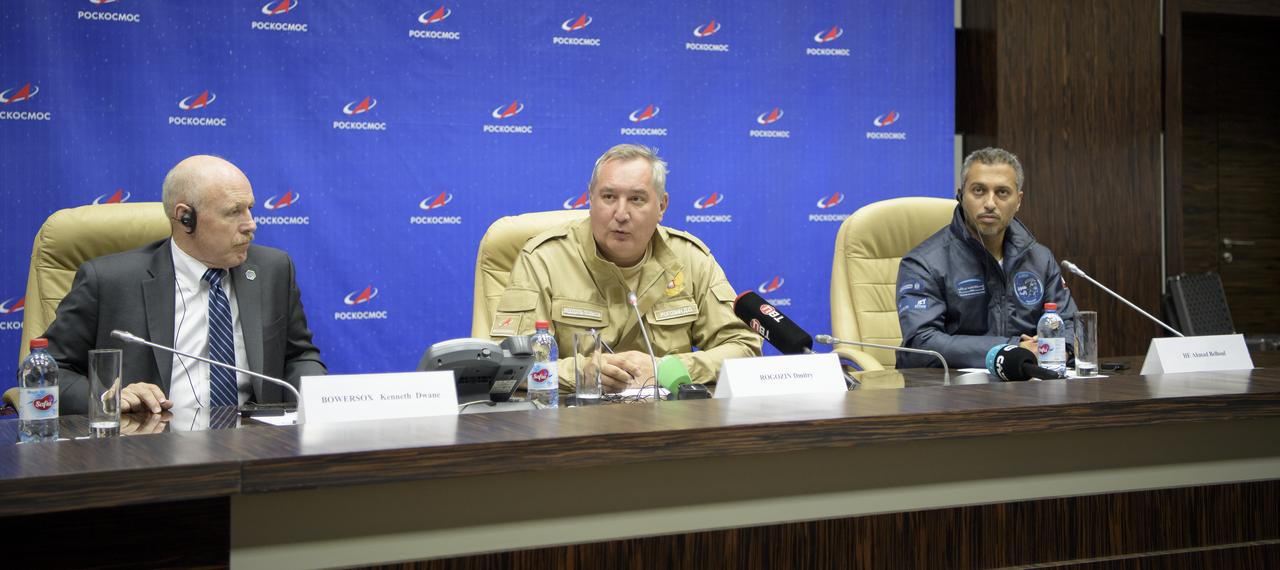
NASA acting Associate Administrator for Human Exploration and Operations Mission Directorate Kenneth Bowersox, Roscosmos Director General Dmitry Rogozin, and UAE Space Agency Chairman Ahmad Belhoul give remarks during a post launch press conference, Thursday, Sept. 26, 2019 at the Baikonur Hotel Hotel in Baikonur, Kazakhstan. A few hours earlier the Soyuz MS-15 spacecraft successfully launched from the Baikonur Cosmodrome with Expedition 61 crewmembers Jessica Meir of NASA and Oleg Skripochka of Roscosmos, and spaceflight participant Hazzaa Ali Almansoori of the United Arab Emirates. Photo Credit: (NASA/Bill Ingalls)
Expedition 61 Launch
NASA acting Associate Administrator for Human Exploration and Operations Mission Directorate Kenneth Bowersox, Roscosmos Director General Dmitry Rogozin, and UAE Space Agency Chairman Ahmad Belhoul give remarks during a post launch press conference, Thursday, Sept. 26, 2019 at the Baikonur Hotel Hotel in Baikonur, Kazakhstan. A few hours earlier the Soyuz MS-15 spacecraft successfully launched from the Baikonur Cosmodrome with Expedition 61 crewmembers Jessica Meir of NASA and Oleg Skripochka of Roscosmos, and spaceflight participant Hazzaa Ali Almansoori of the United Arab Emirates. Photo Credit: (NASA/Bill Ingalls)
Expedition 61 Launch
NASA acting Associate Administrator for Human Exploration and Operations Mission Directorate Kenneth Bowersox, left, Roscosmos Director General Dmitry Rogozin, center, and UAE Space Agency Chairman Ahmad Belhoul give remarks during a post launch press conference, Thursday, Sept. 26, 2019 at the Baikonur Hotel Hotel in Baikonur, Kazakhstan. A few hours earlier the Soyuz MS-15 spacecraft successfully launched from the Baikonur Cosmodrome with Expedition 61 crewmembers Jessica Meir of NASA and Oleg Skripochka of Roscosmos, and spaceflight participant Hazzaa Ali Almansoori of the United Arab Emirates. Photo Credit: (NASA/Bill Ingalls)
Expedition 61 Launch
ISS006-E-39461 (18 March 2003) --- Astronauts Donald R. Pettit (left), Expedition 6 NASA ISS Science Officer, and Kenneth D. Bowersox, mission commander, are pictured in the Destiny laboratory on the International Space Station (ISS). The supply tank and Fluid Control Pump Assembly (FCPA), which are a part of the Internal Thermal Control System (ITCS), are visible floating freeing above them.
Commander Kenneth D. Bowersox and Flight Engineer Donald R. Pettit are relaxing in the U.S. Lab
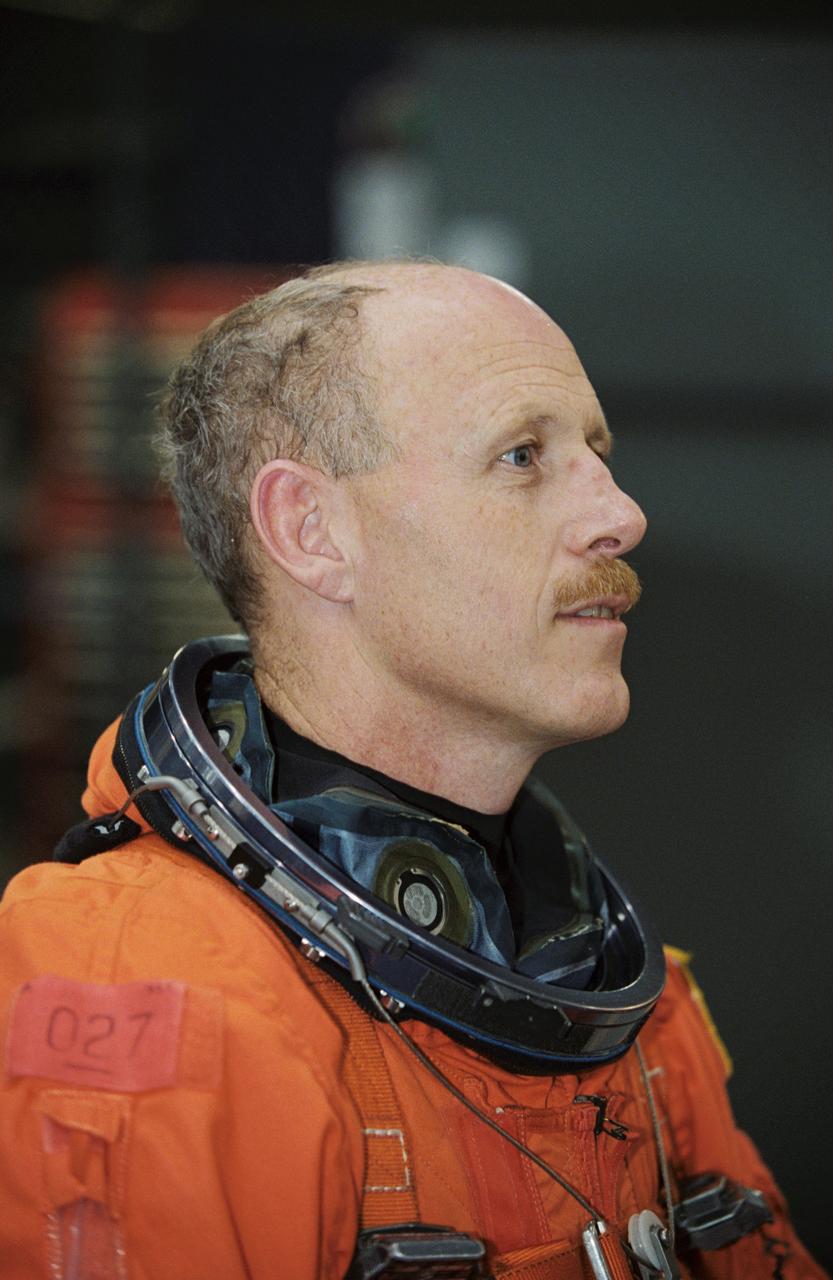
JOHNSON SPACE CENTER, HOUSTON, TEXAS -- (S87-45887)  Official portrait of astronaut Kenneth D. Bowersox, commander.
KSC-92pc-0919
NASA Associate Administrator for Space Operations Kenneth Bowersox speaks to NASA Stennis employees during the onsite NASA Honor Awards ceremony on May 15.
NASA Stennis 2023 Honor Awards
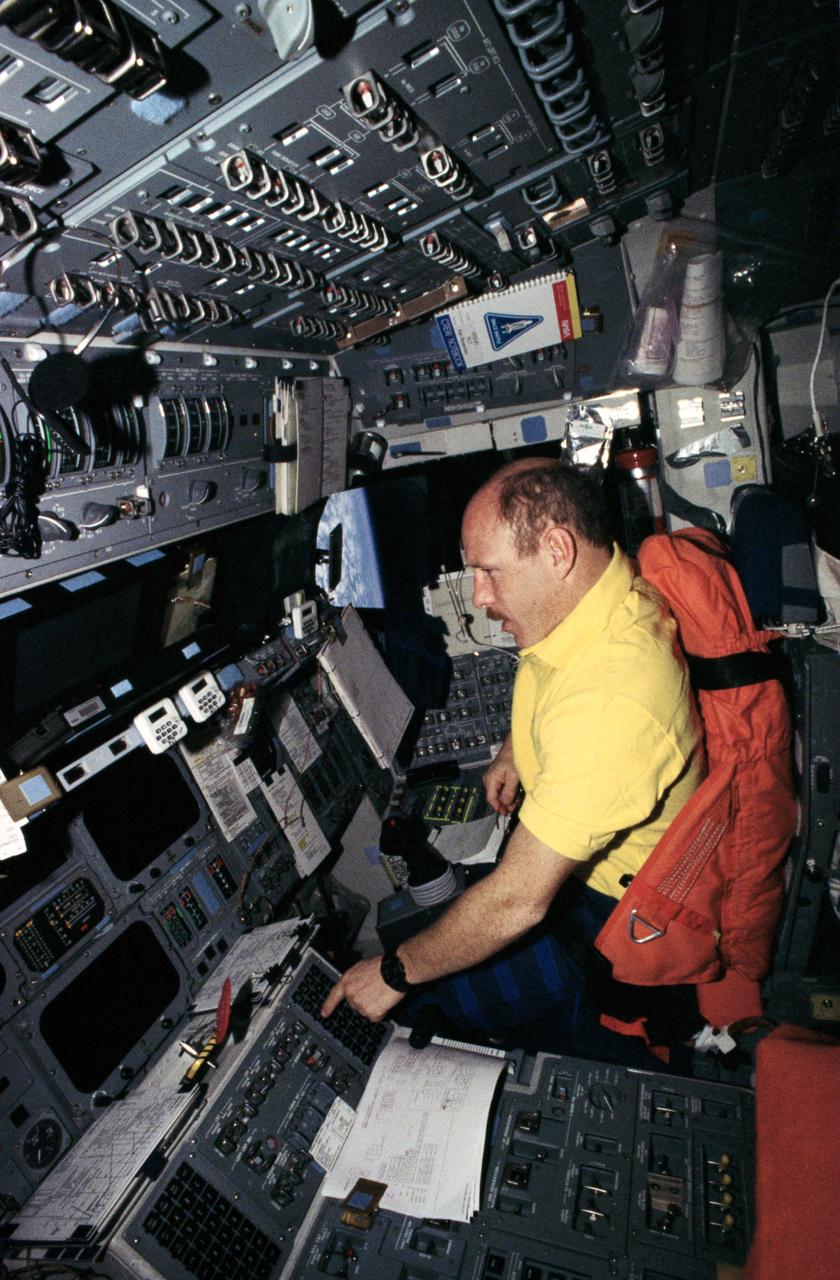
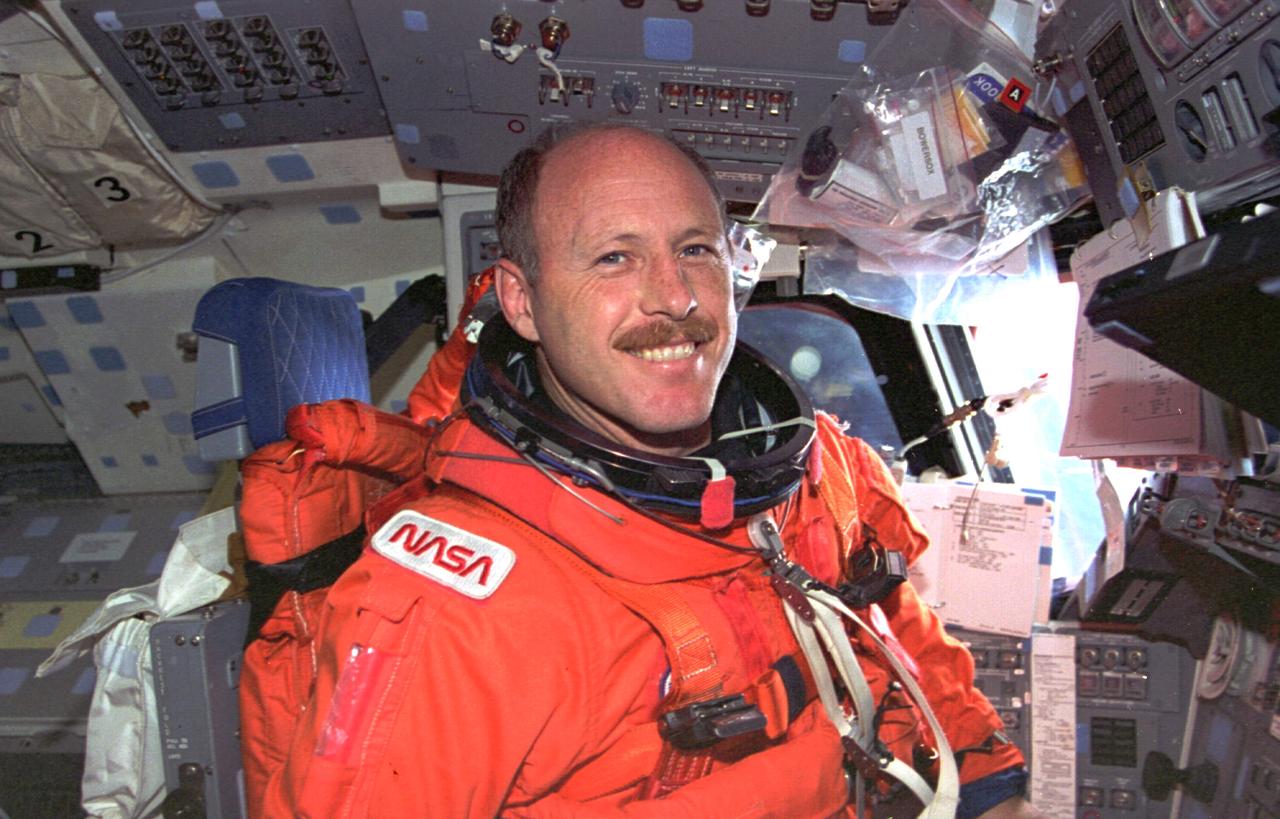
STS073-164-025 (5 November 1995) --- The countenance of astronaut Kenneth D. Bowersox signifies the near completion of a successful 16-day mission in Earth-orbit aboard the Space Shuttle Columbia.  Bowersox, attired in the shuttle launch and entry garment, mans the commander's station prior to the entry phase of the flight.
Commander Ken Bowersox and Pilot Kent Rominger during deorbit preparations
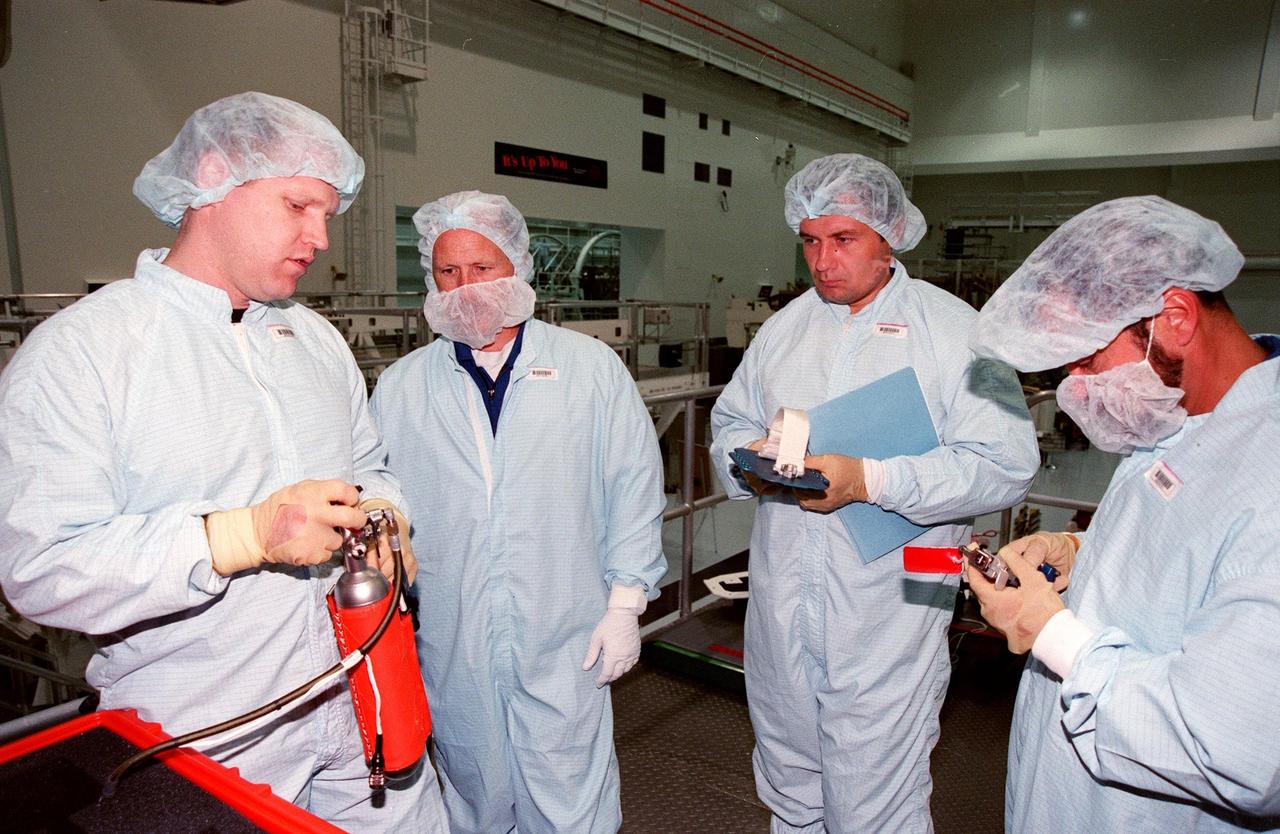
(Left to right) Bob Behrendsen, Mod Flight Crew Systems, astronaut Kenneth Bowersox and cosmonaut Vladimir Dezhurov check out equipment for the International Space Station (ISS) in the Space Station Processing Facility. Bowersox and Dezhurov are targeted on mission STS-102 which is scheduled to transport the second Multi-Purpose Logistics Module to ISS
KSC-98pc1201
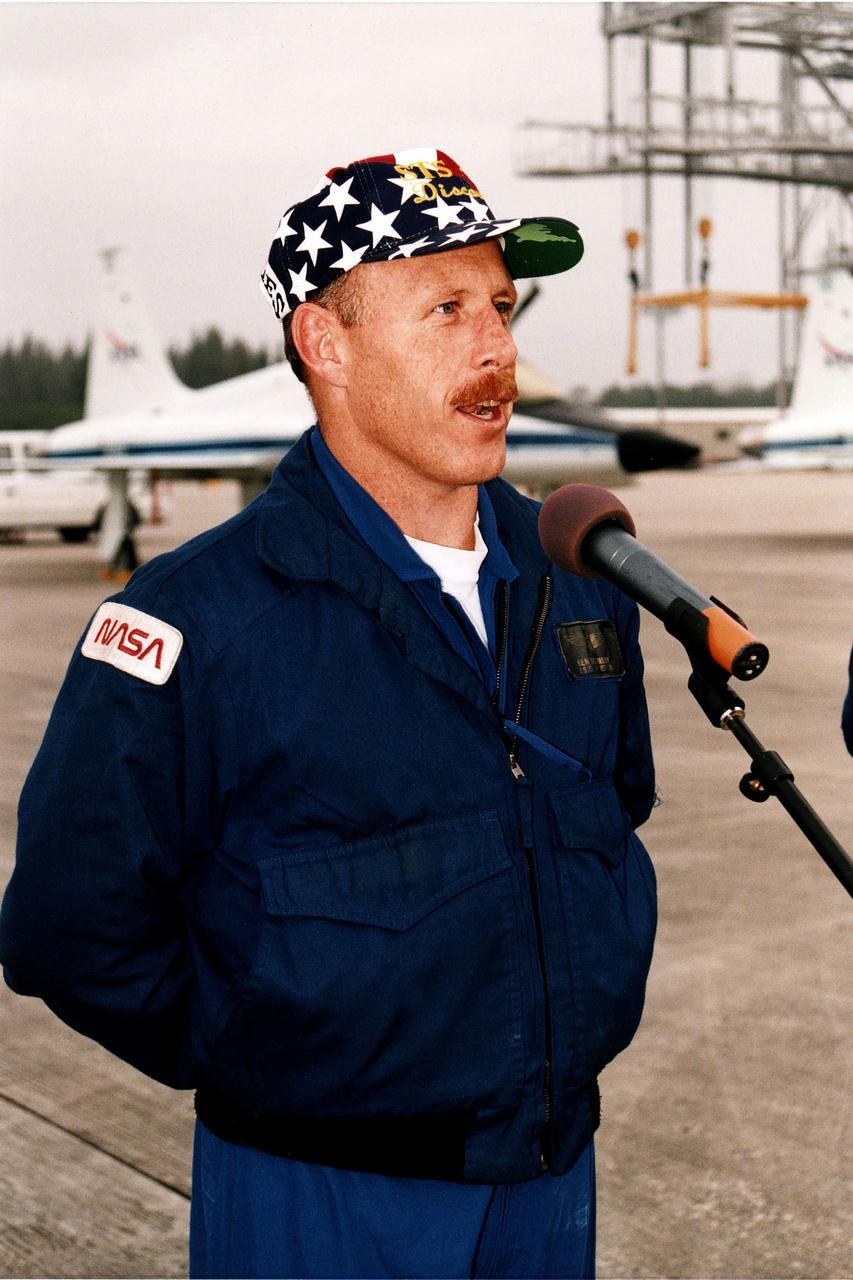
KENNEDY SPACE CENTER, FLA. -   STS-82 Mission Commander Kenneth D. Bowersox greets media representatives after arrival at KSC's Shuttle Landing Facility.  Bowersox and the other six members of the STS-82 crew came from their home base at Johnson Space Center in Houston, Texas, to spend the last few days before launch at KSC.  STS-82 is scheduled for liftoff on Feb. 11 during a 65-minute launch window that opens at 3:56 a.m. EST.  The 10-day flight aboard the Space Shuttle Discovery will be the second Hubble Space Telescope (HST) servicing mission.
KENNEDY SPACE CENTER, FLA. - STS-82 Mission Commander Kenneth D. Bowersox greets media representatives after arrival at KSC's Shuttle Landing Facility. Bowersox and the other six members of the STS-82 crew came from their home base at Johnson Space Center in Houston, Texas, to spend the last few days before launch at KSC. STS-82 is scheduled for liftoff on Feb. 11 during a 65-minute launch window that opens at 3:56 a.m. EST. The 10-day flight aboard the Space Shuttle Discovery will be the second Hubble Space Telescope (HST) servicing mission.
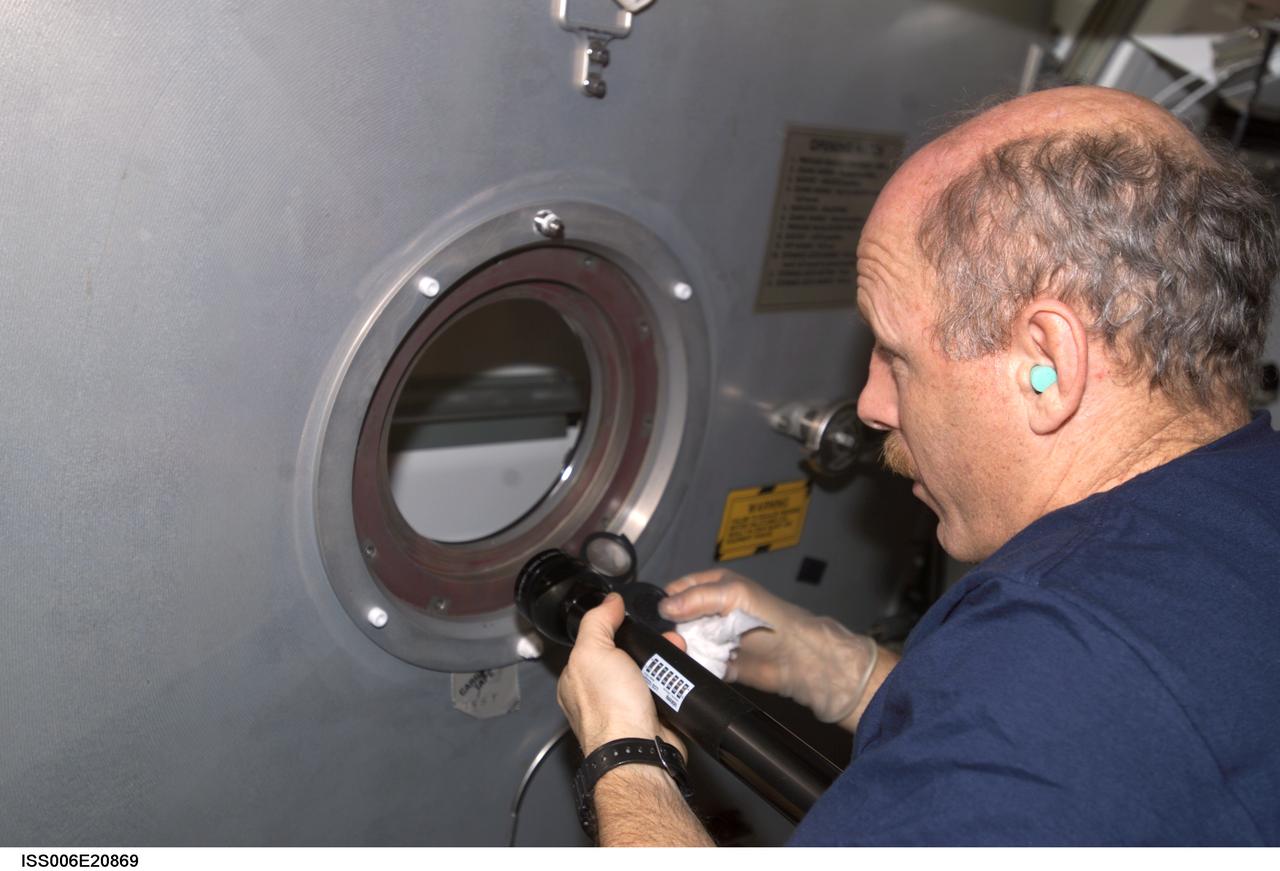
ISS006-E-20869 (26 January 2003) --- Astronaut Kenneth D. Bowersox, Expedition Six mission commander, holds a flashlight as he looks through a portal in the Zvezda Service Module on the International Space Station (ISS).
Bowersox examines the starboard hatch window in Node 1 during Expedition Six
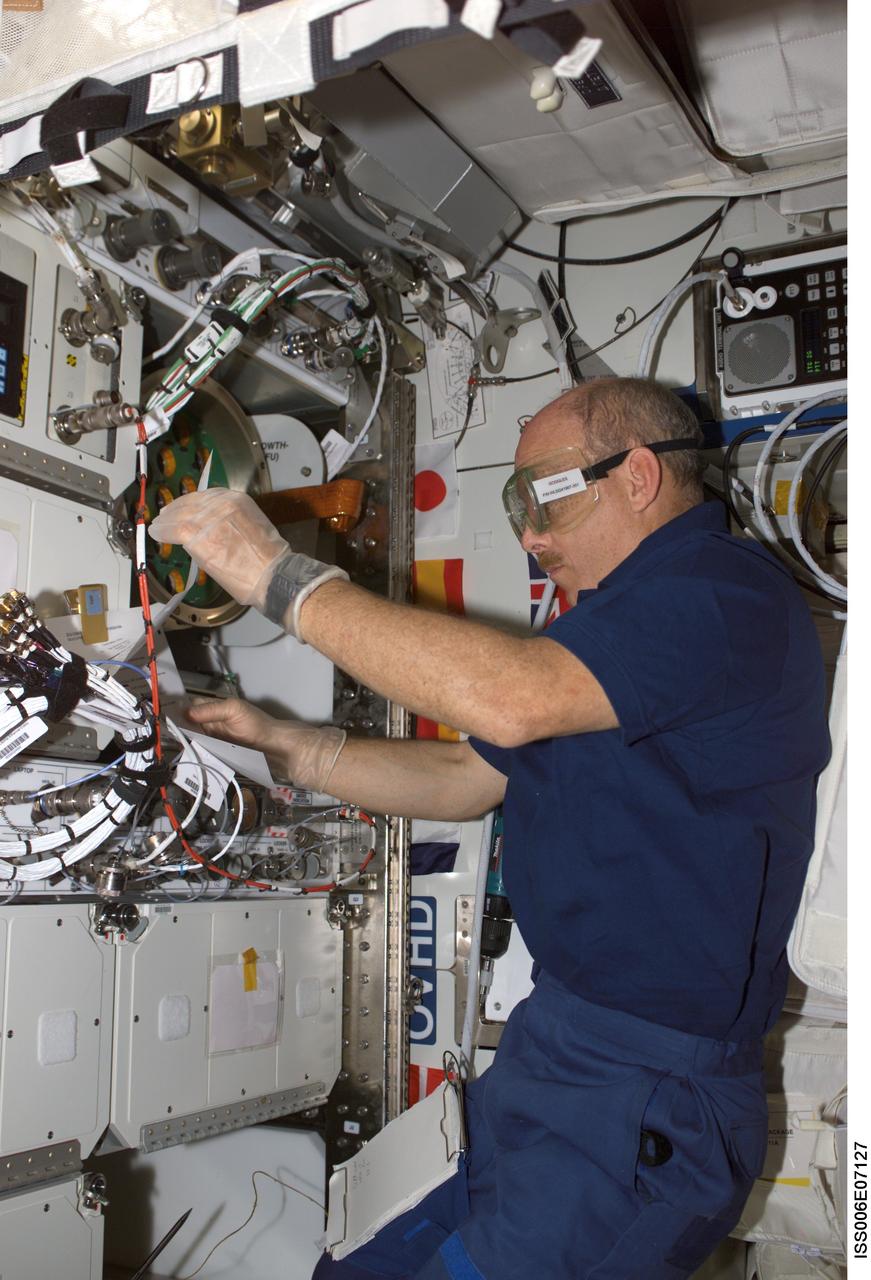
ISS006-E-07127 (5 December 2002) --- Astronaut Kenneth D. Bowersox, Expedition Six mission commander, works with the Zeolite Crystal Growth (ZCG) experiment in the Destiny laboratory on the International Space Station (ISS).
Expedition Six Commander Bowersox working with Zeolite Crystal Growth in U.S. Lab
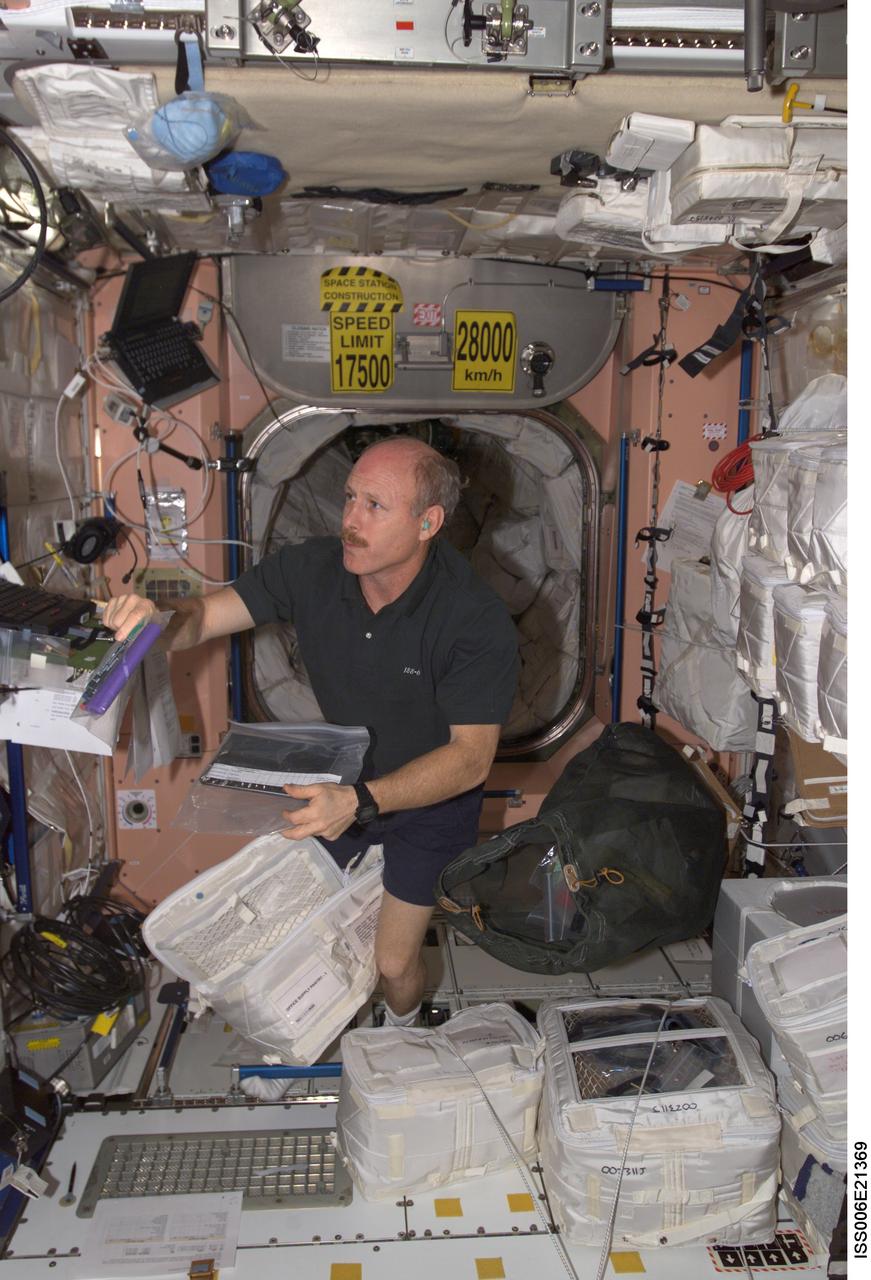
ISS006-E-21369 (31 January 2003) --- Astronaut Kenneth D. Bowersox, Expedition Six mission commander, moves toward a computer in the Unity node on the International Space Station (ISS).
Bowersox works at a laptop computer in Node 1 during Expedition Six
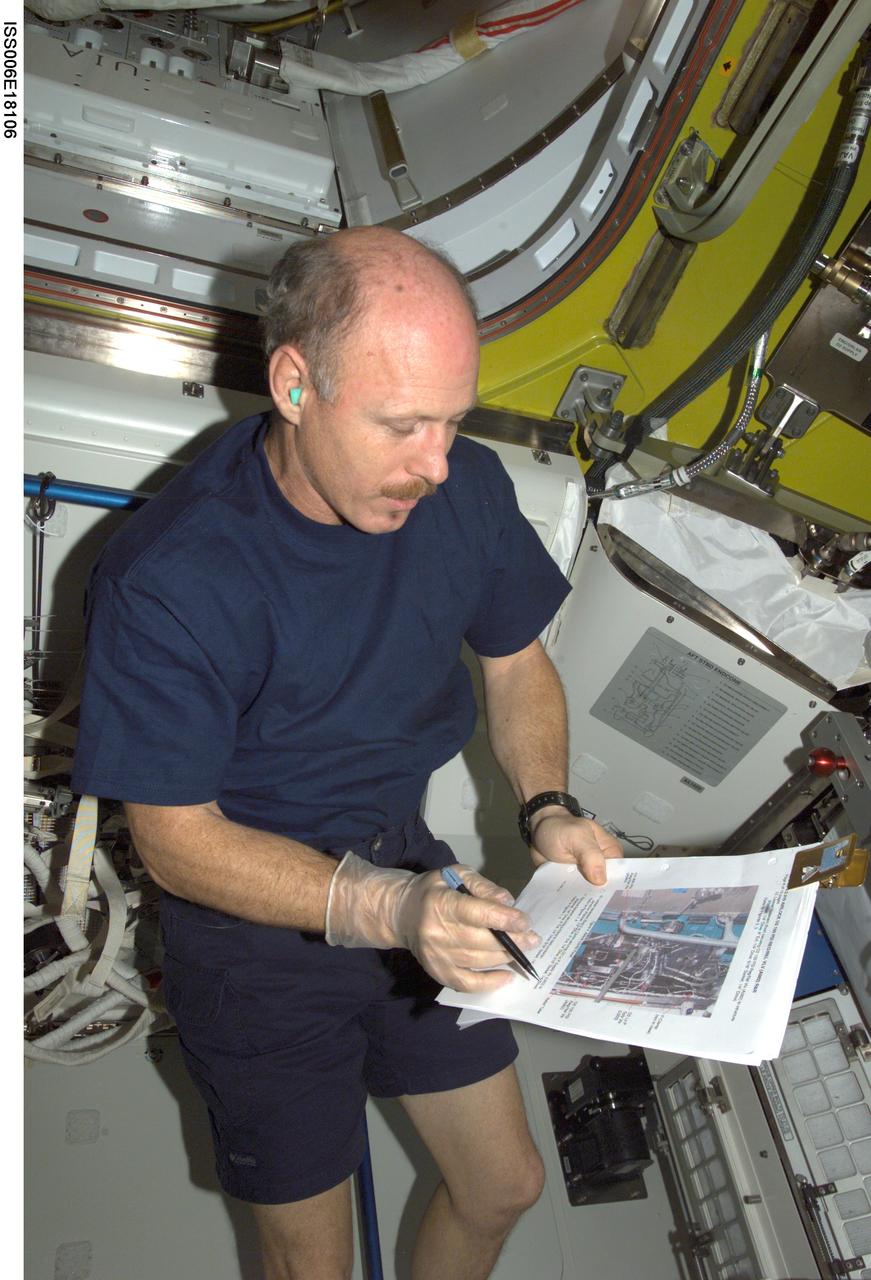
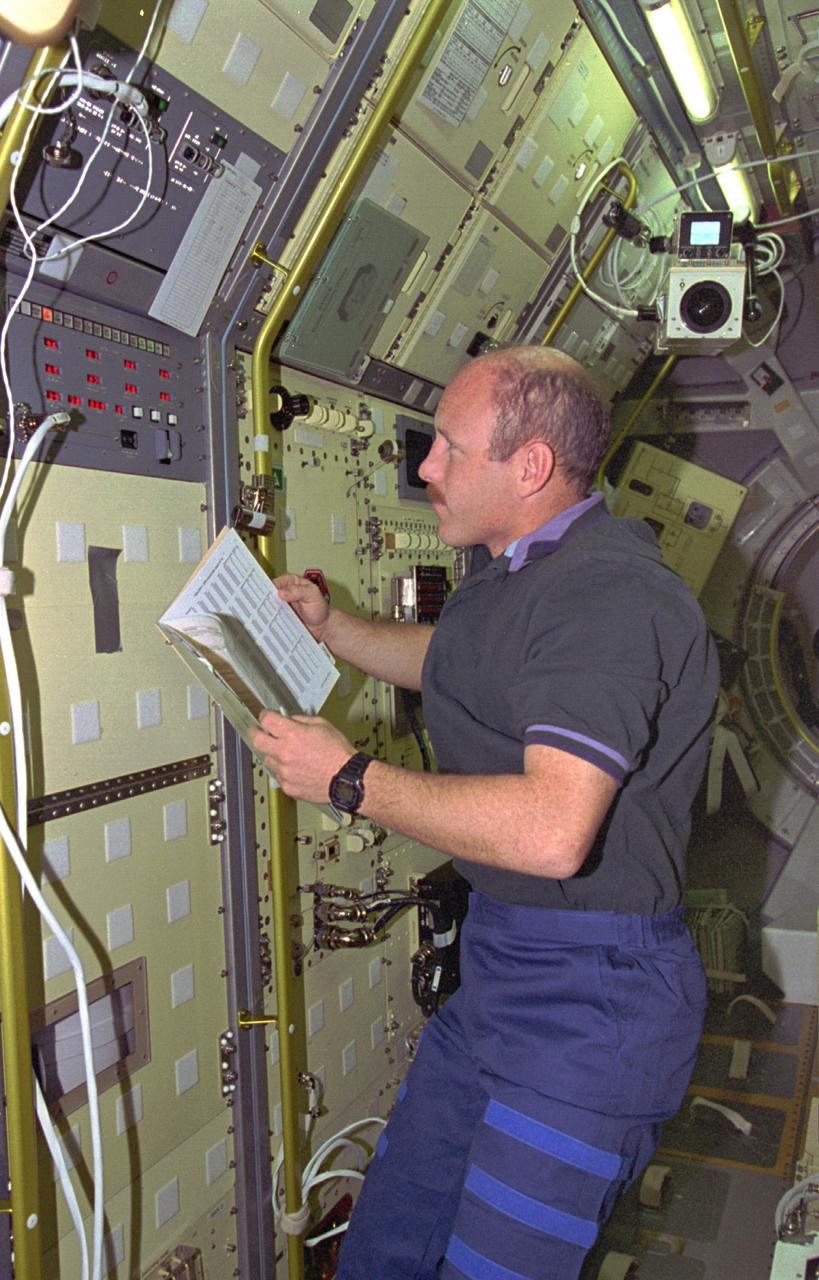
ISS006-E-18106 (18 January 2003) --- Astronaut Kenneth D. Bowersox, Expedition Six mission commander, looks over paperwork in the Quest Airlock on the International Space Station (ISS).
Bowersox looks over O2 / N2 system paperwork in the Airlock during Expedition Six
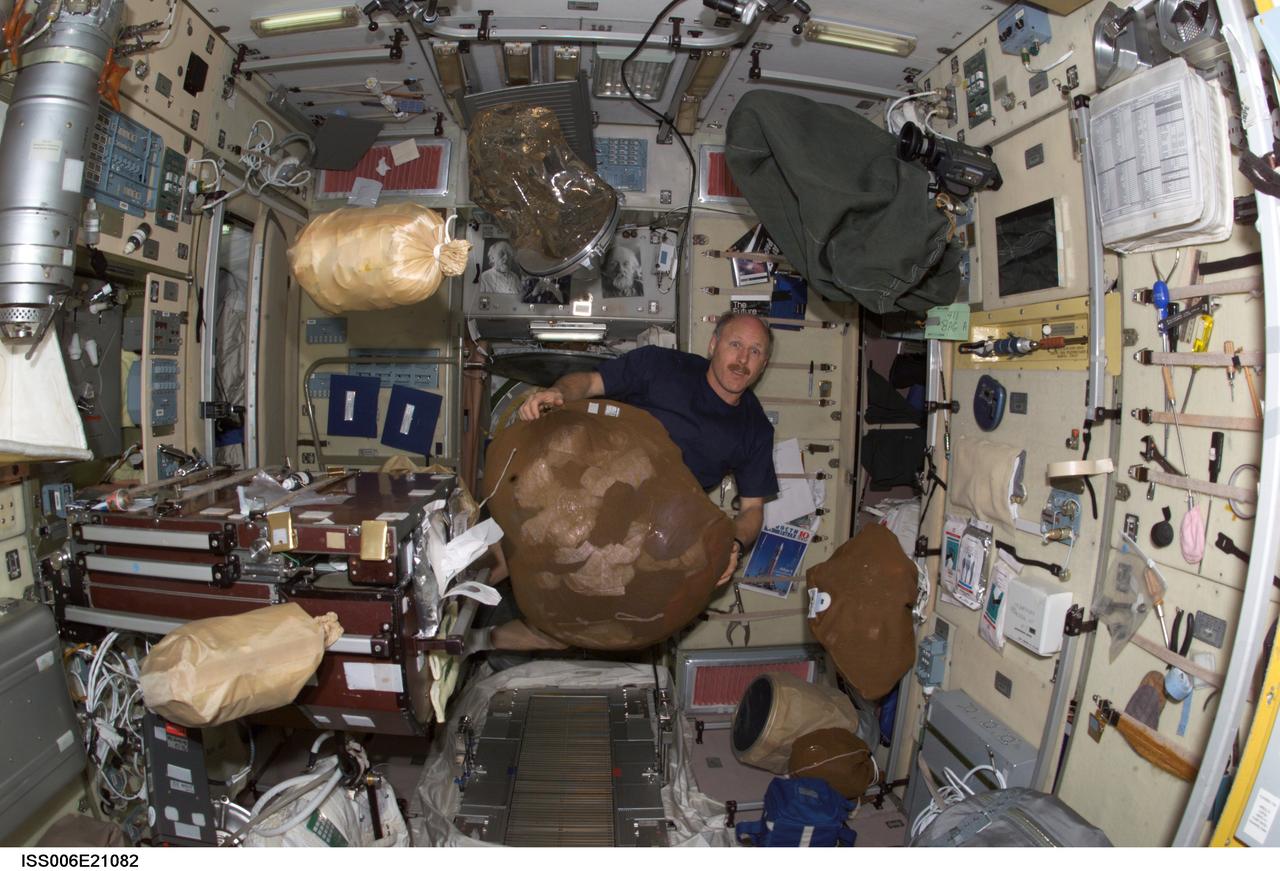
ISS006-E-21082 (28 January 2003) --- Astronaut Kenneth D. Bowersox, Expedition Six mission commander, moves bagged items from the Progress 9 to the Zvezda Service Module on the International Space Station (ISS).
Bowersox moves stowage bags from the Progress to Zvezda during Expedition Six
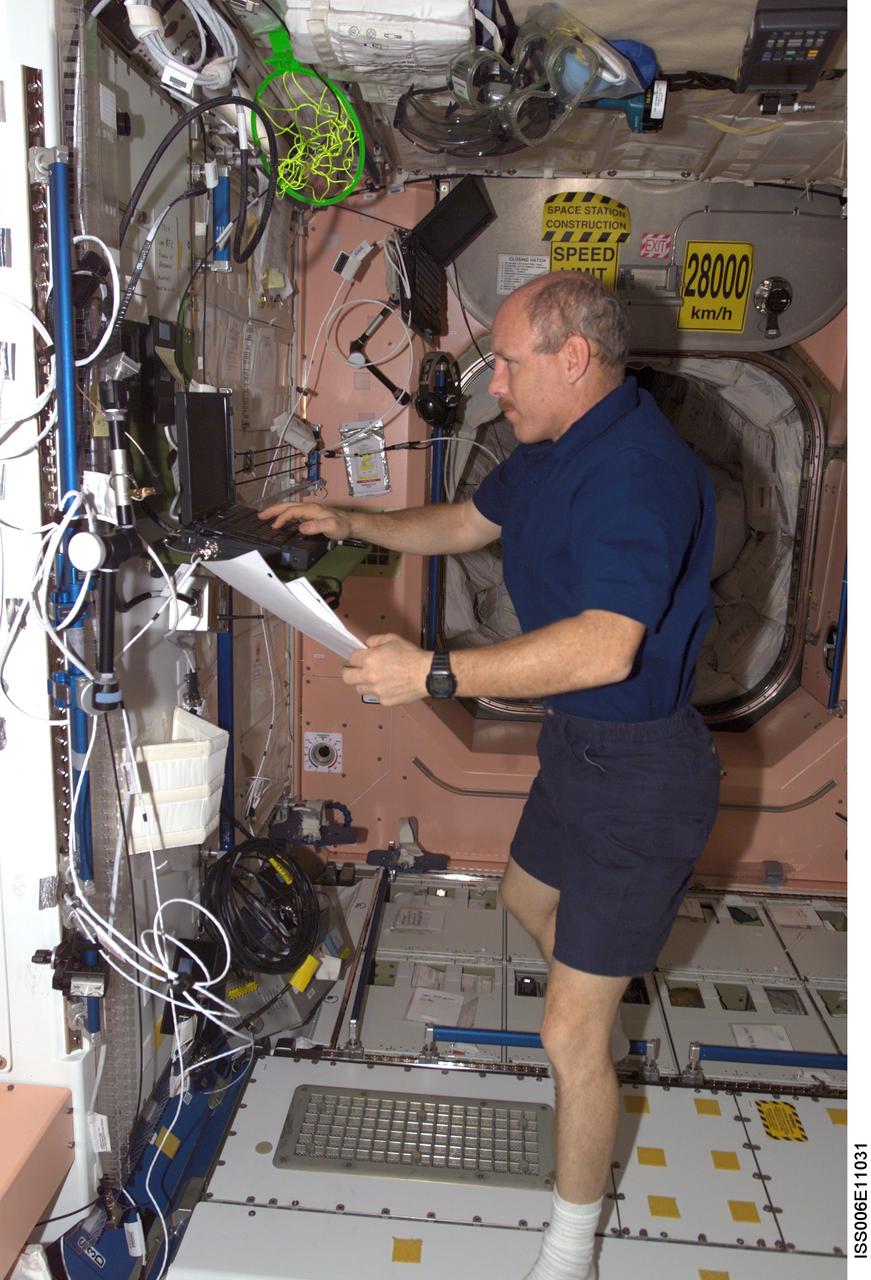
ISS006-E-11031 (26 December 2002) --- Astronaut Kenneth D. Bowersox, Expedition Six mission commander, works in the Unity node on the International Space Station (ISS).
Bowersox works on a laptop computer in Node 1 during Expedition Six
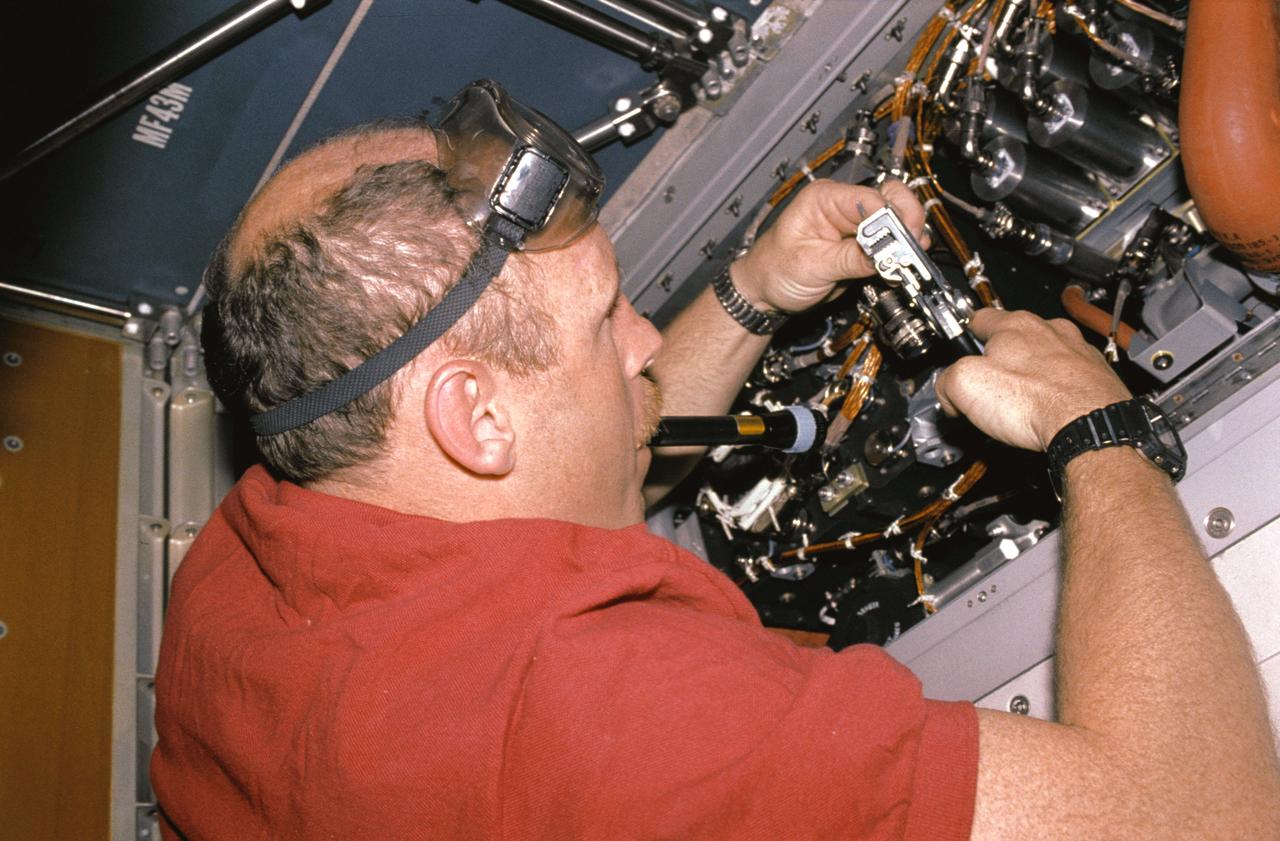
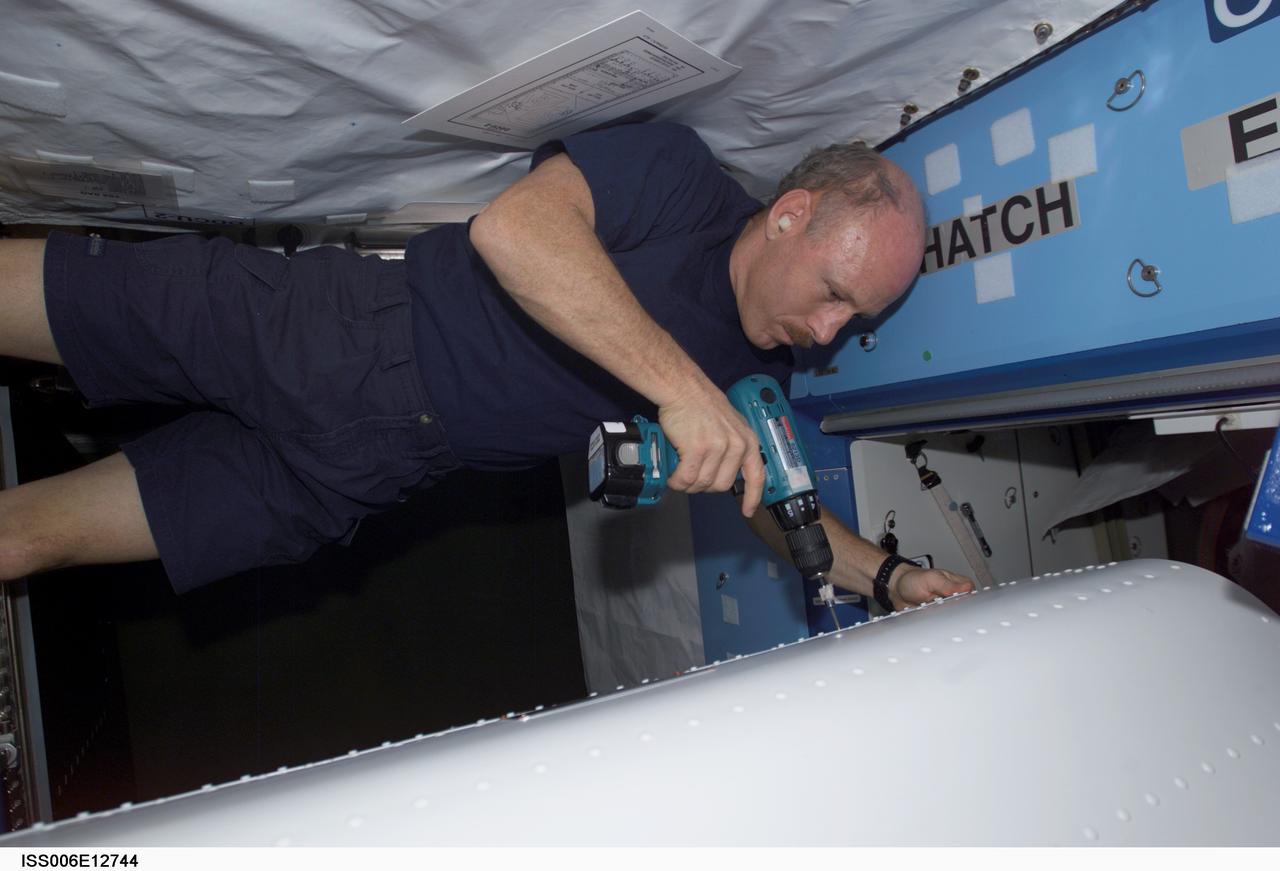
ISS006-E-12744 (30 December 2002) --- Astronaut Kenneth D. Bowersox, Expedition Six mission commander, performs in-flight maintenance (IFM) in the Destiny laboratory on the International Space Station (ISS).
Bowesox works on the ITCS in Destiny during Expedition Six
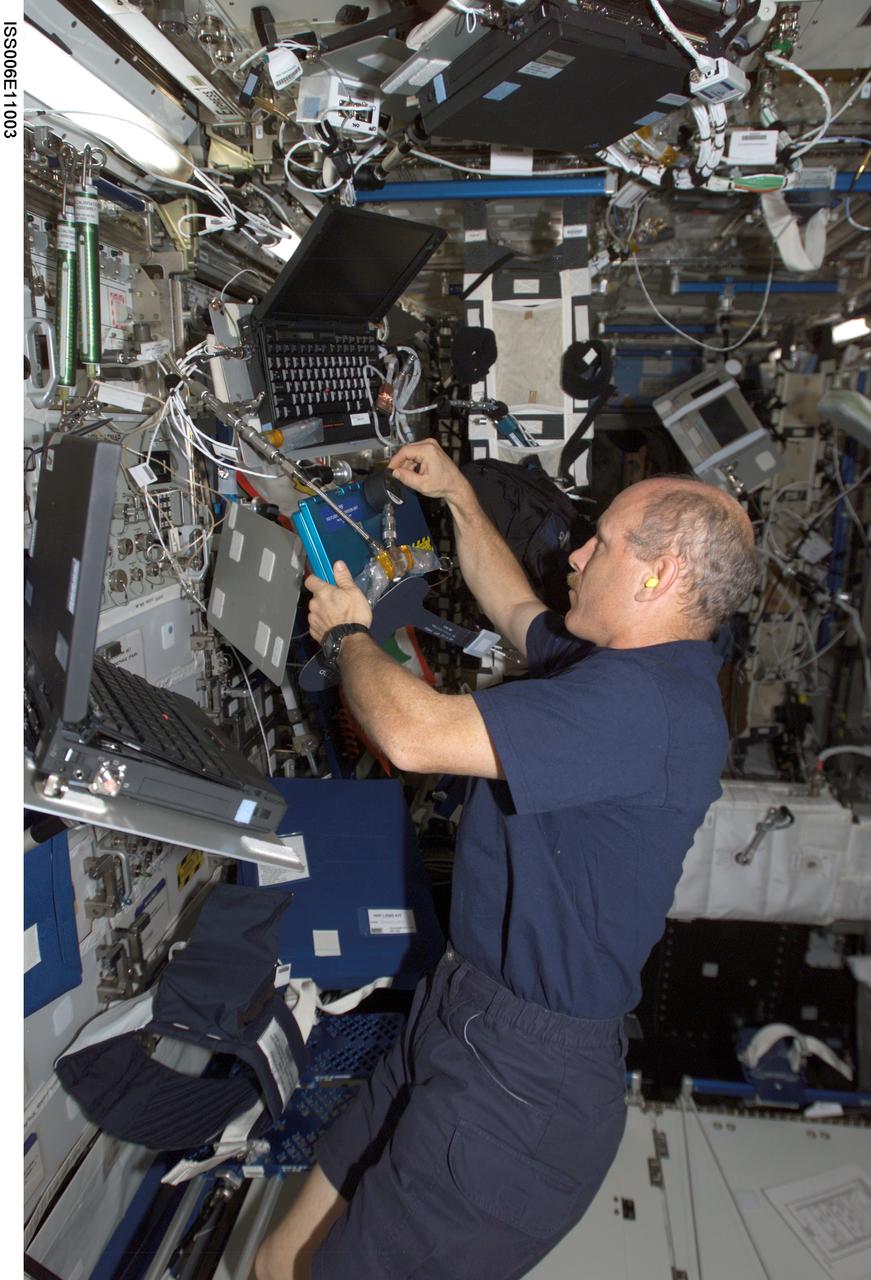
ISS006-E-11003 (24 December 2002) --- Astronaut Kenneth D. Bowersox, Expedition Six mission commander, works in the Destiny laboratory on the International Space Station (ISS).
Bowersox works with the Flight Calibration Unit in the U.S. Laboratory during Expedition Six
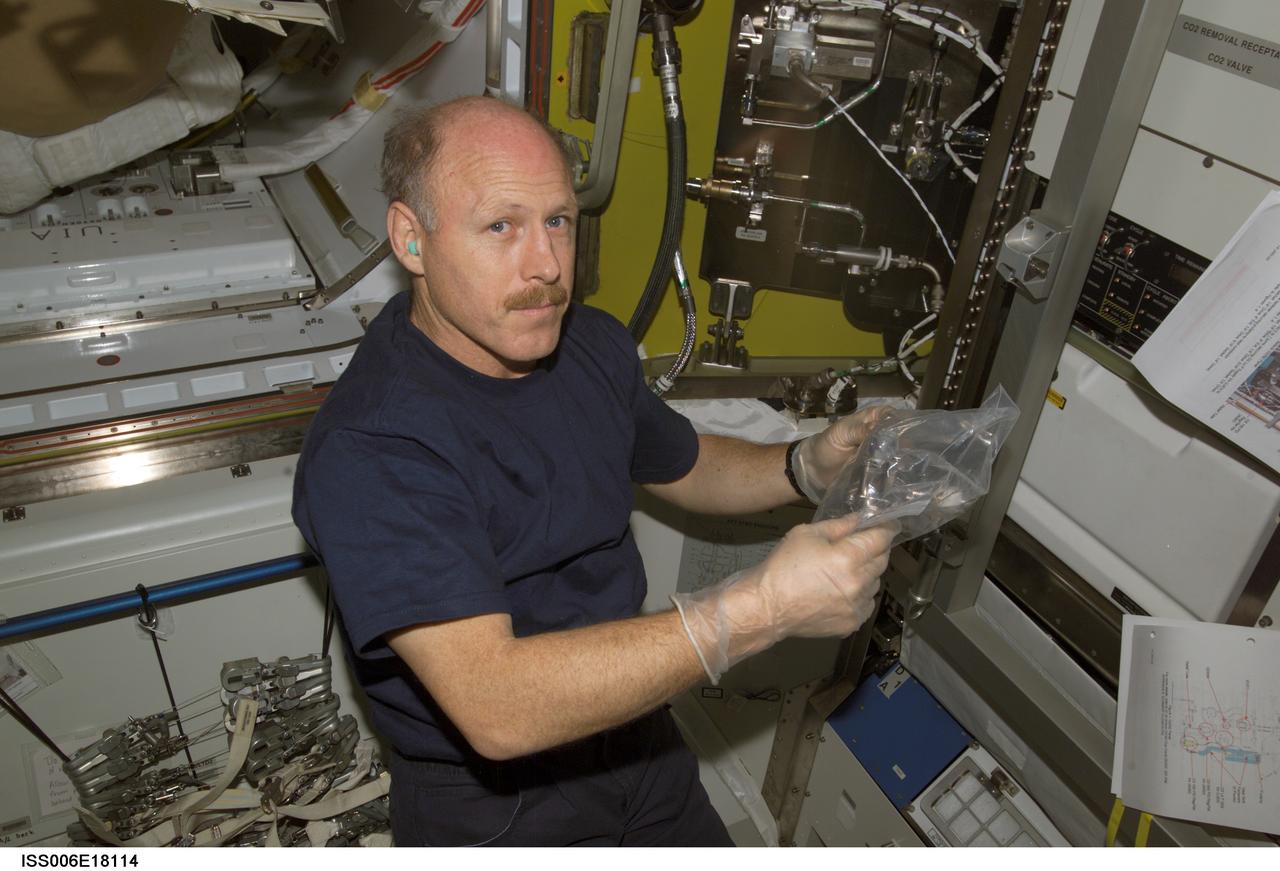
ISS006-E-18114 (18 January 2003) --- Astronaut Kenneth D. Bowersox, Expedition Six mission commander, is pictured in the Quest Airlock on the International Space Station (ISS).
Bowersox handles part of the 02 / N2 system in the Airlock during Expedition Six
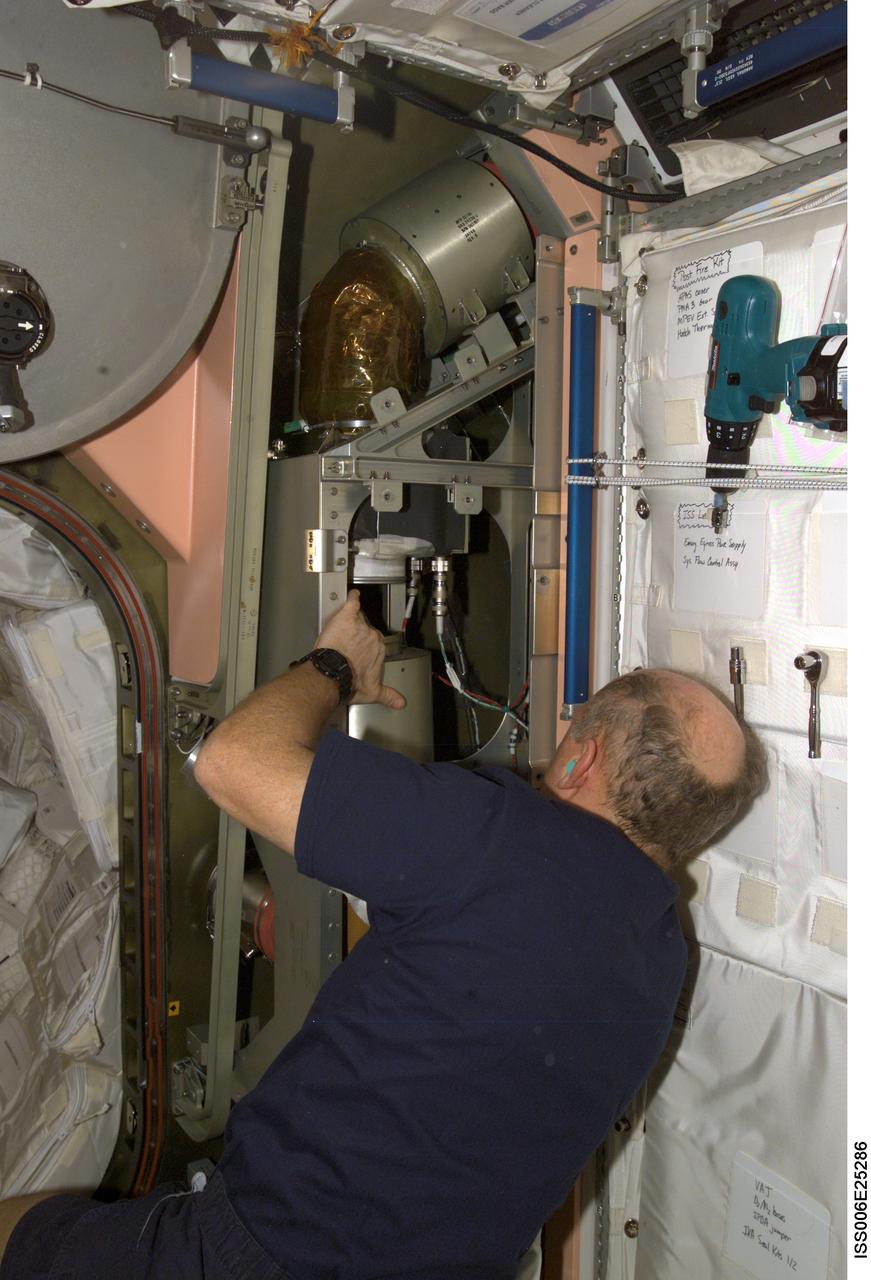
ISS006-E-25286 (12 February 2003) --- Astronaut Kenneth D. Bowersox, Expedition Six mission commander, performs routine maintenance on the air handler system in the Unity node on the International Space Station (ISS).
Bowersox works on the IMV system in Node 1 during Expedition Six
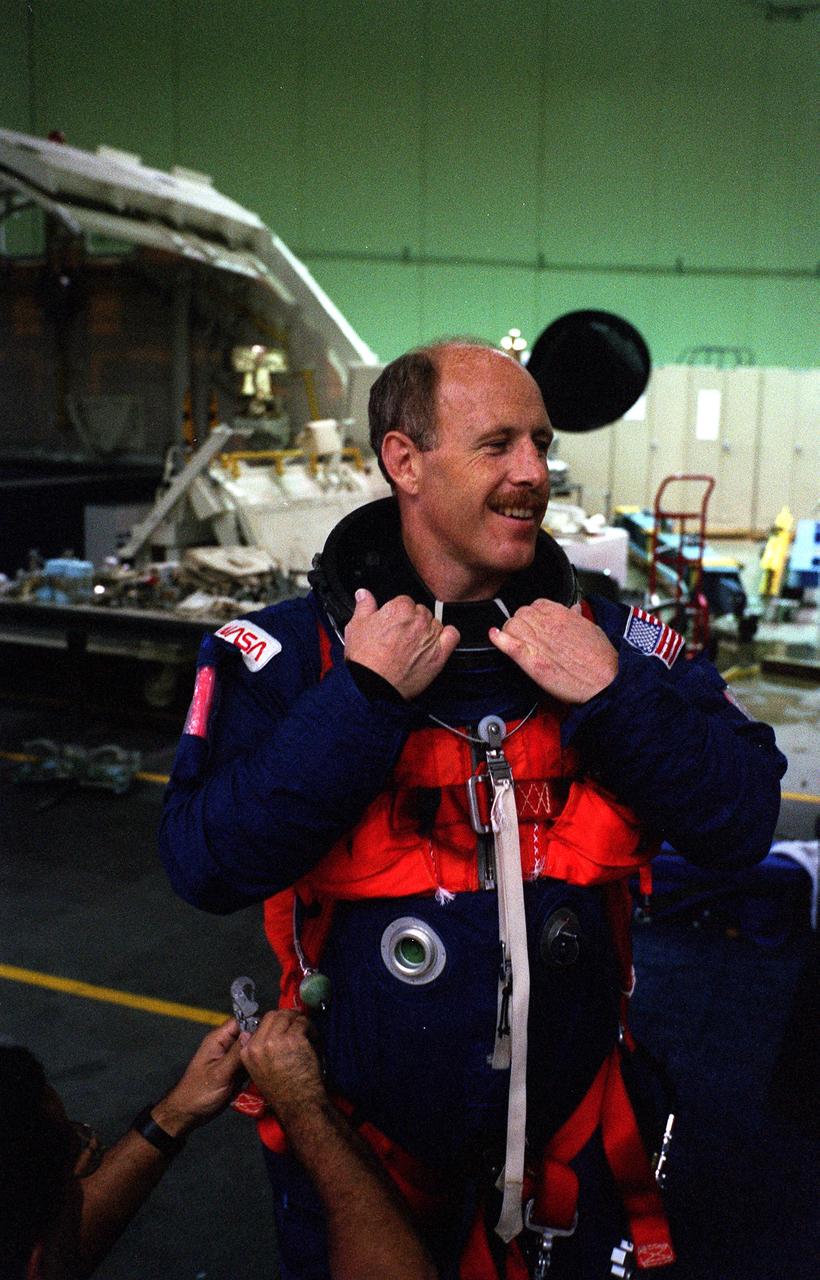
S96-18547 (30 Oct. 1996) --- Astronaut Kenneth D. Bowersox, STS-82 mission commander, chats with a crewmate (out of frame) prior to an emergency bailout training session in JSC's systems integration facility.  Wearing training versions of the partial pressure launch and entry escape suit, Bowersox and his crew simulated an emergency ejection, using the escape pole system on the middeck.
STS-82 Suit-up for Post Insertion Training in Crew Compartment Trainer 2
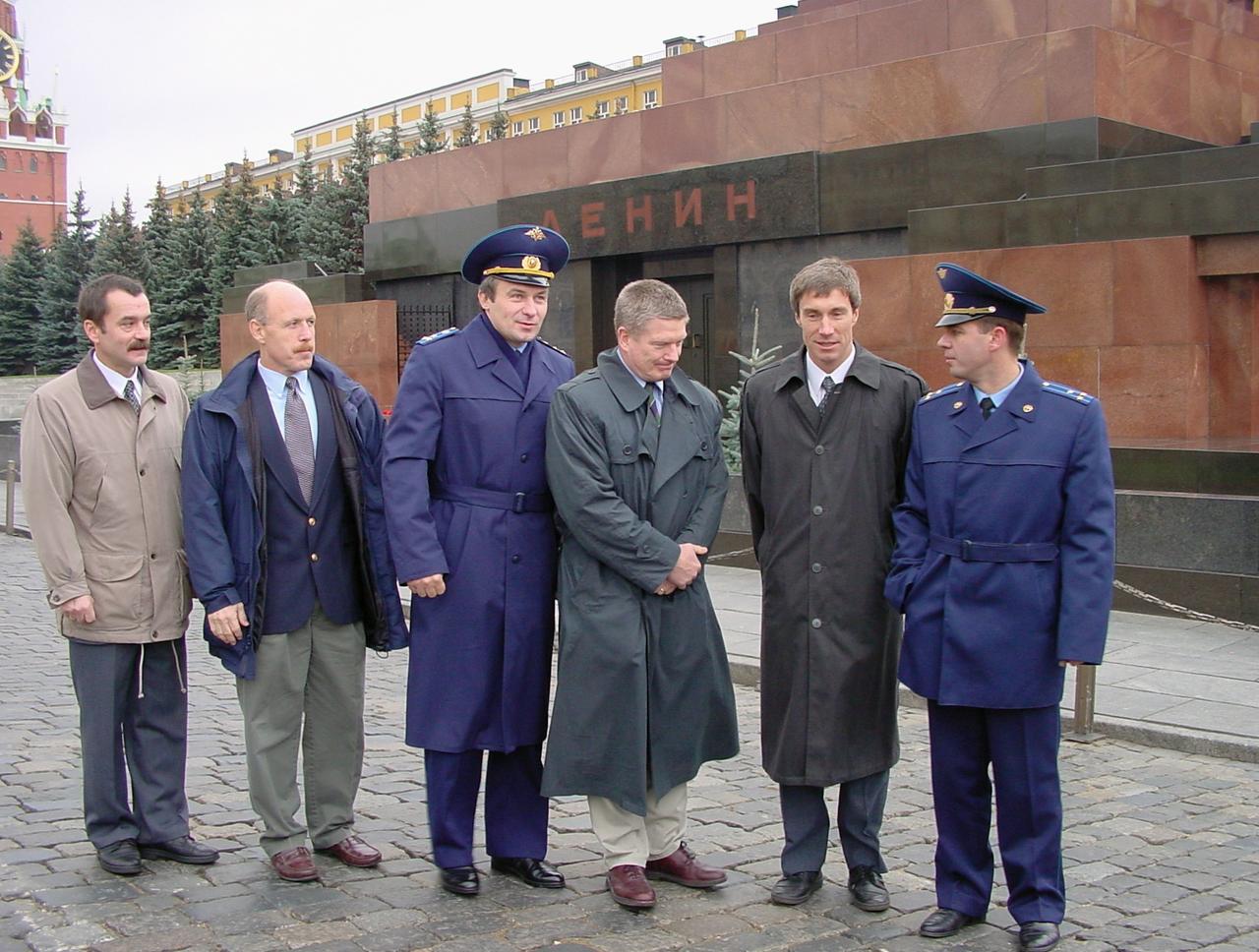
JSC2000-E-27076 (16 October 2000) ---  Expedition One prime and backup crew members in Moscow. From left, cosmonaut Mikhail Turin, astronaut Kenneth D. Bowersox, cosmonaut Vladimir Dezhurov, astronaut William M. (Bill) Shepherd and cosmonauts Sergei Krikalev and Yuri P. Gidzenko. Shepherd is Expedition One  prime crew commander; Gidzenko, prime crew Soyuz commander; and Krikalev, the prime crew's flight engineer.  Bowersox, Turin and Dezhurov are backups.
Various views of Expedition One crewmembers in Russia
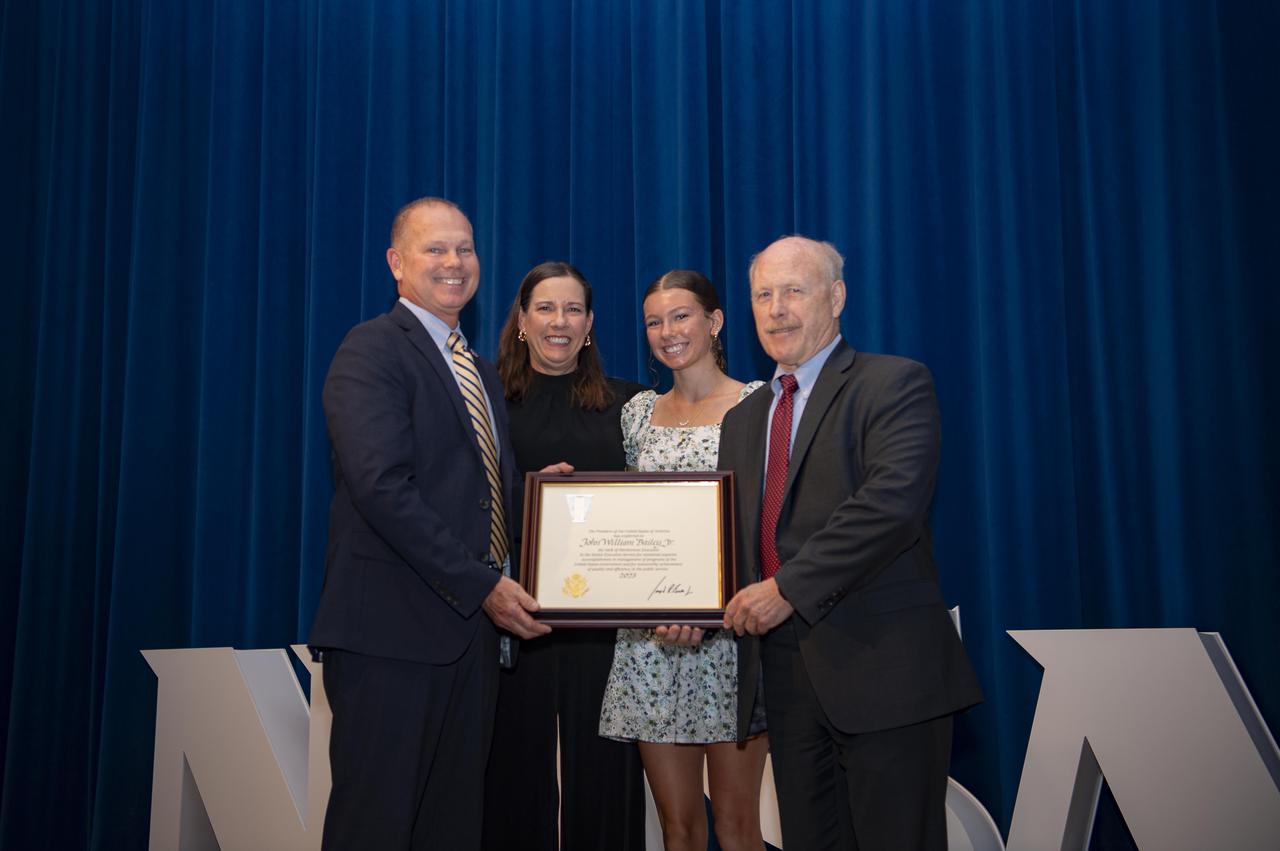
NASA Stennis Space Center Director John Bailey receives the Meritorious Senior Executive Presidential Rank Award from NASA Associate Administrator for Space Operations Kenneth Bowersox during the NASA Honor Awards ceremony on May 15 at NASA Stennis. Bailey is pictured, from left, with his wife, Lori; daughter, Isabella; and Bowersox.
NASA Stennis 2023 Honor Awards
STS050-20-012 (26 June 1992) --- Astronaut Kenneth D. Bowersox, pilot, performs in-flight maintenance (IFM) on the Regenerative Carbon Dioxide Removal System (RCRS) on the mid-deck of the Earth-orbiting Space Shuttle Columbia.  Bowersox was joined by four other astronauts and two scientists from the private sector for a record-setting 14-day stay aboard the Space Shuttle in support of the United States Microgravity Laboratory 1 (USML-1).
Crewmember repairing the Regenerative Carbon Dioxide Removal System wiring.
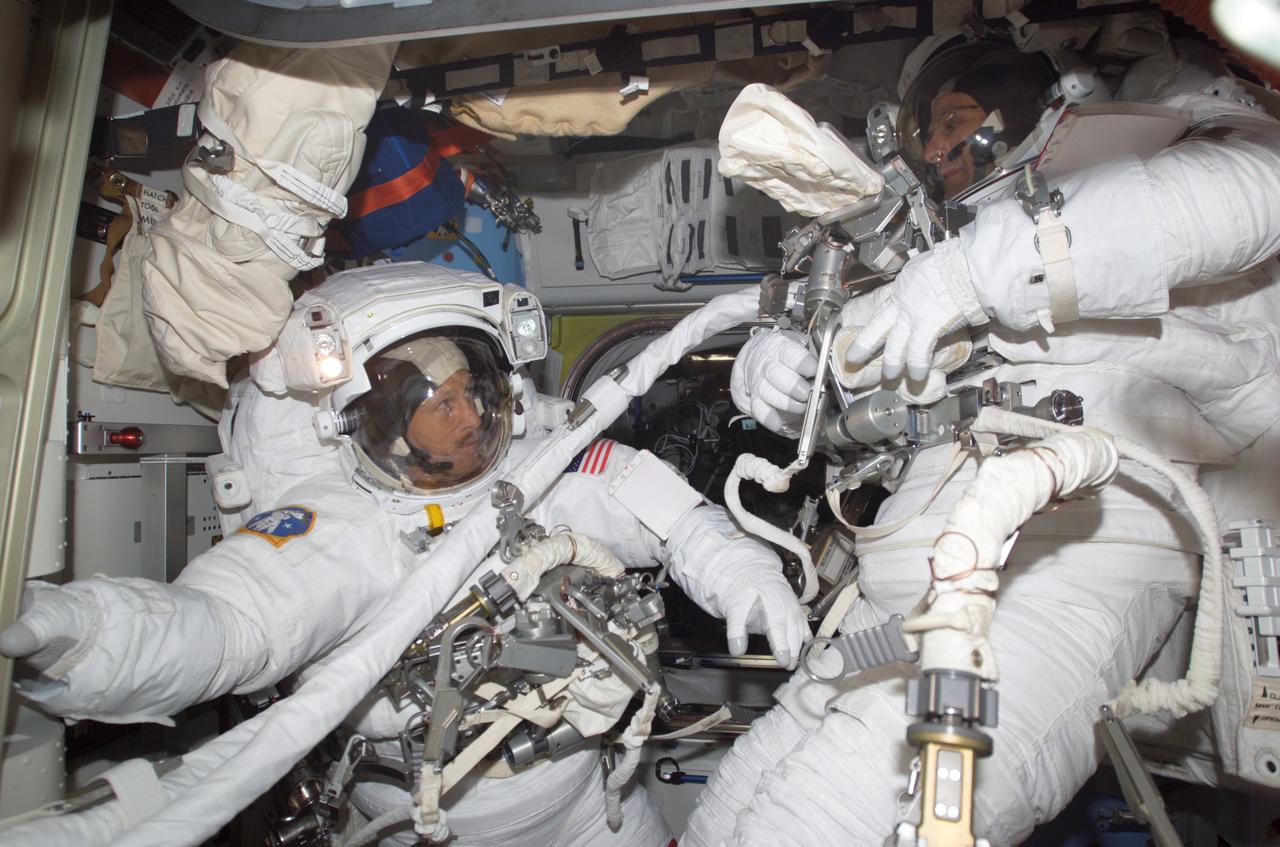
ISS006-E-18284 (13 January 2003) --- Astronauts Kenneth D. Bowersox (left) and Donald R. Pettit, Expedition 6 mission commander and NASA ISS science officer, respectively, are pictured in the Quest Airlock on the International Space Station (ISS). Bowersox and Pettit are wearing their Extravehicular Mobility Unit (EMU) spacesuits as they prepare for the mission’s only scheduled session of extravehicular activity (EVA) on January 15, 2003.
Pettit and Bowersox complete EVA dry-run activities in the Airlock during Expedition Six
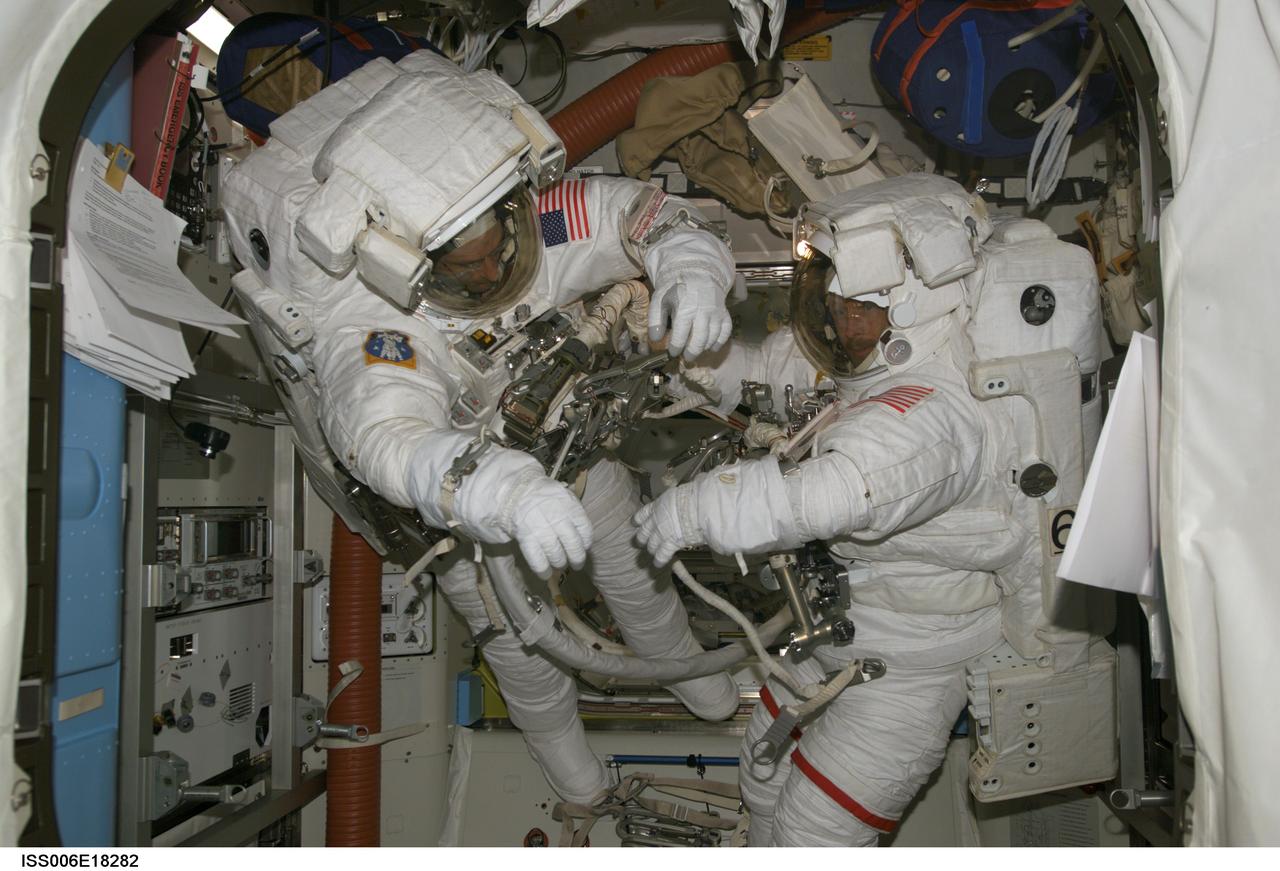
ISS006-E-18282 (13 January 2003) --- Astronauts Kenneth D. Bowersox (right) and Donald R. Pettit, Expedition Six mission commander and NASA ISS science officer, respectively, are pictured in the Quest Airlock on the International Space Station (ISS). Bowersox and Pettit are wearing their Extravehicular Mobility Unit (EMU) spacesuits as they prepare for the mission's only scheduled session of extravehicular activity (EVA) on January 15, 2003.
Pettit and Bowersox complete EVA dry-run activities in the Airlock during Expedition Six
STS073-363-032 (20 October - 5 November 1995) --- Astronaut Kenneth D. Bowersox, STS-73 mission commander, studies the movement of fluids in microgravity at the Geophysical Fluid Flow Cell (GFFC) workstation in the science module of the Earth-orbiting Space Shuttle Columbia.  Bowersox was joined by four other NASA astronauts and two guest researchers for almost 16-days of Earth-orbit research in support of the U.S. Microgravity Laboratory (USML-2) mission.
GFFC, Commander Ken Bowersox monitors Spacelab experiment
S96-18552 (30 Oct. 1996) --- Astronaut Kenneth D. Bowersox (left), STS-82 mission commander, chats with astronaut Scott J. Horowitz prior to an emergency bailout training session in JSC's systems integration facility.  Wearing training versions of the partial pressure launch and entry escape suit, Bowersox and his crew simulated an emergency ejection, using the escape pole system on the mid deck, as well as other phases of their scheduled February mission.
STS-82 Suit-up for Post Insertion Training in Crew Compartment Trainer 2
ISS006-344-010 (15 January 2003) --- Astronaut Kenneth D. Bowersox, Expedition 6 mission commander, performs P1 (P-One) Truss Zenith launch lock releases on the International Space Station (ISS) during a session of extravehicular activity (EVA). Astronaut Donald R. Pettit (out of frame), NASA ISS science officer, joined Bowersox on the spacewalk.
View of Bowersox working on Truss during EVA on Expedition Six
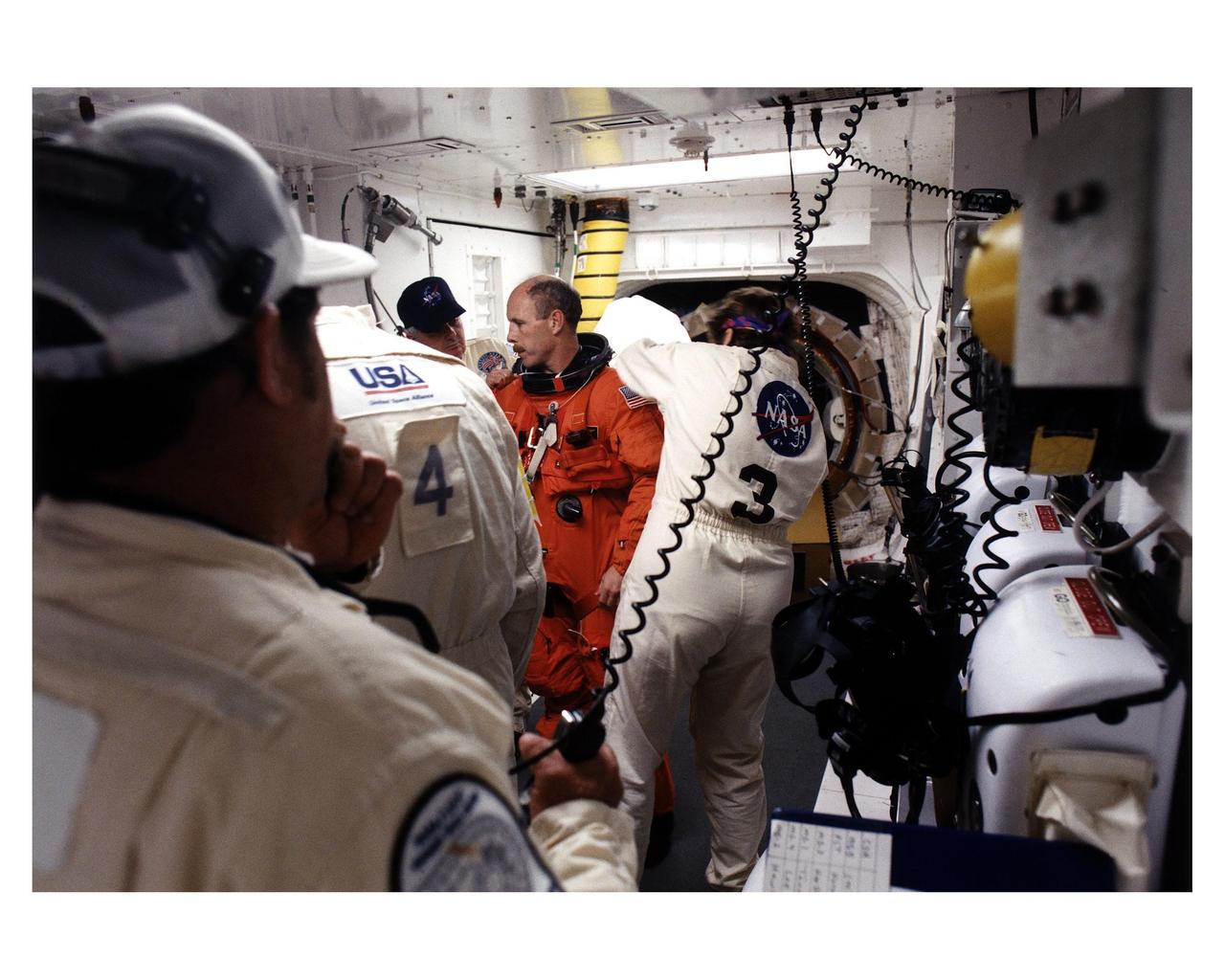
STS-82 Mission Commander Kenneth D. Bowersox gets assistance from white room closeout members before entering the Space Shuttle Discovery at Launch Pad 39A. Making final adjustments to the commander’s launch and entry suit are James Davis, facing camera at left, and Jean Alexander
KSC-97pc291
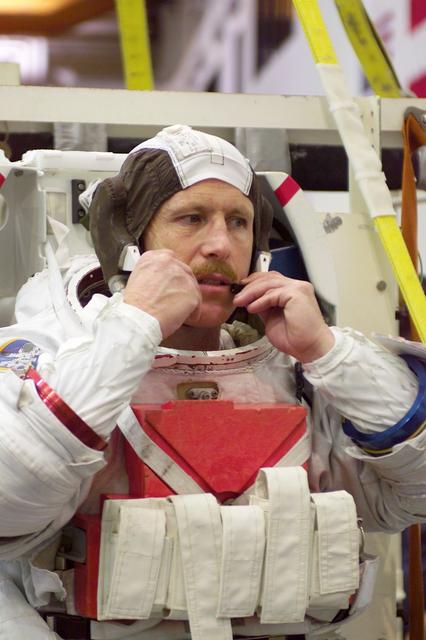
JSC2002-00812 (25 March 2002) --- Astronaut Kenneth D. Bowersox, Expedition Six mission commander, wearing a training version of the full-pressure launch and entry suit, waits for the start of a mission training session in the Space Vehicle Mockup Facility at the Johnson Space Center (JSC).
Preflight coverage of STS-114 Expedition 6, Bailout Training
ISS006-E-21115 (28 January 2003) --- Wearing a Russian Sokol suit, cosmonaut Nikolai M. Budarin, Expedition 6 flight engineer, is pictured in a Soyuz spacecraft that is docked to the International Space Station (ISS). Astronaut Kenneth D. Bowersox, mission commander, is visible at lower right.  Budarin represents Rosaviakosmos.
Budarin conducts a fit check of his Kazbek seat in the Soyuz during Expedition Six
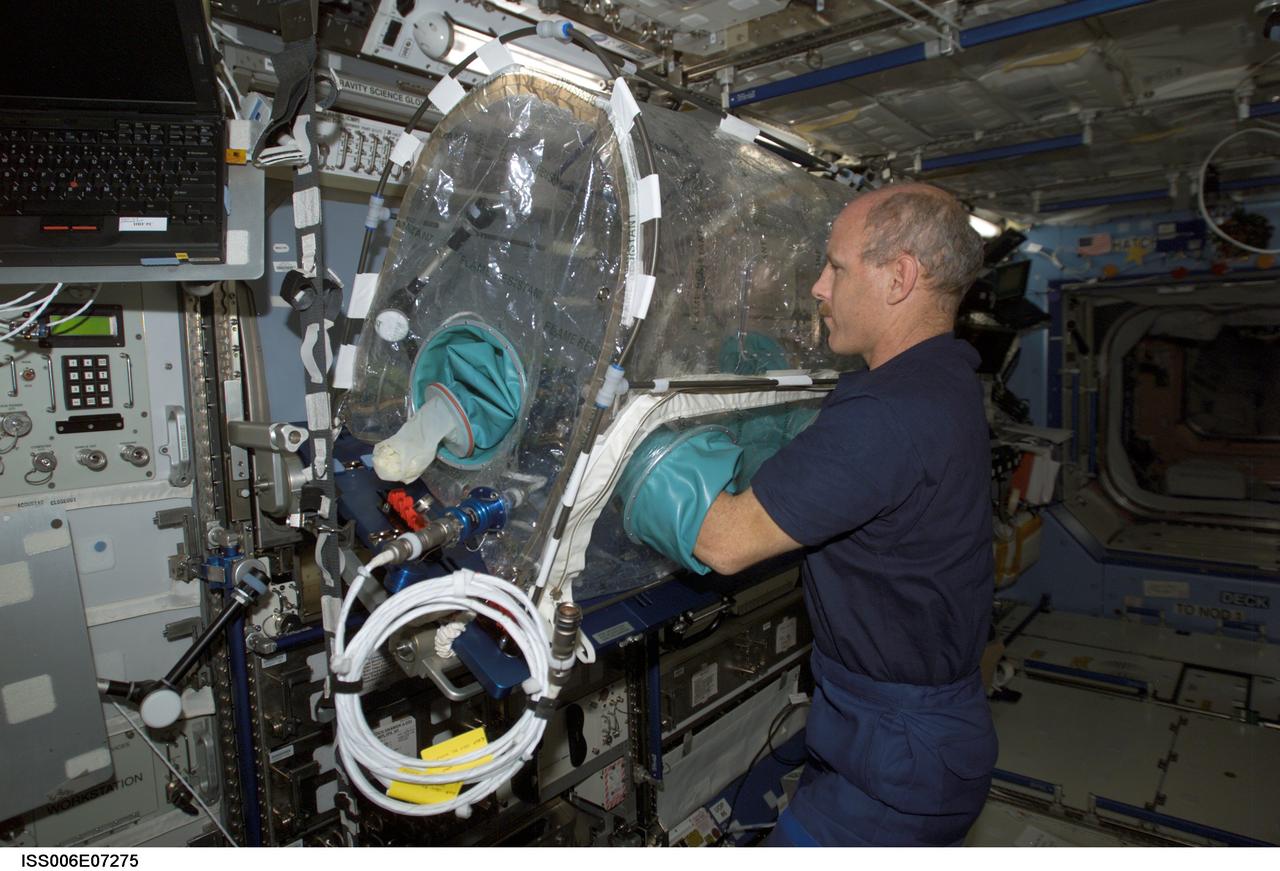
ISS006-E-07275 (16 December 2002) ---  Astronaut Kenneth D. Bowersox,          Expedition Six mission commander, works with an experiment in a portable glovebox facility called the Maintenance Work Area (MWA) in the Destiny laboratory on the International Space Station (ISS).
Expedition Six Commander Bowersox works with an experiment in a portable glovebox facility
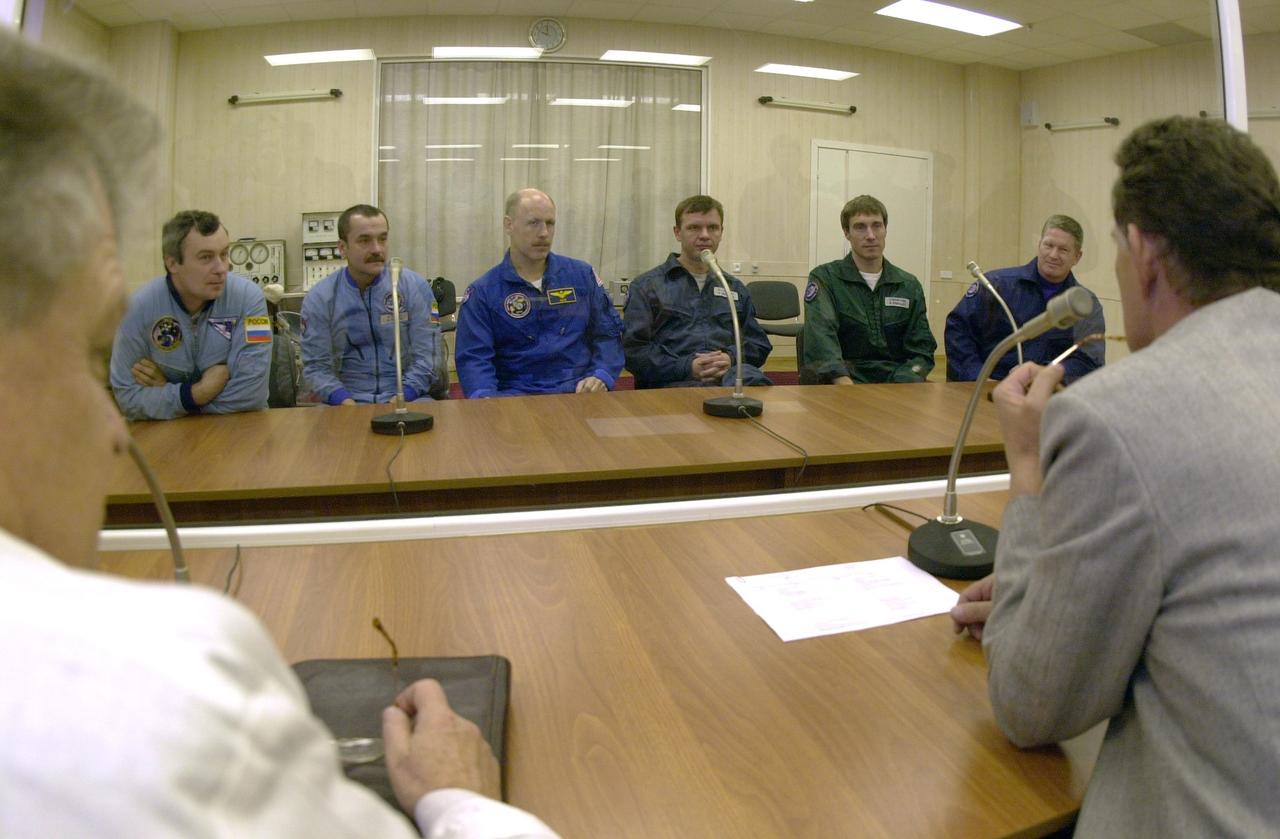
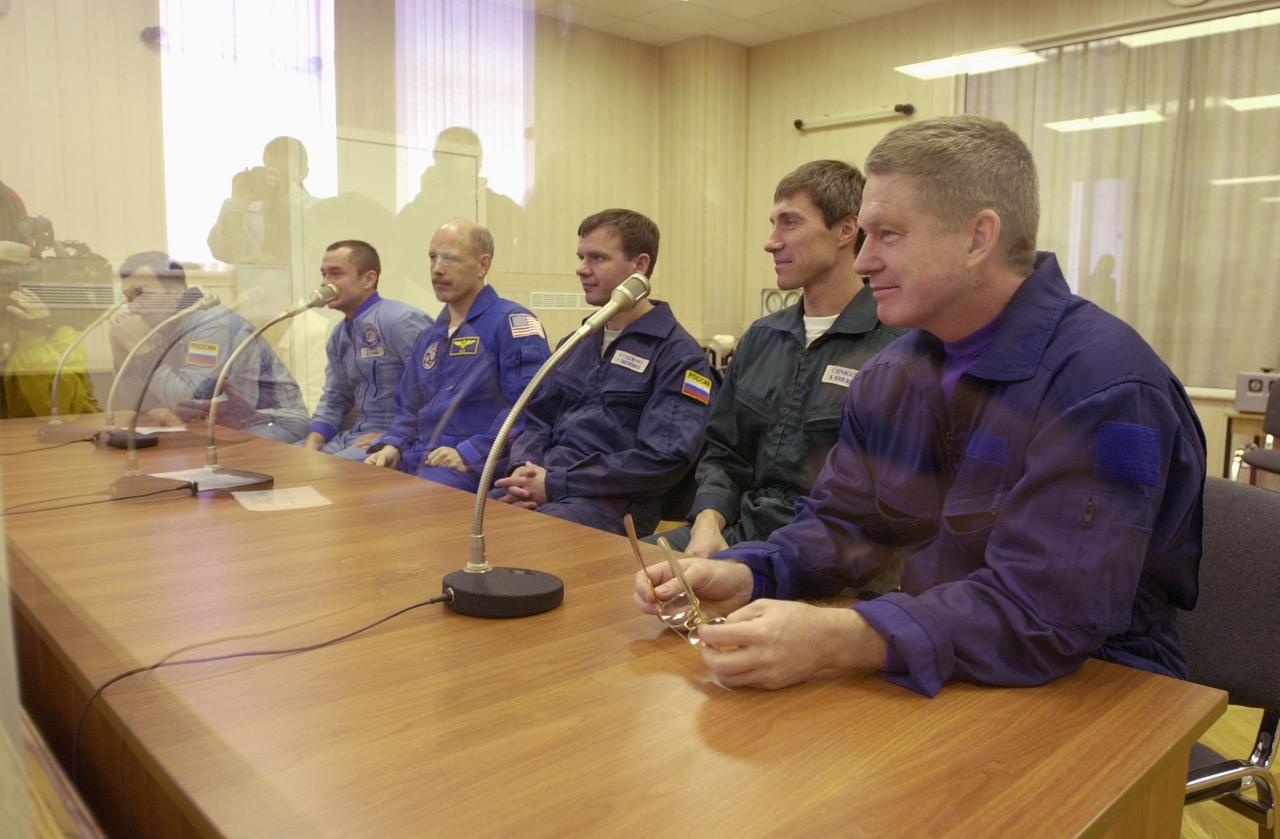
JSC2000-E-27079 (20 October 2000) ---  From left, Vladimir N. Dezhurov, Mikhail Turin, Kenneth D. Bowersox, Yuri P. Gidzenko, Sergei K. Krikalev and William M. (Bill) Shepherd, the backup and prime crew members for Expedition One, during  conference prior to simulation at Baikonur complex in Kazakhstan.
Various views of Expedition One crewmembers in Russia
JSC2002-E-39753 (1 October 2002) --- Astronaut Kenneth D. Bowersox, Expedition Six mission commander, attired in a training version of the Extravehicular Mobility Unit (EMU) space suit, is about to begin a training session in the Neutral Buoyancy Laboratory (NBL) near the Johnson Space Center (JSC).
Preflight photographic coverage of Expedition Seven during EVA training at the NBL.
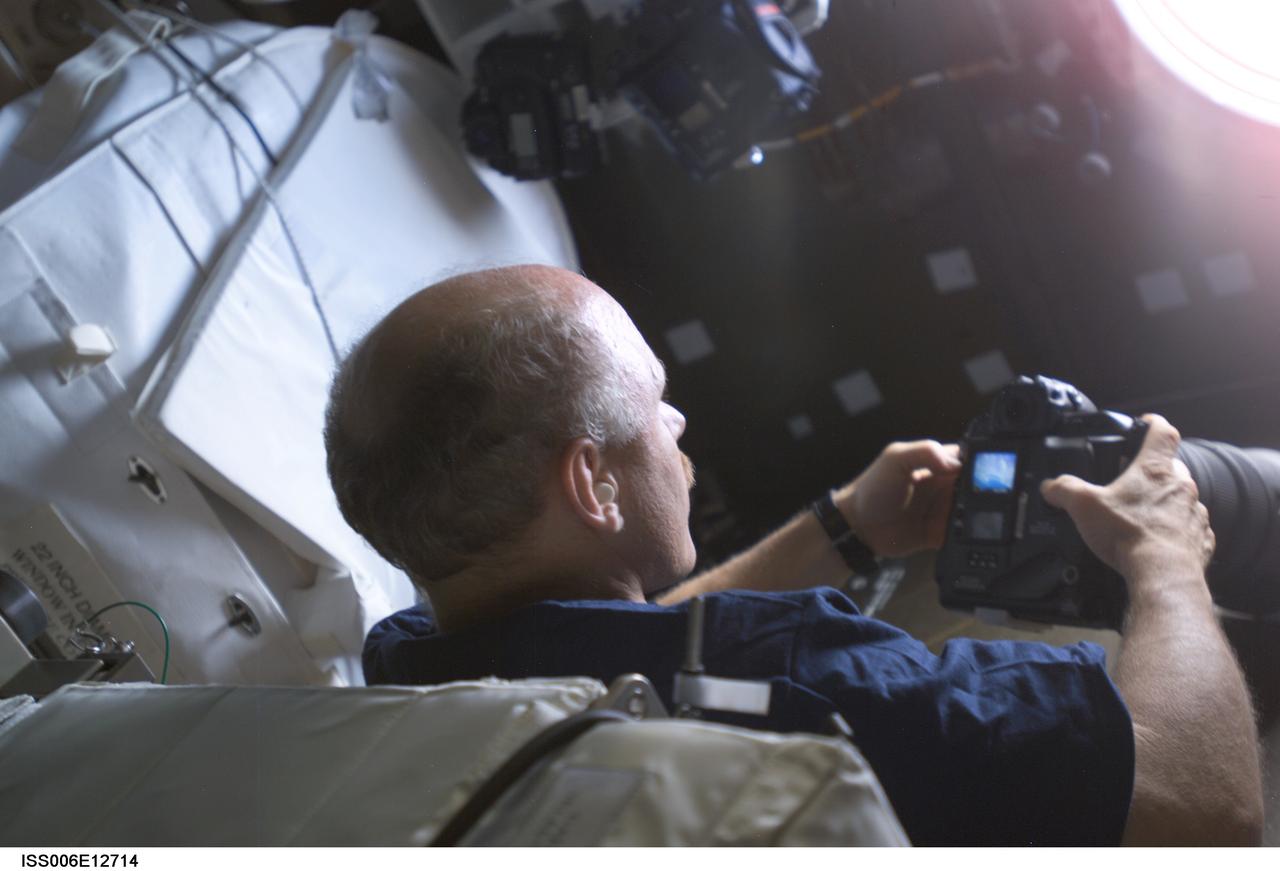
ISS006-E-12714 (27 December 2002) --- Astronaut Kenneth D. Bowersox, Expedition Six mission commander, holds a still camera as he studies the topography of a point on Earth from the nadir window in the Destiny laboratory on the International Space Station (ISS).
Bowersox takes pictures of Earth from the window in Destiny during Expedition Six
JSC2000-E-27080 (20 October 2000) ---  In background, from left, Vladimir N. Dezhurov, Mikhail Turin, Kenneth D. Bowersox, Yuri P. Gidzenko, Sergei K. Krikalev and William M. (Bill) Shepherd, the backup and prime crew members for Expedition One, during conference prior to simulation at Baikonur complex in Kazakhstan.
Various views of Expedition One crewmembers in Russia
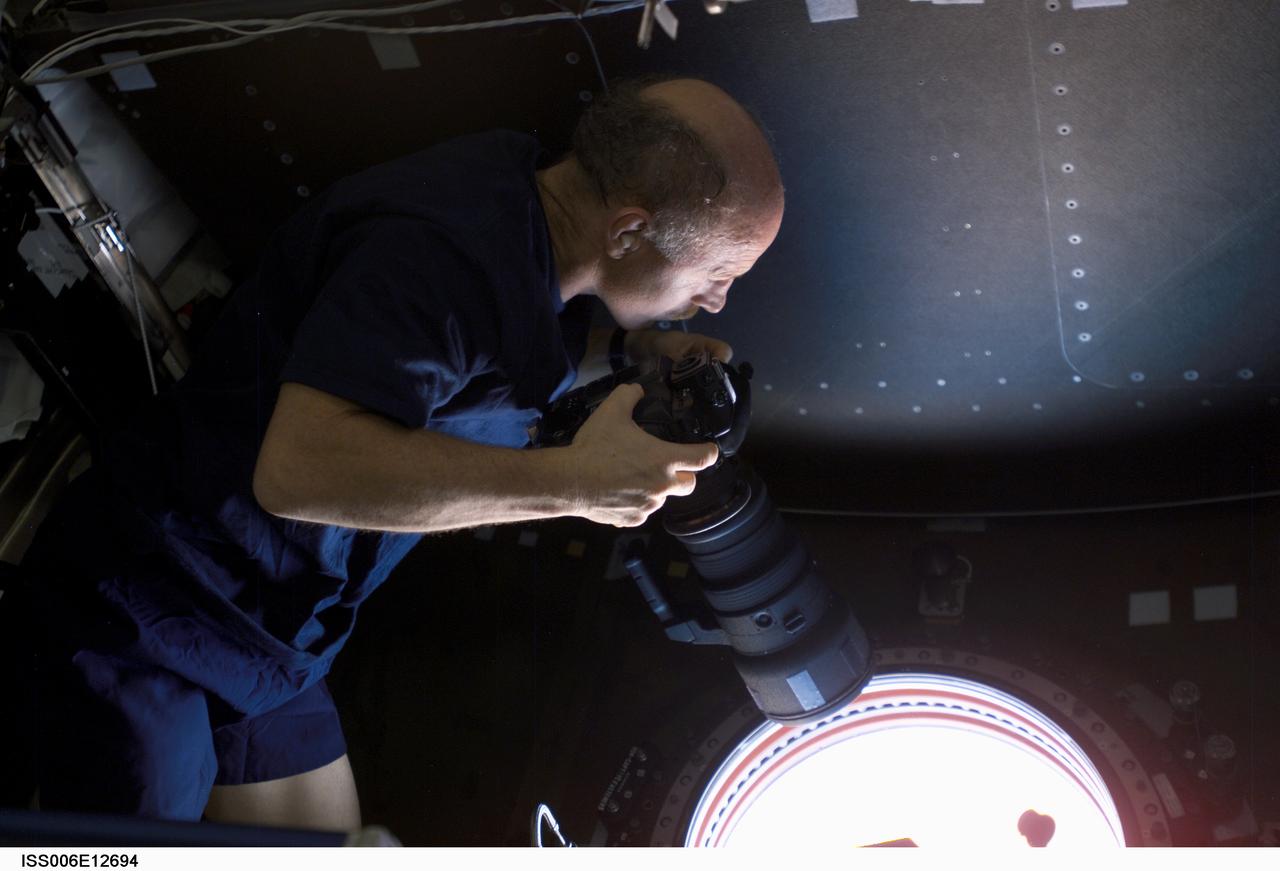
ISS006-E-12694 (16 December 2002) --- Astronaut Kenneth D. Bowersox, Expedition Six mission commander, uses a still camera to photograph the topography of a point on Earth from the nadir window in the Destiny laboratory on the International Space Station (ISS).
Bowersox takes pictures of Earth from the nadir window of Destiny during Expedition Six
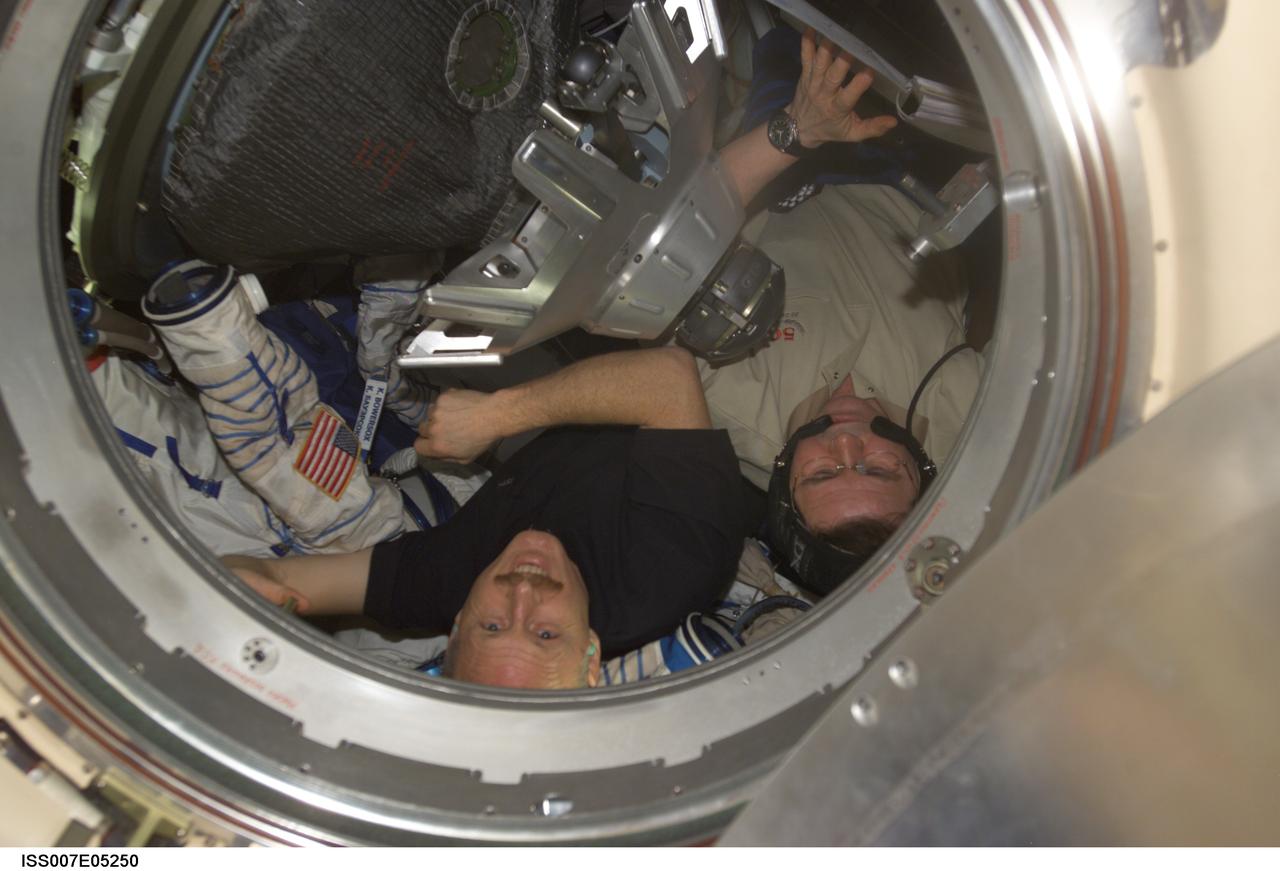
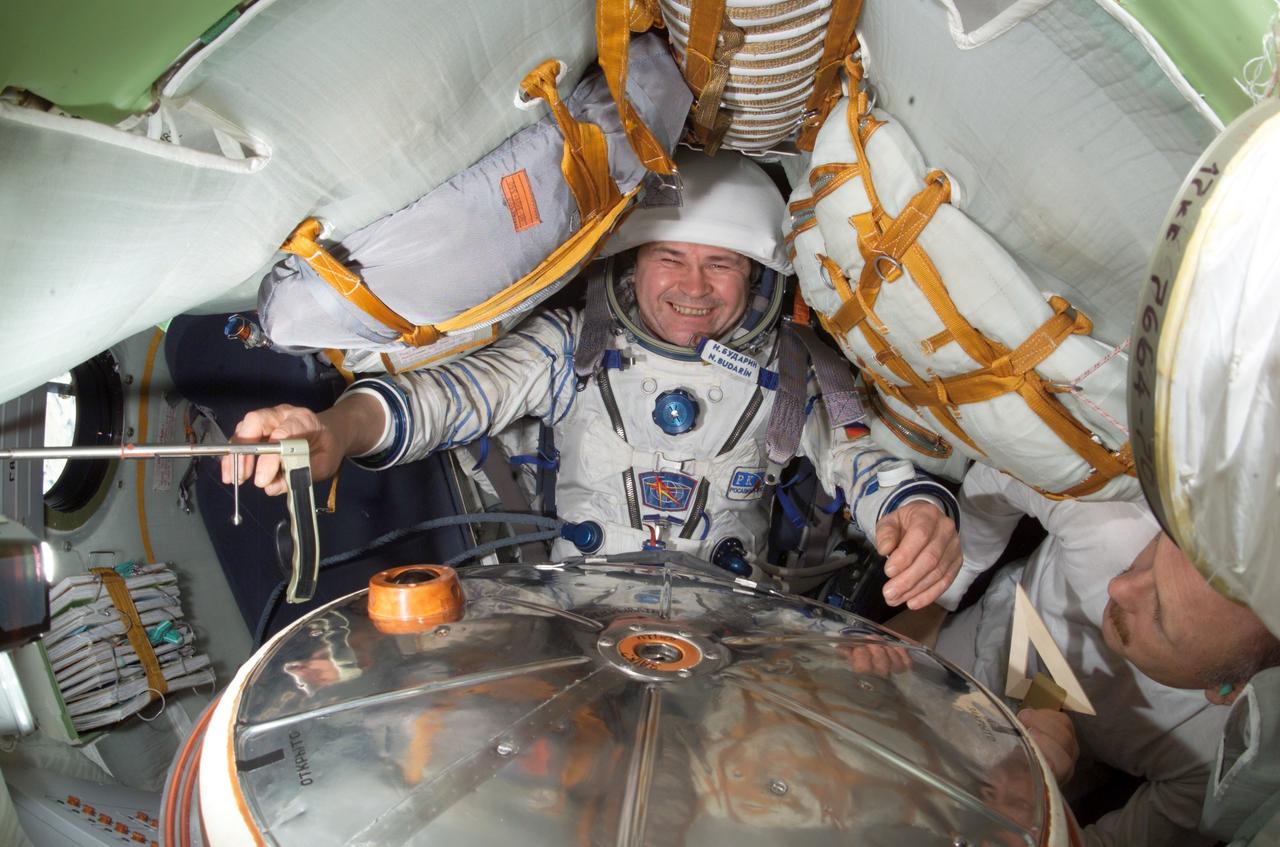
ISS007-E-05250 (3 May 2003) --- Astronaut Kenneth D. Bowersox (left), Expedition Six mission commander, and cosmonaut Nikolai M. Budarin, flight engineer, are pictured in a Soyuz spacecraft docked to the International Space Station (ISS). Budarin represents Rosaviakosmos.
Expedition Six crew in the Soyuz spacecraft
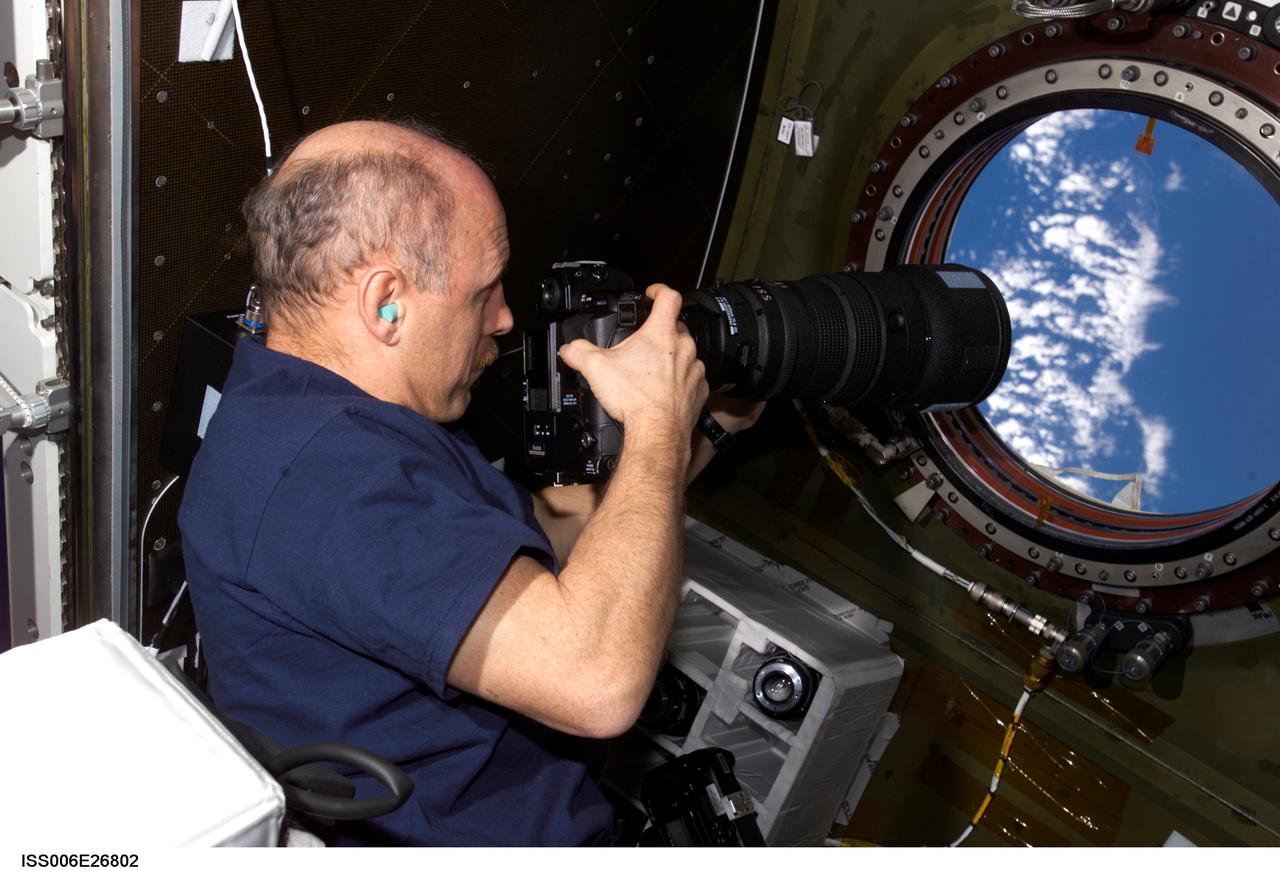
ISS006-E-26802 (14 February 2003) --- Astronaut Kenneth D. Bowersox, Expedition Six mission commander, uses a still camera to photograph the topography of a point on Earth from the nadir window in the Destiny laboratory on the International Space Station (ISS).
Bowersox photographs the Earth from the nadir window in Destiny during Expedition Six
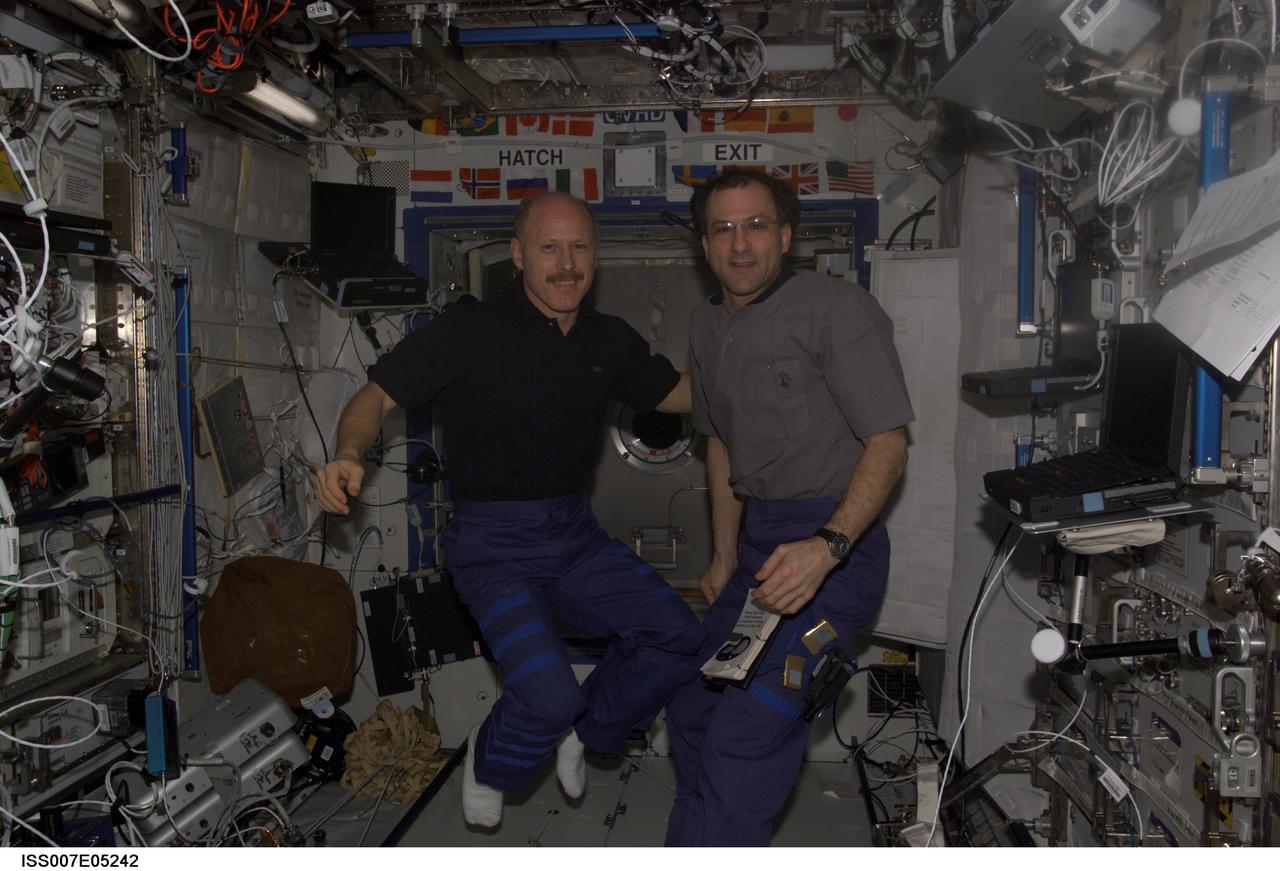
ISS007-E-05242 (3 May 2003) --- Astronauts Kenneth D. Bowersox (left) and Donald R. Pettit, Expedition Six mission commander and NASA ISS science officer, respectively, are pictured in the Destiny laboratory on the International Space Station (ISS).
Expedition Six crewmembers Bowersox and Pettit in Zvezda module
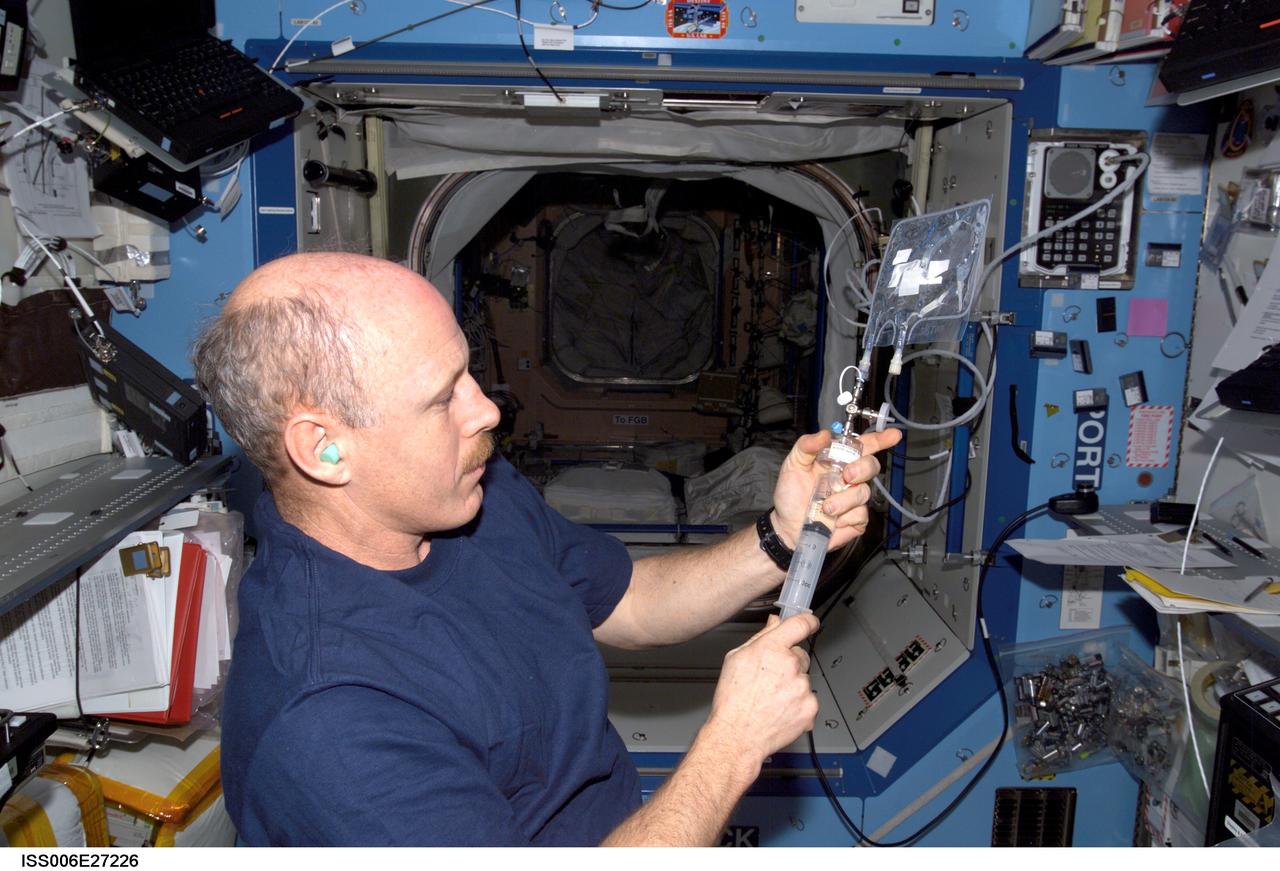
ISS006-E-27226 (17 February 2003) --- Astronaut Kenneth D. Bowersox, Expedition Six mission commander, uses the water microbiology kit (WMK) to collect water samples for in-flight chemistry/microbiology analysis in the Destiny laboratory on the International Space Station (ISS).
Bowersox works with the WMK in Destiny during Expedition Six
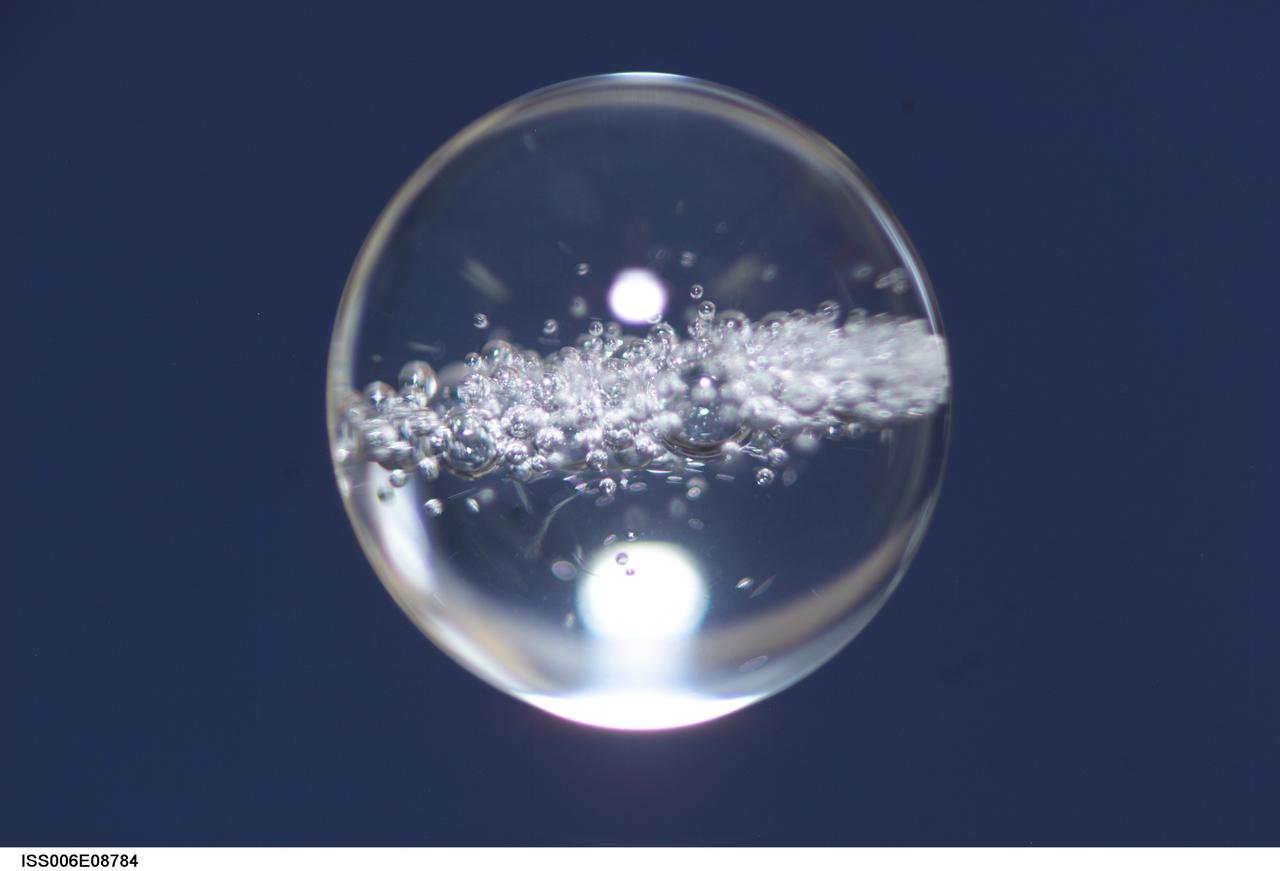
ISS006-E-08784 (14 December 2002) --- View of a bubble formed as a result of a Zeolite Crystal Growth (ZCG) experiment in the Destiny laboratory on the International Space Station (ISS). Expedition Six Commander Kenneth D. Bowersox used a Space Station drill to mix 12 Zeolite samples in clear tubes. Scientists on the ground watching on TV noticed bubbles in the samples. Bowersox used a modified mixing procedure to process autoclaves to isolate bubbles.  He re-inserted the samples in the ZCG furnace in Express Rack 2 in the U.S. laboratory/Destiny. This experiment has shown that the bubbles could cause larger number of smaller deformed crystals to grow. Bowersox rotated the samples so that the heavier fluid was thrown to the outside while the lighter bubbles stayed on the inside.
Bubble formed as a result of a Zeolite Crystal Growth experiment in the U.S. Laboratory
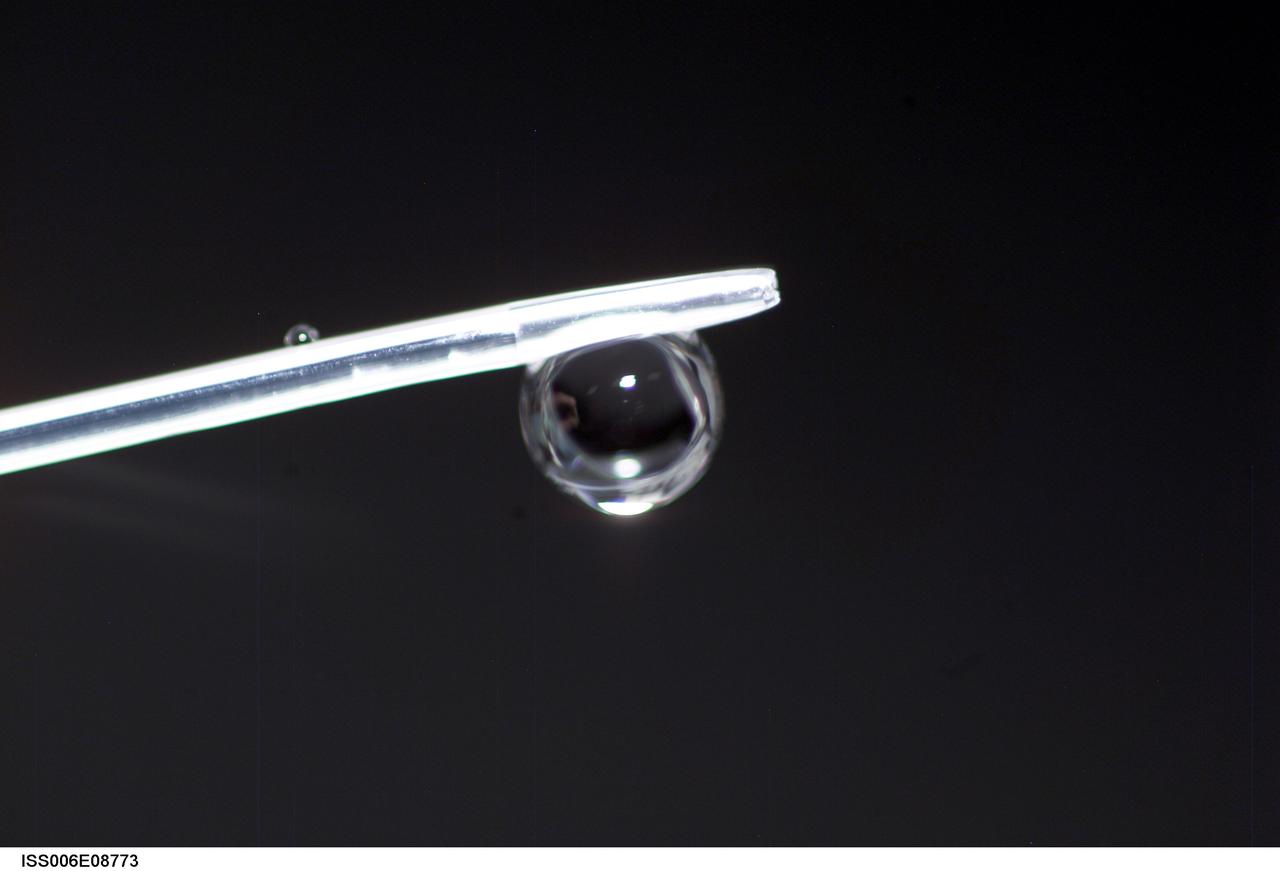
ISS006-E-08773 (14 December 2002) --- View of a bubble formed as a result of a Zeolite Crystal Growth (ZCG) experiment in the Destiny laboratory on the International Space Station (ISS). Expedition Six Commander Kenneth D. Bowersox used a Space Station drill to mix 12 Zeolite samples in clear tubes. Scientists on the ground watching on TV noticed bubbles in the samples. Bowersox used a modified mixing procedure to process autoclaves to isolate bubbles.  He re-inserted the samples in the ZCG furnace in Express Rack 2 in the U.S. laboratory/Destiny. This experiment has shown that the bubbles could cause larger number of smaller deformed crystals to grow. Bowersox rotated the samples so that the heavier fluid was thrown to the outside while the lighter bubbles stayed on the inside.
Bubble formed as a result of a Zeolite Crystal Growth experiment in the U.S. Laboratory
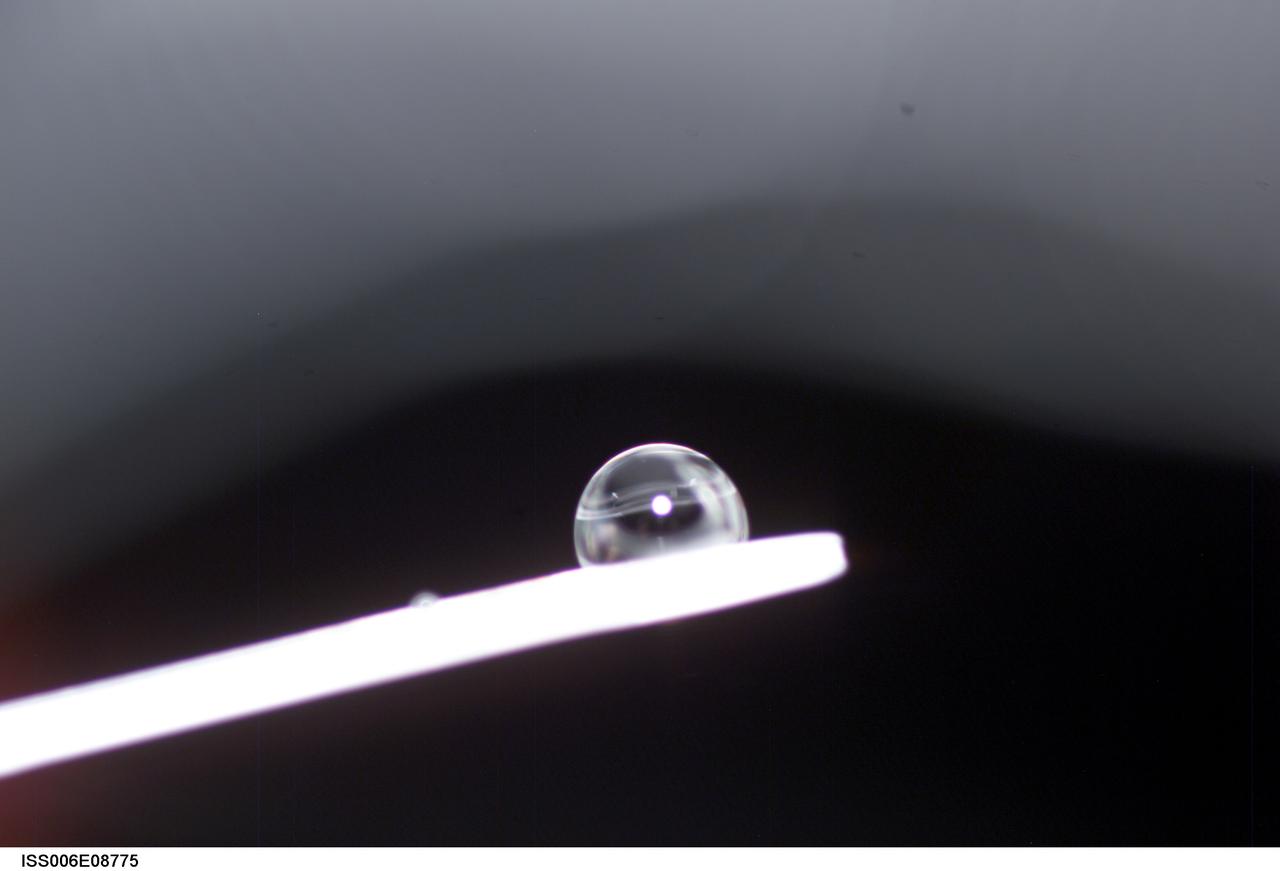
ISS006-E-08775 (14 December 2002) --- View of a bubble formed as a result of a Zeolite Crystal Growth (ZCG) experiment in the Destiny laboratory on the International Space Station (ISS). Expedition Six Commander Kenneth D. Bowersox used a Space Station drill to mix 12 Zeolite samples in clear tubes. Scientists on the ground watching on TV noticed bubbles in the samples. Bowersox used a modified mixing procedure to process autoclaves to isolate bubbles.  He re-inserted the samples in the ZCG furnace in Express Rack 2 in the U.S. laboratory/Destiny. This experiment has shown that the bubbles could cause larger number of smaller deformed crystals to grow. Bowersox rotated the samples so that the heavier fluid was thrown to the outside while the lighter bubbles stayed on the inside.
Bubble formed as a result of a Zeolite Crystal Growth experiment in the U.S. Laboratory
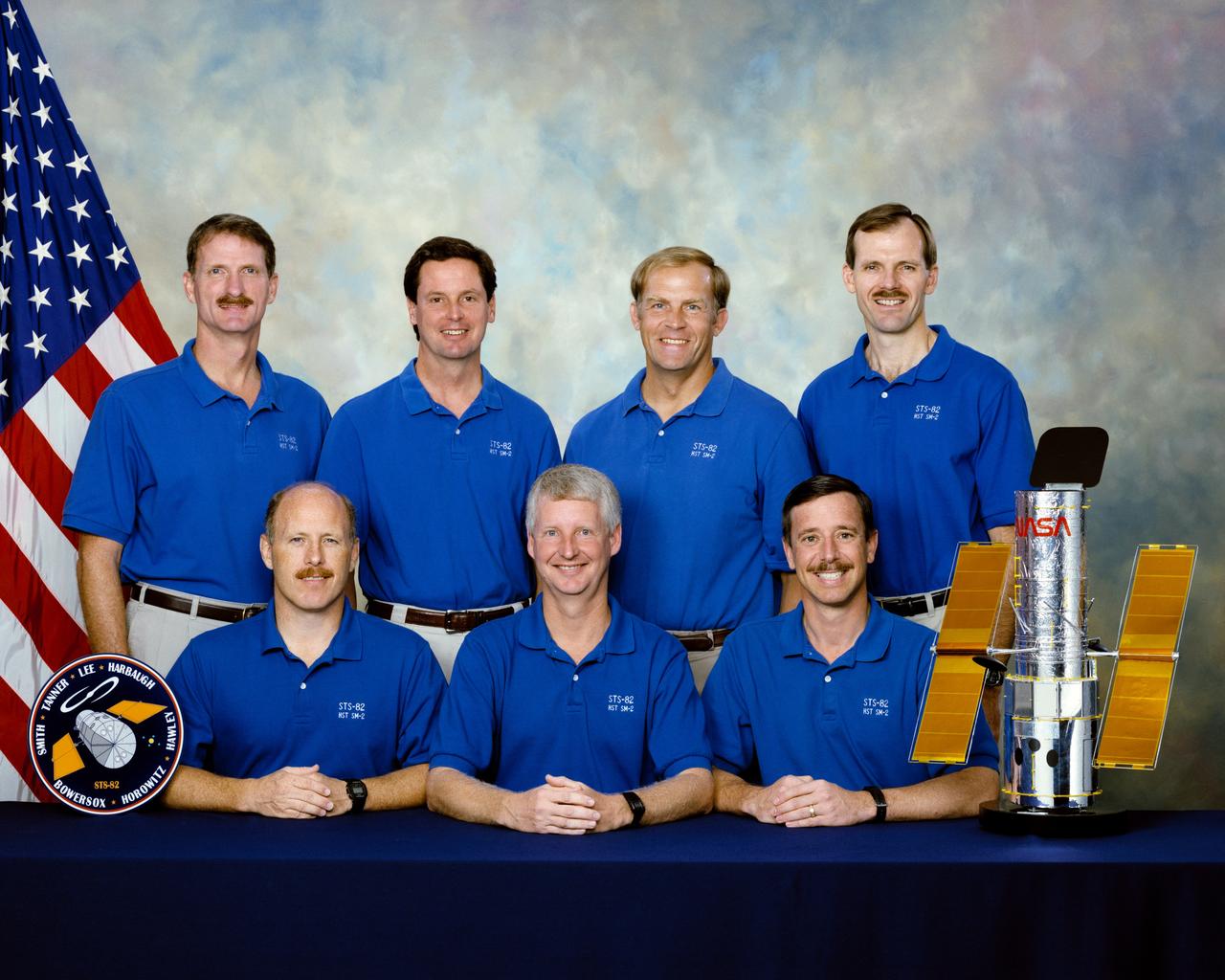
STS082-S-002 (December 1996) --- These seven astronauts are prime crew members for NASA’s STS-82 mission. They are, on the front row, from the left, Kenneth D. Bowersox, Steven A. Hawley and Scott J. Horowitz. On the back row are Joseph R. Tanner, Gregory J. Harbaugh; Mark C. Lee and Steven L. Smith.  Bowersox and Horowitz are commander and pilot, respectively, with Lee assigned as payload commander. Hawley, Harbaugh, Smith and Tanner are mission specialists. The seven are pictured with a small model of the Hubble Space Telescope (HST), which they will be paying a visit representing the second HST maintenance mission.  Bowersox was pilot for the STS-61 mission, which performed the first maintenance on HST. Hawley was a mission specialist on STS-31, the mission whose astronauts originally deployed the HST.
STS-82 official crew portrait
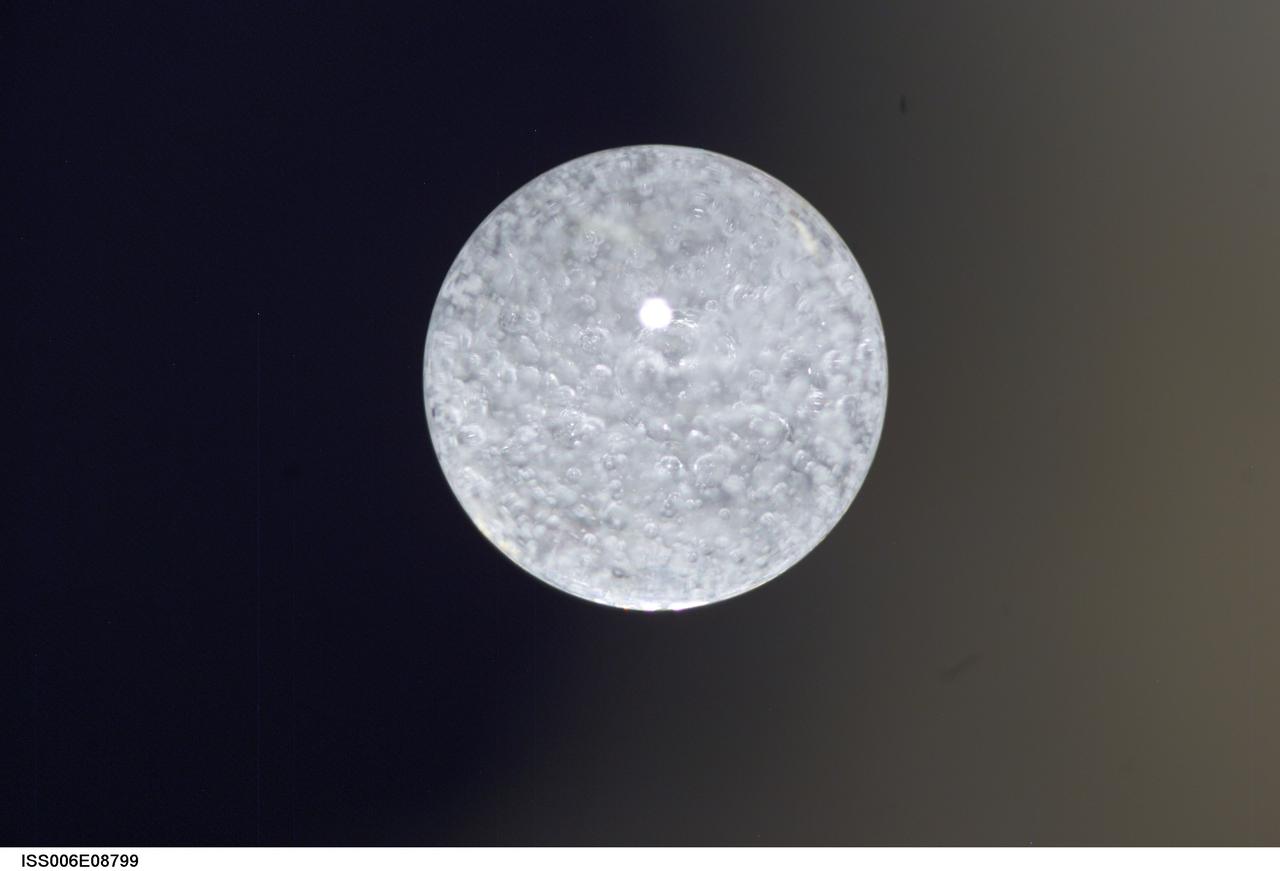
ISS006-E-08799 (14 December 2002) --- View of a bubble formed as a result of a Zeolite Crystal Growth (ZCG) experiment in the Destiny laboratory on the International Space Station (ISS). Expedition Six Commander Kenneth D. Bowersox used a Space Station drill to mix 12 Zeolite samples in clear tubes. Scientists on the ground watching on TV noticed bubbles in the samples. Bowersox used a modified mixing procedure to process autoclaves to isolate bubbles.  He re-inserted the samples in the ZCG furnace in Express Rack 2 in the U.S. laboratory/Destiny. This experiment has shown that the bubbles could cause larger number of smaller deformed crystals to grow. Bowersox rotated the samples so that the heavier fluid was thrown to the outside while the lighter bubbles stayed on the inside.
Bubble formed as a result of a Zeolite Crystal Growth experiment in the U.S. Laboratory
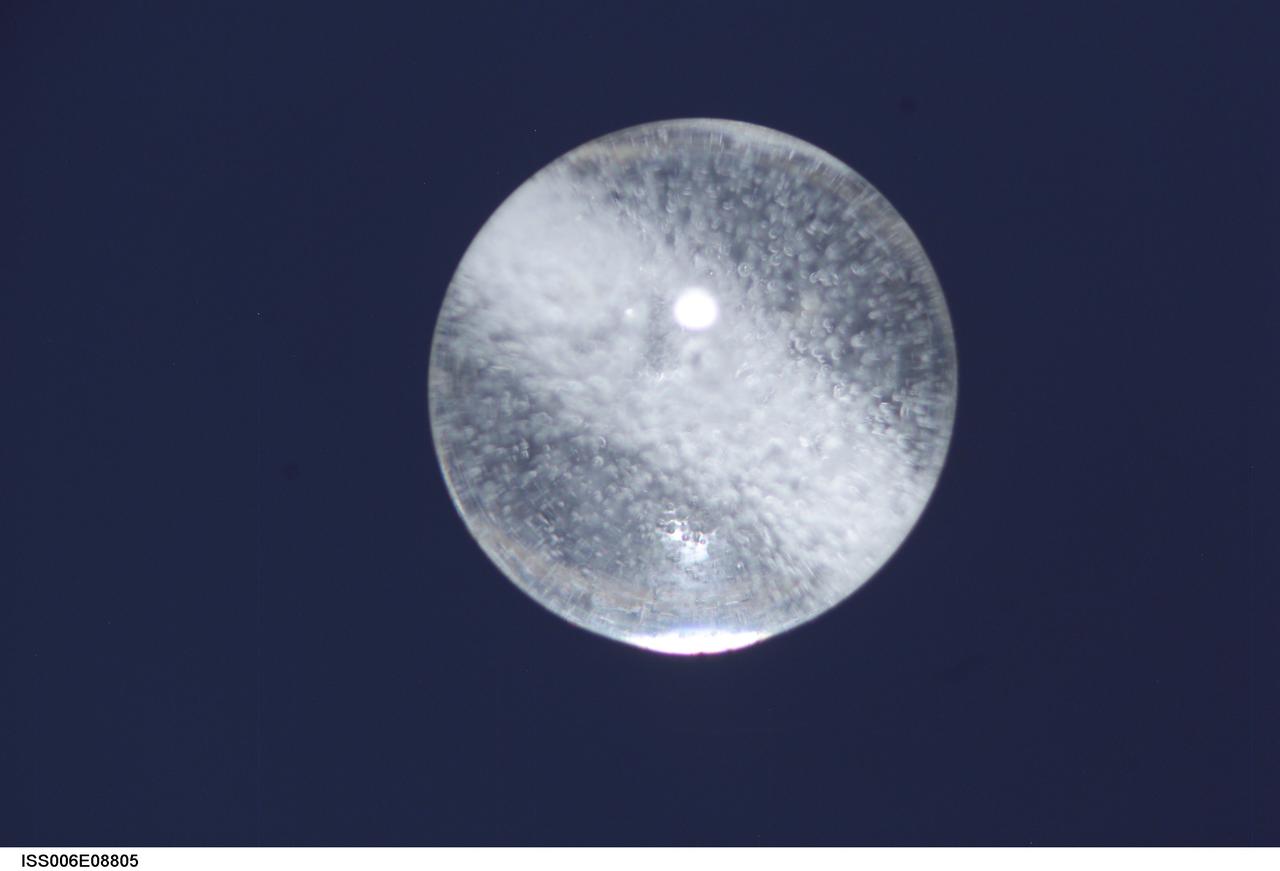
ISS006-E-08805 (14 December 2002) --- View of a bubble formed as a result of a Zeolite Crystal Growth (ZCG) experiment in the Destiny laboratory on the International Space Station (ISS). Expedition Six Commander Kenneth D. Bowersox used a Space Station drill to mix 12 Zeolite samples in clear tubes. Scientists on the ground watching on TV noticed bubbles in the samples. Bowersox used a modified mixing procedure to process autoclaves to isolate bubbles.  He re-inserted the samples in the ZCG furnace in Express Rack 2 in the U.S. laboratory/Destiny. This experiment has shown that the bubbles could cause larger number of smaller deformed crystals to grow. Bowersox rotated the samples so that the heavier fluid was thrown to the outside while the lighter bubbles stayed on the inside.
Bubble formed as a result of a Zeolite Crystal Growth experiment in the U.S. Laboratory
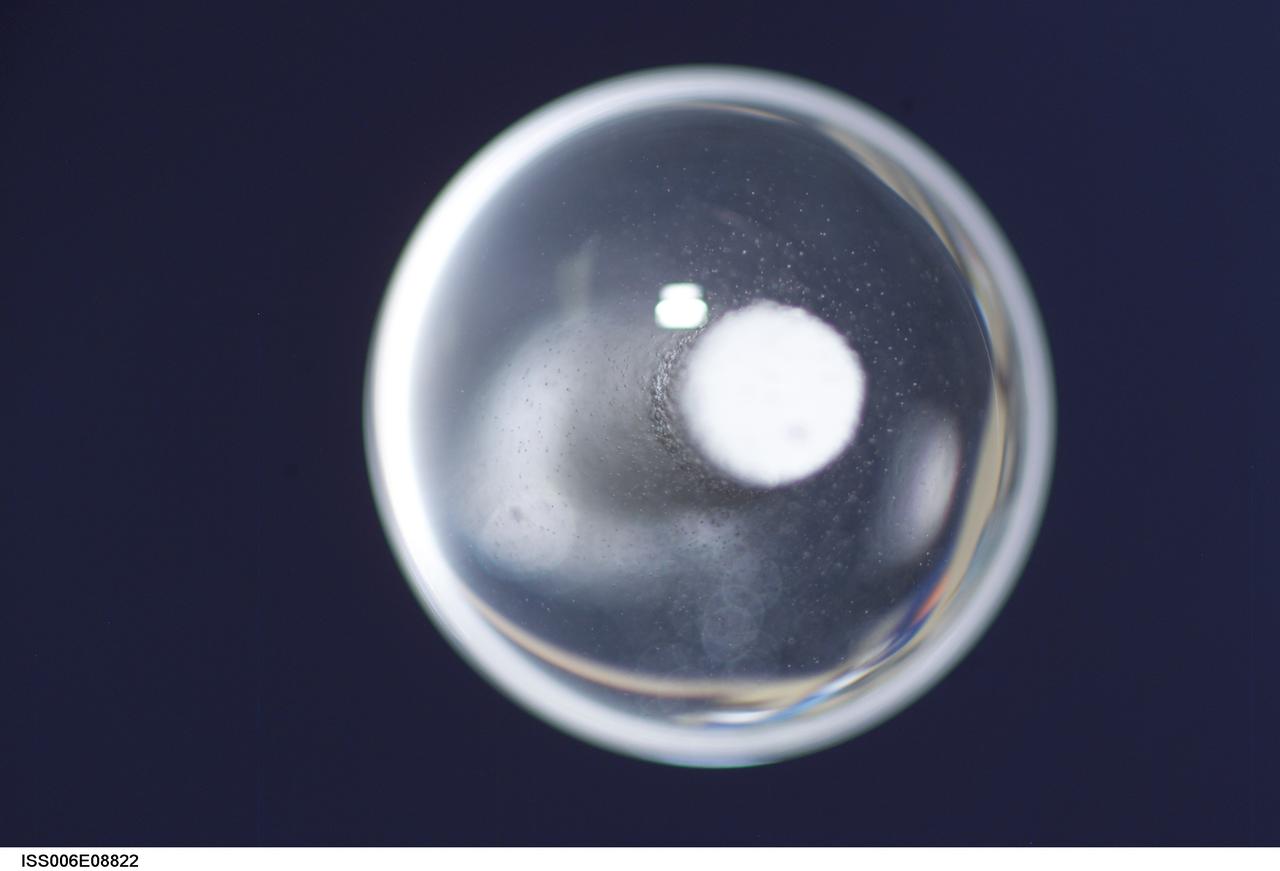
ISS006-E-08822 (14 December 2002) --- View of a bubble formed as a result of a Zeolite Crystal Growth (ZCG) experiment in the Destiny laboratory on the International Space Station (ISS). Expedition Six Commander Kenneth D. Bowersox used a Space Station drill to mix 12 Zeolite samples in clear tubes. Scientists on the ground watching on TV noticed bubbles in the samples. Bowersox used a modified mixing procedure to process autoclaves to isolate bubbles.  He re-inserted the samples in the ZCG furnace in Express Rack 2 in the U.S. laboratory/Destiny. This experiment has shown that the bubbles could cause larger number of smaller deformed crystals to grow. Bowersox rotated the samples so that the heavier fluid was thrown to the outside while the lighter bubbles stayed on the inside.
Bubble formed as a result of a Zeolite Crystal Growth experiment in the U.S. Laboratory
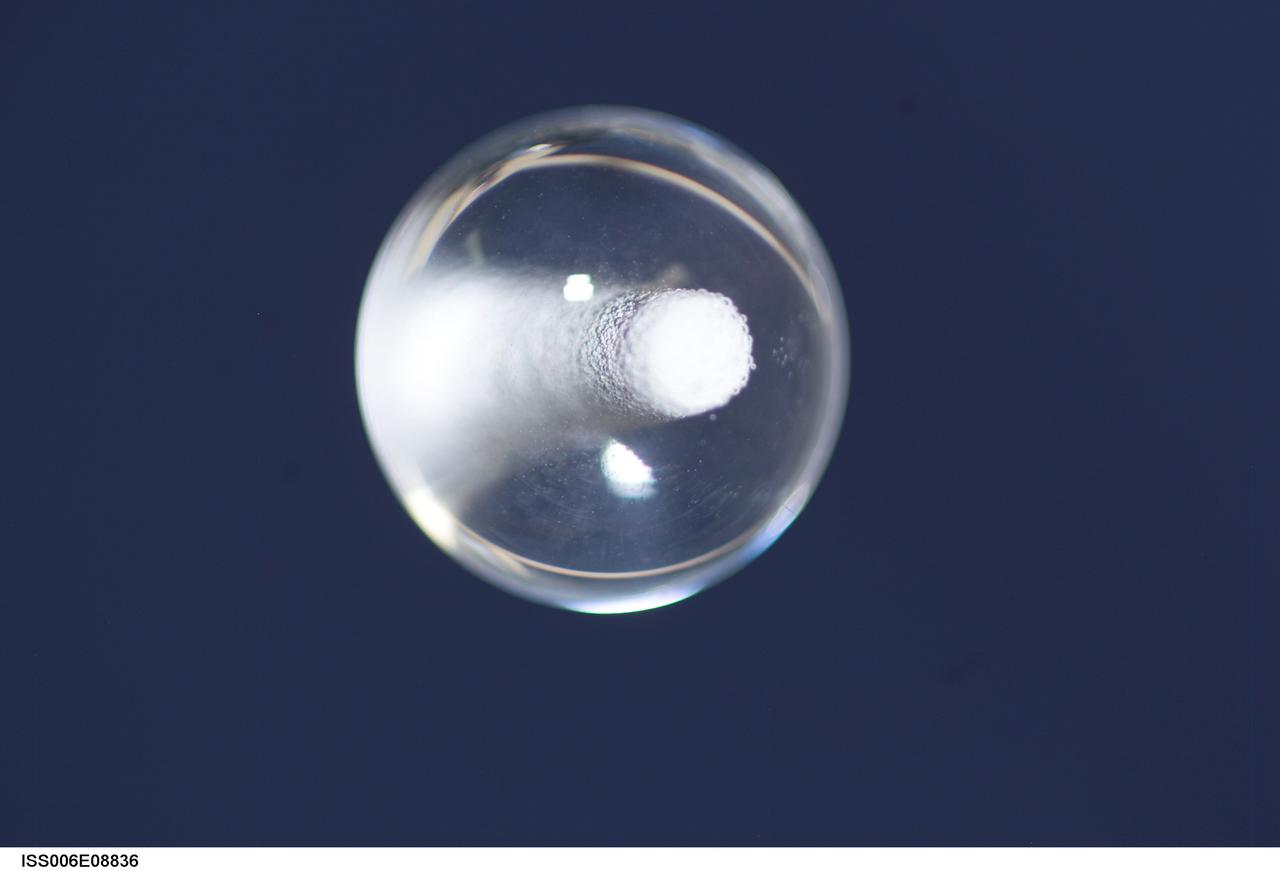
ISS006-E-08836 (14 December 2002) --- View of a bubble formed as a result of a Zeolite Crystal Growth (ZCG) experiment in the Destiny laboratory on the International Space Station (ISS). Expedition Six Commander Kenneth D. Bowersox used a Space Station drill to mix 12 Zeolite samples in clear tubes. Scientists on the ground watching on TV noticed bubbles in the samples. Bowersox used a modified mixing procedure to process autoclaves to isolate bubbles.  He re-inserted the samples in the ZCG furnace in Express Rack 2 in the U.S. laboratory/Destiny. This experiment has shown that the bubbles could cause larger number of smaller deformed crystals to grow. Bowersox rotated the samples so that the heavier fluid was thrown to the outside while the lighter bubbles stayed on the inside.
Bubble formed as a result of a Zeolite Crystal Growth experiment in the U.S. Laboratory
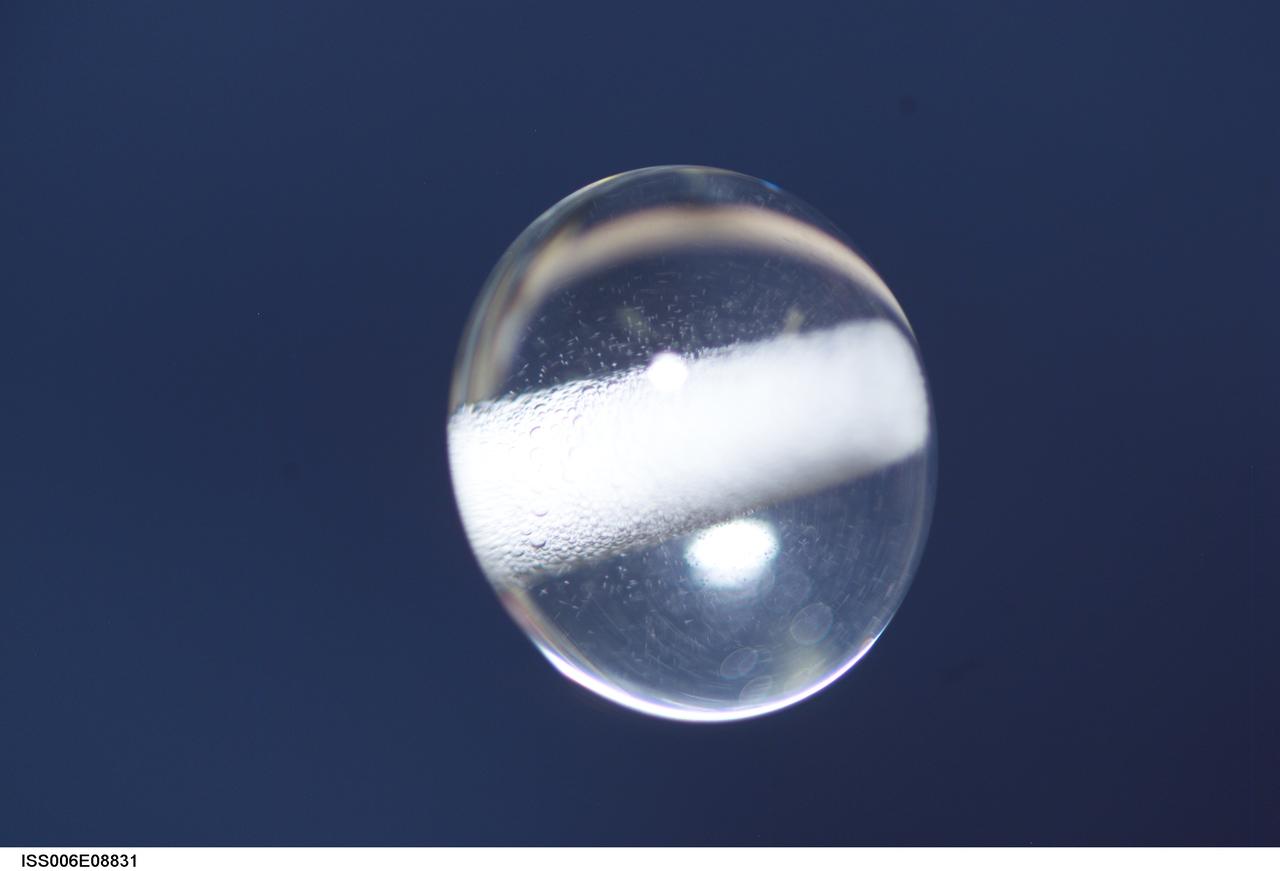
ISS006-E-08831 (14 December 2002) --- View of a bubble formed as a result of a Zeolite Crystal Growth (ZCG) experiment in the Destiny laboratory on the International Space Station (ISS). Expedition Six Commander Kenneth D. Bowersox used a Space Station drill to mix 12 Zeolite samples in clear tubes. Scientists on the ground watching on TV noticed bubbles in the samples. Bowersox used a modified mixing procedure to process autoclaves to isolate bubbles.  He re-inserted the samples in the ZCG furnace in Express Rack 2 in the U.S. laboratory/Destiny. This experiment has shown that the bubbles could cause larger number of smaller deformed crystals to grow. Bowersox rotated the samples so that the heavier fluid was thrown to the outside while the lighter bubbles stayed on the inside.
Bubble formed as a result of a Zeolite Crystal Growth experiment in the U.S. Laboratory
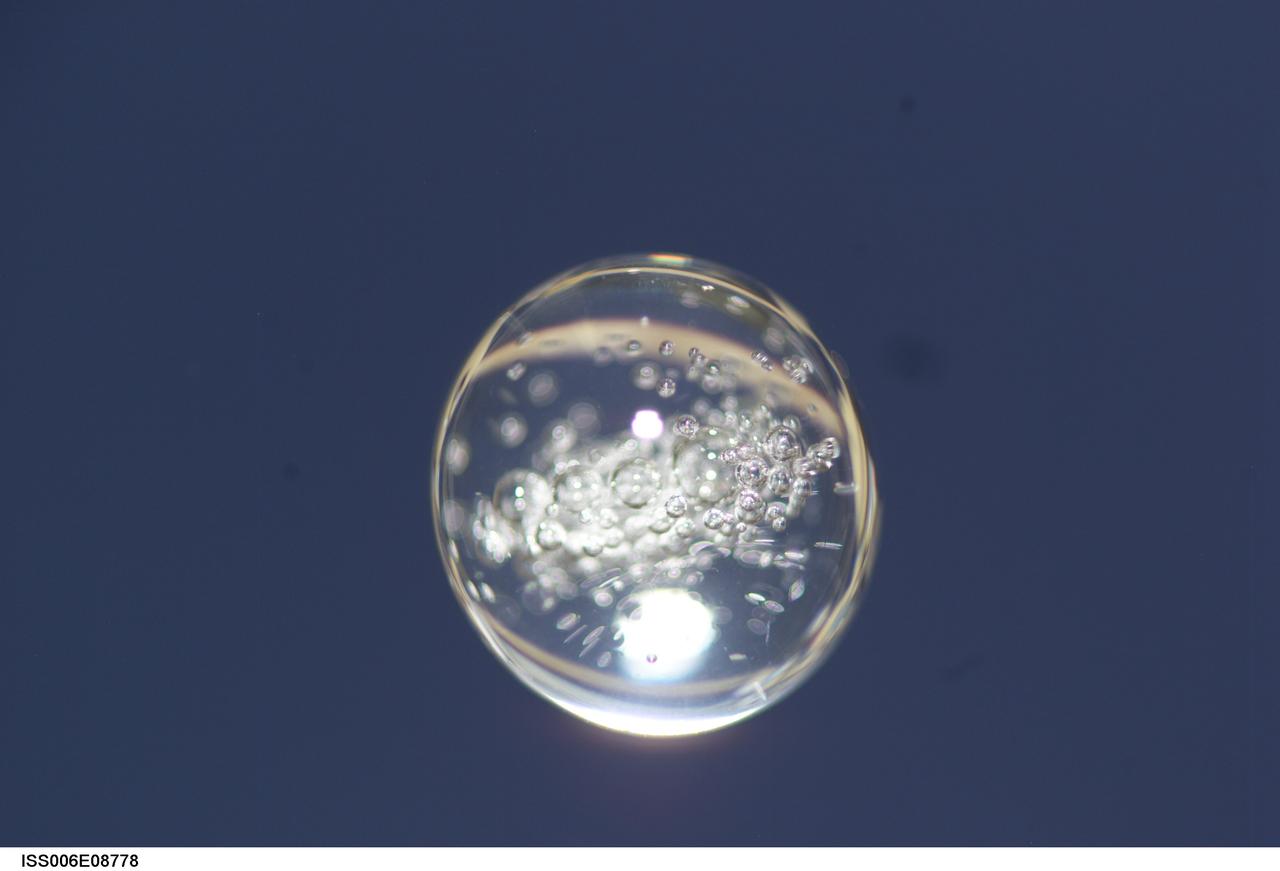
ISS006-E-08778 (14 December 2002) --- View of a bubble formed as a result of a Zeolite Crystal Growth (ZCG) experiment in the Destiny laboratory on the International Space Station (ISS). Expedition Six Commander Kenneth D. Bowersox used a Space Station drill to mix 12 Zeolite samples in clear tubes. Scientists on the ground watching on TV noticed bubbles in the samples. Bowersox used a modified mixing procedure to process autoclaves to isolate bubbles.  He re-inserted the samples in the ZCG furnace in Express Rack 2 in the U.S. laboratory/Destiny. This experiment has shown that the bubbles could cause larger number of smaller deformed crystals to grow. Bowersox rotated the samples so that the heavier fluid was thrown to the outside while the lighter bubbles stayed on the inside.
Bubble formed as a result of a Zeolite Crystal Growth experiment in the U.S. Laboratory
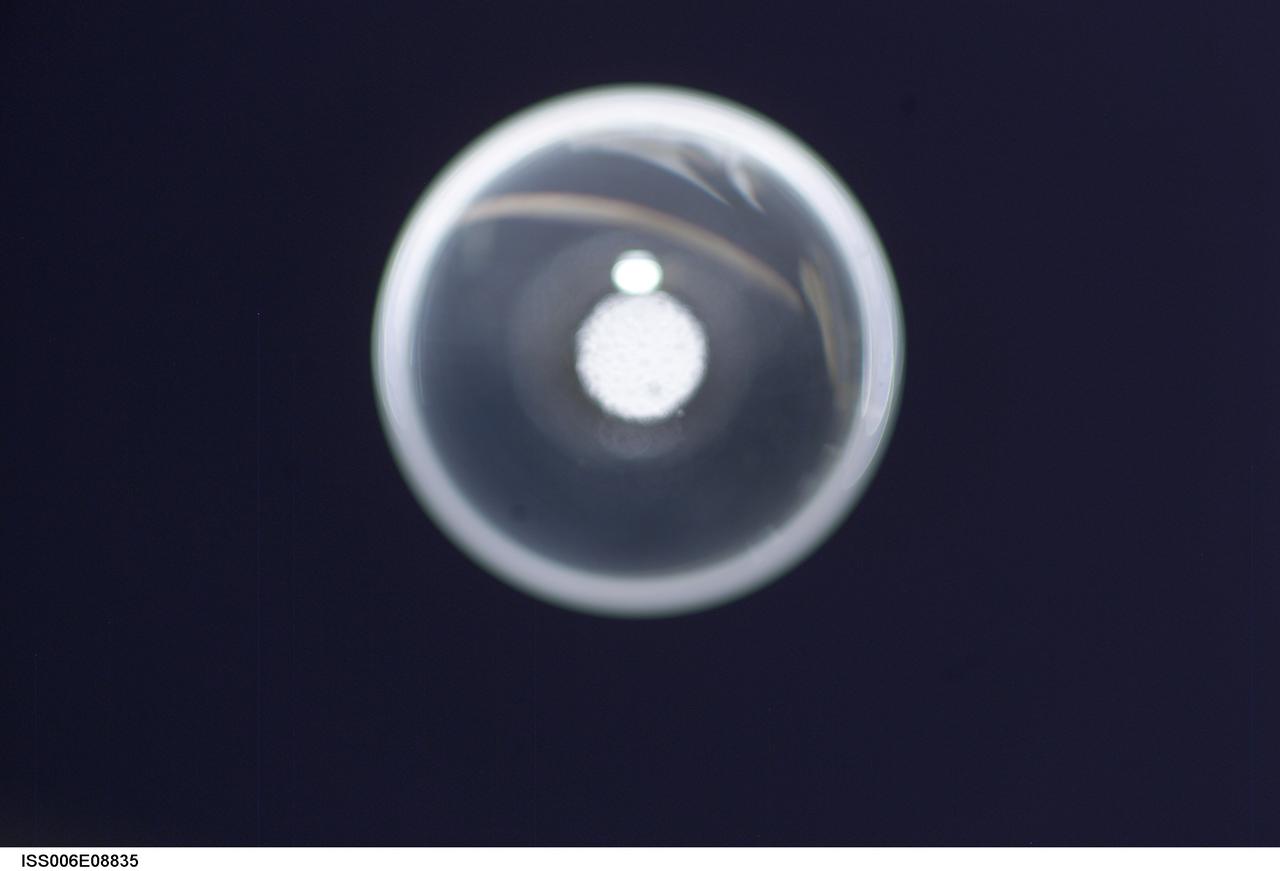
ISS006-E-08835 (14 December 2002) --- View of a bubble formed as a result of a Zeolite Crystal Growth (ZCG) experiment in the Destiny laboratory on the International Space Station (ISS). Expedition Six Commander Kenneth D. Bowersox used a Space Station drill to mix 12 Zeolite samples in clear tubes. Scientists on the ground watching on TV noticed bubbles in the samples. Bowersox used a modified mixing procedure to process autoclaves to isolate bubbles.  He re-inserted the samples in the ZCG furnace in Express Rack 2 in the U.S. laboratory/Destiny. This experiment has shown that the bubbles could cause larger number of smaller deformed crystals to grow. Bowersox rotated the samples so that the heavier fluid was thrown to the outside while the lighter bubbles stayed on the inside.
Bubble formed as a result of a Zeolite Crystal Growth experiment in the U.S. Laboratory
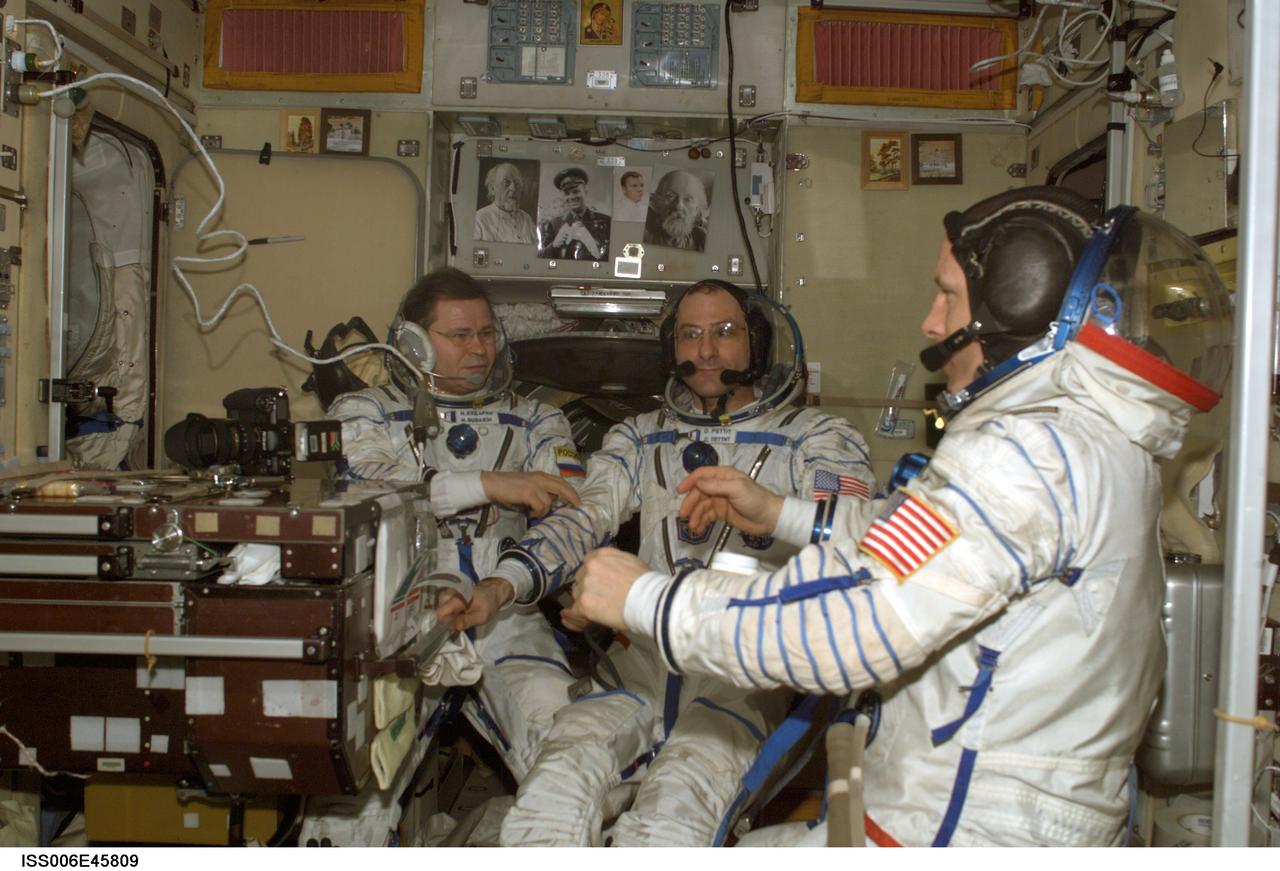
ISS006-E-45809 (14 April 2003) --- Attired in their Russian Sokol suits, the Expedition Six crewmembers are pictured in the Zvezda Service Module on the International Space Station (ISS) as they rehearse for their return flight home onboard the Soyuz TMA-1 spacecraft scheduled for May 3, 2003. From the left are cosmonaut Nikolai M. Budarin, flight engineer; astronauts Donald R. Pettit, NASA ISS science officer, and Kenneth D. Bowersox, mission commander. Budarin represents Rosaviakosmos.
Informal portrait of Pettit, Budarin, and Bowersox in the SM during Expedition Six
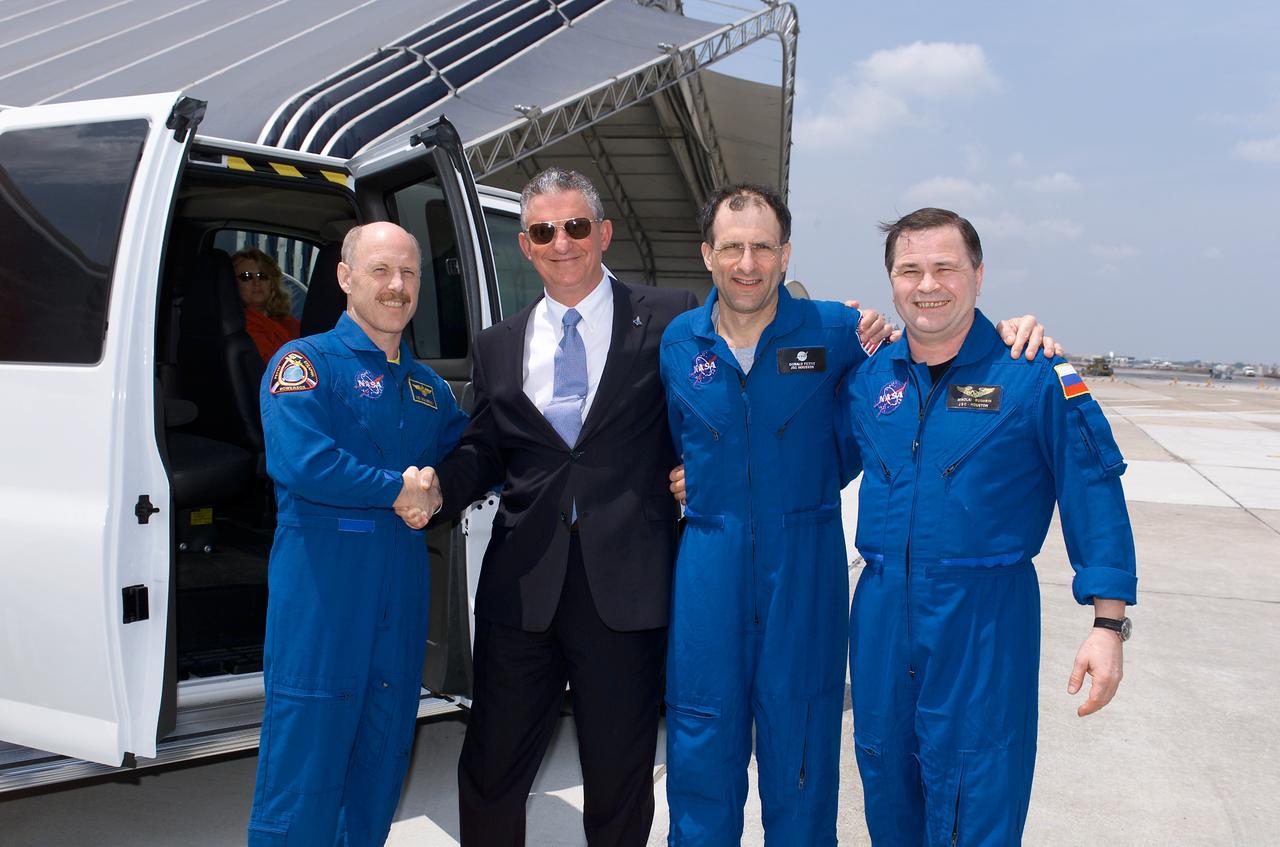
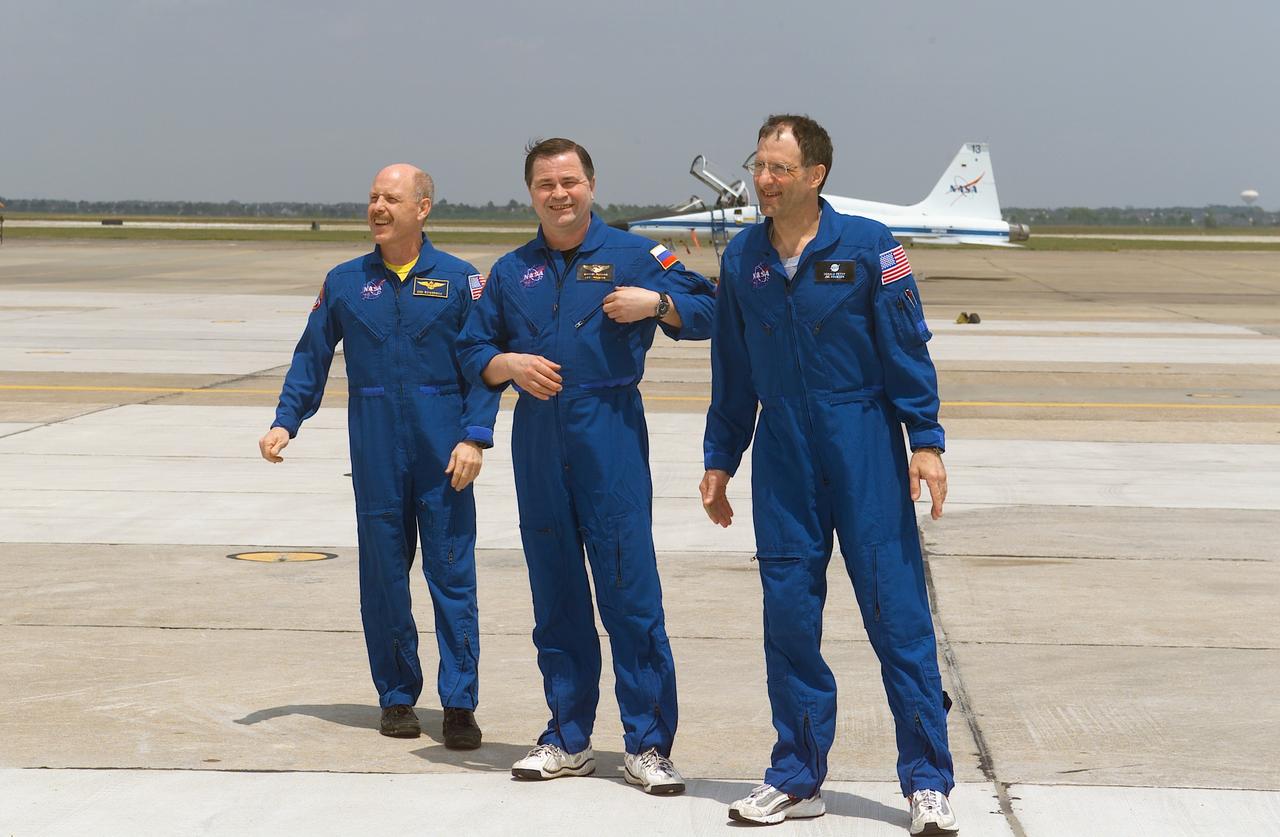
JSC2003-E-37463 (21 May 2003) --- General Jefferson D. Howell, Jr. (second left), Johnson Space Center (JSC) Director, and the Expedition 6 crewmembers pose for a photo following the crew arrival at Ellington Field, near JSC. The crewmembers are, from the left, astronauts Kenneth D. Bowersox, mission commander; Donald R. Pettit, NASA ISS science officer; and cosmonaut Nikolai M. Budarin, flight engineer representing Rosaviakosmos.
International Space Station Expedition 6 crew arrival at Ellington Field for crew return to JSC.
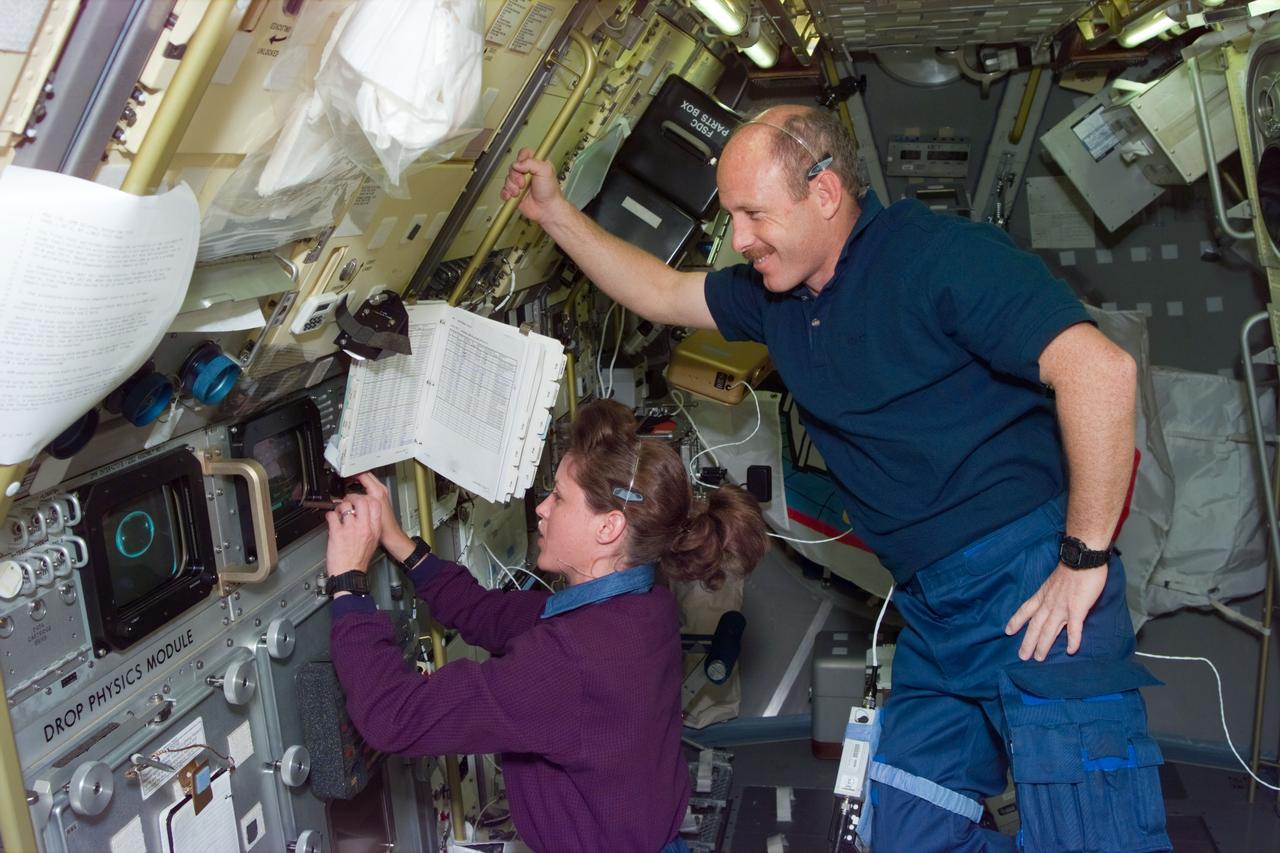
STS073-E-5311 (3 Nov. 1995) --- Astronaut Kathryn C. Thornton, STS-73 payload commander, works at the Drop Physics Module (DPM) on the portside of the science module supporting the U.S. Microgravity Laboratory (USML-2). Astronaut Kenneth D. Bowersox, mission commander, looks on. Five NASA astronauts and two payload specialists are in the last few days of a scheduled 16-day mission. This frame was exposed with the Electronic Still Camera (ESC).
DPM, Payload Commander Kathy Thornton works with experiment as Bowersox watches
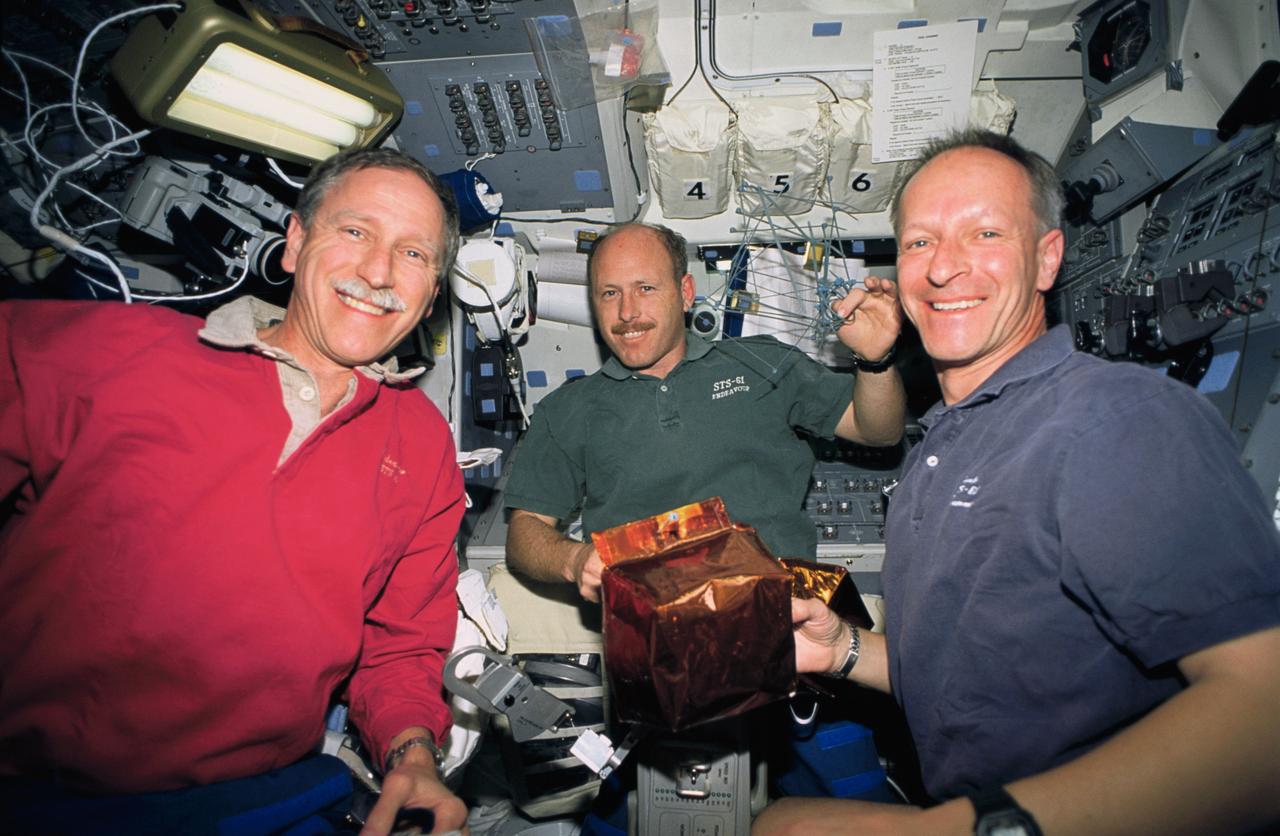
STS061-23-005 (8 Dec 1993) --- Three members of the STS-61 crew prepare covers to be placed on magnetometers near the top of the Hubble Space Telescope (HST).  Left to right are Richard O. Covey, mission commander; Kenneth D. Bowersox, pilot and Claude Nicollier, mission specialist.  On the following day, astronauts Jeffrey A. Hoffman and F. Story Musgrave placed the covers on the magnetometers as they wrapped up five days of servicing on HST.
STS-61 crewmembers prepare covers for magnetometers on HST
ISS006-E-10835 (19 December 2002) --- The Expedition Six crewmembers pose for a crew photo in the Zvezda Service Module on the International Space Station (ISS). From the left are cosmonaut Nikolai M. Budarin, flight engineer; astronauts Kenneth D. Bowersox, mission commander; and Donald R. Pettit, NASA ISS science officer. Budarin represents Rosaviakosmos. The photo was taken with a pre-set digital still camera.
Expedition Six crewmembers pose for a group photo in the Service Module
JSC2003-E-37639 (21 May 2003) --- The Expedition 6 crewmembers are pictured following their arrival at Ellington Field, near Johnson Space Center (JSC). From the left are astronaut Kenneth D. Bowersox, mission commander; cosmonaut Nikolai M. Budarin, flight engineer representing Rosaviakosmos; and astronaut Donald R. Pettit, NASA ISS science officer.
International Space Station Expedition 6 crew arrival at Ellington Field for crew return to JSC.
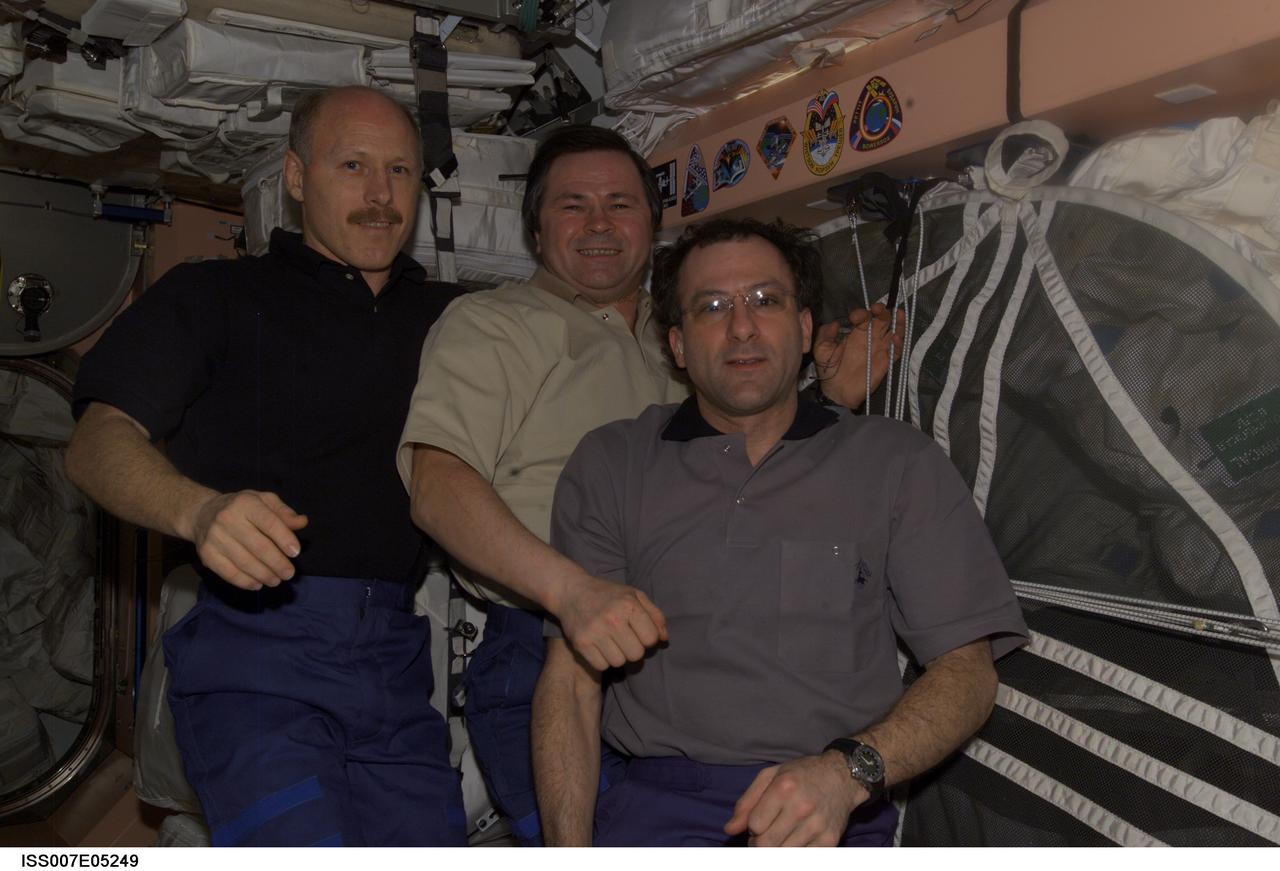
ISS007-E-05249 (3 May 2003) --- The Expedition Six crewmembers pose in the Unity node near the growing collection of insignias representing crews who have worked on the International Space Station (ISS). From the left are astronaut Kenneth D. Bowersox, mission commander; cosmonaut Nikolai M. Budarin, flight engineer; and Donald R. Pettit, NASA ISS science officer. Budarin represents Rosaviakosmos.
Expedition Six and Seven crew in Destiny module
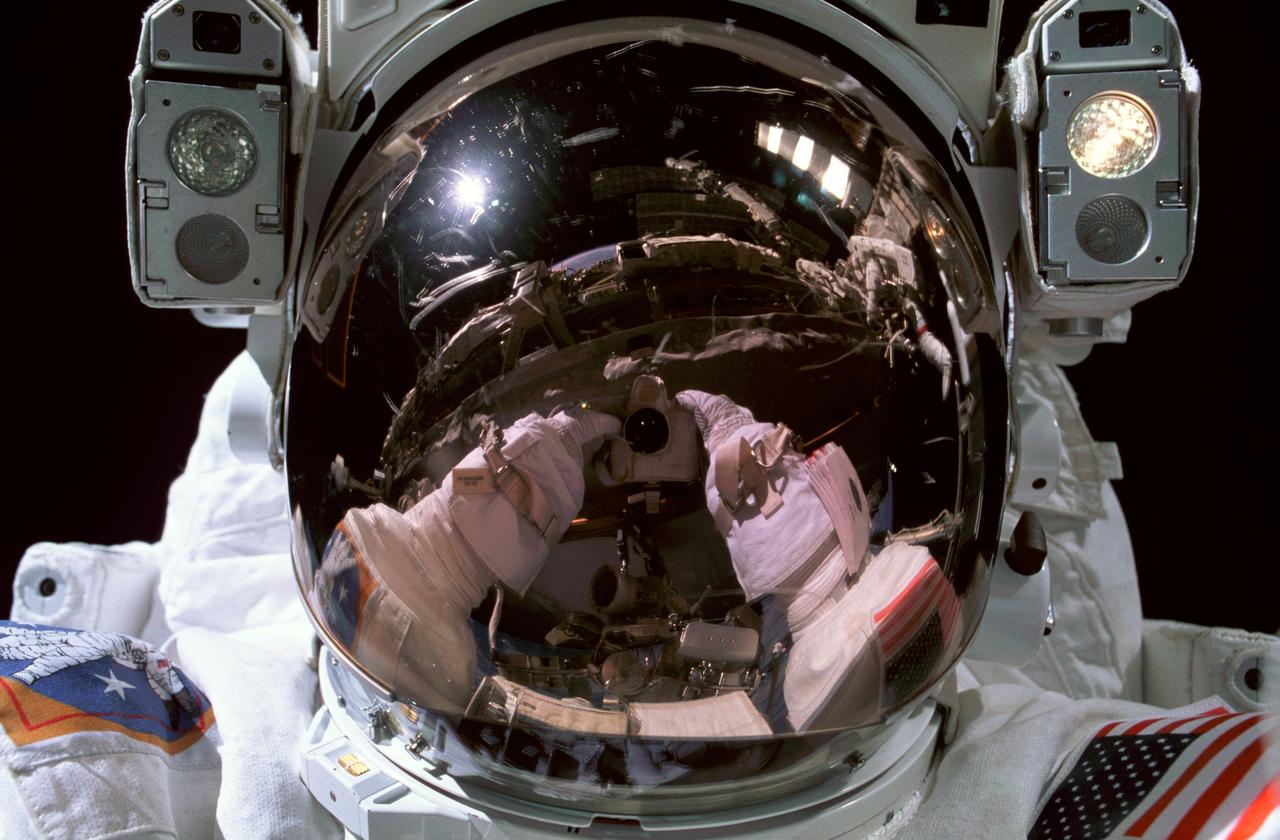
ISS006-344-011 (15 January 2003) --- Astronaut Donald R. Pettit, Expedition 6 NASA ISS science officer, photographs his helmet visor during a session of extravehicular activity (EVA). Pettit’s arms and camera are visible in the reflection of his helmet visor.  Astronaut Kenneth D. Bowersox, mission commander, is also visible in visor reflection, upper right.
View of Bowersox working on Truss during EVA on Expedition Six
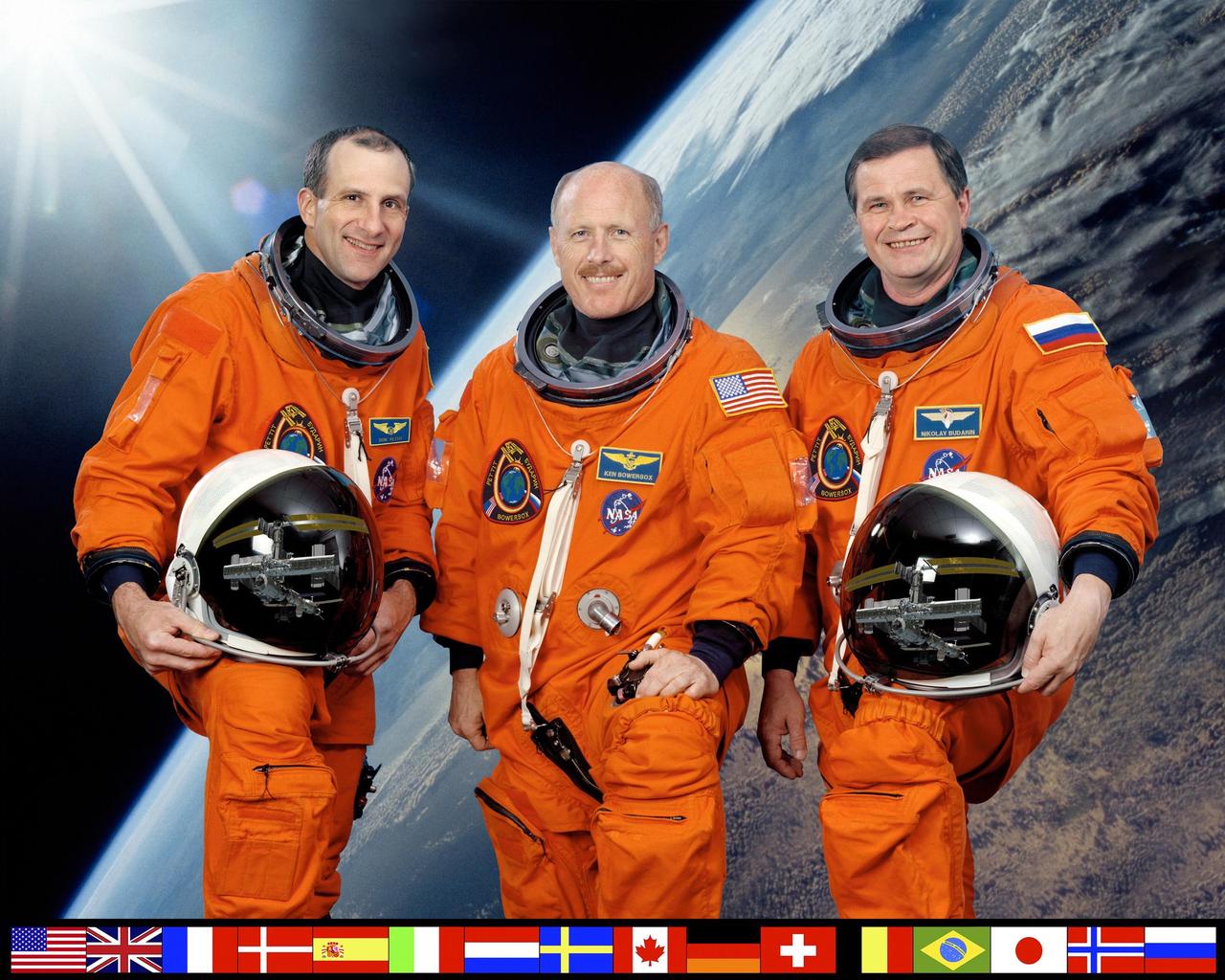
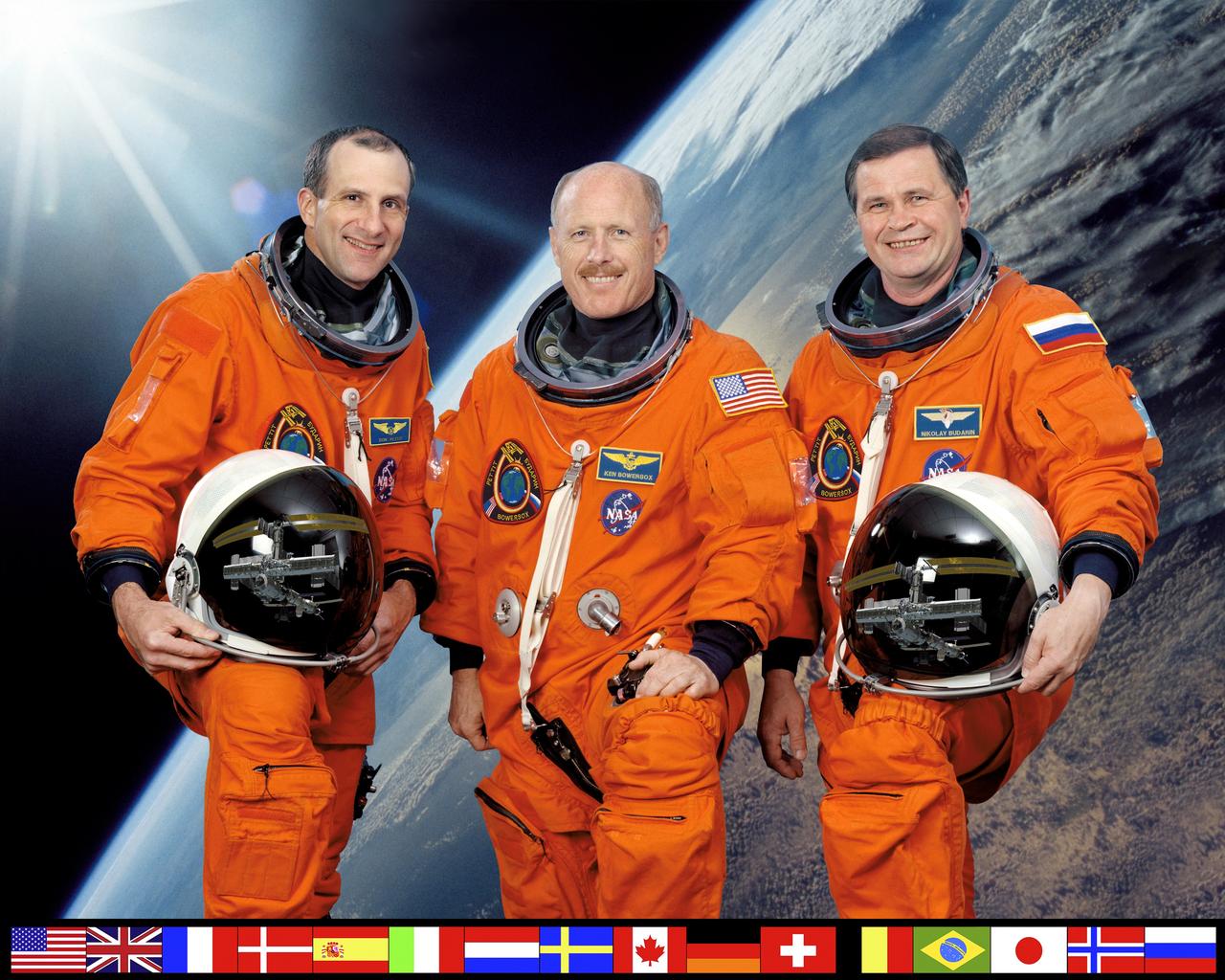
ISS006-S-002 (September 2002) --- Astronauts Donald R. Pettit (left), Expedition Six flight engineer; Kenneth D. Bowersox, mission commander; and cosmonaut Nikolai M. Budarin, flight engineer, attired in training versions of the shuttle launch and entry suit, pause from their training schedule for a crew portrait. The three will be launched to the International Space Station (ISS) in late autumn of this year aboard the space shuttle Endeavour. Budarin represents Rosaviakosmos.
Official portrait of the ISS Expedition Six crewmembers
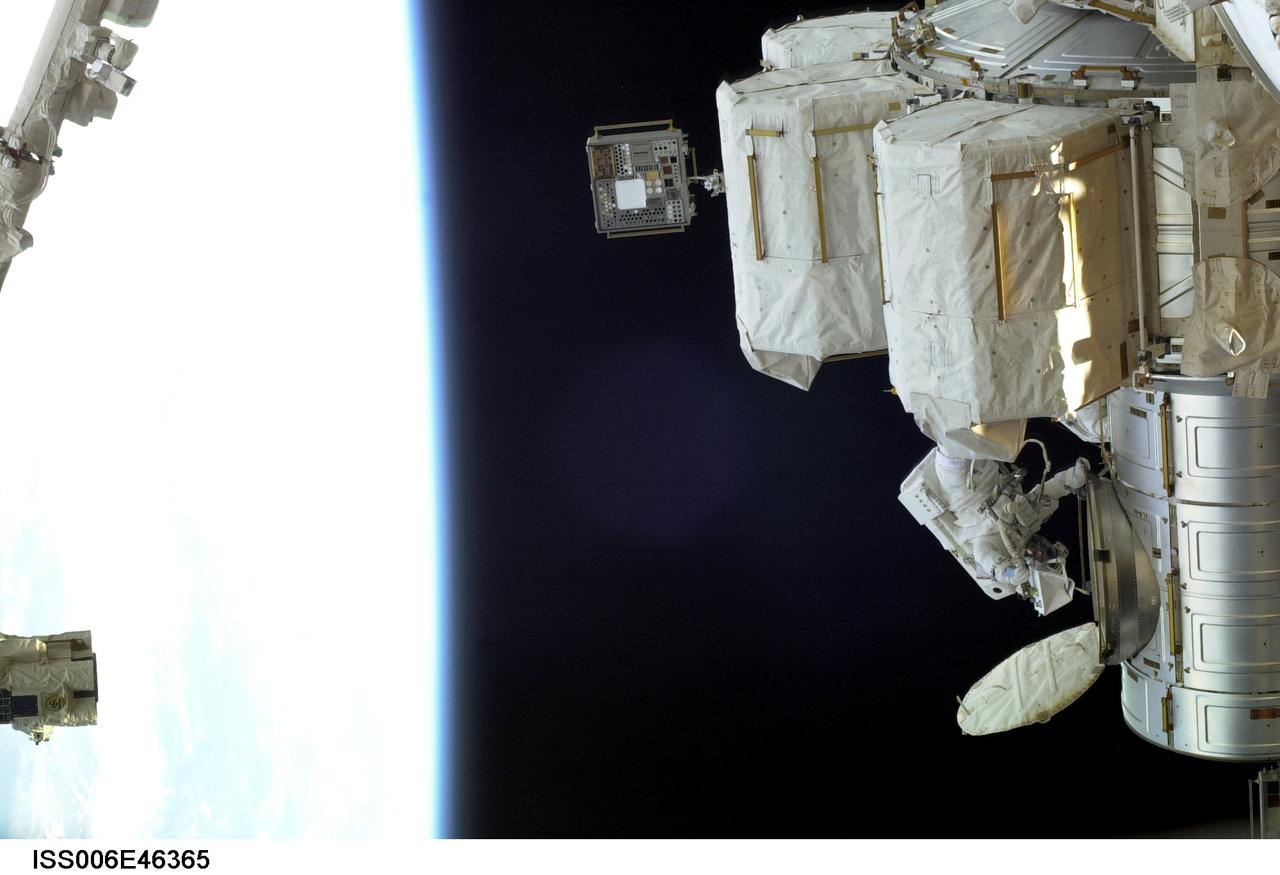
ISS006-E-46365 (8 April 2003) --- Astronaut Donald R. Pettit, Expedition Six NASA ISS science officer, emerges from the Quest airlock on the International Space Station (ISS) to begin a session of extravehicular activity (EVA) to perform a variety of maintenance tasks. Astronaut Kenneth D. Bowersox (out of frame), mission commander, joined Pettit on the spacewalk.
View of Flight Engineer Donald R. Pettit emerging from the Quest/Airlock to perform tasks
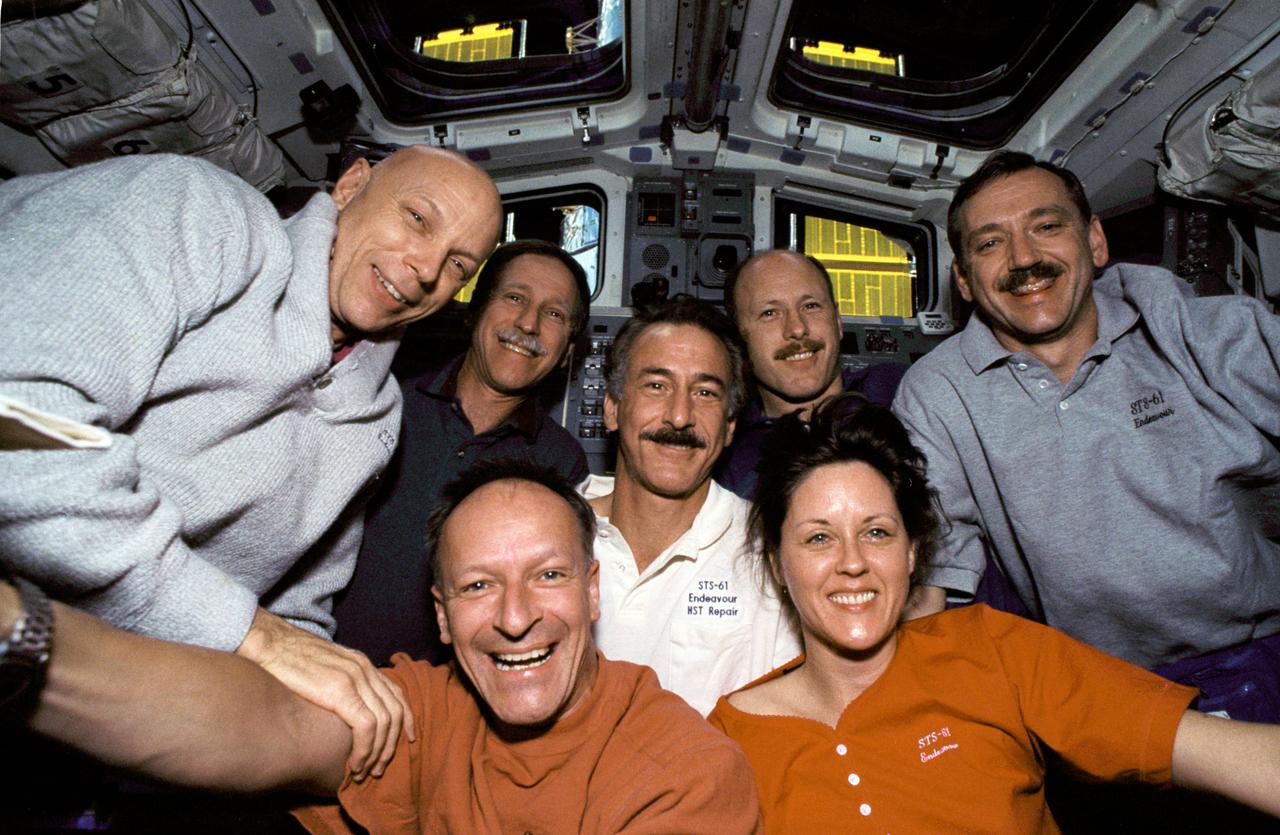
STS061-05-031 (2-13 Dec 1993) --- With the Hubble Space Telescope (HST) berthed in Endeavour's cargo bay, crew members for the STS-61 mission pause for a crew portrait on the flight deck.  Left to right are F. Story Musgrave, Richard O. Covey, Claude Nicollier, Jeffrey A. Hoffman, Kenneth D. Bowersox, Kathryn C. Thornton and Thomas D. Akers.
On-board STS-61 crew portrait
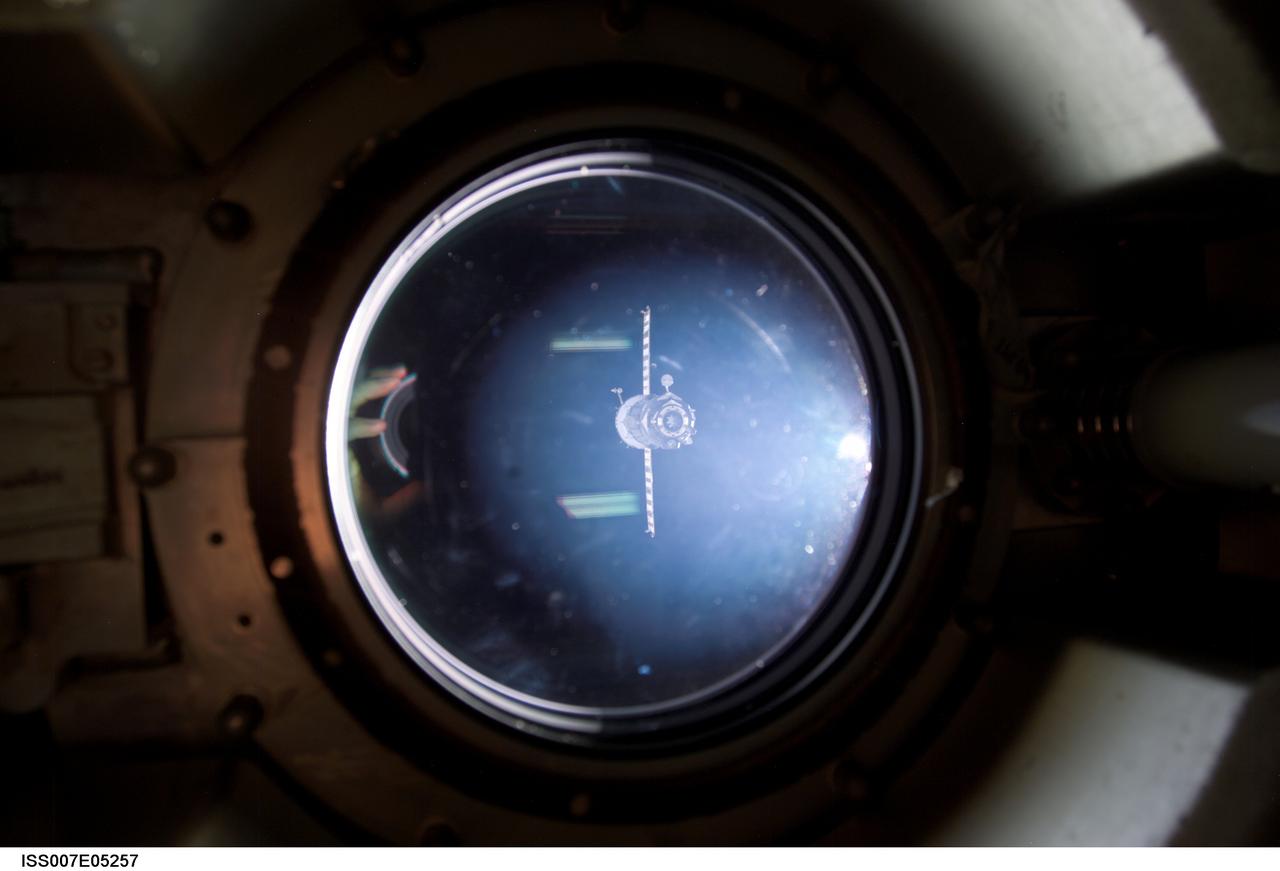
ISS007-E-05257 (3 May 2003) --- As seen through a window on the International Space Station (ISS), the Soyuz TMA-1 capsule departs from the station carrying the Expedition Six crewmembers, astronauts Kenneth D. Bowersox, mission commander; Donald R. Pettit, NASA ISS science officer; and cosmonaut Nikolai M. Budarin, flight engineer representing Rosaviakosmos.
Soyuz spacecraft departs ISS
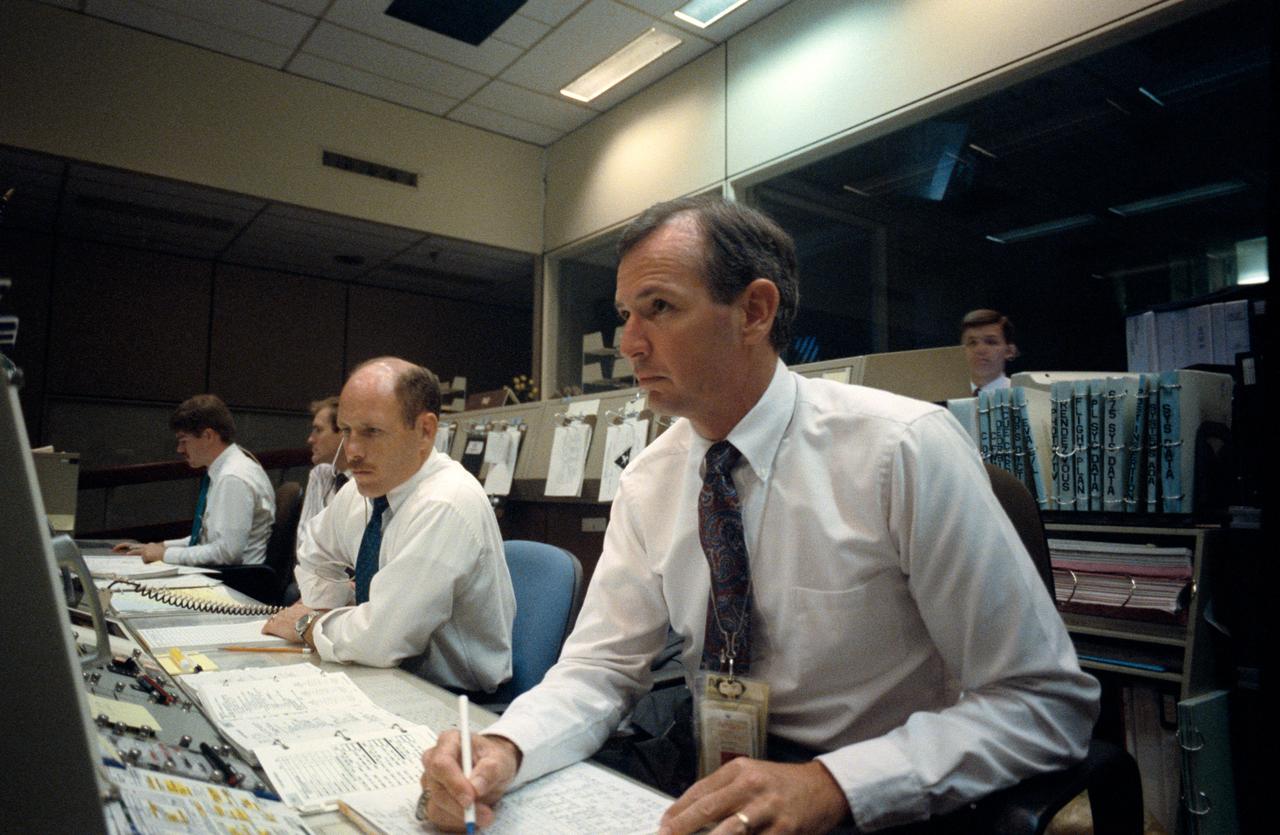
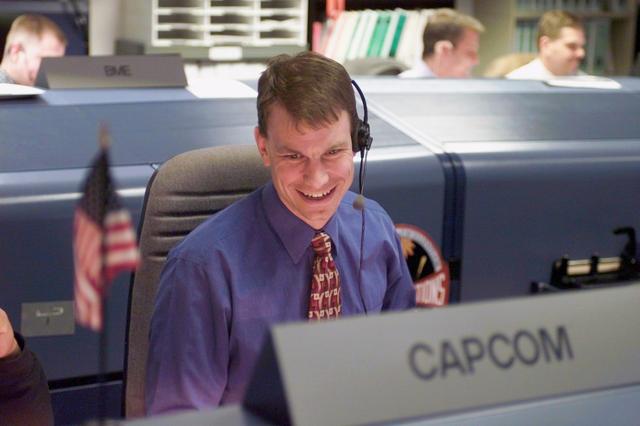
STS039-S-022 (28 April 1991)--- Two spacecraft communicators at the CAPCOM console monitor the ascent of the Space Shuttle Discovery.  They are astronauts Kenneth D. Bowersox (left) and Brian Duffy.  Launch occurred at 6:33 a.m. (CDT), April 28, 1991.  The scene is in the second floor Flight Control Room (FCR) of the Johnson Space Center's Mission Control Center (MCC).
STS-39 Discovery, OV-103, launch is monitored in JSC's Mission Control Center
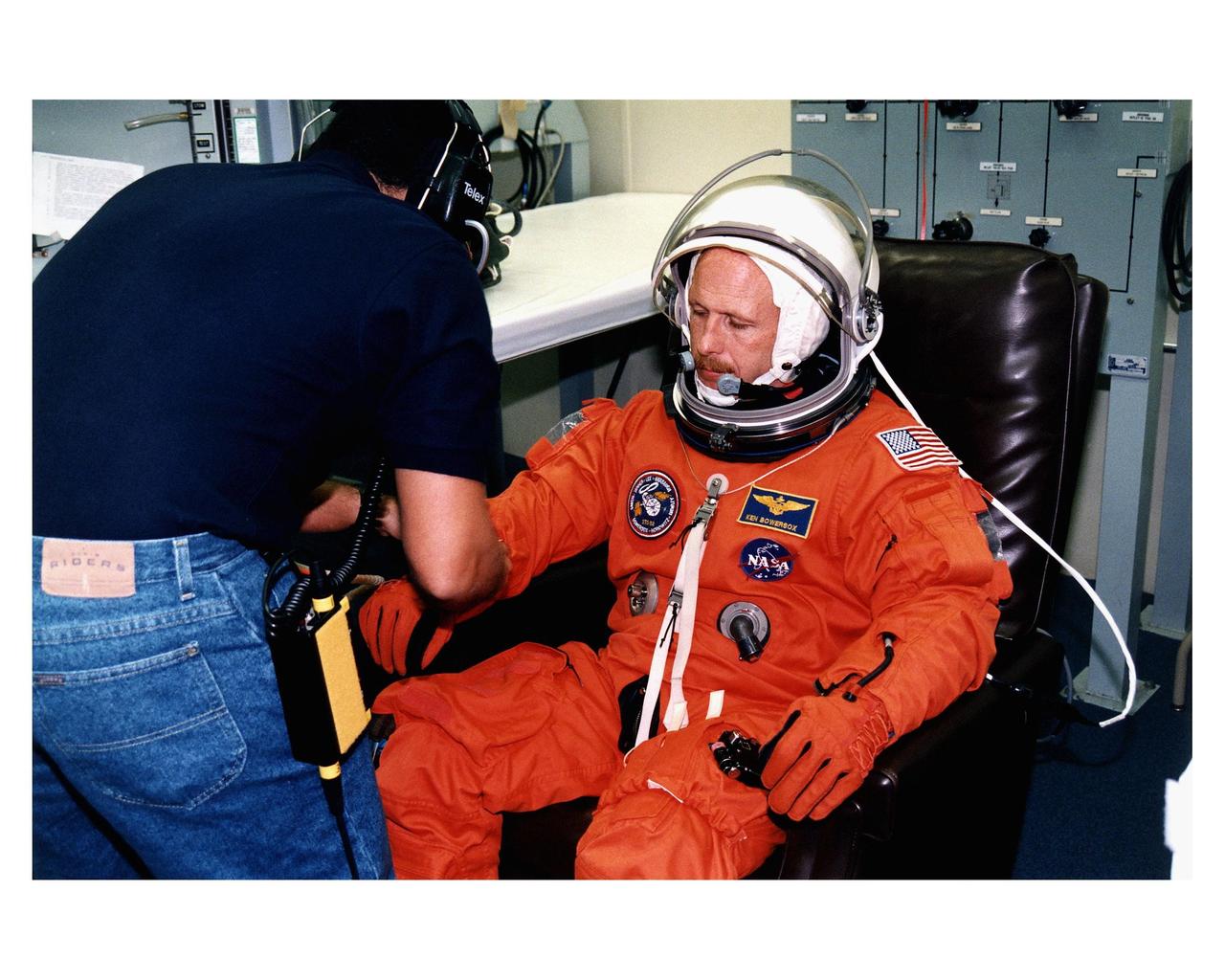
STS-82 Mission Commander Kenneth D. Bowersox makes some final adjustments to his launch and entry suit with assistance from a suit technician in the Operations and Checkout Building. This is his fourth space flight. He and the six other crew members will depart shortly for Launch Pad 39A, where the Space Shuttle Discovery awaits liftoff on a 10-day mission to service the orbiting Hubble Space Telescope (HST). This will be the second HST servicing mission. Four back-toback spacewalks are planned
KSC-97pc275
JSC2003-E-05206 (3 February 2003) --- Former President George H.W. Bush and Mrs. Bush talk with the three-member crew aboard the International Space Station (ISS) during a visit to the Johnson Space Center's  station flight control room (BFCR) on Feb. 3, 2003.  Onboard the orbital outpost are astronauts Kenneth D. Bowersox, Expedition Six commander; and Donald Pettit, ISS Science Officer; along with cosmonaut Nikolai Budarin, flight engineer.
Former President George H. W. Bush and Mrs. Bush visit with Mission Control Center personnel.
ISS006-307-012 (15 January 2003) --- Astronaut Donald R. Pettit, Expedition 6 NASA ISS science officer, performs P1 (P-One) Truss nadir launch lock releases on the International Space Station (ISS) during a session of extravehicular activity (EVA). Astronaut Kenneth D. Bowersox (out of frame), mission commander, joined Pettit on the spacewalk.
Pettit works on the ISS during EVA on Expedition Six
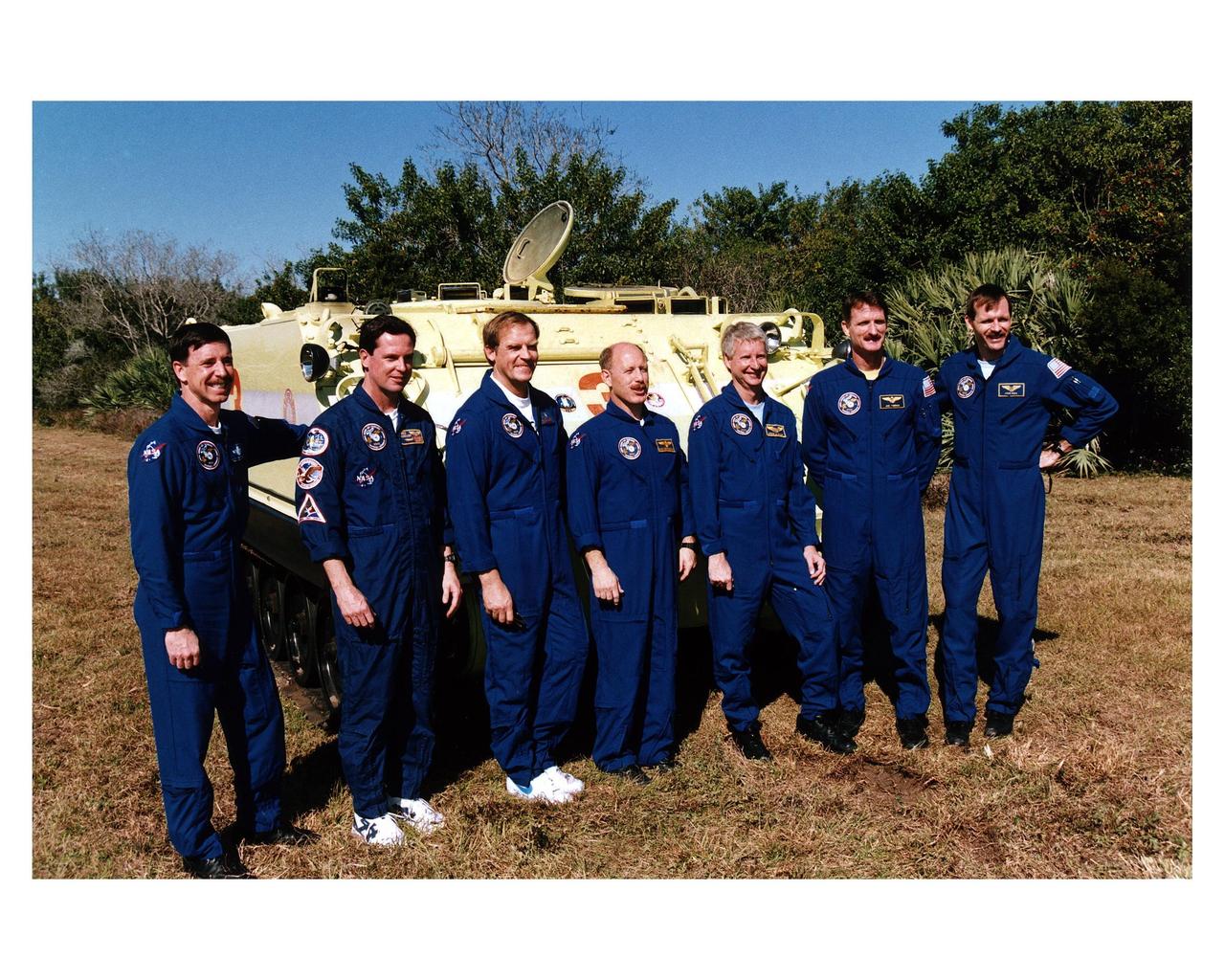
KENNEDY SPACE CENTER, FLA. -- STS-82 Terminal Countdown Demonstration Test (TCDT).   Crew members are Mission Commander Kenneth D. Bowersox, Pilot Scott J. "Doc" Horowitz, Payload Commander Mark C. Lee, and Mission Specialists Steven L. Smith, Gregory J. Harbaugh, Joseph R. "Joe" Tanner and Steven A. Hawley.
KSC-97pc185
ISS006-E-46364 (8 April 2003) --- Astronaut Donald R. Pettit, Expedition Six NASA ISS science officer, emerges from the Quest airlock on the International Space Station (ISS) to begin a session of extravehicular activity (EVA) to perform a variety of maintenance tasks. Astronaut Kenneth D. Bowersox (out of frame), mission commander, joined Pettit on the spacewalk.
View of Flight Engineer Donald R. Pettit emerging from the Quest/Airlock to perform tasks
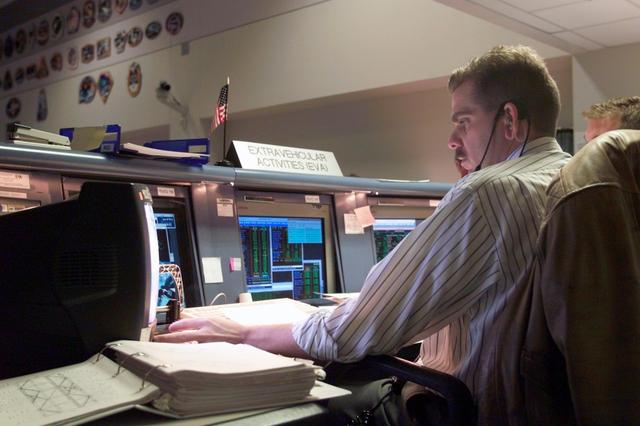
JSC2003-E-02160 (15 January 2003) --- Chris Looper, EVA officer, monitors data at his console in the station flight control room (BFCR) in Houston’s Mission Control Center (MCC). At the time this photo was taken, astronauts Kenneth D. Bowersox and Donald R. Pettit, Expedition Six mission commander and NASA ISS science officer, respectively, were participating in the mission’s only scheduled session of extravehicular activity (EVA).
BFCR during Expedition 6 space walk on ISS
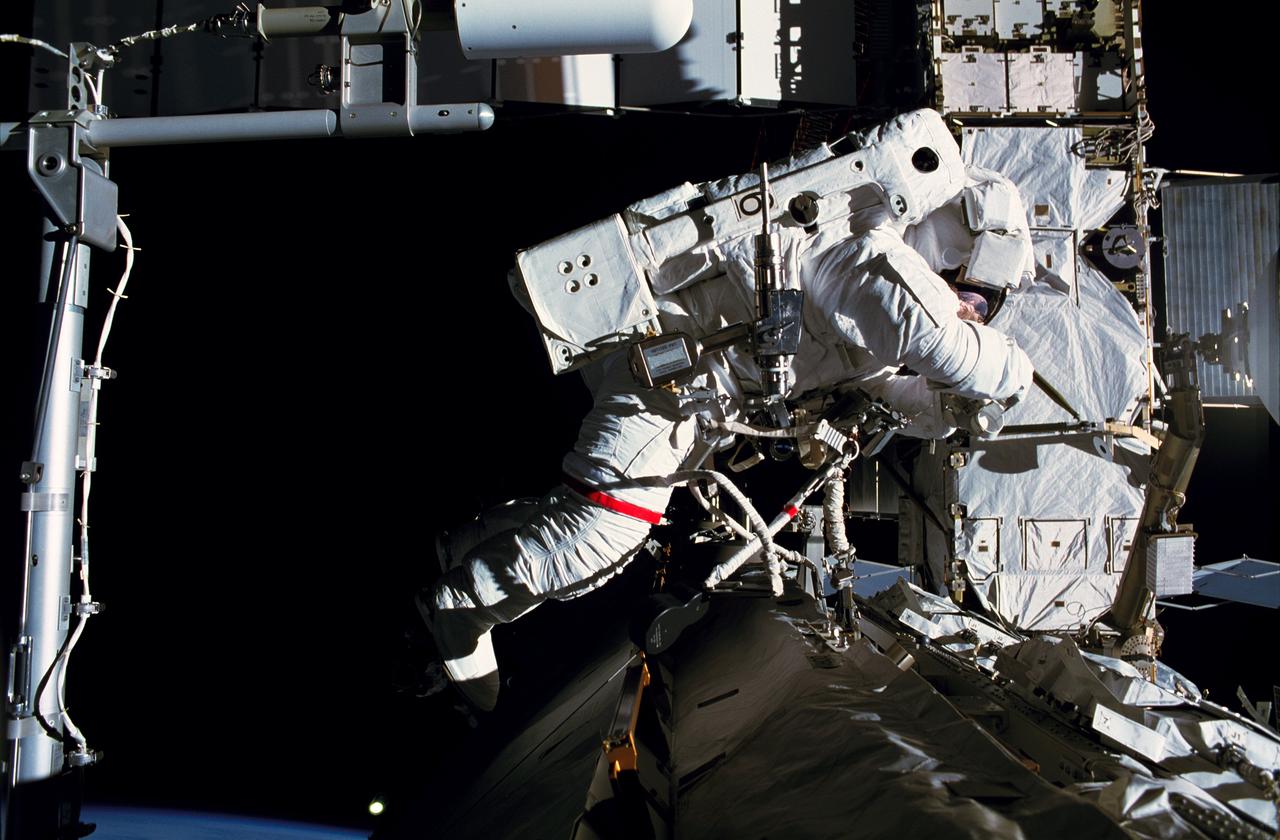
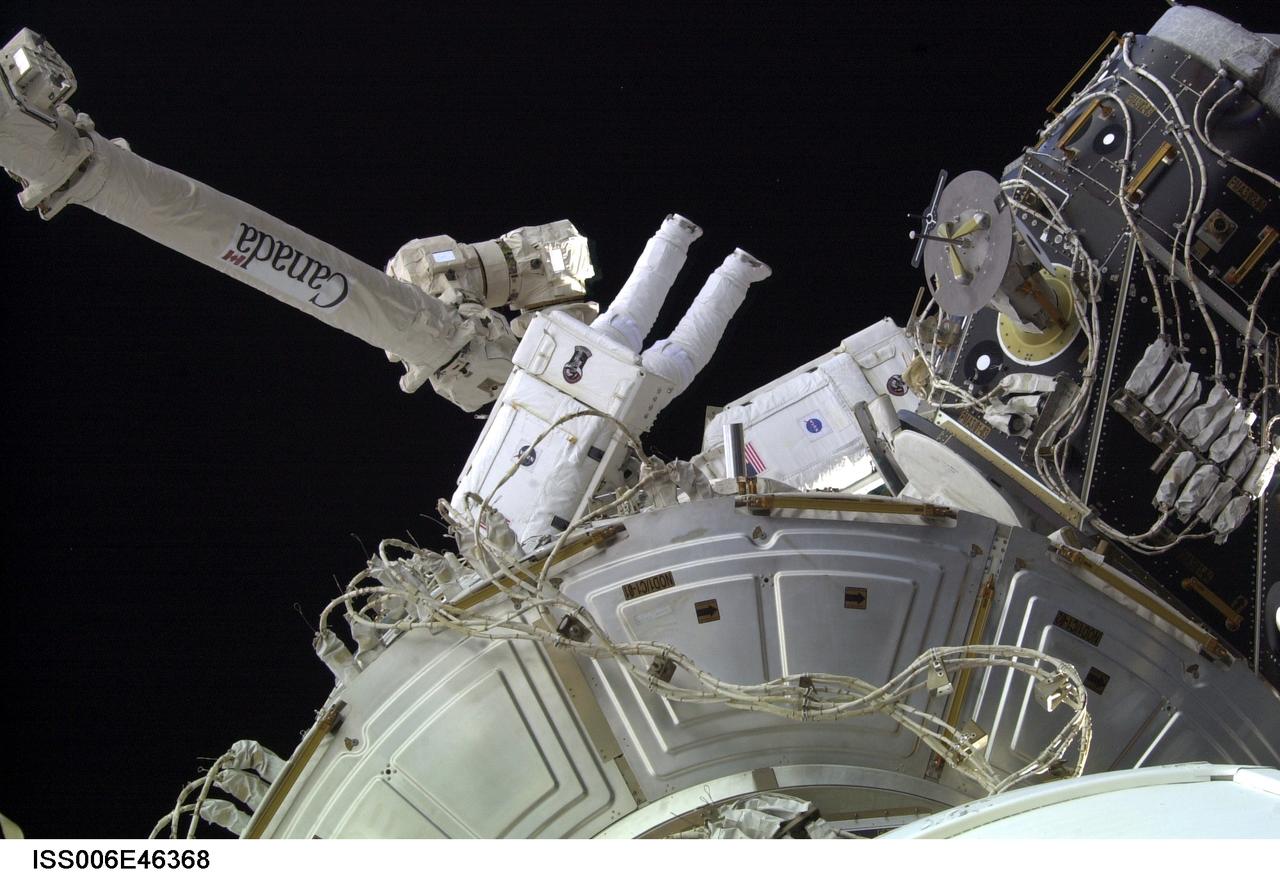
ISS006-E-46368 (8 April 2003) --- Astronauts Donald R. Pettit (left), Expedition Six NASA ISS science officer, and Kenneth D. Bowersox, mission commander, work in tandem on a session of extravehicular activity (EVA) as they perform a variety of maintenance tasks on the International Space Station (ISS). The spacewalk began at 7:40 a.m. (CDT) and ended at 2:06 p.m. (CDT) on April 8, 2003.
Flight Engineer Pettit and Commander Bowersox work in tandem on a session of EVA
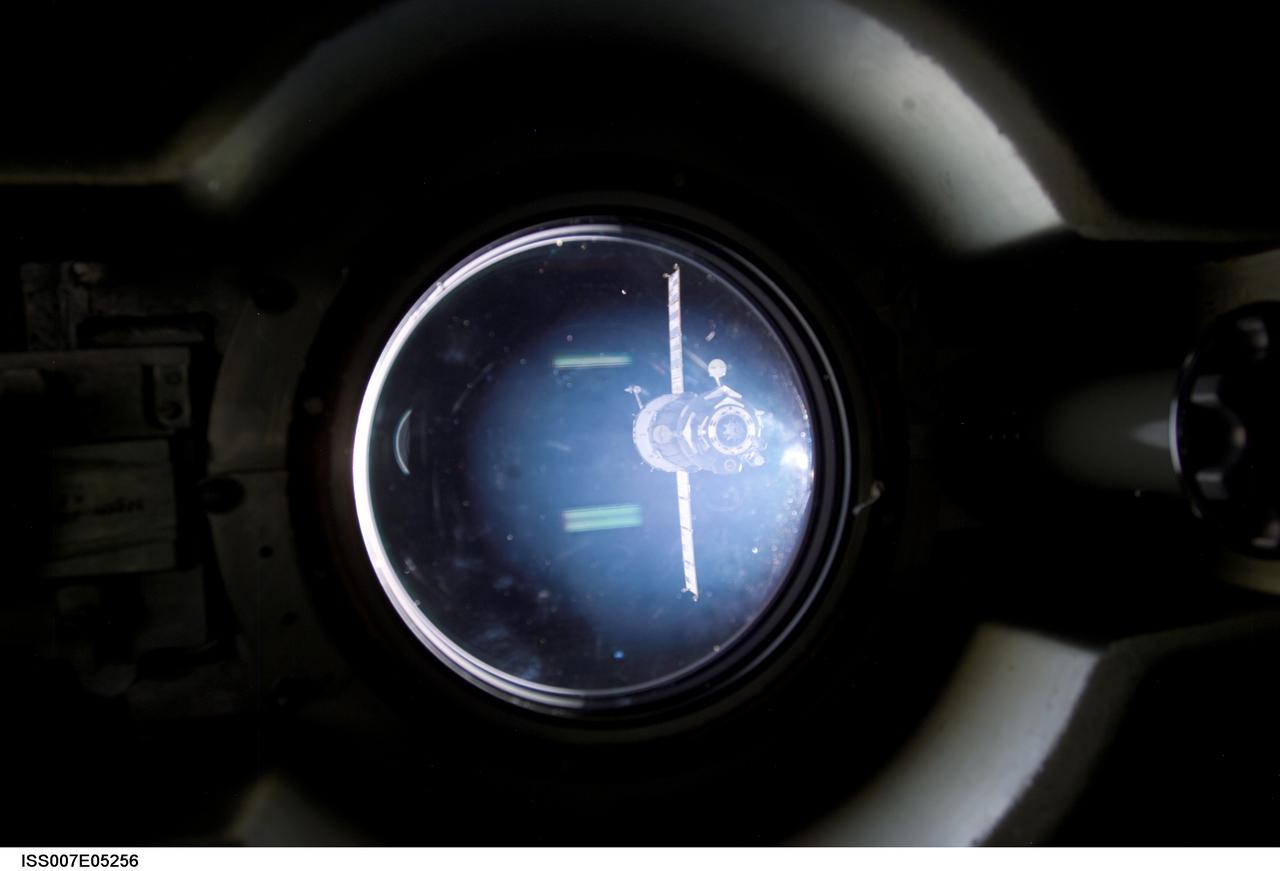
ISS007-E-05256 (3 May 2003) --- As seen through a window on the International Space Station (ISS), the Soyuz TMA-1 capsule departs from the station carrying the Expedition Six crewmembers, astronauts Kenneth D. Bowersox, mission commander; Donald R. Pettit, NASA ISS science officer; and cosmonaut Nikolai M. Budarin, flight engineer representing Rosaviakosmos.
Soyuz spacecraft departs ISS
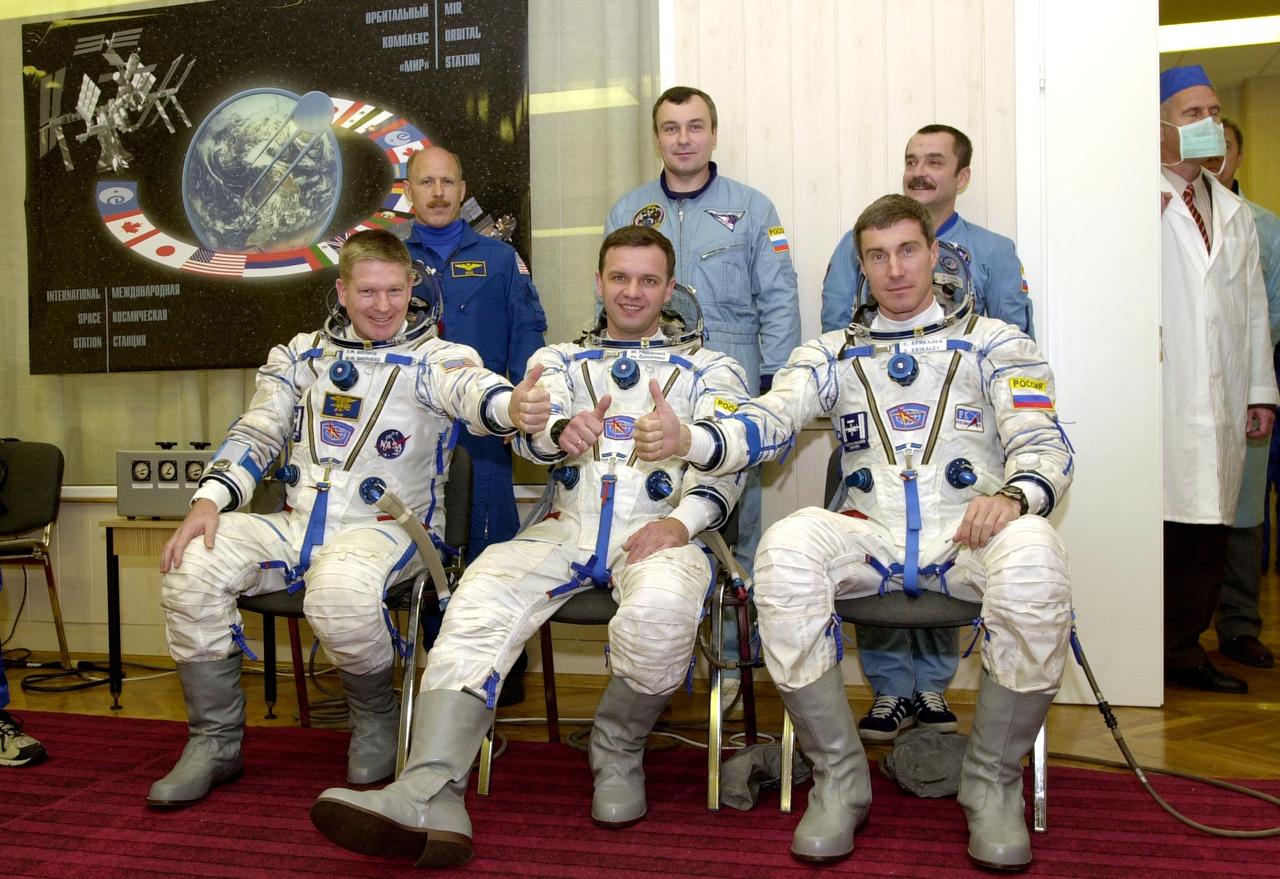
ISS01-S-007 (20 October 2000) ---  Appearing ready for their rapidly-approaching date with the International Space Station (ISS) are (seated, from the left) astronaut William M. Shepherd, Expedition One commander; with cosmonauts Yuri P. Gidzenko, Soyuz commander; and Sergei K. Krikalev, flight engineer.  Behind them are the backup crewmembers (from left)--  astronaut Kenneth D. Bowersox with cosmonauts Vladimir N. Dezhurov and Mikhail Turin.
Expedition One crew with backup crewmembers
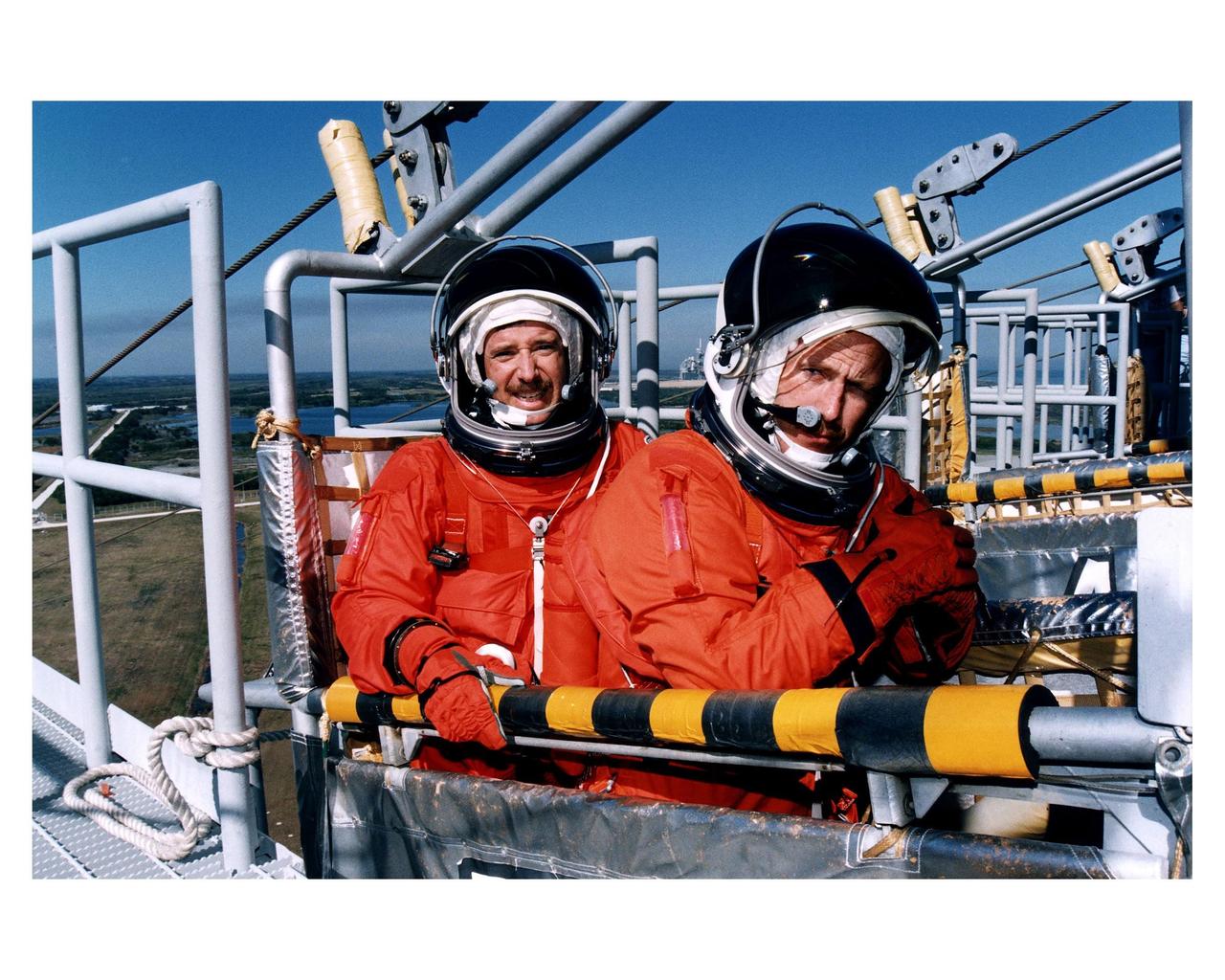
KENNEDY SPACE CENTER, Fla. --STS-82 Mission Commander Kenneth D. Bowersox, at right, and Pilot Scott J. "Doc" Horowitz practice emergency egress procedures in a slidewire basket at Launch Pad 39A as part of Terminal Countdown Demonstration Test (TCDT) activities. STS-82 will be the second Hubble Space Telescope servicing mission. Liftoff is targeted for Feb. 11
KSC-97pc219
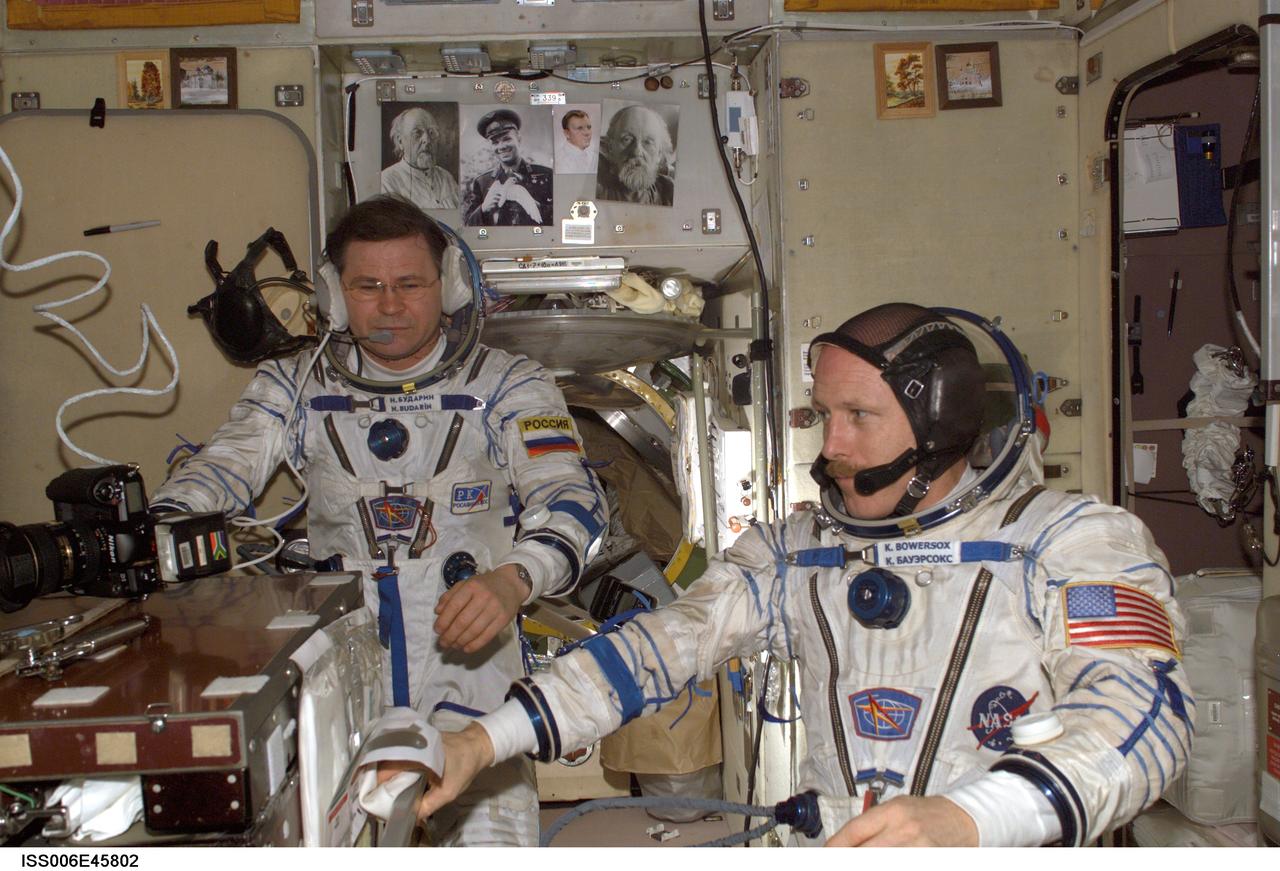
ISS006-E-45802 (14 April 2003) --- Attired in their Russian Sokol suits, astronaut Kenneth D. Bowersox (right), Expedition Six mission commander, and cosmonaut Nikolai M. Budarin, flight engineer, are pictured in the Zvezda Service Module on the International Space Station (ISS). The crewmembers were practicing for their return flight home scheduled for May 3, 2003 onboard the Soyuz TMA-1 spacecraft.
Budarin and Bowersox wearing Russian Sokol suits in the Soyuz Spacecraft during Expedition Six
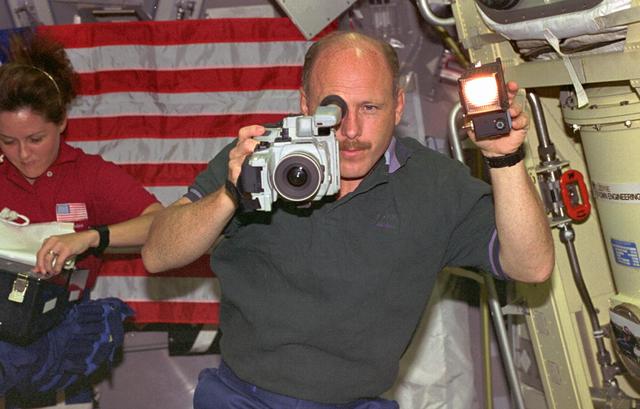
STS073-230-014 (20 October - 5 November 1995) --- Astronaut Kenneth D. Bowersox, STS-73 mission commander, uses a camcorder to record United States Microgravity Laboratory 2 (USML-2) activities onboard the Space Shuttle Columbia.  Nearby, astronaut Kathryn C. Thornton, payload commander, prepares to open a supply chest to support one of many science experiments conducted by the seven-member crew during the 16-day USML-2 flight.
Commander Ken Bowersox films activity in Spacelab
JSC2003-E-02167 (15 January 2003) --- Astronaut Stanley G. Love, spacecraft communicator (CAPCOM), monitors data at his console in the station flight control room (BFCR) in Houston’s Mission Control Center (MCC). At the time this photo was taken, astronauts Kenneth D. Bowersox and Donald R. Pettit, Expedition Six mission commander and NASA ISS science officer, respectively, were participating in the mission’s only scheduled session of extravehicular activity (EVA).
BFCR during Expedition 6 space walk on ISS
ISS006-E-25010 (7 February 2003) --- Astronaut Kenneth D. Bowersox, Expedition Six mission commander, conducts a Foot/Ground Reaction Forces During Spaceflight (FOOT) – Electromyography (EMG) calibration at the Human Research Facility (HRF) rack in the Destiny laboratory on the International Space Station (ISS). This experiment determines the change in joint angles (muscle activity) of the ankle, knee, and hip.
Bowersox prepares for the FOOT experiment in Destiny during Expedition Six
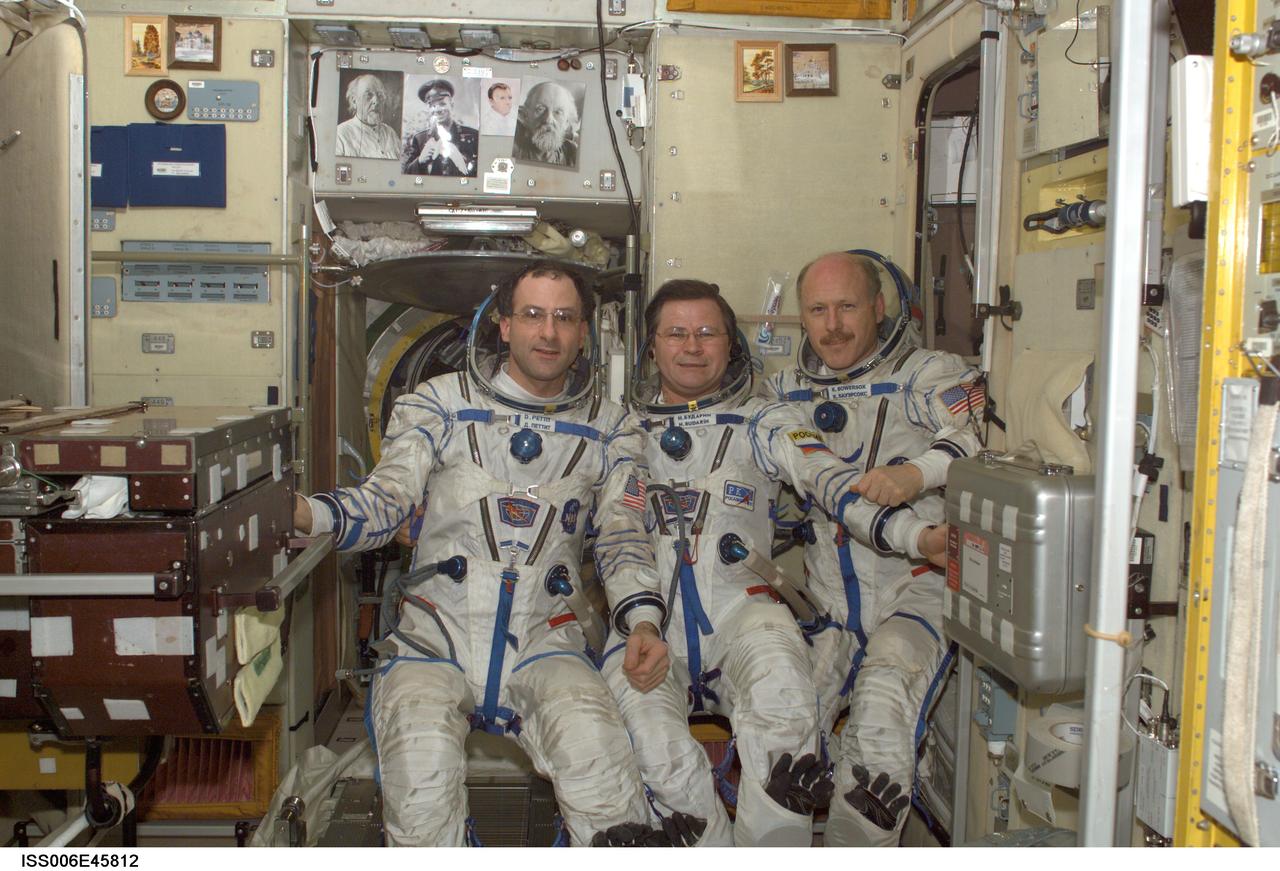
ISS006-E-45812 (14 April 2003) --- Attired in their Russian Sokol suits, the Expedition Six crewmembers pose for a crew photo in the Zvezda Service Module on the International Space Station (ISS). From the left are astronaut Donald R. Pettit, NASA ISS science officer; cosmonaut Nikolai M. Budarin, flight engineer; and astronaut Kenneth D. Bowersox, mission commander. The crewmembers are making preparations for their return flight home scheduled for May 3, 2003. Budarin represents Rosaviakosmos.
Informal portrait of Pettit, Budarin, and Bowersox in the SM during Expedition Six
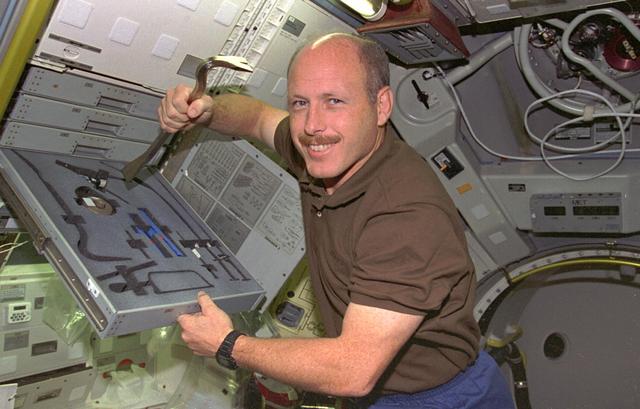
STS073-351-024 (20 October - 5 November 1995) --- Astronaut Kenneth D. Bowersox, STS-73 mission commander, retrieves a crow bar from a tool set onboard the science module in the cargo bay of the Earth-orbiting Space Shuttle Columbia.  Various tools were available for a variety of in-flight maintenance tasks for the crew to carry out during the 16-day United States Microgravity Laboratory (USML-2) mission.
Crewmembers float around in Spacelab
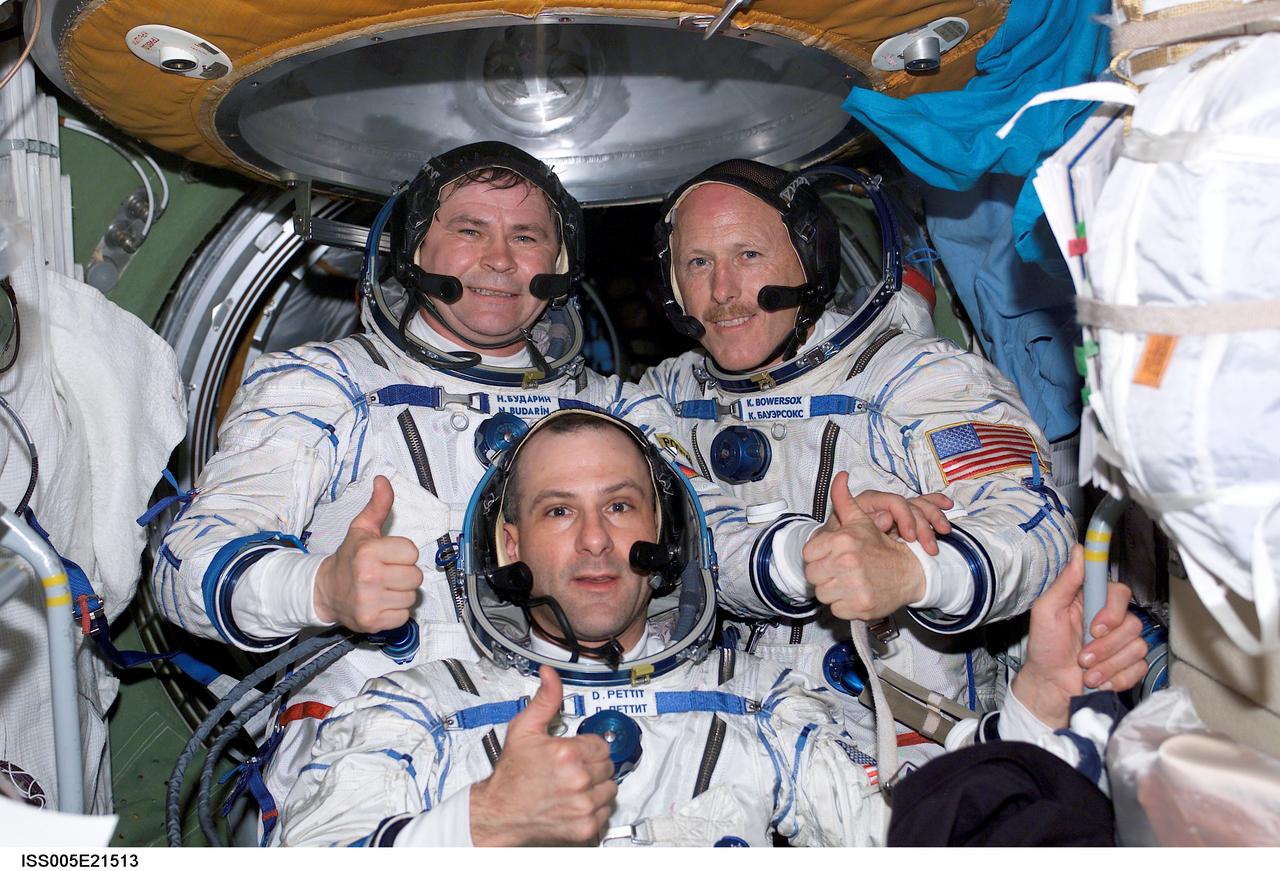
ISS005-E-21513 (26 November 2002) --- The Expedition Six crewmembers, wearing Russian Sokol suits, pose for a crew photo in the functional cargo block (FGB), or Zarya, on the International Space Station (ISS). Pictured are astronaut Donald R. Pettit (front), NASA ISS science officer; cosmonaut Nikolai M. Budarin (left back), flight engineer; and astronaut Kenneth D. Bowersox, mission commander. Budarin represents Rosaviakosmos.
Expedition Six crewmembers pose in the FGB during Expedition Five on the ISS
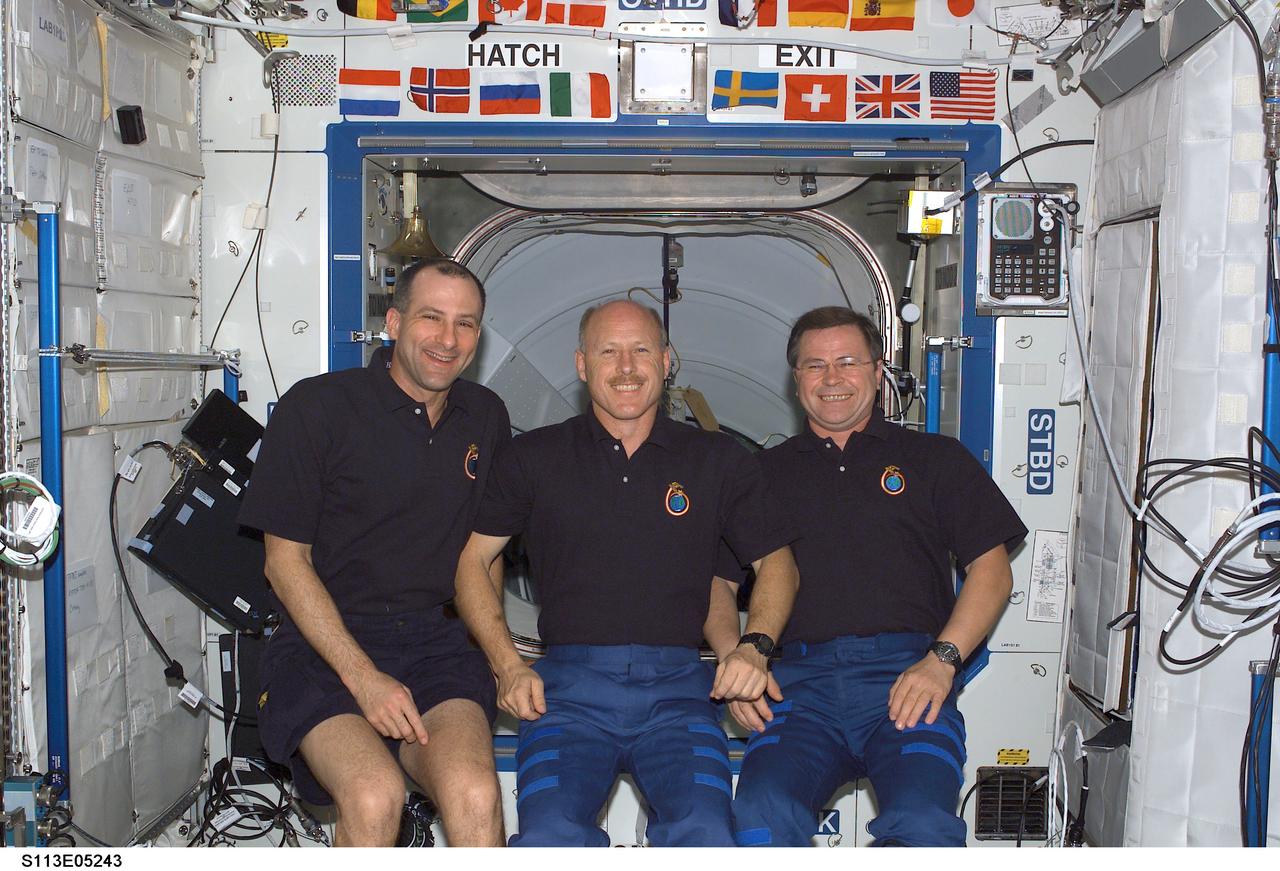
STS113-E-05243 (29 November 2002) --- The Expedition Six crewmembers pose for a crew photo in the Destiny laboratory on the International Space Station (ISS). From the left are astronauts Donald R. Pettit, NASA ISS science officer; Kenneth D. Bowersox, mission commander; and cosmonaut Nikolai M. Budarin, flight engineer representing Rosaviakosmos.
Expedition Six Crewmembers In-flight Crew Portrait taken in the U.S. Laboratory during STS-113 (11A)