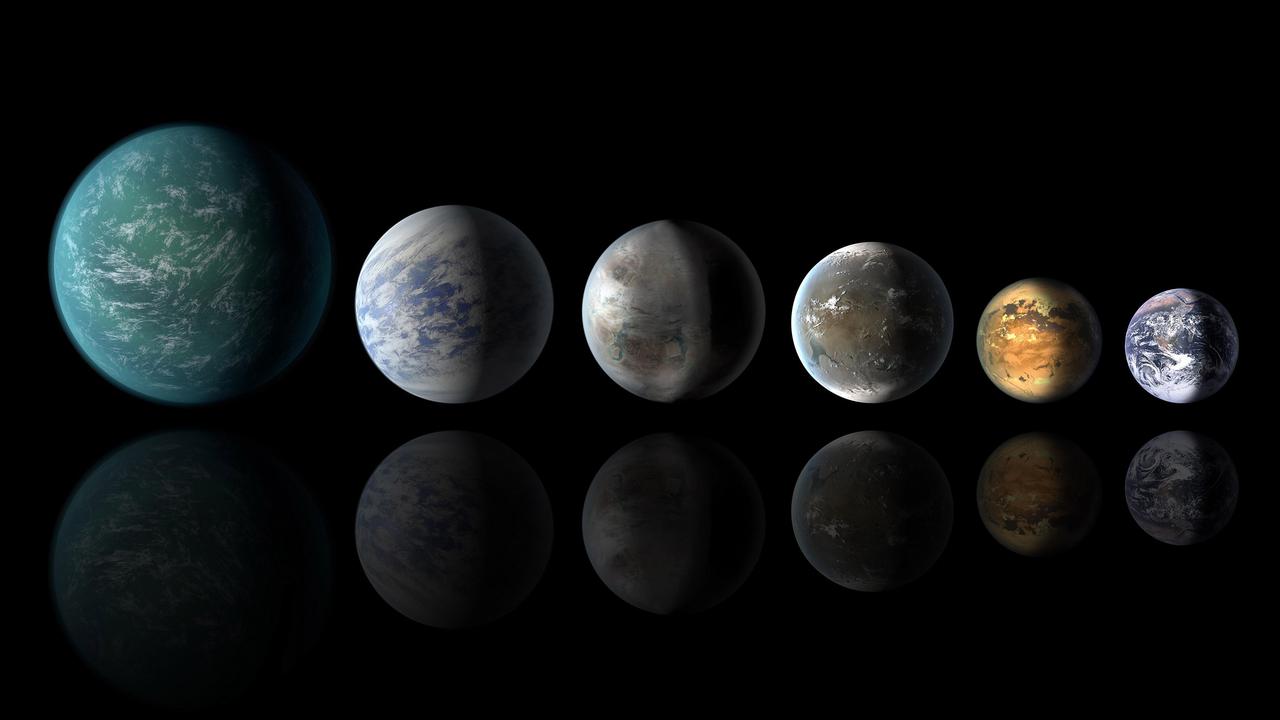
A newly discovered exoplanet, Kepler-452b, comes the closest of any found so far to matching our Earth-sun system. This artist's conception of a planetary lineup shows habitable-zone planets with similarities to Earth: from left, Kepler-22b, Kepler-69c, the just announced Kepler-452b, Kepler-62f and Kepler-186f. Last in line is Earth itself. http://photojournal.jpl.nasa.gov/catalog/PIA19830
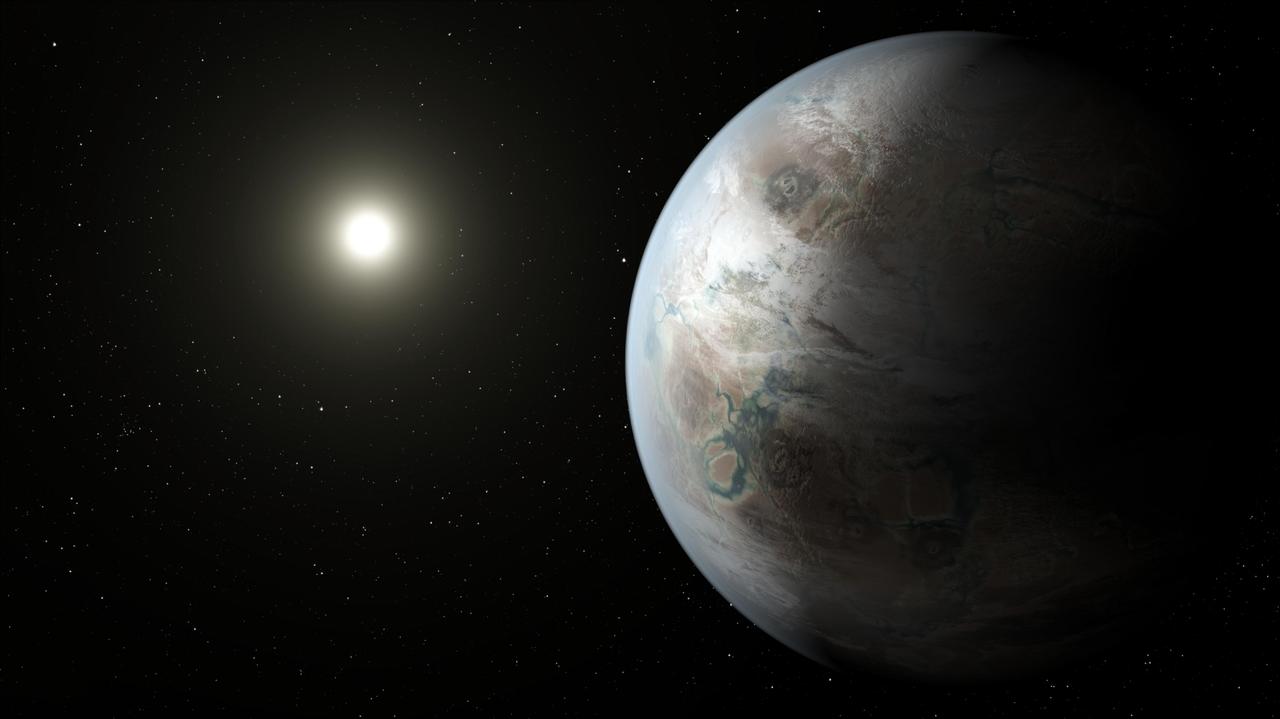
This artist's concept depicts one possible appearance of the planet Kepler-452b, the first near-Earth-size world to be found in the habitable zone of star that is similar to our sun. The habitable zone is a region around a star where temperatures are right for water -- an essential ingredient for life as we know it -- to pool on the surface. Scientists do not know if Kepler-452b can support life or not. What is known about the planet is that it is about 60 percent larger than Earth, placing it in a class of planets dubbed "super-Earths." While its mass and composition are not yet determined, previous research suggests that planets the size of Kepler-452b have a better than even chance of being rocky. Kepler-452b orbits its star every 385 days. The planet's star is about 1,400 light-years away in the constellation Cygnus. It is a G2-type star like our sun, with nearly the same temperature and mass. This star is 6 billion years old, 1.5 billion years older than our sun. As stars age, they grow in size and give out more energy, warming up their planets over time. Scientists and artists considered these facts when creating this illustration. If the planet Kepler-452b does in fact have liquid on its surface and has grown warmer due to the older age of its star, it could possibly be experiencing a runaway greenhouse effect, where oceans would begin to evaporate and contribute to increased cloud cover. This, plus other factors such as the planet's large size, was factored into the hypothetical scenario depicted in this illustration. http://photojournal.jpl.nasa.gov/catalog/PIA19824
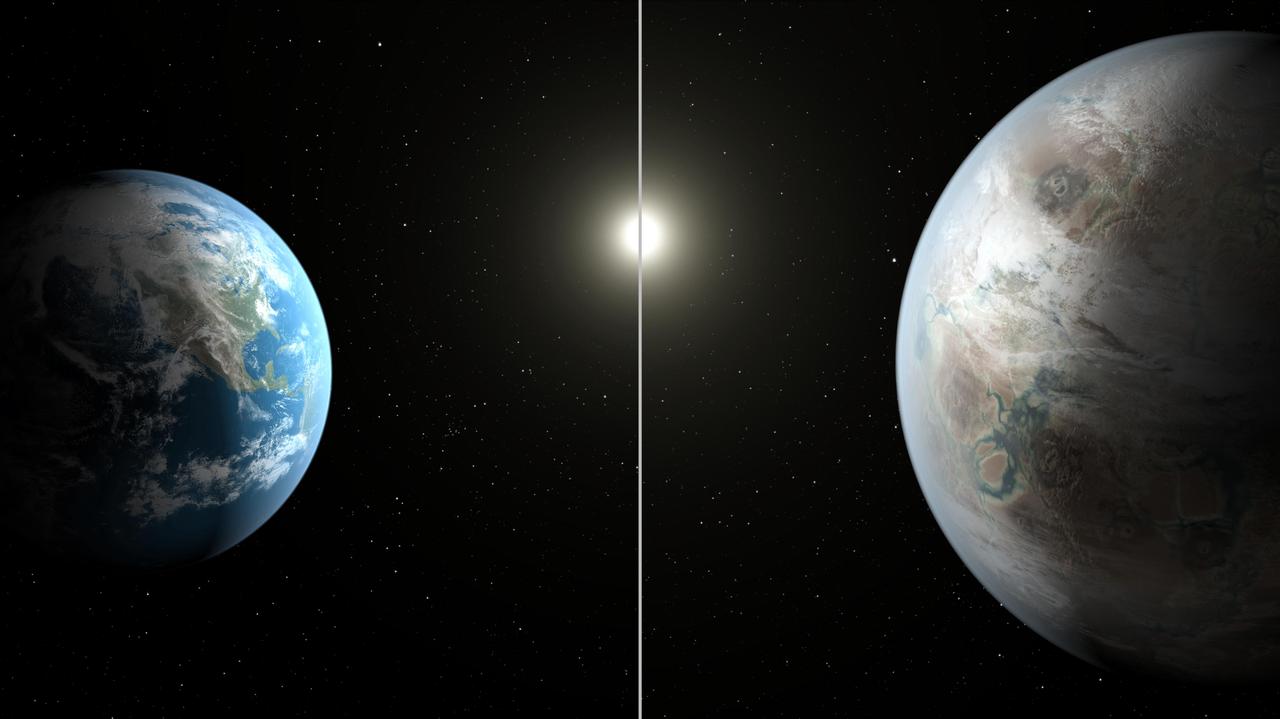
Scientists using data from NASA's Kepler mission have confirmed the first near-Earth-size planet orbiting in the habitable zone of a sun-like star. The habitable zone is the region around a star where temperatures are just right for water to exist in its liquid form. The artist's concept compares Earth (left) to the new planet, called Kepler-452b, which is about 60 percent larger. The illustration represents one possible appearance for Kepler-452b -- scientists do not know whether the planet has oceans and continents like Earth. Both planets orbit a G2-type star of about the same temperature; however, the star hosting Kepler-452b is 6 billion years old, 1.5 billion years older than our sun. As stars age, they become larger, hotter and brighter, as represented in the illustration. Kepler-452b's star appears a bit larger and brighter. http://photojournal.jpl.nasa.gov/catalog/PIA19825
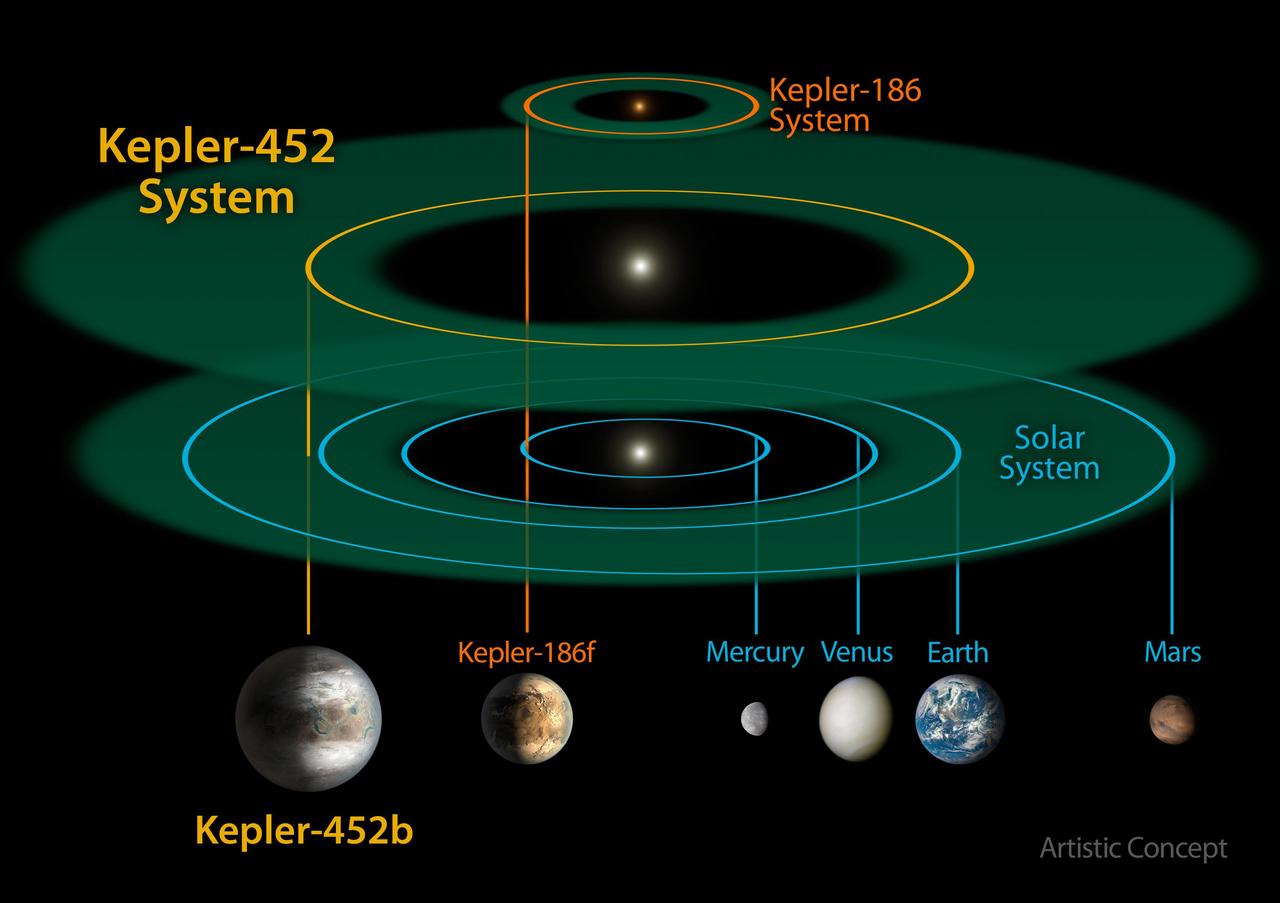
This size and scale of the Kepler-452 system compared alongside the Kepler-186 system and the solar system. Kepler-186 is a miniature solar system that would fit entirely inside the orbit of Mercury. The habitable zone of Kepler-186 is very small compared to that of Kepler-452 or the sun because it is a much smaller, cooler star. The size and extent of the habitable zone of Kepler-452 is nearly the same as that of the sun, but is slightly bigger because Kepler-452 is somewhat older, bigger and brighter. The size of the orbit of Kepler-452b is nearly the same as that of Earth at 1.05 astronomical units (an astronomical unit is the distance between Earth and the sun). Kepler-452b orbits its star once every 385 days. http://photojournal.jpl.nasa.gov/catalog/PIA19826